
MathematicsQ101–200 of 797 questions
Page 3 of 9 · Gujarati
101
MathematicsEasyMCQAP EAMCET · 2021
જો $\cos \theta = -\frac{\sqrt{3}}{2}$ અને $\sin \alpha = -\frac{3}{5}$ હોય,જ્યાં $\theta$ ત્રીજા ચરણમાં નથી,તો $\frac{2 \tan \alpha + \sqrt{3} \tan \theta}{\cot^2 \theta + \cos \alpha}$ ની કિંમત શોધો.
A
$\frac{7}{22}$
B
$\frac{5}{22}$
C
$\frac{9}{22}$
D
$\frac{22}{5}$
Solution
(B) આપેલ છે કે $\cos \theta = -\frac{\sqrt{3}}{2} < 0$. $\theta$ ત્રીજા ચરણમાં ન હોવાથી,$\theta$ બીજા ચરણમાં હશે.
બીજા ચરણમાં,$\tan \theta = -\frac{1}{\sqrt{3}}$ અને $\cot \theta = -\sqrt{3}$.
તેથી,$\cot^2 \theta = (-\sqrt{3})^2 = 3$.
આપેલ છે કે $\sin \alpha = -\frac{3}{5}$. $\sin \alpha < 0$ હોવાથી,$\alpha$ ત્રીજા અથવા ચોથા ચરણમાં હશે.
કિસ્સો $1$: જો $\alpha$ ત્રીજા ચરણમાં હોય,તો $\tan \alpha = \frac{3}{4}$ અને $\cos \alpha = -\frac{4}{5}$.
પદાવલિની કિંમત $\frac{2(\frac{3}{4}) + \sqrt{3}(-\frac{1}{\sqrt{3}})}{3 - \frac{4}{5}} = \frac{\frac{3}{2} - 1}{\frac{11}{5}} = \frac{5}{22}$ થાય.
આથી સાચો વિકલ્પ $\frac{5}{22}$ છે.
બીજા ચરણમાં,$\tan \theta = -\frac{1}{\sqrt{3}}$ અને $\cot \theta = -\sqrt{3}$.
તેથી,$\cot^2 \theta = (-\sqrt{3})^2 = 3$.
આપેલ છે કે $\sin \alpha = -\frac{3}{5}$. $\sin \alpha < 0$ હોવાથી,$\alpha$ ત્રીજા અથવા ચોથા ચરણમાં હશે.
કિસ્સો $1$: જો $\alpha$ ત્રીજા ચરણમાં હોય,તો $\tan \alpha = \frac{3}{4}$ અને $\cos \alpha = -\frac{4}{5}$.
પદાવલિની કિંમત $\frac{2(\frac{3}{4}) + \sqrt{3}(-\frac{1}{\sqrt{3}})}{3 - \frac{4}{5}} = \frac{\frac{3}{2} - 1}{\frac{11}{5}} = \frac{5}{22}$ થાય.
આથી સાચો વિકલ્પ $\frac{5}{22}$ છે.
0 likesView Solution
102
MathematicsEasyMCQAP EAMCET · 2021
ધારો કે $\theta$ એ પ્રમાણિત સ્થિતિમાં એક ખૂણો છે જેથી બિંદુ $(-5, 12)$ તેની અંતિમ બાજુ પર આવેલું છે. તો:
A
$|\sin \theta| = -\sin \theta$
B
$|\cos \theta| = \cos \theta$
C
$|\tan \theta| = -\tan \theta$
D
$|\operatorname{cosec} \theta| = -\operatorname{cosec} \theta$
Solution
(C) બિંદુ $(-5, 12)$ નો $x$-યામ ઋણ અને $y$-યામ ધન છે,જેનો અર્થ છે કે તે બીજા ચરણમાં આવેલું છે.
બીજા ચરણમાં,$\sin \theta$ અને $\operatorname{cosec} \theta$ ધન છે,જ્યારે $\cos \theta, \sec \theta, \tan \theta$ અને $\cot \theta$ ઋણ છે.
માનાંક વિધેયની વ્યાખ્યા મુજબ,જો $x < 0$ હોય તો $|x| = -x$.
અહીં $\tan \theta < 0$ હોવાથી,$|\tan \theta| = -\tan \theta$ થાય.
તેથી,વિકલ્પ $C$ સાચો છે.
બીજા ચરણમાં,$\sin \theta$ અને $\operatorname{cosec} \theta$ ધન છે,જ્યારે $\cos \theta, \sec \theta, \tan \theta$ અને $\cot \theta$ ઋણ છે.
માનાંક વિધેયની વ્યાખ્યા મુજબ,જો $x < 0$ હોય તો $|x| = -x$.
અહીં $\tan \theta < 0$ હોવાથી,$|\tan \theta| = -\tan \theta$ થાય.
તેથી,વિકલ્પ $C$ સાચો છે.
0 likesView Solution
103
MathematicsEasyMCQAP EAMCET · 2021
જો $\sin \left(5 x+\frac{\pi}{4}\right)=0$ હોય,તો $x$ ની કિંમત શોધો.
A
$\frac{-\pi}{20}+\frac{\pi}{2} n, n \in \mathbb{Z}$
B
$\frac{\pi}{20}+\frac{\pi}{5} n, n \in \mathbb{Z}$
C
$\frac{-\pi}{5}+\frac{\pi}{5} n, n \in \mathbb{Z}$
D
$\frac{-\pi}{20}+\frac{\pi}{5} n, n \in \mathbb{Z}$
Solution
(D) આપેલ છે કે $\sin \left(5 x+\frac{\pi}{4}\right)=0$.
આપણે જાણીએ છીએ કે $\sin \theta = 0$ નો અર્થ છે $\theta = n\pi$,જ્યાં $n \in \mathbb{Z}$.
તેથી,$5x + \frac{\pi}{4} = n\pi$.
બંને બાજુથી $\frac{\pi}{4}$ બાદ કરતા,$5x = n\pi - \frac{\pi}{4}$.
$5$ વડે ભાગતા,$x = \frac{n\pi}{5} - \frac{\pi}{20}$.
આમ,$x = \frac{-\pi}{20} + \frac{n\pi}{5}$,જ્યાં $n \in \mathbb{Z}$.
આપણે જાણીએ છીએ કે $\sin \theta = 0$ નો અર્થ છે $\theta = n\pi$,જ્યાં $n \in \mathbb{Z}$.
તેથી,$5x + \frac{\pi}{4} = n\pi$.
બંને બાજુથી $\frac{\pi}{4}$ બાદ કરતા,$5x = n\pi - \frac{\pi}{4}$.
$5$ વડે ભાગતા,$x = \frac{n\pi}{5} - \frac{\pi}{20}$.
આમ,$x = \frac{-\pi}{20} + \frac{n\pi}{5}$,જ્યાં $n \in \mathbb{Z}$.
0 likesView Solution
104
MathematicsEasyMCQAP EAMCET · 2021
જો $\sin \theta + \operatorname{cosec} \theta = 2$ હોય,તો $\sin^{10} \theta + \operatorname{cosec}^{10} \theta$ નું મૂલ્ય કેટલું થાય?
A
$2$
B
$2^{10}$
C
$2^9$
D
$2^8$
Solution
(A) આપેલ છે કે,$\sin \theta + \operatorname{cosec} \theta = 2$.
આપણે જાણીએ છીએ કે $\operatorname{cosec} \theta = \frac{1}{\sin \theta}$.
તેથી,$\sin \theta + \frac{1}{\sin \theta} = 2$.
ધારો કે $\sin \theta = x$,તો $x + \frac{1}{x} = 2$,જેનો અર્થ છે કે $x^2 - 2x + 1 = 0$,અથવા $(x - 1)^2 = 0$.
આમ,$x = 1$,જેનો અર્થ છે કે $\sin \theta = 1$.
પરિણામે,$\operatorname{cosec} \theta = 1$.
તેથી,$\sin^{10} \theta + \operatorname{cosec}^{10} \theta = (1)^{10} + (1)^{10} = 1 + 1 = 2$.
આપણે જાણીએ છીએ કે $\operatorname{cosec} \theta = \frac{1}{\sin \theta}$.
તેથી,$\sin \theta + \frac{1}{\sin \theta} = 2$.
ધારો કે $\sin \theta = x$,તો $x + \frac{1}{x} = 2$,જેનો અર્થ છે કે $x^2 - 2x + 1 = 0$,અથવા $(x - 1)^2 = 0$.
આમ,$x = 1$,જેનો અર્થ છે કે $\sin \theta = 1$.
પરિણામે,$\operatorname{cosec} \theta = 1$.
તેથી,$\sin^{10} \theta + \operatorname{cosec}^{10} \theta = (1)^{10} + (1)^{10} = 1 + 1 = 2$.
0 likesView Solution
105
MathematicsMediumMCQAP EAMCET · 2021
જો $0 < \theta < \frac{\pi}{2}$ અને $\sin \theta \cos \theta = \frac{12}{25}$ હોય,તો $\sin^4 \theta + \cos^4 \theta$ ની કિંમત શોધો.
A
$\frac{327}{625}$
B
$\frac{337}{625}$
C
$\frac{347}{625}$
D
$\frac{340}{625}$
Solution
(B) આપેલ છે કે $0 < \theta < \frac{\pi}{2}$ અને $\sin \theta \cos \theta = \frac{12}{25}$.
આપણે $\sin^4 \theta + \cos^4 \theta$ શોધવાનું છે.
નિત્યસમ $a^2 + b^2 = (a + b)^2 - 2ab$ નો ઉપયોગ કરતા:
$\sin^4 \theta + \cos^4 \theta = (\sin^2 \theta)^2 + (\cos^2 \theta)^2$
$= (\sin^2 \theta + \cos^2 \theta)^2 - 2 \sin^2 \theta \cos^2 \theta$
$\sin^2 \theta + \cos^2 \theta = 1$ હોવાથી:
$= (1)^2 - 2(\sin \theta \cos \theta)^2$
$= 1 - 2 \left(\frac{12}{25}\right)^2$
$= 1 - 2 \left(\frac{144}{625}\right)$
$= 1 - \frac{288}{625}$
$= \frac{625 - 288}{625} = \frac{337}{625}$.
આપણે $\sin^4 \theta + \cos^4 \theta$ શોધવાનું છે.
નિત્યસમ $a^2 + b^2 = (a + b)^2 - 2ab$ નો ઉપયોગ કરતા:
$\sin^4 \theta + \cos^4 \theta = (\sin^2 \theta)^2 + (\cos^2 \theta)^2$
$= (\sin^2 \theta + \cos^2 \theta)^2 - 2 \sin^2 \theta \cos^2 \theta$
$\sin^2 \theta + \cos^2 \theta = 1$ હોવાથી:
$= (1)^2 - 2(\sin \theta \cos \theta)^2$
$= 1 - 2 \left(\frac{12}{25}\right)^2$
$= 1 - 2 \left(\frac{144}{625}\right)$
$= 1 - \frac{288}{625}$
$= \frac{625 - 288}{625} = \frac{337}{625}$.
0 likesView Solution
106
MathematicsEasyMCQAP EAMCET · 2021
$\cos \left(22 \frac{1}{2}\right)^{\circ}$ ની કિંમત શું છે?
A
$\sqrt{\frac{\sqrt{2}-1}{2 \sqrt{2}}}$
B
$\sqrt{\frac{\sqrt{2}+1}{2 \sqrt{2}}}$
C
$\sqrt{2}-1$
D
$\sqrt{2}+1$
Solution
(B) ધારો કે $A = 22 \frac{1}{2}^{\circ} = \frac{45^{\circ}}{2}$.
અડધા ખૂણાના સૂત્ર $\cos A = \sqrt{\frac{1 + \cos 2A}{2}}$ નો ઉપયોગ કરતા:
$\cos \left(\frac{45^{\circ}}{2}\right) = \sqrt{\frac{1 + \cos 45^{\circ}}{2}}$
કારણ કે $\cos 45^{\circ} = \frac{1}{\sqrt{2}}$,તેથી:
$\cos \left(22 \frac{1}{2}\right)^{\circ} = \sqrt{\frac{1 + \frac{1}{\sqrt{2}}}{2}}$
$= \sqrt{\frac{\frac{\sqrt{2} + 1}{\sqrt{2}}}{2}}$
$= \sqrt{\frac{\sqrt{2} + 1}{2 \sqrt{2}}}$
આમ,સાચો વિકલ્પ $B$ છે.
અડધા ખૂણાના સૂત્ર $\cos A = \sqrt{\frac{1 + \cos 2A}{2}}$ નો ઉપયોગ કરતા:
$\cos \left(\frac{45^{\circ}}{2}\right) = \sqrt{\frac{1 + \cos 45^{\circ}}{2}}$
કારણ કે $\cos 45^{\circ} = \frac{1}{\sqrt{2}}$,તેથી:
$\cos \left(22 \frac{1}{2}\right)^{\circ} = \sqrt{\frac{1 + \frac{1}{\sqrt{2}}}{2}}$
$= \sqrt{\frac{\frac{\sqrt{2} + 1}{\sqrt{2}}}{2}}$
$= \sqrt{\frac{\sqrt{2} + 1}{2 \sqrt{2}}}$
આમ,સાચો વિકલ્પ $B$ છે.
0 likesView Solution
107
MathematicsEasyMCQAP EAMCET · 2021
જો $\tan \beta = \frac{\tan \alpha + \tan \gamma}{1 + \tan \alpha \tan \gamma}$ હોય,તો $\frac{\sin 2 \alpha + \sin 2 \gamma}{1 + \sin 2 \alpha \sin 2 \gamma} = $
A
$\sin 2 \beta$
B
$\cos 2 \beta$
C
$\tan 2 \beta$
D
$\sec 2 \beta$
Solution
(A) આપેલ છે,$\tan \beta = \frac{\tan \alpha + \tan \gamma}{1 + \tan \alpha \tan \gamma} = \frac{\sin(\alpha + \gamma)}{\cos(\alpha - \gamma)} \dots (1)$
હવે,પદાવલિ $E = \frac{\sin 2 \alpha + \sin 2 \gamma}{1 + \sin 2 \alpha \sin 2 \gamma} = \frac{2 \sin(\alpha + \gamma) \cos(\alpha - \gamma)}{\cos^2(\alpha - \gamma) + \sin^2(\alpha + \gamma)}$
$= \frac{2 \frac{\sin(\alpha + \gamma)}{\cos(\alpha - \gamma)}}{1 + \left(\frac{\sin(\alpha + \gamma)}{\cos(\alpha - \gamma)}\right)^2}$
સમીકરણ $(1)$ નો ઉપયોગ કરતા,આ $\frac{2 \tan \beta}{1 + \tan^2 \beta} = \sin 2 \beta$ થાય છે.
હવે,પદાવલિ $E = \frac{\sin 2 \alpha + \sin 2 \gamma}{1 + \sin 2 \alpha \sin 2 \gamma} = \frac{2 \sin(\alpha + \gamma) \cos(\alpha - \gamma)}{\cos^2(\alpha - \gamma) + \sin^2(\alpha + \gamma)}$
$= \frac{2 \frac{\sin(\alpha + \gamma)}{\cos(\alpha - \gamma)}}{1 + \left(\frac{\sin(\alpha + \gamma)}{\cos(\alpha - \gamma)}\right)^2}$
સમીકરણ $(1)$ નો ઉપયોગ કરતા,આ $\frac{2 \tan \beta}{1 + \tan^2 \beta} = \sin 2 \beta$ થાય છે.
0 likesView Solution
108
MathematicsDifficultMCQAP EAMCET · 2021
જો $x \cos \theta = y \cos \left(\theta + \frac{2 \pi}{3}\right) = z \cos \left(\theta + \frac{4 \pi}{3}\right)$ હોય,તો $\frac{1}{x} + \frac{1}{y} + \frac{1}{z} = $
A
$1$
B
$2$
C
$0$
D
$3$
Solution
(C) ધારો કે $x \cos \theta = y \cos \left(\theta + \frac{2 \pi}{3}\right) = z \cos \left(\theta + \frac{4 \pi}{3}\right) = \lambda$ (જ્યાં $\lambda \neq 0$).
તેથી,$\frac{1}{x} = \frac{\cos \theta}{\lambda}$,$\frac{1}{y} = \frac{\cos \left(\theta + \frac{2 \pi}{3}\right)}{\lambda}$,અને $\frac{1}{z} = \frac{\cos \left(\theta + \frac{4 \pi}{3}\right)}{\lambda}$.
આ ત્રણેયનો સરવાળો કરતા,$\frac{1}{x} + \frac{1}{y} + \frac{1}{z} = \frac{1}{\lambda} \left[ \cos \theta + \cos \left(\theta + \frac{2 \pi}{3}\right) + \cos \left(\theta + \frac{4 \pi}{3}\right) \right]$.
પ્રથમ અને ત્રીજા પદ માટે નિત્યસમ $\cos A + \cos B = 2 \cos \left(\frac{A+B}{2}\right) \cos \left(\frac{A-B}{2}\right)$ નો ઉપયોગ કરતા:
$\cos \theta + \cos \left(\theta + \frac{4 \pi}{3}\right) = 2 \cos \left(\theta + \frac{2 \pi}{3}\right) \cos \left(-\frac{2 \pi}{3}\right) = 2 \cos \left(\theta + \frac{2 \pi}{3}\right) \left(-\frac{1}{2}\right) = -\cos \left(\theta + \frac{2 \pi}{3}\right)$.
આ કિંમત સરવાળામાં મૂકતા:
$\frac{1}{x} + \frac{1}{y} + \frac{1}{z} = \frac{1}{\lambda} \left[ -\cos \left(\theta + \frac{2 \pi}{3}\right) + \cos \left(\theta + \frac{2 \pi}{3}\right) \right] = \frac{1}{\lambda} (0) = 0$.
તેથી,$\frac{1}{x} = \frac{\cos \theta}{\lambda}$,$\frac{1}{y} = \frac{\cos \left(\theta + \frac{2 \pi}{3}\right)}{\lambda}$,અને $\frac{1}{z} = \frac{\cos \left(\theta + \frac{4 \pi}{3}\right)}{\lambda}$.
આ ત્રણેયનો સરવાળો કરતા,$\frac{1}{x} + \frac{1}{y} + \frac{1}{z} = \frac{1}{\lambda} \left[ \cos \theta + \cos \left(\theta + \frac{2 \pi}{3}\right) + \cos \left(\theta + \frac{4 \pi}{3}\right) \right]$.
પ્રથમ અને ત્રીજા પદ માટે નિત્યસમ $\cos A + \cos B = 2 \cos \left(\frac{A+B}{2}\right) \cos \left(\frac{A-B}{2}\right)$ નો ઉપયોગ કરતા:
$\cos \theta + \cos \left(\theta + \frac{4 \pi}{3}\right) = 2 \cos \left(\theta + \frac{2 \pi}{3}\right) \cos \left(-\frac{2 \pi}{3}\right) = 2 \cos \left(\theta + \frac{2 \pi}{3}\right) \left(-\frac{1}{2}\right) = -\cos \left(\theta + \frac{2 \pi}{3}\right)$.
આ કિંમત સરવાળામાં મૂકતા:
$\frac{1}{x} + \frac{1}{y} + \frac{1}{z} = \frac{1}{\lambda} \left[ -\cos \left(\theta + \frac{2 \pi}{3}\right) + \cos \left(\theta + \frac{2 \pi}{3}\right) \right] = \frac{1}{\lambda} (0) = 0$.
0 likesView Solution
109
MathematicsDifficultMCQAP EAMCET · 2021
જો $0 \leq \theta \leq 2 \pi$,$0 \leq \alpha \leq 2 \pi$ અને $\sec ^{2018} \theta + \operatorname{cosec}^{2018} \alpha = 2$ હોય,તો $\cos ^{2020} \theta + \sin ^{2022} \alpha$ ની કિંમત શોધો.
A
$1/2$
B
$1/2^{2020}$
C
$1$
D
$2$
Solution
(D) આપેલ છે કે $\sec ^{2018} \theta + \operatorname{cosec}^{2018} \alpha = 2$.
કારણ કે $\sec ^{2018} \theta \geq 1$ અને $\operatorname{cosec}^{2018} \alpha \geq 1$ હોવાથી,તેમનો સરવાળો $2$ ત્યારે જ થાય જ્યારે $\sec ^{2018} \theta = 1$ અને $\operatorname{cosec}^{2018} \alpha = 1$ હોય.
આથી $\theta = 0$ અને $\alpha = \pi/2$ લેતા:
$\cos ^{2020} \theta + \sin ^{2022} \alpha = \cos ^{2020} (0) + \sin ^{2022} (\pi/2) = 1 + 1 = 2$.
કારણ કે $\sec ^{2018} \theta \geq 1$ અને $\operatorname{cosec}^{2018} \alpha \geq 1$ હોવાથી,તેમનો સરવાળો $2$ ત્યારે જ થાય જ્યારે $\sec ^{2018} \theta = 1$ અને $\operatorname{cosec}^{2018} \alpha = 1$ હોય.
આથી $\theta = 0$ અને $\alpha = \pi/2$ લેતા:
$\cos ^{2020} \theta + \sin ^{2022} \alpha = \cos ^{2020} (0) + \sin ^{2022} (\pi/2) = 1 + 1 = 2$.
0 likesView Solution
110
MathematicsEasyMCQAP EAMCET · 2021
$\tan 70^{\circ} - \tan 20^{\circ} = a \cdot \tan 50^{\circ}$ માં $a$ ની કિંમત શોધો.
A
$-4$
B
$4$
C
$-2$
D
$2$
Solution
(D) આપેલ છે: $\tan 70^{\circ} - \tan 20^{\circ} = a \cdot \tan 50^{\circ}$
$\Rightarrow \frac{\sin 70^{\circ}}{\cos 70^{\circ}} - \frac{\sin 20^{\circ}}{\cos 20^{\circ}} = \frac{a \sin 50^{\circ}}{\cos 50^{\circ}}$
$\sin(A-B) = \sin A \cos B - \cos A \sin B$ નો ઉપયોગ કરતા:
$\Rightarrow \frac{\sin(70^{\circ} - 20^{\circ})}{\cos 70^{\circ} \cos 20^{\circ}} = \frac{a \sin 50^{\circ}}{\cos 50^{\circ}}$
$\Rightarrow \frac{\sin 50^{\circ}}{\cos 70^{\circ} \cos 20^{\circ}} = \frac{a \sin 50^{\circ}}{\cos 50^{\circ}}$
$\sin 50^{\circ} \neq 0$ હોવાથી,બંને બાજુ $\sin 50^{\circ}$ વડે ભાગતા:
$\Rightarrow a = \frac{\cos 50^{\circ}}{\cos 70^{\circ} \cos 20^{\circ}}$
અંશ અને છેદને $2$ વડે ગુણતા:
$a = \frac{2 \cos 50^{\circ}}{2 \cos 70^{\circ} \cos 20^{\circ}}$
$2 \cos A \cos B = \cos(A+B) + \cos(A-B)$ નો ઉપયોગ કરતા:
$a = \frac{2 \cos 50^{\circ}}{\cos 90^{\circ} + \cos 50^{\circ}} = \frac{2 \cos 50^{\circ}}{0 + \cos 50^{\circ}} = 2$
$\Rightarrow \frac{\sin 70^{\circ}}{\cos 70^{\circ}} - \frac{\sin 20^{\circ}}{\cos 20^{\circ}} = \frac{a \sin 50^{\circ}}{\cos 50^{\circ}}$
$\sin(A-B) = \sin A \cos B - \cos A \sin B$ નો ઉપયોગ કરતા:
$\Rightarrow \frac{\sin(70^{\circ} - 20^{\circ})}{\cos 70^{\circ} \cos 20^{\circ}} = \frac{a \sin 50^{\circ}}{\cos 50^{\circ}}$
$\Rightarrow \frac{\sin 50^{\circ}}{\cos 70^{\circ} \cos 20^{\circ}} = \frac{a \sin 50^{\circ}}{\cos 50^{\circ}}$
$\sin 50^{\circ} \neq 0$ હોવાથી,બંને બાજુ $\sin 50^{\circ}$ વડે ભાગતા:
$\Rightarrow a = \frac{\cos 50^{\circ}}{\cos 70^{\circ} \cos 20^{\circ}}$
અંશ અને છેદને $2$ વડે ગુણતા:
$a = \frac{2 \cos 50^{\circ}}{2 \cos 70^{\circ} \cos 20^{\circ}}$
$2 \cos A \cos B = \cos(A+B) + \cos(A-B)$ નો ઉપયોગ કરતા:
$a = \frac{2 \cos 50^{\circ}}{\cos 90^{\circ} + \cos 50^{\circ}} = \frac{2 \cos 50^{\circ}}{0 + \cos 50^{\circ}} = 2$
0 likesView Solution
111
MathematicsEasyMCQAP EAMCET · 2021
નીચેના સમીકરણને ઉકેલો: $\sin x + \sqrt{3} \cos x = \sqrt{2}$.
A
$x = 2n\pi + \frac{\pi}{6} \pm \frac{\pi}{4}$
B
$x = 2n\pi + \frac{\pi}{6} \pm \frac{\pi}{3}$
C
$x = 0$
D
$x = 2n\pi + \frac{\pi}{6} \pm \frac{\pi}{2}$
Solution
(A) આપેલ સમીકરણ: $\sin x + \sqrt{3} \cos x = \sqrt{2}$.
બંને બાજુ $2$ વડે ભાગતા:
$\frac{1}{2} \sin x + \frac{\sqrt{3}}{2} \cos x = \frac{\sqrt{2}}{2}$.
આને આ રીતે લખી શકાય:
$\sin x \cos(\frac{\pi}{3}) + \cos x \sin(\frac{\pi}{3}) = \frac{1}{\sqrt{2}}$.
$\sin(x + \frac{\pi}{3}) = \sin(\frac{\pi}{4})$.
વધુ સરળ રીતે:
$2 \cos(x - \frac{\pi}{6}) = \sqrt{2}$.
$\cos(x - \frac{\pi}{6}) = \frac{\sqrt{2}}{2} = \cos(\frac{\pi}{4})$.
તેથી,$x - \frac{\pi}{6} = 2n\pi \pm \frac{\pi}{4}$.
$x = 2n\pi + \frac{\pi}{6} \pm \frac{\pi}{4}$.
બંને બાજુ $2$ વડે ભાગતા:
$\frac{1}{2} \sin x + \frac{\sqrt{3}}{2} \cos x = \frac{\sqrt{2}}{2}$.
આને આ રીતે લખી શકાય:
$\sin x \cos(\frac{\pi}{3}) + \cos x \sin(\frac{\pi}{3}) = \frac{1}{\sqrt{2}}$.
$\sin(x + \frac{\pi}{3}) = \sin(\frac{\pi}{4})$.
વધુ સરળ રીતે:
$2 \cos(x - \frac{\pi}{6}) = \sqrt{2}$.
$\cos(x - \frac{\pi}{6}) = \frac{\sqrt{2}}{2} = \cos(\frac{\pi}{4})$.
તેથી,$x - \frac{\pi}{6} = 2n\pi \pm \frac{\pi}{4}$.
$x = 2n\pi + \frac{\pi}{6} \pm \frac{\pi}{4}$.
0 likesView Solution
112
MathematicsMediumMCQAP EAMCET · 2021
$\lim _{x \rightarrow 0} \frac{\tan (x)+4 \tan (2 x)-3 \tan (3 x)}{x^2 \tan (x)}$ ની કિંમત શોધો.
A
$8$
B
$-8$
C
$16$
D
$-16$
Solution
(D) આપેલ લક્ષ: $\lim _{x \rightarrow 0} \frac{\tan x+4 \tan 2 x-3 \tan 3 x}{x^2 \tan x}$.
$\tan x$ ના વિસ્તરણનો ઉપયોગ કરતા:
$\tan x = x + \frac{x^3}{3} + O(x^5)$
$\tan 2x = 2x + \frac{8x^3}{3} + O(x^5)$
$\tan 3x = 3x + 9x^3 + O(x^5)$
અંશમાં કિંમતો મૂકતા:
અંશ $= (x + \frac{x^3}{3}) + 4(2x + \frac{8x^3}{3}) - 3(3x + 9x^3) + O(x^5)$
$= x + \frac{x^3}{3} + 8x + \frac{32x^3}{3} - 9x - 27x^3 + O(x^5)$
$= (1+8-9)x + (\frac{1}{3} + \frac{32}{3} - 27)x^3 + O(x^5)$
$= -16x^3 + O(x^5)$
છેદ $x^2 \tan x \approx x^3$ છે.
તેથી,લક્ષ $= \lim _{x \rightarrow 0} \frac{-16x^3}{x^3} = -16$.
$\tan x$ ના વિસ્તરણનો ઉપયોગ કરતા:
$\tan x = x + \frac{x^3}{3} + O(x^5)$
$\tan 2x = 2x + \frac{8x^3}{3} + O(x^5)$
$\tan 3x = 3x + 9x^3 + O(x^5)$
અંશમાં કિંમતો મૂકતા:
અંશ $= (x + \frac{x^3}{3}) + 4(2x + \frac{8x^3}{3}) - 3(3x + 9x^3) + O(x^5)$
$= x + \frac{x^3}{3} + 8x + \frac{32x^3}{3} - 9x - 27x^3 + O(x^5)$
$= (1+8-9)x + (\frac{1}{3} + \frac{32}{3} - 27)x^3 + O(x^5)$
$= -16x^3 + O(x^5)$
છેદ $x^2 \tan x \approx x^3$ છે.
તેથી,લક્ષ $= \lim _{x \rightarrow 0} \frac{-16x^3}{x^3} = -16$.
0 likesView Solution
113
MathematicsMediumMCQAP EAMCET · 2021
$\cos ^2 10^{\circ}+\cos ^2 50^{\circ}-\sin 40^{\circ} \sin 80^{\circ}$ ની કિંમત શોધો.
A
$\frac{1}{4}$
B
$\frac{1}{2}$
C
$\frac{4}{3}$
D
$\frac{3}{4}$
Solution
(D) આપેલ પદાવલિ: $\cos ^2 10^{\circ}+\cos ^2 50^{\circ}-\sin 40^{\circ} \sin 80^{\circ}$
નિત્યસમ $2 \cos ^2 A = 1 + \cos 2A$ અને $2 \sin A \sin B = \cos(A-B) - \cos(A+B)$ નો ઉપયોગ કરતા:
$= \frac{1}{2} [ (1 + \cos 20^{\circ}) + (1 + \cos 100^{\circ}) - (\cos(40^{\circ}-80^{\circ}) - \cos(40^{\circ}+80^{\circ})) ]$
$= \frac{1}{2} [ 2 + \cos 20^{\circ} + \cos 100^{\circ} - \cos(-40^{\circ}) + \cos 120^{\circ} ]$
$\cos(-\theta) = \cos \theta$ અને $\cos 120^{\circ} = -\frac{1}{2}$ હોવાથી:
$= \frac{1}{2} [ 2 + \cos 20^{\circ} + \cos 100^{\circ} - \cos 40^{\circ} - \frac{1}{2} ]$
$= \frac{1}{2} [ \frac{3}{2} + (\cos 100^{\circ} + \cos 20^{\circ}) - \cos 40^{\circ} ]$
$\cos C + \cos D = 2 \cos(\frac{C+D}{2}) \cos(\frac{C-D}{2})$ નો ઉપયોગ કરતા:
$= \frac{1}{2} [ \frac{3}{2} + 2 \cos 60^{\circ} \cos 40^{\circ} - \cos 40^{\circ} ]$
$\cos 60^{\circ} = \frac{1}{2}$ હોવાથી:
$= \frac{1}{2} [ \frac{3}{2} + 2(\frac{1}{2}) \cos 40^{\circ} - \cos 40^{\circ} ]$
$= \frac{1}{2} [ \frac{3}{2} + \cos 40^{\circ} - \cos 40^{\circ} ] = \frac{1}{2} \times \frac{3}{2} = \frac{3}{4}$
નિત્યસમ $2 \cos ^2 A = 1 + \cos 2A$ અને $2 \sin A \sin B = \cos(A-B) - \cos(A+B)$ નો ઉપયોગ કરતા:
$= \frac{1}{2} [ (1 + \cos 20^{\circ}) + (1 + \cos 100^{\circ}) - (\cos(40^{\circ}-80^{\circ}) - \cos(40^{\circ}+80^{\circ})) ]$
$= \frac{1}{2} [ 2 + \cos 20^{\circ} + \cos 100^{\circ} - \cos(-40^{\circ}) + \cos 120^{\circ} ]$
$\cos(-\theta) = \cos \theta$ અને $\cos 120^{\circ} = -\frac{1}{2}$ હોવાથી:
$= \frac{1}{2} [ 2 + \cos 20^{\circ} + \cos 100^{\circ} - \cos 40^{\circ} - \frac{1}{2} ]$
$= \frac{1}{2} [ \frac{3}{2} + (\cos 100^{\circ} + \cos 20^{\circ}) - \cos 40^{\circ} ]$
$\cos C + \cos D = 2 \cos(\frac{C+D}{2}) \cos(\frac{C-D}{2})$ નો ઉપયોગ કરતા:
$= \frac{1}{2} [ \frac{3}{2} + 2 \cos 60^{\circ} \cos 40^{\circ} - \cos 40^{\circ} ]$
$\cos 60^{\circ} = \frac{1}{2}$ હોવાથી:
$= \frac{1}{2} [ \frac{3}{2} + 2(\frac{1}{2}) \cos 40^{\circ} - \cos 40^{\circ} ]$
$= \frac{1}{2} [ \frac{3}{2} + \cos 40^{\circ} - \cos 40^{\circ} ] = \frac{1}{2} \times \frac{3}{2} = \frac{3}{4}$
0 likesView Solution
114
MathematicsEasyMCQAP EAMCET · 2021
જો $\alpha+\beta=\gamma$ હોય,તો $\cos^2 \alpha+\cos^2 \beta+\cos^2 \gamma$ ની કિંમત શું થાય?
A
$1+2 \cos^3 \alpha \cos^3 \beta \cos^3 \gamma$
B
$1+2 \cos^2 \alpha \cos^2 \beta \cos^2 \gamma$
C
$1+2 \cos \alpha \cos \beta \cos \gamma$
D
$1+4 \cos \alpha \cos \beta \cos \gamma$
Solution
(C) આપેલ છે કે,$\alpha+\beta=\gamma$.
આપણે $\cos^2 \alpha+\cos^2 \beta+\cos^2 \gamma$ ની કિંમત શોધવાની છે.
નિત્યસમ $2 \cos^2 \theta = 1+\cos 2 \theta$ નો ઉપયોગ કરતા:
$\cos^2 \alpha+\cos^2 \beta+\cos^2 \gamma = \frac{1}{2} [2 \cos^2 \alpha + 2 \cos^2 \beta + 2 \cos^2 \gamma]$
$= \frac{1}{2} [1+\cos 2 \alpha + 1+\cos 2 \beta + 2 \cos^2 \gamma]$
$= \frac{1}{2} [2 + 2 \cos(\alpha+\beta) \cos(\alpha-\beta) + 2 \cos^2 \gamma]$
$\alpha+\beta=\gamma$ હોવાથી,$\alpha+\beta$ ની જગ્યાએ $\gamma$ મૂકતા:
$= \frac{1}{2} [2 + 2 \cos \gamma \cos(\alpha-\beta) + 2 \cos^2 \gamma]$
$= 1 + \cos \gamma \cos(\alpha-\beta) + \cos^2 \gamma$
$= 1 + \cos \gamma [\cos(\alpha-\beta) + \cos \gamma]$
$= 1 + \cos \gamma [\cos(\alpha-\beta) + \cos(\alpha+\beta)]$
$\cos(A-B) + \cos(A+B) = 2 \cos A \cos B$ નો ઉપયોગ કરતા:
$= 1 + \cos \gamma [2 \cos \alpha \cos \beta]$
$= 1 + 2 \cos \alpha \cos \beta \cos \gamma$.
આપણે $\cos^2 \alpha+\cos^2 \beta+\cos^2 \gamma$ ની કિંમત શોધવાની છે.
નિત્યસમ $2 \cos^2 \theta = 1+\cos 2 \theta$ નો ઉપયોગ કરતા:
$\cos^2 \alpha+\cos^2 \beta+\cos^2 \gamma = \frac{1}{2} [2 \cos^2 \alpha + 2 \cos^2 \beta + 2 \cos^2 \gamma]$
$= \frac{1}{2} [1+\cos 2 \alpha + 1+\cos 2 \beta + 2 \cos^2 \gamma]$
$= \frac{1}{2} [2 + 2 \cos(\alpha+\beta) \cos(\alpha-\beta) + 2 \cos^2 \gamma]$
$\alpha+\beta=\gamma$ હોવાથી,$\alpha+\beta$ ની જગ્યાએ $\gamma$ મૂકતા:
$= \frac{1}{2} [2 + 2 \cos \gamma \cos(\alpha-\beta) + 2 \cos^2 \gamma]$
$= 1 + \cos \gamma \cos(\alpha-\beta) + \cos^2 \gamma$
$= 1 + \cos \gamma [\cos(\alpha-\beta) + \cos \gamma]$
$= 1 + \cos \gamma [\cos(\alpha-\beta) + \cos(\alpha+\beta)]$
$\cos(A-B) + \cos(A+B) = 2 \cos A \cos B$ નો ઉપયોગ કરતા:
$= 1 + \cos \gamma [2 \cos \alpha \cos \beta]$
$= 1 + 2 \cos \alpha \cos \beta \cos \gamma$.
0 likesView Solution
115
MathematicsMediumMCQAP EAMCET · 2021
$\triangle ABC$ માં,ધારો કે કોઈ પણ ખૂણા $\frac{\pi}{2}$ ના ગુણક નથી,તો $\cot A \cot B + \cot B \cot C + \cot A \cot C$ નું મૂલ્ય શું છે?
A
$\infty$
B
$1$
C
$-1$
D
$0$
Solution
(B) આપેલ છે કે $A + B + C = \pi$ અને $A, B, C \neq \frac{n\pi}{2}$.
આપણે જાણીએ છીએ કે $\cot(B + C) = \frac{\cot B \cot C - 1}{\cot B + \cot C}$.
કારણ કે $B + C = \pi - A$,તેથી $\cot(B + C) = \cot(\pi - A) = -\cot A$.
આ કિંમતને નિત્યસમમાં મૂકતા:
$-\cot A = \frac{\cot B \cot C - 1}{\cot B + \cot C}$.
બંને બાજુ $(\cot B + \cot C)$ વડે ગુણતા:
$-\cot A(\cot B + \cot C) = \cot B \cot C - 1$.
$-\cot A \cot B - \cot A \cot C = \cot B \cot C - 1$.
પદોને ગોઠવતા:
$\cot A \cot B + \cot B \cot C + \cot C \cot A = 1$.
આપણે જાણીએ છીએ કે $\cot(B + C) = \frac{\cot B \cot C - 1}{\cot B + \cot C}$.
કારણ કે $B + C = \pi - A$,તેથી $\cot(B + C) = \cot(\pi - A) = -\cot A$.
આ કિંમતને નિત્યસમમાં મૂકતા:
$-\cot A = \frac{\cot B \cot C - 1}{\cot B + \cot C}$.
બંને બાજુ $(\cot B + \cot C)$ વડે ગુણતા:
$-\cot A(\cot B + \cot C) = \cot B \cot C - 1$.
$-\cot A \cot B - \cot A \cot C = \cot B \cot C - 1$.
પદોને ગોઠવતા:
$\cot A \cot B + \cot B \cot C + \cot C \cot A = 1$.
0 likesView Solution
116
MathematicsDifficultMCQAP EAMCET · 2021
$(1 - \tan 348^{\circ})(1 + \cot 417^{\circ})$ ની કિંમત શોધો.
A
$3 \sqrt{3}$
B
$2$
C
$\frac{2}{\sqrt{3}}$
D
$1$
Solution
(B) પ્રથમ,ખૂણાઓને આવર્તતાનો ઉપયોગ કરીને સરળ બનાવો:
$\tan 348^{\circ} = \tan(360^{\circ} - 12^{\circ}) = -\tan 12^{\circ}$
$\cot 417^{\circ} = \cot(360^{\circ} + 57^{\circ}) = \cot 57^{\circ} = \tan(90^{\circ} - 57^{\circ}) = \tan 33^{\circ}$
હવે,પદાવલિ $(1 - (-\tan 12^{\circ}))(1 + \tan 33^{\circ}) = (1 + \tan 12^{\circ})(1 + \tan 33^{\circ})$ થાય છે.
$= 1 + \tan 33^{\circ} + \tan 12^{\circ} + \tan 12^{\circ} \tan 33^{\circ}$
નિત્યસમ $\tan(A+B) = \frac{\tan A + \tan B}{1 - \tan A \tan B}$ નો ઉપયોગ કરતા,$\tan(12^{\circ} + 33^{\circ}) = \tan 45^{\circ} = 1$
$\Rightarrow \frac{\tan 12^{\circ} + \tan 33^{\circ}}{1 - \tan 12^{\circ} \tan 33^{\circ}} = 1$
$\Rightarrow \tan 12^{\circ} + \tan 33^{\circ} = 1 - \tan 12^{\circ} \tan 33^{\circ}$
આ કિંમત પદાવલિમાં મૂકતા:
$= 1 + (1 - \tan 12^{\circ} \tan 33^{\circ}) + \tan 12^{\circ} \tan 33^{\circ}$
$= 1 + 1 = 2$
$\tan 348^{\circ} = \tan(360^{\circ} - 12^{\circ}) = -\tan 12^{\circ}$
$\cot 417^{\circ} = \cot(360^{\circ} + 57^{\circ}) = \cot 57^{\circ} = \tan(90^{\circ} - 57^{\circ}) = \tan 33^{\circ}$
હવે,પદાવલિ $(1 - (-\tan 12^{\circ}))(1 + \tan 33^{\circ}) = (1 + \tan 12^{\circ})(1 + \tan 33^{\circ})$ થાય છે.
$= 1 + \tan 33^{\circ} + \tan 12^{\circ} + \tan 12^{\circ} \tan 33^{\circ}$
નિત્યસમ $\tan(A+B) = \frac{\tan A + \tan B}{1 - \tan A \tan B}$ નો ઉપયોગ કરતા,$\tan(12^{\circ} + 33^{\circ}) = \tan 45^{\circ} = 1$
$\Rightarrow \frac{\tan 12^{\circ} + \tan 33^{\circ}}{1 - \tan 12^{\circ} \tan 33^{\circ}} = 1$
$\Rightarrow \tan 12^{\circ} + \tan 33^{\circ} = 1 - \tan 12^{\circ} \tan 33^{\circ}$
આ કિંમત પદાવલિમાં મૂકતા:
$= 1 + (1 - \tan 12^{\circ} \tan 33^{\circ}) + \tan 12^{\circ} \tan 33^{\circ}$
$= 1 + 1 = 2$
0 likesView Solution
117
MathematicsMediumMCQAP EAMCET · 2021
જો $\sin \alpha - \cos \alpha = m$ અને $\sin 2 \alpha = n - m^2$,જ્યાં $-\sqrt{2} \leq m \leq \sqrt{2}$ હોય,તો $n$ ની કિંમત શોધો.
A
$0$
B
$1$
C
$2$
D
$-2$
Solution
(B) આપેલ છે કે $\sin \alpha - \cos \alpha = m$ અને $\sin 2 \alpha = n - m^2$.
પ્રથમ સમીકરણનો વર્ગ કરતા: $(\sin \alpha - \cos \alpha)^2 = m^2$.
$\sin^2 \alpha + \cos^2 \alpha - 2 \sin \alpha \cos \alpha = m^2$.
આપણે જાણીએ છીએ કે $\sin^2 \alpha + \cos^2 \alpha = 1$ અને $2 \sin \alpha \cos \alpha = \sin 2 \alpha$,તેથી:
$1 - \sin 2 \alpha = m^2$.
$\sin 2 \alpha = 1 - m^2$.
આ સમીકરણને આપેલ સમીકરણ $\sin 2 \alpha = n - m^2$ સાથે સરખાવતા:
$n - m^2 = 1 - m^2$.
તેથી,$n = 1$.
પ્રથમ સમીકરણનો વર્ગ કરતા: $(\sin \alpha - \cos \alpha)^2 = m^2$.
$\sin^2 \alpha + \cos^2 \alpha - 2 \sin \alpha \cos \alpha = m^2$.
આપણે જાણીએ છીએ કે $\sin^2 \alpha + \cos^2 \alpha = 1$ અને $2 \sin \alpha \cos \alpha = \sin 2 \alpha$,તેથી:
$1 - \sin 2 \alpha = m^2$.
$\sin 2 \alpha = 1 - m^2$.
આ સમીકરણને આપેલ સમીકરણ $\sin 2 \alpha = n - m^2$ સાથે સરખાવતા:
$n - m^2 = 1 - m^2$.
તેથી,$n = 1$.
0 likesView Solution
118
MathematicsMediumMCQAP EAMCET · 2021
$\tan \alpha + 2 \tan 2 \alpha + 4 \tan 4 \alpha + 8 \cot 8 \alpha = $
A
$\tan 16 \alpha$
B
$0$
C
$\cot \alpha$
D
$\tan \alpha$
Solution
(C) આપણે નિત્યસમ $\tan \theta - \cot \theta = -2 \cot 2 \theta$ નો ઉપયોગ કરીએ છીએ.
આપેલ પદાવલિ: $S = \tan \alpha + 2 \tan 2 \alpha + 4 \tan 4 \alpha + 8 \cot 8 \alpha$.
$\tan \alpha = \cot \alpha - 2 \cot 2 \alpha$ મૂકતા:
$S = (\cot \alpha - 2 \cot 2 \alpha) + 2 \tan 2 \alpha + 4 \tan 4 \alpha + 8 \cot 8 \alpha$
$S = \cot \alpha + 2(\tan 2 \alpha - \cot 2 \alpha) + 4 \tan 4 \alpha + 8 \cot 8 \alpha$
$\tan 2 \alpha - \cot 2 \alpha = -2 \cot 4 \alpha$ હોવાથી:
$S = \cot \alpha + 2(-2 \cot 4 \alpha) + 4 \tan 4 \alpha + 8 \cot 8 \alpha$
$S = \cot \alpha - 4 \cot 4 \alpha + 4 \tan 4 \alpha + 8 \cot 8 \alpha$
$S = \cot \alpha + 4(\tan 4 \alpha - \cot 4 \alpha) + 8 \cot 8 \alpha$
$\tan 4 \alpha - \cot 4 \alpha = -2 \cot 8 \alpha$ હોવાથી:
$S = \cot \alpha + 4(-2 \cot 8 \alpha) + 8 \cot 8 \alpha$
$S = \cot \alpha - 8 \cot 8 \alpha + 8 \cot 8 \alpha$
$S = \cot \alpha$.
આપેલ પદાવલિ: $S = \tan \alpha + 2 \tan 2 \alpha + 4 \tan 4 \alpha + 8 \cot 8 \alpha$.
$\tan \alpha = \cot \alpha - 2 \cot 2 \alpha$ મૂકતા:
$S = (\cot \alpha - 2 \cot 2 \alpha) + 2 \tan 2 \alpha + 4 \tan 4 \alpha + 8 \cot 8 \alpha$
$S = \cot \alpha + 2(\tan 2 \alpha - \cot 2 \alpha) + 4 \tan 4 \alpha + 8 \cot 8 \alpha$
$\tan 2 \alpha - \cot 2 \alpha = -2 \cot 4 \alpha$ હોવાથી:
$S = \cot \alpha + 2(-2 \cot 4 \alpha) + 4 \tan 4 \alpha + 8 \cot 8 \alpha$
$S = \cot \alpha - 4 \cot 4 \alpha + 4 \tan 4 \alpha + 8 \cot 8 \alpha$
$S = \cot \alpha + 4(\tan 4 \alpha - \cot 4 \alpha) + 8 \cot 8 \alpha$
$\tan 4 \alpha - \cot 4 \alpha = -2 \cot 8 \alpha$ હોવાથી:
$S = \cot \alpha + 4(-2 \cot 8 \alpha) + 8 \cot 8 \alpha$
$S = \cot \alpha - 8 \cot 8 \alpha + 8 \cot 8 \alpha$
$S = \cot \alpha$.
0 likesView Solution
119
MathematicsEasyMCQAP EAMCET · 2021
જો $A+B+C=\frac{3 \pi}{2}$ હોય,તો $\cos 2 A+\cos 2 B+\cos 2 C=$
A
$1-4 \sin A \sin B \sin C$
B
$1+4 \sin A \sin B \sin C$
C
$1-2 \sin A \sin B \sin C$
D
$1+2 \sin A \sin B \sin C$
Solution
(A) આપેલ છે $\cos 2 A+\cos 2 B+\cos 2 C$.
સૂત્ર $\cos C+\cos D=2 \cos \left(\frac{C+D}{2}\right) \cos \left(\frac{C-D}{2}\right)$ નો ઉપયોગ કરતા:
$=2 \cos (A+B) \cos (A-B)+\cos 2 C$.
કારણ કે $A+B+C=\frac{3 \pi}{2}$,તેથી $A+B=\frac{3 \pi}{2}-C$.
$=2 \cos \left(\frac{3 \pi}{2}-C\right) \cos (A-B)+\left(1-2 \sin ^2 C\right)$.
$=2(-\sin C) \cos (A-B)+1-2 \sin ^2 C$.
$=1-2 \sin C [\cos (A-B)+\sin C]$.
કારણ કે $\sin C = \sin \left(\frac{3 \pi}{2}-(A+B)\right) = -\cos (A+B)$,તેથી:
$=1-2 \sin C [\cos (A-B)-\cos (A+B)]$.
$\cos (A-B)-\cos (A+B)=2 \sin A \sin B$ નો ઉપયોગ કરતા:
$=1-2 \sin C [2 \sin A \sin B] = 1-4 \sin A \sin B \sin C$.
સૂત્ર $\cos C+\cos D=2 \cos \left(\frac{C+D}{2}\right) \cos \left(\frac{C-D}{2}\right)$ નો ઉપયોગ કરતા:
$=2 \cos (A+B) \cos (A-B)+\cos 2 C$.
કારણ કે $A+B+C=\frac{3 \pi}{2}$,તેથી $A+B=\frac{3 \pi}{2}-C$.
$=2 \cos \left(\frac{3 \pi}{2}-C\right) \cos (A-B)+\left(1-2 \sin ^2 C\right)$.
$=2(-\sin C) \cos (A-B)+1-2 \sin ^2 C$.
$=1-2 \sin C [\cos (A-B)+\sin C]$.
કારણ કે $\sin C = \sin \left(\frac{3 \pi}{2}-(A+B)\right) = -\cos (A+B)$,તેથી:
$=1-2 \sin C [\cos (A-B)-\cos (A+B)]$.
$\cos (A-B)-\cos (A+B)=2 \sin A \sin B$ નો ઉપયોગ કરતા:
$=1-2 \sin C [2 \sin A \sin B] = 1-4 \sin A \sin B \sin C$.
0 likesView Solution
120
MathematicsEasyMCQAP EAMCET · 2021
$\sinh (x+y) \cosh (x-y)$ એ કોના બરાબર છે?
A
$\frac{1}{2}(\sinh 2x + \sinh 2y)$
B
$\sinh 2x + \sinh 2y$
C
$\frac{1}{2}(\sinh 2x - \sinh 2y)$
D
$\sinh 2x - \sinh 2y$
Solution
(A) આપણે હાઇપરબોલિક વિધેયો માટે ગુણાકાર-થી-સરવાળાનું સૂત્ર વાપરીએ છીએ: $\sinh A \cosh B = \frac{1}{2}(\sinh(A+B) + \sinh(A-B))$.
ધારો કે $A = x+y$ અને $B = x-y$.
તો $A+B = (x+y) + (x-y) = 2x$ અને $A-B = (x+y) - (x-y) = 2y$.
આ કિંમતો સૂત્રમાં મૂકતા:
$\sinh (x+y) \cosh (x-y) = \frac{1}{2}(\sinh(2x) + \sinh(2y))$.
ધારો કે $A = x+y$ અને $B = x-y$.
તો $A+B = (x+y) + (x-y) = 2x$ અને $A-B = (x+y) - (x-y) = 2y$.
આ કિંમતો સૂત્રમાં મૂકતા:
$\sinh (x+y) \cosh (x-y) = \frac{1}{2}(\sinh(2x) + \sinh(2y))$.
0 likesView Solution
121
MathematicsMediumMCQAP EAMCET · 2021
$\sin \frac{\pi}{16} \sin \frac{3 \pi}{16} \sin \frac{5 \pi}{16} \sin \frac{7 \pi}{16}$ ની કિંમત શોધો.
A
$\frac{\sqrt{2}}{16}$
B
$\frac{1}{8}$
C
$\frac{1}{16}$
D
$\frac{\sqrt{2}}{32}$
Solution
(A) આપેલ છે,$\sin \frac{\pi}{16} \sin \frac{3 \pi}{16} \sin \frac{5 \pi}{16} \sin \frac{7 \pi}{16}$
$= \sin \frac{\pi}{16} \sin \frac{3 \pi}{16} \sin \left(\frac{\pi}{2} - \frac{3 \pi}{16}\right) \sin \left(\frac{\pi}{2} - \frac{\pi}{16}\right)$
$= \sin \frac{\pi}{16} \sin \frac{3 \pi}{16} \cos \frac{3 \pi}{16} \cos \frac{\pi}{16}$
$= \frac{1}{4} \left(2 \sin \frac{\pi}{16} \cos \frac{\pi}{16} \cdot 2 \sin \frac{3 \pi}{16} \cos \frac{3 \pi}{16}\right)$
$= \frac{1}{4} \left(\sin \frac{\pi}{8} \sin \frac{3 \pi}{8}\right) = \frac{1}{4} \left(\sin \frac{\pi}{8} \sin \left(\frac{\pi}{2} - \frac{\pi}{8}\right)\right)$
$= \frac{1}{4} \sin \frac{\pi}{8} \cos \frac{\pi}{8} = \frac{1}{8} \sin \frac{\pi}{4} = \frac{1}{8 \sqrt{2}} = \frac{\sqrt{2}}{16}$
$= \sin \frac{\pi}{16} \sin \frac{3 \pi}{16} \sin \left(\frac{\pi}{2} - \frac{3 \pi}{16}\right) \sin \left(\frac{\pi}{2} - \frac{\pi}{16}\right)$
$= \sin \frac{\pi}{16} \sin \frac{3 \pi}{16} \cos \frac{3 \pi}{16} \cos \frac{\pi}{16}$
$= \frac{1}{4} \left(2 \sin \frac{\pi}{16} \cos \frac{\pi}{16} \cdot 2 \sin \frac{3 \pi}{16} \cos \frac{3 \pi}{16}\right)$
$= \frac{1}{4} \left(\sin \frac{\pi}{8} \sin \frac{3 \pi}{8}\right) = \frac{1}{4} \left(\sin \frac{\pi}{8} \sin \left(\frac{\pi}{2} - \frac{\pi}{8}\right)\right)$
$= \frac{1}{4} \sin \frac{\pi}{8} \cos \frac{\pi}{8} = \frac{1}{8} \sin \frac{\pi}{4} = \frac{1}{8 \sqrt{2}} = \frac{\sqrt{2}}{16}$
0 likesView Solution
122
MathematicsEasyMCQAP EAMCET · 2021
જો $\alpha = \frac{180^{\circ}}{7}$ હોય,તો $3 \sin \alpha - 4 \sin^{3} \alpha$ ની કિંમત કેટલી થાય?
A
$\cos 4 \alpha$
B
$\sin 4 \alpha$
C
$\cos 3 \alpha$
D
$0$
Solution
(B) આપેલ છે કે,$\alpha = \frac{180^{\circ}}{7}$,જેનો અર્થ છે કે $7 \alpha = 180^{\circ} = \pi$.
આપણે જાણીએ છીએ કે $3 \sin \alpha - 4 \sin^{3} \alpha = \sin 3 \alpha$.
$\alpha$ ની કિંમત મૂકતા:
$\sin 3 \alpha = \sin (7 \alpha - 4 \alpha)$.
કારણ કે $7 \alpha = \pi$,તેથી:
$\sin (\pi - 4 \alpha) = \sin 4 \alpha$.
આમ,$3 \sin \alpha - 4 \sin^{3} \alpha = \sin 4 \alpha$.
આપણે જાણીએ છીએ કે $3 \sin \alpha - 4 \sin^{3} \alpha = \sin 3 \alpha$.
$\alpha$ ની કિંમત મૂકતા:
$\sin 3 \alpha = \sin (7 \alpha - 4 \alpha)$.
કારણ કે $7 \alpha = \pi$,તેથી:
$\sin (\pi - 4 \alpha) = \sin 4 \alpha$.
આમ,$3 \sin \alpha - 4 \sin^{3} \alpha = \sin 4 \alpha$.
0 likesView Solution
123
MathematicsEasyMCQAP EAMCET · 2021
નીચેનામાંથી કયું પદ હંમેશા સાચું છે?
A
$\cosh \frac{x}{2}=\sqrt{\frac{\cosh x-1}{2}}$
B
$\tanh \left(\frac{x}{2}\right)=\frac{2 \sinh x}{\cosh x+1}$
C
$\sinh \left(\frac{x}{2}\right)=\frac{\sinh x}{\sqrt{2(\cosh x+1)}}$
D
$\sinh \left(\frac{x}{2}\right)=\frac{\sinh x}{\sqrt{2(\cosh x-1)}}$
Solution
(C) અમે હાયપરબોલિક નિત્યસમનો ઉપયોગ કરીએ છીએ:
$1$. $\cosh x = 2 \cosh^2 \frac{x}{2} - 1 \implies \cosh \frac{x}{2} = \sqrt{\frac{1+\cosh x}{2}}$
$2$. $\cosh x = 1 + 2 \sinh^2 \frac{x}{2} \implies \sinh \frac{x}{2} = \sqrt{\frac{\cosh x - 1}{2}}$
$3$. $\tanh \frac{x}{2} = \frac{\sinh x}{1+\cosh x} = \frac{\cosh x - 1}{\sinh x}$
$4$. $\sinh x = 2 \sinh \frac{x}{2} \cosh \frac{x}{2}$
વિકલ્પ $C$ તપાસતા: $\frac{\sinh x}{\sqrt{2(\cosh x+1)}} = \frac{2 \sinh \frac{x}{2} \cosh \frac{x}{2}}{\sqrt{2(2 \cosh^2 \frac{x}{2})}} = \frac{2 \sinh \frac{x}{2} \cosh \frac{x}{2}}{2 \cosh \frac{x}{2}} = \sinh \frac{x}{2}$.
આમ,વિકલ્પ $C$ સાચો છે.
$1$. $\cosh x = 2 \cosh^2 \frac{x}{2} - 1 \implies \cosh \frac{x}{2} = \sqrt{\frac{1+\cosh x}{2}}$
$2$. $\cosh x = 1 + 2 \sinh^2 \frac{x}{2} \implies \sinh \frac{x}{2} = \sqrt{\frac{\cosh x - 1}{2}}$
$3$. $\tanh \frac{x}{2} = \frac{\sinh x}{1+\cosh x} = \frac{\cosh x - 1}{\sinh x}$
$4$. $\sinh x = 2 \sinh \frac{x}{2} \cosh \frac{x}{2}$
વિકલ્પ $C$ તપાસતા: $\frac{\sinh x}{\sqrt{2(\cosh x+1)}} = \frac{2 \sinh \frac{x}{2} \cosh \frac{x}{2}}{\sqrt{2(2 \cosh^2 \frac{x}{2})}} = \frac{2 \sinh \frac{x}{2} \cosh \frac{x}{2}}{2 \cosh \frac{x}{2}} = \sinh \frac{x}{2}$.
આમ,વિકલ્પ $C$ સાચો છે.
0 likesView Solution
124
MathematicsEasyMCQAP EAMCET · 2021
એક આપેલા વર્તુળમાં અંતર્ગત ત્રિકોણની બાજુઓ કેન્દ્ર પર $\alpha, \beta, \gamma$ ખૂણા આંતરે છે. $\cos (\alpha + \frac{\pi}{2})$,$\cos (\beta + \frac{\pi}{2})$ અને $\cos (\gamma + \frac{\pi}{2})$ ના $A.M.$ નું ન્યૂનતમ મૂલ્ય કેટલું થાય?
A
$\frac{\sqrt{3}}{2}$
B
$-\frac{\sqrt{3}}{2}$
C
$-\frac{2}{\sqrt{3}}$
D
$\sqrt{2}$
Solution
(B) ધારો કે ત્રિકોણ $ABC$ છે.
વર્તુળના કેન્દ્ર પર જીવા દ્વારા બનતો ખૂણો પરિઘ પર બનતા ખૂણા કરતા બમણો હોય છે,તેથી $\angle A = \frac{\alpha}{2}$,$\angle B = \frac{\beta}{2}$,$\angle C = \frac{\gamma}{2}$.
$A+B+C = \pi$ હોવાથી,$\alpha + \beta + \gamma = 2\pi$ મળે.
આપેલ પદોનો $A.M.$ $\frac{1}{3} [\cos (\alpha + \frac{\pi}{2}) + \cos (\beta + \frac{\pi}{2}) + \cos (\gamma + \frac{\pi}{2})]$ છે.
$\cos(\theta + \frac{\pi}{2}) = -\sin \theta$ નો ઉપયોગ કરતા,આ $-\frac{1}{3} [\sin \alpha + \sin \beta + \sin \gamma]$ થાય.
$\sin \alpha + \sin \beta + \sin \gamma = 4 \sin A \sin B \sin C$ હોવાથી,$A.M. = -\frac{4}{3} \sin A \sin B \sin C$ મળે.
$A+B+C = \pi$ માટે,$\sin A \sin B \sin C$ નું મહત્તમ મૂલ્ય $A=B=C = \frac{\pi}{3}$ પર મળે છે.
તેથી,ન્યૂનતમ મૂલ્ય $-\frac{4}{3} (\sin \frac{\pi}{3})^3 = -\frac{\sqrt{3}}{2}$ થાય.
વર્તુળના કેન્દ્ર પર જીવા દ્વારા બનતો ખૂણો પરિઘ પર બનતા ખૂણા કરતા બમણો હોય છે,તેથી $\angle A = \frac{\alpha}{2}$,$\angle B = \frac{\beta}{2}$,$\angle C = \frac{\gamma}{2}$.
$A+B+C = \pi$ હોવાથી,$\alpha + \beta + \gamma = 2\pi$ મળે.
આપેલ પદોનો $A.M.$ $\frac{1}{3} [\cos (\alpha + \frac{\pi}{2}) + \cos (\beta + \frac{\pi}{2}) + \cos (\gamma + \frac{\pi}{2})]$ છે.
$\cos(\theta + \frac{\pi}{2}) = -\sin \theta$ નો ઉપયોગ કરતા,આ $-\frac{1}{3} [\sin \alpha + \sin \beta + \sin \gamma]$ થાય.
$\sin \alpha + \sin \beta + \sin \gamma = 4 \sin A \sin B \sin C$ હોવાથી,$A.M. = -\frac{4}{3} \sin A \sin B \sin C$ મળે.
$A+B+C = \pi$ માટે,$\sin A \sin B \sin C$ નું મહત્તમ મૂલ્ય $A=B=C = \frac{\pi}{3}$ પર મળે છે.
તેથી,ન્યૂનતમ મૂલ્ય $-\frac{4}{3} (\sin \frac{\pi}{3})^3 = -\frac{\sqrt{3}}{2}$ થાય.
0 likesView Solution
125
MathematicsEasyMCQAP EAMCET · 2021
$5 \tan^2 \alpha + \frac{9}{\tan^2 \alpha} + 4 \sec^2 \alpha$ ની ન્યૂનતમ કિંમત શોધો.
A
$24$
B
$22$
C
$32$
D
$28$
Solution
(B) આપેલ પદાવલિ: $5 \tan^2 \alpha + \frac{9}{\tan^2 \alpha} + 4 \sec^2 \alpha$
નિત્યસમ $\sec^2 \alpha = 1 + \tan^2 \alpha$ નો ઉપયોગ કરતા:
$= 5 \tan^2 \alpha + 9 \cot^2 \alpha + 4(1 + \tan^2 \alpha)$
$= 9 \tan^2 \alpha + 9 \cot^2 \alpha + 4$
ધન વાસ્તવિક સંખ્યાઓ માટે $AM \geq GM$ હોવાથી:
$\frac{9 \tan^2 \alpha + 9 \cot^2 \alpha}{2} \geq \sqrt{9 \tan^2 \alpha \cdot 9 \cot^2 \alpha}$
$9 \tan^2 \alpha + 9 \cot^2 \alpha \geq 2 \cdot 9 = 18$
બંને બાજુ $4$ ઉમેરતા:
$9 \tan^2 \alpha + 9 \cot^2 \alpha + 4 \geq 18 + 4 = 22$
તેથી,ન્યૂનતમ કિંમત $22$ છે.
નિત્યસમ $\sec^2 \alpha = 1 + \tan^2 \alpha$ નો ઉપયોગ કરતા:
$= 5 \tan^2 \alpha + 9 \cot^2 \alpha + 4(1 + \tan^2 \alpha)$
$= 9 \tan^2 \alpha + 9 \cot^2 \alpha + 4$
ધન વાસ્તવિક સંખ્યાઓ માટે $AM \geq GM$ હોવાથી:
$\frac{9 \tan^2 \alpha + 9 \cot^2 \alpha}{2} \geq \sqrt{9 \tan^2 \alpha \cdot 9 \cot^2 \alpha}$
$9 \tan^2 \alpha + 9 \cot^2 \alpha \geq 2 \cdot 9 = 18$
બંને બાજુ $4$ ઉમેરતા:
$9 \tan^2 \alpha + 9 \cot^2 \alpha + 4 \geq 18 + 4 = 22$
તેથી,ન્યૂનતમ કિંમત $22$ છે.
0 likesView Solution
126
MathematicsMediumMCQAP EAMCET · 2021
જો $e^{-\pi / 2} < \theta < \pi / 2$ હોય,તો $\cos (\log \theta)$ અને $\log (\cos \theta)$ માંથી મોટી કિંમત કઈ છે?
A
$\cos (\log \theta)$
B
$\log (\cos \theta)$
C
કોઈ પણ વિધેય મોટું નથી
D
બેમાંથી એક વિધેય પ્રદેશ પર વ્યાખ્યાયિત નથી
Solution
(A) આપેલ અંતરાલ $e^{-\pi / 2} < \theta < \pi / 2$ છે.
$\cos (\log \theta)$ માટે,$-\pi / 2 < \log \theta < \log (\pi / 2)$ થાય.
અહીં $\log (\pi / 2) < \pi / 2$ હોવાથી,કોસાઇનનું મૂલ્ય $(-\pi / 2, \pi / 2)$ અંતરાલમાં ધન એટલે કે $\cos (\log \theta) > 0$ મળે છે.
$\log (\cos \theta)$ માટે,$0 < \cos \theta < 1$ હોવાથી $\log (\cos \theta) < 0$ મળે છે.
આમ,$\cos (\log \theta) > \log (\cos \theta)$ થાય.
$\cos (\log \theta)$ માટે,$-\pi / 2 < \log \theta < \log (\pi / 2)$ થાય.
અહીં $\log (\pi / 2) < \pi / 2$ હોવાથી,કોસાઇનનું મૂલ્ય $(-\pi / 2, \pi / 2)$ અંતરાલમાં ધન એટલે કે $\cos (\log \theta) > 0$ મળે છે.
$\log (\cos \theta)$ માટે,$0 < \cos \theta < 1$ હોવાથી $\log (\cos \theta) < 0$ મળે છે.
આમ,$\cos (\log \theta) > \log (\cos \theta)$ થાય.
0 likesView Solution
127
MathematicsEasyMCQAP EAMCET · 2021
$\triangle ABC$ માં,$2ac \sin \frac{1}{2}(A-B+C)$ ની કિંમત કેટલી થાય?
A
$a^2+b^2+c^2$
B
$a^2+b^2-c^2$
C
$a^2+c^2-b^2$
D
$b^2+c^2-a^2$
Solution
(C) $\triangle ABC$ માં,આપણે જાણીએ છીએ કે $A+B+C = 180^{\circ}$.
આપણે $2ac \sin \frac{1}{2}(A-B+C)$ ની કિંમત શોધવાની છે.
કારણ કે $A+C = 180^{\circ}-B$,તેથી:
$2ac \sin \frac{1}{2}(180^{\circ}-B-B) = 2ac \sin \frac{1}{2}(180^{\circ}-2B)$
$= 2ac \sin (90^{\circ}-B)$
$= 2ac \cos B$
કોસાઇનના નિયમ મુજબ,$\cos B = \frac{a^2+c^2-b^2}{2ac}$.
આ કિંમત મૂકતા:
$= 2ac \left( \frac{a^2+c^2-b^2}{2ac} \right) = a^2+c^2-b^2$.
આપણે $2ac \sin \frac{1}{2}(A-B+C)$ ની કિંમત શોધવાની છે.
કારણ કે $A+C = 180^{\circ}-B$,તેથી:
$2ac \sin \frac{1}{2}(180^{\circ}-B-B) = 2ac \sin \frac{1}{2}(180^{\circ}-2B)$
$= 2ac \sin (90^{\circ}-B)$
$= 2ac \cos B$
કોસાઇનના નિયમ મુજબ,$\cos B = \frac{a^2+c^2-b^2}{2ac}$.
આ કિંમત મૂકતા:
$= 2ac \left( \frac{a^2+c^2-b^2}{2ac} \right) = a^2+c^2-b^2$.
0 likesView Solution
128
MathematicsMediumMCQAP EAMCET · 2021
કિંમતો $\sin^2 10^{\circ}, \sin^2 20^{\circ}, \sin^2 30^{\circ}, \ldots, \sin^2 90^{\circ}$ નો મધ્યક $........$ છે.
A
$\frac{5}{9}$
B
$\frac{2}{3}$
C
$\frac{7}{9}$
D
$\frac{1}{9}$
Solution
(A) આપેલ કિંમતો $\sin^2 10^{\circ}, \sin^2 20^{\circ}, \sin^2 30^{\circ}, \dots, \sin^2 90^{\circ}$ છે.
કુલ $9$ પદો છે.
સરવાળો $= \sin^2 10^{\circ} + \sin^2 20^{\circ} + \sin^2 30^{\circ} + \sin^2 40^{\circ} + \sin^2 50^{\circ} + \sin^2 60^{\circ} + \sin^2 70^{\circ} + \sin^2 80^{\circ} + \sin^2 90^{\circ}$.
$\sin(90^{\circ} - \theta) = \cos \theta$ નો ઉપયોગ કરતા,$\sin^2 80^{\circ} = \cos^2 10^{\circ}$,$\sin^2 70^{\circ} = \cos^2 20^{\circ}$,$\sin^2 60^{\circ} = \cos^2 30^{\circ}$,અને $\sin^2 50^{\circ} = \cos^2 40^{\circ}$ મળે.
સરવાળો $= (\sin^2 10^{\circ} + \cos^2 10^{\circ}) + (\sin^2 20^{\circ} + \cos^2 20^{\circ}) + (\sin^2 30^{\circ} + \cos^2 30^{\circ}) + (\sin^2 40^{\circ} + \cos^2 40^{\circ}) + \sin^2 90^{\circ}$.
$\sin^2 \theta + \cos^2 \theta = 1$ અને $\sin 90^{\circ} = 1$ હોવાથી,
સરવાળો $= 1 + 1 + 1 + 1 + (1)^2 = 5$.
મધ્યક $= \frac{\text{કુલ સરવાળો}}{\text{પદોની સંખ્યા}} = \frac{5}{9}$.
કુલ $9$ પદો છે.
સરવાળો $= \sin^2 10^{\circ} + \sin^2 20^{\circ} + \sin^2 30^{\circ} + \sin^2 40^{\circ} + \sin^2 50^{\circ} + \sin^2 60^{\circ} + \sin^2 70^{\circ} + \sin^2 80^{\circ} + \sin^2 90^{\circ}$.
$\sin(90^{\circ} - \theta) = \cos \theta$ નો ઉપયોગ કરતા,$\sin^2 80^{\circ} = \cos^2 10^{\circ}$,$\sin^2 70^{\circ} = \cos^2 20^{\circ}$,$\sin^2 60^{\circ} = \cos^2 30^{\circ}$,અને $\sin^2 50^{\circ} = \cos^2 40^{\circ}$ મળે.
સરવાળો $= (\sin^2 10^{\circ} + \cos^2 10^{\circ}) + (\sin^2 20^{\circ} + \cos^2 20^{\circ}) + (\sin^2 30^{\circ} + \cos^2 30^{\circ}) + (\sin^2 40^{\circ} + \cos^2 40^{\circ}) + \sin^2 90^{\circ}$.
$\sin^2 \theta + \cos^2 \theta = 1$ અને $\sin 90^{\circ} = 1$ હોવાથી,
સરવાળો $= 1 + 1 + 1 + 1 + (1)^2 = 5$.
મધ્યક $= \frac{\text{કુલ સરવાળો}}{\text{પદોની સંખ્યા}} = \frac{5}{9}$.
0 likesView Solution
129
MathematicsMediumMCQAP EAMCET · 2021
જો $\cos \frac{\pi}{4} \cos \frac{\pi}{8} \cos \frac{\pi}{16} \cos \frac{\pi}{32} = 2^m \operatorname{cosec} \frac{\pi}{n}$ હોય,તો $m+n=$
A
$27$
B
$25$
C
$28$
D
$29$
Solution
(C) આપણે સૂત્ર $\prod_{k=1}^{n} \cos \frac{\theta}{2^k} = \frac{\sin \theta}{2^n \sin(\theta/2^n)}$ નો ઉપયોગ કરીએ છીએ.
અહીં,$\theta = \frac{\pi}{2}$ અને $n=4$ છે.
તેથી,$\cos \frac{\pi}{4} \cos \frac{\pi}{8} \cos \frac{\pi}{16} \cos \frac{\pi}{32} = \frac{\sin(\pi/2)}{2^4 \sin(\pi/32)} = \frac{1}{16 \sin(\pi/32)}$ છે.
આ $\frac{1}{16} \operatorname{cosec} \frac{\pi}{32} = 2^{-4} \operatorname{cosec} \frac{\pi}{32}$ ની બરાબર છે.
$2^m \operatorname{cosec} \frac{\pi}{n}$ સાથે સરખાવતા,આપણને $m = -4$ અને $n = 32$ મળે છે.
આમ,$m+n = -4 + 32 = 28$ થાય.
અહીં,$\theta = \frac{\pi}{2}$ અને $n=4$ છે.
તેથી,$\cos \frac{\pi}{4} \cos \frac{\pi}{8} \cos \frac{\pi}{16} \cos \frac{\pi}{32} = \frac{\sin(\pi/2)}{2^4 \sin(\pi/32)} = \frac{1}{16 \sin(\pi/32)}$ છે.
આ $\frac{1}{16} \operatorname{cosec} \frac{\pi}{32} = 2^{-4} \operatorname{cosec} \frac{\pi}{32}$ ની બરાબર છે.
$2^m \operatorname{cosec} \frac{\pi}{n}$ સાથે સરખાવતા,આપણને $m = -4$ અને $n = 32$ મળે છે.
આમ,$m+n = -4 + 32 = 28$ થાય.
0 likesView Solution
130
MathematicsEasyMCQAP EAMCET · 2021
$\sin \frac{2 \pi}{5}+\sin \frac{4 \pi}{5}+\sin \frac{6 \pi}{5}+\sin \frac{8 \pi}{5}$ ની કિંમત શોધો.
A
$0$
B
$1$
C
$\frac{\sqrt{2}}{2}$
D
$\frac{1}{2}$
Solution
(A) આપેલ પદાવલિ: $S = \sin \frac{2 \pi}{5}+\sin \frac{4 \pi}{5}+\sin \frac{6 \pi}{5}+\sin \frac{8 \pi}{5}$
ગુણધર્મ $\sin(2\pi - \theta) = -\sin \theta$ નો ઉપયોગ કરતા:
$\sin \frac{8 \pi}{5} = \sin(2\pi - \frac{2 \pi}{5}) = -\sin \frac{2 \pi}{5}$
$\sin \frac{6 \pi}{5} = \sin(2\pi - \frac{4 \pi}{5}) = -\sin \frac{4 \pi}{5}$
આ કિંમતો પદાવલિમાં મૂકતા:
$S = \sin \frac{2 \pi}{5} + \sin \frac{4 \pi}{5} - \sin \frac{4 \pi}{5} - \sin \frac{2 \pi}{5}$
$S = 0$
ગુણધર્મ $\sin(2\pi - \theta) = -\sin \theta$ નો ઉપયોગ કરતા:
$\sin \frac{8 \pi}{5} = \sin(2\pi - \frac{2 \pi}{5}) = -\sin \frac{2 \pi}{5}$
$\sin \frac{6 \pi}{5} = \sin(2\pi - \frac{4 \pi}{5}) = -\sin \frac{4 \pi}{5}$
આ કિંમતો પદાવલિમાં મૂકતા:
$S = \sin \frac{2 \pi}{5} + \sin \frac{4 \pi}{5} - \sin \frac{4 \pi}{5} - \sin \frac{2 \pi}{5}$
$S = 0$
0 likesView Solution
131
MathematicsEasyMCQAP EAMCET · 2021
$\sin ^2 5^{\circ}+\sin ^2 10^{\circ}+\sin ^2 15^{\circ}+\ldots+\sin ^2 90^{\circ}$ ની કિંમત શોધો.
A
$8 \frac{1}{2}$
B
$9$
C
$9 \frac{1}{2}$
D
$4 \frac{1}{2}$
Solution
(C) આપેલ પદાવલિ $S = \sin ^2 5^{\circ}+\sin ^2 10^{\circ}+\ldots+\sin ^2 85^{\circ}+\sin ^2 90^{\circ}$ છે.
$5^{\circ}$ થી $90^{\circ}$ સુધીમાં કુલ $18$ પદો છે.
આપણે નિત્યસમ $\sin ^2 \theta + \sin ^2 (90^{\circ} - \theta) = \sin ^2 \theta + \cos ^2 \theta = 1$ નો ઉપયોગ કરી શકીએ છીએ.
પદોની જોડી બનાવતા: $(\sin ^2 5^{\circ} + \sin ^2 85^{\circ}) + (\sin ^2 10^{\circ} + \sin ^2 80^{\circ}) + \ldots + (\sin ^2 40^{\circ} + \sin ^2 50^{\circ}) + \sin ^2 45^{\circ} + \sin ^2 90^{\circ}$.
આવી કુલ $8$ જોડીઓ છે,જે દરેકનું મૂલ્ય $1$ થાય છે.
તેથી,$S = 8 \times 1 + \sin ^2 45^{\circ} + \sin ^2 90^{\circ}$.
$\sin 45^{\circ} = \frac{1}{\sqrt{2}}$ અને $\sin 90^{\circ} = 1$ હોવાથી,$S = 8 + (\frac{1}{\sqrt{2}})^2 + 1^2 = 8 + \frac{1}{2} + 1 = 9 \frac{1}{2}$.
$5^{\circ}$ થી $90^{\circ}$ સુધીમાં કુલ $18$ પદો છે.
આપણે નિત્યસમ $\sin ^2 \theta + \sin ^2 (90^{\circ} - \theta) = \sin ^2 \theta + \cos ^2 \theta = 1$ નો ઉપયોગ કરી શકીએ છીએ.
પદોની જોડી બનાવતા: $(\sin ^2 5^{\circ} + \sin ^2 85^{\circ}) + (\sin ^2 10^{\circ} + \sin ^2 80^{\circ}) + \ldots + (\sin ^2 40^{\circ} + \sin ^2 50^{\circ}) + \sin ^2 45^{\circ} + \sin ^2 90^{\circ}$.
આવી કુલ $8$ જોડીઓ છે,જે દરેકનું મૂલ્ય $1$ થાય છે.
તેથી,$S = 8 \times 1 + \sin ^2 45^{\circ} + \sin ^2 90^{\circ}$.
$\sin 45^{\circ} = \frac{1}{\sqrt{2}}$ અને $\sin 90^{\circ} = 1$ હોવાથી,$S = 8 + (\frac{1}{\sqrt{2}})^2 + 1^2 = 8 + \frac{1}{2} + 1 = 9 \frac{1}{2}$.
0 likesView Solution
132
MathematicsEasyMCQAP EAMCET · 2021
$3 \operatorname{cosec} x = 4 \sin x$ સમીકરણનું સમાધાન કરતા $x$ ના મૂલ્યો કયા છે?
A
$\frac{\pi}{6}, \frac{\pi}{3}$
B
$\pm \frac{\pi}{6}$
C
$\pm \frac{\pi}{3}$
D
$\frac{\pi}{3}, \frac{\pi}{4}$
Solution
(C) આપેલ છે $3 \operatorname{cosec} x = 4 \sin x$
$\Rightarrow \frac{3}{\sin x} = 4 \sin x$
$\Rightarrow 4 \sin^2 x = 3$
$\Rightarrow \sin^2 x = \frac{3}{4}$
$\Rightarrow \sin x = \pm \frac{\sqrt{3}}{2}$
તેથી,$x$ ના મૂલ્યો $\pm \frac{\pi}{3}$ છે.
$\Rightarrow \frac{3}{\sin x} = 4 \sin x$
$\Rightarrow 4 \sin^2 x = 3$
$\Rightarrow \sin^2 x = \frac{3}{4}$
$\Rightarrow \sin x = \pm \frac{\sqrt{3}}{2}$
તેથી,$x$ ના મૂલ્યો $\pm \frac{\pi}{3}$ છે.
0 likesView Solution
133
MathematicsMediumMCQAP EAMCET · 2021
જો $\theta \in [0, 2\pi]$ અને $\cos 2\theta = \cos \theta + \sin \theta$ હોય,તો સમીકરણનું સમાધાન કરતી $\theta$ ની તમામ કિંમતોનો સરવાળો કેટલો થાય?
A
$\frac{21\pi}{2}$
B
$\frac{11\pi}{4}$
C
$\frac{24\pi}{4}$
D
$\frac{31\pi}{4}$
Solution
(C) આપેલ છે,$\cos 2\theta = \cos \theta + \sin \theta$.
નિત્યસમ $\cos 2\theta = \cos^2 \theta - \sin^2 \theta$ નો ઉપયોગ કરતા:
$\cos^2 \theta - \sin^2 \theta = \cos \theta + \sin \theta$
$(\cos \theta + \sin \theta)(\cos \theta - \sin \theta) = \cos \theta + \sin \theta$
$(\cos \theta + \sin \theta)(\cos \theta - \sin \theta - 1) = 0$
આથી $\cos \theta + \sin \theta = 0$ અથવા $\cos \theta - \sin \theta = 1$.
કિસ્સો $1$: $\cos \theta + \sin \theta = 0 \Rightarrow \tan \theta = -1$.
$\theta \in [0, 2\pi]$ માટે,$\theta = \frac{3\pi}{4}, \frac{7\pi}{4}$.
કિસ્સો $2$: $\cos \theta - \sin \theta = 1$.
$\sqrt{2}$ વડે ભાગતા,$\cos(\theta + \frac{\pi}{4}) = \cos(\frac{\pi}{4})$.
તેથી,$\theta + \frac{\pi}{4} = 2n\pi \pm \frac{\pi}{4}$.
$n=0$ માટે,$\theta = 0$ અથવા $\theta = \frac{3\pi}{2}$.
$n=1$ માટે,$\theta = 2\pi$ અથવા $\theta = \pi$ (જે ઉકેલ નથી).
શક્ય કિંમતો $\theta \in \{0, \frac{3\pi}{4}, \frac{3\pi}{2}, \frac{7\pi}{4}, 2\pi\}$ છે.
સરવાળો $= 0 + \frac{3\pi}{4} + \frac{6\pi}{4} + \frac{7\pi}{4} + \frac{8\pi}{4} = \frac{24\pi}{4} = 6\pi$.
નિત્યસમ $\cos 2\theta = \cos^2 \theta - \sin^2 \theta$ નો ઉપયોગ કરતા:
$\cos^2 \theta - \sin^2 \theta = \cos \theta + \sin \theta$
$(\cos \theta + \sin \theta)(\cos \theta - \sin \theta) = \cos \theta + \sin \theta$
$(\cos \theta + \sin \theta)(\cos \theta - \sin \theta - 1) = 0$
આથી $\cos \theta + \sin \theta = 0$ અથવા $\cos \theta - \sin \theta = 1$.
કિસ્સો $1$: $\cos \theta + \sin \theta = 0 \Rightarrow \tan \theta = -1$.
$\theta \in [0, 2\pi]$ માટે,$\theta = \frac{3\pi}{4}, \frac{7\pi}{4}$.
કિસ્સો $2$: $\cos \theta - \sin \theta = 1$.
$\sqrt{2}$ વડે ભાગતા,$\cos(\theta + \frac{\pi}{4}) = \cos(\frac{\pi}{4})$.
તેથી,$\theta + \frac{\pi}{4} = 2n\pi \pm \frac{\pi}{4}$.
$n=0$ માટે,$\theta = 0$ અથવા $\theta = \frac{3\pi}{2}$.
$n=1$ માટે,$\theta = 2\pi$ અથવા $\theta = \pi$ (જે ઉકેલ નથી).
શક્ય કિંમતો $\theta \in \{0, \frac{3\pi}{4}, \frac{3\pi}{2}, \frac{7\pi}{4}, 2\pi\}$ છે.
સરવાળો $= 0 + \frac{3\pi}{4} + \frac{6\pi}{4} + \frac{7\pi}{4} + \frac{8\pi}{4} = \frac{24\pi}{4} = 6\pi$.
0 likesView Solution
134
MathematicsMediumMCQAP EAMCET · 2021
જો સમીકરણ $\sin^4 x + \cos^4 x = a$ ને વાસ્તવિક ઉકેલો હોય,તો:
A
$1 < a < \frac{5}{2}$
B
$\frac{1}{2} \leq a \leq 1$
C
$a \leq \frac{1}{2}$
D
$0 < a < 1$
Solution
(B) આપેલ સમીકરણ $\sin^4 x + \cos^4 x = a$ છે.
આપણે પદાવલિને આ રીતે લખી શકીએ:
$\sin^4 x + \cos^4 x = (\sin^2 x + \cos^2 x)^2 - 2 \sin^2 x \cos^2 x$
$= 1^2 - \frac{1}{2} (2 \sin x \cos x)^2$
$= 1 - \frac{1}{2} \sin^2(2x)$.
કારણ કે $0 \leq \sin^2(2x) \leq 1$,આપણે $-\frac{1}{2}$ વડે ગુણતા:
$-\frac{1}{2} \leq -\frac{1}{2} \sin^2(2x) \leq 0$.
બધા ભાગમાં $1$ ઉમેરતા:
$1 - \frac{1}{2} \leq 1 - \frac{1}{2} \sin^2(2x) \leq 1 + 0$
$\frac{1}{2} \leq a \leq 1$.
આમ,સમીકરણને વાસ્તવિક ઉકેલો ત્યારે મળે છે જ્યારે $\frac{1}{2} \leq a \leq 1$ હોય.
આપણે પદાવલિને આ રીતે લખી શકીએ:
$\sin^4 x + \cos^4 x = (\sin^2 x + \cos^2 x)^2 - 2 \sin^2 x \cos^2 x$
$= 1^2 - \frac{1}{2} (2 \sin x \cos x)^2$
$= 1 - \frac{1}{2} \sin^2(2x)$.
કારણ કે $0 \leq \sin^2(2x) \leq 1$,આપણે $-\frac{1}{2}$ વડે ગુણતા:
$-\frac{1}{2} \leq -\frac{1}{2} \sin^2(2x) \leq 0$.
બધા ભાગમાં $1$ ઉમેરતા:
$1 - \frac{1}{2} \leq 1 - \frac{1}{2} \sin^2(2x) \leq 1 + 0$
$\frac{1}{2} \leq a \leq 1$.
આમ,સમીકરણને વાસ્તવિક ઉકેલો ત્યારે મળે છે જ્યારે $\frac{1}{2} \leq a \leq 1$ હોય.
0 likesView Solution
135
MathematicsMediumMCQAP EAMCET · 2021
$\tan 2 \alpha \cdot \tan \left(30^{\circ}-\alpha\right)+\tan 2 \alpha \cdot \tan \left(60^{\circ}-\alpha\right)+\tan \left(60^{\circ}-\alpha\right) \cdot \tan \left(30^{\circ}-\alpha\right)$ ની કિંમત શું થાય?
A
$\tan 3 \alpha$
B
$\tan ^2 2 \alpha-\tan ^2 60^{\circ}$
C
$1$
D
$0$
Solution
(C) ધારો કે $x = 30^{\circ}-\alpha$ અને $y = 60^{\circ}-\alpha$. તેથી $x+y = 90^{\circ}-2\alpha$.
આપણે જાણીએ છીએ કે $\tan(x+y) = \tan(90^{\circ}-2\alpha) = \cot 2\alpha = \frac{1}{\tan 2\alpha}$.
$\tan(x+y) = \frac{\tan x + \tan y}{1 - \tan x \tan y}$ સૂત્રનો ઉપયોગ કરતા:
$\frac{\tan x + \tan y}{1 - \tan x \tan y} = \frac{1}{\tan 2\alpha}$.
ગુણાકાર કરતા:
$\tan 2\alpha (\tan x + \tan y) = 1 - \tan x \tan y$.
પદોને ગોઠવતા:
$\tan 2\alpha \tan x + \tan 2\alpha \tan y + \tan x \tan y = 1$.
$x = 30^{\circ}-\alpha$ અને $y = 60^{\circ}-\alpha$ ની કિંમત મૂકતા:
$\tan 2\alpha \tan(30^{\circ}-\alpha) + \tan 2\alpha \tan(60^{\circ}-\alpha) + \tan(60^{\circ}-\alpha) \tan(30^{\circ}-\alpha) = 1$.
આપણે જાણીએ છીએ કે $\tan(x+y) = \tan(90^{\circ}-2\alpha) = \cot 2\alpha = \frac{1}{\tan 2\alpha}$.
$\tan(x+y) = \frac{\tan x + \tan y}{1 - \tan x \tan y}$ સૂત્રનો ઉપયોગ કરતા:
$\frac{\tan x + \tan y}{1 - \tan x \tan y} = \frac{1}{\tan 2\alpha}$.
ગુણાકાર કરતા:
$\tan 2\alpha (\tan x + \tan y) = 1 - \tan x \tan y$.
પદોને ગોઠવતા:
$\tan 2\alpha \tan x + \tan 2\alpha \tan y + \tan x \tan y = 1$.
$x = 30^{\circ}-\alpha$ અને $y = 60^{\circ}-\alpha$ ની કિંમત મૂકતા:
$\tan 2\alpha \tan(30^{\circ}-\alpha) + \tan 2\alpha \tan(60^{\circ}-\alpha) + \tan(60^{\circ}-\alpha) \tan(30^{\circ}-\alpha) = 1$.
0 likesView Solution
136
MathematicsEasyMCQAP EAMCET · 2021
જો $f(x) = \frac{\cot x}{1 + \cot x}$ અને $\alpha + \beta = \frac{5 \pi}{4}$ હોય,તો $f(\alpha) f(\beta)$ ની કિંમત શોધો.
A
$\frac{3}{2}$
B
$\frac{-3}{2}$
C
$\frac{-1}{2}$
D
$\frac{1}{2}$
Solution
(D) આપેલ છે કે,$f(x) = \frac{\cot x}{1 + \cot x}$ અને $\alpha + \beta = \frac{5 \pi}{4}$.
$\cot(\alpha + \beta) = \cot(\frac{5 \pi}{4}) = 1$ હોવાથી,$\frac{\cot \alpha \cot \beta - 1}{\cot \alpha + \cot \beta} = 1$ મળે.
આથી $\cot \alpha \cot \beta - 1 = \cot \alpha + \cot \beta$,એટલે કે $\cot \alpha \cot \beta = 1 + \cot \alpha + \cot \beta$.
હવે,$f(\alpha) f(\beta) = \frac{\cot \alpha}{1 + \cot \alpha} \times \frac{\cot \beta}{1 + \cot \beta} = \frac{\cot \alpha \cot \beta}{1 + \cot \alpha + \cot \beta + \cot \alpha \cot \beta}$.
$\cot \alpha + \cot \beta = \cot \alpha \cot \beta - 1$ મૂકતા,$f(\alpha) f(\beta) = \frac{\cot \alpha \cot \beta}{1 + (\cot \alpha \cot \beta - 1) + \cot \alpha \cot \beta} = \frac{\cot \alpha \cot \beta}{2 \cot \alpha \cot \beta} = \frac{1}{2}$.
$\cot(\alpha + \beta) = \cot(\frac{5 \pi}{4}) = 1$ હોવાથી,$\frac{\cot \alpha \cot \beta - 1}{\cot \alpha + \cot \beta} = 1$ મળે.
આથી $\cot \alpha \cot \beta - 1 = \cot \alpha + \cot \beta$,એટલે કે $\cot \alpha \cot \beta = 1 + \cot \alpha + \cot \beta$.
હવે,$f(\alpha) f(\beta) = \frac{\cot \alpha}{1 + \cot \alpha} \times \frac{\cot \beta}{1 + \cot \beta} = \frac{\cot \alpha \cot \beta}{1 + \cot \alpha + \cot \beta + \cot \alpha \cot \beta}$.
$\cot \alpha + \cot \beta = \cot \alpha \cot \beta - 1$ મૂકતા,$f(\alpha) f(\beta) = \frac{\cot \alpha \cot \beta}{1 + (\cot \alpha \cot \beta - 1) + \cot \alpha \cot \beta} = \frac{\cot \alpha \cot \beta}{2 \cot \alpha \cot \beta} = \frac{1}{2}$.
0 likesView Solution
137
MathematicsMediumMCQAP EAMCET · 2021
જો $\sin \left(\frac{\pi}{4} \cot \theta\right)=\cos \left(\frac{\pi}{4} \tan \theta\right)$ હોય,તો $\theta=$
A
$2 n \pi+\frac{\pi}{4}$
B
$2 n \pi \pm \frac{\pi}{4}$
C
$2 n \pi-\frac{\pi}{4}$
D
$n \pi+\frac{\pi}{4}$
Solution
(D) આપેલ છે કે $\sin \left(\frac{\pi}{4} \cot \theta\right)=\cos \left(\frac{\pi}{4} \tan \theta\right)$.
નિત્યસમ $\cos x = \sin \left(\frac{\pi}{2} - x\right)$ નો ઉપયોગ કરતા,
$\sin \left(\frac{\pi}{4} \cot \theta\right) = \sin \left(\frac{\pi}{2} - \frac{\pi}{4} \tan \theta\right)$.
$\frac{\pi}{4} \cot \theta = \frac{\pi}{2} - \frac{\pi}{4} \tan \theta$.
$\frac{\pi}{4} (\cot \theta + \tan \theta) = \frac{\pi}{2}$.
$\cot \theta + \tan \theta = 2$.
$\frac{1}{\sin \theta \cos \theta} = 2$.
$1 = 2 \sin \theta \cos \theta$.
$1 = \sin 2 \theta$.
$\sin 2 \theta = 1$ હોવાથી,$2 \theta = 2n \pi + \frac{\pi}{2}$.
$2$ વડે ભાગતા,$\theta = n \pi + \frac{\pi}{4}$ મળે છે.
નિત્યસમ $\cos x = \sin \left(\frac{\pi}{2} - x\right)$ નો ઉપયોગ કરતા,
$\sin \left(\frac{\pi}{4} \cot \theta\right) = \sin \left(\frac{\pi}{2} - \frac{\pi}{4} \tan \theta\right)$.
$\frac{\pi}{4} \cot \theta = \frac{\pi}{2} - \frac{\pi}{4} \tan \theta$.
$\frac{\pi}{4} (\cot \theta + \tan \theta) = \frac{\pi}{2}$.
$\cot \theta + \tan \theta = 2$.
$\frac{1}{\sin \theta \cos \theta} = 2$.
$1 = 2 \sin \theta \cos \theta$.
$1 = \sin 2 \theta$.
$\sin 2 \theta = 1$ હોવાથી,$2 \theta = 2n \pi + \frac{\pi}{2}$.
$2$ વડે ભાગતા,$\theta = n \pi + \frac{\pi}{4}$ મળે છે.
0 likesView Solution
138
MathematicsMediumMCQAP EAMCET · 2021
જો $\cos \alpha+3 \cos 3 \beta+5 \cos 5 \gamma=0$,$\sin \alpha+3 \sin 3 \beta+5 \sin 5 \gamma=0$ અને $\cos 3 \alpha+27 \cos 9 \beta+125 \cos 15 \gamma=\left(\lambda^2-4\right) \cos (\alpha+3 \beta+5 \gamma)$ હોય,તો $\lambda$ ની કિંમત શોધો.
A
$\pm 2 \sqrt{2}$
B
$\pm 2 \sqrt{5}$
C
$\pm 7$
D
$\pm \sqrt{29}$
Solution
(C) ધારો કે $z_1 = \cos \alpha + i \sin \alpha$,$z_2 = 3(\cos 3 \beta + i \sin 3 \beta)$,અને $z_3 = 5(\cos 5 \gamma + i \sin 5 \gamma)$.
આપેલ સમીકરણો સૂચવે છે કે $z_1 + z_2 + z_3 = 0$.
નિત્યસમ $z_1^3 + z_2^3 + z_3^3 = 3z_1 z_2 z_3$ નો ઉપયોગ કરતા,જ્યારે $z_1 + z_2 + z_3 = 0$ હોય:
$(\cos \alpha + i \sin \alpha)^3 + (3(\cos 3 \beta + i \sin 3 \beta))^3 + (5(\cos 5 \gamma + i \sin 5 \gamma))^3 = 3(z_1)(z_2)(z_3)$.
$(\cos 3 \alpha + i \sin 3 \alpha) + 27(\cos 9 \beta + i \sin 9 \beta) + 125(\cos 15 \gamma + i \sin 15 \gamma) = 3(1 \cdot 3 \cdot 5) [\cos(\alpha + 3 \beta + 5 \gamma) + i \sin(\alpha + 3 \beta + 5 \gamma)]$.
વાસ્તવિક ભાગોને સરખાવતા:
$\cos 3 \alpha + 27 \cos 9 \beta + 125 \cos 15 \gamma = 45 \cos(\alpha + 3 \beta + 5 \gamma)$.
આને આપેલ સમીકરણ $\cos 3 \alpha + 27 \cos 9 \beta + 125 \cos 15 \gamma = (\lambda^2 - 4) \cos(\alpha + 3 \beta + 5 \gamma)$ સાથે સરખાવતા:
$\lambda^2 - 4 = 45 \implies \lambda^2 = 49 \implies \lambda = \pm 7$.
આપેલ સમીકરણો સૂચવે છે કે $z_1 + z_2 + z_3 = 0$.
નિત્યસમ $z_1^3 + z_2^3 + z_3^3 = 3z_1 z_2 z_3$ નો ઉપયોગ કરતા,જ્યારે $z_1 + z_2 + z_3 = 0$ હોય:
$(\cos \alpha + i \sin \alpha)^3 + (3(\cos 3 \beta + i \sin 3 \beta))^3 + (5(\cos 5 \gamma + i \sin 5 \gamma))^3 = 3(z_1)(z_2)(z_3)$.
$(\cos 3 \alpha + i \sin 3 \alpha) + 27(\cos 9 \beta + i \sin 9 \beta) + 125(\cos 15 \gamma + i \sin 15 \gamma) = 3(1 \cdot 3 \cdot 5) [\cos(\alpha + 3 \beta + 5 \gamma) + i \sin(\alpha + 3 \beta + 5 \gamma)]$.
વાસ્તવિક ભાગોને સરખાવતા:
$\cos 3 \alpha + 27 \cos 9 \beta + 125 \cos 15 \gamma = 45 \cos(\alpha + 3 \beta + 5 \gamma)$.
આને આપેલ સમીકરણ $\cos 3 \alpha + 27 \cos 9 \beta + 125 \cos 15 \gamma = (\lambda^2 - 4) \cos(\alpha + 3 \beta + 5 \gamma)$ સાથે સરખાવતા:
$\lambda^2 - 4 = 45 \implies \lambda^2 = 49 \implies \lambda = \pm 7$.
0 likesView Solution
139
MathematicsMediumMCQAP EAMCET · 2021
સમીકરણ $(\sin x + \cos x)^{1 + \sin 2x} = 2$ નો ઉકેલ શોધો,જ્યાં $-\pi \leq x \leq \pi$.
A
$\frac{\pi}{2}$
B
$\pi$
C
$\frac{\pi}{4}$
D
$\frac{3\pi}{4}$
Solution
(C) આપેલ સમીકરણ $(\sin x + \cos x)^{1 + \sin 2x} = 2$ છે.
$1 + \sin 2x = (\sin x + \cos x)^2$ હોવાથી,સમીકરણ $(\sin x + \cos x)^{(\sin x + \cos x)^2} = 2$ બને છે.
ધારો કે $u = \sin x + \cos x$,તો $u^{u^2} = 2$.
આપણે જાણીએ છીએ કે $-\sqrt{2} \leq \sin x + \cos x \leq \sqrt{2}$.
જો $u = \sqrt{2}$ હોય,તો $(\sqrt{2})^{(\sqrt{2})^2} = 2$.
આથી $\sin x + \cos x = \sqrt{2} \implies x = \frac{\pi}{4}$.
જો $u = -\sqrt{2}$ હોય,તો $(-\sqrt{2})^{(-\sqrt{2})^2} = 2$.
આથી $\sin x + \cos x = -\sqrt{2} \implies x = -\frac{3\pi}{4}$.
આપેલ વિકલ્પો મુજબ,સાચો જવાબ $\frac{\pi}{4}$ છે.
$1 + \sin 2x = (\sin x + \cos x)^2$ હોવાથી,સમીકરણ $(\sin x + \cos x)^{(\sin x + \cos x)^2} = 2$ બને છે.
ધારો કે $u = \sin x + \cos x$,તો $u^{u^2} = 2$.
આપણે જાણીએ છીએ કે $-\sqrt{2} \leq \sin x + \cos x \leq \sqrt{2}$.
જો $u = \sqrt{2}$ હોય,તો $(\sqrt{2})^{(\sqrt{2})^2} = 2$.
આથી $\sin x + \cos x = \sqrt{2} \implies x = \frac{\pi}{4}$.
જો $u = -\sqrt{2}$ હોય,તો $(-\sqrt{2})^{(-\sqrt{2})^2} = 2$.
આથી $\sin x + \cos x = -\sqrt{2} \implies x = -\frac{3\pi}{4}$.
આપેલ વિકલ્પો મુજબ,સાચો જવાબ $\frac{\pi}{4}$ છે.
0 likesView Solution
140
MathematicsMediumMCQAP EAMCET · 2021
$\text{આપેલ છે કે, } \frac{\sin 1^{\circ}}{\sin x^{\circ} \sin (x+1)^{\circ}} = \cot x^{\circ} - \cot (x+1)^{\circ}, \text{ તો } \frac{1}{\sin 45^{\circ} \sin 46^{\circ}} + \frac{1}{\sin 46^{\circ} \sin 47^{\circ}} + \dots + \frac{1}{\sin 89^{\circ} \sin 90^{\circ}} \text{ ની કિંમત શોધો.}$
A
$\sin 1^{\circ}$
B
$\cot 1^{\circ}$
C
$-\cot 1^{\circ}$
D
$\operatorname{cosec} 1^{\circ}$
Solution
(D) આપણને નિત્યસમ આપેલ છે: $\frac{\sin 1^{\circ}}{\sin x^{\circ} \sin (x+1)^{\circ}} = \cot x^{\circ} - \cot (x+1)^{\circ}$.
બંને બાજુ $\sin 1^{\circ}$ વડે ભાગતા: $\frac{1}{\sin x^{\circ} \sin (x+1)^{\circ}} = \frac{\cot x^{\circ} - \cot (x+1)^{\circ}}{\sin 1^{\circ}}$.
ધારો કે $S = \sum_{x=45}^{89} \frac{1}{\sin x^{\circ} \sin (x+1)^{\circ}}$.
નિત્યસમનો ઉપયોગ કરતા: $S = \frac{1}{\sin 1^{\circ}} \sum_{x=45}^{89} (\cot x^{\circ} - \cot (x+1)^{\circ})$.
આ એક ટેલિસ્કોપિંગ શ્રેણી છે: $S = \frac{1}{\sin 1^{\circ}} [(\cot 45^{\circ} - \cot 46^{\circ}) + (\cot 46^{\circ} - \cot 47^{\circ}) + \dots + (\cot 89^{\circ} - \cot 90^{\circ})]$.
બધા વચ્ચેના પદો ઉડી જશે: $S = \frac{1}{\sin 1^{\circ}} (\cot 45^{\circ} - \cot 90^{\circ})$.
કારણ કે $\cot 45^{\circ} = 1$ અને $\cot 90^{\circ} = 0$,તેથી $S = \frac{1}{\sin 1^{\circ}} (1 - 0) = \frac{1}{\sin 1^{\circ}} = \operatorname{cosec} 1^{\circ}$.
બંને બાજુ $\sin 1^{\circ}$ વડે ભાગતા: $\frac{1}{\sin x^{\circ} \sin (x+1)^{\circ}} = \frac{\cot x^{\circ} - \cot (x+1)^{\circ}}{\sin 1^{\circ}}$.
ધારો કે $S = \sum_{x=45}^{89} \frac{1}{\sin x^{\circ} \sin (x+1)^{\circ}}$.
નિત્યસમનો ઉપયોગ કરતા: $S = \frac{1}{\sin 1^{\circ}} \sum_{x=45}^{89} (\cot x^{\circ} - \cot (x+1)^{\circ})$.
આ એક ટેલિસ્કોપિંગ શ્રેણી છે: $S = \frac{1}{\sin 1^{\circ}} [(\cot 45^{\circ} - \cot 46^{\circ}) + (\cot 46^{\circ} - \cot 47^{\circ}) + \dots + (\cot 89^{\circ} - \cot 90^{\circ})]$.
બધા વચ્ચેના પદો ઉડી જશે: $S = \frac{1}{\sin 1^{\circ}} (\cot 45^{\circ} - \cot 90^{\circ})$.
કારણ કે $\cot 45^{\circ} = 1$ અને $\cot 90^{\circ} = 0$,તેથી $S = \frac{1}{\sin 1^{\circ}} (1 - 0) = \frac{1}{\sin 1^{\circ}} = \operatorname{cosec} 1^{\circ}$.
0 likesView Solution
141
MathematicsMediumMCQAP EAMCET · 2021
જો અક્ષોને $45^{\circ}$ ના ખૂણે ફેરવવામાં આવે,તો નવી સિસ્ટમમાં બિંદુ $(2 \sqrt{2}, -3 \sqrt{2})$ ના યામ શું હશે?
A
$(3 \sqrt{3}, -5)$
B
$(-1, -5)$
C
$(5 \sqrt{3}, -7)$
D
$(7, -\sqrt{3})$
Solution
(B) જ્યારે યામ અક્ષોને $\theta$ ખૂણે ફેરવવામાં આવે છે,ત્યારે બિંદુ $(x, y)$ ના નવા યામ $(x', y')$ નીચે મુજબ મળે છે:
$x' = x \cos \theta + y \sin \theta$
$y' = -x \sin \theta + y \cos \theta$
આપેલ છે કે $(x, y) = (2 \sqrt{2}, -3 \sqrt{2})$ અને $\theta = 45^{\circ}$.
કિંમતો મૂકતા:
$x' = (2 \sqrt{2}) \cos 45^{\circ} + (-3 \sqrt{2}) \sin 45^{\circ}$
$x' = (2 \sqrt{2}) \times \frac{1}{\sqrt{2}} - (3 \sqrt{2}) \times \frac{1}{\sqrt{2}} = 2 - 3 = -1$
$y' = -(2 \sqrt{2}) \sin 45^{\circ} + (-3 \sqrt{2}) \cos 45^{\circ}$
$y' = -(2 \sqrt{2}) \times \frac{1}{\sqrt{2}} - (3 \sqrt{2}) \times \frac{1}{\sqrt{2}} = -2 - 3 = -5$
આમ,નવા યામ $(-1, -5)$ છે.
$x' = x \cos \theta + y \sin \theta$
$y' = -x \sin \theta + y \cos \theta$
આપેલ છે કે $(x, y) = (2 \sqrt{2}, -3 \sqrt{2})$ અને $\theta = 45^{\circ}$.
કિંમતો મૂકતા:
$x' = (2 \sqrt{2}) \cos 45^{\circ} + (-3 \sqrt{2}) \sin 45^{\circ}$
$x' = (2 \sqrt{2}) \times \frac{1}{\sqrt{2}} - (3 \sqrt{2}) \times \frac{1}{\sqrt{2}} = 2 - 3 = -1$
$y' = -(2 \sqrt{2}) \sin 45^{\circ} + (-3 \sqrt{2}) \cos 45^{\circ}$
$y' = -(2 \sqrt{2}) \times \frac{1}{\sqrt{2}} - (3 \sqrt{2}) \times \frac{1}{\sqrt{2}} = -2 - 3 = -5$
આમ,નવા યામ $(-1, -5)$ છે.
0 likesView Solution
142
MathematicsEasyMCQAP EAMCET · 2021
જ્યારે યામ અક્ષોને $135^{\circ}$ ના ખૂણે ફેરવવામાં આવે છે,ત્યારે નવી સિસ્ટમમાં બિંદુ $P$ ના યામ $(4, -3)$ છે. તો મૂળ સિસ્ટમમાં $P$ ના યામ શોધો.
A
$\left(\frac{1}{\sqrt{2}}, \frac{7}{\sqrt{2}}\right)$
B
$\left(\frac{-1}{\sqrt{2}}, \frac{7}{\sqrt{2}}\right)$
C
$\left(\frac{1}{\sqrt{2}}, \frac{-7}{\sqrt{2}}\right)$
D
$\left(\frac{-1}{\sqrt{2}}, \frac{-7}{\sqrt{2}}\right)$
Solution
(B) ધારો કે મૂળ યામ $(x, y)$ છે અને $\theta = 135^{\circ}$ ના પરિભ્રમણ પછી નવા યામ $(x', y') = (4, -3)$ છે.
અક્ષોના પરિભ્રમણ માટેના રૂપાંતરણ સૂત્રોનો ઉપયોગ કરતા:
$x = x' \cos \theta - y' \sin \theta$
$y = x' \sin \theta + y' \cos \theta$
અહીં $\cos 135^{\circ} = -\frac{1}{\sqrt{2}}$ અને $\sin 135^{\circ} = \frac{1}{\sqrt{2}}$ છે.
કિંમતો મૂકતા:
$x = 4 \left(-\frac{1}{\sqrt{2}}\right) - (-3) \left(\frac{1}{\sqrt{2}}\right) = -\frac{4}{\sqrt{2}} + \frac{3}{\sqrt{2}} = -\frac{1}{\sqrt{2}}$
$y = 4 \left(\frac{1}{\sqrt{2}}\right) + (-3) \left(-\frac{1}{\sqrt{2}}\right) = \frac{4}{\sqrt{2}} + \frac{3}{\sqrt{2}} = \frac{7}{\sqrt{2}}$
આમ,મૂળ યામ $\left(-\frac{1}{\sqrt{2}}, \frac{7}{\sqrt{2}}\right)$ છે.
અક્ષોના પરિભ્રમણ માટેના રૂપાંતરણ સૂત્રોનો ઉપયોગ કરતા:
$x = x' \cos \theta - y' \sin \theta$
$y = x' \sin \theta + y' \cos \theta$
અહીં $\cos 135^{\circ} = -\frac{1}{\sqrt{2}}$ અને $\sin 135^{\circ} = \frac{1}{\sqrt{2}}$ છે.
કિંમતો મૂકતા:
$x = 4 \left(-\frac{1}{\sqrt{2}}\right) - (-3) \left(\frac{1}{\sqrt{2}}\right) = -\frac{4}{\sqrt{2}} + \frac{3}{\sqrt{2}} = -\frac{1}{\sqrt{2}}$
$y = 4 \left(\frac{1}{\sqrt{2}}\right) + (-3) \left(-\frac{1}{\sqrt{2}}\right) = \frac{4}{\sqrt{2}} + \frac{3}{\sqrt{2}} = \frac{7}{\sqrt{2}}$
આમ,મૂળ યામ $\left(-\frac{1}{\sqrt{2}}, \frac{7}{\sqrt{2}}\right)$ છે.
0 likesView Solution
143
MathematicsEasyMCQAP EAMCET · 2021
સીધી રેખા $3x + 4y = 6$ એ બિંદુઓ $(2, -1)$ અને $(1, 1)$ ને જોડતા રેખાખંડનું કયા ગુણોત્તરમાં વિભાજન કરે છે?
A
$1:4$
B
$8:13$
C
$4:1$
D
$-4:1$
Solution
(C) ધારો કે રેખા $3x + 4y = 6$ એ બિંદુઓ $P(2, -1)$ અને $Q(1, 1)$ ને જોડતા રેખાખંડનું $k:1$ ગુણોત્તરમાં વિભાજન કરે છે.
વિભાજન સૂત્રનો ઉપયોગ કરતા,છેદબિંદુના યામ $\left(\frac{2+k}{k+1}, \frac{k-1}{k+1}\right)$ મળે છે.
આ બિંદુ રેખા $3x + 4y = 6$ પર હોવાથી,આપણે સમીકરણમાં કિંમતો મૂકીએ:
$3\left(\frac{2+k}{k+1}\right) + 4\left(\frac{k-1}{k+1}\right) = 6$.
$(k+1)$ વડે ગુણતા:
$3(2+k) + 4(k-1) = 6(k+1)$.
$6 + 3k + 4k - 4 = 6k + 6$.
$7k + 2 = 6k + 6$.
$k = 4$.
તેથી,ગુણોત્તર $4:1$ છે.
વિભાજન સૂત્રનો ઉપયોગ કરતા,છેદબિંદુના યામ $\left(\frac{2+k}{k+1}, \frac{k-1}{k+1}\right)$ મળે છે.
આ બિંદુ રેખા $3x + 4y = 6$ પર હોવાથી,આપણે સમીકરણમાં કિંમતો મૂકીએ:
$3\left(\frac{2+k}{k+1}\right) + 4\left(\frac{k-1}{k+1}\right) = 6$.
$(k+1)$ વડે ગુણતા:
$3(2+k) + 4(k-1) = 6(k+1)$.
$6 + 3k + 4k - 4 = 6k + 6$.
$7k + 2 = 6k + 6$.
$k = 4$.
તેથી,ગુણોત્તર $4:1$ છે.
0 likesView Solution
144
MathematicsMediumMCQAP EAMCET · 2021
$\triangle ABC$ માં,મધ્યગાઓ $AD$ અને $BE$ દોરેલી છે. જો $AD = 4$,$\angle DAB = \frac{\pi}{6}$ અને $\angle ABE = \frac{\pi}{3}$ હોય,તો $\triangle ABC$ નું ક્ષેત્રફળ શોધો.
A
$\frac{8}{3}$ ચોરસ એકમ
B
$\frac{16}{3}$ ચોરસ એકમ
C
$\frac{32}{3\sqrt{3}}$ ચોરસ એકમ
D
$\frac{64}{3}$ ચોરસ એકમ
Solution
(C) ધારો કે $G$ એ $\triangle ABC$ નું મધ્યકેન્દ્ર છે. મધ્યકેન્દ્ર $G$ એ મધ્યગા $AD$ ને $2:1$ ના ગુણોત્તરમાં વિભાજિત કરે છે.
આપેલ છે કે $AD = 4$,તેથી $AG = \frac{2}{3} \times 4 = \frac{8}{3}$ અને $GD = \frac{1}{3} \times 4 = \frac{4}{3}$.
$\triangle ABG$ માં,$\angle GAB = \frac{\pi}{6}$ અને $\angle GBA = \frac{\pi}{3}$ છે.
તેથી,$\angle AGB = \pi - (\frac{\pi}{6} + \frac{\pi}{3}) = \pi - \frac{\pi}{2} = \frac{\pi}{2}$.
આમ,$\triangle ABG$ એ $G$ આગળ કાટકોણ ત્રિકોણ છે.
$\triangle ABG$ માં,$\tan(\angle GBA) = \frac{AG}{BG} \implies \tan(\frac{\pi}{3}) = \frac{8/3}{BG}$.
$BG = \frac{8/3}{\sqrt{3}} = \frac{8}{3\sqrt{3}}$.
$\triangle ABD$ નું ક્ષેત્રફળ $= \frac{1}{2} \times AD \times BG \times \sin(\angle AGB) = \frac{1}{2} \times 4 \times \frac{8}{3\sqrt{3}} \times 1 = \frac{16}{3\sqrt{3}}$.
મધ્યગા $AD$ એ $\triangle ABC$ ને સમાન ક્ષેત્રફળવાળા બે ત્રિકોણમાં વિભાજિત કરે છે,તેથી $\triangle ABC$ નું ક્ષેત્રફળ $= 2 \times \text{Area}(\triangle ABD) = 2 \times \frac{16}{3\sqrt{3}} = \frac{32}{3\sqrt{3}}$ ચોરસ એકમ.
આપેલ છે કે $AD = 4$,તેથી $AG = \frac{2}{3} \times 4 = \frac{8}{3}$ અને $GD = \frac{1}{3} \times 4 = \frac{4}{3}$.
$\triangle ABG$ માં,$\angle GAB = \frac{\pi}{6}$ અને $\angle GBA = \frac{\pi}{3}$ છે.
તેથી,$\angle AGB = \pi - (\frac{\pi}{6} + \frac{\pi}{3}) = \pi - \frac{\pi}{2} = \frac{\pi}{2}$.
આમ,$\triangle ABG$ એ $G$ આગળ કાટકોણ ત્રિકોણ છે.
$\triangle ABG$ માં,$\tan(\angle GBA) = \frac{AG}{BG} \implies \tan(\frac{\pi}{3}) = \frac{8/3}{BG}$.
$BG = \frac{8/3}{\sqrt{3}} = \frac{8}{3\sqrt{3}}$.
$\triangle ABD$ નું ક્ષેત્રફળ $= \frac{1}{2} \times AD \times BG \times \sin(\angle AGB) = \frac{1}{2} \times 4 \times \frac{8}{3\sqrt{3}} \times 1 = \frac{16}{3\sqrt{3}}$.
મધ્યગા $AD$ એ $\triangle ABC$ ને સમાન ક્ષેત્રફળવાળા બે ત્રિકોણમાં વિભાજિત કરે છે,તેથી $\triangle ABC$ નું ક્ષેત્રફળ $= 2 \times \text{Area}(\triangle ABD) = 2 \times \frac{16}{3\sqrt{3}} = \frac{32}{3\sqrt{3}}$ ચોરસ એકમ.
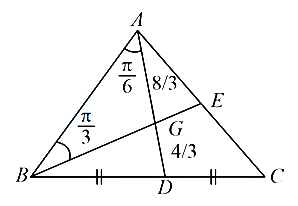
0 likesView Solution
145
MathematicsEasyMCQAP EAMCET · 2021
જ્યારે અક્ષોને $45^{\circ}$ ના ખૂણે ફેરવવામાં આવે છે,ત્યારે બિંદુ $P$ ના નવા યામ $(1, -1)$ છે. મૂળભૂત પ્રણાલીમાં $P$ ના યામ શું હશે?
A
$(\sqrt{2}, \sqrt{2})$
B
$(\sqrt{2}, 0)$
C
$(0, \sqrt{2})$
D
$(-\sqrt{2}, 0)$
Solution
(B) ધારો કે મૂળ યામ $(x, y)$ છે અને $\theta = 45^{\circ}$ ના પરિભ્રમણ પછી નવા યામ $(X, Y) = (1, -1)$ છે.
પરિવર્તન સૂત્રોનો ઉપયોગ કરતા:
$x = X \cos \theta - Y \sin \theta$
$x = (1) \cos 45^{\circ} - (-1) \sin 45^{\circ} = \frac{1}{\sqrt{2}} + \frac{1}{\sqrt{2}} = \frac{2}{\sqrt{2}} = \sqrt{2}$
$y = X \sin \theta + Y \cos \theta$
$y = (1) \sin 45^{\circ} + (-1) \cos 45^{\circ} = \frac{1}{\sqrt{2}} - \frac{1}{\sqrt{2}} = 0$
તેથી,મૂળભૂત પ્રણાલીમાં $P$ ના યામ $(\sqrt{2}, 0)$ છે.
પરિવર્તન સૂત્રોનો ઉપયોગ કરતા:
$x = X \cos \theta - Y \sin \theta$
$x = (1) \cos 45^{\circ} - (-1) \sin 45^{\circ} = \frac{1}{\sqrt{2}} + \frac{1}{\sqrt{2}} = \frac{2}{\sqrt{2}} = \sqrt{2}$
$y = X \sin \theta + Y \cos \theta$
$y = (1) \sin 45^{\circ} + (-1) \cos 45^{\circ} = \frac{1}{\sqrt{2}} - \frac{1}{\sqrt{2}} = 0$
તેથી,મૂળભૂત પ્રણાલીમાં $P$ ના યામ $(\sqrt{2}, 0)$ છે.
0 likesView Solution
146
MathematicsMediumMCQAP EAMCET · 2021
જ્યારે કોઓર્ડિનેટ અક્ષોને $45^{\circ}$ ના ખૂણે ફેરવવામાં આવે ત્યારે $3x^2 + 3y^2 + 2xy = 2$ નું રૂપાંતરિત સમીકરણ શું હશે?
A
$x^2 + 2y^2 = 1$
B
$2x^2 + y^2 = 1$
C
$x^2 + y^2 = 1$
D
$x^2 + 3y^2 = 1$
Solution
(B) આપેલ સમીકરણ $3x^2 + 3y^2 + 2xy = 2 \dots (i)$ છે.
જ્યારે કોઓર્ડિનેટ અક્ષોને $\theta = 45^{\circ}$ ના ખૂણે ફેરવવામાં આવે,ત્યારે રૂપાંતરણ સમીકરણો:
$x = \frac{X - Y}{\sqrt{2}}$ અને $y = \frac{X + Y}{\sqrt{2}}$
આ કિંમતો સમીકરણ $(i)$ માં મૂકતા:
$3\left(\frac{X - Y}{\sqrt{2}}\right)^2 + 3\left(\frac{X + Y}{\sqrt{2}}\right)^2 + 2\left(\frac{X - Y}{\sqrt{2}}\right)\left(\frac{X + Y}{\sqrt{2}}\right) = 2$
$\frac{3}{2}(X^2 - 2XY + Y^2) + \frac{3}{2}(X^2 + 2XY + Y^2) + (X^2 - Y^2) = 2$
$3X^2 + 3Y^2 + X^2 - Y^2 = 2$
$4X^2 + 2Y^2 = 2$
$2$ વડે ભાગતા,$2X^2 + Y^2 = 1$ મળે છે.
આમ,રૂપાંતરિત સમીકરણ $2x^2 + y^2 = 1$ છે.
જ્યારે કોઓર્ડિનેટ અક્ષોને $\theta = 45^{\circ}$ ના ખૂણે ફેરવવામાં આવે,ત્યારે રૂપાંતરણ સમીકરણો:
$x = \frac{X - Y}{\sqrt{2}}$ અને $y = \frac{X + Y}{\sqrt{2}}$
આ કિંમતો સમીકરણ $(i)$ માં મૂકતા:
$3\left(\frac{X - Y}{\sqrt{2}}\right)^2 + 3\left(\frac{X + Y}{\sqrt{2}}\right)^2 + 2\left(\frac{X - Y}{\sqrt{2}}\right)\left(\frac{X + Y}{\sqrt{2}}\right) = 2$
$\frac{3}{2}(X^2 - 2XY + Y^2) + \frac{3}{2}(X^2 + 2XY + Y^2) + (X^2 - Y^2) = 2$
$3X^2 + 3Y^2 + X^2 - Y^2 = 2$
$4X^2 + 2Y^2 = 2$
$2$ વડે ભાગતા,$2X^2 + Y^2 = 1$ મળે છે.
આમ,રૂપાંતરિત સમીકરણ $2x^2 + y^2 = 1$ છે.
0 likesView Solution
147
MathematicsEasyMCQAP EAMCET · 2021
$A(-1, -1)$ અને $B(2, 1)$ બિંદુઓને જોડતી રેખા,$C(3, 4)$ અને $D(1, 2)$ બિંદુઓને જોડતા રેખાખંડને કયા ગુણોત્તરમાં વિભાજિત કરે છે?
A
$7: 5$ અંતઃવિભાજન
B
$7: 5$ બહિર્વિભાજન
C
$7: 11$ અંતઃવિભાજન
D
$7: 11$ બહિર્વિભાજન
Solution
(B) બિંદુઓ $A(-1, -1)$ અને $B(2, 1)$ છે. રેખા $AB$ નું સમીકરણ $y - y_1 = \frac{y_2 - y_1}{x_2 - x_1}(x - x_1)$ દ્વારા મળે છે.
કિંમતો મૂકતા,$y + 1 = \frac{1 - (-1)}{2 - (-1)}(x - (-1)) \Rightarrow y + 1 = \frac{2}{3}(x + 1)$.
આથી $3y + 3 = 2x + 2$,અથવા $2x - 3y - 1 = 0$ મળે છે.
ધારો કે રેખા $AB$,$C(3, 4)$ અને $D(1, 2)$ ને જોડતા રેખાખંડને $\lambda: 1$ ગુણોત્તરમાં બિંદુ $P$ પર વિભાજિત કરે છે. વિભાજન સૂત્ર મુજબ $P$ ના યામ $P = \left(\frac{3 + \lambda}{1 + \lambda}, \frac{4 + 2\lambda}{1 + \lambda}\right)$ છે.
બિંદુ $P$ એ રેખા $2x - 3y - 1 = 0$ પર હોવાથી,આપણે $P$ ના યામ સમીકરણમાં મૂકીએ:
$2\left(\frac{3 + \lambda}{1 + \lambda}\right) - 3\left(\frac{4 + 2\lambda}{1 + \lambda}\right) - 1 = 0$.
$(1 + \lambda)$ વડે ગુણતા,$2(3 + \lambda) - 3(4 + 2\lambda) - (1 + \lambda) = 0$.
$6 + 2\lambda - 12 - 6\lambda - 1 - \lambda = 0$.
$-5\lambda - 7 = 0 \Rightarrow \lambda = -7/5$.
ઋણ નિશાની દર્શાવે છે કે રેખા રેખાખંડનું $7: 5$ ગુણોત્તરમાં બહિર્વિભાજન કરે છે.
કિંમતો મૂકતા,$y + 1 = \frac{1 - (-1)}{2 - (-1)}(x - (-1)) \Rightarrow y + 1 = \frac{2}{3}(x + 1)$.
આથી $3y + 3 = 2x + 2$,અથવા $2x - 3y - 1 = 0$ મળે છે.
ધારો કે રેખા $AB$,$C(3, 4)$ અને $D(1, 2)$ ને જોડતા રેખાખંડને $\lambda: 1$ ગુણોત્તરમાં બિંદુ $P$ પર વિભાજિત કરે છે. વિભાજન સૂત્ર મુજબ $P$ ના યામ $P = \left(\frac{3 + \lambda}{1 + \lambda}, \frac{4 + 2\lambda}{1 + \lambda}\right)$ છે.
બિંદુ $P$ એ રેખા $2x - 3y - 1 = 0$ પર હોવાથી,આપણે $P$ ના યામ સમીકરણમાં મૂકીએ:
$2\left(\frac{3 + \lambda}{1 + \lambda}\right) - 3\left(\frac{4 + 2\lambda}{1 + \lambda}\right) - 1 = 0$.
$(1 + \lambda)$ વડે ગુણતા,$2(3 + \lambda) - 3(4 + 2\lambda) - (1 + \lambda) = 0$.
$6 + 2\lambda - 12 - 6\lambda - 1 - \lambda = 0$.
$-5\lambda - 7 = 0 \Rightarrow \lambda = -7/5$.
ઋણ નિશાની દર્શાવે છે કે રેખા રેખાખંડનું $7: 5$ ગુણોત્તરમાં બહિર્વિભાજન કરે છે.
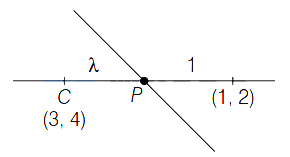
0 likesView Solution
148
MathematicsEasyMCQAP EAMCET · 2021
બિંદુઓ $(0,0,0), (3,0,0)$ અને $(0,4,0)$ દ્વારા બનતા ત્રિકોણનું અંતઃકેન્દ્ર (incenter) શું છે?
A
$(1,1,0)$
B
$(-1,-1,0)$
C
$(1,0,1)$
D
$(-1,0,-1)$
Solution
(A) ધારો કે ત્રિકોણના શિરોબિંદુઓ $A(0,0,0), B(3,0,0)$ અને $C(0,4,0)$ છે.
પ્રથમ,આપણે શિરોબિંદુઓ $A, B$ અને $C$ ની સામેની બાજુઓની લંબાઈ શોધીએ:
$a = BC = \sqrt{(0-3)^2 + (4-0)^2 + (0-0)^2} = \sqrt{9+16} = 5$
$b = AC = \sqrt{(0-0)^2 + (4-0)^2 + (0-0)^2} = 4$
$c = AB = \sqrt{(3-0)^2 + (0-0)^2 + (0-0)^2} = 3$
અંતઃકેન્દ્ર $(x, y, z)$ ના યામ નીચેના સૂત્ર દ્વારા મળે છે:
$x = \frac{ax_1 + bx_2 + cx_3}{a+b+c}, y = \frac{ay_1 + by_2 + cy_3}{a+b+c}, z = \frac{az_1 + bz_2 + cz_3}{a+b+c}$
કિંમતો મૂકતા:
$x = \frac{5(0) + 4(3) + 3(0)}{5+4+3} = \frac{12}{12} = 1$
$y = \frac{5(0) + 4(0) + 3(4)}{5+4+3} = \frac{12}{12} = 1$
$z = \frac{5(0) + 4(0) + 3(0)}{5+4+3} = 0$
આમ,અંતઃકેન્દ્ર $(1, 1, 0)$ છે.
પ્રથમ,આપણે શિરોબિંદુઓ $A, B$ અને $C$ ની સામેની બાજુઓની લંબાઈ શોધીએ:
$a = BC = \sqrt{(0-3)^2 + (4-0)^2 + (0-0)^2} = \sqrt{9+16} = 5$
$b = AC = \sqrt{(0-0)^2 + (4-0)^2 + (0-0)^2} = 4$
$c = AB = \sqrt{(3-0)^2 + (0-0)^2 + (0-0)^2} = 3$
અંતઃકેન્દ્ર $(x, y, z)$ ના યામ નીચેના સૂત્ર દ્વારા મળે છે:
$x = \frac{ax_1 + bx_2 + cx_3}{a+b+c}, y = \frac{ay_1 + by_2 + cy_3}{a+b+c}, z = \frac{az_1 + bz_2 + cz_3}{a+b+c}$
કિંમતો મૂકતા:
$x = \frac{5(0) + 4(3) + 3(0)}{5+4+3} = \frac{12}{12} = 1$
$y = \frac{5(0) + 4(0) + 3(4)}{5+4+3} = \frac{12}{12} = 1$
$z = \frac{5(0) + 4(0) + 3(0)}{5+4+3} = 0$
આમ,અંતઃકેન્દ્ર $(1, 1, 0)$ છે.
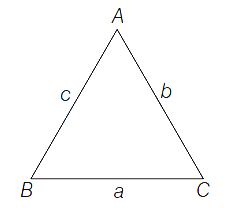
0 likesView Solution
149
MathematicsEasyMCQAP EAMCET · 2021
બે બિંદુઓ $A(2,1)$ અને $B(1,2)$ માટે,$P$ એવું બિંદુ છે કે જેથી $PA:PB = 2:1$ થાય,તો $P$ નો બિંદુપથ શું છે?
A
$3x^2+3y^2+4x+14y-15=0$
B
$3x^2+3y^2-4x-14y+15=0$
C
$3x^2+3y^2+2x+7y+13=0$
D
$3x^2+3y^2-2x-7y-13=0$
Solution
(B) ધારો કે બિંદુ $P$ ના યામ $(x, y)$ છે.
આપેલ છે કે $PA:PB = 2:1$,તેથી $PA^2 = 4PB^2$.
અંતર સૂત્રનો ઉપયોગ કરતા,$PA^2 = (x-2)^2 + (y-1)^2$ અને $PB^2 = (x-1)^2 + (y-2)^2$.
આ કિંમતો સમીકરણમાં મૂકતા:
$(x-2)^2 + (y-1)^2 = 4[(x-1)^2 + (y-2)^2]$
$x^2 - 4x + 4 + y^2 - 2y + 1 = 4[x^2 - 2x + 1 + y^2 - 4y + 4]$
$x^2 + y^2 - 4x - 2y + 5 = 4x^2 + 4y^2 - 8x - 16y + 20$
પદોને એક બાજુ ગોઠવતા:
$3x^2 + 3y^2 - 4x - 14y + 15 = 0$.
આપેલ છે કે $PA:PB = 2:1$,તેથી $PA^2 = 4PB^2$.
અંતર સૂત્રનો ઉપયોગ કરતા,$PA^2 = (x-2)^2 + (y-1)^2$ અને $PB^2 = (x-1)^2 + (y-2)^2$.
આ કિંમતો સમીકરણમાં મૂકતા:
$(x-2)^2 + (y-1)^2 = 4[(x-1)^2 + (y-2)^2]$
$x^2 - 4x + 4 + y^2 - 2y + 1 = 4[x^2 - 2x + 1 + y^2 - 4y + 4]$
$x^2 + y^2 - 4x - 2y + 5 = 4x^2 + 4y^2 - 8x - 16y + 20$
પદોને એક બાજુ ગોઠવતા:
$3x^2 + 3y^2 - 4x - 14y + 15 = 0$.
0 likesView Solution
150
MathematicsDifficultMCQAP EAMCET · 2021
એક $\triangle ABC$ ની બાજુઓ $AB$,$BC$ અને $CA$ ના સમીકરણો અનુક્રમે $2x+y=0$,$x+py=q$ અને $x-y=3$ છે. જો $P(2,3)$ તેનું લંબકેન્દ્ર હોય,તો $p+q$ ની કિંમત શોધો.
A
$50$
B
$47$
C
$65$
D
$74$
Solution
(A) $\triangle ABC$ માં,બાજુઓ $AB$,$BC$ અને $CA$ ના સમીકરણો અનુક્રમે $2x+y=0$,$x+py=q$ અને $x-y=3$ છે. $P(2,3)$ લંબકેન્દ્ર છે.
$1$. $AB$ અને $CA$ ને ઉકેલીને શિરોબિંદુ $A$ મેળવતા:
$2x+y=0 \Rightarrow y=-2x$
$x-y=3$ માં મૂકતા: $x-(-2x)=3$ $\Rightarrow 3x=3$ $\Rightarrow x=1, y=-2$.
તેથી,$A = (1, -2)$.
$2$. $p$ મેળવતા:
$A$ માંથી $BC$ પરનો વેધ $P(2,3)$ માંથી પસાર થાય છે.
$AP$ નો ઢાળ = $\frac{3-(-2)}{2-1} = 5$.
$AP \perp BC$ હોવાથી,$BC$ નો ઢાળ $-\frac{1}{5}$ થાય.
$BC$ નું સમીકરણ $x+py=q$ છે,તેથી તેનો ઢાળ $-\frac{1}{p}$ છે.
$-\frac{1}{p} = -\frac{1}{5} \Rightarrow p=5$.
$3$. $q$ મેળવતા:
શિરોબિંદુ $B$ એ $AB$ $(2x+y=0)$ અને $BC$ $(x+5y=q)$ નું છેદબિંદુ છે.
$y=-2x$ $\Rightarrow x+5(-2x)=q$ $\Rightarrow -9x=q$ $\Rightarrow x=-\frac{q}{9}, y=\frac{2q}{9}$.
તેથી,$B = \left(-\frac{q}{9}, \frac{2q}{9}\right)$.
$B$ માંથી $AC$ પરનો વેધ $P(2,3)$ માંથી પસાર થાય છે.
$AC$ નો ઢાળ ($x-y=3$ પરથી) $1$ છે.
$BP \perp AC$ હોવાથી,$BP$ નો ઢાળ $-1$ થાય.
$BP$ નો ઢાળ = $\frac{\frac{2q}{9}-3}{-\frac{q}{9}-2} = \frac{2q-27}{-q-18} = -1$.
$2q-27 = q+18 \Rightarrow q=45$.
$4$. અંતિમ કિંમત:
$p+q = 5+45 = 50$.
$1$. $AB$ અને $CA$ ને ઉકેલીને શિરોબિંદુ $A$ મેળવતા:
$2x+y=0 \Rightarrow y=-2x$
$x-y=3$ માં મૂકતા: $x-(-2x)=3$ $\Rightarrow 3x=3$ $\Rightarrow x=1, y=-2$.
તેથી,$A = (1, -2)$.
$2$. $p$ મેળવતા:
$A$ માંથી $BC$ પરનો વેધ $P(2,3)$ માંથી પસાર થાય છે.
$AP$ નો ઢાળ = $\frac{3-(-2)}{2-1} = 5$.
$AP \perp BC$ હોવાથી,$BC$ નો ઢાળ $-\frac{1}{5}$ થાય.
$BC$ નું સમીકરણ $x+py=q$ છે,તેથી તેનો ઢાળ $-\frac{1}{p}$ છે.
$-\frac{1}{p} = -\frac{1}{5} \Rightarrow p=5$.
$3$. $q$ મેળવતા:
શિરોબિંદુ $B$ એ $AB$ $(2x+y=0)$ અને $BC$ $(x+5y=q)$ નું છેદબિંદુ છે.
$y=-2x$ $\Rightarrow x+5(-2x)=q$ $\Rightarrow -9x=q$ $\Rightarrow x=-\frac{q}{9}, y=\frac{2q}{9}$.
તેથી,$B = \left(-\frac{q}{9}, \frac{2q}{9}\right)$.
$B$ માંથી $AC$ પરનો વેધ $P(2,3)$ માંથી પસાર થાય છે.
$AC$ નો ઢાળ ($x-y=3$ પરથી) $1$ છે.
$BP \perp AC$ હોવાથી,$BP$ નો ઢાળ $-1$ થાય.
$BP$ નો ઢાળ = $\frac{\frac{2q}{9}-3}{-\frac{q}{9}-2} = \frac{2q-27}{-q-18} = -1$.
$2q-27 = q+18 \Rightarrow q=45$.
$4$. અંતિમ કિંમત:
$p+q = 5+45 = 50$.
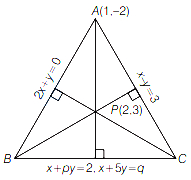
0 likesView Solution
151
MathematicsDifficultMCQAP EAMCET · 2021
જો $[.]$ એ મહત્તમ પૂર્ણાંક વિધેય દર્શાવતું હોય,તો $f(x) = [x]^2 - [x^2]$ કયા બિંદુએ અસતત છે?
A
બધા જ પૂર્ણાંકો
B
$0$ અને $1$ સિવાયના બધા જ પૂર્ણાંકો
C
$1$ સિવાયના બધા જ પૂર્ણાંકો
D
$0$ સિવાયના બધા જ પૂર્ણાંકો
Solution
(C) આપેલ છે $f(x) = [x]^2 - [x^2]$.
કોઈપણ પૂર્ણાંક $n$ માટે,ધારો કે $x = n + h$,જ્યાં $0 \le h < 1$.
તેથી $f(n+h) = [n+h]^2 - [(n+h)^2] = n^2 - [n^2 + 2nh + h^2] = n^2 - n^2 - [2nh + h^2] = -[2nh + h^2]$.
$x = n$ આગળ,$f(n) = [n]^2 - [n^2] = n^2 - n^2 = 0$.
$x \to n^-$ માટે,ધારો કે $x = n - h$ જ્યાં $h \to 0^+$. તેથી $f(n-h) = [n-h]^2 - [(n-h)^2] = (n-1)^2 - [n^2 - 2nh + h^2]$.
$n=0$ માટે,$f(0)=0$. $\lim_{x \to 0^-} f(x) = [-h]^2 - [h^2] = (-1)^2 - 0 = 1$. $1 \neq 0$ હોવાથી,$f(x)$ એ $x=0$ આગળ અસતત છે.
$n=1$ માટે,$f(1)=0$. $\lim_{x \to 1^-} f(x) = [1-h]^2 - [(1-h)^2] = 0^2 - 0 = 0$. $\lim_{x \to 1^+} f(x) = [1+h]^2 - [(1+h)^2] = 1^2 - 1 = 0$. $0=0$ હોવાથી,$f(x)$ એ $x=1$ આગળ સતત છે.
અન્ય કોઈપણ પૂર્ણાંક $n \neq 0, 1$ માટે,વિધેય અસતત છે કારણ કે ડાબી અને જમણી બાજુની લક્ષની કિંમત $f(n)=0$ જેટલી થશે નહીં.
આમ,$f(x)$ એ $1$ સિવાયના તમામ પૂર્ણાંકો પર અસતત છે.
કોઈપણ પૂર્ણાંક $n$ માટે,ધારો કે $x = n + h$,જ્યાં $0 \le h < 1$.
તેથી $f(n+h) = [n+h]^2 - [(n+h)^2] = n^2 - [n^2 + 2nh + h^2] = n^2 - n^2 - [2nh + h^2] = -[2nh + h^2]$.
$x = n$ આગળ,$f(n) = [n]^2 - [n^2] = n^2 - n^2 = 0$.
$x \to n^-$ માટે,ધારો કે $x = n - h$ જ્યાં $h \to 0^+$. તેથી $f(n-h) = [n-h]^2 - [(n-h)^2] = (n-1)^2 - [n^2 - 2nh + h^2]$.
$n=0$ માટે,$f(0)=0$. $\lim_{x \to 0^-} f(x) = [-h]^2 - [h^2] = (-1)^2 - 0 = 1$. $1 \neq 0$ હોવાથી,$f(x)$ એ $x=0$ આગળ અસતત છે.
$n=1$ માટે,$f(1)=0$. $\lim_{x \to 1^-} f(x) = [1-h]^2 - [(1-h)^2] = 0^2 - 0 = 0$. $\lim_{x \to 1^+} f(x) = [1+h]^2 - [(1+h)^2] = 1^2 - 1 = 0$. $0=0$ હોવાથી,$f(x)$ એ $x=1$ આગળ સતત છે.
અન્ય કોઈપણ પૂર્ણાંક $n \neq 0, 1$ માટે,વિધેય અસતત છે કારણ કે ડાબી અને જમણી બાજુની લક્ષની કિંમત $f(n)=0$ જેટલી થશે નહીં.
આમ,$f(x)$ એ $1$ સિવાયના તમામ પૂર્ણાંકો પર અસતત છે.
0 likesView Solution
152
MathematicsDifficultMCQAP EAMCET · 2021
જો $f(x) = \frac{\log (1+x)^{1+x}}{x^2} - \frac{1}{x}, x \neq 0$ દ્વારા વ્યાખ્યાયિત વિધેય $x=0$ આગળ સતત હોય,તો $6 f(0)$ ની કિંમત શોધો.
A
$2$
B
$3$
C
$1$
D
$6$
Solution
(B) આપેલ છે,$f(x) = \frac{\log (1+x)^{1+x}}{x^2} - \frac{1}{x}$.
ગુણધર્મ $\log(a^b) = b \log a$ નો ઉપયોગ કરતા:
$f(x) = \frac{(1+x) \log (1+x)}{x^2} - \frac{1}{x} = \frac{(1+x) \log (1+x) - x}{x^2}$.
$f(x)$ એ $x=0$ આગળ સતત હોવાથી,$f(0) = \lim_{x \to 0} f(x)$.
$\lim_{x \to 0} f(x) = \lim_{x \to 0} \frac{(1+x) \log (1+x) - x}{x^2}$.
આ $\frac{0}{0}$ સ્વરૂપ છે,તેથી $L$-Hospital ના નિયમનો ઉપયોગ કરતા:
$\lim_{x \to 0} \frac{\frac{d}{dx} [(1+x) \log (1+x) - x]}{\frac{d}{dx} [x^2]} = \lim_{x \to 0} \frac{(1+x) \cdot \frac{1}{1+x} + \log(1+x) - 1}{2x} = \lim_{x \to 0} \frac{1 + \log(1+x) - 1}{2x} = \lim_{x \to 0} \frac{\log(1+x)}{2x}$.
પ્રમાણિત લક્ષ $\lim_{x \to 0} \frac{\log(1+x)}{x} = 1$ નો ઉપયોગ કરતા:
$f(0) = \frac{1}{2} \times 1 = \frac{1}{2}$.
તેથી,$6 f(0) = 6 \times \frac{1}{2} = 3$.
ગુણધર્મ $\log(a^b) = b \log a$ નો ઉપયોગ કરતા:
$f(x) = \frac{(1+x) \log (1+x)}{x^2} - \frac{1}{x} = \frac{(1+x) \log (1+x) - x}{x^2}$.
$f(x)$ એ $x=0$ આગળ સતત હોવાથી,$f(0) = \lim_{x \to 0} f(x)$.
$\lim_{x \to 0} f(x) = \lim_{x \to 0} \frac{(1+x) \log (1+x) - x}{x^2}$.
આ $\frac{0}{0}$ સ્વરૂપ છે,તેથી $L$-Hospital ના નિયમનો ઉપયોગ કરતા:
$\lim_{x \to 0} \frac{\frac{d}{dx} [(1+x) \log (1+x) - x]}{\frac{d}{dx} [x^2]} = \lim_{x \to 0} \frac{(1+x) \cdot \frac{1}{1+x} + \log(1+x) - 1}{2x} = \lim_{x \to 0} \frac{1 + \log(1+x) - 1}{2x} = \lim_{x \to 0} \frac{\log(1+x)}{2x}$.
પ્રમાણિત લક્ષ $\lim_{x \to 0} \frac{\log(1+x)}{x} = 1$ નો ઉપયોગ કરતા:
$f(0) = \frac{1}{2} \times 1 = \frac{1}{2}$.
તેથી,$6 f(0) = 6 \times \frac{1}{2} = 3$.
0 likesView Solution
153
MathematicsMediumMCQAP EAMCET · 2021
જે બિંદુઓ પર વિધેય $f(x) = 2x|x|$ વિકલનીય હોય તેવા તમામ બિંદુઓનો ગણ કયો છે?
A
$(-\infty, \infty)$
B
$(-\infty, 0) \cup (0, \infty)$
C
$(0, \infty)$
D
$[0, \infty)$
Solution
(A) વિધેય $f(x) = 2x|x|$ દ્વારા આપવામાં આવેલ છે.
આપણે તેને ટુકડાઓમાં વ્યાખ્યાયિત વિધેય તરીકે લખી શકીએ:
$f(x) = \begin{cases} 2x^2, & x \geq 0 \\ -2x^2, & x < 0 \end{cases}$
કારણ કે $2x^2$ અને $-2x^2$ બહુપદી છે,તેથી $f(x)$ એ તમામ $x \neq 0$ માટે વિકલનીય છે. આપણે ફક્ત $x = 0$ આગળ વિકલનીયતા તપાસવાની જરૂર છે.
$x = 0$ આગળ ડાબી બાજુનું વિકલિત $(LHD)$:
$f'(0^-) = \lim_{h \rightarrow 0^-} \frac{f(0+h) - f(0)}{h} = \lim_{h \rightarrow 0^-} \frac{-2h^2 - 0}{h} = \lim_{h \rightarrow 0^-} (-2h) = 0$.
$x = 0$ આગળ જમણી બાજુનું વિકલિત $(RHD)$:
$f'(0^+) = \lim_{h \rightarrow 0^+} \frac{f(0+h) - f(0)}{h} = \lim_{h \rightarrow 0^+} \frac{2h^2 - 0}{h} = \lim_{h \rightarrow 0^+} (2h) = 0$.
અહીં $LHD = RHD = 0$ હોવાથી,વિધેય $f(x)$ એ $x = 0$ આગળ વિકલનીય છે.
તેથી,$f(x)$ એ તમામ $x \in (-\infty, \infty)$ માટે વિકલનીય છે.
આપણે તેને ટુકડાઓમાં વ્યાખ્યાયિત વિધેય તરીકે લખી શકીએ:
$f(x) = \begin{cases} 2x^2, & x \geq 0 \\ -2x^2, & x < 0 \end{cases}$
કારણ કે $2x^2$ અને $-2x^2$ બહુપદી છે,તેથી $f(x)$ એ તમામ $x \neq 0$ માટે વિકલનીય છે. આપણે ફક્ત $x = 0$ આગળ વિકલનીયતા તપાસવાની જરૂર છે.
$x = 0$ આગળ ડાબી બાજુનું વિકલિત $(LHD)$:
$f'(0^-) = \lim_{h \rightarrow 0^-} \frac{f(0+h) - f(0)}{h} = \lim_{h \rightarrow 0^-} \frac{-2h^2 - 0}{h} = \lim_{h \rightarrow 0^-} (-2h) = 0$.
$x = 0$ આગળ જમણી બાજુનું વિકલિત $(RHD)$:
$f'(0^+) = \lim_{h \rightarrow 0^+} \frac{f(0+h) - f(0)}{h} = \lim_{h \rightarrow 0^+} \frac{2h^2 - 0}{h} = \lim_{h \rightarrow 0^+} (2h) = 0$.
અહીં $LHD = RHD = 0$ હોવાથી,વિધેય $f(x)$ એ $x = 0$ આગળ વિકલનીય છે.
તેથી,$f(x)$ એ તમામ $x \in (-\infty, \infty)$ માટે વિકલનીય છે.
0 likesView Solution
154
MathematicsMediumMCQAP EAMCET · 2021
$f(x) = \sqrt{x^2 + 1}; g(x) = \frac{x + 1}{x^2 + 1}; h(x) = 2x - 3$. તો $f' [h'(g'(x))] = $ ની કિંમત શોધો.
A
$\sqrt{5}$
B
$\frac{2}{\sqrt{5}}$
C
$\frac{\sqrt{5}}{2}$
D
$\frac{1}{\sqrt{5}}$
Solution
(B) આપેલ વિધેયો $f(x) = \sqrt{x^2 + 1}$,$g(x) = \frac{x + 1}{x^2 + 1}$,અને $h(x) = 2x - 3$ છે.
પ્રથમ,આપણે દરેક વિધેયનું વિકલન શોધીએ:
$f'(x) = \frac{d}{dx}(\sqrt{x^2 + 1}) = \frac{1}{2\sqrt{x^2 + 1}} \cdot (2x) = \frac{x}{\sqrt{x^2 + 1}}$.
$g'(x) = \frac{d}{dx}(\frac{x + 1}{x^2 + 1}) = \frac{(x^2 + 1)(1) - (x + 1)(2x)}{(x^2 + 1)^2} = \frac{x^2 + 1 - 2x^2 - 2x}{(x^2 + 1)^2} = \frac{-x^2 - 2x + 1}{(x^2 + 1)^2}$.
$h'(x) = \frac{d}{dx}(2x - 3) = 2$.
હવે,આપણે સંયોજિત પદ $f' [h'(g'(x))]$ ની કિંમત શોધીએ.
કારણ કે $h'(x) = 2$ એ અચળ વિધેય છે,તેથી કોઈપણ $x$ માટે $h'(g'(x)) = 2$ થાય.
તેથી,$f' [h'(g'(x))] = f'(2)$.
$f'(x)$ ના સૂત્રમાં $x = 2$ મૂકતા:
$f'(2) = \frac{2}{\sqrt{2^2 + 1}} = \frac{2}{\sqrt{4 + 1}} = \frac{2}{\sqrt{5}}$.
આમ,સાચો વિકલ્પ $B$ છે.
પ્રથમ,આપણે દરેક વિધેયનું વિકલન શોધીએ:
$f'(x) = \frac{d}{dx}(\sqrt{x^2 + 1}) = \frac{1}{2\sqrt{x^2 + 1}} \cdot (2x) = \frac{x}{\sqrt{x^2 + 1}}$.
$g'(x) = \frac{d}{dx}(\frac{x + 1}{x^2 + 1}) = \frac{(x^2 + 1)(1) - (x + 1)(2x)}{(x^2 + 1)^2} = \frac{x^2 + 1 - 2x^2 - 2x}{(x^2 + 1)^2} = \frac{-x^2 - 2x + 1}{(x^2 + 1)^2}$.
$h'(x) = \frac{d}{dx}(2x - 3) = 2$.
હવે,આપણે સંયોજિત પદ $f' [h'(g'(x))]$ ની કિંમત શોધીએ.
કારણ કે $h'(x) = 2$ એ અચળ વિધેય છે,તેથી કોઈપણ $x$ માટે $h'(g'(x)) = 2$ થાય.
તેથી,$f' [h'(g'(x))] = f'(2)$.
$f'(x)$ ના સૂત્રમાં $x = 2$ મૂકતા:
$f'(2) = \frac{2}{\sqrt{2^2 + 1}} = \frac{2}{\sqrt{4 + 1}} = \frac{2}{\sqrt{5}}$.
આમ,સાચો વિકલ્પ $B$ છે.
0 likesView Solution
155
MathematicsMediumMCQAP EAMCET · 2021
જો $y = e^{x^2 + e^{x^2 + e^{x^2} + \dots}}$ હોય તો $\frac{dy}{dx} = $
A
$\frac{2x}{1 - y}$
B
$\frac{2xy}{y - 1}$
C
$\frac{2xy}{1 - y}$
D
$\frac{2y}{y - 1}$
Solution
(C) આપેલ સમીકરણ $y = e^{x^2 + e^{x^2 + e^{x^2} + \dots}}$ છે.
ઘાતાંક અનંત સુધી પુનરાવર્તિત થતો હોવાથી,આપણે લખી શકીએ $y = e^{x^2 + y}$.
બંને બાજુ પ્રાકૃતિક લઘુગણક લેતા,આપણને મળે $\ln(y) = x^2 + y$.
બંને બાજુ $x$ ની સાપેક્ષમાં વિકલન કરતા:
$\frac{d}{dx}(\ln(y)) = \frac{d}{dx}(x^2 + y)$
$\frac{1}{y} \frac{dy}{dx} = 2x + \frac{dy}{dx}$
$\frac{dy}{dx}$ માટે પદોને ગોઠવતા:
$\frac{1}{y} \frac{dy}{dx} - \frac{dy}{dx} = 2x$
$\frac{dy}{dx} (\frac{1}{y} - 1) = 2x$
$\frac{dy}{dx} (\frac{1 - y}{y}) = 2x$
$\frac{dy}{dx} = \frac{2xy}{1 - y}$.
ઘાતાંક અનંત સુધી પુનરાવર્તિત થતો હોવાથી,આપણે લખી શકીએ $y = e^{x^2 + y}$.
બંને બાજુ પ્રાકૃતિક લઘુગણક લેતા,આપણને મળે $\ln(y) = x^2 + y$.
બંને બાજુ $x$ ની સાપેક્ષમાં વિકલન કરતા:
$\frac{d}{dx}(\ln(y)) = \frac{d}{dx}(x^2 + y)$
$\frac{1}{y} \frac{dy}{dx} = 2x + \frac{dy}{dx}$
$\frac{dy}{dx}$ માટે પદોને ગોઠવતા:
$\frac{1}{y} \frac{dy}{dx} - \frac{dy}{dx} = 2x$
$\frac{dy}{dx} (\frac{1}{y} - 1) = 2x$
$\frac{dy}{dx} (\frac{1 - y}{y}) = 2x$
$\frac{dy}{dx} = \frac{2xy}{1 - y}$.
0 likesView Solution
156
MathematicsEasyMCQAP EAMCET · 2021
જો $f(x) = 2x^2 + 3x - 5$ હોય,તો $f'(0) + 3f'(-1)$ ની કિંમત કેટલી થાય?
A
$1$
B
$0$
C
$3$
D
$2$
Solution
(B) આપેલ છે કે $f(x) = 2x^2 + 3x - 5$.
સૌ પ્રથમ,$x$ ની સાપેક્ષમાં વિકલન $f'(x)$ શોધો:
$f'(x) = \frac{d}{dx}(2x^2 + 3x - 5) = 4x + 3$.
હવે,$f'(0)$ ની ગણતરી કરો:
$f'(0) = 4(0) + 3 = 3$.
ત્યારબાદ,$f'(-1)$ ની ગણતરી કરો:
$f'(-1) = 4(-1) + 3 = -4 + 3 = -1$.
અંતે,$f'(0) + 3f'(-1)$ ની કિંમત શોધો:
$f'(0) + 3f'(-1) = 3 + 3(-1) = 3 - 3 = 0$.
સૌ પ્રથમ,$x$ ની સાપેક્ષમાં વિકલન $f'(x)$ શોધો:
$f'(x) = \frac{d}{dx}(2x^2 + 3x - 5) = 4x + 3$.
હવે,$f'(0)$ ની ગણતરી કરો:
$f'(0) = 4(0) + 3 = 3$.
ત્યારબાદ,$f'(-1)$ ની ગણતરી કરો:
$f'(-1) = 4(-1) + 3 = -4 + 3 = -1$.
અંતે,$f'(0) + 3f'(-1)$ ની કિંમત શોધો:
$f'(0) + 3f'(-1) = 3 + 3(-1) = 3 - 3 = 0$.
0 likesView Solution
157
MathematicsDifficultMCQAP EAMCET · 2021
જો $y = \sin(\sin x)$ અને $y'' + f(x) \cdot y' + g(x) \cdot y = 0$ હોય,તો $f(x) \cdot g(x) =$
A
$\frac{1}{2} \sin(2x)$
B
$\frac{1}{2} \cos(2x)$
C
$\sin(2x)$
D
$\cos(2x)$
Solution
(A) આપેલ છે કે $y = \sin(\sin x)$ . . . $(i)$
ચેઈન રૂલનો ઉપયોગ કરીને $x$ ની સાપેક્ષમાં વિકલન કરતા:
$y' = \cos(\sin x) \cdot \cos x$ . . . $(ii)$
ફરીથી $x$ ની સાપેક્ષમાં વિકલન કરતા:
$y'' = -\sin(\sin x) \cdot \cos^2 x - \sin x \cdot \cos(\sin x)$
સમીકરણ $(ii)$ પરથી,આપણી પાસે $\cos(\sin x) = \frac{y'}{\cos x}$ છે. આ કિંમત $y''$ ના સમીકરણમાં મૂકતા:
$y'' = -\sin(\sin x) \cdot \cos^2 x - \sin x \cdot \left(\frac{y'}{\cos x}\right)$
$y'' = -y \cdot \cos^2 x - \tan x \cdot y'$
પદોને ગોઠવતા:
$y'' + \tan x \cdot y' + \cos^2 x \cdot y = 0$
આને $y'' + f(x) \cdot y' + g(x) \cdot y = 0$ સાથે સરખાવતા,આપણને $f(x) = \tan x$ અને $g(x) = \cos^2 x$ મળે છે.
તેથી,$f(x) \cdot g(x) = \tan x \cdot \cos^2 x = \frac{\sin x}{\cos x} \cdot \cos^2 x = \sin x \cdot \cos x$.
નિત્યસમ $\sin(2x) = 2 \sin x \cos x$ નો ઉપયોગ કરતા:
$f(x) \cdot g(x) = \frac{1}{2} \sin(2x)$.
ચેઈન રૂલનો ઉપયોગ કરીને $x$ ની સાપેક્ષમાં વિકલન કરતા:
$y' = \cos(\sin x) \cdot \cos x$ . . . $(ii)$
ફરીથી $x$ ની સાપેક્ષમાં વિકલન કરતા:
$y'' = -\sin(\sin x) \cdot \cos^2 x - \sin x \cdot \cos(\sin x)$
સમીકરણ $(ii)$ પરથી,આપણી પાસે $\cos(\sin x) = \frac{y'}{\cos x}$ છે. આ કિંમત $y''$ ના સમીકરણમાં મૂકતા:
$y'' = -\sin(\sin x) \cdot \cos^2 x - \sin x \cdot \left(\frac{y'}{\cos x}\right)$
$y'' = -y \cdot \cos^2 x - \tan x \cdot y'$
પદોને ગોઠવતા:
$y'' + \tan x \cdot y' + \cos^2 x \cdot y = 0$
આને $y'' + f(x) \cdot y' + g(x) \cdot y = 0$ સાથે સરખાવતા,આપણને $f(x) = \tan x$ અને $g(x) = \cos^2 x$ મળે છે.
તેથી,$f(x) \cdot g(x) = \tan x \cdot \cos^2 x = \frac{\sin x}{\cos x} \cdot \cos^2 x = \sin x \cdot \cos x$.
નિત્યસમ $\sin(2x) = 2 \sin x \cos x$ નો ઉપયોગ કરતા:
$f(x) \cdot g(x) = \frac{1}{2} \sin(2x)$.
0 likesView Solution
158
MathematicsDifficultMCQAP EAMCET · 2021
જો $\frac{d}{d x}\left\{\frac{2}{\sqrt{2+\sqrt{2+\sqrt{2+2 \cos (4 x)}}}}\right\} = k \sec \left(\frac{x}{2}\right) \tan \left(\frac{x}{2}\right)$ હોય,તો $k$ ની કિંમત શોધો.
A
$\frac{1}{2}$
B
$2$
C
$1$
D
$\frac{1}{8}$
Solution
(A) ધારો કે $y = \frac{2}{\sqrt{2+\sqrt{2+\sqrt{2+2 \cos 4 x}}}}$.
નિત્યસમ $1+\cos 2A = 2 \cos^2 A$ નો ઉપયોગ કરીને,આપણે પદાવલિને ક્રમશઃ સાદું રૂપ આપીએ:
$y = \frac{2}{\sqrt{2+\sqrt{2+\sqrt{2(1+\cos 4 x)}}}} = \frac{2}{\sqrt{2+\sqrt{2+\sqrt{4 \cos^2 2 x}}}} = \frac{2}{\sqrt{2+\sqrt{2+2 \cos 2 x}}}$.
આગળ સાદું રૂપ આપતા:
$y = \frac{2}{\sqrt{2+\sqrt{2(1+\cos 2 x)}}} = \frac{2}{\sqrt{2+\sqrt{4 \cos^2 x}}} = \frac{2}{\sqrt{2+2 \cos x}} = \frac{2}{\sqrt{2(1+\cos x)}} = \frac{2}{\sqrt{4 \cos^2 \frac{x}{2}}}$.
આમ,$y = \frac{2}{2 \cos \frac{x}{2}} = \sec \frac{x}{2}$.
ચેઈન રૂલનો ઉપયોગ કરીને $x$ ની સાપેક્ષે વિકલન કરતા:
$\frac{dy}{dx} = \sec \frac{x}{2} \tan \frac{x}{2} \cdot \frac{1}{2}$.
આને $k \sec \frac{x}{2} \tan \frac{x}{2}$ સાથે સરખાવતા,આપણને $k = \frac{1}{2}$ મળે છે.
નિત્યસમ $1+\cos 2A = 2 \cos^2 A$ નો ઉપયોગ કરીને,આપણે પદાવલિને ક્રમશઃ સાદું રૂપ આપીએ:
$y = \frac{2}{\sqrt{2+\sqrt{2+\sqrt{2(1+\cos 4 x)}}}} = \frac{2}{\sqrt{2+\sqrt{2+\sqrt{4 \cos^2 2 x}}}} = \frac{2}{\sqrt{2+\sqrt{2+2 \cos 2 x}}}$.
આગળ સાદું રૂપ આપતા:
$y = \frac{2}{\sqrt{2+\sqrt{2(1+\cos 2 x)}}} = \frac{2}{\sqrt{2+\sqrt{4 \cos^2 x}}} = \frac{2}{\sqrt{2+2 \cos x}} = \frac{2}{\sqrt{2(1+\cos x)}} = \frac{2}{\sqrt{4 \cos^2 \frac{x}{2}}}$.
આમ,$y = \frac{2}{2 \cos \frac{x}{2}} = \sec \frac{x}{2}$.
ચેઈન રૂલનો ઉપયોગ કરીને $x$ ની સાપેક્ષે વિકલન કરતા:
$\frac{dy}{dx} = \sec \frac{x}{2} \tan \frac{x}{2} \cdot \frac{1}{2}$.
આને $k \sec \frac{x}{2} \tan \frac{x}{2}$ સાથે સરખાવતા,આપણને $k = \frac{1}{2}$ મળે છે.
0 likesView Solution
159
MathematicsEasyMCQAP EAMCET · 2021
જો $f^{\prime}(x)=\sqrt{2 x^2-1}$ અને $y=f(x^3)$ હોય,તો $x=1$ આગળ $\frac{dy}{dx}$ ની કિંમત શોધો.
A
-$1$
B
$3$
C
$0$
D
-$3$
Solution
(B) આપેલ છે કે $f^{\prime}(x) = \sqrt{2x^2-1}$ અને $y = f(x^3)$.
$y$ નું $x$ ની સાપેક્ષમાં વિકલન કરવા માટે સાંકળના નિયમ (chain rule) નો ઉપયોગ કરતા:
$\frac{dy}{dx} = f^{\prime}(x^3) \cdot \frac{d}{dx}(x^3)$
$\frac{dy}{dx} = f^{\prime}(x^3) \cdot 3x^2$
હવે,$x=1$ આગળ વિકલિતની કિંમત મેળવતા:
$\left. \frac{dy}{dx} \right|_{x=1} = f^{\prime}(1^3) \cdot 3(1)^2$
$= f^{\prime}(1) \cdot 3$
$f^{\prime}(x)$ ના આપેલ સૂત્રમાં $x=1$ મૂકતા:
$f^{\prime}(1) = \sqrt{2(1)^2 - 1} = \sqrt{2-1} = \sqrt{1} = 1$
તેથી,$\frac{dy}{dx} = 1 \cdot 3 = 3$.
$y$ નું $x$ ની સાપેક્ષમાં વિકલન કરવા માટે સાંકળના નિયમ (chain rule) નો ઉપયોગ કરતા:
$\frac{dy}{dx} = f^{\prime}(x^3) \cdot \frac{d}{dx}(x^3)$
$\frac{dy}{dx} = f^{\prime}(x^3) \cdot 3x^2$
હવે,$x=1$ આગળ વિકલિતની કિંમત મેળવતા:
$\left. \frac{dy}{dx} \right|_{x=1} = f^{\prime}(1^3) \cdot 3(1)^2$
$= f^{\prime}(1) \cdot 3$
$f^{\prime}(x)$ ના આપેલ સૂત્રમાં $x=1$ મૂકતા:
$f^{\prime}(1) = \sqrt{2(1)^2 - 1} = \sqrt{2-1} = \sqrt{1} = 1$
તેથી,$\frac{dy}{dx} = 1 \cdot 3 = 3$.
0 likesView Solution
160
MathematicsEasyMCQAP EAMCET · 2021
જો $3 \sin xy + 4 \cos xy = 5$ હોય,તો $\frac{dy}{dx}$ ની કિંમત . . . . . . થાય.
A
$\frac{3 \sin xy + 4 \cos xy}{3 \cos xy - 4 \sin xy}$
B
$\frac{3 \cos xy + 4 \sin xy}{4 \cos xy - 3 \sin xy}$
C
$\frac{-y}{x}$
D
$\frac{x}{y}$
Solution
(C) આપેલ સમીકરણ $3 \sin xy + 4 \cos xy = 5$ છે.
ધારો કે $xy = t$.
$xy = t$ નું $x$ ની સાપેક્ષમાં વિકલન કરતા,ગુણાકારના નિયમ મુજબ $x \frac{dy}{dx} + y = \frac{dt}{dx} \dots (I)$ મળે.
હવે,આપેલ સમીકરણ $3 \sin t + 4 \cos t = 5$ નું $t$ ની સાપેક્ષમાં વિકલન કરતા:
$\frac{d}{dt}(3 \sin t + 4 \cos t) = \frac{d}{dt}(5)$
$3 \cos t - 4 \sin t = 0$.
આમ,$\frac{dt}{dx} = 0$ થાય છે.
આ કિંમત સમીકરણ $(I)$ માં મૂકતા,$x \frac{dy}{dx} + y = 0$ મળે.
તેથી,$\frac{dy}{dx} = \frac{-y}{x}$.
ધારો કે $xy = t$.
$xy = t$ નું $x$ ની સાપેક્ષમાં વિકલન કરતા,ગુણાકારના નિયમ મુજબ $x \frac{dy}{dx} + y = \frac{dt}{dx} \dots (I)$ મળે.
હવે,આપેલ સમીકરણ $3 \sin t + 4 \cos t = 5$ નું $t$ ની સાપેક્ષમાં વિકલન કરતા:
$\frac{d}{dt}(3 \sin t + 4 \cos t) = \frac{d}{dt}(5)$
$3 \cos t - 4 \sin t = 0$.
આમ,$\frac{dt}{dx} = 0$ થાય છે.
આ કિંમત સમીકરણ $(I)$ માં મૂકતા,$x \frac{dy}{dx} + y = 0$ મળે.
તેથી,$\frac{dy}{dx} = \frac{-y}{x}$.
0 likesView Solution
161
MathematicsMediumMCQAP EAMCET · 2021
જો $\log(\sqrt{1+x^2}-x) = y(\sqrt{1+x^2})$ હોય,તો $(1+x^2) \frac{dy}{dx} + xy =$
A
$0$
B
$1$
C
$2$
D
$-1$
Solution
(D) આપેલ છે,$\log(\sqrt{1+x^2}-x) = y(\sqrt{1+x^2})$.
બંને બાજુ $x$ ની સાપેક્ષમાં વિકલન કરતા:
$\frac{d}{dx} [\log(\sqrt{1+x^2}-x)] = \frac{d}{dx} [y(\sqrt{1+x^2})]$
$\Rightarrow \frac{1}{\sqrt{1+x^2}-x} \cdot \left( \frac{x}{\sqrt{1+x^2}} - 1 \right) = \sqrt{1+x^2} \frac{dy}{dx} + y \cdot \frac{x}{\sqrt{1+x^2}}$
$\Rightarrow \frac{1}{\sqrt{1+x^2}-x} \cdot \left( \frac{x - \sqrt{1+x^2}}{\sqrt{1+x^2}} \right) = \sqrt{1+x^2} \frac{dy}{dx} + \frac{xy}{\sqrt{1+x^2}}$
$\Rightarrow \frac{-(\sqrt{1+x^2}-x)}{(\sqrt{1+x^2}-x) \sqrt{1+x^2}} = \sqrt{1+x^2} \frac{dy}{dx} + \frac{xy}{\sqrt{1+x^2}}$
$\Rightarrow -\frac{1}{\sqrt{1+x^2}} = \sqrt{1+x^2} \frac{dy}{dx} + \frac{xy}{\sqrt{1+x^2}}$
બંને બાજુ $\sqrt{1+x^2}$ વડે ગુણતા:
$-1 = (1+x^2) \frac{dy}{dx} + xy$
તેથી,$(1+x^2) \frac{dy}{dx} + xy = -1$.
બંને બાજુ $x$ ની સાપેક્ષમાં વિકલન કરતા:
$\frac{d}{dx} [\log(\sqrt{1+x^2}-x)] = \frac{d}{dx} [y(\sqrt{1+x^2})]$
$\Rightarrow \frac{1}{\sqrt{1+x^2}-x} \cdot \left( \frac{x}{\sqrt{1+x^2}} - 1 \right) = \sqrt{1+x^2} \frac{dy}{dx} + y \cdot \frac{x}{\sqrt{1+x^2}}$
$\Rightarrow \frac{1}{\sqrt{1+x^2}-x} \cdot \left( \frac{x - \sqrt{1+x^2}}{\sqrt{1+x^2}} \right) = \sqrt{1+x^2} \frac{dy}{dx} + \frac{xy}{\sqrt{1+x^2}}$
$\Rightarrow \frac{-(\sqrt{1+x^2}-x)}{(\sqrt{1+x^2}-x) \sqrt{1+x^2}} = \sqrt{1+x^2} \frac{dy}{dx} + \frac{xy}{\sqrt{1+x^2}}$
$\Rightarrow -\frac{1}{\sqrt{1+x^2}} = \sqrt{1+x^2} \frac{dy}{dx} + \frac{xy}{\sqrt{1+x^2}}$
બંને બાજુ $\sqrt{1+x^2}$ વડે ગુણતા:
$-1 = (1+x^2) \frac{dy}{dx} + xy$
તેથી,$(1+x^2) \frac{dy}{dx} + xy = -1$.
0 likesView Solution
162
MathematicsDifficultMCQAP EAMCET · 2021
જો $y = (1 + \frac{1}{x}) (1 + \frac{2}{x}) (1 + \frac{3}{x}) . . . . . . (1 + \frac{n}{x})$ અને $x \neq 0$ હોય,તો $x = -1$ માટે $\frac{dy}{dx}$ શોધો.
A
$n!$
B
$(n - 1)!$
C
$(-1)^n (n - 1)!$
D
$(-1)^n n!$
Solution
(C) આપેલ છે કે $y = \prod_{k=1}^{n} (1 + \frac{k}{x}) = \frac{(x+1)(x+2)...(x+n)}{x^n}$.
બંને બાજુ લઘુગણક લેતા:
$\ln y = \sum_{k=1}^{n} \ln(1 + \frac{k}{x})$.
$x$ ની સાપેક્ષે વિકલન કરતા:
$\frac{1}{y} \frac{dy}{dx} = \sum_{k=1}^{n} \frac{-k}{x(x+k)}$.
ગુણાકારના નિયમ મુજબ,$x = -1$ આગળ માત્ર તે પદનું વિકલન બાકી રહેશે જેમાં $(x+1)$ અવયવ છે.
$\frac{dy}{dx} |_{x=-1} = (\frac{d}{dx} (1 + \frac{1}{x}))_{x=-1} \cdot (1 + \frac{2}{x}) (1 + \frac{3}{x}) ... (1 + \frac{n}{x}) |_{x=-1}$.
$= (-1) \cdot (1-2)(1-3)...(1-n) = (-1) \cdot (-1)^{n-1} (n-1)! = (-1)^n (n-1)!$.
બંને બાજુ લઘુગણક લેતા:
$\ln y = \sum_{k=1}^{n} \ln(1 + \frac{k}{x})$.
$x$ ની સાપેક્ષે વિકલન કરતા:
$\frac{1}{y} \frac{dy}{dx} = \sum_{k=1}^{n} \frac{-k}{x(x+k)}$.
ગુણાકારના નિયમ મુજબ,$x = -1$ આગળ માત્ર તે પદનું વિકલન બાકી રહેશે જેમાં $(x+1)$ અવયવ છે.
$\frac{dy}{dx} |_{x=-1} = (\frac{d}{dx} (1 + \frac{1}{x}))_{x=-1} \cdot (1 + \frac{2}{x}) (1 + \frac{3}{x}) ... (1 + \frac{n}{x}) |_{x=-1}$.
$= (-1) \cdot (1-2)(1-3)...(1-n) = (-1) \cdot (-1)^{n-1} (n-1)! = (-1)^n (n-1)!$.
0 likesView Solution
163
MathematicsMediumMCQAP EAMCET · 2021
જો $y=\log \left(\frac{1+x}{1-x}\right)^{1 / 4}-\frac{1}{2} \tan ^{-1}(x)$ હોય,તો $x=\frac{1}{\sqrt{2}}$ આગળ $\frac{d y}{d x}$ ની કિંમત શોધો.
A
$\frac{-4}{3}$
B
$\frac{4}{3}$
C
$\frac{-2}{3}$
D
$\frac{2}{3}$
Solution
(D) આપેલ છે કે $y = \frac{1}{4} \log \left(\frac{1+x}{1-x}\right) - \frac{1}{2} \tan^{-1}(x)$.
લઘુગણકના ગુણધર્મોનો ઉપયોગ કરતા,$y = \frac{1}{4} \log(1+x) - \frac{1}{4} \log(1-x) - \frac{1}{2} \tan^{-1}(x)$.
$x$ ની સાપેક્ષમાં વિકલન કરતા:
$\frac{dy}{dx} = \frac{1}{4} \left(\frac{1}{1+x}\right) - \frac{1}{4} \left(\frac{-1}{1-x}\right) - \frac{1}{2} \left(\frac{1}{1+x^2}\right)$
$\frac{dy}{dx} = \frac{1}{4(1+x)} + \frac{1}{4(1-x)} - \frac{1}{2(1+x^2)}$
$\frac{dy}{dx} = \frac{1}{4} \left(\frac{1-x+1+x}{1-x^2}\right) - \frac{1}{2(1+x^2)} = \frac{1}{4} \left(\frac{2}{1-x^2}\right) - \frac{1}{2(1+x^2)} = \frac{1}{2(1-x^2)} - \frac{1}{2(1+x^2)}$.
$x = \frac{1}{\sqrt{2}}$ માટે,$x^2 = \frac{1}{2}$.
$\left(\frac{dy}{dx}\right)_{x=1/\sqrt{2}} = \frac{1}{2(1-1/2)} - \frac{1}{2(1+1/2)} = \frac{1}{2(1/2)} - \frac{1}{2(3/2)} = 1 - \frac{1}{3} = \frac{2}{3}$.
લઘુગણકના ગુણધર્મોનો ઉપયોગ કરતા,$y = \frac{1}{4} \log(1+x) - \frac{1}{4} \log(1-x) - \frac{1}{2} \tan^{-1}(x)$.
$x$ ની સાપેક્ષમાં વિકલન કરતા:
$\frac{dy}{dx} = \frac{1}{4} \left(\frac{1}{1+x}\right) - \frac{1}{4} \left(\frac{-1}{1-x}\right) - \frac{1}{2} \left(\frac{1}{1+x^2}\right)$
$\frac{dy}{dx} = \frac{1}{4(1+x)} + \frac{1}{4(1-x)} - \frac{1}{2(1+x^2)}$
$\frac{dy}{dx} = \frac{1}{4} \left(\frac{1-x+1+x}{1-x^2}\right) - \frac{1}{2(1+x^2)} = \frac{1}{4} \left(\frac{2}{1-x^2}\right) - \frac{1}{2(1+x^2)} = \frac{1}{2(1-x^2)} - \frac{1}{2(1+x^2)}$.
$x = \frac{1}{\sqrt{2}}$ માટે,$x^2 = \frac{1}{2}$.
$\left(\frac{dy}{dx}\right)_{x=1/\sqrt{2}} = \frac{1}{2(1-1/2)} - \frac{1}{2(1+1/2)} = \frac{1}{2(1/2)} - \frac{1}{2(3/2)} = 1 - \frac{1}{3} = \frac{2}{3}$.
0 likesView Solution
164
MathematicsEasyMCQAP EAMCET · 2021
જો $y = \log_y x$ હોય,તો $\frac{dy}{dx}$ ની કિંમત શોધો.
A
$\frac{1}{x \log y}$
B
$\frac{\log y}{x(1 + \log y)}$
C
$\frac{1}{x(1 + \log y)}$
D
$\frac{1}{1 + \log y}$
Solution
(C) આપેલ સમીકરણ $y = \log_y x$ છે.
બેઝ બદલવાના નિયમનો ઉપયોગ કરતા,આપણે તેને $y = \frac{\log_e x}{\log_e y}$ તરીકે લખી શકીએ.
પદોને ગોઠવતા,આપણને $y \cdot \log_e y = \log_e x$ મળે છે.
બંને બાજુ $x$ ની સાપેક્ષમાં વિકલન કરતા:
$\frac{d}{dx}(y \cdot \log_e y) = \frac{d}{dx}(\log_e x)$
$y \cdot \frac{d}{dx}(\log_e y) + \log_e y \cdot \frac{dy}{dx} = \frac{1}{x}$
$y \cdot (\frac{1}{y} \cdot \frac{dy}{dx}) + \log_e y \cdot \frac{dy}{dx} = \frac{1}{x}$
$1 \cdot \frac{dy}{dx} + \log_e y \cdot \frac{dy}{dx} = \frac{1}{x}$
$(1 + \log_e y) \frac{dy}{dx} = \frac{1}{x}$
તેથી,$\frac{dy}{dx} = \frac{1}{x(1 + \log_e y)}$.
બેઝ બદલવાના નિયમનો ઉપયોગ કરતા,આપણે તેને $y = \frac{\log_e x}{\log_e y}$ તરીકે લખી શકીએ.
પદોને ગોઠવતા,આપણને $y \cdot \log_e y = \log_e x$ મળે છે.
બંને બાજુ $x$ ની સાપેક્ષમાં વિકલન કરતા:
$\frac{d}{dx}(y \cdot \log_e y) = \frac{d}{dx}(\log_e x)$
$y \cdot \frac{d}{dx}(\log_e y) + \log_e y \cdot \frac{dy}{dx} = \frac{1}{x}$
$y \cdot (\frac{1}{y} \cdot \frac{dy}{dx}) + \log_e y \cdot \frac{dy}{dx} = \frac{1}{x}$
$1 \cdot \frac{dy}{dx} + \log_e y \cdot \frac{dy}{dx} = \frac{1}{x}$
$(1 + \log_e y) \frac{dy}{dx} = \frac{1}{x}$
તેથી,$\frac{dy}{dx} = \frac{1}{x(1 + \log_e y)}$.
0 likesView Solution
165
MathematicsDifficultMCQAP EAMCET · 2021
જો $f(x)=\log _{x^2}(\log x)$ હોય,તો $x=e$ આગળ $f^{\prime}(x)$ શોધો.
A
$0$
B
$1$
C
$e^{-1}$
D
$(2 e)^{-1}$
Solution
(D) $f(x) = \log _{x^2}(\log x)$
આધાર પરિવર્તન સૂત્ર $\log _a b = \frac{\log b}{\log a}$ નો ઉપયોગ કરતા:
$f(x) = \frac{\log(\log x)}{\log(x^2)} = \frac{\log(\log x)}{2 \log x}$
હવે,ભાગાકારના નિયમ $\frac{d}{dx} \left( \frac{u}{v} \right) = \frac{v u' - u v'}{v^2}$ નો ઉપયોગ કરીને $x$ ની સાપેક્ષે વિકલન કરતા:
$f'(x) = \frac{1}{2} \frac{d}{dx} \left( \frac{\log(\log x)}{\log x} \right)$
$f'(x) = \frac{1}{2} \left[ \frac{(\log x) \cdot \frac{d}{dx}(\log(\log x)) - \log(\log x) \cdot \frac{d}{dx}(\log x)}{(\log x)^2} \right]$
$f'(x) = \frac{1}{2} \left[ \frac{(\log x) \cdot \frac{1}{\log x} \cdot \frac{1}{x} - \log(\log x) \cdot \frac{1}{x}}{(\log x)^2} \right]$
$f'(x) = \frac{1}{2x} \left[ \frac{1 - \log(\log x)}{(\log x)^2} \right]$
$x = e$ આગળ,$\log x = \log e = 1$ અને $\log(\log x) = \log(1) = 0$ થાય:
$f'(e) = \frac{1}{2e} \left[ \frac{1 - 0}{(1)^2} \right] = \frac{1}{2e} = (2e)^{-1}$
આધાર પરિવર્તન સૂત્ર $\log _a b = \frac{\log b}{\log a}$ નો ઉપયોગ કરતા:
$f(x) = \frac{\log(\log x)}{\log(x^2)} = \frac{\log(\log x)}{2 \log x}$
હવે,ભાગાકારના નિયમ $\frac{d}{dx} \left( \frac{u}{v} \right) = \frac{v u' - u v'}{v^2}$ નો ઉપયોગ કરીને $x$ ની સાપેક્ષે વિકલન કરતા:
$f'(x) = \frac{1}{2} \frac{d}{dx} \left( \frac{\log(\log x)}{\log x} \right)$
$f'(x) = \frac{1}{2} \left[ \frac{(\log x) \cdot \frac{d}{dx}(\log(\log x)) - \log(\log x) \cdot \frac{d}{dx}(\log x)}{(\log x)^2} \right]$
$f'(x) = \frac{1}{2} \left[ \frac{(\log x) \cdot \frac{1}{\log x} \cdot \frac{1}{x} - \log(\log x) \cdot \frac{1}{x}}{(\log x)^2} \right]$
$f'(x) = \frac{1}{2x} \left[ \frac{1 - \log(\log x)}{(\log x)^2} \right]$
$x = e$ આગળ,$\log x = \log e = 1$ અને $\log(\log x) = \log(1) = 0$ થાય:
$f'(e) = \frac{1}{2e} \left[ \frac{1 - 0}{(1)^2} \right] = \frac{1}{2e} = (2e)^{-1}$
0 likesView Solution
166
MathematicsMediumMCQAP EAMCET · 2021
જો $y=(\tan x)^{\sin x}$ હોય,તો $\frac{dy}{dx}$ બરાબર શું થાય?
A
$(\tan x)^{\sin x}\{\sec x+(\cos x)(\log (\tan x))\}$
B
$(\sin x)^{\tan x}\{\sec x+(\cos x)(\log (\tan x))\}$
C
$(\tan x)^{\sin x}\{\sec x-(\cos x)(\log (\tan x))\}$
D
$(\sin x)^{\tan x}\{\sec x-(\cos x)(\log (\tan x))\}$
Solution
(A) આપેલ છે કે $y = (\tan x)^{\sin x}$.
બંને બાજુ પ્રાકૃતિક લઘુગણક લેતા,આપણને મળે $\log y = \sin x \log(\tan x)$.
ગુણાકારના નિયમનો ઉપયોગ કરીને $x$ ની સાપેક્ષમાં બંને બાજુ વિકલન કરતા:
$\frac{1}{y} \frac{dy}{dx} = \cos x \log(\tan x) + \sin x \cdot \frac{1}{\tan x} \cdot \sec^2 x$.
કારણ કે $\frac{\sin x}{\tan x} = \cos x$,તેથી પદ આ રીતે સરળ બને છે:
$\frac{1}{y} \frac{dy}{dx} = \cos x \log(\tan x) + \cos x \cdot \sec^2 x$.
નોંધો કે $\cos x \cdot \sec^2 x = \cos x \cdot \frac{1}{\cos^2 x} = \sec x$.
તેથી,$\frac{dy}{dx} = y \{\sec x + \cos x \log(\tan x)\}$.
$y = (\tan x)^{\sin x}$ મૂકતા,આપણને મળે $\frac{dy}{dx} = (\tan x)^{\sin x} \{\sec x + \cos x \log(\tan x)\}$.
બંને બાજુ પ્રાકૃતિક લઘુગણક લેતા,આપણને મળે $\log y = \sin x \log(\tan x)$.
ગુણાકારના નિયમનો ઉપયોગ કરીને $x$ ની સાપેક્ષમાં બંને બાજુ વિકલન કરતા:
$\frac{1}{y} \frac{dy}{dx} = \cos x \log(\tan x) + \sin x \cdot \frac{1}{\tan x} \cdot \sec^2 x$.
કારણ કે $\frac{\sin x}{\tan x} = \cos x$,તેથી પદ આ રીતે સરળ બને છે:
$\frac{1}{y} \frac{dy}{dx} = \cos x \log(\tan x) + \cos x \cdot \sec^2 x$.
નોંધો કે $\cos x \cdot \sec^2 x = \cos x \cdot \frac{1}{\cos^2 x} = \sec x$.
તેથી,$\frac{dy}{dx} = y \{\sec x + \cos x \log(\tan x)\}$.
$y = (\tan x)^{\sin x}$ મૂકતા,આપણને મળે $\frac{dy}{dx} = (\tan x)^{\sin x} \{\sec x + \cos x \log(\tan x)\}$.
0 likesView Solution
167
MathematicsDifficultMCQAP EAMCET · 2021
જો $x = \sec \theta - \cos \theta$ અને $y = \sec^n \theta - \cos^n \theta$ હોય,તો $(x^2 + 4) \left(\frac{dy}{dx}\right)^2 =$
A
$n(y + 4)$
B
$n^2(y^2 + 4)$
C
$n(y + 2)$
D
$n^2(y^2 + 2)$
Solution
(B) આપેલ છે કે $x = \sec \theta - \cos \theta$ અને $y = \sec^n \theta - \cos^n \theta$.
આપણે જાણીએ છીએ કે $\sec \theta = \frac{1}{\cos \theta}$,તેથી $x = \frac{1}{\cos \theta} - \cos \theta = \frac{\sin^2 \theta}{\cos \theta}$.
તેથી $\frac{dx}{d\theta} = \sec \theta \tan \theta + \sin \theta = \frac{\sin \theta}{\cos^2 \theta} + \sin \theta = \sin \theta \left(\frac{1 + \cos^2 \theta}{\cos^2 \theta}\right)$.
તે જ રીતે,$\frac{dy}{d\theta} = n \sec^n \theta \tan \theta + n \cos^{n-1} \theta \sin \theta = n \sin \theta \left(\frac{1 + \cos^{2n} \theta}{\cos^{n+1} \theta}\right)$.
હવે,$\frac{dy}{dx} = \frac{dy/d\theta}{dx/d\theta} = \frac{n \sin \theta (1 + \cos^{2n} \theta) / \cos^{n+1} \theta}{\sin \theta (1 + \cos^2 \theta) / \cos^2 \theta} = \frac{n (1 + \cos^{2n} \theta)}{\cos^{n-1} \theta (1 + \cos^2 \theta)}$.
વળી,$x^2 + 4 = (\sec \theta - \cos \theta)^2 + 4 = \sec^2 \theta - 2 + \cos^2 \theta + 4 = \sec^2 \theta + 2 + \cos^2 \theta = (\sec \theta + \cos \theta)^2 = \left(\frac{1 + \cos^2 \theta}{\cos \theta}\right)^2$.
આમ,$(x^2 + 4) \left(\frac{dy}{dx}\right)^2 = \left(\frac{1 + \cos^2 \theta}{\cos \theta}\right)^2 \cdot \frac{n^2 (1 + \cos^{2n} \theta)^2}{\cos^{2n-2} \theta (1 + \cos^2 \theta)^2} = \frac{n^2 (1 + \cos^{2n} \theta)^2}{\cos^{2n} \theta} = n^2 \left(\frac{1}{\cos^n \theta} - \cos^n \theta\right)^2 + 4n^2 = n^2 (y^2 + 4)$.
આપણે જાણીએ છીએ કે $\sec \theta = \frac{1}{\cos \theta}$,તેથી $x = \frac{1}{\cos \theta} - \cos \theta = \frac{\sin^2 \theta}{\cos \theta}$.
તેથી $\frac{dx}{d\theta} = \sec \theta \tan \theta + \sin \theta = \frac{\sin \theta}{\cos^2 \theta} + \sin \theta = \sin \theta \left(\frac{1 + \cos^2 \theta}{\cos^2 \theta}\right)$.
તે જ રીતે,$\frac{dy}{d\theta} = n \sec^n \theta \tan \theta + n \cos^{n-1} \theta \sin \theta = n \sin \theta \left(\frac{1 + \cos^{2n} \theta}{\cos^{n+1} \theta}\right)$.
હવે,$\frac{dy}{dx} = \frac{dy/d\theta}{dx/d\theta} = \frac{n \sin \theta (1 + \cos^{2n} \theta) / \cos^{n+1} \theta}{\sin \theta (1 + \cos^2 \theta) / \cos^2 \theta} = \frac{n (1 + \cos^{2n} \theta)}{\cos^{n-1} \theta (1 + \cos^2 \theta)}$.
વળી,$x^2 + 4 = (\sec \theta - \cos \theta)^2 + 4 = \sec^2 \theta - 2 + \cos^2 \theta + 4 = \sec^2 \theta + 2 + \cos^2 \theta = (\sec \theta + \cos \theta)^2 = \left(\frac{1 + \cos^2 \theta}{\cos \theta}\right)^2$.
આમ,$(x^2 + 4) \left(\frac{dy}{dx}\right)^2 = \left(\frac{1 + \cos^2 \theta}{\cos \theta}\right)^2 \cdot \frac{n^2 (1 + \cos^{2n} \theta)^2}{\cos^{2n-2} \theta (1 + \cos^2 \theta)^2} = \frac{n^2 (1 + \cos^{2n} \theta)^2}{\cos^{2n} \theta} = n^2 \left(\frac{1}{\cos^n \theta} - \cos^n \theta\right)^2 + 4n^2 = n^2 (y^2 + 4)$.
0 likesView Solution
168
MathematicsMediumMCQAP EAMCET · 2021
જો $y=4 \cos ^3(t)$ અને $x=4 \sin ^3(t)$ હોય,તો $\frac{d y}{d x}$ ની કિંમત શોધો.
A
$-\tan (t)$
B
$\tan (t)$
C
$-\cot (t)$
D
$\cot (t)$
Solution
(C) આપેલ છે: $y=4 \cos ^3(t)$ અને $x=4 \sin ^3(t)$.
પ્રથમ,$y$ નું $t$ ની સાપેક્ષમાં વિકલન કરતા:
$\frac{d y}{d t} = 4 \cdot 3 \cos ^2(t) \cdot (-\sin(t)) = -12 \sin(t) \cos ^2(t)$.
ત્યારબાદ,$x$ નું $t$ ની સાપેક્ષમાં વિકલન કરતા:
$\frac{d x}{d t} = 4 \cdot 3 \sin ^2(t) \cdot \cos(t) = 12 \sin ^2(t) \cos(t)$.
પ્રચલિત વિકલનના નિયમ મુજબ:
$\frac{d y}{d x} = \frac{d y / d t}{d x / d t} = \frac{-12 \sin(t) \cos ^2(t)}{12 \sin ^2(t) \cos(t)}$.
પદને સાદું રૂપ આપતા:
$\frac{d y}{d x} = -\frac{\cos(t)}{\sin(t)} = -\cot(t)$.
આમ,સાચો વિકલ્પ $C$ છે.
પ્રથમ,$y$ નું $t$ ની સાપેક્ષમાં વિકલન કરતા:
$\frac{d y}{d t} = 4 \cdot 3 \cos ^2(t) \cdot (-\sin(t)) = -12 \sin(t) \cos ^2(t)$.
ત્યારબાદ,$x$ નું $t$ ની સાપેક્ષમાં વિકલન કરતા:
$\frac{d x}{d t} = 4 \cdot 3 \sin ^2(t) \cdot \cos(t) = 12 \sin ^2(t) \cos(t)$.
પ્રચલિત વિકલનના નિયમ મુજબ:
$\frac{d y}{d x} = \frac{d y / d t}{d x / d t} = \frac{-12 \sin(t) \cos ^2(t)}{12 \sin ^2(t) \cos(t)}$.
પદને સાદું રૂપ આપતા:
$\frac{d y}{d x} = -\frac{\cos(t)}{\sin(t)} = -\cot(t)$.
આમ,સાચો વિકલ્પ $C$ છે.
0 likesView Solution
169
MathematicsDifficultMCQAP EAMCET · 2021
$x=\frac{1}{2}$ આગળ $\sqrt{1-x^2}$ ની સાપેક્ષે $\sec ^{-1}\left(\frac{1}{2 x^2-1}\right)$ નું વિકલન શું થાય?
A
$2$
B
$\frac{1}{2}$
C
$\frac{1}{4}$
D
$4$
Solution
(D) ધારો કે $u = \sec ^{-1}\left(\frac{1}{2 x^2-1}\right)$ અને $v = \sqrt{1-x^2}$.
$x = \cos \theta$ આદેશ લેતા.
તેથી $u = \sec ^{-1}\left(\frac{1}{2 \cos ^2 \theta - 1}\right) = \sec ^{-1}\left(\frac{1}{\cos 2 \theta}\right) = \sec ^{-1}(\sec 2 \theta) = 2 \theta$.
અને $v = \sqrt{1 - \cos ^2 \theta} = \sqrt{\sin ^2 \theta} = \sin \theta$.
હવે,$u$ અને $v$ નું $\theta$ ની સાપેક્ષે વિકલન કરતા:
$\frac{du}{d\theta} = 2$ અને $\frac{dv}{d\theta} = \cos \theta$.
તેથી,$v$ ની સાપેક્ષે $u$ નું વિકલન:
$\frac{du}{dv} = \frac{du/d\theta}{dv/d\theta} = \frac{2}{\cos \theta} = \frac{2}{x}$.
$x = \frac{1}{2}$ આગળ:
$\left(\frac{du}{dv}\right)_{x=1/2} = \frac{2}{1/2} = 4$.
$x = \cos \theta$ આદેશ લેતા.
તેથી $u = \sec ^{-1}\left(\frac{1}{2 \cos ^2 \theta - 1}\right) = \sec ^{-1}\left(\frac{1}{\cos 2 \theta}\right) = \sec ^{-1}(\sec 2 \theta) = 2 \theta$.
અને $v = \sqrt{1 - \cos ^2 \theta} = \sqrt{\sin ^2 \theta} = \sin \theta$.
હવે,$u$ અને $v$ નું $\theta$ ની સાપેક્ષે વિકલન કરતા:
$\frac{du}{d\theta} = 2$ અને $\frac{dv}{d\theta} = \cos \theta$.
તેથી,$v$ ની સાપેક્ષે $u$ નું વિકલન:
$\frac{du}{dv} = \frac{du/d\theta}{dv/d\theta} = \frac{2}{\cos \theta} = \frac{2}{x}$.
$x = \frac{1}{2}$ આગળ:
$\left(\frac{du}{dv}\right)_{x=1/2} = \frac{2}{1/2} = 4$.
0 likesView Solution
170
MathematicsMediumMCQAP EAMCET · 2021
જો $y = \cos(x^{\circ})$ અને $z = \cos x$ હોય,તો $\frac{dy}{dz}$ ની કિંમત શોધો.
A
$\frac{-\pi}{180} \sin(x^{\circ}) \operatorname{cosec} x$
B
$\sin(x^{\circ}) \operatorname{cosec} x$
C
$\frac{\pi}{180} \sin(x^{\circ}) \operatorname{cosec} x$
D
$\frac{\pi}{180} \cos(x^{\circ}) \cos x$
Solution
(C) આપેલ છે કે $y = \cos(x^{\circ})$ અને $z = \cos x$.
કારણ કે $x^{\circ} = \frac{\pi x}{180}$ રેડિયન,તેથી $y = \cos\left(\frac{\pi x}{180}\right)$.
$y$ નું $x$ ની સાપેક્ષમાં વિકલન કરતા:
$\frac{dy}{dx} = -\sin\left(\frac{\pi x}{180}\right) \cdot \frac{\pi}{180} = -\frac{\pi}{180} \sin(x^{\circ})$.
$z$ નું $x$ ની સાપેક્ષમાં વિકલન કરતા:
$\frac{dz}{dx} = -\sin x$.
હવે,સાંકળના નિયમ (chain rule) નો ઉપયોગ કરતા:
$\frac{dy}{dz} = \frac{dy/dx}{dz/dx} = \frac{-\frac{\pi}{180} \sin(x^{\circ})}{-\sin x} = \frac{\pi}{180} \sin(x^{\circ}) \operatorname{cosec} x$.
કારણ કે $x^{\circ} = \frac{\pi x}{180}$ રેડિયન,તેથી $y = \cos\left(\frac{\pi x}{180}\right)$.
$y$ નું $x$ ની સાપેક્ષમાં વિકલન કરતા:
$\frac{dy}{dx} = -\sin\left(\frac{\pi x}{180}\right) \cdot \frac{\pi}{180} = -\frac{\pi}{180} \sin(x^{\circ})$.
$z$ નું $x$ ની સાપેક્ષમાં વિકલન કરતા:
$\frac{dz}{dx} = -\sin x$.
હવે,સાંકળના નિયમ (chain rule) નો ઉપયોગ કરતા:
$\frac{dy}{dz} = \frac{dy/dx}{dz/dx} = \frac{-\frac{\pi}{180} \sin(x^{\circ})}{-\sin x} = \frac{\pi}{180} \sin(x^{\circ}) \operatorname{cosec} x$.
0 likesView Solution
171
MathematicsMediumMCQAP EAMCET · 2021
જો $y = \tan^{-1} \left( \frac{\sqrt{1 + x^2} + \sqrt{1 - x^2}}{\sqrt{1 + x^2} - \sqrt{1 - x^2}} \right)$,જ્યાં $x^2 \le 1$ હોય,તો $\frac{dy}{dx}$ શોધો.
A
$\frac{\pi}{4} + \frac{1}{2} \cos^{-1} (x^2)$
B
$\frac{\pi}{4} - \frac{1}{2} \cos^{-1} (x^2)$
C
$\frac{-x}{\sqrt{1 - x^4}}$
D
$\frac{-2x}{\sqrt{1 - x^4}}$
Solution
(C) આપેલ છે કે $y = \tan^{-1} \left( \frac{\sqrt{1 + x^2} + \sqrt{1 - x^2}}{\sqrt{1 + x^2} - \sqrt{1 - x^2}} \right)$.
ધારો કે $x^2 = \cos 2\theta$,તેથી $\theta = \frac{1}{2} \cos^{-1} (x^2)$.
$x^2 = \cos 2\theta$ ને પદાવલિમાં મૂકતા:
$y = \tan^{-1} \left( \frac{\sqrt{1 + \cos 2\theta} + \sqrt{1 - \cos 2\theta}}{\sqrt{1 + \cos 2\theta} - \sqrt{1 - \cos 2\theta}} \right)$.
નિત્યસમ $1 + \cos 2\theta = 2 \cos^2 \theta$ અને $1 - \cos 2\theta = 2 \sin^2 \theta$ નો ઉપયોગ કરતા:
$y = \tan^{-1} \left( \frac{\sqrt{2} \cos \theta + \sqrt{2} \sin \theta}{\sqrt{2} \cos \theta - \sqrt{2} \sin \theta} \right) = \tan^{-1} \left( \frac{\cos \theta + \sin \theta}{\cos \theta - \sin \theta} \right)$.
અંશ અને છેદને $\cos \theta$ વડે ભાગતા:
$y = \tan^{-1} \left( \frac{1 + \tan \theta}{1 - \tan \theta} \right) = \tan^{-1} \left( \tan \left( \frac{\pi}{4} + \theta \right) \right) = \frac{\pi}{4} + \theta$.
$\theta = \frac{1}{2} \cos^{-1} (x^2)$ મૂકતા:
$y = \frac{\pi}{4} + \frac{1}{2} \cos^{-1} (x^2)$.
$x$ ની સાપેક્ષમાં વિકલન કરતા:
$\frac{dy}{dx} = 0 + \frac{1}{2} \left( \frac{-1}{\sqrt{1 - (x^2)^2}} \right) \cdot \frac{d}{dx}(x^2) = \frac{1}{2} \left( \frac{-1}{\sqrt{1 - x^4}} \right) \cdot 2x = \frac{-x}{\sqrt{1 - x^4}}$.
ધારો કે $x^2 = \cos 2\theta$,તેથી $\theta = \frac{1}{2} \cos^{-1} (x^2)$.
$x^2 = \cos 2\theta$ ને પદાવલિમાં મૂકતા:
$y = \tan^{-1} \left( \frac{\sqrt{1 + \cos 2\theta} + \sqrt{1 - \cos 2\theta}}{\sqrt{1 + \cos 2\theta} - \sqrt{1 - \cos 2\theta}} \right)$.
નિત્યસમ $1 + \cos 2\theta = 2 \cos^2 \theta$ અને $1 - \cos 2\theta = 2 \sin^2 \theta$ નો ઉપયોગ કરતા:
$y = \tan^{-1} \left( \frac{\sqrt{2} \cos \theta + \sqrt{2} \sin \theta}{\sqrt{2} \cos \theta - \sqrt{2} \sin \theta} \right) = \tan^{-1} \left( \frac{\cos \theta + \sin \theta}{\cos \theta - \sin \theta} \right)$.
અંશ અને છેદને $\cos \theta$ વડે ભાગતા:
$y = \tan^{-1} \left( \frac{1 + \tan \theta}{1 - \tan \theta} \right) = \tan^{-1} \left( \tan \left( \frac{\pi}{4} + \theta \right) \right) = \frac{\pi}{4} + \theta$.
$\theta = \frac{1}{2} \cos^{-1} (x^2)$ મૂકતા:
$y = \frac{\pi}{4} + \frac{1}{2} \cos^{-1} (x^2)$.
$x$ ની સાપેક્ષમાં વિકલન કરતા:
$\frac{dy}{dx} = 0 + \frac{1}{2} \left( \frac{-1}{\sqrt{1 - (x^2)^2}} \right) \cdot \frac{d}{dx}(x^2) = \frac{1}{2} \left( \frac{-1}{\sqrt{1 - x^4}} \right) \cdot 2x = \frac{-x}{\sqrt{1 - x^4}}$.
0 likesView Solution
172
MathematicsEasyMCQAP EAMCET · 2021
$\frac{d}{dx} \left( \tan^{-1} \left( \frac{\cos x}{1 + \sin x} \right) \right) =$
A
$1/2$
B
$-1/2$
C
$1$
D
$-1$
Solution
(B) ધારો કે $y = \tan^{-1} \left( \frac{\cos x}{1 + \sin x} \right)$.
ત્રિકોણમિતીય નિત્યસમ $\cos x = \sin(\frac{\pi}{2} - x)$ અને $1 + \sin x = 1 + \cos(\frac{\pi}{2} - x) = 2 \cos^2(\frac{\pi}{4} - \frac{x}{2})$ નો ઉપયોગ કરતા:
$\frac{\cos x}{1 + \sin x} = \frac{\sin(\frac{\pi}{2} - x)}{2 \cos^2(\frac{\pi}{4} - \frac{x}{2})} = \frac{2 \sin(\frac{\pi}{4} - \frac{x}{2}) \cos(\frac{\pi}{4} - \frac{x}{2})}{2 \cos^2(\frac{\pi}{4} - \frac{x}{2})} = \tan(\frac{\pi}{4} - \frac{x}{2})$.
તેથી,$y = \tan^{-1} \left( \tan(\frac{\pi}{4} - \frac{x}{2}) \right) = \frac{\pi}{4} - \frac{x}{2}$.
$x$ ની સાપેક્ષમાં વિકલન કરતા:
$\frac{dy}{dx} = \frac{d}{dx} \left( \frac{\pi}{4} - \frac{x}{2} \right) = 0 - \frac{1}{2} = -\frac{1}{2}$.
ત્રિકોણમિતીય નિત્યસમ $\cos x = \sin(\frac{\pi}{2} - x)$ અને $1 + \sin x = 1 + \cos(\frac{\pi}{2} - x) = 2 \cos^2(\frac{\pi}{4} - \frac{x}{2})$ નો ઉપયોગ કરતા:
$\frac{\cos x}{1 + \sin x} = \frac{\sin(\frac{\pi}{2} - x)}{2 \cos^2(\frac{\pi}{4} - \frac{x}{2})} = \frac{2 \sin(\frac{\pi}{4} - \frac{x}{2}) \cos(\frac{\pi}{4} - \frac{x}{2})}{2 \cos^2(\frac{\pi}{4} - \frac{x}{2})} = \tan(\frac{\pi}{4} - \frac{x}{2})$.
તેથી,$y = \tan^{-1} \left( \tan(\frac{\pi}{4} - \frac{x}{2}) \right) = \frac{\pi}{4} - \frac{x}{2}$.
$x$ ની સાપેક્ષમાં વિકલન કરતા:
$\frac{dy}{dx} = \frac{d}{dx} \left( \frac{\pi}{4} - \frac{x}{2} \right) = 0 - \frac{1}{2} = -\frac{1}{2}$.
0 likesView Solution
173
MathematicsMediumMCQAP EAMCET · 2021
$\frac{d}{dx} \left\{ \sin^2 \left( \cot^{-1} \sqrt{\frac{1 + x}{1 - x}} \right) \right\} =$
A
$0$
B
$\frac{- 1}{2}$
C
$\frac{1}{2}$
D
$- 1$
Solution
(B) ધારો કે $y = \sin^2 \left( \cot^{-1} \sqrt{\frac{1 + x}{1 - x}} \right)$.
$x = \cos 2\theta$ આદેશ લેતા,તેથી $\theta = \frac{1}{2} \cos^{-1} x$.
ત્યારે $\sqrt{\frac{1 + x}{1 - x}} = \sqrt{\frac{1 + \cos 2\theta}{1 - \cos 2\theta}} = \sqrt{\frac{2 \cos^2 \theta}{2 \sin^2 \theta}} = \cot \theta$.
આમ,$y = \sin^2 \left( \cot^{-1} (\cot \theta) \right) = \sin^2 \theta$.
નિત્યસમ $\sin^2 \theta = \frac{1 - \cos 2\theta}{2}$ નો ઉપયોગ કરતા,આપણને $y = \frac{1 - x}{2} = \frac{1}{2} - \frac{x}{2}$ મળે છે.
$x$ ની સાપેક્ષમાં વિકલન કરતા:
$\frac{dy}{dx} = \frac{d}{dx} \left( \frac{1}{2} - \frac{x}{2} \right) = 0 - \frac{1}{2} = -\frac{1}{2}$.
$x = \cos 2\theta$ આદેશ લેતા,તેથી $\theta = \frac{1}{2} \cos^{-1} x$.
ત્યારે $\sqrt{\frac{1 + x}{1 - x}} = \sqrt{\frac{1 + \cos 2\theta}{1 - \cos 2\theta}} = \sqrt{\frac{2 \cos^2 \theta}{2 \sin^2 \theta}} = \cot \theta$.
આમ,$y = \sin^2 \left( \cot^{-1} (\cot \theta) \right) = \sin^2 \theta$.
નિત્યસમ $\sin^2 \theta = \frac{1 - \cos 2\theta}{2}$ નો ઉપયોગ કરતા,આપણને $y = \frac{1 - x}{2} = \frac{1}{2} - \frac{x}{2}$ મળે છે.
$x$ ની સાપેક્ષમાં વિકલન કરતા:
$\frac{dy}{dx} = \frac{d}{dx} \left( \frac{1}{2} - \frac{x}{2} \right) = 0 - \frac{1}{2} = -\frac{1}{2}$.
0 likesView Solution
174
MathematicsMediumMCQAP EAMCET · 2021
જો $y = \tan^{-1} \left\{ \frac{ax - b}{bx + a} \right\}$ હોય,તો $y' = $
A
$\frac{1}{1 + x^2} + \frac{a^2}{a^2 + b^2}$
B
$\frac{1}{1 + x^2}$
C
$\frac{1}{1 + \left( \frac{ax - b}{bx + a} \right)^2}$
D
$\frac{bx + a}{1 + (ax - b)^2}$
Solution
(B) આપેલ છે કે $y = \tan^{-1} \left\{ \frac{ax - b}{bx + a} \right\}$.
અંશ અને છેદને $a$ વડે ભાગતા,આપણે પદને નીચે મુજબ લખી શકીએ:
$y = \tan^{-1} \left\{ \frac{x - \frac{b}{a}}{1 + \frac{b}{a}x} \right\}$.
નિત્યસમ $\tan^{-1} \left( \frac{A - B}{1 + AB} \right) = \tan^{-1} A - \tan^{-1} B$ નો ઉપયોગ કરતા:
$y = \tan^{-1} x - \tan^{-1} \left( \frac{b}{a} \right)$.
હવે,$x$ ની સાપેક્ષમાં વિકલન કરતા:
$y' = \frac{d}{dx} (\tan^{-1} x) - \frac{d}{dx} (\tan^{-1} \frac{b}{a})$.
અહીં $\tan^{-1} \left( \frac{b}{a} \right)$ અચળ હોવાથી તેનું વિકલન $0$ થશે.
તેથી,$y' = \frac{1}{1 + x^2} - 0 = \frac{1}{1 + x^2}$.
અંશ અને છેદને $a$ વડે ભાગતા,આપણે પદને નીચે મુજબ લખી શકીએ:
$y = \tan^{-1} \left\{ \frac{x - \frac{b}{a}}{1 + \frac{b}{a}x} \right\}$.
નિત્યસમ $\tan^{-1} \left( \frac{A - B}{1 + AB} \right) = \tan^{-1} A - \tan^{-1} B$ નો ઉપયોગ કરતા:
$y = \tan^{-1} x - \tan^{-1} \left( \frac{b}{a} \right)$.
હવે,$x$ ની સાપેક્ષમાં વિકલન કરતા:
$y' = \frac{d}{dx} (\tan^{-1} x) - \frac{d}{dx} (\tan^{-1} \frac{b}{a})$.
અહીં $\tan^{-1} \left( \frac{b}{a} \right)$ અચળ હોવાથી તેનું વિકલન $0$ થશે.
તેથી,$y' = \frac{1}{1 + x^2} - 0 = \frac{1}{1 + x^2}$.
0 likesView Solution
175
MathematicsDifficultMCQAP EAMCET · 2021
જો $y=\left(\log _{\cot x} \tan x\right)\left(\log _{\tan x} \cot x\right)+\tan ^{-1}\left(\frac{4 x}{4-x^2}\right)$ હોય,તો $\frac{d y}{d x}=$
A
$\frac{1}{4+x^2}$
B
$\frac{4}{4+x^2}$
C
$\frac{1}{4-x^2}$
D
$\frac{4}{4-x^2}$
Solution
(B) આપેલ છે કે $y = (\log_{\cot x} \tan x)(\log_{\tan x} \cot x) + \tan^{-1}\left(\frac{4x}{4-x^2}\right)$.
કારણ કે $\log_{\cot x} \tan x = \frac{1}{\log_{\tan x} \cot x}$,તેથી તેમનો ગુણાકાર $1$ થાય છે.
તેથી,$y = 1 + \tan^{-1}\left(\frac{4x}{4-x^2}\right)$.
હવે $x$ ની સાપેક્ષે વિકલન કરતા: $\frac{dy}{dx} = \frac{d}{dx} \tan^{-1}\left(\frac{4x}{4-x^2}\right)$.
ચેઈન રૂલનો ઉપયોગ કરતા: $\frac{dy}{dx} = \frac{1}{1 + \left(\frac{4x}{4-x^2}\right)^2} \cdot \frac{d}{dx} \left(\frac{4x}{4-x^2}\right)$.
$= \frac{(4-x^2)^2}{(4-x^2)^2 + 16x^2} \cdot \frac{4(4-x^2) - 4x(-2x)}{(4-x^2)^2}$.
$= \frac{16 - 8x^2 + x^4 + 16x^2}{1} \text{ (છેદ)} = 16 + 8x^2 + x^4 = (4+x^2)^2$.
$= \frac{16 - 4x^2 + 8x^2}{(4+x^2)^2} = \frac{16 + 4x^2}{(4+x^2)^2} = \frac{4(4+x^2)}{(4+x^2)^2} = \frac{4}{4+x^2}$.
કારણ કે $\log_{\cot x} \tan x = \frac{1}{\log_{\tan x} \cot x}$,તેથી તેમનો ગુણાકાર $1$ થાય છે.
તેથી,$y = 1 + \tan^{-1}\left(\frac{4x}{4-x^2}\right)$.
હવે $x$ ની સાપેક્ષે વિકલન કરતા: $\frac{dy}{dx} = \frac{d}{dx} \tan^{-1}\left(\frac{4x}{4-x^2}\right)$.
ચેઈન રૂલનો ઉપયોગ કરતા: $\frac{dy}{dx} = \frac{1}{1 + \left(\frac{4x}{4-x^2}\right)^2} \cdot \frac{d}{dx} \left(\frac{4x}{4-x^2}\right)$.
$= \frac{(4-x^2)^2}{(4-x^2)^2 + 16x^2} \cdot \frac{4(4-x^2) - 4x(-2x)}{(4-x^2)^2}$.
$= \frac{16 - 8x^2 + x^4 + 16x^2}{1} \text{ (છેદ)} = 16 + 8x^2 + x^4 = (4+x^2)^2$.
$= \frac{16 - 4x^2 + 8x^2}{(4+x^2)^2} = \frac{16 + 4x^2}{(4+x^2)^2} = \frac{4(4+x^2)}{(4+x^2)^2} = \frac{4}{4+x^2}$.
0 likesView Solution
176
MathematicsMediumMCQAP EAMCET · 2021
જો $y = \tan^{-1}\left(\frac{a \cos x - b \sin x}{b \cos x + a \sin x}\right)$ હોય,તો $\frac{dy}{dx}$ ની કિંમત શોધો.
A
$0$
B
$\frac{a}{b}$
C
$-1$
D
$2$
Solution
(C) આપેલ છે કે $y = \tan^{-1}\left(\frac{a \cos x - b \sin x}{b \cos x + a \sin x}\right)$.
અંશ અને છેદને $b \cos x$ વડે ભાગતા:
$y = \tan^{-1}\left(\frac{\frac{a}{b} - \tan x}{1 + \frac{a}{b} \tan x}\right)$.
ધારો કે $\frac{a}{b} = \tan \theta$,જ્યાં $\theta = \tan^{-1}(\frac{a}{b})$.
તેથી $y = \tan^{-1}\left(\frac{\tan \theta - \tan x}{1 + \tan \theta \tan x}\right)$.
સૂત્ર $\tan(A - B) = \frac{\tan A - \tan B}{1 + \tan A \tan B}$ નો ઉપયોગ કરતા:
$y = \tan^{-1}(\tan(\theta - x)) = \theta - x$.
અહીં $\theta = \tan^{-1}(\frac{a}{b})$ એ અચળ હોવાથી તેનું વિકલન $0$ થાય.
તેથી,$\frac{dy}{dx} = \frac{d}{dx}(\theta - x) = 0 - 1 = -1$.
અંશ અને છેદને $b \cos x$ વડે ભાગતા:
$y = \tan^{-1}\left(\frac{\frac{a}{b} - \tan x}{1 + \frac{a}{b} \tan x}\right)$.
ધારો કે $\frac{a}{b} = \tan \theta$,જ્યાં $\theta = \tan^{-1}(\frac{a}{b})$.
તેથી $y = \tan^{-1}\left(\frac{\tan \theta - \tan x}{1 + \tan \theta \tan x}\right)$.
સૂત્ર $\tan(A - B) = \frac{\tan A - \tan B}{1 + \tan A \tan B}$ નો ઉપયોગ કરતા:
$y = \tan^{-1}(\tan(\theta - x)) = \theta - x$.
અહીં $\theta = \tan^{-1}(\frac{a}{b})$ એ અચળ હોવાથી તેનું વિકલન $0$ થાય.
તેથી,$\frac{dy}{dx} = \frac{d}{dx}(\theta - x) = 0 - 1 = -1$.
0 likesView Solution
177
MathematicsMediumMCQAP EAMCET · 2021
જો $y = \tan^{-1} \sqrt{\frac{1 - \cos x}{1 + \cos x}}$ હોય,તો $\frac{dy}{dx}$ અને $\frac{d^2y}{dx^2}$ ની કિંમતો અનુક્રમે શું થાય?
A
$1, 0$
B
$\frac{x}{2}, \frac{1}{2}$
C
$\frac{1}{2}, 0$
D
$\frac{-1}{2}, 0$
Solution
(C) આપેલ છે કે $y = \tan^{-1} \sqrt{\frac{1 - \cos x}{1 + \cos x}}$.
ત્રિકોણમિતીય નિત્યસમ $1 - \cos x = 2 \sin^2(x/2)$ અને $1 + \cos x = 2 \cos^2(x/2)$ નો ઉપયોગ કરતા:
$y = \tan^{-1} \sqrt{\frac{2 \sin^2(x/2)}{2 \cos^2(x/2)}}$
$y = \tan^{-1} \sqrt{\tan^2(x/2)}$
$y = \tan^{-1}(\tan(x/2)) = \frac{x}{2}$.
હવે,$x$ ની સાપેક્ષમાં વિકલન કરતા:
$\frac{dy}{dx} = \frac{d}{dx}(\frac{x}{2}) = \frac{1}{2}$.
ફરીથી $x$ ની સાપેક્ષમાં વિકલન કરતા:
$\frac{d^2y}{dx^2} = \frac{d}{dx}(\frac{1}{2}) = 0$.
આમ,કિંમતો $\frac{1}{2}$ અને $0$ છે.
ત્રિકોણમિતીય નિત્યસમ $1 - \cos x = 2 \sin^2(x/2)$ અને $1 + \cos x = 2 \cos^2(x/2)$ નો ઉપયોગ કરતા:
$y = \tan^{-1} \sqrt{\frac{2 \sin^2(x/2)}{2 \cos^2(x/2)}}$
$y = \tan^{-1} \sqrt{\tan^2(x/2)}$
$y = \tan^{-1}(\tan(x/2)) = \frac{x}{2}$.
હવે,$x$ ની સાપેક્ષમાં વિકલન કરતા:
$\frac{dy}{dx} = \frac{d}{dx}(\frac{x}{2}) = \frac{1}{2}$.
ફરીથી $x$ ની સાપેક્ષમાં વિકલન કરતા:
$\frac{d^2y}{dx^2} = \frac{d}{dx}(\frac{1}{2}) = 0$.
આમ,કિંમતો $\frac{1}{2}$ અને $0$ છે.
0 likesView Solution
178
MathematicsMediumMCQAP EAMCET · 2021
જો $y = \cos^{-1} \left\{ \frac{a \cos x - b \sin x}{\sqrt{a^2 + b^2}} \right\}$ હોય,તો $\frac{d^2 y}{d x^2}$ ની કિંમત શોધો.
A
$a - b$
B
$a + b$
C
$1$
D
$0$
Solution
(D) આપેલ છે,$y = \cos^{-1} \left( \frac{a \cos x - b \sin x}{\sqrt{a^2 + b^2}} \right)$.
ધારો કે $\frac{a}{\sqrt{a^2 + b^2}} = \cos \theta$ અને $\frac{b}{\sqrt{a^2 + b^2}} = \sin \theta$,જ્યાં $\theta = \tan^{-1} \left( \frac{b}{a} \right)$.
તેથી,$y = \cos^{-1} (\cos \theta \cos x - \sin \theta \sin x)$.
ત્રિકોણમિતીય નિત્યસમ $\cos(A + B) = \cos A \cos B - \sin A \sin B$ નો ઉપયોગ કરતા:
$y = \cos^{-1} (\cos(x + \theta))$.
$y = x + \theta$.
અહીં $\theta = \tan^{-1} \left( \frac{b}{a} \right)$ એ અચળ છે,તેથી $x$ ની સાપેક્ષમાં વિકલન કરતા:
$\frac{dy}{dx} = \frac{d}{dx} (x + \theta) = 1 + 0 = 1$.
ફરીથી $x$ ની સાપેક્ષમાં વિકલન કરતા:
$\frac{d^2 y}{dx^2} = \frac{d}{dx} (1) = 0$.
ધારો કે $\frac{a}{\sqrt{a^2 + b^2}} = \cos \theta$ અને $\frac{b}{\sqrt{a^2 + b^2}} = \sin \theta$,જ્યાં $\theta = \tan^{-1} \left( \frac{b}{a} \right)$.
તેથી,$y = \cos^{-1} (\cos \theta \cos x - \sin \theta \sin x)$.
ત્રિકોણમિતીય નિત્યસમ $\cos(A + B) = \cos A \cos B - \sin A \sin B$ નો ઉપયોગ કરતા:
$y = \cos^{-1} (\cos(x + \theta))$.
$y = x + \theta$.
અહીં $\theta = \tan^{-1} \left( \frac{b}{a} \right)$ એ અચળ છે,તેથી $x$ ની સાપેક્ષમાં વિકલન કરતા:
$\frac{dy}{dx} = \frac{d}{dx} (x + \theta) = 1 + 0 = 1$.
ફરીથી $x$ ની સાપેક્ષમાં વિકલન કરતા:
$\frac{d^2 y}{dx^2} = \frac{d}{dx} (1) = 0$.
0 likesView Solution
179
MathematicsMediumMCQAP EAMCET · 2021
જો $y = \cos^{-1}(\cos x)$ હોય,તો $x = \frac{5\pi}{4}$ આગળ $\frac{dy}{dx}$ શોધો.
A
$1$
B
$-1$
C
$0$
D
$\frac{1}{\sqrt{2}}$
Solution
(B) વિધેય $y = \cos^{-1}(\cos x)$ આપેલ છે.
આપણે જાણીએ છીએ કે $\cos^{-1}(\cos x) = x$ ફક્ત ત્યારે જ થાય જ્યારે $x \in [0, \pi]$ હોય.
અહીં,$x = \frac{5\pi}{4}$ છે,જે અંતરાલ $(\pi, 2\pi)$ માં આવે છે.
અંતરાલ $(\pi, 2\pi)$ માં,$\cos x = \cos(2\pi - x)$ થાય છે.
તેથી,$y = \cos^{-1}(\cos(2\pi - x)) = 2\pi - x$.
$x$ ની સાપેક્ષમાં વિકલન કરતા,આપણને $\frac{dy}{dx} = \frac{d}{dx}(2\pi - x) = -1$ મળે છે.
આમ,$x = \frac{5\pi}{4}$ આગળ,$\frac{dy}{dx} = -1$ થાય છે.
આપણે જાણીએ છીએ કે $\cos^{-1}(\cos x) = x$ ફક્ત ત્યારે જ થાય જ્યારે $x \in [0, \pi]$ હોય.
અહીં,$x = \frac{5\pi}{4}$ છે,જે અંતરાલ $(\pi, 2\pi)$ માં આવે છે.
અંતરાલ $(\pi, 2\pi)$ માં,$\cos x = \cos(2\pi - x)$ થાય છે.
તેથી,$y = \cos^{-1}(\cos(2\pi - x)) = 2\pi - x$.
$x$ ની સાપેક્ષમાં વિકલન કરતા,આપણને $\frac{dy}{dx} = \frac{d}{dx}(2\pi - x) = -1$ મળે છે.
આમ,$x = \frac{5\pi}{4}$ આગળ,$\frac{dy}{dx} = -1$ થાય છે.
0 likesView Solution
180
MathematicsDifficultMCQAP EAMCET · 2021
જો $y=\sin ^{-1}\left[x \sqrt{1-x^2}-\sqrt{x} \sqrt{1-x}\right]$ અને $0 < x < 1$ હોય,તો $\frac{d y}{d x}$ ની કિંમત શોધો.
A
$\frac{1}{\sqrt{1-x^2}}-\frac{1}{2 \sqrt{x-x^2}}$
B
$\frac{1}{2 \sqrt{1-x^2}}-\frac{1}{2 \sqrt{x-x^2}}$
C
$\frac{1}{2 \sqrt{1-x^2}}+\frac{1}{\sqrt{1-x^2}}$
D
$\frac{-1}{\sqrt{1-x^2}}-\frac{1}{2 \sqrt{x-x^2}}$
Solution
(A) આપેલ છે કે $y = \sin^{-1}(x \sqrt{1-x^2} - \sqrt{x} \sqrt{1-x})$.
ધારો કે $x = \sin \alpha$ અને $\sqrt{x} = \sin \beta$. તેથી $\sqrt{1-x^2} = \cos \alpha$ અને $\sqrt{1-x} = \cos \beta$.
આ કિંમતો સમીકરણમાં મૂકતા,$y = \sin^{-1}(\sin \alpha \cos \beta - \cos \alpha \sin \beta)$.
નિત્યસમ $\sin(\alpha - \beta) = \sin \alpha \cos \beta - \cos \alpha \sin \beta$ નો ઉપયોગ કરતા,$y = \sin^{-1}(\sin(\alpha - \beta)) = \alpha - \beta$.
આમ,$y = \sin^{-1} x - \sin^{-1} \sqrt{x}$.
$x$ ની સાપેક્ષમાં વિકલન કરતા:
$\frac{dy}{dx} = \frac{d}{dx}(\sin^{-1} x) - \frac{d}{dx}(\sin^{-1} \sqrt{x})$.
$\frac{dy}{dx} = \frac{1}{\sqrt{1-x^2}} - \frac{1}{\sqrt{1-(\sqrt{x})^2}} \cdot \frac{d}{dx}(\sqrt{x})$.
$\frac{dy}{dx} = \frac{1}{\sqrt{1-x^2}} - \frac{1}{\sqrt{1-x}} \cdot \frac{1}{2\sqrt{x}}$.
$\frac{dy}{dx} = \frac{1}{\sqrt{1-x^2}} - \frac{1}{2\sqrt{x(1-x)}} = \frac{1}{\sqrt{1-x^2}} - \frac{1}{2\sqrt{x-x^2}}$.
ધારો કે $x = \sin \alpha$ અને $\sqrt{x} = \sin \beta$. તેથી $\sqrt{1-x^2} = \cos \alpha$ અને $\sqrt{1-x} = \cos \beta$.
આ કિંમતો સમીકરણમાં મૂકતા,$y = \sin^{-1}(\sin \alpha \cos \beta - \cos \alpha \sin \beta)$.
નિત્યસમ $\sin(\alpha - \beta) = \sin \alpha \cos \beta - \cos \alpha \sin \beta$ નો ઉપયોગ કરતા,$y = \sin^{-1}(\sin(\alpha - \beta)) = \alpha - \beta$.
આમ,$y = \sin^{-1} x - \sin^{-1} \sqrt{x}$.
$x$ ની સાપેક્ષમાં વિકલન કરતા:
$\frac{dy}{dx} = \frac{d}{dx}(\sin^{-1} x) - \frac{d}{dx}(\sin^{-1} \sqrt{x})$.
$\frac{dy}{dx} = \frac{1}{\sqrt{1-x^2}} - \frac{1}{\sqrt{1-(\sqrt{x})^2}} \cdot \frac{d}{dx}(\sqrt{x})$.
$\frac{dy}{dx} = \frac{1}{\sqrt{1-x^2}} - \frac{1}{\sqrt{1-x}} \cdot \frac{1}{2\sqrt{x}}$.
$\frac{dy}{dx} = \frac{1}{\sqrt{1-x^2}} - \frac{1}{2\sqrt{x(1-x)}} = \frac{1}{\sqrt{1-x^2}} - \frac{1}{2\sqrt{x-x^2}}$.
0 likesView Solution
181
MathematicsDifficultMCQAP EAMCET · 2021
જો $f(x) = \sin x \cdot \sin 2x \cdot \sin 3x$ અને $f''(x) = a(\sin bx) + c(\sin dx) + e(\sin kx)$ હોય,તો $(a+c+e) - (b+d+k)$ ની કિંમત શોધો.
A
$8$
B
-$8$
C
$16$
D
$12$
Solution
(B) $f(x) = \sin x \sin 2x \sin 3x$
$= \frac{1}{2} (2 \sin x \sin 2x) \sin 3x$
$= \frac{1}{2} (\cos x - \cos 3x) \sin 3x$
$= \frac{1}{2} (\cos x \sin 3x - \cos 3x \sin 3x)$
$= \frac{1}{4} (2 \sin 3x \cos x) - \frac{1}{4} (2 \sin 3x \cos 3x)$
$= \frac{1}{4} (\sin 4x + \sin 2x) - \frac{1}{4} \sin 6x$
$f'(x) = \frac{1}{4} (4 \cos 4x + 2 \cos 2x) - \frac{6}{4} \cos 6x = \cos 4x + \frac{1}{2} \cos 2x - \frac{3}{2} \cos 6x$
$f''(x) = -4 \sin 4x - \sin 2x + 9 \sin 6x$
$f''(x) = a \sin bx + c \sin dx + e \sin kx$ સાથે સરખાવતા:
$a = -4, b = 4, c = -1, d = 2, e = 9, k = 6$
$(a+c+e) - (b+d+k) = (-4 - 1 + 9) - (4 + 2 + 6) = 4 - 12 = -8$
$= \frac{1}{2} (2 \sin x \sin 2x) \sin 3x$
$= \frac{1}{2} (\cos x - \cos 3x) \sin 3x$
$= \frac{1}{2} (\cos x \sin 3x - \cos 3x \sin 3x)$
$= \frac{1}{4} (2 \sin 3x \cos x) - \frac{1}{4} (2 \sin 3x \cos 3x)$
$= \frac{1}{4} (\sin 4x + \sin 2x) - \frac{1}{4} \sin 6x$
$f'(x) = \frac{1}{4} (4 \cos 4x + 2 \cos 2x) - \frac{6}{4} \cos 6x = \cos 4x + \frac{1}{2} \cos 2x - \frac{3}{2} \cos 6x$
$f''(x) = -4 \sin 4x - \sin 2x + 9 \sin 6x$
$f''(x) = a \sin bx + c \sin dx + e \sin kx$ સાથે સરખાવતા:
$a = -4, b = 4, c = -1, d = 2, e = 9, k = 6$
$(a+c+e) - (b+d+k) = (-4 - 1 + 9) - (4 + 2 + 6) = 4 - 12 = -8$
0 likesView Solution
182
MathematicsMediumMCQAP EAMCET · 2021
જો $p(x)$ એ $3$ ઘાતવાળી બહુપદી હોય જે $p^{\prime \prime}(1)=0$ અને $p^{\prime \prime \prime}(1)=6$ નું સમાધાન કરે છે,તો $p^{\prime \prime}(0)$ ની કિંમત શોધો.
A
$6$
B
$-6$
C
$0$
D
$3$
Solution
(B) ધારો કે $p(x) = ax^3 + bx^2 + cx + d$ એ $3$ ઘાતવાળી બહુપદી છે.
તેથી,વિકલન નીચે મુજબ થશે:
$p^{\prime}(x) = 3ax^2 + 2bx + c$
$p^{\prime \prime}(x) = 6ax + 2b$
$p^{\prime \prime \prime}(x) = 6a$
આપેલ છે કે $p^{\prime \prime \prime}(1) = 6$,તેથી $6a = 6$,જેનો અર્થ છે કે $a = 1$.
આપેલ છે કે $p^{\prime \prime}(1) = 0$,તેથી $a = 1$ ને $p^{\prime \prime}(1) = 6a(1) + 2b = 0$ માં મૂકતા:
$6(1) + 2b = 0 \Rightarrow 2b = -6 \Rightarrow b = -3$.
હવે,આપણે $p^{\prime \prime}(0)$ શોધવાનું છે:
$p^{\prime \prime}(0) = 6a(0) + 2b = 2b$.
$b = -3$ મૂકતા,આપણને $p^{\prime \prime}(0) = 2(-3) = -6$ મળે છે.
તેથી,વિકલન નીચે મુજબ થશે:
$p^{\prime}(x) = 3ax^2 + 2bx + c$
$p^{\prime \prime}(x) = 6ax + 2b$
$p^{\prime \prime \prime}(x) = 6a$
આપેલ છે કે $p^{\prime \prime \prime}(1) = 6$,તેથી $6a = 6$,જેનો અર્થ છે કે $a = 1$.
આપેલ છે કે $p^{\prime \prime}(1) = 0$,તેથી $a = 1$ ને $p^{\prime \prime}(1) = 6a(1) + 2b = 0$ માં મૂકતા:
$6(1) + 2b = 0 \Rightarrow 2b = -6 \Rightarrow b = -3$.
હવે,આપણે $p^{\prime \prime}(0)$ શોધવાનું છે:
$p^{\prime \prime}(0) = 6a(0) + 2b = 2b$.
$b = -3$ મૂકતા,આપણને $p^{\prime \prime}(0) = 2(-3) = -6$ મળે છે.
0 likesView Solution
183
MathematicsEasyMCQAP EAMCET · 2021
જો $y = x + \frac{1}{x}$ હોય,તો નીચેનામાંથી કયું સત્ય છે?
A
$x^2 y' + x y = 0$
B
$x^2 y' + x y + 2 = 0$
C
$x^2 y' - x y + 2 = 0$
D
$x^2 y' + x y - 2 = 0$
Solution
(C) આપેલ છે કે $y = x + \frac{1}{x}$.
$x$ ની સાપેક્ષમાં વિકલન કરતા:
$\frac{dy}{dx} = 1 - \frac{1}{x^2}$.
આને $y' = \frac{x^2 - 1}{x^2}$ તરીકે લખી શકાય.
બંને બાજુ $x^2$ વડે ગુણતા:
$x^2 y' = x^2 - 1$.
પદોને ગોઠવતા:
$x^2 y' - x^2 + 1 = 0$.
આપણે જાણીએ છીએ કે $y = x + \frac{1}{x}$,તેથી $x y = x(x + \frac{1}{x}) = x^2 + 1$.
$x^2 = x y - 1$ ને સમીકરણ $x^2 y' - x^2 + 1 = 0$ માં મૂકતા:
$x^2 y' - (x y - 1) + 1 = 0$.
$x^2 y' - x y + 1 + 1 = 0$.
$x^2 y' - x y + 2 = 0$.
$x$ ની સાપેક્ષમાં વિકલન કરતા:
$\frac{dy}{dx} = 1 - \frac{1}{x^2}$.
આને $y' = \frac{x^2 - 1}{x^2}$ તરીકે લખી શકાય.
બંને બાજુ $x^2$ વડે ગુણતા:
$x^2 y' = x^2 - 1$.
પદોને ગોઠવતા:
$x^2 y' - x^2 + 1 = 0$.
આપણે જાણીએ છીએ કે $y = x + \frac{1}{x}$,તેથી $x y = x(x + \frac{1}{x}) = x^2 + 1$.
$x^2 = x y - 1$ ને સમીકરણ $x^2 y' - x^2 + 1 = 0$ માં મૂકતા:
$x^2 y' - (x y - 1) + 1 = 0$.
$x^2 y' - x y + 1 + 1 = 0$.
$x^2 y' - x y + 2 = 0$.
0 likesView Solution
184
MathematicsMediumMCQAP EAMCET · 2021
જો $\int \frac{1}{1 + \sin x} dx = \tan(f(x)) + c$ હોય,તો $f'(0) =$
A
$0$
B
$1$
C
$\frac{1}{2}$
D
$\frac{-1}{2}$
Solution
(C) આપણને સંકલન $\int \frac{1}{1 + \sin x} dx$ આપેલ છે.
અંશ અને છેદને $(1 - \sin x)$ વડે ગુણતા:
$\int \frac{1 - \sin x}{1 - \sin^2 x} dx = \int \frac{1 - \sin x}{\cos^2 x} dx = \int (\sec^2 x - \sec x \tan x) dx = \tan x - \sec x + c$.
વૈકલ્પિક રીતે,અડધા ખૂણાના નિત્યસમ $\sin x = \cos(\frac{\pi}{2} - x)$ નો ઉપયોગ કરતા:
$\int \frac{1}{1 + \cos(\frac{\pi}{2} - x)} dx = \int \frac{1}{2 \cos^2(\frac{\pi}{4} - \frac{x}{2})} dx = \frac{1}{2} \int \sec^2(\frac{\pi}{4} - \frac{x}{2}) dx$.
આનું સંકલન કરતા,આપણને $\frac{1}{2} \cdot \frac{\tan(\frac{\pi}{4} - \frac{x}{2})}{-\frac{1}{2}} + c = -\tan(\frac{\pi}{4} - \frac{x}{2}) + c = \tan(\frac{x}{2} - \frac{\pi}{4}) + c$ મળે છે.
આને $\tan(f(x)) + c$ સાથે સરખાવતા,આપણને $f(x) = \frac{x}{2} - \frac{\pi}{4}$ મળે છે.
તેથી,$f'(x) = \frac{d}{dx}(\frac{x}{2} - \frac{\pi}{4}) = \frac{1}{2}$.
આમ,$f'(0) = \frac{1}{2}$.
અંશ અને છેદને $(1 - \sin x)$ વડે ગુણતા:
$\int \frac{1 - \sin x}{1 - \sin^2 x} dx = \int \frac{1 - \sin x}{\cos^2 x} dx = \int (\sec^2 x - \sec x \tan x) dx = \tan x - \sec x + c$.
વૈકલ્પિક રીતે,અડધા ખૂણાના નિત્યસમ $\sin x = \cos(\frac{\pi}{2} - x)$ નો ઉપયોગ કરતા:
$\int \frac{1}{1 + \cos(\frac{\pi}{2} - x)} dx = \int \frac{1}{2 \cos^2(\frac{\pi}{4} - \frac{x}{2})} dx = \frac{1}{2} \int \sec^2(\frac{\pi}{4} - \frac{x}{2}) dx$.
આનું સંકલન કરતા,આપણને $\frac{1}{2} \cdot \frac{\tan(\frac{\pi}{4} - \frac{x}{2})}{-\frac{1}{2}} + c = -\tan(\frac{\pi}{4} - \frac{x}{2}) + c = \tan(\frac{x}{2} - \frac{\pi}{4}) + c$ મળે છે.
આને $\tan(f(x)) + c$ સાથે સરખાવતા,આપણને $f(x) = \frac{x}{2} - \frac{\pi}{4}$ મળે છે.
તેથી,$f'(x) = \frac{d}{dx}(\frac{x}{2} - \frac{\pi}{4}) = \frac{1}{2}$.
આમ,$f'(0) = \frac{1}{2}$.
0 likesView Solution
185
MathematicsDifficultMCQAP EAMCET · 2021
જો $8 f(x)+6 f\left(\frac{1}{x}\right)=x+5$ અને $y=x^2 f(x)$ હોય,તો $x=-1$ આગળ $\frac{d y}{d x}$ ની કિંમત શોધો.
A
$0$
B
$\frac{1}{14}$
C
$\frac{-1}{14}$
D
$1$
Solution
(C) આપેલ સમીકરણો છે:
$8 f(x)+6 f\left(\frac{1}{x}\right)=x+5$ --- $(i)$
$y=x^2 f(x)$ --- $(ii)$
સમીકરણ $(i)$ માં $x$ ને $\frac{1}{x}$ વડે બદલતા:
$8 f\left(\frac{1}{x}\right)+6 f(x)=\frac{1}{x}+5$ --- $(iii)$
$f\left(\frac{1}{x}\right)$ નો લોપ કરવા માટે,$(i)$ ને $4$ વડે અને $(iii)$ ને $3$ વડે ગુણતા:
$32 f(x)+24 f\left(\frac{1}{x}\right)=4x+20$
$18 f(x)+24 f\left(\frac{1}{x}\right)=\frac{3}{x}+15$
પ્રથમ સમીકરણમાંથી બીજું સમીકરણ બાદ કરતા:
$14 f(x)=4x-\frac{3}{x}+5$
$y$ મેળવવા માટે $x^2$ વડે ગુણતા:
$14 x^2 f(x)=4x^3-3x+5x^2$
$14 y=4x^3+5x^2-3x$
$x$ ની સાપેક્ષમાં વિકલન કરતા:
$14 \frac{d y}{d x}=12x^2+10x-3$
$x=-1$ આગળ:
$14 \left(\frac{d y}{d x}\right)_{x=-1}=12(-1)^2+10(-1)-3 = 12-10-3 = -1$
$\frac{d y}{d x} = -\frac{1}{14}$
$8 f(x)+6 f\left(\frac{1}{x}\right)=x+5$ --- $(i)$
$y=x^2 f(x)$ --- $(ii)$
સમીકરણ $(i)$ માં $x$ ને $\frac{1}{x}$ વડે બદલતા:
$8 f\left(\frac{1}{x}\right)+6 f(x)=\frac{1}{x}+5$ --- $(iii)$
$f\left(\frac{1}{x}\right)$ નો લોપ કરવા માટે,$(i)$ ને $4$ વડે અને $(iii)$ ને $3$ વડે ગુણતા:
$32 f(x)+24 f\left(\frac{1}{x}\right)=4x+20$
$18 f(x)+24 f\left(\frac{1}{x}\right)=\frac{3}{x}+15$
પ્રથમ સમીકરણમાંથી બીજું સમીકરણ બાદ કરતા:
$14 f(x)=4x-\frac{3}{x}+5$
$y$ મેળવવા માટે $x^2$ વડે ગુણતા:
$14 x^2 f(x)=4x^3-3x+5x^2$
$14 y=4x^3+5x^2-3x$
$x$ ની સાપેક્ષમાં વિકલન કરતા:
$14 \frac{d y}{d x}=12x^2+10x-3$
$x=-1$ આગળ:
$14 \left(\frac{d y}{d x}\right)_{x=-1}=12(-1)^2+10(-1)-3 = 12-10-3 = -1$
$\frac{d y}{d x} = -\frac{1}{14}$
0 likesView Solution
186
MathematicsMediumMCQAP EAMCET · 2021
જો $2 f(x)-3 f\left(\frac{1}{x}\right)=x+1$ હોય,તો $f^{\prime}(\sqrt{3})$ ની કિંમત શોધો.
A
$\frac{-1}{5}$
B
$\frac{3}{5}$
C
$\frac{-\sqrt{3}}{5}$
D
$\frac{\sqrt{3}}{5}$
Solution
(A) આપેલ સમીકરણ $2 f(x)-3 f\left(\frac{1}{x}\right)=x+1 \quad ...(i)$ છે.
સમીકરણ $(i)$ માં $x$ ને બદલે $\frac{1}{x}$ મૂકતા:
$2 f\left(\frac{1}{x}\right)-3 f(x)=\frac{1}{x}+1 \quad ...(ii)$
સમીકરણ $(i)$ ને $2$ વડે અને સમીકરણ $(ii)$ ને $3$ વડે ગુણતા:
$4 f(x)-6 f\left(\frac{1}{x}\right)=2 x+2 \quad ...(iii)$
$6 f\left(\frac{1}{x}\right)-9 f(x)=\frac{3}{x}+3 \quad ...(iv)$
સમીકરણ $(iii)$ અને $(iv)$ નો સરવાળો કરતા:
$(4 f(x)-9 f(x)) = 2 x + \frac{3}{x} + 5$
$-5 f(x) = 2 x + \frac{3}{x} + 5$
$f(x) = -\frac{2}{5} x - \frac{3}{5 x} - 1$
$x$ ની સાપેક્ષમાં વિકલન કરતા:
$f^{\prime}(x) = -\frac{2}{5} + \frac{3}{5 x^2}$
હવે,$x = \sqrt{3}$ મૂકતા:
$f^{\prime}(\sqrt{3}) = -\frac{2}{5} + \frac{3}{5(\sqrt{3})^2}$
$f^{\prime}(\sqrt{3}) = -\frac{2}{5} + \frac{3}{5 \times 3}$
$f^{\prime}(\sqrt{3}) = -\frac{2}{5} + \frac{1}{5} = -\frac{1}{5}$
સમીકરણ $(i)$ માં $x$ ને બદલે $\frac{1}{x}$ મૂકતા:
$2 f\left(\frac{1}{x}\right)-3 f(x)=\frac{1}{x}+1 \quad ...(ii)$
સમીકરણ $(i)$ ને $2$ વડે અને સમીકરણ $(ii)$ ને $3$ વડે ગુણતા:
$4 f(x)-6 f\left(\frac{1}{x}\right)=2 x+2 \quad ...(iii)$
$6 f\left(\frac{1}{x}\right)-9 f(x)=\frac{3}{x}+3 \quad ...(iv)$
સમીકરણ $(iii)$ અને $(iv)$ નો સરવાળો કરતા:
$(4 f(x)-9 f(x)) = 2 x + \frac{3}{x} + 5$
$-5 f(x) = 2 x + \frac{3}{x} + 5$
$f(x) = -\frac{2}{5} x - \frac{3}{5 x} - 1$
$x$ ની સાપેક્ષમાં વિકલન કરતા:
$f^{\prime}(x) = -\frac{2}{5} + \frac{3}{5 x^2}$
હવે,$x = \sqrt{3}$ મૂકતા:
$f^{\prime}(\sqrt{3}) = -\frac{2}{5} + \frac{3}{5(\sqrt{3})^2}$
$f^{\prime}(\sqrt{3}) = -\frac{2}{5} + \frac{3}{5 \times 3}$
$f^{\prime}(\sqrt{3}) = -\frac{2}{5} + \frac{1}{5} = -\frac{1}{5}$
0 likesView Solution
187
MathematicsMediumMCQAP EAMCET · 2021
એક વિધેય $f: R \rightarrow R$ એ સંબંધ $f(x+y)=f(x) \cdot f(y), \forall x, y \in R$ અને $f(x) \neq 0, \forall x \in R$ નું પાલન કરે છે. જો $f$ એ $x=0$ આગળ વિકલનીય હોય,$f^{\prime}(0)=4$ અને $f(6)=3$ હોય,તો $f^{\prime}(6)$ ની કિંમત કેટલી થાય?
A
$0$
B
$12$
C
$3$
D
$6$
Solution
(B) આપેલ વિધેય સમીકરણ $f(x+y)=f(x) \cdot f(y)$ છે,જ્યાં $x, y \in R$.
$x=0$ અને $y=0$ લેતા,આપણને $f(0)=f(0)^2$ મળે છે,જેનો અર્થ છે કે $f(0)(f(0)-1)=0$.
કારણ કે $f(x) \neq 0$ દરેક $x$ માટે,તેથી $f(0)=1$ હોવું જોઈએ.
$x=0$ આગળ વિકલનની વ્યાખ્યા મુજબ,$f^{\prime}(0) = \lim_{h \rightarrow 0} \frac{f(0+h)-f(0)}{h} = \lim_{h \rightarrow 0} \frac{f(h)-1}{h} = 4$.
હવે,કોઈપણ $x$ માટે,વિકલન $f^{\prime}(x)$ આ મુજબ મળે છે:
$f^{\prime}(x) = \lim_{h \rightarrow 0} \frac{f(x+h)-f(x)}{h} = \lim_{h \rightarrow 0} \frac{f(x)f(h)-f(x)}{h} = f(x) \lim_{h \rightarrow 0} \frac{f(h)-1}{h}$.
લિમિટની કિંમત મૂકતા,આપણને $f^{\prime}(x) = f(x) \cdot 4 = 4f(x)$ મળે છે.
તેથી,$f^{\prime}(6) = 4f(6) = 4 \times 3 = 12$.
$x=0$ અને $y=0$ લેતા,આપણને $f(0)=f(0)^2$ મળે છે,જેનો અર્થ છે કે $f(0)(f(0)-1)=0$.
કારણ કે $f(x) \neq 0$ દરેક $x$ માટે,તેથી $f(0)=1$ હોવું જોઈએ.
$x=0$ આગળ વિકલનની વ્યાખ્યા મુજબ,$f^{\prime}(0) = \lim_{h \rightarrow 0} \frac{f(0+h)-f(0)}{h} = \lim_{h \rightarrow 0} \frac{f(h)-1}{h} = 4$.
હવે,કોઈપણ $x$ માટે,વિકલન $f^{\prime}(x)$ આ મુજબ મળે છે:
$f^{\prime}(x) = \lim_{h \rightarrow 0} \frac{f(x+h)-f(x)}{h} = \lim_{h \rightarrow 0} \frac{f(x)f(h)-f(x)}{h} = f(x) \lim_{h \rightarrow 0} \frac{f(h)-1}{h}$.
લિમિટની કિંમત મૂકતા,આપણને $f^{\prime}(x) = f(x) \cdot 4 = 4f(x)$ મળે છે.
તેથી,$f^{\prime}(6) = 4f(6) = 4 \times 3 = 12$.
0 likesView Solution
188
MathematicsDifficultMCQAP EAMCET · 2021
જો $f(x) = \begin{vmatrix} x & x^2 & x^3 \\ 1 & 2x & 3x^2 \\ 0 & 2 & 6x \end{vmatrix}$ હોય,તો ગુણોત્તર $f^{\prime \prime}(x) : f^{\prime}(x) =$
A
$2 : x$
B
$x^2 : x$
C
$3x : 2$
D
$6 : x$
Solution
(A) આપેલ છે કે $f(x) = \begin{vmatrix} x & x^2 & x^3 \\ 1 & 2x & 3x^2 \\ 0 & 2 & 6x \end{vmatrix}$.
પ્રથમ સ્તંભની સાપેક્ષમાં વિસ્તરણ કરતા:
$f(x) = x(12x^2 - 6x^2) - 1(6x^3 - 2x^3) + 0$
$f(x) = x(6x^2) - 1(4x^3) = 6x^3 - 4x^3 = 2x^3$.
હવે,વિકલન મેળવતા:
$f'(x) = \frac{d}{dx}(2x^3) = 6x^2$.
$f''(x) = \frac{d}{dx}(6x^2) = 12x$.
તેથી,ગુણોત્તર $\frac{f''(x)}{f'(x)} = \frac{12x}{6x^2} = \frac{2}{x}$ અથવા $2 : x$ થાય.
પ્રથમ સ્તંભની સાપેક્ષમાં વિસ્તરણ કરતા:
$f(x) = x(12x^2 - 6x^2) - 1(6x^3 - 2x^3) + 0$
$f(x) = x(6x^2) - 1(4x^3) = 6x^3 - 4x^3 = 2x^3$.
હવે,વિકલન મેળવતા:
$f'(x) = \frac{d}{dx}(2x^3) = 6x^2$.
$f''(x) = \frac{d}{dx}(6x^2) = 12x$.
તેથી,ગુણોત્તર $\frac{f''(x)}{f'(x)} = \frac{12x}{6x^2} = \frac{2}{x}$ અથવા $2 : x$ થાય.
0 likesView Solution
189
MathematicsMediumMCQAP EAMCET · 2021
વક્ર $y = e^{2x} + x^2$ પર $x = 0$ આગળ દોરેલા અભિલંબનું ઉગમબિંદુથી અંતર . . . . . . એકમ છે.
A
$2$
B
$\frac{2}{\sqrt{3}}$
C
$\frac{2}{\sqrt{5}}$
D
$\frac{1}{2}$
Solution
(C) આપેલ વક્ર $y = e^{2x} + x^2$ છે.
$x = 0$ આગળ,$y = e^0 + 0^2 = 1$.
તેથી,સ્પર્શબિંદુ $(0, 1)$ છે.
$x$ ની સાપેક્ષ વિકલન કરતા,$\frac{dy}{dx} = 2e^{2x} + 2x$ મળે.
$x = 0$ આગળ,સ્પર્શકનો ઢાળ $m_t = 2e^0 + 2(0) = 2$ છે.
અભિલંબનો ઢાળ $m_n = -\frac{1}{m_t} = -\frac{1}{2}$ થાય.
$(0, 1)$ આગળ અભિલંબનું સમીકરણ $y - 1 = -\frac{1}{2}(x - 0)$ છે.
$2y - 2 = -x$,જેનું સાદું રૂપ $x + 2y - 2 = 0$ થાય.
ઉગમબિંદુ $(0, 0)$ થી રેખા $Ax + By + C = 0$ નું અંતર $d = \frac{|C|}{\sqrt{A^2 + B^2}}$ સૂત્ર દ્વારા મળે છે.
અહીં,$A = 1$,$B = 2$,અને $C = -2$ છે.
$d = \frac{|-2|}{\sqrt{1^2 + 2^2}} = \frac{2}{\sqrt{1 + 4}} = \frac{2}{\sqrt{5}}$ એકમ.
$x = 0$ આગળ,$y = e^0 + 0^2 = 1$.
તેથી,સ્પર્શબિંદુ $(0, 1)$ છે.
$x$ ની સાપેક્ષ વિકલન કરતા,$\frac{dy}{dx} = 2e^{2x} + 2x$ મળે.
$x = 0$ આગળ,સ્પર્શકનો ઢાળ $m_t = 2e^0 + 2(0) = 2$ છે.
અભિલંબનો ઢાળ $m_n = -\frac{1}{m_t} = -\frac{1}{2}$ થાય.
$(0, 1)$ આગળ અભિલંબનું સમીકરણ $y - 1 = -\frac{1}{2}(x - 0)$ છે.
$2y - 2 = -x$,જેનું સાદું રૂપ $x + 2y - 2 = 0$ થાય.
ઉગમબિંદુ $(0, 0)$ થી રેખા $Ax + By + C = 0$ નું અંતર $d = \frac{|C|}{\sqrt{A^2 + B^2}}$ સૂત્ર દ્વારા મળે છે.
અહીં,$A = 1$,$B = 2$,અને $C = -2$ છે.
$d = \frac{|-2|}{\sqrt{1^2 + 2^2}} = \frac{2}{\sqrt{1 + 4}} = \frac{2}{\sqrt{5}}$ એકમ.
0 likesView Solution
190
MathematicsEasyMCQAP EAMCET · 2021
જો $y = 4x - 6$ એ વક્ર $y^2 = ax^4 + b$ નો બિંદુ $(3, 6)$ આગળ સ્પર્શક હોય,તો $a$ અને $b$ ની કિંમતો શોધો.
A
$a = \frac{4}{9}, b = -\frac{4}{9}$
B
$a = 0, b = \frac{4}{9}$
C
$a = -\frac{4}{9}, b = -\frac{4}{9}$
D
$a = \frac{4}{9}, b = 0$
Solution
(D) આપેલ વક્રનું સમીકરણ: $y^2 = ax^4 + b$.
બંને બાજુ $x$ ની સાપેક્ષે વિકલન કરતા: $2y \frac{dy}{dx} = 4ax^3$.
તેથી,$\frac{dy}{dx} = \frac{4ax^3}{2y} = \frac{2ax^3}{y}$.
બિંદુ $(3, 6)$ આગળ સ્પર્શકનો ઢાળ: $\left. \frac{dy}{dx} \right|_{(3, 6)} = \frac{2a(3)^3}{6} = \frac{2a(27)}{6} = 9a$.
આપેલ સ્પર્શકનું સમીકરણ $y = 4x - 6$ છે,જેનો ઢાળ $4$ છે.
ઢાળને સરખાવતા: $9a = 4 \Rightarrow a = \frac{4}{9}$.
બિંદુ $(3, 6)$ એ વક્ર $y^2 = ax^4 + b$ પર આવેલું હોવાથી,કિંમતો મૂકતા:
$6^2 = a(3)^4 + b \Rightarrow 36 = \frac{4}{9}(81) + b$.
$36 = 4(9) + b \Rightarrow 36 = 36 + b \Rightarrow b = 0$.
આમ,$a = \frac{4}{9}$ અને $b = 0$ મળે છે.
બંને બાજુ $x$ ની સાપેક્ષે વિકલન કરતા: $2y \frac{dy}{dx} = 4ax^3$.
તેથી,$\frac{dy}{dx} = \frac{4ax^3}{2y} = \frac{2ax^3}{y}$.
બિંદુ $(3, 6)$ આગળ સ્પર્શકનો ઢાળ: $\left. \frac{dy}{dx} \right|_{(3, 6)} = \frac{2a(3)^3}{6} = \frac{2a(27)}{6} = 9a$.
આપેલ સ્પર્શકનું સમીકરણ $y = 4x - 6$ છે,જેનો ઢાળ $4$ છે.
ઢાળને સરખાવતા: $9a = 4 \Rightarrow a = \frac{4}{9}$.
બિંદુ $(3, 6)$ એ વક્ર $y^2 = ax^4 + b$ પર આવેલું હોવાથી,કિંમતો મૂકતા:
$6^2 = a(3)^4 + b \Rightarrow 36 = \frac{4}{9}(81) + b$.
$36 = 4(9) + b \Rightarrow 36 = 36 + b \Rightarrow b = 0$.
આમ,$a = \frac{4}{9}$ અને $b = 0$ મળે છે.
0 likesView Solution
191
MathematicsEasyMCQAP EAMCET · 2021
$x=-4$ આગળ વક્ર $y=\frac{x}{x^2+1}$ ના અભિલંબનો ઢાળ શોધો.
A
$\frac{-289}{15}$
B
$\frac{-15}{16}$
C
$\frac{289}{15}$
D
$\frac{15}{16}$
Solution
(C) વક્ર $y=f(x)$ ના સ્પર્શકનો ઢાળ $\frac{dy}{dx}$ દ્વારા આપવામાં આવે છે.
આપેલ છે $y = \frac{x}{x^2+1}$.
ભાગાકારના નિયમનો ઉપયોગ કરીને $x$ ની સાપેક્ષમાં વિકલન કરતા:
$\frac{dy}{dx} = \frac{(x^2+1)(1) - x(2x)}{(x^2+1)^2} = \frac{1-x^2}{(x^2+1)^2}$.
$x = -4$ આગળ,સ્પર્શકનો ઢાળ:
$\left(\frac{dy}{dx}\right)_{x=-4} = \frac{1-(-4)^2}{((-4)^2+1)^2} = \frac{1-16}{(16+1)^2} = \frac{-15}{17^2} = \frac{-15}{289}$.
અભિલંબનો ઢાળ એ સ્પર્શકના ઢાળનો વિરોધી વ્યસ્ત છે:
$\text{અભિલંબનો ઢાળ} = -\frac{1}{\left(\frac{dy}{dx}\right)} = -\frac{1}{\left(\frac{-15}{289}\right)} = \frac{289}{15}$.
આપેલ છે $y = \frac{x}{x^2+1}$.
ભાગાકારના નિયમનો ઉપયોગ કરીને $x$ ની સાપેક્ષમાં વિકલન કરતા:
$\frac{dy}{dx} = \frac{(x^2+1)(1) - x(2x)}{(x^2+1)^2} = \frac{1-x^2}{(x^2+1)^2}$.
$x = -4$ આગળ,સ્પર્શકનો ઢાળ:
$\left(\frac{dy}{dx}\right)_{x=-4} = \frac{1-(-4)^2}{((-4)^2+1)^2} = \frac{1-16}{(16+1)^2} = \frac{-15}{17^2} = \frac{-15}{289}$.
અભિલંબનો ઢાળ એ સ્પર્શકના ઢાળનો વિરોધી વ્યસ્ત છે:
$\text{અભિલંબનો ઢાળ} = -\frac{1}{\left(\frac{dy}{dx}\right)} = -\frac{1}{\left(\frac{-15}{289}\right)} = \frac{289}{15}$.
0 likesView Solution
192
MathematicsMediumMCQAP EAMCET · 2021
જો વક્ર $2y^3 = ax^2 + x^3$ ના બિંદુ $(a, a)$ આગળનો સ્પર્શક યામ અક્ષો પર $\alpha$ અને $\beta$ અંતઃખંડ કાપે છે,જ્યાં $\alpha^2 + \beta^2 = 61$ હોય,તો $|a|$ ની કિંમત શોધો.
A
$14$
B
$30$
C
$20$
D
$25$
Solution
(B) આપેલ વક્ર: $2y^3 = ax^2 + x^3$ $(i)$
સ્પર્શક બિંદુ: $(a, a)$
$x$ ની સાપેક્ષે $(i)$ નું વિકલન કરતા:
$6y^2 \frac{dy}{dx} = 2ax + 3x^2$
બિંદુ $(a, a)$ આગળ:
$6a^2 \frac{dy}{dx} = 2a^2 + 3a^2 = 5a^2$
$\frac{dy}{dx} = \frac{5a^2}{6a^2} = \frac{5}{6}$
ઢાળ $m = \frac{5}{6}$ અને બિંદુ $(a, a)$ માંથી પસાર થતી સ્પર્શકની રેખાનું સમીકરણ:
$y - a = \frac{5}{6}(x - a)$
$6y - 6a = 5x - 5a$
$5x - 6y = -a$
$-a$ વડે ભાગતા:
$\frac{x}{-a/5} + \frac{y}{a/6} = 1$
અંતઃખંડ સ્વરૂપ $\frac{x}{\alpha} + \frac{y}{\beta} = 1$ સાથે સરખાવતા,આપણને $\alpha = -\frac{a}{5}$ અને $\beta = \frac{a}{6}$ મળે છે.
આપેલ છે કે $\alpha^2 + \beta^2 = 61$:
$(-\frac{a}{5})^2 + (\frac{a}{6})^2 = 61$
$\frac{a^2}{25} + \frac{a^2}{36} = 61$
$\frac{36a^2 + 25a^2}{900} = 61$
$\frac{61a^2}{900} = 61$
$a^2 = 900$
$|a| = 30$.
સ્પર્શક બિંદુ: $(a, a)$
$x$ ની સાપેક્ષે $(i)$ નું વિકલન કરતા:
$6y^2 \frac{dy}{dx} = 2ax + 3x^2$
બિંદુ $(a, a)$ આગળ:
$6a^2 \frac{dy}{dx} = 2a^2 + 3a^2 = 5a^2$
$\frac{dy}{dx} = \frac{5a^2}{6a^2} = \frac{5}{6}$
ઢાળ $m = \frac{5}{6}$ અને બિંદુ $(a, a)$ માંથી પસાર થતી સ્પર્શકની રેખાનું સમીકરણ:
$y - a = \frac{5}{6}(x - a)$
$6y - 6a = 5x - 5a$
$5x - 6y = -a$
$-a$ વડે ભાગતા:
$\frac{x}{-a/5} + \frac{y}{a/6} = 1$
અંતઃખંડ સ્વરૂપ $\frac{x}{\alpha} + \frac{y}{\beta} = 1$ સાથે સરખાવતા,આપણને $\alpha = -\frac{a}{5}$ અને $\beta = \frac{a}{6}$ મળે છે.
આપેલ છે કે $\alpha^2 + \beta^2 = 61$:
$(-\frac{a}{5})^2 + (\frac{a}{6})^2 = 61$
$\frac{a^2}{25} + \frac{a^2}{36} = 61$
$\frac{36a^2 + 25a^2}{900} = 61$
$\frac{61a^2}{900} = 61$
$a^2 = 900$
$|a| = 30$.
0 likesView Solution
193
MathematicsMediumMCQAP EAMCET · 2021
સાયક્લોઇડ $x = a(\theta - \sin \theta)$,$y = a(1 - \cos \theta)$ પર $\theta = \frac{\pi}{3}$ આગળ દોરેલા સબટેન્જન્ટ અને સબનોર્મલની લંબાઈનો સરવાળો કેટલો થાય?
A
$2 \sqrt{a}$
B
$(2 \sqrt{3}) a$
C
$\frac{2 a}{\sqrt{3}}$
D
$\frac{a}{\sqrt{3}}$
Solution
(C) આપેલ છે કે $\theta = \frac{\pi}{3}$ અને સાયક્લોઇડના સમીકરણો $x = a(\theta - \sin \theta)$,$y = a(1 - \cos \theta)$ છે.
પ્રથમ,$\theta$ ની સાપેક્ષમાં વિકલન કરતા:
$\frac{dx}{d\theta} = a(1 - \cos \theta)$ અને $\frac{dy}{d\theta} = a \sin \theta$.
તેથી,સ્પર્શકનો ઢાળ $\frac{dy}{dx} = \frac{dy/d\theta}{dx/d\theta} = \frac{a \sin \theta}{a(1 - \cos \theta)} = \frac{\sin \theta}{1 - \cos \theta}$.
$\theta = \frac{\pi}{3}$ આગળ,ઢાળ $m = \frac{\sin(\pi/3)}{1 - \cos(\pi/3)} = \frac{\sqrt{3}/2}{1 - 1/2} = \sqrt{3}$.
$\theta = \frac{\pi}{3}$ આગળ $y$ ની કિંમત $y = a(1 - \cos(\pi/3)) = a(1 - 1/2) = \frac{a}{2}$ છે.
સબટેન્જન્ટની લંબાઈ $= \left| \frac{y}{m} \right| = \frac{a/2}{\sqrt{3}} = \frac{a}{2\sqrt{3}}$.
સબનોર્મલની લંબાઈ $= |y \cdot m| = \frac{a}{2} \cdot \sqrt{3} = \frac{a\sqrt{3}}{2}$.
લંબાઈનો સરવાળો $= \frac{a}{2\sqrt{3}} + \frac{a\sqrt{3}}{2} = \frac{a + 3a}{2\sqrt{3}} = \frac{4a}{2\sqrt{3}} = \frac{2a}{\sqrt{3}}$.
પ્રથમ,$\theta$ ની સાપેક્ષમાં વિકલન કરતા:
$\frac{dx}{d\theta} = a(1 - \cos \theta)$ અને $\frac{dy}{d\theta} = a \sin \theta$.
તેથી,સ્પર્શકનો ઢાળ $\frac{dy}{dx} = \frac{dy/d\theta}{dx/d\theta} = \frac{a \sin \theta}{a(1 - \cos \theta)} = \frac{\sin \theta}{1 - \cos \theta}$.
$\theta = \frac{\pi}{3}$ આગળ,ઢાળ $m = \frac{\sin(\pi/3)}{1 - \cos(\pi/3)} = \frac{\sqrt{3}/2}{1 - 1/2} = \sqrt{3}$.
$\theta = \frac{\pi}{3}$ આગળ $y$ ની કિંમત $y = a(1 - \cos(\pi/3)) = a(1 - 1/2) = \frac{a}{2}$ છે.
સબટેન્જન્ટની લંબાઈ $= \left| \frac{y}{m} \right| = \frac{a/2}{\sqrt{3}} = \frac{a}{2\sqrt{3}}$.
સબનોર્મલની લંબાઈ $= |y \cdot m| = \frac{a}{2} \cdot \sqrt{3} = \frac{a\sqrt{3}}{2}$.
લંબાઈનો સરવાળો $= \frac{a}{2\sqrt{3}} + \frac{a\sqrt{3}}{2} = \frac{a + 3a}{2\sqrt{3}} = \frac{4a}{2\sqrt{3}} = \frac{2a}{\sqrt{3}}$.
0 likesView Solution
194
MathematicsEasyMCQAP EAMCET · 2021
વક્ર $y=x^2-3x+2$ પરના તે બિંદુના યામ શોધો,જ્યાં આ વક્રને દોરેલો સ્પર્શક રેખા $y=x$ ને લંબ હોય.
A
$(0,2)$
B
$(1,0)$
C
$(-1,6)$
D
$(2,-3)$
Solution
(B) આપેલ વક્ર $y=x^2-3x+2$ છે.
$x$ ની સાપેક્ષમાં વિકલન કરતા,આપણને સ્પર્શકનો ઢાળ મળે છે:
$\frac{dy}{dx} = 2x-3$.
ધારો કે બિંદુ $(x, y)$ આગળ સ્પર્શકનો ઢાળ $m_1 = 2x-3$ છે.
આપેલ રેખા $y=x$ છે. તેને $y=mx+c$ સાથે સરખાવતા,રેખાનો ઢાળ $m_2 = 1$ મળે છે.
સ્પર્શક રેખાને લંબ હોવાથી,તેમના ઢાળનો ગુણાકાર $-1$ થવો જોઈએ:
$m_1 \cdot m_2 = -1$.
$(2x-3) \cdot 1 = -1$.
$2x - 3 = -1$.
$2x = 2$.
$x = 1$.
હવે,$y$-યામ શોધવા માટે $x=1$ ને વક્રના સમીકરણમાં મૂકતા:
$y = (1)^2 - 3(1) + 2 = 1 - 3 + 2 = 0$.
આમ,જરૂરી બિંદુ $(1,0)$ છે.
$x$ ની સાપેક્ષમાં વિકલન કરતા,આપણને સ્પર્શકનો ઢાળ મળે છે:
$\frac{dy}{dx} = 2x-3$.
ધારો કે બિંદુ $(x, y)$ આગળ સ્પર્શકનો ઢાળ $m_1 = 2x-3$ છે.
આપેલ રેખા $y=x$ છે. તેને $y=mx+c$ સાથે સરખાવતા,રેખાનો ઢાળ $m_2 = 1$ મળે છે.
સ્પર્શક રેખાને લંબ હોવાથી,તેમના ઢાળનો ગુણાકાર $-1$ થવો જોઈએ:
$m_1 \cdot m_2 = -1$.
$(2x-3) \cdot 1 = -1$.
$2x - 3 = -1$.
$2x = 2$.
$x = 1$.
હવે,$y$-યામ શોધવા માટે $x=1$ ને વક્રના સમીકરણમાં મૂકતા:
$y = (1)^2 - 3(1) + 2 = 1 - 3 + 2 = 0$.
આમ,જરૂરી બિંદુ $(1,0)$ છે.
0 likesView Solution
195
MathematicsEasyMCQAP EAMCET · 2021
વક્ર $y=x^3$ પરનું બિંદુ,જ્યાં વક્રનો સ્પર્શક $X$-અક્ષને સમાંતર હોય,તે છે
A
$(2,2)$
B
$(3,3)$
C
$(4,4)$
D
$(0,0)$
Solution
(D) આપેલ વક્ર $y=x^3$ છે.
કોઈપણ બિંદુ $(x_1, y_1)$ પર વક્રના સ્પર્શકનો ઢાળ $\frac{dy}{dx}$ દ્વારા આપવામાં આવે છે.
$y=x^3$ નું $x$ ની સાપેક્ષમાં વિકલન કરતા,આપણને $\frac{dy}{dx} = 3x^2$ મળે છે.
બિંદુ $(x_1, y_1)$ પર સ્પર્શકનો ઢાળ $m_T = 3x_1^2$ છે.
સ્પર્શક $X$-અક્ષને સમાંતર હોવાથી,તેનો ઢાળ $X$-અક્ષના ઢાળ જેટલો એટલે કે $0$ હોવો જોઈએ.
તેથી,$m_T = 0$,જેનો અર્થ છે કે $3x_1^2 = 0$,તેથી $x_1 = 0$.
$x_1 = 0$ ને વક્રના સમીકરણ $y=x^3$ માં મૂકતા,આપણને $y_1 = (0)^3 = 0$ મળે છે.
આમ,માંગેલ બિંદુ $(0,0)$ છે.
કોઈપણ બિંદુ $(x_1, y_1)$ પર વક્રના સ્પર્શકનો ઢાળ $\frac{dy}{dx}$ દ્વારા આપવામાં આવે છે.
$y=x^3$ નું $x$ ની સાપેક્ષમાં વિકલન કરતા,આપણને $\frac{dy}{dx} = 3x^2$ મળે છે.
બિંદુ $(x_1, y_1)$ પર સ્પર્શકનો ઢાળ $m_T = 3x_1^2$ છે.
સ્પર્શક $X$-અક્ષને સમાંતર હોવાથી,તેનો ઢાળ $X$-અક્ષના ઢાળ જેટલો એટલે કે $0$ હોવો જોઈએ.
તેથી,$m_T = 0$,જેનો અર્થ છે કે $3x_1^2 = 0$,તેથી $x_1 = 0$.
$x_1 = 0$ ને વક્રના સમીકરણ $y=x^3$ માં મૂકતા,આપણને $y_1 = (0)^3 = 0$ મળે છે.
આમ,માંગેલ બિંદુ $(0,0)$ છે.
0 likesView Solution
196
MathematicsMediumMCQAP EAMCET · 2021
જો વક્ર $b y^2 = (x+a)^3$ માટે સંબંધ $p$ (સબનોર્મલ લંબાઈ) $= q$ (સબટેન્જન્ટ લંબાઈ)$^2$ સાચો હોય,તો $\frac{p}{q}$ ની કિંમત કેટલી થાય?
A
$\frac{8}{27}$
B
$\frac{8 b}{27}$
C
$\frac{8}{27 b}$
D
$\frac{27}{8 b}$
Solution
(B) આપેલ વક્ર $b y^2 = (x+a)^3$ છે.
$x$ ની સાપેક્ષમાં વિકલન કરતા,$2 b y \frac{d y}{d x} = 3(x+a)^2$ મળે,જેનો અર્થ છે કે $\frac{d y}{d x} = \frac{3(x+a)^2}{2 b y}$.
સબનોર્મલની લંબાઈ $p = y \frac{d y}{d x} = y \left( \frac{3(x+a)^2}{2 b y} \right) = \frac{3(x+a)^2}{2 b}$.
સબટેન્જન્ટની લંબાઈ $q = y \frac{d x}{d y} = y \left( \frac{2 b y}{3(x+a)^2} \right) = \frac{2 b y^2}{3(x+a)^2}$.
આપેલ સંબંધ $p = q^2$ પરથી,$\frac{p}{q}$ ની કિંમત મેળવતા,પ્રમાણિત પરિણામ $\frac{8 b}{27}$ મળે છે.
$x$ ની સાપેક્ષમાં વિકલન કરતા,$2 b y \frac{d y}{d x} = 3(x+a)^2$ મળે,જેનો અર્થ છે કે $\frac{d y}{d x} = \frac{3(x+a)^2}{2 b y}$.
સબનોર્મલની લંબાઈ $p = y \frac{d y}{d x} = y \left( \frac{3(x+a)^2}{2 b y} \right) = \frac{3(x+a)^2}{2 b}$.
સબટેન્જન્ટની લંબાઈ $q = y \frac{d x}{d y} = y \left( \frac{2 b y}{3(x+a)^2} \right) = \frac{2 b y^2}{3(x+a)^2}$.
આપેલ સંબંધ $p = q^2$ પરથી,$\frac{p}{q}$ ની કિંમત મેળવતા,પ્રમાણિત પરિણામ $\frac{8 b}{27}$ મળે છે.
0 likesView Solution
197
MathematicsDifficultMCQAP EAMCET · 2021
જો બે વક્રો $x=y^2$ અને $xy=a^3$ એકબીજાને એક બિંદુએ લંબરૂપે છેદે,તો $a^2$ ની કિંમત શું થાય?
A
$\frac{1}{3}$
B
$\frac{1}{2}$
C
$2$
D
$3$
Solution
(B) આપેલ વક્રો $x=y^2$ અને $xy=a^3$ છે.
$x=y^2$ ને $xy=a^3$ માં મૂકતા,આપણને $(y^2)y = a^3$ મળે છે,જેનો અર્થ છે $y^3 = a^3$,તેથી $y=a$.
ત્યારબાદ $x = y^2 = a^2$. છેદબિંદુ $(a^2, a)$ છે.
વક્ર $x=y^2$ માટે,$x$ ની સાપેક્ષે વિકલન કરતા: $1 = 2y \frac{dy}{dx} \Rightarrow \frac{dy}{dx} = \frac{1}{2y}$.
બિંદુ $(a^2, a)$ પર,ઢાળ $m_1 = \frac{1}{2a}$.
વક્ર $xy=a^3$ માટે,$x$ ની સાપેક્ષે વિકલન કરતા: $x \frac{dy}{dx} + y = 0 \Rightarrow \frac{dy}{dx} = -\frac{y}{x}$.
બિંદુ $(a^2, a)$ પર,ઢાળ $m_2 = -\frac{a}{a^2} = -\frac{1}{a}$.
વક્રો લંબરૂપે છેદતા હોવાથી,$m_1 \times m_2 = -1$.
$\left(\frac{1}{2a}\right) \times \left(-\frac{1}{a}\right) = -1$.
$-\frac{1}{2a^2} = -1$.
$2a^2 = 1 \Rightarrow a^2 = \frac{1}{2}$.
$x=y^2$ ને $xy=a^3$ માં મૂકતા,આપણને $(y^2)y = a^3$ મળે છે,જેનો અર્થ છે $y^3 = a^3$,તેથી $y=a$.
ત્યારબાદ $x = y^2 = a^2$. છેદબિંદુ $(a^2, a)$ છે.
વક્ર $x=y^2$ માટે,$x$ ની સાપેક્ષે વિકલન કરતા: $1 = 2y \frac{dy}{dx} \Rightarrow \frac{dy}{dx} = \frac{1}{2y}$.
બિંદુ $(a^2, a)$ પર,ઢાળ $m_1 = \frac{1}{2a}$.
વક્ર $xy=a^3$ માટે,$x$ ની સાપેક્ષે વિકલન કરતા: $x \frac{dy}{dx} + y = 0 \Rightarrow \frac{dy}{dx} = -\frac{y}{x}$.
બિંદુ $(a^2, a)$ પર,ઢાળ $m_2 = -\frac{a}{a^2} = -\frac{1}{a}$.
વક્રો લંબરૂપે છેદતા હોવાથી,$m_1 \times m_2 = -1$.
$\left(\frac{1}{2a}\right) \times \left(-\frac{1}{a}\right) = -1$.
$-\frac{1}{2a^2} = -1$.
$2a^2 = 1 \Rightarrow a^2 = \frac{1}{2}$.
0 likesView Solution
198
MathematicsMediumMCQAP EAMCET · 2021
વક્ર $y=\frac{2}{3} x^3+\frac{1}{2} x^2$ પરના બિંદુઓ,જ્યાં સ્પર્શકો યામ અક્ષો સાથે સમાન ખૂણા બનાવે છે તે છે
A
$\left(\frac{1}{2}, \frac{5}{24}\right)$ અને $\left(-1, \frac{-1}{6}\right)$
B
$\left(1, \frac{7}{6}\right)$ અને $\left(-1, \frac{-1}{6}\right)$
C
$\left(2, \frac{22}{3}\right)$ અને $\left(\frac{1}{2}, \frac{5}{24}\right)$
D
$\left(1, \frac{7}{6}\right)$ અને $\left(2, \frac{22}{3}\right)$
Solution
(A) આપેલ વક્ર $y=\frac{2}{3} x^3+\frac{1}{2} x^2$ છે.
$x$ ની સાપેક્ષ વિકલન કરતા,આપણને $\frac{d y}{d x} = 2x^2 + x$ મળે છે.
સ્પર્શકો યામ અક્ષો સાથે સમાન ખૂણા બનાવતા હોવાથી,સ્પર્શકનો ઢાળ $\pm 1$ હોવો જોઈએ.
કિસ્સો $1$: $\frac{d y}{d x} = 1 \Rightarrow 2x^2 + x = 1 \Rightarrow 2x^2 + x - 1 = 0$.
આ દ્વિઘાત સમીકરણ ઉકેલતા: $(2x - 1)(x + 1) = 0$,તેથી $x = \frac{1}{2}$ અથવા $x = -1$.
$x = \frac{1}{2}$ માટે,$y = \frac{2}{3}(\frac{1}{8}) + \frac{1}{2}(\frac{1}{4}) = \frac{1}{12} + \frac{1}{8} = \frac{5}{24}$.
$x = -1$ માટે,$y = \frac{2}{3}(-1) + \frac{1}{2}(1) = -\frac{2}{3} + \frac{1}{2} = -\frac{1}{6}$.
કિસ્સો $2$: $\frac{d y}{d x} = -1 \Rightarrow 2x^2 + x = -1 \Rightarrow 2x^2 + x + 1 = 0$.
વિવેચક $D = 1^2 - 4(2)(1) = 1 - 8 = -7 < 0$ હોવાથી,આ કિસ્સા માટે કોઈ વાસ્તવિક ઉકેલ નથી.
આમ,જરૂરી બિંદુઓ $\left(\frac{1}{2}, \frac{5}{24}\right)$ અને $\left(-1, \frac{-1}{6}\right)$ છે.
$x$ ની સાપેક્ષ વિકલન કરતા,આપણને $\frac{d y}{d x} = 2x^2 + x$ મળે છે.
સ્પર્શકો યામ અક્ષો સાથે સમાન ખૂણા બનાવતા હોવાથી,સ્પર્શકનો ઢાળ $\pm 1$ હોવો જોઈએ.
કિસ્સો $1$: $\frac{d y}{d x} = 1 \Rightarrow 2x^2 + x = 1 \Rightarrow 2x^2 + x - 1 = 0$.
આ દ્વિઘાત સમીકરણ ઉકેલતા: $(2x - 1)(x + 1) = 0$,તેથી $x = \frac{1}{2}$ અથવા $x = -1$.
$x = \frac{1}{2}$ માટે,$y = \frac{2}{3}(\frac{1}{8}) + \frac{1}{2}(\frac{1}{4}) = \frac{1}{12} + \frac{1}{8} = \frac{5}{24}$.
$x = -1$ માટે,$y = \frac{2}{3}(-1) + \frac{1}{2}(1) = -\frac{2}{3} + \frac{1}{2} = -\frac{1}{6}$.
કિસ્સો $2$: $\frac{d y}{d x} = -1 \Rightarrow 2x^2 + x = -1 \Rightarrow 2x^2 + x + 1 = 0$.
વિવેચક $D = 1^2 - 4(2)(1) = 1 - 8 = -7 < 0$ હોવાથી,આ કિસ્સા માટે કોઈ વાસ્તવિક ઉકેલ નથી.
આમ,જરૂરી બિંદુઓ $\left(\frac{1}{2}, \frac{5}{24}\right)$ અને $\left(-1, \frac{-1}{6}\right)$ છે.
0 likesView Solution
199
MathematicsMediumMCQAP EAMCET · 2021
જો વર્તુળની ત્રિજ્યા માપવામાં કરવામાં આવેલી ભૂલ $0.05 \%$ હોય,તો ક્ષેત્રફળની ગણતરીમાં અનુરૂપ ભૂલ કેટલી થાય ($\%$ માં)?
A
$0.05$
B
$0.0025$
C
$0.25$
D
$0.1$
Solution
(D) વર્તુળનું ક્ષેત્રફળ $A = \pi r^2$ દ્વારા આપવામાં આવે છે.
બંને બાજુ પ્રાકૃતિક લઘુગણક લેતા,આપણને $\ln A = \ln \pi + 2 \ln r$ મળે છે.
બંને બાજુ $r$ ની સાપેક્ષમાં વિકલન કરતા,આપણને $\frac{dA}{A} = 2 \frac{dr}{r}$ મળે છે.
નાની ભૂલો માટે,આને $\frac{\Delta A}{A} = 2 \times \frac{\Delta r}{r}$ તરીકે લખી શકાય છે.
આપેલ છે કે ત્રિજ્યામાં સાપેક્ષ ભૂલ $\frac{\Delta r}{r} = 0.05 \%$ છે,તેથી ક્ષેત્રફળમાં સાપેક્ષ ભૂલ $\frac{\Delta A}{A} = 2 \times 0.05 \% = 0.1 \%$ થાય.
આમ,ક્ષેત્રફળની ગણતરીમાં અનુરૂપ ભૂલ $0.1 \%$ છે.
બંને બાજુ પ્રાકૃતિક લઘુગણક લેતા,આપણને $\ln A = \ln \pi + 2 \ln r$ મળે છે.
બંને બાજુ $r$ ની સાપેક્ષમાં વિકલન કરતા,આપણને $\frac{dA}{A} = 2 \frac{dr}{r}$ મળે છે.
નાની ભૂલો માટે,આને $\frac{\Delta A}{A} = 2 \times \frac{\Delta r}{r}$ તરીકે લખી શકાય છે.
આપેલ છે કે ત્રિજ્યામાં સાપેક્ષ ભૂલ $\frac{\Delta r}{r} = 0.05 \%$ છે,તેથી ક્ષેત્રફળમાં સાપેક્ષ ભૂલ $\frac{\Delta A}{A} = 2 \times 0.05 \% = 0.1 \%$ થાય.
આમ,ક્ષેત્રફળની ગણતરીમાં અનુરૂપ ભૂલ $0.1 \%$ છે.
0 likesView Solution
200
MathematicsEasyMCQAP EAMCET · 2021
આપેલ $f(x) = x^3 - 4x$ માટે,જો $x$ ની કિંમત $2$ થી બદલાઈને $1.99$ થાય,તો $f(x)$ ના મૂલ્યમાં થતો આશરે ફેરફાર કેટલો હશે?
A
$0.08$
B
$-0.08$
C
$0.8$
D
$-0.8$
Solution
(B) ધારો કે $y = f(x) = x^3 - 4x$.
અહીં આપણને $x = 2$ અને $x$ માં થતો ફેરફાર $\Delta x = 1.99 - 2 = -0.01$ આપેલ છે.
$y$ માં થતો આશરે ફેરફાર $\Delta y$ એ $\Delta y \approx \frac{dy}{dx} \Delta x$ દ્વારા મળે છે.
પ્રથમ,$f(x)$ નું $x$ ની સાપેક્ષ વિકલન કરતા: $\frac{dy}{dx} = \frac{d}{dx}(x^3 - 4x) = 3x^2 - 4$.
હવે,$x = 2$ આગળ વિકલિતનું મૂલ્ય શોધતા: $\left. \frac{dy}{dx} \right|_{x=2} = 3(2)^2 - 4 = 3(4) - 4 = 12 - 4 = 8$.
અંતે,આશરે ફેરફાર $\Delta y$ ની ગણતરી કરતા: $\Delta y \approx 8 \times (-0.01) = -0.08$.
અહીં આપણને $x = 2$ અને $x$ માં થતો ફેરફાર $\Delta x = 1.99 - 2 = -0.01$ આપેલ છે.
$y$ માં થતો આશરે ફેરફાર $\Delta y$ એ $\Delta y \approx \frac{dy}{dx} \Delta x$ દ્વારા મળે છે.
પ્રથમ,$f(x)$ નું $x$ ની સાપેક્ષ વિકલન કરતા: $\frac{dy}{dx} = \frac{d}{dx}(x^3 - 4x) = 3x^2 - 4$.
હવે,$x = 2$ આગળ વિકલિતનું મૂલ્ય શોધતા: $\left. \frac{dy}{dx} \right|_{x=2} = 3(2)^2 - 4 = 3(4) - 4 = 12 - 4 = 8$.
અંતે,આશરે ફેરફાર $\Delta y$ ની ગણતરી કરતા: $\Delta y \approx 8 \times (-0.01) = -0.08$.
0 likesView Solution
Vedclass Products
For Students
Vedclass Test Series
Mock tests in real AP EAMCET style covering Mathematics with performance analysis. 5-day free trial.
Start Free TrialFor Teachers
Exam Paper Generator
Generate Set A/B/C/D Mathematics papers from 7.5L+ questions in 2 minutes. 3 chapters free.
Try FreeFor Institutes
Online Exam Module
Run live AP EAMCET mock exams with unlimited students, 360° analytics & white-label branding.
See DemoFrequently Asked Questions
How many Mathematics questions are in AP EAMCET 2021?
There are 797 Mathematics questions from the AP EAMCET 2021 paper on Vedclass, each with a detailed step-by-step solution in Gujarati.
Are AP EAMCET 2021 Mathematics solutions available in Gujarati?
Yes. All solutions on this page are in Gujarati. You can also switch to English or Hindi using the language buttons above the questions.
Can I practice AP EAMCET 2021 Mathematics as a timed test?
Yes. Use the Vedclass Test Series to attempt a full AP EAMCET mock test covering Mathematics with time limits and instant score analysis.
Can teachers create Mathematics papers from AP EAMCET previous year questions?
Yes. The Vedclass Exam Paper Generator lets teachers mix AP EAMCET Mathematics questions and generate Set A/B/C/D papers in minutes.
For Teachers & Institutes
Build a Custom Mathematics Paper
Pick AP EAMCET 2021 Mathematics questions, set difficulty, and generate Set A/B/C/D in 2 minutes.