
MathematicsQ201–300 of 797 questions
Page 5 of 9 · Gujarati
201
MathematicsMediumMCQAP EAMCET · 2021
એક બિંદુ એવી રીતે ગતિ કરે છે કે જેથી $(ae, 0)$ અને $(-ae, 0)$ થી તેના અંતરનો સરવાળો $2a$ થાય,તો તેના બિંદુપથનું સમીકરણ શું હશે,જ્યાં $b^2 = a^2(1 - e^2)$ છે?
A
$\frac{x^2}{a^2} - \frac{y^2}{b^2} = 1$
B
$\frac{x^2}{a^2} + \frac{y^2}{b^2} = 1$
C
$\frac{x^2}{b^2} + \frac{y^2}{a^2} = 1$
D
$\frac{y^2}{b^2} - \frac{x^2}{a^2} = 1$
Solution
(B) ધારો કે ગતિ કરતા બિંદુના યામ $(x, y)$ છે.
ઉપવલયની વ્યાખ્યા મુજબ,બે નિશ્ચિત બિંદુઓ (નાભિ) થી બિંદુના અંતરનો સરવાળો અચળ $(2a)$ હોય છે.
આપેલ શરત $\sqrt{(x - ae)^2 + y^2} + \sqrt{(x + ae)^2 + y^2} = 2a$ છે.
આ સમીકરણનું સાદુંરૂપ આપતા:
$\sqrt{(x - ae)^2 + y^2} = 2a - \sqrt{(x + ae)^2 + y^2}$.
બંને બાજુ વર્ગ કરતા:
$(x - ae)^2 + y^2 = 4a^2 + (x + ae)^2 + y^2 - 4a\sqrt{(x + ae)^2 + y^2}$.
$x^2 - 2aex + a^2e^2 + y^2 = 4a^2 + x^2 + 2aex + a^2e^2 + y^2 - 4a\sqrt{(x + ae)^2 + y^2}$.
$-4aex - 4a^2 = -4a\sqrt{(x + ae)^2 + y^2}$.
$ex + a = \sqrt{(x + ae)^2 + y^2}$.
ફરીથી વર્ગ કરતા:
$e^2x^2 + 2aex + a^2 = x^2 + 2aex + a^2e^2 + y^2$.
$x^2(1 - e^2) + y^2 = a^2(1 - e^2)$.
$a^2(1 - e^2)$ વડે ભાગતા:
$\frac{x^2(1 - e^2)}{a^2(1 - e^2)} + \frac{y^2}{a^2(1 - e^2)} = 1$.
$b^2 = a^2(1 - e^2)$ હોવાથી,આપણને $\frac{x^2}{a^2} + \frac{y^2}{b^2} = 1$ મળે છે.
ઉપવલયની વ્યાખ્યા મુજબ,બે નિશ્ચિત બિંદુઓ (નાભિ) થી બિંદુના અંતરનો સરવાળો અચળ $(2a)$ હોય છે.
આપેલ શરત $\sqrt{(x - ae)^2 + y^2} + \sqrt{(x + ae)^2 + y^2} = 2a$ છે.
આ સમીકરણનું સાદુંરૂપ આપતા:
$\sqrt{(x - ae)^2 + y^2} = 2a - \sqrt{(x + ae)^2 + y^2}$.
બંને બાજુ વર્ગ કરતા:
$(x - ae)^2 + y^2 = 4a^2 + (x + ae)^2 + y^2 - 4a\sqrt{(x + ae)^2 + y^2}$.
$x^2 - 2aex + a^2e^2 + y^2 = 4a^2 + x^2 + 2aex + a^2e^2 + y^2 - 4a\sqrt{(x + ae)^2 + y^2}$.
$-4aex - 4a^2 = -4a\sqrt{(x + ae)^2 + y^2}$.
$ex + a = \sqrt{(x + ae)^2 + y^2}$.
ફરીથી વર્ગ કરતા:
$e^2x^2 + 2aex + a^2 = x^2 + 2aex + a^2e^2 + y^2$.
$x^2(1 - e^2) + y^2 = a^2(1 - e^2)$.
$a^2(1 - e^2)$ વડે ભાગતા:
$\frac{x^2(1 - e^2)}{a^2(1 - e^2)} + \frac{y^2}{a^2(1 - e^2)} = 1$.
$b^2 = a^2(1 - e^2)$ હોવાથી,આપણને $\frac{x^2}{a^2} + \frac{y^2}{b^2} = 1$ મળે છે.
0 likesView Solution
202
MathematicsEasyMCQAP EAMCET · 2021
આપેલ બિંદુઓ $A(6,0)$,$B(0,4)$ અને $O$ ઉગમબિંદુ છે,તો બિંદુ $P(x, y)$ નો બિંદુપથ શોધો કે જેથી $\triangle POB$ નું ક્ષેત્રફળ એ $\triangle POA$ ના ક્ષેત્રફળ કરતા $2$ ગણું હોય.
A
$x^2-3y^2=0$
B
$x^2+3y^2=0$
C
$x^2-9y^2=0$
D
$x^2-4y^2=0$
Solution
(C) ધારો કે બિંદુ $P$ ના યામ $(x, y)$ છે.
આપેલ છે કે $\operatorname{ar}(\triangle POB) = 2 \cdot \operatorname{ar}(\triangle POA)$.
ત્રિકોણનું ક્ષેત્રફળ $\frac{1}{2} |x_1(y_2-y_3) + x_2(y_3-y_1) + x_3(y_1-y_2)|$ સૂત્રનો ઉપયોગ કરતા.
$\triangle POB$ માટે શિરોબિંદુઓ $P(x, y), O(0, 0), B(0, 4)$ છે:
$\operatorname{ar}(\triangle POB) = \frac{1}{2} |x(0-4) + 0(4-y) + 0(y-0)| = 2|x|$.
$\triangle POA$ માટે શિરોબિંદુઓ $P(x, y), O(0, 0), A(6, 0)$ છે:
$\operatorname{ar}(\triangle POA) = \frac{1}{2} |x(0-0) + 0(0-y) + 6(y-0)| = 3|y|$.
આ કિંમતો શરતમાં મૂકતા:
$2|x| = 2 \cdot 3|y| \Rightarrow |x| = 3|y|$.
બંને બાજુ વર્ગ કરતા,$x^2 = 9y^2$ મળે.
આમ,બિંદુપથ $x^2 - 9y^2 = 0$ છે.
આપેલ છે કે $\operatorname{ar}(\triangle POB) = 2 \cdot \operatorname{ar}(\triangle POA)$.
ત્રિકોણનું ક્ષેત્રફળ $\frac{1}{2} |x_1(y_2-y_3) + x_2(y_3-y_1) + x_3(y_1-y_2)|$ સૂત્રનો ઉપયોગ કરતા.
$\triangle POB$ માટે શિરોબિંદુઓ $P(x, y), O(0, 0), B(0, 4)$ છે:
$\operatorname{ar}(\triangle POB) = \frac{1}{2} |x(0-4) + 0(4-y) + 0(y-0)| = 2|x|$.
$\triangle POA$ માટે શિરોબિંદુઓ $P(x, y), O(0, 0), A(6, 0)$ છે:
$\operatorname{ar}(\triangle POA) = \frac{1}{2} |x(0-0) + 0(0-y) + 6(y-0)| = 3|y|$.
આ કિંમતો શરતમાં મૂકતા:
$2|x| = 2 \cdot 3|y| \Rightarrow |x| = 3|y|$.
બંને બાજુ વર્ગ કરતા,$x^2 = 9y^2$ મળે.
આમ,બિંદુપથ $x^2 - 9y^2 = 0$ છે.
0 likesView Solution
203
MathematicsMediumMCQAP EAMCET · 2021
$2l$ લંબાઈનો એક સળિયો બે પરસ્પર લંબ રેખાઓ પર તેના અંત્યબિંદુઓ સાથે સરકે છે,તો તેના મધ્યબિંદુનો બિંદુપથ શોધો.
A
$x^2+y^2=l^2$
B
$x^2-y^2=l^2$
C
$2x^2+2y^2=l^2$
D
$2x^2-2y^2=l^2$
Solution
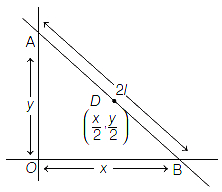
(A) ધારો કે બે લંબ રેખાઓ યામ અક્ષો $OX$ અને $OY$ છે. સળિયાના અંત્યબિંદુઓ $y$-અક્ષ પર $A(0, a)$ અને $x$-અક્ષ પર $B(b, 0)$ છે.
સળિયાની લંબાઈ $AB = 2l$ છે. અંતર સૂત્ર મુજબ,$\sqrt{a^2+b^2} = 2l$,જેનો અર્થ છે કે $a^2+b^2 = 4l^2$.
ધારો કે $P(x, y)$ એ સળિયા $AB$ નું મધ્યબિંદુ છે. તેથી $x = \frac{0+b}{2} = \frac{b}{2}$ અને $y = \frac{a+0}{2} = \frac{a}{2}$.
આના પરથી $b = 2x$ અને $a = 2y$ મળે છે.
આ કિંમતોને સમીકરણ $a^2+b^2 = 4l^2$ માં મૂકતા,આપણને $(2y)^2 + (2x)^2 = 4l^2$ મળે છે.
$4x^2 + 4y^2 = 4l^2$,જેનું સાદું રૂપ $x^2+y^2 = l^2$ થાય છે.
આમ,મધ્યબિંદુનો બિંદુપથ $x^2+y^2 = l^2$ છે.
સળિયાની લંબાઈ $AB = 2l$ છે. અંતર સૂત્ર મુજબ,$\sqrt{a^2+b^2} = 2l$,જેનો અર્થ છે કે $a^2+b^2 = 4l^2$.
ધારો કે $P(x, y)$ એ સળિયા $AB$ નું મધ્યબિંદુ છે. તેથી $x = \frac{0+b}{2} = \frac{b}{2}$ અને $y = \frac{a+0}{2} = \frac{a}{2}$.
આના પરથી $b = 2x$ અને $a = 2y$ મળે છે.
આ કિંમતોને સમીકરણ $a^2+b^2 = 4l^2$ માં મૂકતા,આપણને $(2y)^2 + (2x)^2 = 4l^2$ મળે છે.
$4x^2 + 4y^2 = 4l^2$,જેનું સાદું રૂપ $x^2+y^2 = l^2$ થાય છે.
આમ,મધ્યબિંદુનો બિંદુપથ $x^2+y^2 = l^2$ છે.
0 likesView Solution
204
MathematicsMediumMCQAP EAMCET · 2021
જો $m_1$ અને $m_2$ $(m_1 > m_2)$ એ $5x^2 - 8xy + 3y^2 = 0$ દ્વારા દર્શાવતી રેખાઓના ઢાળ હોય,તો $m_1 : m_2$ ની કિંમત શોધો.
A
$5:1$
B
$2:1$
C
$5:3$
D
$3:2$
Solution
(C) આપેલ સમીકરણ $5x^2 - 8xy + 3y^2 = 0$ છે.
$x^2$ વડે ભાગતા,આપણને $3(\frac{y}{x})^2 - 8(\frac{y}{x}) + 5 = 0$ મળે છે.
ધારો કે $m = \frac{y}{x}$ એ રેખાઓનો ઢાળ છે. તેથી $3m^2 - 8m + 5 = 0$.
દ્વિઘાત સૂત્ર $m = \frac{-b \pm \sqrt{b^2 - 4ac}}{2a}$ નો ઉપયોગ કરીને $3m^2 - 8m + 5 = 0$ ઉકેલતા:
$m = \frac{8 \pm \sqrt{64 - 4(3)(5)}}{2(3)} = \frac{8 \pm \sqrt{64 - 60}}{6} = \frac{8 \pm \sqrt{4}}{6} = \frac{8 \pm 2}{6}$.
બે ઢાળ $m_1 = \frac{8+2}{6} = \frac{10}{6} = \frac{5}{3}$ અને $m_2 = \frac{8-2}{6} = \frac{6}{6} = 1$ છે.
$m_1 > m_2$ હોવાથી,$m_1 = \frac{5}{3}$ અને $m_2 = 1$ મળે.
તેથી,ગુણોત્તર $m_1 : m_2 = \frac{5}{3} : 1 = 5 : 3$ થાય.
$x^2$ વડે ભાગતા,આપણને $3(\frac{y}{x})^2 - 8(\frac{y}{x}) + 5 = 0$ મળે છે.
ધારો કે $m = \frac{y}{x}$ એ રેખાઓનો ઢાળ છે. તેથી $3m^2 - 8m + 5 = 0$.
દ્વિઘાત સૂત્ર $m = \frac{-b \pm \sqrt{b^2 - 4ac}}{2a}$ નો ઉપયોગ કરીને $3m^2 - 8m + 5 = 0$ ઉકેલતા:
$m = \frac{8 \pm \sqrt{64 - 4(3)(5)}}{2(3)} = \frac{8 \pm \sqrt{64 - 60}}{6} = \frac{8 \pm \sqrt{4}}{6} = \frac{8 \pm 2}{6}$.
બે ઢાળ $m_1 = \frac{8+2}{6} = \frac{10}{6} = \frac{5}{3}$ અને $m_2 = \frac{8-2}{6} = \frac{6}{6} = 1$ છે.
$m_1 > m_2$ હોવાથી,$m_1 = \frac{5}{3}$ અને $m_2 = 1$ મળે.
તેથી,ગુણોત્તર $m_1 : m_2 = \frac{5}{3} : 1 = 5 : 3$ થાય.
0 likesView Solution
205
MathematicsMediumMCQAP EAMCET · 2021
જો $4x^2-5xy+y^2=0$ એ $m_1$ અને $m_2$ ઢાળવાળી રેખાઓની જોડી દર્શાવતું હોય,તો $|m_1-m_2|$ નું મૂલ્ય કેટલું થાય?
A
$1$
B
$2$
C
$3$
D
$4$
Solution
(C) આપેલ રેખાઓની જોડીનું સમીકરણ $4x^2-5xy+y^2=0$ છે.
$x^2$ વડે ભાગતા,આપણને $m = \frac{y}{x}$ ના સ્વરૂપમાં દ્વિઘાત સમીકરણ મળે છે:
$m^2-5m+4=0$.
અહીં,$m_1$ અને $m_2$ એ આ સમીકરણના બીજ છે.
તેથી,ઢાળનો સરવાળો $m_1+m_2 = 5$ અને ઢાળનો ગુણાકાર $m_1m_2 = 4$ થાય.
આપણે જાણીએ છીએ કે $|m_1-m_2| = \sqrt{(m_1+m_2)^2-4m_1m_2}$.
કિંમતો મૂકતા,આપણને મળે છે:
$|m_1-m_2| = \sqrt{5^2-4(4)} = \sqrt{25-16} = \sqrt{9} = 3$.
$x^2$ વડે ભાગતા,આપણને $m = \frac{y}{x}$ ના સ્વરૂપમાં દ્વિઘાત સમીકરણ મળે છે:
$m^2-5m+4=0$.
અહીં,$m_1$ અને $m_2$ એ આ સમીકરણના બીજ છે.
તેથી,ઢાળનો સરવાળો $m_1+m_2 = 5$ અને ઢાળનો ગુણાકાર $m_1m_2 = 4$ થાય.
આપણે જાણીએ છીએ કે $|m_1-m_2| = \sqrt{(m_1+m_2)^2-4m_1m_2}$.
કિંમતો મૂકતા,આપણને મળે છે:
$|m_1-m_2| = \sqrt{5^2-4(4)} = \sqrt{25-16} = \sqrt{9} = 3$.
0 likesView Solution
206
MathematicsMediumMCQAP EAMCET · 2021
$y^3-4x^2y=0$ સંયુક્ત સમીકરણ દ્વારા આપવામાં આવતી ત્રણ રેખાઓ શું દર્શાવે છે?
A
સમદ્વિબાજુ ત્રિકોણની બાજુઓ
B
કાટકોણ ત્રિકોણની બાજુઓ
C
સમબાજુ ત્રિકોણની બાજુઓ
D
સંગામી રેખાઓ
Solution
(D) આપેલ સમીકરણ: $y^3-4x^2y=0$
સમીકરણનું અવયવીકરણ કરતા: $y(y^2-4x^2)=0$
$a^2-b^2=(a-b)(a+b)$ નિત્યસમનો ઉપયોગ કરતા: $y(y-2x)(y+2x)=0$
આનાથી ત્રણ રેખાઓ મળે છે: $L_1: y=0$,$L_2: y=2x$,અને $L_3: y=-2x$.
આ ત્રણેય રેખાઓ ઉગમબિંદુ $(0,0)$ માંથી પસાર થાય છે.
તેથી,ત્રણેય રેખાઓ એક સામાન્ય બિંદુ $(0,0)$ પર છેદે છે,તેથી તે સંગામી રેખાઓ છે.
સમીકરણનું અવયવીકરણ કરતા: $y(y^2-4x^2)=0$
$a^2-b^2=(a-b)(a+b)$ નિત્યસમનો ઉપયોગ કરતા: $y(y-2x)(y+2x)=0$
આનાથી ત્રણ રેખાઓ મળે છે: $L_1: y=0$,$L_2: y=2x$,અને $L_3: y=-2x$.
આ ત્રણેય રેખાઓ ઉગમબિંદુ $(0,0)$ માંથી પસાર થાય છે.
તેથી,ત્રણેય રેખાઓ એક સામાન્ય બિંદુ $(0,0)$ પર છેદે છે,તેથી તે સંગામી રેખાઓ છે.
0 likesView Solution
207
MathematicsMediumMCQAP EAMCET · 2021
$x^2+2 h x y+2 y^2=0$ દ્વારા દર્શાવવામાં આવતી રેખાઓના ઢાળનો ગુણોત્તર $1:2$ છે,તો $h$ ની કિંમત શોધો.
A
$\pm \frac{1}{2}$
B
$\pm \frac{3}{2}$
C
$\pm 1$
D
$\pm 3$
Solution
(B) આપેલ રેખાઓનું સમીકરણ: $x^2+2 h x y+2 y^2=0 \dots (i)$
$a x^2+2 h x y+b y^2=0$ સાથે સરખાવતા,$a=1$ અને $b=2$ મળે છે.
ધારો કે રેખાઓના ઢાળ $m_1$ અને $m_2$ છે.
તેથી,$m_1+m_2 = -\frac{2h}{b} = -\frac{2h}{2} = -h \dots (ii)$
અને $m_1 m_2 = \frac{a}{b} = \frac{1}{2} \dots (iii)$
ઢાળનો ગુણોત્તર $m_1:m_2 = 1:2$ આપેલ છે,તેથી $m_2 = 2m_1$.
$(iii)$ માં $m_2 = 2m_1$ મૂકતા: $m_1(2m_1) = \frac{1}{2}$ $\Rightarrow 2m_1^2 = \frac{1}{2}$ $\Rightarrow m_1^2 = \frac{1}{4}$ $\Rightarrow m_1 = \pm \frac{1}{2}$.
જો $m_1 = \frac{1}{2}$,તો $m_2 = 1$. $(ii)$ પરથી,$m_1+m_2 = -h$ $\Rightarrow \frac{1}{2} + 1 = -h$ $\Rightarrow h = -\frac{3}{2}$.
જો $m_1 = -\frac{1}{2}$,તો $m_2 = -1$. $(ii)$ પરથી,$m_1+m_2 = -h$ $\Rightarrow -\frac{1}{2} - 1 = -h$ $\Rightarrow h = \frac{3}{2}$.
આમ,$h = \pm \frac{3}{2}$.
$a x^2+2 h x y+b y^2=0$ સાથે સરખાવતા,$a=1$ અને $b=2$ મળે છે.
ધારો કે રેખાઓના ઢાળ $m_1$ અને $m_2$ છે.
તેથી,$m_1+m_2 = -\frac{2h}{b} = -\frac{2h}{2} = -h \dots (ii)$
અને $m_1 m_2 = \frac{a}{b} = \frac{1}{2} \dots (iii)$
ઢાળનો ગુણોત્તર $m_1:m_2 = 1:2$ આપેલ છે,તેથી $m_2 = 2m_1$.
$(iii)$ માં $m_2 = 2m_1$ મૂકતા: $m_1(2m_1) = \frac{1}{2}$ $\Rightarrow 2m_1^2 = \frac{1}{2}$ $\Rightarrow m_1^2 = \frac{1}{4}$ $\Rightarrow m_1 = \pm \frac{1}{2}$.
જો $m_1 = \frac{1}{2}$,તો $m_2 = 1$. $(ii)$ પરથી,$m_1+m_2 = -h$ $\Rightarrow \frac{1}{2} + 1 = -h$ $\Rightarrow h = -\frac{3}{2}$.
જો $m_1 = -\frac{1}{2}$,તો $m_2 = -1$. $(ii)$ પરથી,$m_1+m_2 = -h$ $\Rightarrow -\frac{1}{2} - 1 = -h$ $\Rightarrow h = \frac{3}{2}$.
આમ,$h = \pm \frac{3}{2}$.
0 likesView Solution
208
MathematicsDifficultMCQAP EAMCET · 2021
જો $a x^2+2 h x y+b y^2=0$ દ્વારા દર્શાવવામાં આવતી રેખાઓમાંથી એકનો ઢાળ બીજાના વર્ગ જેટલો હોય,તો $\frac{a+b}{h}+\frac{8 h^2}{a b}$ ની કિંમત શું થાય?
A
$3$
B
$4$
C
$5$
D
$6$
Solution
(D) આપેલ સમીકરણ $a x^2+2 h x y+b y^2=0$ છે.
ધારો કે રેખાઓના ઢાળ $m$ અને $m^2$ છે.
સમીકરણના ગુણધર્મો પરથી,ઢાળનો સરવાળો $m+m^2 = -\frac{2h}{b}$ અને ઢાળનો ગુણાકાર $m \cdot m^2 = m^3 = \frac{a}{b}$ છે.
આપણને $m(1+m) = -\frac{2h}{b}$ મળે છે.
બંને બાજુ ઘન કરતા,$m^3(1+m)^3 = -\frac{8h^3}{b^3}$ મળે.
આનું વિસ્તરણ કરતા,$m^3(1+m^3+3m(1+m)) = -\frac{8h^3}{b^3}$.
$m^3 = \frac{a}{b}$ અને $m(1+m) = -\frac{2h}{b}$ મૂકતા,$\frac{a}{b}(1+\frac{a}{b}+3(-\frac{2h}{b})) = -\frac{8h^3}{b^3}$ મળે.
$b^3$ વડે ગુણતા,$a(b+a-6h) = -8h^3$ મળે.
$ab + a^2 - 6ah = -8h^3$.
$abh$ વડે ભાગતા,$\frac{a+b}{h} + \frac{8h^2}{ab} = 6$ મળે છે.
ધારો કે રેખાઓના ઢાળ $m$ અને $m^2$ છે.
સમીકરણના ગુણધર્મો પરથી,ઢાળનો સરવાળો $m+m^2 = -\frac{2h}{b}$ અને ઢાળનો ગુણાકાર $m \cdot m^2 = m^3 = \frac{a}{b}$ છે.
આપણને $m(1+m) = -\frac{2h}{b}$ મળે છે.
બંને બાજુ ઘન કરતા,$m^3(1+m)^3 = -\frac{8h^3}{b^3}$ મળે.
આનું વિસ્તરણ કરતા,$m^3(1+m^3+3m(1+m)) = -\frac{8h^3}{b^3}$.
$m^3 = \frac{a}{b}$ અને $m(1+m) = -\frac{2h}{b}$ મૂકતા,$\frac{a}{b}(1+\frac{a}{b}+3(-\frac{2h}{b})) = -\frac{8h^3}{b^3}$ મળે.
$b^3$ વડે ગુણતા,$a(b+a-6h) = -8h^3$ મળે.
$ab + a^2 - 6ah = -8h^3$.
$abh$ વડે ભાગતા,$\frac{a+b}{h} + \frac{8h^2}{ab} = 6$ મળે છે.
0 likesView Solution
209
MathematicsMediumMCQAP EAMCET · 2021
જો રેખાઓ $x^2+kxy+y^2=0$ અને $x+y=1$ સમબાજુ ત્રિકોણની બાજુઓ બનાવે,તો $k^2$ ની કિંમત કેટલી થાય?
A
$4$
B
$16$
C
$9$
D
$64$
Solution
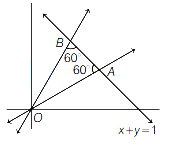
(B) સમીકરણ $x^2+kxy+y^2=0$ એ ઉગમબિંદુમાંથી પસાર થતી બે સીધી રેખાઓની જોડી દર્શાવે છે. ધારો કે આ રેખાઓના ઢાળ $m_1$ અને $m_2$ છે. ત્રીજી રેખાનું સમીકરણ $x+y=1$ છે,જેને $y=-x+1$ તરીકે લખી શકાય,તેથી તેનો ઢાળ $m_3=-1$ છે.
રેખાઓ સમબાજુ ત્રિકોણ બનાવે છે,તેથી કોઈપણ બે રેખાઓ વચ્ચેનો ખૂણો $60^{\circ}$ છે.
રેખા $y=mx$ અને રેખા $x+y=1$ (ઢાળ $-1$) વચ્ચેનો ખૂણો નીચે મુજબ છે:
$\tan 60^{\circ} = \left| \frac{m - (-1)}{1 + m(-1)} \right|$
$\sqrt{3} = \left| \frac{m+1}{1-m} \right|$
બંને બાજુ વર્ગ કરતા:
$3 = \frac{(m+1)^2}{(1-m)^2}$
$3(1-2m+m^2) = m^2+2m+1$
$3-6m+3m^2 = m^2+2m+1$
$2m^2-8m+2 = 0$
$m^2-4m+1 = 0$
કારણ કે $m = y/x$,આપણે આને દ્વિઘાત સમીકરણમાં મૂકીએ છીએ:
$(y/x)^2 - 4(y/x) + 1 = 0$
$y^2 - 4xy + x^2 = 0$
આને $x^2+kxy+y^2=0$ સાથે સરખાવતા,આપણને $k=-4$ મળે છે.
તેથી,$k^2 = (-4)^2 = 16$.
રેખાઓ સમબાજુ ત્રિકોણ બનાવે છે,તેથી કોઈપણ બે રેખાઓ વચ્ચેનો ખૂણો $60^{\circ}$ છે.
રેખા $y=mx$ અને રેખા $x+y=1$ (ઢાળ $-1$) વચ્ચેનો ખૂણો નીચે મુજબ છે:
$\tan 60^{\circ} = \left| \frac{m - (-1)}{1 + m(-1)} \right|$
$\sqrt{3} = \left| \frac{m+1}{1-m} \right|$
બંને બાજુ વર્ગ કરતા:
$3 = \frac{(m+1)^2}{(1-m)^2}$
$3(1-2m+m^2) = m^2+2m+1$
$3-6m+3m^2 = m^2+2m+1$
$2m^2-8m+2 = 0$
$m^2-4m+1 = 0$
કારણ કે $m = y/x$,આપણે આને દ્વિઘાત સમીકરણમાં મૂકીએ છીએ:
$(y/x)^2 - 4(y/x) + 1 = 0$
$y^2 - 4xy + x^2 = 0$
આને $x^2+kxy+y^2=0$ સાથે સરખાવતા,આપણને $k=-4$ મળે છે.
તેથી,$k^2 = (-4)^2 = 16$.
0 likesView Solution
210
MathematicsMediumMCQAP EAMCET · 2021
$ax^2+2hxy+by^2=0$ દ્વારા દર્શાવેલ રેખાઓ પૈકી એકનો ઢાળ બીજાના ઢાળનો વર્ગ હોય,તો $\frac{a+b}{h}+\frac{8h^2}{ab}$ ની કિંમત કેટલી થાય?
A
$3$
B
$4$
C
$5$
D
$6$
Solution
(D) રેખાઓની જોડીનું સમીકરણ $ax^2+2hxy+by^2=0$ છે. ધારો કે ઢાળ $m$ અને $m^2$ છે.
ઢાળનો સરવાળો: $m+m^2 = -\frac{2h}{b} \quad (1)$
ઢાળનો ગુણાકાર: $m \cdot m^2 = m^3 = \frac{a}{b} \quad (2)$
$(1)$ પરથી,$m(1+m) = -\frac{2h}{b}$. બંને બાજુ ઘન લેતા:
$m^3(1+m)^3 = -\frac{8h^3}{b^3}$
$m^3(1+m^3+3m(1+m)) = -\frac{8h^3}{b^3}$
$m^3 = \frac{a}{b}$ અને $m(1+m) = -\frac{2h}{b}$ મૂકતા:
$\frac{a}{b} \left(1 + \frac{a}{b} + 3\left(-\frac{2h}{b}\right)\right) = -\frac{8h^3}{b^3}$
$\frac{a}{b} \left(\frac{b+a-6h}{b}\right) = -\frac{8h^3}{b^3}$
$a(a+b-6h) = -8h^3$
$a^2+ab-6ah = -8h^3$
$abh$ વડે ભાગતા:
$\frac{a+b}{h} + \frac{8h^2}{ab} = 6$.
ઢાળનો સરવાળો: $m+m^2 = -\frac{2h}{b} \quad (1)$
ઢાળનો ગુણાકાર: $m \cdot m^2 = m^3 = \frac{a}{b} \quad (2)$
$(1)$ પરથી,$m(1+m) = -\frac{2h}{b}$. બંને બાજુ ઘન લેતા:
$m^3(1+m)^3 = -\frac{8h^3}{b^3}$
$m^3(1+m^3+3m(1+m)) = -\frac{8h^3}{b^3}$
$m^3 = \frac{a}{b}$ અને $m(1+m) = -\frac{2h}{b}$ મૂકતા:
$\frac{a}{b} \left(1 + \frac{a}{b} + 3\left(-\frac{2h}{b}\right)\right) = -\frac{8h^3}{b^3}$
$\frac{a}{b} \left(\frac{b+a-6h}{b}\right) = -\frac{8h^3}{b^3}$
$a(a+b-6h) = -8h^3$
$a^2+ab-6ah = -8h^3$
$abh$ વડે ભાગતા:
$\frac{a+b}{h} + \frac{8h^2}{ab} = 6$.
0 likesView Solution
211
MathematicsMediumMCQAP EAMCET · 2021
$x^2+4xy+y^2=0$ સમીકરણ દ્વારા દર્શાવવામાં આવતી રેખાઓની જોડી વચ્ચેનો ખૂણો શોધો. ($^{\circ}$ માં)
A
$30$
B
$45$
C
$60$
D
$90$
Solution
(C) રેખાઓની જોડીનું આપેલ સમીકરણ $ax^2+2hxy+by^2=0$ છે,જ્યાં $a=1$,$2h=4$ (તેથી $h=2$),અને $b=1$ છે.
રેખાઓની જોડી વચ્ચેના ખૂણા $\theta$ માટેનું સૂત્ર $\tan \theta = \left| \frac{2\sqrt{h^2-ab}}{a+b} \right|$ છે.
કિંમતો મૂકતા,આપણને $\tan \theta = \left| \frac{2\sqrt{2^2-(1)(1)}}{1+1} \right|$ મળે છે.
$\tan \theta = \frac{2\sqrt{4-1}}{2} = \sqrt{3}$.
તેથી,$\theta = \tan^{-1}(\sqrt{3}) = 60^{\circ}$.
રેખાઓની જોડી વચ્ચેના ખૂણા $\theta$ માટેનું સૂત્ર $\tan \theta = \left| \frac{2\sqrt{h^2-ab}}{a+b} \right|$ છે.
કિંમતો મૂકતા,આપણને $\tan \theta = \left| \frac{2\sqrt{2^2-(1)(1)}}{1+1} \right|$ મળે છે.
$\tan \theta = \frac{2\sqrt{4-1}}{2} = \sqrt{3}$.
તેથી,$\theta = \tan^{-1}(\sqrt{3}) = 60^{\circ}$.
0 likesView Solution
212
MathematicsMediumMCQAP EAMCET · 2021
જો રેખાઓ $ax^2+2hxy+by^2=0$ વચ્ચેનો લઘુકોણ $\frac{\pi}{4}$ હોય,તો $4h^2=$
A
$(a+b)^2$
B
$a^2+6ab+b^2$
C
$(a-2b)(2a+b)$
D
$a^2-6ab+b^2$
Solution
(B) સમીકરણ $ax^2+2hxy+by^2=0$ દ્વારા દર્શાવતી રેખાઓ વચ્ચેનો ખૂણો $\theta$ એ $\tan \theta = \left| \frac{2\sqrt{h^2-ab}}{a+b} \right|$ દ્વારા આપવામાં આવે છે.
આપેલ છે કે $\theta = \frac{\pi}{4}$,તેથી $\tan \frac{\pi}{4} = 1$.
આમ,$1 = \left| \frac{2\sqrt{h^2-ab}}{a+b} \right|$.
બંને બાજુ વર્ગ કરતા,$1 = \frac{4(h^2-ab)}{(a+b)^2}$.
$(a+b)^2 = 4h^2 - 4ab$.
$a^2 + 2ab + b^2 = 4h^2 - 4ab$.
$4h^2 = a^2 + 6ab + b^2$.
આપેલ છે કે $\theta = \frac{\pi}{4}$,તેથી $\tan \frac{\pi}{4} = 1$.
આમ,$1 = \left| \frac{2\sqrt{h^2-ab}}{a+b} \right|$.
બંને બાજુ વર્ગ કરતા,$1 = \frac{4(h^2-ab)}{(a+b)^2}$.
$(a+b)^2 = 4h^2 - 4ab$.
$a^2 + 2ab + b^2 = 4h^2 - 4ab$.
$4h^2 = a^2 + 6ab + b^2$.
0 likesView Solution
213
MathematicsMediumMCQAP EAMCET · 2021
$\cos \theta(\cos \theta+1) x^2 - (2 \cos \theta + \sin^2 \theta) xy + (1 - \cos \theta) y^2 = 0$ દ્વારા દર્શાવતી રેખાઓ વચ્ચેનો ખૂણો શોધો.
A
$\frac{\pi}{4}$
B
$\frac{\pi}{6}$
C
$\frac{\pi}{3}$
D
$\frac{\pi}{12}$
Solution
(A) આપેલ સમીકરણ $Ax^2 + 2Hxy + By^2 = 0$ સ્વરૂપનું છે,જ્યાં $A = \cos \theta(\cos \theta + 1)$,$2H = -(2 \cos \theta + \sin^2 \theta)$,અને $B = 1 - \cos \theta$ છે.
રેખાઓ વચ્ચેનો ખૂણો $\alpha$ માટે $\tan \alpha = \left| \frac{2\sqrt{H^2 - AB}}{A + B} \right|$ સૂત્રનો ઉપયોગ કરતા.
અહીં $A + B = \cos^2 \theta + 1$ મળે છે.
ગણતરી કરતા $H^2 - AB = \cos^2 \theta + \frac{\sin^4 \theta}{4}$ મળે છે.
તેથી,$\tan \alpha = \frac{\sqrt{4 \cos^2 \theta + \sin^4 \theta}}{\cos^2 \theta + 1} = 1$ મળે છે.
આમ,$\alpha = \tan^{-1}(1) = \frac{\pi}{4}$.
રેખાઓ વચ્ચેનો ખૂણો $\alpha$ માટે $\tan \alpha = \left| \frac{2\sqrt{H^2 - AB}}{A + B} \right|$ સૂત્રનો ઉપયોગ કરતા.
અહીં $A + B = \cos^2 \theta + 1$ મળે છે.
ગણતરી કરતા $H^2 - AB = \cos^2 \theta + \frac{\sin^4 \theta}{4}$ મળે છે.
તેથી,$\tan \alpha = \frac{\sqrt{4 \cos^2 \theta + \sin^4 \theta}}{\cos^2 \theta + 1} = 1$ મળે છે.
આમ,$\alpha = \tan^{-1}(1) = \frac{\pi}{4}$.
0 likesView Solution
214
MathematicsEasyMCQAP EAMCET · 2021
રેખાઓ $6x^2 + 11xy - 10y^2 = 0$ વચ્ચેનો લઘુકોણ શોધો.
A
$\tan^{-1}\left(\frac{\sqrt{361}}{2}\right)$
B
$\tan^{-1}\left(\frac{\sqrt{361}}{4}\right)$
C
$\tan^{-1}\left(\frac{361}{2}\right)$
D
$\tan^{-1}\left(\frac{361}{4}\right)$
Solution
(B) $ax^2 + 2hxy + by^2 = 0$ દ્વારા દર્શાવતી રેખાઓની જોડી વચ્ચેનો લઘુકોણ $\theta$ માટેનું સૂત્ર $\tan \theta = \left| \frac{2\sqrt{h^2 - ab}}{a+b} \right|$ છે.
આપેલ સમીકરણ $6x^2 + 11xy - 10y^2 = 0$ ને $ax^2 + 2hxy + by^2 = 0$ સાથે સરખાવતા,$a = 6$,$b = -10$,અને $h = \frac{11}{2}$ મળે છે.
કિંમતો મૂકતા:
$\tan \theta = \left| \frac{2\sqrt{(\frac{11}{2})^2 - (6)(-10)}}{6 - 10} \right| = \left| \frac{2\sqrt{\frac{121}{4} + 60}}{-4} \right| = \frac{\sqrt{361}}{4}$.
તેથી,$\theta = \tan^{-1}\left(\frac{\sqrt{361}}{4}\right)$.
આપેલ સમીકરણ $6x^2 + 11xy - 10y^2 = 0$ ને $ax^2 + 2hxy + by^2 = 0$ સાથે સરખાવતા,$a = 6$,$b = -10$,અને $h = \frac{11}{2}$ મળે છે.
કિંમતો મૂકતા:
$\tan \theta = \left| \frac{2\sqrt{(\frac{11}{2})^2 - (6)(-10)}}{6 - 10} \right| = \left| \frac{2\sqrt{\frac{121}{4} + 60}}{-4} \right| = \frac{\sqrt{361}}{4}$.
તેથી,$\theta = \tan^{-1}\left(\frac{\sqrt{361}}{4}\right)$.
0 likesView Solution
215
MathematicsEasyMCQAP EAMCET · 2021
જો $ax^2+6xy+by^2-10x+10y-6=0$ એ પરસ્પર લંબ રેખાઓની જોડી દર્શાવતું હોય,તો $|a|$ ની કિંમત કેટલી થાય?
A
$6$
B
$4$
C
$2$
D
$3$
Solution
(B) આપેલ રેખાઓની જોડીનું સમીકરણ $ax^2+6xy+by^2-10x+10y-6=0$ છે.
સામાન્ય સમીકરણ $Ax^2+2Hxy+By^2+2Gx+2Fy+C=0$ સાથે સરખાવતા,$A=a, H=3, B=b, G=-5, F=5, C=-6$ મળે છે.
રેખાઓ પરસ્પર લંબ હોવા માટે,$x^2$ અને $y^2$ ના સહગુણકોનો સરવાળો શૂન્ય હોવો જોઈએ,એટલે કે $a+b=0$,જેનો અર્થ છે $b=-a$.
વળી,સામાન્ય દ્વિઘાત સમીકરણ રેખાઓની જોડી દર્શાવે તે માટેની શરત $\Delta = abc + 2fgh - af^2 - bg^2 - ch^2 = 0$ છે.
કિંમતો મૂકતા: $a(b)(-6) + 2(5)(3)(-5) - a(5)^2 - b(-5)^2 - (-6)(3)^2 = 0$.
$-6ab - 150 - 25a - 25b + 54 = 0$.
$-6ab - 25(a+b) - 96 = 0$.
$a+b=0$ હોવાથી,આપણને $-6a(-a) - 25(0) - 96 = 0$ મળે છે.
$6a^2 = 96 \Rightarrow a^2 = 16$.
તેથી,$|a| = \sqrt{16} = 4$.
સામાન્ય સમીકરણ $Ax^2+2Hxy+By^2+2Gx+2Fy+C=0$ સાથે સરખાવતા,$A=a, H=3, B=b, G=-5, F=5, C=-6$ મળે છે.
રેખાઓ પરસ્પર લંબ હોવા માટે,$x^2$ અને $y^2$ ના સહગુણકોનો સરવાળો શૂન્ય હોવો જોઈએ,એટલે કે $a+b=0$,જેનો અર્થ છે $b=-a$.
વળી,સામાન્ય દ્વિઘાત સમીકરણ રેખાઓની જોડી દર્શાવે તે માટેની શરત $\Delta = abc + 2fgh - af^2 - bg^2 - ch^2 = 0$ છે.
કિંમતો મૂકતા: $a(b)(-6) + 2(5)(3)(-5) - a(5)^2 - b(-5)^2 - (-6)(3)^2 = 0$.
$-6ab - 150 - 25a - 25b + 54 = 0$.
$-6ab - 25(a+b) - 96 = 0$.
$a+b=0$ હોવાથી,આપણને $-6a(-a) - 25(0) - 96 = 0$ મળે છે.
$6a^2 = 96 \Rightarrow a^2 = 16$.
તેથી,$|a| = \sqrt{16} = 4$.
0 likesView Solution
216
MathematicsEasyMCQAP EAMCET · 2021
જો $\theta$ એ $x^2+2 h x y+b y^2=0$ રેખાઓ વચ્ચેનો ખૂણો હોય,તો $x^2+2 x y \sec \theta+y^2=0$ વચ્ચેનો ખૂણો કેટલો થાય?
A
$\theta$
B
$2 \theta$
C
$\frac{\theta}{2}$
D
$3 \theta$
Solution
(A) $ax^2 + 2hxy + by^2 = 0$ રેખાઓની જોડી વચ્ચેનો ખૂણો $\theta$ એ $\tan \theta = \left| \frac{2\sqrt{h^2 - ab}}{a+b} \right|$ દ્વારા આપવામાં આવે છે.
સમીકરણ $x^2 + 2xy \sec \theta + y^2 = 0$ માટે,$a = 1$,$h = \sec \theta$,અને $b = 1$ છે.
ધારો કે આ રેખાઓ વચ્ચેનો ખૂણો $\phi$ છે.
તો $\tan \phi = \left| \frac{2\sqrt{(\sec \theta)^2 - (1)(1)}}{1+1} \right|$.
$\tan \phi = \left| \frac{2\sqrt{\sec^2 \theta - 1}}{2} \right|$.
કારણ કે $\sec^2 \theta - 1 = \tan^2 \theta$,તેથી $\tan \phi = \sqrt{\tan^2 \theta} = \tan \theta$.
તેથી,$\phi = \theta$.
સમીકરણ $x^2 + 2xy \sec \theta + y^2 = 0$ માટે,$a = 1$,$h = \sec \theta$,અને $b = 1$ છે.
ધારો કે આ રેખાઓ વચ્ચેનો ખૂણો $\phi$ છે.
તો $\tan \phi = \left| \frac{2\sqrt{(\sec \theta)^2 - (1)(1)}}{1+1} \right|$.
$\tan \phi = \left| \frac{2\sqrt{\sec^2 \theta - 1}}{2} \right|$.
કારણ કે $\sec^2 \theta - 1 = \tan^2 \theta$,તેથી $\tan \phi = \sqrt{\tan^2 \theta} = \tan \theta$.
તેથી,$\phi = \theta$.
0 likesView Solution
217
MathematicsEasyMCQAP EAMCET · 2021
$(\sin ^2 \alpha) y^2 - 2xy(\cos ^2 \alpha) + (\cos ^2 \alpha - 1) x^2 = 0$ દ્વારા દર્શાવતી રેખાઓ વચ્ચેનો ખૂણો કેટલો છે?
A
$2 \alpha$
B
$\alpha$
C
$90^{\circ}$
D
$45^{\circ}$
Solution
(C) આપેલ સમીકરણ $(\sin ^2 \alpha) y^2 - 2xy(\cos ^2 \alpha) + (\cos ^2 \alpha - 1) x^2 = 0$ છે.
આને પ્રમાણિત સ્વરૂપ $ax^2 + 2hxy + by^2 = 0$ સાથે સરખાવતા:
$a = \cos ^2 \alpha - 1 = -\sin ^2 \alpha$
$h = -\cos ^2 \alpha$
$b = \sin ^2 \alpha$
રેખાઓની જોડી વચ્ચેનો ખૂણો $\theta$ માટેનું સૂત્ર $\tan \theta = \left| \frac{2\sqrt{h^2 - ab}}{a + b} \right|$ છે.
છેદની ગણતરી કરતા: $a + b = -\sin ^2 \alpha + \sin ^2 \alpha = 0$.
છેદ $0$ હોવાથી,રેખાઓ એકબીજાને લંબ છે.
તેથી,$\tan \theta = \infty$,જેનો અર્થ છે કે $\theta = 90^{\circ}$.
આને પ્રમાણિત સ્વરૂપ $ax^2 + 2hxy + by^2 = 0$ સાથે સરખાવતા:
$a = \cos ^2 \alpha - 1 = -\sin ^2 \alpha$
$h = -\cos ^2 \alpha$
$b = \sin ^2 \alpha$
રેખાઓની જોડી વચ્ચેનો ખૂણો $\theta$ માટેનું સૂત્ર $\tan \theta = \left| \frac{2\sqrt{h^2 - ab}}{a + b} \right|$ છે.
છેદની ગણતરી કરતા: $a + b = -\sin ^2 \alpha + \sin ^2 \alpha = 0$.
છેદ $0$ હોવાથી,રેખાઓ એકબીજાને લંબ છે.
તેથી,$\tan \theta = \infty$,જેનો અર્થ છે કે $\theta = 90^{\circ}$.
0 likesView Solution
218
MathematicsEasyMCQAP EAMCET · 2021
રેખાઓ $ab(x^2 - y^2) + (a^2 - b^2)xy = 0$ વચ્ચેનો ખૂણો કેટલો છે?
A
$\frac{\pi}{2}$
B
$\frac{\pi}{3}$
C
$\frac{\pi}{4}$
D
$\frac{\pi}{6}$
Solution
(A) આપેલ સમીકરણ $ab(x^2 - y^2) + (a^2 - b^2)xy = 0$ છે.
તેને વિસ્તૃત કરતા,આપણને $abx^2 + (a^2 - b^2)xy - aby^2 = 0$ મળે છે.
આ $Ax^2 + 2Hxy + By^2 = 0$ સ્વરૂપનું સમીકરણ છે,જ્યાં $A = ab$ અને $B = -ab$ છે.
રેખાઓ પરસ્પર લંબ હોવાની શરત $A + B = 0$ છે.
અહીં,$A + B = ab - ab = 0$.
તેથી,રેખાઓ એકબીજાને લંબ છે.
આમ,રેખાઓ વચ્ચેનો ખૂણો $\frac{\pi}{2}$ છે.
તેને વિસ્તૃત કરતા,આપણને $abx^2 + (a^2 - b^2)xy - aby^2 = 0$ મળે છે.
આ $Ax^2 + 2Hxy + By^2 = 0$ સ્વરૂપનું સમીકરણ છે,જ્યાં $A = ab$ અને $B = -ab$ છે.
રેખાઓ પરસ્પર લંબ હોવાની શરત $A + B = 0$ છે.
અહીં,$A + B = ab - ab = 0$.
તેથી,રેખાઓ એકબીજાને લંબ છે.
આમ,રેખાઓ વચ્ચેનો ખૂણો $\frac{\pi}{2}$ છે.
0 likesView Solution
219
MathematicsDifficultMCQAP EAMCET · 2021
$a y^4+b x y^3+c x^2 y^2+d x^3 y+e x^4=0$ સમીકરણ દ્વારા દર્શાવતી બે રેખાઓ લંબ હોય,તો
A
$(b+d)(a d+b e)+(e-a)^2(a+c+e)=0$
B
$(b+d)(a d+b e)+(e+a)^2(a+c+e)=0$
C
$(b-d)(a d-b e)+(e-a)^2(a+c+e)=0$
D
$(b-d)(a d-b e)+(e+a)^2(a+c+e)=0$
Solution
(A) ધારો કે સમીકરણ $a y^4+b x y^3+c x^2 y^2+d x^3 y+e x^4 = 0$ છે.
ધારો કે આ સમીકરણના અવયવો $(a x^2+p x y-a y^2)(x^2+q x y+y^2) = 0$ તરીકે પાડી શકાય છે.
સમાન પદોના સહગુણકોની સરખામણી કરતા:
$b = aq - p$,$c = -pq$,$d = aq + p$,અને $e = -a$.
તેથી,$b + d = 2aq$ અને $e - a = -2a$.
વધુમાં,$ad + be = 2ap$ અને $a + c + e = -pq$.
હવે,$(b+d)(ad+be) = (2aq)(2ap) = 4a^2pq$ પદને ધ્યાનમાં લો.
તે જ રીતે,$-(e-a)^2(a+c+e) = -(-2a)^2(-pq) = 4a^2pq$.
તેથી,$(b+d)(ad+be) = -(e-a)^2(a+c+e)$.
આમ,$(b+d)(ad+be) + (e-a)^2(a+c+e) = 0$ મળે છે.
ધારો કે આ સમીકરણના અવયવો $(a x^2+p x y-a y^2)(x^2+q x y+y^2) = 0$ તરીકે પાડી શકાય છે.
સમાન પદોના સહગુણકોની સરખામણી કરતા:
$b = aq - p$,$c = -pq$,$d = aq + p$,અને $e = -a$.
તેથી,$b + d = 2aq$ અને $e - a = -2a$.
વધુમાં,$ad + be = 2ap$ અને $a + c + e = -pq$.
હવે,$(b+d)(ad+be) = (2aq)(2ap) = 4a^2pq$ પદને ધ્યાનમાં લો.
તે જ રીતે,$-(e-a)^2(a+c+e) = -(-2a)^2(-pq) = 4a^2pq$.
તેથી,$(b+d)(ad+be) = -(e-a)^2(a+c+e)$.
આમ,$(b+d)(ad+be) + (e-a)^2(a+c+e) = 0$ મળે છે.
0 likesView Solution
220
MathematicsMediumMCQAP EAMCET · 2021
જો સીધી રેખાઓની જોડી $x^2-2 p x y-y^2=0$ અને $x^2-2 q x y-y^2=0$ એવી રીતે હોય કે દરેક જોડી બીજી જોડી વચ્ચેના ખૂણાને દુભાગે છે,તો:
A
$p q=1$
B
$p q=2$
C
$p q=-2$
D
$p q=-1$
Solution
(D) $a x^2+2 h x y+b y^2=0$ માટે ખૂણાના દ્વિભાજકનું સમીકરણ $\frac{x^2-y^2}{a-b}=\frac{x y}{h}$ છે.
પ્રથમ જોડી $x^2-2 p x y-y^2=0$ માટે,$a=1, b=-1, h=-p$ છે.
ખૂણાના દ્વિભાજકો $\frac{x^2-y^2}{1-(-1)}=\frac{x y}{-p}$ છે,જેનું સાદું રૂપ $\frac{x^2-y^2}{2}=\frac{x y}{-p}$ એટલે કે $x^2-y^2+\frac{2 x y}{p}=0$ થાય છે.
આપેલ છે કે આ દ્વિભાજકોની જોડી બીજી જોડી $x^2-2 q x y-y^2=0$ જેવી જ છે,તેથી સહગુણકોની સરખામણી કરતા:
$\frac{2}{p} = -2 q$.
તેથી,$p q = -1$.
પ્રથમ જોડી $x^2-2 p x y-y^2=0$ માટે,$a=1, b=-1, h=-p$ છે.
ખૂણાના દ્વિભાજકો $\frac{x^2-y^2}{1-(-1)}=\frac{x y}{-p}$ છે,જેનું સાદું રૂપ $\frac{x^2-y^2}{2}=\frac{x y}{-p}$ એટલે કે $x^2-y^2+\frac{2 x y}{p}=0$ થાય છે.
આપેલ છે કે આ દ્વિભાજકોની જોડી બીજી જોડી $x^2-2 q x y-y^2=0$ જેવી જ છે,તેથી સહગુણકોની સરખામણી કરતા:
$\frac{2}{p} = -2 q$.
તેથી,$p q = -1$.
0 likesView Solution
221
MathematicsMediumMCQAP EAMCET · 2021
જો $h^2=ab$ હોય,તો $ax^2+2hxy+by^2=0$ દ્વારા દર્શાવતી રેખાઓના ઢાળનો ગુણોત્તર કેટલો થાય?
A
$1:2$
B
$2:1$
C
$2:3$
D
$1:1$
Solution
(D) આપેલ સમીકરણ $ax^2+2hxy+by^2=0$ છે. $x^2$ વડે ભાગતા,આપણને $b(\frac{y}{x})^2+2h(\frac{y}{x})+a=0$ મળે છે. ધારો કે $m = \frac{y}{x}$,તેથી $bm^2+2hm+a=0$. બીજ $m_1$ અને $m_2$ એ રેખાઓના ઢાળ દર્શાવે છે. દ્વિઘાત સૂત્ર મુજબ $m = \frac{-2h \pm \sqrt{4h^2-4ab}}{2b}$. કારણ કે $h^2=ab$,તેથી વિવેચક $4h^2-4ab = 0$ થાય. આમ,$m_1 = m_2 = -\frac{2h}{2b} = -\frac{h}{b}$. તેથી ઢાળનો ગુણોત્તર $m_1:m_2 = 1:1$ છે.
0 likesView Solution
222
MathematicsMediumMCQAP EAMCET · 2021
રેખા $x+y=4$ અને રેખાઓની જોડી $x^2-y^2+2y-1=0$ ના ખૂણાના દ્વિભાજકો દ્વારા બનતા ત્રિકોણનું ક્ષેત્રફળ ......... ચોરસ એકમ છે.
A
$9$
B
$4.5$
C
$1.5$
D
$0.5$
Solution
(B) આપેલ રેખાઓની જોડી $x^2-y^2+2y-1=0$ છે.
$x^2 = y^2-2y+1$
$\Rightarrow x^2 = (y-1)^2$
$\Rightarrow x^2 - (y-1)^2 = 0$
$\Rightarrow (x+y-1)(x-y+1) = 0$
તેથી,રેખાઓ $l_1: x+y-1=0$ અને $l_2: x-y+1=0$ છે.
આ રેખાઓના ખૂણાના દ્વિભાજકો $\frac{x+y-1}{\sqrt{1^2+1^2}} = \pm \frac{x-y+1}{\sqrt{1^2+(-1)^2}}$ દ્વારા મળે છે.
$\Rightarrow x+y-1 = \pm(x-y+1)$.
કિસ્સો $1$: $x+y-1 = x-y+1$ $\Rightarrow 2y = 2$ $\Rightarrow y=1$.
કિસ્સો $2$: $x+y-1 = -(x-y+1)$ $\Rightarrow x+y-1 = -x+y-1$ $\Rightarrow 2x = 0$ $\Rightarrow x=0$.
ખૂણાના દ્વિભાજકો $x=0$ ($Y$-અક્ષ) અને $y=1$ રેખાઓ છે.
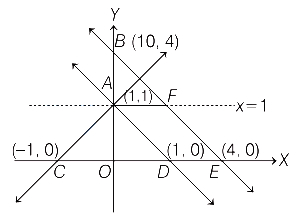
ત્રિકોણ $x+y=4$,$x=0$,અને $y=1$ રેખાઓ દ્વારા બને છે.
ત્રિકોણના શિરોબિંદુઓ છે:
$1$. $x=0$ અને $y=1$ નું છેદબિંદુ $(0, 1)$ છે.
$2$. $x=0$ અને $x+y=4$ નું છેદબિંદુ $(0, 4)$ છે.
$3$. $y=1$ અને $x+y=4$ નું છેદબિંદુ $(3, 1)$ છે.
$x=0$ પર ત્રિકોણનો પાયો $|4-1| = 3$ છે.
$x=0$ થી $x=3$ સુધી ત્રિકોણની ઊંચાઈ $3$ છે.
ક્ષેત્રફળ $= \frac{1}{2} \times \text{પાયો} \times \text{ઊંચાઈ} = \frac{1}{2} \times 3 \times 3 = 4.5$ ચોરસ એકમ.
$x^2 = y^2-2y+1$
$\Rightarrow x^2 = (y-1)^2$
$\Rightarrow x^2 - (y-1)^2 = 0$
$\Rightarrow (x+y-1)(x-y+1) = 0$
તેથી,રેખાઓ $l_1: x+y-1=0$ અને $l_2: x-y+1=0$ છે.
આ રેખાઓના ખૂણાના દ્વિભાજકો $\frac{x+y-1}{\sqrt{1^2+1^2}} = \pm \frac{x-y+1}{\sqrt{1^2+(-1)^2}}$ દ્વારા મળે છે.
$\Rightarrow x+y-1 = \pm(x-y+1)$.
કિસ્સો $1$: $x+y-1 = x-y+1$ $\Rightarrow 2y = 2$ $\Rightarrow y=1$.
કિસ્સો $2$: $x+y-1 = -(x-y+1)$ $\Rightarrow x+y-1 = -x+y-1$ $\Rightarrow 2x = 0$ $\Rightarrow x=0$.
ખૂણાના દ્વિભાજકો $x=0$ ($Y$-અક્ષ) અને $y=1$ રેખાઓ છે.
ત્રિકોણ $x+y=4$,$x=0$,અને $y=1$ રેખાઓ દ્વારા બને છે.
ત્રિકોણના શિરોબિંદુઓ છે:
$1$. $x=0$ અને $y=1$ નું છેદબિંદુ $(0, 1)$ છે.
$2$. $x=0$ અને $x+y=4$ નું છેદબિંદુ $(0, 4)$ છે.
$3$. $y=1$ અને $x+y=4$ નું છેદબિંદુ $(3, 1)$ છે.
$x=0$ પર ત્રિકોણનો પાયો $|4-1| = 3$ છે.
$x=0$ થી $x=3$ સુધી ત્રિકોણની ઊંચાઈ $3$ છે.
ક્ષેત્રફળ $= \frac{1}{2} \times \text{પાયો} \times \text{ઊંચાઈ} = \frac{1}{2} \times 3 \times 3 = 4.5$ ચોરસ એકમ.
0 likesView Solution
223
MathematicsEasyMCQAP EAMCET · 2021
$3 x^2-5 x y+4 y^2=0$ દ્વારા દર્શાવવામાં આવતી રેખાઓ વચ્ચેના ખૂણાના દ્વિભાજકોનું સમીકરણ શું છે?
A
$9 x^2+6 y^2-2 x=0$
B
$5(x^2-y^2)=2 x y$
C
$3 x^2+2 x y-y^2=0$
D
$5 x^2+x y+4 y^2=0$
Solution
(B) આપેલ સમીકરણ $3 x^2-5 x y+4 y^2=0$ છે.
તેને સામાન્ય સ્વરૂપ $a x^2+2 h x y+b y^2=0$ સાથે સરખાવતા,આપણને $a=3$,$2 h=-5$,અને $b=4$ મળે છે.
રેખાઓની જોડી વચ્ચેના ખૂણાના દ્વિભાજકનું સમીકરણ $\frac{x^2-y^2}{a-b} = \frac{x y}{h}$ છે.
કિંમતો મૂકતા,$\frac{x^2-y^2}{3-4} = \frac{x y}{-5/2}$ મળે છે.
આનું સાદું રૂપ $\frac{x^2-y^2}{-1} = \frac{2 x y}{-5}$ થાય છે.
બંને બાજુ $-5$ વડે ગુણતા,આપણને $5(x^2-y^2) = 2 x y$ મળે છે.
તેને સામાન્ય સ્વરૂપ $a x^2+2 h x y+b y^2=0$ સાથે સરખાવતા,આપણને $a=3$,$2 h=-5$,અને $b=4$ મળે છે.
રેખાઓની જોડી વચ્ચેના ખૂણાના દ્વિભાજકનું સમીકરણ $\frac{x^2-y^2}{a-b} = \frac{x y}{h}$ છે.
કિંમતો મૂકતા,$\frac{x^2-y^2}{3-4} = \frac{x y}{-5/2}$ મળે છે.
આનું સાદું રૂપ $\frac{x^2-y^2}{-1} = \frac{2 x y}{-5}$ થાય છે.
બંને બાજુ $-5$ વડે ગુણતા,આપણને $5(x^2-y^2) = 2 x y$ મળે છે.
0 likesView Solution
224
MathematicsEasyMCQAP EAMCET · 2021
જો રેખાઓની જોડી $x^2-2 m x y-y^2=0$ ના દ્વિભાજકો $x^2-2 n x y-y^2=0$ દ્વારા દર્શાવવામાં આવે,તો
A
$mn+1=0$
B
$mn-1=0$
C
$m+n=0$
D
$m-n=0$
Solution
(A) આપેલ સમીકરણ $x^2-2 m x y-y^2=0$ છે.
તેને સામાન્ય સ્વરૂપ $a x^2+2 h x y+b y^2=0$ સાથે સરખાવતા,આપણને $a=1, h=-m, b=-1$ મળે છે.
ખૂણાના દ્વિભાજકોનું સમીકરણ $\frac{x^2-y^2}{a-b} = \frac{x y}{h}$ દ્વારા આપવામાં આવે છે.
કિંમતો મૂકતા,આપણને $\frac{x^2-y^2}{1-(-1)} = \frac{x y}{-m}$ મળે છે.
આનું સાદું રૂપ $\frac{x^2-y^2}{2} = \frac{x y}{-m}$ થાય છે,જેનો અર્થ છે કે $-m(x^2-y^2) = 2 x y$.
પદોને ગોઠવતા,આપણને $m x^2 + 2 x y - m y^2 = 0$ મળે છે.
$m$ વડે ભાગતા ($m \neq 0$ ધારીને),આપણને $x^2 + \frac{2}{m} x y - y^2 = 0$ મળે છે.
આને આપેલ દ્વિભાજક સમીકરણ $x^2-2 n x y-y^2=0$ સાથે સરખાવતા,આપણને $-2n = \frac{2}{m}$ મળે છે.
તેથી,$-n = \frac{1}{m}$,જે $mn = -1$ અથવા $mn+1=0$ આપે છે.
તેને સામાન્ય સ્વરૂપ $a x^2+2 h x y+b y^2=0$ સાથે સરખાવતા,આપણને $a=1, h=-m, b=-1$ મળે છે.
ખૂણાના દ્વિભાજકોનું સમીકરણ $\frac{x^2-y^2}{a-b} = \frac{x y}{h}$ દ્વારા આપવામાં આવે છે.
કિંમતો મૂકતા,આપણને $\frac{x^2-y^2}{1-(-1)} = \frac{x y}{-m}$ મળે છે.
આનું સાદું રૂપ $\frac{x^2-y^2}{2} = \frac{x y}{-m}$ થાય છે,જેનો અર્થ છે કે $-m(x^2-y^2) = 2 x y$.
પદોને ગોઠવતા,આપણને $m x^2 + 2 x y - m y^2 = 0$ મળે છે.
$m$ વડે ભાગતા ($m \neq 0$ ધારીને),આપણને $x^2 + \frac{2}{m} x y - y^2 = 0$ મળે છે.
આને આપેલ દ્વિભાજક સમીકરણ $x^2-2 n x y-y^2=0$ સાથે સરખાવતા,આપણને $-2n = \frac{2}{m}$ મળે છે.
તેથી,$-n = \frac{1}{m}$,જે $mn = -1$ અથવા $mn+1=0$ આપે છે.
0 likesView Solution
225
MathematicsEasyMCQAP EAMCET · 2021
જો $h^2=ab$ હોય,તો $ax^2+2hxy+by^2=0$ દ્વારા દર્શાવતી રેખાઓના ઢાળનો ગુણોત્તર શું હશે?
A
$1:2$
B
$2:1$
C
$2:3$
D
$1:1$
Solution
(D) આપેલ સમીકરણ $ax^2+2hxy+by^2=0$ છે. $x^2$ વડે ભાગતા,આપણને $b(\frac{y}{x})^2+2h(\frac{y}{x})+a=0$ મળે છે. ધારો કે $m = \frac{y}{x}$,તો $bm^2+2hm+a=0$. આ દ્વિઘાત સમીકરણના બીજ એ રેખાઓના ઢાળ $m_1$ અને $m_2$ છે. આપેલ છે કે $h^2=ab$,તેથી વિવેચક $D = (2h)^2 - 4ab = 4h^2 - 4ab = 4(h^2-ab) = 0$. વિવેચક શૂન્ય હોવાથી,બંને બીજ સમાન છે,એટલે કે $m_1 = m_2$. તેથી,ઢાળનો ગુણોત્તર $m_1:m_2 = 1:1$ છે.
0 likesView Solution
226
MathematicsDifficultMCQAP EAMCET · 2021
જો રેખાઓની જોડી $x^2-2 p x y-y^2=0$ અને $x^2-2 q x y-y^2=0$ એવી હોય કે દરેક જોડી બીજી જોડી વચ્ચેના ખૂણાને દુભાગે છે,તો
A
$p q=1$
B
$p q=-1$
C
$p q=2$
D
$p q=-2$
Solution
(B) રેખાઓની જોડી $a x^2+2 h x y+b y^2=0$ વચ્ચેના ખૂણાના દુભાજકોની જોડીનું સમીકરણ $\frac{x^2-y^2}{a-b}=\frac{x y}{h}$ દ્વારા આપવામાં આવે છે.
જોડી $x^2-2 p x y-y^2=0$ માટે,$a=1, b=-1, h=-p$ છે.
દુભાજકોનું સમીકરણ $\frac{x^2-y^2}{1-(-1)}=\frac{x y}{-p}$ છે.
આનું સાદું રૂપ $\frac{x^2-y^2}{2}=\frac{x y}{-p}$ થાય છે,જેનો અર્થ છે કે $-p(x^2-y^2)=2xy$,અથવા $p x^2+2 x y-p y^2=0$.
$p$ વડે ભાગતા,આપણને $x^2+\frac{2}{p} x y-y^2=0$ મળે છે.
આપણને આપેલ છે કે આ જોડી $x^2-2 q x y-y^2=0$ છે.
$xy$ ના સહગુણકોની સરખામણી કરતા,$-2 q = \frac{2}{p}$ મળે છે.
તેથી,$-p q = 1$,જેનો અર્થ છે કે $p q = -1$.
જોડી $x^2-2 p x y-y^2=0$ માટે,$a=1, b=-1, h=-p$ છે.
દુભાજકોનું સમીકરણ $\frac{x^2-y^2}{1-(-1)}=\frac{x y}{-p}$ છે.
આનું સાદું રૂપ $\frac{x^2-y^2}{2}=\frac{x y}{-p}$ થાય છે,જેનો અર્થ છે કે $-p(x^2-y^2)=2xy$,અથવા $p x^2+2 x y-p y^2=0$.
$p$ વડે ભાગતા,આપણને $x^2+\frac{2}{p} x y-y^2=0$ મળે છે.
આપણને આપેલ છે કે આ જોડી $x^2-2 q x y-y^2=0$ છે.
$xy$ ના સહગુણકોની સરખામણી કરતા,$-2 q = \frac{2}{p}$ મળે છે.
તેથી,$-p q = 1$,જેનો અર્થ છે કે $p q = -1$.
0 likesView Solution
227
MathematicsDifficultMCQAP EAMCET · 2021
જો રેખાઓ $2y^2+5xy-3x^2=0$ અને $x+y=k$ દ્વારા બનતા ત્રિકોણનું મધ્યકેન્દ્ર $(\frac{1}{18}, \frac{11}{18})$ હોય,તો '$k$' ની કિંમત $..........$ થાય.
A
$-1$
B
$0$
C
$1$
D
$2$
Solution
(C) આપેલ રેખાઓની જોડી $2y^2+5xy-3x^2=0$ છે,જેને $3x^2-5xy-2y^2=0$ તરીકે લખી શકાય.
દ્વિઘાત સમીકરણના અવયવો પાડતા: $3x^2-6xy+xy-2y^2=0$ $\Rightarrow 3x(x-2y)+y(x-2y)=0$ $\Rightarrow (x-2y)(3x+y)=0$.
આમ,બે રેખાઓ $L_1: x-2y=0$ અને $L_2: 3x+y=0$ છે.
ત્રીજી રેખા $L_3: x+y=k$ છે.
ત્રિકોણના શિરોબિંદુઓ આ રેખાઓના છેદબિંદુઓ છે:
$O(0,0)$ એ $L_1$ અને $L_2$ નું છેદબિંદુ છે.
$L_1$ અને $L_3$ નું છેદબિંદુ: $x-2y=0$ અને $x+y=k$ $\Rightarrow 3y=k$ $\Rightarrow y=\frac{k}{3}, x=\frac{2k}{3}$. તેથી,$A(\frac{2k}{3}, \frac{k}{3})$.
$L_2$ અને $L_3$ નું છેદબિંદુ: $3x+y=0$ અને $x+y=k$ $\Rightarrow 2x=-k$ $\Rightarrow x=-\frac{k}{2}, y=\frac{3k}{2}$. તેથી,$B(-\frac{k}{2}, \frac{3k}{2})$.
$\triangle OAB$ નું મધ્યકેન્દ્ર $(\frac{0+\frac{2k}{3}-\frac{k}{2}}{3}, \frac{0+\frac{k}{3}+\frac{3k}{2}}{3}) = (\frac{\frac{k}{6}}{3}, \frac{\frac{11k}{6}}{3}) = (\frac{k}{18}, \frac{11k}{18})$ છે.
મધ્યકેન્દ્ર $(\frac{1}{18}, \frac{11}{18})$ આપેલ હોવાથી,$\frac{k}{18} = \frac{1}{18}$,જેનો અર્થ છે કે $k=1$.
દ્વિઘાત સમીકરણના અવયવો પાડતા: $3x^2-6xy+xy-2y^2=0$ $\Rightarrow 3x(x-2y)+y(x-2y)=0$ $\Rightarrow (x-2y)(3x+y)=0$.
આમ,બે રેખાઓ $L_1: x-2y=0$ અને $L_2: 3x+y=0$ છે.
ત્રીજી રેખા $L_3: x+y=k$ છે.
ત્રિકોણના શિરોબિંદુઓ આ રેખાઓના છેદબિંદુઓ છે:
$O(0,0)$ એ $L_1$ અને $L_2$ નું છેદબિંદુ છે.
$L_1$ અને $L_3$ નું છેદબિંદુ: $x-2y=0$ અને $x+y=k$ $\Rightarrow 3y=k$ $\Rightarrow y=\frac{k}{3}, x=\frac{2k}{3}$. તેથી,$A(\frac{2k}{3}, \frac{k}{3})$.
$L_2$ અને $L_3$ નું છેદબિંદુ: $3x+y=0$ અને $x+y=k$ $\Rightarrow 2x=-k$ $\Rightarrow x=-\frac{k}{2}, y=\frac{3k}{2}$. તેથી,$B(-\frac{k}{2}, \frac{3k}{2})$.
$\triangle OAB$ નું મધ્યકેન્દ્ર $(\frac{0+\frac{2k}{3}-\frac{k}{2}}{3}, \frac{0+\frac{k}{3}+\frac{3k}{2}}{3}) = (\frac{\frac{k}{6}}{3}, \frac{\frac{11k}{6}}{3}) = (\frac{k}{18}, \frac{11k}{18})$ છે.
મધ્યકેન્દ્ર $(\frac{1}{18}, \frac{11}{18})$ આપેલ હોવાથી,$\frac{k}{18} = \frac{1}{18}$,જેનો અર્થ છે કે $k=1$.
0 likesView Solution
228
MathematicsMediumMCQAP EAMCET · 2021
સમીકરણ $8 x^2-24 x y+18 y^2-6 x+9 y-5=0$ એ શું દર્શાવે છે?
A
પરસ્પર લંબ રેખાઓની જોડી
B
સમાંતર રેખાઓની જોડી
C
સંપાતી રેખાઓની જોડી
D
પરવલય
Solution
(B) આપેલ સમીકરણ $8 x^2-24 x y+18 y^2-6 x+9 y-5=0$ છે.
આપણે દ્વિઘાત ભાગને $(2 \sqrt{2} x - 3 \sqrt{2} y)^2 = 2(4 x^2 - 12 x y + 9 y^2) = 2(2 x - 3 y)^2$ તરીકે લખી શકીએ.
ધારો કે $2 x - 3 y = t$. તો સમીકરણ $2 t^2 - 3 t - 5 = 0$ બને છે.
અવયવ પાડતા: $2 t^2 - 5 t + 2 t - 5 = 0 \implies t(2 t - 5) + 1(2 t - 5) = 0 \implies (t + 1)(2 t - 5) = 0$.
$t = 2 x - 3 y$ પાછું મૂકતા,આપણને $(2 x - 3 y + 1)(2(2 x - 3 y) - 5) = 0$ મળે છે.
આનું સાદું રૂપ $(2 x - 3 y + 1)(4 x - 6 y - 5) = 0$ થાય છે.
આ સમીકરણ બે રેખાઓ દર્શાવે છે અને તેમના ઢાળ $m_1 = \frac{2}{3}$ અને $m_2 = \frac{4}{6} = \frac{2}{3}$ સમાન હોવાથી,આ રેખાઓ સમાંતર છે.
આપણે દ્વિઘાત ભાગને $(2 \sqrt{2} x - 3 \sqrt{2} y)^2 = 2(4 x^2 - 12 x y + 9 y^2) = 2(2 x - 3 y)^2$ તરીકે લખી શકીએ.
ધારો કે $2 x - 3 y = t$. તો સમીકરણ $2 t^2 - 3 t - 5 = 0$ બને છે.
અવયવ પાડતા: $2 t^2 - 5 t + 2 t - 5 = 0 \implies t(2 t - 5) + 1(2 t - 5) = 0 \implies (t + 1)(2 t - 5) = 0$.
$t = 2 x - 3 y$ પાછું મૂકતા,આપણને $(2 x - 3 y + 1)(2(2 x - 3 y) - 5) = 0$ મળે છે.
આનું સાદું રૂપ $(2 x - 3 y + 1)(4 x - 6 y - 5) = 0$ થાય છે.
આ સમીકરણ બે રેખાઓ દર્શાવે છે અને તેમના ઢાળ $m_1 = \frac{2}{3}$ અને $m_2 = \frac{4}{6} = \frac{2}{3}$ સમાન હોવાથી,આ રેખાઓ સમાંતર છે.
0 likesView Solution
229
MathematicsMediumMCQAP EAMCET · 2021
જો $ax^2+2hxy+by^2=0$ દ્વારા દર્શાવતી રેખાઓમાંથી એક $(2,3)$ માંથી અને બીજી $(4,5)$ માંથી પસાર થાય,તો $a+2h+b$ ની કિંમત શોધો.
A
$0$
B
$1$
C
$2$
D
$-1$
Solution
(B) સમીકરણ $ax^2+2hxy+by^2=0$ એ ઉગમબિંદુ $(0,0)$ માંથી પસાર થતી બે રેખાઓની જોડી દર્શાવે છે.
રેખા $1$ એ $(0,0)$ અને $(2,3)$ માંથી પસાર થાય છે. તેનું સમીકરણ $y = \frac{3}{2}x \Rightarrow 3x - 2y = 0$ છે.
રેખા $2$ એ $(0,0)$ અને $(4,5)$ માંથી પસાર થાય છે. તેનું સમીકરણ $y = \frac{5}{4}x \Rightarrow 5x - 4y = 0$ છે.
તેથી સંયુક્ત સમીકરણ $(3x - 2y)(5x - 4y) = 0$ થાય.
વિસ્તરણ કરતા,$15x^2 - 22xy + 8y^2 = 0$ મળે.
સરખામણી કરતા,$a = 15$,$2h = -22$ અને $b = 8$ મળે.
તેથી,$a + 2h + b = 15 - 22 + 8 = 1$.
રેખા $1$ એ $(0,0)$ અને $(2,3)$ માંથી પસાર થાય છે. તેનું સમીકરણ $y = \frac{3}{2}x \Rightarrow 3x - 2y = 0$ છે.
રેખા $2$ એ $(0,0)$ અને $(4,5)$ માંથી પસાર થાય છે. તેનું સમીકરણ $y = \frac{5}{4}x \Rightarrow 5x - 4y = 0$ છે.
તેથી સંયુક્ત સમીકરણ $(3x - 2y)(5x - 4y) = 0$ થાય.
વિસ્તરણ કરતા,$15x^2 - 22xy + 8y^2 = 0$ મળે.
સરખામણી કરતા,$a = 15$,$2h = -22$ અને $b = 8$ મળે.
તેથી,$a + 2h + b = 15 - 22 + 8 = 1$.
0 likesView Solution
230
MathematicsEasyMCQAP EAMCET · 2021
$2x^2 + 4xy - 4y^2 - 6x - 8y + 7 = 0$ રેખાઓની જોડી દ્વારા $Y$-અક્ષ પર કાપવામાં આવતા અંતઃખંડની લંબાઈ શોધો.
A
$\sqrt{12}$
B
$\sqrt{10}$
C
$\sqrt{11}$
D
$\sqrt{13}$
Solution
(C) આપેલ રેખાઓની જોડીનું સમીકરણ: $2x^2 + 4xy - 4y^2 - 6x - 8y + 7 = 0$.
$Y$-અક્ષ પરના અંતઃખંડની લંબાઈ શોધવા માટે $x = 0$ મૂકો.
સમીકરણમાં $x = 0$ મૂકતા: $-4y^2 - 8y + 7 = 0$,જેનું સાદું રૂપ $4y^2 + 8y - 7 = 0$ થાય છે.
દ્વિઘાત સૂત્ર $y = \frac{-b \pm \sqrt{b^2 - 4ac}}{2a}$ નો ઉપયોગ કરતા,$y = \frac{-8 \pm \sqrt{64 - 4(4)(-7)}}{8} = \frac{-8 \pm \sqrt{176}}{8} = -1 \pm \frac{\sqrt{11}}{2}$.
અંતઃખંડની લંબાઈ એ બે ઉકેલો $y_1$ અને $y_2$ વચ્ચેનો તફાવત છે: $|y_1 - y_2| = |(-1 + \frac{\sqrt{11}}{2}) - (-1 - \frac{\sqrt{11}}{2})| = \sqrt{11}$.
$Y$-અક્ષ પરના અંતઃખંડની લંબાઈ શોધવા માટે $x = 0$ મૂકો.
સમીકરણમાં $x = 0$ મૂકતા: $-4y^2 - 8y + 7 = 0$,જેનું સાદું રૂપ $4y^2 + 8y - 7 = 0$ થાય છે.
દ્વિઘાત સૂત્ર $y = \frac{-b \pm \sqrt{b^2 - 4ac}}{2a}$ નો ઉપયોગ કરતા,$y = \frac{-8 \pm \sqrt{64 - 4(4)(-7)}}{8} = \frac{-8 \pm \sqrt{176}}{8} = -1 \pm \frac{\sqrt{11}}{2}$.
અંતઃખંડની લંબાઈ એ બે ઉકેલો $y_1$ અને $y_2$ વચ્ચેનો તફાવત છે: $|y_1 - y_2| = |(-1 + \frac{\sqrt{11}}{2}) - (-1 - \frac{\sqrt{11}}{2})| = \sqrt{11}$.
0 likesView Solution
231
MathematicsMediumMCQAP EAMCET · 2021
$k$ ની કિંમત(ઓ) શોધો જેથી $(x-2y)^2 + k(x-2y) = 0$ દ્વારા દર્શાવતી બે સમાંતર રેખાઓ વચ્ચેનું અંતર $3$ એકમ થાય.
A
$0$
B
$\pm 3\sqrt{5}$
C
$\pm 5$
D
$\pm 3$
Solution
(B) આપેલ સમીકરણ $(x-2y)^2 + k(x-2y) = 0$ છે.
સમીકરણના અવયવ પાડતા,$(x-2y)(x-2y+k) = 0$ મળે.
આ બે સમાંતર રેખાઓ દર્શાવે છે: $L_1: x-2y = 0$ અને $L_2: x-2y+k = 0$.
બે સમાંતર રેખાઓ $Ax+By+C_1=0$ અને $Ax+By+C_2=0$ વચ્ચેનું અંતર $d = \frac{|C_1-C_2|}{\sqrt{A^2+B^2}}$ દ્વારા મળે છે.
અહીં,$A=1, B=-2, C_1=0, C_2=k$ છે.
તેથી,$d = \frac{|k-0|}{\sqrt{1^2+(-2)^2}} = \frac{|k|}{\sqrt{5}}$.
આપેલ છે કે $d = 3$,તેથી $\frac{|k|}{\sqrt{5}} = 3$.
આમ,$|k| = 3\sqrt{5}$,જેનો અર્થ છે કે $k = \pm 3\sqrt{5}$.
સમીકરણના અવયવ પાડતા,$(x-2y)(x-2y+k) = 0$ મળે.
આ બે સમાંતર રેખાઓ દર્શાવે છે: $L_1: x-2y = 0$ અને $L_2: x-2y+k = 0$.
બે સમાંતર રેખાઓ $Ax+By+C_1=0$ અને $Ax+By+C_2=0$ વચ્ચેનું અંતર $d = \frac{|C_1-C_2|}{\sqrt{A^2+B^2}}$ દ્વારા મળે છે.
અહીં,$A=1, B=-2, C_1=0, C_2=k$ છે.
તેથી,$d = \frac{|k-0|}{\sqrt{1^2+(-2)^2}} = \frac{|k|}{\sqrt{5}}$.
આપેલ છે કે $d = 3$,તેથી $\frac{|k|}{\sqrt{5}} = 3$.
આમ,$|k| = 3\sqrt{5}$,જેનો અર્થ છે કે $k = \pm 3\sqrt{5}$.
0 likesView Solution
232
MathematicsEasyMCQAP EAMCET · 2021
$p$ ની કઈ કિંમત માટે સમીકરણ $x^2+pxy+y^2-5x-7y+6=0$ એ રેખાયુગ્મ દર્શાવે છે?
A
$\frac{5}{2}$
B
$5$
C
$2$
D
$\frac{2}{5}$
Solution
(A) દ્વિઘાત સમીકરણ $ax^2+2hxy+by^2+2gx+2fy+c=0$ રેખાયુગ્મ દર્શાવે જો $\Delta = abc+2fgh-af^2-bg^2-ch^2 = 0$ થાય.
આપેલ સમીકરણ $x^2+pxy+y^2-5x-7y+6=0$ ને સરખાવતા:
$a=1, b=1, c=6, h=\frac{p}{2}, g=-\frac{5}{2}, f=-\frac{7}{2}$.
શરત $\Delta=0$ માં કિંમતો મૂકતા:
$(1)(1)(6) + 2(-\frac{7}{2})(-\frac{5}{2})(\frac{p}{2}) - 1(-\frac{7}{2})^2 - 1(-\frac{5}{2})^2 - 6(\frac{p}{2})^2 = 0$
$6 + \frac{35p}{4} - \frac{49}{4} - \frac{25}{4} - \frac{6p^2}{4} = 0$
$4$ વડે ગુણતા:
$24 + 35p - 49 - 25 - 6p^2 = 0$
$-6p^2 + 35p - 50 = 0$
$6p^2 - 35p + 50 = 0$
$(2p-5)(3p-10) = 0$
આમ,$p = \frac{5}{2}$ અથવા $p = \frac{10}{3}$.
આપેલ વિકલ્પો મુજબ,સાચો જવાબ $\frac{5}{2}$ છે.
આપેલ સમીકરણ $x^2+pxy+y^2-5x-7y+6=0$ ને સરખાવતા:
$a=1, b=1, c=6, h=\frac{p}{2}, g=-\frac{5}{2}, f=-\frac{7}{2}$.
શરત $\Delta=0$ માં કિંમતો મૂકતા:
$(1)(1)(6) + 2(-\frac{7}{2})(-\frac{5}{2})(\frac{p}{2}) - 1(-\frac{7}{2})^2 - 1(-\frac{5}{2})^2 - 6(\frac{p}{2})^2 = 0$
$6 + \frac{35p}{4} - \frac{49}{4} - \frac{25}{4} - \frac{6p^2}{4} = 0$
$4$ વડે ગુણતા:
$24 + 35p - 49 - 25 - 6p^2 = 0$
$-6p^2 + 35p - 50 = 0$
$6p^2 - 35p + 50 = 0$
$(2p-5)(3p-10) = 0$
આમ,$p = \frac{5}{2}$ અથવા $p = \frac{10}{3}$.
આપેલ વિકલ્પો મુજબ,સાચો જવાબ $\frac{5}{2}$ છે.
0 likesView Solution
233
MathematicsEasyMCQAP EAMCET · 2021
$p$ ની કઈ કિંમત માટે સમીકરણ $x^2+pxy+y^2-5x-7y+6=0$ એ બે રેખાઓની જોડી દર્શાવે છે?
A
$\frac{5}{2}$
B
$5$
C
$2$
D
$\frac{10}{3}$
Solution
(A) દ્વિઘાત સમીકરણ $ax^2+2hxy+by^2+2gx+2fy+c=0$ એ બે રેખાઓની જોડી દર્શાવે છે જો નિશ્ચાયક $\Delta = abc+2fgh-af^2-bg^2-ch^2 = 0$ થાય.
આપેલ સમીકરણ $x^2+pxy+y^2-5x-7y+6=0$ ને સામાન્ય સ્વરૂપ સાથે સરખાવતા:
$a=1, b=1, c=6, h=\frac{p}{2}, g=-\frac{5}{2}, f=-\frac{7}{2}$.
શરત $\Delta = 0$ માં આ કિંમતો મૂકતા:
$(1)(1)(6) + 2(-\frac{7}{2})(-\frac{5}{2})(\frac{p}{2}) - (1)(-\frac{7}{2})^2 - (1)(-\frac{5}{2})^2 - (6)(\frac{p}{2})^2 = 0$.
$6 + \frac{35p}{4} - \frac{49}{4} - \frac{25}{4} - \frac{6p^2}{4} = 0$.
$4$ વડે ગુણતા:
$24 + 35p - 49 - 25 - 6p^2 = 0$.
$-6p^2 + 35p - 50 = 0$.
$6p^2 - 35p + 50 = 0$.
$(2p-5)(3p-10) = 0$.
આમ,$p = \frac{5}{2}$ અથવા $p = \frac{10}{3}$.
આપેલ સમીકરણ $x^2+pxy+y^2-5x-7y+6=0$ ને સામાન્ય સ્વરૂપ સાથે સરખાવતા:
$a=1, b=1, c=6, h=\frac{p}{2}, g=-\frac{5}{2}, f=-\frac{7}{2}$.
શરત $\Delta = 0$ માં આ કિંમતો મૂકતા:
$(1)(1)(6) + 2(-\frac{7}{2})(-\frac{5}{2})(\frac{p}{2}) - (1)(-\frac{7}{2})^2 - (1)(-\frac{5}{2})^2 - (6)(\frac{p}{2})^2 = 0$.
$6 + \frac{35p}{4} - \frac{49}{4} - \frac{25}{4} - \frac{6p^2}{4} = 0$.
$4$ વડે ગુણતા:
$24 + 35p - 49 - 25 - 6p^2 = 0$.
$-6p^2 + 35p - 50 = 0$.
$6p^2 - 35p + 50 = 0$.
$(2p-5)(3p-10) = 0$.
આમ,$p = \frac{5}{2}$ અથવા $p = \frac{10}{3}$.
0 likesView Solution
234
MathematicsEasyMCQAP EAMCET · 2021
જો $2x^2 - pxy + 2y^2 = 0$ સમીકરણ દ્વારા દર્શાવતી રેખાઓ વાસ્તવિક હોય,તો '$p$' ની કિંમત કયા અંતરાલમાં હશે?
A
$(-\infty, -4] \cup [4, \infty)$
B
$[-4, 4]$
C
$(-4, 4)$
D
$(-\infty, -4) \cup (4, \infty)$
Solution
(A) ઉગમબિંદુમાંથી પસાર થતી રેખાઓની જોડીનું સામાન્ય સમીકરણ $ax^2 + 2hxy + by^2 = 0$ છે.
આ રેખાઓ વાસ્તવિક હોવા માટેની શરત $h^2 - ab \geq 0$ છે.
$2x^2 - pxy + 2y^2 = 0$ ની સરખામણી સામાન્ય સમીકરણ સાથે કરતા,$a = 2$,$2h = -p$ (તેથી $h = -p/2$),અને $b = 2$ મળે છે.
આ કિંમતોને શરતમાં મૂકતા:
$(-p/2)^2 - (2)(2) \geq 0$
$\frac{p^2}{4} - 4 \geq 0$
$p^2 - 16 \geq 0$
$(p - 4)(p + 4) \geq 0$
આ અસમતા ત્યારે જ સાચી ઠરે છે જ્યારે $p \leq -4$ અથવા $p \geq 4$ હોય.
તેથી,$p \in (-\infty, -4] \cup [4, \infty)$.
આ રેખાઓ વાસ્તવિક હોવા માટેની શરત $h^2 - ab \geq 0$ છે.
$2x^2 - pxy + 2y^2 = 0$ ની સરખામણી સામાન્ય સમીકરણ સાથે કરતા,$a = 2$,$2h = -p$ (તેથી $h = -p/2$),અને $b = 2$ મળે છે.
આ કિંમતોને શરતમાં મૂકતા:
$(-p/2)^2 - (2)(2) \geq 0$
$\frac{p^2}{4} - 4 \geq 0$
$p^2 - 16 \geq 0$
$(p - 4)(p + 4) \geq 0$
આ અસમતા ત્યારે જ સાચી ઠરે છે જ્યારે $p \leq -4$ અથવા $p \geq 4$ હોય.
તેથી,$p \in (-\infty, -4] \cup [4, \infty)$.
0 likesView Solution
235
MathematicsDifficultMCQAP EAMCET · 2021
જો વક્ર $2x^2 - 2xy + 3y^2 + 2x - y - 1 = 0$ અને રેખા $x + 2y = k$ ના છેદબિંદુઓને ઉગમબિંદુ સાથે જોડતી રેખાઓ કાટખૂણે હોય,તો $k^2$ ની કિંમત શોધો.
A
$4$
B
$3$
C
$2$
D
$1$
Solution
(D) આપેલ વક્ર $2x^2 - 2xy + 3y^2 + 2x - y - 1 = 0$ છે.
રેખા $x + 2y = k$ છે,જેનો અર્થ છે કે $\frac{x + 2y}{k} = 1$.
રેખાના સમીકરણનો ઉપયોગ કરીને વક્રના સમીકરણને સમઘાત બનાવતા:
$2x^2 - 2xy + 3y^2 + (2x - y)(1) - 1(1)^2 = 0$.
$1 = \frac{x + 2y}{k}$ મૂકતા:
$2x^2 - 2xy + 3y^2 + (2x - y)\left(\frac{x + 2y}{k}\right) - \left(\frac{x + 2y}{k}\right)^2 = 0$.
$k^2$ વડે ગુણતા:
$k^2(2x^2 - 2xy + 3y^2) + k(2x^2 + 4xy - xy - 2y^2) - (x^2 + 4xy + 4y^2) = 0$.
$x^2(2k^2 + 2k - 1) + xy(-2k^2 + 3k - 4) + y^2(3k^2 - 2k - 4) = 0$.
રેખાઓ કાટખૂણે હોવાથી,$x^2$ અને $y^2$ ના સહગુણકોનો સરવાળો શૂન્ય થાય:
$(2k^2 + 2k - 1) + (3k^2 - 2k - 4) = 0$.
$5k^2 - 5 = 0$.
$5k^2 = 5 \implies k^2 = 1$.
રેખા $x + 2y = k$ છે,જેનો અર્થ છે કે $\frac{x + 2y}{k} = 1$.
રેખાના સમીકરણનો ઉપયોગ કરીને વક્રના સમીકરણને સમઘાત બનાવતા:
$2x^2 - 2xy + 3y^2 + (2x - y)(1) - 1(1)^2 = 0$.
$1 = \frac{x + 2y}{k}$ મૂકતા:
$2x^2 - 2xy + 3y^2 + (2x - y)\left(\frac{x + 2y}{k}\right) - \left(\frac{x + 2y}{k}\right)^2 = 0$.
$k^2$ વડે ગુણતા:
$k^2(2x^2 - 2xy + 3y^2) + k(2x^2 + 4xy - xy - 2y^2) - (x^2 + 4xy + 4y^2) = 0$.
$x^2(2k^2 + 2k - 1) + xy(-2k^2 + 3k - 4) + y^2(3k^2 - 2k - 4) = 0$.
રેખાઓ કાટખૂણે હોવાથી,$x^2$ અને $y^2$ ના સહગુણકોનો સરવાળો શૂન્ય થાય:
$(2k^2 + 2k - 1) + (3k^2 - 2k - 4) = 0$.
$5k^2 - 5 = 0$.
$5k^2 = 5 \implies k^2 = 1$.
0 likesView Solution
236
MathematicsMediumMCQAP EAMCET · 2021
જો સમીકરણ $2x^2 + kxy - 6y^2 + 3x + y + 1 = 0$ $(k > 0)$ એ રેખાઓની જોડી દર્શાવતું હોય,તો તેમનું છેદબિંદુ શોધો.
A
$\left(\frac{5}{8}, \frac{1}{8}\right)$
B
$\left(\frac{5}{8}, -\frac{1}{8}\right)$
C
$\left(-\frac{5}{8}, -\frac{1}{8}\right)$
D
$\left(-\frac{5}{8}, \frac{1}{8}\right)$
Solution
(C) સમીકરણ $2x^2 + 4xy - 6y^2 + 3x + y + 1 = 0$ માટે,અવયવ પાડતા $(2x - 2y + 1)(x + 3y + 1) = 0$ મળે છે.
બંને રેખાઓ $2x - 2y + 1 = 0$ અને $x + 3y + 1 = 0$ ને ઉકેલતા,છેદબિંદુ $\left(-\frac{5}{8}, -\frac{1}{8}\right)$ મળે છે.
બંને રેખાઓ $2x - 2y + 1 = 0$ અને $x + 3y + 1 = 0$ ને ઉકેલતા,છેદબિંદુ $\left(-\frac{5}{8}, -\frac{1}{8}\right)$ મળે છે.
0 likesView Solution
237
MathematicsMediumMCQAP EAMCET · 2021
જો રેખાઓ $x^2+2xy-35y^2-4x+44y-12=0$ અને $5x+ky-8=0$ સંગામી હોય,તો $k$ ની કિંમત શોધો.
A
$4$
B
$3$
C
$2$
D
$1$
Solution
(C) આપેલ રેખાઓની જોડી $x^2+2xy-35y^2-4x+44y-12=0$ છે. તેને $ax^2+2hxy+by^2+2gx+2fy+c=0$ સાથે સરખાવતા,$a=1, h=1, b=-35, g=-2, f=22, c=-12$ મળે છે.
રેખાઓની જોડીનું છેદબિંદુ $(x, y)$ સૂત્ર $\left(\frac{hf-bg}{ab-h^2}, \frac{gh-af}{ab-h^2}\right)$ દ્વારા મળે છે.
કિંમતો મૂકતા: $x = \frac{(1)(22)-(-35)(-2)}{(1)(-35)-(1)^2} = \frac{22-70}{-36} = \frac{-48}{-36} = \frac{4}{3}$.
$y = \frac{(-2)(1)-(1)(22)}{(1)(-35)-(1)^2} = \frac{-2-22}{-36} = \frac{-24}{-36} = \frac{2}{3}$.
છેદબિંદુ $(\frac{4}{3}, \frac{2}{3})$ છે.
રેખાઓ સંગામી હોવાથી,આ બિંદુ $5x+ky-8=0$ નું સમાધાન કરશે.
$5(\frac{4}{3}) + k(\frac{2}{3}) - 8 = 0$.
$\frac{20}{3} + \frac{2k}{3} = 8$.
$20 + 2k = 24$.
$2k = 4 \Rightarrow k = 2$.
રેખાઓની જોડીનું છેદબિંદુ $(x, y)$ સૂત્ર $\left(\frac{hf-bg}{ab-h^2}, \frac{gh-af}{ab-h^2}\right)$ દ્વારા મળે છે.
કિંમતો મૂકતા: $x = \frac{(1)(22)-(-35)(-2)}{(1)(-35)-(1)^2} = \frac{22-70}{-36} = \frac{-48}{-36} = \frac{4}{3}$.
$y = \frac{(-2)(1)-(1)(22)}{(1)(-35)-(1)^2} = \frac{-2-22}{-36} = \frac{-24}{-36} = \frac{2}{3}$.
છેદબિંદુ $(\frac{4}{3}, \frac{2}{3})$ છે.
રેખાઓ સંગામી હોવાથી,આ બિંદુ $5x+ky-8=0$ નું સમાધાન કરશે.
$5(\frac{4}{3}) + k(\frac{2}{3}) - 8 = 0$.
$\frac{20}{3} + \frac{2k}{3} = 8$.
$20 + 2k = 24$.
$2k = 4 \Rightarrow k = 2$.
0 likesView Solution
238
MathematicsDifficultMCQAP EAMCET · 2021
જો રેખાઓ $x^2+2xy-35y^2-4x+44y-12=0$ અને $5x+\lambda y-8=0$ સંગામી હોય,તો $\lambda$ ની કિંમત શોધો.
A
$0$
B
$1$
C
$-1$
D
$2$
Solution
(D) આપેલ રેખાઓની જોડીનું સમીકરણ $x^2+2xy-35y^2-4x+44y-12=0$ છે.
સામાન્ય સ્વરૂપ $ax^2+2hxy+by^2+2gx+2fy+c=0$ સાથે સરખાવતા,$a=1, h=1, b=-35, g=-2, f=22, c=-12$ મળે છે.
રેખાઓની જોડીનું છેદબિંદુ $(x_0, y_0)$ નીચેના સૂત્ર દ્વારા મળે છે:
$x_0 = \frac{hf-bg}{ab-h^2} = \frac{(1)(22)-(-35)(-2)}{(1)(-35)-(1)^2} = \frac{22-70}{-36} = \frac{-48}{-36} = \frac{4}{3}$.
$y_0 = \frac{gh-af}{ab-h^2} = \frac{(-2)(1)-(1)(22)}{(1)(-35)-(1)^2} = \frac{-2-22}{-36} = \frac{-24}{-36} = \frac{2}{3}$.
રેખાઓ સંગામી હોવાથી,બિંદુ $(\frac{4}{3}, \frac{2}{3})$ એ રેખા $5x+\lambda y-8=0$ પર હોવું જોઈએ.
$5(\frac{4}{3}) + \lambda(\frac{2}{3}) - 8 = 0$.
$\frac{20}{3} + \frac{2\lambda}{3} - 8 = 0$.
$3$ વડે ગુણતા: $20 + 2\lambda - 24 = 0$.
$2\lambda - 4 = 0$.
$2\lambda = 4$.
$\lambda = 2$.
સામાન્ય સ્વરૂપ $ax^2+2hxy+by^2+2gx+2fy+c=0$ સાથે સરખાવતા,$a=1, h=1, b=-35, g=-2, f=22, c=-12$ મળે છે.
રેખાઓની જોડીનું છેદબિંદુ $(x_0, y_0)$ નીચેના સૂત્ર દ્વારા મળે છે:
$x_0 = \frac{hf-bg}{ab-h^2} = \frac{(1)(22)-(-35)(-2)}{(1)(-35)-(1)^2} = \frac{22-70}{-36} = \frac{-48}{-36} = \frac{4}{3}$.
$y_0 = \frac{gh-af}{ab-h^2} = \frac{(-2)(1)-(1)(22)}{(1)(-35)-(1)^2} = \frac{-2-22}{-36} = \frac{-24}{-36} = \frac{2}{3}$.
રેખાઓ સંગામી હોવાથી,બિંદુ $(\frac{4}{3}, \frac{2}{3})$ એ રેખા $5x+\lambda y-8=0$ પર હોવું જોઈએ.
$5(\frac{4}{3}) + \lambda(\frac{2}{3}) - 8 = 0$.
$\frac{20}{3} + \frac{2\lambda}{3} - 8 = 0$.
$3$ વડે ગુણતા: $20 + 2\lambda - 24 = 0$.
$2\lambda - 4 = 0$.
$2\lambda = 4$.
$\lambda = 2$.
0 likesView Solution
239
MathematicsMediumMCQAP EAMCET · 2021
$2 x^2+3 x y+2 y^2+10 x+5 y=0$ રેખાયુગ્મને લંબ અને ઉગમબિંદુમાંથી પસાર થતી રેખાયુગ્મનું સમીકરણ $..........$ છે.
A
$2 x^2+5 x y+2 y^2=0$
B
$2 x^2-3 x y+2 y^2=0$
C
$2 x^2+3 x y+y^2=0$
D
$2 x^2-5 x y+2 y^2=0$
Solution
(B) આપેલ રેખાયુગ્મનું સમીકરણ $2 x^2+3 x y+2 y^2+10 x+5 y=0$ છે.
તે $a x^2+2 h x y+b y^2+2 g x+2 f y+c=0$ ના સ્વરૂપમાં છે.
અહીં $a=2$,$2h=3$ (તેથી $h=\frac{3}{2}$),અને $b=2$ છે.
ઉગમબિંદુમાંથી પસાર થતી અને આપેલ રેખાયુગ્મને લંબ રેખાયુગ્મનું સમીકરણ $b x^2-2 h x y+a y^2=0$ છે.
કિંમતો મૂકતા,આપણને $2 x^2-3 x y+2 y^2=0$ મળે છે.
તે $a x^2+2 h x y+b y^2+2 g x+2 f y+c=0$ ના સ્વરૂપમાં છે.
અહીં $a=2$,$2h=3$ (તેથી $h=\frac{3}{2}$),અને $b=2$ છે.
ઉગમબિંદુમાંથી પસાર થતી અને આપેલ રેખાયુગ્મને લંબ રેખાયુગ્મનું સમીકરણ $b x^2-2 h x y+a y^2=0$ છે.
કિંમતો મૂકતા,આપણને $2 x^2-3 x y+2 y^2=0$ મળે છે.
0 likesView Solution
240
MathematicsMediumMCQAP EAMCET · 2021
નીચેનામાંથી કયું સમીકરણ બિંદુ $(1, 0)$ માંથી પસાર થતી અને $2x^2 - xy - y^2 = 0$ દ્વારા દર્શાવતી રેખાઓને સમાંતર હોય તેવી રેખાઓની જોડીનું સંયુક્ત સમીકરણ દર્શાવે છે?
A
$2x^2 - xy - y^2 - 4x + y + 2 = 0$
B
$2x^2 - xy - y^2 - 4x - y + 2 = 0$
C
$2x^2 - xy - 2y^2 - 4x + y + 2 = 0$
D
$2x^2 - xy - y^2 - 4x - y = 2$
Solution
(A) આપેલ સમીકરણ $2x^2 - xy - y^2 = 0$ છે.
દ્વિઘાત પદાવલિના અવયવ પાડતા:
$2x^2 - 2xy + xy - y^2 = 0$
$2x(x - y) + y(x - y) = 0$
$(2x + y)(x - y) = 0$.
રેખાઓ $2x + y = 0$ અને $x - y = 0$ ને સમાંતર છે.
ધારો કે જરૂરી રેખાઓ $(2x + y + k_1) = 0$ અને $(x - y + k_2) = 0$ છે.
આ રેખાઓ $(1, 0)$ માંથી પસાર થતી હોવાથી,આપણે બિંદુ મૂકીએ:
પ્રથમ રેખા માટે: $2(1) + 0 + k_1 = 0 \Rightarrow k_1 = -2$.
બીજી રેખા માટે: $1 - 0 + k_2 = 0 \Rightarrow k_2 = -1$.
સંયુક્ત સમીકરણ $(2x + y - 2)(x - y - 1) = 0$ છે.
ગુણાકારનું વિસ્તરણ કરતા:
$2x^2 - xy - y^2 - 4x + y + 2 = 0$.
દ્વિઘાત પદાવલિના અવયવ પાડતા:
$2x^2 - 2xy + xy - y^2 = 0$
$2x(x - y) + y(x - y) = 0$
$(2x + y)(x - y) = 0$.
રેખાઓ $2x + y = 0$ અને $x - y = 0$ ને સમાંતર છે.
ધારો કે જરૂરી રેખાઓ $(2x + y + k_1) = 0$ અને $(x - y + k_2) = 0$ છે.
આ રેખાઓ $(1, 0)$ માંથી પસાર થતી હોવાથી,આપણે બિંદુ મૂકીએ:
પ્રથમ રેખા માટે: $2(1) + 0 + k_1 = 0 \Rightarrow k_1 = -2$.
બીજી રેખા માટે: $1 - 0 + k_2 = 0 \Rightarrow k_2 = -1$.
સંયુક્ત સમીકરણ $(2x + y - 2)(x - y - 1) = 0$ છે.
ગુણાકારનું વિસ્તરણ કરતા:
$2x^2 - xy - y^2 - 4x + y + 2 = 0$.
0 likesView Solution
241
MathematicsEasyMCQAP EAMCET · 2021
$(1, -2)$ માંથી પસાર થતા અને $x$-અક્ષને $(3, 0)$ બિંદુએ સ્પર્શતા વર્તુળનું સમીકરણ શોધો.
A
$x^2+y^2+6x-4y-9=0$
B
$x^2+y^2-6x-4y+9=0$
C
$x^2+y^2-6x-4y-9=0$
D
$x^2+y^2-6x+4y+9=0$
Solution
(D) ધારો કે વર્તુળનું સમીકરણ $(x-h)^2 + (y-k)^2 = r^2$ છે. \\
વર્તુળ $x$-અક્ષને $(3, 0)$ પર સ્પર્શે છે,તેથી કેન્દ્ર $(h, k)$ છે અને ત્રિજ્યા $r = |k|$ છે. \\
તેથી સમીકરણ $(x-h)^2 + (y-k)^2 = k^2$ બને છે. \\
તે $(3, 0)$ માંથી પસાર થાય છે,તેથી $(3-h)^2 + (0-k)^2 = k^2$ $\Rightarrow (3-h)^2 = 0$ $\Rightarrow h = 3$. \\
તે $(1, -2)$ માંથી પણ પસાર થાય છે,તેથી $h=3$ મૂકતા: $(1-3)^2 + (-2-k)^2 = k^2$. \\
$(-2)^2 + 4 + 4k + k^2 = k^2$ \\
$4 + 4 + 4k = 0$ $\Rightarrow 4k = -8$ $\Rightarrow k = -2$. \\
$h=3$ અને $k=-2$ ને $(x-h)^2 + (y-k)^2 = k^2$ માં મૂકતા: \\
$(x-3)^2 + (y+2)^2 = (-2)^2$ \\
$x^2 - 6x + 9 + y^2 + 4y + 4 = 4$ \\
$x^2 + y^2 - 6x + 4y + 9 = 0$.
વર્તુળ $x$-અક્ષને $(3, 0)$ પર સ્પર્શે છે,તેથી કેન્દ્ર $(h, k)$ છે અને ત્રિજ્યા $r = |k|$ છે. \\
તેથી સમીકરણ $(x-h)^2 + (y-k)^2 = k^2$ બને છે. \\
તે $(3, 0)$ માંથી પસાર થાય છે,તેથી $(3-h)^2 + (0-k)^2 = k^2$ $\Rightarrow (3-h)^2 = 0$ $\Rightarrow h = 3$. \\
તે $(1, -2)$ માંથી પણ પસાર થાય છે,તેથી $h=3$ મૂકતા: $(1-3)^2 + (-2-k)^2 = k^2$. \\
$(-2)^2 + 4 + 4k + k^2 = k^2$ \\
$4 + 4 + 4k = 0$ $\Rightarrow 4k = -8$ $\Rightarrow k = -2$. \\
$h=3$ અને $k=-2$ ને $(x-h)^2 + (y-k)^2 = k^2$ માં મૂકતા: \\
$(x-3)^2 + (y+2)^2 = (-2)^2$ \\
$x^2 - 6x + 9 + y^2 + 4y + 4 = 4$ \\
$x^2 + y^2 - 6x + 4y + 9 = 0$.
0 likesView Solution
242
MathematicsMediumMCQAP EAMCET · 2021
ધારો કે $L_1$ એ ઉગમબિંદુમાંથી પસાર થતી સીધી રેખા છે અને $L_2$ એ સીધી રેખા $x+y=1$ છે. જો વર્તુળ $x^2+y^2-x+3y=0$ દ્વારા $L_1$ અને $L_2$ પર બનાવેલા અંતઃખંડો સમાન હોય,તો નીચેનામાંથી કયા સમીકરણો $L_1$ દર્શાવે છે?
A
$x+y=0 \text{ અને } x+7y=0$
B
$x-y=0 \text{ અને } x+7y=0$
C
$x-7y=0 \text{ અને } x+y=0$
D
$x-7y=0 \text{ અને } x-y=0$
Solution
(B) વર્તુળનું સમીકરણ $x^2+y^2-x+3y=0$ છે. તેનું કેન્દ્ર $C = (\frac{1}{2}, -\frac{3}{2})$ છે.
ધારો કે ઉગમબિંદુમાંથી પસાર થતી રેખા $L_1$ એ $y = mx$ છે,એટલે કે $mx - y = 0$.
રેખા $L_2$ એ $x + y - 1 = 0$ છે.
વર્તુળ દ્વારા $L_1$ અને $L_2$ પર બનાવેલા અંતઃખંડો સમાન હોવાથી,કેન્દ્ર $C$ થી આ રેખાઓના લંબ અંતર સમાન હોવા જોઈએ.
કેન્દ્ર $C(\frac{1}{2}, -\frac{3}{2})$ થી $L_1$ નું લંબ અંતર $d_1 = \frac{|m(\frac{1}{2}) - (-\frac{3}{2})|}{\sqrt{m^2 + (-1)^2}} = \frac{|\frac{m+3}{2}|}{\sqrt{m^2+1}}$ છે.
કેન્દ્ર $C(\frac{1}{2}, -\frac{3}{2})$ થી $L_2$ નું લંબ અંતર $d_2 = \frac{|\frac{1}{2} - \frac{3}{2} - 1|}{\sqrt{1^2 + 1^2}} = \frac{|-2|}{\sqrt{2}} = \sqrt{2}$ છે.
$d_1^2 = d_2^2$ લેતા,$\frac{(m+3)^2}{4(m^2+1)} = 2$.
$(m+3)^2 = 8(m^2+1) \Rightarrow m^2 + 6m + 9 = 8m^2 + 8$.
$7m^2 - 6m - 1 = 0$.
$(7m+1)(m-1) = 0$,તેથી $m = 1$ અથવા $m = -\frac{1}{7}$.
$m = 1$ માટે,$L_1$ એ $y = x$ અથવા $x - y = 0$ છે.
$m = -\frac{1}{7}$ માટે,$L_1$ એ $y = -\frac{1}{7}x$ અથવા $x + 7y = 0$ છે.
ધારો કે ઉગમબિંદુમાંથી પસાર થતી રેખા $L_1$ એ $y = mx$ છે,એટલે કે $mx - y = 0$.
રેખા $L_2$ એ $x + y - 1 = 0$ છે.
વર્તુળ દ્વારા $L_1$ અને $L_2$ પર બનાવેલા અંતઃખંડો સમાન હોવાથી,કેન્દ્ર $C$ થી આ રેખાઓના લંબ અંતર સમાન હોવા જોઈએ.
કેન્દ્ર $C(\frac{1}{2}, -\frac{3}{2})$ થી $L_1$ નું લંબ અંતર $d_1 = \frac{|m(\frac{1}{2}) - (-\frac{3}{2})|}{\sqrt{m^2 + (-1)^2}} = \frac{|\frac{m+3}{2}|}{\sqrt{m^2+1}}$ છે.
કેન્દ્ર $C(\frac{1}{2}, -\frac{3}{2})$ થી $L_2$ નું લંબ અંતર $d_2 = \frac{|\frac{1}{2} - \frac{3}{2} - 1|}{\sqrt{1^2 + 1^2}} = \frac{|-2|}{\sqrt{2}} = \sqrt{2}$ છે.
$d_1^2 = d_2^2$ લેતા,$\frac{(m+3)^2}{4(m^2+1)} = 2$.
$(m+3)^2 = 8(m^2+1) \Rightarrow m^2 + 6m + 9 = 8m^2 + 8$.
$7m^2 - 6m - 1 = 0$.
$(7m+1)(m-1) = 0$,તેથી $m = 1$ અથવા $m = -\frac{1}{7}$.
$m = 1$ માટે,$L_1$ એ $y = x$ અથવા $x - y = 0$ છે.
$m = -\frac{1}{7}$ માટે,$L_1$ એ $y = -\frac{1}{7}x$ અથવા $x + 7y = 0$ છે.
0 likesView Solution
243
MathematicsEasyMCQAP EAMCET · 2021
એક વર્તુળનું સમીકરણ શોધો જેની ત્રિજ્યા $5$ એકમ છે અને તે $x$-અક્ષ પરના બે બિંદુઓમાંથી પસાર થાય છે જે ઉગમબિંદુથી $4$ એકમના અંતરે છે.
A
$x^2+y^2-6y-16=0$
B
$x^2+y^2-6y-25=0$
C
$x^2+y^2+6y-16=0$
D
$x^2+y^2+6x-16=0$
Solution
(A) વર્તુળ $x$-અક્ષ પરના બિંદુઓ $(4, 0)$ અને $(-4, 0)$ માંથી પસાર થાય છે.
બિંદુઓ $y$-અક્ષની સાપેક્ષમાં સંમિત હોવાથી,વર્તુળનું કેન્દ્ર $y$-અક્ષ પર હોવું જોઈએ.
ધારો કે કેન્દ્ર $(0, c)$ છે.
કેન્દ્ર $(0, c)$ થી બિંદુ $(4, 0)$ સુધીનું અંતર ત્રિજ્યા $r = 5$ છે.
અંતર સૂત્રનો ઉપયોગ કરતા: $\sqrt{(4-0)^2 + (0-c)^2} = 5$.
$16 + c^2 = 25$ $\Rightarrow c^2 = 9$ $\Rightarrow c = \pm 3$.
આમ,કેન્દ્રો $(0, 3)$ અને $(0, -3)$ છે.
કેન્દ્ર $(0, 3)$ માટે,સમીકરણ $x^2 + (y-3)^2 = 5^2 \Rightarrow x^2 + y^2 - 6y - 16 = 0$ છે.
કેન્દ્ર $(0, -3)$ માટે,સમીકરણ $x^2 + (y+3)^2 = 5^2 \Rightarrow x^2 + y^2 + 6y - 16 = 0$ છે.
બિંદુઓ $y$-અક્ષની સાપેક્ષમાં સંમિત હોવાથી,વર્તુળનું કેન્દ્ર $y$-અક્ષ પર હોવું જોઈએ.
ધારો કે કેન્દ્ર $(0, c)$ છે.
કેન્દ્ર $(0, c)$ થી બિંદુ $(4, 0)$ સુધીનું અંતર ત્રિજ્યા $r = 5$ છે.
અંતર સૂત્રનો ઉપયોગ કરતા: $\sqrt{(4-0)^2 + (0-c)^2} = 5$.
$16 + c^2 = 25$ $\Rightarrow c^2 = 9$ $\Rightarrow c = \pm 3$.
આમ,કેન્દ્રો $(0, 3)$ અને $(0, -3)$ છે.
કેન્દ્ર $(0, 3)$ માટે,સમીકરણ $x^2 + (y-3)^2 = 5^2 \Rightarrow x^2 + y^2 - 6y - 16 = 0$ છે.
કેન્દ્ર $(0, -3)$ માટે,સમીકરણ $x^2 + (y+3)^2 = 5^2 \Rightarrow x^2 + y^2 + 6y - 16 = 0$ છે.
0 likesView Solution
244
MathematicsEasyMCQAP EAMCET · 2021
એવા વર્તુળનું સમીકરણ શોધો જે ઉગમબિંદુમાંથી પસાર થાય છે અને $x$ તથા $y$ અક્ષ પર અનુક્રમે $-2$ અને $3$ ના અંતઃખંડ કાપે છે.
A
$x^2+y^2-2x+8y=0$
B
$2(x^2+y^2)+2x-3y=0$
C
$x^2+y^2-2x-8y=0$
D
$x^2+y^2+2x-3y=0$
Solution
(D) વર્તુળનું સામાન્ય સમીકરણ $x^2+y^2+2gx+2fy+c=0$ છે.
વર્તુળ ઉગમબિંદુ $(0,0)$ માંથી પસાર થતું હોવાથી,$c=0$ મળે.
વર્તુળ $x$-અક્ષ પર $-2$ નો અંતઃખંડ કાપે છે,એટલે કે તે $(-2,0)$ માંથી પસાર થાય છે. સમીકરણમાં કિંમત મૂકતા: $(-2)^2 + 0^2 + 2g(-2) + 2f(0) + 0 = 0$ $\Rightarrow 4 - 4g = 0$ $\Rightarrow g = 1$.
વર્તુળ $y$-અક્ષ પર $3$ નો અંતઃખંડ કાપે છે,એટલે કે તે $(0,3)$ માંથી પસાર થાય છે. સમીકરણમાં કિંમત મૂકતા: $0^2 + 3^2 + 2g(0) + 2f(3) + 0 = 0$ $\Rightarrow 9 + 6f = 0$ $\Rightarrow f = -\frac{3}{2}$.
$g=1$,$f=-\frac{3}{2}$,અને $c=0$ ની કિંમત સામાન્ય સમીકરણમાં મૂકતા: $x^2+y^2+2(1)x+2(-\frac{3}{2})y+0=0$.
આથી,માંગેલ સમીકરણ $x^2+y^2+2x-3y=0$ મળે છે.
વર્તુળ ઉગમબિંદુ $(0,0)$ માંથી પસાર થતું હોવાથી,$c=0$ મળે.
વર્તુળ $x$-અક્ષ પર $-2$ નો અંતઃખંડ કાપે છે,એટલે કે તે $(-2,0)$ માંથી પસાર થાય છે. સમીકરણમાં કિંમત મૂકતા: $(-2)^2 + 0^2 + 2g(-2) + 2f(0) + 0 = 0$ $\Rightarrow 4 - 4g = 0$ $\Rightarrow g = 1$.
વર્તુળ $y$-અક્ષ પર $3$ નો અંતઃખંડ કાપે છે,એટલે કે તે $(0,3)$ માંથી પસાર થાય છે. સમીકરણમાં કિંમત મૂકતા: $0^2 + 3^2 + 2g(0) + 2f(3) + 0 = 0$ $\Rightarrow 9 + 6f = 0$ $\Rightarrow f = -\frac{3}{2}$.
$g=1$,$f=-\frac{3}{2}$,અને $c=0$ ની કિંમત સામાન્ય સમીકરણમાં મૂકતા: $x^2+y^2+2(1)x+2(-\frac{3}{2})y+0=0$.
આથી,માંગેલ સમીકરણ $x^2+y^2+2x-3y=0$ મળે છે.
0 likesView Solution
245
MathematicsMediumMCQAP EAMCET · 2021
$ (1, 2) $ બિંદુ અને $ x^2+y^2-8x-6y+21=0 $ તથા $ x^2+y^2-2x-15=0 $ વર્તુળોના છેદબિંદુઓમાંથી પસાર થતા વર્તુળનું સમીકરણ શોધો.
A
$x^2+y^2-18x-12y+27=0$
B
$2(x^2+y^2)-18x-12y+27=0$
C
$3(x^2+y^2)-18x-12y+27=0$
D
$4(x^2+y^2)-18x-12y+27=0$
Solution
(C) ધારો કે $S_1 = x^2+y^2-8x-6y+21=0$ અને $S_2 = x^2+y^2-2x-15=0$.
વર્તુળોના સમૂહના સમીકરણ $S_1 + \lambda S_2 = 0$ નો ઉપયોગ કરતા:
$(x^2+y^2-8x-6y+21) + \lambda(x^2+y^2-2x-15) = 0$.
આ વર્તુળ $(1, 2)$ બિંદુમાંથી પસાર થતું હોવાથી,$x=1$ અને $y=2$ મૂકતા:
$(1^2+2^2-8(1)-6(2)+21) + \lambda(1^2+2^2-2(1)-15) = 0$.
$6 + \lambda(-12) = 0$.
$\lambda = \frac{1}{2}$.
$\lambda = \frac{1}{2}$ કિંમત મૂકતા:
$2(x^2+y^2-8x-6y+21) + (x^2+y^2-2x-15) = 0$.
$3x^2+3y^2-18x-12y+27 = 0$.
$3(x^2+y^2)-18x-12y+27 = 0$.
વર્તુળોના સમૂહના સમીકરણ $S_1 + \lambda S_2 = 0$ નો ઉપયોગ કરતા:
$(x^2+y^2-8x-6y+21) + \lambda(x^2+y^2-2x-15) = 0$.
આ વર્તુળ $(1, 2)$ બિંદુમાંથી પસાર થતું હોવાથી,$x=1$ અને $y=2$ મૂકતા:
$(1^2+2^2-8(1)-6(2)+21) + \lambda(1^2+2^2-2(1)-15) = 0$.
$6 + \lambda(-12) = 0$.
$\lambda = \frac{1}{2}$.
$\lambda = \frac{1}{2}$ કિંમત મૂકતા:
$2(x^2+y^2-8x-6y+21) + (x^2+y^2-2x-15) = 0$.
$3x^2+3y^2-18x-12y+27 = 0$.
$3(x^2+y^2)-18x-12y+27 = 0$.
0 likesView Solution
246
MathematicsEasyMCQAP EAMCET · 2021
વર્તુળ $x^2+y^2-3x-4y+2=0$ એ $x$-અક્ષને જે બિંદુઓમાં છેદે છે તે બિંદુઓ કયા છે?
A
$(1,2) \& (2,0)$
B
$(2,0) \& (3,0)$
C
$(0,2) \& (0,1)$
D
$(1,0) \& (2,0)$
Solution
(D) આપેલ વર્તુળનું સમીકરણ: $x^2+y^2-3x-4y+2=0$.
વર્તુળ $x$-અક્ષને છેદે છે,તેથી તે બિંદુઓ માટે $y=0$ લેતા.
$x^2 + (0)^2 - 3x - 4(0) + 2 = 0$
$x^2 - 3x + 2 = 0$
દ્વિઘાત સમીકરણના અવયવો પાડતા:
$(x-1)(x-2) = 0$
આથી $x=1$ અને $x=2$ મળે છે.
તેથી,છેદબિંદુઓ $(1,0)$ અને $(2,0)$ છે.
વર્તુળ $x$-અક્ષને છેદે છે,તેથી તે બિંદુઓ માટે $y=0$ લેતા.
$x^2 + (0)^2 - 3x - 4(0) + 2 = 0$
$x^2 - 3x + 2 = 0$
દ્વિઘાત સમીકરણના અવયવો પાડતા:
$(x-1)(x-2) = 0$
આથી $x=1$ અને $x=2$ મળે છે.
તેથી,છેદબિંદુઓ $(1,0)$ અને $(2,0)$ છે.
0 likesView Solution
247
MathematicsEasyMCQAP EAMCET · 2021
વર્તુળ $x^2+y^2+8x+10y-8=0$ નું કેન્દ્ર અને ત્રિજ્યા અનુક્રમે શું છે?
A
$(-4,-5), 7$
B
$(4,5), 49$
C
$(-8,-10), 8$
D
$(-4,5), 7$
Solution
(A) આપેલ વર્તુળનું સમીકરણ $x^2+y^2+8x+10y-8=0$ છે.
તેને વર્તુળના વ્યાપક સમીકરણ $x^2+y^2+2gx+2fy+c=0$ સાથે સરખાવતા:
$2g = 8 \implies g = 4$
$2f = 10 \implies f = 5$
$c = -8$
વર્તુળનું કેન્દ્ર $(-g, -f) = (-4, -5)$ છે.
ત્રિજ્યા $r = \sqrt{g^2+f^2-c}$ દ્વારા મળે છે.
$r = \sqrt{4^2+5^2-(-8)} = \sqrt{16+25+8} = \sqrt{49} = 7$.
આમ,કેન્દ્ર $(-4, -5)$ અને ત્રિજ્યા $7$ છે.
તેને વર્તુળના વ્યાપક સમીકરણ $x^2+y^2+2gx+2fy+c=0$ સાથે સરખાવતા:
$2g = 8 \implies g = 4$
$2f = 10 \implies f = 5$
$c = -8$
વર્તુળનું કેન્દ્ર $(-g, -f) = (-4, -5)$ છે.
ત્રિજ્યા $r = \sqrt{g^2+f^2-c}$ દ્વારા મળે છે.
$r = \sqrt{4^2+5^2-(-8)} = \sqrt{16+25+8} = \sqrt{49} = 7$.
આમ,કેન્દ્ર $(-4, -5)$ અને ત્રિજ્યા $7$ છે.
0 likesView Solution
248
MathematicsMediumMCQAP EAMCET · 2021
જો $(4,7)$ અને $(-2,-1)$ એ વર્તુળના વ્યાસના અંત્યબિંદુઓ હોય જે $X$-અક્ષને $A$ અને $B$ માં છેદે છે,તો $AB$ બરાબર શું થાય?
A
$5$
B
$6$
C
$7$
D
$8$
Solution
(D) વ્યાસના અંત્યબિંદુઓ $(4,7)$ અને $(-2,-1)$ છે.
વર્તુળનું સમીકરણ $(x-x_1)(x-x_2) + (y-y_1)(y-y_2) = 0$ દ્વારા મળે છે.
કિંમતો મૂકતા,$(x-4)(x+2) + (y-7)(y+1) = 0$.
વિસ્તરણ કરતા,$x^2 - 2x - 8 + y^2 - 6y - 7 = 0$,જે $x^2 + y^2 - 2x - 6y - 15 = 0$ માં પરિણમે છે.
વર્તુળનું સામાન્ય સમીકરણ $x^2 + y^2 + 2gx + 2fy + c = 0$ છે.
સરખામણી કરતા,$g = -1$,$f = -3$,અને $c = -15$.
$X$-અંતઃખંડની લંબાઈ $2\sqrt{g^2 - c}$ સૂત્ર દ્વારા મળે છે.
કિંમતો મૂકતા,$AB = 2\sqrt{(-1)^2 - (-15)} = 2\sqrt{1 + 15} = 2\sqrt{16} = 2 \times 4 = 8$.
આમ,$AB = 8$.
વર્તુળનું સમીકરણ $(x-x_1)(x-x_2) + (y-y_1)(y-y_2) = 0$ દ્વારા મળે છે.
કિંમતો મૂકતા,$(x-4)(x+2) + (y-7)(y+1) = 0$.
વિસ્તરણ કરતા,$x^2 - 2x - 8 + y^2 - 6y - 7 = 0$,જે $x^2 + y^2 - 2x - 6y - 15 = 0$ માં પરિણમે છે.
વર્તુળનું સામાન્ય સમીકરણ $x^2 + y^2 + 2gx + 2fy + c = 0$ છે.
સરખામણી કરતા,$g = -1$,$f = -3$,અને $c = -15$.
$X$-અંતઃખંડની લંબાઈ $2\sqrt{g^2 - c}$ સૂત્ર દ્વારા મળે છે.
કિંમતો મૂકતા,$AB = 2\sqrt{(-1)^2 - (-15)} = 2\sqrt{1 + 15} = 2\sqrt{16} = 2 \times 4 = 8$.
આમ,$AB = 8$.
0 likesView Solution
249
MathematicsEasyMCQAP EAMCET · 2021
વર્તુળ $x^2+y^2+4x-4y+4=0$ એ...
A
માત્ર $X$-અક્ષ
B
માત્ર $Y$-અક્ષ
C
$X$-અક્ષ અને $Y$-અક્ષ
D
$x=y$
Solution
(C) આપેલ વર્તુળનું સમીકરણ $x^2+y^2+4x-4y+4=0$ છે.
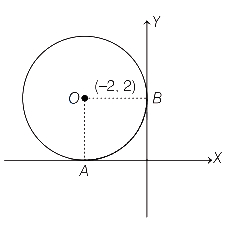
તેને વ્યાપક સ્વરૂપ $x^2+y^2+2gx+2fy+c=0$ સાથે સરખાવતા,આપણને $g=2$,$f=-2$,અને $c=4$ મળે છે.
વર્તુળનું કેન્દ્ર $(-g, -f) = (-2, 2)$ છે.
વર્તુળની ત્રિજ્યા $r = \sqrt{g^2+f^2-c} = \sqrt{2^2+(-2)^2-4} = \sqrt{4+4-4} = \sqrt{4} = 2$ છે.
કેન્દ્રના $x$-યામનું નિરપેક્ષ મૂલ્ય $|-2| = 2$ (જે ત્રિજ્યા જેટલું છે) અને કેન્દ્રના $y$-યામનું નિરપેક્ષ મૂલ્ય $|2| = 2$ (જે પણ ત્રિજ્યા જેટલું છે) હોવાથી,વર્તુળ $X$-અક્ષ અને $Y$-અક્ષ બંનેને સ્પર્શે છે.
તેને વ્યાપક સ્વરૂપ $x^2+y^2+2gx+2fy+c=0$ સાથે સરખાવતા,આપણને $g=2$,$f=-2$,અને $c=4$ મળે છે.
વર્તુળનું કેન્દ્ર $(-g, -f) = (-2, 2)$ છે.
વર્તુળની ત્રિજ્યા $r = \sqrt{g^2+f^2-c} = \sqrt{2^2+(-2)^2-4} = \sqrt{4+4-4} = \sqrt{4} = 2$ છે.
કેન્દ્રના $x$-યામનું નિરપેક્ષ મૂલ્ય $|-2| = 2$ (જે ત્રિજ્યા જેટલું છે) અને કેન્દ્રના $y$-યામનું નિરપેક્ષ મૂલ્ય $|2| = 2$ (જે પણ ત્રિજ્યા જેટલું છે) હોવાથી,વર્તુળ $X$-અક્ષ અને $Y$-અક્ષ બંનેને સ્પર્શે છે.
0 likesView Solution
250
MathematicsMediumMCQAP EAMCET · 2021
$10 \pi$ પરિઘ ધરાવતા વર્તુળના બે વ્યાસ $2x + 3y + 1 = 0$ અને $3x - y - 4 = 0$ રેખાઓ પર આવેલા હોય,તો વર્તુળનું સમીકરણ શોધો.
A
$x^2 + y^2 + 2x - 2y - 23 = 0$
B
$x^2 + y^2 - 2x + 2y - 23 = 0$
C
$x^2 + y^2 + 2x + 2y - 23 = 0$
D
$x^2 + y^2 - 2x - 2y - 23 = 0$
Solution
(B) વર્તુળનો પરિઘ $10 \pi$ છે. $2 \pi r = 10 \pi$ હોવાથી,ત્રિજ્યા $r = 5$ મળે.
વર્તુળના વ્યાસ તેના કેન્દ્રમાં છેદતા હોવાથી,આપણે સમીકરણો ઉકેલીએ:
$2x + 3y + 1 = 0$ $(i)$
$3x - y - 4 = 0$ $(ii)$
$(ii)$ પરથી,$y = 3x - 4$. આ કિંમત $(i)$ માં મૂકતા:
$2x + 3(3x - 4) + 1 = 0$
$2x + 9x - 12 + 1 = 0$
$11x - 11 = 0 \Rightarrow x = 1$.
તેથી $y = 3(1) - 4 = -1$.
વર્તુળનું કેન્દ્ર $(1, -1)$ છે.
કેન્દ્ર $(h, k)$ અને ત્રિજ્યા $r$ વાળા વર્તુળનું સમીકરણ $(x - h)^2 + (y - k)^2 = r^2$ છે.
$(x - 1)^2 + (y + 1)^2 = 5^2$
$x^2 - 2x + 1 + y^2 + 2y + 1 = 25$
$x^2 + y^2 - 2x + 2y - 23 = 0$.
વર્તુળના વ્યાસ તેના કેન્દ્રમાં છેદતા હોવાથી,આપણે સમીકરણો ઉકેલીએ:
$2x + 3y + 1 = 0$ $(i)$
$3x - y - 4 = 0$ $(ii)$
$(ii)$ પરથી,$y = 3x - 4$. આ કિંમત $(i)$ માં મૂકતા:
$2x + 3(3x - 4) + 1 = 0$
$2x + 9x - 12 + 1 = 0$
$11x - 11 = 0 \Rightarrow x = 1$.
તેથી $y = 3(1) - 4 = -1$.
વર્તુળનું કેન્દ્ર $(1, -1)$ છે.
કેન્દ્ર $(h, k)$ અને ત્રિજ્યા $r$ વાળા વર્તુળનું સમીકરણ $(x - h)^2 + (y - k)^2 = r^2$ છે.
$(x - 1)^2 + (y + 1)^2 = 5^2$
$x^2 - 2x + 1 + y^2 + 2y + 1 = 25$
$x^2 + y^2 - 2x + 2y - 23 = 0$.
0 likesView Solution
251
MathematicsDifficultMCQAP EAMCET · 2021
જો $\int \frac{2x+3}{x(x+1)(x+2)(x+3)+1} dx = \frac{-1}{ax^2+bx+c} + \alpha$ હોય,તો $a+b+c$ ની કિંમત શોધો.
A
$3$
B
$4$
C
$5$
D
$6$
Solution
(C) આપણી પાસે છે,$\int \frac{2x+3}{x(x+1)(x+2)(x+3)+1} dx = \frac{-1}{ax^2+bx+c} + \alpha$.
છેદને ફરીથી ગોઠવતા: $x(x+3)(x+1)(x+2)+1 = (x^2+3x)(x^2+3x+2)+1$.
ધારો કે $t = x^2+3x$,તો $dt = (2x+3)dx$.
સંકલનમાં કિંમત મૂકતા: $\int \frac{dt}{t(t+2)+1} = \int \frac{dt}{t^2+2t+1} = \int \frac{dt}{(t+1)^2}$.
સંકલન કરતા મળે: $-\frac{1}{t+1} + \alpha = \frac{-1}{x^2+3x+1} + \alpha$.
આને $\frac{-1}{ax^2+bx+c} + \alpha$ સાથે સરખાવતા,આપણને $a=1, b=3, c=1$ મળે છે.
તેથી,$a+b+c = 1+3+1 = 5$.
છેદને ફરીથી ગોઠવતા: $x(x+3)(x+1)(x+2)+1 = (x^2+3x)(x^2+3x+2)+1$.
ધારો કે $t = x^2+3x$,તો $dt = (2x+3)dx$.
સંકલનમાં કિંમત મૂકતા: $\int \frac{dt}{t(t+2)+1} = \int \frac{dt}{t^2+2t+1} = \int \frac{dt}{(t+1)^2}$.
સંકલન કરતા મળે: $-\frac{1}{t+1} + \alpha = \frac{-1}{x^2+3x+1} + \alpha$.
આને $\frac{-1}{ax^2+bx+c} + \alpha$ સાથે સરખાવતા,આપણને $a=1, b=3, c=1$ મળે છે.
તેથી,$a+b+c = 1+3+1 = 5$.
0 likesView Solution
252
MathematicsMediumMCQAP EAMCET · 2021
જો $\int \frac{x^2+1}{x^4+1} dx = f(x) + c$ હોય,તો $f(x)$ બરાબર શું થાય?
A
$\frac{1}{\sqrt{2}} \tan^{-1}\left(\frac{x^2+1}{\sqrt{2}x}\right)$
B
$\frac{1}{\sqrt{2}} \tan^{-1}\left(\frac{x^2-1}{\sqrt{2}x}\right)$
C
$\frac{1}{\sqrt{2}} \tan^{-1}\left(\frac{1-x^2}{\sqrt{2}x}\right)$
D
$\frac{1}{\sqrt{2}} \tan^{-1}\left(\frac{1+x^4}{\sqrt{2}x}\right)$
Solution
(B) સંકલન $I = \int \frac{x^2+1}{x^4+1} dx$ ઉકેલવા માટે,આપણે અંશ અને છેદને $x^2$ વડે ભાગીએ છીએ:
$I = \int \frac{1 + \frac{1}{x^2}}{x^2 + \frac{1}{x^2}} dx$
આપણે છેદને $(x - \frac{1}{x})^2 + 2$ તરીકે ફરીથી લખી શકીએ છીએ:
$I = \int \frac{1 + \frac{1}{x^2}}{(x - \frac{1}{x})^2 + (\sqrt{2})^2} dx$
ધારો કે $t = x - \frac{1}{x}$. તો $dt = (1 + \frac{1}{x^2}) dx$.
આ કિંમતો સંકલનમાં મૂકતા:
$I = \int \frac{dt}{t^2 + (\sqrt{2})^2} = \frac{1}{\sqrt{2}} \tan^{-1}\left(\frac{t}{\sqrt{2}}\right) + c$
$t = x - \frac{1}{x} = \frac{x^2-1}{x}$ પાછું મૂકતા:
$I = \frac{1}{\sqrt{2}} \tan^{-1}\left(\frac{x^2-1}{\sqrt{2}x}\right) + c$
આમ,$f(x) = \frac{1}{\sqrt{2}} \tan^{-1}\left(\frac{x^2-1}{\sqrt{2}x}\right)$.
$I = \int \frac{1 + \frac{1}{x^2}}{x^2 + \frac{1}{x^2}} dx$
આપણે છેદને $(x - \frac{1}{x})^2 + 2$ તરીકે ફરીથી લખી શકીએ છીએ:
$I = \int \frac{1 + \frac{1}{x^2}}{(x - \frac{1}{x})^2 + (\sqrt{2})^2} dx$
ધારો કે $t = x - \frac{1}{x}$. તો $dt = (1 + \frac{1}{x^2}) dx$.
આ કિંમતો સંકલનમાં મૂકતા:
$I = \int \frac{dt}{t^2 + (\sqrt{2})^2} = \frac{1}{\sqrt{2}} \tan^{-1}\left(\frac{t}{\sqrt{2}}\right) + c$
$t = x - \frac{1}{x} = \frac{x^2-1}{x}$ પાછું મૂકતા:
$I = \frac{1}{\sqrt{2}} \tan^{-1}\left(\frac{x^2-1}{\sqrt{2}x}\right) + c$
આમ,$f(x) = \frac{1}{\sqrt{2}} \tan^{-1}\left(\frac{x^2-1}{\sqrt{2}x}\right)$.
0 likesView Solution
253
MathematicsMediumMCQAP EAMCET · 2021
જો $\int \frac{1+\cos (4 x)}{\cot (x)-\tan (x)} d x=A \cos (4 x)+B$ હોય,તો $A$ ની કિંમત શોધો.
A
$\frac{-1}{2}$
B
$\frac{-1}{4}$
C
$\frac{-1}{3}$
D
$\frac{-1}{8}$
Solution
(D) ધારો કે $I = \int \frac{1+\cos (4 x)}{\cot x-\tan x} d x$.
નિત્યસમ $1+\cos(2\theta) = 2\cos^2(\theta)$ નો ઉપયોગ કરતા,આપણને $1+\cos(4x) = 2\cos^2(2x)$ મળે છે.
વળી,$\cot x - \tan x = \frac{\cos x}{\sin x} - \frac{\sin x}{\cos x} = \frac{\cos^2 x - \sin^2 x}{\sin x \cos x} = \frac{\cos(2x)}{\frac{1}{2}\sin(2x)} = 2\frac{\cos(2x)}{\sin(2x)}$.
આ કિંમતોને સંકલનમાં મૂકતા:
$I = \int \frac{2\cos^2(2x)}{2\frac{\cos(2x)}{\sin(2x)}} dx = \int \cos(2x) \sin(2x) dx$.
નિત્યસમ $\sin(2\theta) = 2\sin\theta \cos\theta$ નો ઉપયોગ કરતા,$\sin(2x)\cos(2x) = \frac{1}{2}\sin(4x)$ મળે.
$I = \int \frac{1}{2}\sin(4x) dx = \frac{1}{2} \left( \frac{-\cos(4x)}{4} \right) + C = -\frac{1}{8}\cos(4x) + C$.
આને $A\cos(4x)+B$ સાથે સરખાવતા,આપણને $A = -\frac{1}{8}$ મળે છે.
નિત્યસમ $1+\cos(2\theta) = 2\cos^2(\theta)$ નો ઉપયોગ કરતા,આપણને $1+\cos(4x) = 2\cos^2(2x)$ મળે છે.
વળી,$\cot x - \tan x = \frac{\cos x}{\sin x} - \frac{\sin x}{\cos x} = \frac{\cos^2 x - \sin^2 x}{\sin x \cos x} = \frac{\cos(2x)}{\frac{1}{2}\sin(2x)} = 2\frac{\cos(2x)}{\sin(2x)}$.
આ કિંમતોને સંકલનમાં મૂકતા:
$I = \int \frac{2\cos^2(2x)}{2\frac{\cos(2x)}{\sin(2x)}} dx = \int \cos(2x) \sin(2x) dx$.
નિત્યસમ $\sin(2\theta) = 2\sin\theta \cos\theta$ નો ઉપયોગ કરતા,$\sin(2x)\cos(2x) = \frac{1}{2}\sin(4x)$ મળે.
$I = \int \frac{1}{2}\sin(4x) dx = \frac{1}{2} \left( \frac{-\cos(4x)}{4} \right) + C = -\frac{1}{8}\cos(4x) + C$.
આને $A\cos(4x)+B$ સાથે સરખાવતા,આપણને $A = -\frac{1}{8}$ મળે છે.
0 likesView Solution
254
MathematicsMediumMCQAP EAMCET · 2021
$\int \frac{dx}{\sqrt{7-6x-x^2}}$ ની કિંમત શોધો.
A
$\sinh^{-1}\left(\frac{x+3}{4}\right)+C$
B
$\log\left|\frac{x+3}{4}\right|+C$
C
$\sin^{-1}\left(\frac{x+3}{4}\right)+C$
D
$\frac{1}{2}\sin^{-1}\left(\frac{x+3}{4}\right)+C$
Solution
(C) ધારો કે $I = \int \frac{dx}{\sqrt{7-6x-x^2}}$.
પ્રથમ,દ્વિઘાત પદાવલિ $7-6x-x^2$ માટે પૂર્ણવર્ગની રીતનો ઉપયોગ કરીએ:
$7-6x-x^2 = 7 - (x^2 + 6x) = 7 - (x^2 + 6x + 9 - 9) = 7 - ((x+3)^2 - 9) = 16 - (x+3)^2 = 4^2 - (x+3)^2$.
હવે,આ કિંમત સંકલનમાં મૂકતા:
$I = \int \frac{dx}{\sqrt{4^2 - (x+3)^2}}$.
પ્રમાણિત સંકલન સૂત્ર $\int \frac{dx}{\sqrt{a^2 - x^2}} = \sin^{-1}\left(\frac{x}{a}\right) + C$ નો ઉપયોગ કરતા,જ્યાં $a = 4$ અને $x$ ની જગ્યાએ $(x+3)$ છે:
$I = \sin^{-1}\left(\frac{x+3}{4}\right) + C$.
પ્રથમ,દ્વિઘાત પદાવલિ $7-6x-x^2$ માટે પૂર્ણવર્ગની રીતનો ઉપયોગ કરીએ:
$7-6x-x^2 = 7 - (x^2 + 6x) = 7 - (x^2 + 6x + 9 - 9) = 7 - ((x+3)^2 - 9) = 16 - (x+3)^2 = 4^2 - (x+3)^2$.
હવે,આ કિંમત સંકલનમાં મૂકતા:
$I = \int \frac{dx}{\sqrt{4^2 - (x+3)^2}}$.
પ્રમાણિત સંકલન સૂત્ર $\int \frac{dx}{\sqrt{a^2 - x^2}} = \sin^{-1}\left(\frac{x}{a}\right) + C$ નો ઉપયોગ કરતા,જ્યાં $a = 4$ અને $x$ ની જગ્યાએ $(x+3)$ છે:
$I = \sin^{-1}\left(\frac{x+3}{4}\right) + C$.
0 likesView Solution
255
MathematicsMediumMCQAP EAMCET · 2021
$\int \frac{e^x(x + 3)}{(x + 5)^3} dx = $
A
$\frac{e^x}{(x + 5)^2} + c$
B
$e^x(x + 5)^2 + c$
C
$e^x(x + 3)^2 + c$
D
$\frac{e^x}{(x + 3)^2} + c$
Solution
(A) આપણને સંકલન $I = \int \frac{e^x(x + 3)}{(x + 5)^3} dx$ આપેલ છે.
પ્રથમ,અંશ $(x + 3)$ ને $(x + 5 - 2)$ તરીકે લખતા:
$I = \int \frac{e^x(x + 5 - 2)}{(x + 5)^3} dx$
$I = \int e^x \left[ \frac{x + 5}{(x + 5)^3} - \frac{2}{(x + 5)^3} \right] dx$
$I = \int e^x \left[ \frac{1}{(x + 5)^2} - \frac{2}{(x + 5)^3} \right] dx$
આપણે પ્રમાણિત સંકલન સૂત્ર $\int e^x (f(x) + f'(x)) dx = e^x f(x) + c$ નો ઉપયોગ કરીએ છીએ.
ધારો કે $f(x) = \frac{1}{(x + 5)^2} = (x + 5)^{-2}$.
તો $f'(x) = -2(x + 5)^{-3} = -\frac{2}{(x + 5)^3}$.
કારણ કે સંકલ્ય $e^x(f(x) + f'(x))$ સ્વરૂપમાં છે,તેથી સંકલન $e^x f(x) + c$ થશે.
આમ,$I = \frac{e^x}{(x + 5)^2} + c$.
પ્રથમ,અંશ $(x + 3)$ ને $(x + 5 - 2)$ તરીકે લખતા:
$I = \int \frac{e^x(x + 5 - 2)}{(x + 5)^3} dx$
$I = \int e^x \left[ \frac{x + 5}{(x + 5)^3} - \frac{2}{(x + 5)^3} \right] dx$
$I = \int e^x \left[ \frac{1}{(x + 5)^2} - \frac{2}{(x + 5)^3} \right] dx$
આપણે પ્રમાણિત સંકલન સૂત્ર $\int e^x (f(x) + f'(x)) dx = e^x f(x) + c$ નો ઉપયોગ કરીએ છીએ.
ધારો કે $f(x) = \frac{1}{(x + 5)^2} = (x + 5)^{-2}$.
તો $f'(x) = -2(x + 5)^{-3} = -\frac{2}{(x + 5)^3}$.
કારણ કે સંકલ્ય $e^x(f(x) + f'(x))$ સ્વરૂપમાં છે,તેથી સંકલન $e^x f(x) + c$ થશે.
આમ,$I = \frac{e^x}{(x + 5)^2} + c$.
0 likesView Solution
256
MathematicsMediumMCQAP EAMCET · 2021
$\int \sqrt{e^{4x} + e^{2x}} \, dx$ ની કિંમત શોધો.
A
$\frac{1}{2} e^x \sqrt{e^{2x} + 1} + \frac{1}{2} \sinh^{-1}(e^x) + c$
B
$\frac{1}{2} e^x \sqrt{e^{2x} + 1} + \sinh^{-1}(e^x) + c$
C
$\frac{1}{2} \sqrt{e^{2x} + 1} + \frac{1}{2} \sinh^{-1}(e^x) + c$
D
$e^{4x} + e^{2x} + \sqrt{e^{2x} + 1} + c$
Solution
(A) ધારો કે $I = \int \sqrt{e^{4x} + e^{2x}} \, dx = \int e^x \sqrt{e^{2x} + 1} \, dx$.
$e^x = v$ આદેશ લેતા,$dv = e^x \, dx$ મળે.
$I = \int \sqrt{v^2 + 1} \, dv$.
પ્રમાણિત સંકલન સૂત્ર $\int \sqrt{x^2 + a^2} \, dx = \frac{x}{2} \sqrt{x^2 + a^2} + \frac{a^2}{2} \ln|x + \sqrt{x^2 + a^2}| + c$ નો ઉપયોગ કરતા.
અહીં $a = 1$ હોવાથી,$I = \frac{v}{2} \sqrt{v^2 + 1} + \frac{1}{2} \ln|v + \sqrt{v^2 + 1}| + c$.
આપણે જાણીએ છીએ કે $\sinh^{-1}(v) = \ln(v + \sqrt{v^2 + 1})$,તેથી $I = \frac{v}{2} \sqrt{v^2 + 1} + \frac{1}{2} \sinh^{-1}(v) + c$.
$v = e^x$ પાછું મૂકતા,આપણને $I = \frac{1}{2} e^x \sqrt{e^{2x} + 1} + \frac{1}{2} \sinh^{-1}(e^x) + c$ મળે છે.
$e^x = v$ આદેશ લેતા,$dv = e^x \, dx$ મળે.
$I = \int \sqrt{v^2 + 1} \, dv$.
પ્રમાણિત સંકલન સૂત્ર $\int \sqrt{x^2 + a^2} \, dx = \frac{x}{2} \sqrt{x^2 + a^2} + \frac{a^2}{2} \ln|x + \sqrt{x^2 + a^2}| + c$ નો ઉપયોગ કરતા.
અહીં $a = 1$ હોવાથી,$I = \frac{v}{2} \sqrt{v^2 + 1} + \frac{1}{2} \ln|v + \sqrt{v^2 + 1}| + c$.
આપણે જાણીએ છીએ કે $\sinh^{-1}(v) = \ln(v + \sqrt{v^2 + 1})$,તેથી $I = \frac{v}{2} \sqrt{v^2 + 1} + \frac{1}{2} \sinh^{-1}(v) + c$.
$v = e^x$ પાછું મૂકતા,આપણને $I = \frac{1}{2} e^x \sqrt{e^{2x} + 1} + \frac{1}{2} \sinh^{-1}(e^x) + c$ મળે છે.
0 likesView Solution
257
MathematicsMediumMCQAP EAMCET · 2021
જો $\int [ \cos(x) \cdot \frac{d}{dx}(\csc(x)) ] dx = f(x) + g(x) + c$ હોય,તો $f(x) \cdot g(x) =$
A
$x \cot(x)$
B
$x \tan(x)$
C
$x \cos(x)$
D
$1$
Solution
(A) આપણને સંકલન $I = \int [ \cos(x) \cdot \frac{d}{dx}(\csc(x)) ] dx$ આપેલ છે.
પ્રથમ,આપણે જાણીએ છીએ કે $\frac{d}{dx}(\csc(x)) = -\csc(x) \cot(x)$.
આ કિંમત સંકલનમાં મૂકતા,આપણને મળે છે:
$I = \int [ \cos(x) \cdot (-\csc(x) \cot(x)) ] dx$
$I = - \int [ \cos(x) \cdot \frac{1}{\sin(x)} \cdot \frac{\cos(x)}{\sin(x)} ] dx$
$I = - \int [ \frac{\cos^2(x)}{\sin^2(x)} ] dx$
$I = - \int \cot^2(x) dx$
નિત્યસમ $\cot^2(x) = \csc^2(x) - 1$ નો ઉપયોગ કરતા:
$I = - \int (\csc^2(x) - 1) dx$
$I = - \int \csc^2(x) dx + \int 1 dx$
કારણ કે $\int \csc^2(x) dx = -\cot(x)$,તેથી:
$I = -(-\cot(x)) + x + c$
$I = \cot(x) + x + c$
આને $f(x) + g(x) + c$ સાથે સરખાવતા,આપણને $f(x) = \cot(x)$ અને $g(x) = x$ મળે છે.
તેથી,$f(x) \cdot g(x) = x \cot(x)$.
પ્રથમ,આપણે જાણીએ છીએ કે $\frac{d}{dx}(\csc(x)) = -\csc(x) \cot(x)$.
આ કિંમત સંકલનમાં મૂકતા,આપણને મળે છે:
$I = \int [ \cos(x) \cdot (-\csc(x) \cot(x)) ] dx$
$I = - \int [ \cos(x) \cdot \frac{1}{\sin(x)} \cdot \frac{\cos(x)}{\sin(x)} ] dx$
$I = - \int [ \frac{\cos^2(x)}{\sin^2(x)} ] dx$
$I = - \int \cot^2(x) dx$
નિત્યસમ $\cot^2(x) = \csc^2(x) - 1$ નો ઉપયોગ કરતા:
$I = - \int (\csc^2(x) - 1) dx$
$I = - \int \csc^2(x) dx + \int 1 dx$
કારણ કે $\int \csc^2(x) dx = -\cot(x)$,તેથી:
$I = -(-\cot(x)) + x + c$
$I = \cot(x) + x + c$
આને $f(x) + g(x) + c$ સાથે સરખાવતા,આપણને $f(x) = \cot(x)$ અને $g(x) = x$ મળે છે.
તેથી,$f(x) \cdot g(x) = x \cot(x)$.
0 likesView Solution
258
MathematicsEasyMCQAP EAMCET · 2021
જો $\cos(\log x)$ નું આદિ વિધેય (primitive) $f(x)\{\cos(g(x)) + \sin(h(x))\}$ હોય,તો નીચેનામાંથી કયું સત્ય છે?
A
$h^{\prime}(x) = \frac{-1}{x}$
B
$f^{\prime}(x) = \frac{1}{2}$
C
$g^{\prime}(x) = \log(x)$
D
$h(x) = \frac{x}{2}$
Solution
(B) આદિ વિધેય એટલે અનિયત સંકલન. ધારો કે $I = \int \cos(\log x) dx$.
ખંડશઃ સંકલનનો ઉપયોગ કરતા,$u = \cos(\log x)$ અને $dv = dx$ લો. તેથી $du = -\sin(\log x) \cdot \frac{1}{x} dx$ અને $v = x$ મળે.
$I = x \cos(\log x) - \int x \cdot (-\sin(\log x)) \cdot \frac{1}{x} dx = x \cos(\log x) + \int \sin(\log x) dx$.
હવે,$\int \sin(\log x) dx$ નું ખંડશઃ સંકલન કરતા: $u = \sin(\log x)$,$dv = dx$.
$I = x \cos(\log x) + [x \sin(\log x) - \int x \cdot \cos(\log x) \cdot \frac{1}{x} dx]$.
$I = x \cos(\log x) + x \sin(\log x) - I$.
$2I = x [\cos(\log x) + \sin(\log x)] + C$.
$I = \frac{x}{2} [\cos(\log x) + \sin(\log x)] + C$.
આને $f(x)\{\cos(g(x)) + \sin(h(x))\}$ સાથે સરખાવતા,આપણને $f(x) = \frac{x}{2}$,$g(x) = \log x$,અને $h(x) = \log x$ મળે છે.
આમ,$f^{\prime}(x) = \frac{d}{dx}(\frac{x}{2}) = \frac{1}{2}$.
તેથી,વિકલ્પ $B$ સાચો છે.
ખંડશઃ સંકલનનો ઉપયોગ કરતા,$u = \cos(\log x)$ અને $dv = dx$ લો. તેથી $du = -\sin(\log x) \cdot \frac{1}{x} dx$ અને $v = x$ મળે.
$I = x \cos(\log x) - \int x \cdot (-\sin(\log x)) \cdot \frac{1}{x} dx = x \cos(\log x) + \int \sin(\log x) dx$.
હવે,$\int \sin(\log x) dx$ નું ખંડશઃ સંકલન કરતા: $u = \sin(\log x)$,$dv = dx$.
$I = x \cos(\log x) + [x \sin(\log x) - \int x \cdot \cos(\log x) \cdot \frac{1}{x} dx]$.
$I = x \cos(\log x) + x \sin(\log x) - I$.
$2I = x [\cos(\log x) + \sin(\log x)] + C$.
$I = \frac{x}{2} [\cos(\log x) + \sin(\log x)] + C$.
આને $f(x)\{\cos(g(x)) + \sin(h(x))\}$ સાથે સરખાવતા,આપણને $f(x) = \frac{x}{2}$,$g(x) = \log x$,અને $h(x) = \log x$ મળે છે.
આમ,$f^{\prime}(x) = \frac{d}{dx}(\frac{x}{2}) = \frac{1}{2}$.
તેથી,વિકલ્પ $B$ સાચો છે.
0 likesView Solution
259
MathematicsDifficultMCQAP EAMCET · 2021
$\int(x+1)(x+2)^4(x+3) \, dx$ ની કિંમત શોધો.
A
$\frac{(x+1)^2}{2}+\frac{(x+2)^2}{5}+\frac{(x+3)^2}{2}+C$
B
$\frac{(x+2)^7}{7}-\frac{(x+2)^5}{5}+C$
C
$\frac{(x+2)^7}{7}+\frac{(x+2)^5}{5}+C$
D
$\frac{(x+3)^7}{7}-\frac{(x+3)^5}{5}+C$
Solution
(B) ધારો કે $x+2=t$,તેથી $dx=dt$.
સંકલનમાં આ કિંમતો મૂકતા:
$I = \int(t-1)(t)^4(t+1) \, dt = \int(t^2-1)t^4 \, dt$.
પદાવલિનું વિસ્તરણ કરતા:
$I = \int(t^6-t^4) \, dt$.
દરેક પદનું સંકલન કરતા:
$I = \frac{t^7}{7} - \frac{t^5}{5} + C$.
$t = x+2$ પાછા મૂકતા:
$I = \frac{(x+2)^7}{7} - \frac{(x+2)^5}{5} + C$.
સંકલનમાં આ કિંમતો મૂકતા:
$I = \int(t-1)(t)^4(t+1) \, dt = \int(t^2-1)t^4 \, dt$.
પદાવલિનું વિસ્તરણ કરતા:
$I = \int(t^6-t^4) \, dt$.
દરેક પદનું સંકલન કરતા:
$I = \frac{t^7}{7} - \frac{t^5}{5} + C$.
$t = x+2$ પાછા મૂકતા:
$I = \frac{(x+2)^7}{7} - \frac{(x+2)^5}{5} + C$.
0 likesView Solution
260
MathematicsDifficultMCQAP EAMCET · 2021
$x > 0$ માટે $\int \frac{e^{\tan ^{-1}(x)}}{1+x^2} \left[\left(\sec ^{-1} \sqrt{1+x^2}\right)^2+\cos ^{-1}\left(\frac{1-x^2}{1+x^2}\right)\right] d x$ ની કિંમત શોધો.
A
$e^{\tan ^{-1}(x)}(\tan ^{-1} x)^2+c$
B
$e^{\tan ^{-1}(x)}(\tan ^{-1} x)+c$
C
$e^{\tan ^{-1}(x)}(\tan ^{-1} x)^3+c$
D
$-e^{\tan ^{-1}(x)}(\tan ^{-1} x)^2+c$
Solution
(A) ધારો કે $I = \int \frac{e^{\tan ^{-1} x}}{1+x^2} \left[\left(\sec ^{-1} \sqrt{1+x^2}\right)^2 + \cos ^{-1}\left(\frac{1-x^2}{1+x^2}\right)\right] d x$,જ્યાં $x > 0$.
$\tan ^{-1} x = \theta$ લેતા,$x = \tan \theta$ અને $\frac{1}{1+x^2} d x = d \theta$ મળે.
$x > 0$ હોવાથી,$\theta \in (0, \pi/2)$.
અહીં $\sec ^{-1} \sqrt{1+x^2} = \sec ^{-1} \sqrt{1+\tan^2 \theta} = \sec ^{-1} \sec \theta = \theta$.
તેમજ,$\cos ^{-1}\left(\frac{1-x^2}{1+x^2}\right) = \cos ^{-1}(\cos 2\theta) = 2\theta$ (કારણ કે $2\theta \in (0, \pi)$).
આ કિંમતો સંકલનમાં મૂકતા:
$I = \int e^{\theta} [\theta^2 + 2\theta] d \theta$.
પ્રમાણિત સંકલન સૂત્ર $\int e^x [f(x) + f'(x)] d x = e^x f(x) + c$ નો ઉપયોગ કરતા,જ્યાં $f(\theta) = \theta^2$ અને $f'(\theta) = 2\theta$:
$I = e^{\theta} \theta^2 + c$.
$\theta = \tan ^{-1} x$ પાછું મૂકતા:
$I = e^{\tan ^{-1} x} (\tan ^{-1} x)^2 + c$.
$\tan ^{-1} x = \theta$ લેતા,$x = \tan \theta$ અને $\frac{1}{1+x^2} d x = d \theta$ મળે.
$x > 0$ હોવાથી,$\theta \in (0, \pi/2)$.
અહીં $\sec ^{-1} \sqrt{1+x^2} = \sec ^{-1} \sqrt{1+\tan^2 \theta} = \sec ^{-1} \sec \theta = \theta$.
તેમજ,$\cos ^{-1}\left(\frac{1-x^2}{1+x^2}\right) = \cos ^{-1}(\cos 2\theta) = 2\theta$ (કારણ કે $2\theta \in (0, \pi)$).
આ કિંમતો સંકલનમાં મૂકતા:
$I = \int e^{\theta} [\theta^2 + 2\theta] d \theta$.
પ્રમાણિત સંકલન સૂત્ર $\int e^x [f(x) + f'(x)] d x = e^x f(x) + c$ નો ઉપયોગ કરતા,જ્યાં $f(\theta) = \theta^2$ અને $f'(\theta) = 2\theta$:
$I = e^{\theta} \theta^2 + c$.
$\theta = \tan ^{-1} x$ પાછું મૂકતા:
$I = e^{\tan ^{-1} x} (\tan ^{-1} x)^2 + c$.
0 likesView Solution
261
MathematicsMediumMCQAP EAMCET · 2021
$\int 3^x \left(f^{\prime}(x) + f(x) \log 3\right) dx$ ની કિંમત શોધો.
A
$3^x f^{\prime}(x) + c$
B
$3^x \log 3 + c$
C
$3^x f(x) + c$
D
$3^x + c$
Solution
(C) ધારો કે $I = \int 3^x \left(f^{\prime}(x) + f(x) \log 3\right) dx$.
આપણે સંકલ્યને આ રીતે લખી શકીએ:
$I = \int \left(3^x f^{\prime}(x) + 3^x f(x) \log 3\right) dx$.
વિકલન માટે ગુણાકારનો નિયમ યાદ કરો: $\frac{d}{dx} \left(3^x f(x)\right) = 3^x f^{\prime}(x) + f(x) \cdot \frac{d}{dx}(3^x) = 3^x f^{\prime}(x) + f(x) \cdot 3^x \log 3$.
આમ,સંકલ્ય એ $3^x f(x)$ નું વિકલન છે.
તેથી,$\int \frac{d}{dx} \left(3^x f(x)\right) dx = 3^x f(x) + c$.
આપણે સંકલ્યને આ રીતે લખી શકીએ:
$I = \int \left(3^x f^{\prime}(x) + 3^x f(x) \log 3\right) dx$.
વિકલન માટે ગુણાકારનો નિયમ યાદ કરો: $\frac{d}{dx} \left(3^x f(x)\right) = 3^x f^{\prime}(x) + f(x) \cdot \frac{d}{dx}(3^x) = 3^x f^{\prime}(x) + f(x) \cdot 3^x \log 3$.
આમ,સંકલ્ય એ $3^x f(x)$ નું વિકલન છે.
તેથી,$\int \frac{d}{dx} \left(3^x f(x)\right) dx = 3^x f(x) + c$.
0 likesView Solution
262
MathematicsMediumMCQAP EAMCET · 2021
$\int \frac{x+\sin x}{1+\cos x} d x$ ની કિંમત શોધો.
A
$x \cot \left(\frac{x}{2}\right)+c$
B
$\cot \left(\frac{x}{2}\right)+c$
C
$\tan \left(\frac{x}{2}\right)+c$
D
$x \tan \left(\frac{x}{2}\right)+c$
Solution
(D) ધારો કે $I = \int \frac{x+\sin x}{1+\cos x} dx$.
નિત્યસમ $\sin x = 2 \sin(x/2) \cos(x/2)$ અને $1+\cos x = 2 \cos^2(x/2)$ નો ઉપયોગ કરતા:
$I = \int \frac{x + 2 \sin(x/2) \cos(x/2)}{2 \cos^2(x/2)} dx$
$I = \int \left( \frac{x}{2 \cos^2(x/2)} + \frac{2 \sin(x/2) \cos(x/2)}{2 \cos^2(x/2)} \right) dx$
$I = \int \left( \frac{1}{2} x \sec^2(x/2) + \tan(x/2) \right) dx$
હવે,પ્રથમ પદ $\int \frac{1}{2} x \sec^2(x/2) dx$ માટે ખંડશઃ સંકલનનો ઉપયોગ કરતા:
ધારો કે $u = x$ અને $dv = \frac{1}{2} \sec^2(x/2) dx$. તેથી $du = dx$ અને $v = \tan(x/2)$.
$\int u dv = uv - \int v du$ સૂત્ર મુજબ:
$\int \frac{1}{2} x \sec^2(x/2) dx = x \tan(x/2) - \int \tan(x/2) dx$
આ કિંમત $I$ માં મૂકતા:
$I = x \tan(x/2) - \int \tan(x/2) dx + \int \tan(x/2) dx + c$
$I = x \tan(x/2) + c$
નિત્યસમ $\sin x = 2 \sin(x/2) \cos(x/2)$ અને $1+\cos x = 2 \cos^2(x/2)$ નો ઉપયોગ કરતા:
$I = \int \frac{x + 2 \sin(x/2) \cos(x/2)}{2 \cos^2(x/2)} dx$
$I = \int \left( \frac{x}{2 \cos^2(x/2)} + \frac{2 \sin(x/2) \cos(x/2)}{2 \cos^2(x/2)} \right) dx$
$I = \int \left( \frac{1}{2} x \sec^2(x/2) + \tan(x/2) \right) dx$
હવે,પ્રથમ પદ $\int \frac{1}{2} x \sec^2(x/2) dx$ માટે ખંડશઃ સંકલનનો ઉપયોગ કરતા:
ધારો કે $u = x$ અને $dv = \frac{1}{2} \sec^2(x/2) dx$. તેથી $du = dx$ અને $v = \tan(x/2)$.
$\int u dv = uv - \int v du$ સૂત્ર મુજબ:
$\int \frac{1}{2} x \sec^2(x/2) dx = x \tan(x/2) - \int \tan(x/2) dx$
આ કિંમત $I$ માં મૂકતા:
$I = x \tan(x/2) - \int \tan(x/2) dx + \int \tan(x/2) dx + c$
$I = x \tan(x/2) + c$
0 likesView Solution
263
MathematicsDifficultMCQAP EAMCET · 2021
$\int \cos \sqrt{x} \, dx$ ની કિંમત શોધો.
A
$2 \sqrt{x} \sin \sqrt{x} + 2 \cos \sqrt{x} + c$
B
$2 \sqrt{x} \sin \sqrt{x} + 2 \sin \sqrt{x} + c$
C
$2 \sqrt{x} \sin \sqrt{x} - 2 \cos \sqrt{x} + c$
D
$\sqrt{x} \cos \sqrt{x} - 2 \sin \sqrt{x} + c$
Solution
(A) ધારો કે $I = \int \cos \sqrt{x} \, dx$.
$\sqrt{x} = t$ લેતા,તેથી $x = t^2$.
$x$ ની સાપેક્ષે વિકલન કરતા,$dx = 2t \, dt$ મળે.
આ કિંમતો સંકલનમાં મૂકતા:
$I = \int \cos(t) \cdot 2t \, dt = 2 \int t \cos(t) \, dt$.
ખંડશઃ સંકલનની રીત (Integration by parts) વાપરતા,જ્યાં $u = t$ અને $dv = \cos(t) \, dt$:
$I = 2 \left[ t \sin(t) - \int \sin(t) \, dt \right] = 2 [t \sin(t) + \cos(t)] + c$.
$t$ ની જગ્યાએ $\sqrt{x}$ મૂકતા:
$I = 2 \sqrt{x} \sin \sqrt{x} + 2 \cos \sqrt{x} + c$.
$\sqrt{x} = t$ લેતા,તેથી $x = t^2$.
$x$ ની સાપેક્ષે વિકલન કરતા,$dx = 2t \, dt$ મળે.
આ કિંમતો સંકલનમાં મૂકતા:
$I = \int \cos(t) \cdot 2t \, dt = 2 \int t \cos(t) \, dt$.
ખંડશઃ સંકલનની રીત (Integration by parts) વાપરતા,જ્યાં $u = t$ અને $dv = \cos(t) \, dt$:
$I = 2 \left[ t \sin(t) - \int \sin(t) \, dt \right] = 2 [t \sin(t) + \cos(t)] + c$.
$t$ ની જગ્યાએ $\sqrt{x}$ મૂકતા:
$I = 2 \sqrt{x} \sin \sqrt{x} + 2 \cos \sqrt{x} + c$.
0 likesView Solution
264
MathematicsMediumMCQAP EAMCET · 2021
જો $\int \frac{3 \cos x-2 \sin x}{4 \sin x+5 \cos x} d x=A \log |5 \cos x+4 \sin x|+B x+c$ હોય,તો $A$ અને $B$ શું છે?
A
$A=\frac{22}{41}$ અને $B=\frac{-7}{41}$
B
$A=\frac{-22}{41}$ અને $B=\frac{7}{41}$
C
$A=\frac{-22}{41}$ અને $B=\frac{-7}{41}$
D
$A=\frac{22}{41}$ અને $B=\frac{7}{41}$
Solution
(D) ધારો કે $I = \int \frac{3 \cos x-2 \sin x}{4 \sin x+5 \cos x} d x = A \log |5 \cos x+4 \sin x|+B x+c$.
બંને બાજુ $x$ ની સાપેક્ષમાં વિકલન કરતા:
$\frac{3 \cos x-2 \sin x}{4 \sin x+5 \cos x} = A \frac{d}{dx}(\log |5 \cos x+4 \sin x|) + B$
$\frac{3 \cos x-2 \sin x}{4 \sin x+5 \cos x} = A \frac{-5 \sin x+4 \cos x}{5 \cos x+4 \sin x} + B$
$\frac{3 \cos x-2 \sin x}{4 \sin x+5 \cos x} = \frac{A(-5 \sin x+4 \cos x) + B(4 \sin x+5 \cos x)}{4 \sin x+5 \cos x}$
અંશને સરખાવતા:
$3 \cos x-2 \sin x = (4A+5B) \cos x + (-5A+4B) \sin x$
$\cos x$ અને $\sin x$ ના સહગુણકોની સરખામણી કરતા:
$4A+5B = 3$ --- $(1)$
$-5A+4B = -2$ --- $(2)$
સમીકરણ $(1)$ ને $5$ વડે અને $(2)$ ને $4$ વડે ગુણતા:
$20A+25B = 15$
$-20A+16B = -8$
આ સમીકરણોનો સરવાળો કરતા: $41B = 7 \Rightarrow B = \frac{7}{41}$.
$B$ ની કિંમત $(1)$ માં મૂકતા: $4A + 5(\frac{7}{41}) = 3 \Rightarrow 4A = 3 - \frac{35}{41} = \frac{123-35}{41} = \frac{88}{41} \Rightarrow A = \frac{22}{41}$.
આમ,$A = \frac{22}{41}$ અને $B = \frac{7}{41}$.
બંને બાજુ $x$ ની સાપેક્ષમાં વિકલન કરતા:
$\frac{3 \cos x-2 \sin x}{4 \sin x+5 \cos x} = A \frac{d}{dx}(\log |5 \cos x+4 \sin x|) + B$
$\frac{3 \cos x-2 \sin x}{4 \sin x+5 \cos x} = A \frac{-5 \sin x+4 \cos x}{5 \cos x+4 \sin x} + B$
$\frac{3 \cos x-2 \sin x}{4 \sin x+5 \cos x} = \frac{A(-5 \sin x+4 \cos x) + B(4 \sin x+5 \cos x)}{4 \sin x+5 \cos x}$
અંશને સરખાવતા:
$3 \cos x-2 \sin x = (4A+5B) \cos x + (-5A+4B) \sin x$
$\cos x$ અને $\sin x$ ના સહગુણકોની સરખામણી કરતા:
$4A+5B = 3$ --- $(1)$
$-5A+4B = -2$ --- $(2)$
સમીકરણ $(1)$ ને $5$ વડે અને $(2)$ ને $4$ વડે ગુણતા:
$20A+25B = 15$
$-20A+16B = -8$
આ સમીકરણોનો સરવાળો કરતા: $41B = 7 \Rightarrow B = \frac{7}{41}$.
$B$ ની કિંમત $(1)$ માં મૂકતા: $4A + 5(\frac{7}{41}) = 3 \Rightarrow 4A = 3 - \frac{35}{41} = \frac{123-35}{41} = \frac{88}{41} \Rightarrow A = \frac{22}{41}$.
આમ,$A = \frac{22}{41}$ અને $B = \frac{7}{41}$.
0 likesView Solution
265
MathematicsMediumMCQAP EAMCET · 2021
$\int \frac{x-1}{(x-2)(x-3)} \, dx$ ની કિંમત શોધો.
A
$2 \log |x-3| - \log |x-2| + c$
B
$\log |x-3| - \log |x-2| + c$
C
$\log |x-3| - \log |x+2| + c$
D
$\log \left| \frac{(x-3)^2}{x-2} \right| + c$
Solution
(D) ધારો કે $I = \int \frac{x-1}{(x-2)(x-3)} \, dx$.
આંશિક અપૂર્ણાંકની રીતનો ઉપયોગ કરતા: $\frac{x-1}{(x-2)(x-3)} = \frac{A}{x-2} + \frac{B}{x-3}$.
અંશને સરખાવતા: $x-1 = A(x-3) + B(x-2)$.
$x=2$ માટે: $2-1 = A(2-3) \implies 1 = -A \implies A = -1$.
$x=3$ માટે: $3-1 = B(3-2) \implies 2 = B$.
તેથી,$\frac{x-1}{(x-2)(x-3)} = \frac{2}{x-3} - \frac{1}{x-2}$.
બંને બાજુ સંકલન કરતા: $I = \int \left( \frac{2}{x-3} - \frac{1}{x-2} \right) \, dx$.
$I = 2 \log |x-3| - \log |x-2| + c$.
લઘુગણકના ગુણધર્મોનો ઉપયોગ કરતા: $I = \log |x-3|^2 - \log |x-2| + c = \log \left| \frac{(x-3)^2}{x-2} \right| + c$.
આંશિક અપૂર્ણાંકની રીતનો ઉપયોગ કરતા: $\frac{x-1}{(x-2)(x-3)} = \frac{A}{x-2} + \frac{B}{x-3}$.
અંશને સરખાવતા: $x-1 = A(x-3) + B(x-2)$.
$x=2$ માટે: $2-1 = A(2-3) \implies 1 = -A \implies A = -1$.
$x=3$ માટે: $3-1 = B(3-2) \implies 2 = B$.
તેથી,$\frac{x-1}{(x-2)(x-3)} = \frac{2}{x-3} - \frac{1}{x-2}$.
બંને બાજુ સંકલન કરતા: $I = \int \left( \frac{2}{x-3} - \frac{1}{x-2} \right) \, dx$.
$I = 2 \log |x-3| - \log |x-2| + c$.
લઘુગણકના ગુણધર્મોનો ઉપયોગ કરતા: $I = \log |x-3|^2 - \log |x-2| + c = \log \left| \frac{(x-3)^2}{x-2} \right| + c$.
0 likesView Solution
266
MathematicsDifficultMCQAP EAMCET · 2021
જો $\int \frac{1 - (\cot x)^{2021}}{\tan x + (\cot x)^{2022}} dx = \frac{1}{A} \log |(\sin x)^{2023} + (\cos x)^{2023}| + c$ હોય,તો $A = . . . . . .$
A
$2020$
B
$2021$
C
$2022$
D
$2023$
Solution
(D) ધારો કે $I = \int \frac{1 - (\cot x)^{2021}}{\tan x + (\cot x)^{2022}} dx$.
અંશ અને છેદને $(\sin x)^{2022} \cos x$ વડે ગુણતા,આપણને મળે છે:
$I = \int \frac{1 - \frac{(\cos x)^{2021}}{(\sin x)^{2021}}}{\frac{\sin x}{\cos x} + \frac{(\cos x)^{2022}}{(\sin x)^{2022}}} dx = \int \frac{(\sin x)^{2021} - (\cos x)^{2021}}{(\sin x)^{2021}} \cdot \frac{(\sin x)^{2022} \cos x}{(\sin x)^{2023} + (\cos x)^{2023}} dx$.
પદાવલિનું સાદું રૂપ આપતા:
$I = \int \frac{(\sin x)^{2021} - (\cos x)^{2021}}{1} \cdot \frac{\sin x \cos x}{(\sin x)^{2023} + (\cos x)^{2023}} dx$.
$I = \int \frac{(\sin x)^{2022} \cos x - (\cos x)^{2022} \sin x}{(\sin x)^{2023} + (\cos x)^{2023}} dx$.
ધારો કે $f(x) = (\sin x)^{2023} + (\cos x)^{2023}$.
તો $f'(x) = 2023(\sin x)^{2022} \cos x - 2023(\cos x)^{2022} \sin x = 2023 [(\sin x)^{2022} \cos x - (\cos x)^{2022} \sin x]$.
આમ,$I = \frac{1}{2023} \int \frac{f'(x)}{f(x)} dx = \frac{1}{2023} \ln |f(x)| + c$.
આપેલ સ્વરૂપ સાથે સરખાવતા,આપણને $A = 2023$ મળે છે.
અંશ અને છેદને $(\sin x)^{2022} \cos x$ વડે ગુણતા,આપણને મળે છે:
$I = \int \frac{1 - \frac{(\cos x)^{2021}}{(\sin x)^{2021}}}{\frac{\sin x}{\cos x} + \frac{(\cos x)^{2022}}{(\sin x)^{2022}}} dx = \int \frac{(\sin x)^{2021} - (\cos x)^{2021}}{(\sin x)^{2021}} \cdot \frac{(\sin x)^{2022} \cos x}{(\sin x)^{2023} + (\cos x)^{2023}} dx$.
પદાવલિનું સાદું રૂપ આપતા:
$I = \int \frac{(\sin x)^{2021} - (\cos x)^{2021}}{1} \cdot \frac{\sin x \cos x}{(\sin x)^{2023} + (\cos x)^{2023}} dx$.
$I = \int \frac{(\sin x)^{2022} \cos x - (\cos x)^{2022} \sin x}{(\sin x)^{2023} + (\cos x)^{2023}} dx$.
ધારો કે $f(x) = (\sin x)^{2023} + (\cos x)^{2023}$.
તો $f'(x) = 2023(\sin x)^{2022} \cos x - 2023(\cos x)^{2022} \sin x = 2023 [(\sin x)^{2022} \cos x - (\cos x)^{2022} \sin x]$.
આમ,$I = \frac{1}{2023} \int \frac{f'(x)}{f(x)} dx = \frac{1}{2023} \ln |f(x)| + c$.
આપેલ સ્વરૂપ સાથે સરખાવતા,આપણને $A = 2023$ મળે છે.
0 likesView Solution
267
MathematicsDifficultMCQAP EAMCET · 2021
જો $\int \frac{(2x+1)^6}{(3x+2)^8} dx = P \left( \frac{2x+1}{3x+2} \right)^Q + R$ હોય,તો $\frac{P}{Q} =$
A
$\frac{1}{7^2}$
B
$\frac{1}{7}$
C
$7^2$
D
$4$
Solution
(A) આપેલ છે,$\int \frac{(2x+1)^6}{(3x+2)^8} dx = P \left( \frac{2x+1}{3x+2} \right)^Q + R$
ધારો કે $t = \frac{2x+1}{3x+2}$.
તેથી,$\frac{dt}{dx} = \frac{(3x+2)(2) - (2x+1)(3)}{(3x+2)^2} = \frac{6x+4-6x-3}{(3x+2)^2} = \frac{1}{(3x+2)^2}$.
આમ,$dt = \frac{dx}{(3x+2)^2}$.
સંકલન આ મુજબ થશે: $\int \left( \frac{2x+1}{3x+2} \right)^6 \cdot \frac{dx}{(3x+2)^2} = \int t^6 dt$.
સંકલન કરતા,$\int t^6 dt = \frac{t^7}{7} + C = \frac{1}{7} \left( \frac{2x+1}{3x+2} \right)^7 + C$.
$P \left( \frac{2x+1}{3x+2} \right)^Q + R$ સાથે સરખાવતા,આપણને $P = \frac{1}{7}$,$Q = 7$ અને $R = C$ મળે છે.
તેથી,$\frac{P}{Q} = \frac{1/7}{7} = \frac{1}{49} = \frac{1}{7^2}$.
ધારો કે $t = \frac{2x+1}{3x+2}$.
તેથી,$\frac{dt}{dx} = \frac{(3x+2)(2) - (2x+1)(3)}{(3x+2)^2} = \frac{6x+4-6x-3}{(3x+2)^2} = \frac{1}{(3x+2)^2}$.
આમ,$dt = \frac{dx}{(3x+2)^2}$.
સંકલન આ મુજબ થશે: $\int \left( \frac{2x+1}{3x+2} \right)^6 \cdot \frac{dx}{(3x+2)^2} = \int t^6 dt$.
સંકલન કરતા,$\int t^6 dt = \frac{t^7}{7} + C = \frac{1}{7} \left( \frac{2x+1}{3x+2} \right)^7 + C$.
$P \left( \frac{2x+1}{3x+2} \right)^Q + R$ સાથે સરખાવતા,આપણને $P = \frac{1}{7}$,$Q = 7$ અને $R = C$ મળે છે.
તેથી,$\frac{P}{Q} = \frac{1/7}{7} = \frac{1}{49} = \frac{1}{7^2}$.
0 likesView Solution
268
MathematicsDifficultMCQAP EAMCET · 2021
જો $\int \frac{\sqrt{1-x^4}}{x^7} d x=f(x)\left\{\sqrt{1-x^4}\right\}^n+C$ હોય,તો $(f(x))^n$ ની કિંમત શોધો.
A
$\frac{-1}{6 x^6}$
B
$\frac{-1}{216 x^{18}}$
C
$\frac{1}{36 x^{12}}$
D
$\frac{1}{216 x^{18}}$
Solution
(B) ધારો કે $I = \int \frac{\sqrt{1-x^4}}{x^7} dx$.
$x^2 = u$ લેતા,$2x dx = du$ મળે,એટલે કે $dx = \frac{du}{2\sqrt{u}}$.
તેથી $I = \int \frac{\sqrt{1-u^2}}{u^{7/2}} \cdot \frac{du}{2\sqrt{u}} = \frac{1}{2} \int \frac{\sqrt{1-u^2}}{u^4} du$.
$u = \sin v$ લેતા,$du = \cos v dv$ મળે.
$I = \frac{1}{2} \int \frac{\cos^2 v}{\sin^4 v} dv = \frac{1}{2} \int \cot^2 v \csc^2 v dv$.
$\cot v = w$ લેતા,$-\csc^2 v dv = dw$ મળે.
$I = \frac{1}{2} \int -w^2 dw = -\frac{1}{2} \cdot \frac{w^3}{3} + C = -\frac{1}{6} \cot^3 v + C$.
અહીં $\cot v = \frac{\sqrt{1-u^2}}{u} = \frac{\sqrt{1-x^4}}{x^2}$ હોવાથી,$I = -\frac{1}{6} \left( \frac{\sqrt{1-x^4}}{x^2} \right)^3 + C = -\frac{1}{6x^6} (\sqrt{1-x^4})^3 + C$.
$f(x) \{\sqrt{1-x^4}\}^n + C$ સાથે સરખાવતા,$f(x) = -\frac{1}{6x^6}$ અને $n = 3$ મળે.
તેથી,$(f(x))^n = (-\frac{1}{6x^6})^3 = -\frac{1}{216x^{18}}$.
$x^2 = u$ લેતા,$2x dx = du$ મળે,એટલે કે $dx = \frac{du}{2\sqrt{u}}$.
તેથી $I = \int \frac{\sqrt{1-u^2}}{u^{7/2}} \cdot \frac{du}{2\sqrt{u}} = \frac{1}{2} \int \frac{\sqrt{1-u^2}}{u^4} du$.
$u = \sin v$ લેતા,$du = \cos v dv$ મળે.
$I = \frac{1}{2} \int \frac{\cos^2 v}{\sin^4 v} dv = \frac{1}{2} \int \cot^2 v \csc^2 v dv$.
$\cot v = w$ લેતા,$-\csc^2 v dv = dw$ મળે.
$I = \frac{1}{2} \int -w^2 dw = -\frac{1}{2} \cdot \frac{w^3}{3} + C = -\frac{1}{6} \cot^3 v + C$.
અહીં $\cot v = \frac{\sqrt{1-u^2}}{u} = \frac{\sqrt{1-x^4}}{x^2}$ હોવાથી,$I = -\frac{1}{6} \left( \frac{\sqrt{1-x^4}}{x^2} \right)^3 + C = -\frac{1}{6x^6} (\sqrt{1-x^4})^3 + C$.
$f(x) \{\sqrt{1-x^4}\}^n + C$ સાથે સરખાવતા,$f(x) = -\frac{1}{6x^6}$ અને $n = 3$ મળે.
તેથી,$(f(x))^n = (-\frac{1}{6x^6})^3 = -\frac{1}{216x^{18}}$.
0 likesView Solution
269
MathematicsDifficultMCQAP EAMCET · 2021
જો $\int \frac{5 \tan (x)}{\tan (x)-2} d x = x + a \log |\sin (x) - 2 \cos (x)| + k$ હોય,તો $a$ ની કિંમત શોધો.
A
-$1$
B
-$2$
C
$1$
D
$2$
Solution
(D) આપેલ છે કે,$\int \frac{5 \tan x}{\tan x-2} d x = x + a \log |\sin x - 2 \cos x| + K$.
બંને બાજુ $x$ ની સાપેક્ષમાં વિકલન કરતા,આપણને મળે:
$\frac{5 \tan x}{\tan x-2} = 1 + a \frac{d}{dx} (\log |\sin x - 2 \cos x|) $
$\frac{5 \tan x}{\tan x-2} = 1 + a \frac{\cos x + 2 \sin x}{\sin x - 2 \cos x} $
અંશ અને છેદને $\cos x$ વડે ભાગતા:
$\frac{5 \tan x}{\tan x-2} = 1 + a \frac{1 + 2 \tan x}{\tan x - 2} $
$\frac{5 \tan x}{\tan x-2} = \frac{\tan x - 2 + a + 2a \tan x}{\tan x - 2} $
$\tan x$ ના સહગુણકો અને અચળ પદોની સરખામણી કરતા:
$5 = 2a + 1 \Rightarrow 2a = 4 \Rightarrow a = 2$
તેમજ,$a - 2 = 0 \Rightarrow a = 2$.
આમ,$a = 2$ થાય.
બંને બાજુ $x$ ની સાપેક્ષમાં વિકલન કરતા,આપણને મળે:
$\frac{5 \tan x}{\tan x-2} = 1 + a \frac{d}{dx} (\log |\sin x - 2 \cos x|) $
$\frac{5 \tan x}{\tan x-2} = 1 + a \frac{\cos x + 2 \sin x}{\sin x - 2 \cos x} $
અંશ અને છેદને $\cos x$ વડે ભાગતા:
$\frac{5 \tan x}{\tan x-2} = 1 + a \frac{1 + 2 \tan x}{\tan x - 2} $
$\frac{5 \tan x}{\tan x-2} = \frac{\tan x - 2 + a + 2a \tan x}{\tan x - 2} $
$\tan x$ ના સહગુણકો અને અચળ પદોની સરખામણી કરતા:
$5 = 2a + 1 \Rightarrow 2a = 4 \Rightarrow a = 2$
તેમજ,$a - 2 = 0 \Rightarrow a = 2$.
આમ,$a = 2$ થાય.
0 likesView Solution
270
MathematicsDifficultMCQAP EAMCET · 2021
જો $\int \frac{2 \cos x+3 \sin x}{4 \cos x+5 \sin x} dx = \left(\frac{23}{41}\right) x + K \log |4 \cos x+5 \sin x| + c$ હોય,તો $K$ ની કિંમત શોધો.
A
$\frac{2}{41}$
B
$\frac{-2}{41}$
C
$\frac{3}{41}$
D
$\frac{-3}{41}$
Solution
(B) ધારો કે $I = \int \frac{2 \cos x+3 \sin x}{4 \cos x+5 \sin x} dx$.
અંશને આ રીતે લખતા:
$2 \cos x + 3 \sin x = A(4 \cos x + 5 \sin x) + B \frac{d}{dx}(4 \cos x + 5 \sin x)$.
$2 \cos x + 3 \sin x = A(4 \cos x + 5 \sin x) + B(-4 \sin x + 5 \cos x)$.
$2 \cos x + 3 \sin x = (4A + 5B) \cos x + (5A - 4B) \sin x$.
સહગુણકોની સરખામણી કરતા:
$4A + 5B = 2$ અને $5A - 4B = 3$.
પ્રથમ સમીકરણને $4$ વડે અને બીજાને $5$ વડે ગુણતા:
$16A + 20B = 8$ અને $25A - 20B = 15$.
બંનેનો સરવાળો કરતા: $41A = 23 \implies A = \frac{23}{41}$.
$A$ ની કિંમત $4A + 5B = 2$ માં મૂકતા:
$4(\frac{23}{41}) + 5B = 2 \implies \frac{92}{41} + 5B = 2 \implies 5B = 2 - \frac{92}{41} = \frac{82-92}{41} = \frac{-10}{41} \implies B = \frac{-2}{41}$.
આમ,$\int \frac{2 \cos x+3 \sin x}{4 \cos x+5 \sin x} dx = \int \left( \frac{23}{41} + \frac{-2}{41} \frac{-4 \sin x + 5 \cos x}{4 \cos x + 5 \sin x} \right) dx$.
$= \frac{23}{41} x - \frac{2}{41} \log |4 \cos x + 5 \sin x| + c$.
આપેલ સ્વરૂપ સાથે સરખાવતા,$K = \frac{-2}{41}$.
અંશને આ રીતે લખતા:
$2 \cos x + 3 \sin x = A(4 \cos x + 5 \sin x) + B \frac{d}{dx}(4 \cos x + 5 \sin x)$.
$2 \cos x + 3 \sin x = A(4 \cos x + 5 \sin x) + B(-4 \sin x + 5 \cos x)$.
$2 \cos x + 3 \sin x = (4A + 5B) \cos x + (5A - 4B) \sin x$.
સહગુણકોની સરખામણી કરતા:
$4A + 5B = 2$ અને $5A - 4B = 3$.
પ્રથમ સમીકરણને $4$ વડે અને બીજાને $5$ વડે ગુણતા:
$16A + 20B = 8$ અને $25A - 20B = 15$.
બંનેનો સરવાળો કરતા: $41A = 23 \implies A = \frac{23}{41}$.
$A$ ની કિંમત $4A + 5B = 2$ માં મૂકતા:
$4(\frac{23}{41}) + 5B = 2 \implies \frac{92}{41} + 5B = 2 \implies 5B = 2 - \frac{92}{41} = \frac{82-92}{41} = \frac{-10}{41} \implies B = \frac{-2}{41}$.
આમ,$\int \frac{2 \cos x+3 \sin x}{4 \cos x+5 \sin x} dx = \int \left( \frac{23}{41} + \frac{-2}{41} \frac{-4 \sin x + 5 \cos x}{4 \cos x + 5 \sin x} \right) dx$.
$= \frac{23}{41} x - \frac{2}{41} \log |4 \cos x + 5 \sin x| + c$.
આપેલ સ્વરૂપ સાથે સરખાવતા,$K = \frac{-2}{41}$.
0 likesView Solution
271
MathematicsEasyMCQAP EAMCET · 2021
જો $\int_{0}^{\pi/2} \tan^{n}(x) dx = k \int_{0}^{\pi/2} \cot^{n}(x) dx$ હોય,તો
A
$k = 1$
B
$k = 2$
C
$k = \frac{1}{2}$
D
$k = 3$
Solution
(A) ધારો કે $I = \int_{0}^{\pi/2} \tan^{n}(x) dx$.
નિશ્ચિત સંકલનના ગુણધર્મ $\int_{0}^{a} f(x) dx = \int_{0}^{a} f(a-x) dx$ નો ઉપયોગ કરીને,આપણે $x$ ને $\frac{\pi}{2} - x$ વડે બદલીએ છીએ.
$I = \int_{0}^{\pi/2} \tan^{n}(\frac{\pi}{2} - x) dx$.
કારણ કે $\tan(\frac{\pi}{2} - x) = \cot(x)$,તેથી આપણને $I = \int_{0}^{\pi/2} \cot^{n}(x) dx$ મળે છે.
આને આપેલ સમીકરણ $\int_{0}^{\pi/2} \tan^{n}(x) dx = k \int_{0}^{\pi/2} \cot^{n}(x) dx$ સાથે સરખાવતા,આપણે જોઈ શકીએ છીએ કે $I = k \cdot I$.
તેથી,$k = 1$.
નિશ્ચિત સંકલનના ગુણધર્મ $\int_{0}^{a} f(x) dx = \int_{0}^{a} f(a-x) dx$ નો ઉપયોગ કરીને,આપણે $x$ ને $\frac{\pi}{2} - x$ વડે બદલીએ છીએ.
$I = \int_{0}^{\pi/2} \tan^{n}(\frac{\pi}{2} - x) dx$.
કારણ કે $\tan(\frac{\pi}{2} - x) = \cot(x)$,તેથી આપણને $I = \int_{0}^{\pi/2} \cot^{n}(x) dx$ મળે છે.
આને આપેલ સમીકરણ $\int_{0}^{\pi/2} \tan^{n}(x) dx = k \int_{0}^{\pi/2} \cot^{n}(x) dx$ સાથે સરખાવતા,આપણે જોઈ શકીએ છીએ કે $I = k \cdot I$.
તેથી,$k = 1$.
0 likesView Solution
272
MathematicsMediumMCQAP EAMCET · 2021
$\int_0^1 \frac{x e^x}{(x+1)^2} d x$ ની કિંમત શોધો.
A
$\frac{e}{2}$
B
$\frac{e}{2}-1$
C
$\frac{e}{2}+1$
D
$2e$
Solution
(B) $I = \int_0^1 \frac{x e^x}{(x+1)^2} d x$
આપણે સંકલ્યને આ રીતે લખી શકીએ:
$I = \int_0^1 e^x \left[ \frac{x+1-1}{(x+1)^2} \right] d x$
$I = \int_0^1 e^x \left[ \frac{1}{x+1} - \frac{1}{(x+1)^2} \right] d x$
પ્રમાણિત સંકલન સૂત્ર $\int e^x [f(x) + f'(x)] d x = e^x f(x) + C$ નો ઉપયોગ કરતા,ધારો કે $f(x) = \frac{1}{x+1}$.
તેથી,$f'(x) = -\frac{1}{(x+1)^2}$.
આમ,સંકલન નીચે મુજબ થશે:
$I = \left[ e^x \cdot \frac{1}{x+1} \right]_0^1$
$I = \left( \frac{e^1}{1+1} \right) - \left( \frac{e^0}{0+1} \right)$
$I = \frac{e}{2} - 1$
આપણે સંકલ્યને આ રીતે લખી શકીએ:
$I = \int_0^1 e^x \left[ \frac{x+1-1}{(x+1)^2} \right] d x$
$I = \int_0^1 e^x \left[ \frac{1}{x+1} - \frac{1}{(x+1)^2} \right] d x$
પ્રમાણિત સંકલન સૂત્ર $\int e^x [f(x) + f'(x)] d x = e^x f(x) + C$ નો ઉપયોગ કરતા,ધારો કે $f(x) = \frac{1}{x+1}$.
તેથી,$f'(x) = -\frac{1}{(x+1)^2}$.
આમ,સંકલન નીચે મુજબ થશે:
$I = \left[ e^x \cdot \frac{1}{x+1} \right]_0^1$
$I = \left( \frac{e^1}{1+1} \right) - \left( \frac{e^0}{0+1} \right)$
$I = \frac{e}{2} - 1$
0 likesView Solution
273
MathematicsMediumMCQAP EAMCET · 2021
$\int_{\frac{2}{e}}^{\frac{1}{e}} \frac{1}{x(\log x)^{\frac{1}{3}}} dx$ ની કિંમત શોધો.
A
$\frac{3}{2}\left\{1+(\log 2-1)^{\frac{2}{3}}\right\}$
B
$1$
C
$\frac{3}{2}\left\{1+(\log 2+1)^{\frac{3}{2}}\right\}$
D
$\frac{3}{2}\left\{1-(\log 2-1)^{\frac{2}{3}}\right\}$
Solution
(D) ધારો કે $I = \int_{\frac{2}{e}}^{\frac{1}{e}} \frac{1}{x(\log x)^{1/3}} dx$.
આદેશ લો $t = \log x$,તેથી $dt = \frac{1}{x} dx$.
જ્યારે $x = \frac{1}{e}$,ત્યારે $t = \log(\frac{1}{e}) = -1$.
જ્યારે $x = \frac{2}{e}$,ત્યારે $t = \log(\frac{2}{e}) = \log 2 - \log e = \log 2 - 1$.
તેથી,$I = \int_{\log 2 - 1}^{-1} t^{-1/3} dt$.
સંકલન કરતા,$I = \left[ \frac{t^{2/3}}{2/3} \right]_{\log 2 - 1}^{-1} = \frac{3}{2} \left[ t^{2/3} \right]_{\log 2 - 1}^{-1}$.
$I = \frac{3}{2} \left[ (-1)^{2/3} - (\log 2 - 1)^{2/3} \right]$.
કારણ કે $(-1)^{2/3} = ((-1)^2)^{1/3} = 1^{1/3} = 1$,તેથી $I = \frac{3}{2} \left[ 1 - (\log 2 - 1)^{2/3} \right]$.
આદેશ લો $t = \log x$,તેથી $dt = \frac{1}{x} dx$.
જ્યારે $x = \frac{1}{e}$,ત્યારે $t = \log(\frac{1}{e}) = -1$.
જ્યારે $x = \frac{2}{e}$,ત્યારે $t = \log(\frac{2}{e}) = \log 2 - \log e = \log 2 - 1$.
તેથી,$I = \int_{\log 2 - 1}^{-1} t^{-1/3} dt$.
સંકલન કરતા,$I = \left[ \frac{t^{2/3}}{2/3} \right]_{\log 2 - 1}^{-1} = \frac{3}{2} \left[ t^{2/3} \right]_{\log 2 - 1}^{-1}$.
$I = \frac{3}{2} \left[ (-1)^{2/3} - (\log 2 - 1)^{2/3} \right]$.
કારણ કે $(-1)^{2/3} = ((-1)^2)^{1/3} = 1^{1/3} = 1$,તેથી $I = \frac{3}{2} \left[ 1 - (\log 2 - 1)^{2/3} \right]$.
0 likesView Solution
274
MathematicsDifficultMCQAP EAMCET · 2021
જો $b > a$ હોય,તો $\int_a^b \frac{dx}{\sqrt{(x-a)(b-x)}}$ ની કિંમત કેટલી થાય?
A
$\pi / 2$
B
$\pi / 3$
C
$\pi / 6$
D
$\pi$
Solution
(D) ધારો કે $I = \int_a^b \frac{dx}{\sqrt{(x-a)(b-x)}}$.
છેદનું વિસ્તરણ કરતા: $(x-a)(b-x) = -x^2 + (a+b)x - ab$.
પૂર્ણવર્ગ બનાવતા: $-[x^2 - (a+b)x + ab] = -[x^2 - (a+b)x + (\frac{a+b}{2})^2 - (\frac{a+b}{2})^2 + ab] = -[(x - \frac{a+b}{2})^2 - (\frac{b-a}{2})^2] = (\frac{b-a}{2})^2 - (x - \frac{a+b}{2})^2$.
આમ,$I = \int_a^b \frac{dx}{\sqrt{(\frac{b-a}{2})^2 - (x - \frac{a+b}{2})^2}}$.
પ્રમાણિત સંકલન $\int \frac{dx}{\sqrt{A^2 - u^2}} = \sin^{-1}(\frac{u}{A}) + C$ નો ઉપયોગ કરતા:
$I = [\sin^{-1}(\frac{x - \frac{a+b}{2}}{\frac{b-a}{2}})]_a^b$.
સીમાઓ મૂકતા:
ઉપરની સીમા $(x=b)$: $\sin^{-1}(\frac{b - \frac{a+b}{2}}{\frac{b-a}{2}}) = \sin^{-1}(\frac{\frac{b-a}{2}}{\frac{b-a}{2}}) = \sin^{-1}(1) = \frac{\pi}{2}$.
નીચેની સીમા $(x=a)$: $\sin^{-1}(\frac{a - \frac{a+b}{2}}{\frac{b-a}{2}}) = \sin^{-1}(\frac{\frac{a-b}{2}}{\frac{b-a}{2}}) = \sin^{-1}(-1) = -\frac{\pi}{2}$.
તેથી,$I = \frac{\pi}{2} - (-\frac{\pi}{2}) = \pi$.
છેદનું વિસ્તરણ કરતા: $(x-a)(b-x) = -x^2 + (a+b)x - ab$.
પૂર્ણવર્ગ બનાવતા: $-[x^2 - (a+b)x + ab] = -[x^2 - (a+b)x + (\frac{a+b}{2})^2 - (\frac{a+b}{2})^2 + ab] = -[(x - \frac{a+b}{2})^2 - (\frac{b-a}{2})^2] = (\frac{b-a}{2})^2 - (x - \frac{a+b}{2})^2$.
આમ,$I = \int_a^b \frac{dx}{\sqrt{(\frac{b-a}{2})^2 - (x - \frac{a+b}{2})^2}}$.
પ્રમાણિત સંકલન $\int \frac{dx}{\sqrt{A^2 - u^2}} = \sin^{-1}(\frac{u}{A}) + C$ નો ઉપયોગ કરતા:
$I = [\sin^{-1}(\frac{x - \frac{a+b}{2}}{\frac{b-a}{2}})]_a^b$.
સીમાઓ મૂકતા:
ઉપરની સીમા $(x=b)$: $\sin^{-1}(\frac{b - \frac{a+b}{2}}{\frac{b-a}{2}}) = \sin^{-1}(\frac{\frac{b-a}{2}}{\frac{b-a}{2}}) = \sin^{-1}(1) = \frac{\pi}{2}$.
નીચેની સીમા $(x=a)$: $\sin^{-1}(\frac{a - \frac{a+b}{2}}{\frac{b-a}{2}}) = \sin^{-1}(\frac{\frac{a-b}{2}}{\frac{b-a}{2}}) = \sin^{-1}(-1) = -\frac{\pi}{2}$.
તેથી,$I = \frac{\pi}{2} - (-\frac{\pi}{2}) = \pi$.
0 likesView Solution
275
MathematicsEasyMCQAP EAMCET · 2021
જો $\int_1^4 x \sqrt{x^2-1} \, dx = \alpha(k)^\beta$ હોય,તો $\alpha \beta$ ની કિંમત શોધો.
A
$\frac{9}{2}$
B
$\frac{1}{2}$
C
$\frac{1}{3}$
D
$\frac{3}{2}$
Solution
(B) ધારો કે $I = \int_1^4 x \sqrt{x^2-1} \, dx$.
$t = x^2 - 1$ આદેશ લેતા,$dt = 2x \, dx$ અથવા $x \, dx = \frac{dt}{2}$ મળે.
જ્યારે $x = 1$,ત્યારે $t = 1^2 - 1 = 0$.
જ્યારે $x = 4$,ત્યારે $t = 4^2 - 1 = 15$.
તેથી,$I = \int_0^{15} \sqrt{t} \frac{dt}{2} = \frac{1}{2} \int_0^{15} t^{1/2} \, dt$.
$I = \frac{1}{2} \left[ \frac{t^{3/2}}{3/2} \right]_0^{15} = \frac{1}{2} \times \frac{2}{3} [t^{3/2}]_0^{15} = \frac{1}{3} (15)^{3/2}$.
આને $\alpha(k)^\beta$ સાથે સરખાવતા,$\alpha = \frac{1}{3}$,$k = 15$ અને $\beta = \frac{3}{2}$ મળે.
તેથી,$\alpha \beta = \frac{1}{3} \times \frac{3}{2} = \frac{1}{2}$.
$t = x^2 - 1$ આદેશ લેતા,$dt = 2x \, dx$ અથવા $x \, dx = \frac{dt}{2}$ મળે.
જ્યારે $x = 1$,ત્યારે $t = 1^2 - 1 = 0$.
જ્યારે $x = 4$,ત્યારે $t = 4^2 - 1 = 15$.
તેથી,$I = \int_0^{15} \sqrt{t} \frac{dt}{2} = \frac{1}{2} \int_0^{15} t^{1/2} \, dt$.
$I = \frac{1}{2} \left[ \frac{t^{3/2}}{3/2} \right]_0^{15} = \frac{1}{2} \times \frac{2}{3} [t^{3/2}]_0^{15} = \frac{1}{3} (15)^{3/2}$.
આને $\alpha(k)^\beta$ સાથે સરખાવતા,$\alpha = \frac{1}{3}$,$k = 15$ અને $\beta = \frac{3}{2}$ મળે.
તેથી,$\alpha \beta = \frac{1}{3} \times \frac{3}{2} = \frac{1}{2}$.
0 likesView Solution
276
MathematicsEasyMCQAP EAMCET · 2021
$\int_{0}^{2} x e^{x} dx =$
A
$e^{2} + 1$
B
$e^{2} - 1$
C
$e^{-1} - 1$
D
$e^{-1} + 1$
Solution
(A) $\int_{0}^{2} x e^{x} dx$ નું મૂલ્ય શોધવા માટે,આપણે ખંડશઃ સંકલન (integration by parts) ની રીતનો ઉપયોગ કરીએ છીએ: $\int u dv = uv - \int v du$.
ધારો કે $u = x$ અને $dv = e^{x} dx$. તેથી $du = dx$ અને $v = e^{x}$ મળે.
સૂત્રનો ઉપયોગ કરતા: $\int x e^{x} dx = x e^{x} - \int e^{x} dx = x e^{x} - e^{x}$.
હવે,$0$ થી $2$ ની સીમાઓ લાગુ કરતા:
$\left[ x e^{x} - e^{x} \right]_{0}^{2} = (2 e^{2} - e^{2}) - (0 \cdot e^{0} - e^{0})$.
$= (e^{2}) - (0 - 1) = e^{2} + 1$.
ધારો કે $u = x$ અને $dv = e^{x} dx$. તેથી $du = dx$ અને $v = e^{x}$ મળે.
સૂત્રનો ઉપયોગ કરતા: $\int x e^{x} dx = x e^{x} - \int e^{x} dx = x e^{x} - e^{x}$.
હવે,$0$ થી $2$ ની સીમાઓ લાગુ કરતા:
$\left[ x e^{x} - e^{x} \right]_{0}^{2} = (2 e^{2} - e^{2}) - (0 \cdot e^{0} - e^{0})$.
$= (e^{2}) - (0 - 1) = e^{2} + 1$.
0 likesView Solution
277
MathematicsDifficultMCQAP EAMCET · 2021
જો $\int_{0}^{\pi} \log (\sin x) dx = 8 k$ હોય,તો $\int_{0}^{\pi / 4} \log (1 + \tan x) dx =$
A
$k$
B
$-k$
C
$\frac{k}{2}$
D
$4 k$
Solution
(B) ધારો કે $I = \int_{0}^{\pi / 4} \log (1 + \tan x) dx$.
ગુણધર્મ $\int_{0}^{a} f(x) dx = \int_{0}^{a} f(a - x) dx$ નો ઉપયોગ કરતા:
$I = \int_{0}^{\pi / 4} \log (1 + \tan (\frac{\pi}{4} - x)) dx$.
કારણ કે $\tan (\frac{\pi}{4} - x) = \frac{1 - \tan x}{1 + \tan x}$,તેથી:
$I = \int_{0}^{\pi / 4} \log (1 + \frac{1 - \tan x}{1 + \tan x}) dx = \int_{0}^{\pi / 4} \log (\frac{2}{1 + \tan x}) dx$.
$I = \int_{0}^{\pi / 4} (\log 2 - \log (1 + \tan x)) dx = \frac{\pi}{4} \log 2 - I$.
$2I = \frac{\pi}{4} \log 2 \implies I = \frac{\pi}{8} \log 2$.
આપેલ છે કે $\int_{0}^{\pi} \log (\sin x) dx = 8k$. આપણે જાણીએ છીએ કે $\int_{0}^{\pi} \log (\sin x) dx = -\pi \log 2$.
તેથી,$8k = -\pi \log 2 \implies \pi \log 2 = -8k$.
આ કિંમત $I = \frac{\pi}{8} \log 2$ માં મૂકતા,આપણને $I = \frac{1}{8} (-8k) = -k$ મળે છે.
ગુણધર્મ $\int_{0}^{a} f(x) dx = \int_{0}^{a} f(a - x) dx$ નો ઉપયોગ કરતા:
$I = \int_{0}^{\pi / 4} \log (1 + \tan (\frac{\pi}{4} - x)) dx$.
કારણ કે $\tan (\frac{\pi}{4} - x) = \frac{1 - \tan x}{1 + \tan x}$,તેથી:
$I = \int_{0}^{\pi / 4} \log (1 + \frac{1 - \tan x}{1 + \tan x}) dx = \int_{0}^{\pi / 4} \log (\frac{2}{1 + \tan x}) dx$.
$I = \int_{0}^{\pi / 4} (\log 2 - \log (1 + \tan x)) dx = \frac{\pi}{4} \log 2 - I$.
$2I = \frac{\pi}{4} \log 2 \implies I = \frac{\pi}{8} \log 2$.
આપેલ છે કે $\int_{0}^{\pi} \log (\sin x) dx = 8k$. આપણે જાણીએ છીએ કે $\int_{0}^{\pi} \log (\sin x) dx = -\pi \log 2$.
તેથી,$8k = -\pi \log 2 \implies \pi \log 2 = -8k$.
આ કિંમત $I = \frac{\pi}{8} \log 2$ માં મૂકતા,આપણને $I = \frac{1}{8} (-8k) = -k$ મળે છે.
0 likesView Solution
278
MathematicsMediumMCQAP EAMCET · 2021
જો $\int_{0}^{1} x^{m} (1 - x)^{n} dx = k \int_{0}^{1} x^{n} (1 - x)^{m} dx$ હોય,તો $k$ ની કિંમત કેટલી થાય?
A
$m$
B
$n$
C
$\frac{1}{mn}$
D
$1$
Solution
(D) આપણને સંકલન $I = \int_{0}^{1} x^{m} (1 - x)^{n} dx$ આપેલ છે.
નિશ્ચિત સંકલનના ગુણધર્મ $\int_{0}^{a} f(x) dx = \int_{0}^{a} f(a - x) dx$ નો ઉપયોગ કરીને,આપણે $x$ ને $(1 - x)$ વડે બદલીએ છીએ:
$I = \int_{0}^{1} (1 - x)^{m} (1 - (1 - x))^{n} dx$
$I = \int_{0}^{1} (1 - x)^{m} (x)^{n} dx$
$I = \int_{0}^{1} x^{n} (1 - x)^{m} dx$.
આને આપેલ સમીકરણ $\int_{0}^{1} x^{m} (1 - x)^{n} dx = k \int_{0}^{1} x^{n} (1 - x)^{m} dx$ સાથે સરખાવતા,આપણે જોઈ શકીએ છીએ કે $I = k \cdot I$.
આમ,સંકલન શૂન્ય ન હોવાથી,$k = 1$ મળે છે.
નિશ્ચિત સંકલનના ગુણધર્મ $\int_{0}^{a} f(x) dx = \int_{0}^{a} f(a - x) dx$ નો ઉપયોગ કરીને,આપણે $x$ ને $(1 - x)$ વડે બદલીએ છીએ:
$I = \int_{0}^{1} (1 - x)^{m} (1 - (1 - x))^{n} dx$
$I = \int_{0}^{1} (1 - x)^{m} (x)^{n} dx$
$I = \int_{0}^{1} x^{n} (1 - x)^{m} dx$.
આને આપેલ સમીકરણ $\int_{0}^{1} x^{m} (1 - x)^{n} dx = k \int_{0}^{1} x^{n} (1 - x)^{m} dx$ સાથે સરખાવતા,આપણે જોઈ શકીએ છીએ કે $I = k \cdot I$.
આમ,સંકલન શૂન્ય ન હોવાથી,$k = 1$ મળે છે.
0 likesView Solution
279
MathematicsEasyMCQAP EAMCET · 2021
$\int_{-1}^1 \frac{|x|}{x} \, dx$ ની કિંમત શોધો.
A
$1$
B
$-1$
C
$0$
D
$\frac{1}{2}$
Solution
(C) આપણને સંકલન $I = \int_{-1}^1 \frac{|x|}{x} \, dx$ આપેલ છે.
સૌ પ્રથમ,આપણે વિધેય $f(x) = \frac{|x|}{x}$ ને વ્યાખ્યાયિત કરીએ.
માનાંક વિધેયની વ્યાખ્યા મુજબ:
$f(x) = \begin{cases} -\frac{x}{x} = -1, & x < 0 \\ \frac{x}{x} = 1, & x > 0 \end{cases}$
વિધેય $x = 0$ આગળ અસતત હોવાથી,આપણે સંકલનને $x = 0$ આગળ વિભાજિત કરીશું:
$I = \int_{-1}^0 (-1) \, dx + \int_0^1 (1) \, dx$
સંકલનનું મૂલ્ય શોધતા:
$I = [-x]_{-1}^0 + [x]_0^1$
$I = (-(0) - (-(-1))) + (1 - 0)$
$I = (-1) + 1 = 0$
આમ,સંકલનનું મૂલ્ય $0$ છે.
સૌ પ્રથમ,આપણે વિધેય $f(x) = \frac{|x|}{x}$ ને વ્યાખ્યાયિત કરીએ.
માનાંક વિધેયની વ્યાખ્યા મુજબ:
$f(x) = \begin{cases} -\frac{x}{x} = -1, & x < 0 \\ \frac{x}{x} = 1, & x > 0 \end{cases}$
વિધેય $x = 0$ આગળ અસતત હોવાથી,આપણે સંકલનને $x = 0$ આગળ વિભાજિત કરીશું:
$I = \int_{-1}^0 (-1) \, dx + \int_0^1 (1) \, dx$
સંકલનનું મૂલ્ય શોધતા:
$I = [-x]_{-1}^0 + [x]_0^1$
$I = (-(0) - (-(-1))) + (1 - 0)$
$I = (-1) + 1 = 0$
આમ,સંકલનનું મૂલ્ય $0$ છે.
0 likesView Solution
280
MathematicsDifficultMCQAP EAMCET · 2021
$\int_0^\pi \frac{x \tan x}{\sec x+\tan x} d x$ ની કિંમત શોધો.
A
$\frac{\pi(\pi-2)}{2}$
B
$\frac{\pi+2}{2}$
C
$\frac{\pi(\pi+2)}{2}$
D
$\frac{\pi-2}{2}$
Solution
(A) ધારો કે $I = \int_0^\pi \frac{x \tan x}{\sec x+\tan x} d x \quad ...(i)$
ગુણધર્મ $\int_a^b f(x) d x = \int_a^b f(a+b-x) d x$ નો ઉપયોગ કરતા:
$I = \int_0^\pi \frac{(\pi-x) \tan(\pi-x)}{\sec(\pi-x)+\tan(\pi-x)} d x$
$\tan(\pi-x) = -\tan x$ અને $\sec(\pi-x) = -\sec x$ હોવાથી:
$I = \int_0^\pi \frac{(\pi-x)(-\tan x)}{-\sec x-\tan x} d x = \int_0^\pi \frac{(\pi-x) \tan x}{\sec x+\tan x} d x \quad ...(ii)$
$(i)$ અને $(ii)$ નો સરવાળો કરતા:
$2I = \int_0^\pi \frac{x \tan x + (\pi-x) \tan x}{\sec x+\tan x} d x = \int_0^\pi \frac{\pi \tan x}{\sec x+\tan x} d x$
$I = \frac{\pi}{2} \int_0^\pi \frac{\sin x}{1+\sin x} d x$
અંશ અને છેદને $(1-\sin x)$ વડે ગુણતા:
$I = \frac{\pi}{2} \int_0^\pi \frac{\sin x(1-\sin x)}{1-\sin^2 x} d x = \frac{\pi}{2} \int_0^\pi \frac{\sin x - \sin^2 x}{\cos^2 x} d x$
$I = \frac{\pi}{2} \int_0^\pi (\sec x \tan x - \tan^2 x) d x = \frac{\pi}{2} \int_0^\pi (\sec x \tan x - (\sec^2 x - 1)) d x$
$I = \frac{\pi}{2} [\sec x - \tan x + x]_0^\pi$
$I = \frac{\pi}{2} [(\sec \pi - \tan \pi + \pi) - (\sec 0 - \tan 0 + 0)]$
$I = \frac{\pi}{2} [(-1 - 0 + \pi) - (1 - 0 + 0)] = \frac{\pi}{2} (\pi - 2)$
ગુણધર્મ $\int_a^b f(x) d x = \int_a^b f(a+b-x) d x$ નો ઉપયોગ કરતા:
$I = \int_0^\pi \frac{(\pi-x) \tan(\pi-x)}{\sec(\pi-x)+\tan(\pi-x)} d x$
$\tan(\pi-x) = -\tan x$ અને $\sec(\pi-x) = -\sec x$ હોવાથી:
$I = \int_0^\pi \frac{(\pi-x)(-\tan x)}{-\sec x-\tan x} d x = \int_0^\pi \frac{(\pi-x) \tan x}{\sec x+\tan x} d x \quad ...(ii)$
$(i)$ અને $(ii)$ નો સરવાળો કરતા:
$2I = \int_0^\pi \frac{x \tan x + (\pi-x) \tan x}{\sec x+\tan x} d x = \int_0^\pi \frac{\pi \tan x}{\sec x+\tan x} d x$
$I = \frac{\pi}{2} \int_0^\pi \frac{\sin x}{1+\sin x} d x$
અંશ અને છેદને $(1-\sin x)$ વડે ગુણતા:
$I = \frac{\pi}{2} \int_0^\pi \frac{\sin x(1-\sin x)}{1-\sin^2 x} d x = \frac{\pi}{2} \int_0^\pi \frac{\sin x - \sin^2 x}{\cos^2 x} d x$
$I = \frac{\pi}{2} \int_0^\pi (\sec x \tan x - \tan^2 x) d x = \frac{\pi}{2} \int_0^\pi (\sec x \tan x - (\sec^2 x - 1)) d x$
$I = \frac{\pi}{2} [\sec x - \tan x + x]_0^\pi$
$I = \frac{\pi}{2} [(\sec \pi - \tan \pi + \pi) - (\sec 0 - \tan 0 + 0)]$
$I = \frac{\pi}{2} [(-1 - 0 + \pi) - (1 - 0 + 0)] = \frac{\pi}{2} (\pi - 2)$
0 likesView Solution
281
MathematicsEasyMCQAP EAMCET · 2021
$\int_{-\frac{\pi}{4}}^{\frac{\pi}{4}} x \tan \left(1+x^2\right) d x$ ની કિંમત શોધો.
A
$0$
B
$\frac{\pi}{4}$
C
$-\frac{\pi}{4}$
D
$1$
Solution
(A) ધારો કે $I = \int_{-\frac{\pi}{4}}^{\frac{\pi}{4}} x \tan \left(1+x^2\right) d x$.
અહીં વિધેય $f(x) = x \tan \left(1+x^2\right)$ છે.
વિધેય યુગ્મ છે કે અયુગ્મ તે તપાસવા માટે,આપણે $f(-x)$ ની કિંમત મેળવીએ:
$f(-x) = (-x) \tan \left(1+(-x)^2\right) = -x \tan \left(1+x^2\right) = -f(x)$.
અહીં $f(-x) = -f(x)$ હોવાથી,$f(x)$ એ અયુગ્મ વિધેય છે.
નિશ્ચિત સંકલનના ગુણધર્મ મુજબ,જો $f(x)$ અયુગ્મ વિધેય હોય,તો $\int_{-a}^{a} f(x) d x = 0$ થાય.
તેથી,$I = 0$.
અહીં વિધેય $f(x) = x \tan \left(1+x^2\right)$ છે.
વિધેય યુગ્મ છે કે અયુગ્મ તે તપાસવા માટે,આપણે $f(-x)$ ની કિંમત મેળવીએ:
$f(-x) = (-x) \tan \left(1+(-x)^2\right) = -x \tan \left(1+x^2\right) = -f(x)$.
અહીં $f(-x) = -f(x)$ હોવાથી,$f(x)$ એ અયુગ્મ વિધેય છે.
નિશ્ચિત સંકલનના ગુણધર્મ મુજબ,જો $f(x)$ અયુગ્મ વિધેય હોય,તો $\int_{-a}^{a} f(x) d x = 0$ થાય.
તેથી,$I = 0$.
0 likesView Solution
282
MathematicsDifficultMCQAP EAMCET · 2021
જો $I = \int_0^\pi x \left\{ \sin^2(\sin x) + \cos^2(\cos x) \right\} dx$ હોય,તો $[I] = \ldots$ શોધો. અહીં,$[.]$ એ મહત્તમ પૂર્ણાંક વિધેય દર્શાવે છે.
A
$3$
B
$4$
C
$5$
D
$6$
Solution
(B) આપણી પાસે $I = \int_0^\pi x \left\{ \sin^2(\sin x) + \cos^2(\cos x) \right\} dx$ છે.
ગુણધર્મ $\int_0^a f(x) dx = \int_0^a f(a-x) dx$ નો ઉપયોગ કરતા:
$I = \int_0^\pi (\pi - x) \left\{ \sin^2(\sin(\pi - x)) + \cos^2(\cos(\pi - x)) \right\} dx$
$I = \int_0^\pi (\pi - x) \left\{ \sin^2(\sin x) + \cos^2(-\cos x) \right\} dx$
$I = \int_0^\pi (\pi - x) \left\{ \sin^2(\sin x) + \cos^2(\cos x) \right\} dx$
$I$ માટેના આ બંને પદોનો સરવાળો કરતા:
$2I = \int_0^\pi \pi \left\{ \sin^2(\sin x) + \cos^2(\cos x) \right\} dx$
$I = \frac{\pi}{2} \int_0^\pi \left\{ \sin^2(\sin x) + \cos^2(\cos x) \right\} dx$
ગુણધર્મ $\int_0^{2a} f(x) dx = 2 \int_0^a f(x) dx$ નો ઉપયોગ કરતા:
$I = \frac{\pi}{2} \cdot 2 \int_0^{\pi/2} \left\{ \sin^2(\sin x) + \cos^2(\cos x) \right\} dx$
$I = \pi \int_0^{\pi/2} \left\{ \sin^2(\sin x) + \cos^2(\cos x) \right\} dx$
હવે ફરીથી $\int_0^a f(x) dx = \int_0^a f(a-x) dx$ નો ઉપયોગ કરતા:
$I = \pi \int_0^{\pi/2} \left\{ \sin^2(\sin(\pi/2 - x)) + \cos^2(\cos(\pi/2 - x)) \right\} dx$
$I = \pi \int_0^{\pi/2} \left\{ \sin^2(\cos x) + \cos^2(\sin x) \right\} dx$
$I$ ના આ બંને સ્વરૂપોનો સરવાળો કરતા:
$2I = \pi \int_0^{\pi/2} \left\{ \sin^2(\sin x) + \cos^2(\cos x) + \sin^2(\cos x) + \cos^2(\sin x) \right\} dx$
$2I = \pi \int_0^{\pi/2} \left\{ (\sin^2(\sin x) + \cos^2(\sin x)) + (\cos^2(\cos x) + \sin^2(\cos x)) \right\} dx$
$2I = \pi \int_0^{\pi/2} (1 + 1) dx = 2\pi \int_0^{\pi/2} dx = 2\pi \cdot \frac{\pi}{2} = \pi^2$
આમ,$I = \frac{\pi^2}{2}$.
કારણ કે $\pi^2 \approx 9.869$,તેથી $I \approx \frac{9.869}{2} = 4.9345$.
તેથી,$[I] = [4.9345] = 4$.
ગુણધર્મ $\int_0^a f(x) dx = \int_0^a f(a-x) dx$ નો ઉપયોગ કરતા:
$I = \int_0^\pi (\pi - x) \left\{ \sin^2(\sin(\pi - x)) + \cos^2(\cos(\pi - x)) \right\} dx$
$I = \int_0^\pi (\pi - x) \left\{ \sin^2(\sin x) + \cos^2(-\cos x) \right\} dx$
$I = \int_0^\pi (\pi - x) \left\{ \sin^2(\sin x) + \cos^2(\cos x) \right\} dx$
$I$ માટેના આ બંને પદોનો સરવાળો કરતા:
$2I = \int_0^\pi \pi \left\{ \sin^2(\sin x) + \cos^2(\cos x) \right\} dx$
$I = \frac{\pi}{2} \int_0^\pi \left\{ \sin^2(\sin x) + \cos^2(\cos x) \right\} dx$
ગુણધર્મ $\int_0^{2a} f(x) dx = 2 \int_0^a f(x) dx$ નો ઉપયોગ કરતા:
$I = \frac{\pi}{2} \cdot 2 \int_0^{\pi/2} \left\{ \sin^2(\sin x) + \cos^2(\cos x) \right\} dx$
$I = \pi \int_0^{\pi/2} \left\{ \sin^2(\sin x) + \cos^2(\cos x) \right\} dx$
હવે ફરીથી $\int_0^a f(x) dx = \int_0^a f(a-x) dx$ નો ઉપયોગ કરતા:
$I = \pi \int_0^{\pi/2} \left\{ \sin^2(\sin(\pi/2 - x)) + \cos^2(\cos(\pi/2 - x)) \right\} dx$
$I = \pi \int_0^{\pi/2} \left\{ \sin^2(\cos x) + \cos^2(\sin x) \right\} dx$
$I$ ના આ બંને સ્વરૂપોનો સરવાળો કરતા:
$2I = \pi \int_0^{\pi/2} \left\{ \sin^2(\sin x) + \cos^2(\cos x) + \sin^2(\cos x) + \cos^2(\sin x) \right\} dx$
$2I = \pi \int_0^{\pi/2} \left\{ (\sin^2(\sin x) + \cos^2(\sin x)) + (\cos^2(\cos x) + \sin^2(\cos x)) \right\} dx$
$2I = \pi \int_0^{\pi/2} (1 + 1) dx = 2\pi \int_0^{\pi/2} dx = 2\pi \cdot \frac{\pi}{2} = \pi^2$
આમ,$I = \frac{\pi^2}{2}$.
કારણ કે $\pi^2 \approx 9.869$,તેથી $I \approx \frac{9.869}{2} = 4.9345$.
તેથી,$[I] = [4.9345] = 4$.
0 likesView Solution
283
MathematicsEasyMCQAP EAMCET · 2021
જો $\int_a^b x^3 dx = 0$ અને $\int_a^b x^2 dx = \frac{2}{3}$ હોય,તો
A
$a = -1$ અને $b = 1$
B
$a = 1$ અને $b = -1$
C
$a = 2$ અને $b = -2$
D
$a = -2$ અને $b = 2$
Solution
(A) આપેલ છે કે,$\int_a^b x^3 dx = 0$ અને $\int_a^b x^2 dx = \frac{2}{3}$.
પ્રથમ,સંકલન $\int_a^b x^3 dx = 0$ ની ગણતરી કરીએ:
$\left[\frac{x^4}{4}\right]_a^b = 0 \Rightarrow \frac{b^4 - a^4}{4} = 0 \Rightarrow b^4 = a^4$.
આ સૂચવે છે કે $b = a$ અથવા $b = -a$. કારણ કે $a$ અને $b$ એ સંકલનની સીમાઓ છે,આપણે ધારીએ છીએ કે $a \neq b$,તેથી $b = -a$.
હવે,સંકલન $\int_a^b x^2 dx = \frac{2}{3}$ ની ગણતરી કરીએ:
$\left[\frac{x^3}{3}\right]_a^b = \frac{2}{3} \Rightarrow \frac{b^3 - a^3}{3} = \frac{2}{3} \Rightarrow b^3 - a^3 = 2$.
સમીકરણમાં $b = -a$ મૂકતા:
$(-a)^3 - a^3 = 2 \Rightarrow -a^3 - a^3 = 2 \Rightarrow -2a^3 = 2$.
$a^3 = -1 \Rightarrow a = -1$.
કારણ કે $b = -a$,તેથી $b = -(-1) = 1$.
આમ,$a = -1$ અને $b = 1$ મળે છે.
પ્રથમ,સંકલન $\int_a^b x^3 dx = 0$ ની ગણતરી કરીએ:
$\left[\frac{x^4}{4}\right]_a^b = 0 \Rightarrow \frac{b^4 - a^4}{4} = 0 \Rightarrow b^4 = a^4$.
આ સૂચવે છે કે $b = a$ અથવા $b = -a$. કારણ કે $a$ અને $b$ એ સંકલનની સીમાઓ છે,આપણે ધારીએ છીએ કે $a \neq b$,તેથી $b = -a$.
હવે,સંકલન $\int_a^b x^2 dx = \frac{2}{3}$ ની ગણતરી કરીએ:
$\left[\frac{x^3}{3}\right]_a^b = \frac{2}{3} \Rightarrow \frac{b^3 - a^3}{3} = \frac{2}{3} \Rightarrow b^3 - a^3 = 2$.
સમીકરણમાં $b = -a$ મૂકતા:
$(-a)^3 - a^3 = 2 \Rightarrow -a^3 - a^3 = 2 \Rightarrow -2a^3 = 2$.
$a^3 = -1 \Rightarrow a = -1$.
કારણ કે $b = -a$,તેથી $b = -(-1) = 1$.
આમ,$a = -1$ અને $b = 1$ મળે છે.
0 likesView Solution
284
MathematicsMediumMCQAP EAMCET · 2021
જો $\int_0^1 f(x) dx = 1$,$\int_0^1 x f(x) dx = a$ અને $\int_0^1 x^2 f(x) dx = a^2$ હોય,તો $\int_0^1 (x-a)^2 f(x) dx$ ની કિંમત કેટલી થાય?
A
$a^2$
B
$a^2+1$
C
$a^2-1$
D
$0$
Solution
(D) આપણને આપેલ છે કે $\int_0^1 f(x) dx = 1$,$\int_0^1 x f(x) dx = a$ અને $\int_0^1 x^2 f(x) dx = a^2$.
સંકલિત $(x-a)^2 f(x) = (x^2 - 2ax + a^2) f(x) = x^2 f(x) - 2ax f(x) + a^2 f(x) $ નું વિસ્તરણ કરતા.
હવે,પદવાર સંકલન કરતા:
$\int_0^1 (x-a)^2 f(x) dx = \int_0^1 x^2 f(x) dx - 2a \int_0^1 x f(x) dx + a^2 \int_0^1 f(x) dx$.
આપેલ કિંમતો મૂકતા:
$= a^2 - 2a(a) + a^2(1) = a^2 - 2a^2 + a^2 = 0$.
સંકલિત $(x-a)^2 f(x) = (x^2 - 2ax + a^2) f(x) = x^2 f(x) - 2ax f(x) + a^2 f(x) $ નું વિસ્તરણ કરતા.
હવે,પદવાર સંકલન કરતા:
$\int_0^1 (x-a)^2 f(x) dx = \int_0^1 x^2 f(x) dx - 2a \int_0^1 x f(x) dx + a^2 \int_0^1 f(x) dx$.
આપેલ કિંમતો મૂકતા:
$= a^2 - 2a(a) + a^2(1) = a^2 - 2a^2 + a^2 = 0$.
0 likesView Solution
285
MathematicsMediumMCQAP EAMCET · 2021
$\int_{2}^{4} (|x - 2| + |x - 3|) dx =$
A
$1$
B
$2$
C
$3$
D
$4$
Solution
(C) આપણે સંકલન $I = \int_{2}^{4} (|x - 2| + |x - 3|) dx$ ની કિંમત શોધવાની છે.
ક્રિટિકલ પોઈન્ટ્સ $x = 2$ અને $x = 3$ ના આધારે સંકલનને વિભાજિત કરો.
$2 \le x \le 3$ માટે,$|x - 2| = x - 2$ અને $|x - 3| = 3 - x$ થાય.
$3 \le x \le 4$ માટે,$|x - 2| = x - 2$ અને $|x - 3| = x - 3$ થાય.
તેથી,$I = \int_{2}^{3} ((x - 2) + (3 - x)) dx + \int_{3}^{4} ((x - 2) + (x - 3)) dx$.
$I = \int_{2}^{3} (1) dx + \int_{3}^{4} (2x - 5) dx$.
$I = [x]_{2}^{3} + [x^2 - 5x]_{3}^{4}$.
$I = (3 - 2) + ((16 - 20) - (9 - 15))$.
$I = 1 + (-4 - (-6)) = 1 + 2 = 3$.
ક્રિટિકલ પોઈન્ટ્સ $x = 2$ અને $x = 3$ ના આધારે સંકલનને વિભાજિત કરો.
$2 \le x \le 3$ માટે,$|x - 2| = x - 2$ અને $|x - 3| = 3 - x$ થાય.
$3 \le x \le 4$ માટે,$|x - 2| = x - 2$ અને $|x - 3| = x - 3$ થાય.
તેથી,$I = \int_{2}^{3} ((x - 2) + (3 - x)) dx + \int_{3}^{4} ((x - 2) + (x - 3)) dx$.
$I = \int_{2}^{3} (1) dx + \int_{3}^{4} (2x - 5) dx$.
$I = [x]_{2}^{3} + [x^2 - 5x]_{3}^{4}$.
$I = (3 - 2) + ((16 - 20) - (9 - 15))$.
$I = 1 + (-4 - (-6)) = 1 + 2 = 3$.
0 likesView Solution
286
MathematicsMediumMCQAP EAMCET · 2021
$\int_{- 1 / 2}^{1 / 2} \{ [x] + \log (\frac{1 + x}{1 - x}) \} dx =$
A
$2 \log (1 / 2)$
B
$0$
C
$- 1 / 2$
D
$1$
Solution
(C) ધારો કે $I = \int_{- 1 / 2}^{1 / 2} \{ [x] + \log (\frac{1 + x}{1 - x}) \} dx$.
આપણે સંકલનને $I = \int_{- 1 / 2}^{1 / 2} [x] dx + \int_{- 1 / 2}^{1 / 2} \log (\frac{1 + x}{1 - x}) dx$ તરીકે વિભાજિત કરી શકીએ છીએ.
ધારો કે $f(x) = \log (\frac{1 + x}{1 - x})$. તો $f(- x) = \log (\frac{1 - x}{1 + x}) = \log (\frac{1 + x}{1 - x})^{- 1} = - \log (\frac{1 + x}{1 - x}) = - f(x)$.
કારણ કે $f(x)$ એ અયુગ્મ વિધેય છે,તેથી $\int_{- 1 / 2}^{1 / 2} \log (\frac{1 + x}{1 - x}) dx = 0$.
હવે,$\int_{- 1 / 2}^{1 / 2} [x] dx$ ધ્યાનમાં લો.
$x \in [- 1 / 2, 0)$ માટે,$[x] = - 1$.
$x \in [0, 1 / 2]$ માટે,$[x] = 0$.
આમ,$\int_{- 1 / 2}^{1 / 2} [x] dx = \int_{- 1 / 2}^{0} (- 1) dx + \int_{0}^{1 / 2} 0 dx = [- x]_{- 1 / 2}^{0} = 0 - (1 / 2) = - 1 / 2$.
તેથી,$I = - 1 / 2 + 0 = - 1 / 2$.
આપણે સંકલનને $I = \int_{- 1 / 2}^{1 / 2} [x] dx + \int_{- 1 / 2}^{1 / 2} \log (\frac{1 + x}{1 - x}) dx$ તરીકે વિભાજિત કરી શકીએ છીએ.
ધારો કે $f(x) = \log (\frac{1 + x}{1 - x})$. તો $f(- x) = \log (\frac{1 - x}{1 + x}) = \log (\frac{1 + x}{1 - x})^{- 1} = - \log (\frac{1 + x}{1 - x}) = - f(x)$.
કારણ કે $f(x)$ એ અયુગ્મ વિધેય છે,તેથી $\int_{- 1 / 2}^{1 / 2} \log (\frac{1 + x}{1 - x}) dx = 0$.
હવે,$\int_{- 1 / 2}^{1 / 2} [x] dx$ ધ્યાનમાં લો.
$x \in [- 1 / 2, 0)$ માટે,$[x] = - 1$.
$x \in [0, 1 / 2]$ માટે,$[x] = 0$.
આમ,$\int_{- 1 / 2}^{1 / 2} [x] dx = \int_{- 1 / 2}^{0} (- 1) dx + \int_{0}^{1 / 2} 0 dx = [- x]_{- 1 / 2}^{0} = 0 - (1 / 2) = - 1 / 2$.
તેથી,$I = - 1 / 2 + 0 = - 1 / 2$.
0 likesView Solution
287
MathematicsEasyMCQAP EAMCET · 2021
વક્રો $y=x|x|$,$x=-1$ અને $x=1$ દ્વારા ઘેરાયેલું ક્ષેત્રફળ .......... ચોરસ એકમ છે.
A
$\frac{3}{2}$
B
$\frac{2}{3}$
C
$\frac{5}{3}$
D
$\frac{7}{3}$
Solution
(B) આપેલ વક્ર $y = x|x|$ છે. આપણે તેને ટુકડાઓમાં વ્યાખ્યાયિત કરી શકીએ છીએ:
$y = \begin{cases} x^2 & \text{જો } x \geq 0 \\ -x^2 & \text{જો } x < 0 \end{cases}$
આપણે $x = -1$ અને $x = 1$ ની વચ્ચે આ વક્ર દ્વારા ઘેરાયેલું ક્ષેત્રફળ શોધવાનું છે.
કુલ ક્ષેત્રફળ $A$ એ $-1$ થી $1$ સુધીના $y$ ના નિરપેક્ષ મૂલ્યના સંકલન દ્વારા મળે છે:
$A = \int_{-1}^{1} |y| dx = \int_{-1}^{0} |-x^2| dx + \int_{0}^{1} |x^2| dx$
$A = \int_{-1}^{0} x^2 dx + \int_{0}^{1} x^2 dx$
સંકલનની ગણતરી કરતા:
$A = \left[ \frac{x^3}{3} \right]_{-1}^{0} + \left[ \frac{x^3}{3} \right]_{0}^{1}$
$A = (0 - (-\frac{1}{3})) + (\frac{1}{3} - 0)$
$A = \frac{1}{3} + \frac{1}{3} = \frac{2}{3}$
આમ,ક્ષેત્રફળ $\frac{2}{3}$ ચોરસ એકમ છે.
$y = \begin{cases} x^2 & \text{જો } x \geq 0 \\ -x^2 & \text{જો } x < 0 \end{cases}$
આપણે $x = -1$ અને $x = 1$ ની વચ્ચે આ વક્ર દ્વારા ઘેરાયેલું ક્ષેત્રફળ શોધવાનું છે.
કુલ ક્ષેત્રફળ $A$ એ $-1$ થી $1$ સુધીના $y$ ના નિરપેક્ષ મૂલ્યના સંકલન દ્વારા મળે છે:
$A = \int_{-1}^{1} |y| dx = \int_{-1}^{0} |-x^2| dx + \int_{0}^{1} |x^2| dx$
$A = \int_{-1}^{0} x^2 dx + \int_{0}^{1} x^2 dx$
સંકલનની ગણતરી કરતા:
$A = \left[ \frac{x^3}{3} \right]_{-1}^{0} + \left[ \frac{x^3}{3} \right]_{0}^{1}$
$A = (0 - (-\frac{1}{3})) + (\frac{1}{3} - 0)$
$A = \frac{1}{3} + \frac{1}{3} = \frac{2}{3}$
આમ,ક્ષેત્રફળ $\frac{2}{3}$ ચોરસ એકમ છે.
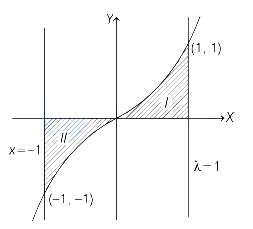
0 likesView Solution
288
MathematicsMediumMCQAP EAMCET · 2021
જો વક્ર $x^2+y^2=16$ અને રેખાઓ $x=2$ તથા $x=3$ દ્વારા ઘેરાયેલા પ્રદેશનું ક્ષેત્રફળ $\left(3 \sqrt{7}-4 \sqrt{3}-\frac{8 \pi}{3}+k\right)$ ચોરસ એકમ હોય,તો $k$ ની કિંમત શોધો.
A
$16 \sin^{-1}\left(\frac{3}{4}\right)$
B
$8 \sin^{-1}\left(\frac{3}{4}\right)$
C
$4 \sin^{-1}\left(\frac{3}{4}\right)$
D
$2 \sin^{-1}\left(\frac{3}{4}\right)$
Solution
(A) વક્ર $x^2+y^2=16$ અને રેખાઓ $x=2$ તથા $x=3$ દ્વારા ઘેરાયેલા પ્રદેશનું ક્ષેત્રફળ $A$ નીચે મુજબ છે:
$A = \int_2^3 \sqrt{16-x^2} dx$
પ્રમાણિત સંકલન સૂત્ર $\int \sqrt{a^2-x^2} dx = \frac{x}{2}\sqrt{a^2-x^2} + \frac{a^2}{2}\sin^{-1}\left(\frac{x}{a}\right)$ નો ઉપયોગ કરતા:
$A = \left[\frac{x}{2}\sqrt{16-x^2} + 8\sin^{-1}\left(\frac{x}{4}\right)\right]_2^3$
નિશ્ચિત સંકલનનું મૂલ્ય શોધતા:
$A = \left(\frac{3}{2}\sqrt{16-9} + 8\sin^{-1}\left(\frac{3}{4}\right)\right) - \left(\frac{2}{2}\sqrt{16-4} + 8\sin^{-1}\left(\frac{2}{4}\right)\right)$
$A = \left(\frac{3}{2}\sqrt{7} + 8\sin^{-1}\left(\frac{3}{4}\right)\right) - \left(\sqrt{12} + 8\sin^{-1}\left(\frac{1}{2}\right)\right)$
અહીં $\sqrt{12} = 2\sqrt{3}$ અને $\sin^{-1}\left(\frac{1}{2}\right) = \frac{\pi}{6}$ હોવાથી:
$A = \frac{3}{2}\sqrt{7} + 8\sin^{-1}\left(\frac{3}{4}\right) - 2\sqrt{3} - 8\left(\frac{\pi}{6}\right)$
$A = \frac{3}{2}\sqrt{7} - 2\sqrt{3} - \frac{4\pi}{3} + 8\sin^{-1}\left(\frac{3}{4}\right)$
આપેલ પદ $\left(3 \sqrt{7}-4 \sqrt{3}-\frac{8 \pi}{3}+k\right)$ સાથે સરખાવતા:
$A = \frac{1}{2} \left(3\sqrt{7} - 4\sqrt{3} - \frac{8\pi}{3} + 16\sin^{-1}\left(\frac{3}{4}\right)\right)$
તેથી,$k = 16\sin^{-1}\left(\frac{3}{4}\right)$.
$A = \int_2^3 \sqrt{16-x^2} dx$
પ્રમાણિત સંકલન સૂત્ર $\int \sqrt{a^2-x^2} dx = \frac{x}{2}\sqrt{a^2-x^2} + \frac{a^2}{2}\sin^{-1}\left(\frac{x}{a}\right)$ નો ઉપયોગ કરતા:
$A = \left[\frac{x}{2}\sqrt{16-x^2} + 8\sin^{-1}\left(\frac{x}{4}\right)\right]_2^3$
નિશ્ચિત સંકલનનું મૂલ્ય શોધતા:
$A = \left(\frac{3}{2}\sqrt{16-9} + 8\sin^{-1}\left(\frac{3}{4}\right)\right) - \left(\frac{2}{2}\sqrt{16-4} + 8\sin^{-1}\left(\frac{2}{4}\right)\right)$
$A = \left(\frac{3}{2}\sqrt{7} + 8\sin^{-1}\left(\frac{3}{4}\right)\right) - \left(\sqrt{12} + 8\sin^{-1}\left(\frac{1}{2}\right)\right)$
અહીં $\sqrt{12} = 2\sqrt{3}$ અને $\sin^{-1}\left(\frac{1}{2}\right) = \frac{\pi}{6}$ હોવાથી:
$A = \frac{3}{2}\sqrt{7} + 8\sin^{-1}\left(\frac{3}{4}\right) - 2\sqrt{3} - 8\left(\frac{\pi}{6}\right)$
$A = \frac{3}{2}\sqrt{7} - 2\sqrt{3} - \frac{4\pi}{3} + 8\sin^{-1}\left(\frac{3}{4}\right)$
આપેલ પદ $\left(3 \sqrt{7}-4 \sqrt{3}-\frac{8 \pi}{3}+k\right)$ સાથે સરખાવતા:
$A = \frac{1}{2} \left(3\sqrt{7} - 4\sqrt{3} - \frac{8\pi}{3} + 16\sin^{-1}\left(\frac{3}{4}\right)\right)$
તેથી,$k = 16\sin^{-1}\left(\frac{3}{4}\right)$.
0 likesView Solution
289
MathematicsEasyMCQAP EAMCET · 2021
વિકલ સમીકરણ $\sqrt{\frac{dy}{dx}} - 4\frac{dy}{dx} - 7x = 0$ ની કક્ષા (order) અને પરિમાણ (degree) અનુક્રમે છે:
A
$1$ અને $\frac{1}{2}$
B
$2$ અને $1$
C
$1$ અને $1$
D
$1$ અને $2$
Solution
(D) આપેલ વિકલ સમીકરણ $\sqrt{\frac{dy}{dx}} - 4\frac{dy}{dx} - 7x = 0$ છે.
પદોને ફરીથી ગોઠવતા,આપણને $\sqrt{\frac{dy}{dx}} = 4\frac{dy}{dx} + 7x$ મળે છે.
વર્ગમૂળ દૂર કરવા માટે બંને બાજુ વર્ગ કરતા:
$\frac{dy}{dx} = (4\frac{dy}{dx} + 7x)^2$
$\frac{dy}{dx} = 16(\frac{dy}{dx})^2 + 49x^2 + 56x\frac{dy}{dx}$.
અહીં સૌથી ઉચ્ચ કક્ષાનું વિકલન $\frac{dy}{dx}$ છે,તેથી કક્ષા $1$ છે.
વિકલનના બહુપદી સ્વરૂપમાં ઉચ્ચ કક્ષાના વિકલનનો ઘાતાંક $2$ છે,તેથી પરિમાણ $2$ છે.
આમ,કક્ષા $1$ અને પરિમાણ $2$ છે.
પદોને ફરીથી ગોઠવતા,આપણને $\sqrt{\frac{dy}{dx}} = 4\frac{dy}{dx} + 7x$ મળે છે.
વર્ગમૂળ દૂર કરવા માટે બંને બાજુ વર્ગ કરતા:
$\frac{dy}{dx} = (4\frac{dy}{dx} + 7x)^2$
$\frac{dy}{dx} = 16(\frac{dy}{dx})^2 + 49x^2 + 56x\frac{dy}{dx}$.
અહીં સૌથી ઉચ્ચ કક્ષાનું વિકલન $\frac{dy}{dx}$ છે,તેથી કક્ષા $1$ છે.
વિકલનના બહુપદી સ્વરૂપમાં ઉચ્ચ કક્ષાના વિકલનનો ઘાતાંક $2$ છે,તેથી પરિમાણ $2$ છે.
આમ,કક્ષા $1$ અને પરિમાણ $2$ છે.
0 likesView Solution
290
MathematicsEasyMCQAP EAMCET · 2021
જો $x^2+y^2=1$ હોય,તો
A
$y y^{\prime \prime}-\left(2 y^{\prime}\right)^2+1=0$
B
$y y^{\prime \prime}+\left(y^{\prime}\right)^2+1=0$
C
$y y^{\prime \prime}-\left(y^{\prime}\right)^2-1=0$
D
$y y^{\prime \prime}+2\left(y^{\prime}\right)^2+1=0$
Solution
(B) આપેલ સમીકરણ $x^2+y^2=1$ છે.
બંને બાજુ $x$ ની સાપેક્ષમાં વિકલન કરતા,આપણને મળે છે:
$2x + 2y y^{\prime} = 0$
$2$ વડે ભાગતા,આપણને $x + y y^{\prime} = 0$ મળે છે.
હવે,ફરીથી $x$ ની સાપેક્ષમાં વિકલન કરતા,$y y^{\prime}$ પર ગુણાકારનો નિયમ વાપરતા:
$\frac{d}{dx}(x) + \frac{d}{dx}(y y^{\prime}) = 0$
$1 + (y y^{\prime \prime} + (y^{\prime}) \cdot y^{\prime}) = 0$
$1 + y y^{\prime \prime} + (y^{\prime})^2 = 0$
આમ,સાચું વિકલ સમીકરણ $y y^{\prime \prime} + (y^{\prime})^2 + 1 = 0$ છે.
બંને બાજુ $x$ ની સાપેક્ષમાં વિકલન કરતા,આપણને મળે છે:
$2x + 2y y^{\prime} = 0$
$2$ વડે ભાગતા,આપણને $x + y y^{\prime} = 0$ મળે છે.
હવે,ફરીથી $x$ ની સાપેક્ષમાં વિકલન કરતા,$y y^{\prime}$ પર ગુણાકારનો નિયમ વાપરતા:
$\frac{d}{dx}(x) + \frac{d}{dx}(y y^{\prime}) = 0$
$1 + (y y^{\prime \prime} + (y^{\prime}) \cdot y^{\prime}) = 0$
$1 + y y^{\prime \prime} + (y^{\prime})^2 = 0$
આમ,સાચું વિકલ સમીકરણ $y y^{\prime \prime} + (y^{\prime})^2 + 1 = 0$ છે.
0 likesView Solution
291
MathematicsDifficultMCQAP EAMCET · 2021
વિકલ સમીકરણ $\frac{d^2 y}{d x^2}+y=0$ નો ઉકેલ શું છે?
A
$y=3 \sin x+4 \cos x$
B
$y=x^2$
C
$y=x+2$
D
$y=\log x$
Solution
(A) આપેલ વિકલ સમીકરણ: $\frac{d^2 y}{d x^2}+y=0$.
આપણે તપાસીએ કે $y=3 \sin x+4 \cos x$ એ ઉકેલ છે કે નહીં.
$x$ ની સાપેક્ષમાં વિકલન કરતા:
$\frac{d y}{d x}=3 \cos x-4 \sin x$.
ફરીથી $x$ ની સાપેક્ષમાં વિકલન કરતા:
$\frac{d^2 y}{d x^2}=-3 \sin x-4 \cos x$.
આ કિંમતને મૂળ સમીકરણમાં મૂકતા:
$\frac{d^2 y}{d x^2}+y = (-3 \sin x-4 \cos x) + (3 \sin x+4 \cos x) = 0$.
આમ,સમીકરણનું સમાધાન થાય છે,તેથી $y=3 \sin x+4 \cos x$ એ ઉકેલ છે.
વૈકલ્પિક રીત:
$\frac{d^2 y}{d x^2}+y=0$ માટે લાક્ષણિક સમીકરણ $m^2+1=0$ છે,જે $m = \pm i$ આપે છે.
તેથી સામાન્ય ઉકેલ $y=c_1 \cos x+c_2 \sin x$ છે.
વિકલ્પ $A$ આ સ્વરૂપમાં છે જ્યાં $c_1=4$ અને $c_2=3$ છે.
આપણે તપાસીએ કે $y=3 \sin x+4 \cos x$ એ ઉકેલ છે કે નહીં.
$x$ ની સાપેક્ષમાં વિકલન કરતા:
$\frac{d y}{d x}=3 \cos x-4 \sin x$.
ફરીથી $x$ ની સાપેક્ષમાં વિકલન કરતા:
$\frac{d^2 y}{d x^2}=-3 \sin x-4 \cos x$.
આ કિંમતને મૂળ સમીકરણમાં મૂકતા:
$\frac{d^2 y}{d x^2}+y = (-3 \sin x-4 \cos x) + (3 \sin x+4 \cos x) = 0$.
આમ,સમીકરણનું સમાધાન થાય છે,તેથી $y=3 \sin x+4 \cos x$ એ ઉકેલ છે.
વૈકલ્પિક રીત:
$\frac{d^2 y}{d x^2}+y=0$ માટે લાક્ષણિક સમીકરણ $m^2+1=0$ છે,જે $m = \pm i$ આપે છે.
તેથી સામાન્ય ઉકેલ $y=c_1 \cos x+c_2 \sin x$ છે.
વિકલ્પ $A$ આ સ્વરૂપમાં છે જ્યાં $c_1=4$ અને $c_2=3$ છે.
0 likesView Solution
292
MathematicsEasyMCQAP EAMCET · 2021
વિકલ સમીકરણ $2 x \left(\frac{d y}{d x}\right) - y = 4$ નો ઉકેલ એ કોનું કુટુંબ દર્શાવે છે?
A
ઉપવલયો
B
પરવલયો
C
સીધી રેખાઓ
D
વર્તુળો
Solution
(B) આપેલ વિકલ સમીકરણ $2 x \frac{d y}{d x} - y = 4$ છે.
પદોને ફરીથી ગોઠવતા,આપણને $2 x \frac{d y}{d x} = 4 + y$ મળે છે.
ચલને અલગ કરતા,$\frac{2}{4 + y} d y = \frac{1}{x} d x$ મળે છે.
બંને બાજુ સંકલન કરતા,$\int \frac{2}{4 + y} d y = \int \frac{1}{x} d x$.
આનાથી $2 \ln |4 + y| = \ln |x| + C$ મળે છે,જ્યાં $C = \ln |c|$.
લઘુગણકના ગુણધર્મોનો ઉપયોગ કરતા,$\ln (4 + y)^2 = \ln |c x|$.
બંને બાજુ ઘાતાંક લેતા,$(4 + y)^2 = c x$.
આ સમીકરણ $(y - k)^2 = 4 a (x - h)$ સ્વરૂપનું છે,જે પરવલયોનું કુટુંબ દર્શાવે છે.
પદોને ફરીથી ગોઠવતા,આપણને $2 x \frac{d y}{d x} = 4 + y$ મળે છે.
ચલને અલગ કરતા,$\frac{2}{4 + y} d y = \frac{1}{x} d x$ મળે છે.
બંને બાજુ સંકલન કરતા,$\int \frac{2}{4 + y} d y = \int \frac{1}{x} d x$.
આનાથી $2 \ln |4 + y| = \ln |x| + C$ મળે છે,જ્યાં $C = \ln |c|$.
લઘુગણકના ગુણધર્મોનો ઉપયોગ કરતા,$\ln (4 + y)^2 = \ln |c x|$.
બંને બાજુ ઘાતાંક લેતા,$(4 + y)^2 = c x$.
આ સમીકરણ $(y - k)^2 = 4 a (x - h)$ સ્વરૂપનું છે,જે પરવલયોનું કુટુંબ દર્શાવે છે.
0 likesView Solution
293
MathematicsEasyMCQAP EAMCET · 2021
જો $f^{\prime}(x)=x+\frac{1}{x}$ હોય,તો $f(x)=$
A
$x^2+\log |x|+c$
B
$\frac{x^2}{2}+\log |x|+c$
C
$x+\log |x|+c$
D
$\frac{x}{2}+\log |x|+c$
Solution
(B) આપેલ છે કે $f^{\prime}(x)=x+\frac{1}{x}$.
$f(x)$ શોધવા માટે,આપણે બંને બાજુ $x$ ની સાપેક્ષમાં સંકલન કરીએ છીએ:
$f(x) = \int f^{\prime}(x) dx = \int \left(x + \frac{1}{x}\right) dx$.
સંકલનના ગુણધર્મનો ઉપયોગ કરતા:
$f(x) = \int x dx + \int \frac{1}{x} dx$.
પ્રમાણિત સંકલન સૂત્રો $\int x^n dx = \frac{x^{n+1}}{n+1}$ અને $\int \frac{1}{x} dx = \log |x| + C$ નો ઉપયોગ કરતા:
$f(x) = \frac{x^2}{2} + \log |x| + C$.
$f(x)$ શોધવા માટે,આપણે બંને બાજુ $x$ ની સાપેક્ષમાં સંકલન કરીએ છીએ:
$f(x) = \int f^{\prime}(x) dx = \int \left(x + \frac{1}{x}\right) dx$.
સંકલનના ગુણધર્મનો ઉપયોગ કરતા:
$f(x) = \int x dx + \int \frac{1}{x} dx$.
પ્રમાણિત સંકલન સૂત્રો $\int x^n dx = \frac{x^{n+1}}{n+1}$ અને $\int \frac{1}{x} dx = \log |x| + C$ નો ઉપયોગ કરતા:
$f(x) = \frac{x^2}{2} + \log |x| + C$.
0 likesView Solution
294
MathematicsMediumMCQAP EAMCET · 2021
બિંદુ $\left(0, \frac{\pi}{4}\right)$ માંથી પસાર થતા અને વિકલ સમીકરણ $\left(e^x \tan y\right) dx + \left((1+e^x) \sec^2 y\right) dy = 0$ નું સમાધાન કરતા વક્રનું સમીકરણ શોધો.
A
$(1+e^x) \tan y = 2$
B
$1+e^x = 2 \tan y$
C
$1+e^x = 2 \sec y$
D
$(1+e^x) \tan y = k$
Solution
(A) આપેલ વિકલ સમીકરણ: $e^x \tan y \, dx + (1+e^x) \sec^2 y \, dy = 0$
પદોને ગોઠવતા: $e^x \tan y \, dx = -(1+e^x) \sec^2 y \, dy$
ચલને અલગ કરતા: $\frac{e^x}{1+e^x} \, dx = -\frac{\sec^2 y}{\tan y} \, dy$
બંને બાજુ સંકલન કરતા: $\int \frac{e^x}{1+e^x} \, dx = -\int \frac{\sec^2 y}{\tan y} \, dy$
સૂત્ર $\int \frac{f'(x)}{f(x)} \, dx = \ln|f(x)| + C$ નો ઉપયોગ કરતા:
$\ln(1+e^x) = -\ln(\tan y) + \ln C$
$\ln(1+e^x) + \ln(\tan y) = \ln C$
$\ln[(1+e^x) \tan y] = \ln C$
$(1+e^x) \tan y = C$
વક્ર બિંદુ $\left(0, \frac{\pi}{4}\right)$ માંથી પસાર થાય છે,તેથી $x=0$ અને $y=\frac{\pi}{4}$ મૂકતા:
$(1+e^0) \tan(\frac{\pi}{4}) = C$
$(1+1)(1) = C \implies C = 2$
આમ,વક્રનું સમીકરણ $(1+e^x) \tan y = 2$ છે.
પદોને ગોઠવતા: $e^x \tan y \, dx = -(1+e^x) \sec^2 y \, dy$
ચલને અલગ કરતા: $\frac{e^x}{1+e^x} \, dx = -\frac{\sec^2 y}{\tan y} \, dy$
બંને બાજુ સંકલન કરતા: $\int \frac{e^x}{1+e^x} \, dx = -\int \frac{\sec^2 y}{\tan y} \, dy$
સૂત્ર $\int \frac{f'(x)}{f(x)} \, dx = \ln|f(x)| + C$ નો ઉપયોગ કરતા:
$\ln(1+e^x) = -\ln(\tan y) + \ln C$
$\ln(1+e^x) + \ln(\tan y) = \ln C$
$\ln[(1+e^x) \tan y] = \ln C$
$(1+e^x) \tan y = C$
વક્ર બિંદુ $\left(0, \frac{\pi}{4}\right)$ માંથી પસાર થાય છે,તેથી $x=0$ અને $y=\frac{\pi}{4}$ મૂકતા:
$(1+e^0) \tan(\frac{\pi}{4}) = C$
$(1+1)(1) = C \implies C = 2$
આમ,વક્રનું સમીકરણ $(1+e^x) \tan y = 2$ છે.
0 likesView Solution
295
MathematicsEasyMCQAP EAMCET · 2021
વિકલ સમીકરણ ઉકેલો: $\frac{dy}{dx} = e^{x+y}$
A
$e^x + e^y = c$
B
$e^x - e^y = c$
C
$e^x + e^{-y} = c$
D
$e^x - e^{-y} = c$
Solution
(C) આપેલ વિકલ સમીકરણ: $\frac{dy}{dx} = e^{x+y}$
ઘાતાંકના નિયમનો ઉપયોગ કરતા,આપણે લખી શકીએ: $\frac{dy}{dx} = e^x \cdot e^y$
ચલને અલગ કરતા,આપણને મળે છે: $\frac{dy}{e^y} = e^x dx$
આને આ રીતે લખી શકાય: $e^{-y} dy = e^x dx$
બંને બાજુ સંકલન કરતા: $\int e^{-y} dy = \int e^x dx$
સંકલન કરતા: $-e^{-y} = e^x + C_1$
પદોને ગોઠવતા: $e^x + e^{-y} = -C_1$
ધારો કે $-C_1 = c$,તેથી અંતિમ ઉકેલ મળે છે: $e^x + e^{-y} = c$
ઘાતાંકના નિયમનો ઉપયોગ કરતા,આપણે લખી શકીએ: $\frac{dy}{dx} = e^x \cdot e^y$
ચલને અલગ કરતા,આપણને મળે છે: $\frac{dy}{e^y} = e^x dx$
આને આ રીતે લખી શકાય: $e^{-y} dy = e^x dx$
બંને બાજુ સંકલન કરતા: $\int e^{-y} dy = \int e^x dx$
સંકલન કરતા: $-e^{-y} = e^x + C_1$
પદોને ગોઠવતા: $e^x + e^{-y} = -C_1$
ધારો કે $-C_1 = c$,તેથી અંતિમ ઉકેલ મળે છે: $e^x + e^{-y} = c$
0 likesView Solution
296
MathematicsMediumMCQAP EAMCET · 2021
નીચેના વિકલ સમીકરણનો વિશિષ્ટ ઉકેલ શોધો,આપેલ છે કે $y=1$ જ્યારે $x=0$: $(1+x^2) \frac{dy}{dx} = e^{\tan^{-1} x} - y$.
A
$y e^{\tan^{-1} x} = e^{\tan^{-1} x} + 1$
B
$y e^{\tan^{-1} x} = e^{\tan^{-1} x} - 1$
C
$y e^{\tan^{-1} x} = \frac{e^{2 \tan^{-1} x} + 1}{2}$
D
$y e^{\tan^{-1} x} = \tan^{-1} x - 1$
Solution
(NONE) આપેલ વિકલ સમીકરણ: $(1+x^2) \frac{dy}{dx} = e^{\tan^{-1} x} - y$.
$(1+x^2)$ વડે ભાગતા: $\frac{dy}{dx} + \frac{y}{1+x^2} = \frac{e^{\tan^{-1} x}}{1+x^2}$.
આ $\frac{dy}{dx} + Py = Q$ સ્વરૂપનું સુરેખ વિકલ સમીકરણ છે,જ્યાં $P = \frac{1}{1+x^2}$ અને $Q = \frac{e^{\tan^{-1} x}}{1+x^2}$.
સંકલ્યકારક અવયવ $(IF)$ = $e^{\int P dx} = e^{\int \frac{1}{1+x^2} dx} = e^{\tan^{-1} x}$.
ઉકેલ $y \cdot IF = \int Q \cdot IF dx + C$ છે.
$y e^{\tan^{-1} x} = \int \frac{e^{\tan^{-1} x}}{1+x^2} \cdot e^{\tan^{-1} x} dx + C$.
ધારો કે $t = \tan^{-1} x$,તેથી $dt = \frac{1}{1+x^2} dx$.
$y e^{\tan^{-1} x} = \int e^{2t} dt + C = \frac{e^{2t}}{2} + C = \frac{e^{2 \tan^{-1} x}}{2} + C$.
આપેલ છે કે $y=1$ જ્યારે $x=0$: $1 \cdot e^0 = \frac{e^0}{2} + C \Rightarrow 1 = \frac{1}{2} + C \Rightarrow C = \frac{1}{2}$.
આમ,$y e^{\tan^{-1} x} = \frac{e^{2 \tan^{-1} x} + 1}{2}$.
$(1+x^2)$ વડે ભાગતા: $\frac{dy}{dx} + \frac{y}{1+x^2} = \frac{e^{\tan^{-1} x}}{1+x^2}$.
આ $\frac{dy}{dx} + Py = Q$ સ્વરૂપનું સુરેખ વિકલ સમીકરણ છે,જ્યાં $P = \frac{1}{1+x^2}$ અને $Q = \frac{e^{\tan^{-1} x}}{1+x^2}$.
સંકલ્યકારક અવયવ $(IF)$ = $e^{\int P dx} = e^{\int \frac{1}{1+x^2} dx} = e^{\tan^{-1} x}$.
ઉકેલ $y \cdot IF = \int Q \cdot IF dx + C$ છે.
$y e^{\tan^{-1} x} = \int \frac{e^{\tan^{-1} x}}{1+x^2} \cdot e^{\tan^{-1} x} dx + C$.
ધારો કે $t = \tan^{-1} x$,તેથી $dt = \frac{1}{1+x^2} dx$.
$y e^{\tan^{-1} x} = \int e^{2t} dt + C = \frac{e^{2t}}{2} + C = \frac{e^{2 \tan^{-1} x}}{2} + C$.
આપેલ છે કે $y=1$ જ્યારે $x=0$: $1 \cdot e^0 = \frac{e^0}{2} + C \Rightarrow 1 = \frac{1}{2} + C \Rightarrow C = \frac{1}{2}$.
આમ,$y e^{\tan^{-1} x} = \frac{e^{2 \tan^{-1} x} + 1}{2}$.
0 likesView Solution
297
MathematicsMediumMCQAP EAMCET · 2021
બિંદુ $(0,1)$ માંથી પસાર થતા વક્રનું સમીકરણ શોધો,જો વક્રના કોઈપણ બિંદુ $(x, y)$ પર સ્પર્શકનો ઢાળ તે બિંદુના $x$-યામ અને $x$ તથા $y$ યામના ગુણાકારના સરવાળા જેટલો હોય.
A
$y=1-2 e^{\left(\frac{x^2}{2}\right)}$
B
$y=-1+2 e^{\left(\frac{x^2}{2}\right)}$
C
$y=-1-2 e^{\left(\frac{x^2}{2}\right)}$
D
$y=1+2 e^{\left(\frac{x^2}{2}\right)}$
Solution
(B) આપેલ છે કે,સ્પર્શકનો ઢાળ $\frac{dy}{dx} = x + xy$ છે.
પદોને ગોઠવતા,$\frac{dy}{dx} = x(1+y)$ મળે.
ચલને અલગ કરતા,$\frac{dy}{1+y} = x dx$ મળે.
બંને બાજુ સંકલન કરતા,$\int \frac{dy}{1+y} = \int x dx$,જે $\ln(y+1) = \frac{x^2}{2} + C$ આપે છે.
બંને બાજુ ઘાતાંક લેતા,$y+1 = e^{\frac{x^2}{2} + C} = e^C \cdot e^{\frac{x^2}{2}}$ મળે.
ધારો કે $e^C = A$,તેથી $y = A e^{\frac{x^2}{2}} - 1$.
વક્ર બિંદુ $(0,1)$ માંથી પસાર થાય છે,તેથી $x=0$ અને $y=1$ મૂકતા: $1 = A e^0 - 1 \Rightarrow 1 = A - 1 \Rightarrow A = 2$.
આમ,વક્રનું સમીકરણ $y = 2 e^{\frac{x^2}{2}} - 1$ છે.
પદોને ગોઠવતા,$\frac{dy}{dx} = x(1+y)$ મળે.
ચલને અલગ કરતા,$\frac{dy}{1+y} = x dx$ મળે.
બંને બાજુ સંકલન કરતા,$\int \frac{dy}{1+y} = \int x dx$,જે $\ln(y+1) = \frac{x^2}{2} + C$ આપે છે.
બંને બાજુ ઘાતાંક લેતા,$y+1 = e^{\frac{x^2}{2} + C} = e^C \cdot e^{\frac{x^2}{2}}$ મળે.
ધારો કે $e^C = A$,તેથી $y = A e^{\frac{x^2}{2}} - 1$.
વક્ર બિંદુ $(0,1)$ માંથી પસાર થાય છે,તેથી $x=0$ અને $y=1$ મૂકતા: $1 = A e^0 - 1 \Rightarrow 1 = A - 1 \Rightarrow A = 2$.
આમ,વક્રનું સમીકરણ $y = 2 e^{\frac{x^2}{2}} - 1$ છે.
0 likesView Solution
298
MathematicsEasyMCQAP EAMCET · 2021
નીચેના વિકલ સમીકરણને ઉકેલો: $\left(x^2+1\right) \frac{dy}{dx} + 4xy = \frac{1}{x^2+1}$
A
$y(x^2-1)^2 = x+c$
B
$y(x^2+1)^2 = x+c$
C
$y(x^2+1)^2 = x^2+c$
D
$y(x^2-1)^2 = x^2+c$
Solution
(B) આપેલ વિકલ સમીકરણ: $\left(x^2+1\right) \frac{dy}{dx} + 4xy = \frac{1}{x^2+1}$
પ્રમાણિત સુરેખ સ્વરૂપ $\frac{dy}{dx} + P(x)y = Q(x)$ મેળવવા માટે $(x^2+1)$ વડે ભાગતા:
$\frac{dy}{dx} + \frac{4x}{x^2+1}y = \frac{1}{(x^2+1)^2}$
અહીં,$P(x) = \frac{4x}{x^2+1}$ અને $Q(x) = \frac{1}{(x^2+1)^2}$ છે.
સંકલ્યકારક અવયવ $(IF)$ $e^{\int P(x) dx}$ દ્વારા મળે છે:
$IF = e^{\int \frac{4x}{x^2+1} dx} = e^{2 \ln(x^2+1)} = e^{\ln(x^2+1)^2} = (x^2+1)^2$.
વ્યાપક ઉકેલ $y \cdot IF = \int Q(x) \cdot IF dx + c$ છે:
$y(x^2+1)^2 = \int \left( \frac{1}{(x^2+1)^2} \cdot (x^2+1)^2 \right) dx + c$
$y(x^2+1)^2 = \int 1 dx + c$
$y(x^2+1)^2 = x + c$.
પ્રમાણિત સુરેખ સ્વરૂપ $\frac{dy}{dx} + P(x)y = Q(x)$ મેળવવા માટે $(x^2+1)$ વડે ભાગતા:
$\frac{dy}{dx} + \frac{4x}{x^2+1}y = \frac{1}{(x^2+1)^2}$
અહીં,$P(x) = \frac{4x}{x^2+1}$ અને $Q(x) = \frac{1}{(x^2+1)^2}$ છે.
સંકલ્યકારક અવયવ $(IF)$ $e^{\int P(x) dx}$ દ્વારા મળે છે:
$IF = e^{\int \frac{4x}{x^2+1} dx} = e^{2 \ln(x^2+1)} = e^{\ln(x^2+1)^2} = (x^2+1)^2$.
વ્યાપક ઉકેલ $y \cdot IF = \int Q(x) \cdot IF dx + c$ છે:
$y(x^2+1)^2 = \int \left( \frac{1}{(x^2+1)^2} \cdot (x^2+1)^2 \right) dx + c$
$y(x^2+1)^2 = \int 1 dx + c$
$y(x^2+1)^2 = x + c$.
0 likesView Solution
299
MathematicsMediumMCQAP EAMCET · 2021
ધારો કે $y=Y(x)$ એ વિકલ સમીકરણ $\frac{dy}{dx}+y \tan x=2x+x^2 \tan x$,$x \in \left(\frac{-\pi}{2}, \frac{\pi}{2}\right)$ નો ઉકેલ છે,જેથી $Y(0)=1$,તો
A
$Y\left(\frac{\pi}{4}\right)+Y\left(\frac{-\pi}{4}\right)=\frac{\pi^2}{8}+\sqrt{2}$
B
$Y^{\prime}\left(\frac{\pi}{4}\right)+Y^{\prime}\left(\frac{-\pi}{4}\right)=-\sqrt{2}$
C
$Y\left(\frac{\pi}{4}\right)-Y\left(\frac{-\pi}{4}\right)=\sqrt{2}$
D
$Y^{\prime}\left(\frac{\pi}{4}\right)-Y^{\prime}\left(\frac{-\pi}{4}\right)=\pi-\sqrt{2}$
Solution
(D) આપેલ વિકલ સમીકરણ $\frac{dy}{dx}+y \tan x=2x+x^2 \tan x$ છે.
આ $\frac{dy}{dx}+Py=Q$ સ્વરૂપનું સુરેખ વિકલ સમીકરણ છે,જ્યાં $P=\tan x$ અને $Q=2x+x^2 \tan x$.
સંકલ્યકારક અવયવ $IF = e^{\int \tan x dx} = e^{\ln |\sec x|} = \sec x$.
ઉકેલ $y \cdot IF = \int Q \cdot IF dx + C$ દ્વારા મળે છે.
$y \sec x = \int (2x+x^2 \tan x) \sec x dx + C$.
$y \sec x = \int 2x \sec x dx + \int x^2 \sec x \tan x dx + C$.
બીજા સંકલન માટે ખંડશઃ સંકલનનો ઉપયોગ કરતા: $\int x^2 \sec x \tan x dx = x^2 \sec x - \int 2x \sec x dx$.
આ કિંમત પાછી મૂકતા: $y \sec x = \int 2x \sec x dx + x^2 \sec x - \int 2x \sec x dx + C$.
$y \sec x = x^2 \sec x + C$,જેનું સાદું રૂપ $y = x^2 + C \cos x$ થાય છે.
$Y(0)=1$ આપેલ હોવાથી,$1 = 0^2 + C \cos(0) \implies C=1$.
તેથી,$Y(x) = x^2 + \cos x$.
હવે $Y'(x) = 2x - \sin x$.
$Y'(\frac{\pi}{4}) - Y'(-\frac{\pi}{4}) = (2(\frac{\pi}{4}) - \sin(\frac{\pi}{4})) - (2(-\frac{\pi}{4}) - \sin(-\frac{\pi}{4}))$.
$= (\frac{\pi}{2} - \frac{1}{\sqrt{2}}) - (-\frac{\pi}{2} + \frac{1}{\sqrt{2}}) = \pi - \frac{2}{\sqrt{2}} = \pi - \sqrt{2}$.
આમ,વિકલ્પ $D$ સાચો છે.
આ $\frac{dy}{dx}+Py=Q$ સ્વરૂપનું સુરેખ વિકલ સમીકરણ છે,જ્યાં $P=\tan x$ અને $Q=2x+x^2 \tan x$.
સંકલ્યકારક અવયવ $IF = e^{\int \tan x dx} = e^{\ln |\sec x|} = \sec x$.
ઉકેલ $y \cdot IF = \int Q \cdot IF dx + C$ દ્વારા મળે છે.
$y \sec x = \int (2x+x^2 \tan x) \sec x dx + C$.
$y \sec x = \int 2x \sec x dx + \int x^2 \sec x \tan x dx + C$.
બીજા સંકલન માટે ખંડશઃ સંકલનનો ઉપયોગ કરતા: $\int x^2 \sec x \tan x dx = x^2 \sec x - \int 2x \sec x dx$.
આ કિંમત પાછી મૂકતા: $y \sec x = \int 2x \sec x dx + x^2 \sec x - \int 2x \sec x dx + C$.
$y \sec x = x^2 \sec x + C$,જેનું સાદું રૂપ $y = x^2 + C \cos x$ થાય છે.
$Y(0)=1$ આપેલ હોવાથી,$1 = 0^2 + C \cos(0) \implies C=1$.
તેથી,$Y(x) = x^2 + \cos x$.
હવે $Y'(x) = 2x - \sin x$.
$Y'(\frac{\pi}{4}) - Y'(-\frac{\pi}{4}) = (2(\frac{\pi}{4}) - \sin(\frac{\pi}{4})) - (2(-\frac{\pi}{4}) - \sin(-\frac{\pi}{4}))$.
$= (\frac{\pi}{2} - \frac{1}{\sqrt{2}}) - (-\frac{\pi}{2} + \frac{1}{\sqrt{2}}) = \pi - \frac{2}{\sqrt{2}} = \pi - \sqrt{2}$.
આમ,વિકલ્પ $D$ સાચો છે.
0 likesView Solution
300
MathematicsEasyMCQAP EAMCET · 2021
ધારો કે $x$ અને $y$ એ બે ચોરસની બાજુઓ છે જેથી $y = x - x^2$ થાય. પ્રથમ ચોરસના ક્ષેત્રફળની સાપેક્ષમાં બીજા ચોરસના ક્ષેત્રફળમાં થતો ફેરફારનો દર કેટલો છે?
A
$1 - 3 x + 2 x^2$
B
$1 + 3 x - 2 x^2$
C
$2 x$
D
$x + 2 x^3 - 3 x^2$
Solution
(A) ધારો કે $A_1$ એ પ્રથમ ચોરસનું ક્ષેત્રફળ છે અને $A_2$ એ બીજા ચોરસનું ક્ષેત્રફળ છે.
પ્રથમ ચોરસની બાજુ $x$ આપેલ છે,તેથી તેનું ક્ષેત્રફળ $A_1 = x^2$ થાય.
બીજા ચોરસની બાજુ $y = x - x^2$ આપેલ છે,તેથી તેનું ક્ષેત્રફળ $A_2 = y^2 = (x - x^2)^2$ થાય.
આનું વિસ્તરણ કરતા,આપણને $A_2 = x^2 - 2 x^3 + x^4$ મળે છે.
આપણે $A_1$ ની સાપેક્ષમાં $A_2$ માં થતો ફેરફારનો દર શોધવાનો છે,જે $\frac{d A_2}{d A_1}$ છે.
ચેઈન રૂલનો ઉપયોગ કરતા,$\frac{d A_2}{d A_1} = \frac{d A_2 / d x}{d A_1 / d x}$ થાય.
પ્રથમ,$x$ ની સાપેક્ષમાં વિકલન કરતા:
$\frac{d A_1}{d x} = \frac{d}{d x}(x^2) = 2 x$.
$\frac{d A_2}{d x} = \frac{d}{d x}(x^2 - 2 x^3 + x^4) = 2 x - 6 x^2 + 4 x^3$.
હવે,આ કિંમતોને ચેઈન રૂલના સૂત્રમાં મૂકતા:
$\frac{d A_2}{d A_1} = \frac{2 x - 6 x^2 + 4 x^3}{2 x} = \frac{2 x(1 - 3 x + 2 x^2)}{2 x} = 1 - 3 x + 2 x^2$.
પ્રથમ ચોરસની બાજુ $x$ આપેલ છે,તેથી તેનું ક્ષેત્રફળ $A_1 = x^2$ થાય.
બીજા ચોરસની બાજુ $y = x - x^2$ આપેલ છે,તેથી તેનું ક્ષેત્રફળ $A_2 = y^2 = (x - x^2)^2$ થાય.
આનું વિસ્તરણ કરતા,આપણને $A_2 = x^2 - 2 x^3 + x^4$ મળે છે.
આપણે $A_1$ ની સાપેક્ષમાં $A_2$ માં થતો ફેરફારનો દર શોધવાનો છે,જે $\frac{d A_2}{d A_1}$ છે.
ચેઈન રૂલનો ઉપયોગ કરતા,$\frac{d A_2}{d A_1} = \frac{d A_2 / d x}{d A_1 / d x}$ થાય.
પ્રથમ,$x$ ની સાપેક્ષમાં વિકલન કરતા:
$\frac{d A_1}{d x} = \frac{d}{d x}(x^2) = 2 x$.
$\frac{d A_2}{d x} = \frac{d}{d x}(x^2 - 2 x^3 + x^4) = 2 x - 6 x^2 + 4 x^3$.
હવે,આ કિંમતોને ચેઈન રૂલના સૂત્રમાં મૂકતા:
$\frac{d A_2}{d A_1} = \frac{2 x - 6 x^2 + 4 x^3}{2 x} = \frac{2 x(1 - 3 x + 2 x^2)}{2 x} = 1 - 3 x + 2 x^2$.
0 likesView Solution
Vedclass Products
For Students
Vedclass Test Series
Mock tests in real AP EAMCET style covering Mathematics with performance analysis. 5-day free trial.
Start Free TrialFor Teachers
Exam Paper Generator
Generate Set A/B/C/D Mathematics papers from 7.5L+ questions in 2 minutes. 3 chapters free.
Try FreeFor Institutes
Online Exam Module
Run live AP EAMCET mock exams with unlimited students, 360° analytics & white-label branding.
See DemoFrequently Asked Questions
How many Mathematics questions are in AP EAMCET 2021?
There are 797 Mathematics questions from the AP EAMCET 2021 paper on Vedclass, each with a detailed step-by-step solution in Gujarati.
Are AP EAMCET 2021 Mathematics solutions available in Gujarati?
Yes. All solutions on this page are in Gujarati. You can also switch to English or Hindi using the language buttons above the questions.
Can I practice AP EAMCET 2021 Mathematics as a timed test?
Yes. Use the Vedclass Test Series to attempt a full AP EAMCET mock test covering Mathematics with time limits and instant score analysis.
Can teachers create Mathematics papers from AP EAMCET previous year questions?
Yes. The Vedclass Exam Paper Generator lets teachers mix AP EAMCET Mathematics questions and generate Set A/B/C/D papers in minutes.
For Teachers & Institutes
Build a Custom Mathematics Paper
Pick AP EAMCET 2021 Mathematics questions, set difficulty, and generate Set A/B/C/D in 2 minutes.