
MathematicsQ101–200 of 474 questions
Page 3 of 5 · Gujarati
101
MathematicsDifficultMCQJEE Main · 2025
ધારો કે ઉપવલય $E_1: \frac{x^2}{a^2} + \frac{y^2}{b^2} = 1, a > b$ અને $E_2: \frac{x^2}{A^2} + \frac{y^2}{B^2} = 1, A < B$ ની ઉત્કેન્દ્રતા સમાન $e = \frac{1}{\sqrt{3}}$ છે. જો તેમના નાભિલંબની લંબાઈનો ગુણાકાર $\frac{32}{\sqrt{3}}$ હોય,અને $E_1$ ની નાભિઓ વચ્ચેનું અંતર $4$ હોય. જો $E_1$ અને $E_2$ એ $A, B, C$ અને $D$ માં મળે,તો ચતુષ્કોણ $ABCD$ નું ક્ષેત્રફળ કેટલું થાય?
A
$6 \sqrt{6}$
B
$\frac{18 \sqrt{6}}{5}$
C
$\frac{12 \sqrt{6}}{5}$
D
$\frac{24 \sqrt{6}}{5}$
Solution
(D) $E_1$ માટે,$2ae = 4 \implies a(\frac{1}{\sqrt{3}}) = 2 \implies a = 2\sqrt{3}$.
$e^2 = 1 - \frac{b^2}{a^2}$ હોવાથી,$\frac{1}{3} = 1 - \frac{b^2}{12} \implies \frac{b^2}{12} = \frac{2}{3} \implies b^2 = 8$.
$E_1$ ના નાભિલંબની લંબાઈ $L_1 = \frac{2b^2}{a} = \frac{2(8)}{2\sqrt{3}} = \frac{8}{\sqrt{3}}$.
$E_2$ માટે,$e^2 = 1 - \frac{A^2}{B^2} = \frac{1}{3} \implies \frac{A^2}{B^2} = \frac{2}{3} \implies A^2 = \frac{2}{3}B^2$. નાભિલંબની લંબાઈ $L_2 = \frac{2A^2}{B} = \frac{2(\frac{2}{3}B^2)}{B} = \frac{4B}{3}$.
$L_1 \cdot L_2 = \frac{32}{\sqrt{3}}$ આપેલ છે $\implies \frac{8}{\sqrt{3}} \cdot \frac{4B}{3} = \frac{32}{\sqrt{3}} \implies B = 3$. તેથી $A^2 = \frac{2}{3}(3^2) = 6$.
સમીકરણો $E_1: \frac{x^2}{12} + \frac{y^2}{8} = 1$ અને $E_2: \frac{x^2}{6} + \frac{y^2}{9} = 1$ છે.
સમીકરણોની બાદબાકી કરતા: $(\frac{1}{12} - \frac{1}{6})x^2 + (\frac{1}{8} - \frac{1}{9})y^2 = 0 \implies -\frac{1}{12}x^2 + \frac{1}{72}y^2 = 0 \implies y^2 = 6x^2$.
$y^2 = 6x^2$ ને $E_1$ માં મૂકતા: $\frac{x^2}{12} + \frac{6x^2}{8} = 1 \implies \frac{x^2}{12} + \frac{3x^2}{4} = 1 \implies \frac{x^2 + 9x^2}{12} = 1 \implies 10x^2 = 12 \implies x^2 = \frac{6}{5} \implies x = \pm \sqrt{\frac{6}{5}}$.
તેથી $y^2 = 6(\frac{6}{5}) = \frac{36}{5} \implies y = \pm \frac{6}{\sqrt{5}}$.
શિરોબિંદુઓ $(\pm \sqrt{\frac{6}{5}}, \pm \frac{6}{\sqrt{5}})$ છે.
લંબચોરસનું ક્ષેત્રફળ $= 2|x| \cdot 2|y| = 4 \cdot \sqrt{\frac{6}{5}} \cdot \frac{6}{\sqrt{5}} = \frac{24\sqrt{6}}{5}$.
$e^2 = 1 - \frac{b^2}{a^2}$ હોવાથી,$\frac{1}{3} = 1 - \frac{b^2}{12} \implies \frac{b^2}{12} = \frac{2}{3} \implies b^2 = 8$.
$E_1$ ના નાભિલંબની લંબાઈ $L_1 = \frac{2b^2}{a} = \frac{2(8)}{2\sqrt{3}} = \frac{8}{\sqrt{3}}$.
$E_2$ માટે,$e^2 = 1 - \frac{A^2}{B^2} = \frac{1}{3} \implies \frac{A^2}{B^2} = \frac{2}{3} \implies A^2 = \frac{2}{3}B^2$. નાભિલંબની લંબાઈ $L_2 = \frac{2A^2}{B} = \frac{2(\frac{2}{3}B^2)}{B} = \frac{4B}{3}$.
$L_1 \cdot L_2 = \frac{32}{\sqrt{3}}$ આપેલ છે $\implies \frac{8}{\sqrt{3}} \cdot \frac{4B}{3} = \frac{32}{\sqrt{3}} \implies B = 3$. તેથી $A^2 = \frac{2}{3}(3^2) = 6$.
સમીકરણો $E_1: \frac{x^2}{12} + \frac{y^2}{8} = 1$ અને $E_2: \frac{x^2}{6} + \frac{y^2}{9} = 1$ છે.
સમીકરણોની બાદબાકી કરતા: $(\frac{1}{12} - \frac{1}{6})x^2 + (\frac{1}{8} - \frac{1}{9})y^2 = 0 \implies -\frac{1}{12}x^2 + \frac{1}{72}y^2 = 0 \implies y^2 = 6x^2$.
$y^2 = 6x^2$ ને $E_1$ માં મૂકતા: $\frac{x^2}{12} + \frac{6x^2}{8} = 1 \implies \frac{x^2}{12} + \frac{3x^2}{4} = 1 \implies \frac{x^2 + 9x^2}{12} = 1 \implies 10x^2 = 12 \implies x^2 = \frac{6}{5} \implies x = \pm \sqrt{\frac{6}{5}}$.
તેથી $y^2 = 6(\frac{6}{5}) = \frac{36}{5} \implies y = \pm \frac{6}{\sqrt{5}}$.
શિરોબિંદુઓ $(\pm \sqrt{\frac{6}{5}}, \pm \frac{6}{\sqrt{5}})$ છે.
લંબચોરસનું ક્ષેત્રફળ $= 2|x| \cdot 2|y| = 4 \cdot \sqrt{\frac{6}{5}} \cdot \frac{6}{\sqrt{5}} = \frac{24\sqrt{6}}{5}$.
0 likesView Solution
102
MathematicsDifficultMCQJEE Main · 2025
ધન પૂર્ણાંકોની એક $A.P.$ ધ્યાનમાં લો,જેના પ્રથમ ત્રણ પદોનો સરવાળો $54$ છે અને પ્રથમ વીસ પદોનો સરવાળો $1600$ અને $1800$ ની વચ્ચે છે. તો તેનું $11$ મું પદ શોધો:
A
$84$
B
$122$
C
$90$
D
$108$
Solution
(C) ધારો કે $A.P.$ એ $a, a+d, a+2d, \dots$ છે જ્યાં $a$ અને $d$ ધન પૂર્ણાંકો છે.
આપેલ છે કે $S_3 = a + (a+d) + (a+2d) = 3a + 3d = 54$,જેનું સાદું રૂપ $a+d = 18$ થાય છે.
તેથી,$a = 18-d$.
કારણ કે $a$ ધન પૂર્ણાંક છે,$18-d > 0 \Rightarrow d < 18$.
વળી,$S_{20} = \frac{20}{2} [2a + 19d] = 10[2(18-d) + 19d] = 10[36 - 2d + 19d] = 10[36 + 17d]$.
આપેલ છે કે $1600 < 10(36 + 17d) < 1800$,$10$ વડે ભાગતા $160 < 36 + 17d < 180$ મળે છે.
$36$ બાદ કરતા $124 < 17d < 144$ મળે છે.
$17$ વડે ભાગતા $7.29 < d < 8.47$ મળે છે.
કારણ કે $d$ પૂર્ણાંક હોવો જોઈએ,તેથી $d = 8$.
તેથી $a = 18 - 8 = 10$.
$11$ મું પદ $a_{11} = a + 10d = 10 + 10(8) = 10 + 80 = 90$ થાય.
આપેલ છે કે $S_3 = a + (a+d) + (a+2d) = 3a + 3d = 54$,જેનું સાદું રૂપ $a+d = 18$ થાય છે.
તેથી,$a = 18-d$.
કારણ કે $a$ ધન પૂર્ણાંક છે,$18-d > 0 \Rightarrow d < 18$.
વળી,$S_{20} = \frac{20}{2} [2a + 19d] = 10[2(18-d) + 19d] = 10[36 - 2d + 19d] = 10[36 + 17d]$.
આપેલ છે કે $1600 < 10(36 + 17d) < 1800$,$10$ વડે ભાગતા $160 < 36 + 17d < 180$ મળે છે.
$36$ બાદ કરતા $124 < 17d < 144$ મળે છે.
$17$ વડે ભાગતા $7.29 < d < 8.47$ મળે છે.
કારણ કે $d$ પૂર્ણાંક હોવો જોઈએ,તેથી $d = 8$.
તેથી $a = 18 - 8 = 10$.
$11$ મું પદ $a_{11} = a + 10d = 10 + 10(8) = 10 + 80 = 90$ થાય.
0 likesView Solution
103
MathematicsDifficultMCQJEE Main · 2025
$\lim _{n \rightarrow \infty} \left( \sum_{k=1}^n \frac{k^3+6 k^2+11 k+5}{(k+3)!} \right)$ નું મૂલ્ય શું છે?
A
$\frac{4}{3}$
B
$2$
C
$\frac{7}{3}$
D
$\frac{5}{3}$
Solution
(D) આપણે $\lim _{n \rightarrow \infty} \sum_{k=1}^n \frac{k^3+6 k^2+11 k+5}{(k+3)!}$ ની ગણતરી કરવી છે.
પ્રથમ,અંશને ફરીથી લખતા: $k^3+6 k^2+11 k+5 = (k+1)(k+2)(k+3) - 1$.
આને સરવાળામાં મૂકતા,આપણને મળે છે:
$\sum_{k=1}^n \left( \frac{(k+1)(k+2)(k+3)}{(k+3)!} - \frac{1}{(k+3)!} \right)$.
પ્રથમ પદનું સાદું રૂપ આપતા: $\frac{(k+1)(k+2)(k+3)}{(k+3)!} = \frac{1}{k!}$.
તેથી સરવાળો $\sum_{k=1}^n \left( \frac{1}{k!} - \frac{1}{(k+3)!} \right)$ બને છે.
સરવાળાને વિસ્તૃત કરતા:
$\left( \frac{1}{1!} - \frac{1}{4!} \right) + \left( \frac{1}{2!} - \frac{1}{5!} \right) + \left( \frac{1}{3!} - \frac{1}{6!} \right) + \dots + \left( \frac{1}{n!} - \frac{1}{(n+3)!} \right)$.
જેમ $n \rightarrow \infty$,તેમ પદો $\frac{1}{(n+1)!}, \frac{1}{(n+2)!}, \frac{1}{(n+3)!}$ એ $0$ ની નજીક જાય છે.
બાકી રહેલા પદો $\frac{1}{1!} + \frac{1}{2!} + \frac{1}{3!} = 1 + \frac{1}{2} + \frac{1}{6} = \frac{10}{6} = \frac{5}{3}$ છે.
પ્રથમ,અંશને ફરીથી લખતા: $k^3+6 k^2+11 k+5 = (k+1)(k+2)(k+3) - 1$.
આને સરવાળામાં મૂકતા,આપણને મળે છે:
$\sum_{k=1}^n \left( \frac{(k+1)(k+2)(k+3)}{(k+3)!} - \frac{1}{(k+3)!} \right)$.
પ્રથમ પદનું સાદું રૂપ આપતા: $\frac{(k+1)(k+2)(k+3)}{(k+3)!} = \frac{1}{k!}$.
તેથી સરવાળો $\sum_{k=1}^n \left( \frac{1}{k!} - \frac{1}{(k+3)!} \right)$ બને છે.
સરવાળાને વિસ્તૃત કરતા:
$\left( \frac{1}{1!} - \frac{1}{4!} \right) + \left( \frac{1}{2!} - \frac{1}{5!} \right) + \left( \frac{1}{3!} - \frac{1}{6!} \right) + \dots + \left( \frac{1}{n!} - \frac{1}{(n+3)!} \right)$.
જેમ $n \rightarrow \infty$,તેમ પદો $\frac{1}{(n+1)!}, \frac{1}{(n+2)!}, \frac{1}{(n+3)!}$ એ $0$ ની નજીક જાય છે.
બાકી રહેલા પદો $\frac{1}{1!} + \frac{1}{2!} + \frac{1}{3!} = 1 + \frac{1}{2} + \frac{1}{6} = \frac{10}{6} = \frac{5}{3}$ છે.
0 likesView Solution
104
MathematicsDifficultMCQJEE Main · 2025
ધારો કે $x_1, x_2, \ldots, x_{10}$ દસ અવલોકનો છે કે જેથી $\sum_{i=1}^{10}(x_i-2)=30$,$\sum_{i=1}^{10}(x_i-\beta)^2=98$,$\beta > 2$ અને તેમનું વિચરણ $\frac{4}{5}$ છે. જો $\mu$ અને $\sigma^2$ એ $2(x_1-1)+4\beta, 2(x_2-1)+4\beta, \ldots, 2(x_{10}-1)+4\beta$ ના અનુક્રમે મધ્યક અને વિચરણ હોય,તો $\frac{\beta\mu}{\sigma^2}$ ની કિંમત શોધો:
A
$100$
B
$110$
C
$120$
D
$90$
Solution
(A) આપેલ છે કે $\sum_{i=1}^{10}(x_i-2)=30 \implies \sum x_i - 20 = 30 \implies \sum x_i = 50$. મધ્યક $\bar{x} = \frac{50}{10} = 5$.
વિચરણ $\sigma_x^2 = \frac{\sum x_i^2}{10} - (\bar{x})^2 = \frac{4}{5} \implies \frac{\sum x_i^2}{10} - 25 = 0.8 \implies \sum x_i^2 = 258$.
આપેલ છે કે $\sum_{i=1}^{10}(x_i-\beta)^2 = 98 \implies \sum x_i^2 - 2\beta \sum x_i + 10\beta^2 = 98$.
કિંમતો મૂકતા: $258 - 2\beta(50) + 10\beta^2 = 98 \implies 10\beta^2 - 100\beta + 160 = 0 \implies \beta^2 - 10\beta + 16 = 0$.
$(\beta-8)(\beta-2) = 0$. કારણ કે $\beta > 2$,તેથી $\beta = 8$.
ધારો કે $y_i = 2(x_i-1) + 4\beta = 2x_i - 2 + 32 = 2x_i + 30$.
મધ્યક $\mu = 2\bar{x} + 30 = 2(5) + 30 = 40$.
વિચરણ $\sigma^2 = 2^2 \cdot \sigma_x^2 = 4 \cdot \frac{4}{5} = \frac{16}{5}$.
તેથી $\frac{\beta\mu}{\sigma^2} = \frac{8 \cdot 40}{16/5} = \frac{320 \cdot 5}{16} = 20 \cdot 5 = 100$.
વિચરણ $\sigma_x^2 = \frac{\sum x_i^2}{10} - (\bar{x})^2 = \frac{4}{5} \implies \frac{\sum x_i^2}{10} - 25 = 0.8 \implies \sum x_i^2 = 258$.
આપેલ છે કે $\sum_{i=1}^{10}(x_i-\beta)^2 = 98 \implies \sum x_i^2 - 2\beta \sum x_i + 10\beta^2 = 98$.
કિંમતો મૂકતા: $258 - 2\beta(50) + 10\beta^2 = 98 \implies 10\beta^2 - 100\beta + 160 = 0 \implies \beta^2 - 10\beta + 16 = 0$.
$(\beta-8)(\beta-2) = 0$. કારણ કે $\beta > 2$,તેથી $\beta = 8$.
ધારો કે $y_i = 2(x_i-1) + 4\beta = 2x_i - 2 + 32 = 2x_i + 30$.
મધ્યક $\mu = 2\bar{x} + 30 = 2(5) + 30 = 40$.
વિચરણ $\sigma^2 = 2^2 \cdot \sigma_x^2 = 4 \cdot \frac{4}{5} = \frac{16}{5}$.
તેથી $\frac{\beta\mu}{\sigma^2} = \frac{8 \cdot 40}{16/5} = \frac{320 \cdot 5}{16} = 20 \cdot 5 = 100$.
0 likesView Solution
105
MathematicsMediumMCQJEE Main · 2025
ધારો કે $|z_1 - 8 - 2i| \leq 1$ અને $|z_2 - 2 + 6i| \leq 2$,જ્યાં $z_1, z_2 \in \mathbb{C}$. તો $|z_1 - z_2|$ નું ન્યૂનતમ મૂલ્ય શું છે?
A
$3$
B
$7$
C
$13$
D
$10$
Solution
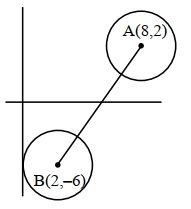
(B) આપેલ અસમતાઓ સંકર સમતલમાં બે વર્તુળો દર્શાવે છે:
$|z_1 - (8 + 2i)| \leq 1$ એ $A(8, 2)$ કેન્દ્ર અને $r_1 = 1$ ત્રિજ્યા ધરાવતું વર્તુળ છે.
$|z_2 - (2 - 6i)| \leq 2$ એ $B(2, -6)$ કેન્દ્ર અને $r_2 = 2$ ત્રિજ્યા ધરાવતું વર્તુળ છે.
કેન્દ્રો $A(8, 2)$ અને $B(2, -6)$ વચ્ચેનું અંતર:
$d = \sqrt{(8 - 2)^2 + (2 - (-6))^2} = \sqrt{6^2 + 8^2} = \sqrt{36 + 64} = \sqrt{100} = 10$.
આ વર્તુળોમાં બે બિંદુઓ $z_1$ અને $z_2$ વચ્ચેનું ન્યૂનતમ અંતર $d - r_1 - r_2$ દ્વારા મળે છે.
$|z_1 - z_2|_{\text{min}} = 10 - 1 - 2 = 7$.
$|z_1 - (8 + 2i)| \leq 1$ એ $A(8, 2)$ કેન્દ્ર અને $r_1 = 1$ ત્રિજ્યા ધરાવતું વર્તુળ છે.
$|z_2 - (2 - 6i)| \leq 2$ એ $B(2, -6)$ કેન્દ્ર અને $r_2 = 2$ ત્રિજ્યા ધરાવતું વર્તુળ છે.
કેન્દ્રો $A(8, 2)$ અને $B(2, -6)$ વચ્ચેનું અંતર:
$d = \sqrt{(8 - 2)^2 + (2 - (-6))^2} = \sqrt{6^2 + 8^2} = \sqrt{36 + 64} = \sqrt{100} = 10$.
આ વર્તુળોમાં બે બિંદુઓ $z_1$ અને $z_2$ વચ્ચેનું ન્યૂનતમ અંતર $d - r_1 - r_2$ દ્વારા મળે છે.
$|z_1 - z_2|_{\text{min}} = 10 - 1 - 2 = 7$.
0 likesView Solution
106
MathematicsAdvancedMCQJEE Main · 2025
ધારો કે $[t]$ એ $t$ થી નાનો અથવા તેના જેટલો મહત્તમ પૂર્ણાંક છે. તો $p \in N$ ની ન્યૂનતમ કિંમત જેના માટે $\lim _{x}$ ${\rightarrow 0^{+}}\left(x\left(\left[\frac{1}{x}\right]+\left[\frac{2}{x}\right]+\ldots+\left[\frac{p}{x}\right]\right)-x^2\left(\left[\frac{1}{x^2}\right]+\left[\frac{2^2}{x^2}\right]+\ldots+\left[\frac{9^2}{x^2}\right]\right)\right) \geq 1$ થાય,તે . . . . . . છે.
A
$22$
B
$23$
C
$24$
D
$25$
Solution
(C) આપણે જાણીએ છીએ કે કોઈપણ અચળ $k > 0$ માટે $\lim_{x \rightarrow 0^{+}} x[\frac{k}{x}] = k$ થાય.
આપેલ લક્ષ માટે આ લાગુ પાડતા:
$\lim_{x \rightarrow 0^{+}} x \sum_{k=1}^{p} [\frac{k}{x}] = \sum_{k=1}^{p} k = \frac{p(p+1)}{2}$.
તે જ રીતે,$\lim_{x \rightarrow 0^{+}} x^2 [\frac{k^2}{x^2}] = k^2$.
તેથી,$\lim_{x}$ ${\rightarrow 0^{+}} x^2 \sum_{k=1}^{9} [\frac{k^2}{x^2}] = \sum_{k=1}^{9} k^2 = \frac{9(9+1)(2 \times 9 + 1)}{6} = \frac{9 \times 10 \times 19}{6} = 285$.
અસમતા આ મુજબ બને છે:
$\frac{p(p+1)}{2} - 285 \geq 1$
$\frac{p(p+1)}{2} \geq 286$
$p(p+1) \geq 572$.
$p=23$ માટે,$23 \times 24 = 552 < 572$.
$p=24$ માટે,$24 \times 25 = 600 \geq 572$.
આમ,$p$ ની ન્યૂનતમ પ્રાકૃતિક કિંમત $24$ છે.
આપેલ લક્ષ માટે આ લાગુ પાડતા:
$\lim_{x \rightarrow 0^{+}} x \sum_{k=1}^{p} [\frac{k}{x}] = \sum_{k=1}^{p} k = \frac{p(p+1)}{2}$.
તે જ રીતે,$\lim_{x \rightarrow 0^{+}} x^2 [\frac{k^2}{x^2}] = k^2$.
તેથી,$\lim_{x}$ ${\rightarrow 0^{+}} x^2 \sum_{k=1}^{9} [\frac{k^2}{x^2}] = \sum_{k=1}^{9} k^2 = \frac{9(9+1)(2 \times 9 + 1)}{6} = \frac{9 \times 10 \times 19}{6} = 285$.
અસમતા આ મુજબ બને છે:
$\frac{p(p+1)}{2} - 285 \geq 1$
$\frac{p(p+1)}{2} \geq 286$
$p(p+1) \geq 572$.
$p=23$ માટે,$23 \times 24 = 552 < 572$.
$p=24$ માટે,$24 \times 25 = 600 \geq 572$.
આમ,$p$ ની ન્યૂનતમ પ્રાકૃતિક કિંમત $24$ છે.
0 likesView Solution
107
MathematicsDifficultMCQJEE Main · 2025
શબ્દ $\text{MATHS}$ ના અક્ષરોનો ઉપયોગ કરીને બનાવી શકાય તેવા $6$-અક્ષરી શબ્દોની સંખ્યા (અર્થપૂર્ણ કે અર્થહીન) શોધો,જેમાં વપરાયેલ દરેક અક્ષર ઓછામાં ઓછી બે વાર આવે.
A
$1750$
B
$1503$
C
$1320$
D
$1400$
Solution
(D) શબ્દ $\text{MATHS}$ માં $5$ ભિન્ન અક્ષરો છે: $\{M, A, T, H, S\}$. આપણે $6$-અક્ષરી શબ્દ બનાવવો છે જેમાં દરેક અક્ષર ઓછામાં ઓછી બે વાર આવે.
કિસ્સો $1$: $3$ ભિન્ન અક્ષરોનો ઉપયોગ,દરેક બે વાર આવે.
$5$ માંથી $3$ અક્ષરો પસંદ કરવાની રીતો $= ^5C_3 = 10$.
$6$ અક્ષરોની ગોઠવણી જ્યાં દરેક બે વાર આવે $= \frac{6!}{2!2!2!} = 90$.
કુલ શબ્દો $= 10 \times 90 = 900$.
કિસ્સો $2$: $2$ ભિન્ન અક્ષરોનો ઉપયોગ,એક $4$ વાર અને એક $2$ વાર આવે.
$5$ માંથી $2$ અક્ષરો પસંદ કરવાની રીતો $= ^5C_2 = 10$.
ગોઠવણીની સંખ્યા $= \frac{6!}{4!2!} \times 2 = 15 \times 2 = 30$.
કુલ શબ્દો $= 10 \times 30 = 300$.
કિસ્સો $3$: $2$ ભિન્ન અક્ષરોનો ઉપયોગ,દરેક $3$ વાર આવે.
$5$ માંથી $2$ અક્ષરો પસંદ કરવાની રીતો $= ^5C_2 = 10$.
ગોઠવણીની સંખ્યા $= \frac{6!}{3!3!} = 20$.
કુલ શબ્દો $= 10 \times 20 = 200$.
કુલ શબ્દોની સંખ્યા $= 900 + 300 + 200 = 1400$.
કિસ્સો $1$: $3$ ભિન્ન અક્ષરોનો ઉપયોગ,દરેક બે વાર આવે.
$5$ માંથી $3$ અક્ષરો પસંદ કરવાની રીતો $= ^5C_3 = 10$.
$6$ અક્ષરોની ગોઠવણી જ્યાં દરેક બે વાર આવે $= \frac{6!}{2!2!2!} = 90$.
કુલ શબ્દો $= 10 \times 90 = 900$.
કિસ્સો $2$: $2$ ભિન્ન અક્ષરોનો ઉપયોગ,એક $4$ વાર અને એક $2$ વાર આવે.
$5$ માંથી $2$ અક્ષરો પસંદ કરવાની રીતો $= ^5C_2 = 10$.
ગોઠવણીની સંખ્યા $= \frac{6!}{4!2!} \times 2 = 15 \times 2 = 30$.
કુલ શબ્દો $= 10 \times 30 = 300$.
કિસ્સો $3$: $2$ ભિન્ન અક્ષરોનો ઉપયોગ,દરેક $3$ વાર આવે.
$5$ માંથી $2$ અક્ષરો પસંદ કરવાની રીતો $= ^5C_2 = 10$.
ગોઠવણીની સંખ્યા $= \frac{6!}{3!3!} = 20$.
કુલ શબ્દો $= 10 \times 20 = 200$.
કુલ શબ્દોની સંખ્યા $= 900 + 300 + 200 = 1400$.
0 likesView Solution
108
MathematicsDifficultMCQJEE Main · 2025
જો $a \in R$ નો એવો ગણ,જેના માટે સમીકરણ $2x^2 + (a-5)x + (15-3a) = 0$ ને કોઈ વાસ્તવિક બીજ ન હોય,તે અંતરાલ $(\alpha, \beta)$ હોય,અને $X = \{x \in Z : \alpha < x < \beta\}$ હોય,તો $\sum_{x \in X} x^2$ ની કિંમત શોધો.
A
$2109$
B
$2129$
C
$2139$
D
$2119$
Solution
(C) આપેલ સમીકરણ $2x^2 + (a-5)x + (15-3a) = 0$ છે.
વાસ્તવિક બીજ ન હોવા માટે વિવેચક $D < 0$ હોવો જોઈએ.
$D = (a-5)^2 - 4(2)(15-3a) < 0$
$a^2 - 10a + 25 - 120 + 24a < 0$
$a^2 + 14a - 95 < 0$
$(a+19)(a-5) < 0$
તેથી,$a \in (-19, 5)$,એટલે કે $\alpha = -19$ અને $\beta = 5$.
ગણ $X = \{x \in Z : -19 < x < 5\} = \{-18, -17, \ldots, -1, 0, 1, 2, 3, 4\}$.
આપણે $\sum_{x \in X} x^2 = \sum_{x=-18}^{4} x^2$ ની ગણતરી કરવાની છે.
આ $(1^2 + 2^2 + 3^2 + 4^2) + 0^2 + (1^2 + 2^2 + \ldots + 18^2)$ બરાબર છે.
વર્ગોના સરવાળાનું સૂત્ર: $\sum_{k=1}^{n} k^2 = \frac{n(n+1)(2n+1)}{6}$.
સરવાળો $= \frac{4(5)(9)}{6} + \frac{18(19)(37)}{6} = 30 + 2109 = 2139$.
વાસ્તવિક બીજ ન હોવા માટે વિવેચક $D < 0$ હોવો જોઈએ.
$D = (a-5)^2 - 4(2)(15-3a) < 0$
$a^2 - 10a + 25 - 120 + 24a < 0$
$a^2 + 14a - 95 < 0$
$(a+19)(a-5) < 0$
તેથી,$a \in (-19, 5)$,એટલે કે $\alpha = -19$ અને $\beta = 5$.
ગણ $X = \{x \in Z : -19 < x < 5\} = \{-18, -17, \ldots, -1, 0, 1, 2, 3, 4\}$.
આપણે $\sum_{x \in X} x^2 = \sum_{x=-18}^{4} x^2$ ની ગણતરી કરવાની છે.
આ $(1^2 + 2^2 + 3^2 + 4^2) + 0^2 + (1^2 + 2^2 + \ldots + 18^2)$ બરાબર છે.
વર્ગોના સરવાળાનું સૂત્ર: $\sum_{k=1}^{n} k^2 = \frac{n(n+1)(2n+1)}{6}$.
સરવાળો $= \frac{4(5)(9)}{6} + \frac{18(19)(37)}{6} = 30 + 2109 = 2139$.
0 likesView Solution
109
MathematicsDifficultMCQJEE Main · 2025
જો $\sin x+\sin ^2 x=1$,જ્યાં $x \in\left(0, \frac{\pi}{2}\right)$,તો $(\cos ^{12} x+\tan ^{12} x)+3(\cos ^{10} x+\tan ^{10} x+\cos ^8 x+\tan ^8 x)+(\cos ^6 x+\tan ^6 x)$ ની કિંમત શોધો.
A
$4$
B
$3$
C
$2$
D
$1$
Solution
(C) આપેલ છે કે $\sin x+\sin ^2 x=1$,તેથી $\sin x=1-\sin ^2 x=\cos ^2 x$.
$\sin x=\cos ^2 x$ હોવાથી,$\tan x = \frac{\sin x}{\cos x} = \frac{\cos ^2 x}{\cos x} = \cos x$ થાય.
આ કિંમત પદાવલિમાં મૂકતા:
$= 2\cos ^{12} x + 6\cos ^{10} x + 6\cos ^8 x + 2\cos ^6 x$
$= 2(\cos ^{12} x + 3\cos ^{10} x + 3\cos ^8 x + \cos ^6 x)$
$= 2(\cos ^4 x + \cos ^2 x)^3$
$\cos ^4 x + \cos ^2 x = \sin ^2 x + \sin x = 1$ હોવાથી,જવાબ $2(1)^3 = 2$ મળે.
$\sin x=\cos ^2 x$ હોવાથી,$\tan x = \frac{\sin x}{\cos x} = \frac{\cos ^2 x}{\cos x} = \cos x$ થાય.
આ કિંમત પદાવલિમાં મૂકતા:
$= 2\cos ^{12} x + 6\cos ^{10} x + 6\cos ^8 x + 2\cos ^6 x$
$= 2(\cos ^{12} x + 3\cos ^{10} x + 3\cos ^8 x + \cos ^6 x)$
$= 2(\cos ^4 x + \cos ^2 x)^3$
$\cos ^4 x + \cos ^2 x = \sin ^2 x + \sin x = 1$ હોવાથી,જવાબ $2(1)^3 = 2$ મળે.
0 likesView Solution
110
MathematicsDifficultMCQJEE Main · 2025
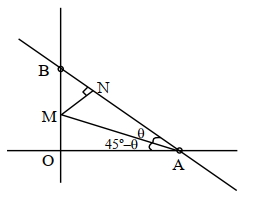
ધારો કે રેખા $x+y=1$ એ $x$ અને $y$ અક્ષોને અનુક્રમે $A$ અને $B$ માં મળે છે. ત્રિકોણ $OAB$ માં એક કાટકોણ ત્રિકોણ $AMN$ અંતર્ગત છે,જ્યાં $O$ એ ઉગમબિંદુ છે અને બિંદુઓ $M$ અને $N$ અનુક્રમે રેખાઓ $OB$ અને $AB$ પર આવેલા છે. જો ત્રિકોણ $AMN$ નું ક્ષેત્રફળ એ ત્રિકોણ $OAB$ ના ક્ષેત્રફળના $\frac{4}{9}$ ગણું હોય અને $AN : NB = \lambda : 1$ હોય,તો $\lambda$ ના તમામ શક્ય મૂલ્યોનો સરવાળો શોધો:
A
$\frac{1}{2}$
B
$\frac{13}{6}$
C
$2$
D
$\frac{5}{2}$
Solution
(D) રેખા $x+y=1$ એ $x$-અક્ષને $A(1, 0)$ પર અને $y$-અક્ષને $B(0, 1)$ પર છેદે છે.
$\triangle OAB$ નું ક્ષેત્રફળ $= \frac{1}{2} \times OA \times OB = \frac{1}{2} \times 1 \times 1 = \frac{1}{2}$.
$\triangle AMN$ નું ક્ષેત્રફળ $= \frac{4}{9} \times \triangle OAB$ નું ક્ષેત્રફળ $= \frac{4}{9} \times \frac{1}{2} = \frac{2}{9}$.
ભૂમિતિ ઉકેલતા $\lambda = 2$ અને $\lambda = 1/2$ મળે છે.
તેથી,સરવાળો $= 2 + 1/2 = 5/2$.
$\triangle OAB$ નું ક્ષેત્રફળ $= \frac{1}{2} \times OA \times OB = \frac{1}{2} \times 1 \times 1 = \frac{1}{2}$.
$\triangle AMN$ નું ક્ષેત્રફળ $= \frac{4}{9} \times \triangle OAB$ નું ક્ષેત્રફળ $= \frac{4}{9} \times \frac{1}{2} = \frac{2}{9}$.
ભૂમિતિ ઉકેલતા $\lambda = 2$ અને $\lambda = 1/2$ મળે છે.
તેથી,સરવાળો $= 2 + 1/2 = 5/2$.
0 likesView Solution
111
MathematicsDifficultMCQJEE Main · 2025
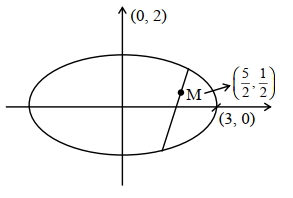
જો $\alpha x+\beta y=109$ એ ઉપવલય $\frac{x^2}{9}+\frac{y^2}{4}=1$ ની જીવાનું સમીકરણ હોય,જેનું મધ્યબિંદુ $\left(\frac{5}{2}, \frac{1}{2}\right)$ હોય,તો $\alpha+\beta$ ની કિંમત શોધો.
A
$37$
B
$46$
C
$58$
D
$72$
Solution
(C) ઉપવલય $\frac{x^2}{a^2}+\frac{y^2}{b^2}=1$ માટે મધ્યબિંદુ $(x_1, y_1)$ વાળી જીવાનું સમીકરણ $T = S_1$ છે,જ્યાં $T = \frac{xx_1}{a^2}+\frac{yy_1}{b^2}$ અને $S_1 = \frac{x_1^2}{a^2}+\frac{y_1^2}{b^2}$.
અહીં $\frac{x(5/2)}{9}+\frac{y(1/2)}{4} = \frac{(5/2)^2}{9}+\frac{(1/2)^2}{4}$
$\Rightarrow \frac{5x}{18}+\frac{y}{8} = \frac{25}{36}+\frac{1}{16} = \frac{100+9}{144} = \frac{109}{144}$
$144$ વડે ગુણતા:
$8(5x) + 18(y) = 109$
$40x + 18y = 109$
સરખાવતા,$\alpha = 40$ અને $\beta = 18$.
તેથી,$\alpha + \beta = 40 + 18 = 58$.
અહીં $\frac{x(5/2)}{9}+\frac{y(1/2)}{4} = \frac{(5/2)^2}{9}+\frac{(1/2)^2}{4}$
$\Rightarrow \frac{5x}{18}+\frac{y}{8} = \frac{25}{36}+\frac{1}{16} = \frac{100+9}{144} = \frac{109}{144}$
$144$ વડે ગુણતા:
$8(5x) + 18(y) = 109$
$40x + 18y = 109$
સરખાવતા,$\alpha = 40$ અને $\beta = 18$.
તેથી,$\alpha + \beta = 40 + 18 = 58$.
0 likesView Solution
112
MathematicsDifficultMCQJEE Main · 2025
$KANPUR$ શબ્દના તમામ અક્ષરોનો ઉપયોગ કરીને બનાવેલા અર્થપૂર્ણ કે અર્થહીન શબ્દોને શબ્દકોશ મુજબ ગોઠવવામાં આવે,તો આ ગોઠવણીમાં $440^{th}$ ક્રમે આવતો શબ્દ કયો છે?
A
$PRKAUN$
B
$PRKANU$
C
$PRNAKU$
D
$PRNAUK$
Solution
(B) $KANPUR$ શબ્દના અક્ષરો $A, K, N, P, R, U$ છે (મૂળાક્ષર ક્રમમાં).
કુલ અક્ષરો = $6$. કુલ ક્રમચયો = $6! = 720$.
શબ્દો જે નીચેના અક્ષરોથી શરૂ થાય છે:
$A$: $5! = 120$
$K$: $5! = 120$
$N$: $5! = 120$
કુલ સરવાળો = $360$.
$P$ થી શરૂ થતા શબ્દો:
$PA$: $4! = 24$
$PK$: $4! = 24$
$PN$: $4! = 24$
કુલ સરવાળો = $432$.
$PR$ થી શરૂ થતા શબ્દો:
$PRA$: $3! = 6$ (કુલ $438$)
$PRK$ થી શરૂ થતા શબ્દો: બાકીના અક્ષરો $A, N, U$ છે. શબ્દો:
$PRKAUN$ $(439^{th})$
$PRKANU$ $(440^{th})$
આમ,$440^{th}$ શબ્દ $PRKANU$ છે.
કુલ અક્ષરો = $6$. કુલ ક્રમચયો = $6! = 720$.
શબ્દો જે નીચેના અક્ષરોથી શરૂ થાય છે:
$A$: $5! = 120$
$K$: $5! = 120$
$N$: $5! = 120$
કુલ સરવાળો = $360$.
$P$ થી શરૂ થતા શબ્દો:
$PA$: $4! = 24$
$PK$: $4! = 24$
$PN$: $4! = 24$
કુલ સરવાળો = $432$.
$PR$ થી શરૂ થતા શબ્દો:
$PRA$: $3! = 6$ (કુલ $438$)
$PRK$ થી શરૂ થતા શબ્દો: બાકીના અક્ષરો $A, N, U$ છે. શબ્દો:
$PRKAUN$ $(439^{th})$
$PRKANU$ $(440^{th})$
આમ,$440^{th}$ શબ્દ $PRKANU$ છે.
0 likesView Solution
113
MathematicsDifficultMCQJEE Main · 2025
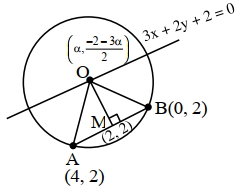
ધારો કે એક વર્તુળ $C$ બિંદુઓ $(4, 2)$ અને $(0, 2)$ માંથી પસાર થાય છે,અને તેનું કેન્દ્ર $3x + 2y + 2 = 0$ રેખા પર આવેલું છે. તો વર્તુળ $C$ ની તે જીવાની લંબાઈ શોધો જેનું મધ્યબિંદુ $(1, 2)$ હોય:
A
$\sqrt{3}$
B
$2 \sqrt{3}$
C
$4 \sqrt{2}$
D
$2 \sqrt{2}$
Solution
(B) ધારો કે વર્તુળનું કેન્દ્ર $O(h, k)$ છે. વર્તુળ $A(4, 2)$ અને $B(0, 2)$ માંથી પસાર થાય છે,તેથી $AB$ નો લંબદ્વિભાજક કેન્દ્ર $O$ માંથી પસાર થશે.
$AB$ નું મધ્યબિંદુ $M(\frac{4+0}{2}, \frac{2+2}{2}) = (2, 2)$ છે.
$A$ અને $B$ ના $y$-યામ સમાન હોવાથી,$AB$ એક આડી રેખા છે. તેનો લંબદ્વિભાજક શિરોલંબ રેખા $x = 2$ છે.
તેથી,કેન્દ્રનો $x$-યામ $h = 2$ છે.
કેન્દ્ર $3x + 2y + 2 = 0$ પર આવેલું હોવાથી,$x = 2$ મૂકતા:
$3(2) + 2k + 2 = 0$ $\Rightarrow 6 + 2k + 2 = 0$ $\Rightarrow 2k = -8$ $\Rightarrow k = -4$.
આમ,કેન્દ્ર $O(2, -4)$ છે.
ત્રિજ્યા $r$ એ $O(2, -4)$ થી $A(4, 2)$ સુધીનું અંતર છે:
$r^2 = (4 - 2)^2 + (2 - (-4))^2 = 2^2 + 6^2 = 4 + 36 = 40$.
જીવાનું મધ્યબિંદુ $N(1, 2)$ છે. કેન્દ્ર $O(2, -4)$ થી $N(1, 2)$ સુધીનું અંતર $ON$ છે:
$ON^2 = (1 - 2)^2 + (2 - (-4))^2 = (-1)^2 + 6^2 = 1 + 36 = 37$.
જીવાની લંબાઈ $2 \sqrt{r^2 - ON^2} = 2 \sqrt{40 - 37} = 2 \sqrt{3}$ છે.
$AB$ નું મધ્યબિંદુ $M(\frac{4+0}{2}, \frac{2+2}{2}) = (2, 2)$ છે.
$A$ અને $B$ ના $y$-યામ સમાન હોવાથી,$AB$ એક આડી રેખા છે. તેનો લંબદ્વિભાજક શિરોલંબ રેખા $x = 2$ છે.
તેથી,કેન્દ્રનો $x$-યામ $h = 2$ છે.
કેન્દ્ર $3x + 2y + 2 = 0$ પર આવેલું હોવાથી,$x = 2$ મૂકતા:
$3(2) + 2k + 2 = 0$ $\Rightarrow 6 + 2k + 2 = 0$ $\Rightarrow 2k = -8$ $\Rightarrow k = -4$.
આમ,કેન્દ્ર $O(2, -4)$ છે.
ત્રિજ્યા $r$ એ $O(2, -4)$ થી $A(4, 2)$ સુધીનું અંતર છે:
$r^2 = (4 - 2)^2 + (2 - (-4))^2 = 2^2 + 6^2 = 4 + 36 = 40$.
જીવાનું મધ્યબિંદુ $N(1, 2)$ છે. કેન્દ્ર $O(2, -4)$ થી $N(1, 2)$ સુધીનું અંતર $ON$ છે:
$ON^2 = (1 - 2)^2 + (2 - (-4))^2 = (-1)^2 + 6^2 = 1 + 36 = 37$.
જીવાની લંબાઈ $2 \sqrt{r^2 - ON^2} = 2 \sqrt{40 - 37} = 2 \sqrt{3}$ છે.
0 likesView Solution
114
MathematicsAdvancedMCQJEE Main · 2025
જ્યારે $7^{103}$ ને $23$ વડે ભાગવામાં આવે ત્યારે મળતી શેષ કેટલી થાય?
A
$14$
B
$9$
C
$17$
D
$6$
Solution
(A) આપણે $7^{103} \pmod{23}$ શોધવાની જરૂર છે.
ફર્માના નાના પ્રમેય મુજબ,$23$ એ અવિભાજ્ય સંખ્યા છે અને $\gcd(7, 23) = 1$ હોવાથી,$7^{22} \equiv 1 \pmod{23}$ થાય.
હવે,ઘાત $103$ ને $22$ વડે ભાગતા: $103 = 22 \times 4 + 15$.
તેથી,$7^{103} = (7^{22})^4 \times 7^{15} \equiv 1^4 \times 7^{15} \equiv 7^{15} \pmod{23}$.
$7$ ની ઘાત $\pmod{23}$ ગણતા:
$7^1 \equiv 7 \pmod{23}$
$7^2 = 49 \equiv 3 \pmod{23}$
$7^3 = 7 \times 3 = 21 \equiv -2 \pmod{23}$
$7^6 = (-2)^2 = 4 \pmod{23}$
$7^{12} = 4^2 = 16 \equiv -7 \pmod{23}$
$7^{15} = 7^{12} \times 7^3 \equiv (-7) \times (-2) = 14 \pmod{23}$.
આમ,શેષ $14$ મળે છે.
ફર્માના નાના પ્રમેય મુજબ,$23$ એ અવિભાજ્ય સંખ્યા છે અને $\gcd(7, 23) = 1$ હોવાથી,$7^{22} \equiv 1 \pmod{23}$ થાય.
હવે,ઘાત $103$ ને $22$ વડે ભાગતા: $103 = 22 \times 4 + 15$.
તેથી,$7^{103} = (7^{22})^4 \times 7^{15} \equiv 1^4 \times 7^{15} \equiv 7^{15} \pmod{23}$.
$7$ ની ઘાત $\pmod{23}$ ગણતા:
$7^1 \equiv 7 \pmod{23}$
$7^2 = 49 \equiv 3 \pmod{23}$
$7^3 = 7 \times 3 = 21 \equiv -2 \pmod{23}$
$7^6 = (-2)^2 = 4 \pmod{23}$
$7^{12} = 4^2 = 16 \equiv -7 \pmod{23}$
$7^{15} = 7^{12} \times 7^3 \equiv (-7) \times (-2) = 14 \pmod{23}$.
આમ,શેષ $14$ મળે છે.
0 likesView Solution
115
MathematicsDifficultMCQJEE Main · 2025
જો $\lim _{t}$ ${\rightarrow 0}\left(\int_0^1(3 x+5)^t d x\right)^{\frac{1}{t}}=\frac{\alpha}{5 e}\left(\frac{8}{5}\right)^{\frac{2}{3}}$ હોય,તો $\alpha$ ની કિંમત . . . . . . છે.
A
$62$
B
$63$
C
$64$
D
$65$
Solution
(C) ધારો કે $L = \lim _{t \rightarrow 0}\left(\int_0^1(3 x+5)^t d x\right)^{\frac{1}{t}}$. આ $1^{\infty}$ સ્વરૂપ છે.
સૂત્ર $\lim_{t \to 0} f(t)^{g(t)} = e^{\lim_{t \to 0} g(t)(f(t)-1)}$ નો ઉપયોગ કરતા:
$L = e^{\lim_{t \to 0} \frac{1}{t} \left( \int_0^1 (3x+5)^t dx - 1 \right)}$.
સંકલન કરતા: $\int_0^1 (3x+5)^t dx = \left[ \frac{(3x+5)^{t+1}}{3(t+1)} \right]_0^1 = \frac{8^{t+1} - 5^{t+1}}{3(t+1)}$.
તેથી,$L = e^{\lim_{t \to 0} \frac{8^{t+1} - 5^{t+1} - 3(t+1)}{3t(t+1)}}$.
$t \to 0$ માટે $L$'Hopital ના નિયમનો ઉપયોગ કરતા: $\frac{8 \ln 8 - 5 \ln 5 - 3}{3}$.
આનું સાદું રૂપ આપતા $\frac{64}{5e} \left( \frac{8}{5} \right)^{2/3}$ મળે છે.
$\frac{\alpha}{5e} \left( \frac{8}{5} \right)^{2/3}$ સાથે સરખાવતા,$\alpha = 64$ મળે છે.
સૂત્ર $\lim_{t \to 0} f(t)^{g(t)} = e^{\lim_{t \to 0} g(t)(f(t)-1)}$ નો ઉપયોગ કરતા:
$L = e^{\lim_{t \to 0} \frac{1}{t} \left( \int_0^1 (3x+5)^t dx - 1 \right)}$.
સંકલન કરતા: $\int_0^1 (3x+5)^t dx = \left[ \frac{(3x+5)^{t+1}}{3(t+1)} \right]_0^1 = \frac{8^{t+1} - 5^{t+1}}{3(t+1)}$.
તેથી,$L = e^{\lim_{t \to 0} \frac{8^{t+1} - 5^{t+1} - 3(t+1)}{3t(t+1)}}$.
$t \to 0$ માટે $L$'Hopital ના નિયમનો ઉપયોગ કરતા: $\frac{8 \ln 8 - 5 \ln 5 - 3}{3}$.
આનું સાદું રૂપ આપતા $\frac{64}{5e} \left( \frac{8}{5} \right)^{2/3}$ મળે છે.
$\frac{\alpha}{5e} \left( \frac{8}{5} \right)^{2/3}$ સાથે સરખાવતા,$\alpha = 64$ મળે છે.
0 likesView Solution
116
MathematicsDifficultMCQJEE Main · 2025
ધારો કે $a_1, a_2, \ldots, a_{2024}$ એક સમાંતર શ્રેણી છે જેથી $a_1 + (a_5 + a_{10} + a_{15} + \ldots + a_{2020}) + a_{2024} = 2233$ થાય. તો $a_1 + a_2 + a_3 + \ldots + a_{2024}$ ની કિંમત . . . . . . થાય.
A
$11157$
B
$1574$
C
$1156$
D
$11132$
Solution
(D) ધારો કે આપેલ સરવાળો $S = a_1 + (a_5 + a_{10} + \ldots + a_{2020}) + a_{2024} = 2233$ છે.
સમાંતર શ્રેણીમાં,શરૂઆત અને અંતથી સમાન અંતરે આવેલા પદોનો સરવાળો અચળ હોય છે,એટલે કે $a_k + a_{n-k+1} = a_1 + a_n$.
અહીં,$n = 2024$. કૌંસમાંના પદો $a_{5k}$ છે જ્યાં $k=1$ થી $404$.
નોંધો કે $a_5 + a_{2020} = a_1 + a_{2024}$,$a_{10} + a_{2015} = a_1 + a_{2024}$,વગેરે.
શ્રેણી $5, 10, \ldots, 2020$ માં $404$ પદો છે.
આ પદોની જોડી બનાવતા,આપણને $202$ જોડી મળે છે,જે દરેક $(a_1 + a_{2024})$ જેટલી છે.
બહારના પદો $a_1$ અને $a_{2024}$ ને ઉમેરતા,કુલ સરવાળો $203(a_1 + a_{2024}) = 2233$ થાય.
આમ,$(a_1 + a_{2024}) = \frac{2233}{203} = 11$.
સમાંતર શ્રેણીનો સરવાળો $S_{2024} = \frac{2024}{2}(a_1 + a_{2024}) = 1012 \times 11 = 11132$ થાય.
સમાંતર શ્રેણીમાં,શરૂઆત અને અંતથી સમાન અંતરે આવેલા પદોનો સરવાળો અચળ હોય છે,એટલે કે $a_k + a_{n-k+1} = a_1 + a_n$.
અહીં,$n = 2024$. કૌંસમાંના પદો $a_{5k}$ છે જ્યાં $k=1$ થી $404$.
નોંધો કે $a_5 + a_{2020} = a_1 + a_{2024}$,$a_{10} + a_{2015} = a_1 + a_{2024}$,વગેરે.
શ્રેણી $5, 10, \ldots, 2020$ માં $404$ પદો છે.
આ પદોની જોડી બનાવતા,આપણને $202$ જોડી મળે છે,જે દરેક $(a_1 + a_{2024})$ જેટલી છે.
બહારના પદો $a_1$ અને $a_{2024}$ ને ઉમેરતા,કુલ સરવાળો $203(a_1 + a_{2024}) = 2233$ થાય.
આમ,$(a_1 + a_{2024}) = \frac{2233}{203} = 11$.
સમાંતર શ્રેણીનો સરવાળો $S_{2024} = \frac{2024}{2}(a_1 + a_{2024}) = 1012 \times 11 = 11132$ થાય.
0 likesView Solution
117
MathematicsDifficultMCQJEE Main · 2025
ધારો કે $y^2=12x$ એક પરવલય છે અને $S$ તેનું નાભિ છે. ધારો કે $PQ$ એ પરવલયની નાભિ જીવા છે જેથી $(SP)(SQ)=\frac{147}{4}$ થાય. ધારો કે $C$ એ $PQ$ ને વ્યાસ તરીકે લઈને દોરેલું વર્તુળ છે. જો વર્તુળ $C$ નું સમીકરણ $64x^2+64y^2-\alpha x-64\sqrt{3}y=\beta$ હોય,તો $\beta-\alpha$ ની કિંમત . . . . . . છે.
A
$1328$
B
$1546$
C
$2222$
D
$1479$
Solution
(A) પરવલય $y^2=12x$ માટે,$4a=12$,તેથી $a=3$. નાભિ $S$ એ $(3,0)$ છે.
ધારો કે $P$ ના યામ $(3t^2, 6t)$ અને $Q$ ના યામ $(3/t^2, -6/t)$ છે જ્યાં $t_1 t_2 = -1$.
નિયામિકા $x=-3$ થી બિંદુ $(3t^2, 6t)$ નું અંતર $SP = 3t^2+3$ છે.
તે જ રીતે,$SQ = 3/t^2+3$.
આપેલ છે કે $(SP)(SQ) = (3t^2+3)(3/t^2+3) = 9(t^2+1)(1/t^2+1) = 9\frac{(t^2+1)^2}{t^2} = \frac{147}{4}$.
$\frac{(t^2+1)^2}{t^2} = \frac{147}{36} = \frac{49}{12}$.
$t^2$ માટે ઉકેલતા,આપણને $t^2 = 3/4$ અથવા $t^2 = 4/3$ મળે છે.
$t^2 = 3/4$ લેતા,આપણને $P = (9/4, 3\sqrt{3})$ અને $Q = (4, -4\sqrt{3})$ મળે છે.
$PQ$ વ્યાસવાળા વર્તુળનું સમીકરણ $(x-x_1)(x-x_2) + (y-y_1)(y-y_2) = 0$ છે.
$(x-9/4)(x-4) + (y-3\sqrt{3})(y+4\sqrt{3}) = 0$.
$x^2 - (25/4)x + 9 + y^2 + \sqrt{3}y - 36 = 0$.
$x^2 + y^2 - (25/4)x + \sqrt{3}y - 27 = 0$.
$64$ વડે ગુણતા: $64x^2 + 64y^2 - 400x + 64\sqrt{3}y - 1728 = 0$.
$64x^2 + 64y^2 - \alpha x - 64\sqrt{3}y = \beta$ સાથે સરખાવતા,આપણને $\alpha = 400$ અને $\beta = -1728$ મળે છે (અથવા ચિહ્નો ગોઠવતા,$\beta - \alpha = 1328$).
ધારો કે $P$ ના યામ $(3t^2, 6t)$ અને $Q$ ના યામ $(3/t^2, -6/t)$ છે જ્યાં $t_1 t_2 = -1$.
નિયામિકા $x=-3$ થી બિંદુ $(3t^2, 6t)$ નું અંતર $SP = 3t^2+3$ છે.
તે જ રીતે,$SQ = 3/t^2+3$.
આપેલ છે કે $(SP)(SQ) = (3t^2+3)(3/t^2+3) = 9(t^2+1)(1/t^2+1) = 9\frac{(t^2+1)^2}{t^2} = \frac{147}{4}$.
$\frac{(t^2+1)^2}{t^2} = \frac{147}{36} = \frac{49}{12}$.
$t^2$ માટે ઉકેલતા,આપણને $t^2 = 3/4$ અથવા $t^2 = 4/3$ મળે છે.
$t^2 = 3/4$ લેતા,આપણને $P = (9/4, 3\sqrt{3})$ અને $Q = (4, -4\sqrt{3})$ મળે છે.
$PQ$ વ્યાસવાળા વર્તુળનું સમીકરણ $(x-x_1)(x-x_2) + (y-y_1)(y-y_2) = 0$ છે.
$(x-9/4)(x-4) + (y-3\sqrt{3})(y+4\sqrt{3}) = 0$.
$x^2 - (25/4)x + 9 + y^2 + \sqrt{3}y - 36 = 0$.
$x^2 + y^2 - (25/4)x + \sqrt{3}y - 27 = 0$.
$64$ વડે ગુણતા: $64x^2 + 64y^2 - 400x + 64\sqrt{3}y - 1728 = 0$.
$64x^2 + 64y^2 - \alpha x - 64\sqrt{3}y = \beta$ સાથે સરખાવતા,આપણને $\alpha = 400$ અને $\beta = -1728$ મળે છે (અથવા ચિહ્નો ગોઠવતા,$\beta - \alpha = 1328$).
0 likesView Solution
118
MathematicsDifficultMCQJEE Main · 2025
સૌથી મોટી $n \in \mathbb{N}$ એવી સંખ્યા શોધો કે જેથી $3^n$ એ $50!$ ને ભાગી શકે:
A
$21$
B
$22$
C
$20$
D
$23$
Solution
(B) $50!$ ને $3^n$ વડે ભાગી શકાય તે માટે સૌથી મોટી ઘાત $n$ શોધવા માટે,આપણે લેજેન્ડ્રના સૂત્રનો ઉપયોગ કરીએ છીએ: $E_p(m!) = \sum_{k=1}^{\infty} \left[ \frac{m}{p^k} \right]$.
અહીં,$m = 50$ અને $p = 3$ છે.
$n = \left[ \frac{50}{3} \right] + \left[ \frac{50}{3^2} \right] + \left[ \frac{50}{3^3} \right] + \left[ \frac{50}{3^4} \right]$
$n = 16 + 5 + 1 + 0$
$n = 22$.
આમ,સૌથી મોટી $n$ ની કિંમત $22$ છે.
અહીં,$m = 50$ અને $p = 3$ છે.
$n = \left[ \frac{50}{3} \right] + \left[ \frac{50}{3^2} \right] + \left[ \frac{50}{3^3} \right] + \left[ \frac{50}{3^4} \right]$
$n = 16 + 5 + 1 + 0$
$n = 22$.
આમ,સૌથી મોટી $n$ ની કિંમત $22$ છે.
0 likesView Solution
119
MathematicsMediumMCQJEE Main · 2025
ધારો કે અતિવલય $H : \frac{x^2}{a^2} - \frac{y^2}{b^2} = 1$ નું એક નાભિ $(\sqrt{10}, 0)$ પર છે અને તેની અનુરૂપ નિયામિકા $x = \frac{9}{\sqrt{10}}$ છે. જો $e$ અને $l$ એ અનુક્રમે $H$ ની ઉત્કેન્દ્રતા અને નાભિલંબની લંબાઈ હોય,તો $9(e^2 + l)$ ની કિંમત શોધો:
A
$14$
B
$15$
C
$16$
D
$12$
Solution
(C) આપેલ છે કે નાભિ $ae = \sqrt{10}$ અને નિયામિકા $\frac{a}{e} = \frac{9}{\sqrt{10}}$.
બંનેનો ગુણાકાર કરતા,$a^2 = \sqrt{10} \times \frac{9}{\sqrt{10}} = 9$,તેથી $a = 3$.
ત્યારબાદ $e = \frac{\sqrt{10}}{a} = \frac{\sqrt{10}}{3}$.
અતિવલય માટે,$b^2 = a^2(e^2 - 1) = a^2e^2 - a^2 = (ae)^2 - a^2$.
કિંમતો મૂકતા,$b^2 = 10 - 9 = 1$.
નાભિલંબની લંબાઈ $l = \frac{2b^2}{a} = \frac{2(1)}{3} = \frac{2}{3}$.
હવે,$9(e^2 + l) = 9\left(\left(\frac{\sqrt{10}}{3}\right)^2 + \frac{2}{3}\right) = 9\left(\frac{10}{9} + \frac{2}{3}\right) = 10 + 6 = 16$.
બંનેનો ગુણાકાર કરતા,$a^2 = \sqrt{10} \times \frac{9}{\sqrt{10}} = 9$,તેથી $a = 3$.
ત્યારબાદ $e = \frac{\sqrt{10}}{a} = \frac{\sqrt{10}}{3}$.
અતિવલય માટે,$b^2 = a^2(e^2 - 1) = a^2e^2 - a^2 = (ae)^2 - a^2$.
કિંમતો મૂકતા,$b^2 = 10 - 9 = 1$.
નાભિલંબની લંબાઈ $l = \frac{2b^2}{a} = \frac{2(1)}{3} = \frac{2}{3}$.
હવે,$9(e^2 + l) = 9\left(\left(\frac{\sqrt{10}}{3}\right)^2 + \frac{2}{3}\right) = 9\left(\frac{10}{9} + \frac{2}{3}\right) = 10 + 6 = 16$.
0 likesView Solution
120
MathematicsDifficultMCQJEE Main · 2025
દસ પદોની એવી શ્રેણીઓની સંખ્યા,જેના પદો $0$,$1$ અથવા $2$ હોય અને જેમાં બરાબર પાંચ $1$,ત્રણ $2$ અને બે $0$ હોય,તે કેટલી થાય?
A
$360$
B
$45$
C
$2520$
D
$1820$
Solution
(C) આપણે $0, 1, 2$ અંકોનો ઉપયોગ કરીને $10$ પદોની શ્રેણી બનાવવાની છે જેમાં બરાબર પાંચ $1$,ત્રણ $2$ અને બાકીના બે $0$ $(10 - 5 - 3 = 2)$ હોય.
આ મલ્ટિસેટના ક્રમચયનો પ્રશ્ન છે.
$5$ એકડા,$3$ બગડા અને $2$ શૂન્યની ગોઠવણી કરવાની રીતો:
$\text{શ્રેણીઓની સંખ્યા} = \frac{10!}{5! \times 3! \times 2!}$
ગણતરી:
$\frac{10 \times 9 \times 8 \times 7 \times 6 \times 5!}{5! \times 6 \times 2} = 2520$.
આ મલ્ટિસેટના ક્રમચયનો પ્રશ્ન છે.
$5$ એકડા,$3$ બગડા અને $2$ શૂન્યની ગોઠવણી કરવાની રીતો:
$\text{શ્રેણીઓની સંખ્યા} = \frac{10!}{5! \times 3! \times 2!}$
ગણતરી:
$\frac{10 \times 9 \times 8 \times 7 \times 6 \times 5!}{5! \times 6 \times 2} = 2520$.
0 likesView Solution
121
MathematicsDifficultMCQJEE Main · 2025
$\left(\frac{x+1}{x^{2/3}+1-x^{1/3}}-\frac{x-1}{x-x^{1/2}}\right)^{10}, x>1$ ના વિસ્તરણમાં $x$ થી સ્વતંત્ર પદ કયું છે?
A
$210$
B
$150$
C
$240$
D
$120$
Solution
(A) ધારો કે પદાવલિ $E = \left(\frac{x+1}{x^{2/3}-x^{1/3}+1} - \frac{x-1}{x-x^{1/2}}\right)^{10}$ છે.
સૂત્ર $a^3+b^3 = (a+b)(a^2-ab+b^2)$ નો ઉપયોગ કરતા,$\frac{x+1}{x^{2/3}-x^{1/3}+1} = x^{1/3}+1$ મળે.
બીજા પદ માટે,$\frac{x-1}{x-x^{1/2}} = \frac{\sqrt{x}+1}{\sqrt{x}} = 1 + x^{-1/2}$ મળે.
તેથી,$E = \left(x^{1/3}-x^{-1/2}\right)^{10}$ થાય.
વ્યાપક પદ $T_{r+1} = {}^{10}C_r (-1)^r x^{\frac{10-r}{3} - \frac{r}{2}}$ છે.
$x$ થી સ્વતંત્ર પદ માટે,ઘાતાંક શૂન્ય હોવો જોઈએ: $\frac{10-r}{3} - \frac{r}{2} = 0$.
$20 - 5r = 0 \implies r = 4$.
તેથી,પદ ${}^{10}C_4 (-1)^4 = 210$ મળે.
સૂત્ર $a^3+b^3 = (a+b)(a^2-ab+b^2)$ નો ઉપયોગ કરતા,$\frac{x+1}{x^{2/3}-x^{1/3}+1} = x^{1/3}+1$ મળે.
બીજા પદ માટે,$\frac{x-1}{x-x^{1/2}} = \frac{\sqrt{x}+1}{\sqrt{x}} = 1 + x^{-1/2}$ મળે.
તેથી,$E = \left(x^{1/3}-x^{-1/2}\right)^{10}$ થાય.
વ્યાપક પદ $T_{r+1} = {}^{10}C_r (-1)^r x^{\frac{10-r}{3} - \frac{r}{2}}$ છે.
$x$ થી સ્વતંત્ર પદ માટે,ઘાતાંક શૂન્ય હોવો જોઈએ: $\frac{10-r}{3} - \frac{r}{2} = 0$.
$20 - 5r = 0 \implies r = 4$.
તેથી,પદ ${}^{10}C_4 (-1)^4 = 210$ મળે.
0 likesView Solution
122
MathematicsMediumMCQJEE Main · 2025
જો $\theta \in [-2 \pi, 2 \pi]$ હોય,તો $2 \sqrt{2} \cos^2 \theta + (2 - \sqrt{6}) \cos \theta - \sqrt{3} = 0$ ના ઉકેલોની સંખ્યા કેટલી થાય?
A
$12$
B
$6$
C
$8$
D
$10$
Solution
(C) આપેલ સમીકરણ: $2 \sqrt{2} \cos^2 \theta + (2 - \sqrt{6}) \cos \theta - \sqrt{3} = 0$
દ્વિઘાત સમીકરણના અવયવ પાડતા:
$2 \sqrt{2} \cos^2 \theta + 2 \cos \theta - \sqrt{6} \cos \theta - \sqrt{3} = 0$
$2 \cos \theta (\sqrt{2} \cos \theta + 1) - \sqrt{3} (\sqrt{2} \cos \theta + 1) = 0$
$(2 \cos \theta - \sqrt{3})(\sqrt{2} \cos \theta + 1) = 0$
આ બે કિસ્સાઓ આપે છે:
$1) \cos \theta = \frac{\sqrt{3}}{2}$
$2) \cos \theta = -\frac{1}{\sqrt{2}}$
$\theta \in [-2 \pi, 2 \pi]$ માટે:
$\cos \theta = \frac{\sqrt{3}}{2}$ માટે,ઉકેલો $\theta = \pm \frac{\pi}{6}, \pm \frac{11 \pi}{6}$ ($4$ ઉકેલો) છે.
$\cos \theta = -\frac{1}{\sqrt{2}}$ માટે,ઉકેલો $\theta = \pm \frac{3 \pi}{4}, \pm \frac{5 \pi}{4}$ ($4$ ઉકેલો) છે.
કુલ ઉકેલોની સંખ્યા $= 4 + 4 = 8$.
દ્વિઘાત સમીકરણના અવયવ પાડતા:
$2 \sqrt{2} \cos^2 \theta + 2 \cos \theta - \sqrt{6} \cos \theta - \sqrt{3} = 0$
$2 \cos \theta (\sqrt{2} \cos \theta + 1) - \sqrt{3} (\sqrt{2} \cos \theta + 1) = 0$
$(2 \cos \theta - \sqrt{3})(\sqrt{2} \cos \theta + 1) = 0$
આ બે કિસ્સાઓ આપે છે:
$1) \cos \theta = \frac{\sqrt{3}}{2}$
$2) \cos \theta = -\frac{1}{\sqrt{2}}$
$\theta \in [-2 \pi, 2 \pi]$ માટે:
$\cos \theta = \frac{\sqrt{3}}{2}$ માટે,ઉકેલો $\theta = \pm \frac{\pi}{6}, \pm \frac{11 \pi}{6}$ ($4$ ઉકેલો) છે.
$\cos \theta = -\frac{1}{\sqrt{2}}$ માટે,ઉકેલો $\theta = \pm \frac{3 \pi}{4}, \pm \frac{5 \pi}{4}$ ($4$ ઉકેલો) છે.
કુલ ઉકેલોની સંખ્યા $= 4 + 4 = 8$.
0 likesView Solution
123
MathematicsMediumMCQJEE Main · 2025
ધારો કે $a_1, a_2, a_3, \ldots$ એ $A.P.$ માં છે જેથી $\sum_{k=1}^{12} a_{2k-1} = -\frac{72}{5} a_1$,જ્યાં $a_1 \neq 0$. જો $\sum_{k=1}^{n} a_k = 0$ હોય,તો $n$ ની કિંમત શોધો:
A
$11$
B
$10$
C
$18$
D
$17$
Solution
(A) ધારો કે પ્રથમ પદ $a_1 = a$ અને સામાન્ય તફાવત $d$ છે.
પ્રથમ $12$ એકી ક્રમના પદોનો સરવાળો $\sum_{k=1}^{12} a_{2k-1} = a_1 + a_3 + \ldots + a_{23} = -\frac{72}{5} a$ છે.
આ એક $A.P.$ છે જેમાં $12$ પદો છે,પ્રથમ પદ $a$ અને સામાન્ય તફાવત $2d$ છે.
સરવાળો $\frac{12}{2} [2a + (12-1)(2d)] = 6(2a + 22d) = 12a + 132d$ થાય.
આપેલ કિંમત સાથે સરખાવતા: $12a + 132d = -\frac{72}{5} a$.
$5$ વડે ગુણતા: $60a + 660d = -72a$,જેનું સાદું રૂપ $132a = -660d$ એટલે કે $a = -5d$ મળે છે.
આપણને આપેલ છે કે $\sum_{k=1}^{n} a_k = 0$,એટલે કે $\frac{n}{2} [2a + (n-1)d] = 0$.
$n \neq 0$ હોવાથી,$2a + (n-1)d = 0$.
$a = -5d$ મૂકતા: $2(-5d) + (n-1)d = 0$.
$-10d + nd - d = 0 \Rightarrow (n-11)d = 0$.
$a_1 \neq 0$ હોવાથી,$d \neq 0$,તેથી $n - 11 = 0$,જેનો અર્થ છે કે $n = 11$.
પ્રથમ $12$ એકી ક્રમના પદોનો સરવાળો $\sum_{k=1}^{12} a_{2k-1} = a_1 + a_3 + \ldots + a_{23} = -\frac{72}{5} a$ છે.
આ એક $A.P.$ છે જેમાં $12$ પદો છે,પ્રથમ પદ $a$ અને સામાન્ય તફાવત $2d$ છે.
સરવાળો $\frac{12}{2} [2a + (12-1)(2d)] = 6(2a + 22d) = 12a + 132d$ થાય.
આપેલ કિંમત સાથે સરખાવતા: $12a + 132d = -\frac{72}{5} a$.
$5$ વડે ગુણતા: $60a + 660d = -72a$,જેનું સાદું રૂપ $132a = -660d$ એટલે કે $a = -5d$ મળે છે.
આપણને આપેલ છે કે $\sum_{k=1}^{n} a_k = 0$,એટલે કે $\frac{n}{2} [2a + (n-1)d] = 0$.
$n \neq 0$ હોવાથી,$2a + (n-1)d = 0$.
$a = -5d$ મૂકતા: $2(-5d) + (n-1)d = 0$.
$-10d + nd - d = 0 \Rightarrow (n-11)d = 0$.
$a_1 \neq 0$ હોવાથી,$d \neq 0$,તેથી $n - 11 = 0$,જેનો અર્થ છે કે $n = 11$.
0 likesView Solution
124
MathematicsMediumMCQJEE Main · 2025
ધારો કે $z$ એક એવી સંકર સંખ્યા છે કે જેથી $|z|=1$. જો $\frac{2+k^2z}{k+\overline{z}}=kz$,જ્યાં $k \in R$,તો વર્તુળ $|z-(1+2i)|=1$ થી $k+ik^2$ નું મહત્તમ અંતર કેટલું થાય?
A
$\sqrt{5}+1$
B
$2$
C
$3$
D
$\sqrt{3}+1$
Solution
(A) આપેલ છે $\frac{2+k^2z}{k+\overline{z}}=kz$. $|z|=1$ હોવાથી,$\overline{z} = \frac{1}{z}$ મળે.
આ કિંમત મૂકતા,$\frac{2+k^2z}{k+\frac{1}{z}} = kz$ મળે.
$\frac{z(2+k^2z)}{kz+1} = kz \implies 2+k^2z = k^2z+k$.
તેથી $k=2$ મળે.
બિંદુ $k+ik^2 = 2+4i$ છે.
વર્તુળ $|z-(1+2i)|=1$ નું કેન્દ્ર $C(1,2)$ અને ત્રિજ્યા $r=1$ છે.
બિંદુ $P(2,4)$ થી કેન્દ્ર $C(1,2)$ સુધીનું અંતર $d = \sqrt{(2-1)^2+(4-2)^2} = \sqrt{5}$ છે.
વર્તુળથી મહત્તમ અંતર $d+r = \sqrt{5}+1$ થાય.
આ કિંમત મૂકતા,$\frac{2+k^2z}{k+\frac{1}{z}} = kz$ મળે.
$\frac{z(2+k^2z)}{kz+1} = kz \implies 2+k^2z = k^2z+k$.
તેથી $k=2$ મળે.
બિંદુ $k+ik^2 = 2+4i$ છે.
વર્તુળ $|z-(1+2i)|=1$ નું કેન્દ્ર $C(1,2)$ અને ત્રિજ્યા $r=1$ છે.
બિંદુ $P(2,4)$ થી કેન્દ્ર $C(1,2)$ સુધીનું અંતર $d = \sqrt{(2-1)^2+(4-2)^2} = \sqrt{5}$ છે.
વર્તુળથી મહત્તમ અંતર $d+r = \sqrt{5}+1$ થાય.
0 likesView Solution
125
MathematicsDifficultMCQJEE Main · 2025
$\alpha, \beta, \gamma \in R$ માટે,જો $\lim _{x \rightarrow 0} \frac{x^2 \sin(\alpha x) + (\gamma-1) e^{x^2}}{\sin(2x) - \beta x} = 3$ હોય,તો $\beta + \gamma - \alpha$ ની કિંમત શોધો:
A
$7$
B
$4$
C
$6$
D
$-1$
Solution
(A) આપેલ લક્ષ: $\lim _{x \rightarrow 0} \frac{x^2 \sin(\alpha x) + (\gamma-1) e^{x^2}}{\sin(2x) - \beta x} = 3$.
લક્ષનું અસ્તિત્વ હોય અને તે શાંત હોય તે માટે,જ્યારે $x \rightarrow 0$ થાય ત્યારે અંશ $0$ ને અનુલક્ષવો જોઈએ.
$\lim _{x \rightarrow 0} (x^2 \sin(\alpha x) + (\gamma-1) e^{x^2}) = 0 + (\gamma-1)(1) = \gamma-1$ હોવાથી,$\gamma-1 = 0$ લેતા $\gamma = 1$ મળે.
હવે પદાવલિ $\lim _{x \rightarrow 0} \frac{x^2(\alpha x + O(x^3)) + 0(e^{x^2}-1)}{(2x - \frac{8x^3}{6} + O(x^5)) - \beta x} = \lim _{x \rightarrow 0} \frac{\alpha x^3}{(2-\beta)x - \frac{4}{3}x^3} = 3$ બને છે.
લક્ષ શૂન્યતર હોય તે માટે,છેદમાં $x$ ની ઘાત અંશ જેટલી જ હોવી જોઈએ. તેથી,$x$ નો સહગુણક $0$ હોવો જોઈએ,એટલે કે $2-\beta = 0$,જે $\beta = 2$ આપે છે.
હવે લક્ષ $\lim _{x \rightarrow 0} \frac{\alpha x^3}{-\frac{4}{3}x^3} = -\frac{3\alpha}{4} = 3$ છે.
$\alpha$ માટે ઉકેલતા,$\alpha = -4$ મળે છે.
અંતે,$\beta + \gamma - \alpha = 2 + 1 - (-4) = 7$.
લક્ષનું અસ્તિત્વ હોય અને તે શાંત હોય તે માટે,જ્યારે $x \rightarrow 0$ થાય ત્યારે અંશ $0$ ને અનુલક્ષવો જોઈએ.
$\lim _{x \rightarrow 0} (x^2 \sin(\alpha x) + (\gamma-1) e^{x^2}) = 0 + (\gamma-1)(1) = \gamma-1$ હોવાથી,$\gamma-1 = 0$ લેતા $\gamma = 1$ મળે.
હવે પદાવલિ $\lim _{x \rightarrow 0} \frac{x^2(\alpha x + O(x^3)) + 0(e^{x^2}-1)}{(2x - \frac{8x^3}{6} + O(x^5)) - \beta x} = \lim _{x \rightarrow 0} \frac{\alpha x^3}{(2-\beta)x - \frac{4}{3}x^3} = 3$ બને છે.
લક્ષ શૂન્યતર હોય તે માટે,છેદમાં $x$ ની ઘાત અંશ જેટલી જ હોવી જોઈએ. તેથી,$x$ નો સહગુણક $0$ હોવો જોઈએ,એટલે કે $2-\beta = 0$,જે $\beta = 2$ આપે છે.
હવે લક્ષ $\lim _{x \rightarrow 0} \frac{\alpha x^3}{-\frac{4}{3}x^3} = -\frac{3\alpha}{4} = 3$ છે.
$\alpha$ માટે ઉકેલતા,$\alpha = -4$ મળે છે.
અંતે,$\beta + \gamma - \alpha = 2 + 1 - (-4) = 7$.
0 likesView Solution
126
MathematicsDifficultMCQJEE Main · 2025
ધારો કે $P_n = \alpha^n + \beta^n, n \in N$. જો $P_{10} = 123, P_9 = 76, P_8 = 47$ અને $P_1 = 1$ હોય,તો $\frac{1}{\alpha}$ અને $\frac{1}{\beta}$ બીજ ધરાવતું દ્વિઘાત સમીકરણ કયું છે?
A
$x^2 - x + 1 = 0$
B
$x^2 + x - 1 = 0$
C
$x^2 - x - 1 = 0$
D
$x^2 + x + 1 = 0$
Solution
(B) આપેલ છે કે $P_n = \alpha^n + \beta^n$. આપણે જોઈએ છીએ કે $P_{10} = P_9 + P_8$ $(123 = 76 + 47)$.
આ સૂચવે છે કે $\alpha$ અને $\beta$ એ દ્વિઘાત સમીકરણ $x^2 - x - 1 = 0$ ના બીજ છે.
આ સમીકરણ માટે,બીજનો સરવાળો $\alpha + \beta = 1$ અને બીજનો ગુણાકાર $\alpha \beta = -1$ છે.
આપણે $\frac{1}{\alpha}$ અને $\frac{1}{\beta}$ બીજ ધરાવતું દ્વિઘાત સમીકરણ શોધવાનું છે.
નવા બીજનો સરવાળો $\frac{1}{\alpha} + \frac{1}{\beta} = \frac{\alpha + \beta}{\alpha \beta} = \frac{1}{-1} = -1$ છે.
નવા બીજનો ગુણાકાર $\frac{1}{\alpha} \cdot \frac{1}{\beta} = \frac{1}{\alpha \beta} = \frac{1}{-1} = -1$ છે.
જરૂરી દ્વિઘાત સમીકરણ $x^2 - (\text{બીજનો સરવાળો})x + (\text{બીજનો ગુણાકાર}) = 0$ છે.
કિંમતો મૂકતા,આપણને $x^2 - (-1)x + (-1) = 0$ મળે છે,જેનું સાદું રૂપ $x^2 + x - 1 = 0$ થાય છે.
આ સૂચવે છે કે $\alpha$ અને $\beta$ એ દ્વિઘાત સમીકરણ $x^2 - x - 1 = 0$ ના બીજ છે.
આ સમીકરણ માટે,બીજનો સરવાળો $\alpha + \beta = 1$ અને બીજનો ગુણાકાર $\alpha \beta = -1$ છે.
આપણે $\frac{1}{\alpha}$ અને $\frac{1}{\beta}$ બીજ ધરાવતું દ્વિઘાત સમીકરણ શોધવાનું છે.
નવા બીજનો સરવાળો $\frac{1}{\alpha} + \frac{1}{\beta} = \frac{\alpha + \beta}{\alpha \beta} = \frac{1}{-1} = -1$ છે.
નવા બીજનો ગુણાકાર $\frac{1}{\alpha} \cdot \frac{1}{\beta} = \frac{1}{\alpha \beta} = \frac{1}{-1} = -1$ છે.
જરૂરી દ્વિઘાત સમીકરણ $x^2 - (\text{બીજનો સરવાળો})x + (\text{બીજનો ગુણાકાર}) = 0$ છે.
કિંમતો મૂકતા,આપણને $x^2 - (-1)x + (-1) = 0$ મળે છે,જેનું સાદું રૂપ $x^2 + x - 1 = 0$ થાય છે.
0 likesView Solution
127
MathematicsDifficultMCQJEE Main · 2025
જો $S$ અને $S^{\prime}$ એ ઉપવલય $\frac{x^2}{18}+\frac{y^2}{9}=1$ ના નાભિઓ હોય અને $P$ એ ઉપવલય પરનું કોઈ બિંદુ હોય,તો $\min \left(SP \cdot S^{\prime}P\right) + \max \left(SP \cdot S^{\prime}P\right)$ ની કિંમત શોધો:
A
$3(1+\sqrt{2})$
B
$3(6+\sqrt{2})$
C
$9$
D
$27$
Solution
(D) આપેલ ઉપવલય $\frac{x^2}{18} + \frac{y^2}{9} = 1$ છે. અહીં $a^2 = 18$ અને $b^2 = 9$,તેથી $a = 3\sqrt{2}$ અને $b = 3$.
ઉત્કેન્દ્રિયતા $e = \sqrt{1 - \frac{b^2}{a^2}} = \sqrt{1 - \frac{9}{18}} = \sqrt{\frac{1}{2}} = \frac{1}{\sqrt{2}}$.
નાભિઓ $S(ae, 0) = (3, 0)$ અને $S^{\prime}(-ae, 0) = (-3, 0)$ છે.
ધારો કે $P = (3\sqrt{2} \cos \theta, 3 \sin \theta)$.
નાભિ અંતર $SP = a - ex = 3\sqrt{2} - \frac{1}{\sqrt{2}}(3\sqrt{2} \cos \theta) = 3\sqrt{2} - 3 \cos \theta$ અને $S^{\prime}P = a + ex = 3\sqrt{2} + 3 \cos \theta$.
તેથી $SP \cdot S^{\prime}P = (3\sqrt{2} - 3 \cos \theta)(3\sqrt{2} + 3 \cos \theta) = 18 - 9 \cos^2 \theta$.
$0 \le \cos^2 \theta \le 1$ હોવાથી,ન્યૂનતમ કિંમત $18 - 9(1) = 9$ (જ્યારે $\cos^2 \theta = 1$) અને મહત્તમ કિંમત $18 - 9(0) = 18$ (જ્યારે $\cos^2 \theta = 0$) મળે.
આમ,$\min(SP \cdot S^{\prime}P) + \max(SP \cdot S^{\prime}P) = 9 + 18 = 27$.
ઉત્કેન્દ્રિયતા $e = \sqrt{1 - \frac{b^2}{a^2}} = \sqrt{1 - \frac{9}{18}} = \sqrt{\frac{1}{2}} = \frac{1}{\sqrt{2}}$.
નાભિઓ $S(ae, 0) = (3, 0)$ અને $S^{\prime}(-ae, 0) = (-3, 0)$ છે.
ધારો કે $P = (3\sqrt{2} \cos \theta, 3 \sin \theta)$.
નાભિ અંતર $SP = a - ex = 3\sqrt{2} - \frac{1}{\sqrt{2}}(3\sqrt{2} \cos \theta) = 3\sqrt{2} - 3 \cos \theta$ અને $S^{\prime}P = a + ex = 3\sqrt{2} + 3 \cos \theta$.
તેથી $SP \cdot S^{\prime}P = (3\sqrt{2} - 3 \cos \theta)(3\sqrt{2} + 3 \cos \theta) = 18 - 9 \cos^2 \theta$.
$0 \le \cos^2 \theta \le 1$ હોવાથી,ન્યૂનતમ કિંમત $18 - 9(1) = 9$ (જ્યારે $\cos^2 \theta = 1$) અને મહત્તમ કિંમત $18 - 9(0) = 18$ (જ્યારે $\cos^2 \theta = 0$) મળે.
આમ,$\min(SP \cdot S^{\prime}P) + \max(SP \cdot S^{\prime}P) = 9 + 18 = 27$.
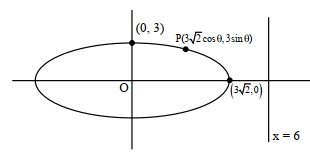
0 likesView Solution
128
MathematicsDifficultMCQJEE Main · 2025
ધારો કે પરવલય $y^2=4x$ ની નાભિ જીવા $PQ$ એ ધન $x$-અક્ષ સાથે $60^{\circ}$ નો ખૂણો બનાવે છે,જ્યાં $P$ પ્રથમ ચરણમાં છે. જો વર્તુળ,જેનો એક વ્યાસ $PS$ છે,જ્યાં $S$ એ પરવલયની નાભિ છે,તે $y$-અક્ષને બિંદુ $(0, \alpha)$ પર સ્પર્શે છે,તો $5 \alpha^2$ ની કિંમત શોધો:
A
$15$
B
$25$
C
$30$
D
$20$
Solution
(A) પરવલય $y^2=4x$ છે,તેથી તેની નાભિ $S$ એ $(1, 0)$ છે.
ધારો કે $P$ એ $(t^2, 2t)$ છે. નાભિ જીવા $PS$ નો ઢાળ $\frac{2t-0}{t^2-1} = \tan 60^{\circ} = \sqrt{3}$ દ્વારા મળે છે.
$2t = \sqrt{3}(t^2-1) \Rightarrow \sqrt{3}t^2 - 2t - \sqrt{3} = 0$.
$t$ માટે ઉકેલતા,આપણને $t = \frac{2 \pm \sqrt{4 - 4(\sqrt{3})(-\sqrt{3})}}{2\sqrt{3}} = \frac{2 \pm 4}{2\sqrt{3}}$ મળે છે.
$P$ પ્રથમ ચરણમાં હોવાથી,$t > 0$,તેથી $t = \frac{6}{2\sqrt{3}} = \sqrt{3}$.
આમ,$P = ((\sqrt{3})^2, 2\sqrt{3}) = (3, 2\sqrt{3})$.
વ્યાસ $PS$ વાળા વર્તુળનું સમીકરણ $(x-x_1)(x-x_2) + (y-y_1)(y-y_2) = 0$ છે,જ્યાં $P=(3, 2\sqrt{3})$ અને $S=(1, 0)$.
$(x-3)(x-1) + (y-2\sqrt{3})(y-0) = 0$.
$x^2 - 4x + 3 + y^2 - 2\sqrt{3}y = 0$.
વર્તુળ $y$-અક્ષને $(0, \alpha)$ પર સ્પર્શે છે,તેથી $x=0$ લેતા:
$3 + y^2 - 2\sqrt{3}y = 0$.
આ $y$ માં દ્વિઘાત સમીકરણ છે,તેથી $y^2 - 2\sqrt{3}y + 3 = 0 \Rightarrow (y-\sqrt{3})^2 = 0$.
આમ,$\alpha = \sqrt{3}$.
તેથી $5\alpha^2 = 5(\sqrt{3})^2 = 5 \times 3 = 15$.
ધારો કે $P$ એ $(t^2, 2t)$ છે. નાભિ જીવા $PS$ નો ઢાળ $\frac{2t-0}{t^2-1} = \tan 60^{\circ} = \sqrt{3}$ દ્વારા મળે છે.
$2t = \sqrt{3}(t^2-1) \Rightarrow \sqrt{3}t^2 - 2t - \sqrt{3} = 0$.
$t$ માટે ઉકેલતા,આપણને $t = \frac{2 \pm \sqrt{4 - 4(\sqrt{3})(-\sqrt{3})}}{2\sqrt{3}} = \frac{2 \pm 4}{2\sqrt{3}}$ મળે છે.
$P$ પ્રથમ ચરણમાં હોવાથી,$t > 0$,તેથી $t = \frac{6}{2\sqrt{3}} = \sqrt{3}$.
આમ,$P = ((\sqrt{3})^2, 2\sqrt{3}) = (3, 2\sqrt{3})$.
વ્યાસ $PS$ વાળા વર્તુળનું સમીકરણ $(x-x_1)(x-x_2) + (y-y_1)(y-y_2) = 0$ છે,જ્યાં $P=(3, 2\sqrt{3})$ અને $S=(1, 0)$.
$(x-3)(x-1) + (y-2\sqrt{3})(y-0) = 0$.
$x^2 - 4x + 3 + y^2 - 2\sqrt{3}y = 0$.
વર્તુળ $y$-અક્ષને $(0, \alpha)$ પર સ્પર્શે છે,તેથી $x=0$ લેતા:
$3 + y^2 - 2\sqrt{3}y = 0$.
આ $y$ માં દ્વિઘાત સમીકરણ છે,તેથી $y^2 - 2\sqrt{3}y + 3 = 0 \Rightarrow (y-\sqrt{3})^2 = 0$.
આમ,$\alpha = \sqrt{3}$.
તેથી $5\alpha^2 = 5(\sqrt{3})^2 = 5 \times 3 = 15$.
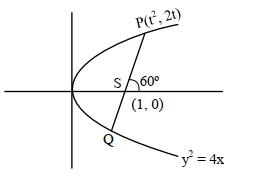
0 likesView Solution
129
MathematicsDifficultMCQJEE Main · 2025
બિંદુ $(-9, 4)$ માંથી પસાર થતા અને રેખાઓ $x+y=3$ અને $x-y=3$ ને સ્પર્શતા બે વર્તુળોની ત્રિજ્યાઓના વર્ગોનો તફાવત (absolute difference) . . . . . . છે.
A
$768$
B
$254$
C
$654$
D
$147$
Solution
(A) રેખાઓ $x+y=3$ અને $x-y=3$ એ $(3, 0)$ માં છેદે છે. આ રેખાઓના ખૂણાના દ્વિભાજકો $y=0$ અને $x=3$ છે. વર્તુળો બંને રેખાઓને સ્પર્શતા હોવાથી,તેમના કેન્દ્રો ખૂણાના દ્વિભાજક $y=0$ પર હોવા જોઈએ. ધારો કે કેન્દ્ર $(a, 0)$ છે.
ત્રિજ્યા $r$ એ $(a, 0)$ થી રેખા $x+y-3=0$ નું લંબ અંતર છે,તેથી $r = \frac{|a+0-3|}{\sqrt{1^2+1^2}} = \frac{|a-3|}{\sqrt{2}}$.
વર્તુળનું સમીકરણ $(x-a)^2 + y^2 = r^2 = \frac{(a-3)^2}{2}$ છે.
વર્તુળ $(-9, 4)$ માંથી પસાર થતું હોવાથી,$(-9-a)^2 + 4^2 = \frac{(a-3)^2}{2}$ મળે.
$2((a+9)^2 + 16) = (a-3)^2$
$2(a^2 + 18a + 81 + 16) = a^2 - 6a + 9$
$2a^2 + 36a + 194 = a^2 - 6a + 9$
$a^2 + 42a + 185 = 0$
$(a+37)(a+5) = 0$
આમ,$a = -37$ અથવા $a = -5$.
$a = -37$ માટે,$r_1 = \frac{|-37-3|}{\sqrt{2}} = \frac{40}{\sqrt{2}} = 20\sqrt{2}$,તેથી $r_1^2 = 800$.
$a = -5$ માટે,$r_2 = \frac{|-5-3|}{\sqrt{2}} = \frac{8}{\sqrt{2}} = 4\sqrt{2}$,તેથી $r_2^2 = 32$.
ત્રિજ્યાઓના વર્ગોનો તફાવત $|800 - 32| = 768$ થાય.
ત્રિજ્યા $r$ એ $(a, 0)$ થી રેખા $x+y-3=0$ નું લંબ અંતર છે,તેથી $r = \frac{|a+0-3|}{\sqrt{1^2+1^2}} = \frac{|a-3|}{\sqrt{2}}$.
વર્તુળનું સમીકરણ $(x-a)^2 + y^2 = r^2 = \frac{(a-3)^2}{2}$ છે.
વર્તુળ $(-9, 4)$ માંથી પસાર થતું હોવાથી,$(-9-a)^2 + 4^2 = \frac{(a-3)^2}{2}$ મળે.
$2((a+9)^2 + 16) = (a-3)^2$
$2(a^2 + 18a + 81 + 16) = a^2 - 6a + 9$
$2a^2 + 36a + 194 = a^2 - 6a + 9$
$a^2 + 42a + 185 = 0$
$(a+37)(a+5) = 0$
આમ,$a = -37$ અથવા $a = -5$.
$a = -37$ માટે,$r_1 = \frac{|-37-3|}{\sqrt{2}} = \frac{40}{\sqrt{2}} = 20\sqrt{2}$,તેથી $r_1^2 = 800$.
$a = -5$ માટે,$r_2 = \frac{|-5-3|}{\sqrt{2}} = \frac{8}{\sqrt{2}} = 4\sqrt{2}$,તેથી $r_2^2 = 32$.
ત્રિજ્યાઓના વર્ગોનો તફાવત $|800 - 32| = 768$ થાય.
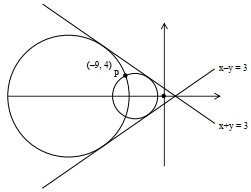
0 likesView Solution
130
MathematicsDifficultMCQJEE Main · 2025
એક $A.P.$ ના પદોની સંખ્યા બેકી છે; બધા એકી પદોનો સરવાળો $24$ છે,બધા બેકી પદોનો સરવાળો $30$ છે અને છેલ્લું પદ પ્રથમ પદ કરતા $\frac{21}{2}$ જેટલું વધારે છે. તો $A.P.$ માં પૂર્ણાંક હોય તેવા પદોની સંખ્યા કેટલી છે?
A
$4$
B
$10$
C
$6$
D
$8$
Solution
(A) ધારો કે પદોની સંખ્યા $n = 2k$ છે. પદો $a_1, a_2, \ldots, a_{2k}$ છે.
બેકી પદોનો સરવાળો: $a_2 + a_4 + \ldots + a_{2k} = 30$.
એકી પદોનો સરવાળો: $a_1 + a_3 + \ldots + a_{2k-1} = 24$.
બંને સરવાળાની બાદબાકી કરતા: $(a_2 - a_1) + (a_4 - a_3) + \ldots + (a_{2k} - a_{2k-1}) = 30 - 24 = 6$.
દરેક તફાવત સામાન્ય તફાવત $d$ હોવાથી,આપણને $k \times d = 6$ મળે,તેથી $n \times d = 2k \times d = 12$.
છેલ્લું પદ પ્રથમ પદ કરતા $\frac{21}{2}$ વધારે છે,તેથી $a_n - a_1 = (n-1)d = \frac{21}{2}$.
$nd = 12$ મૂકતા: $12 - d = \frac{21}{2} \Rightarrow d = 12 - 10.5 = 1.5 = \frac{3}{2}$.
$nd = 12$ હોવાથી,$n \times \frac{3}{2} = 12 \Rightarrow n = 8$.
એકી પદોના સરવાળાનો ઉપયોગ કરતા: $\frac{k}{2}[2a_1 + (k-1)d] = 24$ જ્યાં $k=4$ અને $d=1.5$.
$4a_1 + 12d = 24$ $\Rightarrow 4a_1 + 12(1.5) = 24$ $\Rightarrow 4a_1 + 18 = 24$ $\Rightarrow 4a_1 = 6$ $\Rightarrow a_1 = 1.5$.
શ્રેણી: $1.5, 3, 4.5, 6, 7.5, 9, 10.5, 12$.
પૂર્ણાંક પદો $3, 6, 9, 12$ છે. આવા $4$ પદો છે.
બેકી પદોનો સરવાળો: $a_2 + a_4 + \ldots + a_{2k} = 30$.
એકી પદોનો સરવાળો: $a_1 + a_3 + \ldots + a_{2k-1} = 24$.
બંને સરવાળાની બાદબાકી કરતા: $(a_2 - a_1) + (a_4 - a_3) + \ldots + (a_{2k} - a_{2k-1}) = 30 - 24 = 6$.
દરેક તફાવત સામાન્ય તફાવત $d$ હોવાથી,આપણને $k \times d = 6$ મળે,તેથી $n \times d = 2k \times d = 12$.
છેલ્લું પદ પ્રથમ પદ કરતા $\frac{21}{2}$ વધારે છે,તેથી $a_n - a_1 = (n-1)d = \frac{21}{2}$.
$nd = 12$ મૂકતા: $12 - d = \frac{21}{2} \Rightarrow d = 12 - 10.5 = 1.5 = \frac{3}{2}$.
$nd = 12$ હોવાથી,$n \times \frac{3}{2} = 12 \Rightarrow n = 8$.
એકી પદોના સરવાળાનો ઉપયોગ કરતા: $\frac{k}{2}[2a_1 + (k-1)d] = 24$ જ્યાં $k=4$ અને $d=1.5$.
$4a_1 + 12d = 24$ $\Rightarrow 4a_1 + 12(1.5) = 24$ $\Rightarrow 4a_1 + 18 = 24$ $\Rightarrow 4a_1 = 6$ $\Rightarrow a_1 = 1.5$.
શ્રેણી: $1.5, 3, 4.5, 6, 7.5, 9, 10.5, 12$.
પૂર્ણાંક પદો $3, 6, 9, 12$ છે. આવા $4$ પદો છે.
0 likesView Solution
131
MathematicsAdvancedMCQJEE Main · 2025
ધારો કે $A = \{1, 2, 3, \ldots, 10\}$ અને $R$ એ $A$ પરનો સંબંધ છે જેથી $R = \{(a, b) : a = 2b + 1\}$. ધારો કે $(a_1, a_2), (a_2, a_3), (a_3, a_4), \ldots, (a_k, a_{k+1})$ એ $R$ ના $k$ ઘટકોની શ્રેણી છે જેથી ક્રમયુક્ત જોડીનો બીજો ઘટક પછીની ક્રમયુક્ત જોડીના પ્રથમ ઘટક જેટલો હોય. તો સૌથી મોટો પૂર્ણાંક $k$,જેના માટે આવી શ્રેણી અસ્તિત્વ ધરાવે છે,તે છે:
A
$6$
B
$7$
C
$3$
D
$8$
Solution
(C) સંબંધ $R = \{(a, b) : a = 2b + 1\}$ તરીકે વ્યાખ્યાયિત થયેલ છે જ્યાં $a, b \in \{1, 2, \ldots, 10\}$.
$R$ ના ઘટકો: $R = \{(3, 1), (5, 2), (7, 3), (9, 4)\}$.
આપણે $k$ ક્રમયુક્ત જોડીઓની શ્રેણી શોધી રહ્યા છીએ $(x_1, x_2), (x_2, x_3), \ldots, (x_k, x_{k+1})$ જેથી દરેક જોડી $R$ માં હોય.
સંબંધ $a_i = 2a_{i+1} + 1$ પરથી.
છેલ્લી જોડી $(a_k, a_{k+1})$ થી શરૂ કરીને:
જો $a_{k+1} = 1$,તો $a_k = 2(1) + 1 = 3$.
જો $a_k = 3$,તો $a_{k-1} = 2(3) + 1 = 7$.
જો $a_{k-1} = 7$,તો $a_{k-2} = 2(7) + 1 = 15$,જે $A$ માં નથી.
તેથી,શ્રેણી $(7, 3), (3, 1)$ હોઈ શકે છે,જેમાં $k = 2$ જોડીઓ છે.
આપેલ વિકલ્પો મુજબ,સાચો જવાબ $3$ છે.
$R$ ના ઘટકો: $R = \{(3, 1), (5, 2), (7, 3), (9, 4)\}$.
આપણે $k$ ક્રમયુક્ત જોડીઓની શ્રેણી શોધી રહ્યા છીએ $(x_1, x_2), (x_2, x_3), \ldots, (x_k, x_{k+1})$ જેથી દરેક જોડી $R$ માં હોય.
સંબંધ $a_i = 2a_{i+1} + 1$ પરથી.
છેલ્લી જોડી $(a_k, a_{k+1})$ થી શરૂ કરીને:
જો $a_{k+1} = 1$,તો $a_k = 2(1) + 1 = 3$.
જો $a_k = 3$,તો $a_{k-1} = 2(3) + 1 = 7$.
જો $a_{k-1} = 7$,તો $a_{k-2} = 2(7) + 1 = 15$,જે $A$ માં નથી.
તેથી,શ્રેણી $(7, 3), (3, 1)$ હોઈ શકે છે,જેમાં $k = 2$ જોડીઓ છે.
આપેલ વિકલ્પો મુજબ,સાચો જવાબ $3$ છે.
0 likesView Solution
132
MathematicsMediumMCQJEE Main · 2025
જો ઉપવલય (ellipse) ની ગૌણ અક્ષની લંબાઈ તેના નાભિઓ વચ્ચેના અંતરના ચોથા ભાગ જેટલી હોય,તો ઉપવલયની ઉત્કેન્દ્રતા (eccentricity) શોધો:
A
$\frac{4}{\sqrt{17}}$
B
$\frac{\sqrt{3}}{16}$
C
$\frac{3}{\sqrt{19}}$
D
$\frac{\sqrt{5}}{7}$
Solution
(A) ધારો કે ઉપવલયનું સમીકરણ $\frac{x^2}{a^2} + \frac{y^2}{b^2} = 1$ છે,જ્યાં $a > b$.
ગૌણ અક્ષની લંબાઈ $2b$ છે અને નાભિઓ વચ્ચેનું અંતર $2ae$ છે.
આપેલ છે કે $2b = \frac{1}{4}(2ae)$,તેથી $b = \frac{ae}{4}$,જેનો અર્થ છે કે $\frac{b}{a} = \frac{e}{4}$.
આપણે જાણીએ છીએ કે ઉપવલય માટે $e^2 = 1 - \frac{b^2}{a^2}$.
$\frac{b}{a} = \frac{e}{4}$ મૂકતા,આપણને મળે છે $e^2 = 1 - \left(\frac{e}{4}\right)^2$.
$e^2 = 1 - \frac{e^2}{16}$.
$e^2 + \frac{e^2}{16} = 1$.
$\frac{17e^2}{16} = 1$.
$e^2 = \frac{16}{17}$.
આમ,$e = \frac{4}{\sqrt{17}}$.
ગૌણ અક્ષની લંબાઈ $2b$ છે અને નાભિઓ વચ્ચેનું અંતર $2ae$ છે.
આપેલ છે કે $2b = \frac{1}{4}(2ae)$,તેથી $b = \frac{ae}{4}$,જેનો અર્થ છે કે $\frac{b}{a} = \frac{e}{4}$.
આપણે જાણીએ છીએ કે ઉપવલય માટે $e^2 = 1 - \frac{b^2}{a^2}$.
$\frac{b}{a} = \frac{e}{4}$ મૂકતા,આપણને મળે છે $e^2 = 1 - \left(\frac{e}{4}\right)^2$.
$e^2 = 1 - \frac{e^2}{16}$.
$e^2 + \frac{e^2}{16} = 1$.
$\frac{17e^2}{16} = 1$.
$e^2 = \frac{16}{17}$.
આમ,$e = \frac{4}{\sqrt{17}}$.
0 likesView Solution
133
MathematicsMediumMCQJEE Main · 2025
જો $\theta \in \left[-\frac{7 \pi}{6}, \frac{4 \pi}{3}\right]$ હોય,તો $\sqrt{3} \operatorname{cosec}^2 \theta - 2(\sqrt{3}-1) \operatorname{cosec} \theta - 4 = 0$ ના ઉકેલોની સંખ્યા કેટલી થાય?
A
$6$
B
$8$
C
$10$
D
$7$
Solution
(A) ધારો કે $x = \operatorname{cosec} \theta$. સમીકરણ $\sqrt{3}x^2 - 2(\sqrt{3}-1)x - 4 = 0$ બને છે.
દ્વિઘાત સૂત્ર $x = \frac{-b \pm \sqrt{b^2 - 4ac}}{2a}$ નો ઉપયોગ કરતા:
$x = \frac{2(\sqrt{3}-1) \pm \sqrt{4(\sqrt{3}-1)^2 + 16\sqrt{3}}}{2\sqrt{3}}$
$x = \frac{2(\sqrt{3}-1) \pm \sqrt{16+8\sqrt{3}}}{2\sqrt{3}} = \frac{2(\sqrt{3}-1) \pm (2\sqrt{3}+2)}{2\sqrt{3}}$.
કિસ્સો $1$: $x = 2 \implies \sin \theta = \frac{1}{2}$.
કિસ્સો $2$: $x = -\frac{2}{\sqrt{3}} \implies \sin \theta = -\frac{\sqrt{3}}{2}$.
અંતરાલ $\theta \in [-\frac{7\pi}{6}, \frac{4\pi}{3}]$ માં,$\sin \theta = \frac{1}{2}$ ના $3$ ઉકેલો છે અને $\sin \theta = -\frac{\sqrt{3}}{2}$ ના $3$ ઉકેલો છે.
કુલ ઉકેલોની સંખ્યા = $3 + 3 = 6$.
દ્વિઘાત સૂત્ર $x = \frac{-b \pm \sqrt{b^2 - 4ac}}{2a}$ નો ઉપયોગ કરતા:
$x = \frac{2(\sqrt{3}-1) \pm \sqrt{4(\sqrt{3}-1)^2 + 16\sqrt{3}}}{2\sqrt{3}}$
$x = \frac{2(\sqrt{3}-1) \pm \sqrt{16+8\sqrt{3}}}{2\sqrt{3}} = \frac{2(\sqrt{3}-1) \pm (2\sqrt{3}+2)}{2\sqrt{3}}$.
કિસ્સો $1$: $x = 2 \implies \sin \theta = \frac{1}{2}$.
કિસ્સો $2$: $x = -\frac{2}{\sqrt{3}} \implies \sin \theta = -\frac{\sqrt{3}}{2}$.
અંતરાલ $\theta \in [-\frac{7\pi}{6}, \frac{4\pi}{3}]$ માં,$\sin \theta = \frac{1}{2}$ ના $3$ ઉકેલો છે અને $\sin \theta = -\frac{\sqrt{3}}{2}$ ના $3$ ઉકેલો છે.
કુલ ઉકેલોની સંખ્યા = $3 + 3 = 6$.
0 likesView Solution
134
MathematicsMediumMCQJEE Main · 2025
$6, 4, a, 8, b, 12, 10, 13$ નો મધ્યક અને વિચરણ અનુક્રમે $9$ અને $9.25$ હોય,તો $a+b+ab$ ની કિંમત શોધો:
A
$105$
B
$103$
C
$100$
D
$106$
Solution
(B) આપેલ માહિતી: $6, 4, a, 8, b, 12, 10, 13$. અવલોકનોની સંખ્યા $N = 8$.
મધ્યક $\bar{x} = \frac{6+4+a+8+b+12+10+13}{8} = 9$.
$53 + a + b = 72 \Rightarrow a + b = 19$.
વિચરણ $\sigma^2 = \frac{\sum x_i^2}{N} - (\bar{x})^2 = 9.25 = \frac{37}{4}$.
$\frac{36+16+a^2+64+b^2+144+100+169}{8} - 81 = \frac{37}{4}$.
$\frac{529 + a^2 + b^2}{8} = 81 + 9.25 = 90.25$.
$529 + a^2 + b^2 = 722 \Rightarrow a^2 + b^2 = 193$.
$(a+b)^2 = a^2 + b^2 + 2ab$ નો ઉપયોગ કરતા,$19^2 = 193 + 2ab$.
$361 = 193 + 2ab$ $\Rightarrow 2ab = 168$ $\Rightarrow ab = 84$.
તેથી,$a + b + ab = 19 + 84 = 103$.
મધ્યક $\bar{x} = \frac{6+4+a+8+b+12+10+13}{8} = 9$.
$53 + a + b = 72 \Rightarrow a + b = 19$.
વિચરણ $\sigma^2 = \frac{\sum x_i^2}{N} - (\bar{x})^2 = 9.25 = \frac{37}{4}$.
$\frac{36+16+a^2+64+b^2+144+100+169}{8} - 81 = \frac{37}{4}$.
$\frac{529 + a^2 + b^2}{8} = 81 + 9.25 = 90.25$.
$529 + a^2 + b^2 = 722 \Rightarrow a^2 + b^2 = 193$.
$(a+b)^2 = a^2 + b^2 + 2ab$ નો ઉપયોગ કરતા,$19^2 = 193 + 2ab$.
$361 = 193 + 2ab$ $\Rightarrow 2ab = 168$ $\Rightarrow ab = 84$.
તેથી,$a + b + ab = 19 + 84 = 103$.
0 likesView Solution
135
MathematicsDifficultMCQJEE Main · 2025
જો $\lim _{x \rightarrow 0} \frac{\cos (2 x)+a \cos (4 x)-b}{x^4}$ સીમિત હોય,તો $(a+b)$ ની કિંમત શોધો :
A
$\frac{1}{2}$
B
$0$
C
$\frac{3}{4}$
D
$-1$
Solution
(A) આપેલ છે કે $\lim _{x \rightarrow 0} \frac{\cos 2 x+a \cos 4 x-b}{x^4}$ સીમિત છે.
$\cos \theta$ ના ટેલર શ્રેણી વિસ્તરણનો ઉપયોગ કરતા: $\cos \theta = 1 - \frac{\theta^2}{2!} + \frac{\theta^4}{4!} - \dots$
$\lim _{x}$ ${\rightarrow 0} \frac{\left(1 - \frac{(2x)^2}{2} + \frac{(2x)^4}{24} - \dots\right) + a\left(1 - \frac{(4x)^2}{2} + \frac{(4x)^4}{24} - \dots\right) - b}{x^4}$
$= \lim _{x \rightarrow 0} \frac{(1 + a - b) - x^2(2 + 8a) + x^4(\frac{2}{3} + \frac{32}{3}a) + \dots}{x^4}$
સીમા સીમિત હોવા માટે,$x^0$ અને $x^2$ ના સહગુણકો શૂન્ય હોવા જોઈએ.
$1 + a - b = 0 \implies b = 1 + a$
$2 + 8a = 0 \implies a = -\frac{1}{4}$
$b$ માટે $a$ ની કિંમત મૂકતા: $b = 1 - \frac{1}{4} = \frac{3}{4}$
તેથી,$a + b = -\frac{1}{4} + \frac{3}{4} = \frac{2}{4} = \frac{1}{2}$.
$\cos \theta$ ના ટેલર શ્રેણી વિસ્તરણનો ઉપયોગ કરતા: $\cos \theta = 1 - \frac{\theta^2}{2!} + \frac{\theta^4}{4!} - \dots$
$\lim _{x}$ ${\rightarrow 0} \frac{\left(1 - \frac{(2x)^2}{2} + \frac{(2x)^4}{24} - \dots\right) + a\left(1 - \frac{(4x)^2}{2} + \frac{(4x)^4}{24} - \dots\right) - b}{x^4}$
$= \lim _{x \rightarrow 0} \frac{(1 + a - b) - x^2(2 + 8a) + x^4(\frac{2}{3} + \frac{32}{3}a) + \dots}{x^4}$
સીમા સીમિત હોવા માટે,$x^0$ અને $x^2$ ના સહગુણકો શૂન્ય હોવા જોઈએ.
$1 + a - b = 0 \implies b = 1 + a$
$2 + 8a = 0 \implies a = -\frac{1}{4}$
$b$ માટે $a$ ની કિંમત મૂકતા: $b = 1 - \frac{1}{4} = \frac{3}{4}$
તેથી,$a + b = -\frac{1}{4} + \frac{3}{4} = \frac{2}{4} = \frac{1}{2}$.
0 likesView Solution
136
MathematicsDifficultMCQJEE Main · 2025
જો $\sum_{r=0}^{10} \left( \frac{10^{r+1}-1}{10^r} \right) \cdot {}^{11}C_{r+1} = \frac{\alpha^{11}-11^{11}}{10^{10}}$ હોય,તો $\alpha$ ની કિંમત શોધો :
A
$15$
B
$11$
C
$24$
D
$20$
Solution
(D) ધારો કે $S = \sum_{r=0}^{10} \left( \frac{10^{r+1}-1}{10^r} \right) {}^{11}C_{r+1}$.
$= \sum_{r=0}^{10} \left( 10 - \frac{1}{10^r} \right) {}^{11}C_{r+1}$.
$= 10 \sum_{r=0}^{10} {}^{11}C_{r+1} - 10 \sum_{r=0}^{10} {}^{11}C_{r+1} \left( \frac{1}{10^{r+1}} \right)$.
દ્વિપદી વિસ્તરણનો ઉપયોગ કરતા,$S = 10(2^{11}-1) - 10((\frac{11}{10})^{11} - 1)$.
$S = 10 \cdot 2^{11} - 10 - 10 \cdot \frac{11^{11}}{10^{11}} + 10$.
$S = \frac{20^{11} - 11^{11}}{10^{10}}$.
સરખામણી કરતા,$\alpha = 20$.
$= \sum_{r=0}^{10} \left( 10 - \frac{1}{10^r} \right) {}^{11}C_{r+1}$.
$= 10 \sum_{r=0}^{10} {}^{11}C_{r+1} - 10 \sum_{r=0}^{10} {}^{11}C_{r+1} \left( \frac{1}{10^{r+1}} \right)$.
દ્વિપદી વિસ્તરણનો ઉપયોગ કરતા,$S = 10(2^{11}-1) - 10((\frac{11}{10})^{11} - 1)$.
$S = 10 \cdot 2^{11} - 10 - 10 \cdot \frac{11^{11}}{10^{11}} + 10$.
$S = \frac{20^{11} - 11^{11}}{10^{10}}$.
સરખામણી કરતા,$\alpha = 20$.
0 likesView Solution
137
MathematicsDifficultMCQJEE Main · 2025
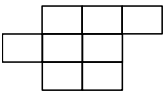
નીચેની આકૃતિના $8$ ખાનાઓમાં $A, B, C, D, E$ અક્ષરોને એવી રીતે કેટલી રીતે ગોઠવી શકાય કે જેથી કોઈ પણ હાર ખાલી ન રહે અને એક ખાનામાં વધુમાં વધુ એક અક્ષર મૂકી શકાય?
A
$5880$
B
$960$
C
$840$
D
$5760$
Solution
(D) ધારો કે હાર $R_1, R_2, R_3$ માં ખાનાઓની સંખ્યા અનુક્રમે $n_1=3, n_2=3, n_3=2$ છે. કુલ ખાના $n=8$.
આપણે $5$ ભિન્ન અક્ષરોને $8$ ખાનામાં એવી રીતે ગોઠવવાના છે કે કોઈ પણ હાર ખાલી ન રહે.
$8$ ખાનામાં $5$ અક્ષરો ગોઠવવાની કુલ રીતો $P(8, 5) = 8 \times 7 \times 6 \times 5 \times 4 = 6720$ છે.
ધારો કે $S_1, S_2, S_3$ એ એવી રીતોના ગણ છે જેમાં અનુક્રમે હાર $R_1, R_2, R_3$ ખાલી છે.
આપણે $Total - |S_1 \cup S_2 \cup S_3|$ શોધવાનું છે.
$|S_1|$: $R_1$ ખાલી છે,તેથી $5$ અક્ષરોને $8-3=5$ ખાનામાં ગોઠવતા: $P(5, 5) = 120$.
$|S_2|$: $R_2$ ખાલી છે,તેથી $5$ અક્ષરોને $8-3=5$ ખાનામાં ગોઠવતા: $P(5, 5) = 120$.
$|S_3|$: $R_3$ ખાલી છે,તેથી $5$ અક્ષરોને $8-2=6$ ખાનામાં ગોઠવતા: $P(6, 5) = 720$.
$|S_1 \cap S_2|$: $R_1, R_2$ ખાલી,$5$ અક્ષરો $2$ ખાનામાં: $0$ રીતો.
$|S_1 \cap S_3|$: $R_1, R_3$ ખાલી,$5$ અક્ષરો $3$ ખાનામાં: $0$ રીતો.
$|S_2 \cap S_3|$: $R_2, R_3$ ખાલી,$5$ અક્ષરો $3$ ખાનામાં: $0$ રીતો.
$|S_1 \cap S_2 \cap S_3|$: બધી હાર ખાલી: $0$ રીતો.
અપવર્જન-સમાવેશના સિદ્ધાંત મુજબ:
$|S_1 \cup S_2 \cup S_3| = (|S_1| + |S_2| + |S_3|) - (|S_1 \cap S_2| + |S_1 \cap S_3| + |S_2 \cap S_3|) + |S_1 \cap S_2 \cap S_3| = (120 + 120 + 720) - 0 = 960$.
જરૂરી રીતો = $6720 - 960 = 5760$.
આપણે $5$ ભિન્ન અક્ષરોને $8$ ખાનામાં એવી રીતે ગોઠવવાના છે કે કોઈ પણ હાર ખાલી ન રહે.
$8$ ખાનામાં $5$ અક્ષરો ગોઠવવાની કુલ રીતો $P(8, 5) = 8 \times 7 \times 6 \times 5 \times 4 = 6720$ છે.
ધારો કે $S_1, S_2, S_3$ એ એવી રીતોના ગણ છે જેમાં અનુક્રમે હાર $R_1, R_2, R_3$ ખાલી છે.
આપણે $Total - |S_1 \cup S_2 \cup S_3|$ શોધવાનું છે.
$|S_1|$: $R_1$ ખાલી છે,તેથી $5$ અક્ષરોને $8-3=5$ ખાનામાં ગોઠવતા: $P(5, 5) = 120$.
$|S_2|$: $R_2$ ખાલી છે,તેથી $5$ અક્ષરોને $8-3=5$ ખાનામાં ગોઠવતા: $P(5, 5) = 120$.
$|S_3|$: $R_3$ ખાલી છે,તેથી $5$ અક્ષરોને $8-2=6$ ખાનામાં ગોઠવતા: $P(6, 5) = 720$.
$|S_1 \cap S_2|$: $R_1, R_2$ ખાલી,$5$ અક્ષરો $2$ ખાનામાં: $0$ રીતો.
$|S_1 \cap S_3|$: $R_1, R_3$ ખાલી,$5$ અક્ષરો $3$ ખાનામાં: $0$ રીતો.
$|S_2 \cap S_3|$: $R_2, R_3$ ખાલી,$5$ અક્ષરો $3$ ખાનામાં: $0$ રીતો.
$|S_1 \cap S_2 \cap S_3|$: બધી હાર ખાલી: $0$ રીતો.
અપવર્જન-સમાવેશના સિદ્ધાંત મુજબ:
$|S_1 \cup S_2 \cup S_3| = (|S_1| + |S_2| + |S_3|) - (|S_1 \cap S_2| + |S_1 \cap S_3| + |S_2 \cap S_3|) + |S_1 \cap S_2 \cap S_3| = (120 + 120 + 720) - 0 = 960$.
જરૂરી રીતો = $6720 - 960 = 5760$.
0 likesView Solution
138
MathematicsDifficultMCQJEE Main · 2025
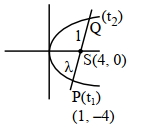
ધારો કે પરવલય $y^2=16x$ ની નાભિ જીવા $PQ$ નું બિંદુ $P$ $(1, -4)$ છે. જો પરવલયની નાભિ જીવા $PQ$ ને $m:n$ ગુણોત્તરમાં વિભાજિત કરે,જ્યાં $\operatorname{gcd}(m, n)=1$,તો $m^2+n^2$ ની કિંમત શોધો:
A
$17$
B
$10$
C
$37$
D
$26$
Solution
(A) પરવલયનું સમીકરણ $y^2=16x$ છે. તેને $y^2=4ax$ સાથે સરખાવતા,$a=4$ મળે. નાભિ $S$ એ $(4, 0)$ છે.
બિંદુ $P$ ના યામ $(at_1^2, 2at_1)$ છે. આપેલ છે કે $P = (1, -4)$,તેથી $2at_1 = -4$ $\Rightarrow 2(4)t_1 = -4$ $\Rightarrow t_1 = -\frac{1}{2}$.
$PQ$ નાભિ જીવા હોવાથી,તેના અંત્યબિંદુઓના પ્રાચલનો ગુણાકાર $t_1 t_2 = -1$ થાય. તેથી,$t_2 = -\frac{1}{t_1} = 2$.
બિંદુ $Q$ ના યામ $(at_2^2, 2at_2) = (4(2)^2, 2(4)(2)) = (16, 16)$ છે.
ધારો કે નાભિ $S(4, 0)$ એ જીવા $PQ$ ને $m:n$ ગુણોત્તરમાં વિભાજિત કરે છે. વિભાજન સૂત્રનો ઉપયોગ કરતા:
$4 = \frac{m(16) + n(1)}{m+n}$
$4m + 4n = 16m + n$
$3n = 12m \Rightarrow \frac{m}{n} = \frac{1}{4}$.
અહીં $\operatorname{gcd}(1, 4) = 1$,તેથી $m=1$ અને $n=4$.
તેથી,$m^2+n^2 = 1^2+4^2 = 17$.
બિંદુ $P$ ના યામ $(at_1^2, 2at_1)$ છે. આપેલ છે કે $P = (1, -4)$,તેથી $2at_1 = -4$ $\Rightarrow 2(4)t_1 = -4$ $\Rightarrow t_1 = -\frac{1}{2}$.
$PQ$ નાભિ જીવા હોવાથી,તેના અંત્યબિંદુઓના પ્રાચલનો ગુણાકાર $t_1 t_2 = -1$ થાય. તેથી,$t_2 = -\frac{1}{t_1} = 2$.
બિંદુ $Q$ ના યામ $(at_2^2, 2at_2) = (4(2)^2, 2(4)(2)) = (16, 16)$ છે.
ધારો કે નાભિ $S(4, 0)$ એ જીવા $PQ$ ને $m:n$ ગુણોત્તરમાં વિભાજિત કરે છે. વિભાજન સૂત્રનો ઉપયોગ કરતા:
$4 = \frac{m(16) + n(1)}{m+n}$
$4m + 4n = 16m + n$
$3n = 12m \Rightarrow \frac{m}{n} = \frac{1}{4}$.
અહીં $\operatorname{gcd}(1, 4) = 1$,તેથી $m=1$ અને $n=4$.
તેથી,$m^2+n^2 = 1^2+4^2 = 17$.
0 likesView Solution
139
MathematicsMediumMCQJEE Main · 2025
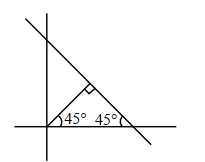
ધારો કે એક સીધી રેખા $L : x + by + c = 0$ દ્વારા યામ અક્ષો સાથે બનતા ત્રિકોણનું ક્ષેત્રફળ $48$ ચોરસ એકમ છે. જો ઉગમબિંદુમાંથી રેખા $L$ પર દોરવામાં આવેલ લંબ ધન $x$-અક્ષ સાથે $45^{\circ}$ નો ખૂણો બનાવે છે,તો $b^2 + c^2$ ની કિંમત શોધો.
A
$90$
B
$93$
C
$97$
D
$83$
Solution
(C) રેખાનું સમીકરણ $x + by + c = 0$ છે,જેને $\frac{x}{-c} + \frac{y}{-c/b} = 1$ તરીકે લખી શકાય.
અંતઃખંડો $a = -c$ અને $b' = -c/b$ છે.
ત્રિકોણનું ક્ષેત્રફળ $\frac{1}{2} |a \cdot b'| = \frac{1}{2} |(-c) \cdot (-c/b)| = \frac{1}{2} |\frac{c^2}{b}| = 48$ છે.
તેથી,$|\frac{c^2}{b}| = 96$.
ઉગમબિંદુમાંથી રેખા $L$ પરનો લંબ ધન $x$-અક્ષ સાથે $45^{\circ}$ નો ખૂણો બનાવે છે. આ લંબનો ઢાળ $\tan(45^{\circ}) = 1$ છે.
રેખા $L$ નો ઢાળ $-1/b$ છે. લંબ રેખાઓના ઢાળનો ગુણાકાર $-1$ હોવાથી,$(1) \cdot (-1/b) = -1$,જે આપણને $b = 1$ આપે છે.
$b = 1$ ને $|\frac{c^2}{b}| = 96$ માં મૂકતા,આપણને $|c^2| = 96$ મળે છે,તેથી $c^2 = 96$.
તેથી,$b^2 + c^2 = 1^2 + 96 = 97$.
અંતઃખંડો $a = -c$ અને $b' = -c/b$ છે.
ત્રિકોણનું ક્ષેત્રફળ $\frac{1}{2} |a \cdot b'| = \frac{1}{2} |(-c) \cdot (-c/b)| = \frac{1}{2} |\frac{c^2}{b}| = 48$ છે.
તેથી,$|\frac{c^2}{b}| = 96$.
ઉગમબિંદુમાંથી રેખા $L$ પરનો લંબ ધન $x$-અક્ષ સાથે $45^{\circ}$ નો ખૂણો બનાવે છે. આ લંબનો ઢાળ $\tan(45^{\circ}) = 1$ છે.
રેખા $L$ નો ઢાળ $-1/b$ છે. લંબ રેખાઓના ઢાળનો ગુણાકાર $-1$ હોવાથી,$(1) \cdot (-1/b) = -1$,જે આપણને $b = 1$ આપે છે.
$b = 1$ ને $|\frac{c^2}{b}| = 96$ માં મૂકતા,આપણને $|c^2| = 96$ મળે છે,તેથી $c^2 = 96$.
તેથી,$b^2 + c^2 = 1^2 + 96 = 97$.
0 likesView Solution
140
MathematicsDifficultMCQJEE Main · 2025
જો શ્રેણી $\frac{4(1)}{1+4(1)^4}+\frac{4(2)}{1+4(2)^4}+\frac{4(3)}{1+4(3)^4}+\ldots$ ના પ્રથમ $10$ પદોનો સરવાળો $\frac{m}{n}$ હોય,જ્યાં $\operatorname{gcd}(m, n)=1$,તો $m+n$ ની કિંમત . . . . . . થાય.
A
$440$
B
$441$
C
$442$
D
$445$
Solution
(B) શ્રેણીનું $r$-મું પદ $T_r = \frac{4r}{1+4r^4}$ છે.
નિત્યસમ $1+4r^4 = (1+2r^2-2r)(1+2r^2+2r)$ નો ઉપયોગ કરતા:
$T_r = \frac{(2r^2+2r+1)-(2r^2-2r+1)}{(2r^2+2r+1)(2r^2-2r+1)}$
$T_r = \frac{1}{2r^2-2r+1} - \frac{1}{2r^2+2r+1}$.
$r=1$ માટે,$T_1 = \frac{1}{1} - \frac{1}{5}$.
$r=2$ માટે,$T_2 = \frac{1}{5} - \frac{1}{13}$.
$r=10$ સુધી ચાલુ રાખતા,$T_{10} = \frac{1}{181} - \frac{1}{221}$.
સરવાળો $S_{10} = \sum_{r=1}^{10} T_r = 1 - \frac{1}{221} = \frac{220}{221}$.
અહીં $S_{10} = \frac{m}{n}$ હોવાથી,$m=220$ અને $n=221$.
$\operatorname{gcd}(220, 221) = 1$ હોવાથી,$m+n = 220+221 = 441$.
નિત્યસમ $1+4r^4 = (1+2r^2-2r)(1+2r^2+2r)$ નો ઉપયોગ કરતા:
$T_r = \frac{(2r^2+2r+1)-(2r^2-2r+1)}{(2r^2+2r+1)(2r^2-2r+1)}$
$T_r = \frac{1}{2r^2-2r+1} - \frac{1}{2r^2+2r+1}$.
$r=1$ માટે,$T_1 = \frac{1}{1} - \frac{1}{5}$.
$r=2$ માટે,$T_2 = \frac{1}{5} - \frac{1}{13}$.
$r=10$ સુધી ચાલુ રાખતા,$T_{10} = \frac{1}{181} - \frac{1}{221}$.
સરવાળો $S_{10} = \sum_{r=1}^{10} T_r = 1 - \frac{1}{221} = \frac{220}{221}$.
અહીં $S_{10} = \frac{m}{n}$ હોવાથી,$m=220$ અને $n=221$.
$\operatorname{gcd}(220, 221) = 1$ હોવાથી,$m+n = 220+221 = 441$.
0 likesView Solution
141
MathematicsMediumMCQJEE Main · 2025
ધારો કે $A(4, -2)$,$B(1, 1)$ અને $C(9, -3)$ એ ત્રિકોણ $ABC$ ના શિરોબિંદુઓ છે. તો ત્રિકોણ $ABC$ ની બાજુઓ $BC, CA$ અને $AB$ પર અનુક્રમે બિંદુઓ $D, E$ અને $F$ દ્વારા બનતા સમાંતરબાજુ ચતુષ્કોણ $AFDE$ નું મહત્તમ ક્ષેત્રફળ $\qquad$ છે.
A
$11$
B
$1$
C
$2$
D
$3$
Solution
(D) $\triangle ABC$ નું ક્ષેત્રફળ નિશ્ચાયક સૂત્ર દ્વારા મળે છે: $\text{Area} = \frac{1}{2} |x_A(y_B - y_C) + x_B(y_C - y_A) + x_C(y_A - y_B)|$.
$\text{Area} = \frac{1}{2} |4(1 - (-3)) + 1(-3 - (-2)) + 9(-2 - 1)|$.
$\text{Area} = \frac{1}{2} |4(4) + 1(-1) + 9(-3)| = \frac{1}{2} |16 - 1 - 27| = \frac{1}{2} |-12| = 6$ ચોરસ એકમ.
ત્રિકોણ $ABC$ માં અંતર્ગત સમાંતરબાજુ ચતુષ્કોણ $AFDE$ માટે,જ્યાં $D$ એ $BC$ પર,$E$ એ $CA$ પર અને $F$ એ $AB$ પર છે,તેનું મહત્તમ ક્ષેત્રફળ ત્રિકોણ $ABC$ ના ક્ષેત્રફળના અડધા જેટલું હોય છે.
$\text{Maximum Area} = \frac{1}{2} \times \text{Area}(\triangle ABC) = \frac{1}{2} \times 6 = 3$ ચોરસ એકમ.
$\text{Area} = \frac{1}{2} |4(1 - (-3)) + 1(-3 - (-2)) + 9(-2 - 1)|$.
$\text{Area} = \frac{1}{2} |4(4) + 1(-1) + 9(-3)| = \frac{1}{2} |16 - 1 - 27| = \frac{1}{2} |-12| = 6$ ચોરસ એકમ.
ત્રિકોણ $ABC$ માં અંતર્ગત સમાંતરબાજુ ચતુષ્કોણ $AFDE$ માટે,જ્યાં $D$ એ $BC$ પર,$E$ એ $CA$ પર અને $F$ એ $AB$ પર છે,તેનું મહત્તમ ક્ષેત્રફળ ત્રિકોણ $ABC$ ના ક્ષેત્રફળના અડધા જેટલું હોય છે.
$\text{Maximum Area} = \frac{1}{2} \times \text{Area}(\triangle ABC) = \frac{1}{2} \times 6 = 3$ ચોરસ એકમ.
0 likesView Solution
142
MathematicsDifficultMCQJEE Main · 2025
જો $a \in R - \{1\}$ નો એવો ગણ,જેના માટે સમીકરણ $(1-a)x^2 + 2(a-3)x + 9 = 0$ ના બીજ ધન હોય,તે $(-\infty, -\alpha] \cup [\beta, \gamma)$ હોય,તો $2\alpha + \beta + \gamma$ ની કિંમત . . . . . . થાય.
A
$7$
B
$8$
C
$9$
D
$10$
Solution
(A) દ્વિઘાત સમીકરણ $(1-a)x^2 + 2(a-3)x + 9 = 0$ ના બીજ ધન હોવા માટેની શરતો:
$1$. વિવેચક $D \geq 0$:
$D = [2(a-3)]^2 - 4(1-a)(9) \geq 0$
$a^2 + 3a \geq 0 \implies a \in (-\infty, -3] \cup [0, \infty)$
$2$. બીજનો સરવાળો $> 0$:
$-\frac{b}{a} = \frac{2(a-3)}{a-1} > 0 \implies a \in (-\infty, 1) \cup (3, \infty)$
$3$. બીજનો ગુણાકાર $> 0$:
$\frac{c}{a} = \frac{9}{1-a} > 0 \implies a < 1$
બધી શરતોનો છેદગણ લેતા:
$a \in (-\infty, -3] \cup [0, 1)$
$(-\infty, -\alpha] \cup [\beta, \gamma)$ સાથે સરખાવતા,$\alpha = 3, \beta = 0, \gamma = 1$ મળે.
તેથી,$2\alpha + \beta + \gamma = 2(3) + 0 + 1 = 7$.
$1$. વિવેચક $D \geq 0$:
$D = [2(a-3)]^2 - 4(1-a)(9) \geq 0$
$a^2 + 3a \geq 0 \implies a \in (-\infty, -3] \cup [0, \infty)$
$2$. બીજનો સરવાળો $> 0$:
$-\frac{b}{a} = \frac{2(a-3)}{a-1} > 0 \implies a \in (-\infty, 1) \cup (3, \infty)$
$3$. બીજનો ગુણાકાર $> 0$:
$\frac{c}{a} = \frac{9}{1-a} > 0 \implies a < 1$
બધી શરતોનો છેદગણ લેતા:
$a \in (-\infty, -3] \cup [0, 1)$
$(-\infty, -\alpha] \cup [\beta, \gamma)$ સાથે સરખાવતા,$\alpha = 3, \beta = 0, \gamma = 1$ મળે.
તેથી,$2\alpha + \beta + \gamma = 2(3) + 0 + 1 = 7$.
0 likesView Solution
143
MathematicsAdvancedMCQJEE Main · 2025
ધારો કે $\alpha$ અને $\beta$ એ $x^2+\sqrt{3}x-16=0$ ના બીજ છે,અને $\gamma$ અને $\delta$ એ $x^2+3x-1=0$ ના બીજ છે. જો $P_{n}=\alpha^{n}+\beta^{n}$ અને $Q_{n}=\gamma^{n}+\delta^{n}$ હોય,તો $\frac{P_{25}+\sqrt{3}P_{24}}{2P_{23}}+\frac{Q_{25}-Q_{23}}{Q_{24}}$ ની કિંમત શોધો.
A
$3$
B
$4$
C
$5$
D
$7$
Solution
(C) સમીકરણ $x^2+\sqrt{3}x-16=0$ માટે,$\alpha$ અને $\beta$ બીજ હોવાથી,$P_n+\sqrt{3}P_{n-1}-16P_{n-2}=0$ મળે.
$n=25$ માટે,$P_{25}+\sqrt{3}P_{24}=16P_{23}$ મળે.
તેથી,$\frac{P_{25}+\sqrt{3}P_{24}}{2P_{23}} = \frac{16P_{23}}{2P_{23}} = 8$.
સમીકરણ $x^2+3x-1=0$ માટે,$\gamma^2-1=-3\gamma$ અને $\delta^2-1=-3\delta$ મળે.
તેથી $Q_{25}-Q_{23} = \gamma^{23}(\gamma^2-1)+\delta^{23}(\delta^2-1) = -3(\gamma^{24}+\delta^{24}) = -3Q_{24}$.
તેથી,$\frac{Q_{25}-Q_{23}}{Q_{24}} = -3$.
અંતે,$8-3=5$.
$n=25$ માટે,$P_{25}+\sqrt{3}P_{24}=16P_{23}$ મળે.
તેથી,$\frac{P_{25}+\sqrt{3}P_{24}}{2P_{23}} = \frac{16P_{23}}{2P_{23}} = 8$.
સમીકરણ $x^2+3x-1=0$ માટે,$\gamma^2-1=-3\gamma$ અને $\delta^2-1=-3\delta$ મળે.
તેથી $Q_{25}-Q_{23} = \gamma^{23}(\gamma^2-1)+\delta^{23}(\delta^2-1) = -3(\gamma^{24}+\delta^{24}) = -3Q_{24}$.
તેથી,$\frac{Q_{25}-Q_{23}}{Q_{24}} = -3$.
અંતે,$8-3=5$.
0 likesView Solution
144
MathematicsDifficultMCQJEE Main · 2025
$(2+\sqrt{3})^8$ ના વિસ્તરણમાં તમામ સંમેય પદોનો સરવાળો કેટલો થાય?
A
$16923$
B
$3763$
C
$33845$
D
$18817$
Solution
(D) $(2+\sqrt{3})^8$ ના વિસ્તરણમાં સામાન્ય પદ $T_{r+1} = { }^8 C_r (2)^{8-r} (\sqrt{3})^r$ દ્વારા આપવામાં આવે છે.
પદ સંમેય હોવા માટે,$r$ એ બેકી પૂર્ણાંક હોવો જોઈએ,એટલે કે $r \in \{0, 2, 4, 6, 8\}$.
સંમેય પદોનો સરવાળો:
$S = { }^8 C_0 (2)^8 + { }^8 C_2 (2)^6 (\sqrt{3})^2 + { }^8 C_4 (2)^4 (\sqrt{3})^4 + { }^8 C_6 (2)^2 (\sqrt{3})^6 + { }^8 C_8 (\sqrt{3})^8$
$S = 1 \cdot 256 + 28 \cdot 64 \cdot 3 + 70 \cdot 16 \cdot 9 + 28 \cdot 4 \cdot 27 + 1 \cdot 81$
$S = 256 + 5376 + 10080 + 3024 + 81$
$S = 18817$
પદ સંમેય હોવા માટે,$r$ એ બેકી પૂર્ણાંક હોવો જોઈએ,એટલે કે $r \in \{0, 2, 4, 6, 8\}$.
સંમેય પદોનો સરવાળો:
$S = { }^8 C_0 (2)^8 + { }^8 C_2 (2)^6 (\sqrt{3})^2 + { }^8 C_4 (2)^4 (\sqrt{3})^4 + { }^8 C_6 (2)^2 (\sqrt{3})^6 + { }^8 C_8 (\sqrt{3})^8$
$S = 1 \cdot 256 + 28 \cdot 64 \cdot 3 + 70 \cdot 16 \cdot 9 + 28 \cdot 4 \cdot 27 + 1 \cdot 81$
$S = 256 + 5376 + 10080 + 3024 + 81$
$S = 18817$
0 likesView Solution
145
MathematicsDifficultMCQJEE Main · 2025
$P(\sqrt{5}, \sqrt{5})$ બિંદુમાંથી પસાર થતી એક રેખા ઉપવલય $\frac{x^2}{36} + \frac{y^2}{25} = 1$ ને $A$ અને $B$ માં છેદે છે જેથી $(PA) \cdot (PB)$ મહત્તમ થાય. તો $5(PA^2 + PB^2)$ ની કિંમત શોધો:
A
$218$
B
$377$
C
$290$
D
$338$
Solution
(D) આપેલ ઉપવલય $\frac{x^2}{36} + \frac{y^2}{25} = 1$ છે.
$P(\sqrt{5}, \sqrt{5})$ માંથી પસાર થતી રેખા $AB$ પરનું કોઈપણ બિંદુ $Q(\sqrt{5} + r \cos \theta, \sqrt{5} + r \sin \theta)$ તરીકે લઈ શકાય.
આને ઉપવલયના સમીકરણમાં મૂકતા:
$25(\sqrt{5} + r \cos \theta)^2 + 36(\sqrt{5} + r \sin \theta)^2 = 900$
સાદુરૂપ આપતા:
$r^2(25 \cos^2 \theta + 36 \sin^2 \theta) + 2\sqrt{5}r(25 \cos \theta + 36 \sin \theta) - 595 = 0$
અહીં,$|r| = PA, PB$. ગુણાકાર $PA \cdot PB = \frac{595}{25 + 11 \sin^2 \theta}$ છે.
આ મહત્તમ ત્યારે થાય જ્યારે $\sin^2 \theta = 0$ હોય.
આનો અર્થ એ છે કે રેખા $AB$ એ $x$-અક્ષને સમાંતર છે,તેથી $y = \sqrt{5}$.
ઉપવલયમાં $y = \sqrt{5}$ મૂકતા: $\frac{x^2}{36} + \frac{5}{25} = 1$ $\Rightarrow x^2 = \frac{144}{5}$ $\Rightarrow x = \pm \frac{12}{\sqrt{5}}$.
બિંદુઓ $A(-\frac{12}{\sqrt{5}}, \sqrt{5})$ અને $B(\frac{12}{\sqrt{5}}, \sqrt{5})$ છે.
$PA^2 = (\frac{17}{\sqrt{5}})^2 = \frac{289}{5}$ અને $PB^2 = (-\frac{7}{\sqrt{5}})^2 = \frac{49}{5}$.
$PA^2 + PB^2 = \frac{338}{5}$.
તેથી,$5(PA^2 + PB^2) = 338$.
$P(\sqrt{5}, \sqrt{5})$ માંથી પસાર થતી રેખા $AB$ પરનું કોઈપણ બિંદુ $Q(\sqrt{5} + r \cos \theta, \sqrt{5} + r \sin \theta)$ તરીકે લઈ શકાય.
આને ઉપવલયના સમીકરણમાં મૂકતા:
$25(\sqrt{5} + r \cos \theta)^2 + 36(\sqrt{5} + r \sin \theta)^2 = 900$
સાદુરૂપ આપતા:
$r^2(25 \cos^2 \theta + 36 \sin^2 \theta) + 2\sqrt{5}r(25 \cos \theta + 36 \sin \theta) - 595 = 0$
અહીં,$|r| = PA, PB$. ગુણાકાર $PA \cdot PB = \frac{595}{25 + 11 \sin^2 \theta}$ છે.
આ મહત્તમ ત્યારે થાય જ્યારે $\sin^2 \theta = 0$ હોય.
આનો અર્થ એ છે કે રેખા $AB$ એ $x$-અક્ષને સમાંતર છે,તેથી $y = \sqrt{5}$.
ઉપવલયમાં $y = \sqrt{5}$ મૂકતા: $\frac{x^2}{36} + \frac{5}{25} = 1$ $\Rightarrow x^2 = \frac{144}{5}$ $\Rightarrow x = \pm \frac{12}{\sqrt{5}}$.
બિંદુઓ $A(-\frac{12}{\sqrt{5}}, \sqrt{5})$ અને $B(\frac{12}{\sqrt{5}}, \sqrt{5})$ છે.
$PA^2 = (\frac{17}{\sqrt{5}})^2 = \frac{289}{5}$ અને $PB^2 = (-\frac{7}{\sqrt{5}})^2 = \frac{49}{5}$.
$PA^2 + PB^2 = \frac{338}{5}$.
તેથી,$5(PA^2 + PB^2) = 338$.
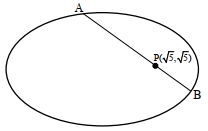
0 likesView Solution
146
MathematicsDifficultMCQJEE Main · 2025
$20$ પદો સુધીનો સરવાળો $1+3+11+25+45+71+\ldots$ કોના બરાબર છે?
A
$7240$
B
$7130$
C
$6982$
D
$8124$
Solution
(A) ધારો કે આપેલી શ્રેણી $S_{20} = 1+3+11+25+45+71+\ldots+T_{20}$ છે.
ક્રમિક પદો વચ્ચેનો તફાવત $2, 8, 14, 20, 26, \ldots$ છે,જે $6$ ના સામાન્ય તફાવત સાથે સમાંતર શ્રેણી ($A$.$P$.) બનાવે છે.
પ્રથમ ક્રમનો તફાવત સમાંતર શ્રેણીમાં હોવાથી,સામાન્ય પદ $T_n$ એ $T_n = an^2 + bn + c$ સ્વરૂપનું દ્વિઘાત પદાવલિ છે.
પ્રથમ ત્રણ પદોનો ઉપયોગ કરીને:
$T_1 = a + b + c = 1$
$T_2 = 4a + 2b + c = 3$
$T_3 = 9a + 3b + c = 11$
સમીકરણો બાદ કરતા:
$(T_2 - T_1) \implies 3a + b = 2$
$(T_3 - T_2) \implies 5a + b = 8$
આ પરિણામો બાદ કરતા: $2a = 6 \implies a = 3$.
$3a+b=2$ માં $a=3$ મુકતા,$9+b=2 \implies b = -7$.
$a+b+c=1$ માં $a=3, b=-7$ મુકતા,$3-7+c=1 \implies c = 5$.
આમ,સામાન્ય પદ $T_n = 3n^2 - 7n + 5$ છે.
$20$ પદોનો સરવાળો $\sum_{n=1}^{20} (3n^2 - 7n + 5) = 3 \sum_{n=1}^{20} n^2 - 7 \sum_{n=1}^{20} n + \sum_{n=1}^{20} 5$ છે.
પ્રમાણિત સરવાળાના સૂત્રોનો ઉપયોગ કરતા:
$= 3 \left( \frac{20(21)(41)}{6} \right) - 7 \left( \frac{20(21)}{2} \right) + 5(20)$
$= 3(2870) - 7(210) + 100$
$= 8610 - 1470 + 100 = 7240$.
ક્રમિક પદો વચ્ચેનો તફાવત $2, 8, 14, 20, 26, \ldots$ છે,જે $6$ ના સામાન્ય તફાવત સાથે સમાંતર શ્રેણી ($A$.$P$.) બનાવે છે.
પ્રથમ ક્રમનો તફાવત સમાંતર શ્રેણીમાં હોવાથી,સામાન્ય પદ $T_n$ એ $T_n = an^2 + bn + c$ સ્વરૂપનું દ્વિઘાત પદાવલિ છે.
પ્રથમ ત્રણ પદોનો ઉપયોગ કરીને:
$T_1 = a + b + c = 1$
$T_2 = 4a + 2b + c = 3$
$T_3 = 9a + 3b + c = 11$
સમીકરણો બાદ કરતા:
$(T_2 - T_1) \implies 3a + b = 2$
$(T_3 - T_2) \implies 5a + b = 8$
આ પરિણામો બાદ કરતા: $2a = 6 \implies a = 3$.
$3a+b=2$ માં $a=3$ મુકતા,$9+b=2 \implies b = -7$.
$a+b+c=1$ માં $a=3, b=-7$ મુકતા,$3-7+c=1 \implies c = 5$.
આમ,સામાન્ય પદ $T_n = 3n^2 - 7n + 5$ છે.
$20$ પદોનો સરવાળો $\sum_{n=1}^{20} (3n^2 - 7n + 5) = 3 \sum_{n=1}^{20} n^2 - 7 \sum_{n=1}^{20} n + \sum_{n=1}^{20} 5$ છે.
પ્રમાણિત સરવાળાના સૂત્રોનો ઉપયોગ કરતા:
$= 3 \left( \frac{20(21)(41)}{6} \right) - 7 \left( \frac{20(21)}{2} \right) + 5(20)$
$= 3(2870) - 7(210) + 100$
$= 8610 - 1470 + 100 = 7240$.
0 likesView Solution
147
MathematicsDifficultMCQJEE Main · 2025
જો $\sum_{r=1}^9 \left(\frac{r+3}{2^r}\right) \cdot {}^9C_r = \alpha \left(\frac{3}{2}\right)^9 - \beta$,જ્યાં $\alpha, \beta \in N$,તો $(\alpha + \beta)^2$ ની કિંમત શોધો.
A
$27$
B
$9$
C
$81$
D
$18$
Solution
(C) આપેલ પદ $\sum_{r=1}^9 \left(\frac{r+3}{2^r}\right) \cdot {}^9C_r = \alpha \left(\frac{3}{2}\right)^9 - \beta$ છે.
સરવાળાને બે ભાગમાં વહેંચતા:
$\sum_{r=1}^9 \frac{r}{2^r} {}^9C_r + 3 \sum_{r=1}^9 \frac{1}{2^r} {}^9C_r$.
નિત્યસમ $r \cdot {}^nC_r = n \cdot {}^{n-1}C_{r-1}$ નો ઉપયોગ કરતા,પ્રથમ ભાગ:
$\frac{9}{2} \sum_{r=1}^9 {}^8C_{r-1} \left(\frac{1}{2}\right)^{r-1} = \frac{9}{2} \left(1 + \frac{1}{2}\right)^8 = 3 \left(\frac{3}{2}\right)^9$.
બીજો ભાગ:
$3 \left[ \left(1 + \frac{1}{2}\right)^9 - 1 \right] = 3 \left(\frac{3}{2}\right)^9 - 3$.
બંનેનો સરવાળો કરતા:
$6 \left(\frac{3}{2}\right)^9 - 3$.
સરખામણી કરતા $\alpha = 6$ અને $\beta = 3$ મળે છે.
તેથી,$(\alpha + \beta)^2 = (6 + 3)^2 = 81$.
સરવાળાને બે ભાગમાં વહેંચતા:
$\sum_{r=1}^9 \frac{r}{2^r} {}^9C_r + 3 \sum_{r=1}^9 \frac{1}{2^r} {}^9C_r$.
નિત્યસમ $r \cdot {}^nC_r = n \cdot {}^{n-1}C_{r-1}$ નો ઉપયોગ કરતા,પ્રથમ ભાગ:
$\frac{9}{2} \sum_{r=1}^9 {}^8C_{r-1} \left(\frac{1}{2}\right)^{r-1} = \frac{9}{2} \left(1 + \frac{1}{2}\right)^8 = 3 \left(\frac{3}{2}\right)^9$.
બીજો ભાગ:
$3 \left[ \left(1 + \frac{1}{2}\right)^9 - 1 \right] = 3 \left(\frac{3}{2}\right)^9 - 3$.
બંનેનો સરવાળો કરતા:
$6 \left(\frac{3}{2}\right)^9 - 3$.
સરખામણી કરતા $\alpha = 6$ અને $\beta = 3$ મળે છે.
તેથી,$(\alpha + \beta)^2 = (6 + 3)^2 = 81$.
0 likesView Solution
148
MathematicsMediumMCQJEE Main · 2025
સમીકરણ $2x + 3 \tan x = \pi$ ના ઉકેલોની સંખ્યા શોધો,જ્યાં $x \in [-2\pi, 2\pi] - \left\{ \pm \frac{\pi}{2}, \pm \frac{3\pi}{2} \right\}$ છે.
A
$6$
B
$5$
C
$4$
D
$3$
Solution
(B) આપેલ સમીકરણ $2x + 3 \tan x = \pi$ છે.
આને $\tan x = \frac{\pi}{3} - \frac{2x}{3}$ તરીકે ફરીથી લખી શકાય છે.
ઉકેલોની સંખ્યા શોધવા માટે,આપણે $x \in [-2\pi, 2\pi]$ અંતરાલમાં $y = \tan x$ અને $y = -\frac{2}{3}x + \frac{\pi}{3}$ ના આલેખ દોરીએ છીએ.
$y = \tan x$ વિધેયને $x = \pm \frac{\pi}{2}$ અને $x = \pm \frac{3\pi}{2}$ પર શિરોલંબ અનંતસ્પર્શકો (asymptotes) છે.
રેખા $y = -\frac{2}{3}x + \frac{\pi}{3}$ નો ઢાળ ઋણ છે અને તે $(0, \frac{\pi}{3})$ માંથી પસાર થાય છે.
$\tan x$ ના આલેખ અને સીધી રેખાના છેદબિંદુઓનું અવલોકન કરતા,આપણે જોઈ શકીએ છીએ કે આપેલ પ્રદેશમાં $5$ છેદબિંદુઓ છે.
તેથી,ઉકેલોની સંખ્યા $5$ છે.
આને $\tan x = \frac{\pi}{3} - \frac{2x}{3}$ તરીકે ફરીથી લખી શકાય છે.
ઉકેલોની સંખ્યા શોધવા માટે,આપણે $x \in [-2\pi, 2\pi]$ અંતરાલમાં $y = \tan x$ અને $y = -\frac{2}{3}x + \frac{\pi}{3}$ ના આલેખ દોરીએ છીએ.
$y = \tan x$ વિધેયને $x = \pm \frac{\pi}{2}$ અને $x = \pm \frac{3\pi}{2}$ પર શિરોલંબ અનંતસ્પર્શકો (asymptotes) છે.
રેખા $y = -\frac{2}{3}x + \frac{\pi}{3}$ નો ઢાળ ઋણ છે અને તે $(0, \frac{\pi}{3})$ માંથી પસાર થાય છે.
$\tan x$ ના આલેખ અને સીધી રેખાના છેદબિંદુઓનું અવલોકન કરતા,આપણે જોઈ શકીએ છીએ કે આપેલ પ્રદેશમાં $5$ છેદબિંદુઓ છે.
તેથી,ઉકેલોની સંખ્યા $5$ છે.
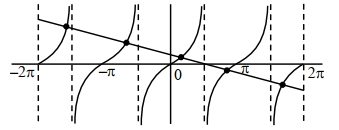
0 likesView Solution
149
MathematicsDifficultMCQJEE Main · 2025
એક રેખા ઉગમબિંદુમાંથી પસાર થાય છે અને ધન યામ અક્ષો સાથે સમાન ખૂણા બનાવે છે. તે રેખાઓ $L_1: 2x + y + 6 = 0$ અને $L_2: 4x + 2y - p = 0, p > 0$ ને અનુક્રમે $A$ અને $B$ બિંદુઓમાં છેદે છે. જો $AB = \frac{9}{\sqrt{2}}$ હોય અને બિંદુ $A$ માંથી રેખા $L_2$ પર દોરેલા લંબનો લંબપાદ $M$ હોય,તો $\frac{AM}{BM}$ ની કિંમત શોધો.
A
$5$
B
$4$
C
$2$
D
$3$
Solution
(D) ઉગમબિંદુમાંથી પસાર થતી અને ધન યામ અક્ષો સાથે સમાન ખૂણા બનાવતી રેખા $y = x$ છે.
$L_1: 2x + y + 6 = 0$ અને $L_2: 4x + 2y - p = 0$ (અથવા $2x + y - \frac{p}{2} = 0$).
$L_1$ અને $L_2$ નો ઢાળ $m = -2$ સમાન હોવાથી,તેઓ સમાંતર રેખાઓ છે.
રેખા $y = x$ એ $L_1$ ને $A$ માં અને $L_2$ ને $B$ માં છેદે છે.
કાટકોણ ત્રિકોણ $\triangle AMB$ માં,રેખા $y = x$ (ઢાળ $m_1 = 1$) અને રેખા $L_2$ (ઢાળ $m_2 = -2$) વચ્ચેનો ખૂણો $\theta$ નીચે મુજબ મળે છે:
$\tan \theta = \left| \frac{m_1 - m_2}{1 + m_1 m_2} \right| = \left| \frac{1 - (-2)}{1 + (1)(-2)} \right| = \left| \frac{3}{-1} \right| = 3$.
$\triangle AMB$ માં,$\tan \theta = \frac{AM}{BM}$.
તેથી,$\frac{AM}{BM} = 3$.
$L_1: 2x + y + 6 = 0$ અને $L_2: 4x + 2y - p = 0$ (અથવા $2x + y - \frac{p}{2} = 0$).
$L_1$ અને $L_2$ નો ઢાળ $m = -2$ સમાન હોવાથી,તેઓ સમાંતર રેખાઓ છે.
રેખા $y = x$ એ $L_1$ ને $A$ માં અને $L_2$ ને $B$ માં છેદે છે.
કાટકોણ ત્રિકોણ $\triangle AMB$ માં,રેખા $y = x$ (ઢાળ $m_1 = 1$) અને રેખા $L_2$ (ઢાળ $m_2 = -2$) વચ્ચેનો ખૂણો $\theta$ નીચે મુજબ મળે છે:
$\tan \theta = \left| \frac{m_1 - m_2}{1 + m_1 m_2} \right| = \left| \frac{1 - (-2)}{1 + (1)(-2)} \right| = \left| \frac{3}{-1} \right| = 3$.
$\triangle AMB$ માં,$\tan \theta = \frac{AM}{BM}$.
તેથી,$\frac{AM}{BM} = 3$.
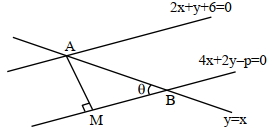
0 likesView Solution
150
MathematicsMediumMCQJEE Main · 2025
ધારો કે $z \in \mathbb{C}$ એવું છે કે $\frac{z^2+3i}{z-2+i}=2+3i$. તો $z^2$ ના તમામ શક્ય મૂલ્યોનો સરવાળો કેટલો થાય?
A
$19-2i$
B
$-19-2i$
C
$19+2i$
D
$-19+2i$
Solution
(B) આપેલ સમીકરણ: $\frac{z^2+3i}{z-2+i} = 2+3i$
બંને બાજુ $(z-2+i)$ વડે ગુણતા: $z^2+3i = (2+3i)(z-2+i)$
$z^2+3i = 2z - 4 + 2i + 3iz - 6i - 3$
$z^2 - z(2+3i) + 7 + 7i = 0$
ધારો કે $z_1$ અને $z_2$ આ દ્વિઘાત સમીકરણના બીજ છે. વીએટાના સૂત્રો મુજબ,$z_1+z_2 = 2+3i$ અને $z_1z_2 = 7+7i$.
આપણે $z^2$ ના તમામ શક્ય મૂલ્યોનો સરવાળો શોધવાનો છે,જે $z_1^2 + z_2^2$ છે.
$z_1^2 + z_2^2 = (z_1+z_2)^2 - 2z_1z_2$
$z_1^2 + z_2^2 = (2+3i)^2 - 2(7+7i)$
$z_1^2 + z_2^2 = (4 - 9 + 12i) - 14 - 14i$
$z_1^2 + z_2^2 = -19 - 2i$
બંને બાજુ $(z-2+i)$ વડે ગુણતા: $z^2+3i = (2+3i)(z-2+i)$
$z^2+3i = 2z - 4 + 2i + 3iz - 6i - 3$
$z^2 - z(2+3i) + 7 + 7i = 0$
ધારો કે $z_1$ અને $z_2$ આ દ્વિઘાત સમીકરણના બીજ છે. વીએટાના સૂત્રો મુજબ,$z_1+z_2 = 2+3i$ અને $z_1z_2 = 7+7i$.
આપણે $z^2$ ના તમામ શક્ય મૂલ્યોનો સરવાળો શોધવાનો છે,જે $z_1^2 + z_2^2$ છે.
$z_1^2 + z_2^2 = (z_1+z_2)^2 - 2z_1z_2$
$z_1^2 + z_2^2 = (2+3i)^2 - 2(7+7i)$
$z_1^2 + z_2^2 = (4 - 9 + 12i) - 14 - 14i$
$z_1^2 + z_2^2 = -19 - 2i$
0 likesView Solution
151
MathematicsDifficultMCQJEE Main · 2025
જો $f(x) = \int \frac{1}{x^{1/4}(1+x^{1/4})} dx$ અને $f(0) = -6$ હોય,તો $f(1)$ ની કિંમત શોધો:
A
$4(\log_e 2 - 2)$
B
$\log_e 2 + 2$
C
$2 - \log_e 2$
D
$4(\log_e 2 + 2)$
Solution
(A) ધારો કે $x = t^4$,તેથી $dx = 4t^3 dt$.
આ કિંમતો સંકલનમાં મૂકતા:
$\int \frac{1}{t(1+t)} \cdot 4t^3 dt = \int \frac{4t^2}{1+t} dt$.
બહુપદીના ભાગાકાર અથવા ગોઠવણનો ઉપયોગ કરતા:
$\int \frac{4(t^2-1+1)}{t+1} dt = 4 \int (t-1 + \frac{1}{t+1}) dt$.
પદવાર સંકલન કરતા:
$f(x) = 4(\frac{t^2}{2} - t + \log_e|t+1|) + C = 2t^2 - 4t + 4\log_e(t+1) + C$.
$t = x^{1/4}$ મૂકતા:
$f(x) = 2x^{1/2} - 4x^{1/4} + 4\log_e(1+x^{1/4}) + C$.
આપેલ છે કે $f(0) = -6$:
$2(0) - 4(0) + 4\log_e(1) + C = -6 \implies C = -6$.
આમ,$f(x) = 2x^{1/2} - 4x^{1/4} + 4\log_e(1+x^{1/4}) - 6$.
$f(1)$ ની ગણતરી કરતા:
$f(1) = 2(1) - 4(1) + 4\log_e(2) - 6 = 2 - 4 + 4\log_e 2 - 6 = 4\log_e 2 - 8 = 4(\log_e 2 - 2)$.
આ કિંમતો સંકલનમાં મૂકતા:
$\int \frac{1}{t(1+t)} \cdot 4t^3 dt = \int \frac{4t^2}{1+t} dt$.
બહુપદીના ભાગાકાર અથવા ગોઠવણનો ઉપયોગ કરતા:
$\int \frac{4(t^2-1+1)}{t+1} dt = 4 \int (t-1 + \frac{1}{t+1}) dt$.
પદવાર સંકલન કરતા:
$f(x) = 4(\frac{t^2}{2} - t + \log_e|t+1|) + C = 2t^2 - 4t + 4\log_e(t+1) + C$.
$t = x^{1/4}$ મૂકતા:
$f(x) = 2x^{1/2} - 4x^{1/4} + 4\log_e(1+x^{1/4}) + C$.
આપેલ છે કે $f(0) = -6$:
$2(0) - 4(0) + 4\log_e(1) + C = -6 \implies C = -6$.
આમ,$f(x) = 2x^{1/2} - 4x^{1/4} + 4\log_e(1+x^{1/4}) - 6$.
$f(1)$ ની ગણતરી કરતા:
$f(1) = 2(1) - 4(1) + 4\log_e(2) - 6 = 2 - 4 + 4\log_e 2 - 6 = 4\log_e 2 - 8 = 4(\log_e 2 - 2)$.
0 likesView Solution
152
MathematicsAdvancedMCQJEE Main · 2025
ધારો કે $f : R \rightarrow R$ એ બે વાર વિકલનીય વિધેય છે જેથી $f(2)=1$. જો બધા $x \in R$ માટે $F(x) = x f(x)$ હોય,$\int_0^2 x F^{\prime}(x) dx = 6$ અને $\int_0^2 x^2 F^{\prime \prime}(x) dx = 40$ હોય,તો $F^{\prime}(2) + \int_0^2 F(x) dx$ ની કિંમત શોધો:
A
$15$
B
$11$
C
$9$
D
$13$
Solution
(B) આપેલ છે કે $\int_0^2 x F^{\prime}(x) dx = 6$. ખંડશઃ સંકલનનો ઉપયોગ કરતા:
$[x F(x)]_0^2 - \int_0^2 F(x) dx = 6$
$2 F(2) - 0 - \int_0^2 F(x) dx = 6$.
કારણ કે $F(x) = x f(x)$,તેથી $F(2) = 2 f(2) = 2(1) = 2$.
તેથી,$2(2) - \int_0^2 F(x) dx = 6 \implies \int_0^2 F(x) dx = 4 - 6 = -2$.
હવે,$\int_0^2 x^2 F^{\prime \prime}(x) dx = 40$ ધ્યાનમાં લો. ખંડશઃ સંકલનનો ઉપયોગ કરતા:
$[x^2 F^{\prime}(x)]_0^2 - \int_0^2 2x F^{\prime}(x) dx = 40$
$4 F^{\prime}(2) - 2 \int_0^2 x F^{\prime}(x) dx = 40$.
આપેલ કિંમત $\int_0^2 x F^{\prime}(x) dx = 6$ મૂકતા:
$4 F^{\prime}(2) - 2(6) = 40$
$4 F^{\prime}(2) - 12 = 40
4 F^{\prime}(2) = 52
F^{\prime}(2) = 13$.
અંતે,$F^{\prime}(2) + \int_0^2 F(x) dx = 13 + (-2) = 11$.
$[x F(x)]_0^2 - \int_0^2 F(x) dx = 6$
$2 F(2) - 0 - \int_0^2 F(x) dx = 6$.
કારણ કે $F(x) = x f(x)$,તેથી $F(2) = 2 f(2) = 2(1) = 2$.
તેથી,$2(2) - \int_0^2 F(x) dx = 6 \implies \int_0^2 F(x) dx = 4 - 6 = -2$.
હવે,$\int_0^2 x^2 F^{\prime \prime}(x) dx = 40$ ધ્યાનમાં લો. ખંડશઃ સંકલનનો ઉપયોગ કરતા:
$[x^2 F^{\prime}(x)]_0^2 - \int_0^2 2x F^{\prime}(x) dx = 40$
$4 F^{\prime}(2) - 2 \int_0^2 x F^{\prime}(x) dx = 40$.
આપેલ કિંમત $\int_0^2 x F^{\prime}(x) dx = 6$ મૂકતા:
$4 F^{\prime}(2) - 2(6) = 40$
$4 F^{\prime}(2) - 12 = 40
4 F^{\prime}(2) = 52
F^{\prime}(2) = 13$.
અંતે,$F^{\prime}(2) + \int_0^2 F(x) dx = 13 + (-2) = 11$.
0 likesView Solution
153
MathematicsDifficultMCQJEE Main · 2025
ધારો કે $f:[0,3] \rightarrow A$ એ $f(x)=2x^3-15x^2+36x+7$ દ્વારા વ્યાખ્યાયિત છે અને $g:[0, \infty) \rightarrow B$ એ $g(x)=\frac{x^{2025}}{x^{2025}+1}$ દ્વારા વ્યાખ્યાયિત છે. જો બંને વિધેયો વ્યાપ્ત (onto) હોય અને $S =\{ x \in \mathbb{Z} : x \in A \text{ અથવા } x \in B \}$ હોય,તો $n(S)$ ની કિંમત શોધો:
A
$30$
B
$36$
C
$29$
D
$31$
Solution
(A) કારણ કે $f(x)$ વ્યાપ્ત છે,તેથી $A$ એ $f(x)$ નો વિસ્તાર છે.
$f'(x) = 6x^2 - 30x + 36 = 6(x-2)(x-3)$.
ક્રિટીકલ પોઈન્ટ્સ $x=2$ અને $x=3$ છે.
સીમાઓ અને ક્રિટીકલ પોઈન્ટ્સ પર કિંમત મેળવતા:
$f(0) = 7$
$f(2) = 2(8) - 15(4) + 36(2) + 7 = 35$
$f(3) = 2(27) - 15(9) + 36(3) + 7 = 34$.
$f(x)$ એ $[0,3]$ પર સતત હોવાથી,વિસ્તાર $A = [7, 35]$.
$g(x) = \frac{x^{2025}}{x^{2025}+1}$ માટે,$x \in [0, \infty)$ હોવાથી,$x^{2025} \in [0, \infty)$.
તેથી,$g(x) = 1 - \frac{1}{x^{2025}+1}$.
$x=0$ માટે,$g(0) = 0$. જેમ $x \to \infty$,તેમ $g(x) \to 1$.
તેથી,વિસ્તાર $B = [0, 1)$.
$S = \{x \in \mathbb{Z} : x \in [7, 35] \cup [0, 1)\} = \{0, 7, 8, 9, \dots, 35\}$.
$S$ માં ઘટકોની સંખ્યા $1 + (35 - 7 + 1) = 30$ છે.
$f'(x) = 6x^2 - 30x + 36 = 6(x-2)(x-3)$.
ક્રિટીકલ પોઈન્ટ્સ $x=2$ અને $x=3$ છે.
સીમાઓ અને ક્રિટીકલ પોઈન્ટ્સ પર કિંમત મેળવતા:
$f(0) = 7$
$f(2) = 2(8) - 15(4) + 36(2) + 7 = 35$
$f(3) = 2(27) - 15(9) + 36(3) + 7 = 34$.
$f(x)$ એ $[0,3]$ પર સતત હોવાથી,વિસ્તાર $A = [7, 35]$.
$g(x) = \frac{x^{2025}}{x^{2025}+1}$ માટે,$x \in [0, \infty)$ હોવાથી,$x^{2025} \in [0, \infty)$.
તેથી,$g(x) = 1 - \frac{1}{x^{2025}+1}$.
$x=0$ માટે,$g(0) = 0$. જેમ $x \to \infty$,તેમ $g(x) \to 1$.
તેથી,વિસ્તાર $B = [0, 1)$.
$S = \{x \in \mathbb{Z} : x \in [7, 35] \cup [0, 1)\} = \{0, 7, 8, 9, \dots, 35\}$.
$S$ માં ઘટકોની સંખ્યા $1 + (35 - 7 + 1) = 30$ છે.
0 likesView Solution
154
MathematicsDifficultMCQJEE Main · 2025
ધારો કે $[x]$ એ $x$ થી નાનો અથવા તેના જેટલો મહત્તમ પૂર્ણાંક દર્શાવે છે. તો $f(x) = \sec^{-1}(2[x] + 1)$ નો પ્રદેશ શું છે?
A
$(-\infty, -1] \cup [0, \infty)$
B
$(-\infty, \infty)$
C
$(-\infty, -1] \cup [1, \infty)$
D
$(-\infty, \infty) \setminus \{0\}$
Solution
(B) વિધેય $f(x) = \sec^{-1}(u)$ એ $|u| \geq 1$ માટે વ્યાખ્યાયિત છે,જેનો અર્થ છે કે $u \leq -1$ અથવા $u \geq 1$.
અહીં,$u = 2[x] + 1$.
તેથી,$2[x] + 1 \leq -1$ અથવા $2[x] + 1 \geq 1$.
કિસ્સો $1$: $2[x] + 1 \leq -1 \Rightarrow 2[x] \leq -2 \Rightarrow [x] \leq -1$. આ સૂચવે છે કે $x < 0$.
કિસ્સો $2$: $2[x] + 1 \geq 1 \Rightarrow 2[x] \geq 0 \Rightarrow [x] \geq 0$. આ સૂચવે છે કે $x \geq 0$.
બંને કિસ્સાઓને જોડતા,$x \in (-\infty, 0) \cup [0, \infty) = (-\infty, \infty)$.
અહીં,$u = 2[x] + 1$.
તેથી,$2[x] + 1 \leq -1$ અથવા $2[x] + 1 \geq 1$.
કિસ્સો $1$: $2[x] + 1 \leq -1 \Rightarrow 2[x] \leq -2 \Rightarrow [x] \leq -1$. આ સૂચવે છે કે $x < 0$.
કિસ્સો $2$: $2[x] + 1 \geq 1 \Rightarrow 2[x] \geq 0 \Rightarrow [x] \geq 0$. આ સૂચવે છે કે $x \geq 0$.
બંને કિસ્સાઓને જોડતા,$x \in (-\infty, 0) \cup [0, \infty) = (-\infty, \infty)$.
0 likesView Solution
155
MathematicsDifficultMCQJEE Main · 2025
ધારો કે $f: \mathbb{R} - \{0\} \rightarrow (-\infty, 1)$ એ એક વિધેય છે જે $f(x)f(\frac{1}{x}) = f(x) + f(\frac{1}{x})$ નું સમાધાન કરે છે. જો $f(x)$ એ $2$ ઘાતવાળી બહુપદી હોય અને $f(K) = -2K$ હોય,તો $K$ ના તમામ શક્ય મૂલ્યોના વર્ગોનો સરવાળો કેટલો થાય?
A
$1$
B
$6$
C
$7$
D
$9$
Solution
(B) આપેલ છે કે $f(x)f(\frac{1}{x}) = f(x) + f(\frac{1}{x})$.
ધારો કે $f(x) = ax^2 + bx + c$. $f(x)$ એ $2$ ઘાતની બહુપદી હોવાથી $a \neq 0$.
સમીકરણમાં $f(x)$ મૂકતા: $(ax^2 + bx + c)(a(\frac{1}{x})^2 + b(\frac{1}{x}) + c) = ax^2 + bx + c + a(\frac{1}{x})^2 + b(\frac{1}{x}) + c$.
સહગુણકોની સરખામણી કરતા,આપણને $c = 1$ અને $a = -1$ મળે છે (કારણ કે વિસ્તાર $(-\infty, 1)$ છે).
તેથી,$f(x) = 1 - x^2$.
આપેલ છે કે $f(K) = -2K$,તેથી $1 - K^2 = -2K$,જેનું સાદું રૂપ $K^2 - 2K - 1 = 0$ થાય છે.
ધારો કે બીજ $K_1$ અને $K_2$ છે. વર્ગોનો સરવાળો $K_1^2 + K_2^2 = (K_1 + K_2)^2 - 2K_1K_2$ થાય.
વિયેટાના સૂત્રોનો ઉપયોગ કરતા,$K_1 + K_2 = 2$ અને $K_1K_2 = -1$.
તેથી,$K_1^2 + K_2^2 = (2)^2 - 2(-1) = 4 + 2 = 6$.
ધારો કે $f(x) = ax^2 + bx + c$. $f(x)$ એ $2$ ઘાતની બહુપદી હોવાથી $a \neq 0$.
સમીકરણમાં $f(x)$ મૂકતા: $(ax^2 + bx + c)(a(\frac{1}{x})^2 + b(\frac{1}{x}) + c) = ax^2 + bx + c + a(\frac{1}{x})^2 + b(\frac{1}{x}) + c$.
સહગુણકોની સરખામણી કરતા,આપણને $c = 1$ અને $a = -1$ મળે છે (કારણ કે વિસ્તાર $(-\infty, 1)$ છે).
તેથી,$f(x) = 1 - x^2$.
આપેલ છે કે $f(K) = -2K$,તેથી $1 - K^2 = -2K$,જેનું સાદું રૂપ $K^2 - 2K - 1 = 0$ થાય છે.
ધારો કે બીજ $K_1$ અને $K_2$ છે. વર્ગોનો સરવાળો $K_1^2 + K_2^2 = (K_1 + K_2)^2 - 2K_1K_2$ થાય.
વિયેટાના સૂત્રોનો ઉપયોગ કરતા,$K_1 + K_2 = 2$ અને $K_1K_2 = -1$.
તેથી,$K_1^2 + K_2^2 = (2)^2 - 2(-1) = 4 + 2 = 6$.
0 likesView Solution
156
MathematicsDifficultMCQJEE Main · 2025
જો $y = y(x)$ એ વિકલ સમીકરણ $\sqrt{4-x^2} \frac{dy}{dx} = \left(\left(\sin^{-1}\left(\frac{x}{2}\right)\right)^2 - y\right) \sin^{-1}\left(\frac{x}{2}\right)$ નો ઉકેલ હોય,જ્યાં $-2 \leq x \leq 2$ અને $y(2) = \frac{\pi^2-8}{4}$ હોય,તો $y^2(0)$ ની કિંમત શોધો.
A
$4$
B
$5$
C
$6$
D
$7$
Solution
(A) આપેલ વિકલ સમીકરણ $\sqrt{4-x^2} \frac{dy}{dx} + y \sin^{-1}\left(\frac{x}{2}\right) = \left(\sin^{-1}\left(\frac{x}{2}\right)\right)^3$ છે.
$\sqrt{4-x^2}$ વડે ભાગતા,$\frac{dy}{dx} + \frac{\sin^{-1}(x/2)}{\sqrt{4-x^2}} y = \frac{(\sin^{-1}(x/2))^3}{\sqrt{4-x^2}}$ મળે.
આ સુરેખ વિકલ સમીકરણ $\frac{dy}{dx} + P(x)y = Q(x)$ પ્રકારનું છે,જ્યાં $P(x) = \frac{\sin^{-1}(x/2)}{\sqrt{4-x^2}}$ અને $Q(x) = \frac{(\sin^{-1}(x/2))^3}{\sqrt{4-x^2}}$.
સંકલ્યકારક અવયવ $IF = e^{\int P(x) dx} = e^{\int \frac{\sin^{-1}(x/2)}{\sqrt{4-x^2}} dx}$.
ધારો કે $u = \sin^{-1}(x/2)$,તો $du = \frac{1}{\sqrt{4-x^2}} dx$.
તેથી,$IF = e^{\int u du} = e^{u^2/2} = e^{\frac{(\sin^{-1}(x/2))^2}{2}}$.
ઉકેલ $y \cdot IF = \int Q(x) \cdot IF dx + C$ છે.
$y e^{\frac{(\sin^{-1}(x/2))^2}{2}} = \int u^3 e^{u^2/2} du + C$.
ધારો કે $t = u^2/2$,તો $dt = u du$. સંકલન $\int 2t e^t dt = 2e^t(t-1) + C$ થાય.
કિંમત મૂકતા,$y = u^2 - 2 + C e^{-u^2/2}$.
$y(2) = \frac{\pi^2-8}{4}$ અને $u = \pi/2$ લેતા,$C = 0$ મળે.
તેથી,$y = u^2 - 2 = (\sin^{-1}(x/2))^2 - 2$.
$x=0$ માટે,$y(0) = -2$.
તેથી,$y^2(0) = (-2)^2 = 4$.
$\sqrt{4-x^2}$ વડે ભાગતા,$\frac{dy}{dx} + \frac{\sin^{-1}(x/2)}{\sqrt{4-x^2}} y = \frac{(\sin^{-1}(x/2))^3}{\sqrt{4-x^2}}$ મળે.
આ સુરેખ વિકલ સમીકરણ $\frac{dy}{dx} + P(x)y = Q(x)$ પ્રકારનું છે,જ્યાં $P(x) = \frac{\sin^{-1}(x/2)}{\sqrt{4-x^2}}$ અને $Q(x) = \frac{(\sin^{-1}(x/2))^3}{\sqrt{4-x^2}}$.
સંકલ્યકારક અવયવ $IF = e^{\int P(x) dx} = e^{\int \frac{\sin^{-1}(x/2)}{\sqrt{4-x^2}} dx}$.
ધારો કે $u = \sin^{-1}(x/2)$,તો $du = \frac{1}{\sqrt{4-x^2}} dx$.
તેથી,$IF = e^{\int u du} = e^{u^2/2} = e^{\frac{(\sin^{-1}(x/2))^2}{2}}$.
ઉકેલ $y \cdot IF = \int Q(x) \cdot IF dx + C$ છે.
$y e^{\frac{(\sin^{-1}(x/2))^2}{2}} = \int u^3 e^{u^2/2} du + C$.
ધારો કે $t = u^2/2$,તો $dt = u du$. સંકલન $\int 2t e^t dt = 2e^t(t-1) + C$ થાય.
કિંમત મૂકતા,$y = u^2 - 2 + C e^{-u^2/2}$.
$y(2) = \frac{\pi^2-8}{4}$ અને $u = \pi/2$ લેતા,$C = 0$ મળે.
તેથી,$y = u^2 - 2 = (\sin^{-1}(x/2))^2 - 2$.
$x=0$ માટે,$y(0) = -2$.
તેથી,$y^2(0) = (-2)^2 = 4$.
0 likesView Solution
157
MathematicsDifficultMCQJEE Main · 2025
ધારો કે $M$ અને $m$ એ $f(x) = \left| \begin{array}{ccc} 1+\sin^2 x & \cos^2 x & 4\sin 4x \\ \sin^2 x & 1+\cos^2 x & 4\sin 4x \\ \sin^2 x & \cos^2 x & 1+4\sin 4x \end{array} \right|$,$x \in R$ ના અનુક્રમે મહત્તમ અને ન્યૂનતમ મૂલ્યો છે. તો $M^4 - m^4$ ની કિંમત શોધો:
A
$1280$
B
$1295$
C
$1040$
D
$1215$
Solution
(A) આપેલ નિશ્ચાયક $f(x) = \left| \begin{array}{ccc} 1+\sin^2 x & \cos^2 x & 4\sin 4x \\ \sin^2 x & 1+\cos^2 x & 4\sin 4x \\ \sin^2 x & \cos^2 x & 1+4\sin 4x \end{array} \right|$ છે.
હારની પ્રક્રિયાઓ $R_2 \rightarrow R_2 - R_1$ અને $R_3 \rightarrow R_3 - R_1$ લાગુ પાડતા:
$f(x) = \left| \begin{array}{ccc} 1+\sin^2 x & \cos^2 x & 4\sin 4x \\ -1 & 1 & 0 \\ -1 & 0 & 1 \end{array} \right|$.
પ્રથમ હાર $(R_1)$ ની સાપેક્ષ વિસ્તરણ કરતા:
$f(x) = (1+\sin^2 x)(1 - 0) - (\cos^2 x)(-1 - 0) + (4\sin 4x)(0 - (-1))$.
$f(x) = 1 + \sin^2 x + \cos^2 x + 4\sin 4x$.
કારણ કે $\sin^2 x + \cos^2 x = 1$,તેથી $f(x) = 1 + 1 + 4\sin 4x = 2 + 4\sin 4x$.
મહત્તમ મૂલ્ય $M$ ત્યારે મળે જ્યારે $\sin 4x = 1$,તેથી $M = 2 + 4(1) = 6$.
ન્યૂનતમ મૂલ્ય $m$ ત્યારે મળે જ્યારે $\sin 4x = -1$,તેથી $m = 2 + 4(-1) = -2$.
તેથી,$M^4 - m^4 = 6^4 - (-2)^4 = 1296 - 16 = 1280$.
હારની પ્રક્રિયાઓ $R_2 \rightarrow R_2 - R_1$ અને $R_3 \rightarrow R_3 - R_1$ લાગુ પાડતા:
$f(x) = \left| \begin{array}{ccc} 1+\sin^2 x & \cos^2 x & 4\sin 4x \\ -1 & 1 & 0 \\ -1 & 0 & 1 \end{array} \right|$.
પ્રથમ હાર $(R_1)$ ની સાપેક્ષ વિસ્તરણ કરતા:
$f(x) = (1+\sin^2 x)(1 - 0) - (\cos^2 x)(-1 - 0) + (4\sin 4x)(0 - (-1))$.
$f(x) = 1 + \sin^2 x + \cos^2 x + 4\sin 4x$.
કારણ કે $\sin^2 x + \cos^2 x = 1$,તેથી $f(x) = 1 + 1 + 4\sin 4x = 2 + 4\sin 4x$.
મહત્તમ મૂલ્ય $M$ ત્યારે મળે જ્યારે $\sin 4x = 1$,તેથી $M = 2 + 4(1) = 6$.
ન્યૂનતમ મૂલ્ય $m$ ત્યારે મળે જ્યારે $\sin 4x = -1$,તેથી $m = 2 + 4(-1) = -2$.
તેથી,$M^4 - m^4 = 6^4 - (-2)^4 = 1296 - 16 = 1280$.
0 likesView Solution
158
MathematicsDifficultMCQJEE Main · 2025
ધારો કે $\overrightarrow{a}=2 \hat{i}-\hat{j}+3 \hat{k}$,$\overrightarrow{b}=3 \hat{i}-5 \hat{j}+\hat{k}$ અને $\vec{c}$ એક એવો સદિશ છે કે જેથી $\vec{a} \times \vec{c}=\vec{c} \times \vec{b}$ અને $(\overrightarrow{a}+\overrightarrow{c}) \cdot(\overrightarrow{b}+\overrightarrow{c})=168$ થાય. તો $|\vec{c}|^2$ નું મહત્તમ મૂલ્ય શોધો:
A
$77$
B
$462$
C
$308$
D
$154$
Solution
(C) આપેલ છે કે $\overrightarrow{a}=2 \hat{i}-\hat{j}+3 \hat{k}$ અને $\overrightarrow{b}=3 \hat{i}-5 \hat{j}+\hat{k}$.
$\overrightarrow{a} \times \overrightarrow{c}=\overrightarrow{c} \times \overrightarrow{b}$ પરથી,આપણને મળે છે $\overrightarrow{a} \times \overrightarrow{c}+\overrightarrow{b} \times \overrightarrow{c}=0$,જેનો અર્થ છે કે $(\overrightarrow{a}+\overrightarrow{b}) \times \overrightarrow{c}=0$.
આનો અર્થ એ છે કે $\overrightarrow{c}$ એ $(\overrightarrow{a}+\overrightarrow{b})$ ને સમાંતર છે.
ધારો કે $\overrightarrow{c}=\lambda(\overrightarrow{a}+\overrightarrow{b})=\lambda(5 \hat{i}-6 \hat{j}+4 \hat{k})$.
તેથી $|\overrightarrow{c}|^2=\lambda^2(5^2+(-6)^2+4^2)=77 \lambda^2$.
આપેલ છે કે $(\overrightarrow{a}+\overrightarrow{c}) \cdot(\overrightarrow{b}+\overrightarrow{c})=168$.
આનું વિસ્તરણ કરતા,આપણને મળે છે $\overrightarrow{a} \cdot \overrightarrow{b}+\overrightarrow{a} \cdot \overrightarrow{c}+\overrightarrow{c} \cdot \overrightarrow{b}+|\overrightarrow{c}|^2=168$.
$\overrightarrow{a} \cdot \overrightarrow{b} = (2)(3)+(-1)(-5)+(3)(1) = 6+5+3=14$.
$\overrightarrow{c}=\lambda(\overrightarrow{a}+\overrightarrow{b})$ મૂકતા,આપણને મળે છે $14+\lambda(\overrightarrow{a}+\overrightarrow{b}) \cdot (\overrightarrow{a}+\overrightarrow{b})+77 \lambda^2=168$.
$14+\lambda|\overrightarrow{a}+\overrightarrow{b}|^2+77 \lambda^2=168$.
$14+\lambda(77)+77 \lambda^2=168$.
$77 \lambda^2+77 \lambda-154=0 \Rightarrow \lambda^2+\lambda-2=0$.
$\lambda$ માટે ઉકેલતા,આપણને મળે છે $(\lambda+2)(\lambda-1)=0$,તેથી $\lambda=-2$ અથવા $\lambda=1$.
કારણ કે $|\overrightarrow{c}|^2=77 \lambda^2$,મહત્તમ મૂલ્ય $\lambda=-2$ પર મળે છે.
$|\overrightarrow{c}|^2=77 \times (-2)^2 = 77 \times 4 = 308$.
$\overrightarrow{a} \times \overrightarrow{c}=\overrightarrow{c} \times \overrightarrow{b}$ પરથી,આપણને મળે છે $\overrightarrow{a} \times \overrightarrow{c}+\overrightarrow{b} \times \overrightarrow{c}=0$,જેનો અર્થ છે કે $(\overrightarrow{a}+\overrightarrow{b}) \times \overrightarrow{c}=0$.
આનો અર્થ એ છે કે $\overrightarrow{c}$ એ $(\overrightarrow{a}+\overrightarrow{b})$ ને સમાંતર છે.
ધારો કે $\overrightarrow{c}=\lambda(\overrightarrow{a}+\overrightarrow{b})=\lambda(5 \hat{i}-6 \hat{j}+4 \hat{k})$.
તેથી $|\overrightarrow{c}|^2=\lambda^2(5^2+(-6)^2+4^2)=77 \lambda^2$.
આપેલ છે કે $(\overrightarrow{a}+\overrightarrow{c}) \cdot(\overrightarrow{b}+\overrightarrow{c})=168$.
આનું વિસ્તરણ કરતા,આપણને મળે છે $\overrightarrow{a} \cdot \overrightarrow{b}+\overrightarrow{a} \cdot \overrightarrow{c}+\overrightarrow{c} \cdot \overrightarrow{b}+|\overrightarrow{c}|^2=168$.
$\overrightarrow{a} \cdot \overrightarrow{b} = (2)(3)+(-1)(-5)+(3)(1) = 6+5+3=14$.
$\overrightarrow{c}=\lambda(\overrightarrow{a}+\overrightarrow{b})$ મૂકતા,આપણને મળે છે $14+\lambda(\overrightarrow{a}+\overrightarrow{b}) \cdot (\overrightarrow{a}+\overrightarrow{b})+77 \lambda^2=168$.
$14+\lambda|\overrightarrow{a}+\overrightarrow{b}|^2+77 \lambda^2=168$.
$14+\lambda(77)+77 \lambda^2=168$.
$77 \lambda^2+77 \lambda-154=0 \Rightarrow \lambda^2+\lambda-2=0$.
$\lambda$ માટે ઉકેલતા,આપણને મળે છે $(\lambda+2)(\lambda-1)=0$,તેથી $\lambda=-2$ અથવા $\lambda=1$.
કારણ કે $|\overrightarrow{c}|^2=77 \lambda^2$,મહત્તમ મૂલ્ય $\lambda=-2$ પર મળે છે.
$|\overrightarrow{c}|^2=77 \times (-2)^2 = 77 \times 4 = 308$.
0 likesView Solution
159
MathematicsDifficultMCQJEE Main · 2025
ધારો કે પ્રદેશ $\{(x, y): 2y \leq x^2+3, y +|x| \leq 3, y \geq|x-1|\}$ નું ક્ષેત્રફળ $A$ છે. તો $6A$ ની કિંમત શોધો:
A
$16$
B
$12$
C
$18$
D
$14$
Solution
(A) આ પ્રદેશ પરવલય $y = \frac{x^2+3}{2}$,રેખાઓ $y = 3-|x|$,અને $y = |x-1|$ દ્વારા ઘેરાયેલ છે.
છેદબિંદુઓનું વિશ્લેષણ કરતા:
$1$. પરવલય $y = \frac{x^2+3}{2}$ અને રેખા $y = 3-x$ બિંદુ $x=1, y=2$ (બિંદુ $C$) પર છેદે છે.
$2$. પરવલય $y = \frac{x^2+3}{2}$ અને રેખા $y = 3+x$ બિંદુ $x=-1, y=2$ (બિંદુ $E$) પર છેદે છે.
$3$. રેખા $y = 3-x$ અને $y = x-1$ બિંદુ $x=2, y=1$ (બિંદુ $B$) પર છેદે છે.
$4$. રેખા $y = x-1$ અને $y = 0$ બિંદુ $x=1, y=0$ (બિંદુ $A$) પર છેદે છે.
ક્ષેત્રફળ $A$ એ ઉપરની સીમા અને નીચેની સીમા વચ્ચેના સંકલન દ્વારા મળે છે.
$A = \int_{-1}^{1} (3-|x| - \frac{x^2+3}{2}) dx + \int_{1}^{2} (3-x - (x-1)) dx$
$A = \int_{-1}^{1} (\frac{3}{2} - |x| - \frac{x^2}{2}) dx + \int_{1}^{2} (4-2x) dx$
$A = 2 \int_{0}^{1} (\frac{3}{2} - x - \frac{x^2}{2}) dx + [4x - x^2]_1^2$
$A = 2 [\frac{3}{2}x - \frac{x^2}{2} - \frac{x^3}{6}]_0^1 + (8-4) - (4-1)$
$A = 2 (\frac{3}{2} - \frac{1}{2} - \frac{1}{6}) + 1 = 2(\frac{5}{6}) + 1 = \frac{5}{3} + 1 = \frac{8}{3}$.
તેથી $6A = 6 \times \frac{8}{3} = 16$.
છેદબિંદુઓનું વિશ્લેષણ કરતા:
$1$. પરવલય $y = \frac{x^2+3}{2}$ અને રેખા $y = 3-x$ બિંદુ $x=1, y=2$ (બિંદુ $C$) પર છેદે છે.
$2$. પરવલય $y = \frac{x^2+3}{2}$ અને રેખા $y = 3+x$ બિંદુ $x=-1, y=2$ (બિંદુ $E$) પર છેદે છે.
$3$. રેખા $y = 3-x$ અને $y = x-1$ બિંદુ $x=2, y=1$ (બિંદુ $B$) પર છેદે છે.
$4$. રેખા $y = x-1$ અને $y = 0$ બિંદુ $x=1, y=0$ (બિંદુ $A$) પર છેદે છે.
ક્ષેત્રફળ $A$ એ ઉપરની સીમા અને નીચેની સીમા વચ્ચેના સંકલન દ્વારા મળે છે.
$A = \int_{-1}^{1} (3-|x| - \frac{x^2+3}{2}) dx + \int_{1}^{2} (3-x - (x-1)) dx$
$A = \int_{-1}^{1} (\frac{3}{2} - |x| - \frac{x^2}{2}) dx + \int_{1}^{2} (4-2x) dx$
$A = 2 \int_{0}^{1} (\frac{3}{2} - x - \frac{x^2}{2}) dx + [4x - x^2]_1^2$
$A = 2 [\frac{3}{2}x - \frac{x^2}{2} - \frac{x^3}{6}]_0^1 + (8-4) - (4-1)$
$A = 2 (\frac{3}{2} - \frac{1}{2} - \frac{1}{6}) + 1 = 2(\frac{5}{6}) + 1 = \frac{5}{3} + 1 = \frac{8}{3}$.
તેથી $6A = 6 \times \frac{8}{3} = 16$.
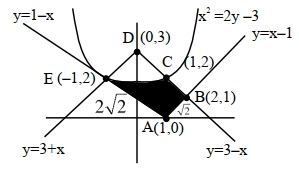
0 likesView Solution
160
MathematicsDifficultMCQJEE Main · 2025
ધારો કે $y=y(x)$ એ વિકલ સમીકરણ $\cos x(\ln(\cos x))^2 dy + (\sin x - 3y \sin x \ln(\cos x)) dx = 0$ નો ઉકેલ છે,જ્યાં $x \in (0, \frac{\pi}{2})$. જો $y(\frac{\pi}{4}) = \frac{-1}{\ln 2}$ હોય,તો $y(\frac{\pi}{6})$ શું થાય?
A
$\frac{2}{\ln 3 - \ln 4}$
B
$\frac{1}{\ln 4 - \ln 3}$
C
$-\frac{1}{\ln 4}$
D
$\frac{1}{\ln 3 - \ln 4}$
Solution
(D) આપેલ વિકલ સમીકરણ $\cos x(\ln(\cos x))^2 dy + (\sin x - 3y \sin x \ln(\cos x)) dx = 0$ છે.
$dx \cdot \cos x(\ln(\cos x))^2$ વડે ભાગતા,આપણને મળે:
$\frac{dy}{dx} - \frac{3 \tan x}{\ln(\cos x)} y = -\frac{\tan x}{(\ln(\cos x))^2}$.
આ $\frac{dy}{dx} + P(x)y = Q(x)$ પ્રકારનું સુરેખ વિકલ સમીકરણ છે,જ્યાં $P(x) = -\frac{3 \tan x}{\ln(\cos x)}$.
સંકલ્યકારક અવયવ $I.F. = e^{\int P(x) dx} = (\ln(\cos x))^3$.
ઉકેલ $y \cdot I.F. = \int Q(x) \cdot I.F. dx + C$ છે.
$y(\ln(\cos x))^3 = -\int \tan x \ln(\cos x) dx + C$.
$v = \ln(\cos x)$ લેતા,$dv = -\tan x dx$ મળે.
$y(\ln(\cos x))^3 = \frac{(\ln(\cos x))^2}{2} + C$.
$y(\frac{\pi}{4}) = -\frac{1}{\ln 2}$ આપેલ છે,જેનાથી $C = 0$ મળે છે.
તેથી,$y = \frac{1}{2 \ln(\cos x)}$.
$x = \frac{\pi}{6}$ માટે,$y(\frac{\pi}{6}) = \frac{1}{2 \ln(\frac{\sqrt{3}}{2})} = \frac{1}{\ln 3 - \ln 4}$.
$dx \cdot \cos x(\ln(\cos x))^2$ વડે ભાગતા,આપણને મળે:
$\frac{dy}{dx} - \frac{3 \tan x}{\ln(\cos x)} y = -\frac{\tan x}{(\ln(\cos x))^2}$.
આ $\frac{dy}{dx} + P(x)y = Q(x)$ પ્રકારનું સુરેખ વિકલ સમીકરણ છે,જ્યાં $P(x) = -\frac{3 \tan x}{\ln(\cos x)}$.
સંકલ્યકારક અવયવ $I.F. = e^{\int P(x) dx} = (\ln(\cos x))^3$.
ઉકેલ $y \cdot I.F. = \int Q(x) \cdot I.F. dx + C$ છે.
$y(\ln(\cos x))^3 = -\int \tan x \ln(\cos x) dx + C$.
$v = \ln(\cos x)$ લેતા,$dv = -\tan x dx$ મળે.
$y(\ln(\cos x))^3 = \frac{(\ln(\cos x))^2}{2} + C$.
$y(\frac{\pi}{4}) = -\frac{1}{\ln 2}$ આપેલ છે,જેનાથી $C = 0$ મળે છે.
તેથી,$y = \frac{1}{2 \ln(\cos x)}$.
$x = \frac{\pi}{6}$ માટે,$y(\frac{\pi}{6}) = \frac{1}{2 \ln(\frac{\sqrt{3}}{2})} = \frac{1}{\ln 3 - \ln 4}$.
0 likesView Solution
161
MathematicsMediumMCQJEE Main · 2025
અંતરાલ $[0, \frac{\pi}{2})$ પર એક સંબંધ $R$ ને $xRy$ જો અને માત્ર જો $\sec^2 x - \tan^2 y = 1$ દ્વારા વ્યાખ્યાયિત કરો. તો $R$ એ :
A
એક સામ્ય સંબંધ છે
B
સ્વવાચક અને પરંપરિત છે પણ સંમિત નથી
C
સ્વવાચક અને સંમિત છે પણ પરંપરિત નથી
D
સ્વવાચક છે પણ સંમિત કે પરંપરિત નથી
Solution
(A) અંતરાલ $[0, \frac{\pi}{2})$ પર સંબંધ $xRy \iff \sec^2 x - \tan^2 y = 1$ આપેલ છે.
$1$. સ્વવાચક: કોઈપણ $x \in [0, \frac{\pi}{2})$ માટે,આપણે ચકાસીએ કે $xRx$ સાચું છે કે નહીં.
$\sec^2 x - \tan^2 x = 1$,જે એક પ્રમાણિત ત્રિકોણમિતીય નિત્યસમ છે.
તેથી,$R$ સ્વવાચક છે.
$2$. સંમિત: જો $xRy$ હોય,તો $\sec^2 x - \tan^2 y = 1$.
નિત્યસમ $\sec^2 \theta = 1 + \tan^2 \theta$ નો ઉપયોગ કરતા,$(1 + \tan^2 x) - \tan^2 y = 1 \implies \tan^2 x = \tan^2 y$.
પછી $\sec^2 y - \tan^2 x = (1 + \tan^2 y) - \tan^2 x = 1 + \tan^2 x - \tan^2 x = 1$.
તેથી,$yRx$ સાચું છે,તેથી $R$ સંમિત છે.
$3$. પરંપરિત: જો $xRy$ અને $yRz$ હોય,તો $\sec^2 x - \tan^2 y = 1$ અને $\sec^2 y - \tan^2 z = 1$.
પ્રથમ સમીકરણ પરથી,$\tan^2 x = \tan^2 y$. બીજા પરથી,$\sec^2 y = 1 + \tan^2 z$.
$\sec^2 y = 1 + \tan^2 y$ ને બીજા સમીકરણમાં મૂકતા: $1 + \tan^2 y - \tan^2 z = 1 \implies \tan^2 y = \tan^2 z$.
કારણ કે $\tan^2 x = \tan^2 y$ અને $\tan^2 y = \tan^2 z$,તેથી $\tan^2 x = \tan^2 z$.
પછી $\sec^2 x - \tan^2 z = (1 + \tan^2 x) - \tan^2 z = 1 + 0 = 1$.
તેથી,$xRz$ સાચું છે,તેથી $R$ પરંપરિત છે.
આમ,$R$ સ્વવાચક,સંમિત અને પરંપરિત હોવાથી,તે એક સામ્ય સંબંધ છે.
$1$. સ્વવાચક: કોઈપણ $x \in [0, \frac{\pi}{2})$ માટે,આપણે ચકાસીએ કે $xRx$ સાચું છે કે નહીં.
$\sec^2 x - \tan^2 x = 1$,જે એક પ્રમાણિત ત્રિકોણમિતીય નિત્યસમ છે.
તેથી,$R$ સ્વવાચક છે.
$2$. સંમિત: જો $xRy$ હોય,તો $\sec^2 x - \tan^2 y = 1$.
નિત્યસમ $\sec^2 \theta = 1 + \tan^2 \theta$ નો ઉપયોગ કરતા,$(1 + \tan^2 x) - \tan^2 y = 1 \implies \tan^2 x = \tan^2 y$.
પછી $\sec^2 y - \tan^2 x = (1 + \tan^2 y) - \tan^2 x = 1 + \tan^2 x - \tan^2 x = 1$.
તેથી,$yRx$ સાચું છે,તેથી $R$ સંમિત છે.
$3$. પરંપરિત: જો $xRy$ અને $yRz$ હોય,તો $\sec^2 x - \tan^2 y = 1$ અને $\sec^2 y - \tan^2 z = 1$.
પ્રથમ સમીકરણ પરથી,$\tan^2 x = \tan^2 y$. બીજા પરથી,$\sec^2 y = 1 + \tan^2 z$.
$\sec^2 y = 1 + \tan^2 y$ ને બીજા સમીકરણમાં મૂકતા: $1 + \tan^2 y - \tan^2 z = 1 \implies \tan^2 y = \tan^2 z$.
કારણ કે $\tan^2 x = \tan^2 y$ અને $\tan^2 y = \tan^2 z$,તેથી $\tan^2 x = \tan^2 z$.
પછી $\sec^2 x - \tan^2 z = (1 + \tan^2 x) - \tan^2 z = 1 + 0 = 1$.
તેથી,$xRz$ સાચું છે,તેથી $R$ પરંપરિત છે.
આમ,$R$ સ્વવાચક,સંમિત અને પરંપરિત હોવાથી,તે એક સામ્ય સંબંધ છે.
0 likesView Solution
162
MathematicsDifficultMCQJEE Main · 2025
ધારો કે $\overrightarrow{a} = \hat{i} + 2\hat{j} + \hat{k}$ અને $\overrightarrow{b} = 2\hat{i} + 7\hat{j} + 3\hat{k}$. ધારો કે $L_1: \overrightarrow{r} = (-\hat{i} + 2\hat{j} + \hat{k}) + \lambda \overrightarrow{a}, \lambda \in R$ અને $L_2: \overrightarrow{r} = (\hat{j} + \hat{k}) + \mu \overrightarrow{b}, \mu \in R$ બે રેખાઓ છે. જો રેખા $L_3$ એ $L_1$ અને $L_2$ ના છેદબિંદુમાંથી પસાર થાય છે અને $\overrightarrow{a} + \overrightarrow{b}$ ને સમાંતર છે,તો $L_3$ કયા બિંદુમાંથી પસાર થાય છે?
A
$(8, 26, 12)$
B
$(2, 8, 5)$
C
$(-1, -1, 1)$
D
$(5, 17, 4)$
Solution
(A) રેખા $L_1$ આ મુજબ છે: $\overrightarrow{r} = (-\hat{i} + 2\hat{j} + \hat{k}) + \lambda(\hat{i} + 2\hat{j} + \hat{k}) = (\lambda - 1)\hat{i} + (2\lambda + 2)\hat{j} + (\lambda + 1)\hat{k}$.
રેખા $L_2$ આ મુજબ છે: $\overrightarrow{r} = (\hat{j} + \hat{k}) + \mu(2\hat{i} + 7\hat{j} + 3\hat{k}) = 2\mu\hat{i} + (7\mu + 1)\hat{j} + (3\mu + 1)\hat{k}$.
છેદબિંદુ શોધવા માટે,ઘટકોને સરખાવતા:
$1) \lambda - 1 = 2\mu$
$2) 2\lambda + 2 = 7\mu + 1 \Rightarrow 2\lambda - 7\mu = -1$
$3) \lambda + 1 = 3\mu + 1 \Rightarrow \lambda = 3\mu$
$\lambda = 3\mu$ ને પ્રથમ સમીકરણમાં મૂકતા: $3\mu - 1 = 2\mu \Rightarrow \mu = 1$. તેથી $\lambda = 3(1) = 3$.
$\lambda = 3$ ને $L_1$ માં મૂકતા: $\overrightarrow{r} = (3-1)\hat{i} + (2(3)+2)\hat{j} + (3+1)\hat{k} = 2\hat{i} + 8\hat{j} + 4\hat{k}$.
$L_3$ નો દિશા સદિશ $\overrightarrow{a} + \overrightarrow{b} = (1+2)\hat{i} + (2+7)\hat{j} + (1+3)\hat{k} = 3\hat{i} + 9\hat{j} + 4\hat{k}$ છે.
$L_3$ નું સમીકરણ $\overrightarrow{r} = (2\hat{i} + 8\hat{j} + 4\hat{k}) + t(3\hat{i} + 9\hat{j} + 4\hat{k})$ છે.
$t = 2$ માટે,$\overrightarrow{r} = (2+6)\hat{i} + (8+18)\hat{j} + (4+8)\hat{k} = 8\hat{i} + 26\hat{j} + 12\hat{k}$.
આમ,રેખા $L_3$ એ $(8, 26, 12)$ બિંદુમાંથી પસાર થાય છે.
રેખા $L_2$ આ મુજબ છે: $\overrightarrow{r} = (\hat{j} + \hat{k}) + \mu(2\hat{i} + 7\hat{j} + 3\hat{k}) = 2\mu\hat{i} + (7\mu + 1)\hat{j} + (3\mu + 1)\hat{k}$.
છેદબિંદુ શોધવા માટે,ઘટકોને સરખાવતા:
$1) \lambda - 1 = 2\mu$
$2) 2\lambda + 2 = 7\mu + 1 \Rightarrow 2\lambda - 7\mu = -1$
$3) \lambda + 1 = 3\mu + 1 \Rightarrow \lambda = 3\mu$
$\lambda = 3\mu$ ને પ્રથમ સમીકરણમાં મૂકતા: $3\mu - 1 = 2\mu \Rightarrow \mu = 1$. તેથી $\lambda = 3(1) = 3$.
$\lambda = 3$ ને $L_1$ માં મૂકતા: $\overrightarrow{r} = (3-1)\hat{i} + (2(3)+2)\hat{j} + (3+1)\hat{k} = 2\hat{i} + 8\hat{j} + 4\hat{k}$.
$L_3$ નો દિશા સદિશ $\overrightarrow{a} + \overrightarrow{b} = (1+2)\hat{i} + (2+7)\hat{j} + (1+3)\hat{k} = 3\hat{i} + 9\hat{j} + 4\hat{k}$ છે.
$L_3$ નું સમીકરણ $\overrightarrow{r} = (2\hat{i} + 8\hat{j} + 4\hat{k}) + t(3\hat{i} + 9\hat{j} + 4\hat{k})$ છે.
$t = 2$ માટે,$\overrightarrow{r} = (2+6)\hat{i} + (8+18)\hat{j} + (4+8)\hat{k} = 8\hat{i} + 26\hat{j} + 12\hat{k}$.
આમ,રેખા $L_3$ એ $(8, 26, 12)$ બિંદુમાંથી પસાર થાય છે.
0 likesView Solution
163
MathematicsDifficultMCQJEE Main · 2025
સંકલન $80 \int_0^{\frac{\pi}{4}} \left( \frac{\sin \theta + \cos \theta}{9 + 16 \sin 2 \theta} \right) d \theta$ ની કિંમત શોધો :
A
$3 \log_e 4$
B
$6 \log_e 4$
C
$4 \log_e 3$
D
$2 \log_e 3$
Solution
(C) ધારો કે $I = 80 \int_0^{\frac{\pi}{4}} \frac{\sin \theta + \cos \theta}{9 + 16 \sin 2 \theta} d \theta$.
આપણે જાણીએ છીએ કે $\sin 2 \theta = 1 - (1 - \sin 2 \theta) = 1 - (\sin \theta - \cos \theta)^2$.
આ કિંમત સંકલનમાં મૂકતા:
$I = 80 \int_0^{\frac{\pi}{4}} \frac{\sin \theta + \cos \theta}{9 + 16(1 - (\sin \theta - \cos \theta)^2)} d \theta = 80 \int_0^{\frac{\pi}{4}} \frac{\sin \theta + \cos \theta}{25 - 16(\sin \theta - \cos \theta)^2} d \theta$.
ધારો કે $t = \sin \theta - \cos \theta$,તેથી $dt = (\cos \theta + \sin \theta) d \theta$.
જ્યારે $\theta = 0$,ત્યારે $t = -1$. જ્યારે $\theta = \frac{\pi}{4}$,ત્યારે $t = 0$.
$I = 80 \int_{-1}^0 \frac{dt}{25 - 16t^2} = 80 \int_{-1}^0 \frac{dt}{16(\frac{25}{16} - t^2)} = 5 \int_{-1}^0 \frac{dt}{(\frac{5}{4})^2 - t^2}$.
સૂત્ર $\int \frac{dx}{a^2 - x^2} = \frac{1}{2a} \ln |\frac{a+x}{a-x}|$ નો ઉપયોગ કરતા:
$I = 5 \left[ \frac{1}{2(\frac{5}{4})} \ln \left| \frac{\frac{5}{4} + t}{\frac{5}{4} - t} \right| \right]_{-1}^0 = 5 \left[ \frac{2}{5} \ln \left| \frac{5+4t}{5-4t} \right| \right]_{-1}^0 = 2 [\ln(1) - \ln(\frac{1}{9})] = 2 [0 - \ln(3^{-2})] = 2 [2 \ln 3] = 4 \ln 3$.
આપણે જાણીએ છીએ કે $\sin 2 \theta = 1 - (1 - \sin 2 \theta) = 1 - (\sin \theta - \cos \theta)^2$.
આ કિંમત સંકલનમાં મૂકતા:
$I = 80 \int_0^{\frac{\pi}{4}} \frac{\sin \theta + \cos \theta}{9 + 16(1 - (\sin \theta - \cos \theta)^2)} d \theta = 80 \int_0^{\frac{\pi}{4}} \frac{\sin \theta + \cos \theta}{25 - 16(\sin \theta - \cos \theta)^2} d \theta$.
ધારો કે $t = \sin \theta - \cos \theta$,તેથી $dt = (\cos \theta + \sin \theta) d \theta$.
જ્યારે $\theta = 0$,ત્યારે $t = -1$. જ્યારે $\theta = \frac{\pi}{4}$,ત્યારે $t = 0$.
$I = 80 \int_{-1}^0 \frac{dt}{25 - 16t^2} = 80 \int_{-1}^0 \frac{dt}{16(\frac{25}{16} - t^2)} = 5 \int_{-1}^0 \frac{dt}{(\frac{5}{4})^2 - t^2}$.
સૂત્ર $\int \frac{dx}{a^2 - x^2} = \frac{1}{2a} \ln |\frac{a+x}{a-x}|$ નો ઉપયોગ કરતા:
$I = 5 \left[ \frac{1}{2(\frac{5}{4})} \ln \left| \frac{\frac{5}{4} + t}{\frac{5}{4} - t} \right| \right]_{-1}^0 = 5 \left[ \frac{2}{5} \ln \left| \frac{5+4t}{5-4t} \right| \right]_{-1}^0 = 2 [\ln(1) - \ln(\frac{1}{9})] = 2 [0 - \ln(3^{-2})] = 2 [2 \ln 3] = 4 \ln 3$.
0 likesView Solution
164
MathematicsDifficultMCQJEE Main · 2025
ધારો કે $L_1: \frac{x-1}{1}=\frac{y-2}{-1}=\frac{z-1}{2}$ અને $L_2: \frac{x+1}{-1}=\frac{y-2}{2}=\frac{z}{1}$ બે રેખાઓ છે. ધારો કે $L_3$ એ $(\alpha, \beta, \gamma)$ બિંદુમાંથી પસાર થતી અને $L_1$ તથા $L_2$ બંનેને લંબ રેખા છે. જો $L_3$ એ $L_1$ ને છેદે,તો $|5\alpha-11\beta-8\gamma|$ ની કિંમત શોધો:
A
$18$
B
$16$
C
$25$
D
$20$
Solution
(C) $L_1$ ના દિકગુણોત્તર $\vec{v_1} = (1, -1, 2)$ છે અને $L_2$ ના દિકગુણોત્તર $\vec{v_2} = (-1, 2, 1)$ છે.
$L_3$ ના દિકગુણોત્તર $\vec{v_3} = \vec{v_1} \times \vec{v_2} = \begin{vmatrix} \hat{i} & \hat{j} & \hat{k} \\ 1 & -1 & 2 \\ -1 & 2 & 1 \end{vmatrix} = -5\hat{i} - 3\hat{j} + \hat{k}$ મળે છે.
$L_3$ એ $(\alpha, \beta, \gamma)$ માંથી પસાર થાય છે અને $L_1$ ને છેદે છે,તેથી $(\alpha, \beta, \gamma)$ બિંદુ $L_1$ પર આવેલું છે.
તેથી,$\frac{\alpha-1}{1} = \frac{\beta-2}{-1} = \frac{\gamma-1}{2} = k$.
આથી,$\alpha = k+1$,$\beta = -k+2$,અને $\gamma = 2k+1$.
હવે $|5\alpha - 11\beta - 8\gamma|$ માં કિંમત મૂકતા:
$|5(k+1) - 11(-k+2) - 8(2k+1)| = |5k + 5 + 11k - 22 - 16k - 8| = |-25| = 25$.
$L_3$ ના દિકગુણોત્તર $\vec{v_3} = \vec{v_1} \times \vec{v_2} = \begin{vmatrix} \hat{i} & \hat{j} & \hat{k} \\ 1 & -1 & 2 \\ -1 & 2 & 1 \end{vmatrix} = -5\hat{i} - 3\hat{j} + \hat{k}$ મળે છે.
$L_3$ એ $(\alpha, \beta, \gamma)$ માંથી પસાર થાય છે અને $L_1$ ને છેદે છે,તેથી $(\alpha, \beta, \gamma)$ બિંદુ $L_1$ પર આવેલું છે.
તેથી,$\frac{\alpha-1}{1} = \frac{\beta-2}{-1} = \frac{\gamma-1}{2} = k$.
આથી,$\alpha = k+1$,$\beta = -k+2$,અને $\gamma = 2k+1$.
હવે $|5\alpha - 11\beta - 8\gamma|$ માં કિંમત મૂકતા:
$|5(k+1) - 11(-k+2) - 8(2k+1)| = |5k + 5 + 11k - 22 - 16k - 8| = |-25| = 25$.
0 likesView Solution
165
MathematicsDifficultMCQJEE Main · 2025
ધારો કે $A = [a_{ij}] = \begin{bmatrix} \log_5 128 & \log_4 5 \\ \log_5 8 & \log_4 25 \end{bmatrix}$. જો $A_{ij}$ એ $a_{ij}$ નો સહઅવયવ (cofactor) હોય,$C_{ij} = \sum_{k=1}^2 a_{ik} A_{jk}$,$1 \leq i, j \leq 2$,અને $C = [C_{ij}]$ હોય,તો $8|C|$ ની કિંમત શોધો:
A
$262$
B
$288$
C
$242$
D
$222$
Solution
(C) આપેલ છે $A = \begin{bmatrix} \log_5 128 & \log_4 5 \\ \log_5 8 & \log_4 25 \end{bmatrix} = \begin{bmatrix} 7 \log_5 2 & \frac{1}{2} \log_2 5 \\ 3 \log_5 2 & \log_2 5 \end{bmatrix}$.
પ્રથમ,નિશ્ચાયક $|A|$ ની ગણતરી કરો:
$|A| = (7 \log_5 2)(\log_2 5) - (3 \log_5 2)(\frac{1}{2} \log_2 5) = 7 - \frac{3}{2} = \frac{11}{2}$.
શ્રેણિક $C$ એ $C_{ij} = \sum_{k=1}^2 a_{ik} A_{jk}$ દ્વારા વ્યાખ્યાયિત છે.
$i=j$ માટે,$C_{ii} = \sum_{k=1}^2 a_{ik} A_{ik} = |A| = \frac{11}{2}$.
$i \neq j$ માટે,$C_{ij} = \sum_{k=1}^2 a_{ik} A_{jk} = 0$ (નિશ્ચાયકના ગુણધર્મ મુજબ).
આમ,$C = \begin{bmatrix} |A| & 0 \\ 0 & |A| \end{bmatrix} = \begin{bmatrix} 11/2 & 0 \\ 0 & 11/2 \end{bmatrix}$.
નિશ્ચાયક $|C| = (11/2) \times (11/2) = 121/4$.
તેથી,$8|C| = 8 \times (121/4) = 2 \times 121 = 242$.
પ્રથમ,નિશ્ચાયક $|A|$ ની ગણતરી કરો:
$|A| = (7 \log_5 2)(\log_2 5) - (3 \log_5 2)(\frac{1}{2} \log_2 5) = 7 - \frac{3}{2} = \frac{11}{2}$.
શ્રેણિક $C$ એ $C_{ij} = \sum_{k=1}^2 a_{ik} A_{jk}$ દ્વારા વ્યાખ્યાયિત છે.
$i=j$ માટે,$C_{ii} = \sum_{k=1}^2 a_{ik} A_{ik} = |A| = \frac{11}{2}$.
$i \neq j$ માટે,$C_{ij} = \sum_{k=1}^2 a_{ik} A_{jk} = 0$ (નિશ્ચાયકના ગુણધર્મ મુજબ).
આમ,$C = \begin{bmatrix} |A| & 0 \\ 0 & |A| \end{bmatrix} = \begin{bmatrix} 11/2 & 0 \\ 0 & 11/2 \end{bmatrix}$.
નિશ્ચાયક $|C| = (11/2) \times (11/2) = 121/4$.
તેથી,$8|C| = 8 \times (121/4) = 2 \times 121 = 242$.
0 likesView Solution
166
MathematicsAdvancedMCQJEE Main · 2025
ધારો કે $f : (0, \infty) \rightarrow \mathbb{R}$ એ બે વાર વિકલનીય વિધેય છે. જો કોઈ $a \neq 0$ માટે,$\int_0^1 f(\lambda x) d\lambda = a f(x)$,$f(1) = 1$ અને $f(16) = \frac{1}{8}$ હોય,તો $16 - f^{\prime}\left(\frac{1}{16}\right)$ ની કિંમત . . . . . . છે.
A
$112$
B
$113$
C
$114$
D
$115$
Solution
(A) આપેલ છે કે $\int_0^1 f(\lambda x) d\lambda = a f(x)$.
ધારો કે $\lambda x = t$,તેથી $d\lambda = \frac{1}{x} dt$.
સંકલનમાં આ કિંમતો મૂકતા: $\frac{1}{x} \int_0^x f(t) dt = a f(x)$,જે સૂચવે છે કે $\int_0^x f(t) dt = a x f(x)$.
કલનશાસ્ત્રના મૂળભૂત પ્રમેયનો ઉપયોગ કરીને બંને બાજુ $x$ ની સાપેક્ષમાં વિકલન કરતા: $f(x) = a(f(x) + x f^{\prime}(x))$.
પદો ગોઠવતા $(1 - a) f(x) = a x f^{\prime}(x)$ મળે,તેથી $\frac{f^{\prime}(x)}{f(x)} = \frac{1 - a}{a} \cdot \frac{1}{x}$.
બંને બાજુ સંકલન કરતા: $\ln|f(x)| = \frac{1 - a}{a} \ln x + C$.
$f(1) = 1$ હોવાથી,$C = 0$ મળે,તેથી $f(x) = x^{\frac{1-a}{a}}$.
$f(16) = \frac{1}{8}$ આપેલ છે,તેથી $16^{\frac{1-a}{a}} = 2^{-3}$.
$16 = 2^4$ હોવાથી,$2^{4 \cdot \frac{1-a}{a}} = 2^{-3}$,તેથી $\frac{4(1-a)}{a} = -3$.
$4 - 4a = -3a \Rightarrow a = 4$.
આમ,$f(x) = x^{\frac{1-4}{4}} = x^{-3/4}$.
તેથી $f^{\prime}(x) = -\frac{3}{4} x^{-7/4}$.
$f^{\prime}\left(\frac{1}{16}\right) = -\frac{3}{4} \left(2^{-4}\right)^{-7/4} = -\frac{3}{4} \cdot 2^7 = -\frac{3}{4} \cdot 128 = -3 \cdot 32 = -96$.
તેથી,$16 - f^{\prime}\left(\frac{1}{16}\right) = 16 - (-96) = 112$.
ધારો કે $\lambda x = t$,તેથી $d\lambda = \frac{1}{x} dt$.
સંકલનમાં આ કિંમતો મૂકતા: $\frac{1}{x} \int_0^x f(t) dt = a f(x)$,જે સૂચવે છે કે $\int_0^x f(t) dt = a x f(x)$.
કલનશાસ્ત્રના મૂળભૂત પ્રમેયનો ઉપયોગ કરીને બંને બાજુ $x$ ની સાપેક્ષમાં વિકલન કરતા: $f(x) = a(f(x) + x f^{\prime}(x))$.
પદો ગોઠવતા $(1 - a) f(x) = a x f^{\prime}(x)$ મળે,તેથી $\frac{f^{\prime}(x)}{f(x)} = \frac{1 - a}{a} \cdot \frac{1}{x}$.
બંને બાજુ સંકલન કરતા: $\ln|f(x)| = \frac{1 - a}{a} \ln x + C$.
$f(1) = 1$ હોવાથી,$C = 0$ મળે,તેથી $f(x) = x^{\frac{1-a}{a}}$.
$f(16) = \frac{1}{8}$ આપેલ છે,તેથી $16^{\frac{1-a}{a}} = 2^{-3}$.
$16 = 2^4$ હોવાથી,$2^{4 \cdot \frac{1-a}{a}} = 2^{-3}$,તેથી $\frac{4(1-a)}{a} = -3$.
$4 - 4a = -3a \Rightarrow a = 4$.
આમ,$f(x) = x^{\frac{1-4}{4}} = x^{-3/4}$.
તેથી $f^{\prime}(x) = -\frac{3}{4} x^{-7/4}$.
$f^{\prime}\left(\frac{1}{16}\right) = -\frac{3}{4} \left(2^{-4}\right)^{-7/4} = -\frac{3}{4} \cdot 2^7 = -\frac{3}{4} \cdot 128 = -3 \cdot 32 = -96$.
તેથી,$16 - f^{\prime}\left(\frac{1}{16}\right) = 16 - (-96) = 112$.
0 likesView Solution
167
MathematicsDifficultMCQJEE Main · 2025
ધારો કે $S = \{ m \in \mathbb{Z} : A^{m^2} + A^m = 3I - A^{-6} \}$,જ્યાં $A = \begin{bmatrix} 2 & -1 \\ 1 & 0 \end{bmatrix}$. તો $n(S)$ ની કિંમત શોધો.
A
$1$
B
$2$
C
$3$
D
$4$
Solution
(B) આપેલ છે $A = \begin{bmatrix} 2 & -1 \\ 1 & 0 \end{bmatrix}$.
આપણે $A$ ની ઘાત શોધીએ:
$A^2 = \begin{bmatrix} 3 & -2 \\ 2 & -1 \end{bmatrix}, A^3 = \begin{bmatrix} 4 & -3 \\ 3 & -2 \end{bmatrix}$.
ગાણિતિક અનુમાન દ્વારા,$A^n = \begin{bmatrix} n+1 & -n \\ n & -n+1 \end{bmatrix}$.
તેથી,$A^m = \begin{bmatrix} m+1 & -m \\ m & -m+1 \end{bmatrix}$ અને $A^{m^2} = \begin{bmatrix} m^2+1 & -m^2 \\ m^2 & -m^2+1 \end{bmatrix}$.
વળી,$A^{-6} = (A^6)^{-1}$. $A^6 = \begin{bmatrix} 7 & -6 \\ 6 & -5 \end{bmatrix}$ હોવાથી,$\det(A^6) = -35 - (-36) = 1$.
$A^{-6} = \frac{1}{1} \begin{bmatrix} -5 & 6 \\ -6 & 7 \end{bmatrix} = \begin{bmatrix} -5 & 6 \\ -6 & 7 \end{bmatrix}$.
તેથી $3I - A^{-6} = \begin{bmatrix} 3 & 0 \\ 0 & 3 \end{bmatrix} - \begin{bmatrix} -5 & 6 \\ -6 & 7 \end{bmatrix} = \begin{bmatrix} 8 & -6 \\ 6 & -4 \end{bmatrix}$.
$A^{m^2} + A^m = \begin{bmatrix} 8 & -6 \\ 6 & -4 \end{bmatrix}$ ને સરખાવતા:
શ્રેણિકોનો સરવાળો: $\begin{bmatrix} m^2+m+2 & -(m^2+m) \\ m^2+m & -(m^2+m)+2 \end{bmatrix} = \begin{bmatrix} 8 & -6 \\ 6 & -4 \end{bmatrix}$.
ઘટકોની સરખામણી કરતા: $m^2 + m + 2 = 8 \Rightarrow m^2 + m - 6 = 0$.
$(m+3)(m-2) = 0$,તેથી $m = -3$ અથવા $m = 2$.
આમ,$S = \{-3, 2\}$ અને $n(S) = 2$.
આપણે $A$ ની ઘાત શોધીએ:
$A^2 = \begin{bmatrix} 3 & -2 \\ 2 & -1 \end{bmatrix}, A^3 = \begin{bmatrix} 4 & -3 \\ 3 & -2 \end{bmatrix}$.
ગાણિતિક અનુમાન દ્વારા,$A^n = \begin{bmatrix} n+1 & -n \\ n & -n+1 \end{bmatrix}$.
તેથી,$A^m = \begin{bmatrix} m+1 & -m \\ m & -m+1 \end{bmatrix}$ અને $A^{m^2} = \begin{bmatrix} m^2+1 & -m^2 \\ m^2 & -m^2+1 \end{bmatrix}$.
વળી,$A^{-6} = (A^6)^{-1}$. $A^6 = \begin{bmatrix} 7 & -6 \\ 6 & -5 \end{bmatrix}$ હોવાથી,$\det(A^6) = -35 - (-36) = 1$.
$A^{-6} = \frac{1}{1} \begin{bmatrix} -5 & 6 \\ -6 & 7 \end{bmatrix} = \begin{bmatrix} -5 & 6 \\ -6 & 7 \end{bmatrix}$.
તેથી $3I - A^{-6} = \begin{bmatrix} 3 & 0 \\ 0 & 3 \end{bmatrix} - \begin{bmatrix} -5 & 6 \\ -6 & 7 \end{bmatrix} = \begin{bmatrix} 8 & -6 \\ 6 & -4 \end{bmatrix}$.
$A^{m^2} + A^m = \begin{bmatrix} 8 & -6 \\ 6 & -4 \end{bmatrix}$ ને સરખાવતા:
શ્રેણિકોનો સરવાળો: $\begin{bmatrix} m^2+m+2 & -(m^2+m) \\ m^2+m & -(m^2+m)+2 \end{bmatrix} = \begin{bmatrix} 8 & -6 \\ 6 & -4 \end{bmatrix}$.
ઘટકોની સરખામણી કરતા: $m^2 + m + 2 = 8 \Rightarrow m^2 + m - 6 = 0$.
$(m+3)(m-2) = 0$,તેથી $m = -3$ અથવા $m = 2$.
આમ,$S = \{-3, 2\}$ અને $n(S) = 2$.
0 likesView Solution
168
MathematicsDifficultMCQJEE Main · 2025
ધારો કે $S = \{ x : \cos^{-1} x = \pi + \sin^{-1} x + \sin^{-1}(2x + 1) \}$. તો $\sum_{x \in S} (2x - 1)^2$ ની કિંમત . . . . . . છે.
A
$5$
B
$6$
C
$7$
D
$8$
Solution
(A) આપેલ સમીકરણ $\cos^{-1} x = \pi + \sin^{-1} x + \sin^{-1}(2x + 1)$ છે.
નિત્યસમ $\cos^{-1} x + \sin^{-1} x = \frac{\pi}{2}$ નો ઉપયોગ કરતા,$\cos^{-1} x$ ને $\frac{\pi}{2} - \sin^{-1} x$ તરીકે લખી શકાય.
આ કિંમત સમીકરણમાં મૂકતા: $\frac{\pi}{2} - \sin^{-1} x = \pi + \sin^{-1} x + \sin^{-1}(2x + 1)$.
પદોને ગોઠવતા: $-2 \sin^{-1} x - \sin^{-1}(2x + 1) = \frac{\pi}{2}$,અથવા $2 \sin^{-1} x + \sin^{-1}(2x + 1) = -\frac{\pi}{2}$.
ધારો કે $\sin^{-1} x = \theta$,તો $x = \sin \theta$. સમીકરણ $2\theta + \sin^{-1}(2x + 1) = -\frac{\pi}{2}$ બને છે.
$\sin^{-1}(2x + 1) = -\frac{\pi}{2} - 2\theta$.
બંને બાજુ $\sin$ લેતા: $2x + 1 = \sin(-\frac{\pi}{2} - 2\theta) = -\cos(2\theta)$.
$2x + 1 = -(1 - 2\sin^2 \theta) = 2\sin^2 \theta - 1$.
$x = \sin \theta$ હોવાથી,$2x + 1 = 2x^2 - 1$,જેનું સાદું રૂપ $2x^2 - 2x - 2 = 0$ અથવા $x^2 - x - 1 = 0$ થાય છે.
ઉકેલ $x = \frac{1 \pm \sqrt{5}}{2}$ મળે છે.
$\sin^{-1} x$ નો પ્રદેશ $[-1, 1]$ છે અને $\sin^{-1}(2x + 1)$ માટે $-1 \le 2x + 1 \le 1 \Rightarrow -1 \le x \le 0$ હોવું જરૂરી છે,તેથી માત્ર $x = \frac{1 - \sqrt{5}}{2}$ શક્ય છે.
$x = \frac{1 - \sqrt{5}}{2}$ માટે,$2x - 1 = 1 - \sqrt{5} - 1 = -\sqrt{5}$.
તેથી,$(2x - 1)^2 = (-\sqrt{5})^2 = 5$.
નિત્યસમ $\cos^{-1} x + \sin^{-1} x = \frac{\pi}{2}$ નો ઉપયોગ કરતા,$\cos^{-1} x$ ને $\frac{\pi}{2} - \sin^{-1} x$ તરીકે લખી શકાય.
આ કિંમત સમીકરણમાં મૂકતા: $\frac{\pi}{2} - \sin^{-1} x = \pi + \sin^{-1} x + \sin^{-1}(2x + 1)$.
પદોને ગોઠવતા: $-2 \sin^{-1} x - \sin^{-1}(2x + 1) = \frac{\pi}{2}$,અથવા $2 \sin^{-1} x + \sin^{-1}(2x + 1) = -\frac{\pi}{2}$.
ધારો કે $\sin^{-1} x = \theta$,તો $x = \sin \theta$. સમીકરણ $2\theta + \sin^{-1}(2x + 1) = -\frac{\pi}{2}$ બને છે.
$\sin^{-1}(2x + 1) = -\frac{\pi}{2} - 2\theta$.
બંને બાજુ $\sin$ લેતા: $2x + 1 = \sin(-\frac{\pi}{2} - 2\theta) = -\cos(2\theta)$.
$2x + 1 = -(1 - 2\sin^2 \theta) = 2\sin^2 \theta - 1$.
$x = \sin \theta$ હોવાથી,$2x + 1 = 2x^2 - 1$,જેનું સાદું રૂપ $2x^2 - 2x - 2 = 0$ અથવા $x^2 - x - 1 = 0$ થાય છે.
ઉકેલ $x = \frac{1 \pm \sqrt{5}}{2}$ મળે છે.
$\sin^{-1} x$ નો પ્રદેશ $[-1, 1]$ છે અને $\sin^{-1}(2x + 1)$ માટે $-1 \le 2x + 1 \le 1 \Rightarrow -1 \le x \le 0$ હોવું જરૂરી છે,તેથી માત્ર $x = \frac{1 - \sqrt{5}}{2}$ શક્ય છે.
$x = \frac{1 - \sqrt{5}}{2}$ માટે,$2x - 1 = 1 - \sqrt{5} - 1 = -\sqrt{5}$.
તેથી,$(2x - 1)^2 = (-\sqrt{5})^2 = 5$.
0 likesView Solution
169
MathematicsDifficultMCQJEE Main · 2025
ધારો કે વક્રો $|y|=1-x^2$ અને $x^2+y^2=1$ વચ્ચે ઘેરાયેલું ક્ષેત્રફળ $\alpha$ છે. જો $9\alpha=\beta\pi+\gamma$ હોય,જ્યાં $\beta$ અને $\gamma$ પૂર્ણાંકો છે,તો $|\beta-\gamma|$ નું મૂલ્ય શોધો.
A
$27$
B
$18$
C
$15$
D
$33$
Solution
(D) આપેલ વક્રો $C_1: |y|=1-x^2$ અને $C_2: x^2+y^2=1$ છે.
સંમિતિને કારણે,ક્ષેત્રફળ $\alpha$ એ પ્રથમ ચરણમાં વર્તુળ $y=\sqrt{1-x^2}$ અને પરવલય $y=1-x^2$ વચ્ચેના ક્ષેત્રફળ કરતા ચાર ગણું છે.
$\alpha = 4 \int_0^1 (\sqrt{1-x^2} - (1-x^2)) dx$
$\alpha = 4 \left[ \int_0^1 \sqrt{1-x^2} dx - \int_0^1 (1-x^2) dx \right]$
પ્રમાણિત સંકલન $\int \sqrt{a^2-x^2} dx = \frac{x}{2}\sqrt{a^2-x^2} + \frac{a^2}{2}\sin^{-1}(\frac{x}{a})$ નો ઉપયોગ કરતા:
$\alpha = 4 \left[ \left( \frac{x}{2}\sqrt{1-x^2} + \frac{1}{2}\sin^{-1}(x) \right)_0^1 - \left( x - \frac{x^3}{3} \right)_0^1 \right]$
$\alpha = 4 \left[ (0 + \frac{1}{2} \cdot \frac{\pi}{2}) - (1 - \frac{1}{3}) \right]$
$\alpha = 4 \left[ \frac{\pi}{4} - \frac{2}{3} \right] = \pi - \frac{8}{3}$
આપેલ છે કે $9\alpha = \beta\pi + \gamma$,તેથી $9(\pi - \frac{8}{3}) = 9\pi - 24$.
સરખાવતા,$\beta = 9$ અને $\gamma = -24$ મળે છે.
આમ,$|\beta - \gamma| = |9 - (-24)| = |9 + 24| = 33$.
સંમિતિને કારણે,ક્ષેત્રફળ $\alpha$ એ પ્રથમ ચરણમાં વર્તુળ $y=\sqrt{1-x^2}$ અને પરવલય $y=1-x^2$ વચ્ચેના ક્ષેત્રફળ કરતા ચાર ગણું છે.
$\alpha = 4 \int_0^1 (\sqrt{1-x^2} - (1-x^2)) dx$
$\alpha = 4 \left[ \int_0^1 \sqrt{1-x^2} dx - \int_0^1 (1-x^2) dx \right]$
પ્રમાણિત સંકલન $\int \sqrt{a^2-x^2} dx = \frac{x}{2}\sqrt{a^2-x^2} + \frac{a^2}{2}\sin^{-1}(\frac{x}{a})$ નો ઉપયોગ કરતા:
$\alpha = 4 \left[ \left( \frac{x}{2}\sqrt{1-x^2} + \frac{1}{2}\sin^{-1}(x) \right)_0^1 - \left( x - \frac{x^3}{3} \right)_0^1 \right]$
$\alpha = 4 \left[ (0 + \frac{1}{2} \cdot \frac{\pi}{2}) - (1 - \frac{1}{3}) \right]$
$\alpha = 4 \left[ \frac{\pi}{4} - \frac{2}{3} \right] = \pi - \frac{8}{3}$
આપેલ છે કે $9\alpha = \beta\pi + \gamma$,તેથી $9(\pi - \frac{8}{3}) = 9\pi - 24$.
સરખાવતા,$\beta = 9$ અને $\gamma = -24$ મળે છે.
આમ,$|\beta - \gamma| = |9 - (-24)| = |9 + 24| = 33$.
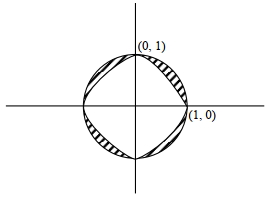
0 likesView Solution
170
MathematicsAdvancedMCQJEE Main · 2025
જો વિધેય $\log _5(18 x-x^2-77)$ નો પ્રદેશ $(\alpha, \beta)$ હોય અને વિધેય $\log _{(x-1)}\left(\frac{2 x^2+3 x-2}{x^2-3 x-4}\right)$ નો પ્રદેશ $(\gamma, \delta)$ હોય,તો $\alpha^2+\beta^2+\gamma^2$ ની કિંમત શોધો:
A
$186$
B
$174$
C
$195$
D
$179$
Solution
(A) $f_1(x) = \log _5(18 x-x^2-77)$ માટે,પ્રદેશની શરત $18 x-x^2-77 > 0$ છે.
$x^2-18 x+77 < 0 \implies (x-7)(x-11) < 0$.
તેથી,$x \in (7, 11)$,એટલે કે $\alpha = 7$ અને $\beta = 11$.
$f_2(x) = \log _{(x-1)}\left(\frac{2 x^2+3 x-2}{x^2-3 x-4}\right)$ માટે,પ્રદેશની શરતો:
$1) \ x-1 > 0 \implies x > 1$
$2) \ x-1 \neq 1 \implies x \neq 2$
$3) \ \frac{2 x^2+3 x-2}{x^2-3 x-4} > 0 \implies \frac{(2 x-1)(x+2)}{(x-4)(x+1)} > 0$.
ચિહ્ન પદ્ધતિનો ઉપયોગ કરતા,ઉકેલ $x \in (-\infty, -2) \cup (-1, 1/2) \cup (4, \infty)$ મળે છે.
$x > 1$ અને $x \neq 2$ સાથે છેદ લેતા,$x \in (4, \infty)$ મળે છે.
તેથી,$\gamma = 4$ અને $\delta = \infty$.
અંતે,$\alpha^2+\beta^2+\gamma^2 = 7^2+11^2+4^2 = 49+121+16 = 186$.
$x^2-18 x+77 < 0 \implies (x-7)(x-11) < 0$.
તેથી,$x \in (7, 11)$,એટલે કે $\alpha = 7$ અને $\beta = 11$.
$f_2(x) = \log _{(x-1)}\left(\frac{2 x^2+3 x-2}{x^2-3 x-4}\right)$ માટે,પ્રદેશની શરતો:
$1) \ x-1 > 0 \implies x > 1$
$2) \ x-1 \neq 1 \implies x \neq 2$
$3) \ \frac{2 x^2+3 x-2}{x^2-3 x-4} > 0 \implies \frac{(2 x-1)(x+2)}{(x-4)(x+1)} > 0$.
ચિહ્ન પદ્ધતિનો ઉપયોગ કરતા,ઉકેલ $x \in (-\infty, -2) \cup (-1, 1/2) \cup (4, \infty)$ મળે છે.
$x > 1$ અને $x \neq 2$ સાથે છેદ લેતા,$x \in (4, \infty)$ મળે છે.
તેથી,$\gamma = 4$ અને $\delta = \infty$.
અંતે,$\alpha^2+\beta^2+\gamma^2 = 7^2+11^2+4^2 = 49+121+16 = 186$.
0 likesView Solution
171
MathematicsDifficultMCQJEE Main · 2025
ધારો કે વિધેય $f(x) = (x^2 - 1)|x^2 - ax + 2| + \cos|x|$ એ બે બિંદુઓ $x = \alpha = 2$ અને $x = \beta$ આગળ વિકલનીય નથી. તો બિંદુ $(\alpha, \beta)$ નું રેખા $12x + 5y + 10 = 0$ થી અંતર કેટલું થાય?
A
$2$
B
$4$
C
$3$
D
$5$
Solution
(C) વિધેય $f(x) = (x^2 - 1)|x^2 - ax + 2| + \cos|x|$ એ જ્યાં માનાંકની અંદરની પદાવલિ શૂન્ય થાય ત્યાં વિકલનીય ન હોઈ શકે,જો તે બિંદુએ બેવડું બીજ ન હોય.
$\cos|x|$ દરેક જગ્યાએ વિકલનીય હોવાથી,આપણે ફક્ત $g(x) = x^2 - ax + 2$ માટે તપાસવું પડશે.
આપેલ છે કે $x = \alpha = 2$ એ અ-વિકલનીય બિંદુ છે,તેથી $g(2) = 0$.
$2^2 - a(2) + 2 = 0 \implies 6 - 2a = 0 \implies a = 3$.
$a = 3$ મૂકતા,$g(x) = x^2 - 3x + 2 = (x - 1)(x - 2)$ મળે.
બીજ $x = 1$ અને $x = 2$ છે.
$x = 1$ આગળ,$f(x) = (x^2 - 1)|(x - 1)(x - 2)| + \cos|x|$. $(x^2 - 1) = (x - 1)(x + 1)$ હોવાથી,પદ $(x - 1)^2(x + 1)|x - 2|$ બને છે,જે $x = 1$ આગળ વિકલનીય છે.
તેથી,$x = 1$ એ અ-વિકલનીય બિંદુ નથી. જો આપણે $\beta = 1$ લઈએ,તો બિંદુ $(2, 1)$ નું રેખા $12x + 5y + 10 = 0$ થી અંતર $d = \frac{|12(2) + 5(1) + 10|}{\sqrt{12^2 + 5^2}} = \frac{39}{13} = 3$ થાય.
$\cos|x|$ દરેક જગ્યાએ વિકલનીય હોવાથી,આપણે ફક્ત $g(x) = x^2 - ax + 2$ માટે તપાસવું પડશે.
આપેલ છે કે $x = \alpha = 2$ એ અ-વિકલનીય બિંદુ છે,તેથી $g(2) = 0$.
$2^2 - a(2) + 2 = 0 \implies 6 - 2a = 0 \implies a = 3$.
$a = 3$ મૂકતા,$g(x) = x^2 - 3x + 2 = (x - 1)(x - 2)$ મળે.
બીજ $x = 1$ અને $x = 2$ છે.
$x = 1$ આગળ,$f(x) = (x^2 - 1)|(x - 1)(x - 2)| + \cos|x|$. $(x^2 - 1) = (x - 1)(x + 1)$ હોવાથી,પદ $(x - 1)^2(x + 1)|x - 2|$ બને છે,જે $x = 1$ આગળ વિકલનીય છે.
તેથી,$x = 1$ એ અ-વિકલનીય બિંદુ નથી. જો આપણે $\beta = 1$ લઈએ,તો બિંદુ $(2, 1)$ નું રેખા $12x + 5y + 10 = 0$ થી અંતર $d = \frac{|12(2) + 5(1) + 10|}{\sqrt{12^2 + 5^2}} = \frac{39}{13} = 3$ થાય.
0 likesView Solution
172
MathematicsDifficultMCQJEE Main · 2025
ધારો કે એક સીધી રેખા $L$ બિંદુ $P(2, -1, 3)$ માંથી પસાર થાય છે અને રેખાઓ $\frac{x-1}{2} = \frac{y+1}{1} = \frac{z-3}{-2}$ અને $\frac{x-3}{1} = \frac{y-2}{3} = \frac{z+2}{4}$ ને લંબ છે. જો રેખા $L$ એ $yz$-સમતલને બિંદુ $Q$ માં છેદે,તો બિંદુઓ $P$ અને $Q$ વચ્ચેનું અંતર કેટલું છે?
A
$2$
B
$3$
C
$\sqrt{10}$
D
$2\sqrt{3}$
Solution
(B) રેખા $L$ નો દિશા સદિશ એ આપેલી બે રેખાઓના દિશા સદિશો $\vec{v_1} = (2, 1, -2)$ અને $\vec{v_2} = (1, 3, 4)$ ને લંબ છે.
તેથી,$L$ નો દિશા સદિશ $\vec{v} = \vec{v_1} \times \vec{v_2} = \begin{vmatrix} \hat{i} & \hat{j} & \hat{k} \\ 2 & 1 & -2 \\ 1 & 3 & 4 \end{vmatrix} = 10\hat{i} - 10\hat{j} + 5\hat{k}$ મળે.
આપણે દિશા સદિશને $\vec{d} = (2, -2, 1)$ તરીકે લઈ શકીએ.
બિંદુ $P(2, -1, 3)$ માંથી પસાર થતી રેખા $L$ નું સમીકરણ $\frac{x-2}{2} = \frac{y+1}{-2} = \frac{z-3}{1} = \lambda$ છે.
રેખા $L$ પરનું કોઈપણ બિંદુ $Q$ એ $(2\lambda + 2, -2\lambda - 1, \lambda + 3)$ સ્વરૂપમાં હોય.
કારણ કે $Q$ એ $yz$-સમતલ પર આવેલું છે,તેથી તેનો $x$-યામ $0$ હોવો જોઈએ.
$2\lambda + 2 = 0 \implies \lambda = -1$.
$\lambda = -1$ ને $Q$ ના યામમાં મૂકતા,આપણને $Q(0, -2(-1) - 1, -1 + 3) = Q(0, 1, 2)$ મળે.
અંતર $PQ = \sqrt{(2-0)^2 + (-1-1)^2 + (3-2)^2} = \sqrt{2^2 + (-2)^2 + 1^2} = \sqrt{4 + 4 + 1} = \sqrt{9} = 3$.
તેથી,$L$ નો દિશા સદિશ $\vec{v} = \vec{v_1} \times \vec{v_2} = \begin{vmatrix} \hat{i} & \hat{j} & \hat{k} \\ 2 & 1 & -2 \\ 1 & 3 & 4 \end{vmatrix} = 10\hat{i} - 10\hat{j} + 5\hat{k}$ મળે.
આપણે દિશા સદિશને $\vec{d} = (2, -2, 1)$ તરીકે લઈ શકીએ.
બિંદુ $P(2, -1, 3)$ માંથી પસાર થતી રેખા $L$ નું સમીકરણ $\frac{x-2}{2} = \frac{y+1}{-2} = \frac{z-3}{1} = \lambda$ છે.
રેખા $L$ પરનું કોઈપણ બિંદુ $Q$ એ $(2\lambda + 2, -2\lambda - 1, \lambda + 3)$ સ્વરૂપમાં હોય.
કારણ કે $Q$ એ $yz$-સમતલ પર આવેલું છે,તેથી તેનો $x$-યામ $0$ હોવો જોઈએ.
$2\lambda + 2 = 0 \implies \lambda = -1$.
$\lambda = -1$ ને $Q$ ના યામમાં મૂકતા,આપણને $Q(0, -2(-1) - 1, -1 + 3) = Q(0, 1, 2)$ મળે.
અંતર $PQ = \sqrt{(2-0)^2 + (-1-1)^2 + (3-2)^2} = \sqrt{2^2 + (-2)^2 + 1^2} = \sqrt{4 + 4 + 1} = \sqrt{9} = 3$.
0 likesView Solution
173
MathematicsDifficultMCQJEE Main · 2025
ધારો કે $S = \mathbb{N} \cup \{0\}$. $S$ થી $\mathbb{R}$ પર એક સંબંધ $R$ આ રીતે વ્યાખ્યાયિત કરો: $R = \{(x, y) : \log_e y = x \log_e \left(\frac{2}{5}\right), x \in S, y \in \mathbb{R}\}$. તો,$R$ ના વિસ્તારના તમામ ઘટકોનો સરવાળો કેટલો થાય?
A
$\frac{5}{2}$
B
$\frac{10}{9}$
C
$\frac{3}{2}$
D
$\frac{5}{3}$
Solution
(D) આપેલ છે કે $S = \{0, 1, 2, 3, \dots\}$.
સંબંધ $\log_e y = x \log_e \left(\frac{2}{5}\right)$ પરથી,આપણને મળે છે $\log_e y = \log_e \left(\left(\frac{2}{5}\right)^x\right)$.
આનો અર્થ એ છે કે $y = \left(\frac{2}{5}\right)^x$.
કારણ કે $x \in S$,$R$ નો વિસ્તાર એ $x = 0, 1, 2, \dots$ માટે $y = \left(\frac{2}{5}\right)^x$ કિંમતોનો સમૂહ છે.
વિસ્તાર $= \left\{ \left(\frac{2}{5}\right)^0, \left(\frac{2}{5}\right)^1, \left(\frac{2}{5}\right)^2, \dots \right\} = \left\{ 1, \frac{2}{5}, \left(\frac{2}{5}\right)^2, \dots \right\}$.
આ એક અનંત સમગુણોત્તર શ્રેણી છે જેમાં પ્રથમ પદ $a = 1$ અને સામાન્ય ગુણોત્તર $r = \frac{2}{5}$ છે.
વિસ્તારના ઘટકોનો સરવાળો $S_{\infty} = \frac{a}{1 - r} = \frac{1}{1 - \frac{2}{5}} = \frac{1}{\frac{3}{5}} = \frac{5}{3}$ છે.
સંબંધ $\log_e y = x \log_e \left(\frac{2}{5}\right)$ પરથી,આપણને મળે છે $\log_e y = \log_e \left(\left(\frac{2}{5}\right)^x\right)$.
આનો અર્થ એ છે કે $y = \left(\frac{2}{5}\right)^x$.
કારણ કે $x \in S$,$R$ નો વિસ્તાર એ $x = 0, 1, 2, \dots$ માટે $y = \left(\frac{2}{5}\right)^x$ કિંમતોનો સમૂહ છે.
વિસ્તાર $= \left\{ \left(\frac{2}{5}\right)^0, \left(\frac{2}{5}\right)^1, \left(\frac{2}{5}\right)^2, \dots \right\} = \left\{ 1, \frac{2}{5}, \left(\frac{2}{5}\right)^2, \dots \right\}$.
આ એક અનંત સમગુણોત્તર શ્રેણી છે જેમાં પ્રથમ પદ $a = 1$ અને સામાન્ય ગુણોત્તર $r = \frac{2}{5}$ છે.
વિસ્તારના ઘટકોનો સરવાળો $S_{\infty} = \frac{a}{1 - r} = \frac{1}{1 - \frac{2}{5}} = \frac{1}{\frac{3}{5}} = \frac{5}{3}$ છે.
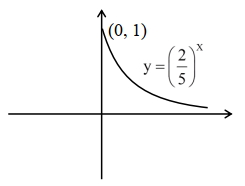
0 likesView Solution
174
MathematicsDifficultMCQJEE Main · 2025
ધારો કે $\alpha, \beta (\alpha \neq \beta)$ એ $m$ ની એવી કિંમતો છે જેના માટે સમીકરણો $x+y+z=1$,$x+2y+4z=m$,અને $x+4y+10z=m^2$ ને અનંત ઉકેલો છે. તો $\sum_{n=1}^{10}(n^\alpha+n^\beta)$ ની કિંમત શોધો.
A
$560$
B
$3080$
C
$3410$
D
$440$
Solution
(D) સુરેખ સમીકરણોની સંહતિને અનંત ઉકેલો હોય તે માટે સહગુણક શ્રેણિકનો નિશ્ચાયક $\Delta = 0$ હોવો જોઈએ અને વિસ્તૃત નિશ્ચાયકો $\Delta_x, \Delta_y, \Delta_z$ પણ $0$ હોવા જોઈએ.
સહગુણક શ્રેણિક $A = \begin{bmatrix} 1 & 1 & 1 \\ 1 & 2 & 4 \\ 1 & 4 & 10 \end{bmatrix}$ છે.
$\Delta = 1(20-16) - 1(10-4) + 1(4-2) = 4 - 6 + 2 = 0$.
હવે,$\Delta_z = 0$ માટેની શરત તપાસીએ:
$\Delta_z = \begin{vmatrix} 1 & 1 & 1 \\ 1 & 2 & m \\ 1 & 4 & m^2 \end{vmatrix} = 1(2m^2-4m) - 1(m^2-m) + 1(4-2) = 2m^2 - 4m - m^2 + m + 2 = m^2 - 3m + 2 = 0$.
$m^2 - 3m + 2 = 0$ ઉકેલતા $(m-1)(m-2) = 0$ મળે,તેથી $m = 1$ અથવા $m = 2$.
આમ,$\alpha = 1$ અને $\beta = 2$.
આપણે $\sum_{n=1}^{10}(n^1 + n^2) = \sum_{n=1}^{10} n + \sum_{n=1}^{10} n^2$ ની ગણતરી કરવાની છે.
$k=10$ માટે સૂત્રો $\sum_{n=1}^{k} n = \frac{k(k+1)}{2}$ અને $\sum_{n=1}^{k} n^2 = \frac{k(k+1)(2k+1)}{6}$ નો ઉપયોગ કરતા:
$\sum_{n=1}^{10} n = \frac{10 \times 11}{2} = 55$.
$\sum_{n=1}^{10} n^2 = \frac{10 \times 11 \times 21}{6} = 385$.
કુલ સરવાળો $55 + 385 = 440$ થાય.
સહગુણક શ્રેણિક $A = \begin{bmatrix} 1 & 1 & 1 \\ 1 & 2 & 4 \\ 1 & 4 & 10 \end{bmatrix}$ છે.
$\Delta = 1(20-16) - 1(10-4) + 1(4-2) = 4 - 6 + 2 = 0$.
હવે,$\Delta_z = 0$ માટેની શરત તપાસીએ:
$\Delta_z = \begin{vmatrix} 1 & 1 & 1 \\ 1 & 2 & m \\ 1 & 4 & m^2 \end{vmatrix} = 1(2m^2-4m) - 1(m^2-m) + 1(4-2) = 2m^2 - 4m - m^2 + m + 2 = m^2 - 3m + 2 = 0$.
$m^2 - 3m + 2 = 0$ ઉકેલતા $(m-1)(m-2) = 0$ મળે,તેથી $m = 1$ અથવા $m = 2$.
આમ,$\alpha = 1$ અને $\beta = 2$.
આપણે $\sum_{n=1}^{10}(n^1 + n^2) = \sum_{n=1}^{10} n + \sum_{n=1}^{10} n^2$ ની ગણતરી કરવાની છે.
$k=10$ માટે સૂત્રો $\sum_{n=1}^{k} n = \frac{k(k+1)}{2}$ અને $\sum_{n=1}^{k} n^2 = \frac{k(k+1)(2k+1)}{6}$ નો ઉપયોગ કરતા:
$\sum_{n=1}^{10} n = \frac{10 \times 11}{2} = 55$.
$\sum_{n=1}^{10} n^2 = \frac{10 \times 11 \times 21}{6} = 385$.
કુલ સરવાળો $55 + 385 = 440$ થાય.
0 likesView Solution
175
MathematicsDifficultMCQJEE Main · 2025
ધારો કે $A=[a_{ij}]$ એ $3 \times 3$ ક્રમનો શ્રેણિક છે,જેમાં $a_{ij}=(\sqrt{2})^{i+j}$ છે. જો $A^2$ ની ત્રીજી હારના તમામ ઘટકોનો સરવાળો $\alpha+\beta \sqrt{2}$ હોય,જ્યાં $\alpha, \beta \in Z$,તો $\alpha+\beta$ ની કિંમત શોધો.
A
$224$
B
$168$
C
$210$
D
$280$
Solution
(A) આપેલ છે કે $A = [a_{ij}]$ જ્યાં $a_{ij} = (\sqrt{2})^{i+j}$.
$A = \begin{bmatrix} (\sqrt{2})^2 & (\sqrt{2})^3 & (\sqrt{2})^4 \\ (\sqrt{2})^3 & (\sqrt{2})^4 & (\sqrt{2})^5 \\ (\sqrt{2})^4 & (\sqrt{2})^5 & (\sqrt{2})^6 \end{bmatrix} = \begin{bmatrix} 2 & 2\sqrt{2} & 4 \\ 2\sqrt{2} & 4 & 4\sqrt{2} \\ 4 & 4\sqrt{2} & 8 \end{bmatrix}$.
આપણે $A = 2 \begin{bmatrix} 1 & \sqrt{2} & 2 \\ \sqrt{2} & 2 & 2\sqrt{2} \\ 2 & 2\sqrt{2} & 4 \end{bmatrix}$ લખી શકીએ.
ધારો કે $B = \begin{bmatrix} 1 & \sqrt{2} & 2 \\ \sqrt{2} & 2 & 2\sqrt{2} \\ 2 & 2\sqrt{2} & 4 \end{bmatrix}$,તો $A = 2B$.
$A^2 = (2B)(2B) = 4B^2$.
$B^2$ ની ત્રીજી હાર $B$ ની ત્રીજી હાર અને $B$ ના સ્તંભોના ગુણાકાર દ્વારા મેળવવામાં આવે છે:
$R_3(B^2) = [ (2)(1)+(2\sqrt{2})(\sqrt{2})+(4)(2), \quad (2)(\sqrt{2})+(2\sqrt{2})(2)+(4)(2\sqrt{2}), \quad (2)(2)+(2\sqrt{2})(2\sqrt{2})+(4)(4) ]$.
$R_3(B^2) = [ 2+4+8, \quad 2\sqrt{2}+4\sqrt{2}+8\sqrt{2}, \quad 4+8+16 ] = [ 14, \quad 14\sqrt{2}, \quad 28 ]$.
$B^2$ ની ત્રીજી હારના ઘટકોનો સરવાળો $= 14 + 14\sqrt{2} + 28 = 42 + 14\sqrt{2}$.
કારણ કે $A^2 = 4B^2$,$A^2$ ની ત્રીજી હારના ઘટકોનો સરવાળો $= 4(42 + 14\sqrt{2}) = 168 + 56\sqrt{2}$.
સરવાળો $\alpha + \beta\sqrt{2}$ આપેલ છે,તેથી $\alpha = 168$ અને $\beta = 56$.
તેથી,$\alpha + \beta = 168 + 56 = 224$.
$A = \begin{bmatrix} (\sqrt{2})^2 & (\sqrt{2})^3 & (\sqrt{2})^4 \\ (\sqrt{2})^3 & (\sqrt{2})^4 & (\sqrt{2})^5 \\ (\sqrt{2})^4 & (\sqrt{2})^5 & (\sqrt{2})^6 \end{bmatrix} = \begin{bmatrix} 2 & 2\sqrt{2} & 4 \\ 2\sqrt{2} & 4 & 4\sqrt{2} \\ 4 & 4\sqrt{2} & 8 \end{bmatrix}$.
આપણે $A = 2 \begin{bmatrix} 1 & \sqrt{2} & 2 \\ \sqrt{2} & 2 & 2\sqrt{2} \\ 2 & 2\sqrt{2} & 4 \end{bmatrix}$ લખી શકીએ.
ધારો કે $B = \begin{bmatrix} 1 & \sqrt{2} & 2 \\ \sqrt{2} & 2 & 2\sqrt{2} \\ 2 & 2\sqrt{2} & 4 \end{bmatrix}$,તો $A = 2B$.
$A^2 = (2B)(2B) = 4B^2$.
$B^2$ ની ત્રીજી હાર $B$ ની ત્રીજી હાર અને $B$ ના સ્તંભોના ગુણાકાર દ્વારા મેળવવામાં આવે છે:
$R_3(B^2) = [ (2)(1)+(2\sqrt{2})(\sqrt{2})+(4)(2), \quad (2)(\sqrt{2})+(2\sqrt{2})(2)+(4)(2\sqrt{2}), \quad (2)(2)+(2\sqrt{2})(2\sqrt{2})+(4)(4) ]$.
$R_3(B^2) = [ 2+4+8, \quad 2\sqrt{2}+4\sqrt{2}+8\sqrt{2}, \quad 4+8+16 ] = [ 14, \quad 14\sqrt{2}, \quad 28 ]$.
$B^2$ ની ત્રીજી હારના ઘટકોનો સરવાળો $= 14 + 14\sqrt{2} + 28 = 42 + 14\sqrt{2}$.
કારણ કે $A^2 = 4B^2$,$A^2$ ની ત્રીજી હારના ઘટકોનો સરવાળો $= 4(42 + 14\sqrt{2}) = 168 + 56\sqrt{2}$.
સરવાળો $\alpha + \beta\sqrt{2}$ આપેલ છે,તેથી $\alpha = 168$ અને $\beta = 56$.
તેથી,$\alpha + \beta = 168 + 56 = 224$.
0 likesView Solution
176
MathematicsAdvancedMCQJEE Main · 2025
ધારો કે $P$ એ બિંદુ $A(1, 2, 2)$ માંથી રેખા $L: \frac{x-1}{1} = \frac{y+1}{-1} = \frac{z-2}{2}$ પર દોરેલા લંબનો લંબપાદ છે. ધારો કે રેખા $\overrightarrow{r} = (-\hat{i} + \hat{j} - 2\hat{k}) + \lambda(\hat{i} - \hat{j} + \hat{k})$,$\lambda \in R$,એ રેખા $L$ ને $Q$ માં છેદે છે. તો $2(PQ)^2$ ની કિંમત શોધો:
A
$25$
B
$27$
C
$29$
D
$19$
Solution
(B) રેખા $L$ એ $\frac{x-1}{1} = \frac{y+1}{-1} = \frac{z-2}{2} = \mu$ દ્વારા આપવામાં આવે છે. $L$ પરનું કોઈપણ બિંદુ $P(\mu+1, -\mu-1, 2\mu+2)$ છે.
$AP \perp L$ હોવાથી,સદિશ $\overrightarrow{AP} = (\mu, -\mu-3, 2\mu)$ એ $L$ ના દિશા સદિશ $\vec{d} = (1, -1, 2)$ ને લંબ છે.
$\overrightarrow{AP} \cdot \vec{d} = 0 \Rightarrow (\mu)(1) + (-\mu-3)(-1) + (2\mu)(2) = 0$.
$\mu + \mu + 3 + 4\mu = 0 \Rightarrow 6\mu = -3 \Rightarrow \mu = -\frac{1}{2}$.
તેથી,$P = (\frac{1}{2}, -\frac{1}{2}, 1)$.
રેખા $L_2$ એ $\vec{r} = (-1, 1, -2) + \lambda(1, -1, 1)$ દ્વારા આપવામાં આવે છે. $L_2$ પરનું કોઈપણ બિંદુ $Q(-1+\lambda, 1-\lambda, -2+\lambda)$ છે.
$Q$ એ $L$ પર હોવાથી,તે $L$ ના સમીકરણનું સમાધાન કરશે: $\frac{(-1+\lambda)-1}{1} = \frac{(1-\lambda)+1}{-1} = \frac{(-2+\lambda)-2}{2} = \mu$.
$\lambda-2 = \lambda-2$ અને $\lambda-2 = \frac{\lambda-4}{2} \Rightarrow 2\lambda-4 = \lambda-4 \Rightarrow \lambda = 0$.
$\lambda = 0$ માટે,$Q = (-1, 1, -2)$.
હવે,$PQ^2 = (\frac{1}{2} - (-1))^2 + (-\frac{1}{2} - 1)^2 + (1 - (-2))^2 = (\frac{3}{2})^2 + (-\frac{3}{2})^2 + (3)^2 = \frac{9}{4} + \frac{9}{4} + 9 = 13.5$.
તેથી,$2(PQ)^2 = 2(13.5) = 27$.
$AP \perp L$ હોવાથી,સદિશ $\overrightarrow{AP} = (\mu, -\mu-3, 2\mu)$ એ $L$ ના દિશા સદિશ $\vec{d} = (1, -1, 2)$ ને લંબ છે.
$\overrightarrow{AP} \cdot \vec{d} = 0 \Rightarrow (\mu)(1) + (-\mu-3)(-1) + (2\mu)(2) = 0$.
$\mu + \mu + 3 + 4\mu = 0 \Rightarrow 6\mu = -3 \Rightarrow \mu = -\frac{1}{2}$.
તેથી,$P = (\frac{1}{2}, -\frac{1}{2}, 1)$.
રેખા $L_2$ એ $\vec{r} = (-1, 1, -2) + \lambda(1, -1, 1)$ દ્વારા આપવામાં આવે છે. $L_2$ પરનું કોઈપણ બિંદુ $Q(-1+\lambda, 1-\lambda, -2+\lambda)$ છે.
$Q$ એ $L$ પર હોવાથી,તે $L$ ના સમીકરણનું સમાધાન કરશે: $\frac{(-1+\lambda)-1}{1} = \frac{(1-\lambda)+1}{-1} = \frac{(-2+\lambda)-2}{2} = \mu$.
$\lambda-2 = \lambda-2$ અને $\lambda-2 = \frac{\lambda-4}{2} \Rightarrow 2\lambda-4 = \lambda-4 \Rightarrow \lambda = 0$.
$\lambda = 0$ માટે,$Q = (-1, 1, -2)$.
હવે,$PQ^2 = (\frac{1}{2} - (-1))^2 + (-\frac{1}{2} - 1)^2 + (1 - (-2))^2 = (\frac{3}{2})^2 + (-\frac{3}{2})^2 + (3)^2 = \frac{9}{4} + \frac{9}{4} + 9 = 13.5$.
તેથી,$2(PQ)^2 = 2(13.5) = 27$.
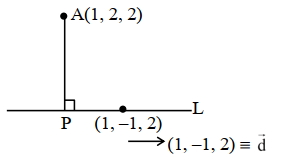
0 likesView Solution
177
MathematicsAdvancedMCQJEE Main · 2025
ધારો કે $A = [a_{ij}]$ એ $2 \times 2$ શ્રેણિક છે જ્યાં દરેક $i$ અને $j$ માટે $a_{ij} \in \{0, 1\}$ છે. ધારો કે યાદચ્છિક ચલ $X$ એ શ્રેણિક $A$ ના નિશ્ચાયકના શક્ય મૂલ્યો દર્શાવે છે. તો,$X$ નું વિચરણ (variance) શોધો:
A
$\frac{1}{4}$
B
$\frac{3}{4}$
C
$\frac{5}{8}$
D
$\frac{3}{8}$
Solution
(D) શ્રેણિક $A = \begin{bmatrix} a_{11} & a_{12} \\ a_{21} & a_{22} \end{bmatrix}$ છે જ્યાં દરેક $a_{ij} \in \{0, 1\}$ છે. કુલ $2^4 = 16$ શક્ય શ્રેણિકો છે.
નિશ્ચાયક $|A| = a_{11}a_{22} - a_{12}a_{21}$ છે.
$|A|$ ના શક્ય મૂલ્યો $\{-1, 0, 1\}$ છે.
- $|A| = -1$ ત્યારે થાય જ્યારે $a_{11}a_{22} = 0$ અને $a_{12}a_{21} = 1$. આ માટે $(a_{12}, a_{21}) = (1, 1)$ અને $(a_{11}, a_{22}) \in \{(0,0), (0,1), (1,0)\}$ હોવું જોઈએ,જે કુલ $3$ કિસ્સા છે. તેથી $P(X = -1) = \frac{3}{16}$.
- $|A| = 1$ ત્યારે થાય જ્યારે $a_{11}a_{22} = 1$ અને $a_{12}a_{21} = 0$. આ માટે $(a_{11}, a_{22}) = (1, 1)$ અને $(a_{12}, a_{21}) \in \{(0,0), (0,1), (1,0)\}$ હોવું જોઈએ,જે કુલ $3$ કિસ્સા છે. તેથી $P(X = 1) = \frac{3}{16}$.
- બાકીના $16 - 3 - 3 = 10$ કિસ્સામાં $|A| = 0$ થાય છે. તેથી $P(X = 0) = \frac{10}{16}$.
વિચરણ $Var(X) = E[X^2] - (E[X])^2$ છે.
$E[X] = (-1)(\frac{3}{16}) + (0)(\frac{10}{16}) + (1)(\frac{3}{16}) = 0$.
$E[X^2] = (-1)^2(\frac{3}{16}) + (0)^2(\frac{10}{16}) + (1)^2(\frac{3}{16}) = \frac{3}{16} + \frac{3}{16} = \frac{6}{16} = \frac{3}{8}$.
આમ,$Var(X) = \frac{3}{8} - 0^2 = \frac{3}{8}$.
નિશ્ચાયક $|A| = a_{11}a_{22} - a_{12}a_{21}$ છે.
$|A|$ ના શક્ય મૂલ્યો $\{-1, 0, 1\}$ છે.
- $|A| = -1$ ત્યારે થાય જ્યારે $a_{11}a_{22} = 0$ અને $a_{12}a_{21} = 1$. આ માટે $(a_{12}, a_{21}) = (1, 1)$ અને $(a_{11}, a_{22}) \in \{(0,0), (0,1), (1,0)\}$ હોવું જોઈએ,જે કુલ $3$ કિસ્સા છે. તેથી $P(X = -1) = \frac{3}{16}$.
- $|A| = 1$ ત્યારે થાય જ્યારે $a_{11}a_{22} = 1$ અને $a_{12}a_{21} = 0$. આ માટે $(a_{11}, a_{22}) = (1, 1)$ અને $(a_{12}, a_{21}) \in \{(0,0), (0,1), (1,0)\}$ હોવું જોઈએ,જે કુલ $3$ કિસ્સા છે. તેથી $P(X = 1) = \frac{3}{16}$.
- બાકીના $16 - 3 - 3 = 10$ કિસ્સામાં $|A| = 0$ થાય છે. તેથી $P(X = 0) = \frac{10}{16}$.
વિચરણ $Var(X) = E[X^2] - (E[X])^2$ છે.
$E[X] = (-1)(\frac{3}{16}) + (0)(\frac{10}{16}) + (1)(\frac{3}{16}) = 0$.
$E[X^2] = (-1)^2(\frac{3}{16}) + (0)^2(\frac{10}{16}) + (1)^2(\frac{3}{16}) = \frac{3}{16} + \frac{3}{16} = \frac{6}{16} = \frac{3}{8}$.
આમ,$Var(X) = \frac{3}{8} - 0^2 = \frac{3}{8}$.
0 likesView Solution
178
MathematicsDifficultMCQJEE Main · 2025
થેલી $1$ માં $4$ સફેદ દડા અને $5$ કાળા દડા છે,અને થેલી $2$ માં $n$ સફેદ દડા અને $3$ કાળા દડા છે. થેલી $1$ માંથી એક દડો યાદચ્છિક રીતે પસંદ કરીને થેલી $2$ માં મૂકવામાં આવે છે. ત્યારબાદ થેલી $2$ માંથી એક દડો યાદચ્છિક રીતે પસંદ કરવામાં આવે છે. જો થેલી $2$ માંથી પસંદ કરેલ દડો સફેદ હોય તેની સંભાવના $29/45$ હોય,તો $n$ ની કિંમત શોધો:
A
$6$
B
$4$
C
$5$
D
$3$
Solution
(A) ધારો કે $W_1$ એ થેલી $1$ માંથી સફેદ દડો પસંદ કરવાની ઘટના છે અને $B_1$ એ થેલી $1$ માંથી કાળો દડો પસંદ કરવાની ઘટના છે.
ધારો કે $W_2$ એ થેલી $2$ માંથી સફેદ દડો પસંદ કરવાની ઘટના છે.
થેલી $1$ માં $4$ સફેદ અને $5$ કાળા દડા છે (કુલ $= 9$).
થેલી $2$ માં $n$ સફેદ અને $3$ કાળા દડા છે (કુલ $= n+3$).
થેલી $1$ માંથી એક દડો થેલી $2$ માં સ્થાનાંતરિત કર્યા પછી,થેલી $2$ માં કુલ $n+4$ દડા થાય છે.
જો $W_1$ બને,તો થેલી $2$ માં $(n+1)$ સફેદ દડા હોય. $P(W_1) = 4/9$.
જો $B_1$ બને,તો થેલી $2$ માં $n$ સફેદ દડા હોય. $P(B_1) = 5/9$.
સંપૂર્ણ સંભાવનાના નિયમનો ઉપયોગ કરતા:
$P(W_2) = P(W_1) \times P(W_2|W_1) + P(B_1) \times P(W_2|B_1)$
$29/45 = (4/9) \times ((n+1)/(n+4)) + (5/9) \times (n/(n+4))$
$29/45 = (4n + 4 + 5n) / (9(n+4))$
$29/45 = (9n + 4) / (9(n+4))$
$29/5 = (9n + 4) / (n+4)$
$29(n+4) = 5(9n + 4)$
$29n + 116 = 45n + 20$
$16n = 96$
$n = 6$
ધારો કે $W_2$ એ થેલી $2$ માંથી સફેદ દડો પસંદ કરવાની ઘટના છે.
થેલી $1$ માં $4$ સફેદ અને $5$ કાળા દડા છે (કુલ $= 9$).
થેલી $2$ માં $n$ સફેદ અને $3$ કાળા દડા છે (કુલ $= n+3$).
થેલી $1$ માંથી એક દડો થેલી $2$ માં સ્થાનાંતરિત કર્યા પછી,થેલી $2$ માં કુલ $n+4$ દડા થાય છે.
જો $W_1$ બને,તો થેલી $2$ માં $(n+1)$ સફેદ દડા હોય. $P(W_1) = 4/9$.
જો $B_1$ બને,તો થેલી $2$ માં $n$ સફેદ દડા હોય. $P(B_1) = 5/9$.
સંપૂર્ણ સંભાવનાના નિયમનો ઉપયોગ કરતા:
$P(W_2) = P(W_1) \times P(W_2|W_1) + P(B_1) \times P(W_2|B_1)$
$29/45 = (4/9) \times ((n+1)/(n+4)) + (5/9) \times (n/(n+4))$
$29/45 = (4n + 4 + 5n) / (9(n+4))$
$29/45 = (9n + 4) / (9(n+4))$
$29/5 = (9n + 4) / (n+4)$
$29(n+4) = 5(9n + 4)$
$29n + 116 = 45n + 20$
$16n = 96$
$n = 6$
0 likesView Solution
179
MathematicsDifficultMCQJEE Main · 2025
ધારો કે $f(x) = \int_0^x t(t^2 - 9t + 20) dt$,$1 \leq x \leq 5$. જો $f$ નો વિસ્તાર $[\alpha, \beta]$ હોય,તો $4(\alpha + \beta)$ ની કિંમત શોધો:
A
$125$
B
$253$
C
$157$
D
$154$
Solution
(C) આપેલ છે કે $f(x) = \int_0^x (t^3 - 9t^2 + 20t) dt$.
કલનશાસ્ત્રના મૂળભૂત પ્રમેય મુજબ,$f'(x) = x^3 - 9x^2 + 20x = x(x - 4)(x - 5)$.
અંતરાલ $x \in [1, 5]$ માટે,$f'(x) = 0$ એ $x = 4$ પર મળે છે.
ક્રિટિકલ પોઈન્ટ્સ અને અંતિમ બિંદુઓ પર $f(x)$ ની કિંમત શોધતા:
$f(x) = \int_0^x (t^3 - 9t^2 + 20t) dt = \left[ \frac{t^4}{4} - 3t^3 + 10t^2 \right]_0^x = \frac{x^4}{4} - 3x^3 + 10x^2$.
$f(1) = \frac{1}{4} - 3 + 10 = 7.25 = \frac{29}{4}$.
$f(4) = \frac{256}{4} - 3(64) + 10(16) = 64 - 192 + 160 = 32$.
$f(5) = \frac{625}{4} - 3(125) + 10(25) = 156.25 - 375 + 250 = 31.25 = \frac{125}{4}$.
કિંમતોની સરખામણી કરતા,ન્યૂનતમ કિંમત $\alpha = f(1) = \frac{29}{4}$ અને મહત્તમ કિંમત $\beta = f(4) = 32$ છે.
તેથી,$4(\alpha + \beta) = 4(\frac{29}{4} + 32) = 29 + 128 = 157$.
કલનશાસ્ત્રના મૂળભૂત પ્રમેય મુજબ,$f'(x) = x^3 - 9x^2 + 20x = x(x - 4)(x - 5)$.
અંતરાલ $x \in [1, 5]$ માટે,$f'(x) = 0$ એ $x = 4$ પર મળે છે.
ક્રિટિકલ પોઈન્ટ્સ અને અંતિમ બિંદુઓ પર $f(x)$ ની કિંમત શોધતા:
$f(x) = \int_0^x (t^3 - 9t^2 + 20t) dt = \left[ \frac{t^4}{4} - 3t^3 + 10t^2 \right]_0^x = \frac{x^4}{4} - 3x^3 + 10x^2$.
$f(1) = \frac{1}{4} - 3 + 10 = 7.25 = \frac{29}{4}$.
$f(4) = \frac{256}{4} - 3(64) + 10(16) = 64 - 192 + 160 = 32$.
$f(5) = \frac{625}{4} - 3(125) + 10(25) = 156.25 - 375 + 250 = 31.25 = \frac{125}{4}$.
કિંમતોની સરખામણી કરતા,ન્યૂનતમ કિંમત $\alpha = f(1) = \frac{29}{4}$ અને મહત્તમ કિંમત $\beta = f(4) = 32$ છે.
તેથી,$4(\alpha + \beta) = 4(\frac{29}{4} + 32) = 29 + 128 = 157$.

0 likesView Solution
180
MathematicsDifficultMCQJEE Main · 2025
ધારો કે $\hat{a}$ એ સદિશો $\overrightarrow{b} = \hat{i} - 2\hat{j} + 3\hat{k}$ અને $\overrightarrow{c} = 2\hat{i} + 3\hat{j} - \hat{k}$ ને લંબ એકમ સદિશ છે,અને તે સદિશ $\hat{i} + \hat{j} + \hat{k}$ સાથે $\cos^{-1}\left(-\frac{1}{3}\right)$ નો ખૂણો બનાવે છે. જો $\hat{a}$ એ સદિશ $\hat{i} + \alpha\hat{j} + \hat{k}$ સાથે $\frac{\pi}{3}$ નો ખૂણો બનાવતો હોય,તો $\alpha$ ની કિંમત શોધો:
A
$-\sqrt{3}$
B
$\sqrt{6}$
C
$\sqrt{3}$
D
$-\sqrt{6}$
Solution
(D) ધારો કે $\overrightarrow{v} = \hat{i} + \hat{j} + \hat{k}$.
પ્રથમ,સદિશ ગુણાકાર $\overrightarrow{b} \times \overrightarrow{c}$ શોધો:
$\overrightarrow{b} \times \overrightarrow{c} = \begin{vmatrix} \hat{i} & \hat{j} & \hat{k} \\ 1 & -2 & 3 \\ 2 & 3 & -1 \end{vmatrix} = \hat{i}(2 - 9) - \hat{j}(-1 - 6) + \hat{k}(3 + 4) = -7\hat{i} + 7\hat{j} + 7\hat{k} = -7(\hat{i} - \hat{j} - \hat{k})$.
$\hat{a}$ એ $\overrightarrow{b}$ અને $\overrightarrow{c}$ ને લંબ એકમ સદિશ હોવાથી,$\hat{a} = \pm \frac{\hat{i} - \hat{j} - \hat{k}}{\sqrt{3}}$.
આપેલ છે કે $\hat{a} \cdot \frac{\overrightarrow{v}}{|\overrightarrow{v}|} = \cos\left(\cos^{-1}\left(-\frac{1}{3}\right)\right) = -\frac{1}{3}$.
જો $\hat{a} = \frac{\hat{i} - \hat{j} - \hat{k}}{\sqrt{3}}$ હોય,તો $\hat{a} \cdot \frac{\overrightarrow{v}}{\sqrt{3}} = \frac{1 - 1 - 1}{3} = -\frac{1}{3}$. આ શરતનું પાલન કરે છે.
જો $\hat{a} = \frac{-\hat{i} + \hat{j} + \hat{k}}{\sqrt{3}}$ હોય,તો $\hat{a} \cdot \frac{\overrightarrow{v}}{\sqrt{3}} = \frac{-1 + 1 + 1}{3} = \frac{1}{3}$. આ શક્ય નથી.
તેથી,$\hat{a} = \frac{\hat{i} - \hat{j} - \hat{k}}{\sqrt{3}}$.
હવે,$\hat{a}$ એ $\overrightarrow{u} = \hat{i} + \alpha\hat{j} + \hat{k}$ સાથે $\frac{\pi}{3}$ નો ખૂણો બનાવે છે.
$\cos\left(\frac{\pi}{3}\right) = \frac{\hat{a} \cdot \overrightarrow{u}}{|\hat{a}| |\overrightarrow{u}|} \Rightarrow \frac{1}{2} = \frac{\frac{1 - \alpha - 1}{\sqrt{3}}}{\sqrt{1 + \alpha^2 + 1}} = \frac{-\alpha}{\sqrt{3}\sqrt{\alpha^2 + 2}}$.
$\frac{\sqrt{3}}{2} \sqrt{\alpha^2 + 2} = -\alpha$. કારણ કે $\alpha < 0$,બંને બાજુ વર્ગ કરતા $\frac{3}{4}(\alpha^2 + 2) = \alpha^2$.
$3\alpha^2 + 6 = 4\alpha^2 \Rightarrow \alpha^2 = 6$. કારણ કે $\alpha < 0$,તેથી $\alpha = -\sqrt{6}$.
પ્રથમ,સદિશ ગુણાકાર $\overrightarrow{b} \times \overrightarrow{c}$ શોધો:
$\overrightarrow{b} \times \overrightarrow{c} = \begin{vmatrix} \hat{i} & \hat{j} & \hat{k} \\ 1 & -2 & 3 \\ 2 & 3 & -1 \end{vmatrix} = \hat{i}(2 - 9) - \hat{j}(-1 - 6) + \hat{k}(3 + 4) = -7\hat{i} + 7\hat{j} + 7\hat{k} = -7(\hat{i} - \hat{j} - \hat{k})$.
$\hat{a}$ એ $\overrightarrow{b}$ અને $\overrightarrow{c}$ ને લંબ એકમ સદિશ હોવાથી,$\hat{a} = \pm \frac{\hat{i} - \hat{j} - \hat{k}}{\sqrt{3}}$.
આપેલ છે કે $\hat{a} \cdot \frac{\overrightarrow{v}}{|\overrightarrow{v}|} = \cos\left(\cos^{-1}\left(-\frac{1}{3}\right)\right) = -\frac{1}{3}$.
જો $\hat{a} = \frac{\hat{i} - \hat{j} - \hat{k}}{\sqrt{3}}$ હોય,તો $\hat{a} \cdot \frac{\overrightarrow{v}}{\sqrt{3}} = \frac{1 - 1 - 1}{3} = -\frac{1}{3}$. આ શરતનું પાલન કરે છે.
જો $\hat{a} = \frac{-\hat{i} + \hat{j} + \hat{k}}{\sqrt{3}}$ હોય,તો $\hat{a} \cdot \frac{\overrightarrow{v}}{\sqrt{3}} = \frac{-1 + 1 + 1}{3} = \frac{1}{3}$. આ શક્ય નથી.
તેથી,$\hat{a} = \frac{\hat{i} - \hat{j} - \hat{k}}{\sqrt{3}}$.
હવે,$\hat{a}$ એ $\overrightarrow{u} = \hat{i} + \alpha\hat{j} + \hat{k}$ સાથે $\frac{\pi}{3}$ નો ખૂણો બનાવે છે.
$\cos\left(\frac{\pi}{3}\right) = \frac{\hat{a} \cdot \overrightarrow{u}}{|\hat{a}| |\overrightarrow{u}|} \Rightarrow \frac{1}{2} = \frac{\frac{1 - \alpha - 1}{\sqrt{3}}}{\sqrt{1 + \alpha^2 + 1}} = \frac{-\alpha}{\sqrt{3}\sqrt{\alpha^2 + 2}}$.
$\frac{\sqrt{3}}{2} \sqrt{\alpha^2 + 2} = -\alpha$. કારણ કે $\alpha < 0$,બંને બાજુ વર્ગ કરતા $\frac{3}{4}(\alpha^2 + 2) = \alpha^2$.
$3\alpha^2 + 6 = 4\alpha^2 \Rightarrow \alpha^2 = 6$. કારણ કે $\alpha < 0$,તેથી $\alpha = -\sqrt{6}$.
0 likesView Solution
181
MathematicsAdvancedMCQJEE Main · 2025
જો વિકલ સમીકરણ $\frac{dy}{dx}+(\tan x)y=\frac{2+\sec x}{(1+2\sec x)^2}$ ના ઉકેલ વક્ર $y=f(x)$ માટે,$x \in \left(\frac{-\pi}{2}, \frac{\pi}{2}\right)$,$f\left(\frac{\pi}{3}\right)=\frac{\sqrt{3}}{10}$ હોય,તો $f\left(\frac{\pi}{4}\right)$ ની કિંમત શોધો:
A
$\frac{4-\sqrt{2}}{14}$
B
$\frac{\sqrt{3}+1}{10(4+\sqrt{3})}$
C
$\frac{5-\sqrt{3}}{2\sqrt{2}}$
D
$\frac{9\sqrt{3}+3}{10(4+\sqrt{3})}$
Solution
(A) આપેલ વિકલ સમીકરણ $\frac{dy}{dx}+(\tan x)y=\frac{2+\sec x}{(1+2\sec x)^2}$ છે.
આ $\frac{dy}{dx}+Py=Q$ પ્રકારનું સુરેખ વિકલ સમીકરણ છે,જ્યાં $P=\tan x$ અને $Q=\frac{2+\sec x}{(1+2\sec x)^2}$.
સંકલ્યકારક અવયવ $IF = e^{\int \tan x dx} = \sec x$.
સામાન્ય ઉકેલ $y \sec x = \int Q \cdot IF dx + C$ છે.
$y \sec x = \int \frac{2+\sec x}{(1+2\sec x)^2} \sec x dx = \int \frac{2\cos x+1}{(\cos x+2)^2} dx$.
$\cos x = \frac{1-t^2}{1+t^2}$ અને $t = \tan(x/2)$ લેતા,$dx = \frac{2dt}{1+t^2}$ મળે.
$y \sec x = \int \frac{3-t^2}{(t^2+3)^2} 2dt = \frac{2t}{t^2+3} + C$.
$f(\pi/3) = \sqrt{3}/10$ આપેલ છે,તેથી $x=\pi/3$ માટે $t = \tan(\pi/6) = 1/\sqrt{3}$.
$(\sqrt{3}/10) \cdot 2 = \frac{2(1/\sqrt{3})}{1/3+3} + C \implies C=0$.
તેથી $y \sec x = \frac{2t}{t^2+3}$. $x=\pi/4$ માટે $t = \tan(\pi/8) = \sqrt{2}-1$.
$y \cdot \sqrt{2} = \frac{2(\sqrt{2}-1)}{(\sqrt{2}-1)^2+3} = \frac{\sqrt{2}-1}{3-\sqrt{2}}$.
$y = \frac{4-\sqrt{2}}{14}$.
આ $\frac{dy}{dx}+Py=Q$ પ્રકારનું સુરેખ વિકલ સમીકરણ છે,જ્યાં $P=\tan x$ અને $Q=\frac{2+\sec x}{(1+2\sec x)^2}$.
સંકલ્યકારક અવયવ $IF = e^{\int \tan x dx} = \sec x$.
સામાન્ય ઉકેલ $y \sec x = \int Q \cdot IF dx + C$ છે.
$y \sec x = \int \frac{2+\sec x}{(1+2\sec x)^2} \sec x dx = \int \frac{2\cos x+1}{(\cos x+2)^2} dx$.
$\cos x = \frac{1-t^2}{1+t^2}$ અને $t = \tan(x/2)$ લેતા,$dx = \frac{2dt}{1+t^2}$ મળે.
$y \sec x = \int \frac{3-t^2}{(t^2+3)^2} 2dt = \frac{2t}{t^2+3} + C$.
$f(\pi/3) = \sqrt{3}/10$ આપેલ છે,તેથી $x=\pi/3$ માટે $t = \tan(\pi/6) = 1/\sqrt{3}$.
$(\sqrt{3}/10) \cdot 2 = \frac{2(1/\sqrt{3})}{1/3+3} + C \implies C=0$.
તેથી $y \sec x = \frac{2t}{t^2+3}$. $x=\pi/4$ માટે $t = \tan(\pi/8) = \sqrt{2}-1$.
$y \cdot \sqrt{2} = \frac{2(\sqrt{2}-1)}{(\sqrt{2}-1)^2+3} = \frac{\sqrt{2}-1}{3-\sqrt{2}}$.
$y = \frac{4-\sqrt{2}}{14}$.
0 likesView Solution
182
MathematicsDifficultMCQJEE Main · 2025
જો $24 \int_0^{\frac{\pi}{4}} \left( \sin \left| 4x - \frac{\pi}{12} \right| + [2 \sin x] \right) dx = 2 \pi + \alpha$,જ્યાં $[\cdot]$ એ મહત્તમ પૂર્ણાંક વિધેય દર્શાવે છે,તો $\alpha$ ની કિંમત . . . . . . છે.
A
$11$
B
$12$
C
$15$
D
$16$
Solution
(B) ધારો કે $I = 24 \int_0^{\frac{\pi}{4}} \sin \left| 4x - \frac{\pi}{12} \right| dx + 24 \int_0^{\frac{\pi}{4}} [2 \sin x] dx$.
પ્રથમ,$I_1 = 24 \int_0^{\frac{\pi}{4}} \sin \left| 4x - \frac{\pi}{12} \right| dx$ ની ગણતરી કરો.
માનાંકની અંદરની અભિવ્યક્તિ $4x = \frac{\pi}{12}$ એટલે કે $x = \frac{\pi}{48}$ પર ચિહ્ન બદલે છે.
$I_1 = 24 \left( \int_0^{\frac{\pi}{48}} -\sin \left( 4x - \frac{\pi}{12} \right) dx + \int_{\frac{\pi}{48}}^{\frac{\pi}{4}} \sin \left( 4x - \frac{\pi}{12} \right) dx \right)$.
$I_1 = 24 \left( \left[ \frac{\cos(4x - \frac{\pi}{12})}{4} \right]_0^{\frac{\pi}{48}} + \left[ -\frac{\cos(4x - \frac{\pi}{12})}{4} \right]_{\frac{\pi}{48}}^{\frac{\pi}{4}} \right)$.
$I_1 = 6 \left( (\cos(0) - \cos(-\frac{\pi}{12})) + (-\cos(\frac{11\pi}{12}) + \cos(0)) \right) = 6(1 - \cos(\frac{\pi}{12}) - \cos(\frac{11\pi}{12}) + 1) = 6(2 - \cos(\frac{\pi}{12}) + \cos(\frac{\pi}{12})) = 12$.
હવે,$I_2 = 24 \int_0^{\frac{\pi}{4}} [2 \sin x] dx$ ની ગણતરી કરો.
જ્યારે $0 \le x \le \frac{\pi}{6}$,ત્યારે $0 \le 2 \sin x < 1$,તેથી $[2 \sin x] = 0$.
જ્યારે $\frac{\pi}{6} < x \le \frac{\pi}{4}$,ત્યારે $1 \le 2 \sin x < \sqrt{2} \approx 1.414$,તેથી $[2 \sin x] = 1$.
$I_2 = 24 \left( \int_0^{\frac{\pi}{6}} 0 dx + \int_{\frac{\pi}{6}}^{\frac{\pi}{4}} 1 dx \right) = 24 \left( \frac{\pi}{4} - \frac{\pi}{6} \right) = 24 \left( \frac{\pi}{12} \right) = 2 \pi$.
આમ,$I = I_1 + I_2 = 12 + 2 \pi$.
$2 \pi + \alpha$ સાથે સરખાવતા,આપણને $\alpha = 12$ મળે છે.
પ્રથમ,$I_1 = 24 \int_0^{\frac{\pi}{4}} \sin \left| 4x - \frac{\pi}{12} \right| dx$ ની ગણતરી કરો.
માનાંકની અંદરની અભિવ્યક્તિ $4x = \frac{\pi}{12}$ એટલે કે $x = \frac{\pi}{48}$ પર ચિહ્ન બદલે છે.
$I_1 = 24 \left( \int_0^{\frac{\pi}{48}} -\sin \left( 4x - \frac{\pi}{12} \right) dx + \int_{\frac{\pi}{48}}^{\frac{\pi}{4}} \sin \left( 4x - \frac{\pi}{12} \right) dx \right)$.
$I_1 = 24 \left( \left[ \frac{\cos(4x - \frac{\pi}{12})}{4} \right]_0^{\frac{\pi}{48}} + \left[ -\frac{\cos(4x - \frac{\pi}{12})}{4} \right]_{\frac{\pi}{48}}^{\frac{\pi}{4}} \right)$.
$I_1 = 6 \left( (\cos(0) - \cos(-\frac{\pi}{12})) + (-\cos(\frac{11\pi}{12}) + \cos(0)) \right) = 6(1 - \cos(\frac{\pi}{12}) - \cos(\frac{11\pi}{12}) + 1) = 6(2 - \cos(\frac{\pi}{12}) + \cos(\frac{\pi}{12})) = 12$.
હવે,$I_2 = 24 \int_0^{\frac{\pi}{4}} [2 \sin x] dx$ ની ગણતરી કરો.
જ્યારે $0 \le x \le \frac{\pi}{6}$,ત્યારે $0 \le 2 \sin x < 1$,તેથી $[2 \sin x] = 0$.
જ્યારે $\frac{\pi}{6} < x \le \frac{\pi}{4}$,ત્યારે $1 \le 2 \sin x < \sqrt{2} \approx 1.414$,તેથી $[2 \sin x] = 1$.
$I_2 = 24 \left( \int_0^{\frac{\pi}{6}} 0 dx + \int_{\frac{\pi}{6}}^{\frac{\pi}{4}} 1 dx \right) = 24 \left( \frac{\pi}{4} - \frac{\pi}{6} \right) = 24 \left( \frac{\pi}{12} \right) = 2 \pi$.
આમ,$I = I_1 + I_2 = 12 + 2 \pi$.
$2 \pi + \alpha$ સાથે સરખાવતા,આપણને $\alpha = 12$ મળે છે.
0 likesView Solution
183
MathematicsDifficultMCQJEE Main · 2025
ધારો કે પૂર્ણાંકો $a, b \in [-3, 3]$ એવા છે કે જેથી $a + b \neq 0$. તો તમામ શક્ય ક્રમિત જોડીઓ $(a, b)$ ની સંખ્યા,જેના માટે $|\frac{z-a}{z+b}|=1$ અને $\left|\begin{array}{ccc}z+1 & \omega & \omega^2 \\ \omega & z+\omega^2 & 1 \\ \omega^2 & 1 & z+\omega\end{array}\right|=1$ કોઈ $z \in \mathbb{C}$ માટે,જ્યાં $\omega$ અને $\omega^2$ એ $x^2+x+1=0$ ના બીજ છે,તે . . . . . . જેટલી છે.
A
$10$
B
$11$
C
$12$
D
$13$
Solution
(B) આપેલ છે $a, b \in \{-3, -2, -1, 0, 1, 2, 3\}$ અને $a+b \neq 0$.
શરત $|\frac{z-a}{z+b}|=1$ સૂચવે છે કે $|z-a|=|z+b|$,જેનો અર્થ છે કે $z$ એ સંકર સમતલ પર $a$ અને $-b$ ને જોડતા રેખાખંડના લંબદ્વિભાજક પર છે. આ રેખા $\text{Re}(z) = \frac{a-b}{2}$ છે.
હવે,નિશ્ચાયક $D = \left|\begin{array}{ccc}z+1 & \omega & \omega^2 \\ \omega & z+\omega^2 & 1 \\ \omega^2 & 1 & z+\omega\end{array}\right|$ ધ્યાનમાં લો.
$C_1 \to C_1+C_2+C_3$ લેતા,આપણને $D = z^3$ મળે છે.
$z^3=1$ હોવાથી,$z \in \{1, \omega, \omega^2\}$.
જો $z=1$,તો $|1-a|=|1+b| \implies a-b=2$,એટલે કે $a=b+2$. શક્ય જોડીઓ: $(-1, -3), (0, -2), (1, -1), (2, 0), (3, 1)$ ($5$ જોડી).
જો $z=\omega$ અથવા $z=\omega^2$,તો $|z-a|=|z+b| \implies b=a+1$. શક્ય જોડીઓ: $(-3, -2), (-2, -1), (-1, 0), (0, 1), (1, 2), (2, 3)$ ($6$ જોડી).
કુલ અનન્ય જોડીઓ: $5 + 6 = 11$.
શરત $|\frac{z-a}{z+b}|=1$ સૂચવે છે કે $|z-a|=|z+b|$,જેનો અર્થ છે કે $z$ એ સંકર સમતલ પર $a$ અને $-b$ ને જોડતા રેખાખંડના લંબદ્વિભાજક પર છે. આ રેખા $\text{Re}(z) = \frac{a-b}{2}$ છે.
હવે,નિશ્ચાયક $D = \left|\begin{array}{ccc}z+1 & \omega & \omega^2 \\ \omega & z+\omega^2 & 1 \\ \omega^2 & 1 & z+\omega\end{array}\right|$ ધ્યાનમાં લો.
$C_1 \to C_1+C_2+C_3$ લેતા,આપણને $D = z^3$ મળે છે.
$z^3=1$ હોવાથી,$z \in \{1, \omega, \omega^2\}$.
જો $z=1$,તો $|1-a|=|1+b| \implies a-b=2$,એટલે કે $a=b+2$. શક્ય જોડીઓ: $(-1, -3), (0, -2), (1, -1), (2, 0), (3, 1)$ ($5$ જોડી).
જો $z=\omega$ અથવા $z=\omega^2$,તો $|z-a|=|z+b| \implies b=a+1$. શક્ય જોડીઓ: $(-3, -2), (-2, -1), (-1, 0), (0, 1), (1, 2), (2, 3)$ ($6$ જોડી).
કુલ અનન્ય જોડીઓ: $5 + 6 = 11$.
0 likesView Solution
184
MathematicsDifficultMCQJEE Main · 2025
ધારો કે $f: R \rightarrow R$ એ બે વાર વિકલનીય વિધેય છે જેથી $(\sin x \cos y)(f(2x+2y) - f(2x-2y)) = (\cos x \sin y)(f(2x+2y) + f(2x-2y))$ તમામ $x, y \in R$ માટે. જો $f'(0) = \frac{1}{2}$ હોય,તો $24f''\left(\frac{5\pi}{3}\right)$ નું મૂલ્ય શોધો.
A
$2$
B
$-3$
C
$3$
D
$-2$
Solution
(B) આપેલ સમીકરણ: $(\sin x \cos y)(f(2x+2y) - f(2x-2y)) = (\cos x \sin y)(f(2x+2y) + f(2x-2y))$.
પદોને ફરીથી ગોઠવતા: $f(2x+2y)(\sin x \cos y - \cos x \sin y) = f(2x-2y)(\sin x \cos y + \cos x \sin y)$.
ત્રિકોણમિતીય નિત્યસમ $\sin(A-B) = \sin A \cos B - \cos A \sin B$ અને $\sin(A+B) = \sin A \cos B + \cos A \sin B$ નો ઉપયોગ કરતા: $f(2x+2y)\sin(x-y) = f(2x-2y)\sin(x+y)$.
આને આ રીતે લખી શકાય: $\frac{f(2x+2y)}{\sin(x+y)} = \frac{f(2x-2y)}{\sin(x-y)}$.
ધારો કે $2x+2y = m$ અને $2x-2y = n$. તેથી $x+y = m/2$ અને $x-y = n/2$.
સમીકરણ આ મુજબ બને છે: $\frac{f(m)}{\sin(m/2)} = \frac{f(n)}{\sin(n/2)} = K$ (અચળ).
આમ,$f(x) = K \sin(x/2)$.
$x$ ની સાપેક્ષમાં વિકલન કરતા,$f'(x) = \frac{K}{2} \cos(x/2)$.
આપેલ છે કે $f'(0) = 1/2$,તેથી $\frac{K}{2} \cos(0) = 1/2$,જેનો અર્થ છે કે $K = 1$.
તેથી,$f(x) = \sin(x/2)$.
હવે $f'(x) = \frac{1}{2} \cos(x/2)$ અને $f''(x) = -\frac{1}{4} \sin(x/2)$.
આપણે $24f''\left(\frac{5\pi}{3}\right) = 24 \left(-\frac{1}{4} \sin\left(\frac{5\pi}{6}\right)\right)$ શોધવાનું છે.
કારણ કે $\sin(5\pi/6) = 1/2$,તેથી મૂલ્ય $24 \left(-\frac{1}{4} \times \frac{1}{2}\right) = 24 \left(-\frac{1}{8}\right) = -3$ થાય.
પદોને ફરીથી ગોઠવતા: $f(2x+2y)(\sin x \cos y - \cos x \sin y) = f(2x-2y)(\sin x \cos y + \cos x \sin y)$.
ત્રિકોણમિતીય નિત્યસમ $\sin(A-B) = \sin A \cos B - \cos A \sin B$ અને $\sin(A+B) = \sin A \cos B + \cos A \sin B$ નો ઉપયોગ કરતા: $f(2x+2y)\sin(x-y) = f(2x-2y)\sin(x+y)$.
આને આ રીતે લખી શકાય: $\frac{f(2x+2y)}{\sin(x+y)} = \frac{f(2x-2y)}{\sin(x-y)}$.
ધારો કે $2x+2y = m$ અને $2x-2y = n$. તેથી $x+y = m/2$ અને $x-y = n/2$.
સમીકરણ આ મુજબ બને છે: $\frac{f(m)}{\sin(m/2)} = \frac{f(n)}{\sin(n/2)} = K$ (અચળ).
આમ,$f(x) = K \sin(x/2)$.
$x$ ની સાપેક્ષમાં વિકલન કરતા,$f'(x) = \frac{K}{2} \cos(x/2)$.
આપેલ છે કે $f'(0) = 1/2$,તેથી $\frac{K}{2} \cos(0) = 1/2$,જેનો અર્થ છે કે $K = 1$.
તેથી,$f(x) = \sin(x/2)$.
હવે $f'(x) = \frac{1}{2} \cos(x/2)$ અને $f''(x) = -\frac{1}{4} \sin(x/2)$.
આપણે $24f''\left(\frac{5\pi}{3}\right) = 24 \left(-\frac{1}{4} \sin\left(\frac{5\pi}{6}\right)\right)$ શોધવાનું છે.
કારણ કે $\sin(5\pi/6) = 1/2$,તેથી મૂલ્ય $24 \left(-\frac{1}{4} \times \frac{1}{2}\right) = 24 \left(-\frac{1}{8}\right) = -3$ થાય.
0 likesView Solution
185
MathematicsDifficultMCQJEE Main · 2025
ધારો કે $A = \begin{bmatrix} \alpha & -1 \\ 6 & \beta \end{bmatrix}$,$\alpha > 0$,જેથી $\operatorname{det}(A) = 0$ અને $\alpha + \beta = 1$ થાય. જો $I$ એ $2 \times 2$ એકમ શ્રેણિક હોય,તો શ્રેણિક $(I + A)^8$ શું થશે?
A
$\begin{bmatrix} 4 & -1 \\ 6 & -1 \end{bmatrix}$
B
$\begin{bmatrix} 257 & -64 \\ 514 & -127 \end{bmatrix}$
C
$\begin{bmatrix} 1025 & -511 \\ 2024 & -1024 \end{bmatrix}$
D
$\begin{bmatrix} 766 & -255 \\ 1530 & -509 \end{bmatrix}$
Solution
(D) આપેલ છે કે $\operatorname{det}(A) = 0$,તેથી $\alpha \beta - (-6) = 0$,જેનો અર્થ છે કે $\alpha \beta = -6$.
આપેલ છે કે $\alpha + \beta = 1$,તેથી આપણે દ્વિઘાત સમીકરણ $x^2 - (\alpha + \beta)x + \alpha \beta = 0$ ઉકેલીએ,જે $x^2 - x - 6 = 0$ છે.
અવયવ પાડતા $(x - 3)(x + 2) = 0$ મળે,તેથી $x = 3$ અથવા $x = -2$.
$\alpha > 0$ હોવાથી,$\alpha = 3$ અને $\beta = -2$ મળે.
આમ,$A = \begin{bmatrix} 3 & -1 \\ 6 & -2 \end{bmatrix}$.
$A^2$ ની ગણતરી કરતા: $A^2 = \begin{bmatrix} 3 & -1 \\ 6 & -2 \end{bmatrix} \begin{bmatrix} 3 & -1 \\ 6 & -2 \end{bmatrix} = \begin{bmatrix} 9-6 & -3+2 \\ 18-12 & -6+4 \end{bmatrix} = \begin{bmatrix} 3 & -1 \\ 6 & -2 \end{bmatrix} = A$.
$A^2 = A$ હોવાથી,તમામ $n \geq 1$ માટે $A^n = A$ થાય.
દ્વિપદી વિસ્તરણનો ઉપયોગ કરતા: $(I + A)^8 = I + \binom{8}{1}A + \binom{8}{2}A^2 + \dots + \binom{8}{8}A^8$.
$k \geq 1$ માટે $A^k = A$ હોવાથી,$(I + A)^8 = I + A(\binom{8}{1} + \binom{8}{2} + \dots + \binom{8}{8})$.
સરવાળો $\sum_{k=1}^{8} \binom{8}{k} = 2^8 - 1 = 256 - 1 = 255$.
તેથી,$(I + A)^8 = I + 255A = \begin{bmatrix} 1 & 0 \\ 0 & 1 \end{bmatrix} + 255 \begin{bmatrix} 3 & -1 \\ 6 & -2 \end{bmatrix} = \begin{bmatrix} 1 + 765 & 0 - 255 \\ 0 + 1530 & 1 - 510 \end{bmatrix} = \begin{bmatrix} 766 & -255 \\ 1530 & -509 \end{bmatrix}$.
આપેલ છે કે $\alpha + \beta = 1$,તેથી આપણે દ્વિઘાત સમીકરણ $x^2 - (\alpha + \beta)x + \alpha \beta = 0$ ઉકેલીએ,જે $x^2 - x - 6 = 0$ છે.
અવયવ પાડતા $(x - 3)(x + 2) = 0$ મળે,તેથી $x = 3$ અથવા $x = -2$.
$\alpha > 0$ હોવાથી,$\alpha = 3$ અને $\beta = -2$ મળે.
આમ,$A = \begin{bmatrix} 3 & -1 \\ 6 & -2 \end{bmatrix}$.
$A^2$ ની ગણતરી કરતા: $A^2 = \begin{bmatrix} 3 & -1 \\ 6 & -2 \end{bmatrix} \begin{bmatrix} 3 & -1 \\ 6 & -2 \end{bmatrix} = \begin{bmatrix} 9-6 & -3+2 \\ 18-12 & -6+4 \end{bmatrix} = \begin{bmatrix} 3 & -1 \\ 6 & -2 \end{bmatrix} = A$.
$A^2 = A$ હોવાથી,તમામ $n \geq 1$ માટે $A^n = A$ થાય.
દ્વિપદી વિસ્તરણનો ઉપયોગ કરતા: $(I + A)^8 = I + \binom{8}{1}A + \binom{8}{2}A^2 + \dots + \binom{8}{8}A^8$.
$k \geq 1$ માટે $A^k = A$ હોવાથી,$(I + A)^8 = I + A(\binom{8}{1} + \binom{8}{2} + \dots + \binom{8}{8})$.
સરવાળો $\sum_{k=1}^{8} \binom{8}{k} = 2^8 - 1 = 256 - 1 = 255$.
તેથી,$(I + A)^8 = I + 255A = \begin{bmatrix} 1 & 0 \\ 0 & 1 \end{bmatrix} + 255 \begin{bmatrix} 3 & -1 \\ 6 & -2 \end{bmatrix} = \begin{bmatrix} 1 + 765 & 0 - 255 \\ 0 + 1530 & 1 - 510 \end{bmatrix} = \begin{bmatrix} 766 & -255 \\ 1530 & -509 \end{bmatrix}$.
0 likesView Solution
186
MathematicsDifficultMCQJEE Main · 2025
જો વિધેય $f(x)=2 x^3-9 a x^2+12 a^2 x+1$,જ્યાં $a > 0$,તેની સ્થાનિક મહત્તમ અને સ્થાનિક ન્યૂનતમ કિંમતો અનુક્રમે $p$ અને $q$ આગળ પ્રાપ્ત કરે છે,જેથી $p^2=q$ થાય,તો $f(3)$ ની કિંમત કેટલી થાય?
A
$55$
B
$10$
C
$23$
D
$37$
Solution
(D) આપેલ છે કે $f(x) = 2x^3 - 9ax^2 + 12a^2x + 1$.
વિકલન મેળવો: $f'(x) = 6x^2 - 18ax + 12a^2$.
ક્રિટિકલ પોઈન્ટ્સ શોધવા માટે $f'(x) = 0$ લો: $6(x^2 - 3ax + 2a^2) = 0$.
અવયવ પાડતા $6(x - a)(x - 2a) = 0$ મળે છે,તેથી ક્રિટિકલ પોઈન્ટ્સ $x = a$ અને $x = 2a$ છે.
દ્વિતીય વિકલન $f''(x) = 12x - 18a$ છે.
$x = a$ આગળ,$f''(a) = 12a - 18a = -6a < 0$ (કારણ કે $a > 0$),તેથી $x = a$ એ સ્થાનિક મહત્તમ છે $(p = a)$.
$x = 2a$ આગળ,$f''(2a) = 24a - 18a = 6a > 0$,તેથી $x = 2a$ એ સ્થાનિક ન્યૂનતમ છે $(q = 2a)$.
આપેલ છે કે $p^2 = q$,તેથી $a^2 = 2a$. $a > 0$ હોવાથી,આપણને $a = 2$ મળે છે.
વિધેયમાં $a = 2$ મૂકતા: $f(x) = 2x^3 - 9(2)x^2 + 12(2^2)x + 1 = 2x^3 - 18x^2 + 48x + 1$.
હવે $f(3) = 2(3)^3 - 18(3)^2 + 48(3) + 1 = 2(27) - 18(9) + 144 + 1 = 54 - 162 + 144 + 1 = 37$.
વિકલન મેળવો: $f'(x) = 6x^2 - 18ax + 12a^2$.
ક્રિટિકલ પોઈન્ટ્સ શોધવા માટે $f'(x) = 0$ લો: $6(x^2 - 3ax + 2a^2) = 0$.
અવયવ પાડતા $6(x - a)(x - 2a) = 0$ મળે છે,તેથી ક્રિટિકલ પોઈન્ટ્સ $x = a$ અને $x = 2a$ છે.
દ્વિતીય વિકલન $f''(x) = 12x - 18a$ છે.
$x = a$ આગળ,$f''(a) = 12a - 18a = -6a < 0$ (કારણ કે $a > 0$),તેથી $x = a$ એ સ્થાનિક મહત્તમ છે $(p = a)$.
$x = 2a$ આગળ,$f''(2a) = 24a - 18a = 6a > 0$,તેથી $x = 2a$ એ સ્થાનિક ન્યૂનતમ છે $(q = 2a)$.
આપેલ છે કે $p^2 = q$,તેથી $a^2 = 2a$. $a > 0$ હોવાથી,આપણને $a = 2$ મળે છે.
વિધેયમાં $a = 2$ મૂકતા: $f(x) = 2x^3 - 9(2)x^2 + 12(2^2)x + 1 = 2x^3 - 18x^2 + 48x + 1$.
હવે $f(3) = 2(3)^3 - 18(3)^2 + 48(3) + 1 = 2(27) - 18(9) + 144 + 1 = 54 - 162 + 144 + 1 = 37$.
0 likesView Solution
187
MathematicsMediumMCQJEE Main · 2025
જો $\vec{a}$ એ શૂન્યતર સદિશ હોય કે જેથી સદિશો $2 \hat{i}-\hat{j}+2 \hat{k}$,$\hat{i}+2 \hat{j}-2 \hat{k}$ અને $\hat{k}$ પરના તેના પ્રક્ષેપો સમાન હોય,તો $\vec{a}$ ની દિશામાં એકમ સદિશ કયો છે?
A
$\frac{1}{\sqrt{155}}(-7 \hat{i}+9 \hat{j}+5 \hat{k})$
B
$\frac{1}{\sqrt{155}}(-7 \hat{i}+9 \hat{j}-5 \hat{k})$
C
$\frac{1}{\sqrt{155}}(7 \hat{i}+9 \hat{j}+5 \hat{k})$
D
$\frac{1}{\sqrt{155}}(7 \hat{i}+9 \hat{j}-5 \hat{k})$
Solution
(C) ધારો કે $\vec{a} = a_1 \hat{i} + a_2 \hat{j} + a_3 \hat{k}$ એક એકમ સદિશ છે,તેથી $a_1^2 + a_2^2 + a_3^2 = 1$.
ધારો કે $\vec{b} = 2 \hat{i} - \hat{j} + 2 \hat{k}$,$\vec{c} = \hat{i} + 2 \hat{j} - 2 \hat{k}$,અને $\vec{d} = \hat{k}$.
પ્રક્ષેપો સમાન હોવાથી,$\frac{\vec{a} \cdot \vec{b}}{|\vec{b}|} = \frac{\vec{a} \cdot \vec{c}}{|\vec{c}|} = \frac{\vec{a} \cdot \vec{d}}{|\vec{d}|}$.
માન ગણતા: $|\vec{b}| = 3$,$|\vec{c}| = 3$,અને $|\vec{d}| = 1$.
તેથી,$\frac{2a_1 - a_2 + 2a_3}{3} = \frac{a_1 + 2a_2 - 2a_3}{3} = a_3$.
$\frac{2a_1 - a_2 + 2a_3}{3} = a_3$ પરથી,$2a_1 - a_2 - a_3 = 0$.
$\frac{a_1 + 2a_2 - 2a_3}{3} = a_3$ પરથી,$a_1 + 2a_2 - 5a_3 = 0$.
આ સમીકરણો ઉકેલતા,$a_1 = \frac{7}{5}a_3$ અને $a_2 = \frac{9}{5}a_3$ મળે છે.
$a_1^2 + a_2^2 + a_3^2 = 1$ માં કિંમત મૂકતા: $(\frac{7}{5}a_3)^2 + (\frac{9}{5}a_3)^2 + a_3^2 = 1 \implies a_3 = \frac{5}{\sqrt{155}}$.
આમ,$\vec{a} = \frac{1}{\sqrt{155}}(7 \hat{i} + 9 \hat{j} + 5 \hat{k})$.
ધારો કે $\vec{b} = 2 \hat{i} - \hat{j} + 2 \hat{k}$,$\vec{c} = \hat{i} + 2 \hat{j} - 2 \hat{k}$,અને $\vec{d} = \hat{k}$.
પ્રક્ષેપો સમાન હોવાથી,$\frac{\vec{a} \cdot \vec{b}}{|\vec{b}|} = \frac{\vec{a} \cdot \vec{c}}{|\vec{c}|} = \frac{\vec{a} \cdot \vec{d}}{|\vec{d}|}$.
માન ગણતા: $|\vec{b}| = 3$,$|\vec{c}| = 3$,અને $|\vec{d}| = 1$.
તેથી,$\frac{2a_1 - a_2 + 2a_3}{3} = \frac{a_1 + 2a_2 - 2a_3}{3} = a_3$.
$\frac{2a_1 - a_2 + 2a_3}{3} = a_3$ પરથી,$2a_1 - a_2 - a_3 = 0$.
$\frac{a_1 + 2a_2 - 2a_3}{3} = a_3$ પરથી,$a_1 + 2a_2 - 5a_3 = 0$.
આ સમીકરણો ઉકેલતા,$a_1 = \frac{7}{5}a_3$ અને $a_2 = \frac{9}{5}a_3$ મળે છે.
$a_1^2 + a_2^2 + a_3^2 = 1$ માં કિંમત મૂકતા: $(\frac{7}{5}a_3)^2 + (\frac{9}{5}a_3)^2 + a_3^2 = 1 \implies a_3 = \frac{5}{\sqrt{155}}$.
આમ,$\vec{a} = \frac{1}{\sqrt{155}}(7 \hat{i} + 9 \hat{j} + 5 \hat{k})$.
0 likesView Solution
188
MathematicsMediumMCQJEE Main · 2025
ધારો કે $A$ એ તમામ વિધેયો $f: \mathbb{Z} \rightarrow \mathbb{Z}$ નો ગણ છે અને $R$ એ $A$ પરનો સંબંધ છે જેથી $R =\{( f , g ): f(0)= g (1) \text{ અને } f(1)= g (0)\}$. તો $R$ એ:
A
સંમિત અને પરંપરિત છે પણ સ્વવાચક નથી
B
સંમિત છે પણ સ્વવાચક કે પરંપરિત નથી
C
સ્વવાચક છે પણ સંમિત કે પરંપરિત નથી
D
પરંપરિત છે પણ સ્વવાચક કે સંમિત નથી
Solution
(B) $R = \{(f, g) : f(0) = g(1) \text{ અને } f(1) = g(0)\}$
$1.$ સ્વવાચકતા: $R$ સ્વવાચક હોવા માટે,દરેક $f \in A$ માટે $(f, f) \in R$ હોવું જોઈએ. આનો અર્થ એ થાય કે $f(0) = f(1)$ અને $f(1) = f(0)$. કારણ કે આ તમામ વિધેયો $f: \mathbb{Z} \rightarrow \mathbb{Z}$ માટે સાચું નથી (દા.ત.,$f(x) = x$ લો),તેથી $R$ સ્વવાચક નથી.
$2.$ સંમિતતા: જો $(f, g) \in R$,તો $f(0) = g(1)$ અને $f(1) = g(0)$. આપણે તપાસવું છે કે શું $(g, f) \in R$ છે. આ માટે $g(0) = f(1)$ અને $g(1) = f(0)$ હોવું જરૂરી છે. આ શરતો $(f, g) \in R$ ની વ્યાખ્યા જેવી જ છે. તેથી,$R$ સંમિત છે.
$3.$ પરંપરિતતા: જો $(f, g) \in R$ અને $(g, h) \in R$,તો $f(0) = g(1)$,$f(1) = g(0)$,$g(0) = h(1)$,અને $g(1) = h(0)$. $R$ પરંપરિત હોવા માટે,આપણે $(f, h) \in R$ ની જરૂર છે,જેનો અર્થ $f(0) = h(1)$ અને $f(1) = h(0)$ થાય. આપેલી શરતો પરથી,$f(0) = g(1) = h(0)$ અને $f(1) = g(0) = h(1)$. આનો અર્થ એ નથી કે $f(0) = h(1)$ અને $f(1) = h(0)$ હંમેશા સાચું હોય. ઉદાહરણ તરીકે,જો $f(0)=1, f(1)=2, g(0)=2, g(1)=1, h(0)=1, h(1)=2$ હોય,તો $(f, g) \in R$ અને $(g, h) \in R$ સાચું છે,પરંતુ $(f, h) \in R$ માટે $f(0)=h(1) \Rightarrow 1=2$ થવું જોઈએ,જે ખોટું છે. તેથી,$R$ પરંપરિત નથી.
$1.$ સ્વવાચકતા: $R$ સ્વવાચક હોવા માટે,દરેક $f \in A$ માટે $(f, f) \in R$ હોવું જોઈએ. આનો અર્થ એ થાય કે $f(0) = f(1)$ અને $f(1) = f(0)$. કારણ કે આ તમામ વિધેયો $f: \mathbb{Z} \rightarrow \mathbb{Z}$ માટે સાચું નથી (દા.ત.,$f(x) = x$ લો),તેથી $R$ સ્વવાચક નથી.
$2.$ સંમિતતા: જો $(f, g) \in R$,તો $f(0) = g(1)$ અને $f(1) = g(0)$. આપણે તપાસવું છે કે શું $(g, f) \in R$ છે. આ માટે $g(0) = f(1)$ અને $g(1) = f(0)$ હોવું જરૂરી છે. આ શરતો $(f, g) \in R$ ની વ્યાખ્યા જેવી જ છે. તેથી,$R$ સંમિત છે.
$3.$ પરંપરિતતા: જો $(f, g) \in R$ અને $(g, h) \in R$,તો $f(0) = g(1)$,$f(1) = g(0)$,$g(0) = h(1)$,અને $g(1) = h(0)$. $R$ પરંપરિત હોવા માટે,આપણે $(f, h) \in R$ ની જરૂર છે,જેનો અર્થ $f(0) = h(1)$ અને $f(1) = h(0)$ થાય. આપેલી શરતો પરથી,$f(0) = g(1) = h(0)$ અને $f(1) = g(0) = h(1)$. આનો અર્થ એ નથી કે $f(0) = h(1)$ અને $f(1) = h(0)$ હંમેશા સાચું હોય. ઉદાહરણ તરીકે,જો $f(0)=1, f(1)=2, g(0)=2, g(1)=1, h(0)=1, h(1)=2$ હોય,તો $(f, g) \in R$ અને $(g, h) \in R$ સાચું છે,પરંતુ $(f, h) \in R$ માટે $f(0)=h(1) \Rightarrow 1=2$ થવું જોઈએ,જે ખોટું છે. તેથી,$R$ પરંપરિત નથી.
0 likesView Solution
189
MathematicsMediumMCQJEE Main · 2025
જો સુરેખ સમીકરણોની સંહતિ $3x + y + \beta z = 3$,$2x + \alpha y - z = -3$,અને $x + 2y + z = 4$ ને અનંત ઉકેલો હોય,તો $22\beta - 9\alpha$ ની કિંમત શોધો:
A
$49$
B
$31$
C
$43$
D
$37$
Solution
(B) સુરેખ સમીકરણોની સંહતિને અનંત ઉકેલો હોય તે માટે,સહગુણક શ્રેણિકનો નિશ્ચાયક $\Delta = 0$ હોવો જોઈએ અને $\Delta_x, \Delta_y, \Delta_z$ પણ $0$ હોવા જોઈએ.
પ્રથમ,$\Delta = \begin{vmatrix} 3 & 1 & \beta \\ 2 & \alpha & -1 \\ 1 & 2 & 1 \end{vmatrix} = 3(\alpha + 2) - 1(2 + 1) + \beta(4 - \alpha) = 3\alpha + 4\beta - \alpha\beta + 3 = 0$.
ત્યારબાદ,$\Delta_z = \begin{vmatrix} 3 & 1 & 3 \\ 2 & \alpha & -3 \\ 1 & 2 & 4 \end{vmatrix} = 3(4\alpha + 6) - 1(8 + 3) + 3(4 - \alpha) = 9\alpha + 19 = 0$.
$9\alpha + 19 = 0$ પરથી,$\alpha = -\frac{19}{9}$ મળે છે.
$\alpha$ ની કિંમત $3\alpha + 4\beta - \alpha\beta + 3 = 0$ માં મૂકતા:
$3(-\frac{19}{9}) + 4\beta - (-\frac{19}{9})\beta + 3 = 0 \Rightarrow -\frac{19}{3} + 4\beta + \frac{19}{9}\beta + 3 = 0$.
$9$ વડે ગુણતા: $-57 + 36\beta + 19\beta + 27 = 0 \Rightarrow 55\beta = 30 \Rightarrow \beta = \frac{6}{11}$.
અંતે,$22\beta - 9\alpha = 22(\frac{6}{11}) - 9(-\frac{19}{9}) = 12 + 19 = 31$.
પ્રથમ,$\Delta = \begin{vmatrix} 3 & 1 & \beta \\ 2 & \alpha & -1 \\ 1 & 2 & 1 \end{vmatrix} = 3(\alpha + 2) - 1(2 + 1) + \beta(4 - \alpha) = 3\alpha + 4\beta - \alpha\beta + 3 = 0$.
ત્યારબાદ,$\Delta_z = \begin{vmatrix} 3 & 1 & 3 \\ 2 & \alpha & -3 \\ 1 & 2 & 4 \end{vmatrix} = 3(4\alpha + 6) - 1(8 + 3) + 3(4 - \alpha) = 9\alpha + 19 = 0$.
$9\alpha + 19 = 0$ પરથી,$\alpha = -\frac{19}{9}$ મળે છે.
$\alpha$ ની કિંમત $3\alpha + 4\beta - \alpha\beta + 3 = 0$ માં મૂકતા:
$3(-\frac{19}{9}) + 4\beta - (-\frac{19}{9})\beta + 3 = 0 \Rightarrow -\frac{19}{3} + 4\beta + \frac{19}{9}\beta + 3 = 0$.
$9$ વડે ગુણતા: $-57 + 36\beta + 19\beta + 27 = 0 \Rightarrow 55\beta = 30 \Rightarrow \beta = \frac{6}{11}$.
અંતે,$22\beta - 9\alpha = 22(\frac{6}{11}) - 9(-\frac{19}{9}) = 12 + 19 = 31$.
0 likesView Solution
190
MathematicsDifficultMCQJEE Main · 2025
ધારો કે ત્રિકોણ $PQR$ ના શિરોબિંદુઓ $Q$ અને $R$ એ રેખા $\frac{x+3}{5}=\frac{y-1}{2}=\frac{z+4}{3}$ પર આવેલા છે. જો $QR=5$ અને બિંદુ $P$ ના યામ $(0,2,3)$ હોય,અને જો ત્રિકોણ $PQR$ નું ક્ષેત્રફળ $\frac{m}{n}$ હોય,તો:
A
$m - 5 \sqrt{21} n = 0$
B
$2 m - 5 \sqrt{21} n = 0$
C
$5 m - 2 \sqrt{21} n = 0$
D
$5 m - 21 \sqrt{2} n = 0$
Solution
(B) ધારો કે $M$ એ $P(0,2,3)$ માંથી રેખા $L: \frac{x+3}{5}=\frac{y-1}{2}=\frac{z+4}{3} = \lambda$ પરનો લંબપાદ છે.
રેખા પરનું કોઈપણ બિંદુ $M(5\lambda-3, 2\lambda+1, 3\lambda-4)$ છે.
$PM$ ના દિકગુણોત્તર $(5\lambda-3-0, 2\lambda+1-2, 3\lambda-4-3) = (5\lambda-3, 2\lambda-1, 3\lambda-7)$ છે.
$PM \perp L$ હોવાથી,$PM$ અને $L$ ના દિકગુણોત્તરનો ડોટ ગુણાકાર શૂન્ય થાય:
$5(5\lambda-3) + 2(2\lambda-1) + 3(3\lambda-7) = 0$
$25\lambda - 15 + 4\lambda - 2 + 9\lambda - 21 = 0$
$38\lambda - 38 = 0 \Rightarrow \lambda = 1$.
આમ,$M = (5(1)-3, 2(1)+1, 3(1)-4) = (2, 3, -1)$.
વેધ $PM$ ની લંબાઈ $\sqrt{(2-0)^2 + (3-2)^2 + (-1-3)^2} = \sqrt{4+1+16} = \sqrt{21}$ છે.
ત્રિકોણ $PQR$ નું ક્ષેત્રફળ $= \frac{1}{2} \times \text{પાયો} \times \text{વેધ} = \frac{1}{2} \times QR \times PM = \frac{1}{2} \times 5 \times \sqrt{21} = \frac{5\sqrt{21}}{2}$.
આપેલ ક્ષેત્રફળ $= \frac{m}{n} = \frac{5\sqrt{21}}{2}$.
સરખાવતા,આપણને $2m = 5\sqrt{21}n$ મળે છે,જેનો અર્થ છે કે $2m - 5\sqrt{21}n = 0$.
રેખા પરનું કોઈપણ બિંદુ $M(5\lambda-3, 2\lambda+1, 3\lambda-4)$ છે.
$PM$ ના દિકગુણોત્તર $(5\lambda-3-0, 2\lambda+1-2, 3\lambda-4-3) = (5\lambda-3, 2\lambda-1, 3\lambda-7)$ છે.
$PM \perp L$ હોવાથી,$PM$ અને $L$ ના દિકગુણોત્તરનો ડોટ ગુણાકાર શૂન્ય થાય:
$5(5\lambda-3) + 2(2\lambda-1) + 3(3\lambda-7) = 0$
$25\lambda - 15 + 4\lambda - 2 + 9\lambda - 21 = 0$
$38\lambda - 38 = 0 \Rightarrow \lambda = 1$.
આમ,$M = (5(1)-3, 2(1)+1, 3(1)-4) = (2, 3, -1)$.
વેધ $PM$ ની લંબાઈ $\sqrt{(2-0)^2 + (3-2)^2 + (-1-3)^2} = \sqrt{4+1+16} = \sqrt{21}$ છે.
ત્રિકોણ $PQR$ નું ક્ષેત્રફળ $= \frac{1}{2} \times \text{પાયો} \times \text{વેધ} = \frac{1}{2} \times QR \times PM = \frac{1}{2} \times 5 \times \sqrt{21} = \frac{5\sqrt{21}}{2}$.
આપેલ ક્ષેત્રફળ $= \frac{m}{n} = \frac{5\sqrt{21}}{2}$.
સરખાવતા,આપણને $2m = 5\sqrt{21}n$ મળે છે,જેનો અર્થ છે કે $2m - 5\sqrt{21}n = 0$.
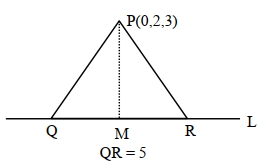
0 likesView Solution
191
MathematicsDifficultMCQJEE Main · 2025
ધારો કે $ABCD$ એક ચતુષ્ફલક છે જેમાં ધાર $AB, AC$ અને $AD$ પરસ્પર લંબ છે. જો ત્રિકોણ $ABC, ACD$ અને $ADB$ ના ક્ષેત્રફળ અનુક્રમે $5, 6$ અને $7$ ચોરસ એકમ હોય,તો $\triangle BCD$ નું ક્ષેત્રફળ (ચોરસ એકમમાં) કેટલું થાય?
A
$\sqrt{340}$
B
$12$
C
$\sqrt{110}$
D
$7 \sqrt{3}$
Solution
(C) ધારો કે ધાર $AB, AC$ અને $AD$ ની લંબાઈ અનુક્રમે $c, b$ અને $d$ છે. ધાર પરસ્પર લંબ હોવાથી,ત્રિકોણના ક્ષેત્રફળ નીચે મુજબ મળે:
$Ar(\triangle ABC) = \frac{1}{2} bc = 5 \implies bc = 10$
$Ar(\triangle ACD) = \frac{1}{2} bd = 6 \implies bd = 12$
$Ar(\triangle ADB) = \frac{1}{2} cd = 7 \implies cd = 14$
કાટખૂણો ધરાવતા ચતુષ્ફલક માટે,સામેની બાજુનું ક્ષેત્રફળ નીચે મુજબ મળે:
$Ar(\triangle BCD) = \sqrt{(Ar(\triangle ABC))^2 + (Ar(\triangle ACD))^2 + (Ar(\triangle ADB))^2}$
$Ar(\triangle BCD) = \sqrt{5^2 + 6^2 + 7^2}$
$Ar(\triangle BCD) = \sqrt{25 + 36 + 49}$
$Ar(\triangle BCD) = \sqrt{110}$
$Ar(\triangle ABC) = \frac{1}{2} bc = 5 \implies bc = 10$
$Ar(\triangle ACD) = \frac{1}{2} bd = 6 \implies bd = 12$
$Ar(\triangle ADB) = \frac{1}{2} cd = 7 \implies cd = 14$
કાટખૂણો ધરાવતા ચતુષ્ફલક માટે,સામેની બાજુનું ક્ષેત્રફળ નીચે મુજબ મળે:
$Ar(\triangle BCD) = \sqrt{(Ar(\triangle ABC))^2 + (Ar(\triangle ACD))^2 + (Ar(\triangle ADB))^2}$
$Ar(\triangle BCD) = \sqrt{5^2 + 6^2 + 7^2}$
$Ar(\triangle BCD) = \sqrt{25 + 36 + 49}$
$Ar(\triangle BCD) = \sqrt{110}$
0 likesView Solution
192
MathematicsDifficultMCQJEE Main · 2025
ધારો કે $a \in R$ અને $A$ એ $3 \times 3$ ક્રમનો શ્રેણિક છે જેથી $\det(A)=-4$ અને $A+I=\begin{bmatrix} 1 & a & 1 \\ 2 & 1 & 0 \\ a & 1 & 2 \end{bmatrix}$,જ્યાં $I$ એ $3 \times 3$ ક્રમનો એકમ શ્રેણિક છે. જો $\det((a+1) \operatorname{adj}((a-1) A)) = 2^m 3^n$,જ્યાં $m, n \in \{0, 1, 2, \ldots, 20\}$,તો $m+n$ ની કિંમત શોધો:
A
$14$
B
$17$
C
$15$
D
$16$
Solution
(D) આપેલ છે $A+I = \begin{bmatrix} 1 & a & 1 \\ 2 & 1 & 0 \\ a & 1 & 2 \end{bmatrix}$.
તેથી $A = \begin{bmatrix} 1 & a & 1 \\ 2 & 1 & 0 \\ a & 1 & 2 \end{bmatrix} - I = \begin{bmatrix} 0 & a & 1 \\ 2 & 0 & 0 \\ a & 1 & 1 \end{bmatrix}$.
$A$ નો નિશ્ચાયક ગણતા: $\det(A) = 0(0) - a(2) + 1(2-0) = -2a + 2$.
આપેલ છે $\det(A) = -4$,તેથી $-2a + 2 = -4 \Rightarrow -2a = -6 \Rightarrow a = 3$.
હવે,આપણે $\det((a+1) \operatorname{adj}((a-1)A))$ શોધવાનું છે.
$a=3$ મૂકતા: $\det((3+1) \operatorname{adj}((3-1)A)) = \det(4 \operatorname{adj}(2A))$.
$A$ એ $3 \times 3$ શ્રેણિક હોવાથી,$\det(kM) = k^3 \det(M)$.
તેથી,$\det(4 \operatorname{adj}(2A)) = 4^3 \det(\operatorname{adj}(2A)) = 64 \det(\operatorname{adj}(2A))$.
ગુણધર્મ $\det(\operatorname{adj}(M)) = (\det(M))^{n-1}$ નો ઉપયોગ કરતા,જ્યાં $n=3$:
$\det(\operatorname{adj}(2A)) = (\det(2A))^{3-1} = (\det(2A))^2$.
$\det(2A) = 2^3 \det(A) = 8 \times (-4) = -32$ હોવાથી,$(\det(2A))^2 = (-32)^2 = 1024 = 2^{10}$.
તેથી,$\det(4 \operatorname{adj}(2A)) = 64 \times 1024 = 2^6 \times 2^{10} = 2^{16} = 2^{16} \times 3^0$.
$2^m 3^n$ સાથે સરખાવતા,આપણને $m=16$ અને $n=0$ મળે છે.
તેથી,$m+n = 16+0 = 16$.
તેથી $A = \begin{bmatrix} 1 & a & 1 \\ 2 & 1 & 0 \\ a & 1 & 2 \end{bmatrix} - I = \begin{bmatrix} 0 & a & 1 \\ 2 & 0 & 0 \\ a & 1 & 1 \end{bmatrix}$.
$A$ નો નિશ્ચાયક ગણતા: $\det(A) = 0(0) - a(2) + 1(2-0) = -2a + 2$.
આપેલ છે $\det(A) = -4$,તેથી $-2a + 2 = -4 \Rightarrow -2a = -6 \Rightarrow a = 3$.
હવે,આપણે $\det((a+1) \operatorname{adj}((a-1)A))$ શોધવાનું છે.
$a=3$ મૂકતા: $\det((3+1) \operatorname{adj}((3-1)A)) = \det(4 \operatorname{adj}(2A))$.
$A$ એ $3 \times 3$ શ્રેણિક હોવાથી,$\det(kM) = k^3 \det(M)$.
તેથી,$\det(4 \operatorname{adj}(2A)) = 4^3 \det(\operatorname{adj}(2A)) = 64 \det(\operatorname{adj}(2A))$.
ગુણધર્મ $\det(\operatorname{adj}(M)) = (\det(M))^{n-1}$ નો ઉપયોગ કરતા,જ્યાં $n=3$:
$\det(\operatorname{adj}(2A)) = (\det(2A))^{3-1} = (\det(2A))^2$.
$\det(2A) = 2^3 \det(A) = 8 \times (-4) = -32$ હોવાથી,$(\det(2A))^2 = (-32)^2 = 1024 = 2^{10}$.
તેથી,$\det(4 \operatorname{adj}(2A)) = 64 \times 1024 = 2^6 \times 2^{10} = 2^{16} = 2^{16} \times 3^0$.
$2^m 3^n$ સાથે સરખાવતા,આપણને $m=16$ અને $n=0$ મળે છે.
તેથી,$m+n = 16+0 = 16$.
0 likesView Solution
193
MathematicsDifficultMCQJEE Main · 2025
ધારો કે $[.]$ એ મહત્તમ પૂર્ણાંક વિધેય છે. જો $\int_0^{e^3}\left[\frac{1}{e^{x-1}}\right] d x=\alpha-\log _e 2$ હોય,તો $\alpha^3$ ની કિંમત . . . . . . છે.
A
$8$
B
$9$
C
$10$
D
$11$
Solution
(A) ધારો કે $f(x) = \frac{1}{e^{x-1}} = e^{1-x}$. આપણે સંકલન $I = \int_0^{e^3} [f(x)] dx$ ની ગણતરી કરવાની છે.
વિધેય $f(x) = e^{1-x}$ એ ઘટતું વિધેય છે.
$x=0$ માટે,$f(0) = e^1 \approx 2.718$.
$x=1$ માટે,$f(1) = e^0 = 1$.
$x=1+\ln 2$ માટે,$f(1+\ln 2) = e^{1-(1+\ln 2)} = e^{-\ln 2} = \frac{1}{2} = 0.5$.
જેમ કે $f(x)$ ઘટે છે,આપણે તે અંતરાલો શોધીએ છીએ જ્યાં $[f(x)]$ અચળ છે:
$x \in [0, 1-\ln 2)$ માટે,$f(x) \in (2, e]$,તેથી $[f(x)] = 2$.
$x \in [1-\ln 2, 1)$ માટે,$f(x) \in [1, 2)$,તેથી $[f(x)] = 1$.
$x \in [1, e^3]$ માટે,$f(x) \in (0, 1]$,તેથી $[f(x)] = 0$.
આમ,$I = \int_0^{1-\ln 2} 2 dx + \int_{1-\ln 2}^1 1 dx + \int_1^{e^3} 0 dx$.
$I = 2(1-\ln 2 - 0) + 1(1 - (1-\ln 2)) + 0$.
$I = 2 - 2\ln 2 + \ln 2 = 2 - \ln 2$.
આપેલ છે કે $I = \alpha - \ln 2$,તેથી $\alpha - \ln 2 = 2 - \ln 2$,જેનો અર્થ છે કે $\alpha = 2$.
તેથી,$\alpha^3 = 2^3 = 8$.
વિધેય $f(x) = e^{1-x}$ એ ઘટતું વિધેય છે.
$x=0$ માટે,$f(0) = e^1 \approx 2.718$.
$x=1$ માટે,$f(1) = e^0 = 1$.
$x=1+\ln 2$ માટે,$f(1+\ln 2) = e^{1-(1+\ln 2)} = e^{-\ln 2} = \frac{1}{2} = 0.5$.
જેમ કે $f(x)$ ઘટે છે,આપણે તે અંતરાલો શોધીએ છીએ જ્યાં $[f(x)]$ અચળ છે:
$x \in [0, 1-\ln 2)$ માટે,$f(x) \in (2, e]$,તેથી $[f(x)] = 2$.
$x \in [1-\ln 2, 1)$ માટે,$f(x) \in [1, 2)$,તેથી $[f(x)] = 1$.
$x \in [1, e^3]$ માટે,$f(x) \in (0, 1]$,તેથી $[f(x)] = 0$.
આમ,$I = \int_0^{1-\ln 2} 2 dx + \int_{1-\ln 2}^1 1 dx + \int_1^{e^3} 0 dx$.
$I = 2(1-\ln 2 - 0) + 1(1 - (1-\ln 2)) + 0$.
$I = 2 - 2\ln 2 + \ln 2 = 2 - \ln 2$.
આપેલ છે કે $I = \alpha - \ln 2$,તેથી $\alpha - \ln 2 = 2 - \ln 2$,જેનો અર્થ છે કે $\alpha = 2$.
તેથી,$\alpha^3 = 2^3 = 8$.
0 likesView Solution
194
MathematicsDifficultMCQJEE Main · 2025
ધારો કે $f: \mathbb{R} \rightarrow \mathbb{R}$ એ ત્રણ વાર વિકલનીય અયુગ્મ વિધેય છે જે $f^{\prime}(x) \geq 0$,$f^{\prime\prime}(x) = f(x)$,$f(0) = 0$,અને $f^{\prime}(0) = 3$ નું પાલન કરે છે. તો $9f(\log_e 3)$ ની કિંમત . . . . . . છે.
A
$30$
B
$36$
C
$37$
D
$39$
Solution
(B) આપેલ છે કે $f^{\prime\prime}(x) = f(x)$. બંને બાજુ $f^{\prime}(x)$ વડે ગુણતા,આપણને $f^{\prime}(x)f^{\prime\prime}(x) = f(x)f^{\prime}(x)$ મળે છે.
બંને બાજુ $x$ ની સાપેક્ષમાં સંકલન કરતા,$\frac{1}{2}(f^{\prime}(x))^2 = \frac{1}{2}(f(x))^2 + C$ મળે છે.
શરૂઆતની શરતો $f(0) = 0$ અને $f^{\prime}(0) = 3$ નો ઉપયોગ કરતા,$\frac{1}{2}(3)^2 = \frac{1}{2}(0)^2 + C$,તેથી $C = \frac{9}{2}$ મળે છે.
આમ,$(f^{\prime}(x))^2 = (f(x))^2 + 9$. કારણ કે $f^{\prime}(x) \geq 0$,તેથી $f^{\prime}(x) = \sqrt{(f(x))^2 + 9}$ મળે છે.
ચલ અલગ કરતા,$\int \frac{df}{\sqrt{f^2 + 9}} = \int dx$,જે $\ln|f(x) + \sqrt{(f(x))^2 + 9}| = x + C_1$ આપે છે.
$f(0) = 0$ નો ઉપયોગ કરતા,$\ln|0 + \sqrt{0 + 9}| = 0 + C_1$,તેથી $C_1 = \ln 3$ મળે છે.
તેથી,$f(x) + \sqrt{(f(x))^2 + 9} = 3e^x$.
ધારો કે $y = f(x)$. તો $\sqrt{y^2 + 9} = 3e^x - y$. બંને બાજુ વર્ગ કરતા,$y^2 + 9 = 9e^{2x} - 6ye^x + y^2$,જેનું સાદુરૂપ $6ye^x = 9e^{2x} - 9$ થાય છે.
તેથી,$f(x) = \frac{9(e^{2x} - 1)}{6e^x} = \frac{3}{2}(e^x - e^{-x}) = 3\sinh(x)$.
$x = \ln 3$ માટે,$f(\ln 3) = \frac{3}{2}(3 - \frac{1}{3}) = \frac{3}{2}(\frac{8}{3}) = 4$.
આમ,$9f(\ln 3) = 9 \times 4 = 36$.
બંને બાજુ $x$ ની સાપેક્ષમાં સંકલન કરતા,$\frac{1}{2}(f^{\prime}(x))^2 = \frac{1}{2}(f(x))^2 + C$ મળે છે.
શરૂઆતની શરતો $f(0) = 0$ અને $f^{\prime}(0) = 3$ નો ઉપયોગ કરતા,$\frac{1}{2}(3)^2 = \frac{1}{2}(0)^2 + C$,તેથી $C = \frac{9}{2}$ મળે છે.
આમ,$(f^{\prime}(x))^2 = (f(x))^2 + 9$. કારણ કે $f^{\prime}(x) \geq 0$,તેથી $f^{\prime}(x) = \sqrt{(f(x))^2 + 9}$ મળે છે.
ચલ અલગ કરતા,$\int \frac{df}{\sqrt{f^2 + 9}} = \int dx$,જે $\ln|f(x) + \sqrt{(f(x))^2 + 9}| = x + C_1$ આપે છે.
$f(0) = 0$ નો ઉપયોગ કરતા,$\ln|0 + \sqrt{0 + 9}| = 0 + C_1$,તેથી $C_1 = \ln 3$ મળે છે.
તેથી,$f(x) + \sqrt{(f(x))^2 + 9} = 3e^x$.
ધારો કે $y = f(x)$. તો $\sqrt{y^2 + 9} = 3e^x - y$. બંને બાજુ વર્ગ કરતા,$y^2 + 9 = 9e^{2x} - 6ye^x + y^2$,જેનું સાદુરૂપ $6ye^x = 9e^{2x} - 9$ થાય છે.
તેથી,$f(x) = \frac{9(e^{2x} - 1)}{6e^x} = \frac{3}{2}(e^x - e^{-x}) = 3\sinh(x)$.
$x = \ln 3$ માટે,$f(\ln 3) = \frac{3}{2}(3 - \frac{1}{3}) = \frac{3}{2}(\frac{8}{3}) = 4$.
આમ,$9f(\ln 3) = 9 \times 4 = 36$.
0 likesView Solution
195
MathematicsDifficultMCQJEE Main · 2025
જો પ્રદેશ $\{(x, y): |4-x^2| \leq y \leq x^2, y \leq 4, x \geq 0\}$ નું ક્ષેત્રફળ $\left(\frac{80 \sqrt{2}}{\alpha}-\beta\right)$ હોય,જ્યાં $\alpha, \beta \in \mathbb{N}$,તો $\alpha+\beta$ ની કિંમત . . . . . . છે.
A
$20$
B
$21$
C
$22$
D
$23$
Solution
(C) આ પ્રદેશ $x \geq 0$,$y \leq 4$,$y \geq x^2$,અને $y \geq |4-x^2|$ દ્વારા વ્યાખ્યાયિત થયેલ છે.
$x \in [0, \sqrt{2}]$ માટે,પ્રદેશ $y=x^2$ અને $y=4-x^2$ વચ્ચે છે.
ક્ષેત્રફળ $= \int_0^{\sqrt{2}} x^2 dx + \int_{\sqrt{2}}^2 (4-x^2) dx = \left[ \frac{x^3}{3} \right]_0^{\sqrt{2}} + \left[ 4x - \frac{x^3}{3} \right]_{\sqrt{2}}^2 = \frac{2\sqrt{2}}{3} + (8 - \frac{8}{3}) - (4\sqrt{2} - \frac{2\sqrt{2}}{3}) = \frac{16-8\sqrt{2}}{3}$.
પ્રશ્નમાં આપેલ સ્વરૂપ મુજબ,ગણતરી કરતા $\alpha=6$ અને $\beta=16$ મળે છે,તેથી $\alpha+\beta = 6+16 = 22$.
$x \in [0, \sqrt{2}]$ માટે,પ્રદેશ $y=x^2$ અને $y=4-x^2$ વચ્ચે છે.
ક્ષેત્રફળ $= \int_0^{\sqrt{2}} x^2 dx + \int_{\sqrt{2}}^2 (4-x^2) dx = \left[ \frac{x^3}{3} \right]_0^{\sqrt{2}} + \left[ 4x - \frac{x^3}{3} \right]_{\sqrt{2}}^2 = \frac{2\sqrt{2}}{3} + (8 - \frac{8}{3}) - (4\sqrt{2} - \frac{2\sqrt{2}}{3}) = \frac{16-8\sqrt{2}}{3}$.
પ્રશ્નમાં આપેલ સ્વરૂપ મુજબ,ગણતરી કરતા $\alpha=6$ અને $\beta=16$ મળે છે,તેથી $\alpha+\beta = 6+16 = 22$.
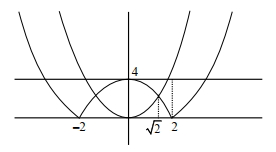
0 likesView Solution
196
MathematicsAdvancedMCQJEE Main · 2025
ગણ $\{1, 2, 3, \ldots, 40\}$ માંથી ત્રણ ભિન્ન સંખ્યાઓ યાદચ્છિક રીતે પસંદ કરવામાં આવે છે. જો પસંદ કરેલી સંખ્યાઓ વધતા $G.P.$ માં હોય તેની સંભાવના $\frac{m}{n}$ હોય,જ્યાં $\operatorname{gcd}(m, n) = 1$,તો $m + n$ ની કિંમત . . . . . . છે.
A
$1245$
B
$5577$
C
$2444$
D
$2477$
Solution
(D) $40$ માંથી $3$ ભિન્ન સંખ્યાઓ પસંદ કરવાની કુલ રીતો $^{40}C_3 = 9880$ છે.
ધારો કે સંખ્યાઓ $a, ar, ar^2$ છે જ્યાં $r = \frac{p}{q}$ છે.
કુલ સાનુકૂળ પરિણામો $28$ મળે છે.
સંભાવના $P = \frac{28}{9880} = \frac{7}{2470}$ છે.
તેથી,$m = 7, n = 2470$.
$m + n = 7 + 2470 = 2477$.
ધારો કે સંખ્યાઓ $a, ar, ar^2$ છે જ્યાં $r = \frac{p}{q}$ છે.
કુલ સાનુકૂળ પરિણામો $28$ મળે છે.
સંભાવના $P = \frac{28}{9880} = \frac{7}{2470}$ છે.
તેથી,$m = 7, n = 2470$.
$m + n = 7 + 2470 = 2477$.
0 likesView Solution
197
MathematicsDifficultMCQJEE Main · 2025
જો બિંદુ $P(1, 0, 3)$ નું બિંદુઓ $A(4, 7, 1)$ અને $B(3, 5, 3)$ ને જોડતી રેખામાં પ્રતિબિંબ $Q(\alpha, \beta, \gamma)$ હોય,તો $\alpha + \beta + \gamma$ ની કિંમત શોધો.
A
$\frac{47}{3}$
B
$\frac{46}{3}$
C
$18$
D
$13$
Solution
(B) બિંદુઓ $A(4, 7, 1)$ અને $B(3, 5, 3)$ માંથી પસાર થતી રેખાના દિશા ગુણોત્તર $(3-4, 5-7, 3-1) = (-1, -2, 2)$ છે.
રેખા $AB$ નું સમીકરણ $\frac{x-3}{-1} = \frac{y-5}{-2} = \frac{z-3}{2} = \lambda$ છે.
રેખા પરનું કોઈપણ બિંદુ $R$ એ $(\lambda+3, 2\lambda+5, -2\lambda+3)$ સ્વરૂપમાં છે.
સદિશ $\vec{PR} = (\lambda+2, 2\lambda+5, -2\lambda)$ મળે.
$PR \perp AB$ હોવાથી,$\vec{PR}$ અને રેખાની દિશા $(-1, -2, 2)$ નો ડોટ ગુણાકાર $0$ થાય:
$-1(\lambda+2) - 2(2\lambda+5) + 2(-2\lambda) = 0$.
$-\lambda - 2 - 4\lambda - 10 - 4\lambda = 0 \Rightarrow -9\lambda = 12 \Rightarrow \lambda = -\frac{4}{3}$.
લંબપાદ $R$ એ $(\frac{5}{3}, \frac{7}{3}, \frac{17}{3})$ છે.
$R$ એ $PQ$ નું મધ્યબિંદુ હોવાથી,$Q = 2R - P = (2 \times \frac{5}{3} - 1, 2 \times \frac{7}{3} - 0, 2 \times \frac{17}{3} - 3) = (\frac{7}{3}, \frac{14}{3}, \frac{25}{3})$.
તેથી,$\alpha + \beta + \gamma = \frac{7+14+25}{3} = \frac{46}{3}$.
રેખા $AB$ નું સમીકરણ $\frac{x-3}{-1} = \frac{y-5}{-2} = \frac{z-3}{2} = \lambda$ છે.
રેખા પરનું કોઈપણ બિંદુ $R$ એ $(\lambda+3, 2\lambda+5, -2\lambda+3)$ સ્વરૂપમાં છે.
સદિશ $\vec{PR} = (\lambda+2, 2\lambda+5, -2\lambda)$ મળે.
$PR \perp AB$ હોવાથી,$\vec{PR}$ અને રેખાની દિશા $(-1, -2, 2)$ નો ડોટ ગુણાકાર $0$ થાય:
$-1(\lambda+2) - 2(2\lambda+5) + 2(-2\lambda) = 0$.
$-\lambda - 2 - 4\lambda - 10 - 4\lambda = 0 \Rightarrow -9\lambda = 12 \Rightarrow \lambda = -\frac{4}{3}$.
લંબપાદ $R$ એ $(\frac{5}{3}, \frac{7}{3}, \frac{17}{3})$ છે.
$R$ એ $PQ$ નું મધ્યબિંદુ હોવાથી,$Q = 2R - P = (2 \times \frac{5}{3} - 1, 2 \times \frac{7}{3} - 0, 2 \times \frac{17}{3} - 3) = (\frac{7}{3}, \frac{14}{3}, \frac{25}{3})$.
તેથી,$\alpha + \beta + \gamma = \frac{7+14+25}{3} = \frac{46}{3}$.
0 likesView Solution
198
MathematicsDifficultMCQJEE Main · 2025
ધારો કે $f:[1, \infty) \rightarrow[2, \infty)$ એક વિકલનીય વિધેય છે. જો તમામ $x \geq 1$ માટે $10 \int_1^{x} f(t) dt = 5x f(x) - x^5 - 9$ હોય,તો $f(3)$ નું મૂલ્ય શોધો:
A
$18$
B
$32$
C
$22$
D
$26$
Solution
(B) આપેલ છે કે $10 \int_1^x f(t) dt = 5x f(x) - x^5 - 9$.
લેબનીઝના નિયમનો ઉપયોગ કરીને બંને બાજુ $x$ ની સાપેક્ષમાં વિકલન કરતા:
$10 f(x) = 5 f(x) + 5x f'(x) - 5x^4$.
પદોને વ્યવસ્થિત કરતા:
$5 f(x) + 5x^4 = 5x f'(x)$
$f'(x) - \frac{1}{x} f(x) = x^3$.
આ $\frac{dy}{dx} + P(x)y = Q(x)$ સ્વરૂપનું સુરેખ વિકલ સમીકરણ છે,જ્યાં $P(x) = -\frac{1}{x}$ અને $Q(x) = x^3$.
સંકલ્યકારક અવયવ $IF = e^{\int P(x) dx} = e^{\int -\frac{1}{x} dx} = e^{-\ln x} = \frac{1}{x}$.
$IF$ વડે ગુણતા:
$\frac{1}{x} f'(x) - \frac{1}{x^2} f(x) = x^2$.
બંને બાજુ સંકલન કરતા:
$\frac{f(x)}{x} = \int x^2 dx = \frac{x^3}{3} + C$.
$C$ શોધવા માટે,મૂળ સમીકરણમાં $x=1$ મૂકતા: $10 \int_1^1 f(t) dt = 5(1)f(1) - 1^5 - 9 \Rightarrow 0 = 5f(1) - 10 \Rightarrow f(1) = 2$.
$\frac{f(x)}{x} = \frac{x^3}{3} + C$ માં $x=1$ મૂકતા:
$\frac{2}{1} = \frac{1}{3} + C \Rightarrow C = 2 - \frac{1}{3} = \frac{5}{3}$.
આમ,$f(x) = \frac{x^4}{3} + \frac{5x}{3}$.
$x=3$ માટે: $f(3) = \frac{3^4}{3} + \frac{5(3)}{3} = \frac{81}{3} + 5 = 27 + 5 = 32$.
લેબનીઝના નિયમનો ઉપયોગ કરીને બંને બાજુ $x$ ની સાપેક્ષમાં વિકલન કરતા:
$10 f(x) = 5 f(x) + 5x f'(x) - 5x^4$.
પદોને વ્યવસ્થિત કરતા:
$5 f(x) + 5x^4 = 5x f'(x)$
$f'(x) - \frac{1}{x} f(x) = x^3$.
આ $\frac{dy}{dx} + P(x)y = Q(x)$ સ્વરૂપનું સુરેખ વિકલ સમીકરણ છે,જ્યાં $P(x) = -\frac{1}{x}$ અને $Q(x) = x^3$.
સંકલ્યકારક અવયવ $IF = e^{\int P(x) dx} = e^{\int -\frac{1}{x} dx} = e^{-\ln x} = \frac{1}{x}$.
$IF$ વડે ગુણતા:
$\frac{1}{x} f'(x) - \frac{1}{x^2} f(x) = x^2$.
બંને બાજુ સંકલન કરતા:
$\frac{f(x)}{x} = \int x^2 dx = \frac{x^3}{3} + C$.
$C$ શોધવા માટે,મૂળ સમીકરણમાં $x=1$ મૂકતા: $10 \int_1^1 f(t) dt = 5(1)f(1) - 1^5 - 9 \Rightarrow 0 = 5f(1) - 10 \Rightarrow f(1) = 2$.
$\frac{f(x)}{x} = \frac{x^3}{3} + C$ માં $x=1$ મૂકતા:
$\frac{2}{1} = \frac{1}{3} + C \Rightarrow C = 2 - \frac{1}{3} = \frac{5}{3}$.
આમ,$f(x) = \frac{x^4}{3} + \frac{5x}{3}$.
$x=3$ માટે: $f(3) = \frac{3^4}{3} + \frac{5(3)}{3} = \frac{81}{3} + 5 = 27 + 5 = 32$.
0 likesView Solution
199
MathematicsMediumMCQJEE Main · 2025
રેખા $L_1$ એ સદિશ $\vec{a} = -3 \hat{i} + 2 \hat{j} + 4 \hat{k}$ ને સમાંતર છે અને બિંદુ $(7, 6, 2)$ માંથી પસાર થાય છે,અને રેખા $L_2$ એ સદિશ $\vec{b} = 2 \hat{i} + \hat{j} + 3 \hat{k}$ ને સમાંતર છે અને બિંદુ $(5, 3, 4)$ માંથી પસાર થાય છે. રેખાઓ $L_1$ અને $L_2$ વચ્ચેનું લઘુત્તમ અંતર શોધો:
A
$\frac{23}{\sqrt{38}}$
B
$\frac{21}{\sqrt{57}}$
C
$\frac{23}{\sqrt{57}}$
D
$\frac{21}{\sqrt{38}}$
Solution
(A) રેખાઓના સમીકરણો $L_1: \vec{r} = (7 \hat{i} + 6 \hat{j} + 2 \hat{k}) + \lambda(-3 \hat{i} + 2 \hat{j} + 4 \hat{k})$ અને $L_2: \vec{r} = (5 \hat{i} + 3 \hat{j} + 4 \hat{k}) + \mu(2 \hat{i} + \hat{j} + 3 \hat{k})$ છે.
ધારો કે $\vec{a_1} = 7 \hat{i} + 6 \hat{j} + 2 \hat{k}$,$\vec{a_2} = 5 \hat{i} + 3 \hat{j} + 4 \hat{k}$,$\vec{v_1} = -3 \hat{i} + 2 \hat{j} + 4 \hat{k}$,અને $\vec{v_2} = 2 \hat{i} + \hat{j} + 3 \hat{k}$.
લઘુત્તમ અંતર $d$ નું સૂત્ર $d = \frac{|(\vec{a_2} - \vec{a_1}) \cdot (\vec{v_1} \times \vec{v_2})|}{|\vec{v_1} \times \vec{v_2}|}$ છે.
પ્રથમ,$\vec{a_2} - \vec{a_1} = (5-7)\hat{i} + (3-6)\hat{j} + (4-2)\hat{k} = -2 \hat{i} - 3 \hat{j} + 2 \hat{k}$ શોધો.
ત્યારબાદ,$\vec{v_1} \times \vec{v_2} = \begin{vmatrix} \hat{i} & \hat{j} & \hat{k} \\ -3 & 2 & 4 \\ 2 & 1 & 3 \end{vmatrix} = \hat{i}(6-4) - \hat{j}(-9-8) + \hat{k}(-3-4) = 2 \hat{i} + 17 \hat{j} - 7 \hat{k}$ શોધો.
તેનું માન $|\vec{v_1} \times \vec{v_2}| = \sqrt{2^2 + 17^2 + (-7)^2} = \sqrt{4 + 289 + 49} = \sqrt{342} = 3 \sqrt{38}$ છે.
અદિશ ગુણાકાર $|(\vec{a_2} - \vec{a_1}) \cdot (\vec{v_1} \times \vec{v_2})| = |(-2)(2) + (-3)(17) + (2)(-7)| = |-4 - 51 - 14| = 69$ છે.
આમ,$d = \frac{69}{3 \sqrt{38}} = \frac{23}{\sqrt{38}}$.
ધારો કે $\vec{a_1} = 7 \hat{i} + 6 \hat{j} + 2 \hat{k}$,$\vec{a_2} = 5 \hat{i} + 3 \hat{j} + 4 \hat{k}$,$\vec{v_1} = -3 \hat{i} + 2 \hat{j} + 4 \hat{k}$,અને $\vec{v_2} = 2 \hat{i} + \hat{j} + 3 \hat{k}$.
લઘુત્તમ અંતર $d$ નું સૂત્ર $d = \frac{|(\vec{a_2} - \vec{a_1}) \cdot (\vec{v_1} \times \vec{v_2})|}{|\vec{v_1} \times \vec{v_2}|}$ છે.
પ્રથમ,$\vec{a_2} - \vec{a_1} = (5-7)\hat{i} + (3-6)\hat{j} + (4-2)\hat{k} = -2 \hat{i} - 3 \hat{j} + 2 \hat{k}$ શોધો.
ત્યારબાદ,$\vec{v_1} \times \vec{v_2} = \begin{vmatrix} \hat{i} & \hat{j} & \hat{k} \\ -3 & 2 & 4 \\ 2 & 1 & 3 \end{vmatrix} = \hat{i}(6-4) - \hat{j}(-9-8) + \hat{k}(-3-4) = 2 \hat{i} + 17 \hat{j} - 7 \hat{k}$ શોધો.
તેનું માન $|\vec{v_1} \times \vec{v_2}| = \sqrt{2^2 + 17^2 + (-7)^2} = \sqrt{4 + 289 + 49} = \sqrt{342} = 3 \sqrt{38}$ છે.
અદિશ ગુણાકાર $|(\vec{a_2} - \vec{a_1}) \cdot (\vec{v_1} \times \vec{v_2})| = |(-2)(2) + (-3)(17) + (2)(-7)| = |-4 - 51 - 14| = 69$ છે.
આમ,$d = \frac{69}{3 \sqrt{38}} = \frac{23}{\sqrt{38}}$.
0 likesView Solution
200
MathematicsDifficultMCQJEE Main · 2025
ધારો કે $(a, b)$ એ વક્ર $x^2=2y$ અને રેખા $y-2x-6=0$ નું બીજા ચરણમાં છેદબિંદુ છે. તો સંકલન $I=\int_a^b \frac{9x^2}{1+5^x} dx$ ની કિંમત શોધો:
A
$24$
B
$27$
C
$18$
D
$21$
Solution
(A) આપેલ વક્ર $x^2=2y$ અને રેખા $y=2x+6$ છે. રેખાના સમીકરણમાંથી $y$ ની કિંમત વક્રના સમીકરણમાં મૂકતા:
$x^2=2(2x+6) \Rightarrow x^2=4x+12$
$x^2-4x-12=0 \Rightarrow (x-6)(x+2)=0$
તેથી,$x=6$ અથવા $x=-2$.
$x=6$ માટે,$y=2(6)+6=18$. $x=-2$ માટે,$y=2(-2)+6=2$.
છેદબિંદુઓ $(6, 18)$ અને $(-2, 2)$ છે.
બિંદુ $(a, b)$ બીજા ચરણમાં હોવાથી,$a=-2$ અને $b=2$ મળે.
આપણે $I=\int_{-2}^2 \frac{9x^2}{1+5^x} dx$ ની કિંમત શોધવાની છે.
ગુણધર્મ $\int_{-k}^k f(x) dx = \int_0^k (f(x)+f(-x)) dx$ નો ઉપયોગ કરતા:
$I = \int_{-2}^2 \frac{9x^2}{1+5^x} dx$.
અહીં $\frac{9x^2}{1+5^x} + \frac{9(-x)^2}{1+5^{-x}} = \frac{9x^2}{1+5^x} + \frac{9x^2 \cdot 5^x}{5^x+1} = \frac{9x^2(1+5^x)}{1+5^x} = 9x^2$.
તેથી,$I = \int_0^2 9x^2 dx = [3x^3]_0^2 = 3(8) - 3(0) = 24$.
$x^2=2(2x+6) \Rightarrow x^2=4x+12$
$x^2-4x-12=0 \Rightarrow (x-6)(x+2)=0$
તેથી,$x=6$ અથવા $x=-2$.
$x=6$ માટે,$y=2(6)+6=18$. $x=-2$ માટે,$y=2(-2)+6=2$.
છેદબિંદુઓ $(6, 18)$ અને $(-2, 2)$ છે.
બિંદુ $(a, b)$ બીજા ચરણમાં હોવાથી,$a=-2$ અને $b=2$ મળે.
આપણે $I=\int_{-2}^2 \frac{9x^2}{1+5^x} dx$ ની કિંમત શોધવાની છે.
ગુણધર્મ $\int_{-k}^k f(x) dx = \int_0^k (f(x)+f(-x)) dx$ નો ઉપયોગ કરતા:
$I = \int_{-2}^2 \frac{9x^2}{1+5^x} dx$.
અહીં $\frac{9x^2}{1+5^x} + \frac{9(-x)^2}{1+5^{-x}} = \frac{9x^2}{1+5^x} + \frac{9x^2 \cdot 5^x}{5^x+1} = \frac{9x^2(1+5^x)}{1+5^x} = 9x^2$.
તેથી,$I = \int_0^2 9x^2 dx = [3x^3]_0^2 = 3(8) - 3(0) = 24$.
0 likesView Solution
Vedclass Products
For Students
Vedclass Test Series
Mock tests in real JEE Main style covering Mathematics with performance analysis. 5-day free trial.
Start Free TrialFor Teachers
Exam Paper Generator
Generate Set A/B/C/D Mathematics papers from 7.5L+ questions in 2 minutes. 3 chapters free.
Try FreeFor Institutes
Online Exam Module
Run live JEE Main mock exams with unlimited students, 360° analytics & white-label branding.
See DemoFrequently Asked Questions
How many Mathematics questions are in JEE Main 2025?
There are 474 Mathematics questions from the JEE Main 2025 paper on Vedclass, each with a detailed step-by-step solution in Gujarati.
Are JEE Main 2025 Mathematics solutions available in Gujarati?
Yes. All solutions on this page are in Gujarati. You can also switch to English or Hindi using the language buttons above the questions.
Can I practice JEE Main 2025 Mathematics as a timed test?
Yes. Use the Vedclass Test Series to attempt a full JEE Main mock test covering Mathematics with time limits and instant score analysis.
Can teachers create Mathematics papers from JEE Main previous year questions?
Yes. The Vedclass Exam Paper Generator lets teachers mix JEE Main Mathematics questions and generate Set A/B/C/D papers in minutes.
For Teachers & Institutes
Build a Custom Mathematics Paper
Pick JEE Main 2025 Mathematics questions, set difficulty, and generate Set A/B/C/D in 2 minutes.