
ChemistryQ1–100 of 478 questions
Page 1 of 6 · English
1
ChemistryMCQJEE Main · 2025
When a non-volatile solute is added to a solvent,the vapor pressure of the solvent decreases by $10 \ mm \ Hg$. The mole fraction of the solute in the solution is $0.2$. If the vapor pressure is to be decreased by $20 \ mm \ Hg$,what will be the mole fraction of the solvent?
A
$0.2$
B
$0.4$
C
$0.6$
D
$0.8$
Solution
(C) According to Raoult's Law for non-volatile solutes,the relative lowering of vapor pressure is equal to the mole fraction of the solute: $\frac{\Delta P}{P^0} = X_{solute}$.
Given $\Delta P_1 = 10 \ mm \ Hg$ and $X_{solute, 1} = 0.2$.
So,$\frac{10}{P^0} = 0.2 \implies P^0 = \frac{10}{0.2} = 50 \ mm \ Hg$.
Now,for a new decrease $\Delta P_2 = 20 \ mm \ Hg$,the new mole fraction of solute is $X_{solute, 2} = \frac{\Delta P_2}{P^0} = \frac{20}{50} = 0.4$.
The mole fraction of the solvent is $X_{solvent} = 1 - X_{solute, 2} = 1 - 0.4 = 0.6$.
Given $\Delta P_1 = 10 \ mm \ Hg$ and $X_{solute, 1} = 0.2$.
So,$\frac{10}{P^0} = 0.2 \implies P^0 = \frac{10}{0.2} = 50 \ mm \ Hg$.
Now,for a new decrease $\Delta P_2 = 20 \ mm \ Hg$,the new mole fraction of solute is $X_{solute, 2} = \frac{\Delta P_2}{P^0} = \frac{20}{50} = 0.4$.
The mole fraction of the solvent is $X_{solvent} = 1 - X_{solute, 2} = 1 - 0.4 = 0.6$.
0 likesView Solution
2
ChemistryMCQJEE Main · 2025
When a non-volatile solute is added to a solvent,the vapor pressure decreases by $10 \ mm$. The mole fraction of the solute is $0.2$. If the vapor pressure decreases by $20 \ mm$,what will be the mole fraction of the solvent?
A
$0.8$
B
$0.6$
C
$0.4$
D
$0.2$
Solution
(B) According to Raoult's Law,the relative lowering of vapor pressure is equal to the mole fraction of the solute: $\frac{\Delta P}{P^\circ} = X_{\text{solute}}$.
Given,$\Delta P_1 = 10 \ mm$ when $X_{\text{solute}, 1} = 0.2$.
So,$\frac{10}{P^\circ} = 0.2$,which gives $P^\circ = \frac{10}{0.2} = 50 \ mm$.
Now,for $\Delta P_2 = 20 \ mm$,the new mole fraction of the solute is $X_{\text{solute}, 2} = \frac{\Delta P_2}{P^\circ} = \frac{20}{50} = 0.4$.
The mole fraction of the solvent is $X_{\text{solvent}} = 1 - X_{\text{solute}, 2} = 1 - 0.4 = 0.6$.
Given,$\Delta P_1 = 10 \ mm$ when $X_{\text{solute}, 1} = 0.2$.
So,$\frac{10}{P^\circ} = 0.2$,which gives $P^\circ = \frac{10}{0.2} = 50 \ mm$.
Now,for $\Delta P_2 = 20 \ mm$,the new mole fraction of the solute is $X_{\text{solute}, 2} = \frac{\Delta P_2}{P^\circ} = \frac{20}{50} = 0.4$.
The mole fraction of the solvent is $X_{\text{solvent}} = 1 - X_{\text{solute}, 2} = 1 - 0.4 = 0.6$.
0 likesView Solution
3
ChemistryJEE Main · 2025
A positive ion $A$ and a negative ion $B$ has charges $6.67 \times 10^{-19}\ {C}$ and $9.6 \times 10^{-10}\ {C}$, and masses $19.2 \times 10^{-27}\ {kg}$ and $9 \times 10^{-27}\ {kg}$ respectively. At an instant, the ions are separated by a certain distance $r$. At that instant the ratio of the magnitudes of electrostatic force to gravitational force is ${P} \times 10^{-13}$, where the value of $P$ is _________ .
(Take $\frac{1}{4 \pi \varepsilon_0}=9 \times 10^9\ {Nm}^2 {C}^{-1}$ and universal gravitational constant as $6.67 \times 10^{-11}\ {Nm}^2 {kg}^{-2}$)
(Take $\frac{1}{4 \pi \varepsilon_0}=9 \times 10^9\ {Nm}^2 {C}^{-1}$ and universal gravitational constant as $6.67 \times 10^{-11}\ {Nm}^2 {kg}^{-2}$)
Solution
$ \frac{9 \times 10^9 \times 6.67 \times 10^{-19} \times 9.6 \times 10^{-10}}{6.67 \times 10^{-11} \times 19.2 \times 10^{-27} \times 9 \times 10^{-27}}$
$ \frac{1}{2} \times 10^{45}$
Charge is not integral multiple of electron.
$ \frac{1}{2} \times 10^{45}$
Charge is not integral multiple of electron.
0 likesView Solution
4
ChemistryMediumMCQJEE Main · 2025
How many different stereoisomers are possible for the given molecule $CH_3-CH(OH)-CH=CH-CH_3$?
A
$3$
B
$1$
C
$2$
D
$4$
Solution
(D) The given molecule is $pent-3-en-2-ol$,which is $CH_3-CH(OH)-CH=CH-CH_3$.
This molecule has one chiral center at $C-2$ (the carbon attached to the $-OH$ group).
It also has a carbon-carbon double bond at $C-3$ and $C-4$,which can exhibit geometrical isomerism ($cis$ and $trans$ forms).
Since there is one chiral center $(n=1)$,there are $2^1 = 2$ optical isomers ($R$ and $S$ configurations).
Since there is one double bond capable of geometrical isomerism,there are $2$ geometrical isomers ($cis$ and $trans$).
Total stereoisomers = (Number of optical isomers) $\times$ (Number of geometrical isomers) = $2 \times 2 = 4$.
This molecule has one chiral center at $C-2$ (the carbon attached to the $-OH$ group).
It also has a carbon-carbon double bond at $C-3$ and $C-4$,which can exhibit geometrical isomerism ($cis$ and $trans$ forms).
Since there is one chiral center $(n=1)$,there are $2^1 = 2$ optical isomers ($R$ and $S$ configurations).
Since there is one double bond capable of geometrical isomerism,there are $2$ geometrical isomers ($cis$ and $trans$).
Total stereoisomers = (Number of optical isomers) $\times$ (Number of geometrical isomers) = $2 \times 2 = 4$.
0 likesView Solution
5
ChemistryDifficultMCQJEE Main · 2025
Which of the following electronegativity orders is incorrect?
A
$Al < Mg < B < N$
B
$Al < Si < C < N$
C
$Mg < Be < B < N$
D
$S < Cl < O < F$
Solution
(A) Electronegativity generally increases across a period from left to right and decreases down a group.
The electronegativity values (on the Pauling scale) for the elements in option $A$ are:
$Mg = 1.2$,$Al = 1.5$,$B = 2.0$,$N = 3.0$.
Therefore,the correct increasing order is $Mg < Al < B < N$.
The given order $Al < Mg < B < N$ is incorrect.
The electronegativity values (on the Pauling scale) for the elements in option $A$ are:
$Mg = 1.2$,$Al = 1.5$,$B = 2.0$,$N = 3.0$.
Therefore,the correct increasing order is $Mg < Al < B < N$.
The given order $Al < Mg < B < N$ is incorrect.
0 likesView Solution
6
ChemistryDifficultMCQJEE Main · 2025
Match List-$I$ with List-$II$:
Choose the correct answer from the options given below:
| List-$I$ | List-$II$ |
| $A$. $Al^{3+} < Mg^{2+} < Na^{+} < F^{-}$ | $I$. Ionisation Enthalpy |
| $B$. $B < C < O < N$ | $II$. Metallic character |
| $C$. $B < Al < Mg < K$ | $III$. Electronegativity |
| $D$. $Si < P < S < Cl$ | $IV$. Ionic radii |
Choose the correct answer from the options given below:
A
$A-IV, B-I, C-III, D-II$
B
$A-II, B-III, C-IV, D-I$
C
$A-IV, B-I, C-II, D-III$
D
$A-III, B-IV, C-II, D-I$
Solution
(C) . $Al^{3+} < Mg^{2+} < Na^{+} < F^{-}$ represents the order of ionic radii for isoelectronic species,where size increases as nuclear charge decreases. Thus,$A-IV$.
$B$. $B < C < O < N$ represents the order of first ionisation enthalpy,where $N$ has a higher value than $O$ due to stable half-filled $p$-orbitals. Thus,$B-I$.
$C$. $B < Al < Mg < K$ represents the order of metallic character,which increases down a group and decreases across a period. Thus,$C-II$.
$D$. $Si < P < S < Cl$ represents the order of electronegativity,which increases across a period. Thus,$D-III$.
Therefore,the correct match is $A-IV, B-I, C-II, D-III$.
$B$. $B < C < O < N$ represents the order of first ionisation enthalpy,where $N$ has a higher value than $O$ due to stable half-filled $p$-orbitals. Thus,$B-I$.
$C$. $B < Al < Mg < K$ represents the order of metallic character,which increases down a group and decreases across a period. Thus,$C-II$.
$D$. $Si < P < S < Cl$ represents the order of electronegativity,which increases across a period. Thus,$D-III$.
Therefore,the correct match is $A-IV, B-I, C-II, D-III$.
0 likesView Solution
7
ChemistryMCQJEE Main · 2025
Which of the following acids is a vitamin?
A
Adipic acid
B
Aspartic acid
C
Ascorbic acid
D
Saccharic acid
Solution
(C) Vitamin-$C$ is known as Ascorbic acid.
0 likesView Solution
8
ChemistryMediumMCQJEE Main · 2025
$A$ liquid when kept inside a thermally insulated closed vessel at $25^{\circ} C$ was mechanically stirred from outside. What will be the correct option for the following thermodynamic parameters?
A
$\Delta U > 0, q = 0, w > 0$
B
$\Delta U = 0, q = 0, w = 0$
C
$\Delta U < 0, q = 0, w > 0$
D
$\Delta U = 0, q < 0, w > 0$
Solution
(A) Since the vessel is thermally insulated,there is no heat exchange with the surroundings,so $q = 0$.
Mechanical stirring from outside implies that work is being done on the system,so $w > 0$.
According to the $I^{st}$ law of thermodynamics,$\Delta U = q + w$.
Substituting the values,$\Delta U = 0 + w$,which means $\Delta U = w$.
Since $w > 0$,it follows that $\Delta U > 0$.
Mechanical stirring from outside implies that work is being done on the system,so $w > 0$.
According to the $I^{st}$ law of thermodynamics,$\Delta U = q + w$.
Substituting the values,$\Delta U = 0 + w$,which means $\Delta U = w$.
Since $w > 0$,it follows that $\Delta U > 0$.
0 likesView Solution
9
ChemistryMediumMCQJEE Main · 2025
The radius of the first excited state of a Helium ion $(He^+)$ is given by (where $a_0$ is the radius of the first stationary state of the hydrogen atom):
A
$r = \frac{a_0}{2}$
B
$r = \frac{a_0}{4}$
C
$r = 4 a_0$
D
$r = 2 a_0$
Solution
(D) The radius of an orbit in a hydrogen-like species is given by the formula: $r_n = a_0 \cdot \frac{n^2}{Z}$.
For the first excited state of $He^+$,the principal quantum number $n = 2$ and the atomic number $Z = 2$.
Substituting these values: $r = a_0 \cdot \frac{2^2}{2} = a_0 \cdot \frac{4}{2} = 2 a_0$.
For the first excited state of $He^+$,the principal quantum number $n = 2$ and the atomic number $Z = 2$.
Substituting these values: $r = a_0 \cdot \frac{2^2}{2} = a_0 \cdot \frac{4}{2} = 2 a_0$.
0 likesView Solution
10
ChemistryDifficultMCQJEE Main · 2025
Given below are two statements:
Statement $I$: One mole of propyne reacts with excess of sodium to liberate half a mole of $H_2$ gas.
Statement $II$: Four $g$ of propyne reacts with $NaNH_2$ to liberate $NH_3$ gas which occupies $224 \ mL$ at $STP$.
In the light of the above statements,choose the most appropriate answer from the options given below:
Statement $I$: One mole of propyne reacts with excess of sodium to liberate half a mole of $H_2$ gas.
Statement $II$: Four $g$ of propyne reacts with $NaNH_2$ to liberate $NH_3$ gas which occupies $224 \ mL$ at $STP$.
In the light of the above statements,choose the most appropriate answer from the options given below:
A
Statement $I$ is correct but Statement $II$ is incorrect.
B
Both Statement $I$ and Statement $II$ are incorrect.
C
Statement $I$ is incorrect but Statement $II$ is correct.
D
Both Statement $I$ and Statement $II$ are correct.
Solution
(A) Statement $I$: Propyne $(CH_3-C \equiv CH)$ has an acidic hydrogen atom attached to the $sp$ hybridized carbon. It reacts with sodium metal as follows:
$CH_3-C \equiv CH + Na \rightarrow CH_3-C \equiv C^- Na^+ + \frac{1}{2} H_2 \uparrow$
Thus,$1 \ mole$ of propyne liberates $0.5 \ mole$ of $H_2$ gas. Statement $I$ is correct.
Statement $II$: Molar mass of propyne $(C_3H_4)$ is $40 \ g/mol$.
Moles of propyne = $\frac{4 \ g}{40 \ g/mol} = 0.1 \ mole$.
The reaction with $NaNH_2$ is:
$CH_3-C \equiv CH + NaNH_2 \rightarrow CH_3-C \equiv C^- Na^+ + NH_3 \uparrow$
$0.1 \ mole$ of propyne will liberate $0.1 \ mole$ of $NH_3$ gas.
Volume of $NH_3$ at $STP$ = $0.1 \ mole \times 22400 \ mL/mol = 2240 \ mL$.
The statement says $224 \ mL$,which is incorrect. Therefore,Statement $II$ is incorrect.
$CH_3-C \equiv CH + Na \rightarrow CH_3-C \equiv C^- Na^+ + \frac{1}{2} H_2 \uparrow$
Thus,$1 \ mole$ of propyne liberates $0.5 \ mole$ of $H_2$ gas. Statement $I$ is correct.
Statement $II$: Molar mass of propyne $(C_3H_4)$ is $40 \ g/mol$.
Moles of propyne = $\frac{4 \ g}{40 \ g/mol} = 0.1 \ mole$.
The reaction with $NaNH_2$ is:
$CH_3-C \equiv CH + NaNH_2 \rightarrow CH_3-C \equiv C^- Na^+ + NH_3 \uparrow$
$0.1 \ mole$ of propyne will liberate $0.1 \ mole$ of $NH_3$ gas.
Volume of $NH_3$ at $STP$ = $0.1 \ mole \times 22400 \ mL/mol = 2240 \ mL$.
The statement says $224 \ mL$,which is incorrect. Therefore,Statement $II$ is incorrect.
0 likesView Solution
11
ChemistryDifficultMCQJEE Main · 2025
$A$ vessel at $1000 \ K$ contains $CO_2$ with a pressure of $0.5 \ atm$. Some of $CO_2$ is converted into $CO$ on addition of graphite. If total pressure at equilibrium is $0.8 \ atm$,then $K_P$ is : (in $atm$)
A
$0.18$
B
$1.8$
C
$0.3$
D
$3$
Solution
(B) The chemical reaction is: $CO_{2(g)} + C_{(s)} \rightleftharpoons 2CO_{(g)}$
Initially,the pressure of $CO_2$ is $0.5 \ atm$.
Let $x \ atm$ be the pressure of $CO_2$ that reacts.
At equilibrium,the partial pressures are: $P_{CO_2} = (0.5 - x) \ atm$ and $P_{CO} = 2x \ atm$.
The total pressure at equilibrium is given as $0.8 \ atm$.
$P_{\text{total}} = P_{CO_2} + P_{CO} = (0.5 - x) + 2x = 0.5 + x = 0.8 \ atm$.
Solving for $x$,we get $x = 0.3 \ atm$.
Now,calculate $K_P$:
$K_P = \frac{(P_{CO})^2}{P_{CO_2}} = \frac{(2x)^2}{(0.5 - x)} = \frac{(2 \times 0.3)^2}{(0.5 - 0.3)} = \frac{(0.6)^2}{0.2} = \frac{0.36}{0.2} = 1.8 \ atm$.
Initially,the pressure of $CO_2$ is $0.5 \ atm$.
Let $x \ atm$ be the pressure of $CO_2$ that reacts.
At equilibrium,the partial pressures are: $P_{CO_2} = (0.5 - x) \ atm$ and $P_{CO} = 2x \ atm$.
The total pressure at equilibrium is given as $0.8 \ atm$.
$P_{\text{total}} = P_{CO_2} + P_{CO} = (0.5 - x) + 2x = 0.5 + x = 0.8 \ atm$.
Solving for $x$,we get $x = 0.3 \ atm$.
Now,calculate $K_P$:
$K_P = \frac{(P_{CO})^2}{P_{CO_2}} = \frac{(2x)^2}{(0.5 - x)} = \frac{(2 \times 0.3)^2}{(0.5 - 0.3)} = \frac{(0.6)^2}{0.2} = \frac{0.36}{0.2} = 1.8 \ atm$.
0 likesView Solution
12
ChemistryMediumMCQJEE Main · 2025
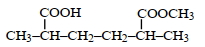
The $IUPAC$ name of the following compound is:
A
$2-$Carboxy$-5-$methoxycarbonylhexane.
B
Methyl$-6-$carboxy$-2,5-$dimethylhexanoate.
C
Methyl$-5-$carboxy$-2-$methylhexanoate.
D
$2,5-$Dimethyl$-6-$methoxycarbonylhexanoic acid.
Solution
(D) $1$. Identify the principal functional group. The carboxylic acid $(-COOH)$ group has higher priority than the ester $(-COOCH_3)$ group. Thus,the parent chain is a hexanoic acid derivative.
$2$. Number the chain starting from the carbon of the $-COOH$ group as $C-1$.
$3$. The chain is $6$ carbons long: $CH_3-CH(COOCH_3)-CH_2-CH_2-CH(CH_3)-COOH$ is not the structure. Looking at the image,the structure is $CH_3-CH(COOH)-CH_2-CH_2-CH(COOCH_3)-CH_3$.
$4$. Numbering from the $-COOH$ end: $C-1$ is the carboxyl carbon,$C-2$ has a methyl group,$C-5$ has a methoxycarbonyl group $(-COOCH_3)$ and a methyl group.
$5$. The name is $5-$methoxycarbonyl$-2,5-$dimethylhexanoic acid.
$2$. Number the chain starting from the carbon of the $-COOH$ group as $C-1$.
$3$. The chain is $6$ carbons long: $CH_3-CH(COOCH_3)-CH_2-CH_2-CH(CH_3)-COOH$ is not the structure. Looking at the image,the structure is $CH_3-CH(COOH)-CH_2-CH_2-CH(COOCH_3)-CH_3$.
$4$. Numbering from the $-COOH$ end: $C-1$ is the carboxyl carbon,$C-2$ has a methyl group,$C-5$ has a methoxycarbonyl group $(-COOCH_3)$ and a methyl group.
$5$. The name is $5-$methoxycarbonyl$-2,5-$dimethylhexanoic acid.
0 likesView Solution
13
ChemistryDifficultMCQJEE Main · 2025
The incorrect statements regarding geometrical isomerism are :
$(A)$ Propene shows geometrical isomerism.
$(B)$ Trans isomer has identical atoms/groups on the opposite sides of the double bond.
$(C)$ Cis$-$but$-2-$ene has higher dipole moment than trans$-$but$-2-$ene.
$(D)$ $2-$methylbut$-2-$ene shows two geometrical isomers.
$(E)$ Trans$-$isomer has lower melting point than cis isomer.
Choose the $CORRECT$ answer from the options given below :
$(A)$ Propene shows geometrical isomerism.
$(B)$ Trans isomer has identical atoms/groups on the opposite sides of the double bond.
$(C)$ Cis$-$but$-2-$ene has higher dipole moment than trans$-$but$-2-$ene.
$(D)$ $2-$methylbut$-2-$ene shows two geometrical isomers.
$(E)$ Trans$-$isomer has lower melting point than cis isomer.
Choose the $CORRECT$ answer from the options given below :
A
$(A)$,$(D)$ and $(E)$ only
B
$(C)$,$(D)$ and $(E)$ only
C
$(B)$ and $(C)$ only
D
$(A)$ and $(E)$ only
Solution
(A) Analysis of the given statements:
$(A)$ Propene $(CH_3-CH=CH_2)$ does not show geometrical isomerism because one of the doubly bonded carbons is attached to two identical hydrogen atoms.
$(B)$ This is a correct statement. In a trans isomer,identical groups are on opposite sides of the double bond.
$(C)$ This is a correct statement. Cis$-$but$-2-$ene has a non-zero dipole moment due to the same side orientation of methyl groups,whereas trans$-$but$-2-$ene has a zero dipole moment due to symmetry.
$(D)$ $2-$methylbut$-2-$ene $(CH_3-C(CH_3)=CH-CH_3)$ does not show geometrical isomerism because one of the doubly bonded carbons is attached to two identical methyl groups.
$(E)$ This is an incorrect statement. Generally,the trans isomer has a higher melting point than the cis isomer due to better packing in the crystal lattice.
Thus,the incorrect statements are $(A)$,$(D)$,and $(E)$.
$(A)$ Propene $(CH_3-CH=CH_2)$ does not show geometrical isomerism because one of the doubly bonded carbons is attached to two identical hydrogen atoms.
$(B)$ This is a correct statement. In a trans isomer,identical groups are on opposite sides of the double bond.
$(C)$ This is a correct statement. Cis$-$but$-2-$ene has a non-zero dipole moment due to the same side orientation of methyl groups,whereas trans$-$but$-2-$ene has a zero dipole moment due to symmetry.
$(D)$ $2-$methylbut$-2-$ene $(CH_3-C(CH_3)=CH-CH_3)$ does not show geometrical isomerism because one of the doubly bonded carbons is attached to two identical methyl groups.
$(E)$ This is an incorrect statement. Generally,the trans isomer has a higher melting point than the cis isomer due to better packing in the crystal lattice.
Thus,the incorrect statements are $(A)$,$(D)$,and $(E)$.
0 likesView Solution
14
ChemistryDifficultMCQJEE Main · 2025
Some $CO_2$ gas was kept in a sealed container at a pressure of $1 \ atm$ and at $273 \ K$. This entire amount of $CO_2$ gas was later passed through an aqueous solution of $Ca(OH)_2$. The excess unreacted $Ca(OH)_2$ was later neutralized with $0.1 \ M$ of $40 \ mL$ $HCl$. If the volume of the sealed container of $CO_2$ was $x$,then $x$ is $............. \ cm^3$ $(nearest \ integer)$.
$[$Given : The entire amount of $CO_{2(g)}$ reacted with exactly half the initial amount of $Ca(OH)_2$ present in the aqueous solution.$]$
$[$Given : The entire amount of $CO_{2(g)}$ reacted with exactly half the initial amount of $Ca(OH)_2$ present in the aqueous solution.$]$
A
$45$
B
$30$
C
$35$
D
$25$
Solution
(A) The reaction between $CO_2$ and $Ca(OH)_2$ is: $Ca(OH)_2 + CO_2 \rightarrow CaCO_3 + H_2O$.
Let the moles of $CO_2$ be $n$.
According to the stoichiometry,$n$ moles of $CO_2$ react with $n$ moles of $Ca(OH)_2$.
Given that this amount of $CO_2$ reacted with exactly half the initial amount of $Ca(OH)_2$,the total initial moles of $Ca(OH)_2 = 2n$.
Excess $Ca(OH)_2 = 2n - n = n$.
This excess $Ca(OH)_2$ is neutralized by $HCl$: $Ca(OH)_2 + 2HCl \rightarrow CaCl_2 + 2H_2O$.
Equivalents of $Ca(OH)_2 = $ Equivalents of $HCl$.
$n \times 2 = 0.1 \times 0.040 \times 1$.
$2n = 0.004 \implies n = 0.002 \ mol$.
At $STP$ $(1 \ atm, 273 \ K)$,$1 \ mol$ of gas occupies $22400 \ cm^3$.
Volume $x = 0.002 \times 22400 = 44.8 \ cm^3$.
Rounding to the nearest integer,$x = 45 \ cm^3$.
Let the moles of $CO_2$ be $n$.
According to the stoichiometry,$n$ moles of $CO_2$ react with $n$ moles of $Ca(OH)_2$.
Given that this amount of $CO_2$ reacted with exactly half the initial amount of $Ca(OH)_2$,the total initial moles of $Ca(OH)_2 = 2n$.
Excess $Ca(OH)_2 = 2n - n = n$.
This excess $Ca(OH)_2$ is neutralized by $HCl$: $Ca(OH)_2 + 2HCl \rightarrow CaCl_2 + 2H_2O$.
Equivalents of $Ca(OH)_2 = $ Equivalents of $HCl$.
$n \times 2 = 0.1 \times 0.040 \times 1$.
$2n = 0.004 \implies n = 0.002 \ mol$.
At $STP$ $(1 \ atm, 273 \ K)$,$1 \ mol$ of gas occupies $22400 \ cm^3$.
Volume $x = 0.002 \times 22400 = 44.8 \ cm^3$.
Rounding to the nearest integer,$x = 45 \ cm^3$.
0 likesView Solution
15
ChemistryMediumMCQJEE Main · 2025
In Carius method for estimation of halogens,$180 \ mg$ of an organic compound produced $143.5 \ mg$ of $AgCl$. The percentage composition of chlorine in the compound is $............. \%$.
[Given : molar mass in $g \ mol^{-1}$ of $Ag = 108$,$Cl = 35.5$]
[Given : molar mass in $g \ mol^{-1}$ of $Ag = 108$,$Cl = 35.5$]
A
$15$
B
$20$
C
$60$
D
$30$
Solution
(B) The molar mass of $AgCl = 108 + 35.5 = 143.5 \ g \ mol^{-1}$.
The number of moles of $AgCl$ produced $= \frac{143.5 \times 10^{-3} \ g}{143.5 \ g \ mol^{-1}} = 10^{-3} \ mol$.
Since $1 \ mol$ of $AgCl$ contains $1 \ mol$ of $Cl$,the mass of chlorine $= 10^{-3} \ mol \times 35.5 \ g \ mol^{-1} = 35.5 \times 10^{-3} \ g = 35.5 \ mg$.
The percentage of chlorine $= \frac{\text{mass of } Cl}{\text{mass of organic compound}} \times 100 = \frac{35.5 \ mg}{180 \ mg} \times 100 = 19.72 \% \approx 20 \%$.
The number of moles of $AgCl$ produced $= \frac{143.5 \times 10^{-3} \ g}{143.5 \ g \ mol^{-1}} = 10^{-3} \ mol$.
Since $1 \ mol$ of $AgCl$ contains $1 \ mol$ of $Cl$,the mass of chlorine $= 10^{-3} \ mol \times 35.5 \ g \ mol^{-1} = 35.5 \times 10^{-3} \ g = 35.5 \ mg$.
The percentage of chlorine $= \frac{\text{mass of } Cl}{\text{mass of organic compound}} \times 100 = \frac{35.5 \ mg}{180 \ mg} \times 100 = 19.72 \% \approx 20 \%$.
0 likesView Solution
16
ChemistryDifficultMCQJEE Main · 2025
The number of molecules/ions that show linear geometry among the following is $.........$
$SO_2, BeCl_2, CO_2, N_3^{-}, NO_2, F_2O, XeF_2, NO_2^{+}, I_3^{-}, O_3$
$SO_2, BeCl_2, CO_2, N_3^{-}, NO_2, F_2O, XeF_2, NO_2^{+}, I_3^{-}, O_3$
A
$4$
B
$5$
C
$6$
D
$7$
Solution
(C) To determine the linear geometry,we analyze the hybridization and lone pairs on the central atom:
$1$. $BeCl_2$: $sp$ hybridized,$0$ lone pairs,linear.
$2$. $CO_2$: $sp$ hybridized,$0$ lone pairs,linear.
$3$. $N_3^{-}$: $sp$ hybridized,$0$ lone pairs,linear.
$4$. $XeF_2$: $sp^3d$ hybridized,$3$ lone pairs on $Xe$,linear.
$5$. $NO_2^{+}$: $sp$ hybridized,$0$ lone pairs,linear.
$6$. $I_3^{-}$: $sp^3d$ hybridized,$3$ lone pairs on central $I$,linear.
Other species:
- $SO_2$: Bent ($sp^2$,$1$ lone pair).
- $NO_2$: Bent ($sp^2$,$1$ unpaired electron).
- $F_2O$: Bent ($sp^3$,$2$ lone pairs).
- $O_3$: Bent ($sp^2$,$1$ lone pair).
Total number of linear species is $6$.
$1$. $BeCl_2$: $sp$ hybridized,$0$ lone pairs,linear.
$2$. $CO_2$: $sp$ hybridized,$0$ lone pairs,linear.
$3$. $N_3^{-}$: $sp$ hybridized,$0$ lone pairs,linear.
$4$. $XeF_2$: $sp^3d$ hybridized,$3$ lone pairs on $Xe$,linear.
$5$. $NO_2^{+}$: $sp$ hybridized,$0$ lone pairs,linear.
$6$. $I_3^{-}$: $sp^3d$ hybridized,$3$ lone pairs on central $I$,linear.
Other species:
- $SO_2$: Bent ($sp^2$,$1$ lone pair).
- $NO_2$: Bent ($sp^2$,$1$ unpaired electron).
- $F_2O$: Bent ($sp^3$,$2$ lone pairs).
- $O_3$: Bent ($sp^2$,$1$ lone pair).
Total number of linear species is $6$.
0 likesView Solution
17
ChemistryDifficultMCQJEE Main · 2025
Arrange the following compounds in increasing order of their dipole moment :
$HBr$,$H_2S$,$NF_3$ and $CHCl_3$
$HBr$,$H_2S$,$NF_3$ and $CHCl_3$
A
$NF_3 < HBr < H_2S < CHCl_3$
B
$HBr < H_2S < NF_3 < CHCl_3$
C
$H_2S < HBr < NF_3 < CHCl_3$
D
$CHCl_3 < NF_3 < HBr < H_2S$
Solution
(A) The dipole moments $(\mu)$ of the given compounds are as follows:
$NF_3$: $0.24 \ D$
$HBr$: $0.79 \ D$
$H_2S$: $0.95 \ D$
$CHCl_3$: $1.04 \ D$
Therefore,the increasing order of dipole moment is $NF_3 < HBr < H_2S < CHCl_3$.
$NF_3$: $0.24 \ D$
$HBr$: $0.79 \ D$
$H_2S$: $0.95 \ D$
$CHCl_3$: $1.04 \ D$
Therefore,the increasing order of dipole moment is $NF_3 < HBr < H_2S < CHCl_3$.
0 likesView Solution
18
ChemistryDifficultMCQJEE Main · 2025
When $sec$-butylcyclohexane reacts with bromine in the presence of sunlight,the major product is:
A
$1-$bromo$-1-$cyclohexylbutane
B
$2-$bromo$-1-$cyclohexylbutane
C
$1-$bromo$-2-$cyclohexylbutane
D
$1-$bromo$-1-$cyclohexyl$-1-$methylpropane
Solution
(D) The reaction of $sec$-butylcyclohexane with bromine in the presence of sunlight $(hv)$ proceeds via a free radical mechanism.
Bromination is highly selective and prefers the formation of the most stable free radical intermediate.
In $sec$-butylcyclohexane,the hydrogen atom at the $sec$-butyl carbon (the carbon attached to the cyclohexane ring and the ethyl group) is a tertiary hydrogen.
Removal of this hydrogen creates a tertiary free radical,which is more stable than secondary or primary radicals.
Therefore,the bromine atom attacks this tertiary carbon to form the major product,which is $1$-bromo-$1$-cyclohexylbutane (also named $1$-bromo-$1$-cyclohexyl-$1$-methylpropane depending on nomenclature,but based on the structure provided in option $D$,it is the tertiary bromide).
Bromination is highly selective and prefers the formation of the most stable free radical intermediate.
In $sec$-butylcyclohexane,the hydrogen atom at the $sec$-butyl carbon (the carbon attached to the cyclohexane ring and the ethyl group) is a tertiary hydrogen.
Removal of this hydrogen creates a tertiary free radical,which is more stable than secondary or primary radicals.
Therefore,the bromine atom attacks this tertiary carbon to form the major product,which is $1$-bromo-$1$-cyclohexylbutane (also named $1$-bromo-$1$-cyclohexyl-$1$-methylpropane depending on nomenclature,but based on the structure provided in option $D$,it is the tertiary bromide).
0 likesView Solution
19
ChemistryMediumMCQJEE Main · 2025
The species which does not undergo disproportionation reaction is:
A
$ClO_2^{-}$
B
$ClO_4^{-}$
C
$ClO^{-}$
D
$ClO_3^{-}$
Solution
(B) disproportionation reaction is one in which the same element in a given oxidation state is simultaneously oxidized and reduced.
For an element to undergo disproportionation,it must be in an intermediate oxidation state.
In $ClO_4^{-}$,the oxidation state of $Cl$ is calculated as: $x + (-2 \times 4) = -1$,which gives $x = +7$.
Since $+7$ is the maximum possible oxidation state for Chlorine,it cannot be further oxidized.
Therefore,$ClO_4^{-}$ cannot undergo disproportionation.
For an element to undergo disproportionation,it must be in an intermediate oxidation state.
In $ClO_4^{-}$,the oxidation state of $Cl$ is calculated as: $x + (-2 \times 4) = -1$,which gives $x = +7$.
Since $+7$ is the maximum possible oxidation state for Chlorine,it cannot be further oxidized.
Therefore,$ClO_4^{-}$ cannot undergo disproportionation.
0 likesView Solution
20
ChemistryDifficultMCQJEE Main · 2025
Match List-$I$ with List-$II$.
Choose the correct answer from the options given below:
| List-$I$ $(\text{Partial Derivatives})$ | List-$II$ $(\text{Thermodynamic Quantity})$ |
| $(A). \left(\frac{\partial G}{\partial T}\right)_{P}$ | $(I). C_P$ |
| $(B). \left(\frac{\partial H}{\partial T}\right)_{P}$ | $(II). -S$ |
| $(C). \left(\frac{\partial G}{\partial P}\right)_{T}$ | $(III). C_V$ |
| $(D). \left(\frac{\partial U}{\partial T}\right)_{V}$ | $(IV). V$ |
A
$A-II, B-I, C-III, D-IV$
B
$A-II, B-I, C-IV, D-III$
C
$A-I, B-II, C-IV, D-III$
D
$A-II, B-III, C-I, D-IV$
Solution
(B) $(A) \ dG = VdP - SdT$. At constant pressure,$dP = 0$,so $dG = -SdT$,which gives $\left(\frac{\partial G}{\partial T}\right)_{P} = -S$.
$(B) \ dH = nC_{P}dT$. Therefore,$\left(\frac{\partial H}{\partial T}\right)_{P} = C_{P}$.
$(C) \ dG = VdP - SdT$. At constant temperature,$dT = 0$,so $dG = VdP$,which gives $\left(\frac{\partial G}{\partial P}\right)_{T} = V$.
$(D) \ dU = nC_{V}dT$. Therefore,$\left(\frac{\partial U}{\partial T}\right)_{V} = C_{V}$.
Thus,the correct matching is $A-II, B-I, C-IV, D-III$.
$(B) \ dH = nC_{P}dT$. Therefore,$\left(\frac{\partial H}{\partial T}\right)_{P} = C_{P}$.
$(C) \ dG = VdP - SdT$. At constant temperature,$dT = 0$,so $dG = VdP$,which gives $\left(\frac{\partial G}{\partial P}\right)_{T} = V$.
$(D) \ dU = nC_{V}dT$. Therefore,$\left(\frac{\partial U}{\partial T}\right)_{V} = C_{V}$.
Thus,the correct matching is $A-II, B-I, C-IV, D-III$.
0 likesView Solution
21
ChemistryMediumMCQJEE Main · 2025
The molar solubility $(s)$ of zirconium phosphate with molecular formula $(Zr^{4+})_3(PO_4^{3-})_4$ is given by the relation:
A
$(\frac{K_{sp}}{6912})^{\frac{1}{7}}$
B
$(\frac{K_{sp}}{5348})^{\frac{1}{6}}$
C
$(\frac{K_{sp}}{8435})^{\frac{1}{7}}$
D
$(\frac{K_{sp}}{9612})^{\frac{1}{3}}$
Solution
(A) The dissociation of zirconium phosphate is represented as: $Zr_3(PO_4)_4(s) \rightleftharpoons 3Zr^{4+}(aq) + 4PO_4^{3-}(aq)$
Let the molar solubility be $s$. Then,the concentration of $Zr^{4+}$ is $3s$ and the concentration of $PO_4^{3-}$ is $4s$.
The solubility product expression is: $K_{sp} = [Zr^{4+}]^3 [PO_4^{3-}]^4$
Substituting the values: $K_{sp} = (3s)^3 (4s)^4$
$K_{sp} = (27s^3) \times (256s^4) = 6912s^7$
Solving for $s$: $s^7 = \frac{K_{sp}}{6912}$
Therefore,$s = (\frac{K_{sp}}{6912})^{\frac{1}{7}}$
Let the molar solubility be $s$. Then,the concentration of $Zr^{4+}$ is $3s$ and the concentration of $PO_4^{3-}$ is $4s$.
The solubility product expression is: $K_{sp} = [Zr^{4+}]^3 [PO_4^{3-}]^4$
Substituting the values: $K_{sp} = (3s)^3 (4s)^4$
$K_{sp} = (27s^3) \times (256s^4) = 6912s^7$
Solving for $s$: $s^7 = \frac{K_{sp}}{6912}$
Therefore,$s = (\frac{K_{sp}}{6912})^{\frac{1}{7}}$
0 likesView Solution
22
ChemistryMediumMCQJEE Main · 2025
The most stable carbocation from the following is:
A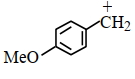
B
C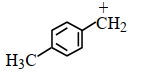
D
Solution
(A) The stability of carbocations is determined by the electronic effects of the substituents attached to the benzene ring.
$1$. In $p$-methoxybenzyl carbocation,the $-OCH_3$ group at the para position exerts a strong $+M$ (mesomeric) effect,which significantly stabilizes the positive charge through resonance.
$2$. In $p$-methylbenzyl carbocation,the $-CH_3$ group provides stability through the $+H$ (hyperconjugation) effect.
$3$. In $m$-methoxybenzyl carbocation,the $-OCH_3$ group exerts a $-I$ (inductive) effect because it is at the meta position,which destabilizes the carbocation.
$4$. The benzyl carbocation has no additional substituents for stabilization.
Therefore,the order of stability is: $p$-methoxybenzyl carbocation > $p$-methylbenzyl carbocation > benzyl carbocation > $m$-methoxybenzyl carbocation.
The most stable carbocation is the $p$-methoxybenzyl carbocation.
$1$. In $p$-methoxybenzyl carbocation,the $-OCH_3$ group at the para position exerts a strong $+M$ (mesomeric) effect,which significantly stabilizes the positive charge through resonance.
$2$. In $p$-methylbenzyl carbocation,the $-CH_3$ group provides stability through the $+H$ (hyperconjugation) effect.
$3$. In $m$-methoxybenzyl carbocation,the $-OCH_3$ group exerts a $-I$ (inductive) effect because it is at the meta position,which destabilizes the carbocation.
$4$. The benzyl carbocation has no additional substituents for stabilization.
Therefore,the order of stability is: $p$-methoxybenzyl carbocation > $p$-methylbenzyl carbocation > benzyl carbocation > $m$-methoxybenzyl carbocation.
The most stable carbocation is the $p$-methoxybenzyl carbocation.
0 likesView Solution
23
ChemistryDifficultMCQJEE Main · 2025
Given below are two statements :
Statement $I$ : An element in the extreme left of the periodic table forms acidic oxides.
Statement $II$ : Acid is formed during the reaction between water and oxide of a reactive element present in the extreme right of the periodic table.
In the light of the above statements,choose the correct answer from the options given below :
Statement $I$ : An element in the extreme left of the periodic table forms acidic oxides.
Statement $II$ : Acid is formed during the reaction between water and oxide of a reactive element present in the extreme right of the periodic table.
In the light of the above statements,choose the correct answer from the options given below :
A
Statement-$I$ is false but Statement-$II$ is true.
B
Both Statement-$I$ and Statement-$II$ are false.
C
Statement-$I$ is true but Statement-$II$ is false.
D
Both Statement-$I$ and Statement-$II$ are true.
Solution
(A) Statement-$I$ is false because elements on the extreme left of the periodic table are alkali and alkaline earth metals,which form basic oxides.
Statement-$II$ is true because non-metals on the extreme right of the periodic table form acidic oxides,which react with water to form acids (e.g.,$SO_3 + H_2O \rightarrow H_2SO_4$).
As we move from left to right in the periodic table,the non-metallic character increases,leading to an increase in the acidic strength of the oxides.
Statement-$II$ is true because non-metals on the extreme right of the periodic table form acidic oxides,which react with water to form acids (e.g.,$SO_3 + H_2O \rightarrow H_2SO_4$).
As we move from left to right in the periodic table,the non-metallic character increases,leading to an increase in the acidic strength of the oxides.
0 likesView Solution
24
ChemistryDifficultMCQJEE Main · 2025
Given below are two statements :
Statement $I$ : $A$ spectral line will be observed for a $2p_x \rightarrow 2p_y$ transition.
Statement $II$ : $2p_x$ and $2p_y$ are degenerate orbitals.
In the light of the above statements,choose the correct answer from the options given below :
Statement $I$ : $A$ spectral line will be observed for a $2p_x \rightarrow 2p_y$ transition.
Statement $II$ : $2p_x$ and $2p_y$ are degenerate orbitals.
In the light of the above statements,choose the correct answer from the options given below :
A
Both Statement-$I$ and Statement-$II$ are true.
B
Both Statement-$I$ and Statement-$II$ are false.
C
Statement-$I$ is true but Statement-$II$ is false.
D
Statement-$I$ is false but Statement-$II$ is true.
Solution
(D) Degenerate orbitals are orbitals that have the same energy level.
In a hydrogen-like atom,$2p_x$ and $2p_y$ orbitals possess the same energy,making them degenerate.
$A$ spectral line is observed only when an electron transitions between orbitals of different energy levels (i.e.,$\Delta E \neq 0$).
Since $2p_x$ and $2p_y$ have the same energy,the transition $2p_x \rightarrow 2p_y$ involves no change in energy $(\Delta E = 0)$,and thus no spectral line is observed.
Therefore,Statement-$I$ is false and Statement-$II$ is true.
In a hydrogen-like atom,$2p_x$ and $2p_y$ orbitals possess the same energy,making them degenerate.
$A$ spectral line is observed only when an electron transitions between orbitals of different energy levels (i.e.,$\Delta E \neq 0$).
Since $2p_x$ and $2p_y$ have the same energy,the transition $2p_x \rightarrow 2p_y$ involves no change in energy $(\Delta E = 0)$,and thus no spectral line is observed.
Therefore,Statement-$I$ is false and Statement-$II$ is true.
0 likesView Solution
25
ChemistryMediumMCQJEE Main · 2025
Given below are two statements :
Statement $I$ : Nitrogen,sulphur,halogen and phosphorus present in an organic compound are detected by Lassaigne's Test.
Statement $II$ : The elements present in the compound are converted from covalent form into ionic form by fusing the compound with Magnesium in Lassaigne's test.
In the light of the above statements,choose the correct answer from the options given below :
Statement $I$ : Nitrogen,sulphur,halogen and phosphorus present in an organic compound are detected by Lassaigne's Test.
Statement $II$ : The elements present in the compound are converted from covalent form into ionic form by fusing the compound with Magnesium in Lassaigne's test.
In the light of the above statements,choose the correct answer from the options given below :
A
Both Statement $I$ and Statement $II$ are true
B
Both Statement $I$ and Statement $II$ are false
C
Statement $I$ is true but Statement $II$ is false
D
Statement $I$ is false but Statement $II$ is true
Solution
(C) Statement $I$ is true because Lassaigne's test is used to detect nitrogen,sulphur,halogens,and phosphorus in organic compounds.
Statement $II$ is false because in Lassaigne's test,the organic compound is fused with metallic sodium,not magnesium,to convert the elements from covalent form into ionic form.
Statement $II$ is false because in Lassaigne's test,the organic compound is fused with metallic sodium,not magnesium,to convert the elements from covalent form into ionic form.
0 likesView Solution
26
ChemistryMediumMCQJEE Main · 2025
The alkane from below having two secondary hydrogens is:
A
$4-$Ethyl$-3,4-$dimethyloctane
B
$2,2,4,4-$Tetramethylhexane
C
$2,2,3,3-$Tetramethylpentane
D
$2,2,4,5-$Tetramethylheptane
Solution
(C) secondary $(2^{\circ})$ hydrogen is a hydrogen atom attached to a secondary carbon atom (a carbon atom bonded to two other carbon atoms).
Let us analyze the structures:
$A$. $4-$Ethyl$-3,4-$dimethyloctane: This structure has five $2^{\circ}$ carbons,resulting in $10$ secondary hydrogens.
$B$. $2,2,4,4-$Tetramethylhexane: This structure has two $2^{\circ}$ carbons ($C3$ and $C5$),resulting in $4$ secondary hydrogens.
$C$. $2,2,3,3-$Tetramethylpentane: The structure is $CH_3-C(CH_3)_2-C(CH_3)_2-CH_2-CH_3$. The only $2^{\circ}$ carbon is at $C4$,which has two hydrogens attached to it. Thus,it has $2$ secondary hydrogens.
$D$. $2,2,4,5-$Tetramethylheptane: This structure has two $2^{\circ}$ carbons ($C3$ and $C6$),resulting in $4$ secondary hydrogens.
Therefore,the correct option is $C$.
Let us analyze the structures:
$A$. $4-$Ethyl$-3,4-$dimethyloctane: This structure has five $2^{\circ}$ carbons,resulting in $10$ secondary hydrogens.
$B$. $2,2,4,4-$Tetramethylhexane: This structure has two $2^{\circ}$ carbons ($C3$ and $C5$),resulting in $4$ secondary hydrogens.
$C$. $2,2,3,3-$Tetramethylpentane: The structure is $CH_3-C(CH_3)_2-C(CH_3)_2-CH_2-CH_3$. The only $2^{\circ}$ carbon is at $C4$,which has two hydrogens attached to it. Thus,it has $2$ secondary hydrogens.
$D$. $2,2,4,5-$Tetramethylheptane: This structure has two $2^{\circ}$ carbons ($C3$ and $C6$),resulting in $4$ secondary hydrogens.
Therefore,the correct option is $C$.
0 likesView Solution
27
ChemistryDifficultMCQJEE Main · 2025
The compound with molecular formula $C_6H_6$,which gives only one monobromo derivative and takes up four moles of hydrogen per mole for complete hydrogenation,has $................\pi$ electrons.
A
$8$
B
$9$
C
$10$
D
$11$
Solution
(A) The molecular formula $C_6H_6$ corresponds to a degree of unsaturation of $4$ $(C_n H_{2n+2} - C_n H_m / 2 = (2(6)+2-6)/2 = 4)$.
This means the molecule has $4$ double bonds or equivalent unsaturation (rings/triple bonds).
The compound takes up $4$ moles of $H_2$ for complete hydrogenation,confirming it has $4$ $\pi$ bonds.
Each $\pi$ bond contains $2$ $\pi$ electrons,so $4$ $\pi$ bonds contain $4 \times 2 = 8$ $\pi$ electrons.
The compound is $1,3,5$-trimethylenecyclohexane or a similar isomer that is highly symmetric to yield only one monobromo derivative.
Thus,the number of $\pi$ electrons is $8$.
This means the molecule has $4$ double bonds or equivalent unsaturation (rings/triple bonds).
The compound takes up $4$ moles of $H_2$ for complete hydrogenation,confirming it has $4$ $\pi$ bonds.
Each $\pi$ bond contains $2$ $\pi$ electrons,so $4$ $\pi$ bonds contain $4 \times 2 = 8$ $\pi$ electrons.
The compound is $1,3,5$-trimethylenecyclohexane or a similar isomer that is highly symmetric to yield only one monobromo derivative.
Thus,the number of $\pi$ electrons is $8$.
0 likesView Solution
28
ChemistryDifficultMCQJEE Main · 2025
Consider the following cases of standard enthalpy of reaction $\Delta H_{r}^{\circ}$ in $kJ \ mol^{-1}$:
$C_{2}H_{6(g)} + \frac{7}{2} O_{2(g)} \rightarrow 2 CO_{2(g)} + 3 H_{2}O(\ell)$,$\Delta H_{1}^{\circ} = -1550$
$C(\text{graphite}) + O_{2(g)} \rightarrow CO_{2(g)}$,$\Delta H_{2}^{\circ} = -393.5$
$H_{2(g)} + \frac{1}{2} O_{2(g)} \rightarrow H_{2}O(\ell)$,$\Delta H_{3}^{\circ} = -286$
The magnitude of $\Delta H_{f, C_{2}H_{6(g)}}^{\circ}$ is $........... kJ \ mol^{-1}$ $(Nearest \ integer)$.
$C_{2}H_{6(g)} + \frac{7}{2} O_{2(g)} \rightarrow 2 CO_{2(g)} + 3 H_{2}O(\ell)$,$\Delta H_{1}^{\circ} = -1550$
$C(\text{graphite}) + O_{2(g)} \rightarrow CO_{2(g)}$,$\Delta H_{2}^{\circ} = -393.5$
$H_{2(g)} + \frac{1}{2} O_{2(g)} \rightarrow H_{2}O(\ell)$,$\Delta H_{3}^{\circ} = -286$
The magnitude of $\Delta H_{f, C_{2}H_{6(g)}}^{\circ}$ is $........... kJ \ mol^{-1}$ $(Nearest \ integer)$.
A
$91$
B
$92$
C
$93$
D
$95$
Solution
(D) The formation reaction for $C_{2}H_{6(g)}$ is: $2 C(\text{graphite}) + 3 H_{2(g)} \rightarrow C_{2}H_{6(g)}$,$\Delta H_{f}^{\circ} = ?$
Using Hess's Law:
$\Delta H_{f}^{\circ} = [2 \Delta H_{2}^{\circ} + 3 \Delta H_{3}^{\circ}] - \Delta H_{1}^{\circ}$
$\Delta H_{f}^{\circ} = 2(-393.5) + 3(-286) - (-1550)$
$\Delta H_{f}^{\circ} = -787 - 858 + 1550$
$\Delta H_{f}^{\circ} = -1645 + 1550 = -95 \ kJ \ mol^{-1}$
The magnitude of $\Delta H_{f}^{\circ}$ is $|-95| = 95 \ kJ \ mol^{-1}$.
Using Hess's Law:
$\Delta H_{f}^{\circ} = [2 \Delta H_{2}^{\circ} + 3 \Delta H_{3}^{\circ}] - \Delta H_{1}^{\circ}$
$\Delta H_{f}^{\circ} = 2(-393.5) + 3(-286) - (-1550)$
$\Delta H_{f}^{\circ} = -787 - 858 + 1550$
$\Delta H_{f}^{\circ} = -1645 + 1550 = -95 \ kJ \ mol^{-1}$
The magnitude of $\Delta H_{f}^{\circ}$ is $|-95| = 95 \ kJ \ mol^{-1}$.
0 likesView Solution
29
ChemistryMediumMCQJEE Main · 2025
$20 \ mL$ of $2 \ M$ $NaOH$ solution is added to $400 \ mL$ of $0.5 \ M$ $NaOH$ solution. The final concentration of the solution is $.......... \times 10^{-2} \ M$. $(Nearest \ integer)$.
A
$57$
B
$58$
C
$59$
D
$60$
Solution
(A) The formula for the final concentration $(M_F)$ of a mixture is $M_F = \frac{M_1 V_1 + M_2 V_2}{V_1 + V_2}$.
Given: $M_1 = 2 \ M$,$V_1 = 20 \ mL$,$M_2 = 0.5 \ M$,$V_2 = 400 \ mL$.
Substituting the values: $M_F = \frac{2 \times 20 + 0.5 \times 400}{20 + 400} = \frac{40 + 200}{420} = \frac{240}{420} \approx 0.5714 \ M$.
Converting to the required format: $0.5714 \ M = 57.14 \times 10^{-2} \ M$.
Rounding to the nearest integer,we get $57 \times 10^{-2} \ M$.
Given: $M_1 = 2 \ M$,$V_1 = 20 \ mL$,$M_2 = 0.5 \ M$,$V_2 = 400 \ mL$.
Substituting the values: $M_F = \frac{2 \times 20 + 0.5 \times 400}{20 + 400} = \frac{40 + 200}{420} = \frac{240}{420} \approx 0.5714 \ M$.
Converting to the required format: $0.5714 \ M = 57.14 \times 10^{-2} \ M$.
Rounding to the nearest integer,we get $57 \times 10^{-2} \ M$.
0 likesView Solution
30
ChemistryMediumMCQJEE Main · 2025
The element that does not belong to the same period as the remaining elements in the modern periodic table is:
A
Palladium
B
Iridium
C
Osmium
D
Platinum
Solution
(A) Palladium $(Pd)$ belongs to the $5^{th}$ period.
Iridium $(Ir)$,Osmium $(Os)$,and Platinum $(Pt)$ all belong to the $6^{th}$ period.
Therefore,Palladium is the element that does not belong to the same period as the others.
Iridium $(Ir)$,Osmium $(Os)$,and Platinum $(Pt)$ all belong to the $6^{th}$ period.
Therefore,Palladium is the element that does not belong to the same period as the others.
0 likesView Solution
31
ChemistryDifficultMCQJEE Main · 2025
Heat treatment of muscular pain involves radiation of wavelength of about $900 \ nm$. Which spectral line of $H$ atom is suitable for this? Given: Rydberg constant $R_{H}=10^5 \ cm^{-1}, h=6.6 \times 10^{-34} \ J \ s, c=3 \times 10^8 \ m / s$.
A
Paschen series,$\infty \rightarrow 3$
B
Lyman series,$\infty \rightarrow 1$
C
Balmer series,$\infty \rightarrow 2$
D
Paschen series,$5 \rightarrow 3$
Solution
(A) Given wavelength $\lambda = 900 \ nm = 900 \times 10^{-7} \ cm = 9 \times 10^{-5} \ cm$.
Rydberg constant $R_{H} = 10^5 \ cm^{-1}$.
Using Rydberg equation for $H$-atom $(Z=1)$: $\frac{1}{\lambda} = R_{H} \times (\frac{1}{n_1^2} - \frac{1}{n_2^2})$.
Substituting the values: $\frac{1}{9 \times 10^{-5}} = 10^5 \times (\frac{1}{n_1^2} - \frac{1}{n_2^2})$.
$\frac{1}{9} = \frac{1}{n_1^2} - \frac{1}{n_2^2}$.
For this equality to hold,$n_1 = 3$ and $n_2 = \infty$.
This corresponds to the Paschen series transition from $\infty \rightarrow 3$.
Rydberg constant $R_{H} = 10^5 \ cm^{-1}$.
Using Rydberg equation for $H$-atom $(Z=1)$: $\frac{1}{\lambda} = R_{H} \times (\frac{1}{n_1^2} - \frac{1}{n_2^2})$.
Substituting the values: $\frac{1}{9 \times 10^{-5}} = 10^5 \times (\frac{1}{n_1^2} - \frac{1}{n_2^2})$.
$\frac{1}{9} = \frac{1}{n_1^2} - \frac{1}{n_2^2}$.
For this equality to hold,$n_1 = 3$ and $n_2 = \infty$.
This corresponds to the Paschen series transition from $\infty \rightarrow 3$.
0 likesView Solution
32
ChemistryMediumMCQJEE Main · 2025
$2.8 \times 10^{-3} \ mol$ of $CO_2$ is left after removing $10^{21}$ molecules from its '$x$' $mg$ sample. The mass of $CO_2$ taken initially is. Given: $N_A = 6.02 \times 10^{23} \ mol^{-1}$. (in $mg$)
A
$196.2$
B
$98.3$
C
$150.4$
D
$48.2$
Solution
(A) The molar mass of $CO_2$ is $44 \ g/mol$.
Initial moles of $CO_2$ = $\frac{x \times 10^{-3} \ g}{44 \ g/mol} = \frac{x \times 10^{-3}}{44} \ mol$.
Moles of $CO_2$ removed = $\frac{10^{21}}{6.02 \times 10^{23}} \approx 1.66 \times 10^{-3} \ mol$.
Moles left = $\text{Initial moles} - \text{Removed moles}$.
$2.8 \times 10^{-3} = \frac{x \times 10^{-3}}{44} - 1.66 \times 10^{-3}$.
$2.8 \times 10^{-3} + 1.66 \times 10^{-3} = \frac{x \times 10^{-3}}{44}$.
$4.46 \times 10^{-3} = \frac{x \times 10^{-3}}{44}$.
$x = 4.46 \times 44 = 196.24 \ mg$.
Initial moles of $CO_2$ = $\frac{x \times 10^{-3} \ g}{44 \ g/mol} = \frac{x \times 10^{-3}}{44} \ mol$.
Moles of $CO_2$ removed = $\frac{10^{21}}{6.02 \times 10^{23}} \approx 1.66 \times 10^{-3} \ mol$.
Moles left = $\text{Initial moles} - \text{Removed moles}$.
$2.8 \times 10^{-3} = \frac{x \times 10^{-3}}{44} - 1.66 \times 10^{-3}$.
$2.8 \times 10^{-3} + 1.66 \times 10^{-3} = \frac{x \times 10^{-3}}{44}$.
$4.46 \times 10^{-3} = \frac{x \times 10^{-3}}{44}$.
$x = 4.46 \times 44 = 196.24 \ mg$.
0 likesView Solution
33
ChemistryDifficultMCQJEE Main · 2025
Ice at $-5^{\circ} C$ is heated to become vapor with a temperature of $110^{\circ} C$ at atmospheric pressure. The entropy change associated with this process can be obtained from:
A
$\int_{268 \ K}^{383 \ K} C_{p} \ dT + \frac{\Delta H_{\text{melting}}}{273} + \frac{\Delta H_{\text{boiling}}}{373}$
B
$\int_{268 \ K}^{273 \ K} \frac{C_{p,m}}{T} \ dT + \frac{\Delta H_{m, \text{fusion}}}{273 \ K} + \int_{273 \ K}^{373 \ K} \frac{C_{p,m}}{T} \ dT + \frac{\Delta H_{m, \text{vaporisation}}}{373 \ K} + \int_{373 \ K}^{383 \ K} \frac{C_{p,m}}{T} \ dT$
C
$\int_{268 \ K}^{383 \ K} C_{p} \ dT + \frac{q_{rev}}{T}$
D
$\int_{268 \ K}^{273 \ K} C_{p,m} \ dT + \frac{\Delta H_{m, \text{fusion}}}{T_{f}} + \frac{\Delta H_{m, \text{vaporisation}}}{T_{b}} + \int_{273 \ K}^{373 \ K} C_{p,m} \ dT + \int_{373 \ K}^{383 \ K} C_{p,m} \ dT$
Solution
(B) The total entropy change $\Delta S_{\text{total}}$ is the sum of entropy changes for each step of the process:
$1$. Heating ice from $-5^{\circ} C$ $(268 \ K)$ to $0^{\circ} C$ $(273 \ K)$: $\Delta S_1 = \int_{268 \ K}^{273 \ K} \frac{C_{p,m}(\text{ice})}{T} \ dT$
$2$. Melting ice at $0^{\circ} C$ $(273 \ K)$: $\Delta S_2 = \frac{\Delta H_{m, \text{fusion}}}{273 \ K}$
$3$. Heating water from $0^{\circ} C$ $(273 \ K)$ to $100^{\circ} C$ $(373 \ K)$: $\Delta S_3 = \int_{273 \ K}^{373 \ K} \frac{C_{p,m}(\text{water})}{T} \ dT$
$4$. Vaporizing water at $100^{\circ} C$ $(373 \ K)$: $\Delta S_4 = \frac{\Delta H_{m, \text{vaporisation}}}{373 \ K}$
$5$. Heating steam from $100^{\circ} C$ $(373 \ K)$ to $110^{\circ} C$ $(383 \ K)$: $\Delta S_5 = \int_{373 \ K}^{383 \ K} \frac{C_{p,m}(\text{steam})}{T} \ dT$
Summing these gives the expression in option $B$.
$1$. Heating ice from $-5^{\circ} C$ $(268 \ K)$ to $0^{\circ} C$ $(273 \ K)$: $\Delta S_1 = \int_{268 \ K}^{273 \ K} \frac{C_{p,m}(\text{ice})}{T} \ dT$
$2$. Melting ice at $0^{\circ} C$ $(273 \ K)$: $\Delta S_2 = \frac{\Delta H_{m, \text{fusion}}}{273 \ K}$
$3$. Heating water from $0^{\circ} C$ $(273 \ K)$ to $100^{\circ} C$ $(373 \ K)$: $\Delta S_3 = \int_{273 \ K}^{373 \ K} \frac{C_{p,m}(\text{water})}{T} \ dT$
$4$. Vaporizing water at $100^{\circ} C$ $(373 \ K)$: $\Delta S_4 = \frac{\Delta H_{m, \text{vaporisation}}}{373 \ K}$
$5$. Heating steam from $100^{\circ} C$ $(373 \ K)$ to $110^{\circ} C$ $(383 \ K)$: $\Delta S_5 = \int_{373 \ K}^{383 \ K} \frac{C_{p,m}(\text{steam})}{T} \ dT$
Summing these gives the expression in option $B$.
0 likesView Solution
34
ChemistryDifficultMCQJEE Main · 2025
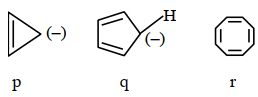
The correct stability order of the following species/molecules is:
A
$q > r > p$
B
$r > q > p$
C
$q > p > r$
D
$p > q > r$
Solution
(A) To determine the stability,we analyze the aromaticity of each species:
$1$. Species $p$ is the cyclopropenyl anion. It has $4n$ $\pi$ electrons ($4$ $\pi$ electrons),making it antiaromatic,which is highly unstable.
$2$. Species $q$ is the cyclopentadienyl anion. It has $4n+2$ $\pi$ electrons ($6$ $\pi$ electrons),making it aromatic,which is highly stable.
$3$. Species $r$ is cyclooctatetraene. It is non-aromatic because it adopts a non-planar tub-shaped conformation to avoid antiaromaticity,making it more stable than antiaromatic species but less stable than aromatic ones.
Therefore,the stability order is $q$ (aromatic) $> r$ (non-aromatic) $> p$ (antiaromatic).
The correct option is $A$.
$1$. Species $p$ is the cyclopropenyl anion. It has $4n$ $\pi$ electrons ($4$ $\pi$ electrons),making it antiaromatic,which is highly unstable.
$2$. Species $q$ is the cyclopentadienyl anion. It has $4n+2$ $\pi$ electrons ($6$ $\pi$ electrons),making it aromatic,which is highly stable.
$3$. Species $r$ is cyclooctatetraene. It is non-aromatic because it adopts a non-planar tub-shaped conformation to avoid antiaromaticity,making it more stable than antiaromatic species but less stable than aromatic ones.
Therefore,the stability order is $q$ (aromatic) $> r$ (non-aromatic) $> p$ (antiaromatic).
The correct option is $A$.
0 likesView Solution
35
ChemistryDifficultMCQJEE Main · 2025
Propane molecule on chlorination under photochemical conditions gives two dichloro products,$x$ and $y$. Amongst $x$ and $y$,$x$ is an optically active molecule. How many trichloro products (consider only structural isomers) will be obtained from $x$ when it is further treated with chlorine under photochemical conditions?
A
$4$
B
$2$
C
$5$
D
$3$
Solution
(D) The chlorination of propane $(CH_3-CH_2-CH_3)$ gives two dichloro products: $1,2-dichloropropane$ $(CH_3-CHCl-CH_2Cl)$ and $1,3-dichloropropane$ $(ClCH_2-CH_2-CH_2Cl)$.
Among these,$1,2-dichloropropane$ is optically active because the carbon at position $2$ is chiral (bonded to $-H, -CH_3, -Cl, -CH_2Cl$). Thus,$x$ is $1,2-dichloropropane$ $(CH_3-CHCl-CH_2Cl)$.
When $x$ $(CH_3-CHCl-CH_2Cl)$ is further chlorinated,we look for structural isomers of trichloropropane formed by replacing one $H$ atom with a $Cl$ atom:
$1.$ Replacing $H$ at $C-1$: $CH_3-CHCl-CHCl_2$ $(1,1,2-trichloropropane)$
$2.$ Replacing $H$ at $C-2$: $CH_3-CCl_2-CH_2Cl$ $(1,2,2-trichloropropane)$
$3.$ Replacing $H$ at $C-3$: $ClCH_2-CHCl-CH_2Cl$ $(1,2,3-trichloropropane)$
Thus,there are $3$ structural isomers of trichloropropane obtained from $x$.
Among these,$1,2-dichloropropane$ is optically active because the carbon at position $2$ is chiral (bonded to $-H, -CH_3, -Cl, -CH_2Cl$). Thus,$x$ is $1,2-dichloropropane$ $(CH_3-CHCl-CH_2Cl)$.
When $x$ $(CH_3-CHCl-CH_2Cl)$ is further chlorinated,we look for structural isomers of trichloropropane formed by replacing one $H$ atom with a $Cl$ atom:
$1.$ Replacing $H$ at $C-1$: $CH_3-CHCl-CHCl_2$ $(1,1,2-trichloropropane)$
$2.$ Replacing $H$ at $C-2$: $CH_3-CCl_2-CH_2Cl$ $(1,2,2-trichloropropane)$
$3.$ Replacing $H$ at $C-3$: $ClCH_2-CHCl-CH_2Cl$ $(1,2,3-trichloropropane)$
Thus,there are $3$ structural isomers of trichloropropane obtained from $x$.
0 likesView Solution
36
ChemistryDifficultMCQJEE Main · 2025
Given below are two statements :
Statement $I :$ In Lassaigne's test,the covalent organic molecules are transformed into ionic compounds.
Statement $II :$ The sodium fusion extract of an organic compound having $N$ and $S$ gives prussian blue colour with $FeSO_4$ and $FeCl_3$.
In the light of the above statements,choose the correct answer from the options given below.
Statement $I :$ In Lassaigne's test,the covalent organic molecules are transformed into ionic compounds.
Statement $II :$ The sodium fusion extract of an organic compound having $N$ and $S$ gives prussian blue colour with $FeSO_4$ and $FeCl_3$.
In the light of the above statements,choose the correct answer from the options given below.
A
Both Statement $I$ and Statement $II$ are true
B
Both Statement $I$ and Statement $II$ are false
C
Statement $I$ is false but Statement $II$ is true
D
Statement $I$ is true but Statement $II$ is false
Solution
(D) Statement $I$ is true because in Lassaigne's test,covalent organic compounds are fused with sodium metal to form ionic salts like $NaCN$,$Na_2S$,and $NaSCN$.
Statement $II$ is false because an organic compound containing both $N$ and $S$ forms sodium thiocyanate $(NaSCN)$. When this extract is treated with $Fe^{3+}$ ions (usually from $FeCl_3$),it forms ferric thiocyanate,which gives a blood-red colour,not Prussian blue. Prussian blue is obtained only when $N$ is present without $S$.
Statement $II$ is false because an organic compound containing both $N$ and $S$ forms sodium thiocyanate $(NaSCN)$. When this extract is treated with $Fe^{3+}$ ions (usually from $FeCl_3$),it forms ferric thiocyanate,which gives a blood-red colour,not Prussian blue. Prussian blue is obtained only when $N$ is present without $S$.
0 likesView Solution
37
ChemistryDifficultMCQJEE Main · 2025
Which of the following happens when $NH_{4}OH$ is added gradually to the solution containing $1 \ M \ A^{2+}$ and $1 \ M \ B^{3+}$ ions?
Given: $K_{sp}[A(OH)_{2}] = 9 \times 10^{-10}$ and $K_{sp}[B(OH)_{3}] = 27 \times 10^{-18}$ at $298 \ K$.
Given: $K_{sp}[A(OH)_{2}] = 9 \times 10^{-10}$ and $K_{sp}[B(OH)_{3}] = 27 \times 10^{-18}$ at $298 \ K$.
A
$B(OH)_{3}$ will precipitate before $A(OH)_{2}$
B
$A(OH)_{2}$ and $B(OH)_{3}$ will precipitate together
C
$A(OH)_{2}$ will precipitate before $B(OH)_{3}$
D
Both $A(OH)_{2}$ and $B(OH)_{3}$ do not show precipitation with $NH_{4}OH$
Solution
(A) The condition for precipitation is $Q_{ip} > K_{sp}$.
For $A(OH)_{2}$:
$[A^{2+}][OH^{-}]^2 > 9 \times 10^{-10}$
Given $[A^{2+}] = 1 \ M$,we have $[OH^{-}]^2 > 9 \times 10^{-10}$,which implies $[OH^{-}] > 3 \times 10^{-5} \ M$.
For $B(OH)_{3}$:
$[B^{3+}][OH^{-}]^3 > 27 \times 10^{-18}$
Given $[B^{3+}] = 1 \ M$,we have $[OH^{-}]^3 > 27 \times 10^{-18}$,which implies $[OH^{-}] > 3 \times 10^{-6} \ M$.
Since the concentration of $OH^{-}$ required for the precipitation of $B(OH)_{3}$ $(3 \times 10^{-6} \ M)$ is lower than that required for $A(OH)_{2}$ $(3 \times 10^{-5} \ M)$,$B(OH)_{3}$ will precipitate first.
For $A(OH)_{2}$:
$[A^{2+}][OH^{-}]^2 > 9 \times 10^{-10}$
Given $[A^{2+}] = 1 \ M$,we have $[OH^{-}]^2 > 9 \times 10^{-10}$,which implies $[OH^{-}] > 3 \times 10^{-5} \ M$.
For $B(OH)_{3}$:
$[B^{3+}][OH^{-}]^3 > 27 \times 10^{-18}$
Given $[B^{3+}] = 1 \ M$,we have $[OH^{-}]^3 > 27 \times 10^{-18}$,which implies $[OH^{-}] > 3 \times 10^{-6} \ M$.
Since the concentration of $OH^{-}$ required for the precipitation of $B(OH)_{3}$ $(3 \times 10^{-6} \ M)$ is lower than that required for $A(OH)_{2}$ $(3 \times 10^{-5} \ M)$,$B(OH)_{3}$ will precipitate first.
0 likesView Solution
38
ChemistryDifficultMCQJEE Main · 2025
Match the List-$I$ with List-$II$:
Choose the correct answer from the options given below:
| List-$I$ (Classification of molecules based on octet rule) | List-$II$ (Example) |
| $A$. Molecules obeying octet rule | $I$. $NO, NO_2$ |
| $B$. Molecules with incomplete octet | $II$. $BCl_3, AlCl_3$ |
| $C$. Molecules with odd electron | $III$. $H_2SO_4, PCl_5$ |
| $D$. Molecules with expanded octet | $IV$. $CCl_4, CO_2$ |
Choose the correct answer from the options given below:
A
$A-IV, B-II, C-I, D-III$
B
$A-III, B-II, C-I, D-IV$
C
$A-IV, B-I, C-III, D-II$
D
$A-II, B-IV, C-III, D-I$
Solution
(A) $A \rightarrow IV$: $CCl_4$ and $CO_2$ follow the octet rule as all atoms have $8$ electrons in their valence shell.
$B \rightarrow II$: $BCl_3$ and $AlCl_3$ have incomplete octets with only $6$ electrons around the central atom.
$C \rightarrow I$: $NO$ and $NO_2$ are odd-electron molecules containing an unpaired electron.
$D \rightarrow III$: $H_2SO_4$ and $PCl_5$ have expanded octets where the central atom has more than $8$ electrons.
Therefore,the correct matching is $A-IV, B-II, C-I, D-III$.
$B \rightarrow II$: $BCl_3$ and $AlCl_3$ have incomplete octets with only $6$ electrons around the central atom.
$C \rightarrow I$: $NO$ and $NO_2$ are odd-electron molecules containing an unpaired electron.
$D \rightarrow III$: $H_2SO_4$ and $PCl_5$ have expanded octets where the central atom has more than $8$ electrons.
Therefore,the correct matching is $A-IV, B-II, C-I, D-III$.
0 likesView Solution
39
ChemistryMediumMCQJEE Main · 2025
If $1 \ mM$ solution of ethylamine produces $pH = 9$,then the ionization constant $(K_b)$ of ethylamine is $10^{-x}$. The value of $x$ is . . . . . . (nearest integer). [The degree of ionization of ethylamine can be neglected with respect to unity.]
A
$7$
B
$8$
C
$9$
D
$10$
Solution
(A) The dissociation reaction of ethylamine is: $C_2H_5NH_2 + H_2O \rightleftharpoons C_2H_5NH_3^+ + OH^-$
Given concentration $C = 1 \ mM = 10^{-3} \ M$.
Given $pH = 9$,so $pOH = 14 - 9 = 5$.
Thus,$[OH^-] = 10^{-pOH} = 10^{-5} \ M$.
Since $[OH^-] = [C_2H_5NH_3^+] = 10^{-5} \ M$ and $[C_2H_5NH_2] \approx C = 10^{-3} \ M$ (as degree of ionization is neglected),
$K_b = \frac{[C_2H_5NH_3^+][OH^-]}{[C_2H_5NH_2]} = \frac{10^{-5} \times 10^{-5}}{10^{-3}} = 10^{-7}$.
Comparing $10^{-7}$ with $10^{-x}$,we get $x = 7$.
Given concentration $C = 1 \ mM = 10^{-3} \ M$.
Given $pH = 9$,so $pOH = 14 - 9 = 5$.
Thus,$[OH^-] = 10^{-pOH} = 10^{-5} \ M$.
Since $[OH^-] = [C_2H_5NH_3^+] = 10^{-5} \ M$ and $[C_2H_5NH_2] \approx C = 10^{-3} \ M$ (as degree of ionization is neglected),
$K_b = \frac{[C_2H_5NH_3^+][OH^-]}{[C_2H_5NH_2]} = \frac{10^{-5} \times 10^{-5}}{10^{-3}} = 10^{-7}$.
Comparing $10^{-7}$ with $10^{-x}$,we get $x = 7$.
0 likesView Solution
40
ChemistryMediumMCQJEE Main · 2025
During $S$ estimation,$160 \ mg$ of an organic compound gives $466 \ mg$ of barium sulphate. The percentage of Sulphur in the given compound is . . . . . . $\%.$ (Given molar mass in $g \ mol^{-1}$ of $Ba: 137, S: 32, O: 16$)
A
$39$
B
$40$
C
$41$
D
$42$
Solution
(B) The molar mass of $BaSO_4 = 137 + 32 + (4 \times 16) = 233 \ g \ mol^{-1}.$
Millimoles of $BaSO_4 = \frac{466 \ mg}{233 \ g \ mol^{-1}} = 2 \ mmol.$
Since $1 \ mol$ of $BaSO_4$ contains $1 \ mol$ of $S$,the moles of $S = 2 \ mmol = 2 \times 10^{-3} \ mol.$
Mass of $S = 2 \times 10^{-3} \ mol \times 32 \ g \ mol^{-1} = 0.064 \ g = 64 \ mg.$
Percentage of $S = \frac{\text{Mass of } S}{\text{Mass of organic compound}} \times 100 = \frac{64 \ mg}{160 \ mg} \times 100 = 40 \%.$
Millimoles of $BaSO_4 = \frac{466 \ mg}{233 \ g \ mol^{-1}} = 2 \ mmol.$
Since $1 \ mol$ of $BaSO_4$ contains $1 \ mol$ of $S$,the moles of $S = 2 \ mmol = 2 \times 10^{-3} \ mol.$
Mass of $S = 2 \times 10^{-3} \ mol \times 32 \ g \ mol^{-1} = 0.064 \ g = 64 \ mg.$
Percentage of $S = \frac{\text{Mass of } S}{\text{Mass of organic compound}} \times 100 = \frac{64 \ mg}{160 \ mg} \times 100 = 40 \%.$
0 likesView Solution
41
ChemistryMediumMCQJEE Main · 2025
The standard enthalpy and standard entropy of decomposition of $N_2O_4$ to $NO_2$ are $55.0 \ kJ \ mol^{-1}$ and $175.0 \ J \ K^{-1} \ mol^{-1}$ respectively. The standard free energy change for this reaction at $25 ^{\circ}C$ in $J \ mol^{-1}$ is $............$ $(Nearest \ integer)$.
A
$2850$
B
$2950$
C
$3065$
D
$4025$
Solution
(A) The reaction is $N_2O_4(g) \rightarrow 2NO_2(g)$.
Given: $\Delta H^{\circ} = 55.0 \ kJ \ mol^{-1} = 55000 \ J \ mol^{-1}$.
Given: $\Delta S^{\circ} = 175.0 \ J \ K^{-1} \ mol^{-1}$.
Temperature $T = 25 + 273 = 298 \ K$.
The Gibbs free energy change is given by the formula: $\Delta G^{\circ} = \Delta H^{\circ} - T\Delta S^{\circ}$.
Substituting the values: $\Delta G^{\circ} = 55000 \ J \ mol^{-1} - (298 \ K \times 175.0 \ J \ K^{-1} \ mol^{-1})$.
$\Delta G^{\circ} = 55000 - 52150 = 2850 \ J \ mol^{-1}$.
Given: $\Delta H^{\circ} = 55.0 \ kJ \ mol^{-1} = 55000 \ J \ mol^{-1}$.
Given: $\Delta S^{\circ} = 175.0 \ J \ K^{-1} \ mol^{-1}$.
Temperature $T = 25 + 273 = 298 \ K$.
The Gibbs free energy change is given by the formula: $\Delta G^{\circ} = \Delta H^{\circ} - T\Delta S^{\circ}$.
Substituting the values: $\Delta G^{\circ} = 55000 \ J \ mol^{-1} - (298 \ K \times 175.0 \ J \ K^{-1} \ mol^{-1})$.
$\Delta G^{\circ} = 55000 - 52150 = 2850 \ J \ mol^{-1}$.
0 likesView Solution
42
ChemistryMediumMCQJEE Main · 2025
The effect of temperature on the spontaneity of reactions is represented as follows:
Which of the above conditions are correctly matched?
| Condition | Details |
|---|---|
| $A$. $\Delta H: +, \Delta S: -$ | $T$: any $T$,Spontaneity: Non-spontaneous |
| $B$. $\Delta H: +, \Delta S: +$ | $T$: low $T$,Spontaneity: Non-spontaneous |
| $C$. $\Delta H: -, \Delta S: -$ | $T$: low $T$,Spontaneity: Spontaneous |
| $D$. $\Delta H: -, \Delta S: +$ | $T$: any $T$,Spontaneity: Spontaneous |
Which of the above conditions are correctly matched?
A
$B$ and $D$ only
B
$A$ and $D$ only
C
$B$ and $C$ only
D
$A$ and $C$ only
Solution
(D) The spontaneity of a reaction is determined by the Gibbs free energy equation: $\Delta G = \Delta H - T \Delta S$.
For a reaction to be spontaneous,$\Delta G < 0$.
$1$. If $\Delta H > 0$ and $\Delta S < 0$,then $\Delta G$ is always positive,so the reaction is non-spontaneous at all temperatures ($A$ is correct).
$2$. If $\Delta H > 0$ and $\Delta S > 0$,then $\Delta G < 0$ only at high temperatures ($B$ is incorrect).
$3$. If $\Delta H < 0$ and $\Delta S < 0$,then $\Delta G < 0$ only at low temperatures ($C$ is correct).
$4$. If $\Delta H < 0$ and $\Delta S > 0$,then $\Delta G$ is always negative,so the reaction is spontaneous at all temperatures ($D$ is correct).
Thus,conditions $A, C,$ and $D$ are correct. However,based on the provided options,the combination $A$ and $C$ is the most appropriate match.
For a reaction to be spontaneous,$\Delta G < 0$.
$1$. If $\Delta H > 0$ and $\Delta S < 0$,then $\Delta G$ is always positive,so the reaction is non-spontaneous at all temperatures ($A$ is correct).
$2$. If $\Delta H > 0$ and $\Delta S > 0$,then $\Delta G < 0$ only at high temperatures ($B$ is incorrect).
$3$. If $\Delta H < 0$ and $\Delta S < 0$,then $\Delta G < 0$ only at low temperatures ($C$ is correct).
$4$. If $\Delta H < 0$ and $\Delta S > 0$,then $\Delta G$ is always negative,so the reaction is spontaneous at all temperatures ($D$ is correct).
Thus,conditions $A, C,$ and $D$ are correct. However,based on the provided options,the combination $A$ and $C$ is the most appropriate match.
0 likesView Solution
43
ChemistryDifficultMCQJEE Main · 2025
Consider the reaction $X_2Y_{(g)} \rightleftharpoons X_{2(g)} + \frac{1}{2}Y_{2(g)}$. The equation representing the correct relationship between the degree of dissociation $(x)$ of $X_2Y_{(g)}$ with its equilibrium constant $Kp$ is. . . . . . . Assume $x$ to be very very small.
A
$x = \sqrt[3]{\frac{2 Kp^2}{p}}$
B
$x = \sqrt[3]{\frac{2 Kp}{p}}$
C
$x = \sqrt[3]{\frac{Kp}{2p}}$
D
$x = \sqrt[3]{\frac{Kp}{p}}$
Solution
(A) For the reaction: $X_2Y_{(g)} \rightleftharpoons X_{2(g)} + \frac{1}{2}Y_{2(g)}$
Initial moles: $1, 0, 0$
Moles at equilibrium: $(1-x), x, \frac{x}{2}$
Total moles at equilibrium: $1-x+x+\frac{x}{2} = 1+\frac{x}{2}$
Partial pressures: $P_{X_2Y} = \frac{1-x}{1+x/2} P$,$P_{X_2} = \frac{x}{1+x/2} P$,$P_{Y_2} = \frac{x/2}{1+x/2} P$
$Kp = \frac{P_{X_2} \cdot (P_{Y_2})^{1/2}}{P_{X_2Y}} = \frac{[x/(1+x/2)] P \cdot [x/2(1+x/2) P]^{1/2}}{[(1-x)/(1+x/2)] P}$
Since $x \ll 1$,we approximate $1-x \approx 1$ and $1+x/2 \approx 1$.
$Kp \approx \frac{x \cdot (x/2)^{1/2} \cdot P^{1/2}}{1} = \frac{x^{3/2} \cdot P^{1/2}}{\sqrt{2}}$
$Kp^2 = \frac{x^3 \cdot P}{2} \implies x^3 = \frac{2 Kp^2}{P}$
$x = \left( \frac{2 Kp^2}{P} \right)^{1/3}$
Initial moles: $1, 0, 0$
Moles at equilibrium: $(1-x), x, \frac{x}{2}$
Total moles at equilibrium: $1-x+x+\frac{x}{2} = 1+\frac{x}{2}$
Partial pressures: $P_{X_2Y} = \frac{1-x}{1+x/2} P$,$P_{X_2} = \frac{x}{1+x/2} P$,$P_{Y_2} = \frac{x/2}{1+x/2} P$
$Kp = \frac{P_{X_2} \cdot (P_{Y_2})^{1/2}}{P_{X_2Y}} = \frac{[x/(1+x/2)] P \cdot [x/2(1+x/2) P]^{1/2}}{[(1-x)/(1+x/2)] P}$
Since $x \ll 1$,we approximate $1-x \approx 1$ and $1+x/2 \approx 1$.
$Kp \approx \frac{x \cdot (x/2)^{1/2} \cdot P^{1/2}}{1} = \frac{x^{3/2} \cdot P^{1/2}}{\sqrt{2}}$
$Kp^2 = \frac{x^3 \cdot P}{2} \implies x^3 = \frac{2 Kp^2}{P}$
$x = \left( \frac{2 Kp^2}{P} \right)^{1/3}$
0 likesView Solution
44
ChemistryMediumMCQJEE Main · 2025
Given below are two statements:
Statement $I$ : For a given shell,the total number of allowed orbitals is given by $n^2$.
Statement $II$ : For any subshell,the spatial orientation of the orbitals is given by $-l$ to $+l$ values including zero.
In the light of the above statements,choose the correct answer from the options given below:
Statement $I$ : For a given shell,the total number of allowed orbitals is given by $n^2$.
Statement $II$ : For any subshell,the spatial orientation of the orbitals is given by $-l$ to $+l$ values including zero.
In the light of the above statements,choose the correct answer from the options given below:
A
Statement $I$ is true but Statement $II$ is false
B
Statement $I$ is false but Statement $II$ is true
C
Both Statement $I$ and Statement $II$ are true
D
Both Statement $I$ and Statement $II$ are false
Solution
(C) Statement $I$ is true: For a given principal quantum number $n$,the total number of orbitals in a shell is calculated as $n^2$.
Statement $II$ is true: The magnetic quantum number $m_l$ determines the spatial orientation of orbitals and ranges from $-l$ to $+l$ including zero,which corresponds to the number of orbitals in a subshell.
Statement $II$ is true: The magnetic quantum number $m_l$ determines the spatial orientation of orbitals and ranges from $-l$ to $+l$ including zero,which corresponds to the number of orbitals in a subshell.
0 likesView Solution
45
ChemistryMediumMCQJEE Main · 2025
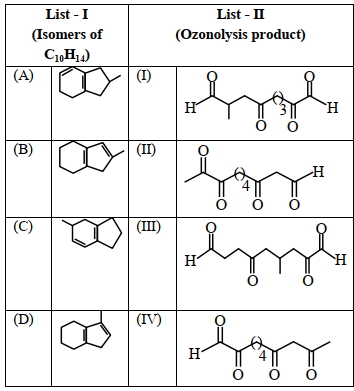
Match List-$I$ with List-$II$. Choose the correct answer from the options given below:
A
$A-II, B-III, C-I, D-IV$
B
$A-III, B-IV, C-I, D-II$
C
$A-III, B-II, C-I, D-IV$
D
$A-I, B-IV, C-III, D-II$
Solution
(B) Ozonolysis involves the cleavage of double bonds to form carbonyl compounds. By analyzing the structure of each isomer in List-$I$ and performing the oxidative cleavage of the double bonds,we can determine the corresponding products in List-$II$.
$(A)$ The isomer has two double bonds,which upon ozonolysis yield a dialdehyde with a methyl substituent. This matches product $(III)$.
$(B)$ The isomer has two double bonds,which upon ozonolysis yield a keto-aldehyde. This matches product $(IV)$.
$(C)$ The isomer has two double bonds,which upon ozonolysis yield a dialdehyde. This matches product $(I)$.
$(D)$ The isomer has two double bonds,which upon ozonolysis yield a keto-aldehyde. This matches product $(II)$.
Thus,the correct matching is $A-III, B-IV, C-I, D-II$.
$(A)$ The isomer has two double bonds,which upon ozonolysis yield a dialdehyde with a methyl substituent. This matches product $(III)$.
$(B)$ The isomer has two double bonds,which upon ozonolysis yield a keto-aldehyde. This matches product $(IV)$.
$(C)$ The isomer has two double bonds,which upon ozonolysis yield a dialdehyde. This matches product $(I)$.
$(D)$ The isomer has two double bonds,which upon ozonolysis yield a keto-aldehyde. This matches product $(II)$.
Thus,the correct matching is $A-III, B-IV, C-I, D-II$.
0 likesView Solution
46
ChemistryDifficultMCQJEE Main · 2025
Given below are the atomic numbers of some group $14$ elements. The atomic number of the element with the lowest melting point is:
A
$14$
B
$6$
C
$82$
D
$50$
Solution
(D) The melting point of group $14$ elements decreases as we move down the group from $C$ to $Sn$,but $Pb$ has a slightly higher melting point than $Sn$ due to its metallic structure and bonding characteristics. The order of melting points is $C > Si > Ge > Pb > Sn$.
Atomic numbers and their corresponding elements:
$Z=6$ $(C)$: $3730 \ ^{\circ}C$
$Z=14$ $(Si)$: $1410 \ ^{\circ}C$
$Z=32$ $(Ge)$: $937 \ ^{\circ}C$
$Z=50$ $(Sn)$: $232 \ ^{\circ}C$
$Z=82$ $(Pb)$: $327 \ ^{\circ}C$
Comparing the given options $(Z=14, 6, 82, 50)$,the element with the lowest melting point is $Sn$ $(Z=50)$.
Atomic numbers and their corresponding elements:
$Z=6$ $(C)$: $3730 \ ^{\circ}C$
$Z=14$ $(Si)$: $1410 \ ^{\circ}C$
$Z=32$ $(Ge)$: $937 \ ^{\circ}C$
$Z=50$ $(Sn)$: $232 \ ^{\circ}C$
$Z=82$ $(Pb)$: $327 \ ^{\circ}C$
Comparing the given options $(Z=14, 6, 82, 50)$,the element with the lowest melting point is $Sn$ $(Z=50)$.
0 likesView Solution
47
ChemistryDifficultMCQJEE Main · 2025
The $pH$ of water is $7$ at $25^{\circ} C$. If water is heated to $80^{\circ} C$,its $pH$ will:
A
Decrease
B
Remain the same
C
$H^{+}$ concentration increases,$OH^{-}$ concentration decreases
D
Increase
Solution
(A) The auto-ionization of water is an endothermic process: $H_2O(l) \rightleftharpoons H^+(aq) + OH^-(aq)$.
As temperature increases,the equilibrium constant $K_W$ increases according to Le Chatelier's principle.
Since $K_W = [H^+][OH^-]$ and at neutrality $[H^+] = [OH^-] = \sqrt{K_W}$,the concentration of $H^+$ ions increases.
Therefore,$pH = -\log[H^+]$ decreases as the temperature rises.
As temperature increases,the equilibrium constant $K_W$ increases according to Le Chatelier's principle.
Since $K_W = [H^+][OH^-]$ and at neutrality $[H^+] = [OH^-] = \sqrt{K_W}$,the concentration of $H^+$ ions increases.
Therefore,$pH = -\log[H^+]$ decreases as the temperature rises.
0 likesView Solution
48
ChemistryMediumMCQJEE Main · 2025
Given below are two statements about $X$-ray spectra of elements :
Statement $(I) :$ $A$ plot of $\sqrt{\nu}$ ($\nu =$ frequency of $X$-rays emitted) vs atomic mass is a straight line.
Statement $(II) :$ $A$ plot of $\nu$ ($\nu =$ frequency of $X$-rays emitted) vs atomic number is a straight line.
In the light of the above statements choose the correct answer from the options given below :
Statement $(I) :$ $A$ plot of $\sqrt{\nu}$ ($\nu =$ frequency of $X$-rays emitted) vs atomic mass is a straight line.
Statement $(II) :$ $A$ plot of $\nu$ ($\nu =$ frequency of $X$-rays emitted) vs atomic number is a straight line.
In the light of the above statements choose the correct answer from the options given below :
A
Statement $I$ is true but Statement $II$ is false
B
Both Statement $I$ and Statement $II$ are true
C
Both Statement $I$ and Statement $II$ are false
D
Statement $I$ is false but Statement $II$ is true
Solution
(C) According to Moseley's law,the frequency $\nu$ of the characteristic $X$-rays emitted by an element is related to its atomic number $Z$ by the equation: $\sqrt{\nu} = a(Z - b)$,where $a$ and $b$ are constants.
This implies that a plot of $\sqrt{\nu}$ versus atomic number $(Z)$ is a straight line.
Statement $(I)$ is false because the plot of $\sqrt{\nu}$ versus atomic mass is not a straight line.
Statement $(II)$ is false because the plot of $\nu$ (not $\sqrt{\nu}$) versus atomic number is not a straight line; rather,$\sqrt{\nu}$ versus atomic number is a straight line.
Therefore,both statements are false.
This implies that a plot of $\sqrt{\nu}$ versus atomic number $(Z)$ is a straight line.
Statement $(I)$ is false because the plot of $\sqrt{\nu}$ versus atomic mass is not a straight line.
Statement $(II)$ is false because the plot of $\nu$ (not $\sqrt{\nu}$) versus atomic number is not a straight line; rather,$\sqrt{\nu}$ versus atomic number is a straight line.
Therefore,both statements are false.
0 likesView Solution
49
ChemistryDifficultMCQJEE Main · 2025
$0.01 \ mol$ of an organic compound $(X)$ containing $10\%$ hydrogen,on complete combustion produced $0.9 \ g \ H_2O$. Molar mass of $(X)$ is $.......... \ g \ mol^{-1}$.
A
$100$
B
$200$
C
$300$
D
$400$
Solution
(A) Moles of $H_2O$ produced $= \frac{0.9 \ g}{18 \ g \ mol^{-1}} = 0.05 \ mol$.
Moles of $H$ atoms $= 0.05 \ mol \times 2 = 0.1 \ mol$.
Mass of $H$ atoms in $0.01 \ mol$ of $(X) = 0.1 \ mol \times 1 \ g \ mol^{-1} = 0.1 \ g$.
Mass of $H$ atoms in $1 \ mol$ of $(X) = \frac{0.1 \ g}{0.01 \ mol} = 10 \ g \ mol^{-1}$.
Given that the compound contains $10\%$ hydrogen by mass,we have:
$10\% = \frac{\text{Mass of } H \text{ in } 1 \ mol \text{ of } (X)}{\text{Molar mass of } (X)} \times 100$.
$10 = \frac{10}{M} \times 100$.
$M = 100 \ g \ mol^{-1}$.
Moles of $H$ atoms $= 0.05 \ mol \times 2 = 0.1 \ mol$.
Mass of $H$ atoms in $0.01 \ mol$ of $(X) = 0.1 \ mol \times 1 \ g \ mol^{-1} = 0.1 \ g$.
Mass of $H$ atoms in $1 \ mol$ of $(X) = \frac{0.1 \ g}{0.01 \ mol} = 10 \ g \ mol^{-1}$.
Given that the compound contains $10\%$ hydrogen by mass,we have:
$10\% = \frac{\text{Mass of } H \text{ in } 1 \ mol \text{ of } (X)}{\text{Molar mass of } (X)} \times 100$.
$10 = \frac{10}{M} \times 100$.
$M = 100 \ g \ mol^{-1}$.
0 likesView Solution
50
ChemistryDifficultMCQJEE Main · 2025
When $81.0 \ g$ of aluminium is allowed to react with $128.0 \ g$ of oxygen gas,the mass of aluminium oxide produced in grams is $..........$ $(Nearest \ integer)$. Given: Molar mass of $Al$ is $27.0 \ g \ mol^{-1}$,Molar mass of $O$ is $16.0 \ g \ mol^{-1}$.
A
$155$
B
$154$
C
$153$
D
$157$
Solution
(C) The balanced chemical equation is: $4Al + 3O_2 \longrightarrow 2Al_2O_3$.
Moles of $Al = \frac{81.0 \ g}{27.0 \ g \ mol^{-1}} = 3.0 \ mol$.
Moles of $O_2 = \frac{128.0 \ g}{32.0 \ g \ mol^{-1}} = 4.0 \ mol$.
According to the stoichiometry,$4 \ mol$ of $Al$ requires $3 \ mol$ of $O_2$.
For $3.0 \ mol$ of $Al$,required $O_2 = \frac{3}{4} \times 3.0 = 2.25 \ mol$.
Since $4.0 \ mol$ of $O_2$ is available,$Al$ is the limiting reagent.
Moles of $Al_2O_3$ produced $= \frac{2}{4} \times 3.0 = 1.5 \ mol$.
Molar mass of $Al_2O_3 = (2 \times 27.0) + (3 \times 16.0) = 54.0 + 48.0 = 102.0 \ g \ mol^{-1}$.
Mass of $Al_2O_3 = 1.5 \ mol \times 102.0 \ g \ mol^{-1} = 153.0 \ g$.
Moles of $Al = \frac{81.0 \ g}{27.0 \ g \ mol^{-1}} = 3.0 \ mol$.
Moles of $O_2 = \frac{128.0 \ g}{32.0 \ g \ mol^{-1}} = 4.0 \ mol$.
According to the stoichiometry,$4 \ mol$ of $Al$ requires $3 \ mol$ of $O_2$.
For $3.0 \ mol$ of $Al$,required $O_2 = \frac{3}{4} \times 3.0 = 2.25 \ mol$.
Since $4.0 \ mol$ of $O_2$ is available,$Al$ is the limiting reagent.
Moles of $Al_2O_3$ produced $= \frac{2}{4} \times 3.0 = 1.5 \ mol$.
Molar mass of $Al_2O_3 = (2 \times 27.0) + (3 \times 16.0) = 54.0 + 48.0 = 102.0 \ g \ mol^{-1}$.
Mass of $Al_2O_3 = 1.5 \ mol \times 102.0 \ g \ mol^{-1} = 153.0 \ g$.
0 likesView Solution
51
ChemistryMediumMCQJEE Main · 2025
$A$ solution of aluminium chloride is electrolysed for $30$ minutes using a current of $2 \ A$. The amount of the aluminium deposited at the cathode is $.................$
[Given : molar mass of aluminium and chlorine are $27 \ g \ mol^{-1}$ and $35.5 \ g \ mol^{-1}$ respectively,Faraday constant $= 96500 \ C \ mol^{-1}$]. (in $g$)
[Given : molar mass of aluminium and chlorine are $27 \ g \ mol^{-1}$ and $35.5 \ g \ mol^{-1}$ respectively,Faraday constant $= 96500 \ C \ mol^{-1}$]. (in $g$)
A
$0.336$
B
$1.007$
C
$1.660$
D
$0.441$
Solution
(A) The reaction at the cathode for the reduction of aluminium is: $Al^{3+} + 3e^- \rightarrow Al(s)$.
According to Faraday's first law of electrolysis,the mass of the substance deposited is given by $m = \frac{M \times I \times t}{n \times F}$.
Here,$M = 27 \ g \ mol^{-1}$,$I = 2 \ A$,$t = 30 \times 60 \ s = 1800 \ s$,$n = 3$,and $F = 96500 \ C \ mol^{-1}$.
Substituting the values: $m = \frac{27 \times 2 \times 1800}{3 \times 96500} = \frac{97200}{289500} \approx 0.336 \ g$.
According to Faraday's first law of electrolysis,the mass of the substance deposited is given by $m = \frac{M \times I \times t}{n \times F}$.
Here,$M = 27 \ g \ mol^{-1}$,$I = 2 \ A$,$t = 30 \times 60 \ s = 1800 \ s$,$n = 3$,and $F = 96500 \ C \ mol^{-1}$.
Substituting the values: $m = \frac{27 \times 2 \times 1800}{3 \times 96500} = \frac{97200}{289500} \approx 0.336 \ g$.
0 likesView Solution
52
ChemistryMediumMCQJEE Main · 2025
Which of the following statements is not true for radioactive decay?
A
Amount of radioactive substance remaining after three half-lives is $1/8$th of the original amount.
B
Decay constant does not depend upon temperature.
C
Decay constant increases with an increase in temperature.
D
Half-life is $\ln 2$ times of $1/\lambda$ (where $\lambda$ is the decay constant).
Solution
(C) Radioactive decay is a first-order nuclear process.
The decay constant $(\lambda)$ is a characteristic property of the radioactive nucleus and is independent of external physical conditions such as temperature,pressure,or chemical environment.
Therefore,the statement that the decay constant increases with an increase in temperature is false.
The decay constant $(\lambda)$ is a characteristic property of the radioactive nucleus and is independent of external physical conditions such as temperature,pressure,or chemical environment.
Therefore,the statement that the decay constant increases with an increase in temperature is false.
0 likesView Solution
53
ChemistryMediumMCQJEE Main · 2025
Lanthanoid ions with $4f^7$ configuration are :
$A$. $Eu^{2+}$
$B$. $Gd^{3+}$
$C$. $Eu^{3+}$
$D$. $Tb^{3+}$
$E$. $Sm^{2+}$
Choose the correct answer from the options given below :
$A$. $Eu^{2+}$
$B$. $Gd^{3+}$
$C$. $Eu^{3+}$
$D$. $Tb^{3+}$
$E$. $Sm^{2+}$
Choose the correct answer from the options given below :
A
$A$ and $B$ only
B
$A$ and $D$ only
C
$B$ and $E$ only
D
$B$ and $C$ only
Solution
(A) The electronic configurations of the given ions are:
$Eu^{2+} (Z=63): [Xe] 4f^7 6s^0$
$Gd^{3+} (Z=64): [Xe] 4f^7 5d^0 6s^0$
$Eu^{3+} (Z=63): [Xe] 4f^6 6s^0$
$Tb^{3+} (Z=65): [Xe] 4f^8 6s^0$
$Sm^{2+} (Z=62): [Xe] 4f^6 6s^0$
Thus,only $Eu^{2+}$ and $Gd^{3+}$ have a $4f^7$ configuration.
$Eu^{2+} (Z=63): [Xe] 4f^7 6s^0$
$Gd^{3+} (Z=64): [Xe] 4f^7 5d^0 6s^0$
$Eu^{3+} (Z=63): [Xe] 4f^6 6s^0$
$Tb^{3+} (Z=65): [Xe] 4f^8 6s^0$
$Sm^{2+} (Z=62): [Xe] 4f^6 6s^0$
Thus,only $Eu^{2+}$ and $Gd^{3+}$ have a $4f^7$ configuration.
0 likesView Solution
54
ChemistryEasyMCQJEE Main · 2025
Given below are two statements:
Statement $I$: $(CH_3)_3C-CH_2-Cl$ will undergo $S_N1$ reaction even though it is a primary halide.
Statement $II$: It will not undergo $S_N2$ reaction very easily even though it is a primary halide.
In the light of the above statements,choose the most appropriate answer from the options given below:
Statement $I$: $(CH_3)_3C-CH_2-Cl$ will undergo $S_N1$ reaction even though it is a primary halide.
Statement $II$: It will not undergo $S_N2$ reaction very easily even though it is a primary halide.
In the light of the above statements,choose the most appropriate answer from the options given below:
A
Statement $I$ is incorrect but Statement $II$ is correct.
B
Both Statement $I$ and Statement $II$ are incorrect.
C
Statement $I$ is correct but Statement $II$ is incorrect.
D
Both Statement $I$ and Statement $II$ are correct.
Solution
(A) The compound $(CH_3)_3C-CH_2-Cl$ is neopentyl chloride.
Statement $I$ is incorrect because neopentyl chloride is a primary halide and forms a highly unstable primary carbocation upon the loss of the chloride ion,making $S_N1$ reactions extremely unfavorable.
Statement $II$ is correct because,although it is a primary halide,the bulky tert-butyl group adjacent to the reaction center causes significant steric hindrance,which makes the $S_N2$ transition state very difficult to achieve,resulting in a very slow reaction rate.
Statement $I$ is incorrect because neopentyl chloride is a primary halide and forms a highly unstable primary carbocation upon the loss of the chloride ion,making $S_N1$ reactions extremely unfavorable.
Statement $II$ is correct because,although it is a primary halide,the bulky tert-butyl group adjacent to the reaction center causes significant steric hindrance,which makes the $S_N2$ transition state very difficult to achieve,resulting in a very slow reaction rate.
0 likesView Solution
55
ChemistryMediumMCQJEE Main · 2025
Which of the following electrolytes can be used to obtain $H_2S_2O_8$ by the process of electrolysis?
A
Dilute solution of sodium sulphate
B
Dilute solution of sulphuric acid
C
Concentrated solution of sulphuric acid
D
Acidified dilute solution of sodium sulphate
Solution
(C) The electrolysis of concentrated sulphuric acid $(H_2SO_4)$ is used to produce peroxydisulphuric acid $(H_2S_2O_8)$.
At the anode,the oxidation of hydrogen sulphate ions $(HSO_4^-)$ occurs:
$2HSO_4^{-} \rightarrow H_2S_2O_8 + 2e^{-}$
At the anode,the oxidation of hydrogen sulphate ions $(HSO_4^-)$ occurs:
$2HSO_4^{-} \rightarrow H_2S_2O_8 + 2e^{-}$
0 likesView Solution
56
ChemistryMediumMCQJEE Main · 2025
The compounds which give positive Fehling's test are:
$(A)$ $C_6H_5CHO$
$(B)$ $C_6H_5COCH_3$
$(C)$ $HOCH_2-CO-(CHOH)_3-CH_2OH$
$(D)$ $CH_3CHO$
$(E)$ $C_6H_5CH_2CHO$
Choose the correct answer from the options given below:
$(A)$ $C_6H_5CHO$
$(B)$ $C_6H_5COCH_3$
$(C)$ $HOCH_2-CO-(CHOH)_3-CH_2OH$
$(D)$ $CH_3CHO$
$(E)$ $C_6H_5CH_2CHO$
Choose the correct answer from the options given below:
A
$A$,$C$ and $D$ Only
B
$A$,$D$ and $E$ Only
C
$C$,$D$ and $E$ Only
D
$A$,$B$ and $C$ Only
Solution
(C) Fehling's test is given by aliphatic aldehydes. Aromatic aldehydes do not give this test.
$(A)$ $C_6H_5CHO$ is an aromatic aldehyde,so it gives a negative test.
$(B)$ $C_6H_5COCH_3$ is a ketone,so it gives a negative test.
$(C)$ $HOCH_2-CO-(CHOH)_3-CH_2OH$ is a ketose sugar (fructose). In alkaline medium,it isomerizes to aldose,thus giving a positive Fehling's test.
$(D)$ $CH_3CHO$ is an aliphatic aldehyde,so it gives a positive test.
$(E)$ $C_6H_5CH_2CHO$ is an aliphatic aldehyde (the aldehyde group is not directly attached to the benzene ring),so it gives a positive test.
Therefore,compounds $(C)$,$(D)$,and $(E)$ give a positive Fehling's test.
$(A)$ $C_6H_5CHO$ is an aromatic aldehyde,so it gives a negative test.
$(B)$ $C_6H_5COCH_3$ is a ketone,so it gives a negative test.
$(C)$ $HOCH_2-CO-(CHOH)_3-CH_2OH$ is a ketose sugar (fructose). In alkaline medium,it isomerizes to aldose,thus giving a positive Fehling's test.
$(D)$ $CH_3CHO$ is an aliphatic aldehyde,so it gives a positive test.
$(E)$ $C_6H_5CH_2CHO$ is an aliphatic aldehyde (the aldehyde group is not directly attached to the benzene ring),so it gives a positive test.
Therefore,compounds $(C)$,$(D)$,and $(E)$ give a positive Fehling's test.
0 likesView Solution
57
ChemistryMediumMCQJEE Main · 2025
In which of the following complexes will the $CFSE$ (Crystal Field Stabilization Energy),$\Delta_0$ be equal to zero?
A
$[Fe(NH_3)_6]Br_2$
B
$[Fe(en)_3]Cl_3$
C
$K_4[Fe(CN)_6]$
D
$K_3[Fe(SCN)_6]$
Solution
(D) The $CFSE$ for an octahedral complex is calculated as: $CFSE = (-0.4 \times n_{t_{2g}} + 0.6 \times n_{e_g}) \Delta_0$.
For $K_3[Fe(SCN)_6]$,the central metal ion is $Fe^{3+}$,which has a $d^5$ configuration.
$SCN^-$ is a weak field ligand,so the electrons are arranged as $t_{2g}^3 e_g^2$.
$CFSE = (-0.4 \times 3 + 0.6 \times 2) \Delta_0 = (-1.2 + 1.2) \Delta_0 = 0 \Delta_0 = 0$.
For $K_3[Fe(SCN)_6]$,the central metal ion is $Fe^{3+}$,which has a $d^5$ configuration.
$SCN^-$ is a weak field ligand,so the electrons are arranged as $t_{2g}^3 e_g^2$.
$CFSE = (-0.4 \times 3 + 0.6 \times 2) \Delta_0 = (-1.2 + 1.2) \Delta_0 = 0 \Delta_0 = 0$.
0 likesView Solution
58
ChemistryMediumMCQJEE Main · 2025
Arrange the following solutions in order of their increasing boiling points.
$(i) \ 10^{-4} \ M \ NaCl$ $(ii) \ 10^{-4} \ M \ \text{Urea}$ $(iii) \ 10^{-3} \ M \ NaCl$ $(iv) \ 10^{-2} \ M \ NaCl$
$(i) \ 10^{-4} \ M \ NaCl$ $(ii) \ 10^{-4} \ M \ \text{Urea}$ $(iii) \ 10^{-3} \ M \ NaCl$ $(iv) \ 10^{-2} \ M \ NaCl$
A
$ii < i < iii < iv$
B
$ii < i \cong iii < iv$
C
$i < ii < iii < iv$
D
$iv < iii < i < ii$
Solution
(A) The elevation in boiling point is given by $\Delta T_{b} = i \cdot K_{b} \cdot m$,where $i$ is the van't Hoff factor and $m$ is the molality (proportional to concentration $C$).
Since $K_{b}$ is constant for the solvent,$\Delta T_{b} \propto i \cdot C$.
Comparing the values of $i \cdot C$: $1 \times 10^{-4} < 2 \times 10^{-4} < 2 \times 10^{-3} < 2 \times 10^{-2}$.
Therefore,the order of increasing boiling points is $(ii) < (i) < (iii) < (iv)$.
Since $K_{b}$ is constant for the solvent,$\Delta T_{b} \propto i \cdot C$.
| Solution | $i \cdot C$ |
| $(i) \ 10^{-4} \ M \ NaCl$ | $2 \times 10^{-4}$ |
| $(ii) \ 10^{-4} \ M \ \text{Urea}$ | $1 \times 10^{-4}$ |
| $(iii) \ 10^{-3} \ M \ NaCl$ | $2 \times 10^{-3}$ |
| $(iv) \ 10^{-2} \ M \ NaCl$ | $2 \times 10^{-2}$ |
Comparing the values of $i \cdot C$: $1 \times 10^{-4} < 2 \times 10^{-4} < 2 \times 10^{-3} < 2 \times 10^{-2}$.
Therefore,the order of increasing boiling points is $(ii) < (i) < (iii) < (iv)$.
0 likesView Solution
59
ChemistryDifficultMCQJEE Main · 2025
The products formed in the following reaction sequence are:
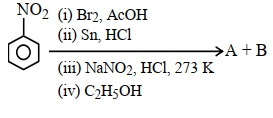
A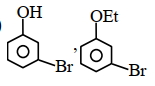
B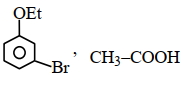
C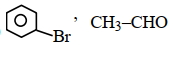
D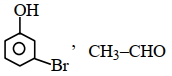
Solution
(D) The reaction sequence is as follows:
$1$. $Nitrobenzene$ reacts with $Br_2$ in $AcOH$ to undergo electrophilic aromatic substitution,forming $m-bromonitrobenzene$ (since $-NO_2$ is a meta-directing group).
$2$. Reduction of $m-bromonitrobenzene$ with $Sn/HCl$ yields $m-bromoaniline$.
$3$. Treatment of $m-bromoaniline$ with $NaNO_2/HCl$ at $273-278 \ K$ results in diazotization,forming $m-bromobenzenediazonium \ chloride$.
$4$. Finally,reaction with ethanol $(C_2H_5OH)$ reduces the diazonium salt to $bromobenzene$ (specifically $m-bromobenzene$ in this context,which is simply $bromobenzene$ as the bromine position is fixed) and ethanol is oxidized to acetaldehyde $(CH_3CHO)$.
Thus,the final products are $bromobenzene$ and $CH_3CHO$.
$1$. $Nitrobenzene$ reacts with $Br_2$ in $AcOH$ to undergo electrophilic aromatic substitution,forming $m-bromonitrobenzene$ (since $-NO_2$ is a meta-directing group).
$2$. Reduction of $m-bromonitrobenzene$ with $Sn/HCl$ yields $m-bromoaniline$.
$3$. Treatment of $m-bromoaniline$ with $NaNO_2/HCl$ at $273-278 \ K$ results in diazotization,forming $m-bromobenzenediazonium \ chloride$.
$4$. Finally,reaction with ethanol $(C_2H_5OH)$ reduces the diazonium salt to $bromobenzene$ (specifically $m-bromobenzene$ in this context,which is simply $bromobenzene$ as the bromine position is fixed) and ethanol is oxidized to acetaldehyde $(CH_3CHO)$.
Thus,the final products are $bromobenzene$ and $CH_3CHO$.
0 likesView Solution
60
ChemistryDifficultMCQJEE Main · 2025
From the magnetic behaviour of $[NiCl_4]^{2-}$ (paramagnetic) and $[Ni(CO)_4]$ (diamagnetic),choose the correct geometry and oxidation state.
A
$[NiCl_4]^{2-}: Ni^{II}$,square planar; $[Ni(CO)_4]: Ni(0)$,square planar
B
$[NiCl_4]^{2-}: Ni^{II}$,tetrahedral; $[Ni(CO)_4]: Ni(0)$,tetrahedral
C
$[NiCl_4]^{2-}: Ni^{II}$,tetrahedral; $[Ni(CO)_4]: Ni^{II}$,square planar
D
$[NiCl_4]^{2-}: Ni(0)$,tetrahedral; $[Ni(CO)_4]: Ni(0)$,square planar
Solution
(B) For $[NiCl_4]^{2-}$: The oxidation state of $Ni$ is $+2$. The electronic configuration is $[Ar] 3d^8$. Due to the weak field ligand $Cl^-$,it undergoes $sp^3$ hybridization,resulting in a tetrahedral geometry with $2$ unpaired electrons,making it paramagnetic.
For $[Ni(CO)_4]$: The oxidation state of $Ni$ is $0$. The electronic configuration is $[Ar] 3d^8 4s^2$. In the presence of the strong field ligand $CO$,the electrons pair up to form $[Ar] 3d^{10} 4s^0$. It undergoes $sp^3$ hybridization,resulting in a tetrahedral geometry with $0$ unpaired electrons,making it diamagnetic.
For $[Ni(CO)_4]$: The oxidation state of $Ni$ is $0$. The electronic configuration is $[Ar] 3d^8 4s^2$. In the presence of the strong field ligand $CO$,the electrons pair up to form $[Ar] 3d^{10} 4s^0$. It undergoes $sp^3$ hybridization,resulting in a tetrahedral geometry with $0$ unpaired electrons,making it diamagnetic.
0 likesView Solution
61
ChemistryDifficultMCQJEE Main · 2025
$A \rightarrow B$. The molecule $A$ changes into its isomeric form $B$ following first-order kinetics at a temperature of $1000 \ K$. If the energy barrier with respect to reactant energy for such isomeric transformation is $191.48 \ kJ \ mol^{-1}$ and the frequency factor is $10^{20} \ s^{-1}$,the time required for $50 \%$ of molecules of $A$ to become $B$ is $..............$ picoseconds (nearest integer). $[R = 8.314 \ J \ K^{-1} \ mol^{-1}]$
A
$23$
B
$65$
C
$70$
D
$69$
Solution
(D) For a first-order reaction,the rate constant $k$ is given by the Arrhenius equation: $k = A e^{-E_a/RT}$.
Substituting the given values: $k = 10^{20} \times e^{-\frac{191.48 \times 10^3}{8.314 \times 1000}}$.
$k = 10^{20} \times e^{-23.031} \approx 10^{20} \times e^{-\ln(10^{10})} = 10^{20} \times 10^{-10} = 10^{10} \ s^{-1}$.
The half-life $t_{1/2}$ is given by: $t_{1/2} = \frac{0.693}{k}$.
$t_{1/2} = \frac{0.693}{10^{10}} = 6.93 \times 10^{-11} \ s$.
Converting to picoseconds $(1 \ ps = 10^{-12} \ s)$: $t_{1/2} = 69.3 \ ps$.
The nearest integer is $69$.
Substituting the given values: $k = 10^{20} \times e^{-\frac{191.48 \times 10^3}{8.314 \times 1000}}$.
$k = 10^{20} \times e^{-23.031} \approx 10^{20} \times e^{-\ln(10^{10})} = 10^{20} \times 10^{-10} = 10^{10} \ s^{-1}$.
The half-life $t_{1/2}$ is given by: $t_{1/2} = \frac{0.693}{k}$.
$t_{1/2} = \frac{0.693}{10^{10}} = 6.93 \times 10^{-11} \ s$.
Converting to picoseconds $(1 \ ps = 10^{-12} \ s)$: $t_{1/2} = 69.3 \ ps$.
The nearest integer is $69$.
0 likesView Solution
62
ChemistryDifficultMCQJEE Main · 2025
Consider the following sequence of reactions:
Nitrobenzene $\xrightarrow[(ii) NaNO_2, HCl, 0^{\circ}C]{(i) Sn + HCl} \text{Benzenediazonium chloride}$ $\xrightarrow{(iii) Cu_2Cl_2} \text{Chlorobenzene}$ $\xrightarrow{(iv) Na, \text{Ether}} A$
Molar mass of the product formed $(A)$ is $.............. \ g \ mol^{-1}$.
Nitrobenzene $\xrightarrow[(ii) NaNO_2, HCl, 0^{\circ}C]{(i) Sn + HCl} \text{Benzenediazonium chloride}$ $\xrightarrow{(iii) Cu_2Cl_2} \text{Chlorobenzene}$ $\xrightarrow{(iv) Na, \text{Ether}} A$
Molar mass of the product formed $(A)$ is $.............. \ g \ mol^{-1}$.
A
$154$
B
$150$
C
$180$
D
$120$
Solution
(A) The reaction sequence is as follows:
$1$. Nitrobenzene is reduced by $Sn + HCl$ to form aniline $(C_6H_5NH_2)$.
$2$. Aniline reacts with $NaNO_2 + HCl$ at $0-5^{\circ}C$ to form benzenediazonium chloride $(C_6H_5N_2^+Cl^-)$.
$3$. Benzenediazonium chloride reacts with $Cu_2Cl_2$ (Sandmeyer reaction) to form chlorobenzene $(C_6H_5Cl)$.
$4$. Chlorobenzene reacts with $Na$ in dry ether (Wurtz-Fittig reaction) to form biphenyl $(C_6H_5-C_6H_5)$.
The final product $(A)$ is biphenyl $(C_{12}H_{10})$.
Molar mass of biphenyl = $(12 \times 12) + (10 \times 1) = 144 + 10 = 154 \ g \ mol^{-1}$.
$1$. Nitrobenzene is reduced by $Sn + HCl$ to form aniline $(C_6H_5NH_2)$.
$2$. Aniline reacts with $NaNO_2 + HCl$ at $0-5^{\circ}C$ to form benzenediazonium chloride $(C_6H_5N_2^+Cl^-)$.
$3$. Benzenediazonium chloride reacts with $Cu_2Cl_2$ (Sandmeyer reaction) to form chlorobenzene $(C_6H_5Cl)$.
$4$. Chlorobenzene reacts with $Na$ in dry ether (Wurtz-Fittig reaction) to form biphenyl $(C_6H_5-C_6H_5)$.
The final product $(A)$ is biphenyl $(C_{12}H_{10})$.
Molar mass of biphenyl = $(12 \times 12) + (10 \times 1) = 144 + 10 = 154 \ g \ mol^{-1}$.
0 likesView Solution
63
ChemistryDifficultMCQJEE Main · 2025
Identify the number of structures from the following which can be correlated to $D$-glyceraldehyde.
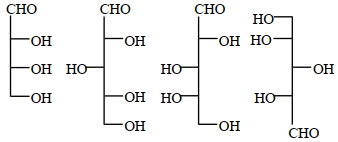
A
$3$
B
$2$
C
$4$
D
$1$
Solution
(A) For a monosaccharide to be correlated to $D$-glyceraldehyde,the $-OH$ group on the lowest chiral carbon (the chiral carbon farthest from the carbonyl group) must be on the right-hand side in the Fischer projection.
Looking at the structures provided in the solution image:
In structure $(A)$,the $-OH$ group on the lowest chiral carbon is on the right.
In structure $(B)$,the $-OH$ group on the lowest chiral carbon is on the right.
In structure $(C)$,the $-OH$ group on the lowest chiral carbon is on the left ($L$-configuration).
In structure $(D)$,the $-OH$ group on the lowest chiral carbon is on the right.
Thus,structures $(A)$,$(B)$,and $(D)$ have the $D$-configuration.
The total number of such structures is $3$.
Looking at the structures provided in the solution image:
In structure $(A)$,the $-OH$ group on the lowest chiral carbon is on the right.
In structure $(B)$,the $-OH$ group on the lowest chiral carbon is on the right.
In structure $(C)$,the $-OH$ group on the lowest chiral carbon is on the left ($L$-configuration).
In structure $(D)$,the $-OH$ group on the lowest chiral carbon is on the right.
Thus,structures $(A)$,$(B)$,and $(D)$ have the $D$-configuration.
The total number of such structures is $3$.
0 likesView Solution
64
ChemistryDifficultMCQJEE Main · 2025
The maximum covalency of a non-metallic group $15$ element '$E$' with the weakest $E-E$ bond is:
A
$5$
B
$3$
C
$6$
D
$4$
Solution
(D) The group $15$ elements are $N, P, As, Sb, Bi$. The $E-E$ bond strength decreases down the group due to the increase in atomic size,making the $N-N$ bond the strongest and the $Bi-Bi$ bond the weakest. However,among non-metallic elements,the $P-P$ bond is significantly stronger than the $N-N$ bond because the small size of the nitrogen atom leads to strong interelectronic repulsion between the lone pairs of the bonded nitrogen atoms. Thus,$N-N$ is the weakest single covalent bond among the non-metallic group $15$ elements.
Nitrogen has a maximum covalency of $4$ because it lacks $d$-orbitals in its valence shell,limiting its ability to expand its octet.
Nitrogen has a maximum covalency of $4$ because it lacks $d$-orbitals in its valence shell,limiting its ability to expand its octet.
0 likesView Solution
65
ChemistryDifficultMCQJEE Main · 2025
Consider the given energy profile diagram for a reaction and choose the correct option:
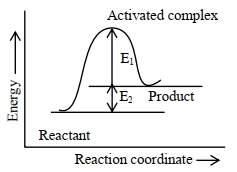
A
Activation energy of backward reaction is $E_1$ and product is more stable than reactant.
B
Activation energy of forward reaction is $E_1+E_2$ and product is more stable than reactant.
C
Activation energy of forward reaction is $E_1+E_2$ and product is less stable than reactant.
D
Activation energy of both forward and backward reaction is $E_1+E_2$ and reactant is more stable than product.
Solution
(C) From the given energy profile diagram:
$1$. The activation energy of the forward reaction $(E_{a,f})$ is the energy difference between the activated complex and the reactant,which is $E_1 + E_2$.
$2$. The energy of the product is higher than the energy of the reactant $(E_{product} > E_{reactant})$.
$3$. Since stability is inversely proportional to energy,the reactant is more stable than the product,or the product is less stable than the reactant.
$1$. The activation energy of the forward reaction $(E_{a,f})$ is the energy difference between the activated complex and the reactant,which is $E_1 + E_2$.
$2$. The energy of the product is higher than the energy of the reactant $(E_{product} > E_{reactant})$.
$3$. Since stability is inversely proportional to energy,the reactant is more stable than the product,or the product is less stable than the reactant.
0 likesView Solution
66
ChemistryDifficultMCQJEE Main · 2025
Match the Compounds (List-$I$) with the appropriate Catalyst/Reagents (List-$II$) for their reduction or conversion into corresponding amines.
Choose the correct answer from the options given below:
| List-$I$ (Compounds) | List-$II$ (Catalyst/Reagents) |
| $A$. $R-CONH_2$ | $I$. $NaOH$ (aqueous) |
| $B$. $C_6H_5NO_2$ | $II$. $H_2 / Ni$ |
| $C$. $R-C \equiv N$ | $III$. $LiAlH_4, H_2O$ |
| $D$. $N$-alkylphthalimide | $IV$. $Sn,HCl$ |
Choose the correct answer from the options given below:
A
$A-III, B-IV, C-II, D-I$
B
$A-II, B-IV, C-III, D-I$
C
$A-II, B-I, C-III, D-IV$
D
$A-III, B-II, C-IV, D-I$
Solution
(A) The correct matches are:
$A$. $R-CONH_2$ (Amide) is reduced to amine $(R-CH_2NH_2)$ using $LiAlH_4, H_2O$ $(III)$.
$B$. $C_6H_5NO_2$ (Nitrobenzene) is reduced to aniline $(C_6H_5NH_2)$ using $Sn, HCl$ $(IV)$.
$C$. $R-C \equiv N$ (Nitrile) is reduced to amine $(R-CH_2NH_2)$ using $H_2 / Ni$ $(II)$.
$D$. $N$-alkylphthalimide is converted to primary amine $(R-NH_2)$ using $NaOH$ (aqueous) $(I)$ in the Gabriel phthalimide synthesis.
Thus,the correct matching is $A-III, B-IV, C-II, D-I$.
$A$. $R-CONH_2$ (Amide) is reduced to amine $(R-CH_2NH_2)$ using $LiAlH_4, H_2O$ $(III)$.
$B$. $C_6H_5NO_2$ (Nitrobenzene) is reduced to aniline $(C_6H_5NH_2)$ using $Sn, HCl$ $(IV)$.
$C$. $R-C \equiv N$ (Nitrile) is reduced to amine $(R-CH_2NH_2)$ using $H_2 / Ni$ $(II)$.
$D$. $N$-alkylphthalimide is converted to primary amine $(R-NH_2)$ using $NaOH$ (aqueous) $(I)$ in the Gabriel phthalimide synthesis.
Thus,the correct matching is $A-III, B-IV, C-II, D-I$.
0 likesView Solution
67
ChemistryMediumMCQJEE Main · 2025
The maximum number of $RBr$ isomers producing $2-$methylbutane by the given sequence of reactions is $...........$ $(Consider the structural isomers only)$
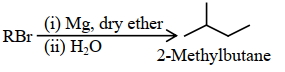
A
$4$
B
$5$
C
$3$
D
$1$
Solution
(A) The reaction sequence $RBr$ $\xrightarrow{(i) Mg, \text{dry ether}} RMgBr$ $\xrightarrow{(ii) H_2O} RH$ represents the formation of an alkane from an alkyl bromide via a Grignard reagent.
To obtain $2-$methylbutane $(C_5H_{12})$ from $RBr$,the alkyl group $R$ must be a $2-$methylbutyl group.
The possible structural isomers of $2-$methylbutyl bromide are:
$1.$ $1-$bromo$-2-$methylbutane
$2.$ $2-$bromo$-2-$methylbutane
$3.$ $2-$bromo$-3-$methylbutane
$4.$ $1-$bromo$-3-$methylbutane
All these isomers,upon reaction with $Mg$ in dry ether followed by hydrolysis with $H_2O$,will yield $2-$methylbutane.
Therefore,the total number of such structural isomers is $4$.
To obtain $2-$methylbutane $(C_5H_{12})$ from $RBr$,the alkyl group $R$ must be a $2-$methylbutyl group.
The possible structural isomers of $2-$methylbutyl bromide are:
$1.$ $1-$bromo$-2-$methylbutane
$2.$ $2-$bromo$-2-$methylbutane
$3.$ $2-$bromo$-3-$methylbutane
$4.$ $1-$bromo$-3-$methylbutane
All these isomers,upon reaction with $Mg$ in dry ether followed by hydrolysis with $H_2O$,will yield $2-$methylbutane.
Therefore,the total number of such structural isomers is $4$.
0 likesView Solution
68
ChemistryMediumMCQJEE Main · 2025
The correct order of the following complexes in terms of their crystal field stabilization energies $(CFSE)$ is:
A
$[Co(NH_3)_4]^{2+} < [Co(NH_3)_6]^{2+} < [Co(en)_3]^{3+} < [Co(NH_3)_6]^{3+}$
B
$[Co(NH_3)_4]^{2+} < [Co(NH_3)_6]^{2+} < [Co(NH_3)_6]^{3+} < [Co(en)_3]^{3+}$
C
$[Co(NH_3)_6]^{2+} < [Co(NH_3)_6]^{3+} < [Co(NH_3)_4]^{2+} < [Co(en)_3]^{3+}$
D
$[Co(en)_3]^{3+} < [Co(NH_3)_6]^{3+} < [Co(NH_3)_6]^{2+} < [Co(NH_3)_4]^{2+}$
Solution
(B) The crystal field stabilization energy $(CFSE)$ depends on two main factors: the oxidation state of the central metal ion and the strength of the ligand.
$1$. Oxidation state: Higher oxidation state leads to higher $CFSE$ (e.g.,$Co^{3+} > Co^{2+}$).
$2$. Ligand strength: Stronger ligands lead to higher $CFSE$ (e.g.,$en > NH_3$).
Comparing the complexes:
- $[Co(NH_3)_4]^{2+}$ has the lowest $CFSE$ due to lower coordination number and lower oxidation state.
- $[Co(NH_3)_6]^{2+}$ has a higher $CFSE$ than $[Co(NH_3)_4]^{2+}$ due to the higher coordination number.
- $[Co(NH_3)_6]^{3+}$ has a higher $CFSE$ than $[Co(NH_3)_6]^{2+}$ due to the higher oxidation state of $Co^{3+}$.
- $[Co(en)_3]^{3+}$ has the highest $CFSE$ because $en$ is a stronger ligand than $NH_3$.
Thus,the correct order is: $[Co(NH_3)_4]^{2+} < [Co(NH_3)_6]^{2+} < [Co(NH_3)_6]^{3+} < [Co(en)_3]^{3+}$.
$1$. Oxidation state: Higher oxidation state leads to higher $CFSE$ (e.g.,$Co^{3+} > Co^{2+}$).
$2$. Ligand strength: Stronger ligands lead to higher $CFSE$ (e.g.,$en > NH_3$).
Comparing the complexes:
- $[Co(NH_3)_4]^{2+}$ has the lowest $CFSE$ due to lower coordination number and lower oxidation state.
- $[Co(NH_3)_6]^{2+}$ has a higher $CFSE$ than $[Co(NH_3)_4]^{2+}$ due to the higher coordination number.
- $[Co(NH_3)_6]^{3+}$ has a higher $CFSE$ than $[Co(NH_3)_6]^{2+}$ due to the higher oxidation state of $Co^{3+}$.
- $[Co(en)_3]^{3+}$ has the highest $CFSE$ because $en$ is a stronger ligand than $NH_3$.
Thus,the correct order is: $[Co(NH_3)_4]^{2+} < [Co(NH_3)_6]^{2+} < [Co(NH_3)_6]^{3+} < [Co(en)_3]^{3+}$.
0 likesView Solution
69
ChemistryMediumMCQJEE Main · 2025
Density of $3 \ M$ $NaCl$ solution is $1.25 \ g/mL$. The molality of the solution is : (in $m$)
A
$1.79$
B
$2$
C
$3$
D
$2.79$
Solution
(D) Given: Molarity $(M)$ = $3 \ M$,Density $(d)$ = $1.25 \ g/mL$,Molar mass of $NaCl$ $(M_w)$ = $58.5 \ g/mol$.
The formula for molality $(m)$ is: $m = \frac{M \times 1000}{1000 \times d - M \times M_w}$.
Substituting the values: $m = \frac{3 \times 1000}{1000 \times 1.25 - 3 \times 58.5}$.
$m = \frac{3000}{1250 - 175.5}$.
$m = \frac{3000}{1074.5} \approx 2.79 \ m$.
The formula for molality $(m)$ is: $m = \frac{M \times 1000}{1000 \times d - M \times M_w}$.
Substituting the values: $m = \frac{3 \times 1000}{1000 \times 1.25 - 3 \times 58.5}$.
$m = \frac{3000}{1250 - 175.5}$.
$m = \frac{3000}{1074.5} \approx 2.79 \ m$.
0 likesView Solution
70
ChemistryMediumMCQJEE Main · 2025
Identify the homoleptic complex(es) that is/are low spin.
$(A) \ [Fe(CN)_5NO]^{2-}$
$(B) \ [CoF_6]^{3-}$
$(C) \ [Fe(CN)_6]^{4-}$
$(D) \ [Co(NH_3)_6]^{3+}$
$(E) \ [Cr(H_2O)_6]^{2+}$
Choose the correct answer from the options given below:
$(A) \ [Fe(CN)_5NO]^{2-}$
$(B) \ [CoF_6]^{3-}$
$(C) \ [Fe(CN)_6]^{4-}$
$(D) \ [Co(NH_3)_6]^{3+}$
$(E) \ [Cr(H_2O)_6]^{2+}$
Choose the correct answer from the options given below:
A
$(B)$ and $(E)$ only
B
$(A)$ and $(C)$ only
C
$(C)$ and $(D)$ only
D
$(C)$ only
Solution
(C) homoleptic complex contains only one type of ligand.
$(A) \ [Fe(CN)_5NO]^{2-}$: Heteroleptic (contains $CN^-$ and $NO$ ligands).
$(B) \ [CoF_6]^{3-}$: Homoleptic,$Co^{3+}$ $(3d^6)$,$F^-$ is a weak field ligand,so it is high spin.
$(C) \ [Fe(CN)_6]^{4-}$: Homoleptic,$Fe^{2+}$ $(3d^6)$,$CN^-$ is a strong field ligand,so it is low spin $(t_{2g}^6 e_g^0)$.
$(D) \ [Co(NH_3)_6]^{3+}$: Homoleptic,$Co^{3+}$ $(3d^6)$,$NH_3$ is a strong field ligand,so it is low spin $(t_{2g}^6 e_g^0)$.
$(E) \ [Cr(H_2O)_6]^{2+}$: Homoleptic,$Cr^{2+}$ $(3d^4)$,$H_2O$ is a weak field ligand,so it is high spin $(t_{2g}^3 e_g^1)$.
Thus,$(C)$ and $(D)$ are homoleptic and low spin complexes.
$(A) \ [Fe(CN)_5NO]^{2-}$: Heteroleptic (contains $CN^-$ and $NO$ ligands).
$(B) \ [CoF_6]^{3-}$: Homoleptic,$Co^{3+}$ $(3d^6)$,$F^-$ is a weak field ligand,so it is high spin.
$(C) \ [Fe(CN)_6]^{4-}$: Homoleptic,$Fe^{2+}$ $(3d^6)$,$CN^-$ is a strong field ligand,so it is low spin $(t_{2g}^6 e_g^0)$.
$(D) \ [Co(NH_3)_6]^{3+}$: Homoleptic,$Co^{3+}$ $(3d^6)$,$NH_3$ is a strong field ligand,so it is low spin $(t_{2g}^6 e_g^0)$.
$(E) \ [Cr(H_2O)_6]^{2+}$: Homoleptic,$Cr^{2+}$ $(3d^4)$,$H_2O$ is a weak field ligand,so it is high spin $(t_{2g}^3 e_g^1)$.
Thus,$(C)$ and $(D)$ are homoleptic and low spin complexes.
0 likesView Solution
71
ChemistryDifficultMCQJEE Main · 2025
Toluene (excess) undergoes the following sequence of reactions:
$(i)$ $CrO_2Cl_2, CS_2$
(ii) $H_3O^+$
(iii) $NaHSO_3$
After filtration,a residue $(A)$ is obtained. This residue $(A)$ reacts with $dil. \ HCl$ to form compound $(B)$.
Identify the structures of residue $(A)$ and compound $(B)$ respectively.
$(i)$ $CrO_2Cl_2, CS_2$
(ii) $H_3O^+$
(iii) $NaHSO_3$
After filtration,a residue $(A)$ is obtained. This residue $(A)$ reacts with $dil. \ HCl$ to form compound $(B)$.
Identify the structures of residue $(A)$ and compound $(B)$ respectively.
A
Residue $(A)$: $C_6H_5CHO$,Compound $(B)$: $C_6H_5COOH$
B
Residue $(A)$: $C_6H_5CH(OCrOHCl_2)_2$,Compound $(B)$: $C_6H_5CHO$
C
Residue $(A)$: $C_6H_5CHO$,Compound $(B)$: $C_6H_5COONa$
D
Residue $(A)$: $C_6H_5CH(OH)SO_3Na$,Compound $(B)$: $C_6H_5CHO$
Solution
(D) $1$. Toluene reacts with $CrO_2Cl_2$ in $CS_2$ followed by hydrolysis $(H_3O^+)$ to form benzaldehyde $(C_6H_5CHO)$ via the Etard reaction.
$2$. Benzaldehyde then reacts with sodium bisulphite $(NaHSO_3)$ to form a crystalline addition product,which is the residue $(A)$. The structure of $(A)$ is $C_6H_5CH(OH)SO_3Na$.
$3$. When this residue $(A)$ is treated with dilute $HCl$,it undergoes hydrolysis to regenerate benzaldehyde,which is compound $(B)$.
$4$. Therefore,residue $(A)$ is $C_6H_5CH(OH)SO_3Na$ and compound $(B)$ is $C_6H_5CHO$.
$2$. Benzaldehyde then reacts with sodium bisulphite $(NaHSO_3)$ to form a crystalline addition product,which is the residue $(A)$. The structure of $(A)$ is $C_6H_5CH(OH)SO_3Na$.
$3$. When this residue $(A)$ is treated with dilute $HCl$,it undergoes hydrolysis to regenerate benzaldehyde,which is compound $(B)$.
$4$. Therefore,residue $(A)$ is $C_6H_5CH(OH)SO_3Na$ and compound $(B)$ is $C_6H_5CHO$.
0 likesView Solution
72
ChemistryDifficultMCQJEE Main · 2025
Given below are two statements:
Statement $I$: Corrosion is an electrochemical phenomenon in which pure metal acts as an anode and impure metal as a cathode.
Statement $II$: The rate of corrosion is more in alkaline medium than in acidic medium.
In the light of the above statements,choose the correct answer from the options given below:
Statement $I$: Corrosion is an electrochemical phenomenon in which pure metal acts as an anode and impure metal as a cathode.
Statement $II$: The rate of corrosion is more in alkaline medium than in acidic medium.
In the light of the above statements,choose the correct answer from the options given below:
A
Both Statement $I$ and Statement $II$ are false
B
Statement $I$ is false but Statement $II$ is true
C
Both Statement $I$ and Statement $II$ are true
D
Statement $I$ is true but Statement $II$ is false
Solution
(D) Statement $I$: Corrosion is an electrochemical process where the metal surface acts as an anode (undergoing oxidation) and the impurities or cathodic regions act as cathodes. This statement is correct.
Statement $II$: Corrosion,particularly the rusting of iron,is significantly accelerated in an acidic medium because the presence of $H^+$ ions facilitates the reduction reaction. In an alkaline medium,the rate of corrosion is generally lower. Therefore,Statement $II$ is false.
Conclusion: Statement $I$ is true,but Statement $II$ is false.
Statement $II$: Corrosion,particularly the rusting of iron,is significantly accelerated in an acidic medium because the presence of $H^+$ ions facilitates the reduction reaction. In an alkaline medium,the rate of corrosion is generally lower. Therefore,Statement $II$ is false.
Conclusion: Statement $I$ is true,but Statement $II$ is false.
0 likesView Solution
73
ChemistryMediumMCQJEE Main · 2025
Niobium $(Nb)$ and ruthenium $(Ru)$ have " $x$ " and " $y$ " number of electrons in their respective $4d$ orbitals. The value of $x+y$ is $...........$
A
$10$
B
$11$
C
$12$
D
$13$
Solution
(B) The electronic configuration of Niobium $(Nb, Z=41)$ is $[Kr] \ 4d^4 \ 5s^1$. Thus,the number of electrons in the $4d$ orbital is $x = 4$.
The electronic configuration of Ruthenium $(Ru, Z=44)$ is $[Kr] \ 4d^7 \ 5s^1$. Thus,the number of electrons in the $4d$ orbital is $y = 7$.
Therefore,the value of $x+y = 4+7 = 11$.
The electronic configuration of Ruthenium $(Ru, Z=44)$ is $[Kr] \ 4d^7 \ 5s^1$. Thus,the number of electrons in the $4d$ orbital is $y = 7$.
Therefore,the value of $x+y = 4+7 = 11$.
0 likesView Solution
74
ChemistryMediumMCQJEE Main · 2025
The complex of $Ni^{2+}$ ion and dimethylglyoxime contains $..........$ number of Hydrogen $(H)$ atoms.
A
$11$
B
$12$
C
$14$
D
$13$
Solution
(C) The chemical formula of the complex formed between $Ni^{2+}$ and dimethylglyoxime $(dmg)$ is $[Ni(dmg)_2]$.
Each dimethylglyoxime ligand has the formula $C_4H_7N_2O_2^-$.
In the complex $[Ni(dmg)_2]$,there are two such ligands.
Total number of $H$ atoms = $2 \times 7 = 14$.
These $14$ hydrogen atoms include $12$ hydrogen atoms from the four methyl groups $(-CH_3)$ and $2$ hydrogen atoms involved in intramolecular hydrogen bonding.
Each dimethylglyoxime ligand has the formula $C_4H_7N_2O_2^-$.
In the complex $[Ni(dmg)_2]$,there are two such ligands.
Total number of $H$ atoms = $2 \times 7 = 14$.
These $14$ hydrogen atoms include $12$ hydrogen atoms from the four methyl groups $(-CH_3)$ and $2$ hydrogen atoms involved in intramolecular hydrogen bonding.
0 likesView Solution
75
ChemistryDifficultMCQJEE Main · 2025
The incorrect statement among the following is:
A
$PH_3$ shows lower proton affinity than $NH_3$.
B
$PF_3$ exists but $NF_5$ does not.
C
$NO_2$ can dimerise easily.
D
$SO_2$ can act as an oxidizing agent,but not as a reducing agent.
Solution
(D) $SO_2$ contains sulfur in the $+4$ oxidation state. \\ Since sulfur can exist in oxidation states ranging from $-2$ to $+6$,$SO_2$ can act as an oxidizing agent (by being reduced to $S$ or $H_2S$) as well as a reducing agent (by being oxidized to $SO_3$ or $SO_4^{2-}$). \\ Therefore,the statement that $SO_2$ cannot act as a reducing agent is incorrect.
0 likesView Solution
76
ChemistryDifficultMCQJEE Main · 2025
$CrCl_3 \cdot xNH_3$ can exist as a complex. $A$ $0.1 \ m$ aqueous solution of this complex shows a depression in freezing point of $0.558^{\circ} C$. Assuming $100 \%$ ionisation of this complex and that the coordination number of $Cr$ is $6$,the complex will be: (Given $K_f = 1.86 \ K \ kg \ mol^{-1}$)
A
$[Cr(NH_3)_6]Cl_3$
B
$[Cr(NH_3)_4Cl_2]Cl$
C
$[Cr(NH_3)_5Cl]Cl_2$
D
$[Cr(NH_3)_3Cl_3]$
Solution
(C) Given: $\Delta T_f = 0.558^{\circ} C$,$K_f = 1.86 \ K \ kg \ mol^{-1}$,$m = 0.1 \ m$.
Using the formula for depression in freezing point: $\Delta T_f = i \times K_f \times m$.
Substituting the values: $0.558 = i \times 1.86 \times 0.1$.
Solving for $i$: $i = 0.558 / 0.186 = 3$.
Since the van't Hoff factor $i = 3$,the complex dissociates into $3$ ions.
For the complex $[Cr(NH_3)_5Cl]Cl_2$,the dissociation is $[Cr(NH_3)_5Cl]Cl_2 \rightarrow [Cr(NH_3)_5Cl]^{2+} + 2Cl^{-}$,which yields $1 + 2 = 3$ ions.
Thus,the complex is $[Cr(NH_3)_5Cl]Cl_2$.
Using the formula for depression in freezing point: $\Delta T_f = i \times K_f \times m$.
Substituting the values: $0.558 = i \times 1.86 \times 0.1$.
Solving for $i$: $i = 0.558 / 0.186 = 3$.
Since the van't Hoff factor $i = 3$,the complex dissociates into $3$ ions.
For the complex $[Cr(NH_3)_5Cl]Cl_2$,the dissociation is $[Cr(NH_3)_5Cl]Cl_2 \rightarrow [Cr(NH_3)_5Cl]^{2+} + 2Cl^{-}$,which yields $1 + 2 = 3$ ions.
Thus,the complex is $[Cr(NH_3)_5Cl]Cl_2$.
0 likesView Solution
77
ChemistryDifficultMCQJEE Main · 2025
$FeO_4^{2-}$ $\xrightarrow{2.0 \ V} Fe^{3+}$ $\xrightarrow{0.8 \ V} Fe^{2+}$ $\xrightarrow{-0.44 \ V} Fe^0$
In the above diagram,the standard electrode potentials are given in volts. The value of $E_{FeO_4^{2-}/Fe^{2+}}^{\Theta}$ is: (in $V$)
In the above diagram,the standard electrode potentials are given in volts. The value of $E_{FeO_4^{2-}/Fe^{2+}}^{\Theta}$ is: (in $V$)
A
$1.7$
B
$1.2$
C
$2.1$
D
$1.4$
Solution
(A) The reaction $FeO_4^{2-} \rightarrow Fe^{2+}$ involves a change in oxidation state from $+6$ to $+2$,so the number of electrons involved is $n_4 = 4$.
This process can be broken down into two steps:
$1) FeO_4^{2-} + 3e^- \rightarrow Fe^{3+} \quad (E_1^{\Theta} = 2.0 \ V, n_1 = 3)$
$2) Fe^{3+} + 1e^- \rightarrow Fe^{2+} \quad (E_2^{\Theta} = 0.8 \ V, n_2 = 1)$
The total Gibbs free energy change is given by $\Delta G_4^{\Theta} = \Delta G_1^{\Theta} + \Delta G_2^{\Theta}$.
Using $\Delta G^{\Theta} = -nFE^{\Theta}$,we get:
$-n_4 F E_4^{\Theta} = -n_1 F E_1^{\Theta} - n_2 F E_2^{\Theta}$
$n_4 E_4^{\Theta} = n_1 E_1^{\Theta} + n_2 E_2^{\Theta}$
$4 \times E_4^{\Theta} = (3 \times 2.0) + (1 \times 0.8)$
$4 E_4^{\Theta} = 6.0 + 0.8 = 6.8$
$E_4^{\Theta} = \frac{6.8}{4} = 1.7 \ V$.
This process can be broken down into two steps:
$1) FeO_4^{2-} + 3e^- \rightarrow Fe^{3+} \quad (E_1^{\Theta} = 2.0 \ V, n_1 = 3)$
$2) Fe^{3+} + 1e^- \rightarrow Fe^{2+} \quad (E_2^{\Theta} = 0.8 \ V, n_2 = 1)$
The total Gibbs free energy change is given by $\Delta G_4^{\Theta} = \Delta G_1^{\Theta} + \Delta G_2^{\Theta}$.
Using $\Delta G^{\Theta} = -nFE^{\Theta}$,we get:
$-n_4 F E_4^{\Theta} = -n_1 F E_1^{\Theta} - n_2 F E_2^{\Theta}$
$n_4 E_4^{\Theta} = n_1 E_1^{\Theta} + n_2 E_2^{\Theta}$
$4 \times E_4^{\Theta} = (3 \times 2.0) + (1 \times 0.8)$
$4 E_4^{\Theta} = 6.0 + 0.8 = 6.8$
$E_4^{\Theta} = \frac{6.8}{4} = 1.7 \ V$.
0 likesView Solution
78
ChemistryMediumMCQJEE Main · 2025
Match the List-$I$ with List-$II$:
Choose the correct answer from the options given below:
| List-$I$ Name reaction | List-$II$ Product obtainable |
| $A.$ Swarts reaction | $I.$ Ethyl benzene |
| $B.$ Sandmeyer's reaction | $II.$ Ethyl iodide |
| $C.$ Wurtz Fittig reaction | $III.$ Cyanobenzene |
| $D.$ Finkelstein reaction | $IV.$ Ethyl fluoride |
Choose the correct answer from the options given below:
A
$A-II, B-III, C-I, D-IV$
B
$A-IV, B-I, C-III, D-II$
C
$A-IV, B-III, C-I, D-II$
D
$A-II, B-I, C-III, D-IV$
Solution
(C) The correct matches are as follows:
$A.$ Swarts reaction: Used for the preparation of alkyl fluorides,e.g.,$CH_3CH_2F$ (Ethyl fluoride).
$B.$ Sandmeyer's reaction: Used to convert diazonium salts to aryl halides or cyanides,e.g.,$C_6H_5CN$ (Cyanobenzene).
$C.$ Wurtz-Fittig reaction: Used for the synthesis of alkyl benzenes,e.g.,$C_6H_5CH_2CH_3$ (Ethyl benzene).
$D.$ Finkelstein reaction: Used for the preparation of alkyl iodides from alkyl chlorides/bromides,e.g.,$CH_3CH_2I$ (Ethyl iodide).
Therefore,the correct sequence is $A-IV, B-III, C-I, D-II$.
$A.$ Swarts reaction: Used for the preparation of alkyl fluorides,e.g.,$CH_3CH_2F$ (Ethyl fluoride).
$B.$ Sandmeyer's reaction: Used to convert diazonium salts to aryl halides or cyanides,e.g.,$C_6H_5CN$ (Cyanobenzene).
$C.$ Wurtz-Fittig reaction: Used for the synthesis of alkyl benzenes,e.g.,$C_6H_5CH_2CH_3$ (Ethyl benzene).
$D.$ Finkelstein reaction: Used for the preparation of alkyl iodides from alkyl chlorides/bromides,e.g.,$CH_3CH_2I$ (Ethyl iodide).
Therefore,the correct sequence is $A-IV, B-III, C-I, D-II$.
0 likesView Solution
79
ChemistryMediumMCQJEE Main · 2025
Given below are two statements:
Statement $I:$ Fructose does not contain an aldehydic group but still reduces Tollen's reagent.
Statement $II:$ In the presence of base,fructose undergoes rearrangement to give glucose.
In the light of the above statements,choose the correct answer from the options given below:
Statement $I:$ Fructose does not contain an aldehydic group but still reduces Tollen's reagent.
Statement $II:$ In the presence of base,fructose undergoes rearrangement to give glucose.
In the light of the above statements,choose the correct answer from the options given below:
A
Statement $I$ is false but Statement $II$ is true
B
Both Statement $I$ and Statement $II$ are true
C
Both Statement $I$ and Statement $II$ are false
D
Statement $I$ is true but Statement $II$ is false
Solution
(B) Statement $I$ is true: Fructose is a ketohexose and does not contain an aldehydic group. However,in the alkaline medium of Tollen's reagent,it undergoes tautomerization to form an enediol intermediate,which then rearranges to form aldoses like glucose and mannose. These aldoses contain an aldehydic group and thus reduce Tollen's reagent.
Statement $II$ is true: As shown in the reaction,in the presence of a base,fructose undergoes tautomerization to form an enediol intermediate,which further rearranges to give a mixture of glucose and mannose.
Statement $II$ is true: As shown in the reaction,in the presence of a base,fructose undergoes tautomerization to form an enediol intermediate,which further rearranges to give a mixture of glucose and mannose.
0 likesView Solution
80
ChemistryMediumMCQJEE Main · 2025
The $d$-electronic configuration of an octahedral $Co(II)$ complex having magnetic moment of $3.95 \ BM$ is :
A
$t_{2g}^6 e_g^1$
B
$t_{2g}^3 e_g^0$
C
$t_{2g}^5 e_g^2$
D
$e^4 t_2^3$
Solution
(C) The magnetic moment $\mu$ is given by the formula $\mu = \sqrt{n(n+2)} \ BM$,where $n$ is the number of unpaired electrons.
Given $\mu = 3.95 \ BM$,we have $\sqrt{n(n+2)} \approx 3.95$,which implies $n(n+2) \approx 15.6$,so $n \approx 3$.
$Co(II)$ has a $3d^7$ configuration.
In an octahedral field,the $d$-orbitals split into $t_{2g}$ and $e_g$ sets.
For a $d^7$ system with $3$ unpaired electrons,the configuration is $t_{2g}^5 e_g^2$ (high spin).
This corresponds to $5$ electrons in $t_{2g}$ (with $1$ unpaired) and $2$ electrons in $e_g$ (with $2$ unpaired),totaling $3$ unpaired electrons.
Given $\mu = 3.95 \ BM$,we have $\sqrt{n(n+2)} \approx 3.95$,which implies $n(n+2) \approx 15.6$,so $n \approx 3$.
$Co(II)$ has a $3d^7$ configuration.
In an octahedral field,the $d$-orbitals split into $t_{2g}$ and $e_g$ sets.
For a $d^7$ system with $3$ unpaired electrons,the configuration is $t_{2g}^5 e_g^2$ (high spin).
This corresponds to $5$ electrons in $t_{2g}$ (with $1$ unpaired) and $2$ electrons in $e_g$ (with $2$ unpaired),totaling $3$ unpaired electrons.
0 likesView Solution
81
ChemistryMediumMCQJEE Main · 2025
The complex that shows Facial - Meridional isomerism is
A
$[Co(NH_3)_3Cl_3]$
B
$[Co(NH_3)_4Cl_2]^{+}$
C
$[Co(en)_3]^{3+}$
D
$[Co(en)_2Cl_2]^{+}$
Solution
(A) $Ma_3b_3$ type complexes show Facial - Meridional isomerism.
$(i)$ $[Co(NH_3)_3Cl_3] \Rightarrow Ma_3b_3$
$(ii)$ $[Co(NH_3)_4Cl_2]^{+} \Rightarrow Ma_4b_2$
$(iii)$ $[Co(en)_3]^{3+} \Rightarrow M(AA)_3$
$(iv)$ $[Co(en)_2Cl_2]^{+} \Rightarrow M(AA)_2b_2$
Here,$a = NH_3$,$b = Cl^{-}$,and $AA = en$ (ethylenediamine).
Thus,only $[Co(NH_3)_3Cl_3]$ corresponds to the $Ma_3b_3$ type.
$(i)$ $[Co(NH_3)_3Cl_3] \Rightarrow Ma_3b_3$
$(ii)$ $[Co(NH_3)_4Cl_2]^{+} \Rightarrow Ma_4b_2$
$(iii)$ $[Co(en)_3]^{3+} \Rightarrow M(AA)_3$
$(iv)$ $[Co(en)_2Cl_2]^{+} \Rightarrow M(AA)_2b_2$
Here,$a = NH_3$,$b = Cl^{-}$,and $AA = en$ (ethylenediamine).
Thus,only $[Co(NH_3)_3Cl_3]$ corresponds to the $Ma_3b_3$ type.
0 likesView Solution
82
ChemistryMediumMCQJEE Main · 2025
The major product of the following reaction is :
$CH_3-CH_2-CHO \xrightarrow[\text{reflux}]{\text{excess } HCHO / \text{alkali}} ?$
$CH_3-CH_2-CHO \xrightarrow[\text{reflux}]{\text{excess } HCHO / \text{alkali}} ?$
A
$CH_3-CH_2-CH_2-OH$
B
$CH_3-CH(CH_2OH)_2$
C
$CH_3-C(CH_2OH)_2-CHO$
D
$CH_3-C(=CH_2)-CHO$
Solution
(C) The reaction of $CH_3-CH_2-CHO$ with excess $HCHO$ in the presence of an alkali involves two steps:
$1$. Multiple cross-aldol condensation: The $\alpha$-hydrogens of propanal are replaced by hydroxymethyl groups $(CH_2OH)$ through reaction with $HCHO$. Since propanal has two $\alpha$-hydrogens,both are replaced to form $CH_3-C(CH_2OH)_2-CHO$.
$2$. Cross-Cannizzaro reaction: The remaining aldehyde group $(-CHO)$ is then reduced to a primary alcohol $(-CH_2OH)$ by the excess $HCHO$,which itself gets oxidized to formate.
The final product is $CH_3-C(CH_2OH)_3$.
$1$. Multiple cross-aldol condensation: The $\alpha$-hydrogens of propanal are replaced by hydroxymethyl groups $(CH_2OH)$ through reaction with $HCHO$. Since propanal has two $\alpha$-hydrogens,both are replaced to form $CH_3-C(CH_2OH)_2-CHO$.
$2$. Cross-Cannizzaro reaction: The remaining aldehyde group $(-CHO)$ is then reduced to a primary alcohol $(-CH_2OH)$ by the excess $HCHO$,which itself gets oxidized to formate.
The final product is $CH_3-C(CH_2OH)_3$.
0 likesView Solution
83
ChemistryMediumMCQJEE Main · 2025
What amount of bromine will be required to convert $2 \ g$ of phenol into $2, 4, 6-$tribromophenol (in $g$)? $($Given molar mass in $g \ mol^{-1}$ of $C, H, O, Br$ are $12, 1, 16, 80$ respectively$)$
A
$10.22$
B
$6.0$
C
$4.0$
D
$20.44$
Solution
(A) The reaction of phenol with bromine water is: $C_6H_5OH + 3Br_2 \rightarrow C_6H_2Br_3OH + 3HBr$
Molar mass of phenol $(C_6H_5OH) = (6 \times 12) + (6 \times 1) + 16 = 72 + 6 + 16 = 94 \ g \ mol^{-1}$.
Moles of phenol = $\frac{2 \ g}{94 \ g \ mol^{-1}} = 0.02128 \ mol$.
According to the stoichiometry,$1 \ mol$ of phenol reacts with $3 \ mol$ of $Br_2$.
Moles of $Br_2$ required = $3 \times 0.02128 = 0.06384 \ mol$.
Molar mass of $Br_2 = 2 \times 80 = 160 \ g \ mol^{-1}$.
Mass of $Br_2$ required = $0.06384 \ mol \times 160 \ g \ mol^{-1} = 10.2144 \ g \approx 10.22 \ g$.
Molar mass of phenol $(C_6H_5OH) = (6 \times 12) + (6 \times 1) + 16 = 72 + 6 + 16 = 94 \ g \ mol^{-1}$.
Moles of phenol = $\frac{2 \ g}{94 \ g \ mol^{-1}} = 0.02128 \ mol$.
According to the stoichiometry,$1 \ mol$ of phenol reacts with $3 \ mol$ of $Br_2$.
Moles of $Br_2$ required = $3 \times 0.02128 = 0.06384 \ mol$.
Molar mass of $Br_2 = 2 \times 80 = 160 \ g \ mol^{-1}$.
Mass of $Br_2$ required = $0.06384 \ mol \times 160 \ g \ mol^{-1} = 10.2144 \ g \approx 10.22 \ g$.
0 likesView Solution
84
ChemistryMediumMCQJEE Main · 2025
The correct set of ions (aqueous solution) with the same colour from the following is:
A
$V^{2+}, Cr^{3+}, Mn^{3+}$
B
$Zn^{2+}, V^{3+}, Fe^{3+}$
C
$Ti^{4+}, V^{4+}, Mn^{2+}$
D
$Sc^{3+}, Ti^{3+}, Cr^{2+}$
Solution
(A) $I$. $V^{2+}$ is violet,$Cr^{3+}$ is violet,and $Mn^{3+}$ is violet. All three ions exhibit a violet colour in aqueous solution.
$II$. $Zn^{2+}$ is colourless,$V^{3+}$ is green,and $Fe^{3+}$ is yellow.
$III$. $Ti^{4+}$ is colourless,$V^{4+}$ is blue,and $Mn^{2+}$ is pink.
$IV$. $Sc^{3+}$ is colourless,$Ti^{3+}$ is purple,and $Cr^{2+}$ is blue.
Therefore,the set with the same colour is $V^{2+}, Cr^{3+}, Mn^{3+}$.
$II$. $Zn^{2+}$ is colourless,$V^{3+}$ is green,and $Fe^{3+}$ is yellow.
$III$. $Ti^{4+}$ is colourless,$V^{4+}$ is blue,and $Mn^{2+}$ is pink.
$IV$. $Sc^{3+}$ is colourless,$Ti^{3+}$ is purple,and $Cr^{2+}$ is blue.
Therefore,the set with the same colour is $V^{2+}, Cr^{3+}, Mn^{3+}$.
0 likesView Solution
85
ChemistryMediumMCQJEE Main · 2025
Which among the following react with Hinsberg's reagent? Choose the correct answer from the options given below:
$(A)$ $C_6H_5NH_2$
$(2)$ $C_6H_5N(CH_3)_2$
$(C)$ $CH_3NH_2$
$(4)$ $N(CH_3)_3$
$(E)$ $(C_6H_5)_2NH$
$(A)$ $C_6H_5NH_2$
$(2)$ $C_6H_5N(CH_3)_2$
$(C)$ $CH_3NH_2$
$(4)$ $N(CH_3)_3$
$(E)$ $(C_6H_5)_2NH$
A
$A$ and $2$ only
B
$C$ and $4$ only
C
$A, C$ and $E$ only
D
$2, 4$ and $E$ only
Solution
(C) Hinsberg's reagent is benzenesulfonyl chloride $(C_6H_5SO_2Cl)$.
It reacts with $1^{\circ}$ and $2^{\circ}$ amines because they possess at least one hydrogen atom attached to the nitrogen atom.
$(A)$ $C_6H_5NH_2$ is a $1^{\circ}$ amine (reacts).
$(2)$ $C_6H_5N(CH_3)_2$ is a $3^{\circ}$ amine (does not react).
$(C)$ $CH_3NH_2$ is a $1^{\circ}$ amine (reacts).
$(4)$ $N(CH_3)_3$ is a $3^{\circ}$ amine (does not react).
$(E)$ $(C_6H_5)_2NH$ is a $2^{\circ}$ amine (reacts).
Therefore,$A, C$ and $E$ react with Hinsberg's reagent.
It reacts with $1^{\circ}$ and $2^{\circ}$ amines because they possess at least one hydrogen atom attached to the nitrogen atom.
$(A)$ $C_6H_5NH_2$ is a $1^{\circ}$ amine (reacts).
$(2)$ $C_6H_5N(CH_3)_2$ is a $3^{\circ}$ amine (does not react).
$(C)$ $CH_3NH_2$ is a $1^{\circ}$ amine (reacts).
$(4)$ $N(CH_3)_3$ is a $3^{\circ}$ amine (does not react).
$(E)$ $(C_6H_5)_2NH$ is a $2^{\circ}$ amine (reacts).
Therefore,$A, C$ and $E$ react with Hinsberg's reagent.
0 likesView Solution
86
ChemistryDifficultMCQJEE Main · 2025
Consider the following sequence of reactions to produce major product $(A)$. Molar mass of product $(A)$ is $........... \ g \ mol^{-1}$. (Given molar mass in $g \ mol^{-1}$ of $C : 12, H : 1, O : 16, Br : 80, N : 14, P : 31$)
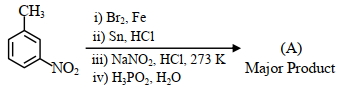
A
$173$
B
$172$
C
$171$
D
$174$
Solution
(C) The starting material is $3$-nitrotoluene.
$1$. Bromination with $Br_2/Fe$ gives $2$-bromo-$5$-nitrotoluene.
$2$. Reduction with $Sn/HCl$ converts the $-NO_2$ group to $-NH_2$,yielding $5$-amino-$2$-bromotoluene.
$3$. Diazotization with $NaNO_2/HCl$ at $273 \ K$ converts the $-NH_2$ group to a diazonium salt,$-N_2^+Cl^-$.
$4$. Reduction with $H_3PO_2/H_2O$ removes the diazonium group,resulting in $2$-bromotoluene as the major product $(A)$.
The chemical formula of $2$-bromotoluene is $C_7H_7Br$.
Molar mass $= (7 \times 12) + (7 \times 1) + 80 = 84 + 7 + 80 = 171 \ g \ mol^{-1}$.
$1$. Bromination with $Br_2/Fe$ gives $2$-bromo-$5$-nitrotoluene.
$2$. Reduction with $Sn/HCl$ converts the $-NO_2$ group to $-NH_2$,yielding $5$-amino-$2$-bromotoluene.
$3$. Diazotization with $NaNO_2/HCl$ at $273 \ K$ converts the $-NH_2$ group to a diazonium salt,$-N_2^+Cl^-$.
$4$. Reduction with $H_3PO_2/H_2O$ removes the diazonium group,resulting in $2$-bromotoluene as the major product $(A)$.
The chemical formula of $2$-bromotoluene is $C_7H_7Br$.
Molar mass $= (7 \times 12) + (7 \times 1) + 80 = 84 + 7 + 80 = 171 \ g \ mol^{-1}$.
0 likesView Solution
87
ChemistryDifficultMCQJEE Main · 2025
For the thermal decomposition of $N_2O_{5(g)}$ at constant volume,the following table can be formed for the reaction mentioned below:
$2N_2O_{5(g)} \rightarrow 2N_2O_{4(g)} + O_{2(g)}$
$X = . . . . . . \times 10^{-3} \ atm$ [nearest integer]
Given: Rate constant for the reaction is $4.606 \times 10^{-2} \ s^{-1}$.
$2N_2O_{5(g)} \rightarrow 2N_2O_{4(g)} + O_{2(g)}$
| $S.NO$ | $Time/s$ | Total pressure $(atm)$ |
| $1.$ | $0$ | $0.6$ |
| $2.$ | $100$ | $X$ |
$X = . . . . . . \times 10^{-3} \ atm$ [nearest integer]
Given: Rate constant for the reaction is $4.606 \times 10^{-2} \ s^{-1}$.
A
$500$
B
$700$
C
$800$
D
$900$
Solution
(D) The reaction is $2N_2O_{5(g)} \rightarrow 2N_2O_{4(g)} + O_{2(g)}$.
For a first-order reaction,the rate constant $k$ is given by $k = \frac{2.303}{t} \log \frac{P_0}{P_t}$,where $P_0$ is the initial pressure of $N_2O_5$ and $P_t$ is the pressure at time $t$.
Given $k = 4.606 \times 10^{-2} \ s^{-1}$ and $t = 100 \ s$.
$4.606 \times 10^{-2} = \frac{2.303}{100} \log \frac{0.6}{P_{N_2O_5}}$
$2 = \log \frac{0.6}{P_{N_2O_5}} \Rightarrow \frac{0.6}{P_{N_2O_5}} = 10^2 = 100$.
$P_{N_2O_5} = \frac{0.6}{100} = 0.006 \ atm$.
Let $x$ be the pressure of $N_2O_5$ decomposed. Then $0.6 - x = 0.006 \Rightarrow x = 0.594 \ atm$.
The total pressure $P_{total} = (0.6 - x) + x + \frac{x}{2} = 0.6 + \frac{x}{2}$.
$P_{total} = 0.6 + \frac{0.594}{2} = 0.6 + 0.297 = 0.897 \ atm$.
$P_{total} = 897 \times 10^{-3} \ atm$.
Rounding to the nearest integer,$X = 897$.
For a first-order reaction,the rate constant $k$ is given by $k = \frac{2.303}{t} \log \frac{P_0}{P_t}$,where $P_0$ is the initial pressure of $N_2O_5$ and $P_t$ is the pressure at time $t$.
Given $k = 4.606 \times 10^{-2} \ s^{-1}$ and $t = 100 \ s$.
$4.606 \times 10^{-2} = \frac{2.303}{100} \log \frac{0.6}{P_{N_2O_5}}$
$2 = \log \frac{0.6}{P_{N_2O_5}} \Rightarrow \frac{0.6}{P_{N_2O_5}} = 10^2 = 100$.
$P_{N_2O_5} = \frac{0.6}{100} = 0.006 \ atm$.
Let $x$ be the pressure of $N_2O_5$ decomposed. Then $0.6 - x = 0.006 \Rightarrow x = 0.594 \ atm$.
The total pressure $P_{total} = (0.6 - x) + x + \frac{x}{2} = 0.6 + \frac{x}{2}$.
$P_{total} = 0.6 + \frac{0.594}{2} = 0.6 + 0.297 = 0.897 \ atm$.
$P_{total} = 897 \times 10^{-3} \ atm$.
Rounding to the nearest integer,$X = 897$.
0 likesView Solution
88
ChemistryDifficultMCQJEE Main · 2025
Standard electrode potentials for a few half cells are mentioned below:
$E^0_{Cu^{2+}/Cu} = 0.34 \ V, E^0_{Zn^{2+}/Zn} = -0.76 \ V$
$E^0_{Ag^{+}/Ag} = 0.80 \ V, E^0_{Mg^{2+}/Mg} = -2.37 \ V$
Which one of the following cells gives the most negative value of $\Delta G^0$?
$E^0_{Cu^{2+}/Cu} = 0.34 \ V, E^0_{Zn^{2+}/Zn} = -0.76 \ V$
$E^0_{Ag^{+}/Ag} = 0.80 \ V, E^0_{Mg^{2+}/Mg} = -2.37 \ V$
Which one of the following cells gives the most negative value of $\Delta G^0$?
A
$Zn \mid Zn^{2+}(1 \ M) \parallel Ag^{+}(1 \ M) \mid Ag$
B
$Zn \mid Zn^{2+}(1 \ M) \parallel Mg^{2+}(1 \ M) \mid Mg$
C
$Ag \mid Ag^{+}(1 \ M) \parallel Mg^{2+}(1 \ M) \mid Mg$
D
$Cu \mid Cu^{2+}(1 \ M) \parallel Ag^{+}(1 \ M) \mid Ag$
Solution
(A) The relationship between standard Gibbs free energy change and standard cell potential is given by $\Delta G^0 = -nFE^0_{cell}$.
For a cell to have the most negative $\Delta G^0$,it must have the most positive $E^0_{cell}$ value.
$E^0_{cell} = E^0_{cathode} - E^0_{anode}$.
$A) \ E^0_{cell} = 0.80 - (-0.76) = 1.56 \ V; \Delta G^0 = -2 \times F \times 1.56 = -3.12 \ F$
$B) \ E^0_{cell} = -2.37 - (-0.76) = -1.61 \ V; \Delta G^0 = -2 \times F \times (-1.61) = +3.22 \ F$
$C) \ E^0_{cell} = -2.37 - 0.80 = -3.17 \ V; \Delta G^0 = -2 \times F \times (-3.17) = +6.34 \ F$
$D) \ E^0_{cell} = 0.80 - 0.34 = 0.46 \ V; \Delta G^0 = -2 \times F \times 0.46 = -0.92 \ F$
Comparing the values,option $(A)$ gives the most negative $\Delta G^0$.
For a cell to have the most negative $\Delta G^0$,it must have the most positive $E^0_{cell}$ value.
$E^0_{cell} = E^0_{cathode} - E^0_{anode}$.
$A) \ E^0_{cell} = 0.80 - (-0.76) = 1.56 \ V; \Delta G^0 = -2 \times F \times 1.56 = -3.12 \ F$
$B) \ E^0_{cell} = -2.37 - (-0.76) = -1.61 \ V; \Delta G^0 = -2 \times F \times (-1.61) = +3.22 \ F$
$C) \ E^0_{cell} = -2.37 - 0.80 = -3.17 \ V; \Delta G^0 = -2 \times F \times (-3.17) = +6.34 \ F$
$D) \ E^0_{cell} = 0.80 - 0.34 = 0.46 \ V; \Delta G^0 = -2 \times F \times 0.46 = -0.92 \ F$
Comparing the values,option $(A)$ gives the most negative $\Delta G^0$.
0 likesView Solution
89
ChemistryMediumMCQJEE Main · 2025
The $\alpha-$helix and $\beta-$pleated sheet structures of protein are associated with its:
A
quaternary structure
B
primary structure
C
secondary structure
D
tertiary structure
Solution
(C) The $\alpha-$helix and $\beta-$pleated sheet are common types of secondary structures of proteins.
These structures are stabilized primarily by hydrogen bonds between the carbonyl oxygen and the amide hydrogen of the polypeptide backbone.
These structures are stabilized primarily by hydrogen bonds between the carbonyl oxygen and the amide hydrogen of the polypeptide backbone.
0 likesView Solution
90
ChemistryDifficultMCQJEE Main · 2025
Given below are two statements: Consider the following reaction: $R_2C=O + H_2O \rightleftharpoons R_2C(OH)_2$.
Statement $I$: In the case of formaldehyde $(HCHO)$,$K_{eq}$ is about $2280$,due to small substituents,hydration is faster.
Statement $II$: In the case of trichloroacetaldehyde $(CCl_3CHO)$,$K_{eq}$ is about $2000$ due to the $-I$ effect of $-Cl$ atoms.
In the light of the above statements,choose the correct answer from the options given below:
Statement $I$: In the case of formaldehyde $(HCHO)$,$K_{eq}$ is about $2280$,due to small substituents,hydration is faster.
Statement $II$: In the case of trichloroacetaldehyde $(CCl_3CHO)$,$K_{eq}$ is about $2000$ due to the $-I$ effect of $-Cl$ atoms.
In the light of the above statements,choose the correct answer from the options given below:
A
Statement $I$ is true but Statement $II$ is false
B
Both Statement $I$ and Statement $II$ are true
C
Statement $I$ is false but Statement $II$ is true
D
Both Statement $I$ and Statement $II$ are false
Solution
(B) The hydration of carbonyl compounds involves the nucleophilic addition of water to the carbonyl carbon.
For formaldehyde $(HCHO)$,the $K_{eq}$ for hydration is approximately $2280$. This high value is due to the lack of steric hindrance (small substituents) and the high electrophilicity of the carbonyl carbon.
For trichloroacetaldehyde ($CCl_3CHO$,also known as chloral),the $K_{eq}$ for hydration is approximately $2000$. This high value is primarily due to the strong electron-withdrawing $-I$ effect of the three chlorine atoms,which makes the carbonyl carbon highly electrophilic and susceptible to nucleophilic attack by water.
Both statements are scientifically accurate based on standard chemical literature.
Therefore,both Statement $I$ and Statement $II$ are true.
For formaldehyde $(HCHO)$,the $K_{eq}$ for hydration is approximately $2280$. This high value is due to the lack of steric hindrance (small substituents) and the high electrophilicity of the carbonyl carbon.
For trichloroacetaldehyde ($CCl_3CHO$,also known as chloral),the $K_{eq}$ for hydration is approximately $2000$. This high value is primarily due to the strong electron-withdrawing $-I$ effect of the three chlorine atoms,which makes the carbonyl carbon highly electrophilic and susceptible to nucleophilic attack by water.
Both statements are scientifically accurate based on standard chemical literature.
Therefore,both Statement $I$ and Statement $II$ are true.
0 likesView Solution
91
ChemistryDifficultMCQJEE Main · 2025
Identify $A$,$B$ and $C$ in the given reaction sequence.
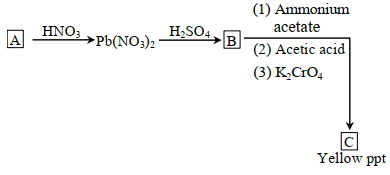
A
$PbCl_2, PbSO_4, PbCrO_4$
B
$PbS, PbSO_4, PbCrO_4$
C
$PbS, PbSO_4, Pb(CH_3COO)_2$
D
$PbCl_2, Pb(SO_4)_2, PbCrO_4$
Solution
(B) The reaction sequence is as follows:
$1$. $PbS$ (Galena) reacts with $HNO_3$ to form lead$(II)$ nitrate: $3PbS + 8HNO_3 \rightarrow 3Pb(NO_3)_2 + 2NO + 3S + 4H_2O$. Thus,$A = PbS$.
$2$. $Pb(NO_3)_2$ reacts with $H_2SO_4$ to form lead$(II)$ sulfate precipitate: $Pb(NO_3)_2 + H_2SO_4 \rightarrow PbSO_4(s) + 2HNO_3$. Thus,$B = PbSO_4$.
$3$. $PbSO_4$ is dissolved in ammonium acetate and acetic acid to form lead$(II)$ acetate,which then reacts with $K_2CrO_4$ to form a yellow precipitate of lead$(II)$ chromate: $PbSO_4 + 2CH_3COONH_4 \rightarrow Pb(CH_3COO)_2 + (NH_4)_2SO_4$ and $Pb(CH_3COO)_2 + K_2CrO_4 \rightarrow PbCrO_4(s) + 2CH_3COOK$. Thus,$C = PbCrO_4$.
Therefore,$A = PbS$,$B = PbSO_4$,and $C = PbCrO_4$.
$1$. $PbS$ (Galena) reacts with $HNO_3$ to form lead$(II)$ nitrate: $3PbS + 8HNO_3 \rightarrow 3Pb(NO_3)_2 + 2NO + 3S + 4H_2O$. Thus,$A = PbS$.
$2$. $Pb(NO_3)_2$ reacts with $H_2SO_4$ to form lead$(II)$ sulfate precipitate: $Pb(NO_3)_2 + H_2SO_4 \rightarrow PbSO_4(s) + 2HNO_3$. Thus,$B = PbSO_4$.
$3$. $PbSO_4$ is dissolved in ammonium acetate and acetic acid to form lead$(II)$ acetate,which then reacts with $K_2CrO_4$ to form a yellow precipitate of lead$(II)$ chromate: $PbSO_4 + 2CH_3COONH_4 \rightarrow Pb(CH_3COO)_2 + (NH_4)_2SO_4$ and $Pb(CH_3COO)_2 + K_2CrO_4 \rightarrow PbCrO_4(s) + 2CH_3COOK$. Thus,$C = PbCrO_4$.
Therefore,$A = PbS$,$B = PbSO_4$,and $C = PbCrO_4$.
0 likesView Solution
92
ChemistryMediumMCQJEE Main · 2025
Given below are two statements:
Statement $(I)$: The boiling points of alcohols and phenols increase with an increase in the number of $C$ atoms.
Statement $(II)$: The boiling points of alcohols and phenols are higher in comparison to other classes of compounds such as ethers and haloalkanes.
In the light of the above statements,choose the correct answer from the options given below:
Statement $(I)$: The boiling points of alcohols and phenols increase with an increase in the number of $C$ atoms.
Statement $(II)$: The boiling points of alcohols and phenols are higher in comparison to other classes of compounds such as ethers and haloalkanes.
In the light of the above statements,choose the correct answer from the options given below:
A
Both Statement $I$ and Statement $II$ are false
B
Statement $I$ is false but Statement $II$ is true
C
Statement $I$ is true but Statement $II$ is false
D
Both Statement $I$ and Statement $II$ are true
Solution
(D) Statement $(I)$ is true: The boiling point of alcohols and phenols increases with an increase in the number of carbon atoms due to an increase in van der Waals forces of attraction as the molecular weight increases $(B.P. \propto M.W.)$.
Statement $(II)$ is true: Alcohols and phenols exhibit intermolecular hydrogen bonding,which is significantly stronger than the dipole-dipole interactions found in ethers and haloalkanes of comparable molecular mass. Therefore,they have higher boiling points.
Statement $(II)$ is true: Alcohols and phenols exhibit intermolecular hydrogen bonding,which is significantly stronger than the dipole-dipole interactions found in ethers and haloalkanes of comparable molecular mass. Therefore,they have higher boiling points.
0 likesView Solution
93
ChemistryMediumMCQJEE Main · 2025
When a non-volatile solute is added to the solvent,the vapour pressure of the solvent decreases by $10 \ mm \ Hg$. The mole fraction of the solute in the solution is $0.2$. What would be the mole fraction of the solvent if the decrease in vapour pressure is $20 \ mm \ Hg$?
A
$0.6$
B
$0.4$
C
$0.2$
D
$0.8$
Solution
(A) According to Raoult's law,the relative lowering of vapour pressure is equal to the mole fraction of the solute: $\frac{P^{\circ} - P}{P^{\circ}} = X_{\text{solute}}$.
Since $P^{\circ} - P \propto X_{\text{solute}}$,we have $10 \propto 0.2$.
For a decrease of $20 \ mm \ Hg$,the new mole fraction of the solute $(X'_{\text{solute}})$ will be: $20 \propto X'_{\text{solute}}$.
Thus,$X'_{\text{solute}} = \frac{20}{10} \times 0.2 = 0.4$.
The mole fraction of the solvent is $X_{\text{solvent}} = 1 - X'_{\text{solute}} = 1 - 0.4 = 0.6$.
Since $P^{\circ} - P \propto X_{\text{solute}}$,we have $10 \propto 0.2$.
For a decrease of $20 \ mm \ Hg$,the new mole fraction of the solute $(X'_{\text{solute}})$ will be: $20 \propto X'_{\text{solute}}$.
Thus,$X'_{\text{solute}} = \frac{20}{10} \times 0.2 = 0.4$.
The mole fraction of the solvent is $X_{\text{solvent}} = 1 - X'_{\text{solute}} = 1 - 0.4 = 0.6$.
0 likesView Solution
94
ChemistryDifficultMCQJEE Main · 2025
The ascending order of relative rate of solvolysis of the following compounds is:
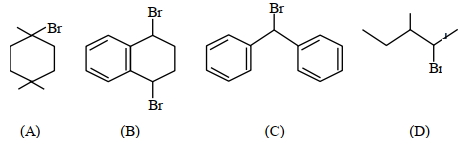
A
$D < A < B < C$
B
$C < B < A < D$
C
$D < B < A < C$
D
$C < D < B < A$
Solution
(A) The rate of solvolysis (which proceeds via an $S_{N}1$ mechanism) is directly proportional to the stability of the intermediate carbocation formed after the departure of the leaving group (bromide ion).
$1$. Compound $C$ forms a diphenylmethyl carbocation,which is highly stabilized by resonance with two phenyl rings.
$2$. Compound $B$ forms a benzylic carbocation (specifically,a $1-$tetralyl type),which is stabilized by resonance with one benzene ring.
$3$. Compound $A$ forms a tertiary carbocation in a cyclohexane ring,which is stabilized by inductive effects and hyperconjugation.
$4$. Compound $D$ forms a secondary carbocation,which is the least stable among the given options.
Thus,the stability order of the carbocations is $C > B > A > D$. Consequently,the ascending order of the rate of solvolysis is $D < A < B < C$.
$1$. Compound $C$ forms a diphenylmethyl carbocation,which is highly stabilized by resonance with two phenyl rings.
$2$. Compound $B$ forms a benzylic carbocation (specifically,a $1-$tetralyl type),which is stabilized by resonance with one benzene ring.
$3$. Compound $A$ forms a tertiary carbocation in a cyclohexane ring,which is stabilized by inductive effects and hyperconjugation.
$4$. Compound $D$ forms a secondary carbocation,which is the least stable among the given options.
Thus,the stability order of the carbocations is $C > B > A > D$. Consequently,the ascending order of the rate of solvolysis is $D < A < B < C$.
0 likesView Solution
95
ChemistryMediumMCQJEE Main · 2025
Which of the following graphs most appropriately represents a zero order reaction?
A
B
C
D
Solution
(B) For a zero order reaction: $A \rightarrow P$
$\text{Rate} = k[A]^0 = k$
Since the rate is constant,the concentration of the reactant $[A]_t$ decreases linearly with time according to the equation:
$[A]_t = [A]_0 - kt$
Comparing this to the equation of a straight line $y = mx + c$,where $y = [A]_t$,$x = t$,$m = -k$,and $c = [A]_0$,the graph of reactant concentration versus time is a straight line with a negative slope. Therefore,the graph in option $B$ represents a zero order reaction.
$\text{Rate} = k[A]^0 = k$
Since the rate is constant,the concentration of the reactant $[A]_t$ decreases linearly with time according to the equation:
$[A]_t = [A]_0 - kt$
Comparing this to the equation of a straight line $y = mx + c$,where $y = [A]_t$,$x = t$,$m = -k$,and $c = [A]_0$,the graph of reactant concentration versus time is a straight line with a negative slope. Therefore,the graph in option $B$ represents a zero order reaction.
0 likesView Solution
96
ChemistryMediumMCQJEE Main · 2025
Match List-$I$ with List-$II$.
Choose the correct answer from the options given below:
| List-$I$ | List-$II$ |
| $A$. Bronze | $I$. $Cu, Ni$ |
| $B$. Brass | $II$. $Fe, Cr, Ni, C$ |
| $C$. $UK$ silver coin | $III$. $Cu, Zn$ |
| $D$. Stainless Steel | $IV$. $Cu, Sn$ |
A
$A-IV, B-III, C-I, D-II$
B
$A-IV, B-II, C-III, D-I$
C
$A-III, B-I, C-IV, D-II$
D
$A-III, B-IV, C-II, D-I$
Solution
(A) Bronze is an alloy of $Cu$ and $Sn$. $(A-IV)$
Brass is an alloy of $Cu$ and $Zn$. $(B-III)$
$UK$ silver coin is an alloy of $Cu$ and $Ni$. $(C-I)$
Stainless steel is an alloy of $Fe, Cr, Ni,$ and $C$. $(D-II)$
Therefore,the correct matching is $A-IV, B-III, C-I, D-II$.
Brass is an alloy of $Cu$ and $Zn$. $(B-III)$
$UK$ silver coin is an alloy of $Cu$ and $Ni$. $(C-I)$
Stainless steel is an alloy of $Fe, Cr, Ni,$ and $C$. $(D-II)$
Therefore,the correct matching is $A-IV, B-III, C-I, D-II$.
0 likesView Solution
97
ChemistryDifficultMCQJEE Main · 2025
Identify the coordination complexes in which the central metal ion has $d^4$ configuration.
$(A)$ $[FeO_4]^{2-}$
$(B)$ $[Mn(CN)_6]^{3-}$
$(C)$ $[Fe(CN)_6]^{3-}$
$(D)$ $[Cr(H_2O)_6]^{2+}$
$(E)$ $[NiF_6]^{2-}$
Choose the correct answer from the options given below:
$(A)$ $[FeO_4]^{2-}$
$(B)$ $[Mn(CN)_6]^{3-}$
$(C)$ $[Fe(CN)_6]^{3-}$
$(D)$ $[Cr(H_2O)_6]^{2+}$
$(E)$ $[NiF_6]^{2-}$
Choose the correct answer from the options given below:
A
$(C)$ and $(E)$ only
B
$(B)$, $(C)$ and $(D)$ only
C
$(B)$ and $(D)$ only
D
$(A)$, $(B)$ and $(E)$ only
Solution
(C) To find the $d$-configuration of the central metal ion, we determine the oxidation state of the metal in each complex:
$(A)$ In $[FeO_4]^{2-}$, $Fe + 4(-2) = -2 \implies Fe = +6$. $Fe^{6+} = [Ar] 3d^2$.
$(B)$ In $[Mn(CN)_6]^{3-}$, $Mn + 6(-1) = -3 \implies Mn = +3$. $Mn^{3+} = [Ar] 3d^4$.
$(C)$ In $[Fe(CN)_6]^{3-}$, $Fe + 6(-1) = -3 \implies Fe = +3$. $Fe^{3+} = [Ar] 3d^5$.
$(D)$ In $[Cr(H_2O)_6]^{2+}$, $Cr + 6(0) = +2 \implies Cr = +2$. $Cr^{2+} = [Ar] 3d^4$.
$(E)$ In $[NiF_6]^{2-}$, $Ni + 6(-1) = -2 \implies Ni = +4$. $Ni^{4+} = [Ar] 3d^6$.
The complexes with $d^4$ configuration are $(B)$ and $(D)$.
$(A)$ In $[FeO_4]^{2-}$, $Fe + 4(-2) = -2 \implies Fe = +6$. $Fe^{6+} = [Ar] 3d^2$.
$(B)$ In $[Mn(CN)_6]^{3-}$, $Mn + 6(-1) = -3 \implies Mn = +3$. $Mn^{3+} = [Ar] 3d^4$.
$(C)$ In $[Fe(CN)_6]^{3-}$, $Fe + 6(-1) = -3 \implies Fe = +3$. $Fe^{3+} = [Ar] 3d^5$.
$(D)$ In $[Cr(H_2O)_6]^{2+}$, $Cr + 6(0) = +2 \implies Cr = +2$. $Cr^{2+} = [Ar] 3d^4$.
$(E)$ In $[NiF_6]^{2-}$, $Ni + 6(-1) = -2 \implies Ni = +4$. $Ni^{4+} = [Ar] 3d^6$.
The complexes with $d^4$ configuration are $(B)$ and $(D)$.
0 likesView Solution
98
ChemistryMediumMCQJEE Main · 2025
Identify the products $[A]$ and $[B]$,respectively in the following reaction:
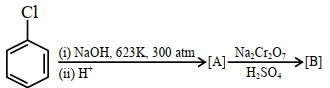
A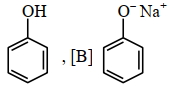
B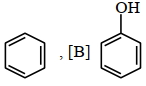
C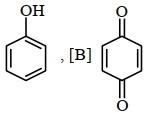
D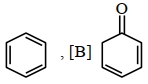
Solution
(C) The reaction of chlorobenzene with $NaOH$ at $623 \ K$ and $300 \ atm$ followed by acidification with $H^+$ gives phenol as product $[A]$.
Phenol on oxidation with chromic acid $(Na_2Cr_2O_7 / H_2SO_4)$ yields $p$-benzoquinone as product $[B]$.
Phenol on oxidation with chromic acid $(Na_2Cr_2O_7 / H_2SO_4)$ yields $p$-benzoquinone as product $[B]$.
0 likesView Solution
99
ChemistryDifficultMCQJEE Main · 2025
Consider a binary solution of two volatile liquid components $1$ and $2$. $x_1$ and $y_1$ are the mole fractions of component $1$ in liquid and vapour phase,respectively. The slope and intercept of the linear plot of $\frac{1}{x_1}$ vs $\frac{1}{y_1}$ are given respectively as :
A
$\frac{P_1^0}{P_2^0}, \frac{P_2^0-P_1^0}{P_2^0}$
B
$\frac{P_2^0}{P_1^0}, \frac{P_1^0-P_2^0}{P_2^0}$
C
$\frac{P_1^0}{P_2^0}, \frac{P_1^0-P_2^0}{P_2^0}$
D
$\frac{P_2^0}{P_1^0}, \frac{P_2^0-P_1^0}{P_2^0}$
Solution
(A) According to Raoult's law for a binary solution of two volatile liquids $1$ and $2$:
$P_T = P_1^0 x_1 + P_2^0 x_2 = P_1^0 x_1 + P_2^0 (1 - x_1) = P_2^0 + x_1 (P_1^0 - P_2^0)$
Also,from Dalton's law,$P_1 = P_T y_1$,where $P_1 = P_1^0 x_1$.
So,$P_T y_1 = P_1^0 x_1 \implies P_T = \frac{P_1^0 x_1}{y_1}$.
Equating the two expressions for $P_T$:
$P_2^0 + x_1 (P_1^0 - P_2^0) = \frac{P_1^0 x_1}{y_1}$
Dividing both sides by $x_1 P_2^0$:
$\frac{P_2^0}{x_1} + \frac{P_1^0 - P_2^0}{P_2^0} = \frac{P_1^0}{P_2^0 y_1}$
Rearranging to the form $Y = mX + c$ where $Y = \frac{1}{x_1}$ and $X = \frac{1}{y_1}$:
$\frac{1}{x_1} = \left( \frac{P_1^0}{P_2^0} \right) \frac{1}{y_1} + \left( \frac{P_2^0 - P_1^0}{P_2^0} \right)$
Comparing with $Y = mX + c$,the slope is $\frac{P_1^0}{P_2^0}$ and the intercept is $\frac{P_2^0 - P_1^0}{P_2^0}$.
$P_T = P_1^0 x_1 + P_2^0 x_2 = P_1^0 x_1 + P_2^0 (1 - x_1) = P_2^0 + x_1 (P_1^0 - P_2^0)$
Also,from Dalton's law,$P_1 = P_T y_1$,where $P_1 = P_1^0 x_1$.
So,$P_T y_1 = P_1^0 x_1 \implies P_T = \frac{P_1^0 x_1}{y_1}$.
Equating the two expressions for $P_T$:
$P_2^0 + x_1 (P_1^0 - P_2^0) = \frac{P_1^0 x_1}{y_1}$
Dividing both sides by $x_1 P_2^0$:
$\frac{P_2^0}{x_1} + \frac{P_1^0 - P_2^0}{P_2^0} = \frac{P_1^0}{P_2^0 y_1}$
Rearranging to the form $Y = mX + c$ where $Y = \frac{1}{x_1}$ and $X = \frac{1}{y_1}$:
$\frac{1}{x_1} = \left( \frac{P_1^0}{P_2^0} \right) \frac{1}{y_1} + \left( \frac{P_2^0 - P_1^0}{P_2^0} \right)$
Comparing with $Y = mX + c$,the slope is $\frac{P_1^0}{P_2^0}$ and the intercept is $\frac{P_2^0 - P_1^0}{P_2^0}$.
0 likesView Solution
100
ChemistryMediumMCQJEE Main · 2025
Consider the following reactions:
$K_2Cr_2O_7$ $\xrightarrow[-H_2O]{KOH} [A]$ $\xrightarrow[-H_2O]{H_2SO_4} [B] + K_2SO_4$
The products $[A]$ and $[B]$,respectively,are:
$K_2Cr_2O_7$ $\xrightarrow[-H_2O]{KOH} [A]$ $\xrightarrow[-H_2O]{H_2SO_4} [B] + K_2SO_4$
The products $[A]$ and $[B]$,respectively,are:
A
$K_2Cr(OH)_6$ and $Cr_2O_3$
B
$K_2CrO_4$ and $Cr_2O_3$
C
$K_2CrO_4$ and $K_2Cr_2O_7$
D
$K_2CrO_4$ and $CrO$
Solution
(C) The reaction of potassium dichromate $(K_2Cr_2O_7)$ with potassium hydroxide $(KOH)$ yields potassium chromate $(K_2CrO_4)$ and water:
$K_2Cr_2O_7 + 2KOH \rightarrow 2K_2CrO_4 + H_2O$
Thus,$[A] = K_2CrO_4$.
Next,the reaction of potassium chromate $(K_2CrO_4)$ with sulfuric acid $(H_2SO_4)$ yields potassium dichromate $(K_2Cr_2O_7)$,potassium sulfate $(K_2SO_4)$,and water:
$2K_2CrO_4 + H_2SO_4 \rightarrow K_2Cr_2O_7 + K_2SO_4 + H_2O$
Thus,$[B] = K_2Cr_2O_7$.
$K_2Cr_2O_7 + 2KOH \rightarrow 2K_2CrO_4 + H_2O$
Thus,$[A] = K_2CrO_4$.
Next,the reaction of potassium chromate $(K_2CrO_4)$ with sulfuric acid $(H_2SO_4)$ yields potassium dichromate $(K_2Cr_2O_7)$,potassium sulfate $(K_2SO_4)$,and water:
$2K_2CrO_4 + H_2SO_4 \rightarrow K_2Cr_2O_7 + K_2SO_4 + H_2O$
Thus,$[B] = K_2Cr_2O_7$.
0 likesView Solution
Vedclass Products
For Students
Vedclass Test Series
Mock tests in real JEE Main style covering Chemistry with performance analysis. 5-day free trial.
Start Free TrialFor Teachers
Exam Paper Generator
Generate Set A/B/C/D Chemistry papers from 7.5L+ questions in 2 minutes. 3 chapters free.
Try FreeFor Institutes
Online Exam Module
Run live JEE Main mock exams with unlimited students, 360° analytics & white-label branding.
See DemoFrequently Asked Questions
How many Chemistry questions are in JEE Main 2025?
There are 478 Chemistry questions from the JEE Main 2025 paper on Vedclass, each with a detailed step-by-step solution in English.
Are JEE Main 2025 Chemistry solutions available in English?
Yes. All solutions on this page are in English. You can also switch to English or Hindi using the language buttons above the questions.
Can I practice JEE Main 2025 Chemistry as a timed test?
Yes. Use the Vedclass Test Series to attempt a full JEE Main mock test covering Chemistry with time limits and instant score analysis.
Can teachers create Chemistry papers from JEE Main previous year questions?
Yes. The Vedclass Exam Paper Generator lets teachers mix JEE Main Chemistry questions and generate Set A/B/C/D papers in minutes.
For Teachers & Institutes
Build a Custom Chemistry Paper
Pick JEE Main 2025 Chemistry questions, set difficulty, and generate Set A/B/C/D in 2 minutes.