
MathematicsQ101–200 of 800 questions
Page 3 of 10 · Gujarati
101
MathematicsMediumMCQAP EAMCET · 2020
ધારો કે $X = \{(a, b) \mid a, b \in \mathbb{Z}, 0 \leq a \leq 20, 0 \leq b \leq 15\}$. તો ગણ $X$ માં શિરોબિંદુઓ ધરાવતા લંબચોરસની સંખ્યા કેટલી થાય?
A
$25100$
B
$25200$
C
$25300$
D
$25000$
Solution
(B) ગણ $X$ એ $(a, b)$ બિંદુઓની ગ્રીડ દર્શાવે છે જ્યાં $a$ એ $0$ થી $20$ ($21$ બિંદુઓ) અને $b$ એ $0$ થી $15$ ($16$ બિંદુઓ) સુધીની કિંમતો ધરાવે છે.
અક્ષોને સમાંતર બાજુઓ ધરાવતો લંબચોરસ બનાવવા માટે,આપણે $\{0, 1, 2, \dots, 20\}$ માંથી $a$ માટે $2$ અલગ કિંમતો અને $\{0, 1, 2, \dots, 15\}$ માંથી $b$ માટે $2$ અલગ કિંમતો પસંદ કરવી પડે.
$a$ માટે $2$ કિંમતો પસંદ કરવાની રીતો $\binom{21}{2} = \frac{21 \times 20}{2} = 210$ છે.
$b$ માટે $2$ કિંમતો પસંદ કરવાની રીતો $\binom{16}{2} = \frac{16 \times 15}{2} = 120$ છે.
આવા કુલ લંબચોરસની સંખ્યા $210 \times 120 = 25200$ થાય.
અક્ષોને સમાંતર બાજુઓ ધરાવતો લંબચોરસ બનાવવા માટે,આપણે $\{0, 1, 2, \dots, 20\}$ માંથી $a$ માટે $2$ અલગ કિંમતો અને $\{0, 1, 2, \dots, 15\}$ માંથી $b$ માટે $2$ અલગ કિંમતો પસંદ કરવી પડે.
$a$ માટે $2$ કિંમતો પસંદ કરવાની રીતો $\binom{21}{2} = \frac{21 \times 20}{2} = 210$ છે.
$b$ માટે $2$ કિંમતો પસંદ કરવાની રીતો $\binom{16}{2} = \frac{16 \times 15}{2} = 120$ છે.
આવા કુલ લંબચોરસની સંખ્યા $210 \times 120 = 25200$ થાય.
0 likesView Solution
102
MathematicsEasyMCQAP EAMCET · 2020
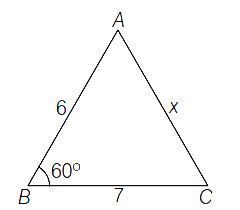
ત્રિકોણ $ABC$ ના ખૂણાઓ $A, B, C$ સમાંતર શ્રેણી $(AP)$ માં છે. જો $AB=6$ અને $BC=7$ હોય,તો $AC=$
A
$\sqrt{40}$
B
$\sqrt{41}$
C
$\sqrt{43}$
D
$6$
Solution
(C) આપેલ છે કે $\triangle ABC$ ના ખૂણાઓ $A, B, C$ સમાંતર શ્રેણીમાં છે,તેથી $A+C = 2B$.
ત્રિકોણના ત્રણેય ખૂણાઓનો સરવાળો $A+B+C = 180^{\circ}$ હોવાથી,$3B = 180^{\circ}$,જેનો અર્થ છે કે $B = 60^{\circ}$.
$\triangle ABC$ માં કોસાઇન નિયમનો ઉપયોગ કરતા:
$\cos B = \frac{AB^2 + BC^2 - AC^2}{2 \times AB \times BC}$
આપેલ કિંમતો $AB=6, BC=7, B=60^{\circ}$ મૂકતા અને $AC=x$ ધારતા:
$\cos 60^{\circ} = \frac{6^2 + 7^2 - x^2}{2 \times 6 \times 7}$
$\frac{1}{2} = \frac{36 + 49 - x^2}{84}$
$42 = 85 - x^2$
$x^2 = 85 - 42 = 43$
$x = \sqrt{43}$
તેથી,$AC = \sqrt{43}$.
ત્રિકોણના ત્રણેય ખૂણાઓનો સરવાળો $A+B+C = 180^{\circ}$ હોવાથી,$3B = 180^{\circ}$,જેનો અર્થ છે કે $B = 60^{\circ}$.
$\triangle ABC$ માં કોસાઇન નિયમનો ઉપયોગ કરતા:
$\cos B = \frac{AB^2 + BC^2 - AC^2}{2 \times AB \times BC}$
આપેલ કિંમતો $AB=6, BC=7, B=60^{\circ}$ મૂકતા અને $AC=x$ ધારતા:
$\cos 60^{\circ} = \frac{6^2 + 7^2 - x^2}{2 \times 6 \times 7}$
$\frac{1}{2} = \frac{36 + 49 - x^2}{84}$
$42 = 85 - x^2$
$x^2 = 85 - 42 = 43$
$x = \sqrt{43}$
તેથી,$AC = \sqrt{43}$.
0 likesView Solution
103
MathematicsEasyMCQAP EAMCET · 2020
ધારો કે $n$ એ ધન પૂર્ણાંક છે. જો $(1+x)^n$ ના વિસ્તરણમાં $2^{\text{nd}}$,$3^{\text{rd}}$ અને $4^{\text{th}}$ પદોના સહગુણકો સમાંતર શ્રેણી ($A$.$P$.) માં હોય,તો $n$ ની કિંમત શોધો.
A
$6$
B
$7$
C
$8$
D
$9$
Solution
(B) $(1+x)^n$ ના વિસ્તરણમાં $2^{\text{nd}}$,$3^{\text{rd}}$ અને $4^{\text{th}}$ પદોના સહગુણકો અનુક્રમે $\binom{n}{1}$,$\binom{n}{2}$ અને $\binom{n}{3}$ છે.
તેઓ સમાંતર શ્રેણીમાં હોવાથી,$2 \binom{n}{2} = \binom{n}{1} + \binom{n}{3}$ થાય.
દ્વિપદી સહગુણકોનું વિસ્તરણ કરતા: $2 \times \frac{n(n-1)}{2} = n + \frac{n(n-1)(n-2)}{6}$.
$n$ વડે ભાગતા ($n > 0$ હોવાથી): $n-1 = 1 + \frac{(n-1)(n-2)}{6}$.
$6$ વડે ગુણતા: $6n - 6 = 6 + (n^2 - 3n + 2)$.
પદોને ગોઠવતા: $n^2 - 9n + 14 = 0$.
દ્વિઘાત સમીકરણના અવયવ પાડતા: $(n-7)(n-2) = 0$.
આમ,$n = 7$ અથવા $n = 2$.
$4^{\text{th}}$ પદ અસ્તિત્વમાં હોવા માટે,$n \ge 3$ હોવું જોઈએ,તેથી $n = 7$.
તેઓ સમાંતર શ્રેણીમાં હોવાથી,$2 \binom{n}{2} = \binom{n}{1} + \binom{n}{3}$ થાય.
દ્વિપદી સહગુણકોનું વિસ્તરણ કરતા: $2 \times \frac{n(n-1)}{2} = n + \frac{n(n-1)(n-2)}{6}$.
$n$ વડે ભાગતા ($n > 0$ હોવાથી): $n-1 = 1 + \frac{(n-1)(n-2)}{6}$.
$6$ વડે ગુણતા: $6n - 6 = 6 + (n^2 - 3n + 2)$.
પદોને ગોઠવતા: $n^2 - 9n + 14 = 0$.
દ્વિઘાત સમીકરણના અવયવ પાડતા: $(n-7)(n-2) = 0$.
આમ,$n = 7$ અથવા $n = 2$.
$4^{\text{th}}$ પદ અસ્તિત્વમાં હોવા માટે,$n \ge 3$ હોવું જોઈએ,તેથી $n = 7$.
0 likesView Solution
104
MathematicsEasyMCQAP EAMCET · 2020
$\tan 1^{\circ}, \tan 2^{\circ}, \ldots, \tan 89^{\circ}$ નો ગુણોત્તર મધ્યક (geometric mean) શોધો.
A
$\frac{1}{89}$
B
$1$
C
$\frac{1}{3}$
D
$\sqrt{3}$
Solution
(B) ધારો કે $P = \tan 1^{\circ} \cdot \tan 2^{\circ} \cdot \ldots \cdot \tan 89^{\circ}$.
$\tan(90^{\circ} - \theta) = \cot \theta$ ગુણધર્મનો ઉપયોગ કરતા:
$P = (\tan 1^{\circ} \cdot \tan 89^{\circ}) \cdot (\tan 2^{\circ} \cdot \tan 88^{\circ}) \cdot \ldots \cdot (\tan 44^{\circ} \cdot \tan 46^{\circ}) \cdot \tan 45^{\circ}$.
$\tan \theta \cdot \tan(90^{\circ} - \theta) = 1$ હોવાથી,દરેક જોડીનો ગુણાકાર $1$ થશે.
તેથી,$P = 1 \cdot 1 \cdot \ldots \cdot 1 \cdot \tan 45^{\circ} = 1$.
$n$ પદોનો ગુણોત્તર મધ્યક $(a_1 \cdot a_2 \cdot \ldots \cdot a_n)^{1/n}$ છે.
અહીં $n = 89$ હોવાથી,ગુણોત્તર મધ્યક $(P)^{1/89} = (1)^{1/89} = 1$.
આમ,વિકલ્પ $B$ સાચો છે.
$\tan(90^{\circ} - \theta) = \cot \theta$ ગુણધર્મનો ઉપયોગ કરતા:
$P = (\tan 1^{\circ} \cdot \tan 89^{\circ}) \cdot (\tan 2^{\circ} \cdot \tan 88^{\circ}) \cdot \ldots \cdot (\tan 44^{\circ} \cdot \tan 46^{\circ}) \cdot \tan 45^{\circ}$.
$\tan \theta \cdot \tan(90^{\circ} - \theta) = 1$ હોવાથી,દરેક જોડીનો ગુણાકાર $1$ થશે.
તેથી,$P = 1 \cdot 1 \cdot \ldots \cdot 1 \cdot \tan 45^{\circ} = 1$.
$n$ પદોનો ગુણોત્તર મધ્યક $(a_1 \cdot a_2 \cdot \ldots \cdot a_n)^{1/n}$ છે.
અહીં $n = 89$ હોવાથી,ગુણોત્તર મધ્યક $(P)^{1/89} = (1)^{1/89} = 1$.
આમ,વિકલ્પ $B$ સાચો છે.
0 likesView Solution
105
MathematicsEasyMCQAP EAMCET · 2020
જો $x = \frac{1}{5} + \frac{1 \times 3}{5 \times 10} + \frac{1 \times 3 \times 5}{5 \times 10 \times 15} + \ldots$ હોય,તો $3x^2 + 6x =$
A
$1$
B
$2$
C
$-1$
D
$-2$
Solution
(B) આપેલ શ્રેણી $x = \frac{1}{5} + \frac{1 \cdot 3}{5 \cdot 10} + \frac{1 \cdot 3 \cdot 5}{5 \cdot 10 \cdot 15} + \ldots$ છે.
આપણે જાણીએ છીએ કે દ્વિપદી વિસ્તરણ $(1-y)^{-n} = 1 + ny + \frac{n(n+1)}{2!}y^2 + \frac{n(n+1)(n+2)}{3!}y^3 + \ldots$
ધારો કે $1+x = 1 + \frac{1}{5} + \frac{1 \cdot 3}{5 \cdot 10} + \frac{1 \cdot 3 \cdot 5}{5 \cdot 10 \cdot 15} + \ldots$
આ $(1-y)^{-n}$ સ્વરૂપ સાથે મેળ ખાય છે જ્યાં $ny = \frac{1}{5}$ અને $\frac{n(n+1)}{2}y^2 = \frac{3}{50}$.
$n$ અને $y$ માટે ઉકેલતા,આપણને $n = \frac{1}{2}$ અને $y = \frac{2}{5}$ મળે છે.
આમ,$1+x = (1 - \frac{2}{5})^{-1/2} = (\frac{3}{5})^{-1/2} = \sqrt{\frac{5}{3}}$.
તેથી,$x = \sqrt{\frac{5}{3}} - 1$.
હવે,$3x^2 + 6x = 3(x^2 + 2x) = 3((x+1)^2 - 1) = 3(x+1)^2 - 3$ ની ગણતરી કરો.
$x+1 = \sqrt{\frac{5}{3}}$ મૂકતા,આપણને $3(\frac{5}{3}) - 3 = 5 - 3 = 2$ મળે છે.
આપણે જાણીએ છીએ કે દ્વિપદી વિસ્તરણ $(1-y)^{-n} = 1 + ny + \frac{n(n+1)}{2!}y^2 + \frac{n(n+1)(n+2)}{3!}y^3 + \ldots$
ધારો કે $1+x = 1 + \frac{1}{5} + \frac{1 \cdot 3}{5 \cdot 10} + \frac{1 \cdot 3 \cdot 5}{5 \cdot 10 \cdot 15} + \ldots$
આ $(1-y)^{-n}$ સ્વરૂપ સાથે મેળ ખાય છે જ્યાં $ny = \frac{1}{5}$ અને $\frac{n(n+1)}{2}y^2 = \frac{3}{50}$.
$n$ અને $y$ માટે ઉકેલતા,આપણને $n = \frac{1}{2}$ અને $y = \frac{2}{5}$ મળે છે.
આમ,$1+x = (1 - \frac{2}{5})^{-1/2} = (\frac{3}{5})^{-1/2} = \sqrt{\frac{5}{3}}$.
તેથી,$x = \sqrt{\frac{5}{3}} - 1$.
હવે,$3x^2 + 6x = 3(x^2 + 2x) = 3((x+1)^2 - 1) = 3(x+1)^2 - 3$ ની ગણતરી કરો.
$x+1 = \sqrt{\frac{5}{3}}$ મૂકતા,આપણને $3(\frac{5}{3}) - 3 = 5 - 3 = 2$ મળે છે.
0 likesView Solution
106
MathematicsMediumMCQAP EAMCET · 2020
ધારો કે $P(n): 1^2+2^2+3^2+\ldots+n^2 = \frac{6(n-1)(n-2) \ldots(n-2020)+2n^3+3n^2+n}{6}$,તમામ $n \in N$ માટે. તો નીચેનામાંથી કયું સાચું છે?
A
$P(n)$ તમામ $n \in N$ માટે સાચું છે
B
$P(n)$ તમામ $n > 2020$ માટે સાચું છે
C
$P(n)$ તમામ $n \leq 2020$ માટે સાચું છે
D
$P(n)$ કોઈપણ $n \in N$ માટે સાચું નથી
Solution
(C) આપણે જાણીએ છીએ કે પ્રથમ $n$ વર્ગોનો સરવાળો $1^2+2^2+3^2+\ldots+n^2 = \frac{n(n+1)(2n+1)}{6} = \frac{2n^3+3n^2+n}{6}$ દ્વારા આપવામાં આવે છે.
આપેલ $P(n): 1^2+2^2+3^2+\ldots+n^2 = \frac{6(n-1)(n-2) \ldots(n-2020) + 2n^3+3n^2+n}{6}$.
આપેલ સમીકરણમાં પ્રમાણિત સરવાળાનું સૂત્ર મૂકતા,આપણને મળે છે:
$\frac{n(n+1)(2n+1)}{6} = (n-1)(n-2) \ldots(n-2020) + \frac{n(n+1)(2n+1)}{6}$.
આ સમાનતા ત્યારે જ સાચી છે જો $(n-1)(n-2) \ldots(n-2020) = 0$ હોય.
આ ગુણાકાર શૂન્ય થાય છે જ્યારે $n \in \{1, 2, 3, \ldots, 2020\}$ હોય.
તેથી,$P(n)$ તમામ $n \leq 2020$ માટે સાચું છે.
આપેલ $P(n): 1^2+2^2+3^2+\ldots+n^2 = \frac{6(n-1)(n-2) \ldots(n-2020) + 2n^3+3n^2+n}{6}$.
આપેલ સમીકરણમાં પ્રમાણિત સરવાળાનું સૂત્ર મૂકતા,આપણને મળે છે:
$\frac{n(n+1)(2n+1)}{6} = (n-1)(n-2) \ldots(n-2020) + \frac{n(n+1)(2n+1)}{6}$.
આ સમાનતા ત્યારે જ સાચી છે જો $(n-1)(n-2) \ldots(n-2020) = 0$ હોય.
આ ગુણાકાર શૂન્ય થાય છે જ્યારે $n \in \{1, 2, 3, \ldots, 2020\}$ હોય.
તેથી,$P(n)$ તમામ $n \leq 2020$ માટે સાચું છે.
0 likesView Solution
107
MathematicsMediumMCQAP EAMCET · 2020
$\lim _{n \rightarrow \infty} \frac{2^2+4^2+6^2+\ldots+(2 n)^2}{n^3} = $
A
$\frac{2}{3}$
B
$\frac{4}{3}$
C
$\frac{3}{2}$
D
$\frac{8}{7}$
Solution
(B) આપેલ પદાવલિ $\lim _{n \rightarrow \infty} \frac{2^2+4^2+6^2+\ldots+(2 n)^2}{n^3}$ છે.
અંશમાંથી $2^2 = 4$ સામાન્ય લેતા:
$= \lim _{n \rightarrow \infty} \frac{4(1^2+2^2+3^2+\ldots+n^2)}{n^3}$.
પ્રથમ $n$ પ્રાકૃતિક સંખ્યાઓના વર્ગોના સરવાળાનું સૂત્ર $\sum_{k=1}^{n} k^2 = \frac{n(n+1)(2n+1)}{6}$ વાપરતા:
$= 4 \lim _{n \rightarrow \infty} \frac{n(n+1)(2n+1)}{6n^3}$.
$= \frac{4}{6} \lim _{n \rightarrow \infty} \frac{n \cdot n(1+\frac{1}{n}) \cdot n(2+\frac{1}{n})}{n^3}$.
$= \frac{2}{3} \lim _{n \rightarrow \infty} (1+\frac{1}{n})(2+\frac{1}{n})$.
જેમ $n \rightarrow \infty$,તેમ $\frac{1}{n} \rightarrow 0$,તેથી લક્ષ $\frac{2}{3} \times (1)(2) = \frac{4}{3}$ થાય.
આમ,સાચો વિકલ્પ $B$ છે.
અંશમાંથી $2^2 = 4$ સામાન્ય લેતા:
$= \lim _{n \rightarrow \infty} \frac{4(1^2+2^2+3^2+\ldots+n^2)}{n^3}$.
પ્રથમ $n$ પ્રાકૃતિક સંખ્યાઓના વર્ગોના સરવાળાનું સૂત્ર $\sum_{k=1}^{n} k^2 = \frac{n(n+1)(2n+1)}{6}$ વાપરતા:
$= 4 \lim _{n \rightarrow \infty} \frac{n(n+1)(2n+1)}{6n^3}$.
$= \frac{4}{6} \lim _{n \rightarrow \infty} \frac{n \cdot n(1+\frac{1}{n}) \cdot n(2+\frac{1}{n})}{n^3}$.
$= \frac{2}{3} \lim _{n \rightarrow \infty} (1+\frac{1}{n})(2+\frac{1}{n})$.
જેમ $n \rightarrow \infty$,તેમ $\frac{1}{n} \rightarrow 0$,તેથી લક્ષ $\frac{2}{3} \times (1)(2) = \frac{4}{3}$ થાય.
આમ,સાચો વિકલ્પ $B$ છે.
0 likesView Solution
108
MathematicsMediumMCQAP EAMCET · 2020
ત્રણ ક્રમિક પ્રાકૃતિક સંખ્યાઓના ઘનનો સરવાળો કોના વડે વિભાજ્ય છે?
A
$26$
B
$25$
C
$9$
D
$7$
Solution
(C) ધારો કે ત્રણ ક્રમિક પ્રાકૃતિક સંખ્યાઓ $(n-1), n, (n+1)$ છે,જ્યાં $n \geq 2$.
આ સંખ્યાઓના ઘનનો સરવાળો:
$(n-1)^3 + n^3 + (n+1)^3 = 3n^3 + 6n = 3n(n^2 + 2)$.
જો $n$ એ $3$ નો ગુણક હોય,તો $3n$ એ $9$ વડે વિભાજ્ય છે.
જો $n$ એ $3$ નો ગુણક ન હોય,તો $n^2 \equiv 1 \pmod{3}$,તેથી $n^2 + 2$ એ $3$ વડે વિભાજ્ય છે.
આમ,$3n(n^2 + 2)$ હંમેશા $9$ વડે વિભાજ્ય છે.
આ સંખ્યાઓના ઘનનો સરવાળો:
$(n-1)^3 + n^3 + (n+1)^3 = 3n^3 + 6n = 3n(n^2 + 2)$.
જો $n$ એ $3$ નો ગુણક હોય,તો $3n$ એ $9$ વડે વિભાજ્ય છે.
જો $n$ એ $3$ નો ગુણક ન હોય,તો $n^2 \equiv 1 \pmod{3}$,તેથી $n^2 + 2$ એ $3$ વડે વિભાજ્ય છે.
આમ,$3n(n^2 + 2)$ હંમેશા $9$ વડે વિભાજ્ય છે.
0 likesView Solution
109
MathematicsEasyMCQAP EAMCET · 2020
$n \in N$ માટે,$1+4+7+\cdots+(3n-2)$ નું મૂલ્ય શું છે?
A
$\frac{n(3n+1)}{2}$
B
$\frac{3n-1}{2}$
C
$\frac{n(3n-1)}{2}$
D
$\frac{3n+1}{2}$
Solution
(C) આપેલ શ્રેણી $1+4+7+\cdots+(3n-2)$ છે.
આ એક સમાંતર શ્રેણી છે જેમાં પ્રથમ પદ $a = 1$ અને સામાન્ય તફાવત $d = 4-1 = 3$ છે.
પદોની સંખ્યા $n$ છે.
સમાંતર શ્રેણીના પ્રથમ $n$ પદોનો સરવાળો $S_n = \frac{n}{2}[2a + (n-1)d]$ સૂત્ર દ્વારા મળે છે.
સૂત્રમાં $a=1$ અને $d=3$ ની કિંમતો મૂકતા:
$S_n = \frac{n}{2}[2(1) + (n-1)3]$
$S_n = \frac{n}{2}[2 + 3n - 3]$
$S_n = \frac{n(3n-1)}{2}$.
આ એક સમાંતર શ્રેણી છે જેમાં પ્રથમ પદ $a = 1$ અને સામાન્ય તફાવત $d = 4-1 = 3$ છે.
પદોની સંખ્યા $n$ છે.
સમાંતર શ્રેણીના પ્રથમ $n$ પદોનો સરવાળો $S_n = \frac{n}{2}[2a + (n-1)d]$ સૂત્ર દ્વારા મળે છે.
સૂત્રમાં $a=1$ અને $d=3$ ની કિંમતો મૂકતા:
$S_n = \frac{n}{2}[2(1) + (n-1)3]$
$S_n = \frac{n}{2}[2 + 3n - 3]$
$S_n = \frac{n(3n-1)}{2}$.
0 likesView Solution
110
MathematicsMediumMCQAP EAMCET · 2020
ધારો કે $P(n): 2+2^2+2^3+\ldots+2^n=2^{n+1}-2, n \in N$. તો,
A
$P(m)$ સત્ય છે $\Rightarrow P(m+1)$ સત્ય છે
B
$P(n)$ બધા $n \in N$ માટે સત્ય છે
C
$P(n)$ બધા $n \geq 20$ માટે સત્ય છે
D
$P(n)$ બધા $n \leq 10$ માટે સત્ય છે
Solution
(A) આપેલ છે,$P(n): 2+2^2+2^3+\ldots+2^n = 2^{n+1}-2$.
ધારો કે $P(m)$ સત્ય છે,તેથી $2+2^2+\ldots+2^m = 2^{m+1}-2$.
હવે,$P(m+1)$ ધ્યાનમાં લો:
$P(m+1) = (2+2^2+\ldots+2^m) + 2^{m+1}$
$= (2^{m+1}-2) + 2^{m+1}$
$= 2 \cdot 2^{m+1} - 2 = 2^{m+2}-2$.
જેથી,જો $P(m)$ સત્ય હોય તો $P(m+1)$ પણ સત્ય છે,તેથી $P(m) \Rightarrow P(m+1)$ સાચું છે.
ધારો કે $P(m)$ સત્ય છે,તેથી $2+2^2+\ldots+2^m = 2^{m+1}-2$.
હવે,$P(m+1)$ ધ્યાનમાં લો:
$P(m+1) = (2+2^2+\ldots+2^m) + 2^{m+1}$
$= (2^{m+1}-2) + 2^{m+1}$
$= 2 \cdot 2^{m+1} - 2 = 2^{m+2}-2$.
જેથી,જો $P(m)$ સત્ય હોય તો $P(m+1)$ પણ સત્ય છે,તેથી $P(m) \Rightarrow P(m+1)$ સાચું છે.
0 likesView Solution
111
MathematicsEasyMCQAP EAMCET · 2020
$(\sin 210^{\circ})(\sin 585^{\circ})$ નું મૂલ્ય શું છે?
A
$\frac{1}{2 \sqrt{2}}$
B
$\frac{-1}{2 \sqrt{2}}$
C
$\frac{1}{\sqrt{3}}$
D
$\frac{-1}{\sqrt{3}}$
Solution
(A) આપણે જાણીએ છીએ કે $\sin(180^{\circ} + \theta) = -\sin \theta$ અને $\sin(540^{\circ} + \theta) = -\sin \theta$.
પગલું $1$: $\sin 210^{\circ} = \sin(180^{\circ} + 30^{\circ}) = -\sin 30^{\circ} = -\frac{1}{2}$.
પગલું $2$: $\sin 585^{\circ} = \sin(540^{\circ} + 45^{\circ}) = -\sin 45^{\circ} = -\frac{1}{\sqrt{2}}$.
પગલું $3$: કિંમતોનો ગુણાકાર કરતા: $(-\frac{1}{2}) \times (-\frac{1}{\sqrt{2}}) = \frac{1}{2 \sqrt{2}}$.
તેથી,સાચો વિકલ્પ $A$ છે.
પગલું $1$: $\sin 210^{\circ} = \sin(180^{\circ} + 30^{\circ}) = -\sin 30^{\circ} = -\frac{1}{2}$.
પગલું $2$: $\sin 585^{\circ} = \sin(540^{\circ} + 45^{\circ}) = -\sin 45^{\circ} = -\frac{1}{\sqrt{2}}$.
પગલું $3$: કિંમતોનો ગુણાકાર કરતા: $(-\frac{1}{2}) \times (-\frac{1}{\sqrt{2}}) = \frac{1}{2 \sqrt{2}}$.
તેથી,સાચો વિકલ્પ $A$ છે.
0 likesView Solution
112
MathematicsEasyMCQAP EAMCET · 2020
જો $\sin(\theta) + \operatorname{cosec}(\theta) = 2$ હોય,તો $\sin^{2020}(\theta) + \operatorname{cosec}^{2020}(\theta) = \dots$
A
$2^{2020}$
B
$2020^{2019}$
C
$2^{2019}$
D
$2$
Solution
(D) આપેલ છે કે $\sin(\theta) + \operatorname{cosec}(\theta) = 2$.
$\operatorname{cosec}(\theta) = \frac{1}{\sin(\theta)}$ હોવાથી,$\sin(\theta) + \frac{1}{\sin(\theta)} = 2$.
ધારો કે $x = \sin(\theta)$,તો $x + \frac{1}{x} = 2$,જેનો અર્થ છે કે $x^2 - 2x + 1 = 0$,તેથી $(x - 1)^2 = 0$.
આમ,$\sin(\theta) = 1$.
તેથી,$\sin^{2020}(\theta) + \operatorname{cosec}^{2020}(\theta) = (1)^{2020} + (1)^{2020} = 1 + 1 = 2$.
$\operatorname{cosec}(\theta) = \frac{1}{\sin(\theta)}$ હોવાથી,$\sin(\theta) + \frac{1}{\sin(\theta)} = 2$.
ધારો કે $x = \sin(\theta)$,તો $x + \frac{1}{x} = 2$,જેનો અર્થ છે કે $x^2 - 2x + 1 = 0$,તેથી $(x - 1)^2 = 0$.
આમ,$\sin(\theta) = 1$.
તેથી,$\sin^{2020}(\theta) + \operatorname{cosec}^{2020}(\theta) = (1)^{2020} + (1)^{2020} = 1 + 1 = 2$.
0 likesView Solution
113
MathematicsEasyMCQAP EAMCET · 2020
જો $\sec \theta = m$ અને $\tan \theta = n$ હોય,તો $\frac{1}{m} \left[ m + n + \frac{1}{m + n} \right] = $
A
$1$
B
$2$
C
$-1$
D
$3$
Solution
(B) આપેલ છે,$\sec \theta = m$ અને $\tan \theta = n$.
આપણે જાણીએ છીએ કે $\sec^2 \theta - \tan^2 \theta = 1$,તેથી $m^2 - n^2 = 1$,જેનો અર્થ છે કે $(m - n)(m + n) = 1$.
તેથી,$\frac{1}{m + n} = m - n$.
હવે,આ કિંમત પદાવલિમાં મૂકતા:
$\frac{1}{m} [m + n + (m - n)] = \frac{1}{m} [2m] = 2$.
આપણે જાણીએ છીએ કે $\sec^2 \theta - \tan^2 \theta = 1$,તેથી $m^2 - n^2 = 1$,જેનો અર્થ છે કે $(m - n)(m + n) = 1$.
તેથી,$\frac{1}{m + n} = m - n$.
હવે,આ કિંમત પદાવલિમાં મૂકતા:
$\frac{1}{m} [m + n + (m - n)] = \frac{1}{m} [2m] = 2$.
0 likesView Solution
114
MathematicsEasyMCQAP EAMCET · 2020
$\frac{1-\cos(2x)+\sin(x)}{\sin(2x)+\cos(x)} = $
A
$\sin(x)$
B
$\cos(x)$
C
$\tan(x)$
D
$\operatorname{cosec}(x)$
Solution
(C) આપેલ પદાવલિ: $\frac{1-\cos(2x)+\sin(x)}{\sin(2x)+\cos(x)}$
નિત્યસમ $\cos(2x) = 1 - 2\sin^2(x)$ નો ઉપયોગ કરતા,અંશ: $1 - (1 - 2\sin^2(x)) + \sin(x) = 2\sin^2(x) + \sin(x) = \sin(x)(2\sin(x) + 1)$
નિત્યસમ $\sin(2x) = 2\sin(x)\cos(x)$ નો ઉપયોગ કરતા,છેદ: $2\sin(x)\cos(x) + \cos(x) = \cos(x)(2\sin(x) + 1)$
આ કિંમતો પદાવલિમાં મુકતા: $\frac{\sin(x)(2\sin(x) + 1)}{\cos(x)(2\sin(x) + 1)} = \frac{\sin(x)}{\cos(x)} = \tan(x)$
નિત્યસમ $\cos(2x) = 1 - 2\sin^2(x)$ નો ઉપયોગ કરતા,અંશ: $1 - (1 - 2\sin^2(x)) + \sin(x) = 2\sin^2(x) + \sin(x) = \sin(x)(2\sin(x) + 1)$
નિત્યસમ $\sin(2x) = 2\sin(x)\cos(x)$ નો ઉપયોગ કરતા,છેદ: $2\sin(x)\cos(x) + \cos(x) = \cos(x)(2\sin(x) + 1)$
આ કિંમતો પદાવલિમાં મુકતા: $\frac{\sin(x)(2\sin(x) + 1)}{\cos(x)(2\sin(x) + 1)} = \frac{\sin(x)}{\cos(x)} = \tan(x)$
0 likesView Solution
115
MathematicsEasyMCQAP EAMCET · 2020
જો $4 \cos x + 3 \sin x = 5$ હોય,તો $\tan x$ ની કિંમત શોધો.
A
$\frac{3}{4}$
B
$\frac{4}{3}$
C
$-\frac{3}{4}$
D
$-\frac{4}{3}$
Solution
(A) આપેલ છે,$4 \cos x + 3 \sin x = 5$.
બંને બાજુ $\cos x$ વડે ભાગતા:
$4 + 3 \tan x = 5 \sec x$.
બંને બાજુ વર્ગ કરતા:
$(4 + 3 \tan x)^2 = (5 \sec x)^2$.
$16 + 9 \tan^2 x + 24 \tan x = 25 \sec^2 x$.
નિત્યસમ $\sec^2 x = 1 + \tan^2 x$ નો ઉપયોગ કરતા:
$16 + 9 \tan^2 x + 24 \tan x = 25(1 + \tan^2 x)$.
$16 + 9 \tan^2 x + 24 \tan x = 25 + 25 \tan^2 x$.
પદોને ગોઠવતા:
$16 \tan^2 x - 24 \tan x + 9 = 0$.
$(4 \tan x - 3)^2 = 0$.
તેથી,$4 \tan x = 3$,જેનો અર્થ છે કે $\tan x = \frac{3}{4}$.
બંને બાજુ $\cos x$ વડે ભાગતા:
$4 + 3 \tan x = 5 \sec x$.
બંને બાજુ વર્ગ કરતા:
$(4 + 3 \tan x)^2 = (5 \sec x)^2$.
$16 + 9 \tan^2 x + 24 \tan x = 25 \sec^2 x$.
નિત્યસમ $\sec^2 x = 1 + \tan^2 x$ નો ઉપયોગ કરતા:
$16 + 9 \tan^2 x + 24 \tan x = 25(1 + \tan^2 x)$.
$16 + 9 \tan^2 x + 24 \tan x = 25 + 25 \tan^2 x$.
પદોને ગોઠવતા:
$16 \tan^2 x - 24 \tan x + 9 = 0$.
$(4 \tan x - 3)^2 = 0$.
તેથી,$4 \tan x = 3$,જેનો અર્થ છે કે $\tan x = \frac{3}{4}$.
0 likesView Solution
116
MathematicsMediumMCQAP EAMCET · 2020
જો $x \neq 0$ હોય,તો $\frac{\sin (\pi+x) \cos (\frac{\pi}{2}+x) \tan (\frac{3 \pi}{2}-x) \cot (2 \pi-x)}{\sin (2 \pi-x) \cos (2 \pi+x) \operatorname{cosec}(-x) \sin (\frac{3 \pi}{2}+x)} = $
A
$0$
B
$-1$
C
$1$
D
$2$
Solution
(C) સંબંધિત ખૂણાઓના સૂત્રોનો ઉપયોગ કરતા:
$\sin(\pi+x) = -\sin x$
$\cos(\frac{\pi}{2}+x) = -\sin x$
$\tan(\frac{3\pi}{2}-x) = \cot x$
$\cot(2\pi-x) = -\cot x$
$\sin(2\pi-x) = -\sin x$
$\cos(2\pi+x) = \cos x$
$\operatorname{cosec}(-x) = -\operatorname{cosec} x$
$\sin(\frac{3\pi}{2}+x) = -\cos x$
આ કિંમતો પદાવલિમાં મૂકતા:
$= \frac{(-\sin x)(-\sin x)(\cot x)(-\cot x)}{(-\sin x)(\cos x)(-\operatorname{cosec} x)(-\cos x)} = 1$
આમ,વિકલ્પ $C$ સાચો છે.
$\sin(\pi+x) = -\sin x$
$\cos(\frac{\pi}{2}+x) = -\sin x$
$\tan(\frac{3\pi}{2}-x) = \cot x$
$\cot(2\pi-x) = -\cot x$
$\sin(2\pi-x) = -\sin x$
$\cos(2\pi+x) = \cos x$
$\operatorname{cosec}(-x) = -\operatorname{cosec} x$
$\sin(\frac{3\pi}{2}+x) = -\cos x$
આ કિંમતો પદાવલિમાં મૂકતા:
$= \frac{(-\sin x)(-\sin x)(\cot x)(-\cot x)}{(-\sin x)(\cos x)(-\operatorname{cosec} x)(-\cos x)} = 1$
આમ,વિકલ્પ $C$ સાચો છે.
0 likesView Solution
117
MathematicsEasyMCQAP EAMCET · 2020
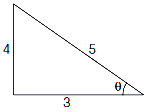
જો $\theta$ ત્રીજા ચરણમાં હોય અને $\cos \theta = -\frac{3}{5}$ હોય,તો $\tan \theta$ ની કિંમત શોધો.
A
$\frac{2}{3}$
B
$-\frac{2}{3}$
C
$-\frac{4}{3}$
D
$\frac{4}{3}$
Solution
(D) આપેલ છે કે $\theta$ ત્રીજા ચરણમાં છે,જ્યાં $\tan \theta$ ધન હોય છે.
આપણે જાણીએ છીએ કે $\sin^2 \theta + \cos^2 \theta = 1$.
$\cos \theta = -\frac{3}{5}$ મૂકતા,$\sin^2 \theta + (-\frac{3}{5})^2 = 1$.
$\sin^2 \theta + \frac{9}{25} = 1 \implies \sin^2 \theta = 1 - \frac{9}{25} = \frac{16}{25}$.
$\theta$ ત્રીજા ચરણમાં હોવાથી,$\sin \theta$ ઋણ હશે,તેથી $\sin \theta = -\frac{4}{5}$.
હવે,$\tan \theta = \frac{\sin \theta}{\cos \theta} = \frac{-4/5}{-3/5} = \frac{4}{3}$.
તેથી,વિકલ્પ $D$ સાચો છે.
આપણે જાણીએ છીએ કે $\sin^2 \theta + \cos^2 \theta = 1$.
$\cos \theta = -\frac{3}{5}$ મૂકતા,$\sin^2 \theta + (-\frac{3}{5})^2 = 1$.
$\sin^2 \theta + \frac{9}{25} = 1 \implies \sin^2 \theta = 1 - \frac{9}{25} = \frac{16}{25}$.
$\theta$ ત્રીજા ચરણમાં હોવાથી,$\sin \theta$ ઋણ હશે,તેથી $\sin \theta = -\frac{4}{5}$.
હવે,$\tan \theta = \frac{\sin \theta}{\cos \theta} = \frac{-4/5}{-3/5} = \frac{4}{3}$.
તેથી,વિકલ્પ $D$ સાચો છે.
0 likesView Solution
118
MathematicsEasyMCQAP EAMCET · 2020
$\frac{2 \tan(x)}{1-\tan^2(x)}$ ની કિંમત ધન હોય તે માટે,$x$ ની કિંમતો શોધો,જ્યાં $x \in \left(0, \frac{\pi}{2}\right)$ છે.
A
$\left(0, \frac{\pi}{3}\right)$
B
$\left(0, \frac{\pi}{6}\right)$
C
$\left(0, \frac{\pi}{4}\right)$
D
$\left(0, \frac{\pi}{8}\right)$
Solution
(C) આપણે જાણીએ છીએ કે $\tan(2x)$ નું સૂત્ર $\frac{2 \tan(x)}{1-\tan^2(x)}$ છે.
આપેલ અસમતા $\frac{2 \tan(x)}{1-\tan^2(x)} > 0$ પરથી,આપણને $\tan(2x) > 0$ મળે છે.
કારણ કે $x \in \left(0, \frac{\pi}{2}\right)$,તેથી $2x \in (0, \pi)$ થાય.
$(0, \pi)$ અંતરાલમાં $\tan(2x) > 0$ હોવા માટે,$2x$ પ્રથમ ચરણમાં હોવું જોઈએ,એટલે કે $0 < 2x < \frac{\pi}{2}$.
$2$ વડે ભાગતા,આપણને $0 < x < \frac{\pi}{4}$ મળે છે.
આમ,$x$ નો વિસ્તાર $\left(0, \frac{\pi}{4}\right)$ છે.
આપેલ અસમતા $\frac{2 \tan(x)}{1-\tan^2(x)} > 0$ પરથી,આપણને $\tan(2x) > 0$ મળે છે.
કારણ કે $x \in \left(0, \frac{\pi}{2}\right)$,તેથી $2x \in (0, \pi)$ થાય.
$(0, \pi)$ અંતરાલમાં $\tan(2x) > 0$ હોવા માટે,$2x$ પ્રથમ ચરણમાં હોવું જોઈએ,એટલે કે $0 < 2x < \frac{\pi}{2}$.
$2$ વડે ભાગતા,આપણને $0 < x < \frac{\pi}{4}$ મળે છે.
આમ,$x$ નો વિસ્તાર $\left(0, \frac{\pi}{4}\right)$ છે.
0 likesView Solution
119
MathematicsMediumMCQAP EAMCET · 2020
જો $\sec \theta + \tan \theta = 2/3$ હોય,તો $\theta$ કયા ચરણમાં આવેલું છે?
A
$I$
B
$II$
C
$III$
D
$IV$
Solution
(D) આપેલ છે કે $\sec \theta + \tan \theta = 2/3$ $(i)$
આપણે જાણીએ છીએ કે $\sec^2 \theta - \tan^2 \theta = 1$,જેનો અર્થ છે કે $(\sec \theta - \tan \theta)(\sec \theta + \tan \theta) = 1$.
$(i)$ માંથી કિંમત મૂકતા,આપણને $\sec \theta - \tan \theta = 3/2$ મળે છે (ii)
$(i)$ અને (ii) નો સરવાળો કરતા: $2 \sec \theta = 2/3 + 3/2 = (4 + 9)/6 = 13/6$,તેથી $\sec \theta = 13/12$.
$(i)$ માંથી (ii) બાદ કરતા: $2 \tan \theta = 2/3 - 3/2 = (4 - 9)/6 = -5/6$,તેથી $\tan \theta = -5/12$.
કારણ કે $\sec \theta > 0$ અને $\tan \theta < 0$,તેથી $\theta$ એ $IV$ ચરણમાં આવેલું છે.
આપણે જાણીએ છીએ કે $\sec^2 \theta - \tan^2 \theta = 1$,જેનો અર્થ છે કે $(\sec \theta - \tan \theta)(\sec \theta + \tan \theta) = 1$.
$(i)$ માંથી કિંમત મૂકતા,આપણને $\sec \theta - \tan \theta = 3/2$ મળે છે (ii)
$(i)$ અને (ii) નો સરવાળો કરતા: $2 \sec \theta = 2/3 + 3/2 = (4 + 9)/6 = 13/6$,તેથી $\sec \theta = 13/12$.
$(i)$ માંથી (ii) બાદ કરતા: $2 \tan \theta = 2/3 - 3/2 = (4 - 9)/6 = -5/6$,તેથી $\tan \theta = -5/12$.
કારણ કે $\sec \theta > 0$ અને $\tan \theta < 0$,તેથી $\theta$ એ $IV$ ચરણમાં આવેલું છે.
0 likesView Solution
120
MathematicsMediumMCQAP EAMCET · 2020
$\frac{1+\tanh \left(\frac{x}{2}\right)}{1-\tanh \left(\frac{x}{2}\right)} = $
A
$e^{-x}$
B
$e^x$
C
$2 e^{x/2}$
D
$2 e^{-x/2}$
Solution
(B) આપણે જાણીએ છીએ કે $\tanh \left(\frac{x}{2}\right) = \frac{e^{x/2} - e^{-x/2}}{e^{x/2} + e^{-x/2}}$.
આ કિંમત પદાવલિમાં મૂકતા:
$\frac{1 + \tanh \left(\frac{x}{2}\right)}{1 - \tanh \left(\frac{x}{2}\right)} = \frac{1 + \frac{e^{x/2} - e^{-x/2}}{e^{x/2} + e^{-x/2}}}{1 - \frac{e^{x/2} - e^{-x/2}}{e^{x/2} + e^{-x/2}}}$
$= \frac{\frac{e^{x/2} + e^{-x/2} + e^{x/2} - e^{-x/2}}{e^{x/2} + e^{-x/2}}}{\frac{e^{x/2} + e^{-x/2} - (e^{x/2} - e^{-x/2})}{e^{x/2} + e^{-x/2}}}$
$= \frac{2e^{x/2}}{2e^{-x/2}}$
$= e^{x/2 - (-x/2)} = e^x$.
આ કિંમત પદાવલિમાં મૂકતા:
$\frac{1 + \tanh \left(\frac{x}{2}\right)}{1 - \tanh \left(\frac{x}{2}\right)} = \frac{1 + \frac{e^{x/2} - e^{-x/2}}{e^{x/2} + e^{-x/2}}}{1 - \frac{e^{x/2} - e^{-x/2}}{e^{x/2} + e^{-x/2}}}$
$= \frac{\frac{e^{x/2} + e^{-x/2} + e^{x/2} - e^{-x/2}}{e^{x/2} + e^{-x/2}}}{\frac{e^{x/2} + e^{-x/2} - (e^{x/2} - e^{-x/2})}{e^{x/2} + e^{-x/2}}}$
$= \frac{2e^{x/2}}{2e^{-x/2}}$
$= e^{x/2 - (-x/2)} = e^x$.
0 likesView Solution
121
MathematicsEasyMCQAP EAMCET · 2020
જો $\operatorname{cosec} \theta + \cot \theta = \frac{1}{3}$ હોય,તો $\theta$ કયા ચરણમાં આવે છે?
A
$1^{\text{st}}$ ચરણ
B
$2^{\text{nd}}$ ચરણ
C
$3^{\text{rd}}$ ચરણ
D
$4^{\text{th}}$ ચરણ
Solution
(B) આપેલ છે $\operatorname{cosec} \theta + \cot \theta = \frac{1}{3}$.
આપણે જાણીએ છીએ કે $\operatorname{cosec} \theta - \cot \theta = \frac{1}{\operatorname{cosec} \theta + \cot \theta} = 3$.
બંને સમીકરણોનો સરવાળો કરતા: $2 \operatorname{cosec} \theta = \frac{10}{3} \Rightarrow \sin \theta = \frac{3}{5}$.
બંને સમીકરણોની બાદબાકી કરતા: $2 \cot \theta = -\frac{8}{3}$ $\Rightarrow \cot \theta = -\frac{4}{3}$ $\Rightarrow \cos \theta = -\frac{4}{5}$.
અહીં $\sin \theta > 0$ અને $\cos \theta < 0$ હોવાથી,$\theta$ એ $2^{\text{nd}}$ ચરણમાં છે.
આપણે જાણીએ છીએ કે $\operatorname{cosec} \theta - \cot \theta = \frac{1}{\operatorname{cosec} \theta + \cot \theta} = 3$.
બંને સમીકરણોનો સરવાળો કરતા: $2 \operatorname{cosec} \theta = \frac{10}{3} \Rightarrow \sin \theta = \frac{3}{5}$.
બંને સમીકરણોની બાદબાકી કરતા: $2 \cot \theta = -\frac{8}{3}$ $\Rightarrow \cot \theta = -\frac{4}{3}$ $\Rightarrow \cos \theta = -\frac{4}{5}$.
અહીં $\sin \theta > 0$ અને $\cos \theta < 0$ હોવાથી,$\theta$ એ $2^{\text{nd}}$ ચરણમાં છે.
0 likesView Solution
122
MathematicsMediumMCQAP EAMCET · 2020
$\cos ^2\left(\frac{7 \pi}{8}\right)+\cos ^2\left(\frac{5 \pi}{8}\right)+\cos ^2\left(\frac{3 \pi}{8}\right)+\cos ^2\left(\frac{\pi}{8}\right)=$
A
$\frac{3}{2}$
B
$\frac{2}{3}$
C
$2$
D
$1$
Solution
(C) આપણે જાણીએ છીએ કે $\cos(\pi - \theta) = -\cos \theta$,તેથી $\cos^2(\pi - \theta) = \cos^2 \theta$.
વળી,$\cos(\frac{\pi}{2} - \theta) = \sin \theta$,તેથી $\cos^2(\frac{\pi}{2} - \theta) = \sin^2 \theta$.
આપેલ પદાવલિ: $E = \cos^2(\frac{7\pi}{8}) + \cos^2(\frac{5\pi}{8}) + \cos^2(\frac{3\pi}{8}) + \cos^2(\frac{\pi}{8})$.
અહીં $\frac{7\pi}{8} = \pi - \frac{\pi}{8}$,તેથી $\cos^2(\frac{7\pi}{8}) = \cos^2(\frac{\pi}{8})$.
અહીં $\frac{5\pi}{8} = \pi - \frac{3\pi}{8}$,તેથી $\cos^2(\frac{5\pi}{8}) = \cos^2(\frac{3\pi}{8})$.
તેથી,$E = 2\cos^2(\frac{\pi}{8}) + 2\cos^2(\frac{3\pi}{8})$.
કારણ કે $\frac{3\pi}{8} = \frac{\pi}{2} - \frac{\pi}{8}$,તેથી $\cos^2(\frac{3\pi}{8}) = \sin^2(\frac{\pi}{8})$.
આ કિંમત $E$ માં મૂકતા: $E = 2\cos^2(\frac{\pi}{8}) + 2\sin^2(\frac{\pi}{8})$.
$E = 2(\cos^2(\frac{\pi}{8}) + \sin^2(\frac{\pi}{8}))$.
નિત્યસમ $\sin^2 \theta + \cos^2 \theta = 1$ નો ઉપયોગ કરતા,આપણને $E = 2(1) = 2$ મળે છે.
વળી,$\cos(\frac{\pi}{2} - \theta) = \sin \theta$,તેથી $\cos^2(\frac{\pi}{2} - \theta) = \sin^2 \theta$.
આપેલ પદાવલિ: $E = \cos^2(\frac{7\pi}{8}) + \cos^2(\frac{5\pi}{8}) + \cos^2(\frac{3\pi}{8}) + \cos^2(\frac{\pi}{8})$.
અહીં $\frac{7\pi}{8} = \pi - \frac{\pi}{8}$,તેથી $\cos^2(\frac{7\pi}{8}) = \cos^2(\frac{\pi}{8})$.
અહીં $\frac{5\pi}{8} = \pi - \frac{3\pi}{8}$,તેથી $\cos^2(\frac{5\pi}{8}) = \cos^2(\frac{3\pi}{8})$.
તેથી,$E = 2\cos^2(\frac{\pi}{8}) + 2\cos^2(\frac{3\pi}{8})$.
કારણ કે $\frac{3\pi}{8} = \frac{\pi}{2} - \frac{\pi}{8}$,તેથી $\cos^2(\frac{3\pi}{8}) = \sin^2(\frac{\pi}{8})$.
આ કિંમત $E$ માં મૂકતા: $E = 2\cos^2(\frac{\pi}{8}) + 2\sin^2(\frac{\pi}{8})$.
$E = 2(\cos^2(\frac{\pi}{8}) + \sin^2(\frac{\pi}{8}))$.
નિત્યસમ $\sin^2 \theta + \cos^2 \theta = 1$ નો ઉપયોગ કરતા,આપણને $E = 2(1) = 2$ મળે છે.
0 likesView Solution
123
MathematicsEasyMCQAP EAMCET · 2020
$\cos ^2(x)+\cos ^2\left(x+\frac{\pi}{3}\right)+\cos ^2\left(x-\frac{\pi}{3}\right) = $
A
$\frac{3}{2}$
B
$\frac{1}{2}$
C
$\frac{-3}{2}$
D
$\frac{-1}{2}$
Solution
(A) અમે નિત્યસમ $\cos^2 \theta = \frac{1 + \cos 2\theta}{2}$ નો ઉપયોગ કરીએ છીએ.
આ કિંમત પદાવલિમાં મૂકતા:
$= \frac{1 + \cos 2x}{2} + \frac{1 + \cos(2x + \frac{2\pi}{3})}{2} + \frac{1 + \cos(2x - \frac{2\pi}{3})}{2}$
$= \frac{1}{2} [3 + \cos 2x + \cos(2x + \frac{2\pi}{3}) + \cos(2x - \frac{2\pi}{3})]$
સૂત્ર $\cos(A+B) + \cos(A-B) = 2\cos A \cos B$ નો ઉપયોગ કરતા:
$= \frac{1}{2} [3 + \cos 2x + 2\cos 2x \cos(\frac{2\pi}{3})]$
કારણ કે $\cos(\frac{2\pi}{3}) = -\frac{1}{2}$:
$= \frac{1}{2} [3 + \cos 2x + 2\cos 2x(-\frac{1}{2})]$
$= \frac{1}{2} [3 + \cos 2x - \cos 2x] = \frac{3}{2}$
આ કિંમત પદાવલિમાં મૂકતા:
$= \frac{1 + \cos 2x}{2} + \frac{1 + \cos(2x + \frac{2\pi}{3})}{2} + \frac{1 + \cos(2x - \frac{2\pi}{3})}{2}$
$= \frac{1}{2} [3 + \cos 2x + \cos(2x + \frac{2\pi}{3}) + \cos(2x - \frac{2\pi}{3})]$
સૂત્ર $\cos(A+B) + \cos(A-B) = 2\cos A \cos B$ નો ઉપયોગ કરતા:
$= \frac{1}{2} [3 + \cos 2x + 2\cos 2x \cos(\frac{2\pi}{3})]$
કારણ કે $\cos(\frac{2\pi}{3}) = -\frac{1}{2}$:
$= \frac{1}{2} [3 + \cos 2x + 2\cos 2x(-\frac{1}{2})]$
$= \frac{1}{2} [3 + \cos 2x - \cos 2x] = \frac{3}{2}$
0 likesView Solution
124
MathematicsEasyMCQAP EAMCET · 2020
$\cos 48^{\circ} \cdot \cos 12^{\circ} = ?$
A
$\frac{3-\sqrt{5}}{8}$
B
$\frac{3+\sqrt{5}}{4}$
C
$\frac{3+\sqrt{5}}{2}$
D
$\frac{3+\sqrt{5}}{8}$
Solution
(D) આપણે સૂત્ર $2 \cos A \cos B = \cos(A+B) + \cos(A-B)$ નો ઉપયોગ કરીએ છીએ.
$\cos 48^{\circ} \cdot \cos 12^{\circ} = \frac{1}{2} [2 \cos 48^{\circ} \cos 12^{\circ}]$
$= \frac{1}{2} [\cos(48^{\circ}+12^{\circ}) + \cos(48^{\circ}-12^{\circ})]$
$= \frac{1}{2} [\cos 60^{\circ} + \cos 36^{\circ}]$
કારણ કે $\cos 60^{\circ} = \frac{1}{2}$ અને $\cos 36^{\circ} = \frac{\sqrt{5}+1}{4}$,
$= \frac{1}{2} [\frac{1}{2} + \frac{\sqrt{5}+1}{4}]$
$= \frac{1}{2} [\frac{2 + \sqrt{5} + 1}{4}]$
$= \frac{3+\sqrt{5}}{8}$
$\cos 48^{\circ} \cdot \cos 12^{\circ} = \frac{1}{2} [2 \cos 48^{\circ} \cos 12^{\circ}]$
$= \frac{1}{2} [\cos(48^{\circ}+12^{\circ}) + \cos(48^{\circ}-12^{\circ})]$
$= \frac{1}{2} [\cos 60^{\circ} + \cos 36^{\circ}]$
કારણ કે $\cos 60^{\circ} = \frac{1}{2}$ અને $\cos 36^{\circ} = \frac{\sqrt{5}+1}{4}$,
$= \frac{1}{2} [\frac{1}{2} + \frac{\sqrt{5}+1}{4}]$
$= \frac{1}{2} [\frac{2 + \sqrt{5} + 1}{4}]$
$= \frac{3+\sqrt{5}}{8}$
0 likesView Solution
125
MathematicsMediumMCQAP EAMCET · 2020
જો $\frac{1}{2}\left(\tan \left(\frac{\pi}{24}\right)+\cot \left(\frac{\pi}{24}\right)\right)=\sqrt{a^2+a}+\sqrt{a}$ હોય,તો $a=$
A
$3$
B
$2$
C
$1$
D
$4$
Solution
(B) આપણે જાણીએ છીએ કે $\tan \theta + \cot \theta = \frac{2}{\sin(2\theta)}$.
$\theta = \frac{\pi}{24}$ લેતા,$\tan \frac{\pi}{24} + \cot \frac{\pi}{24} = \frac{2}{\sin(\frac{\pi}{12})}$.
$\sin(15^\circ) = \frac{\sqrt{3}-1}{2\sqrt{2}}$ હોવાથી,$\frac{1}{2} \left(\tan \frac{\pi}{24} + \cot \frac{\pi}{24}\right) = \frac{1}{\sin(15^\circ)} = \frac{2\sqrt{2}}{\sqrt{3}-1} = \sqrt{6} + \sqrt{2}$.
આપેલ સમીકરણ $\sqrt{a^2+a} + \sqrt{a} = \sqrt{6} + \sqrt{2}$ સાથે સરખાવતા,$a = 2$ મળે છે.
$\theta = \frac{\pi}{24}$ લેતા,$\tan \frac{\pi}{24} + \cot \frac{\pi}{24} = \frac{2}{\sin(\frac{\pi}{12})}$.
$\sin(15^\circ) = \frac{\sqrt{3}-1}{2\sqrt{2}}$ હોવાથી,$\frac{1}{2} \left(\tan \frac{\pi}{24} + \cot \frac{\pi}{24}\right) = \frac{1}{\sin(15^\circ)} = \frac{2\sqrt{2}}{\sqrt{3}-1} = \sqrt{6} + \sqrt{2}$.
આપેલ સમીકરણ $\sqrt{a^2+a} + \sqrt{a} = \sqrt{6} + \sqrt{2}$ સાથે સરખાવતા,$a = 2$ મળે છે.
0 likesView Solution
126
MathematicsEasyMCQAP EAMCET · 2020
જો $\sin(2x) = \frac{\sqrt{5}-1}{4}$ હોય,તો $x = \frac{n\pi}{2} + (-1)^n(m)$,જ્યાં $n \in \mathbb{Z}$. $m$ શોધો.
A
$\frac{\pi}{10}$
B
$\frac{\pi}{5}$
C
$\frac{\pi}{20}$
D
$\frac{\pi}{40}$
Solution
(C) આપેલ સમીકરણ: $\sin(2x) = \frac{\sqrt{5}-1}{4}$.
આપણે જાણીએ છીએ કે $\sin(18^\circ) = \sin(\frac{\pi}{10}) = \frac{\sqrt{5}-1}{4}$.
તેથી,$\sin(2x) = \sin(\frac{\pi}{10})$.
$\sin(\theta) = \sin(\alpha)$ માટેનો વ્યાપક ઉકેલ $\theta = n\pi + (-1)^n\alpha$ છે.
$2x = \frac{\pi}{10}$ માટે આ લાગુ પાડતા:
$2x = n\pi + (-1)^n(\frac{\pi}{10})$.
$2$ વડે ભાગતા:
$x = \frac{n\pi}{2} + (-1)^n(\frac{\pi}{20})$.
આપેલ સ્વરૂપ $x = \frac{n\pi}{2} + (-1)^n(m)$ સાથે સરખાવતા,આપણને $m = \frac{\pi}{20}$ મળે છે.
આમ,વિકલ્પ $C$ સાચો છે.
આપણે જાણીએ છીએ કે $\sin(18^\circ) = \sin(\frac{\pi}{10}) = \frac{\sqrt{5}-1}{4}$.
તેથી,$\sin(2x) = \sin(\frac{\pi}{10})$.
$\sin(\theta) = \sin(\alpha)$ માટેનો વ્યાપક ઉકેલ $\theta = n\pi + (-1)^n\alpha$ છે.
$2x = \frac{\pi}{10}$ માટે આ લાગુ પાડતા:
$2x = n\pi + (-1)^n(\frac{\pi}{10})$.
$2$ વડે ભાગતા:
$x = \frac{n\pi}{2} + (-1)^n(\frac{\pi}{20})$.
આપેલ સ્વરૂપ $x = \frac{n\pi}{2} + (-1)^n(m)$ સાથે સરખાવતા,આપણને $m = \frac{\pi}{20}$ મળે છે.
આમ,વિકલ્પ $C$ સાચો છે.
0 likesView Solution
127
MathematicsEasyMCQAP EAMCET · 2020
$\tan 9^{\circ}-\tan 27^{\circ}-\tan 63^{\circ}+\tan 81^{\circ}=$
A
$4$
B
$3$
C
$2$
D
$1$
Solution
(A) આપેલ પદાવલિ: $\tan 81^{\circ} + \tan 9^{\circ} - \tan 63^{\circ} - \tan 27^{\circ}$ છે.
$\tan(90^{\circ}-\theta) = \cot \theta$ નો ઉપયોગ કરતા:
$= (\cot 9^{\circ} + \tan 9^{\circ}) - (\cot 27^{\circ} + \tan 27^{\circ})$.
$\cot \theta + \tan \theta = \frac{2}{\sin 2\theta}$ સૂત્રનો ઉપયોગ કરતા:
$= \frac{2}{\sin 18^{\circ}} - \frac{2}{\sin 54^{\circ}}$.
$= 2 \left( \frac{\sin 54^{\circ} - \sin 18^{\circ}}{\sin 54^{\circ} \sin 18^{\circ}} \right)$.
$\sin C - \sin D = 2 \cos \frac{C+D}{2} \sin \frac{C-D}{2}$ સૂત્રનો ઉપયોગ કરતા:
$= 2 \left( \frac{2 \cos 36^{\circ} \sin 18^{\circ}}{\sin 54^{\circ} \sin 18^{\circ}} \right) = 4 \frac{\cos 36^{\circ}}{\sin 54^{\circ}}$.
$\sin 54^{\circ} = \cos 36^{\circ}$ હોવાથી,જવાબ $4$ મળે છે.
$\tan(90^{\circ}-\theta) = \cot \theta$ નો ઉપયોગ કરતા:
$= (\cot 9^{\circ} + \tan 9^{\circ}) - (\cot 27^{\circ} + \tan 27^{\circ})$.
$\cot \theta + \tan \theta = \frac{2}{\sin 2\theta}$ સૂત્રનો ઉપયોગ કરતા:
$= \frac{2}{\sin 18^{\circ}} - \frac{2}{\sin 54^{\circ}}$.
$= 2 \left( \frac{\sin 54^{\circ} - \sin 18^{\circ}}{\sin 54^{\circ} \sin 18^{\circ}} \right)$.
$\sin C - \sin D = 2 \cos \frac{C+D}{2} \sin \frac{C-D}{2}$ સૂત્રનો ઉપયોગ કરતા:
$= 2 \left( \frac{2 \cos 36^{\circ} \sin 18^{\circ}}{\sin 54^{\circ} \sin 18^{\circ}} \right) = 4 \frac{\cos 36^{\circ}}{\sin 54^{\circ}}$.
$\sin 54^{\circ} = \cos 36^{\circ}$ હોવાથી,જવાબ $4$ મળે છે.
0 likesView Solution
128
MathematicsMediumMCQAP EAMCET · 2020
$\frac{\tan 52^{\circ} - \tan 38^{\circ}}{\tan 14^{\circ}} = $
A
$1$
B
$2$
C
$2 \sqrt{3}$
D
$\frac{2}{\sqrt{3}}$
Solution
(B) આપણે જાણીએ છીએ કે $\tan A - \tan B = \frac{\sin(A - B)}{\cos A \cos B}$.
અંશમાં આ સૂત્ર લાગુ પાડતા: $\tan 52^{\circ} - \tan 38^{\circ} = \frac{\sin(52^{\circ} - 38^{\circ})}{\cos 52^{\circ} \cos 38^{\circ}} = \frac{\sin 14^{\circ}}{\cos 52^{\circ} \cos 38^{\circ}}$.
હવે,પદાવલિ $\frac{\sin 14^{\circ}}{\cos 52^{\circ} \cos 38^{\circ} \tan 14^{\circ}} = \frac{\sin 14^{\circ}}{\cos 52^{\circ} \cos 38^{\circ} \frac{\sin 14^{\circ}}{\cos 14^{\circ}}} = \frac{\cos 14^{\circ}}{\cos 52^{\circ} \cos 38^{\circ}}$ બને છે.
$2 \cos A \cos B = \cos(A + B) + \cos(A - B)$ નો ઉપયોગ કરતા,$2 \cos 52^{\circ} \cos 38^{\circ} = \cos(52^{\circ} + 38^{\circ}) + \cos(52^{\circ} - 38^{\circ}) = \cos 90^{\circ} + \cos 14^{\circ} = 0 + \cos 14^{\circ} = \cos 14^{\circ}$.
આમ,પદાવલિ $\frac{\cos 14^{\circ}}{\frac{1}{2} \cos 14^{\circ}} = 2$ થાય છે.
અંશમાં આ સૂત્ર લાગુ પાડતા: $\tan 52^{\circ} - \tan 38^{\circ} = \frac{\sin(52^{\circ} - 38^{\circ})}{\cos 52^{\circ} \cos 38^{\circ}} = \frac{\sin 14^{\circ}}{\cos 52^{\circ} \cos 38^{\circ}}$.
હવે,પદાવલિ $\frac{\sin 14^{\circ}}{\cos 52^{\circ} \cos 38^{\circ} \tan 14^{\circ}} = \frac{\sin 14^{\circ}}{\cos 52^{\circ} \cos 38^{\circ} \frac{\sin 14^{\circ}}{\cos 14^{\circ}}} = \frac{\cos 14^{\circ}}{\cos 52^{\circ} \cos 38^{\circ}}$ બને છે.
$2 \cos A \cos B = \cos(A + B) + \cos(A - B)$ નો ઉપયોગ કરતા,$2 \cos 52^{\circ} \cos 38^{\circ} = \cos(52^{\circ} + 38^{\circ}) + \cos(52^{\circ} - 38^{\circ}) = \cos 90^{\circ} + \cos 14^{\circ} = 0 + \cos 14^{\circ} = \cos 14^{\circ}$.
આમ,પદાવલિ $\frac{\cos 14^{\circ}}{\frac{1}{2} \cos 14^{\circ}} = 2$ થાય છે.
0 likesView Solution
129
MathematicsMediumMCQAP EAMCET · 2020
જો $\tanh(x) = \frac{1}{3}$ હોય,તો $\tanh(3x)$ ની કિંમત શોધો.
A
$\frac{8}{9}$
B
$\frac{7}{9}$
C
$1$
D
$\frac{2}{3}$
Solution
(B) આપણને $\tanh(x) = \frac{1}{3}$ આપેલ છે.
$\tanh(3x) = \frac{3\tanh(x) + \tanh^3(x)}{1 + 3\tanh^2(x)}$ સૂત્રનો ઉપયોગ કરતા:
$\tanh(x) = \frac{1}{3}$ કિંમત મૂકતા:
$\tanh(3x) = \frac{3(\frac{1}{3}) + (\frac{1}{3})^3}{1 + 3(\frac{1}{3})^2}$
$\tanh(3x) = \frac{1 + \frac{1}{27}}{1 + 3(\frac{1}{9})}$
$\tanh(3x) = \frac{\frac{28}{27}}{1 + \frac{1}{3}}$
$\tanh(3x) = \frac{\frac{28}{27}}{\frac{4}{3}}$
$\tanh(3x) = \frac{28}{27} \times \frac{3}{4} = \frac{7}{9}$
$\tanh(3x) = \frac{3\tanh(x) + \tanh^3(x)}{1 + 3\tanh^2(x)}$ સૂત્રનો ઉપયોગ કરતા:
$\tanh(x) = \frac{1}{3}$ કિંમત મૂકતા:
$\tanh(3x) = \frac{3(\frac{1}{3}) + (\frac{1}{3})^3}{1 + 3(\frac{1}{3})^2}$
$\tanh(3x) = \frac{1 + \frac{1}{27}}{1 + 3(\frac{1}{9})}$
$\tanh(3x) = \frac{\frac{28}{27}}{1 + \frac{1}{3}}$
$\tanh(3x) = \frac{\frac{28}{27}}{\frac{4}{3}}$
$\tanh(3x) = \frac{28}{27} \times \frac{3}{4} = \frac{7}{9}$
0 likesView Solution
130
MathematicsMediumMCQAP EAMCET · 2020
જો $\sec(x) = \cosh(\theta)$ હોય,તો $\tanh^2\left(\frac{\theta}{2}\right)$ શોધો.
A
$\sec^2\left(\frac{x}{2}\right)$
B
$\tan^2\left(\frac{x}{2}\right)$
C
$\tanh^2\left(\frac{x}{2}\right)$
D
$\operatorname{sech}^2\left(\frac{x}{2}\right)$
Solution
(B) આપણે જાણીએ છીએ કે $\tanh^2\left(\frac{\theta}{2}\right) = \frac{\cosh(\theta) - 1}{\cosh(\theta) + 1}$.
આપેલ છે કે $\cosh(\theta) = \sec(x)$,તેથી:
$\tanh^2\left(\frac{\theta}{2}\right) = \frac{\sec(x) - 1}{\sec(x) + 1}$.
$\sec(x) = \frac{1}{\cos(x)}$ મૂકતા:
$\frac{\frac{1}{\cos(x)} - 1}{\frac{1}{\cos(x)} + 1} = \frac{1 - \cos(x)}{1 + \cos(x)}$.
અડધા ખૂણાના નિત્યસમ $1 - \cos(x) = 2\sin^2\left(\frac{x}{2}\right)$ અને $1 + \cos(x) = 2\cos^2\left(\frac{x}{2}\right)$ નો ઉપયોગ કરતા:
$= \frac{2\sin^2\left(\frac{x}{2}\right)}{2\cos^2\left(\frac{x}{2}\right)} = \tan^2\left(\frac{x}{2}\right)$.
આપેલ છે કે $\cosh(\theta) = \sec(x)$,તેથી:
$\tanh^2\left(\frac{\theta}{2}\right) = \frac{\sec(x) - 1}{\sec(x) + 1}$.
$\sec(x) = \frac{1}{\cos(x)}$ મૂકતા:
$\frac{\frac{1}{\cos(x)} - 1}{\frac{1}{\cos(x)} + 1} = \frac{1 - \cos(x)}{1 + \cos(x)}$.
અડધા ખૂણાના નિત્યસમ $1 - \cos(x) = 2\sin^2\left(\frac{x}{2}\right)$ અને $1 + \cos(x) = 2\cos^2\left(\frac{x}{2}\right)$ નો ઉપયોગ કરતા:
$= \frac{2\sin^2\left(\frac{x}{2}\right)}{2\cos^2\left(\frac{x}{2}\right)} = \tan^2\left(\frac{x}{2}\right)$.
0 likesView Solution
131
MathematicsEasyMCQAP EAMCET · 2020
$\operatorname{cosec} 750^{\circ} - 2 \cot 765^{\circ}$ ની કિંમત શોધો.
A
$0$
B
$1$
C
$2$
D
$-1$
Solution
(A) આપણી પાસે પદાવલિ $\operatorname{cosec} 750^{\circ} - 2 \cot 765^{\circ}$ છે.
ત્રિકોણમિતીય વિધેયોની આવર્તકતાનો ઉપયોગ કરતા,$\operatorname{cosec}(n \times 360^{\circ} + \theta) = \operatorname{cosec} \theta$ અને $\cot(n \times 360^{\circ} + \theta) = \cot \theta$.
$\operatorname{cosec} 750^{\circ} = \operatorname{cosec}(2 \times 360^{\circ} + 30^{\circ}) = \operatorname{cosec} 30^{\circ} = 2$.
$\cot 765^{\circ} = \cot(2 \times 360^{\circ} + 45^{\circ}) = \cot 45^{\circ} = 1$.
આ કિંમતોને પદાવલિમાં મુકતા:
$2 - 2(1) = 2 - 2 = 0$.
આમ,સાચો વિકલ્પ $A$ છે.
ત્રિકોણમિતીય વિધેયોની આવર્તકતાનો ઉપયોગ કરતા,$\operatorname{cosec}(n \times 360^{\circ} + \theta) = \operatorname{cosec} \theta$ અને $\cot(n \times 360^{\circ} + \theta) = \cot \theta$.
$\operatorname{cosec} 750^{\circ} = \operatorname{cosec}(2 \times 360^{\circ} + 30^{\circ}) = \operatorname{cosec} 30^{\circ} = 2$.
$\cot 765^{\circ} = \cot(2 \times 360^{\circ} + 45^{\circ}) = \cot 45^{\circ} = 1$.
આ કિંમતોને પદાવલિમાં મુકતા:
$2 - 2(1) = 2 - 2 = 0$.
આમ,સાચો વિકલ્પ $A$ છે.
0 likesView Solution
132
MathematicsMediumMCQAP EAMCET · 2020
જો $\tan \left(\frac{x}{2}\right) = \frac{m}{n}$ હોય,તો $m \sin (x) + n \cos (x)$ ની કિંમત કેટલી થાય?
A
$m$
B
$-m$
C
$-n$
D
$n$
Solution
(D) આપેલ છે કે $\tan \left(\frac{x}{2}\right) = \frac{m}{n}$.
અડધા ખૂણાના સૂત્રોનો ઉપયોગ કરતા: $\sin (x) = \frac{2 \tan (x/2)}{1 + \tan^2 (x/2)}$ અને $\cos (x) = \frac{1 - \tan^2 (x/2)}{1 + \tan^2 (x/2)}$.
આ કિંમતો $m \sin (x) + n \cos (x)$ માં મૂકતા:
$m \left( \frac{2 \tan (x/2)}{1 + \tan^2 (x/2)} \right) + n \left( \frac{1 - \tan^2 (x/2)}{1 + \tan^2 (x/2)} \right)$
$= m \left( \frac{2(m/n)}{1 + (m^2/n^2)} \right) + n \left( \frac{1 - (m^2/n^2)}{1 + (m^2/n^2)} \right)$
$= \frac{2m^2 n + n^3 - nm^2}{m^2 + n^2} = \frac{n(m^2 + n^2)}{m^2 + n^2} = n$.
અડધા ખૂણાના સૂત્રોનો ઉપયોગ કરતા: $\sin (x) = \frac{2 \tan (x/2)}{1 + \tan^2 (x/2)}$ અને $\cos (x) = \frac{1 - \tan^2 (x/2)}{1 + \tan^2 (x/2)}$.
આ કિંમતો $m \sin (x) + n \cos (x)$ માં મૂકતા:
$m \left( \frac{2 \tan (x/2)}{1 + \tan^2 (x/2)} \right) + n \left( \frac{1 - \tan^2 (x/2)}{1 + \tan^2 (x/2)} \right)$
$= m \left( \frac{2(m/n)}{1 + (m^2/n^2)} \right) + n \left( \frac{1 - (m^2/n^2)}{1 + (m^2/n^2)} \right)$
$= \frac{2m^2 n + n^3 - nm^2}{m^2 + n^2} = \frac{n(m^2 + n^2)}{m^2 + n^2} = n$.
0 likesView Solution
133
MathematicsMediumMCQAP EAMCET · 2020
જો $\sin A + \sin B = \frac{1}{2}$ અને $\cos A + \cos B = 1$ હોય,તો $\sin \left(\frac{A-B}{2}\right)$ ની કિંમત શોધો.
A
$\pm \frac{\sqrt{13}}{4}$
B
$\pm \frac{\sqrt{11}}{4}$
C
$\pm \frac{\sqrt{7}}{4}$
D
$\pm \frac{\sqrt{17}}{4}$
Solution
(B) આપેલ છે કે $\sin A + \sin B = \frac{1}{2}$ અને $\cos A + \cos B = 1$.
બંને સમીકરણોનો વર્ગ કરીને સરવાળો કરતા:
$(\sin A + \sin B)^2 + (\cos A + \cos B)^2 = (\frac{1}{2})^2 + (1)^2$
$\sin^2 A + \sin^2 B + 2 \sin A \sin B + \cos^2 A + \cos^2 B + 2 \cos A \cos B = \frac{1}{4} + 1$
$(\sin^2 A + \cos^2 A) + (\sin^2 B + \cos^2 B) + 2(\cos A \cos B + \sin A \sin B) = \frac{5}{4}$
$1 + 1 + 2 \cos(A-B) = \frac{5}{4}$
$2 + 2 \cos(A-B) = \frac{5}{4}$
$2 \cos(A-B) = \frac{5}{4} - 2 = -\frac{3}{4}$
$\cos(A-B) = -\frac{3}{8}$
નિત્યસમ $\cos \theta = 1 - 2 \sin^2(\frac{\theta}{2})$ નો ઉપયોગ કરતા:
$1 - 2 \sin^2(\frac{A-B}{2}) = -\frac{3}{8}$
$2 \sin^2(\frac{A-B}{2}) = 1 + \frac{3}{8} = \frac{11}{8}$
$\sin^2(\frac{A-B}{2}) = \frac{11}{16}$
$\sin(\frac{A-B}{2}) = \pm \frac{\sqrt{11}}{4}$
બંને સમીકરણોનો વર્ગ કરીને સરવાળો કરતા:
$(\sin A + \sin B)^2 + (\cos A + \cos B)^2 = (\frac{1}{2})^2 + (1)^2$
$\sin^2 A + \sin^2 B + 2 \sin A \sin B + \cos^2 A + \cos^2 B + 2 \cos A \cos B = \frac{1}{4} + 1$
$(\sin^2 A + \cos^2 A) + (\sin^2 B + \cos^2 B) + 2(\cos A \cos B + \sin A \sin B) = \frac{5}{4}$
$1 + 1 + 2 \cos(A-B) = \frac{5}{4}$
$2 + 2 \cos(A-B) = \frac{5}{4}$
$2 \cos(A-B) = \frac{5}{4} - 2 = -\frac{3}{4}$
$\cos(A-B) = -\frac{3}{8}$
નિત્યસમ $\cos \theta = 1 - 2 \sin^2(\frac{\theta}{2})$ નો ઉપયોગ કરતા:
$1 - 2 \sin^2(\frac{A-B}{2}) = -\frac{3}{8}$
$2 \sin^2(\frac{A-B}{2}) = 1 + \frac{3}{8} = \frac{11}{8}$
$\sin^2(\frac{A-B}{2}) = \frac{11}{16}$
$\sin(\frac{A-B}{2}) = \pm \frac{\sqrt{11}}{4}$
0 likesView Solution
134
MathematicsMediumMCQAP EAMCET · 2020
જો $\cos(\theta_1) + \cos(\theta_2) + \cos(\theta_3) + \cos(\theta_4) = -4$ હોય,તો $\cot(\frac{\theta_1}{2}) + \cot(\frac{\theta_2}{2}) + \cot(\frac{\theta_3}{2}) + \cot(\frac{\theta_4}{2})$ ની કિંમત શોધો.
A
$4$
B
$1$
C
$2$
D
$0$
Solution
(D) આપેલ છે કે,$\cos(\theta_1) + \cos(\theta_2) + \cos(\theta_3) + \cos(\theta_4) = -4$.
કોસાઇન વિધેયનો વિસ્તાર $[-1, 1]$ હોવાથી,તેમનો સરવાળો $-4$ ત્યારે જ શક્ય છે જ્યારે દરેક પદ $-1$ હોય.
તેથી,$\cos(\theta_1) = \cos(\theta_2) = \cos(\theta_3) = \cos(\theta_4) = -1$.
આનો અર્થ એ છે કે $\theta_1 = \theta_2 = \theta_3 = \theta_4 = \pi$ (અથવા તેના વ્યાપક સ્વરૂપમાં).
તેથી,$\cot(\frac{\theta_i}{2}) = \cot(\frac{\pi}{2}) = 0$.
આમ,$\cot(\frac{\theta_1}{2}) + \cot(\frac{\theta_2}{2}) + \cot(\frac{\theta_3}{2}) + \cot(\frac{\theta_4}{2}) = 0 + 0 + 0 + 0 = 0$.
કોસાઇન વિધેયનો વિસ્તાર $[-1, 1]$ હોવાથી,તેમનો સરવાળો $-4$ ત્યારે જ શક્ય છે જ્યારે દરેક પદ $-1$ હોય.
તેથી,$\cos(\theta_1) = \cos(\theta_2) = \cos(\theta_3) = \cos(\theta_4) = -1$.
આનો અર્થ એ છે કે $\theta_1 = \theta_2 = \theta_3 = \theta_4 = \pi$ (અથવા તેના વ્યાપક સ્વરૂપમાં).
તેથી,$\cot(\frac{\theta_i}{2}) = \cot(\frac{\pi}{2}) = 0$.
આમ,$\cot(\frac{\theta_1}{2}) + \cot(\frac{\theta_2}{2}) + \cot(\frac{\theta_3}{2}) + \cot(\frac{\theta_4}{2}) = 0 + 0 + 0 + 0 = 0$.
0 likesView Solution
135
MathematicsMediumMCQAP EAMCET · 2020
$\cos \left(x+\frac{\pi}{3}\right)+2 \sqrt{2} \sin \left(x+\frac{\pi}{3}\right)$ ની ન્યૂનતમ અને મહત્તમ કિંમતો અનુક્રમે છે
A
$-(2 \sqrt{3}-1)$ અને $2 \sqrt{3}-1$
B
$-(1+2 \sqrt{2})$ અને $1+2 \sqrt{2}$
C
-$3$ અને $3$
D
-$2$ અને $2$
Solution
(C) આ પદાવલિ $A \cos \theta + B \sin \theta$ સ્વરૂપમાં છે,જ્યાં $\theta = x + \frac{\pi}{3}$,$A = 1$,અને $B = 2 \sqrt{2}$ છે.
$A \cos \theta + B \sin \theta$ નો વિસ્તાર $[-\sqrt{A^2 + B^2}, \sqrt{A^2 + B^2}]$ છે.
અહીં,$A^2 + B^2 = (1)^2 + (2 \sqrt{2})^2 = 1 + 8 = 9$ છે.
તેથી,$\sqrt{A^2 + B^2} = \sqrt{9} = 3$ થાય.
ન્યૂનતમ કિંમત $-3$ અને મહત્તમ કિંમત $3$ છે.
તેથી,સાચો વિકલ્પ $C$ છે.
$A \cos \theta + B \sin \theta$ નો વિસ્તાર $[-\sqrt{A^2 + B^2}, \sqrt{A^2 + B^2}]$ છે.
અહીં,$A^2 + B^2 = (1)^2 + (2 \sqrt{2})^2 = 1 + 8 = 9$ છે.
તેથી,$\sqrt{A^2 + B^2} = \sqrt{9} = 3$ થાય.
ન્યૂનતમ કિંમત $-3$ અને મહત્તમ કિંમત $3$ છે.
તેથી,સાચો વિકલ્પ $C$ છે.
0 likesView Solution
136
MathematicsMediumMCQAP EAMCET · 2020
$3 \sin^4(\theta) + \cos^4(\theta) = 1$ નો વ્યાપક ઉકેલ શોધો.
A
માત્ર $n\pi$
B
માત્ર $n\pi + \frac{\pi}{4}$
C
માત્ર $n\pi - \frac{\pi}{4}$
D
$n\pi, n\pi + \frac{\pi}{4}, n\pi - \frac{\pi}{4}$
Solution
(D) આપેલ સમીકરણ: $3 \sin^4 \theta + \cos^4 \theta = 1$
$\cos^4 \theta = (1 - \sin^2 \theta)^2 = 1 - 2\sin^2 \theta + \sin^4 \theta$ નો ઉપયોગ કરતા:
$3 \sin^4 \theta + (1 - 2\sin^2 \theta + \sin^4 \theta) = 1$
$4 \sin^4 \theta - 2\sin^2 \theta = 0$
$2 \sin^2 \theta (2 \sin^2 \theta - 1) = 0$
આથી $\sin^2 \theta = 0$ અથવા $\sin^2 \theta = \frac{1}{2}$ મળે.
કિસ્સો $1$: $\sin^2 \theta = 0$ $\Rightarrow \sin \theta = 0$ $\Rightarrow \theta = n\pi$.
કિસ્સો $2$: $\sin^2 \theta = \frac{1}{2} = \sin^2(\frac{\pi}{4}) \Rightarrow \theta = n\pi \pm \frac{\pi}{4}$.
બંને કિસ્સાઓને જોડતા,વ્યાપક ઉકેલ $\theta = n\pi, n\pi \pm \frac{\pi}{4}$ છે,જ્યાં $n \in \mathbb{Z}$.
$\cos^4 \theta = (1 - \sin^2 \theta)^2 = 1 - 2\sin^2 \theta + \sin^4 \theta$ નો ઉપયોગ કરતા:
$3 \sin^4 \theta + (1 - 2\sin^2 \theta + \sin^4 \theta) = 1$
$4 \sin^4 \theta - 2\sin^2 \theta = 0$
$2 \sin^2 \theta (2 \sin^2 \theta - 1) = 0$
આથી $\sin^2 \theta = 0$ અથવા $\sin^2 \theta = \frac{1}{2}$ મળે.
કિસ્સો $1$: $\sin^2 \theta = 0$ $\Rightarrow \sin \theta = 0$ $\Rightarrow \theta = n\pi$.
કિસ્સો $2$: $\sin^2 \theta = \frac{1}{2} = \sin^2(\frac{\pi}{4}) \Rightarrow \theta = n\pi \pm \frac{\pi}{4}$.
બંને કિસ્સાઓને જોડતા,વ્યાપક ઉકેલ $\theta = n\pi, n\pi \pm \frac{\pi}{4}$ છે,જ્યાં $n \in \mathbb{Z}$.
0 likesView Solution
137
MathematicsEasyMCQAP EAMCET · 2020
$\cos(x) - \sin(x) = 0$ નો વ્યાપક ઉકેલ શોધો.
A
$n\pi - \frac{\pi}{4}, n \in Z$
B
$2n\pi + \frac{\pi}{4}, n \in Z$
C
$n\pi + \frac{\pi}{4}, n \in Z$
D
$2n\pi - \frac{\pi}{4}, n \in Z$
Solution
(C) આપેલ સમીકરણ $\cos(x) - \sin(x) = 0$ છે.
પદોને ગોઠવતા,આપણને $\cos(x) = \sin(x)$ મળે છે.
બંને બાજુ $\cos(x)$ વડે ભાગતા,આપણને $\tan(x) = 1$ મળે છે.
આપણે જાણીએ છીએ કે $\tan(x) = 1 = \tan(\frac{\pi}{4})$.
$\tan(x) = \tan(\alpha)$ માટેનો વ્યાપક ઉકેલ $x = n\pi + \alpha$ છે,જ્યાં $n \in Z$.
તેથી,વ્યાપક ઉકેલ $x = n\pi + \frac{\pi}{4}$ છે,જ્યાં $n \in Z$.
પદોને ગોઠવતા,આપણને $\cos(x) = \sin(x)$ મળે છે.
બંને બાજુ $\cos(x)$ વડે ભાગતા,આપણને $\tan(x) = 1$ મળે છે.
આપણે જાણીએ છીએ કે $\tan(x) = 1 = \tan(\frac{\pi}{4})$.
$\tan(x) = \tan(\alpha)$ માટેનો વ્યાપક ઉકેલ $x = n\pi + \alpha$ છે,જ્યાં $n \in Z$.
તેથી,વ્યાપક ઉકેલ $x = n\pi + \frac{\pi}{4}$ છે,જ્યાં $n \in Z$.
0 likesView Solution
138
MathematicsEasyMCQAP EAMCET · 2020
સમીકરણ $(\sin x)(\cos x) = \frac{1}{4}$ નું સમાધાન કરતા $\left(0, \frac{\pi}{2}\right)$ માં $x$ ની કિંમત શું છે?
A
$\frac{\pi}{6}$
B
$\frac{\pi}{3}$
C
$\frac{\pi}{8}$
D
$\frac{\pi}{12}$
Solution
(D) આપેલ સમીકરણ: $(\sin x)(\cos x) = \frac{1}{4}$
બંને બાજુ $2$ વડે ગુણતા: $2 \sin x \cos x = \frac{2}{4}$
નિત્યસમ $\sin 2x = 2 \sin x \cos x$ નો ઉપયોગ કરતા: $\sin 2x = \frac{1}{2}$
અહીં $x \in \left(0, \frac{\pi}{2}\right)$ હોવાથી,$2x \in (0, \pi)$ થાય.
$\sin 2x = \frac{1}{2}$ માટે $2x$ ની કિંમતો $2x = \frac{\pi}{6}$ અને $2x = \frac{5\pi}{6}$ મળે.
તેથી,$x = \frac{\pi}{12}$ અને $x = \frac{5\pi}{12}$ મળે.
બંને કિંમતો $\left(0, \frac{\pi}{2}\right)$ અંતરાલમાં છે.
આપેલ વિકલ્પો મુજબ,$\frac{\pi}{12}$ સાચો જવાબ છે.
બંને બાજુ $2$ વડે ગુણતા: $2 \sin x \cos x = \frac{2}{4}$
નિત્યસમ $\sin 2x = 2 \sin x \cos x$ નો ઉપયોગ કરતા: $\sin 2x = \frac{1}{2}$
અહીં $x \in \left(0, \frac{\pi}{2}\right)$ હોવાથી,$2x \in (0, \pi)$ થાય.
$\sin 2x = \frac{1}{2}$ માટે $2x$ ની કિંમતો $2x = \frac{\pi}{6}$ અને $2x = \frac{5\pi}{6}$ મળે.
તેથી,$x = \frac{\pi}{12}$ અને $x = \frac{5\pi}{12}$ મળે.
બંને કિંમતો $\left(0, \frac{\pi}{2}\right)$ અંતરાલમાં છે.
આપેલ વિકલ્પો મુજબ,$\frac{\pi}{12}$ સાચો જવાબ છે.
0 likesView Solution
139
MathematicsEasyMCQAP EAMCET · 2020
જો $\sin \alpha = \sin \beta$ અને $\cos \alpha = \cos \beta$ હોય,તો કોઈ પૂર્ણાંક $n$ માટે $\alpha - \beta = $ શું થાય?
A
$n \pi$
B
$2 n \pi + \frac{\pi}{2}$
C
$2 n \pi - \frac{\pi}{2}$
D
$2 n \pi$
Solution
(D) આપેલ છે કે $\sin \alpha = \sin \beta$ અને $\cos \alpha = \cos \beta$.
બંને સમીકરણોનો વર્ગ કરીને સરવાળો કરતા:
$(\sin \alpha)^2 + (\cos \alpha)^2 = (\sin \beta)^2 + (\cos \beta)^2$
$1 = 1$.
વૈકલ્પિક રીતે,સંકર સંખ્યાઓ $z_1 = \cos \alpha + i \sin \alpha$ અને $z_2 = \cos \beta + i \sin \beta$ ધ્યાનમાં લો.
$\cos \alpha = \cos \beta$ અને $\sin \alpha = \sin \beta$ હોવાથી,$z_1 = z_2$ મળે.
આનો અર્થ એ છે કે $e^{i \alpha} = e^{i \beta}$,જેનો અર્થ થાય છે $e^{i(\alpha - \beta)} = 1$.
તેથી,કોઈ પૂર્ણાંક $n$ માટે $\alpha - \beta = 2 n \pi$.
આમ,વિકલ્પ $D$ સાચો છે.
બંને સમીકરણોનો વર્ગ કરીને સરવાળો કરતા:
$(\sin \alpha)^2 + (\cos \alpha)^2 = (\sin \beta)^2 + (\cos \beta)^2$
$1 = 1$.
વૈકલ્પિક રીતે,સંકર સંખ્યાઓ $z_1 = \cos \alpha + i \sin \alpha$ અને $z_2 = \cos \beta + i \sin \beta$ ધ્યાનમાં લો.
$\cos \alpha = \cos \beta$ અને $\sin \alpha = \sin \beta$ હોવાથી,$z_1 = z_2$ મળે.
આનો અર્થ એ છે કે $e^{i \alpha} = e^{i \beta}$,જેનો અર્થ થાય છે $e^{i(\alpha - \beta)} = 1$.
તેથી,કોઈ પૂર્ણાંક $n$ માટે $\alpha - \beta = 2 n \pi$.
આમ,વિકલ્પ $D$ સાચો છે.
0 likesView Solution
140
MathematicsEasyMCQAP EAMCET · 2020
$\frac{\sqrt{3} \sin \theta + \cos \theta}{\sin \left(\theta + \frac{\pi}{6}\right)} = $
A
$-2$
B
$1$
C
$2$
D
$-1$
Solution
(C) આપેલ પદાવલિ: $\frac{\sqrt{3} \sin \theta + \cos \theta}{\sin \left(\theta + \frac{\pi}{6}\right)}$.
$\sin(A + B) = \sin A \cos B + \cos A \sin B$ સૂત્રનો ઉપયોગ કરીને છેદનું વિસ્તરણ કરતા:
$\sin \left(\theta + \frac{\pi}{6}\right) = \sin \theta \cos \frac{\pi}{6} + \cos \theta \sin \frac{\pi}{6}$.
$\cos \frac{\pi}{6} = \frac{\sqrt{3}}{2}$ અને $\sin \frac{\pi}{6} = \frac{1}{2}$ હોવાથી,છેદ:
$\frac{\sqrt{3}}{2} \sin \theta + \frac{1}{2} \cos \theta = \frac{1}{2} (\sqrt{3} \sin \theta + \cos \theta)$ થશે.
આ કિંમત મૂળ પદાવલિમાં મૂકતા:
$\frac{\sqrt{3} \sin \theta + \cos \theta}{\frac{1}{2} (\sqrt{3} \sin \theta + \cos \theta)} = \frac{1}{1/2} = 2$.
તેથી,વિકલ્પ $C$ સાચો છે.
$\sin(A + B) = \sin A \cos B + \cos A \sin B$ સૂત્રનો ઉપયોગ કરીને છેદનું વિસ્તરણ કરતા:
$\sin \left(\theta + \frac{\pi}{6}\right) = \sin \theta \cos \frac{\pi}{6} + \cos \theta \sin \frac{\pi}{6}$.
$\cos \frac{\pi}{6} = \frac{\sqrt{3}}{2}$ અને $\sin \frac{\pi}{6} = \frac{1}{2}$ હોવાથી,છેદ:
$\frac{\sqrt{3}}{2} \sin \theta + \frac{1}{2} \cos \theta = \frac{1}{2} (\sqrt{3} \sin \theta + \cos \theta)$ થશે.
આ કિંમત મૂળ પદાવલિમાં મૂકતા:
$\frac{\sqrt{3} \sin \theta + \cos \theta}{\frac{1}{2} (\sqrt{3} \sin \theta + \cos \theta)} = \frac{1}{1/2} = 2$.
તેથી,વિકલ્પ $C$ સાચો છે.
0 likesView Solution
141
MathematicsMediumMCQAP EAMCET · 2020
$\sin x + \sin 2x + \sin 3x = \cos x + \cos 2x + \cos 3x$ નો વ્યાપક ઉકેલ શોધો.
A
$2n\pi + \frac{2\pi}{3}, \frac{n\pi}{2} + \frac{\pi}{8}, n \in Z$
B
$2n\pi - \frac{2\pi}{3}, \frac{n\pi}{2} - \frac{\pi}{8}, n \in Z$
C
$2n\pi + \frac{2\pi}{3}, \frac{n\pi}{2} \pm \frac{\pi}{8}, n \in Z$
D
$2n\pi \pm \frac{2\pi}{3}, \frac{n\pi}{2} + \frac{\pi}{8}, n \in Z$
Solution
(D) આપેલ સમીકરણ: $\sin x + \sin 2x + \sin 3x = \cos x + \cos 2x + \cos 3x$
પદોને જૂથબદ્ધ કરતા: $(\sin 3x + \sin x) + \sin 2x = (\cos 3x + \cos x) + \cos 2x$
સરવાળાથી ગુણાકારના સૂત્રોનો ઉપયોગ કરતા: $2\sin 2x \cos x + \sin 2x = 2\cos 2x \cos x + \cos 2x$
સામાન્ય પદો બહાર કાઢતા: $\sin 2x(2\cos x + 1) = \cos 2x(2\cos x + 1)$
ગોઠવણી કરતા: $(\sin 2x - \cos 2x)(2\cos x + 1) = 0$
કિસ્સો $1$: $\sin 2x - \cos 2x = 0 \implies \tan 2x = 1 = \tan \frac{\pi}{4}$
$2x = n\pi + \frac{\pi}{4} \implies x = \frac{n\pi}{2} + \frac{\pi}{8}$
કિસ્સો $2$: $2\cos x + 1 = 0 \implies \cos x = -\frac{1}{2} = \cos \frac{2\pi}{3}$
$x = 2n\pi \pm \frac{2\pi}{3}$
આમ,વ્યાપક ઉકેલ $x = 2n\pi \pm \frac{2\pi}{3}$ અને $x = \frac{n\pi}{2} + \frac{\pi}{8}$,જ્યાં $n \in Z$ છે.
તેથી,વિકલ્પ $(D)$ સાચો છે.
પદોને જૂથબદ્ધ કરતા: $(\sin 3x + \sin x) + \sin 2x = (\cos 3x + \cos x) + \cos 2x$
સરવાળાથી ગુણાકારના સૂત્રોનો ઉપયોગ કરતા: $2\sin 2x \cos x + \sin 2x = 2\cos 2x \cos x + \cos 2x$
સામાન્ય પદો બહાર કાઢતા: $\sin 2x(2\cos x + 1) = \cos 2x(2\cos x + 1)$
ગોઠવણી કરતા: $(\sin 2x - \cos 2x)(2\cos x + 1) = 0$
કિસ્સો $1$: $\sin 2x - \cos 2x = 0 \implies \tan 2x = 1 = \tan \frac{\pi}{4}$
$2x = n\pi + \frac{\pi}{4} \implies x = \frac{n\pi}{2} + \frac{\pi}{8}$
કિસ્સો $2$: $2\cos x + 1 = 0 \implies \cos x = -\frac{1}{2} = \cos \frac{2\pi}{3}$
$x = 2n\pi \pm \frac{2\pi}{3}$
આમ,વ્યાપક ઉકેલ $x = 2n\pi \pm \frac{2\pi}{3}$ અને $x = \frac{n\pi}{2} + \frac{\pi}{8}$,જ્યાં $n \in Z$ છે.
તેથી,વિકલ્પ $(D)$ સાચો છે.
0 likesView Solution
142
MathematicsMediumMCQAP EAMCET · 2020
$\tan \left(-\frac{23 \pi}{3}\right)-\cot \left(\theta-\frac{13 \pi}{3}\right) =$
A
$\sqrt{3}+\cot \theta$
B
$\sqrt{3}-\tan \left(\frac{\pi}{6}+\theta\right)$
C
$\sqrt{3}+\tan \theta$
D
$\sqrt{3}+\cot \left(\frac{\pi}{3}-\theta\right)$
Solution
(D) આપણી પાસે પદાવલિ છે: $\tan \left(-\frac{23 \pi}{3}\right)-\cot \left(\theta-\frac{13 \pi}{3}\right)$
$\tan(-x) = -\tan(x)$ હોવાથી,$\tan \left(-\frac{23 \pi}{3}\right) = -\tan \left(\frac{23 \pi}{3}\right) = -\tan \left(8 \pi - \frac{\pi}{3}\right) = -(-\tan \frac{\pi}{3}) = \sqrt{3}$.
બીજા પદ માટે,$\cot \left(\theta-\frac{13 \pi}{3}\right) = \cot \left(\theta - (4 \pi + \frac{\pi}{3})\right) = \cot \left(\theta - \frac{\pi}{3}\right) = -\cot \left(\frac{\pi}{3} - \theta\right)$.
આ કિંમતોને પદાવલિમાં મૂકતા: $\sqrt{3} - (-\cot \left(\frac{\pi}{3} - \theta\right)) = \sqrt{3} + \cot \left(\frac{\pi}{3} - \theta\right)$.
તેથી,સાચો વિકલ્પ $D$ છે.
$\tan(-x) = -\tan(x)$ હોવાથી,$\tan \left(-\frac{23 \pi}{3}\right) = -\tan \left(\frac{23 \pi}{3}\right) = -\tan \left(8 \pi - \frac{\pi}{3}\right) = -(-\tan \frac{\pi}{3}) = \sqrt{3}$.
બીજા પદ માટે,$\cot \left(\theta-\frac{13 \pi}{3}\right) = \cot \left(\theta - (4 \pi + \frac{\pi}{3})\right) = \cot \left(\theta - \frac{\pi}{3}\right) = -\cot \left(\frac{\pi}{3} - \theta\right)$.
આ કિંમતોને પદાવલિમાં મૂકતા: $\sqrt{3} - (-\cot \left(\frac{\pi}{3} - \theta\right)) = \sqrt{3} + \cot \left(\frac{\pi}{3} - \theta\right)$.
તેથી,સાચો વિકલ્પ $D$ છે.
0 likesView Solution
143
MathematicsEasyMCQAP EAMCET · 2020
$4 \sin^2(x) - 4 \sin(x) + 1 = 0$ નો વ્યાપક ઉકેલ શોધો.
A
$x = 2n\pi \pm \frac{\pi}{3}, n \in \mathbb{Z}$
B
$x = n\pi + (-1)^n \frac{\pi}{3}, n \in \mathbb{Z}$
C
$x = n\pi + (-1)^n \frac{\pi}{6}, n \in \mathbb{Z}$
D
$x = n\pi + (-1)^n \frac{\pi}{4}, n \in \mathbb{Z}$
Solution
(C) આપેલ સમીકરણ: $4 \sin^2(x) - 4 \sin(x) + 1 = 0$
આ $\sin(x)$ ના સ્વરૂપમાં દ્વિઘાત સમીકરણ છે,જેને $(2 \sin(x) - 1)^2 = 0$ તરીકે લખી શકાય.
બંને બાજુ વર્ગમૂળ લેતા: $2 \sin(x) - 1 = 0$
$\sin(x) = \frac{1}{2}$
આપણે જાણીએ છીએ કે $\sin(x) = \sin(\frac{\pi}{6})$.
$\sin(x) = \sin(\alpha)$ માટે વ્યાપક ઉકેલ $x = n\pi + (-1)^n \alpha$ છે,જ્યાં $n \in \mathbb{Z}$.
તેથી,$x = n\pi + (-1)^n \frac{\pi}{6}, n \in \mathbb{Z}$.
આમ,વિકલ્પ $C$ સાચો છે.
આ $\sin(x)$ ના સ્વરૂપમાં દ્વિઘાત સમીકરણ છે,જેને $(2 \sin(x) - 1)^2 = 0$ તરીકે લખી શકાય.
બંને બાજુ વર્ગમૂળ લેતા: $2 \sin(x) - 1 = 0$
$\sin(x) = \frac{1}{2}$
આપણે જાણીએ છીએ કે $\sin(x) = \sin(\frac{\pi}{6})$.
$\sin(x) = \sin(\alpha)$ માટે વ્યાપક ઉકેલ $x = n\pi + (-1)^n \alpha$ છે,જ્યાં $n \in \mathbb{Z}$.
તેથી,$x = n\pi + (-1)^n \frac{\pi}{6}, n \in \mathbb{Z}$.
આમ,વિકલ્પ $C$ સાચો છે.
0 likesView Solution
144
MathematicsMediumMCQAP EAMCET · 2020
ધારો કે $A, B$ અને $C$ એ $\triangle ABC$ ના ત્રણ ખૂણાઓ છે જેથી $\cos A + \cos B + \cos C = \frac{3}{2}$,તો $\triangle ABC$ એ કેવો ત્રિકોણ છે?
A
સમબાજુ
B
કાટકોણ
C
સમદ્વિબાજુ પણ સમબાજુ નહીં
D
વિષમબાજુ
Solution
(A) આપેલ છે,$\cos A + \cos B + \cos C = \frac{3}{2}$.
આપણે જાણીએ છીએ કે કોઈપણ ત્રિકોણ $ABC$ માટે,$\cos A + \cos B + \cos C$ ની મહત્તમ કિંમત $\frac{3}{2}$ છે,જે ફક્ત ત્યારે જ શક્ય છે જ્યારે $A = B = C = 60^{\circ}$ અથવા $\frac{\pi}{3}$ રેડિયન હોય.
કારણ કે $A = B = C = \frac{\pi}{3}$,ત્રણેય ખૂણા સમાન છે.
તેથી,$\triangle ABC$ એ સમબાજુ ત્રિકોણ છે.
આમ,વિકલ્પ $A$ સાચો છે.
આપણે જાણીએ છીએ કે કોઈપણ ત્રિકોણ $ABC$ માટે,$\cos A + \cos B + \cos C$ ની મહત્તમ કિંમત $\frac{3}{2}$ છે,જે ફક્ત ત્યારે જ શક્ય છે જ્યારે $A = B = C = 60^{\circ}$ અથવા $\frac{\pi}{3}$ રેડિયન હોય.
કારણ કે $A = B = C = \frac{\pi}{3}$,ત્રણેય ખૂણા સમાન છે.
તેથી,$\triangle ABC$ એ સમબાજુ ત્રિકોણ છે.
આમ,વિકલ્પ $A$ સાચો છે.
0 likesView Solution
145
MathematicsEasyMCQAP EAMCET · 2020
$\sin \left(\frac{5 \pi}{3}\right) + \sec \left(\frac{13 \pi}{3}\right) = $
A
$2 - \frac{\sqrt{3}}{2}$
B
$2 + \frac{\sqrt{3}}{2}$
C
$\sqrt{3} + \frac{1}{\sqrt{2}}$
D
$\sqrt{3} - \frac{1}{\sqrt{2}}$
Solution
(A) આપણી પાસે $\sin \left(\frac{5 \pi}{3}\right) + \sec \left(\frac{13 \pi}{3}\right)$ છે.
પ્રથમ,$\sin \left(\frac{5 \pi}{3}\right) = \sin \left(2 \pi - \frac{\pi}{3}\right) = -\sin \left(\frac{\pi}{3}\right) = -\frac{\sqrt{3}}{2}$ ને સરળ બનાવો.
ત્યારબાદ,$\sec \left(\frac{13 \pi}{3}\right) = \sec \left(4 \pi + \frac{\pi}{3}\right) = \sec \left(\frac{\pi}{3}\right) = 2$ ને સરળ બનાવો.
આ કિંમતોનો સરવાળો કરતા,આપણને $-\frac{\sqrt{3}}{2} + 2 = 2 - \frac{\sqrt{3}}{2}$ મળે છે.
આમ,સાચો વિકલ્પ $A$ છે.
પ્રથમ,$\sin \left(\frac{5 \pi}{3}\right) = \sin \left(2 \pi - \frac{\pi}{3}\right) = -\sin \left(\frac{\pi}{3}\right) = -\frac{\sqrt{3}}{2}$ ને સરળ બનાવો.
ત્યારબાદ,$\sec \left(\frac{13 \pi}{3}\right) = \sec \left(4 \pi + \frac{\pi}{3}\right) = \sec \left(\frac{\pi}{3}\right) = 2$ ને સરળ બનાવો.
આ કિંમતોનો સરવાળો કરતા,આપણને $-\frac{\sqrt{3}}{2} + 2 = 2 - \frac{\sqrt{3}}{2}$ મળે છે.
આમ,સાચો વિકલ્પ $A$ છે.
0 likesView Solution
146
MathematicsDifficultMCQAP EAMCET · 2020
જો $\alpha, \beta$ અને $\gamma$ એ ખૂણાઓ હોય જે નીચેની શરતોનું પાલન કરે છે, તો $xyz$ ની કિંમત શોધો.
$1.$ $\tan \alpha + \tan \beta + \tan \gamma = \tan \alpha \tan \beta \tan \gamma$
$2.$ $x = \cos \alpha + i \sin \alpha$
$3.$ $y = \cos \beta + i \sin \beta$
$4.$ $z = \cos \gamma + i \sin \gamma$
$1.$ $\tan \alpha + \tan \beta + \tan \gamma = \tan \alpha \tan \beta \tan \gamma$
$2.$ $x = \cos \alpha + i \sin \alpha$
$3.$ $y = \cos \beta + i \sin \beta$
$4.$ $z = \cos \gamma + i \sin \gamma$
A
$1$, પરંતુ $-1$ નહીં
B
$-1$, પરંતુ $1$ નહીં
C
$\pm 1$
D
$0$
Solution
(C) આપેલ છે કે, $\tan \alpha + \tan \beta + \tan \gamma = \tan \alpha \tan \beta \tan \gamma$.
આનો અર્થ એ થાય કે $\tan \alpha + \tan \beta = -\tan \gamma (1 - \tan \alpha \tan \beta)$.
$(1 - \tan \alpha \tan \beta)$ વડે ભાગતા, આપણને $\frac{\tan \alpha + \tan \beta}{1 - \tan \alpha \tan \beta} = \tan(-\gamma)$ મળે છે.
તેથી, $\tan(\alpha + \beta) = \tan(-\gamma)$, જેનો અર્થ છે કે $\alpha + \beta = n\pi - \gamma$ કોઈ પૂર્ણાંક $n \in \mathbb{Z}$ માટે.
તેથી, $\alpha + \beta + \gamma = n\pi$.
ઓઈલરના સૂત્રનો ઉપયોગ કરતા, $x = e^{i\alpha}$, $y = e^{i\beta}$, અને $z = e^{i\gamma}$.
તેથી $xyz = e^{i\alpha} \cdot e^{i\beta} \cdot e^{i\gamma} = e^{i(\alpha + \beta + \gamma)} = e^{in\pi}$.
કારણ કે $e^{in\pi} = \cos(n\pi) + i\sin(n\pi) = \cos(n\pi)$, અને $\cos(n\pi)$ એ $1$ છે જો $n$ બેકી હોય અને $-1$ છે જો $n$ એકી હોય.
તેથી, $xyz = \pm 1$.
આનો અર્થ એ થાય કે $\tan \alpha + \tan \beta = -\tan \gamma (1 - \tan \alpha \tan \beta)$.
$(1 - \tan \alpha \tan \beta)$ વડે ભાગતા, આપણને $\frac{\tan \alpha + \tan \beta}{1 - \tan \alpha \tan \beta} = \tan(-\gamma)$ મળે છે.
તેથી, $\tan(\alpha + \beta) = \tan(-\gamma)$, જેનો અર્થ છે કે $\alpha + \beta = n\pi - \gamma$ કોઈ પૂર્ણાંક $n \in \mathbb{Z}$ માટે.
તેથી, $\alpha + \beta + \gamma = n\pi$.
ઓઈલરના સૂત્રનો ઉપયોગ કરતા, $x = e^{i\alpha}$, $y = e^{i\beta}$, અને $z = e^{i\gamma}$.
તેથી $xyz = e^{i\alpha} \cdot e^{i\beta} \cdot e^{i\gamma} = e^{i(\alpha + \beta + \gamma)} = e^{in\pi}$.
કારણ કે $e^{in\pi} = \cos(n\pi) + i\sin(n\pi) = \cos(n\pi)$, અને $\cos(n\pi)$ એ $1$ છે જો $n$ બેકી હોય અને $-1$ છે જો $n$ એકી હોય.
તેથી, $xyz = \pm 1$.
0 likesView Solution
147
MathematicsMediumMCQAP EAMCET · 2020
$\sin ^6(\theta) + \cos ^6(\theta) + 3 \sin ^2(\theta) \cos ^2(\theta)$ નું મૂલ્ય શું છે?
A
$0$
B
$1$
C
$2$
D
$3$
Solution
(B) આપણે બીજગણિતીય નિત્યસમ $a^3 + b^3 = (a + b)(a^2 - ab + b^2)$ નો ઉપયોગ કરીએ છીએ.
ધારો કે $a = \sin^2 \theta$ અને $b = \cos^2 \theta$.
તેથી $\sin^6 \theta + \cos^6 \theta = (\sin^2 \theta)^3 + (\cos^2 \theta)^3$.
$= (\sin^2 \theta + \cos^2 \theta)((\sin^2 \theta)^2 - \sin^2 \theta \cos^2 \theta + (\cos^2 \theta)^2)$.
આપણે જાણીએ છીએ કે $\sin^2 \theta + \cos^2 \theta = 1$,તેથી:
$= 1 \cdot (\sin^4 \theta - \sin^2 \theta \cos^2 \theta + \cos^4 \theta)$.
આપણે જાણીએ છીએ કે $\sin^4 \theta + \cos^4 \theta = (\sin^2 \theta + \cos^2 \theta)^2 - 2 \sin^2 \theta \cos^2 \theta = 1 - 2 \sin^2 \theta \cos^2 \theta$.
આ કિંમત પાછી મૂકતા:
$\sin^6 \theta + \cos^6 \theta = 1 - 2 \sin^2 \theta \cos^2 \theta - \sin^2 \theta \cos^2 \theta = 1 - 3 \sin^2 \theta \cos^2 \theta$.
તેથી,$\sin^6 \theta + \cos^6 \theta + 3 \sin^2 \theta \cos^2 \theta = (1 - 3 \sin^2 \theta \cos^2 \theta) + 3 \sin^2 \theta \cos^2 \theta = 1$.
ધારો કે $a = \sin^2 \theta$ અને $b = \cos^2 \theta$.
તેથી $\sin^6 \theta + \cos^6 \theta = (\sin^2 \theta)^3 + (\cos^2 \theta)^3$.
$= (\sin^2 \theta + \cos^2 \theta)((\sin^2 \theta)^2 - \sin^2 \theta \cos^2 \theta + (\cos^2 \theta)^2)$.
આપણે જાણીએ છીએ કે $\sin^2 \theta + \cos^2 \theta = 1$,તેથી:
$= 1 \cdot (\sin^4 \theta - \sin^2 \theta \cos^2 \theta + \cos^4 \theta)$.
આપણે જાણીએ છીએ કે $\sin^4 \theta + \cos^4 \theta = (\sin^2 \theta + \cos^2 \theta)^2 - 2 \sin^2 \theta \cos^2 \theta = 1 - 2 \sin^2 \theta \cos^2 \theta$.
આ કિંમત પાછી મૂકતા:
$\sin^6 \theta + \cos^6 \theta = 1 - 2 \sin^2 \theta \cos^2 \theta - \sin^2 \theta \cos^2 \theta = 1 - 3 \sin^2 \theta \cos^2 \theta$.
તેથી,$\sin^6 \theta + \cos^6 \theta + 3 \sin^2 \theta \cos^2 \theta = (1 - 3 \sin^2 \theta \cos^2 \theta) + 3 \sin^2 \theta \cos^2 \theta = 1$.
0 likesView Solution
148
MathematicsMediumMCQAP EAMCET · 2020
$x \in [0, 2\pi]$ માટે $\tan(x) + \sec(x) = \sqrt{3}$ ઉકેલો.
A
$\frac{\pi}{3}$
B
$\frac{\pi}{6}$
C
$\frac{13\pi}{6}$
D
$\frac{6\pi}{13}$
Solution
(B) આપેલ સમીકરણ: $\tan(x) + \sec(x) = \sqrt{3}$.
આપણે જાણીએ છીએ કે $\sec^2(x) - \tan^2(x) = 1$,તેથી $(\sec(x) - \tan(x))(\sec(x) + \tan(x)) = 1$.
કિંમત મૂકતા: $(\sec(x) - \tan(x))(\sqrt{3}) = 1$,તેથી $\sec(x) - \tan(x) = \frac{1}{\sqrt{3}}$.
બંને સમીકરણોનો સરવાળો કરતા:
$2\sec(x) = \sqrt{3} + \frac{1}{\sqrt{3}} = \frac{4}{\sqrt{3}}$ $\Rightarrow \sec(x) = \frac{2}{\sqrt{3}}$ $\Rightarrow \cos(x) = \frac{\sqrt{3}}{2}$.
$x \in [0, 2\pi]$ માટે,ઉકેલ $x = \frac{\pi}{6}$ અને $x = \frac{11\pi}{6}$ મળે છે.
મૂળ સમીકરણમાં ચકાસતા,$x = \frac{\pi}{6}$ સાચો ઉકેલ છે.
આપણે જાણીએ છીએ કે $\sec^2(x) - \tan^2(x) = 1$,તેથી $(\sec(x) - \tan(x))(\sec(x) + \tan(x)) = 1$.
કિંમત મૂકતા: $(\sec(x) - \tan(x))(\sqrt{3}) = 1$,તેથી $\sec(x) - \tan(x) = \frac{1}{\sqrt{3}}$.
બંને સમીકરણોનો સરવાળો કરતા:
$2\sec(x) = \sqrt{3} + \frac{1}{\sqrt{3}} = \frac{4}{\sqrt{3}}$ $\Rightarrow \sec(x) = \frac{2}{\sqrt{3}}$ $\Rightarrow \cos(x) = \frac{\sqrt{3}}{2}$.
$x \in [0, 2\pi]$ માટે,ઉકેલ $x = \frac{\pi}{6}$ અને $x = \frac{11\pi}{6}$ મળે છે.
મૂળ સમીકરણમાં ચકાસતા,$x = \frac{\pi}{6}$ સાચો ઉકેલ છે.
0 likesView Solution
149
MathematicsMediumMCQAP EAMCET · 2020
જો $\cos(x) + \cos^2(x) = 1$ હોય,તો $\sin^2(x) + \sin^4(x)$ ની કિંમત કેટલી થાય?
A
$0$
B
$1$
C
$-1$
D
$2$
Solution
(B) આપેલ છે કે,$\cos(x) + \cos^2(x) = 1$.
$\sin^2(x) = 1 - \cos^2(x)$ હોવાથી,આપણે $\sin^2(x) = \cos(x)$ લખી શકીએ.
બંને બાજુ વર્ગ કરતા,આપણને $\sin^4(x) = \cos^2(x)$ મળે છે.
આ કિંમતોને $\sin^2(x) + \sin^4(x)$ માં મૂકતા,આપણને $\cos(x) + \cos^2(x)$ મળે છે.
$\cos(x) + \cos^2(x) = 1$ હોવાથી,અભિવ્યક્તિનું મૂલ્ય $1$ છે.
તેથી,વિકલ્પ $B$ સાચો છે.
$\sin^2(x) = 1 - \cos^2(x)$ હોવાથી,આપણે $\sin^2(x) = \cos(x)$ લખી શકીએ.
બંને બાજુ વર્ગ કરતા,આપણને $\sin^4(x) = \cos^2(x)$ મળે છે.
આ કિંમતોને $\sin^2(x) + \sin^4(x)$ માં મૂકતા,આપણને $\cos(x) + \cos^2(x)$ મળે છે.
$\cos(x) + \cos^2(x) = 1$ હોવાથી,અભિવ્યક્તિનું મૂલ્ય $1$ છે.
તેથી,વિકલ્પ $B$ સાચો છે.
0 likesView Solution
150
MathematicsMediumMCQAP EAMCET · 2020
જો $\frac{x}{\cos \alpha} = \frac{y}{\cos \left(\frac{2 \pi}{3} - \alpha\right)} = \frac{z}{\cos \left(\frac{2 \pi}{3} + \alpha\right)}$ હોય,તો $(x + y + z)$ ની કિંમત કેટલી થાય?
A
$\frac{1}{2}$
B
$0$
C
$1$
D
$2$
Solution
(B) ધારો કે $\frac{x}{\cos \alpha} = \frac{y}{\cos \left(\frac{2 \pi}{3} - \alpha\right)} = \frac{z}{\cos \left(\frac{2 \pi}{3} + \alpha\right)} = k$.
તેથી,$x = k \cos \alpha$,$y = k \cos \left(\frac{2 \pi}{3} - \alpha\right)$,અને $z = k \cos \left(\frac{2 \pi}{3} + \alpha\right)$.
હવે,$x + y + z = k \left[ \cos \alpha + \cos \left(\frac{2 \pi}{3} - \alpha\right) + \cos \left(\frac{2 \pi}{3} + \alpha\right) \right]$.
સૂત્ર $\cos(A - B) + \cos(A + B) = 2 \cos A \cos B$ નો ઉપયોગ કરતા:
$x + y + z = k \left[ \cos \alpha + 2 \cos \left(\frac{2 \pi}{3}\right) \cos \alpha \right]$.
કારણ કે $\cos \left(\frac{2 \pi}{3}\right) = -\frac{1}{2}$,તેથી:
$x + y + z = k \left[ \cos \alpha + 2 \left(-\frac{1}{2}\right) \cos \alpha \right] = k [\cos \alpha - \cos \alpha] = 0$.
તેથી,$x = k \cos \alpha$,$y = k \cos \left(\frac{2 \pi}{3} - \alpha\right)$,અને $z = k \cos \left(\frac{2 \pi}{3} + \alpha\right)$.
હવે,$x + y + z = k \left[ \cos \alpha + \cos \left(\frac{2 \pi}{3} - \alpha\right) + \cos \left(\frac{2 \pi}{3} + \alpha\right) \right]$.
સૂત્ર $\cos(A - B) + \cos(A + B) = 2 \cos A \cos B$ નો ઉપયોગ કરતા:
$x + y + z = k \left[ \cos \alpha + 2 \cos \left(\frac{2 \pi}{3}\right) \cos \alpha \right]$.
કારણ કે $\cos \left(\frac{2 \pi}{3}\right) = -\frac{1}{2}$,તેથી:
$x + y + z = k \left[ \cos \alpha + 2 \left(-\frac{1}{2}\right) \cos \alpha \right] = k [\cos \alpha - \cos \alpha] = 0$.
0 likesView Solution
151
MathematicsEasyMCQAP EAMCET · 2020
જો $\log (x+y)-2xy=0$ હોય,તો $y^{\prime}(0)=$
A
$2y^2+1$
B
$2y^2-1$
C
$0$
D
$2y^2$
Solution
(B) આપેલ સમીકરણ: $\log(x+y) - 2xy = 0$.
$x$ ની સાપેક્ષમાં બંને બાજુ વિકલન કરતા:
$\frac{1}{x+y} \cdot (1 + y') - 2(x y' + y) = 0$.
$y'$ ને અલગ કરવા માટે પદોની ગોઠવણી કરતા:
$\frac{1}{x+y} + \frac{y'}{x+y} - 2xy' - 2y = 0$.
$y' \left( \frac{1}{x+y} - 2x \right) = 2y - \frac{1}{x+y}$.
$y' = \frac{2y - \frac{1}{x+y}}{\frac{1}{x+y} - 2x}$.
હવે,$x = 0$ આગળ કિંમત શોધતા:
$x = 0$ મૂકતા,મૂળ સમીકરણ $\log(y) - 0 = 0$ બને છે,જેનો અર્થ છે $\log(y) = 0$,તેથી $y = e^0 = 1$.
$y'$ ના સમીકરણમાં $x = 0$ અને $y = 1$ મૂકતા:
$y'(0) = \frac{2(1) - \frac{1}{0+1}}{\frac{1}{0+1} - 2(0)} = \frac{2 - 1}{1 - 0} = 1$.
નોંધ: આપેલા વિકલ્પો $y$ ના સ્વરૂપમાં છે. પદાવલિ $\frac{2y - \frac{1}{y}}{\frac{1}{y}} = 2y^2 - 1$ થાય છે.
આમ,$y'(0) = 2y^2 - 1$.
$x$ ની સાપેક્ષમાં બંને બાજુ વિકલન કરતા:
$\frac{1}{x+y} \cdot (1 + y') - 2(x y' + y) = 0$.
$y'$ ને અલગ કરવા માટે પદોની ગોઠવણી કરતા:
$\frac{1}{x+y} + \frac{y'}{x+y} - 2xy' - 2y = 0$.
$y' \left( \frac{1}{x+y} - 2x \right) = 2y - \frac{1}{x+y}$.
$y' = \frac{2y - \frac{1}{x+y}}{\frac{1}{x+y} - 2x}$.
હવે,$x = 0$ આગળ કિંમત શોધતા:
$x = 0$ મૂકતા,મૂળ સમીકરણ $\log(y) - 0 = 0$ બને છે,જેનો અર્થ છે $\log(y) = 0$,તેથી $y = e^0 = 1$.
$y'$ ના સમીકરણમાં $x = 0$ અને $y = 1$ મૂકતા:
$y'(0) = \frac{2(1) - \frac{1}{0+1}}{\frac{1}{0+1} - 2(0)} = \frac{2 - 1}{1 - 0} = 1$.
નોંધ: આપેલા વિકલ્પો $y$ ના સ્વરૂપમાં છે. પદાવલિ $\frac{2y - \frac{1}{y}}{\frac{1}{y}} = 2y^2 - 1$ થાય છે.
આમ,$y'(0) = 2y^2 - 1$.
0 likesView Solution
152
MathematicsEasyMCQAP EAMCET · 2020
જો $y = \frac{e^x \log x}{x^2}$ હોય,તો $\frac{dy}{dx} =$
A
$\frac{e^x \{1 + (x + 2) \log x\}}{x^3}$
B
$\frac{e^x \{1 - (x - 2) \log x\}}{x^4}$
C
$\frac{e^x \{1 - (x - 2) \log x\}}{x^3}$
D
$\frac{e^x \{1 + (x - 2) \log x\}}{x^3}$
Solution
(D) આપેલ છે કે,$y = \frac{e^x \log x}{x^2}$.
વિકલન માટે ભાગાકારનો નિયમ વાપરતા,$\frac{d}{dx} \left( \frac{u}{v} \right) = \frac{v \frac{du}{dx} - u \frac{dv}{dx}}{v^2}$.
અહીં,$u = e^x \log x$ અને $v = x^2$.
$\frac{du}{dx} = e^x \log x + e^x \cdot \frac{1}{x} = e^x \left( \log x + \frac{1}{x} \right)$.
$\frac{dv}{dx} = 2x$.
તેથી,$\frac{dy}{dx} = \frac{x^2 \left[ e^x \left( \log x + \frac{1}{x} \right) \right] - (e^x \log x)(2x)}{(x^2)^2}$.
$\frac{dy}{dx} = \frac{x^2 e^x \log x + x e^x - 2x e^x \log x}{x^4}$.
$\frac{dy}{dx} = \frac{x e^x \log x + e^x - 2 e^x \log x}{x^3}$.
$\frac{dy}{dx} = \frac{e^x [x \log x + 1 - 2 \log x]}{x^3}$.
$\frac{dy}{dx} = \frac{e^x [1 + (x - 2) \log x]}{x^3}$.
આમ,વિકલ્પ $D$ સાચો છે.
વિકલન માટે ભાગાકારનો નિયમ વાપરતા,$\frac{d}{dx} \left( \frac{u}{v} \right) = \frac{v \frac{du}{dx} - u \frac{dv}{dx}}{v^2}$.
અહીં,$u = e^x \log x$ અને $v = x^2$.
$\frac{du}{dx} = e^x \log x + e^x \cdot \frac{1}{x} = e^x \left( \log x + \frac{1}{x} \right)$.
$\frac{dv}{dx} = 2x$.
તેથી,$\frac{dy}{dx} = \frac{x^2 \left[ e^x \left( \log x + \frac{1}{x} \right) \right] - (e^x \log x)(2x)}{(x^2)^2}$.
$\frac{dy}{dx} = \frac{x^2 e^x \log x + x e^x - 2x e^x \log x}{x^4}$.
$\frac{dy}{dx} = \frac{x e^x \log x + e^x - 2 e^x \log x}{x^3}$.
$\frac{dy}{dx} = \frac{e^x [x \log x + 1 - 2 \log x]}{x^3}$.
$\frac{dy}{dx} = \frac{e^x [1 + (x - 2) \log x]}{x^3}$.
આમ,વિકલ્પ $D$ સાચો છે.
0 likesView Solution
153
MathematicsEasyMCQAP EAMCET · 2020
જો $y = \log(\cosh x)$ હોય,તો $\frac{d^2 y}{d x^2} = $
A
$\operatorname{sech}^2 x$
B
$-\operatorname{sech}^2 x$
C
$\sinh x$
D
$-\sinh x$
Solution
(A) આપેલ છે કે $y = \log(\cosh x)$.
પ્રથમ,$x$ ની સાપેક્ષમાં વિકલન કરતા:
$\frac{dy}{dx} = \frac{1}{\cosh x} \cdot \frac{d}{dx}(\cosh x)$
કારણ કે $\frac{d}{dx}(\cosh x) = \sinh x$,તેથી આપણને મળે છે:
$\frac{dy}{dx} = \frac{\sinh x}{\cosh x} = \tanh x$
હવે,ફરીથી $x$ ની સાપેક્ષમાં વિકલન કરતા:
$\frac{d^2 y}{dx^2} = \frac{d}{dx}(\tanh x)$
કારણ કે $\frac{d}{dx}(\tanh x) = \operatorname{sech}^2 x$,તેથી:
$\frac{d^2 y}{dx^2} = \operatorname{sech}^2 x$
આમ,સાચો વિકલ્પ $A$ છે.
પ્રથમ,$x$ ની સાપેક્ષમાં વિકલન કરતા:
$\frac{dy}{dx} = \frac{1}{\cosh x} \cdot \frac{d}{dx}(\cosh x)$
કારણ કે $\frac{d}{dx}(\cosh x) = \sinh x$,તેથી આપણને મળે છે:
$\frac{dy}{dx} = \frac{\sinh x}{\cosh x} = \tanh x$
હવે,ફરીથી $x$ ની સાપેક્ષમાં વિકલન કરતા:
$\frac{d^2 y}{dx^2} = \frac{d}{dx}(\tanh x)$
કારણ કે $\frac{d}{dx}(\tanh x) = \operatorname{sech}^2 x$,તેથી:
$\frac{d^2 y}{dx^2} = \operatorname{sech}^2 x$
આમ,સાચો વિકલ્પ $A$ છે.
0 likesView Solution
154
MathematicsMediumMCQAP EAMCET · 2020
જો $f(x) = \log_{x^2} (\ln x)$ હોય,તો $f'(e)$ ની કિંમત . . . . . . થાય.
A
$e$
B
$\frac{1}{e}$
C
$\frac{1}{2e}$
D
$2e$
Solution
(C) આપેલ છે કે $f(x) = \log_{x^2} (\ln x)$.
આધાર પરિવર્તન સૂત્ર $\log_a b = \frac{\ln b}{\ln a}$ નો ઉપયોગ કરતા:
$f(x) = \frac{\ln(\ln x)}{\ln x^2} = \frac{\ln(\ln x)}{2 \ln x}$.
હવે,ભાગાકારના નિયમ $\left( \frac{u}{v} \right)' = \frac{u'v - uv'}{v^2}$ નો ઉપયોગ કરીને $x$ ની સાપેક્ષમાં વિકલન કરતા:
$f'(x) = \frac{1}{2} \left[ \frac{(\frac{1}{x \ln x})(\ln x) - (\ln(\ln x))(\frac{1}{x})}{(\ln x)^2} \right]$.
$f'(x) = \frac{1}{2} \left[ \frac{\frac{1}{x} - \frac{\ln(\ln x)}{x}}{(\ln x)^2} \right] = \frac{1 - \ln(\ln x)}{2x(\ln x)^2}$.
$x = e$ માટે,$\ln x = 1$ અને $\ln(\ln x) = \ln(1) = 0$.
$f'(e) = \frac{1 - 0}{2e(1)^2} = \frac{1}{2e}$.
આધાર પરિવર્તન સૂત્ર $\log_a b = \frac{\ln b}{\ln a}$ નો ઉપયોગ કરતા:
$f(x) = \frac{\ln(\ln x)}{\ln x^2} = \frac{\ln(\ln x)}{2 \ln x}$.
હવે,ભાગાકારના નિયમ $\left( \frac{u}{v} \right)' = \frac{u'v - uv'}{v^2}$ નો ઉપયોગ કરીને $x$ ની સાપેક્ષમાં વિકલન કરતા:
$f'(x) = \frac{1}{2} \left[ \frac{(\frac{1}{x \ln x})(\ln x) - (\ln(\ln x))(\frac{1}{x})}{(\ln x)^2} \right]$.
$f'(x) = \frac{1}{2} \left[ \frac{\frac{1}{x} - \frac{\ln(\ln x)}{x}}{(\ln x)^2} \right] = \frac{1 - \ln(\ln x)}{2x(\ln x)^2}$.
$x = e$ માટે,$\ln x = 1$ અને $\ln(\ln x) = \ln(1) = 0$.
$f'(e) = \frac{1 - 0}{2e(1)^2} = \frac{1}{2e}$.
0 likesView Solution
155
MathematicsEasyMCQAP EAMCET · 2020
$\tan ^{-1}\left[\frac{x}{1+\sqrt{1-x^2}}\right]$ નું $\sec ^{-1}\left(\frac{1}{2 x^2-1}\right)$ ની સાપેક્ષમાં વિકલન શું થાય?
A
$\frac{1}{2}$
B
$\frac{1}{4}$
C
$\frac{-1}{4}$
D
$\frac{-1}{2}$
Solution
(C) ધારો કે $y = \tan ^{-1}\left(\frac{x}{1+\sqrt{1-x^2}}\right)$ અને $u = \sec ^{-1}\left(\frac{1}{2 x^2-1}\right)$.
$x = \sin \theta$ લેતા,$\sqrt{1-x^2} = \cos \theta$ મળે.
$y = \tan ^{-1}\left(\frac{\sin \theta}{1+\cos \theta}\right) = \tan ^{-1}\left(\frac{2 \sin(\theta/2) \cos(\theta/2)}{2 \cos^2(\theta/2)}\right) = \tan ^{-1}(\tan(\theta/2)) = \frac{\theta}{2}$.
હવે,$u = \sec ^{-1}\left(\frac{1}{2 \sin^2 \theta - 1}\right) = \sec ^{-1}\left(\frac{1}{-(1-2 \sin^2 \theta)}\right) = \sec ^{-1}\left(\frac{1}{-\cos 2 \theta}\right) = \sec ^{-1}(-\sec 2 \theta) = \sec ^{-1}(\sec(\pi - 2 \theta)) = \pi - 2 \theta$.
$x = \sin \theta$ હોવાથી,$\theta = \sin^{-1} x$.
તેથી,$y = \frac{1}{2} \sin^{-1} x$ અને $u = \pi - 2 \sin^{-1} x$.
હવે $\frac{dy}{dx} = \frac{1}{2 \sqrt{1-x^2}}$ અને $\frac{du}{dx} = \frac{-2}{\sqrt{1-x^2}}$.
તેથી,$\frac{dy}{du} = \frac{dy/dx}{du/dx} = \frac{1/(2 \sqrt{1-x^2})}{-2/\sqrt{1-x^2}} = -\frac{1}{4}$.
$x = \sin \theta$ લેતા,$\sqrt{1-x^2} = \cos \theta$ મળે.
$y = \tan ^{-1}\left(\frac{\sin \theta}{1+\cos \theta}\right) = \tan ^{-1}\left(\frac{2 \sin(\theta/2) \cos(\theta/2)}{2 \cos^2(\theta/2)}\right) = \tan ^{-1}(\tan(\theta/2)) = \frac{\theta}{2}$.
હવે,$u = \sec ^{-1}\left(\frac{1}{2 \sin^2 \theta - 1}\right) = \sec ^{-1}\left(\frac{1}{-(1-2 \sin^2 \theta)}\right) = \sec ^{-1}\left(\frac{1}{-\cos 2 \theta}\right) = \sec ^{-1}(-\sec 2 \theta) = \sec ^{-1}(\sec(\pi - 2 \theta)) = \pi - 2 \theta$.
$x = \sin \theta$ હોવાથી,$\theta = \sin^{-1} x$.
તેથી,$y = \frac{1}{2} \sin^{-1} x$ અને $u = \pi - 2 \sin^{-1} x$.
હવે $\frac{dy}{dx} = \frac{1}{2 \sqrt{1-x^2}}$ અને $\frac{du}{dx} = \frac{-2}{\sqrt{1-x^2}}$.
તેથી,$\frac{dy}{du} = \frac{dy/dx}{du/dx} = \frac{1/(2 \sqrt{1-x^2})}{-2/\sqrt{1-x^2}} = -\frac{1}{4}$.
0 likesView Solution
156
MathematicsEasyMCQAP EAMCET · 2020
$\frac{d}{d x}\left(\cos ^{-1}\left(\frac{4 x^3}{27}-x\right)\right)=$
A
$\frac{3}{\sqrt{9-x^2}}$
B
$\frac{1}{\sqrt{9-x^2}}$
C
$\frac{-3}{\sqrt{9-x^2}}$
D
$\frac{-1}{\sqrt{9-x^2}}$
Solution
(C) ધારો કે $y = \cos ^{-1}\left(\frac{4 x^3}{27}-x\right)$.
આ પદાવલિને $y = \cos ^{-1}\left(4\left(\frac{x}{3}\right)^3 - 3\left(\frac{x}{3}\right)\right)$ તરીકે લખી શકાય.
ધારો કે $\frac{x}{3} = \cos A$,તેથી $A = \cos ^{-1}\left(\frac{x}{3}\right)$.
આ કિંમત પદાવલિમાં મૂકતા,$y = \cos ^{-1}(4 \cos ^3 A - 3 \cos A)$ મળે.
ત્રિકોણમિતીય નિત્યસમ $\cos(3A) = 4 \cos ^3 A - 3 \cos A$ નો ઉપયોગ કરતા,$y = \cos ^{-1}(\cos 3A) = 3A$ મળે.
આમ,$y = 3 \cos ^{-1}\left(\frac{x}{3}\right)$.
$x$ ની સાપેક્ષે વિકલન કરતા:
$\frac{dy}{dx} = 3 \times \left(-\frac{1}{\sqrt{1 - (x/3)^2}}\right) \times \frac{d}{dx}\left(\frac{x}{3}\right)$.
$\frac{dy}{dx} = 3 \times \left(-\frac{1}{\sqrt{(9-x^2)/9}}\right) \times \frac{1}{3} = 3 \times \left(-\frac{3}{\sqrt{9-x^2}}\right) \times \frac{1}{3} = -\frac{3}{\sqrt{9-x^2}}$.
આ પદાવલિને $y = \cos ^{-1}\left(4\left(\frac{x}{3}\right)^3 - 3\left(\frac{x}{3}\right)\right)$ તરીકે લખી શકાય.
ધારો કે $\frac{x}{3} = \cos A$,તેથી $A = \cos ^{-1}\left(\frac{x}{3}\right)$.
આ કિંમત પદાવલિમાં મૂકતા,$y = \cos ^{-1}(4 \cos ^3 A - 3 \cos A)$ મળે.
ત્રિકોણમિતીય નિત્યસમ $\cos(3A) = 4 \cos ^3 A - 3 \cos A$ નો ઉપયોગ કરતા,$y = \cos ^{-1}(\cos 3A) = 3A$ મળે.
આમ,$y = 3 \cos ^{-1}\left(\frac{x}{3}\right)$.
$x$ ની સાપેક્ષે વિકલન કરતા:
$\frac{dy}{dx} = 3 \times \left(-\frac{1}{\sqrt{1 - (x/3)^2}}\right) \times \frac{d}{dx}\left(\frac{x}{3}\right)$.
$\frac{dy}{dx} = 3 \times \left(-\frac{1}{\sqrt{(9-x^2)/9}}\right) \times \frac{1}{3} = 3 \times \left(-\frac{3}{\sqrt{9-x^2}}\right) \times \frac{1}{3} = -\frac{3}{\sqrt{9-x^2}}$.
0 likesView Solution
157
MathematicsMediumMCQAP EAMCET · 2020
$x=1$ આગળ $f(x)=\cos ^{-1}\left[\sin \sqrt{\frac{1+x}{2}}\right]+x^x$ નું $x$ ની સાપેક્ષમાં વિકલન શું થાય?
A
$1$
B
$\frac{1}{4}$
C
$\frac{3}{4}$
D
$\frac{2}{3}$
Solution
(C) આપેલ છે,$f(x) = \cos ^{-1}\left(\sin \sqrt{\frac{1+x}{2}}\right)+x^x$.
નિત્યસમ $\cos ^{-1}(y) = \frac{\pi}{2} - \sin ^{-1}(y)$ નો ઉપયોગ કરતા:
$f(x) = \frac{\pi}{2} - \sin ^{-1}\left(\sin \sqrt{\frac{1+x}{2}}\right) + x^x$.
આપેલ વિસ્તાર માટે $\sin ^{-1}(\sin \theta) = \theta$ હોવાથી:
$f(x) = \frac{\pi}{2} - \sqrt{\frac{1+x}{2}} + x^x$.
હવે,$x$ ની સાપેક્ષમાં વિકલન કરતા:
$f'(x) = 0 - \frac{1}{\sqrt{2}} \cdot \frac{1}{2\sqrt{1+x}} + x^x(1 + \ln x)$.
$x=1$ મુકતા:
$f'(1) = -\frac{1}{2\sqrt{2}\sqrt{2}} + 1^1(1 + \ln 1) = -\frac{1}{4} + 1(1+0) = -\frac{1}{4} + 1 = \frac{3}{4}$.
આમ,સાચો વિકલ્પ $C$ છે.
નિત્યસમ $\cos ^{-1}(y) = \frac{\pi}{2} - \sin ^{-1}(y)$ નો ઉપયોગ કરતા:
$f(x) = \frac{\pi}{2} - \sin ^{-1}\left(\sin \sqrt{\frac{1+x}{2}}\right) + x^x$.
આપેલ વિસ્તાર માટે $\sin ^{-1}(\sin \theta) = \theta$ હોવાથી:
$f(x) = \frac{\pi}{2} - \sqrt{\frac{1+x}{2}} + x^x$.
હવે,$x$ ની સાપેક્ષમાં વિકલન કરતા:
$f'(x) = 0 - \frac{1}{\sqrt{2}} \cdot \frac{1}{2\sqrt{1+x}} + x^x(1 + \ln x)$.
$x=1$ મુકતા:
$f'(1) = -\frac{1}{2\sqrt{2}\sqrt{2}} + 1^1(1 + \ln 1) = -\frac{1}{4} + 1(1+0) = -\frac{1}{4} + 1 = \frac{3}{4}$.
આમ,સાચો વિકલ્પ $C$ છે.
0 likesView Solution
158
MathematicsMediumMCQAP EAMCET · 2020
$y = \tan^{-1} \left[ \frac{\sqrt{1 + \sin x} + \sqrt{1 - \sin x}}{\sqrt{1 + \sin x} - \sqrt{1 - \sin x}} \right]$ નું $x$ ની સાપેક્ષમાં વિકલન શું થાય?
A
$-1$
B
$0$
C
$\pm 2$
D
$\pm \frac{1}{2}$
Solution
(D) આપેલ છે કે $y = \tan^{-1} \left[ \frac{\sqrt{1 + \sin x} + \sqrt{1 - \sin x}}{\sqrt{1 + \sin x} - \sqrt{1 - \sin x}} \right]$.
આપણે જાણીએ છીએ કે $1 + \sin x = (\cos \frac{x}{2} + \sin \frac{x}{2})^2$ અને $1 - \sin x = (\cos \frac{x}{2} - \sin \frac{x}{2})^2$.
તેથી,$\sqrt{1 + \sin x} = |\cos \frac{x}{2} + \sin \frac{x}{2}|$ અને $\sqrt{1 - \sin x} = |\cos \frac{x}{2} - \sin \frac{x}{2}|$.
આ કિંમતોને $y$ ના સમીકરણમાં મૂકતા:
$y = \tan^{-1} \left[ \frac{(\cos \frac{x}{2} + \sin \frac{x}{2}) + (\cos \frac{x}{2} - \sin \frac{x}{2})}{(\cos \frac{x}{2} + \sin \frac{x}{2}) - (\cos \frac{x}{2} - \sin \frac{x}{2})} \right]$ (ધારો કે $0 < x < \frac{\pi}{2}$).
$y = \tan^{-1} \left( \frac{2 \cos \frac{x}{2}}{2 \sin \frac{x}{2}} \right) = \tan^{-1} (\cot \frac{x}{2}) = \tan^{-1} \left( \tan (\frac{\pi}{2} - \frac{x}{2}) \right) = \frac{\pi}{2} - \frac{x}{2}$.
$x$ ની સાપેક્ષમાં વિકલન કરતા:
$\frac{dy}{dx} = \frac{d}{dx} (\frac{\pi}{2} - \frac{x}{2}) = -\frac{1}{2}$.
$x$ ના અંતરાલના આધારે,વિકલન $\pm \frac{1}{2}$ હોઈ શકે છે.
તેથી,સાચો વિકલ્પ $(D)$ છે.
આપણે જાણીએ છીએ કે $1 + \sin x = (\cos \frac{x}{2} + \sin \frac{x}{2})^2$ અને $1 - \sin x = (\cos \frac{x}{2} - \sin \frac{x}{2})^2$.
તેથી,$\sqrt{1 + \sin x} = |\cos \frac{x}{2} + \sin \frac{x}{2}|$ અને $\sqrt{1 - \sin x} = |\cos \frac{x}{2} - \sin \frac{x}{2}|$.
આ કિંમતોને $y$ ના સમીકરણમાં મૂકતા:
$y = \tan^{-1} \left[ \frac{(\cos \frac{x}{2} + \sin \frac{x}{2}) + (\cos \frac{x}{2} - \sin \frac{x}{2})}{(\cos \frac{x}{2} + \sin \frac{x}{2}) - (\cos \frac{x}{2} - \sin \frac{x}{2})} \right]$ (ધારો કે $0 < x < \frac{\pi}{2}$).
$y = \tan^{-1} \left( \frac{2 \cos \frac{x}{2}}{2 \sin \frac{x}{2}} \right) = \tan^{-1} (\cot \frac{x}{2}) = \tan^{-1} \left( \tan (\frac{\pi}{2} - \frac{x}{2}) \right) = \frac{\pi}{2} - \frac{x}{2}$.
$x$ ની સાપેક્ષમાં વિકલન કરતા:
$\frac{dy}{dx} = \frac{d}{dx} (\frac{\pi}{2} - \frac{x}{2}) = -\frac{1}{2}$.
$x$ ના અંતરાલના આધારે,વિકલન $\pm \frac{1}{2}$ હોઈ શકે છે.
તેથી,સાચો વિકલ્પ $(D)$ છે.
0 likesView Solution
159
MathematicsMediumMCQAP EAMCET · 2020
જો $y = \operatorname{cosec}^{-1}(x)$ અને $\frac{dy}{dx} = \frac{-1}{|x| \sqrt{x^2-1}}$ હોય,તો
A
$y \in \left(-\frac{\pi}{2}, 0\right)$
B
$y \in \left(-\frac{\pi}{2}, \frac{\pi}{2}\right)$
C
$y \in \left(-\frac{\pi}{2}, 0\right) \cup \left(0, \frac{\pi}{2}\right)$
D
$y \in \mathbb{R}$
Solution
(C) $y = \operatorname{cosec}^{-1}(x)$ નું વિકલન $\frac{dy}{dx} = \frac{-1}{|x| \sqrt{x^2-1}}$ દ્વારા આપવામાં આવે છે.
વિકલન વ્યાખ્યાયિત થવા માટે,વર્ગમૂળની અંદરની કિંમત ધન હોવી જોઈએ,એટલે કે $x^2 - 1 > 0$,જેનો અર્થ છે $|x| > 1$.
જોકે,$y = \operatorname{cosec}^{-1}(x)$ નો વિસ્તાર $\left[-\frac{\pi}{2}, \frac{\pi}{2}\right] \setminus \{0\}$ છે.
કારણ કે વિકલન $\frac{dy}{dx}$ એ વિધેયના પ્રદેશમાં તમામ $x$ માટે વ્યાખ્યાયિત છે,અંતિમ બિંદુઓ સિવાય જ્યાં વિકલન અસ્તિત્વમાં ન હોય અથવા અવ્યાખ્યાયિત હોય,તેથી આપણે $y$ માટે વિવૃત અંતરાલ ધ્યાનમાં લઈએ છીએ.
વિકલનના પ્રદેશને અનુરૂપ $y$ ની કિંમતો $y \in \left(-\frac{\pi}{2}, 0\right) \cup \left(0, \frac{\pi}{2}\right)$ છે.
વિકલન વ્યાખ્યાયિત થવા માટે,વર્ગમૂળની અંદરની કિંમત ધન હોવી જોઈએ,એટલે કે $x^2 - 1 > 0$,જેનો અર્થ છે $|x| > 1$.
જોકે,$y = \operatorname{cosec}^{-1}(x)$ નો વિસ્તાર $\left[-\frac{\pi}{2}, \frac{\pi}{2}\right] \setminus \{0\}$ છે.
કારણ કે વિકલન $\frac{dy}{dx}$ એ વિધેયના પ્રદેશમાં તમામ $x$ માટે વ્યાખ્યાયિત છે,અંતિમ બિંદુઓ સિવાય જ્યાં વિકલન અસ્તિત્વમાં ન હોય અથવા અવ્યાખ્યાયિત હોય,તેથી આપણે $y$ માટે વિવૃત અંતરાલ ધ્યાનમાં લઈએ છીએ.
વિકલનના પ્રદેશને અનુરૂપ $y$ ની કિંમતો $y \in \left(-\frac{\pi}{2}, 0\right) \cup \left(0, \frac{\pi}{2}\right)$ છે.
0 likesView Solution
160
MathematicsEasyMCQAP EAMCET · 2020
$y=\tan ^{-1}\left(\frac{\sqrt{1+x^2}-1}{x}\right)$ નું વિકલન શું થાય?
A
$\frac{2}{1+x^2}$
B
$\frac{1}{2(1+x^2)}$
C
$1+x^2$
D
$2(1+x^2)$
Solution
(B) આપેલ છે,$y=\tan ^{-1}\left(\frac{\sqrt{1+x^2}-1}{x}\right)$.
ધારો કે $x=\tan \theta$,તેથી $\theta = \tan ^{-1} x$.
પદમાં $x$ ની કિંમત મૂકતા:
$y = \tan ^{-1}\left(\frac{\sqrt{1+\tan ^2 \theta}-1}{\tan \theta}\right)$
$y = \tan ^{-1}\left(\frac{\sec \theta-1}{\tan \theta}\right)$
$y = \tan ^{-1}\left(\frac{\frac{1}{\cos \theta}-1}{\frac{\sin \theta}{\cos \theta}}\right) = \tan ^{-1}\left(\frac{1-\cos \theta}{\sin \theta}\right)$
ત્રિકોણમિતીય નિત્યસમ $1-\cos \theta = 2\sin ^2(\theta/2)$ અને $\sin \theta = 2\sin(\theta/2)\cos(\theta/2)$ નો ઉપયોગ કરતા:
$y = \tan ^{-1}\left(\frac{2\sin ^2(\theta/2)}{2\sin(\theta/2)\cos(\theta/2)}\right) = \tan ^{-1}(\tan(\theta/2)) = \theta/2$.
કારણ કે $\theta = \tan ^{-1} x$,તેથી $y = \frac{1}{2} \tan ^{-1} x$.
$x$ ની સાપેક્ષમાં વિકલન કરતા:
$\frac{dy}{dx} = \frac{1}{2} \cdot \frac{1}{1+x^2} = \frac{1}{2(1+x^2)}$.
આમ,વિકલ્પ $B$ સાચો છે.
ધારો કે $x=\tan \theta$,તેથી $\theta = \tan ^{-1} x$.
પદમાં $x$ ની કિંમત મૂકતા:
$y = \tan ^{-1}\left(\frac{\sqrt{1+\tan ^2 \theta}-1}{\tan \theta}\right)$
$y = \tan ^{-1}\left(\frac{\sec \theta-1}{\tan \theta}\right)$
$y = \tan ^{-1}\left(\frac{\frac{1}{\cos \theta}-1}{\frac{\sin \theta}{\cos \theta}}\right) = \tan ^{-1}\left(\frac{1-\cos \theta}{\sin \theta}\right)$
ત્રિકોણમિતીય નિત્યસમ $1-\cos \theta = 2\sin ^2(\theta/2)$ અને $\sin \theta = 2\sin(\theta/2)\cos(\theta/2)$ નો ઉપયોગ કરતા:
$y = \tan ^{-1}\left(\frac{2\sin ^2(\theta/2)}{2\sin(\theta/2)\cos(\theta/2)}\right) = \tan ^{-1}(\tan(\theta/2)) = \theta/2$.
કારણ કે $\theta = \tan ^{-1} x$,તેથી $y = \frac{1}{2} \tan ^{-1} x$.
$x$ ની સાપેક્ષમાં વિકલન કરતા:
$\frac{dy}{dx} = \frac{1}{2} \cdot \frac{1}{1+x^2} = \frac{1}{2(1+x^2)}$.
આમ,વિકલ્પ $B$ સાચો છે.
0 likesView Solution
161
MathematicsEasyMCQAP EAMCET · 2020
જો $\cos ^{-1}\left(\frac{x^2-y^2}{x^2+y^2}\right)=\sin ^{-1}(a)$ હોય,તો $\frac{d y}{d x}$ ની કિંમત શોધો.
A
$y / x$
B
$-y / x$
C
$x / y$
D
$-x / y$
Solution
(A) આપેલ છે,$\cos ^{-1}\left(\frac{x^2-y^2}{x^2+y^2}\right)=\sin ^{-1}(a)$.
બંને બાજુ $\cos$ લેતા,$\frac{x^2-y^2}{x^2+y^2} = \cos(\sin^{-1} a)$ મળે.
ધારો કે $\cos(\sin^{-1} a) = k$,જ્યાં $k$ એક અચળાંક છે.
તેથી,$\frac{x^2-y^2}{x^2+y^2} = k$.
$x^2 - y^2 = k(x^2 + y^2) \Rightarrow x^2(1-k) = y^2(1+k)$.
$y^2 = x^2 \left(\frac{1-k}{1+k}\right)$.
ધારો કે $C = \sqrt{\frac{1-k}{1+k}}$,જે એક અચળાંક છે.
તેથી $y^2 = C^2 x^2 \Rightarrow y = Cx$.
$x$ ની સાપેક્ષમાં વિકલન કરતા,$\frac{dy}{dx} = C$ મળે.
કારણ કે $y = Cx$,તેથી $C = \frac{y}{x}$.
આમ,$\frac{dy}{dx} = \frac{y}{x}$.
બંને બાજુ $\cos$ લેતા,$\frac{x^2-y^2}{x^2+y^2} = \cos(\sin^{-1} a)$ મળે.
ધારો કે $\cos(\sin^{-1} a) = k$,જ્યાં $k$ એક અચળાંક છે.
તેથી,$\frac{x^2-y^2}{x^2+y^2} = k$.
$x^2 - y^2 = k(x^2 + y^2) \Rightarrow x^2(1-k) = y^2(1+k)$.
$y^2 = x^2 \left(\frac{1-k}{1+k}\right)$.
ધારો કે $C = \sqrt{\frac{1-k}{1+k}}$,જે એક અચળાંક છે.
તેથી $y^2 = C^2 x^2 \Rightarrow y = Cx$.
$x$ ની સાપેક્ષમાં વિકલન કરતા,$\frac{dy}{dx} = C$ મળે.
કારણ કે $y = Cx$,તેથી $C = \frac{y}{x}$.
આમ,$\frac{dy}{dx} = \frac{y}{x}$.
0 likesView Solution
162
MathematicsMediumMCQAP EAMCET · 2020
$y = \sin^{-1}\left(\frac{\sqrt{1+x} - \sqrt{1-x}}{2}\right)$ નું વિકલન શું થાય?
A
$\frac{1}{\sqrt{1+x^2}}$
B
$\frac{1}{\sqrt{1-x^2}}$
C
$\frac{1}{2\sqrt{1+x^2}}$
D
$\frac{1}{2\sqrt{1-x^2}}$
Solution
(D) $y = \sin^{-1}\left(\frac{\sqrt{1+x} - \sqrt{1-x}}{2}\right)$
ધારો કે $x = \cos 2\theta$,તેથી $2\theta = \cos^{-1} x$ અથવા $\theta = \frac{1}{2} \cos^{-1} x$.
પદમાં $x$ ની કિંમત મૂકતા:
$y = \sin^{-1}\left(\frac{\sqrt{1+\cos 2\theta} - \sqrt{1-\cos 2\theta}}{2}\right)$
ત્રિકોણમિતીય નિત્યસમ $1+\cos 2\theta = 2\cos^2 \theta$ અને $1-\cos 2\theta = 2\sin^2 \theta$ નો ઉપયોગ કરતા:
$y = \sin^{-1}\left(\frac{\sqrt{2}\cos \theta - \sqrt{2}\sin \theta}{2}\right) = \sin^{-1}\left(\frac{\cos \theta - \sin \theta}{\sqrt{2}}\right)$
$y = \sin^{-1}\left(\frac{1}{\sqrt{2}}\cos \theta - \frac{1}{\sqrt{2}}\sin \theta\right)$
$y = \sin^{-1}\left(\sin \frac{\pi}{4} \cos \theta - \cos \frac{\pi}{4} \sin \theta\right)$
$y = \sin^{-1}\left(\sin\left(\frac{\pi}{4} - \theta\right)\right) = \frac{\pi}{4} - \theta$
$\theta = \frac{1}{2} \cos^{-1} x$ મૂકતા:
$y = \frac{\pi}{4} - \frac{1}{2} \cos^{-1} x$
$x$ ની સાપેક્ષ વિકલન કરતા:
$\frac{dy}{dx} = 0 - \frac{1}{2} \left(-\frac{1}{\sqrt{1-x^2}}\right) = \frac{1}{2\sqrt{1-x^2}}$
આમ,વિકલ્પ $D$ સાચો છે.
ધારો કે $x = \cos 2\theta$,તેથી $2\theta = \cos^{-1} x$ અથવા $\theta = \frac{1}{2} \cos^{-1} x$.
પદમાં $x$ ની કિંમત મૂકતા:
$y = \sin^{-1}\left(\frac{\sqrt{1+\cos 2\theta} - \sqrt{1-\cos 2\theta}}{2}\right)$
ત્રિકોણમિતીય નિત્યસમ $1+\cos 2\theta = 2\cos^2 \theta$ અને $1-\cos 2\theta = 2\sin^2 \theta$ નો ઉપયોગ કરતા:
$y = \sin^{-1}\left(\frac{\sqrt{2}\cos \theta - \sqrt{2}\sin \theta}{2}\right) = \sin^{-1}\left(\frac{\cos \theta - \sin \theta}{\sqrt{2}}\right)$
$y = \sin^{-1}\left(\frac{1}{\sqrt{2}}\cos \theta - \frac{1}{\sqrt{2}}\sin \theta\right)$
$y = \sin^{-1}\left(\sin \frac{\pi}{4} \cos \theta - \cos \frac{\pi}{4} \sin \theta\right)$
$y = \sin^{-1}\left(\sin\left(\frac{\pi}{4} - \theta\right)\right) = \frac{\pi}{4} - \theta$
$\theta = \frac{1}{2} \cos^{-1} x$ મૂકતા:
$y = \frac{\pi}{4} - \frac{1}{2} \cos^{-1} x$
$x$ ની સાપેક્ષ વિકલન કરતા:
$\frac{dy}{dx} = 0 - \frac{1}{2} \left(-\frac{1}{\sqrt{1-x^2}}\right) = \frac{1}{2\sqrt{1-x^2}}$
આમ,વિકલ્પ $D$ સાચો છે.
0 likesView Solution
163
MathematicsMediumMCQAP EAMCET · 2020
જો $\log \sqrt{x^2+y^2}=\tan ^{-1}\left(\frac{x}{y}\right)$ હોય,તો $\frac{d y}{d x}$ ની કિંમત શોધો.
A
$\frac{y-x}{y+x}$
B
$\frac{x+y}{x-y}$
C
$\frac{1}{y+x}$
D
$\frac{1}{x-y}$
Solution
(A) આપેલ સમીકરણ: $\log \sqrt{x^2+y^2}=\tan ^{-1}\left(\frac{x}{y}\right)$
બંને બાજુ $x$ ની સાપેક્ષમાં વિકલન કરતા:
$\frac{1}{\sqrt{x^2+y^2}} \cdot \frac{d}{dx}(\sqrt{x^2+y^2}) = \frac{1}{1+(\frac{x}{y})^2} \cdot \frac{d}{dx}(\frac{x}{y})$
$\frac{1}{\sqrt{x^2+y^2}} \cdot \frac{1}{2\sqrt{x^2+y^2}} \cdot (2x + 2y \frac{dy}{dx}) = \frac{y^2}{x^2+y^2} \cdot \frac{y - x \frac{dy}{dx}}{y^2}$
$\frac{2(x + y \frac{dy}{dx})}{2(x^2+y^2)} = \frac{y - x \frac{dy}{dx}}{x^2+y^2}$
$x + y \frac{dy}{dx} = y - x \frac{dy}{dx}$
$y \frac{dy}{dx} + x \frac{dy}{dx} = y - x$
$\frac{dy}{dx}(x + y) = y - x$
$\frac{dy}{dx} = \frac{y-x}{x+y}$
આમ,સાચો વિકલ્પ $A$ છે.
બંને બાજુ $x$ ની સાપેક્ષમાં વિકલન કરતા:
$\frac{1}{\sqrt{x^2+y^2}} \cdot \frac{d}{dx}(\sqrt{x^2+y^2}) = \frac{1}{1+(\frac{x}{y})^2} \cdot \frac{d}{dx}(\frac{x}{y})$
$\frac{1}{\sqrt{x^2+y^2}} \cdot \frac{1}{2\sqrt{x^2+y^2}} \cdot (2x + 2y \frac{dy}{dx}) = \frac{y^2}{x^2+y^2} \cdot \frac{y - x \frac{dy}{dx}}{y^2}$
$\frac{2(x + y \frac{dy}{dx})}{2(x^2+y^2)} = \frac{y - x \frac{dy}{dx}}{x^2+y^2}$
$x + y \frac{dy}{dx} = y - x \frac{dy}{dx}$
$y \frac{dy}{dx} + x \frac{dy}{dx} = y - x$
$\frac{dy}{dx}(x + y) = y - x$
$\frac{dy}{dx} = \frac{y-x}{x+y}$
આમ,સાચો વિકલ્પ $A$ છે.
0 likesView Solution
164
MathematicsEasyMCQAP EAMCET · 2020
$\frac{d}{d x} \left\{ (1+x^2) \tan^{-1}(x) \right\} =$
A
$x \tan^{-1}(x)$
B
$2 \tan^{-1}(x)$
C
$2 x \tan^{-1}(x) + 1$
D
$x \tan^{-1}(x) + 1$
Solution
(C) ગુણાકાર $(1+x^2) \tan^{-1}(x)$ નું વિકલન શોધવા માટે,આપણે ગુણાકારના નિયમનો ઉપયોગ કરીએ છીએ: $\frac{d}{dx}(u \cdot v) = u \cdot \frac{dv}{dx} + v \cdot \frac{du}{dx}$.
ધારો કે $u = (1+x^2)$ અને $v = \tan^{-1}(x)$.
તેથી,$\frac{du}{dx} = 2x$ અને $\frac{dv}{dx} = \frac{1}{1+x^2}$.
ગુણાકારનો નિયમ લાગુ પાડતા:
$\frac{d}{dx} \left\{ (1+x^2) \tan^{-1}(x) \right\} = (1+x^2) \cdot \frac{d}{dx}(\tan^{-1}(x)) + \tan^{-1}(x) \cdot \frac{d}{dx}(1+x^2)$
$= (1+x^2) \cdot \frac{1}{1+x^2} + \tan^{-1}(x) \cdot (2x)$
$= 1 + 2x \tan^{-1}(x)$.
આમ,સાચો વિકલ્પ $C$ છે.
ધારો કે $u = (1+x^2)$ અને $v = \tan^{-1}(x)$.
તેથી,$\frac{du}{dx} = 2x$ અને $\frac{dv}{dx} = \frac{1}{1+x^2}$.
ગુણાકારનો નિયમ લાગુ પાડતા:
$\frac{d}{dx} \left\{ (1+x^2) \tan^{-1}(x) \right\} = (1+x^2) \cdot \frac{d}{dx}(\tan^{-1}(x)) + \tan^{-1}(x) \cdot \frac{d}{dx}(1+x^2)$
$= (1+x^2) \cdot \frac{1}{1+x^2} + \tan^{-1}(x) \cdot (2x)$
$= 1 + 2x \tan^{-1}(x)$.
આમ,સાચો વિકલ્પ $C$ છે.
0 likesView Solution
165
MathematicsMediumMCQAP EAMCET · 2020
જો $y = \tan^{-1} \left( \frac{5x - x}{1 + 5x^2} \right) + \tan^{-1} \left( \frac{2/3 + x}{1 - (2/3)x} \right)$ હોય,તો $\frac{dy}{dx} =$
A
$\frac{5}{1 + 25x^2} + \frac{1}{1 + x^2}$
B
$\frac{5}{1 + 25x^2}$
C
$\frac{1}{1 + x^2}$
D
$\frac{5}{1 + 25x^2} + \frac{2}{1 + x^2}$
Solution
(B) આપેલ છે કે $y = \tan^{-1} \left( \frac{5x - x}{1 + 5x^2} \right) + \tan^{-1} \left( \frac{2/3 + x}{1 - (2/3)x} \right)$.
સૂત્ર $\tan^{-1} a - \tan^{-1} b = \tan^{-1} \left( \frac{a - b}{1 + ab} \right)$ નો ઉપયોગ કરતા,પ્રથમ પદ $\tan^{-1}(5x) - \tan^{-1}(x)$ થાય છે.
સૂત્ર $\tan^{-1} a + \tan^{-1} b = \tan^{-1} \left( \frac{a + b}{1 - ab} \right)$ નો ઉપયોગ કરતા,બીજું પદ $\tan^{-1}(2/3) + \tan^{-1}(x)$ થાય છે.
તેથી,$y = \tan^{-1}(5x) - \tan^{-1}(x) + \tan^{-1}(2/3) + \tan^{-1}(x) = \tan^{-1}(5x) + \tan^{-1}(2/3)$.
$x$ ની સાપેક્ષમાં વિકલન કરતા:
$\frac{dy}{dx} = \frac{d}{dx} (\tan^{-1}(5x)) + \frac{d}{dx} (\tan^{-1}(2/3))$.
$\tan^{-1}(2/3)$ એ અચળ હોવાથી,તેનું વિકલન $0$ થાય છે.
$\frac{dy}{dx} = \frac{1}{1 + (5x)^2} \times \frac{d}{dx}(5x) + 0 = \frac{5}{1 + 25x^2}$.
સૂત્ર $\tan^{-1} a - \tan^{-1} b = \tan^{-1} \left( \frac{a - b}{1 + ab} \right)$ નો ઉપયોગ કરતા,પ્રથમ પદ $\tan^{-1}(5x) - \tan^{-1}(x)$ થાય છે.
સૂત્ર $\tan^{-1} a + \tan^{-1} b = \tan^{-1} \left( \frac{a + b}{1 - ab} \right)$ નો ઉપયોગ કરતા,બીજું પદ $\tan^{-1}(2/3) + \tan^{-1}(x)$ થાય છે.
તેથી,$y = \tan^{-1}(5x) - \tan^{-1}(x) + \tan^{-1}(2/3) + \tan^{-1}(x) = \tan^{-1}(5x) + \tan^{-1}(2/3)$.
$x$ ની સાપેક્ષમાં વિકલન કરતા:
$\frac{dy}{dx} = \frac{d}{dx} (\tan^{-1}(5x)) + \frac{d}{dx} (\tan^{-1}(2/3))$.
$\tan^{-1}(2/3)$ એ અચળ હોવાથી,તેનું વિકલન $0$ થાય છે.
$\frac{dy}{dx} = \frac{1}{1 + (5x)^2} \times \frac{d}{dx}(5x) + 0 = \frac{5}{1 + 25x^2}$.
0 likesView Solution
166
MathematicsMediumMCQAP EAMCET · 2020
જો $y = \operatorname{Sin}^{-1}\left(\frac{4+5 \sin x}{5+4 \sin x}\right)$ હોય,તો $\frac{dy}{dx}$ શોધો.
A
$\frac{3}{5+4 \sin x}$
B
$\frac{-3}{5+4 \sin x}$
C
$\frac{\pm 3}{5+4 \sin x}$
D
$\frac{3}{4+5 \sin x}$
Solution
(C) આપેલ છે $y = \operatorname{Sin}^{-1}\left(\frac{4+5 \sin x}{5+4 \sin x}\right)$.
ધારો કે $f(x) = \frac{4+5 \sin x}{5+4 \sin x}$.
$\frac{dy}{dx}$ શોધવા માટે,આપણે ચેઈન રૂલનો ઉપયોગ કરીએ છીએ: $\frac{dy}{dx} = \frac{1}{\sqrt{1 - [f(x)]^2}} \cdot f'(x)$.
પ્રથમ,ભાગાકારના નિયમ $\left(\frac{u}{v}\right)' = \frac{u'v - uv'}{v^2}$ નો ઉપયોગ કરીને $f'(x)$ શોધો:
$u = 4+5 \sin x \implies u' = 5 \cos x$
$v = 5+4 \sin x \implies v' = 4 \cos x$
$f'(x) = \frac{(5 \cos x)(5+4 \sin x) - (4+5 \sin x)(4 \cos x)}{(5+4 \sin x)^2} = \frac{9 \cos x}{(5+4 \sin x)^2}$.
હવે,$1 - [f(x)]^2 = \frac{9 \cos^2 x}{(5+4 \sin x)^2}$ મળે છે.
તેથી,$\sqrt{1 - [f(x)]^2} = \frac{3 |\cos x|}{5+4 \sin x}$.
કિંમતો મૂકતા: $\frac{dy}{dx} = \frac{5+4 \sin x}{3 |\cos x|} \cdot \frac{9 \cos x}{(5+4 \sin x)^2} = \frac{3 \cos x}{|\cos x| (5+4 \sin x)}$.
આમ,$\cos x > 0$ માટે $\frac{3}{5+4 \sin x}$ અને $\cos x < 0$ માટે $\frac{-3}{5+4 \sin x}$ મળે છે. વિકલ્પો જોતા,સાચો જવાબ $\frac{\pm 3}{5+4 \sin x}$ છે.
ધારો કે $f(x) = \frac{4+5 \sin x}{5+4 \sin x}$.
$\frac{dy}{dx}$ શોધવા માટે,આપણે ચેઈન રૂલનો ઉપયોગ કરીએ છીએ: $\frac{dy}{dx} = \frac{1}{\sqrt{1 - [f(x)]^2}} \cdot f'(x)$.
પ્રથમ,ભાગાકારના નિયમ $\left(\frac{u}{v}\right)' = \frac{u'v - uv'}{v^2}$ નો ઉપયોગ કરીને $f'(x)$ શોધો:
$u = 4+5 \sin x \implies u' = 5 \cos x$
$v = 5+4 \sin x \implies v' = 4 \cos x$
$f'(x) = \frac{(5 \cos x)(5+4 \sin x) - (4+5 \sin x)(4 \cos x)}{(5+4 \sin x)^2} = \frac{9 \cos x}{(5+4 \sin x)^2}$.
હવે,$1 - [f(x)]^2 = \frac{9 \cos^2 x}{(5+4 \sin x)^2}$ મળે છે.
તેથી,$\sqrt{1 - [f(x)]^2} = \frac{3 |\cos x|}{5+4 \sin x}$.
કિંમતો મૂકતા: $\frac{dy}{dx} = \frac{5+4 \sin x}{3 |\cos x|} \cdot \frac{9 \cos x}{(5+4 \sin x)^2} = \frac{3 \cos x}{|\cos x| (5+4 \sin x)}$.
આમ,$\cos x > 0$ માટે $\frac{3}{5+4 \sin x}$ અને $\cos x < 0$ માટે $\frac{-3}{5+4 \sin x}$ મળે છે. વિકલ્પો જોતા,સાચો જવાબ $\frac{\pm 3}{5+4 \sin x}$ છે.
0 likesView Solution
167
MathematicsEasyMCQAP EAMCET · 2020
$\frac{d}{dx} \left( \sin^{-1} \left( \frac{3+4x}{5\sqrt{1+x^2}} \right) \right) =$
A
$\frac{1}{1+x^2}$
B
$\frac{-1}{1+x^2}$
C
$\frac{1}{\sqrt{1+x^2}}$
D
$\frac{-1}{\sqrt{1+x^2}}$
Solution
(A) ધારો કે $y = \sin^{-1} \left( \frac{3}{5} \cdot \frac{1}{\sqrt{1+x^2}} + \frac{4}{5} \cdot \frac{x}{\sqrt{1+x^2}} \right)$.
ધારો કે $\cos \alpha = \frac{3}{5}$,તો $\sin \alpha = \frac{4}{5}$ થાય.
વળી,ધારો કે $\sin \theta = \frac{x}{\sqrt{1+x^2}}$,તો $\cos \theta = \frac{1}{\sqrt{1+x^2}}$ થાય.
આ કિંમતો મૂકતા,$y = \sin^{-1} (\cos \alpha \cos \theta + \sin \alpha \sin \theta) = \sin^{-1} (\cos(\alpha - \theta)) = \sin^{-1} (\sin(\frac{\pi}{2} - (\alpha - \theta))) = \frac{\pi}{2} - \alpha + \theta$ મળે.
અહીં $\theta = \tan^{-1} x$ હોવાથી,$y = \frac{\pi}{2} - \alpha + \tan^{-1} x$ થાય.
$x$ ની સાપેક્ષમાં વિકલન કરતા,$\frac{dy}{dx} = 0 - 0 + \frac{1}{1+x^2} = \frac{1}{1+x^2}$ મળે.
ધારો કે $\cos \alpha = \frac{3}{5}$,તો $\sin \alpha = \frac{4}{5}$ થાય.
વળી,ધારો કે $\sin \theta = \frac{x}{\sqrt{1+x^2}}$,તો $\cos \theta = \frac{1}{\sqrt{1+x^2}}$ થાય.
આ કિંમતો મૂકતા,$y = \sin^{-1} (\cos \alpha \cos \theta + \sin \alpha \sin \theta) = \sin^{-1} (\cos(\alpha - \theta)) = \sin^{-1} (\sin(\frac{\pi}{2} - (\alpha - \theta))) = \frac{\pi}{2} - \alpha + \theta$ મળે.
અહીં $\theta = \tan^{-1} x$ હોવાથી,$y = \frac{\pi}{2} - \alpha + \tan^{-1} x$ થાય.
$x$ ની સાપેક્ષમાં વિકલન કરતા,$\frac{dy}{dx} = 0 - 0 + \frac{1}{1+x^2} = \frac{1}{1+x^2}$ મળે.
0 likesView Solution
168
MathematicsMediumMCQAP EAMCET · 2020
જો $3 f(x)-2 f\left(\frac{1}{x}\right)=x$ હોય,તો $f^{\prime}(2)$ શું થાય?
A
$\frac{7}{2}$
B
$\frac{1}{2}$
C
$\frac{2}{7}$
D
$2$
Solution
(B) આપેલ સમીકરણ: $3 f(x)-2 f\left(\frac{1}{x}\right)=x$
બંને બાજુ $x$ ની સાપેક્ષમાં વિકલન કરતા:
$3 f^{\prime}(x)-2 f^{\prime}\left(\frac{1}{x}\right) \cdot \left(-\frac{1}{x^2}\right)=1$
$3 f^{\prime}(x)+\frac{2}{x^2} f^{\prime}\left(\frac{1}{x}\right)=1$
$x=2$ માટે:
$3 f^{\prime}(2)+\frac{2}{4} f^{\prime}\left(\frac{1}{2}\right)=1 \Rightarrow 3 f^{\prime}(2)+\frac{1}{2} f^{\prime}\left(\frac{1}{2}\right)=1$ ...$(i)$
$x=\frac{1}{2}$ માટે:
$3 f^{\prime}\left(\frac{1}{2}\right)+\frac{2}{(1/4)} f^{\prime}(2)=1 \Rightarrow 3 f^{\prime}\left(\frac{1}{2}\right)+8 f^{\prime}(2)=1$ ...(ii)
$(i)$ પરથી,$f^{\prime}\left(\frac{1}{2}\right)=2-6 f^{\prime}(2)$.
આ કિંમત (ii) માં મૂકતા:
$3(2-6 f^{\prime}(2))+8 f^{\prime}(2)=1$
$6-18 f^{\prime}(2)+8 f^{\prime}(2)=1$
$-10 f^{\prime}(2)=-5$
$f^{\prime}(2)=\frac{1}{2}$
બંને બાજુ $x$ ની સાપેક્ષમાં વિકલન કરતા:
$3 f^{\prime}(x)-2 f^{\prime}\left(\frac{1}{x}\right) \cdot \left(-\frac{1}{x^2}\right)=1$
$3 f^{\prime}(x)+\frac{2}{x^2} f^{\prime}\left(\frac{1}{x}\right)=1$
$x=2$ માટે:
$3 f^{\prime}(2)+\frac{2}{4} f^{\prime}\left(\frac{1}{2}\right)=1 \Rightarrow 3 f^{\prime}(2)+\frac{1}{2} f^{\prime}\left(\frac{1}{2}\right)=1$ ...$(i)$
$x=\frac{1}{2}$ માટે:
$3 f^{\prime}\left(\frac{1}{2}\right)+\frac{2}{(1/4)} f^{\prime}(2)=1 \Rightarrow 3 f^{\prime}\left(\frac{1}{2}\right)+8 f^{\prime}(2)=1$ ...(ii)
$(i)$ પરથી,$f^{\prime}\left(\frac{1}{2}\right)=2-6 f^{\prime}(2)$.
આ કિંમત (ii) માં મૂકતા:
$3(2-6 f^{\prime}(2))+8 f^{\prime}(2)=1$
$6-18 f^{\prime}(2)+8 f^{\prime}(2)=1$
$-10 f^{\prime}(2)=-5$
$f^{\prime}(2)=\frac{1}{2}$
0 likesView Solution
169
MathematicsEasyMCQAP EAMCET · 2020
$\frac{dt}{dx} = \frac{t}{x + t e^{-2x/t}}$ ને $\frac{dx}{dt} = \phi\left(\frac{x}{t}\right)$ સ્વરૂપમાં દર્શાવો.
A
$\frac{x}{t} + e^{-2(x/t)}$
B
$\frac{x}{t} - e^{-2(x/t)}$
C
$\frac{x}{t} + e^{2(x/t)}$
D
$\frac{x}{t} - e^{2(x/t)}$
Solution
(A) આપેલ વિકલ સમીકરણ: $\frac{dt}{dx} = \frac{t}{x + t e^{-2x/t}}$.
બંને બાજુ વ્યસ્ત લેતા,આપણને મળે છે:
$\frac{dx}{dt} = \frac{x + t e^{-2x/t}}{t}$.
અંશના દરેક પદને $t$ વડે ભાગતા,આપણને મળે છે:
$\frac{dx}{dt} = \frac{x}{t} + \frac{t e^{-2x/t}}{t}$.
પદને સાદું રૂપ આપતા:
$\frac{dx}{dt} = \frac{x}{t} + e^{-2(x/t)}$.
આ $\frac{dx}{dt} = \phi\left(\frac{x}{t}\right)$ સ્વરૂપમાં છે,જ્યાં $\phi(v) = v + e^{-2v}$.
તેથી,સાચો વિકલ્પ $A$ છે.
બંને બાજુ વ્યસ્ત લેતા,આપણને મળે છે:
$\frac{dx}{dt} = \frac{x + t e^{-2x/t}}{t}$.
અંશના દરેક પદને $t$ વડે ભાગતા,આપણને મળે છે:
$\frac{dx}{dt} = \frac{x}{t} + \frac{t e^{-2x/t}}{t}$.
પદને સાદું રૂપ આપતા:
$\frac{dx}{dt} = \frac{x}{t} + e^{-2(x/t)}$.
આ $\frac{dx}{dt} = \phi\left(\frac{x}{t}\right)$ સ્વરૂપમાં છે,જ્યાં $\phi(v) = v + e^{-2v}$.
તેથી,સાચો વિકલ્પ $A$ છે.
0 likesView Solution
170
MathematicsEasyMCQAP EAMCET · 2020
જો $f(x)=x^4-x^3+7x^2+14$ હોય,તો $f^{\prime \prime}(5)$ નું મૂલ્ય શું છે?
A
$842$
B
$248$
C
$284$
D
$482$
Solution
(C) આપેલ છે કે,$f(x)=x^4-x^3+7x^2+14$.
સૌ પ્રથમ,આપણે $x$ ની સાપેક્ષમાં પ્રથમ વિકલન $f^{\prime}(x)$ શોધીએ:
$f^{\prime}(x) = \frac{d}{dx}(x^4-x^3+7x^2+14) = 4x^3-3x^2+14x$.
ત્યારબાદ,$f^{\prime}(x)$ નું વિકલન કરીને દ્વિતીય વિકલન $f^{\prime \prime}(x)$ શોધીએ:
$f^{\prime \prime}(x) = \frac{d}{dx}(4x^3-3x^2+14x) = 12x^2-6x+14$.
હવે,$f^{\prime \prime}(x)$ ના પદમાં $x=5$ મૂકતા:
$f^{\prime \prime}(5) = 12(5)^2 - 6(5) + 14$.
$f^{\prime \prime}(5) = 12(25) - 30 + 14$.
$f^{\prime \prime}(5) = 300 - 30 + 14 = 284$.
આમ,મૂલ્ય $284$ છે,જે વિકલ્પ $C$ ને અનુરૂપ છે.
સૌ પ્રથમ,આપણે $x$ ની સાપેક્ષમાં પ્રથમ વિકલન $f^{\prime}(x)$ શોધીએ:
$f^{\prime}(x) = \frac{d}{dx}(x^4-x^3+7x^2+14) = 4x^3-3x^2+14x$.
ત્યારબાદ,$f^{\prime}(x)$ નું વિકલન કરીને દ્વિતીય વિકલન $f^{\prime \prime}(x)$ શોધીએ:
$f^{\prime \prime}(x) = \frac{d}{dx}(4x^3-3x^2+14x) = 12x^2-6x+14$.
હવે,$f^{\prime \prime}(x)$ ના પદમાં $x=5$ મૂકતા:
$f^{\prime \prime}(5) = 12(5)^2 - 6(5) + 14$.
$f^{\prime \prime}(5) = 12(25) - 30 + 14$.
$f^{\prime \prime}(5) = 300 - 30 + 14 = 284$.
આમ,મૂલ્ય $284$ છે,જે વિકલ્પ $C$ ને અનુરૂપ છે.
0 likesView Solution
171
MathematicsMediumMCQAP EAMCET · 2020
જો $y=\sqrt{\frac{1+\tan x}{1-\tan x}}$,હોય તો $\frac{d y}{d x}=$
A
$\frac{1}{2}\left(\sqrt{\frac{1-\tan x}{1+\tan x}}\right) \sec ^2\left(\frac{\pi}{4}+x\right)$
B
$\frac{1}{2}\left(\sqrt{\frac{1-\tan x}{1+\tan x}}\right) \sec \left(\frac{\pi}{4}+x\right)$
C
$\left(\sqrt{\frac{1-\tan x}{1+\tan x}}\right) \sec ^2\left(\frac{\pi}{4}+x\right)$
D
$\frac{1}{2}\left(\sqrt{\frac{1+\tan x}{1-\tan x}}\right) \sec ^2\left(\frac{\pi}{4}+x\right)$
Solution
(A) આપેલ છે,$y = \sqrt{\frac{1+\tan x}{1-\tan x}} = \sqrt{\tan(\frac{\pi}{4}+x)}$.
ચેઈન રૂલનો ઉપયોગ કરતા,$\frac{dy}{dx} = \frac{1}{2\sqrt{\tan(\frac{\pi}{4}+x)}} \cdot \sec^2(\frac{\pi}{4}+x) \cdot \frac{d}{dx}(\frac{\pi}{4}+x)$.
કારણ કે $\frac{d}{dx}(\frac{\pi}{4}+x) = 1$,તેથી:
$\frac{dy}{dx} = \frac{1}{2} \cdot \frac{1}{\sqrt{\tan(\frac{\pi}{4}+x)}} \cdot \sec^2(\frac{\pi}{4}+x)$.
$\sqrt{\tan(\frac{\pi}{4}+x)} = \sqrt{\frac{1+\tan x}{1-\tan x}}$ મૂકતા,આપણને મળે છે:
$\frac{dy}{dx} = \frac{1}{2} \sqrt{\frac{1-\tan x}{1+\tan x}} \sec^2(\frac{\pi}{4}+x)$.
આમ,વિકલ્પ $A$ સાચો છે.
ચેઈન રૂલનો ઉપયોગ કરતા,$\frac{dy}{dx} = \frac{1}{2\sqrt{\tan(\frac{\pi}{4}+x)}} \cdot \sec^2(\frac{\pi}{4}+x) \cdot \frac{d}{dx}(\frac{\pi}{4}+x)$.
કારણ કે $\frac{d}{dx}(\frac{\pi}{4}+x) = 1$,તેથી:
$\frac{dy}{dx} = \frac{1}{2} \cdot \frac{1}{\sqrt{\tan(\frac{\pi}{4}+x)}} \cdot \sec^2(\frac{\pi}{4}+x)$.
$\sqrt{\tan(\frac{\pi}{4}+x)} = \sqrt{\frac{1+\tan x}{1-\tan x}}$ મૂકતા,આપણને મળે છે:
$\frac{dy}{dx} = \frac{1}{2} \sqrt{\frac{1-\tan x}{1+\tan x}} \sec^2(\frac{\pi}{4}+x)$.
આમ,વિકલ્પ $A$ સાચો છે.
0 likesView Solution
172
MathematicsMediumMCQAP EAMCET · 2020
જો $2x^2 - 3xy + y^2 + x + 2y - 8 = 0$ હોય,તો $\frac{dy}{dx}$ શોધો.
A
$\frac{3y - 4x - 1}{2y - 3x + 2}$
B
$\frac{3y + 4x - 1}{2y - 3x + 2}$
C
$\frac{3y - 4x - 1}{2y + 3x + 2}$
D
$\frac{3y - 4x - 1}{2y - 3x - 2}$
Solution
(A) આપેલ સમીકરણ $2x^2 - 3xy + y^2 + x + 2y - 8 = 0$ છે.
$x$ ની સાપેક્ષમાં બંને બાજુ વિકલન કરતા:
$\frac{d}{dx}(2x^2) - \frac{d}{dx}(3xy) + \frac{d}{dx}(y^2) + \frac{d}{dx}(x) + \frac{d}{dx}(2y) - \frac{d}{dx}(8) = 0$
$4x - 3(y + x \frac{dy}{dx}) + 2y \frac{dy}{dx} + 1 + 2 \frac{dy}{dx} = 0$
$4x - 3y - 3x \frac{dy}{dx} + 2y \frac{dy}{dx} + 1 + 2 \frac{dy}{dx} = 0$
$\frac{dy}{dx}$ વાળા પદોને સાથે લેતા:
$(2y - 3x + 2) \frac{dy}{dx} = 3y - 4x - 1$
તેથી,$\frac{dy}{dx} = \frac{3y - 4x - 1}{2y - 3x + 2}$.
આમ,વિકલ્પ $A$ સાચો છે.
$x$ ની સાપેક્ષમાં બંને બાજુ વિકલન કરતા:
$\frac{d}{dx}(2x^2) - \frac{d}{dx}(3xy) + \frac{d}{dx}(y^2) + \frac{d}{dx}(x) + \frac{d}{dx}(2y) - \frac{d}{dx}(8) = 0$
$4x - 3(y + x \frac{dy}{dx}) + 2y \frac{dy}{dx} + 1 + 2 \frac{dy}{dx} = 0$
$4x - 3y - 3x \frac{dy}{dx} + 2y \frac{dy}{dx} + 1 + 2 \frac{dy}{dx} = 0$
$\frac{dy}{dx}$ વાળા પદોને સાથે લેતા:
$(2y - 3x + 2) \frac{dy}{dx} = 3y - 4x - 1$
તેથી,$\frac{dy}{dx} = \frac{3y - 4x - 1}{2y - 3x + 2}$.
આમ,વિકલ્પ $A$ સાચો છે.
0 likesView Solution
173
MathematicsEasyMCQAP EAMCET · 2020
જો $f(x)=3 e^{x^2}$ હોય,તો $f^{\prime}(x)-2 x f(x)+\frac{1}{3} f(0)-f^{\prime}(0)=$
A
$0$
B
$1$
C
$\frac{7}{3} e^{x^2}$
D
$12 x e^{x^2}+1$
Solution
(B) આપેલ છે કે $f(x) = 3 e^{x^2}$.
પ્રથમ,ચેઈન રૂલનો ઉપયોગ કરીને વિકલન $f^{\prime}(x)$ શોધો:
$f^{\prime}(x) = 3 \cdot e^{x^2} \cdot \frac{d}{dx}(x^2) = 3 e^{x^2} \cdot 2x = 6x e^{x^2}$.
હવે,પદોની ગણતરી કરો:
$2x f(x) = 2x(3 e^{x^2}) = 6x e^{x^2}$.
$f(0) = 3 e^{0^2} = 3(1) = 3$.
$f^{\prime}(0) = 6(0) e^{0^2} = 0$.
આ કિંમતોને પદાવલિ $f^{\prime}(x) - 2x f(x) + \frac{1}{3} f(0) - f^{\prime}(0)$ માં મૂકો:
$= 6x e^{x^2} - 6x e^{x^2} + \frac{1}{3}(3) - 0$
$= 0 + 1 - 0 = 1$.
પ્રથમ,ચેઈન રૂલનો ઉપયોગ કરીને વિકલન $f^{\prime}(x)$ શોધો:
$f^{\prime}(x) = 3 \cdot e^{x^2} \cdot \frac{d}{dx}(x^2) = 3 e^{x^2} \cdot 2x = 6x e^{x^2}$.
હવે,પદોની ગણતરી કરો:
$2x f(x) = 2x(3 e^{x^2}) = 6x e^{x^2}$.
$f(0) = 3 e^{0^2} = 3(1) = 3$.
$f^{\prime}(0) = 6(0) e^{0^2} = 0$.
આ કિંમતોને પદાવલિ $f^{\prime}(x) - 2x f(x) + \frac{1}{3} f(0) - f^{\prime}(0)$ માં મૂકો:
$= 6x e^{x^2} - 6x e^{x^2} + \frac{1}{3}(3) - 0$
$= 0 + 1 - 0 = 1$.
0 likesView Solution
174
MathematicsEasyMCQAP EAMCET · 2020
જો $f(x) = \left| \begin{array}{ccc} \cos x & x & 1 \\ 2 \sin x & x^2 & 2x \\ \tan x & x & 1 \end{array} \right|$ હોય,તો $x = 0$ આગળ $f'(x)$ નું મૂલ્ય કેટલું થાય?
A
-$1$
B
$1$
C
$2$
D
$0$
Solution
(D) આપેલ છે કે,$f(x) = \left| \begin{array}{ccc} \cos x & x & 1 \\ 2 \sin x & x^2 & 2x \\ \tan x & x & 1 \end{array} \right|$.
નિશ્ચાયકના વિકલનના ગુણધર્મનો ઉપયોગ કરતા,$f'(x)$ એ ત્રણ નિશ્ચાયકોનો સરવાળો છે જ્યાં દરેક હારનું વારાફરતી વિકલન કરવામાં આવે છે:
$f'(x) = \left| \begin{array}{ccc} -\sin x & 1 & 0 \\ 2 \sin x & x^2 & 2x \\ \tan x & x & 1 \end{array} \right| + \left| \begin{array}{ccc} \cos x & x & 1 \\ 2 \cos x & 2x & 2 \\ \tan x & x & 1 \end{array} \right| + \left| \begin{array}{ccc} \cos x & x & 1 \\ 2 \sin x & x^2 & 2x \\ \sec^2 x & 1 & 0 \end{array} \right|$.
$x = 0$ આગળ:
$f'(0) = \left| \begin{array}{ccc} 0 & 1 & 0 \\ 0 & 0 & 0 \\ 0 & 0 & 1 \end{array} \right| + \left| \begin{array}{ccc} 1 & 0 & 1 \\ 2 & 0 & 2 \\ 0 & 0 & 1 \end{array} \right| + \left| \begin{array}{ccc} 1 & 0 & 1 \\ 0 & 0 & 0 \\ 1 & 1 & 0 \end{array} \right|$.
પ્રથમ નિશ્ચાયકમાં,બીજી હારના તમામ ઘટકો શૂન્ય છે,તેથી તેનું મૂલ્ય $0$ છે.
બીજા નિશ્ચાયકમાં,પ્રથમ અને ત્રીજી સ્તંભ સમાન છે,તેથી તેનું મૂલ્ય $0$ છે.
ત્રીજા નિશ્ચાયકમાં,બીજી હારના તમામ ઘટકો શૂન્ય છે,તેથી તેનું મૂલ્ય $0$ છે.
તેથી,$f'(0) = 0 + 0 + 0 = 0$.
નિશ્ચાયકના વિકલનના ગુણધર્મનો ઉપયોગ કરતા,$f'(x)$ એ ત્રણ નિશ્ચાયકોનો સરવાળો છે જ્યાં દરેક હારનું વારાફરતી વિકલન કરવામાં આવે છે:
$f'(x) = \left| \begin{array}{ccc} -\sin x & 1 & 0 \\ 2 \sin x & x^2 & 2x \\ \tan x & x & 1 \end{array} \right| + \left| \begin{array}{ccc} \cos x & x & 1 \\ 2 \cos x & 2x & 2 \\ \tan x & x & 1 \end{array} \right| + \left| \begin{array}{ccc} \cos x & x & 1 \\ 2 \sin x & x^2 & 2x \\ \sec^2 x & 1 & 0 \end{array} \right|$.
$x = 0$ આગળ:
$f'(0) = \left| \begin{array}{ccc} 0 & 1 & 0 \\ 0 & 0 & 0 \\ 0 & 0 & 1 \end{array} \right| + \left| \begin{array}{ccc} 1 & 0 & 1 \\ 2 & 0 & 2 \\ 0 & 0 & 1 \end{array} \right| + \left| \begin{array}{ccc} 1 & 0 & 1 \\ 0 & 0 & 0 \\ 1 & 1 & 0 \end{array} \right|$.
પ્રથમ નિશ્ચાયકમાં,બીજી હારના તમામ ઘટકો શૂન્ય છે,તેથી તેનું મૂલ્ય $0$ છે.
બીજા નિશ્ચાયકમાં,પ્રથમ અને ત્રીજી સ્તંભ સમાન છે,તેથી તેનું મૂલ્ય $0$ છે.
ત્રીજા નિશ્ચાયકમાં,બીજી હારના તમામ ઘટકો શૂન્ય છે,તેથી તેનું મૂલ્ય $0$ છે.
તેથી,$f'(0) = 0 + 0 + 0 = 0$.
0 likesView Solution
175
MathematicsEasyMCQAP EAMCET · 2020
વક્ર $\left(\frac{x}{31}\right)^n + \left(\frac{y}{1209}\right)^n = 2$ નો $(31, 1209)$ બિંદુએ સ્પર્શકનો ઢાળ શોધો.
A
-$39$
B
$39$
C
$\frac{1}{39}$
D
$\frac{-1}{39}$
Solution
(A) આપેલ વક્રનું સમીકરણ: $\left(\frac{x}{31}\right)^n + \left(\frac{y}{1209}\right)^n = 2$
બંને બાજુ $x$ ની સાપેક્ષમાં વિકલન કરતા:
$\frac{n}{31} \left(\frac{x}{31}\right)^{n-1} + \frac{n}{1209} \left(\frac{y}{1209}\right)^{n-1} \frac{dy}{dx} = 0$
$\frac{dy}{dx} = -\frac{\frac{n}{31} \left(\frac{x}{31}\right)^{n-1}}{\frac{n}{1209} \left(\frac{y}{1209}\right)^{n-1}} = -\frac{1209}{31} \left(\frac{x}{31}\right)^{n-1} \left(\frac{1209}{y}\right)^{n-1}$
કારણ કે $1209 / 31 = 39$,તેથી:
$\frac{dy}{dx} = -39 \left(\frac{x}{31}\right)^{n-1} \left(\frac{1209}{y}\right)^{n-1}$
બિંદુ $(31, 1209)$ આગળ,$x = 31$ અને $y = 1209$ મૂકતા:
$\frac{dy}{dx} = -39 \left(\frac{31}{31}\right)^{n-1} \left(\frac{1209}{1209}\right)^{n-1} = -39(1)^{n-1}(1)^{n-1} = -39$
આમ,સ્પર્શકનો ઢાળ $-39$ છે.
બંને બાજુ $x$ ની સાપેક્ષમાં વિકલન કરતા:
$\frac{n}{31} \left(\frac{x}{31}\right)^{n-1} + \frac{n}{1209} \left(\frac{y}{1209}\right)^{n-1} \frac{dy}{dx} = 0$
$\frac{dy}{dx} = -\frac{\frac{n}{31} \left(\frac{x}{31}\right)^{n-1}}{\frac{n}{1209} \left(\frac{y}{1209}\right)^{n-1}} = -\frac{1209}{31} \left(\frac{x}{31}\right)^{n-1} \left(\frac{1209}{y}\right)^{n-1}$
કારણ કે $1209 / 31 = 39$,તેથી:
$\frac{dy}{dx} = -39 \left(\frac{x}{31}\right)^{n-1} \left(\frac{1209}{y}\right)^{n-1}$
બિંદુ $(31, 1209)$ આગળ,$x = 31$ અને $y = 1209$ મૂકતા:
$\frac{dy}{dx} = -39 \left(\frac{31}{31}\right)^{n-1} \left(\frac{1209}{1209}\right)^{n-1} = -39(1)^{n-1}(1)^{n-1} = -39$
આમ,સ્પર્શકનો ઢાળ $-39$ છે.
0 likesView Solution
176
MathematicsEasyMCQAP EAMCET · 2020
વક્ર $y=5x^2-3x+7$ ના બિંદુ $(-1, 4)$ આગળના સ્પર્શકનું સમીકરણ ...... છે.
A
$13x-y-9=0$
B
$13x+y-9=0$
C
$13x+y+9=0$
D
$13x+2y+5=0$
Solution
(C) આપેલ વક્રનું સમીકરણ: $y=5x^2-3x+7$.
પ્રથમ,સ્પર્શકનો ઢાળ શોધવા માટે વિકલન $\frac{dy}{dx}$ મેળવીએ:
$\frac{dy}{dx} = \frac{d}{dx}(5x^2-3x+7) = 10x-3$.
બિંદુ $(-1, 4)$ આગળ સ્પર્શકનો ઢાળ $m_T$ છે:
$m_T = \left. \frac{dy}{dx} \right|_{x=-1} = 10(-1)-3 = -10-3 = -13$.
હવે,રેખાના બિંદુ-ઢાળ સ્વરૂપ $y-y_1 = m(x-x_1)$ નો ઉપયોગ કરતા:
$y-4 = -13(x-(-1))$
$y-4 = -13(x+1)$
$y-4 = -13x-13$
$13x+y-4+13 = 0$
$13x+y+9 = 0$.
પ્રથમ,સ્પર્શકનો ઢાળ શોધવા માટે વિકલન $\frac{dy}{dx}$ મેળવીએ:
$\frac{dy}{dx} = \frac{d}{dx}(5x^2-3x+7) = 10x-3$.
બિંદુ $(-1, 4)$ આગળ સ્પર્શકનો ઢાળ $m_T$ છે:
$m_T = \left. \frac{dy}{dx} \right|_{x=-1} = 10(-1)-3 = -10-3 = -13$.
હવે,રેખાના બિંદુ-ઢાળ સ્વરૂપ $y-y_1 = m(x-x_1)$ નો ઉપયોગ કરતા:
$y-4 = -13(x-(-1))$
$y-4 = -13(x+1)$
$y-4 = -13x-13$
$13x+y-4+13 = 0$
$13x+y+9 = 0$.
0 likesView Solution
177
MathematicsEasyMCQAP EAMCET · 2020
વક્ર $3y^2 = 2ax^2 + 6b$ એ બિંદુ $P(3, -1)$ માંથી પસાર થાય છે અને $P$ આગળ વક્રનો ઢાળ $-1$ છે,તો $a$ અને $b$ ની કિંમતો શોધો.
A
$a = 1/2, b = -1$
B
$a = -1/2, b = 1$
C
$a = 1/2, b = 1$
D
$a = -1/2, b = -1$
Solution
(A) આપેલ વક્રનું સમીકરણ $3y^2 = 2ax^2 + 6b$ છે . . . $(i)$
વક્ર બિંદુ $P(3, -1)$ માંથી પસાર થતું હોવાથી,આપણે સમીકરણ $(i)$ માં $x = 3$ અને $y = -1$ મૂકીએ:
$3(-1)^2 = 2a(3)^2 + 6b$
$3 = 18a + 6b$
$3$ વડે ભાગતા,આપણને $6a + 2b = 1$ મળે છે . . . $(ii)$
હવે,ઢાળ શોધવા માટે સમીકરણ $(i)$ નું $x$ ની સાપેક્ષમાં વિકલન કરીએ:
$6y \frac{dy}{dx} = 4ax$
$P(3, -1)$ આગળ ઢાળ $-1$ આપેલ છે,તેથી $\frac{dy}{dx} = -1$,$x = 3$,અને $y = -1$ મૂકતા:
$6(-1)(-1) = 4a(3)$
$6 = 12a$
$a = 1/2$
$a = 1/2$ ને સમીકરણ $(ii)$ માં મૂકતા:
$6(1/2) + 2b = 1$
$3 + 2b = 1$
$2b = -2$
$b = -1$
આમ,$a = 1/2$ અને $b = -1$ મળે છે.
વક્ર બિંદુ $P(3, -1)$ માંથી પસાર થતું હોવાથી,આપણે સમીકરણ $(i)$ માં $x = 3$ અને $y = -1$ મૂકીએ:
$3(-1)^2 = 2a(3)^2 + 6b$
$3 = 18a + 6b$
$3$ વડે ભાગતા,આપણને $6a + 2b = 1$ મળે છે . . . $(ii)$
હવે,ઢાળ શોધવા માટે સમીકરણ $(i)$ નું $x$ ની સાપેક્ષમાં વિકલન કરીએ:
$6y \frac{dy}{dx} = 4ax$
$P(3, -1)$ આગળ ઢાળ $-1$ આપેલ છે,તેથી $\frac{dy}{dx} = -1$,$x = 3$,અને $y = -1$ મૂકતા:
$6(-1)(-1) = 4a(3)$
$6 = 12a$
$a = 1/2$
$a = 1/2$ ને સમીકરણ $(ii)$ માં મૂકતા:
$6(1/2) + 2b = 1$
$3 + 2b = 1$
$2b = -2$
$b = -1$
આમ,$a = 1/2$ અને $b = -1$ મળે છે.
0 likesView Solution
178
MathematicsMediumMCQAP EAMCET · 2020
વક્ર $y = \frac{x-7}{(x-2)(x-3)}$ માટે તે બિંદુએ અભિલંબનું સમીકરણ શોધો જ્યાં તે $X$-અક્ષને છેદે છે.
A
$20x + y + 140 = 0$
B
$x - 20y - 140 = 0$
C
$x + 20y + 140 = 0$
D
$20x + y - 140 = 0$
Solution
(D) આપેલ વક્ર $y = \frac{x-7}{(x-2)(x-3)}$ છે. વક્ર $X$-અક્ષને જ્યાં છેદે છે ત્યાં $y = 0$ હોય છે. $y = 0$ લેતા,આપણને $x - 7 = 0$ મળે છે,તેથી $x = 7$. આમ,છેદબિંદુ $P(7, 0)$ છે.
સ્પર્શકનો ઢાળ શોધવા માટે,આપણે ભાગાકારના નિયમનો ઉપયોગ કરીને $y$ નું $x$ ની સાપેક્ષમાં વિકલન કરીએ છીએ:
$\frac{dy}{dx} = \frac{[(x-2)(x-3)] \cdot 1 - (x-7) \cdot \frac{d}{dx}[(x-2)(x-3)]}{[(x-2)(x-3)]^2}$
$x = 7$ આગળ,છેદ $(7-2)^2(7-3)^2 = 5^2 \cdot 4^2 = 400$ થાય છે. અંશ $(49 - 35 + 6) - (0) = 20$ થાય છે.
તેથી,$\left. \frac{dy}{dx} \right|_{x=7} = \frac{20}{400} = \frac{1}{20}$.
અભિલંબનો ઢાળ $m_n = -\frac{1}{dy/dx} = -20$ છે.
બિંદુ $(7, 0)$ આગળ અભિલંબનું સમીકરણ $y - 0 = -20(x - 7)$ છે,જેનું સાદું રૂપ $y = -20x + 140$ અથવા $20x + y - 140 = 0$ થાય છે.
સ્પર્શકનો ઢાળ શોધવા માટે,આપણે ભાગાકારના નિયમનો ઉપયોગ કરીને $y$ નું $x$ ની સાપેક્ષમાં વિકલન કરીએ છીએ:
$\frac{dy}{dx} = \frac{[(x-2)(x-3)] \cdot 1 - (x-7) \cdot \frac{d}{dx}[(x-2)(x-3)]}{[(x-2)(x-3)]^2}$
$x = 7$ આગળ,છેદ $(7-2)^2(7-3)^2 = 5^2 \cdot 4^2 = 400$ થાય છે. અંશ $(49 - 35 + 6) - (0) = 20$ થાય છે.
તેથી,$\left. \frac{dy}{dx} \right|_{x=7} = \frac{20}{400} = \frac{1}{20}$.
અભિલંબનો ઢાળ $m_n = -\frac{1}{dy/dx} = -20$ છે.
બિંદુ $(7, 0)$ આગળ અભિલંબનું સમીકરણ $y - 0 = -20(x - 7)$ છે,જેનું સાદું રૂપ $y = -20x + 140$ અથવા $20x + y - 140 = 0$ થાય છે.
0 likesView Solution
179
MathematicsEasyMCQAP EAMCET · 2020
જો વક્ર $y^n = ax$ પરના કોઈપણ બિંદુએ સબનોર્મલ (subnormal) અચળ હોય,તો $n$ નું મૂલ્ય શું છે?
A
$1$
B
$2$
C
$3$
D
$0$
Solution
(B) આપેલ વક્રનું સમીકરણ $y^n = ax$ છે.
બંને બાજુ $x$ ની સાપેક્ષમાં વિકલન કરતા:
$n y^{n-1} \frac{dy}{dx} = a$
$\frac{dy}{dx} = \frac{a}{n} y^{1-n}$
સબનોર્મલની લંબાઈ $|y \frac{dy}{dx}|$ તરીકે વ્યાખ્યાયિત થાય છે.
$\frac{dy}{dx}$ નું મૂલ્ય મૂકતા:
$\text{સબનોર્મલની લંબાઈ} = |y \cdot \frac{a}{n} y^{1-n}| = |\frac{a}{n} y^{2-n}|$
સબનોર્મલ અચળ રહે તે માટે,તે $y$ થી સ્વતંત્ર હોવું જોઈએ.
આ ત્યારે જ શક્ય છે જ્યારે $y$ નો ઘાતાંક $0$ હોય,એટલે કે $2 - n = 0$.
તેથી,$n = 2$.
આમ,સાચો વિકલ્પ $B$ છે.
બંને બાજુ $x$ ની સાપેક્ષમાં વિકલન કરતા:
$n y^{n-1} \frac{dy}{dx} = a$
$\frac{dy}{dx} = \frac{a}{n} y^{1-n}$
સબનોર્મલની લંબાઈ $|y \frac{dy}{dx}|$ તરીકે વ્યાખ્યાયિત થાય છે.
$\frac{dy}{dx}$ નું મૂલ્ય મૂકતા:
$\text{સબનોર્મલની લંબાઈ} = |y \cdot \frac{a}{n} y^{1-n}| = |\frac{a}{n} y^{2-n}|$
સબનોર્મલ અચળ રહે તે માટે,તે $y$ થી સ્વતંત્ર હોવું જોઈએ.
આ ત્યારે જ શક્ય છે જ્યારે $y$ નો ઘાતાંક $0$ હોય,એટલે કે $2 - n = 0$.
તેથી,$n = 2$.
આમ,સાચો વિકલ્પ $B$ છે.
0 likesView Solution
180
MathematicsMediumMCQAP EAMCET · 2020
જો વક્ર $x^{2/3} + y^{2/3} = a^{2/3}$ નો સ્પર્શક $X$-અક્ષને $A$ માં અને $Y$-અક્ષને $B$ માં મળે,તો $AB =$
A
$2a$
B
$3a$
C
$a$
D
$4a$
Solution
(C) આપેલ વક્ર $x^{2/3} + y^{2/3} = a^{2/3}$ છે ...$(i)$
ધારો કે વક્ર પરનું બિંદુ $P(a \cos^3 \theta, a \sin^3 \theta)$ છે.
વક્ર $(i)$ નું $x$ ની સાપેક્ષમાં વિકલન કરતા:
$\frac{2}{3} x^{-1/3} + \frac{2}{3} y^{-1/3} \frac{dy}{dx} = 0 \Rightarrow \frac{dy}{dx} = -\left(\frac{y}{x}\right)^{1/3}$.
બિંદુ $P$ પર સ્પર્શકનો ઢાળ $m$:
$m = -\left(\frac{a \sin^3 \theta}{a \cos^3 \theta}\right)^{1/3} = -\frac{\sin \theta}{\cos \theta} = -\tan \theta$.
બિંદુ $P$ પર સ્પર્શકનું સમીકરણ:
$y - a \sin^3 \theta = -\tan \theta (x - a \cos^3 \theta)$.
$x \sin \theta + y \cos \theta = a \sin \theta \cos \theta$.
બિંદુ $A$ માટે ($y=0$ લેતા),$x = a \cos \theta$,તેથી $A = (a \cos \theta, 0)$.
બિંદુ $B$ માટે ($x=0$ લેતા),$y = a \sin \theta$,તેથી $B = (0, a \sin \theta)$.
અંતર $AB = \sqrt{(a \cos \theta - 0)^2 + (0 - a \sin \theta)^2} = \sqrt{a^2(\cos^2 \theta + \sin^2 \theta)} = a$.
આમ,$AB = a$.
ધારો કે વક્ર પરનું બિંદુ $P(a \cos^3 \theta, a \sin^3 \theta)$ છે.
વક્ર $(i)$ નું $x$ ની સાપેક્ષમાં વિકલન કરતા:
$\frac{2}{3} x^{-1/3} + \frac{2}{3} y^{-1/3} \frac{dy}{dx} = 0 \Rightarrow \frac{dy}{dx} = -\left(\frac{y}{x}\right)^{1/3}$.
બિંદુ $P$ પર સ્પર્શકનો ઢાળ $m$:
$m = -\left(\frac{a \sin^3 \theta}{a \cos^3 \theta}\right)^{1/3} = -\frac{\sin \theta}{\cos \theta} = -\tan \theta$.
બિંદુ $P$ પર સ્પર્શકનું સમીકરણ:
$y - a \sin^3 \theta = -\tan \theta (x - a \cos^3 \theta)$.
$x \sin \theta + y \cos \theta = a \sin \theta \cos \theta$.
બિંદુ $A$ માટે ($y=0$ લેતા),$x = a \cos \theta$,તેથી $A = (a \cos \theta, 0)$.
બિંદુ $B$ માટે ($x=0$ લેતા),$y = a \sin \theta$,તેથી $B = (0, a \sin \theta)$.
અંતર $AB = \sqrt{(a \cos \theta - 0)^2 + (0 - a \sin \theta)^2} = \sqrt{a^2(\cos^2 \theta + \sin^2 \theta)} = a$.
આમ,$AB = a$.
0 likesView Solution
181
MathematicsMediumMCQAP EAMCET · 2020
વક્ર $y=ax^3+bx^2+cx+5$ એ $P(-2,0)$ આગળ $X$-અક્ષને સ્પર્શે છે અને $Y$-અક્ષને બિંદુ $Q$ પર છેદે છે,જ્યાં ઢાળ $3$ છે. તો $a, b, c$ ના મૂલ્યો શોધો.
A
$a=-\frac{1}{2}, b=-\frac{3}{4}, c=3$
B
$a=\frac{1}{2}, b=\frac{3}{4}, c=3$
C
$a=1, b=2, c=3$
D
$a=-1, b=-2, c=3$
Solution
(A) વક્રનું સમીકરણ $y=ax^3+bx^2+cx+5$ છે ...$(i)$
વક્ર $P(-2,0)$ આગળ $X$-અક્ષને સ્પર્શતું હોવાથી,તે $P(-2,0)$ માંથી પસાર થાય છે,તેથી $-8a+4b-2c+5=0$ ...(ii)
વળી,તે $x=-2$ આગળ $X$-અક્ષને સ્પર્શે છે,તેથી $x=-2$ આગળ વિકલન $\frac{dy}{dx} = 0$ થાય.
$\frac{dy}{dx} = 3ax^2+2bx+c$. $x=-2$ માટે,$12a-4b+c=0$ ...(iii)
વક્ર $Y$-અક્ષને $Q(0,5)$ પર છેદે છે જ્યાં ઢાળ $3$ છે,તેથી $\left.\frac{dy}{dx}\right|_{x=0} = 3$,જે $c=3$ આપે છે.
$c=3$ ને (ii) અને (iii) માં મૂકતા:
$-8a+4b-6+5=0 \Rightarrow -8a+4b=1$ ...(iv)
$12a-4b+3=0 \Rightarrow 12a-4b=-3$ ...$(v)$
(iv) અને $(v)$ નો સરવાળો કરતા: $4a = -2 \Rightarrow a=-\frac{1}{2}$.
$a=-\frac{1}{2}$ ને (iv) માં મૂકતા: $-8(-\frac{1}{2})+4b=1 \Rightarrow 4+4b=1 \Rightarrow 4b=-3 \Rightarrow b=-\frac{3}{4}$.
આમ,$a=-\frac{1}{2}, b=-\frac{3}{4}, c=3$.
વક્ર $P(-2,0)$ આગળ $X$-અક્ષને સ્પર્શતું હોવાથી,તે $P(-2,0)$ માંથી પસાર થાય છે,તેથી $-8a+4b-2c+5=0$ ...(ii)
વળી,તે $x=-2$ આગળ $X$-અક્ષને સ્પર્શે છે,તેથી $x=-2$ આગળ વિકલન $\frac{dy}{dx} = 0$ થાય.
$\frac{dy}{dx} = 3ax^2+2bx+c$. $x=-2$ માટે,$12a-4b+c=0$ ...(iii)
વક્ર $Y$-અક્ષને $Q(0,5)$ પર છેદે છે જ્યાં ઢાળ $3$ છે,તેથી $\left.\frac{dy}{dx}\right|_{x=0} = 3$,જે $c=3$ આપે છે.
$c=3$ ને (ii) અને (iii) માં મૂકતા:
$-8a+4b-6+5=0 \Rightarrow -8a+4b=1$ ...(iv)
$12a-4b+3=0 \Rightarrow 12a-4b=-3$ ...$(v)$
(iv) અને $(v)$ નો સરવાળો કરતા: $4a = -2 \Rightarrow a=-\frac{1}{2}$.
$a=-\frac{1}{2}$ ને (iv) માં મૂકતા: $-8(-\frac{1}{2})+4b=1 \Rightarrow 4+4b=1 \Rightarrow 4b=-3 \Rightarrow b=-\frac{3}{4}$.
આમ,$a=-\frac{1}{2}, b=-\frac{3}{4}, c=3$.
0 likesView Solution
182
MathematicsEasyMCQAP EAMCET · 2020
બિંદુ $(0, 0)$ આગળ વક્ર $y = \sin x$ ના અભિલંબનું સમીકરણ શું છે?
A
$x = 0$
B
$y = 0$
C
$x + y = 0$
D
$x - y = 0$
Solution
(C) આપેલ વક્ર $y = \sin x$ છે.
પ્રથમ,વિકલન મેળવો: $\frac{dy}{dx} = \cos x$.
બિંદુ $(0, 0)$ આગળ સ્પર્શકનો ઢાળ $\left(\frac{dy}{dx}\right)_{(0,0)} = \cos(0) = 1$ છે.
બિંદુ $(0, 0)$ આગળ અભિલંબનો ઢાળ $m = -\frac{1}{\text{સ્પર્શકનો ઢાળ}} = -\frac{1}{1} = -1$ થાય.
બિંદુ $(0, 0)$ માંથી પસાર થતા અને $m = -1$ ઢાળ ધરાવતા અભિલંબનું સમીકરણ $y - y_1 = m(x - x_1)$ દ્વારા મળે છે.
કિંમતો મૂકતા: $y - 0 = -1(x - 0)$.
આથી,$y = -x$ અથવા $x + y = 0$ મળે છે.
પ્રથમ,વિકલન મેળવો: $\frac{dy}{dx} = \cos x$.
બિંદુ $(0, 0)$ આગળ સ્પર્શકનો ઢાળ $\left(\frac{dy}{dx}\right)_{(0,0)} = \cos(0) = 1$ છે.
બિંદુ $(0, 0)$ આગળ અભિલંબનો ઢાળ $m = -\frac{1}{\text{સ્પર્શકનો ઢાળ}} = -\frac{1}{1} = -1$ થાય.
બિંદુ $(0, 0)$ માંથી પસાર થતા અને $m = -1$ ઢાળ ધરાવતા અભિલંબનું સમીકરણ $y - y_1 = m(x - x_1)$ દ્વારા મળે છે.
કિંમતો મૂકતા: $y - 0 = -1(x - 0)$.
આથી,$y = -x$ અથવા $x + y = 0$ મળે છે.
0 likesView Solution
183
MathematicsDifficultMCQAP EAMCET · 2020
$(1,2)$ માંથી પસાર થતા અને જેનો સ્પર્શક કોઈપણ બિંદુ $(x, y)$ આગળ $X$-અક્ષ સાથે $\tan ^{-1}(2 x+3 y)$ ખૂણો બનાવે છે તે વક્રનું સમીકરણ ......... છે.
A
$6 x+9 y+2=26 e^{3 x-3}$
B
$6 x+9 y-2=26 e^{3 x-3}$
C
$6 x+9 y+2=26 e^{3 x+3}$
D
$6 x+9 y-2=26 e^{3 x+3}$
Solution
(A) આપેલ બિંદુ $P=(1,2)$.
સ્પર્શકનો ઢાળ $\frac{dy}{dx} = \tan(\theta) = \tan(\tan^{-1}(2x+3y)) = 2x+3y$ દ્વારા મળે છે.
આ એક સુરેખ વિકલ સમીકરણ છે: $\frac{dy}{dx} - 3y = 2x$.
સંકલ્યકારક અવયવ $IF = e^{\int -3 dx} = e^{-3x}$.
બંને બાજુ $IF$ વડે ગુણતા: $y e^{-3x} = \int 2x e^{-3x} dx + c$.
ખંડશઃ સંકલનનો ઉપયોગ કરતા: $\int 2x e^{-3x} dx = 2x \left(\frac{e^{-3x}}{-3}\right) - \int 2 \left(\frac{e^{-3x}}{-3}\right) dx = -\frac{2}{3}x e^{-3x} - \frac{2}{9} e^{-3x} + c$.
તેથી,$y e^{-3x} = -\frac{2}{3}x e^{-3x} - \frac{2}{9} e^{-3x} + c$.
$e^{3x}$ વડે ગુણતા: $y = -\frac{2}{3}x - \frac{2}{9} + c e^{3x}$.
વક્ર $(1,2)$ માંથી પસાર થતો હોવાથી: $2 = -\frac{2}{3}(1) - \frac{2}{9} + c e^3 \implies 2 = -\frac{8}{9} + c e^3 \implies c e^3 = \frac{26}{9} \implies c = \frac{26}{9} e^{-3}$.
$c$ ની કિંમત મૂકતા: $y = -\frac{2}{3}x - \frac{2}{9} + \frac{26}{9} e^{-3} e^{3x} \implies 9y = -6x - 2 + 26 e^{3x-3} \implies 6x + 9y + 2 = 26 e^{3x-3}$.
સ્પર્શકનો ઢાળ $\frac{dy}{dx} = \tan(\theta) = \tan(\tan^{-1}(2x+3y)) = 2x+3y$ દ્વારા મળે છે.
આ એક સુરેખ વિકલ સમીકરણ છે: $\frac{dy}{dx} - 3y = 2x$.
સંકલ્યકારક અવયવ $IF = e^{\int -3 dx} = e^{-3x}$.
બંને બાજુ $IF$ વડે ગુણતા: $y e^{-3x} = \int 2x e^{-3x} dx + c$.
ખંડશઃ સંકલનનો ઉપયોગ કરતા: $\int 2x e^{-3x} dx = 2x \left(\frac{e^{-3x}}{-3}\right) - \int 2 \left(\frac{e^{-3x}}{-3}\right) dx = -\frac{2}{3}x e^{-3x} - \frac{2}{9} e^{-3x} + c$.
તેથી,$y e^{-3x} = -\frac{2}{3}x e^{-3x} - \frac{2}{9} e^{-3x} + c$.
$e^{3x}$ વડે ગુણતા: $y = -\frac{2}{3}x - \frac{2}{9} + c e^{3x}$.
વક્ર $(1,2)$ માંથી પસાર થતો હોવાથી: $2 = -\frac{2}{3}(1) - \frac{2}{9} + c e^3 \implies 2 = -\frac{8}{9} + c e^3 \implies c e^3 = \frac{26}{9} \implies c = \frac{26}{9} e^{-3}$.
$c$ ની કિંમત મૂકતા: $y = -\frac{2}{3}x - \frac{2}{9} + \frac{26}{9} e^{-3} e^{3x} \implies 9y = -6x - 2 + 26 e^{3x-3} \implies 6x + 9y + 2 = 26 e^{3x-3}$.
0 likesView Solution
184
MathematicsMediumMCQAP EAMCET · 2020
વક્ર $y=x^3-3x$ ના અભિલંબનું સમીકરણ શોધો જે રેખા $2x+18y=9$ ને સમાંતર હોય.
A
માત્ર $x+9y=20$
B
માત્ર $x+9y=40$
C
$x+9y=\pm 20$
D
$x+9y=\pm 40$
Solution
(C) આપેલ રેખા $2x+18y=9$ છે. આ રેખાનો ઢાળ $m = -\frac{2}{18} = -\frac{1}{9}$ છે.
આપેલ વક્ર $y=x^3-3x$ છે. $x$ ની સાપેક્ષે વિકલન કરતા,$\frac{dy}{dx} = 3x^2-3$ મળે.
અભિલંબનો ઢાળ $-\frac{1}{\frac{dy}{dx}} = -\frac{1}{3x^2-3}$ થાય.
અભિલંબ આપેલ રેખાને સમાંતર હોવાથી,તેમના ઢાળ સમાન હોય:
$-\frac{1}{9} = -\frac{1}{3(x^2-1)} \Rightarrow 3(x^2-1) = 9 \Rightarrow x^2-1 = 3 \Rightarrow x^2 = 4 \Rightarrow x = \pm 2$.
કિસ્સો $1$: જો $x=2$,તો $y = (2)^3 - 3(2) = 8-6 = 2$. બિંદુ $(2, 2)$ છે.
અભિલંબનું સમીકરણ $y-2 = -\frac{1}{9}(x-2) \Rightarrow 9y-18 = -x+2 \Rightarrow x+9y = 20$ થાય.
કિસ્સો $2$: જો $x=-2$,તો $y = (-2)^3 - 3(-2) = -8+6 = -2$. બિંદુ $(-2, -2)$ છે.
અભિલંબનું સમીકરણ $y-(-2) = -\frac{1}{9}(x-(-2)) \Rightarrow 9(y+2) = -(x+2) \Rightarrow 9y+18 = -x-2 \Rightarrow x+9y = -20$ થાય.
બંને કિસ્સાઓને જોડતા,જરૂરી સમીકરણો $x+9y = \pm 20$ છે.
આપેલ વક્ર $y=x^3-3x$ છે. $x$ ની સાપેક્ષે વિકલન કરતા,$\frac{dy}{dx} = 3x^2-3$ મળે.
અભિલંબનો ઢાળ $-\frac{1}{\frac{dy}{dx}} = -\frac{1}{3x^2-3}$ થાય.
અભિલંબ આપેલ રેખાને સમાંતર હોવાથી,તેમના ઢાળ સમાન હોય:
$-\frac{1}{9} = -\frac{1}{3(x^2-1)} \Rightarrow 3(x^2-1) = 9 \Rightarrow x^2-1 = 3 \Rightarrow x^2 = 4 \Rightarrow x = \pm 2$.
કિસ્સો $1$: જો $x=2$,તો $y = (2)^3 - 3(2) = 8-6 = 2$. બિંદુ $(2, 2)$ છે.
અભિલંબનું સમીકરણ $y-2 = -\frac{1}{9}(x-2) \Rightarrow 9y-18 = -x+2 \Rightarrow x+9y = 20$ થાય.
કિસ્સો $2$: જો $x=-2$,તો $y = (-2)^3 - 3(-2) = -8+6 = -2$. બિંદુ $(-2, -2)$ છે.
અભિલંબનું સમીકરણ $y-(-2) = -\frac{1}{9}(x-(-2)) \Rightarrow 9(y+2) = -(x+2) \Rightarrow 9y+18 = -x-2 \Rightarrow x+9y = -20$ થાય.
બંને કિસ્સાઓને જોડતા,જરૂરી સમીકરણો $x+9y = \pm 20$ છે.
0 likesView Solution
185
MathematicsEasyMCQAP EAMCET · 2020
વક્ર $y = e^{2x}$ ના બિંદુ $(0, 1)$ આગળનો સ્પર્શક $x$-અક્ષને કયા બિંદુએ મળે છે?
A
$(2, 0)$
B
$(0, 0)$
C
$(-\frac{1}{2}, 0)$
D
$(\frac{1}{2}, 0)$
Solution
(C) આપેલ વક્ર $y = e^{2x}$ છે.
પ્રથમ,આપણે વિકલન શોધીએ: $\frac{dy}{dx} = 2e^{2x}$.
બિંદુ $(0, 1)$ આગળ સ્પર્શકનો ઢાળ $m = \left(\frac{dy}{dx}\right)_{(0, 1)} = 2e^{2(0)} = 2(1) = 2$ થાય.
બિંદુ $(x_1, y_1) = (0, 1)$ આગળ સ્પર્શકનું સમીકરણ $y - y_1 = m(x - x_1)$ છે.
કિંમતો મૂકતા,$y - 1 = 2(x - 0)$,જેનું સાદું રૂપ $y = 2x + 1$ થાય છે.
સ્પર્શક $x$-અક્ષને જ્યાં મળે છે તે બિંદુ શોધવા માટે,$y = 0$ લેતા.
$0 = 2x + 1 \implies 2x = -1 \implies x = -\frac{1}{2}$.
આમ,સ્પર્શક $x$-અક્ષને $(-\frac{1}{2}, 0)$ બિંદુએ મળે છે.
પ્રથમ,આપણે વિકલન શોધીએ: $\frac{dy}{dx} = 2e^{2x}$.
બિંદુ $(0, 1)$ આગળ સ્પર્શકનો ઢાળ $m = \left(\frac{dy}{dx}\right)_{(0, 1)} = 2e^{2(0)} = 2(1) = 2$ થાય.
બિંદુ $(x_1, y_1) = (0, 1)$ આગળ સ્પર્શકનું સમીકરણ $y - y_1 = m(x - x_1)$ છે.
કિંમતો મૂકતા,$y - 1 = 2(x - 0)$,જેનું સાદું રૂપ $y = 2x + 1$ થાય છે.
સ્પર્શક $x$-અક્ષને જ્યાં મળે છે તે બિંદુ શોધવા માટે,$y = 0$ લેતા.
$0 = 2x + 1 \implies 2x = -1 \implies x = -\frac{1}{2}$.
આમ,સ્પર્શક $x$-અક્ષને $(-\frac{1}{2}, 0)$ બિંદુએ મળે છે.
0 likesView Solution
186
MathematicsEasyMCQAP EAMCET · 2020
જો વક્ર $y = x + \frac{2}{x}$ પરના બિંદુએ જ્યાં અભિસંબંધ (abscissa) $2$ છે,ત્યાં દોરેલ અભિલંબ યામ અક્ષોને $A$ અને $B$ બિંદુઓમાં મળે છે,તો $AB$ ની લંબાઈ શોધો.
A
$\frac{2}{\sqrt{5}}$
B
$\frac{7}{2}$
C
$\frac{7\sqrt{5}}{2}$
D
$\frac{3\sqrt{5}}{2}$
Solution
(C) આપેલ વક્ર $y = x + \frac{2}{x}$ છે.
$x = 2$ માટે,$y = 2 + \frac{2}{2} = 3$. તેથી,બિંદુ $(2, 3)$ છે.
$x$ ની સાપેક્ષે વિકલન કરતા,$\frac{dy}{dx} = 1 - \frac{2}{x^2}$ મળે.
$x = 2$ આગળ,સ્પર્શકનો ઢાળ $m_t = 1 - \frac{2}{4} = 1 - \frac{1}{2} = \frac{1}{2}$ છે.
અભિલંબનો ઢાળ $m_n = -\frac{1}{m_t} = -2$ છે.
$(2, 3)$ આગળ અભિલંબનું સમીકરણ $y - 3 = -2(x - 2)$ છે,જેનું સાદું રૂપ $y - 3 = -2x + 4$ અથવા $2x + y = 7$ થાય છે.
અભિલંબ યામ અક્ષોને જ્યાં મળે છે તે બિંદુઓ $A$ અને $B$ શોધવા માટે:
$x$-અંત:ખંડ $(y = 0)$ માટે,$2x = 7 \implies x = \frac{7}{2}$. તેથી,$A = (\frac{7}{2}, 0)$.
$y$-અંત:ખંડ $(x = 0)$ માટે,$y = 7$. તેથી,$B = (0, 7)$.
$AB$ ની લંબાઈ $= \sqrt{(\frac{7}{2} - 0)^2 + (0 - 7)^2} = \sqrt{\frac{49}{4} + 49} = \sqrt{49(\frac{1}{4} + 1)} = 7 \sqrt{\frac{5}{4}} = \frac{7\sqrt{5}}{2}$.
$x = 2$ માટે,$y = 2 + \frac{2}{2} = 3$. તેથી,બિંદુ $(2, 3)$ છે.
$x$ ની સાપેક્ષે વિકલન કરતા,$\frac{dy}{dx} = 1 - \frac{2}{x^2}$ મળે.
$x = 2$ આગળ,સ્પર્શકનો ઢાળ $m_t = 1 - \frac{2}{4} = 1 - \frac{1}{2} = \frac{1}{2}$ છે.
અભિલંબનો ઢાળ $m_n = -\frac{1}{m_t} = -2$ છે.
$(2, 3)$ આગળ અભિલંબનું સમીકરણ $y - 3 = -2(x - 2)$ છે,જેનું સાદું રૂપ $y - 3 = -2x + 4$ અથવા $2x + y = 7$ થાય છે.
અભિલંબ યામ અક્ષોને જ્યાં મળે છે તે બિંદુઓ $A$ અને $B$ શોધવા માટે:
$x$-અંત:ખંડ $(y = 0)$ માટે,$2x = 7 \implies x = \frac{7}{2}$. તેથી,$A = (\frac{7}{2}, 0)$.
$y$-અંત:ખંડ $(x = 0)$ માટે,$y = 7$. તેથી,$B = (0, 7)$.
$AB$ ની લંબાઈ $= \sqrt{(\frac{7}{2} - 0)^2 + (0 - 7)^2} = \sqrt{\frac{49}{4} + 49} = \sqrt{49(\frac{1}{4} + 1)} = 7 \sqrt{\frac{5}{4}} = \frac{7\sqrt{5}}{2}$.
0 likesView Solution
187
MathematicsEasyMCQAP EAMCET · 2020
એક પ્રકારના બેક્ટેરિયા $t \ s$ માં $t^3$ ના દરે વધે છે. બેક્ટેરિયાના વૃદ્ધિનો દર $1200 \ \text{per } s$ થવા માટે લાગતો સમય કેટલો છે ($s$ માં)?
A
$10$
B
$20$
C
$40$
D
$400$
Solution
(B) ધારો કે $N(t)$ એ $t$ સમયે બેક્ટેરિયાની સંખ્યા છે. વૃદ્ધિ $N(t) = t^3$ દ્વારા આપવામાં આવે છે.
બેક્ટેરિયાના વૃદ્ધિનો દર વિકલન $\frac{dN}{dt} = \frac{d}{dt}(t^3) = 3t^2$ દ્વારા મળે છે.
આપણને આપેલ છે કે વૃદ્ધિનો દર $1200 \ \text{per } s$ છે.
તેથી,$3t^2 = 1200$.
$3$ વડે ભાગતા,આપણને $t^2 = 400$ મળે છે.
વર્ગમૂળ લેતા,$t = \sqrt{400} = 20 \ s$.
આમ,લાગતો સમય $20 \ s$ છે.
બેક્ટેરિયાના વૃદ્ધિનો દર વિકલન $\frac{dN}{dt} = \frac{d}{dt}(t^3) = 3t^2$ દ્વારા મળે છે.
આપણને આપેલ છે કે વૃદ્ધિનો દર $1200 \ \text{per } s$ છે.
તેથી,$3t^2 = 1200$.
$3$ વડે ભાગતા,આપણને $t^2 = 400$ મળે છે.
વર્ગમૂળ લેતા,$t = \sqrt{400} = 20 \ s$.
આમ,લાગતો સમય $20 \ s$ છે.
0 likesView Solution
188
MathematicsEasyMCQAP EAMCET · 2020
એક સમબાજુ ત્રિકોણની બાજુઓ $2 \text{ cm s}^{-1}$ ના દરે વધી રહી છે. જ્યારે તેની બાજુ $10 \text{ cm}$ હોય ત્યારે તેનું ક્ષેત્રફળ કેટલી ઝડપથી વધશે?
A
$10 \sqrt{3} \text{ cm}^2 \text{ s}^{-1}$
B
$5 \sqrt{3} \text{ cm}^2 \text{ s}^{-1}$
C
$\sqrt{3} \text{ cm}^2 \text{ s}^{-1}$
D
$2 \sqrt{3} \text{ cm}^2 \text{ s}^{-1}$
Solution
(A) સમબાજુ ત્રિકોણનું ક્ષેત્રફળ $A$ જેની બાજુ $a$ છે,તે નીચે મુજબ આપવામાં આવે છે:
$A = \frac{\sqrt{3}}{4} a^2$
સમય $t$ ની સાપેક્ષમાં બંને બાજુ વિકલન કરતા,આપણને મળે છે:
$\frac{dA}{dt} = \frac{\sqrt{3}}{4} \cdot 2a \cdot \frac{da}{dt}$
$\frac{dA}{dt} = \frac{\sqrt{3}}{2} a \cdot \frac{da}{dt}$
અહીં આપેલ છે કે બાજુ વધવાનો દર $\frac{da}{dt} = 2 \text{ cm s}^{-1}$ છે અને બાજુની લંબાઈ $a = 10 \text{ cm}$ છે,આ કિંમતોને સમીકરણમાં મૂકતા:
$\frac{dA}{dt} = \frac{\sqrt{3}}{2} \times 10 \times 2$
$\frac{dA}{dt} = 10 \sqrt{3} \text{ cm}^2 \text{ s}^{-1}$
આમ,ત્રિકોણનું ક્ષેત્રફળ $10 \sqrt{3} \text{ cm}^2 \text{ s}^{-1}$ ના દરે વધે છે.
$A = \frac{\sqrt{3}}{4} a^2$
સમય $t$ ની સાપેક્ષમાં બંને બાજુ વિકલન કરતા,આપણને મળે છે:
$\frac{dA}{dt} = \frac{\sqrt{3}}{4} \cdot 2a \cdot \frac{da}{dt}$
$\frac{dA}{dt} = \frac{\sqrt{3}}{2} a \cdot \frac{da}{dt}$
અહીં આપેલ છે કે બાજુ વધવાનો દર $\frac{da}{dt} = 2 \text{ cm s}^{-1}$ છે અને બાજુની લંબાઈ $a = 10 \text{ cm}$ છે,આ કિંમતોને સમીકરણમાં મૂકતા:
$\frac{dA}{dt} = \frac{\sqrt{3}}{2} \times 10 \times 2$
$\frac{dA}{dt} = 10 \sqrt{3} \text{ cm}^2 \text{ s}^{-1}$
આમ,ત્રિકોણનું ક્ષેત્રફળ $10 \sqrt{3} \text{ cm}^2 \text{ s}^{-1}$ ના દરે વધે છે.
0 likesView Solution
189
MathematicsMediumMCQAP EAMCET · 2020
જો ગોળાની ત્રિજ્યા $7 \text{ m}$ માપવામાં આવે અને તેમાં $0.02 \text{ m}$ ની ભૂલ હોય, તો તેના ઘનફળની ગણતરીમાં આશરે ભૂલ કેટલી થાય ($\pi \text{ m}^3$ માં)?
A
$1.83$
B
$2.25$
C
$4.39$
D
$3.92$
Solution
(D) આપેલ છે કે, ત્રિજ્યા $(r) = 7 \text{ m}$ અને ત્રિજ્યામાં ભૂલ $(dr) = 0.02 \text{ m}$ છે.
ગોળાનું ઘનફળ $V = \frac{4}{3} \pi r^3$ દ્વારા આપવામાં આવે છે.
$r$ ની સાપેક્ષમાં વિકલન કરતા, આપણને $\frac{dV}{dr} = 4 \pi r^2$ મળે છે.
ઘનફળમાં આશરે ભૂલ $(dV)$ એ $dV = \frac{dV}{dr} \times dr$ દ્વારા મળે છે.
કિંમતો મૂકતા, $dV = 4 \pi (7)^2 \times 0.02$.
$dV = 4 \pi (49) \times 0.02$.
$dV = 196 \pi \times 0.02 = 3.92 \pi \text{ m}^3$.
આમ, ઘનફળની ગણતરીમાં આશરે ભૂલ $3.92 \pi \text{ m}^3$ છે. તેથી, વિકલ્પ $(D)$ સાચો છે.
ગોળાનું ઘનફળ $V = \frac{4}{3} \pi r^3$ દ્વારા આપવામાં આવે છે.
$r$ ની સાપેક્ષમાં વિકલન કરતા, આપણને $\frac{dV}{dr} = 4 \pi r^2$ મળે છે.
ઘનફળમાં આશરે ભૂલ $(dV)$ એ $dV = \frac{dV}{dr} \times dr$ દ્વારા મળે છે.
કિંમતો મૂકતા, $dV = 4 \pi (7)^2 \times 0.02$.
$dV = 4 \pi (49) \times 0.02$.
$dV = 196 \pi \times 0.02 = 3.92 \pi \text{ m}^3$.
આમ, ઘનફળની ગણતરીમાં આશરે ભૂલ $3.92 \pi \text{ m}^3$ છે. તેથી, વિકલ્પ $(D)$ સાચો છે.
0 likesView Solution
190
MathematicsEasyMCQAP EAMCET · 2020
એક બેંકમાં,મુદ્દલ વાર્ષિક $6 \%$ ના દરે સતત વધે છે. તો $₹ 6000$ ને બમણા કરવા માટે જરૂરી સમય (વર્ષમાં) કેટલો હશે?
A
$\frac{50}{3} \log 2$
B
$\frac{50}{3} \log 6$
C
$\frac{50}{3} \log 3$
D
$\frac{50}{3} \log 12$
Solution
(A) ધારો કે મુદ્દલ $P$ છે. આપેલ છે કે મુદ્દલ વાર્ષિક $6 \%$ ના દરે સતત વધે છે,તેથી વિકલ સમીકરણ:
$\frac{dP}{dt} = \frac{6}{100} P = 0.06 P$
ચલને અલગ કરતા,આપણને મળે છે:
$\frac{dP}{P} = 0.06 dt$
બંને બાજુ સંકલન કરતા:
$\int \frac{dP}{P} = \int 0.06 dt$
$\log P = 0.06 t + C$
શરૂઆતમાં,$t = 0$ સમયે,$P = 6000$. તેથી,$\log 6000 = C$.
આમ,$\log P = 0.06 t + \log 6000$,જેનો અર્થ છે કે $\log(\frac{P}{6000}) = 0.06 t$.
આપણે તે સમય $t$ શોધવો છે જ્યારે મુદ્દલ બમણું થાય,એટલે કે $P = 12000$.
$\log(\frac{12000}{6000}) = 0.06 t$
$\log 2 = \frac{6}{100} t$
$t = \frac{100}{6} \log 2 = \frac{50}{3} \log 2$
તેથી,જરૂરી સમય $\frac{50}{3} \log 2$ વર્ષ છે. વિકલ્પ $(A)$ સાચો છે.
$\frac{dP}{dt} = \frac{6}{100} P = 0.06 P$
ચલને અલગ કરતા,આપણને મળે છે:
$\frac{dP}{P} = 0.06 dt$
બંને બાજુ સંકલન કરતા:
$\int \frac{dP}{P} = \int 0.06 dt$
$\log P = 0.06 t + C$
શરૂઆતમાં,$t = 0$ સમયે,$P = 6000$. તેથી,$\log 6000 = C$.
આમ,$\log P = 0.06 t + \log 6000$,જેનો અર્થ છે કે $\log(\frac{P}{6000}) = 0.06 t$.
આપણે તે સમય $t$ શોધવો છે જ્યારે મુદ્દલ બમણું થાય,એટલે કે $P = 12000$.
$\log(\frac{12000}{6000}) = 0.06 t$
$\log 2 = \frac{6}{100} t$
$t = \frac{100}{6} \log 2 = \frac{50}{3} \log 2$
તેથી,જરૂરી સમય $\frac{50}{3} \log 2$ વર્ષ છે. વિકલ્પ $(A)$ સાચો છે.
0 likesView Solution
191
MathematicsEasyMCQAP EAMCET · 2020
જે અંતરાલમાં $y = \ln(\ln(x)), x > 1$ ઘટતું વિધેય છે તે અંતરાલ કયું છે?
A
$(-\infty, 0) \cup (2, \infty)$
B
$(0, 2)$
C
$(0, 1)$
D
આપેલ પૈકી કોઈ નહીં
Solution
(D) આપેલ વિધેય $y = \ln(\ln(x))$ છે,જ્યાં $x > 1$.
પ્રથમ,આપણે $x$ ની સાપેક્ષમાં $y$ નું વિકલન મેળવીએ:
$\frac{dy}{dx} = \frac{1}{\ln(x)} \cdot \frac{d}{dx}(\ln(x)) = \frac{1}{x \ln(x)}$.
વિધેય ઘટતું હોવા માટે,આપણે $\frac{dy}{dx} < 0$ હોવું જોઈએ.
તેથી,$\frac{1}{x \ln(x)} < 0$.
અહીં પ્રદેશ $x > 1$ આપેલ છે,તેથી આપણે જાણીએ છીએ કે $\ln(x) > 0$ અને $x > 1$ છે.
આથી,$x > 1$ માટે $x \ln(x)$ નો ગુણાકાર હંમેશા ધન રહે છે.
જેથી $x > 1$ માટે $\frac{1}{x \ln(x)}$ હંમેશા ધન છે,તેથી એવું કોઈ અંતરાલ નથી જ્યાં વિધેય ઘટતું હોય.
આમ,સાચો વિકલ્પ $D$ છે.
પ્રથમ,આપણે $x$ ની સાપેક્ષમાં $y$ નું વિકલન મેળવીએ:
$\frac{dy}{dx} = \frac{1}{\ln(x)} \cdot \frac{d}{dx}(\ln(x)) = \frac{1}{x \ln(x)}$.
વિધેય ઘટતું હોવા માટે,આપણે $\frac{dy}{dx} < 0$ હોવું જોઈએ.
તેથી,$\frac{1}{x \ln(x)} < 0$.
અહીં પ્રદેશ $x > 1$ આપેલ છે,તેથી આપણે જાણીએ છીએ કે $\ln(x) > 0$ અને $x > 1$ છે.
આથી,$x > 1$ માટે $x \ln(x)$ નો ગુણાકાર હંમેશા ધન રહે છે.
જેથી $x > 1$ માટે $\frac{1}{x \ln(x)}$ હંમેશા ધન છે,તેથી એવું કોઈ અંતરાલ નથી જ્યાં વિધેય ઘટતું હોય.
આમ,સાચો વિકલ્પ $D$ છે.
0 likesView Solution
192
MathematicsMediumMCQAP EAMCET · 2020
એક શહેરની વસ્તી $3 \%$ ના વાર્ષિક દરે વધે છે. $5 \text{ yr}$ માં કેટલા ટકા વધારો થવાની અપેક્ષા છે ($\%$ માં)?
A
$12.9$
B
$13.9$
C
$14.9$
D
$15.9$
Solution
(D) ધારો કે શરૂઆતની વસ્તી $P_0$ છે. $3 \%$ ના વાર્ષિક વૃદ્ધિ દરે $5 \text{ yr}$ પછીની વસ્તી $P = P_0(1 + \frac{3}{100})^5$ દ્વારા આપવામાં આવે છે.
ટકાવારી વધારો નીચે મુજબ ગણવામાં આવે છે:
$\frac{P - P_0}{P_0} \times 100 = [ (1 + 0.03)^5 - 1 ] \times 100$
$= [ (1.03)^5 - 1 ] \times 100$
$(1.03)^5 \approx 1.15927$ નો ઉપયોગ કરતા,આપણને મળે છે:
$\approx [1.15927 - 1] \times 100 = 15.927 \% \approx 15.9 \%$.
તેથી,વિકલ્પ $D$ સાચો છે.
ટકાવારી વધારો નીચે મુજબ ગણવામાં આવે છે:
$\frac{P - P_0}{P_0} \times 100 = [ (1 + 0.03)^5 - 1 ] \times 100$
$= [ (1.03)^5 - 1 ] \times 100$
$(1.03)^5 \approx 1.15927$ નો ઉપયોગ કરતા,આપણને મળે છે:
$\approx [1.15927 - 1] \times 100 = 15.927 \% \approx 15.9 \%$.
તેથી,વિકલ્પ $D$ સાચો છે.
0 likesView Solution
193
MathematicsMediumMCQAP EAMCET · 2020
$\sqrt{199}$ ની અંદાજિત કિંમત $4$ દશાંશ સ્થળ સુધી કેટલી થાય?
A
$14.1608$
B
$14.0168$
C
$14.1086$
D
$14.1071$
Solution
(D) ધારો કે વિધેય $f(x) = \sqrt{x}$ છે.
આપણે $x = 196$ અને $\Delta x = 3$ લઈએ છીએ કારણ કે $196$ એ $199$ ની સૌથી નજીકની પૂર્ણ વર્ગ સંખ્યા છે.
વિકલનના સૂત્ર $\Delta y \approx \frac{dy}{dx} \times \Delta x$ નો ઉપયોગ કરતા:
$\frac{dy}{dx} = \frac{1}{2\sqrt{x}}$.
$x = 196$ આગળ,$\frac{dy}{dx} = \frac{1}{2\sqrt{196}} = \frac{1}{2 \times 14} = \frac{1}{28}$.
હવે,$\Delta y \approx \frac{1}{28} \times 3 = \frac{3}{28} \approx 0.10714$.
તેથી,$\sqrt{199} = \sqrt{196} + \Delta y \approx 14 + 0.1071 = 14.1071$.
આપણે $x = 196$ અને $\Delta x = 3$ લઈએ છીએ કારણ કે $196$ એ $199$ ની સૌથી નજીકની પૂર્ણ વર્ગ સંખ્યા છે.
વિકલનના સૂત્ર $\Delta y \approx \frac{dy}{dx} \times \Delta x$ નો ઉપયોગ કરતા:
$\frac{dy}{dx} = \frac{1}{2\sqrt{x}}$.
$x = 196$ આગળ,$\frac{dy}{dx} = \frac{1}{2\sqrt{196}} = \frac{1}{2 \times 14} = \frac{1}{28}$.
હવે,$\Delta y \approx \frac{1}{28} \times 3 = \frac{3}{28} \approx 0.10714$.
તેથી,$\sqrt{199} = \sqrt{196} + \Delta y \approx 14 + 0.1071 = 14.1071$.
0 likesView Solution
194
MathematicsMediumMCQAP EAMCET · 2020
$\sqrt[3]{26}$ ની કિંમત ત્રણ દશાંશ સ્થળ સુધી સુધારીને કેટલી થાય?
A
$2.998$
B
$2.844$
C
$2.962$
D
$2.823$
Solution
(C) ધારો કે $y = f(x) = x^{1/3}$.
આપણે $x = 27$ પસંદ કરીએ છીએ જેથી $x + \Delta x = 26$ થાય.
તેથી $\Delta x = 26 - 27 = -1$.
આપણે જાણીએ છીએ કે $y + \Delta y \approx f(x + \Delta x) = (x + \Delta x)^{1/3}$.
વિકલન $\Delta y$ એ $\Delta y \approx \frac{dy}{dx} \Delta x$ દ્વારા આપવામાં આવે છે.
કારણ કે $y = x^{1/3}$,આપણી પાસે $\frac{dy}{dx} = \frac{1}{3} x^{-2/3} = \frac{1}{3x^{2/3}}$ છે.
$x = 27$ પર,$\frac{dy}{dx} = \frac{1}{3(27)^{2/3}} = \frac{1}{3(9)} = \frac{1}{27}$ થાય.
આમ,$\Delta y \approx \frac{1}{27} \times (-1) = -\frac{1}{27} \approx -0.037037$.
તેથી,$\sqrt[3]{26} = y + \Delta y = 27^{1/3} - 0.037037 = 3 - 0.037037 = 2.962963$.
ત્રણ દશાંશ સ્થળ સુધી રાઉન્ડિંગ કરતા,આપણને $2.963$ મળે છે. જોકે,આપેલા વિકલ્પોના આધારે,$2.962$ સૌથી નજીકની કિંમત છે.
તેથી,વિકલ્પ $C$ સાચો છે.
આપણે $x = 27$ પસંદ કરીએ છીએ જેથી $x + \Delta x = 26$ થાય.
તેથી $\Delta x = 26 - 27 = -1$.
આપણે જાણીએ છીએ કે $y + \Delta y \approx f(x + \Delta x) = (x + \Delta x)^{1/3}$.
વિકલન $\Delta y$ એ $\Delta y \approx \frac{dy}{dx} \Delta x$ દ્વારા આપવામાં આવે છે.
કારણ કે $y = x^{1/3}$,આપણી પાસે $\frac{dy}{dx} = \frac{1}{3} x^{-2/3} = \frac{1}{3x^{2/3}}$ છે.
$x = 27$ પર,$\frac{dy}{dx} = \frac{1}{3(27)^{2/3}} = \frac{1}{3(9)} = \frac{1}{27}$ થાય.
આમ,$\Delta y \approx \frac{1}{27} \times (-1) = -\frac{1}{27} \approx -0.037037$.
તેથી,$\sqrt[3]{26} = y + \Delta y = 27^{1/3} - 0.037037 = 3 - 0.037037 = 2.962963$.
ત્રણ દશાંશ સ્થળ સુધી રાઉન્ડિંગ કરતા,આપણને $2.963$ મળે છે. જોકે,આપેલા વિકલ્પોના આધારે,$2.962$ સૌથી નજીકની કિંમત છે.
તેથી,વિકલ્પ $C$ સાચો છે.
0 likesView Solution
195
MathematicsEasyMCQAP EAMCET · 2020
$f(x)=x^3+3x^2-2$ ના સ્થિર બિંદુઓ (stationary points) આગળ $x$ ની કિંમતો કઈ છે?
A
$0, 2$
B
$1, 2$
C
$0, -2$
D
$1, 1$
Solution
(C) આપેલ વિધેય $f(x) = x^3 + 3x^2 - 2$ છે.
સ્થિર બિંદુઓ શોધવા માટે,આપણે વિધેયનું $x$ ની સાપેક્ષમાં પ્રથમ વિકલન કરીએ:
$f'(x) = \frac{d}{dx}(x^3 + 3x^2 - 2) = 3x^2 + 6x$.
સ્થિર બિંદુઓ ત્યાં મળે છે જ્યાં પ્રથમ વિકલન શૂન્ય હોય:
$f'(x) = 0 \Rightarrow 3x^2 + 6x = 0$.
પદાવલિના અવયવ પાડતા આપણને મળે છે:
$3x(x + 2) = 0$.
આથી $x = 0$ અને $x = -2$ મળે છે.
તેથી,સ્થિર બિંદુઓ આગળ $x$ ની કિંમતો $0$ અને $-2$ છે.
સ્થિર બિંદુઓ શોધવા માટે,આપણે વિધેયનું $x$ ની સાપેક્ષમાં પ્રથમ વિકલન કરીએ:
$f'(x) = \frac{d}{dx}(x^3 + 3x^2 - 2) = 3x^2 + 6x$.
સ્થિર બિંદુઓ ત્યાં મળે છે જ્યાં પ્રથમ વિકલન શૂન્ય હોય:
$f'(x) = 0 \Rightarrow 3x^2 + 6x = 0$.
પદાવલિના અવયવ પાડતા આપણને મળે છે:
$3x(x + 2) = 0$.
આથી $x = 0$ અને $x = -2$ મળે છે.
તેથી,સ્થિર બિંદુઓ આગળ $x$ ની કિંમતો $0$ અને $-2$ છે.
0 likesView Solution
196
MathematicsEasyMCQAP EAMCET · 2020
$R$ પર વિધેય $f(x) = (1/2)^x$ એ
A
ચુસ્ત રીતે ઘટતું વિધેય છે
B
ચુસ્ત રીતે વધતું વિધેય છે
C
ઘટતું વિધેય છે
D
વધતું કે ઘટતું નથી
Solution
(A) ધારો કે $f(x) = (1/2)^x$,જ્યાં $x \in R$.
વિધેયનો પ્રકાર નક્કી કરવા માટે,આપણે તેનું વિકલન કરીએ:
$f'(x) = \frac{d}{dx} \left( (1/2)^x \right) = (1/2)^x \ln(1/2)$.
આપણે જાણીએ છીએ કે $\ln(1/2) = \ln(1) - \ln(2) = 0 - \ln(2) = -\ln(2)$,તેથી:
$f'(x) = -(1/2)^x \ln(2)$.
અહીં $(1/2)^x > 0$ અને $\ln(2) > 0$ હોવાથી,$f'(x) < 0$ થાય છે.
આમ,પ્રદેશ $R$ પર $f'(x) < 0$ હોવાથી,વિધેય $f(x)$ એ $R$ પર ચુસ્ત રીતે ઘટતું વિધેય છે.
વિધેયનો પ્રકાર નક્કી કરવા માટે,આપણે તેનું વિકલન કરીએ:
$f'(x) = \frac{d}{dx} \left( (1/2)^x \right) = (1/2)^x \ln(1/2)$.
આપણે જાણીએ છીએ કે $\ln(1/2) = \ln(1) - \ln(2) = 0 - \ln(2) = -\ln(2)$,તેથી:
$f'(x) = -(1/2)^x \ln(2)$.
અહીં $(1/2)^x > 0$ અને $\ln(2) > 0$ હોવાથી,$f'(x) < 0$ થાય છે.
આમ,પ્રદેશ $R$ પર $f'(x) < 0$ હોવાથી,વિધેય $f(x)$ એ $R$ પર ચુસ્ત રીતે ઘટતું વિધેય છે.
0 likesView Solution
197
MathematicsEasyMCQAP EAMCET · 2020
$k$ ની કઈ કિંમત માટે વિધેય $f(x)=k(x+\sin x)+k$ વધતું વિધેય છે?
A
$k < 0$
B
$k > 0$
C
$k = 0$
D
માહિતી અપૂરતી છે
Solution
(B) આપેલ વિધેય $f(x) = k(x + \sin x) + k$ છે.
વિધેય વધતું વિધેય છે તે જાણવા માટે આપણે તેનું વિકલન $f'(x)$ શોધીએ.
$f'(x) = \frac{d}{dx}[k(x + \sin x) + k] = k(1 + \cos x)$.
વિધેય વધતું વિધેય હોય તે માટે $f'(x) \geq 0$ હોવું જોઈએ.
તેથી,$k(1 + \cos x) \geq 0$.
આપણે જાણીએ છીએ કે તમામ વાસ્તવિક $x$ માટે,$-1 \leq \cos x \leq 1$,જેનો અર્થ છે કે $0 \leq 1 + \cos x \leq 2$.
કારણ કે $(1 + \cos x)$ હંમેશા અ-ઋણ છે,તેથી ગુણાકાર $k(1 + \cos x) \geq 0$ થવા માટે $k > 0$ હોવું જરૂરી છે.
તેથી,$k > 0$.
વિધેય વધતું વિધેય છે તે જાણવા માટે આપણે તેનું વિકલન $f'(x)$ શોધીએ.
$f'(x) = \frac{d}{dx}[k(x + \sin x) + k] = k(1 + \cos x)$.
વિધેય વધતું વિધેય હોય તે માટે $f'(x) \geq 0$ હોવું જોઈએ.
તેથી,$k(1 + \cos x) \geq 0$.
આપણે જાણીએ છીએ કે તમામ વાસ્તવિક $x$ માટે,$-1 \leq \cos x \leq 1$,જેનો અર્થ છે કે $0 \leq 1 + \cos x \leq 2$.
કારણ કે $(1 + \cos x)$ હંમેશા અ-ઋણ છે,તેથી ગુણાકાર $k(1 + \cos x) \geq 0$ થવા માટે $k > 0$ હોવું જરૂરી છે.
તેથી,$k > 0$.
0 likesView Solution
198
MathematicsMediumMCQAP EAMCET · 2020
જો $y = \frac{ax - b}{(x - 1)(x - 4)}$ ને ટર્નિંગ પોઈન્ટ $P(2, -1)$ હોય,તો $a$ અને $b$ ની કિંમતો શું હશે?
A
$a = 0, b = 1$
B
$a = 1, b = 0$
C
$a = -1, b = 0$
D
$a = 0, b = -1$
Solution
(B) આપેલ છે કે,$y = \frac{ax - b}{(x - 1)(x - 4)} . . . . . . (i)$ ને ટર્નિંગ પોઈન્ટ $P(2, -1)$ છે.
બિંદુ $P$ વક્ર પર હોવાથી,તે સમીકરણ $(i)$ નું સમાધાન કરશે:
$-1 = \frac{2a - b}{(2 - 1)(2 - 4)} = \frac{2a - b}{-2}$
$2a - b = 2 . . . . . . (ii)$
ટર્નિંગ પોઈન્ટ પર,વિકલન $\frac{dy}{dx} = 0$ થાય છે.
સમીકરણ $(i)$ પરથી,$y(x^2 - 5x + 4) = ax - b$.
$x$ ની સાપેક્ષમાં વિકલન કરતા:
$y(2x - 5) + (x^2 - 5x + 4) \frac{dy}{dx} = a$.
$x = 2$ અને $y = -1$ માટે,$\frac{dy}{dx} = 0$ મૂકતા:
$-1(2(2) - 5) + (2^2 - 5(2) + 4)(0) = a$
$-1(4 - 5) = a$
$a = 1$.
સમીકરણ $(ii)$ માં $a = 1$ મૂકતા:
$2(1) - b = 2$
$b = 0$.
આમ,$a = 1$ અને $b = 0$ મળે છે.
બિંદુ $P$ વક્ર પર હોવાથી,તે સમીકરણ $(i)$ નું સમાધાન કરશે:
$-1 = \frac{2a - b}{(2 - 1)(2 - 4)} = \frac{2a - b}{-2}$
$2a - b = 2 . . . . . . (ii)$
ટર્નિંગ પોઈન્ટ પર,વિકલન $\frac{dy}{dx} = 0$ થાય છે.
સમીકરણ $(i)$ પરથી,$y(x^2 - 5x + 4) = ax - b$.
$x$ ની સાપેક્ષમાં વિકલન કરતા:
$y(2x - 5) + (x^2 - 5x + 4) \frac{dy}{dx} = a$.
$x = 2$ અને $y = -1$ માટે,$\frac{dy}{dx} = 0$ મૂકતા:
$-1(2(2) - 5) + (2^2 - 5(2) + 4)(0) = a$
$-1(4 - 5) = a$
$a = 1$.
સમીકરણ $(ii)$ માં $a = 1$ મૂકતા:
$2(1) - b = 2$
$b = 0$.
આમ,$a = 1$ અને $b = 0$ મળે છે.
0 likesView Solution
199
MathematicsMediumMCQAP EAMCET · 2020
$22 \ cm$ ત્રિજ્યા ધરાવતા ગોળામાં અંતર્ગત નળાકારની વક્ર સપાટીનું ક્ષેત્રફળ મહત્તમ હોય,તો નળાકારની ઊંચાઈ કેટલી હશે?
A
$11\sqrt{2} \ cm$
B
$22\sqrt{2} \ cm$
C
$44\sqrt{2} \ cm$
D
$22 \ cm$
Solution
(B) ધારો કે $R = 22 \ cm$ એ ગોળાની ત્રિજ્યા છે અને $h$ એ તેમાં અંતર્ગત નળાકારની ઊંચાઈ છે. ધારો કે $r$ એ નળાકારની ત્રિજ્યા છે.
ગોળાની ભૂમિતિ મુજબ,$r^2 + (h/2)^2 = R^2$,જેનો અર્થ થાય છે $r^2 = R^2 - h^2/4$.
નળાકારની વક્ર સપાટીનું ક્ષેત્રફળ $A = 2\pi rh = 2\pi h \sqrt{R^2 - h^2/4} = \pi h \sqrt{4R^2 - h^2}$ છે.
$A$ ને મહત્તમ કરવા માટે,આપણે $A^2 = \pi^2 h^2 (4R^2 - h^2) = \pi^2 (4R^2h^2 - h^4)$ ને મહત્તમ કરીએ.
ધારો કે $f(h) = 4R^2h^2 - h^4$. $h$ ની સાપેક્ષમાં વિકલન કરતા,$f'(h) = 8R^2h - 4h^3$ મળે છે.
$f'(h) = 0$ લેતા,$4h(2R^2 - h^2) = 0$ મળે છે. $h > 0$ હોવાથી,$h^2 = 2R^2$,તેથી $h = R\sqrt{2}$ થાય.
અહીં $R = 22 \ cm$ આપેલ હોવાથી,ઊંચાઈ $h = 22\sqrt{2} \ cm$ થશે.
ગોળાની ભૂમિતિ મુજબ,$r^2 + (h/2)^2 = R^2$,જેનો અર્થ થાય છે $r^2 = R^2 - h^2/4$.
નળાકારની વક્ર સપાટીનું ક્ષેત્રફળ $A = 2\pi rh = 2\pi h \sqrt{R^2 - h^2/4} = \pi h \sqrt{4R^2 - h^2}$ છે.
$A$ ને મહત્તમ કરવા માટે,આપણે $A^2 = \pi^2 h^2 (4R^2 - h^2) = \pi^2 (4R^2h^2 - h^4)$ ને મહત્તમ કરીએ.
ધારો કે $f(h) = 4R^2h^2 - h^4$. $h$ ની સાપેક્ષમાં વિકલન કરતા,$f'(h) = 8R^2h - 4h^3$ મળે છે.
$f'(h) = 0$ લેતા,$4h(2R^2 - h^2) = 0$ મળે છે. $h > 0$ હોવાથી,$h^2 = 2R^2$,તેથી $h = R\sqrt{2}$ થાય.
અહીં $R = 22 \ cm$ આપેલ હોવાથી,ઊંચાઈ $h = 22\sqrt{2} \ cm$ થશે.
0 likesView Solution
200
MathematicsEasyMCQAP EAMCET · 2020
વિધેય $f(x) = -x + \sin 2x$ માટે અંતરાલ $[-\frac{\pi}{2}, \frac{\pi}{2}]$ પર મહત્તમ અને ન્યૂનતમ કિંમતો વચ્ચેનો તફાવત શોધો.
A
$\pi$
B
$\frac{3\sqrt{3}}{2} - \frac{\pi}{3}$
C
$\frac{\sqrt{3}}{2} + \frac{\pi}{6}$
D
$\frac{3\sqrt{3}}{2} + \frac{\pi}{3}$
Solution
(A) આપેલ વિધેય $f(x) = -x + \sin 2x$ અંતરાલ $[-\frac{\pi}{2}, \frac{\pi}{2}]$ પર છે.
પ્રથમ,$f'(x) = 0$ લઈને ક્રાંતિક બિંદુઓ શોધો.
$f'(x) = -1 + 2 \cos 2x = 0$
$\cos 2x = \frac{1}{2}$
અહીં $x \in [-\frac{\pi}{2}, \frac{\pi}{2}]$ હોવાથી,$2x \in [-\pi, \pi]$ થાય.
તેથી,$2x = \pm \frac{\pi}{3}$,જે આપણને $x = \pm \frac{\pi}{6}$ આપે છે.
હવે,ક્રાંતિક બિંદુઓ અને અંતિમ બિંદુઓ પર $f(x)$ ની કિંમત શોધો:
$f(-\frac{\pi}{2}) = -(-\frac{\pi}{2}) + \sin(-\pi) = \frac{\pi}{2} + 0 = \frac{\pi}{2}$
$f(-\frac{\pi}{6}) = -(-\frac{\pi}{6}) + \sin(-\frac{\pi}{3}) = \frac{\pi}{6} - \frac{\sqrt{3}}{2}$
$f(\frac{\pi}{6}) = -(\frac{\pi}{6}) + \sin(\frac{\pi}{3}) = -\frac{\pi}{6} + \frac{\sqrt{3}}{2}$
$f(\frac{\pi}{2}) = -(\frac{\pi}{2}) + \sin(\pi) = -\frac{\pi}{2} + 0 = -\frac{\pi}{2}$
આ કિંમતોની સરખામણી કરતા,મહત્તમ કિંમત $M = \frac{\pi}{2}$ અને ન્યૂનતમ કિંમત $m = -\frac{\pi}{2}$ મળે છે.
તેથી તફાવત $M - m = \frac{\pi}{2} - (-\frac{\pi}{2}) = \pi$ થાય.
પ્રથમ,$f'(x) = 0$ લઈને ક્રાંતિક બિંદુઓ શોધો.
$f'(x) = -1 + 2 \cos 2x = 0$
$\cos 2x = \frac{1}{2}$
અહીં $x \in [-\frac{\pi}{2}, \frac{\pi}{2}]$ હોવાથી,$2x \in [-\pi, \pi]$ થાય.
તેથી,$2x = \pm \frac{\pi}{3}$,જે આપણને $x = \pm \frac{\pi}{6}$ આપે છે.
હવે,ક્રાંતિક બિંદુઓ અને અંતિમ બિંદુઓ પર $f(x)$ ની કિંમત શોધો:
$f(-\frac{\pi}{2}) = -(-\frac{\pi}{2}) + \sin(-\pi) = \frac{\pi}{2} + 0 = \frac{\pi}{2}$
$f(-\frac{\pi}{6}) = -(-\frac{\pi}{6}) + \sin(-\frac{\pi}{3}) = \frac{\pi}{6} - \frac{\sqrt{3}}{2}$
$f(\frac{\pi}{6}) = -(\frac{\pi}{6}) + \sin(\frac{\pi}{3}) = -\frac{\pi}{6} + \frac{\sqrt{3}}{2}$
$f(\frac{\pi}{2}) = -(\frac{\pi}{2}) + \sin(\pi) = -\frac{\pi}{2} + 0 = -\frac{\pi}{2}$
આ કિંમતોની સરખામણી કરતા,મહત્તમ કિંમત $M = \frac{\pi}{2}$ અને ન્યૂનતમ કિંમત $m = -\frac{\pi}{2}$ મળે છે.
તેથી તફાવત $M - m = \frac{\pi}{2} - (-\frac{\pi}{2}) = \pi$ થાય.
0 likesView Solution
Vedclass Products
For Students
Vedclass Test Series
Mock tests in real AP EAMCET style covering Mathematics with performance analysis. 5-day free trial.
Start Free TrialFor Teachers
Exam Paper Generator
Generate Set A/B/C/D Mathematics papers from 7.5L+ questions in 2 minutes. 3 chapters free.
Try FreeFor Institutes
Online Exam Module
Run live AP EAMCET mock exams with unlimited students, 360° analytics & white-label branding.
See DemoFrequently Asked Questions
How many Mathematics questions are in AP EAMCET 2020?
There are 800 Mathematics questions from the AP EAMCET 2020 paper on Vedclass, each with a detailed step-by-step solution in Gujarati.
Are AP EAMCET 2020 Mathematics solutions available in Gujarati?
Yes. All solutions on this page are in Gujarati. You can also switch to English or Hindi using the language buttons above the questions.
Can I practice AP EAMCET 2020 Mathematics as a timed test?
Yes. Use the Vedclass Test Series to attempt a full AP EAMCET mock test covering Mathematics with time limits and instant score analysis.
Can teachers create Mathematics papers from AP EAMCET previous year questions?
Yes. The Vedclass Exam Paper Generator lets teachers mix AP EAMCET Mathematics questions and generate Set A/B/C/D papers in minutes.
For Teachers & Institutes
Build a Custom Mathematics Paper
Pick AP EAMCET 2020 Mathematics questions, set difficulty, and generate Set A/B/C/D in 2 minutes.