
ChemistryQ1–100 of 492 questions
Page 1 of 7 · English
1
ChemistryMCQAP EAMCET · 2020
Which of the following is not a unit of time?
A
Leap year
B
Micro second
C
Lunar month
D
Light year
Solution
(D) light year is a unit of distance,not time. It is defined as the distance that light travels in a vacuum in one Julian year.
$1 \text{ light year} = 9.46 \times 10^{15} \text{ m}$.
Leap year,microsecond,and lunar month are all units used to measure time intervals.
$1 \text{ light year} = 9.46 \times 10^{15} \text{ m}$.
Leap year,microsecond,and lunar month are all units used to measure time intervals.
0 likesView Solution
2
ChemistryMCQAP EAMCET · 2020
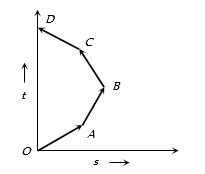
Which of the following options is correct for an object having a straight-line motion represented by the following graph?
A
The object moves with constantly increasing velocity from $O$ to $A$ and then it moves with constant velocity.
B
Velocity of the object increases uniformly.
C
Average velocity is zero.
D
The graph shown is impossible.
Solution
(C) In the given graph, the $t$-axis represents time and the $s$-axis represents position (displacement).
For any graph, the slope is given by $\frac{dy}{dx}$. Here, the slope is $\frac{dt}{ds} = \frac{1}{v}$, where $v$ is the velocity.
At point $D$, the position $s$ returns to $0$ at some time $t > 0$. Since the object starts from the origin ($s=0$ at $t=0$) and returns to the origin ($s=0$ at $t=t_D$), the net displacement is $\Delta s = s_{final} - s_{initial} = 0 - 0 = 0$.
Average velocity is defined as $\text{Average velocity} = \frac{\text{Total Displacement}}{\text{Total Time}} = \frac{0}{t_D} = 0$.
Therefore, option $C$ is correct.
For any graph, the slope is given by $\frac{dy}{dx}$. Here, the slope is $\frac{dt}{ds} = \frac{1}{v}$, where $v$ is the velocity.
At point $D$, the position $s$ returns to $0$ at some time $t > 0$. Since the object starts from the origin ($s=0$ at $t=0$) and returns to the origin ($s=0$ at $t=t_D$), the net displacement is $\Delta s = s_{final} - s_{initial} = 0 - 0 = 0$.
Average velocity is defined as $\text{Average velocity} = \frac{\text{Total Displacement}}{\text{Total Time}} = \frac{0}{t_D} = 0$.
Therefore, option $C$ is correct.
0 likesView Solution
3
ChemistryMCQAP EAMCET · 2020
When a body moves in a circular path,no work is done by the force since,
A
There is no displacement
B
There is no net force
C
Force and displacement are perpendicular to each other
D
The force is always away from the centre
Solution
(C) The work done by a force is given by the formula $W = \vec{F} \cdot \vec{s} = FS \cos \theta$,where $\theta$ is the angle between the force vector and the displacement vector.
In uniform circular motion,the centripetal force acts towards the center of the circle,while the displacement (which is along the tangent to the path) is perpendicular to the radius.
Therefore,the angle between the force and the displacement is $\theta = 90^\circ$.
Since $\cos 90^\circ = 0$,the work done $W = FS \cos 90^\circ = 0$.
In uniform circular motion,the centripetal force acts towards the center of the circle,while the displacement (which is along the tangent to the path) is perpendicular to the radius.
Therefore,the angle between the force and the displacement is $\theta = 90^\circ$.
Since $\cos 90^\circ = 0$,the work done $W = FS \cos 90^\circ = 0$.
0 likesView Solution
4
ChemistryMCQAP EAMCET · 2020
$A$ man pushes a wall and fails to displace it. He does:
A
Negative work
B
Positive but not maximum work
C
No work at all
D
Maximum work
Solution
(C) The formula for work done is $W = F \cdot s \cdot \cos(\theta)$,where $F$ is the force applied,$s$ is the displacement,and $\theta$ is the angle between the force and displacement vectors.
Since the man fails to displace the wall,the displacement $s = 0$.
Therefore,$W = F \cdot 0 \cdot \cos(\theta) = 0$.
Thus,the man does no work at all.
Since the man fails to displace the wall,the displacement $s = 0$.
Therefore,$W = F \cdot 0 \cdot \cos(\theta) = 0$.
Thus,the man does no work at all.
0 likesView Solution
5
ChemistryMCQAP EAMCET · 2020
If a force $F$ is applied on a body and it moves with a velocity $v$,the power will be
A
$F \times v$
B
$F/v$
C
$F/v^2$
D
$F \times v^2$
Solution
(A) Power is defined as the rate of doing work.
$P = \frac{dW}{dt}$
Since work done $dW = F \cdot dx$,we can write:
$P = \frac{F \cdot dx}{dt}$
Since velocity $v = \frac{dx}{dt}$,substituting this into the equation gives:
$P = F \times v$
Therefore,the power is the product of force and velocity.
$P = \frac{dW}{dt}$
Since work done $dW = F \cdot dx$,we can write:
$P = \frac{F \cdot dx}{dt}$
Since velocity $v = \frac{dx}{dt}$,substituting this into the equation gives:
$P = F \times v$
Therefore,the power is the product of force and velocity.
0 likesView Solution
6
ChemistryMCQAP EAMCET · 2020
Kepler's second law (law of areas) is nothing but a statement of
A
Work energy theorem
B
Conservation of linear momentum
C
Conservation of angular momentum
D
Conservation of energy
Solution
(C) The area swept by a planet in a small time interval $dt$ is given by $dA = \frac{1}{2} r \cdot (r d\theta)$.
Therefore,the rate of area swept is $\frac{dA}{dt} = \frac{1}{2} r \left(r \frac{d\theta}{dt}\right)$.
We know that the angular momentum is $\vec{L} = m r^2 \frac{d\vec{\theta}}{dt}$.
Substituting this into the area rate equation,we get $\frac{dA}{dt} = \frac{1}{2m} \left(m r^2 \frac{d\theta}{dt}\right) = \frac{L}{2m}$.
According to Kepler's $2^{nd}$ law,a planet sweeps out equal areas in equal intervals of time,meaning $\frac{dA}{dt} = \text{constant}$.
Since $m$ is constant,$L$ must also be constant.
Therefore,Kepler's $2^{nd}$ law is a statement of the conservation of angular momentum.
Therefore,the rate of area swept is $\frac{dA}{dt} = \frac{1}{2} r \left(r \frac{d\theta}{dt}\right)$.
We know that the angular momentum is $\vec{L} = m r^2 \frac{d\vec{\theta}}{dt}$.
Substituting this into the area rate equation,we get $\frac{dA}{dt} = \frac{1}{2m} \left(m r^2 \frac{d\theta}{dt}\right) = \frac{L}{2m}$.
According to Kepler's $2^{nd}$ law,a planet sweeps out equal areas in equal intervals of time,meaning $\frac{dA}{dt} = \text{constant}$.
Since $m$ is constant,$L$ must also be constant.
Therefore,Kepler's $2^{nd}$ law is a statement of the conservation of angular momentum.
0 likesView Solution
7
ChemistryMCQAP EAMCET · 2020
When a weight of $10\, kg$ is suspended from a copper wire of length $3\, m$ and diameter $0.4\, mm$,its length increases by $2.4\, cm$. If the diameter of the wire is doubled,then the extension in its length will be ........ $cm$.
A
$9.6$
B
$4.8$
C
$1.2$
D
$0.6$
Solution
(D) The formula for the extension in length $(\Delta L)$ of a wire is given by $\Delta L = \frac{FL}{AY}$,where $F$ is the applied force,$L$ is the original length,$A$ is the cross-sectional area,and $Y$ is Young's modulus.
Since $A = \pi r^2$,where $r$ is the radius of the wire,we have $\Delta L = \frac{FL}{\pi r^2 Y}$.
Given that $F$,$L$,and $Y$ are constant,the extension is inversely proportional to the square of the radius: $\Delta L \propto \frac{1}{r^2}$.
Since the diameter $D = 2r$,the relationship also holds for the diameter: $\Delta L \propto \frac{1}{D^2}$.
Let $\Delta L_1 = 2.4\, cm$ and $D_1 = 0.4\, mm$. If the diameter is doubled,$D_2 = 2D_1$.
Then,$\frac{\Delta L_2}{\Delta L_1} = \left( \frac{D_1}{D_2} \right)^2 = \left( \frac{D_1}{2D_1} \right)^2 = \left( \frac{1}{2} \right)^2 = \frac{1}{4}$.
Therefore,$\Delta L_2 = \frac{\Delta L_1}{4} = \frac{2.4\, cm}{4} = 0.6\, cm$.
Since $A = \pi r^2$,where $r$ is the radius of the wire,we have $\Delta L = \frac{FL}{\pi r^2 Y}$.
Given that $F$,$L$,and $Y$ are constant,the extension is inversely proportional to the square of the radius: $\Delta L \propto \frac{1}{r^2}$.
Since the diameter $D = 2r$,the relationship also holds for the diameter: $\Delta L \propto \frac{1}{D^2}$.
Let $\Delta L_1 = 2.4\, cm$ and $D_1 = 0.4\, mm$. If the diameter is doubled,$D_2 = 2D_1$.
Then,$\frac{\Delta L_2}{\Delta L_1} = \left( \frac{D_1}{D_2} \right)^2 = \left( \frac{D_1}{2D_1} \right)^2 = \left( \frac{1}{2} \right)^2 = \frac{1}{4}$.
Therefore,$\Delta L_2 = \frac{\Delta L_1}{4} = \frac{2.4\, cm}{4} = 0.6\, cm$.
0 likesView Solution
8
ChemistryMCQAP EAMCET · 2020
$A$ sound source is moving towards a stationary observer with $1/10$ of the speed of sound. The ratio of apparent to real frequency is
A
$10/9$
B
$11/10$
C
$(11/10)^2$
D
$(9/10)^2$
Solution
(A) According to the Doppler effect,when a source moves towards a stationary observer,the apparent frequency $n'$ is given by the formula:
$n' = n \left( \frac{v}{v - v_S} \right)$
where $n$ is the real frequency,$v$ is the speed of sound,and $v_S$ is the speed of the source.
Given that the source is moving with $1/10$ of the speed of sound,we have $v_S = v/10$.
Substituting this into the formula:
$n' = n \left( \frac{v}{v - v/10} \right)$
$n' = n \left( \frac{v}{9v/10} \right)$
$n' = n \left( \frac{10}{9} \right)$
Therefore,the ratio of apparent to real frequency is $\frac{n'}{n} = \frac{10}{9}$.
$n' = n \left( \frac{v}{v - v_S} \right)$
where $n$ is the real frequency,$v$ is the speed of sound,and $v_S$ is the speed of the source.
Given that the source is moving with $1/10$ of the speed of sound,we have $v_S = v/10$.
Substituting this into the formula:
$n' = n \left( \frac{v}{v - v/10} \right)$
$n' = n \left( \frac{v}{9v/10} \right)$
$n' = n \left( \frac{10}{9} \right)$
Therefore,the ratio of apparent to real frequency is $\frac{n'}{n} = \frac{10}{9}$.
0 likesView Solution
9
ChemistryMCQAP EAMCET · 2020
If a unit positive charge is taken from one point to another over an equipotential surface,then
A
Work is done on the charge
B
Work is done by the charge
C
Work done is constant
D
No work is done
Solution
(D) An equipotential surface is a surface where the electric potential is the same at every point.
By definition,the work done $W$ in moving a charge $q$ from one point to another is given by $W = q(V_2 - V_1)$.
Since the surface is equipotential,the potential at both points is equal,i.e.,$V_1 = V_2$.
Therefore,$V_2 - V_1 = 0$.
Consequently,the work done $W = q(0) = 0$.
Thus,no work is done in moving a charge over an equipotential surface.
By definition,the work done $W$ in moving a charge $q$ from one point to another is given by $W = q(V_2 - V_1)$.
Since the surface is equipotential,the potential at both points is equal,i.e.,$V_1 = V_2$.
Therefore,$V_2 - V_1 = 0$.
Consequently,the work done $W = q(0) = 0$.
Thus,no work is done in moving a charge over an equipotential surface.
0 likesView Solution
10
ChemistryMCQAP EAMCET · 2020
$A$ proton enters a magnetic field of flux density $1.5 \, Wb/m^2$ with a velocity of $2 \times 10^7 \, m/s$ at an angle of $30^\circ$ with the field. The force on the proton will be
A
$2.4 \times 10^{-12} \, N$
B
$0.24 \times 10^{-12} \, N$
C
$24 \times 10^{-12} \, N$
D
$0.024 \times 10^{-12} \, N$
Solution
(A) The magnetic force $F$ on a charged particle moving in a magnetic field is given by the formula: $F = qvB \sin \theta$.
Given:
Charge of a proton $q = 1.6 \times 10^{-19} \, C$,
Velocity $v = 2 \times 10^7 \, m/s$,
Magnetic flux density $B = 1.5 \, Wb/m^2$,
Angle $\theta = 30^\circ$.
Substituting these values into the formula:
$F = (1.6 \times 10^{-19}) \times (2 \times 10^7) \times 1.5 \times \sin(30^\circ)$
$F = (1.6 \times 10^{-19}) \times (2 \times 10^7) \times 1.5 \times 0.5$
$F = 1.6 \times 10^{-19} \times 10^7 \times 1.5$
$F = 2.4 \times 10^{-12} \, N$.
Given:
Charge of a proton $q = 1.6 \times 10^{-19} \, C$,
Velocity $v = 2 \times 10^7 \, m/s$,
Magnetic flux density $B = 1.5 \, Wb/m^2$,
Angle $\theta = 30^\circ$.
Substituting these values into the formula:
$F = (1.6 \times 10^{-19}) \times (2 \times 10^7) \times 1.5 \times \sin(30^\circ)$
$F = (1.6 \times 10^{-19}) \times (2 \times 10^7) \times 1.5 \times 0.5$
$F = 1.6 \times 10^{-19} \times 10^7 \times 1.5$
$F = 2.4 \times 10^{-12} \, N$.
0 likesView Solution
11
ChemistryMCQAP EAMCET · 2020
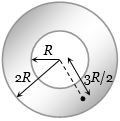
The figure shows the cross-sectional view of a hollow cylindrical conductor with inner radius $R$ and outer radius $2R$. The cylinder carries a uniformly distributed current $i$ along its axis. The magnetic induction at point $P$ at a distance $\frac{3R}{2}$ from the axis of the cylinder will be:
A
Zero
B
$\frac{5\mu_0 i}{72\pi R}$
C
$\frac{7\mu_0 i}{18\pi R}$
D
$\frac{5\mu_0 i}{36\pi R}$
Solution
(D) For a hollow cylindrical conductor carrying a uniformly distributed current $i$,the magnetic field $B$ at a distance $r$ (where $R < r < 2R$) from the axis is given by Ampere's Law:
$B = \frac{\mu_0 I_{enclosed}}{2\pi r}$
Here,the current $I_{enclosed}$ within the radius $r$ is the fraction of the total current $i$ proportional to the cross-sectional area:
$I_{enclosed} = i \left( \frac{\pi r^2 - \pi R^2}{\pi (2R)^2 - \pi R^2} \right) = i \left( \frac{r^2 - R^2}{4R^2 - R^2} \right) = i \left( \frac{r^2 - R^2}{3R^2} \right)$
Substituting $r = \frac{3R}{2}$:
$I_{enclosed} = i \left( \frac{(\frac{3R}{2})^2 - R^2}{3R^2} \right) = i \left( \frac{\frac{9R^2}{4} - R^2}{3R^2} \right) = i \left( \frac{\frac{5R^2}{4}}{3R^2} \right) = \frac{5i}{12}$
Now,calculate the magnetic field $B$:
$B = \frac{\mu_0}{2\pi r} \left( \frac{5i}{12} \right) = \frac{\mu_0}{2\pi (\frac{3R}{2})} \left( \frac{5i}{12} \right) = \frac{\mu_0}{3\pi R} \left( \frac{5i}{12} \right) = \frac{5\mu_0 i}{36\pi R}$
$B = \frac{\mu_0 I_{enclosed}}{2\pi r}$
Here,the current $I_{enclosed}$ within the radius $r$ is the fraction of the total current $i$ proportional to the cross-sectional area:
$I_{enclosed} = i \left( \frac{\pi r^2 - \pi R^2}{\pi (2R)^2 - \pi R^2} \right) = i \left( \frac{r^2 - R^2}{4R^2 - R^2} \right) = i \left( \frac{r^2 - R^2}{3R^2} \right)$
Substituting $r = \frac{3R}{2}$:
$I_{enclosed} = i \left( \frac{(\frac{3R}{2})^2 - R^2}{3R^2} \right) = i \left( \frac{\frac{9R^2}{4} - R^2}{3R^2} \right) = i \left( \frac{\frac{5R^2}{4}}{3R^2} \right) = \frac{5i}{12}$
Now,calculate the magnetic field $B$:
$B = \frac{\mu_0}{2\pi r} \left( \frac{5i}{12} \right) = \frac{\mu_0}{2\pi (\frac{3R}{2})} \left( \frac{5i}{12} \right) = \frac{\mu_0}{3\pi R} \left( \frac{5i}{12} \right) = \frac{5\mu_0 i}{36\pi R}$
0 likesView Solution
12
ChemistryMCQAP EAMCET · 2020
$A$ bar magnet of length $10 \, cm$ and having a pole strength equal to $10^{-3} \, Wb$ is kept in a magnetic field having magnetic induction $B$ equal to $4\pi \times 10^{-3} \, T$. It makes an angle of $30^{\circ}$ with the direction of the magnetic induction. The value of the torque acting on the magnet is:
A
$2\pi \times 10^{-7} \, N \cdot m$
B
$2\pi \times 10^{-5} \, N \cdot m$
C
$0.5 \, N \cdot m$
D
$0.5 \times 10^{2} \, N \cdot m$
Solution
(A) The magnetic moment $M$ of the bar magnet is given by the product of pole strength $m$ and length $l$: $M = m \times l$.
Given $m = 10^{-3} \, Wb$ and $l = 10 \, cm = 0.1 \, m$,we have $M = 10^{-3} \times 0.1 = 10^{-4} \, A \cdot m^2$.
The torque $\tau$ acting on a magnetic dipole in a magnetic field $B$ is given by $\tau = MB \sin \theta$.
Here,$B = 4\pi \times 10^{-3} \, T$ and $\theta = 30^{\circ}$.
Substituting the values: $\tau = (10^{-4}) \times (4\pi \times 10^{-3}) \times \sin(30^{\circ})$.
$\tau = 4\pi \times 10^{-7} \times 0.5$.
$\tau = 2\pi \times 10^{-7} \, N \cdot m$.
Given $m = 10^{-3} \, Wb$ and $l = 10 \, cm = 0.1 \, m$,we have $M = 10^{-3} \times 0.1 = 10^{-4} \, A \cdot m^2$.
The torque $\tau$ acting on a magnetic dipole in a magnetic field $B$ is given by $\tau = MB \sin \theta$.
Here,$B = 4\pi \times 10^{-3} \, T$ and $\theta = 30^{\circ}$.
Substituting the values: $\tau = (10^{-4}) \times (4\pi \times 10^{-3}) \times \sin(30^{\circ})$.
$\tau = 4\pi \times 10^{-7} \times 0.5$.
$\tau = 2\pi \times 10^{-7} \, N \cdot m$.
0 likesView Solution
13
ChemistryMCQAP EAMCET · 2020
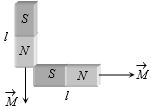
Two identical thin bar magnets,each of length $l$ and pole strength $m$,are placed at a right angle to each other with the north pole of one touching the south pole of the other. The magnetic moment of the system is:
A
$ml$
B
$2\,ml$
C
$\sqrt{2}\,ml$
D
$\frac{1}{2}\,ml$
Solution
(C) The magnetic moment of a single bar magnet is given by $M = m \times l$,where $m$ is the pole strength and $l$ is the length of the magnet.
Since the two magnets are identical and placed at a right angle to each other,their individual magnetic moment vectors $\vec{M_1}$ and $\vec{M_2}$ are also at a right angle to each other.
The magnitude of each magnetic moment is $M = ml$.
The net magnetic moment of the system is the vector sum of the two individual magnetic moments:
$M_{net} = \sqrt{M_1^2 + M_2^2 + 2M_1M_2 \cos(90^\circ)}$
Since $\cos(90^\circ) = 0$,we have:
$M_{net} = \sqrt{M^2 + M^2} = \sqrt{2M^2} = \sqrt{2}M$
Substituting $M = ml$,we get:
$M_{net} = \sqrt{2}\,ml$.
Since the two magnets are identical and placed at a right angle to each other,their individual magnetic moment vectors $\vec{M_1}$ and $\vec{M_2}$ are also at a right angle to each other.
The magnitude of each magnetic moment is $M = ml$.
The net magnetic moment of the system is the vector sum of the two individual magnetic moments:
$M_{net} = \sqrt{M_1^2 + M_2^2 + 2M_1M_2 \cos(90^\circ)}$
Since $\cos(90^\circ) = 0$,we have:
$M_{net} = \sqrt{M^2 + M^2} = \sqrt{2M^2} = \sqrt{2}M$
Substituting $M = ml$,we get:
$M_{net} = \sqrt{2}\,ml$.
0 likesView Solution
14
ChemistryMCQAP EAMCET · 2020
$A$ straight wire carrying current $i$ is turned into a circular loop. If the magnitude of the magnetic moment associated with it in $M.K.S.$ units is $M$,the length of the wire will be
A
$4\pi iM$
B
$\sqrt{\frac{4\pi M}{i}}$
C
$\sqrt{\frac{4\pi i}{M}}$
D
$\frac{M\pi}{4i}$
Solution
(B) The magnetic moment $M$ of a circular loop carrying current $i$ is given by the formula $M = iA$,where $A$ is the area of the loop.
For a circular loop of radius $R$,the area is $A = \pi R^2$.
If the length of the wire is $L$,then the circumference of the loop is $L = 2\pi R$,which implies $R = \frac{L}{2\pi}$.
Substituting the value of $R$ into the area formula,we get $A = \pi \left(\frac{L}{2\pi}\right)^2 = \frac{L^2}{4\pi}$.
Now,substituting $A$ into the magnetic moment formula: $M = i \left(\frac{L^2}{4\pi}\right)$.
Rearranging the equation to solve for $L$: $L^2 = \frac{4\pi M}{i}$.
Therefore,the length of the wire is $L = \sqrt{\frac{4\pi M}{i}}$.
For a circular loop of radius $R$,the area is $A = \pi R^2$.
If the length of the wire is $L$,then the circumference of the loop is $L = 2\pi R$,which implies $R = \frac{L}{2\pi}$.
Substituting the value of $R$ into the area formula,we get $A = \pi \left(\frac{L}{2\pi}\right)^2 = \frac{L^2}{4\pi}$.
Now,substituting $A$ into the magnetic moment formula: $M = i \left(\frac{L^2}{4\pi}\right)$.
Rearranging the equation to solve for $L$: $L^2 = \frac{4\pi M}{i}$.
Therefore,the length of the wire is $L = \sqrt{\frac{4\pi M}{i}}$.
0 likesView Solution
15
ChemistryMCQAP EAMCET · 2020
If the angles of dip at two places are $30^o$ and $45^o$ respectively,then the ratio of horizontal components of earth's magnetic field at the two places will be
A
$\sqrt{3} : \sqrt{2}$
B
$1 : \sqrt{2}$
C
$1 : \sqrt{3}$
D
$1 : 2$
Solution
(A) The horizontal component of the Earth's magnetic field $(B_H)$ is given by the formula $B_H = B \cos \phi$,where $B$ is the total magnetic field and $\phi$ is the angle of dip.
Assuming the total magnetic field $B$ is the same at both locations:
For the first place,$(B_H)_1 = B \cos 30^o = B \frac{\sqrt{3}}{2}$.
For the second place,$(B_H)_2 = B \cos 45^o = B \frac{1}{\sqrt{2}}$.
The ratio of the horizontal components is $\frac{(B_H)_1}{(B_H)_2} = \frac{B \cos 30^o}{B \cos 45^o} = \frac{\sqrt{3}/2}{1/\sqrt{2}} = \frac{\sqrt{3}}{2} \times \sqrt{2} = \frac{\sqrt{3}}{\sqrt{2}}$.
Thus,the ratio is $\sqrt{3} : \sqrt{2}$.
Assuming the total magnetic field $B$ is the same at both locations:
For the first place,$(B_H)_1 = B \cos 30^o = B \frac{\sqrt{3}}{2}$.
For the second place,$(B_H)_2 = B \cos 45^o = B \frac{1}{\sqrt{2}}$.
The ratio of the horizontal components is $\frac{(B_H)_1}{(B_H)_2} = \frac{B \cos 30^o}{B \cos 45^o} = \frac{\sqrt{3}/2}{1/\sqrt{2}} = \frac{\sqrt{3}}{2} \times \sqrt{2} = \frac{\sqrt{3}}{\sqrt{2}}$.
Thus,the ratio is $\sqrt{3} : \sqrt{2}$.
0 likesView Solution
16
ChemistryMCQAP EAMCET · 2020
Lenz's law is a consequence of the law of conservation of
A
Charge
B
Momentum
C
Mass
D
Energy
Solution
(D) Lenz's law states that the direction of the induced current is such that it opposes the change in magnetic flux that produced it. If the induced current were to assist the change,it would lead to an infinite increase in energy,which violates the law of conservation of energy. Therefore,Lenz's law is a direct consequence of the law of conservation of energy.
0 likesView Solution
17
ChemistryMCQAP EAMCET · 2020
The coils of a step-down transformer have $500$ and $5000$ turns. In the primary coil,an $AC$ of $4 \, A$ at $2200 \, V$ is sent. The value of the current and potential difference in the secondary coil will be:
A
$20 \, A, 220 \, V$
B
$0.4 \, A, 22000 \, V$
C
$40 \, A, 220 \, V$
D
$40 \, A, 22000 \, V$
Solution
(C) For an ideal transformer,the relationship between turns,voltage,and current is given by: $\frac{N_p}{N_s} = \frac{V_p}{V_s} = \frac{i_s}{i_p}$.
Given that it is a step-down transformer,the primary coil must have more turns than the secondary coil. Thus,$N_p = 5000$ and $N_s = 500$.
Given values: $V_p = 2200 \, V$,$i_p = 4 \, A$.
Using the ratio: $\frac{5000}{500} = \frac{2200}{V_s} = \frac{i_s}{4}$.
Calculating voltage $V_s$: $\frac{5000}{500} = \frac{2200}{V_s} \Rightarrow 10 = \frac{2200}{V_s} \Rightarrow V_s = 220 \, V$.
Calculating current $i_s$: $\frac{5000}{500} = \frac{i_s}{4} \Rightarrow 10 = \frac{i_s}{4} \Rightarrow i_s = 40 \, A$.
Therefore,the current is $40 \, A$ and the potential difference is $220 \, V$.
Given that it is a step-down transformer,the primary coil must have more turns than the secondary coil. Thus,$N_p = 5000$ and $N_s = 500$.
Given values: $V_p = 2200 \, V$,$i_p = 4 \, A$.
Using the ratio: $\frac{5000}{500} = \frac{2200}{V_s} = \frac{i_s}{4}$.
Calculating voltage $V_s$: $\frac{5000}{500} = \frac{2200}{V_s} \Rightarrow 10 = \frac{2200}{V_s} \Rightarrow V_s = 220 \, V$.
Calculating current $i_s$: $\frac{5000}{500} = \frac{i_s}{4} \Rightarrow 10 = \frac{i_s}{4} \Rightarrow i_s = 40 \, A$.
Therefore,the current is $40 \, A$ and the potential difference is $220 \, V$.
0 likesView Solution
18
ChemistryMCQAP EAMCET · 2020
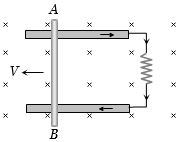
Consider the situation shown in the figure. The wire $AB$ is sliding on the fixed rails with a constant velocity $V$. If the wire $AB$ is replaced by a semicircular wire of the same chord length,the magnitude of the induced current will
A
Increase
B
Remain the same
C
Decrease
D
Increase or decrease depending on whether the semicircle bulges towards the resistance or away from it
Solution
(B) The induced electromotive force $(EMF)$ in a moving conductor is given by $\varepsilon = B \cdot l_{eff} \cdot V$,where $l_{eff}$ is the effective length of the conductor perpendicular to the velocity vector and the magnetic field.
For a wire moving in a uniform magnetic field,the effective length is the straight-line distance between the two points of contact on the rails.
Even if the wire $AB$ is replaced by a semicircular wire,the distance between the points of contact on the rails remains the same as the original straight wire $AB$.
Since the velocity $V$,the magnetic field $B$,and the effective length $l_{eff}$ remain unchanged,the induced $EMF$ $\varepsilon$ remains the same.
Consequently,the magnitude of the induced current $I = \varepsilon / R$ also remains the same.
For a wire moving in a uniform magnetic field,the effective length is the straight-line distance between the two points of contact on the rails.
Even if the wire $AB$ is replaced by a semicircular wire,the distance between the points of contact on the rails remains the same as the original straight wire $AB$.
Since the velocity $V$,the magnetic field $B$,and the effective length $l_{eff}$ remain unchanged,the induced $EMF$ $\varepsilon$ remains the same.
Consequently,the magnitude of the induced current $I = \varepsilon / R$ also remains the same.
0 likesView Solution
19
ChemistryMCQAP EAMCET · 2020
$A$ light wave has a frequency of $4 \times 10^{14} \text{ Hz}$ and a wavelength of $5 \times 10^{-7} \text{ m}$ in a medium. The refractive index of the medium is
A
$1.5$
B
$1.33$
C
$1$
D
$0.66$
Solution
(A) The speed of light in a vacuum is $c = 3 \times 10^8 \text{ m/s}$.
The speed of light in the medium $(v)$ is given by the product of frequency $(\nu)$ and wavelength $(\lambda)$: $v = \nu \lambda$.
Substituting the given values: $v = (4 \times 10^{14} \text{ Hz}) \times (5 \times 10^{-7} \text{ m}) = 20 \times 10^7 \text{ m/s} = 2 \times 10^8 \text{ m/s}$.
The refractive index $(\mu)$ is defined as the ratio of the speed of light in a vacuum to the speed of light in the medium: $\mu = \frac{c}{v}$.
$\mu = \frac{3 \times 10^8 \text{ m/s}}{2 \times 10^8 \text{ m/s}} = 1.5$.
The speed of light in the medium $(v)$ is given by the product of frequency $(\nu)$ and wavelength $(\lambda)$: $v = \nu \lambda$.
Substituting the given values: $v = (4 \times 10^{14} \text{ Hz}) \times (5 \times 10^{-7} \text{ m}) = 20 \times 10^7 \text{ m/s} = 2 \times 10^8 \text{ m/s}$.
The refractive index $(\mu)$ is defined as the ratio of the speed of light in a vacuum to the speed of light in the medium: $\mu = \frac{c}{v}$.
$\mu = \frac{3 \times 10^8 \text{ m/s}}{2 \times 10^8 \text{ m/s}} = 1.5$.
0 likesView Solution
20
ChemistryMCQAP EAMCET · 2020
Which of the following compounds will exhibit cis-trans isomerism?
A
$2-$butene
B
$2-$butyne
C
$2-$butanol
D
Butanone
Solution
(A) Cis-trans isomerism (geometrical isomerism) is exhibited by compounds that have restricted rotation around a double bond,where each carbon atom of the double bond is attached to two different groups.
$A$. $2-$butene $(CH_3-CH=CH-CH_3)$ satisfies this condition as each carbon of the $C=C$ bond is attached to a hydrogen atom and a methyl group,allowing for cis and trans configurations.
$B$. $2-$butyne has a triple bond,which is linear and does not allow for cis-trans isomerism.
$C$. $2-$butanol and $D$. Butanone do not contain a $C=C$ double bond with the required substitution pattern.
Therefore,the correct answer is $2-$butene.
$A$. $2-$butene $(CH_3-CH=CH-CH_3)$ satisfies this condition as each carbon of the $C=C$ bond is attached to a hydrogen atom and a methyl group,allowing for cis and trans configurations.
$B$. $2-$butyne has a triple bond,which is linear and does not allow for cis-trans isomerism.
$C$. $2-$butanol and $D$. Butanone do not contain a $C=C$ double bond with the required substitution pattern.
Therefore,the correct answer is $2-$butene.
0 likesView Solution
21
ChemistryMCQAP EAMCET · 2020
The charge on colloidal particles is due to
A
Presence of electrolyte
B
Very small size of particles
C
Adsorption of ions from the solution
D
None of these
Solution
(C) Some colloidal particles develop electrical charges due to the dissociation or ionization of the surface molecules.
The charge on the colloidal particles is primarily caused by the selective adsorption of ions from the dispersion medium (solution) onto the surface of the particles.
The charge on the colloidal particles is primarily caused by the selective adsorption of ions from the dispersion medium (solution) onto the surface of the particles.
0 likesView Solution
22
ChemistryMCQAP EAMCET · 2020
When glucose reacts with bromine water,the main product is
A
Acetic acid
B
Saccharic acid
C
Glyceraldehyde
D
Gluconic acid
Solution
(D) Glucose on reaction with bromine water ($Br_2$ water) acts as a mild oxidizing agent,which oxidizes the aldehyde group $(-CHO)$ of glucose to a carboxylic acid group $(-COOH)$,resulting in the formation of gluconic acid.
$C_6H_{12}O_6 + Br_2 + H_2O \rightarrow CH_2OH(CHOH)_4COOH + 2HBr$
$C_6H_{12}O_6 + Br_2 + H_2O \rightarrow CH_2OH(CHOH)_4COOH + 2HBr$
0 likesView Solution
23
ChemistryMCQAP EAMCET · 2020
The number of solutions for the equation $x^2 - 5|x| + 6 = 0$ is
A
$4$
B
$3$
C
$2$
D
$1$
Solution
(A) Given equation is $x^2 - 5|x| + 6 = 0$.
Since $|x|^2 = x^2$,we can write the equation as $|x|^2 - 5|x| + 6 = 0$.
Let $|x| = t$,where $t \ge 0$. Then the equation becomes $t^2 - 5t + 6 = 0$.
Factoring the quadratic: $(t - 2)(t - 3) = 0$.
This gives $t = 2$ or $t = 3$.
Case $1$: $|x| = 2 \implies x = 2, -2$.
Case $2$: $|x| = 3 \implies x = 3, -3$.
Thus,the solutions are $x \in \{2, -2, 3, -3\}$.
There are $4$ solutions in total.
Since $|x|^2 = x^2$,we can write the equation as $|x|^2 - 5|x| + 6 = 0$.
Let $|x| = t$,where $t \ge 0$. Then the equation becomes $t^2 - 5t + 6 = 0$.
Factoring the quadratic: $(t - 2)(t - 3) = 0$.
This gives $t = 2$ or $t = 3$.
Case $1$: $|x| = 2 \implies x = 2, -2$.
Case $2$: $|x| = 3 \implies x = 3, -3$.
Thus,the solutions are $x \in \{2, -2, 3, -3\}$.
There are $4$ solutions in total.
0 likesView Solution
24
ChemistryMCQAP EAMCET · 2020
If $f(x) = \left| \begin{array}{ccc} x - 3 & 2x^2 - 18 & 3x^3 - 81 \\ x - 5 & 2x^2 - 50 & 4x^3 - 500 \\ 1 & 2 & 3 \end{array} \right|$,then $f(1)f(3) + f(3)f(5) + f(5)f(1) = $
A
$f(1)$
B
$f(3)$
C
$f(1) + f(3)$
D
$f(1) + f(5)$
Solution
(B) Given $f(x) = \left| \begin{array}{ccc} x - 3 & 2(x^2 - 9) & 3(x^3 - 27) \\ x - 5 & 2(x^2 - 25) & 4(x^3 - 125) \\ 1 & 2 & 3 \end{array} \right|$.
Observe that if $x = 3$,the first row becomes $(3-3, 2(9-9), 3(27-27)) = (0, 0, 0)$. Since one row is zero,$f(3) = 0$.
Observe that if $x = 5$,the second row becomes $(5-5, 2(25-25), 4(125-125)) = (0, 0, 0)$. Since one row is zero,$f(5) = 0$.
We need to calculate $f(1)f(3) + f(3)f(5) + f(5)f(1)$.
Substituting the values $f(3) = 0$ and $f(5) = 0$ into the expression:
$f(1) \times 0 + 0 \times 0 + 0 \times f(1) = 0 + 0 + 0 = 0$.
Since $f(3) = 0$,the result is $f(3)$.
Observe that if $x = 3$,the first row becomes $(3-3, 2(9-9), 3(27-27)) = (0, 0, 0)$. Since one row is zero,$f(3) = 0$.
Observe that if $x = 5$,the second row becomes $(5-5, 2(25-25), 4(125-125)) = (0, 0, 0)$. Since one row is zero,$f(5) = 0$.
We need to calculate $f(1)f(3) + f(3)f(5) + f(5)f(1)$.
Substituting the values $f(3) = 0$ and $f(5) = 0$ into the expression:
$f(1) \times 0 + 0 \times 0 + 0 \times f(1) = 0 + 0 + 0 = 0$.
Since $f(3) = 0$,the result is $f(3)$.
0 likesView Solution
25
ChemistryMCQAP EAMCET · 2020
The equation $4x^2 - 24xy + 11y^2 = 0$ represents
A
Two parallel lines
B
Two perpendicular lines
C
Two lines through the origin
D
$A$ circle
Solution
(C) The given equation is a homogeneous second-degree equation of the form $ax^2 + 2hxy + by^2 = 0$.
Comparing $4x^2 - 24xy + 11y^2 = 0$ with the general form,we have $a = 4$,$2h = -24$,and $b = 11$.
Since the equation is homogeneous and has no constant term,it represents a pair of straight lines passing through the origin.
To factorize: $4x^2 - 22xy - 2xy + 11y^2 = 0$
$2x(2x - 11y) - y(2x - 11y) = 0$
$(2x - y)(2x - 11y) = 0$
Thus,the lines are $2x - y = 0$ and $2x - 11y = 0$,both of which pass through the origin $(0, 0)$.
Comparing $4x^2 - 24xy + 11y^2 = 0$ with the general form,we have $a = 4$,$2h = -24$,and $b = 11$.
Since the equation is homogeneous and has no constant term,it represents a pair of straight lines passing through the origin.
To factorize: $4x^2 - 22xy - 2xy + 11y^2 = 0$
$2x(2x - 11y) - y(2x - 11y) = 0$
$(2x - y)(2x - 11y) = 0$
Thus,the lines are $2x - y = 0$ and $2x - 11y = 0$,both of which pass through the origin $(0, 0)$.
0 likesView Solution
26
ChemistryMCQAP EAMCET · 2020
The centre of a circle is $(2, -3)$ and the circumference is $10\pi$. Then the equation of the circle is
A
${x^2} + {y^2} + 4x + 6y + 12 = 0$
B
${x^2} + {y^2} - 4x + 6y + 12 = 0$
C
${x^2} + {y^2} - 4x + 6y - 12 = 0$
D
${x^2} + {y^2} - 4x - 6y - 12 = 0$
Solution
(C) Given centre $(h, k) = (2, -3)$ and circumference $= 10\pi$.
Since the circumference of a circle is given by $2\pi r$,we have $2\pi r = 10\pi$,which implies $r = 5$.
The standard equation of a circle with centre $(h, k)$ and radius $r$ is $(x - h)^2 + (y - k)^2 = r^2$.
Substituting the values,we get $(x - 2)^2 + (y - (-3))^2 = 5^2$.
$(x - 2)^2 + (y + 3)^2 = 25$.
Expanding the squares: $(x^2 - 4x + 4) + (y^2 + 6y + 9) = 25$.
$x^2 + y^2 - 4x + 6y + 13 = 25$.
$x^2 + y^2 - 4x + 6y - 12 = 0$.
Since the circumference of a circle is given by $2\pi r$,we have $2\pi r = 10\pi$,which implies $r = 5$.
The standard equation of a circle with centre $(h, k)$ and radius $r$ is $(x - h)^2 + (y - k)^2 = r^2$.
Substituting the values,we get $(x - 2)^2 + (y - (-3))^2 = 5^2$.
$(x - 2)^2 + (y + 3)^2 = 25$.
Expanding the squares: $(x^2 - 4x + 4) + (y^2 + 6y + 9) = 25$.
$x^2 + y^2 - 4x + 6y + 13 = 25$.
$x^2 + y^2 - 4x + 6y - 12 = 0$.
0 likesView Solution
27
ChemistryMCQAP EAMCET · 2020
The function $f(x) = |x| + \frac{|x|}{x}$ is
A
Continuous at the origin
B
Discontinuous at the origin because $|x|$ is discontinuous there
C
Discontinuous at the origin because $\frac{|x|}{x}$ is discontinuous there
D
Discontinuous at the origin because both $|x|$ and $\frac{|x|}{x}$ are discontinuous there
Solution
(C) The function is defined as $f(x) = |x| + \frac{|x|}{x}$.
First,consider the term $|x|$. The function $g(x) = |x|$ is continuous for all real numbers,including $x = 0$.
Second,consider the term $h(x) = \frac{|x|}{x}$.
For $x > 0$,$h(x) = \frac{x}{x} = 1$.
For $x < 0$,$h(x) = \frac{-x}{x} = -1$.
Since the left-hand limit $\lim_{x \to 0^-} h(x) = -1$ and the right-hand limit $\lim_{x \to 0^+} h(x) = 1$ are not equal,the function $h(x)$ is discontinuous at $x = 0$.
Since the sum of a continuous function and a discontinuous function is discontinuous,$f(x) = |x| + \frac{|x|}{x}$ is discontinuous at $x = 0$ due to the term $\frac{|x|}{x}$.
First,consider the term $|x|$. The function $g(x) = |x|$ is continuous for all real numbers,including $x = 0$.
Second,consider the term $h(x) = \frac{|x|}{x}$.
For $x > 0$,$h(x) = \frac{x}{x} = 1$.
For $x < 0$,$h(x) = \frac{-x}{x} = -1$.
Since the left-hand limit $\lim_{x \to 0^-} h(x) = -1$ and the right-hand limit $\lim_{x \to 0^+} h(x) = 1$ are not equal,the function $h(x)$ is discontinuous at $x = 0$.
Since the sum of a continuous function and a discontinuous function is discontinuous,$f(x) = |x| + \frac{|x|}{x}$ is discontinuous at $x = 0$ due to the term $\frac{|x|}{x}$.
0 likesView Solution
28
ChemistryMCQAP EAMCET · 2020
$\frac{d}{dx}[(1 + x^2)\tan^{-1}x] = $
A
$x \tan^{-1}x$
B
$2 \tan^{-1}x$
C
$2x \tan^{-1}x + 1$
D
$x \tan^{-1}x + 1$
Solution
(C) To find the derivative of the product $(1 + x^2)\tan^{-1}x$,we use the product rule: $\frac{d}{dx}[u \cdot v] = u \frac{dv}{dx} + v \frac{du}{dx}$.
Let $u = (1 + x^2)$ and $v = \tan^{-1}x$.
Then $\frac{du}{dx} = 2x$ and $\frac{dv}{dx} = \frac{1}{1 + x^2}$.
Applying the product rule:
$\frac{d}{dx}[(1 + x^2)\tan^{-1}x] = (1 + x^2) \cdot \frac{d}{dx}(\tan^{-1}x) + \tan^{-1}x \cdot \frac{d}{dx}(1 + x^2)$
$= (1 + x^2) \cdot \frac{1}{1 + x^2} + \tan^{-1}x \cdot (2x)$
$= 1 + 2x \tan^{-1}x$.
Thus,the correct option is $C$.
Let $u = (1 + x^2)$ and $v = \tan^{-1}x$.
Then $\frac{du}{dx} = 2x$ and $\frac{dv}{dx} = \frac{1}{1 + x^2}$.
Applying the product rule:
$\frac{d}{dx}[(1 + x^2)\tan^{-1}x] = (1 + x^2) \cdot \frac{d}{dx}(\tan^{-1}x) + \tan^{-1}x \cdot \frac{d}{dx}(1 + x^2)$
$= (1 + x^2) \cdot \frac{1}{1 + x^2} + \tan^{-1}x \cdot (2x)$
$= 1 + 2x \tan^{-1}x$.
Thus,the correct option is $C$.
0 likesView Solution
29
ChemistryMCQAP EAMCET · 2020
If $y = \frac{e^x \log x}{x^2}$,then $\frac{dy}{dx} = $
A
$\frac{e^x[1 + (x + 2)\log x]}{x^3}$
B
$\frac{e^x[1 - (x - 2)\log x]}{x^4}$
C
$\frac{e^x[1 - (x - 2)\log x]}{x^3}$
D
$\frac{e^x[1 + (x - 2)\log x]}{x^3}$
Solution
(D) Given $y = \frac{e^x \log x}{x^2}$.
Using the quotient rule $\frac{d}{dx}(\frac{u}{v}) = \frac{v u' - u v'}{v^2}$,where $u = e^x \log x$ and $v = x^2$:
$\frac{dy}{dx} = \frac{x^2 \frac{d}{dx}(e^x \log x) - e^x \log x \frac{d}{dx}(x^2)}{(x^2)^2}$
$\frac{dy}{dx} = \frac{x^2 (e^x \log x + e^x \cdot \frac{1}{x}) - e^x \log x (2x)}{x^4}$
$\frac{dy}{dx} = \frac{x^2 e^x \log x + x e^x - 2x e^x \log x}{x^4}$
$\frac{dy}{dx} = \frac{x e^x (x \log x + 1 - 2 \log x)}{x^4}$
$\frac{dy}{dx} = \frac{e^x [1 + (x - 2) \log x]}{x^3}$.
Using the quotient rule $\frac{d}{dx}(\frac{u}{v}) = \frac{v u' - u v'}{v^2}$,where $u = e^x \log x$ and $v = x^2$:
$\frac{dy}{dx} = \frac{x^2 \frac{d}{dx}(e^x \log x) - e^x \log x \frac{d}{dx}(x^2)}{(x^2)^2}$
$\frac{dy}{dx} = \frac{x^2 (e^x \log x + e^x \cdot \frac{1}{x}) - e^x \log x (2x)}{x^4}$
$\frac{dy}{dx} = \frac{x^2 e^x \log x + x e^x - 2x e^x \log x}{x^4}$
$\frac{dy}{dx} = \frac{x e^x (x \log x + 1 - 2 \log x)}{x^4}$
$\frac{dy}{dx} = \frac{e^x [1 + (x - 2) \log x]}{x^3}$.
0 likesView Solution
30
ChemistryMCQAP EAMCET · 2020
$A$ particle is projected with a velocity $v$ such that its range on the horizontal plane is twice the greatest height attained by it. The range of the projectile is (where $g$ is acceleration due to gravity)
A
$\frac{4v^2}{5g}$
B
$\frac{4g}{5v^2}$
C
$\frac{v^2}{g}$
D
$\frac{4v^2}{\sqrt{5}g}$
Solution
(A) Given that the range $R$ is twice the maximum height $H$,so $R = 2H$.
We know the formulas for range $R = \frac{v^2 \sin(2\theta)}{g} = \frac{2v^2 \sin\theta \cos\theta}{g}$ and maximum height $H = \frac{v^2 \sin^2\theta}{2g}$.
Substituting these into the given condition $R = 2H$:
$\frac{2v^2 \sin\theta \cos\theta}{g} = 2 \left( \frac{v^2 \sin^2\theta}{2g} \right)$
$\frac{2v^2 \sin\theta \cos\theta}{g} = \frac{v^2 \sin^2\theta}{g}$
$2 \cos\theta = \sin\theta$
$\tan\theta = 2$.
From the right-angled triangle with opposite side $2$ and adjacent side $1$,the hypotenuse is $\sqrt{2^2 + 1^2} = \sqrt{5}$.
Thus,$\sin\theta = \frac{2}{\sqrt{5}}$ and $\cos\theta = \frac{1}{\sqrt{5}}$.
Now,substitute these into the range formula:
$R = \frac{2v^2 \sin\theta \cos\theta}{g} = \frac{2v^2}{g} \left( \frac{2}{\sqrt{5}} \right) \left( \frac{1}{\sqrt{5}} \right) = \frac{4v^2}{5g}$.
We know the formulas for range $R = \frac{v^2 \sin(2\theta)}{g} = \frac{2v^2 \sin\theta \cos\theta}{g}$ and maximum height $H = \frac{v^2 \sin^2\theta}{2g}$.
Substituting these into the given condition $R = 2H$:
$\frac{2v^2 \sin\theta \cos\theta}{g} = 2 \left( \frac{v^2 \sin^2\theta}{2g} \right)$
$\frac{2v^2 \sin\theta \cos\theta}{g} = \frac{v^2 \sin^2\theta}{g}$
$2 \cos\theta = \sin\theta$
$\tan\theta = 2$.
From the right-angled triangle with opposite side $2$ and adjacent side $1$,the hypotenuse is $\sqrt{2^2 + 1^2} = \sqrt{5}$.
Thus,$\sin\theta = \frac{2}{\sqrt{5}}$ and $\cos\theta = \frac{1}{\sqrt{5}}$.
Now,substitute these into the range formula:
$R = \frac{2v^2 \sin\theta \cos\theta}{g} = \frac{2v^2}{g} \left( \frac{2}{\sqrt{5}} \right) \left( \frac{1}{\sqrt{5}} \right) = \frac{4v^2}{5g}$.
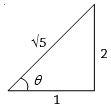
0 likesView Solution
31
ChemistryMCQAP EAMCET · 2020
The number of possible straight lines passing through $(2, 3)$ and forming a triangle with the coordinate axes,whose area is $12 \, sq. \, units$,is
A
$1$
B
$2$
C
$3$
D
$4$
Solution
(C) The equation of a line passing through $(2, 3)$ with slope $m$ is $y - 3 = m(x - 2)$,which simplifies to $y = mx + (3 - 2m)$.
The $x$-intercept $(A)$ is found by setting $y = 0$: $0 = mx + 3 - 2m \Rightarrow x = \frac{2m - 3}{m}$.
The $y$-intercept $(B)$ is found by setting $x = 0$: $y = 3 - 2m$.
The area of the triangle formed with the coordinate axes is $\frac{1}{2} |x_{intercept}| |y_{intercept}| = 12$.
$\frac{1}{2} |\frac{2m - 3}{m}| |3 - 2m| = 12$.
Since $(3 - 2m)^2 = (2m - 3)^2$,we have $\frac{(2m - 3)^2}{|m|} = 24$.
Case $1$: $m > 0$,then $(2m - 3)^2 = 24m$ $\Rightarrow 4m^2 - 12m + 9 = 24m$ $\Rightarrow 4m^2 - 36m + 9 = 0$. The discriminant $D = (-36)^2 - 4(4)(9) = 1296 - 144 = 1152 > 0$,so there are $2$ distinct positive values for $m$.
Case $2$: $m < 0$,then $(2m - 3)^2 = -24m$ $\Rightarrow 4m^2 - 12m + 9 = -24m$ $\Rightarrow 4m^2 + 12m + 9 = 0$ $\Rightarrow (2m + 3)^2 = 0$. This gives $m = -3/2$,which is $1$ negative value.
Total number of possible lines = $2 + 1 = 3$.
The $x$-intercept $(A)$ is found by setting $y = 0$: $0 = mx + 3 - 2m \Rightarrow x = \frac{2m - 3}{m}$.
The $y$-intercept $(B)$ is found by setting $x = 0$: $y = 3 - 2m$.
The area of the triangle formed with the coordinate axes is $\frac{1}{2} |x_{intercept}| |y_{intercept}| = 12$.
$\frac{1}{2} |\frac{2m - 3}{m}| |3 - 2m| = 12$.
Since $(3 - 2m)^2 = (2m - 3)^2$,we have $\frac{(2m - 3)^2}{|m|} = 24$.
Case $1$: $m > 0$,then $(2m - 3)^2 = 24m$ $\Rightarrow 4m^2 - 12m + 9 = 24m$ $\Rightarrow 4m^2 - 36m + 9 = 0$. The discriminant $D = (-36)^2 - 4(4)(9) = 1296 - 144 = 1152 > 0$,so there are $2$ distinct positive values for $m$.
Case $2$: $m < 0$,then $(2m - 3)^2 = -24m$ $\Rightarrow 4m^2 - 12m + 9 = -24m$ $\Rightarrow 4m^2 + 12m + 9 = 0$ $\Rightarrow (2m + 3)^2 = 0$. This gives $m = -3/2$,which is $1$ negative value.
Total number of possible lines = $2 + 1 = 3$.
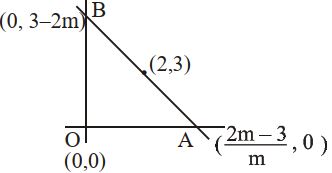
0 likesView Solution
32
ChemistryMediumMCQAP EAMCET · 2020
In which of the following molecules/ions are all the bonds not equal?
A
$XeF_4$
B
$BF_4^-$
C
$SiF_4$
D
$SF_4$
Solution
(D) In $XeF_4$,the geometry is square planar with all $Xe-F$ bonds being equal due to symmetry.
In $BF_4^-$ and $SiF_4$,the geometry is tetrahedral,where all four bonds are equivalent.
In $SF_4$,the sulfur atom undergoes $sp^3d$ hybridization with one lone pair,resulting in a see-saw geometry.
Due to the presence of the lone pair,the axial and equatorial $S-F$ bonds have different bond lengths and bond angles,making them unequal.
In $BF_4^-$ and $SiF_4$,the geometry is tetrahedral,where all four bonds are equivalent.
In $SF_4$,the sulfur atom undergoes $sp^3d$ hybridization with one lone pair,resulting in a see-saw geometry.
Due to the presence of the lone pair,the axial and equatorial $S-F$ bonds have different bond lengths and bond angles,making them unequal.
0 likesView Solution
33
ChemistryMCQAP EAMCET · 2020
Lenz's law is a consequence of the law of conservation of:
A
Charge
B
Momentum
C
Mass
D
Energy
Solution
(D) Lenz's law is a direct consequence of the law of conservation of $ENERGY$.
According to Lenz's law,the direction of the induced current is such that it always opposes the cause (change in magnetic flux) that produces it.
If the induced current were to assist the cause,it would lead to an increase in magnetic flux,which would further increase the current,violating the law of conservation of $ENERGY$.
Therefore,to overcome the opposing force,external work must be done. This mechanical work is converted into electrical energy,confirming that Lenz's law is consistent with the law of conservation of $ENERGY$.
According to Lenz's law,the direction of the induced current is such that it always opposes the cause (change in magnetic flux) that produces it.
If the induced current were to assist the cause,it would lead to an increase in magnetic flux,which would further increase the current,violating the law of conservation of $ENERGY$.
Therefore,to overcome the opposing force,external work must be done. This mechanical work is converted into electrical energy,confirming that Lenz's law is consistent with the law of conservation of $ENERGY$.
0 likesView Solution
34
ChemistryMCQAP EAMCET · 2020
Which of the following options is correct for an object having a straight-line motion represented by the following graph?
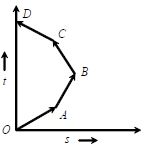
A
The object moves with constantly increasing velocity from $O$ to $A$ and then it moves with constant velocity.
B
Velocity of the object increases uniformly.
C
Average velocity is zero.
D
The graph shown is impossible.
Solution
(D) In the given graph,the $t$-axis (time) is on the vertical axis and the $s$-axis (displacement) is on the horizontal axis.
For a physical motion,time $t$ must always increase. In this graph,as the object moves from $O$ to $A$,$B$,$C$,and $D$,the value of $t$ increases. However,at point $D$,the graph shows that for a further increase in displacement $s$,the time $t$ would have to decrease,which is physically impossible.
Furthermore,for any time $t$,there cannot be two different positions $s$ (or for any position $s$,there cannot be two different times $t$ in a way that violates causality). Specifically,in this $t$-$s$ graph,the slope represents $dt/ds = 1/v$. At point $D$,the curve turns back,implying that time starts decreasing,which is impossible.
Therefore,the graph shown is impossible.
For a physical motion,time $t$ must always increase. In this graph,as the object moves from $O$ to $A$,$B$,$C$,and $D$,the value of $t$ increases. However,at point $D$,the graph shows that for a further increase in displacement $s$,the time $t$ would have to decrease,which is physically impossible.
Furthermore,for any time $t$,there cannot be two different positions $s$ (or for any position $s$,there cannot be two different times $t$ in a way that violates causality). Specifically,in this $t$-$s$ graph,the slope represents $dt/ds = 1/v$. At point $D$,the curve turns back,implying that time starts decreasing,which is impossible.
Therefore,the graph shown is impossible.
0 likesView Solution
35
ChemistryMCQAP EAMCET · 2020
The $V-I$ graph for a conductor at temperatures $T_1$ and $T_2$ is as shown in the figure. Then $(T_2 - T_1)$ is proportional to
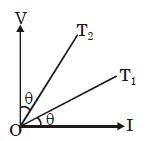
A
$\cos 2\theta$
B
$\sin 2\theta$
C
$\cot 2\theta$
D
$\tan 2\theta$
Solution
(C) In a $V-I$ graph,the slope represents the resistance $R$.
For temperature $T_1$,the line makes an angle $\theta$ with the $I$-axis. Thus,$R_1 = \tan \theta$. Since $R \propto T$,we have $R_1 = k T_1 = \tan \theta$.
For temperature $T_2$,the line makes an angle $\theta$ with the $V$-axis. The angle with the $I$-axis is $(90^\circ - \theta)$. Thus,$R_2 = \tan(90^\circ - \theta) = \cot \theta$.
Since $R \propto T$,we have $R_2 = k T_2 = \cot \theta$.
Now,consider $(T_2 - T_1) \propto (R_2 - R_1)$.
$(T_2 - T_1) \propto (\cot \theta - \tan \theta)$.
Using trigonometric identities: $\cot \theta - \tan \theta = \frac{\cos \theta}{\sin \theta} - \frac{\sin \theta}{\cos \theta} = \frac{\cos^2 \theta - \sin^2 \theta}{\sin \theta \cos \theta} = \frac{\cos 2\theta}{\frac{1}{2} \sin 2\theta} = 2 \cot 2\theta$.
Therefore,$(T_2 - T_1) \propto \cot 2\theta$.
For temperature $T_1$,the line makes an angle $\theta$ with the $I$-axis. Thus,$R_1 = \tan \theta$. Since $R \propto T$,we have $R_1 = k T_1 = \tan \theta$.
For temperature $T_2$,the line makes an angle $\theta$ with the $V$-axis. The angle with the $I$-axis is $(90^\circ - \theta)$. Thus,$R_2 = \tan(90^\circ - \theta) = \cot \theta$.
Since $R \propto T$,we have $R_2 = k T_2 = \cot \theta$.
Now,consider $(T_2 - T_1) \propto (R_2 - R_1)$.
$(T_2 - T_1) \propto (\cot \theta - \tan \theta)$.
Using trigonometric identities: $\cot \theta - \tan \theta = \frac{\cos \theta}{\sin \theta} - \frac{\sin \theta}{\cos \theta} = \frac{\cos^2 \theta - \sin^2 \theta}{\sin \theta \cos \theta} = \frac{\cos 2\theta}{\frac{1}{2} \sin 2\theta} = 2 \cot 2\theta$.
Therefore,$(T_2 - T_1) \propto \cot 2\theta$.
0 likesView Solution
36
ChemistryMCQAP EAMCET · 2020
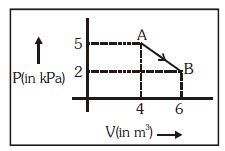
One mole of an ideal diatomic gas undergoes a transition from $A$ to $B$ along a path $AB$ as shown in the figure. The change in internal energy of the gas during the transition is:
A
$-20 \, kJ$
B
$20 \, J$
C
$-12 \, kJ$
D
$20 \, kJ$
Solution
(A) The change in internal energy $\Delta U$ for an ideal gas is given by $\Delta U = n C_V \Delta T$.
For a diatomic gas,the molar heat capacity at constant volume is $C_V = \frac{R}{\gamma - 1}$,where $\gamma = 1.4 = 7/5$.
Using the ideal gas law $PV = nRT$,we have $\Delta T = \frac{P_B V_B - P_A V_A}{nR}$.
Substituting this into the internal energy formula:
$\Delta U = n \left( \frac{R}{\gamma - 1} \right) \left( \frac{P_B V_B - P_A V_A}{nR} \right) = \frac{P_B V_B - P_A V_A}{\gamma - 1}$.
From the graph,at point $A$: $P_A = 5 \times 10^3 \, Pa$,$V_A = 4 \, m^3$.
At point $B$: $P_B = 2 \times 10^3 \, Pa$,$V_B = 6 \, m^3$.
Calculating the product $PV$ at each point:
$P_A V_A = (5 \times 10^3) \times 4 = 20 \times 10^3 \, J$.
$P_B V_B = (2 \times 10^3) \times 6 = 12 \times 10^3 \, J$.
Now,$\Delta U = \frac{12 \times 10^3 - 20 \times 10^3}{7/5 - 1} = \frac{-8 \times 10^3}{2/5} = -8 \times 10^3 \times \frac{5}{2} = -20 \times 10^3 \, J = -20 \, kJ$.
For a diatomic gas,the molar heat capacity at constant volume is $C_V = \frac{R}{\gamma - 1}$,where $\gamma = 1.4 = 7/5$.
Using the ideal gas law $PV = nRT$,we have $\Delta T = \frac{P_B V_B - P_A V_A}{nR}$.
Substituting this into the internal energy formula:
$\Delta U = n \left( \frac{R}{\gamma - 1} \right) \left( \frac{P_B V_B - P_A V_A}{nR} \right) = \frac{P_B V_B - P_A V_A}{\gamma - 1}$.
From the graph,at point $A$: $P_A = 5 \times 10^3 \, Pa$,$V_A = 4 \, m^3$.
At point $B$: $P_B = 2 \times 10^3 \, Pa$,$V_B = 6 \, m^3$.
Calculating the product $PV$ at each point:
$P_A V_A = (5 \times 10^3) \times 4 = 20 \times 10^3 \, J$.
$P_B V_B = (2 \times 10^3) \times 6 = 12 \times 10^3 \, J$.
Now,$\Delta U = \frac{12 \times 10^3 - 20 \times 10^3}{7/5 - 1} = \frac{-8 \times 10^3}{2/5} = -8 \times 10^3 \times \frac{5}{2} = -20 \times 10^3 \, J = -20 \, kJ$.
0 likesView Solution
37
ChemistryMCQAP EAMCET · 2020
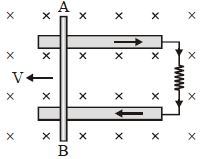
Consider the situation shown in the figure. The wire $AB$ is sliding on the fixed rails with a constant velocity $V$. If the wire $AB$ is replaced by a semicircular wire of the same end-to-end distance,the magnitude of the induced current will:
A
Increase
B
Remain the same
C
Decrease
D
Increase or decrease depending on whether the semicircle bulges towards the resistance or away from it
Solution
(B) The motional electromotive force $(EMF)$ induced in a conductor moving in a magnetic field is given by $\varepsilon = \int (\vec{v} \times \vec{B}) \cdot d\vec{l}$.
For a conductor moving with constant velocity $\vec{v}$ in a uniform magnetic field $\vec{B}$,this simplifies to $\varepsilon = \vec{v} \times \vec{B} \cdot \vec{L}_{eff}$,where $\vec{L}_{eff}$ is the effective length vector connecting the two ends of the conductor.
In both cases (straight wire $AB$ and a semicircular wire connecting points $A$ and $B$),the effective length vector $\vec{L}_{eff}$ is the same,as it is the straight-line distance between the points of contact on the rails.
Since the velocity $V$,magnetic field $B$,and effective length $L_{eff}$ remain unchanged,the induced $EMF$ $\varepsilon = B V L_{eff}$ remains the same.
Consequently,the induced current $I = \varepsilon / R$ also remains the same.
For a conductor moving with constant velocity $\vec{v}$ in a uniform magnetic field $\vec{B}$,this simplifies to $\varepsilon = \vec{v} \times \vec{B} \cdot \vec{L}_{eff}$,where $\vec{L}_{eff}$ is the effective length vector connecting the two ends of the conductor.
In both cases (straight wire $AB$ and a semicircular wire connecting points $A$ and $B$),the effective length vector $\vec{L}_{eff}$ is the same,as it is the straight-line distance between the points of contact on the rails.
Since the velocity $V$,magnetic field $B$,and effective length $L_{eff}$ remain unchanged,the induced $EMF$ $\varepsilon = B V L_{eff}$ remains the same.
Consequently,the induced current $I = \varepsilon / R$ also remains the same.
0 likesView Solution
38
ChemistryMCQAP EAMCET · 2020
In which of the following molecules/ions are all the bonds not equal?
A
$ClF_3$
B
$SiF_4$
C
$XeF_4$
D
$BF_4^-$
Solution
(A) To determine if all bonds are equal,we examine the molecular geometry and hybridization:
$1$. $SiF_4$: $sp^3$ hybridization,tetrahedral geometry. All $Si-F$ bonds are equivalent.
$2$. $XeF_4$: $sp^3d^2$ hybridization,square planar geometry. All $Xe-F$ bonds are equivalent.
$3$. $BF_4^-$: $sp^3$ hybridization,tetrahedral geometry. All $B-F$ bonds are equivalent.
$4$. $ClF_3$: $sp^3d$ hybridization,$T$-shaped geometry. Due to the presence of two lone pairs in the equatorial positions,the axial $Cl-F$ bonds are longer than the equatorial $Cl-F$ bond. Thus,all bonds are not equal.
Therefore,the correct option is $A$.
$1$. $SiF_4$: $sp^3$ hybridization,tetrahedral geometry. All $Si-F$ bonds are equivalent.
$2$. $XeF_4$: $sp^3d^2$ hybridization,square planar geometry. All $Xe-F$ bonds are equivalent.
$3$. $BF_4^-$: $sp^3$ hybridization,tetrahedral geometry. All $B-F$ bonds are equivalent.
$4$. $ClF_3$: $sp^3d$ hybridization,$T$-shaped geometry. Due to the presence of two lone pairs in the equatorial positions,the axial $Cl-F$ bonds are longer than the equatorial $Cl-F$ bond. Thus,all bonds are not equal.
Therefore,the correct option is $A$.
0 likesView Solution
39
ChemistryMCQAP EAMCET · 2020
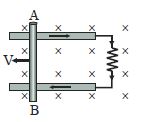
Consider the situation shown in the figure. The wire $AB$ is sliding on the fixed rails with a constant velocity $v$. If the wire $AB$ is replaced by a semicircular wire of the same chord length,the magnitude of the induced current will
A
Increase
B
Remain the same
C
Decrease
D
Increase or decrease depending on whether the semicircle bulge is towards the resistance or away from it
Solution
(B) The induced electromotive force $(emf)$ in a moving conductor is given by $e = B l v$,where $B$ is the magnetic field,$l$ is the length of the conductor perpendicular to the velocity,and $v$ is the velocity.
In this setup,the effective length $l$ of the wire that cuts the magnetic field lines is the distance between the two rails (the chord length of the wire).
When the straight wire $AB$ is replaced by a semicircular wire with the same chord length,the effective length $l$ remains unchanged because the distance between the points of contact on the rails remains the same.
Since $e = B l v$,and $B, l,$ and $v$ remain constant,the induced $emf$ remains the same.
Consequently,the induced current $I = e / R$ also remains the same,assuming the resistance $R$ of the circuit does not change.
In this setup,the effective length $l$ of the wire that cuts the magnetic field lines is the distance between the two rails (the chord length of the wire).
When the straight wire $AB$ is replaced by a semicircular wire with the same chord length,the effective length $l$ remains unchanged because the distance between the points of contact on the rails remains the same.
Since $e = B l v$,and $B, l,$ and $v$ remain constant,the induced $emf$ remains the same.
Consequently,the induced current $I = e / R$ also remains the same,assuming the resistance $R$ of the circuit does not change.
0 likesView Solution
40
ChemistryMCQAP EAMCET · 2020
When glucose reacts with bromine water,the main product is:
A
Acetic acid
B
Saccharic acid
C
Glyceraldehyde
D
Gluconic acid
Solution
(D) Glucose $(CHO-(CHOH)_4-CH_2OH)$ is a mild reducing agent.
When it reacts with bromine water $(Br_2/H_2O)$,which is a mild oxidizing agent,the aldehyde group $(-CHO)$ is oxidized to a carboxylic acid group $(-COOH)$.
The resulting product is gluconic acid $(COOH-(CHOH)_4-CH_2OH)$.
When it reacts with bromine water $(Br_2/H_2O)$,which is a mild oxidizing agent,the aldehyde group $(-CHO)$ is oxidized to a carboxylic acid group $(-COOH)$.
The resulting product is gluconic acid $(COOH-(CHOH)_4-CH_2OH)$.
0 likesView Solution
41
ChemistryMCQAP EAMCET · 2020
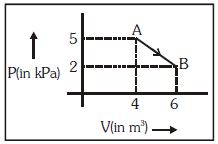
One mole of an ideal diatomic gas undergoes a transition from $A$ to $B$ along a path $AB$ as shown in the figure. The change in internal energy of the gas during the transition is:
A
$-\,20\,kJ$
B
$20\,J$
C
$-\,12\,kJ$
D
$20\,kJ$
Solution
(A) For an ideal gas,the change in internal energy is given by $\Delta U = n C_V \Delta T$.
Since $C_V = \frac{R}{\gamma - 1}$ and $PV = nRT$,we have $\Delta U = \frac{n R \Delta T}{\gamma - 1} = \frac{P_B V_B - P_A V_A}{\gamma - 1}$.
For a diatomic gas,the adiabatic index $\gamma = 1.4 = \frac{7}{5}$,so $\gamma - 1 = 0.4 = \frac{2}{5}$.
From the graph,at point $A$: $P_A = 5 \times 10^3 \, Pa$,$V_A = 4 \, m^3$.
At point $B$: $P_B = 2 \times 10^3 \, Pa$,$V_B = 6 \, m^3$.
Calculating the product $PV$ at each point:
$P_A V_A = (5 \times 10^3) \times 4 = 20 \times 10^3 \, J$.
$P_B V_B = (2 \times 10^3) \times 6 = 12 \times 10^3 \, J$.
Substituting these values into the formula:
$\Delta U = \frac{12 \times 10^3 - 20 \times 10^3}{2/5} = \frac{-8 \times 10^3}{0.4} = -20 \times 10^3 \, J = -20 \, kJ$.
Since $C_V = \frac{R}{\gamma - 1}$ and $PV = nRT$,we have $\Delta U = \frac{n R \Delta T}{\gamma - 1} = \frac{P_B V_B - P_A V_A}{\gamma - 1}$.
For a diatomic gas,the adiabatic index $\gamma = 1.4 = \frac{7}{5}$,so $\gamma - 1 = 0.4 = \frac{2}{5}$.
From the graph,at point $A$: $P_A = 5 \times 10^3 \, Pa$,$V_A = 4 \, m^3$.
At point $B$: $P_B = 2 \times 10^3 \, Pa$,$V_B = 6 \, m^3$.
Calculating the product $PV$ at each point:
$P_A V_A = (5 \times 10^3) \times 4 = 20 \times 10^3 \, J$.
$P_B V_B = (2 \times 10^3) \times 6 = 12 \times 10^3 \, J$.
Substituting these values into the formula:
$\Delta U = \frac{12 \times 10^3 - 20 \times 10^3}{2/5} = \frac{-8 \times 10^3}{0.4} = -20 \times 10^3 \, J = -20 \, kJ$.
0 likesView Solution
42
ChemistryMCQAP EAMCET · 2020
If there were no gravity,which of the following will not be there for a fluid?
A
Viscosity
B
Surface tension
C
Pressure
D
Archimedes' upward thrust
Solution
(D) The correct option is $D$.
Archimedes' upward thrust (buoyant force) is defined as the upward force exerted by a fluid that opposes the weight of an immersed object. This force arises specifically due to the pressure gradient in a fluid column,which is caused by gravity $(P = \rho gh)$.
If there were no gravity,there would be no pressure variation with depth in the fluid. Consequently,the net upward force (buoyant force) on an object would be zero.
Viscosity,surface tension,and pressure (in a compressed fluid) are intrinsic properties or states that do not depend on the presence of gravity.
Archimedes' upward thrust (buoyant force) is defined as the upward force exerted by a fluid that opposes the weight of an immersed object. This force arises specifically due to the pressure gradient in a fluid column,which is caused by gravity $(P = \rho gh)$.
If there were no gravity,there would be no pressure variation with depth in the fluid. Consequently,the net upward force (buoyant force) on an object would be zero.
Viscosity,surface tension,and pressure (in a compressed fluid) are intrinsic properties or states that do not depend on the presence of gravity.
0 likesView Solution
43
ChemistryMCQAP EAMCET · 2020
$A$ sound source is moving towards a stationary observer with $(1/10)$ of the speed of sound. The ratio of apparent to real frequency is .........
A
$10/9$
B
$11/10$
C
$(11/10)^2$
D
$(9/10)^2$
Solution
(A) The formula for the apparent frequency $f$ when the source moves towards a stationary observer is given by $f = f_0 \left( \frac{v}{v - v_s} \right)$,where $f_0$ is the real frequency,$v$ is the speed of sound,and $v_s$ is the speed of the source.
Given that the source speed $v_s = v/10$.
Substituting this into the formula:
$f = f_0 \left( \frac{v}{v - v/10} \right)$
$f = f_0 \left( \frac{v}{9v/10} \right)$
$f = f_0 \left( \frac{10}{9} \right)$
Therefore,the ratio of apparent frequency to real frequency is $f/f_0 = 10/9$.
Given that the source speed $v_s = v/10$.
Substituting this into the formula:
$f = f_0 \left( \frac{v}{v - v/10} \right)$
$f = f_0 \left( \frac{v}{9v/10} \right)$
$f = f_0 \left( \frac{10}{9} \right)$
Therefore,the ratio of apparent frequency to real frequency is $f/f_0 = 10/9$.
0 likesView Solution
44
ChemistryMCQAP EAMCET · 2020
$A$ light wave has a frequency of $4 \times 10^{14} ~Hz$ and a wavelength of $5 \times 10^{-7} ~m$ in a medium. The refractive index of the medium is:
A
$1.5$
B
$1.33$
C
$1.0$
D
$0.66$
Solution
(A) The speed of light in a medium $(v)$ is given by the product of frequency $(f)$ and wavelength $(\lambda)$:
$v = f \times \lambda$
Given $f = 4 \times 10^{14} ~Hz$ and $\lambda = 5 \times 10^{-7} ~m$.
$v = (4 \times 10^{14}) \times (5 \times 10^{-7}) = 20 \times 10^7 ~m/s = 2 \times 10^8 ~m/s$.
The refractive index $(\mu)$ is defined as the ratio of the speed of light in a vacuum $(c)$ to the speed of light in the medium $(v)$:
$\mu = \frac{c}{v}$
Taking $c = 3 \times 10^8 ~m/s$:
$\mu = \frac{3 \times 10^8}{2 \times 10^8} = 1.5$.
$v = f \times \lambda$
Given $f = 4 \times 10^{14} ~Hz$ and $\lambda = 5 \times 10^{-7} ~m$.
$v = (4 \times 10^{14}) \times (5 \times 10^{-7}) = 20 \times 10^7 ~m/s = 2 \times 10^8 ~m/s$.
The refractive index $(\mu)$ is defined as the ratio of the speed of light in a vacuum $(c)$ to the speed of light in the medium $(v)$:
$\mu = \frac{c}{v}$
Taking $c = 3 \times 10^8 ~m/s$:
$\mu = \frac{3 \times 10^8}{2 \times 10^8} = 1.5$.
0 likesView Solution
45
ChemistryMediumMCQAP EAMCET · 2020
To a mixture of $LiCl$,$AlCl_3$ and $NaCl$,ether is added. Which of these will be extracted into ether?
A
$LiCl, NaCl$
B
$LiCl, AlCl_3$
C
$AlCl_3, NaCl$
D
$LiCl, AlCl_3, NaCl$
Solution
(B) $AlCl_3$ is a covalent compound due to the high polarizing power of the $Al^{3+}$ ion (Fajans' rule).
Because it is covalent,it is soluble in organic solvents like ether.
$LiCl$ and $NaCl$ are ionic compounds and are insoluble in ether.
Therefore,only $AlCl_3$ is extracted into ether.
Because it is covalent,it is soluble in organic solvents like ether.
$LiCl$ and $NaCl$ are ionic compounds and are insoluble in ether.
Therefore,only $AlCl_3$ is extracted into ether.
0 likesView Solution
46
ChemistryMCQAP EAMCET · 2020
$A$ transformer works on the principle of
A
self-induction
B
electrical inertia
C
mutual induction
D
magnetic effect of electric current
Solution
(C) transformer works on the principle of mutual induction.
Mutual induction is a phenomenon where a change in current in one coil induces an electromotive force $(emf)$ in an adjacent coil due to the change in magnetic flux linked with it.
Mutual induction is a phenomenon where a change in current in one coil induces an electromotive force $(emf)$ in an adjacent coil due to the change in magnetic flux linked with it.
0 likesView Solution
47
ChemistryMCQAP EAMCET · 2020
$A$ transformer works on the principle of
A
self-induction
B
electrical inertia
C
magnetic effect of electric current
D
mutual induction
Solution
(D) transformer is a device that transfers electrical energy between two or more circuits through electromagnetic induction.
It consists of two coils,the primary and the secondary,wound on a common magnetic core.
When an alternating current flows through the primary coil,it creates a changing magnetic flux in the core.
This changing flux links with the secondary coil and induces an electromotive force $(EMF)$ in it,which is the phenomenon of mutual induction.
Therefore,a transformer works on the principle of mutual induction.
It consists of two coils,the primary and the secondary,wound on a common magnetic core.
When an alternating current flows through the primary coil,it creates a changing magnetic flux in the core.
This changing flux links with the secondary coil and induces an electromotive force $(EMF)$ in it,which is the phenomenon of mutual induction.
Therefore,a transformer works on the principle of mutual induction.
0 likesView Solution
48
ChemistryMCQAP EAMCET · 2020
Which of the following is not an essential amino acid?
A
Lysine
B
Histidine
C
Valine
D
Tyrosine
Solution
(D) Essential amino acids are those that cannot be synthesized by the human body and must be obtained through the diet. $Lysine$,$Histidine$,and $Valine$ are essential amino acids.
$Tyrosine$ is a non-essential amino acid because it can be synthesized by the body from the essential amino acid $Phenylalanine$.
$Tyrosine$ is a non-essential amino acid because it can be synthesized by the body from the essential amino acid $Phenylalanine$.
0 likesView Solution
49
ChemistryEasyMCQAP EAMCET · 2020
How many lone pairs of electrons are present in a hydroxyl ion?
A
$Three$ pairs
B
$Two$ pairs
C
$One$ pair
D
$Four$ pairs
Solution
(A) In a hydroxyl ion,$OH^{\ominus}$,the oxygen atom has $6$ valence electrons.
It shares $1$ electron with the hydrogen atom to form a covalent bond,and it gains $1$ electron due to the negative charge.
This results in $8$ electrons around the oxygen atom,which corresponds to $4$ electron pairs.
Out of these $4$ pairs,$1$ pair is involved in the $O-H$ covalent bond,and the remaining $3$ pairs are lone pairs on the oxygen atom.
It shares $1$ electron with the hydrogen atom to form a covalent bond,and it gains $1$ electron due to the negative charge.
This results in $8$ electrons around the oxygen atom,which corresponds to $4$ electron pairs.
Out of these $4$ pairs,$1$ pair is involved in the $O-H$ covalent bond,and the remaining $3$ pairs are lone pairs on the oxygen atom.
0 likesView Solution
50
ChemistryEasyMCQAP EAMCET · 2020
The types of hybrid orbitals of nitrogen in $NO_2^{+}$,$NO_3^{-}$ and $NH_4^{+}$ respectively are
A
$sp, sp^3, sp^2$
B
$sp, sp^2, sp^3$
C
$sp^2, sp, sp^3$
D
$sp^2, sp^3, sp$
Solution
(B) To determine the hybridization $(H)$,we use the formula: $H = \frac{1}{2}(V + M - C + A)$
Where $V$ = number of valence electrons of the central atom,$M$ = number of monovalent atoms,$C$ = cationic charge,and $A$ = anionic charge.
$1$. For $NO_2^{+}$:
$H = \frac{1}{2}(5 + 0 - 1 + 0) = 2$,which corresponds to $sp$ hybridization.
$2$. For $NO_3^{-}$:
$H = \frac{1}{2}(5 + 0 - 0 + 1) = 3$,which corresponds to $sp^2$ hybridization.
$3$. For $NH_4^{+}$:
$H = \frac{1}{2}(5 + 4 - 1 + 0) = 4$,which corresponds to $sp^3$ hybridization.
Thus,the hybridization types are $sp, sp^2, sp^3$ respectively.
Where $V$ = number of valence electrons of the central atom,$M$ = number of monovalent atoms,$C$ = cationic charge,and $A$ = anionic charge.
$1$. For $NO_2^{+}$:
$H = \frac{1}{2}(5 + 0 - 1 + 0) = 2$,which corresponds to $sp$ hybridization.
$2$. For $NO_3^{-}$:
$H = \frac{1}{2}(5 + 0 - 0 + 1) = 3$,which corresponds to $sp^2$ hybridization.
$3$. For $NH_4^{+}$:
$H = \frac{1}{2}(5 + 4 - 1 + 0) = 4$,which corresponds to $sp^3$ hybridization.
Thus,the hybridization types are $sp, sp^2, sp^3$ respectively.
0 likesView Solution
51
ChemistryMediumMCQAP EAMCET · 2020
Which of the following is not an essential amino acid?
A
Valine
B
Leucine
C
Lysine
D
Tyrosine
Solution
(D) Essential amino acids are those that cannot be synthesized by the human body and must be obtained through the diet.
Valine,Leucine,and Lysine are essential amino acids.
Tyrosine is a non-essential amino acid because it can be synthesized in the body from phenylalanine.
Valine,Leucine,and Lysine are essential amino acids.
Tyrosine is a non-essential amino acid because it can be synthesized in the body from phenylalanine.
0 likesView Solution
52
ChemistryMediumMCQAP EAMCET · 2020
Which of the following compounds will give butanone on oxidation with alkaline $KMnO_4$ solution?
A
Butan$-1-$ol only
B
Butan$-2-$ol only
C
Butan$-1-$ol and butan$-2-$ol
D
None of the options are correct
Solution
(B) Secondary alcohols like $CH_3-CH(OH)-CH_2-CH_3$ (butan$-2-$ol) on oxidation with strong oxidizing agents like alkaline $KMnO_4$ undergo oxidation to form ketones.
Specifically,butan$-2-$ol is oxidized to butanone $(CH_3-CO-CH_2-CH_3)$.
Primary alcohols like butan$-1-$ol $(CH_3-CH_2-CH_2-CH_2OH)$ are oxidized to carboxylic acids (butanoic acid) under these conditions.
Hence,the correct option is $(B)$.
Specifically,butan$-2-$ol is oxidized to butanone $(CH_3-CO-CH_2-CH_3)$.
Primary alcohols like butan$-1-$ol $(CH_3-CH_2-CH_2-CH_2OH)$ are oxidized to carboxylic acids (butanoic acid) under these conditions.
Hence,the correct option is $(B)$.
0 likesView Solution
53
ChemistryDifficultMCQAP EAMCET · 2020
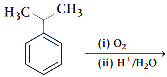
What by-product is formed in the process of making phenol from cumene?
A
propan$-2-$ol
B
$n$-propanol
C
propanal
D
propan$-2-$one
Solution
(D) Cumene (isopropylbenzene) is oxidised in the presence of air to form cumene hydroperoxide.
On treating with dilute acid,it undergoes rearrangement to form phenol and acetone (propan$-2-$one) as a by-product.
On treating with dilute acid,it undergoes rearrangement to form phenol and acetone (propan$-2-$one) as a by-product.
0 likesView Solution
54
ChemistryMediumMCQAP EAMCET · 2020
Which of the following metals is used as a catalyst in Haber's process of ammonia synthesis?
A
Cobalt
B
Copper
C
Zinc
D
Iron
Solution
(D) Iron $(Fe)$ is used as a catalyst in Haber's process.
The Haber process,also called the Haber-Bosch process,is the industrial implementation of the reaction of nitrogen gas $(N_2)$ and hydrogen gas $(H_2)$.
The chemical equation is: $N_2(g) + 3H_2(g) \xrightarrow{Fe, 450^{\circ}C, 250 \ atm} 2NH_3(g)$.
It is the main industrial procedure to produce ammonia $(NH_3)$ and the catalyst used is iron with a suitable promoter like $K_2O$,$CaO$,$SiO_2$,and $Al_2O_3$.
Hence,Iron is used in the Haber process as a cheap catalyst because it allows reaching a reasonable yield in an acceptable time.
The Haber process,also called the Haber-Bosch process,is the industrial implementation of the reaction of nitrogen gas $(N_2)$ and hydrogen gas $(H_2)$.
The chemical equation is: $N_2(g) + 3H_2(g) \xrightarrow{Fe, 450^{\circ}C, 250 \ atm} 2NH_3(g)$.
It is the main industrial procedure to produce ammonia $(NH_3)$ and the catalyst used is iron with a suitable promoter like $K_2O$,$CaO$,$SiO_2$,and $Al_2O_3$.
Hence,Iron is used in the Haber process as a cheap catalyst because it allows reaching a reasonable yield in an acceptable time.
0 likesView Solution
55
ChemistryMediumMCQAP EAMCET · 2020
When an iron rod is subjected to an atmosphere having a very high content of moisture,which process is predominant?
A
Chemisorption
B
Physisorption
C
Sorption
D
Luminescence
Solution
(A) When an iron rod is exposed to a moist atmosphere,it undergoes corrosion,commonly known as rusting.
This process involves the formation of hydrated ferric oxide $(Fe_2O_3 \cdot xH_2O)$ on the surface of the iron.
Since this involves the formation of chemical bonds between the iron surface and the oxygen/water molecules,it is classified as a surface phenomenon known as chemisorption.
This process involves the formation of hydrated ferric oxide $(Fe_2O_3 \cdot xH_2O)$ on the surface of the iron.
Since this involves the formation of chemical bonds between the iron surface and the oxygen/water molecules,it is classified as a surface phenomenon known as chemisorption.
0 likesView Solution
56
ChemistryDifficultMCQAP EAMCET · 2020
The semicarbazone of cyclobutanone is represented as:
A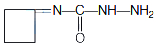
B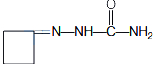
C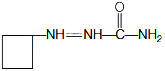
D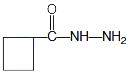
Solution
(B) The reaction between a ketone (cyclobutanone) and semicarbazide $(H_2N-NH-CO-NH_2)$ is a nucleophilic addition-elimination reaction.
In this reaction,the carbonyl oxygen of the ketone is replaced by the nitrogen atom of the semicarbazide,resulting in the formation of a semicarbazone.
The general structure of a semicarbazone is $R_2C=N-NH-CO-NH_2$.
For cyclobutanone,the structure is a cyclobutane ring double-bonded to a nitrogen atom,which is attached to an $NH$ group,which is attached to a carbonyl group,which is attached to an $NH_2$ group.
This matches the structure shown in option $B$.
In this reaction,the carbonyl oxygen of the ketone is replaced by the nitrogen atom of the semicarbazide,resulting in the formation of a semicarbazone.
The general structure of a semicarbazone is $R_2C=N-NH-CO-NH_2$.
For cyclobutanone,the structure is a cyclobutane ring double-bonded to a nitrogen atom,which is attached to an $NH$ group,which is attached to a carbonyl group,which is attached to an $NH_2$ group.
This matches the structure shown in option $B$.
0 likesView Solution
57
ChemistryDifficultMCQAP EAMCET · 2020
Which of the following represents the structure of the methyl hemiacetal of formaldehyde?
A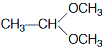
B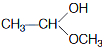
C
D
Solution
(C) Formaldehyde is $HCHO$. $A$ hemiacetal is formed by the addition of one molecule of an alcohol to an aldehyde. The reaction of formaldehyde with methanol $(CH_3OH)$ forms methyl hemiacetal of formaldehyde.
The reaction is: $HCHO + CH_3OH \rightleftharpoons H_2C(OH)(OCH_3)$.
The structure consists of a central carbon atom bonded to two hydrogen atoms,one hydroxyl group $(-OH)$,and one methoxy group $(-OCH_3)$.
This corresponds to the structure $H_2C(OH)(OCH_3)$.
Hence,the correct option is $(C)$.
The reaction is: $HCHO + CH_3OH \rightleftharpoons H_2C(OH)(OCH_3)$.
The structure consists of a central carbon atom bonded to two hydrogen atoms,one hydroxyl group $(-OH)$,and one methoxy group $(-OCH_3)$.
This corresponds to the structure $H_2C(OH)(OCH_3)$.
Hence,the correct option is $(C)$.
0 likesView Solution
58
ChemistryDifficultMCQAP EAMCET · 2020
Which among the following is a possible product during cross aldol condensation between propanal (as electrophile) and butanal (as nucleophile)?
A
$3-$hydroxy$-2-$methylhexanal
B
$2-$ethyl$-3-$hydroxypentanal
C
$3-$hydroxy$-2-$methylpentanal
D
$2-$ethyl$-3-$hydroxyhexanal
Solution
(B) In a cross aldol condensation,the nucleophile (enolate) attacks the carbonyl carbon of the electrophile.
Here,$CH_3CH_2CH_2CHO$ (butanal) acts as the nucleophile,forming an enolate at the $\alpha$-carbon: $CH_3CH_2CH^-CHO$.
This enolate attacks the carbonyl carbon of $CH_3CH_2CHO$ (propanal) as the electrophile.
The reaction is: $CH_3CH_2CHO + CH_3CH_2CH_2CHO \rightarrow CH_3CH_2-CH(OH)-CH(CH_2CH_3)-CHO$.
The product formed is $2-$ethyl$-3-$hydroxypentanal.
Hence,the correct option is $B$.
Here,$CH_3CH_2CH_2CHO$ (butanal) acts as the nucleophile,forming an enolate at the $\alpha$-carbon: $CH_3CH_2CH^-CHO$.
This enolate attacks the carbonyl carbon of $CH_3CH_2CHO$ (propanal) as the electrophile.
The reaction is: $CH_3CH_2CHO + CH_3CH_2CH_2CHO \rightarrow CH_3CH_2-CH(OH)-CH(CH_2CH_3)-CHO$.
The product formed is $2-$ethyl$-3-$hydroxypentanal.
Hence,the correct option is $B$.
0 likesView Solution
59
ChemistryMediumMCQAP EAMCET · 2020
Which of the following compounds would undergo aldol condensation?
A
Methanal
B
Butan-$1$-ol
C
$2$-methyl pentanal
D
$2,2$-dimethyl pentanal
Solution
(C) Aldol condensation occurs in aldehydes or ketones that possess at least one $\alpha$-hydrogen atom.
$1$. Methanal $(HCHO)$ has no $\alpha$-carbon,hence no $\alpha$-hydrogen.
$2$. Butan-$1$-ol is an alcohol,not an aldehyde or ketone.
$3$. $2$-methyl pentanal $(CH_3CH_2CH_2CH(CH_3)CHO)$ has one $\alpha$-hydrogen atom at the $C-2$ position,so it undergoes aldol condensation.
$4$. $2,2$-dimethyl pentanal $(CH_3CH_2CH_2C(CH_3)_2CHO)$ has no $\alpha$-hydrogen atom because the $C-2$ carbon is fully substituted with two methyl groups and the aldehyde group.
Therefore,the correct option is $C$.
$1$. Methanal $(HCHO)$ has no $\alpha$-carbon,hence no $\alpha$-hydrogen.
$2$. Butan-$1$-ol is an alcohol,not an aldehyde or ketone.
$3$. $2$-methyl pentanal $(CH_3CH_2CH_2CH(CH_3)CHO)$ has one $\alpha$-hydrogen atom at the $C-2$ position,so it undergoes aldol condensation.
$4$. $2,2$-dimethyl pentanal $(CH_3CH_2CH_2C(CH_3)_2CHO)$ has no $\alpha$-hydrogen atom because the $C-2$ carbon is fully substituted with two methyl groups and the aldehyde group.
Therefore,the correct option is $C$.
0 likesView Solution
60
ChemistryDifficultMCQAP EAMCET · 2020
Choose the incorrect statement among the following.
$A$. The reactivity of aromatic aldehydes and ketones is less than that of aliphatic carbonyl compounds towards nucleophilic addition reactions.
$B$. Benzaldehyde does not give Fehling's test.
$C$. The $\alpha$-$H$ atoms in ethanal are acidic in nature.
$D$. $p$-nitro benzaldehyde is less reactive than benzaldehyde towards nucleophilic addition reactions.
$A$. The reactivity of aromatic aldehydes and ketones is less than that of aliphatic carbonyl compounds towards nucleophilic addition reactions.
$B$. Benzaldehyde does not give Fehling's test.
$C$. The $\alpha$-$H$ atoms in ethanal are acidic in nature.
$D$. $p$-nitro benzaldehyde is less reactive than benzaldehyde towards nucleophilic addition reactions.
A
$A$
B
$B$
C
$C$
D
$D$
Solution
(D) Due to the presence of bulky aryl groups,the nucleophilic attack on the $sp^2$ carbon of the $>C=O$ group experiences steric hindrance,decreasing the reaction rate.
$(B)$ Fehling's solution is a mild oxidizing agent and cannot oxidize benzaldehyde.
$(C)$ Ethanal contains $\alpha$-hydrogens which are acidic due to the electron-withdrawing effect of the carbonyl group,allowing for enolization.
$(D)$ The $-NO_2$ group at the $p$-position exerts a strong $-R$ (resonance) and $-I$ (inductive) effect,which increases the partial positive charge on the carbonyl carbon,making it more susceptible to nucleophilic attack. Thus,$p$-nitrobenzaldehyde is more reactive than benzaldehyde. Therefore,statement $D$ is incorrect.
$(B)$ Fehling's solution is a mild oxidizing agent and cannot oxidize benzaldehyde.
$(C)$ Ethanal contains $\alpha$-hydrogens which are acidic due to the electron-withdrawing effect of the carbonyl group,allowing for enolization.
$(D)$ The $-NO_2$ group at the $p$-position exerts a strong $-R$ (resonance) and $-I$ (inductive) effect,which increases the partial positive charge on the carbonyl carbon,making it more susceptible to nucleophilic attack. Thus,$p$-nitrobenzaldehyde is more reactive than benzaldehyde. Therefore,statement $D$ is incorrect.
0 likesView Solution
61
ChemistryMediumMCQAP EAMCET · 2020
The product formed when formaldehyde reacts with ammonia is
A
Melamine
B
Formic acid
C
Ammonium formate
D
Urotropine
Solution
(D) Formaldehyde $(HCHO)$ reacts with ammonia $(NH_3)$ to produce hexamethylenetetramine,which is commonly known as urotropine.
The balanced chemical equation is:
$6 HCHO + 4 NH_3 \rightarrow (CH_2)_6N_4 + 6 H_2O$
The balanced chemical equation is:
$6 HCHO + 4 NH_3 \rightarrow (CH_2)_6N_4 + 6 H_2O$
0 likesView Solution
62
ChemistryEasyMCQAP EAMCET · 2020
Both ethanal and propanone will react with which of the following?
A
Tollen's reagent
B
Schiff's reagent
C
Fehling's reagent
D
Grignard reagent
Solution
(D) Ethanal $(CH_3CHO)$ and propanone $(CH_3COCH_3)$ both react with a Grignard reagent $(RMgX)$ to form alcohols.
Specifically,ethanal reacts with a Grignard reagent to form a secondary alcohol (after hydrolysis),while propanone reacts with a Grignard reagent to form a tertiary alcohol (after hydrolysis).
In contrast,Tollen's reagent,Fehling's reagent,and Schiff's reagent are specific tests for aldehydes and do not react with ketones like propanone.
Therefore,the correct option is $(D)$.
Specifically,ethanal reacts with a Grignard reagent to form a secondary alcohol (after hydrolysis),while propanone reacts with a Grignard reagent to form a tertiary alcohol (after hydrolysis).
In contrast,Tollen's reagent,Fehling's reagent,and Schiff's reagent are specific tests for aldehydes and do not react with ketones like propanone.
Therefore,the correct option is $(D)$.
0 likesView Solution
63
ChemistryEasyMCQAP EAMCET · 2020
An aromatic compound "$A$" on treatment with $Zn / NH_4Cl$ and subsequent heating with ammoniacal silver nitrate solution gives a black precipitate. Which functional group does "$A$" contain?
A
$-CHO$
B
$-NO_2$
C
$-OH$
D
$-COOH$
Solution
(B) The reaction of an aromatic nitro compound $(Ar-NO_2)$ with $Zn / NH_4Cl$ is a selective reduction that produces an aromatic hydroxylamine $(Ar-NHOH)$.
$Ar-NO_2 + Zn / NH_4Cl \rightarrow Ar-NHOH + ZnO$
Aromatic hydroxylamines are strong reducing agents and can reduce Tollen's reagent (ammoniacal silver nitrate) to metallic silver $(Ag)$,which appears as a black precipitate.
$Ar-NHOH + 2[Ag(NH_3)_2]^+ + 3OH^- \rightarrow Ar-NO + 2Ag(s) + 4NH_3 + 2H_2O$
Therefore,the functional group present in compound "$A$" is the nitro group $(-NO_2)$.
$Ar-NO_2 + Zn / NH_4Cl \rightarrow Ar-NHOH + ZnO$
Aromatic hydroxylamines are strong reducing agents and can reduce Tollen's reagent (ammoniacal silver nitrate) to metallic silver $(Ag)$,which appears as a black precipitate.
$Ar-NHOH + 2[Ag(NH_3)_2]^+ + 3OH^- \rightarrow Ar-NO + 2Ag(s) + 4NH_3 + 2H_2O$
Therefore,the functional group present in compound "$A$" is the nitro group $(-NO_2)$.
0 likesView Solution
64
ChemistryMediumMCQAP EAMCET · 2020
The order of boiling points of the following compounds is:
$1$. $(CH_3)_3N$
$2$. $CH_3CH_2CH_2NH_2$
$3$. $CH_3CH_2NHCH_3$
$1$. $(CH_3)_3N$
$2$. $CH_3CH_2CH_2NH_2$
$3$. $CH_3CH_2NHCH_3$
A
$1 > 3 > 2$
B
$3 > 1 > 2$
C
$2 > 1 > 3$
D
$2 > 3 > 1$
Solution
(D) The boiling points of amines depend on the extent of intermolecular hydrogen bonding.
Primary amines $(R-NH_2)$ have two hydrogen atoms available for hydrogen bonding,secondary amines $(R_2NH)$ have one,and tertiary amines $(R_3N)$ have none.
Therefore,the extent of hydrogen bonding follows the order: primary > secondary > tertiary.
Compound $2$ $(CH_3CH_2CH_2NH_2)$ is a primary amine,compound $3$ $(CH_3CH_2NHCH_3)$ is a secondary amine,and compound $1$ $((CH_3)_3N)$ is a tertiary amine.
Thus,the order of boiling points is $2 > 3 > 1$.
Primary amines $(R-NH_2)$ have two hydrogen atoms available for hydrogen bonding,secondary amines $(R_2NH)$ have one,and tertiary amines $(R_3N)$ have none.
Therefore,the extent of hydrogen bonding follows the order: primary > secondary > tertiary.
Compound $2$ $(CH_3CH_2CH_2NH_2)$ is a primary amine,compound $3$ $(CH_3CH_2NHCH_3)$ is a secondary amine,and compound $1$ $((CH_3)_3N)$ is a tertiary amine.
Thus,the order of boiling points is $2 > 3 > 1$.
0 likesView Solution
65
ChemistryEasyMCQAP EAMCET · 2020
What will be the product $A$ in the reaction given below?
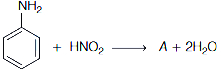
A
Phenol
B
Benzene diazonium salt
C
Benzene
D
Nitrobenzene
Solution
(B) The reaction of aniline with nitrous acid $(HNO_2)$ at low temperature $(273-278 \ K)$ is known as the diazotization reaction.
In this reaction,aniline reacts with $HNO_2$ (generated in situ from $NaNO_2$ and $HCl$) to form benzene diazonium chloride.
The chemical equation is:
$C_6H_5NH_2 + HNO_2 + HCl \xrightarrow{273-278 \ K} C_6H_5N_2^+Cl^- + 2H_2O$.
Thus,the product $A$ is benzene diazonium salt.
In this reaction,aniline reacts with $HNO_2$ (generated in situ from $NaNO_2$ and $HCl$) to form benzene diazonium chloride.
The chemical equation is:
$C_6H_5NH_2 + HNO_2 + HCl \xrightarrow{273-278 \ K} C_6H_5N_2^+Cl^- + 2H_2O$.
Thus,the product $A$ is benzene diazonium salt.
0 likesView Solution
66
ChemistryMediumMCQAP EAMCET · 2020
Which of the following statements about aniline is false?
A
$A$. Aniline is a stronger base than ammonia.
B
$B$. Aniline is less basic than methylamine.
C
$C$. $pK_b$ of aniline is more than that of ammonia.
D
$D$. Aniline reacts with bromine water to form a white precipitate.
Solution
(A) According to Lewis theory,a base is a species that donates a lone pair of electrons.
In aniline,the lone pair on the nitrogen atom is involved in resonance with the benzene ring,making it less available for donation compared to the lone pair in $NH_3$.
Therefore,$NH_3$ is a stronger base than aniline.
Statement $(A)$ claims aniline is a stronger base than ammonia,which is false.
Statement $(B)$ is true because methylamine is an aliphatic amine with an electron-donating alkyl group,making it more basic than aniline.
Statement $(C)$ is true because a weaker base has a higher $pK_b$ value.
Statement $(D)$ is true because aniline reacts with bromine water to form $2,4,6$-tribromoaniline,which appears as a white precipitate.
Thus,the false statement is $(A)$.
In aniline,the lone pair on the nitrogen atom is involved in resonance with the benzene ring,making it less available for donation compared to the lone pair in $NH_3$.
Therefore,$NH_3$ is a stronger base than aniline.
Statement $(A)$ claims aniline is a stronger base than ammonia,which is false.
Statement $(B)$ is true because methylamine is an aliphatic amine with an electron-donating alkyl group,making it more basic than aniline.
Statement $(C)$ is true because a weaker base has a higher $pK_b$ value.
Statement $(D)$ is true because aniline reacts with bromine water to form $2,4,6$-tribromoaniline,which appears as a white precipitate.
Thus,the false statement is $(A)$.
0 likesView Solution
67
ChemistryDifficultMCQAP EAMCET · 2020
In the preparation of a $1^{\circ}$-amine from an alkyl halide,with simultaneous addition of one $-CH_2-$ group to the carbon chain,the reagent used as the source of nitrogen is
A
sodium amide,$NaNH_2$
B
sodium azide,$NaN_3$
C
potassium cyanide,$KCN$
D
potassium phthalimide,$C_6H_4(CO)_2N^{-}K^{+}$
Solution
(C) To prepare a $1^{\circ}$-amine from an alkyl halide with the simultaneous addition of one $-CH_2-$ group to the carbon chain,$KCN$ is used as the reagent.
The reaction proceeds as follows:
$1$. Nucleophilic substitution: $R-X + KCN \rightarrow R-CN + KX$
$2$. Reduction: $R-CN + 4[H] \rightarrow R-CH_2-NH_2$
$KCN$ provides the cyanide ion $(CN^-)$,which acts as a nucleophile to extend the carbon chain by one carbon atom,and subsequent reduction of the nitrile group yields the $1^{\circ}$-amine.
The reaction proceeds as follows:
$1$. Nucleophilic substitution: $R-X + KCN \rightarrow R-CN + KX$
$2$. Reduction: $R-CN + 4[H] \rightarrow R-CH_2-NH_2$
$KCN$ provides the cyanide ion $(CN^-)$,which acts as a nucleophile to extend the carbon chain by one carbon atom,and subsequent reduction of the nitrile group yields the $1^{\circ}$-amine.
0 likesView Solution
68
ChemistryMediumMCQAP EAMCET · 2020
Which of the following metals cannot be obtained by auto-reduction of their compounds?
A
Lead
B
Mercury
C
Titanium
D
Copper
Solution
(C) Auto-reduction (or self-reduction) is a process used for metals like $Pb$,$Hg$,and $Cu$ where the sulfide ore is partially roasted to form oxide,which then reacts with the remaining sulfide to yield the metal.
For example,$2Cu_2S + 3O_2 \rightarrow 2Cu_2O + 2SO_2$ followed by $2Cu_2O + Cu_2S \rightarrow 6Cu + SO_2$.
Titanium $(Ti)$ is a highly reactive metal and cannot be extracted by auto-reduction. It is typically extracted using the Kroll process,which involves the reduction of $TiCl_4$ with magnesium $(Mg)$ or sodium $(Na)$.
For example,$2Cu_2S + 3O_2 \rightarrow 2Cu_2O + 2SO_2$ followed by $2Cu_2O + Cu_2S \rightarrow 6Cu + SO_2$.
Titanium $(Ti)$ is a highly reactive metal and cannot be extracted by auto-reduction. It is typically extracted using the Kroll process,which involves the reduction of $TiCl_4$ with magnesium $(Mg)$ or sodium $(Na)$.
0 likesView Solution
69
ChemistryMediumMCQAP EAMCET · 2020
Fructose reduces Tollen's reagent due to
A
primary alcoholic group
B
secondary alcoholic group
C
enolisation of fructose followed by conversion to aldehyde by base
D
asymmetric carbon atoms
Solution
(C) Tollen's reagent is $(AgNO_3 + NH_4OH)$ and it provides a basic medium. Fructose is a keto-hexose,yet it can reduce Tollen's reagent. This is because,in a basic medium,it undergoes enolisation and rearrangement (Lobry de-Bruyn-van Ekenstein transformation) to form an aldose (like $D$-glucose or $D$-mannose) which contains an aldehyde group. The equilibrium involves the formation of an enediol intermediate.
0 likesView Solution
70
ChemistryEasyMCQAP EAMCET · 2020
Glycosidic linkage in carbohydrates is called
A
ester linkage
B
ether linkage
C
hydrogen bonding
D
amide linkage
Solution
(B) Oligosaccharides are formed by the linkage of two or more monosaccharide units through $O$-glycosidic bonds.
This linkage involves the formation of a $C-O-C$ bond between two sugar units,which is chemically classified as an ether linkage.
Thus,the correct option is $(B)$.
This linkage involves the formation of a $C-O-C$ bond between two sugar units,which is chemically classified as an ether linkage.
Thus,the correct option is $(B)$.
0 likesView Solution
71
ChemistryMediumMCQAP EAMCET · 2020
Glucose does not react with which of the following?
A
$NH_2OH$
B
$HCN$
C
$Br_2 / H_2O$
D
$NaHSO_3$
Solution
(D) Glucose contains an aldehyde group $(-CHO)$,but it does not give all the characteristic reactions of aldehydes due to the formation of a cyclic hemiacetal structure.
Glucose reacts with $NH_2OH$ to form an oxime.
Glucose reacts with $HCN$ to form a cyanohydrin.
Glucose reacts with $Br_2 / H_2O$ (mild oxidizing agent) to form gluconic acid.
However,glucose does not react with $NaHSO_3$ (sodium bisulphite) to form a hydrogen sulphite addition product,which is a characteristic reaction of most aldehydes and ketones.
Glucose reacts with $NH_2OH$ to form an oxime.
Glucose reacts with $HCN$ to form a cyanohydrin.
Glucose reacts with $Br_2 / H_2O$ (mild oxidizing agent) to form gluconic acid.
However,glucose does not react with $NaHSO_3$ (sodium bisulphite) to form a hydrogen sulphite addition product,which is a characteristic reaction of most aldehydes and ketones.
0 likesView Solution
72
ChemistryMediumMCQAP EAMCET · 2020
When glucose reacts with bromine water,the main product is
A
acetic acid
B
saccharic acid
C
glyceraldehyde
D
gluconic acid
Solution
(D) When glucose reacts with bromine water $(Br_2/H_2O)$,it undergoes mild oxidation of the aldehyde group to a carboxylic acid group,resulting in the formation of gluconic acid.
The reaction is as follows:
$CH_2OH(CHOH)_4CHO + [O] \xrightarrow{Br_2/H_2O} CH_2OH(CHOH)_4COOH$
Therefore,the correct option is $(D)$.
The reaction is as follows:
$CH_2OH(CHOH)_4CHO + [O] \xrightarrow{Br_2/H_2O} CH_2OH(CHOH)_4COOH$
Therefore,the correct option is $(D)$.
0 likesView Solution
73
ChemistryEasyMCQAP EAMCET · 2020
Glucose on prolonged heating with $HI$ gives:
A
$n-$Hexane
B
$2-$Methyl pentane
C
Hexan$-1-$one
D
Hexan$-2-$one
Solution
(A) When glucose $(CHO(CHOH)_4CH_2OH)$ is heated with concentrated $HI$ for a prolonged period,the reduction of all hydroxyl groups and the aldehyde group occurs.
This reaction results in the formation of $n-$hexane $(CH_3(CH_2)_4CH_3)$,which indicates that all six carbon atoms in glucose are linked in a straight chain.
This reaction results in the formation of $n-$hexane $(CH_3(CH_2)_4CH_3)$,which indicates that all six carbon atoms in glucose are linked in a straight chain.
0 likesView Solution
74
ChemistryEasyMCQAP EAMCET · 2020
Glucose + ? $\longrightarrow$ Sucrose
A
Glucose
B
Fructose
C
Arabinose
D
Lactase
Solution
(B) Glucose + Fructose $\longrightarrow$ Sucrose.
Sucrose is a disaccharide,which is made of $\alpha-D$-glucose and $\beta-D$-fructose joined together by a $1, 2$-glycosidic linkage.
Sucrose is a disaccharide,which is made of $\alpha-D$-glucose and $\beta-D$-fructose joined together by a $1, 2$-glycosidic linkage.
0 likesView Solution
75
ChemistryDifficultMCQAP EAMCET · 2020
Hydrolysis of proteins gives
A
$\beta$-amino acids
B
$\gamma$-amino acids
C
$\delta$-amino acids
D
$\alpha$-amino acids
Solution
(D) Proteins are polymers of amino acids linked by peptide bonds.
Upon complete hydrolysis,proteins yield only $\alpha$-amino acids.
An $\alpha$-amino acid has the general structure $R-CH(NH_2)-COOH$,where the amino group is attached to the $\alpha$-carbon atom.
Upon complete hydrolysis,proteins yield only $\alpha$-amino acids.
An $\alpha$-amino acid has the general structure $R-CH(NH_2)-COOH$,where the amino group is attached to the $\alpha$-carbon atom.
0 likesView Solution
76
ChemistryMediumMCQAP EAMCET · 2020
$DNA$ consists of two polynucleotide chains. Each chain forms a right-handed spiral with how many bases in one turn of the spiral?
A
$4$
B
$6$
C
$8$
D
$10$
Solution
(D) Watson and Crick proposed that the $DNA$ molecule is in the form of a double helix with two polynucleotide chains coiled around one another in a spiral.
This is known as $B-DNA$ or biological $DNA$.
It has $10$ nucleotide pairs per turn of the double helix and is right-handed with a diameter of $20 \mathring{A}$.
One complete turn of the double helix is $34 \mathring{A}$.
The distance between adjacent stacks or nucleotides is $3.4 \mathring{A}$.
Hence,option $(D)$ is correct.
This is known as $B-DNA$ or biological $DNA$.
It has $10$ nucleotide pairs per turn of the double helix and is right-handed with a diameter of $20 \mathring{A}$.
One complete turn of the double helix is $34 \mathring{A}$.
The distance between adjacent stacks or nucleotides is $3.4 \mathring{A}$.
Hence,option $(D)$ is correct.
0 likesView Solution
77
ChemistryDifficultMCQAP EAMCET · 2020
The correct representation of a nucleotide is:
A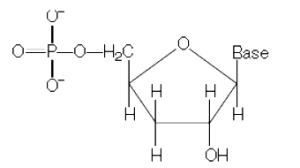
B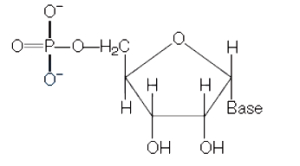
C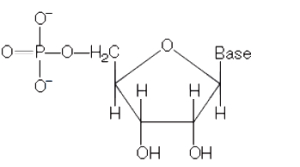
D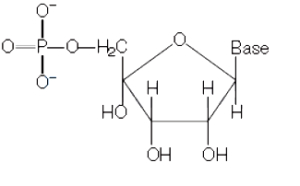
Solution
(C) nucleotide is the basic structural unit of nucleic acids ($DNA$ and $RNA$). It consists of three main components:
$1$. $A$ nitrogenous base (purine or pyrimidine) attached to the $1'$ carbon of the sugar.
$2$. $A$ pentose sugar (ribose in $RNA$ or $2'$-deoxyribose in $DNA$).
$3$. $A$ phosphate group attached to the $5'$ carbon of the sugar.
Looking at the provided structures:
- The structure must show the phosphate group attached to the $5'-CH_2$ group.
- The nitrogenous base must be attached to the $1'$ carbon.
- The $3'$ carbon must have a hydroxyl $(-OH)$ group.
Based on the standard structural representation of a nucleotide,the correct structure is shown in option $(C)$.
$1$. $A$ nitrogenous base (purine or pyrimidine) attached to the $1'$ carbon of the sugar.
$2$. $A$ pentose sugar (ribose in $RNA$ or $2'$-deoxyribose in $DNA$).
$3$. $A$ phosphate group attached to the $5'$ carbon of the sugar.
Looking at the provided structures:
- The structure must show the phosphate group attached to the $5'-CH_2$ group.
- The nitrogenous base must be attached to the $1'$ carbon.
- The $3'$ carbon must have a hydroxyl $(-OH)$ group.
Based on the standard structural representation of a nucleotide,the correct structure is shown in option $(C)$.
0 likesView Solution
78
ChemistryEasyMCQAP EAMCET · 2020
Which among the following acts as a vitamin?
A
Aspartic acid
B
Ascorbic acid
C
Saccharin acid
D
Adipic acid
Solution
(B) Vitamin $C$,also known as ascorbic acid,is a water-soluble vitamin found in various foods and used as a dietary supplement.
It is essential for the synthesis of collagen and acts as an antioxidant.
Hence,the correct option is $(B)$.
It is essential for the synthesis of collagen and acts as an antioxidant.
Hence,the correct option is $(B)$.
0 likesView Solution
79
ChemistryMediumMCQAP EAMCET · 2020
The order of acidic strength of the following acids is:
A
$(iii) > (ii) > (i)$
B
$(ii) > (iii) > (i)$
C
$(iii) > (i) > (ii)$
D
$(ii) > (i) > (iii)$
Solution
(A) The acidic strength depends on the stability of the conjugate base formed after the loss of a proton.
$(i)$ is $4$-ethylcyclohexanecarboxylic acid (aliphatic).
$(ii)$ is $4$-methoxybenzoic acid (aromatic with $+R$ effect of $-OCH_3$ group).
$(iii)$ is $4$-nitrobenzoic acid (aromatic with $-R$ effect of $-NO_2$ group).
$1$. Aromatic carboxylic acids are generally stronger than aliphatic carboxylic acids due to the resonance stabilization of the carboxylate anion by the benzene ring.
$2$. The $-NO_2$ group in $(iii)$ exerts a strong $-R$ (electron-withdrawing) effect,which stabilizes the carboxylate anion and significantly increases acidity.
$3$. The $-OCH_3$ group in $(ii)$ exerts a $+R$ (electron-donating) effect,which destabilizes the carboxylate anion and decreases acidity compared to benzoic acid,but it is still more acidic than the aliphatic acid $(i)$ due to the aromatic ring.
Therefore,the order of acidic strength is $(iii) > (ii) > (i)$.
$(i)$ is $4$-ethylcyclohexanecarboxylic acid (aliphatic).
$(ii)$ is $4$-methoxybenzoic acid (aromatic with $+R$ effect of $-OCH_3$ group).
$(iii)$ is $4$-nitrobenzoic acid (aromatic with $-R$ effect of $-NO_2$ group).
$1$. Aromatic carboxylic acids are generally stronger than aliphatic carboxylic acids due to the resonance stabilization of the carboxylate anion by the benzene ring.
$2$. The $-NO_2$ group in $(iii)$ exerts a strong $-R$ (electron-withdrawing) effect,which stabilizes the carboxylate anion and significantly increases acidity.
$3$. The $-OCH_3$ group in $(ii)$ exerts a $+R$ (electron-donating) effect,which destabilizes the carboxylate anion and decreases acidity compared to benzoic acid,but it is still more acidic than the aliphatic acid $(i)$ due to the aromatic ring.
Therefore,the order of acidic strength is $(iii) > (ii) > (i)$.
0 likesView Solution
80
ChemistryDifficultMCQAP EAMCET · 2020
Compound '$A$' undergoes formation of cyanohydrins,which on hydrolysis gives lactic acid $(CH_3CHOHCOOH)$. Therefore,compound '$A$' is . . . . . .
A
formaldehyde
B
acetaldehyde
C
acetone
D
benzaldehyde
Solution
(B) The reaction proceeds as follows:
$CH_3CHO + HCN \rightarrow CH_3CH(OH)CN$ (Acetaldehyde cyanohydrin)
$CH_3CH(OH)CN + 2H_2O + H^+ \rightarrow CH_3CH(OH)COOH + NH_4^+$
Acetaldehyde on reaction with hydrogen cyanide $(HCN)$ gives a cyanohydrin,which on hydrolysis yields lactic acid $(CH_3CH(OH)COOH)$.
Therefore,compound '$A$' is acetaldehyde. Hence,the correct option is $(B)$.
$CH_3CHO + HCN \rightarrow CH_3CH(OH)CN$ (Acetaldehyde cyanohydrin)
$CH_3CH(OH)CN + 2H_2O + H^+ \rightarrow CH_3CH(OH)COOH + NH_4^+$
Acetaldehyde on reaction with hydrogen cyanide $(HCN)$ gives a cyanohydrin,which on hydrolysis yields lactic acid $(CH_3CH(OH)COOH)$.
Therefore,compound '$A$' is acetaldehyde. Hence,the correct option is $(B)$.
0 likesView Solution
81
ChemistryEasyMCQAP EAMCET · 2020
The main constituent of vinegar is . . . . . .
A
formic acid
B
oxalic acid
C
nitric acid
D
acetic acid
Solution
(D) The main constituent of vinegar is acetic acid $\left( CH_3COOH \right)$.
It contains $5-8 \%$ acetic acid by volume.
Vinegar is mainly used in culinary arts.
It contains $5-8 \%$ acetic acid by volume.
Vinegar is mainly used in culinary arts.
0 likesView Solution
82
ChemistryMediumMCQAP EAMCET · 2020
The $C-Cl$ bond in chlorobenzene in comparison to the $C-Cl$ bond in methyl chloride is:
A
longer and weaker
B
shorter and weaker
C
shorter and stronger
D
longer and stronger
Solution
(C) Due to the $+R$ effect (resonance effect) of the $Cl$ atom with the benzene ring,the $C-Cl$ bond in chlorobenzene acquires partial double bond character.
This partial double bond character makes the $C-Cl$ bond in chlorobenzene shorter and stronger than the $C-Cl$ bond in methyl chloride $(CH_3-Cl)$,which exhibits only a single bond character.
This partial double bond character makes the $C-Cl$ bond in chlorobenzene shorter and stronger than the $C-Cl$ bond in methyl chloride $(CH_3-Cl)$,which exhibits only a single bond character.
0 likesView Solution
83
ChemistryEasyMCQAP EAMCET · 2020
The increasing order of acidic strength among the following compounds is
$I.$ Benzoic acid
$II.$ $4-$nitrobenzoic acid
$III.$ $3, 4-$dinitrobenzoic acid
$IV.$ $4-$methoxybenzoic acid
$I.$ Benzoic acid
$II.$ $4-$nitrobenzoic acid
$III.$ $3, 4-$dinitrobenzoic acid
$IV.$ $4-$methoxybenzoic acid
A
$I < II < III < IV$
B
$I < IV < II < III$
C
$IV < I < II < III$
D
$IV < I < III < II$
Solution
(C) The acidic strength of substituted benzoic acids depends on the electronic effects of the substituents attached to the benzene ring.
$1.$ Electron-donating groups $(EDG)$ like $-OCH_3$ (methoxy group) decrease the acidity by destabilizing the carboxylate anion. Thus,$4-$methoxybenzoic acid $(IV)$ is the weakest acid.
$2.$ Electron-withdrawing groups $(EWG)$ like $-NO_2$ (nitro group) increase the acidity by stabilizing the carboxylate anion through $-I$ and $-M$ effects.
$3.$ Benzoic acid $(I)$ has no substituent. $4-$nitrobenzoic acid $(II)$ has one $-NO_2$ group,and $3, 4-$dinitrobenzoic acid $(III)$ has two $-NO_2$ groups.
$4.$ Since $III$ has two electron-withdrawing groups,it is more acidic than $II$.
Therefore,the increasing order of acidic strength is: $IV < I < II < III$.
$1.$ Electron-donating groups $(EDG)$ like $-OCH_3$ (methoxy group) decrease the acidity by destabilizing the carboxylate anion. Thus,$4-$methoxybenzoic acid $(IV)$ is the weakest acid.
$2.$ Electron-withdrawing groups $(EWG)$ like $-NO_2$ (nitro group) increase the acidity by stabilizing the carboxylate anion through $-I$ and $-M$ effects.
$3.$ Benzoic acid $(I)$ has no substituent. $4-$nitrobenzoic acid $(II)$ has one $-NO_2$ group,and $3, 4-$dinitrobenzoic acid $(III)$ has two $-NO_2$ groups.
$4.$ Since $III$ has two electron-withdrawing groups,it is more acidic than $II$.
Therefore,the increasing order of acidic strength is: $IV < I < II < III$.
0 likesView Solution
84
ChemistryMediumMCQAP EAMCET · 2020
Which of the compounds among $N_2O, NO, N_2O_3, NO_2, N_2O_4, N_2O_5$ are diamagnetic?
A
$NO, NO_2, N_2O_3$
B
$N_2O, N_2O_3, N_2O_4, N_2O_5$
C
$NO, NO_2$
D
$N_2O_4, N_2O_5$
Solution
(B) substance is diamagnetic if all its electrons are paired (i.e.,no unpaired electrons,$n = 0$).
$NO$ has $15$ valence electrons (odd),so it is paramagnetic.
$NO_2$ has $17$ valence electrons (odd),so it is paramagnetic.
$N_2O$ has $16$ valence electrons (even),all paired,so it is diamagnetic.
$N_2O_3$ has $30$ valence electrons (even),all paired,so it is diamagnetic.
$N_2O_4$ has $34$ valence electrons (even),all paired,so it is diamagnetic.
$N_2O_5$ has $40$ valence electrons (even),all paired,so it is diamagnetic.
Therefore,the diamagnetic compounds are $N_2O, N_2O_3, N_2O_4, N_2O_5$.
$NO$ has $15$ valence electrons (odd),so it is paramagnetic.
$NO_2$ has $17$ valence electrons (odd),so it is paramagnetic.
$N_2O$ has $16$ valence electrons (even),all paired,so it is diamagnetic.
$N_2O_3$ has $30$ valence electrons (even),all paired,so it is diamagnetic.
$N_2O_4$ has $34$ valence electrons (even),all paired,so it is diamagnetic.
$N_2O_5$ has $40$ valence electrons (even),all paired,so it is diamagnetic.
Therefore,the diamagnetic compounds are $N_2O, N_2O_3, N_2O_4, N_2O_5$.
0 likesView Solution
85
ChemistryEasyMCQAP EAMCET · 2020
Which among the following is a physical property of molecular solids?
A
Volatile
B
Quite hard
C
Brittle
D
Good conductor of electricity
Solution
(A) Molecular solids are composed of molecules held together by weak van der Waals' forces or hydrogen bonds.
Because of these weak intermolecular forces,molecular solids are generally soft and have low melting points.
Many molecular solids are also volatile in nature.
Therefore,the correct option is $A$.
Because of these weak intermolecular forces,molecular solids are generally soft and have low melting points.
Many molecular solids are also volatile in nature.
Therefore,the correct option is $A$.
0 likesView Solution
86
ChemistryDifficultMCQAP EAMCET · 2020
What sized ring is formed when two carboxylic acids form a dimeric structure through intermolecular hydrogen bonding? (Consider the hydrogen bond as a bond in the ring structure.)
A
$5-$membered
B
$6-$membered
C
$4-$membered
D
$8-$membered
Solution
(D) Carboxylic acids form dimers in the vapor phase or in non-polar solvents due to intermolecular hydrogen bonding.
In this structure,two carboxylic acid molecules are linked by two hydrogen bonds.
Counting the atoms involved in the ring:
$1$. Carbon atom of the first carboxyl group
$2$. Oxygen atom of the first carboxyl group
$3$. Hydrogen atom involved in the first hydrogen bond
$4$. Oxygen atom of the second carboxyl group
$5$. Carbon atom of the second carboxyl group
$6$. Oxygen atom of the second carboxyl group
$7$. Hydrogen atom involved in the second hydrogen bond
$8$. Oxygen atom of the first carboxyl group
Thus,it forms an $8-$membered ring.
In this structure,two carboxylic acid molecules are linked by two hydrogen bonds.
Counting the atoms involved in the ring:
$1$. Carbon atom of the first carboxyl group
$2$. Oxygen atom of the first carboxyl group
$3$. Hydrogen atom involved in the first hydrogen bond
$4$. Oxygen atom of the second carboxyl group
$5$. Carbon atom of the second carboxyl group
$6$. Oxygen atom of the second carboxyl group
$7$. Hydrogen atom involved in the second hydrogen bond
$8$. Oxygen atom of the first carboxyl group
Thus,it forms an $8-$membered ring.
0 likesView Solution
87
ChemistryMediumMCQAP EAMCET · 2020
Which of the following can form intermolecular $H$-bond?
A
Ethyl acetate
B
Methyl formate
C
Acetamide
D
Acetic anhydride
Solution
(C) Intermolecular $H$-bonding occurs in molecules where a hydrogen atom is covalently bonded to a highly electronegative atom $(N, O, F)$ and is attracted to another electronegative atom in a neighboring molecule.
Acetamide $(CH_3CONH_2)$ contains an $N-H$ bond,which allows it to act as a hydrogen bond donor,and a $C=O$ group,which acts as a hydrogen bond acceptor. This enables the formation of intermolecular $H$-bonds between the $N-H$ of one molecule and the $C=O$ of another.
Ethyl acetate,methyl formate,and acetic anhydride lack $N-H$ or $O-H$ bonds,so they cannot form intermolecular $H$-bonds.
Thus,the correct option is $(C)$.
Acetamide $(CH_3CONH_2)$ contains an $N-H$ bond,which allows it to act as a hydrogen bond donor,and a $C=O$ group,which acts as a hydrogen bond acceptor. This enables the formation of intermolecular $H$-bonds between the $N-H$ of one molecule and the $C=O$ of another.
Ethyl acetate,methyl formate,and acetic anhydride lack $N-H$ or $O-H$ bonds,so they cannot form intermolecular $H$-bonds.
Thus,the correct option is $(C)$.
0 likesView Solution
88
ChemistryEasyMCQAP EAMCET · 2020
$A$ reaction,$3 X_{(g)} \rightarrow 2 Y_{(g)} + Z_{(g)}$ takes place in a closed vessel. What is the rate of formation of $Y$ (in $mol \ L^{-1} \ s^{-1}$) if the rate of disappearance of $X$ is $7.2 \times 10^{-3} \ mol \ L^{-1} \ s^{-1}$?
A
$3.6 \times 10^{-3}$
B
$4.8 \times 10^{-3}$
C
$2.4 \times 10^{-3}$
D
$1.2 \times 10^{-3}$
Solution
(B) The rate of reaction is given by the expression: $-\frac{1}{3} \frac{d[X]}{dt} = \frac{1}{2} \frac{d[Y]}{dt} = \frac{d[Z]}{dt}$
Given that the rate of disappearance of $X$ is $-\frac{d[X]}{dt} = 7.2 \times 10^{-3} \ mol \ L^{-1} \ s^{-1}$.
From the rate expression,we have: $\frac{1}{2} \frac{d[Y]}{dt} = -\frac{1}{3} \frac{d[X]}{dt}$
Therefore,the rate of formation of $Y$ is: $\frac{d[Y]}{dt} = \frac{2}{3} \times (-\frac{d[X]}{dt}) = \frac{2}{3} \times 7.2 \times 10^{-3} = 4.8 \times 10^{-3} \ mol \ L^{-1} \ s^{-1}$.
Given that the rate of disappearance of $X$ is $-\frac{d[X]}{dt} = 7.2 \times 10^{-3} \ mol \ L^{-1} \ s^{-1}$.
From the rate expression,we have: $\frac{1}{2} \frac{d[Y]}{dt} = -\frac{1}{3} \frac{d[X]}{dt}$
Therefore,the rate of formation of $Y$ is: $\frac{d[Y]}{dt} = \frac{2}{3} \times (-\frac{d[X]}{dt}) = \frac{2}{3} \times 7.2 \times 10^{-3} = 4.8 \times 10^{-3} \ mol \ L^{-1} \ s^{-1}$.
0 likesView Solution
89
ChemistryMediumMCQAP EAMCET · 2020
For a first order reaction,the concentration of reactant was reduced from $0.03 \ mol \ L^{-1}$ to $0.02 \ mol \ L^{-1}$ in $25 \ min$. What is its rate (in $mol \ L^{-1} \ s^{-1}$)?
A
$6.667 \times 10^{-6}$
B
$4 \times 10^{-4}$
C
$6.667 \times 10^{-4}$
D
$4 \times 10^{-6}$
Solution
(A) Given: $\Delta t = 25 \ min = 25 \times 60 \ s = 1500 \ s$.
Change in concentration $\Delta [R] = [R]_f - [R]_i = 0.02 - 0.03 = -0.01 \ mol \ L^{-1}$.
Rate $= -\frac{\Delta [R]}{\Delta t} = -\frac{-0.01}{1500} \ mol \ L^{-1} \ s^{-1}$.
Rate $= \frac{0.01}{1500} = \frac{1}{150000} = 6.667 \times 10^{-6} \ mol \ L^{-1} \ s^{-1}$.
Change in concentration $\Delta [R] = [R]_f - [R]_i = 0.02 - 0.03 = -0.01 \ mol \ L^{-1}$.
Rate $= -\frac{\Delta [R]}{\Delta t} = -\frac{-0.01}{1500} \ mol \ L^{-1} \ s^{-1}$.
Rate $= \frac{0.01}{1500} = \frac{1}{150000} = 6.667 \times 10^{-6} \ mol \ L^{-1} \ s^{-1}$.
0 likesView Solution
90
ChemistryEasyMCQAP EAMCET · 2020
At $298 \ K$ the value of $-\frac{\Delta[Br^{-}]}{\Delta t}$ for the reaction$5Br^-{_{\text{(aq)}}} + BrO_3^-{_{\text{(aq)}}} + 6H^+{_{\text{(aq)}}} \rightarrow 3Br_{2\text{(aq)}} + 3H_2O_{\text{(l)}}$ is $x \ mol \ L^{-1} \ min^{-1}$. What is the rate (in $mol \ L^{-1} \ min^{-1}$) of this reaction?
A
$\frac{x}{5}$
B
$x$
C
$5x$
D
$-\frac{x}{5}$
Solution
(A) For the given reaction: $5Br^-{_{\text{(aq)}}} + BrO_3^-{_{\text{(aq)}}} + 6H^+{_{\text{(aq)}}} \rightarrow 3Br_{2\text{(aq)}} + 3H_2O_{\text{(l)}}$
The rate of reaction is defined as the rate of disappearance of reactants divided by their stoichiometric coefficients.
Rate $= -\frac{1}{5} \frac{\Delta[Br^{-}]}{\Delta t} = -\frac{\Delta[BrO_3^{-}]}{\Delta t} = -\frac{1}{6} \frac{\Delta[H^{+}]}{\Delta t} = \frac{1}{3} \frac{\Delta[Br_2]}{\Delta t} = \frac{1}{3} \frac{\Delta[H_2O]}{\Delta t}$
Given that $-\frac{\Delta[Br^{-}]}{\Delta t} = x \ mol \ L^{-1} \ min^{-1}$.
Substituting this into the rate expression:
Rate $= \frac{1}{5} \times (-\frac{\Delta[Br^{-}]}{\Delta t}) = \frac{1}{5} \times x = \frac{x}{5} \ mol \ L^{-1} \ min^{-1}$.
The rate of reaction is defined as the rate of disappearance of reactants divided by their stoichiometric coefficients.
Rate $= -\frac{1}{5} \frac{\Delta[Br^{-}]}{\Delta t} = -\frac{\Delta[BrO_3^{-}]}{\Delta t} = -\frac{1}{6} \frac{\Delta[H^{+}]}{\Delta t} = \frac{1}{3} \frac{\Delta[Br_2]}{\Delta t} = \frac{1}{3} \frac{\Delta[H_2O]}{\Delta t}$
Given that $-\frac{\Delta[Br^{-}]}{\Delta t} = x \ mol \ L^{-1} \ min^{-1}$.
Substituting this into the rate expression:
Rate $= \frac{1}{5} \times (-\frac{\Delta[Br^{-}]}{\Delta t}) = \frac{1}{5} \times x = \frac{x}{5} \ mol \ L^{-1} \ min^{-1}$.
0 likesView Solution
91
ChemistryMediumMCQAP EAMCET · 2020
The rate equation for a first-$order$ reaction is given by $R = R_0 e^{-kt}$. $A$ straight line with positive slope is obtained by plotting which of the following? ($R_0 =$ Initial concentration of the reactant,$R =$ concentration of the reactant at time $t$)
A
$\log(R_0/R)$ vs time
B
$R$ vs time
C
$\log R$ vs time
D
$\log(R/R_0)$ vs time
Solution
(A) For a first-$order$ reaction,the rate equation is $R = R_0 e^{-kt}$.
Taking the natural logarithm on both sides: $\ln R = \ln R_0 - kt$.
This can be rearranged as $\ln(R_0/R) = kt$.
Converting to base $10$: $\log(R_0/R) = \frac{kt}{2.303}$.
Comparing this with the equation of a straight line $y = mx + c$,where $y = \log(R_0/R)$ and $x = t$,the slope is $m = \frac{k}{2.303}$,which is positive.
Therefore,plotting $\log(R_0/R)$ vs time gives a straight line with a positive slope.
Taking the natural logarithm on both sides: $\ln R = \ln R_0 - kt$.
This can be rearranged as $\ln(R_0/R) = kt$.
Converting to base $10$: $\log(R_0/R) = \frac{kt}{2.303}$.
Comparing this with the equation of a straight line $y = mx + c$,where $y = \log(R_0/R)$ and $x = t$,the slope is $m = \frac{k}{2.303}$,which is positive.
Therefore,plotting $\log(R_0/R)$ vs time gives a straight line with a positive slope.
0 likesView Solution
92
ChemistryMediumMCQAP EAMCET · 2020
For the reaction,$A \rightarrow$ products,if the graph of $[A]$ vs time gives a straight line,predict the order of the reaction.
A
Pseudo first order
B
First order
C
Second order
D
Zero order
Solution
(D) For a zero-order reaction,the integrated rate law is given by $[A] = -kt + [A]_0$.
This equation is in the form of a linear equation $y = mx + c$,where $y = [A]$,$x = t$,$m = -k$ (slope),and $c = [A]_0$ ($y$-intercept).
Therefore,a plot of $[A]$ versus time $(t)$ results in a straight line for a zero-order reaction.
Hence,the correct option is $(D)$.
This equation is in the form of a linear equation $y = mx + c$,where $y = [A]$,$x = t$,$m = -k$ (slope),and $c = [A]_0$ ($y$-intercept).
Therefore,a plot of $[A]$ versus time $(t)$ results in a straight line for a zero-order reaction.
Hence,the correct option is $(D)$.
0 likesView Solution
93
ChemistryMediumMCQAP EAMCET · 2020
If the half-lives of a first-order reaction at $350 \ K$ and $300 \ K$ are $2 \ s$ and $20 \ s$ respectively,the activation energy of the reaction in $kJ \ mol^{-1}$ is:
A
$40.2$
B
$20.1$
C
$60.3$
D
$30.2$
Solution
(A) For a first-order reaction,$t_{1/2} = \frac{0.693}{k}$,so $k \propto \frac{1}{t_{1/2}}$.
Given: $T_1 = 300 \ K, t_{1/2}(1) = 20 \ s$ and $T_2 = 350 \ K, t_{1/2}(2) = 2 \ s$.
Therefore,$\frac{k_2}{k_1} = \frac{t_{1/2}(1)}{t_{1/2}(2)} = \frac{20}{2} = 10$.
Using the Arrhenius equation: $\log \frac{k_2}{k_1} = \frac{E_a}{2.303 \ R} [\frac{T_2 - T_1}{T_1 T_2}]$.
Substituting the values: $\log(10) = \frac{E_a}{2.303 \times 8.314 \times 10^{-3}} [\frac{350 - 300}{350 \times 300}]$.
$1 = \frac{E_a}{2.303 \times 8.314 \times 10^{-3}} [\frac{50}{105000}]$.
$E_a = \frac{2.303 \times 8.314 \times 10^{-3} \times 105000}{50} \approx 40.2 \ kJ \ mol^{-1}$.
Given: $T_1 = 300 \ K, t_{1/2}(1) = 20 \ s$ and $T_2 = 350 \ K, t_{1/2}(2) = 2 \ s$.
Therefore,$\frac{k_2}{k_1} = \frac{t_{1/2}(1)}{t_{1/2}(2)} = \frac{20}{2} = 10$.
Using the Arrhenius equation: $\log \frac{k_2}{k_1} = \frac{E_a}{2.303 \ R} [\frac{T_2 - T_1}{T_1 T_2}]$.
Substituting the values: $\log(10) = \frac{E_a}{2.303 \times 8.314 \times 10^{-3}} [\frac{350 - 300}{350 \times 300}]$.
$1 = \frac{E_a}{2.303 \times 8.314 \times 10^{-3}} [\frac{50}{105000}]$.
$E_a = \frac{2.303 \times 8.314 \times 10^{-3} \times 105000}{50} \approx 40.2 \ kJ \ mol^{-1}$.
0 likesView Solution
94
ChemistryEasyMCQAP EAMCET · 2020
Examples for bactericidal and bacteriostatic antibiotics,respectively,are
A
penicillin,ofloxacin
B
erythromycin,tetracycline
C
penicillin,chloramphenicol
D
tetracycline,penicillin
Solution
(C) Antibiotics have either a cidal (killing) effect or a static (inhibitory) effect on microbes.
Bactericidal antibiotics include: $Penicillin$,$aminoglycosides$,$ofloxacin$.
Bacteriostatic antibiotics include: $Erythromycin$,$tetracycline$,$chloramphenicol$.
Therefore,the correct pair for bactericidal and bacteriostatic antibiotics is $Penicillin$ and $erythromycin$ (or $tetracycline$).
Looking at the options,option $B$ provides $erythromycin$ and $tetracycline$,which are both bacteriostatic. However,checking the standard classification,$Penicillin$ is bactericidal and $Erythromycin$ is bacteriostatic. Given the options provided,$B$ is the most appropriate choice as it lists two bacteriostatic agents,but the question asks for one of each. Re-evaluating the options,$A$ ($Penicillin$ - bactericidal,$Ofloxacin$ - bactericidal) is incorrect. $C$ ($Penicillin$ - bactericidal,$Chloramphenicol$ - bacteriostatic) is the correct match.
Bactericidal antibiotics include: $Penicillin$,$aminoglycosides$,$ofloxacin$.
Bacteriostatic antibiotics include: $Erythromycin$,$tetracycline$,$chloramphenicol$.
Therefore,the correct pair for bactericidal and bacteriostatic antibiotics is $Penicillin$ and $erythromycin$ (or $tetracycline$).
Looking at the options,option $B$ provides $erythromycin$ and $tetracycline$,which are both bacteriostatic. However,checking the standard classification,$Penicillin$ is bactericidal and $Erythromycin$ is bacteriostatic. Given the options provided,$B$ is the most appropriate choice as it lists two bacteriostatic agents,but the question asks for one of each. Re-evaluating the options,$A$ ($Penicillin$ - bactericidal,$Ofloxacin$ - bactericidal) is incorrect. $C$ ($Penicillin$ - bactericidal,$Chloramphenicol$ - bacteriostatic) is the correct match.
0 likesView Solution
95
ChemistryDifficultMCQAP EAMCET · 2020
Which of the following represents the structure of sulphapyridine?
A
B
C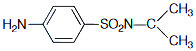
D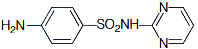
Solution
(B) Sulphapyridine is a well-known sulphonamide antibiotic. Its chemical structure consists of a $p$-aminobenzenesulphonamide group attached to a pyridine ring at the nitrogen atom of the sulphonamide group. The correct structure is represented by option $B$.
0 likesView Solution
96
ChemistryEasyMCQAP EAMCET · 2020
Which of the following is a neurologically active drug?
A
Analgesic
B
Antacid
C
Antibiotic
D
Antihistamine
Solution
(A) Neurologically active drugs are those that affect the message transfer mechanism from nerve to receptor. $Analgesics$ and $Tranquilizers$ are examples of neurologically active drugs. Therefore,$Analgesic$ is the correct answer.
0 likesView Solution
97
ChemistryEasyMCQAP EAMCET · 2020
Tincture of iodine is the common name for
A
iodoform
B
$2-$iodopropane
C
$2-3 \%$ iodine solution in alcohol-water
D
iodobenzene
Solution
(C) Tincture of iodine is a common antiseptic solution.
It typically consists of $2-3 \%$ elemental iodine,along with potassium iodide or sodium iodide,dissolved in a mixture of ethanol and water.
The presence of alcohol is a defining characteristic of tincture solutions.
It typically consists of $2-3 \%$ elemental iodine,along with potassium iodide or sodium iodide,dissolved in a mixture of ethanol and water.
The presence of alcohol is a defining characteristic of tincture solutions.
0 likesView Solution
98
ChemistryMediumMCQAP EAMCET · 2020
Which of the following statements is true?
$(1)$ $200 \ mL$ of $0.2 \ M \ NaOH$ has the same number of moles of solute as $1000 \ mL$ of $1 \ M \ NaOH$.
$(2)$ $200 \ mL$ of $1 \ M \ NaOH$ has the same number of moles as $1000 \ mL$ of $0.2 \ M \ NaOH$.
$(3)$ $100 \ mL$ of $0.2 \ M \ NaOH$ has the same number of moles as $1000 \ mL$ of $1 \ M \ NaOH$.
$(4)$ $2000 \ mL$ of $0.2 \ M \ NaOH$ has the same number of moles as $1000 \ mL$ of $1 \ M \ NaOH$.
$(1)$ $200 \ mL$ of $0.2 \ M \ NaOH$ has the same number of moles of solute as $1000 \ mL$ of $1 \ M \ NaOH$.
$(2)$ $200 \ mL$ of $1 \ M \ NaOH$ has the same number of moles as $1000 \ mL$ of $0.2 \ M \ NaOH$.
$(3)$ $100 \ mL$ of $0.2 \ M \ NaOH$ has the same number of moles as $1000 \ mL$ of $1 \ M \ NaOH$.
$(4)$ $2000 \ mL$ of $0.2 \ M \ NaOH$ has the same number of moles as $1000 \ mL$ of $1 \ M \ NaOH$.
A
$1$
B
$2$
C
$3$
D
$4$
Solution
(B) The number of moles of solute is calculated using the formula: $n = M \times V$ (where $M$ is molarity and $V$ is volume in liters).
For $1000 \ mL$ of $1 \ M \ NaOH$,$n = 1 \ M \times 1 \ L = 1 \ mol$.
Checking the options:
$(1)$ $0.2 \ M \times 0.2 \ L = 0.04 \ mol$.
$(2)$ $1 \ M \times 0.2 \ L = 0.2 \ mol$ and $0.2 \ M \times 1 \ L = 0.2 \ mol$. Since $0.2 = 0.2$,this statement is true.
$(3)$ $0.2 \ M \times 0.1 \ L = 0.02 \ mol$.
$(4)$ $0.2 \ M \times 2 \ L = 0.4 \ mol$.
For $1000 \ mL$ of $1 \ M \ NaOH$,$n = 1 \ M \times 1 \ L = 1 \ mol$.
Checking the options:
$(1)$ $0.2 \ M \times 0.2 \ L = 0.04 \ mol$.
$(2)$ $1 \ M \times 0.2 \ L = 0.2 \ mol$ and $0.2 \ M \times 1 \ L = 0.2 \ mol$. Since $0.2 = 0.2$,this statement is true.
$(3)$ $0.2 \ M \times 0.1 \ L = 0.02 \ mol$.
$(4)$ $0.2 \ M \times 2 \ L = 0.4 \ mol$.
0 likesView Solution
99
ChemistryEasyMCQAP EAMCET · 2020
Which among the following is used in detergents?
A
Sodium acetate
B
Sodium stearate
C
Calcium stearate
D
Sodium lauryl sulphate
Solution
(D) Sodium lauryl sulphate,$CH_3(CH_2)_{10}CH_2-OSO_3^{\ominus}Na^{\oplus}$,is an anionic detergent.
It is the sodium salt of sulphonated lauryl alcohol,$CH_3(CH_2)_{10}CH_2-OH$.
Sodium stearate is a soap,not a detergent.
It is the sodium salt of sulphonated lauryl alcohol,$CH_3(CH_2)_{10}CH_2-OH$.
Sodium stearate is a soap,not a detergent.
0 likesView Solution
100
ChemistryEasyMCQAP EAMCET · 2020
Compound which is added to soap to impart antiseptic properties is ......
A
sodium lauryl sulphate
B
sodium dodecylbenzene sulphonate
C
rosin
D
bithionol
Solution
(D) Bithionol is added to soaps to impart antiseptic properties and to reduce the odour produced by bacterial decomposition of organic matter on skin.
Bithionol is an aromatic compound,which contains sulphur and is used in soaps.
Hence,the correct option is $D$.
Bithionol is an aromatic compound,which contains sulphur and is used in soaps.
Hence,the correct option is $D$.
0 likesView Solution
Vedclass Products
For Students
Vedclass Test Series
Mock tests in real AP EAMCET style covering Chemistry with performance analysis. 5-day free trial.
Start Free TrialFor Teachers
Exam Paper Generator
Generate Set A/B/C/D Chemistry papers from 7.5L+ questions in 2 minutes. 3 chapters free.
Try FreeFor Institutes
Online Exam Module
Run live AP EAMCET mock exams with unlimited students, 360° analytics & white-label branding.
See DemoFrequently Asked Questions
How many Chemistry questions are in AP EAMCET 2020?
There are 492 Chemistry questions from the AP EAMCET 2020 paper on Vedclass, each with a detailed step-by-step solution in English.
Are AP EAMCET 2020 Chemistry solutions available in English?
Yes. All solutions on this page are in English. You can also switch to English or Hindi using the language buttons above the questions.
Can I practice AP EAMCET 2020 Chemistry as a timed test?
Yes. Use the Vedclass Test Series to attempt a full AP EAMCET mock test covering Chemistry with time limits and instant score analysis.
Can teachers create Chemistry papers from AP EAMCET previous year questions?
Yes. The Vedclass Exam Paper Generator lets teachers mix AP EAMCET Chemistry questions and generate Set A/B/C/D papers in minutes.
For Teachers & Institutes
Build a Custom Chemistry Paper
Pick AP EAMCET 2020 Chemistry questions, set difficulty, and generate Set A/B/C/D in 2 minutes.