
MathematicsQ151–250 of 800 questions
Page 4 of 10 · Gujarati
151
MathematicsDifficultMCQAP EAMCET · 2020
$\tan \left(\frac{3 \pi}{16}\right)+\cot \left(\frac{3 \pi}{16}\right)=$
A
$2 \sqrt{2}$
B
$2 \sqrt{2+\sqrt{2}}$
C
$2 \sqrt{2-\sqrt{2}}$
D
$2 \sqrt{2}$
Solution
(C) આપણે જાણીએ છીએ કે $\tan \theta + \cot \theta = \frac{2}{\sin(2 \theta)}$.
અહીં,$\theta = \frac{3 \pi}{16}$,તેથી $2 \theta = \frac{3 \pi}{8}$.
આમ,પદાવલિ $\frac{2}{\sin(3 \pi / 8)}$ બને છે.
$\sin(3 \pi / 8) = \cos(\pi / 8) = \frac{\sqrt{2+\sqrt{2}}}{2}$.
તેથી,$\frac{2}{\sin(3 \pi / 8)} = \frac{4}{\sqrt{2+\sqrt{2}}} = 2 \sqrt{2} \sqrt{2-\sqrt{2}}$.
અહીં,$\theta = \frac{3 \pi}{16}$,તેથી $2 \theta = \frac{3 \pi}{8}$.
આમ,પદાવલિ $\frac{2}{\sin(3 \pi / 8)}$ બને છે.
$\sin(3 \pi / 8) = \cos(\pi / 8) = \frac{\sqrt{2+\sqrt{2}}}{2}$.
તેથી,$\frac{2}{\sin(3 \pi / 8)} = \frac{4}{\sqrt{2+\sqrt{2}}} = 2 \sqrt{2} \sqrt{2-\sqrt{2}}$.
0 likesView Solution
152
MathematicsMediumMCQAP EAMCET · 2020
જો $|\tan \theta|=\tan \theta+\frac{1}{\cos \theta}$ અને $\theta \in[0, 2\pi]-\{\pm \frac{\pi}{2}\}$ હોય,તો $\theta$ ની કિંમત શોધો.
A
$\frac{7\pi}{6}$
B
$\frac{11\pi}{6}$
C
$\frac{5\pi}{6}$
D
$\frac{\pi}{6}$
Solution
(B) આપેલ સમીકરણ: $|\tan \theta| = \tan \theta + \sec \theta$.
કિસ્સો $1$: જો $\tan \theta \ge 0$ હોય,તો $\tan \theta = \tan \theta + \sec \theta$,જેનો અર્થ છે $\sec \theta = 0$. આનો કોઈ ઉકેલ નથી.
કિસ્સો $2$: જો $\tan \theta < 0$ હોય,તો $-\tan \theta = \tan \theta + \sec \theta$,જેનો અર્થ છે $2\tan \theta + \sec \theta = 0$.
$\tan \theta = \frac{\sin \theta}{\cos \theta}$ અને $\sec \theta = \frac{1}{\cos \theta}$ મૂકતા,આપણને $2\sin \theta + 1 = 0$ મળે છે,તેથી $\sin \theta = -\frac{1}{2}$.
$\tan \theta < 0$ હોવાથી,$\theta$ બીજા અથવા ચોથા ચરણમાં હોવો જોઈએ. $\sin \theta = -\frac{1}{2}$ માટે,$\theta = \frac{7\pi}{6}$ અથવા $\theta = \frac{11\pi}{6}$.
$\tan \theta < 0$ ચકાસતા:
$\theta = \frac{7\pi}{6}$ માટે,$\tan \theta = \tan(\frac{7\pi}{6}) = \frac{1}{\sqrt{3}} > 0$ (અસ્વીકાર્ય).
$\theta = \frac{11\pi}{6}$ માટે,$\tan \theta = \tan(\frac{11\pi}{6}) = -\frac{1}{\sqrt{3}} < 0$ (સ્વીકાર્ય).
આમ,ઉકેલ $\theta = \frac{11\pi}{6}$ છે.
કિસ્સો $1$: જો $\tan \theta \ge 0$ હોય,તો $\tan \theta = \tan \theta + \sec \theta$,જેનો અર્થ છે $\sec \theta = 0$. આનો કોઈ ઉકેલ નથી.
કિસ્સો $2$: જો $\tan \theta < 0$ હોય,તો $-\tan \theta = \tan \theta + \sec \theta$,જેનો અર્થ છે $2\tan \theta + \sec \theta = 0$.
$\tan \theta = \frac{\sin \theta}{\cos \theta}$ અને $\sec \theta = \frac{1}{\cos \theta}$ મૂકતા,આપણને $2\sin \theta + 1 = 0$ મળે છે,તેથી $\sin \theta = -\frac{1}{2}$.
$\tan \theta < 0$ હોવાથી,$\theta$ બીજા અથવા ચોથા ચરણમાં હોવો જોઈએ. $\sin \theta = -\frac{1}{2}$ માટે,$\theta = \frac{7\pi}{6}$ અથવા $\theta = \frac{11\pi}{6}$.
$\tan \theta < 0$ ચકાસતા:
$\theta = \frac{7\pi}{6}$ માટે,$\tan \theta = \tan(\frac{7\pi}{6}) = \frac{1}{\sqrt{3}} > 0$ (અસ્વીકાર્ય).
$\theta = \frac{11\pi}{6}$ માટે,$\tan \theta = \tan(\frac{11\pi}{6}) = -\frac{1}{\sqrt{3}} < 0$ (સ્વીકાર્ય).
આમ,ઉકેલ $\theta = \frac{11\pi}{6}$ છે.
0 likesView Solution
153
MathematicsMediumMCQAP EAMCET · 2020
જ્યારે અક્ષોને $\theta$ ખૂણે ફેરવવામાં આવે ત્યારે $x \cos \theta + y \sin \theta = p$ નું રૂપાંતરિત સમીકરણ શોધો.
A
$x = p$
B
$y = p$
C
$x + y = p$
D
$x - y = p$
Solution
(A) આપેલ રેખાનું સમીકરણ $x \cos \theta + y \sin \theta = p$ છે ...$(i)$
જ્યારે અક્ષોને $\theta$ ખૂણે ફેરવવામાં આવે છે,ત્યારે રૂપાંતરણ સમીકરણો નીચે મુજબ છે:
$x = X \cos \theta - Y \sin \theta$
$y = X \sin \theta + Y \cos \theta$
આ કિંમતોને સમીકરણ $(i)$ માં મૂકતા:
$(X \cos \theta - Y \sin \theta) \cos \theta + (X \sin \theta + Y \cos \theta) \sin \theta = p$
$X \cos^2 \theta - Y \sin \theta \cos \theta + X \sin^2 \theta + Y \sin \theta \cos \theta = p$
$X (\cos^2 \theta + \sin^2 \theta) = p$
કારણ કે $\cos^2 \theta + \sin^2 \theta = 1$,તેથી આપણને મળે છે:
$X = p$
જ્યારે અક્ષોને $\theta$ ખૂણે ફેરવવામાં આવે છે,ત્યારે રૂપાંતરણ સમીકરણો નીચે મુજબ છે:
$x = X \cos \theta - Y \sin \theta$
$y = X \sin \theta + Y \cos \theta$
આ કિંમતોને સમીકરણ $(i)$ માં મૂકતા:
$(X \cos \theta - Y \sin \theta) \cos \theta + (X \sin \theta + Y \cos \theta) \sin \theta = p$
$X \cos^2 \theta - Y \sin \theta \cos \theta + X \sin^2 \theta + Y \sin \theta \cos \theta = p$
$X (\cos^2 \theta + \sin^2 \theta) = p$
કારણ કે $\cos^2 \theta + \sin^2 \theta = 1$,તેથી આપણને મળે છે:
$X = p$
0 likesView Solution
154
MathematicsEasyMCQAP EAMCET · 2020
એક ત્રિકોણ જેના શિરોબિંદુઓ $(1, 0)$,$(a \cos t, a \sin t)$ અને $(b \sin t, -b \cos t)$ છે,તેના મધ્યકેન્દ્રનો બિંદુપથ $9x^2 + 9y^2 - 6x = k$ છે. તો $k$ ની કિંમત શોધો.
A
$a^2 + b^2$
B
$a^2 + b^2 - 1$
C
$a^2 + b^2 + 1$
D
$0$
Solution
(B) ત્રિકોણના શિરોબિંદુઓ $(x_1, y_1), (x_2, y_2), (x_3, y_3)$ હોય તો મધ્યકેન્દ્ર $(x, y) = (\frac{x_1 + x_2 + x_3}{3}, \frac{y_1 + y_2 + y_3}{3})$ થાય.
આપેલ શિરોબિંદુઓ $(1, 0)$,$(a \cos t, a \sin t)$ અને $(b \sin t, -b \cos t)$ છે.
તેથી,$x = \frac{1 + a \cos t + b \sin t}{3} \Rightarrow 3x - 1 = a \cos t + b \sin t$ ...$(i)$
અને $y = \frac{0 + a \sin t - b \cos t}{3} \Rightarrow 3y = a \sin t - b \cos t$ ...(ii)
સમીકરણ $(i)$ અને (ii) નો વર્ગ કરીને સરવાળો કરતા:
$(3x - 1)^2 + (3y)^2 = (a \cos t + b \sin t)^2 + (a \sin t - b \cos t)^2$
$9x^2 - 6x + 1 + 9y^2 = a^2 + b^2$
$9x^2 + 9y^2 - 6x = a^2 + b^2 - 1$
આમ,$k = a^2 + b^2 - 1$.
આપેલ શિરોબિંદુઓ $(1, 0)$,$(a \cos t, a \sin t)$ અને $(b \sin t, -b \cos t)$ છે.
તેથી,$x = \frac{1 + a \cos t + b \sin t}{3} \Rightarrow 3x - 1 = a \cos t + b \sin t$ ...$(i)$
અને $y = \frac{0 + a \sin t - b \cos t}{3} \Rightarrow 3y = a \sin t - b \cos t$ ...(ii)
સમીકરણ $(i)$ અને (ii) નો વર્ગ કરીને સરવાળો કરતા:
$(3x - 1)^2 + (3y)^2 = (a \cos t + b \sin t)^2 + (a \sin t - b \cos t)^2$
$9x^2 - 6x + 1 + 9y^2 = a^2 + b^2$
$9x^2 + 9y^2 - 6x = a^2 + b^2 - 1$
આમ,$k = a^2 + b^2 - 1$.
0 likesView Solution
155
MathematicsMediumMCQAP EAMCET · 2020
જો અક્ષોને $45^{\circ}$ ના ખૂણે ફેરવવામાં આવે,તો નવા યામ પદ્ધતિમાં બિંદુ $(4 \sqrt{2}, -6 \sqrt{2})$ ના યામ . . . . . . થશે.
A
$(-10, -2)$
B
$(-2, -10)$
C
$(10, 10)$
D
$(-2, 10)$
Solution
(B) ધારો કે $(x, y)$ એ જૂની અક્ષોના યામ છે અને $(X, Y)$ એ $\theta = 45^{\circ}$ ના ખૂણે ફેરવ્યા પછીની નવી અક્ષોના યામ છે.
રૂપાંતરણ સમીકરણો:
$x = X \cos \theta - Y \sin \theta$
$y = X \sin \theta + Y \cos \theta$
અહીં $x = 4 \sqrt{2}$,$y = -6 \sqrt{2}$,અને $\theta = 45^{\circ}$ છે,તેથી $\cos 45^{\circ} = \sin 45^{\circ} = \frac{1}{\sqrt{2}}$.
કિંમતો મૂકતા:
$4 \sqrt{2} = X \left(\frac{1}{\sqrt{2}}\right) - Y \left(\frac{1}{\sqrt{2}}\right) \Rightarrow X - Y = 8$
$-6 \sqrt{2} = X \left(\frac{1}{\sqrt{2}}\right) + Y \left(\frac{1}{\sqrt{2}}\right) \Rightarrow X + Y = -12$
બંને સમીકરણોનો સરવાળો કરતા: $2X = -4 \Rightarrow X = -2$.
બીજામાંથી પહેલું સમીકરણ બાદ કરતા: $2Y = -20 \Rightarrow Y = -10$.
આમ,નવા યામ $(-2, -10)$ છે.
રૂપાંતરણ સમીકરણો:
$x = X \cos \theta - Y \sin \theta$
$y = X \sin \theta + Y \cos \theta$
અહીં $x = 4 \sqrt{2}$,$y = -6 \sqrt{2}$,અને $\theta = 45^{\circ}$ છે,તેથી $\cos 45^{\circ} = \sin 45^{\circ} = \frac{1}{\sqrt{2}}$.
કિંમતો મૂકતા:
$4 \sqrt{2} = X \left(\frac{1}{\sqrt{2}}\right) - Y \left(\frac{1}{\sqrt{2}}\right) \Rightarrow X - Y = 8$
$-6 \sqrt{2} = X \left(\frac{1}{\sqrt{2}}\right) + Y \left(\frac{1}{\sqrt{2}}\right) \Rightarrow X + Y = -12$
બંને સમીકરણોનો સરવાળો કરતા: $2X = -4 \Rightarrow X = -2$.
બીજામાંથી પહેલું સમીકરણ બાદ કરતા: $2Y = -20 \Rightarrow Y = -10$.
આમ,નવા યામ $(-2, -10)$ છે.
0 likesView Solution
156
MathematicsEasyMCQAP EAMCET · 2020
$4x^2 + 9y^2 - 8x + 36y + 4 = 0$ સમીકરણમાંથી $x$ અને $y$ ના પ્રથમ ઘાતના પદોને દૂર કરવા માટે ઉગમબિંદુને કયા બિંદુ પર ખસેડવું જોઈએ?
A
$(1, 2)$
B
$(-1, 2)$
C
$(1, -2)$
D
$(-1, -2)$
Solution
(C) આપેલ સમીકરણ $4x^2 + 9y^2 - 8x + 36y + 4 = 0$ છે.
$x$ અને $y$ ના પ્રથમ ઘાતના પદોને દૂર કરવા માટે,આપણે પૂર્ણવર્ગની રીતનો ઉપયોગ કરીએ:
$4(x^2 - 2x) + 9(y^2 + 4y) + 4 = 0$
$4(x^2 - 2x + 1 - 1) + 9(y^2 + 4y + 4 - 4) + 4 = 0$
$4(x - 1)^2 - 4 + 9(y + 2)^2 - 36 + 4 = 0$
$4(x - 1)^2 + 9(y + 2)^2 = 36$
ધારો કે નવા યામ $X = x - 1$ અને $Y = y + 2$ છે.
આનો અર્થ એ છે કે $x = X + 1$ અને $y = Y - 2$.
આમ,$x$ અને $y$ ના પદોને દૂર કરવા માટે ઉગમબિંદુને $(1, -2)$ બિંદુ પર ખસેડવું જોઈએ.
$x$ અને $y$ ના પ્રથમ ઘાતના પદોને દૂર કરવા માટે,આપણે પૂર્ણવર્ગની રીતનો ઉપયોગ કરીએ:
$4(x^2 - 2x) + 9(y^2 + 4y) + 4 = 0$
$4(x^2 - 2x + 1 - 1) + 9(y^2 + 4y + 4 - 4) + 4 = 0$
$4(x - 1)^2 - 4 + 9(y + 2)^2 - 36 + 4 = 0$
$4(x - 1)^2 + 9(y + 2)^2 = 36$
ધારો કે નવા યામ $X = x - 1$ અને $Y = y + 2$ છે.
આનો અર્થ એ છે કે $x = X + 1$ અને $y = Y - 2$.
આમ,$x$ અને $y$ ના પદોને દૂર કરવા માટે ઉગમબિંદુને $(1, -2)$ બિંદુ પર ખસેડવું જોઈએ.
0 likesView Solution
157
MathematicsEasyMCQAP EAMCET · 2020
જો $(a, 8)$ એ $(2, 5)$ અને $(4, -1)$ ને જોડતા રેખાખંડ પરનું બિંદુ હોય,તો $a$ ની કિંમત શોધો:
A
$a = \frac{8}{3}$
B
$a = \frac{3}{8}$
C
$a = 1$
D
$a = -1$
Solution
(C) ધારો કે બિંદુઓ $P(a, 8)$,$A(2, 5)$ અને $B(4, -1)$ છે.
બિંદુઓ સમરેખ હોવાથી,રેખાખંડ $PA$ નો ઢાળ અને રેખાખંડ $AB$ નો ઢાળ સમાન થાય.
$PA$ નો ઢાળ $\frac{8 - 5}{a - 2} = \frac{3}{a - 2}$ છે.
$AB$ નો ઢાળ $\frac{-1 - 5}{4 - 2} = \frac{-6}{2} = -3$ છે.
ઢાળને સરખાવતા: $\frac{3}{a - 2} = -3$.
$3 = -3(a - 2) \Rightarrow 3 = -3a + 6$.
$3a = 6 - 3$ $\Rightarrow 3a = 3$ $\Rightarrow a = 1$.
બિંદુઓ સમરેખ હોવાથી,રેખાખંડ $PA$ નો ઢાળ અને રેખાખંડ $AB$ નો ઢાળ સમાન થાય.
$PA$ નો ઢાળ $\frac{8 - 5}{a - 2} = \frac{3}{a - 2}$ છે.
$AB$ નો ઢાળ $\frac{-1 - 5}{4 - 2} = \frac{-6}{2} = -3$ છે.
ઢાળને સરખાવતા: $\frac{3}{a - 2} = -3$.
$3 = -3(a - 2) \Rightarrow 3 = -3a + 6$.
$3a = 6 - 3$ $\Rightarrow 3a = 3$ $\Rightarrow a = 1$.
0 likesView Solution
158
MathematicsEasyMCQAP EAMCET · 2020
બિંદુ $P$,જેનો એબ્સિસા (x-યામ) $3$ છે,તે $A(6, 5)$ અને $B(-1, 4)$ ને જોડતા રેખાખંડનું જે ગુણોત્તરમાં વિભાજન કરે છે તે ......... છે.
A
$3: 4$
B
$4: 3$
C
$3: 2$
D
$2: 3$
Solution
(A) ધારો કે બિંદુ $P$ જેનો $x$-યામ $3$ છે,તે $A(6, 5)$ અને $B(-1, 4)$ ને જોડતા રેખાખંડનું $\lambda: 1$ ગુણોત્તરમાં વિભાજન કરે છે.
વિભાજન સૂત્રનો ઉપયોગ કરતા:
$x = \frac{m_1x_2 + m_2x_1}{m_1 + m_2}$
$3 = \frac{\lambda(-1) + 1(6)}{\lambda + 1}$
$3(\lambda + 1) = -\lambda + 6$
$3\lambda + 3 = -\lambda + 6$
$4\lambda = 3$
$\lambda = \frac{3}{4}$
આમ,ગુણોત્તર $\lambda: 1$ એ $3: 4$ છે.
તેથી,વિકલ્પ $A$ સાચો છે.
વિભાજન સૂત્રનો ઉપયોગ કરતા:
$x = \frac{m_1x_2 + m_2x_1}{m_1 + m_2}$
$3 = \frac{\lambda(-1) + 1(6)}{\lambda + 1}$
$3(\lambda + 1) = -\lambda + 6$
$3\lambda + 3 = -\lambda + 6$
$4\lambda = 3$
$\lambda = \frac{3}{4}$
આમ,ગુણોત્તર $\lambda: 1$ એ $3: 4$ છે.
તેથી,વિકલ્પ $A$ સાચો છે.
0 likesView Solution
159
MathematicsEasyMCQAP EAMCET · 2020
જ્યારે ઉગમબિંદુને $(2, 3)$ પર સ્થાનાંતરિત કરવામાં આવે છે,ત્યારે વક્રનું રૂપાંતરિત સમીકરણ $x^2+3xy-2y^2+17x-7y-11=0$ બને છે. વક્રનું મૂળ સમીકરણ શોધો.
A
$x^2-2y^2-3xy+4x-y+20=0$
B
$x^2-2y^2+3xy+4x-y-20=0$
C
$x^2-2y^2-3xy-4x-y+20=0$
D
$x^2-2y^2-3xy+4x-y-20=0$
Solution
(B) જ્યારે ઉગમબિંદુને $(h, k) = (2, 3)$ પર સ્થાનાંતરિત કરવામાં આવે,ત્યારે જૂના યામ $(X, Y)$ અને નવા યામ $(x, y)$ વચ્ચેનો સંબંધ $X = x + 2$ અને $Y = y + 3$ છે.
મૂળ સમીકરણ મેળવવા માટે,આપેલ રૂપાંતરિત સમીકરણમાં $x$ ની જગ્યાએ $(X-2)$ અને $y$ ની જગ્યાએ $(Y-3)$ મૂકતા:
$(X-2)^2 + 3(X-2)(Y-3) - 2(Y-3)^2 + 17(X-2) - 7(Y-3) - 11 = 0$
પદોનું વિસ્તરણ કરતા:
$(X^2 - 4X + 4) + 3(XY - 3X - 2Y + 6) - 2(Y^2 - 6Y + 9) + 17X - 34 - 7Y + 21 - 11 = 0$
$X^2 + 3XY - 2Y^2 + 4X - Y - 20 = 0$
આમ,મૂળ સમીકરણ $x^2+3xy-2y^2+4x-y-20=0$ છે.
મૂળ સમીકરણ મેળવવા માટે,આપેલ રૂપાંતરિત સમીકરણમાં $x$ ની જગ્યાએ $(X-2)$ અને $y$ ની જગ્યાએ $(Y-3)$ મૂકતા:
$(X-2)^2 + 3(X-2)(Y-3) - 2(Y-3)^2 + 17(X-2) - 7(Y-3) - 11 = 0$
પદોનું વિસ્તરણ કરતા:
$(X^2 - 4X + 4) + 3(XY - 3X - 2Y + 6) - 2(Y^2 - 6Y + 9) + 17X - 34 - 7Y + 21 - 11 = 0$
$X^2 + 3XY - 2Y^2 + 4X - Y - 20 = 0$
આમ,મૂળ સમીકરણ $x^2+3xy-2y^2+4x-y-20=0$ છે.
0 likesView Solution
160
MathematicsDifficultMCQAP EAMCET · 2020
$A(3,1)$ માંથી પસાર થતી એક સીધી રેખા $L_1$ યામ અક્ષોને $P$ અને $Q$ માં એવી રીતે મળે છે કે જેથી ઉગમબિંદુ $O$ થી તેનું અંતર મહત્તમ હોય. તો $\triangle OPQ$ નું ક્ષેત્રફળ (ચોરસ એકમમાં) કેટલું થાય?
A
$\frac{100}{3}$
B
$\frac{25}{3}$
C
$\frac{50}{3}$
D
$\frac{200}{3}$
Solution
(C) $A(3,1)$ માંથી પસાર થતી રેખાનું સમીકરણ $y - 1 = m(x - 3)$ છે,જે $mx - y + (1 - 3m) = 0$ તરીકે લખી શકાય.
ઉગમબિંદુ $O(0,0)$ થી આ રેખાનું અંતર $d = \frac{|1 - 3m|}{\sqrt{m^2 + 1}}$ છે.
અંતર મહત્તમ હોવા માટે,રેખા $OA$ ને લંબ હોવી જોઈએ.
$OA$ નો ઢાળ $\frac{1}{3}$ છે.
તેથી રેખાનો ઢાળ $m = -3$ થશે.
રેખાનું સમીકરણ $3x + y = 10$ મળે છે.
$P$ અને $Q$ ના યામ $(\frac{10}{3}, 0)$ અને $(0, 10)$ છે.
$\triangle OPQ$ નું ક્ષેત્રફળ $= \frac{1}{2} \times \frac{10}{3} \times 10 = \frac{50}{3}$ ચોરસ એકમ.
ઉગમબિંદુ $O(0,0)$ થી આ રેખાનું અંતર $d = \frac{|1 - 3m|}{\sqrt{m^2 + 1}}$ છે.
અંતર મહત્તમ હોવા માટે,રેખા $OA$ ને લંબ હોવી જોઈએ.
$OA$ નો ઢાળ $\frac{1}{3}$ છે.
તેથી રેખાનો ઢાળ $m = -3$ થશે.
રેખાનું સમીકરણ $3x + y = 10$ મળે છે.
$P$ અને $Q$ ના યામ $(\frac{10}{3}, 0)$ અને $(0, 10)$ છે.
$\triangle OPQ$ નું ક્ષેત્રફળ $= \frac{1}{2} \times \frac{10}{3} \times 10 = \frac{50}{3}$ ચોરસ એકમ.
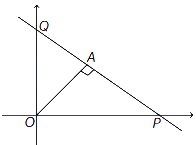
0 likesView Solution
161
MathematicsMediumMCQAP EAMCET · 2020
જે બિંદુ પર ઉગમબિંદુને ખસેડવું જોઈએ જેથી સમીકરણ $y^2-6y-4x+13=0$ એ $y^2+Ax=0$ સ્વરૂપમાં રૂપાંતરિત થાય તે બિંદુ કયું છે?
A
$(3,1)$
B
$(-1,-1)$
C
$(1,3)$
D
$(-1,3)$
Solution
(C) આપેલ સમીકરણ $y^2-6y-4x+13=0$ છે.
$y$ પદો માટે પૂર્ણવર્ગ બનાવતા:
$(y^2-6y+9)-9-4x+13=0$
$(y-3)^2-4x+4=0$
$(y-3)^2-4(x-1)=0$.
ધારો કે નવું ઉગમબિંદુ $(h,k)$ છે. આપણે $y = Y+k$ અને $x = X+h$ મૂકીએ છીએ.
સમીકરણને $Y^2+AX=0$ સ્વરૂપમાં રૂપાંતરિત કરવા માટે,આપણે $k=3$ અને $h=1$ લઈએ છીએ.
આમ,ઉગમબિંદુને $(1,3)$ પર ખસેડવું જોઈએ.
તેથી,વિકલ્પ $C$ સાચો છે.
$y$ પદો માટે પૂર્ણવર્ગ બનાવતા:
$(y^2-6y+9)-9-4x+13=0$
$(y-3)^2-4x+4=0$
$(y-3)^2-4(x-1)=0$.
ધારો કે નવું ઉગમબિંદુ $(h,k)$ છે. આપણે $y = Y+k$ અને $x = X+h$ મૂકીએ છીએ.
સમીકરણને $Y^2+AX=0$ સ્વરૂપમાં રૂપાંતરિત કરવા માટે,આપણે $k=3$ અને $h=1$ લઈએ છીએ.
આમ,ઉગમબિંદુને $(1,3)$ પર ખસેડવું જોઈએ.
તેથી,વિકલ્પ $C$ સાચો છે.
0 likesView Solution
162
MathematicsMediumMCQAP EAMCET · 2020
જો $r$ એ અંતઃત્રિજ્યા (inradius) હોય,$\Delta$ એ $\triangle ABC$ નું ક્ષેત્રફળ હોય,અને $s$ એ અર્ધ-પરિમિતિ (semi-perimeter) હોય,તો નીચેનામાંથી કયું સાચું છે?
A
$\Delta = r + s$
B
$\Delta = \frac{r}{s}$
C
$\Delta = (rs)^2$
D
$\Delta = rs$
Solution
(D) ધારો કે $\triangle ABC$ ની બાજુઓની લંબાઈ $a, b,$ અને $c$ છે. અર્ધ-પરિમિતિ $s$ એ $s = \frac{a+b+c}{2}$ દ્વારા આપવામાં આવે છે.
આકૃતિ પરથી,$\triangle ABC$ નું ક્ષેત્રફળ એ $\triangle IBC, \triangle ICA,$ અને $\triangle IAB$ ના ક્ષેત્રફળોના સરવાળા તરીકે દર્શાવી શકાય છે,જ્યાં $I$ એ અંતઃકેન્દ્ર છે:
$\Delta = \text{Area}(\triangle IBC) + \text{Area}(\triangle ICA) + \text{Area}(\triangle IAB)$
$\Delta = \frac{1}{2}ar + \frac{1}{2}br + \frac{1}{2}cr$
$\Delta = r \left( \frac{a+b+c}{2} \right)$
કારણ કે $s = \frac{a+b+c}{2}$,તેથી $\Delta = rs$.
આમ,વિકલ્પ $(d)$ સાચો છે.
આકૃતિ પરથી,$\triangle ABC$ નું ક્ષેત્રફળ એ $\triangle IBC, \triangle ICA,$ અને $\triangle IAB$ ના ક્ષેત્રફળોના સરવાળા તરીકે દર્શાવી શકાય છે,જ્યાં $I$ એ અંતઃકેન્દ્ર છે:
$\Delta = \text{Area}(\triangle IBC) + \text{Area}(\triangle ICA) + \text{Area}(\triangle IAB)$
$\Delta = \frac{1}{2}ar + \frac{1}{2}br + \frac{1}{2}cr$
$\Delta = r \left( \frac{a+b+c}{2} \right)$
કારણ કે $s = \frac{a+b+c}{2}$,તેથી $\Delta = rs$.
આમ,વિકલ્પ $(d)$ સાચો છે.
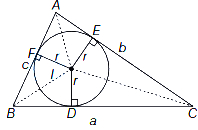
0 likesView Solution
163
MathematicsMediumMCQAP EAMCET · 2020
$x+y=6$,$2x+y=4$ અને $x+2y=5$ રેખાઓ દ્વારા બનતા ત્રિકોણના પરિવૃતનું સમીકરણ શું છે?
A
$x^2+y^2+17x+19y+50=0$
B
$x^2+y^2-17x-19y+50=0$
C
$x^2+y^2+17x-19y-50=0$
D
$x^2+y^2-17x+19y-50=0$
Solution
(B) ત્રણ રેખાઓ $L_1=0, L_2=0, L_3=0$ માંથી પસાર થતા વર્તુળનું સમીકરણ $L_1 L_2 + \lambda L_2 L_3 + \mu L_3 L_1 = 0$ દ્વારા આપવામાં આવે છે.
અહીં $L_1: x+y-6=0$,$L_2: 2x+y-4=0$,$L_3: x+2y-5=0$ છે.
વર્તુળ માટે $x^2$ અને $y^2$ ના સહગુણકો સમાન હોવા જોઈએ અને $xy$ નો સહગુણક શૂન્ય હોવો જોઈએ.
આ શરતો લાગુ પાડતા,આપણને $\mu = 1$ અને $\lambda = -6/5$ મળે છે.
સમીકરણમાં કિંમતો મૂકતા અને સાદું રૂપ આપતા,આપણને $x^2+y^2-17x-19y+50=0$ મળે છે.
અહીં $L_1: x+y-6=0$,$L_2: 2x+y-4=0$,$L_3: x+2y-5=0$ છે.
વર્તુળ માટે $x^2$ અને $y^2$ ના સહગુણકો સમાન હોવા જોઈએ અને $xy$ નો સહગુણક શૂન્ય હોવો જોઈએ.
આ શરતો લાગુ પાડતા,આપણને $\mu = 1$ અને $\lambda = -6/5$ મળે છે.
સમીકરણમાં કિંમતો મૂકતા અને સાદું રૂપ આપતા,આપણને $x^2+y^2-17x-19y+50=0$ મળે છે.
0 likesView Solution
164
MathematicsEasyMCQAP EAMCET · 2020
રેખાઓ $3x + 4y = 9$ અને $6x + 8y = 15$ વચ્ચેનું અંતર કેટલા એકમ છે?
A
$\frac{1}{10}$
B
$\frac{3}{10}$
C
$\frac{5}{10}$
D
$\frac{7}{10}$
Solution
(B) આપેલ રેખાઓ $3x + 4y = 9$ અને $6x + 8y = 15$ છે.
$x$ અને $y$ ના સહગુણકો સમાન કરવા માટે,પ્રથમ સમીકરણને $2$ વડે ગુણતા:
$6x + 8y = 18$.
હવે,સમીકરણો $6x + 8y - 18 = 0$ અને $6x + 8y - 15 = 0$ છે.
બે સમાંતર રેખાઓ $Ax + By + C_1 = 0$ અને $Ax + By + C_2 = 0$ વચ્ચેનું અંતર $d = \frac{|C_1 - C_2|}{\sqrt{A^2 + B^2}}$ સૂત્ર દ્વારા મળે છે.
અહીં,$A = 6, B = 8, C_1 = -18, C_2 = -15$.
$d = \frac{|-18 - (-15)|}{\sqrt{6^2 + 8^2}} = \frac{|-3|}{\sqrt{36 + 64}} = \frac{3}{\sqrt{100}} = \frac{3}{10} \text{ એકમ}$.
તેથી,વિકલ્પ $B$ સાચો છે.
$x$ અને $y$ ના સહગુણકો સમાન કરવા માટે,પ્રથમ સમીકરણને $2$ વડે ગુણતા:
$6x + 8y = 18$.
હવે,સમીકરણો $6x + 8y - 18 = 0$ અને $6x + 8y - 15 = 0$ છે.
બે સમાંતર રેખાઓ $Ax + By + C_1 = 0$ અને $Ax + By + C_2 = 0$ વચ્ચેનું અંતર $d = \frac{|C_1 - C_2|}{\sqrt{A^2 + B^2}}$ સૂત્ર દ્વારા મળે છે.
અહીં,$A = 6, B = 8, C_1 = -18, C_2 = -15$.
$d = \frac{|-18 - (-15)|}{\sqrt{6^2 + 8^2}} = \frac{|-3|}{\sqrt{36 + 64}} = \frac{3}{\sqrt{100}} = \frac{3}{10} \text{ એકમ}$.
તેથી,વિકલ્પ $B$ સાચો છે.
0 likesView Solution
165
MathematicsDifficultMCQAP EAMCET · 2020
$\triangle ABC$ માં,જે વર્તુળ બાજુ $BC$ ને અંદરની તરફ અને બાકીની બે બાજુઓ $AB$ અને $AC$ ને બહારની તરફ સ્પર્શે છે,તેને શું કહેવાય છે?
A
ખૂણા $A$ ની સામેનું બહિરવૃત (Ex-circle)
B
ખૂણા $A$ ની સામેનું અંતઃવૃત
C
ત્રિકોણનું પરિવૃત
D
આવું કોઈ વર્તુળ અસ્તિત્વમાં નથી
Solution
(A) $\triangle ABC$ માં,જે વર્તુળ બાજુ $BC$ ને અંદરની તરફ અને બાકીની બે બાજુઓ $AB$ અને $AC$ ને બહારની તરફ સ્પર્શે છે તેને ખૂણા $A$ ની સામેનું બહિરવૃત (Ex-circle) કહેવામાં આવે છે. આ વર્તુળનું કેન્દ્ર બહિરકેન્દ્ર $E_A$ છે. તેથી,વિકલ્પ $(A)$ સાચો છે.
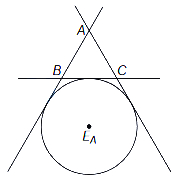
0 likesView Solution
166
MathematicsMediumMCQAP EAMCET · 2020
જો બિંદુ $M$ ના યામ અક્ષોને $135^{\circ}$ ના ખૂણે ફેરવતા $(4, -3)$ માં બદલાતા હોય,તો મૂળ પ્રણાલીમાં $M$ ના યામ શોધો.
A
$\left(\frac{-1}{\sqrt{2}}, \frac{1}{\sqrt{2}}\right)$
B
$\left(\frac{1}{\sqrt{2}}, \frac{7}{\sqrt{2}}\right)$
C
$\left(\frac{-1}{2}, \frac{7}{2}\right)$
D
$\left(\frac{1}{2}, \frac{7}{2}\right)$
Solution
(B) ધારો કે મૂળ યામ $(x, y)$ છે અને નવા યામ $(x', y') = (4, -3)$ છે. પરિભ્રમણ કોણ $\theta = 135^{\circ}$ છે.
અક્ષોના પરિભ્રમણ માટેના રૂપાંતરણ સૂત્રો:
$x = x' \cos \theta - y' \sin \theta$
$y = x' \sin \theta + y' \cos \theta$
$\cos 135^{\circ} = -\frac{1}{\sqrt{2}}$ અને $\sin 135^{\circ} = \frac{1}{\sqrt{2}}$ કિંમતો મૂકતા:
$x = 4 \left(-\frac{1}{\sqrt{2}}\right) - (-3) \left(\frac{1}{\sqrt{2}}\right) = -\frac{1}{\sqrt{2}}$
$y = 4 \left(\frac{1}{\sqrt{2}}\right) + (-3) \left(-\frac{1}{\sqrt{2}}\right) = \frac{7}{\sqrt{2}}$
આમ,મૂળ યામ $\left(-\frac{1}{\sqrt{2}}, \frac{7}{\sqrt{2}}\right)$ છે.
અક્ષોના પરિભ્રમણ માટેના રૂપાંતરણ સૂત્રો:
$x = x' \cos \theta - y' \sin \theta$
$y = x' \sin \theta + y' \cos \theta$
$\cos 135^{\circ} = -\frac{1}{\sqrt{2}}$ અને $\sin 135^{\circ} = \frac{1}{\sqrt{2}}$ કિંમતો મૂકતા:
$x = 4 \left(-\frac{1}{\sqrt{2}}\right) - (-3) \left(\frac{1}{\sqrt{2}}\right) = -\frac{1}{\sqrt{2}}$
$y = 4 \left(\frac{1}{\sqrt{2}}\right) + (-3) \left(-\frac{1}{\sqrt{2}}\right) = \frac{7}{\sqrt{2}}$
આમ,મૂળ યામ $\left(-\frac{1}{\sqrt{2}}, \frac{7}{\sqrt{2}}\right)$ છે.
0 likesView Solution
167
MathematicsDifficultMCQAP EAMCET · 2020
$x+y=1$,$x=1$,અને $y=1$ રેખાઓ દ્વારા બનતા ત્રિકોણનું અંતઃકેન્દ્ર શોધો.
A
$\left(1-\frac{1}{\sqrt{2}}, 1-\frac{1}{\sqrt{2}}\right)$
B
$\left(1-\frac{1}{\sqrt{2}}, \frac{1}{\sqrt{2}}\right)$
C
$\left(\frac{1}{\sqrt{2}}, \frac{1}{\sqrt{2}}\right)$
D
$\left(\frac{1}{\sqrt{2}}+1, \frac{1}{\sqrt{2}}+1\right)$
Solution
(A) આપેલ રેખાઓ $x+y=1$,$x=1$,અને $y=1$ છે.
ત્રિકોણના શિરોબિંદુઓ:
$P(1, 1)$,$A(1, 0)$,અને $B(0, 1)$.
બાજુઓની લંબાઈ:
$a = 1$,$b = 1$,$c = \sqrt{2}$.
અંતઃકેન્દ્રનું સૂત્ર વાપરતા,જવાબ $\left(1-\frac{1}{\sqrt{2}}, 1-\frac{1}{\sqrt{2}}\right)$ મળે છે.
ત્રિકોણના શિરોબિંદુઓ:
$P(1, 1)$,$A(1, 0)$,અને $B(0, 1)$.
બાજુઓની લંબાઈ:
$a = 1$,$b = 1$,$c = \sqrt{2}$.
અંતઃકેન્દ્રનું સૂત્ર વાપરતા,જવાબ $\left(1-\frac{1}{\sqrt{2}}, 1-\frac{1}{\sqrt{2}}\right)$ મળે છે.
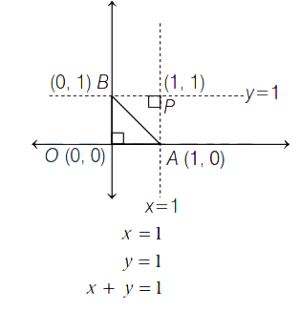
0 likesView Solution
168
MathematicsDifficultMCQAP EAMCET · 2020
જે બિંદુ પર ઉગમબિંદુને સ્થળાંતરિત કરવું જોઈએ જેથી સમીકરણ $y^2-6y-4x+13=0$ માં $y$ વાળું પદ અને અચળ પદ ન રહે,તે બિંદુ છે
A
$1, 1$
B
$1, 2$
C
$2, 1$
D
$1, 3$
Solution
(D) આપેલ સમીકરણ $y^2-6y-4x+13=0$ છે.
ધારો કે ઉગમબિંદુ $(h, k)$ પર સ્થળાંતરિત થાય છે.
તેથી $y$ એ $y+k$ બને છે અને $x$ એ $x+h$ બને છે.
સમીકરણમાં આ કિંમતો મૂકતા: $(y+k)^2 - 6(y+k) - 4(x+h) + 13 = 0$.
વિસ્તરણ કરતા: $y^2 + 2ky + k^2 - 6y - 6k - 4x - 4h + 13 = 0$.
પદોને ગોઠવતા: $y^2 + (2k-6)y - 4x + (k^2 - 6k - 4h + 13) = 0$.
સમીકરણમાં $y$ વાળું પદ ન હોય તે માટે,$y$ નો સહગુણક શૂન્ય હોવો જોઈએ: $2k - 6 = 0 \implies k = 3$.
અચળ પદ ન હોય તે માટે,અચળ ભાગ શૂન્ય હોવો જોઈએ: $k^2 - 6k - 4h + 13 = 0$.
$k = 3$ મૂકતા: $(3)^2 - 6(3) - 4h + 13 = 0$.
$9 - 18 - 4h + 13 = 0$.
$-9 - 4h + 13 = 0$.
$4 - 4h = 0 \implies h = 1$.
આમ,ઉગમબિંદુને $(1, 3)$ પર સ્થળાંતરિત કરવું જોઈએ.
ધારો કે ઉગમબિંદુ $(h, k)$ પર સ્થળાંતરિત થાય છે.
તેથી $y$ એ $y+k$ બને છે અને $x$ એ $x+h$ બને છે.
સમીકરણમાં આ કિંમતો મૂકતા: $(y+k)^2 - 6(y+k) - 4(x+h) + 13 = 0$.
વિસ્તરણ કરતા: $y^2 + 2ky + k^2 - 6y - 6k - 4x - 4h + 13 = 0$.
પદોને ગોઠવતા: $y^2 + (2k-6)y - 4x + (k^2 - 6k - 4h + 13) = 0$.
સમીકરણમાં $y$ વાળું પદ ન હોય તે માટે,$y$ નો સહગુણક શૂન્ય હોવો જોઈએ: $2k - 6 = 0 \implies k = 3$.
અચળ પદ ન હોય તે માટે,અચળ ભાગ શૂન્ય હોવો જોઈએ: $k^2 - 6k - 4h + 13 = 0$.
$k = 3$ મૂકતા: $(3)^2 - 6(3) - 4h + 13 = 0$.
$9 - 18 - 4h + 13 = 0$.
$-9 - 4h + 13 = 0$.
$4 - 4h = 0 \implies h = 1$.
આમ,ઉગમબિંદુને $(1, 3)$ પર સ્થળાંતરિત કરવું જોઈએ.
0 likesView Solution
169
MathematicsMediumMCQAP EAMCET · 2020
નીચેનામાંથી કયું વિધાન ખોટું છે?
A
$1)$ ત્રિકોણનું ક્ષેત્રફળ અક્ષોના સ્થાનાંતર હેઠળ અપરિવર્તિત રહે છે.
B
$2)$ સીધી રેખાનો ઢાળ અક્ષોના સ્થાનાંતર હેઠળ અપરિવર્તિત રહે છે.
C
$3)$ અક્ષોની દિશા બદલ્યા વિના ઉગમબિંદુને બીજા બિંદુ પર ખસેડવાની પ્રક્રિયાને અક્ષોનું સ્થાનાંતર કહેવામાં આવે છે.
D
$4)$ જો $f(x, y) = 0$ એ વક્રનું રૂપાંતરિત સમીકરણ હોય જ્યારે અક્ષોને $(h, k)$ બિંદુ પર સ્થાનાંતરિત કરવામાં આવે,તો વક્રનું મૂળ સમીકરણ $f(x-h, y-k) = 0$ છે.
Solution
(C) $1$) ત્રિકોણનું ક્ષેત્રફળ તેના શિરોબિંદુઓના યામ પર આધાર રાખે છે. અક્ષોના સ્થાનાંતર દરમિયાન ઉગમબિંદુ બદલાય છે પરંતુ અક્ષો સમાંતર રહે છે,તેથી ક્ષેત્રફળ અપરિવર્તિત રહે છે. આ વિધાન સાચું છે.
$2$) રેખાનો ઢાળ $y$ માં થતા ફેરફાર અને $x$ માં થતા ફેરફારના ગુણોત્તર તરીકે વ્યાખ્યાયિત થાય છે. સ્થાનાંતર હેઠળ,$x = X + h$ અને $y = Y + k$ હોવાથી,$dx = dX$ અને $dy = dY$ થાય છે. તેથી ઢાળ $m = \frac{dy}{dx} = \frac{dY}{dX}$ અપરિવર્તિત રહે છે. આ વિધાન સાચું છે.
$3$) વ્યાખ્યા મુજબ,અક્ષોનું સ્થાનાંતર એટલે અક્ષોની દિશા બદલ્યા વિના ઉગમબિંદુને નવા બિંદુ $(h, k)$ પર ખસેડવું. જો અક્ષોની દિશા બદલાય,તો તેને અક્ષોનું પરિભ્રમણ કહેવાય છે. તેથી,આ વિધાન ખોટું છે.
$4$) જો ઉગમબિંદુ $(h, k)$ પર ખસેડવામાં આવે,તો નવા યામ $(X, Y)$ અને જૂના યામ $(x, y)$ વચ્ચેનો સંબંધ $x = X + h$ અને $y = Y + k$ છે. આ વિધાનમાં આપેલ તર્ક ઉલટો છે. આ વિધાન ખોટું છે.
$2$) રેખાનો ઢાળ $y$ માં થતા ફેરફાર અને $x$ માં થતા ફેરફારના ગુણોત્તર તરીકે વ્યાખ્યાયિત થાય છે. સ્થાનાંતર હેઠળ,$x = X + h$ અને $y = Y + k$ હોવાથી,$dx = dX$ અને $dy = dY$ થાય છે. તેથી ઢાળ $m = \frac{dy}{dx} = \frac{dY}{dX}$ અપરિવર્તિત રહે છે. આ વિધાન સાચું છે.
$3$) વ્યાખ્યા મુજબ,અક્ષોનું સ્થાનાંતર એટલે અક્ષોની દિશા બદલ્યા વિના ઉગમબિંદુને નવા બિંદુ $(h, k)$ પર ખસેડવું. જો અક્ષોની દિશા બદલાય,તો તેને અક્ષોનું પરિભ્રમણ કહેવાય છે. તેથી,આ વિધાન ખોટું છે.
$4$) જો ઉગમબિંદુ $(h, k)$ પર ખસેડવામાં આવે,તો નવા યામ $(X, Y)$ અને જૂના યામ $(x, y)$ વચ્ચેનો સંબંધ $x = X + h$ અને $y = Y + k$ છે. આ વિધાનમાં આપેલ તર્ક ઉલટો છે. આ વિધાન ખોટું છે.
0 likesView Solution
170
MathematicsEasyMCQAP EAMCET · 2020
જો સમબાજુ ત્રિકોણના પાયાનું સમીકરણ $x+y=6$ હોય અને સામેનું શિરોબિંદુ $(-1, -1)$ હોય,તો ત્રિકોણનું ક્ષેત્રફળ $k$ ચોરસ એકમ છે. $k$ ની કિંમત શોધો.
A
$\frac{8}{\sqrt{3}}$
B
$32\sqrt{3}$
C
$\frac{32}{\sqrt{3}}$
D
$16\sqrt{3}$
Solution
(C) શિરોબિંદુ $(-1, -1)$ થી રેખા $x+y-6=0$ પરના વેધની લંબાઈ $h = \frac{|(-1) + (-1) - 6|}{\sqrt{1^2 + 1^2}} = \frac{|-8|}{\sqrt{2}} = 4\sqrt{2}$ છે.
સમબાજુ ત્રિકોણમાં વેધ $h = \frac{\sqrt{3}}{2}a$ હોવાથી,બાજુ $a = \frac{2h}{\sqrt{3}} = \frac{8\sqrt{2}}{\sqrt{3}}$ મળે.
ત્રિકોણનું ક્ષેત્રફળ $A = \frac{\sqrt{3}}{4}a^2 = \frac{\sqrt{3}}{4} \left(\frac{8\sqrt{2}}{\sqrt{3}}\right)^2 = \frac{32}{\sqrt{3}}$ ચોરસ એકમ થાય.
સમબાજુ ત્રિકોણમાં વેધ $h = \frac{\sqrt{3}}{2}a$ હોવાથી,બાજુ $a = \frac{2h}{\sqrt{3}} = \frac{8\sqrt{2}}{\sqrt{3}}$ મળે.
ત્રિકોણનું ક્ષેત્રફળ $A = \frac{\sqrt{3}}{4}a^2 = \frac{\sqrt{3}}{4} \left(\frac{8\sqrt{2}}{\sqrt{3}}\right)^2 = \frac{32}{\sqrt{3}}$ ચોરસ એકમ થાય.
0 likesView Solution
171
MathematicsEasyMCQAP EAMCET · 2020
$x=0, y=0, x=1, y=1$ રેખાઓ દ્વારા એક ચોરસ બને છે. તો,તેના વિકર્ણોના સમીકરણો શું હશે?
A
$y=x, x+y=2$
B
$2y=x, x+y=\frac{1}{2}$
C
$y=x, x+y=1$
D
$y=2x, x+y=\frac{1}{4}$
Solution
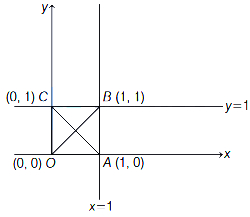
(C) ચોરસના શિરોબિંદુઓ $O(0,0), A(1,0), B(1,1)$ અને $C(0,1)$ છે.
વિકર્ણો એ સામસામેના શિરોબિંદુઓને જોડતા રેખાખંડો છે,જે $OB$ અને $AC$ છે.
$1$. $(0,0)$ અને $(1,1)$ માંથી પસાર થતા વિકર્ણ $OB$ નું સમીકરણ:
ઢાળ $m = \frac{1-0}{1-0} = 1$.
બિંદુ-ઢાળ સ્વરૂપ $y - y_1 = m(x - x_1)$ નો ઉપયોગ કરતા:
$y - 0 = 1(x - 0) \Rightarrow y = x$.
$2$. $(1,0)$ અને $(0,1)$ માંથી પસાર થતા વિકર્ણ $AC$ નું સમીકરણ:
ઢાળ $m = \frac{1-0}{0-1} = -1$.
બિંદુ-ઢાળ સ્વરૂપ $y - 0 = -1(x - 1)$ નો ઉપયોગ કરતા:
$y = -x + 1 \Rightarrow x + y = 1$.
આમ,વિકર્ણોના સમીકરણો $y = x$ અને $x + y = 1$ છે.
વિકર્ણો એ સામસામેના શિરોબિંદુઓને જોડતા રેખાખંડો છે,જે $OB$ અને $AC$ છે.
$1$. $(0,0)$ અને $(1,1)$ માંથી પસાર થતા વિકર્ણ $OB$ નું સમીકરણ:
ઢાળ $m = \frac{1-0}{1-0} = 1$.
બિંદુ-ઢાળ સ્વરૂપ $y - y_1 = m(x - x_1)$ નો ઉપયોગ કરતા:
$y - 0 = 1(x - 0) \Rightarrow y = x$.
$2$. $(1,0)$ અને $(0,1)$ માંથી પસાર થતા વિકર્ણ $AC$ નું સમીકરણ:
ઢાળ $m = \frac{1-0}{0-1} = -1$.
બિંદુ-ઢાળ સ્વરૂપ $y - 0 = -1(x - 1)$ નો ઉપયોગ કરતા:
$y = -x + 1 \Rightarrow x + y = 1$.
આમ,વિકર્ણોના સમીકરણો $y = x$ અને $x + y = 1$ છે.
0 likesView Solution
172
MathematicsEasyMCQAP EAMCET · 2020
જો ચોરસનો એક વિકર્ણ $8x - 15y = 0$ રેખા પર હોય અને તેનો એક શિરોબિંદુ $(1, 2)$ હોય,તો આ શિરોબિંદુમાંથી પસાર થતી ચોરસની બાજુઓના સમીકરણો શોધો.
A
$23x - 7y + 9 = 0, 7x + 23y + 53 = 0$
B
$23x - 7y - 9 = 0, 7x + 23y - 53 = 0$
C
$23x + 7y - 9 = 0, 7x + 23y - 53 = 0$
D
$23x + 7y - 9 = 0, 7x + 23y + 53 = 0$
Solution
(B) ચોરસની બાજુઓ વિકર્ણ સાથે $45^{\circ}$ નો ખૂણો બનાવે છે. આપેલ વિકર્ણ $8x - 15y = 0$ નો ઢાળ $m_1 = \frac{8}{15}$ છે.
ધારો કે $(1, 2)$ માંથી પસાર થતી બાજુઓનો ઢાળ $m$ છે. સૂત્ર $\tan(45^{\circ}) = |\frac{m - m_1}{1 + m \cdot m_1}|$ નો ઉપયોગ કરતા:
$1 = |\frac{m - 8/15}{1 + 8m/15}|$
$1 = |\frac{15m - 8}{15 + 8m}|$
આનાથી બે કિસ્સા મળે છે:
કિસ્સો $1$: $15m - 8 = 15 + 8m$ $\Rightarrow 7m = 23$ $\Rightarrow m = \frac{23}{7}$.
બાજુનું સમીકરણ $y - 2 = \frac{23}{7}(x - 1) \Rightarrow 23x - 7y - 9 = 0$ છે.
કિસ્સો $2$: $15m - 8 = -(15 + 8m)$ $\Rightarrow 23m = -7$ $\Rightarrow m = -\frac{7}{23}$.
બાજુનું સમીકરણ $y - 2 = -\frac{7}{23}(x - 1) \Rightarrow 7x + 23y - 53 = 0$ છે.
ધારો કે $(1, 2)$ માંથી પસાર થતી બાજુઓનો ઢાળ $m$ છે. સૂત્ર $\tan(45^{\circ}) = |\frac{m - m_1}{1 + m \cdot m_1}|$ નો ઉપયોગ કરતા:
$1 = |\frac{m - 8/15}{1 + 8m/15}|$
$1 = |\frac{15m - 8}{15 + 8m}|$
આનાથી બે કિસ્સા મળે છે:
કિસ્સો $1$: $15m - 8 = 15 + 8m$ $\Rightarrow 7m = 23$ $\Rightarrow m = \frac{23}{7}$.
બાજુનું સમીકરણ $y - 2 = \frac{23}{7}(x - 1) \Rightarrow 23x - 7y - 9 = 0$ છે.
કિસ્સો $2$: $15m - 8 = -(15 + 8m)$ $\Rightarrow 23m = -7$ $\Rightarrow m = -\frac{7}{23}$.
બાજુનું સમીકરણ $y - 2 = -\frac{7}{23}(x - 1) \Rightarrow 7x + 23y - 53 = 0$ છે.
0 likesView Solution
173
MathematicsMediumMCQAP EAMCET · 2020
બિંદુ $A(1,2)$ માંથી એક એવી સીધી રેખા દોરવામાં આવે છે કે જેથી રેખા $x+y=4$ સાથેનું તેનું છેદબિંદુ આપેલ બિંદુ $A$ થી $\frac{\sqrt{6}}{3}$ અંતરે હોય. આ રેખા $X$-અક્ષની ધન દિશા સાથે બનાવેલ ખૂણો શોધો.
A
$\theta=15^{\circ}$ અને $75^{\circ}$
B
$\theta=75^{\circ}$ અને $45^{\circ}$
C
$\theta=45^{\circ}$ અને $60^{\circ}$
D
$\theta=60^{\circ}$ અને $30^{\circ}$
Solution
(A) ધારો કે રેખાનો નમનકોણ $\theta$ છે. તે બિંદુ $A(1,2)$ માંથી પસાર થાય છે,તેથી રેખાનું પ્રાચલ સ્વરૂપ $\frac{x-1}{\cos \theta} = \frac{y-2}{\sin \theta} = r$ છે,જ્યાં $r = \pm \frac{\sqrt{6}}{3}$.
રેખા પરનું કોઈપણ બિંદુ $P(1 + r \cos \theta, 2 + r \sin \theta)$ છે.
બિંદુ $P$ એ રેખા $x+y=4$ પર હોવાથી,$(1 + r \cos \theta) + (2 + r \sin \theta) = 4$.
$3 + r(\cos \theta + \sin \theta) = 4 \Rightarrow r(\cos \theta + \sin \theta) = 1$.
$r = \pm \frac{\sqrt{6}}{3}$ મૂકતા,$\pm \frac{\sqrt{6}}{3}(\cos \theta + \sin \theta) = 1$.
બંને બાજુ વર્ગ કરતા: $\frac{6}{9}(\cos \theta + \sin \theta)^2 = 1 \Rightarrow \frac{2}{3}(1 + \sin 2\theta) = 1$.
$1 + \sin 2\theta = \frac{3}{2} \Rightarrow \sin 2\theta = \frac{1}{2}$.
આમ,$2\theta = 30^{\circ}$ અથવા $150^{\circ}$,જે $\theta = 15^{\circ}$ અથવા $75^{\circ}$ આપે છે.
રેખા પરનું કોઈપણ બિંદુ $P(1 + r \cos \theta, 2 + r \sin \theta)$ છે.
બિંદુ $P$ એ રેખા $x+y=4$ પર હોવાથી,$(1 + r \cos \theta) + (2 + r \sin \theta) = 4$.
$3 + r(\cos \theta + \sin \theta) = 4 \Rightarrow r(\cos \theta + \sin \theta) = 1$.
$r = \pm \frac{\sqrt{6}}{3}$ મૂકતા,$\pm \frac{\sqrt{6}}{3}(\cos \theta + \sin \theta) = 1$.
બંને બાજુ વર્ગ કરતા: $\frac{6}{9}(\cos \theta + \sin \theta)^2 = 1 \Rightarrow \frac{2}{3}(1 + \sin 2\theta) = 1$.
$1 + \sin 2\theta = \frac{3}{2} \Rightarrow \sin 2\theta = \frac{1}{2}$.
આમ,$2\theta = 30^{\circ}$ અથવા $150^{\circ}$,જે $\theta = 15^{\circ}$ અથવા $75^{\circ}$ આપે છે.
0 likesView Solution
174
MathematicsEasyMCQAP EAMCET · 2020
$(5, 3)$ માંથી પસાર થતી અને $2x + y - 7 = 0$ ને લંબ રેખાનું સમીકરણ શોધો.
A
$2y - x - 2 = 0$
B
$2y - x + 2 = 0$
C
$x + y - 8 = 0$
D
$2y - x - 1 = 0$
Solution
(D) આપેલ રેખા $2x + y - 7 = 0$ છે,જેનો ઢાળ $m_1 = -2$ છે.
જરૂરી રેખા આપેલ રેખાને લંબ હોવાથી,તેનો ઢાળ $m_2$ એ $m_1 \times m_2 = -1$ નું પાલન કરશે.
તેથી,$m_2 = -\frac{1}{-2} = \frac{1}{2}$.
બિંદુ $(5, 3)$ નો ઉપયોગ કરીને બિંદુ-ઢાળ સ્વરૂપ $y - y_1 = m_2(x - x_1)$ મુજબ:
$y - 3 = \frac{1}{2}(x - 5)$
$2(y - 3) = x - 5$
$2y - 6 = x - 5$
$2y - x - 1 = 0$.
આમ,વિકલ્પ $D$ સાચો છે.
જરૂરી રેખા આપેલ રેખાને લંબ હોવાથી,તેનો ઢાળ $m_2$ એ $m_1 \times m_2 = -1$ નું પાલન કરશે.
તેથી,$m_2 = -\frac{1}{-2} = \frac{1}{2}$.
બિંદુ $(5, 3)$ નો ઉપયોગ કરીને બિંદુ-ઢાળ સ્વરૂપ $y - y_1 = m_2(x - x_1)$ મુજબ:
$y - 3 = \frac{1}{2}(x - 5)$
$2(y - 3) = x - 5$
$2y - 6 = x - 5$
$2y - x - 1 = 0$.
આમ,વિકલ્પ $D$ સાચો છે.
0 likesView Solution
175
MathematicsEasyMCQAP EAMCET · 2020
$3x - 4y + 1 = 0$ અને $5x + y - 1 = 0$ ના છેદબિંદુમાંથી પસાર થતી અને અક્ષો પર સમાન અંતઃખંડ કાપતી રેખાનું સમીકરણ શોધો.
A
$23x + 23y - 11 = 0$
B
$23x + 23y + 11 = 0$
C
$23x - 23y - 11 = 0$
D
$23x - 23y + 11 = 0$
Solution
(A) $3x - 4y + 1 = 0$ અને $5x + y - 1 = 0$ ના છેદબિંદુમાંથી પસાર થતી રેખાઓની સંહતિનું સમીકરણ $(3x - 4y + 1) + \lambda(5x + y - 1) = 0$ છે.
પદોને ગોઠવતા,$(3 + 5\lambda)x + (\lambda - 4)y + (1 - \lambda) = 0$ મળે.
રેખા અક્ષો પર સમાન અંતઃખંડ કાપે તે માટે,રેખાનો ઢાળ $-1$ હોવો જોઈએ.
ઢાળ $m = -\frac{3 + 5\lambda}{\lambda - 4} = -1$ $\Rightarrow 3 + 5\lambda = \lambda - 4$ $\Rightarrow 4\lambda = -7$ $\Rightarrow \lambda = -\frac{7}{4}$.
$\lambda = -\frac{7}{4}$ મૂકતા,$23x + 23y - 11 = 0$ મળે છે.
તેથી,વિકલ્પ $A$ સાચો છે.
પદોને ગોઠવતા,$(3 + 5\lambda)x + (\lambda - 4)y + (1 - \lambda) = 0$ મળે.
રેખા અક્ષો પર સમાન અંતઃખંડ કાપે તે માટે,રેખાનો ઢાળ $-1$ હોવો જોઈએ.
ઢાળ $m = -\frac{3 + 5\lambda}{\lambda - 4} = -1$ $\Rightarrow 3 + 5\lambda = \lambda - 4$ $\Rightarrow 4\lambda = -7$ $\Rightarrow \lambda = -\frac{7}{4}$.
$\lambda = -\frac{7}{4}$ મૂકતા,$23x + 23y - 11 = 0$ મળે છે.
તેથી,વિકલ્પ $A$ સાચો છે.
0 likesView Solution
176
MathematicsEasyMCQAP EAMCET · 2020
બિંદુ $(2,3)$ માંથી પસાર થતી રેખાનું સમીકરણ શોધો કે જેનો $x$-અંતઃખંડ તેના $y$-અંતઃખંડ કરતા બમણો હોય ......... .
A
$x+2y-8=0$
B
$4x+y+2=0$
C
$2x+3y-46=0$
D
$4x+3y-11=0$
Solution
(A) ધારો કે રેખાનો $y$-અંતઃખંડ $a$ છે. તો $x$-અંતઃખંડ $2a$ થશે.
રેખાના અંતઃખંડ સ્વરૂપના સમીકરણ મુજબ,$\frac{x}{2a} + \frac{y}{a} = 1$.
રેખા બિંદુ $(2,3)$ માંથી પસાર થતી હોવાથી,આપણે આ યામને સમીકરણમાં મૂકીએ:
$\frac{2}{2a} + \frac{3}{a} = 1$
$\frac{1}{a} + \frac{3}{a} = 1$
$\frac{4}{a} = 1 \Rightarrow a = 4$.
$a=4$ ને અંતઃખંડ સ્વરૂપમાં મૂકતા:
$\frac{x}{8} + \frac{y}{4} = 1$
$8$ વડે ગુણતા,આપણને $x + 2y = 8$ મળે,અથવા $x + 2y - 8 = 0$.
આમ,સાચો વિકલ્પ $A$ છે.
રેખાના અંતઃખંડ સ્વરૂપના સમીકરણ મુજબ,$\frac{x}{2a} + \frac{y}{a} = 1$.
રેખા બિંદુ $(2,3)$ માંથી પસાર થતી હોવાથી,આપણે આ યામને સમીકરણમાં મૂકીએ:
$\frac{2}{2a} + \frac{3}{a} = 1$
$\frac{1}{a} + \frac{3}{a} = 1$
$\frac{4}{a} = 1 \Rightarrow a = 4$.
$a=4$ ને અંતઃખંડ સ્વરૂપમાં મૂકતા:
$\frac{x}{8} + \frac{y}{4} = 1$
$8$ વડે ગુણતા,આપણને $x + 2y = 8$ મળે,અથવા $x + 2y - 8 = 0$.
આમ,સાચો વિકલ્પ $A$ છે.
0 likesView Solution
177
MathematicsEasyMCQAP EAMCET · 2020
જો રેખા $y=ax$ પર રેખાઓ $y=2$ અને $y=6$ દ્વારા બનતા અંતઃખંડની લંબાઈ $5$ કરતા ઓછી હોય,તો નીચેનામાંથી શું સાચું છે?
A
$a \in(-\infty, \infty)$
B
$a \in\left(-\frac{4}{3}, \frac{4}{3}\right)$
C
$a \in\left(-\frac{3}{4}, \frac{4}{3}\right)$
D
$a < -\frac{4}{3} \text{ અથવા } a > \frac{4}{3}$
Solution
(D) રેખાઓ $y=ax$ અને $y=2$ નું છેદબિંદુ $A\left(\frac{2}{a}, 2\right)$ છે.
રેખાઓ $y=ax$ અને $y=6$ નું છેદબિંદુ $B\left(\frac{6}{a}, 6\right)$ છે.
રેખાખંડ $AB$ ની લંબાઈ અંતર સૂત્ર દ્વારા મળે છે:
$AB = \sqrt{\left(\frac{6}{a} - \frac{2}{a}\right)^2 + (6 - 2)^2} < 5$
$\sqrt{\left(\frac{4}{a}\right)^2 + 4^2} < 5$
$\sqrt{\frac{16}{a^2} + 16} < 5$
બંને બાજુ વર્ગ કરતા:
$\frac{16}{a^2} + 16 < 25$
$\frac{16}{a^2} < 9$
$a^2 > \frac{16}{9}$
વર્ગમૂળ લેતા,આપણને $|a| > \frac{4}{3}$ મળે છે,જેનો અર્થ છે કે $a < -\frac{4}{3}$ અથવા $a > \frac{4}{3}$.
આમ,વિકલ્પ $D$ સાચો છે.
રેખાઓ $y=ax$ અને $y=6$ નું છેદબિંદુ $B\left(\frac{6}{a}, 6\right)$ છે.
રેખાખંડ $AB$ ની લંબાઈ અંતર સૂત્ર દ્વારા મળે છે:
$AB = \sqrt{\left(\frac{6}{a} - \frac{2}{a}\right)^2 + (6 - 2)^2} < 5$
$\sqrt{\left(\frac{4}{a}\right)^2 + 4^2} < 5$
$\sqrt{\frac{16}{a^2} + 16} < 5$
બંને બાજુ વર્ગ કરતા:
$\frac{16}{a^2} + 16 < 25$
$\frac{16}{a^2} < 9$
$a^2 > \frac{16}{9}$
વર્ગમૂળ લેતા,આપણને $|a| > \frac{4}{3}$ મળે છે,જેનો અર્થ છે કે $a < -\frac{4}{3}$ અથવા $a > \frac{4}{3}$.
આમ,વિકલ્પ $D$ સાચો છે.
0 likesView Solution
178
MathematicsDifficultMCQAP EAMCET · 2020
બિંદુ $(2,3)$ માંથી પસાર થતી અને યામ અક્ષો સાથે $12 \text{ ચોરસ એકમ}$ ક્ષેત્રફળ ધરાવતો ત્રિકોણ બનાવતી શક્ય રેખાઓની સંખ્યા કેટલી છે?
A
$1$
B
$2$
C
$3$
D
$4$
Solution
(C) ધારો કે યામ અક્ષો સાથે ત્રિકોણ બનાવતી રેખાનું સમીકરણ $\frac{x}{a} + \frac{y}{b} = 1$ છે.
ત્રિકોણનું ક્ષેત્રફળ $\frac{1}{2} |ab| = 12$ છે,તેથી $|ab| = 24$.
રેખા $(2,3)$ માંથી પસાર થાય છે,તેથી $\frac{2}{a} + \frac{3}{b} = 1$,જેનો અર્થ છે $2b + 3a = ab$.
કિસ્સો $1$: $ab = 24$. તો $3a + 2b = 24$. $b = \frac{24-3a}{2}$ ને $ab=24$ માં મૂકતા $3a^2 - 24a + 48 = 0$ મળે,જે $a=4, b=6$ આપે છે ($1$ ઉકેલ).
કિસ્સો $2$: $ab = -24$. તો $3a + 2b = -24$. આનાથી $a^2 + 8a - 16 = 0$ સમીકરણ મળે છે,જેના $2$ વાસ્તવિક ઉકેલો મળે છે.
કિસ્સો $3$: $ab = -24$ અને $3a + 2b = 24$. આનાથી $a^2 - 8a - 16 = 0$ સમીકરણ મળે છે,જેના $2$ વાસ્તવિક ઉકેલો મળે છે.
કુલ $3$ રેખાઓ શક્ય છે.
ત્રિકોણનું ક્ષેત્રફળ $\frac{1}{2} |ab| = 12$ છે,તેથી $|ab| = 24$.
રેખા $(2,3)$ માંથી પસાર થાય છે,તેથી $\frac{2}{a} + \frac{3}{b} = 1$,જેનો અર્થ છે $2b + 3a = ab$.
કિસ્સો $1$: $ab = 24$. તો $3a + 2b = 24$. $b = \frac{24-3a}{2}$ ને $ab=24$ માં મૂકતા $3a^2 - 24a + 48 = 0$ મળે,જે $a=4, b=6$ આપે છે ($1$ ઉકેલ).
કિસ્સો $2$: $ab = -24$. તો $3a + 2b = -24$. આનાથી $a^2 + 8a - 16 = 0$ સમીકરણ મળે છે,જેના $2$ વાસ્તવિક ઉકેલો મળે છે.
કિસ્સો $3$: $ab = -24$ અને $3a + 2b = 24$. આનાથી $a^2 - 8a - 16 = 0$ સમીકરણ મળે છે,જેના $2$ વાસ્તવિક ઉકેલો મળે છે.
કુલ $3$ રેખાઓ શક્ય છે.
0 likesView Solution
179
MathematicsMediumMCQAP EAMCET · 2020
બિંદુ $(-1, 3)$ માંથી પસાર થતી રેખાનું સમીકરણ સંમિત સ્વરૂપમાં,જ્યારે રેખા દ્વારા $X$-અક્ષની ધન દિશા સાથે બનાવેલો ખૂણો $120^{\circ}$ હોય,ત્યારે તે શું મળે?
A
$\frac{x+1}{-1/2} = \frac{y-3}{\sqrt{3}/2} = r$
B
$\frac{x+1}{1/2} = \frac{y+3}{\sqrt{3}/2} = r$
C
$\frac{x+1}{-1/2} = \frac{y+3}{\sqrt{3}/2} = r$
D
$\frac{x+1}{1/2} = \frac{y-3}{\sqrt{3}/2} = r$
Solution
(A) બિંદુ $(x_1, y_1)$ માંથી પસાર થતી રેખાનું સંમિત સ્વરૂપમાં સમીકરણ,જો તેનો $X$-અક્ષની ધન દિશા સાથેનો ખૂણો $\theta$ હોય,તો તે નીચે મુજબ છે:
$\frac{x-x_1}{\cos \theta} = \frac{y-y_1}{\sin \theta} = r$
આપેલ છે કે $(x_1, y_1) = (-1, 3)$ અને $\theta = 120^{\circ}$,તેથી:
$\cos 120^{\circ} = -1/2$ અને $\sin 120^{\circ} = \sqrt{3}/2$
આ કિંમતો સૂત્રમાં મૂકતા:
$\frac{x - (-1)}{-1/2} = \frac{y - 3}{\sqrt{3}/2} = r$
$\frac{x+1}{-1/2} = \frac{y-3}{\sqrt{3}/2} = r$
$\frac{x-x_1}{\cos \theta} = \frac{y-y_1}{\sin \theta} = r$
આપેલ છે કે $(x_1, y_1) = (-1, 3)$ અને $\theta = 120^{\circ}$,તેથી:
$\cos 120^{\circ} = -1/2$ અને $\sin 120^{\circ} = \sqrt{3}/2$
આ કિંમતો સૂત્રમાં મૂકતા:
$\frac{x - (-1)}{-1/2} = \frac{y - 3}{\sqrt{3}/2} = r$
$\frac{x+1}{-1/2} = \frac{y-3}{\sqrt{3}/2} = r$
0 likesView Solution
180
MathematicsEasyMCQAP EAMCET · 2020
$2x - y + 2 = 0$ અને $x + y + 4 = 0$ રેખાઓના છેદબિંદુ અને $(5, -2)$ બિંદુમાંથી પસાર થતી રેખાનું સમીકરણ શોધો.
A
$y + 2 = 0$
B
$y - 2 = 0$
C
$4x - 3y - 6 = 0$
D
$x - y - 7 = 0$
Solution
(A) $L_1: 2x - y + 2 = 0$ અને $L_2: x + y + 4 = 0$ ના છેદબિંદુમાંથી પસાર થતી રેખાઓની સંહતિ $L_1 + \lambda L_2 = 0$ દ્વારા મળે છે.
$(2x - y + 2) + \lambda(x + y + 4) = 0$.
આ રેખા $(5, -2)$ માંથી પસાર થાય છે,તેથી $x = 5$ અને $y = -2$ મુકતા:
$(2(5) - (-2) + 2) + \lambda(5 - 2 + 4) = 0$.
$14 + 7\lambda = 0$.
$\lambda = -2$.
$\lambda = -2$ મુકતા:
$(2x - y + 2) - 2(x + y + 4) = 0$.
$-3y - 6 = 0$.
$y + 2 = 0$.
$(2x - y + 2) + \lambda(x + y + 4) = 0$.
આ રેખા $(5, -2)$ માંથી પસાર થાય છે,તેથી $x = 5$ અને $y = -2$ મુકતા:
$(2(5) - (-2) + 2) + \lambda(5 - 2 + 4) = 0$.
$14 + 7\lambda = 0$.
$\lambda = -2$.
$\lambda = -2$ મુકતા:
$(2x - y + 2) - 2(x + y + 4) = 0$.
$-3y - 6 = 0$.
$y + 2 = 0$.
0 likesView Solution
181
MathematicsEasyMCQAP EAMCET · 2020
યામ અક્ષોને સમાંતર અને બિંદુ $(5, -6)$ માંથી પસાર થતી રેખાઓના સમીકરણો કયા છે?
A
$x = 5, y = -6$
B
$x = 5, y = 6$
C
$x = -5, y = 6$
D
$x = 0, y = 0$
Solution
(A) $y$-અક્ષને સમાંતર રેખાનું સમીકરણ $x = k$ સ્વરૂપમાં હોય છે. તે $(5, -6)$ માંથી પસાર થતી હોવાથી,સમીકરણ $x = 5$ છે.
$x$-અક્ષને સમાંતર રેખાનું સમીકરણ $y = k$ સ્વરૂપમાં હોય છે. તે $(5, -6)$ માંથી પસાર થતી હોવાથી,સમીકરણ $y = -6$ છે.
તેથી,માંગેલ સમીકરણો $x = 5$ અને $y = -6$ છે.
$x$-અક્ષને સમાંતર રેખાનું સમીકરણ $y = k$ સ્વરૂપમાં હોય છે. તે $(5, -6)$ માંથી પસાર થતી હોવાથી,સમીકરણ $y = -6$ છે.
તેથી,માંગેલ સમીકરણો $x = 5$ અને $y = -6$ છે.
0 likesView Solution
182
MathematicsEasyMCQAP EAMCET · 2020
રેખાઓ $2x + 11y - 7 = 0$ અને $x + 3y + 5 = 0$ વચ્ચેનો ખૂણો શોધો.
A
$\tan^{-1}\left(\frac{17}{13}\right)$
B
$\tan^{-1}\left(\frac{4}{35}\right)$
C
$\tan^{-1}\left(\frac{1}{7}\right)$
D
$\tan^{-1}(7)$
Solution
(C) આપેલી રેખાઓ $2x + 11y - 7 = 0$ અને $x + 3y + 5 = 0$ છે.
આ રેખાઓના ઢાળ $m_1 = -\frac{2}{11}$ અને $m_2 = -\frac{1}{3}$ છે.
બે રેખાઓ વચ્ચેનો ખૂણો $\theta$ શોધવાનું સૂત્ર $\tan \theta = \left|\frac{m_1 - m_2}{1 + m_1 m_2}\right|$ છે.
કિંમતો મૂકતા: $\tan \theta = \left|\frac{-\frac{2}{11} - (-\frac{1}{3})}{1 + (-\frac{2}{11})(-\frac{1}{3})}\right| = \left|\frac{-\frac{6}{33} + \frac{11}{33}}{1 + \frac{2}{33}}\right| = \left|\frac{\frac{5}{33}}{\frac{35}{33}}\right| = \frac{5}{35} = \frac{1}{7}$.
તેથી,$\theta = \tan^{-1}\left(\frac{1}{7}\right)$.
આ રેખાઓના ઢાળ $m_1 = -\frac{2}{11}$ અને $m_2 = -\frac{1}{3}$ છે.
બે રેખાઓ વચ્ચેનો ખૂણો $\theta$ શોધવાનું સૂત્ર $\tan \theta = \left|\frac{m_1 - m_2}{1 + m_1 m_2}\right|$ છે.
કિંમતો મૂકતા: $\tan \theta = \left|\frac{-\frac{2}{11} - (-\frac{1}{3})}{1 + (-\frac{2}{11})(-\frac{1}{3})}\right| = \left|\frac{-\frac{6}{33} + \frac{11}{33}}{1 + \frac{2}{33}}\right| = \left|\frac{\frac{5}{33}}{\frac{35}{33}}\right| = \frac{5}{35} = \frac{1}{7}$.
તેથી,$\theta = \tan^{-1}\left(\frac{1}{7}\right)$.
0 likesView Solution
183
MathematicsEasyMCQAP EAMCET · 2020
$A(2,3)$ પરના બિંદુ સ્ત્રોતમાંથી નીકળતું પ્રકાશનું કિરણ $Y$-અક્ષ પરના બિંદુ $B$ પર પરાવર્તિત થાય છે અને બિંદુ $C(5,10)$ માંથી પસાર થાય છે,તો $B$ ના યામ શોધો.
A
$(5,0)$
B
$(0,5)$
C
$(0,2)$
D
$(2,0)$
Solution
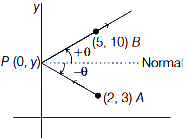
(B) ધારો કે પરાવર્તન બિંદુ $B$ એ $(0, y)$ છે. પરાવર્તનના નિયમ મુજબ,આપાતકોણ = પરાવર્તનકોણ.
$B$ પરનો લંબ એ સમક્ષિતિજ રેખા $y = y_B$ છે. રેખા $AB$ નો ઢાળ $m_1 = \frac{y-3}{0-2} = \frac{y-3}{-2}$ છે.
રેખા $BC$ નો ઢાળ $m_2 = \frac{10-y}{5-0} = \frac{10-y}{5}$ છે.
લંબની સાપેક્ષમાં આપાતકોણ અને પરાવર્તનકોણ સમાન હોવાથી,ઢાળ એકબીજાના વિરોધી હોવા જોઈએ: $m_1 = -m_2$.
$\frac{y-3}{-2} = -\left(\frac{10-y}{5}\right)$
$\frac{y-3}{-2} = \frac{y-10}{5}$
$5(y-3) = -2(y-10)$
$5y - 15 = -2y + 20$
$7y = 35$
$y = 5$
આમ,$B$ ના યામ $(0, 5)$ છે.
$B$ પરનો લંબ એ સમક્ષિતિજ રેખા $y = y_B$ છે. રેખા $AB$ નો ઢાળ $m_1 = \frac{y-3}{0-2} = \frac{y-3}{-2}$ છે.
રેખા $BC$ નો ઢાળ $m_2 = \frac{10-y}{5-0} = \frac{10-y}{5}$ છે.
લંબની સાપેક્ષમાં આપાતકોણ અને પરાવર્તનકોણ સમાન હોવાથી,ઢાળ એકબીજાના વિરોધી હોવા જોઈએ: $m_1 = -m_2$.
$\frac{y-3}{-2} = -\left(\frac{10-y}{5}\right)$
$\frac{y-3}{-2} = \frac{y-10}{5}$
$5(y-3) = -2(y-10)$
$5y - 15 = -2y + 20$
$7y = 35$
$y = 5$
આમ,$B$ ના યામ $(0, 5)$ છે.
0 likesView Solution
184
MathematicsEasyMCQAP EAMCET · 2020
રેખાઓ $x-y=0$ અને $y=0$ વચ્ચેનો લઘુકોણ કેટલો છે?
A
$\frac{\pi}{6}$
B
$\frac{\pi}{4}$
C
$\frac{\pi}{3}$
D
$\frac{5 \pi}{6}$
Solution
(B) આપેલ રેખાઓ $L_1: x-y=0$ અને $L_2: y=0$ છે.
$L_1$ ને $y=m_1x+c_1$ સાથે સરખાવતા,$m_1 = 1$ મળે છે.
$L_2$ ને $y=m_2x+c_2$ સાથે સરખાવતા,$m_2 = 0$ મળે છે.
બે રેખાઓ વચ્ચેનો ખૂણો $\theta$ શોધવાનું સૂત્ર $\tan \theta = \left| \frac{m_1 - m_2}{1 + m_1 m_2} \right|$ છે.
કિંમતો મૂકતા,$\tan \theta = \left| \frac{1 - 0}{1 + (1)(0)} \right| = 1$.
તેથી,$\theta = \tan^{-1}(1) = \frac{\pi}{4}$.
$L_1$ ને $y=m_1x+c_1$ સાથે સરખાવતા,$m_1 = 1$ મળે છે.
$L_2$ ને $y=m_2x+c_2$ સાથે સરખાવતા,$m_2 = 0$ મળે છે.
બે રેખાઓ વચ્ચેનો ખૂણો $\theta$ શોધવાનું સૂત્ર $\tan \theta = \left| \frac{m_1 - m_2}{1 + m_1 m_2} \right|$ છે.
કિંમતો મૂકતા,$\tan \theta = \left| \frac{1 - 0}{1 + (1)(0)} \right| = 1$.
તેથી,$\theta = \tan^{-1}(1) = \frac{\pi}{4}$.
0 likesView Solution
185
MathematicsMediumMCQAP EAMCET · 2020
જો રેખાઓ $y=3x+1$ અને $2y=x+3$ એ રેખા $y=mx+4$ સાથે સમાન નતિ ધરાવતી હોય,તો '$m$' ની કિંમત કેટલી થાય?
A
$\frac{1 \pm 3 \sqrt{2}}{7}$
B
$\frac{-1 \pm 5 \sqrt{2}}{7}$
C
$0$
D
$\frac{1 \pm 5 \sqrt{2}}{7}$
Solution
(D) આપેલ રેખાઓ $y=3x+1$ (ઢાળ $m_1=3$) અને $2y=x+3$ એટલે કે $y=\frac{1}{2}x+\frac{3}{2}$ (ઢાળ $m_2=\frac{1}{2}$) છે.
ધારો કે ત્રીજી રેખા $y=mx+4$ નો ઢાળ $m$ છે.
રેખાઓ સમાન નતિ ધરાવતી હોવાથી,પ્રથમ અને ત્રીજી રેખા વચ્ચેનો ખૂણો એ બીજી અને ત્રીજી રેખા વચ્ચેના ખૂણા જેટલો થાય:
$\left|\frac{m_1-m}{1+m_1m}\right| = \left|\frac{m_2-m}{1+m_2m}\right|$
ઢાળની કિંમતો મૂકતા:
$\left|\frac{3-m}{1+3m}\right| = \left|\frac{1-2m}{2+m}\right|$
કિસ્સો $1$: $\frac{3-m}{1+3m} = \frac{1-2m}{2+m} \Rightarrow 5m^2+5=0$ (વાસ્તવિક ઉકેલ નથી).
કિસ્સો $2$: $\frac{3-m}{1+3m} = -\left(\frac{1-2m}{2+m}\right) \Rightarrow 7m^2-2m-7=0$
દ્વિઘાત સૂત્રનો ઉપયોગ કરતા:
$m = \frac{2 \pm \sqrt{200}}{14} = \frac{1 \pm 5\sqrt{2}}{7}$.
ધારો કે ત્રીજી રેખા $y=mx+4$ નો ઢાળ $m$ છે.
રેખાઓ સમાન નતિ ધરાવતી હોવાથી,પ્રથમ અને ત્રીજી રેખા વચ્ચેનો ખૂણો એ બીજી અને ત્રીજી રેખા વચ્ચેના ખૂણા જેટલો થાય:
$\left|\frac{m_1-m}{1+m_1m}\right| = \left|\frac{m_2-m}{1+m_2m}\right|$
ઢાળની કિંમતો મૂકતા:
$\left|\frac{3-m}{1+3m}\right| = \left|\frac{1-2m}{2+m}\right|$
કિસ્સો $1$: $\frac{3-m}{1+3m} = \frac{1-2m}{2+m} \Rightarrow 5m^2+5=0$ (વાસ્તવિક ઉકેલ નથી).
કિસ્સો $2$: $\frac{3-m}{1+3m} = -\left(\frac{1-2m}{2+m}\right) \Rightarrow 7m^2-2m-7=0$
દ્વિઘાત સૂત્રનો ઉપયોગ કરતા:
$m = \frac{2 \pm \sqrt{200}}{14} = \frac{1 \pm 5\sqrt{2}}{7}$.
0 likesView Solution
186
MathematicsMediumMCQAP EAMCET · 2020
જો $S_1$ અને $S_2$ બે એવી સીધી રેખાઓ હોય કે જેથી $S_2$ માં $S_1$ નું પ્રતિબિંબ અને $S_1$ માં $S_2$ નું પ્રતિબિંબ એકબીજા પર સંપાતી થાય,તો $S_1$ અને $S_2$ વચ્ચેનો ખૂણો કેટલો થાય?
A
$\frac{\pi}{3}$
B
$\frac{\pi}{6}$
C
$\frac{\pi}{4}$
D
માહિતી અપૂરતી છે.
Solution
(A) ધારો કે બે રેખાઓ $S_1$ અને $S_2$ વચ્ચેનો ખૂણો $\theta$ છે.
જ્યારે $S_1$ નું $S_2$ માં પ્રતિબિંબ લેવામાં આવે,ત્યારે પ્રતિબિંબિત રેખા $S_1'$ અને $S_2$ વચ્ચેનો ખૂણો $\theta$ થાય છે.
જ્યારે $S_2$ નું $S_1$ માં પ્રતિબિંબ લેવામાં આવે,ત્યારે પ્રતિબિંબિત રેખા $S_2'$ અને $S_1$ વચ્ચેનો ખૂણો $\theta$ થાય છે.
પ્રતિબિંબિત રેખાઓ $S_1'$ અને $S_2'$ સંપાતી થાય તે માટે,રેખાઓ દ્વારા આવરી લેવાયેલ કુલ ખૂણો $\pi$ રેડિયન હોવો જોઈએ.
ખાસ કરીને,$S_1'$ અને $S_2'$ વચ્ચેનો ખૂણો $3\theta = \pi$ થાય છે.
તેથી,$\theta = \frac{\pi}{3}$.
જ્યારે $S_1$ નું $S_2$ માં પ્રતિબિંબ લેવામાં આવે,ત્યારે પ્રતિબિંબિત રેખા $S_1'$ અને $S_2$ વચ્ચેનો ખૂણો $\theta$ થાય છે.
જ્યારે $S_2$ નું $S_1$ માં પ્રતિબિંબ લેવામાં આવે,ત્યારે પ્રતિબિંબિત રેખા $S_2'$ અને $S_1$ વચ્ચેનો ખૂણો $\theta$ થાય છે.
પ્રતિબિંબિત રેખાઓ $S_1'$ અને $S_2'$ સંપાતી થાય તે માટે,રેખાઓ દ્વારા આવરી લેવાયેલ કુલ ખૂણો $\pi$ રેડિયન હોવો જોઈએ.
ખાસ કરીને,$S_1'$ અને $S_2'$ વચ્ચેનો ખૂણો $3\theta = \pi$ થાય છે.
તેથી,$\theta = \frac{\pi}{3}$.
0 likesView Solution
187
MathematicsMediumMCQAP EAMCET · 2020
ધારો કે $O$ એ ઉગમબિંદુ દર્શાવે છે. જો $M(1, 2)$,$N(0, 1)$ અને $A(x, y)$ એવા બિંદુઓ હોય કે જેથી $xy > 0$ અને $x + y < 1$ થાય,તો સાચું વિધાન પસંદ કરો.
A
$A$ એ $\triangle OMN$ ની અંદર ન હોઈ શકે
B
$A$ એ $\triangle OMN$ ની અંદર છે
C
$A$ માત્ર પ્રથમ ચરણમાં છે
D
આપેલ પૈકી કોઈ નહીં
Solution
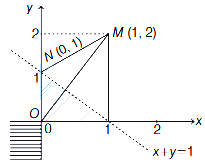
(A) શરત $xy > 0$ સૂચવે છે કે બિંદુ $A(x, y)$ કાં તો પ્રથમ ચરણ $(x > 0, y > 0)$ અથવા ત્રીજા ચરણ $(x < 0, y < 0)$ માં હોવું જોઈએ.
શરત $x + y < 1$ એ રેખા $x + y = 1$ ની નીચેનો પ્રદેશ દર્શાવે છે.
પ્રથમ ચરણમાં,$x > 0, y > 0$ અને $x + y < 1$ નું પાલન કરતો પ્રદેશ એ ઉગમબિંદુ $O(0, 0)$,$(1, 0)$ અને $(0, 1)$ દ્વારા બનતા ત્રિકોણનો આંતરિક ભાગ છે.
ત્રિકોણ $\triangle OMN$ ના શિરોબિંદુઓ $O(0, 0)$,$M(1, 2)$ અને $N(0, 1)$ છે.
$xy > 0$ અને $x + y < 1$ દ્વારા વ્યાખ્યાયિત પ્રદેશનું અવલોકન કરતા,તે સ્પષ્ટ છે કે બિંદુ $A$ એ $\triangle OMN$ ની અંદર હોઈ શકે નહીં કારણ કે $\triangle OMN$ નો આંતરિક ભાગ તેના મોટાભાગના વિસ્તાર માટે રેખા $x + y = 1$ ની ઉપર આવેલો છે,અને આપેલી શરતો $A$ ને એવા પ્રદેશ સુધી મર્યાદિત કરે છે જે $\triangle OMN$ ના આંતરિક ભાગ સાથે ઓવરલેપ થતો નથી.
શરત $x + y < 1$ એ રેખા $x + y = 1$ ની નીચેનો પ્રદેશ દર્શાવે છે.
પ્રથમ ચરણમાં,$x > 0, y > 0$ અને $x + y < 1$ નું પાલન કરતો પ્રદેશ એ ઉગમબિંદુ $O(0, 0)$,$(1, 0)$ અને $(0, 1)$ દ્વારા બનતા ત્રિકોણનો આંતરિક ભાગ છે.
ત્રિકોણ $\triangle OMN$ ના શિરોબિંદુઓ $O(0, 0)$,$M(1, 2)$ અને $N(0, 1)$ છે.
$xy > 0$ અને $x + y < 1$ દ્વારા વ્યાખ્યાયિત પ્રદેશનું અવલોકન કરતા,તે સ્પષ્ટ છે કે બિંદુ $A$ એ $\triangle OMN$ ની અંદર હોઈ શકે નહીં કારણ કે $\triangle OMN$ નો આંતરિક ભાગ તેના મોટાભાગના વિસ્તાર માટે રેખા $x + y = 1$ ની ઉપર આવેલો છે,અને આપેલી શરતો $A$ ને એવા પ્રદેશ સુધી મર્યાદિત કરે છે જે $\triangle OMN$ ના આંતરિક ભાગ સાથે ઓવરલેપ થતો નથી.
0 likesView Solution
188
MathematicsMediumMCQAP EAMCET · 2020
જો $p$ અને $q$ એ ઉગમબિંદુથી રેખાઓ $x \sec \theta + y \operatorname{cosec} \theta = k$ અને $x \cos \theta - y \sin \theta = k \cos 2\theta$ પરના લંબની લંબાઈ હોય,તો
A
$p^2 + 4q^2 = k^2$
B
$4p^2 + q^2 = k^2$
C
$p^2 + q^2 = 4k^2$
D
$p^2 + q^2 = k^2$
Solution
(B) ઉગમબિંદુ $(0, 0)$ થી રેખા $Ax + By + C = 0$ પરના લંબની લંબાઈ $d = \frac{|C|}{\sqrt{A^2 + B^2}}$ દ્વારા આપવામાં આવે છે.
પ્રથમ રેખા $x \sec \theta + y \operatorname{cosec} \theta - k = 0$ માટે,$p = \frac{|-k|}{\sqrt{\sec^2 \theta + \operatorname{cosec}^2 \theta}} = \frac{|k|}{\sqrt{\frac{1}{\cos^2 \theta} + \frac{1}{\sin^2 \theta}}} = \frac{|k| \sin \theta \cos \theta}{\sqrt{\sin^2 \theta + \cos^2 \theta}} = |k| \sin \theta \cos \theta = \frac{|k|}{2} \sin 2\theta$.
તેથી,$p^2 = \frac{k^2}{4} \sin^2 2\theta$.
બીજી રેખા $x \cos \theta - y \sin \theta - k \cos 2\theta = 0$ માટે,$q = \frac{|-k \cos 2\theta|}{\sqrt{\cos^2 \theta + \sin^2 \theta}} = |k \cos 2\theta|$.
તેથી,$q^2 = k^2 \cos^2 2\theta$.
હવે,$4p^2 + q^2 = 4 \left( \frac{k^2}{4} \sin^2 2\theta \right) + k^2 \cos^2 2\theta = k^2 \sin^2 2\theta + k^2 \cos^2 2\theta = k^2 (\sin^2 2\theta + \cos^2 2\theta) = k^2$.
તેથી,$4p^2 + q^2 = k^2$.
પ્રથમ રેખા $x \sec \theta + y \operatorname{cosec} \theta - k = 0$ માટે,$p = \frac{|-k|}{\sqrt{\sec^2 \theta + \operatorname{cosec}^2 \theta}} = \frac{|k|}{\sqrt{\frac{1}{\cos^2 \theta} + \frac{1}{\sin^2 \theta}}} = \frac{|k| \sin \theta \cos \theta}{\sqrt{\sin^2 \theta + \cos^2 \theta}} = |k| \sin \theta \cos \theta = \frac{|k|}{2} \sin 2\theta$.
તેથી,$p^2 = \frac{k^2}{4} \sin^2 2\theta$.
બીજી રેખા $x \cos \theta - y \sin \theta - k \cos 2\theta = 0$ માટે,$q = \frac{|-k \cos 2\theta|}{\sqrt{\cos^2 \theta + \sin^2 \theta}} = |k \cos 2\theta|$.
તેથી,$q^2 = k^2 \cos^2 2\theta$.
હવે,$4p^2 + q^2 = 4 \left( \frac{k^2}{4} \sin^2 2\theta \right) + k^2 \cos^2 2\theta = k^2 \sin^2 2\theta + k^2 \cos^2 2\theta = k^2 (\sin^2 2\theta + \cos^2 2\theta) = k^2$.
તેથી,$4p^2 + q^2 = k^2$.
0 likesView Solution
189
MathematicsMediumMCQAP EAMCET · 2020
બિંદુ $P(3, 8)$ નું રેખા $x + 3y = 7$ ની સાપેક્ષમાં પ્રતિબિંબ,રેખાને સમતલ અરીસો ગણીએ તો,......... બરાબર છે.
A
$(1, 4)$
B
$(-1, 4)$
C
$(1, -4)$
D
$(-1, -4)$
Solution
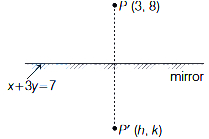
(D) ધારો કે પ્રતિબિંબ $P'(h, k)$ છે.
$PP'$ એ આપેલી રેખા $x + 3y = 7$ ને લંબ હોવાથી,$PP'$ નો ઢાળ $m_1 = \frac{k - 8}{h - 3}$ છે.
રેખા $x + 3y = 7$ નો ઢાળ $m_2 = -\frac{1}{3}$ છે.
$PP' \perp \text{રેખા}$ હોવાથી,$m_1 \times m_2 = -1$ $\Rightarrow \frac{k - 8}{h - 3} \times (-\frac{1}{3}) = -1$ $\Rightarrow k - 8 = 3(h - 3)$ $\Rightarrow 3h - k = 1 \quad \dots(i)$.
$PP'$ નું મધ્યબિંદુ $(\frac{h + 3}{2}, \frac{k + 8}{2})$ છે,જે રેખા $x + 3y = 7$ પર આવેલું છે.
તેથી,$\frac{h + 3}{2} + 3(\frac{k + 8}{2}) = 7$ $\Rightarrow h + 3 + 3k + 24 = 14$ $\Rightarrow h + 3k = -13 \quad \dots(ii)$.
સમીકરણો $(i)$ અને $(ii)$ ઉકેલતા:
$(i)$ પરથી,$k = 3h - 1$.
$(ii)$ માં મૂકતા: $h + 3(3h - 1) = -13$ $\Rightarrow h + 9h - 3 = -13$ $\Rightarrow 10h = -10$ $\Rightarrow h = -1$.
તેથી $k = 3(-1) - 1 = -4$.
આમ,પ્રતિબિંબ $(-1, -4)$ છે.
$PP'$ એ આપેલી રેખા $x + 3y = 7$ ને લંબ હોવાથી,$PP'$ નો ઢાળ $m_1 = \frac{k - 8}{h - 3}$ છે.
રેખા $x + 3y = 7$ નો ઢાળ $m_2 = -\frac{1}{3}$ છે.
$PP' \perp \text{રેખા}$ હોવાથી,$m_1 \times m_2 = -1$ $\Rightarrow \frac{k - 8}{h - 3} \times (-\frac{1}{3}) = -1$ $\Rightarrow k - 8 = 3(h - 3)$ $\Rightarrow 3h - k = 1 \quad \dots(i)$.
$PP'$ નું મધ્યબિંદુ $(\frac{h + 3}{2}, \frac{k + 8}{2})$ છે,જે રેખા $x + 3y = 7$ પર આવેલું છે.
તેથી,$\frac{h + 3}{2} + 3(\frac{k + 8}{2}) = 7$ $\Rightarrow h + 3 + 3k + 24 = 14$ $\Rightarrow h + 3k = -13 \quad \dots(ii)$.
સમીકરણો $(i)$ અને $(ii)$ ઉકેલતા:
$(i)$ પરથી,$k = 3h - 1$.
$(ii)$ માં મૂકતા: $h + 3(3h - 1) = -13$ $\Rightarrow h + 9h - 3 = -13$ $\Rightarrow 10h = -10$ $\Rightarrow h = -1$.
તેથી $k = 3(-1) - 1 = -4$.
આમ,પ્રતિબિંબ $(-1, -4)$ છે.
0 likesView Solution
190
MathematicsEasyMCQAP EAMCET · 2020
જો $M$ એ $y=x$ રેખા પરનું બિંદુ હોય અને બિંદુઓ $P(0,1), Q(2,0)$ એવા હોય કે જેથી $PM+QM$ ન્યૂનતમ થાય,તો $M$ ના યામ શોધો.
A
$(0,0)$
B
$\left(\frac{13}{17}, \frac{13}{17}\right)$
C
$\left(\frac{2}{3}, \frac{2}{3}\right)$
D
$\left(\frac{31}{7}, \frac{31}{7}\right)$
Solution
(A) ધારો કે બિંદુ $M$ એ $(a, a)$ છે કારણ કે તે $y=x$ રેખા પર આવેલું છે.
$PM + QM$ ના સરવાળાને ન્યૂનતમ કરવા માટે,જ્યાં $P(0,1)$ અને $Q(2,0)$ એ $y=x$ રેખાની એક જ બાજુએ છે,આપણે બિંદુ $P$ નું $y=x$ રેખા પર પ્રતિબિંબ લેતા $P'(1,0)$ મળે છે.
ન્યૂનતમ અંતર $PM + QM$ એ $P'Q$ અંતર જેટલું થાય છે જ્યારે $P', M, Q$ સમરેખ હોય.
$P'(1,0)$ અને $Q(2,0)$ માંથી પસાર થતી રેખા $x$-અક્ષ $(y=0)$ છે.
$M$ એ $y=x$ પર હોવું જોઈએ. $y=x$ અને $y=0$ નું છેદબિંદુ $(0,0)$ છે.
$PM + QM$ ના સરવાળાને ન્યૂનતમ કરવા માટે,જ્યાં $P(0,1)$ અને $Q(2,0)$ એ $y=x$ રેખાની એક જ બાજુએ છે,આપણે બિંદુ $P$ નું $y=x$ રેખા પર પ્રતિબિંબ લેતા $P'(1,0)$ મળે છે.
ન્યૂનતમ અંતર $PM + QM$ એ $P'Q$ અંતર જેટલું થાય છે જ્યારે $P', M, Q$ સમરેખ હોય.
$P'(1,0)$ અને $Q(2,0)$ માંથી પસાર થતી રેખા $x$-અક્ષ $(y=0)$ છે.
$M$ એ $y=x$ પર હોવું જોઈએ. $y=x$ અને $y=0$ નું છેદબિંદુ $(0,0)$ છે.
0 likesView Solution
191
MathematicsEasyMCQAP EAMCET · 2020
બિંદુ $(1, -2)$ થી રેખા $12x + 5y + 63 = 0$ પર દોરેલા લંબની લંબાઈ કેટલી છે?
A
$4$ એકમ
B
$5$ એકમ
C
$6$ એકમ
D
$\frac{85}{13}$ એકમ
Solution
(B) બિંદુ $(x_1, y_1)$ થી રેખા $ax + by + c = 0$ પરના લંબની લંબાઈ $d$ શોધવાનું સૂત્ર: $d = \left| \frac{ax_1 + by_1 + c}{\sqrt{a^2 + b^2}} \right|$ છે.
આપેલ બિંદુ $(x_1, y_1) = (1, -2)$ અને રેખા $12x + 5y + 63 = 0$ છે.
સૂત્રમાં કિંમતો મૂકતા:
$d = \left| \frac{12(1) + 5(-2) + 63}{\sqrt{12^2 + 5^2}} \right|$
$d = \left| \frac{12 - 10 + 63}{\sqrt{144 + 25}} \right|$
$d = \left| \frac{65}{\sqrt{169}} \right|$
$d = \left| \frac{65}{13} \right| = 5 \text{ એકમ.}$
આપેલ બિંદુ $(x_1, y_1) = (1, -2)$ અને રેખા $12x + 5y + 63 = 0$ છે.
સૂત્રમાં કિંમતો મૂકતા:
$d = \left| \frac{12(1) + 5(-2) + 63}{\sqrt{12^2 + 5^2}} \right|$
$d = \left| \frac{12 - 10 + 63}{\sqrt{144 + 25}} \right|$
$d = \left| \frac{65}{\sqrt{169}} \right|$
$d = \left| \frac{65}{13} \right| = 5 \text{ એકમ.}$
0 likesView Solution
192
MathematicsEasyMCQAP EAMCET · 2020
રેખા $x = 3$ માં બિંદુ $(6, 5)$ નું પ્રતિબિંબ શું છે?
A
$(0, 5)$
B
$(5, 0)$
C
$(5, 5)$
D
$(0, 6)$
Solution
(A) ધારો કે બિંદુ $P(6, 5)$ છે અને રેખા $x = 3$ છે.
રેખા શિરોલંબ $(x = k)$ હોવાથી,પ્રતિબિંબ $P'(x', y')$ નો $y$-યામ મૂળ બિંદુ જેટલો જ રહેશે,તેથી $y' = 5$.
બિંદુ $P$ નું રેખા $x = 3$ થી અંતર $|6 - 3| = 3$ એકમ છે.
પ્રતિબિંબ $P'$ રેખાની બીજી બાજુએ સમાન અંતરે હોવું જોઈએ.
આમ,$x' = 3 - 3 = 0$.
તેથી,રેખા $x = 3$ માં બિંદુ $(6, 5)$ નું પ્રતિબિંબ $(0, 5)$ છે.
રેખા શિરોલંબ $(x = k)$ હોવાથી,પ્રતિબિંબ $P'(x', y')$ નો $y$-યામ મૂળ બિંદુ જેટલો જ રહેશે,તેથી $y' = 5$.
બિંદુ $P$ નું રેખા $x = 3$ થી અંતર $|6 - 3| = 3$ એકમ છે.
પ્રતિબિંબ $P'$ રેખાની બીજી બાજુએ સમાન અંતરે હોવું જોઈએ.
આમ,$x' = 3 - 3 = 0$.
તેથી,રેખા $x = 3$ માં બિંદુ $(6, 5)$ નું પ્રતિબિંબ $(0, 5)$ છે.
0 likesView Solution
193
MathematicsEasyMCQAP EAMCET · 2020
જો રેખાઓ $3x + 4y - 5 = 0$,$2x + 3y - 4 = 0$ અને $px + 4y - 6 = 0$ એક જ બિંદુએ મળે,તો $p$ ની કિંમત શોધો:
A
-$2$
B
$0$
C
$1$
D
$2$
Solution
(D) આપેલ રેખાઓના સમીકરણો:
$3x + 4y - 5 = 0$ ... $(i)$
$2x + 3y - 4 = 0$ ... $(ii)$
$px + 4y - 6 = 0$ ... $(iii)$
રેખાઓ $(i)$ અને $(ii)$ નું છેદબિંદુ શોધવા માટે:
સમીકરણ $(i)$ ને $2$ વડે અને $(ii)$ ને $3$ વડે ગુણતા:
$6x + 8y - 10 = 0$ ... $(iv)$
$6x + 9y - 12 = 0$ ... $(v)$
સમીકરણ $(v)$ માંથી $(iv)$ બાદ કરતા:
$y - 2 = 0 \Rightarrow y = 2$
$y = 2$ ને સમીકરણ $(i)$ માં મૂકતા:
$3x + 4(2) - 5 = 0$ $\Rightarrow 3x + 3 = 0$ $\Rightarrow x = -1$
છેદબિંદુ $(-1, 2)$ છે.
ત્રણેય રેખાઓ સંગામી હોવાથી,બિંદુ $(-1, 2)$ સમીકરણ $(iii)$ નું સમાધાન કરશે:
$p(-1) + 4(2) - 6 = 0$
$-p + 2 = 0 \Rightarrow p = 2$
$3x + 4y - 5 = 0$ ... $(i)$
$2x + 3y - 4 = 0$ ... $(ii)$
$px + 4y - 6 = 0$ ... $(iii)$
રેખાઓ $(i)$ અને $(ii)$ નું છેદબિંદુ શોધવા માટે:
સમીકરણ $(i)$ ને $2$ વડે અને $(ii)$ ને $3$ વડે ગુણતા:
$6x + 8y - 10 = 0$ ... $(iv)$
$6x + 9y - 12 = 0$ ... $(v)$
સમીકરણ $(v)$ માંથી $(iv)$ બાદ કરતા:
$y - 2 = 0 \Rightarrow y = 2$
$y = 2$ ને સમીકરણ $(i)$ માં મૂકતા:
$3x + 4(2) - 5 = 0$ $\Rightarrow 3x + 3 = 0$ $\Rightarrow x = -1$
છેદબિંદુ $(-1, 2)$ છે.
ત્રણેય રેખાઓ સંગામી હોવાથી,બિંદુ $(-1, 2)$ સમીકરણ $(iii)$ નું સમાધાન કરશે:
$p(-1) + 4(2) - 6 = 0$
$-p + 2 = 0 \Rightarrow p = 2$
0 likesView Solution
194
MathematicsMediumMCQAP EAMCET · 2020
રેખા $x+y=1$ એ સમીકરણ $y^3-6xy^2+11x^2y-6x^3=0$ દ્વારા દર્શાવતી રેખાઓને $P, Q, R$ બિંદુઓમાં મળે છે. જો $O$ ઉગમબિંદુ હોય,તો $(OP)^2+(OQ)^2+(OR)^2=$
A
$\frac{85}{72}$
B
$\frac{121}{72}$
C
$\frac{212}{72}$
D
$\frac{217}{72}$
Solution
(B) આપેલ સમીકરણ $y^3-6xy^2+11x^2y-6x^3=0$ છે.
ઘન પદાવલિના અવયવ પાડતા,આપણને $(y-x)(y-2x)(y-3x)=0$ મળે છે.
આમ,ત્રણ રેખાઓ $L_1: y=x$,$L_2: y=2x$,અને $L_3: y=3x$ છે.
આ રેખાઓનું $x+y=1$ સાથેનું છેદબિંદુ શોધીએ:
$P$ $(y=x)$ માટે: $x+x=1 \Rightarrow x=1/2, y=1/2$. તેથી $P = (1/2, 1/2)$.
$Q$ $(y=2x)$ માટે: $x+2x=1 \Rightarrow x=1/3, y=2/3$. તેથી $Q = (1/3, 2/3)$.
$R$ $(y=3x)$ માટે: $x+3x=1 \Rightarrow x=1/4, y=3/4$. તેથી $R = (1/4, 3/4)$.
હવે,ઉગમબિંદુ $O(0,0)$ થી અંતરના વર્ગની ગણતરી કરીએ:
$(OP)^2 = (1/2)^2 + (1/2)^2 = 1/4 + 1/4 = 1/2 = 36/72$.
$(OQ)^2 = (1/3)^2 + (2/3)^2 = 1/9 + 4/9 = 5/9 = 40/72$.
$(OR)^2 = (1/4)^2 + (3/4)^2 = 1/16 + 9/16 = 10/16 = 5/8 = 45/72$.
સરવાળો કરતા: $(OP)^2+(OQ)^2+(OR)^2 = 36/72 + 40/72 + 45/72 = 121/72$.
ઘન પદાવલિના અવયવ પાડતા,આપણને $(y-x)(y-2x)(y-3x)=0$ મળે છે.
આમ,ત્રણ રેખાઓ $L_1: y=x$,$L_2: y=2x$,અને $L_3: y=3x$ છે.
આ રેખાઓનું $x+y=1$ સાથેનું છેદબિંદુ શોધીએ:
$P$ $(y=x)$ માટે: $x+x=1 \Rightarrow x=1/2, y=1/2$. તેથી $P = (1/2, 1/2)$.
$Q$ $(y=2x)$ માટે: $x+2x=1 \Rightarrow x=1/3, y=2/3$. તેથી $Q = (1/3, 2/3)$.
$R$ $(y=3x)$ માટે: $x+3x=1 \Rightarrow x=1/4, y=3/4$. તેથી $R = (1/4, 3/4)$.
હવે,ઉગમબિંદુ $O(0,0)$ થી અંતરના વર્ગની ગણતરી કરીએ:
$(OP)^2 = (1/2)^2 + (1/2)^2 = 1/4 + 1/4 = 1/2 = 36/72$.
$(OQ)^2 = (1/3)^2 + (2/3)^2 = 1/9 + 4/9 = 5/9 = 40/72$.
$(OR)^2 = (1/4)^2 + (3/4)^2 = 1/16 + 9/16 = 10/16 = 5/8 = 45/72$.
સરવાળો કરતા: $(OP)^2+(OQ)^2+(OR)^2 = 36/72 + 40/72 + 45/72 = 121/72$.
0 likesView Solution
195
MathematicsMediumMCQAP EAMCET · 2020
આપેલ છે કે રેખાઓ $L_1: y=m_a x, L_2: y=m_b x$ અને $L_3: y=m_c x$ એ રેખા $x+y=1$ પર સમાન અંતઃખંડ બનાવે છે,તો
A
$2(1+m_a)(1+m_c)=(1+m_b)^2$
B
$2(1+m_a)(1+m_c)=(1+m_b)(2+m_a+m_c)$
C
$(1+m_a)(1+m_b)=(2+m_c)(1+m_a+m_c)$
D
$(1+m_a)(1+m_b)=(1+m_b)(2+m_a+m_c)$
Solution
(B) રેખાઓ $L_1, L_2, L_3$ ના $x+y=1$ સાથેના છેદબિંદુઓ $A(\frac{1}{1+m_a}, \frac{m_a}{1+m_a})$,$B(\frac{1}{1+m_b}, \frac{m_b}{1+m_b})$,અને $C(\frac{1}{1+m_c}, \frac{m_c}{1+m_c})$ છે.
$AB=BC$ હોવાથી,$AB^2=BC^2$ થાય.
અંતર સૂત્રનો ઉપયોગ કરતા,$AB^2 = \frac{2(m_a-m_b)^2}{(1+m_a)^2(1+m_b)^2}$ અને $BC^2 = \frac{2(m_b-m_c)^2}{(1+m_b)^2(1+m_c)^2}$ મળે.
તેથી,$\frac{(m_a-m_b)^2}{(1+m_a)^2} = \frac{(m_b-m_c)^2}{(1+m_c)^2}$.
વર્ગમૂળ લેતા,$\frac{m_a-m_b}{1+m_a} = \frac{m_b-m_c}{1+m_c}$.
સાદુરૂપ આપતા,$2(1+m_a)(1+m_c)=(1+m_b)(2+m_a+m_c)$ મળે છે.
$AB=BC$ હોવાથી,$AB^2=BC^2$ થાય.
અંતર સૂત્રનો ઉપયોગ કરતા,$AB^2 = \frac{2(m_a-m_b)^2}{(1+m_a)^2(1+m_b)^2}$ અને $BC^2 = \frac{2(m_b-m_c)^2}{(1+m_b)^2(1+m_c)^2}$ મળે.
તેથી,$\frac{(m_a-m_b)^2}{(1+m_a)^2} = \frac{(m_b-m_c)^2}{(1+m_c)^2}$.
વર્ગમૂળ લેતા,$\frac{m_a-m_b}{1+m_a} = \frac{m_b-m_c}{1+m_c}$.
સાદુરૂપ આપતા,$2(1+m_a)(1+m_c)=(1+m_b)(2+m_a+m_c)$ મળે છે.
0 likesView Solution
196
MathematicsMediumMCQAP EAMCET · 2020
જો રેખાઓ $3x + y - 2 = 0$,$px + 2y - 3 = 0$ અને $2x - y - 3 = 0$ સંગામી હોય,તો $p =$
A
-$5$
B
$5$
C
$3$
D
-$3$
Solution
(B) ત્રણ રેખાઓ સંગામી હોય જો તેમના સહગુણકોનો નિશ્ચાયક શૂન્ય હોય.
આપેલી રેખાઓ $3x + y - 2 = 0$,$px + 2y - 3 = 0$ અને $2x - y - 3 = 0$ છે.
સંગામી હોવાની શરત:
$\begin{vmatrix} 3 & 1 & -2 \\ p & 2 & -3 \\ 2 & -1 & -3 \end{vmatrix} = 0$
પ્રથમ હાર મુજબ નિશ્ચાયકનું વિસ્તરણ કરતા:
$3(2(-3) - (-1)(-3)) - 1(p(-3) - 2(-3)) - 2(p(-1) - 2(2)) = 0$
$3(-6 - 3) - 1(-3p + 6) - 2(-p - 4) = 0$
$3(-9) + 3p - 6 + 2p + 8 = 0$
$-27 + 3p - 6 + 2p + 8 = 0$
$5p - 25 = 0$
$5p = 25$
$p = 5$
આમ,સાચો વિકલ્પ $B$ છે.
આપેલી રેખાઓ $3x + y - 2 = 0$,$px + 2y - 3 = 0$ અને $2x - y - 3 = 0$ છે.
સંગામી હોવાની શરત:
$\begin{vmatrix} 3 & 1 & -2 \\ p & 2 & -3 \\ 2 & -1 & -3 \end{vmatrix} = 0$
પ્રથમ હાર મુજબ નિશ્ચાયકનું વિસ્તરણ કરતા:
$3(2(-3) - (-1)(-3)) - 1(p(-3) - 2(-3)) - 2(p(-1) - 2(2)) = 0$
$3(-6 - 3) - 1(-3p + 6) - 2(-p - 4) = 0$
$3(-9) + 3p - 6 + 2p + 8 = 0$
$-27 + 3p - 6 + 2p + 8 = 0$
$5p - 25 = 0$
$5p = 25$
$p = 5$
આમ,સાચો વિકલ્પ $B$ છે.
0 likesView Solution
197
MathematicsEasyMCQAP EAMCET · 2020
જો $3a + 5b + 6c = 0$ હોય,તો રેખાઓની સંહતિ $ax + by + c = 0$ કયા નિશ્ચિત બિંદુમાંથી પસાર થાય છે?
A
$\left(\frac{5}{6}, \frac{1}{2}\right)$
B
$\left(\frac{1}{2}, \frac{1}{3}\right)$
C
$\left(\frac{1}{3}, \frac{1}{2}\right)$
D
$\left(\frac{1}{2}, \frac{5}{6}\right)$
Solution
(D) આપેલ રેખાઓની સંહતિનું સમીકરણ: $ax + by + c = 0$.
શરત $3a + 5b + 6c = 0$ પરથી,$c = -\frac{3a + 5b}{6}$ મળે.
આ કિંમત રેખાના સમીકરણમાં મૂકતા: $ax + by - \frac{3a + 5b}{6} = 0$.
$6$ વડે ગુણતા: $6ax + 6by - 3a - 5b = 0$.
પદોને ગોઠવતા: $a(6x - 3) + b(6y - 5) = 0$.
આ સમીકરણ તમામ $a$ અને $b$ માટે સાચું હોવાથી,$6x - 3 = 0$ અને $6y - 5 = 0$ થાય.
તેથી $x = \frac{1}{2}$ અને $y = \frac{5}{6}$ મળે.
આમ,નિશ્ચિત બિંદુ $\left(\frac{1}{2}, \frac{5}{6}\right)$ છે.
શરત $3a + 5b + 6c = 0$ પરથી,$c = -\frac{3a + 5b}{6}$ મળે.
આ કિંમત રેખાના સમીકરણમાં મૂકતા: $ax + by - \frac{3a + 5b}{6} = 0$.
$6$ વડે ગુણતા: $6ax + 6by - 3a - 5b = 0$.
પદોને ગોઠવતા: $a(6x - 3) + b(6y - 5) = 0$.
આ સમીકરણ તમામ $a$ અને $b$ માટે સાચું હોવાથી,$6x - 3 = 0$ અને $6y - 5 = 0$ થાય.
તેથી $x = \frac{1}{2}$ અને $y = \frac{5}{6}$ મળે.
આમ,નિશ્ચિત બિંદુ $\left(\frac{1}{2}, \frac{5}{6}\right)$ છે.
0 likesView Solution
198
MathematicsDifficultMCQAP EAMCET · 2020
જો સમીકરણ $4x^2 + hxy + y^2 = 0$ સંપાતી રેખાઓ દર્શાવતું હોય,તો $h$ ની કિંમત શોધો.
A
$1$
B
$2$
C
$3$
D
$4$ અથવા $-4$
Solution
(D) ઉગમબિંદુમાંથી પસાર થતી રેખાઓની જોડીનું સામાન્ય સમીકરણ $ax^2 + 2h'xy + by^2 = 0$ છે.
રેખાઓ સંપાતી હોય તે માટેની શરત $h'^2 - ab = 0$ છે.
$4x^2 + hxy + y^2 = 0$ ને $ax^2 + 2h'xy + by^2 = 0$ સાથે સરખાવતા,$a = 4$,$2h' = h$,અને $b = 1$ મળે.
સંપાતી હોવાની શરત મુજબ,$(\frac{h}{2})^2 - (4)(1) = 0$.
$\frac{h^2}{4} = 4$.
$h^2 = 16$.
$h = \pm 4$.
રેખાઓ સંપાતી હોય તે માટેની શરત $h'^2 - ab = 0$ છે.
$4x^2 + hxy + y^2 = 0$ ને $ax^2 + 2h'xy + by^2 = 0$ સાથે સરખાવતા,$a = 4$,$2h' = h$,અને $b = 1$ મળે.
સંપાતી હોવાની શરત મુજબ,$(\frac{h}{2})^2 - (4)(1) = 0$.
$\frac{h^2}{4} = 4$.
$h^2 = 16$.
$h = \pm 4$.
0 likesView Solution
199
MathematicsDifficultMCQAP EAMCET · 2020
જો સમીકરણ $ax^2+2hxy+by^2+2gx+2fy+c=0$ ઉગમબિંદુથી સમાન અંતરે આવેલી બે સીધી રેખાઓ દર્શાવતું હોય,તો $f^4-g^4=$
A
$bf^2-ag^2$
B
$ag^2-bf^2$
C
$c(bf^2-ag^2)$
D
$c(af^2-bg^2)$
Solution
(C) દ્વિઘાત સમીકરણ $ax^2+2hxy+by^2+2gx+2fy+c=0$ બે સીધી રેખાઓ દર્શાવે છે. ઉગમબિંદુ $(0,0)$ થી રેખાઓનું અંતર $d = \frac{|c_i|}{\sqrt{1+m_i^2}}$ દ્વારા મળે છે.
રેખાઓ ઉગમબિંદુથી સમાન અંતરે હોવાથી,$\frac{|c_1|}{\sqrt{1+m_1^2}} = \frac{|c_2|}{\sqrt{1+m_2^2}}$ થાય,જેનો અર્થ છે કે $c_1^2(1+m_2^2) = c_2^2(1+m_1^2)$.
આને સાદું રૂપ આપતા $c_1^2-c_2^2 = c_2^2m_1^2-c_1^2m_2^2$ મળે છે.
રેખાઓના ગુણધર્મોનો ઉપયોગ કરતા,$c_1+c_2 = -\frac{2f}{b}$,$c_1c_2 = \frac{c}{b}$,અને $m_1c_2+m_2c_1 = \frac{2g}{b}$ મળે છે.
આ કિંમતો મૂકતા અને બંને બાજુ વર્ગ કરતા,$f^2(f^2-bc) = g^2(g^2-ac)$ મળે છે.
તેથી,$f^4-g^4 = c(bf^2-ag^2)$ થાય છે.
રેખાઓ ઉગમબિંદુથી સમાન અંતરે હોવાથી,$\frac{|c_1|}{\sqrt{1+m_1^2}} = \frac{|c_2|}{\sqrt{1+m_2^2}}$ થાય,જેનો અર્થ છે કે $c_1^2(1+m_2^2) = c_2^2(1+m_1^2)$.
આને સાદું રૂપ આપતા $c_1^2-c_2^2 = c_2^2m_1^2-c_1^2m_2^2$ મળે છે.
રેખાઓના ગુણધર્મોનો ઉપયોગ કરતા,$c_1+c_2 = -\frac{2f}{b}$,$c_1c_2 = \frac{c}{b}$,અને $m_1c_2+m_2c_1 = \frac{2g}{b}$ મળે છે.
આ કિંમતો મૂકતા અને બંને બાજુ વર્ગ કરતા,$f^2(f^2-bc) = g^2(g^2-ac)$ મળે છે.
તેથી,$f^4-g^4 = c(bf^2-ag^2)$ થાય છે.
0 likesView Solution
200
MathematicsEasyMCQAP EAMCET · 2020
'$k$' ના એવા મૂલ્યોની સંખ્યા શોધો જેના માટે રેખાઓ $2x + y = 1$,$3x + 2y = 2$,અને $kx + 3y = 3$ સંગામી હોય .........
A
$0$
B
$\infty$
C
$1$
D
$2$
Solution
(B) ત્રણ રેખાઓ $a_1x + b_1y + c_1 = 0$,$a_2x + b_2y + c_2 = 0$,અને $a_3x + b_3y + c_3 = 0$ સંગામી હોય તે માટે,તેમના સહગુણકોનો નિશ્ચાયક શૂન્ય હોવો જોઈએ:
$\left|\begin{array}{ccc} 2 & 1 & -1 \\ 3 & 2 & -2 \\ k & 3 & -3 \end{array}\right| = 0$
નિશ્ચાયકનું વિસ્તરણ કરતા:
$2[-6 + 6] - 1[-9 + 2k] - 1[9 - 2k] = 0$
$0 = 0$
આમ,'$k$' ની કોઈપણ કિંમત માટે રેખાઓ સંગામી છે,તેથી '$k$' ના મૂલ્યોની સંખ્યા અનંત છે.
$\left|\begin{array}{ccc} 2 & 1 & -1 \\ 3 & 2 & -2 \\ k & 3 & -3 \end{array}\right| = 0$
નિશ્ચાયકનું વિસ્તરણ કરતા:
$2[-6 + 6] - 1[-9 + 2k] - 1[9 - 2k] = 0$
$0 = 0$
આમ,'$k$' ની કોઈપણ કિંમત માટે રેખાઓ સંગામી છે,તેથી '$k$' ના મૂલ્યોની સંખ્યા અનંત છે.
0 likesView Solution
201
MathematicsEasyMCQAP EAMCET · 2020
જેમનો સરવાળો $t$ હોય અને તેમના વર્ગોનો સરવાળો ન્યૂનતમ હોય તેવી બે ધન સંખ્યાઓ કઈ છે?
A
$\frac{t}{4}, \frac{3t}{4}$
B
$\frac{t}{3}, \frac{2t}{3}$
C
$\frac{t}{2}, \frac{t}{2}$
D
$\frac{2t}{5}, \frac{3t}{5}$
Solution
(C) ધારો કે બે ધન સંખ્યાઓ $x$ અને $y$ છે. આપેલ છે કે $x + y = t$,તેથી $y = t - x$.
આપણે તેમના વર્ગોનો સરવાળો $S = x^2 + y^2$ ન્યૂનતમ કરવો છે.
$y = t - x$ મૂકતા,આપણને $S(x) = x^2 + (t - x)^2 = x^2 + t^2 - 2tx + x^2 = 2x^2 - 2tx + t^2$ મળે છે.
ન્યૂનતમ કિંમત શોધવા માટે,આપણે $x$ ની સાપેક્ષમાં વિકલન કરીએ: $\frac{dS}{dx} = 4x - 2t$.
$\frac{dS}{dx} = 0$ લેતા,આપણને $4x = 2t$ મળે છે,જેનો અર્થ છે કે $x = \frac{t}{2}$.
કારણ કે $\frac{d^2S}{dx^2} = 4 > 0$,તેથી વિધેય $x = \frac{t}{2}$ આગળ ન્યૂનતમ છે.
ત્યારબાદ $y = t - \frac{t}{2} = \frac{t}{2}$.
આમ,બે સંખ્યાઓ $\frac{t}{2}$ અને $\frac{t}{2}$ છે.
આપણે તેમના વર્ગોનો સરવાળો $S = x^2 + y^2$ ન્યૂનતમ કરવો છે.
$y = t - x$ મૂકતા,આપણને $S(x) = x^2 + (t - x)^2 = x^2 + t^2 - 2tx + x^2 = 2x^2 - 2tx + t^2$ મળે છે.
ન્યૂનતમ કિંમત શોધવા માટે,આપણે $x$ ની સાપેક્ષમાં વિકલન કરીએ: $\frac{dS}{dx} = 4x - 2t$.
$\frac{dS}{dx} = 0$ લેતા,આપણને $4x = 2t$ મળે છે,જેનો અર્થ છે કે $x = \frac{t}{2}$.
કારણ કે $\frac{d^2S}{dx^2} = 4 > 0$,તેથી વિધેય $x = \frac{t}{2}$ આગળ ન્યૂનતમ છે.
ત્યારબાદ $y = t - \frac{t}{2} = \frac{t}{2}$.
આમ,બે સંખ્યાઓ $\frac{t}{2}$ અને $\frac{t}{2}$ છે.
0 likesView Solution
202
MathematicsEasyMCQAP EAMCET · 2020
એક સમબાજુ ત્રિકોણની બાજુ $2 \text{ cm/s}$ ના દરે વધી રહી છે. જ્યારે ત્રિકોણની બાજુ $20 \text{ cm}$ હોય ત્યારે તેના ક્ષેત્રફળમાં થતો વધારાનો દર શોધો.
A
$5 \sqrt{3} \text{ cm}^2/\text{s}$
B
$10 \sqrt{3} \text{ cm}^2/\text{s}$
C
$20 \sqrt{3} \text{ cm}^2/\text{s}$
D
$40 \sqrt{3} \text{ cm}^2/\text{s}$
Solution
(C) ધારો કે સમબાજુ ત્રિકોણની બાજુ $a$ છે અને તેનું ક્ષેત્રફળ $A$ છે.
સમબાજુ ત્રિકોણનું ક્ષેત્રફળ $A = \frac{\sqrt{3}}{4} a^2$ દ્વારા આપવામાં આવે છે.
સમય $t$ ની સાપેક્ષમાં બંને બાજુ વિકલન કરતા:
$\frac{dA}{dt} = \frac{\sqrt{3}}{4} \times 2a \times \frac{da}{dt} = \frac{\sqrt{3}}{2} a \frac{da}{dt}$.
આપેલ છે કે $\frac{da}{dt} = 2 \text{ cm/s}$ અને $a = 20 \text{ cm}$.
આ કિંમતો સમીકરણમાં મૂકતા:
$\frac{dA}{dt} = \frac{\sqrt{3}}{2} \times 20 \times 2 = 20 \sqrt{3} \text{ cm}^2/\text{s}$.
આમ,ક્ષેત્રફળમાં થતો વધારાનો દર $20 \sqrt{3} \text{ cm}^2/\text{s}$ છે.
સમબાજુ ત્રિકોણનું ક્ષેત્રફળ $A = \frac{\sqrt{3}}{4} a^2$ દ્વારા આપવામાં આવે છે.
સમય $t$ ની સાપેક્ષમાં બંને બાજુ વિકલન કરતા:
$\frac{dA}{dt} = \frac{\sqrt{3}}{4} \times 2a \times \frac{da}{dt} = \frac{\sqrt{3}}{2} a \frac{da}{dt}$.
આપેલ છે કે $\frac{da}{dt} = 2 \text{ cm/s}$ અને $a = 20 \text{ cm}$.
આ કિંમતો સમીકરણમાં મૂકતા:
$\frac{dA}{dt} = \frac{\sqrt{3}}{2} \times 20 \times 2 = 20 \sqrt{3} \text{ cm}^2/\text{s}$.
આમ,ક્ષેત્રફળમાં થતો વધારાનો દર $20 \sqrt{3} \text{ cm}^2/\text{s}$ છે.
0 likesView Solution
203
MathematicsEasyMCQAP EAMCET · 2020
વિધેય $f(x) = x^{40} - x^{20}$ માટે,અંતરાલ $[0, 1]$ માં નિરપેક્ષ ન્યૂનતમ મૂલ્ય શોધો.
A
$1/2$
B
$-1/4$
C
$0$
D
$1$
Solution
(B) અંતરાલ $[0, 1]$ પર $f(x) = x^{40} - x^{20}$ નું નિરપેક્ષ ન્યૂનતમ મૂલ્ય શોધવા માટે,આપણે વિકલન $f'(x) = 0$ લઈને ક્રાંતિક બિંદુઓ શોધીએ છીએ.
$f'(x) = 40x^{39} - 20x^{19} = 20x^{19}(2x^{20} - 1)$.
$f'(x) = 0$ લેતા,આપણને $x = 0$ અથવા $2x^{20} = 1$ મળે છે,જેનો અર્થ છે કે $x^{20} = 1/2$,તેથી $x = (1/2)^{1/20}$.
કારણ કે $(1/2)^{1/20}$ એ અંતરાલ $(0, 1)$ માં છે,આપણે ક્રાંતિક બિંદુ અને અંતિમ બિંદુઓ $x = 0$ અને $x = 1$ પર $f(x)$ ની કિંમત શોધીએ છીએ.
$f(0) = 0^{40} - 0^{20} = 0$.
$f(1) = 1^{40} - 1^{20} = 0$.
$f((1/2)^{1/20}) = ((1/2)^{1/20})^{40} - ((1/2)^{1/20})^{20} = (1/2)^2 - (1/2)^1 = 1/4 - 1/2 = -1/4$.
$0, 0,$ અને $-1/4$ મૂલ્યોની સરખામણી કરતા,નિરપેક્ષ ન્યૂનતમ મૂલ્ય $-1/4$ છે.
$f'(x) = 40x^{39} - 20x^{19} = 20x^{19}(2x^{20} - 1)$.
$f'(x) = 0$ લેતા,આપણને $x = 0$ અથવા $2x^{20} = 1$ મળે છે,જેનો અર્થ છે કે $x^{20} = 1/2$,તેથી $x = (1/2)^{1/20}$.
કારણ કે $(1/2)^{1/20}$ એ અંતરાલ $(0, 1)$ માં છે,આપણે ક્રાંતિક બિંદુ અને અંતિમ બિંદુઓ $x = 0$ અને $x = 1$ પર $f(x)$ ની કિંમત શોધીએ છીએ.
$f(0) = 0^{40} - 0^{20} = 0$.
$f(1) = 1^{40} - 1^{20} = 0$.
$f((1/2)^{1/20}) = ((1/2)^{1/20})^{40} - ((1/2)^{1/20})^{20} = (1/2)^2 - (1/2)^1 = 1/4 - 1/2 = -1/4$.
$0, 0,$ અને $-1/4$ મૂલ્યોની સરખામણી કરતા,નિરપેક્ષ ન્યૂનતમ મૂલ્ય $-1/4$ છે.
0 likesView Solution
204
MathematicsEasyMCQAP EAMCET · 2020
જો વિધેય $f(t) = t^3 - 6t^2 + pt + q$ એ અંતરાલ $[1, 3]$ પર રોલનું પ્રમેયનું પાલન કરતું હોય અને $c = \frac{2\sqrt{3} + 1}{\sqrt{3}}$ હોય,તો $p$ અને $q$ ની કિંમત શોધો.
A
$p \in R, q = 11$
B
$p = 11, q \in R$
C
$p \in R, q \in R$
D
$p = 11, q = 11$
Solution
(B) કોઈ વિધેય $f(t)$ માટે અંતરાલ $[a, b]$ પર રોલનું પ્રમેય ત્યારે જ સંતોષાય જો $f(a) = f(b)$ હોય.
અહીં $f(t) = t^3 - 6t^2 + pt + q$ અંતરાલ $[1, 3]$ પર આપેલ છે,તેથી $f(1) = f(3)$.
$f(1) = 1^3 - 6(1)^2 + p(1) + q = 1 - 6 + p + q = p + q - 5$.
$f(3) = 3^3 - 6(3)^2 + p(3) + q = 27 - 54 + 3p + q = 3p + q - 27$.
$f(1) = f(3)$ ને સરખાવતા:
$p + q - 5 = 3p + q - 27$.
$2p = 22 \Rightarrow p = 11$.
અહીં $q$ બંને બાજુથી નીકળી જાય છે,તેથી $q$ કોઈપણ વાસ્તવિક સંખ્યા હોઈ શકે છે $(q \in R)$.
આમ,$p = 11$ અને $q \in R$.
અહીં $f(t) = t^3 - 6t^2 + pt + q$ અંતરાલ $[1, 3]$ પર આપેલ છે,તેથી $f(1) = f(3)$.
$f(1) = 1^3 - 6(1)^2 + p(1) + q = 1 - 6 + p + q = p + q - 5$.
$f(3) = 3^3 - 6(3)^2 + p(3) + q = 27 - 54 + 3p + q = 3p + q - 27$.
$f(1) = f(3)$ ને સરખાવતા:
$p + q - 5 = 3p + q - 27$.
$2p = 22 \Rightarrow p = 11$.
અહીં $q$ બંને બાજુથી નીકળી જાય છે,તેથી $q$ કોઈપણ વાસ્તવિક સંખ્યા હોઈ શકે છે $(q \in R)$.
આમ,$p = 11$ અને $q \in R$.
0 likesView Solution
205
MathematicsEasyMCQAP EAMCET · 2020
$2 \text{ m}$ ઊંચો એક માણસ $1 \frac{2}{3} \text{ m/s}$ ની ઝડપે જમીનથી $5 \frac{1}{3} \text{ m}$ ઊંચા સ્ટ્રીટ લાઈટ તરફ ચાલે છે. જ્યારે તે લાઈટના થાંભલાથી $3 \frac{1}{3} \text{ m}$ દૂર હોય,ત્યારે તેના પડછાયાની લંબાઈ બદલાવાનો દર . . . . . . છે। ($\text{ m/s}$ માં)
A
$-1$
B
$2$
C
$-2$
D
$1$
Solution
(A) ધારો કે $AB$ એ $H = 5 \frac{1}{3} = \frac{16}{3} \text{ m}$ ઊંચાઈનો સ્ટ્રીટ લાઈટ છે. ધારો કે $CD$ એ $h = 2 \text{ m}$ ઊંચાઈનો માણસ છે. ધારો કે $AC = x$ એ માણસનું લાઈટથી અંતર છે અને $CE = y$ એ તેના પડછાયાની લંબાઈ છે।
સમરૂપ ત્રિકોણ $\triangle ABE$ અને $\triangle DCE$ પરથી,આપણને મળે છે:
$\frac{AB}{CD} = \frac{AE}{CE} \Rightarrow \frac{16/3}{2} = \frac{x+y}{y}$
$\frac{8}{3} = \frac{x}{y} + 1$ $\Rightarrow \frac{x}{y} = \frac{5}{3}$ $\Rightarrow y = \frac{3}{5}x$
સમય $t$ ની સાપેક્ષમાં વિકલન કરતા:
$\frac{dy}{dt} = \frac{3}{5} \frac{dx}{dt}$
આપેલ છે કે માણસ $1 \frac{2}{3} \text{ m/s}$ ની ઝડપે લાઈટ તરફ ચાલે છે,તેથી $\frac{dx}{dt} = -\frac{5}{3} \text{ m/s}$ (ઋણ કારણ કે $x$ ઘટી રહ્યું છે)।
તેથી,$\frac{dy}{dt} = \frac{3}{5} \times (-\frac{5}{3}) = -1 \text{ m/s}$.
પડછાયાની લંબાઈ બદલાવાનો દર $-1 \text{ m/s}$ છે.
સમરૂપ ત્રિકોણ $\triangle ABE$ અને $\triangle DCE$ પરથી,આપણને મળે છે:
$\frac{AB}{CD} = \frac{AE}{CE} \Rightarrow \frac{16/3}{2} = \frac{x+y}{y}$
$\frac{8}{3} = \frac{x}{y} + 1$ $\Rightarrow \frac{x}{y} = \frac{5}{3}$ $\Rightarrow y = \frac{3}{5}x$
સમય $t$ ની સાપેક્ષમાં વિકલન કરતા:
$\frac{dy}{dt} = \frac{3}{5} \frac{dx}{dt}$
આપેલ છે કે માણસ $1 \frac{2}{3} \text{ m/s}$ ની ઝડપે લાઈટ તરફ ચાલે છે,તેથી $\frac{dx}{dt} = -\frac{5}{3} \text{ m/s}$ (ઋણ કારણ કે $x$ ઘટી રહ્યું છે)।
તેથી,$\frac{dy}{dt} = \frac{3}{5} \times (-\frac{5}{3}) = -1 \text{ m/s}$.
પડછાયાની લંબાઈ બદલાવાનો દર $-1 \text{ m/s}$ છે.
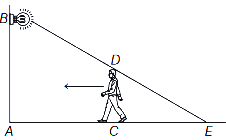
0 likesView Solution
206
MathematicsMediumMCQAP EAMCET · 2020
જો $\int \frac{\cos (13 x)-\cos (14 x)}{1+2 \cos (9 x)} d x=\frac{\sin (4 x)}{a}-\frac{\sin (5 x)}{b}+c$ હોય,તો $a^b=$
A
$4^5$
B
$5^4$
C
$4^4$
D
$5^5$
Solution
(A) આપેલ છે,$I = \int \frac{\cos (13x) - \cos (14x)}{1 + 2 \cos (9x)} dx$.
અંશ અને છેદને $\sin(9x/2)$ વડે ગુણતા:
$I = \int \frac{(\cos 13x - \cos 14x) \sin(9x/2)}{(1 + 2 \cos 9x) \sin(9x/2)} dx$.
નિત્યસમ $1 + 2 \cos(9x) = \frac{\sin(27x/2)}{\sin(9x/2)}$ નો ઉપયોગ કરતા:
$I = \int \frac{(\cos 13x - \cos 14x) \sin(9x/2)}{\sin(27x/2)} dx$.
ગુણાકાર-સરવાળાના સૂત્ર $\cos A - \cos B = 2 \sin(\frac{A+B}{2}) \sin(\frac{B-A}{2})$ નો ઉપયોગ કરતા:
$\cos 13x - \cos 14x = 2 \sin(\frac{27x}{2}) \sin(x/2)$.
આ કિંમત સંકલનમાં મૂકતા:
$I = \int \frac{2 \sin(27x/2) \sin(x/2) \sin(9x/2)}{\sin(27x/2)} dx = \int 2 \sin(9x/2) \sin(x/2) dx$.
$2 \sin A \sin B = \cos(A-B) - \cos(A+B)$ નો ઉપયોગ કરતા:
$I = \int (\cos(4x) - \cos(5x)) dx = \frac{\sin 4x}{4} - \frac{\sin 5x}{5} + C$.
આપેલ સ્વરૂપ સાથે સરખાવતા,$a = 4$ અને $b = 5$ મળે છે.
તેથી,$a^b = 4^5$.
અંશ અને છેદને $\sin(9x/2)$ વડે ગુણતા:
$I = \int \frac{(\cos 13x - \cos 14x) \sin(9x/2)}{(1 + 2 \cos 9x) \sin(9x/2)} dx$.
નિત્યસમ $1 + 2 \cos(9x) = \frac{\sin(27x/2)}{\sin(9x/2)}$ નો ઉપયોગ કરતા:
$I = \int \frac{(\cos 13x - \cos 14x) \sin(9x/2)}{\sin(27x/2)} dx$.
ગુણાકાર-સરવાળાના સૂત્ર $\cos A - \cos B = 2 \sin(\frac{A+B}{2}) \sin(\frac{B-A}{2})$ નો ઉપયોગ કરતા:
$\cos 13x - \cos 14x = 2 \sin(\frac{27x}{2}) \sin(x/2)$.
આ કિંમત સંકલનમાં મૂકતા:
$I = \int \frac{2 \sin(27x/2) \sin(x/2) \sin(9x/2)}{\sin(27x/2)} dx = \int 2 \sin(9x/2) \sin(x/2) dx$.
$2 \sin A \sin B = \cos(A-B) - \cos(A+B)$ નો ઉપયોગ કરતા:
$I = \int (\cos(4x) - \cos(5x)) dx = \frac{\sin 4x}{4} - \frac{\sin 5x}{5} + C$.
આપેલ સ્વરૂપ સાથે સરખાવતા,$a = 4$ અને $b = 5$ મળે છે.
તેથી,$a^b = 4^5$.
0 likesView Solution
207
MathematicsMediumMCQAP EAMCET · 2020
જો $I_n = \int (\ln x)^n dx$ હોય,તો $I_n + n I_{n-1}$ ઉકેલો.
A
$x(\ln x)^{n-1} + k$
B
$x(\ln x)^n + k$
C
$\frac{(\ln x)^n}{x} + k$
D
$\frac{(\ln x)^{n-1}}{x} + k$
Solution
(B) આપેલ છે કે $I_n = \int (\ln x)^n dx$.
ખંડશઃ સંકલન (Integration by parts) નો ઉપયોગ કરતા,ધારો કે $u = (\ln x)^n$ અને $dv = dx$.
તેથી $du = n(\ln x)^{n-1} \cdot \frac{1}{x} dx$ અને $v = x$ મળે.
$I_n = x(\ln x)^n - \int x \cdot \frac{n(\ln x)^{n-1}}{x} dx + k$.
$I_n = x(\ln x)^n - n \int (\ln x)^{n-1} dx + k$.
કારણ કે $I_{n-1} = \int (\ln x)^{n-1} dx$,તેથી આપણને મળે:
$I_n = x(\ln x)^n - n I_{n-1} + k$.
પદોને ફરીથી ગોઠવતા,આપણને મળે:
$I_n + n I_{n-1} = x(\ln x)^n + k$.
ખંડશઃ સંકલન (Integration by parts) નો ઉપયોગ કરતા,ધારો કે $u = (\ln x)^n$ અને $dv = dx$.
તેથી $du = n(\ln x)^{n-1} \cdot \frac{1}{x} dx$ અને $v = x$ મળે.
$I_n = x(\ln x)^n - \int x \cdot \frac{n(\ln x)^{n-1}}{x} dx + k$.
$I_n = x(\ln x)^n - n \int (\ln x)^{n-1} dx + k$.
કારણ કે $I_{n-1} = \int (\ln x)^{n-1} dx$,તેથી આપણને મળે:
$I_n = x(\ln x)^n - n I_{n-1} + k$.
પદોને ફરીથી ગોઠવતા,આપણને મળે:
$I_n + n I_{n-1} = x(\ln x)^n + k$.
0 likesView Solution
208
MathematicsMediumMCQAP EAMCET · 2020
$\int \frac{\cos 7x - \cos 8x}{1 + 2 \cos 5x} dx = $
A
$\sin 2x - \frac{1}{3} \sin 3x + c$
B
$\frac{1}{2} \sin 2x - \frac{1}{3} \sin 3x + c$
C
$\frac{1}{2} \sin 2x - \sin 3x + c$
D
$\frac{1}{3} \sin 2x - \frac{1}{2} \sin 3x + c$
Solution
(B) આપણી પાસે $I = \int \frac{\cos 7x - \cos 8x}{1 + 2 \cos 5x} dx$ છે.
અંશ અને છેદને $\sin \frac{5x}{2}$ વડે ગુણતા:
$I = \int \frac{2 \sin \frac{15x}{2} \sin \frac{x}{2} \sin \frac{5x}{2}}{(1 + 2 \cos 5x) \sin \frac{5x}{2}} dx$.
$\sin 3\theta = 3 \sin \theta - 4 \sin^3 \theta$ સૂત્રનો ઉપયોગ કરતા,$\sin \frac{15x}{2} = \sin \frac{5x}{2} (1 + 2 \cos 5x)$ મળે છે.
તેથી,$I = \int \frac{2 \sin \frac{5x}{2} (1 + 2 \cos 5x) \sin \frac{x}{2}}{(1 + 2 \cos 5x) \sin \frac{5x}{2}} dx = \int 2 \sin \frac{x}{2} \sin \frac{5x}{2} dx$.
$2 \sin A \sin B = \cos(A-B) - \cos(A+B)$ સૂત્રનો ઉપયોગ કરતા:
$I = \int (\cos 2x - \cos 3x) dx = \frac{1}{2} \sin 2x - \frac{1}{3} \sin 3x + c$.
અંશ અને છેદને $\sin \frac{5x}{2}$ વડે ગુણતા:
$I = \int \frac{2 \sin \frac{15x}{2} \sin \frac{x}{2} \sin \frac{5x}{2}}{(1 + 2 \cos 5x) \sin \frac{5x}{2}} dx$.
$\sin 3\theta = 3 \sin \theta - 4 \sin^3 \theta$ સૂત્રનો ઉપયોગ કરતા,$\sin \frac{15x}{2} = \sin \frac{5x}{2} (1 + 2 \cos 5x)$ મળે છે.
તેથી,$I = \int \frac{2 \sin \frac{5x}{2} (1 + 2 \cos 5x) \sin \frac{x}{2}}{(1 + 2 \cos 5x) \sin \frac{5x}{2}} dx = \int 2 \sin \frac{x}{2} \sin \frac{5x}{2} dx$.
$2 \sin A \sin B = \cos(A-B) - \cos(A+B)$ સૂત્રનો ઉપયોગ કરતા:
$I = \int (\cos 2x - \cos 3x) dx = \frac{1}{2} \sin 2x - \frac{1}{3} \sin 3x + c$.
0 likesView Solution
209
MathematicsEasyMCQAP EAMCET · 2020
જો $f$ એ $[0, a]$ પર સંકલનીય (integrable) હોય,તો $[0, a]$ પર વ્યાખ્યાયિત વિધેય $h(x) = \int_0^x f(t) dt$ એ $[0, a]$ પર સંકલનીય છે. નીચેનામાંથી કયું વિધેય પણ $[0, a]$ પર સંકલનીય છે?
A
$f(a-x)$
B
$f(x-a)$
C
$f(x^2)$
D
$f(x+a)$
Solution
(A) જો વિધેય $f$ એ $[0, a]$ પર સંકલનીય હોય,તો તેના ચલના સુરેખ રૂપાંતરણ દ્વારા મેળવેલ કોઈપણ વિધેય,જેમ કે $f(a-x)$,પણ $[0, a]$ પર સંકલનીય હોય છે.
આ રીમાન સંકલનીય વિધેયોનો એક પ્રમાણિત ગુણધર્મ છે.
ચોક્કસ રીતે,જો $f$ એ $[0, a]$ પર સંકલનીય હોય,તો સંયોજિત વિધેય $f(a-x)$ એ $[0, a]$ પર સંકલનીય છે કારણ કે રૂપાંતરણ $u = a-x$ એ સતત અને એકવિધ (monotonic) છે.
તેથી,$f(a-x)$ એ $[0, a]$ પર સંકલનીય છે.
આમ,વિકલ્પ $A$ સાચો છે.
આ રીમાન સંકલનીય વિધેયોનો એક પ્રમાણિત ગુણધર્મ છે.
ચોક્કસ રીતે,જો $f$ એ $[0, a]$ પર સંકલનીય હોય,તો સંયોજિત વિધેય $f(a-x)$ એ $[0, a]$ પર સંકલનીય છે કારણ કે રૂપાંતરણ $u = a-x$ એ સતત અને એકવિધ (monotonic) છે.
તેથી,$f(a-x)$ એ $[0, a]$ પર સંકલનીય છે.
આમ,વિકલ્પ $A$ સાચો છે.
0 likesView Solution
210
MathematicsEasyMCQAP EAMCET · 2020
$\int_0^k(\sqrt{k}-\sqrt{t})^2 \, dt =$
A
$\frac{k^2}{2}$
B
$\frac{k^2}{4}$
C
$\frac{k^2}{6}$
D
$\frac{k^2}{8}$
Solution
(C) સંકલિતનું વિસ્તરણ કરતા: $(\sqrt{k}-\sqrt{t})^2 = k + t - 2\sqrt{k}\sqrt{t}$.
હવે,$t$ ની સાપેક્ષમાં $0$ થી $k$ સુધી પદવાર સંકલન કરતા:
$\int_0^k (k + t - 2\sqrt{k}t^{1/2}) \, dt = \left[ kt + \frac{t^2}{2} - 2\sqrt{k} \cdot \frac{t^{3/2}}{3/2} \right]_0^k$
$= \left[ kt + \frac{t^2}{2} - \frac{4}{3}\sqrt{k}t^{3/2} \right]_0^k$
સીમાઓ મૂકતા:
$= (k(k) + \frac{k^2}{2} - \frac{4}{3}\sqrt{k}(k^{3/2})) - (0)$
$= k^2 + \frac{k^2}{2} - \frac{4}{3}k^2$
$= \frac{3k^2}{2} - \frac{4k^2}{3} = \frac{9k^2 - 8k^2}{6} = \frac{k^2}{6}$.
આમ,સાચો વિકલ્પ $C$ છે.
હવે,$t$ ની સાપેક્ષમાં $0$ થી $k$ સુધી પદવાર સંકલન કરતા:
$\int_0^k (k + t - 2\sqrt{k}t^{1/2}) \, dt = \left[ kt + \frac{t^2}{2} - 2\sqrt{k} \cdot \frac{t^{3/2}}{3/2} \right]_0^k$
$= \left[ kt + \frac{t^2}{2} - \frac{4}{3}\sqrt{k}t^{3/2} \right]_0^k$
સીમાઓ મૂકતા:
$= (k(k) + \frac{k^2}{2} - \frac{4}{3}\sqrt{k}(k^{3/2})) - (0)$
$= k^2 + \frac{k^2}{2} - \frac{4}{3}k^2$
$= \frac{3k^2}{2} - \frac{4k^2}{3} = \frac{9k^2 - 8k^2}{6} = \frac{k^2}{6}$.
આમ,સાચો વિકલ્પ $C$ છે.
0 likesView Solution
211
MathematicsEasyMCQAP EAMCET · 2020
ધારો કે $f(x) = \tan^{-1}\left(\frac{1+\cos x}{\sin x}\right)$ અને $g(x) = \tan^{-1}\left(\frac{\sin x}{1-\cos x}\right)$ છે. તો,$\int (f(x) + g(x)) \, dx$ ની કિંમત શોધો.
A
$\frac{\pi x}{2} - \frac{x^2}{4} + C$
B
$\pi x - \frac{x^2}{2} + C$
C
$\pi x + \frac{x^2}{4} + C$
D
$\pi x + \frac{x^2}{2} + C$
Solution
(B) પ્રથમ,$f(x)$ ને સરળ બનાવો:\\ $f(x) = \tan^{-1}\left(\frac{2\cos^2(x/2)}{2\sin(x/2)\cos(x/2)}\right) = \tan^{-1}(\cot(x/2)) = \tan^{-1}(\tan(\pi/2 - x/2)) = \frac{\pi}{2} - \frac{x}{2}$.\\ ત્યારબાદ,$g(x)$ ને સરળ બનાવો:\\ $g(x) = \tan^{-1}\left(\frac{2\sin(x/2)\cos(x/2)}{2\sin^2(x/2)}\right) = \tan^{-1}(\cot(x/2)) = \tan^{-1}(\tan(\pi/2 - x/2)) = \frac{\pi}{2} - \frac{x}{2}$.\\ હવે,સરવાળો શોધો:\\ $f(x) + g(x) = (\frac{\pi}{2} - \frac{x}{2}) + (\frac{\pi}{2} - \frac{x}{2}) = \pi - x$.\\ અંતે,સરવાળાનું સંકલન કરો:\\ $\int (\pi - x) \, dx = \pi x - \frac{x^2}{2} + C$.\\ આમ,વિકલ્પ $B$ સાચો છે.
0 likesView Solution
212
MathematicsMediumMCQAP EAMCET · 2020
$\int \frac{\sin^3(x) + \cos^3(x)}{\sin^2(x) \cdot \cos^2(x)} \, dx = $
A
$\sec(x) - \operatorname{cosec}(x) + C$
B
$\tan(x) + \cot(x) + C$
C
$\operatorname{cosec}(x) - \cot(x) + C$
D
$\tan(x) - \cot(x) + C$
Solution
(A) આપેલ સંકલન: $I = \int \frac{\sin^3(x) + \cos^3(x)}{\sin^2(x) \cos^2(x)} \, dx$
અંશના દરેક પદને છેદ વડે ભાગતા:
$I = \int \left( \frac{\sin^3(x)}{\sin^2(x) \cos^2(x)} + \frac{\cos^3(x)}{\sin^2(x) \cos^2(x)} \right) \, dx$
$I = \int \left( \frac{\sin(x)}{\cos^2(x)} + \frac{\cos(x)}{\sin^2(x)} \right) \, dx$
ત્રિકોણમિતીય નિત્યસમનો ઉપયોગ કરતા:
$I = \int (\tan(x) \sec(x) + \cot(x) \operatorname{cosec}(x)) \, dx$
દરેક પદનું સંકલન કરતા:
$\int \sec(x) \tan(x) \, dx = \sec(x)$
$\int \operatorname{cosec}(x) \cot(x) \, dx = -\operatorname{cosec}(x)$
તેથી,$I = \sec(x) - \operatorname{cosec}(x) + C$.
આમ,વિકલ્પ $A$ સાચો છે.
અંશના દરેક પદને છેદ વડે ભાગતા:
$I = \int \left( \frac{\sin^3(x)}{\sin^2(x) \cos^2(x)} + \frac{\cos^3(x)}{\sin^2(x) \cos^2(x)} \right) \, dx$
$I = \int \left( \frac{\sin(x)}{\cos^2(x)} + \frac{\cos(x)}{\sin^2(x)} \right) \, dx$
ત્રિકોણમિતીય નિત્યસમનો ઉપયોગ કરતા:
$I = \int (\tan(x) \sec(x) + \cot(x) \operatorname{cosec}(x)) \, dx$
દરેક પદનું સંકલન કરતા:
$\int \sec(x) \tan(x) \, dx = \sec(x)$
$\int \operatorname{cosec}(x) \cot(x) \, dx = -\operatorname{cosec}(x)$
તેથી,$I = \sec(x) - \operatorname{cosec}(x) + C$.
આમ,વિકલ્પ $A$ સાચો છે.
0 likesView Solution
213
MathematicsEasyMCQAP EAMCET · 2020
$\int_0^{\pi / 4} \tan ^2(x) \, dx =$
A
$1 - \frac{\pi}{4}$
B
$\frac{\pi}{4} - 1$
C
$1 - \frac{\pi}{4}$
D
$0$
Solution
(C) આપણે સંકલન $I = \int_0^{\pi / 4} \tan^2(x) \, dx$ ની કિંમત શોધવાની છે.
ત્રિકોણમિતીય નિત્યસમ $\tan^2(x) = \sec^2(x) - 1$ નો ઉપયોગ કરીને,આપણે સંકલનને આ રીતે લખી શકીએ:
$I = \int_0^{\pi / 4} (\sec^2(x) - 1) \, dx$.
હવે,દરેક પદનું અલગથી સંકલન કરતા:
$I = [\tan(x) - x]_0^{\pi / 4}$.
સીમાઓ લાગુ પાડતા:
$I = (\tan(\frac{\pi}{4}) - \frac{\pi}{4}) - (\tan(0) - 0)$.
કારણ કે $\tan(\frac{\pi}{4}) = 1$ અને $\tan(0) = 0$,તેથી આપણને મળે છે:
$I = (1 - \frac{\pi}{4}) - (0 - 0) = 1 - \frac{\pi}{4}$.
આમ,વિકલ્પ $C$ સાચો છે.
ત્રિકોણમિતીય નિત્યસમ $\tan^2(x) = \sec^2(x) - 1$ નો ઉપયોગ કરીને,આપણે સંકલનને આ રીતે લખી શકીએ:
$I = \int_0^{\pi / 4} (\sec^2(x) - 1) \, dx$.
હવે,દરેક પદનું અલગથી સંકલન કરતા:
$I = [\tan(x) - x]_0^{\pi / 4}$.
સીમાઓ લાગુ પાડતા:
$I = (\tan(\frac{\pi}{4}) - \frac{\pi}{4}) - (\tan(0) - 0)$.
કારણ કે $\tan(\frac{\pi}{4}) = 1$ અને $\tan(0) = 0$,તેથી આપણને મળે છે:
$I = (1 - \frac{\pi}{4}) - (0 - 0) = 1 - \frac{\pi}{4}$.
આમ,વિકલ્પ $C$ સાચો છે.
0 likesView Solution
214
MathematicsEasyMCQAP EAMCET · 2020
ધારો કે $f$ અને $g$ એ $[a, b]$ પર સંકલનીય છે,તો $f+g$ એ ......... પર સંકલનીય છે.
A
$(a, b)$
B
કંઈ કહી શકાય નહીં
C
$[a, b]$
D
$f+g$ નો વિસ્તાર
Solution
(C) જો $f$ અને $g$ એ સંવૃત અંતરાલ $[a, b]$ પર સંકલનીય હોય,તો નિશ્ચિત સંકલનના સુરેખતાના ગુણધર્મ મુજબ,તેમનો સરવાળો $f+g$ પણ તે જ અંતરાલ $[a, b]$ પર સંકલનીય થાય છે.
ચોક્કસપણે,કોઈપણ $x_1, x_2 \in [a, b]$ માટે,સંકલન $\int_{x_1}^{x_2} f(x) dx$ અને $\int_{x_1}^{x_2} g(x) dx$ અસ્તિત્વ ધરાવે છે.
તેથી,સરવાળાનું સંકલન એ સંકલનોનો સરવાળો છે: $\int_{x_1}^{x_2} (f+g)(x) dx = \int_{x_1}^{x_2} f(x) dx + \int_{x_1}^{x_2} g(x) dx$.
આ ગુણધર્મ તમામ $x_1, x_2 \in [a, b]$ માટે સાચો હોવાથી,$f+g$ એ $[a, b]$ પર સંકલનીય છે.
આમ,વિકલ્પ $C$ સાચો છે.
ચોક્કસપણે,કોઈપણ $x_1, x_2 \in [a, b]$ માટે,સંકલન $\int_{x_1}^{x_2} f(x) dx$ અને $\int_{x_1}^{x_2} g(x) dx$ અસ્તિત્વ ધરાવે છે.
તેથી,સરવાળાનું સંકલન એ સંકલનોનો સરવાળો છે: $\int_{x_1}^{x_2} (f+g)(x) dx = \int_{x_1}^{x_2} f(x) dx + \int_{x_1}^{x_2} g(x) dx$.
આ ગુણધર્મ તમામ $x_1, x_2 \in [a, b]$ માટે સાચો હોવાથી,$f+g$ એ $[a, b]$ પર સંકલનીય છે.
આમ,વિકલ્પ $C$ સાચો છે.
0 likesView Solution
215
MathematicsEasyMCQAP EAMCET · 2020
$\int(\sqrt{1+\sin (2 x)}) d x=$
A
$\cos (x)+\sin (x)+c$
B
$\sin (x)-\cos (x)+c$
C
$\cos (x)-\sin (x)+c$
D
$\text{x ની કિંમત પર આધાર રાખીને વિકલ્પ } B \text{ અથવા } C \text{ હોઈ શકે છે}$
Solution
(D) આપણે જાણીએ છીએ કે $1 + \sin(2x) = \sin^2(x) + \cos^2(x) + 2\sin(x)\cos(x) = (\sin(x) + \cos(x))^2$.
તેથી,$\sqrt{1 + \sin(2x)} = \sqrt{(\sin(x) + \cos(x))^2} = |\sin(x) + \cos(x)|$.
આમ,સંકલન $I = \int |\sin(x) + \cos(x)| dx$ બને છે.
આ સંકલન $(\sin(x) + \cos(x))$ ના ચિહ્ન પર આધાર રાખે છે:
જો $\sin(x) + \cos(x) \geq 0$ હોય,તો $I = \int (\sin(x) + \cos(x)) dx = -\cos(x) + \sin(x) + C = \sin(x) - \cos(x) + C$.
જો $\sin(x) + \cos(x) < 0$ હોય,તો $I = \int -(\sin(x) + \cos(x)) dx = -(-\cos(x) + \sin(x)) + C = \cos(x) - \sin(x) + C$.
પરિણામ $x$ ના અંતરાલ પર આધારિત હોવાથી,સાચો જવાબ એ છે કે $x$ ની કિંમત પર આધાર રાખીને તે વિકલ્પ $B$ અથવા $C$ હોઈ શકે છે.
તેથી,$\sqrt{1 + \sin(2x)} = \sqrt{(\sin(x) + \cos(x))^2} = |\sin(x) + \cos(x)|$.
આમ,સંકલન $I = \int |\sin(x) + \cos(x)| dx$ બને છે.
આ સંકલન $(\sin(x) + \cos(x))$ ના ચિહ્ન પર આધાર રાખે છે:
જો $\sin(x) + \cos(x) \geq 0$ હોય,તો $I = \int (\sin(x) + \cos(x)) dx = -\cos(x) + \sin(x) + C = \sin(x) - \cos(x) + C$.
જો $\sin(x) + \cos(x) < 0$ હોય,તો $I = \int -(\sin(x) + \cos(x)) dx = -(-\cos(x) + \sin(x)) + C = \cos(x) - \sin(x) + C$.
પરિણામ $x$ ના અંતરાલ પર આધારિત હોવાથી,સાચો જવાબ એ છે કે $x$ ની કિંમત પર આધાર રાખીને તે વિકલ્પ $B$ અથવા $C$ હોઈ શકે છે.
0 likesView Solution
216
MathematicsMediumMCQAP EAMCET · 2020
$\int \frac{2 \tan (x)}{1+2 \tan ^2(x)} d x=$
A
$\log \left|\cos ^2 x+\sin ^2 x\right|+c$
B
$\log \left|\frac{\cos ^2 x}{2}+\sin ^2 x\right|+c$
C
$\log \left|\cos ^2 x+\frac{\sin ^2 x}{2}\right|+c$
D
$\log \left|\frac{\cos ^2 x}{2}+\frac{\sin ^2 x}{2}\right|+c$
Solution
(B) આપણી પાસે $I = \int \frac{2 \tan x}{1+2 \tan^2 x} dx$ છે.
$\sin x$ અને $\cos x$ માં રૂપાંતર કરતા:
$I = \int \frac{2 \frac{\sin x}{\cos x}}{1+2 \frac{\sin^2 x}{\cos^2 x}} dx = \int \frac{2 \sin x \cos x}{\cos^2 x + 2 \sin^2 x} dx$.
$\cos^2 x = 1 - \sin^2 x$ નો ઉપયોગ કરતા,છેદ $(1 - \sin^2 x) + 2 \sin^2 x = 1 + \sin^2 x$ બને છે.
તેથી,$I = \int \frac{2 \sin x \cos x}{1 + \sin^2 x} dx$.
ધારો કે $t = 1 + \sin^2 x$. તો $dt = 2 \sin x \cos x dx$.
આ કિંમતો સંકલનમાં મૂકતા:
$I = \int \frac{dt}{t} = \log |t| + c_1 = \log |1 + \sin^2 x| + c_1$.
કારણ કે $1 = \cos^2 x + \sin^2 x$,તેથી $1 + \sin^2 x = \cos^2 x + 2 \sin^2 x$.
$I = \log |\cos^2 x + 2 \sin^2 x| + c_1 = \log |2(\frac{\cos^2 x}{2} + \sin^2 x)| + c_1$.
$\log(ab) = \log a + \log b$ નો ઉપયોગ કરતા:
$I = \log 2 + \log |\frac{\cos^2 x}{2} + \sin^2 x| + c_1 = \log |\frac{\cos^2 x}{2} + \sin^2 x| + c$,જ્યાં $c = c_1 + \log 2$.
$\sin x$ અને $\cos x$ માં રૂપાંતર કરતા:
$I = \int \frac{2 \frac{\sin x}{\cos x}}{1+2 \frac{\sin^2 x}{\cos^2 x}} dx = \int \frac{2 \sin x \cos x}{\cos^2 x + 2 \sin^2 x} dx$.
$\cos^2 x = 1 - \sin^2 x$ નો ઉપયોગ કરતા,છેદ $(1 - \sin^2 x) + 2 \sin^2 x = 1 + \sin^2 x$ બને છે.
તેથી,$I = \int \frac{2 \sin x \cos x}{1 + \sin^2 x} dx$.
ધારો કે $t = 1 + \sin^2 x$. તો $dt = 2 \sin x \cos x dx$.
આ કિંમતો સંકલનમાં મૂકતા:
$I = \int \frac{dt}{t} = \log |t| + c_1 = \log |1 + \sin^2 x| + c_1$.
કારણ કે $1 = \cos^2 x + \sin^2 x$,તેથી $1 + \sin^2 x = \cos^2 x + 2 \sin^2 x$.
$I = \log |\cos^2 x + 2 \sin^2 x| + c_1 = \log |2(\frac{\cos^2 x}{2} + \sin^2 x)| + c_1$.
$\log(ab) = \log a + \log b$ નો ઉપયોગ કરતા:
$I = \log 2 + \log |\frac{\cos^2 x}{2} + \sin^2 x| + c_1 = \log |\frac{\cos^2 x}{2} + \sin^2 x| + c$,જ્યાં $c = c_1 + \log 2$.
0 likesView Solution
217
MathematicsEasyMCQAP EAMCET · 2020
$\int \frac{\cos^3(x)}{\sin^2(x)+\sin(x)} \, dx =$
A
$\log |\sin(x)| + \sin(x) + c$
B
$\log |\sin(x)| + \cos(x) + c$
C
$\log |\cos(x)| - \sin(x) + c$
D
$\log |\sin(x)| - \sin(x) + c$
Solution
(D) ધારો કે $I = \int \frac{\cos^3 x}{\sin^2 x + \sin x} \, dx$.
નિત્યસમ $\cos^2 x = 1 - \sin^2 x$ નો ઉપયોગ કરીને,આપણે સંકલનને આ રીતે લખી શકીએ:
$I = \int \frac{(1 - \sin^2 x) \cos x}{\sin^2 x + \sin x} \, dx$.
$\sin x = t$ આદેશ લેતા,$\cos x \, dx = dt$ મળે.
આ કિંમતો સંકલનમાં મૂકતા:
$I = \int \frac{1 - t^2}{t^2 + t} \, dt = \int \frac{(1 - t)(1 + t)}{t(t + 1)} \, dt$.
સામાન્ય પદ $(1 + t)$ ને દૂર કરતા:
$I = \int \frac{1 - t}{t} \, dt = \int \left( \frac{1}{t} - 1 \right) \, dt$.
$t$ ની સાપેક્ષમાં સંકલન કરતા:
$I = \log |t| - t + C$.
$t = \sin x$ પાછું મૂકતા:
$I = \log |\sin x| - \sin x + C$.
નિત્યસમ $\cos^2 x = 1 - \sin^2 x$ નો ઉપયોગ કરીને,આપણે સંકલનને આ રીતે લખી શકીએ:
$I = \int \frac{(1 - \sin^2 x) \cos x}{\sin^2 x + \sin x} \, dx$.
$\sin x = t$ આદેશ લેતા,$\cos x \, dx = dt$ મળે.
આ કિંમતો સંકલનમાં મૂકતા:
$I = \int \frac{1 - t^2}{t^2 + t} \, dt = \int \frac{(1 - t)(1 + t)}{t(t + 1)} \, dt$.
સામાન્ય પદ $(1 + t)$ ને દૂર કરતા:
$I = \int \frac{1 - t}{t} \, dt = \int \left( \frac{1}{t} - 1 \right) \, dt$.
$t$ ની સાપેક્ષમાં સંકલન કરતા:
$I = \log |t| - t + C$.
$t = \sin x$ પાછું મૂકતા:
$I = \log |\sin x| - \sin x + C$.
0 likesView Solution
218
MathematicsDifficultMCQAP EAMCET · 2020
$\int \left[ \log(\log x) + \frac{1}{(\log x)^2} \right] dx = $
A
$x[\log(\log x) + \log x] + c$
B
$\frac{x}{\log(\log x)} + c$
C
$x \log(\log x) + c$
D
$x \left[ \log(\log x) - \frac{1}{\log x} \right] + c$
Solution
(D) ધારો કે $I = \int \left[ \log(\log x) + \frac{1}{(\log x)^2} \right] dx$.
$\log x = t$ આદેશ લેતા,$x = e^t$ અને $dx = e^t dt$ મળે.
તેથી,$I = \int e^t \left( \log t + \frac{1}{t^2} \right) dt$.
સંકલ્યને નીચે મુજબ લખી શકાય:
$I = \int e^t \left[ \left( \log t + \frac{1}{t} \right) - \left( \frac{1}{t} - \frac{1}{t^2} \right) \right] dt$.
પ્રમાણિત સંકલન સૂત્ર $\int e^t (f(t) + f'(t)) dt = e^t f(t) + C$ નો ઉપયોગ કરતા,જ્યાં $f(t) = \log t$ અને $f'(t) = \frac{1}{t}$,આપણને મળે:
$I = e^t \log t - \int e^t \left( \frac{1}{t} - \frac{1}{t^2} \right) dt$.
કારણ કે $\frac{d}{dt} \left( \frac{1}{t} \right) = -\frac{1}{t^2}$,બીજું સંકલન $\int e^t \left( \frac{1}{t} + \frac{d}{dt} \left( \frac{1}{t} \right) \right) dt = e^t \left( \frac{1}{t} \right) + C$ થાય.
આમ,$I = e^t \log t - e^t \left( \frac{1}{t} \right) + C$.
$t = \log x$ અને $e^t = x$ પાછા મૂકતા:
$I = x \log(\log x) - \frac{x}{\log x} + C = x \left[ \log(\log x) - \frac{1}{\log x} \right] + C$.
$\log x = t$ આદેશ લેતા,$x = e^t$ અને $dx = e^t dt$ મળે.
તેથી,$I = \int e^t \left( \log t + \frac{1}{t^2} \right) dt$.
સંકલ્યને નીચે મુજબ લખી શકાય:
$I = \int e^t \left[ \left( \log t + \frac{1}{t} \right) - \left( \frac{1}{t} - \frac{1}{t^2} \right) \right] dt$.
પ્રમાણિત સંકલન સૂત્ર $\int e^t (f(t) + f'(t)) dt = e^t f(t) + C$ નો ઉપયોગ કરતા,જ્યાં $f(t) = \log t$ અને $f'(t) = \frac{1}{t}$,આપણને મળે:
$I = e^t \log t - \int e^t \left( \frac{1}{t} - \frac{1}{t^2} \right) dt$.
કારણ કે $\frac{d}{dt} \left( \frac{1}{t} \right) = -\frac{1}{t^2}$,બીજું સંકલન $\int e^t \left( \frac{1}{t} + \frac{d}{dt} \left( \frac{1}{t} \right) \right) dt = e^t \left( \frac{1}{t} \right) + C$ થાય.
આમ,$I = e^t \log t - e^t \left( \frac{1}{t} \right) + C$.
$t = \log x$ અને $e^t = x$ પાછા મૂકતા:
$I = x \log(\log x) - \frac{x}{\log x} + C = x \left[ \log(\log x) - \frac{1}{\log x} \right] + C$.
0 likesView Solution
219
MathematicsDifficultMCQAP EAMCET · 2020
$\int \sqrt{x-1}(x \sqrt{x+1})^{-1} d x=$
A
$\ln \left|x+\sqrt{x^2-1}\right|-\sec ^{-1}(x)+c$
B
$\ln \left|x-\sqrt{x^2-1}\right|-\tan ^{-1}(x)+c$
C
$\ln \left|x+\sqrt{x^2-1}\right|+\sec ^{-1}(x)+c$
D
$\ln \left|x+\sqrt{x^2-1}\right|-\tan ^{-1}(x)+c$
Solution
(A) $I = \int \frac{\sqrt{x-1}}{x \sqrt{x+1}} dx = \int \frac{1}{x} \sqrt{\frac{x-1}{x+1}} dx$
ધારો કે $\sqrt{\frac{x-1}{x+1}} = t$. તેથી $\frac{x-1}{x+1} = t^2$.
$x$ માટે ઉકેલતા: $x-1 = t^2x + t^2 \Rightarrow x(1-t^2) = 1+t^2 \Rightarrow x = \frac{1+t^2}{1-t^2}$.
$t$ ની સાપેક્ષમાં વિકલન કરતા: $dx = \frac{(1-t^2)(2t) - (1+t^2)(-2t)}{(1-t^2)^2} dt = \frac{4t}{(1-t^2)^2} dt$.
સંકલનમાં મૂકતા: $I = \int \left(\frac{1-t^2}{1+t^2}\right) \cdot t \cdot \frac{4t}{(1-t^2)^2} dt = \int \frac{4t^2}{(1+t^2)(1-t^2)} dt$.
આંશિક અપૂર્ણાંકનો ઉપયોગ કરતા: $\frac{4t^2}{(1+t^2)(1-t^2)} = \frac{2}{1-t^2} - \frac{2}{1+t^2}$.
સંકલન કરતા: $I = 2 \int \frac{1}{1-t^2} dt - 2 \int \frac{1}{1+t^2} dt = 2 \left( \frac{1}{2} \ln \left| \frac{1+t}{1-t} \right| \right) - 2 \tan^{-1}(t) + c = \ln \left| \frac{1+t}{1-t} \right| - 2 \tan^{-1}(t) + c$.
$t = \sqrt{\frac{x-1}{x+1}}$ મૂકતા: $I = \ln \left| \frac{\sqrt{x+1}+\sqrt{x-1}}{\sqrt{x+1}-\sqrt{x-1}} \right| - 2 \tan^{-1} \sqrt{\frac{x-1}{x+1}} + c$.
લઘુગણક પદનું સંમેયીકરણ કરતા: $\ln \left| \frac{(\sqrt{x+1}+\sqrt{x-1})^2}{(x+1)-(x-1)} \right| = \ln \left| \frac{2x + 2\sqrt{x^2-1}}{2} \right| = \ln \left| x + \sqrt{x^2-1} \right|$.
પ્રતિ-ત્રિકોણમિતીય પદ માટે: $2 \tan^{-1} \sqrt{\frac{x-1}{x+1}} = \sec^{-1}(x)$.
આમ,$I = \ln \left| x + \sqrt{x^2-1} \right| - \sec^{-1}(x) + c$.
ધારો કે $\sqrt{\frac{x-1}{x+1}} = t$. તેથી $\frac{x-1}{x+1} = t^2$.
$x$ માટે ઉકેલતા: $x-1 = t^2x + t^2 \Rightarrow x(1-t^2) = 1+t^2 \Rightarrow x = \frac{1+t^2}{1-t^2}$.
$t$ ની સાપેક્ષમાં વિકલન કરતા: $dx = \frac{(1-t^2)(2t) - (1+t^2)(-2t)}{(1-t^2)^2} dt = \frac{4t}{(1-t^2)^2} dt$.
સંકલનમાં મૂકતા: $I = \int \left(\frac{1-t^2}{1+t^2}\right) \cdot t \cdot \frac{4t}{(1-t^2)^2} dt = \int \frac{4t^2}{(1+t^2)(1-t^2)} dt$.
આંશિક અપૂર્ણાંકનો ઉપયોગ કરતા: $\frac{4t^2}{(1+t^2)(1-t^2)} = \frac{2}{1-t^2} - \frac{2}{1+t^2}$.
સંકલન કરતા: $I = 2 \int \frac{1}{1-t^2} dt - 2 \int \frac{1}{1+t^2} dt = 2 \left( \frac{1}{2} \ln \left| \frac{1+t}{1-t} \right| \right) - 2 \tan^{-1}(t) + c = \ln \left| \frac{1+t}{1-t} \right| - 2 \tan^{-1}(t) + c$.
$t = \sqrt{\frac{x-1}{x+1}}$ મૂકતા: $I = \ln \left| \frac{\sqrt{x+1}+\sqrt{x-1}}{\sqrt{x+1}-\sqrt{x-1}} \right| - 2 \tan^{-1} \sqrt{\frac{x-1}{x+1}} + c$.
લઘુગણક પદનું સંમેયીકરણ કરતા: $\ln \left| \frac{(\sqrt{x+1}+\sqrt{x-1})^2}{(x+1)-(x-1)} \right| = \ln \left| \frac{2x + 2\sqrt{x^2-1}}{2} \right| = \ln \left| x + \sqrt{x^2-1} \right|$.
પ્રતિ-ત્રિકોણમિતીય પદ માટે: $2 \tan^{-1} \sqrt{\frac{x-1}{x+1}} = \sec^{-1}(x)$.
આમ,$I = \ln \left| x + \sqrt{x^2-1} \right| - \sec^{-1}(x) + c$.
0 likesView Solution
220
MathematicsEasyMCQAP EAMCET · 2020
$(0, \infty)$ પર $\int \sin (\sqrt{k}) \, dk$ નું મૂલ્ય શોધો.
A
$2[\cos (\sqrt{k})-\sqrt{k} \sin (\sqrt{k})]+c$
B
$2[\cos (\sqrt{k})+\sqrt{k} \sin (\sqrt{k})]+c$
C
$2[\sqrt{k} \cos (\sqrt{k})-\sqrt{k} \sin (\sqrt{k})]+c$
D
$2[\sin (\sqrt{k})-\sqrt{k} \cos (\sqrt{k})]+c$
Solution
(D) ધારો કે $I = \int \sin (\sqrt{k}) \, dk$,જ્યાં $k \in (0, \infty)$.
$k = t^2$ આદેશ લેતા,$dk = 2t \, dt$ મળે.
આ કિંમતો સંકલનમાં મૂકતા:
$I = \int \sin(t) \cdot (2t \, dt) = 2 \int t \sin(t) \, dt$.
ખંડશઃ સંકલન (Integration by parts) નો ઉપયોગ કરતા,$\int u \, dv = uv - \int v \, du$,જ્યાં $u = t$ અને $dv = \sin(t) \, dt$ લેતા,$du = dt$ અને $v = -\cos(t)$ મળે.
$I = 2 [t(-\cos(t)) - \int (-\cos(t)) \, dt]$
$I = 2 [-t \cos(t) + \int \cos(t) \, dt]$
$I = 2 [-t \cos(t) + \sin(t)] + c$
હવે $t = \sqrt{k}$ પાછું મૂકતા:
$I = 2[\sin(\sqrt{k}) - \sqrt{k} \cos(\sqrt{k})] + c$.
$k = t^2$ આદેશ લેતા,$dk = 2t \, dt$ મળે.
આ કિંમતો સંકલનમાં મૂકતા:
$I = \int \sin(t) \cdot (2t \, dt) = 2 \int t \sin(t) \, dt$.
ખંડશઃ સંકલન (Integration by parts) નો ઉપયોગ કરતા,$\int u \, dv = uv - \int v \, du$,જ્યાં $u = t$ અને $dv = \sin(t) \, dt$ લેતા,$du = dt$ અને $v = -\cos(t)$ મળે.
$I = 2 [t(-\cos(t)) - \int (-\cos(t)) \, dt]$
$I = 2 [-t \cos(t) + \int \cos(t) \, dt]$
$I = 2 [-t \cos(t) + \sin(t)] + c$
હવે $t = \sqrt{k}$ પાછું મૂકતા:
$I = 2[\sin(\sqrt{k}) - \sqrt{k} \cos(\sqrt{k})] + c$.
0 likesView Solution
221
MathematicsMediumMCQAP EAMCET · 2020
ધારો કે બિંદુ $(0,1)$ માંથી પસાર થતા વક્રનું સમીકરણ $y=\int x^3 e^{x^4} d x$ દ્વારા આપવામાં આવે છે. જો વક્રનું સમીકરણ $x=f(y)$ સ્વરૂપમાં લખવામાં આવે,તો $f(y)=$
A
$\log |4 y-3|$
B
$(\log |4 y-3|)^{1 / 4}$
C
$(\log |4 y-3|)^{1 / 4}$
D
$\log |\frac{4 y-3}{4}|$
Solution
(B) આપેલ છે કે વક્રનું સમીકરણ $y = \int x^3 e^{x^4} dx$ છે.
ધારો કે $t = x^4$,તેથી $dt = 4x^3 dx$,જેનો અર્થ છે કે $x^3 dx = \frac{1}{4} dt$.
આ કિંમત સંકલનમાં મૂકતા,આપણને મળે છે $y = \frac{1}{4} \int e^t dt = \frac{1}{4} e^t + C = \frac{1}{4} e^{x^4} + C$.
વક્ર બિંદુ $(0,1)$ માંથી પસાર થાય છે,તેથી $x=0$ અને $y=1$ મૂકતા: $1 = \frac{1}{4} e^0 + C \Rightarrow 1 = \frac{1}{4} + C \Rightarrow C = \frac{3}{4}$.
આમ,સમીકરણ $y = \frac{1}{4} e^{x^4} + \frac{3}{4}$ છે.
$x$ માટે ગોઠવતા: $y - \frac{3}{4} = \frac{1}{4} e^{x^4} \Rightarrow 4y - 3 = e^{x^4}$.
બંને બાજુ પ્રાકૃતિક લઘુગણક લેતા: $\log_e |4y - 3| = x^4$.
તેથી,$x = (\log_e |4y - 3|)^{1/4}$.
આમ,$f(y) = (\log_e |4y - 3|)^{1/4}$.
ધારો કે $t = x^4$,તેથી $dt = 4x^3 dx$,જેનો અર્થ છે કે $x^3 dx = \frac{1}{4} dt$.
આ કિંમત સંકલનમાં મૂકતા,આપણને મળે છે $y = \frac{1}{4} \int e^t dt = \frac{1}{4} e^t + C = \frac{1}{4} e^{x^4} + C$.
વક્ર બિંદુ $(0,1)$ માંથી પસાર થાય છે,તેથી $x=0$ અને $y=1$ મૂકતા: $1 = \frac{1}{4} e^0 + C \Rightarrow 1 = \frac{1}{4} + C \Rightarrow C = \frac{3}{4}$.
આમ,સમીકરણ $y = \frac{1}{4} e^{x^4} + \frac{3}{4}$ છે.
$x$ માટે ગોઠવતા: $y - \frac{3}{4} = \frac{1}{4} e^{x^4} \Rightarrow 4y - 3 = e^{x^4}$.
બંને બાજુ પ્રાકૃતિક લઘુગણક લેતા: $\log_e |4y - 3| = x^4$.
તેથી,$x = (\log_e |4y - 3|)^{1/4}$.
આમ,$f(y) = (\log_e |4y - 3|)^{1/4}$.
0 likesView Solution
222
MathematicsEasyMCQAP EAMCET · 2020
$\int (1+e^{-x})^{-1} dx =$
A
$\log (1+e^{-x})+c$
B
$\log (1+e^x)+c$
C
$\log (1-e^x)+c$
D
$\log (e^x-1)+c$
Solution
(B) ધારો કે $I = \int (1+e^{-x})^{-1} dx = \int \frac{1}{1 + \frac{1}{e^x}} dx$
$I = \int \frac{e^x}{e^x+1} dx$
ધારો કે $u = e^x + 1$,તેથી $du = e^x dx$.
આ કિંમતો સંકલનમાં મૂકતા,આપણને મળે છે:
$I = \int \frac{1}{u} du = \log |u| + C$
$u = e^x + 1$ પાછું મૂકતા:
$I = \log (e^x + 1) + C$.
$I = \int \frac{e^x}{e^x+1} dx$
ધારો કે $u = e^x + 1$,તેથી $du = e^x dx$.
આ કિંમતો સંકલનમાં મૂકતા,આપણને મળે છે:
$I = \int \frac{1}{u} du = \log |u| + C$
$u = e^x + 1$ પાછું મૂકતા:
$I = \log (e^x + 1) + C$.
0 likesView Solution
223
MathematicsEasyMCQAP EAMCET · 2020
$\int \frac{\cos x-\sin x}{5+\sin (2 x)} d x=$
A
$\frac{1}{2} \cot ^{-1}\left[\frac{1}{2}(\sin x+\cos x)\right]+c$
B
$\frac{1}{2} \tan ^{-1}\left[\frac{1}{2}(\sin x+\cos x)\right]+c$
C
$\frac{1}{2} \sin ^{-1}\left[\frac{1}{2}(\sin x+\cos x)\right]+c$
D
$\frac{1}{2} \cos ^{-1}\left[\frac{1}{2}(\sin x+\cos x)\right]+c$
Solution
(B) ધારો કે $I = \int \frac{\cos x-\sin x}{5+\sin 2 x} d x$.
આપણે જાણીએ છીએ કે $(\sin x + \cos x)^2 = \sin^2 x + \cos^2 x + 2 \sin x \cos x = 1 + \sin 2x$.
તેથી,$\sin 2x = (\sin x + \cos x)^2 - 1$.
આ કિંમત સંકલનમાં મૂકતા:
$I = \int \frac{\cos x-\sin x}{5 + (\sin x + \cos x)^2 - 1} d x = \int \frac{\cos x-\sin x}{4 + (\sin x + \cos x)^2} d x$.
ધારો કે $t = \sin x + \cos x$. તો $dt = (\cos x - \sin x) dx$.
સંકલનમાં $t$ અને $dt$ મૂકતા:
$I = \int \frac{dt}{4 + t^2} = \frac{1}{2} \tan^{-1}\left(\frac{t}{2}\right) + C$.
છેલ્લે $t = \sin x + \cos x$ મૂકતા:
$I = \frac{1}{2} \tan^{-1}\left(\frac{\sin x + \cos x}{2}\right) + C$.
આપણે જાણીએ છીએ કે $(\sin x + \cos x)^2 = \sin^2 x + \cos^2 x + 2 \sin x \cos x = 1 + \sin 2x$.
તેથી,$\sin 2x = (\sin x + \cos x)^2 - 1$.
આ કિંમત સંકલનમાં મૂકતા:
$I = \int \frac{\cos x-\sin x}{5 + (\sin x + \cos x)^2 - 1} d x = \int \frac{\cos x-\sin x}{4 + (\sin x + \cos x)^2} d x$.
ધારો કે $t = \sin x + \cos x$. તો $dt = (\cos x - \sin x) dx$.
સંકલનમાં $t$ અને $dt$ મૂકતા:
$I = \int \frac{dt}{4 + t^2} = \frac{1}{2} \tan^{-1}\left(\frac{t}{2}\right) + C$.
છેલ્લે $t = \sin x + \cos x$ મૂકતા:
$I = \frac{1}{2} \tan^{-1}\left(\frac{\sin x + \cos x}{2}\right) + C$.
0 likesView Solution
224
MathematicsMediumMCQAP EAMCET · 2020
$\int e^{3 \log x}\left(x^4+1\right)^{-1} d x=$
A
$e^{3 \log x}+c$
B
$\frac{1}{4} \log \left(x^4+1\right)+c$
C
$\frac{1}{3} \log \left(x^4+1\right)+c$
D
$\frac{x^4}{x^4+1}$
Solution
(B) આપેલ સંકલન $I = \int e^{3 \log x}(x^4+1)^{-1} dx$ છે.
ગુણધર્મ $e^{\log a} = a$ નો ઉપયોગ કરતા,આપણને $e^{3 \log x} = e^{\log x^3} = x^3$ મળે છે.
તેથી,$I = \int \frac{x^3}{x^4+1} dx$.
ધારો કે $t = x^4+1$.
તો $dt = 4x^3 dx$,જેનો અર્થ છે કે $x^3 dx = \frac{1}{4} dt$.
આ કિંમતો સંકલનમાં મૂકતા,આપણને $I = \int \frac{1}{4t} dt = \frac{1}{4} \log|t| + C$ મળે છે.
$t = x^4+1$ પાછું મૂકતા,આપણને $I = \frac{1}{4} \log(x^4+1) + C$ મળે છે.
ગુણધર્મ $e^{\log a} = a$ નો ઉપયોગ કરતા,આપણને $e^{3 \log x} = e^{\log x^3} = x^3$ મળે છે.
તેથી,$I = \int \frac{x^3}{x^4+1} dx$.
ધારો કે $t = x^4+1$.
તો $dt = 4x^3 dx$,જેનો અર્થ છે કે $x^3 dx = \frac{1}{4} dt$.
આ કિંમતો સંકલનમાં મૂકતા,આપણને $I = \int \frac{1}{4t} dt = \frac{1}{4} \log|t| + C$ મળે છે.
$t = x^4+1$ પાછું મૂકતા,આપણને $I = \frac{1}{4} \log(x^4+1) + C$ મળે છે.
0 likesView Solution
225
MathematicsEasyMCQAP EAMCET · 2020
$\int \frac{\sin(2x)}{\sin^2(x) + 2\cos^2(x)} dx = $
A
$\log |1 + \cos^2(x)| + c$
B
$-\log |1 + \sin^2(x)| + c$
C
$\log |1 + \tan^2(x)| + c$
D
$-\log |1 + \cos^2(x)| + c$
Solution
(D) ધારો કે $I = \int \frac{\sin(2x)}{\sin^2(x) + 2\cos^2(x)} dx$.
નિત્યસમ $\sin^2(x) = 1 - \cos^2(x)$ નો ઉપયોગ કરતા,છેદ $1 - \cos^2(x) + 2\cos^2(x) = 1 + \cos^2(x)$ બને છે.
તેથી,$I = \int \frac{\sin(2x)}{1 + \cos^2(x)} dx$.
ધારો કે $t = 1 + \cos^2(x)$.
તો $dt = 2\cos(x)(-\sin(x)) dx = -\sin(2x) dx$.
આનો અર્થ એ છે કે $\sin(2x) dx = -dt$.
આ કિંમતો સંકલનમાં મૂકતા:
$I = \int \frac{-dt}{t} = -\log |t| + c$.
$t = 1 + \cos^2(x)$ પાછું મૂકતા,આપણને $I = -\log |1 + \cos^2(x)| + c$ મળે છે.
આમ,વિકલ્પ $D$ સાચો છે.
નિત્યસમ $\sin^2(x) = 1 - \cos^2(x)$ નો ઉપયોગ કરતા,છેદ $1 - \cos^2(x) + 2\cos^2(x) = 1 + \cos^2(x)$ બને છે.
તેથી,$I = \int \frac{\sin(2x)}{1 + \cos^2(x)} dx$.
ધારો કે $t = 1 + \cos^2(x)$.
તો $dt = 2\cos(x)(-\sin(x)) dx = -\sin(2x) dx$.
આનો અર્થ એ છે કે $\sin(2x) dx = -dt$.
આ કિંમતો સંકલનમાં મૂકતા:
$I = \int \frac{-dt}{t} = -\log |t| + c$.
$t = 1 + \cos^2(x)$ પાછું મૂકતા,આપણને $I = -\log |1 + \cos^2(x)| + c$ મળે છે.
આમ,વિકલ્પ $D$ સાચો છે.
0 likesView Solution
226
MathematicsEasyMCQAP EAMCET · 2020
$\int e^{x \operatorname{cosec} x} \cdot \operatorname{cosec} x \cdot(1-x \cot x) \, dx =$
A
$e^{x \cot x} + c$
B
$e^{x \operatorname{cosec} x} + c$
C
$e^{-x \operatorname{cosec} x} + c$
D
$e^{-x \cot x} + c$
Solution
(B) ધારો કે $I = \int e^{x \operatorname{cosec} x} \cdot \operatorname{cosec} x \cdot (1 - x \cot x) \, dx$.
$t = x \operatorname{cosec} x$ આદેશ લો.
$x$ ની સાપેક્ષમાં વિકલન કરતા:
$\frac{dt}{dx} = x \cdot \frac{d}{dx}(\operatorname{cosec} x) + \operatorname{cosec} x \cdot \frac{d}{dx}(x)$
$\frac{dt}{dx} = x(-\operatorname{cosec} x \cot x) + \operatorname{cosec} x(1)$
$\frac{dt}{dx} = \operatorname{cosec} x(1 - x \cot x)$
તેથી,$dt = \operatorname{cosec} x(1 - x \cot x) \, dx$.
આ કિંમતો સંકલનમાં મૂકતા:
$I = \int e^t \, dt = e^t + c$
$t = x \operatorname{cosec} x$ પાછું મૂકતા:
$I = e^{x \operatorname{cosec} x} + c$.
આમ,વિકલ્પ $B$ સાચો છે.
$t = x \operatorname{cosec} x$ આદેશ લો.
$x$ ની સાપેક્ષમાં વિકલન કરતા:
$\frac{dt}{dx} = x \cdot \frac{d}{dx}(\operatorname{cosec} x) + \operatorname{cosec} x \cdot \frac{d}{dx}(x)$
$\frac{dt}{dx} = x(-\operatorname{cosec} x \cot x) + \operatorname{cosec} x(1)$
$\frac{dt}{dx} = \operatorname{cosec} x(1 - x \cot x)$
તેથી,$dt = \operatorname{cosec} x(1 - x \cot x) \, dx$.
આ કિંમતો સંકલનમાં મૂકતા:
$I = \int e^t \, dt = e^t + c$
$t = x \operatorname{cosec} x$ પાછું મૂકતા:
$I = e^{x \operatorname{cosec} x} + c$.
આમ,વિકલ્પ $B$ સાચો છે.
0 likesView Solution
227
MathematicsMediumMCQAP EAMCET · 2020
$\int \frac{x^{n-1}}{x^{2n} + 4} dx =$
A
$\frac{1}{2n} \tan^{-1} \left( \frac{x^n}{2} \right) + c$
B
$\frac{n}{2} \tan^{-1} \left( \frac{x^n}{2} \right) + c$
C
$\frac{n}{2} \sin^{-1} \left( \frac{x^n}{2} \right) + c$
D
$\frac{1}{n} \tan^{-1} \left( \frac{x^n}{2} \right) + c$
Solution
(A) ધારો કે $I = \int \frac{x^{n-1}}{x^{2n} + 4} dx$.
$x^n = t$ આદેશ લેતા.
તેથી,$x$ ની સાપેક્ષમાં બંને બાજુ વિકલન કરતા,આપણને $n x^{n-1} dx = dt$ મળે છે,જેનો અર્થ છે કે $x^{n-1} dx = \frac{1}{n} dt$.
આ કિંમતો સંકલનમાં મૂકતા,આપણને મળે છે:
$I = \frac{1}{n} \int \frac{dt}{t^2 + 2^2}$.
પ્રમાણિત સંકલન સૂત્ર $\int \frac{dx}{x^2 + a^2} = \frac{1}{a} \tan^{-1} \left( \frac{x}{a} \right) + c$ નો ઉપયોગ કરતા:
$I = \frac{1}{n} \cdot \frac{1}{2} \tan^{-1} \left( \frac{t}{2} \right) + c$.
$t = x^n$ પાછું મૂકતા,આપણને મળે છે:
$I = \frac{1}{2n} \tan^{-1} \left( \frac{x^n}{2} \right) + c$.
$x^n = t$ આદેશ લેતા.
તેથી,$x$ ની સાપેક્ષમાં બંને બાજુ વિકલન કરતા,આપણને $n x^{n-1} dx = dt$ મળે છે,જેનો અર્થ છે કે $x^{n-1} dx = \frac{1}{n} dt$.
આ કિંમતો સંકલનમાં મૂકતા,આપણને મળે છે:
$I = \frac{1}{n} \int \frac{dt}{t^2 + 2^2}$.
પ્રમાણિત સંકલન સૂત્ર $\int \frac{dx}{x^2 + a^2} = \frac{1}{a} \tan^{-1} \left( \frac{x}{a} \right) + c$ નો ઉપયોગ કરતા:
$I = \frac{1}{n} \cdot \frac{1}{2} \tan^{-1} \left( \frac{t}{2} \right) + c$.
$t = x^n$ પાછું મૂકતા,આપણને મળે છે:
$I = \frac{1}{2n} \tan^{-1} \left( \frac{x^n}{2} \right) + c$.
0 likesView Solution
228
MathematicsEasyMCQAP EAMCET · 2020
$\int \frac{1 + \tan^{2} x}{1 - \tan^{2} x} dx =$
A
$\log \left( \frac{1 - \tan x}{1 + \tan x} \right) + c$
B
$\log \left( \frac{1 + \tan x}{1 - \tan x} \right) + c$
C
$\frac{1}{2} \log \left( \frac{1 - \tan x}{1 + \tan x} \right) + c$
D
$\frac{1}{2} \log \left( \frac{1 + \tan x}{1 - \tan x} \right) + c$
Solution
(D) ધારો કે $I = \int \frac{1 + \tan^{2} x}{1 - \tan^{2} x} dx$.
ચૂંકિ $1 + \tan^{2} x = \sec^{2} x$ હોવાથી,$I = \int \frac{\sec^{2} x}{1 - \tan^{2} x} dx$ મળે.
$\tan x = t$ આદેશ લેતા,$\sec^{2} x \ dx = dt$ થાય.
આ કિંમતો સંકલનમાં મૂકતા,$I = \int \frac{dt}{1 - t^{2}}$ મળે.
પ્રમાણિત સંકલન સૂત્ર $\int \frac{dx}{a^{2} - x^{2}} = \frac{1}{2a} \log \left| \frac{a + x}{a - x} \right| + c$ નો ઉપયોગ કરતા,$I = \frac{1}{2} \log \left| \frac{1 + t}{1 - t} \right| + c$ મળે.
હવે $t$ ની જગ્યાએ $\tan x$ મૂકતા,$I = \frac{1}{2} \log \left| \frac{1 + \tan x}{1 - \tan x} \right| + c$ મળે.
ચૂંકિ $1 + \tan^{2} x = \sec^{2} x$ હોવાથી,$I = \int \frac{\sec^{2} x}{1 - \tan^{2} x} dx$ મળે.
$\tan x = t$ આદેશ લેતા,$\sec^{2} x \ dx = dt$ થાય.
આ કિંમતો સંકલનમાં મૂકતા,$I = \int \frac{dt}{1 - t^{2}}$ મળે.
પ્રમાણિત સંકલન સૂત્ર $\int \frac{dx}{a^{2} - x^{2}} = \frac{1}{2a} \log \left| \frac{a + x}{a - x} \right| + c$ નો ઉપયોગ કરતા,$I = \frac{1}{2} \log \left| \frac{1 + t}{1 - t} \right| + c$ મળે.
હવે $t$ ની જગ્યાએ $\tan x$ મૂકતા,$I = \frac{1}{2} \log \left| \frac{1 + \tan x}{1 - \tan x} \right| + c$ મળે.
0 likesView Solution
229
MathematicsMediumMCQAP EAMCET · 2020
$\int \frac{d x}{\sqrt{2 e^x-1}}=$
A
$2 \operatorname{Tan}^{-1}\left(\sqrt{2 e^x-1}\right)+c$
B
$2 \operatorname{Sin}^{-1}\left(\sqrt{2 e^x-1}\right)+c$
C
$2 \cos ^{-1}\left(\sqrt{2 e^x-1}\right)+c$
D
$2 \operatorname{Cosec}^{-1}\left(\sqrt{2 e^x-1}\right)+c$
Solution
(A) ધારો કે $I = \int \frac{d x}{\sqrt{2 e^x-1}}$.
$u = \sqrt{2 e^x-1}$ આદેશ લેતા,$u^2 = 2 e^x - 1$,તેથી $2 e^x = u^2 + 1$,અથવા $e^x = \frac{u^2+1}{2}$.
બંને બાજુ પ્રાકૃતિક લઘુગણક લેતા,$x = \ln\left(\frac{u^2+1}{2}\right)$.
$u$ ની સાપેક્ષમાં વિકલન કરતા,$dx = \frac{1}{\frac{u^2+1}{2}} \cdot \frac{2u}{2} du = \frac{2u}{u^2+1} du$.
આ કિંમતો સંકલનમાં મૂકતા:
$I = \int \frac{1}{u} \cdot \frac{2u}{u^2+1} du = \int \frac{2}{u^2+1} du$.
સંકલન કરતા,$I = 2 \operatorname{Tan}^{-1}(u) + c$.
$u = \sqrt{2 e^x-1}$ પાછું મૂકતા,$I = 2 \operatorname{Tan}^{-1}\left(\sqrt{2 e^x-1}\right) + c$ મળે છે.
$u = \sqrt{2 e^x-1}$ આદેશ લેતા,$u^2 = 2 e^x - 1$,તેથી $2 e^x = u^2 + 1$,અથવા $e^x = \frac{u^2+1}{2}$.
બંને બાજુ પ્રાકૃતિક લઘુગણક લેતા,$x = \ln\left(\frac{u^2+1}{2}\right)$.
$u$ ની સાપેક્ષમાં વિકલન કરતા,$dx = \frac{1}{\frac{u^2+1}{2}} \cdot \frac{2u}{2} du = \frac{2u}{u^2+1} du$.
આ કિંમતો સંકલનમાં મૂકતા:
$I = \int \frac{1}{u} \cdot \frac{2u}{u^2+1} du = \int \frac{2}{u^2+1} du$.
સંકલન કરતા,$I = 2 \operatorname{Tan}^{-1}(u) + c$.
$u = \sqrt{2 e^x-1}$ પાછું મૂકતા,$I = 2 \operatorname{Tan}^{-1}\left(\sqrt{2 e^x-1}\right) + c$ મળે છે.
0 likesView Solution
230
MathematicsMediumMCQAP EAMCET · 2020
જો $\int \frac{dx}{e^x + 4e^{-x}} = f(x) + c$ હોય,તો $f(x)$ શું છે?
A
$\frac{1}{2} \tan^{-1}(\frac{e^x}{2})$
B
$\frac{1}{2} \tan^{-1}(2e^x)$
C
$2 \tan^{-1}(\frac{e^x}{2})$
D
$2 \tan^{-1}(2e^x)$
Solution
(A) આપેલ સંકલન $I = \int \frac{dx}{e^x + 4e^{-x}}$ છે.
અંશ અને છેદને $e^x$ વડે ગુણતા:
$I = \int \frac{e^x dx}{e^{2x} + 4}$.
ધારો કે $u = e^x$,તેથી $du = e^x dx$.
સંકલન $I = \int \frac{du}{u^2 + 2^2}$ બને છે.
પ્રમાણિત સૂત્ર $\int \frac{dx}{x^2 + a^2} = \frac{1}{a} \tan^{-1}(\frac{x}{a}) + c$ નો ઉપયોગ કરતા:
$I = \frac{1}{2} \tan^{-1}(\frac{u}{2}) + c$.
$u = e^x$ પાછું મૂકતા,આપણને $I = \frac{1}{2} \tan^{-1}(\frac{e^x}{2}) + c$ મળે છે.
આમ,$f(x) = \frac{1}{2} \tan^{-1}(\frac{e^x}{2})$ છે.
અંશ અને છેદને $e^x$ વડે ગુણતા:
$I = \int \frac{e^x dx}{e^{2x} + 4}$.
ધારો કે $u = e^x$,તેથી $du = e^x dx$.
સંકલન $I = \int \frac{du}{u^2 + 2^2}$ બને છે.
પ્રમાણિત સૂત્ર $\int \frac{dx}{x^2 + a^2} = \frac{1}{a} \tan^{-1}(\frac{x}{a}) + c$ નો ઉપયોગ કરતા:
$I = \frac{1}{2} \tan^{-1}(\frac{u}{2}) + c$.
$u = e^x$ પાછું મૂકતા,આપણને $I = \frac{1}{2} \tan^{-1}(\frac{e^x}{2}) + c$ મળે છે.
આમ,$f(x) = \frac{1}{2} \tan^{-1}(\frac{e^x}{2})$ છે.
0 likesView Solution
231
MathematicsEasyMCQAP EAMCET · 2020
$\int \frac{2 t+1}{t^2+t+1} d t=$
A
$\log \left|t^2+t+1\right|+c$
B
$\log \left|t^2-t+1\right|+c$
C
$\log \left|t^2-2 t-1\right|+c$
D
$\log \left|t^2-3 t+1\right|+c$
Solution
(A) સંકલન $\int \frac{2 t+1}{t^2+t+1} d t$ ઉકેલવા માટે,આપણે આદેશની રીતનો ઉપયોગ કરીશું.
ધારો કે $u = t^2+t+1$.
તેથી,$t$ ની સાપેક્ષમાં $u$ નું વિકલન $\frac{du}{dt} = 2t+1$ થાય.
આનો અર્થ એ છે કે $du = (2t+1) dt$.
આ કિંમતોને મૂળ સંકલનમાં મૂકતા,આપણને $\int \frac{1}{u} du$ મળે છે.
$\frac{1}{u}$ નું સંકલન $\log |u| + c$ થાય છે.
$u = t^2+t+1$ પાછું મૂકતા,આપણને $\log |t^2+t+1| + c$ મળે છે.
ધારો કે $u = t^2+t+1$.
તેથી,$t$ ની સાપેક્ષમાં $u$ નું વિકલન $\frac{du}{dt} = 2t+1$ થાય.
આનો અર્થ એ છે કે $du = (2t+1) dt$.
આ કિંમતોને મૂળ સંકલનમાં મૂકતા,આપણને $\int \frac{1}{u} du$ મળે છે.
$\frac{1}{u}$ નું સંકલન $\log |u| + c$ થાય છે.
$u = t^2+t+1$ પાછું મૂકતા,આપણને $\log |t^2+t+1| + c$ મળે છે.
0 likesView Solution
232
MathematicsMediumMCQAP EAMCET · 2020
$\int \sin ^3(x) \cdot \cos ^3(x) \, dx =$
A
$\sin ^4(x) - \sin ^6(x) + C$
B
$\cos ^4(x) - \cos ^6(x) + C$
C
$\frac{1}{4} \sin ^4(x) - \frac{1}{6} \sin ^6(x) + C$
D
$\frac{1}{4} \cos ^4(x) - \frac{1}{6} \cos ^6(x) + C$
Solution
(C) આપણે સંકલન $I = \int \sin ^3(x) \cdot \cos ^3(x) \, dx$ ની કિંમત શોધવાની છે.
સંકલનને આ રીતે લખો:
$I = \int \sin ^3(x) \cdot \cos ^2(x) \cdot \cos(x) \, dx$
નિત્યસમ $\cos ^2(x) = 1 - \sin ^2(x)$ નો ઉપયોગ કરતા:
$I = \int \sin ^3(x) \cdot (1 - \sin ^2(x)) \cdot \cos(x) \, dx$
ધારો કે $t = \sin(x)$,તો $dt = \cos(x) \, dx$ થાય.
આ કિંમતો સંકલનમાં મૂકતા:
$I = \int t^3(1 - t^2) \, dt = \int (t^3 - t^5) \, dt$
$t$ ની સાપેક્ષમાં સંકલન કરતા:
$I = \frac{t^4}{4} - \frac{t^6}{6} + C$
હવે $t = \sin(x)$ પાછા મૂકતા:
$I = \frac{1}{4} \sin ^4(x) - \frac{1}{6} \sin ^6(x) + C$
સંકલનને આ રીતે લખો:
$I = \int \sin ^3(x) \cdot \cos ^2(x) \cdot \cos(x) \, dx$
નિત્યસમ $\cos ^2(x) = 1 - \sin ^2(x)$ નો ઉપયોગ કરતા:
$I = \int \sin ^3(x) \cdot (1 - \sin ^2(x)) \cdot \cos(x) \, dx$
ધારો કે $t = \sin(x)$,તો $dt = \cos(x) \, dx$ થાય.
આ કિંમતો સંકલનમાં મૂકતા:
$I = \int t^3(1 - t^2) \, dt = \int (t^3 - t^5) \, dt$
$t$ ની સાપેક્ષમાં સંકલન કરતા:
$I = \frac{t^4}{4} - \frac{t^6}{6} + C$
હવે $t = \sin(x)$ પાછા મૂકતા:
$I = \frac{1}{4} \sin ^4(x) - \frac{1}{6} \sin ^6(x) + C$
0 likesView Solution
233
MathematicsMediumMCQAP EAMCET · 2020
$\int x(\tan^2 x) dx =$
A
$x \tan x - \log_e(\sec x) - \frac{x^2}{2} + C$
B
$x \tan x + \log_e(\sec x) - \frac{x^2}{2} + C$
C
$x \tan x - \log_e(\sec x) + \frac{x^2}{2} + C$
D
$x \tan x + \log_e(\sec x) + \frac{x^2}{2} + C$
Solution
(A) આપણે સંકલન $I = \int x \tan^2 x dx$ ની કિંમત શોધવાની છે.
નિત્યસમ $\tan^2 x = \sec^2 x - 1$ નો ઉપયોગ કરતા:
$I = \int x(\sec^2 x - 1) dx = \int x \sec^2 x dx - \int x dx$.
$\int x \sec^2 x dx$ માટે ખંડશઃ સંકલન (Integration by Parts) નો ઉપયોગ કરતા ($u = x$ અને $dv = \sec^2 x dx$ લેતા):
$I = [x \tan x - \int 1 \cdot \tan x dx] - \frac{x^2}{2} + C$.
કારણ કે $\int \tan x dx = \log_e(\sec x)$ હોવાથી:
$I = x \tan x - \log_e(\sec x) - \frac{x^2}{2} + C$.
આમ,સાચો વિકલ્પ $A$ છે.
નિત્યસમ $\tan^2 x = \sec^2 x - 1$ નો ઉપયોગ કરતા:
$I = \int x(\sec^2 x - 1) dx = \int x \sec^2 x dx - \int x dx$.
$\int x \sec^2 x dx$ માટે ખંડશઃ સંકલન (Integration by Parts) નો ઉપયોગ કરતા ($u = x$ અને $dv = \sec^2 x dx$ લેતા):
$I = [x \tan x - \int 1 \cdot \tan x dx] - \frac{x^2}{2} + C$.
કારણ કે $\int \tan x dx = \log_e(\sec x)$ હોવાથી:
$I = x \tan x - \log_e(\sec x) - \frac{x^2}{2} + C$.
આમ,સાચો વિકલ્પ $A$ છે.
0 likesView Solution
234
MathematicsDifficultMCQAP EAMCET · 2020
$\int x^{2020}(\tan^{-1} x + \cot^{-1} x) dx =$
A
$\frac{x^{2021}}{2020}(\tan^{-1} x + \cot^{-1} x) + C$
B
$\frac{x^{2021}}{2021}(\tan^{-1} x + \cot^{-1} x) + C$
C
$\frac{\pi x^{2021}}{2021} + \frac{\pi}{2} + C$
D
$\frac{x^{52}}{52} + \frac{\pi}{2} + C$
Solution
(B) આપણે જાણીએ છીએ કે તમામ $x \in \mathbb{R}$ માટે,$\tan^{-1} x + \cot^{-1} x = \frac{\pi}{2}$ થાય છે.
આ કિંમત સંકલનમાં મૂકતા,આપણને મળે છે:
$I = \int x^{2020} \left(\frac{\pi}{2}\right) dx$
$I = \frac{\pi}{2} \int x^{2020} dx$
સંકલનના ઘાત નિયમનો ઉપયોગ કરતા,$\int x^n dx = \frac{x^{n+1}}{n+1} + C$:
$I = \frac{\pi}{2} \cdot \frac{x^{2021}}{2021} + C$
કારણ કે $\frac{\pi}{2} = \tan^{-1} x + \cot^{-1} x$,આપણે લખી શકીએ:
$I = \frac{x^{2021}}{2021} (\tan^{-1} x + \cot^{-1} x) + C$
આમ,વિકલ્પ $B$ સાચો છે.
આ કિંમત સંકલનમાં મૂકતા,આપણને મળે છે:
$I = \int x^{2020} \left(\frac{\pi}{2}\right) dx$
$I = \frac{\pi}{2} \int x^{2020} dx$
સંકલનના ઘાત નિયમનો ઉપયોગ કરતા,$\int x^n dx = \frac{x^{n+1}}{n+1} + C$:
$I = \frac{\pi}{2} \cdot \frac{x^{2021}}{2021} + C$
કારણ કે $\frac{\pi}{2} = \tan^{-1} x + \cot^{-1} x$,આપણે લખી શકીએ:
$I = \frac{x^{2021}}{2021} (\tan^{-1} x + \cot^{-1} x) + C$
આમ,વિકલ્પ $B$ સાચો છે.
0 likesView Solution
235
MathematicsMediumMCQAP EAMCET · 2020
$\int \frac{x^3-1}{x^3+x} dx =$
A
$x+\log |x|+\frac{1}{2} \log (x^2+1)+\sin ^{-1}(x)+c$
B
$x-\log |x|+\frac{1}{2} \log (x^2+1)-\sin ^{-1}(x)+c$
C
$x+\log |x|-\frac{1}{2} \log (x^2+1)+\tan ^{-1}(x)+c$
D
$x-\log |x|+\frac{1}{2} \log (x^2+1)-\tan ^{-1}(x)+c$
Solution
(D) ધારો કે $I = \int \frac{x^3-1}{x^3+x} dx$.
અંશને છેદ વડે ભાગતા,આપણને મળે છે:
$I = \int \left(1 - \frac{x+1}{x^3+x}\right) dx = \int 1 dx - \int \frac{x+1}{x(x^2+1)} dx$.
$\frac{x+1}{x(x^2+1)}$ માટે આંશિક અપૂર્ણાંકનો ઉપયોગ કરતા:
$\frac{x+1}{x(x^2+1)} = \frac{A}{x} + \frac{Bx+C}{x^2+1}$.
$x+1 = A(x^2+1) + (Bx+C)x = (A+B)x^2 + Cx + A$.
સહગુણકોની સરખામણી કરતા,આપણને $A=1$,$C=1$,અને $A+B=0 \Rightarrow B=-1$ મળે છે.
તેથી,$\frac{x+1}{x(x^2+1)} = \frac{1}{x} + \frac{-x+1}{x^2+1} = \frac{1}{x} - \frac{x}{x^2+1} + \frac{1}{x^2+1}$.
આ કિંમતને સંકલનમાં મૂકતા:
$I = x - \int \left(\frac{1}{x} - \frac{x}{x^2+1} + \frac{1}{x^2+1}\right) dx$.
$I = x - \log |x| + \frac{1}{2} \log (x^2+1) - \tan^{-1}(x) + c$.
અંશને છેદ વડે ભાગતા,આપણને મળે છે:
$I = \int \left(1 - \frac{x+1}{x^3+x}\right) dx = \int 1 dx - \int \frac{x+1}{x(x^2+1)} dx$.
$\frac{x+1}{x(x^2+1)}$ માટે આંશિક અપૂર્ણાંકનો ઉપયોગ કરતા:
$\frac{x+1}{x(x^2+1)} = \frac{A}{x} + \frac{Bx+C}{x^2+1}$.
$x+1 = A(x^2+1) + (Bx+C)x = (A+B)x^2 + Cx + A$.
સહગુણકોની સરખામણી કરતા,આપણને $A=1$,$C=1$,અને $A+B=0 \Rightarrow B=-1$ મળે છે.
તેથી,$\frac{x+1}{x(x^2+1)} = \frac{1}{x} + \frac{-x+1}{x^2+1} = \frac{1}{x} - \frac{x}{x^2+1} + \frac{1}{x^2+1}$.
આ કિંમતને સંકલનમાં મૂકતા:
$I = x - \int \left(\frac{1}{x} - \frac{x}{x^2+1} + \frac{1}{x^2+1}\right) dx$.
$I = x - \log |x| + \frac{1}{2} \log (x^2+1) - \tan^{-1}(x) + c$.
0 likesView Solution
236
MathematicsMediumMCQAP EAMCET · 2020
જો $f(x)$ એ $x$ માં દ્વિઘાત બહુપદી હોય કે જેથી $f(0)=3, f(1)=3, f(2)=-3$ થાય. તો,$\int \frac{f(x)}{x^3-1} d x=$
A
$\log \left(\frac{x^2+x+1}{|x-1|}\right)+\frac{1}{\sqrt{3}} \tan ^{-1}\left(\frac{2 x+1}{\sqrt{3}}\right)+c$
B
$\log \left(\frac{x^2+x+1}{|x-1|}\right)-\frac{2}{\sqrt{3}} \tan ^{-1}\left(\frac{2 x+1}{\sqrt{3}}\right)+c$
C
$\log \left(\frac{x^2+x+1}{|x-1|}\right)-\frac{1}{\sqrt{3}} \tan ^{-1}\left(\frac{2 x+1}{\sqrt{3}}\right)+c$
D
$\log \left(\frac{x^2+x+1}{|x-1|}\right)+\frac{2}{\sqrt{3}} \tan ^{-1}\left(\frac{2 x+1}{\sqrt{3}}\right)+c$
Solution
(D) ધારો કે $f(x) = ax^2 + bx + c$. આપેલ છે કે $f(0) = 3$,તેથી $c = 3$.
$f(1) = 3$ હોવાથી,$a + b + 3 = 3 \Rightarrow a + b = 0 \Rightarrow b = -a$.
$f(2) = -3$ હોવાથી,$4a + 2b + 3 = -3 \Rightarrow 4a + 2b = -6$.
$b = -a$ મૂકતા,$4a - 2a = -6 \Rightarrow 2a = -6 \Rightarrow a = -3$.
તેથી $b = 3$. આમ $f(x) = -3x^2 + 3x + 3$.
હવે,$\int \frac{-3x^2 + 3x + 3}{x^3 - 1} dx = -3 \int \frac{x^2 - x - 1}{(x-1)(x^2 + x + 1)} dx$.
આંશિક અપૂર્ણાંકની રીત વાપરતા,ઉકેલ મેળવતા વિકલ્પ $D$ સાચો જવાબ મળે છે.
$f(1) = 3$ હોવાથી,$a + b + 3 = 3 \Rightarrow a + b = 0 \Rightarrow b = -a$.
$f(2) = -3$ હોવાથી,$4a + 2b + 3 = -3 \Rightarrow 4a + 2b = -6$.
$b = -a$ મૂકતા,$4a - 2a = -6 \Rightarrow 2a = -6 \Rightarrow a = -3$.
તેથી $b = 3$. આમ $f(x) = -3x^2 + 3x + 3$.
હવે,$\int \frac{-3x^2 + 3x + 3}{x^3 - 1} dx = -3 \int \frac{x^2 - x - 1}{(x-1)(x^2 + x + 1)} dx$.
આંશિક અપૂર્ણાંકની રીત વાપરતા,ઉકેલ મેળવતા વિકલ્પ $D$ સાચો જવાબ મળે છે.
0 likesView Solution
237
MathematicsEasyMCQAP EAMCET · 2020
$\int \frac{x^4+x^2+1}{x^2-x+1} dx =$
A
$\frac{1}{3} x^3 + \frac{1}{2} x^2 + x + c$
B
$\frac{1}{3} x^3 - \frac{1}{2} x^2 + x + c$
C
$\frac{1}{3} x^3 + \frac{1}{2} x^2 - x + c$
D
$\frac{1}{3} x^3 - \frac{1}{2} x^2 - x + c$
Solution
(A) આપણી પાસે છે,$I = \int \frac{x^4+x^2+1}{x^2-x+1} dx$.
કારણ કે $x^4+x^2+1 = (x^2+1)^2 - x^2 = (x^2+x+1)(x^2-x+1)$,
તેથી આપણે સંકલ્યને સરળ બનાવી શકીએ છીએ:
$I = \int \frac{(x^2+x+1)(x^2-x+1)}{x^2-x+1} dx = \int (x^2+x+1) dx$.
દરેક પદનું સંકલન કરતા,આપણને મળે છે:
$I = \frac{x^3}{3} + \frac{x^2}{2} + x + c$.
કારણ કે $x^4+x^2+1 = (x^2+1)^2 - x^2 = (x^2+x+1)(x^2-x+1)$,
તેથી આપણે સંકલ્યને સરળ બનાવી શકીએ છીએ:
$I = \int \frac{(x^2+x+1)(x^2-x+1)}{x^2-x+1} dx = \int (x^2+x+1) dx$.
દરેક પદનું સંકલન કરતા,આપણને મળે છે:
$I = \frac{x^3}{3} + \frac{x^2}{2} + x + c$.
0 likesView Solution
238
MathematicsMediumMCQAP EAMCET · 2020
$\int \frac{(x+1)^2}{x(x^2+1)} dx =$
A
$\log |x(x^2+1)| + C$
B
$\log |x| + C$
C
$\log |x| + 2 \tan^{-1}(x) + C$
D
$2 \log |x| + \tan^{-1}(x) + C$
Solution
(C) ધારો કે $I = \int \frac{(x+1)^2}{x(x^2+1)} dx$.
અંશનું વિસ્તરણ કરતા,આપણને $(x+1)^2 = x^2 + 2x + 1$ મળે છે.
તેથી,$I = \int \frac{x^2 + 2x + 1}{x(x^2+1)} dx$.
આપણે અંશને $(x^2+1) + 2x$ તરીકે ફરીથી લખી શકીએ છીએ.
આમ,$I = \int \frac{(x^2+1) + 2x}{x(x^2+1)} dx$.
સંકલનને અલગ કરતા,આપણને $I = \int \frac{x^2+1}{x(x^2+1)} dx + \int \frac{2x}{x(x^2+1)} dx$ મળે છે.
$I = \int \frac{1}{x} dx + 2 \int \frac{1}{x^2+1} dx$.
સંકલન કરતા,આપણને $I = \log |x| + 2 \tan^{-1}(x) + C$ મળે છે.
તેથી,વિકલ્પ $(C)$ સાચો છે.
અંશનું વિસ્તરણ કરતા,આપણને $(x+1)^2 = x^2 + 2x + 1$ મળે છે.
તેથી,$I = \int \frac{x^2 + 2x + 1}{x(x^2+1)} dx$.
આપણે અંશને $(x^2+1) + 2x$ તરીકે ફરીથી લખી શકીએ છીએ.
આમ,$I = \int \frac{(x^2+1) + 2x}{x(x^2+1)} dx$.
સંકલનને અલગ કરતા,આપણને $I = \int \frac{x^2+1}{x(x^2+1)} dx + \int \frac{2x}{x(x^2+1)} dx$ મળે છે.
$I = \int \frac{1}{x} dx + 2 \int \frac{1}{x^2+1} dx$.
સંકલન કરતા,આપણને $I = \log |x| + 2 \tan^{-1}(x) + C$ મળે છે.
તેથી,વિકલ્પ $(C)$ સાચો છે.
0 likesView Solution
239
MathematicsEasyMCQAP EAMCET · 2020
સંકલન $\int\left(\frac{2 x^3-3 x+5}{2 x^2}\right) d x$ માટે માન્ય છે:
A
$x \in R - \{0\}$
B
$x > 0$
C
$x < 0$
D
$x \in R$
Solution
(B) આપેલ સંકલન $I = \int \left( \frac{2x^3 - 3x + 5}{2x^2} \right) dx$ છે.
અંશના દરેક પદને $2x^2$ વડે ભાગતા,આપણને મળે છે:
$I = \int \left( \frac{2x^3}{2x^2} - \frac{3x}{2x^2} + \frac{5}{2x^2} \right) dx = \int \left( x - \frac{3}{2x} + \frac{5}{2x^2} \right) dx$.
દરેક પદનું સંકલન કરતા:
$I = \frac{x^2}{2} - \frac{3}{2} \ln|x| - \frac{5}{2} \left( -\frac{1}{x} \right) + C = \frac{x^2}{2} - \frac{3}{2} \ln|x| + \frac{5}{2x} + C$.
જોકે,$\ln(x)$ પદ ફક્ત $x > 0$ માટે જ વ્યાખ્યાયિત છે. તેથી,આ સંકલન $x > 0$ માટે માન્ય છે.
આથી,વિકલ્પ $B$ સાચો છે.
અંશના દરેક પદને $2x^2$ વડે ભાગતા,આપણને મળે છે:
$I = \int \left( \frac{2x^3}{2x^2} - \frac{3x}{2x^2} + \frac{5}{2x^2} \right) dx = \int \left( x - \frac{3}{2x} + \frac{5}{2x^2} \right) dx$.
દરેક પદનું સંકલન કરતા:
$I = \frac{x^2}{2} - \frac{3}{2} \ln|x| - \frac{5}{2} \left( -\frac{1}{x} \right) + C = \frac{x^2}{2} - \frac{3}{2} \ln|x| + \frac{5}{2x} + C$.
જોકે,$\ln(x)$ પદ ફક્ત $x > 0$ માટે જ વ્યાખ્યાયિત છે. તેથી,આ સંકલન $x > 0$ માટે માન્ય છે.
આથી,વિકલ્પ $B$ સાચો છે.
0 likesView Solution
240
MathematicsMediumMCQAP EAMCET · 2020
જો $I_n = \int (\log x)^n \, dx$ હોય,તો $I_n + n I_{n-1} =$ શું થાય?
A
$x(\log x)^n$
B
$x(\log x)^{n-1}$
C
$n(\log x)^n$
D
$(\log x)^n$
Solution
(A) આપેલ છે કે $I_n = \int (\log x)^n \, dx$.
ખંડશઃ સંકલનનો ઉપયોગ કરતા,ધારો કે $u = (\log x)^n$ અને $dv = dx$.
તેથી $du = n(\log x)^{n-1} \cdot \frac{1}{x} \, dx$ અને $v = x$ મળે.
સૂત્ર $\int u \, dv = uv - \int v \, du$ લાગુ પાડતા:
$I_n = x(\log x)^n - \int x \cdot n(\log x)^{n-1} \cdot \frac{1}{x} \, dx$
$I_n = x(\log x)^n - n \int (\log x)^{n-1} \, dx$
કારણ કે $I_{n-1} = \int (\log x)^{n-1} \, dx$,તેથી:
$I_n = x(\log x)^n - n I_{n-1}$
પદોને ગોઠવતા,આપણને મળે છે:
$I_n + n I_{n-1} = x(\log x)^n$.
ખંડશઃ સંકલનનો ઉપયોગ કરતા,ધારો કે $u = (\log x)^n$ અને $dv = dx$.
તેથી $du = n(\log x)^{n-1} \cdot \frac{1}{x} \, dx$ અને $v = x$ મળે.
સૂત્ર $\int u \, dv = uv - \int v \, du$ લાગુ પાડતા:
$I_n = x(\log x)^n - \int x \cdot n(\log x)^{n-1} \cdot \frac{1}{x} \, dx$
$I_n = x(\log x)^n - n \int (\log x)^{n-1} \, dx$
કારણ કે $I_{n-1} = \int (\log x)^{n-1} \, dx$,તેથી:
$I_n = x(\log x)^n - n I_{n-1}$
પદોને ગોઠવતા,આપણને મળે છે:
$I_n + n I_{n-1} = x(\log x)^n$.
0 likesView Solution
241
MathematicsMediumMCQAP EAMCET · 2020
$\int \left(1 + \frac{x}{1!} + \frac{x^2}{2!} + \dots \infty \right) dx = $
A
$e^x + c$
B
$e^{-x} + c$
C
$e^{2x} + c$
D
$x e^x + c$
Solution
(A) આપણે જાણીએ છીએ કે ઘાતાંકીય વિધેય $e^x$ માટે ટેલર શ્રેણીનું વિસ્તરણ નીચે મુજબ છે:
$e^x = 1 + \frac{x}{1!} + \frac{x^2}{2!} + \frac{x^3}{3!} + \dots \infty$
આને સંકલનમાં મૂકતા,આપણને મળે છે:
$\int \left(1 + \frac{x}{1!} + \frac{x^2}{2!} + \dots \infty \right) dx = \int e^x dx$
$e^x$ નું $x$ ની સાપેક્ષમાં સંકલન $e^x + c$ થાય છે,જ્યાં $c$ એ સંકલનનો અચળાંક છે.
તેથી,અંતિમ જવાબ $e^x + c$ છે.
$e^x = 1 + \frac{x}{1!} + \frac{x^2}{2!} + \frac{x^3}{3!} + \dots \infty$
આને સંકલનમાં મૂકતા,આપણને મળે છે:
$\int \left(1 + \frac{x}{1!} + \frac{x^2}{2!} + \dots \infty \right) dx = \int e^x dx$
$e^x$ નું $x$ ની સાપેક્ષમાં સંકલન $e^x + c$ થાય છે,જ્યાં $c$ એ સંકલનનો અચળાંક છે.
તેથી,અંતિમ જવાબ $e^x + c$ છે.
0 likesView Solution
242
MathematicsDifficultMCQAP EAMCET · 2020
$\int e^{x / 2}\left(\frac{2+\sin x}{1+\cos x}\right) d x=$
A
$2 e^{x / 2} \operatorname{cosec}\left(\frac{x}{2}\right)+c$
B
$2 e^{x / 2} \tan \left(\frac{x}{2}\right)+c$
C
$2 e^{x / 2} \cos \left(\frac{x}{2}\right)+c$
D
$2 e^{x / 2} \sin \left(\frac{x}{2}\right)+c$
Solution
(B) આપણી પાસે સંકલન $I = \int e^{x / 2} \left( \frac{2 + \sin x}{1 + \cos x} \right) dx$ છે.
અડધા ખૂણાના સૂત્રો $\sin x = \frac{2 \tan(x/2)}{1 + \tan^2(x/2)}$ અને $1 + \cos x = 2 \cos^2(x/2)$ નો ઉપયોગ કરીને,આપણે સંકલ્યને સરળ બનાવી શકીએ છીએ:
$\frac{2 + \sin x}{1 + \cos x} = \frac{2}{2 \cos^2(x/2)} + \frac{2 \tan(x/2)}{(1 + \tan^2(x/2)) \cdot 2 \cos^2(x/2)}$
$= \sec^2(x/2) + \tan(x/2)$.
તેથી,$I = \int e^{x/2} (\sec^2(x/2) + \tan(x/2)) dx$.
ધારો કે $u = x/2$,તો $du = dx/2$,એટલે કે $dx = 2du$.
$I = \int e^u (\sec^2 u + \tan u) \cdot 2 du = 2 \int e^u (\tan u + \sec^2 u) du$.
કારણ કે $\frac{d}{du}(\tan u) = \sec^2 u$,સૂત્ર $\int e^u (f(u) + f'(u)) du = e^u f(u) + c$ નો ઉપયોગ કરતા,આપણને મળે છે:
$I = 2 e^u \tan u + c = 2 e^{x/2} \tan(x/2) + c$.
આમ,વિકલ્પ $B$ સાચો છે.
અડધા ખૂણાના સૂત્રો $\sin x = \frac{2 \tan(x/2)}{1 + \tan^2(x/2)}$ અને $1 + \cos x = 2 \cos^2(x/2)$ નો ઉપયોગ કરીને,આપણે સંકલ્યને સરળ બનાવી શકીએ છીએ:
$\frac{2 + \sin x}{1 + \cos x} = \frac{2}{2 \cos^2(x/2)} + \frac{2 \tan(x/2)}{(1 + \tan^2(x/2)) \cdot 2 \cos^2(x/2)}$
$= \sec^2(x/2) + \tan(x/2)$.
તેથી,$I = \int e^{x/2} (\sec^2(x/2) + \tan(x/2)) dx$.
ધારો કે $u = x/2$,તો $du = dx/2$,એટલે કે $dx = 2du$.
$I = \int e^u (\sec^2 u + \tan u) \cdot 2 du = 2 \int e^u (\tan u + \sec^2 u) du$.
કારણ કે $\frac{d}{du}(\tan u) = \sec^2 u$,સૂત્ર $\int e^u (f(u) + f'(u)) du = e^u f(u) + c$ નો ઉપયોગ કરતા,આપણને મળે છે:
$I = 2 e^u \tan u + c = 2 e^{x/2} \tan(x/2) + c$.
આમ,વિકલ્પ $B$ સાચો છે.
0 likesView Solution
243
MathematicsMediumMCQAP EAMCET · 2020
$\int \left[ \frac{1}{\log x} - \frac{1}{(\log x)^2} \right] dx =$
A
$x \log x + c$
B
$-x \log x + c$
C
$\frac{\log x}{x} + c$
D
$\frac{x}{\log x} + c$
Solution
(D) ધારો કે $I = \int \left( \frac{1}{\log x} - \frac{1}{(\log x)^2} \right) dx$.
$\log x = t$ આદેશ લેતા,તેથી $x = e^t$ મળે.
હવે,$dx = e^t dt$ થાય.
સંકલનમાં કિંમતો મૂકતા:
$I = \int \left( \frac{1}{t} - \frac{1}{t^2} \right) e^t dt$.
આપણે જાણીએ છીએ કે પ્રમાણિત સંકલનનું સૂત્ર: $\int e^t (f(t) + f'(t)) dt = e^t f(t) + C$ છે.
અહીં,$f(t) = \frac{1}{t}$ અને $f'(t) = -\frac{1}{t^2}$ છે.
તેથી,$I = e^t \cdot \frac{1}{t} + c$.
હવે $t = \log x$ અને $e^t = x$ પાછા મૂકતા:
$I = \frac{x}{\log x} + c$.
આમ,વિકલ્પ $D$ સાચો છે.
$\log x = t$ આદેશ લેતા,તેથી $x = e^t$ મળે.
હવે,$dx = e^t dt$ થાય.
સંકલનમાં કિંમતો મૂકતા:
$I = \int \left( \frac{1}{t} - \frac{1}{t^2} \right) e^t dt$.
આપણે જાણીએ છીએ કે પ્રમાણિત સંકલનનું સૂત્ર: $\int e^t (f(t) + f'(t)) dt = e^t f(t) + C$ છે.
અહીં,$f(t) = \frac{1}{t}$ અને $f'(t) = -\frac{1}{t^2}$ છે.
તેથી,$I = e^t \cdot \frac{1}{t} + c$.
હવે $t = \log x$ અને $e^t = x$ પાછા મૂકતા:
$I = \frac{x}{\log x} + c$.
આમ,વિકલ્પ $D$ સાચો છે.
0 likesView Solution
244
MathematicsDifficultMCQAP EAMCET · 2020
$\int \frac{dx}{\cos^2(x) + \sin(2x)} = $
A
$\frac{1}{2} \log |1 + 2 \cos(x)| + C$
B
$\frac{1}{2} \log |1 - 2 \tan(x)| + C$
C
$\frac{1}{2} \log |1 + 2 \tan(x)| + C$
D
$\frac{1}{2} \log |1 + 2 \cot(x)| + C$
Solution
(C) ધારો કે $I = \int \frac{dx}{\cos^2 x + \sin 2x}$.
અંશ અને છેદને $\cos^2 x$ વડે ભાગતા:
$I = \int \frac{\sec^2 x dx}{1 + 2 \tan x}$.
ધારો કે $t = 1 + 2 \tan x$. તો $dt = 2 \sec^2 x dx$,જેનો અર્થ છે કે $\sec^2 x dx = \frac{dt}{2}$.
આ કિંમતોને સંકલનમાં મૂકતા:
$I = \int \frac{1}{t} \cdot \frac{dt}{2} = \frac{1}{2} \int \frac{dt}{t} = \frac{1}{2} \log |t| + C$.
હવે $t = 1 + 2 \tan x$ પાછું મૂકતા:
$I = \frac{1}{2} \log |1 + 2 \tan x| + C$.
આમ,વિકલ્પ $C$ સાચો છે.
અંશ અને છેદને $\cos^2 x$ વડે ભાગતા:
$I = \int \frac{\sec^2 x dx}{1 + 2 \tan x}$.
ધારો કે $t = 1 + 2 \tan x$. તો $dt = 2 \sec^2 x dx$,જેનો અર્થ છે કે $\sec^2 x dx = \frac{dt}{2}$.
આ કિંમતોને સંકલનમાં મૂકતા:
$I = \int \frac{1}{t} \cdot \frac{dt}{2} = \frac{1}{2} \int \frac{dt}{t} = \frac{1}{2} \log |t| + C$.
હવે $t = 1 + 2 \tan x$ પાછું મૂકતા:
$I = \frac{1}{2} \log |1 + 2 \tan x| + C$.
આમ,વિકલ્પ $C$ સાચો છે.
0 likesView Solution
245
MathematicsDifficultMCQAP EAMCET · 2020
જો $\int \frac{1+\cos (4 x)}{\cot (x)-\tan (x)} d x=k \cos (4 x)+c$ હોય,તો
A
$k=\frac{1}{8}$
B
$k=\frac{1}{4}$
C
$k=\frac{-1}{8}$
D
$k=\frac{-1}{4}$
Solution
(C) આપેલ સંકલન $I = \int \frac{1+\cos (4 x)}{\cot x-\tan x} dx$ છે.
નિત્યસમ $1+\cos(2\theta) = 2\cos^2(\theta)$ નો ઉપયોગ કરતા,$1+\cos(4x) = 2\cos^2(2x)$ મળે.
વળી,$\cot x - \tan x = \frac{\cos x}{\sin x} - \frac{\sin x}{\cos x} = \frac{\cos^2 x - \sin^2 x}{\sin x \cos x} = \frac{\cos(2x)}{\frac{1}{2}\sin(2x)} = 2\cot(2x)$.
આ કિંમતો સંકલનમાં મૂકતા:
$I = \int \frac{2\cos^2(2x)}{2\cot(2x)} dx = \int \frac{\cos^2(2x)}{\frac{\cos(2x)}{\sin(2x)}} dx = \int \cos(2x)\sin(2x) dx$.
નિત્યસમ $\sin(2\theta) = 2\sin\theta\cos\theta$ નો ઉપયોગ કરતા,$\sin(4x) = 2\sin(2x)\cos(2x)$,તેથી $\sin(2x)\cos(2x) = \frac{1}{2}\sin(4x)$.
$I = \int \frac{1}{2}\sin(4x) dx = \frac{1}{2} \left( \frac{-\cos(4x)}{4} \right) + c = -\frac{1}{8}\cos(4x) + c$.
આને $k\cos(4x) + c$ સાથે સરખાવતા,આપણને $k = -\frac{1}{8}$ મળે છે.
આમ,વિકલ્પ $(c)$ સાચો છે.
નિત્યસમ $1+\cos(2\theta) = 2\cos^2(\theta)$ નો ઉપયોગ કરતા,$1+\cos(4x) = 2\cos^2(2x)$ મળે.
વળી,$\cot x - \tan x = \frac{\cos x}{\sin x} - \frac{\sin x}{\cos x} = \frac{\cos^2 x - \sin^2 x}{\sin x \cos x} = \frac{\cos(2x)}{\frac{1}{2}\sin(2x)} = 2\cot(2x)$.
આ કિંમતો સંકલનમાં મૂકતા:
$I = \int \frac{2\cos^2(2x)}{2\cot(2x)} dx = \int \frac{\cos^2(2x)}{\frac{\cos(2x)}{\sin(2x)}} dx = \int \cos(2x)\sin(2x) dx$.
નિત્યસમ $\sin(2\theta) = 2\sin\theta\cos\theta$ નો ઉપયોગ કરતા,$\sin(4x) = 2\sin(2x)\cos(2x)$,તેથી $\sin(2x)\cos(2x) = \frac{1}{2}\sin(4x)$.
$I = \int \frac{1}{2}\sin(4x) dx = \frac{1}{2} \left( \frac{-\cos(4x)}{4} \right) + c = -\frac{1}{8}\cos(4x) + c$.
આને $k\cos(4x) + c$ સાથે સરખાવતા,આપણને $k = -\frac{1}{8}$ મળે છે.
આમ,વિકલ્પ $(c)$ સાચો છે.
0 likesView Solution
246
MathematicsMediumMCQAP EAMCET · 2020
જો $\int \frac{5 \tan x}{\tan x-2} d x = \alpha x + \beta \log |\sin x - 2 \cos x| + \gamma$ હોય,તો $\alpha - \beta =$
A
$-1$
B
$2$
C
$0$
D
$1$
Solution
(A) આપણને સંકલન $I = \int \frac{5 \tan x}{\tan x - 2} dx = \int \frac{5 \sin x}{\sin x - 2 \cos x} dx$ આપેલ છે.
ધારો કે $5 \sin x = \alpha(\sin x - 2 \cos x) + \beta \frac{d}{dx}(\sin x - 2 \cos x)$.
$5 \sin x = \alpha(\sin x - 2 \cos x) + \beta(\cos x + 2 \sin x)$.
$\sin x$ અને $\cos x$ ના સહગુણકોની સરખામણી કરતા:
$\sin x$ માટે: $5 = \alpha + 2\beta$ $(i)$
$\cos x$ માટે: $0 = -2\alpha + \beta \implies \beta = 2\alpha$ (ii)
(ii) ને $(i)$ માં મૂકતા: $5 = \alpha + 2(2\alpha) = 5\alpha \implies \alpha = 1$.
તેથી $\beta = 2(1) = 2$.
આમ,$5 \sin x = 1(\sin x - 2 \cos x) + 2(\cos x + 2 \sin x)$.
આ કિંમત સંકલનમાં મૂકતા:
$I = \int \frac{1(\sin x - 2 \cos x) + 2(\cos x + 2 \sin x)}{\sin x - 2 \cos x} dx$
$I = \int 1 dx + 2 \int \frac{\cos x + 2 \sin x}{\sin x - 2 \cos x} dx$
$I = x + 2 \log |\sin x - 2 \cos x| + \gamma$.
આને આપેલ સ્વરૂપ $\alpha x + \beta \log |\sin x - 2 \cos x| + \gamma$ સાથે સરખાવતા,આપણને $\alpha = 1$ અને $\beta = 2$ મળે છે.
તેથી,$\alpha - \beta = 1 - 2 = -1$.
ધારો કે $5 \sin x = \alpha(\sin x - 2 \cos x) + \beta \frac{d}{dx}(\sin x - 2 \cos x)$.
$5 \sin x = \alpha(\sin x - 2 \cos x) + \beta(\cos x + 2 \sin x)$.
$\sin x$ અને $\cos x$ ના સહગુણકોની સરખામણી કરતા:
$\sin x$ માટે: $5 = \alpha + 2\beta$ $(i)$
$\cos x$ માટે: $0 = -2\alpha + \beta \implies \beta = 2\alpha$ (ii)
(ii) ને $(i)$ માં મૂકતા: $5 = \alpha + 2(2\alpha) = 5\alpha \implies \alpha = 1$.
તેથી $\beta = 2(1) = 2$.
આમ,$5 \sin x = 1(\sin x - 2 \cos x) + 2(\cos x + 2 \sin x)$.
આ કિંમત સંકલનમાં મૂકતા:
$I = \int \frac{1(\sin x - 2 \cos x) + 2(\cos x + 2 \sin x)}{\sin x - 2 \cos x} dx$
$I = \int 1 dx + 2 \int \frac{\cos x + 2 \sin x}{\sin x - 2 \cos x} dx$
$I = x + 2 \log |\sin x - 2 \cos x| + \gamma$.
આને આપેલ સ્વરૂપ $\alpha x + \beta \log |\sin x - 2 \cos x| + \gamma$ સાથે સરખાવતા,આપણને $\alpha = 1$ અને $\beta = 2$ મળે છે.
તેથી,$\alpha - \beta = 1 - 2 = -1$.
0 likesView Solution
247
MathematicsMediumMCQAP EAMCET · 2020
$\int_0^1 (1+x) \log (1+x) \, dx =$
A
$\frac{-3}{4} + \log 2$
B
$\frac{3}{4} + 2 \log 2$
C
$2 \log 2$
D
$\frac{-3}{4} + 2 \log 2$
Solution
(D) ધારો કે $I = \int_0^1 (1+x) \log (1+x) \, dx$.
ખંડશઃ સંકલનનો ઉપયોગ કરતા,$u = \log(1+x)$ અને $dv = (1+x) \, dx$ લો.
તેથી $du = \frac{1}{1+x} \, dx$ અને $v = \frac{(1+x)^2}{2}$ મળે.
$I = \left[ \frac{(1+x)^2}{2} \log(1+x) \right]_0^1 - \int_0^1 \frac{(1+x)^2}{2} \cdot \frac{1}{1+x} \, dx$
$I = \left[ \frac{4}{2} \log 2 - 0 \right] - \frac{1}{2} \int_0^1 (1+x) \, dx$
$I = 2 \log 2 - \frac{1}{2} \left[ x + \frac{x^2}{2} \right]_0^1$
$I = 2 \log 2 - \frac{1}{2} \left( 1 + \frac{1}{2} \right) = 2 \log 2 - \frac{1}{2} \left( \frac{3}{2} \right)$
$I = 2 \log 2 - \frac{3}{4} = \frac{-3}{4} + 2 \log 2$.
ખંડશઃ સંકલનનો ઉપયોગ કરતા,$u = \log(1+x)$ અને $dv = (1+x) \, dx$ લો.
તેથી $du = \frac{1}{1+x} \, dx$ અને $v = \frac{(1+x)^2}{2}$ મળે.
$I = \left[ \frac{(1+x)^2}{2} \log(1+x) \right]_0^1 - \int_0^1 \frac{(1+x)^2}{2} \cdot \frac{1}{1+x} \, dx$
$I = \left[ \frac{4}{2} \log 2 - 0 \right] - \frac{1}{2} \int_0^1 (1+x) \, dx$
$I = 2 \log 2 - \frac{1}{2} \left[ x + \frac{x^2}{2} \right]_0^1$
$I = 2 \log 2 - \frac{1}{2} \left( 1 + \frac{1}{2} \right) = 2 \log 2 - \frac{1}{2} \left( \frac{3}{2} \right)$
$I = 2 \log 2 - \frac{3}{4} = \frac{-3}{4} + 2 \log 2$.
0 likesView Solution
248
MathematicsMediumMCQAP EAMCET · 2020
$\int_{0}^{\pi/2} \frac{x + \sin x}{1 + \cos x} dx =$
A
$\frac{\pi}{4}$
B
$\frac{\pi}{3}$
C
$\frac{\pi}{2}$
D
$\frac{\pi}{6}$
Solution
(C) ધારો કે $I = \int_{0}^{\pi/2} \frac{x + \sin x}{1 + \cos x} dx$.
નિત્યસમ $1 + \cos x = 2 \cos^{2} \frac{x}{2}$ અને $\sin x = 2 \sin \frac{x}{2} \cos \frac{x}{2}$ નો ઉપયોગ કરતા:
$I = \int_{0}^{\pi/2} \frac{x + 2 \sin \frac{x}{2} \cos \frac{x}{2}}{2 \cos^{2} \frac{x}{2}} dx$
$I = \int_{0}^{\pi/2} \left( \frac{x}{2} \sec^{2} \frac{x}{2} + \tan \frac{x}{2} \right) dx$
પ્રથમ પદ $\int \frac{x}{2} \sec^{2} \frac{x}{2} dx$ માટે ખંડશઃ સંકલનનો ઉપયોગ કરતા:
ધારો કે $u = \frac{x}{2}$,$dv = \sec^{2} \frac{x}{2} dx$. તેથી $du = \frac{1}{2} dx$ અને $v = 2 \tan \frac{x}{2}$.
$\int \frac{x}{2} \sec^{2} \frac{x}{2} dx = \frac{x}{2} (2 \tan \frac{x}{2}) - \int (2 \tan \frac{x}{2}) \cdot \frac{1}{2} dx = x \tan \frac{x}{2} - \int \tan \frac{x}{2} dx$.
આ કિંમતને સંકલન $I$ માં મૂકતા:
$I = [x \tan \frac{x}{2} - \int \tan \frac{x}{2} dx] + \int \tan \frac{x}{2} dx$
$I = [x \tan \frac{x}{2}]_{0}^{\pi/2}$
$I = \frac{\pi}{2} \tan \frac{\pi}{4} - 0 \cdot \tan 0 = \frac{\pi}{2} \cdot 1 = \frac{\pi}{2}$.
નિત્યસમ $1 + \cos x = 2 \cos^{2} \frac{x}{2}$ અને $\sin x = 2 \sin \frac{x}{2} \cos \frac{x}{2}$ નો ઉપયોગ કરતા:
$I = \int_{0}^{\pi/2} \frac{x + 2 \sin \frac{x}{2} \cos \frac{x}{2}}{2 \cos^{2} \frac{x}{2}} dx$
$I = \int_{0}^{\pi/2} \left( \frac{x}{2} \sec^{2} \frac{x}{2} + \tan \frac{x}{2} \right) dx$
પ્રથમ પદ $\int \frac{x}{2} \sec^{2} \frac{x}{2} dx$ માટે ખંડશઃ સંકલનનો ઉપયોગ કરતા:
ધારો કે $u = \frac{x}{2}$,$dv = \sec^{2} \frac{x}{2} dx$. તેથી $du = \frac{1}{2} dx$ અને $v = 2 \tan \frac{x}{2}$.
$\int \frac{x}{2} \sec^{2} \frac{x}{2} dx = \frac{x}{2} (2 \tan \frac{x}{2}) - \int (2 \tan \frac{x}{2}) \cdot \frac{1}{2} dx = x \tan \frac{x}{2} - \int \tan \frac{x}{2} dx$.
આ કિંમતને સંકલન $I$ માં મૂકતા:
$I = [x \tan \frac{x}{2} - \int \tan \frac{x}{2} dx] + \int \tan \frac{x}{2} dx$
$I = [x \tan \frac{x}{2}]_{0}^{\pi/2}$
$I = \frac{\pi}{2} \tan \frac{\pi}{4} - 0 \cdot \tan 0 = \frac{\pi}{2} \cdot 1 = \frac{\pi}{2}$.
0 likesView Solution
249
MathematicsMediumMCQAP EAMCET · 2020
$\int_1^{e^2} \frac{dx}{x(1+\log x)^2} = $
A
$\frac{2}{3}$
B
$\frac{1}{3}$
C
$\frac{3}{2}$
D
$\log 2$
Solution
(A) ધારો કે $I = \int_1^{e^2} \frac{dx}{x(1+\log x)^2}$.
$t = 1 + \log x$ આદેશ લેતા,$dt = \frac{1}{x} dx$ મળે.
જ્યારે $x = 1$ હોય,ત્યારે $t = 1 + \log(1) = 1 + 0 = 1$.
જ્યારે $x = e^2$ હોય,ત્યારે $t = 1 + \log(e^2) = 1 + 2 = 3$.
તેથી,$I = \int_1^3 \frac{dt}{t^2} = \int_1^3 t^{-2} dt$.
સંકલન કરતા,$I = \left[ \frac{t^{-1}}{-1} \right]_1^3 = \left[ -\frac{1}{t} \right]_1^3$.
સીમાઓ મૂકતા,$I = \left( -\frac{1}{3} \right) - \left( -\frac{1}{1} \right) = -\frac{1}{3} + 1 = \frac{2}{3}$.
$t = 1 + \log x$ આદેશ લેતા,$dt = \frac{1}{x} dx$ મળે.
જ્યારે $x = 1$ હોય,ત્યારે $t = 1 + \log(1) = 1 + 0 = 1$.
જ્યારે $x = e^2$ હોય,ત્યારે $t = 1 + \log(e^2) = 1 + 2 = 3$.
તેથી,$I = \int_1^3 \frac{dt}{t^2} = \int_1^3 t^{-2} dt$.
સંકલન કરતા,$I = \left[ \frac{t^{-1}}{-1} \right]_1^3 = \left[ -\frac{1}{t} \right]_1^3$.
સીમાઓ મૂકતા,$I = \left( -\frac{1}{3} \right) - \left( -\frac{1}{1} \right) = -\frac{1}{3} + 1 = \frac{2}{3}$.
0 likesView Solution
250
MathematicsMediumMCQAP EAMCET · 2020
$\int_0^1 \sin ^{-1}\left(\frac{2 x}{1+x^2}\right) d x=$
A
$\pi-\log 2$
B
$\pi+\log 2$
C
$\frac{\pi}{2}-\log 2$
D
$\frac{\pi}{2}+\log 2$
Solution
(C) ધારો કે $I = \int_0^1 \sin ^{-1}\left(\frac{2 x}{1+x^2}\right) d x$.
$x = \tan \theta$ આદેશ લેતા,$dx = \sec^2 \theta d\theta$ મળે.
જ્યારે $x = 0, \theta = 0$ અને જ્યારે $x = 1, \theta = \frac{\pi}{4}$ થાય.
$0 \le \theta \le \frac{\pi}{4}$ માટે $\sin^{-1}(\sin 2\theta) = 2\theta$ નિત્યસમનો ઉપયોગ કરતા:
$I = \int_0^{\frac{\pi}{4}} 2\theta \sec^2 \theta d\theta = 2 \int_0^{\frac{\pi}{4}} \theta \sec^2 \theta d\theta$.
ખંડશઃ સંકલન (Integration by parts) નો ઉપયોગ કરતા: $\int u dv = uv - \int v du$,જ્યાં $u = \theta$ અને $dv = \sec^2 \theta d\theta$.
$I = 2 [\theta \tan \theta - \int \tan \theta d\theta]_0^{\frac{\pi}{4}} = 2 [\theta \tan \theta - \log |\sec \theta|]_0^{\frac{\pi}{4}}$.
$I = 2 [(\frac{\pi}{4} \tan \frac{\pi}{4} - \log \sec \frac{\pi}{4}) - (0 - \log \sec 0)]$.
$I = 2 [\frac{\pi}{4}(1) - \log \sqrt{2} - 0] = 2 [\frac{\pi}{4} - \frac{1}{2} \log 2] = \frac{\pi}{2} - \log 2$.
$x = \tan \theta$ આદેશ લેતા,$dx = \sec^2 \theta d\theta$ મળે.
જ્યારે $x = 0, \theta = 0$ અને જ્યારે $x = 1, \theta = \frac{\pi}{4}$ થાય.
$0 \le \theta \le \frac{\pi}{4}$ માટે $\sin^{-1}(\sin 2\theta) = 2\theta$ નિત્યસમનો ઉપયોગ કરતા:
$I = \int_0^{\frac{\pi}{4}} 2\theta \sec^2 \theta d\theta = 2 \int_0^{\frac{\pi}{4}} \theta \sec^2 \theta d\theta$.
ખંડશઃ સંકલન (Integration by parts) નો ઉપયોગ કરતા: $\int u dv = uv - \int v du$,જ્યાં $u = \theta$ અને $dv = \sec^2 \theta d\theta$.
$I = 2 [\theta \tan \theta - \int \tan \theta d\theta]_0^{\frac{\pi}{4}} = 2 [\theta \tan \theta - \log |\sec \theta|]_0^{\frac{\pi}{4}}$.
$I = 2 [(\frac{\pi}{4} \tan \frac{\pi}{4} - \log \sec \frac{\pi}{4}) - (0 - \log \sec 0)]$.
$I = 2 [\frac{\pi}{4}(1) - \log \sqrt{2} - 0] = 2 [\frac{\pi}{4} - \frac{1}{2} \log 2] = \frac{\pi}{2} - \log 2$.
0 likesView Solution
Vedclass Products
For Students
Vedclass Test Series
Mock tests in real AP EAMCET style covering Mathematics with performance analysis. 5-day free trial.
Start Free TrialFor Teachers
Exam Paper Generator
Generate Set A/B/C/D Mathematics papers from 7.5L+ questions in 2 minutes. 3 chapters free.
Try FreeFor Institutes
Online Exam Module
Run live AP EAMCET mock exams with unlimited students, 360° analytics & white-label branding.
See DemoFrequently Asked Questions
How many Mathematics questions are in AP EAMCET 2020?
There are 800 Mathematics questions from the AP EAMCET 2020 paper on Vedclass, each with a detailed step-by-step solution in Gujarati.
Are AP EAMCET 2020 Mathematics solutions available in Gujarati?
Yes. All solutions on this page are in Gujarati. You can also switch to English or Hindi using the language buttons above the questions.
Can I practice AP EAMCET 2020 Mathematics as a timed test?
Yes. Use the Vedclass Test Series to attempt a full AP EAMCET mock test covering Mathematics with time limits and instant score analysis.
Can teachers create Mathematics papers from AP EAMCET previous year questions?
Yes. The Vedclass Exam Paper Generator lets teachers mix AP EAMCET Mathematics questions and generate Set A/B/C/D papers in minutes.
For Teachers & Institutes
Build a Custom Mathematics Paper
Pick AP EAMCET 2020 Mathematics questions, set difficulty, and generate Set A/B/C/D in 2 minutes.