
MathematicsQ51–150 of 475 questions
Page 2 of 5 · Gujarati
51
MathematicsDifficultMCQJEE Main · 2026
જો $(\frac{1}{^{15}C_{0}}+\frac{1}{^{15}C_{1}})(\frac{1}{^{15}C_{1}}+\frac{1}{^{15}C_{2}})...(\frac{1}{^{15}C_{12}}+\frac{1}{^{15}C_{13}}) = \frac{a^{13}}{^{14}C_{0} \cdot ^{14}C_{1} \cdot ... \cdot ^{14}C_{12}}$ હોય,તો $30a$ ની કિંમત શોધો:
A
$30$
B
$32$
C
$60$
D
$15$
Solution
(B) આપણે જાણીએ છીએ કે $\frac{1}{^{n}C_{r}} + \frac{1}{^{n}C_{r+1}} = \frac{n+1}{n-r} \cdot \frac{1}{^{n}C_{r}}$.
આ ગુણધર્મનો ઉપયોગ કરતા,$\frac{1}{^{15}C_{r}} + \frac{1}{^{15}C_{r+1}} = \frac{16}{15} \cdot \frac{1}{^{14}C_{r}}$.
તેથી,ગુણાકાર $\prod_{r=0}^{12} (\frac{1}{^{15}C_{r}} + \frac{1}{^{15}C_{r+1}}) = \prod_{r=0}^{12} (\frac{16}{15} \cdot \frac{1}{^{14}C_{r}}) = \frac{(16/15)^{13}}{^{14}C_{0} \cdot ^{14}C_{1} \cdot ... \cdot ^{14}C_{12}}$.
આપેલ સમીકરણ સાથે સરખાવતા,$a = \frac{16}{15}$.
તેથી,$30a = 30 \cdot \frac{16}{15} = 32$.
આ ગુણધર્મનો ઉપયોગ કરતા,$\frac{1}{^{15}C_{r}} + \frac{1}{^{15}C_{r+1}} = \frac{16}{15} \cdot \frac{1}{^{14}C_{r}}$.
તેથી,ગુણાકાર $\prod_{r=0}^{12} (\frac{1}{^{15}C_{r}} + \frac{1}{^{15}C_{r+1}}) = \prod_{r=0}^{12} (\frac{16}{15} \cdot \frac{1}{^{14}C_{r}}) = \frac{(16/15)^{13}}{^{14}C_{0} \cdot ^{14}C_{1} \cdot ... \cdot ^{14}C_{12}}$.
આપેલ સમીકરણ સાથે સરખાવતા,$a = \frac{16}{15}$.
તેથી,$30a = 30 \cdot \frac{16}{15} = 32$.
0 likesView Solution
52
MathematicsDifficultMCQJEE Main · 2026
સૌથી મોટી $n \in N$ સંખ્યા શોધો જેના માટે $7^n$ એ $101!$ ને ભાગી શકે:
A
$16$
B
$18$
C
$15$
D
$19$
Solution
(A) $101!$ માં $7$ નો ઘાતાંક શોધવા માટે,આપણે લેજેન્ડ્રેના સૂત્રનો ઉપયોગ કરીએ છીએ,જે $E_p(m!) = \sum_{k=1}^{\infty} [\frac{m}{p^k}]$ છે.
અહીં,$m = 101$ અને $p = 7$ છે.
$E_7(101!) = [\frac{101}{7}] + [\frac{101}{7^2}] + [\frac{101}{7^3}] + \dots$
$E_7(101!) = [14.428] + [2.061] + [0.294] + \dots$
$E_7(101!) = 14 + 2 + 0 = 16$.
આમ,સૌથી મોટી $n$ ની કિંમત $16$ છે.
અહીં,$m = 101$ અને $p = 7$ છે.
$E_7(101!) = [\frac{101}{7}] + [\frac{101}{7^2}] + [\frac{101}{7^3}] + \dots$
$E_7(101!) = [14.428] + [2.061] + [0.294] + \dots$
$E_7(101!) = 14 + 2 + 0 = 16$.
આમ,સૌથી મોટી $n$ ની કિંમત $16$ છે.
0 likesView Solution
53
MathematicsDifficultMCQJEE Main · 2026
ધારો કે $z$ એ $|z-5| \le 3$ નું સમાધાન કરતી અને મહત્તમ ધન મુખ્ય કોણાંક ધરાવતી સંકર સંખ્યા છે. તો $34|\frac{5z-12}{5iz+16}|^{2}$ ની કિંમત શોધો:
A
$16$
B
$12$
C
$26$
D
$20$
Solution
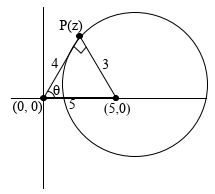
(D) $|z-5| \le 3$ એ $(5, 0)$ કેન્દ્ર અને $3$ ત્રિજ્યા ધરાવતું વર્તુળ દર્શાવે છે. $z$ નો કોણાંક મહત્તમ હોય તે માટે,ઉગમબિંદુમાંથી દોરેલી રેખા વર્તુળને બિંદુ $P(z)$ પર સ્પર્શવી જોઈએ.
ઉગમબિંદુ $(0, 0)$,કેન્દ્ર $(5, 0)$ અને બિંદુ $P(z)$ દ્વારા બનતા કાટકોણ ત્રિકોણમાં,કર્ણ $5$ છે અને ત્રિજ્યા $3$ છે. તેથી,ઉગમબિંદુથી $P$ નું અંતર $\sqrt{5^2 - 3^2} = 4$ છે.
ધારો કે $z = x + iy$. ભૂમિતિ પરથી,$\cos \theta = \frac{4}{5}$ અને $\sin \theta = \frac{3}{5}$.
તેથી,$z = 4(\cos \theta + i \sin \theta) = 4(\frac{4}{5} + i \frac{3}{5}) = \frac{16}{5} + i \frac{12}{5}$.
હવે,$z$ ની કિંમત પદમાં મૂકતા:
$5z - 12 = 5(\frac{16}{5} + i \frac{12}{5}) - 12 = 16 + 12i - 12 = 4 + 12i$.
$5iz + 16 = 5i(\frac{16}{5} + i \frac{12}{5}) + 16 = 16i - 12 + 16 = 4 + 16i$.
તેથી,$|\frac{5z-12}{5iz+16}|^2 = |\frac{4+12i}{4+16i}|^2 = |\frac{1+3i}{1+4i}|^2 = \frac{1^2 + 3^2}{1^2 + 4^2} = \frac{1+9}{1+16} = \frac{10}{17}$.
અંતે,$34 \times \frac{10}{17} = 2 \times 10 = 20$.
ઉગમબિંદુ $(0, 0)$,કેન્દ્ર $(5, 0)$ અને બિંદુ $P(z)$ દ્વારા બનતા કાટકોણ ત્રિકોણમાં,કર્ણ $5$ છે અને ત્રિજ્યા $3$ છે. તેથી,ઉગમબિંદુથી $P$ નું અંતર $\sqrt{5^2 - 3^2} = 4$ છે.
ધારો કે $z = x + iy$. ભૂમિતિ પરથી,$\cos \theta = \frac{4}{5}$ અને $\sin \theta = \frac{3}{5}$.
તેથી,$z = 4(\cos \theta + i \sin \theta) = 4(\frac{4}{5} + i \frac{3}{5}) = \frac{16}{5} + i \frac{12}{5}$.
હવે,$z$ ની કિંમત પદમાં મૂકતા:
$5z - 12 = 5(\frac{16}{5} + i \frac{12}{5}) - 12 = 16 + 12i - 12 = 4 + 12i$.
$5iz + 16 = 5i(\frac{16}{5} + i \frac{12}{5}) + 16 = 16i - 12 + 16 = 4 + 16i$.
તેથી,$|\frac{5z-12}{5iz+16}|^2 = |\frac{4+12i}{4+16i}|^2 = |\frac{1+3i}{1+4i}|^2 = \frac{1^2 + 3^2}{1^2 + 4^2} = \frac{1+9}{1+16} = \frac{10}{17}$.
અંતે,$34 \times \frac{10}{17} = 2 \times 10 = 20$.
0 likesView Solution
54
MathematicsMediumMCQJEE Main · 2026
ધારો કે $A = \{x : |x^{2} - 10| \le 6\}$ અને $B = \{x : |x - 2| > 1\}$. તો:
A
$A \cup B = (-\infty, 1) \cup [2, \infty)$
B
$A - B = [2, 3]$
C
$A \cap B = [-4, -2] \cup (3, 4]$
D
$B - A = (-\infty, -4) \cup (-2, 1) \cup (4, \infty)$
Solution
(C) $|x^{2} - 10| \le 6$ આપેલ છે,તેથી $-6 \le x^{2} - 10 \le 6$.
બધી બાજુ $10$ ઉમેરતા,$4 \le x^{2} \le 16$ મળે.
વર્ગમૂળ લેતા,$x \in [-4, -2] \cup [2, 4]$,તેથી $A = [-4, -2] \cup [2, 4]$.
$|x - 2| > 1$ આપેલ છે,તેથી $x - 2 > 1$ અથવા $x - 2 < -1$.
આનો અર્થ $x > 3$ અથવા $x < 1$ થાય,તેથી $B = (-\infty, 1) \cup (3, \infty)$.
હવે,$A \cap B = ([-4, -2] \cup [2, 4]) \cap ((-\infty, 1) \cup (3, \infty)) = [-4, -2] \cup (3, 4]$.
આમ,વિકલ્પ $C$ સાચો છે.
બધી બાજુ $10$ ઉમેરતા,$4 \le x^{2} \le 16$ મળે.
વર્ગમૂળ લેતા,$x \in [-4, -2] \cup [2, 4]$,તેથી $A = [-4, -2] \cup [2, 4]$.
$|x - 2| > 1$ આપેલ છે,તેથી $x - 2 > 1$ અથવા $x - 2 < -1$.
આનો અર્થ $x > 3$ અથવા $x < 1$ થાય,તેથી $B = (-\infty, 1) \cup (3, \infty)$.
હવે,$A \cap B = ([-4, -2] \cup [2, 4]) \cap ((-\infty, 1) \cup (3, \infty)) = [-4, -2] \cup (3, 4]$.
આમ,વિકલ્પ $C$ સાચો છે.
0 likesView Solution
55
MathematicsMediumMCQJEE Main · 2026
ધારો કે $a_1, \frac{a_2}{2}, \frac{a_3}{2^2}, \ldots, \frac{a_{10}}{2^9}$ એ $r = \frac{1}{\sqrt{2}}$ સામાન્ય ગુણોત્તર ધરાવતી સમગુણોત્તર શ્રેણી ($G$.$P$.) છે. જો $a_1 + a_2 + \ldots + a_{10} = 62$ હોય,તો $a_1$ ની કિંમત શોધો:
A
$2(\sqrt{2}-1)$
B
$2-\sqrt{2}$
C
$\sqrt{2}-1$
D
$2(2-\sqrt{2})$
Solution
(A) આપેલ શ્રેણીનો સામાન્ય ગુણોત્તર $\frac{1}{\sqrt{2}}$ છે.
તેથી,$\frac{a_2/2}{a_1} = \frac{a_3/2^2}{a_2/2} = \frac{1}{\sqrt{2}}$.
આનો અર્થ એ છે કે $\frac{a_2}{2a_1} = \frac{a_3}{2a_2} = \frac{1}{\sqrt{2}}$,તેથી $\frac{a_2}{a_1} = \sqrt{2}$.
આમ,$a_1, a_2, \ldots, a_{10}$ એ $a_1$ પ્રથમ પદ અને $R = \sqrt{2}$ સામાન્ય ગુણોત્તર ધરાવતી સમગુણોત્તર શ્રેણી છે.
પ્રથમ $10$ પદોનો સરવાળો $S_{10} = a_1 \frac{R^{10}-1}{R-1} = 62$.
$a_1 \frac{(\sqrt{2})^{10}-1}{\sqrt{2}-1} = 62$.
$a_1 \frac{31}{\sqrt{2}-1} = 62$.
$a_1 = 2(\sqrt{2}-1)$.
તેથી,$\frac{a_2/2}{a_1} = \frac{a_3/2^2}{a_2/2} = \frac{1}{\sqrt{2}}$.
આનો અર્થ એ છે કે $\frac{a_2}{2a_1} = \frac{a_3}{2a_2} = \frac{1}{\sqrt{2}}$,તેથી $\frac{a_2}{a_1} = \sqrt{2}$.
આમ,$a_1, a_2, \ldots, a_{10}$ એ $a_1$ પ્રથમ પદ અને $R = \sqrt{2}$ સામાન્ય ગુણોત્તર ધરાવતી સમગુણોત્તર શ્રેણી છે.
પ્રથમ $10$ પદોનો સરવાળો $S_{10} = a_1 \frac{R^{10}-1}{R-1} = 62$.
$a_1 \frac{(\sqrt{2})^{10}-1}{\sqrt{2}-1} = 62$.
$a_1 \frac{31}{\sqrt{2}-1} = 62$.
$a_1 = 2(\sqrt{2}-1)$.
0 likesView Solution
56
MathematicsDifficultMCQJEE Main · 2026
ધારો કે $\alpha$ અને $\beta$ એ સમીકરણ $x^{2}+2ax+(3a+10) = 0$ ના બીજ છે,જેથી $\alpha < 1 < \beta$ થાય. તો $a$ ની તમામ શક્ય કિંમતોનો ગણ કયો છે?
A
$(-\infty, -11/5) \cup (5, \infty)$
B
$(-\infty, -2) \cup (5, \infty)$
C
$(-\infty, -3)$
D
$(-\infty, -11/5)$
Solution
(D) આપેલ દ્વિઘાત સમીકરણ $f(x) = x^{2}+2ax+(3a+10) = 0$ છે.
કારણ કે બીજ $\alpha$ અને $\beta$ એ $\alpha < 1 < \beta$ શરતનું પાલન કરે છે,તેથી $x=1$ આગળ વિધેયની કિંમત ઋણ હોવી જોઈએ,એટલે કે $f(1) < 0$.
$x=1$ મુકતા:
$f(1) = (1)^{2} + 2a(1) + (3a+10) < 0$
$1 + 2a + 3a + 10 < 0$
$5a + 11 < 0$
$5a < -11$
$a < -11/5$
તેથી,$a$ ની તમામ શક્ય કિંમતોનો ગણ $(-\infty, -11/5)$ છે.
કારણ કે બીજ $\alpha$ અને $\beta$ એ $\alpha < 1 < \beta$ શરતનું પાલન કરે છે,તેથી $x=1$ આગળ વિધેયની કિંમત ઋણ હોવી જોઈએ,એટલે કે $f(1) < 0$.
$x=1$ મુકતા:
$f(1) = (1)^{2} + 2a(1) + (3a+10) < 0$
$1 + 2a + 3a + 10 < 0$
$5a + 11 < 0$
$5a < -11$
$a < -11/5$
તેથી,$a$ ની તમામ શક્ય કિંમતોનો ગણ $(-\infty, -11/5)$ છે.
0 likesView Solution
57
MathematicsDifficultMCQJEE Main · 2026
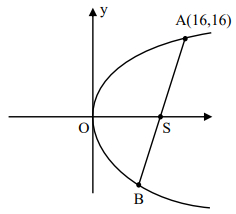
ધારો કે પરવલય $y^{2}=16x$ ની નાભિ જીવાના એક અંત્યબિંદુના યામ $(16, 16)$ છે. જો $P(\alpha, \beta)$ આ નાભિ જીવાનું $5 : 2$ ના ગુણોત્તરમાં અંતઃવિભાજન કરે,તો $\alpha+\beta$ ની ન્યૂનતમ કિંમત કેટલી થાય?
A
$22$
B
$7$
C
$5$
D
$16$
Solution
(B) પરવલયનું સમીકરણ $y^{2}=16x$ છે,જે $y^{2}=4ax$ સ્વરૂપમાં છે,જ્યાં $a=4$.
ધારો કે બિંદુ $A$ ના યામ $(at_{1}^{2}, 2at_{1}) = (16, 16)$ છે.
તેથી,$2(4)t_{1} = 16 \Rightarrow t_{1}=2$.
$AB$ નાભિ જીવા હોવાથી,તેના અંત્યબિંદુઓના પ્રાચલનો ગુણાકાર $t_{1}t_{2}=-1$ થાય.
તેથી,$2t_{2}=-1 \Rightarrow t_{2}=-\frac{1}{2}$.
બિંદુ $B$ ના યામ $(at_{2}^{2}, 2at_{2}) = (4(-\frac{1}{2})^{2}, 2(4)(-\frac{1}{2})) = (1, -4)$ મળે.
બિંદુ $P(\alpha, \beta)$ જીવા $AB$ નું $5:2$ ના ગુણોત્તરમાં અંતઃવિભાજન કરે છે.
કિસ્સો $1$: $P$ એ $AB$ નું $5:2$ ના ગુણોત્તરમાં વિભાજન કરે છે:
$\alpha = \frac{5(1) + 2(16)}{5+2} = \frac{37}{7}$,$\beta = \frac{5(-4) + 2(16)}{5+2} = \frac{12}{7}$.
$\alpha+\beta = \frac{37+12}{7} = \frac{49}{7} = 7$.
કિસ્સો $2$: $P$ એ $BA$ નું $5:2$ ના ગુણોત્તરમાં વિભાજન કરે છે:
$\alpha = \frac{5(16) + 2(1)}{5+2} = \frac{82}{7}$,$\beta = \frac{5(16) + 2(-4)}{5+2} = \frac{72}{7}$.
$\alpha+\beta = \frac{82+72}{7} = \frac{154}{7} = 22$.
$\alpha+\beta$ ની ન્યૂનતમ કિંમત $7$ છે.
ધારો કે બિંદુ $A$ ના યામ $(at_{1}^{2}, 2at_{1}) = (16, 16)$ છે.
તેથી,$2(4)t_{1} = 16 \Rightarrow t_{1}=2$.
$AB$ નાભિ જીવા હોવાથી,તેના અંત્યબિંદુઓના પ્રાચલનો ગુણાકાર $t_{1}t_{2}=-1$ થાય.
તેથી,$2t_{2}=-1 \Rightarrow t_{2}=-\frac{1}{2}$.
બિંદુ $B$ ના યામ $(at_{2}^{2}, 2at_{2}) = (4(-\frac{1}{2})^{2}, 2(4)(-\frac{1}{2})) = (1, -4)$ મળે.
બિંદુ $P(\alpha, \beta)$ જીવા $AB$ નું $5:2$ ના ગુણોત્તરમાં અંતઃવિભાજન કરે છે.
કિસ્સો $1$: $P$ એ $AB$ નું $5:2$ ના ગુણોત્તરમાં વિભાજન કરે છે:
$\alpha = \frac{5(1) + 2(16)}{5+2} = \frac{37}{7}$,$\beta = \frac{5(-4) + 2(16)}{5+2} = \frac{12}{7}$.
$\alpha+\beta = \frac{37+12}{7} = \frac{49}{7} = 7$.
કિસ્સો $2$: $P$ એ $BA$ નું $5:2$ ના ગુણોત્તરમાં વિભાજન કરે છે:
$\alpha = \frac{5(16) + 2(1)}{5+2} = \frac{82}{7}$,$\beta = \frac{5(16) + 2(-4)}{5+2} = \frac{72}{7}$.
$\alpha+\beta = \frac{82+72}{7} = \frac{154}{7} = 22$.
$\alpha+\beta$ ની ન્યૂનતમ કિંમત $7$ છે.
0 likesView Solution
58
MathematicsDifficultMCQJEE Main · 2026
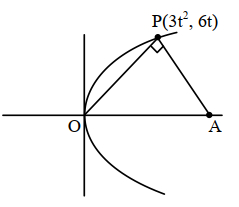
ધારો કે $y^{2}=12x$ એ પરવલય છે જેનું શિરોબિંદુ $O(0,0)$ પર છે. ધારો કે $P$ એ પરવલય પરનું બિંદુ છે અને $A$ એ $x$-અક્ષ પરનું બિંદુ છે જેથી $\angle OPA=90^{\circ}$ થાય. તો આવા ત્રિકોણ $OPA$ ના મધ્યકેન્દ્રનો બિંદુપથ શોધો:
A
$y^{2}-6x+4=0$
B
$y^{2}-9x+6=0$
C
$y^{2}-2x+8=0$
D
$y^{2}-4x+8=0$
Solution
(C) પરવલય $y^{2}=12x$ છે,તેથી $4a=12 \Rightarrow a=3$. પરવલય પરનું કોઈપણ બિંદુ $P(3t^{2}, 6t)$ તરીકે લઈ શકાય.
$OP$ નો ઢાળ $m_{OP} = \frac{2}{t}$ છે.
$\angle OPA=90^{\circ}$ હોવાથી,$OP \perp PA$,તેથી $PA$ નો ઢાળ $m_{PA} = -\frac{t}{2}$ છે.
$PA$ રેખાનું સમીકરણ $y-6t = -\frac{t}{2}(x-3t^{2})$ છે.
$x$-અક્ષ પરના બિંદુ $A$ માટે,$y=0$ લેતા: $x = 3t^{2}+12$.
તેથી,$A = (3t^{2}+12, 0)$.
$\triangle OPA$ ના મધ્યકેન્દ્ર $G(h, k)$ માટે:
$h = \frac{6t^{2}+12}{3} = 2t^{2}+4$ અને $k = \frac{6t}{3} = 2t$.
$t = \frac{k}{2}$ લેતા,$h = 2(\frac{k}{2})^{2}+4 = \frac{k^{2}}{2}+4$.
$2h = k^{2}+8 \Rightarrow k^{2} = 2h-8$.
આમ,બિંદુપથ $y^{2} = 2x-8$ અથવા $y^{2}-2x+8=0$ છે.
$OP$ નો ઢાળ $m_{OP} = \frac{2}{t}$ છે.
$\angle OPA=90^{\circ}$ હોવાથી,$OP \perp PA$,તેથી $PA$ નો ઢાળ $m_{PA} = -\frac{t}{2}$ છે.
$PA$ રેખાનું સમીકરણ $y-6t = -\frac{t}{2}(x-3t^{2})$ છે.
$x$-અક્ષ પરના બિંદુ $A$ માટે,$y=0$ લેતા: $x = 3t^{2}+12$.
તેથી,$A = (3t^{2}+12, 0)$.
$\triangle OPA$ ના મધ્યકેન્દ્ર $G(h, k)$ માટે:
$h = \frac{6t^{2}+12}{3} = 2t^{2}+4$ અને $k = \frac{6t}{3} = 2t$.
$t = \frac{k}{2}$ લેતા,$h = 2(\frac{k}{2})^{2}+4 = \frac{k^{2}}{2}+4$.
$2h = k^{2}+8 \Rightarrow k^{2} = 2h-8$.
આમ,બિંદુપથ $y^{2} = 2x-8$ અથવા $y^{2}-2x+8=0$ છે.
0 likesView Solution
59
MathematicsDifficultMCQJEE Main · 2026
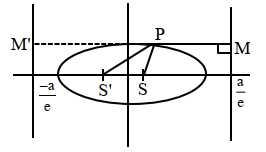
જો રેખા $\alpha x+4y=\sqrt{7}$,જ્યાં $\alpha \in R$,ઉપવલય $3x^{2}+4y^{2}=1$ ને પ્રથમ ચરણમાં બિંદુ $P$ આગળ સ્પર્શે છે,તો $P$ ના નાભિ અંતરો પૈકીનું એક અંતર શોધો:
A
$\frac{1}{\sqrt{3}}-\frac{1}{2\sqrt{11}}$
B
$\frac{1}{\sqrt{3}}+\frac{1}{2\sqrt{5}}$
C
$\frac{1}{\sqrt{3}}-\frac{1}{2\sqrt{5}}$
D
$\frac{1}{\sqrt{3}}+\frac{1}{2\sqrt{7}}$
Solution
(D) રેખાનું સમીકરણ $\alpha x+4y-\sqrt{7}=0$ છે. આ રેખા ઉપવલય $3x^{2}+4y^{2}=1$ ને સ્પર્શે છે.
સ્પર્શકની શરત $c^{2}=a^{2}m^{2}+b^{2}$ નો ઉપયોગ કરતા,આપણને $\alpha = \pm 3$ મળે છે.
પ્રથમ ચરણમાં બિંદુ $P$ માટે,સ્પર્શક $3x+4y=\sqrt{7}$ છે.
સ્પર્શબિંદુ $P$ ના યામ $(\frac{1}{\sqrt{7}}, \frac{1}{\sqrt{7}})$ મળે છે.
ઉપવલય માટે ઉત્કેન્દ્રિયતા $e = \frac{1}{2}$ છે.
નાભિ અંતરો $a \pm ex_{1}$ સૂત્ર દ્વારા મળે છે,જે $\frac{1}{\sqrt{3}} \pm \frac{1}{2\sqrt{7}}$ થાય છે.
તેથી,સાચો વિકલ્પ $D$ છે.
સ્પર્શકની શરત $c^{2}=a^{2}m^{2}+b^{2}$ નો ઉપયોગ કરતા,આપણને $\alpha = \pm 3$ મળે છે.
પ્રથમ ચરણમાં બિંદુ $P$ માટે,સ્પર્શક $3x+4y=\sqrt{7}$ છે.
સ્પર્શબિંદુ $P$ ના યામ $(\frac{1}{\sqrt{7}}, \frac{1}{\sqrt{7}})$ મળે છે.
ઉપવલય માટે ઉત્કેન્દ્રિયતા $e = \frac{1}{2}$ છે.
નાભિ અંતરો $a \pm ex_{1}$ સૂત્ર દ્વારા મળે છે,જે $\frac{1}{\sqrt{3}} \pm \frac{1}{2\sqrt{7}}$ થાય છે.
તેથી,સાચો વિકલ્પ $D$ છે.
0 likesView Solution
60
MathematicsDifficultMCQJEE Main · 2026
ધન પૂર્ણાંક $n$,જેના માટે સમીકરણ $x(x+2)+(x+2)(x+4)+...+(x+2n-2)(x+2n) = \frac{8n}{3}$ ના ઉકેલો બે ક્રમિક બેકી પૂર્ણાંકો હોય,તે છે:
A
$3$
B
$6$
C
$12$
D
$9$
Solution
(A) આપેલ સમીકરણ $\sum_{r=1}^{n}(x+2r-2)(x+2r) = \frac{8n}{3}$ છે.
પદોનું વિસ્તરણ કરતા: $\sum_{r=1}^{n}(x^2 + 4rx - 2x + 4r^2 - 4r) = \frac{8n}{3}$.
આનું સાદું રૂપ $nx^2 + 2x(2\sum r - n) + 4\sum r^2 - 4\sum r = \frac{8n}{3}$ થાય છે.
$\sum_{r=1}^{n} r = \frac{n(n+1)}{2}$ અને $\sum_{r=1}^{n} r^2 = \frac{n(n+1)(2n+1)}{6}$ નો ઉપયોગ કરતા,આપણને $nx^2 + 2x(n^2) + \frac{4n(n+1)(2n+1)}{6} - 2n(n+1) = \frac{8n}{3}$ મળે છે.
$n$ વડે ભાગતા: $x^2 + 2nx + \frac{2(n+1)(2n+1)}{3} - 2(n+1) = \frac{8}{3}$.
$x^2 + 2nx + \frac{4n^2+6n+2-6n-6-8}{3} = 0 \Rightarrow x^2 + 2nx + \frac{4n^2-12}{3} = 0$.
કારણ કે ઉકેલો $\alpha, \beta$ બે ક્રમિક બેકી પૂર્ણાંકો છે,તેથી $|\alpha - \beta| = 2$.
આમ,$\frac{\sqrt{D}}{1} = 2 \Rightarrow D = 4$.
$D = (2n)^2 - 4(\frac{4n^2-12}{3}) = 4$.
$4n^2 - \frac{16n^2-48}{3} = 4 \Rightarrow 12n^2 - 16n^2 + 48 = 12$.
$-4n^2 = -36$ $\Rightarrow n^2 = 9$ $\Rightarrow n = 3$.
પદોનું વિસ્તરણ કરતા: $\sum_{r=1}^{n}(x^2 + 4rx - 2x + 4r^2 - 4r) = \frac{8n}{3}$.
આનું સાદું રૂપ $nx^2 + 2x(2\sum r - n) + 4\sum r^2 - 4\sum r = \frac{8n}{3}$ થાય છે.
$\sum_{r=1}^{n} r = \frac{n(n+1)}{2}$ અને $\sum_{r=1}^{n} r^2 = \frac{n(n+1)(2n+1)}{6}$ નો ઉપયોગ કરતા,આપણને $nx^2 + 2x(n^2) + \frac{4n(n+1)(2n+1)}{6} - 2n(n+1) = \frac{8n}{3}$ મળે છે.
$n$ વડે ભાગતા: $x^2 + 2nx + \frac{2(n+1)(2n+1)}{3} - 2(n+1) = \frac{8}{3}$.
$x^2 + 2nx + \frac{4n^2+6n+2-6n-6-8}{3} = 0 \Rightarrow x^2 + 2nx + \frac{4n^2-12}{3} = 0$.
કારણ કે ઉકેલો $\alpha, \beta$ બે ક્રમિક બેકી પૂર્ણાંકો છે,તેથી $|\alpha - \beta| = 2$.
આમ,$\frac{\sqrt{D}}{1} = 2 \Rightarrow D = 4$.
$D = (2n)^2 - 4(\frac{4n^2-12}{3}) = 4$.
$4n^2 - \frac{16n^2-48}{3} = 4 \Rightarrow 12n^2 - 16n^2 + 48 = 12$.
$-4n^2 = -36$ $\Rightarrow n^2 = 9$ $\Rightarrow n = 3$.
0 likesView Solution
61
MathematicsDifficultMCQJEE Main · 2026
ધારો કે $S$ એ પ્રથમ $11$ પ્રાકૃતિક સંખ્યાઓનો ગણ છે. તો $A = \{B \subseteq S : n(B) \ge 2 \text{ અને } B \text{ ના તમામ ઘટકોનો ગુણાકાર બેકી છે}\}$ માં ઘટકોની સંખ્યા . . . . . . . છે.
A
$1979$
B
$2048$
C
$1984$
D
$1974$
Solution
(A) ગણ $S = \{1, 2, 3, . . . , 11\}$ માં $6$ એકી સંખ્યાઓ $\{1, 3, 5, 7, 9, 11\}$ અને $5$ બેકી સંખ્યાઓ $\{2, 4, 6, 8, 10\}$ છે.
$S$ ના કુલ ઉપગણોની સંખ્યા $2^{11} = 2048$ છે.
ઉપગણ $B$ નો ગુણાકાર એકી હોય જો અને માત્ર જો $B$ ના તમામ ઘટકો એકી હોય. આવા ઉપગણોની સંખ્યા $2^6 = 64$ છે.
ઉપગણ $B$ નો ગુણાકાર બેકી હોય જો તેમાં ઓછામાં ઓછી એક બેકી સંખ્યા હોય. આવા ઉપગણોની સંખ્યા $2^{11} - 2^6 = 2048 - 64 = 1984$ છે.
શરત $n(B) \ge 2$ એ $0$ અથવા $1$ ઘટક ધરાવતા ઉપગણોને બાકાત રાખે છે.
$0$ ઘટક ધરાવતા ઉપગણો: $\emptyset$ (ગુણાકાર વ્યાખ્યાયિત નથી અથવા એકી ગણાય છે,તેથી તે બાકાત છે).
$1$ ઘટક ધરાવતા ઉપગણો: $\{1\}, \{3\}, \{5\}, \{7\}, \{9\}, \{11\}$ (બધા એકી ગુણાકાર) અને $\{2\}, \{4\}, \{6\}, \{8\}, \{10\}$ (બધા બેકી ગુણાકાર).
આપણે તે $5$ ઉપગણોને બાકાત રાખવા જોઈએ જે બરાબર એક બેકી સંખ્યા ધરાવે છે (કારણ કે તેમનો ગુણાકાર બેકી છે પણ $n(B) < 2$ છે).
તેથી,જરૂરી ઉપગણોની સંખ્યા $1984 - 5 = 1979$ છે.
$S$ ના કુલ ઉપગણોની સંખ્યા $2^{11} = 2048$ છે.
ઉપગણ $B$ નો ગુણાકાર એકી હોય જો અને માત્ર જો $B$ ના તમામ ઘટકો એકી હોય. આવા ઉપગણોની સંખ્યા $2^6 = 64$ છે.
ઉપગણ $B$ નો ગુણાકાર બેકી હોય જો તેમાં ઓછામાં ઓછી એક બેકી સંખ્યા હોય. આવા ઉપગણોની સંખ્યા $2^{11} - 2^6 = 2048 - 64 = 1984$ છે.
શરત $n(B) \ge 2$ એ $0$ અથવા $1$ ઘટક ધરાવતા ઉપગણોને બાકાત રાખે છે.
$0$ ઘટક ધરાવતા ઉપગણો: $\emptyset$ (ગુણાકાર વ્યાખ્યાયિત નથી અથવા એકી ગણાય છે,તેથી તે બાકાત છે).
$1$ ઘટક ધરાવતા ઉપગણો: $\{1\}, \{3\}, \{5\}, \{7\}, \{9\}, \{11\}$ (બધા એકી ગુણાકાર) અને $\{2\}, \{4\}, \{6\}, \{8\}, \{10\}$ (બધા બેકી ગુણાકાર).
આપણે તે $5$ ઉપગણોને બાકાત રાખવા જોઈએ જે બરાબર એક બેકી સંખ્યા ધરાવે છે (કારણ કે તેમનો ગુણાકાર બેકી છે પણ $n(B) < 2$ છે).
તેથી,જરૂરી ઉપગણોની સંખ્યા $1984 - 5 = 1979$ છે.
0 likesView Solution
62
MathematicsDifficultMCQJEE Main · 2026
ધારો કે $a, b, c$ એ $A.P.$ માં છે અને $a^{2}, 2b^{2}, c^{2}$ એ $G.P.$ માં છે. જો $a < b < c$ અને $a+b+c=1$ હોય,તો $9(a^{2}+b^{2}+c^{2})$ ની કિંમત . . . . . . થાય.
A
$7$
B
$9$
C
$12$
D
$15$
Solution
(B) આપેલ છે કે $a, b, c$ એ $A.P.$ માં છે,તેથી $a = b - d$ અને $c = b + d$ લો.
$a+b+c=1$ હોવાથી,$(b-d) + b + (b+d) = 1,$ જેનો અર્થ છે કે $3b = 1$ અથવા $b = \frac{1}{3}.$
$a^{2}, 2b^{2}, c^{2}$ એ $G.P.$ માં હોવાથી,$(2b^{2})^{2} = a^{2}c^{2},$ એટલે કે $4b^{4} = (ac)^{2}.$
$a = b-d$ અને $c = b+d$ મૂકતા,$4b^{4} = ((b-d)(b+d))^{2} = (b^{2}-d^{2})^{2}.$
વર્ગમૂળ લેતા,$b^{2}-d^{2} = \pm 2b^{2}.$
કિસ્સો $1: b^{2}-d^{2} = 2b^{2} \Rightarrow d^{2} = -b^{2}$ (વાસ્તવિક $d$ માટે શક્ય નથી).
કિસ્સો $2: b^{2}-d^{2} = -2b^{2} \Rightarrow d^{2} = 3b^{2} = 3(\frac{1}{9}) = \frac{1}{3}.$
$a < b < c$ હોવાથી,$d$ ધન હોવો જોઈએ,તેથી $d = \frac{1}{\sqrt{3}}.$
હવે,$a^{2}+b^{2}+c^{2} = (b-d)^{2} + b^{2} + (b+d)^{2} = 3b^{2} + 2d^{2}.$
કિંમતો મૂકતા: $3(\frac{1}{9}) + 2(\frac{1}{3}) = \frac{1}{3} + \frac{2}{3} = 1.$
તેથી,$9(a^{2}+b^{2}+c^{2}) = 9(1) = 9.$
$a+b+c=1$ હોવાથી,$(b-d) + b + (b+d) = 1,$ જેનો અર્થ છે કે $3b = 1$ અથવા $b = \frac{1}{3}.$
$a^{2}, 2b^{2}, c^{2}$ એ $G.P.$ માં હોવાથી,$(2b^{2})^{2} = a^{2}c^{2},$ એટલે કે $4b^{4} = (ac)^{2}.$
$a = b-d$ અને $c = b+d$ મૂકતા,$4b^{4} = ((b-d)(b+d))^{2} = (b^{2}-d^{2})^{2}.$
વર્ગમૂળ લેતા,$b^{2}-d^{2} = \pm 2b^{2}.$
કિસ્સો $1: b^{2}-d^{2} = 2b^{2} \Rightarrow d^{2} = -b^{2}$ (વાસ્તવિક $d$ માટે શક્ય નથી).
કિસ્સો $2: b^{2}-d^{2} = -2b^{2} \Rightarrow d^{2} = 3b^{2} = 3(\frac{1}{9}) = \frac{1}{3}.$
$a < b < c$ હોવાથી,$d$ ધન હોવો જોઈએ,તેથી $d = \frac{1}{\sqrt{3}}.$
હવે,$a^{2}+b^{2}+c^{2} = (b-d)^{2} + b^{2} + (b+d)^{2} = 3b^{2} + 2d^{2}.$
કિંમતો મૂકતા: $3(\frac{1}{9}) + 2(\frac{1}{3}) = \frac{1}{3} + \frac{2}{3} = 1.$
તેથી,$9(a^{2}+b^{2}+c^{2}) = 9(1) = 9.$
0 likesView Solution
63
MathematicsDifficultMCQJEE Main · 2026
ધારો કે $\cos(\alpha+\beta)=-\frac{1}{10}$ અને $\sin(\alpha-\beta)=\frac{3}{8}$ જ્યાં $0 < \alpha < \frac{\pi}{3}$ અને $0 < \beta < \frac{\pi}{4}$. જો $\tan 2\alpha=\frac{3(1-r\sqrt{5})}{\sqrt{11}(s+\sqrt{5})}$,જ્યાં $r, s \in N$,તો $r+s$ ની કિંમત . . . . . . થાય.
A
$10$
B
$15$
C
$20$
D
$25$
Solution
(C) આપેલ છે $\cos(\alpha+\beta) = -\frac{1}{10}$. $0 < \alpha < \frac{\pi}{3}$ અને $0 < \beta < \frac{\pi}{4}$ હોવાથી,$0 < \alpha+\beta < \frac{7\pi}{12}$. $\cos(\alpha+\beta) < 0$ હોવાથી,$\frac{\pi}{2} < \alpha+\beta < \frac{7\pi}{12}$.
તેથી,$\sin(\alpha+\beta) = \sqrt{1 - (-\frac{1}{10})^2} = \sqrt{\frac{99}{100}} = \frac{3\sqrt{11}}{10}$.
તેથી,$\tan(\alpha+\beta) = \frac{3\sqrt{11}/10}{-1/10} = -3\sqrt{11}$.
આપેલ છે $\sin(\alpha-\beta) = \frac{3}{8}$. $0 < \alpha < \frac{\pi}{3}$ અને $0 < \beta < \frac{\pi}{4}$ હોવાથી,$-\frac{\pi}{4} < \alpha-\beta < \frac{\pi}{3}$. $\sin(\alpha-\beta) > 0$ હોવાથી,$0 < \alpha-\beta < \frac{\pi}{3}$.
તેથી,$\cos(\alpha-\beta) = \sqrt{1 - (\frac{3}{8})^2} = \sqrt{\frac{55}{64}} = \frac{\sqrt{55}}{8}$.
તેથી,$\tan(\alpha-\beta) = \frac{3/8}{\sqrt{55}/8} = \frac{3}{\sqrt{55}}$.
હવે,$\tan 2\alpha = \tan((\alpha+\beta)+(\alpha-\beta)) = \frac{\tan(\alpha+\beta) + \tan(\alpha-\beta)}{1 - \tan(\alpha+\beta)\tan(\alpha-\beta)}$.
કિંમતો મૂકતા,$\tan 2\alpha = \frac{-3\sqrt{11} + \frac{3}{\sqrt{55}}}{1 - (-3\sqrt{11})(\frac{3}{\sqrt{55}})} = \frac{\frac{-3\sqrt{11}\sqrt{55} + 3}{\sqrt{55}}}{1 + \frac{9\sqrt{11}}{\sqrt{55}}} = \frac{-3(11\sqrt{5}) + 3}{\sqrt{55} + 9\sqrt{11}} = \frac{3(1 - 11\sqrt{5})}{\sqrt{11}(\sqrt{5} + 9)}$.
$\frac{3(1-r\sqrt{5})}{\sqrt{11}(s+\sqrt{5})}$ સાથે સરખાવતા,આપણને $r=11$ અને $s=9$ મળે છે.
તેથી,$r+s = 11+9 = 20$.
તેથી,$\sin(\alpha+\beta) = \sqrt{1 - (-\frac{1}{10})^2} = \sqrt{\frac{99}{100}} = \frac{3\sqrt{11}}{10}$.
તેથી,$\tan(\alpha+\beta) = \frac{3\sqrt{11}/10}{-1/10} = -3\sqrt{11}$.
આપેલ છે $\sin(\alpha-\beta) = \frac{3}{8}$. $0 < \alpha < \frac{\pi}{3}$ અને $0 < \beta < \frac{\pi}{4}$ હોવાથી,$-\frac{\pi}{4} < \alpha-\beta < \frac{\pi}{3}$. $\sin(\alpha-\beta) > 0$ હોવાથી,$0 < \alpha-\beta < \frac{\pi}{3}$.
તેથી,$\cos(\alpha-\beta) = \sqrt{1 - (\frac{3}{8})^2} = \sqrt{\frac{55}{64}} = \frac{\sqrt{55}}{8}$.
તેથી,$\tan(\alpha-\beta) = \frac{3/8}{\sqrt{55}/8} = \frac{3}{\sqrt{55}}$.
હવે,$\tan 2\alpha = \tan((\alpha+\beta)+(\alpha-\beta)) = \frac{\tan(\alpha+\beta) + \tan(\alpha-\beta)}{1 - \tan(\alpha+\beta)\tan(\alpha-\beta)}$.
કિંમતો મૂકતા,$\tan 2\alpha = \frac{-3\sqrt{11} + \frac{3}{\sqrt{55}}}{1 - (-3\sqrt{11})(\frac{3}{\sqrt{55}})} = \frac{\frac{-3\sqrt{11}\sqrt{55} + 3}{\sqrt{55}}}{1 + \frac{9\sqrt{11}}{\sqrt{55}}} = \frac{-3(11\sqrt{5}) + 3}{\sqrt{55} + 9\sqrt{11}} = \frac{3(1 - 11\sqrt{5})}{\sqrt{11}(\sqrt{5} + 9)}$.
$\frac{3(1-r\sqrt{5})}{\sqrt{11}(s+\sqrt{5})}$ સાથે સરખાવતા,આપણને $r=11$ અને $s=9$ મળે છે.
તેથી,$r+s = 11+9 = 20$.
0 likesView Solution
64
MathematicsDifficultMCQJEE Main · 2026
ધારો કે $C_{r}$ એ $(1+x)^{n}$,$n \in N$,$0 \leq r \leq n$ ના દ્વિપદી વિસ્તરણમાં $x^{r}$ નો સહગુણક છે. જો $P_{n} = C_{0} - C_{1} + \frac{2^{2}}{3}C_{2} - \frac{2^{3}}{4}C_{3} + \dots + \frac{(-2)^{n}}{n+1}C_{n}$ હોય,તો $\sum_{n=1}^{25} \frac{1}{P_{2n}}$ ની કિંમત શોધો.
A
$580$
B
$525$
C
$650$
D
$675$
Solution
(D) $P_n = \sum_{r=0}^n \frac{{}^n C_r(-2)^r}{r+1} = \sum_{r=0}^n \frac{1}{n+1} {}^{n+1} C_{r+1}(-2)^r$
$= \frac{-1}{2(n+1)} \sum_{r=0}^n {}^{n+1} C_{r+1}(-2)^{r+1}$
$= \frac{-1}{2(n+1)} \left[(1-2)^{n+1} - 1\right]$
$P_n = \frac{1}{2(n+1)} \left[1 - (-1)^{n+1}\right]$
$P_{2n} = \frac{1}{2(2n+1)} \left[1 - (-1)^{2n+1}\right]$
$P_{2n} = \frac{1}{2n+1}$
$\sum_{n=1}^{25} \frac{1}{P_{2n}} = \sum_{n=1}^{25} (2n+1)$
$= 3 + 5 + \dots + 51$
$= \frac{25}{2} [51 + 3]$
$= 25 \times 27 = 675$
$= \frac{-1}{2(n+1)} \sum_{r=0}^n {}^{n+1} C_{r+1}(-2)^{r+1}$
$= \frac{-1}{2(n+1)} \left[(1-2)^{n+1} - 1\right]$
$P_n = \frac{1}{2(n+1)} \left[1 - (-1)^{n+1}\right]$
$P_{2n} = \frac{1}{2(2n+1)} \left[1 - (-1)^{2n+1}\right]$
$P_{2n} = \frac{1}{2n+1}$
$\sum_{n=1}^{25} \frac{1}{P_{2n}} = \sum_{n=1}^{25} (2n+1)$
$= 3 + 5 + \dots + 51$
$= \frac{25}{2} [51 + 3]$
$= 25 \times 27 = 675$
0 likesView Solution
65
MathematicsDifficultMCQJEE Main · 2026
ધારો કે પરવલય $y^{2}=4x$ ના ઉગમબિંદુ $O$ માંથી પસાર થતી જીવાના મધ્યબિંદુનો બિંદુપથ વક્ર $S$ છે. ધારો કે $P$ એ $S$ પરનું કોઈપણ બિંદુ છે. તો $OP$ નું $3:1$ ગુણોત્તરમાં અંતઃવિભાજન કરતા બિંદુનો બિંદુપથ શોધો:
A
$3y^2=2x$
B
$2y^2=3x$
C
$3x^2=2y$
D
$2x^2=3y$
Solution
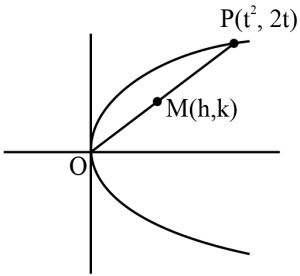
(B) ધારો કે પરવલય $y^2=4x$ છે. પરવલય પરનું કોઈપણ બિંદુ $P(t^2, 2t)$ છે.
જીવા ઉગમબિંદુ $O(0,0)$ અને $P(t^2, 2t)$ માંથી પસાર થાય છે.
જીવા $OP$ નું મધ્યબિંદુ $M(h, k)$ એ $h = \frac{t^2+0}{2} = \frac{t^2}{2}$ અને $k = \frac{2t+0}{2} = t$ દ્વારા મળે છે.
$t=k$ ને $h = \frac{t^2}{2}$ માં મૂકતા,આપણને $h = \frac{k^2}{2}$ મળે છે,તેથી $k^2=2h$.
બિંદુપથ $S$ એ $y^2=2x$ છે.
ધારો કે $P(x_0, y_0)$ એ $S$ પરનું બિંદુ છે,તેથી $y_0^2=2x_0$. $P$ એ $S$ પર હોવાથી,આપણે $P$ ને $(2t^2, 2t)$ તરીકે લખી શકીએ કારણ કે $(2t)^2 = 2(2t^2)$.
ધારો કે $R(x, y)$ એ બિંદુ છે જે $OP$ નું $3:1$ ગુણોત્તરમાં અંતઃવિભાજન કરે છે. વિભાજન સૂત્રનો ઉપયોગ કરતા:
$x = \frac{3(2t^2) + 1(0)}{3+1} = \frac{6t^2}{4} = \frac{3t^2}{2}$
$y = \frac{3(2t) + 1(0)}{3+1} = \frac{6t}{4} = \frac{3t}{2}$
$y = \frac{3t}{2}$ પરથી,આપણને $t = \frac{2y}{3}$ મળે છે.
$t$ ની કિંમત $x = \frac{3t^2}{2}$ માં મૂકતા:
$x = \frac{3}{2} \left(\frac{2y}{3}\right)^2 = \frac{3}{2} \cdot \frac{4y^2}{9} = \frac{2y^2}{3}$
આમ,$3x = 2y^2$,અથવા $2y^2=3x$.
જીવા ઉગમબિંદુ $O(0,0)$ અને $P(t^2, 2t)$ માંથી પસાર થાય છે.
જીવા $OP$ નું મધ્યબિંદુ $M(h, k)$ એ $h = \frac{t^2+0}{2} = \frac{t^2}{2}$ અને $k = \frac{2t+0}{2} = t$ દ્વારા મળે છે.
$t=k$ ને $h = \frac{t^2}{2}$ માં મૂકતા,આપણને $h = \frac{k^2}{2}$ મળે છે,તેથી $k^2=2h$.
બિંદુપથ $S$ એ $y^2=2x$ છે.
ધારો કે $P(x_0, y_0)$ એ $S$ પરનું બિંદુ છે,તેથી $y_0^2=2x_0$. $P$ એ $S$ પર હોવાથી,આપણે $P$ ને $(2t^2, 2t)$ તરીકે લખી શકીએ કારણ કે $(2t)^2 = 2(2t^2)$.
ધારો કે $R(x, y)$ એ બિંદુ છે જે $OP$ નું $3:1$ ગુણોત્તરમાં અંતઃવિભાજન કરે છે. વિભાજન સૂત્રનો ઉપયોગ કરતા:
$x = \frac{3(2t^2) + 1(0)}{3+1} = \frac{6t^2}{4} = \frac{3t^2}{2}$
$y = \frac{3(2t) + 1(0)}{3+1} = \frac{6t}{4} = \frac{3t}{2}$
$y = \frac{3t}{2}$ પરથી,આપણને $t = \frac{2y}{3}$ મળે છે.
$t$ ની કિંમત $x = \frac{3t^2}{2}$ માં મૂકતા:
$x = \frac{3}{2} \left(\frac{2y}{3}\right)^2 = \frac{3}{2} \cdot \frac{4y^2}{9} = \frac{2y^2}{3}$
આમ,$3x = 2y^2$,અથવા $2y^2=3x$.
0 likesView Solution
66
MathematicsDifficultMCQJEE Main · 2026
ધારો કે $S$ અને $S^{\prime}$ એ ઉપવલય $\frac{x^2}{25}+\frac{y^2}{9}=1$ ના નાભિઓ છે અને $P(\alpha, \beta)$ એ પ્રથમ ચરણમાં ઉપવલય પરનું એક બિંદુ છે. જો $(SP)^2+(S^{\prime}P)^2-SP \cdot S^{\prime}P=37$ હોય,તો $\alpha^2+\beta^2$ ની કિંમત શોધો:
A
$15$
B
$11$
C
$17$
D
$13$
Solution
(D) આપેલ ઉપવલય $\frac{x^2}{25}+\frac{y^2}{9}=1$ માટે,$a=5$ અને $b=3$ છે.
ઉત્કેન્દ્રિયતા $e = \frac{4}{5}$ છે.
નાભિઓ $S(4, 0)$ અને $S^{\prime}(-4, 0)$ છે.
$P(\alpha, \beta)$ ઉપવલય પર હોવાથી $SP+S^{\prime}P=10$.
આપેલ સમીકરણ $(SP)^2+(S^{\prime}P)^2-SP \cdot S^{\prime}P=37$ માં $(SP+S^{\prime}P)^2-3SP \cdot S^{\prime}P=37$ મૂકતા,
$100-3SP \cdot S^{\prime}P=37 \Rightarrow SP \cdot S^{\prime}P=21$.
$SP \cdot S^{\prime}P = a^2-e^2\alpha^2 = 25-\frac{16}{25}\alpha^2 = 21$.
$\frac{16}{25}\alpha^2 = 4 \Rightarrow \alpha^2 = \frac{25}{4}$.
$\frac{\alpha^2}{25}+\frac{\beta^2}{9}=1$ માં કિંમત મૂકતા,$\beta^2=\frac{27}{4}$.
તેથી $\alpha^2+\beta^2 = \frac{25}{4}+\frac{27}{4} = 13$.
ઉત્કેન્દ્રિયતા $e = \frac{4}{5}$ છે.
નાભિઓ $S(4, 0)$ અને $S^{\prime}(-4, 0)$ છે.
$P(\alpha, \beta)$ ઉપવલય પર હોવાથી $SP+S^{\prime}P=10$.
આપેલ સમીકરણ $(SP)^2+(S^{\prime}P)^2-SP \cdot S^{\prime}P=37$ માં $(SP+S^{\prime}P)^2-3SP \cdot S^{\prime}P=37$ મૂકતા,
$100-3SP \cdot S^{\prime}P=37 \Rightarrow SP \cdot S^{\prime}P=21$.
$SP \cdot S^{\prime}P = a^2-e^2\alpha^2 = 25-\frac{16}{25}\alpha^2 = 21$.
$\frac{16}{25}\alpha^2 = 4 \Rightarrow \alpha^2 = \frac{25}{4}$.
$\frac{\alpha^2}{25}+\frac{\beta^2}{9}=1$ માં કિંમત મૂકતા,$\beta^2=\frac{27}{4}$.
તેથી $\alpha^2+\beta^2 = \frac{25}{4}+\frac{27}{4} = 13$.
0 likesView Solution
67
MathematicsDifficultMCQJEE Main · 2026
ધારો કે $\alpha, \beta$ એ દ્વિઘાત સમીકરણ $12x^{2}-20x+3\lambda=0$ ના બીજ છે,જ્યાં $\lambda \in \mathbb{Z}$. જો $\frac{1}{2} \le |\beta-\alpha| \le \frac{3}{2}$ હોય,તો $\lambda$ ના તમામ શક્ય મૂલ્યોનો સરવાળો કેટલો થાય?
A
$6$
B
$1$
C
$3$
D
$4$
Solution
(C) આપેલ દ્વિઘાત સમીકરણ $12x^{2}-20x+3\lambda=0$ માટે,બીજ $\alpha$ અને $\beta$ નો સરવાળો $\alpha+\beta = \frac{20}{12} = \frac{5}{3}$ અને ગુણાકાર $\alpha\beta = \frac{3\lambda}{12} = \frac{\lambda}{4}$ છે.
આપણને $\frac{1}{2} \le |\beta-\alpha| \le \frac{3}{2}$ આપેલ છે.
બંને બાજુ વર્ગ કરતા,$\frac{1}{4} \le (\beta-\alpha)^{2} \le \frac{9}{4}$ મળે.
નિત્યસમ $(\beta-\alpha)^{2} = (\alpha+\beta)^{2} - 4\alpha\beta$ નો ઉપયોગ કરતા:
$\frac{1}{4} \le (\frac{5}{3})^{2} - 4(\frac{\lambda}{4}) \le \frac{9}{4}$.
$\frac{1}{4} \le \frac{25}{9} - \lambda \le \frac{9}{4}$.
$\frac{19}{36} \le \lambda \le \frac{91}{36}$ મળે.
$\lambda$ એ પૂર્ણાંક હોવાથી,$\lambda = 1, 2$ શક્ય છે.
તેથી,સરવાળો $1+2 = 3$ થાય.
આપણને $\frac{1}{2} \le |\beta-\alpha| \le \frac{3}{2}$ આપેલ છે.
બંને બાજુ વર્ગ કરતા,$\frac{1}{4} \le (\beta-\alpha)^{2} \le \frac{9}{4}$ મળે.
નિત્યસમ $(\beta-\alpha)^{2} = (\alpha+\beta)^{2} - 4\alpha\beta$ નો ઉપયોગ કરતા:
$\frac{1}{4} \le (\frac{5}{3})^{2} - 4(\frac{\lambda}{4}) \le \frac{9}{4}$.
$\frac{1}{4} \le \frac{25}{9} - \lambda \le \frac{9}{4}$.
$\frac{19}{36} \le \lambda \le \frac{91}{36}$ મળે.
$\lambda$ એ પૂર્ણાંક હોવાથી,$\lambda = 1, 2$ શક્ય છે.
તેથી,સરવાળો $1+2 = 3$ થાય.
0 likesView Solution
68
MathematicsDifficultMCQJEE Main · 2026
ધારો કે $P (10, 2 \sqrt{15})$ એ અતિવલય $\frac{x^2}{a^2} - \frac{y^2}{b^2} = 1$ પરનું એક બિંદુ છે જેના નાભિઓ $S$ અને $S'$ છે. જો તેના નાભિલંબની લંબાઈ $8$ હોય,તો $\Delta PSS'$ ના ક્ષેત્રફળનો વર્ગ કેટલો થાય?
A
$4200$
B
$900$
C
$1462$
D
$2700$
Solution
(D) $P (10, 2 \sqrt{15})$ એ $\frac{x^2}{a^2} - \frac{y^2}{b^2} = 1$ પર આવેલું છે.
$\frac{100}{a^2} - \frac{60}{b^2} = 1 \dots (1)$.
નાભિલંબની લંબાઈ $= 8$ આપેલ છે,તેથી $\frac{2b^2}{a} = 8 \Rightarrow b^2 = 4a \dots (2)$.
$(2)$ ને $(1)$ માં મૂકતા: $\frac{100}{a^2} - \frac{60}{4a} = 1 \Rightarrow \frac{100}{a^2} - \frac{15}{a} = 1$.
$100 - 15a = a^2 \Rightarrow a^2 + 15a - 100 = 0$.
$(a + 20)(a - 5) = 0$. $a > 0$ હોવાથી,$a = 5$.
તેથી $b^2 = 4(5) = 20$.
અતિવલય $\frac{x^2}{25} - \frac{y^2}{20} = 1$ છે.
અહીં $a^2 = 25, b^2 = 20$. ઉત્કેન્દ્રિયતા $e = \sqrt{1 + \frac{20}{25}} = \frac{3\sqrt{5}}{5}$.
નાભિઓ વચ્ચેનું અંતર $SS' = 2ae = 2(5)(\frac{3\sqrt{5}}{5}) = 6\sqrt{5}$.
$\Delta PSS'$ નું ક્ષેત્રફળ $= \frac{1}{2} \times \text{પાયો} \times \text{વેધ} = \frac{1}{2} \times (SS') \times |y_P| = \frac{1}{2} \times 6\sqrt{5} \times 2\sqrt{15} = 30\sqrt{3}$.
ક્ષેત્રફળનો વર્ગ $= (30\sqrt{3})^2 = 2700$.
$\frac{100}{a^2} - \frac{60}{b^2} = 1 \dots (1)$.
નાભિલંબની લંબાઈ $= 8$ આપેલ છે,તેથી $\frac{2b^2}{a} = 8 \Rightarrow b^2 = 4a \dots (2)$.
$(2)$ ને $(1)$ માં મૂકતા: $\frac{100}{a^2} - \frac{60}{4a} = 1 \Rightarrow \frac{100}{a^2} - \frac{15}{a} = 1$.
$100 - 15a = a^2 \Rightarrow a^2 + 15a - 100 = 0$.
$(a + 20)(a - 5) = 0$. $a > 0$ હોવાથી,$a = 5$.
તેથી $b^2 = 4(5) = 20$.
અતિવલય $\frac{x^2}{25} - \frac{y^2}{20} = 1$ છે.
અહીં $a^2 = 25, b^2 = 20$. ઉત્કેન્દ્રિયતા $e = \sqrt{1 + \frac{20}{25}} = \frac{3\sqrt{5}}{5}$.
નાભિઓ વચ્ચેનું અંતર $SS' = 2ae = 2(5)(\frac{3\sqrt{5}}{5}) = 6\sqrt{5}$.
$\Delta PSS'$ નું ક્ષેત્રફળ $= \frac{1}{2} \times \text{પાયો} \times \text{વેધ} = \frac{1}{2} \times (SS') \times |y_P| = \frac{1}{2} \times 6\sqrt{5} \times 2\sqrt{15} = 30\sqrt{3}$.
ક્ષેત્રફળનો વર્ગ $= (30\sqrt{3})^2 = 2700$.
0 likesView Solution
69
MathematicsDifficultMCQJEE Main · 2026
નીચેના વિધાનો પૈકી:
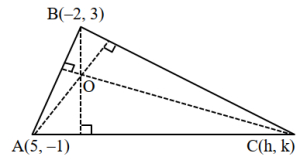
$(S1)$ : જો $A(5, -1)$ અને $B(-2, 3)$ એ ત્રિકોણના બે શિરોબિંદુઓ હોય,જેનું લંબકેન્દ્ર $(0, 0)$ હોય,તો તેનું ત્રીજું શિરોબિંદુ $(-4, -7)$ છે અને
$(S2)$ : જો ધન સંખ્યાઓ $2a, b, c$ એ સમાંતર શ્રેણી $(A.P.)$ ના ત્રણ ક્રમિક પદો હોય,તો રેખાઓ $ax + by + c = 0$ એ $(2, -2)$ માં સંગામી છે.
$(S1)$ : જો $A(5, -1)$ અને $B(-2, 3)$ એ ત્રિકોણના બે શિરોબિંદુઓ હોય,જેનું લંબકેન્દ્ર $(0, 0)$ હોય,તો તેનું ત્રીજું શિરોબિંદુ $(-4, -7)$ છે અને
$(S2)$ : જો ધન સંખ્યાઓ $2a, b, c$ એ સમાંતર શ્રેણી $(A.P.)$ ના ત્રણ ક્રમિક પદો હોય,તો રેખાઓ $ax + by + c = 0$ એ $(2, -2)$ માં સંગામી છે.
A
માત્ર $(S1)$ સાચું છે
B
માત્ર $(S2)$ સાચું છે
C
બંને ખોટા છે
D
બંને સાચા છે
Solution
(D) વિધાન - $1$ નો ઉકેલ:
ધારો કે ત્રીજું શિરોબિંદુ $C(h, k)$ છે.
લંબકેન્દ્ર $O(0, 0)$ છે.
$AO \perp BC$ હોવાથી,$AO$ નો ઢાળ $m_{AO} = \frac{0 - (-1)}{0 - 5} = -\frac{1}{5}$ છે.
$BC$ નો ઢાળ $m_{BC} = \frac{k - 3}{h + 2}$ છે.
$m_{AO} \cdot m_{BC} = -1$ હોવાથી,$(-\frac{1}{5}) \cdot (\frac{k - 3}{h + 2}) = -1 \Rightarrow 5h - k + 13 = 0$ ....$(1)$
$BO \perp AC$ હોવાથી,$BO$ નો ઢાળ $m_{BO} = \frac{0 - 3}{0 - (-2)} = -\frac{3}{2}$ છે.
$AC$ નો ઢાળ $m_{AC} = \frac{k + 1}{h - 5}$ છે.
$m_{BO} \cdot m_{AC} = -1$ હોવાથી,$(-\frac{3}{2}) \cdot (\frac{k + 1}{h - 5}) = -1 \Rightarrow 2h - 3k = 13$ ....$(2)$
સમીકરણો $(1)$ અને $(2)$ ઉકેલતા,$h = -4$ અને $k = -7$ મળે છે.
તેથી,ત્રીજું શિરોબિંદુ $(-4, -7)$ છે. આમ,વિધાન $1$ સાચું છે.
વિધાન - $2$ નો ઉકેલ:
$2a, b, c$ સમાંતર શ્રેણીમાં છે,તેથી $2b = 2a + c \Rightarrow 2a - 2b + c = 0$.
રેખાનું સમીકરણ $ax + by + c = 0$ છે.
$2a - 2b + c = 0$ સાથે સરખાવતા,$x = 2$ અને $y = -2$ માટે સમીકરણ $a(2) + b(-2) + c = 0$ સત્ય છે.
તેથી,રેખાઓ $ax + by + c = 0$ એ $(2, -2)$ માં સંગામી છે. આમ,વિધાન $2$ સાચું છે.
ધારો કે ત્રીજું શિરોબિંદુ $C(h, k)$ છે.
લંબકેન્દ્ર $O(0, 0)$ છે.
$AO \perp BC$ હોવાથી,$AO$ નો ઢાળ $m_{AO} = \frac{0 - (-1)}{0 - 5} = -\frac{1}{5}$ છે.
$BC$ નો ઢાળ $m_{BC} = \frac{k - 3}{h + 2}$ છે.
$m_{AO} \cdot m_{BC} = -1$ હોવાથી,$(-\frac{1}{5}) \cdot (\frac{k - 3}{h + 2}) = -1 \Rightarrow 5h - k + 13 = 0$ ....$(1)$
$BO \perp AC$ હોવાથી,$BO$ નો ઢાળ $m_{BO} = \frac{0 - 3}{0 - (-2)} = -\frac{3}{2}$ છે.
$AC$ નો ઢાળ $m_{AC} = \frac{k + 1}{h - 5}$ છે.
$m_{BO} \cdot m_{AC} = -1$ હોવાથી,$(-\frac{3}{2}) \cdot (\frac{k + 1}{h - 5}) = -1 \Rightarrow 2h - 3k = 13$ ....$(2)$
સમીકરણો $(1)$ અને $(2)$ ઉકેલતા,$h = -4$ અને $k = -7$ મળે છે.
તેથી,ત્રીજું શિરોબિંદુ $(-4, -7)$ છે. આમ,વિધાન $1$ સાચું છે.
વિધાન - $2$ નો ઉકેલ:
$2a, b, c$ સમાંતર શ્રેણીમાં છે,તેથી $2b = 2a + c \Rightarrow 2a - 2b + c = 0$.
રેખાનું સમીકરણ $ax + by + c = 0$ છે.
$2a - 2b + c = 0$ સાથે સરખાવતા,$x = 2$ અને $y = -2$ માટે સમીકરણ $a(2) + b(-2) + c = 0$ સત્ય છે.
તેથી,રેખાઓ $ax + by + c = 0$ એ $(2, -2)$ માં સંગામી છે. આમ,વિધાન $2$ સાચું છે.
0 likesView Solution
70
MathematicsDifficultMCQJEE Main · 2026
જો $\lim_{x \rightarrow 0} \frac{e^{(a-1)x} + 2 \cos(bx) + (c-2)e^{-x}}{x \cos x - \log_{e}(1+x)} = 2$ હોય,તો $a^{2} + b^{2} + c^{2}$ ની કિંમત શોધો:
A
$5$
B
$3$
C
$7$
D
$9$
Solution
(C) $x \rightarrow 0$ માટે ટેલર શ્રેણીનો ઉપયોગ કરતા:
અંશમાં $x^0$ અને $x^1$ ના સહગુણકો $0$ હોવા જોઈએ.
અચળ પદ: $1 + 2 + c - 2 = c + 1 = 0 \Rightarrow c = -1$
$x$ નો સહગુણક: $(a-1) - (c-2) = a - c + 1 = 0 \Rightarrow a = -2$
$x^2$ નો સહગુણક: $\frac{(a-1)^2}{2} - b^2 + \frac{c-2}{2} = 1$
$\frac{9}{2} - b^2 - \frac{3}{2} = 1 \Rightarrow b^2 = 2$
તેથી,$a^2 + b^2 + c^2 = (-2)^2 + 2 + (-1)^2 = 7$.
અંશમાં $x^0$ અને $x^1$ ના સહગુણકો $0$ હોવા જોઈએ.
અચળ પદ: $1 + 2 + c - 2 = c + 1 = 0 \Rightarrow c = -1$
$x$ નો સહગુણક: $(a-1) - (c-2) = a - c + 1 = 0 \Rightarrow a = -2$
$x^2$ નો સહગુણક: $\frac{(a-1)^2}{2} - b^2 + \frac{c-2}{2} = 1$
$\frac{9}{2} - b^2 - \frac{3}{2} = 1 \Rightarrow b^2 = 2$
તેથી,$a^2 + b^2 + c^2 = (-2)^2 + 2 + (-1)^2 = 7$.
0 likesView Solution
71
MathematicsDifficultMCQJEE Main · 2026
ધારો કે $S = \{z \in \mathbb{C} : 4z^2 + \overline{z} = 0\}$. તો $\sum_{z \in S} |z|^2$ ની કિંમત શોધો:
A
$\frac{3}{16}$
B
$\frac{7}{64}$
C
$\frac{1}{16}$
D
$\frac{5}{64}$
Solution
(A) આપેલ છે $4z^2 + \overline{z} = 0$. ધારો કે $z = x + iy$.
સમીકરણમાં $z$ ની કિંમત મૂકતા: $4(x + iy)^2 + (x - iy) = 0$.
$4(x^2 - y^2 + 2xyi) + x - iy = 0$.
$4x^2 - 4y^2 + x + i(8xy - y) = 0$.
વાસ્તવિક અને કાલ્પનિક ભાગોને શૂન્ય સાથે સરખાવતા:
$4x^2 - 4y^2 + x = 0$ અને $y(8x - 1) = 0$.
કિસ્સો $1$: $y = 0$. તો $4x^2 + x = 0 \Rightarrow x(4x + 1) = 0$. તેથી $x = 0$ અથવા $x = -1/4$.
આનાથી $z_1 = 0$ $(|z_1|^2 = 0)$ અને $z_2 = -1/4$ $(|z_2|^2 = 1/16)$ મળે છે.
કિસ્સો $2$: $x = 1/8$. તો $4(1/8)^2 - 4y^2 + 1/8 = 0$.
$4/64 - 4y^2 + 1/8 = 0$ $\Rightarrow 1/16 + 1/8 = 4y^2$ $\Rightarrow 3/16 = 4y^2$ $\Rightarrow y^2 = 3/64$.
તેથી $y = \pm \sqrt{3}/8$. આનાથી $z_3 = 1/8 + i\sqrt{3}/8$ અને $z_4 = 1/8 - i\sqrt{3}/8$ મળે છે.
$|z_3|^2 = (1/8)^2 + (\sqrt{3}/8)^2 = 1/64 + 3/64 = 4/64 = 1/16$.
$|z_4|^2 = (1/8)^2 + (-\sqrt{3}/8)^2 = 1/64 + 3/64 = 4/64 = 1/16$.
માનાંકના વર્ગોનો સરવાળો: $0 + 1/16 + 1/16 + 1/16 = 3/16$.
સમીકરણમાં $z$ ની કિંમત મૂકતા: $4(x + iy)^2 + (x - iy) = 0$.
$4(x^2 - y^2 + 2xyi) + x - iy = 0$.
$4x^2 - 4y^2 + x + i(8xy - y) = 0$.
વાસ્તવિક અને કાલ્પનિક ભાગોને શૂન્ય સાથે સરખાવતા:
$4x^2 - 4y^2 + x = 0$ અને $y(8x - 1) = 0$.
કિસ્સો $1$: $y = 0$. તો $4x^2 + x = 0 \Rightarrow x(4x + 1) = 0$. તેથી $x = 0$ અથવા $x = -1/4$.
આનાથી $z_1 = 0$ $(|z_1|^2 = 0)$ અને $z_2 = -1/4$ $(|z_2|^2 = 1/16)$ મળે છે.
કિસ્સો $2$: $x = 1/8$. તો $4(1/8)^2 - 4y^2 + 1/8 = 0$.
$4/64 - 4y^2 + 1/8 = 0$ $\Rightarrow 1/16 + 1/8 = 4y^2$ $\Rightarrow 3/16 = 4y^2$ $\Rightarrow y^2 = 3/64$.
તેથી $y = \pm \sqrt{3}/8$. આનાથી $z_3 = 1/8 + i\sqrt{3}/8$ અને $z_4 = 1/8 - i\sqrt{3}/8$ મળે છે.
$|z_3|^2 = (1/8)^2 + (\sqrt{3}/8)^2 = 1/64 + 3/64 = 4/64 = 1/16$.
$|z_4|^2 = (1/8)^2 + (-\sqrt{3}/8)^2 = 1/64 + 3/64 = 4/64 = 1/16$.
માનાંકના વર્ગોનો સરવાળો: $0 + 1/16 + 1/16 + 1/16 = 3/16$.
0 likesView Solution
72
MathematicsDifficultMCQJEE Main · 2026
સંબંધ $R = \{(x, y) : 4x^{2} + y^{2} < 52, x, y \in Z\}$ માં ઘટકોની સંખ્યા કેટલી છે?
A
$77$
B
$89$
C
$67$
D
$86$
Solution
(A) આપણે $4x^{2} + y^{2} < 52$ નું સમાધાન કરતી પૂર્ણાંક જોડીઓ $(x, y)$ શોધવાની જરૂર છે.
આપણે $x$ ની એવી કિંમતો ચકાસીએ કે જેથી $4x^{2} < 52$,એટલે કે $x^{2} < 13$. તેથી,$x \in \{0, \pm 1, \pm 2, \pm 3\}$.
કિસ્સો $1$: જો $x = 0$ હોય,તો $y^{2} < 52$. તેથી $y \in \{0, \pm 1, \pm 2, \dots, \pm 7\}$. કુલ $15$ કિંમતો.
કિસ્સો $2$: જો $x = \pm 1$ હોય,તો $4(1)^{2} + y^{2} < 52 \implies y^{2} < 48$. તેથી $y \in \{0, \pm 1, \pm 2, \dots, \pm 6\}$. કુલ $2 \times 13 = 26$ કિંમતો.
કિસ્સો $3$: જો $x = \pm 2$ હોય,તો $4(4) + y^{2} < 52 \implies y^{2} < 36$. તેથી $y \in \{0, \pm 1, \pm 2, \dots, \pm 5\}$. કુલ $2 \times 11 = 22$ કિંમતો.
કિસ્સો $4$: જો $x = \pm 3$ હોય,તો $4(9) + y^{2} < 52 \implies y^{2} < 16$. તેથી $y \in \{0, \pm 1, \pm 2, \pm 3\}$. કુલ $2 \times 7 = 14$ કિંમતો.
ઘટકોની કુલ સંખ્યા $= 15 + 26 + 22 + 14 = 77$.
આપણે $x$ ની એવી કિંમતો ચકાસીએ કે જેથી $4x^{2} < 52$,એટલે કે $x^{2} < 13$. તેથી,$x \in \{0, \pm 1, \pm 2, \pm 3\}$.
કિસ્સો $1$: જો $x = 0$ હોય,તો $y^{2} < 52$. તેથી $y \in \{0, \pm 1, \pm 2, \dots, \pm 7\}$. કુલ $15$ કિંમતો.
કિસ્સો $2$: જો $x = \pm 1$ હોય,તો $4(1)^{2} + y^{2} < 52 \implies y^{2} < 48$. તેથી $y \in \{0, \pm 1, \pm 2, \dots, \pm 6\}$. કુલ $2 \times 13 = 26$ કિંમતો.
કિસ્સો $3$: જો $x = \pm 2$ હોય,તો $4(4) + y^{2} < 52 \implies y^{2} < 36$. તેથી $y \in \{0, \pm 1, \pm 2, \dots, \pm 5\}$. કુલ $2 \times 11 = 22$ કિંમતો.
કિસ્સો $4$: જો $x = \pm 3$ હોય,તો $4(9) + y^{2} < 52 \implies y^{2} < 16$. તેથી $y \in \{0, \pm 1, \pm 2, \pm 3\}$. કુલ $2 \times 7 = 14$ કિંમતો.
ઘટકોની કુલ સંખ્યા $= 15 + 26 + 22 + 14 = 77$.
0 likesView Solution
73
MathematicsDifficultMCQJEE Main · 2026
જો સંખ્યાઓ $k, 2k, 3k, \dots, 1000k$ ના મધ્યસ્થની સાપેક્ષ સરેરાશ વિચલન $500$ હોય,તો $k^{2}$ ની કિંમત કેટલી થાય?
A
$16$
B
$4$
C
$1$
D
$9$
Solution
(B) આપેલ સંખ્યાઓ $k, 2k, 3k, \dots, 1000k$ છે. અહીં $n = 1000$ (બેકી સંખ્યા).
મધ્યસ્થ $X_M = \frac{(\frac{n}{2})k + (\frac{n}{2} + 1)k}{2} = \frac{500k + 501k}{2} = 500.5k$.
મધ્યસ્થની સાપેક્ષ સરેરાશ વિચલન $= \frac{1}{n} \sum_{i=1}^{n} |x_i - X_M| = \frac{1}{1000} \sum_{i=1}^{1000} |ik - 500.5k| = \frac{k}{1000} \sum_{i=1}^{1000} |i - 500.5|$.
આ સરવાળો $2 \times (0.5 + 1.5 + 2.5 + \dots + 499.5) = 2 \times \frac{500}{2} (0.5 + 499.5) = 500 \times 500 = 250000$ થાય.
સરેરાશ વિચલન $= \frac{k \times 250000}{1000} = 250k$.
આપેલ છે કે $250k = 500$,તેથી $k = 2$.
તેથી,$k^{2} = 2^{2} = 4$.
મધ્યસ્થ $X_M = \frac{(\frac{n}{2})k + (\frac{n}{2} + 1)k}{2} = \frac{500k + 501k}{2} = 500.5k$.
મધ્યસ્થની સાપેક્ષ સરેરાશ વિચલન $= \frac{1}{n} \sum_{i=1}^{n} |x_i - X_M| = \frac{1}{1000} \sum_{i=1}^{1000} |ik - 500.5k| = \frac{k}{1000} \sum_{i=1}^{1000} |i - 500.5|$.
આ સરવાળો $2 \times (0.5 + 1.5 + 2.5 + \dots + 499.5) = 2 \times \frac{500}{2} (0.5 + 499.5) = 500 \times 500 = 250000$ થાય.
સરેરાશ વિચલન $= \frac{k \times 250000}{1000} = 250k$.
આપેલ છે કે $250k = 500$,તેથી $k = 2$.
તેથી,$k^{2} = 2^{2} = 4$.
0 likesView Solution
74
MathematicsDifficultMCQJEE Main · 2026
ધારો કે $S$ એ $4$-અંકી સંખ્યાઓ $abcd$ નો સમૂહ દર્શાવે છે જેથી $a > b > c > d$ અને $P$ એ $5$-અંકી સંખ્યાઓનો સમૂહ દર્શાવે છે જેના અંકોનો ગુણાકાર $20$ છે. તો $n(S) + n(P)$ ની કિંમત શોધો:
A
$210$
B
$260$
C
$50$
D
$250$
Solution
(B) $n(S)$ માટે,આપણે ${0, 1, 2, 3, 4, 5, 6, 7, 8, 9}$ માંથી $4$ અલગ અંકો પસંદ કરવાના છે. શરત $a > b > c > d$ હોવાથી,એકવાર $4$ અંકો પસંદ થઈ જાય,પછી તેને ઉતરતા ક્રમમાં ગોઠવવાની માત્ર $1$ રીત છે. તેથી,$n(S) = {}^{10}C_4 = 210$.
$n(P)$ માટે,આપણે એવી $5$-અંકી સંખ્યાઓ જોઈએ છીએ જેના અંકોનો ગુણાકાર $20$ થાય. $20$ ના અવિભાજ્ય અવયવો $2^2 \times 5$ છે. શક્ય $5$ અંકોના સમૂહ છે:
$1)$ ${5, 4, 1, 1, 1}$: ગોઠવણીની સંખ્યા $\frac{5!}{3!} = 20$ છે.
$2)$ ${5, 2, 2, 1, 1}$: ગોઠવણીની સંખ્યા $\frac{5!}{2!2!} = 30$ છે.
તેથી,$n(P) = 20 + 30 = 50$.
આમ,$n(S) + n(P) = 210 + 50 = 260$.
$n(P)$ માટે,આપણે એવી $5$-અંકી સંખ્યાઓ જોઈએ છીએ જેના અંકોનો ગુણાકાર $20$ થાય. $20$ ના અવિભાજ્ય અવયવો $2^2 \times 5$ છે. શક્ય $5$ અંકોના સમૂહ છે:
$1)$ ${5, 4, 1, 1, 1}$: ગોઠવણીની સંખ્યા $\frac{5!}{3!} = 20$ છે.
$2)$ ${5, 2, 2, 1, 1}$: ગોઠવણીની સંખ્યા $\frac{5!}{2!2!} = 30$ છે.
તેથી,$n(P) = 20 + 30 = 50$.
આમ,$n(S) + n(P) = 210 + 50 = 260$.
0 likesView Solution
75
MathematicsDifficultMCQJEE Main · 2026
ધારો કે $\sum_{k=1}^{n} a_{k} = \alpha n^{2} + \beta n$. જો $a_{10} = 59$ અને $a_{6} = 7a_{1}$ હોય,તો $\alpha + \beta$ ની કિંમત શોધો:
A
$12$
B
$3$
C
$5$
D
$7$
Solution
(C) આપેલ છે કે $n$ પદોનો સરવાળો $S_n = \alpha n^2 + \beta n$.
આપણે જાણીએ છીએ કે $a_n = S_n - S_{n-1}$.
$a_n = (\alpha n^2 + \beta n) - (\alpha(n-1)^2 + \beta(n-1))$
$a_n = 2\alpha n - \alpha + \beta$.
$a_{10} = 59$ આપેલ છે,તેથી $2\alpha(10) - \alpha + \beta = 59 \Rightarrow 19\alpha + \beta = 59$ (સમીકરણ $1$).
$a_6 = 7a_1$ આપેલ છે,તેથી $2\alpha(6) - \alpha + \beta = 7(2\alpha(1) - \alpha + \beta)$.
$11\alpha + \beta = 7(\alpha + \beta) \Rightarrow 11\alpha + \beta = 7\alpha + 7\beta$.
$4\alpha = 6\beta$ $\Rightarrow 2\alpha = 3\beta$ $\Rightarrow \beta = \frac{2}{3}\alpha$ (સમીકરણ $2$).
સમીકરણ $2$ ને સમીકરણ $1$ માં મૂકતા:
$19\alpha + \frac{2}{3}\alpha = 59$ $\Rightarrow \frac{59\alpha}{3} = 59$ $\Rightarrow \alpha = 3$.
તેથી $\beta = \frac{2}{3}(3) = 2$.
આમ,$\alpha + \beta = 3 + 2 = 5$.
આપણે જાણીએ છીએ કે $a_n = S_n - S_{n-1}$.
$a_n = (\alpha n^2 + \beta n) - (\alpha(n-1)^2 + \beta(n-1))$
$a_n = 2\alpha n - \alpha + \beta$.
$a_{10} = 59$ આપેલ છે,તેથી $2\alpha(10) - \alpha + \beta = 59 \Rightarrow 19\alpha + \beta = 59$ (સમીકરણ $1$).
$a_6 = 7a_1$ આપેલ છે,તેથી $2\alpha(6) - \alpha + \beta = 7(2\alpha(1) - \alpha + \beta)$.
$11\alpha + \beta = 7(\alpha + \beta) \Rightarrow 11\alpha + \beta = 7\alpha + 7\beta$.
$4\alpha = 6\beta$ $\Rightarrow 2\alpha = 3\beta$ $\Rightarrow \beta = \frac{2}{3}\alpha$ (સમીકરણ $2$).
સમીકરણ $2$ ને સમીકરણ $1$ માં મૂકતા:
$19\alpha + \frac{2}{3}\alpha = 59$ $\Rightarrow \frac{59\alpha}{3} = 59$ $\Rightarrow \alpha = 3$.
તેથી $\beta = \frac{2}{3}(3) = 2$.
આમ,$\alpha + \beta = 3 + 2 = 5$.
0 likesView Solution
76
MathematicsDifficultMCQJEE Main · 2026
એક સમબાજુ ત્રિકોણ $OAB$ એ પરવલય $y^{2}=4x$ માં અંતર્ગત છે,જેનું શિરોબિંદુ $O$ એ ઉગમબિંદુ પર છે. તો $AB$ ને વ્યાસ તરીકે ધરાવતા વર્તુળનું ઉગમબિંદુથી ન્યૂનતમ અંતર શોધો:
A
$4(3-\sqrt{3})$
B
$2(8-3\sqrt{3})$
C
$4(6+\sqrt{3})$
D
$2(3+\sqrt{3})$
Solution
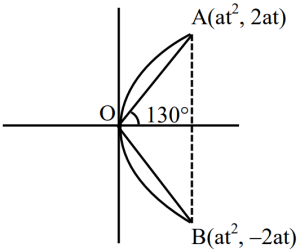
(A) ધારો કે $A$ ના યામ $(t^2, 2t)$ છે. $\triangle OAB$ સમબાજુ હોવાથી અને $x$-અક્ષની સાપેક્ષ સંમિત હોવાથી,$\angle AOx = 30^{\circ}$ થાય.
તેથી,$OA$ નો ઢાળ $\tan 30^{\circ} = \frac{1}{\sqrt{3}}$ થાય.
$OA$ નો ઢાળ $\frac{2t}{t^2} = \frac{2}{t}$ હોવાથી,$\frac{2}{t} = \frac{1}{\sqrt{3}}$,જે આપણને $t = 2\sqrt{3}$ આપે છે.
તેથી,$A = ((2\sqrt{3})^2, 2(2\sqrt{3})) = (12, 4\sqrt{3})$ અને $B = (12, -4\sqrt{3})$.
$AB$ વ્યાસ ધરાવતા વર્તુળનું કેન્દ્ર $C = (12, 0)$ અને ત્રિજ્યા $R = 4\sqrt{3}$ છે.
ઉગમબિંદુ $O(0,0)$ થી કેન્દ્ર $C(12,0)$ નું અંતર $d = 12$ છે.
ઉગમબિંદુથી વર્તુળનું ન્યૂનતમ અંતર $|d - R| = |12 - 4\sqrt{3}| = 4(3 - \sqrt{3})$ થાય.
તેથી,$OA$ નો ઢાળ $\tan 30^{\circ} = \frac{1}{\sqrt{3}}$ થાય.
$OA$ નો ઢાળ $\frac{2t}{t^2} = \frac{2}{t}$ હોવાથી,$\frac{2}{t} = \frac{1}{\sqrt{3}}$,જે આપણને $t = 2\sqrt{3}$ આપે છે.
તેથી,$A = ((2\sqrt{3})^2, 2(2\sqrt{3})) = (12, 4\sqrt{3})$ અને $B = (12, -4\sqrt{3})$.
$AB$ વ્યાસ ધરાવતા વર્તુળનું કેન્દ્ર $C = (12, 0)$ અને ત્રિજ્યા $R = 4\sqrt{3}$ છે.
ઉગમબિંદુ $O(0,0)$ થી કેન્દ્ર $C(12,0)$ નું અંતર $d = 12$ છે.
ઉગમબિંદુથી વર્તુળનું ન્યૂનતમ અંતર $|d - R| = |12 - 4\sqrt{3}| = 4(3 - \sqrt{3})$ થાય.
0 likesView Solution
77
MathematicsDifficultMCQJEE Main · 2026
જો માહિતીનો મધ્યક અને વિચરણ અનુક્રમે $\mu$ અને $19$ હોય,તો $\lambda+\mu$ ની કિંમત શોધો:
| વર્ગ | $4-8$ | $8-12$ | $12-16$ | $16-20$ |
| આવૃત્તિ | $3$ | $\lambda$ | $4$ | $7$ |
A
$18$
B
$21$
C
$20$
D
$19$
Solution
(D) વર્ગ મધ્યક $(x_i)$ $6, 10, 14, 18$ છે. આવૃત્તિઓ $(f_i)$ $3, \lambda, 4, 7$ છે. કુલ આવૃત્તિ $N = 14+\lambda$ છે.
મધ્યક $\mu = \frac{\sum f_i x_i}{N} = \frac{3(6) + 10\lambda + 4(14) + 7(18)}{14+\lambda} = \frac{200+10\lambda}{14+\lambda}$.
વિચરણ $\sigma^2 = \frac{\sum f_i x_i^2}{N} - \mu^2 = 19$.
$\sum f_i x_i^2 = 3160 + 100\lambda$ મળે છે.
સમીકરણ ઉકેલતા $\lambda = 6$ મળે છે.
$\lambda = 6$ મુકતા,$\mu = \frac{260}{20} = 13$ મળે છે.
તેથી,$\lambda + \mu = 6 + 13 = 19$.
મધ્યક $\mu = \frac{\sum f_i x_i}{N} = \frac{3(6) + 10\lambda + 4(14) + 7(18)}{14+\lambda} = \frac{200+10\lambda}{14+\lambda}$.
વિચરણ $\sigma^2 = \frac{\sum f_i x_i^2}{N} - \mu^2 = 19$.
$\sum f_i x_i^2 = 3160 + 100\lambda$ મળે છે.
સમીકરણ ઉકેલતા $\lambda = 6$ મળે છે.
$\lambda = 6$ મુકતા,$\mu = \frac{260}{20} = 13$ મળે છે.
તેથી,$\lambda + \mu = 6 + 13 = 19$.
0 likesView Solution
78
MathematicsMediumMCQJEE Main · 2026
જો $z = \frac{\sqrt{3}}{2} + \frac{i}{2}$,જ્યાં $i = \sqrt{-1}$,તો $(z^{201} - i)^{8}$ ની કિંમત શું થાય?
A
-$1$
B
$0$
C
$1$
D
$256$
Solution
(D) આપેલ છે કે $z = \frac{\sqrt{3}}{2} + \frac{i}{2} = \cos\left(\frac{\pi}{6}\right) + i \sin\left(\frac{\pi}{6}\right)$.
ડી મોઇવરના પ્રમેય મુજબ,$z^{201} = \cos\left(201 \times \frac{\pi}{6}\right) + i \sin\left(201 \times \frac{\pi}{6}\right)$.
$z^{201} = \cos\left(\frac{67\pi}{2}\right) + i \sin\left(\frac{67\pi}{2}\right)$.
કારણ કે $\frac{67\pi}{2} = 33\pi + \frac{\pi}{2}$,તેથી $\cos\left(\frac{67\pi}{2}\right) = 0$ અને $\sin\left(\frac{67\pi}{2}\right) = -1$.
આમ,$z^{201} = 0 + i(-1) = -i$.
આ કિંમત પદાવલિમાં મૂકતા: $(z^{201} - i)^{8} = (-i - i)^{8} = (-2i)^{8}$.
$(-2i)^{8} = (-2)^{8} \times i^{8} = 256 \times 1 = 256$.
ડી મોઇવરના પ્રમેય મુજબ,$z^{201} = \cos\left(201 \times \frac{\pi}{6}\right) + i \sin\left(201 \times \frac{\pi}{6}\right)$.
$z^{201} = \cos\left(\frac{67\pi}{2}\right) + i \sin\left(\frac{67\pi}{2}\right)$.
કારણ કે $\frac{67\pi}{2} = 33\pi + \frac{\pi}{2}$,તેથી $\cos\left(\frac{67\pi}{2}\right) = 0$ અને $\sin\left(\frac{67\pi}{2}\right) = -1$.
આમ,$z^{201} = 0 + i(-1) = -i$.
આ કિંમત પદાવલિમાં મૂકતા: $(z^{201} - i)^{8} = (-i - i)^{8} = (-2i)^{8}$.
$(-2i)^{8} = (-2)^{8} \times i^{8} = 256 \times 1 = 256$.
0 likesView Solution
79
MathematicsDifficultMCQJEE Main · 2026
$16$ સમાન નારંગીઓને $4$ બાળકો વચ્ચે એવી રીતે વહેંચવાની રીતોની સંખ્યા શોધો કે જેથી દરેક બાળકને ઓછામાં ઓછી એક નારંગી મળે:
A
$429$
B
$384$
C
$403$
D
$455$
Solution
(D) ધારો કે ચાર બાળકોને આપવામાં આવતી નારંગીઓની સંખ્યા $x_1, x_2, x_3, x_4$ છે.
નારંગીઓ સમાન હોવાથી,આપણે સમીકરણ $x_1 + x_2 + x_3 + x_4 = 16$ ના ધન પૂર્ણાંક ઉકેલો શોધવા પડશે,જ્યાં $x_i \geq 1$.
$x_i = x_i^{\prime} + 1$ આદેશ લેતા,જ્યાં $x_i^{\prime} \geq 0$,સમીકરણ આ મુજબ બનશે:
$x_1^{\prime} + x_2^{\prime} + x_3^{\prime} + x_4^{\prime} = 12$.
અન-ઋણ પૂર્ણાંક ઉકેલોની સંખ્યા શોધવાનું સૂત્ર $\binom{n+k-1}{k-1}$ છે,જ્યાં $n = 12$ અને $k = 4$.
રીતોની સંખ્યા $= \binom{12+4-1}{4-1} = \binom{15}{3}$.
$\binom{15}{3} = \frac{15 \times 14 \times 13}{3 \times 2 \times 1} = 455$.
નારંગીઓ સમાન હોવાથી,આપણે સમીકરણ $x_1 + x_2 + x_3 + x_4 = 16$ ના ધન પૂર્ણાંક ઉકેલો શોધવા પડશે,જ્યાં $x_i \geq 1$.
$x_i = x_i^{\prime} + 1$ આદેશ લેતા,જ્યાં $x_i^{\prime} \geq 0$,સમીકરણ આ મુજબ બનશે:
$x_1^{\prime} + x_2^{\prime} + x_3^{\prime} + x_4^{\prime} = 12$.
અન-ઋણ પૂર્ણાંક ઉકેલોની સંખ્યા શોધવાનું સૂત્ર $\binom{n+k-1}{k-1}$ છે,જ્યાં $n = 12$ અને $k = 4$.
રીતોની સંખ્યા $= \binom{12+4-1}{4-1} = \binom{15}{3}$.
$\binom{15}{3} = \frac{15 \times 14 \times 13}{3 \times 2 \times 1} = 455$.
0 likesView Solution
80
MathematicsMediumMCQJEE Main · 2026
$(cos^{2}\theta - 6sin\theta cos\theta + 3sin^{2}\theta + 2)$ ની ન્યૂનતમ કિંમત શોધો:
A
-$1$
B
$4+\sqrt{10}$
C
$4-\sqrt{10}$
D
$1$
Solution
(C) ધારો કે $f(\theta) = cos^{2}\theta - 6sin\theta cos\theta + 3sin^{2}\theta + 2$.
નિત્યસમ $cos^{2}\theta = \frac{1+cos 2\theta}{2}$,$sin^{2}\theta = \frac{1-cos 2\theta}{2}$,અને $2sin\theta cos\theta = sin 2\theta$ નો ઉપયોગ કરતા:
$f(\theta) = \frac{1+cos 2\theta}{2} - 3sin 2\theta + 3(\frac{1-cos 2\theta}{2}) + 2$
$f(\theta) = 4 - 3sin 2\theta - cos 2\theta$
$a sin x + b cos x$ પદ $[-\sqrt{a^{2}+b^{2}}, \sqrt{a^{2}+b^{2}}]$ અંતરાલમાં હોય છે.
અહીં,$a = -3$ અને $b = -1$,તેથી $\sqrt{(-3)^{2} + (-1)^{2}} = \sqrt{10}$.
આમ,$f(\theta) \in [4-\sqrt{10}, 4+\sqrt{10}]$.
ન્યૂનતમ કિંમત $4-\sqrt{10}$ છે.
નિત્યસમ $cos^{2}\theta = \frac{1+cos 2\theta}{2}$,$sin^{2}\theta = \frac{1-cos 2\theta}{2}$,અને $2sin\theta cos\theta = sin 2\theta$ નો ઉપયોગ કરતા:
$f(\theta) = \frac{1+cos 2\theta}{2} - 3sin 2\theta + 3(\frac{1-cos 2\theta}{2}) + 2$
$f(\theta) = 4 - 3sin 2\theta - cos 2\theta$
$a sin x + b cos x$ પદ $[-\sqrt{a^{2}+b^{2}}, \sqrt{a^{2}+b^{2}}]$ અંતરાલમાં હોય છે.
અહીં,$a = -3$ અને $b = -1$,તેથી $\sqrt{(-3)^{2} + (-1)^{2}} = \sqrt{10}$.
આમ,$f(\theta) \in [4-\sqrt{10}, 4+\sqrt{10}]$.
ન્યૂનતમ કિંમત $4-\sqrt{10}$ છે.
0 likesView Solution
81
MathematicsDifficultMCQJEE Main · 2026
ધારો કે $PQ$ એ અતિવલય $\frac{x^2}{4} - \frac{y^2}{b^2} = 1$ ની જીવા છે,જે $x$-અક્ષને લંબ છે જેથી $OPQ$ એક સમબાજુ ત્રિકોણ બને,જ્યાં $O$ એ અતિવલયનું કેન્દ્ર છે. જો અતિવલયની ઉત્કેન્દ્રતા $\sqrt{3}$ હોય,તો ત્રિકોણ $OPQ$ નું ક્ષેત્રફળ શોધો:
A
$2\sqrt{3}$
B
$\frac{8\sqrt{3}}{5}$
C
$\frac{11}{5}$
D
$\frac{9}{5}$
Solution
(B) અતિવલય $\frac{x^2}{4} - \frac{y^2}{b^2} = 1$ આપેલ છે. ઉત્કેન્દ્રતા $e = \sqrt{1 + \frac{b^2}{4}} = \sqrt{3}$.
બંને બાજુ વર્ગ કરતા,$1 + \frac{b^2}{4} = 3$ $\Rightarrow \frac{b^2}{4} = 2$ $\Rightarrow b^2 = 8$.
તેથી,અતિવલય $\frac{x^2}{4} - \frac{y^2}{8} = 1$ છે.
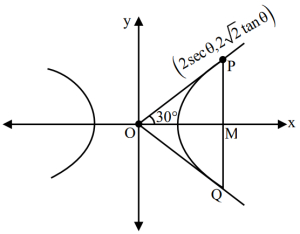
ધારો કે $P = (x_0, y_0)$. $PQ$ એ $x$-અક્ષને લંબ હોવાથી અને $OPQ$ સમબાજુ ત્રિકોણ હોવાથી,$\angle POM = 30^{\circ}$ થાય,જ્યાં $M$ એ $P$ માંથી $x$-અક્ષ પરનો લંબપાદ છે.
$\triangle OMP$ માં,$\tan 30^{\circ} = \frac{PM}{OM} = \frac{y_0}{x_0} = \frac{1}{\sqrt{3}} \Rightarrow x_0 = \sqrt{3}y_0$.
$P$ અતિવલય પર હોવાથી,$\frac{(\sqrt{3}y_0)^2}{4} - \frac{y_0^2}{8} = 1 \Rightarrow \frac{3y_0^2}{4} - \frac{y_0^2}{8} = 1$.
$\frac{6y_0^2 - y_0^2}{8} = 1$ $\Rightarrow \frac{5y_0^2}{8} = 1$ $\Rightarrow y_0^2 = \frac{8}{5}$ $\Rightarrow y_0 = \frac{2\sqrt{2}}{\sqrt{5}}$.
ત્રિકોણ $OPQ$ ની ઊંચાઈ $OM = x_0 = \sqrt{3}y_0 = \sqrt{3} \times \frac{2\sqrt{2}}{\sqrt{5}} = \frac{2\sqrt{6}}{\sqrt{5}}$.
ત્રિકોણનો પાયો $PQ = 2y_0 = \frac{4\sqrt{2}}{\sqrt{5}}$.
$\triangle OPQ$ નું ક્ષેત્રફળ $= \frac{1}{2} \times \text{પાયો} \times \text{ઊંચાઈ} = \frac{1}{2} \times \frac{4\sqrt{2}}{\sqrt{5}} \times \frac{2\sqrt{6}}{\sqrt{5}} = \frac{4\sqrt{12}}{5} = \frac{8\sqrt{3}}{5}$.
બંને બાજુ વર્ગ કરતા,$1 + \frac{b^2}{4} = 3$ $\Rightarrow \frac{b^2}{4} = 2$ $\Rightarrow b^2 = 8$.
તેથી,અતિવલય $\frac{x^2}{4} - \frac{y^2}{8} = 1$ છે.
ધારો કે $P = (x_0, y_0)$. $PQ$ એ $x$-અક્ષને લંબ હોવાથી અને $OPQ$ સમબાજુ ત્રિકોણ હોવાથી,$\angle POM = 30^{\circ}$ થાય,જ્યાં $M$ એ $P$ માંથી $x$-અક્ષ પરનો લંબપાદ છે.
$\triangle OMP$ માં,$\tan 30^{\circ} = \frac{PM}{OM} = \frac{y_0}{x_0} = \frac{1}{\sqrt{3}} \Rightarrow x_0 = \sqrt{3}y_0$.
$P$ અતિવલય પર હોવાથી,$\frac{(\sqrt{3}y_0)^2}{4} - \frac{y_0^2}{8} = 1 \Rightarrow \frac{3y_0^2}{4} - \frac{y_0^2}{8} = 1$.
$\frac{6y_0^2 - y_0^2}{8} = 1$ $\Rightarrow \frac{5y_0^2}{8} = 1$ $\Rightarrow y_0^2 = \frac{8}{5}$ $\Rightarrow y_0 = \frac{2\sqrt{2}}{\sqrt{5}}$.
ત્રિકોણ $OPQ$ ની ઊંચાઈ $OM = x_0 = \sqrt{3}y_0 = \sqrt{3} \times \frac{2\sqrt{2}}{\sqrt{5}} = \frac{2\sqrt{6}}{\sqrt{5}}$.
ત્રિકોણનો પાયો $PQ = 2y_0 = \frac{4\sqrt{2}}{\sqrt{5}}$.
$\triangle OPQ$ નું ક્ષેત્રફળ $= \frac{1}{2} \times \text{પાયો} \times \text{ઊંચાઈ} = \frac{1}{2} \times \frac{4\sqrt{2}}{\sqrt{5}} \times \frac{2\sqrt{6}}{\sqrt{5}} = \frac{4\sqrt{12}}{5} = \frac{8\sqrt{3}}{5}$.
0 likesView Solution
82
MathematicsDifficultMCQJEE Main · 2026
જો ઉપવલયો $x^{2}+2y^{2}-6x-12y+23=0$ અને $4x^{2}+2y^{2}-20x-12y+35=0$ ના છેદબિંદુઓ $r$ ત્રિજ્યા અને $(a, b)$ કેન્દ્ર ધરાવતા વર્તુળ પર આવેલા હોય,તો $ab+18r^{2}$ ની કિંમત શોધો.
A
$53$
B
$51$
C
$52$
D
$55$
Solution
(D) ધારો કે ઉપવલયોના સમીકરણો $S_{1} = x^{2}+2y^{2}-6x-12y+23=0$ અને $S_{2} = 4x^{2}+2y^{2}-20x-12y+35=0$ છે.
આ બે ઉપવલયોના છેદબિંદુમાંથી પસાર થતા વક્રનું સમીકરણ $S_{1} + \lambda S_{2} = 0$ દ્વારા મળે છે.
$(x^{2}+2y^{2}-6x-12y+23) + \lambda(4x^{2}+2y^{2}-20x-12y+35) = 0$.
$(1+4\lambda)x^{2} + (2+2\lambda)y^{2} - (6+20\lambda)x - (12+12\lambda)y + (23+35\lambda) = 0$.
આ વર્તુળ હોવા માટે,$x^{2}$ નો સહગુણક અને $y^{2}$ નો સહગુણક સમાન હોવા જોઈએ:
$1+4\lambda = 2+2\lambda$ $\Rightarrow 2\lambda = 1$ $\Rightarrow \lambda = \frac{1}{2}$.
સમીકરણમાં $\lambda = \frac{1}{2}$ મૂકતા:
$3x^{2} + 3y^{2} - 16x - 18y + 40.5 = 0$.
$3$ વડે ભાગતા: $x^{2} + y^{2} - \frac{16}{3}x - 6y + 13.5 = 0$.
કેન્દ્ર $(a, b) = (\frac{8}{3}, 3)$ છે.
ત્રિજ્યા $r^{2} = \frac{47}{18}$ મળે છે.
તેથી,$ab + 18r^{2} = (\frac{8}{3} \times 3) + 18(\frac{47}{18}) = 8 + 47 = 55$.
આ બે ઉપવલયોના છેદબિંદુમાંથી પસાર થતા વક્રનું સમીકરણ $S_{1} + \lambda S_{2} = 0$ દ્વારા મળે છે.
$(x^{2}+2y^{2}-6x-12y+23) + \lambda(4x^{2}+2y^{2}-20x-12y+35) = 0$.
$(1+4\lambda)x^{2} + (2+2\lambda)y^{2} - (6+20\lambda)x - (12+12\lambda)y + (23+35\lambda) = 0$.
આ વર્તુળ હોવા માટે,$x^{2}$ નો સહગુણક અને $y^{2}$ નો સહગુણક સમાન હોવા જોઈએ:
$1+4\lambda = 2+2\lambda$ $\Rightarrow 2\lambda = 1$ $\Rightarrow \lambda = \frac{1}{2}$.
સમીકરણમાં $\lambda = \frac{1}{2}$ મૂકતા:
$3x^{2} + 3y^{2} - 16x - 18y + 40.5 = 0$.
$3$ વડે ભાગતા: $x^{2} + y^{2} - \frac{16}{3}x - 6y + 13.5 = 0$.
કેન્દ્ર $(a, b) = (\frac{8}{3}, 3)$ છે.
ત્રિજ્યા $r^{2} = \frac{47}{18}$ મળે છે.
તેથી,$ab + 18r^{2} = (\frac{8}{3} \times 3) + 18(\frac{47}{18}) = 8 + 47 = 55$.
0 likesView Solution
83
MathematicsDifficultMCQJEE Main · 2026
સમીકરણ $ \log_{(x+3)}(6x^{2}+28x+30)=5-2\log_{(6x+10)}(x^{2}+6x+9) $ ના તમામ વાસ્તવિક ઉકેલોનો સરવાળો કેટલો થાય?
A
$2$
B
$1$
C
$0$
D
$4$
Solution
(C) આપેલ સમીકરણ: $ \log_{(x+3)}(6x^{2}+28x+30)=5-2\log_{(6x+10)}(x+3)^{2} $
અવયવ પાડતા: $ 6x^{2}+28x+30 = (6x+10)(x+3) $.
તેથી,$ \log_{(x+3)}[(6x+10)(x+3)] = 5 - 4\log_{(6x+10)}(x+3) $
$ 1 + \log_{(x+3)}(6x+10) = 5 - 4\log_{(6x+10)}(x+3) $
ધારો કે $ A = \log_{(x+3)}(6x+10) $. તો $ \log_{(6x+10)}(x+3) = \frac{1}{A} $.
સમીકરણ $ 1 + A = 5 - \frac{4}{A} $ બને છે.
$ A - 4 + \frac{4}{A} = 0 \Rightarrow A^{2} - 4A + 4 = 0 $.
$ (A-2)^{2} = 0 \Rightarrow A = 2 $.
$ \log_{(x+3)}(6x+10) = 2 \Rightarrow 6x+10 = (x+3)^{2} $.
$ 6x+10 = x^{2}+6x+9 \Rightarrow x^{2} = 1 $.
$ x = 1 $ અથવા $ x = -1 $.
ઉકેલોનો સરવાળો $= 1 + (-1) = 0$.
અવયવ પાડતા: $ 6x^{2}+28x+30 = (6x+10)(x+3) $.
તેથી,$ \log_{(x+3)}[(6x+10)(x+3)] = 5 - 4\log_{(6x+10)}(x+3) $
$ 1 + \log_{(x+3)}(6x+10) = 5 - 4\log_{(6x+10)}(x+3) $
ધારો કે $ A = \log_{(x+3)}(6x+10) $. તો $ \log_{(6x+10)}(x+3) = \frac{1}{A} $.
સમીકરણ $ 1 + A = 5 - \frac{4}{A} $ બને છે.
$ A - 4 + \frac{4}{A} = 0 \Rightarrow A^{2} - 4A + 4 = 0 $.
$ (A-2)^{2} = 0 \Rightarrow A = 2 $.
$ \log_{(x+3)}(6x+10) = 2 \Rightarrow 6x+10 = (x+3)^{2} $.
$ 6x+10 = x^{2}+6x+9 \Rightarrow x^{2} = 1 $.
$ x = 1 $ અથવા $ x = -1 $.
ઉકેલોનો સરવાળો $= 1 + (-1) = 0$.
0 likesView Solution
84
MathematicsDifficultMCQJEE Main · 2026
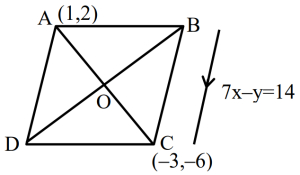
ધારો કે $A(1,2)$ અને $C(-3,-6)$ એ એક સમબાજુ ચતુષ્કોણના બે સામસામેના શિરોબિંદુઓ છે,જેની બાજુઓ $AD$ અને $BC$ એ રેખા $7x-y=14$ ને સમાંતર છે. જો $B(\alpha, \beta)$ અને $D(\gamma, \delta)$ એ અન્ય બે શિરોબિંદુઓ હોય,તો $|\alpha+\beta+\gamma+\delta|$ ની કિંમત શોધો:
A
$9$
B
$3$
C
$6$
D
$1$
Solution
(C) સમબાજુ ચતુષ્કોણમાં,વિકર્ણો એકબીજાને કાટખૂણે દુભાગે છે. ધારો કે $O$ એ વિકર્ણો $AC$ અને $BD$ નું છેદબિંદુ છે. $O$ ના યામ એ $AC$ નું મધ્યબિંદુ છે:
$O = \left(\frac{1-3}{2}, \frac{2-6}{2}\right) = (-1, -2)$.
કારણ કે $O$ એ $BD$ નું પણ મધ્યબિંદુ છે,તેથી આપણી પાસે છે:
$\frac{\alpha+\gamma}{2} = -1 \implies \alpha+\gamma = -2$
$\frac{\beta+\delta}{2} = -2 \implies \beta+\delta = -4$
આપણે $|\alpha+\beta+\gamma+\delta|$ શોધવાનું છે.
$|\alpha+\beta+\gamma+\delta| = |(\alpha+\gamma) + (\beta+\delta)| = |-2 + (-4)| = |-6| = 6$.
$O = \left(\frac{1-3}{2}, \frac{2-6}{2}\right) = (-1, -2)$.
કારણ કે $O$ એ $BD$ નું પણ મધ્યબિંદુ છે,તેથી આપણી પાસે છે:
$\frac{\alpha+\gamma}{2} = -1 \implies \alpha+\gamma = -2$
$\frac{\beta+\delta}{2} = -2 \implies \beta+\delta = -4$
આપણે $|\alpha+\beta+\gamma+\delta|$ શોધવાનું છે.
$|\alpha+\beta+\gamma+\delta| = |(\alpha+\gamma) + (\beta+\delta)| = |-2 + (-4)| = |-6| = 6$.
0 likesView Solution
85
MathematicsDifficultMCQJEE Main · 2026
ધારો કે $\frac{\pi}{2} < \theta < \pi$ અને $\cot \theta = -\frac{1}{2 \sqrt{2}}$. તો $\sin (\frac{15 \theta}{2}) (\cos 8 \theta + \sin 8 \theta) + \cos (\frac{15 \theta}{2}) (\cos 8 \theta - \sin 8 \theta)$ ની કિંમત શોધો:
A
$\frac{1 - \sqrt{2}}{\sqrt{3}}$
B
$-\frac{\sqrt{2}}{\sqrt{3}}$
C
$\frac{\sqrt{2} - 1}{\sqrt{3}}$
D
$\frac{\sqrt{2}}{\sqrt{3}}$
Solution
(A) આપેલ છે $\frac{\pi}{2} < \theta < \pi$ અને $\cot \theta = -\frac{1}{2 \sqrt{2}}$.
પદાવલિનું વિસ્તરણ કરતા: $\sin (\frac{15 \theta}{2}) \cos 8 \theta + \sin (\frac{15 \theta}{2}) \sin 8 \theta + \cos (\frac{15 \theta}{2}) \cos 8 \theta - \cos (\frac{15 \theta}{2}) \sin 8 \theta$.
પદોને ગોઠવતા: $(\cos (\frac{15 \theta}{2}) \cos 8 \theta + \sin (\frac{15 \theta}{2}) \sin 8 \theta) + (\sin (\frac{15 \theta}{2}) \cos 8 \theta - \cos (\frac{15 \theta}{2}) \sin 8 \theta)$.
નિત્યસમ $\cos(A-B) = \cos A \cos B + \sin A \sin B$ અને $\sin(A-B) = \sin A \cos B - \cos A \sin B$ નો ઉપયોગ કરતા:
$= \cos (8 \theta - \frac{15 \theta}{2}) + \sin (\frac{15 \theta}{2} - 8 \theta) = \cos (\frac{\theta}{2}) - \sin (\frac{\theta}{2})$.
$\frac{\pi}{2} < \theta < \pi$ હોવાથી,$\frac{\pi}{4} < \frac{\theta}{2} < \frac{\pi}{2}$,જ્યાં $\sin (\frac{\theta}{2}) > \cos (\frac{\theta}{2})$,તેથી $\cos (\frac{\theta}{2}) - \sin (\frac{\theta}{2}) < 0$.
પદાવલિનો વર્ગ કરતા: $(\cos \frac{\theta}{2} - \sin \frac{\theta}{2})^2 = 1 - \sin \theta$.
આપેલ $\cot \theta = -\frac{1}{2 \sqrt{2}}$ પરથી,$\sin \theta = \frac{2 \sqrt{2}}{3}$.
તેથી,$(\cos \frac{\theta}{2} - \sin \frac{\theta}{2})^2 = 1 - \frac{2 \sqrt{2}}{3} = \frac{3 - 2 \sqrt{2}}{3} = \frac{(\sqrt{2} - 1)^2}{3}$.
વર્ગમૂળ લેતા,પદાવલિ ઋણ હોવાથી: $\cos \frac{\theta}{2} - \sin \frac{\theta}{2} = -\frac{\sqrt{2} - 1}{\sqrt{3}} = \frac{1 - \sqrt{2}}{\sqrt{3}}$.
પદાવલિનું વિસ્તરણ કરતા: $\sin (\frac{15 \theta}{2}) \cos 8 \theta + \sin (\frac{15 \theta}{2}) \sin 8 \theta + \cos (\frac{15 \theta}{2}) \cos 8 \theta - \cos (\frac{15 \theta}{2}) \sin 8 \theta$.
પદોને ગોઠવતા: $(\cos (\frac{15 \theta}{2}) \cos 8 \theta + \sin (\frac{15 \theta}{2}) \sin 8 \theta) + (\sin (\frac{15 \theta}{2}) \cos 8 \theta - \cos (\frac{15 \theta}{2}) \sin 8 \theta)$.
નિત્યસમ $\cos(A-B) = \cos A \cos B + \sin A \sin B$ અને $\sin(A-B) = \sin A \cos B - \cos A \sin B$ નો ઉપયોગ કરતા:
$= \cos (8 \theta - \frac{15 \theta}{2}) + \sin (\frac{15 \theta}{2} - 8 \theta) = \cos (\frac{\theta}{2}) - \sin (\frac{\theta}{2})$.
$\frac{\pi}{2} < \theta < \pi$ હોવાથી,$\frac{\pi}{4} < \frac{\theta}{2} < \frac{\pi}{2}$,જ્યાં $\sin (\frac{\theta}{2}) > \cos (\frac{\theta}{2})$,તેથી $\cos (\frac{\theta}{2}) - \sin (\frac{\theta}{2}) < 0$.
પદાવલિનો વર્ગ કરતા: $(\cos \frac{\theta}{2} - \sin \frac{\theta}{2})^2 = 1 - \sin \theta$.
આપેલ $\cot \theta = -\frac{1}{2 \sqrt{2}}$ પરથી,$\sin \theta = \frac{2 \sqrt{2}}{3}$.
તેથી,$(\cos \frac{\theta}{2} - \sin \frac{\theta}{2})^2 = 1 - \frac{2 \sqrt{2}}{3} = \frac{3 - 2 \sqrt{2}}{3} = \frac{(\sqrt{2} - 1)^2}{3}$.
વર્ગમૂળ લેતા,પદાવલિ ઋણ હોવાથી: $\cos \frac{\theta}{2} - \sin \frac{\theta}{2} = -\frac{\sqrt{2} - 1}{\sqrt{3}} = \frac{1 - \sqrt{2}}{\sqrt{3}}$.
0 likesView Solution
86
MathematicsDifficultMCQJEE Main · 2026
'$PQRPQRSTUVP$' ના અક્ષરોનો ઉપયોગ કરીને બનાવી શકાય તેવા $4$ અક્ષરના શબ્દોની સંખ્યા (અર્થપૂર્ણ કે અર્થહીન) કેટલી છે?
A
$1420$
B
$1422$
C
$1424$
D
$1426$
Solution
(B) '$PQRPQRSTUVP$' શબ્દમાં $11$ અક્ષરો છે: $P(3), Q(2), R(2), S(1), T(1), U(1), V(1)$. કુલ $7$ ભિન્ન અક્ષરો છે.
કિસ્સો $I$: $3$ સમાન,$1$ ભિન્ન: ${}^{1}C_{1} \times {}^{6}C_{1} \times \frac{4!}{3!} = 24$.
કિસ્સો $II$: $2$ સમાન,$2$ સમાન: ${}^{3}C_{2} \times \frac{4!}{2!2!} = 18$.
કિસ્સો $III$: $2$ સમાન,$2$ ભિન્ન: ${}^{3}C_{1} \times {}^{6}C_{2} \times \frac{4!}{2!} = 540$.
કિસ્સો $IV$: બધા $4$ ભિન્ન: ${}^{7}C_{4} \times 4! = 840$.
કુલ શબ્દો $= 24 + 18 + 540 + 840 = 1422$.
કિસ્સો $I$: $3$ સમાન,$1$ ભિન્ન: ${}^{1}C_{1} \times {}^{6}C_{1} \times \frac{4!}{3!} = 24$.
કિસ્સો $II$: $2$ સમાન,$2$ સમાન: ${}^{3}C_{2} \times \frac{4!}{2!2!} = 18$.
કિસ્સો $III$: $2$ સમાન,$2$ ભિન્ન: ${}^{3}C_{1} \times {}^{6}C_{2} \times \frac{4!}{2!} = 540$.
કિસ્સો $IV$: બધા $4$ ભિન્ન: ${}^{7}C_{4} \times 4! = 840$.
કુલ શબ્દો $= 24 + 18 + 540 + 840 = 1422$.
0 likesView Solution
87
MathematicsDifficultMCQJEE Main · 2026
પ્રથમ $100$ પ્રાકૃતિક સંખ્યાઓમાંથી,બે સંખ્યાઓ $a$ અને $b$ ને બદલ્યા વગર યાદચ્છિક રીતે પસંદ કરવામાં આવે છે. જો $a-b \ge 10$ હોય તેની સંભાવના $\frac{m}{n}$ હોય,જ્યાં $\gcd(m, n)=1$,તો $m+n$ ની કિંમત શોધો:
A
$310$
B
$311$
C
$312$
D
$313$
Solution
(B) $100$ પ્રાકૃતિક સંખ્યાઓમાંથી બે ભિન્ન સંખ્યાઓ $a$ અને $b$ પસંદ કરવાની કુલ રીતો $100 \times 99 = 9900$ છે.
આપણે એવી જોડી $(a, b)$ શોધવી છે કે જેથી $a-b \ge 10$ થાય,જેનો અર્થ છે $a \ge b+10$.
જો $b=1$ હોય,તો $a$ એ $11$ થી $100$ સુધીની કોઈપણ કિંમત હોઈ શકે ($90$ કિંમતો).
જો $b=2$ હોય,તો $a$ એ $12$ થી $100$ સુધીની કોઈપણ કિંમત હોઈ શકે ($89$ કિંમતો).
આ રીતે આગળ વધતા,જો $b=90$ હોય,તો $a$ માત્ર $100$ હોઈ શકે ($1$ કિંમત).
કુલ સાનુકૂળ કિસ્સાઓ $= 90 + 89 + \dots + 1 = \frac{90 \times 91}{2} = 4095$.
સંભાવના $\frac{4095}{9900}$ છે.
અંશ અને છેદને તેમના ગુરુત્તમ સામાન્ય અવયવ $45$ વડે ભાગતા,આપણને $\frac{4095 \div 45}{9900 \div 45} = \frac{91}{220}$ મળે છે.
અહીં,$m=91$ અને $n=220$,તેથી $\gcd(91, 220) = 1$.
તેથી,$m+n = 91 + 220 = 311$.
આપણે એવી જોડી $(a, b)$ શોધવી છે કે જેથી $a-b \ge 10$ થાય,જેનો અર્થ છે $a \ge b+10$.
જો $b=1$ હોય,તો $a$ એ $11$ થી $100$ સુધીની કોઈપણ કિંમત હોઈ શકે ($90$ કિંમતો).
જો $b=2$ હોય,તો $a$ એ $12$ થી $100$ સુધીની કોઈપણ કિંમત હોઈ શકે ($89$ કિંમતો).
આ રીતે આગળ વધતા,જો $b=90$ હોય,તો $a$ માત્ર $100$ હોઈ શકે ($1$ કિંમત).
કુલ સાનુકૂળ કિસ્સાઓ $= 90 + 89 + \dots + 1 = \frac{90 \times 91}{2} = 4095$.
સંભાવના $\frac{4095}{9900}$ છે.
અંશ અને છેદને તેમના ગુરુત્તમ સામાન્ય અવયવ $45$ વડે ભાગતા,આપણને $\frac{4095 \div 45}{9900 \div 45} = \frac{91}{220}$ મળે છે.
અહીં,$m=91$ અને $n=220$,તેથી $\gcd(91, 220) = 1$.
તેથી,$m+n = 91 + 220 = 311$.
0 likesView Solution
88
MathematicsDifficultMCQJEE Main · 2026
એક મકાન બાંધકામનું કામ બે કડિયા $A$ અને $B$ સાથે મળીને $22.5$ દિવસમાં પૂર્ણ કરી શકે છે. કડિયો $A$ એકલો આ કામ કડિયા $B$ કરતા $24$ દિવસ વહેલું પૂર્ણ કરી શકે છે. તો કડિયો $A$ એકલો આ કામ કેટલા દિવસમાં પૂર્ણ કરશે ($\text{દિવસ}$ માં)?
A
$24$
B
$42$
C
$30$
D
$36$
Solution
(D) ધારો કે કડિયા $A$ ને કામ પૂર્ણ કરતા લાગતો સમય $x$ દિવસ છે. તેથી,કડિયા $B$ ને લાગતો સમય $x+24$ દિવસ થશે.
$A$ દ્વારા $1$ દિવસમાં થયેલું કામ $= \frac{1}{x}$.
$B$ દ્વારા $1$ દિવસમાં થયેલું કામ $= \frac{1}{x+24}$.
$A+B$ દ્વારા $1$ દિવસમાં થયેલું કામ $= \frac{1}{22.5} = \frac{2}{45}$.
તેથી,$\frac{1}{x} + \frac{1}{x+24} = \frac{2}{45}$.
$\frac{2x+24}{x^2+24x} = \frac{2}{45} \implies 45(x+12) = x^2+24x$.
$x^2 - 21x - 540 = 0$.
$(x-36)(x+15) = 0$.
સમય ઋણ ન હોઈ શકે,તેથી $x = 36$ દિવસ.
$A$ દ્વારા $1$ દિવસમાં થયેલું કામ $= \frac{1}{x}$.
$B$ દ્વારા $1$ દિવસમાં થયેલું કામ $= \frac{1}{x+24}$.
$A+B$ દ્વારા $1$ દિવસમાં થયેલું કામ $= \frac{1}{22.5} = \frac{2}{45}$.
તેથી,$\frac{1}{x} + \frac{1}{x+24} = \frac{2}{45}$.
$\frac{2x+24}{x^2+24x} = \frac{2}{45} \implies 45(x+12) = x^2+24x$.
$x^2 - 21x - 540 = 0$.
$(x-36)(x+15) = 0$.
સમય ઋણ ન હોઈ શકે,તેથી $x = 36$ દિવસ.
0 likesView Solution
89
MathematicsDifficultMCQJEE Main · 2026
ધારો કે $\alpha$ અને $\beta$ એ વિધેય $f(\theta)=4(\sin^{4}(\frac{7\pi}{2}-\theta)+\sin^{4}(11\pi+\theta)) - 2(\sin^{6}(\frac{3\pi}{2}-\theta)+\sin^{6}(9\pi-\theta))$,$\theta \in R$ ની મહત્તમ અને ન્યૂનતમ કિંમતો છે. તો $\alpha+2\beta$ ની કિંમત શોધો:
A
$4$
B
$5$
C
$3$
D
$6$
Solution
(B) આપેલ છે $f(\theta)=4(\sin^{4}(\frac{7\pi}{2}-\theta)+\sin^{4}(11\pi+\theta)) - 2(\sin^{6}(\frac{3\pi}{2}-\theta)+\sin^{6}(9\pi-\theta))$.
ત્રિકોણમિતીય નિત્યસમનો ઉપયોગ કરતા:
$\sin(\frac{7\pi}{2}-\theta) = \cos\theta$ અને $\sin(11\pi+\theta) = -\sin\theta$.
$\sin(\frac{3\pi}{2}-\theta) = -\cos\theta$ અને $\sin(9\pi-\theta) = \sin\theta$.
આ કિંમતો મૂકતા:
$f(\theta) = 4(\cos^{4}\theta + \sin^{4}\theta) - 2(\cos^{6}\theta + \sin^{6}\theta)$.
$\sin^{4}\theta + \cos^{4}\theta = 1 - 2\sin^{2}\theta\cos^{2}\theta$ અને $\sin^{6}\theta + \cos^{6}\theta = 1 - 3\sin^{2}\theta\cos^{2}\theta$ નિત્યસમનો ઉપયોગ કરતા:
$f(\theta) = 4(1 - 2\sin^{2}\theta\cos^{2}\theta) - 2(1 - 3\sin^{2}\theta\cos^{2}\theta) = 2 - 2\sin^{2}\theta\cos^{2}\theta$.
$\sin^{2}\theta\cos^{2}\theta = \frac{\sin^{2}(2\theta)}{4}$ હોવાથી:
$f(\theta) = 2 - \frac{\sin^{2}(2\theta)}{2}$.
મહત્તમ કિંમત $\alpha$ જ્યારે $\sin^{2}(2\theta) = 0$ હોય ત્યારે મળે,તેથી $\alpha = 2$.
ન્યૂનતમ કિંમત $\beta$ જ્યારે $\sin^{2}(2\theta) = 1$ હોય ત્યારે મળે,તેથી $\beta = 2 - \frac{1}{2} = \frac{3}{2}$.
તેથી,$\alpha + 2\beta = 2 + 2(\frac{3}{2}) = 5$.
ત્રિકોણમિતીય નિત્યસમનો ઉપયોગ કરતા:
$\sin(\frac{7\pi}{2}-\theta) = \cos\theta$ અને $\sin(11\pi+\theta) = -\sin\theta$.
$\sin(\frac{3\pi}{2}-\theta) = -\cos\theta$ અને $\sin(9\pi-\theta) = \sin\theta$.
આ કિંમતો મૂકતા:
$f(\theta) = 4(\cos^{4}\theta + \sin^{4}\theta) - 2(\cos^{6}\theta + \sin^{6}\theta)$.
$\sin^{4}\theta + \cos^{4}\theta = 1 - 2\sin^{2}\theta\cos^{2}\theta$ અને $\sin^{6}\theta + \cos^{6}\theta = 1 - 3\sin^{2}\theta\cos^{2}\theta$ નિત્યસમનો ઉપયોગ કરતા:
$f(\theta) = 4(1 - 2\sin^{2}\theta\cos^{2}\theta) - 2(1 - 3\sin^{2}\theta\cos^{2}\theta) = 2 - 2\sin^{2}\theta\cos^{2}\theta$.
$\sin^{2}\theta\cos^{2}\theta = \frac{\sin^{2}(2\theta)}{4}$ હોવાથી:
$f(\theta) = 2 - \frac{\sin^{2}(2\theta)}{2}$.
મહત્તમ કિંમત $\alpha$ જ્યારે $\sin^{2}(2\theta) = 0$ હોય ત્યારે મળે,તેથી $\alpha = 2$.
ન્યૂનતમ કિંમત $\beta$ જ્યારે $\sin^{2}(2\theta) = 1$ હોય ત્યારે મળે,તેથી $\beta = 2 - \frac{1}{2} = \frac{3}{2}$.
તેથી,$\alpha + 2\beta = 2 + 2(\frac{3}{2}) = 5$.
0 likesView Solution
90
MathematicsDifficultMCQJEE Main · 2026
ધારો કે $S = \{z : 3 \le |2z - 3(1 + i)| \le 7\}$ એ સંકર સંખ્યાઓનો ગણ છે. તો $\min_{z \in S} |z + \frac{1}{2}(5 + 3i)|$ ની કિંમત શોધો:
A
$ \frac{1}{2} $
B
$ \frac{3}{2} $
C
$ 2 $
D
$ \frac{5}{2} $
Solution
(B) આપેલ ગણ $S = \{z : 3 \le |2z - 3(1 + i)| \le 7\}$ છે.
$2$ વડે ભાગતા,આપણને મળે: $\frac{3}{2} \le |z - \frac{3}{2}(1 + i)| \le \frac{7}{2}$.
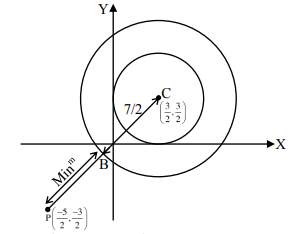
આ એક વલય (annulus) દર્શાવે છે જેનું કેન્દ્ર $C(\frac{3}{2}, \frac{3}{2})$ છે,આંતરિક ત્રિજ્યા $r_1 = \frac{3}{2}$ અને બાહ્ય ત્રિજ્યા $r_2 = \frac{7}{2}$ છે.
આપણે બિંદુ $P(-\frac{5}{2}, -\frac{3}{2})$ થી ગણ $S$ સુધીનું ન્યૂનતમ અંતર શોધવાનું છે.
અંતર $PC = \sqrt{(\frac{3}{2} - (-\frac{5}{2}))^2 + (\frac{3}{2} - (-\frac{3}{2}))^2} = \sqrt{4^2 + 3^2} = \sqrt{16 + 9} = 5$.
$P$ થી વલય સુધીનું ન્યૂનતમ અંતર $PC - r_2 = 5 - \frac{7}{2} = \frac{3}{2}$ છે.
$2$ વડે ભાગતા,આપણને મળે: $\frac{3}{2} \le |z - \frac{3}{2}(1 + i)| \le \frac{7}{2}$.
આ એક વલય (annulus) દર્શાવે છે જેનું કેન્દ્ર $C(\frac{3}{2}, \frac{3}{2})$ છે,આંતરિક ત્રિજ્યા $r_1 = \frac{3}{2}$ અને બાહ્ય ત્રિજ્યા $r_2 = \frac{7}{2}$ છે.
આપણે બિંદુ $P(-\frac{5}{2}, -\frac{3}{2})$ થી ગણ $S$ સુધીનું ન્યૂનતમ અંતર શોધવાનું છે.
અંતર $PC = \sqrt{(\frac{3}{2} - (-\frac{5}{2}))^2 + (\frac{3}{2} - (-\frac{3}{2}))^2} = \sqrt{4^2 + 3^2} = \sqrt{16 + 9} = 5$.
$P$ થી વલય સુધીનું ન્યૂનતમ અંતર $PC - r_2 = 5 - \frac{7}{2} = \frac{3}{2}$ છે.
0 likesView Solution
91
MathematicsMediumMCQJEE Main · 2026
સમીકરણ $\sqrt{3}\cos 2\theta + 8\cos \theta + 3\sqrt{3} = 0$ માટે $\theta \in [-3\pi, 2\pi]$ અંતરાલમાં ઉકેલોની સંખ્યા કેટલી છે?
A
$0$
B
$5$
C
$3$
D
$4$
Solution
(B) આપેલ સમીકરણ: $\sqrt{3}\cos 2\theta + 8\cos \theta + 3\sqrt{3} = 0$
$\cos 2\theta = 2\cos^2 \theta - 1$ નો ઉપયોગ કરતા:
$\sqrt{3}(2\cos^2 \theta - 1) + 8\cos \theta + 3\sqrt{3} = 0$
$2\sqrt{3}\cos^2 \theta + 8\cos \theta + 2\sqrt{3} = 0$
$2$ વડે ભાગતા: $\sqrt{3}\cos^2 \theta + 4\cos \theta + \sqrt{3} = 0$
અવયવ પાડતા: $(\sqrt{3}\cos \theta + 1)(\cos \theta + \sqrt{3}) = 0$
તેથી $\cos \theta = -\frac{1}{\sqrt{3}}$ અથવા $\cos \theta = -\sqrt{3}$.
$\cos \theta = -\sqrt{3}$ શક્ય નથી.
$\cos \theta = -\frac{1}{\sqrt{3}}$ માટે $[-3\pi, 2\pi]$ અંતરાલમાં કુલ $5$ ઉકેલો મળે છે.
$\cos 2\theta = 2\cos^2 \theta - 1$ નો ઉપયોગ કરતા:
$\sqrt{3}(2\cos^2 \theta - 1) + 8\cos \theta + 3\sqrt{3} = 0$
$2\sqrt{3}\cos^2 \theta + 8\cos \theta + 2\sqrt{3} = 0$
$2$ વડે ભાગતા: $\sqrt{3}\cos^2 \theta + 4\cos \theta + \sqrt{3} = 0$
અવયવ પાડતા: $(\sqrt{3}\cos \theta + 1)(\cos \theta + \sqrt{3}) = 0$
તેથી $\cos \theta = -\frac{1}{\sqrt{3}}$ અથવા $\cos \theta = -\sqrt{3}$.
$\cos \theta = -\sqrt{3}$ શક્ય નથી.
$\cos \theta = -\frac{1}{\sqrt{3}}$ માટે $[-3\pi, 2\pi]$ અંતરાલમાં કુલ $5$ ઉકેલો મળે છે.
0 likesView Solution
92
MathematicsDifficultMCQJEE Main · 2026
$n \in N$ ના તમામ શક્ય મૂલ્યોનો સરવાળો શોધો જેથી $(1+x^2)^2(1+x)^n$ ના વિસ્તરણમાં $x$,$x^2$ અને $x^3$ ના સહગુણકો સમાંતર શ્રેણીમાં હોય:
A
$3$
B
$7$
C
$12$
D
$9$
Solution
(D) વિસ્તરણ $(1+2x^2+x^4)(^nC_0 + ^nC_1x + ^nC_2x^2 + ^nC_3x^3 + \dots)$ છે.
$x$ નો સહગુણક $^nC_1 = n$ છે.
$x^2$ નો સહગુણક $2 + ^nC_2 = 2 + \frac{n(n-1)}{2}$ છે.
$x^3$ નો સહગુણક $2(^nC_1) + ^nC_3 = 2n + \frac{n(n-1)(n-2)}{6}$ છે.
આ પદો સમાંતર શ્રેણીમાં હોવાથી,$2 \times (x^2 \text{ નો સહગુણક}) = (x \text{ નો સહગુણક}) + (x^3 \text{ નો સહગુણક})$.
$2 \left[ 2 + \frac{n(n-1)}{2} \right] = n + 2n + \frac{n(n-1)(n-2)}{6}$.
$4 + n(n-1) = 3n + \frac{n(n-1)(n-2)}{6}$.
$n^3 - 9n^2 + 26n - 24 = 0$.
$n$ ના શક્ય મૂલ્યો $2, 3, 4$ છે.
તેથી,$n$ ના મૂલ્યોનો સરવાળો $2+3+4 = 9$ થાય.
$x$ નો સહગુણક $^nC_1 = n$ છે.
$x^2$ નો સહગુણક $2 + ^nC_2 = 2 + \frac{n(n-1)}{2}$ છે.
$x^3$ નો સહગુણક $2(^nC_1) + ^nC_3 = 2n + \frac{n(n-1)(n-2)}{6}$ છે.
આ પદો સમાંતર શ્રેણીમાં હોવાથી,$2 \times (x^2 \text{ નો સહગુણક}) = (x \text{ નો સહગુણક}) + (x^3 \text{ નો સહગુણક})$.
$2 \left[ 2 + \frac{n(n-1)}{2} \right] = n + 2n + \frac{n(n-1)(n-2)}{6}$.
$4 + n(n-1) = 3n + \frac{n(n-1)(n-2)}{6}$.
$n^3 - 9n^2 + 26n - 24 = 0$.
$n$ ના શક્ય મૂલ્યો $2, 3, 4$ છે.
તેથી,$n$ ના મૂલ્યોનો સરવાળો $2+3+4 = 9$ થાય.
0 likesView Solution
93
MathematicsDifficultMCQJEE Main · 2026
$8$ સંખ્યાઓ $-10, -7, -1, x, y, 9, 2, 16$ નો મધ્યક અને વિચરણ અનુક્રમે $\frac{7}{2}$ અને $\frac{293}{4}$ છે. તો $4$ સંખ્યાઓ $x, y, x + y + 1, |x - y|$ નો મધ્યક શોધો:
A
$11$
B
$9$
C
$10$
D
$12$
Solution
(A) $8$ સંખ્યાઓનો મધ્યક $\frac{7}{2}$ આપેલ છે.
સંખ્યાઓનો સરવાળો $= -10 - 7 - 1 + x + y + 9 + 2 + 16 = x + y + 9$.
$\frac{x + y + 9}{8} = \frac{7}{2}$ $\Rightarrow x + y + 9 = 28$ $\Rightarrow x + y = 19$ . . . $(1)$
વિચરણ $= \frac{\sum x_i^2}{n} - (\text{મધ્યક})^2 = \frac{293}{4}$.
$\frac{(-10)^2 + (-7)^2 + (-1)^2 + x^2 + y^2 + 9^2 + 2^2 + 16^2}{8} - (\frac{7}{2})^2 = \frac{293}{4}$.
$\frac{491 + x^2 + y^2}{8} = \frac{342}{4} = 85.5$.
$x^2 + y^2 = 193$ . . . $(2)$
$(1)$ પરથી $y = 19 - x$ ને $(2)$ માં મૂકતા:
$x^2 + (19 - x)^2 = 193$ $\Rightarrow 2x^2 - 38x + 168 = 0$ $\Rightarrow x^2 - 19x + 84 = 0$.
$(x - 12)(x - 7) = 0$. તેથી $x = 12, y = 7$.
$4$ સંખ્યાઓ $12, 7, 20, 5$ છે.
મધ્યક $= \frac{12 + 7 + 20 + 5}{4} = \frac{44}{4} = 11$.
સંખ્યાઓનો સરવાળો $= -10 - 7 - 1 + x + y + 9 + 2 + 16 = x + y + 9$.
$\frac{x + y + 9}{8} = \frac{7}{2}$ $\Rightarrow x + y + 9 = 28$ $\Rightarrow x + y = 19$ . . . $(1)$
વિચરણ $= \frac{\sum x_i^2}{n} - (\text{મધ્યક})^2 = \frac{293}{4}$.
$\frac{(-10)^2 + (-7)^2 + (-1)^2 + x^2 + y^2 + 9^2 + 2^2 + 16^2}{8} - (\frac{7}{2})^2 = \frac{293}{4}$.
$\frac{491 + x^2 + y^2}{8} = \frac{342}{4} = 85.5$.
$x^2 + y^2 = 193$ . . . $(2)$
$(1)$ પરથી $y = 19 - x$ ને $(2)$ માં મૂકતા:
$x^2 + (19 - x)^2 = 193$ $\Rightarrow 2x^2 - 38x + 168 = 0$ $\Rightarrow x^2 - 19x + 84 = 0$.
$(x - 12)(x - 7) = 0$. તેથી $x = 12, y = 7$.
$4$ સંખ્યાઓ $12, 7, 20, 5$ છે.
મધ્યક $= \frac{12 + 7 + 20 + 5}{4} = \frac{44}{4} = 11$.
0 likesView Solution
94
MathematicsDifficultMCQJEE Main · 2026
$\frac{^{100}C_{50}}{51} + \frac{^{100}C_{51}}{52} + \dots + \frac{^{100}C_{100}}{101}$ ની કિંમત શોધો:
A
$\frac{2^{101}}{100}$
B
$\frac{2^{100}}{100}$
C
$\frac{2^{101}}{101}$
D
$\frac{2^{100}}{101}$
Solution
(D) આપણે નિત્યસમ $\frac{^{n}C_{r}}{r+1} = \frac{^{n+1}C_{r+1}}{n+1}$ નો ઉપયોગ કરીએ છીએ.
આપેલ સરવાળો $S = \sum_{r=50}^{100} \frac{^{100}C_{r}}{r+1}$ છે.
નિત્યસમનો ઉપયોગ કરતા, આપણને $S = \sum_{r=50}^{100} \frac{^{101}C_{r+1}}{101}$ મળે છે.
$S = \frac{1}{101} \sum_{k=51}^{101} {^{101}C_{k}}$, જ્યાં $k = r+1$.
સરવાળો $\sum_{k=51}^{101} {^{101}C_{k}}$ એ $(1+x)^{101}$ ના દ્વિપદી સહગુણકોના છેલ્લા અડધા ભાગનો સરવાળો દર્શાવે છે.
કારણ કે $\sum_{k=0}^{101} {^{101}C_{k}} = 2^{101}$ અને $\sum_{k=0}^{50} {^{101}C_{k}} = \sum_{k=51}^{101} {^{101}C_{k}} = \frac{2^{101}}{2} = 2^{100}$.
આમ, $S = \frac{2^{100}}{101}$.
આપેલ સરવાળો $S = \sum_{r=50}^{100} \frac{^{100}C_{r}}{r+1}$ છે.
નિત્યસમનો ઉપયોગ કરતા, આપણને $S = \sum_{r=50}^{100} \frac{^{101}C_{r+1}}{101}$ મળે છે.
$S = \frac{1}{101} \sum_{k=51}^{101} {^{101}C_{k}}$, જ્યાં $k = r+1$.
સરવાળો $\sum_{k=51}^{101} {^{101}C_{k}}$ એ $(1+x)^{101}$ ના દ્વિપદી સહગુણકોના છેલ્લા અડધા ભાગનો સરવાળો દર્શાવે છે.
કારણ કે $\sum_{k=0}^{101} {^{101}C_{k}} = 2^{101}$ અને $\sum_{k=0}^{50} {^{101}C_{k}} = \sum_{k=51}^{101} {^{101}C_{k}} = \frac{2^{101}}{2} = 2^{100}$.
આમ, $S = \frac{2^{100}}{101}$.
0 likesView Solution
95
MathematicsDifficultMCQJEE Main · 2026
જો $\alpha$ અને $\beta$ $(\alpha < \beta)$ એ સમીકરણ $(-2+\sqrt{3})(|\sqrt{x}-3|) + (x-6\sqrt{x}) + (9-2\sqrt{3}) = 0$,$x \ge 0$ ના બીજ હોય,તો $\sqrt{\frac{\beta}{\alpha}} + \sqrt{\alpha\beta}$ ની કિંમત શોધો:
A
$8$
B
$9$
C
$10$
D
$11$
Solution
(C) આપેલ સમીકરણ $(\sqrt{3}-2)|\sqrt{x}-3| + (\sqrt{x}-3)^2 - 2\sqrt{3} = 0$ છે.
ધારો કે $t = |\sqrt{x}-3|$. તો સમીકરણ $t^2 + (\sqrt{3}-2)t - 2\sqrt{3} = 0$ બને છે.
દ્વિઘાત સમીકરણના અવયવ પાડતા: $(t+ \sqrt{3})(t-2) = 0$.
કારણ કે $t = |\sqrt{x}-3| \ge 0$,તેથી $t = 2$ મળે.
આમ,$|\sqrt{x}-3| = 2$,જેનો અર્થ છે કે $\sqrt{x}-3 = 2$ અથવા $\sqrt{x}-3 = -2$.
આથી $\sqrt{x} = 5$ અથવા $\sqrt{x} = 1$ મળે.
તેથી,$x = 25$ અથવા $x = 1$.
$\alpha < \beta$ હોવાથી,$\alpha = 1$ અને $\beta = 25$ મળે.
અંતે,$\sqrt{\frac{\beta}{\alpha}} + \sqrt{\alpha\beta} = \sqrt{\frac{25}{1}} + \sqrt{1 \times 25} = 5 + 5 = 10$.
ધારો કે $t = |\sqrt{x}-3|$. તો સમીકરણ $t^2 + (\sqrt{3}-2)t - 2\sqrt{3} = 0$ બને છે.
દ્વિઘાત સમીકરણના અવયવ પાડતા: $(t+ \sqrt{3})(t-2) = 0$.
કારણ કે $t = |\sqrt{x}-3| \ge 0$,તેથી $t = 2$ મળે.
આમ,$|\sqrt{x}-3| = 2$,જેનો અર્થ છે કે $\sqrt{x}-3 = 2$ અથવા $\sqrt{x}-3 = -2$.
આથી $\sqrt{x} = 5$ અથવા $\sqrt{x} = 1$ મળે.
તેથી,$x = 25$ અથવા $x = 1$.
$\alpha < \beta$ હોવાથી,$\alpha = 1$ અને $\beta = 25$ મળે.
અંતે,$\sqrt{\frac{\beta}{\alpha}} + \sqrt{\alpha\beta} = \sqrt{\frac{25}{1}} + \sqrt{1 \times 25} = 5 + 5 = 10$.
0 likesView Solution
96
MathematicsDifficultMCQJEE Main · 2026
ધારો કે રેખા $y-x=1$ એ ઉપવલય $\frac{x^{2}}{2}+\frac{y^{2}}{1}=1$ ને બિંદુઓ $A$ અને $B$ માં છેદે છે. તો ઉપવલયના કેન્દ્ર આગળ રેખાખંડ $AB$ દ્વારા બનતો ખૂણો કેટલો થાય?
A
$\pi-\tan^{-1}(\frac{1}{4})$
B
$\frac{\pi}{2}+\tan^{-1}(\frac{1}{4})$
C
$\frac{\pi}{2}+2\tan^{-1}(\frac{1}{4})$
D
$\frac{\pi}{2}-\tan^{-1}(\frac{1}{4})$
Solution
(B) રેખાનું સમીકરણ $y = x + 1$ છે. તેને ઉપવલયના સમીકરણ $\frac{x^2}{2} + y^2 = 1$ માં મૂકતા:
$\frac{x^2}{2} + (x+1)^2 = 1$
$\frac{x^2}{2} + x^2 + 2x + 1 = 1$
$\frac{3x^2}{2} + 2x = 0$
$x(\frac{3x}{2} + 2) = 0$
તેથી,$x = 0$ અથવા $x = -\frac{4}{3}$.
જો $x = 0$,તો $y = 1$,તેથી $A = (0, 1)$.
જો $x = -\frac{4}{3}$,તો $y = -\frac{4}{3} + 1 = -\frac{1}{3}$,તેથી $B = (-\frac{4}{3}, -\frac{1}{3})$.
ઉપવલયનું કેન્દ્ર $O(0, 0)$ છે.
$OA$ નો ઢાળ $m_1 = \infty$ છે (ઊભી રેખા,ખૂણો $\frac{\pi}{2}$ છે).
$OB$ નો ઢાળ $m_2 = \frac{1}{4}$ છે.
ખૂણો $\angle AOB = \frac{\pi}{2} + \tan^{-1}(\frac{1}{4})$.
$\frac{x^2}{2} + (x+1)^2 = 1$
$\frac{x^2}{2} + x^2 + 2x + 1 = 1$
$\frac{3x^2}{2} + 2x = 0$
$x(\frac{3x}{2} + 2) = 0$
તેથી,$x = 0$ અથવા $x = -\frac{4}{3}$.
જો $x = 0$,તો $y = 1$,તેથી $A = (0, 1)$.
જો $x = -\frac{4}{3}$,તો $y = -\frac{4}{3} + 1 = -\frac{1}{3}$,તેથી $B = (-\frac{4}{3}, -\frac{1}{3})$.
ઉપવલયનું કેન્દ્ર $O(0, 0)$ છે.
$OA$ નો ઢાળ $m_1 = \infty$ છે (ઊભી રેખા,ખૂણો $\frac{\pi}{2}$ છે).
$OB$ નો ઢાળ $m_2 = \frac{1}{4}$ છે.
ખૂણો $\angle AOB = \frac{\pi}{2} + \tan^{-1}(\frac{1}{4})$.
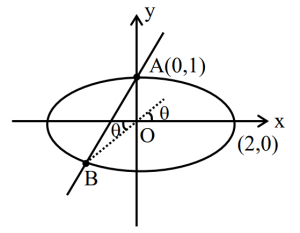
0 likesView Solution
97
MathematicsDifficultMCQJEE Main · 2026
$x=0, x=3, y=0$ અને $y=4$ રેખાઓ દ્વારા એક લંબચોરસ બને છે. ધારો કે રેખા $L$ એ $3x+y+6=0$ ને લંબ છે અને લંબચોરસના ક્ષેત્રફળને બે સમાન ભાગોમાં વિભાજિત કરે છે. તો બિંદુ $(\frac{1}{2}, -5)$ નું રેખા $L$ થી અંતર કેટલું થાય?
A
$2\sqrt{5}$
B
$3\sqrt{10}$
C
$\sqrt{10}$
D
$2\sqrt{10}$
Solution
(D) લંબચોરસ $x=0, x=3, y=0, y=4$ દ્વારા સીમિત છે. લંબચોરસનું કેન્દ્ર $(\frac{3}{2}, 2)$ છે.
કોઈપણ રેખા જે લંબચોરસને બે સમાન ભાગોમાં વિભાજિત કરે છે તે તેના કેન્દ્ર $(\frac{3}{2}, 2)$ માંથી પસાર થવી જોઈએ.
રેખા $L$ એ $3x+y+6=0$ ને લંબ છે. $3x+y+6=0$ નો ઢાળ $-3$ છે,તેથી રેખા $L$ નો ઢાળ $\frac{1}{3}$ છે.
$(\frac{3}{2}, 2)$ માંથી પસાર થતી અને $\frac{1}{3}$ ઢાળ ધરાવતી રેખા $L$ નું સમીકરણ:
$y - 2 = \frac{1}{3}(x - \frac{3}{2})$
$3y - 6 = x - \frac{3}{2}$
$6y - 12 = 2x - 3$
$2x - 6y + 9 = 0$.
બિંદુ $(\frac{1}{2}, -5)$ નું રેખા $2x - 6y + 9 = 0$ થી અંતર:
$d = \frac{|2(\frac{1}{2}) - 6(-5) + 9|}{\sqrt{2^2 + (-6)^2}}$
$d = \frac{|1 + 30 + 9|}{\sqrt{4 + 36}}$
$d = \frac{40}{\sqrt{40}} = \sqrt{40} = 2\sqrt{10}$.
કોઈપણ રેખા જે લંબચોરસને બે સમાન ભાગોમાં વિભાજિત કરે છે તે તેના કેન્દ્ર $(\frac{3}{2}, 2)$ માંથી પસાર થવી જોઈએ.
રેખા $L$ એ $3x+y+6=0$ ને લંબ છે. $3x+y+6=0$ નો ઢાળ $-3$ છે,તેથી રેખા $L$ નો ઢાળ $\frac{1}{3}$ છે.
$(\frac{3}{2}, 2)$ માંથી પસાર થતી અને $\frac{1}{3}$ ઢાળ ધરાવતી રેખા $L$ નું સમીકરણ:
$y - 2 = \frac{1}{3}(x - \frac{3}{2})$
$3y - 6 = x - \frac{3}{2}$
$6y - 12 = 2x - 3$
$2x - 6y + 9 = 0$.
બિંદુ $(\frac{1}{2}, -5)$ નું રેખા $2x - 6y + 9 = 0$ થી અંતર:
$d = \frac{|2(\frac{1}{2}) - 6(-5) + 9|}{\sqrt{2^2 + (-6)^2}}$
$d = \frac{|1 + 30 + 9|}{\sqrt{4 + 36}}$
$d = \frac{40}{\sqrt{40}} = \sqrt{40} = 2\sqrt{10}$.
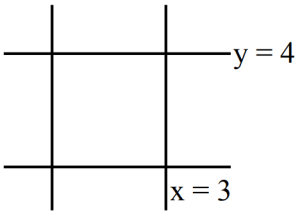
0 likesView Solution
98
MathematicsDifficultMCQJEE Main · 2026
ધારો કે વિધેય $f(x) = \log_{3}\log_{5}\log_{7}(9x - x^{2} - 13)$ નો પ્રદેશ $(m, n)$ અંતરાલ છે. ધારો કે અતિવલય $\frac{x^{2}}{a^{2}} - \frac{y^{2}}{b^{2}} = 1$ ની ઉત્કેન્દ્રતા $\frac{n}{3}$ છે અને નાભિલંબની લંબાઈ $\frac{8m}{3}$ છે. તો $b^{2} - a^{2}$ ની કિંમત શોધો:
A
$5$
B
$11$
C
$9$
D
$7$
Solution
(D) વિધેય $f(x) = \log_{3}\log_{5}\log_{7}(9x - x^{2} - 13)$ વ્યાખ્યાયિત થવા માટે,આપણે જરૂર છે:
$\log_{5}\log_{7}(9x - x^{2} - 13) > 0 \implies \log_{7}(9x - x^{2} - 13) > 1 \implies 9x - x^{2} - 13 > 7$
$x^{2} - 9x + 20 < 0 \implies (x - 4)(x - 5) < 0 \implies x \in (4, 5)$.
આમ,$m = 4$ અને $n = 5$.
અતિવલય $\frac{x^{2}}{a^{2}} - \frac{y^{2}}{b^{2}} = 1$ માટે,ઉત્કેન્દ્રતા $e = \frac{n}{3} = \frac{5}{3}$.
$e^{2} = 1 + \frac{b^{2}}{a^{2}}$ હોવાથી,$\frac{25}{9} = 1 + \frac{b^{2}}{a^{2}} \implies \frac{b^{2}}{a^{2}} = \frac{16}{9} \implies \frac{b}{a} = \frac{4}{3} \implies b = \frac{4a}{3}$.
નાભિલંબની લંબાઈ $\frac{2b^{2}}{a} = \frac{8m}{3} = \frac{32}{3}$ છે.
$b = \frac{4a}{3}$ મૂકતા,$\frac{2(16a^{2}/9)}{a} = \frac{32}{3} \implies \frac{32a}{9} = \frac{32}{3} \implies a = 3$.
તેથી $b = \frac{4(3)}{3} = 4$.
તેથી,$b^{2} - a^{2} = 16 - 9 = 7$.
$\log_{5}\log_{7}(9x - x^{2} - 13) > 0 \implies \log_{7}(9x - x^{2} - 13) > 1 \implies 9x - x^{2} - 13 > 7$
$x^{2} - 9x + 20 < 0 \implies (x - 4)(x - 5) < 0 \implies x \in (4, 5)$.
આમ,$m = 4$ અને $n = 5$.
અતિવલય $\frac{x^{2}}{a^{2}} - \frac{y^{2}}{b^{2}} = 1$ માટે,ઉત્કેન્દ્રતા $e = \frac{n}{3} = \frac{5}{3}$.
$e^{2} = 1 + \frac{b^{2}}{a^{2}}$ હોવાથી,$\frac{25}{9} = 1 + \frac{b^{2}}{a^{2}} \implies \frac{b^{2}}{a^{2}} = \frac{16}{9} \implies \frac{b}{a} = \frac{4}{3} \implies b = \frac{4a}{3}$.
નાભિલંબની લંબાઈ $\frac{2b^{2}}{a} = \frac{8m}{3} = \frac{32}{3}$ છે.
$b = \frac{4a}{3}$ મૂકતા,$\frac{2(16a^{2}/9)}{a} = \frac{32}{3} \implies \frac{32a}{9} = \frac{32}{3} \implies a = 3$.
તેથી $b = \frac{4(3)}{3} = 4$.
તેથી,$b^{2} - a^{2} = 16 - 9 = 7$.
0 likesView Solution
99
MathematicsDifficultMCQJEE Main · 2026
ધારો કે $ABC$ એક ત્રિકોણ છે. બાજુ $AB$ પર ચાર બિંદુઓ $p_1, p_2, p_3, p_4$,બાજુ $BC$ પર પાંચ બિંદુઓ $p_5, p_6, p_7, p_8, p_9$ અને બાજુ $AC$ પર ચાર બિંદુઓ $p_{10}, p_{11}, p_{12}, p_{13}$ છે. આમાંથી કોઈ પણ બિંદુ ત્રિકોણ $ABC$ નું શિરોબિંદુ નથી. તો $p_1, p_2, \ldots, p_{13}$ બિંદુઓમાંથી શિરોબિંદુઓ લઈને બનાવી શકાય તેવા પંચકોણની કુલ સંખ્યા . . . . . . છે.
A
$640$
B
$650$
C
$660$
D
$670$
Solution
(C) આપેલ બિંદુઓનો ઉપયોગ કરીને પંચકોણ બનાવવા માટે,આપણે $5$ બિંદુઓ એવી રીતે પસંદ કરવા જોઈએ કે જેથી કોઈ પણ ત્રણ બિંદુઓ સમરેખ ન હોય. બિંદુઓ ત્રિકોણની બાજુઓ પર હોવાથી,આપણે બાજુઓ $AB$,$BC$ અને $AC$ માંથી બિંદુઓ પસંદ કરી શકીએ છીએ.
કિસ્સો $1$: $AB$ માંથી $2$ બિંદુઓ,$BC$ માંથી $2$ બિંદુઓ અને $AC$ માંથી $1$ બિંદુ.
રીતોની સંખ્યા = $\binom{4}{2} \times \binom{5}{2} \times \binom{4}{1} = 6 \times 10 \times 4 = 240$.
કિસ્સો $2$: $AB$ માંથી $2$ બિંદુઓ,$BC$ માંથી $1$ બિંદુ અને $AC$ માંથી $2$ બિંદુઓ.
રીતોની સંખ્યા = $\binom{4}{2} \times \binom{5}{1} \times \binom{4}{2} = 6 \times 5 \times 6 = 180$.
કિસ્સો $3$: $AB$ માંથી $1$ બિંદુ,$BC$ માંથી $2$ બિંદુઓ અને $AC$ માંથી $2$ બિંદુઓ.
રીતોની સંખ્યા = $\binom{4}{1} \times \binom{5}{2} \times \binom{4}{2} = 4 \times 10 \times 6 = 240$.
પંચકોણની કુલ સંખ્યા = $240 + 180 + 240 = 660$.
કિસ્સો $1$: $AB$ માંથી $2$ બિંદુઓ,$BC$ માંથી $2$ બિંદુઓ અને $AC$ માંથી $1$ બિંદુ.
રીતોની સંખ્યા = $\binom{4}{2} \times \binom{5}{2} \times \binom{4}{1} = 6 \times 10 \times 4 = 240$.
કિસ્સો $2$: $AB$ માંથી $2$ બિંદુઓ,$BC$ માંથી $1$ બિંદુ અને $AC$ માંથી $2$ બિંદુઓ.
રીતોની સંખ્યા = $\binom{4}{2} \times \binom{5}{1} \times \binom{4}{2} = 6 \times 5 \times 6 = 180$.
કિસ્સો $3$: $AB$ માંથી $1$ બિંદુ,$BC$ માંથી $2$ બિંદુઓ અને $AC$ માંથી $2$ બિંદુઓ.
રીતોની સંખ્યા = $\binom{4}{1} \times \binom{5}{2} \times \binom{4}{2} = 4 \times 10 \times 6 = 240$.
પંચકોણની કુલ સંખ્યા = $240 + 180 + 240 = 660$.
0 likesView Solution
100
MathematicsMediumMCQJEE Main · 2026
જો $\frac{\cos ^2 48^{\circ}-\sin ^2 12^{\circ}}{\sin ^2 24^{\circ}-\sin ^2 6^{\circ}}=\frac{\alpha+\beta \sqrt{5}}{2}$,જ્યાં $\alpha, \beta \in N$,તો $\alpha+\beta$ ની કિંમત . . . . . . થાય.
A
$2$
B
$4$
C
$6$
D
$8$
Solution
(B) નિત્યસમ $\cos ^2 A - \sin ^2 B = \cos(A+B) \cos(A-B)$ અને $\sin ^2 A - \sin ^2 B = \sin(A+B) \sin(A-B)$ નો ઉપયોગ કરતા:
અંશ: $\cos ^2 48^{\circ} - \sin ^2 12^{\circ} = \cos 60^{\circ} \cos 36^{\circ}$.
છેદ: $\sin ^2 24^{\circ} - \sin ^2 6^{\circ} = \sin 30^{\circ} \sin 18^{\circ}$.
કિંમતો મૂકતા: $\frac{(1/2) \times ((\sqrt{5}+1)/4)}{(1/2) \times ((\sqrt{5}-1)/4)} = \frac{\sqrt{5}+1}{\sqrt{5}-1}$.
છેદનું સંમેયીકરણ કરતા: $\frac{6+2\sqrt{5}}{4} = \frac{3+\sqrt{5}}{2}$.
સરખામણી કરતા,$\alpha = 3$ અને $\beta = 1$ મળે છે.
તેથી,$\alpha+\beta = 4$.
અંશ: $\cos ^2 48^{\circ} - \sin ^2 12^{\circ} = \cos 60^{\circ} \cos 36^{\circ}$.
છેદ: $\sin ^2 24^{\circ} - \sin ^2 6^{\circ} = \sin 30^{\circ} \sin 18^{\circ}$.
કિંમતો મૂકતા: $\frac{(1/2) \times ((\sqrt{5}+1)/4)}{(1/2) \times ((\sqrt{5}-1)/4)} = \frac{\sqrt{5}+1}{\sqrt{5}-1}$.
છેદનું સંમેયીકરણ કરતા: $\frac{6+2\sqrt{5}}{4} = \frac{3+\sqrt{5}}{2}$.
સરખામણી કરતા,$\alpha = 3$ અને $\beta = 1$ મળે છે.
તેથી,$\alpha+\beta = 4$.
0 likesView Solution
101
MathematicsDifficultMCQJEE Main · 2026
ધારો કે $f(x) = \int \frac{7x^{10} + 9x^{8}}{(1 + x^{2} + 2x^{9})^{2}} dx$,$x > 0$,$\lim_{x \to 0} f(x) = 0$ અને $f(1) = \frac{1}{4}$. જો $A = \begin{bmatrix} 0 & 0 & 1 \\ \frac{1}{4} & f'(1) & 1 \\ \alpha^{2} & 4 & 1 \end{bmatrix}$ અને $B = \text{adj}(\text{adj } A)$ એવા હોય કે જેથી $|B| = 81$,તો $\alpha^{2}$ ની કિંમત શોધો.
A
$2$
B
$3$
C
$1$
D
$4$
Solution
(D) સૌ પ્રથમ,સંકલ્યનું સાદું રૂપ આપો: $f(x) = \int \frac{x^{18}(7x^{-8} + 9x^{-10})}{(x^9(x^{-9} + x^{-7} + 2))^2} dx = \int \frac{7x^{-8} + 9x^{-10}}{(x^{-9} + x^{-7} + 2)^2} dx$.
ધારો કે $t = x^{-9} + x^{-7} + 2$,તો $dt = (-9x^{-10} - 7x^{-8}) dx$,તેથી $-(7x^{-8} + 9x^{-10}) dx = dt$.
આમ,$f(x) = \int -t^{-2} dt = t^{-1} + C = \frac{1}{x^{-9} + x^{-7} + 2} + C = \frac{x^9}{1 + x^2 + 2x^9} + C$.
આપેલ છે કે $\lim_{x \to 0} f(x) = 0$,તેથી $C = 0$. વળી $f(1) = \frac{1}{1+1+2} = \frac{1}{4}$,જે સુસંગત છે.
હવે,$f'(x) = \frac{9x^8(1+x^2+2x^9) - x^9(2x + 18x^8)}{(1+x^2+2x^9)^2}$.
$x=1$ આગળ,$f'(1) = \frac{9(4) - 1(20)}{4^2} = \frac{36-20}{16} = 1$.
શ્રેણિક $A = \begin{bmatrix} 0 & 0 & 1 \\ 1/4 & 1 & 1 \\ \alpha^2 & 4 & 1 \end{bmatrix}$.
$|A| = 1(\frac{1}{4} \times 4 - \alpha^2 \times 1) = 1 - \alpha^2$.
આપેલ છે કે $|B| = |\text{adj}(\text{adj } A)| = |A|^{(n-1)^2} = |A|^4 = 81$,તેથી $|A| = \pm 3$.
$1 - \alpha^2 = 3 \Rightarrow \alpha^2 = -2$ (શક્ય નથી) અથવા $1 - \alpha^2 = -3 \Rightarrow \alpha^2 = 4$.
ધારો કે $t = x^{-9} + x^{-7} + 2$,તો $dt = (-9x^{-10} - 7x^{-8}) dx$,તેથી $-(7x^{-8} + 9x^{-10}) dx = dt$.
આમ,$f(x) = \int -t^{-2} dt = t^{-1} + C = \frac{1}{x^{-9} + x^{-7} + 2} + C = \frac{x^9}{1 + x^2 + 2x^9} + C$.
આપેલ છે કે $\lim_{x \to 0} f(x) = 0$,તેથી $C = 0$. વળી $f(1) = \frac{1}{1+1+2} = \frac{1}{4}$,જે સુસંગત છે.
હવે,$f'(x) = \frac{9x^8(1+x^2+2x^9) - x^9(2x + 18x^8)}{(1+x^2+2x^9)^2}$.
$x=1$ આગળ,$f'(1) = \frac{9(4) - 1(20)}{4^2} = \frac{36-20}{16} = 1$.
શ્રેણિક $A = \begin{bmatrix} 0 & 0 & 1 \\ 1/4 & 1 & 1 \\ \alpha^2 & 4 & 1 \end{bmatrix}$.
$|A| = 1(\frac{1}{4} \times 4 - \alpha^2 \times 1) = 1 - \alpha^2$.
આપેલ છે કે $|B| = |\text{adj}(\text{adj } A)| = |A|^{(n-1)^2} = |A|^4 = 81$,તેથી $|A| = \pm 3$.
$1 - \alpha^2 = 3 \Rightarrow \alpha^2 = -2$ (શક્ય નથી) અથવા $1 - \alpha^2 = -3 \Rightarrow \alpha^2 = 4$.
0 likesView Solution
102
MathematicsDifficultMCQJEE Main · 2026
ધારો કે $x \in [-\frac{\sqrt{3}}{2}, \frac{1}{\sqrt{2}}]$ માટે $(sin^{-1}x)^{2} + (cos^{-1}x)^{2}$ ની મહત્તમ કિંમત $\frac{m}{n}\pi^{2}$ છે,જ્યાં $\gcd(m, n) = 1$. તો $m+n$ ની કિંમત ........... છે.
A
$55$
B
$65$
C
$75$
D
$45$
Solution
(B) ધારો કે $f(x) = (sin^{-1}x)^{2} + (cos^{-1}x)^{2}$.
$cos^{-1}x = \frac{\pi}{2} - sin^{-1}x$ હોવાથી,આપણને મળે:
$f(x) = (sin^{-1}x)^{2} + (\frac{\pi}{2} - sin^{-1}x)^{2}$
$f(x) = 2(sin^{-1}x)^{2} - \pi sin^{-1}x + \frac{\pi^{2}}{4}$
પૂર્ણવર્ગ બનાવતા,$f(x) = 2(sin^{-1}x - \frac{\pi}{4})^{2} + \frac{\pi^{2}}{8}$.
$x \in [-\frac{\sqrt{3}}{2}, \frac{1}{\sqrt{2}}]$ માટે,$sin^{-1}x$ નો વિસ્તાર $[-\frac{\pi}{3}, \frac{\pi}{4}]$ છે.
$f(x)$ ને મહત્તમ કરવા માટે,આપણે $sin^{-1}x$ ની એવી કિંમત પસંદ કરીએ જે $\frac{\pi}{4}$ થી સૌથી દૂર હોય,જે $-\frac{\pi}{3}$ છે.
મહત્તમ કિંમત $= 2(-\frac{\pi}{3} - \frac{\pi}{4})^{2} + \frac{\pi^{2}}{8} = 2(-\frac{7\pi}{12})^{2} + \frac{\pi^{2}}{8} = \frac{49\pi^{2}}{72} + \frac{9\pi^{2}}{72} = \frac{58\pi^{2}}{72} = \frac{29\pi^{2}}{36}$.
આમ,$m = 29$ અને $n = 36$. $\gcd(29, 36) = 1$ હોવાથી,$m+n = 29 + 36 = 65$.
$cos^{-1}x = \frac{\pi}{2} - sin^{-1}x$ હોવાથી,આપણને મળે:
$f(x) = (sin^{-1}x)^{2} + (\frac{\pi}{2} - sin^{-1}x)^{2}$
$f(x) = 2(sin^{-1}x)^{2} - \pi sin^{-1}x + \frac{\pi^{2}}{4}$
પૂર્ણવર્ગ બનાવતા,$f(x) = 2(sin^{-1}x - \frac{\pi}{4})^{2} + \frac{\pi^{2}}{8}$.
$x \in [-\frac{\sqrt{3}}{2}, \frac{1}{\sqrt{2}}]$ માટે,$sin^{-1}x$ નો વિસ્તાર $[-\frac{\pi}{3}, \frac{\pi}{4}]$ છે.
$f(x)$ ને મહત્તમ કરવા માટે,આપણે $sin^{-1}x$ ની એવી કિંમત પસંદ કરીએ જે $\frac{\pi}{4}$ થી સૌથી દૂર હોય,જે $-\frac{\pi}{3}$ છે.
મહત્તમ કિંમત $= 2(-\frac{\pi}{3} - \frac{\pi}{4})^{2} + \frac{\pi^{2}}{8} = 2(-\frac{7\pi}{12})^{2} + \frac{\pi^{2}}{8} = \frac{49\pi^{2}}{72} + \frac{9\pi^{2}}{72} = \frac{58\pi^{2}}{72} = \frac{29\pi^{2}}{36}$.
આમ,$m = 29$ અને $n = 36$. $\gcd(29, 36) = 1$ હોવાથી,$m+n = 29 + 36 = 65$.
0 likesView Solution
103
MathematicsDifficultMCQJEE Main · 2026
જો $\int_{0}^{1} 4 \cot^{-1}(1-x+x^{2}) dx = a \tan^{-1}(2) - b \log_{e}(5)$,જ્યાં $a, b \in N$,તો $(2a+b)$ ની કિંમત શોધો:
A
$7$
B
$8$
C
$9$
D
$10$
Solution
(C) ધારો કે $I = \int_{0}^{1} \cot^{-1}(1-x+x^{2}) dx$.
$z > 0$ માટે $\cot^{-1}(z) = \tan^{-1}(\frac{1}{z})$ ગુણધર્મનો ઉપયોગ કરતા,$I = \int_{0}^{1} \tan^{-1}(\frac{1}{1+x(x-1)}) dx$ મળે.
$\tan^{-1}(x) - \tan^{-1}(y) = \tan^{-1}(\frac{x-y}{1+xy})$ નો ઉપયોગ કરતા,$I = \int_{0}^{1} (\tan^{-1}(x) - \tan^{-1}(x-1)) dx$ મળે.
$\int_{0}^{a} f(x) dx = \int_{0}^{a} f(a-x) dx$ ગુણધર્મનો ઉપયોગ કરતા:
$I = \int_{0}^{1} (\tan^{-1}(1-x) - \tan^{-1}(-x)) dx = \int_{0}^{1} (\tan^{-1}(1-x) + \tan^{-1}(x)) dx$.
$\tan^{-1}(x) + \tan^{-1}(1-x) = \tan^{-1}(\frac{1}{1+x-x^2})$ હોવાથી,આ સંકલન $2 \int_{0}^{1} \tan^{-1}(x) dx$ થાય છે.
ખંડશઃ સંકલન કરતા: $2 [x \tan^{-1}(x) - \frac{1}{2} \ln(1+x^2)]_{0}^{1} = 2 [(\frac{\pi}{4} - \frac{1}{2} \ln 2) - 0] = \frac{\pi}{2} - \ln 2$.
આપેલ સમીકરણ $4I = a \tan^{-1}(2) - b \ln(5)$ સાથે સરખાવતા,$a=4, b=1$ મળે છે.
તેથી,$2a+b = 2(4)+1 = 9$.
$z > 0$ માટે $\cot^{-1}(z) = \tan^{-1}(\frac{1}{z})$ ગુણધર્મનો ઉપયોગ કરતા,$I = \int_{0}^{1} \tan^{-1}(\frac{1}{1+x(x-1)}) dx$ મળે.
$\tan^{-1}(x) - \tan^{-1}(y) = \tan^{-1}(\frac{x-y}{1+xy})$ નો ઉપયોગ કરતા,$I = \int_{0}^{1} (\tan^{-1}(x) - \tan^{-1}(x-1)) dx$ મળે.
$\int_{0}^{a} f(x) dx = \int_{0}^{a} f(a-x) dx$ ગુણધર્મનો ઉપયોગ કરતા:
$I = \int_{0}^{1} (\tan^{-1}(1-x) - \tan^{-1}(-x)) dx = \int_{0}^{1} (\tan^{-1}(1-x) + \tan^{-1}(x)) dx$.
$\tan^{-1}(x) + \tan^{-1}(1-x) = \tan^{-1}(\frac{1}{1+x-x^2})$ હોવાથી,આ સંકલન $2 \int_{0}^{1} \tan^{-1}(x) dx$ થાય છે.
ખંડશઃ સંકલન કરતા: $2 [x \tan^{-1}(x) - \frac{1}{2} \ln(1+x^2)]_{0}^{1} = 2 [(\frac{\pi}{4} - \frac{1}{2} \ln 2) - 0] = \frac{\pi}{2} - \ln 2$.
આપેલ સમીકરણ $4I = a \tan^{-1}(2) - b \ln(5)$ સાથે સરખાવતા,$a=4, b=1$ મળે છે.
તેથી,$2a+b = 2(4)+1 = 9$.
0 likesView Solution
104
MathematicsDifficultMCQJEE Main · 2026
ધારો કે $[ \cdot ]$ એ મહત્તમ પૂર્ણાંક વિધેય છે અને $f(x) = \lim_{n \to \infty} \frac{1}{n^3} \sum_{k=1}^n \left[ \frac{k^2}{3^x} \right]$. તો $12 \sum_{j=1}^{\infty} f(j)$ ની કિંમત ........... છે.
A
$1$
B
$2$
C
$3$
D
$4$
Solution
(B) ગુણધર્મ $x-1 < [x] \leq x$ નો ઉપયોગ કરતા,આપણને મળે: $\sum_{k=1}^n \left( \frac{k^2}{3^x} - 1 \right) < \sum_{k=1}^n \left[ \frac{k^2}{3^x} \right] \leq \sum_{k=1}^n \frac{k^2}{3^x}$.
$n^3$ વડે ભાગતા અને $n \to \infty$ લેતા:
$\lim_{n \to \infty} \frac{1}{n^3} \sum_{k=1}^n \left( \frac{k^2}{3^x} - 1 \right) < f(x) \leq \lim_{n \to \infty} \frac{1}{n^3} \sum_{k=1}^n \frac{k^2}{3^x}$.
$\sum_{k=1}^n k^2 = \frac{n(n+1)(2n+1)}{6}$ હોવાથી,$\lim_{n \to \infty} \frac{n(n+1)(2n+1)}{6n^3 \cdot 3^x} = \frac{1}{3 \cdot 3^x} = \frac{1}{3^{x+1}}$.
સ્ક્વીઝ પ્રમેય દ્વારા,$f(x) = \frac{1}{3^{x+1}}$.
હવે,$12 \sum_{j=1}^{\infty} f(j) = 12 \sum_{j=1}^{\infty} \frac{1}{3^{j+1}} = 12 \left( \frac{1}{9} + \frac{1}{27} + \dots \right)$.
આ એક ભૂમિતિ શ્રેણી છે જેમાં પ્રથમ પદ $a = \frac{1}{9}$ અને સામાન્ય ગુણોત્તર $r = \frac{1}{3}$ છે.
સરવાળો $= 12 \left( \frac{1/9}{1 - 1/3} \right) = 12 \left( \frac{1/9}{2/3} \right) = 12 \left( \frac{1}{6} \right) = 2$.
$n^3$ વડે ભાગતા અને $n \to \infty$ લેતા:
$\lim_{n \to \infty} \frac{1}{n^3} \sum_{k=1}^n \left( \frac{k^2}{3^x} - 1 \right) < f(x) \leq \lim_{n \to \infty} \frac{1}{n^3} \sum_{k=1}^n \frac{k^2}{3^x}$.
$\sum_{k=1}^n k^2 = \frac{n(n+1)(2n+1)}{6}$ હોવાથી,$\lim_{n \to \infty} \frac{n(n+1)(2n+1)}{6n^3 \cdot 3^x} = \frac{1}{3 \cdot 3^x} = \frac{1}{3^{x+1}}$.
સ્ક્વીઝ પ્રમેય દ્વારા,$f(x) = \frac{1}{3^{x+1}}$.
હવે,$12 \sum_{j=1}^{\infty} f(j) = 12 \sum_{j=1}^{\infty} \frac{1}{3^{j+1}} = 12 \left( \frac{1}{9} + \frac{1}{27} + \dots \right)$.
આ એક ભૂમિતિ શ્રેણી છે જેમાં પ્રથમ પદ $a = \frac{1}{9}$ અને સામાન્ય ગુણોત્તર $r = \frac{1}{3}$ છે.
સરવાળો $= 12 \left( \frac{1/9}{1 - 1/3} \right) = 12 \left( \frac{1/9}{2/3} \right) = 12 \left( \frac{1}{6} \right) = 2$.
0 likesView Solution
105
MathematicsMediumMCQJEE Main · 2026
જો સમીકરણોની સંહતિ $3x + y + 4z = 3$,$2x + ay - z = -3$,$x + 2y + z = 4$ ને કોઈ ઉકેલ ન હોય,તો $a$ ની કિંમત કેટલી થાય?
A
$19$
B
$4$
C
$13$
D
$23$
Solution
(A) સુરેખ સમીકરણોની સંહતિને કોઈ ઉકેલ ન હોય તે માટે,સહગુણક શ્રેણિકનો નિશ્ચાયક $\Delta = 0$ હોવો જોઈએ અને ક્રેમરના નિશ્ચાયકો $\Delta_x, \Delta_y, \Delta_z$ માંથી ઓછામાં ઓછો એક શૂન્યતર હોવો જોઈએ.
પ્રથમ,આપણે $\Delta$ ની ગણતરી કરીએ:
$\Delta = \begin{vmatrix} 3 & 1 & 4 \\ 2 & a & -1 \\ 1 & 2 & 1 \end{vmatrix} = 0$
$3(a + 2) - 1(2 + 1) + 4(4 - a) = 0$
$3a + 6 - 3 + 16 - 4a = 0$
$19 - a = 0 \Rightarrow a = 19$
હવે,$a = 19$ માટે $\Delta_x$ ચકાસીએ:
$\Delta_x = \begin{vmatrix} 3 & 1 & 4 \\ -3 & 19 & -1 \\ 4 & 2 & 1 \end{vmatrix} = 3(19 + 2) - 1(-3 + 4) + 4(-6 - 76)$
$= 3(21) - 1(1) + 4(-82) = 63 - 1 - 328 = -266 \neq 0$
આમ,$\Delta = 0$ અને $\Delta_x \neq 0$ હોવાથી,$a = 19$ માટે આ સંહતિને કોઈ ઉકેલ નથી.
પ્રથમ,આપણે $\Delta$ ની ગણતરી કરીએ:
$\Delta = \begin{vmatrix} 3 & 1 & 4 \\ 2 & a & -1 \\ 1 & 2 & 1 \end{vmatrix} = 0$
$3(a + 2) - 1(2 + 1) + 4(4 - a) = 0$
$3a + 6 - 3 + 16 - 4a = 0$
$19 - a = 0 \Rightarrow a = 19$
હવે,$a = 19$ માટે $\Delta_x$ ચકાસીએ:
$\Delta_x = \begin{vmatrix} 3 & 1 & 4 \\ -3 & 19 & -1 \\ 4 & 2 & 1 \end{vmatrix} = 3(19 + 2) - 1(-3 + 4) + 4(-6 - 76)$
$= 3(21) - 1(1) + 4(-82) = 63 - 1 - 328 = -266 \neq 0$
આમ,$\Delta = 0$ અને $\Delta_x \neq 0$ હોવાથી,$a = 19$ માટે આ સંહતિને કોઈ ઉકેલ નથી.
0 likesView Solution
106
MathematicsDifficultMCQJEE Main · 2026
ધારો કે $A = \{2, 3, 5, 7, 9\}$. ધારો કે $R$ એ $A$ પરનો સંબંધ છે જે $xRy$ જો અને માત્ર જો $2x \le 3y$ દ્વારા વ્યાખ્યાયિત છે. ધારો કે $l$ એ $R$ માં રહેલા ઘટકોની સંખ્યા છે,અને $m$ એ $R$ ને સંમિત સંબંધ બનાવવા માટે ઉમેરવા પડતા ઘટકોની ન્યૂનતમ સંખ્યા છે. તો $l + m$ ની કિંમત શોધો:
A
$23$
B
$25$
C
$21$
D
$27$
Solution
(B) આપેલ છે $A = \{2, 3, 5, 7, 9\}$. સંબંધ $R$ એ $2x \le 3y$ દ્વારા વ્યાખ્યાયિત છે,જેનો અર્થ છે $y \ge \frac{2x}{3}$.
દરેક $x \in A$ માટે,આપણે અનુરૂપ $y \in A$ શોધીએ:
જો $x = 2$,$y \ge 1.33 \implies y \in \{2, 3, 5, 7, 9\}$ ($5$ ઘટકો).
જો $x = 3$,$y \ge 2 \implies y \in \{2, 3, 5, 7, 9\}$ ($5$ ઘટકો).
જો $x = 5$,$y \ge 3.33 \implies y \in \{5, 7, 9\}$ ($3$ ઘટકો).
જો $x = 7$,$y \ge 4.66 \implies y \in \{5, 7, 9\}$ ($3$ ઘટકો).
જો $x = 9$,$y \ge 6 \implies y \in \{7, 9\}$ ($2$ ઘટકો).
કુલ ઘટકો $l = 5 + 5 + 3 + 3 + 2 = 18$.
$R$ ને સંમિત બનાવવા માટે,જો $(x, y) \in R$ હોય,તો $(y, x)$ પણ $R$ માં હોવું જોઈએ.
હાલમાં $R$ માં રહેલા ઘટકો: $(2,2), (2,3), (2,5), (2,7), (2,9), (3,2), (3,3), (3,5), (3,7), (3,9), (5,5), (5,7), (5,9), (7,5), (7,7), (7,9), (9,7), (9,9)$.
જે જોડીઓ $(x, y)$ માટે $(x, y) \in R$ છે પણ $(y, x) \notin R$ છે તે છે: $(2,5), (2,7), (2,9), (3,5), (3,7), (3,9), (5,9)$.
$R$ ને સંમિત બનાવવા માટે,આપણે તેમની ઉલટી જોડીઓ ઉમેરવી પડશે: $(5,2), (7,2), (9,2), (5,3), (7,3), (9,3), (9,5)$.
આમ,$m = 7$.
તેથી,$l + m = 18 + 7 = 25$.
દરેક $x \in A$ માટે,આપણે અનુરૂપ $y \in A$ શોધીએ:
જો $x = 2$,$y \ge 1.33 \implies y \in \{2, 3, 5, 7, 9\}$ ($5$ ઘટકો).
જો $x = 3$,$y \ge 2 \implies y \in \{2, 3, 5, 7, 9\}$ ($5$ ઘટકો).
જો $x = 5$,$y \ge 3.33 \implies y \in \{5, 7, 9\}$ ($3$ ઘટકો).
જો $x = 7$,$y \ge 4.66 \implies y \in \{5, 7, 9\}$ ($3$ ઘટકો).
જો $x = 9$,$y \ge 6 \implies y \in \{7, 9\}$ ($2$ ઘટકો).
કુલ ઘટકો $l = 5 + 5 + 3 + 3 + 2 = 18$.
$R$ ને સંમિત બનાવવા માટે,જો $(x, y) \in R$ હોય,તો $(y, x)$ પણ $R$ માં હોવું જોઈએ.
હાલમાં $R$ માં રહેલા ઘટકો: $(2,2), (2,3), (2,5), (2,7), (2,9), (3,2), (3,3), (3,5), (3,7), (3,9), (5,5), (5,7), (5,9), (7,5), (7,7), (7,9), (9,7), (9,9)$.
જે જોડીઓ $(x, y)$ માટે $(x, y) \in R$ છે પણ $(y, x) \notin R$ છે તે છે: $(2,5), (2,7), (2,9), (3,5), (3,7), (3,9), (5,9)$.
$R$ ને સંમિત બનાવવા માટે,આપણે તેમની ઉલટી જોડીઓ ઉમેરવી પડશે: $(5,2), (7,2), (9,2), (5,3), (7,3), (9,3), (9,5)$.
આમ,$m = 7$.
તેથી,$l + m = 18 + 7 = 25$.
0 likesView Solution
107
MathematicsDifficultMCQJEE Main · 2026
ધારો કે $y=y(x)$ એ વિકલ સમીકરણ $\sec x \frac{dy}{dx} - 2y = 2 + 3 \sin x$ નો ઉકેલ છે,જ્યાં $x \in (-\frac{\pi}{2}, \frac{\pi}{2})$ અને $y(0) = -\frac{7}{4}$ છે. તો $y(\frac{\pi}{6})$ ની કિંમત શોધો:
A
$2 - \frac{9e}{4}$
B
$-\frac{5}{4}$
C
$-3\sqrt{3}-7$
D
$-3\sqrt{2}-7$
Solution
(NONE) આપેલ વિકલ સમીકરણ $\sec x \frac{dy}{dx} - 2y = 2 + 3 \sin x$ છે.
$\sec x$ વડે ભાગતા,આપણને $\frac{dy}{dx} - 2y \cos x = 2 \cos x + 3 \sin x \cos x$ મળે છે.
આ $\frac{dy}{dx} + Py = Q$ પ્રકારનું સુરેખ વિકલ સમીકરણ છે,જ્યાં $P = -2 \cos x$ અને $Q = 2 \cos x + 3 \sin x \cos x$ છે.
સંકલ્યકારક અવયવ $I.F. = e^{\int P dx} = e^{\int -2 \cos x dx} = e^{-2 \sin x}$ છે.
સામાન્ય ઉકેલ $y \cdot I.F. = \int Q \cdot I.F. dx + C$ છે.
$y e^{-2 \sin x} = \int (2 \cos x + 3 \sin x \cos x) e^{-2 \sin x} dx + C$.
ધારો કે $u = -2 \sin x$,તો $du = -2 \cos x dx$,તેથી $\cos x dx = -\frac{du}{2}$.
સંકલન $\int (-1 - \frac{3}{2} u) e^u (-\frac{du}{2}) = \int (\frac{1}{2} + \frac{3}{4} u) e^u du = \frac{1}{2} e^u + \frac{3}{4} (u e^u - e^u) + C = \frac{3}{4} u e^u - \frac{1}{4} e^u + C$ બને છે.
$u = -2 \sin x$ પાછું મૂકતા: $y e^{-2 \sin x} = -\frac{3}{2} \sin x e^{-2 \sin x} - \frac{1}{4} e^{-2 \sin x} + C$.
$y = -\frac{3}{2} \sin x - \frac{1}{4} + C e^{2 \sin x}$.
$y(0) = -\frac{7}{4}$ આપેલ હોવાથી,$-\frac{7}{4} = 0 - \frac{1}{4} + C \Rightarrow C = -\frac{3}{2}$.
તેથી,$y(x) = -\frac{3}{2} \sin x - \frac{1}{4} - \frac{3}{2} e^{2 \sin x}$.
$x = \frac{\pi}{6}$ માટે,$\sin x = \frac{1}{2}$,તેથી $y(\frac{\pi}{6}) = -\frac{3}{4} - \frac{1}{4} - \frac{3e}{2} = -1 - \frac{3e}{2}$.
$\sec x$ વડે ભાગતા,આપણને $\frac{dy}{dx} - 2y \cos x = 2 \cos x + 3 \sin x \cos x$ મળે છે.
આ $\frac{dy}{dx} + Py = Q$ પ્રકારનું સુરેખ વિકલ સમીકરણ છે,જ્યાં $P = -2 \cos x$ અને $Q = 2 \cos x + 3 \sin x \cos x$ છે.
સંકલ્યકારક અવયવ $I.F. = e^{\int P dx} = e^{\int -2 \cos x dx} = e^{-2 \sin x}$ છે.
સામાન્ય ઉકેલ $y \cdot I.F. = \int Q \cdot I.F. dx + C$ છે.
$y e^{-2 \sin x} = \int (2 \cos x + 3 \sin x \cos x) e^{-2 \sin x} dx + C$.
ધારો કે $u = -2 \sin x$,તો $du = -2 \cos x dx$,તેથી $\cos x dx = -\frac{du}{2}$.
સંકલન $\int (-1 - \frac{3}{2} u) e^u (-\frac{du}{2}) = \int (\frac{1}{2} + \frac{3}{4} u) e^u du = \frac{1}{2} e^u + \frac{3}{4} (u e^u - e^u) + C = \frac{3}{4} u e^u - \frac{1}{4} e^u + C$ બને છે.
$u = -2 \sin x$ પાછું મૂકતા: $y e^{-2 \sin x} = -\frac{3}{2} \sin x e^{-2 \sin x} - \frac{1}{4} e^{-2 \sin x} + C$.
$y = -\frac{3}{2} \sin x - \frac{1}{4} + C e^{2 \sin x}$.
$y(0) = -\frac{7}{4}$ આપેલ હોવાથી,$-\frac{7}{4} = 0 - \frac{1}{4} + C \Rightarrow C = -\frac{3}{2}$.
તેથી,$y(x) = -\frac{3}{2} \sin x - \frac{1}{4} - \frac{3}{2} e^{2 \sin x}$.
$x = \frac{\pi}{6}$ માટે,$\sin x = \frac{1}{2}$,તેથી $y(\frac{\pi}{6}) = -\frac{3}{4} - \frac{1}{4} - \frac{3e}{2} = -1 - \frac{3e}{2}$.
0 likesView Solution
108
MathematicsDifficultMCQJEE Main · 2026
ત્રિકોણ $ABC$ માટે,ધારો કે $\vec{p}=\vec{BC}$,$\vec{q}=\vec{CA}$ અને $\vec{r}=\vec{BA}$. જો $|\vec{p}|=2\sqrt{3}$,$|\vec{q}|=2$ અને $\cos \theta = \frac{1}{\sqrt{3}}$ હોય,જ્યાં $\theta$ એ $\vec{p}$ અને $\vec{q}$ વચ્ચેનો ખૂણો છે,તો $|\vec{p} \times (\vec{q}-3\vec{r})|^{2}+3|\vec{r}|^{2}$ ની કિંમત શોધો:
A
$340$
B
$220$
C
$410$
D
$200$
Solution
(D) ત્રિકોણ $ABC$ માં,આપણી પાસે $\vec{BC} + \vec{CA} = \vec{BA}$ છે,તેથી $\vec{p} + \vec{q} = \vec{r}$.
શિરોબિંદુ $C$ પરના ખૂણા $(\pi - \theta)$ માટે કોસાઇનના નિયમનો ઉપયોગ કરતા:
$\cos(\pi - \theta) = \frac{|\vec{p}|^2 + |\vec{q}|^2 - |\vec{r}|^2}{2|\vec{p}||\vec{q}|}$
કારણ કે $\cos(\pi - \theta) = -\cos \theta = -\frac{1}{\sqrt{3}}$,તેથી:
$-\frac{1}{\sqrt{3}} = \frac{(2\sqrt{3})^2 + 2^2 - |\vec{r}|^2}{2(2\sqrt{3})(2)} = \frac{12 + 4 - |\vec{r}|^2}{8\sqrt{3}}$
$-8 = 16 - |\vec{r}|^2 \implies |\vec{r}|^2 = 24$.
હવે,આપણે $|\vec{p} \times (\vec{q} - 3\vec{r})|^2 + 3|\vec{r}|^2$ પદાવલિની કિંમત શોધીએ:
$\vec{r} = \vec{p} + \vec{q}$ મૂકતા:
$|\vec{p} \times (\vec{q} - 3(\vec{p} + \vec{q}))|^2 + 3(24) = |\vec{p} \times (\vec{q} - 3\vec{p} - 3\vec{q})|^2 + 72$
$= |\vec{p} \times (-3\vec{p} - 2\vec{q})|^2 + 72 = |-2(\vec{p} \times \vec{q})|^2 + 72$
$= 4|\vec{p} \times \vec{q}|^2 + 72 = 4|\vec{p}|^2|\vec{q}|^2 \sin^2 \theta + 72$
કારણ કે $\cos \theta = \frac{1}{\sqrt{3}}$,તેથી $\sin^2 \theta = 1 - \frac{1}{3} = \frac{2}{3}$.
$= 4(12)(4)(\frac{2}{3}) + 72 = 16(8) + 72 = 128 + 72 = 200$.
શિરોબિંદુ $C$ પરના ખૂણા $(\pi - \theta)$ માટે કોસાઇનના નિયમનો ઉપયોગ કરતા:
$\cos(\pi - \theta) = \frac{|\vec{p}|^2 + |\vec{q}|^2 - |\vec{r}|^2}{2|\vec{p}||\vec{q}|}$
કારણ કે $\cos(\pi - \theta) = -\cos \theta = -\frac{1}{\sqrt{3}}$,તેથી:
$-\frac{1}{\sqrt{3}} = \frac{(2\sqrt{3})^2 + 2^2 - |\vec{r}|^2}{2(2\sqrt{3})(2)} = \frac{12 + 4 - |\vec{r}|^2}{8\sqrt{3}}$
$-8 = 16 - |\vec{r}|^2 \implies |\vec{r}|^2 = 24$.
હવે,આપણે $|\vec{p} \times (\vec{q} - 3\vec{r})|^2 + 3|\vec{r}|^2$ પદાવલિની કિંમત શોધીએ:
$\vec{r} = \vec{p} + \vec{q}$ મૂકતા:
$|\vec{p} \times (\vec{q} - 3(\vec{p} + \vec{q}))|^2 + 3(24) = |\vec{p} \times (\vec{q} - 3\vec{p} - 3\vec{q})|^2 + 72$
$= |\vec{p} \times (-3\vec{p} - 2\vec{q})|^2 + 72 = |-2(\vec{p} \times \vec{q})|^2 + 72$
$= 4|\vec{p} \times \vec{q}|^2 + 72 = 4|\vec{p}|^2|\vec{q}|^2 \sin^2 \theta + 72$
કારણ કે $\cos \theta = \frac{1}{\sqrt{3}}$,તેથી $\sin^2 \theta = 1 - \frac{1}{3} = \frac{2}{3}$.
$= 4(12)(4)(\frac{2}{3}) + 72 = 16(8) + 72 = 128 + 72 = 200$.
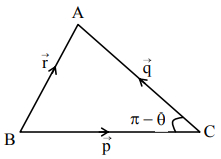
0 likesView Solution
109
MathematicsDifficultMCQJEE Main · 2026
શ્રેણિકો $A = \begin{bmatrix} 3 & -4 \\ 1 & -1 \end{bmatrix}$ અને $B = \begin{bmatrix} -29 & 49 \\ -13 & 18 \end{bmatrix}$ માટે,જો $(A^{15}+B)\begin{bmatrix} x \\ y \end{bmatrix} = \begin{bmatrix} 0 \\ 0 \end{bmatrix}$ હોય,તો નીચેનામાંથી કયું સત્ય છે?
A
$x=5, y=7$
B
$x=18, y=11$
C
$x=11, y=2$
D
$x=16, y=3$
Solution
(C) પ્રથમ,આપણે $A^n$ નું સામાન્ય સ્વરૂપ શોધીએ. આપેલ $A = \begin{bmatrix} 3 & -4 \\ 1 & -1 \end{bmatrix}$ માટે,$A^2 = \begin{bmatrix} 5 & -8 \\ 2 & -3 \end{bmatrix}$ મળે છે.
ગાણિતિક અનુમાનના સિદ્ધાંત મુજબ,$A^n = \begin{bmatrix} 2n+1 & -4n \\ n & -2n+1 \end{bmatrix}$ થાય.
$n=15$ માટે,$A^{15} = \begin{bmatrix} 31 & -60 \\ 15 & -29 \end{bmatrix}$ મળે.
હવે,$A^{15}+B = \begin{bmatrix} 31 & -60 \\ 15 & -29 \end{bmatrix} + \begin{bmatrix} -29 & 49 \\ -13 & 18 \end{bmatrix} = \begin{bmatrix} 2 & -11 \\ 2 & -11 \end{bmatrix}$.
સમીકરણ $(A^{15}+B)\begin{bmatrix} x \\ y \end{bmatrix} = \begin{bmatrix} 0 \\ 0 \end{bmatrix}$ એ $\begin{bmatrix} 2 & -11 \\ 2 & -11 \end{bmatrix} \begin{bmatrix} x \\ y \end{bmatrix} = \begin{bmatrix} 0 \\ 0 \end{bmatrix}$ બને છે.
આથી $2x - 11y = 0$ અથવા $2x = 11y$ મળે.
વિકલ્પો તપાસતા,$x=11$ અને $y=2$ માટે $2(11) = 22$ અને $11(2) = 22$ થાય છે. તેથી,$x=11, y=2$ એ સાચો જવાબ છે.
ગાણિતિક અનુમાનના સિદ્ધાંત મુજબ,$A^n = \begin{bmatrix} 2n+1 & -4n \\ n & -2n+1 \end{bmatrix}$ થાય.
$n=15$ માટે,$A^{15} = \begin{bmatrix} 31 & -60 \\ 15 & -29 \end{bmatrix}$ મળે.
હવે,$A^{15}+B = \begin{bmatrix} 31 & -60 \\ 15 & -29 \end{bmatrix} + \begin{bmatrix} -29 & 49 \\ -13 & 18 \end{bmatrix} = \begin{bmatrix} 2 & -11 \\ 2 & -11 \end{bmatrix}$.
સમીકરણ $(A^{15}+B)\begin{bmatrix} x \\ y \end{bmatrix} = \begin{bmatrix} 0 \\ 0 \end{bmatrix}$ એ $\begin{bmatrix} 2 & -11 \\ 2 & -11 \end{bmatrix} \begin{bmatrix} x \\ y \end{bmatrix} = \begin{bmatrix} 0 \\ 0 \end{bmatrix}$ બને છે.
આથી $2x - 11y = 0$ અથવા $2x = 11y$ મળે.
વિકલ્પો તપાસતા,$x=11$ અને $y=2$ માટે $2(11) = 22$ અને $11(2) = 22$ થાય છે. તેથી,$x=11, y=2$ એ સાચો જવાબ છે.
0 likesView Solution
110
MathematicsMediumMCQJEE Main · 2026
જો પ્રદેશ ${(x, y) : -2x + 1 \le y \le 4 - x^2, x \ge 0, y \ge 0}$ નું ક્ષેત્રફળ $\frac{\alpha}{\beta}$ હોય,જ્યાં $\alpha, \beta \in N$ અને $\gcd(\alpha, \beta) = 1$,તો $(\alpha + \beta)$ નું મૂલ્ય શોધો:
A
$73$
B
$85$
C
$91$
D
$67$
Solution
(A) આ પ્રદેશ પરવલય $y = 4 - x^2$,રેખા $y = -2x + 1$ અને અક્ષો $x \ge 0, y \ge 0$ દ્વારા ઘેરાયેલ છે.
ક્ષેત્રફળ $= \int_{0}^{2} (4 - x^2) dx - \text{ત્રિકોણનું ક્ષેત્રફળ જેના શિરોબિંદુઓ } (0,0), (0.5,0), (0,1) \text{ છે.}$
ક્ષેત્રફળ $= [4x - \frac{x^3}{3}]_{0}^{2} - \frac{1}{2} \times 0.5 \times 1$
$= (8 - \frac{8}{3}) - \frac{1}{4} = \frac{16}{3} - \frac{1}{4} = \frac{64 - 3}{12} = \frac{61}{12}$.
અહીં $\alpha = 61$ અને $\beta = 12$ છે,તેથી $\alpha + \beta = 61 + 12 = 73$.
ક્ષેત્રફળ $= \int_{0}^{2} (4 - x^2) dx - \text{ત્રિકોણનું ક્ષેત્રફળ જેના શિરોબિંદુઓ } (0,0), (0.5,0), (0,1) \text{ છે.}$
ક્ષેત્રફળ $= [4x - \frac{x^3}{3}]_{0}^{2} - \frac{1}{2} \times 0.5 \times 1$
$= (8 - \frac{8}{3}) - \frac{1}{4} = \frac{16}{3} - \frac{1}{4} = \frac{64 - 3}{12} = \frac{61}{12}$.
અહીં $\alpha = 61$ અને $\beta = 12$ છે,તેથી $\alpha + \beta = 61 + 12 = 73$.
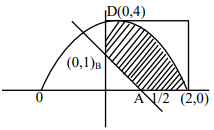
0 likesView Solution
111
MathematicsDifficultMCQJEE Main · 2026
એક યાદચ્છિક ચલ $X$ એ $0, 1, 2, 3$ કિંમતો અનુક્રમે $\frac{2a + 1}{30}, \frac{8a - 1}{30}, \frac{4a + 1}{30}, b$ સંભાવનાઓ સાથે ધારણ કરે છે,જ્યાં $a, b \in R$. ધારો કે $\mu$ અને $\sigma$ એ $X$ ના મધ્યક અને પ્રમાણિત વિચલન છે જેથી $\sigma^{2} + \mu^{2} = 2$ થાય. તો $\frac{a}{b}$ ની કિંમત શોધો:
A
$30$
B
$3$
C
$60$
D
$12$
Solution
(C) સંભાવનાઓનો સરવાળો $1$ થાય છે:
$\frac{2a + 1}{30} + \frac{8a - 1}{30} + \frac{4a + 1}{30} + b = 1$
$\frac{14a + 1}{30} + b = 1 \Rightarrow 14a + 30b = 29 \dots (1)$
આપણને $\sigma^{2} + \mu^{2} = 2$ આપેલ છે. $\sigma^{2} = E[X^{2}] - \mu^{2}$ હોવાથી,$E[X^{2}] = 2$ મળે.
$E[X^{2}] = \sum x_{i}^{2} p(x_{i}) = 0^{2} \cdot \frac{2a+1}{30} + 1^{2} \cdot \frac{8a-1}{30} + 2^{2} \cdot \frac{4a+1}{30} + 3^{2} \cdot b = 2$
$\frac{8a - 1 + 16a + 4}{30} + 9b = 2$
$\frac{24a + 3}{30} + 9b = 2$ $\Rightarrow 24a + 3 + 270b = 60$ $\Rightarrow 24a + 270b = 57$
$3$ વડે ભાગતા: $8a + 90b = 19 \dots (2)$
સમીકરણ $(1)$ પરથી,$30b = 29 - 14a$. તેને $(2)$ માં મૂકતા:
$8a + 3(29 - 14a) = 19$
$8a + 87 - 42a = 19$
$-34a = -68 \Rightarrow a = 2$
$a = 2$ ને $(1)$ માં મૂકતા: $14(2) + 30b = 29$ $\Rightarrow 28 + 30b = 29$ $\Rightarrow 30b = 1$ $\Rightarrow b = \frac{1}{30}$
તેથી,$\frac{a}{b} = \frac{2}{1/30} = 60$.
$\frac{2a + 1}{30} + \frac{8a - 1}{30} + \frac{4a + 1}{30} + b = 1$
$\frac{14a + 1}{30} + b = 1 \Rightarrow 14a + 30b = 29 \dots (1)$
આપણને $\sigma^{2} + \mu^{2} = 2$ આપેલ છે. $\sigma^{2} = E[X^{2}] - \mu^{2}$ હોવાથી,$E[X^{2}] = 2$ મળે.
$E[X^{2}] = \sum x_{i}^{2} p(x_{i}) = 0^{2} \cdot \frac{2a+1}{30} + 1^{2} \cdot \frac{8a-1}{30} + 2^{2} \cdot \frac{4a+1}{30} + 3^{2} \cdot b = 2$
$\frac{8a - 1 + 16a + 4}{30} + 9b = 2$
$\frac{24a + 3}{30} + 9b = 2$ $\Rightarrow 24a + 3 + 270b = 60$ $\Rightarrow 24a + 270b = 57$
$3$ વડે ભાગતા: $8a + 90b = 19 \dots (2)$
સમીકરણ $(1)$ પરથી,$30b = 29 - 14a$. તેને $(2)$ માં મૂકતા:
$8a + 3(29 - 14a) = 19$
$8a + 87 - 42a = 19$
$-34a = -68 \Rightarrow a = 2$
$a = 2$ ને $(1)$ માં મૂકતા: $14(2) + 30b = 29$ $\Rightarrow 28 + 30b = 29$ $\Rightarrow 30b = 1$ $\Rightarrow b = \frac{1}{30}$
તેથી,$\frac{a}{b} = \frac{2}{1/30} = 60$.
0 likesView Solution
112
MathematicsDifficultMCQJEE Main · 2026
ધારો કે રેખા $L_{1}$ એ સદિશ $-3\hat{i}+2\hat{j}+4\hat{k}$ ને સમાંતર છે અને બિંદુ $(2, 6, 7)$ માંથી પસાર થાય છે,અને રેખા $L_{2}$ એ સદિશ $2\hat{i}+\hat{j}+3\hat{k}$ ને સમાંતર છે અને બિંદુ $(4, 3, 5)$ માંથી પસાર થાય છે. જો રેખા $L_{3}$ એ સદિશ $-3\hat{i}+5\hat{j}+16\hat{k}$ ને સમાંતર હોય અને રેખાઓ $L_{1}$ અને $L_{2}$ ને અનુક્રમે $C$ અને $D$ બિંદુઓમાં છેદતી હોય,તો $|\overrightarrow{CD}|^2$ ની કિંમત શોધો:
A
$171$
B
$290$
C
$312$
D
$89$
Solution
(B) રેખા $L_{1}$ નું સમીકરણ $\frac{x-2}{-3} = \frac{y-6}{2} = \frac{z-7}{4} = \lambda_{1}$ છે. તેથી,$L_{1}$ પરનું કોઈપણ બિંદુ $C$ એ $(-3\lambda_{1}+2, 2\lambda_{1}+6, 4\lambda_{1}+7)$ છે.
રેખા $L_{2}$ નું સમીકરણ $\frac{x-4}{2} = \frac{y-3}{1} = \frac{z-5}{3} = \lambda_{2}$ છે. તેથી,$L_{2}$ પરનું કોઈપણ બિંદુ $D$ એ $(2\lambda_{2}+4, \lambda_{2}+3, 3\lambda_{2}+5)$ છે.
સદિશ $\overrightarrow{CD} = (2\lambda_{2}+3\lambda_{1}+2)\hat{i} + (\lambda_{2}-2\lambda_{1}-3)\hat{j} + (3\lambda_{2}-4\lambda_{1}-2)\hat{k}$ થાય.
રેખા $L_{3}$ એ $-3\hat{i}+5\hat{j}+16\hat{k}$ ને સમાંતર હોવાથી,$\overrightarrow{CD}$ ના ઘટકો $(-3, 5, 16)$ ના પ્રમાણમાં હોવા જોઈએ:
$\frac{2\lambda_{2}+3\lambda_{1}+2}{-3} = \frac{\lambda_{2}-2\lambda_{1}-3}{5} = \frac{3\lambda_{2}-4\lambda_{1}-2}{16} = k$.
આ સમીકરણો ઉકેલતા,આપણને $\lambda_{1} = -3$ અને $\lambda_{2} = 2$ મળે છે.
આ કિંમતો મૂકતા,આપણને $C = (11, 0, -5)$ અને $D = (8, 5, 11)$ મળે છે.
તેથી $\overrightarrow{CD} = (8-11)\hat{i} + (5-0)\hat{j} + (11-(-5))\hat{k} = -3\hat{i} + 5\hat{j} + 16\hat{k}$ થાય.
તેથી,$|\overrightarrow{CD}|^2 = (-3)^2 + 5^2 + 16^2 = 9 + 25 + 256 = 290$.
રેખા $L_{2}$ નું સમીકરણ $\frac{x-4}{2} = \frac{y-3}{1} = \frac{z-5}{3} = \lambda_{2}$ છે. તેથી,$L_{2}$ પરનું કોઈપણ બિંદુ $D$ એ $(2\lambda_{2}+4, \lambda_{2}+3, 3\lambda_{2}+5)$ છે.
સદિશ $\overrightarrow{CD} = (2\lambda_{2}+3\lambda_{1}+2)\hat{i} + (\lambda_{2}-2\lambda_{1}-3)\hat{j} + (3\lambda_{2}-4\lambda_{1}-2)\hat{k}$ થાય.
રેખા $L_{3}$ એ $-3\hat{i}+5\hat{j}+16\hat{k}$ ને સમાંતર હોવાથી,$\overrightarrow{CD}$ ના ઘટકો $(-3, 5, 16)$ ના પ્રમાણમાં હોવા જોઈએ:
$\frac{2\lambda_{2}+3\lambda_{1}+2}{-3} = \frac{\lambda_{2}-2\lambda_{1}-3}{5} = \frac{3\lambda_{2}-4\lambda_{1}-2}{16} = k$.
આ સમીકરણો ઉકેલતા,આપણને $\lambda_{1} = -3$ અને $\lambda_{2} = 2$ મળે છે.
આ કિંમતો મૂકતા,આપણને $C = (11, 0, -5)$ અને $D = (8, 5, 11)$ મળે છે.
તેથી $\overrightarrow{CD} = (8-11)\hat{i} + (5-0)\hat{j} + (11-(-5))\hat{k} = -3\hat{i} + 5\hat{j} + 16\hat{k}$ થાય.
તેથી,$|\overrightarrow{CD}|^2 = (-3)^2 + 5^2 + 16^2 = 9 + 25 + 256 = 290$.
0 likesView Solution
113
MathematicsDifficultMCQJEE Main · 2026
ધારો કે રેખા $L$ એ બિંદુ $(-3, 5, 2)$ માંથી પસાર થાય છે અને ધન યામ અક્ષો સાથે સમાન ખૂણા બનાવે છે. જો બિંદુ $P(-2, r, 1)$ થી રેખા $L$ નું અંતર $\sqrt{\frac{14}{3}}$ હોય,તો $r$ ના તમામ શક્ય મૂલ્યોનો સરવાળો શોધો:
A
$12$
B
$16$
C
$6$
D
$10$
Solution
(D) રેખા $L$ એ બિંદુ $A(-3, 5, 2)$ માંથી પસાર થાય છે અને યામ અક્ષો સાથે સમાન ખૂણા બનાવે છે,તેથી તેના દિશા ગુણોત્તર $(1, 1, 1)$ છે.
રેખાનું સમીકરણ $\frac{x+3}{1} = \frac{y-5}{1} = \frac{z-2}{1} = \lambda$ છે.
રેખા પરનું કોઈપણ સામાન્ય બિંદુ $R$ એ $(\lambda-3, \lambda+5, \lambda+2)$ છે.
ધારો કે $P = (-2, r, 1)$. સદિશ $\overrightarrow{PR} = ((\lambda-3) - (-2), (\lambda+5) - r, (\lambda+2) - 1) = (\lambda-1, \lambda+5-r, \lambda+1)$ છે.
કારણ કે $PR$ એ લંબ અંતર છે,$\overrightarrow{PR} \cdot \vec{d} = 0$,જ્યાં $\vec{d} = (1, 1, 1)$.
$(\lambda-1)(1) + (\lambda+5-r)(1) + (\lambda+1)(1) = 0 \Rightarrow 3\lambda - r + 5 = 0 \Rightarrow \lambda = \frac{r-5}{3}$.
$\lambda$ ની કિંમત મૂકતા,$R = (\frac{r-5}{3}-3, \frac{r-5}{3}+5, \frac{r-5}{3}+2) = (\frac{r-14}{3}, \frac{r+10}{3}, \frac{r+1}{3})$.
અંતર $PR = \sqrt{\frac{14}{3}}$,તેથી $PR^2 = \frac{14}{3}$.
$PR^2 = (\frac{r-14}{3} + 2)^2 + (\frac{r+10}{3} - r)^2 + (\frac{r+1}{3} - 1)^2 = \frac{14}{3}$.
$(\frac{r-8}{3})^2 + (\frac{10-2r}{3})^2 + (\frac{r-2}{3})^2 = \frac{14}{3}$.
$\frac{r^2-16r+64 + 100-40r+4r^2 + r^2-4r+4}{9} = \frac{14}{3}$.
$6r^2 - 60r + 168 = 42 \Rightarrow 6r^2 - 60r + 126 = 0$.
$r^2 - 10r + 21 = 0 \Rightarrow (r-3)(r-7) = 0$.
$r$ ના શક્ય મૂલ્યો $3$ અને $7$ છે.
$r$ ના તમામ શક્ય મૂલ્યોનો સરવાળો $3 + 7 = 10$ છે.
રેખાનું સમીકરણ $\frac{x+3}{1} = \frac{y-5}{1} = \frac{z-2}{1} = \lambda$ છે.
રેખા પરનું કોઈપણ સામાન્ય બિંદુ $R$ એ $(\lambda-3, \lambda+5, \lambda+2)$ છે.
ધારો કે $P = (-2, r, 1)$. સદિશ $\overrightarrow{PR} = ((\lambda-3) - (-2), (\lambda+5) - r, (\lambda+2) - 1) = (\lambda-1, \lambda+5-r, \lambda+1)$ છે.
કારણ કે $PR$ એ લંબ અંતર છે,$\overrightarrow{PR} \cdot \vec{d} = 0$,જ્યાં $\vec{d} = (1, 1, 1)$.
$(\lambda-1)(1) + (\lambda+5-r)(1) + (\lambda+1)(1) = 0 \Rightarrow 3\lambda - r + 5 = 0 \Rightarrow \lambda = \frac{r-5}{3}$.
$\lambda$ ની કિંમત મૂકતા,$R = (\frac{r-5}{3}-3, \frac{r-5}{3}+5, \frac{r-5}{3}+2) = (\frac{r-14}{3}, \frac{r+10}{3}, \frac{r+1}{3})$.
અંતર $PR = \sqrt{\frac{14}{3}}$,તેથી $PR^2 = \frac{14}{3}$.
$PR^2 = (\frac{r-14}{3} + 2)^2 + (\frac{r+10}{3} - r)^2 + (\frac{r+1}{3} - 1)^2 = \frac{14}{3}$.
$(\frac{r-8}{3})^2 + (\frac{10-2r}{3})^2 + (\frac{r-2}{3})^2 = \frac{14}{3}$.
$\frac{r^2-16r+64 + 100-40r+4r^2 + r^2-4r+4}{9} = \frac{14}{3}$.
$6r^2 - 60r + 168 = 42 \Rightarrow 6r^2 - 60r + 126 = 0$.
$r^2 - 10r + 21 = 0 \Rightarrow (r-3)(r-7) = 0$.
$r$ ના શક્ય મૂલ્યો $3$ અને $7$ છે.
$r$ ના તમામ શક્ય મૂલ્યોનો સરવાળો $3 + 7 = 10$ છે.
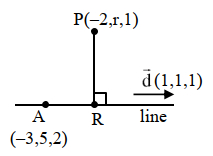
0 likesView Solution
114
MathematicsDifficultMCQJEE Main · 2026
ધારો કે $f(x) = x^{3} + x^{2}f^{\prime}(1) + 2x f^{\prime\prime}(2) + f^{\prime\prime\prime}(3)$,જ્યાં $x \in R$. તો $f^{\prime}(5)$ નું મૂલ્ય શોધો:
A
$ \frac{62}{5} $
B
$ \frac{657}{5} $
C
$ \frac{2}{5} $
D
$ \frac{117}{5} $
Solution
(D) આપેલ છે કે $f(x) = x^{3} + x^{2}f^{\prime}(1) + 2x f^{\prime\prime}(2) + f^{\prime\prime\prime}(3)$.
પ્રથમ વિકલન: $f^{\prime}(x) = 3x^{2} + 2x f^{\prime}(1) + 2f^{\prime\prime}(2)$.
દ્વિતીય વિકલન: $f^{\prime\prime}(x) = 6x + 2f^{\prime}(1)$.
તૃતીય વિકલન: $f^{\prime\prime\prime}(x) = 6$.
હવે,અચળાંકોની કિંમત શોધીએ:
$f^{\prime\prime}(2) = 6(2) + 2f^{\prime}(1) = 12 + 2f^{\prime}(1)$.
$f^{\prime\prime\prime}(3) = 6$.
આ કિંમતોને $f^{\prime}(x)$ ના સમીકરણમાં મૂકતા:
$f^{\prime}(x) = 3x^{2} + 2x f^{\prime}(1) + 2(12 + 2f^{\prime}(1)) = 3x^{2} + 2x f^{\prime}(1) + 24 + 4f^{\prime}(1)$.
$f^{\prime}(1)$ શોધવા માટે $x = 1$ મૂકતા:
$f^{\prime}(1) = 3(1)^{2} + 2(1)f^{\prime}(1) + 24 + 4f^{\prime}(1)$.
$f^{\prime}(1) = 3 + 2f^{\prime}(1) + 24 + 4f^{\prime}(1) = 27 + 6f^{\prime}(1)$.
$-5f^{\prime}(1) = 27 \implies f^{\prime}(1) = -\frac{27}{5}$.
હવે $f^{\prime}(1)$ ની કિંમત $f^{\prime}(x)$ માં મૂકતા:
$f^{\prime}(x) = 3x^{2} + 2x(-\frac{27}{5}) + 24 + 4(-\frac{27}{5}) = 3x^{2} - \frac{54}{5}x + 24 - \frac{108}{5} = 3x^{2} - \frac{54}{5}x + \frac{12}{5}$.
છેલ્લે,$f^{\prime}(5)$ ની ગણતરી કરતા:
$f^{\prime}(5) = 3(5)^{2} - \frac{54}{5}(5) + \frac{12}{5} = 75 - 54 + \frac{12}{5} = 21 + \frac{12}{5} = \frac{105 + 12}{5} = \frac{117}{5}$.
પ્રથમ વિકલન: $f^{\prime}(x) = 3x^{2} + 2x f^{\prime}(1) + 2f^{\prime\prime}(2)$.
દ્વિતીય વિકલન: $f^{\prime\prime}(x) = 6x + 2f^{\prime}(1)$.
તૃતીય વિકલન: $f^{\prime\prime\prime}(x) = 6$.
હવે,અચળાંકોની કિંમત શોધીએ:
$f^{\prime\prime}(2) = 6(2) + 2f^{\prime}(1) = 12 + 2f^{\prime}(1)$.
$f^{\prime\prime\prime}(3) = 6$.
આ કિંમતોને $f^{\prime}(x)$ ના સમીકરણમાં મૂકતા:
$f^{\prime}(x) = 3x^{2} + 2x f^{\prime}(1) + 2(12 + 2f^{\prime}(1)) = 3x^{2} + 2x f^{\prime}(1) + 24 + 4f^{\prime}(1)$.
$f^{\prime}(1)$ શોધવા માટે $x = 1$ મૂકતા:
$f^{\prime}(1) = 3(1)^{2} + 2(1)f^{\prime}(1) + 24 + 4f^{\prime}(1)$.
$f^{\prime}(1) = 3 + 2f^{\prime}(1) + 24 + 4f^{\prime}(1) = 27 + 6f^{\prime}(1)$.
$-5f^{\prime}(1) = 27 \implies f^{\prime}(1) = -\frac{27}{5}$.
હવે $f^{\prime}(1)$ ની કિંમત $f^{\prime}(x)$ માં મૂકતા:
$f^{\prime}(x) = 3x^{2} + 2x(-\frac{27}{5}) + 24 + 4(-\frac{27}{5}) = 3x^{2} - \frac{54}{5}x + 24 - \frac{108}{5} = 3x^{2} - \frac{54}{5}x + \frac{12}{5}$.
છેલ્લે,$f^{\prime}(5)$ ની ગણતરી કરતા:
$f^{\prime}(5) = 3(5)^{2} - \frac{54}{5}(5) + \frac{12}{5} = 75 - 54 + \frac{12}{5} = 21 + \frac{12}{5} = \frac{105 + 12}{5} = \frac{117}{5}$.
0 likesView Solution
115
MathematicsDifficultMCQJEE Main · 2026
ધારો કે $f : R \rightarrow R$ એ બે વાર વિકલનીય વિધેય છે જેથી તમામ $x \in R$ માટે $f^{\prime\prime}(x) > 0$ અને $f^{\prime}(a-1) = 0$ છે,જ્યાં $a$ એ વાસ્તવિક સંખ્યા છે. ધારો કે $g(x) = f(\tan^{2}x - 2\tan x + a)$,$0 < x < \frac{\pi}{2}$. નીચેના બે વિધાનો ધ્યાનમાં લો:
$(I)$ $g$ એ $(0, \frac{\pi}{4})$ માં વધતું વિધેય છે.
$(II)$ $g$ એ $(\frac{\pi}{4}, \frac{\pi}{2})$ માં ઘટતું વિધેય છે.
તો,
$(I)$ $g$ એ $(0, \frac{\pi}{4})$ માં વધતું વિધેય છે.
$(II)$ $g$ એ $(\frac{\pi}{4}, \frac{\pi}{2})$ માં ઘટતું વિધેય છે.
તો,
A
ન તો $(I)$ કે ન તો $(II)$ સાચું છે
B
માત્ર $(II)$ સાચું છે
C
માત્ર $(I)$ સાચું છે
D
બંને $(I)$ અને $(II)$ સાચા છે
Solution
(A) આપેલ છે $g(x) = f((\tan x - 1)^{2} + a - 1)$.
વિકલન કરતા,$g^{\prime}(x) = f^{\prime}((\tan x - 1)^{2} + a - 1) \cdot 2(\tan x - 1) \cdot \sec^{2}x$.
કારણ કે $f^{\prime\prime}(x) > 0$,$f^{\prime}(x)$ એ ચુસ્ત વધતું વિધેય છે.
આપણને આપેલ છે કે $f^{\prime}(a-1) = 0$.
જો $(\tan x - 1)^{2} > 0$ હોય,તો $(\tan x - 1)^{2} + a - 1 > a - 1$,જે સૂચવે છે કે $f^{\prime}((\tan x - 1)^{2} + a - 1) > f^{\prime}(a - 1) = 0$.
$x \in (0, \frac{\pi}{4})$ માટે,$\tan x < 1$,તેથી $(\tan x - 1) < 0$. આમ $g^{\prime}(x) = (\text{ધન}) \cdot (\text{ઋણ}) \cdot (\text{ધન}) < 0$. તેથી $g$ એ $(0, \frac{\pi}{4})$ માં ઘટતું વિધેય છે.
$x \in (\frac{\pi}{4}, \frac{\pi}{2})$ માટે,$\tan x > 1$,તેથી $(\tan x - 1) > 0$. આમ $g^{\prime}(x) = (\text{ધન}) \cdot (\text{ધન}) \cdot (\text{ધન}) > 0$. તેથી $g$ એ $(\frac{\pi}{4}, \frac{\pi}{2})$ માં વધતું વિધેય છે.
તેથી,વિધાન $(I)$ કે $(II)$ માંથી કોઈ પણ સાચું નથી.
વિકલન કરતા,$g^{\prime}(x) = f^{\prime}((\tan x - 1)^{2} + a - 1) \cdot 2(\tan x - 1) \cdot \sec^{2}x$.
કારણ કે $f^{\prime\prime}(x) > 0$,$f^{\prime}(x)$ એ ચુસ્ત વધતું વિધેય છે.
આપણને આપેલ છે કે $f^{\prime}(a-1) = 0$.
જો $(\tan x - 1)^{2} > 0$ હોય,તો $(\tan x - 1)^{2} + a - 1 > a - 1$,જે સૂચવે છે કે $f^{\prime}((\tan x - 1)^{2} + a - 1) > f^{\prime}(a - 1) = 0$.
$x \in (0, \frac{\pi}{4})$ માટે,$\tan x < 1$,તેથી $(\tan x - 1) < 0$. આમ $g^{\prime}(x) = (\text{ધન}) \cdot (\text{ઋણ}) \cdot (\text{ધન}) < 0$. તેથી $g$ એ $(0, \frac{\pi}{4})$ માં ઘટતું વિધેય છે.
$x \in (\frac{\pi}{4}, \frac{\pi}{2})$ માટે,$\tan x > 1$,તેથી $(\tan x - 1) > 0$. આમ $g^{\prime}(x) = (\text{ધન}) \cdot (\text{ધન}) \cdot (\text{ધન}) > 0$. તેથી $g$ એ $(\frac{\pi}{4}, \frac{\pi}{2})$ માં વધતું વિધેય છે.
તેથી,વિધાન $(I)$ કે $(II)$ માંથી કોઈ પણ સાચું નથી.
0 likesView Solution
116
MathematicsDifficultMCQJEE Main · 2026
ધારો કે $[\bullet]$ એ મહત્તમ પૂર્ણાંક વિધેય છે. જો $\alpha = \int_{0}^{64} (x^{1/3} - [x^{1/3}]) dx$ હોય,તો $\frac{1}{\pi} \int_{0}^{\alpha\pi} \left( \frac{\sin^2 \theta}{\sin^6 \theta + \cos^6 \theta} \right) d\theta$ ની કિંમત . . . . . . થાય.
A
$32$
B
$36$
C
$40$
D
$48$
Solution
(B) પ્રથમ,આપણે $\alpha = \int_{0}^{64} (x^{1/3} - [x^{1/3}]) dx = \int_{0}^{64} x^{1/3} dx - \int_{0}^{64} [x^{1/3}] dx$ ની ગણતરી કરીએ.
$\int_{0}^{64} x^{1/3} dx = \left[ \frac{3}{4} x^{4/3} \right]_{0}^{64} = \frac{3}{4} \times 256 = 192$.
$\int_{0}^{64} [x^{1/3}] dx$ માટે,આપણે $[x^{1/3}]$ ની કિંમતોના આધારે સંકલનને વિભાજિત કરીએ છીએ:
$= \int_{0}^{1} 0 dx + \int_{1}^{8} 1 dx + \int_{8}^{27} 2 dx + \int_{27}^{64} 3 dx = 0 + (8-1) + 2(27-8) + 3(64-27) = 7 + 38 + 111 = 156$.
આમ,$\alpha = 192 - 156 = 36$.
હવે,આપણે $E = \frac{1}{\pi} \int_{0}^{36\pi} \frac{\sin^2 \theta}{\sin^6 \theta + \cos^6 \theta} d\theta$ ની કિંમત શોધીએ.
વિધેયનો આવર્તમાન $\pi$ હોવાથી,$E = \frac{36}{\pi} \int_{0}^{\pi} \frac{\sin^2 \theta}{\sin^6 \theta + \cos^6 \theta} d\theta = \frac{36 \times 2}{\pi} \int_{0}^{\pi/2} \frac{\sin^2 \theta}{\sin^6 \theta + \cos^6 \theta} d\theta$.
ધારો કે $J = \int_{0}^{\pi/2} \frac{\sin^2 \theta}{\sin^6 \theta + \cos^6 \theta} d\theta$. કિંગના ગુણધર્મ મુજબ,$J = \int_{0}^{\pi/2} \frac{\cos^2 \theta}{\sin^6 \theta + \cos^6 \theta} d\theta$.
બંનેનો સરવાળો કરતા,$2J = \int_{0}^{\pi/2} \frac{1}{\sin^6 \theta + \cos^6 \theta} d\theta = \int_{0}^{\pi/2} \frac{\sec^6 \theta}{\tan^6 \theta + 1} d\theta$.
ધારો કે $\tan \theta = t$,તો $dt = \sec^2 \theta d\theta$. $2J = \int_{0}^{\infty} \frac{(1+t^2)^2}{t^6+1} dt = \int_{0}^{\infty} \frac{1+t^2}{t^4-t^2+1} dt = \pi$.
આમ $J = \pi/2$.
અંતે,$E = \frac{72}{\pi} \times \frac{\pi}{2} = 36$.
$\int_{0}^{64} x^{1/3} dx = \left[ \frac{3}{4} x^{4/3} \right]_{0}^{64} = \frac{3}{4} \times 256 = 192$.
$\int_{0}^{64} [x^{1/3}] dx$ માટે,આપણે $[x^{1/3}]$ ની કિંમતોના આધારે સંકલનને વિભાજિત કરીએ છીએ:
$= \int_{0}^{1} 0 dx + \int_{1}^{8} 1 dx + \int_{8}^{27} 2 dx + \int_{27}^{64} 3 dx = 0 + (8-1) + 2(27-8) + 3(64-27) = 7 + 38 + 111 = 156$.
આમ,$\alpha = 192 - 156 = 36$.
હવે,આપણે $E = \frac{1}{\pi} \int_{0}^{36\pi} \frac{\sin^2 \theta}{\sin^6 \theta + \cos^6 \theta} d\theta$ ની કિંમત શોધીએ.
વિધેયનો આવર્તમાન $\pi$ હોવાથી,$E = \frac{36}{\pi} \int_{0}^{\pi} \frac{\sin^2 \theta}{\sin^6 \theta + \cos^6 \theta} d\theta = \frac{36 \times 2}{\pi} \int_{0}^{\pi/2} \frac{\sin^2 \theta}{\sin^6 \theta + \cos^6 \theta} d\theta$.
ધારો કે $J = \int_{0}^{\pi/2} \frac{\sin^2 \theta}{\sin^6 \theta + \cos^6 \theta} d\theta$. કિંગના ગુણધર્મ મુજબ,$J = \int_{0}^{\pi/2} \frac{\cos^2 \theta}{\sin^6 \theta + \cos^6 \theta} d\theta$.
બંનેનો સરવાળો કરતા,$2J = \int_{0}^{\pi/2} \frac{1}{\sin^6 \theta + \cos^6 \theta} d\theta = \int_{0}^{\pi/2} \frac{\sec^6 \theta}{\tan^6 \theta + 1} d\theta$.
ધારો કે $\tan \theta = t$,તો $dt = \sec^2 \theta d\theta$. $2J = \int_{0}^{\infty} \frac{(1+t^2)^2}{t^6+1} dt = \int_{0}^{\infty} \frac{1+t^2}{t^4-t^2+1} dt = \pi$.
આમ $J = \pi/2$.
અંતે,$E = \frac{72}{\pi} \times \frac{\pi}{2} = 36$.
0 likesView Solution
117
MathematicsDifficultMCQJEE Main · 2026
ધારો કે સદિશ $\overrightarrow{a}=\sqrt{2}\hat{i}-\hat{j}+\lambda\hat{k}$,$\lambda>0$,એ સદિશ $\overrightarrow{b}=-\lambda^{2}\hat{i}+4\sqrt{2}\hat{j}+4\sqrt{2}\hat{k}$ સાથે ગુરુકોણ બનાવે છે અને ધન $z$-અક્ષ સાથે $\theta$ ખૂણો બનાવે છે,જ્યાં $\frac{\pi}{6} < \theta < \frac{\pi}{2}$ છે. જો $\lambda$ ના તમામ શક્ય મૂલ્યોનો ગણ $(\alpha, \beta)-\{\gamma\}$ હોય,તો $\alpha+\beta+\gamma$ ની કિંમત . . . . . . . થાય.
A
$5$
B
$4$
C
$6$
D
$7$
Solution
(A) આપેલ છે કે $\overrightarrow{a}=\sqrt{2}\hat{i}-\hat{j}+\lambda\hat{k}$ અને $\overrightarrow{b}=-\lambda^{2}\hat{i}+4\sqrt{2}\hat{j}+4\sqrt{2}\hat{k}$.
સદિશ $\overrightarrow{a}$ એ ધન $z$-અક્ષ સાથે $\theta$ ખૂણો બનાવતો હોવાથી,$\cos \theta = \frac{\overrightarrow{a} \cdot \hat{k}}{|\overrightarrow{a}|} = \frac{\lambda}{\sqrt{(\sqrt{2})^2+(-1)^2+\lambda^2}} = \frac{\lambda}{\sqrt{3+\lambda^2}}$.
આપેલ છે કે $\frac{\pi}{6} < \theta < \frac{\pi}{2}$,તેથી $\cos \frac{\pi}{2} < \cos \theta < \cos \frac{\pi}{6}$,જે સૂચવે છે કે $0 < \frac{\lambda}{\sqrt{3+\lambda^2}} < \frac{\sqrt{3}}{2}$.
અસમતાનો વર્ગ કરતા,$0 < \frac{\lambda^2}{3+\lambda^2} < \frac{3}{4}$.
$\lambda > 0$ હોવાથી,ડાબી બાજુ હંમેશા સાચી છે. જમણી બાજુ માટે,$4\lambda^2 < 9 + 3\lambda^2 \Rightarrow \lambda^2 < 9 \Rightarrow \lambda < 3$. તેથી $\lambda \in (0, 3)$....$(1)$
સદિશ $\overrightarrow{a}$ એ $\overrightarrow{b}$ સાથે ગુરુકોણ બનાવતો હોવાથી,$\overrightarrow{a} \cdot \overrightarrow{b} < 0$.
$\overrightarrow{a} \cdot \overrightarrow{b} = (\sqrt{2})(-\lambda^2) + (-1)(4\sqrt{2}) + (\lambda)(4\sqrt{2}) = -\sqrt{2}(\lambda^2 - 4\lambda + 4) = -\sqrt{2}(\lambda-2)^2 < 0$.
$\sqrt{2} > 0$ હોવાથી,$(\lambda-2)^2 > 0$ હોવું જોઈએ,જેનો અર્થ છે કે $\lambda \neq 2$....$(2)$
$(1)$ અને $(2)$ પરથી,$\lambda \in (0, 3) - \{2\}$.
આમ,$\alpha=0, \beta=3, \gamma=2$.
તેથી,$\alpha+\beta+\gamma = 0+3+2 = 5$.
સદિશ $\overrightarrow{a}$ એ ધન $z$-અક્ષ સાથે $\theta$ ખૂણો બનાવતો હોવાથી,$\cos \theta = \frac{\overrightarrow{a} \cdot \hat{k}}{|\overrightarrow{a}|} = \frac{\lambda}{\sqrt{(\sqrt{2})^2+(-1)^2+\lambda^2}} = \frac{\lambda}{\sqrt{3+\lambda^2}}$.
આપેલ છે કે $\frac{\pi}{6} < \theta < \frac{\pi}{2}$,તેથી $\cos \frac{\pi}{2} < \cos \theta < \cos \frac{\pi}{6}$,જે સૂચવે છે કે $0 < \frac{\lambda}{\sqrt{3+\lambda^2}} < \frac{\sqrt{3}}{2}$.
અસમતાનો વર્ગ કરતા,$0 < \frac{\lambda^2}{3+\lambda^2} < \frac{3}{4}$.
$\lambda > 0$ હોવાથી,ડાબી બાજુ હંમેશા સાચી છે. જમણી બાજુ માટે,$4\lambda^2 < 9 + 3\lambda^2 \Rightarrow \lambda^2 < 9 \Rightarrow \lambda < 3$. તેથી $\lambda \in (0, 3)$....$(1)$
સદિશ $\overrightarrow{a}$ એ $\overrightarrow{b}$ સાથે ગુરુકોણ બનાવતો હોવાથી,$\overrightarrow{a} \cdot \overrightarrow{b} < 0$.
$\overrightarrow{a} \cdot \overrightarrow{b} = (\sqrt{2})(-\lambda^2) + (-1)(4\sqrt{2}) + (\lambda)(4\sqrt{2}) = -\sqrt{2}(\lambda^2 - 4\lambda + 4) = -\sqrt{2}(\lambda-2)^2 < 0$.
$\sqrt{2} > 0$ હોવાથી,$(\lambda-2)^2 > 0$ હોવું જોઈએ,જેનો અર્થ છે કે $\lambda \neq 2$....$(2)$
$(1)$ અને $(2)$ પરથી,$\lambda \in (0, 3) - \{2\}$.
આમ,$\alpha=0, \beta=3, \gamma=2$.
તેથી,$\alpha+\beta+\gamma = 0+3+2 = 5$.
0 likesView Solution
118
MathematicsDifficultMCQJEE Main · 2026
ધારો કે $f$ અને $g$ એવા વિધેયો છે જે $f(x+y)=f(x)f(y)$,$f(1)=7$ અને $g(x+y)=g(xy)$,$g(1)=1$ નું પાલન કરે છે,જ્યાં $x, y \in \mathbb{N}$. જો $\sum_{x=1}^{n} \left(\frac{f(x)}{g(x)}\right) = 19607$ હોય,તો $n$ ની કિંમત શોધો:
A
$7$
B
$5$
C
$6$
D
$4$
Solution
(B) આપેલ છે કે $f(x+y)=f(x)f(y)$ અને $f(1)=7$. આ $f(x)=a^x$ પ્રકારનું વિધેય છે. $f(1)=7$ હોવાથી,$a^1=7$,તેથી $f(x)=7^x$.
આપેલ છે કે $g(x+y)=g(xy)$ અને $g(1)=1$. $y=1$ મૂકતા,આપણને $g(x+1)=g(x)$ મળે છે. $g(1)=1$ હોવાથી,બધા $x \in \mathbb{N}$ માટે $g(x)=1$ થશે.
આપેલ સરવાળો $\sum_{x=1}^{n} \frac{f(x)}{g(x)} = 19607$ છે.
વિધેયોની કિંમત મૂકતા,$\sum_{x=1}^{n} \frac{7^x}{1} = 19607$.
આ એક સમગુણોત્તર શ્રેણી છે: $7 + 7^2 + \dots + 7^n = 19607$.
સમગુણોત્તર શ્રેણીનો સરવાળો $S_n = a\frac{r^n-1}{r-1}$ છે. અહીં $a=7$ અને $r=7$.
$7 \left(\frac{7^n-1}{7-1}\right) = 19607$.
$7 \left(\frac{7^n-1}{6}\right) = 19607$.
$7^n-1 = \frac{19607 \times 6}{7} = 2801 \times 6 = 16806$.
$7^n = 16807$.
$7^5 = 16807$ હોવાથી,$n=5$ મળે છે.
આપેલ છે કે $g(x+y)=g(xy)$ અને $g(1)=1$. $y=1$ મૂકતા,આપણને $g(x+1)=g(x)$ મળે છે. $g(1)=1$ હોવાથી,બધા $x \in \mathbb{N}$ માટે $g(x)=1$ થશે.
આપેલ સરવાળો $\sum_{x=1}^{n} \frac{f(x)}{g(x)} = 19607$ છે.
વિધેયોની કિંમત મૂકતા,$\sum_{x=1}^{n} \frac{7^x}{1} = 19607$.
આ એક સમગુણોત્તર શ્રેણી છે: $7 + 7^2 + \dots + 7^n = 19607$.
સમગુણોત્તર શ્રેણીનો સરવાળો $S_n = a\frac{r^n-1}{r-1}$ છે. અહીં $a=7$ અને $r=7$.
$7 \left(\frac{7^n-1}{7-1}\right) = 19607$.
$7 \left(\frac{7^n-1}{6}\right) = 19607$.
$7^n-1 = \frac{19607 \times 6}{7} = 2801 \times 6 = 16806$.
$7^n = 16807$.
$7^5 = 16807$ હોવાથી,$n=5$ મળે છે.
0 likesView Solution
119
MathematicsDifficultMCQJEE Main · 2026
ધારો કે $f(x) = [x]^2 - [x+3] - 3, x \in \mathbb{R}$,જ્યાં $[\bullet]$ એ મહત્તમ પૂર્ણાંક વિધેય છે. તો:
A
$f(x) > 0$ માત્ર $x \in [4, \infty)$ માટે
B
$f(x) < 0$ માત્ર $x \in [-1, 3)$ માટે
C
$\int_0^2 f(x) dx = -6$
D
$f(x) = 0$ એ $x$ ની મર્યાદિત કિંમતો માટે છે.
Solution
(B) આપેલ છે $f(x) = [x]^2 - ([x] + 3) - 3 = [x]^2 - [x] - 6$.
અવયવ પાડતા,$f(x) = ([x] - 3)([x] + 2)$.
$(1)$ $f(x) > 0$ માટે,$[x] > 3$ અથવા $[x] < -2$ હોવું જોઈએ.
આનો અર્થ એ છે કે $x \in [4, \infty)$ અથવા $x \in (-\infty, -2)$. તેથી,વિકલ્પ $A$ ખોટો છે.
$(2)$ $f(x) < 0$ માટે,$-2 < [x] < 3$ હોવું જોઈએ,જેનો અર્થ છે $[x] \in \{-1, 0, 1, 2\}$.
આનો અર્થ એ છે કે $x \in [-1, 3)$. તેથી,વિકલ્પ $B$ સાચો છે.
$(3)$ સંકલન ગણતા: $\int_0^2 f(x) dx = \int_0^1 f(x) dx + \int_1^2 f(x) dx$.
$x \in [0, 1)$ માટે,$[x] = 0$,તેથી $f(x) = 0^2 - 0 - 6 = -6$.
$x \in [1, 2)$ માટે,$[x] = 1$,તેથી $f(x) = 1^2 - 1 - 6 = -6$.
તેથી,$\int_0^2 f(x) dx = \int_0^1 (-6) dx + \int_1^2 (-6) dx = -6 - 6 = -12$. વિકલ્પ $C$ ખોટો છે.
$(4)$ $f(x) = 0$ માટે,$[x] = 3$ અથવા $[x] = -2$ હોવું જોઈએ.
આનો અર્થ એ છે કે $x \in [3, 4)$ અથવા $x \in [-2, -1)$,જેમાં અસંખ્ય કિંમતો છે. વિકલ્પ $D$ ખોટો છે.
અવયવ પાડતા,$f(x) = ([x] - 3)([x] + 2)$.
$(1)$ $f(x) > 0$ માટે,$[x] > 3$ અથવા $[x] < -2$ હોવું જોઈએ.
આનો અર્થ એ છે કે $x \in [4, \infty)$ અથવા $x \in (-\infty, -2)$. તેથી,વિકલ્પ $A$ ખોટો છે.
$(2)$ $f(x) < 0$ માટે,$-2 < [x] < 3$ હોવું જોઈએ,જેનો અર્થ છે $[x] \in \{-1, 0, 1, 2\}$.
આનો અર્થ એ છે કે $x \in [-1, 3)$. તેથી,વિકલ્પ $B$ સાચો છે.
$(3)$ સંકલન ગણતા: $\int_0^2 f(x) dx = \int_0^1 f(x) dx + \int_1^2 f(x) dx$.
$x \in [0, 1)$ માટે,$[x] = 0$,તેથી $f(x) = 0^2 - 0 - 6 = -6$.
$x \in [1, 2)$ માટે,$[x] = 1$,તેથી $f(x) = 1^2 - 1 - 6 = -6$.
તેથી,$\int_0^2 f(x) dx = \int_0^1 (-6) dx + \int_1^2 (-6) dx = -6 - 6 = -12$. વિકલ્પ $C$ ખોટો છે.
$(4)$ $f(x) = 0$ માટે,$[x] = 3$ અથવા $[x] = -2$ હોવું જોઈએ.
આનો અર્થ એ છે કે $x \in [3, 4)$ અથવા $x \in [-2, -1)$,જેમાં અસંખ્ય કિંમતો છે. વિકલ્પ $D$ ખોટો છે.
0 likesView Solution
120
MathematicsDifficultMCQJEE Main · 2026
ધારો કે $[\bullet]$ એ મહત્તમ પૂર્ણાંક વિધેય દર્શાવે છે અને $f(x) = \min \{\sqrt{2}x, x^2\}$ છે. ધારો કે $S = \{x \in (-2, 2) : g(x) = |x|[x^2] \text{ એ } x \text{ આગળ અસતત છે}\}$. તો $\sum_{x \in S} f(x)$ ની કિંમત શોધો.
A
$2-\sqrt{2}$
B
$2\sqrt{6}-3\sqrt{2}$
C
$1-\sqrt{2}$
D
$\sqrt{6}-2\sqrt{2}$
Solution
(C) વિધેય $g(x) = |x|[x^2]$ ત્યાં અસતત છે જ્યાં $[x^2]$ અસતત હોય,શરત એ છે કે $|x| \neq 0$.
$[x^2]$ એ $x^2 \in \mathbb{Z}$ માટે અસતત છે.
$x \in (-2, 2)$ માટે,$x^2 \in [0, 4)$.
$[0, 4)$ માં પૂર્ણાંકો $0, 1, 2, 3$ છે.
તેથી,$x^2 = 1, 2, 3$ લેતા $x = \pm 1, \pm \sqrt{2}, \pm \sqrt{3}$ મળે છે.
$x=0$ આગળ,$g(x) = |x|[x^2] = 0 \cdot [0] = 0$,અને $\lim_{x \to 0} |x|[x^2] = 0$,તેથી $g(x)$ એ $x=0$ આગળ સતત છે.
આમ,$S = \{-1, 1, -\sqrt{2}, \sqrt{2}, -\sqrt{3}, \sqrt{3}\}$.
હવે,$f(x) = \min \{\sqrt{2}x, x^2\}$.
$f(-1) = \min \{-\sqrt{2}, 1\} = -\sqrt{2}$.
$f(1) = \min \{\sqrt{2}, 1\} = 1$.
$f(-\sqrt{2}) = \min \{-2, 2\} = -2$.
$f(\sqrt{2}) = \min \{2, 2\} = 2$.
$f(-\sqrt{3}) = \min \{-\sqrt{6}, 3\} = -\sqrt{6}$.
$f(\sqrt{3}) = \min \{\sqrt{6}, 3\} = \sqrt{6}$.
આ કિંમતોનો સરવાળો: $\sum_{x \in S} f(x) = -\sqrt{2} + 1 - 2 + 2 - \sqrt{6} + \sqrt{6} = 1 - \sqrt{2}$.
$[x^2]$ એ $x^2 \in \mathbb{Z}$ માટે અસતત છે.
$x \in (-2, 2)$ માટે,$x^2 \in [0, 4)$.
$[0, 4)$ માં પૂર્ણાંકો $0, 1, 2, 3$ છે.
તેથી,$x^2 = 1, 2, 3$ લેતા $x = \pm 1, \pm \sqrt{2}, \pm \sqrt{3}$ મળે છે.
$x=0$ આગળ,$g(x) = |x|[x^2] = 0 \cdot [0] = 0$,અને $\lim_{x \to 0} |x|[x^2] = 0$,તેથી $g(x)$ એ $x=0$ આગળ સતત છે.
આમ,$S = \{-1, 1, -\sqrt{2}, \sqrt{2}, -\sqrt{3}, \sqrt{3}\}$.
હવે,$f(x) = \min \{\sqrt{2}x, x^2\}$.
$f(-1) = \min \{-\sqrt{2}, 1\} = -\sqrt{2}$.
$f(1) = \min \{\sqrt{2}, 1\} = 1$.
$f(-\sqrt{2}) = \min \{-2, 2\} = -2$.
$f(\sqrt{2}) = \min \{2, 2\} = 2$.
$f(-\sqrt{3}) = \min \{-\sqrt{6}, 3\} = -\sqrt{6}$.
$f(\sqrt{3}) = \min \{\sqrt{6}, 3\} = \sqrt{6}$.
આ કિંમતોનો સરવાળો: $\sum_{x \in S} f(x) = -\sqrt{2} + 1 - 2 + 2 - \sqrt{6} + \sqrt{6} = 1 - \sqrt{2}$.
0 likesView Solution
121
MathematicsDifficultMCQJEE Main · 2026
ધારો કે વિધેય $f(x) = \log_3 \log_5 (7 - \log_2 (x^2 - 10 x + 85)) + \sin^{-1} ( | \frac{3 x - 7}{17 - x} | )$ નો પ્રદેશ $(\alpha, \beta]$ છે. તો $\alpha + \beta$ ની કિંમત શોધો:
A
$10$
B
$12$
C
$9$
D
$8$
Solution
(C) પ્રથમ પદ $\log_3 \log_5 (7 - \log_2 (x^2 - 10 x + 85))$ માટે,આપણે $\log_5 (7 - \log_2 (x^2 - 10 x + 85)) > 0$ ની જરૂર છે,જેનો અર્થ છે કે $7 - \log_2 (x^2 - 10 x + 85) > 1$,તેથી $\log_2 (x^2 - 10 x + 85) < 6$. આનાથી $x^2 - 10 x + 85 < 2^6 = 64$ મળે છે,એટલે કે $x^2 - 10 x + 21 < 0$. અવયવ પાડતા $(x - 3)(x - 7) < 0$ મળે,તેથી $x \in (3, 7)$.
બીજા પદ $\sin^{-1} ( | \frac{3 x - 7}{17 - x} | )$ માટે,આપણે $0 \leq | \frac{3 x - 7}{17 - x} | \leq 1$ ની જરૂર છે. શરત $| \frac{3 x - 7}{17 - x} | \leq 1$ નો અર્થ છે કે $(3x - 7)^2 \leq (17 - x)^2$,તેથી $9x^2 - 42x + 49 \leq 289 - 34x + x^2$. આનું સાદું રૂપ આપતા $8x^2 - 8x - 240 \leq 0$,અથવા $x^2 - x - 30 \leq 0$ મળે છે. અવયવ પાડતા $(x - 6)(x + 5) \leq 0$ મળે,તેથી $x \in [-5, 6]$.
પ્રદેશો $(3, 7)$ અને $[-5, 6]$ ને જોડતા,આપણને $x \in (3, 6]$ મળે છે.
આમ,$\alpha = 3$ અને $\beta = 6$.
તેથી,$\alpha + \beta = 3 + 6 = 9$.
બીજા પદ $\sin^{-1} ( | \frac{3 x - 7}{17 - x} | )$ માટે,આપણે $0 \leq | \frac{3 x - 7}{17 - x} | \leq 1$ ની જરૂર છે. શરત $| \frac{3 x - 7}{17 - x} | \leq 1$ નો અર્થ છે કે $(3x - 7)^2 \leq (17 - x)^2$,તેથી $9x^2 - 42x + 49 \leq 289 - 34x + x^2$. આનું સાદું રૂપ આપતા $8x^2 - 8x - 240 \leq 0$,અથવા $x^2 - x - 30 \leq 0$ મળે છે. અવયવ પાડતા $(x - 6)(x + 5) \leq 0$ મળે,તેથી $x \in [-5, 6]$.
પ્રદેશો $(3, 7)$ અને $[-5, 6]$ ને જોડતા,આપણને $x \in (3, 6]$ મળે છે.
આમ,$\alpha = 3$ અને $\beta = 6$.
તેથી,$\alpha + \beta = 3 + 6 = 9$.
0 likesView Solution
122
MathematicsDifficultMCQJEE Main · 2026
પ્રદેશ $A = \{(x, y): 4x^2 + y^2 \le 8 \text{ અને } y^2 \le 4x\}$ નું ક્ષેત્રફળ શોધો:
A
$\frac{\pi}{2}+2$
B
$\pi+\frac{2}{3}$
C
$\pi+4$
D
$\frac{\pi}{2}+\frac{1}{3}$
Solution
(B) આપેલ પ્રદેશ ઉપવલય $4x^2 + y^2 = 8$ અને પરવલય $y^2 = 4x$ દ્વારા ઘેરાયેલ છે.
પ્રથમ,$y^2 = 4x$ ને $4x^2 + y^2 = 8$ માં મૂકીને છેદબિંદુઓ શોધો:
$4x^2 + 4x - 8 = 0 \implies x^2 + x - 2 = 0 \implies (x+2)(x-1) = 0$.
પરવલય માટે $x \ge 0$ હોવાથી,$x = 1$ મળે. $x=1$ માટે,$y^2 = 4$,તેથી $y = \pm 2$.
ક્ષેત્રફળ $A = 2 \int_0^1 \sqrt{4x} dx + 2 \int_1^{\sqrt{2}} \sqrt{8-4x^2} dx$.
$= 4 \int_0^1 \sqrt{x} dx + 4 \int_1^{\sqrt{2}} \sqrt{2-x^2} dx$.
$= 4 \left[ \frac{2}{3} x^{3/2} \right]_0^1 + 4 \left[ \frac{x}{2} \sqrt{2-x^2} + \sin^{-1} \left( \frac{x}{\sqrt{2}} \right) \right]_1^{\sqrt{2}}$.
$= \frac{8}{3} + 4 \left[ (0 + \sin^{-1}(1)) - (\frac{1}{2} \sqrt{1} + \sin^{-1}(\frac{1}{\sqrt{2}})) \right]$.
$= \frac{8}{3} + 4 \left[ \frac{\pi}{2} - \frac{1}{2} - \frac{\pi}{4} \right] = \frac{8}{3} + 2\pi - 2 - \pi = \pi + \frac{2}{3}$ ચોરસ એકમ.
પ્રથમ,$y^2 = 4x$ ને $4x^2 + y^2 = 8$ માં મૂકીને છેદબિંદુઓ શોધો:
$4x^2 + 4x - 8 = 0 \implies x^2 + x - 2 = 0 \implies (x+2)(x-1) = 0$.
પરવલય માટે $x \ge 0$ હોવાથી,$x = 1$ મળે. $x=1$ માટે,$y^2 = 4$,તેથી $y = \pm 2$.
ક્ષેત્રફળ $A = 2 \int_0^1 \sqrt{4x} dx + 2 \int_1^{\sqrt{2}} \sqrt{8-4x^2} dx$.
$= 4 \int_0^1 \sqrt{x} dx + 4 \int_1^{\sqrt{2}} \sqrt{2-x^2} dx$.
$= 4 \left[ \frac{2}{3} x^{3/2} \right]_0^1 + 4 \left[ \frac{x}{2} \sqrt{2-x^2} + \sin^{-1} \left( \frac{x}{\sqrt{2}} \right) \right]_1^{\sqrt{2}}$.
$= \frac{8}{3} + 4 \left[ (0 + \sin^{-1}(1)) - (\frac{1}{2} \sqrt{1} + \sin^{-1}(\frac{1}{\sqrt{2}})) \right]$.
$= \frac{8}{3} + 4 \left[ \frac{\pi}{2} - \frac{1}{2} - \frac{\pi}{4} \right] = \frac{8}{3} + 2\pi - 2 - \pi = \pi + \frac{2}{3}$ ચોરસ એકમ.
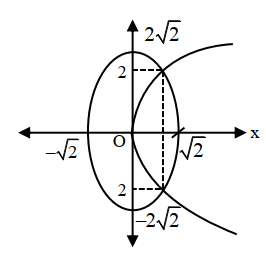
0 likesView Solution
123
MathematicsDifficultMCQJEE Main · 2026
ધારો કે $L$ એ રેખા $\frac{x+1}{2}=\frac{y+1}{3}=\frac{z+3}{6}$ છે અને $S$ એ $L$ પરના તમામ બિંદુઓ $(a, b, c)$ નો ગણ છે,જેનું બિંદુ $P(-1, -1, -9)$ થી અંતર $7$ છે. તો $\sum_{(a,b,c)\in S} (a+b+c)$ ની કિંમત શોધો:
A
$34$
B
$28$
C
$40$
D
$6$
Solution
(A) ધારો કે રેખા $L$ પરનું કોઈપણ બિંદુ $(a, b, c) = (2k-1, 3k-1, 6k-3)$ છે.
આપેલ છે કે આ બિંદુનું બિંદુ $P(-1, -1, -9)$ થી અંતર $7$ છે.
અંતર સૂત્રનો ઉપયોગ કરતા: $\sqrt{(2k-1 - (-1))^2 + (3k-1 - (-1))^2 + (6k-3 - (-9))^2} = 7$.
$\sqrt{(2k)^2 + (3k)^2 + (6k+6)^2} = 7$.
બંને બાજુ વર્ગ કરતા: $4k^2 + 9k^2 + (6k+6)^2 = 49$.
$13k^2 + 36k^2 + 72k + 36 = 49$.
$49k^2 + 72k - 13 = 0$.
આ $k$ માં દ્વિઘાત સમીકરણ છે. ધારો કે તેના બીજ $k_1$ અને $k_2$ છે.
બિંદુ $(a, b, c)$ માટે યામોનો સરવાળો $a+b+c = (2k-1) + (3k-1) + (6k-3) = 11k - 5$ છે.
$S$ માં રહેલા બે બિંદુઓ માટે,સરવાળો $(11k_1 - 5) + (11k_2 - 5) = 11(k_1 + k_2) - 10$ થશે.
દ્વિઘાત સમીકરણ પરથી,$k_1 + k_2 = -\frac{72}{49}$.
સરવાળો $= 11(-\frac{72}{49}) - 10 = -\frac{792}{49} - 10 = -\frac{1282}{49}$.
આપેલ છે કે આ બિંદુનું બિંદુ $P(-1, -1, -9)$ થી અંતર $7$ છે.
અંતર સૂત્રનો ઉપયોગ કરતા: $\sqrt{(2k-1 - (-1))^2 + (3k-1 - (-1))^2 + (6k-3 - (-9))^2} = 7$.
$\sqrt{(2k)^2 + (3k)^2 + (6k+6)^2} = 7$.
બંને બાજુ વર્ગ કરતા: $4k^2 + 9k^2 + (6k+6)^2 = 49$.
$13k^2 + 36k^2 + 72k + 36 = 49$.
$49k^2 + 72k - 13 = 0$.
આ $k$ માં દ્વિઘાત સમીકરણ છે. ધારો કે તેના બીજ $k_1$ અને $k_2$ છે.
બિંદુ $(a, b, c)$ માટે યામોનો સરવાળો $a+b+c = (2k-1) + (3k-1) + (6k-3) = 11k - 5$ છે.
$S$ માં રહેલા બે બિંદુઓ માટે,સરવાળો $(11k_1 - 5) + (11k_2 - 5) = 11(k_1 + k_2) - 10$ થશે.
દ્વિઘાત સમીકરણ પરથી,$k_1 + k_2 = -\frac{72}{49}$.
સરવાળો $= 11(-\frac{72}{49}) - 10 = -\frac{792}{49} - 10 = -\frac{1282}{49}$.
0 likesView Solution
124
MathematicsMediumMCQJEE Main · 2026
જો $X = \begin{bmatrix} x \\ y \\ z \end{bmatrix}$ એ સમીકરણ સંહતિ $AX = B$ નો ઉકેલ હોય,જ્યાં $\text{adj } A = \begin{bmatrix} 4 & 2 & 2 \\ -5 & 0 & 5 \\ 1 & -2 & 3 \end{bmatrix}$ અને $B = \begin{bmatrix} 4 \\ 0 \\ 2 \end{bmatrix}$ હોય,તો $|x + y + z|$ ની કિંમત શોધો:
A
$3$
B
$\frac{3}{2}$
C
$1$
D
$2$
Solution
(D) આપણે જાણીએ છીએ કે $X = A^{-1}B = \frac{\text{adj } A}{|A|} B$.
પ્રથમ,આપણે નિશ્ચાયક $|A|$ શોધીએ. આપણે જાણીએ છીએ કે $|\text{adj } A| = |A|^{n-1}$,જ્યાં $n=3$.
$|\text{adj } A| = 4(0 - (-10)) - 2(-15 - 5) + 2(10 - 0) = 4(10) - 2(-20) + 2(10) = 40 + 40 + 20 = 100$.
તેથી,$|A|^2 = 100$,જેનો અર્થ છે કે $|A| = \pm 10$.
હવે,$X = \pm \frac{1}{10} \begin{bmatrix} 4 & 2 & 2 \\ -5 & 0 & 5 \\ 1 & -2 & 3 \end{bmatrix} \begin{bmatrix} 4 \\ 0 \\ 2 \end{bmatrix} = \pm \frac{1}{10} \begin{bmatrix} 16 + 0 + 4 \\ -20 + 0 + 10 \\ 4 + 0 + 6 \end{bmatrix} = \pm \frac{1}{10} \begin{bmatrix} 20 \\ -10 \\ 10 \end{bmatrix} = \pm \begin{bmatrix} 2 \\ -1 \\ 1 \end{bmatrix}$.
આમ,$x = \pm 2, y = \mp 1, z = \pm 1$.
તેથી $|x + y + z| = |\pm(2 - 1 + 1)| = |\pm 2| = 2$.
પ્રથમ,આપણે નિશ્ચાયક $|A|$ શોધીએ. આપણે જાણીએ છીએ કે $|\text{adj } A| = |A|^{n-1}$,જ્યાં $n=3$.
$|\text{adj } A| = 4(0 - (-10)) - 2(-15 - 5) + 2(10 - 0) = 4(10) - 2(-20) + 2(10) = 40 + 40 + 20 = 100$.
તેથી,$|A|^2 = 100$,જેનો અર્થ છે કે $|A| = \pm 10$.
હવે,$X = \pm \frac{1}{10} \begin{bmatrix} 4 & 2 & 2 \\ -5 & 0 & 5 \\ 1 & -2 & 3 \end{bmatrix} \begin{bmatrix} 4 \\ 0 \\ 2 \end{bmatrix} = \pm \frac{1}{10} \begin{bmatrix} 16 + 0 + 4 \\ -20 + 0 + 10 \\ 4 + 0 + 6 \end{bmatrix} = \pm \frac{1}{10} \begin{bmatrix} 20 \\ -10 \\ 10 \end{bmatrix} = \pm \begin{bmatrix} 2 \\ -1 \\ 1 \end{bmatrix}$.
આમ,$x = \pm 2, y = \mp 1, z = \pm 1$.
તેથી $|x + y + z| = |\pm(2 - 1 + 1)| = |\pm 2| = 2$.
0 likesView Solution
125
MathematicsDifficultMCQJEE Main · 2026
ધારો કે $\overrightarrow{a}=2 \hat{i}-\hat{j}+\hat{k}$ અને $\overrightarrow{b}=\lambda \hat{j}+2 \hat{k}$,જ્યાં $\lambda \in \mathbb{Z}$,બે સદિશો છે. ધારો કે $\overrightarrow{c}=\overrightarrow{a} \times \overrightarrow{b}$ અને $\overrightarrow{d}$ એ $yz$-સમતલમાં $2$ માન ધરાવતો સદિશ છે. જો $|\overrightarrow{c}|=\sqrt{53}$ હોય,તો $(\overrightarrow{c} \cdot \overrightarrow{d})^2$ ની મહત્તમ શક્ય કિંમત કેટલી થાય?
A
$26$
B
$104$
C
$208$
D
$52$
Solution
(C) આપેલ છે કે $\overrightarrow{a}=2 \hat{i}-\hat{j}+\hat{k}$ અને $\overrightarrow{b}=\lambda \hat{j}+2 \hat{k}$.
$\overrightarrow{c}=\overrightarrow{a} \times \overrightarrow{b} = \begin{vmatrix} \hat{i} & \hat{j} & \hat{k} \\ 2 & -1 & 1 \\ 0 & \lambda & 2 \end{vmatrix} = (-2-\lambda) \hat{i} - 4 \hat{j} + 2 \lambda \hat{k}$.
આપેલ છે કે $|\overrightarrow{c}|=\sqrt{53}$,તેથી $|\overrightarrow{c}|^2 = 53$.
$(-2-\lambda)^2 + (-4)^2 + (2\lambda)^2 = 53$
$4 + 4\lambda + \lambda^2 + 16 + 4\lambda^2 = 53$
$5\lambda^2 + 4\lambda - 33 = 0$.
$\lambda$ માટે ઉકેલતા: $\lambda = \frac{-4 \pm \sqrt{16 - 4(5)(-33)}}{10} = \frac{-4 \pm \sqrt{16 + 660}}{10} = \frac{-4 \pm \sqrt{676}}{10} = \frac{-4 \pm 26}{10}$.
$\lambda \in \mathbb{Z}$ હોવાથી,આપણે $\lambda = -3$ લઈશું (કારણ કે $\frac{22}{10}$ પૂર્ણાંક નથી).
આમ,$\overrightarrow{c} = (-2 - (-3))\hat{i} - 4\hat{j} + 2(-3)\hat{k} = \hat{i} - 4\hat{j} - 6\hat{k}$.
ધારો કે $\overrightarrow{d} = y\hat{j} + z\hat{k}$ એ $yz$-સમતલમાં સદિશ છે જેનું માન $|\overrightarrow{d}|=2$ છે,તેથી $y^2 + z^2 = 4$.
તેથી $\overrightarrow{c} \cdot \overrightarrow{d} = (\hat{i} - 4\hat{j} - 6\hat{k}) \cdot (y\hat{j} + z\hat{k}) = -4y - 6z$.
આપણે $(-4y - 6z)^2 = (4y + 6z)^2$ ની મહત્તમ કિંમત શોધવી છે.
કોશી-શ્વાર્ટ્ઝ અસમતા મુજબ,$(4y + 6z)^2 \leq (4^2 + 6^2)(y^2 + z^2) = (16 + 36)(4) = 52 \times 4 = 208$.
$\overrightarrow{c}=\overrightarrow{a} \times \overrightarrow{b} = \begin{vmatrix} \hat{i} & \hat{j} & \hat{k} \\ 2 & -1 & 1 \\ 0 & \lambda & 2 \end{vmatrix} = (-2-\lambda) \hat{i} - 4 \hat{j} + 2 \lambda \hat{k}$.
આપેલ છે કે $|\overrightarrow{c}|=\sqrt{53}$,તેથી $|\overrightarrow{c}|^2 = 53$.
$(-2-\lambda)^2 + (-4)^2 + (2\lambda)^2 = 53$
$4 + 4\lambda + \lambda^2 + 16 + 4\lambda^2 = 53$
$5\lambda^2 + 4\lambda - 33 = 0$.
$\lambda$ માટે ઉકેલતા: $\lambda = \frac{-4 \pm \sqrt{16 - 4(5)(-33)}}{10} = \frac{-4 \pm \sqrt{16 + 660}}{10} = \frac{-4 \pm \sqrt{676}}{10} = \frac{-4 \pm 26}{10}$.
$\lambda \in \mathbb{Z}$ હોવાથી,આપણે $\lambda = -3$ લઈશું (કારણ કે $\frac{22}{10}$ પૂર્ણાંક નથી).
આમ,$\overrightarrow{c} = (-2 - (-3))\hat{i} - 4\hat{j} + 2(-3)\hat{k} = \hat{i} - 4\hat{j} - 6\hat{k}$.
ધારો કે $\overrightarrow{d} = y\hat{j} + z\hat{k}$ એ $yz$-સમતલમાં સદિશ છે જેનું માન $|\overrightarrow{d}|=2$ છે,તેથી $y^2 + z^2 = 4$.
તેથી $\overrightarrow{c} \cdot \overrightarrow{d} = (\hat{i} - 4\hat{j} - 6\hat{k}) \cdot (y\hat{j} + z\hat{k}) = -4y - 6z$.
આપણે $(-4y - 6z)^2 = (4y + 6z)^2$ ની મહત્તમ કિંમત શોધવી છે.
કોશી-શ્વાર્ટ્ઝ અસમતા મુજબ,$(4y + 6z)^2 \leq (4^2 + 6^2)(y^2 + z^2) = (16 + 36)(4) = 52 \times 4 = 208$.
0 likesView Solution
126
MathematicsDifficultMCQJEE Main · 2026
જો $y=y(x)$ એ વિકલ સમીકરણ $16(\sqrt{x+9\sqrt{x}})(4+\sqrt{9+\sqrt{x}}) \cos y \, dy = (1+2 \sin y) \, dx$ ને $x > 0$ માટે સંતોષે છે અને $y(256)=\frac{\pi}{2}$,$y(49)=\alpha$ હોય,તો $2 \sin \alpha$ ની કિંમત શોધો:
A
$2 \sqrt{2}-1$
B
$2(\sqrt{2}-1)$
C
$3(\sqrt{2}-1)$
D
$\sqrt{2}-1$
Solution
(A) આપેલ વિકલ સમીકરણ: $16(\sqrt{x+9\sqrt{x}})(4+\sqrt{9+\sqrt{x}}) \cos y \, dy = (1+2 \sin y) \, dx$.
ચલને અલગ કરતા: $\int \frac{\cos y}{1+2 \sin y} \, dy = \int \frac{dx}{16(\sqrt{x+9\sqrt{x}})(4+\sqrt{9+\sqrt{x}})}$.
ધારો કે $u = 1+2 \sin y$,તો $du = 2 \cos y \, dy$,તેથી $\int \frac{\cos y}{1+2 \sin y} \, dy = \frac{1}{2} \ln |1+2 \sin y|$.
જમણી બાજુ માટે,ધારો કે $t = 4+\sqrt{9+\sqrt{x}}$. તેથી $t-4 = \sqrt{9+\sqrt{x}}$. બંને બાજુ વર્ગ કરતા: $(t-4)^2 = 9+\sqrt{x}$,તેથી $\sqrt{x} = (t-4)^2 - 9$.
$t = 4+\sqrt{9+\sqrt{x}}$ નું વિકલન કરતા,$dt = \frac{1}{2\sqrt{9+\sqrt{x}}} \cdot \frac{1}{2\sqrt{x}} \, dx = \frac{dx}{4\sqrt{x(9+\sqrt{x})}} = \frac{dx}{4\sqrt{x+9\sqrt{x}}}$.
તેથી,$\frac{dx}{\sqrt{x+9\sqrt{x}}} = 4 \, dt$.
સંકલન આ મુજબ થશે: $\frac{1}{2} \ln |1+2 \sin y| = \int \frac{4 \, dt}{16t} = \frac{1}{4} \ln |t| + C = \frac{1}{4} \ln |4+\sqrt{9+\sqrt{x}}| + C$.
$y(256) = \frac{\pi}{2}$ નો ઉપયોગ કરતા: $\frac{1}{2} \ln(1+2 \sin \frac{\pi}{2}) = \frac{1}{4} \ln(4+\sqrt{9+\sqrt{256}}) + C \implies \frac{1}{2} \ln 3 = \frac{1}{4} \ln(4+\sqrt{9+16}) + C = \frac{1}{4} \ln 9 + C = \frac{1}{2} \ln 3 + C$. તેથી $C = 0$.
હવે,$y(49) = \alpha$ માટે: $\frac{1}{2} \ln(1+2 \sin \alpha) = \frac{1}{4} \ln(4+\sqrt{9+\sqrt{49}}) = \frac{1}{4} \ln(4+\sqrt{16}) = \frac{1}{4} \ln 8 = \frac{1}{4} \ln(2^3) = \frac{3}{4} \ln 2$.
તેથી $\ln(1+2 \sin \alpha) = \frac{3}{2} \ln 2 = \ln(2^{3/2}) = \ln(2\sqrt{2})$.
આમ,$1+2 \sin \alpha = 2\sqrt{2}$,જે આપણને $2 \sin \alpha = 2\sqrt{2}-1$ આપે છે.
ચલને અલગ કરતા: $\int \frac{\cos y}{1+2 \sin y} \, dy = \int \frac{dx}{16(\sqrt{x+9\sqrt{x}})(4+\sqrt{9+\sqrt{x}})}$.
ધારો કે $u = 1+2 \sin y$,તો $du = 2 \cos y \, dy$,તેથી $\int \frac{\cos y}{1+2 \sin y} \, dy = \frac{1}{2} \ln |1+2 \sin y|$.
જમણી બાજુ માટે,ધારો કે $t = 4+\sqrt{9+\sqrt{x}}$. તેથી $t-4 = \sqrt{9+\sqrt{x}}$. બંને બાજુ વર્ગ કરતા: $(t-4)^2 = 9+\sqrt{x}$,તેથી $\sqrt{x} = (t-4)^2 - 9$.
$t = 4+\sqrt{9+\sqrt{x}}$ નું વિકલન કરતા,$dt = \frac{1}{2\sqrt{9+\sqrt{x}}} \cdot \frac{1}{2\sqrt{x}} \, dx = \frac{dx}{4\sqrt{x(9+\sqrt{x})}} = \frac{dx}{4\sqrt{x+9\sqrt{x}}}$.
તેથી,$\frac{dx}{\sqrt{x+9\sqrt{x}}} = 4 \, dt$.
સંકલન આ મુજબ થશે: $\frac{1}{2} \ln |1+2 \sin y| = \int \frac{4 \, dt}{16t} = \frac{1}{4} \ln |t| + C = \frac{1}{4} \ln |4+\sqrt{9+\sqrt{x}}| + C$.
$y(256) = \frac{\pi}{2}$ નો ઉપયોગ કરતા: $\frac{1}{2} \ln(1+2 \sin \frac{\pi}{2}) = \frac{1}{4} \ln(4+\sqrt{9+\sqrt{256}}) + C \implies \frac{1}{2} \ln 3 = \frac{1}{4} \ln(4+\sqrt{9+16}) + C = \frac{1}{4} \ln 9 + C = \frac{1}{2} \ln 3 + C$. તેથી $C = 0$.
હવે,$y(49) = \alpha$ માટે: $\frac{1}{2} \ln(1+2 \sin \alpha) = \frac{1}{4} \ln(4+\sqrt{9+\sqrt{49}}) = \frac{1}{4} \ln(4+\sqrt{16}) = \frac{1}{4} \ln 8 = \frac{1}{4} \ln(2^3) = \frac{3}{4} \ln 2$.
તેથી $\ln(1+2 \sin \alpha) = \frac{3}{2} \ln 2 = \ln(2^{3/2}) = \ln(2\sqrt{2})$.
આમ,$1+2 \sin \alpha = 2\sqrt{2}$,જે આપણને $2 \sin \alpha = 2\sqrt{2}-1$ આપે છે.
0 likesView Solution
127
MathematicsDifficultMCQJEE Main · 2026
ધારો કે $n$ એ એક સમતોલ પાસાને ફેંકતા મળતી સંખ્યા છે. જો સમીકરણોની સિસ્ટમ
$x-ny+z=6$
$x+(n-2)y+(n+1)z=8$
$(n-1)y+z=1$
નો ઉકેલ અનન્ય હોય તેની સંભાવના $\frac{k}{6}$ હોય,તો $k$ અને $n$ ના તમામ શક્ય મૂલ્યોનો સરવાળો કેટલો થાય?
$x-ny+z=6$
$x+(n-2)y+(n+1)z=8$
$(n-1)y+z=1$
નો ઉકેલ અનન્ય હોય તેની સંભાવના $\frac{k}{6}$ હોય,તો $k$ અને $n$ ના તમામ શક્ય મૂલ્યોનો સરવાળો કેટલો થાય?
A
$21$
B
$24$
C
$20$
D
$22$
Solution
(D) સમીકરણોની સિસ્ટમનો ઉકેલ અનન્ય હોય જો સહગુણક શ્રેણિકનો નિશ્ચાયક $D \neq 0$ હોય.
$D = \begin{vmatrix} 1 & -n & 1 \\ 1 & n-2 & n+1 \\ 0 & n-1 & 1 \end{vmatrix}$
પ્રથમ સ્તંભની સાપેક્ષ વિસ્તરણ કરતા:
$D = 1((n-2)(1) - (n+1)(n-1)) - 1((-n)(1) - (1)(n-1)) + 0$
$D = (n-2 - (n^2-1)) - (-n - n + 1)$
$D = (n-2 - n^2 + 1) - (-2n + 1)$
$D = -n^2 + 3n - 2$
અનન્ય ઉકેલ માટે,$D \neq 0$,તેથી $-n^2 + 3n - 2 \neq 0$,જેનો અર્થ છે કે $n^2 - 3n + 2 \neq 0$.
$(n-1)(n-2) \neq 0$,તેથી $n \neq 1$ અને $n \neq 2$.
પાસા પર મળતી સંખ્યા $n \in \{1, 2, 3, 4, 5, 6\}$ છે.
$n$ ના જે મૂલ્યો માટે સિસ્ટમનો ઉકેલ અનન્ય છે તે $n \in \{3, 4, 5, 6\}$ છે.
આવા મૂલ્યોની સંખ્યા $4$ છે,તેથી સંભાવના $\frac{4}{6}$ છે.
આમ,$k = 4$.
$k$ અને $n$ ના તમામ શક્ય મૂલ્યોનો સરવાળો $4 + (3 + 4 + 5 + 6) = 4 + 18 = 22$ થાય.
$D = \begin{vmatrix} 1 & -n & 1 \\ 1 & n-2 & n+1 \\ 0 & n-1 & 1 \end{vmatrix}$
પ્રથમ સ્તંભની સાપેક્ષ વિસ્તરણ કરતા:
$D = 1((n-2)(1) - (n+1)(n-1)) - 1((-n)(1) - (1)(n-1)) + 0$
$D = (n-2 - (n^2-1)) - (-n - n + 1)$
$D = (n-2 - n^2 + 1) - (-2n + 1)$
$D = -n^2 + 3n - 2$
અનન્ય ઉકેલ માટે,$D \neq 0$,તેથી $-n^2 + 3n - 2 \neq 0$,જેનો અર્થ છે કે $n^2 - 3n + 2 \neq 0$.
$(n-1)(n-2) \neq 0$,તેથી $n \neq 1$ અને $n \neq 2$.
પાસા પર મળતી સંખ્યા $n \in \{1, 2, 3, 4, 5, 6\}$ છે.
$n$ ના જે મૂલ્યો માટે સિસ્ટમનો ઉકેલ અનન્ય છે તે $n \in \{3, 4, 5, 6\}$ છે.
આવા મૂલ્યોની સંખ્યા $4$ છે,તેથી સંભાવના $\frac{4}{6}$ છે.
આમ,$k = 4$.
$k$ અને $n$ ના તમામ શક્ય મૂલ્યોનો સરવાળો $4 + (3 + 4 + 5 + 6) = 4 + 18 = 22$ થાય.
0 likesView Solution
128
MathematicsDifficultMCQJEE Main · 2026
ધારો કે $A = \begin{bmatrix} 0 & 2 & -3 \\ -2 & 0 & 1 \\ 3 & -1 & 0 \end{bmatrix}$ અને $B$ એક એવો શ્રેણિક છે કે જેથી $B(I - A) = I + A$ થાય. તો $B^T B$ ના વિકર્ણ ઘટકોનો સરવાળો કેટલો થાય?
A
$1$
B
$2$
C
$3$
D
$0$
Solution
(C) આપેલ છે કે $A = \begin{bmatrix} 0 & 2 & -3 \\ -2 & 0 & 1 \\ 3 & -1 & 0 \end{bmatrix}$. અહીં $A^T = -A$ છે,તેથી $A$ એ વિસંમિત શ્રેણિક છે.
આપેલ સમીકરણ $B(I - A) = I + A$ પરથી,$B = (I + A)(I - A)^{-1}$ મળે.
તેથી $B^T = ((I + A)(I - A)^{-1})^T = ((I - A)^{-1})^T (I + A)^T = (I - A^T)^{-1} (I + A^T)$.
$A^T = -A$ હોવાથી,$B^T = (I - (-A))^{-1} (I + (-A)) = (I + A)^{-1} (I - A)$ મળે.
હવે,$B^T B = (I + A)^{-1} (I - A) (I + A) (I - A)^{-1}$.
$A$ વિસંમિત હોવાથી,$(I - A)$ અને $(I + A)$ ક્રમનો નિયમ પાળે છે,એટલે કે $(I - A)(I + A) = I^2 - A^2 = (I + A)(I - A)$.
તેથી,$B^T B = (I + A)^{-1} (I + A) (I - A) (I - A)^{-1} = I \cdot I = I$.
શ્રેણિક $B^T B$ એ એકમ શ્રેણિક $I_3 = \begin{bmatrix} 1 & 0 & 0 \\ 0 & 1 & 0 \\ 0 & 0 & 1 \end{bmatrix}$ છે.
તેથી વિકર્ણ ઘટકોનો સરવાળો (ટ્રેસ) $1 + 1 + 1 = 3$ થાય.
આપેલ સમીકરણ $B(I - A) = I + A$ પરથી,$B = (I + A)(I - A)^{-1}$ મળે.
તેથી $B^T = ((I + A)(I - A)^{-1})^T = ((I - A)^{-1})^T (I + A)^T = (I - A^T)^{-1} (I + A^T)$.
$A^T = -A$ હોવાથી,$B^T = (I - (-A))^{-1} (I + (-A)) = (I + A)^{-1} (I - A)$ મળે.
હવે,$B^T B = (I + A)^{-1} (I - A) (I + A) (I - A)^{-1}$.
$A$ વિસંમિત હોવાથી,$(I - A)$ અને $(I + A)$ ક્રમનો નિયમ પાળે છે,એટલે કે $(I - A)(I + A) = I^2 - A^2 = (I + A)(I - A)$.
તેથી,$B^T B = (I + A)^{-1} (I + A) (I - A) (I - A)^{-1} = I \cdot I = I$.
શ્રેણિક $B^T B$ એ એકમ શ્રેણિક $I_3 = \begin{bmatrix} 1 & 0 & 0 \\ 0 & 1 & 0 \\ 0 & 0 & 1 \end{bmatrix}$ છે.
તેથી વિકર્ણ ઘટકોનો સરવાળો (ટ્રેસ) $1 + 1 + 1 = 3$ થાય.
0 likesView Solution
129
MathematicsDifficultMCQJEE Main · 2026
ગણ $S = \{x : x \in [0, 100] \text{ અને } \int_{0}^{x} t^{2} \sin(x-t) dt = x^{2}\}$ માં ઘટકોની સંખ્યા કેટલી છે?
A
$15$
B
$16$
C
$31$
D
$32$
Solution
(B) ધારો કે $I = \int_{0}^{x} t^{2} \sin(x-t) dt$. ગુણધર્મ $\int_{0}^{x} f(t) dt = \int_{0}^{x} f(x-t) dt$ નો ઉપયોગ કરતા,આપણને મળે $I = \int_{0}^{x} (x-t)^{2} \sin(t) dt$.
આનું વિસ્તરણ કરતા,$I = \int_{0}^{x} (x^{2} - 2xt + t^{2}) \sin(t) dt = x^{2} \int_{0}^{x} \sin(t) dt - 2x \int_{0}^{x} t \sin(t) dt + \int_{0}^{x} t^{2} \sin(t) dt$.
સંકલનનું મૂલ્યાંકન કરતા:
$1. \int_{0}^{x} \sin(t) dt = [-\cos(t)]_{0}^{x} = 1 - \cos(x)$.
$2. \int_{0}^{x} t \sin(t) dt = [-t \cos(t)]_{0}^{x} + \int_{0}^{x} \cos(t) dt = -x \cos(x) + \sin(x)$.
$3. \int_{0}^{x} t^{2} \sin(t) dt = [-t^{2} \cos(t)]_{0}^{x} + 2 \int_{0}^{x} t \cos(t) dt = -x^{2} \cos(x) + 2(t \sin(t) + \cos(t))_{0}^{x} = -x^{2} \cos(x) + 2x \sin(x) + 2 \cos(x) - 2$.
આ કિંમતો મૂકતા: $I = x^{2}(1 - \cos(x)) - 2x(-x \cos(x) + \sin(x)) + (-x^{2} \cos(x) + 2x \sin(x) + 2 \cos(x) - 2) = x^{2} + 2 \cos(x) - 2$.
આપેલ છે કે $I = x^{2}$,તેથી $x^{2} + 2 \cos(x) - 2 = x^{2}$,જેનું સાદું રૂપ $2 \cos(x) = 2$ અથવા $\cos(x) = 1$ થાય છે.
$x \in [0, 100]$ માટે,$\cos(x) = 1$ નો અર્થ છે $x = 2n\pi$,જ્યાં $n = 0, 1, 2, \dots$.
$2n\pi \le 100$ હોવાથી,$n \le \frac{100}{2\pi} \approx 15.92$.
આમ,$n$ ની કિંમતો $0, 1, 2, \dots, 15$ હોઈ શકે,જે કુલ $16$ મૂલ્યો આપે છે.
આનું વિસ્તરણ કરતા,$I = \int_{0}^{x} (x^{2} - 2xt + t^{2}) \sin(t) dt = x^{2} \int_{0}^{x} \sin(t) dt - 2x \int_{0}^{x} t \sin(t) dt + \int_{0}^{x} t^{2} \sin(t) dt$.
સંકલનનું મૂલ્યાંકન કરતા:
$1. \int_{0}^{x} \sin(t) dt = [-\cos(t)]_{0}^{x} = 1 - \cos(x)$.
$2. \int_{0}^{x} t \sin(t) dt = [-t \cos(t)]_{0}^{x} + \int_{0}^{x} \cos(t) dt = -x \cos(x) + \sin(x)$.
$3. \int_{0}^{x} t^{2} \sin(t) dt = [-t^{2} \cos(t)]_{0}^{x} + 2 \int_{0}^{x} t \cos(t) dt = -x^{2} \cos(x) + 2(t \sin(t) + \cos(t))_{0}^{x} = -x^{2} \cos(x) + 2x \sin(x) + 2 \cos(x) - 2$.
આ કિંમતો મૂકતા: $I = x^{2}(1 - \cos(x)) - 2x(-x \cos(x) + \sin(x)) + (-x^{2} \cos(x) + 2x \sin(x) + 2 \cos(x) - 2) = x^{2} + 2 \cos(x) - 2$.
આપેલ છે કે $I = x^{2}$,તેથી $x^{2} + 2 \cos(x) - 2 = x^{2}$,જેનું સાદું રૂપ $2 \cos(x) = 2$ અથવા $\cos(x) = 1$ થાય છે.
$x \in [0, 100]$ માટે,$\cos(x) = 1$ નો અર્થ છે $x = 2n\pi$,જ્યાં $n = 0, 1, 2, \dots$.
$2n\pi \le 100$ હોવાથી,$n \le \frac{100}{2\pi} \approx 15.92$.
આમ,$n$ ની કિંમતો $0, 1, 2, \dots, 15$ હોઈ શકે,જે કુલ $16$ મૂલ્યો આપે છે.
0 likesView Solution
130
MathematicsDifficultMCQJEE Main · 2026
જો બિંદુ $P(a, 2, a)$ નું રેખા $\frac{x}{2} = \frac{y+a}{1} = \frac{z}{1}$ માં પ્રતિબિંબ $Q$ હોય અને $Q$ નું રેખા $\frac{x-2b}{2} = \frac{y-a}{1} = \frac{z+2b}{-5}$ માં પ્રતિબિંબ $P$ હોય,તો $a+b$ ની કિંમત શોધો:
A
$1$
B
$2$
C
$3$
D
$4$
Solution
(C) ધારો કે રેખા $L_1$ એ $\frac{x}{2} = \frac{y+a}{1} = \frac{z}{1} = \lambda$ છે. $L_1$ પરનું કોઈપણ બિંદુ $(2\lambda, \lambda-a, \lambda)$ છે.
$Q$ એ $P(a, 2, a)$ નું $L_1$ માં પ્રતિબિંબ હોવાથી,$PQ$ નું મધ્યબિંદુ $L_1$ પર આવેલું છે અને $PQ$ એ $L_1$ ને લંબ છે.
$PQ$ નું મધ્યબિંદુ $M$ એ $(2\lambda, \lambda-a, \lambda)$ છે. તેથી,$Q = (4\lambda-a, 2\lambda-2a-2, 2\lambda-a)$.
સદિશ $\vec{PQ} = (3\lambda-2a, 2\lambda-2a-4, 2\lambda-2a)$. કારણ કે $\vec{PQ} \perp (2, 1, 1)$,
$2(3\lambda-2a) + 1(2\lambda-2a-4) + 1(2\lambda-2a) = 0 \Rightarrow 10\lambda - 8a - 4 = 0 \Rightarrow 5\lambda - 4a = 2$.
તે જ રીતે,બીજી રેખા $L_2: \frac{x-2b}{2} = \frac{y-a}{1} = \frac{z+2b}{-5} = \mu$ માટે,$Q$ નું પ્રતિબિંબ $P$ છે.
$L_2$ માટે સમાન તર્ક અનુસરતા,આપણને $a=1$ અને $b=2$ મળે છે.
તેથી,$a+b = 1+2 = 3$.
$Q$ એ $P(a, 2, a)$ નું $L_1$ માં પ્રતિબિંબ હોવાથી,$PQ$ નું મધ્યબિંદુ $L_1$ પર આવેલું છે અને $PQ$ એ $L_1$ ને લંબ છે.
$PQ$ નું મધ્યબિંદુ $M$ એ $(2\lambda, \lambda-a, \lambda)$ છે. તેથી,$Q = (4\lambda-a, 2\lambda-2a-2, 2\lambda-a)$.
સદિશ $\vec{PQ} = (3\lambda-2a, 2\lambda-2a-4, 2\lambda-2a)$. કારણ કે $\vec{PQ} \perp (2, 1, 1)$,
$2(3\lambda-2a) + 1(2\lambda-2a-4) + 1(2\lambda-2a) = 0 \Rightarrow 10\lambda - 8a - 4 = 0 \Rightarrow 5\lambda - 4a = 2$.
તે જ રીતે,બીજી રેખા $L_2: \frac{x-2b}{2} = \frac{y-a}{1} = \frac{z+2b}{-5} = \mu$ માટે,$Q$ નું પ્રતિબિંબ $P$ છે.
$L_2$ માટે સમાન તર્ક અનુસરતા,આપણને $a=1$ અને $b=2$ મળે છે.
તેથી,$a+b = 1+2 = 3$.
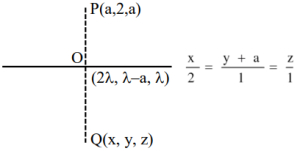
0 likesView Solution
131
MathematicsDifficultMCQJEE Main · 2026
જો વિકલ સમીકરણ $(x^{2}-4)y^{\prime}-2xy+2x(4-x^{2})^{2}=0$ માટે $x>2$ હોય અને તેનો ઉકેલ વક્ર $y=f(x)$ બિંદુ $(3, 15)$ માંથી પસાર થતો હોય,તો $f$ ની સ્થાનિક મહત્તમ કિંમત શોધો:
A
$16$
B
$12$
C
$8$
D
$20$
Solution
(A) આપેલ વિકલ સમીકરણ $(x^2-4)y^{\prime}-2xy = -2x(4-x^2)^2$ છે.
$(x^2-4)^2$ વડે ભાગતા,આપણને મળે $\frac{(x^2-4)y^{\prime}-2xy}{(x^2-4)^2} = -2x$.
આ ભાગાકારના નિયમનું વિકલન છે: $\frac{d}{dx} \left( \frac{y}{x^2-4} \right) = -2x$.
બંને બાજુ $x$ ની સાપેક્ષે સંકલન કરતા: $\frac{y}{x^2-4} = -x^2 + C$.
તેથી,$y = (-x^2+C)(x^2-4)$.
વક્ર બિંદુ $(3, 15)$ માંથી પસાર થાય છે,તેથી $x=3$ અને $y=15$ મૂકતા: $15 = (-9+C)(9-4) \Rightarrow 15 = 5(-9+C) \Rightarrow 3 = -9+C \Rightarrow C=12$.
આમ,$f(x) = (12-x^2)(x^2-4)$.
સ્થાનિક મહત્તમ કિંમત શોધવા માટે,$f^{\prime}(x) = 0$ લેતા: $f^{\prime}(x) = (-2x)(x^2-4) + (12-x^2)(2x) = -2x^3 + 8x + 24x - 2x^3 = -4x^3 + 32x = 0$.
$-4x(x^2-8) = 0$. $x>2$ હોવાથી,$x^2=8$,એટલે કે $x=2\sqrt{2}$.
સ્થાનિક મહત્તમ કિંમત $f(2\sqrt{2}) = (12-8)(8-4) = 4 \times 4 = 16$ છે.
$(x^2-4)^2$ વડે ભાગતા,આપણને મળે $\frac{(x^2-4)y^{\prime}-2xy}{(x^2-4)^2} = -2x$.
આ ભાગાકારના નિયમનું વિકલન છે: $\frac{d}{dx} \left( \frac{y}{x^2-4} \right) = -2x$.
બંને બાજુ $x$ ની સાપેક્ષે સંકલન કરતા: $\frac{y}{x^2-4} = -x^2 + C$.
તેથી,$y = (-x^2+C)(x^2-4)$.
વક્ર બિંદુ $(3, 15)$ માંથી પસાર થાય છે,તેથી $x=3$ અને $y=15$ મૂકતા: $15 = (-9+C)(9-4) \Rightarrow 15 = 5(-9+C) \Rightarrow 3 = -9+C \Rightarrow C=12$.
આમ,$f(x) = (12-x^2)(x^2-4)$.
સ્થાનિક મહત્તમ કિંમત શોધવા માટે,$f^{\prime}(x) = 0$ લેતા: $f^{\prime}(x) = (-2x)(x^2-4) + (12-x^2)(2x) = -2x^3 + 8x + 24x - 2x^3 = -4x^3 + 32x = 0$.
$-4x(x^2-8) = 0$. $x>2$ હોવાથી,$x^2=8$,એટલે કે $x=2\sqrt{2}$.
સ્થાનિક મહત્તમ કિંમત $f(2\sqrt{2}) = (12-8)(8-4) = 4 \times 4 = 16$ છે.
0 likesView Solution
132
MathematicsDifficultMCQJEE Main · 2026
ધારો કે $A = \{0, 1, 2, \ldots, 9\}$. ધારો કે $R$ એ $A$ પરનો સંબંધ છે જે $(x, y) \in R$ જો અને માત્ર જો $|x - y|$ એ $3$ નો ગુણક હોય તે રીતે વ્યાખ્યાયિત છે. નીચે બે વિધાનો આપેલા છે:
વિધાન $I$: $n(R) = 36$
વિધાન $II$: $R$ એ સામ્ય સંબંધ છે.
ઉપરોક્ત વિધાનોના પ્રકાશમાં,નીચે આપેલા વિકલ્પોમાંથી સાચો જવાબ પસંદ કરો:
વિધાન $I$: $n(R) = 36$
વિધાન $II$: $R$ એ સામ્ય સંબંધ છે.
ઉપરોક્ત વિધાનોના પ્રકાશમાં,નીચે આપેલા વિકલ્પોમાંથી સાચો જવાબ પસંદ કરો:
A
વિધાન $I$ અને વિધાન $II$ બંને સાચા છે
B
વિધાન $I$ ખોટું છે પરંતુ વિધાન $II$ સાચું છે
C
વિધાન $I$ સાચું છે પરંતુ વિધાન $II$ ખોટું છે
D
વિધાન $I$ અને વિધાન $II$ બંને ખોટા છે
Solution
(B) ગણ $A = \{0, 1, 2, 3, 4, 5, 6, 7, 8, 9\}$ માં $10$ ઘટકો છે.
આપણે $A$ ને $3$ વડે ભાગતા મળતી શેષના આધારે સામ્ય વર્ગોમાં વિભાજિત કરીએ છીએ:
$C_0 = \{0, 3, 6, 9\}$ (કદ $4$)
$C_1 = \{1, 4, 7\}$ (કદ $3$)
$C_2 = \{2, 5, 8\}$ (કદ $3$)
$(x, y) \in R$ માટે,$|x - y|$ એ $3$ નો ગુણક હોવો જોઈએ,જેનો અર્થ છે કે $x$ અને $y$ એક જ સામ્ય વર્ગના હોવા જોઈએ.
$R$ માં ઘટકોની સંખ્યા $n(R) = |C_0|^2 + |C_1|^2 + |C_2|^2 = 4^2 + 3^2 + 3^2 = 16 + 9 + 9 = 34$ છે.
આમ,વિધાન $I$ ખોટું છે $(34 \neq 36)$.
વિધાન $II$ માટે:
$1$. સ્વવાચક: $|x - x| = 0$,જે $3$ નો ગુણક છે.
$2$. સંમિત: જો $|x - y| = 3k$ હોય,તો $|y - x| = 3k$ થાય.
$3$. પરંપરિત: જો $|x - y| = 3k$ અને $|y - z| = 3m$ હોય,તો $|x - z| = |(x - y) + (y - z)| = 3|k \pm m|$,જે $3$ નો ગુણક છે.
તેથી $R$ એ સામ્ય સંબંધ છે. વિધાન $II$ સાચું છે.
આપણે $A$ ને $3$ વડે ભાગતા મળતી શેષના આધારે સામ્ય વર્ગોમાં વિભાજિત કરીએ છીએ:
$C_0 = \{0, 3, 6, 9\}$ (કદ $4$)
$C_1 = \{1, 4, 7\}$ (કદ $3$)
$C_2 = \{2, 5, 8\}$ (કદ $3$)
$(x, y) \in R$ માટે,$|x - y|$ એ $3$ નો ગુણક હોવો જોઈએ,જેનો અર્થ છે કે $x$ અને $y$ એક જ સામ્ય વર્ગના હોવા જોઈએ.
$R$ માં ઘટકોની સંખ્યા $n(R) = |C_0|^2 + |C_1|^2 + |C_2|^2 = 4^2 + 3^2 + 3^2 = 16 + 9 + 9 = 34$ છે.
આમ,વિધાન $I$ ખોટું છે $(34 \neq 36)$.
વિધાન $II$ માટે:
$1$. સ્વવાચક: $|x - x| = 0$,જે $3$ નો ગુણક છે.
$2$. સંમિત: જો $|x - y| = 3k$ હોય,તો $|y - x| = 3k$ થાય.
$3$. પરંપરિત: જો $|x - y| = 3k$ અને $|y - z| = 3m$ હોય,તો $|x - z| = |(x - y) + (y - z)| = 3|k \pm m|$,જે $3$ નો ગુણક છે.
તેથી $R$ એ સામ્ય સંબંધ છે. વિધાન $II$ સાચું છે.
0 likesView Solution
133
MathematicsDifficultMCQJEE Main · 2026
ધારો કે $I(x)=\int\frac{3dx}{(4x+6)(\sqrt{4x^{2}+8x+3})}$ અને $I(0)=\frac{\sqrt{3}}{4}+20$. જો $I(\frac{1}{2})=\frac{a\sqrt{2}}{b}+c$,જ્યાં $a, b, c \in N$ અને $gcd(a,b)=1$,તો $a+b+c$ ની કિંમત શોધો:
A
$29$
B
$28$
C
$31$
D
$30$
Solution
(C) આપેલ છે $I(x) = \int \frac{3dx}{(4x+6)\sqrt{4x^2+8x+3}}$.
સંકલનને $I(x) = \int \frac{3dx}{(4x+6)\sqrt{(2x+2)^2-1}}$ તરીકે ફરીથી લખો.
ધારો કે $2x+2 = \sec \theta$,તો $2dx = \sec \theta \tan \theta d\theta$.
વળી,$4x+6 = 2(2x+2)+2 = 2\sec \theta + 2 = 2(\sec \theta + 1)$.
આ કિંમતો સંકલનમાં મૂકતા:
$I(x) = \int \frac{3 \cdot \frac{1}{2} \sec \theta \tan \theta d\theta}{2(\sec \theta + 1)\tan \theta} = \frac{3}{4} \int \frac{\sec \theta}{\sec \theta + 1} d\theta = \frac{3}{4} \int \frac{1}{\cos \theta + 1} d\theta = \frac{3}{4} \int \frac{1}{2 \cos^2(\theta/2)} d\theta = \frac{3}{8} \int \sec^2(\theta/2) d\theta$.
$I(x) = \frac{3}{8} \cdot 2 \tan(\theta/2) + C = \frac{3}{4} \tan(\theta/2) + C$.
કારણ કે $\sec \theta = 2x+2$,$\tan^2(\theta/2) = \frac{1-\cos \theta}{1+\cos \theta} = \frac{1-1/(2x+2)}{1+1/(2x+2)} = \frac{2x+1}{2x+3}$.
તેથી,$I(x) = \frac{3}{4} \sqrt{\frac{2x+1}{2x+3}} + C$.
આપેલ છે $I(0) = \frac{3}{4} \sqrt{\frac{1}{3}} + C = \frac{\sqrt{3}}{4} + C = \frac{\sqrt{3}}{4} + 20$,તેથી $C=20$.
આમ,$I(x) = \frac{3}{4} \sqrt{\frac{2x+1}{2x+3}} + 20$.
$x = 1/2$ માટે,$I(1/2) = \frac{3}{4} \sqrt{\frac{1+1}{1+3}} + 20 = \frac{3}{4} \sqrt{\frac{2}{4}} + 20 = \frac{3}{4} \cdot \frac{\sqrt{2}}{2} + 20 = \frac{3\sqrt{2}}{8} + 20$.
અહીં $a=3, b=8, c=20$. $gcd(3,8)=1$.
તેથી,$a+b+c = 3+8+20 = 31$.
સંકલનને $I(x) = \int \frac{3dx}{(4x+6)\sqrt{(2x+2)^2-1}}$ તરીકે ફરીથી લખો.
ધારો કે $2x+2 = \sec \theta$,તો $2dx = \sec \theta \tan \theta d\theta$.
વળી,$4x+6 = 2(2x+2)+2 = 2\sec \theta + 2 = 2(\sec \theta + 1)$.
આ કિંમતો સંકલનમાં મૂકતા:
$I(x) = \int \frac{3 \cdot \frac{1}{2} \sec \theta \tan \theta d\theta}{2(\sec \theta + 1)\tan \theta} = \frac{3}{4} \int \frac{\sec \theta}{\sec \theta + 1} d\theta = \frac{3}{4} \int \frac{1}{\cos \theta + 1} d\theta = \frac{3}{4} \int \frac{1}{2 \cos^2(\theta/2)} d\theta = \frac{3}{8} \int \sec^2(\theta/2) d\theta$.
$I(x) = \frac{3}{8} \cdot 2 \tan(\theta/2) + C = \frac{3}{4} \tan(\theta/2) + C$.
કારણ કે $\sec \theta = 2x+2$,$\tan^2(\theta/2) = \frac{1-\cos \theta}{1+\cos \theta} = \frac{1-1/(2x+2)}{1+1/(2x+2)} = \frac{2x+1}{2x+3}$.
તેથી,$I(x) = \frac{3}{4} \sqrt{\frac{2x+1}{2x+3}} + C$.
આપેલ છે $I(0) = \frac{3}{4} \sqrt{\frac{1}{3}} + C = \frac{\sqrt{3}}{4} + C = \frac{\sqrt{3}}{4} + 20$,તેથી $C=20$.
આમ,$I(x) = \frac{3}{4} \sqrt{\frac{2x+1}{2x+3}} + 20$.
$x = 1/2$ માટે,$I(1/2) = \frac{3}{4} \sqrt{\frac{1+1}{1+3}} + 20 = \frac{3}{4} \sqrt{\frac{2}{4}} + 20 = \frac{3}{4} \cdot \frac{\sqrt{2}}{2} + 20 = \frac{3\sqrt{2}}{8} + 20$.
અહીં $a=3, b=8, c=20$. $gcd(3,8)=1$.
તેથી,$a+b+c = 3+8+20 = 31$.
0 likesView Solution
134
MathematicsDifficultMCQJEE Main · 2026
વર્તુળો $x^{2}+y^{2}=4$ અને $x^{2}+(y-2)^{2}=4$ વચ્ચે ઘેરાયેલા પ્રદેશનું ક્ષેત્રફળ શોધો:
A
$\frac{2}{3}(2\pi-3\sqrt{3})$
B
$\frac{4}{3}(2\pi-3\sqrt{3})$
C
$\frac{4}{3}(2\pi-\sqrt{3})$
D
$\frac{2}{3}(4\pi-3\sqrt{3})$
Solution
(D) આપેલ વર્તુળો $x^{2}+y^{2}=4$ (કેન્દ્ર $(0,0)$,ત્રિજ્યા $2$) અને $x^{2}+(y-2)^{2}=4$ (કેન્દ્ર $(0,2)$,ત્રિજ્યા $2$) છે.
સમીકરણો ઉકેલતા: $x^{2}+y^{2}=4$ અને $x^{2}+y^{2}-4y+4=4$.
બીજા સમીકરણમાં $x^{2}+y^{2}=4$ મૂકતા: $4-4y+4=4$,જે $4y=4$ આપે છે,તેથી $y=1$.
$y=1$ ને $x^{2}+y^{2}=4$ માં મૂકતા,આપણને $x^{2}+1=4$ મળે છે,તેથી $x^{2}=3$,$x=\pm\sqrt{3}$.
છેદબિંદુનું ક્ષેત્રફળ $y$-અક્ષની સાપેક્ષમાં સંમિત છે.
ક્ષેત્રફળ $A = 2 \int_{0}^{\sqrt{3}} [\sqrt{4-x^{2}} - (2 - \sqrt{4-x^{2}})] dx = 2 \int_{0}^{\sqrt{3}} (2\sqrt{4-x^{2}} - 2) dx = 4 \int_{0}^{\sqrt{3}} (\sqrt{4-x^{2}} - 1) dx$.
સૂત્ર $\int \sqrt{a^{2}-x^{2}} dx = \frac{x}{2}\sqrt{a^{2}-x^{2}} + \frac{a^{2}}{2}\sin^{-1}(\frac{x}{a})$ નો ઉપયોગ કરતા:
$A = 4 [\frac{x}{2}\sqrt{4-x^{2}} + 2\sin^{-1}(\frac{x}{2}) - x]_{0}^{\sqrt{3}}$
$A = 4 [(\frac{\sqrt{3}}{2}\sqrt{4-3} + 2\sin^{-1}(\frac{\sqrt{3}}{2})) - \sqrt{3}]$
$A = 4 [\frac{\sqrt{3}}{2} + 2(\frac{\pi}{3}) - \sqrt{3}] = 4 [\frac{2\pi}{3} - \frac{\sqrt{3}}{2}] = \frac{8\pi}{3} - 2\sqrt{3} = \frac{2}{3}(4\pi - 3\sqrt{3})$.
સમીકરણો ઉકેલતા: $x^{2}+y^{2}=4$ અને $x^{2}+y^{2}-4y+4=4$.
બીજા સમીકરણમાં $x^{2}+y^{2}=4$ મૂકતા: $4-4y+4=4$,જે $4y=4$ આપે છે,તેથી $y=1$.
$y=1$ ને $x^{2}+y^{2}=4$ માં મૂકતા,આપણને $x^{2}+1=4$ મળે છે,તેથી $x^{2}=3$,$x=\pm\sqrt{3}$.
છેદબિંદુનું ક્ષેત્રફળ $y$-અક્ષની સાપેક્ષમાં સંમિત છે.
ક્ષેત્રફળ $A = 2 \int_{0}^{\sqrt{3}} [\sqrt{4-x^{2}} - (2 - \sqrt{4-x^{2}})] dx = 2 \int_{0}^{\sqrt{3}} (2\sqrt{4-x^{2}} - 2) dx = 4 \int_{0}^{\sqrt{3}} (\sqrt{4-x^{2}} - 1) dx$.
સૂત્ર $\int \sqrt{a^{2}-x^{2}} dx = \frac{x}{2}\sqrt{a^{2}-x^{2}} + \frac{a^{2}}{2}\sin^{-1}(\frac{x}{a})$ નો ઉપયોગ કરતા:
$A = 4 [\frac{x}{2}\sqrt{4-x^{2}} + 2\sin^{-1}(\frac{x}{2}) - x]_{0}^{\sqrt{3}}$
$A = 4 [(\frac{\sqrt{3}}{2}\sqrt{4-3} + 2\sin^{-1}(\frac{\sqrt{3}}{2})) - \sqrt{3}]$
$A = 4 [\frac{\sqrt{3}}{2} + 2(\frac{\pi}{3}) - \sqrt{3}] = 4 [\frac{2\pi}{3} - \frac{\sqrt{3}}{2}] = \frac{8\pi}{3} - 2\sqrt{3} = \frac{2}{3}(4\pi - 3\sqrt{3})$.
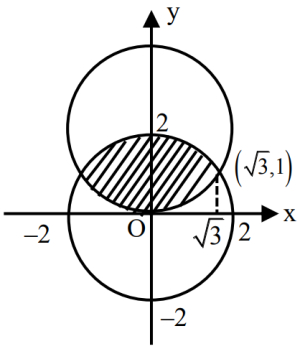
0 likesView Solution
135
MathematicsDifficultMCQJEE Main · 2026
બેગ $A$ માં $9$ સફેદ અને $8$ કાળા દડા છે,જ્યારે બેગ $B$ માં $6$ સફેદ અને $4$ કાળા દડા છે. બેગ $B$ માંથી એક દડો યાદચ્છિક રીતે પસંદ કરવામાં આવે છે અને તેને બેગ $A$ ના દડાઓ સાથે ભેળવી દેવામાં આવે છે. ત્યારબાદ બેગ $A$ માંથી એક દડો યાદચ્છિક રીતે કાઢવામાં આવે છે. જો કાઢવામાં આવેલ દડો સફેદ હોય તેની સંભાવના $p/q$ હોય (જ્યાં $gcd(p,q)=1$),તો $p+q$ ની કિંમત શોધો:
A
$22$
B
$23$
C
$24$
D
$21$
Solution
(B) ધારો કે $W_B$ એ બેગ $B$ માંથી સફેદ દડો પસંદ કરવાની ઘટના છે,અને $B_B$ એ બેગ $B$ માંથી કાળો દડો પસંદ કરવાની ઘટના છે.
$P(W_B) = \frac{6}{6+4} = \frac{6}{10} = \frac{3}{5}$
$P(B_B) = \frac{4}{6+4} = \frac{4}{10} = \frac{2}{5}$
જો સફેદ દડો બેગ $A$ માં સ્થાનાંતરિત કરવામાં આવે,તો બેગ $A$ માં હવે $10$ સફેદ અને $8$ કાળા દડા (કુલ $18$) છે. બેગ $A$ માંથી સફેદ દડો કાઢવાની સંભાવના $P(W_A | W_B) = \frac{10}{18}$ છે.
જો કાળો દડો બેગ $A$ માં સ્થાનાંતરિત કરવામાં આવે,તો બેગ $A$ માં હવે $9$ સફેદ અને $9$ કાળા દડા (કુલ $18$) છે. બેગ $A$ માંથી સફેદ દડો કાઢવાની સંભાવના $P(W_A | B_B) = \frac{9}{18}$ છે.
સંપૂર્ણ સંભાવનાના નિયમનો ઉપયોગ કરતા:
$P(W_A) = P(W_B) \times P(W_A | W_B) + P(B_B) \times P(W_A | B_B)$
$P(W_A) = \frac{3}{5} \times \frac{10}{18} + \frac{2}{5} \times \frac{9}{18}$
$P(W_A) = \frac{30}{90} + \frac{18}{90} = \frac{48}{90} = \frac{8}{15}$
આમ,$p=8$ અને $q=15$. કારણ કે $gcd(8,15)=1$,તેથી $p+q = 8+15 = 23$.
$P(W_B) = \frac{6}{6+4} = \frac{6}{10} = \frac{3}{5}$
$P(B_B) = \frac{4}{6+4} = \frac{4}{10} = \frac{2}{5}$
જો સફેદ દડો બેગ $A$ માં સ્થાનાંતરિત કરવામાં આવે,તો બેગ $A$ માં હવે $10$ સફેદ અને $8$ કાળા દડા (કુલ $18$) છે. બેગ $A$ માંથી સફેદ દડો કાઢવાની સંભાવના $P(W_A | W_B) = \frac{10}{18}$ છે.
જો કાળો દડો બેગ $A$ માં સ્થાનાંતરિત કરવામાં આવે,તો બેગ $A$ માં હવે $9$ સફેદ અને $9$ કાળા દડા (કુલ $18$) છે. બેગ $A$ માંથી સફેદ દડો કાઢવાની સંભાવના $P(W_A | B_B) = \frac{9}{18}$ છે.
સંપૂર્ણ સંભાવનાના નિયમનો ઉપયોગ કરતા:
$P(W_A) = P(W_B) \times P(W_A | W_B) + P(B_B) \times P(W_A | B_B)$
$P(W_A) = \frac{3}{5} \times \frac{10}{18} + \frac{2}{5} \times \frac{9}{18}$
$P(W_A) = \frac{30}{90} + \frac{18}{90} = \frac{48}{90} = \frac{8}{15}$
આમ,$p=8$ અને $q=15$. કારણ કે $gcd(8,15)=1$,તેથી $p+q = 8+15 = 23$.
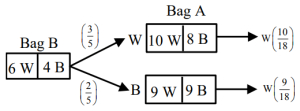
0 likesView Solution
136
MathematicsDifficultMCQJEE Main · 2026
ધારો કે $\vec{a}, \vec{b}, \vec{c}$ ત્રણ સદિશો છે જેથી $\vec{a} \times \vec{b} = 2(\vec{a} \times \vec{c})$. જો $|\vec{a}| = 1, |\vec{b}| = 4, |\vec{c}| = 2$ હોય અને $\vec{b}$ અને $\vec{c}$ વચ્ચેનો ખૂણો $60^{\circ}$ હોય,તો $|\vec{a} \cdot \vec{c}|$ ની કિંમત શોધો.
A
$2$
B
$4$
C
$0$
D
$1$
Solution
(D) આપેલ છે કે $\vec{a} \times \vec{b} = 2(\vec{a} \times \vec{c})$.
આનો અર્થ એ છે કે $\vec{a} \times (\vec{b} - 2\vec{c}) = 0$.
તેથી,કોઈ અદિશ $\lambda$ માટે $\vec{b} - 2\vec{c} = \lambda \vec{a}$ થાય.
બંને બાજુ માનનો વર્ગ લેતા: $|\vec{b} - 2\vec{c}|^2 = \lambda^2 |\vec{a}|^2$.
$|\vec{b}|^2 + 4|\vec{c}|^2 - 4(\vec{b} \cdot \vec{c}) = \lambda^2 (1)^2$.
આપેલ છે કે $|\vec{b}| = 4, |\vec{c}| = 2$ અને $\vec{b}$ અને $\vec{c}$ વચ્ચેનો ખૂણો $60^{\circ}$ છે,તેથી $\vec{b} \cdot \vec{c} = |\vec{b}| |\vec{c}| \cos(60^{\circ}) = 4 \times 2 \times \frac{1}{2} = 4$.
તેથી,$16 + 4(4) - 4(4) = \lambda^2 \Rightarrow \lambda^2 = 16 \Rightarrow \lambda = \pm 4$.
હવે,$\vec{b} - 2\vec{c} = \pm 4\vec{a}$.
બંને બાજુ $\vec{c}$ સાથે ડોટ ગુણાકાર કરતા:
$(\vec{b} - 2\vec{c}) \cdot \vec{c} = \pm 4(\vec{a} \cdot \vec{c})$.
$\vec{b} \cdot \vec{c} - 2|\vec{c}|^2 = \pm 4(\vec{a} \cdot \vec{c})$.
$4 - 2(4) = \pm 4(\vec{a} \cdot \vec{c}) \Rightarrow -4 = \pm 4(\vec{a} \cdot \vec{c})$.
$|\vec{a} \cdot \vec{c}| = |\frac{-4}{\pm 4}| = 1$.
આનો અર્થ એ છે કે $\vec{a} \times (\vec{b} - 2\vec{c}) = 0$.
તેથી,કોઈ અદિશ $\lambda$ માટે $\vec{b} - 2\vec{c} = \lambda \vec{a}$ થાય.
બંને બાજુ માનનો વર્ગ લેતા: $|\vec{b} - 2\vec{c}|^2 = \lambda^2 |\vec{a}|^2$.
$|\vec{b}|^2 + 4|\vec{c}|^2 - 4(\vec{b} \cdot \vec{c}) = \lambda^2 (1)^2$.
આપેલ છે કે $|\vec{b}| = 4, |\vec{c}| = 2$ અને $\vec{b}$ અને $\vec{c}$ વચ્ચેનો ખૂણો $60^{\circ}$ છે,તેથી $\vec{b} \cdot \vec{c} = |\vec{b}| |\vec{c}| \cos(60^{\circ}) = 4 \times 2 \times \frac{1}{2} = 4$.
તેથી,$16 + 4(4) - 4(4) = \lambda^2 \Rightarrow \lambda^2 = 16 \Rightarrow \lambda = \pm 4$.
હવે,$\vec{b} - 2\vec{c} = \pm 4\vec{a}$.
બંને બાજુ $\vec{c}$ સાથે ડોટ ગુણાકાર કરતા:
$(\vec{b} - 2\vec{c}) \cdot \vec{c} = \pm 4(\vec{a} \cdot \vec{c})$.
$\vec{b} \cdot \vec{c} - 2|\vec{c}|^2 = \pm 4(\vec{a} \cdot \vec{c})$.
$4 - 2(4) = \pm 4(\vec{a} \cdot \vec{c}) \Rightarrow -4 = \pm 4(\vec{a} \cdot \vec{c})$.
$|\vec{a} \cdot \vec{c}| = |\frac{-4}{\pm 4}| = 1$.
0 likesView Solution
137
MathematicsMediumMCQJEE Main · 2026
સુરેખ સમીકરણોની સંહતિ $x + y + z = 6$,$2x + 5y + az = 36$,અને $x + 2y + 3z = b$ માટે:
A
$a = 8$ અને $b = 16$ માટે અનન્ય ઉકેલ છે
B
$a = 8$ અને $b = 14$ માટે અનંત ઉકેલો છે
C
$a = 8$ અને $b = 16$ માટે અનંત ઉકેલો છે
D
$a = 8$ અને $b = 14$ માટે અનન્ય ઉકેલ છે
Solution
(B) સમીકરણોની સંહતિ નીચે મુજબ છે:
$x + y + z = 6$
$2x + 5y + az = 36$
$x + 2y + 3z = b$
પ્રથમ,સહગુણક શ્રેણિકનો નિશ્ચાયક $D$ શોધો:
$D = \begin{vmatrix} 1 & 1 & 1 \\ 2 & 5 & a \\ 1 & 2 & 3 \end{vmatrix} = 1(15 - 2a) - 1(6 - a) + 1(4 - 5) = 8 - a$.
સંહતિને અનંત ઉકેલો અથવા કોઈ ઉકેલ ન હોય તે માટે $D = 0$ હોવું જોઈએ,જેનો અર્થ છે કે $a = 8$.
હવે,$a = 8$ સાથે $D_3$ ની ગણતરી કરો:
$D_3 = \begin{vmatrix} 1 & 1 & 6 \\ 2 & 5 & 36 \\ 1 & 2 & b \end{vmatrix} = 1(5b - 72) - 1(2b - 36) + 6(4 - 5) = 3b - 42$.
$D_3 = 0$ માટે,આપણને $3b = 42$ મળે છે,તેથી $b = 14$.
જ્યારે $a = 8$ અને $b = 14$ હોય,ત્યારે આપણે $D_1$ અને $D_2$ તપાસીએ છીએ:
$D_1 = \begin{vmatrix} 6 & 1 & 1 \\ 36 & 5 & 8 \\ 14 & 2 & 3 \end{vmatrix} = 0$ અને $D_2 = \begin{vmatrix} 1 & 6 & 1 \\ 2 & 36 & 8 \\ 1 & 14 & 3 \end{vmatrix} = 0$.
આમ,$a = 8$ અને $b = 14$ માટે $D = D_1 = D_2 = D_3 = 0$ હોવાથી,સંહતિને અનંત ઉકેલો છે.
$x + y + z = 6$
$2x + 5y + az = 36$
$x + 2y + 3z = b$
પ્રથમ,સહગુણક શ્રેણિકનો નિશ્ચાયક $D$ શોધો:
$D = \begin{vmatrix} 1 & 1 & 1 \\ 2 & 5 & a \\ 1 & 2 & 3 \end{vmatrix} = 1(15 - 2a) - 1(6 - a) + 1(4 - 5) = 8 - a$.
સંહતિને અનંત ઉકેલો અથવા કોઈ ઉકેલ ન હોય તે માટે $D = 0$ હોવું જોઈએ,જેનો અર્થ છે કે $a = 8$.
હવે,$a = 8$ સાથે $D_3$ ની ગણતરી કરો:
$D_3 = \begin{vmatrix} 1 & 1 & 6 \\ 2 & 5 & 36 \\ 1 & 2 & b \end{vmatrix} = 1(5b - 72) - 1(2b - 36) + 6(4 - 5) = 3b - 42$.
$D_3 = 0$ માટે,આપણને $3b = 42$ મળે છે,તેથી $b = 14$.
જ્યારે $a = 8$ અને $b = 14$ હોય,ત્યારે આપણે $D_1$ અને $D_2$ તપાસીએ છીએ:
$D_1 = \begin{vmatrix} 6 & 1 & 1 \\ 36 & 5 & 8 \\ 14 & 2 & 3 \end{vmatrix} = 0$ અને $D_2 = \begin{vmatrix} 1 & 6 & 1 \\ 2 & 36 & 8 \\ 1 & 14 & 3 \end{vmatrix} = 0$.
આમ,$a = 8$ અને $b = 14$ માટે $D = D_1 = D_2 = D_3 = 0$ હોવાથી,સંહતિને અનંત ઉકેલો છે.
0 likesView Solution
138
MathematicsDifficultMCQJEE Main · 2026
બે ગણ $A = \{ x \in \mathbb{Z} : |(| x - 3| - 3)| \leq 1 \}$ અને $B = \{ x \in \mathbb{R} - \{1, 2\} : \frac{(x - 2)(x - 4)}{x - 1} \log_{e}(|x - 2|) = 0 \}$ ધ્યાનમાં લો. તો $f: A \rightarrow B$ પરના વ્યાપ્ત વિધેયોની સંખ્યા કેટલી થાય?
A
$62$
B
$79$
C
$32$
D
$81$
Solution
(A) પ્રથમ,આપણે ગણ $A$ ના ઘટકો શોધીએ:
$|(|x - 3| - 3)| \leq 1 \implies -1 \leq |x - 3| - 3 \leq 1$
$2 \leq |x - 3| \leq 4$
આનો અર્થ એ છે કે $2 \leq x - 3 \leq 4$ અથવા $-4 \leq x - 3 \leq -2$
$5 \leq x \leq 7$ અથવા $-1 \leq x \leq 1$
$x \in \mathbb{Z}$ હોવાથી,$A = \{-1, 0, 1, 5, 6, 7\}$. $A$ માં ઘટકોની સંખ્યા $n(A) = 6$ છે.
હવે,આપણે ગણ $B$ ના ઘટકો શોધીએ:
$\frac{(x - 2)(x - 4)}{x - 1} \log_{e}(|x - 2|) = 0$
આનો અર્થ એ છે કે $(x - 2)(x - 4) = 0$ અથવા $\log_{e}(|x - 2|) = 0$.
જો $(x - 2)(x - 4) = 0$ હોય,તો $x = 2$ અથવા $x = 4$. $x \in \mathbb{R} - \{1, 2\}$ હોવાથી,આપણે $x = 4$ સ્વીકારીએ છીએ.
જો $\log_{e}(|x - 2|) = 0$ હોય,તો $|x - 2| = 1$,તેથી $x - 2 = 1$ અથવા $x - 2 = -1$.
આનાથી $x = 3$ અથવા $x = 1$ મળે છે. $x \in \mathbb{R} - \{1, 2\}$ હોવાથી,આપણે $x = 3$ સ્વીકારીએ છીએ.
આમ,$B = \{3, 4\}$,અને $B$ માં ઘટકોની સંખ્યા $n(B) = 2$ છે.
$n$ ઘટકો ધરાવતા ગણથી $m$ ઘટકો ધરાવતા ગણ પરના વ્યાપ્ત વિધેયોની સંખ્યા $m^n - \binom{m}{1}(m-1)^n + \binom{m}{2}(m-2)^n - \dots$ દ્વારા મળે છે.
$n = 6$ અને $m = 2$ માટે,વ્યાપ્ત વિધેયોની સંખ્યા $2^6 - 2 = 64 - 2 = 62$ થાય.
$|(|x - 3| - 3)| \leq 1 \implies -1 \leq |x - 3| - 3 \leq 1$
$2 \leq |x - 3| \leq 4$
આનો અર્થ એ છે કે $2 \leq x - 3 \leq 4$ અથવા $-4 \leq x - 3 \leq -2$
$5 \leq x \leq 7$ અથવા $-1 \leq x \leq 1$
$x \in \mathbb{Z}$ હોવાથી,$A = \{-1, 0, 1, 5, 6, 7\}$. $A$ માં ઘટકોની સંખ્યા $n(A) = 6$ છે.
હવે,આપણે ગણ $B$ ના ઘટકો શોધીએ:
$\frac{(x - 2)(x - 4)}{x - 1} \log_{e}(|x - 2|) = 0$
આનો અર્થ એ છે કે $(x - 2)(x - 4) = 0$ અથવા $\log_{e}(|x - 2|) = 0$.
જો $(x - 2)(x - 4) = 0$ હોય,તો $x = 2$ અથવા $x = 4$. $x \in \mathbb{R} - \{1, 2\}$ હોવાથી,આપણે $x = 4$ સ્વીકારીએ છીએ.
જો $\log_{e}(|x - 2|) = 0$ હોય,તો $|x - 2| = 1$,તેથી $x - 2 = 1$ અથવા $x - 2 = -1$.
આનાથી $x = 3$ અથવા $x = 1$ મળે છે. $x \in \mathbb{R} - \{1, 2\}$ હોવાથી,આપણે $x = 3$ સ્વીકારીએ છીએ.
આમ,$B = \{3, 4\}$,અને $B$ માં ઘટકોની સંખ્યા $n(B) = 2$ છે.
$n$ ઘટકો ધરાવતા ગણથી $m$ ઘટકો ધરાવતા ગણ પરના વ્યાપ્ત વિધેયોની સંખ્યા $m^n - \binom{m}{1}(m-1)^n + \binom{m}{2}(m-2)^n - \dots$ દ્વારા મળે છે.
$n = 6$ અને $m = 2$ માટે,વ્યાપ્ત વિધેયોની સંખ્યા $2^6 - 2 = 64 - 2 = 62$ થાય.
0 likesView Solution
139
MathematicsDifficultMCQJEE Main · 2026
ધારો કે $\vec{a}=\hat{i}-2\hat{j}+3\hat{k}$,$\vec{b}=2\hat{i}+\hat{j}-\hat{k}$,$\vec{c}=\lambda\hat{i}+\hat{j}+\hat{k}$ અને $\vec{v}=\vec{a}\times\vec{b}$ છે. જો $\vec{v} \cdot \vec{c}=11$ હોય અને $\vec{b}$ નો $\vec{c}$ પરનો પ્રક્ષેપની લંબાઈ $p$ હોય,તો $9p^{2}$ ની કિંમત શોધો:
A
$9$
B
$6$
C
$4$
D
$12$
Solution
(D) આપેલ છે કે $\vec{a}=\hat{i}-2\hat{j}+3\hat{k}$,$\vec{b}=2\hat{i}+\hat{j}-\hat{k}$,અને $\vec{c}=\lambda\hat{i}+\hat{j}+\hat{k}$.
પ્રથમ,$\vec{v} = \vec{a} \times \vec{b}$ ની ગણતરી કરો:
$\vec{v} = \begin{vmatrix} \hat{i} & \hat{j} & \hat{k} \\ 1 & -2 & 3 \\ 2 & 1 & -1 \end{vmatrix} = \hat{i}(2-3) - \hat{j}(-1-6) + \hat{k}(1+4) = -\hat{i} + 7\hat{j} + 5\hat{k}$.
આપેલ છે કે $\vec{v} \cdot \vec{c} = 11$,તેથી $(-\hat{i} + 7\hat{j} + 5\hat{k}) \cdot (\lambda\hat{i} + \hat{j} + \hat{k}) = 11$.
$-\lambda + 7 + 5 = 11 \Rightarrow -\lambda + 12 = 11 \Rightarrow \lambda = 1$.
હવે,$\vec{c} = \hat{i} + \hat{j} + \hat{k}$. $\vec{b}$ નો $\vec{c}$ પરનો પ્રક્ષેપની લંબાઈ $p = \left| \vec{b} \cdot \frac{\vec{c}}{|\vec{c}|} \right|$ છે.
$|\vec{c}| = \sqrt{1^2 + 1^2 + 1^2} = \sqrt{3}$.
$p = \left| (2\hat{i} + \hat{j} - \hat{k}) \cdot \frac{(\hat{i} + \hat{j} + \hat{k})}{\sqrt{3}} \right| = \left| \frac{2 + 1 - 1}{\sqrt{3}} \right| = \frac{2}{\sqrt{3}}$.
તેથી,$9p^2 = 9 \times \left( \frac{2}{\sqrt{3}} \right)^2 = 9 \times \frac{4}{3} = 12$.
પ્રથમ,$\vec{v} = \vec{a} \times \vec{b}$ ની ગણતરી કરો:
$\vec{v} = \begin{vmatrix} \hat{i} & \hat{j} & \hat{k} \\ 1 & -2 & 3 \\ 2 & 1 & -1 \end{vmatrix} = \hat{i}(2-3) - \hat{j}(-1-6) + \hat{k}(1+4) = -\hat{i} + 7\hat{j} + 5\hat{k}$.
આપેલ છે કે $\vec{v} \cdot \vec{c} = 11$,તેથી $(-\hat{i} + 7\hat{j} + 5\hat{k}) \cdot (\lambda\hat{i} + \hat{j} + \hat{k}) = 11$.
$-\lambda + 7 + 5 = 11 \Rightarrow -\lambda + 12 = 11 \Rightarrow \lambda = 1$.
હવે,$\vec{c} = \hat{i} + \hat{j} + \hat{k}$. $\vec{b}$ નો $\vec{c}$ પરનો પ્રક્ષેપની લંબાઈ $p = \left| \vec{b} \cdot \frac{\vec{c}}{|\vec{c}|} \right|$ છે.
$|\vec{c}| = \sqrt{1^2 + 1^2 + 1^2} = \sqrt{3}$.
$p = \left| (2\hat{i} + \hat{j} - \hat{k}) \cdot \frac{(\hat{i} + \hat{j} + \hat{k})}{\sqrt{3}} \right| = \left| \frac{2 + 1 - 1}{\sqrt{3}} \right| = \frac{2}{\sqrt{3}}$.
તેથી,$9p^2 = 9 \times \left( \frac{2}{\sqrt{3}} \right)^2 = 9 \times \frac{4}{3} = 12$.
0 likesView Solution
140
MathematicsDifficultMCQJEE Main · 2026
જો $f(x) = \begin{cases} \frac{a|x|+x^2-2(\sin |x|)(\cos |x|)}{x} & , x \neq 0 \\ b & , x=0 \end{cases}$ એ $x=0$ આગળ સતત હોય,તો $a+b$ ની કિંમત શોધો:
A
$1$
B
$2$
C
$0$
D
$4$
Solution
(B) $f(x)$ એ $x=0$ આગળ સતત હોવા માટે,$\lim_{x \to 0^-} f(x) = \lim_{x \to 0^+} f(x) = f(0) = b$ થવું જોઈએ.
પ્રથમ,જમણી બાજુનું લક્ષ $(x > 0)$ ધ્યાનમાં લો:
$\lim_{x \to 0^+} \frac{ax + x^2 - 2\sin x \cos x}{x} = \lim_{x \to 0^+} \left( a + x - \frac{\sin(2x)}{x} \right) = a + 0 - 2 = a - 2$.
હવે,ડાબી બાજુનું લક્ષ $(x < 0)$ ધ્યાનમાં લો:
ધારો કે $x = -h$ જ્યાં $h > 0$. જેમ $x \to 0^-$,તેમ $h \to 0^+$.
$\lim_{h \to 0^+} \frac{a|-h| + (-h)^2 - 2\sin|-h|\cos|-h|}{-h} = \lim_{h \to 0^+} \frac{ah + h^2 - 2\sin h \cos h}{-h} = \lim_{h \to 0^+} \left( -a - h + \frac{\sin(2h)}{h} \right) = -a - 0 + 2 = -a + 2$.
સાતત્ય માટે,$a - 2 = -a + 2 = b$.
$a - 2 = -a + 2$ પરથી,$2a = 4$,તેથી $a = 2$.
$b = a - 2$ માં $a = 2$ મૂકતા,$b = 2 - 2 = 0$ મળે.
તેથી,$a + b = 2 + 0 = 2$.
પ્રથમ,જમણી બાજુનું લક્ષ $(x > 0)$ ધ્યાનમાં લો:
$\lim_{x \to 0^+} \frac{ax + x^2 - 2\sin x \cos x}{x} = \lim_{x \to 0^+} \left( a + x - \frac{\sin(2x)}{x} \right) = a + 0 - 2 = a - 2$.
હવે,ડાબી બાજુનું લક્ષ $(x < 0)$ ધ્યાનમાં લો:
ધારો કે $x = -h$ જ્યાં $h > 0$. જેમ $x \to 0^-$,તેમ $h \to 0^+$.
$\lim_{h \to 0^+} \frac{a|-h| + (-h)^2 - 2\sin|-h|\cos|-h|}{-h} = \lim_{h \to 0^+} \frac{ah + h^2 - 2\sin h \cos h}{-h} = \lim_{h \to 0^+} \left( -a - h + \frac{\sin(2h)}{h} \right) = -a - 0 + 2 = -a + 2$.
સાતત્ય માટે,$a - 2 = -a + 2 = b$.
$a - 2 = -a + 2$ પરથી,$2a = 4$,તેથી $a = 2$.
$b = a - 2$ માં $a = 2$ મૂકતા,$b = 2 - 2 = 0$ મળે.
તેથી,$a + b = 2 + 0 = 2$.
0 likesView Solution
141
MathematicsDifficultMCQJEE Main · 2026
ધારો કે $f$ એ બે વાર વિકલનીય અ-ઋણ વિધેય છે જેથી $(f(x))^2 = 25 + \int_{0}^{x} ((f(t))^2 + (f'(t))^2) dt$ થાય. તો $f(\log_e(1)), f(\log_e(2)), \ldots, f(\log_e(625))$ નો મધ્યક શોધો:
A
$1560$
B
$1565$
C
$1570$
D
$1575$
Solution
(B) આપેલ સમીકરણ: $(f(x))^2 = 25 + \int_{0}^{x} ((f(t))^2 + (f'(t))^2) dt$.
લેબનિઝના નિયમનો ઉપયોગ કરીને $x$ ની સાપેક્ષમાં બંને બાજુ વિકલન કરતા:
$2 f(x) f'(x) = (f(x))^2 + (f'(x))^2$.
પદોને ગોઠવતા: $(f(x))^2 - 2 f(x) f'(x) + (f'(x))^2 = 0$.
આનું સાદું રૂપ: $(f(x) - f'(x))^2 = 0$,જેનો અર્થ છે કે $f'(x) = f(x)$.
આ વિકલ સમીકરણ ઉકેલતા: $\frac{f'(x)}{f(x)} = 1 \Rightarrow \ln(f(x)) = x + C \Rightarrow f(x) = A e^x$.
$x = 0$ આગળ,$(f(0))^2 = 25 + 0 \Rightarrow f(0) = 5$ (કારણ કે $f$ અ-ઋણ છે).
આમ,$A e^0 = 5 \Rightarrow A = 5$,તેથી $f(x) = 5 e^x$.
આપણે $f(\ln 1), f(\ln 2), \ldots, f(\ln 625)$ નો મધ્યક શોધવાનો છે.
$f(\ln n) = 5 e^{\ln n} = 5n$ હોવાથી,મધ્યક થશે:
$\text{મધ્યક} = \frac{1}{625} \sum_{n=1}^{625} 5n = \frac{5}{625} \times \frac{625 \times 626}{2} = \frac{5 \times 626}{2} = 5 \times 313 = 1565$.
લેબનિઝના નિયમનો ઉપયોગ કરીને $x$ ની સાપેક્ષમાં બંને બાજુ વિકલન કરતા:
$2 f(x) f'(x) = (f(x))^2 + (f'(x))^2$.
પદોને ગોઠવતા: $(f(x))^2 - 2 f(x) f'(x) + (f'(x))^2 = 0$.
આનું સાદું રૂપ: $(f(x) - f'(x))^2 = 0$,જેનો અર્થ છે કે $f'(x) = f(x)$.
આ વિકલ સમીકરણ ઉકેલતા: $\frac{f'(x)}{f(x)} = 1 \Rightarrow \ln(f(x)) = x + C \Rightarrow f(x) = A e^x$.
$x = 0$ આગળ,$(f(0))^2 = 25 + 0 \Rightarrow f(0) = 5$ (કારણ કે $f$ અ-ઋણ છે).
આમ,$A e^0 = 5 \Rightarrow A = 5$,તેથી $f(x) = 5 e^x$.
આપણે $f(\ln 1), f(\ln 2), \ldots, f(\ln 625)$ નો મધ્યક શોધવાનો છે.
$f(\ln n) = 5 e^{\ln n} = 5n$ હોવાથી,મધ્યક થશે:
$\text{મધ્યક} = \frac{1}{625} \sum_{n=1}^{625} 5n = \frac{5}{625} \times \frac{625 \times 626}{2} = \frac{5 \times 626}{2} = 5 \times 313 = 1565$.
0 likesView Solution
142
MathematicsDifficultMCQJEE Main · 2026
ધારો કે વક્ર $y=\max\{\sin x, \cos x\}$,રેખાઓ $x=0, x=\frac{3\pi}{2}$ અને x-અક્ષ દ્વારા ઘેરાયેલા પ્રદેશનું ક્ષેત્રફળ $A$ છે. તો,$A+A^{2}$ ની કિંમત શોધો:
A
$10$
B
$12$
C
$14$
D
$16$
Solution
(B) ક્ષેત્રફળ $A$ એ $x=0$ થી $x=\frac{3\pi}{2}$ સુધીના વક્ર $y=\max\{\sin x, \cos x\}$ અને x-અક્ષ દ્વારા ઘેરાયેલું છે.
આપણે સંકલનને તે અંતરાલો પર વિભાજિત કરીએ છીએ જ્યાં $\sin x$ અથવા $\cos x$ મોટા હોય છે:
$A = \int_{0}^{\pi/4} \cos x \, dx + \int_{\pi/4}^{\pi} \sin x \, dx + \int_{\pi}^{5\pi/4} |\sin x| \, dx + \int_{5\pi/4}^{3\pi/2} |\cos x| \, dx$
ક્ષેત્રફળ x-અક્ષ દ્વારા ઘેરાયેલું હોવાથી,આપણે વિધેયો જ્યાં ઋણ હોય ત્યાં તેમનું નિરપેક્ષ મૂલ્ય લઈએ છીએ.
$A = \int_{0}^{\pi/4} \cos x \, dx + \int_{\pi/4}^{\pi} \sin x \, dx + \int_{\pi}^{5\pi/4} (-\sin x) \, dx + \int_{5\pi/4}^{3\pi/2} (-\cos x) \, dx$
$A = [\sin x]_{0}^{\pi/4} + [-\cos x]_{\pi/4}^{\pi} + [\cos x]_{\pi}^{5\pi/4} + [-\sin x]_{5\pi/4}^{3\pi/2}$
$A = (\frac{1}{\sqrt{2}} - 0) + (-(-1) - (-\frac{1}{\sqrt{2}})) + (-\frac{1}{\sqrt{2}} - (-1)) + (-(-1) - (-\frac{1}{\sqrt{2}}))$
$A = \frac{1}{\sqrt{2}} + 1 + \frac{1}{\sqrt{2}} - \frac{1}{\sqrt{2}} + 1 + 1 - \frac{1}{\sqrt{2}} = 3$
આમ,$A+A^2 = 3 + 3^2 = 3 + 9 = 12$.
આપણે સંકલનને તે અંતરાલો પર વિભાજિત કરીએ છીએ જ્યાં $\sin x$ અથવા $\cos x$ મોટા હોય છે:
$A = \int_{0}^{\pi/4} \cos x \, dx + \int_{\pi/4}^{\pi} \sin x \, dx + \int_{\pi}^{5\pi/4} |\sin x| \, dx + \int_{5\pi/4}^{3\pi/2} |\cos x| \, dx$
ક્ષેત્રફળ x-અક્ષ દ્વારા ઘેરાયેલું હોવાથી,આપણે વિધેયો જ્યાં ઋણ હોય ત્યાં તેમનું નિરપેક્ષ મૂલ્ય લઈએ છીએ.
$A = \int_{0}^{\pi/4} \cos x \, dx + \int_{\pi/4}^{\pi} \sin x \, dx + \int_{\pi}^{5\pi/4} (-\sin x) \, dx + \int_{5\pi/4}^{3\pi/2} (-\cos x) \, dx$
$A = [\sin x]_{0}^{\pi/4} + [-\cos x]_{\pi/4}^{\pi} + [\cos x]_{\pi}^{5\pi/4} + [-\sin x]_{5\pi/4}^{3\pi/2}$
$A = (\frac{1}{\sqrt{2}} - 0) + (-(-1) - (-\frac{1}{\sqrt{2}})) + (-\frac{1}{\sqrt{2}} - (-1)) + (-(-1) - (-\frac{1}{\sqrt{2}}))$
$A = \frac{1}{\sqrt{2}} + 1 + \frac{1}{\sqrt{2}} - \frac{1}{\sqrt{2}} + 1 + 1 - \frac{1}{\sqrt{2}} = 3$
આમ,$A+A^2 = 3 + 3^2 = 3 + 9 = 12$.
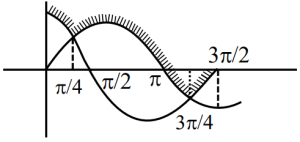
0 likesView Solution
143
MathematicsDifficultMCQJEE Main · 2026
ધારો કે $|A|=6$ જ્યાં $A$ એ $3 \times 3$ શ્રેણિક છે. જો $|adj(3adj(A^{2} \cdot adj(2A)))|=2^{m} \cdot 3^{n}$,$m, n \in N$ હોય,તો $m+n$ ની કિંમત શોધો:
A
$60$
B
$62$
C
$64$
D
$66$
Solution
(B) આપેલ છે કે $|A|=6$ અને $A$ એ $3 \times 3$ શ્રેણિક છે.
$n \times n$ શ્રેણિક માટે $|adj(k A)| = k^{n-1} |adj(A)|$ અને $adj(kA) = k^{n-1} adj(A)$ ગુણધર્મનો ઉપયોગ કરતા.
પ્રથમ,$adj(2A) = 2^{3-1} adj(A) = 4 adj(A)$.
તેથી,$A^2 \cdot adj(2A) = A^2 \cdot 4 adj(A) = 4 A (A \cdot adj(A)) = 4 A |A| I_3 = 4 \cdot 6 \cdot A = 24A$.
હવે,$3 adj(24A) = 3 \cdot 24^{3-1} adj(A) = 3 \cdot 24^2 adj(A) = 3 \cdot (2^3 \cdot 3)^2 adj(A) = 3 \cdot 2^6 \cdot 3^2 adj(A) = 2^6 \cdot 3^3 adj(A)$.
ધારો કે $K = 2^6 \cdot 3^3$. તો આપણે $|adj(K adj(A))|$ શોધવાનું છે.
$3 \times 3$ શ્રેણિક $M$ માટે $|adj(M)| = |M|^{n-1} = |M|^2$ નો ઉપયોગ કરતા:
$|adj(K adj(A))| = |K adj(A)|^2 = K^6 |adj(A)|^2 = K^6 (|A|^{3-1})^2 = K^6 |A|^4$.
$K = 2^6 \cdot 3^3$ અને $|A|=6 = 2^1 \cdot 3^1$ મૂકતા:
$|adj(K adj(A))| = (2^6 \cdot 3^3)^6 \cdot (2^1 \cdot 3^1)^4 = (2^{36} \cdot 3^{18}) \cdot (2^4 \cdot 3^4) = 2^{40} \cdot 3^{22}$.
આમ,$m=40$ અને $n=22$.
તેથી,$m+n = 40+22 = 62$.
$n \times n$ શ્રેણિક માટે $|adj(k A)| = k^{n-1} |adj(A)|$ અને $adj(kA) = k^{n-1} adj(A)$ ગુણધર્મનો ઉપયોગ કરતા.
પ્રથમ,$adj(2A) = 2^{3-1} adj(A) = 4 adj(A)$.
તેથી,$A^2 \cdot adj(2A) = A^2 \cdot 4 adj(A) = 4 A (A \cdot adj(A)) = 4 A |A| I_3 = 4 \cdot 6 \cdot A = 24A$.
હવે,$3 adj(24A) = 3 \cdot 24^{3-1} adj(A) = 3 \cdot 24^2 adj(A) = 3 \cdot (2^3 \cdot 3)^2 adj(A) = 3 \cdot 2^6 \cdot 3^2 adj(A) = 2^6 \cdot 3^3 adj(A)$.
ધારો કે $K = 2^6 \cdot 3^3$. તો આપણે $|adj(K adj(A))|$ શોધવાનું છે.
$3 \times 3$ શ્રેણિક $M$ માટે $|adj(M)| = |M|^{n-1} = |M|^2$ નો ઉપયોગ કરતા:
$|adj(K adj(A))| = |K adj(A)|^2 = K^6 |adj(A)|^2 = K^6 (|A|^{3-1})^2 = K^6 |A|^4$.
$K = 2^6 \cdot 3^3$ અને $|A|=6 = 2^1 \cdot 3^1$ મૂકતા:
$|adj(K adj(A))| = (2^6 \cdot 3^3)^6 \cdot (2^1 \cdot 3^1)^4 = (2^{36} \cdot 3^{18}) \cdot (2^4 \cdot 3^4) = 2^{40} \cdot 3^{22}$.
આમ,$m=40$ અને $n=22$.
તેથી,$m+n = 40+22 = 62$.
0 likesView Solution
144
MathematicsDifficultMCQJEE Main · 2026
ધારો કે બે રેખાઓના દિકકોસાઇન સમીકરણો $4l+m-n=0$ અને $2mn+10nl+3lm=0$ નું સમાધાન કરે છે. તો આ રેખાઓ વચ્ચેના લઘુકોણનો કોસાઇન છે:
A
$\frac{10}{\sqrt{38}}$
B
$\frac{20}{3\sqrt{38}}$
C
$\frac{10}{7\sqrt{38}}$
D
$\frac{10}{3\sqrt{38}}$
Solution
(D) દિકકોસાઇન $(l, m, n)$ માટે આપેલા સમીકરણો:
$4l + m - n = 0 \implies n = 4l + m$ ... $(1)$
$2mn + 10nl + 3lm = 0$ ... $(2)$
સમીકરણ $(2)$ માં $n = 4l + m$ મૂકતા:
$2m(4l + m) + 10l(4l + m) + 3lm = 0$
$8lm + 2m^2 + 40l^2 + 10lm + 3lm = 0$
$40l^2 + 21lm + 2m^2 = 0$
$(8l + m)(5l + 2m) = 0$
કિસ્સો $1$: $m = -8l$. તેથી $n = 4l - 8l = -4l$. દિકગુણોત્તર $(l, -8l, -4l)$ અથવા $(1, -8, -4)$ મળે.
કિસ્સો $2$: $m = -\frac{5}{2}l$. તેથી $n = 4l - \frac{5}{2}l = \frac{3}{2}l$. દિકગુણોત્તર $(l, -\frac{5}{2}l, \frac{3}{2}l)$ અથવા $(2, -5, 3)$ મળે.
ધારો કે દિક સદિશો $\vec{a} = (1, -8, -4)$ અને $\vec{b} = (2, -5, 3)$ છે.
$\cos \theta = \frac{|\vec{a} \cdot \vec{b}|}{|\vec{a}| |\vec{b}|} = \frac{|(1)(2) + (-8)(-5) + (-4)(3)|}{\sqrt{1^2 + (-8)^2 + (-4)^2} \sqrt{2^2 + (-5)^2 + 3^2}}$
$\cos \theta = \frac{|2 + 40 - 12|}{\sqrt{1 + 64 + 16} \sqrt{4 + 25 + 9}} = \frac{30}{\sqrt{81} \sqrt{38}} = \frac{30}{9 \sqrt{38}} = \frac{10}{3 \sqrt{38}}$.
$4l + m - n = 0 \implies n = 4l + m$ ... $(1)$
$2mn + 10nl + 3lm = 0$ ... $(2)$
સમીકરણ $(2)$ માં $n = 4l + m$ મૂકતા:
$2m(4l + m) + 10l(4l + m) + 3lm = 0$
$8lm + 2m^2 + 40l^2 + 10lm + 3lm = 0$
$40l^2 + 21lm + 2m^2 = 0$
$(8l + m)(5l + 2m) = 0$
કિસ્સો $1$: $m = -8l$. તેથી $n = 4l - 8l = -4l$. દિકગુણોત્તર $(l, -8l, -4l)$ અથવા $(1, -8, -4)$ મળે.
કિસ્સો $2$: $m = -\frac{5}{2}l$. તેથી $n = 4l - \frac{5}{2}l = \frac{3}{2}l$. દિકગુણોત્તર $(l, -\frac{5}{2}l, \frac{3}{2}l)$ અથવા $(2, -5, 3)$ મળે.
ધારો કે દિક સદિશો $\vec{a} = (1, -8, -4)$ અને $\vec{b} = (2, -5, 3)$ છે.
$\cos \theta = \frac{|\vec{a} \cdot \vec{b}|}{|\vec{a}| |\vec{b}|} = \frac{|(1)(2) + (-8)(-5) + (-4)(3)|}{\sqrt{1^2 + (-8)^2 + (-4)^2} \sqrt{2^2 + (-5)^2 + 3^2}}$
$\cos \theta = \frac{|2 + 40 - 12|}{\sqrt{1 + 64 + 16} \sqrt{4 + 25 + 9}} = \frac{30}{\sqrt{81} \sqrt{38}} = \frac{30}{9 \sqrt{38}} = \frac{10}{3 \sqrt{38}}$.
0 likesView Solution
145
MathematicsDifficultMCQJEE Main · 2026
ત્રિકોણ $ABC$ ના શિરોબિંદુઓ $B$ અને $C$ એ રેખા $\frac{x}{1}=\frac{1-y}{-2}=\frac{z-2}{3}$ પર આવેલા છે. $A$ અને $B$ ના યામ અનુક્રમે $(1, 6, 3)$ અને $(4, 9, \alpha)$ છે અને $C$ એ $B$ થી $10$ એકમ અંતરે છે. $\Delta ABC$ નું ક્ષેત્રફળ (ચોરસ એકમમાં) શોધો:
A
$5\sqrt{13}$
B
$15\sqrt{13}$
C
$20\sqrt{13}$
D
$10\sqrt{13}$
Solution
(A) રેખાનું સમીકરણ $\frac{x}{1}=\frac{y-1}{2}=\frac{z-2}{3} = \lambda$ છે. આ રેખા પરનું કોઈપણ બિંદુ $P(\lambda, 2\lambda+1, 3\lambda+2)$ છે.
$B(4, 9, \alpha)$ રેખા પર હોવાથી,$\frac{4}{1} = \frac{9-1}{2} = \frac{\alpha-2}{3} \Rightarrow 4 = 4 = \frac{\alpha-2}{3} \Rightarrow \alpha = 14$.
ધારો કે $AD$ એ $A(1, 6, 3)$ થી રેખા $BC$ પરનો વેધ છે. $D$ એ રેખા પર $A$ નો પ્રક્ષેપ છે,તેથી $D(\lambda, 2\lambda+1, 3\lambda+2)$.
સદિશ $\vec{AD} = (\lambda-1)\hat{i} + (2\lambda+1-6)\hat{j} + (3\lambda+2-3)\hat{k} = (\lambda-1)\hat{i} + (2\lambda-5)\hat{j} + (3\lambda-1)\hat{k}$.
$\vec{AD}$ એ રેખાની દિશાના સદિશ $\vec{v} = \hat{i} + 2\hat{j} + 3\hat{k}$ ને લંબ હોવાથી,તેમનો ડોટ ગુણાકાર શૂન્ય થાય:
$(\lambda-1)(1) + (2\lambda-5)(2) + (3\lambda-1)(3) = 0$
$\lambda - 1 + 4\lambda - 10 + 9\lambda - 3 = 0 \Rightarrow 14\lambda = 14 \Rightarrow \lambda = 1$.
આમ,$D = (1, 2(1)+1, 3(1)+2) = (1, 3, 5)$.
વેધ $AD$ ની લંબાઈ $= \sqrt{(1-1)^2 + (3-6)^2 + (5-3)^2} = \sqrt{0 + 9 + 4} = \sqrt{13}$.
$\Delta ABC$ નું ક્ષેત્રફળ $= \frac{1}{2} \times \text{પાયો} \times \text{વેધ} = \frac{1}{2} \times BC \times AD = \frac{1}{2} \times 10 \times \sqrt{13} = 5\sqrt{13}$ ચોરસ એકમ.
$B(4, 9, \alpha)$ રેખા પર હોવાથી,$\frac{4}{1} = \frac{9-1}{2} = \frac{\alpha-2}{3} \Rightarrow 4 = 4 = \frac{\alpha-2}{3} \Rightarrow \alpha = 14$.
ધારો કે $AD$ એ $A(1, 6, 3)$ થી રેખા $BC$ પરનો વેધ છે. $D$ એ રેખા પર $A$ નો પ્રક્ષેપ છે,તેથી $D(\lambda, 2\lambda+1, 3\lambda+2)$.
સદિશ $\vec{AD} = (\lambda-1)\hat{i} + (2\lambda+1-6)\hat{j} + (3\lambda+2-3)\hat{k} = (\lambda-1)\hat{i} + (2\lambda-5)\hat{j} + (3\lambda-1)\hat{k}$.
$\vec{AD}$ એ રેખાની દિશાના સદિશ $\vec{v} = \hat{i} + 2\hat{j} + 3\hat{k}$ ને લંબ હોવાથી,તેમનો ડોટ ગુણાકાર શૂન્ય થાય:
$(\lambda-1)(1) + (2\lambda-5)(2) + (3\lambda-1)(3) = 0$
$\lambda - 1 + 4\lambda - 10 + 9\lambda - 3 = 0 \Rightarrow 14\lambda = 14 \Rightarrow \lambda = 1$.
આમ,$D = (1, 2(1)+1, 3(1)+2) = (1, 3, 5)$.
વેધ $AD$ ની લંબાઈ $= \sqrt{(1-1)^2 + (3-6)^2 + (5-3)^2} = \sqrt{0 + 9 + 4} = \sqrt{13}$.
$\Delta ABC$ નું ક્ષેત્રફળ $= \frac{1}{2} \times \text{પાયો} \times \text{વેધ} = \frac{1}{2} \times BC \times AD = \frac{1}{2} \times 10 \times \sqrt{13} = 5\sqrt{13}$ ચોરસ એકમ.
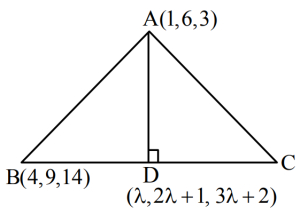
0 likesView Solution
146
MathematicsDifficultMCQJEE Main · 2026
વિધાનો પૈકી:
$I$: જો $\begin{vmatrix} 1 & \cos \alpha & \cos \beta \\ \cos \alpha & 1 & \cos \gamma \\ \cos \beta & \cos \gamma & 1 \end{vmatrix} = \begin{vmatrix} 0 & \cos \alpha & \cos \beta \\ \cos \alpha & 0 & \cos \gamma \\ \cos \beta & \cos \gamma & 0 \end{vmatrix}$ હોય,તો $\cos^{2}\alpha+\cos^{2}\beta+\cos^{2}\gamma=\frac{3}{2}$
$II$: જો $\begin{vmatrix} x^{2}+x & x+1 & x-2 \\ 2x^{2}+3x-1 & 3x & 3x-3 \\ x^{2}+2x+3 & 2x-1 & 2x-1 \end{vmatrix} = px+q$ હોય,તો $p^{2}=196q^{2}$
$I$: જો $\begin{vmatrix} 1 & \cos \alpha & \cos \beta \\ \cos \alpha & 1 & \cos \gamma \\ \cos \beta & \cos \gamma & 1 \end{vmatrix} = \begin{vmatrix} 0 & \cos \alpha & \cos \beta \\ \cos \alpha & 0 & \cos \gamma \\ \cos \beta & \cos \gamma & 0 \end{vmatrix}$ હોય,તો $\cos^{2}\alpha+\cos^{2}\beta+\cos^{2}\gamma=\frac{3}{2}$
$II$: જો $\begin{vmatrix} x^{2}+x & x+1 & x-2 \\ 2x^{2}+3x-1 & 3x & 3x-3 \\ x^{2}+2x+3 & 2x-1 & 2x-1 \end{vmatrix} = px+q$ હોય,તો $p^{2}=196q^{2}$
A
બંને ખોટા છે
B
માત્ર $II$ સાચું છે
C
બંને સાચા છે
D
માત્ર $I$ સાચું છે
Solution
(A) વિધાન $I$ માટે: ધારો કે $\cos \alpha = x, \cos \beta = y, \cos \gamma = z$.
આપેલ સમીકરણ $\begin{vmatrix} 1 & x & y \\ x & 1 & z \\ y & z & 1 \end{vmatrix} = \begin{vmatrix} 0 & x & y \\ x & 0 & z \\ y & z & 0 \end{vmatrix}$ છે.
ડાબી બાજુના નિશ્ચાયકનું વિસ્તરણ: $1(1-z^2) - x(x-yz) + y(xz-y) = 1 - z^2 - x^2 + xyz + xyz - y^2 = 1 - (x^2+y^2+z^2) + 2xyz$.
જમણી બાજુના નિશ્ચાયકનું વિસ્તરણ: $0(0-z^2) - x(0-yz) + y(xz-0) = xyz + xyz = 2xyz$.
બંને બાજુ સરખાવતા: $1 - (x^2+y^2+z^2) + 2xyz = 2xyz \implies x^2+y^2+z^2 = 1$.
આમ,$\cos^2 \alpha + \cos^2 \beta + \cos^2 \gamma = 1 \neq \frac{3}{2}$. વિધાન $I$ ખોટું છે.
વિધાન $II$ માટે: ધારો કે $f(x) = \begin{vmatrix} x^{2}+x & x+1 & x-2 \\ 2x^{2}+3x-1 & 3x & 3x-3 \\ x^{2}+2x+3 & 2x-1 & 2x-1 \end{vmatrix} = px+q$.
$x=0$ લેતા: $q = \begin{vmatrix} 0 & 1 & -2 \\ -1 & 0 & -3 \\ 3 & -1 & -1 \end{vmatrix} = 0(0-3) - 1(1+9) - 2(1-0) = -10 - 2 = -12$.
$x=1$ લેતા: $p+q = \begin{vmatrix} 2 & 2 & -1 \\ 4 & 3 & 3 \\ 6 & 1 & 1 \end{vmatrix} = 2(3-3) - 2(4-18) - 1(4-18) = 0 + 28 + 14 = 42$.
$q = -12$ હોવાથી,$p - 12 = 42 \implies p = 54$.
$p^2 = 196q^2$ ચકાસતા: $54^2 = 2916$ અને $196(-12)^2 = 196 \times 144 = 28224$.
$2916 \neq 28224$ હોવાથી,વિધાન $II$ ખોટું છે.
આપેલ સમીકરણ $\begin{vmatrix} 1 & x & y \\ x & 1 & z \\ y & z & 1 \end{vmatrix} = \begin{vmatrix} 0 & x & y \\ x & 0 & z \\ y & z & 0 \end{vmatrix}$ છે.
ડાબી બાજુના નિશ્ચાયકનું વિસ્તરણ: $1(1-z^2) - x(x-yz) + y(xz-y) = 1 - z^2 - x^2 + xyz + xyz - y^2 = 1 - (x^2+y^2+z^2) + 2xyz$.
જમણી બાજુના નિશ્ચાયકનું વિસ્તરણ: $0(0-z^2) - x(0-yz) + y(xz-0) = xyz + xyz = 2xyz$.
બંને બાજુ સરખાવતા: $1 - (x^2+y^2+z^2) + 2xyz = 2xyz \implies x^2+y^2+z^2 = 1$.
આમ,$\cos^2 \alpha + \cos^2 \beta + \cos^2 \gamma = 1 \neq \frac{3}{2}$. વિધાન $I$ ખોટું છે.
વિધાન $II$ માટે: ધારો કે $f(x) = \begin{vmatrix} x^{2}+x & x+1 & x-2 \\ 2x^{2}+3x-1 & 3x & 3x-3 \\ x^{2}+2x+3 & 2x-1 & 2x-1 \end{vmatrix} = px+q$.
$x=0$ લેતા: $q = \begin{vmatrix} 0 & 1 & -2 \\ -1 & 0 & -3 \\ 3 & -1 & -1 \end{vmatrix} = 0(0-3) - 1(1+9) - 2(1-0) = -10 - 2 = -12$.
$x=1$ લેતા: $p+q = \begin{vmatrix} 2 & 2 & -1 \\ 4 & 3 & 3 \\ 6 & 1 & 1 \end{vmatrix} = 2(3-3) - 2(4-18) - 1(4-18) = 0 + 28 + 14 = 42$.
$q = -12$ હોવાથી,$p - 12 = 42 \implies p = 54$.
$p^2 = 196q^2$ ચકાસતા: $54^2 = 2916$ અને $196(-12)^2 = 196 \times 144 = 28224$.
$2916 \neq 28224$ હોવાથી,વિધાન $II$ ખોટું છે.
0 likesView Solution
147
MathematicsDifficultMCQJEE Main · 2026
સંકલન $I = \int_{\frac{\pi}{24}}^{\frac{5\pi}{24}} \frac{dx}{1+\sqrt[3]{\tan 2x}}$ ની કિંમત શોધો:
A
$\frac{\pi}{12}$
B
$\frac{\pi}{18}$
C
$\frac{\pi}{6}$
D
$\frac{\pi}{3}$
Solution
(A) ધારો કે $I = \int_{\frac{\pi}{24}}^{\frac{5\pi}{24}} \frac{dx}{1+\sqrt[3]{\tan 2x}}$ ...$(1)$
ગુણધર્મ $\int_{a}^{b} f(x) dx = \int_{a}^{b} f(a+b-x) dx$ નો ઉપયોગ કરતા,જ્યાં $a+b = \frac{\pi}{24} + \frac{5\pi}{24} = \frac{6\pi}{24} = \frac{\pi}{4}$.
$I = \int_{\frac{\pi}{24}}^{\frac{5\pi}{24}} \frac{dx}{1+\sqrt[3]{\tan(2(\frac{\pi}{4}-x))}}$
$I = \int_{\frac{\pi}{24}}^{\frac{5\pi}{24}} \frac{dx}{1+\sqrt[3]{\tan(\frac{\pi}{2}-2x)}}$
આપણે જાણીએ છીએ કે $\tan(\frac{\pi}{2}-\theta) = \cot \theta$,તેથી:
$I = \int_{\frac{\pi}{24}}^{\frac{5\pi}{24}} \frac{dx}{1+\sqrt[3]{\cot 2x}} = \int_{\frac{\pi}{24}}^{\frac{5\pi}{24}} \frac{\sqrt[3]{\tan 2x} dx}{\sqrt[3]{\tan 2x} + 1}$ ...$(2)$
$(1)$ અને $(2)$ નો સરવાળો કરતા:
$2I = \int_{\frac{\pi}{24}}^{\frac{5\pi}{24}} \frac{1+\sqrt[3]{\tan 2x}}{1+\sqrt[3]{\tan 2x}} dx = \int_{\frac{\pi}{24}}^{\frac{5\pi}{24}} 1 dx$
$2I = [x]_{\frac{\pi}{24}}^{\frac{5\pi}{24}} = \frac{5\pi}{24} - \frac{\pi}{24} = \frac{4\pi}{24} = \frac{\pi}{6}$
$I = \frac{\pi}{12}$
ગુણધર્મ $\int_{a}^{b} f(x) dx = \int_{a}^{b} f(a+b-x) dx$ નો ઉપયોગ કરતા,જ્યાં $a+b = \frac{\pi}{24} + \frac{5\pi}{24} = \frac{6\pi}{24} = \frac{\pi}{4}$.
$I = \int_{\frac{\pi}{24}}^{\frac{5\pi}{24}} \frac{dx}{1+\sqrt[3]{\tan(2(\frac{\pi}{4}-x))}}$
$I = \int_{\frac{\pi}{24}}^{\frac{5\pi}{24}} \frac{dx}{1+\sqrt[3]{\tan(\frac{\pi}{2}-2x)}}$
આપણે જાણીએ છીએ કે $\tan(\frac{\pi}{2}-\theta) = \cot \theta$,તેથી:
$I = \int_{\frac{\pi}{24}}^{\frac{5\pi}{24}} \frac{dx}{1+\sqrt[3]{\cot 2x}} = \int_{\frac{\pi}{24}}^{\frac{5\pi}{24}} \frac{\sqrt[3]{\tan 2x} dx}{\sqrt[3]{\tan 2x} + 1}$ ...$(2)$
$(1)$ અને $(2)$ નો સરવાળો કરતા:
$2I = \int_{\frac{\pi}{24}}^{\frac{5\pi}{24}} \frac{1+\sqrt[3]{\tan 2x}}{1+\sqrt[3]{\tan 2x}} dx = \int_{\frac{\pi}{24}}^{\frac{5\pi}{24}} 1 dx$
$2I = [x]_{\frac{\pi}{24}}^{\frac{5\pi}{24}} = \frac{5\pi}{24} - \frac{\pi}{24} = \frac{4\pi}{24} = \frac{\pi}{6}$
$I = \frac{\pi}{12}$
0 likesView Solution
148
MathematicsDifficultMCQJEE Main · 2026
ધારો કે $f(x) = \begin{cases} \frac{ax^{2}+2ax+3}{4x^{2}+4x-3}, & x \neq -\frac{3}{2}, \frac{1}{2} \\ b, & x = -\frac{3}{2}, \frac{1}{2} \end{cases}$ એ $x=-\frac{3}{2}$ પર સતત છે. જો $f(f(x)) = \frac{7}{5}$ હોય,તો $x$ ની કિંમત શોધો:
A
$2$
B
$1$
C
$0$
D
$1.4$
Solution
(B) $f(x)$ એ $x = -\frac{3}{2}$ પર સતત હોવા માટે,$\lim_{x \to -\frac{3}{2}} f(x)$ નું અસ્તિત્વ હોવું જોઈએ અને તે $f(-\frac{3}{2}) = b$ બરાબર હોવું જોઈએ.
છેદ $(2x-1)(2x+3)$ એ $x \to -\frac{3}{2}$ માટે $0$ થાય છે,તેથી અંશ $ax^2 + 2ax + 3$ પણ $0$ થવો જોઈએ.
$a(-\frac{3}{2})^2 + 2a(-\frac{3}{2}) + 3 = 0$ $\Rightarrow \frac{9a}{4} - 3a + 3 = 0$ $\Rightarrow -\frac{3a}{4} = -3$ $\Rightarrow a = 4$.
$a=4$ મૂકતા,$f(x) = \frac{4x^2+8x+3}{(2x-1)(2x+3)} = \frac{(2x+1)(2x+3)}{(2x-1)(2x+3)} = \frac{2x+1}{2x-1}$ જ્યાં $x \neq -\frac{3}{2}, \frac{1}{2}$.
હવે,$f(f(x)) = f\left(\frac{2x+1}{2x-1}\right) = \frac{2(\frac{2x+1}{2x-1}) + 1}{2(\frac{2x+1}{2x-1}) - 1} = \frac{4x+2+2x-1}{4x+2-2x+1} = \frac{6x+1}{2x+3}$.
આપેલ છે કે $f(f(x)) = \frac{7}{5}$,તેથી $\frac{6x+1}{2x+3} = \frac{7}{5}$.
$5(6x+1) = 7(2x+3)$ $\Rightarrow 30x + 5 = 14x + 21$ $\Rightarrow 16x = 16$ $\Rightarrow x = 1$.
છેદ $(2x-1)(2x+3)$ એ $x \to -\frac{3}{2}$ માટે $0$ થાય છે,તેથી અંશ $ax^2 + 2ax + 3$ પણ $0$ થવો જોઈએ.
$a(-\frac{3}{2})^2 + 2a(-\frac{3}{2}) + 3 = 0$ $\Rightarrow \frac{9a}{4} - 3a + 3 = 0$ $\Rightarrow -\frac{3a}{4} = -3$ $\Rightarrow a = 4$.
$a=4$ મૂકતા,$f(x) = \frac{4x^2+8x+3}{(2x-1)(2x+3)} = \frac{(2x+1)(2x+3)}{(2x-1)(2x+3)} = \frac{2x+1}{2x-1}$ જ્યાં $x \neq -\frac{3}{2}, \frac{1}{2}$.
હવે,$f(f(x)) = f\left(\frac{2x+1}{2x-1}\right) = \frac{2(\frac{2x+1}{2x-1}) + 1}{2(\frac{2x+1}{2x-1}) - 1} = \frac{4x+2+2x-1}{4x+2-2x+1} = \frac{6x+1}{2x+3}$.
આપેલ છે કે $f(f(x)) = \frac{7}{5}$,તેથી $\frac{6x+1}{2x+3} = \frac{7}{5}$.
$5(6x+1) = 7(2x+3)$ $\Rightarrow 30x + 5 = 14x + 21$ $\Rightarrow 16x = 16$ $\Rightarrow x = 1$.
0 likesView Solution
149
MathematicsDifficultMCQJEE Main · 2026
ધારો કે $y=y(x)$ એ વિકલ સમીકરણ $x^{4}dy + (4x^{3}y + 2\sin x)dx = 0$,$x>0$,$y(\frac{\pi}{2})=0$ નો ઉકેલ છે. તો $\pi^{4}y(\frac{\pi}{3})$ ની કિંમત શોધો.
A
$81$
B
$92$
C
$64$
D
$72$
Solution
(A) આપેલ વિકલ સમીકરણ $x^{4}dy + (4x^{3}y + 2\sin x)dx = 0$ છે.
પદોને ગોઠવતા,આપણને મળે $x^{4}dy + 4x^{3}ydx = -2\sin x dx$.
આને $d(x^{4}y) = -2\sin x dx$ તરીકે લખી શકાય.
બંને બાજુ સંકલન કરતા,$\int d(x^{4}y) = \int -2\sin x dx$,જે $x^{4}y = 2\cos x + C$ આપે છે.
શરત $y(\frac{\pi}{2}) = 0$ આપેલ છે,તેથી $x = \frac{\pi}{2}$ અને $y = 0$ મુકતા:
$(\frac{\pi}{2})^{4}(0) = 2\cos(\frac{\pi}{2}) + C
\Rightarrow 0 = 2(0) + C
\Rightarrow C = 0$.
તેથી,ઉકેલ $x^{4}y = 2\cos x$ છે.
હવે,આપણે $\pi^{4}y(\frac{\pi}{3})$ શોધવાનું છે.
$x = \frac{\pi}{3}$ માટે,$(\frac{\pi}{3})^{4} y(\frac{\pi}{3}) = 2\cos(\frac{\pi}{3})$.
કારણ કે $\cos(\frac{\pi}{3}) = \frac{1}{2}$,આપણને મળે $\frac{\pi^{4}}{81} y(\frac{\pi}{3}) = 2(\frac{1}{2}) = 1$.
તેથી,$\pi^{4} y(\frac{\pi}{3}) = 81$.
પદોને ગોઠવતા,આપણને મળે $x^{4}dy + 4x^{3}ydx = -2\sin x dx$.
આને $d(x^{4}y) = -2\sin x dx$ તરીકે લખી શકાય.
બંને બાજુ સંકલન કરતા,$\int d(x^{4}y) = \int -2\sin x dx$,જે $x^{4}y = 2\cos x + C$ આપે છે.
શરત $y(\frac{\pi}{2}) = 0$ આપેલ છે,તેથી $x = \frac{\pi}{2}$ અને $y = 0$ મુકતા:
$(\frac{\pi}{2})^{4}(0) = 2\cos(\frac{\pi}{2}) + C
\Rightarrow 0 = 2(0) + C
\Rightarrow C = 0$.
તેથી,ઉકેલ $x^{4}y = 2\cos x$ છે.
હવે,આપણે $\pi^{4}y(\frac{\pi}{3})$ શોધવાનું છે.
$x = \frac{\pi}{3}$ માટે,$(\frac{\pi}{3})^{4} y(\frac{\pi}{3}) = 2\cos(\frac{\pi}{3})$.
કારણ કે $\cos(\frac{\pi}{3}) = \frac{1}{2}$,આપણને મળે $\frac{\pi^{4}}{81} y(\frac{\pi}{3}) = 2(\frac{1}{2}) = 1$.
તેથી,$\pi^{4} y(\frac{\pi}{3}) = 81$.
0 likesView Solution
150
MathematicsDifficultMCQJEE Main · 2026
ધારો કે $A = \{-2, -1, 0, 1, 2, 3, 4\}$. ધારો કે $R$ એ $A$ પરનો સંબંધ છે જે $xRy$ જો અને માત્ર જો $2x + y \le 2$ દ્વારા વ્યાખ્યાયિત છે. ધારો કે $l$ એ $R$ માં ઘટકોની સંખ્યા છે. ધારો કે $m$ અને $n$ એ અનુક્રમે $R$ ને સ્વવાચક (reflexive) અને સંમિત (symmetric) સંબંધ બનાવવા માટે ઉમેરવા પડતા ન્યૂનતમ ઘટકોની સંખ્યા છે. તો $l + m + n$ ની કિંમત શોધો:
A
$32$
B
$34$
C
$33$
D
$35$
Solution
(C) આપેલ છે $A = \{-2, -1, 0, 1, 2, 3, 4\}$ અને $xRy \iff 2x + y \le 2$.
દરેક $x \in A$ માટે,આપણે $y \in A$ શોધીએ છીએ જેથી $y \le 2 - 2x$ થાય:
- જો $x = -2$,$y \le 6 \implies y \in \{-2, -1, 0, 1, 2, 3, 4\}$ ($7$ ઘટકો).
- જો $x = -1$,$y \le 4 \implies y \in \{-2, -1, 0, 1, 2, 3, 4\}$ ($7$ ઘટકો).
- જો $x = 0$,$y \le 2 \implies y \in \{-2, -1, 0, 1, 2\}$ ($5$ ઘટકો).
- જો $x = 1$,$y \le 0 \implies y \in \{-2, -1, 0\}$ ($3$ ઘટકો).
- જો $x = 2$,$y \le -2 \implies y \in \{-2\}$ ($1$ ઘટક).
- જો $x = 3$,$y \le -4 \implies$ કોઈ $y \in A$ નથી.
- જો $x = 4$,$y \le -6 \implies$ કોઈ $y \in A$ નથી.
કુલ ઘટકો $l = 7 + 7 + 5 + 3 + 1 = 23$.
સ્વવાચકતા માટે,બધા $x \in A$ માટે $(x, x) \in R$ હોવું જોઈએ. તપાસતા: $(-2, -2), (-1, -1), (0, 0)$ એ $R$ માં છે. $(1, 1), (2, 2), (3, 3), (4, 4)$ ખૂટે છે. તેથી $m = 4$.
સંમિતતા માટે,જો $(x, y) \in R$,તો $(y, x)$ પણ $R$ માં હોવું જોઈએ. $R$ માં એવા ઘટકો $(x, y)$ કે જેના માટે $(y, x) \notin R$ છે તે: $(3, -2), (4, -2), (2, -1), (2, 0), (3, -1), (4, -1)$. આવા $6$ ઘટકો છે. તેથી $n = 6$.
આમ,$l + m + n = 23 + 4 + 6 = 33$.
દરેક $x \in A$ માટે,આપણે $y \in A$ શોધીએ છીએ જેથી $y \le 2 - 2x$ થાય:
- જો $x = -2$,$y \le 6 \implies y \in \{-2, -1, 0, 1, 2, 3, 4\}$ ($7$ ઘટકો).
- જો $x = -1$,$y \le 4 \implies y \in \{-2, -1, 0, 1, 2, 3, 4\}$ ($7$ ઘટકો).
- જો $x = 0$,$y \le 2 \implies y \in \{-2, -1, 0, 1, 2\}$ ($5$ ઘટકો).
- જો $x = 1$,$y \le 0 \implies y \in \{-2, -1, 0\}$ ($3$ ઘટકો).
- જો $x = 2$,$y \le -2 \implies y \in \{-2\}$ ($1$ ઘટક).
- જો $x = 3$,$y \le -4 \implies$ કોઈ $y \in A$ નથી.
- જો $x = 4$,$y \le -6 \implies$ કોઈ $y \in A$ નથી.
કુલ ઘટકો $l = 7 + 7 + 5 + 3 + 1 = 23$.
સ્વવાચકતા માટે,બધા $x \in A$ માટે $(x, x) \in R$ હોવું જોઈએ. તપાસતા: $(-2, -2), (-1, -1), (0, 0)$ એ $R$ માં છે. $(1, 1), (2, 2), (3, 3), (4, 4)$ ખૂટે છે. તેથી $m = 4$.
સંમિતતા માટે,જો $(x, y) \in R$,તો $(y, x)$ પણ $R$ માં હોવું જોઈએ. $R$ માં એવા ઘટકો $(x, y)$ કે જેના માટે $(y, x) \notin R$ છે તે: $(3, -2), (4, -2), (2, -1), (2, 0), (3, -1), (4, -1)$. આવા $6$ ઘટકો છે. તેથી $n = 6$.
આમ,$l + m + n = 23 + 4 + 6 = 33$.
0 likesView Solution
Vedclass Products
For Students
Vedclass Test Series
Mock tests in real JEE Main style covering Mathematics with performance analysis. 5-day free trial.
Start Free TrialFor Teachers
Exam Paper Generator
Generate Set A/B/C/D Mathematics papers from 7.5L+ questions in 2 minutes. 3 chapters free.
Try FreeFor Institutes
Online Exam Module
Run live JEE Main mock exams with unlimited students, 360° analytics & white-label branding.
See DemoFrequently Asked Questions
How many Mathematics questions are in JEE Main 2026?
There are 475 Mathematics questions from the JEE Main 2026 paper on Vedclass, each with a detailed step-by-step solution in Gujarati.
Are JEE Main 2026 Mathematics solutions available in Gujarati?
Yes. All solutions on this page are in Gujarati. You can also switch to English or Hindi using the language buttons above the questions.
Can I practice JEE Main 2026 Mathematics as a timed test?
Yes. Use the Vedclass Test Series to attempt a full JEE Main mock test covering Mathematics with time limits and instant score analysis.
Can teachers create Mathematics papers from JEE Main previous year questions?
Yes. The Vedclass Exam Paper Generator lets teachers mix JEE Main Mathematics questions and generate Set A/B/C/D papers in minutes.
For Teachers & Institutes
Build a Custom Mathematics Paper
Pick JEE Main 2026 Mathematics questions, set difficulty, and generate Set A/B/C/D in 2 minutes.