
MathematicsQ1–80 of 80 questions
Page 1 of 1 · Gujarati
1
MathematicsEasyMCQTS EAMCET · 2017
$\alpha$ અને $\beta$ એ $x^2+2x+c=0$ ના બીજ છે. જો $\alpha^3+\beta^3=4$ હોય,તો $c$ ની કિંમત શોધો.
A
-$2$
B
$3$
C
$2$
D
$4$
Solution
(C) આપેલ છે કે,$\alpha$ અને $\beta$ એ $x^2+2x+c=0$ ના બીજ છે.
બીજનો સરવાળો,$\alpha+\beta = -\frac{2}{1} = -2$.
બીજનો ગુણાકાર,$\alpha\beta = \frac{c}{1} = c$.
આપણે જાણીએ છીએ કે $\alpha^3+\beta^3 = (\alpha+\beta)(\alpha^2+\beta^2-\alpha\beta)$.
આને $\alpha^3+\beta^3 = (\alpha+\beta)[(\alpha+\beta)^2-3\alpha\beta]$ તરીકે લખી શકાય.
$\alpha^3+\beta^3 = 4$ આપેલ છે,કિંમતો મૂકતા:
$(-2)[(-2)^2 - 3c] = 4$.
$(-2)[4-3c] = 4$.
$4-3c = -2$.
$-3c = -6$.
$c = 2$.
બીજનો સરવાળો,$\alpha+\beta = -\frac{2}{1} = -2$.
બીજનો ગુણાકાર,$\alpha\beta = \frac{c}{1} = c$.
આપણે જાણીએ છીએ કે $\alpha^3+\beta^3 = (\alpha+\beta)(\alpha^2+\beta^2-\alpha\beta)$.
આને $\alpha^3+\beta^3 = (\alpha+\beta)[(\alpha+\beta)^2-3\alpha\beta]$ તરીકે લખી શકાય.
$\alpha^3+\beta^3 = 4$ આપેલ છે,કિંમતો મૂકતા:
$(-2)[(-2)^2 - 3c] = 4$.
$(-2)[4-3c] = 4$.
$4-3c = -2$.
$-3c = -6$.
$c = 2$.
0 likesView Solution
2
MathematicsDifficultMCQTS EAMCET · 2017
ધારો કે $f(x)$ એક દ્વિઘાત પદાવલિ છે જેથી $f(0)+f(1)=0$ થાય. જો $f(-2)=0$ હોય,તો
A
$f\left(\frac{-2}{5}\right)=0$
B
$f\left(\frac{2}{5}\right)=0$
C
$f\left(\frac{-3}{5}\right)=0$
D
$f\left(\frac{3}{5}\right)=0$
Solution
(D) ધારો કે $f(x) = ax^2 + bx + c$.
આપેલ છે કે $f(0) + f(1) = 0$,તેથી $c + (a + b + c) = 0$,જેનો અર્થ છે કે $a + b + 2c = 0$ $(i)$.
આપેલ છે કે $f(-2) = 0$,તેથી $4a - 2b + c = 0$ (ii).
$(i)$ પરથી,$b = -a - 2c$. (ii) માં મૂકતા:
$4a - 2(-a - 2c) + c = 0$ $\Rightarrow 4a + 2a + 4c + c = 0$ $\Rightarrow 6a + 5c = 0$.
ધારો કે $a = 5k$,તો $c = -6k$.
$(i)$ માં મૂકતા: $5k + b + 2(-6k) = 0$ $\Rightarrow 5k + b - 12k = 0$ $\Rightarrow b = 7k$.
આમ,$f(x) = k(5x^2 + 7x - 6) = k(5x^2 + 10x - 3x - 6) = k(5x(x + 2) - 3(x + 2)) = k(5x - 3)(x + 2)$.
બીજ $x = -2$ અને $x = \frac{3}{5}$ છે.
તેથી,$f\left(\frac{3}{5}\right) = 0$.
આપેલ છે કે $f(0) + f(1) = 0$,તેથી $c + (a + b + c) = 0$,જેનો અર્થ છે કે $a + b + 2c = 0$ $(i)$.
આપેલ છે કે $f(-2) = 0$,તેથી $4a - 2b + c = 0$ (ii).
$(i)$ પરથી,$b = -a - 2c$. (ii) માં મૂકતા:
$4a - 2(-a - 2c) + c = 0$ $\Rightarrow 4a + 2a + 4c + c = 0$ $\Rightarrow 6a + 5c = 0$.
ધારો કે $a = 5k$,તો $c = -6k$.
$(i)$ માં મૂકતા: $5k + b + 2(-6k) = 0$ $\Rightarrow 5k + b - 12k = 0$ $\Rightarrow b = 7k$.
આમ,$f(x) = k(5x^2 + 7x - 6) = k(5x^2 + 10x - 3x - 6) = k(5x(x + 2) - 3(x + 2)) = k(5x - 3)(x + 2)$.
બીજ $x = -2$ અને $x = \frac{3}{5}$ છે.
તેથી,$f\left(\frac{3}{5}\right) = 0$.
0 likesView Solution
3
MathematicsEasyMCQTS EAMCET · 2017
$x^2-8x+9-\frac{8}{x}+\frac{1}{x^2}=0$ ના તમામ વાસ્તવિક બીજનો ગુણાકાર કેટલો થાય?
A
$2$
B
$1$
C
$3$
D
$7$
Solution
(B) આપેલ સમીકરણ: $x^2-8x+9-\frac{8}{x}+\frac{1}{x^2}=0$
પદોને ગોઠવતા: $(x^2+\frac{1}{x^2}) - 8(x+\frac{1}{x}) + 9 = 0$
ધારો કે $t = x+\frac{1}{x}$. તેથી $t^2 = x^2+2+\frac{1}{x^2}$,એટલે કે $x^2+\frac{1}{x^2} = t^2-2$.
સમીકરણમાં કિંમત મૂકતા: $(t^2-2) - 8t + 9 = 0$
$t^2 - 8t + 7 = 0$
$(t-7)(t-1) = 0$
કિસ્સો $1$: $t = 7$ $\Rightarrow x+\frac{1}{x} = 7$ $\Rightarrow x^2-7x+1 = 0$. વિવેચક $D = (-7)^2 - 4(1)(1) = 45 > 0$,તેથી બે વાસ્તવિક બીજ મળે છે. આ બીજનો ગુણાકાર $c/a = 1$ થાય.
કિસ્સો $2$: $t = 1$ $\Rightarrow x+\frac{1}{x} = 1$ $\Rightarrow x^2-x+1 = 0$. વિવેચક $D = (-1)^2 - 4(1)(1) = -3 < 0$,તેથી કોઈ વાસ્તવિક બીજ મળતા નથી.
આમ,તમામ વાસ્તવિક બીજનો ગુણાકાર $1$ છે.
પદોને ગોઠવતા: $(x^2+\frac{1}{x^2}) - 8(x+\frac{1}{x}) + 9 = 0$
ધારો કે $t = x+\frac{1}{x}$. તેથી $t^2 = x^2+2+\frac{1}{x^2}$,એટલે કે $x^2+\frac{1}{x^2} = t^2-2$.
સમીકરણમાં કિંમત મૂકતા: $(t^2-2) - 8t + 9 = 0$
$t^2 - 8t + 7 = 0$
$(t-7)(t-1) = 0$
કિસ્સો $1$: $t = 7$ $\Rightarrow x+\frac{1}{x} = 7$ $\Rightarrow x^2-7x+1 = 0$. વિવેચક $D = (-7)^2 - 4(1)(1) = 45 > 0$,તેથી બે વાસ્તવિક બીજ મળે છે. આ બીજનો ગુણાકાર $c/a = 1$ થાય.
કિસ્સો $2$: $t = 1$ $\Rightarrow x+\frac{1}{x} = 1$ $\Rightarrow x^2-x+1 = 0$. વિવેચક $D = (-1)^2 - 4(1)(1) = -3 < 0$,તેથી કોઈ વાસ્તવિક બીજ મળતા નથી.
આમ,તમામ વાસ્તવિક બીજનો ગુણાકાર $1$ છે.
0 likesView Solution
4
MathematicsDifficultMCQTS EAMCET · 2017
જો $\alpha$ અને $\beta$ એ સમીકરણ $a x^2+b x+c=0$ ના બીજ હોય અને જો $p x^2+q x+r=0$ ના બીજ $\frac{1-\alpha}{\alpha}$ અને $\frac{1-\beta}{\beta}$ હોય,તો $r$ ની કિંમત શું થાય?
A
$a+2 b$
B
$a+b+c$
C
$a b+b c+c a$
D
$a b c$
Solution
(B) આપેલ છે કે $\alpha$ અને $\beta$ એ $a x^2+b x+c=0$ ના બીજ છે.
$\alpha+\beta = -\frac{b}{a}$ અને $\alpha \beta = \frac{c}{a}$.
ધારો કે $p x^2+q x+r=0$ ના બીજ $\gamma = \frac{1-\alpha}{\alpha} = \frac{1}{\alpha}-1$ અને $\delta = \frac{1-\beta}{\beta} = \frac{1}{\beta}-1$ છે.
તેથી $\alpha = \frac{1}{1+\gamma}$ અને $\beta = \frac{1}{1+\delta}$.
$\alpha$ એ $a x^2+b x+c=0$ નું બીજ હોવાથી,$a(\frac{1}{1+x})^2 + b(\frac{1}{1+x}) + c = 0$.
$a + b(1+x) + c(1+x)^2 = 0$.
$a + b + bx + c(1 + 2x + x^2) = 0$.
$c x^2 + (b+2c)x + (a+b+c) = 0$.
આને $p x^2+q x+r=0$ સાથે સરખાવતા,આપણને $r = a+b+c$ મળે છે.
$\alpha+\beta = -\frac{b}{a}$ અને $\alpha \beta = \frac{c}{a}$.
ધારો કે $p x^2+q x+r=0$ ના બીજ $\gamma = \frac{1-\alpha}{\alpha} = \frac{1}{\alpha}-1$ અને $\delta = \frac{1-\beta}{\beta} = \frac{1}{\beta}-1$ છે.
તેથી $\alpha = \frac{1}{1+\gamma}$ અને $\beta = \frac{1}{1+\delta}$.
$\alpha$ એ $a x^2+b x+c=0$ નું બીજ હોવાથી,$a(\frac{1}{1+x})^2 + b(\frac{1}{1+x}) + c = 0$.
$a + b(1+x) + c(1+x)^2 = 0$.
$a + b + bx + c(1 + 2x + x^2) = 0$.
$c x^2 + (b+2c)x + (a+b+c) = 0$.
આને $p x^2+q x+r=0$ સાથે સરખાવતા,આપણને $r = a+b+c$ મળે છે.
0 likesView Solution
5
MathematicsEasyMCQTS EAMCET · 2017
જો $(x+iy)(1-2i)$ નો અનુબદ્ધ સંકર સંખ્યા $(1+i)$ હોય,તો
A
$x+iy=1-i$
B
$x+iy=\frac{1-i}{1-2i}$
C
$x-iy=\frac{1-i}{1+2i}$
D
$x-iy=\frac{1-i}{1+i}$
Solution
(B) આપેલ છે કે $(x+iy)(1-2i)$ નો અનુબદ્ધ $(1+i)$ છે.
ધારો કે $z = (x+iy)(1-2i)$.
તેથી $\bar{z} = 1+i$.
કારણ કે $\bar{z} = (x-iy)(1+2i)$,તેથી $(x-iy)(1+2i) = 1+i$.
તેથી,$x-iy = \frac{1+i}{1+2i}$.
બંને બાજુ અનુબદ્ધ લેતા,આપણને મળે $\overline{x-iy} = \overline{\left(\frac{1+i}{1+2i}\right)}$.
આમ,$x+iy = \frac{1-i}{1-2i}$.
ધારો કે $z = (x+iy)(1-2i)$.
તેથી $\bar{z} = 1+i$.
કારણ કે $\bar{z} = (x-iy)(1+2i)$,તેથી $(x-iy)(1+2i) = 1+i$.
તેથી,$x-iy = \frac{1+i}{1+2i}$.
બંને બાજુ અનુબદ્ધ લેતા,આપણને મળે $\overline{x-iy} = \overline{\left(\frac{1+i}{1+2i}\right)}$.
આમ,$x+iy = \frac{1-i}{1-2i}$.
0 likesView Solution
6
MathematicsMediumMCQTS EAMCET · 2017
$\left[\frac{1+\cos \left(\frac{\pi}{12}\right)+i \sin \left(\frac{\pi}{12}\right)}{1+\cos \left(\frac{\pi}{12}\right)-i \sin \left(\frac{\pi}{12}\right)}\right]^{72}=$
A
$0$
B
-$1$
C
$1$
D
$\frac{1}{2}$
Solution
(C) આપેલ પદને ધ્યાનમાં લો: $\left[\frac{\left(1+\cos \frac{\pi}{12}\right)+i \sin \frac{\pi}{12}}{\left(1+\cos \frac{\pi}{12}\right)-i \sin \frac{\pi}{12}}\right]^{72}$
અડધા ખૂણાના નિત્યસમ $1+\cos \theta = 2 \cos^2 \frac{\theta}{2}$ અને $\sin \theta = 2 \sin \frac{\theta}{2} \cos \frac{\theta}{2}$ નો ઉપયોગ કરતા:
$\left[\frac{2 \cos^2 \frac{\pi}{24} + i 2 \sin \frac{\pi}{24} \cos \frac{\pi}{24}}{2 \cos^2 \frac{\pi}{24} - i 2 \sin \frac{\pi}{24} \cos \frac{\pi}{24}}\right]^{72}$
અંશ અને છેદમાંથી $2 \cos \frac{\pi}{24}$ સામાન્ય લેતા:
$\left[\frac{2 \cos \frac{\pi}{24} (\cos \frac{\pi}{24} + i \sin \frac{\pi}{24})}{2 \cos \frac{\pi}{24} (\cos \frac{\pi}{24} - i \sin \frac{\pi}{24})}\right]^{72} = \left(\frac{\cos \frac{\pi}{24} + i \sin \frac{\pi}{24}}{\cos \frac{\pi}{24} - i \sin \frac{\pi}{24}}\right)^{72}$
ગુણધર્મ $\frac{e^{i\theta}}{e^{-i\theta}} = e^{i2\theta}$ નો ઉપયોગ કરતા:
$\left(e^{i \frac{\pi}{24}} / e^{-i \frac{\pi}{24}}\right)^{72} = (e^{i \frac{2\pi}{24}})^{72} = (e^{i \frac{\pi}{12}})^{72}$
$= e^{i \frac{72\pi}{12}} = e^{i 6\pi}$
ઓઈલરના સૂત્ર મુજબ,$e^{i 6\pi} = \cos(6\pi) + i \sin(6\pi) = 1 + i(0) = 1$.
અડધા ખૂણાના નિત્યસમ $1+\cos \theta = 2 \cos^2 \frac{\theta}{2}$ અને $\sin \theta = 2 \sin \frac{\theta}{2} \cos \frac{\theta}{2}$ નો ઉપયોગ કરતા:
$\left[\frac{2 \cos^2 \frac{\pi}{24} + i 2 \sin \frac{\pi}{24} \cos \frac{\pi}{24}}{2 \cos^2 \frac{\pi}{24} - i 2 \sin \frac{\pi}{24} \cos \frac{\pi}{24}}\right]^{72}$
અંશ અને છેદમાંથી $2 \cos \frac{\pi}{24}$ સામાન્ય લેતા:
$\left[\frac{2 \cos \frac{\pi}{24} (\cos \frac{\pi}{24} + i \sin \frac{\pi}{24})}{2 \cos \frac{\pi}{24} (\cos \frac{\pi}{24} - i \sin \frac{\pi}{24})}\right]^{72} = \left(\frac{\cos \frac{\pi}{24} + i \sin \frac{\pi}{24}}{\cos \frac{\pi}{24} - i \sin \frac{\pi}{24}}\right)^{72}$
ગુણધર્મ $\frac{e^{i\theta}}{e^{-i\theta}} = e^{i2\theta}$ નો ઉપયોગ કરતા:
$\left(e^{i \frac{\pi}{24}} / e^{-i \frac{\pi}{24}}\right)^{72} = (e^{i \frac{2\pi}{24}})^{72} = (e^{i \frac{\pi}{12}})^{72}$
$= e^{i \frac{72\pi}{12}} = e^{i 6\pi}$
ઓઈલરના સૂત્ર મુજબ,$e^{i 6\pi} = \cos(6\pi) + i \sin(6\pi) = 1 + i(0) = 1$.
0 likesView Solution
7
MathematicsMediumMCQTS EAMCET · 2017
સમીકરણ $(x-1)^3+64=0$ ના સંકર બીજોનો સરવાળો કેટલો થાય?
A
$6$
B
$3$
C
$6i$
D
$3i$
Solution
(A) આપેલ સમીકરણ: $(x-1)^3+64=0$
$\Rightarrow (x-1)^3 = -64$
$\Rightarrow (x-1)^3 = (-4)^3$
ધારો કે $y = x-1$,તો $y^3 = (-4)^3$. બીજો $y = -4, -4\omega, -4\omega^2$ છે,જ્યાં $\omega$ એ એકમનું સંકર ઘનમૂળ છે.
તેથી,$x-1 = -4, -4\omega, -4\omega^2$.
બીજો $x_1 = -3$,$x_2 = 1-4\omega$,અને $x_3 = 1-4\omega^2$ છે.
સંકર બીજો $x_2 = 1-4\omega$ અને $x_3 = 1-4\omega^2$ છે.
સંકર બીજોનો સરવાળો $= (1-4\omega) + (1-4\omega^2) = 2 - 4(\omega + \omega^2)$.
કારણ કે $1 + \omega + \omega^2 = 0$,તેથી $\omega + \omega^2 = -1$.
સરવાળો $= 2 - 4(-1) = 2 + 4 = 6$.
$\Rightarrow (x-1)^3 = -64$
$\Rightarrow (x-1)^3 = (-4)^3$
ધારો કે $y = x-1$,તો $y^3 = (-4)^3$. બીજો $y = -4, -4\omega, -4\omega^2$ છે,જ્યાં $\omega$ એ એકમનું સંકર ઘનમૂળ છે.
તેથી,$x-1 = -4, -4\omega, -4\omega^2$.
બીજો $x_1 = -3$,$x_2 = 1-4\omega$,અને $x_3 = 1-4\omega^2$ છે.
સંકર બીજો $x_2 = 1-4\omega$ અને $x_3 = 1-4\omega^2$ છે.
સંકર બીજોનો સરવાળો $= (1-4\omega) + (1-4\omega^2) = 2 - 4(\omega + \omega^2)$.
કારણ કે $1 + \omega + \omega^2 = 0$,તેથી $\omega + \omega^2 = -1$.
સરવાળો $= 2 - 4(-1) = 2 + 4 = 6$.
0 likesView Solution
8
MathematicsDifficultMCQTS EAMCET · 2017
જો $\frac{2 z+1}{i z+1}$ નો કાલ્પનિક ભાગ $-2$ હોય,તો સંકર સમતલમાં $z$ દર્શાવતા બિંદુનો બિંદુપથ શું છે?
A
વર્તુળ
B
પરવલય
C
સીધી રેખા
D
ઉપવલય
Solution
(C) ધારો કે $z = x + iy$.
પદમાં $z$ ની કિંમત મૂકતા:
$\frac{2z+1}{iz+1} = \frac{2(x+iy)+1}{i(x+iy)+1} = \frac{(2x+1) + i(2y)}{(1-y) + ix}$.
છેદના અનુબદ્ધ વડે ગુણતા:
$\frac{[(2x+1) + i(2y)][(1-y) - ix]}{(1-y)^2 + x^2} = \frac{(2x+1)(1-y) + 2xy + i[2y(1-y) - x(2x+1)]}{(1-y)^2 + x^2}$.
કાલ્પનિક ભાગ $-2$ આપેલ છે:
$\frac{2y - 2y^2 - 2x^2 - x}{(1-y)^2 + x^2} = -2$.
$2y - 2y^2 - 2x^2 - x = -2(1 - 2y + y^2 + x^2)$.
$2y - 2y^2 - 2x^2 - x = -2 + 4y - 2y^2 - 2x^2$.
સમીકરણનું સાદું રૂપ આપતા:
$-x - 2y = -2$,અથવા $x + 2y - 2 = 0$.
આ એક સીધી રેખાનું સમીકરણ છે.
પદમાં $z$ ની કિંમત મૂકતા:
$\frac{2z+1}{iz+1} = \frac{2(x+iy)+1}{i(x+iy)+1} = \frac{(2x+1) + i(2y)}{(1-y) + ix}$.
છેદના અનુબદ્ધ વડે ગુણતા:
$\frac{[(2x+1) + i(2y)][(1-y) - ix]}{(1-y)^2 + x^2} = \frac{(2x+1)(1-y) + 2xy + i[2y(1-y) - x(2x+1)]}{(1-y)^2 + x^2}$.
કાલ્પનિક ભાગ $-2$ આપેલ છે:
$\frac{2y - 2y^2 - 2x^2 - x}{(1-y)^2 + x^2} = -2$.
$2y - 2y^2 - 2x^2 - x = -2(1 - 2y + y^2 + x^2)$.
$2y - 2y^2 - 2x^2 - x = -2 + 4y - 2y^2 - 2x^2$.
સમીકરણનું સાદું રૂપ આપતા:
$-x - 2y = -2$,અથવા $x + 2y - 2 = 0$.
આ એક સીધી રેખાનું સમીકરણ છે.
0 likesView Solution
9
MathematicsEasyMCQTS EAMCET · 2017
$TRICK$ શબ્દના અક્ષરોનો ઉપયોગ કરીને,અલગ-અલગ અક્ષરોવાળો પાંચ અક્ષરનો શબ્દ એવી રીતે બનાવવામાં આવે છે કે જેથી $C$ મધ્યમાં હોય. આ કેટલા પ્રકારે શક્ય છે?
A
$6$
B
$120$
C
$24$
D
$72$
Solution
(C) $TRICK$ શબ્દમાં $5$ અલગ-અલગ અક્ષરો છે: $T, R, I, C, K$.
આપણે $5$ અક્ષરનો શબ્દ બનાવવો છે જેમાં $C$ મધ્યમાં નિશ્ચિત હોય.
આથી બાકીના $4$ અક્ષરો $(T, R, I, K)$ માટે $4$ જગ્યાઓ ખાલી રહે છે.
$4$ અલગ-અલગ અક્ષરોને $4$ જગ્યાઓ પર ગોઠવવાની રીતો $4!$ છે.
$4! = 4 \times 3 \times 2 \times 1 = 24$.
તેથી,કુલ $24$ શક્ય રીતો છે.
આપણે $5$ અક્ષરનો શબ્દ બનાવવો છે જેમાં $C$ મધ્યમાં નિશ્ચિત હોય.
આથી બાકીના $4$ અક્ષરો $(T, R, I, K)$ માટે $4$ જગ્યાઓ ખાલી રહે છે.
$4$ અલગ-અલગ અક્ષરોને $4$ જગ્યાઓ પર ગોઠવવાની રીતો $4!$ છે.
$4! = 4 \times 3 \times 2 \times 1 = 24$.
તેથી,કુલ $24$ શક્ય રીતો છે.
0 likesView Solution
10
MathematicsEasyMCQTS EAMCET · 2017
એક ગામમાં $10$ ખેલાડીઓ છે. $6$ ખેલાડીઓની એક ટીમ બનાવવાની છે. આ $10$ ખેલાડીઓમાંથી $5$ સભ્યો પસંદ કરવામાં આવે છે અને ત્યારબાદ બાકીના $5$ ખેલાડીઓમાંથી કેપ્ટન પસંદ કરવામાં આવે છે. આવી ટીમ પસંદ કરવાની કુલ રીતોની સંખ્યા કેટલી છે?
A
$1260$
B
$210$
C
$({ }^{10} C_6) \times 5!$
D
$({ }^{10} C_5) \times 6$
Solution
(A) ટીમ પસંદ કરવાની કુલ રીતોની સંખ્યા $10$ માંથી $5$ ખેલાડીઓ પસંદ કરીને અને ત્યારબાદ બાકીના $5$ ખેલાડીઓમાંથી $1$ કેપ્ટન પસંદ કરીને મેળવી શકાય છે.
આ અભિવ્યક્તિ દ્વારા આપવામાં આવે છે:
$({ }^{10} C_5) \times ({ }^5 C_1)$
$= \frac{10 \times 9 \times 8 \times 7 \times 6}{5 \times 4 \times 3 \times 2 \times 1} \times 5$
$= 252 \times 5 = 1260$.
આ અભિવ્યક્તિ દ્વારા આપવામાં આવે છે:
$({ }^{10} C_5) \times ({ }^5 C_1)$
$= \frac{10 \times 9 \times 8 \times 7 \times 6}{5 \times 4 \times 3 \times 2 \times 1} \times 5$
$= 252 \times 5 = 1260$.
0 likesView Solution
11
MathematicsEasyMCQTS EAMCET · 2017
ગણ $\{2k \mid -9 \leq k \leq 10\}$ માંથી એક પૂર્ણાંક પસંદ કરવામાં આવે છે. પસંદ કરેલ પૂર્ણાંક $4$ અને $6$ બંને વડે વિભાજ્ય હોય તેની સંભાવના કેટલી છે?
A
$\frac{1}{10}$
B
$\frac{1}{20}$
C
$\frac{1}{4}$
D
$\frac{3}{20}$
Solution
(D) ગણ $S = \{2k \mid -9 \leq k \leq 10\}$ દ્વારા આપવામાં આવે છે.
$k$ ની કિંમત $-9$ થી $10$ સુધી હોવાથી,કુલ ઘટકોની સંખ્યા $10 - (-9) + 1 = 20$ છે.
આમ,ગણ $S$ માં કુલ $20$ ઘટકો છે.
$4$ અને $6$ બંને વડે વિભાજ્ય સંખ્યા તે $\text{lcm}(4, 6) = 12$ વડે વિભાજ્ય હોવી જોઈએ.
$S$ માં $12$ ના ગુણકો $\{-12, 0, 12\}$ છે.
આમ,સાનુકૂળ પરિણામોની સંખ્યા $3$ છે.
તેથી,જરૂરી સંભાવના $\frac{3}{20}$ છે.
$k$ ની કિંમત $-9$ થી $10$ સુધી હોવાથી,કુલ ઘટકોની સંખ્યા $10 - (-9) + 1 = 20$ છે.
આમ,ગણ $S$ માં કુલ $20$ ઘટકો છે.
$4$ અને $6$ બંને વડે વિભાજ્ય સંખ્યા તે $\text{lcm}(4, 6) = 12$ વડે વિભાજ્ય હોવી જોઈએ.
$S$ માં $12$ ના ગુણકો $\{-12, 0, 12\}$ છે.
આમ,સાનુકૂળ પરિણામોની સંખ્યા $3$ છે.
તેથી,જરૂરી સંભાવના $\frac{3}{20}$ છે.
0 likesView Solution
12
MathematicsEasyMCQTS EAMCET · 2017
કોઈપણ પૂર્ણાંક $n \geq 1$ માટે,$\sum_{K=1}^n K(K+2) =$
A
$\frac{n(n+1)(n+2)}{6}$
B
$\frac{n(n+1)(2n+7)}{6}$
C
$\frac{n(n+1)(2n+1)}{6}$
D
$\frac{n(n-1)(2n+8)}{6}$
Solution
(B) સરવાળો ધ્યાનમાં લો: $\sum_{k=1}^n k(k+2) = \sum_{k=1}^n (k^2 + 2k)$.
પ્રમાણિત સરવાળાના સૂત્રો $\sum_{k=1}^n k^2 = \frac{n(n+1)(2n+1)}{6}$ અને $\sum_{k=1}^n k = \frac{n(n+1)}{2}$ નો ઉપયોગ કરતા:
$\sum_{k=1}^n k^2 + 2 \sum_{k=1}^n k = \frac{n(n+1)(2n+1)}{6} + 2 \cdot \frac{n(n+1)}{2}$.
$\frac{n(n+1)}{6}$ સામાન્ય લેતા:
$= \frac{n(n+1)}{6} [ (2n+1) + 6 ]$.
$= \frac{n(n+1)(2n+7)}{6}$.
પ્રમાણિત સરવાળાના સૂત્રો $\sum_{k=1}^n k^2 = \frac{n(n+1)(2n+1)}{6}$ અને $\sum_{k=1}^n k = \frac{n(n+1)}{2}$ નો ઉપયોગ કરતા:
$\sum_{k=1}^n k^2 + 2 \sum_{k=1}^n k = \frac{n(n+1)(2n+1)}{6} + 2 \cdot \frac{n(n+1)}{2}$.
$\frac{n(n+1)}{6}$ સામાન્ય લેતા:
$= \frac{n(n+1)}{6} [ (2n+1) + 6 ]$.
$= \frac{n(n+1)(2n+7)}{6}$.
0 likesView Solution
13
MathematicsEasyMCQTS EAMCET · 2017
$(1+x)^{42}$ ના વિસ્તરણમાં $(2r+1)^{\text{th}}$ પદ અને $(r+1)^{\text{th}}$ પદના સહગુણકો સમાન હોય,તો $r$ ની કિંમત શું હોઈ શકે?
A
$12$
B
$14$
C
$16$
D
$20$
Solution
(B) $(1+x)^n$ ના વિસ્તરણમાં સામાન્ય પદ $T_{k+1} = {^nC_k} x^k$ દ્વારા આપવામાં આવે છે.
$(1+x)^{42}$ ના વિસ્તરણ માટે,સહગુણકો નીચે મુજબ છે:
$(2r+1)^{\text{th}}$ પદનો સહગુણક ${^{42}C_{2r}}$ છે.
$(r+1)^{\text{th}}$ પદનો સહગુણક ${^{42}C_r}$ છે.
આપેલ છે કે આ સહગુણકો સમાન છે:
${^{42}C_{2r}} = {^{42}C_r}$.
ગુણધર્મ ${^nC_x} = {^nC_y}$ નો ઉપયોગ કરતા,આપણી પાસે બે કિસ્સાઓ છે:
કિસ્સો $1$: $x = y$ $\Rightarrow 2r = r$ $\Rightarrow r = 0$.
કિસ્સો $2$: $x + y = n$ $\Rightarrow 2r + r = 42$ $\Rightarrow 3r = 42$ $\Rightarrow r = 14$.
અહીં $r$ એ ધન પૂર્ણાંક હોવો જોઈએ,તેથી $r = 14$ એ યોગ્ય ઉકેલ છે.
$(1+x)^{42}$ ના વિસ્તરણ માટે,સહગુણકો નીચે મુજબ છે:
$(2r+1)^{\text{th}}$ પદનો સહગુણક ${^{42}C_{2r}}$ છે.
$(r+1)^{\text{th}}$ પદનો સહગુણક ${^{42}C_r}$ છે.
આપેલ છે કે આ સહગુણકો સમાન છે:
${^{42}C_{2r}} = {^{42}C_r}$.
ગુણધર્મ ${^nC_x} = {^nC_y}$ નો ઉપયોગ કરતા,આપણી પાસે બે કિસ્સાઓ છે:
કિસ્સો $1$: $x = y$ $\Rightarrow 2r = r$ $\Rightarrow r = 0$.
કિસ્સો $2$: $x + y = n$ $\Rightarrow 2r + r = 42$ $\Rightarrow 3r = 42$ $\Rightarrow r = 14$.
અહીં $r$ એ ધન પૂર્ણાંક હોવો જોઈએ,તેથી $r = 14$ એ યોગ્ય ઉકેલ છે.
0 likesView Solution
14
MathematicsMediumMCQTS EAMCET · 2017
$(1+x)^n$ ના વિસ્તરણમાં $p$ માં અને $(p+1)$ માં પદના સહગુણકો અનુક્રમે $p$ અને $q$ હોય,તો $p+q$ ની કિંમત શું થાય?
A
$n$
B
$n+1$
C
$n+2$
D
$n+3$
Solution
(B) $(1+x)^n$ ના વિસ્તરણમાં $p$ મું પદ $T_p = { }^n C_{p-1} x^{p-1}$ છે,તેથી તેનો સહગુણક $p = { }^n C_{p-1}$ છે.
$(p+1)$ મું પદ $T_{p+1} = { }^n C_p x^p$ છે,તેથી તેનો સહગુણક $q = { }^n C_p$ છે.
દ્વિપદી સહગુણકોનો ગુણોત્તર $\frac{q}{p} = \frac{{ }^n C_p}{{ }^n C_{p-1}} = \frac{n-p+1}{p}$ છે.
તેથી,$q = n-p+1$.
આમ,$p+q = p + n - p + 1 = n+1$.
$(p+1)$ મું પદ $T_{p+1} = { }^n C_p x^p$ છે,તેથી તેનો સહગુણક $q = { }^n C_p$ છે.
દ્વિપદી સહગુણકોનો ગુણોત્તર $\frac{q}{p} = \frac{{ }^n C_p}{{ }^n C_{p-1}} = \frac{n-p+1}{p}$ છે.
તેથી,$q = n-p+1$.
આમ,$p+q = p + n - p + 1 = n+1$.
0 likesView Solution
15
MathematicsMediumMCQTS EAMCET · 2017
જો $\operatorname{cosec} \theta - \cot \theta = 2017$ હોય,તો $\theta$ કયા ચરણમાં આવેલું છે?
A
$I$
B
$IV$
C
$III$
D
$II$
Solution
(D) આપણને આપેલ છે કે $\operatorname{cosec} \theta - \cot \theta = 2017$ $(i)$.
નિત્યસમ $\operatorname{cosec}^2 \theta - \cot^2 \theta = 1$ નો ઉપયોગ કરતા,$(\operatorname{cosec} \theta - \cot \theta)(\operatorname{cosec} \theta + \cot \theta) = 1$.
તેથી,$\operatorname{cosec} \theta + \cot \theta = \frac{1}{2017}$ (ii).
$(i)$ અને (ii) નો સરવાળો કરતા:
$2 \operatorname{cosec} \theta = 2017 + \frac{1}{2017} > 0$,જેનો અર્થ છે કે $\operatorname{cosec} \theta > 0$.
કારણ કે $\operatorname{cosec} \theta > 0$,$\theta$ એ $I$ અથવા $II$ ચરણમાં હોવું જોઈએ.
(ii) માંથી $(i)$ બાદ કરતા:
$2 \cot \theta = \frac{1}{2017} - 2017 < 0$,જેનો અર્થ છે કે $\cot \theta < 0$.
કારણ કે $\cot \theta < 0$,$\theta$ એ $II$ અથવા $IV$ ચરણમાં હોવું જોઈએ.
બંને શરતો સંતોષાય તે માટે,$\theta$ એ $II$ ચરણમાં આવેલું છે.
નિત્યસમ $\operatorname{cosec}^2 \theta - \cot^2 \theta = 1$ નો ઉપયોગ કરતા,$(\operatorname{cosec} \theta - \cot \theta)(\operatorname{cosec} \theta + \cot \theta) = 1$.
તેથી,$\operatorname{cosec} \theta + \cot \theta = \frac{1}{2017}$ (ii).
$(i)$ અને (ii) નો સરવાળો કરતા:
$2 \operatorname{cosec} \theta = 2017 + \frac{1}{2017} > 0$,જેનો અર્થ છે કે $\operatorname{cosec} \theta > 0$.
કારણ કે $\operatorname{cosec} \theta > 0$,$\theta$ એ $I$ અથવા $II$ ચરણમાં હોવું જોઈએ.
(ii) માંથી $(i)$ બાદ કરતા:
$2 \cot \theta = \frac{1}{2017} - 2017 < 0$,જેનો અર્થ છે કે $\cot \theta < 0$.
કારણ કે $\cot \theta < 0$,$\theta$ એ $II$ અથવા $IV$ ચરણમાં હોવું જોઈએ.
બંને શરતો સંતોષાય તે માટે,$\theta$ એ $II$ ચરણમાં આવેલું છે.
0 likesView Solution
16
MathematicsEasyMCQTS EAMCET · 2017
જો $\tan 20^{\circ}=\lambda$ હોય,તો $\frac{\tan 160^{\circ}-\tan 110^{\circ}}{1+\left(\tan 160^{\circ}\right)\left(\tan 110^{\circ}\right)}$ ની કિંમત શોધો.
A
$\frac{1+\lambda^2}{2 \lambda}$
B
$\frac{1+\lambda^2}{\lambda}$
C
$\frac{1-\lambda^2}{\lambda}$
D
$\frac{1-\lambda^2}{2 \lambda}$
Solution
(D) આપેલ છે કે,$\tan 20^{\circ}=\lambda$.
સૂત્ર $\tan(A-B) = \frac{\tan A - \tan B}{1 + \tan A \tan B}$ નો ઉપયોગ કરતા,પદાવલિ $\tan(160^{\circ}-110^{\circ}) = \tan 50^{\circ}$ બને છે.
અથવા પદોનું સાદું રૂપ આપતા:
$\tan 160^{\circ} = \tan(180^{\circ}-20^{\circ}) = -\tan 20^{\circ} = -\lambda$.
$\tan 110^{\circ} = \tan(90^{\circ}+20^{\circ}) = -\cot 20^{\circ} = -\frac{1}{\lambda}$.
આ કિંમતો પદાવલિમાં મૂકતા:
$\frac{-\lambda - (-1/\lambda)}{1 + (-\lambda)(-1/\lambda)} = \frac{-\lambda + 1/\lambda}{1 + 1} = \frac{\frac{1-\lambda^2}{\lambda}}{2} = \frac{1-\lambda^2}{2\lambda}$.
સૂત્ર $\tan(A-B) = \frac{\tan A - \tan B}{1 + \tan A \tan B}$ નો ઉપયોગ કરતા,પદાવલિ $\tan(160^{\circ}-110^{\circ}) = \tan 50^{\circ}$ બને છે.
અથવા પદોનું સાદું રૂપ આપતા:
$\tan 160^{\circ} = \tan(180^{\circ}-20^{\circ}) = -\tan 20^{\circ} = -\lambda$.
$\tan 110^{\circ} = \tan(90^{\circ}+20^{\circ}) = -\cot 20^{\circ} = -\frac{1}{\lambda}$.
આ કિંમતો પદાવલિમાં મૂકતા:
$\frac{-\lambda - (-1/\lambda)}{1 + (-\lambda)(-1/\lambda)} = \frac{-\lambda + 1/\lambda}{1 + 1} = \frac{\frac{1-\lambda^2}{\lambda}}{2} = \frac{1-\lambda^2}{2\lambda}$.
0 likesView Solution
17
MathematicsEasyMCQTS EAMCET · 2017
જો $\tan \theta_1 = k \cot \theta_2$ હોય,તો $\frac{\cos (\theta_1 + \theta_2)}{\cos (\theta_1 - \theta_2)} = $
A
$\frac{1+k}{1-k}$
B
$\frac{1-k}{1+k}$
C
$\frac{k+1}{k-1}$
D
$\frac{k-1}{k+1}$
Solution
(B) આપેલ છે કે $\tan \theta_1 = k \cot \theta_2$.
$\cot \theta_2 = \frac{1}{\tan \theta_2}$ હોવાથી,$\tan \theta_1 = \frac{k}{\tan \theta_2}$,જેનો અર્થ છે કે $\tan \theta_1 \tan \theta_2 = k$.
હવે,પદ $\frac{\cos (\theta_1 + \theta_2)}{\cos (\theta_1 - \theta_2)}$ ધ્યાનમાં લો.
વિસ્તરણ સૂત્રોનો ઉપયોગ કરતા,આપણને $\frac{\cos \theta_1 \cos \theta_2 - \sin \theta_1 \sin \theta_2}{\cos \theta_1 \cos \theta_2 + \sin \theta_1 \sin \theta_2}$ મળે છે.
અંશ અને છેદને $\cos \theta_1 \cos \theta_2$ વડે ભાગતા,આપણને $\frac{1 - \tan \theta_1 \tan \theta_2}{1 + \tan \theta_1 \tan \theta_2}$ મળે છે.
$\tan \theta_1 \tan \theta_2 = k$ મૂકતા,પદ $\frac{1-k}{1+k}$ બને છે.
$\cot \theta_2 = \frac{1}{\tan \theta_2}$ હોવાથી,$\tan \theta_1 = \frac{k}{\tan \theta_2}$,જેનો અર્થ છે કે $\tan \theta_1 \tan \theta_2 = k$.
હવે,પદ $\frac{\cos (\theta_1 + \theta_2)}{\cos (\theta_1 - \theta_2)}$ ધ્યાનમાં લો.
વિસ્તરણ સૂત્રોનો ઉપયોગ કરતા,આપણને $\frac{\cos \theta_1 \cos \theta_2 - \sin \theta_1 \sin \theta_2}{\cos \theta_1 \cos \theta_2 + \sin \theta_1 \sin \theta_2}$ મળે છે.
અંશ અને છેદને $\cos \theta_1 \cos \theta_2$ વડે ભાગતા,આપણને $\frac{1 - \tan \theta_1 \tan \theta_2}{1 + \tan \theta_1 \tan \theta_2}$ મળે છે.
$\tan \theta_1 \tan \theta_2 = k$ મૂકતા,પદ $\frac{1-k}{1+k}$ બને છે.
0 likesView Solution
18
MathematicsEasyMCQTS EAMCET · 2017
જો $\cosh ^{-1} x = 2 \log _e(\sqrt{2}+1)$ હોય,તો $x=$
A
$1$
B
$2$
C
$4$
D
$3$
Solution
(D) આપેલ છે કે,$\cosh ^{-1} x = 2 \log _e(\sqrt{2}+1)$.
લઘુગણકના ગુણધર્મ $n \log a = \log a^n$ નો ઉપયોગ કરતા:
$\cosh ^{-1} x = \log _e(\sqrt{2}+1)^2$.
આપણે જાણીએ છીએ કે $\cosh ^{-1} x = \log _e(x + \sqrt{x^2-1})$.
તેથી,$\log _e(x + \sqrt{x^2-1}) = \log _e(2 + 1 + 2\sqrt{2}) = \log _e(3 + 2\sqrt{2})$.
બંને બાજુ સરખાવતા,$x + \sqrt{x^2-1} = 3 + 2\sqrt{2}$.
જો $x = 3$ લઈએ,તો $\sqrt{x^2-1} = \sqrt{9-1} = \sqrt{8} = 2\sqrt{2}$.
આમ,$3 + 2\sqrt{2} = 3 + 2\sqrt{2}$,જે સમીકરણનું સમાધાન કરે છે.
તેથી,$x = 3$.
લઘુગણકના ગુણધર્મ $n \log a = \log a^n$ નો ઉપયોગ કરતા:
$\cosh ^{-1} x = \log _e(\sqrt{2}+1)^2$.
આપણે જાણીએ છીએ કે $\cosh ^{-1} x = \log _e(x + \sqrt{x^2-1})$.
તેથી,$\log _e(x + \sqrt{x^2-1}) = \log _e(2 + 1 + 2\sqrt{2}) = \log _e(3 + 2\sqrt{2})$.
બંને બાજુ સરખાવતા,$x + \sqrt{x^2-1} = 3 + 2\sqrt{2}$.
જો $x = 3$ લઈએ,તો $\sqrt{x^2-1} = \sqrt{9-1} = \sqrt{8} = 2\sqrt{2}$.
આમ,$3 + 2\sqrt{2} = 3 + 2\sqrt{2}$,જે સમીકરણનું સમાધાન કરે છે.
તેથી,$x = 3$.
0 likesView Solution
19
MathematicsMediumMCQTS EAMCET · 2017
$(0, 2 \pi)$ માં $\cos 2 \theta = \sin \theta$ ના ઉકેલોની સંખ્યા કેટલી છે?
A
$4$
B
$3$
C
$2$
D
$5$
Solution
(B) આપેલ સમીકરણ $\cos 2 \theta = \sin \theta$ છે.
નિત્યસમ $\cos 2 \theta = 1 - 2 \sin^2 \theta$ નો ઉપયોગ કરતા:
$1 - 2 \sin^2 \theta = \sin \theta$
$2 \sin^2 \theta + \sin \theta - 1 = 0$
દ્વિઘાત સમીકરણના અવયવ પાડતા:
$2 \sin^2 \theta + 2 \sin \theta - \sin \theta - 1 = 0$
$2 \sin \theta (\sin \theta + 1) - 1 (\sin \theta + 1) = 0$
$(\sin \theta + 1)(2 \sin \theta - 1) = 0$
આથી બે કિસ્સા મળે છે:
$1) \sin \theta = -1 \Rightarrow \theta = \frac{3 \pi}{2}$
$2) \sin \theta = \frac{1}{2} \Rightarrow \theta = \frac{\pi}{6}, \frac{5 \pi}{6}$
$\theta \in (0, 2 \pi)$ હોવાથી,ત્રણેય કિંમતો $\frac{\pi}{6}, \frac{5 \pi}{6}, \frac{3 \pi}{2}$ માન્ય ઉકેલો છે.
આમ,કુલ ઉકેલોની સંખ્યા $3$ છે.
નિત્યસમ $\cos 2 \theta = 1 - 2 \sin^2 \theta$ નો ઉપયોગ કરતા:
$1 - 2 \sin^2 \theta = \sin \theta$
$2 \sin^2 \theta + \sin \theta - 1 = 0$
દ્વિઘાત સમીકરણના અવયવ પાડતા:
$2 \sin^2 \theta + 2 \sin \theta - \sin \theta - 1 = 0$
$2 \sin \theta (\sin \theta + 1) - 1 (\sin \theta + 1) = 0$
$(\sin \theta + 1)(2 \sin \theta - 1) = 0$
આથી બે કિસ્સા મળે છે:
$1) \sin \theta = -1 \Rightarrow \theta = \frac{3 \pi}{2}$
$2) \sin \theta = \frac{1}{2} \Rightarrow \theta = \frac{\pi}{6}, \frac{5 \pi}{6}$
$\theta \in (0, 2 \pi)$ હોવાથી,ત્રણેય કિંમતો $\frac{\pi}{6}, \frac{5 \pi}{6}, \frac{3 \pi}{2}$ માન્ય ઉકેલો છે.
આમ,કુલ ઉકેલોની સંખ્યા $3$ છે.
0 likesView Solution
20
MathematicsEasyMCQTS EAMCET · 2017
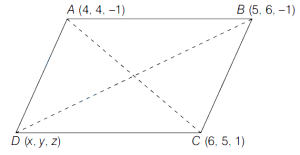
એક સમાંતરબાજુ ચતુષ્કોણના શિરોબિંદુઓ $A(4,4,-1)$,$B(5,6,-1)$,$C(6,5,1)$ અને $D(x, y, z)$ છે. તો શિરોબિંદુ $D$ શું છે?
A
$(5,1,0)$
B
$(-5,0,1)$
C
$(5,3,1)$
D
$(5,1,3)$
Solution
(C) આપેલ છે કે,$ABCD$ એ એક સમાંતરબાજુ ચતુષ્કોણ છે જેના શિરોબિંદુઓ $A(4,4,-1)$,$B(5,6,-1)$,$C(6,5,1)$ અને $D(x, y, z)$ છે.
આપણે જાણીએ છીએ કે સમાંતરબાજુ ચતુષ્કોણ $ABCD$ ના વિકર્ણો એકબીજાને દુભાગે છે.
તેથી,$AC$ નું મધ્યબિંદુ = $BD$ નું મધ્યબિંદુ.
$\left(\frac{4+6}{2}, \frac{4+5}{2}, \frac{-1+1}{2}\right) = \left(\frac{x+5}{2}, \frac{y+6}{2}, \frac{z-1}{2}\right)$
$\left(\frac{10}{2}, \frac{9}{2}, 0\right) = \left(\frac{x+5}{2}, \frac{y+6}{2}, \frac{z-1}{2}\right)$
બંને બાજુ સરખાવતા,આપણને મળે છે:
$\frac{x+5}{2} = \frac{10}{2}$ $\Rightarrow x+5 = 10$ $\Rightarrow x = 5$
$\frac{y+6}{2} = \frac{9}{2}$ $\Rightarrow y+6 = 9$ $\Rightarrow y = 3$
$\frac{z-1}{2} = 0$ $\Rightarrow z-1 = 0$ $\Rightarrow z = 1$
આમ,શિરોબિંદુ $D(x, y, z)$ એ $(5, 3, 1)$ છે.
આપણે જાણીએ છીએ કે સમાંતરબાજુ ચતુષ્કોણ $ABCD$ ના વિકર્ણો એકબીજાને દુભાગે છે.
તેથી,$AC$ નું મધ્યબિંદુ = $BD$ નું મધ્યબિંદુ.
$\left(\frac{4+6}{2}, \frac{4+5}{2}, \frac{-1+1}{2}\right) = \left(\frac{x+5}{2}, \frac{y+6}{2}, \frac{z-1}{2}\right)$
$\left(\frac{10}{2}, \frac{9}{2}, 0\right) = \left(\frac{x+5}{2}, \frac{y+6}{2}, \frac{z-1}{2}\right)$
બંને બાજુ સરખાવતા,આપણને મળે છે:
$\frac{x+5}{2} = \frac{10}{2}$ $\Rightarrow x+5 = 10$ $\Rightarrow x = 5$
$\frac{y+6}{2} = \frac{9}{2}$ $\Rightarrow y+6 = 9$ $\Rightarrow y = 3$
$\frac{z-1}{2} = 0$ $\Rightarrow z-1 = 0$ $\Rightarrow z = 1$
આમ,શિરોબિંદુ $D(x, y, z)$ એ $(5, 3, 1)$ છે.
0 likesView Solution
21
MathematicsMediumMCQTS EAMCET · 2017
$5x - 6y - 1 = 0$ અને $3x + 2y + 5 = 0$ ના છેદબિંદુમાંથી પસાર થતી અને $3x - 5y + 11 = 0$ રેખાને લંબ હોય તેવી રેખાનું સમીકરણ શોધો.
A
$5x + 3y + 18 = 0$
B
$-5x - 3y + 18 = 0$
C
$5x + 3y + 8 = 0$
D
$5x + 3y - 8 = 0$
Solution
(C) પ્રથમ,$5x - 6y - 1 = 0$ અને $3x + 2y + 5 = 0$ રેખાઓનું છેદબિંદુ શોધો.
બીજા સમીકરણને $3$ વડે ગુણતા,$9x + 6y + 15 = 0$ મળે.
આને પ્રથમ સમીકરણમાં ઉમેરતા: $(5x - 6y - 1) + (9x + 6y + 15) = 0$ $\Rightarrow 14x + 14 = 0$ $\Rightarrow x = -1$.
$x = -1$ ને $3x + 2y + 5 = 0$ માં મૂકતા: $3(-1) + 2y + 5 = 0$ $\Rightarrow -3 + 2y + 5 = 0$ $\Rightarrow 2y = -2$ $\Rightarrow y = -1$.
છેદબિંદુ $(-1, -1)$ છે.
$3x - 5y + 11 = 0$ રેખાનો ઢાળ $m_1 = \frac{3}{5}$ છે.
તેને લંબ રેખાનો ઢાળ $m_2 = -\frac{1}{m_1} = -\frac{5}{3}$ થાય.
$(-1, -1)$ માંથી પસાર થતી અને $m_2 = -\frac{5}{3}$ ઢાળ ધરાવતી રેખાનું સમીકરણ:
$(y - (-1)) = -\frac{5}{3}(x - (-1))
$ $\Rightarrow 3(y + 1) = -5(x + 1)
$ $\Rightarrow 3y + 3 = -5x - 5
$ $\Rightarrow 5x + 3y + 8 = 0$.
બીજા સમીકરણને $3$ વડે ગુણતા,$9x + 6y + 15 = 0$ મળે.
આને પ્રથમ સમીકરણમાં ઉમેરતા: $(5x - 6y - 1) + (9x + 6y + 15) = 0$ $\Rightarrow 14x + 14 = 0$ $\Rightarrow x = -1$.
$x = -1$ ને $3x + 2y + 5 = 0$ માં મૂકતા: $3(-1) + 2y + 5 = 0$ $\Rightarrow -3 + 2y + 5 = 0$ $\Rightarrow 2y = -2$ $\Rightarrow y = -1$.
છેદબિંદુ $(-1, -1)$ છે.
$3x - 5y + 11 = 0$ રેખાનો ઢાળ $m_1 = \frac{3}{5}$ છે.
તેને લંબ રેખાનો ઢાળ $m_2 = -\frac{1}{m_1} = -\frac{5}{3}$ થાય.
$(-1, -1)$ માંથી પસાર થતી અને $m_2 = -\frac{5}{3}$ ઢાળ ધરાવતી રેખાનું સમીકરણ:
$(y - (-1)) = -\frac{5}{3}(x - (-1))
$ $\Rightarrow 3(y + 1) = -5(x + 1)
$ $\Rightarrow 3y + 3 = -5x - 5
$ $\Rightarrow 5x + 3y + 8 = 0$.
0 likesView Solution
22
MathematicsMediumMCQTS EAMCET · 2017
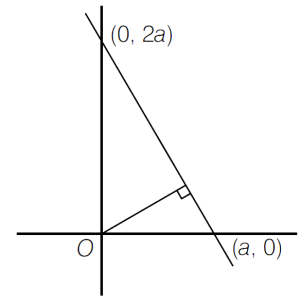
એક સીધી રેખા $Y$-અક્ષ પર $X$-અક્ષ કરતાં બમણું અંતઃખંડ બનાવે છે અને ઉગમબિંદુથી એક એકમ અંતરે છે. તો તે રેખાનું સમીકરણ શું હશે?
A
$2x + 3y = \pm \sqrt{5}$
B
$x + y = \pm 2$
C
$x + 2y = \pm \sqrt{5}$
D
$2x + y = \pm \sqrt{5}$
Solution
(D) ધારો કે $X$-અંતઃખંડ $a$ છે અને $Y$-અંતઃખંડ $2a$ છે.
રેખાનું અંતઃખંડ સ્વરૂપમાં સમીકરણ $\frac{x}{a} + \frac{y}{2a} = 1$ છે.
$2a$ વડે ગુણતા,આપણને $2x + y = 2a$ મળે,અથવા $2x + y - 2a = 0$.
ઉગમબિંદુ $(0, 0)$ થી રેખાનું લંબ અંતર $1$ આપેલું છે.
$(x_1, y_1)$ થી $Ax + By + C = 0$ નું અંતર શોધવાનું સૂત્ર $d = \frac{|Ax_1 + By_1 + C|}{\sqrt{A^2 + B^2}}$ છે.
કિંમતો મૂકતા: $1 = \frac{|2(0) + 1(0) - 2a|}{\sqrt{2^2 + 1^2}}$.
$1 = \frac{|-2a|}{\sqrt{5}}$.
$|2a| = \sqrt{5}$,જેનો અર્થ છે કે $2a = \pm \sqrt{5}$.
$2a$ ની કિંમત $2x + y = 2a$ માં મૂકતા,આપણને $2x + y = \pm \sqrt{5}$ મળે છે.
રેખાનું અંતઃખંડ સ્વરૂપમાં સમીકરણ $\frac{x}{a} + \frac{y}{2a} = 1$ છે.
$2a$ વડે ગુણતા,આપણને $2x + y = 2a$ મળે,અથવા $2x + y - 2a = 0$.
ઉગમબિંદુ $(0, 0)$ થી રેખાનું લંબ અંતર $1$ આપેલું છે.
$(x_1, y_1)$ થી $Ax + By + C = 0$ નું અંતર શોધવાનું સૂત્ર $d = \frac{|Ax_1 + By_1 + C|}{\sqrt{A^2 + B^2}}$ છે.
કિંમતો મૂકતા: $1 = \frac{|2(0) + 1(0) - 2a|}{\sqrt{2^2 + 1^2}}$.
$1 = \frac{|-2a|}{\sqrt{5}}$.
$|2a| = \sqrt{5}$,જેનો અર્થ છે કે $2a = \pm \sqrt{5}$.
$2a$ ની કિંમત $2x + y = 2a$ માં મૂકતા,આપણને $2x + y = \pm \sqrt{5}$ મળે છે.
0 likesView Solution
23
MathematicsEasyMCQTS EAMCET · 2017
જો બિંદુ $(1, 1)$ થી રેખા $3x + 4y + c = 0$ નું લંબ અંતર $7$ હોય,તો $c$ ની શક્ય કિંમતો કઈ છે?
A
$-35, 42$
B
$35, 28$
C
$42, -28$
D
$28, -42$
Solution
(D) બિંદુ $(x_1, y_1)$ થી રેખા $ax + by + c = 0$ નું લંબ અંતર $d$ શોધવાનું સૂત્ર: $d = \left| \frac{ax_1 + by_1 + c}{\sqrt{a^2 + b^2}} \right|$ છે.
આપેલ બિંદુ $(1, 1)$,રેખા $3x + 4y + c = 0$ અને અંતર $d = 7$ માટે:
$7 = \left| \frac{3(1) + 4(1) + c}{\sqrt{3^2 + 4^2}} \right|$
$7 = \left| \frac{7 + c}{5} \right|$
$|7 + c| = 35$
આથી $7 + c = 35$ અથવા $7 + c = -35$ થાય.
જો $7 + c = 35$,તો $c = 28$.
જો $7 + c = -35$,તો $c = -42$.
આમ,$c$ ની શક્ય કિંમતો $28$ અને $-42$ છે.
આપેલ બિંદુ $(1, 1)$,રેખા $3x + 4y + c = 0$ અને અંતર $d = 7$ માટે:
$7 = \left| \frac{3(1) + 4(1) + c}{\sqrt{3^2 + 4^2}} \right|$
$7 = \left| \frac{7 + c}{5} \right|$
$|7 + c| = 35$
આથી $7 + c = 35$ અથવા $7 + c = -35$ થાય.
જો $7 + c = 35$,તો $c = 28$.
જો $7 + c = -35$,તો $c = -42$.
આમ,$c$ ની શક્ય કિંમતો $28$ અને $-42$ છે.
0 likesView Solution
24
MathematicsEasyMCQTS EAMCET · 2017
જો $A=(5,3)$,$B=(3,-2)$ અને બિંદુ $P$ એવું હોય કે જેથી ત્રિકોણ $PAB$ નું ક્ષેત્રફળ $9$ હોય,તો $P$ નો બિંદુપથ શું દર્શાવે છે?
A
એક વર્તુળ
B
સંપાતી રેખાઓની જોડી
C
સમાંતર રેખાઓની જોડી
D
પરસ્પર લંબ રેખાઓની જોડી
Solution
(C) ધારો કે $P(x, y)$,$A=(5,3)$,$B=(3,-2)$.
$\triangle PAB$ નું ક્ષેત્રફળ $= \frac{1}{2} |x(3 - (-2)) - y(5 - 3) + 1(5(-2) - 3(3))| = 9$.
$\frac{1}{2} |5x - 2y - 19| = 9$.
$|5x - 2y - 19| = 18$.
$5x - 2y - 19 = 18$ અથવા $5x - 2y - 19 = -18$.
$5x - 2y = 37$ અથવા $5x - 2y = 1$.
આ સમીકરણો સમાન ઢાળ $m = \frac{5}{2}$ ધરાવતી બે રેખાઓ દર્શાવે છે,જે સમાંતર રેખાઓ છે.
$\triangle PAB$ નું ક્ષેત્રફળ $= \frac{1}{2} |x(3 - (-2)) - y(5 - 3) + 1(5(-2) - 3(3))| = 9$.
$\frac{1}{2} |5x - 2y - 19| = 9$.
$|5x - 2y - 19| = 18$.
$5x - 2y - 19 = 18$ અથવા $5x - 2y - 19 = -18$.
$5x - 2y = 37$ અથવા $5x - 2y = 1$.
આ સમીકરણો સમાન ઢાળ $m = \frac{5}{2}$ ધરાવતી બે રેખાઓ દર્શાવે છે,જે સમાંતર રેખાઓ છે.
0 likesView Solution
25
MathematicsDifficultMCQTS EAMCET · 2017
જો રેખાઓની જોડી $xy-x-y+1=0$ અને રેખા $x+ay-3=0$ સંગામી હોય,તો રેખાઓની જોડી $ax^2-13xy-7y^2+x+23y-6=0$ વચ્ચેનો લઘુકોણ શોધો.
A
$\cos^{-1}\left(\frac{5}{\sqrt{218}}\right)$
B
$\cos^{-1}\left(\frac{1}{\sqrt{10}}\right)$
C
$\cos^{-1}\left(\frac{5}{\sqrt{173}}\right)$
D
$\cos^{-1}\left(\frac{1}{\sqrt{5}}\right)$
Solution
(B) આપેલ રેખાઓની જોડી $xy-x-y+1=0$ ને $(x-1)(y-1)=0$ તરીકે લખી શકાય છે.
આ બે રેખાઓ $x=1$ અને $y=1$ દર્શાવે છે.
આ રેખાઓ $x+ay-3=0$ સાથે સંગામી હોવાથી,તેમનું છેદબિંદુ $(1,1)$ એ $x+ay-3=0$ નું સમાધાન કરશે.
$(1,1)$ ને $x+ay-3=0$ માં મૂકતા,$1+a(1)-3=0$ મળે,જેનો અર્થ છે કે $a=2$.
$a=2$ ને બીજી રેખાઓની જોડીમાં મૂકતા,$2x^2-13xy-7y^2+x+23y-6=0$ મળે છે.
સામાન્ય સમીકરણ $Ax^2+2Hxy+By^2+2Gx+2Fy+C=0$ માટે,રેખાઓ વચ્ચેનો ખૂણો $\theta$ એ $\tan \theta = \left|\frac{2\sqrt{H^2-AB}}{A+B}\right|$ દ્વારા મળે છે.
અહીં $A=2, 2H=-13, B=-7$ છે.
તેથી,$\tan \theta = \left|\frac{2\sqrt{(-13/2)^2 - (2)(-7)}}{2-7}\right| = \left|\frac{2\sqrt{169/4 + 14}}{-5}\right| = \left|\frac{2\sqrt{225/4}}{-5}\right| = \left|\frac{2(15/2)}{-5}\right| = |-3| = 3$.
$\tan \theta = 3$ હોવાથી,$\cos \theta = \frac{1}{\sqrt{1+3^2}} = \frac{1}{\sqrt{10}}$.
તેથી,$\theta = \cos^{-1}\left(\frac{1}{\sqrt{10}}\right)$.
આ બે રેખાઓ $x=1$ અને $y=1$ દર્શાવે છે.
આ રેખાઓ $x+ay-3=0$ સાથે સંગામી હોવાથી,તેમનું છેદબિંદુ $(1,1)$ એ $x+ay-3=0$ નું સમાધાન કરશે.
$(1,1)$ ને $x+ay-3=0$ માં મૂકતા,$1+a(1)-3=0$ મળે,જેનો અર્થ છે કે $a=2$.
$a=2$ ને બીજી રેખાઓની જોડીમાં મૂકતા,$2x^2-13xy-7y^2+x+23y-6=0$ મળે છે.
સામાન્ય સમીકરણ $Ax^2+2Hxy+By^2+2Gx+2Fy+C=0$ માટે,રેખાઓ વચ્ચેનો ખૂણો $\theta$ એ $\tan \theta = \left|\frac{2\sqrt{H^2-AB}}{A+B}\right|$ દ્વારા મળે છે.
અહીં $A=2, 2H=-13, B=-7$ છે.
તેથી,$\tan \theta = \left|\frac{2\sqrt{(-13/2)^2 - (2)(-7)}}{2-7}\right| = \left|\frac{2\sqrt{169/4 + 14}}{-5}\right| = \left|\frac{2\sqrt{225/4}}{-5}\right| = \left|\frac{2(15/2)}{-5}\right| = |-3| = 3$.
$\tan \theta = 3$ હોવાથી,$\cos \theta = \frac{1}{\sqrt{1+3^2}} = \frac{1}{\sqrt{10}}$.
તેથી,$\theta = \cos^{-1}\left(\frac{1}{\sqrt{10}}\right)$.
0 likesView Solution
26
MathematicsEasyMCQTS EAMCET · 2017
$4x^2+8xy+10y^2-8x-44y+14=0$ સમીકરણમાંથી પ્રથમ ઘાતના પદો દૂર કરવા માટે ઉગમબિંદુને કયા બિંદુ પર ખસેડવું જોઈએ?
A
$(-2,3)$
B
$(2,-3)$
C
$(1,-3)$
D
$(-1,3)$
Solution
(A) આપેલ સમીકરણને $ax^2+2hxy+by^2+2gx+2fy+c=0$ સાથે સરખાવતા,આપણને $a=4, h=4, b=10, g=-4, f=-22$ અને $c=14$ મળે છે.
પ્રથમ ઘાતના પદો દૂર કરવા માટે,ઉગમબિંદુ $(0,0)$ ને $(h_0, k_0)$ પર ખસેડવું પડે,જ્યાં $h_0 = \frac{bg-fh}{h^2-ab}$ અને $k_0 = \frac{af-gh}{h^2-ab}$ છે.
છેદની ગણતરી: $h^2-ab = 4^2 - (4)(10) = 16 - 40 = -24$.
$h_0$ ની ગણતરી: $h_0 = \frac{(10)(-4) - (-22)(4)}{-24} = \frac{-40 + 88}{-24} = \frac{48}{-24} = -2$.
$k_0$ ની ગણતરી: $k_0 = \frac{(4)(-22) - (-4)(4)}{-24} = \frac{-88 + 16}{-24} = \frac{-72}{-24} = 3$.
આમ,ઉગમબિંદુને $(-2, 3)$ પર ખસેડવું જોઈએ.
પ્રથમ ઘાતના પદો દૂર કરવા માટે,ઉગમબિંદુ $(0,0)$ ને $(h_0, k_0)$ પર ખસેડવું પડે,જ્યાં $h_0 = \frac{bg-fh}{h^2-ab}$ અને $k_0 = \frac{af-gh}{h^2-ab}$ છે.
છેદની ગણતરી: $h^2-ab = 4^2 - (4)(10) = 16 - 40 = -24$.
$h_0$ ની ગણતરી: $h_0 = \frac{(10)(-4) - (-22)(4)}{-24} = \frac{-40 + 88}{-24} = \frac{48}{-24} = -2$.
$k_0$ ની ગણતરી: $k_0 = \frac{(4)(-22) - (-4)(4)}{-24} = \frac{-88 + 16}{-24} = \frac{-72}{-24} = 3$.
આમ,ઉગમબિંદુને $(-2, 3)$ પર ખસેડવું જોઈએ.
0 likesView Solution
27
MathematicsMediumMCQTS EAMCET · 2017
જો $2 x^2-10 x y+2 \lambda y^2+5 x-16 y-3=0$ એ રેખાઓની જોડી દર્શાવે છે,તો તે રેખાઓનું છેદબિંદુ શોધો.
A
$(2,-3)$
B
$(5,-16)$
C
$\left(-10, \frac{-7}{2}\right)$
D
$\left(-10, \frac{-3}{2}\right)$
Solution
(C) આપેલ સમીકરણને $a x^2+2 h x y+b y^2+2 g x+2 f y+c=0$ સાથે સરખાવતા,$a=2, b=2 \lambda, h=-5, g=\frac{5}{2}, f=-8, c=-3$ મળે છે.
સમીકરણ રેખાઓની જોડી દર્શાવતું હોવાથી,નિશ્ચાયક શરત મુજબ:
$\left|\begin{array}{ccc} a & h & g \\ h & b & f \\ g & f & c \end{array}\right|=0$ $\Rightarrow \left|\begin{array}{ccc} 2 & -5 & 5/2 \\ -5 & 2 \lambda & -8 \\ 5/2 & -8 & -3 \end{array}\right|=0$.
નિશ્ચાયકનું વિસ્તરણ કરતા: $2(-6 \lambda-64)+5(15+20)+\frac{5}{2}(40-5 \lambda)=0$.
$-12 \lambda-128+175+100-12.5 \lambda=0$ $\Rightarrow -24.5 \lambda = -147$ $\Rightarrow \lambda=6$.
હવે,$b=2 \lambda = 12$. છેદબિંદુ $(x, y) = \left(\frac{b g-f h}{h^2-a b}, \frac{a f-g h}{h^2-a b}\right)$ સૂત્ર દ્વારા મળે છે.
છેદ $h^2-a b = (-5)^2 - (2)(12) = 25-24=1$.
$x = \frac{(12)(5/2) - (-8)(-5)}{1} = 30-40 = -10$.
$y = \frac{(2)(-8) - (5/2)(-5)}{1} = -16 + 12.5 = -3.5 = \frac{-7}{2}$.
આમ,છેદબિંદુ $\left(-10, \frac{-7}{2}\right)$ છે.
સમીકરણ રેખાઓની જોડી દર્શાવતું હોવાથી,નિશ્ચાયક શરત મુજબ:
$\left|\begin{array}{ccc} a & h & g \\ h & b & f \\ g & f & c \end{array}\right|=0$ $\Rightarrow \left|\begin{array}{ccc} 2 & -5 & 5/2 \\ -5 & 2 \lambda & -8 \\ 5/2 & -8 & -3 \end{array}\right|=0$.
નિશ્ચાયકનું વિસ્તરણ કરતા: $2(-6 \lambda-64)+5(15+20)+\frac{5}{2}(40-5 \lambda)=0$.
$-12 \lambda-128+175+100-12.5 \lambda=0$ $\Rightarrow -24.5 \lambda = -147$ $\Rightarrow \lambda=6$.
હવે,$b=2 \lambda = 12$. છેદબિંદુ $(x, y) = \left(\frac{b g-f h}{h^2-a b}, \frac{a f-g h}{h^2-a b}\right)$ સૂત્ર દ્વારા મળે છે.
છેદ $h^2-a b = (-5)^2 - (2)(12) = 25-24=1$.
$x = \frac{(12)(5/2) - (-8)(-5)}{1} = 30-40 = -10$.
$y = \frac{(2)(-8) - (5/2)(-5)}{1} = -16 + 12.5 = -3.5 = \frac{-7}{2}$.
આમ,છેદબિંદુ $\left(-10, \frac{-7}{2}\right)$ છે.
0 likesView Solution
28
MathematicsMediumMCQTS EAMCET · 2017
જો વર્તુળ $S \equiv x^2+y^2-13=0$ ના બિંદુ $(2,3)$ આગળના સ્પર્શકનો ઢાળ $m$ હોય,તો બિંદુ $\left(m, \frac{-1}{m}\right)$ એ
A
વર્તુળ $S=0$ ની સાપેક્ષમાં બહારનું બિંદુ છે
B
વર્તુળ $S=0$ ની સાપેક્ષમાં અંદરનું બિંદુ છે
C
વર્તુળ $S=0$ નું કેન્દ્ર છે
D
વર્તુળ $S=0$ પરનું બિંદુ છે
Solution
(B) આપેલ વર્તુળનું સમીકરણ $S \equiv x^2+y^2-13=0$ છે.
$x$ ની સાપેક્ષમાં વિકલન કરતા,$2x + 2y \frac{dy}{dx} = 0$ મળે,જેનો અર્થ છે કે $\frac{dy}{dx} = -\frac{x}{y}$.
બિંદુ $(2,3)$ આગળ સ્પર્શકનો ઢાળ $m = \left. \frac{dy}{dx} \right|_{(2,3)} = -\frac{2}{3}$ છે.
હવે,બિંદુ $\left(m, -\frac{1}{m}\right)$ એ $\left(-\frac{2}{3}, \frac{3}{2}\right)$ થાય છે.
આ બિંદુનું વર્તુળની સાપેક્ષમાં સ્થાન ચકાસવા માટે,આપણે તેને $S(x, y) = x^2+y^2-13$ માં મૂકીએ:
$S\left(-\frac{2}{3}, \frac{3}{2}\right) = \left(-\frac{2}{3}\right)^2 + \left(\frac{3}{2}\right)^2 - 13 = \frac{4}{9} + \frac{9}{4} - 13 = \frac{16 + 81 - 468}{36} = -\frac{371}{36}$.
અહીં $S\left(-\frac{2}{3}, \frac{3}{2}\right) < 0$ હોવાથી,આ બિંદુ વર્તુળની અંદર આવેલું છે.
$x$ ની સાપેક્ષમાં વિકલન કરતા,$2x + 2y \frac{dy}{dx} = 0$ મળે,જેનો અર્થ છે કે $\frac{dy}{dx} = -\frac{x}{y}$.
બિંદુ $(2,3)$ આગળ સ્પર્શકનો ઢાળ $m = \left. \frac{dy}{dx} \right|_{(2,3)} = -\frac{2}{3}$ છે.
હવે,બિંદુ $\left(m, -\frac{1}{m}\right)$ એ $\left(-\frac{2}{3}, \frac{3}{2}\right)$ થાય છે.
આ બિંદુનું વર્તુળની સાપેક્ષમાં સ્થાન ચકાસવા માટે,આપણે તેને $S(x, y) = x^2+y^2-13$ માં મૂકીએ:
$S\left(-\frac{2}{3}, \frac{3}{2}\right) = \left(-\frac{2}{3}\right)^2 + \left(\frac{3}{2}\right)^2 - 13 = \frac{4}{9} + \frac{9}{4} - 13 = \frac{16 + 81 - 468}{36} = -\frac{371}{36}$.
અહીં $S\left(-\frac{2}{3}, \frac{3}{2}\right) < 0$ હોવાથી,આ બિંદુ વર્તુળની અંદર આવેલું છે.
0 likesView Solution
29
MathematicsEasyMCQTS EAMCET · 2017
વર્તુળ $x^2+y^2-6x+4y=12$ ધ્યાનમાં લો. આ વર્તુળના સ્પર્શકનું સમીકરણ જે રેખા $4x+3y+5=0$ ને સમાંતર હોય તે શોધો.
A
$4x+3y+10=0$
B
$4x+3y-9=0$
C
$4x+3y+9=0$
D
$4x+3y-31=0$
Solution
(D) વર્તુળનું આપેલ સમીકરણ $x^2+y^2-6x+4y=12$ છે.
પૂર્ણવર્ગ બનાવતા,$(x-3)^2+(y+2)^2 = 12+9+4 = 25 = 5^2$ મળે.
કેન્દ્ર $(3, -2)$ અને ત્રિજ્યા $r=5$ છે.
રેખા $4x+3y+5=0$ ને સમાંતર રેખાનું સ્વરૂપ $4x+3y+k=0$ છે.
કેન્દ્ર $(3, -2)$ થી સ્પર્શક $4x+3y+k=0$ નું અંતર ત્રિજ્યા $r=5$ જેટલું હોવું જોઈએ.
અંતરના સૂત્રનો ઉપયોગ કરતા,$\frac{|4(3)+3(-2)+k|}{\sqrt{4^2+3^2}} = 5$.
$\frac{|12-6+k|}{5} = 5
\Rightarrow |6+k| = 25$.
આથી $6+k = 25$ અથવા $6+k = -25$ મળે.
તેથી,$k = 19$ અથવા $k = -31$.
સ્પર્શકોના સમીકરણો $4x+3y+19=0$ અને $4x+3y-31=0$ છે.
પૂર્ણવર્ગ બનાવતા,$(x-3)^2+(y+2)^2 = 12+9+4 = 25 = 5^2$ મળે.
કેન્દ્ર $(3, -2)$ અને ત્રિજ્યા $r=5$ છે.
રેખા $4x+3y+5=0$ ને સમાંતર રેખાનું સ્વરૂપ $4x+3y+k=0$ છે.
કેન્દ્ર $(3, -2)$ થી સ્પર્શક $4x+3y+k=0$ નું અંતર ત્રિજ્યા $r=5$ જેટલું હોવું જોઈએ.
અંતરના સૂત્રનો ઉપયોગ કરતા,$\frac{|4(3)+3(-2)+k|}{\sqrt{4^2+3^2}} = 5$.
$\frac{|12-6+k|}{5} = 5
\Rightarrow |6+k| = 25$.
આથી $6+k = 25$ અથવા $6+k = -25$ મળે.
તેથી,$k = 19$ અથવા $k = -31$.
સ્પર્શકોના સમીકરણો $4x+3y+19=0$ અને $4x+3y-31=0$ છે.
0 likesView Solution
30
MathematicsMediumMCQTS EAMCET · 2017
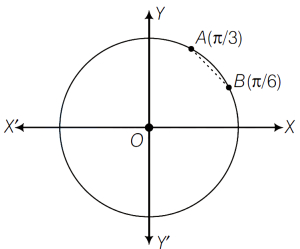
જો $A\left(\frac{\pi}{3}\right)$ અને $B\left(\frac{\pi}{6}\right)$ એ $(0,0)$ કેન્દ્ર અને $12$ ત્રિજ્યા ધરાવતા વર્તુળ પરના બિંદુઓ હોય,જે પ્રચલિત સ્વરૂપમાં દર્શાવેલ છે,તો જીવા $AB$ ની લંબાઈ શોધો.
A
$6(\sqrt{6}-\sqrt{2})$
B
$6(\sqrt{6}-\sqrt{3})$
C
$\sqrt{2}(\sqrt{3}-1)$
D
$6(\sqrt{3}-1)$
Solution
(A) આપેલ વર્તુળના પ્રચલિત સમીકરણો $x = 12 \cos \theta$ અને $y = 12 \sin \theta$ છે.
બિંદુ $A$ માટે,જ્યાં $\theta = \frac{\pi}{3}$:
$x_A = 12 \cos \frac{\pi}{3} = 6$
$y_A = 12 \sin \frac{\pi}{3} = 6\sqrt{3}$
તેથી,$A = (6, 6\sqrt{3})$.
બિંદુ $B$ માટે,જ્યાં $\theta = \frac{\pi}{6}$:
$x_B = 12 \cos \frac{\pi}{6} = 6\sqrt{3}$
$y_B = 12 \sin \frac{\pi}{6} = 6$
તેથી,$B = (6\sqrt{3}, 6)$.
જીવા $AB$ ની લંબાઈ અંતરના સૂત્ર દ્વારા:
$AB = \sqrt{(6\sqrt{3} - 6)^2 + (6 - 6\sqrt{3})^2}$
$AB = 6\sqrt{2}(\sqrt{3} - 1) = 6(\sqrt{6} - \sqrt{2})$.
બિંદુ $A$ માટે,જ્યાં $\theta = \frac{\pi}{3}$:
$x_A = 12 \cos \frac{\pi}{3} = 6$
$y_A = 12 \sin \frac{\pi}{3} = 6\sqrt{3}$
તેથી,$A = (6, 6\sqrt{3})$.
બિંદુ $B$ માટે,જ્યાં $\theta = \frac{\pi}{6}$:
$x_B = 12 \cos \frac{\pi}{6} = 6\sqrt{3}$
$y_B = 12 \sin \frac{\pi}{6} = 6$
તેથી,$B = (6\sqrt{3}, 6)$.
જીવા $AB$ ની લંબાઈ અંતરના સૂત્ર દ્વારા:
$AB = \sqrt{(6\sqrt{3} - 6)^2 + (6 - 6\sqrt{3})^2}$
$AB = 6\sqrt{2}(\sqrt{3} - 1) = 6(\sqrt{6} - \sqrt{2})$.
0 likesView Solution
31
MathematicsMediumMCQTS EAMCET · 2017
$a$ જેટલી સમાન ત્રિજ્યા ધરાવતા બે વર્તુળો એકબીજાને લંબરૂપે છેદે છે. જો તેમના કેન્દ્રો $(2, 3)$ અને $(5, 6)$ હોય,તો આ વર્તુળોની રેડિકલ ધરી કયા બિંદુમાંથી પસાર થાય છે?
A
$(3a, 5a)$
B
$(2a, a)$
C
$\left(a, \frac{5a}{3}\right)$
D
$(a, a)$
Solution
(C) ધારો કે $S_1$ એ $(2, 3)$ કેન્દ્ર અને $a$ ત્રિજ્યા ધરાવતું વર્તુળ છે. તેનું સમીકરણ $(x-2)^2 + (y-3)^2 = a^2$ છે,જે $x^2 + y^2 - 4x - 6y + 13 - a^2 = 0$ તરીકે લખી શકાય.
ધારો કે $S_2$ એ $(5, 6)$ કેન્દ્ર અને $a$ ત્રિજ્યા ધરાવતું વર્તુળ છે. તેનું સમીકરણ $(x-5)^2 + (y-6)^2 = a^2$ છે,જે $x^2 + y^2 - 10x - 12y + 61 - a^2 = 0$ તરીકે લખી શકાય.
રેડિકલ ધરી $S_1 - S_2 = 0$ દ્વારા મળે છે:
$(x^2 + y^2 - 4x - 6y + 13 - a^2) - (x^2 + y^2 - 10x - 12y + 61 - a^2) = 0$
$6x + 6y - 48 = 0 \Rightarrow x + y = 8$.
વર્તુળો લંબરૂપે છેદતા હોવાથી,$2g_1g_2 + 2f_1f_2 = c_1 + c_2$.
અહીં $g_1 = -2, f_1 = -3, c_1 = 13 - a^2$ અને $g_2 = -5, f_2 = -6, c_2 = 61 - a^2$.
$2(-2)(-5) + 2(-3)(-6) = (13 - a^2) + (61 - a^2)$
$20 + 36 = 74 - 2a^2$ $\Rightarrow 56 = 74 - 2a^2$ $\Rightarrow 2a^2 = 18$ $\Rightarrow a^2 = 9$ $\Rightarrow a = 3$.
$a = 3$ ને વિકલ્પોમાં મૂકતા:
$(C)$ $(3, 5) \Rightarrow 3 + 5 = 8$. જે સમીકરણનું સમાધાન કરે છે.
તેથી,વિકલ્પ $(C)$ સાચો છે.
ધારો કે $S_2$ એ $(5, 6)$ કેન્દ્ર અને $a$ ત્રિજ્યા ધરાવતું વર્તુળ છે. તેનું સમીકરણ $(x-5)^2 + (y-6)^2 = a^2$ છે,જે $x^2 + y^2 - 10x - 12y + 61 - a^2 = 0$ તરીકે લખી શકાય.
રેડિકલ ધરી $S_1 - S_2 = 0$ દ્વારા મળે છે:
$(x^2 + y^2 - 4x - 6y + 13 - a^2) - (x^2 + y^2 - 10x - 12y + 61 - a^2) = 0$
$6x + 6y - 48 = 0 \Rightarrow x + y = 8$.
વર્તુળો લંબરૂપે છેદતા હોવાથી,$2g_1g_2 + 2f_1f_2 = c_1 + c_2$.
અહીં $g_1 = -2, f_1 = -3, c_1 = 13 - a^2$ અને $g_2 = -5, f_2 = -6, c_2 = 61 - a^2$.
$2(-2)(-5) + 2(-3)(-6) = (13 - a^2) + (61 - a^2)$
$20 + 36 = 74 - 2a^2$ $\Rightarrow 56 = 74 - 2a^2$ $\Rightarrow 2a^2 = 18$ $\Rightarrow a^2 = 9$ $\Rightarrow a = 3$.
$a = 3$ ને વિકલ્પોમાં મૂકતા:
$(C)$ $(3, 5) \Rightarrow 3 + 5 = 8$. જે સમીકરણનું સમાધાન કરે છે.
તેથી,વિકલ્પ $(C)$ સાચો છે.
0 likesView Solution
32
MathematicsEasyMCQTS EAMCET · 2017
વર્તુળો $x^2+y^2-4x-6y+5=0$,$x^2+y^2-2x-4y-1=0$ અને $x^2+y^2-6x-2y=0$ નું રેડિકલ કેન્દ્ર કઈ રેખા પર આવેલું છે?
A
$x+y-5=0$
B
$2x-4y+7=0$
C
$4x-6y+5=0$
D
$18x-12y+1=0$
Solution
(D) વર્તુળોના સમીકરણો નીચે મુજબ છે:
$S_1: x^2+y^2-4x-6y+5=0$
$S_2: x^2+y^2-2x-4y-1=0$
$S_3: x^2+y^2-6x-2y=0$
રેડિકલ કેન્દ્ર શોધવા માટે,આપણે સમીકરણોની બાદબાકી કરીને રેડિકલ અક્ષો શોધીએ છીએ:
$S_1 - S_2 = 0$ $\Rightarrow -2x-2y+6=0$ $\Rightarrow x+y-3=0$ (સમીકરણ $i$)
$S_2 - S_3 = 0 \Rightarrow 4x-2y-1=0$ (સમીકરણ $ii$)
સમીકરણો $(i)$ અને $(ii)$ ઉકેલતા:
$x = \frac{7}{6}$ અને $y = \frac{11}{6}$ મળે છે.
રેડિકલ કેન્દ્ર $(\frac{7}{6}, \frac{11}{6})$ છે.
વિકલ્પ $D$ માં કિંમત મૂકતા: $18(\frac{7}{6}) - 12(\frac{11}{6}) + 1 = 21 - 22 + 1 = 0$.
તેથી,રેડિકલ કેન્દ્ર $18x-12y+1=0$ રેખા પર આવેલું છે.
$S_1: x^2+y^2-4x-6y+5=0$
$S_2: x^2+y^2-2x-4y-1=0$
$S_3: x^2+y^2-6x-2y=0$
રેડિકલ કેન્દ્ર શોધવા માટે,આપણે સમીકરણોની બાદબાકી કરીને રેડિકલ અક્ષો શોધીએ છીએ:
$S_1 - S_2 = 0$ $\Rightarrow -2x-2y+6=0$ $\Rightarrow x+y-3=0$ (સમીકરણ $i$)
$S_2 - S_3 = 0 \Rightarrow 4x-2y-1=0$ (સમીકરણ $ii$)
સમીકરણો $(i)$ અને $(ii)$ ઉકેલતા:
$x = \frac{7}{6}$ અને $y = \frac{11}{6}$ મળે છે.
રેડિકલ કેન્દ્ર $(\frac{7}{6}, \frac{11}{6})$ છે.
વિકલ્પ $D$ માં કિંમત મૂકતા: $18(\frac{7}{6}) - 12(\frac{11}{6}) + 1 = 21 - 22 + 1 = 0$.
તેથી,રેડિકલ કેન્દ્ર $18x-12y+1=0$ રેખા પર આવેલું છે.
0 likesView Solution
33
MathematicsEasyMCQTS EAMCET · 2017
પરવલય $y^2+6y-2x=-5$ માટે,નીચેના વિધાનો ધ્યાનમાં લો:
$I$. શિરોબિંદુ $(-2, -3)$ છે.
$II$. નિયામિકા $y+3=0$ છે.
નીચેનામાંથી કયું સાચું છે?
$I$. શિરોબિંદુ $(-2, -3)$ છે.
$II$. નિયામિકા $y+3=0$ છે.
નીચેનામાંથી કયું સાચું છે?
A
$I$ અને $II$ બંને સાચા છે
B
$I$ સાચું છે,$II$ ખોટું છે
C
$I$ અને $II$ બંને ખોટા છે
D
$I$ ખોટું છે,$II$ સાચું છે
Solution
(B) આપેલ સમીકરણ: $y^2+6y-2x=-5$
$y$ માટે પૂર્ણવર્ગ બનાવતા:
$y^2+6y+9 = 2x-5+9$
$(y+3)^2 = 2x+4$
$(y+3)^2 = 2(x+2)$
આને પ્રમાણિત સ્વરૂપ $(y-k)^2 = 4a(x-h)$ સાથે સરખાવતા:
શિરોબિંદુ $(h, k) = (-2, -3)$. તેથી,વિધાન $I$ સાચું છે.
અહીં,$4a = 2$,તેથી $a = \frac{1}{2}$.
પરવલય $(y-k)^2 = 4a(x-h)$ ની નિયામિકા $x = h-a$ દ્વારા આપવામાં આવે છે.
$x = -2 - \frac{1}{2} = -\frac{5}{2}$
$2x = -5 \Rightarrow 2x+5 = 0$.
વિધાન $II$ કહે છે કે નિયામિકા $y+3=0$ છે,જે ખોટું છે.
તેથી,$I$ સાચું છે અને $II$ ખોટું છે.
$y$ માટે પૂર્ણવર્ગ બનાવતા:
$y^2+6y+9 = 2x-5+9$
$(y+3)^2 = 2x+4$
$(y+3)^2 = 2(x+2)$
આને પ્રમાણિત સ્વરૂપ $(y-k)^2 = 4a(x-h)$ સાથે સરખાવતા:
શિરોબિંદુ $(h, k) = (-2, -3)$. તેથી,વિધાન $I$ સાચું છે.
અહીં,$4a = 2$,તેથી $a = \frac{1}{2}$.
પરવલય $(y-k)^2 = 4a(x-h)$ ની નિયામિકા $x = h-a$ દ્વારા આપવામાં આવે છે.
$x = -2 - \frac{1}{2} = -\frac{5}{2}$
$2x = -5 \Rightarrow 2x+5 = 0$.
વિધાન $II$ કહે છે કે નિયામિકા $y+3=0$ છે,જે ખોટું છે.
તેથી,$I$ સાચું છે અને $II$ ખોટું છે.
0 likesView Solution
34
MathematicsEasyMCQTS EAMCET · 2017
જો રેખા $x-y=-4K$ એ પરવલય $y^2=8x$ ને $P$ બિંદુએ સ્પર્શક હોય,તો $P$ આગળના અભિલંબનું $(K, 2K)$ થી લંબ અંતર શોધો.
A
$\frac{5}{2\sqrt{2}}$
B
$\frac{7}{2\sqrt{2}}$
C
$\frac{9}{2\sqrt{2}}$
D
$\frac{1}{2\sqrt{2}}$
Solution
(C) રેખાનું સમીકરણ $y = x + 4K$ છે. પરવલય $y^2 = 8x$ (જ્યાં $a=2$) માટે સ્પર્શકની શરત $c = a/m$ છે.
અહીં,$c = 4K$,$a = 2$,અને $m = 1$.
તેથી,$4K = 2/1 \implies 4K = 2 \implies K = 1/2$.
સ્પર્શબિંદુ $P$ એ $(a/m^2, 2a/m) = (2/1^2, 2(2)/1) = (2, 4)$ છે.
પરવલય $y^2 = 4ax$ માટે $(x_1, y_1)$ બિંદુએ અભિલંબનું સમીકરણ $y - y_1 = -\frac{y_1}{2a}(x - x_1)$ છે.
$x_1 = 2, y_1 = 4, a = 2$ મૂકતા: $y - 4 = -\frac{4}{2(2)}(x - 2) \implies y - 4 = -1(x - 2) \implies x + y - 6 = 0$.
બિંદુ $(K, 2K)$ એ $(1/2, 1)$ છે.
$(1/2, 1)$ થી $x + y - 6 = 0$ નું લંબ અંતર $d = \frac{|1/2 + 1 - 6|}{\sqrt{1^2 + 1^2}} = \frac{|3/2 - 6|}{\sqrt{2}} = \frac{|-9/2|}{\sqrt{2}} = \frac{9}{2\sqrt{2}}$ છે.
અહીં,$c = 4K$,$a = 2$,અને $m = 1$.
તેથી,$4K = 2/1 \implies 4K = 2 \implies K = 1/2$.
સ્પર્શબિંદુ $P$ એ $(a/m^2, 2a/m) = (2/1^2, 2(2)/1) = (2, 4)$ છે.
પરવલય $y^2 = 4ax$ માટે $(x_1, y_1)$ બિંદુએ અભિલંબનું સમીકરણ $y - y_1 = -\frac{y_1}{2a}(x - x_1)$ છે.
$x_1 = 2, y_1 = 4, a = 2$ મૂકતા: $y - 4 = -\frac{4}{2(2)}(x - 2) \implies y - 4 = -1(x - 2) \implies x + y - 6 = 0$.
બિંદુ $(K, 2K)$ એ $(1/2, 1)$ છે.
$(1/2, 1)$ થી $x + y - 6 = 0$ નું લંબ અંતર $d = \frac{|1/2 + 1 - 6|}{\sqrt{1^2 + 1^2}} = \frac{|3/2 - 6|}{\sqrt{2}} = \frac{|-9/2|}{\sqrt{2}} = \frac{9}{2\sqrt{2}}$ છે.
0 likesView Solution
35
MathematicsMediumMCQTS EAMCET · 2017
ઉપવલય $25x^2 + 4y^2 + 100x - 4y + 100 = 0$ ના નાભિઓ કયા છે?
A
$\left(\frac{5 \pm \sqrt{21}}{10}, -2\right)$
B
$\left(-2, \frac{1 \pm \sqrt{21}}{2}\right)$
C
$\left(\frac{2 \pm \sqrt{21}}{10}, -2\right)$
D
$\left(-2, \frac{5 \pm \sqrt{21}}{10}\right)$
Solution
(D) આપેલ સમીકરણ: $25x^2 + 100x + 4y^2 - 4y + 100 = 0$
પૂર્ણવર્ગ બનાવતા: $25(x + 2)^2 + 4(y - 1/2)^2 = 1$
પ્રમાણિત સ્વરૂપ: $\frac{(x + 2)^2}{(1/5)^2} + \frac{(y - 1/2)^2}{(1/2)^2} = 1$
અહીં $a^2 = 1/25$ અને $b^2 = 1/4$. $b > a$ હોવાથી,મુખ્ય અક્ષ શિરોલંબ $(x = -2)$ છે.
ઉત્કેન્દ્રિયતા $e = \sqrt{1 - \frac{a^2}{b^2}} = \frac{\sqrt{21}}{5}$.
નાભિઓ $(h, k \pm be)$ છે,જ્યાં $(h, k) = (-2, 1/2)$.
નાભિઓ $= (-2, 1/2 \pm \sqrt{21}/10) = (-2, \frac{5 \pm \sqrt{21}}{10})$.
પૂર્ણવર્ગ બનાવતા: $25(x + 2)^2 + 4(y - 1/2)^2 = 1$
પ્રમાણિત સ્વરૂપ: $\frac{(x + 2)^2}{(1/5)^2} + \frac{(y - 1/2)^2}{(1/2)^2} = 1$
અહીં $a^2 = 1/25$ અને $b^2 = 1/4$. $b > a$ હોવાથી,મુખ્ય અક્ષ શિરોલંબ $(x = -2)$ છે.
ઉત્કેન્દ્રિયતા $e = \sqrt{1 - \frac{a^2}{b^2}} = \frac{\sqrt{21}}{5}$.
નાભિઓ $(h, k \pm be)$ છે,જ્યાં $(h, k) = (-2, 1/2)$.
નાભિઓ $= (-2, 1/2 \pm \sqrt{21}/10) = (-2, \frac{5 \pm \sqrt{21}}{10})$.
0 likesView Solution
36
MathematicsMediumMCQTS EAMCET · 2017
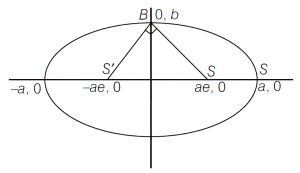
ધારો કે $S$ અને $S^{\prime}$ એ ઉપવલયના નાભિઓ છે અને $B$ એ તેના ગૌણ અક્ષનો એક અંત્યબિંદુ છે. જો $\triangle SBS^{\prime}$ એ સમદ્વિબાજુ કાટકોણ ત્રિકોણ હોય,તો ઉપવલયની ઉત્કેન્દ્રતા શોધો.
A
$\frac{1}{\sqrt{2}}$
B
$\frac{1}{2}$
C
$\frac{\sqrt{3}}{2}$
D
$\frac{1}{3}$
Solution
(A) નાભિઓના યામ $S(ae, 0)$ અને $S^{\prime}(-ae, 0)$ છે,અને ગૌણ અક્ષનું અંત્યબિંદુ $B(0, b)$ છે.
$\triangle SBS^{\prime}$ એ $B$ આગળ કાટખૂણો ધરાવતો સમદ્વિબાજુ કાટકોણ ત્રિકોણ હોવાથી,$SB = S^{\prime}B$ અને $SB^2 + S^{\prime}B^2 = SS^{\prime 2}$ થાય.
$SB = \sqrt{(ae-0)^2 + (0-b)^2} = \sqrt{a^2e^2 + b^2}$.
$SS^{\prime} = 2ae$.
પાયથાગોરસના પ્રમેય મુજબ: $SB^2 + S^{\prime}B^2 = SS^{\prime 2}$.
$(a^2e^2 + b^2) + (a^2e^2 + b^2) = (2ae)^2$.
$2(a^2e^2 + b^2) = 4a^2e^2$.
$b^2 = a^2e^2$.
$b^2 = a^2(1-e^2)$ હોવાથી,$a^2(1-e^2) = a^2e^2$.
$1-e^2 = e^2$.
$2e^2 = 1$.
$e = \frac{1}{\sqrt{2}}$.
$\triangle SBS^{\prime}$ એ $B$ આગળ કાટખૂણો ધરાવતો સમદ્વિબાજુ કાટકોણ ત્રિકોણ હોવાથી,$SB = S^{\prime}B$ અને $SB^2 + S^{\prime}B^2 = SS^{\prime 2}$ થાય.
$SB = \sqrt{(ae-0)^2 + (0-b)^2} = \sqrt{a^2e^2 + b^2}$.
$SS^{\prime} = 2ae$.
પાયથાગોરસના પ્રમેય મુજબ: $SB^2 + S^{\prime}B^2 = SS^{\prime 2}$.
$(a^2e^2 + b^2) + (a^2e^2 + b^2) = (2ae)^2$.
$2(a^2e^2 + b^2) = 4a^2e^2$.
$b^2 = a^2e^2$.
$b^2 = a^2(1-e^2)$ હોવાથી,$a^2(1-e^2) = a^2e^2$.
$1-e^2 = e^2$.
$2e^2 = 1$.
$e = \frac{1}{\sqrt{2}}$.
0 likesView Solution
37
MathematicsMediumMCQTS EAMCET · 2017
જો રેખા $x+y+k=0$ એ અતિવલય $\frac{x^2}{9}-\frac{y^2}{4}=1$ નો અભિલંબ હોય,તો $k=$
A
$\pm \frac{\sqrt{5}}{13}$
B
$\pm \frac{13}{\sqrt{5}}$
C
$\pm \frac{13}{5}$
D
$\pm \frac{5}{13}$
Solution
(B) અતિવલય $\frac{x^2}{a^2} - \frac{y^2}{b^2} = 1$ ના બિંદુ $(x_1, y_1)$ આગળના અભિલંબનું સમીકરણ $\frac{a^2 x}{x_1} + \frac{b^2 y}{y_1} = a^2 + b^2$ છે.
અતિવલય $\frac{x^2}{9} - \frac{y^2}{4} = 1$ માટે,$a^2 = 9$ અને $b^2 = 4$ છે.
તેથી અભિલંબનું સમીકરણ $\frac{9x}{x_1} + \frac{4y}{y_1} = 13$ થાય.
આપેલ રેખા $x + y = -k$ સાથે સરખાવતા:
$\frac{9/x_1}{1} = \frac{4/y_1}{1} = \frac{13}{-k}$.
જેથી $x_1 = -\frac{9k}{13}$ અને $y_1 = -\frac{4k}{13}$ મળે.
બિંદુ $(x_1, y_1)$ અતિવલય પર હોવાથી:
$\frac{(-9k/13)^2}{9} - \frac{(-4k/13)^2}{4} = 1$.
$\frac{9k^2}{169} - \frac{4k^2}{169} = 1$.
$\frac{5k^2}{169} = 1$.
$k^2 = \frac{169}{5}$.
$k = \pm \frac{13}{\sqrt{5}}$.
અતિવલય $\frac{x^2}{9} - \frac{y^2}{4} = 1$ માટે,$a^2 = 9$ અને $b^2 = 4$ છે.
તેથી અભિલંબનું સમીકરણ $\frac{9x}{x_1} + \frac{4y}{y_1} = 13$ થાય.
આપેલ રેખા $x + y = -k$ સાથે સરખાવતા:
$\frac{9/x_1}{1} = \frac{4/y_1}{1} = \frac{13}{-k}$.
જેથી $x_1 = -\frac{9k}{13}$ અને $y_1 = -\frac{4k}{13}$ મળે.
બિંદુ $(x_1, y_1)$ અતિવલય પર હોવાથી:
$\frac{(-9k/13)^2}{9} - \frac{(-4k/13)^2}{4} = 1$.
$\frac{9k^2}{169} - \frac{4k^2}{169} = 1$.
$\frac{5k^2}{169} = 1$.
$k^2 = \frac{169}{5}$.
$k = \pm \frac{13}{\sqrt{5}}$.
0 likesView Solution
38
MathematicsEasyMCQTS EAMCET · 2017
$\lim _{y \rightarrow 1}\left(\frac{1}{y^2-1}-\frac{2}{y^4-1}\right)=$
A
$\frac{1}{2}$
B
$\frac{1}{3}$
C
$\frac{1}{4}$
D
$0$
Solution
(A) આપણી પાસે છે,$\lim _{y \rightarrow 1}\left(\frac{1}{y^2-1}-\frac{2}{y^4-1}\right)$
$= \lim _{y \rightarrow 1}\left(\frac{y^2+1-2}{y^4-1}\right)$
$= \lim _{y \rightarrow 1}\left(\frac{y^2-1}{(y^2-1)(y^2+1)}\right)$
$= \lim _{y \rightarrow 1} \frac{1}{y^2+1}$
$= \frac{1}{1^2+1} = \frac{1}{2}$
$= \lim _{y \rightarrow 1}\left(\frac{y^2+1-2}{y^4-1}\right)$
$= \lim _{y \rightarrow 1}\left(\frac{y^2-1}{(y^2-1)(y^2+1)}\right)$
$= \lim _{y \rightarrow 1} \frac{1}{y^2+1}$
$= \frac{1}{1^2+1} = \frac{1}{2}$
0 likesView Solution
39
MathematicsEasyMCQTS EAMCET · 2017
જો $A$ અને $B$ અનુક્રમે પ્રથમ $n$ બેકી સંખ્યાઓ અને પ્રથમ $n$ એકી સંખ્યાઓના વિચરણ (variances) હોય,તો:
A
$A=B$
B
$A>B$
C
$A < B$
D
$A=B-1$
Solution
(A) પ્રથમ $n$ પ્રાકૃતિક સંખ્યાઓનું વિચરણ $\sigma^2 = \frac{n^2-1}{12}$ દ્વારા આપવામાં આવે છે.
પ્રથમ $n$ બેકી સંખ્યાઓ $(2, 4, 6, \dots, 2n)$ માટે,દરેક પદ એ પ્રાકૃતિક સંખ્યા કરતા $2$ ગણું છે. તેથી,વિચરણ $A = 2^2 \times \frac{n^2-1}{12} = \frac{4(n^2-1)}{12} = \frac{n^2-1}{3}$ થાય.
પ્રથમ $n$ એકી સંખ્યાઓ $(1, 3, 5, \dots, 2n-1)$ માટે,આ સંખ્યાઓ પ્રથમ $n$ બેકી સંખ્યાઓમાંથી $1$ બાદ કરીને મેળવવામાં આવે છે. વિચરણ એ ઉગમબિંદુના ફેરફાર હેઠળ બદલાતું નથી,તેથી પ્રથમ $n$ એકી સંખ્યાઓનું વિચરણ $B$ એ પ્રથમ $n$ બેકી સંખ્યાઓના વિચરણ જેટલું જ હોય છે.
તેથી,$A = B$.
પ્રથમ $n$ બેકી સંખ્યાઓ $(2, 4, 6, \dots, 2n)$ માટે,દરેક પદ એ પ્રાકૃતિક સંખ્યા કરતા $2$ ગણું છે. તેથી,વિચરણ $A = 2^2 \times \frac{n^2-1}{12} = \frac{4(n^2-1)}{12} = \frac{n^2-1}{3}$ થાય.
પ્રથમ $n$ એકી સંખ્યાઓ $(1, 3, 5, \dots, 2n-1)$ માટે,આ સંખ્યાઓ પ્રથમ $n$ બેકી સંખ્યાઓમાંથી $1$ બાદ કરીને મેળવવામાં આવે છે. વિચરણ એ ઉગમબિંદુના ફેરફાર હેઠળ બદલાતું નથી,તેથી પ્રથમ $n$ એકી સંખ્યાઓનું વિચરણ $B$ એ પ્રથમ $n$ બેકી સંખ્યાઓના વિચરણ જેટલું જ હોય છે.
તેથી,$A = B$.
0 likesView Solution
40
MathematicsEasyMCQTS EAMCET · 2017
માહિતી $6, 7, 11, 12, 13, \alpha, 12, 16$ નો મધ્યક $10$ થી સરેરાશ વિચલન કેટલું થાય?
A
$3.5$
B
$3.25$
C
$3$
D
$3.75$
Solution
(A) આપેલ છે કે મધ્યક $(\bar{x}) = 10$ અને અવલોકનોની સંખ્યા $n = 8$ છે.
અવલોકનોનો સરવાળો $6 + 7 + 11 + 12 + 13 + \alpha + 12 + 16 = 77 + \alpha$ થાય.
$\bar{x} = \frac{\sum x_i}{n}$ હોવાથી,$10 = \frac{77 + \alpha}{8}$.
$80 = 77 + \alpha \Rightarrow \alpha = 3$.
માહિતી $6, 7, 11, 12, 13, 3, 12, 16$ છે.
મધ્યકથી સરેરાશ વિચલન $\frac{1}{n} \sum |x_i - \bar{x}|$ છે.
$\text{MD}(\bar{x}) = \frac{|6-10| + |7-10| + |11-10| + |12-10| + |13-10| + |3-10| + |12-10| + |16-10|}{8}$.
$\text{MD}(\bar{x}) = \frac{4 + 3 + 1 + 2 + 3 + 7 + 2 + 6}{8} = \frac{28}{8} = 3.5$.
અવલોકનોનો સરવાળો $6 + 7 + 11 + 12 + 13 + \alpha + 12 + 16 = 77 + \alpha$ થાય.
$\bar{x} = \frac{\sum x_i}{n}$ હોવાથી,$10 = \frac{77 + \alpha}{8}$.
$80 = 77 + \alpha \Rightarrow \alpha = 3$.
માહિતી $6, 7, 11, 12, 13, 3, 12, 16$ છે.
મધ્યકથી સરેરાશ વિચલન $\frac{1}{n} \sum |x_i - \bar{x}|$ છે.
$\text{MD}(\bar{x}) = \frac{|6-10| + |7-10| + |11-10| + |12-10| + |13-10| + |3-10| + |12-10| + |16-10|}{8}$.
$\text{MD}(\bar{x}) = \frac{4 + 3 + 1 + 2 + 3 + 7 + 2 + 6}{8} = \frac{28}{8} = 3.5$.
0 likesView Solution
41
MathematicsEasyMCQTS EAMCET · 2017
એક ત્રિકોણની બાજુઓનો ગુણોત્તર $1 : \sqrt{3} : 2$ છે. તો તેના ખૂણાઓનો ગુણોત્તર કેટલો હશે?
A
$1 : 2 : 3$
B
$1 : 2 : 4$
C
$1 : 4 : 5$
D
$1 : 3 : 5$
Solution
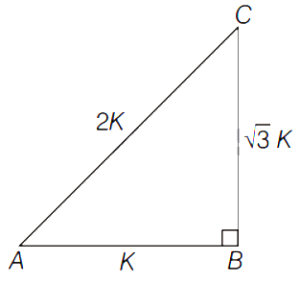
(A) ધારો કે ત્રિકોણની બાજુઓ $a = k$,$b = \sqrt{3}k$,અને $c = 2k$ છે.
અહીં $a^2 + b^2 = k^2 + (\sqrt{3}k)^2 = k^2 + 3k^2 = 4k^2 = c^2$ હોવાથી,આ એક કાટકોણ ત્રિકોણ છે જેમાં કર્ણ $c = 2k$ છે.
ધારો કે બાજુઓ $a, b, c$ ની સામેના ખૂણાઓ અનુક્રમે $A, B, C$ છે.
તેથી $C = 90^{\circ}$.
ત્રિકોણમિતિના ગુણોત્તરનો ઉપયોગ કરતા:
$\sin A = \frac{a}{c} = \frac{k}{2k} = \frac{1}{2} \implies A = 30^{\circ}$.
$\sin B = \frac{b}{c} = \frac{\sqrt{3}k}{2k} = \frac{\sqrt{3}}{2} \implies B = 60^{\circ}$.
આમ,ખૂણાઓ $30^{\circ}, 60^{\circ}, 90^{\circ}$ છે.
ખૂણાઓનો ગુણોત્તર $30^{\circ} : 60^{\circ} : 90^{\circ} = 1 : 2 : 3$ થાય.
અહીં $a^2 + b^2 = k^2 + (\sqrt{3}k)^2 = k^2 + 3k^2 = 4k^2 = c^2$ હોવાથી,આ એક કાટકોણ ત્રિકોણ છે જેમાં કર્ણ $c = 2k$ છે.
ધારો કે બાજુઓ $a, b, c$ ની સામેના ખૂણાઓ અનુક્રમે $A, B, C$ છે.
તેથી $C = 90^{\circ}$.
ત્રિકોણમિતિના ગુણોત્તરનો ઉપયોગ કરતા:
$\sin A = \frac{a}{c} = \frac{k}{2k} = \frac{1}{2} \implies A = 30^{\circ}$.
$\sin B = \frac{b}{c} = \frac{\sqrt{3}k}{2k} = \frac{\sqrt{3}}{2} \implies B = 60^{\circ}$.
આમ,ખૂણાઓ $30^{\circ}, 60^{\circ}, 90^{\circ}$ છે.
ખૂણાઓનો ગુણોત્તર $30^{\circ} : 60^{\circ} : 90^{\circ} = 1 : 2 : 3$ થાય.
0 likesView Solution
42
MathematicsMediumMCQTS EAMCET · 2017
$\triangle ABC$ માં,જો $a=1, b=2, \angle C=60^{\circ}$ હોય,તો $4 \Delta^2+c^2$ ની કિંમત શોધો.
A
$6$
B
$3$
C
$\frac{\sqrt{3}}{2}$
D
$9$
Solution
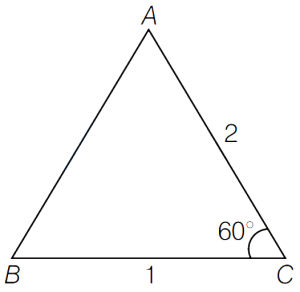
(A) આપેલ છે: $a=1, b=2, \angle C=60^{\circ}$.
$1$. ત્રિકોણનું ક્ષેત્રફળ $\Delta$ શોધો:
$\Delta = \frac{1}{2} ab \sin C$
$\Delta = \frac{1}{2} \times 1 \times 2 \times \sin 60^{\circ}$
$\Delta = 1 \times \frac{\sqrt{3}}{2} = \frac{\sqrt{3}}{2}$
$\Delta^2 = \frac{3}{4}$
$4 \Delta^2 = 3$
$2$. કોસાઇનના નિયમનો ઉપયોગ કરીને બાજુ $c$ શોધો:
$c^2 = a^2 + b^2 - 2ab \cos C$
$c^2 = 1^2 + 2^2 - 2(1)(2) \cos 60^{\circ}$
$c^2 = 1 + 4 - 4 \times \frac{1}{2}$
$c^2 = 5 - 2 = 3$
$3$. $4 \Delta^2 + c^2$ ની કિંમત શોધો:
$4 \Delta^2 + c^2 = 3 + 3 = 6$.
$1$. ત્રિકોણનું ક્ષેત્રફળ $\Delta$ શોધો:
$\Delta = \frac{1}{2} ab \sin C$
$\Delta = \frac{1}{2} \times 1 \times 2 \times \sin 60^{\circ}$
$\Delta = 1 \times \frac{\sqrt{3}}{2} = \frac{\sqrt{3}}{2}$
$\Delta^2 = \frac{3}{4}$
$4 \Delta^2 = 3$
$2$. કોસાઇનના નિયમનો ઉપયોગ કરીને બાજુ $c$ શોધો:
$c^2 = a^2 + b^2 - 2ab \cos C$
$c^2 = 1^2 + 2^2 - 2(1)(2) \cos 60^{\circ}$
$c^2 = 1 + 4 - 4 \times \frac{1}{2}$
$c^2 = 5 - 2 = 3$
$3$. $4 \Delta^2 + c^2$ ની કિંમત શોધો:
$4 \Delta^2 + c^2 = 3 + 3 = 6$.
0 likesView Solution
43
MathematicsMediumMCQTS EAMCET · 2017
એક ત્રિકોણની બાજુઓની લંબાઈ $13$,$14$ અને $15$ છે. જો $R$ અને $r$ અનુક્રમે તે ત્રિકોણની પરિત્રિજ્યા (circumradius) અને અંતઃત્રિજ્યા (inradius) દર્શાવતા હોય,તો $8R + r =$
A
$84$
B
$\frac{65}{8}$
C
$4$
D
$69$
Solution
(D) ધારો કે $a = 13$,$b = 14$,અને $c = 15$.
પ્રથમ,અર્ધ-પરિમિતિ $s$ શોધો:
$s = \frac{a + b + c}{2} = \frac{13 + 14 + 15}{2} = 21$.
હવે,હેરોનના સૂત્રનો ઉપયોગ કરીને ત્રિકોણનું ક્ષેત્રફળ $\Delta$ શોધો:
$\Delta = \sqrt{s(s - a)(s - b)(s - c)} = \sqrt{21(21 - 13)(21 - 14)(21 - 15)} = \sqrt{21 \times 8 \times 7 \times 6} = 84$.
પરિત્રિજ્યા $R = \frac{abc}{4\Delta}$ શોધો:
$R = \frac{13 \times 14 \times 15}{4 \times 84} = \frac{65}{8}$.
અંતઃત્રિજ્યા $r = \frac{\Delta}{s}$ શોધો:
$r = \frac{84}{21} = 4$.
છેલ્લે,$8R + r$ ની કિંમત શોધો:
$8R + r = 8 \times \left(\frac{65}{8}\right) + 4 = 65 + 4 = 69$.
પ્રથમ,અર્ધ-પરિમિતિ $s$ શોધો:
$s = \frac{a + b + c}{2} = \frac{13 + 14 + 15}{2} = 21$.
હવે,હેરોનના સૂત્રનો ઉપયોગ કરીને ત્રિકોણનું ક્ષેત્રફળ $\Delta$ શોધો:
$\Delta = \sqrt{s(s - a)(s - b)(s - c)} = \sqrt{21(21 - 13)(21 - 14)(21 - 15)} = \sqrt{21 \times 8 \times 7 \times 6} = 84$.
પરિત્રિજ્યા $R = \frac{abc}{4\Delta}$ શોધો:
$R = \frac{13 \times 14 \times 15}{4 \times 84} = \frac{65}{8}$.
અંતઃત્રિજ્યા $r = \frac{\Delta}{s}$ શોધો:
$r = \frac{84}{21} = 4$.
છેલ્લે,$8R + r$ ની કિંમત શોધો:
$8R + r = 8 \times \left(\frac{65}{8}\right) + 4 = 65 + 4 = 69$.
0 likesView Solution
44
MathematicsEasyMCQTS EAMCET · 2017
જો $\frac{x^2+5}{(x^2+1)(x-2)}=\frac{A}{x-2}+\frac{Bx+C}{x^2+1}$ હોય,તો $A+B+C=$
A
-$1$
B
$\frac{2}{5}$
C
$-3/5$
D
$0$
Solution
(C) આપેલ આંશિક અપૂર્ણાંક વિઘટન: $\frac{x^2+5}{(x^2+1)(x-2)}=\frac{A}{x-2}+\frac{Bx+C}{x^2+1}$.
બંને બાજુ $(x^2+1)(x-2)$ વડે ગુણતા: $x^2+5 = A(x^2+1) + (Bx+C)(x-2)$.
જમણી બાજુનું વિસ્તરણ કરતા: $x^2+5 = Ax^2 + A + Bx^2 - 2Bx + Cx - 2C$.
$x$ ના ઘાતાંક મુજબ પદોને ગોઠવતા: $x^2+5 = (A+B)x^2 + (C-2B)x + (A-2C)$.
બંને બાજુ સહગુણકોની સરખામણી કરતા:
$1$) $A+B = 1$
$2$) $C-2B = 0 \Rightarrow C = 2B$
$3$) $A-2C = 5$
સમીકરણ $(3)$ માં $C=2B$ મૂકતા: $A - 2(2B) = 5 \Rightarrow A - 4B = 5$.
હવે સમીકરણોની સિસ્ટમને ઉકેલતા:
$A+B = 1$
$A-4B = 5$
પ્રથમમાંથી બીજું બાદ કરતા: $5B = -4 \Rightarrow B = -\frac{4}{5}$.
તેથી $A = 1 - B = 1 - (-4/5) = 9/5$.
અને $C = 2B = 2(-4/5) = -8/5$.
અંતે,$A+B+C = \frac{9}{5} - \frac{4}{5} - \frac{8}{5} = \frac{9-4-8}{5} = -\frac{3}{5}$.
બંને બાજુ $(x^2+1)(x-2)$ વડે ગુણતા: $x^2+5 = A(x^2+1) + (Bx+C)(x-2)$.
જમણી બાજુનું વિસ્તરણ કરતા: $x^2+5 = Ax^2 + A + Bx^2 - 2Bx + Cx - 2C$.
$x$ ના ઘાતાંક મુજબ પદોને ગોઠવતા: $x^2+5 = (A+B)x^2 + (C-2B)x + (A-2C)$.
બંને બાજુ સહગુણકોની સરખામણી કરતા:
$1$) $A+B = 1$
$2$) $C-2B = 0 \Rightarrow C = 2B$
$3$) $A-2C = 5$
સમીકરણ $(3)$ માં $C=2B$ મૂકતા: $A - 2(2B) = 5 \Rightarrow A - 4B = 5$.
હવે સમીકરણોની સિસ્ટમને ઉકેલતા:
$A+B = 1$
$A-4B = 5$
પ્રથમમાંથી બીજું બાદ કરતા: $5B = -4 \Rightarrow B = -\frac{4}{5}$.
તેથી $A = 1 - B = 1 - (-4/5) = 9/5$.
અને $C = 2B = 2(-4/5) = -8/5$.
અંતે,$A+B+C = \frac{9}{5} - \frac{4}{5} - \frac{8}{5} = \frac{9-4-8}{5} = -\frac{3}{5}$.
0 likesView Solution
45
MathematicsEasyMCQTS EAMCET · 2017
જો $A$ અને $B$ ઘટનાઓની સંભાવનાઓ $P(A)=0.6$,$P(B)=0.4$ અને $P(A \cap B)=0$ હોય,તો $A$ કે $B$ બંનેમાંથી એક પણ ઘટના ન બને તેની સંભાવના કેટલી?
A
$0.2$
B
$1$
C
$0.5$
D
$0$
Solution
(D) આપેલ છે કે,$P(A)=0.6$,$P(B)=0.4$ અને $P(A \cap B)=0$.
આપણે $A$ કે $B$ બંનેમાંથી એક પણ ઘટના ન બને તેની સંભાવના શોધવાની છે,જે $P(\bar{A} \cap \bar{B})$ છે.
ડી મોર્ગનના નિયમ મુજબ,$P(\bar{A} \cap \bar{B}) = P(\overline{A \cup B})$.
આપણે જાણીએ છીએ કે $P(\overline{A \cup B}) = 1 - P(A \cup B)$.
સંભાવનાના સરવાળાના નિયમનો ઉપયોગ કરતા,$P(A \cup B) = P(A) + P(B) - P(A \cap B)$.
આપેલ કિંમતો મૂકતા: $P(A \cup B) = 0.6 + 0.4 - 0 = 1.0$.
તેથી,$P(\overline{A \cup B}) = 1 - 1.0 = 0$.
આપણે $A$ કે $B$ બંનેમાંથી એક પણ ઘટના ન બને તેની સંભાવના શોધવાની છે,જે $P(\bar{A} \cap \bar{B})$ છે.
ડી મોર્ગનના નિયમ મુજબ,$P(\bar{A} \cap \bar{B}) = P(\overline{A \cup B})$.
આપણે જાણીએ છીએ કે $P(\overline{A \cup B}) = 1 - P(A \cup B)$.
સંભાવનાના સરવાળાના નિયમનો ઉપયોગ કરતા,$P(A \cup B) = P(A) + P(B) - P(A \cap B)$.
આપેલ કિંમતો મૂકતા: $P(A \cup B) = 0.6 + 0.4 - 0 = 1.0$.
તેથી,$P(\overline{A \cup B}) = 1 - 1.0 = 0$.
0 likesView Solution
46
MathematicsMediumMCQTS EAMCET · 2017
એક થેલીમાં $5$ લાલ દડા,$3$ કાળા દડા અને $4$ સફેદ દડા છે. યાદચ્છિક રીતે ત્રણ દડા પસંદ કરવામાં આવે છે. તો ત્રણેય દડા એક જ રંગના ન હોય તેની સંભાવના કેટલી?
A
$\frac{37}{44}$
B
$\frac{31}{44}$
C
$\frac{21}{44}$
D
$\frac{41}{44}$
Solution
(D) કુલ દડાની સંખ્યા $= 5 + 3 + 4 = 12$.
$12$ માંથી $3$ દડા પસંદ કરવાની રીતો ${}^{12}C_3 = 220$ છે.
એક જ રંગના $3$ દડા પસંદ કરવાની રીતો:
- $3$ લાલ દડા: ${}^{5}C_3 = 10$
- $3$ કાળા દડા: ${}^{3}C_3 = 1$
- $3$ સફેદ દડા: ${}^{4}C_3 = 4$
એક જ રંગના દડા હોવાની કુલ રીતો $= 10 + 1 + 4 = 15$.
એક જ રંગના દડા હોવાની સંભાવના $= \frac{15}{220} = \frac{3}{44}$.
એક જ રંગના ન હોય તેની સંભાવના $= 1 - \frac{3}{44} = \frac{41}{44}$.
$12$ માંથી $3$ દડા પસંદ કરવાની રીતો ${}^{12}C_3 = 220$ છે.
એક જ રંગના $3$ દડા પસંદ કરવાની રીતો:
- $3$ લાલ દડા: ${}^{5}C_3 = 10$
- $3$ કાળા દડા: ${}^{3}C_3 = 1$
- $3$ સફેદ દડા: ${}^{4}C_3 = 4$
એક જ રંગના દડા હોવાની કુલ રીતો $= 10 + 1 + 4 = 15$.
એક જ રંગના દડા હોવાની સંભાવના $= \frac{15}{220} = \frac{3}{44}$.
એક જ રંગના ન હોય તેની સંભાવના $= 1 - \frac{3}{44} = \frac{41}{44}$.
0 likesView Solution
47
MathematicsMediumMCQTS EAMCET · 2017
જો $\bar{a}$,$\bar{b}$ અને $\bar{a}+\bar{b}$ ના માન અનુક્રમે $3$,$4$ અને $5$ હોય,તો $\bar{a}-\bar{b}$ નું માન શોધો.
A
$3$
B
$4$
C
$6$
D
$5$
Solution
(D) આપેલ છે કે $|\bar{a}| = 3$,$|\bar{b}| = 4$,અને $|\bar{a}+\bar{b}| = 5$.
આપણે જાણીએ છીએ કે $|\bar{a}+\bar{b}|^2 = |\bar{a}|^2 + |\bar{b}|^2 + 2(\bar{a} \cdot \bar{b})$.
કિંમતો મૂકતા: $5^2 = 3^2 + 4^2 + 2(\bar{a} \cdot \bar{b})$.
$25 = 9 + 16 + 2(\bar{a} \cdot \bar{b}) \implies 25 = 25 + 2(\bar{a} \cdot \bar{b}) \implies \bar{a} \cdot \bar{b} = 0$.
આનો અર્થ એ છે કે $\bar{a}$ અને $\bar{b}$ એકબીજાને લંબ છે.
હવે,આપણે $|\bar{a}-\bar{b}|$ શોધવાનું છે.
$|\bar{a}-\bar{b}|^2 = |\bar{a}|^2 + |\bar{b}|^2 - 2(\bar{a} \cdot \bar{b})$.
$|\bar{a}-\bar{b}|^2 = 3^2 + 4^2 - 2(0) = 9 + 16 = 25$.
તેથી,$|\bar{a}-\bar{b}| = \sqrt{25} = 5$.
આપણે જાણીએ છીએ કે $|\bar{a}+\bar{b}|^2 = |\bar{a}|^2 + |\bar{b}|^2 + 2(\bar{a} \cdot \bar{b})$.
કિંમતો મૂકતા: $5^2 = 3^2 + 4^2 + 2(\bar{a} \cdot \bar{b})$.
$25 = 9 + 16 + 2(\bar{a} \cdot \bar{b}) \implies 25 = 25 + 2(\bar{a} \cdot \bar{b}) \implies \bar{a} \cdot \bar{b} = 0$.
આનો અર્થ એ છે કે $\bar{a}$ અને $\bar{b}$ એકબીજાને લંબ છે.
હવે,આપણે $|\bar{a}-\bar{b}|$ શોધવાનું છે.
$|\bar{a}-\bar{b}|^2 = |\bar{a}|^2 + |\bar{b}|^2 - 2(\bar{a} \cdot \bar{b})$.
$|\bar{a}-\bar{b}|^2 = 3^2 + 4^2 - 2(0) = 9 + 16 = 25$.
તેથી,$|\bar{a}-\bar{b}| = \sqrt{25} = 5$.
0 likesView Solution
48
MathematicsMediumMCQTS EAMCET · 2017
$x=y^2-2$ અને $x=y$ વક્રો દ્વારા ઘેરાયેલા પ્રદેશનું ક્ષેત્રફળ શોધો.
A
$\frac{9}{4}$
B
$9$
C
$\frac{9}{2}$
D
$\frac{9}{7}$
Solution
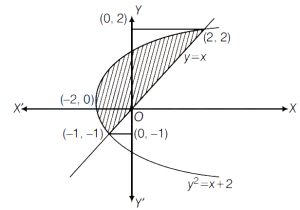
(C) આપેલ વક્રો $x=y^2-2$ અને $x=y$ છે.
છેદબિંદુઓ શોધવા માટે,આપણે $x=y$ ને $x=y^2-2$ માં મૂકીએ:
$y = y^2 - 2$
$y^2 - y - 2 = 0$
$(y-2)(y+1) = 0$
તેથી,$y=2$ અને $y=-1$ મળે છે.
જ્યારે $y=2$ હોય ત્યારે $x=2$ અને જ્યારે $y=-1$ હોય ત્યારે $x=-1$ મળે છે.
છેદબિંદુઓ $(-1, -1)$ અને $(2, 2)$ છે.
ક્ષેત્રફળ $A$ એ $y=-1$ થી $y=2$ સુધી જમણી બાજુના વક્રમાંથી ડાબી બાજુના વક્રને બાદ કરીને સંકલન કરવાથી મળે છે:
$A = \int_{-1}^{2} (y - (y^2 - 2)) \, dy$
$A = \int_{-1}^{2} (y - y^2 + 2) \, dy$
$A = \left[ \frac{y^2}{2} - \frac{y^3}{3} + 2y \right]_{-1}^{2}$
$A = \left( \frac{2^2}{2} - \frac{2^3}{3} + 2(2) \right) - \left( \frac{(-1)^2}{2} - \frac{(-1)^3}{3} + 2(-1) \right)$
$A = \left( 2 - \frac{8}{3} + 4 \right) - \left( \frac{1}{2} + \frac{1}{3} - 2 \right)$
$A = \left( 6 - \frac{8}{3} \right) - \left( \frac{3+2-12}{6} \right)$
$A = \frac{10}{3} - \left( -\frac{7}{6} \right) = \frac{20}{6} + \frac{7}{6} = \frac{27}{6} = \frac{9}{2}$ ચોરસ એકમ.
છેદબિંદુઓ શોધવા માટે,આપણે $x=y$ ને $x=y^2-2$ માં મૂકીએ:
$y = y^2 - 2$
$y^2 - y - 2 = 0$
$(y-2)(y+1) = 0$
તેથી,$y=2$ અને $y=-1$ મળે છે.
જ્યારે $y=2$ હોય ત્યારે $x=2$ અને જ્યારે $y=-1$ હોય ત્યારે $x=-1$ મળે છે.
છેદબિંદુઓ $(-1, -1)$ અને $(2, 2)$ છે.
ક્ષેત્રફળ $A$ એ $y=-1$ થી $y=2$ સુધી જમણી બાજુના વક્રમાંથી ડાબી બાજુના વક્રને બાદ કરીને સંકલન કરવાથી મળે છે:
$A = \int_{-1}^{2} (y - (y^2 - 2)) \, dy$
$A = \int_{-1}^{2} (y - y^2 + 2) \, dy$
$A = \left[ \frac{y^2}{2} - \frac{y^3}{3} + 2y \right]_{-1}^{2}$
$A = \left( \frac{2^2}{2} - \frac{2^3}{3} + 2(2) \right) - \left( \frac{(-1)^2}{2} - \frac{(-1)^3}{3} + 2(-1) \right)$
$A = \left( 2 - \frac{8}{3} + 4 \right) - \left( \frac{1}{2} + \frac{1}{3} - 2 \right)$
$A = \left( 6 - \frac{8}{3} \right) - \left( \frac{3+2-12}{6} \right)$
$A = \frac{10}{3} - \left( -\frac{7}{6} \right) = \frac{20}{6} + \frac{7}{6} = \frac{27}{6} = \frac{9}{2}$ ચોરસ એકમ.
0 likesView Solution
49
MathematicsEasyMCQTS EAMCET · 2017
જો $A = \begin{bmatrix} 1 & 0 & 1 \\ 0 & 2 & 0 \\ 1 & -1 & 4 \end{bmatrix}$,$A = B + C$,$B = B^T$ અને $C = -C^T$ હોય,તો $C = $
A
$\begin{bmatrix} 0 & 0.5 & 0 \\ -0.5 & 0 & 0 \\ 0 & 0 & 0 \end{bmatrix}$
B
$\begin{bmatrix} 0 & 0 & 0 \\ 0 & 0 & 0.5 \\ 0 & -0.5 & 0 \end{bmatrix}$
C
$\begin{bmatrix} 0 & -0.5 & 0.5 \\ 0.5 & 0 & 0 \\ -0.5 & 0 & 0 \end{bmatrix}$
D
$\begin{bmatrix} 0 & 0.5 & 0 \\ -0.5 & 0 & 0.5 \\ 0 & -0.5 & 0 \end{bmatrix}$
Solution
(B) કોઈપણ ચોરસ શ્રેણિક $A$ ને સંમિત શ્રેણિક $B$ અને વિસંમિત શ્રેણિક $C$ ના સરવાળા તરીકે દર્શાવી શકાય છે,જ્યાં $B = \frac{1}{2}(A + A^T)$ અને $C = \frac{1}{2}(A - A^T)$ છે.
આપેલ છે કે $A = \begin{bmatrix} 1 & 0 & 1 \\ 0 & 2 & 0 \\ 1 & -1 & 4 \end{bmatrix}$.
તેથી $A^T = \begin{bmatrix} 1 & 0 & 1 \\ 0 & 2 & -1 \\ 1 & 0 & 4 \end{bmatrix}$.
હવે,$C = \frac{1}{2}(A - A^T) = \frac{1}{2} \left( \begin{bmatrix} 1 & 0 & 1 \\ 0 & 2 & 0 \\ 1 & -1 & 4 \end{bmatrix} - \begin{bmatrix} 1 & 0 & 1 \\ 0 & 2 & -1 \\ 1 & 0 & 4 \end{bmatrix} \right)$.
$C = \frac{1}{2} \begin{bmatrix} 0 & 0 & 0 \\ 0 & 0 & 1 \\ 0 & -1 & 0 \end{bmatrix} = \begin{bmatrix} 0 & 0 & 0 \\ 0 & 0 & 0.5 \\ 0 & -0.5 & 0 \end{bmatrix}$.
આમ,સાચો વિકલ્પ $B$ છે.
આપેલ છે કે $A = \begin{bmatrix} 1 & 0 & 1 \\ 0 & 2 & 0 \\ 1 & -1 & 4 \end{bmatrix}$.
તેથી $A^T = \begin{bmatrix} 1 & 0 & 1 \\ 0 & 2 & -1 \\ 1 & 0 & 4 \end{bmatrix}$.
હવે,$C = \frac{1}{2}(A - A^T) = \frac{1}{2} \left( \begin{bmatrix} 1 & 0 & 1 \\ 0 & 2 & 0 \\ 1 & -1 & 4 \end{bmatrix} - \begin{bmatrix} 1 & 0 & 1 \\ 0 & 2 & -1 \\ 1 & 0 & 4 \end{bmatrix} \right)$.
$C = \frac{1}{2} \begin{bmatrix} 0 & 0 & 0 \\ 0 & 0 & 1 \\ 0 & -1 & 0 \end{bmatrix} = \begin{bmatrix} 0 & 0 & 0 \\ 0 & 0 & 0.5 \\ 0 & -0.5 & 0 \end{bmatrix}$.
આમ,સાચો વિકલ્પ $B$ છે.
0 likesView Solution
50
MathematicsEasyMCQTS EAMCET · 2017
જો શ્રેણિક $\begin{bmatrix} x & x & x \\ x & x^2 & x \\ x & x & x+1 \end{bmatrix}$ નો નિશ્ચાયક (rank) $1$ હોય,તો:
A
$x=0$ અથવા $x=1$
B
$x=1$
C
$x=0$
D
$x \neq 0$
Solution
(C) ધારો કે $A = \begin{bmatrix} x & x & x \\ x & x^2 & x \\ x & x & x+1 \end{bmatrix}$.
શ્રેણિક $A$ નો નિશ્ચાયક (rank) $1$ હોવા માટે,$2$ ક્રમના તમામ નિશ્ચાયકો શૂન્ય હોવા જોઈએ.
પ્રથમ બે હાર અને પ્રથમ બે સ્તંભ દ્વારા બનતો નિશ્ચાયક લો: $\begin{vmatrix} x & x \\ x & x^2 \end{vmatrix} = x^3 - x^2 = x^2(x-1)$.
આ શૂન્ય થવા માટે,$x=0$ અથવા $x=1$ હોવું જોઈએ.
કિસ્સો $1$: જો $x=1$ હોય,તો $A = \begin{bmatrix} 1 & 1 & 1 \\ 1 & 1 & 1 \\ 1 & 1 & 2 \end{bmatrix}$. અહીં નિશ્ચાયક $\begin{vmatrix} 1 & 1 \\ 1 & 2 \end{vmatrix} = 2-1 = 1 \neq 0$ થાય છે. તેથી,નિશ્ચાયક ઓછામાં ઓછો $2$ છે. એટલે $x=1$ ઉકેલ નથી.
કિસ્સો $2$: જો $x=0$ હોય,તો $A = \begin{bmatrix} 0 & 0 & 0 \\ 0 & 0 & 0 \\ 0 & 0 & 1 \end{bmatrix}$. $2$ ક્રમના તમામ નિશ્ચાયકો શૂન્ય છે અને ઓછામાં ઓછો એક ઘટક શૂન્યતર છે ($A_{33}$ પર $1$). તેથી,નિશ્ચાયક $1$ છે.
આમ,માત્ર $x=0$ શક્ય છે.
શ્રેણિક $A$ નો નિશ્ચાયક (rank) $1$ હોવા માટે,$2$ ક્રમના તમામ નિશ્ચાયકો શૂન્ય હોવા જોઈએ.
પ્રથમ બે હાર અને પ્રથમ બે સ્તંભ દ્વારા બનતો નિશ્ચાયક લો: $\begin{vmatrix} x & x \\ x & x^2 \end{vmatrix} = x^3 - x^2 = x^2(x-1)$.
આ શૂન્ય થવા માટે,$x=0$ અથવા $x=1$ હોવું જોઈએ.
કિસ્સો $1$: જો $x=1$ હોય,તો $A = \begin{bmatrix} 1 & 1 & 1 \\ 1 & 1 & 1 \\ 1 & 1 & 2 \end{bmatrix}$. અહીં નિશ્ચાયક $\begin{vmatrix} 1 & 1 \\ 1 & 2 \end{vmatrix} = 2-1 = 1 \neq 0$ થાય છે. તેથી,નિશ્ચાયક ઓછામાં ઓછો $2$ છે. એટલે $x=1$ ઉકેલ નથી.
કિસ્સો $2$: જો $x=0$ હોય,તો $A = \begin{bmatrix} 0 & 0 & 0 \\ 0 & 0 & 0 \\ 0 & 0 & 1 \end{bmatrix}$. $2$ ક્રમના તમામ નિશ્ચાયકો શૂન્ય છે અને ઓછામાં ઓછો એક ઘટક શૂન્યતર છે ($A_{33}$ પર $1$). તેથી,નિશ્ચાયક $1$ છે.
આમ,માત્ર $x=0$ શક્ય છે.
0 likesView Solution
51
MathematicsEasyMCQTS EAMCET · 2017
જો $\Delta=\left|\begin{array}{lll}1 & 5 & 6 \\ 0 & 1 & 7 \\ 0 & 0 & 1\end{array}\right|$ અને $\Delta^{\prime}=\left|\begin{array}{ccc}1 & 0 & 1 \\ 3 & 0 & 3 \\ 4 & 6 & 100\end{array}\right|$,હોય તો
A
$\Delta^2-3 \Delta^{\prime}=0$
B
$(\Delta+\Delta^{\prime})^2-3(\Delta+\Delta^{\prime})+2=0$
C
$(\Delta+\Delta^{\prime})^2+3(\Delta+\Delta^{\prime})+5=0$
D
$\Delta+3 \Delta^{\prime}+1=0$
Solution
(B) આપેલ છે,$\Delta = \left|\begin{array}{lll}1 & 5 & 6 \\ 0 & 1 & 7 \\ 0 & 0 & 1\end{array}\right|$.
આ એક અપર ટ્રાયન્ગ્યુલર મેટ્રિક્સ હોવાથી,નિશ્ચાયક એ વિકર્ણ ઘટકોનો ગુણાકાર છે:
$\Delta = 1 \times 1 \times 1 = 1$.
હવે,$\Delta^{\prime} = \left|\begin{array}{ccc}1 & 0 & 1 \\ 3 & 0 & 3 \\ 4 & 6 & 100\end{array}\right|$.
બીજા સ્તંભની સાપેક્ષમાં વિસ્તરણ કરતા:
$\Delta^{\prime} = -0(300-12) + 0(100-4) - 6(3-3) = 0$.
હવે,$(\Delta+\Delta^{\prime})^2-3(\Delta+\Delta^{\prime})+2$ માં $\Delta = 1$ અને $\Delta^{\prime} = 0$ મુકતા:
$= (1+0)^2 - 3(1+0) + 2$
$= 1^2 - 3 + 2$
$= 1 - 3 + 2 = 0$.
આમ,સાચો વિકલ્પ $B$ છે.
આ એક અપર ટ્રાયન્ગ્યુલર મેટ્રિક્સ હોવાથી,નિશ્ચાયક એ વિકર્ણ ઘટકોનો ગુણાકાર છે:
$\Delta = 1 \times 1 \times 1 = 1$.
હવે,$\Delta^{\prime} = \left|\begin{array}{ccc}1 & 0 & 1 \\ 3 & 0 & 3 \\ 4 & 6 & 100\end{array}\right|$.
બીજા સ્તંભની સાપેક્ષમાં વિસ્તરણ કરતા:
$\Delta^{\prime} = -0(300-12) + 0(100-4) - 6(3-3) = 0$.
હવે,$(\Delta+\Delta^{\prime})^2-3(\Delta+\Delta^{\prime})+2$ માં $\Delta = 1$ અને $\Delta^{\prime} = 0$ મુકતા:
$= (1+0)^2 - 3(1+0) + 2$
$= 1^2 - 3 + 2$
$= 1 - 3 + 2 = 0$.
આમ,સાચો વિકલ્પ $B$ છે.
0 likesView Solution
52
MathematicsDifficultMCQTS EAMCET · 2017
$\sin ^{-1} \frac{\sqrt{3}}{2} + \sin ^{-1} \sqrt{\frac{2}{3}} = $
A
$\sin ^{-1} \frac{\sqrt{3}+\sqrt{2}}{2 \sqrt{3}}$
B
$\pi - \sin ^{-1} \left( \frac{\sqrt{3}+\sqrt{2}}{2 \sqrt{3}} \right)$
C
$-\pi - \sin ^{-1} \left( \frac{\sqrt{3}+\sqrt{2}}{2 \sqrt{3}} \right)$
D
$\pi + \sin ^{-1} \left( \frac{\sqrt{3}+\sqrt{2}}{2 \sqrt{3}} \right)$
Solution
(B) ધારો કે $x = \frac{\sqrt{3}}{2}$ અને $y = \sqrt{\frac{2}{3}}$.
નોંધો કે $x^2 + y^2 = \frac{3}{4} + \frac{2}{3} = \frac{9+8}{12} = \frac{17}{12} > 1$.
જ્યારે $x, y > 0$ અને $x^2 + y^2 > 1$ હોય,ત્યારે આપણે નિત્યસમ $\sin^{-1} x + \sin^{-1} y = \pi - \sin^{-1} (x \sqrt{1-y^2} + y \sqrt{1-x^2})$ નો ઉપયોગ કરીએ છીએ.
કિંમતો મૂકતા:
$\sin^{-1} \frac{\sqrt{3}}{2} + \sin^{-1} \sqrt{\frac{2}{3}} = \pi - \sin^{-1} \left( \frac{\sqrt{3}}{2} \sqrt{1 - \frac{2}{3}} + \sqrt{\frac{2}{3}} \sqrt{1 - \frac{3}{4}} \right)$
$= \pi - \sin^{-1} \left( \frac{\sqrt{3}}{2} \sqrt{\frac{1}{3}} + \sqrt{\frac{2}{3}} \sqrt{\frac{1}{4}} \right)$
$= \pi - \sin^{-1} \left( \frac{\sqrt{3}}{2 \sqrt{3}} + \frac{\sqrt{2}}{\sqrt{3} \cdot 2} \right)$
$= \pi - \sin^{-1} \left( \frac{1}{2} + \frac{\sqrt{2}}{2 \sqrt{3}} \right)$
$= \pi - \sin^{-1} \left( \frac{\sqrt{3} + \sqrt{2}}{2 \sqrt{3}} \right)$.
નોંધો કે $x^2 + y^2 = \frac{3}{4} + \frac{2}{3} = \frac{9+8}{12} = \frac{17}{12} > 1$.
જ્યારે $x, y > 0$ અને $x^2 + y^2 > 1$ હોય,ત્યારે આપણે નિત્યસમ $\sin^{-1} x + \sin^{-1} y = \pi - \sin^{-1} (x \sqrt{1-y^2} + y \sqrt{1-x^2})$ નો ઉપયોગ કરીએ છીએ.
કિંમતો મૂકતા:
$\sin^{-1} \frac{\sqrt{3}}{2} + \sin^{-1} \sqrt{\frac{2}{3}} = \pi - \sin^{-1} \left( \frac{\sqrt{3}}{2} \sqrt{1 - \frac{2}{3}} + \sqrt{\frac{2}{3}} \sqrt{1 - \frac{3}{4}} \right)$
$= \pi - \sin^{-1} \left( \frac{\sqrt{3}}{2} \sqrt{\frac{1}{3}} + \sqrt{\frac{2}{3}} \sqrt{\frac{1}{4}} \right)$
$= \pi - \sin^{-1} \left( \frac{\sqrt{3}}{2 \sqrt{3}} + \frac{\sqrt{2}}{\sqrt{3} \cdot 2} \right)$
$= \pi - \sin^{-1} \left( \frac{1}{2} + \frac{\sqrt{2}}{2 \sqrt{3}} \right)$
$= \pi - \sin^{-1} \left( \frac{\sqrt{3} + \sqrt{2}}{2 \sqrt{3}} \right)$.
0 likesView Solution
53
MathematicsEasyMCQTS EAMCET · 2017
જો વિધેય $f(x) = -3x - 3$ નો વિસ્તાર $\{3, -6, -9, -18\}$ હોય,તો નીચેનામાંથી કયો ઘટક $f$ ના પ્રદેશમાં નથી?
A
-$1$
B
-$2$
C
$1$
D
$2$
Solution
(A) આપેલ વિધેય $f(x) = -3x - 3$ છે.
પ્રદેશ શોધવા માટે,આપણે $f(x)$ ને વિસ્તારના દરેક ઘટક સાથે સરખાવીએ:
$(i)$ $f(x) = 3$ માટે: $3 = -3x - 3$ $\Rightarrow 6 = -3x$ $\Rightarrow x = -2$.
(ii) $f(x) = -6$ માટે: $-6 = -3x - 3$ $\Rightarrow -3 = -3x$ $\Rightarrow x = 1$.
(iii) $f(x) = -9$ માટે: $-9 = -3x - 3$ $\Rightarrow -6 = -3x$ $\Rightarrow x = 2$.
(iv) $f(x) = -18$ માટે: $-18 = -3x - 3$ $\Rightarrow -15 = -3x$ $\Rightarrow x = 5$.
આમ,$f$ નો પ્રદેશ $\{-2, 1, 2, 5\}$ છે.
આથી,$-1$ એ $f$ ના પ્રદેશમાં નથી.
પ્રદેશ શોધવા માટે,આપણે $f(x)$ ને વિસ્તારના દરેક ઘટક સાથે સરખાવીએ:
$(i)$ $f(x) = 3$ માટે: $3 = -3x - 3$ $\Rightarrow 6 = -3x$ $\Rightarrow x = -2$.
(ii) $f(x) = -6$ માટે: $-6 = -3x - 3$ $\Rightarrow -3 = -3x$ $\Rightarrow x = 1$.
(iii) $f(x) = -9$ માટે: $-9 = -3x - 3$ $\Rightarrow -6 = -3x$ $\Rightarrow x = 2$.
(iv) $f(x) = -18$ માટે: $-18 = -3x - 3$ $\Rightarrow -15 = -3x$ $\Rightarrow x = 5$.
આમ,$f$ નો પ્રદેશ $\{-2, 1, 2, 5\}$ છે.
આથી,$-1$ એ $f$ ના પ્રદેશમાં નથી.
0 likesView Solution
54
MathematicsEasyMCQTS EAMCET · 2017
$f: (-\infty, 0] \rightarrow [0, \infty)$ એ $f(x) = x^2$ તરીકે વ્યાખ્યાયિત છે. તેના વ્યસ્ત વિધેયનો પ્રદેશ અને વિસ્તાર શોધો.
A
$f^{-1}$ નો પ્રદેશ $= [0, \infty)$,$f^{-1}$ નો વિસ્તાર $= (-\infty, 0]$
B
$f^{-1}$ નો પ્રદેશ $= [0, \infty)$,$f^{-1}$ નો વિસ્તાર $= (-\infty, \infty)$
C
$f^{-1}$ નો પ્રદેશ $= [0, \infty)$,$f^{-1}$ નો વિસ્તાર $= (0, \infty)$
D
$f^{-1}$ અસ્તિત્વ ધરાવતું નથી
Solution
(A) અહીં વિધેય $f: (-\infty, 0] \rightarrow [0, \infty)$ એ $f(x) = x^2$ તરીકે વ્યાખ્યાયિત છે.
$x$-અક્ષને સમાંતર દરેક રેખા આ વક્રને વધુમાં વધુ એક બિંદુમાં છેદે છે,તેથી વિધેય $f$ એક-એક (one-one) છે.
આલેખ પરથી સ્પષ્ટ છે કે $f$ નો વિસ્તાર $[0, \infty)$ છે,જે તેના સહપ્રદેશ જેટલો જ છે.
તેથી,$f$ વ્યાપ્ત (onto) વિધેય છે.
આમ,$f$ એ એક-એક અને વ્યાપ્ત હોવાથી તેનું વ્યસ્ત વિધેય અસ્તિત્વ ધરાવે છે.
વ્યસ્ત વિધેય $f^{-1}$ એ $f$ ના સહપ્રદેશને $f$ ના પ્રદેશ પર મેપ કરે છે.
તેથી,$f^{-1}: [0, \infty) \rightarrow (-\infty, 0]$.
આમ,$f^{-1}$ નો પ્રદેશ $[0, \infty)$ છે અને $f^{-1}$ નો વિસ્તાર $(-\infty, 0]$ છે.
$x$-અક્ષને સમાંતર દરેક રેખા આ વક્રને વધુમાં વધુ એક બિંદુમાં છેદે છે,તેથી વિધેય $f$ એક-એક (one-one) છે.
આલેખ પરથી સ્પષ્ટ છે કે $f$ નો વિસ્તાર $[0, \infty)$ છે,જે તેના સહપ્રદેશ જેટલો જ છે.
તેથી,$f$ વ્યાપ્ત (onto) વિધેય છે.
આમ,$f$ એ એક-એક અને વ્યાપ્ત હોવાથી તેનું વ્યસ્ત વિધેય અસ્તિત્વ ધરાવે છે.
વ્યસ્ત વિધેય $f^{-1}$ એ $f$ ના સહપ્રદેશને $f$ ના પ્રદેશ પર મેપ કરે છે.
તેથી,$f^{-1}: [0, \infty) \rightarrow (-\infty, 0]$.
આમ,$f^{-1}$ નો પ્રદેશ $[0, \infty)$ છે અને $f^{-1}$ નો વિસ્તાર $(-\infty, 0]$ છે.
0 likesView Solution
55
MathematicsEasyMCQTS EAMCET · 2017
જો $f(x) = \begin{cases} \sin x, & \text{જો } x \leq 0 \\ x^2+a^2, & \text{જો } 0 < x < 1 \\ bx+2, & \text{જો } 1 \leq x \leq 2 \\ 0, & \text{જો } x > 2 \end{cases}$ એ $\mathbb{R}$ પર સતત હોય,તો $a+b+ab = $
A
$-2$
B
$0$
C
$2$
D
$-1$
Solution
(D) $f(x)$ એ $\mathbb{R}$ પર સતત હોવા માટે,તે $x=0, x=1,$ અને $x=2$ આગળ સતત હોવું જોઈએ.
$x=0$ આગળ: $\lim_{x \to 0^-} f(x) = \lim_{x \to 0^+} f(x) \implies \sin(0) = 0^2 + a^2 \implies a^2 = 0 \implies a = 0$.
$x=1$ આગળ: $\lim_{x \to 1^-} f(x) = \lim_{x \to 1^+} f(x) \implies 1^2 + a^2 = b(1) + 2 \implies 1 + 0 = b + 2 \implies b = -1$.
$x=2$ આગળ: $\lim_{x \to 2^-} f(x) = \lim_{x \to 2^+} f(x) \implies b(2) + 2 = 0 \implies 2(-1) + 2 = 0$,જે સુસંગત છે.
આમ,$a = 0$ અને $b = -1$.
તેથી,$a+b+ab = 0 + (-1) + (0)(-1) = -1$.
$x=0$ આગળ: $\lim_{x \to 0^-} f(x) = \lim_{x \to 0^+} f(x) \implies \sin(0) = 0^2 + a^2 \implies a^2 = 0 \implies a = 0$.
$x=1$ આગળ: $\lim_{x \to 1^-} f(x) = \lim_{x \to 1^+} f(x) \implies 1^2 + a^2 = b(1) + 2 \implies 1 + 0 = b + 2 \implies b = -1$.
$x=2$ આગળ: $\lim_{x \to 2^-} f(x) = \lim_{x \to 2^+} f(x) \implies b(2) + 2 = 0 \implies 2(-1) + 2 = 0$,જે સુસંગત છે.
આમ,$a = 0$ અને $b = -1$.
તેથી,$a+b+ab = 0 + (-1) + (0)(-1) = -1$.
0 likesView Solution
56
MathematicsEasyMCQTS EAMCET · 2017
જો $\frac{x^2}{a^2}+\frac{y^2}{b^2}=1$ હોય,તો $\frac{d^2 y}{d x^2}=$
A
$-\frac{b^4}{a^2 y^3}$
B
$\frac{b^2}{a y^2}$
C
$\frac{-b^3}{a^2 y^3}$
D
$\frac{b^3}{a^2 y^2}$
Solution
(A) આપેલ ઉપવલયનું સમીકરણ: $\frac{x^2}{a^2} + \frac{y^2}{b^2} = 1$.
$x$ ની સાપેક્ષમાં બંને બાજુ વિકલન કરતા:
$\frac{2x}{a^2} + \frac{2y}{b^2} \cdot \frac{dy}{dx} = 0$
$\frac{y}{b^2} \cdot \frac{dy}{dx} = -\frac{x}{a^2}$
$\frac{dy}{dx} = -\frac{b^2 x}{a^2 y}$
હવે,ભાગાકારના નિયમનો ઉપયોગ કરીને ફરીથી $x$ ની સાપેક્ષમાં વિકલન કરતા:
$\frac{d^2 y}{dx^2} = -\frac{b^2}{a^2} \cdot \frac{d}{dx} \left( \frac{x}{y} \right)$
$\frac{d^2 y}{dx^2} = -\frac{b^2}{a^2} \cdot \left( \frac{y(1) - x(\frac{dy}{dx})}{y^2} \right)$
$\frac{dy}{dx} = -\frac{b^2 x}{a^2 y}$ મૂકતા:
$\frac{d^2 y}{dx^2} = -\frac{b^2}{a^2} \cdot \left( \frac{y - x(-\frac{b^2 x}{a^2 y})}{y^2} \right)$
$\frac{d^2 y}{dx^2} = -\frac{b^2}{a^2} \cdot \left( \frac{y + \frac{b^2 x^2}{a^2 y}}{y^2} \right) = -\frac{b^2}{a^2} \cdot \left( \frac{a^2 y^2 + b^2 x^2}{a^2 y^3} \right)$
ચૂકી $\frac{x^2}{a^2} + \frac{y^2}{b^2} = 1$,તેથી $b^2 x^2 + a^2 y^2 = a^2 b^2$.
$\frac{d^2 y}{dx^2} = -\frac{b^2}{a^2} \cdot \left( \frac{a^2 b^2}{a^2 y^3} \right) = -\frac{b^4}{a^2 y^3}$.
$x$ ની સાપેક્ષમાં બંને બાજુ વિકલન કરતા:
$\frac{2x}{a^2} + \frac{2y}{b^2} \cdot \frac{dy}{dx} = 0$
$\frac{y}{b^2} \cdot \frac{dy}{dx} = -\frac{x}{a^2}$
$\frac{dy}{dx} = -\frac{b^2 x}{a^2 y}$
હવે,ભાગાકારના નિયમનો ઉપયોગ કરીને ફરીથી $x$ ની સાપેક્ષમાં વિકલન કરતા:
$\frac{d^2 y}{dx^2} = -\frac{b^2}{a^2} \cdot \frac{d}{dx} \left( \frac{x}{y} \right)$
$\frac{d^2 y}{dx^2} = -\frac{b^2}{a^2} \cdot \left( \frac{y(1) - x(\frac{dy}{dx})}{y^2} \right)$
$\frac{dy}{dx} = -\frac{b^2 x}{a^2 y}$ મૂકતા:
$\frac{d^2 y}{dx^2} = -\frac{b^2}{a^2} \cdot \left( \frac{y - x(-\frac{b^2 x}{a^2 y})}{y^2} \right)$
$\frac{d^2 y}{dx^2} = -\frac{b^2}{a^2} \cdot \left( \frac{y + \frac{b^2 x^2}{a^2 y}}{y^2} \right) = -\frac{b^2}{a^2} \cdot \left( \frac{a^2 y^2 + b^2 x^2}{a^2 y^3} \right)$
ચૂકી $\frac{x^2}{a^2} + \frac{y^2}{b^2} = 1$,તેથી $b^2 x^2 + a^2 y^2 = a^2 b^2$.
$\frac{d^2 y}{dx^2} = -\frac{b^2}{a^2} \cdot \left( \frac{a^2 b^2}{a^2 y^3} \right) = -\frac{b^4}{a^2 y^3}$.
0 likesView Solution
57
MathematicsEasyMCQTS EAMCET · 2017
જો $f$ વિકલનીય હોય,$f(x+y)=f(x) f(y)$ તમામ $x, y \in R$ માટે,$f(3)=3$,અને $f^{\prime}(0)=11$ હોય,તો $f^{\prime}(3)$ ની કિંમત શોધો:
A
$3/11$
B
$11/3$
C
$8$
D
$33$
Solution
(D) આપેલ વિધેય સમીકરણ $f(x+y)=f(x) f(y)$ છે.
વિકલિતની વ્યાખ્યા મુજબ,$f^{\prime}(x) = \lim_{h \to 0} \frac{f(x+h)-f(x)}{h}$.
આપેલ સંબંધનો ઉપયોગ કરતા,$f(x+h) = f(x)f(h)$.
તેથી,$f^{\prime}(x) = \lim_{h \to 0} \frac{f(x)f(h)-f(x)}{h} = f(x) \lim_{h \to 0} \frac{f(h)-1}{h}$.
$f(0+0) = f(0)f(0)$ હોવાથી,$f(0) = f(0)^2$,તેથી $f(0)=1$ (ધારો કે $f(x) \neq 0$).
આમ,$f^{\prime}(0) = \lim_{h \to 0} \frac{f(h)-f(0)}{h} = \lim_{h \to 0} \frac{f(h)-1}{h} = 11$.
તેથી,$f^{\prime}(x) = f(x) \cdot 11$.
$x=3$ માટે,$f^{\prime}(3) = f(3) \cdot 11 = 3 \cdot 11 = 33$.
વિકલિતની વ્યાખ્યા મુજબ,$f^{\prime}(x) = \lim_{h \to 0} \frac{f(x+h)-f(x)}{h}$.
આપેલ સંબંધનો ઉપયોગ કરતા,$f(x+h) = f(x)f(h)$.
તેથી,$f^{\prime}(x) = \lim_{h \to 0} \frac{f(x)f(h)-f(x)}{h} = f(x) \lim_{h \to 0} \frac{f(h)-1}{h}$.
$f(0+0) = f(0)f(0)$ હોવાથી,$f(0) = f(0)^2$,તેથી $f(0)=1$ (ધારો કે $f(x) \neq 0$).
આમ,$f^{\prime}(0) = \lim_{h \to 0} \frac{f(h)-f(0)}{h} = \lim_{h \to 0} \frac{f(h)-1}{h} = 11$.
તેથી,$f^{\prime}(x) = f(x) \cdot 11$.
$x=3$ માટે,$f^{\prime}(3) = f(3) \cdot 11 = 3 \cdot 11 = 33$.
0 likesView Solution
58
MathematicsMediumMCQTS EAMCET · 2017
ધારો કે $f:(-1,1) \rightarrow \mathbb{R}$ એ એક વિકલનીય વિધેય છે જ્યાં $f(0)=-1$ અને $f^{\prime}(0)=1$ છે. જો $g(x)=(f(2f(x)+2))^2$ હોય,તો $g^{\prime}(0)=$
A
$0$
B
-$2$
C
$4$
D
-$4$
Solution
(D) આપેલ છે કે $g(x) = (f(2f(x)+2))^2$.
સાંકળના નિયમનો ઉપયોગ કરીને,આપણે $x$ ની સાપેક્ષે $g(x)$ નું વિકલન કરીએ:
$g^{\prime}(x) = 2(f(2f(x)+2)) \cdot \frac{d}{dx}(f(2f(x)+2))$
$g^{\prime}(x) = 2(f(2f(x)+2)) \cdot f^{\prime}(2f(x)+2) \cdot \frac{d}{dx}(2f(x)+2)$
$g^{\prime}(x) = 2(f(2f(x)+2)) \cdot f^{\prime}(2f(x)+2) \cdot 2f^{\prime}(x)$
$g^{\prime}(x) = 4 \cdot f(2f(x)+2) \cdot f^{\prime}(2f(x)+2) \cdot f^{\prime}(x)$.
હવે,$x=0$ મૂકતા:
$g^{\prime}(0) = 4 \cdot f(2f(0)+2) \cdot f^{\prime}(2f(0)+2) \cdot f^{\prime}(0)$.
આપેલ છે કે $f(0)=-1$ અને $f^{\prime}(0)=1$:
$g^{\prime}(0) = 4 \cdot f(2(-1)+2) \cdot f^{\prime}(2(-1)+2) \cdot (1)$
$g^{\prime}(0) = 4 \cdot f(0) \cdot f^{\prime}(0) \cdot 1$
$g^{\prime}(0) = 4 \cdot (-1) \cdot (1) \cdot 1 = -4$.
સાંકળના નિયમનો ઉપયોગ કરીને,આપણે $x$ ની સાપેક્ષે $g(x)$ નું વિકલન કરીએ:
$g^{\prime}(x) = 2(f(2f(x)+2)) \cdot \frac{d}{dx}(f(2f(x)+2))$
$g^{\prime}(x) = 2(f(2f(x)+2)) \cdot f^{\prime}(2f(x)+2) \cdot \frac{d}{dx}(2f(x)+2)$
$g^{\prime}(x) = 2(f(2f(x)+2)) \cdot f^{\prime}(2f(x)+2) \cdot 2f^{\prime}(x)$
$g^{\prime}(x) = 4 \cdot f(2f(x)+2) \cdot f^{\prime}(2f(x)+2) \cdot f^{\prime}(x)$.
હવે,$x=0$ મૂકતા:
$g^{\prime}(0) = 4 \cdot f(2f(0)+2) \cdot f^{\prime}(2f(0)+2) \cdot f^{\prime}(0)$.
આપેલ છે કે $f(0)=-1$ અને $f^{\prime}(0)=1$:
$g^{\prime}(0) = 4 \cdot f(2(-1)+2) \cdot f^{\prime}(2(-1)+2) \cdot (1)$
$g^{\prime}(0) = 4 \cdot f(0) \cdot f^{\prime}(0) \cdot 1$
$g^{\prime}(0) = 4 \cdot (-1) \cdot (1) \cdot 1 = -4$.
0 likesView Solution
59
MathematicsMediumMCQTS EAMCET · 2017
વક્રો $x^2=8y$ અને $xy=8$ વચ્ચેનો ખૂણો શોધો.
A
$\tan^{-1}\left(\frac{3}{5}\right)$
B
$\tan^{-1}(3)$
C
$\tan^{-1}(-3)$
D
$\tan^{-1}\left(\frac{1}{3}\right)$
Solution
(B) આપેલ વક્રોના સમીકરણો $x^2=8y$ $(i)$ અને $xy=8$ $(ii)$ છે.
છેદબિંદુ શોધવા માટે,$(i)$ માંથી $y = \frac{x^2}{8}$ ને $(ii)$ માં મૂકતા:
$x\left(\frac{x^2}{8}\right) = 8 \Rightarrow x^3 = 64 \Rightarrow x = 4$.
$x=4$ ને $(ii)$ માં મૂકતા,આપણને $4y=8 \Rightarrow y=2$ મળે છે.
તેથી,છેદબિંદુ $(4, 2)$ છે.
વક્ર $(i)$ માટે,$x^2=8y \Rightarrow 2x = 8 \frac{dy}{dx} \Rightarrow \frac{dy}{dx} = \frac{x}{4}$.
બિંદુ $(4, 2)$ પર,ઢાળ $m_1 = \frac{4}{4} = 1$.
વક્ર $(ii)$ માટે,$xy=8 \Rightarrow x \frac{dy}{dx} + y = 0 \Rightarrow \frac{dy}{dx} = -\frac{y}{x}$.
બિંદુ $(4, 2)$ પર,ઢાળ $m_2 = -\frac{2}{4} = -\frac{1}{2}$.
વક્રો વચ્ચેનો ખૂણો $\theta$ એ $\tan \theta = \left| \frac{m_1 - m_2}{1 + m_1 m_2} \right|$ દ્વારા આપવામાં આવે છે.
$\tan \theta = \left| \frac{1 - (-1/2)}{1 + (1)(-1/2)} \right| = \left| \frac{3/2}{1/2} \right| = 3$.
આમ,$\theta = \tan^{-1}(3)$.
છેદબિંદુ શોધવા માટે,$(i)$ માંથી $y = \frac{x^2}{8}$ ને $(ii)$ માં મૂકતા:
$x\left(\frac{x^2}{8}\right) = 8 \Rightarrow x^3 = 64 \Rightarrow x = 4$.
$x=4$ ને $(ii)$ માં મૂકતા,આપણને $4y=8 \Rightarrow y=2$ મળે છે.
તેથી,છેદબિંદુ $(4, 2)$ છે.
વક્ર $(i)$ માટે,$x^2=8y \Rightarrow 2x = 8 \frac{dy}{dx} \Rightarrow \frac{dy}{dx} = \frac{x}{4}$.
બિંદુ $(4, 2)$ પર,ઢાળ $m_1 = \frac{4}{4} = 1$.
વક્ર $(ii)$ માટે,$xy=8 \Rightarrow x \frac{dy}{dx} + y = 0 \Rightarrow \frac{dy}{dx} = -\frac{y}{x}$.
બિંદુ $(4, 2)$ પર,ઢાળ $m_2 = -\frac{2}{4} = -\frac{1}{2}$.
વક્રો વચ્ચેનો ખૂણો $\theta$ એ $\tan \theta = \left| \frac{m_1 - m_2}{1 + m_1 m_2} \right|$ દ્વારા આપવામાં આવે છે.
$\tan \theta = \left| \frac{1 - (-1/2)}{1 + (1)(-1/2)} \right| = \left| \frac{3/2}{1/2} \right| = 3$.
આમ,$\theta = \tan^{-1}(3)$.
0 likesView Solution
60
MathematicsMediumMCQTS EAMCET · 2017
વક્ર $(\frac{x}{a})^n+(\frac{y}{b})^n=2$ માટે બિંદુ $(a, b)$ આગળ સ્પર્શકનું સમીકરણ શું છે?
A
$\frac{x}{a}=-\frac{y}{b}$
B
$\frac{x}{a}+\frac{y}{b}=2$
C
$\frac{x}{a}=\frac{y}{b}$
D
$\frac{x}{a}+\frac{y}{b}=n$
Solution
(B) આપેલ વક્રનું સમીકરણ: $(\frac{x}{a})^n+(\frac{y}{b})^n=2$.
$x$ ની સાપેક્ષમાં વિકલન કરતા:
$\frac{n x^{n-1}}{a^n} + \frac{n y^{n-1}}{b^n} \frac{dy}{dx} = 0$.
$\Rightarrow \frac{dy}{dx} = -\frac{b^n x^{n-1}}{a^n y^{n-1}}$.
બિંદુ $(a, b)$ આગળ સ્પર્શકનો ઢાળ:
$(\frac{dy}{dx})_{(a, b)} = -\frac{b^n a^{n-1}}{a^n b^{n-1}} = -\frac{b}{a}$.
બિંદુ $(a, b)$ આગળ સ્પર્શકનું સમીકરણ $y - y_1 = m(x - x_1)$ મુજબ:
$y - b = -\frac{b}{a}(x - a)$.
$ay - ab = -bx + ab$.
$bx + ay = 2ab$.
બંને બાજુ $ab$ વડે ભાગતા:
$\frac{x}{a} + \frac{y}{b} = 2$.
$x$ ની સાપેક્ષમાં વિકલન કરતા:
$\frac{n x^{n-1}}{a^n} + \frac{n y^{n-1}}{b^n} \frac{dy}{dx} = 0$.
$\Rightarrow \frac{dy}{dx} = -\frac{b^n x^{n-1}}{a^n y^{n-1}}$.
બિંદુ $(a, b)$ આગળ સ્પર્શકનો ઢાળ:
$(\frac{dy}{dx})_{(a, b)} = -\frac{b^n a^{n-1}}{a^n b^{n-1}} = -\frac{b}{a}$.
બિંદુ $(a, b)$ આગળ સ્પર્શકનું સમીકરણ $y - y_1 = m(x - x_1)$ મુજબ:
$y - b = -\frac{b}{a}(x - a)$.
$ay - ab = -bx + ab$.
$bx + ay = 2ab$.
બંને બાજુ $ab$ વડે ભાગતા:
$\frac{x}{a} + \frac{y}{b} = 2$.
0 likesView Solution
61
MathematicsEasyMCQTS EAMCET · 2017
જો વક્ર $y=ax^3+bx+4$ ના બિંદુ $(2, 14)$ આગળના સ્પર્શકનો ઢાળ $21$ હોય,તો $a$ અને $b$ ની કિંમતો અનુક્રમે કેટલી થાય?
A
$2, -3$
B
$3, -2$
C
$-3, -2$
D
$2, 3$
Solution
(A) વક્ર $y=ax^3+bx+4$ એ બિંદુ $(2, 14)$ માંથી પસાર થાય છે. આ યામોને સમીકરણમાં મૂકતા:
$14 = a(2)^3 + b(2) + 4$
$14 = 8a + 2b + 4$
$10 = 8a + 2b$
$5 = 4a + b$ --- $(i)$
વક્રના સ્પર્શકનો ઢાળ વિકલન $\frac{dy}{dx}$ દ્વારા મળે છે:
$\frac{dy}{dx} = 3ax^2 + b$
બિંદુ $(2, 14)$ આગળ ઢાળ $21$ છે:
$21 = 3a(2)^2 + b$
$21 = 12a + b$ --- $(ii)$
સમીકરણ $(ii)$ માંથી સમીકરણ $(i)$ બાદ કરતા:
$(12a + b) - (4a + b) = 21 - 5$
$8a = 16$
$a = 2$
$a = 2$ ને સમીકરણ $(i)$ માં મૂકતા:
$5 = 4(2) + b$
$5 = 8 + b$
$b = -3$
આમ,$a = 2$ અને $b = -3$ મળે છે.
$14 = a(2)^3 + b(2) + 4$
$14 = 8a + 2b + 4$
$10 = 8a + 2b$
$5 = 4a + b$ --- $(i)$
વક્રના સ્પર્શકનો ઢાળ વિકલન $\frac{dy}{dx}$ દ્વારા મળે છે:
$\frac{dy}{dx} = 3ax^2 + b$
બિંદુ $(2, 14)$ આગળ ઢાળ $21$ છે:
$21 = 3a(2)^2 + b$
$21 = 12a + b$ --- $(ii)$
સમીકરણ $(ii)$ માંથી સમીકરણ $(i)$ બાદ કરતા:
$(12a + b) - (4a + b) = 21 - 5$
$8a = 16$
$a = 2$
$a = 2$ ને સમીકરણ $(i)$ માં મૂકતા:
$5 = 4(2) + b$
$5 = 8 + b$
$b = -3$
આમ,$a = 2$ અને $b = -3$ મળે છે.
0 likesView Solution
62
MathematicsEasyMCQTS EAMCET · 2017
$y=x^3-3 x^2+5$ ની સ્થાનિક મહત્તમ કિંમત કયા બિંદુએ મળે છે?
A
$x=0$
B
$x=2$
C
$x=1$
D
$x=-1$
Solution
(A) આપેલ છે,$y=x^3-3 x^2+5$.
બંને બાજુ $x$ ની સાપેક્ષમાં વિકલન કરતા,આપણને $\frac{dy}{dx} = 3x^2 - 6x$ મળે છે.
સ્થાનિક મહત્તમ કે સ્થાનિક ન્યૂનતમ કિંમત માટે,આપણે $\frac{dy}{dx} = 0$ લઈએ છીએ.
$3x^2 - 6x = 0 \Rightarrow 3x(x-2) = 0 \Rightarrow x = 0$ અથવા $x = 2$.
હવે,$\frac{dy}{dx}$ નું $x$ ની સાપેક્ષમાં ફરીથી વિકલન કરતા,આપણને $\frac{d^2y}{dx^2} = 6x - 6$ મળે છે.
$x = 0$ આગળ,$\frac{d^2y}{dx^2} = 6(0) - 6 = -6 < 0$.
કારણ કે દ્વિતીય વિકલિત $x = 0$ આગળ ઋણ છે,તેથી $x = 0$ એ સ્થાનિક મહત્તમ બિંદુ છે.
$x = 2$ આગળ,$\frac{d^2y}{dx^2} = 6(2) - 6 = 6 > 0$.
કારણ કે દ્વિતીય વિકલિત $x = 2$ આગળ ધન છે,તેથી $x = 2$ એ સ્થાનિક ન્યૂનતમ બિંદુ છે.
તેથી,સ્થાનિક મહત્તમ કિંમત $x = 0$ આગળ મળે છે.
બંને બાજુ $x$ ની સાપેક્ષમાં વિકલન કરતા,આપણને $\frac{dy}{dx} = 3x^2 - 6x$ મળે છે.
સ્થાનિક મહત્તમ કે સ્થાનિક ન્યૂનતમ કિંમત માટે,આપણે $\frac{dy}{dx} = 0$ લઈએ છીએ.
$3x^2 - 6x = 0 \Rightarrow 3x(x-2) = 0 \Rightarrow x = 0$ અથવા $x = 2$.
હવે,$\frac{dy}{dx}$ નું $x$ ની સાપેક્ષમાં ફરીથી વિકલન કરતા,આપણને $\frac{d^2y}{dx^2} = 6x - 6$ મળે છે.
$x = 0$ આગળ,$\frac{d^2y}{dx^2} = 6(0) - 6 = -6 < 0$.
કારણ કે દ્વિતીય વિકલિત $x = 0$ આગળ ઋણ છે,તેથી $x = 0$ એ સ્થાનિક મહત્તમ બિંદુ છે.
$x = 2$ આગળ,$\frac{d^2y}{dx^2} = 6(2) - 6 = 6 > 0$.
કારણ કે દ્વિતીય વિકલિત $x = 2$ આગળ ધન છે,તેથી $x = 2$ એ સ્થાનિક ન્યૂનતમ બિંદુ છે.
તેથી,સ્થાનિક મહત્તમ કિંમત $x = 0$ આગળ મળે છે.
0 likesView Solution
63
MathematicsEasyMCQTS EAMCET · 2017
જો $\int f(x) \cos x \, dx = \frac{1}{2} [f(x)]^2 + C$ અને $f(0) = 0$ હોય,તો $f'(0) = $
A
$1$
B
$-1$
C
$0$
D
$2$
Solution
(A) આપેલ સમીકરણ: $\int f(x) \cos x \, dx = \frac{1}{2} [f(x)]^2 + C$.
બંને બાજુ $x$ ની સાપેક્ષમાં વિકલન કરતા:
$f(x) \cos x = \frac{d}{dx} \left( \frac{1}{2} [f(x)]^2 + C \right)$.
સાંકળના નિયમ (chain rule) નો ઉપયોગ કરતા:
$f(x) \cos x = \frac{1}{2} \cdot 2 f(x) \cdot f'(x)$.
પદને સરળ બનાવતા:
$f(x) \cos x = f(x) \cdot f'(x)$.
$f(x) \neq 0$ માટે,$f'(x) = \cos x$ મળે.
$x = 0$ મૂકતા:
$f'(0) = \cos(0) = 1$.
બંને બાજુ $x$ ની સાપેક્ષમાં વિકલન કરતા:
$f(x) \cos x = \frac{d}{dx} \left( \frac{1}{2} [f(x)]^2 + C \right)$.
સાંકળના નિયમ (chain rule) નો ઉપયોગ કરતા:
$f(x) \cos x = \frac{1}{2} \cdot 2 f(x) \cdot f'(x)$.
પદને સરળ બનાવતા:
$f(x) \cos x = f(x) \cdot f'(x)$.
$f(x) \neq 0$ માટે,$f'(x) = \cos x$ મળે.
$x = 0$ મૂકતા:
$f'(0) = \cos(0) = 1$.
0 likesView Solution
64
MathematicsEasyMCQTS EAMCET · 2017
$\int x^4 e^{2 x} d x=$
A
$\frac{e^{2 x}}{4}\left(2 x^4-4 x^3+6 x^2-6 x+3\right)+C$
B
$\frac{e^{2 x}}{2}\left(2 x^4-4 x^3+6 x^2-6 x+3\right)+C$
C
$\frac{e^{2 x}}{8}\left(2 x^4+4 x^3+6 x^2+6 x+3\right)+C$
D
$-\frac{e^{2 x}}{4}\left(2 x^4+4 x^3+6 x^2+6 x+3\right)+C$
Solution
(A) ધારો કે $I = \int x^4 e^{2 x} d x$.
ખંડશઃ સંકલન (Integration by parts) નો ઉપયોગ કરતા,$\int u v d x = u \int v d x - \int (u' \int v d x) d x$.
$u = x^4$ અને $v = e^{2 x}$ લેતા:
$I = x^4 \frac{e^{2 x}}{2} - \int 4 x^3 \frac{e^{2 x}}{2} d x = \frac{x^4 e^{2 x}}{2} - 2 \int x^3 e^{2 x} d x$.
ફરીથી ખંડશઃ સંકલનનો ઉપયોગ કરતા:
$\int x^3 e^{2 x} d x = x^3 \frac{e^{2 x}}{2} - \int 3 x^2 \frac{e^{2 x}}{2} d x = \frac{x^3 e^{2 x}}{2} - \frac{3}{2} \int x^2 e^{2 x} d x$.
આ પ્રક્રિયા ચાલુ રાખતા:
$\int x^2 e^{2 x} d x = \frac{x^2 e^{2 x}}{2} - \int x e^{2 x} d x = \frac{x^2 e^{2 x}}{2} - (\frac{x e^{2 x}}{2} - \frac{e^{2 x}}{4})$.
$I$ ના પદમાં કિંમત મૂકતા:
$I = \frac{x^4 e^{2 x}}{2} - 2 [\frac{x^3 e^{2 x}}{2} - \frac{3}{2} (\frac{x^2 e^{2 x}}{2} - \frac{x e^{2 x}}{2} + \frac{e^{2 x}}{4})] + C$.
$I = \frac{x^4 e^{2 x}}{2} - x^3 e^{2 x} + \frac{3}{2} x^2 e^{2 x} - \frac{3}{2} x e^{2 x} + \frac{3}{4} e^{2 x} + C$.
$I = \frac{e^{2 x}}{4} (2 x^4 - 4 x^3 + 6 x^2 - 6 x + 3) + C$.
ખંડશઃ સંકલન (Integration by parts) નો ઉપયોગ કરતા,$\int u v d x = u \int v d x - \int (u' \int v d x) d x$.
$u = x^4$ અને $v = e^{2 x}$ લેતા:
$I = x^4 \frac{e^{2 x}}{2} - \int 4 x^3 \frac{e^{2 x}}{2} d x = \frac{x^4 e^{2 x}}{2} - 2 \int x^3 e^{2 x} d x$.
ફરીથી ખંડશઃ સંકલનનો ઉપયોગ કરતા:
$\int x^3 e^{2 x} d x = x^3 \frac{e^{2 x}}{2} - \int 3 x^2 \frac{e^{2 x}}{2} d x = \frac{x^3 e^{2 x}}{2} - \frac{3}{2} \int x^2 e^{2 x} d x$.
આ પ્રક્રિયા ચાલુ રાખતા:
$\int x^2 e^{2 x} d x = \frac{x^2 e^{2 x}}{2} - \int x e^{2 x} d x = \frac{x^2 e^{2 x}}{2} - (\frac{x e^{2 x}}{2} - \frac{e^{2 x}}{4})$.
$I$ ના પદમાં કિંમત મૂકતા:
$I = \frac{x^4 e^{2 x}}{2} - 2 [\frac{x^3 e^{2 x}}{2} - \frac{3}{2} (\frac{x^2 e^{2 x}}{2} - \frac{x e^{2 x}}{2} + \frac{e^{2 x}}{4})] + C$.
$I = \frac{x^4 e^{2 x}}{2} - x^3 e^{2 x} + \frac{3}{2} x^2 e^{2 x} - \frac{3}{2} x e^{2 x} + \frac{3}{4} e^{2 x} + C$.
$I = \frac{e^{2 x}}{4} (2 x^4 - 4 x^3 + 6 x^2 - 6 x + 3) + C$.
0 likesView Solution
65
MathematicsEasyMCQTS EAMCET · 2017
જો $\int e^{2x} f^{\prime}(x) dx = g(x)$ હોય,તો $\int (e^{2x} f(x) + e^{2x} f^{\prime}(x)) dx =$
A
$\frac{1}{2} [e^{2x} f(x) - g(x)] + C$
B
$\frac{1}{2} [e^{2x} f(x) + g(x)] + C$
C
$\frac{1}{2} [e^{2x} f(2x) + g(x)] + C$
D
$\frac{1}{2} [e^{2x} f^{\prime}(x) + g(x)] + C$
Solution
(B) આપણને આપેલ છે કે $\int e^{2x} f^{\prime}(x) dx = g(x)$.
ધારો કે $I = \int (e^{2x} f(x) + e^{2x} f^{\prime}(x)) dx$.
આને બે સંકલનમાં વિભાજિત કરી શકાય છે: $I = \int e^{2x} f(x) dx + \int e^{2x} f^{\prime}(x) dx$.
પ્રથમ સંકલન $\int e^{2x} f(x) dx$ માટે ખંડશઃ સંકલનનો ઉપયોગ કરતા ($f(x)$ ને પ્રથમ વિધેય અને $e^{2x}$ ને બીજું વિધેય લેતા):
$\int e^{2x} f(x) dx = f(x) \int e^{2x} dx - \int (f^{\prime}(x) \int e^{2x} dx) dx = \frac{1}{2} f(x) e^{2x} - \frac{1}{2} \int e^{2x} f^{\prime}(x) dx$.
આ કિંમતને $I$ ના સમીકરણમાં મૂકતા:
$I = [\frac{1}{2} f(x) e^{2x} - \frac{1}{2} \int e^{2x} f^{\prime}(x) dx] + \int e^{2x} f^{\prime}(x) dx$.
$I = \frac{1}{2} e^{2x} f(x) + \frac{1}{2} \int e^{2x} f^{\prime}(x) dx$.
કારણ કે $\int e^{2x} f^{\prime}(x) dx = g(x)$,તેથી:
$I = \frac{1}{2} e^{2x} f(x) + \frac{1}{2} g(x) + C = \frac{1}{2} [e^{2x} f(x) + g(x)] + C$.
ધારો કે $I = \int (e^{2x} f(x) + e^{2x} f^{\prime}(x)) dx$.
આને બે સંકલનમાં વિભાજિત કરી શકાય છે: $I = \int e^{2x} f(x) dx + \int e^{2x} f^{\prime}(x) dx$.
પ્રથમ સંકલન $\int e^{2x} f(x) dx$ માટે ખંડશઃ સંકલનનો ઉપયોગ કરતા ($f(x)$ ને પ્રથમ વિધેય અને $e^{2x}$ ને બીજું વિધેય લેતા):
$\int e^{2x} f(x) dx = f(x) \int e^{2x} dx - \int (f^{\prime}(x) \int e^{2x} dx) dx = \frac{1}{2} f(x) e^{2x} - \frac{1}{2} \int e^{2x} f^{\prime}(x) dx$.
આ કિંમતને $I$ ના સમીકરણમાં મૂકતા:
$I = [\frac{1}{2} f(x) e^{2x} - \frac{1}{2} \int e^{2x} f^{\prime}(x) dx] + \int e^{2x} f^{\prime}(x) dx$.
$I = \frac{1}{2} e^{2x} f(x) + \frac{1}{2} \int e^{2x} f^{\prime}(x) dx$.
કારણ કે $\int e^{2x} f^{\prime}(x) dx = g(x)$,તેથી:
$I = \frac{1}{2} e^{2x} f(x) + \frac{1}{2} g(x) + C = \frac{1}{2} [e^{2x} f(x) + g(x)] + C$.
0 likesView Solution
66
MathematicsMediumMCQTS EAMCET · 2017
$\int \frac{d x}{x\left(x^4+1\right)}=$
A
$\frac{1}{4} \log \left(\frac{x^4+1}{x^4}\right)+C$
B
$\frac{1}{4} \log \left(\frac{x^4}{x^4+1}\right)+C$
C
$\frac{1}{4} \log \left(x^4+1\right)+C$
D
$\frac{1}{4} \log \left(\frac{x^4}{x^4+2}\right)+C$
Solution
(B) $\int \frac{d x}{x\left(x^4+1\right)} = \int \frac{x^3 d x}{x^4\left(x^4+1\right)}$
ધારો કે $x^4 = t$,તેથી $4x^3 dx = dt$,એટલે કે $x^3 dx = \frac{dt}{4}$.
આ કિંમતો સંકલનમાં મૂકતા:
$\int \frac{dt/4}{t(t+1)} = \frac{1}{4} \int \frac{dt}{t(t+1)}$
આંશિક અપૂર્ણાંકનો ઉપયોગ કરતા:
$\frac{1}{t(t+1)} = \frac{1}{t} - \frac{1}{t+1}$
તેથી:
$\frac{1}{4} \int \left( \frac{1}{t} - \frac{1}{t+1} \right) dt = \frac{1}{4} (\log |t| - \log |t+1|) + C$
$= \frac{1}{4} \log \left| \frac{t}{t+1} \right| + C$
$t = x^4$ પાછા મૂકતા:
$= \frac{1}{4} \log \left( \frac{x^4}{x^4+1} \right) + C$
ધારો કે $x^4 = t$,તેથી $4x^3 dx = dt$,એટલે કે $x^3 dx = \frac{dt}{4}$.
આ કિંમતો સંકલનમાં મૂકતા:
$\int \frac{dt/4}{t(t+1)} = \frac{1}{4} \int \frac{dt}{t(t+1)}$
આંશિક અપૂર્ણાંકનો ઉપયોગ કરતા:
$\frac{1}{t(t+1)} = \frac{1}{t} - \frac{1}{t+1}$
તેથી:
$\frac{1}{4} \int \left( \frac{1}{t} - \frac{1}{t+1} \right) dt = \frac{1}{4} (\log |t| - \log |t+1|) + C$
$= \frac{1}{4} \log \left| \frac{t}{t+1} \right| + C$
$t = x^4$ પાછા મૂકતા:
$= \frac{1}{4} \log \left( \frac{x^4}{x^4+1} \right) + C$
0 likesView Solution
67
MathematicsDifficultMCQTS EAMCET · 2017
$\int_0^\pi \frac{x \, dx}{4 \cos^2 x + 9 \sin^2 x} = $
A
$\frac{\pi^2}{12}$
B
$\frac{\pi^2}{4}$
C
$\frac{\pi^2}{6}$
D
$\frac{\pi^2}{3}$
Solution
(A) ધારો કે $I = \int_0^\pi \frac{x \, dx}{4 \cos^2 x + 9 \sin^2 x}$.
ગુણધર્મ $\int_0^a f(x) \, dx = \int_0^a f(a-x) \, dx$ નો ઉપયોગ કરતા:
$I = \int_0^\pi \frac{(\pi - x) \, dx}{4 \cos^2(\pi - x) + 9 \sin^2(\pi - x)} = \int_0^\pi \frac{(\pi - x) \, dx}{4 \cos^2 x + 9 \sin^2 x}$.
$I$ માટેના બંને પદોનો સરવાળો કરતા:
$2I = \int_0^\pi \frac{\pi \, dx}{4 \cos^2 x + 9 \sin^2 x} = \pi \int_0^\pi \frac{\sec^2 x \, dx}{4 + 9 \tan^2 x}$.
ગુણધર્મ $\int_0^{2a} f(x) \, dx = 2 \int_0^a f(x) \, dx$ નો ઉપયોગ કરતા (જ્યાં $f(2a-x) = f(x)$):
$2I = 2\pi \int_0^{\pi/2} \frac{\sec^2 x \, dx}{4 + 9 \tan^2 x} \Rightarrow I = \pi \int_0^{\pi/2} \frac{\sec^2 x \, dx}{4 + 9 \tan^2 x}$.
ધારો કે $t = \tan x$,તેથી $dt = \sec^2 x \, dx$. સીમાઓ $[0, \pi/2]$ થી બદલાઈને $[0, \infty]$ થશે.
$I = \pi \int_0^\infty \frac{dt}{4 + 9t^2} = \frac{\pi}{9} \int_0^\infty \frac{dt}{(2/3)^2 + t^2}$.
સૂત્ર $\int \frac{dx}{a^2 + x^2} = \frac{1}{a} \tan^{-1}(\frac{x}{a})$ નો ઉપયોગ કરતા:
$I = \frac{\pi}{9} \cdot \frac{3}{2} \left[ \tan^{-1}(\frac{3t}{2}) \right]_0^\infty = \frac{\pi}{6} \cdot \frac{\pi}{2} = \frac{\pi^2}{12}$.
ગુણધર્મ $\int_0^a f(x) \, dx = \int_0^a f(a-x) \, dx$ નો ઉપયોગ કરતા:
$I = \int_0^\pi \frac{(\pi - x) \, dx}{4 \cos^2(\pi - x) + 9 \sin^2(\pi - x)} = \int_0^\pi \frac{(\pi - x) \, dx}{4 \cos^2 x + 9 \sin^2 x}$.
$I$ માટેના બંને પદોનો સરવાળો કરતા:
$2I = \int_0^\pi \frac{\pi \, dx}{4 \cos^2 x + 9 \sin^2 x} = \pi \int_0^\pi \frac{\sec^2 x \, dx}{4 + 9 \tan^2 x}$.
ગુણધર્મ $\int_0^{2a} f(x) \, dx = 2 \int_0^a f(x) \, dx$ નો ઉપયોગ કરતા (જ્યાં $f(2a-x) = f(x)$):
$2I = 2\pi \int_0^{\pi/2} \frac{\sec^2 x \, dx}{4 + 9 \tan^2 x} \Rightarrow I = \pi \int_0^{\pi/2} \frac{\sec^2 x \, dx}{4 + 9 \tan^2 x}$.
ધારો કે $t = \tan x$,તેથી $dt = \sec^2 x \, dx$. સીમાઓ $[0, \pi/2]$ થી બદલાઈને $[0, \infty]$ થશે.
$I = \pi \int_0^\infty \frac{dt}{4 + 9t^2} = \frac{\pi}{9} \int_0^\infty \frac{dt}{(2/3)^2 + t^2}$.
સૂત્ર $\int \frac{dx}{a^2 + x^2} = \frac{1}{a} \tan^{-1}(\frac{x}{a})$ નો ઉપયોગ કરતા:
$I = \frac{\pi}{9} \cdot \frac{3}{2} \left[ \tan^{-1}(\frac{3t}{2}) \right]_0^\infty = \frac{\pi}{6} \cdot \frac{\pi}{2} = \frac{\pi^2}{12}$.
0 likesView Solution
68
MathematicsMediumTS EAMCET · 2017
નીચેનાને જોડો:
| List-$I$ | List-$II$ |
|---|---|
| $I. \int_{-1}^1 x|x| dx$ | $(a) \frac{\pi}{2}$ |
| $II. \int_0^{\pi/2} \left(1 + \log \left(\frac{4+3\sin x}{4+3\cos x}\right)\right) dx$ | $(b) \int_0^a 2f(x) dx$ |
| $III. \int_0^a f(x) dx$ | $(c) \int_0^a [f(x) + f(-x)] dx$ |
| $IV. \int_{-a}^a f(x) dx$ | $(d) 0$ |
| $(e) \int_0^a f(a-x) dx$ |
Solution
(I-D, II-A, III-E, IV-C) સાચી જોડ નીચે મુજબ છે:
$I. \int_{-1}^1 x|x| dx = 0$ (કારણ કે $f(x) = x|x|$ એ અયુગ્મ વિધેય છે,એટલે કે $f(-x) = -x|-x| = -x|x| = -f(x)$). તેથી,$I \rightarrow (d)$.
$II. \text{ધારો કે } I = \int_0^{\pi/2} \left(1 + \log \frac{4+3\sin x}{4+3\cos x}\right) dx$.
ગુણધર્મ $\int_0^a f(x) dx = \int_0^a f(a-x) dx$ નો ઉપયોગ કરતા,આપણને મળે છે:
$I = \int_0^{\pi/2} \left(1 + \log \frac{4+3\cos x}{4+3\sin x}\right) dx$.
$I$ માટેના બંને પદોનો સરવાળો કરતા:
$2I = \int_0^{\pi/2} \left(2 + \log \left(\frac{4+3\sin x}{4+3\cos x} \cdot \frac{4+3\cos x}{4+3\sin x}\right)\right) dx = \int_0^{\pi/2} (2 + \log 1) dx = \int_0^{\pi/2} 2 dx = \pi$.
તેથી,$I = \frac{\pi}{2}$. તેથી,$II \rightarrow (a)$.
$III. \int_0^a f(x) dx = \int_0^a f(a-x) dx$ એ નિશ્ચિત સંકલનનો પ્રમાણિત ગુણધર્મ છે. તેથી,$III \rightarrow (e)$.
$IV. \int_{-a}^a f(x) dx = \int_{-a}^0 f(x) dx + \int_0^a f(x) dx$. પ્રથમ સંકલનમાં $x = -t$ લેતા,$dx = -dt$.
$\int_{-a}^0 f(x) dx = \int_a^0 f(-t) (-dt) = \int_0^a f(-t) dt = \int_0^a f(-x) dx$.
તેથી,$\int_{-a}^a f(x) dx = \int_0^a f(-x) dx + \int_0^a f(x) dx = \int_0^a [f(x) + f(-x)] dx$. તેથી,$IV \rightarrow (c)$.
$I. \int_{-1}^1 x|x| dx = 0$ (કારણ કે $f(x) = x|x|$ એ અયુગ્મ વિધેય છે,એટલે કે $f(-x) = -x|-x| = -x|x| = -f(x)$). તેથી,$I \rightarrow (d)$.
$II. \text{ધારો કે } I = \int_0^{\pi/2} \left(1 + \log \frac{4+3\sin x}{4+3\cos x}\right) dx$.
ગુણધર્મ $\int_0^a f(x) dx = \int_0^a f(a-x) dx$ નો ઉપયોગ કરતા,આપણને મળે છે:
$I = \int_0^{\pi/2} \left(1 + \log \frac{4+3\cos x}{4+3\sin x}\right) dx$.
$I$ માટેના બંને પદોનો સરવાળો કરતા:
$2I = \int_0^{\pi/2} \left(2 + \log \left(\frac{4+3\sin x}{4+3\cos x} \cdot \frac{4+3\cos x}{4+3\sin x}\right)\right) dx = \int_0^{\pi/2} (2 + \log 1) dx = \int_0^{\pi/2} 2 dx = \pi$.
તેથી,$I = \frac{\pi}{2}$. તેથી,$II \rightarrow (a)$.
$III. \int_0^a f(x) dx = \int_0^a f(a-x) dx$ એ નિશ્ચિત સંકલનનો પ્રમાણિત ગુણધર્મ છે. તેથી,$III \rightarrow (e)$.
$IV. \int_{-a}^a f(x) dx = \int_{-a}^0 f(x) dx + \int_0^a f(x) dx$. પ્રથમ સંકલનમાં $x = -t$ લેતા,$dx = -dt$.
$\int_{-a}^0 f(x) dx = \int_a^0 f(-t) (-dt) = \int_0^a f(-t) dt = \int_0^a f(-x) dx$.
તેથી,$\int_{-a}^a f(x) dx = \int_0^a f(-x) dx + \int_0^a f(x) dx = \int_0^a [f(x) + f(-x)] dx$. તેથી,$IV \rightarrow (c)$.
0 likesView Solution
69
MathematicsDifficultMCQTS EAMCET · 2017
$x=A \cos (n t+\alpha)$ દ્વારા આપવામાં આવતી સરળ આવર્ત ગતિનું વિકલ સમીકરણ શું છે?
A
$\frac{d^2 x}{d t^2}-n^2 x=0$
B
$\frac{d^2 x}{d t^2}+n^2 x=0$
C
$\frac{d x}{d t}-\frac{d^2 x}{d t^2}=0$
D
$\frac{d^2 x}{d t^2}-\frac{d x}{d t}+n x=0$
Solution
(B) સરળ આવર્ત ગતિનું આપેલ સમીકરણ: $x = A \cos (nt + \alpha)$ ... $(i)$
$t$ ની સાપેક્ષમાં વિકલન કરતા:
$\frac{dx}{dt} = -A n \sin (nt + \alpha)$ ... (ii)
ફરીથી $t$ ની સાપેક્ષમાં વિકલન કરતા:
$\frac{d^2x}{dt^2} = -An \frac{d}{dt} \sin (nt + \alpha)$
$\frac{d^2x}{dt^2} = -An^2 \cos (nt + \alpha)$
સમીકરણ $(i)$ માંથી $x = A \cos (nt + \alpha)$ ની કિંમત મૂકતા:
$\frac{d^2x}{dt^2} = -n^2 x$
તેથી,વિકલ સમીકરણ:
$\frac{d^2x}{dt^2} + n^2 x = 0$
$t$ ની સાપેક્ષમાં વિકલન કરતા:
$\frac{dx}{dt} = -A n \sin (nt + \alpha)$ ... (ii)
ફરીથી $t$ ની સાપેક્ષમાં વિકલન કરતા:
$\frac{d^2x}{dt^2} = -An \frac{d}{dt} \sin (nt + \alpha)$
$\frac{d^2x}{dt^2} = -An^2 \cos (nt + \alpha)$
સમીકરણ $(i)$ માંથી $x = A \cos (nt + \alpha)$ ની કિંમત મૂકતા:
$\frac{d^2x}{dt^2} = -n^2 x$
તેથી,વિકલ સમીકરણ:
$\frac{d^2x}{dt^2} + n^2 x = 0$
0 likesView Solution
70
MathematicsMediumMCQTS EAMCET · 2017
$\frac{dy}{dx} = \frac{x+y}{x-y}$ નો ઉકેલ શોધો.
A
$\tan^{-1}\left(\frac{y}{x}\right) = \log \sqrt{x^2+y^2} + C$
B
$\tan^{-1}\left(\frac{y}{x}\right) = \log \sqrt{x^2-y^2} + C$
C
$\sin^{-1}\left(\frac{y}{x}\right) = \log \sqrt{x^2+y^2} + C$
D
$\cos^{-1}\left(\frac{y}{x}\right) = \log \sqrt{x^2-y^2} + C$
Solution
(A) આપેલ વિકલ સમીકરણ: $\frac{dy}{dx} = \frac{x+y}{x-y}$.
આ એક સુરેખ સમઘાત વિકલ સમીકરણ છે. ધારો કે $y = vx$,તેથી $\frac{dy}{dx} = v + x\frac{dv}{dx}$.
આ કિંમતો સમીકરણમાં મૂકતા:
$v + x\frac{dv}{dx} = \frac{x + vx}{x - vx} = \frac{1+v}{1-v}$.
$x\frac{dv}{dx} = \frac{1+v}{1-v} - v = \frac{1+v - v + v^2}{1-v} = \frac{1+v^2}{1-v}$.
ચલને અલગ કરતા:
$\frac{1-v}{1+v^2} dv = \frac{dx}{x}$.
બંને બાજુ સંકલન કરતા:
$\int \frac{1}{1+v^2} dv - \int \frac{v}{1+v^2} dv = \int \frac{dx}{x}$.
$\tan^{-1}(v) - \frac{1}{2} \log(1+v^2) = \log|x| + C$.
$v = \frac{y}{x}$ મૂકતા:
$\tan^{-1}\left(\frac{y}{x}\right) = \log|x| + \frac{1}{2} \log\left(1 + \frac{y^2}{x^2}\right) + C$.
$\tan^{-1}\left(\frac{y}{x}\right) = \log|x| + \frac{1}{2} \log\left(\frac{x^2+y^2}{x^2}\right) + C$.
$\tan^{-1}\left(\frac{y}{x}\right) = \log|x| + \frac{1}{2} [\log(x^2+y^2) - \log(x^2)] + C$.
$\tan^{-1}\left(\frac{y}{x}\right) = \log|x| + \frac{1}{2} \log(x^2+y^2) - \log|x| + C$.
$\tan^{-1}\left(\frac{y}{x}\right) = \log\sqrt{x^2+y^2} + C$.
આ એક સુરેખ સમઘાત વિકલ સમીકરણ છે. ધારો કે $y = vx$,તેથી $\frac{dy}{dx} = v + x\frac{dv}{dx}$.
આ કિંમતો સમીકરણમાં મૂકતા:
$v + x\frac{dv}{dx} = \frac{x + vx}{x - vx} = \frac{1+v}{1-v}$.
$x\frac{dv}{dx} = \frac{1+v}{1-v} - v = \frac{1+v - v + v^2}{1-v} = \frac{1+v^2}{1-v}$.
ચલને અલગ કરતા:
$\frac{1-v}{1+v^2} dv = \frac{dx}{x}$.
બંને બાજુ સંકલન કરતા:
$\int \frac{1}{1+v^2} dv - \int \frac{v}{1+v^2} dv = \int \frac{dx}{x}$.
$\tan^{-1}(v) - \frac{1}{2} \log(1+v^2) = \log|x| + C$.
$v = \frac{y}{x}$ મૂકતા:
$\tan^{-1}\left(\frac{y}{x}\right) = \log|x| + \frac{1}{2} \log\left(1 + \frac{y^2}{x^2}\right) + C$.
$\tan^{-1}\left(\frac{y}{x}\right) = \log|x| + \frac{1}{2} \log\left(\frac{x^2+y^2}{x^2}\right) + C$.
$\tan^{-1}\left(\frac{y}{x}\right) = \log|x| + \frac{1}{2} [\log(x^2+y^2) - \log(x^2)] + C$.
$\tan^{-1}\left(\frac{y}{x}\right) = \log|x| + \frac{1}{2} \log(x^2+y^2) - \log|x| + C$.
$\tan^{-1}\left(\frac{y}{x}\right) = \log\sqrt{x^2+y^2} + C$.
0 likesView Solution
71
MathematicsEasyMCQTS EAMCET · 2017
$(y-3 x^2) d x+x d y=0$ નો ઉકેલ શોધો.
A
$y(x)=\sin x+\frac{1}{x^2}+C$
B
$y(x)=\cos x-\frac{1}{x^2}+C$
C
$y(x)=x^2+\frac{C}{x}$
D
$y(x)=\sqrt{x}+\frac{C}{x}$
Solution
(C) આપેલ વિકલ સમીકરણ: $(y-3 x^2) d x+x d y=0$ છે.
પદોને ફરીથી ગોઠવતા: $y d x-3 x^2 d x+x d y=0$.
$y d x$ અને $x d y$ પદોને સાથે લેતા: $y d x+x d y=3 x^2 d x$.
વિકલનના ગુણાકારના નિયમ મુજબ,$d(x y) = y d x + x d y$,તેથી સમીકરણ આ મુજબ બને છે: $d(x y) = 3 x^2 d x$.
બંને બાજુ સંકલન કરતા: $\int d(x y) = \int 3 x^2 d x$.
આથી આપણને મળે છે: $x y = x^3 + C$.
$x$ વડે ભાગતા ($x \neq 0$ ધારીને),આપણને ઉકેલ મળે છે: $y = x^2 + \frac{C}{x}$.
પદોને ફરીથી ગોઠવતા: $y d x-3 x^2 d x+x d y=0$.
$y d x$ અને $x d y$ પદોને સાથે લેતા: $y d x+x d y=3 x^2 d x$.
વિકલનના ગુણાકારના નિયમ મુજબ,$d(x y) = y d x + x d y$,તેથી સમીકરણ આ મુજબ બને છે: $d(x y) = 3 x^2 d x$.
બંને બાજુ સંકલન કરતા: $\int d(x y) = \int 3 x^2 d x$.
આથી આપણને મળે છે: $x y = x^3 + C$.
$x$ વડે ભાગતા ($x \neq 0$ ધારીને),આપણને ઉકેલ મળે છે: $y = x^2 + \frac{C}{x}$.
0 likesView Solution
72
MathematicsEasyMCQTS EAMCET · 2017
જો $a$ અને $b$ એકમ સદિશો હોય અને $\alpha$ તેમની વચ્ચેનો ખૂણો હોય,તો $a+b$ એકમ સદિશ હોય ત્યારે $\cos \alpha=$
A
$-\frac{1}{2}$
B
$\frac{1}{2}$
C
$-\frac{\sqrt{3}}{2}$
D
$\frac{\sqrt{3}}{2}$
Solution
(A) આપેલ છે કે $|a|=1$ અને $|b|=1$,અને $\alpha$ એ $a$ અને $b$ વચ્ચેનો ખૂણો છે.
આપણે જાણીએ છીએ કે $a \cdot b = |a||b| \cos \alpha = (1)(1) \cos \alpha = \cos \alpha$.
કારણ કે $a+b$ એક એકમ સદિશ છે,તેથી $|a+b|=1$.
બંને બાજુ વર્ગ કરતા,$|a+b|^2 = 1^2 = 1$.
ડોટ પ્રોડક્ટનું વિસ્તરણ કરતા,$(a+b) \cdot (a+b) = 1$.
$a \cdot a + a \cdot b + b \cdot a + b \cdot b = 1$.
કારણ કે $a \cdot a = |a|^2 = 1$ અને $b \cdot b = |b|^2 = 1$,અને $a \cdot b = b \cdot a = \cos \alpha$,તેથી આપણે આ કિંમતો મૂકીએ:
$1 + \cos \alpha + \cos \alpha + 1 = 1$.
$2 + 2 \cos \alpha = 1$.
$2 \cos \alpha = 1 - 2$.
$2 \cos \alpha = -1$.
$\cos \alpha = -\frac{1}{2}$.
આપણે જાણીએ છીએ કે $a \cdot b = |a||b| \cos \alpha = (1)(1) \cos \alpha = \cos \alpha$.
કારણ કે $a+b$ એક એકમ સદિશ છે,તેથી $|a+b|=1$.
બંને બાજુ વર્ગ કરતા,$|a+b|^2 = 1^2 = 1$.
ડોટ પ્રોડક્ટનું વિસ્તરણ કરતા,$(a+b) \cdot (a+b) = 1$.
$a \cdot a + a \cdot b + b \cdot a + b \cdot b = 1$.
કારણ કે $a \cdot a = |a|^2 = 1$ અને $b \cdot b = |b|^2 = 1$,અને $a \cdot b = b \cdot a = \cos \alpha$,તેથી આપણે આ કિંમતો મૂકીએ:
$1 + \cos \alpha + \cos \alpha + 1 = 1$.
$2 + 2 \cos \alpha = 1$.
$2 \cos \alpha = 1 - 2$.
$2 \cos \alpha = -1$.
$\cos \alpha = -\frac{1}{2}$.
0 likesView Solution
73
MathematicsEasyMCQTS EAMCET · 2017
જો $a, b$ અને $c$ એકમ સદિશો હોય કે જેથી $a+b+c=0$ અને $a$ તથા $b$ વચ્ચેનો ખૂણો $\frac{\pi}{3}$ હોય,તો $|a \times b|+|b \times c|+|c \times a|=$
A
$\frac{3}{2}$
B
$0$
C
$\frac{3 \sqrt{3}}{2}$
D
$3$
Solution
(C) આપેલ છે કે $a, b, c$ એકમ સદિશો છે,તેથી $|a|=|b|=|c|=1$.
આપેલ છે કે $a+b+c=0$.
$a$ અને $b$ વચ્ચેનો ખૂણો $\frac{\pi}{3}$ છે.
$a+b+c=0$ નો $a$ સાથે સદિશ ગુણાકાર લેતા:
$a \times (a+b+c) = a \times 0$
$a \times a + a \times b + a \times c = 0$
કારણ કે $a \times a = 0$,તેથી આપણને મળે $a \times b = c \times a$.
માન લેતા,$|a \times b| = |c \times a|$.
તે જ રીતે,$b$ સાથે સદિશ ગુણાકાર લેતા,આપણને મળે $|a \times b| = |b \times c|$.
આમ,$|a \times b| = |b \times c| = |c \times a|$.
તેથી,$|a \times b| + |b \times c| + |c \times a| = 3|a \times b|$.
સૂત્ર $|a \times b| = |a||b| \sin(\theta)$ નો ઉપયોગ કરતા,જ્યાં $\theta = \frac{\pi}{3}$:
$|a \times b| = 1 \times 1 \times \sin(\frac{\pi}{3}) = \frac{\sqrt{3}}{2}$.
તેથી,$3|a \times b| = 3 \times \frac{\sqrt{3}}{2} = \frac{3\sqrt{3}}{2}$.
આપેલ છે કે $a+b+c=0$.
$a$ અને $b$ વચ્ચેનો ખૂણો $\frac{\pi}{3}$ છે.
$a+b+c=0$ નો $a$ સાથે સદિશ ગુણાકાર લેતા:
$a \times (a+b+c) = a \times 0$
$a \times a + a \times b + a \times c = 0$
કારણ કે $a \times a = 0$,તેથી આપણને મળે $a \times b = c \times a$.
માન લેતા,$|a \times b| = |c \times a|$.
તે જ રીતે,$b$ સાથે સદિશ ગુણાકાર લેતા,આપણને મળે $|a \times b| = |b \times c|$.
આમ,$|a \times b| = |b \times c| = |c \times a|$.
તેથી,$|a \times b| + |b \times c| + |c \times a| = 3|a \times b|$.
સૂત્ર $|a \times b| = |a||b| \sin(\theta)$ નો ઉપયોગ કરતા,જ્યાં $\theta = \frac{\pi}{3}$:
$|a \times b| = 1 \times 1 \times \sin(\frac{\pi}{3}) = \frac{\sqrt{3}}{2}$.
તેથી,$3|a \times b| = 3 \times \frac{\sqrt{3}}{2} = \frac{3\sqrt{3}}{2}$.
0 likesView Solution
74
MathematicsEasyMCQTS EAMCET · 2017
જો $a=x \hat{i}+y \hat{j}+z \hat{k}$ હોય,તો $(a \times \hat{i}) \cdot(\hat{i}+\hat{j})+(a \times \hat{j}) \cdot(\hat{j}+\hat{k})+(a \times \hat{k}) \cdot(\hat{k}+\hat{i})=$
A
$x-y+z$
B
$x+y+z$
C
$x+y-z$
D
$-x+y+z$
Solution
(B) આપેલ છે કે $a = x \hat{i} + y \hat{j} + z \hat{k}$.
આપણે પદાવલિ $E = (a \times \hat{i}) \cdot (\hat{i} + \hat{j}) + (a \times \hat{j}) \cdot (\hat{j} + \hat{k}) + (a \times \hat{k}) \cdot (\hat{k} + \hat{i})$ ની કિંમત શોધવાની છે.
અદિશ ત્રિગુણિત ગુણાકારના ગુણધર્મ $[a, b, c] = (a \times b) \cdot c$ નો ઉપયોગ કરીને,આપણે પદાવલિને નીચે મુજબ લખી શકીએ:
$E = [a, \hat{i}, \hat{i}] + [a, \hat{i}, \hat{j}] + [a, \hat{j}, \hat{j}] + [a, \hat{j}, \hat{k}] + [a, \hat{k}, \hat{k}] + [a, \hat{k}, \hat{i}]$.
કારણ કે જો કોઈપણ બે સદિશો સમાન હોય તો અદિશ ત્રિગુણિત ગુણાકાર શૂન્ય થાય છે,તેથી $[a, \hat{i}, \hat{i}] = [a, \hat{j}, \hat{j}] = [a, \hat{k}, \hat{k}] = 0$.
આમ,$E = [a, \hat{i}, \hat{j}] + [a, \hat{j}, \hat{k}] + [a, \hat{k}, \hat{i}]$.
ચક્રીય ગુણધર્મ $[a, b, c] = a \cdot (b \times c)$ નો ઉપયોગ કરતા,આપણને મળે છે:
$E = a \cdot (\hat{i} \times \hat{j}) + a \cdot (\hat{j} \times \hat{k}) + a \cdot (\hat{k} \times \hat{i})$.
કારણ કે $\hat{i} \times \hat{j} = \hat{k}$,$\hat{j} \times \hat{k} = \hat{i}$,અને $\hat{k} \times \hat{i} = \hat{j}$,તેથી:
$E = a \cdot \hat{k} + a \cdot \hat{i} + a \cdot \hat{j} = a \cdot (\hat{i} + \hat{j} + \hat{k})$.
$a = x \hat{i} + y \hat{j} + z \hat{k}$ મૂકતા,આપણને મળે છે:
$E = (x \hat{i} + y \hat{j} + z \hat{k}) \cdot (\hat{i} + \hat{j} + \hat{k}) = x + y + z$.
આપણે પદાવલિ $E = (a \times \hat{i}) \cdot (\hat{i} + \hat{j}) + (a \times \hat{j}) \cdot (\hat{j} + \hat{k}) + (a \times \hat{k}) \cdot (\hat{k} + \hat{i})$ ની કિંમત શોધવાની છે.
અદિશ ત્રિગુણિત ગુણાકારના ગુણધર્મ $[a, b, c] = (a \times b) \cdot c$ નો ઉપયોગ કરીને,આપણે પદાવલિને નીચે મુજબ લખી શકીએ:
$E = [a, \hat{i}, \hat{i}] + [a, \hat{i}, \hat{j}] + [a, \hat{j}, \hat{j}] + [a, \hat{j}, \hat{k}] + [a, \hat{k}, \hat{k}] + [a, \hat{k}, \hat{i}]$.
કારણ કે જો કોઈપણ બે સદિશો સમાન હોય તો અદિશ ત્રિગુણિત ગુણાકાર શૂન્ય થાય છે,તેથી $[a, \hat{i}, \hat{i}] = [a, \hat{j}, \hat{j}] = [a, \hat{k}, \hat{k}] = 0$.
આમ,$E = [a, \hat{i}, \hat{j}] + [a, \hat{j}, \hat{k}] + [a, \hat{k}, \hat{i}]$.
ચક્રીય ગુણધર્મ $[a, b, c] = a \cdot (b \times c)$ નો ઉપયોગ કરતા,આપણને મળે છે:
$E = a \cdot (\hat{i} \times \hat{j}) + a \cdot (\hat{j} \times \hat{k}) + a \cdot (\hat{k} \times \hat{i})$.
કારણ કે $\hat{i} \times \hat{j} = \hat{k}$,$\hat{j} \times \hat{k} = \hat{i}$,અને $\hat{k} \times \hat{i} = \hat{j}$,તેથી:
$E = a \cdot \hat{k} + a \cdot \hat{i} + a \cdot \hat{j} = a \cdot (\hat{i} + \hat{j} + \hat{k})$.
$a = x \hat{i} + y \hat{j} + z \hat{k}$ મૂકતા,આપણને મળે છે:
$E = (x \hat{i} + y \hat{j} + z \hat{k}) \cdot (\hat{i} + \hat{j} + \hat{k}) = x + y + z$.
0 likesView Solution
75
MathematicsMediumMCQTS EAMCET · 2017
ધારો કે $a=2 \hat{i}+\hat{j}-3 \hat{k}$ અને $b=\hat{i}+3 \hat{j}+2 \hat{k}$ છે. તો જેની સહ-અંતિમ ધાર $a, b$ અને $c$ હોય તેવા સમાંતરફલકનું ઘનફળ શોધો,જ્યાં $c$ એ $a$ અને $b$ ના સમતલને લંબ સદિશ છે અને $|c|=2$ છે.
A
$2 \sqrt{195}$
B
$24$
C
$\sqrt{200}$
D
$\sqrt{195}$
Solution
(A) આપેલ છે કે,$a=2 \hat{i}+\hat{j}-3 \hat{k}$ અને $b=\hat{i}+3 \hat{j}+2 \hat{k}$.
કારણ કે $c$ એ $a$ અને $b$ ના સમતલને લંબ છે,તેથી $c$ એ $a \times b$ ને સમાંતર છે.
પ્રથમ,$a \times b$ ની ગણતરી કરીએ:
$a \times b = \begin{vmatrix} \hat{i} & \hat{j} & \hat{k} \\ 2 & 1 & -3 \\ 1 & 3 & 2 \end{vmatrix} = \hat{i}(2 - (-9)) - \hat{j}(4 - (-3)) + \hat{k}(6 - 1) = 11 \hat{i} - 7 \hat{j} + 5 \hat{k}$.
તેનું માન $|a \times b| = \sqrt{11^2 + (-7)^2 + 5^2} = \sqrt{121 + 49 + 25} = \sqrt{195}$.
કારણ કે $c$ એ $a \times b$ ને સમાંતર છે અને $|c|=2$,તેથી $c = \pm 2 \frac{a \times b}{|a \times b|} = \pm \frac{2}{\sqrt{195}} (11 \hat{i} - 7 \hat{j} + 5 \hat{k})$.
સમાંતરફલકનું ઘનફળ અદિશ ત્રિગુણિત ગુણાકાર $|[a, b, c]| = |(a \times b) \cdot c|$ દ્વારા મળે છે.
$|[a, b, c]| = |(a \times b) \cdot (\pm 2 \frac{a \times b}{|a \times b|})| = |\pm 2 \frac{|a \times b|^2}{|a \times b|}| = 2 |a \times b|$.
$|a \times b| = \sqrt{195}$ મૂકતા,ઘનફળ $2 \sqrt{195}$ મળે છે.
કારણ કે $c$ એ $a$ અને $b$ ના સમતલને લંબ છે,તેથી $c$ એ $a \times b$ ને સમાંતર છે.
પ્રથમ,$a \times b$ ની ગણતરી કરીએ:
$a \times b = \begin{vmatrix} \hat{i} & \hat{j} & \hat{k} \\ 2 & 1 & -3 \\ 1 & 3 & 2 \end{vmatrix} = \hat{i}(2 - (-9)) - \hat{j}(4 - (-3)) + \hat{k}(6 - 1) = 11 \hat{i} - 7 \hat{j} + 5 \hat{k}$.
તેનું માન $|a \times b| = \sqrt{11^2 + (-7)^2 + 5^2} = \sqrt{121 + 49 + 25} = \sqrt{195}$.
કારણ કે $c$ એ $a \times b$ ને સમાંતર છે અને $|c|=2$,તેથી $c = \pm 2 \frac{a \times b}{|a \times b|} = \pm \frac{2}{\sqrt{195}} (11 \hat{i} - 7 \hat{j} + 5 \hat{k})$.
સમાંતરફલકનું ઘનફળ અદિશ ત્રિગુણિત ગુણાકાર $|[a, b, c]| = |(a \times b) \cdot c|$ દ્વારા મળે છે.
$|[a, b, c]| = |(a \times b) \cdot (\pm 2 \frac{a \times b}{|a \times b|})| = |\pm 2 \frac{|a \times b|^2}{|a \times b|}| = 2 |a \times b|$.
$|a \times b| = \sqrt{195}$ મૂકતા,ઘનફળ $2 \sqrt{195}$ મળે છે.
0 likesView Solution
76
MathematicsEasyMCQTS EAMCET · 2017
જો $a$ એક એકમ સદિશ હોય,તો $|a \times \hat{i}|^2+|a \times \hat{j}|^2+|a \times \hat{k}|^2=$
A
$2$
B
$4$
C
$1$
D
$0$
Solution
(A) ધારો કે $a = a_1 \hat{i} + a_2 \hat{j} + a_3 \hat{k}$. $a$ એક એકમ સદિશ હોવાથી,$|a|^2 = a_1^2 + a_2^2 + a_3^2 = 1$.
હવે,$a \times \hat{i} = (a_1 \hat{i} + a_2 \hat{j} + a_3 \hat{k}) \times \hat{i} = -a_2 \hat{k} + a_3 \hat{j}$.
તેથી,$|a \times \hat{i}|^2 = a_2^2 + a_3^2$.
તે જ રીતે,$|a \times \hat{j}|^2 = a_1^2 + a_3^2$ અને $|a \times \hat{k}|^2 = a_1^2 + a_2^2$.
આ ત્રણેયનો સરવાળો કરતા,$|a \times \hat{i}|^2 + |a \times \hat{j}|^2 + |a \times \hat{k}|^2 = (a_2^2 + a_3^2) + (a_1^2 + a_3^2) + (a_1^2 + a_2^2) = 2(a_1^2 + a_2^2 + a_3^2)$.
$a_1^2 + a_2^2 + a_3^2 = 1$ હોવાથી,સરવાળો $2(1) = 2$ થાય છે.
હવે,$a \times \hat{i} = (a_1 \hat{i} + a_2 \hat{j} + a_3 \hat{k}) \times \hat{i} = -a_2 \hat{k} + a_3 \hat{j}$.
તેથી,$|a \times \hat{i}|^2 = a_2^2 + a_3^2$.
તે જ રીતે,$|a \times \hat{j}|^2 = a_1^2 + a_3^2$ અને $|a \times \hat{k}|^2 = a_1^2 + a_2^2$.
આ ત્રણેયનો સરવાળો કરતા,$|a \times \hat{i}|^2 + |a \times \hat{j}|^2 + |a \times \hat{k}|^2 = (a_2^2 + a_3^2) + (a_1^2 + a_3^2) + (a_1^2 + a_2^2) = 2(a_1^2 + a_2^2 + a_3^2)$.
$a_1^2 + a_2^2 + a_3^2 = 1$ હોવાથી,સરવાળો $2(1) = 2$ થાય છે.
0 likesView Solution
77
MathematicsMediumMCQTS EAMCET · 2017
$(1, -1, 6)$ અને $(0, 0, 7)$ બિંદુઓમાંથી પસાર થતા અને $x - 2y + z = 6$ સમતલને લંબ હોય તેવા સમતલ પરનું બિંદુ કયું છે?
A
$(1, -1, 2)$
B
$(1, 1, 2)$
C
$(-1, 1, 2)$
D
$(1, 1, -2)$
Solution
(B) બે બિંદુઓ $(x_1, y_1, z_1)$ અને $(x_2, y_2, z_2)$ માંથી પસાર થતા અને આપેલ સમતલ $ax + by + cz = d$ ને લંબ હોય તેવા સમતલનું સમીકરણ નિશ્ચાયક સ્વરૂપનો ઉપયોગ કરીને મેળવી શકાય છે. જરૂરી સમતલનો અભિલંબ સદિશ એ બે બિંદુઓને જોડતા સદિશ અને આપેલ સમતલના અભિલંબ સદિશનો સદિશ ગુણાકાર છે.
ધારો કે બિંદુઓ $A(1, -1, 6)$ અને $B(0, 0, 7)$ છે. સદિશ $\vec{AB} = (0-1, 0-(-1), 7-6) = (-1, 1, 1)$.
સમતલ $x - 2y + z = 6$ નો અભિલંબ સદિશ $\vec{n_1} = (1, -2, 1)$ છે.
જરૂરી સમતલનો અભિલંબ સદિશ $\vec{n} = \vec{AB} \times \vec{n_1} = \begin{vmatrix} \hat{i} & \hat{j} & \hat{k} \\ -1 & 1 & 1 \\ 1 & -2 & 1 \end{vmatrix} = \hat{i}(1+2) - \hat{j}(-1-1) + \hat{k}(2-1) = 3\hat{i} + 2\hat{j} + 1\hat{k}$.
$(0, 0, 7)$ માંથી પસાર થતા અને $(3, 2, 1)$ અભિલંબ સદિશ ધરાવતા સમતલનું સમીકરણ $3(x-0) + 2(y-0) + 1(z-7) = 0$ છે,જેનું સાદું રૂપ $3x + 2y + z = 7$ થાય છે.
હવે,$3x + 2y + z = 7$ સમીકરણમાં વિકલ્પોના યામ મૂકીને ચકાસો:
$(1, 1, 2)$ માટે: $3(1) + 2(1) + 2 = 3 + 2 + 2 = 7$. આ સમીકરણનું સમાધાન કરે છે.
ધારો કે બિંદુઓ $A(1, -1, 6)$ અને $B(0, 0, 7)$ છે. સદિશ $\vec{AB} = (0-1, 0-(-1), 7-6) = (-1, 1, 1)$.
સમતલ $x - 2y + z = 6$ નો અભિલંબ સદિશ $\vec{n_1} = (1, -2, 1)$ છે.
જરૂરી સમતલનો અભિલંબ સદિશ $\vec{n} = \vec{AB} \times \vec{n_1} = \begin{vmatrix} \hat{i} & \hat{j} & \hat{k} \\ -1 & 1 & 1 \\ 1 & -2 & 1 \end{vmatrix} = \hat{i}(1+2) - \hat{j}(-1-1) + \hat{k}(2-1) = 3\hat{i} + 2\hat{j} + 1\hat{k}$.
$(0, 0, 7)$ માંથી પસાર થતા અને $(3, 2, 1)$ અભિલંબ સદિશ ધરાવતા સમતલનું સમીકરણ $3(x-0) + 2(y-0) + 1(z-7) = 0$ છે,જેનું સાદું રૂપ $3x + 2y + z = 7$ થાય છે.
હવે,$3x + 2y + z = 7$ સમીકરણમાં વિકલ્પોના યામ મૂકીને ચકાસો:
$(1, 1, 2)$ માટે: $3(1) + 2(1) + 2 = 3 + 2 + 2 = 7$. આ સમીકરણનું સમાધાન કરે છે.
0 likesView Solution
78
MathematicsMediumMCQTS EAMCET · 2017
જો સદિશો $\vec{a}=\hat{i}+\hat{j}+\hat{k}$,$\vec{b}=\hat{i}-\hat{j}+2\hat{k}$ અને $\vec{c}=x\hat{i}+(x-2)\hat{j}-\hat{k}$ સમતલીય હોય,તો $x=$
A
$1$
B
$2$
C
$0$
D
$-2$
Solution
(D) આપેલ સદિશો $\vec{a}=\hat{i}+\hat{j}+\hat{k}$,$\vec{b}=\hat{i}-\hat{j}+2\hat{k}$ અને $\vec{c}=x\hat{i}+(x-2)\hat{j}-\hat{k}$ છે.
સદિશો સમતલીય હોવાથી,તેમનો અદિશ ત્રિગુણક શૂન્ય થાય,એટલે કે $[\vec{a} \ \vec{b} \ \vec{c}] = 0$.
આનો અર્થ એ છે કે ઘટકોનો નિશ્ચાયક શૂન્ય છે:
$\begin{vmatrix} 1 & 1 & 1 \\ 1 & -1 & 2 \\ x & x-2 & -1 \end{vmatrix} = 0$
પ્રથમ હાર મુજબ નિશ્ચાયકનું વિસ્તરણ કરતા:
$1((-1)(-1) - (2)(x-2)) - 1((1)(-1) - (2)(x)) + 1((1)(x-2) - (-1)(x)) = 0$
$1(1 - 2x + 4) - 1(-1 - 2x) + 1(x - 2 + x) = 0$
$(5 - 2x) + (1 + 2x) + (2x - 2) = 0$
$2x + 4 = 0$
$2x = -4$
$x = -2$
સદિશો સમતલીય હોવાથી,તેમનો અદિશ ત્રિગુણક શૂન્ય થાય,એટલે કે $[\vec{a} \ \vec{b} \ \vec{c}] = 0$.
આનો અર્થ એ છે કે ઘટકોનો નિશ્ચાયક શૂન્ય છે:
$\begin{vmatrix} 1 & 1 & 1 \\ 1 & -1 & 2 \\ x & x-2 & -1 \end{vmatrix} = 0$
પ્રથમ હાર મુજબ નિશ્ચાયકનું વિસ્તરણ કરતા:
$1((-1)(-1) - (2)(x-2)) - 1((1)(-1) - (2)(x)) + 1((1)(x-2) - (-1)(x)) = 0$
$1(1 - 2x + 4) - 1(-1 - 2x) + 1(x - 2 + x) = 0$
$(5 - 2x) + (1 + 2x) + (2x - 2) = 0$
$2x + 4 = 0$
$2x = -4$
$x = -2$
0 likesView Solution
79
MathematicsMediumMCQTS EAMCET · 2017
યાદચ્છિક ચલ $X$ નું સંભાવના વિતરણ નીચે મુજબ આપેલ છે:
જો $X$ નો મધ્યક $4.2$ હોય,તો $a$ અને $b$ અનુક્રમે કેટલા થાય?
| $x$ | $1$ | $2$ | $3$ | $4$ | $5$ | $6$ |
| $P(X=x)$ | $a$ | $a$ | $a$ | $b$ | $b$ | $0.3$ |
જો $X$ નો મધ્યક $4.2$ હોય,તો $a$ અને $b$ અનુક્રમે કેટલા થાય?
A
$0.3, 0.2$
B
$0.1, 0.4$
C
$0.1, 0.2$
D
$0.2, 0.1$
Solution
(C) સંભાવના વિતરણ માટે,તમામ સંભાવનાઓનો સરવાળો $1$ થવો જોઈએ:
$\sum P(X=x) = a + a + a + b + b + 0.3 = 1$
$3a + 2b + 0.3 = 1$
$3a + 2b = 0.7$ --- $(i)$
યાદચ્છિક ચલ $X$ નો મધ્યક $E(X) = \sum x_i P(x_i) = 4.2$ દ્વારા આપવામાં આવે છે:
$1(a) + 2(a) + 3(a) + 4(b) + 5(b) + 6(0.3) = 4.2$
$a + 2a + 3a + 4b + 5b + 1.8 = 4.2$
$6a + 9b = 4.2 - 1.8$
$6a + 9b = 2.4$
$3$ વડે ભાગતા,આપણને મળે છે:
$2a + 3b = 0.8$ --- $(ii)$
હવે,સુરેખ સમીકરણો $(i)$ અને $(ii)$ ની સિસ્ટમને ઉકેલો:
સમીકરણ $(i)$ ને $3$ વડે અને $(ii)$ ને $2$ વડે ગુણતા:
$9a + 6b = 2.1$ --- $(iii)$
$4a + 6b = 1.6$ --- $(iv)$
સમીકરણ $(iii)$ માંથી $(iv)$ બાદ કરતા:
$5a = 0.5 \Rightarrow a = 0.1$
$a = 0.1$ ને સમીકરણ $(i)$ માં મૂકતા:
$3(0.1) + 2b = 0.7$
$0.3 + 2b = 0.7$
$2b = 0.4 \Rightarrow b = 0.2$
આમ,$a = 0.1$ અને $b = 0.2$ થાય.
$\sum P(X=x) = a + a + a + b + b + 0.3 = 1$
$3a + 2b + 0.3 = 1$
$3a + 2b = 0.7$ --- $(i)$
યાદચ્છિક ચલ $X$ નો મધ્યક $E(X) = \sum x_i P(x_i) = 4.2$ દ્વારા આપવામાં આવે છે:
$1(a) + 2(a) + 3(a) + 4(b) + 5(b) + 6(0.3) = 4.2$
$a + 2a + 3a + 4b + 5b + 1.8 = 4.2$
$6a + 9b = 4.2 - 1.8$
$6a + 9b = 2.4$
$3$ વડે ભાગતા,આપણને મળે છે:
$2a + 3b = 0.8$ --- $(ii)$
હવે,સુરેખ સમીકરણો $(i)$ અને $(ii)$ ની સિસ્ટમને ઉકેલો:
સમીકરણ $(i)$ ને $3$ વડે અને $(ii)$ ને $2$ વડે ગુણતા:
$9a + 6b = 2.1$ --- $(iii)$
$4a + 6b = 1.6$ --- $(iv)$
સમીકરણ $(iii)$ માંથી $(iv)$ બાદ કરતા:
$5a = 0.5 \Rightarrow a = 0.1$
$a = 0.1$ ને સમીકરણ $(i)$ માં મૂકતા:
$3(0.1) + 2b = 0.7$
$0.3 + 2b = 0.7$
$2b = 0.4 \Rightarrow b = 0.2$
આમ,$a = 0.1$ અને $b = 0.2$ થાય.
0 likesView Solution
80
MathematicsMediumMCQTS EAMCET · 2017
યાદચ્છિક ચલ $X$ નું સંભાવના વિતરણ નીચે મુજબ આપેલ છે:
$X$ નું વિચરણ શોધો:
| $X=k$ | $0$ | $1$ | $2$ | $3$ | $4$ |
|---|---|---|---|---|---|
| $P(X=k)$ | $0.1$ | $0.4$ | $0.3$ | $0.2$ | $0$ |
$X$ નું વિચરણ શોધો:
A
$1.6$
B
$0.24$
C
$0.84$
D
$0.75$
Solution
(C) યાદચ્છિક ચલ $X$ નું વિચરણ શોધવા માટે,આપણે સૂત્રનો ઉપયોગ કરીએ છીએ: $\text{Var}(X) = E(X^2) - [E(X)]^2$.
સૌ પ્રથમ,આપણે મધ્યક $E(X) = \sum P_i X_i$ ની ગણતરી કરીએ છીએ:
$E(X) = (0 \times 0.1) + (1 \times 0.4) + (2 \times 0.3) + (3 \times 0.2) + (4 \times 0) = 0 + 0.4 + 0.6 + 0.6 + 0 = 1.6$.
ત્યારબાદ,આપણે $E(X^2) = \sum P_i X_i^2$ ની ગણતરી કરીએ છીએ:
$E(X^2) = (0^2 \times 0.1) + (1^2 \times 0.4) + (2^2 \times 0.3) + (3^2 \times 0.2) + (4^2 \times 0) = 0 + 0.4 + 1.2 + 1.8 + 0 = 3.4$.
હવે,વિચરણની ગણતરી કરીએ:
$\text{Var}(X) = 3.4 - (1.6)^2 = 3.4 - 2.56 = 0.84$.
સૌ પ્રથમ,આપણે મધ્યક $E(X) = \sum P_i X_i$ ની ગણતરી કરીએ છીએ:
$E(X) = (0 \times 0.1) + (1 \times 0.4) + (2 \times 0.3) + (3 \times 0.2) + (4 \times 0) = 0 + 0.4 + 0.6 + 0.6 + 0 = 1.6$.
ત્યારબાદ,આપણે $E(X^2) = \sum P_i X_i^2$ ની ગણતરી કરીએ છીએ:
$E(X^2) = (0^2 \times 0.1) + (1^2 \times 0.4) + (2^2 \times 0.3) + (3^2 \times 0.2) + (4^2 \times 0) = 0 + 0.4 + 1.2 + 1.8 + 0 = 3.4$.
હવે,વિચરણની ગણતરી કરીએ:
$\text{Var}(X) = 3.4 - (1.6)^2 = 3.4 - 2.56 = 0.84$.
0 likesView Solution
Vedclass Products
For Students
Vedclass Test Series
Mock tests in real TS EAMCET style covering Mathematics with performance analysis. 5-day free trial.
Start Free TrialFor Teachers
Exam Paper Generator
Generate Set A/B/C/D Mathematics papers from 7.5L+ questions in 2 minutes. 3 chapters free.
Try FreeFor Institutes
Online Exam Module
Run live TS EAMCET mock exams with unlimited students, 360° analytics & white-label branding.
See DemoFrequently Asked Questions
How many Mathematics questions are in TS EAMCET 2017?
There are 80 Mathematics questions from the TS EAMCET 2017 paper on Vedclass, each with a detailed step-by-step solution in Gujarati.
Are TS EAMCET 2017 Mathematics solutions available in Gujarati?
Yes. All solutions on this page are in Gujarati. You can also switch to English or Hindi using the language buttons above the questions.
Can I practice TS EAMCET 2017 Mathematics as a timed test?
Yes. Use the Vedclass Test Series to attempt a full TS EAMCET mock test covering Mathematics with time limits and instant score analysis.
Can teachers create Mathematics papers from TS EAMCET previous year questions?
Yes. The Vedclass Exam Paper Generator lets teachers mix TS EAMCET Mathematics questions and generate Set A/B/C/D papers in minutes.
For Teachers & Institutes
Build a Custom Mathematics Paper
Pick TS EAMCET 2017 Mathematics questions, set difficulty, and generate Set A/B/C/D in 2 minutes.