
PhysicsQ1–40 of 40 questions
Page 1 of 1 · English
1
PhysicsEasyMCQTS EAMCET · 2017
$A$ billiard ball of mass $M$,moving with velocity $v_1$ collides with another ball of the same mass but at rest. If the collision is elastic,the angle of divergence after the collision is (in $^{\circ}$)
A
$0$
B
$30$
C
$90$
D
$45$
Solution
(C) In an elastic collision between two bodies of equal mass where one is initially at rest,the conservation of linear momentum and kinetic energy leads to the equation: $\vec{v}_1 = \vec{v}_1' + \vec{v}_2'$.
Since the collision is elastic and masses are equal,the conservation of kinetic energy gives: $v_1^2 = (v_1')^2 + (v_2')^2$.
Comparing these two equations with the vector relation $\vec{v}_1^2 = (\vec{v}_1' + \vec{v}_2')^2 = (v_1')^2 + (v_2')^2 + 2\vec{v}_1' \cdot \vec{v}_2'$,we find that $2\vec{v}_1' \cdot \vec{v}_2' = 0$.
This implies that the dot product of the final velocity vectors is zero,meaning the angle between the two balls after the collision is $90^{\circ}$ (provided the collision is not head-on).
Since the collision is elastic and masses are equal,the conservation of kinetic energy gives: $v_1^2 = (v_1')^2 + (v_2')^2$.
Comparing these two equations with the vector relation $\vec{v}_1^2 = (\vec{v}_1' + \vec{v}_2')^2 = (v_1')^2 + (v_2')^2 + 2\vec{v}_1' \cdot \vec{v}_2'$,we find that $2\vec{v}_1' \cdot \vec{v}_2' = 0$.
This implies that the dot product of the final velocity vectors is zero,meaning the angle between the two balls after the collision is $90^{\circ}$ (provided the collision is not head-on).
0 likesView Solution
2
PhysicsEasyMCQTS EAMCET · 2017
$A$ particle of mass $M$ is moving in a horizontal circle of radius $R$ with uniform speed $v$. When the particle moves from one point to a diametrically opposite point,its
A
momentum does not change
B
momentum changes by $2 M v$
C
kinetic energy changes by $\frac{M v^2}{4}$
D
kinetic energy changes by $M v^2$
Solution
(B) The particle moves in a circle with uniform speed $v$. Let the initial velocity be $\vec{v}_i = v \hat{i}$.
At the diametrically opposite point,the velocity is $\vec{v}_f = -v \hat{i}$.
The change in momentum is $\Delta \vec{p} = m \vec{v}_f - m \vec{v}_i = M(-v \hat{i}) - M(v \hat{i}) = -2 M v \hat{i}$.
The magnitude of the change in momentum is $|\Delta \vec{p}| = 2 M v$.
Since the speed $v$ is uniform,the kinetic energy $K = \frac{1}{2} M v^2$ remains constant throughout the motion.
Therefore,the change in kinetic energy is $0$.
At the diametrically opposite point,the velocity is $\vec{v}_f = -v \hat{i}$.
The change in momentum is $\Delta \vec{p} = m \vec{v}_f - m \vec{v}_i = M(-v \hat{i}) - M(v \hat{i}) = -2 M v \hat{i}$.
The magnitude of the change in momentum is $|\Delta \vec{p}| = 2 M v$.
Since the speed $v$ is uniform,the kinetic energy $K = \frac{1}{2} M v^2$ remains constant throughout the motion.
Therefore,the change in kinetic energy is $0$.
0 likesView Solution
3
PhysicsEasyMCQTS EAMCET · 2017
Which of the following principles is being used in $SONAR$ technology?
A
Newton's laws of motion
B
Reflection of electromagnetic waves
C
Laws of thermodynamics
D
Reflection of ultrasonic waves
Solution
(D) $SONAR$ stands for Sound Navigation and Ranging. It operates by emitting ultrasonic pulses that travel through water,hit an object,and reflect back to the receiver. By measuring the time taken for the echo to return,the distance to the object can be calculated. Therefore,the principle used is the reflection of ultrasonic waves.
0 likesView Solution
4
PhysicsDifficultMCQTS EAMCET · 2017
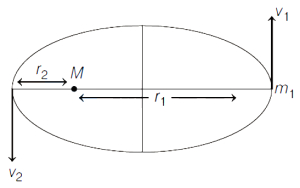
$A$ planet of mass $m$ moves in an elliptical orbit around an unknown star of mass $M$ such that its maximum and minimum distances from the star are equal to $r_1$ and $r_2$ respectively. The angular momentum of the planet relative to the centre of the star is
A
$m \sqrt{\frac{2 G M r_1 r_2}{r_1+r_2}}$
B
$0$
C
$m \sqrt{\frac{2 G M(r_1+r_2)}{r_1 r_2}}$
D
$\sqrt{\frac{2 G M m r_1}{(r_1+r_2) r_2}}$
Solution
(A) According to the law of conservation of angular momentum at the perihelion and aphelion points:
$m v_1 r_1 = m v_2 r_2$
$\Rightarrow v_2 = \frac{v_1 r_1}{r_2}$ $(i)$
From the law of conservation of total mechanical energy:
$-\frac{G M m}{r_1} + \frac{1}{2} m v_1^2 = -\frac{G M m}{r_2} + \frac{1}{2} m v_2^2$
Substituting $v_2$ from $(i)$:
$-\frac{G M}{r_1} + \frac{1}{2} v_1^2 = -\frac{G M}{r_2} + \frac{1}{2} \left(\frac{v_1 r_1}{r_2}\right)^2$
$\frac{1}{2} v_1^2 \left(1 - \frac{r_1^2}{r_2^2}\right) = G M \left(\frac{1}{r_1} - \frac{1}{r_2}\right)$
$\frac{1}{2} v_1^2 \left(\frac{r_2^2 - r_1^2}{r_2^2}\right) = G M \left(\frac{r_2 - r_1}{r_1 r_2}\right)$
$\frac{1}{2} v_1^2 \frac{(r_2 - r_1)(r_2 + r_1)}{r_2^2} = G M \frac{(r_2 - r_1)}{r_1 r_2}$
$v_1^2 = \frac{2 G M r_2}{r_1(r_1 + r_2)}$
$v_1 = \sqrt{\frac{2 G M r_2}{r_1(r_1 + r_2)}}$
Angular momentum $L = m v_1 r_1 = m \sqrt{\frac{2 G M r_2}{r_1(r_1 + r_2)}} \cdot r_1 = m \sqrt{\frac{2 G M r_1 r_2}{r_1 + r_2}}$
$m v_1 r_1 = m v_2 r_2$
$\Rightarrow v_2 = \frac{v_1 r_1}{r_2}$ $(i)$
From the law of conservation of total mechanical energy:
$-\frac{G M m}{r_1} + \frac{1}{2} m v_1^2 = -\frac{G M m}{r_2} + \frac{1}{2} m v_2^2$
Substituting $v_2$ from $(i)$:
$-\frac{G M}{r_1} + \frac{1}{2} v_1^2 = -\frac{G M}{r_2} + \frac{1}{2} \left(\frac{v_1 r_1}{r_2}\right)^2$
$\frac{1}{2} v_1^2 \left(1 - \frac{r_1^2}{r_2^2}\right) = G M \left(\frac{1}{r_1} - \frac{1}{r_2}\right)$
$\frac{1}{2} v_1^2 \left(\frac{r_2^2 - r_1^2}{r_2^2}\right) = G M \left(\frac{r_2 - r_1}{r_1 r_2}\right)$
$\frac{1}{2} v_1^2 \frac{(r_2 - r_1)(r_2 + r_1)}{r_2^2} = G M \frac{(r_2 - r_1)}{r_1 r_2}$
$v_1^2 = \frac{2 G M r_2}{r_1(r_1 + r_2)}$
$v_1 = \sqrt{\frac{2 G M r_2}{r_1(r_1 + r_2)}}$
Angular momentum $L = m v_1 r_1 = m \sqrt{\frac{2 G M r_2}{r_1(r_1 + r_2)}} \cdot r_1 = m \sqrt{\frac{2 G M r_1 r_2}{r_1 + r_2}}$
0 likesView Solution
5
PhysicsMediumMCQTS EAMCET · 2017
Consider a frictionless ramp on which a smooth object is made to slide down from an initial height $h$. The distance $d$ necessary to stop the object on a flat track (of coefficient of friction $\mu$),kept at the ramp end,is:
A
$h / \mu$
B
$h \mu$
C
$\mu^2 h$
D
$h^2 \mu$
Solution
(A) According to the law of conservation of energy,the potential energy of the object at the top of the ramp is converted into kinetic energy at the bottom of the ramp.
Potential energy at height $h$ = $mgh$.
When the object moves on the flat track,the work done by the frictional force $f = \mu N = \mu mg$ stops the object over a distance $d$.
The work done by friction is $W = f \times d = \mu mgd$.
Equating the initial potential energy to the work done by friction:
$mgh = \mu mgd$
Dividing both sides by $mg$,we get:
$d = \frac{h}{\mu}$
Potential energy at height $h$ = $mgh$.
When the object moves on the flat track,the work done by the frictional force $f = \mu N = \mu mg$ stops the object over a distance $d$.
The work done by friction is $W = f \times d = \mu mgd$.
Equating the initial potential energy to the work done by friction:
$mgh = \mu mgd$
Dividing both sides by $mg$,we get:
$d = \frac{h}{\mu}$
0 likesView Solution
6
PhysicsMediumMCQTS EAMCET · 2017
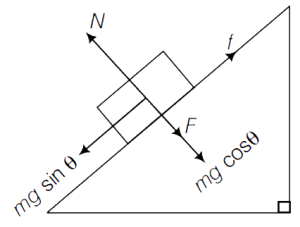
$A$ wooden box lying at rest on an inclined surface of a wet wood is held at static equilibrium by a constant force $F$ applied perpendicular to the incline. If the mass of the box is $1 \ kg$,the angle of inclination is $30^{\circ}$ and the coefficient of static friction between the box and the inclined plane is $0.2$,the minimum magnitude of $F$ is (Use $g=10 \ m/s^2$)
A
$0 \ N$,as $30^{\circ}$ is less than angle of repose
B
$\geq 1 \ N$
C
$\geq 3.3 \ N$
D
$\geq 16.3 \ N$
Solution
(D) To keep the box in static equilibrium,the downward force along the incline $(mg \sin \theta)$ must be balanced by the maximum static friction force $(f_{max})$.
The normal force $N$ acting on the box is the sum of the component of weight perpendicular to the incline and the applied force $F$:
$N = mg \cos \theta + F$
The maximum static friction force is given by:
$f_{max} = \mu N = \mu(mg \cos \theta + F)$
For equilibrium,$mg \sin \theta \leq f_{max}$,so the minimum force $F$ required is when $mg \sin \theta = \mu(mg \cos \theta + F)$.
Rearranging for $F$:
$F = \frac{mg \sin \theta}{\mu} - mg \cos \theta = mg \left( \frac{\sin \theta}{\mu} - \cos \theta \right)$
Given $m = 1 \ kg$,$g = 10 \ m/s^2$,$\theta = 30^{\circ}$,and $\mu = 0.2$:
$F = 1 \times 10 \left( \frac{\sin 30^{\circ}}{0.2} - \cos 30^{\circ} \right)$
$F = 10 \left( \frac{0.5}{0.2} - \frac{\sqrt{3}}{2} \right) = 10 \left( 2.5 - 0.866 \right)$
$F = 10 \times 1.634 = 16.34 \ N$
Thus,the minimum magnitude of $F$ is $\geq 16.3 \ N$.
The normal force $N$ acting on the box is the sum of the component of weight perpendicular to the incline and the applied force $F$:
$N = mg \cos \theta + F$
The maximum static friction force is given by:
$f_{max} = \mu N = \mu(mg \cos \theta + F)$
For equilibrium,$mg \sin \theta \leq f_{max}$,so the minimum force $F$ required is when $mg \sin \theta = \mu(mg \cos \theta + F)$.
Rearranging for $F$:
$F = \frac{mg \sin \theta}{\mu} - mg \cos \theta = mg \left( \frac{\sin \theta}{\mu} - \cos \theta \right)$
Given $m = 1 \ kg$,$g = 10 \ m/s^2$,$\theta = 30^{\circ}$,and $\mu = 0.2$:
$F = 1 \times 10 \left( \frac{\sin 30^{\circ}}{0.2} - \cos 30^{\circ} \right)$
$F = 10 \left( \frac{0.5}{0.2} - \frac{\sqrt{3}}{2} \right) = 10 \left( 2.5 - 0.866 \right)$
$F = 10 \times 1.634 = 16.34 \ N$
Thus,the minimum magnitude of $F$ is $\geq 16.3 \ N$.
0 likesView Solution
7
PhysicsEasyMCQTS EAMCET · 2017
$A$ force $F$ is applied on a square plate of length $L$. If the percentage error in the determination of $L$ is $3 \%$ and in $F$ is $4 \%$,then the permissible error in the calculation of pressure is (in $\%$)
A
$13$
B
$10$
C
$7$
D
$12$
Solution
(B) Given:
Percentage error in length,$\frac{\Delta L}{L} \times 100 = 3 \%$
Percentage error in force,$\frac{\Delta F}{F} \times 100 = 4 \%$
We know that pressure $P$ is defined as force per unit area:
$P = \frac{F}{A}$
Since the plate is square,the area $A = L^2$.
Therefore,$P = \frac{F}{L^2}$.
The relative error in pressure is given by:
$\frac{\Delta P}{P} = \frac{\Delta F}{F} + 2 \frac{\Delta L}{L}$
To find the percentage error,multiply by $100$:
$\frac{\Delta P}{P} \times 100 = \left( \frac{\Delta F}{F} \times 100 \right) + 2 \left( \frac{\Delta L}{L} \times 100 \right)$
Substituting the given values:
$\frac{\Delta P}{P} \times 100 = 4 \% + 2(3 \%) = 4 \% + 6 \% = 10 \%$
Thus,the permissible error in the calculation of pressure is $10 \%$.
Percentage error in length,$\frac{\Delta L}{L} \times 100 = 3 \%$
Percentage error in force,$\frac{\Delta F}{F} \times 100 = 4 \%$
We know that pressure $P$ is defined as force per unit area:
$P = \frac{F}{A}$
Since the plate is square,the area $A = L^2$.
Therefore,$P = \frac{F}{L^2}$.
The relative error in pressure is given by:
$\frac{\Delta P}{P} = \frac{\Delta F}{F} + 2 \frac{\Delta L}{L}$
To find the percentage error,multiply by $100$:
$\frac{\Delta P}{P} \times 100 = \left( \frac{\Delta F}{F} \times 100 \right) + 2 \left( \frac{\Delta L}{L} \times 100 \right)$
Substituting the given values:
$\frac{\Delta P}{P} \times 100 = 4 \% + 2(3 \%) = 4 \% + 6 \% = 10 \%$
Thus,the permissible error in the calculation of pressure is $10 \%$.
0 likesView Solution
8
PhysicsMediumMCQTS EAMCET · 2017
$A$ horizontal pipeline carrying gasoline has a cross-sectional diameter of $5 \,mm$. If the viscosity and density of the gasoline are $6 \times 10^{-3} \,Poise$ and $720 \,kg/m^3$ respectively,the velocity after which the flow becomes turbulent is:
A
$ > 1.66 \,m/s$
B
$ > 3.33 \,m/s$
C
$ > 1.66 \,m/s$
D
$ > 0.33 \,m/s$
Solution
(D) Given: Diameter of pipe $d = 5 \,mm = 5 \times 10^{-3} \,m$. Density of gasoline $\rho = 720 \,kg/m^3$. Viscosity of gasoline $\eta = 6 \times 10^{-3} \,Poise = 6 \times 10^{-4} \,Pa \cdot s$. The critical Reynolds number for pipe flow is $R_e = 2000$. The formula for critical velocity $v_c$ is $v_c = \frac{R_e \cdot \eta}{\rho \cdot d}$. Substituting the values: $v_c = \frac{2000 \times 6 \times 10^{-4}}{720 \times 5 \times 10^{-3}} = \frac{1.2}{3.6} = \frac{1}{3} \approx 0.33 \,m/s$. Thus,the flow becomes turbulent when the velocity is $ > 0.33 \,m/s$.
0 likesView Solution
9
PhysicsEasyMCQTS EAMCET · 2017
The Young's modulus of a material is $2 \times 10^{11} \,N/m^2$ and its elastic limit is $1 \times 10^8 \,N/m^2$. For a wire of $1 \,m$ length of this material,the maximum elongation achievable is (in $\,mm$)
A
$0.2$
B
$0.3$
C
$0.4$
D
$0.5$
Solution
(D) Given:
Young's modulus $(Y)$ = $2 \times 10^{11} \,N/m^2$
Elastic limit (Stress,$\sigma$) = $1 \times 10^8 \,N/m^2$
Original length $(L)$ = $1 \,m$
We know that Young's modulus is defined as the ratio of stress to strain:
$Y = \frac{\text{Stress}}{\text{Strain}} = \frac{\sigma}{\Delta L / L}$
Rearranging the formula to find the maximum elongation $(\Delta L)$:
$\Delta L = \frac{\sigma \times L}{Y}$
Substituting the given values:
$\Delta L = \frac{1 \times 10^8 \,N/m^2 \times 1 \,m}{2 \times 10^{11} \,N/m^2}$
$\Delta L = 0.5 \times 10^{-3} \,m$
Converting meters to millimeters $(1 \,m = 1000 \,mm)$:
$\Delta L = 0.5 \,mm$
Young's modulus $(Y)$ = $2 \times 10^{11} \,N/m^2$
Elastic limit (Stress,$\sigma$) = $1 \times 10^8 \,N/m^2$
Original length $(L)$ = $1 \,m$
We know that Young's modulus is defined as the ratio of stress to strain:
$Y = \frac{\text{Stress}}{\text{Strain}} = \frac{\sigma}{\Delta L / L}$
Rearranging the formula to find the maximum elongation $(\Delta L)$:
$\Delta L = \frac{\sigma \times L}{Y}$
Substituting the given values:
$\Delta L = \frac{1 \times 10^8 \,N/m^2 \times 1 \,m}{2 \times 10^{11} \,N/m^2}$
$\Delta L = 0.5 \times 10^{-3} \,m$
Converting meters to millimeters $(1 \,m = 1000 \,mm)$:
$\Delta L = 0.5 \,mm$
0 likesView Solution
10
PhysicsEasyMCQTS EAMCET · 2017
An object is thrown vertically upward with a speed of $30 \,m/s$. The velocity of the object half-a-second before it reaches the maximum height is (in $\,m/s$)
A
$4.9$
B
$9.8$
C
$19.6$
D
$25.1$
Solution
(A) At the maximum height, the final velocity of the object is $v = 0 \,m/s$.
Let the time taken to reach the maximum height be $t_{max}$.
We know that the velocity of an object at time $t$ before reaching the maximum height is equal to the velocity it gains in time $t$ while falling from the maximum height (due to symmetry).
Here, $t = 0.5 \,s$ and the acceleration due to gravity is $g = 9.8 \,m/s^2$.
Using the first equation of motion for the downward journey starting from rest at the maximum height:
$v = u + gt$
$v = 0 + (9.8 \,m/s^2) \times (0.5 \,s)$
$v = 4.9 \,m/s$.
Let the time taken to reach the maximum height be $t_{max}$.
We know that the velocity of an object at time $t$ before reaching the maximum height is equal to the velocity it gains in time $t$ while falling from the maximum height (due to symmetry).
Here, $t = 0.5 \,s$ and the acceleration due to gravity is $g = 9.8 \,m/s^2$.
Using the first equation of motion for the downward journey starting from rest at the maximum height:
$v = u + gt$
$v = 0 + (9.8 \,m/s^2) \times (0.5 \,s)$
$v = 4.9 \,m/s$.
0 likesView Solution
11
PhysicsMediumMCQTS EAMCET · 2017
The deceleration of a car traveling on a straight highway is a function of its instantaneous velocity $v$ given by $\omega = a \sqrt{v}$,where $a$ is a constant. If the initial velocity of the car is $v_0$,the distance the car will travel and the time it takes before it stops are:
A
$\frac{2 v_0^{3/2}}{3 a}, \frac{2 \sqrt{v_0}}{a}$
B
$\frac{3 v_0^{3/2}}{2 a}, \frac{1}{2 a} \sqrt{v_0}$
C
$\frac{3 a}{2} v_0^{3/2}, \frac{a}{2} \sqrt{v_0}$
D
$\frac{2}{3 a} v_0, \frac{2}{a} v_0$
Solution
(A) Given deceleration $\omega = -\frac{dv}{dt} = a \sqrt{v}$.
$1$. To find time $t$:
$\frac{dv}{dt} = -a \sqrt{v} \implies \int_{v_0}^{0} v^{-1/2} dv = \int_{0}^{t} -a dt$
$[2 \sqrt{v}]_{v_0}^{0} = -at \implies -2 \sqrt{v_0} = -at \implies t = \frac{2 \sqrt{v_0}}{a}$.
$2$. To find distance $s$:
Using $\omega = v \frac{dv}{ds} = a \sqrt{v} \implies v \frac{dv}{ds} = -a \sqrt{v} \implies \sqrt{v} dv = -a ds$.
Integrating both sides: $\int_{v_0}^{0} v^{1/2} dv = \int_{0}^{s} -a ds$
$[\frac{2}{3} v^{3/2}]_{v_0}^{0} = -as \implies -\frac{2}{3} v_0^{3/2} = -as \implies s = \frac{2 v_0^{3/2}}{3 a}$.
$1$. To find time $t$:
$\frac{dv}{dt} = -a \sqrt{v} \implies \int_{v_0}^{0} v^{-1/2} dv = \int_{0}^{t} -a dt$
$[2 \sqrt{v}]_{v_0}^{0} = -at \implies -2 \sqrt{v_0} = -at \implies t = \frac{2 \sqrt{v_0}}{a}$.
$2$. To find distance $s$:
Using $\omega = v \frac{dv}{ds} = a \sqrt{v} \implies v \frac{dv}{ds} = -a \sqrt{v} \implies \sqrt{v} dv = -a ds$.
Integrating both sides: $\int_{v_0}^{0} v^{1/2} dv = \int_{0}^{s} -a ds$
$[\frac{2}{3} v^{3/2}]_{v_0}^{0} = -as \implies -\frac{2}{3} v_0^{3/2} = -as \implies s = \frac{2 v_0^{3/2}}{3 a}$.
0 likesView Solution
12
PhysicsEasyMCQTS EAMCET · 2017
$A$ ball is thrown at a speed of $20 \,m/s$ at an angle of $30^{\circ}$ with the horizontal. The maximum height reached by the ball is (Use $g=10 \,m/s^2$) (in $\,m$)
A
$2$
B
$3$
C
$4$
D
$5$
Solution
(D) Given,
Initial speed of the ball $(u) = 20 \,m/s$
Angle of projection $(\theta) = 30^{\circ}$
Acceleration due to gravity $(g) = 10 \,m/s^2$
The formula for the maximum height $(H)$ reached by a projectile is given by:
$H = \frac{u^2 \sin^2 \theta}{2g}$
Substituting the given values into the formula:
$H = \frac{(20)^2 \times (\sin 30^{\circ})^2}{2 \times 10}$
$H = \frac{400 \times (1/2)^2}{20}$
$H = \frac{400 \times (1/4)}{20}$
$H = \frac{100}{20}$
$H = 5 \,m$
Therefore,the maximum height reached by the ball is $5 \,m$.
Initial speed of the ball $(u) = 20 \,m/s$
Angle of projection $(\theta) = 30^{\circ}$
Acceleration due to gravity $(g) = 10 \,m/s^2$
The formula for the maximum height $(H)$ reached by a projectile is given by:
$H = \frac{u^2 \sin^2 \theta}{2g}$
Substituting the given values into the formula:
$H = \frac{(20)^2 \times (\sin 30^{\circ})^2}{2 \times 10}$
$H = \frac{400 \times (1/2)^2}{20}$
$H = \frac{400 \times (1/4)}{20}$
$H = \frac{100}{20}$
$H = 5 \,m$
Therefore,the maximum height reached by the ball is $5 \,m$.
0 likesView Solution
13
PhysicsEasyMCQTS EAMCET · 2017
Consider the motion of a particle described by $x = a \cos t$,$y = a \sin t$,and $z = t$. The trajectory traced by the particle as a function of time is
A
helix
B
circular
C
elliptical
D
straight line
Solution
(A) Given the parametric equations of motion:
$x = a \cos t$
$y = a \sin t$
$z = t$
First,consider the projection of the motion on the $xy$-plane:
$x^2 + y^2 = (a \cos t)^2 + (a \sin t)^2 = a^2(\cos^2 t + \sin^2 t) = a^2$
This represents a circle of radius $a$ in the $xy$-plane.
Simultaneously,the particle moves along the $z$-axis with a constant velocity since $z = t$,which implies $\frac{dz}{dt} = 1$.
Since the particle moves in a circular path in the $xy$-plane while simultaneously advancing linearly along the $z$-axis,the resulting trajectory is a helix.
$x = a \cos t$
$y = a \sin t$
$z = t$
First,consider the projection of the motion on the $xy$-plane:
$x^2 + y^2 = (a \cos t)^2 + (a \sin t)^2 = a^2(\cos^2 t + \sin^2 t) = a^2$
This represents a circle of radius $a$ in the $xy$-plane.
Simultaneously,the particle moves along the $z$-axis with a constant velocity since $z = t$,which implies $\frac{dz}{dt} = 1$.
Since the particle moves in a circular path in the $xy$-plane while simultaneously advancing linearly along the $z$-axis,the resulting trajectory is a helix.
0 likesView Solution
14
PhysicsEasyMCQTS EAMCET · 2017
$A$ swimmer wants to cross a $200 \ m$ wide river which is flowing at a speed of $2 \ m/s$. The velocity of the swimmer with respect to the river is $1 \ m/s$. How far from the point directly opposite to the starting point does the swimmer reach the opposite bank (in $m$)?
A
$200$
B
$400$
C
$600$
D
$800$
Solution
(B) Given:
Width of the river $(w) = 200 \ m$
Velocity of the river $(v_r) = 2 \ m/s$
Velocity of the swimmer with respect to the river $(v_{sr}) = 1 \ m/s$
To cross the river in the shortest time,the swimmer should swim perpendicular to the river flow.
The time taken to cross the river is $t = \frac{w}{v_{sr}} = \frac{200 \ m}{1 \ m/s} = 200 \ s$.
During this time,the swimmer is carried downstream by the river flow.
The distance drifted downstream $(d)$ is given by $d = v_r \times t$.
$d = 2 \ m/s \times 200 \ s = 400 \ m$.
Therefore,the swimmer reaches the opposite bank at a distance of $400 \ m$ from the point directly opposite to the starting point.
Width of the river $(w) = 200 \ m$
Velocity of the river $(v_r) = 2 \ m/s$
Velocity of the swimmer with respect to the river $(v_{sr}) = 1 \ m/s$
To cross the river in the shortest time,the swimmer should swim perpendicular to the river flow.
The time taken to cross the river is $t = \frac{w}{v_{sr}} = \frac{200 \ m}{1 \ m/s} = 200 \ s$.
During this time,the swimmer is carried downstream by the river flow.
The distance drifted downstream $(d)$ is given by $d = v_r \times t$.
$d = 2 \ m/s \times 200 \ s = 400 \ m$.
Therefore,the swimmer reaches the opposite bank at a distance of $400 \ m$ from the point directly opposite to the starting point.
0 likesView Solution
15
PhysicsEasyMCQTS EAMCET · 2017
$A$ simple pendulum of length $1 \,m$ is freely suspended from the ceiling of an elevator. The time period of small oscillations as the elevator moves up with an acceleration of $2 \,m/s^2$ is (use $g=10 \,m/s^2$).
A
$\frac{\pi}{\sqrt{5}} \,s$
B
$\sqrt{\frac{2}{5}} \pi \,s$
C
$\frac{\pi}{\sqrt{2}} \,s$
D
$\frac{\pi}{\sqrt{3}} \,s$
Solution
(D) Given: Length of simple pendulum $L = 1 \,m$,acceleration of elevator $a = 2 \,m/s^2$,and acceleration due to gravity $g = 10 \,m/s^2$.
When an elevator moves upward with an acceleration $a$,the effective acceleration due to gravity $g_{eff}$ is given by $g_{eff} = g + a$.
Substituting the values,$g_{eff} = 10 + 2 = 12 \,m/s^2$.
The time period $T$ of a simple pendulum is given by $T = 2\pi \sqrt{\frac{L}{g_{eff}}}$.
Substituting the values,$T = 2\pi \sqrt{\frac{1}{12}} = 2\pi \frac{1}{\sqrt{4 \times 3}} = 2\pi \frac{1}{2\sqrt{3}} = \frac{\pi}{\sqrt{3}} \,s$.
When an elevator moves upward with an acceleration $a$,the effective acceleration due to gravity $g_{eff}$ is given by $g_{eff} = g + a$.
Substituting the values,$g_{eff} = 10 + 2 = 12 \,m/s^2$.
The time period $T$ of a simple pendulum is given by $T = 2\pi \sqrt{\frac{L}{g_{eff}}}$.
Substituting the values,$T = 2\pi \sqrt{\frac{1}{12}} = 2\pi \frac{1}{\sqrt{4 \times 3}} = 2\pi \frac{1}{2\sqrt{3}} = \frac{\pi}{\sqrt{3}} \,s$.
0 likesView Solution
16
PhysicsDifficultMCQTS EAMCET · 2017
$A$ thermocol box has a total wall area (including the lid) of $1.0 \,m^2$ and wall thickness of $3 \,cm$. It is filled with ice at $0^{\circ} C$. If the average temperature outside the box is $30^{\circ} C$ throughout the day, the amount of ice that melts in one day is (Given: $K_{\text{thermocol}} = 0.03 \,W/mK$, $L_{\text{fusion(ice)}} = 3.00 \times 10^5 \,J/kg$) (in $\,kg$)
A
$1$
B
$2.88$
C
$25.92$
D
$8.64$
Solution
(D) Given: Area $A = 1.0 \,m^2$, Thickness $l = 3 \,cm = 0.03 \,m$, Temperature difference $\Delta \theta = 30^{\circ} C - 0^{\circ} C = 30^{\circ} C$, Thermal conductivity $K = 0.03 \,W/mK$, Latent heat $L = 3.00 \times 10^5 \,J/kg$, Time $t = 24 \times 3600 \,s = 86400 \,s$.
Using the heat conduction formula: $Q = \frac{K A \Delta \theta t}{l}$.
Since $Q = m L$, we have $m = \frac{K A \Delta \theta t}{L l}$.
Substituting the values: $m = \frac{0.03 \times 1.0 \times 30 \times 86400}{3.00 \times 10^5 \times 0.03}$.
$m = \frac{0.9 \times 86400}{9000} = \frac{77760}{9000} = 8.64 \,kg$.
Using the heat conduction formula: $Q = \frac{K A \Delta \theta t}{l}$.
Since $Q = m L$, we have $m = \frac{K A \Delta \theta t}{L l}$.
Substituting the values: $m = \frac{0.03 \times 1.0 \times 30 \times 86400}{3.00 \times 10^5 \times 0.03}$.
$m = \frac{0.9 \times 86400}{9000} = \frac{77760}{9000} = 8.64 \,kg$.
0 likesView Solution
17
PhysicsMediumMCQTS EAMCET · 2017
$A$ meter scale made of steel reads accurately at $25^{\circ} C$. Suppose in an experiment an accuracy of $0.06 \,mm$ in $1 \,m$ is required, the range of temperature in which the experiment can be performed with this meter scale is (Coefficient of linear expansion of steel is $11 \times 10^{-6} /{ }^{\circ} C$)
A
$19^{\circ} C$ to $31^{\circ} C$
B
$25^{\circ} C$ to $32^{\circ} C$
C
$18^{\circ} C$ to $25^{\circ} C$
D
$18^{\circ} C$ to $32^{\circ} C$
Solution
$(A)$ Given: Coefficient of linear expansion of steel, $\alpha = 11 \times 10^{-6} /{ }^{\circ} C$.
Required accuracy $\Delta l = 0.06 \,mm = 6 \times 10^{-5} \,m$ for a length $l = 1 \,m$.
We know the formula for linear expansion: $\Delta l = l \alpha \Delta t$.
Rearranging for the temperature change: $\Delta t = \frac{\Delta l}{l \alpha}$.
Substituting the values: $\Delta t = \frac{6 \times 10^{-5}}{1 \times 11 \times 10^{-6}} = \frac{60}{11} \approx 5.45^{\circ} C$.
Since the scale is accurate at $25^{\circ} C$, the allowed temperature range is $25^{\circ} C \pm 5.45^{\circ} C$.
This gives a range from $19.55^{\circ} C$ to $30.45^{\circ} C$.
Rounding to the nearest integer values provided in the options, the range is approximately $19^{\circ} C$ to $31^{\circ} C$.
Thus, option $A$ is correct.
Required accuracy $\Delta l = 0.06 \,mm = 6 \times 10^{-5} \,m$ for a length $l = 1 \,m$.
We know the formula for linear expansion: $\Delta l = l \alpha \Delta t$.
Rearranging for the temperature change: $\Delta t = \frac{\Delta l}{l \alpha}$.
Substituting the values: $\Delta t = \frac{6 \times 10^{-5}}{1 \times 11 \times 10^{-6}} = \frac{60}{11} \approx 5.45^{\circ} C$.
Since the scale is accurate at $25^{\circ} C$, the allowed temperature range is $25^{\circ} C \pm 5.45^{\circ} C$.
This gives a range from $19.55^{\circ} C$ to $30.45^{\circ} C$.
Rounding to the nearest integer values provided in the options, the range is approximately $19^{\circ} C$ to $31^{\circ} C$.
Thus, option $A$ is correct.
0 likesView Solution
18
PhysicsEasyMCQTS EAMCET · 2017
An office room contains about $2000$ moles of air. The change in the internal energy of this much air when it is cooled from $34^{\circ} C$ to $24^{\circ} C$ at a constant pressure of $1.0 \text{ atm}$ is (Use $\gamma_{\text{air}} = 1.4$ and universal gas constant $R = 8.314 \text{ J/mol-K}$)
A
$-1.9 \times 10^5 \text{ J}$
B
$+1.9 \times 10^5 \text{ J}$
C
$-4.2 \times 10^5 \text{ J}$
D
$+0.7 \times 10^5 \text{ J}$
Solution
(C) The change in internal energy $(\Delta U)$ of an ideal gas is given by the formula $\Delta U = n C_v \Delta T$.
Given:
Number of moles $(n) = 2000 = 2 \times 10^3 \text{ mol}$.
Initial temperature $(T_i) = 34^{\circ} C$,Final temperature $(T_f) = 24^{\circ} C$.
Temperature change $(\Delta T) = 24 - 34 = -10 \text{ K}$.
For air,$\gamma = 1.4$. The molar heat capacity at constant volume is $C_v = \frac{R}{\gamma - 1} = \frac{R}{1.4 - 1} = \frac{R}{0.4}$.
Substituting the values:
$\Delta U = n \left( \frac{R}{0.4} \right) \Delta T$
$\Delta U = (2 \times 10^3) \times \left( \frac{8.314}{0.4} \right) \times (-10)$
$\Delta U = - \frac{2 \times 8.314 \times 10^4}{0.4}$
$\Delta U = - \frac{16.628 \times 10^4}{0.4} = -41.57 \times 10^4 \text{ J} \approx -4.2 \times 10^5 \text{ J}$.
Given:
Number of moles $(n) = 2000 = 2 \times 10^3 \text{ mol}$.
Initial temperature $(T_i) = 34^{\circ} C$,Final temperature $(T_f) = 24^{\circ} C$.
Temperature change $(\Delta T) = 24 - 34 = -10 \text{ K}$.
For air,$\gamma = 1.4$. The molar heat capacity at constant volume is $C_v = \frac{R}{\gamma - 1} = \frac{R}{1.4 - 1} = \frac{R}{0.4}$.
Substituting the values:
$\Delta U = n \left( \frac{R}{0.4} \right) \Delta T$
$\Delta U = (2 \times 10^3) \times \left( \frac{8.314}{0.4} \right) \times (-10)$
$\Delta U = - \frac{2 \times 8.314 \times 10^4}{0.4}$
$\Delta U = - \frac{16.628 \times 10^4}{0.4} = -41.57 \times 10^4 \text{ J} \approx -4.2 \times 10^5 \text{ J}$.
0 likesView Solution
19
PhysicsMediumMCQTS EAMCET · 2017
Consider a reversible engine of efficiency $\frac{1}{6}$. When the temperature of the sink is reduced by $62^{\circ} C$, its efficiency gets doubled. The temperature of the source and sink respectively are
A
$372 \,K$ and $310 \,K$
B
$273 \,K$ and $300 \,K$
C
$99^{\circ} C$ and $10^{\circ} C$
D
$200^{\circ} C$ and $37^{\circ} C$
Solution
(A) The efficiency of a Carnot engine is given by $\eta = 1 - \frac{T_2}{T_1}$, where $T_1$ is the source temperature and $T_2$ is the sink temperature.
Given $\eta_1 = \frac{1}{6}$, we have $\frac{1}{6} = 1 - \frac{T_2}{T_1}$, which implies $\frac{T_2}{T_1} = \frac{5}{6}$ or $T_2 = \frac{5}{6} T_1$ (Eq. $1$).
When the sink temperature is reduced by $62^{\circ} C$, the new sink temperature is $T_2' = T_2 - 62$. The new efficiency is $\eta_2 = 2 \times \eta_1 = 2 \times \frac{1}{6} = \frac{1}{3}$.
Thus, $\frac{1}{3} = 1 - \frac{T_2 - 62}{T_1}$.
Substituting $T_2 = \frac{5}{6} T_1$ into the equation: $\frac{1}{3} = 1 - \frac{\frac{5}{6} T_1 - 62}{T_1} = 1 - \frac{5}{6} + \frac{62}{T_1} = \frac{1}{6} + \frac{62}{T_1}$.
Rearranging gives $\frac{1}{3} - \frac{1}{6} = \frac{62}{T_1}$, so $\frac{1}{6} = \frac{62}{T_1}$, which means $T_1 = 372 \,K$.
Using Eq. $1$, $T_2 = \frac{5}{6} \times 372 = 310 \,K$.
Given $\eta_1 = \frac{1}{6}$, we have $\frac{1}{6} = 1 - \frac{T_2}{T_1}$, which implies $\frac{T_2}{T_1} = \frac{5}{6}$ or $T_2 = \frac{5}{6} T_1$ (Eq. $1$).
When the sink temperature is reduced by $62^{\circ} C$, the new sink temperature is $T_2' = T_2 - 62$. The new efficiency is $\eta_2 = 2 \times \eta_1 = 2 \times \frac{1}{6} = \frac{1}{3}$.
Thus, $\frac{1}{3} = 1 - \frac{T_2 - 62}{T_1}$.
Substituting $T_2 = \frac{5}{6} T_1$ into the equation: $\frac{1}{3} = 1 - \frac{\frac{5}{6} T_1 - 62}{T_1} = 1 - \frac{5}{6} + \frac{62}{T_1} = \frac{1}{6} + \frac{62}{T_1}$.
Rearranging gives $\frac{1}{3} - \frac{1}{6} = \frac{62}{T_1}$, so $\frac{1}{6} = \frac{62}{T_1}$, which means $T_1 = 372 \,K$.
Using Eq. $1$, $T_2 = \frac{5}{6} \times 372 = 310 \,K$.
0 likesView Solution
20
PhysicsEasyMCQTS EAMCET · 2017
$A$ sound wave of frequency $v \text{ Hz}$ initially travels a distance of $1 \text{ km}$ in air. Then,it gets reflected into a water reservoir of depth $600 \text{ m}$. The frequency of the wave at the bottom of the reservoir is $(V_{\text{air}} = 340 \text{ m/s}, V_{\text{water}} = 1484 \text{ m/s})$
A
$> v \text{ Hz}$
B
$< v \text{ Hz}$
C
$v \text{ Hz}$
D
$0 \text{ Hz}$ (the sound wave gets attenuated by water completely)
Solution
(C) The frequency of a sound wave is a characteristic property of the source that produces it.
When a wave travels from one medium to another (e.g.,from air to water),its speed and wavelength change,but its frequency remains constant.
Therefore,the frequency of the wave at the bottom of the reservoir remains $v \text{ Hz}$.
When a wave travels from one medium to another (e.g.,from air to water),its speed and wavelength change,but its frequency remains constant.
Therefore,the frequency of the wave at the bottom of the reservoir remains $v \text{ Hz}$.
0 likesView Solution
21
PhysicsEasyMCQTS EAMCET · 2017
Consider a particle on which constant forces $F_{1}=\hat{i}+2 \hat{j}+3 \hat{k} \text{ N}$ and $F_{2}=4 \hat{i}-5 \hat{j}-2 \hat{k} \text{ N}$ act together,resulting in a displacement from position $r_{1}=20 \hat{i}+15 \hat{j} \text{ cm}$ to $r_{2}=7 \hat{k} \text{ cm}$. The total work done on the particle is:
A
$-0.48 \text{ J}$
B
$+0.48 \text{ J}$
C
$-4.8 \text{ J}$
D
$+4.8 \text{ J}$
Solution
(A) Given:
$F_{1} = (\hat{i} + 2\hat{j} + 3\hat{k}) \text{ N}$
$F_{2} = (4\hat{i} - 5\hat{j} - 2\hat{k}) \text{ N}$
$r_{1} = (20\hat{i} + 15\hat{j}) \text{ cm} = (0.2\hat{i} + 0.15\hat{j}) \text{ m}$
$r_{2} = (7\hat{k}) \text{ cm} = (0.07\hat{k}) \text{ m}$
Total force $F = F_{1} + F_{2} = (1+4)\hat{i} + (2-5)\hat{j} + (3-2)\hat{k} = (5\hat{i} - 3\hat{j} + \hat{k}) \text{ N}$.
Displacement $s = r_{2} - r_{1} = (0\hat{i} + 0\hat{j} + 0.07\hat{k}) - (0.2\hat{i} + 0.15\hat{j} + 0\hat{k}) = (-0.2\hat{i} - 0.15\hat{j} + 0.07\hat{k}) \text{ m}$.
Work done $W = F \cdot s = (5\hat{i} - 3\hat{j} + \hat{k}) \cdot (-0.2\hat{i} - 0.15\hat{j} + 0.07\hat{k})$.
$W = (5 \times -0.2) + (-3 \times -0.15) + (1 \times 0.07)$.
$W = -1.0 + 0.45 + 0.07 = -0.48 \text{ J}$.
$F_{1} = (\hat{i} + 2\hat{j} + 3\hat{k}) \text{ N}$
$F_{2} = (4\hat{i} - 5\hat{j} - 2\hat{k}) \text{ N}$
$r_{1} = (20\hat{i} + 15\hat{j}) \text{ cm} = (0.2\hat{i} + 0.15\hat{j}) \text{ m}$
$r_{2} = (7\hat{k}) \text{ cm} = (0.07\hat{k}) \text{ m}$
Total force $F = F_{1} + F_{2} = (1+4)\hat{i} + (2-5)\hat{j} + (3-2)\hat{k} = (5\hat{i} - 3\hat{j} + \hat{k}) \text{ N}$.
Displacement $s = r_{2} - r_{1} = (0\hat{i} + 0\hat{j} + 0.07\hat{k}) - (0.2\hat{i} + 0.15\hat{j} + 0\hat{k}) = (-0.2\hat{i} - 0.15\hat{j} + 0.07\hat{k}) \text{ m}$.
Work done $W = F \cdot s = (5\hat{i} - 3\hat{j} + \hat{k}) \cdot (-0.2\hat{i} - 0.15\hat{j} + 0.07\hat{k})$.
$W = (5 \times -0.2) + (-3 \times -0.15) + (1 \times 0.07)$.
$W = -1.0 + 0.45 + 0.07 = -0.48 \text{ J}$.
0 likesView Solution
22
PhysicsEasyMCQTS EAMCET · 2017
An $AC$ generator $10 \, V$ (rms) at $200 \, rad/s$ is connected in series with a $50 \, \Omega$ resistor, a $400 \, mH$ inductor, and a $200 \, \mu F$ capacitor. The rms voltage across the inductor is (in $V$)
A
$2.5$
B
$3.4$
C
$6.7$
D
$10.8$
Solution
(D) Given parameters:
$E = 10 \, V$, $\omega = 200 \, rad/s$, $R = 50 \, \Omega$, $L = 400 \, mH = 0.4 \, H$, $C = 200 \, \mu F = 200 \times 10^{-6} \, F$.
First, calculate the inductive reactance $(X_L)$ and capacitive reactance $(X_C)$:
$X_L = \omega L = 200 \times 0.4 = 80 \, \Omega$.
$X_C = \frac{1}{\omega C} = \frac{1}{200 \times 200 \times 10^{-6}} = \frac{1}{0.04} = 25 \, \Omega$.
Now, calculate the impedance $(Z)$ of the $LCR$ circuit:
$Z = \sqrt{R^2 + (X_L - X_C)^2} = \sqrt{50^2 + (80 - 25)^2} = \sqrt{2500 + 55^2} = \sqrt{2500 + 3025} = \sqrt{5525} \approx 74.33 \, \Omega$.
The rms current $(I)$ in the circuit is:
$I = \frac{E}{Z} = \frac{10}{74.33} \approx 0.1345 \, A$.
The rms voltage across the inductor $(V_L)$ is given by:
$V_L = I \times X_L = 0.1345 \times 80 \approx 10.76 \, V$.
Rounding to one decimal place, we get $10.8 \, V$.
$E = 10 \, V$, $\omega = 200 \, rad/s$, $R = 50 \, \Omega$, $L = 400 \, mH = 0.4 \, H$, $C = 200 \, \mu F = 200 \times 10^{-6} \, F$.
First, calculate the inductive reactance $(X_L)$ and capacitive reactance $(X_C)$:
$X_L = \omega L = 200 \times 0.4 = 80 \, \Omega$.
$X_C = \frac{1}{\omega C} = \frac{1}{200 \times 200 \times 10^{-6}} = \frac{1}{0.04} = 25 \, \Omega$.
Now, calculate the impedance $(Z)$ of the $LCR$ circuit:
$Z = \sqrt{R^2 + (X_L - X_C)^2} = \sqrt{50^2 + (80 - 25)^2} = \sqrt{2500 + 55^2} = \sqrt{2500 + 3025} = \sqrt{5525} \approx 74.33 \, \Omega$.
The rms current $(I)$ in the circuit is:
$I = \frac{E}{Z} = \frac{10}{74.33} \approx 0.1345 \, A$.
The rms voltage across the inductor $(V_L)$ is given by:
$V_L = I \times X_L = 0.1345 \times 80 \approx 10.76 \, V$.
Rounding to one decimal place, we get $10.8 \, V$.
0 likesView Solution
23
PhysicsEasyMCQTS EAMCET · 2017
An electron collides with a hydrogen atom in its ground state and excites it to the $n=3$ state. The energy given to the hydrogen atom in this inelastic collision (neglecting the recoil of the hydrogen atom) is (in $\text{ eV}$)
A
$10.2$
B
$12.1$
C
$12.5$
D
$13.6$
Solution
(B) The energy of an electron in the $n$-th orbit of a hydrogen atom is given by $E_n = -\frac{13.6}{n^2} \text{ eV}$.
For the ground state $(n_1 = 1)$, the energy is $E_1 = -13.6 \text{ eV}$.
For the excited state $(n_2 = 3)$, the energy is $E_3 = -\frac{13.6}{3^2} = -\frac{13.6}{9} \approx -1.51 \text{ eV}$.
The energy required to excite the atom from $n=1$ to $n=3$ is $\Delta E = E_3 - E_1$.
$\Delta E = -1.51 - (-13.6) = 12.09 \text{ eV}$.
Rounding this value, we get $\Delta E \approx 12.1 \text{ eV}$.
For the ground state $(n_1 = 1)$, the energy is $E_1 = -13.6 \text{ eV}$.
For the excited state $(n_2 = 3)$, the energy is $E_3 = -\frac{13.6}{3^2} = -\frac{13.6}{9} \approx -1.51 \text{ eV}$.
The energy required to excite the atom from $n=1$ to $n=3$ is $\Delta E = E_3 - E_1$.
$\Delta E = -1.51 - (-13.6) = 12.09 \text{ eV}$.
Rounding this value, we get $\Delta E \approx 12.1 \text{ eV}$.
0 likesView Solution
24
PhysicsMediumMCQTS EAMCET · 2017
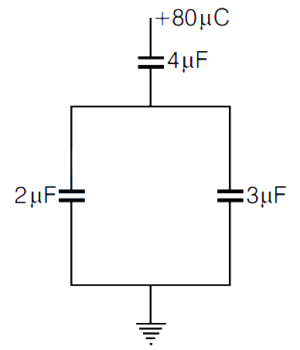
In the given circuit,a charge of $+80 \mu C$ is given to the upper plate of a $4 \mu F$ capacitor. At steady state,the charge on the upper plate of the $3 \mu F$ capacitor is (in $\mu C$)
A
$60$
B
$48$
C
$80$
D
$0$
Solution
(B) The $4 \mu F$ capacitor is in series with the parallel combination of the $2 \mu F$ and $3 \mu F$ capacitors.
When a charge of $+80 \mu C$ is placed on the upper plate of the $4 \mu F$ capacitor,an equal and opposite charge of $-80 \mu C$ is induced on its lower plate.
This charge of $+80 \mu C$ is then distributed between the upper plates of the $2 \mu F$ and $3 \mu F$ capacitors,which are connected in parallel.
Since the capacitors are in parallel,the charge $q$ distributes in the ratio of their capacitances:
$q_1 = \left( \frac{C_1}{C_1 + C_2} \right) Q_{total}$
For the $3 \mu F$ capacitor:
$q = \left( \frac{3 \mu F}{3 \mu F + 2 \mu F} \right) \times 80 \mu C$
$q = \left( \frac{3}{5} \right) \times 80 \mu C = 3 \times 16 \mu C = 48 \mu C$.
When a charge of $+80 \mu C$ is placed on the upper plate of the $4 \mu F$ capacitor,an equal and opposite charge of $-80 \mu C$ is induced on its lower plate.
This charge of $+80 \mu C$ is then distributed between the upper plates of the $2 \mu F$ and $3 \mu F$ capacitors,which are connected in parallel.
Since the capacitors are in parallel,the charge $q$ distributes in the ratio of their capacitances:
$q_1 = \left( \frac{C_1}{C_1 + C_2} \right) Q_{total}$
For the $3 \mu F$ capacitor:
$q = \left( \frac{3 \mu F}{3 \mu F + 2 \mu F} \right) \times 80 \mu C$
$q = \left( \frac{3}{5} \right) \times 80 \mu C = 3 \times 16 \mu C = 48 \mu C$.
0 likesView Solution
25
PhysicsDifficultMCQTS EAMCET · 2017
An amplitude modulated signal consists of a message signal of frequency $1 \text{ kHz}$ and peak voltage of $5 \text{ V}$,modulating a carrier frequency of $1 \text{ MHz}$ and peak voltage of $15 \text{ V}$. The correct description of this signal is
A
$5[1+3 \sin (2 \pi 10^6 t)] \sin (2 \pi 10^3 t)$
B
$15[1+\frac{1}{3} \sin (2 \pi 10^3 t)] \sin (2 \pi 10^6 t)$
C
$[5+15 \sin (2 \pi 10^3 t)] \sin (2 \pi 10^6 t)$
D
$[15+5 \sin (2 \pi 10^6 t)] \sin (2 \pi 10^3 t)$
Solution
(B) Given:
Frequency of message signal $(f_m) = 1 \text{ kHz} = 1 \times 10^3 \text{ Hz}$.
Peak voltage of message signal $(E_m) = 5 \text{ V}$.
Carrier frequency $(f_c) = 1 \text{ MHz} = 1 \times 10^6 \text{ Hz}$.
Peak voltage of carrier $(E_c) = 15 \text{ V}$.
The equation of an amplitude modulated wave is given by:
$e(t) = E_c [1 + \mu \sin(\omega_m t)] \sin(\omega_c t)$
where $\mu = \frac{E_m}{E_c}$ is the modulation index.
$\mu = \frac{5}{15} = \frac{1}{3}$.
Substituting the values:
$e(t) = 15 [1 + \frac{1}{3} \sin(2 \pi f_m t)] \sin(2 \pi f_c t)$
$e(t) = 15 [1 + \frac{1}{3} \sin(2 \pi \times 10^3 t)] \sin(2 \pi \times 10^6 t)$.
Frequency of message signal $(f_m) = 1 \text{ kHz} = 1 \times 10^3 \text{ Hz}$.
Peak voltage of message signal $(E_m) = 5 \text{ V}$.
Carrier frequency $(f_c) = 1 \text{ MHz} = 1 \times 10^6 \text{ Hz}$.
Peak voltage of carrier $(E_c) = 15 \text{ V}$.
The equation of an amplitude modulated wave is given by:
$e(t) = E_c [1 + \mu \sin(\omega_m t)] \sin(\omega_c t)$
where $\mu = \frac{E_m}{E_c}$ is the modulation index.
$\mu = \frac{5}{15} = \frac{1}{3}$.
Substituting the values:
$e(t) = 15 [1 + \frac{1}{3} \sin(2 \pi f_m t)] \sin(2 \pi f_c t)$
$e(t) = 15 [1 + \frac{1}{3} \sin(2 \pi \times 10^3 t)] \sin(2 \pi \times 10^6 t)$.
0 likesView Solution
26
PhysicsMediumMCQTS EAMCET · 2017
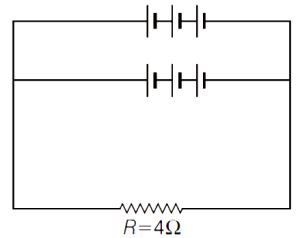
Each of the six ideal batteries of emf $20 \, V$ is connected to an external resistance of $4 \, \Omega$ as shown in the figure. The current through the resistance is (in $ \, A$)
A
$6$
B
$3$
C
$4$
D
$15$
Solution
(D) The circuit consists of two parallel branches, each containing three ideal batteries in series.
Each branch has an equivalent emf of $E_{eq} = 3 \times 20 \, V = 60 \, V$.
Since the two branches are connected in parallel, the total equivalent emf of the battery combination remains $E_{total} = 60 \, V$.
As the batteries are ideal, they have no internal resistance.
Therefore, the current $i$ flowing through the external resistance $R = 4 \, \Omega$ is given by Ohm's law:
$i = \frac{E_{total}}{R} = \frac{60 \, V}{4 \, \Omega} = 15 \, A$.
Each branch has an equivalent emf of $E_{eq} = 3 \times 20 \, V = 60 \, V$.
Since the two branches are connected in parallel, the total equivalent emf of the battery combination remains $E_{total} = 60 \, V$.
As the batteries are ideal, they have no internal resistance.
Therefore, the current $i$ flowing through the external resistance $R = 4 \, \Omega$ is given by Ohm's law:
$i = \frac{E_{total}}{R} = \frac{60 \, V}{4 \, \Omega} = 15 \, A$.
0 likesView Solution
27
PhysicsEasyMCQTS EAMCET · 2017
$A$ piece of copper and a piece of germanium are cooled from room temperature to $80 \text{ K}$. Then, which one of the following is correct?
A
Resistance of each will increase
B
Resistance of each will decrease
C
Resistance of copper will decrease while that of germanium will increase
D
Resistance of copper will increase while that of germanium will decrease
Solution
(C) Copper is a metallic conductor, and its resistance decreases as the temperature decreases because the frequency of collisions between electrons and lattice ions decreases.
Germanium is a semiconductor. In semiconductors, the number of charge carriers (electrons and holes) decreases exponentially as the temperature decreases, which leads to a significant increase in resistance.
Therefore, when both are cooled from room temperature to $80 \text{ K}$, the resistance of copper decreases, and the resistance of germanium increases.
Germanium is a semiconductor. In semiconductors, the number of charge carriers (electrons and holes) decreases exponentially as the temperature decreases, which leads to a significant increase in resistance.
Therefore, when both are cooled from room temperature to $80 \text{ K}$, the resistance of copper decreases, and the resistance of germanium increases.
0 likesView Solution
28
PhysicsDifficultMCQTS EAMCET · 2017
$A$ wire has a resistance of $3.1 \Omega$ at $30^{\circ} C$ and $4.5 \Omega$ at $100^{\circ} C$. The temperature coefficient of resistance of the wire is
A
$0.008^{\circ} C^{-1}$
B
$0.0024^{\circ} C^{-1}$
C
$0.0032^{\circ} C^{-1}$
D
$0.0064^{\circ} C^{-1}$
Solution
(A) Given:
$t_1 = 30^{\circ} C$,$R_1 = 3.1 \Omega$
$t_2 = 100^{\circ} C$,$R_2 = 4.5 \Omega$
We know that the resistance at temperature $t$ is given by $R_t = R_0(1 + \alpha \Delta t)$.
Alternatively,the temperature coefficient of resistance $\alpha$ is defined as:
$\alpha = \frac{R_2 - R_1}{R_1(t_2 - t_1) + R_2(t_1 - t_2)}$ is not the standard form,so we use $\alpha = \frac{R_2 - R_1}{R_1(t_2 - t_1)}$ if $R_1$ is at $0^{\circ} C$,but here we use the general formula:
$R_2 = R_1[1 + \alpha(t_2 - t_1)]$
$\alpha = \frac{R_2 - R_1}{R_1(t_2 - t_1)}$
$\alpha = \frac{4.5 - 3.1}{3.1(100 - 30)}$
$\alpha = \frac{1.4}{3.1 \times 70}$
$\alpha = \frac{1.4}{217} \approx 0.00645^{\circ} C^{-1}$
Wait,recalculating using the provided formula in the prompt: $\alpha = \frac{R_2 - R_1}{R_1 t_2 - R_2 t_1} = \frac{1.4}{310 - 135} = \frac{1.4}{175} = 0.008^{\circ} C^{-1}$.
Thus,the correct option is $A$.
$t_1 = 30^{\circ} C$,$R_1 = 3.1 \Omega$
$t_2 = 100^{\circ} C$,$R_2 = 4.5 \Omega$
We know that the resistance at temperature $t$ is given by $R_t = R_0(1 + \alpha \Delta t)$.
Alternatively,the temperature coefficient of resistance $\alpha$ is defined as:
$\alpha = \frac{R_2 - R_1}{R_1(t_2 - t_1) + R_2(t_1 - t_2)}$ is not the standard form,so we use $\alpha = \frac{R_2 - R_1}{R_1(t_2 - t_1)}$ if $R_1$ is at $0^{\circ} C$,but here we use the general formula:
$R_2 = R_1[1 + \alpha(t_2 - t_1)]$
$\alpha = \frac{R_2 - R_1}{R_1(t_2 - t_1)}$
$\alpha = \frac{4.5 - 3.1}{3.1(100 - 30)}$
$\alpha = \frac{1.4}{3.1 \times 70}$
$\alpha = \frac{1.4}{217} \approx 0.00645^{\circ} C^{-1}$
Wait,recalculating using the provided formula in the prompt: $\alpha = \frac{R_2 - R_1}{R_1 t_2 - R_2 t_1} = \frac{1.4}{310 - 135} = \frac{1.4}{175} = 0.008^{\circ} C^{-1}$.
Thus,the correct option is $A$.
0 likesView Solution
29
PhysicsEasyMCQTS EAMCET · 2017
The energy that should be added to an electron to reduce its de-Broglie wavelength from $1 \,nm$ to $0.5 \,nm$ is
A
four-times the initial energy
B
equal to the initial energy
C
two-times the initial energy
D
three-times the initial energy
Solution
(D) We know that the de-Broglie wavelength $\lambda$ is related to kinetic energy $K$ by the formula: $\lambda = \frac{h}{\sqrt{2mK}}$.
This implies that $K \propto \frac{1}{\lambda^2}$.
Let $K_1$ be the initial kinetic energy at $\lambda_1 = 1 \,nm$ and $K_2$ be the final kinetic energy at $\lambda_2 = 0.5 \,nm$.
Then, $\frac{K_2}{K_1} = \left( \frac{\lambda_1}{\lambda_2} \right)^2 = \left( \frac{1}{0.5} \right)^2 = 2^2 = 4$.
So, $K_2 = 4K_1$.
The energy that should be added to the electron is $\Delta K = K_2 - K_1 = 4K_1 - K_1 = 3K_1$.
Therefore, the energy to be added is three-times the initial energy.
This implies that $K \propto \frac{1}{\lambda^2}$.
Let $K_1$ be the initial kinetic energy at $\lambda_1 = 1 \,nm$ and $K_2$ be the final kinetic energy at $\lambda_2 = 0.5 \,nm$.
Then, $\frac{K_2}{K_1} = \left( \frac{\lambda_1}{\lambda_2} \right)^2 = \left( \frac{1}{0.5} \right)^2 = 2^2 = 4$.
So, $K_2 = 4K_1$.
The energy that should be added to the electron is $\Delta K = K_2 - K_1 = 4K_1 - K_1 = 3K_1$.
Therefore, the energy to be added is three-times the initial energy.
0 likesView Solution
30
PhysicsEasyMCQTS EAMCET · 2017
Consider a solenoid carrying current supplied by a $DC$ source with a constant $emf$ containing an iron core inside it. When the core is pulled out of the solenoid,the change in current will:
A
remain same
B
decrease
C
increase
D
modulate
Solution
(A) The solenoid is connected to a $DC$ source with a constant $emf$ $(V)$.
The current in the solenoid is given by $I = V/R$,where $R$ is the resistance of the solenoid wire.
When the iron core is pulled out,the self-inductance $(L)$ of the solenoid changes,but the resistance $(R)$ of the wire remains constant.
Since the $DC$ source provides a constant $emf$ and the resistance of the circuit does not change,the steady-state current $I$ remains unchanged.
Therefore,the current will remain the same.
The current in the solenoid is given by $I = V/R$,where $R$ is the resistance of the solenoid wire.
When the iron core is pulled out,the self-inductance $(L)$ of the solenoid changes,but the resistance $(R)$ of the wire remains constant.
Since the $DC$ source provides a constant $emf$ and the resistance of the circuit does not change,the steady-state current $I$ remains unchanged.
Therefore,the current will remain the same.
0 likesView Solution
31
PhysicsMediumMCQTS EAMCET · 2017
$A$ coil having $n$ turns and resistance $R \ \Omega$ is connected with a galvanometer of resistance $4 R \ \Omega$. This combination is moved in time $t$ seconds from a magnetic flux $\phi_1$ Weber to $\phi_2$ Weber. The induced current in the circuit is
A
$\frac{\phi_2-\phi_1}{5 Rnt}$
B
$-\frac{n(\phi_2-\phi_1)}{5 Rt}$
C
$-\frac{(\phi_2-\phi_1)}{Rnt}$
D
$-\frac{n(\phi_2-\phi_1)}{Rt}$
Solution
(B) Given: Number of turns in the coil $= n$. Resistance of the coil $= R$. Resistance of the galvanometer $= 4R$. Total resistance of the circuit $R_{total} = R + 4R = 5R$.
According to Faraday's Law of electromagnetic induction,the induced electromotive force (emf) is given by $e = -n \frac{\Delta \phi}{\Delta t}$.
Here,the change in flux is $\Delta \phi = \phi_2 - \phi_1$ and the time taken is $\Delta t = t$.
Therefore,$e = -n \frac{(\phi_2 - \phi_1)}{t}$.
The induced current $i$ is given by $i = \frac{e}{R_{total}}$.
Substituting the values,we get $i = \frac{-n(\phi_2 - \phi_1)}{5Rt}$.
According to Faraday's Law of electromagnetic induction,the induced electromotive force (emf) is given by $e = -n \frac{\Delta \phi}{\Delta t}$.
Here,the change in flux is $\Delta \phi = \phi_2 - \phi_1$ and the time taken is $\Delta t = t$.
Therefore,$e = -n \frac{(\phi_2 - \phi_1)}{t}$.
The induced current $i$ is given by $i = \frac{e}{R_{total}}$.
Substituting the values,we get $i = \frac{-n(\phi_2 - \phi_1)}{5Rt}$.
0 likesView Solution
32
PhysicsMediumMCQTS EAMCET · 2017
$A$ generator with a circular coil of $100$ turns of area $2 \times 10^{-2} \,m^2$ is immersed in a $0.01 \,T$ magnetic field and rotated at a frequency of $50 \,Hz$. The maximum emf which is produced during a cycle is (in $\,V$)
A
$6.28$
B
$3.44$
C
$10$
D
$1.32$
Solution
(A) Given:
Number of turns in the circular coil $(N) = 100$
Area $(A) = 2 \times 10^{-2} \,m^2$
Magnetic field $(B) = 0.01 \,T$
Frequency of rotation $(f) = 50 \,Hz$
The maximum induced electromotive force (emf) in a rotating coil is given by the formula:
$e_{max} = N B A \omega$
Since angular frequency $\omega = 2 \pi f$, we have:
$e_{max} = N B A (2 \pi f)$
Substituting the given values:
$e_{max} = 100 \times 0.01 \times (2 \times 10^{-2}) \times 2 \times 3.14159 \times 50$
$e_{max} = 1 \times 0.02 \times 314.159$
$e_{max} = 0.02 \times 314.159 = 6.283 \,V$
Thus, the maximum emf produced is approximately $6.28 \,V$.
Number of turns in the circular coil $(N) = 100$
Area $(A) = 2 \times 10^{-2} \,m^2$
Magnetic field $(B) = 0.01 \,T$
Frequency of rotation $(f) = 50 \,Hz$
The maximum induced electromotive force (emf) in a rotating coil is given by the formula:
$e_{max} = N B A \omega$
Since angular frequency $\omega = 2 \pi f$, we have:
$e_{max} = N B A (2 \pi f)$
Substituting the given values:
$e_{max} = 100 \times 0.01 \times (2 \times 10^{-2}) \times 2 \times 3.14159 \times 50$
$e_{max} = 1 \times 0.02 \times 314.159$
$e_{max} = 0.02 \times 314.159 = 6.283 \,V$
Thus, the maximum emf produced is approximately $6.28 \,V$.
0 likesView Solution
33
PhysicsDifficultMCQTS EAMCET · 2017
Consider a metal ball of radius $r$ moving at a constant velocity $v$ in a uniform magnetic field of induction $\vec{B}$. Assuming that the direction of velocity forms an angle $\alpha$ with the direction of $\vec{B}$,the maximum potential difference between points on the ball is
A
$r|\vec{B}||\vec{v}| \sin \alpha$
B
$|\vec{B}||\vec{v}| \sin \alpha$
C
$2r|\vec{B}||\vec{v}| \sin \alpha$
D
$2r|\vec{B}||\vec{v}| \cos \alpha$
Solution
(C) The motional electromotive force $(EMF)$ induced in a conductor moving through a magnetic field is given by the formula $e = \int (\vec{v} \times \vec{B}) \cdot d\vec{l}$.
For a metal ball of radius $r$,the effective length $l$ between the points of maximum potential difference is the diameter of the ball,which is $l = 2r$.
The induced $EMF$ is given by $e = B v l \sin \alpha$,where $\alpha$ is the angle between the velocity vector $\vec{v}$ and the magnetic field vector $\vec{B}$.
Substituting $l = 2r$ into the formula,we get $e = B v (2r) \sin \alpha$.
Therefore,the maximum potential difference is $2r|\vec{B}||\vec{v}| \sin \alpha$.
For a metal ball of radius $r$,the effective length $l$ between the points of maximum potential difference is the diameter of the ball,which is $l = 2r$.
The induced $EMF$ is given by $e = B v l \sin \alpha$,where $\alpha$ is the angle between the velocity vector $\vec{v}$ and the magnetic field vector $\vec{B}$.
Substituting $l = 2r$ into the formula,we get $e = B v (2r) \sin \alpha$.
Therefore,the maximum potential difference is $2r|\vec{B}||\vec{v}| \sin \alpha$.
0 likesView Solution
34
PhysicsMediumMCQTS EAMCET · 2017
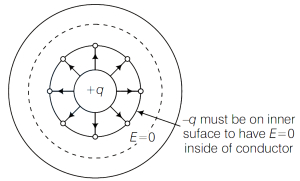
$A$ positive charge $Q$ is placed on a conducting spherical shell with inner radius $R_1$ and outer radius $R_2$. $A$ particle with charge $q$ is placed at the center of the spherical cavity. The magnitude of the electric field at a point in the cavity,at a distance $r$ from the center,is
A
zero
B
$\frac{Q}{4 \pi \varepsilon_0 r^2}$
C
$\frac{q}{4 \pi \varepsilon_0 r^2}$
D
$\frac{(Q+q)}{4 \pi \varepsilon_0 r^2}$
Solution
(C) According to Gauss's law,the electric field $E$ at a distance $r$ from a point charge $q$ is given by $\oint E \cdot ds = \frac{q_{enclosed}}{\varepsilon_0}$.
For a Gaussian surface of radius $r$ (where $r < R_1$) inside the cavity,the only charge enclosed is the point charge $q$ placed at the center.
Thus,$E(4 \pi r^2) = \frac{q}{\varepsilon_0}$.
Solving for $E$,we get $E = \frac{q}{4 \pi \varepsilon_0 r^2}$.
The charge $Q$ on the conducting shell does not contribute to the electric field inside the cavity because the field due to a spherically symmetric shell of charge is zero inside it.
For a Gaussian surface of radius $r$ (where $r < R_1$) inside the cavity,the only charge enclosed is the point charge $q$ placed at the center.
Thus,$E(4 \pi r^2) = \frac{q}{\varepsilon_0}$.
Solving for $E$,we get $E = \frac{q}{4 \pi \varepsilon_0 r^2}$.
The charge $Q$ on the conducting shell does not contribute to the electric field inside the cavity because the field due to a spherically symmetric shell of charge is zero inside it.
0 likesView Solution
35
PhysicsEasyMCQTS EAMCET · 2017
$A$ current-carrying wire in its neighbourhood produces:
A
electric field
B
electric and magnetic fields
C
magnetic field
D
no field
Solution
(C) According to Oersted's experiment,when an electric current flows through a conductor,it creates a magnetic field in the space surrounding it. While a stationary charge produces only an electric field,a moving charge (or current) produces both an electric field (due to its charge) and a magnetic field (due to its motion). However,in the context of a current-carrying wire where the net charge is zero,the primary effect observed in its neighbourhood is the magnetic field.
0 likesView Solution
36
PhysicsEasyMCQTS EAMCET · 2017
Which of the following is emitted,when ${ }_{94}^{239} Pu$ decays into ${ }_{92}^{235} U$?
A
Gamma ray
B
Neutron
C
Electron
D
Alpha particle
Solution
(D) The nuclear decay reaction is given by: ${ }_{94}^{239} Pu \rightarrow { }_{92}^{235} U + { }_{Z}^{A} X$.
Applying the law of conservation of mass number: $239 = 235 + A \Rightarrow A = 4$.
Applying the law of conservation of atomic number: $94 = 92 + Z \Rightarrow Z = 2$.
$A$ particle with mass number $4$ and atomic number $2$ is an alpha particle $({ }_{2}^{4} He)$.
Therefore,an alpha particle is emitted during this decay.
Applying the law of conservation of mass number: $239 = 235 + A \Rightarrow A = 4$.
Applying the law of conservation of atomic number: $94 = 92 + Z \Rightarrow Z = 2$.
$A$ particle with mass number $4$ and atomic number $2$ is an alpha particle $({ }_{2}^{4} He)$.
Therefore,an alpha particle is emitted during this decay.
0 likesView Solution
37
PhysicsEasyMCQTS EAMCET · 2017
Consider a light source placed at a distance of $1.5 \ m$ along the axis facing the convex side of a spherical mirror of radius of curvature $1 \ m$. The position $(s^{\prime})$,nature and magnification $(m)$ of the image are
A
$s^{\prime}=0.375 \ m$,virtual,upright,$m=0.25$
B
$s^{\prime}=0.375 \ m$,real,inverted,$m=0.25$
C
$s^{\prime}=3.75 \ m$,virtual,inverted,$m=2.5$
D
$s^{\prime}=3.75 \ m$,real,upright,$m=2.5$
Solution
(A) Given: Distance of light source $(u) = -1.5 \ m = -\frac{3}{2} \ m$. Radius of curvature of the convex mirror $(R) = +1 \ m$. Focal length $(f) = \frac{R}{2} = +0.5 \ m$.
Using the mirror formula: $\frac{1}{f} = \frac{1}{v} + \frac{1}{u}$.
Substituting the values: $\frac{1}{0.5} = \frac{1}{v} + \frac{1}{-1.5} \Rightarrow 2 = \frac{1}{v} - \frac{2}{3}$.
Solving for $v$: $\frac{1}{v} = 2 + \frac{2}{3} = \frac{6+2}{3} = \frac{8}{3}$.
Therefore,$v = \frac{3}{8} = 0.375 \ m$.
Since $v$ is positive,the image is formed behind the mirror,making it virtual and upright.
Magnification $(m) = -\frac{v}{u} = -\frac{0.375}{-1.5} = \frac{0.375}{1.5} = 0.25$.
Using the mirror formula: $\frac{1}{f} = \frac{1}{v} + \frac{1}{u}$.
Substituting the values: $\frac{1}{0.5} = \frac{1}{v} + \frac{1}{-1.5} \Rightarrow 2 = \frac{1}{v} - \frac{2}{3}$.
Solving for $v$: $\frac{1}{v} = 2 + \frac{2}{3} = \frac{6+2}{3} = \frac{8}{3}$.
Therefore,$v = \frac{3}{8} = 0.375 \ m$.
Since $v$ is positive,the image is formed behind the mirror,making it virtual and upright.
Magnification $(m) = -\frac{v}{u} = -\frac{0.375}{-1.5} = \frac{0.375}{1.5} = 0.25$.
0 likesView Solution
38
PhysicsEasyMCQTS EAMCET · 2017
$A$ beam of light is propagating at an angle $\alpha_1$ from medium $1$ into medium $2$ at an angle $\alpha_2$. If the wavelength of light in medium $1$ is $\lambda_1$,then the wavelength of light in medium $2$,$\lambda_2$,is:
A
$\frac{\sin \alpha_2}{\sin \alpha_1} \lambda_1$
B
$\frac{\sin \alpha_1}{\sin \alpha_2} \lambda_2$
C
$\left(\frac{\alpha_1}{\alpha_2}\right) \lambda_1$
D
$\lambda_1$
Solution
(A) According to Snell's Law,the ratio of the sines of the angles of incidence and refraction is equal to the ratio of the refractive indices of the two media:
$\frac{\sin \alpha_1}{\sin \alpha_2} = \frac{\mu_2}{\mu_1}$
We also know that the refractive index $\mu$ is inversely proportional to the wavelength $\lambda$ in the medium,given by $\mu = \frac{c}{v} = \frac{\lambda_0}{\lambda}$,where $\lambda_0$ is the wavelength in vacuum.
Therefore,$\frac{\mu_2}{\mu_1} = \frac{\lambda_1}{\lambda_2}$.
Equating the two expressions,we get:
$\frac{\sin \alpha_1}{\sin \alpha_2} = \frac{\lambda_1}{\lambda_2}$
Rearranging for $\lambda_2$,we find:
$\lambda_2 = \lambda_1 \frac{\sin \alpha_2}{\sin \alpha_1}$
$\frac{\sin \alpha_1}{\sin \alpha_2} = \frac{\mu_2}{\mu_1}$
We also know that the refractive index $\mu$ is inversely proportional to the wavelength $\lambda$ in the medium,given by $\mu = \frac{c}{v} = \frac{\lambda_0}{\lambda}$,where $\lambda_0$ is the wavelength in vacuum.
Therefore,$\frac{\mu_2}{\mu_1} = \frac{\lambda_1}{\lambda_2}$.
Equating the two expressions,we get:
$\frac{\sin \alpha_1}{\sin \alpha_2} = \frac{\lambda_1}{\lambda_2}$
Rearranging for $\lambda_2$,we find:
$\lambda_2 = \lambda_1 \frac{\sin \alpha_2}{\sin \alpha_1}$
0 likesView Solution
39
PhysicsEasyMCQTS EAMCET · 2017
Which of the following statements is not true?
A
The resistance of an intrinsic semiconductor decreases with an increase in temperature.
B
Doping pure $Si$ with trivalent impurities gives $p$-type semiconductor.
C
The majority carriers in $n$-type semiconductors are holes.
D
$A$ $p-n$ junction can act as a semiconductor diode.
Solution
(C) In an $n$-type semiconductor,the majority charge carriers are electrons,not holes. Therefore,the statement that the majority carriers in $n$-type semiconductors are holes is incorrect. The other statements are true: intrinsic semiconductors have a negative temperature coefficient of resistance,trivalent doping creates $p$-type material,and a $p-n$ junction functions as a diode.
0 likesView Solution
40
PhysicsDifficultMCQTS EAMCET · 2017
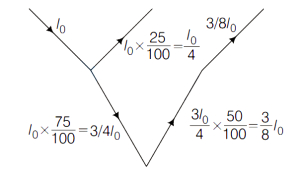
$A$ parallel beam of light of intensity $I_0$ is incident on a coated glass plate. If $25 \%$ of the incident light is reflected from the upper surface and $50 \%$ of the light that enters the glass is reflected from the lower surface of the glass plate,the ratio of maximum to minimum intensity in the interference region of the reflected light is
A
$\left(\frac{\frac{1}{2}+\sqrt{\frac{3}{8}}}{\frac{1}{2}-\sqrt{\frac{3}{8}}}\right)^2$
B
$\left(\frac{\frac{1}{4}+\sqrt{\frac{3}{8}}}{\frac{1}{2}-\sqrt{\frac{3}{8}}}\right)^2$
C
$\frac{5}{8}$
D
$\frac{8}{5}$
Solution
(A) Let $I_0$ be the intensity of the incident light.
Intensity reflected from the upper surface,$I_1 = 25 \% \text{ of } I_0 = \frac{I_0}{4}$.
Intensity transmitted into the glass plate = $I_0 - \frac{I_0}{4} = \frac{3I_0}{4}$.
Intensity reflected from the lower surface,$I_2 = 50 \% \text{ of } \frac{3I_0}{4} = \frac{1}{2} \times \frac{3I_0}{4} = \frac{3I_0}{8}$.
The ratio of maximum to minimum intensity is given by the formula:
$\frac{I_{\max}}{I_{\min}} = \frac{(\sqrt{I_1} + \sqrt{I_2})^2}{(\sqrt{I_1} - \sqrt{I_2})^2} = \left( \frac{\sqrt{\frac{I_0}{4}} + \sqrt{\frac{3I_0}{8}}}{\sqrt{\frac{I_0}{4}} - \sqrt{\frac{3I_0}{8}}} \right)^2 = \left( \frac{\frac{1}{2} + \sqrt{\frac{3}{8}}}{\frac{1}{2} - \sqrt{\frac{3}{8}}} \right)^2$.
Intensity reflected from the upper surface,$I_1 = 25 \% \text{ of } I_0 = \frac{I_0}{4}$.
Intensity transmitted into the glass plate = $I_0 - \frac{I_0}{4} = \frac{3I_0}{4}$.
Intensity reflected from the lower surface,$I_2 = 50 \% \text{ of } \frac{3I_0}{4} = \frac{1}{2} \times \frac{3I_0}{4} = \frac{3I_0}{8}$.
The ratio of maximum to minimum intensity is given by the formula:
$\frac{I_{\max}}{I_{\min}} = \frac{(\sqrt{I_1} + \sqrt{I_2})^2}{(\sqrt{I_1} - \sqrt{I_2})^2} = \left( \frac{\sqrt{\frac{I_0}{4}} + \sqrt{\frac{3I_0}{8}}}{\sqrt{\frac{I_0}{4}} - \sqrt{\frac{3I_0}{8}}} \right)^2 = \left( \frac{\frac{1}{2} + \sqrt{\frac{3}{8}}}{\frac{1}{2} - \sqrt{\frac{3}{8}}} \right)^2$.
0 likesView Solution
Vedclass Products
For Students
Vedclass Test Series
Mock tests in real TS EAMCET style covering Physics with performance analysis. 5-day free trial.
Start Free TrialFor Teachers
Exam Paper Generator
Generate Set A/B/C/D Physics papers from 7.5L+ questions in 2 minutes. 3 chapters free.
Try FreeFor Institutes
Online Exam Module
Run live TS EAMCET mock exams with unlimited students, 360° analytics & white-label branding.
See DemoFrequently Asked Questions
How many Physics questions are in TS EAMCET 2017?
There are 40 Physics questions from the TS EAMCET 2017 paper on Vedclass, each with a detailed step-by-step solution in English.
Are TS EAMCET 2017 Physics solutions available in English?
Yes. All solutions on this page are in English. You can also switch to English or Hindi using the language buttons above the questions.
Can I practice TS EAMCET 2017 Physics as a timed test?
Yes. Use the Vedclass Test Series to attempt a full TS EAMCET mock test covering Physics with time limits and instant score analysis.
Can teachers create Physics papers from TS EAMCET previous year questions?
Yes. The Vedclass Exam Paper Generator lets teachers mix TS EAMCET Physics questions and generate Set A/B/C/D papers in minutes.
For Teachers & Institutes
Build a Custom Physics Paper
Pick TS EAMCET 2017 Physics questions, set difficulty, and generate Set A/B/C/D in 2 minutes.