
ChemistryQ1–47 of 47 questions
Page 1 of 1 · English
1
ChemistryMCQTS EAMCET · 2017
In the expansion of $(1 + x)^n$,the coefficients of the $p^{th}$ and $(p + 1)^{th}$ terms are respectively $p$ and $q$. Then $p + q = $
A
$n + 3$
B
$n + 1$
C
$n + 2$
D
$n$
Solution
(B) The $p^{th}$ term in the expansion of $(1 + x)^n$ is $T_p = {}^nC_{p-1} x^{p-1}$. The coefficient is $p = {}^nC_{p-1}$.
The $(p + 1)^{th}$ term is $T_{p+1} = {}^nC_p x^p$. The coefficient is $q = {}^nC_p$.
We know that $\frac{q}{p} = \frac{{}^nC_p}{{}^nC_{p-1}} = \frac{n - p + 1}{p}$.
Thus,$pq = p(n - p + 1)$ is not the correct path; rather,we use the property of binomial coefficients:
$\frac{q}{p} = \frac{n - p + 1}{p} \implies qp = p(n - p + 1)$.
Actually,the question implies the coefficients are $p$ and $q$ as variables. Given $p = {}^nC_{p-1}$ and $q = {}^nC_p$,the relation $\frac{q}{p} = \frac{n - p + 1}{p}$ leads to $q = \frac{n - p + 1}{p} \cdot p = n - p + 1$.
Therefore,$p + q = n + 1$.
The $(p + 1)^{th}$ term is $T_{p+1} = {}^nC_p x^p$. The coefficient is $q = {}^nC_p$.
We know that $\frac{q}{p} = \frac{{}^nC_p}{{}^nC_{p-1}} = \frac{n - p + 1}{p}$.
Thus,$pq = p(n - p + 1)$ is not the correct path; rather,we use the property of binomial coefficients:
$\frac{q}{p} = \frac{n - p + 1}{p} \implies qp = p(n - p + 1)$.
Actually,the question implies the coefficients are $p$ and $q$ as variables. Given $p = {}^nC_{p-1}$ and $q = {}^nC_p$,the relation $\frac{q}{p} = \frac{n - p + 1}{p}$ leads to $q = \frac{n - p + 1}{p} \cdot p = n - p + 1$.
Therefore,$p + q = n + 1$.
0 likesView Solution
2
ChemistryMCQTS EAMCET · 2017
If $\alpha$ and $\beta$ are the roots of the equation $ax^2+bx+c=0$ and if $px^2+qx+r=0$ has roots $\frac{1-\alpha}{\alpha}$ and $\frac{1-\beta}{\beta}$,then $r$ is equal to
A
$a+2b$
B
$a+b+c$
C
$ab+bc+ca$
D
$abc$
Solution
(B) Given that $\alpha$ and $\beta$ are the roots of $ax^2+bx+c=0$.
Then,$\alpha+\beta = -\frac{b}{a}$ and $\alpha\beta = \frac{c}{a}$.
The roots of the equation $px^2+qx+r=0$ are $x_1 = \frac{1-\alpha}{\alpha} = \frac{1}{\alpha}-1$ and $x_2 = \frac{1-\beta}{\beta} = \frac{1}{\beta}-1$.
The equation with roots $x_1$ and $x_2$ is given by $x^2 - (x_1+x_2)x + x_1x_2 = 0$.
Sum of roots: $x_1+x_2 = (\frac{1}{\alpha}-1) + (\frac{1}{\beta}-1) = \frac{\alpha+\beta}{\alpha\beta} - 2 = \frac{-b/a}{c/a} - 2 = -\frac{b}{c} - 2 = -\frac{b+2c}{c}$.
Product of roots: $x_1x_2 = (\frac{1}{\alpha}-1)(\frac{1}{\beta}-1) = \frac{1}{\alpha\beta} - (\frac{1}{\alpha}+\frac{1}{\beta}) + 1 = \frac{1}{\alpha\beta} - \frac{\alpha+\beta}{\alpha\beta} + 1 = \frac{a}{c} - (\frac{-b/a}{c/a}) + 1 = \frac{a}{c} + \frac{b}{c} + 1 = \frac{a+b+c}{c}$.
Substituting these into the quadratic equation: $x^2 - (-\frac{b+2c}{c})x + \frac{a+b+c}{c} = 0$.
Multiplying by $c$: $cx^2 + (b+2c)x + (a+b+c) = 0$.
Comparing this with $px^2+qx+r=0$,we get $r = a+b+c$.
Then,$\alpha+\beta = -\frac{b}{a}$ and $\alpha\beta = \frac{c}{a}$.
The roots of the equation $px^2+qx+r=0$ are $x_1 = \frac{1-\alpha}{\alpha} = \frac{1}{\alpha}-1$ and $x_2 = \frac{1-\beta}{\beta} = \frac{1}{\beta}-1$.
The equation with roots $x_1$ and $x_2$ is given by $x^2 - (x_1+x_2)x + x_1x_2 = 0$.
Sum of roots: $x_1+x_2 = (\frac{1}{\alpha}-1) + (\frac{1}{\beta}-1) = \frac{\alpha+\beta}{\alpha\beta} - 2 = \frac{-b/a}{c/a} - 2 = -\frac{b}{c} - 2 = -\frac{b+2c}{c}$.
Product of roots: $x_1x_2 = (\frac{1}{\alpha}-1)(\frac{1}{\beta}-1) = \frac{1}{\alpha\beta} - (\frac{1}{\alpha}+\frac{1}{\beta}) + 1 = \frac{1}{\alpha\beta} - \frac{\alpha+\beta}{\alpha\beta} + 1 = \frac{a}{c} - (\frac{-b/a}{c/a}) + 1 = \frac{a}{c} + \frac{b}{c} + 1 = \frac{a+b+c}{c}$.
Substituting these into the quadratic equation: $x^2 - (-\frac{b+2c}{c})x + \frac{a+b+c}{c} = 0$.
Multiplying by $c$: $cx^2 + (b+2c)x + (a+b+c) = 0$.
Comparing this with $px^2+qx+r=0$,we get $r = a+b+c$.
0 likesView Solution
3
ChemistryMCQTS EAMCET · 2017
In the expansion of $(1+x)^n$,the coefficients of the $p^{th}$ and $(p+1)^{th}$ terms are respectively $p$ and $q$. Then $p+q$ is equal to:
A
$n$
B
$n+1$
C
$n+2$
D
$n+3$
Solution
(B) The $p^{th}$ term in the expansion of $(1+x)^n$ is $T_p = { }^n C_{p-1} x^{p-1}$,so its coefficient is $p = { }^n C_{p-1}$.
The $(p+1)^{th}$ term is $T_{p+1} = { }^n C_p x^p$,so its coefficient is $q = { }^n C_p$.
We know the property of binomial coefficients: $\frac{{ }^n C_r}{{ }^n C_{r-1}} = \frac{n-r+1}{r}$.
Here,$\frac{q}{p} = \frac{{ }^n C_p}{{ }^n C_{p-1}} = \frac{n-p+1}{p}$.
Thus,$q = \frac{p(n-p+1)}{p} = n-p+1$.
Rearranging the terms,we get $p+q = n+1$.
The $(p+1)^{th}$ term is $T_{p+1} = { }^n C_p x^p$,so its coefficient is $q = { }^n C_p$.
We know the property of binomial coefficients: $\frac{{ }^n C_r}{{ }^n C_{r-1}} = \frac{n-r+1}{r}$.
Here,$\frac{q}{p} = \frac{{ }^n C_p}{{ }^n C_{p-1}} = \frac{n-p+1}{p}$.
Thus,$q = \frac{p(n-p+1)}{p} = n-p+1$.
Rearranging the terms,we get $p+q = n+1$.
0 likesView Solution
4
ChemistryDifficultMCQTS EAMCET · 2017
Oxidation of cyclohexene in the presence of acidic potassium permanganate leads to:
A
glutaric acid
B
adipic acid
C
pimelic acid
D
succinic acid
Solution
(B) The oxidation of $cyclohexene$ with a strong oxidizing agent like acidic $KMnO_4$ results in the cleavage of the double bond and the formation of a dicarboxylic acid.
Specifically,$cyclohexene$ $(C_6H_{10})$ undergoes oxidative cleavage to form $adipic$ $acid$ $(HOOC-(CH_2)_4-COOH)$,which is a $6$-carbon dicarboxylic acid.
The chemical reaction is as follows:
$3C_6H_{10} + 8KMnO_4 + 4H_2O \rightarrow 3HOOC(CH_2)_4COOH + 8KOH + 8MnO_2$
Thus,the product formed is $adipic$ $acid$.
Specifically,$cyclohexene$ $(C_6H_{10})$ undergoes oxidative cleavage to form $adipic$ $acid$ $(HOOC-(CH_2)_4-COOH)$,which is a $6$-carbon dicarboxylic acid.
The chemical reaction is as follows:
$3C_6H_{10} + 8KMnO_4 + 4H_2O \rightarrow 3HOOC(CH_2)_4COOH + 8KOH + 8MnO_2$
Thus,the product formed is $adipic$ $acid$.
0 likesView Solution
5
ChemistryMediumMCQTS EAMCET · 2017
The species having a pyramidal shape according to $VSEPR$ theory is:
A
$SO_3$
B
$BrF_3$
C
$SO_3^{2-}$
D
$XeF_2$
Solution
(C) According to $VSEPR$ theory,the shape of a molecule depends on the number of bonding pairs $(b.p.)$ and lone pairs $(l.p.)$ around the central atom.
$1.$ $SO_3$: Central atom $S$ has $3$ $b.p.$ and $0$ $l.p.$,resulting in a trigonal planar shape.
$2.$ $BrF_3$: Central atom $Br$ has $3$ $b.p.$ and $2$ $l.p.$,resulting in a $T$-shaped geometry.
$3.$ $SO_3^{2-}$: Central atom $S$ has $3$ $b.p.$ and $1$ $l.p.$,which gives it a pyramidal shape.
$4.$ $XeF_2$: Central atom $Xe$ has $2$ $b.p.$ and $3$ $l.p.$,resulting in a linear shape.
Therefore,the correct species with a pyramidal shape is $SO_3^{2-}$.
$1.$ $SO_3$: Central atom $S$ has $3$ $b.p.$ and $0$ $l.p.$,resulting in a trigonal planar shape.
$2.$ $BrF_3$: Central atom $Br$ has $3$ $b.p.$ and $2$ $l.p.$,resulting in a $T$-shaped geometry.
$3.$ $SO_3^{2-}$: Central atom $S$ has $3$ $b.p.$ and $1$ $l.p.$,which gives it a pyramidal shape.
$4.$ $XeF_2$: Central atom $Xe$ has $2$ $b.p.$ and $3$ $l.p.$,resulting in a linear shape.
Therefore,the correct species with a pyramidal shape is $SO_3^{2-}$.
0 likesView Solution
6
ChemistryEasyMCQTS EAMCET · 2017
The bond length $(pm)$ of $F_2$, $H_2$, $Cl_2$ and $I_2$, respectively is
A
$144, 74, 199, 267$
B
$74, 144, 199, 267$
C
$74, 267, 199, 144$
D
$144, 74, 267, 199$
Solution
(A) The bond lengths for the given molecules are as follows:
$H_2 = 74 \ pm$
$F_2 = 144 \ pm$
$Cl_2 = 199 \ pm$
$I_2 = 267 \ pm$
Therefore, the order for $F_2, H_2, Cl_2, I_2$ is $144, 74, 199, 267 \ pm$.
Thus, the correct option is $A$.
$H_2 = 74 \ pm$
$F_2 = 144 \ pm$
$Cl_2 = 199 \ pm$
$I_2 = 267 \ pm$
Therefore, the order for $F_2, H_2, Cl_2, I_2$ is $144, 74, 199, 267 \ pm$.
Thus, the correct option is $A$.
0 likesView Solution
7
ChemistryEasyMCQTS EAMCET · 2017
The set representing the correct order of ionic radius is:
A
$Li^{+} > Na^{+} > Mg^{2+} > Be^{2+}$
B
$Mg^{2+} > Be^{2+} > Li^{+} > Na^{+}$
C
$Na^{+} > Mg^{2+} > Li^{+} > Be^{2+}$
D
$Na^{+} > Li^{+} > Mg^{2+} > Be^{2+}$
Solution
(D) Ionic radius depends on the number of shells and the effective nuclear charge.
$Na^{+}$ $(1s^2 2s^2 2p^6)$ has $3$ shells,while $Li^{+}$,$Mg^{2+}$,and $Be^{2+}$ have $2$ shells.
Among ions with $2$ shells ($Li^{+}$,$Mg^{2+}$,$Be^{2+}$),the ionic radius decreases as the positive charge increases.
$Li^{+}$ $(Z=3)$ has the lowest charge,followed by $Mg^{2+}$ ($Z=12$,but smaller due to higher charge),and $Be^{2+}$ $(Z=4)$ is the smallest.
Thus,the correct order is $Na^{+} > Li^{+} > Mg^{2+} > Be^{2+}$.
$Na^{+}$ $(1s^2 2s^2 2p^6)$ has $3$ shells,while $Li^{+}$,$Mg^{2+}$,and $Be^{2+}$ have $2$ shells.
Among ions with $2$ shells ($Li^{+}$,$Mg^{2+}$,$Be^{2+}$),the ionic radius decreases as the positive charge increases.
$Li^{+}$ $(Z=3)$ has the lowest charge,followed by $Mg^{2+}$ ($Z=12$,but smaller due to higher charge),and $Be^{2+}$ $(Z=4)$ is the smallest.
Thus,the correct order is $Na^{+} > Li^{+} > Mg^{2+} > Be^{2+}$.
0 likesView Solution
8
ChemistryMediumMCQTS EAMCET · 2017
Which of the following elements has the lowest melting point?
A
$Sn$
B
$Pb$
C
$Si$
D
$Ge$
Solution
(B) The melting point order of group $14$ elements is $C > Si > Ge > Sn > Pb$.
Among the given options,$Pb$ $(Lead)$ has the lowest melting point.
Among the given options,$Pb$ $(Lead)$ has the lowest melting point.
0 likesView Solution
9
ChemistryEasyMCQTS EAMCET · 2017
The atomic radii $(pm)$ of $Al, Si, N$ and $F$ respectively are:
A
$117, 143, 64, 74$
B
$143, 117, 74, 64$
C
$143, 117, 64, 74$
D
$64, 74, 117, 143$
Solution
(B) The atomic radii of the given elements are approximately: $Al = 143 \ pm$, $Si = 117 \ pm$, $N = 74 \ pm$, and $F = 64 \ pm$.
$Al$ and $Si$ belong to the $3^{rd}$ period, while $N$ and $F$ belong to the $2^{nd}$ period.
Within a period, the atomic radius decreases from left > right due to an increase in effective nuclear charge.
Thus, the order of atomic radii is $Al (143 \ pm) > Si (117 \ pm) > N (74 \ pm) > F (64 \ pm)$.
$Al$ and $Si$ belong to the $3^{rd}$ period, while $N$ and $F$ belong to the $2^{nd}$ period.
Within a period, the atomic radius decreases from left > right due to an increase in effective nuclear charge.
Thus, the order of atomic radii is $Al (143 \ pm) > Si (117 \ pm) > N (74 \ pm) > F (64 \ pm)$.
0 likesView Solution
10
ChemistryDifficultMCQTS EAMCET · 2017
The cyclopentadienyl anion is:
A
benzenoid and aromatic
B
non-benzenoid and aromatic
C
non-benzenoid and non-aromatic
D
non-benzenoid and anti-aromatic
Solution
(B) The cyclopentadienyl anion is a cyclic,planar species with $6 \pi \ e^-$ (where $n=1$ in the $4n+2$ $H$ückel rule).
Since it contains $6 \pi \ e^-$,it follows $H$ückel's rule and is aromatic.
Because it does not contain a benzene ring,it is classified as non-benzenoid.
Therefore,it is non-benzenoid and aromatic.
Since it contains $6 \pi \ e^-$,it follows $H$ückel's rule and is aromatic.
Because it does not contain a benzene ring,it is classified as non-benzenoid.
Therefore,it is non-benzenoid and aromatic.
0 likesView Solution
11
ChemistryMCQTS EAMCET · 2017
If $\alpha$ and $\beta$ are the roots of the equation $ax^2+bx+c=0$ and the equation having roots $\frac{1-\alpha}{\alpha}$ and $\frac{1-\beta}{\beta}$ is $px^2+qx+r=0$,then $r=$
A
$a+2b$
B
$ab+bc+ca$
C
$a+b+c$
D
$abc$
Solution
(C) Given that $\alpha$ and $\beta$ are the roots of $ax^2+bx+c=0$.
Then,$\alpha+\beta = -\frac{b}{a}$ and $\alpha\beta = \frac{c}{a}$.
The roots of the new equation are $\gamma = \frac{1-\alpha}{\alpha} = \frac{1}{\alpha}-1$ and $\delta = \frac{1-\beta}{\beta} = \frac{1}{\beta}-1$.
The new equation is $x^2 - (\gamma+\delta)x + \gamma\delta = 0$.
Sum of roots: $\gamma+\delta = (\frac{1}{\alpha}-1) + (\frac{1}{\beta}-1) = \frac{\alpha+\beta}{\alpha\beta} - 2 = \frac{-b/a}{c/a} - 2 = -\frac{b}{c} - 2 = -\frac{b+2c}{c}$.
Product of roots: $\gamma\delta = (\frac{1}{\alpha}-1)(\frac{1}{\beta}-1) = \frac{1}{\alpha\beta} - (\frac{1}{\alpha}+\frac{1}{\beta}) + 1 = \frac{1}{\alpha\beta} - \frac{\alpha+\beta}{\alpha\beta} + 1 = \frac{a}{c} - \frac{-b/a}{c/a} + 1 = \frac{a}{c} + \frac{b}{c} + 1 = \frac{a+b+c}{c}$.
The equation is $x^2 - (-\frac{b+2c}{c})x + \frac{a+b+c}{c} = 0$.
Multiplying by $c$,we get $cx^2 + (b+2c)x + (a+b+c) = 0$.
Comparing with $px^2+qx+r=0$,we find $r = a+b+c$.
Then,$\alpha+\beta = -\frac{b}{a}$ and $\alpha\beta = \frac{c}{a}$.
The roots of the new equation are $\gamma = \frac{1-\alpha}{\alpha} = \frac{1}{\alpha}-1$ and $\delta = \frac{1-\beta}{\beta} = \frac{1}{\beta}-1$.
The new equation is $x^2 - (\gamma+\delta)x + \gamma\delta = 0$.
Sum of roots: $\gamma+\delta = (\frac{1}{\alpha}-1) + (\frac{1}{\beta}-1) = \frac{\alpha+\beta}{\alpha\beta} - 2 = \frac{-b/a}{c/a} - 2 = -\frac{b}{c} - 2 = -\frac{b+2c}{c}$.
Product of roots: $\gamma\delta = (\frac{1}{\alpha}-1)(\frac{1}{\beta}-1) = \frac{1}{\alpha\beta} - (\frac{1}{\alpha}+\frac{1}{\beta}) + 1 = \frac{1}{\alpha\beta} - \frac{\alpha+\beta}{\alpha\beta} + 1 = \frac{a}{c} - \frac{-b/a}{c/a} + 1 = \frac{a}{c} + \frac{b}{c} + 1 = \frac{a+b+c}{c}$.
The equation is $x^2 - (-\frac{b+2c}{c})x + \frac{a+b+c}{c} = 0$.
Multiplying by $c$,we get $cx^2 + (b+2c)x + (a+b+c) = 0$.
Comparing with $px^2+qx+r=0$,we find $r = a+b+c$.
0 likesView Solution
12
ChemistryMCQTS EAMCET · 2017
If the imaginary part of $\frac{2z+1}{iz+1}$ is $-2$,then the locus of the point representing $z$ in the Argand plane is
A
a circle
B
a straight line
C
a parabola
D
an ellipse
Solution
(B) Let $z = x + iy$. Then $\frac{2z+1}{iz+1} = \frac{2(x+iy)+1}{i(x+iy)+1} = \frac{(2x+1) + 2yi}{(1-y) + xi}$.
Multiplying the numerator and denominator by the conjugate of the denominator $(1-y) - xi$:
$\frac{((2x+1) + 2yi)((1-y) - xi)}{(1-y)^2 + x^2} = \frac{(2x+1)(1-y) + 2xy + i(2y(1-y) - x(2x+1))}{(1-y)^2 + x^2}$.
The imaginary part is given as $-2$:
$\frac{2y - 2y^2 - 2x^2 - x}{(1-y)^2 + x^2} = -2$.
$2y - 2y^2 - 2x^2 - x = -2((1-y)^2 + x^2) = -2(1 - 2y + y^2 + x^2) = -2 + 4y - 2y^2 - 2x^2$.
Simplifying the equation:
$-x - 2y + 2 = 0$,which is $x + 2y - 2 = 0$.
This represents a straight line.
Multiplying the numerator and denominator by the conjugate of the denominator $(1-y) - xi$:
$\frac{((2x+1) + 2yi)((1-y) - xi)}{(1-y)^2 + x^2} = \frac{(2x+1)(1-y) + 2xy + i(2y(1-y) - x(2x+1))}{(1-y)^2 + x^2}$.
The imaginary part is given as $-2$:
$\frac{2y - 2y^2 - 2x^2 - x}{(1-y)^2 + x^2} = -2$.
$2y - 2y^2 - 2x^2 - x = -2((1-y)^2 + x^2) = -2(1 - 2y + y^2 + x^2) = -2 + 4y - 2y^2 - 2x^2$.
Simplifying the equation:
$-x - 2y + 2 = 0$,which is $x + 2y - 2 = 0$.
This represents a straight line.
0 likesView Solution
13
ChemistryMCQTS EAMCET · 2017
In the expansion of $(1+x)^n$,the coefficients of $p$-th and $(p+1)$-th terms are respectively $p$ and $q$. Then $p+q=$
A
$n+3$
B
$n+2$
C
$n$
D
$n+1$
Solution
(D) In the expansion of $(1+x)^n$,the general term,i.e.,$(r+1)$-th term is given by $T_{r+1} = { }^n C_r x^r$.
The coefficient of the $p$-th term is ${ }^n C_{p-1}$. Given that this coefficient is $p$,we have $p = { }^n C_{p-1}$.
The coefficient of the $(p+1)$-th term is ${ }^n C_p$. Given that this coefficient is $q$,we have $q = { }^n C_p$.
Now,consider the ratio $\frac{q}{p} = \frac{{ }^n C_p}{{ }^n C_{p-1}}$.
Using the formula $\frac{{ }^n C_r}{{ }^n C_{r-1}} = \frac{n-r+1}{r}$,we get:
$\frac{q}{p} = \frac{n-p+1}{p}$.
Cross-multiplying,we get $qp = p(n-p+1)$.
Wait,let us re-evaluate the given condition: coefficients are $p$ and $q$.
Actually,the problem states the coefficients are $p$ and $q$. Let's use the property $\frac{{ }^n C_p}{{ }^n C_{p-1}} = \frac{n-p+1}{p}$.
Since $q = { }^n C_p$ and $p = { }^n C_{p-1}$,we have $\frac{q}{p} = \frac{n-p+1}{p}$.
This implies $q = n-p+1$,which simplifies to $p+q = n+1$.
The coefficient of the $p$-th term is ${ }^n C_{p-1}$. Given that this coefficient is $p$,we have $p = { }^n C_{p-1}$.
The coefficient of the $(p+1)$-th term is ${ }^n C_p$. Given that this coefficient is $q$,we have $q = { }^n C_p$.
Now,consider the ratio $\frac{q}{p} = \frac{{ }^n C_p}{{ }^n C_{p-1}}$.
Using the formula $\frac{{ }^n C_r}{{ }^n C_{r-1}} = \frac{n-r+1}{r}$,we get:
$\frac{q}{p} = \frac{n-p+1}{p}$.
Cross-multiplying,we get $qp = p(n-p+1)$.
Wait,let us re-evaluate the given condition: coefficients are $p$ and $q$.
Actually,the problem states the coefficients are $p$ and $q$. Let's use the property $\frac{{ }^n C_p}{{ }^n C_{p-1}} = \frac{n-p+1}{p}$.
Since $q = { }^n C_p$ and $p = { }^n C_{p-1}$,we have $\frac{q}{p} = \frac{n-p+1}{p}$.
This implies $q = n-p+1$,which simplifies to $p+q = n+1$.
0 likesView Solution
14
ChemistryDifficultMCQTS EAMCET · 2017
Reaction of calgon with hard water containing $Ca^{2+}$ ions produces:
A
$\left[Na_2CaP_6O_{18}\right]^{2-}$
B
$Ca_2\left(PO_4\right)_3$
C
$CaCO_3$
D
$CaSO_4$
Solution
(A) Calgon is the trade name for sodium hexametaphosphate,$\left(NaPO_3\right)_6$.
It ionizes in water to provide a complex anion:
$Na_2\left(Na_4P_6O_{18}\right) \longrightarrow 2Na^{+} + \left[Na_4P_6O_{18}\right]^{2-}$
When added to hard water,the $Ca^{2+}$ ions displace the $Na^{+}$ ions from the complex anion to form a soluble complex:
$Ca^{2+} + \left[Na_4P_6O_{18}\right]^{2-} \longrightarrow \left[CaNa_2P_6O_{18}\right]^{2-} + 2Na^{+}$
It ionizes in water to provide a complex anion:
$Na_2\left(Na_4P_6O_{18}\right) \longrightarrow 2Na^{+} + \left[Na_4P_6O_{18}\right]^{2-}$
When added to hard water,the $Ca^{2+}$ ions displace the $Na^{+}$ ions from the complex anion to form a soluble complex:
$Ca^{2+} + \left[Na_4P_6O_{18}\right]^{2-} \longrightarrow \left[CaNa_2P_6O_{18}\right]^{2-} + 2Na^{+}$
0 likesView Solution
15
ChemistryMCQTS EAMCET · 2017
If the magnitudes of $a, b$ and $a+b$ are respectively $3, 4$ and $5$,then the magnitude of $(a-b)$ is
A
$3$
B
$4$
C
$6$
D
$5$
Solution
(D) Given,$|a|=3, |b|=4$ and $|a+b|=5$.
Since $|a+b|=5$,squaring both sides gives $|a+b|^2=25$.
Expanding this,we get $(a+b) \cdot (a+b) = 25$,which simplifies to $|a|^2 + 2(a \cdot b) + |b|^2 = 25$.
Substituting the given values,$3^2 + 2(a \cdot b) + 4^2 = 25$,so $9 + 2(a \cdot b) + 16 = 25$,which implies $2(a \cdot b) = 0$,hence $a \cdot b = 0$.
Now,we need to find $|a-b|$.
We know that $|a-b|^2 = (a-b) \cdot (a-b) = |a|^2 - 2(a \cdot b) + |b|^2$.
Substituting the values,$|a-b|^2 = 3^2 - 2(0) + 4^2 = 9 + 16 = 25$.
Therefore,$|a-b| = \sqrt{25} = 5$.
Since $|a+b|=5$,squaring both sides gives $|a+b|^2=25$.
Expanding this,we get $(a+b) \cdot (a+b) = 25$,which simplifies to $|a|^2 + 2(a \cdot b) + |b|^2 = 25$.
Substituting the given values,$3^2 + 2(a \cdot b) + 4^2 = 25$,so $9 + 2(a \cdot b) + 16 = 25$,which implies $2(a \cdot b) = 0$,hence $a \cdot b = 0$.
Now,we need to find $|a-b|$.
We know that $|a-b|^2 = (a-b) \cdot (a-b) = |a|^2 - 2(a \cdot b) + |b|^2$.
Substituting the values,$|a-b|^2 = 3^2 - 2(0) + 4^2 = 9 + 16 = 25$.
Therefore,$|a-b| = \sqrt{25} = 5$.
0 likesView Solution
16
ChemistryEasyMCQTS EAMCET · 2017
The bonding in diborane $(B_2H_6)$ can be described by
A
$4$ two-centre-two-electron bonds and $2$ three-centre-two-electron bonds
B
$3$ two-centre-two-electron bonds and $3$ three-centre-two-electron bonds
C
$2$ two-centre-two-electron bonds and $4$ three-centre-two-electron bonds
D
$4$ two-centre-two-electron bonds and $4$ two-centre-two-electron bonds
Solution
(A) The molecular formula of diborane is $B_2H_6$.
In the structure of diborane,there are $4$ terminal $B-H$ bonds which are $2$-centre-$2$-electron $(2C-2e^-)$ bonds.
Additionally,there are $2$ bridging $B-H-B$ bonds,which are $3$-centre-$2$-electron $(3C-2e^-)$ bonds.
Therefore,the bonding consists of $4$ two-centre-two-electron bonds and $2$ three-centre-two-electron bonds.
In the structure of diborane,there are $4$ terminal $B-H$ bonds which are $2$-centre-$2$-electron $(2C-2e^-)$ bonds.
Additionally,there are $2$ bridging $B-H-B$ bonds,which are $3$-centre-$2$-electron $(3C-2e^-)$ bonds.
Therefore,the bonding consists of $4$ two-centre-two-electron bonds and $2$ three-centre-two-electron bonds.
0 likesView Solution
17
ChemistryEasyMCQTS EAMCET · 2017
Which among the following is the strongest acid?
A
$HF$
B
$HCl$
C
$HBr$
D
$HI$
Solution
(D) Among hydrogen halides,the strongest acid is $HI$.
As the size of the halogen increases,the bond length increases,and consequently,the bond dissociation energy decreases.
Therefore,$HI$ releases $H^{\oplus}$ ions most easily,exhibiting the highest acidic nature.
As the size of the halogen increases,the bond length increases,and consequently,the bond dissociation energy decreases.
Therefore,$HI$ releases $H^{\oplus}$ ions most easily,exhibiting the highest acidic nature.
0 likesView Solution
18
ChemistryDifficultMCQTS EAMCET · 2017
When helium gas is allowed to expand into vacuum,a heating effect is observed. The reason for this is (assume $He$ as a non-ideal gas):
A
$He$ is an inert gas
B
The inversion temperature of helium is very high
C
The inversion temperature of helium is very low
D
$He$ has the lowest boiling point.
Solution
(C) The Joule-Thomson effect describes the temperature change of a real gas as it is forced through a valve or porous plug while kept insulated so that no heat is exchanged with the environment.
For most gases,expansion results in cooling because work is done to overcome intermolecular forces.
However,for gases like $H_2$ and $He$,the inversion temperature is very low (for $He$,it is approximately $40 \ K$).
If the gas temperature is above its inversion temperature during expansion,it exhibits a heating effect instead of cooling.
Since the inversion temperature of $He$ is very low,it shows a heating effect under standard conditions.
For most gases,expansion results in cooling because work is done to overcome intermolecular forces.
However,for gases like $H_2$ and $He$,the inversion temperature is very low (for $He$,it is approximately $40 \ K$).
If the gas temperature is above its inversion temperature during expansion,it exhibits a heating effect instead of cooling.
Since the inversion temperature of $He$ is very low,it shows a heating effect under standard conditions.
0 likesView Solution
19
ChemistryDifficultMCQTS EAMCET · 2017
Balance the following chemical equation by choosing the correct option for the coefficients $x, y, p, q, r,$ and $s$.
$x KNO_3 + y C_{12}H_{22}O_{11} \longrightarrow p N_2 + q CO_2 + r H_2O + s K_2CO_3$
$x KNO_3 + y C_{12}H_{22}O_{11} \longrightarrow p N_2 + q CO_2 + r H_2O + s K_2CO_3$
A
$x=36, y=55, p=24, q=24, r=5, s=48$
B
$x=48, y=5, p=24, q=36, r=55, s=24$
C
$x=24, y=24, p=36, q=55, r=48, s=5$
D
$x=24, y=48, p=36, q=24, r=5, s=55$
Solution
(B) To balance the equation $x KNO_3 + y C_{12}H_{22}O_{11} \longrightarrow p N_2 + q CO_2 + r H_2O + s K_2CO_3$:
$1$. Balance $K$: $x = 2s$
$2$. Balance $N$: $x = 2p$
$3$. Balance $C$: $12y = q + s$
$4$. Balance $H$: $22y = 2r \implies 11y = r$
$5$. Balance $O$: $3x + 11y = 2q + r + 3s$
Substituting the values from option $(b)$: $x=48, y=5, p=24, q=36, r=55, s=24$.
$48 KNO_3 + 5 C_{12}H_{22}O_{11} \longrightarrow 24 N_2 + 36 CO_2 + 55 H_2O + 24 K_2CO_3$
Checking atoms:
$K: 48 = 2(24) = 48$ (Balanced)
$N: 48 = 2(24) = 48$ (Balanced)
$C: 12(5) = 60; 36 + 24 = 60$ (Balanced)
$H: 22(5) = 110; 55(2) = 110$ (Balanced)
$O: 3(48) + 11(5) = 144 + 55 = 199; 2(36) + 55 + 3(24) = 72 + 55 + 72 = 199$ (Balanced)
Thus,option $(b)$ is correct.
$1$. Balance $K$: $x = 2s$
$2$. Balance $N$: $x = 2p$
$3$. Balance $C$: $12y = q + s$
$4$. Balance $H$: $22y = 2r \implies 11y = r$
$5$. Balance $O$: $3x + 11y = 2q + r + 3s$
Substituting the values from option $(b)$: $x=48, y=5, p=24, q=36, r=55, s=24$.
$48 KNO_3 + 5 C_{12}H_{22}O_{11} \longrightarrow 24 N_2 + 36 CO_2 + 55 H_2O + 24 K_2CO_3$
Checking atoms:
$K: 48 = 2(24) = 48$ (Balanced)
$N: 48 = 2(24) = 48$ (Balanced)
$C: 12(5) = 60; 36 + 24 = 60$ (Balanced)
$H: 22(5) = 110; 55(2) = 110$ (Balanced)
$O: 3(48) + 11(5) = 144 + 55 = 199; 2(36) + 55 + 3(24) = 72 + 55 + 72 = 199$ (Balanced)
Thus,option $(b)$ is correct.
0 likesView Solution
20
ChemistryDifficultMCQTS EAMCET · 2017
Which of the following statement$(s)$ is/are true?
A
The pressure of a fixed amount of an ideal gas is proportional to its temperature only
B
Frequency of collisions increases in proportion to the square root of temperature
C
The value of van der Waals constant '$a$' is smaller for ammonia than for nitrogen
D
If a gas is expanded at constant temperature,the kinetic energy of the molecules decrease
Solution
(B) According to the kinetic theory of gases,the average speed of gas molecules is proportional to $\sqrt{T}$. Since the frequency of collisions is directly proportional to the average speed of the molecules,it follows that the frequency of collisions increases in proportion to the square root of temperature $(\sqrt{T})$.
0 likesView Solution
21
ChemistryMediumMCQTS EAMCET · 2017
Which of the following corresponds to the energy of a possible excited state of hydrogen (in $eV$)?
A
$-13.6$
B
$13.6$
C
$-3.4$
D
$3.4$
Solution
(C) The energy levels of a hydrogen atom are given by the formula: $E_n = -13.6 / n^2 \ eV$.
For the ground state,$n = 1$,so $E_1 = -13.6 \ eV$.
An excited state occurs when $n > 1$.
For the first excited state,$n = 2$.
Substituting $n = 2$ into the formula: $E_2 = -13.6 / 2^2 = -13.6 / 4 = -3.4 \ eV$.
For the ground state,$n = 1$,so $E_1 = -13.6 \ eV$.
An excited state occurs when $n > 1$.
For the first excited state,$n = 2$.
Substituting $n = 2$ into the formula: $E_2 = -13.6 / 2^2 = -13.6 / 4 = -3.4 \ eV$.
0 likesView Solution
22
ChemistryMediumMCQTS EAMCET · 2017
How many emission spectral lines are possible when a hydrogen atom is excited to the $n$th energy level?
A
$\frac{n(n+1)}{2}$
B
$\frac{(n+1)}{2}$
C
$\frac{n(n-1)}{2}$
D
$\frac{n^2}{4}$
Solution
(C) When an electron in a hydrogen atom is excited to the $n$th energy level,it can return to lower energy levels by emitting photons.
The total number of possible spectral lines is given by the formula:
$\text{Number of spectral lines} = \frac{n(n-1)}{2}$
where $n$ represents the principal quantum number of the excited state.
The total number of possible spectral lines is given by the formula:
$\text{Number of spectral lines} = \frac{n(n-1)}{2}$
where $n$ represents the principal quantum number of the excited state.
0 likesView Solution
23
ChemistryDifficultMCQTS EAMCET · 2017
The standard enthalpy of formation of liquid water at $25^{\circ} C$ is approximately:
$H_{2(g)} + \frac{1}{2} O_{2(g)} \longrightarrow H_2O_{(l)}$
$H_{2(g)} + \frac{1}{2} O_{2(g)} \longrightarrow H_2O_{(l)}$
A
$-237 \ kJ/mol$
B
$237 \ kJ/mol$
C
$-286 \ kJ/mol$
D
$286 \ kJ/mol$
Solution
(C) The standard enthalpy of formation $(\Delta H_f^{\circ})$ is defined as the enthalpy change when $1 \ mol$ of a substance is formed from its elements in their standard states.
For the formation of liquid water: $H_{2(g)} + \frac{1}{2} O_{2(g)} \longrightarrow H_2O_{(l)}$.
The standard enthalpy of formation for liquid water at $298 \ K$ $(25^{\circ} C)$ is $-286 \ kJ/mol$.
For the formation of liquid water: $H_{2(g)} + \frac{1}{2} O_{2(g)} \longrightarrow H_2O_{(l)}$.
The standard enthalpy of formation for liquid water at $298 \ K$ $(25^{\circ} C)$ is $-286 \ kJ/mol$.
0 likesView Solution
24
ChemistryMediumMCQTS EAMCET · 2017
Given $\Delta H_f^{\circ}$ for $CO_{2(g)}$,$CO_{(g)}$ and $H_2 O_{(g)}$ are $-393.5$,$-110.5$ and $-241.8 \ kJ \ mol^{-1}$,respectively. The $\Delta H_r^{\circ}$ [in $kJ \ mol^{-1}$] for the reaction $CO_{2(g)} + H_{2(g)} \longrightarrow CO_{(g)} + H_2 O_{(g)}$ is
A
$524.1$
B
$-262.5$
C
$-41.7$
D
$41.2$
Solution
(D) The reaction is: $CO_{2(g)} + H_{2(g)} \longrightarrow CO_{(g)} + H_2 O_{(g)}$
$\Delta H_r^{\circ} = \sum \Delta H_{f, \text{products}}^{\circ} - \sum \Delta H_{f, \text{reactants}}^{\circ}$
$\Delta H_r^{\circ} = [\Delta H_{f, CO}^{\circ} + \Delta H_{f, H_2 O}^{\circ}] - [\Delta H_{f, CO_2}^{\circ} + \Delta H_{f, H_2}^{\circ}]$
Since the standard enthalpy of formation for an element in its standard state is zero,$\Delta H_{f, H_2}^{\circ} = 0$.
$\Delta H_r^{\circ} = [-110.5 + (-241.8)] - [-393.5 + 0]$
$\Delta H_r^{\circ} = -352.3 + 393.5 = 41.2 \ kJ \ mol^{-1}$
$\Delta H_r^{\circ} = \sum \Delta H_{f, \text{products}}^{\circ} - \sum \Delta H_{f, \text{reactants}}^{\circ}$
$\Delta H_r^{\circ} = [\Delta H_{f, CO}^{\circ} + \Delta H_{f, H_2 O}^{\circ}] - [\Delta H_{f, CO_2}^{\circ} + \Delta H_{f, H_2}^{\circ}]$
Since the standard enthalpy of formation for an element in its standard state is zero,$\Delta H_{f, H_2}^{\circ} = 0$.
$\Delta H_r^{\circ} = [-110.5 + (-241.8)] - [-393.5 + 0]$
$\Delta H_r^{\circ} = -352.3 + 393.5 = 41.2 \ kJ \ mol^{-1}$
0 likesView Solution
25
ChemistryEasyMCQTS EAMCET · 2017
The alcohol that reacts faster with Lucas reagent is
A
$CH_3-CH_2-CH_2-CH_2-OH$
B
$CH_3-CH_2-CH(OH)-CH_3$
C
$(CH_3)_2CH-CH_2-OH$
D
$(CH_3)_3C-OH$
Solution
(D) Lucas reagent is a mixture of concentrated $HCl$ and anhydrous $ZnCl_2$. The reaction of alcohols with Lucas reagent proceeds via an $S_N1$ mechanism,which involves the formation of a carbocation intermediate. The reactivity of alcohols towards Lucas reagent follows the order: $3^{\circ} > 2^{\circ} > 1^{\circ}$.
$(A)$ $CH_3-CH_2-CH_2-CH_2-OH$ is a $1^{\circ}$ alcohol.
$(B)$ $CH_3-CH_2-CH(OH)-CH_3$ is a $2^{\circ}$ alcohol.
$(C)$ $(CH_3)_2CH-CH_2-OH$ is a $1^{\circ}$ alcohol.
$(D)$ $(CH_3)_3C-OH$ is a $3^{\circ}$ alcohol.
Since $3^{\circ}$ alcohols form the most stable carbocation,they react fastest with Lucas reagent,often at room temperature.
$(A)$ $CH_3-CH_2-CH_2-CH_2-OH$ is a $1^{\circ}$ alcohol.
$(B)$ $CH_3-CH_2-CH(OH)-CH_3$ is a $2^{\circ}$ alcohol.
$(C)$ $(CH_3)_2CH-CH_2-OH$ is a $1^{\circ}$ alcohol.
$(D)$ $(CH_3)_3C-OH$ is a $3^{\circ}$ alcohol.
Since $3^{\circ}$ alcohols form the most stable carbocation,they react fastest with Lucas reagent,often at room temperature.
0 likesView Solution
26
ChemistryDifficultMCQTS EAMCET · 2017
Optically active $3-$methylpent$-1-$en$-3-$ol loses its optical activity after standing in water containing a few drops of acid,mainly due to the formation of:
A
$CH_3-CH_2-C(CH_3)=CH-CH_3$
B
$CH_3-CH_2-C(CH_3)=CH_2$
C
$CH_3-CH_2-CH_2-C(CH_3)=CH_2$
D
$CH_3-CH_2-CH=C(CH_3)_2$
Solution
(A) The compound $3-$methylpent$-1-$en$-3-$ol is an allylic alcohol. In the presence of an acid,it undergoes protonation of the $-OH$ group followed by the loss of water to form a resonance-stabilized carbocation: $CH_3-CH_2-C^+(CH_3)-CH=CH_2 \leftrightarrow CH_3-CH_2-C(CH_3)=CH-CH_2^+$.
This carbocation can lose a proton to form a more stable,conjugated diene or a substituted alkene. Specifically,the loss of optical activity occurs because the chiral center at $C-3$ is destroyed upon the formation of the planar carbocation intermediate. The major product formed is $3-$methylpenta$-1,3-$diene or a related stable alkene isomer depending on the specific rearrangement,but among the given options,the most stable alkene formed via rearrangement is $3-$methylpent$-2-$ene $(CH_3-CH_2-C(CH_3)=CH-CH_3)$.
This carbocation can lose a proton to form a more stable,conjugated diene or a substituted alkene. Specifically,the loss of optical activity occurs because the chiral center at $C-3$ is destroyed upon the formation of the planar carbocation intermediate. The major product formed is $3-$methylpenta$-1,3-$diene or a related stable alkene isomer depending on the specific rearrangement,but among the given options,the most stable alkene formed via rearrangement is $3-$methylpent$-2-$ene $(CH_3-CH_2-C(CH_3)=CH-CH_3)$.
0 likesView Solution
27
ChemistryMediumMCQTS EAMCET · 2017
Conversion of esters to aldehydes can be accomplished by
A
Stephen reduction
B
Rosenmund reduction
C
Reduction with lithium aluminium hydride
D
Reduction with diisobutyl aluminium hydride
Solution
(D) $DIBAL-H$ (Diisobutylaluminium hydride) is a selective reducing agent.
It is specifically used for the partial reduction of esters to aldehydes at low temperatures (typically $195 \ K$ to $203 \ K$),preventing further reduction to primary alcohols.
It is specifically used for the partial reduction of esters to aldehydes at low temperatures (typically $195 \ K$ to $203 \ K$),preventing further reduction to primary alcohols.
0 likesView Solution
28
ChemistryEasyMCQTS EAMCET · 2017
Cyclohexylamine and aniline can be distinguished by
A
Hinsberg test
B
Carbylamine test
C
Lassaigne test
D
Azo dye test
Solution
(D) Aniline is an aromatic primary amine,while cyclohexylamine is an aliphatic primary amine.
The azo dye test is specific to aromatic primary amines.
When aniline reacts with nitrous acid $(HNO_2)$ at $0-5 \ ^{\circ}C$ followed by coupling with $\beta$-naphthol,it forms a bright orange or red azo dye.
Cyclohexylamine,being aliphatic,does not form a stable diazonium salt at low temperatures and consequently does not give the azo dye test.
Therefore,the azo dye test is used to distinguish between them.
The azo dye test is specific to aromatic primary amines.
When aniline reacts with nitrous acid $(HNO_2)$ at $0-5 \ ^{\circ}C$ followed by coupling with $\beta$-naphthol,it forms a bright orange or red azo dye.
Cyclohexylamine,being aliphatic,does not form a stable diazonium salt at low temperatures and consequently does not give the azo dye test.
Therefore,the azo dye test is used to distinguish between them.
0 likesView Solution
29
ChemistryEasyMCQTS EAMCET · 2017
The number of complementary hydrogen bond$(s)$ between a guanine and cytosine pair is
A
$2$
B
$1$
C
$4$
D
$3$
Solution
(D) In $DNA$,adenine $(A)$ pairs with thymine $(T)$ through $2$ hydrogen bonds $(A=T)$.
In contrast,guanine $(G)$ pairs with cytosine $(C)$ through $3$ hydrogen bonds $(G \equiv C)$.
In contrast,guanine $(G)$ pairs with cytosine $(C)$ through $3$ hydrogen bonds $(G \equiv C)$.
0 likesView Solution
30
ChemistryDifficultMCQTS EAMCET · 2017
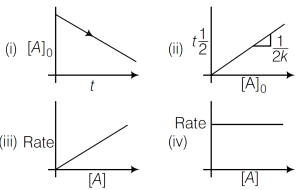
Which of the following are the correct representations of a zero order reaction,where $[A]$ represents the reactant concentration and $[A]_0$ represents the initial concentration?
A
$(i), (ii), (iii)$
B
$(i), (ii), (iv)$
C
$(ii), (iii), (iv)$
D
$(i), (iii), (iv)$
Solution
(B) For a zero order reaction:
$1$. The integrated rate law is $[A] = [A]_0 - kt$. Thus,a plot of $[A]$ versus $t$ is a straight line with a negative slope $(-k)$,which matches graph $(i)$.
$2$. The half-life is $t_{1/2} = \frac{[A]_0}{2k}$. Thus,a plot of $t_{1/2}$ versus $[A]_0$ is a straight line passing through the origin with a slope of $\frac{1}{2k}$,which matches graph $(ii)$.
$3$. The rate law is $\text{Rate} = k[A]^0 = k$. The rate is independent of the reactant concentration. Thus,a plot of $\text{Rate}$ versus $[A]$ is a horizontal line,which matches graph $(iv)$.
Graph $(iii)$ shows $\text{Rate} \propto [A]$,which is characteristic of a first order reaction.
Therefore,the correct representations are $(i), (ii),$ and $(iv)$.
$1$. The integrated rate law is $[A] = [A]_0 - kt$. Thus,a plot of $[A]$ versus $t$ is a straight line with a negative slope $(-k)$,which matches graph $(i)$.
$2$. The half-life is $t_{1/2} = \frac{[A]_0}{2k}$. Thus,a plot of $t_{1/2}$ versus $[A]_0$ is a straight line passing through the origin with a slope of $\frac{1}{2k}$,which matches graph $(ii)$.
$3$. The rate law is $\text{Rate} = k[A]^0 = k$. The rate is independent of the reactant concentration. Thus,a plot of $\text{Rate}$ versus $[A]$ is a horizontal line,which matches graph $(iv)$.
Graph $(iii)$ shows $\text{Rate} \propto [A]$,which is characteristic of a first order reaction.
Therefore,the correct representations are $(i), (ii),$ and $(iv)$.
0 likesView Solution
31
ChemistryEasyMCQTS EAMCET · 2017
$.........$ is a potent vasodilator.
A
Histamine
B
Serotonin
C
Codeine
D
Cimetidine
Solution
(A) Histamine is a potent vasodilator. It causes the dilation of blood vessels,which leads to a decrease in blood pressure.
0 likesView Solution
32
ChemistryMediumMCQTS EAMCET · 2017
Which of the following is the most basic oxide?
A
$SO_3$
B
$SeO_3$
C
$PoO$
D
$TeO_2$
Solution
(C) In group $16$,the metallic character increases as we move down the group from $O$ to $Po$.
Metallic oxides are generally basic in nature,while non-metallic oxides are acidic.
Since $Po$ is a metal,its oxide $PoO$ is the most basic among the given options.
As we move down the group,the electronegativity of the element decreases,which leads to an increase in the basic character of the corresponding oxides.
Metallic oxides are generally basic in nature,while non-metallic oxides are acidic.
Since $Po$ is a metal,its oxide $PoO$ is the most basic among the given options.
As we move down the group,the electronegativity of the element decreases,which leads to an increase in the basic character of the corresponding oxides.
0 likesView Solution
33
ChemistryMediumMCQTS EAMCET · 2017
Which one of the following statements is correct for $d^4$ ions $(P = \text{pairing energy})$?
A
When $\Delta_0 > P$,low-spin complex forms
B
When $\Delta_0 < P$,low-spin complex forms
C
When $\Delta_0 > P$,high-spin complex forms
D
When $\Delta_0 < P$,both high-spin and low-spin complexes form
Solution
(A) In crystal field theory,the distribution of electrons in $d$-orbitals depends on the relative magnitude of crystal field splitting energy $(\Delta_0)$ and pairing energy $(P)$.
When $\Delta_0 > P$,the energy required to pair electrons is less than the energy required to promote an electron to the higher energy $e_g$ orbital.
Therefore,electrons prefer to pair up in the $t_{2g}$ orbitals,resulting in the formation of low-spin complexes.
Conversely,when $\Delta_0 < P$,electrons occupy the higher energy $e_g$ orbitals before pairing,resulting in high-spin complexes.
When $\Delta_0 > P$,the energy required to pair electrons is less than the energy required to promote an electron to the higher energy $e_g$ orbital.
Therefore,electrons prefer to pair up in the $t_{2g}$ orbitals,resulting in the formation of low-spin complexes.
Conversely,when $\Delta_0 < P$,electrons occupy the higher energy $e_g$ orbitals before pairing,resulting in high-spin complexes.
0 likesView Solution
34
ChemistryDifficultMCQTS EAMCET · 2017
Consider the single electrode process $2H^{+} + 2e^{-} \rightleftharpoons H_2$ catalyzed by a platinum black electrode in $HCl$ electrolyte. The potential of the electrode is $-0.059 \ V$. What is the concentration of the acid in the hydrogen half-cell if the $H_2$ pressure is $1 \ bar$ (in $M$)?
A
$1$
B
$10$
C
$0.1$
D
$0.01$
Solution
(C) The half-cell reaction is $2H^{+} + 2e^{-} \rightleftharpoons H_2$.
Using the Nernst equation: $E = E^{\circ} - \frac{0.059}{n} \log \frac{P_{H_2}}{[H^{+}]^2}$.
Given $E = -0.059 \ V$,$E^{\circ} = 0 \ V$ (for $SHE$),$n = 2$,and $P_{H_2} = 1 \ bar$.
Substituting the values: $-0.059 = 0 - \frac{0.059}{2} \log \frac{1}{[H^{+}]^2}$.
$-0.059 = -\frac{0.059}{2} \times (-2 \log [H^{+}])$.
$-0.059 = 0.059 \log [H^{+}]$.
$\log [H^{+}] = -1$.
$[H^{+}] = 10^{-1} = 0.1 \ M$.
Using the Nernst equation: $E = E^{\circ} - \frac{0.059}{n} \log \frac{P_{H_2}}{[H^{+}]^2}$.
Given $E = -0.059 \ V$,$E^{\circ} = 0 \ V$ (for $SHE$),$n = 2$,and $P_{H_2} = 1 \ bar$.
Substituting the values: $-0.059 = 0 - \frac{0.059}{2} \log \frac{1}{[H^{+}]^2}$.
$-0.059 = -\frac{0.059}{2} \times (-2 \log [H^{+}])$.
$-0.059 = 0.059 \log [H^{+}]$.
$\log [H^{+}] = -1$.
$[H^{+}] = 10^{-1} = 0.1 \ M$.
0 likesView Solution
35
ChemistryDifficultMCQTS EAMCET · 2017
Consider the following electrode processes of a cell: $Cl^{-} \rightarrow \frac{1}{2} Cl_2 + e^{-}$ and $MCl + e^{-} \rightarrow M + Cl^{-}$. If the $EMF$ of this cell is $-1.140 \ V$ and the $E^{\circ}$ value of the cell is $-0.55 \ V$ at $298 \ K$,the value of the equilibrium constant $(K_{sp})$ of the sparingly soluble salt $MCl$ is in the order of:
A
$10^{-10}$
B
$10^{-8}$
C
$10^{-7}$
D
$10^{-11}$
Solution
(A) The cell reactions are:
Anode (oxidation): $Cl^{-} \rightarrow \frac{1}{2} Cl_2 + e^{-}$
Cathode (reduction): $MCl + e^{-} \rightarrow M + Cl^{-}$
Overall cell reaction: $MCl \rightarrow M + \frac{1}{2} Cl_2$
Using the Nernst equation at equilibrium ($E_{cell} = 0$ is not applicable here as the cell is not at equilibrium,but we use the relation $E_{cell} = E^{\circ}_{cell} - \frac{0.0591}{n} \log Q$):
Given $E_{cell} = -1.140 \ V$,$E^{\circ}_{cell} = -0.55 \ V$,$n = 1$:
$-1.140 = -0.55 - 0.0591 \log K_c$
$-0.59 = -0.0591 \log K_c$
$\log K_c = \frac{0.59}{0.0591} \approx 10$
$K_c = 10^{10}$
Since the reaction $MCl \rightarrow M + \frac{1}{2} Cl_2$ is the reverse of the solubility product reaction $M^{+} + Cl^{-} \rightarrow MCl$,the equilibrium constant $K_c$ is the reciprocal of $K_{sp}$.
$K_{sp} = \frac{1}{K_c} = \frac{1}{10^{10}} = 10^{-10}$
Anode (oxidation): $Cl^{-} \rightarrow \frac{1}{2} Cl_2 + e^{-}$
Cathode (reduction): $MCl + e^{-} \rightarrow M + Cl^{-}$
Overall cell reaction: $MCl \rightarrow M + \frac{1}{2} Cl_2$
Using the Nernst equation at equilibrium ($E_{cell} = 0$ is not applicable here as the cell is not at equilibrium,but we use the relation $E_{cell} = E^{\circ}_{cell} - \frac{0.0591}{n} \log Q$):
Given $E_{cell} = -1.140 \ V$,$E^{\circ}_{cell} = -0.55 \ V$,$n = 1$:
$-1.140 = -0.55 - 0.0591 \log K_c$
$-0.59 = -0.0591 \log K_c$
$\log K_c = \frac{0.59}{0.0591} \approx 10$
$K_c = 10^{10}$
Since the reaction $MCl \rightarrow M + \frac{1}{2} Cl_2$ is the reverse of the solubility product reaction $M^{+} + Cl^{-} \rightarrow MCl$,the equilibrium constant $K_c$ is the reciprocal of $K_{sp}$.
$K_{sp} = \frac{1}{K_c} = \frac{1}{10^{10}} = 10^{-10}$
0 likesView Solution
36
ChemistryMediumMCQTS EAMCET · 2017
Nitration of phenyl benzoate yields the product
A
Phenyl $3$-nitrobenzoate
B
Phenyl $3$-nitrobenzoate (structure shown)
C
Phenyl $4$-nitrobenzoate
D
$4$-nitrophenyl benzoate
Solution
(D) It is an electrophilic aromatic substitution reaction.
In phenyl benzoate $(Ph-COO-Ph)$,the ester group is attached to two phenyl rings.
The carbonyl carbon is attached to one phenyl ring,making it electron-deficient (deactivated),while the oxygen atom is attached to the other phenyl ring,which acts as an electron-donating group through resonance.
Therefore,the electrophilic nitration occurs on the phenyl ring attached to the oxygen atom.
Due to steric hindrance from the bulky $-COOPh$ group,the para-substitution is favored over ortho-substitution.
Thus,the major product is $4$-nitrophenyl benzoate.
In phenyl benzoate $(Ph-COO-Ph)$,the ester group is attached to two phenyl rings.
The carbonyl carbon is attached to one phenyl ring,making it electron-deficient (deactivated),while the oxygen atom is attached to the other phenyl ring,which acts as an electron-donating group through resonance.
Therefore,the electrophilic nitration occurs on the phenyl ring attached to the oxygen atom.
Due to steric hindrance from the bulky $-COOPh$ group,the para-substitution is favored over ortho-substitution.
Thus,the major product is $4$-nitrophenyl benzoate.
0 likesView Solution
37
ChemistryMediumMCQTS EAMCET · 2017
Which of the following elements is purified by vapour phase refining?
A
$Fe$
B
$Zr$
C
$Cu$
D
$Au$
Solution
(B) Vapour phase refining is a technique used to purify metals by converting them into a volatile compound and then decomposing it to obtain the pure metal.
$1$. The Van Arkel method is used for refining $Zr$ and $Ti$.
$2$. The Mond process is used for refining $Ni$.
Therefore,$Zr$ is purified by vapour phase refining.
$1$. The Van Arkel method is used for refining $Zr$ and $Ti$.
$2$. The Mond process is used for refining $Ni$.
Therefore,$Zr$ is purified by vapour phase refining.
0 likesView Solution
38
ChemistryMediumMCQTS EAMCET · 2017
Heating a mixture of $Cu_2O$ and $Cu_2S$ will give
A
$CuO + CuS$
B
$Cu + SO_3$
C
$Cu + SO_2$
D
$Cu(OH)_2 + CuSO_4$
Solution
(C) The reaction between $Cu_2O$ and $Cu_2S$ is a self-reduction process used in the extraction of copper.
The chemical equation is: $2Cu_2O + Cu_2S \longrightarrow 6Cu + SO_2$.
In this process,cuprous sulphide $(Cu_2S)$ acts as a reducing agent for cuprous oxide $(Cu_2O)$.
This reaction occurs in the $Bessemer$ converter during the metallurgy of copper.
The chemical equation is: $2Cu_2O + Cu_2S \longrightarrow 6Cu + SO_2$.
In this process,cuprous sulphide $(Cu_2S)$ acts as a reducing agent for cuprous oxide $(Cu_2O)$.
This reaction occurs in the $Bessemer$ converter during the metallurgy of copper.
0 likesView Solution
39
ChemistryMediumMCQTS EAMCET · 2017
The reactivity of alkyl bromides towards iodide ion in dry acetone decreases in the order:
$I. CH_3CH_2Br$
$II. CH_3-CH(CH_3)-Br$
$III. CH_3-C(CH_3)_2-Br$
$IV. CH_3Br$
$I. CH_3CH_2Br$
$II. CH_3-CH(CH_3)-Br$
$III. CH_3-C(CH_3)_2-Br$
$IV. CH_3Br$
A
$IV > I > II > III$
B
$I > IV > II > III$
C
$III > II > I > IV$
D
$III > II > IV > I$
Solution
(A) In dry acetone,the reaction with iodide ion follows the $S_N2$ mechanism.
In an $S_N2$ reaction,the rate of reaction is inversely proportional to the steric hindrance around the electrophilic carbon atom.
The order of steric hindrance is: $Methyl < Primary < Secondary < Tertiary$.
Therefore,the order of reactivity is: $CH_3Br (IV) > CH_3CH_2Br (I) > (CH_3)_2CHBr (II) > (CH_3)_3CBr (III)$.
Thus,the correct order is $IV > I > II > III$.
In an $S_N2$ reaction,the rate of reaction is inversely proportional to the steric hindrance around the electrophilic carbon atom.
The order of steric hindrance is: $Methyl < Primary < Secondary < Tertiary$.
Therefore,the order of reactivity is: $CH_3Br (IV) > CH_3CH_2Br (I) > (CH_3)_2CHBr (II) > (CH_3)_3CBr (III)$.
Thus,the correct order is $IV > I > II > III$.
0 likesView Solution
40
ChemistryMediumMCQTS EAMCET · 2017
The element that forms stable compounds in low oxidation state is
A
$Mg$
B
$Al$
C
$Ga$
D
$Tl$
Solution
(D) The stability of the lower oxidation state increases down the group in Group $13$ due to the inert pair effect.
$Tl$ (Thallium) belongs to Group $13$ and exhibits a stable $+1$ oxidation state,which is lower than the group oxidation state of $+3$.
Therefore,$Tl$ forms stable compounds in the low oxidation state.
$Tl$ (Thallium) belongs to Group $13$ and exhibits a stable $+1$ oxidation state,which is lower than the group oxidation state of $+3$.
Therefore,$Tl$ forms stable compounds in the low oxidation state.
0 likesView Solution
41
ChemistryEasyMCQTS EAMCET · 2017
The monomers of buna-$S$ rubber are
A
Isoprene and butadiene
B
Butadiene and phenol
C
Styrene and butadiene
D
Vinyl chloride and sulphur
Solution
(C) Buna-$S$ is a synthetic copolymer formed by the polymerization of two monomers:
$(I)$ $1,3-$butadiene $(CH_2=CH-CH=CH_2)$
$(II)$ Styrene $(C_6H_5-CH=CH_2)$
Thus,the correct option is $C$.
$(I)$ $1,3-$butadiene $(CH_2=CH-CH=CH_2)$
$(II)$ Styrene $(C_6H_5-CH=CH_2)$
Thus,the correct option is $C$.
0 likesView Solution
42
ChemistryEasyMCQTS EAMCET · 2017
The number of tetrahedral and octahedral voids in a $CCP$ unit cell are respectively:
A
$4, 8$
B
$8, 4$
C
$12, 6$
D
$6, 12$
Solution
(B) In a close-packed structure ($CCP$ or $HCP$),if there are $n$ spheres (atoms or ions) in the packing,then:
Number of octahedral voids $= n$
Number of tetrahedral voids $= 2n$
In a $CCP$ unit cell,the number of atoms per unit cell is $4$.
Therefore,the number of octahedral voids $= 4$.
The number of tetrahedral voids $= 2 \times 4 = 8$.
Thus,the number of tetrahedral and octahedral voids are $8$ and $4$ respectively.
Number of octahedral voids $= n$
Number of tetrahedral voids $= 2n$
In a $CCP$ unit cell,the number of atoms per unit cell is $4$.
Therefore,the number of octahedral voids $= 4$.
The number of tetrahedral voids $= 2 \times 4 = 8$.
Thus,the number of tetrahedral and octahedral voids are $8$ and $4$ respectively.
0 likesView Solution
43
ChemistryDifficultMCQTS EAMCET · 2017
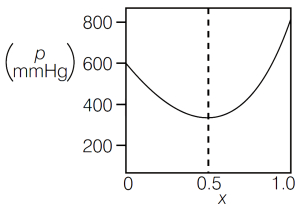
The vapour pressure of a non-ideal two-component solution is given below. Identify the correct $B.P.-x$ curve for the same mixture.
A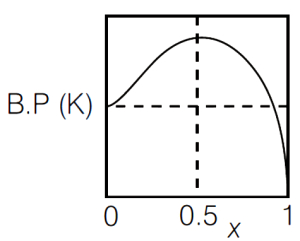
B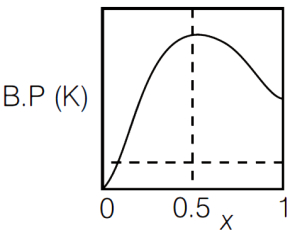
C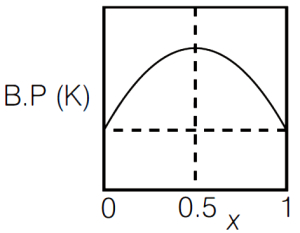
D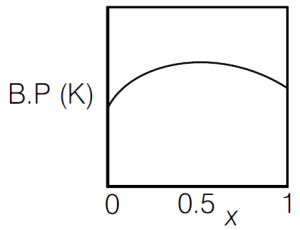
Solution
(A) The given graph shows a minimum in the vapour pressure curve at $x = 0.5$.
This indicates that the solution exhibits a large positive deviation from Raoult's law.
For solutions showing a large positive deviation from Raoult's law,the boiling point of the mixture is lower than the boiling points of the individual components,resulting in a minimum boiling azeotrope.
Therefore,the boiling point $(B.P.)$ vs. mole fraction $(x)$ curve must show a minimum at the same composition $(x = 0.5)$.
Among the given options,option $A$ represents a minimum boiling azeotrope curve.
This indicates that the solution exhibits a large positive deviation from Raoult's law.
For solutions showing a large positive deviation from Raoult's law,the boiling point of the mixture is lower than the boiling points of the individual components,resulting in a minimum boiling azeotrope.
Therefore,the boiling point $(B.P.)$ vs. mole fraction $(x)$ curve must show a minimum at the same composition $(x = 0.5)$.
Among the given options,option $A$ represents a minimum boiling azeotrope curve.
0 likesView Solution
44
ChemistryEasyMCQTS EAMCET · 2017
Which of the following conditions are correct for real solutions showing negative deviation from Raoult's law?
A
$\Delta H_{\text{mix}} < 0; \Delta V_{\text{mix}} > 0$
B
$\Delta H_{\text{mix}} > 0; \Delta V_{\text{mix}} > 0$
C
$\Delta H_{\text{mix}} > 0; \Delta V_{\text{mix}} < 0$
D
$\Delta H_{\text{mix}} < 0; \Delta V_{\text{mix}} < 0$
Solution
(D) For real solutions showing negative deviation from Raoult's law,the solute-solvent interactions are stronger than the solute-solute or solvent-solvent interactions.
This leads to a decrease in the total volume of the solution,meaning $\Delta V_{\text{mix}} < 0$.
Additionally,the formation of stronger bonds releases energy,making the process exothermic,which means $\Delta H_{\text{mix}} < 0$.
This leads to a decrease in the total volume of the solution,meaning $\Delta V_{\text{mix}} < 0$.
Additionally,the formation of stronger bonds releases energy,making the process exothermic,which means $\Delta H_{\text{mix}} < 0$.
0 likesView Solution
45
ChemistryMediumMCQTS EAMCET · 2017
Commercially available $H_2SO_4$ is $98 \ g$ by weight of $H_2SO_4$ and $2 \ g$ by weight of water. Its density is $1.38 \ g \ cm^{-3}$. Calculate the molality $(m)$ of $H_2SO_4$ (molar mass of $H_2SO_4$ is $98 \ g \ mol^{-1}$). (in $m$)
A
$500$
B
$20$
C
$50$
D
$200$
Solution
(A) Given: Weight of $H_2SO_4 = 98 \ g$,Molar mass of $H_2SO_4 = 98 \ g \ mol^{-1}$,Weight of solvent (water) $= 2 \ g$.
Molality $(m)$ is defined as the number of moles of solute per kilogram of solvent.
Moles of $H_2SO_4 = \frac{\text{Given mass}}{\text{Molar mass}} = \frac{98 \ g}{98 \ g \ mol^{-1}} = 1 \ mol$.
Weight of solvent in $kg = \frac{2 \ g}{1000} = 0.002 \ kg$.
Molality $(m) = \frac{\text{Moles of solute}}{\text{Mass of solvent in } kg} = \frac{1 \ mol}{0.002 \ kg} = 500 \ m$.
Molality $(m)$ is defined as the number of moles of solute per kilogram of solvent.
Moles of $H_2SO_4 = \frac{\text{Given mass}}{\text{Molar mass}} = \frac{98 \ g}{98 \ g \ mol^{-1}} = 1 \ mol$.
Weight of solvent in $kg = \frac{2 \ g}{1000} = 0.002 \ kg$.
Molality $(m) = \frac{\text{Moles of solute}}{\text{Mass of solvent in } kg} = \frac{1 \ mol}{0.002 \ kg} = 500 \ m$.
0 likesView Solution
46
ChemistryEasyMCQTS EAMCET · 2017
The electronic configuration of ${ }_{59} Pr$ $(Praseodymium)$ is
A
$[ { }_{54} Xe ] 4 f^2 5 d^1 6 s^2$
B
$[ { }_{54} Xe ] 4 f^1 5 d^2 6 s^2$
C
$[ { }_{54} Xe ] 4 f^3 6 s^2$
D
$[ { }_{54} Xe ] 4 f^3 5 d^2$
Solution
(C) The atomic number of $Praseodymium$ $(Pr)$ is $59$.
Following the $Aufbau$ principle,we fill the orbitals after the $Xenon$ ($Xe$,atomic number $54$) core.
The remaining $5$ electrons occupy the $4f$ and $6s$ orbitals.
The correct electronic configuration is $[Xe] 4f^3 6s^2$.
Following the $Aufbau$ principle,we fill the orbitals after the $Xenon$ ($Xe$,atomic number $54$) core.
The remaining $5$ electrons occupy the $4f$ and $6s$ orbitals.
The correct electronic configuration is $[Xe] 4f^3 6s^2$.
0 likesView Solution
47
ChemistryEasyMCQTS EAMCET · 2017
Which of the following is true for spontaneous adsorption of $H_2$ gas without dissociation on a solid surface?
A
Process is exothermic and $\Delta S < 0$
B
Process is endothermic and $\Delta S > 0$
C
Process is exothermic and $\Delta S > 0$
D
Process is endothermic and $\Delta S < 0$
Solution
(A) Adsorption is a spontaneous process where gas molecules are trapped on a solid surface,leading to a decrease in the randomness of the system. Thus,$\Delta S < 0$.
Since the process is spontaneous,the Gibbs free energy change must be negative $(\Delta G < 0)$.
From the equation $\Delta G = \Delta H - T\Delta S$,for $\Delta G$ to be negative when $\Delta S$ is negative,$\Delta H$ must be negative.
Therefore,the process is exothermic $(\Delta H < 0)$.
Since the process is spontaneous,the Gibbs free energy change must be negative $(\Delta G < 0)$.
From the equation $\Delta G = \Delta H - T\Delta S$,for $\Delta G$ to be negative when $\Delta S$ is negative,$\Delta H$ must be negative.
Therefore,the process is exothermic $(\Delta H < 0)$.
0 likesView Solution
Vedclass Products
For Students
Vedclass Test Series
Mock tests in real TS EAMCET style covering Chemistry with performance analysis. 5-day free trial.
Start Free TrialFor Teachers
Exam Paper Generator
Generate Set A/B/C/D Chemistry papers from 7.5L+ questions in 2 minutes. 3 chapters free.
Try FreeFor Institutes
Online Exam Module
Run live TS EAMCET mock exams with unlimited students, 360° analytics & white-label branding.
See DemoFrequently Asked Questions
How many Chemistry questions are in TS EAMCET 2017?
There are 47 Chemistry questions from the TS EAMCET 2017 paper on Vedclass, each with a detailed step-by-step solution in English.
Are TS EAMCET 2017 Chemistry solutions available in English?
Yes. All solutions on this page are in English. You can also switch to English or Hindi using the language buttons above the questions.
Can I practice TS EAMCET 2017 Chemistry as a timed test?
Yes. Use the Vedclass Test Series to attempt a full TS EAMCET mock test covering Chemistry with time limits and instant score analysis.
Can teachers create Chemistry papers from TS EAMCET previous year questions?
Yes. The Vedclass Exam Paper Generator lets teachers mix TS EAMCET Chemistry questions and generate Set A/B/C/D papers in minutes.
For Teachers & Institutes
Build a Custom Chemistry Paper
Pick TS EAMCET 2017 Chemistry questions, set difficulty, and generate Set A/B/C/D in 2 minutes.