
MathematicsQ151–250 of 799 questions
Page 4 of 10 · Gujarati
151
MathematicsMediumMCQAP EAMCET · 2022
$\frac{1}{\sin 1^{\circ} \sin 2^{\circ}}+\frac{1}{\sin 2^{\circ} \sin 3^{\circ}}+\ldots+\frac{1}{\sin 89^{\circ} \sin 90^{\circ}} = $
A
$\frac{\cos 1^{\circ}}{\sin 1^{\circ}}$
B
$\frac{\cos 1^{\circ}}{\sin ^2 1^{\circ}}$
C
$\frac{\sin 1^{\circ}}{\cos 1^{\circ}}$
D
$\frac{\sin ^2 1^{\circ}}{\cos 1^{\circ}}$
Solution
(B) ધારો કે આપેલ પદાવલિ $S$ છે.
$S = \sum_{k=1}^{89} \frac{1}{\sin k^{\circ} \sin(k+1)^{\circ}}$
$\sin 1^{\circ}$ વડે ગુણતા અને ભાગતા:
$S = \frac{1}{\sin 1^{\circ}} \sum_{k=1}^{89} \frac{\sin((k+1)^{\circ} - k^{\circ})}{\sin k^{\circ} \sin(k+1)^{\circ}}$
$\sin(A-B) = \sin A \cos B - \cos A \sin B$ નો ઉપયોગ કરતા:
$S = \frac{1}{\sin 1^{\circ}} \sum_{k=1}^{89} (\cot k^{\circ} - \cot(k+1)^{\circ})$
આ એક ટેલિસ્કોપિંગ શ્રેણી છે:
$S = \frac{1}{\sin 1^{\circ}} (\cot 1^{\circ} - \cot 90^{\circ})$
$\cot 90^{\circ} = 0$ હોવાથી:
$S = \frac{\cot 1^{\circ}}{\sin 1^{\circ}} = \frac{\cos 1^{\circ}}{\sin^2 1^{\circ}}$
$S = \sum_{k=1}^{89} \frac{1}{\sin k^{\circ} \sin(k+1)^{\circ}}$
$\sin 1^{\circ}$ વડે ગુણતા અને ભાગતા:
$S = \frac{1}{\sin 1^{\circ}} \sum_{k=1}^{89} \frac{\sin((k+1)^{\circ} - k^{\circ})}{\sin k^{\circ} \sin(k+1)^{\circ}}$
$\sin(A-B) = \sin A \cos B - \cos A \sin B$ નો ઉપયોગ કરતા:
$S = \frac{1}{\sin 1^{\circ}} \sum_{k=1}^{89} (\cot k^{\circ} - \cot(k+1)^{\circ})$
આ એક ટેલિસ્કોપિંગ શ્રેણી છે:
$S = \frac{1}{\sin 1^{\circ}} (\cot 1^{\circ} - \cot 90^{\circ})$
$\cot 90^{\circ} = 0$ હોવાથી:
$S = \frac{\cot 1^{\circ}}{\sin 1^{\circ}} = \frac{\cos 1^{\circ}}{\sin^2 1^{\circ}}$
0 likesView Solution
152
MathematicsMediumMCQAP EAMCET · 2022
જો નિત્યસમ $\cos^4 \theta = a \cos 4\theta + b \cos 2\theta + c$ અમુક $a, b, c \in \mathbb{Q}$ માટે સાચું હોય,તો $(a, b, c) =$
A
$\left(\frac{1}{8}, \frac{1}{2}, \frac{3}{8}\right)$
B
$\left(\frac{1}{8}, \frac{1}{2}, \frac{3}{8}\right)$
C
$\left(\frac{1}{2}, \frac{1}{8}, \frac{3}{8}\right)$
D
$\left(\frac{1}{2}, \frac{3}{8}, \frac{1}{8}\right)$
Solution
(B) આપેલ છે કે $\cos^4 \theta = a \cos 4\theta + b \cos 2\theta + c$.
નિત્યસમ $\cos^2 \theta = \frac{1 + \cos 2\theta}{2}$ નો ઉપયોગ કરતા:
$\cos^4 \theta = \left(\frac{1 + \cos 2\theta}{2}\right)^2 = \frac{1}{4} (1 + 2 \cos 2\theta + \cos^2 2\theta)$.
$\cos^2 2\theta = \frac{1 + \cos 4\theta}{2}$ મુકતા:
$\cos^4 \theta = \frac{1}{4} + \frac{1}{2} \cos 2\theta + \frac{1}{4} \left(\frac{1 + \cos 4\theta}{2}\right)$.
$= \frac{1}{4} + \frac{1}{2} \cos 2\theta + \frac{1}{8} + \frac{1}{8} \cos 4\theta$.
$= \frac{1}{8} \cos 4\theta + \frac{1}{2} \cos 2\theta + \frac{3}{8}$.
સરખામણી કરતા,$a = \frac{1}{8}$,$b = \frac{1}{2}$,અને $c = \frac{3}{8}$ મળે છે.
તેથી,$(a, b, c) = \left(\frac{1}{8}, \frac{1}{2}, \frac{3}{8}\right)$.
નિત્યસમ $\cos^2 \theta = \frac{1 + \cos 2\theta}{2}$ નો ઉપયોગ કરતા:
$\cos^4 \theta = \left(\frac{1 + \cos 2\theta}{2}\right)^2 = \frac{1}{4} (1 + 2 \cos 2\theta + \cos^2 2\theta)$.
$\cos^2 2\theta = \frac{1 + \cos 4\theta}{2}$ મુકતા:
$\cos^4 \theta = \frac{1}{4} + \frac{1}{2} \cos 2\theta + \frac{1}{4} \left(\frac{1 + \cos 4\theta}{2}\right)$.
$= \frac{1}{4} + \frac{1}{2} \cos 2\theta + \frac{1}{8} + \frac{1}{8} \cos 4\theta$.
$= \frac{1}{8} \cos 4\theta + \frac{1}{2} \cos 2\theta + \frac{3}{8}$.
સરખામણી કરતા,$a = \frac{1}{8}$,$b = \frac{1}{2}$,અને $c = \frac{3}{8}$ મળે છે.
તેથી,$(a, b, c) = \left(\frac{1}{8}, \frac{1}{2}, \frac{3}{8}\right)$.
0 likesView Solution
153
MathematicsMediumMCQAP EAMCET · 2022
નીચેનામાંથી કયું નિત્યસમ સાચું છે?
A
$\sin 5 \theta = 16 \cos^4 \theta \sin \theta - 12 \cos^2 \theta \sin \theta + \sin \theta$
B
$\sin 5 \theta = 16 \cos^4 \theta - 12 \cos^2 \theta + 1$
C
$\sin 5 \theta = 16 \cos^4 \theta \sin \theta + 12 \cos^2 \theta \sin \theta - \sin \theta$
D
$\sin 5 \theta = 16 \cos^4 \theta \sin \theta + 12 \cos^2 \theta \sin \theta + \sin \theta$
Solution
(A) આપણી પાસે છે,$\sin (5 \theta) = \sin (3 \theta + 2 \theta)$.
$\sin (A + B) = \sin A \cos B + \cos A \sin B$ નો ઉપયોગ કરતા:
$\sin (5 \theta) = \sin 3 \theta \cos 2 \theta + \cos 3 \theta \sin 2 \theta$.
બહુવિધ ખૂણાના સૂત્રો મૂકતા:
$\sin (5 \theta) = (3 \sin \theta - 4 \sin^3 \theta)(2 \cos^2 \theta - 1) + (4 \cos^3 \theta - 3 \cos \theta)(2 \sin \theta \cos \theta)$.
પદોનું વિસ્તરણ કરતા:
$\sin (5 \theta) = 16 \sin \theta \cos^4 \theta - 12 \sin \theta \cos^2 \theta + \sin \theta$.
$\sin (A + B) = \sin A \cos B + \cos A \sin B$ નો ઉપયોગ કરતા:
$\sin (5 \theta) = \sin 3 \theta \cos 2 \theta + \cos 3 \theta \sin 2 \theta$.
બહુવિધ ખૂણાના સૂત્રો મૂકતા:
$\sin (5 \theta) = (3 \sin \theta - 4 \sin^3 \theta)(2 \cos^2 \theta - 1) + (4 \cos^3 \theta - 3 \cos \theta)(2 \sin \theta \cos \theta)$.
પદોનું વિસ્તરણ કરતા:
$\sin (5 \theta) = 16 \sin \theta \cos^4 \theta - 12 \sin \theta \cos^2 \theta + \sin \theta$.
0 likesView Solution
154
MathematicsMediumMCQAP EAMCET · 2022
જો $A+B+C=\pi$ અને $\cos B=\cos A \cos C$ હોય,તો $\tan A \tan C=$
A
$0$
B
$1$
C
$2$
D
$\frac{1}{2}$
Solution
(C) આપેલ છે,$A+B+C=\pi$,જેનો અર્થ છે $B=\pi-(A+C)$.
સમીકરણ $\cos B=\cos A \cos C$ આપેલ છે.
$B$ ની કિંમત મૂકતા,$\cos(\pi-(A+C))=\cos A \cos C$.
નિત્યસમ $\cos(\pi-\theta)=-\cos \theta$ નો ઉપયોગ કરતા,$-\cos(A+C)=\cos A \cos C$.
ડાબી બાજુનું વિસ્તરણ કરતા,$-(\cos A \cos C - \sin A \sin C) = \cos A \cos C$.
$-\cos A \cos C + \sin A \sin C = \cos A \cos C$.
પદોને ગોઠવતા,$\sin A \sin C = 2 \cos A \cos C$.
બંને બાજુ $\cos A \cos C$ વડે ભાગતા,$\frac{\sin A \sin C}{\cos A \cos C} = 2$.
તેથી,$\tan A \tan C = 2$.
સમીકરણ $\cos B=\cos A \cos C$ આપેલ છે.
$B$ ની કિંમત મૂકતા,$\cos(\pi-(A+C))=\cos A \cos C$.
નિત્યસમ $\cos(\pi-\theta)=-\cos \theta$ નો ઉપયોગ કરતા,$-\cos(A+C)=\cos A \cos C$.
ડાબી બાજુનું વિસ્તરણ કરતા,$-(\cos A \cos C - \sin A \sin C) = \cos A \cos C$.
$-\cos A \cos C + \sin A \sin C = \cos A \cos C$.
પદોને ગોઠવતા,$\sin A \sin C = 2 \cos A \cos C$.
બંને બાજુ $\cos A \cos C$ વડે ભાગતા,$\frac{\sin A \sin C}{\cos A \cos C} = 2$.
તેથી,$\tan A \tan C = 2$.
0 likesView Solution
155
MathematicsMediumMCQAP EAMCET · 2022
નીચેનામાંથી કઈ નિત્યસમ સાચી છે?
A
$\cos 5 \theta = 16 \cos ^5 \theta - 20 \cos ^3 \theta - 5 \cos \theta$
B
$\cos 5 \theta = 20 \cos ^3 \theta - 16 \cos ^5 \theta + 5 \cos \theta$
C
$\cos 5 \theta = 16 \cos ^5 \theta + 20 \cos ^3 \theta - 5 \cos \theta$
D
$\cos 5 \theta = 16 \cos ^5 \theta - 20 \cos ^3 \theta + 5 \cos \theta$
Solution
(D) આપણે જાણીએ છીએ કે $\cos 5 \theta = \cos (4 \theta + \theta)$.
$\cos (A + B) = \cos A \cos B - \sin A \sin B$ સૂત્રનો ઉપયોગ કરતા:
$\cos 5 \theta = \cos 4 \theta \cos \theta - \sin 4 \theta \sin \theta$
$= (2 \cos ^2 2 \theta - 1) \cos \theta - (2 \sin 2 \theta \cos 2 \theta) \sin \theta$
$= \{2(2 \cos ^2 \theta - 1)^2 - 1\} \cos \theta - 4 \sin ^2 \theta \cos \theta (2 \cos ^2 \theta - 1)$
$= (8 \cos ^4 \theta - 8 \cos ^2 \theta + 1) \cos \theta - 4(1 - \cos ^2 \theta) \cos \theta (2 \cos ^2 \theta - 1)$
$= 16 \cos ^5 \theta - 20 \cos ^3 \theta + 5 \cos \theta$
$\cos (A + B) = \cos A \cos B - \sin A \sin B$ સૂત્રનો ઉપયોગ કરતા:
$\cos 5 \theta = \cos 4 \theta \cos \theta - \sin 4 \theta \sin \theta$
$= (2 \cos ^2 2 \theta - 1) \cos \theta - (2 \sin 2 \theta \cos 2 \theta) \sin \theta$
$= \{2(2 \cos ^2 \theta - 1)^2 - 1\} \cos \theta - 4 \sin ^2 \theta \cos \theta (2 \cos ^2 \theta - 1)$
$= (8 \cos ^4 \theta - 8 \cos ^2 \theta + 1) \cos \theta - 4(1 - \cos ^2 \theta) \cos \theta (2 \cos ^2 \theta - 1)$
$= 16 \cos ^5 \theta - 20 \cos ^3 \theta + 5 \cos \theta$
0 likesView Solution
156
MathematicsMediumMCQAP EAMCET · 2022
જો $\cos \theta - \sin \theta = \sqrt{5} \sin \theta$ હોય,તો $\cos \theta + \sin \theta = $
A
$\sqrt{5} \cos \theta$
B
$\sqrt{5} \sin \theta$
C
$5 \sin \theta$
D
$5 \cos \theta$
Solution
(A) આપેલ છે: $\cos \theta - \sin \theta = \sqrt{5} \sin \theta$
$\cos \theta = (\sqrt{5} + 1) \sin \theta$
$\tan \theta = \frac{1}{\sqrt{5} + 1} = \frac{\sqrt{5} - 1}{4}$
ધારો કે $x = \cos \theta + \sin \theta$.
$x^2 = \cos^2 \theta + \sin^2 \theta + 2 \sin \theta \cos \theta = 1 + 2 \sin \theta \cos \theta$
$\cos \theta = (\sqrt{5} + 1) \sin \theta$ હોવાથી,$\sin \theta = \frac{\cos \theta}{\sqrt{5} + 1}$ મળે.
$\cos^2 \theta + \sin^2 \theta = 1$ નો ઉપયોગ કરતા:
$\cos^2 \theta + \frac{\cos^2 \theta}{(\sqrt{5} + 1)^2} = 1$
સાદુરૂપ આપતા,$\cos \theta + \sin \theta = \sqrt{5} \cos \theta$ મળે છે.
$\cos \theta = (\sqrt{5} + 1) \sin \theta$
$\tan \theta = \frac{1}{\sqrt{5} + 1} = \frac{\sqrt{5} - 1}{4}$
ધારો કે $x = \cos \theta + \sin \theta$.
$x^2 = \cos^2 \theta + \sin^2 \theta + 2 \sin \theta \cos \theta = 1 + 2 \sin \theta \cos \theta$
$\cos \theta = (\sqrt{5} + 1) \sin \theta$ હોવાથી,$\sin \theta = \frac{\cos \theta}{\sqrt{5} + 1}$ મળે.
$\cos^2 \theta + \sin^2 \theta = 1$ નો ઉપયોગ કરતા:
$\cos^2 \theta + \frac{\cos^2 \theta}{(\sqrt{5} + 1)^2} = 1$
સાદુરૂપ આપતા,$\cos \theta + \sin \theta = \sqrt{5} \cos \theta$ મળે છે.
0 likesView Solution
157
MathematicsEasyMCQAP EAMCET · 2022
પદાવલિના અવયવ પાડો: $\sec ^2 x+5 \tan x+5$
A
$(\tan x+2)(\tan x+3)$
B
$(\tan x+1)(\tan x+5)$
C
$(\tan x-2)(\tan x-3)$
D
$(\sin x+2)(\sin x+5)$
Solution
(A) આપણે જાણીએ છીએ કે $\sec ^2 x = 1 + \tan ^2 x$.
આ કિંમત પદાવલિમાં મૂકતા:
$1 + \tan ^2 x + 5 \tan x + 5$
$= \tan ^2 x + 5 \tan x + 6$
હવે,$\tan x$ ના સ્વરૂપમાં દ્વિઘાત પદાવલિના અવયવ પાડતા:
$= \tan ^2 x + 2 \tan x + 3 \tan x + 6$
$= \tan x(\tan x + 2) + 3(\tan x + 2)$
$= (\tan x + 2)(\tan x + 3)$
આ કિંમત પદાવલિમાં મૂકતા:
$1 + \tan ^2 x + 5 \tan x + 5$
$= \tan ^2 x + 5 \tan x + 6$
હવે,$\tan x$ ના સ્વરૂપમાં દ્વિઘાત પદાવલિના અવયવ પાડતા:
$= \tan ^2 x + 2 \tan x + 3 \tan x + 6$
$= \tan x(\tan x + 2) + 3(\tan x + 2)$
$= (\tan x + 2)(\tan x + 3)$
0 likesView Solution
158
MathematicsDifficultMCQAP EAMCET · 2022
ધારો કે $a$ અને $b$ અ-ઋણ વાસ્તવિક સંખ્યાઓ છે. જો $\sin x + a \cos x = b$ હોય,તો $|a \sin x - \cos x| = $
A
$\sqrt{a^2 - b^2 + 1}$
B
$\sqrt{b^2 - a^2 + 1}$
C
$\sqrt{1 + a^2 + b^2}$
D
$\sqrt{a^2 + b^2 - 1}$
Solution
(A) આપેલ છે $\sin x + a \cos x = b$ ... $(i)$
ધારો કે $y = |a \sin x - \cos x|$.
બંને સમીકરણોનો વર્ગ કરતા:
$(\sin x + a \cos x)^2 = b^2$
$\sin^2 x + a^2 \cos^2 x + 2a \sin x \cos x = b^2$ ... $(ii)$
$(a \sin x - \cos x)^2 = y^2$
$a^2 \sin^2 x + \cos^2 x - 2a \sin x \cos x = y^2$ ... $(iii)$
$(ii)$ અને $(iii)$ નો સરવાળો કરતા:
$(\sin^2 x + a^2 \cos^2 x) + (a^2 \sin^2 x + \cos^2 x) = b^2 + y^2$
$\sin^2 x (1 + a^2) + \cos^2 x (a^2 + 1) = b^2 + y^2$
$(a^2 + 1)(\sin^2 x + \cos^2 x) = b^2 + y^2$
$a^2 + 1 = b^2 + y^2$
$y^2 = a^2 - b^2 + 1$
$y = \sqrt{a^2 - b^2 + 1}$
ધારો કે $y = |a \sin x - \cos x|$.
બંને સમીકરણોનો વર્ગ કરતા:
$(\sin x + a \cos x)^2 = b^2$
$\sin^2 x + a^2 \cos^2 x + 2a \sin x \cos x = b^2$ ... $(ii)$
$(a \sin x - \cos x)^2 = y^2$
$a^2 \sin^2 x + \cos^2 x - 2a \sin x \cos x = y^2$ ... $(iii)$
$(ii)$ અને $(iii)$ નો સરવાળો કરતા:
$(\sin^2 x + a^2 \cos^2 x) + (a^2 \sin^2 x + \cos^2 x) = b^2 + y^2$
$\sin^2 x (1 + a^2) + \cos^2 x (a^2 + 1) = b^2 + y^2$
$(a^2 + 1)(\sin^2 x + \cos^2 x) = b^2 + y^2$
$a^2 + 1 = b^2 + y^2$
$y^2 = a^2 - b^2 + 1$
$y = \sqrt{a^2 - b^2 + 1}$
0 likesView Solution
159
MathematicsEasyMCQAP EAMCET · 2022
જો $\sin \left(x+\frac{\pi}{3}\right)+\sin \left(x-\frac{\pi}{3}\right)=1$ હોય,તો અંતરાલ $[0, \pi]$ માં $x$ ની કિંમત શોધો.
A
$\frac{\pi}{2}$
B
$\frac{\pi}{3}$
C
$0$
D
$\frac{\pi}{4}$
Solution
(A) આપેલ સમીકરણ: $\sin \left(x+\frac{\pi}{3}\right)+\sin \left(x-\frac{\pi}{3}\right)=1$
નિત્યસમ $\sin(A+B)+\sin(A-B) = 2 \sin A \cos B$ નો ઉપયોગ કરતા:
$2 \sin x \cos \frac{\pi}{3} = 1$
કારણ કે $\cos \frac{\pi}{3} = \frac{1}{2}$,તેથી:
$2 \sin x \cdot \frac{1}{2} = 1$
$\sin x = 1$
$x \in [0, \pi]$ માટે,$x$ ની કિંમત $\frac{\pi}{2}$ મળે છે.
નિત્યસમ $\sin(A+B)+\sin(A-B) = 2 \sin A \cos B$ નો ઉપયોગ કરતા:
$2 \sin x \cos \frac{\pi}{3} = 1$
કારણ કે $\cos \frac{\pi}{3} = \frac{1}{2}$,તેથી:
$2 \sin x \cdot \frac{1}{2} = 1$
$\sin x = 1$
$x \in [0, \pi]$ માટે,$x$ ની કિંમત $\frac{\pi}{2}$ મળે છે.
0 likesView Solution
160
MathematicsEasyMCQAP EAMCET · 2022
$2 \cot^2 \theta - \cot \theta - 3$ પદાવલિના અવયવો પાડો.
A
$(2 \cot \theta - 3)(\cot \theta + 1)$
B
$(2 \cot \theta - 1)(\cot \theta + 3)$
C
$(2 \cot \theta + 3)(\cot \theta - 1)$
D
$(2 \cot \theta + 1)(\cot \theta - 3)$
Solution
(A) ધારો કે $x = \cot \theta$. પદાવલિ $2x^2 - x - 3$ બને છે.
$2x^2 - x - 3$ ના અવયવો પાડવા માટે,આપણે એવી બે સંખ્યાઓ શોધીએ જેનો ગુણાકાર $2 \times (-3) = -6$ અને સરવાળો $-1$ થાય.
આ સંખ્યાઓ $-3$ અને $2$ છે.
$2x^2 - 3x + 2x - 3 = x(2x - 3) + 1(2x - 3) = (2x - 3)(x + 1)$.
$x = \cot \theta$ પાછું મૂકતા,આપણને $(2 \cot \theta - 3)(\cot \theta + 1)$ મળે છે.
$2x^2 - x - 3$ ના અવયવો પાડવા માટે,આપણે એવી બે સંખ્યાઓ શોધીએ જેનો ગુણાકાર $2 \times (-3) = -6$ અને સરવાળો $-1$ થાય.
આ સંખ્યાઓ $-3$ અને $2$ છે.
$2x^2 - 3x + 2x - 3 = x(2x - 3) + 1(2x - 3) = (2x - 3)(x + 1)$.
$x = \cot \theta$ પાછું મૂકતા,આપણને $(2 \cot \theta - 3)(\cot \theta + 1)$ મળે છે.
0 likesView Solution
161
MathematicsMediumMCQAP EAMCET · 2022
$\tan x + \frac{\cos x}{1 + \sin x} = $
A
$\tan 2x$
B
$\operatorname{cosec} x$
C
$\sec x$
D
$\cos 2x$
Solution
(C) આપેલ પદાવલિ: $\tan x + \frac{\cos x}{1 + \sin x}$
$= \frac{\sin x}{\cos x} + \frac{\cos x}{1 + \sin x}$
$= \frac{\sin x(1 + \sin x) + \cos^2 x}{\cos x(1 + \sin x)}$
$= \frac{\sin x + \sin^2 x + \cos^2 x}{\cos x(1 + \sin x)}$
$\sin^2 x + \cos^2 x = 1$ હોવાથી,આપણને મળે:
$= \frac{\sin x + 1}{\cos x(1 + \sin x)}$
$= \frac{1}{\cos x} = \sec x$
$= \frac{\sin x}{\cos x} + \frac{\cos x}{1 + \sin x}$
$= \frac{\sin x(1 + \sin x) + \cos^2 x}{\cos x(1 + \sin x)}$
$= \frac{\sin x + \sin^2 x + \cos^2 x}{\cos x(1 + \sin x)}$
$\sin^2 x + \cos^2 x = 1$ હોવાથી,આપણને મળે:
$= \frac{\sin x + 1}{\cos x(1 + \sin x)}$
$= \frac{1}{\cos x} = \sec x$
0 likesView Solution
162
MathematicsDifficultMCQAP EAMCET · 2022
જો $k \in R$ એવું હોય કે જેથી સમીકરણ $2 \cosh^2 x = 3 \sinh x + k$ ને કોઈ વાસ્તવિક ઉકેલ ન હોય,તો નીચેનામાંથી કયું સાચું છે?
A
$k < \frac{1}{2}$
B
$k < \frac{3}{8}$
C
$k < \frac{7}{8}$
D
$k < \frac{5}{8}$
Solution
(C) આપેલ સમીકરણ $2 \cosh^2 x - 3 \sinh x - k = 0$ છે.
નિત્યસમ $\cosh^2 x = 1 + \sinh^2 x$ નો ઉપયોગ કરતા:
$2(1 + \sinh^2 x) - 3 \sinh x - k = 0$
$2 \sinh^2 x - 3 \sinh x + (2 - k) = 0$.
ધારો કે $t = \sinh x$,જ્યાં $t \in R$. દ્વિઘાત સમીકરણ $2t^2 - 3t + (2 - k) = 0$ ને $x$ માટે કોઈ વાસ્તવિક ઉકેલ ન હોય જો વિવેચક $D < 0$ હોય.
$D = (-3)^2 - 4(2)(2 - k) < 0$
$9 - 8(2 - k) < 0$
$9 - 16 + 8k < 0$
$8k - 7 < 0$
$k < \frac{7}{8}$.
નિત્યસમ $\cosh^2 x = 1 + \sinh^2 x$ નો ઉપયોગ કરતા:
$2(1 + \sinh^2 x) - 3 \sinh x - k = 0$
$2 \sinh^2 x - 3 \sinh x + (2 - k) = 0$.
ધારો કે $t = \sinh x$,જ્યાં $t \in R$. દ્વિઘાત સમીકરણ $2t^2 - 3t + (2 - k) = 0$ ને $x$ માટે કોઈ વાસ્તવિક ઉકેલ ન હોય જો વિવેચક $D < 0$ હોય.
$D = (-3)^2 - 4(2)(2 - k) < 0$
$9 - 8(2 - k) < 0$
$9 - 16 + 8k < 0$
$8k - 7 < 0$
$k < \frac{7}{8}$.
0 likesView Solution
163
MathematicsMediumMCQAP EAMCET · 2022
ત્રિકોણ $ABC$ માં,$\left(\tan \frac{A}{2} \tan \frac{B}{2} \tan \frac{C}{2}\right)^2 \leq$
A
$\frac{1}{27}$
B
$\frac{1}{18}$
C
$\frac{1}{9}$
D
$\frac{1}{3}$
Solution
(A) આપણે જાણીએ છીએ કે $\triangle ABC$ માટે,$\tan \left(\frac{A}{2}\right) \tan \left(\frac{B}{2}\right) + \tan \left(\frac{B}{2}\right) \tan \left(\frac{C}{2}\right) + \tan \left(\frac{C}{2}\right) \tan \left(\frac{A}{2}\right) = 1$.
ત્રિકોણ માટે,$\tan \left(\frac{A}{2}\right), \tan \left(\frac{B}{2}\right), \tan \left(\frac{C}{2}\right) > 0$ છે.
$AM \geq GM$ અસમતાનો ઉપયોગ કરતા:
$\frac{\tan \left(\frac{A}{2}\right) \tan \left(\frac{B}{2}\right) + \tan \left(\frac{B}{2}\right) \tan \left(\frac{C}{2}\right) + \tan \left(\frac{C}{2}\right) \tan \left(\frac{A}{2}\right)}{3} \geq \left[\tan^2 \left(\frac{A}{2}\right) \tan^2 \left(\frac{B}{2}\right) \tan^2 \left(\frac{C}{2}\right)\right]^{\frac{1}{3}}$.
તેથી,$\frac{1}{3} \geq \left[\tan \left(\frac{A}{2}\right) \tan \left(\frac{B}{2}\right) \tan \left(\frac{C}{2}\right)\right]^{\frac{2}{3}}$.
બંને બાજુ ઘન કરતા,$\left(\tan \frac{A}{2} \tan \frac{B}{2} \tan \frac{C}{2}\right)^2 \leq \frac{1}{27}$ મળે છે.
ત્રિકોણ માટે,$\tan \left(\frac{A}{2}\right), \tan \left(\frac{B}{2}\right), \tan \left(\frac{C}{2}\right) > 0$ છે.
$AM \geq GM$ અસમતાનો ઉપયોગ કરતા:
$\frac{\tan \left(\frac{A}{2}\right) \tan \left(\frac{B}{2}\right) + \tan \left(\frac{B}{2}\right) \tan \left(\frac{C}{2}\right) + \tan \left(\frac{C}{2}\right) \tan \left(\frac{A}{2}\right)}{3} \geq \left[\tan^2 \left(\frac{A}{2}\right) \tan^2 \left(\frac{B}{2}\right) \tan^2 \left(\frac{C}{2}\right)\right]^{\frac{1}{3}}$.
તેથી,$\frac{1}{3} \geq \left[\tan \left(\frac{A}{2}\right) \tan \left(\frac{B}{2}\right) \tan \left(\frac{C}{2}\right)\right]^{\frac{2}{3}}$.
બંને બાજુ ઘન કરતા,$\left(\tan \frac{A}{2} \tan \frac{B}{2} \tan \frac{C}{2}\right)^2 \leq \frac{1}{27}$ મળે છે.
0 likesView Solution
164
MathematicsMediumMCQAP EAMCET · 2022
બધી જોડીઓ $(x, y)$ જે અસમતા $2^{\sqrt{\sin^2 x - 2 \sin x + 5}} \cdot \frac{1}{4^{\sin^2 y}} \leq 1$ નું સમાધાન કરે છે,તે નીચેનામાંથી કયા સમીકરણનું પણ સમાધાન કરે છે?
A
$2|\sin x| = \sin y$
B
$2 \sin x = \sin y$
C
$\sin x = 2 \sin y$
D
$\sin x = |\sin y|$
Solution
(D) આપેલ અસમતા $2^{\sqrt{\sin^2 x - 2 \sin x + 5}} \cdot 2^{-2 \sin^2 y} \leq 1$ છે.
આને $2^{\sqrt{(\sin x - 1)^2 + 4}} \leq 2^{2 \sin^2 y}$ તરીકે લખી શકાય.
આધાર $2 > 1$ હોવાથી,$\sqrt{(\sin x - 1)^2 + 4} \leq 2 \sin^2 y$ મળે.
આપણે જાણીએ છીએ કે $(\sin x - 1)^2 \geq 0$,તેથી $\sqrt{(\sin x - 1)^2 + 4} \geq 2$.
આમ,$2 \sin^2 y \geq 2$,જેનો અર્થ છે કે $\sin^2 y \geq 1$.
$\sin^2 y$ ની મહત્તમ કિંમત $1$ હોવાથી,$\sin^2 y = 1$ એટલે કે $\sin y = \pm 1$.
$\sin^2 y = 1$ મૂકતા,$\sqrt{(\sin x - 1)^2 + 4} \leq 2$ મળે.
આથી $(\sin x - 1)^2 + 4 \leq 4$,એટલે કે $(\sin x - 1)^2 \leq 0$.
તેથી $\sin x = 1$.
આમ,$\sin x = |\sin y|$ મળે છે.
આને $2^{\sqrt{(\sin x - 1)^2 + 4}} \leq 2^{2 \sin^2 y}$ તરીકે લખી શકાય.
આધાર $2 > 1$ હોવાથી,$\sqrt{(\sin x - 1)^2 + 4} \leq 2 \sin^2 y$ મળે.
આપણે જાણીએ છીએ કે $(\sin x - 1)^2 \geq 0$,તેથી $\sqrt{(\sin x - 1)^2 + 4} \geq 2$.
આમ,$2 \sin^2 y \geq 2$,જેનો અર્થ છે કે $\sin^2 y \geq 1$.
$\sin^2 y$ ની મહત્તમ કિંમત $1$ હોવાથી,$\sin^2 y = 1$ એટલે કે $\sin y = \pm 1$.
$\sin^2 y = 1$ મૂકતા,$\sqrt{(\sin x - 1)^2 + 4} \leq 2$ મળે.
આથી $(\sin x - 1)^2 + 4 \leq 4$,એટલે કે $(\sin x - 1)^2 \leq 0$.
તેથી $\sin x = 1$.
આમ,$\sin x = |\sin y|$ મળે છે.
0 likesView Solution
165
MathematicsDifficultMCQAP EAMCET · 2022
ધારો કે $x, y, z$ વાસ્તવિક સંખ્યાઓ છે જેથી $x \geq y \geq z \geq \frac{\pi}{12}$. જો $x+y+z = \frac{\pi}{2}$ હોય,તો $\cos x \cdot \sin y \cdot \cos z$ ની ન્યૂનતમ કિંમત શોધો.
A
$\frac{1}{2}$
B
$\frac{1}{4}$
C
$\frac{1}{6}$
D
$\frac{1}{8}$
Solution
(D) આપેલ છે કે $x+y+z = \frac{\pi}{2}$ અને $x \geq y \geq z \geq \frac{\pi}{12}$.
આપણે $f(x, y, z) = \cos x \sin y \cos z$ ની ન્યૂનતમ કિંમત શોધવી છે.
ગુણાકાર-થી-સરવાળાના સૂત્રનો ઉપયોગ કરતા: $\cos x \cos z = \frac{1}{2}(\cos(x+z) + \cos(x-z))$.
$x+z = \frac{\pi}{2} - y$ હોવાથી,$\cos(x+z) = \sin y$ થાય.
તેથી,$f = \frac{1}{2}(\sin y + \cos(x-z)) \sin y = \frac{1}{2}(\sin^2 y + \sin y \cos(x-z))$.
ન્યૂનતમ કિંમત માટે,આપણે સીમાવર્તી શરતો ધ્યાનમાં લઈએ છીએ. $y = z = \frac{\pi}{12}$ લેતા,$x = \frac{\pi}{3}$ મળે.
કિંમતો મૂકતા: $\cos(\frac{\pi}{3}) \sin(\frac{\pi}{12}) \cos(\frac{\pi}{12}) = \frac{1}{2} \cdot \frac{1}{2} \sin(\frac{\pi}{6}) = \frac{1}{4} \cdot \frac{1}{2} = \frac{1}{8}$.
આપણે $f(x, y, z) = \cos x \sin y \cos z$ ની ન્યૂનતમ કિંમત શોધવી છે.
ગુણાકાર-થી-સરવાળાના સૂત્રનો ઉપયોગ કરતા: $\cos x \cos z = \frac{1}{2}(\cos(x+z) + \cos(x-z))$.
$x+z = \frac{\pi}{2} - y$ હોવાથી,$\cos(x+z) = \sin y$ થાય.
તેથી,$f = \frac{1}{2}(\sin y + \cos(x-z)) \sin y = \frac{1}{2}(\sin^2 y + \sin y \cos(x-z))$.
ન્યૂનતમ કિંમત માટે,આપણે સીમાવર્તી શરતો ધ્યાનમાં લઈએ છીએ. $y = z = \frac{\pi}{12}$ લેતા,$x = \frac{\pi}{3}$ મળે.
કિંમતો મૂકતા: $\cos(\frac{\pi}{3}) \sin(\frac{\pi}{12}) \cos(\frac{\pi}{12}) = \frac{1}{2} \cdot \frac{1}{2} \sin(\frac{\pi}{6}) = \frac{1}{4} \cdot \frac{1}{2} = \frac{1}{8}$.
0 likesView Solution
166
MathematicsMediumMCQAP EAMCET · 2022
બિંદુ $A(-3, 4)$ થી શરૂ કરીને,એક ગતિશીલ પદાર્થ રેખા $2x + y - 7 = 0$ ને $B$ આગળ સ્પર્શે છે અને બિંદુ $C(0, 1)$ પર પહોંચે છે. જો પદાર્થ ટૂંકા રસ્તે મુસાફરી કરે,તો $A$ અને $B$ વચ્ચેનું અંતર કેટલું થાય?
A
$\frac{9 \sqrt{170}}{25}$
B
$\frac{9}{\sqrt{5}}$
C
$3 \sqrt{2}$
D
$\frac{6}{\sqrt{5}}$
Solution
(A) $A(-3, 4)$ નું રેખા $2x + y - 7 = 0$ ની સાપેક્ષમાં પ્રતિબિંબ $A'(\frac{21}{5}, \frac{38}{5})$ મળે છે.
ટૂંકા રસ્તા માટે $B$ એ $A'C$ રેખા અને આપેલી રેખાનું છેદબિંદુ છે.
રેખા $A'C$ નું સમીકરણ $11x - 7y + 7 = 0$ છે.
બંને રેખાઓ ઉકેલતા $B(\frac{42}{25}, \frac{91}{25})$ મળે છે.
અંતર સૂત્ર મુજબ $AB = \sqrt{(\frac{42}{25} + 3)^2 + (\frac{91}{25} - 4)^2} = \frac{9 \sqrt{170}}{25}$.
ટૂંકા રસ્તા માટે $B$ એ $A'C$ રેખા અને આપેલી રેખાનું છેદબિંદુ છે.
રેખા $A'C$ નું સમીકરણ $11x - 7y + 7 = 0$ છે.
બંને રેખાઓ ઉકેલતા $B(\frac{42}{25}, \frac{91}{25})$ મળે છે.
અંતર સૂત્ર મુજબ $AB = \sqrt{(\frac{42}{25} + 3)^2 + (\frac{91}{25} - 4)^2} = \frac{9 \sqrt{170}}{25}$.
0 likesView Solution
167
MathematicsMediumMCQAP EAMCET · 2022
ધારો કે $\triangle ABC$ એ એક સમદ્વિબાજુ ત્રિકોણ છે જેમાં $\angle C=90^{\circ}$,$A=(2,3)$ અને $B=(4,5)$ છે. તો ત્રિકોણનું મધ્યકેન્દ્ર શોધો.
A
$\left(\frac{13}{8}, \frac{8}{3}\right)$
B
$\left(\frac{11}{3}, \frac{10}{3}\right)$
C
$\left(\frac{10}{3}, \frac{13}{3}\right)$
D
$\left(\frac{10}{3}, \frac{11}{3}\right)$
Solution
(D) ધારો કે $C = (x, y)$. $\triangle ABC$ એ $C$ આગળ કાટકોણ ધરાવતો સમદ્વિબાજુ ત્રિકોણ હોવાથી,$AC = BC$ અને $AC \perp BC$ થાય.
$AC^2 = BC^2$ પરથી,$(x-2)^2 + (y-3)^2 = (x-4)^2 + (y-5)^2$.
સાદુરૂપ આપતા,$4x + 4y = 28$,એટલે કે $x + y = 7 \implies y = 7 - x$.
$AC \perp BC$ હોવાથી,તેમના ઢાળનો ગુણાકાર $-1$ થાય: $\left(\frac{y-3}{x-2}\right) \times \left(\frac{y-5}{x-4}\right) = -1$.
$(y-3)(y-5) = -(x-2)(x-4) \implies x^2 + y^2 - 6x - 8y + 23 = 0$.
$y = 7-x$ મુકતા: $x^2 + (7-x)^2 - 6x - 8(7-x) + 23 = 0$.
$2x^2 - 12x + 16 = 0 \implies x^2 - 6x + 8 = 0$.
$(x-2)(x-4) = 0$,તેથી $x = 2$ અથવા $x = 4$.
જો $x = 2$,તો $y = 5$,તેથી $C = (2, 5)$. મધ્યકેન્દ્ર $G = \left(\frac{2+4+2}{3}, \frac{3+5+5}{3}\right) = \left(\frac{8}{3}, \frac{13}{3}\right)$.
જો $x = 4$,તો $y = 3$,તેથી $C = (4, 3)$. મધ્યકેન્દ્ર $G = \left(\frac{2+4+4}{3}, \frac{3+5+3}{3}\right) = \left(\frac{10}{3}, \frac{11}{3}\right)$.
વિકલ્પો મુજબ,સાચો જવાબ $\left(\frac{10}{3}, \frac{11}{3}\right)$ છે.
$AC^2 = BC^2$ પરથી,$(x-2)^2 + (y-3)^2 = (x-4)^2 + (y-5)^2$.
સાદુરૂપ આપતા,$4x + 4y = 28$,એટલે કે $x + y = 7 \implies y = 7 - x$.
$AC \perp BC$ હોવાથી,તેમના ઢાળનો ગુણાકાર $-1$ થાય: $\left(\frac{y-3}{x-2}\right) \times \left(\frac{y-5}{x-4}\right) = -1$.
$(y-3)(y-5) = -(x-2)(x-4) \implies x^2 + y^2 - 6x - 8y + 23 = 0$.
$y = 7-x$ મુકતા: $x^2 + (7-x)^2 - 6x - 8(7-x) + 23 = 0$.
$2x^2 - 12x + 16 = 0 \implies x^2 - 6x + 8 = 0$.
$(x-2)(x-4) = 0$,તેથી $x = 2$ અથવા $x = 4$.
જો $x = 2$,તો $y = 5$,તેથી $C = (2, 5)$. મધ્યકેન્દ્ર $G = \left(\frac{2+4+2}{3}, \frac{3+5+5}{3}\right) = \left(\frac{8}{3}, \frac{13}{3}\right)$.
જો $x = 4$,તો $y = 3$,તેથી $C = (4, 3)$. મધ્યકેન્દ્ર $G = \left(\frac{2+4+4}{3}, \frac{3+5+3}{3}\right) = \left(\frac{10}{3}, \frac{11}{3}\right)$.
વિકલ્પો મુજબ,સાચો જવાબ $\left(\frac{10}{3}, \frac{11}{3}\right)$ છે.
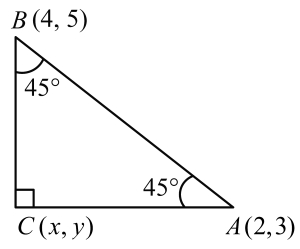
0 likesView Solution
168
MathematicsEasyMCQAP EAMCET · 2022
જો યામ અક્ષો અને $|x+y|=2$ ના છેદબિંદુઓ એક સમબાજુ ચતુષ્કોણ બનાવે છે,તો તેનું ક્ષેત્રફળ કેટલું થાય?
A
$8$
B
$16$
C
$2$
D
$4$
Solution
(A) સમીકરણ $|x+y|=2$ ને $x+y=2$ અથવા $x+y=-2$ તરીકે લખી શકાય છે.
$x+y=2$ માટે,અક્ષો પરના અંતઃખંડો $(2,0)$ અને $(0,2)$ છે.
$x+y=-2$ માટે,અક્ષો પરના અંતઃખંડો $(-2,0)$ અને $(0,-2)$ છે.
આ ચાર બિંદુઓ $A(0,2)$,$B(2,0)$,$C(0,-2)$,અને $D(-2,0)$ છે.
આ બિંદુઓ એક સમબાજુ ચતુષ્કોણ બનાવે છે જેના વિકર્ણોની લંબાઈ $d_1 = 4$ ($y$-અક્ષ પર) અને $d_2 = 4$ ($x$-અક્ષ પર) છે.
સમબાજુ ચતુષ્કોણનું ક્ષેત્રફળ $\frac{1}{2} \times d_1 \times d_2$ દ્વારા આપવામાં આવે છે.
ક્ષેત્રફળ $= \frac{1}{2} \times 4 \times 4 = 8$ ચોરસ એકમ.
$x+y=2$ માટે,અક્ષો પરના અંતઃખંડો $(2,0)$ અને $(0,2)$ છે.
$x+y=-2$ માટે,અક્ષો પરના અંતઃખંડો $(-2,0)$ અને $(0,-2)$ છે.
આ ચાર બિંદુઓ $A(0,2)$,$B(2,0)$,$C(0,-2)$,અને $D(-2,0)$ છે.
આ બિંદુઓ એક સમબાજુ ચતુષ્કોણ બનાવે છે જેના વિકર્ણોની લંબાઈ $d_1 = 4$ ($y$-અક્ષ પર) અને $d_2 = 4$ ($x$-અક્ષ પર) છે.
સમબાજુ ચતુષ્કોણનું ક્ષેત્રફળ $\frac{1}{2} \times d_1 \times d_2$ દ્વારા આપવામાં આવે છે.
ક્ષેત્રફળ $= \frac{1}{2} \times 4 \times 4 = 8$ ચોરસ એકમ.
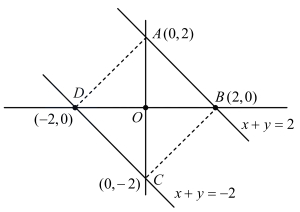
0 likesView Solution
169
MathematicsMediumMCQAP EAMCET · 2022
ધારો કે સમતલમાં ત્રણ બિંદુઓ $A, B$ અને $C$ એવા છે કે તેમના $x$-યામ તેમજ $y$-યામ સમાન સામાન્ય ગુણોત્તર સાથે $GP$ માં છે. તો,બિંદુઓ $A, B$ અને $C$
A
કાટકોણ ત્રિકોણ બનાવે છે
B
સમદ્વિબાજુ ત્રિકોણ બનાવે છે
C
એક સીધી રેખા પર આવેલા છે
D
સમબાજુ ત્રિકોણ બનાવે છે
Solution
(C) ધારો કે યામ $A(x_1, y_1), B(x_2, y_2)$ અને $C(x_3, y_3)$ છે.
પ્રશ્ન મુજબ,$x$-યામ અને $y$-યામ સમાન સામાન્ય ગુણોત્તર $r$ સાથે $GP$ માં છે.
ધારો કે $x_1 = a, x_2 = ar, x_3 = ar^2$ અને $y_1 = b, y_2 = br, y_3 = br^2$.
આમ,બિંદુઓ $A(a, b), B(ar, br)$ અને $C(ar^2, br^2)$ છે.
$AB$ નો ઢાળ $= \frac{br - b}{ar - a} = \frac{b(r - 1)}{a(r - 1)} = \frac{b}{a}$.
$BC$ નો ઢાળ $= \frac{br^2 - br}{ar^2 - ar} = \frac{br(r - 1)}{ar(r - 1)} = \frac{b}{a}$.
$AB$ નો ઢાળ $= BC$ નો ઢાળ હોવાથી,બિંદુઓ $A, B$ અને $C$ સમરેખ છે.
તેથી,બિંદુઓ $A, B$ અને $C$ એક સીધી રેખા પર આવેલા છે.
પ્રશ્ન મુજબ,$x$-યામ અને $y$-યામ સમાન સામાન્ય ગુણોત્તર $r$ સાથે $GP$ માં છે.
ધારો કે $x_1 = a, x_2 = ar, x_3 = ar^2$ અને $y_1 = b, y_2 = br, y_3 = br^2$.
આમ,બિંદુઓ $A(a, b), B(ar, br)$ અને $C(ar^2, br^2)$ છે.
$AB$ નો ઢાળ $= \frac{br - b}{ar - a} = \frac{b(r - 1)}{a(r - 1)} = \frac{b}{a}$.
$BC$ નો ઢાળ $= \frac{br^2 - br}{ar^2 - ar} = \frac{br(r - 1)}{ar(r - 1)} = \frac{b}{a}$.
$AB$ નો ઢાળ $= BC$ નો ઢાળ હોવાથી,બિંદુઓ $A, B$ અને $C$ સમરેખ છે.
તેથી,બિંદુઓ $A, B$ અને $C$ એક સીધી રેખા પર આવેલા છે.
0 likesView Solution
170
MathematicsEasyMCQAP EAMCET · 2022
જો ત્રિકોણના શિરોબિંદુઓ $(a, 1, 3)$,$(-2, b, -5)$ અને $(4, 7, c)$ હોય અને તેનું મધ્યકેન્દ્ર ઉગમબિંદુ હોય,તો $a^2 + b^2 + c^2 =$ કેટલા?
A
$68$
B
$64$
C
$72$
D
$54$
Solution
(C) $(x_1, y_1, z_1)$,$(x_2, y_2, z_2)$ અને $(x_3, y_3, z_3)$ શિરોબિંદુઓ ધરાવતા ત્રિકોણનું મધ્યકેન્દ્ર $\left(\frac{x_1+x_2+x_3}{3}, \frac{y_1+y_2+y_3}{3}, \frac{z_1+z_2+z_3}{3}\right)$ છે.
આપેલ શિરોબિંદુઓ $(a, 1, 3)$,$(-2, b, -5)$ અને $(4, 7, c)$ માટે મધ્યકેન્દ્ર $(0, 0, 0)$ છે:
$\frac{a-2+4}{3} = 0 \Rightarrow a = -2$
$\frac{1+b+7}{3} = 0 \Rightarrow b = -8$
$\frac{3-5+c}{3} = 0 \Rightarrow c = 2$
તેથી,$a^2 + b^2 + c^2 = (-2)^2 + (-8)^2 + (2)^2 = 4 + 64 + 4 = 72$.
આપેલ શિરોબિંદુઓ $(a, 1, 3)$,$(-2, b, -5)$ અને $(4, 7, c)$ માટે મધ્યકેન્દ્ર $(0, 0, 0)$ છે:
$\frac{a-2+4}{3} = 0 \Rightarrow a = -2$
$\frac{1+b+7}{3} = 0 \Rightarrow b = -8$
$\frac{3-5+c}{3} = 0 \Rightarrow c = 2$
તેથી,$a^2 + b^2 + c^2 = (-2)^2 + (-8)^2 + (2)^2 = 4 + 64 + 4 = 72$.
0 likesView Solution
171
MathematicsMediumMCQAP EAMCET · 2022
એક ત્રિકોણની બાજુઓની લંબાઈ $13, 14, \text{ અને } 15$ છે. જો $R$ અને $r$ અનુક્રમે આ ત્રિકોણની પરિત્રિજ્યા (circumradius) અને અંતઃત્રિજ્યા (inradius) દર્શાવતા હોય,તો $8R - r = $
A
$41$
B
$51$
C
$61$
D
$71$
Solution
(C) ધારો કે બાજુઓ $a = 13, b = 14, c = 15$ છે.
અર્ધ-પરિમિતિ $s = \frac{13 + 14 + 15}{2} = \frac{42}{2} = 21$.
ત્રિકોણનું ક્ષેત્રફળ $\Delta = \sqrt{s(s-a)(s-b)(s-c)} = \sqrt{21(21-13)(21-14)(21-15)} = \sqrt{21 \times 8 \times 7 \times 6} = \sqrt{7056} = 84$.
પરિત્રિજ્યા $R = \frac{abc}{4\Delta} = \frac{13 \times 14 \times 15}{4 \times 84} = \frac{2730}{336} = \frac{65}{8}$.
અંતઃત્રિજ્યા $r = \frac{\Delta}{s} = \frac{84}{21} = 4$.
હવે,$8R - r = 8 \times \left(\frac{65}{8}\right) - 4 = 65 - 4 = 61$.
અર્ધ-પરિમિતિ $s = \frac{13 + 14 + 15}{2} = \frac{42}{2} = 21$.
ત્રિકોણનું ક્ષેત્રફળ $\Delta = \sqrt{s(s-a)(s-b)(s-c)} = \sqrt{21(21-13)(21-14)(21-15)} = \sqrt{21 \times 8 \times 7 \times 6} = \sqrt{7056} = 84$.
પરિત્રિજ્યા $R = \frac{abc}{4\Delta} = \frac{13 \times 14 \times 15}{4 \times 84} = \frac{2730}{336} = \frac{65}{8}$.
અંતઃત્રિજ્યા $r = \frac{\Delta}{s} = \frac{84}{21} = 4$.
હવે,$8R - r = 8 \times \left(\frac{65}{8}\right) - 4 = 65 - 4 = 61$.
0 likesView Solution
172
MathematicsEasyMCQAP EAMCET · 2022
$(-2, 2)$,$(2, -2)$ અને $(1, 1)$ શિરોબિંદુઓ ધરાવતો ત્રિકોણ કયો છે?
A
વિષમબાજુ ત્રિકોણ
B
સમબાજુ ત્રિકોણ
C
સમદ્વિબાજુ ત્રિકોણ
D
કાટકોણ ત્રિકોણ
Solution
(C) ધારો કે $A(-2, 2)$,$B(2, -2)$ અને $C(1, 1)$ એ $\triangle ABC$ ના શિરોબિંદુઓ છે.
અંતર સૂત્ર $d = \sqrt{(x_2 - x_1)^2 + (y_2 - y_1)^2}$ નો ઉપયોગ કરતા:
$AB = \sqrt{(2 - (-2))^2 + (-2 - 2)^2} = \sqrt{4^2 + (-4)^2} = \sqrt{16 + 16} = \sqrt{32} = 4\sqrt{2}$
$BC = \sqrt{(1 - 2)^2 + (1 - (-2))^2} = \sqrt{(-1)^2 + 3^2} = \sqrt{1 + 9} = \sqrt{10}$
$AC = \sqrt{(1 - (-2))^2 + (1 - 2)^2} = \sqrt{3^2 + (-1)^2} = \sqrt{9 + 1} = \sqrt{10}$
અહીં $BC = AC = \sqrt{10}$ હોવાથી,ત્રિકોણની બે બાજુઓ સમાન છે.
તેથી,$\triangle ABC$ એ સમદ્વિબાજુ ત્રિકોણ છે.
અંતર સૂત્ર $d = \sqrt{(x_2 - x_1)^2 + (y_2 - y_1)^2}$ નો ઉપયોગ કરતા:
$AB = \sqrt{(2 - (-2))^2 + (-2 - 2)^2} = \sqrt{4^2 + (-4)^2} = \sqrt{16 + 16} = \sqrt{32} = 4\sqrt{2}$
$BC = \sqrt{(1 - 2)^2 + (1 - (-2))^2} = \sqrt{(-1)^2 + 3^2} = \sqrt{1 + 9} = \sqrt{10}$
$AC = \sqrt{(1 - (-2))^2 + (1 - 2)^2} = \sqrt{3^2 + (-1)^2} = \sqrt{9 + 1} = \sqrt{10}$
અહીં $BC = AC = \sqrt{10}$ હોવાથી,ત્રિકોણની બે બાજુઓ સમાન છે.
તેથી,$\triangle ABC$ એ સમદ્વિબાજુ ત્રિકોણ છે.
0 likesView Solution
173
MathematicsEasyMCQAP EAMCET · 2022
રેખાઓ $x-y+3=0$,$2x-y+3=0$,$3x-y+2=0$ અને $x+y-3=0$ દ્વારા બનતા ત્રિકોણની સંખ્યા કેટલી છે?
A
$4$
B
$6$
C
$3$
D
$2$
Solution
(A) ધારો કે રેખાઓ $L_1: x-y+3=0$,$L_2: 2x-y+3=0$,$L_3: 3x-y+2=0$,અને $L_4: x+y-3=0$ છે.
ત્રિકોણ બનાવવા માટે,આપણને $3$ એવી રેખાઓ જોઈએ જે સંગામી ન હોય અને સમાંતર ન હોય.
કોઈપણ $3$ રેખાઓ માટે સમીકરણો ઉકેલીને સંગામી છે કે નહીં તે તપાસો.
$L_1, L_2, L_3$ ને ઉકેલતા: $L_1$ અને $L_2$ નું છેદબિંદુ $(-0, 3)$ છે. $L_3$ માં મૂકતા: $3(0)-3+2 = -1 \neq 0$. તેથી,તેઓ સંગામી નથી.
$4$ માંથી $3$ રેખાઓના તમામ સંયોજનો તપાસતા ($^4C_3 = 4$ સંયોજનો):
$1$. $(L_1, L_2, L_3)$: ઢાળ $1, 2, 3$ છે. કોઈ બે રેખાઓ સમાંતર નથી. તેઓ ત્રિકોણ બનાવે છે.
$2$. $(L_1, L_2, L_4)$: ઢાળ $1, 2, -1$ છે. તેઓ ત્રિકોણ બનાવે છે.
$3$. $(L_1, L_3, L_4)$: ઢાળ $1, 3, -1$ છે. તેઓ ત્રિકોણ બનાવે છે.
$4$. $(L_2, L_3, L_4)$: ઢાળ $2, 3, -1$ છે. તેઓ ત્રિકોણ બનાવે છે.
કોઈપણ ત્રણ રેખાઓ સંગામી ન હોવાથી,કુલ $4$ ત્રિકોણ બને છે.
ત્રિકોણ બનાવવા માટે,આપણને $3$ એવી રેખાઓ જોઈએ જે સંગામી ન હોય અને સમાંતર ન હોય.
કોઈપણ $3$ રેખાઓ માટે સમીકરણો ઉકેલીને સંગામી છે કે નહીં તે તપાસો.
$L_1, L_2, L_3$ ને ઉકેલતા: $L_1$ અને $L_2$ નું છેદબિંદુ $(-0, 3)$ છે. $L_3$ માં મૂકતા: $3(0)-3+2 = -1 \neq 0$. તેથી,તેઓ સંગામી નથી.
$4$ માંથી $3$ રેખાઓના તમામ સંયોજનો તપાસતા ($^4C_3 = 4$ સંયોજનો):
$1$. $(L_1, L_2, L_3)$: ઢાળ $1, 2, 3$ છે. કોઈ બે રેખાઓ સમાંતર નથી. તેઓ ત્રિકોણ બનાવે છે.
$2$. $(L_1, L_2, L_4)$: ઢાળ $1, 2, -1$ છે. તેઓ ત્રિકોણ બનાવે છે.
$3$. $(L_1, L_3, L_4)$: ઢાળ $1, 3, -1$ છે. તેઓ ત્રિકોણ બનાવે છે.
$4$. $(L_2, L_3, L_4)$: ઢાળ $2, 3, -1$ છે. તેઓ ત્રિકોણ બનાવે છે.
કોઈપણ ત્રણ રેખાઓ સંગામી ન હોવાથી,કુલ $4$ ત્રિકોણ બને છે.
0 likesView Solution
174
MathematicsEasyMCQAP EAMCET · 2022
જો સમદ્વિબાજુ ત્રિકોણની એક બાજુ રેખા $y=2$ દ્વારા આપવામાં આવે અને પાયો બિંદુઓ $(2,0)$ અને $(0,2)$ દ્વારા આપવામાં આવે,તો તેનું ક્ષેત્રફળ (ચોરસ એકમમાં) કેટલું થાય?
A
$2 \sqrt{2}$
B
$1$
C
$2$
D
$4$
Solution
(C) ત્રિકોણનો પાયો બિંદુઓ $(2,0)$ અને $(0,2)$ ને જોડતો રેખાખંડ છે. પાયાની લંબાઈ $\sqrt{(2-0)^2 + (0-2)^2} = \sqrt{4+4} = 2\sqrt{2}$ છે.
ત્રીજો શિરોબિંદુ રેખા $y=2$ પર આવેલો છે. ધારો કે શિરોબિંદુ $(x, 2)$ છે.
આકૃતિ પરથી,શિરોબિંદુ $(2,2)$ છે. પાયા (રેખા $x+y=2$) થી શિરોબિંદુ $(2,2)$ સુધીની ઊંચાઈ એ $(2,2)$ થી $x+y-2=0$ સુધીનું લંબ અંતર છે,જે $h = \frac{|2+2-2|}{\sqrt{1^2+1^2}} = \frac{2}{\sqrt{2}} = \sqrt{2}$ છે.
ક્ષેત્રફળ $= \frac{1}{2} \times \text{પાયો} \times \text{ઊંચાઈ} = \frac{1}{2} \times (2\sqrt{2}) \times \sqrt{2} = 2$ ચોરસ એકમ.
ત્રીજો શિરોબિંદુ રેખા $y=2$ પર આવેલો છે. ધારો કે શિરોબિંદુ $(x, 2)$ છે.
આકૃતિ પરથી,શિરોબિંદુ $(2,2)$ છે. પાયા (રેખા $x+y=2$) થી શિરોબિંદુ $(2,2)$ સુધીની ઊંચાઈ એ $(2,2)$ થી $x+y-2=0$ સુધીનું લંબ અંતર છે,જે $h = \frac{|2+2-2|}{\sqrt{1^2+1^2}} = \frac{2}{\sqrt{2}} = \sqrt{2}$ છે.
ક્ષેત્રફળ $= \frac{1}{2} \times \text{પાયો} \times \text{ઊંચાઈ} = \frac{1}{2} \times (2\sqrt{2}) \times \sqrt{2} = 2$ ચોરસ એકમ.
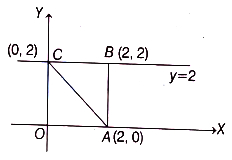
0 likesView Solution
175
MathematicsEasyMCQAP EAMCET · 2022
જો $P(\sin \alpha, \cos \alpha)$ એ $(0,0), \left(\frac{\sqrt{3}}{2}, 0\right)$ અને $\left(0, \frac{\sqrt{3}}{2}\right)$ શિરોબિંદુઓ દ્વારા બનતા ત્રિકોણની અંદર આવેલું હોય,તો $\alpha$ કયા અંતરાલમાં હશે?
A
$\left(0, \frac{\pi}{3}\right)$
B
$\left(0, \frac{\pi}{4}\right)$
C
$\left(0, \frac{\pi}{6}\right)$
D
$\left(0, \frac{\pi}{12}\right)$
Solution
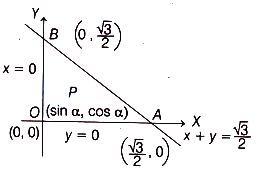
0 likesView Solution
176
MathematicsEasyMCQAP EAMCET · 2022
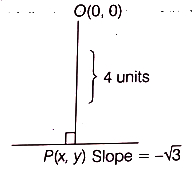
રેખા પરનું એક બિંદુ $P$ ઉગમબિંદુ $(0,0)$ થી $4$ એકમ અંતરે છે. જો રેખા $X$-અક્ષની ઋણ દિશા સાથે $60^{\circ}$ નો ખૂણો બનાવતી હોય,તો $P$ ના યામ શું હશે?
A
$(2, 2\sqrt{3})$
B
$(2\sqrt{3}, 2)$
C
$(1, \sqrt{3})$
D
$(2\sqrt{3}, 1)$
Solution
(B) રેખા $X$-અક્ષની ઋણ દિશા સાથે $60^{\circ}$ નો ખૂણો બનાવે છે. તેથી,તે $X$-અક્ષની ધન દિશા સાથે $180^{\circ} - 60^{\circ} = 120^{\circ}$ નો ખૂણો બનાવે છે.
રેખાનો ઢાળ $m = \tan(120^{\circ}) = -\sqrt{3}$ છે.
રેખાખંડ $OP$ આ રેખાને લંબ છે,તેથી $OP$ નો ઢાળ $m' = -\frac{1}{m} = \frac{1}{\sqrt{3}}$ થાય.
ધારો કે $P = (x, y)$. $OP$ એ $X$-અક્ષ સાથે $\theta$ ખૂણો બનાવે છે જ્યાં $\tan(\theta) = \frac{1}{\sqrt{3}}$,તેથી $\theta = 30^{\circ}$ અથવા $210^{\circ}$ મળે.
ધ્રુવીય યામનો ઉપયોગ કરતા,$x = r \cos(\theta)$ અને $y = r \sin(\theta)$ જ્યાં $r = 4$.
$\theta = 30^{\circ}$ માટે,$P = (4 \cos(30^{\circ}), 4 \sin(30^{\circ})) = (2\sqrt{3}, 2)$.
$\theta = 210^{\circ}$ માટે,$P = (-2\sqrt{3}, -2)$.
વિકલ્પો સાથે સરખાવતા,સાચો જવાબ $(2\sqrt{3}, 2)$ છે.
રેખાનો ઢાળ $m = \tan(120^{\circ}) = -\sqrt{3}$ છે.
રેખાખંડ $OP$ આ રેખાને લંબ છે,તેથી $OP$ નો ઢાળ $m' = -\frac{1}{m} = \frac{1}{\sqrt{3}}$ થાય.
ધારો કે $P = (x, y)$. $OP$ એ $X$-અક્ષ સાથે $\theta$ ખૂણો બનાવે છે જ્યાં $\tan(\theta) = \frac{1}{\sqrt{3}}$,તેથી $\theta = 30^{\circ}$ અથવા $210^{\circ}$ મળે.
ધ્રુવીય યામનો ઉપયોગ કરતા,$x = r \cos(\theta)$ અને $y = r \sin(\theta)$ જ્યાં $r = 4$.
$\theta = 30^{\circ}$ માટે,$P = (4 \cos(30^{\circ}), 4 \sin(30^{\circ})) = (2\sqrt{3}, 2)$.
$\theta = 210^{\circ}$ માટે,$P = (-2\sqrt{3}, -2)$.
વિકલ્પો સાથે સરખાવતા,સાચો જવાબ $(2\sqrt{3}, 2)$ છે.
0 likesView Solution
177
MathematicsEasyMCQAP EAMCET · 2022
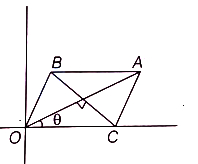
ધારો કે $ABOC$ પ્રથમ ચરણમાં એક સમબાજુ ચતુષ્કોણ છે,જ્યાં $O$ ઉગમબિંદુ છે. જો $\triangle ABC$ ના શિરોબિંદુઓ $B$ અને $C$ અનુક્રમે $y=\frac{4}{3}x$ અને $y=0$ પર આવેલા હોય અને બાજુ $BC$ એ $\left(\frac{2}{3}, \frac{2}{3}\right)$ માંથી પસાર થતી હોય,તો $BC$ નું મધ્યબિંદુ શોધો.
A
$\left(\frac{4}{5}, \frac{2}{5}\right)$
B
$\left(\frac{2}{3}, \frac{2}{3}\right)$
C
$\left(\frac{2}{5}, \frac{4}{5}\right)$
D
$\left(\frac{1}{3}, \frac{1}{3}\right)$
Solution
(A) ધારો કે રેખા $OA$ એ $x$-અક્ષ સાથે $\theta$ ખૂણો બનાવે છે. $ABOC$ સમબાજુ ચતુષ્કોણ હોવાથી,વિકર્ણ $OA$ એ $\angle BOC$ ને દુભાગે છે. રેખા $OB$ એ $y = \frac{4}{3}x$ છે,તેથી ઢાળ $\frac{4}{3}$ છે,એટલે કે $\tan(2\theta) = \frac{4}{3}$.
$\tan(2\theta) = \frac{2\tan\theta}{1-\tan^2\theta}$ સૂત્રનો ઉપયોગ કરતા,$\frac{2\tan\theta}{1-\tan^2\theta} = \frac{4}{3}$ મળે.
ધારો કે $\tan\theta = m$. તો $3(2m) = 4(1-m^2)$ $\Rightarrow 6m = 4 - 4m^2$ $\Rightarrow 4m^2 + 6m - 4 = 0$ $\Rightarrow 2m^2 + 3m - 2 = 0$.
$m$ માટે ઉકેલતા,$(2m-1)(m+2) = 0$,તેથી $m = \frac{1}{2}$ (કારણ કે $\theta$ લઘુકોણ છે).
આમ,$OA$ નો ઢાળ $\frac{1}{2}$ છે. સમબાજુ ચતુષ્કોણના વિકર્ણો પરસ્પર લંબ હોવાથી,$BC$ નો ઢાળ $-2$ છે.
રેખા $BC$ એ $\left(\frac{2}{3}, \frac{2}{3}\right)$ માંથી પસાર થાય છે અને તેનો ઢાળ $-2$ છે,તેથી તેનું સમીકરણ $y - \frac{2}{3} = -2(x - \frac{2}{3}) \Rightarrow y = -2x + 2$ અથવા $2x + y = 2$ છે.
$B$ એ $y = \frac{4}{3}x$ અને $2x + y = 2$ પર છે,તેથી $2x + \frac{4}{3}x = 2$ $\Rightarrow \frac{10}{3}x = 2$ $\Rightarrow x = \frac{3}{5}, y = \frac{4}{5}$. તેથી $B = \left(\frac{3}{5}, \frac{4}{5}\right)$.
$C$ એ $y = 0$ અને $2x + y = 2$ પર છે,તેથી $2x = 2 \Rightarrow x = 1$. તેથી $C = (1, 0)$.
$BC$ નું મધ્યબિંદુ $\left(\frac{\frac{3}{5} + 1}{2}, \frac{\frac{4}{5} + 0}{2}\right) = \left(\frac{8/5}{2}, \frac{4/5}{2}\right) = \left(\frac{4}{5}, \frac{2}{5}\right)$ છે.
$\tan(2\theta) = \frac{2\tan\theta}{1-\tan^2\theta}$ સૂત્રનો ઉપયોગ કરતા,$\frac{2\tan\theta}{1-\tan^2\theta} = \frac{4}{3}$ મળે.
ધારો કે $\tan\theta = m$. તો $3(2m) = 4(1-m^2)$ $\Rightarrow 6m = 4 - 4m^2$ $\Rightarrow 4m^2 + 6m - 4 = 0$ $\Rightarrow 2m^2 + 3m - 2 = 0$.
$m$ માટે ઉકેલતા,$(2m-1)(m+2) = 0$,તેથી $m = \frac{1}{2}$ (કારણ કે $\theta$ લઘુકોણ છે).
આમ,$OA$ નો ઢાળ $\frac{1}{2}$ છે. સમબાજુ ચતુષ્કોણના વિકર્ણો પરસ્પર લંબ હોવાથી,$BC$ નો ઢાળ $-2$ છે.
રેખા $BC$ એ $\left(\frac{2}{3}, \frac{2}{3}\right)$ માંથી પસાર થાય છે અને તેનો ઢાળ $-2$ છે,તેથી તેનું સમીકરણ $y - \frac{2}{3} = -2(x - \frac{2}{3}) \Rightarrow y = -2x + 2$ અથવા $2x + y = 2$ છે.
$B$ એ $y = \frac{4}{3}x$ અને $2x + y = 2$ પર છે,તેથી $2x + \frac{4}{3}x = 2$ $\Rightarrow \frac{10}{3}x = 2$ $\Rightarrow x = \frac{3}{5}, y = \frac{4}{5}$. તેથી $B = \left(\frac{3}{5}, \frac{4}{5}\right)$.
$C$ એ $y = 0$ અને $2x + y = 2$ પર છે,તેથી $2x = 2 \Rightarrow x = 1$. તેથી $C = (1, 0)$.
$BC$ નું મધ્યબિંદુ $\left(\frac{\frac{3}{5} + 1}{2}, \frac{\frac{4}{5} + 0}{2}\right) = \left(\frac{8/5}{2}, \frac{4/5}{2}\right) = \left(\frac{4}{5}, \frac{2}{5}\right)$ છે.
0 likesView Solution
178
MathematicsMediumMCQAP EAMCET · 2022
ત્રિકોણ $ABC$ માં,$(b+c) \sin \frac{A}{2} =$
A
$a \cos A$
B
$a \cos \left(\frac{B-C}{2}\right)$
C
$a \sin \left(\frac{B+C}{2}\right)$
D
$a \sin \left(\frac{B-C}{2}\right)$
Solution
(B) સાઇનના નિયમ મુજબ,$\frac{a}{\sin A} = \frac{b}{\sin B} = \frac{c}{\sin C} = k$.
તેથી,$b = k \sin B$ અને $c = k \sin C$.
આ કિંમતો પદાવલિમાં મૂકતા:
$(b+c) \sin \frac{A}{2} = k(\sin B + \sin C) \sin \frac{A}{2}$.
સરવાળાથી ગુણાકારના સૂત્ર $\sin B + \sin C = 2 \sin \frac{B+C}{2} \cos \frac{B-C}{2}$ નો ઉપયોગ કરતા:
$= k \left[ 2 \sin \frac{B+C}{2} \cos \frac{B-C}{2} \right] \sin \frac{A}{2}$.
$A+B+C = \pi$ હોવાથી,$\frac{B+C}{2} = \frac{\pi}{2} - \frac{A}{2}$,તેથી $\sin \frac{B+C}{2} = \cos \frac{A}{2}$.
$= k \left[ 2 \cos \frac{A}{2} \cos \frac{B-C}{2} \right] \sin \frac{A}{2}$.
$= k \left[ 2 \sin \frac{A}{2} \cos \frac{A}{2} \right] \cos \frac{B-C}{2}$.
$= k \sin A \cos \frac{B-C}{2}$.
$a = k \sin A$ હોવાથી,પદાવલિ $a \cos \frac{B-C}{2}$ બને છે.
તેથી,$b = k \sin B$ અને $c = k \sin C$.
આ કિંમતો પદાવલિમાં મૂકતા:
$(b+c) \sin \frac{A}{2} = k(\sin B + \sin C) \sin \frac{A}{2}$.
સરવાળાથી ગુણાકારના સૂત્ર $\sin B + \sin C = 2 \sin \frac{B+C}{2} \cos \frac{B-C}{2}$ નો ઉપયોગ કરતા:
$= k \left[ 2 \sin \frac{B+C}{2} \cos \frac{B-C}{2} \right] \sin \frac{A}{2}$.
$A+B+C = \pi$ હોવાથી,$\frac{B+C}{2} = \frac{\pi}{2} - \frac{A}{2}$,તેથી $\sin \frac{B+C}{2} = \cos \frac{A}{2}$.
$= k \left[ 2 \cos \frac{A}{2} \cos \frac{B-C}{2} \right] \sin \frac{A}{2}$.
$= k \left[ 2 \sin \frac{A}{2} \cos \frac{A}{2} \right] \cos \frac{B-C}{2}$.
$= k \sin A \cos \frac{B-C}{2}$.
$a = k \sin A$ હોવાથી,પદાવલિ $a \cos \frac{B-C}{2}$ બને છે.
0 likesView Solution
179
MathematicsMediumMCQAP EAMCET · 2022
ત્રિકોણ $ABC$ માં,જો $a-2b+c=0$ હોય,તો $\cot \left(\frac{A}{2}\right) \cdot \cot \left(\frac{C}{2}\right) = $
A
$1$
B
$2$
C
$3$
D
$4$
Solution
(C) આપેલ છે કે $a - 2b + c = 0$,તેથી $a + c = 2b$.
સૂત્ર $\cot \left(\frac{A}{2}\right) = \sqrt{\frac{s(s-a)}{(s-b)(s-c)}}$ અને $\cot \left(\frac{C}{2}\right) = \sqrt{\frac{s(s-c)}{(s-a)(s-b)}}$ નો ઉપયોગ કરતા,જ્યાં $s = \frac{a+b+c}{2}$.
તેથી $\cot \left(\frac{A}{2}\right) \cdot \cot \left(\frac{C}{2}\right) = \sqrt{\frac{s(s-a)}{(s-b)(s-c)} \cdot \frac{s(s-c)}{(s-a)(s-b)}} = \frac{s}{s-b}$.
$s = \frac{a+b+c}{2}$ મૂકતા:
$\frac{s}{s-b} = \frac{\frac{a+b+c}{2}}{\frac{a+b+c}{2} - b} = \frac{a+b+c}{a+b+c-2b} = \frac{a+b+c}{a-b+c}$.
કારણ કે $a+c = 2b$,આ કિંમત પદાવલિમાં મૂકતા:
$\frac{(a+c)+b}{(a+c)-b} = \frac{2b+b}{2b-b} = \frac{3b}{b} = 3$.
સૂત્ર $\cot \left(\frac{A}{2}\right) = \sqrt{\frac{s(s-a)}{(s-b)(s-c)}}$ અને $\cot \left(\frac{C}{2}\right) = \sqrt{\frac{s(s-c)}{(s-a)(s-b)}}$ નો ઉપયોગ કરતા,જ્યાં $s = \frac{a+b+c}{2}$.
તેથી $\cot \left(\frac{A}{2}\right) \cdot \cot \left(\frac{C}{2}\right) = \sqrt{\frac{s(s-a)}{(s-b)(s-c)} \cdot \frac{s(s-c)}{(s-a)(s-b)}} = \frac{s}{s-b}$.
$s = \frac{a+b+c}{2}$ મૂકતા:
$\frac{s}{s-b} = \frac{\frac{a+b+c}{2}}{\frac{a+b+c}{2} - b} = \frac{a+b+c}{a+b+c-2b} = \frac{a+b+c}{a-b+c}$.
કારણ કે $a+c = 2b$,આ કિંમત પદાવલિમાં મૂકતા:
$\frac{(a+c)+b}{(a+c)-b} = \frac{2b+b}{2b-b} = \frac{3b}{b} = 3$.
0 likesView Solution
180
MathematicsMediumMCQAP EAMCET · 2022
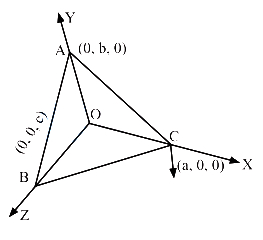
જો $G(2, -1, 2)$ એ ચતુષ્ફલક $OABC$ નું મધ્યકેન્દ્ર હોય,જ્યાં $O=(0, 0, 0)$ અને $G_1$ એ $\triangle ABC$ નું મધ્યકેન્દ્ર હોય,તો $\left|\overline{O G_1}\right|=$
A
$1$
B
$\frac{3}{2}$
C
$4$
D
$\frac{9}{2}$
Solution
(C) ધારો કે શિરોબિંદુઓના યામ $O(0, 0, 0)$,$A(x_1, y_1, z_1)$,$B(x_2, y_2, z_2)$,અને $C(x_3, y_3, z_3)$ છે.
ચતુષ્ફલક $OABC$ નું મધ્યકેન્દ્ર $G = \left(\frac{0+x_1+x_2+x_3}{4}, \frac{0+y_1+y_2+y_3}{4}, \frac{0+z_1+z_2+z_3}{4}\right) = (2, -1, 2)$ છે.
આથી $\frac{x_1+x_2+x_3}{4} = 2 \Rightarrow x_1+x_2+x_3 = 8$,$\frac{y_1+y_2+y_3}{4} = -1 \Rightarrow y_1+y_2+y_3 = -4$,અને $\frac{z_1+z_2+z_3}{4} = 2 \Rightarrow z_1+z_2+z_3 = 8$.
$\triangle ABC$ નું મધ્યકેન્દ્ર $G_1 = \left(\frac{x_1+x_2+x_3}{3}, \frac{y_1+y_2+y_3}{3}, \frac{z_1+z_2+z_3}{3}\right)$ છે.
કિંમતો મૂકતા,$G_1 = \left(\frac{8}{3}, \frac{-4}{3}, \frac{8}{3}\right)$ મળે.
અંતર $\left|\overline{O G_1}\right| = \sqrt{\left(\frac{8}{3}\right)^2 + \left(-\frac{4}{3}\right)^2 + \left(\frac{8}{3}\right)^2} = \sqrt{\frac{64}{9} + \frac{16}{9} + \frac{64}{9}} = \sqrt{\frac{144}{9}} = \sqrt{16} = 4$.
ચતુષ્ફલક $OABC$ નું મધ્યકેન્દ્ર $G = \left(\frac{0+x_1+x_2+x_3}{4}, \frac{0+y_1+y_2+y_3}{4}, \frac{0+z_1+z_2+z_3}{4}\right) = (2, -1, 2)$ છે.
આથી $\frac{x_1+x_2+x_3}{4} = 2 \Rightarrow x_1+x_2+x_3 = 8$,$\frac{y_1+y_2+y_3}{4} = -1 \Rightarrow y_1+y_2+y_3 = -4$,અને $\frac{z_1+z_2+z_3}{4} = 2 \Rightarrow z_1+z_2+z_3 = 8$.
$\triangle ABC$ નું મધ્યકેન્દ્ર $G_1 = \left(\frac{x_1+x_2+x_3}{3}, \frac{y_1+y_2+y_3}{3}, \frac{z_1+z_2+z_3}{3}\right)$ છે.
કિંમતો મૂકતા,$G_1 = \left(\frac{8}{3}, \frac{-4}{3}, \frac{8}{3}\right)$ મળે.
અંતર $\left|\overline{O G_1}\right| = \sqrt{\left(\frac{8}{3}\right)^2 + \left(-\frac{4}{3}\right)^2 + \left(\frac{8}{3}\right)^2} = \sqrt{\frac{64}{9} + \frac{16}{9} + \frac{64}{9}} = \sqrt{\frac{144}{9}} = \sqrt{16} = 4$.
0 likesView Solution
181
MathematicsMediumMCQAP EAMCET · 2022
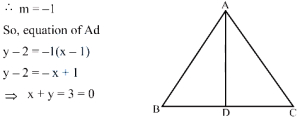
$\triangle ABC$ માં,જો $A$ એ $(1,2)$ હોય,અને $B$ તથા $C$ એ $y=x+\alpha$ રેખા પર આવેલા હોય (જ્યાં $\alpha$ ચલ છે),તો ત્રિકોણના લંબકેન્દ્રનો બિંદુપથ શું થાય?
A
$x+y-3=0$
B
$x+y+3=0$
C
$y=x+1$
D
$y=x-1$
Solution
(A) ધારો કે $H(h, k)$ એ $\triangle ABC$ નું લંબકેન્દ્ર છે. લંબકેન્દ્ર એ વેધનું છેદબિંદુ છે. $B$ અને $C$ એ $y=x+\alpha$ રેખા પર આવેલા હોવાથી,રેખા $BC$ નો ઢાળ $1$ છે. $A(1, 2)$ માંથી $BC$ પર દોરેલો વેધ $BC$ ને લંબ હોય. તેથી,વેધ $AD$ નો ઢાળ $-1$ થાય. $A(1, 2)$ માંથી પસાર થતી અને $-1$ ઢાળ ધરાવતી વેધ $AD$ નું સમીકરણ $y-2 = -1(x-1)$ છે,જેનું સાદું રૂપ $y-2 = -x+1$ એટલે કે $x+y-3=0$ થાય. લંબકેન્દ્ર $H(h, k)$ આ વેધ પર આવેલું હોવાથી,તેનો બિંદુપથ $x+y-3=0$ છે.
0 likesView Solution
182
MathematicsEasyMCQAP EAMCET · 2022
બે બિંદુઓ $Q(3,4)$ અને $R(1,2)$ આપેલ છે. રેખા $2x-y-1=0$ પરનું તે બિંદુ $P(x, y)$ કયું છે જેના માટે $PQ+PR=QR$ થાય?
A
$(-3,-7)$
B
$(-2,-5)$
C
$(2,3)$
D
$(4,7)$
Solution
(C) શરત $PQ+PR=QR$ સૂચવે છે કે બિંદુ $P$ એ રેખાખંડ $QR$ પર આવેલું હોવું જોઈએ.
પ્રથમ,આપણે $Q(3,4)$ અને $R(1,2)$ માંથી પસાર થતી રેખાનું સમીકરણ શોધીએ.
ઢાળ $m = \frac{2-4}{1-3} = \frac{-2}{-2} = 1$.
રેખા $QR$ નું સમીકરણ $y - 2 = 1(x - 1)$ છે,જેનું સાદું રૂપ $x - y + 1 = 0$ થાય છે.
બિંદુ $P$ એ રેખા $2x - y - 1 = 0$ અને રેખા $x - y + 1 = 0$ બંને પર હોવાથી,આપણે સમીકરણોની સિસ્ટમ ઉકેલીએ:
$2x - y = 1$
$x - y = -1$
પ્રથમ સમીકરણમાંથી બીજું સમીકરણ બાદ કરતાં $(2x - x) - (y - y) = 1 - (-1)$ મળે,તેથી $x = 2$.
$x = 2$ ને $x - y = -1$ માં મૂકતા,આપણને $2 - y = -1$ મળે છે,જેનો અર્થ છે કે $y = 3$.
આમ,બિંદુ $P$ એ $(2,3)$ છે.
પ્રથમ,આપણે $Q(3,4)$ અને $R(1,2)$ માંથી પસાર થતી રેખાનું સમીકરણ શોધીએ.
ઢાળ $m = \frac{2-4}{1-3} = \frac{-2}{-2} = 1$.
રેખા $QR$ નું સમીકરણ $y - 2 = 1(x - 1)$ છે,જેનું સાદું રૂપ $x - y + 1 = 0$ થાય છે.
બિંદુ $P$ એ રેખા $2x - y - 1 = 0$ અને રેખા $x - y + 1 = 0$ બંને પર હોવાથી,આપણે સમીકરણોની સિસ્ટમ ઉકેલીએ:
$2x - y = 1$
$x - y = -1$
પ્રથમ સમીકરણમાંથી બીજું સમીકરણ બાદ કરતાં $(2x - x) - (y - y) = 1 - (-1)$ મળે,તેથી $x = 2$.
$x = 2$ ને $x - y = -1$ માં મૂકતા,આપણને $2 - y = -1$ મળે છે,જેનો અર્થ છે કે $y = 3$.
આમ,બિંદુ $P$ એ $(2,3)$ છે.
0 likesView Solution
183
MathematicsEasyMCQAP EAMCET · 2022
ધારો કે ત્રિકોણના શિરોબિંદુઓ $A(0,3)$,$B(-2,0)$ અને $C(6,1)$ છે. બિંદુ $(\alpha, \alpha+1)$ ત્રિકોણની અંદર આવે તે માટે,$\alpha$ એ કયા અંતરાલમાં હોવું જોઈએ?
A
$\left(\frac{-6}{7}, 4\right)$
B
$\left(\frac{4}{5}, 4\right)$
C
$\left(-\infty, \frac{-6}{7}\right) \cup (4, \infty)$
D
$\left(\frac{-6}{7}, \frac{3}{2}\right)$
Solution
(D) ત્રિકોણના શિરોબિંદુઓ $A(0,3)$,$B(-2,0)$ અને $C(6,1)$ છે.
ત્રિકોણની બાજુઓની રેખાઓના સમીકરણો:
રેખા $AB$: $3x - 2y + 6 = 0$.
રેખા $BC$: $x - 8y + 2 = 0$.
રેખા $AC$: $x + 3y - 9 = 0$.
ધારો કે બિંદુ $P$ એ $(\alpha, \alpha+1)$ છે. $P$ ત્રિકોણની અંદર રહે તે માટે,તે રેખા $y = x+1$ અને ત્રિકોણની બાજુઓના છેદબિંદુઓ વચ્ચે હોવું જોઈએ.
$AC$ સાથે છેદબિંદુ: $\alpha = \frac{3}{2}$.
$BC$ સાથે છેદબિંદુ: $\alpha = -\frac{6}{7}$.
તેથી,$\alpha$ એ $\left(\frac{-6}{7}, \frac{3}{2}\right)$ અંતરાલમાં હોવું જોઈએ.
ત્રિકોણની બાજુઓની રેખાઓના સમીકરણો:
રેખા $AB$: $3x - 2y + 6 = 0$.
રેખા $BC$: $x - 8y + 2 = 0$.
રેખા $AC$: $x + 3y - 9 = 0$.
ધારો કે બિંદુ $P$ એ $(\alpha, \alpha+1)$ છે. $P$ ત્રિકોણની અંદર રહે તે માટે,તે રેખા $y = x+1$ અને ત્રિકોણની બાજુઓના છેદબિંદુઓ વચ્ચે હોવું જોઈએ.
$AC$ સાથે છેદબિંદુ: $\alpha = \frac{3}{2}$.
$BC$ સાથે છેદબિંદુ: $\alpha = -\frac{6}{7}$.
તેથી,$\alpha$ એ $\left(\frac{-6}{7}, \frac{3}{2}\right)$ અંતરાલમાં હોવું જોઈએ.
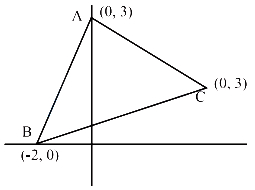
0 likesView Solution
184
MathematicsEasyMCQAP EAMCET · 2022
$(0,0)$,$(4,0)$ અને $(3,4)$ શિરોબિંદુઓ દ્વારા બનતા ત્રિકોણનું લંબકેન્દ્ર શોધો:
A
$\left(3, \frac{3}{4}\right)$
B
$\left(3, \frac{5}{4}\right)$
C
$(3,12)$
D
$(3,9)$
Solution
(A) ધારો કે ત્રિકોણના શિરોબિંદુઓ $O(0,0)$,$B(4,0)$ અને $C(3,4)$ છે.
લંબકેન્દ્ર શોધવા માટે,આપણે વેધના છેદબિંદુની જરૂર છે.
$1$. $C(3,4)$ માંથી $OB$ બાજુ (જે $x$-અક્ષ પર છે) પરનો વેધ એ $x=3$ માંથી પસાર થતી શિરોલંબ રેખા છે. આમ,આ વેધનું સમીકરણ $x=3$ છે.
$2$. બાજુ $BC$ નો ઢાળ $m_{BC} = \frac{4-0}{3-4} = \frac{4}{-1} = -4$ છે.
$3$. $O(0,0)$ માંથી $BC$ પરનો વેધ એ $BC$ ને લંબ છે. તેનો ઢાળ $m_{\perp} = -\frac{1}{m_{BC}} = -\frac{1}{-4} = \frac{1}{4}$ છે.
$4$. $O$ માંથી પસાર થતા વેધનું સમીકરણ $y - 0 = \frac{1}{4}(x - 0)$ છે,જેનું સાદું રૂપ $y = \frac{1}{4}x$ થાય છે.
$5$. $y = \frac{1}{4}x$ સમીકરણમાં $x=3$ મૂકતા,આપણને $y = \frac{1}{4}(3) = \frac{3}{4}$ મળે છે.
તેથી,લંબકેન્દ્ર $\left(3, \frac{3}{4}\right)$ છે.
લંબકેન્દ્ર શોધવા માટે,આપણે વેધના છેદબિંદુની જરૂર છે.
$1$. $C(3,4)$ માંથી $OB$ બાજુ (જે $x$-અક્ષ પર છે) પરનો વેધ એ $x=3$ માંથી પસાર થતી શિરોલંબ રેખા છે. આમ,આ વેધનું સમીકરણ $x=3$ છે.
$2$. બાજુ $BC$ નો ઢાળ $m_{BC} = \frac{4-0}{3-4} = \frac{4}{-1} = -4$ છે.
$3$. $O(0,0)$ માંથી $BC$ પરનો વેધ એ $BC$ ને લંબ છે. તેનો ઢાળ $m_{\perp} = -\frac{1}{m_{BC}} = -\frac{1}{-4} = \frac{1}{4}$ છે.
$4$. $O$ માંથી પસાર થતા વેધનું સમીકરણ $y - 0 = \frac{1}{4}(x - 0)$ છે,જેનું સાદું રૂપ $y = \frac{1}{4}x$ થાય છે.
$5$. $y = \frac{1}{4}x$ સમીકરણમાં $x=3$ મૂકતા,આપણને $y = \frac{1}{4}(3) = \frac{3}{4}$ મળે છે.
તેથી,લંબકેન્દ્ર $\left(3, \frac{3}{4}\right)$ છે.
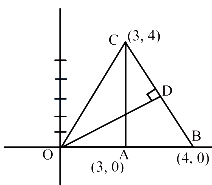
0 likesView Solution
185
MathematicsMediumMCQAP EAMCET · 2022
ધારો કે $18x^2 - 9xy + y^2 = 0$ અને $y = c$ દ્વારા $27$ ચોરસ એકમ ક્ષેત્રફળ ધરાવતો ત્રિકોણ બને છે. તો ત્રિકોણનું મધ્યકેન્દ્ર શું છે?
A
$(3, 12)$
B
$(12, 3)$
C
$(-12, 3)$
D
$(-3, 12)$
Solution
(A) આપેલ સમીકરણ $18x^2 - 9xy + y^2 = 0$ છે.
આને $(y - 3x)(y - 6x) = 0$ તરીકે અવયવ પાડી શકાય છે.
આમ,બે રેખાઓ $y = 3x$ અને $y = 6x$ છે.
આ બે રેખાઓનું છેદબિંદુ ઉગમબિંદુ $(0, 0)$ છે.
આ રેખાઓનું $y = c$ રેખા સાથેનું છેદબિંદુ $(\frac{c}{3}, c)$ અને $(\frac{c}{6}, c)$ છે.
ત્રણ બિંદુઓ $(0, 0)$,$(\frac{c}{3}, c)$,અને $(\frac{c}{6}, c)$ દ્વારા બનતા ત્રિકોણનું ક્ષેત્રફળ $\frac{1}{2} |x_1(y_2 - y_3) + x_2(y_3 - y_1) + x_3(y_1 - y_2)| = 27$ છે.
$\frac{1}{2} |\frac{c^2}{3} - \frac{c^2}{6}| = 27 \Rightarrow c^2 = 324$.
$c = 18$ લેતા,શિરોબિંદુઓ $(0, 0)$,$(6, 18)$,અને $(3, 18)$ મળે છે.
મધ્યકેન્દ્ર $(\frac{0 + 6 + 3}{3}, \frac{0 + 18 + 18}{3}) = (3, 12)$ છે.
આને $(y - 3x)(y - 6x) = 0$ તરીકે અવયવ પાડી શકાય છે.
આમ,બે રેખાઓ $y = 3x$ અને $y = 6x$ છે.
આ બે રેખાઓનું છેદબિંદુ ઉગમબિંદુ $(0, 0)$ છે.
આ રેખાઓનું $y = c$ રેખા સાથેનું છેદબિંદુ $(\frac{c}{3}, c)$ અને $(\frac{c}{6}, c)$ છે.
ત્રણ બિંદુઓ $(0, 0)$,$(\frac{c}{3}, c)$,અને $(\frac{c}{6}, c)$ દ્વારા બનતા ત્રિકોણનું ક્ષેત્રફળ $\frac{1}{2} |x_1(y_2 - y_3) + x_2(y_3 - y_1) + x_3(y_1 - y_2)| = 27$ છે.
$\frac{1}{2} |\frac{c^2}{3} - \frac{c^2}{6}| = 27 \Rightarrow c^2 = 324$.
$c = 18$ લેતા,શિરોબિંદુઓ $(0, 0)$,$(6, 18)$,અને $(3, 18)$ મળે છે.
મધ્યકેન્દ્ર $(\frac{0 + 6 + 3}{3}, \frac{0 + 18 + 18}{3}) = (3, 12)$ છે.
0 likesView Solution
186
MathematicsMediumMCQAP EAMCET · 2022
જો $\triangle ABC$ ના શિરોબિંદુઓના યામ $A(7,6,4)$,$B(5,4,6)$,$C(3,2,0)$ હોય અને $\angle BAC$ નો દ્વિભાજક બાજુ $BC$ ને $D$ માં મળે,તો $D$ ના યામ શોધો.
A
$\left(\frac{13}{3}, \frac{10}{3}, 4\right)$
B
$\left(\frac{11}{3}, \frac{8}{3}, 2\right)$
C
$(9,8,6)$
D
$(7,5,3)$
Solution
(A) $\because AD$ એ $\angle A$ નો ખૂણાનો દ્વિભાજક છે.
$\Rightarrow \frac{AB}{AC} = \frac{BD}{CD}$
હવે,
$AB = \sqrt{(5-7)^2 + (4-6)^2 + (6-4)^2} = \sqrt{4+4+4} = 2\sqrt{3}$
$AC = \sqrt{(3-7)^2 + (2-6)^2 + (0-4)^2} = \sqrt{16+16+16} = 4\sqrt{3}$
$\Rightarrow \frac{BD}{CD} = \frac{2\sqrt{3}}{4\sqrt{3}} = \frac{1}{2}$
$\Rightarrow D$ એ $BC$ નું $1:2$ ગુણોત્તરમાં અંતઃવિભાજન કરે છે.
$\Rightarrow D = \left(\frac{1(3) + 2(5)}{1+2}, \frac{1(2) + 2(4)}{1+2}, \frac{1(0) + 2(6)}{1+2}\right)$
$\Rightarrow D = \left(\frac{13}{3}, \frac{10}{3}, 4\right)$
$\Rightarrow \frac{AB}{AC} = \frac{BD}{CD}$
હવે,
$AB = \sqrt{(5-7)^2 + (4-6)^2 + (6-4)^2} = \sqrt{4+4+4} = 2\sqrt{3}$
$AC = \sqrt{(3-7)^2 + (2-6)^2 + (0-4)^2} = \sqrt{16+16+16} = 4\sqrt{3}$
$\Rightarrow \frac{BD}{CD} = \frac{2\sqrt{3}}{4\sqrt{3}} = \frac{1}{2}$
$\Rightarrow D$ એ $BC$ નું $1:2$ ગુણોત્તરમાં અંતઃવિભાજન કરે છે.
$\Rightarrow D = \left(\frac{1(3) + 2(5)}{1+2}, \frac{1(2) + 2(4)}{1+2}, \frac{1(0) + 2(6)}{1+2}\right)$
$\Rightarrow D = \left(\frac{13}{3}, \frac{10}{3}, 4\right)$
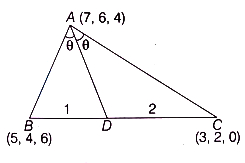
0 likesView Solution
187
MathematicsEasyMCQAP EAMCET · 2022
ધારો કે $P$ અને $Q$ અનુક્રમે $3x + 4y - 4 = 0$ અને $5x - y - 4 = 0$ પર આવેલા છે. જો $PQ$ નું મધ્યબિંદુ $(1, 5)$ હોય,તો $P$ અને $Q$ માંથી પસાર થતી રેખાનો ઢાળ શોધો.
A
$\frac{83}{35}$
B
$\frac{65}{35}$
C
$\frac{-3}{4}$
D
$\frac{3}{4}$
Solution
(A) ધારો કે રેખા $PQ$ નો ઢાળ $m$ છે. $(1, 5)$ માંથી પસાર થતી રેખાનું સમીકરણ $y - 5 = m(x - 1)$ છે,જે $y = mx + 5 - m$ તરીકે લખી શકાય.
$Q$ એ $5x - y - 4 = 0$ પર હોવાથી,$y = mx + 5 - m$ ને સમીકરણમાં મૂકતા:
$5x - (mx + 5 - m) - 4 = 0 \Rightarrow (5 - m)x + m - 9 = 0 \Rightarrow x_Q = \frac{9 - m}{5 - m}$.
તેથી $y_Q = \frac{25 - m}{5 - m}$.
$P$ એ $3x + 4y - 4 = 0$ પર હોવાથી,$y = mx + 5 - m$ ને સમીકરણમાં મૂકતા:
$3x + 4(mx + 5 - m) - 4 = 0 \Rightarrow (3 + 4m)x + 16 - 4m = 0 \Rightarrow x_P = \frac{4m - 16}{4m + 3}$.
તેથી $y_P = \frac{m + 15}{4m + 3}$.
$(1, 5)$ એ $PQ$ નું મધ્યબિંદુ હોવાથી,$x$-યામ $\frac{x_P + x_Q}{2} = 1$ થાય:
$\frac{4m - 16}{4m + 3} + \frac{9 - m}{5 - m} = 2$.
$m$ માટે ઉકેલતા: $35m = 83 \Rightarrow m = \frac{83}{35}$.
$Q$ એ $5x - y - 4 = 0$ પર હોવાથી,$y = mx + 5 - m$ ને સમીકરણમાં મૂકતા:
$5x - (mx + 5 - m) - 4 = 0 \Rightarrow (5 - m)x + m - 9 = 0 \Rightarrow x_Q = \frac{9 - m}{5 - m}$.
તેથી $y_Q = \frac{25 - m}{5 - m}$.
$P$ એ $3x + 4y - 4 = 0$ પર હોવાથી,$y = mx + 5 - m$ ને સમીકરણમાં મૂકતા:
$3x + 4(mx + 5 - m) - 4 = 0 \Rightarrow (3 + 4m)x + 16 - 4m = 0 \Rightarrow x_P = \frac{4m - 16}{4m + 3}$.
તેથી $y_P = \frac{m + 15}{4m + 3}$.
$(1, 5)$ એ $PQ$ નું મધ્યબિંદુ હોવાથી,$x$-યામ $\frac{x_P + x_Q}{2} = 1$ થાય:
$\frac{4m - 16}{4m + 3} + \frac{9 - m}{5 - m} = 2$.
$m$ માટે ઉકેલતા: $35m = 83 \Rightarrow m = \frac{83}{35}$.
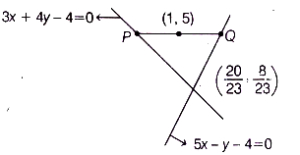
0 likesView Solution
188
MathematicsEasyMCQAP EAMCET · 2022
રેખાઓ $3x+2y=5$ અને $3x+2y=3$ વચ્ચે રેખા $x+1=0$ ના અંતઃખંડની લંબાઈ કેટલી છે?
A
$2$
B
$1$
C
$3$
D
$4$
Solution
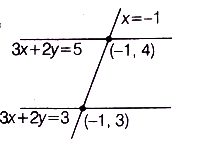
(B) રેખા $x+1=0$ એ $x=-1$ ને સમાન છે.
$3x+2y=5$ સાથે છેદબિંદુ શોધવા માટે,$x=-1$ મૂકો:
$3(-1)+2y=5 \implies -3+2y=5 \implies 2y=8 \implies y=4$.
તેથી,પ્રથમ બિંદુ $(-1, 4)$ છે.
$3x+2y=3$ સાથે છેદબિંદુ શોધવા માટે,$x=-1$ મૂકો:
$3(-1)+2y=3 \implies -3+2y=3 \implies 2y=6 \implies y=3$.
તેથી,બીજું બિંદુ $(-1, 3)$ છે.
અંતઃખંડની લંબાઈ એ $(-1, 4)$ અને $(-1, 3)$ વચ્ચેનું અંતર છે:
અંતર $= \sqrt{(-1 - (-1))^2 + (4 - 3)^2} = \sqrt{0^2 + 1^2} = \sqrt{1} = 1$.
$3x+2y=5$ સાથે છેદબિંદુ શોધવા માટે,$x=-1$ મૂકો:
$3(-1)+2y=5 \implies -3+2y=5 \implies 2y=8 \implies y=4$.
તેથી,પ્રથમ બિંદુ $(-1, 4)$ છે.
$3x+2y=3$ સાથે છેદબિંદુ શોધવા માટે,$x=-1$ મૂકો:
$3(-1)+2y=3 \implies -3+2y=3 \implies 2y=6 \implies y=3$.
તેથી,બીજું બિંદુ $(-1, 3)$ છે.
અંતઃખંડની લંબાઈ એ $(-1, 4)$ અને $(-1, 3)$ વચ્ચેનું અંતર છે:
અંતર $= \sqrt{(-1 - (-1))^2 + (4 - 3)^2} = \sqrt{0^2 + 1^2} = \sqrt{1} = 1$.
0 likesView Solution
189
MathematicsEasyMCQAP EAMCET · 2022
ધારો કે એક સમદ્વિબાજુ કાટકોણ ત્રિકોણનો કર્ણ અને તેની સામેનો શિરોબિંદુ અનુક્રમે $3x + 4y - 4 = 0$ અને $(2, 2)$ છે. તો,નીચેનામાંથી કઈ ત્રિકોણની બીજી બાજુ છે?
A
$x - 7y - 12 = 0$
B
$x + 7y + 12 = 0$
C
$7x + y - 16 = 0$
D
$7x + y + 16 = 0$
Solution
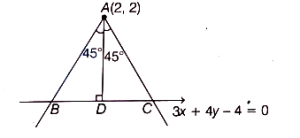
(C) કર્ણ $BC$ નું સમીકરણ $3x + 4y - 4 = 0$ છે.
શિરોબિંદુ $A = (2, 2)$ છે.
$BC$ નો ઢાળ $m_{BC} = -\frac{3}{4}$ છે.
$AD \perp BC$ હોવાથી,$AD$ નો ઢાળ $m_{AD} = \frac{4}{3}$ છે.
સમદ્વિબાજુ કાટકોણ ત્રિકોણમાં,વેધ $AD$ એ શિરોબિંદુના ખૂણાને દુભાગે છે,તેથી બાજુઓ $AB$ અને $AC$ એ $AD$ સાથે $45^{\circ}$ નો ખૂણો બનાવે છે.
ઢાળ $m$ માટે: $\tan 45^{\circ} = \left| \frac{m - \frac{4}{3}}{1 + m(\frac{4}{3})} \right|$ $\Rightarrow 1 = \left| \frac{3m - 4}{3 + 4m} \right|$.
આથી $m = -7$ અથવા $m = \frac{1}{7}$ મળે છે.
બિંદુ $(2, 2)$ માંથી પસાર થતી રેખાનું સમીકરણ:
$m = -7$ માટે: $y - 2 = -7(x - 2) \Rightarrow 7x + y - 16 = 0$.
$m = \frac{1}{7}$ માટે: $y - 2 = \frac{1}{7}(x - 2) \Rightarrow x - 7y + 12 = 0$.
આમ,સાચો વિકલ્પ $7x + y - 16 = 0$ છે.
શિરોબિંદુ $A = (2, 2)$ છે.
$BC$ નો ઢાળ $m_{BC} = -\frac{3}{4}$ છે.
$AD \perp BC$ હોવાથી,$AD$ નો ઢાળ $m_{AD} = \frac{4}{3}$ છે.
સમદ્વિબાજુ કાટકોણ ત્રિકોણમાં,વેધ $AD$ એ શિરોબિંદુના ખૂણાને દુભાગે છે,તેથી બાજુઓ $AB$ અને $AC$ એ $AD$ સાથે $45^{\circ}$ નો ખૂણો બનાવે છે.
ઢાળ $m$ માટે: $\tan 45^{\circ} = \left| \frac{m - \frac{4}{3}}{1 + m(\frac{4}{3})} \right|$ $\Rightarrow 1 = \left| \frac{3m - 4}{3 + 4m} \right|$.
આથી $m = -7$ અથવા $m = \frac{1}{7}$ મળે છે.
બિંદુ $(2, 2)$ માંથી પસાર થતી રેખાનું સમીકરણ:
$m = -7$ માટે: $y - 2 = -7(x - 2) \Rightarrow 7x + y - 16 = 0$.
$m = \frac{1}{7}$ માટે: $y - 2 = \frac{1}{7}(x - 2) \Rightarrow x - 7y + 12 = 0$.
આમ,સાચો વિકલ્પ $7x + y - 16 = 0$ છે.
0 likesView Solution
190
MathematicsMediumMCQAP EAMCET · 2022
$(1,3), (5,0)$ અને $(-1,2)$ શિરોબિંદુઓ ધરાવતા ત્રિકોણની અંદરના બિંદુઓ નીચેનામાંથી કઈ શરતનું પાલન કરે છે?
A
$3x + 2y \leq 0$
B
$3x + 2y > 0$
C
$2x - 3y - 12 > 0$
D
$2x + y - 13 > 0$
Solution
(B) ધારો કે શિરોબિંદુઓ $A(1,3), B(5,0)$ અને $C(-1,2)$ છે.
ત્રિકોણની અંદરના કોઈપણ બિંદુ $(x,y)$ માટે,જો રેખા ત્રિકોણમાંથી પસાર ન થતી હોય તો અભિવ્યક્તિએ શિરોબિંદુઓ માટે જે ચિહ્ન જાળવી રાખ્યું છે તે જ જાળવી રાખવું જોઈએ.
શિરોબિંદુઓ માટે $3x + 2y$ અભિવ્યક્તિનું પરીક્ષણ કરતા:
$A(1,3)$ માટે: $3(1) + 2(3) = 3 + 6 = 9 > 0$.
$B(5,0)$ માટે: $3(5) + 2(0) = 15 + 0 = 15 > 0$.
$C(-1,2)$ માટે: $3(-1) + 2(2) = -3 + 4 = 1 > 0$.
બધા શિરોબિંદુઓ માટે કિંમત ધન હોવાથી,ત્રિકોણની અંદરનું કોઈપણ બિંદુ $3x + 2y > 0$ નું પાલન કરશે.
તેથી,વિકલ્પ $B$ સાચો છે.
ત્રિકોણની અંદરના કોઈપણ બિંદુ $(x,y)$ માટે,જો રેખા ત્રિકોણમાંથી પસાર ન થતી હોય તો અભિવ્યક્તિએ શિરોબિંદુઓ માટે જે ચિહ્ન જાળવી રાખ્યું છે તે જ જાળવી રાખવું જોઈએ.
શિરોબિંદુઓ માટે $3x + 2y$ અભિવ્યક્તિનું પરીક્ષણ કરતા:
$A(1,3)$ માટે: $3(1) + 2(3) = 3 + 6 = 9 > 0$.
$B(5,0)$ માટે: $3(5) + 2(0) = 15 + 0 = 15 > 0$.
$C(-1,2)$ માટે: $3(-1) + 2(2) = -3 + 4 = 1 > 0$.
બધા શિરોબિંદુઓ માટે કિંમત ધન હોવાથી,ત્રિકોણની અંદરનું કોઈપણ બિંદુ $3x + 2y > 0$ નું પાલન કરશે.
તેથી,વિકલ્પ $B$ સાચો છે.
0 likesView Solution
191
MathematicsDifficultMCQAP EAMCET · 2022
$\alpha \in [0, \frac{\pi}{2}]$ માટે,$[x \cos \theta - y][(\cos \theta + \tan \alpha) x - (1 - \cos \theta \tan \alpha) y] = 0$ દ્વારા દર્શાવતી રેખાઓ વચ્ચેનો ખૂણો શોધો.
A
$\alpha$
B
$\theta$
C
$\theta + \alpha$
D
$\theta - \alpha$
Solution
(A) આપેલ સમીકરણ $[x \cos \theta - y][(\cos \theta + \tan \alpha) x - (1 - \cos \theta \tan \alpha) y] = 0$ છે.
આ બે રેખાઓ દર્શાવે છે:
$L_1: x \cos \theta - y = 0 \implies y = (\cos \theta) x$,તેથી ઢાળ $m_1 = \cos \theta$.
$L_2: (\cos \theta + \tan \alpha) x - (1 - \cos \theta \tan \alpha) y = 0 \implies y = \frac{\cos \theta + \tan \alpha}{1 - \cos \theta \tan \alpha} x$,તેથી ઢાળ $m_2 = \frac{\cos \theta + \tan \alpha}{1 - \cos \theta \tan \alpha}$.
બે રેખાઓ વચ્ચેનો ખૂણો $\phi$ એ $\tan \phi = \left| \frac{m_2 - m_1}{1 + m_1 m_2} \right|$ દ્વારા આપવામાં આવે છે.
$m_1$ અને $m_2$ ની કિંમતો મૂકતા:
$\tan \phi = \left| \frac{\frac{\cos \theta + \tan \alpha}{1 - \cos \theta \tan \alpha} - \cos \theta}{1 + \left( \frac{\cos \theta + \tan \alpha}{1 - \cos \theta \tan \alpha} \right) \cos \theta} \right| = \tan \alpha$.
આમ,$\phi = \alpha$.
આ બે રેખાઓ દર્શાવે છે:
$L_1: x \cos \theta - y = 0 \implies y = (\cos \theta) x$,તેથી ઢાળ $m_1 = \cos \theta$.
$L_2: (\cos \theta + \tan \alpha) x - (1 - \cos \theta \tan \alpha) y = 0 \implies y = \frac{\cos \theta + \tan \alpha}{1 - \cos \theta \tan \alpha} x$,તેથી ઢાળ $m_2 = \frac{\cos \theta + \tan \alpha}{1 - \cos \theta \tan \alpha}$.
બે રેખાઓ વચ્ચેનો ખૂણો $\phi$ એ $\tan \phi = \left| \frac{m_2 - m_1}{1 + m_1 m_2} \right|$ દ્વારા આપવામાં આવે છે.
$m_1$ અને $m_2$ ની કિંમતો મૂકતા:
$\tan \phi = \left| \frac{\frac{\cos \theta + \tan \alpha}{1 - \cos \theta \tan \alpha} - \cos \theta}{1 + \left( \frac{\cos \theta + \tan \alpha}{1 - \cos \theta \tan \alpha} \right) \cos \theta} \right| = \tan \alpha$.
આમ,$\phi = \alpha$.
0 likesView Solution
192
MathematicsDifficultMCQAP EAMCET · 2022
$P(2,3)$ માંથી પસાર થતી અને $x$-અક્ષની ધન દિશા સાથે $30^{\circ}$ નો ખૂણો બનાવતી રેખા $x^2-2xy-y^2=0$ ને $A$ અને $B$ માં મળે છે. તો $PA \cdot PB$ નું મૂલ્ય શોધો.
A
$17 \sqrt{3}+1$
B
$17(\sqrt{3}+1)$
C
$17(\sqrt{3}-1)$
D
$17 \sqrt{3}-1$
Solution
(B) $P(2,3)$ માંથી પસાર થતી અને $\theta = 30^{\circ}$ ખૂણો બનાવતી રેખાનું પ્રાચલિત સમીકરણ $\frac{x-2}{\cos 30^{\circ}} = \frac{y-3}{\sin 30^{\circ}} = r$ છે.
તેથી,$x = 2 + r \frac{\sqrt{3}}{2}$ અને $y = 3 + \frac{r}{2}$.
આ કિંમતો $x^2 - 2xy - y^2 = 0$ માં મૂકતા:
$(2 + r \frac{\sqrt{3}}{2})^2 - 2(2 + r \frac{\sqrt{3}}{2})(3 + \frac{r}{2}) - (3 + \frac{r}{2})^2 = 0$.
સાદુરૂપ આપતા,$r^2(\frac{1-\sqrt{3}}{2}) - r(5 + \sqrt{3}) - 17 = 0$ મળે છે.
બીજનો ગુણાકાર $PA \cdot PB = |r_1 r_2| = |\frac{-17}{(1-\sqrt{3})/2}| = 17(\sqrt{3}+1)$.
તેથી,$x = 2 + r \frac{\sqrt{3}}{2}$ અને $y = 3 + \frac{r}{2}$.
આ કિંમતો $x^2 - 2xy - y^2 = 0$ માં મૂકતા:
$(2 + r \frac{\sqrt{3}}{2})^2 - 2(2 + r \frac{\sqrt{3}}{2})(3 + \frac{r}{2}) - (3 + \frac{r}{2})^2 = 0$.
સાદુરૂપ આપતા,$r^2(\frac{1-\sqrt{3}}{2}) - r(5 + \sqrt{3}) - 17 = 0$ મળે છે.
બીજનો ગુણાકાર $PA \cdot PB = |r_1 r_2| = |\frac{-17}{(1-\sqrt{3})/2}| = 17(\sqrt{3}+1)$.
0 likesView Solution
193
MathematicsEasyMCQAP EAMCET · 2022
જો $A(-3,3), B(1,1), C(1,-1)$ અને $D(-2,-2)$ એ ચતુષ્કોણના શિરોબિંદુઓ હોય,તો વિકર્ણો $AC$ અને $BD$ વચ્ચેનો ખૂણો શોધો.
A
$\frac{\pi}{4}$
B
$\frac{\pi}{2}$
C
$\frac{\pi}{6}$
D
$\frac{\pi}{3}$
Solution
(B) વિકર્ણ $AC$ નો ઢાળ $m_{AC} = \frac{-1-3}{1-(-3)} = \frac{-4}{4} = -1$ છે.
વિકર્ણ $BD$ નો ઢાળ $m_{BD} = \frac{-2-1}{-2-1} = \frac{-3}{-3} = 1$ છે.
ઢાળનો ગુણાકાર $m_{AC} \times m_{BD} = -1 \times 1 = -1$ હોવાથી,વિકર્ણો $AC$ અને $BD$ પરસ્પર લંબ છે.
તેથી,વિકર્ણો $AC$ અને $BD$ વચ્ચેનો ખૂણો $\frac{\pi}{2}$ છે.
વિકર્ણ $BD$ નો ઢાળ $m_{BD} = \frac{-2-1}{-2-1} = \frac{-3}{-3} = 1$ છે.
ઢાળનો ગુણાકાર $m_{AC} \times m_{BD} = -1 \times 1 = -1$ હોવાથી,વિકર્ણો $AC$ અને $BD$ પરસ્પર લંબ છે.
તેથી,વિકર્ણો $AC$ અને $BD$ વચ્ચેનો ખૂણો $\frac{\pi}{2}$ છે.
0 likesView Solution
194
MathematicsMediumMCQAP EAMCET · 2022
જો $x-2y-3=0$ પર ગતિ કરતો કણ $3x-2y-5=0$ રેખાને અથડાયા પછી લંબ દિશામાં પરાવર્તિત થાય,તો પરાવર્તન પછી કણની ગતિની રેખા કઈ છે?
A
$2x+y+1=0$
B
$2x+y-1=0$
C
$2x+y-3=0$
D
$2x+y+3=0$
Solution
(B) આપાત રેખાનું સમીકરણ $x-2y-3=0$ છે. આ રેખાનો ઢાળ $m_1 = \frac{1}{2}$ છે.
કણ લંબ દિશામાં પરાવર્તિત થતો હોવાથી,પરાવર્તિત રેખાનો ઢાળ $m_2$ એ $m_1 \times m_2 = -1$ નું પાલન કરે છે.
તેથી,$m_2 = -2$.
આપાત બિંદુ એ $x-2y-3=0$ અને $3x-2y-5=0$ નું છેદબિંદુ છે.
બીજા સમીકરણમાંથી પ્રથમ સમીકરણ બાદ કરતા: $(3x-2y-5) - (x-2y-3) = 0$ $\Rightarrow 2x-2=0$ $\Rightarrow x=1$.
$x=1$ ને $x-2y-3=0$ માં મૂકતા,$1-2y-3=0$ $\Rightarrow -2y=2$ $\Rightarrow y=-1$.
છેદબિંદુ $(1, -1)$ છે.
$(1, -1)$ માંથી પસાર થતી અને $m_2 = -2$ ઢાળ ધરાવતી પરાવર્તિત રેખાનું સમીકરણ:
$y - (-1) = -2(x - 1)$
$y + 1 = -2x + 2$
$2x + y - 1 = 0$.
કણ લંબ દિશામાં પરાવર્તિત થતો હોવાથી,પરાવર્તિત રેખાનો ઢાળ $m_2$ એ $m_1 \times m_2 = -1$ નું પાલન કરે છે.
તેથી,$m_2 = -2$.
આપાત બિંદુ એ $x-2y-3=0$ અને $3x-2y-5=0$ નું છેદબિંદુ છે.
બીજા સમીકરણમાંથી પ્રથમ સમીકરણ બાદ કરતા: $(3x-2y-5) - (x-2y-3) = 0$ $\Rightarrow 2x-2=0$ $\Rightarrow x=1$.
$x=1$ ને $x-2y-3=0$ માં મૂકતા,$1-2y-3=0$ $\Rightarrow -2y=2$ $\Rightarrow y=-1$.
છેદબિંદુ $(1, -1)$ છે.
$(1, -1)$ માંથી પસાર થતી અને $m_2 = -2$ ઢાળ ધરાવતી પરાવર્તિત રેખાનું સમીકરણ:
$y - (-1) = -2(x - 1)$
$y + 1 = -2x + 2$
$2x + y - 1 = 0$.
0 likesView Solution
195
MathematicsEasyMCQAP EAMCET · 2022
જો ત્રિકોણ $ABC$ ના શિરોબિંદુઓ $A(1, 2, 3)$,$B(h, -3, 0)$ અને $C(-4, k, -1)$ હોય અને ત્રિકોણનું મધ્યકેન્દ્ર $\left(5, -1, \frac{2}{3}\right)$ હોય,તો ત્રિકોણ $ABC$ એ
A
ગુરુકોણ ત્રિકોણ છે
B
લઘુકોણ ત્રિકોણ છે
C
સમદ્વિબાજુ ત્રિકોણ છે
D
કાટકોણ ત્રિકોણ છે
Solution
(A) ત્રિકોણના શિરોબિંદુઓ $(x_1, y_1, z_1)$,$(x_2, y_2, z_2)$ અને $(x_3, y_3, z_3)$ માટે મધ્યકેન્દ્ર $G$ નું સૂત્ર $\left(\frac{x_1+x_2+x_3}{3}, \frac{y_1+y_2+y_3}{3}, \frac{z_1+z_2+z_3}{3}\right)$ છે.
આપેલ $G = \left(5, -1, \frac{2}{3}\right)$ પરથી:
$\frac{1+h-4}{3} = 5$ $\Rightarrow h-3 = 15$ $\Rightarrow h = 18$.
$\frac{2-3+k}{3} = -1$ $\Rightarrow k-1 = -3$ $\Rightarrow k = -2$.
આમ,શિરોબિંદુઓ $A(1, 2, 3)$,$B(18, -3, 0)$ અને $C(-4, -2, -1)$ છે.
બાજુઓની લંબાઈના વર્ગની ગણતરી કરતા:
$AB^2 = (18-1)^2 + (-3-2)^2 + (0-3)^2 = 17^2 + (-5)^2 + (-3)^2 = 289 + 25 + 9 = 323$.
$BC^2 = (-4-18)^2 + (-2-(-3))^2 + (-1-0)^2 = (-22)^2 + 1^2 + (-1)^2 = 484 + 1 + 1 = 486$.
$CA^2 = (-4-1)^2 + (-2-2)^2 + (-1-3)^2 = (-5)^2 + (-4)^2 + (-4)^2 = 25 + 16 + 16 = 57$.
અહીં $BC^2 = 486$ અને $AB^2 + CA^2 = 323 + 57 = 380$ હોવાથી,$BC^2 > AB^2 + CA^2$ મળે છે.
તેથી,ત્રિકોણ $ABC$ એ ગુરુકોણ ત્રિકોણ છે.
આપેલ $G = \left(5, -1, \frac{2}{3}\right)$ પરથી:
$\frac{1+h-4}{3} = 5$ $\Rightarrow h-3 = 15$ $\Rightarrow h = 18$.
$\frac{2-3+k}{3} = -1$ $\Rightarrow k-1 = -3$ $\Rightarrow k = -2$.
આમ,શિરોબિંદુઓ $A(1, 2, 3)$,$B(18, -3, 0)$ અને $C(-4, -2, -1)$ છે.
બાજુઓની લંબાઈના વર્ગની ગણતરી કરતા:
$AB^2 = (18-1)^2 + (-3-2)^2 + (0-3)^2 = 17^2 + (-5)^2 + (-3)^2 = 289 + 25 + 9 = 323$.
$BC^2 = (-4-18)^2 + (-2-(-3))^2 + (-1-0)^2 = (-22)^2 + 1^2 + (-1)^2 = 484 + 1 + 1 = 486$.
$CA^2 = (-4-1)^2 + (-2-2)^2 + (-1-3)^2 = (-5)^2 + (-4)^2 + (-4)^2 = 25 + 16 + 16 = 57$.
અહીં $BC^2 = 486$ અને $AB^2 + CA^2 = 323 + 57 = 380$ હોવાથી,$BC^2 > AB^2 + CA^2$ મળે છે.
તેથી,ત્રિકોણ $ABC$ એ ગુરુકોણ ત્રિકોણ છે.
0 likesView Solution
196
MathematicsMediumMCQAP EAMCET · 2022
ધારો કે સીધી રેખાઓની જોડી $x^2 - 2axy - y^2 = 0$ અને $x^2 - 2bxy - y^2 = 0$ એવી છે કે દરેક જોડી બીજી જોડી વચ્ચેના ખૂણાઓને દુભાગે છે. તો $ab =$
A
$1$
B
$-1$
C
$2$
D
$\frac{1}{2}$
Solution
(B) રેખાઓની જોડીનું સમીકરણ $Ax^2 + 2Hxy + By^2 = 0$ છે. આ જોડીના ખૂણાના દુભાજકો $\frac{x^2 - y^2}{A - B} = \frac{xy}{H}$ દ્વારા આપવામાં આવે છે.
પ્રથમ જોડી $x^2 - 2axy - y^2 = 0$ માટે,$A=1, B=-1, H=-a$ છે. દુભાજકો $\frac{x^2 - y^2}{1 - (-1)} = \frac{xy}{-a}$ છે,જેનું સાદું રૂપ $\frac{x^2 - y^2}{2} = \frac{xy}{-a}$ એટલે કે $ax^2 + 2xy - ay^2 = 0$ થાય છે.
આ બીજી જોડી $x^2 - 2bxy - y^2 = 0$ હોવી જોઈએ,તેથી સહગુણકોની સરખામણી કરતા:
$\frac{a}{1} = \frac{2}{-2b} = \frac{-a}{-1}$.
$\frac{a}{1} = \frac{2}{-2b}$ પરથી,આપણને $a = -\frac{1}{b}$ મળે છે,જેનો અર્થ છે કે $ab = -1$.
પ્રથમ જોડી $x^2 - 2axy - y^2 = 0$ માટે,$A=1, B=-1, H=-a$ છે. દુભાજકો $\frac{x^2 - y^2}{1 - (-1)} = \frac{xy}{-a}$ છે,જેનું સાદું રૂપ $\frac{x^2 - y^2}{2} = \frac{xy}{-a}$ એટલે કે $ax^2 + 2xy - ay^2 = 0$ થાય છે.
આ બીજી જોડી $x^2 - 2bxy - y^2 = 0$ હોવી જોઈએ,તેથી સહગુણકોની સરખામણી કરતા:
$\frac{a}{1} = \frac{2}{-2b} = \frac{-a}{-1}$.
$\frac{a}{1} = \frac{2}{-2b}$ પરથી,આપણને $a = -\frac{1}{b}$ મળે છે,જેનો અર્થ છે કે $ab = -1$.
0 likesView Solution
197
MathematicsEasyMCQAP EAMCET · 2022
ધારો કે $x+y=10$ અને યામ અક્ષો દ્વારા એક ત્રિકોણ રચાય છે. તો ત્રિકોણની અંદર આવેલા બિંદુઓ $(x, y)$ ની સંખ્યા,જ્યાં $x$ અને $y$ પ્રાકૃતિક સંખ્યાઓ છે,તે કેટલી છે?
A
$36$
B
$55$
C
$45$
D
$30$
Solution
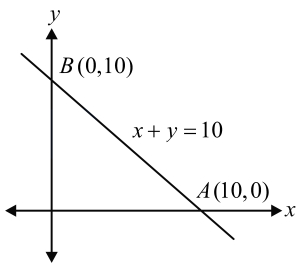
(A) ત્રિકોણ રેખાઓ $x=0$,$y=0$,અને $x+y=10$ દ્વારા રચાય છે. શિરોબિંદુઓ $O(0,0)$,$A(10,0)$,અને $B(0,10)$ છે.
આપણે એવા બિંદુઓ $(x, y)$ શોધવાની જરૂર છે કે જેથી $x, y \in \mathbb{N}$ (પ્રાકૃતિક સંખ્યાઓ) અને $x+y < 10$ થાય.
જો $x=1$ હોય,તો $1+y < 10 \implies y < 9$. $y$ પ્રાકૃતિક સંખ્યા હોવાથી,$y \in \{1, 2, 3, 4, 5, 6, 7, 8\}$. આવા $8$ બિંદુઓ છે.
જો $x=2$ હોય,તો $2+y < 10 \implies y < 8$. તેથી $y \in \{1, 2, 3, 4, 5, 6, 7\}$. આવા $7$ બિંદુઓ છે.
આ પેટર્ન મુજબ,આપેલ $x$ માટે,$y$ ના પ્રાકૃતિક સંખ્યા મૂલ્યોની સંખ્યા $9-x$ છે.
$x$ પ્રાકૃતિક સંખ્યા હોવી જોઈએ,તેથી $x$ ની કિંમત $1$ થી $8$ સુધી હોઈ શકે છે (કારણ કે જો $x=9$ હોય,તો $y < 1$ થાય,જે પ્રાકૃતિક સંખ્યા માટે શક્ય નથી).
બિંદુઓની કુલ સંખ્યાનો સરવાળો: $8 + 7 + 6 + 5 + 4 + 3 + 2 + 1 = \frac{8 \times 9}{2} = 36$.
આપણે એવા બિંદુઓ $(x, y)$ શોધવાની જરૂર છે કે જેથી $x, y \in \mathbb{N}$ (પ્રાકૃતિક સંખ્યાઓ) અને $x+y < 10$ થાય.
જો $x=1$ હોય,તો $1+y < 10 \implies y < 9$. $y$ પ્રાકૃતિક સંખ્યા હોવાથી,$y \in \{1, 2, 3, 4, 5, 6, 7, 8\}$. આવા $8$ બિંદુઓ છે.
જો $x=2$ હોય,તો $2+y < 10 \implies y < 8$. તેથી $y \in \{1, 2, 3, 4, 5, 6, 7\}$. આવા $7$ બિંદુઓ છે.
આ પેટર્ન મુજબ,આપેલ $x$ માટે,$y$ ના પ્રાકૃતિક સંખ્યા મૂલ્યોની સંખ્યા $9-x$ છે.
$x$ પ્રાકૃતિક સંખ્યા હોવી જોઈએ,તેથી $x$ ની કિંમત $1$ થી $8$ સુધી હોઈ શકે છે (કારણ કે જો $x=9$ હોય,તો $y < 1$ થાય,જે પ્રાકૃતિક સંખ્યા માટે શક્ય નથી).
બિંદુઓની કુલ સંખ્યાનો સરવાળો: $8 + 7 + 6 + 5 + 4 + 3 + 2 + 1 = \frac{8 \times 9}{2} = 36$.
0 likesView Solution
198
MathematicsEasyMCQAP EAMCET · 2022
જો રેખા $3x + y = 0$ પરનું બિંદુ $(\alpha, \beta)$ અને બિંદુ $(3, 4)$ એ રેખા $3x - 4y - 8 = 0$ ની વિરુદ્ધ બાજુઓ પર આવેલા હોય,તો નીચેનામાંથી કયું સાચું છે?
A
$15\alpha - 8 > 0$
B
$\alpha \in (-\infty, \infty)$
C
$15\alpha - 8 = 0$
D
$\alpha = 0$
Solution
(A) ધારો કે રેખા $L(x, y) = 3x - 4y - 8 = 0$ છે.
બિંદુ $(3, 4)$ માટે,$L(3, 4) = 3(3) - 4(4) - 8 = 9 - 16 - 8 = -15$ મળે છે.
$L(3, 4) < 0$ હોવાથી,બિંદુ $(\alpha, \beta)$ વિરુદ્ધ બાજુએ હોવા માટે,$L(\alpha, \beta) > 0$ હોવું જોઈએ.
$L(x, y)$ માં $(\alpha, \beta)$ મૂકતા,$3\alpha - 4\beta - 8 > 0$ મળે છે.
$(\alpha, \beta)$ એ $3x + y = 0$ પર હોવાથી,$\beta = -3\alpha$ થાય.
અસમતામાં $\beta = -3\alpha$ મૂકતા:
$3\alpha - 4(-3\alpha) - 8 > 0$
$3\alpha + 12\alpha - 8 > 0$
$15\alpha - 8 > 0$.
બિંદુ $(3, 4)$ માટે,$L(3, 4) = 3(3) - 4(4) - 8 = 9 - 16 - 8 = -15$ મળે છે.
$L(3, 4) < 0$ હોવાથી,બિંદુ $(\alpha, \beta)$ વિરુદ્ધ બાજુએ હોવા માટે,$L(\alpha, \beta) > 0$ હોવું જોઈએ.
$L(x, y)$ માં $(\alpha, \beta)$ મૂકતા,$3\alpha - 4\beta - 8 > 0$ મળે છે.
$(\alpha, \beta)$ એ $3x + y = 0$ પર હોવાથી,$\beta = -3\alpha$ થાય.
અસમતામાં $\beta = -3\alpha$ મૂકતા:
$3\alpha - 4(-3\alpha) - 8 > 0$
$3\alpha + 12\alpha - 8 > 0$
$15\alpha - 8 > 0$.
0 likesView Solution
199
MathematicsMediumMCQAP EAMCET · 2022
જે રેખા પર રેખાઓ $ax + by = 1$ અને $bx + ay = 1$ ($a \neq 0 \neq b$ સાથે) $a$ અને $b$ ની કોઈપણ વાસ્તવિક કિંમતો માટે છેદે છે,તે રેખા કઈ છે?
A
$x = -y$
B
$x = 2y$
C
$2x = y$
D
$x = y$
Solution
(D) આપેલ રેખાઓ:
$ax + by = 1$ ... $(i)$
$bx + ay = 1$ ... (ii)
સમીકરણ $(i)$ ને $a$ વડે અને (ii) ને $b$ વડે ગુણતા:
$a^2x + aby = a$
$b^2x + aby = b$
બંનેની બાદબાકી કરતા:
$(a^2 - b^2)x = a - b$
$x(a - b)(a + b) = a - b$
$a \neq b$ હોવાથી,$x = \frac{1}{a + b}$.
તે જ રીતે,$y = \frac{1}{a + b}$ મળે છે.
આમ,છેદબિંદુ $(\frac{1}{a + b}, \frac{1}{a + b})$ છે.
અહીં $x$-યામ અને $y$-યામ સમાન હોવાથી,તે રેખા $x = y$ પર આવેલું છે.
$ax + by = 1$ ... $(i)$
$bx + ay = 1$ ... (ii)
સમીકરણ $(i)$ ને $a$ વડે અને (ii) ને $b$ વડે ગુણતા:
$a^2x + aby = a$
$b^2x + aby = b$
બંનેની બાદબાકી કરતા:
$(a^2 - b^2)x = a - b$
$x(a - b)(a + b) = a - b$
$a \neq b$ હોવાથી,$x = \frac{1}{a + b}$.
તે જ રીતે,$y = \frac{1}{a + b}$ મળે છે.
આમ,છેદબિંદુ $(\frac{1}{a + b}, \frac{1}{a + b})$ છે.
અહીં $x$-યામ અને $y$-યામ સમાન હોવાથી,તે રેખા $x = y$ પર આવેલું છે.
0 likesView Solution
200
MathematicsEasyMCQAP EAMCET · 2022
રેખા $y=x+3$ પરના બિંદુનું ઉગમબિંદુથી ન્યૂનતમ અંતર,જે $(0,3)$ થી $2$ એકમ અંતરે આવેલું છે,તે શોધો.
A
$\sqrt{13+6 \sqrt{2}}$
B
$\sqrt{10+6 \sqrt{2}}$
C
$\sqrt{10-6 \sqrt{2}}$
D
$\sqrt{13-6 \sqrt{2}}$
Solution
(D) ધારો કે રેખા $y=x+3$ પરનું બિંદુ $(x, y)$ છે.
રેખાનો ઢાળ $m=1$ હોવાથી,નમનકોણ $\theta=45^{\circ}$ છે.
બિંદુ $(x, y)$ એ રેખા $y=x+3$ પર છે અને $(0,3)$ થી $2$ એકમ અંતરે છે.
$(0,3)$ માંથી પસાર થતી અને $\theta=45^{\circ}$ ખૂણો બનાવતી રેખાના પ્રચલિત સ્વરૂપનો ઉપયોગ કરતા:
$\frac{x-0}{\cos 45^{\circ}} = \frac{y-3}{\sin 45^{\circ}} = r$,જ્યાં $r = \pm 2$.
આથી $x = r \cos 45^{\circ} = \pm 2 \times \frac{1}{\sqrt{2}} = \pm \sqrt{2}$ અને $y = 3 + r \sin 45^{\circ} = 3 \pm \sqrt{2}$ મળે.
બે શક્ય બિંદુઓ $P_1 = (\sqrt{2}, 3+\sqrt{2})$ અને $P_2 = (-\sqrt{2}, 3-\sqrt{2})$ છે.
ઉગમબિંદુ $(0,0)$ થી અંતર $D$ માટે $D^2 = x^2 + y^2$ થાય.
$P_1$ માટે: $D_1^2 = (\sqrt{2})^2 + (3+\sqrt{2})^2 = 2 + (9 + 2 + 6\sqrt{2}) = 13 + 6\sqrt{2}$.
$P_2$ માટે: $D_2^2 = (-\sqrt{2})^2 + (3-\sqrt{2})^2 = 2 + (9 + 2 - 6\sqrt{2}) = 13 - 6\sqrt{2}$.
તેથી ન્યૂનતમ અંતર $\sqrt{13-6\sqrt{2}}$ છે.
રેખાનો ઢાળ $m=1$ હોવાથી,નમનકોણ $\theta=45^{\circ}$ છે.
બિંદુ $(x, y)$ એ રેખા $y=x+3$ પર છે અને $(0,3)$ થી $2$ એકમ અંતરે છે.
$(0,3)$ માંથી પસાર થતી અને $\theta=45^{\circ}$ ખૂણો બનાવતી રેખાના પ્રચલિત સ્વરૂપનો ઉપયોગ કરતા:
$\frac{x-0}{\cos 45^{\circ}} = \frac{y-3}{\sin 45^{\circ}} = r$,જ્યાં $r = \pm 2$.
આથી $x = r \cos 45^{\circ} = \pm 2 \times \frac{1}{\sqrt{2}} = \pm \sqrt{2}$ અને $y = 3 + r \sin 45^{\circ} = 3 \pm \sqrt{2}$ મળે.
બે શક્ય બિંદુઓ $P_1 = (\sqrt{2}, 3+\sqrt{2})$ અને $P_2 = (-\sqrt{2}, 3-\sqrt{2})$ છે.
ઉગમબિંદુ $(0,0)$ થી અંતર $D$ માટે $D^2 = x^2 + y^2$ થાય.
$P_1$ માટે: $D_1^2 = (\sqrt{2})^2 + (3+\sqrt{2})^2 = 2 + (9 + 2 + 6\sqrt{2}) = 13 + 6\sqrt{2}$.
$P_2$ માટે: $D_2^2 = (-\sqrt{2})^2 + (3-\sqrt{2})^2 = 2 + (9 + 2 - 6\sqrt{2}) = 13 - 6\sqrt{2}$.
તેથી ન્યૂનતમ અંતર $\sqrt{13-6\sqrt{2}}$ છે.
0 likesView Solution
201
MathematicsMediumMCQAP EAMCET · 2022
જો $f(x)=\sqrt{3} \sin x-\cos x-2 a x+b$ એ $x$ ની તમામ કિંમતો માટે ઘટતું વિધેય હોય,તો
A
$a \geq 1$
B
$a=1$
C
$a \leq 1$
D
$a < 1$
Solution
(A) આપેલ વિધેય $f(x)=\sqrt{3} \sin x-\cos x-2 a x+b$ છે.
$f(x)$ ઘટતું વિધેય હોવાની શરત મેળવવા માટે,આપણે તેનું વિકલન $f^{\prime}(x)$ શોધીએ.
$f^{\prime}(x)=\sqrt{3} \cos x+\sin x-2 a$.
આને $f^{\prime}(x)=2 \left( \frac{\sqrt{3}}{2} \cos x+\frac{1}{2} \sin x \right)-2 a$ તરીકે લખી શકાય.
નિત્યસમ $\sin(A+B) = \sin A \cos B + \cos A \sin B$ નો ઉપયોગ કરતા,આપણને $f^{\prime}(x)=2 \sin \left(x+\frac{\pi}{3}\right)-2 a$ મળે છે.
$f(x)$ તમામ $x$ માટે ઘટતું હોવાથી,$f^{\prime}(x) \leq 0$ થવું જોઈએ.
$2 \sin \left(x+\frac{\pi}{3}\right)-2 a \leq 0$.
$2 a \geq 2 \sin \left(x+\frac{\pi}{3}\right)$.
$a \geq \sin \left(x+\frac{\pi}{3}\right)$.
કારણ કે $\sin \left(x+\frac{\pi}{3}\right)$ ની મહત્તમ કિંમત $1$ છે,તેથી તમામ $x$ માટે આ અસમતા સાચી ઠરવા માટે $a \geq 1$ હોવું જરૂરી છે.
$f(x)$ ઘટતું વિધેય હોવાની શરત મેળવવા માટે,આપણે તેનું વિકલન $f^{\prime}(x)$ શોધીએ.
$f^{\prime}(x)=\sqrt{3} \cos x+\sin x-2 a$.
આને $f^{\prime}(x)=2 \left( \frac{\sqrt{3}}{2} \cos x+\frac{1}{2} \sin x \right)-2 a$ તરીકે લખી શકાય.
નિત્યસમ $\sin(A+B) = \sin A \cos B + \cos A \sin B$ નો ઉપયોગ કરતા,આપણને $f^{\prime}(x)=2 \sin \left(x+\frac{\pi}{3}\right)-2 a$ મળે છે.
$f(x)$ તમામ $x$ માટે ઘટતું હોવાથી,$f^{\prime}(x) \leq 0$ થવું જોઈએ.
$2 \sin \left(x+\frac{\pi}{3}\right)-2 a \leq 0$.
$2 a \geq 2 \sin \left(x+\frac{\pi}{3}\right)$.
$a \geq \sin \left(x+\frac{\pi}{3}\right)$.
કારણ કે $\sin \left(x+\frac{\pi}{3}\right)$ ની મહત્તમ કિંમત $1$ છે,તેથી તમામ $x$ માટે આ અસમતા સાચી ઠરવા માટે $a \geq 1$ હોવું જરૂરી છે.
0 likesView Solution
202
MathematicsDifficultMCQAP EAMCET · 2022
$\int \frac{1 + \tan x \tan(x + a)}{\tan x \tan(x + a)} dx =$
A
$\tan a (\log(\sec(x + a)) + \log \sec x + C)$
B
$\cot a (\log |\sin x| - \log |\sin(x + a)|) + C$
C
$\tan a (\log (\frac{\cos x}{\sin(x + a)})) + C$
D
$\cot a (\log \frac{\sin(x + a)}{\cos(x + a)}) + C$
Solution
(B) ધારો કે $I = \int \frac{1 + \tan x \tan(x + a)}{\tan x \tan(x + a)} dx$.
આપણે જાણીએ છીએ કે $\tan a = \tan((x + a) - x) = \frac{\tan(x + a) - \tan x}{1 + \tan x \tan(x + a)}$.
તેથી,$1 + \tan x \tan(x + a) = \frac{\tan(x + a) - \tan x}{\tan a}$.
આ કિંમત સંકલનમાં મૂકતા:
$I = \int \frac{\tan(x + a) - \tan x}{\tan a \tan x \tan(x + a)} dx$.
$I = \frac{1}{\tan a} \int \left( \frac{\tan(x + a)}{\tan x \tan(x + a)} - \frac{\tan x}{\tan x \tan(x + a)} \right) dx$.
$I = \cot a \int \left( \frac{1}{\tan x} - \frac{1}{\tan(x + a)} \right) dx$.
$I = \cot a \int (\cot x - \cot(x + a)) dx$.
સંકલન કરતા આપણને મળે છે:
$I = \cot a (\log |\sin x| - \log |\sin(x + a)|) + C$.
આમ,સાચો વિકલ્પ $B$ છે.
આપણે જાણીએ છીએ કે $\tan a = \tan((x + a) - x) = \frac{\tan(x + a) - \tan x}{1 + \tan x \tan(x + a)}$.
તેથી,$1 + \tan x \tan(x + a) = \frac{\tan(x + a) - \tan x}{\tan a}$.
આ કિંમત સંકલનમાં મૂકતા:
$I = \int \frac{\tan(x + a) - \tan x}{\tan a \tan x \tan(x + a)} dx$.
$I = \frac{1}{\tan a} \int \left( \frac{\tan(x + a)}{\tan x \tan(x + a)} - \frac{\tan x}{\tan x \tan(x + a)} \right) dx$.
$I = \cot a \int \left( \frac{1}{\tan x} - \frac{1}{\tan(x + a)} \right) dx$.
$I = \cot a \int (\cot x - \cot(x + a)) dx$.
સંકલન કરતા આપણને મળે છે:
$I = \cot a (\log |\sin x| - \log |\sin(x + a)|) + C$.
આમ,સાચો વિકલ્પ $B$ છે.
0 likesView Solution
203
MathematicsMediumMCQAP EAMCET · 2022
$\int \sqrt{1+2 \cot x(\cot x+\operatorname{cosec} x)} \, dx = $
A
$2 \log \left(\sin \frac{x}{2}\right)+C$
B
$2 \log (\sin x)-\log (\operatorname{cosec} x+\cot x)+C$
C
$\frac{1}{2} \log \left(\operatorname{cosec} \frac{x}{2}+\cot \frac{x}{2}\right)+C$
D
$4 \log \cos \frac{x}{2}+C$
Solution
(A) ધારો કે $I = \int \sqrt{1+2 \cot x(\cot x+\operatorname{cosec} x)} \, dx$.
$1 = \operatorname{cosec}^2 x - \cot^2 x$ હોવાથી,આપણને મળે છે:
$I = \int \sqrt{\operatorname{cosec}^2 x - \cot^2 x + 2 \cot^2 x + 2 \cot x \operatorname{cosec} x} \, dx$
$I = \int \sqrt{\operatorname{cosec}^2 x + \cot^2 x + 2 \cot x \operatorname{cosec} x} \, dx$
$I = \int \sqrt{(\operatorname{cosec} x + \cot x)^2} \, dx$
$I = \int (\operatorname{cosec} x + \cot x) \, dx$
પ્રમાણિત સંકલન $\int \operatorname{cosec} x \, dx = \log |\operatorname{cosec} x - \cot x|$ અને $\int \cot x \, dx = \log |\sin x|$ નો ઉપયોગ કરતા:
$I = \log |\operatorname{cosec} x - \cot x| + \log |\sin x| + C$
$I = \log \left| \frac{1 - \cos x}{\sin x} \cdot \sin x \right| + C$
$I = \log |1 - \cos x| + C$
નિત્યસમ $1 - \cos x = 2 \sin^2 \frac{x}{2}$ નો ઉપયોગ કરતા:
$I = \log |2 \sin^2 \frac{x}{2}| + C$
$I = \log 2 + 2 \log |\sin \frac{x}{2}| + C$
અહીં $\log 2$ એક અચળાંક હોવાથી,તેને $C$ માં સમાવી શકાય છે:
$I = 2 \log |\sin \frac{x}{2}| + C$
$1 = \operatorname{cosec}^2 x - \cot^2 x$ હોવાથી,આપણને મળે છે:
$I = \int \sqrt{\operatorname{cosec}^2 x - \cot^2 x + 2 \cot^2 x + 2 \cot x \operatorname{cosec} x} \, dx$
$I = \int \sqrt{\operatorname{cosec}^2 x + \cot^2 x + 2 \cot x \operatorname{cosec} x} \, dx$
$I = \int \sqrt{(\operatorname{cosec} x + \cot x)^2} \, dx$
$I = \int (\operatorname{cosec} x + \cot x) \, dx$
પ્રમાણિત સંકલન $\int \operatorname{cosec} x \, dx = \log |\operatorname{cosec} x - \cot x|$ અને $\int \cot x \, dx = \log |\sin x|$ નો ઉપયોગ કરતા:
$I = \log |\operatorname{cosec} x - \cot x| + \log |\sin x| + C$
$I = \log \left| \frac{1 - \cos x}{\sin x} \cdot \sin x \right| + C$
$I = \log |1 - \cos x| + C$
નિત્યસમ $1 - \cos x = 2 \sin^2 \frac{x}{2}$ નો ઉપયોગ કરતા:
$I = \log |2 \sin^2 \frac{x}{2}| + C$
$I = \log 2 + 2 \log |\sin \frac{x}{2}| + C$
અહીં $\log 2$ એક અચળાંક હોવાથી,તેને $C$ માં સમાવી શકાય છે:
$I = 2 \log |\sin \frac{x}{2}| + C$
0 likesView Solution
204
MathematicsDifficultMCQAP EAMCET · 2022
મૂલ્ય શોધો: $\int \frac{2 \cos x+1}{(2+\cos x)^2} d x - \frac{\sin x}{2+\cos x}$
A
$\frac{1}{2+\cos x}+C$
B
$\sin x+C$
C
$\frac{2}{2+\cos x}+C$
D
$C$
Solution
(D) ધારો કે $f(x) = \frac{\sin x}{2+\cos x}$ છે.
હવે,$f(x)$ નું $x$ ની સાપેક્ષમાં વિકલન કરતા:
$f'(x) = \frac{(2+\cos x)(\cos x) - \sin x(-\sin x)}{(2+\cos x)^2}$
$f'(x) = \frac{2 \cos x + \cos^2 x + \sin^2 x}{(2+\cos x)^2}$
કારણ કે $\sin^2 x + \cos^2 x = 1$,તેથી:
$f'(x) = \frac{2 \cos x + 1}{(2+\cos x)^2}$
આમ,$\frac{\sin x}{2+\cos x}$ એ $\frac{2 \cos x+1}{(2+\cos x)^2}$ નું પ્રતિ-વિકલિત (antiderivative) છે.
તેથી,$\int \frac{2 \cos x+1}{(2+\cos x)^2} d x = \frac{\sin x}{2+\cos x} + C$.
આ કિંમત પદાવલિમાં મૂકતા:
$\int \frac{2 \cos x+1}{(2+\cos x)^2} d x - \frac{\sin x}{2+\cos x} = \left( \frac{\sin x}{2+\cos x} + C \right) - \frac{\sin x}{2+\cos x} = C$.
હવે,$f(x)$ નું $x$ ની સાપેક્ષમાં વિકલન કરતા:
$f'(x) = \frac{(2+\cos x)(\cos x) - \sin x(-\sin x)}{(2+\cos x)^2}$
$f'(x) = \frac{2 \cos x + \cos^2 x + \sin^2 x}{(2+\cos x)^2}$
કારણ કે $\sin^2 x + \cos^2 x = 1$,તેથી:
$f'(x) = \frac{2 \cos x + 1}{(2+\cos x)^2}$
આમ,$\frac{\sin x}{2+\cos x}$ એ $\frac{2 \cos x+1}{(2+\cos x)^2}$ નું પ્રતિ-વિકલિત (antiderivative) છે.
તેથી,$\int \frac{2 \cos x+1}{(2+\cos x)^2} d x = \frac{\sin x}{2+\cos x} + C$.
આ કિંમત પદાવલિમાં મૂકતા:
$\int \frac{2 \cos x+1}{(2+\cos x)^2} d x - \frac{\sin x}{2+\cos x} = \left( \frac{\sin x}{2+\cos x} + C \right) - \frac{\sin x}{2+\cos x} = C$.
0 likesView Solution
205
MathematicsMediumMCQAP EAMCET · 2022
જો $f(x)$ એ $g(x)$ નું પ્રતિ-વિકલિત (anti-derivative) હોય અને $\int f(x) g(x) (1 + f^2(x)) dx = F(x)$ હોય,તો $F(x) =$
A
$\frac{(1 + f^2(x))^2}{4} + C$
B
$\frac{(1 + f^2(x))^2}{2} + C$
C
$\frac{f^2(x) g(x)}{4} + C$
D
$\frac{g^2(x) f(x)}{4} + C$
Solution
(A) આપેલ છે કે $f(x)$ એ $g(x)$ નું પ્રતિ-વિકલિત છે,તેથી $f'(x) = g(x)$.
આપણે સંકલન $F(x) = \int f(x) g(x) (1 + f^2(x)) dx$ ની કિંમત શોધવાની છે.
ધારો કે $u = 1 + f^2(x)$.
તેથી,$x$ ની સાપેક્ષમાં વિકલન કરતા,$du = 2 f(x) f'(x) dx$ મળે.
કારણ કે $f'(x) = g(x)$,તેથી $du = 2 f(x) g(x) dx$,જેનો અર્થ થાય છે કે $f(x) g(x) dx = \frac{du}{2}$.
આ કિંમતો સંકલનમાં મૂકતા,$F(x) = \int u \cdot \frac{du}{2} = \frac{1}{2} \int u du$ મળે.
સંકલન કરતા,$F(x) = \frac{1}{2} \cdot \frac{u^2}{2} + C = \frac{u^2}{4} + C$ મળે.
$u = 1 + f^2(x)$ પાછું મૂકતા,$F(x) = \frac{(1 + f^2(x))^2}{4} + C$ મળે.
આપણે સંકલન $F(x) = \int f(x) g(x) (1 + f^2(x)) dx$ ની કિંમત શોધવાની છે.
ધારો કે $u = 1 + f^2(x)$.
તેથી,$x$ ની સાપેક્ષમાં વિકલન કરતા,$du = 2 f(x) f'(x) dx$ મળે.
કારણ કે $f'(x) = g(x)$,તેથી $du = 2 f(x) g(x) dx$,જેનો અર્થ થાય છે કે $f(x) g(x) dx = \frac{du}{2}$.
આ કિંમતો સંકલનમાં મૂકતા,$F(x) = \int u \cdot \frac{du}{2} = \frac{1}{2} \int u du$ મળે.
સંકલન કરતા,$F(x) = \frac{1}{2} \cdot \frac{u^2}{2} + C = \frac{u^2}{4} + C$ મળે.
$u = 1 + f^2(x)$ પાછું મૂકતા,$F(x) = \frac{(1 + f^2(x))^2}{4} + C$ મળે.
0 likesView Solution
206
MathematicsEasyMCQAP EAMCET · 2022
$\int \frac{d x}{(1+\sqrt{x})^{2022}} = $
A
$\frac{2}{(1+\sqrt{x})^{2021}}\left[\frac{-(1+\sqrt{x})}{2020}+\frac{1}{2021}\right]+C$
B
$\frac{2}{(1+\sqrt{x})^{2022}}\left[\frac{1+\sqrt{x}}{2020}-\frac{\sqrt{x}}{2021}\right]+C$
C
$\frac{2}{(1+\sqrt{x})}\left[\frac{(1+\sqrt{x})^{2022}}{2022}-\frac{(1+\sqrt{x})^{2021}}{2021}\right]+C$
D
$\frac{1}{(1+\sqrt{x})^2}\left[\frac{1}{(1+\sqrt{x})^{1010}}-\frac{1}{(1+\sqrt{x})^{1011}}\right]+C$
Solution
(A) ધારો કે $I = \int \frac{d x}{(1+\sqrt{x})^{2022}}$.
$x = t^2$ આદેશ લેતા,$dx = 2t dt$ મળે.
તેથી સંકલન $I = \int \frac{2t dt}{(1+t)^{2022}}$ થાય.
અંશને $t = (t+1) - 1$ તરીકે લખતા:
$I = 2 \int \frac{t+1-1}{(1+t)^{2022}} dt = 2 \left[ \int \frac{t+1}{(1+t)^{2022}} dt - \int \frac{1}{(1+t)^{2022}} dt \right]$.
$I = 2 \left[ \int \frac{1}{(1+t)^{2021}} dt - \int \frac{1}{(1+t)^{2022}} dt \right]$.
બંને પદોનું સંકલન કરતા:
$I = 2 \left[ \frac{(1+t)^{-2020}}{-2020} - \frac{(1+t)^{-2021}}{-2021} \right] + C$.
$I = 2 \left[ \frac{-1}{2020(1+t)^{2020}} + \frac{1}{2021(1+t)^{2021}} \right] + C$.
$\frac{1}{(1+t)^{2021}}$ સામાન્ય લેતા:
$I = \frac{2}{(1+t)^{2021}} \left[ \frac{-(1+t)}{2020} + \frac{1}{2021} \right] + C$.
$t = \sqrt{x}$ પાછું મૂકતા:
$I = \frac{2}{(1+\sqrt{x})^{2021}} \left[ \frac{-(1+\sqrt{x})}{2020} + \frac{1}{2021} \right] + C$.
$x = t^2$ આદેશ લેતા,$dx = 2t dt$ મળે.
તેથી સંકલન $I = \int \frac{2t dt}{(1+t)^{2022}}$ થાય.
અંશને $t = (t+1) - 1$ તરીકે લખતા:
$I = 2 \int \frac{t+1-1}{(1+t)^{2022}} dt = 2 \left[ \int \frac{t+1}{(1+t)^{2022}} dt - \int \frac{1}{(1+t)^{2022}} dt \right]$.
$I = 2 \left[ \int \frac{1}{(1+t)^{2021}} dt - \int \frac{1}{(1+t)^{2022}} dt \right]$.
બંને પદોનું સંકલન કરતા:
$I = 2 \left[ \frac{(1+t)^{-2020}}{-2020} - \frac{(1+t)^{-2021}}{-2021} \right] + C$.
$I = 2 \left[ \frac{-1}{2020(1+t)^{2020}} + \frac{1}{2021(1+t)^{2021}} \right] + C$.
$\frac{1}{(1+t)^{2021}}$ સામાન્ય લેતા:
$I = \frac{2}{(1+t)^{2021}} \left[ \frac{-(1+t)}{2020} + \frac{1}{2021} \right] + C$.
$t = \sqrt{x}$ પાછું મૂકતા:
$I = \frac{2}{(1+\sqrt{x})^{2021}} \left[ \frac{-(1+\sqrt{x})}{2020} + \frac{1}{2021} \right] + C$.
0 likesView Solution
207
MathematicsEasyMCQAP EAMCET · 2022
$\int \sqrt{x+\sqrt{x^2+2}} \, dx =$
A
$\frac{3}{2}(x+\sqrt{x^2+2})^{\frac{3}{2}}-2(x+\sqrt{x^2+2})^{\frac{1}{4}}+C$
B
$\frac{1}{3}(x+\sqrt{x^2+2})^{\frac{3}{2}}-2(x+\sqrt{x^2+2})^{\frac{1}{4}}+C$
C
$(x+\sqrt{x^2+2})^{\frac{-3}{2}}-2(x+\sqrt{x^2+2})^{\frac{-1}{2}}+C$
D
$\frac{(x+\sqrt{x^2+2})^2-6}{3\sqrt{x+\sqrt{x^2+2}}}+C$
Solution
(D) ધારો કે $I = \int \sqrt{x+\sqrt{x^2+2}} \, dx$.
આપણે જાણીએ છીએ કે $(\sqrt{x^2+2}+x)(\sqrt{x^2+2}-x) = (x^2+2) - x^2 = 2$.
ધારો કે $t = x+\sqrt{x^2+2}$. તો $\sqrt{x^2+2}-x = \frac{2}{t}$.
આ બંને સમીકરણોનો સરવાળો કરતા,આપણને $2\sqrt{x^2+2} = t + \frac{2}{t}$ મળે,તેથી $\sqrt{x^2+2} = \frac{t^2+2}{2t}$.
સમીકરણોની બાદબાકી કરતા,આપણને $2x = t - \frac{2}{t}$ મળે,તેથી $x = \frac{t^2-2}{2t}$.
$x$ નું $t$ ની સાપેક્ષમાં વિકલન કરતા,$dx = \frac{d}{dt}(\frac{t}{2} - \frac{1}{t}) \, dt = (\frac{1}{2} + \frac{1}{t^2}) \, dt = \frac{t^2+2}{2t^2} \, dt$.
આ કિંમતો સંકલનમાં મૂકતા:
$I = \int \sqrt{t} \cdot \frac{t^2+2}{2t^2} \, dt = \frac{1}{2} \int (t^{1/2} + 2t^{-3/2}) \, dt$.
$I = \frac{1}{2} [\frac{t^{3/2}}{3/2} + 2 \cdot \frac{t^{-1/2}}{-1/2}] + C$.
$I = \frac{1}{2} [\frac{2}{3}t^{3/2} - 4t^{-1/2}] + C = \frac{1}{3}t^{3/2} - 2t^{-1/2} + C$.
$I = \frac{t^2-6}{3\sqrt{t}} + C$.
$t = x+\sqrt{x^2+2}$ પાછું મૂકતા,આપણને $I = \frac{(x+\sqrt{x^2+2})^2-6}{3\sqrt{x+\sqrt{x^2+2}}} + C$ મળે છે.
આપણે જાણીએ છીએ કે $(\sqrt{x^2+2}+x)(\sqrt{x^2+2}-x) = (x^2+2) - x^2 = 2$.
ધારો કે $t = x+\sqrt{x^2+2}$. તો $\sqrt{x^2+2}-x = \frac{2}{t}$.
આ બંને સમીકરણોનો સરવાળો કરતા,આપણને $2\sqrt{x^2+2} = t + \frac{2}{t}$ મળે,તેથી $\sqrt{x^2+2} = \frac{t^2+2}{2t}$.
સમીકરણોની બાદબાકી કરતા,આપણને $2x = t - \frac{2}{t}$ મળે,તેથી $x = \frac{t^2-2}{2t}$.
$x$ નું $t$ ની સાપેક્ષમાં વિકલન કરતા,$dx = \frac{d}{dt}(\frac{t}{2} - \frac{1}{t}) \, dt = (\frac{1}{2} + \frac{1}{t^2}) \, dt = \frac{t^2+2}{2t^2} \, dt$.
આ કિંમતો સંકલનમાં મૂકતા:
$I = \int \sqrt{t} \cdot \frac{t^2+2}{2t^2} \, dt = \frac{1}{2} \int (t^{1/2} + 2t^{-3/2}) \, dt$.
$I = \frac{1}{2} [\frac{t^{3/2}}{3/2} + 2 \cdot \frac{t^{-1/2}}{-1/2}] + C$.
$I = \frac{1}{2} [\frac{2}{3}t^{3/2} - 4t^{-1/2}] + C = \frac{1}{3}t^{3/2} - 2t^{-1/2} + C$.
$I = \frac{t^2-6}{3\sqrt{t}} + C$.
$t = x+\sqrt{x^2+2}$ પાછું મૂકતા,આપણને $I = \frac{(x+\sqrt{x^2+2})^2-6}{3\sqrt{x+\sqrt{x^2+2}}} + C$ મળે છે.
0 likesView Solution
208
MathematicsMediumMCQAP EAMCET · 2022
$\int \frac{e^{\cot x}}{\sin^2 x} (2 \log \csc x + \sin 2 x) dx =$
A
$-2 e^{\cot x} \log (\csc^2 x) + C$
B
$-2 e^{\cot x} \log (\csc x) + C$
C
$-2 e^{\cot x} \log (\csc x + \sin x) + C$
D
$-2 e^{\cot x} \log (\csc x - \cot x) + C$
Solution
(B) ધારો કે $I = \int \frac{e^{\cot x}}{\sin^2 x} (2 \log \csc x + \sin 2 x) dx$.
$t = \cot x$ આદેશ લેતા,$dt = -\csc^2 x dx$ મળે,એટલે કે $\csc^2 x dx = -dt$.
અહીં $\sin 2x = 2 \sin x \cos x$ છે,તેથી $\frac{\sin 2x}{\sin^2 x} = 2 \cot x$.
આમ,$I = \int e^{\cot x} (2 \csc^2 x \log \csc x + 2 \cot x \csc^2 x) dx$.
આ પદાવલિનું સંકલન કરતા આપણને $-2 e^{\cot x} \log \csc x + C$ મળે છે.
$t = \cot x$ આદેશ લેતા,$dt = -\csc^2 x dx$ મળે,એટલે કે $\csc^2 x dx = -dt$.
અહીં $\sin 2x = 2 \sin x \cos x$ છે,તેથી $\frac{\sin 2x}{\sin^2 x} = 2 \cot x$.
આમ,$I = \int e^{\cot x} (2 \csc^2 x \log \csc x + 2 \cot x \csc^2 x) dx$.
આ પદાવલિનું સંકલન કરતા આપણને $-2 e^{\cot x} \log \csc x + C$ મળે છે.
0 likesView Solution
209
MathematicsDifficultMCQAP EAMCET · 2022
એક વક્રનું પ્રચલિત સ્વરૂપ $x = \frac{t^3}{t^2 - 1}$,$y = \frac{t}{t^2 - 1}$ છે,તો $\int \frac{dx}{x - 3y} =$
A
$\frac{1}{2} \log(t^2 - 1) + C$
B
$2 \log(t(t^2 - 1)) + C$
C
$\frac{1}{4} \log(\frac{t}{t^2 - 3}) + C$
D
$\frac{5}{2} \log(t + \frac{1}{t^2}) + C$
Solution
(A) આપેલ છે કે $x = \frac{t^3}{t^2 - 1}$ અને $y = \frac{t}{t^2 - 1}$.
પ્રથમ,$x - 3y$ ની ગણતરી કરો:
$x - 3y = \frac{t^3}{t^2 - 1} - 3 \left( \frac{t}{t^2 - 1} \right) = \frac{t^3 - 3t}{t^2 - 1}$.
આગળ,$x$ નું $t$ ની સાપેક્ષમાં વિકલન કરીને $dx$ શોધો:
$dx = \frac{d}{dt} \left( \frac{t^3}{t^2 - 1} \right) dt = \frac{(t^2 - 1)(3t^2) - t^3(2t)}{(t^2 - 1)^2} dt = \frac{3t^4 - 3t^2 - 2t^4}{(t^2 - 1)^2} dt = \frac{t^4 - 3t^2}{(t^2 - 1)^2} dt$.
હવે,આ કિંમતોને સંકલનમાં મૂકો:
$\int \frac{dx}{x - 3y} = \int \frac{\frac{t^4 - 3t^2}{(t^2 - 1)^2} dt}{\frac{t^3 - 3t}{t^2 - 1}} = \int \frac{t^2(t^2 - 3)}{(t^2 - 1)^2} \cdot \frac{t^2 - 1}{t(t^2 - 3)} dt = \int \frac{t}{t^2 - 1} dt$.
ધારો કે $u = t^2 - 1$,તો $du = 2t dt$,તેથી $t dt = \frac{1}{2} du$.
$\int \frac{1}{2u} du = \frac{1}{2} \log|u| + C = \frac{1}{2} \log(t^2 - 1) + C$.
પ્રથમ,$x - 3y$ ની ગણતરી કરો:
$x - 3y = \frac{t^3}{t^2 - 1} - 3 \left( \frac{t}{t^2 - 1} \right) = \frac{t^3 - 3t}{t^2 - 1}$.
આગળ,$x$ નું $t$ ની સાપેક્ષમાં વિકલન કરીને $dx$ શોધો:
$dx = \frac{d}{dt} \left( \frac{t^3}{t^2 - 1} \right) dt = \frac{(t^2 - 1)(3t^2) - t^3(2t)}{(t^2 - 1)^2} dt = \frac{3t^4 - 3t^2 - 2t^4}{(t^2 - 1)^2} dt = \frac{t^4 - 3t^2}{(t^2 - 1)^2} dt$.
હવે,આ કિંમતોને સંકલનમાં મૂકો:
$\int \frac{dx}{x - 3y} = \int \frac{\frac{t^4 - 3t^2}{(t^2 - 1)^2} dt}{\frac{t^3 - 3t}{t^2 - 1}} = \int \frac{t^2(t^2 - 3)}{(t^2 - 1)^2} \cdot \frac{t^2 - 1}{t(t^2 - 3)} dt = \int \frac{t}{t^2 - 1} dt$.
ધારો કે $u = t^2 - 1$,તો $du = 2t dt$,તેથી $t dt = \frac{1}{2} du$.
$\int \frac{1}{2u} du = \frac{1}{2} \log|u| + C = \frac{1}{2} \log(t^2 - 1) + C$.
0 likesView Solution
210
MathematicsMediumMCQAP EAMCET · 2022
જો $f(x) = \int x^2 \cos^2 x (2x \tan^2 x - 2x - 6 \tan x) dx$ અને $f(0) = \pi$ હોય,તો $f(x) =$
A
$x^2 \sin x + \pi$
B
$\cos x + \pi - 1$
C
$-x^3 \sin 2x + \pi$
D
$x^3 \cos 2x + \pi \cos x$
Solution
(C) આપેલ છે કે $f(x) = \int x^2 \cos^2 x (2x \tan^2 x - 2x - 6 \tan x) dx$.
સંકલિતનું વિસ્તરણ કરતા:
$f(x) = \int (2x^3 \sin^2 x - 2x^3 \cos^2 x - 6x^2 \sin x \cos x) dx$.
ત્રિકોણમિતીય નિત્યસમ $\sin^2 x - \cos^2 x = -\cos 2x$ અને $2 \sin x \cos x = \sin 2x$ નો ઉપયોગ કરતા:
$f(x) = \int (-2x^3 \cos 2x - 3x^2 \sin 2x) dx$.
ધારો કે $I = \int (-2x^3 \cos 2x - 3x^2 \sin 2x) dx$.
પ્રથમ પદ માટે ખંડશઃ સંકલન $\int u dv = uv - \int v du$ નો ઉપયોગ કરતા,જ્યાં $u = -x^3$ અને $dv = 2 \cos 2x dx$:
$I = -x^3 \sin 2x - \int (-\sin 2x)(3x^2) dx - \int 3x^2 \sin 2x dx$.
$I = -x^3 \sin 2x + \int 3x^2 \sin 2x dx - \int 3x^2 \sin 2x dx$.
$I = -x^3 \sin 2x + C$.
આપેલ છે કે $f(0) = \pi$,તેથી $-(0)^3 \sin(0) + C = \pi$,જેનો અર્થ છે કે $C = \pi$.
તેથી,$f(x) = -x^3 \sin 2x + \pi$.
સંકલિતનું વિસ્તરણ કરતા:
$f(x) = \int (2x^3 \sin^2 x - 2x^3 \cos^2 x - 6x^2 \sin x \cos x) dx$.
ત્રિકોણમિતીય નિત્યસમ $\sin^2 x - \cos^2 x = -\cos 2x$ અને $2 \sin x \cos x = \sin 2x$ નો ઉપયોગ કરતા:
$f(x) = \int (-2x^3 \cos 2x - 3x^2 \sin 2x) dx$.
ધારો કે $I = \int (-2x^3 \cos 2x - 3x^2 \sin 2x) dx$.
પ્રથમ પદ માટે ખંડશઃ સંકલન $\int u dv = uv - \int v du$ નો ઉપયોગ કરતા,જ્યાં $u = -x^3$ અને $dv = 2 \cos 2x dx$:
$I = -x^3 \sin 2x - \int (-\sin 2x)(3x^2) dx - \int 3x^2 \sin 2x dx$.
$I = -x^3 \sin 2x + \int 3x^2 \sin 2x dx - \int 3x^2 \sin 2x dx$.
$I = -x^3 \sin 2x + C$.
આપેલ છે કે $f(0) = \pi$,તેથી $-(0)^3 \sin(0) + C = \pi$,જેનો અર્થ છે કે $C = \pi$.
તેથી,$f(x) = -x^3 \sin 2x + \pi$.
0 likesView Solution
211
MathematicsMediumMCQAP EAMCET · 2022
જો $\int \frac{e^{\sqrt{x}}}{\sqrt{x}} (x + \sqrt{x}) dx = e^{\sqrt{x}} [Ax + B \sqrt{x} + C] + K$ હોય,તો $A + B + C = $
A
$-2$
B
$2$
C
$4$
D
$-4$
Solution
(B) ધારો કે $I = \int \frac{e^{\sqrt{x}}}{\sqrt{x}} (x + \sqrt{x}) dx$.
$\sqrt{x} = t$ આદેશ લેતા,$\frac{1}{2\sqrt{x}} dx = dt$,જેનો અર્થ છે કે $\frac{dx}{\sqrt{x}} = 2 dt$.
આ કિંમતો સંકલનમાં મૂકતા:
$I = \int e^t (t^2 + t) (2 dt) = 2 \int (t^2 + t) e^t dt$.
ખંડશઃ સંકલનનો ઉપયોગ કરતા $\int u v' dt = uv - \int u' v dt$,જ્યાં $u = t^2 + t$ અને $v' = e^t$. તો $u' = 2t + 1$ અને $v = e^t$.
$I = 2 [(t^2 + t) e^t - \int (2t + 1) e^t dt]$.
હવે,$\int (2t + 1) e^t dt$ નું ફરીથી ખંડશઃ સંકલન કરતા:
$u = 2t + 1$ અને $v' = e^t$ લેતા,$u' = 2$ અને $v = e^t$.
$\int (2t + 1) e^t dt = (2t + 1) e^t - \int 2 e^t dt = (2t + 1) e^t - 2 e^t = (2t - 1) e^t$.
આ કિંમત $I$ ના સમીકરણમાં મૂકતા:
$I = 2 [ (t^2 + t) e^t - (2t - 1) e^t ] + K = 2 e^t [ t^2 + t - 2t + 1 ] + K = 2 e^t [ t^2 - t + 1 ] + K$.
$t = \sqrt{x}$ હોવાથી,$I = e^{\sqrt{x}} [ 2x - 2\sqrt{x} + 2 ] + K$.
આને $e^{\sqrt{x}} [ Ax + B\sqrt{x} + C ] + K$ સાથે સરખાવતા,$A = 2$,$B = -2$,અને $C = 2$ મળે છે.
તેથી,$A + B + C = 2 - 2 + 2 = 2$.
$\sqrt{x} = t$ આદેશ લેતા,$\frac{1}{2\sqrt{x}} dx = dt$,જેનો અર્થ છે કે $\frac{dx}{\sqrt{x}} = 2 dt$.
આ કિંમતો સંકલનમાં મૂકતા:
$I = \int e^t (t^2 + t) (2 dt) = 2 \int (t^2 + t) e^t dt$.
ખંડશઃ સંકલનનો ઉપયોગ કરતા $\int u v' dt = uv - \int u' v dt$,જ્યાં $u = t^2 + t$ અને $v' = e^t$. તો $u' = 2t + 1$ અને $v = e^t$.
$I = 2 [(t^2 + t) e^t - \int (2t + 1) e^t dt]$.
હવે,$\int (2t + 1) e^t dt$ નું ફરીથી ખંડશઃ સંકલન કરતા:
$u = 2t + 1$ અને $v' = e^t$ લેતા,$u' = 2$ અને $v = e^t$.
$\int (2t + 1) e^t dt = (2t + 1) e^t - \int 2 e^t dt = (2t + 1) e^t - 2 e^t = (2t - 1) e^t$.
આ કિંમત $I$ ના સમીકરણમાં મૂકતા:
$I = 2 [ (t^2 + t) e^t - (2t - 1) e^t ] + K = 2 e^t [ t^2 + t - 2t + 1 ] + K = 2 e^t [ t^2 - t + 1 ] + K$.
$t = \sqrt{x}$ હોવાથી,$I = e^{\sqrt{x}} [ 2x - 2\sqrt{x} + 2 ] + K$.
આને $e^{\sqrt{x}} [ Ax + B\sqrt{x} + C ] + K$ સાથે સરખાવતા,$A = 2$,$B = -2$,અને $C = 2$ મળે છે.
તેથી,$A + B + C = 2 - 2 + 2 = 2$.
0 likesView Solution
212
MathematicsMediumMCQAP EAMCET · 2022
જો $\int \frac{1 + \sqrt{\tan x}}{\sin 2x} dx = A \log \tan x + B \sqrt{\tan x} + C$ હોય,તો $4A - B =$ શું થાય?
A
$-1$
B
$2$
C
$1$
D
$-2$
Solution
(C) ધારો કે $I = \int \frac{1 + \sqrt{\tan x}}{\sin 2x} dx$.
નિત્યસમ $\sin 2x = 2 \sin x \cos x$ નો ઉપયોગ કરતા:
$I = \int \frac{1 + \sqrt{\tan x}}{2 \sin x \cos x} dx = \int \frac{1}{2 \sin x \cos x} dx + \int \frac{\sqrt{\tan x}}{2 \sin x \cos x} dx$.
પ્રથમ સંકલનમાં અંશ અને છેદને $\cos^2 x$ વડે ભાગતા:
$\int \frac{\sec^2 x}{2 \tan x} dx = \frac{1}{2} \ln |\tan x|$.
બીજા સંકલન માટે:
$\int \frac{\sqrt{\tan x}}{2 \sin x \cos x} dx = \int \frac{\sqrt{\tan x}}{2 \tan x \cos^2 x} dx = \int \frac{\sec^2 x}{2 \sqrt{\tan x}} dx$.
ધારો કે $u = \tan x$,તેથી $du = \sec^2 x dx$.
$\int \frac{1}{2 \sqrt{u}} du = \sqrt{u} = \sqrt{\tan x}$.
આમ,$I = \frac{1}{2} \ln |\tan x| + \sqrt{\tan x} + C$.
$A \log \tan x + B \sqrt{\tan x} + C$ સાથે સરખાવતા,આપણને $A = \frac{1}{2}$ અને $B = 1$ મળે છે.
તેથી,$4A - B = 4(\frac{1}{2}) - 1 = 2 - 1 = 1$.
નિત્યસમ $\sin 2x = 2 \sin x \cos x$ નો ઉપયોગ કરતા:
$I = \int \frac{1 + \sqrt{\tan x}}{2 \sin x \cos x} dx = \int \frac{1}{2 \sin x \cos x} dx + \int \frac{\sqrt{\tan x}}{2 \sin x \cos x} dx$.
પ્રથમ સંકલનમાં અંશ અને છેદને $\cos^2 x$ વડે ભાગતા:
$\int \frac{\sec^2 x}{2 \tan x} dx = \frac{1}{2} \ln |\tan x|$.
બીજા સંકલન માટે:
$\int \frac{\sqrt{\tan x}}{2 \sin x \cos x} dx = \int \frac{\sqrt{\tan x}}{2 \tan x \cos^2 x} dx = \int \frac{\sec^2 x}{2 \sqrt{\tan x}} dx$.
ધારો કે $u = \tan x$,તેથી $du = \sec^2 x dx$.
$\int \frac{1}{2 \sqrt{u}} du = \sqrt{u} = \sqrt{\tan x}$.
આમ,$I = \frac{1}{2} \ln |\tan x| + \sqrt{\tan x} + C$.
$A \log \tan x + B \sqrt{\tan x} + C$ સાથે સરખાવતા,આપણને $A = \frac{1}{2}$ અને $B = 1$ મળે છે.
તેથી,$4A - B = 4(\frac{1}{2}) - 1 = 2 - 1 = 1$.
0 likesView Solution
213
MathematicsDifficultMCQAP EAMCET · 2022
$\int \frac{d x}{(x-3)^{\frac{4}{5}}(x+1)^{\frac{6}{5}}} = $
A
$\frac{5}{4} \sqrt[5]{\frac{x-3}{x+1}} + C$
B
$\frac{5}{4} \left(\frac{x+1}{x-3}\right)^{\frac{1}{5}} + C$
C
$\frac{1}{5} \left(\frac{x-3}{x+1}\right)^{\frac{1}{5}} + C$
D
$\frac{5}{4} \left(\frac{x-3}{x+4}\right)^{\frac{4}{5}} + C$
Solution
(A) ધારો કે $I = \int \frac{d x}{(x-3)^{\frac{4}{5}}(x+1)^{\frac{6}{5}}}$.
આપણે સંકલનને આ રીતે ફરીથી લખી શકીએ:
$I = \int \frac{d x}{(x+1)^2 \left(\frac{x-3}{x+1}\right)^{\frac{4}{5}}}$.
ધારો કે $t = \frac{x-3}{x+1}$.
તેથી,$dt = \frac{(x+1)(1) - (x-3)(1)}{(x+1)^2} dx = \frac{4}{(x+1)^2} dx$.
આમ,$\frac{dx}{(x+1)^2} = \frac{dt}{4}$.
આ કિંમતો સંકલનમાં મૂકતા:
$I = \int \frac{1}{t^{\frac{4}{5}}} \cdot \frac{dt}{4} = \frac{1}{4} \int t^{-\frac{4}{5}} dt$.
$I = \frac{1}{4} \cdot \frac{t^{\frac{1}{5}}}{\frac{1}{5}} + C = \frac{5}{4} t^{\frac{1}{5}} + C$.
$t = \frac{x-3}{x+1}$ પાછા મૂકતા:
$I = \frac{5}{4} \left(\frac{x-3}{x+1}\right)^{\frac{1}{5}} + C$.
આપણે સંકલનને આ રીતે ફરીથી લખી શકીએ:
$I = \int \frac{d x}{(x+1)^2 \left(\frac{x-3}{x+1}\right)^{\frac{4}{5}}}$.
ધારો કે $t = \frac{x-3}{x+1}$.
તેથી,$dt = \frac{(x+1)(1) - (x-3)(1)}{(x+1)^2} dx = \frac{4}{(x+1)^2} dx$.
આમ,$\frac{dx}{(x+1)^2} = \frac{dt}{4}$.
આ કિંમતો સંકલનમાં મૂકતા:
$I = \int \frac{1}{t^{\frac{4}{5}}} \cdot \frac{dt}{4} = \frac{1}{4} \int t^{-\frac{4}{5}} dt$.
$I = \frac{1}{4} \cdot \frac{t^{\frac{1}{5}}}{\frac{1}{5}} + C = \frac{5}{4} t^{\frac{1}{5}} + C$.
$t = \frac{x-3}{x+1}$ પાછા મૂકતા:
$I = \frac{5}{4} \left(\frac{x-3}{x+1}\right)^{\frac{1}{5}} + C$.
0 likesView Solution
214
MathematicsMediumMCQAP EAMCET · 2022
જો $\theta$ એવું અસ્તિત્વ ધરાવે છે કે જેથી $a > |\sec \theta|$,તો $\int \frac{dx}{1+a \cos x} = $
A
$\frac{2}{\sqrt{a^2-1}} \tan ^{-1}\left(\sqrt{\frac{a-1}{a+1}} \tan \frac{x}{2}\right)+C$
B
$\frac{2}{\sqrt{a^2-1}} \tanh ^{-1}\left(\sqrt{\frac{a-1}{a+1}} \tan \frac{x}{2}\right)+C$
C
$\frac{1}{\sqrt{a^2-1}} \log \left(\frac{\sqrt{a+1} \cos \frac{x}{2}-\sqrt{a-1} \sin \frac{x}{2}}{\sqrt{a-1} \cos \frac{x}{2}+\sqrt{a-1} \sin \frac{x}{2}}\right)+C$
D
$\frac{1}{\sqrt{a^2-1}} \log \left(\frac{\sqrt{a+1} \cos \frac{x}{2}+\sqrt{a-1} \sin \frac{x}{2}}{\sqrt{a+1} \cos \frac{x}{2}-\sqrt{a-1} \sin \frac{x}{2}}\right)+C$
Solution
(D) આપેલ સંકલન $I = \int \frac{dx}{1+a \cos x}$ છે,જ્યાં $a > 1$ (કારણ કે $a > |\sec \theta| \ge 1$).
આદેશ $\cos x = \frac{1-\tan^2(x/2)}{1+\tan^2(x/2)}$ નો ઉપયોગ કરતા:
$I = \int \frac{dx}{1+a \left(\frac{1-\tan^2(x/2)}{1+\tan^2(x/2)}\right)} = \int \frac{\sec^2(x/2) dx}{1+\tan^2(x/2) + a - a\tan^2(x/2)} = \int \frac{\sec^2(x/2) dx}{(1+a) + (1-a)\tan^2(x/2)}$.
ધારો કે $t = \tan(x/2)$,તેથી $dt = \frac{1}{2}\sec^2(x/2) dx$,એટલે કે $\sec^2(x/2) dx = 2dt$.
$I = \int \frac{2dt}{(1+a) - (a-1)t^2} = \frac{2}{a-1} \int \frac{dt}{\frac{a+1}{a-1} - t^2}$.
સૂત્ર $\int \frac{dt}{k^2 - t^2} = \frac{1}{2k} \ln \left| \frac{k+t}{k-t} \right| + C$ નો ઉપયોગ કરતા,જ્યાં $k = \sqrt{\frac{a+1}{a-1}}$:
$I = \frac{2}{a-1} \cdot \frac{1}{2\sqrt{\frac{a+1}{a-1}}} \ln \left| \frac{\sqrt{\frac{a+1}{a-1}} + t}{\sqrt{\frac{a+1}{a-1}} - t} \right| + C = \frac{1}{\sqrt{a^2-1}} \ln \left| \frac{\sqrt{a+1} + \sqrt{a-1} \tan(x/2)}{\sqrt{a+1} - \sqrt{a-1} \tan(x/2)} \right| + C$.
આ વિકલ્પ $D$ માં પરિણમે છે.
આદેશ $\cos x = \frac{1-\tan^2(x/2)}{1+\tan^2(x/2)}$ નો ઉપયોગ કરતા:
$I = \int \frac{dx}{1+a \left(\frac{1-\tan^2(x/2)}{1+\tan^2(x/2)}\right)} = \int \frac{\sec^2(x/2) dx}{1+\tan^2(x/2) + a - a\tan^2(x/2)} = \int \frac{\sec^2(x/2) dx}{(1+a) + (1-a)\tan^2(x/2)}$.
ધારો કે $t = \tan(x/2)$,તેથી $dt = \frac{1}{2}\sec^2(x/2) dx$,એટલે કે $\sec^2(x/2) dx = 2dt$.
$I = \int \frac{2dt}{(1+a) - (a-1)t^2} = \frac{2}{a-1} \int \frac{dt}{\frac{a+1}{a-1} - t^2}$.
સૂત્ર $\int \frac{dt}{k^2 - t^2} = \frac{1}{2k} \ln \left| \frac{k+t}{k-t} \right| + C$ નો ઉપયોગ કરતા,જ્યાં $k = \sqrt{\frac{a+1}{a-1}}$:
$I = \frac{2}{a-1} \cdot \frac{1}{2\sqrt{\frac{a+1}{a-1}}} \ln \left| \frac{\sqrt{\frac{a+1}{a-1}} + t}{\sqrt{\frac{a+1}{a-1}} - t} \right| + C = \frac{1}{\sqrt{a^2-1}} \ln \left| \frac{\sqrt{a+1} + \sqrt{a-1} \tan(x/2)}{\sqrt{a+1} - \sqrt{a-1} \tan(x/2)} \right| + C$.
આ વિકલ્પ $D$ માં પરિણમે છે.
0 likesView Solution
215
MathematicsMediumMCQAP EAMCET · 2022
$\int \frac{x^2-2}{x^3 \sqrt{x^2-1}} d x=$
A
$\frac{\sqrt{x^2-1}}{x}$
B
$\frac{-\sqrt{x^2-1}}{x}$
C
$\frac{-x}{\sqrt{x^2-1}}$
D
$\frac{\sqrt{x^2-1}}{x^2}$
Solution
(D) ધારો કે $I = \int \frac{x^2-2}{x^3 \sqrt{x^2-1}} d x$.
$x = \sec \theta$ આદેશ લેતા,$dx = \sec \theta \tan \theta d\theta$ મળે.
$\sqrt{x^2-1} = \sqrt{\sec^2 \theta - 1} = \tan \theta$.
$I = \int \frac{\sec^2 \theta - 2}{\sec^3 \theta \tan \theta} \cdot \sec \theta \tan \theta d\theta = \int \frac{\sec^2 \theta - 2}{\sec^2 \theta} d\theta = \int (1 - 2 \cos^2 \theta) d\theta$.
$1 - 2 \cos^2 \theta = -\cos(2\theta)$ નો ઉપયોગ કરતા,$I = \int -\cos(2\theta) d\theta = -\frac{1}{2} \sin(2\theta) + C = -\sin \theta \cos \theta + C$.
અહીં $\sec \theta = x$ હોવાથી,$\cos \theta = \frac{1}{x}$ અને $\sin \theta = \sqrt{1 - \frac{1}{x^2}} = \frac{\sqrt{x^2-1}}{x}$.
તેથી,$I = -\left(\frac{\sqrt{x^2-1}}{x}\right) \left(\frac{1}{x}\right) + C = -\frac{\sqrt{x^2-1}}{x^2} + C$.
$x = \sec \theta$ આદેશ લેતા,$dx = \sec \theta \tan \theta d\theta$ મળે.
$\sqrt{x^2-1} = \sqrt{\sec^2 \theta - 1} = \tan \theta$.
$I = \int \frac{\sec^2 \theta - 2}{\sec^3 \theta \tan \theta} \cdot \sec \theta \tan \theta d\theta = \int \frac{\sec^2 \theta - 2}{\sec^2 \theta} d\theta = \int (1 - 2 \cos^2 \theta) d\theta$.
$1 - 2 \cos^2 \theta = -\cos(2\theta)$ નો ઉપયોગ કરતા,$I = \int -\cos(2\theta) d\theta = -\frac{1}{2} \sin(2\theta) + C = -\sin \theta \cos \theta + C$.
અહીં $\sec \theta = x$ હોવાથી,$\cos \theta = \frac{1}{x}$ અને $\sin \theta = \sqrt{1 - \frac{1}{x^2}} = \frac{\sqrt{x^2-1}}{x}$.
તેથી,$I = -\left(\frac{\sqrt{x^2-1}}{x}\right) \left(\frac{1}{x}\right) + C = -\frac{\sqrt{x^2-1}}{x^2} + C$.
0 likesView Solution
216
MathematicsDifficultMCQAP EAMCET · 2022
$\int e^{\tan ^{-1} x} \cdot \frac{1+x+x^2}{1+x^2} dx$ નું મૂલ્ય શોધો.
A
$x \tan ^{-1} x + c$
B
$e^{\tan ^{-1} x} + c$
C
$e^{\tan ^{-1} x} - x + c$
D
$x e^{\tan ^{-1} x} + c$
Solution
(D) ધારો કે $I = \int e^{\tan ^{-1} x} \cdot \frac{1+x+x^2}{1+x^2} dx$.
આપણે સંકલ્યને આ રીતે લખી શકીએ:
$I = \int e^{\tan ^{-1} x} \left( \frac{1+x^2}{1+x^2} + \frac{x}{1+x^2} \right) dx$
$I = \int e^{\tan ^{-1} x} \left( 1 + \frac{x}{1+x^2} \right) dx$
$I = \int e^{\tan ^{-1} x} dx + \int e^{\tan ^{-1} x} \cdot \frac{x}{1+x^2} dx$.
પ્રથમ સંકલન $\int e^{\tan ^{-1} x} \cdot 1 dx$ માટે ખંડશઃ સંકલનનો ઉપયોગ કરતા:
ધારો કે $u = e^{\tan ^{-1} x}$ અને $dv = dx$.
તેથી $du = e^{\tan ^{-1} x} \cdot \frac{1}{1+x^2} dx$ અને $v = x$.
સૂત્ર $\int u dv = uv - \int v du$ નો ઉપયોગ કરતા:
$\int e^{\tan ^{-1} x} dx = x e^{\tan ^{-1} x} - \int x \cdot e^{\tan ^{-1} x} \cdot \frac{1}{1+x^2} dx$.
આ કિંમતને $I$ ના સમીકરણમાં મૂકતા:
$I = \left( x e^{\tan ^{-1} x} - \int \frac{x e^{\tan ^{-1} x}}{1+x^2} dx \right) + \int \frac{x e^{\tan ^{-1} x}}{1+x^2} dx + c$.
$I = x e^{\tan ^{-1} x} + c$.
આપણે સંકલ્યને આ રીતે લખી શકીએ:
$I = \int e^{\tan ^{-1} x} \left( \frac{1+x^2}{1+x^2} + \frac{x}{1+x^2} \right) dx$
$I = \int e^{\tan ^{-1} x} \left( 1 + \frac{x}{1+x^2} \right) dx$
$I = \int e^{\tan ^{-1} x} dx + \int e^{\tan ^{-1} x} \cdot \frac{x}{1+x^2} dx$.
પ્રથમ સંકલન $\int e^{\tan ^{-1} x} \cdot 1 dx$ માટે ખંડશઃ સંકલનનો ઉપયોગ કરતા:
ધારો કે $u = e^{\tan ^{-1} x}$ અને $dv = dx$.
તેથી $du = e^{\tan ^{-1} x} \cdot \frac{1}{1+x^2} dx$ અને $v = x$.
સૂત્ર $\int u dv = uv - \int v du$ નો ઉપયોગ કરતા:
$\int e^{\tan ^{-1} x} dx = x e^{\tan ^{-1} x} - \int x \cdot e^{\tan ^{-1} x} \cdot \frac{1}{1+x^2} dx$.
આ કિંમતને $I$ ના સમીકરણમાં મૂકતા:
$I = \left( x e^{\tan ^{-1} x} - \int \frac{x e^{\tan ^{-1} x}}{1+x^2} dx \right) + \int \frac{x e^{\tan ^{-1} x}}{1+x^2} dx + c$.
$I = x e^{\tan ^{-1} x} + c$.
0 likesView Solution
217
MathematicsDifficultMCQAP EAMCET · 2022
$\int \frac{1}{x^2}(2 x+1)^3 d x$ ની કિંમત શોધો.
A
$4 x^2+12 x+6 \log |x|-\frac{1}{x}+C$
B
$4 x^2+12 x-6 \log |x|-\frac{2}{x}+C$
C
$2 x^2+8 x+3 \log |x|-\frac{2}{x}+C$
D
$8 x^2+6 x+6 \log |x|+\frac{2}{x}+C$
Solution
(A) આપેલ છે,$\int \frac{1}{x^2}(2 x+1)^3 d x$
અંશનું વિસ્તરણ $(a+b)^3 = a^3 + 3a^2b + 3ab^2 + b^3$ સૂત્રનો ઉપયોગ કરીને કરતા:
$(2x+1)^3 = (2x)^3 + 3(2x)^2(1) + 3(2x)(1)^2 + (1)^3 = 8x^3 + 12x^2 + 6x + 1$
હવે,સંકલન નીચે મુજબ થશે:
$\int \frac{8x^3 + 12x^2 + 6x + 1}{x^2} d x$
$= \int (8x + 12 + \frac{6}{x} + \frac{1}{x^2}) d x$
દરેક પદનું સંકલન કરતા:
$= 8 \int x d x + 12 \int d x + 6 \int \frac{1}{x} d x + \int x^{-2} d x$
$= 8(\frac{x^2}{2}) + 12x + 6 \log |x| + (\frac{x^{-1}}{-1}) + C$
$= 4x^2 + 12x + 6 \log |x| - \frac{1}{x} + C$
અંશનું વિસ્તરણ $(a+b)^3 = a^3 + 3a^2b + 3ab^2 + b^3$ સૂત્રનો ઉપયોગ કરીને કરતા:
$(2x+1)^3 = (2x)^3 + 3(2x)^2(1) + 3(2x)(1)^2 + (1)^3 = 8x^3 + 12x^2 + 6x + 1$
હવે,સંકલન નીચે મુજબ થશે:
$\int \frac{8x^3 + 12x^2 + 6x + 1}{x^2} d x$
$= \int (8x + 12 + \frac{6}{x} + \frac{1}{x^2}) d x$
દરેક પદનું સંકલન કરતા:
$= 8 \int x d x + 12 \int d x + 6 \int \frac{1}{x} d x + \int x^{-2} d x$
$= 8(\frac{x^2}{2}) + 12x + 6 \log |x| + (\frac{x^{-1}}{-1}) + C$
$= 4x^2 + 12x + 6 \log |x| - \frac{1}{x} + C$
0 likesView Solution
218
MathematicsDifficultMCQAP EAMCET · 2022
જો $\int e^x \left(f(x) - f^{\prime}(x)\right) dx = g(x) + C$ હોય,તો $\int e^x f^{\prime}(x) dx =$
A
$\frac{1}{2} \left[e^x f(x) - g(x)\right] + C$
B
$\frac{1}{2} \left[e^x f(x) + g(x)\right] + C$
C
$\frac{e^x f^{\prime}(x) + g(x)}{2} + C$
D
$\frac{1}{2} \left[e^x f(x) + e^x g(x)\right] + C$
Solution
(A) આપેલ છે કે $\int e^x \left[f(x) - f^{\prime}(x)\right] dx = g(x) + C$.
સંકલનનું વિસ્તરણ કરતા,આપણને મળે છે $\int e^x f(x) dx - \int e^x f^{\prime}(x) dx = g(x) + C$.
પદોને ગોઠવતા,$\int e^x f(x) dx = \int e^x f^{\prime}(x) dx + g(x) + C$.
$\int e^x f(x) dx$ પર ખંડશઃ સંકલન (Integration by parts) નો ઉપયોગ કરતા:
$\int e^x f(x) dx = f(x) e^x - \int e^x f^{\prime}(x) dx$.
આ કિંમતને આપણા સમીકરણમાં મૂકતા:
$f(x) e^x - \int e^x f^{\prime}(x) dx = \int e^x f^{\prime}(x) dx + g(x) + C$.
$f(x) e^x - g(x) = 2 \int e^x f^{\prime}(x) dx + C$.
તેથી,$\int e^x f^{\prime}(x) dx = \frac{1}{2} \left[e^x f(x) - g(x)\right] + C$.
સંકલનનું વિસ્તરણ કરતા,આપણને મળે છે $\int e^x f(x) dx - \int e^x f^{\prime}(x) dx = g(x) + C$.
પદોને ગોઠવતા,$\int e^x f(x) dx = \int e^x f^{\prime}(x) dx + g(x) + C$.
$\int e^x f(x) dx$ પર ખંડશઃ સંકલન (Integration by parts) નો ઉપયોગ કરતા:
$\int e^x f(x) dx = f(x) e^x - \int e^x f^{\prime}(x) dx$.
આ કિંમતને આપણા સમીકરણમાં મૂકતા:
$f(x) e^x - \int e^x f^{\prime}(x) dx = \int e^x f^{\prime}(x) dx + g(x) + C$.
$f(x) e^x - g(x) = 2 \int e^x f^{\prime}(x) dx + C$.
તેથી,$\int e^x f^{\prime}(x) dx = \frac{1}{2} \left[e^x f(x) - g(x)\right] + C$.
0 likesView Solution
219
MathematicsDifficultMCQAP EAMCET · 2022
જો $\int \frac{\sin ^3 x}{\left(\cos ^4 x+3 \cos ^2 x+1\right) \tan ^{-1}(\sec x+\cos x)} d x=f(x)+C$ હોય,તો $e^{f(x)}=$
A
$\tan ^{-1}(\sec x+\cos x)$
B
$\tan (\sec x+\cos x)$
C
$\frac{1}{\cos ^4 x+3 \cos ^2 x+1}$
D
$\frac{\sin x}{\sin ^3 x+\cos ^4 x+1}$
Solution
(A) ધારો કે $I = \int \frac{\sin ^3 x}{(\cos ^4 x + 3 \cos ^2 x + 1) \tan ^{-1}(\sec x + \cos x)} dx$.
ધારો કે $t = \tan ^{-1}(\sec x + \cos x)$.
તેથી $dt = \frac{1}{1 + (\sec x + \cos x)^2} (\sec x \tan x - \sin x) dx$.
$dt = \frac{1}{1 + (\frac{1}{\cos x} + \cos x)^2} (\frac{\sin x}{\cos ^2 x} - \sin x) dx$.
$dt = \frac{\cos ^2 x}{\cos ^2 x + (1 + \cos ^2 x)^2} \cdot \frac{\sin x (1 - \cos ^2 x)}{\cos ^2 x} dx$.
$dt = \frac{\sin x \cdot \sin ^2 x}{\cos ^2 x + 1 + 2 \cos ^2 x + \cos ^4 x} dx = \frac{\sin ^3 x}{\cos ^4 x + 3 \cos ^2 x + 1} dx$.
આમ,$I = \int \frac{dt}{t} = \ln |t| + C = \ln |\tan ^{-1}(\sec x + \cos x)| + C$.
આપેલ છે કે $f(x) = \ln |\tan ^{-1}(\sec x + \cos x)|$,તેથી $e^{f(x)} = \tan ^{-1}(\sec x + \cos x)$.
ધારો કે $t = \tan ^{-1}(\sec x + \cos x)$.
તેથી $dt = \frac{1}{1 + (\sec x + \cos x)^2} (\sec x \tan x - \sin x) dx$.
$dt = \frac{1}{1 + (\frac{1}{\cos x} + \cos x)^2} (\frac{\sin x}{\cos ^2 x} - \sin x) dx$.
$dt = \frac{\cos ^2 x}{\cos ^2 x + (1 + \cos ^2 x)^2} \cdot \frac{\sin x (1 - \cos ^2 x)}{\cos ^2 x} dx$.
$dt = \frac{\sin x \cdot \sin ^2 x}{\cos ^2 x + 1 + 2 \cos ^2 x + \cos ^4 x} dx = \frac{\sin ^3 x}{\cos ^4 x + 3 \cos ^2 x + 1} dx$.
આમ,$I = \int \frac{dt}{t} = \ln |t| + C = \ln |\tan ^{-1}(\sec x + \cos x)| + C$.
આપેલ છે કે $f(x) = \ln |\tan ^{-1}(\sec x + \cos x)|$,તેથી $e^{f(x)} = \tan ^{-1}(\sec x + \cos x)$.
0 likesView Solution
220
MathematicsDifficultMCQAP EAMCET · 2022
સંકલનનું મૂલ્ય શોધો: $\int \frac{1}{(\sin x + \cos x + \sqrt{2} \sqrt{\sin 2x})^2} dx$
A
$\frac{-(1+3 \sqrt{\tan x})}{\left(3+\tan ^2 x\right)^3}+C$
B
$\frac{-(1+3 \sqrt{\tan x})}{3(1+\sqrt{\tan x})^3}+C$
C
$\frac{-(1+\sqrt{\tan x})}{3(1+3 \sqrt{\tan x})^2}+C$
D
$\frac{1}{(1+3 \sqrt{\tan x})^3}+C$
Solution
(B) આપેલ સંકલન $I = \int \frac{1}{(\sin x + \cos x + \sqrt{2} \sqrt{\sin 2x})^2} dx$ છે.
છેદને $(\sqrt{\sin x} + \sqrt{\cos x})^4$ તરીકે લખી શકાય.
તેથી,$I = \int \frac{dx}{(\sqrt{\sin x} + \sqrt{\cos x})^4} = \int \frac{dx}{\cos^2 x (\sqrt{\tan x} + 1)^4} = \int \frac{\sec^2 x}{(\sqrt{\tan x} + 1)^4} dx$.
ધારો કે $\tan x = t^2$,તો $\sec^2 x dx = 2t dt$.
આ કિંમતો સંકલનમાં મૂકતા: $I = \int \frac{2t dt}{(t+1)^4} = 2 \int \frac{t+1-1}{(t+1)^4} dt = 2 \int \left( \frac{1}{(t+1)^3} - \frac{1}{(t+1)^4} \right) dt$.
પદવાર સંકલન કરતા: $I = 2 \left[ \frac{(t+1)^{-2}}{-2} - \frac{(t+1)^{-3}}{-3} \right] + C = 2 \left[ \frac{1}{3(t+1)^3} - \frac{1}{2(t+1)^2} \right] + C$.
સાદુરૂપ આપતા: $I = \frac{2}{3(t+1)^3} - \frac{1}{(t+1)^2} + C = \frac{2 - 3(t+1)}{3(t+1)^3} + C = \frac{2 - 3t - 3}{3(t+1)^3} + C = \frac{-(1+3t)}{3(1+t)^3} + C$.
$t = \sqrt{\tan x}$ મૂકતા,આપણને $I = \frac{-(1+3\sqrt{\tan x})}{3(1+\sqrt{\tan x})^3} + C$ મળે છે.
છેદને $(\sqrt{\sin x} + \sqrt{\cos x})^4$ તરીકે લખી શકાય.
તેથી,$I = \int \frac{dx}{(\sqrt{\sin x} + \sqrt{\cos x})^4} = \int \frac{dx}{\cos^2 x (\sqrt{\tan x} + 1)^4} = \int \frac{\sec^2 x}{(\sqrt{\tan x} + 1)^4} dx$.
ધારો કે $\tan x = t^2$,તો $\sec^2 x dx = 2t dt$.
આ કિંમતો સંકલનમાં મૂકતા: $I = \int \frac{2t dt}{(t+1)^4} = 2 \int \frac{t+1-1}{(t+1)^4} dt = 2 \int \left( \frac{1}{(t+1)^3} - \frac{1}{(t+1)^4} \right) dt$.
પદવાર સંકલન કરતા: $I = 2 \left[ \frac{(t+1)^{-2}}{-2} - \frac{(t+1)^{-3}}{-3} \right] + C = 2 \left[ \frac{1}{3(t+1)^3} - \frac{1}{2(t+1)^2} \right] + C$.
સાદુરૂપ આપતા: $I = \frac{2}{3(t+1)^3} - \frac{1}{(t+1)^2} + C = \frac{2 - 3(t+1)}{3(t+1)^3} + C = \frac{2 - 3t - 3}{3(t+1)^3} + C = \frac{-(1+3t)}{3(1+t)^3} + C$.
$t = \sqrt{\tan x}$ મૂકતા,આપણને $I = \frac{-(1+3\sqrt{\tan x})}{3(1+\sqrt{\tan x})^3} + C$ મળે છે.
0 likesView Solution
221
MathematicsMediumMCQAP EAMCET · 2022
જો $\int \frac{dx}{x^{2022}(1+x^{2022})^{1/2022}} = \frac{-(1+x^m)^{n/m}}{nx^n} + C$ હોય,તો $m-n=$
A
$1$
B
$2$
C
$3$
D
$0$
Solution
(A) ધારો કે $I = \int \frac{dx}{x^{2022}(1+x^{2022})^{1/2022}}$.
કૌંસમાંથી $x^{2022}$ સામાન્ય લેતા:
$I = \int \frac{dx}{x^{2022} \cdot (x^{2022}(x^{-2022}+1))^{1/2022}} = \int \frac{dx}{x^{2022} \cdot x(1+x^{-2022})^{1/2022}} = \int \frac{dx}{x^{2023}(1+x^{-2022})^{1/2022}}$.
ધારો કે $t = 1+x^{-2022}$. તેથી $dt = -2022x^{-2023} dx$,જેનો અર્થ છે કે $\frac{dx}{x^{2023}} = -\frac{1}{2022} dt$.
આ કિંમતો સંકલનમાં મૂકતા:
$I = \int -\frac{1}{2022} t^{-1/2022} dt = -\frac{1}{2022} \cdot \frac{t^{1-1/2022}}{1-1/2022} + C = -\frac{1}{2022} \cdot \frac{t^{2021/2022}}{2021/2022} + C = -\frac{t^{2021/2022}}{2021} + C$.
$t = 1+x^{-2022} = \frac{x^{2022}+1}{x^{2022}}$ મૂકતા:
$I = -\frac{(\frac{x^{2022}+1}{x^{2022}})^{2021/2022}}{2021} + C = -\frac{(1+x^{2022})^{2021/2022}}{2021 \cdot (x^{2022})^{2021/2022}} + C = -\frac{(1+x^{2022})^{2021/2022}}{2021 x^{2021}} + C$.
આને $\frac{-(1+x^m)^{n/m}}{nx^n} + C$ સાથે સરખાવતા,આપણને $m=2022$ અને $n=2021$ મળે છે.
તેથી,$m-n = 2022-2021 = 1$.
કૌંસમાંથી $x^{2022}$ સામાન્ય લેતા:
$I = \int \frac{dx}{x^{2022} \cdot (x^{2022}(x^{-2022}+1))^{1/2022}} = \int \frac{dx}{x^{2022} \cdot x(1+x^{-2022})^{1/2022}} = \int \frac{dx}{x^{2023}(1+x^{-2022})^{1/2022}}$.
ધારો કે $t = 1+x^{-2022}$. તેથી $dt = -2022x^{-2023} dx$,જેનો અર્થ છે કે $\frac{dx}{x^{2023}} = -\frac{1}{2022} dt$.
આ કિંમતો સંકલનમાં મૂકતા:
$I = \int -\frac{1}{2022} t^{-1/2022} dt = -\frac{1}{2022} \cdot \frac{t^{1-1/2022}}{1-1/2022} + C = -\frac{1}{2022} \cdot \frac{t^{2021/2022}}{2021/2022} + C = -\frac{t^{2021/2022}}{2021} + C$.
$t = 1+x^{-2022} = \frac{x^{2022}+1}{x^{2022}}$ મૂકતા:
$I = -\frac{(\frac{x^{2022}+1}{x^{2022}})^{2021/2022}}{2021} + C = -\frac{(1+x^{2022})^{2021/2022}}{2021 \cdot (x^{2022})^{2021/2022}} + C = -\frac{(1+x^{2022})^{2021/2022}}{2021 x^{2021}} + C$.
આને $\frac{-(1+x^m)^{n/m}}{nx^n} + C$ સાથે સરખાવતા,આપણને $m=2022$ અને $n=2021$ મળે છે.
તેથી,$m-n = 2022-2021 = 1$.
0 likesView Solution
222
MathematicsMediumMCQAP EAMCET · 2022
સંકલન શોધો: $\int \frac{\cos ^4 x}{\left(\sin ^2 x+\sin ^{-3} x \cos ^5 x\right)^3} d x$
A
$\frac{1}{5}\left(1+\cot ^5 x\right)^{-2}+C$
B
$\frac{1}{10}\left(1+\cot ^2 x\right)^{-5}+C$
C
$\frac{1}{10}\left(1+\cot ^5 x\right)^{-2}+C$
D
$\frac{1}{5}\left(1+\cot ^5 x\right)^{-5}+C$
Solution
(C) ધારો કે $I = \int \frac{\cos ^4 x}{\left(\sin ^2 x+\sin ^{-3} x \cos ^5 x\right)^3} d x$.
છેદમાંથી $\sin ^2 x$ સામાન્ય લેતા:
$I = \int \frac{\cos ^4 x}{\left(\sin ^2 x(1+\sin ^{-5} x \cos ^5 x)\right)^3} d x = \int \frac{\cos ^4 x}{\sin ^6 x(1+\cot ^5 x)^3} d x$.
આનું સાદું રૂપ આપતા:
$I = \int \frac{\cot ^4 x \operatorname{cosec}^2 x}{(1+\cot ^5 x)^3} d x$.
ધારો કે $1+\cot ^5 x = y$.
તેથી $5 \cot ^4 x(-\operatorname{cosec}^2 x) d x = d y$,જેનો અર્થ છે કે $\cot ^4 x \operatorname{cosec}^2 x d x = -\frac{1}{5} d y$.
આ કિંમતો સંકલનમાં મૂકતા:
$I = -\frac{1}{5} \int y^{-3} d y = -\frac{1}{5} \left(\frac{y^{-2}}{-2}\right) + C = \frac{1}{10} y^{-2} + C$.
$y = 1+\cot ^5 x$ પાછું મૂકતા:
$I = \frac{1}{10}(1+\cot ^5 x)^{-2} + C$.
છેદમાંથી $\sin ^2 x$ સામાન્ય લેતા:
$I = \int \frac{\cos ^4 x}{\left(\sin ^2 x(1+\sin ^{-5} x \cos ^5 x)\right)^3} d x = \int \frac{\cos ^4 x}{\sin ^6 x(1+\cot ^5 x)^3} d x$.
આનું સાદું રૂપ આપતા:
$I = \int \frac{\cot ^4 x \operatorname{cosec}^2 x}{(1+\cot ^5 x)^3} d x$.
ધારો કે $1+\cot ^5 x = y$.
તેથી $5 \cot ^4 x(-\operatorname{cosec}^2 x) d x = d y$,જેનો અર્થ છે કે $\cot ^4 x \operatorname{cosec}^2 x d x = -\frac{1}{5} d y$.
આ કિંમતો સંકલનમાં મૂકતા:
$I = -\frac{1}{5} \int y^{-3} d y = -\frac{1}{5} \left(\frac{y^{-2}}{-2}\right) + C = \frac{1}{10} y^{-2} + C$.
$y = 1+\cot ^5 x$ પાછું મૂકતા:
$I = \frac{1}{10}(1+\cot ^5 x)^{-2} + C$.
0 likesView Solution
223
MathematicsDifficultMCQAP EAMCET · 2022
જો $\int \frac{1}{\cos 4x \cos 2x} dx = \frac{1}{2\sqrt{2}} \log \left(\frac{1+f(x)}{1-f(x)}\right) - \frac{1}{2} \log g(x) + C$ હોય,તો $g\left(\frac{\pi}{6}\right) - \sqrt{2} f\left(\frac{\pi}{6}\right)$ ની કિંમત શોધો.
A
$\frac{\pi}{2\sqrt{2}}$
B
$\pi+3$
C
$2$
D
$1$
Solution
(C) આપણી પાસે $I = \int \frac{1}{\cos 4x \cos 2x} dx$ છે.
આપેલ પદાવલિને સરખાવતા,આપણને $f(x) = \sqrt{2}\sin 2x$ અને $g(x) = |\sec 2x + \tan 2x|$ મળે છે.
$x = \frac{\pi}{6}$ માટે:
$f\left(\frac{\pi}{6}\right) = \sqrt{2} \sin\left(\frac{\pi}{3}\right) = \sqrt{2} \cdot \frac{\sqrt{3}}{2} = \frac{\sqrt{3}}{\sqrt{2}}$.
$g\left(\frac{\pi}{6}\right) = \sec\left(\frac{\pi}{3}\right) + \tan\left(\frac{\pi}{3}\right) = 2 + \sqrt{3}$.
તેથી,$g\left(\frac{\pi}{6}\right) - \sqrt{2} f\left(\frac{\pi}{6}\right) = (2 + \sqrt{3}) - \sqrt{2} \left(\frac{\sqrt{3}}{\sqrt{2}}\right) = 2 + \sqrt{3} - \sqrt{3} = 2$.
આપેલ પદાવલિને સરખાવતા,આપણને $f(x) = \sqrt{2}\sin 2x$ અને $g(x) = |\sec 2x + \tan 2x|$ મળે છે.
$x = \frac{\pi}{6}$ માટે:
$f\left(\frac{\pi}{6}\right) = \sqrt{2} \sin\left(\frac{\pi}{3}\right) = \sqrt{2} \cdot \frac{\sqrt{3}}{2} = \frac{\sqrt{3}}{\sqrt{2}}$.
$g\left(\frac{\pi}{6}\right) = \sec\left(\frac{\pi}{3}\right) + \tan\left(\frac{\pi}{3}\right) = 2 + \sqrt{3}$.
તેથી,$g\left(\frac{\pi}{6}\right) - \sqrt{2} f\left(\frac{\pi}{6}\right) = (2 + \sqrt{3}) - \sqrt{2} \left(\frac{\sqrt{3}}{\sqrt{2}}\right) = 2 + \sqrt{3} - \sqrt{3} = 2$.
0 likesView Solution
224
MathematicsMediumMCQAP EAMCET · 2022
$k \in N, \int \frac{1-k \cos ^2 x}{\sin ^k x \cdot \cos ^2 x} d x=$
A
$\frac{\tan x}{\sin ^{k+x}}+C$
B
$\frac{\tan x}{\sin ^k x}+C$
C
$\sin ^k x \sec ^2 x+C$
D
$k \sin ^{k-1} x \cos x+C$
Solution
(B) ધારો કે $I = \int \frac{1-k \cos ^2 x}{\sin ^k x \cdot \cos ^2 x} d x$.
આપણે સંકલ્યને આ રીતે ફરીથી લખી શકીએ:
$I = \int \frac{\sec ^2 x - k}{\sin ^k x} d x = \int (\sin x)^{-k} \sec ^2 x d x - k \int \csc ^k x d x$.
પ્રથમ સંકલન $\int (\sin x)^{-k} \sec ^2 x d x$ પર ખંડશઃ સંકલનનો ઉપયોગ કરતા,$u = (\sin x)^{-k}$ અને $dv = \sec ^2 x d x$ લો.
તેથી $du = -k(\sin x)^{-k-1} \cos x d x$ અને $v = \tan x$ મળે.
$I = (\sin x)^{-k} \tan x - \int \tan x \cdot (-k)(\sin x)^{-k-1} \cos x d x - k \int \csc ^k x d x$.
કારણ કે $\tan x \cdot \cos x = \sin x$,તેથી સંકલન આ મુજબ થશે:
$I = \frac{\tan x}{\sin ^k x} + k \int (\sin x)^{-k-1} \sin x d x - k \int \csc ^k x d x$.
$I = \frac{\tan x}{\sin ^k x} + k \int (\sin x)^{-k} d x - k \int \csc ^k x d x$.
$I = \frac{\tan x}{\sin ^k x} + k \int \csc ^k x d x - k \int \csc ^k x d x + C$.
$I = \frac{\tan x}{\sin ^k x} + C$.
આપણે સંકલ્યને આ રીતે ફરીથી લખી શકીએ:
$I = \int \frac{\sec ^2 x - k}{\sin ^k x} d x = \int (\sin x)^{-k} \sec ^2 x d x - k \int \csc ^k x d x$.
પ્રથમ સંકલન $\int (\sin x)^{-k} \sec ^2 x d x$ પર ખંડશઃ સંકલનનો ઉપયોગ કરતા,$u = (\sin x)^{-k}$ અને $dv = \sec ^2 x d x$ લો.
તેથી $du = -k(\sin x)^{-k-1} \cos x d x$ અને $v = \tan x$ મળે.
$I = (\sin x)^{-k} \tan x - \int \tan x \cdot (-k)(\sin x)^{-k-1} \cos x d x - k \int \csc ^k x d x$.
કારણ કે $\tan x \cdot \cos x = \sin x$,તેથી સંકલન આ મુજબ થશે:
$I = \frac{\tan x}{\sin ^k x} + k \int (\sin x)^{-k-1} \sin x d x - k \int \csc ^k x d x$.
$I = \frac{\tan x}{\sin ^k x} + k \int (\sin x)^{-k} d x - k \int \csc ^k x d x$.
$I = \frac{\tan x}{\sin ^k x} + k \int \csc ^k x d x - k \int \csc ^k x d x + C$.
$I = \frac{\tan x}{\sin ^k x} + C$.
0 likesView Solution
225
MathematicsEasyMCQAP EAMCET · 2022
$\int \frac{\operatorname{cosec}^2 x-2022}{\cos ^{2022} x} d x=f(x)+C \Rightarrow f(\pi / 4)=$
A
$\left(\frac{1}{2}\right)^{1011}$
B
$-2^{1011}$
C
$2^{2011}$
D
$-2^{2022}$
Solution
(B) ધારો કે $I = \int \frac{\operatorname{cosec}^2 x - 2022}{\cos^{2022} x} dx$.
આપણે સંકલનને $I = \int \cos^{-2022} x \operatorname{cosec}^2 x dx - 2022 \int \sec^{2022} x dx$ તરીકે લખી શકીએ.
પ્રથમ પદ પર ખંડશઃ સંકલનનો ઉપયોગ કરતા,$u = \cos^{-2022} x$ અને $dv = \operatorname{cosec}^2 x dx$ લો.
તેથી $du = -2022 \cos^{-2023} x (-\sin x) dx = 2022 \cos^{-2023} x \sin x dx$ અને $v = -\cot x$ મળે.
સૂત્ર $\int u dv = uv - \int v du$ લાગુ પાડતા:
$I = \cos^{-2022} x (-\cot x) - \int (-\cot x) (2022 \cos^{-2023} x \sin x) dx - 2022 \int \sec^{2022} x dx$.
કારણ કે $\cot x \sin x = \cos x$,સંકલન આ મુજબ થાય:
$I = -\frac{\cot x}{\cos^{2022} x} + 2022 \int \frac{\cos x}{\cos^{2023} x} dx - 2022 \int \sec^{2022} x dx$.
$I = -\frac{\cot x}{\cos^{2022} x} + 2022 \int \sec^{2022} x dx - 2022 \int \sec^{2022} x dx + C$.
$I = -\frac{\cot x}{\cos^{2022} x} + C$.
આમ,$f(x) = -\frac{\cot x}{\cos^{2022} x}$.
$x = \pi/4$ માટે કિંમત શોધતા: $f(\pi/4) = -\frac{\cot(\pi/4)}{\cos^{2022}(\pi/4)} = -\frac{1}{(1/\sqrt{2})^{2022}} = -\frac{1}{(1/2)^{1011}} = -2^{1011}$.
આપણે સંકલનને $I = \int \cos^{-2022} x \operatorname{cosec}^2 x dx - 2022 \int \sec^{2022} x dx$ તરીકે લખી શકીએ.
પ્રથમ પદ પર ખંડશઃ સંકલનનો ઉપયોગ કરતા,$u = \cos^{-2022} x$ અને $dv = \operatorname{cosec}^2 x dx$ લો.
તેથી $du = -2022 \cos^{-2023} x (-\sin x) dx = 2022 \cos^{-2023} x \sin x dx$ અને $v = -\cot x$ મળે.
સૂત્ર $\int u dv = uv - \int v du$ લાગુ પાડતા:
$I = \cos^{-2022} x (-\cot x) - \int (-\cot x) (2022 \cos^{-2023} x \sin x) dx - 2022 \int \sec^{2022} x dx$.
કારણ કે $\cot x \sin x = \cos x$,સંકલન આ મુજબ થાય:
$I = -\frac{\cot x}{\cos^{2022} x} + 2022 \int \frac{\cos x}{\cos^{2023} x} dx - 2022 \int \sec^{2022} x dx$.
$I = -\frac{\cot x}{\cos^{2022} x} + 2022 \int \sec^{2022} x dx - 2022 \int \sec^{2022} x dx + C$.
$I = -\frac{\cot x}{\cos^{2022} x} + C$.
આમ,$f(x) = -\frac{\cot x}{\cos^{2022} x}$.
$x = \pi/4$ માટે કિંમત શોધતા: $f(\pi/4) = -\frac{\cot(\pi/4)}{\cos^{2022}(\pi/4)} = -\frac{1}{(1/\sqrt{2})^{2022}} = -\frac{1}{(1/2)^{1011}} = -2^{1011}$.
0 likesView Solution
226
MathematicsEasyMCQAP EAMCET · 2022
$\int \cos ^{-1}\left(\sqrt{\frac{x}{a+x}}\right) d x=f(x)+C \Rightarrow f^{\prime}(a)=$
A
$\frac{\pi}{6}$
B
$\frac{\pi}{2}$
C
$\frac{\pi}{3}$
D
$\frac{\pi}{4}$
Solution
(D) આપેલ છે કે $\int \cos ^{-1} \sqrt{\frac{x}{a+x}} d x = f(x) + C$.
કલનશાસ્ત્રના મૂળભૂત પ્રમેય મુજબ,સંકલનનું વિકલન એ સંકલ્ય છે:
$f^{\prime}(x) = \frac{d}{dx} \int \cos ^{-1} \sqrt{\frac{x}{a+x}} d x = \cos ^{-1} \sqrt{\frac{x}{a+x}}$.
હવે,આપણે $f^{\prime}(a)$ શોધવાની જરૂર છે.
$f^{\prime}(x)$ ના પદમાં $x = a$ મૂકતા:
$f^{\prime}(a) = \cos ^{-1} \sqrt{\frac{a}{a+a}} = \cos ^{-1} \sqrt{\frac{a}{2a}}$.
વર્ગમૂળની અંદરના અપૂર્ણાંકનું સાદું રૂપ આપતા:
$f^{\prime}(a) = \cos ^{-1} \sqrt{\frac{1}{2}} = \cos ^{-1} \left(\frac{1}{\sqrt{2}}\right)$.
કારણ કે $\cos \left(\frac{\pi}{4}\right) = \frac{1}{\sqrt{2}}$,તેથી:
$f^{\prime}(a) = \frac{\pi}{4}$.
કલનશાસ્ત્રના મૂળભૂત પ્રમેય મુજબ,સંકલનનું વિકલન એ સંકલ્ય છે:
$f^{\prime}(x) = \frac{d}{dx} \int \cos ^{-1} \sqrt{\frac{x}{a+x}} d x = \cos ^{-1} \sqrt{\frac{x}{a+x}}$.
હવે,આપણે $f^{\prime}(a)$ શોધવાની જરૂર છે.
$f^{\prime}(x)$ ના પદમાં $x = a$ મૂકતા:
$f^{\prime}(a) = \cos ^{-1} \sqrt{\frac{a}{a+a}} = \cos ^{-1} \sqrt{\frac{a}{2a}}$.
વર્ગમૂળની અંદરના અપૂર્ણાંકનું સાદું રૂપ આપતા:
$f^{\prime}(a) = \cos ^{-1} \sqrt{\frac{1}{2}} = \cos ^{-1} \left(\frac{1}{\sqrt{2}}\right)$.
કારણ કે $\cos \left(\frac{\pi}{4}\right) = \frac{1}{\sqrt{2}}$,તેથી:
$f^{\prime}(a) = \frac{\pi}{4}$.
0 likesView Solution
227
MathematicsEasyMCQAP EAMCET · 2022
જો $\int \frac{\sin \left(x-\frac{\pi}{4}\right)}{2+\sin 2 x} d x=-\frac{1}{\sqrt{2}} \tan ^{-1}(f(x))+C$ હોય,તો $f(x)=$
A
$\sin x-\cos x$
B
$\sqrt{2} \cos \left(x-\frac{\pi}{4}\right)$
C
$\sin \left(x-\frac{\pi}{4}\right)$
D
$\sqrt{2} \tan \left(x-\frac{\pi}{4}\right)$
Solution
(B) આપેલ સંકલન $I = \int \frac{\sin \left(x-\frac{\pi}{4}\right)}{2+\sin 2 x} d x$ છે.
અહીં $2 + \sin 2x = 1 + (1 + \sin 2x) = 1 + (\sin x + \cos x)^2$ લખી શકાય.
તેથી,$I = \int \frac{\sin x \cos(\pi/4) - \cos x \sin(\pi/4)}{1 + (\sin x + \cos x)^2} dx = \frac{1}{\sqrt{2}} \int \frac{\sin x - \cos x}{1 + (\sin x + \cos x)^2} dx$.
ધારો કે $t = \sin x + \cos x$,તો $dt = (\cos x - \sin x) dx$,જેનો અર્થ છે કે $-dt = (\sin x - \cos x) dx$.
આ કિંમતો સંકલનમાં મૂકતા:
$I = \frac{1}{\sqrt{2}} \int \frac{-dt}{1 + t^2} = -\frac{1}{\sqrt{2}} \tan^{-1}(t) + C$.
$t = \sin x + \cos x$ પાછું મૂકતા,આપણને $I = -\frac{1}{\sqrt{2}} \tan^{-1}(\sin x + \cos x) + C$ મળે છે.
આપેલ સ્વરૂપ $-\frac{1}{\sqrt{2}} \tan^{-1}(f(x)) + C$ સાથે સરખાવતા,$f(x) = \sin x + \cos x$ મળે છે.
વળી,$\sin x + \cos x = \sqrt{2} \cos(x - \frac{\pi}{4})$ હોવાથી,સાચો વિકલ્પ $B$ છે.
અહીં $2 + \sin 2x = 1 + (1 + \sin 2x) = 1 + (\sin x + \cos x)^2$ લખી શકાય.
તેથી,$I = \int \frac{\sin x \cos(\pi/4) - \cos x \sin(\pi/4)}{1 + (\sin x + \cos x)^2} dx = \frac{1}{\sqrt{2}} \int \frac{\sin x - \cos x}{1 + (\sin x + \cos x)^2} dx$.
ધારો કે $t = \sin x + \cos x$,તો $dt = (\cos x - \sin x) dx$,જેનો અર્થ છે કે $-dt = (\sin x - \cos x) dx$.
આ કિંમતો સંકલનમાં મૂકતા:
$I = \frac{1}{\sqrt{2}} \int \frac{-dt}{1 + t^2} = -\frac{1}{\sqrt{2}} \tan^{-1}(t) + C$.
$t = \sin x + \cos x$ પાછું મૂકતા,આપણને $I = -\frac{1}{\sqrt{2}} \tan^{-1}(\sin x + \cos x) + C$ મળે છે.
આપેલ સ્વરૂપ $-\frac{1}{\sqrt{2}} \tan^{-1}(f(x)) + C$ સાથે સરખાવતા,$f(x) = \sin x + \cos x$ મળે છે.
વળી,$\sin x + \cos x = \sqrt{2} \cos(x - \frac{\pi}{4})$ હોવાથી,સાચો વિકલ્પ $B$ છે.
0 likesView Solution
228
MathematicsDifficultMCQAP EAMCET · 2022
જો $0 < x < 1$ અને $\int \frac{dx}{\sqrt{x^2-x^5}} = \frac{1}{3} \log |f(x)| + C$ હોય,તો $f\left(\frac{1}{2}\right) = $
A
$\frac{(\sqrt{8}-\sqrt{7})}{(\sqrt{8}+\sqrt{7})}$
B
$\frac{(\sqrt{8}+\sqrt{7})}{(\sqrt{8}-\sqrt{7})}$
C
$2(\sqrt{8}-\sqrt{7})$
D
$2(\sqrt{8}-\sqrt{7})^2$
Solution
(A) આપણી પાસે $I = \int \frac{dx}{\sqrt{x^2(1-x^3)}} = \int \frac{dx}{x\sqrt{1-x^3}}$ છે.
અંશ અને છેદને $x^2$ વડે ગુણતા:
$I = \int \frac{x^2 dx}{x^3\sqrt{1-x^3}}$.
ધારો કે $t = \sqrt{1-x^3}$,તેથી $t^2 = 1-x^3$,એટલે કે $2t dt = -3x^2 dx$,જેનો અર્થ છે કે $x^2 dx = -\frac{2}{3}t dt$.
વળી $x^3 = 1-t^2$.
આ કિંમતો સંકલનમાં મૂકતા:
$I = \int \frac{-\frac{2}{3}t dt}{(1-t^2)t} = -\frac{2}{3} \int \frac{dt}{1-t^2} = -\frac{2}{3} \cdot \frac{1}{2} \log \left| \frac{1+t}{1-t} \right| + C = \frac{1}{3} \log \left| \frac{1-t}{1+t} \right| + C$.
$t = \sqrt{1-x^3}$ પાછું મૂકતા:
$I = \frac{1}{3} \log \left| \frac{1-\sqrt{1-x^3}}{1+\sqrt{1-x^3}} \right| + C$.
આમ,$f(x) = \frac{1-\sqrt{1-x^3}}{1+\sqrt{1-x^3}}$.
$x = \frac{1}{2}$ માટે,$x^3 = \frac{1}{8}$,તેથી $1-x^3 = \frac{7}{8}$.
$f\left(\frac{1}{2}\right) = \frac{1-\sqrt{7/8}}{1+\sqrt{7/8}} = \frac{\sqrt{8}-\sqrt{7}}{\sqrt{8}+\sqrt{7}}$.
અંશ અને છેદને $x^2$ વડે ગુણતા:
$I = \int \frac{x^2 dx}{x^3\sqrt{1-x^3}}$.
ધારો કે $t = \sqrt{1-x^3}$,તેથી $t^2 = 1-x^3$,એટલે કે $2t dt = -3x^2 dx$,જેનો અર્થ છે કે $x^2 dx = -\frac{2}{3}t dt$.
વળી $x^3 = 1-t^2$.
આ કિંમતો સંકલનમાં મૂકતા:
$I = \int \frac{-\frac{2}{3}t dt}{(1-t^2)t} = -\frac{2}{3} \int \frac{dt}{1-t^2} = -\frac{2}{3} \cdot \frac{1}{2} \log \left| \frac{1+t}{1-t} \right| + C = \frac{1}{3} \log \left| \frac{1-t}{1+t} \right| + C$.
$t = \sqrt{1-x^3}$ પાછું મૂકતા:
$I = \frac{1}{3} \log \left| \frac{1-\sqrt{1-x^3}}{1+\sqrt{1-x^3}} \right| + C$.
આમ,$f(x) = \frac{1-\sqrt{1-x^3}}{1+\sqrt{1-x^3}}$.
$x = \frac{1}{2}$ માટે,$x^3 = \frac{1}{8}$,તેથી $1-x^3 = \frac{7}{8}$.
$f\left(\frac{1}{2}\right) = \frac{1-\sqrt{7/8}}{1+\sqrt{7/8}} = \frac{\sqrt{8}-\sqrt{7}}{\sqrt{8}+\sqrt{7}}$.
0 likesView Solution
229
MathematicsDifficultMCQAP EAMCET · 2022
જો $\int \frac{3 e^x-7 e^{-x}}{7 e^x+3 e^{-x}} d x=K x+L \log \left(e^{-2 x}+\frac{7}{3}\right)+C$ હોય,તો $K+L=$
A
$\frac{-3}{38}$
B
$\frac{21}{38}$
C
$\frac{38}{21}$
D
$\frac{-38}{3}$
Solution
(C) ધારો કે $I = \int \frac{3 e^x-7 e^{-x}}{7 e^x+3 e^{-x}} d x$.
અંશને $A(7 e^x+3 e^{-x}) + B \frac{d}{dx}(7 e^x+3 e^{-x})$ તરીકે દર્શાવીએ.
$3 e^x-7 e^{-x} = A(7 e^x+3 e^{-x}) + B(7 e^x-3 e^{-x})$.
$e^x$ અને $e^{-x}$ ના સહગુણકોની સરખામણી કરતા:
$7A + 7B = 3$ અને $3A - 3B = -7$.
આ સમીકરણો ઉકેલતા,$A = -2/21$ અને $B = 19/21$ મળે છે.
તેથી,$I = \int \left( \frac{-2}{21} + \frac{19}{21} \frac{7 e^x-3 e^{-x}}{7 e^x+3 e^{-x}} \right) dx$.
$I = \frac{-2}{21} x + \frac{19}{21} \ln |7 e^x+3 e^{-x}| + C$.
$I = \frac{-2}{21} x + \frac{19}{21} \ln |e^x(7+3 e^{-2x})| + C$.
$I = \frac{-2}{21} x + \frac{19}{21} (x + \ln |7+3 e^{-2x}|) + C$.
$I = \frac{17}{21} x + \frac{19}{21} \ln |3(e^{-2x}+7/3)| + C$.
$I = \frac{17}{21} x + \frac{19}{21} \ln |e^{-2x}+7/3| + \text{અચળાંક}$.
$Kx + L \ln(e^{-2x}+7/3) + C$ સાથે સરખાવતા,$K = 17/21$ અને $L = 19/21$ મળે છે.
$K+L = 17/21 + 19/21 = 36/21 = 12/7$.
અંશને $A(7 e^x+3 e^{-x}) + B \frac{d}{dx}(7 e^x+3 e^{-x})$ તરીકે દર્શાવીએ.
$3 e^x-7 e^{-x} = A(7 e^x+3 e^{-x}) + B(7 e^x-3 e^{-x})$.
$e^x$ અને $e^{-x}$ ના સહગુણકોની સરખામણી કરતા:
$7A + 7B = 3$ અને $3A - 3B = -7$.
આ સમીકરણો ઉકેલતા,$A = -2/21$ અને $B = 19/21$ મળે છે.
તેથી,$I = \int \left( \frac{-2}{21} + \frac{19}{21} \frac{7 e^x-3 e^{-x}}{7 e^x+3 e^{-x}} \right) dx$.
$I = \frac{-2}{21} x + \frac{19}{21} \ln |7 e^x+3 e^{-x}| + C$.
$I = \frac{-2}{21} x + \frac{19}{21} \ln |e^x(7+3 e^{-2x})| + C$.
$I = \frac{-2}{21} x + \frac{19}{21} (x + \ln |7+3 e^{-2x}|) + C$.
$I = \frac{17}{21} x + \frac{19}{21} \ln |3(e^{-2x}+7/3)| + C$.
$I = \frac{17}{21} x + \frac{19}{21} \ln |e^{-2x}+7/3| + \text{અચળાંક}$.
$Kx + L \ln(e^{-2x}+7/3) + C$ સાથે સરખાવતા,$K = 17/21$ અને $L = 19/21$ મળે છે.
$K+L = 17/21 + 19/21 = 36/21 = 12/7$.
0 likesView Solution
230
MathematicsDifficultMCQAP EAMCET · 2022
$\int(\sqrt{x+\sqrt{12x-36}}+\sqrt{x-\sqrt{12x-36}}) dx=$
A
$2\sqrt{3}x+C, \forall x$
B
$\frac{4(x-3)^{3/2}}{3}+C, \forall x$
C
$\begin{cases} \frac{4}{3}(x-3)^{3/2}+C, & \text{જો } x > 6 \\ 2\sqrt{3}x+C, & \text{જો } 3 \leq x \leq 6 \end{cases}$
D
$\begin{cases} \frac{4}{3}(x-3)^{3/2}+C, & \text{જો } 3 \leq x \leq 6 \\ 2\sqrt{3}x+C, & \text{જો } x > 6 \end{cases}$
Solution
(C) ધારો કે $I = \int(\sqrt{x+\sqrt{12x-36}}+\sqrt{x-\sqrt{12x-36}}) dx$.
વર્ગમૂળની અંદરની પદાવલિ $x \pm \sqrt{12(x-3)}$ છે.
આપણે $x \pm \sqrt{12(x-3)} = x \pm 2\sqrt{3(x-3)} = (x-3) \pm 2\sqrt{3(x-3)} + 3 = (\sqrt{x-3} \pm \sqrt{3})^2$ લખી શકીએ.
તેથી,$\sqrt{x \pm \sqrt{12x-36}} = |\sqrt{x-3} \pm \sqrt{3}|$.
સંકલન $I = \int (\sqrt{x-3} + \sqrt{3} + |\sqrt{x-3} - \sqrt{3}|) dx$ બને છે.
કિસ્સો $1$: જો $x > 6$ હોય,તો $\sqrt{x-3} > \sqrt{3}$,તેથી $|\sqrt{x-3} - \sqrt{3}| = \sqrt{x-3} - \sqrt{3}$.
$I = \int (\sqrt{x-3} + \sqrt{3} + \sqrt{x-3} - \sqrt{3}) dx = \int 2\sqrt{x-3} dx = 2 \cdot \frac{2}{3}(x-3)^{3/2} + C = \frac{4}{3}(x-3)^{3/2} + C$.
કિસ્સો $2$: જો $3 \leq x \leq 6$ હોય,તો $\sqrt{x-3} \leq \sqrt{3}$,તેથી $|\sqrt{x-3} - \sqrt{3}| = \sqrt{3} - \sqrt{x-3}$.
$I = \int (\sqrt{x-3} + \sqrt{3} + \sqrt{3} - \sqrt{x-3}) dx = \int 2\sqrt{3} dx = 2\sqrt{3}x + C$.
તેથી,ઉકેલ $\begin{cases} \frac{4}{3}(x-3)^{3/2}+C, & \text{જો } x > 6 \\ 2\sqrt{3}x+C, & \text{જો } 3 \leq x \leq 6 \end{cases}$ છે.
વર્ગમૂળની અંદરની પદાવલિ $x \pm \sqrt{12(x-3)}$ છે.
આપણે $x \pm \sqrt{12(x-3)} = x \pm 2\sqrt{3(x-3)} = (x-3) \pm 2\sqrt{3(x-3)} + 3 = (\sqrt{x-3} \pm \sqrt{3})^2$ લખી શકીએ.
તેથી,$\sqrt{x \pm \sqrt{12x-36}} = |\sqrt{x-3} \pm \sqrt{3}|$.
સંકલન $I = \int (\sqrt{x-3} + \sqrt{3} + |\sqrt{x-3} - \sqrt{3}|) dx$ બને છે.
કિસ્સો $1$: જો $x > 6$ હોય,તો $\sqrt{x-3} > \sqrt{3}$,તેથી $|\sqrt{x-3} - \sqrt{3}| = \sqrt{x-3} - \sqrt{3}$.
$I = \int (\sqrt{x-3} + \sqrt{3} + \sqrt{x-3} - \sqrt{3}) dx = \int 2\sqrt{x-3} dx = 2 \cdot \frac{2}{3}(x-3)^{3/2} + C = \frac{4}{3}(x-3)^{3/2} + C$.
કિસ્સો $2$: જો $3 \leq x \leq 6$ હોય,તો $\sqrt{x-3} \leq \sqrt{3}$,તેથી $|\sqrt{x-3} - \sqrt{3}| = \sqrt{3} - \sqrt{x-3}$.
$I = \int (\sqrt{x-3} + \sqrt{3} + \sqrt{3} - \sqrt{x-3}) dx = \int 2\sqrt{3} dx = 2\sqrt{3}x + C$.
તેથી,ઉકેલ $\begin{cases} \frac{4}{3}(x-3)^{3/2}+C, & \text{જો } x > 6 \\ 2\sqrt{3}x+C, & \text{જો } 3 \leq x \leq 6 \end{cases}$ છે.
0 likesView Solution
231
MathematicsMediumMCQAP EAMCET · 2022
$\int \frac{e^{\tan ^{-1} x}}{1+x^2}\left[\left(\sec ^{-1} \sqrt{1+x^2}\right)^2+\cos ^{-1}\left(\frac{1-x^2}{1+x^2}\right)\right] d x=$
A
$e^{\tan ^{-1} x}(\tan ^{-1} x)^2+C$
B
$e^{\tan ^{-1} x}(\sec ^{-1} x)^2+C$
C
$e^{\tan ^{-1} x}(\sec ^{-1} \sqrt{1+x^2})+C$
D
$e^{\tan ^{-1} x}(\cos ^{-1}(\frac{1-x^2}{1+x^2}))+C$
Solution
(A) ધારો કે $I = \int \frac{e^{\tan ^{-1} x}}{1+x^2} \left[ (\sec ^{-1} \sqrt{1+x^2})^2 + \cos ^{-1} \left( \frac{1-x^2}{1+x^2} \right) \right] dx$.
કારણ કે $\sec ^{-1} \sqrt{1+x^2} = \tan ^{-1} x$ અને $\cos ^{-1} \left( \frac{1-x^2}{1+x^2} \right) = 2 \tan ^{-1} x$,તેથી સંકલન નીચે મુજબ થાય છે:
$I = \int \frac{e^{\tan ^{-1} x}}{1+x^2} [(\tan ^{-1} x)^2 + 2 \tan ^{-1} x] dx$.
ધારો કે $t = \tan ^{-1} x$,તો $dt = \frac{1}{1+x^2} dx$.
$I = \int e^t (t^2 + 2t) dt = \int (t^2 e^t + 2t e^t) dt$.
સૂત્ર $\int e^t (f(t) + f'(t)) dt = e^t f(t) + C$ નો ઉપયોગ કરતા,જ્યાં $f(t) = t^2$ અને $f'(t) = 2t$:
$I = e^t t^2 + C = e^{\tan ^{-1} x} (\tan ^{-1} x)^2 + C$.
કારણ કે $\sec ^{-1} \sqrt{1+x^2} = \tan ^{-1} x$ અને $\cos ^{-1} \left( \frac{1-x^2}{1+x^2} \right) = 2 \tan ^{-1} x$,તેથી સંકલન નીચે મુજબ થાય છે:
$I = \int \frac{e^{\tan ^{-1} x}}{1+x^2} [(\tan ^{-1} x)^2 + 2 \tan ^{-1} x] dx$.
ધારો કે $t = \tan ^{-1} x$,તો $dt = \frac{1}{1+x^2} dx$.
$I = \int e^t (t^2 + 2t) dt = \int (t^2 e^t + 2t e^t) dt$.
સૂત્ર $\int e^t (f(t) + f'(t)) dt = e^t f(t) + C$ નો ઉપયોગ કરતા,જ્યાં $f(t) = t^2$ અને $f'(t) = 2t$:
$I = e^t t^2 + C = e^{\tan ^{-1} x} (\tan ^{-1} x)^2 + C$.
0 likesView Solution
232
MathematicsDifficultMCQAP EAMCET · 2022
$\int \tan ^{-1}\left(1-x+x^2\right) d x+\int \tan ^{-1}(x) d x+\int \tan ^{-1}(1-x) d x=$
A
$\frac{\pi}{2} x+C$
B
$\frac{\pi}{4} x+C$
C
$x+C$
D
$\pi x+C$
Solution
(A) ધારો કે $I = \int \tan ^{-1}(1-x+x^2) dx + \int \tan ^{-1}(x) dx + \int \tan ^{-1}(1-x) dx$.
ગુણધર્મ $\tan^{-1}(A) + \tan^{-1}(B) = \tan^{-1}\left(\frac{A+B}{1-AB}\right)$ નો ઉપયોગ કરીને,આપણે છેલ્લા બે પદોને જોડીએ છીએ:
$\tan^{-1}(x) + \tan^{-1}(1-x) = \tan^{-1}\left(\frac{x + 1 - x}{1 - x(1-x)}\right) = \tan^{-1}\left(\frac{1}{1-x+x^2}\right)$.
કારણ કે $u > 0$ માટે $\tan^{-1}\left(\frac{1}{u}\right) = \cot^{-1}(u)$ થાય છે,તેથી:
$I = \int \left[ \tan^{-1}(1-x+x^2) + \cot^{-1}(1-x+x^2) \right] dx$.
નિત્યસમ $\tan^{-1}(u) + \cot^{-1}(u) = \frac{\pi}{2}$ નો ઉપયોગ કરતા:
$I = \int \frac{\pi}{2} dx = \frac{\pi}{2} x + C$.
ગુણધર્મ $\tan^{-1}(A) + \tan^{-1}(B) = \tan^{-1}\left(\frac{A+B}{1-AB}\right)$ નો ઉપયોગ કરીને,આપણે છેલ્લા બે પદોને જોડીએ છીએ:
$\tan^{-1}(x) + \tan^{-1}(1-x) = \tan^{-1}\left(\frac{x + 1 - x}{1 - x(1-x)}\right) = \tan^{-1}\left(\frac{1}{1-x+x^2}\right)$.
કારણ કે $u > 0$ માટે $\tan^{-1}\left(\frac{1}{u}\right) = \cot^{-1}(u)$ થાય છે,તેથી:
$I = \int \left[ \tan^{-1}(1-x+x^2) + \cot^{-1}(1-x+x^2) \right] dx$.
નિત્યસમ $\tan^{-1}(u) + \cot^{-1}(u) = \frac{\pi}{2}$ નો ઉપયોગ કરતા:
$I = \int \frac{\pi}{2} dx = \frac{\pi}{2} x + C$.
0 likesView Solution
233
MathematicsDifficultMCQAP EAMCET · 2022
$\int \frac{d x}{\sin \left(x-\frac{\pi}{3}\right) \cos x} = $
A
$2 \log \left| \tan x - \sqrt{3} \right| + C$
B
$2 \log \left| \sin \left(x-\frac{\pi}{3}\right) \cos x \right| + C$
C
$2 \log \left| \tan x + \sqrt{3} \right| + C$
D
$2 \log \left| \sin x + \sqrt{3} \cos x \right| + C$
Solution
(A) ધારો કે $I = \int \frac{dx}{\sin(x - \frac{\pi}{3}) \cos x}$.
સૂત્ર $\sin(A - B) = \sin A \cos B - \cos A \sin B$ નો ઉપયોગ કરતા,આપણને મળે $\sin(x - \frac{\pi}{3}) = \sin x \cos(\frac{\pi}{3}) - \cos x \sin(\frac{\pi}{3}) = \frac{1}{2} \sin x - \frac{\sqrt{3}}{2} \cos x$.
આ કિંમત સંકલનમાં મૂકતા:
$I = \int \frac{dx}{(\frac{1}{2} \sin x - \frac{\sqrt{3}}{2} \cos x) \cos x} = \int \frac{dx}{\cos^2 x (\frac{1}{2} \tan x - \frac{\sqrt{3}}{2})} = \int \frac{\sec^2 x dx}{\frac{1}{2} (\tan x - \sqrt{3})} = 2 \int \frac{\sec^2 x dx}{\tan x - \sqrt{3}}$.
ધારો કે $u = \tan x - \sqrt{3}$,તો $du = \sec^2 x dx$.
$I = 2 \int \frac{du}{u} = 2 \log |u| + C = 2 \log |\tan x - \sqrt{3}| + C$.
સૂત્ર $\sin(A - B) = \sin A \cos B - \cos A \sin B$ નો ઉપયોગ કરતા,આપણને મળે $\sin(x - \frac{\pi}{3}) = \sin x \cos(\frac{\pi}{3}) - \cos x \sin(\frac{\pi}{3}) = \frac{1}{2} \sin x - \frac{\sqrt{3}}{2} \cos x$.
આ કિંમત સંકલનમાં મૂકતા:
$I = \int \frac{dx}{(\frac{1}{2} \sin x - \frac{\sqrt{3}}{2} \cos x) \cos x} = \int \frac{dx}{\cos^2 x (\frac{1}{2} \tan x - \frac{\sqrt{3}}{2})} = \int \frac{\sec^2 x dx}{\frac{1}{2} (\tan x - \sqrt{3})} = 2 \int \frac{\sec^2 x dx}{\tan x - \sqrt{3}}$.
ધારો કે $u = \tan x - \sqrt{3}$,તો $du = \sec^2 x dx$.
$I = 2 \int \frac{du}{u} = 2 \log |u| + C = 2 \log |\tan x - \sqrt{3}| + C$.
0 likesView Solution
234
MathematicsMediumMCQAP EAMCET · 2022
જો $\int(1+x) \log \left(1+x^2\right) d x=\left(x+\frac{x^2}{2}+\frac{1}{2}\right) \log \left(1+x^2\right)+g(x)+C$ હોય,તો $g(x)=$
A
$-2 x-\frac{x^2}{2}+2 \tan ^{-1} x$
B
$2 \tan ^{-1} x+\frac{x^2}{2}+\frac{x^3}{3}$
C
$2 \tan ^{-1} x-\frac{x^2}{2}+3 x$
D
$2 \tan ^{-1} x+3 x+\frac{x^3}{2}$
Solution
(A) આપણને સંકલન $I = \int(1+x) \log(1+x^2) dx = \int \log(1+x^2) dx + \int x \log(1+x^2) dx$ આપેલ છે.
પ્રથમ,$I_1 = \int \log(1+x^2) dx$ ને ખંડશઃ સંકલન (integration by parts) દ્વારા ઉકેલતા:
$I_1 = x \log(1+x^2) - \int x \cdot \frac{2x}{1+x^2} dx = x \log(1+x^2) - 2 \int \frac{x^2+1-1}{1+x^2} dx$
$I_1 = x \log(1+x^2) - 2 \int (1 - \frac{1}{1+x^2}) dx = x \log(1+x^2) - 2x + 2 \tan^{-1} x$.
ત્યારબાદ,$I_2 = \int x \log(1+x^2) dx$ ને ઉકેલતા. ધારો કે $1+x^2 = t$,તેથી $2x dx = dt$ અથવા $x dx = \frac{1}{2} dt$:
$I_2 = \frac{1}{2} \int \log t dt = \frac{1}{2} (t \log t - t) = \frac{1}{2} ((1+x^2) \log(1+x^2) - (1+x^2))$.
$I_1$ અને $I_2$ નો સરવાળો કરતા:
$I = x \log(1+x^2) - 2x + 2 \tan^{-1} x + \frac{1}{2} (1+x^2) \log(1+x^2) - \frac{1}{2} (1+x^2)$
$I = (x + \frac{1}{2} + \frac{x^2}{2}) \log(1+x^2) - 2x + 2 \tan^{-1} x - \frac{1}{2} - \frac{x^2}{2}$.
આને આપેલ સ્વરૂપ $(x + \frac{x^2}{2} + \frac{1}{2}) \log(1+x^2) + g(x) + C$ સાથે સરખાવતા,આપણને મળે છે:
$g(x) = -2x + 2 \tan^{-1} x - \frac{x^2}{2}$.
પ્રથમ,$I_1 = \int \log(1+x^2) dx$ ને ખંડશઃ સંકલન (integration by parts) દ્વારા ઉકેલતા:
$I_1 = x \log(1+x^2) - \int x \cdot \frac{2x}{1+x^2} dx = x \log(1+x^2) - 2 \int \frac{x^2+1-1}{1+x^2} dx$
$I_1 = x \log(1+x^2) - 2 \int (1 - \frac{1}{1+x^2}) dx = x \log(1+x^2) - 2x + 2 \tan^{-1} x$.
ત્યારબાદ,$I_2 = \int x \log(1+x^2) dx$ ને ઉકેલતા. ધારો કે $1+x^2 = t$,તેથી $2x dx = dt$ અથવા $x dx = \frac{1}{2} dt$:
$I_2 = \frac{1}{2} \int \log t dt = \frac{1}{2} (t \log t - t) = \frac{1}{2} ((1+x^2) \log(1+x^2) - (1+x^2))$.
$I_1$ અને $I_2$ નો સરવાળો કરતા:
$I = x \log(1+x^2) - 2x + 2 \tan^{-1} x + \frac{1}{2} (1+x^2) \log(1+x^2) - \frac{1}{2} (1+x^2)$
$I = (x + \frac{1}{2} + \frac{x^2}{2}) \log(1+x^2) - 2x + 2 \tan^{-1} x - \frac{1}{2} - \frac{x^2}{2}$.
આને આપેલ સ્વરૂપ $(x + \frac{x^2}{2} + \frac{1}{2}) \log(1+x^2) + g(x) + C$ સાથે સરખાવતા,આપણને મળે છે:
$g(x) = -2x + 2 \tan^{-1} x - \frac{x^2}{2}$.
0 likesView Solution
235
MathematicsDifficultMCQAP EAMCET · 2022
$\int(\log x)^2 x^3 d x=\frac{x^4}{32} f(x)+C \Rightarrow f(x)=$
A
$8(\log x)^2-4 \log x+1$
B
$8 \log x-4 x^4+x^3$
C
$8(\log x)^2+4 x-x^2$
D
$4(\log x)^2-4 x^2+x+1$
Solution
(A) ધારો કે $I = \int (\log x)^2 x^3 dx$.
ખંડશઃ સંકલન (Integration by parts) નો ઉપયોગ કરતા,$\int u v dx = u \int v dx - \int (u' \int v dx) dx$.
ધારો કે $u = (\log x)^2$ અને $v = x^3$. તેથી $u' = \frac{2 \log x}{x}$ અને $\int v dx = \frac{x^4}{4}$.
$I = (\log x)^2 \frac{x^4}{4} - \int \frac{2 \log x}{x} \cdot \frac{x^4}{4} dx$
$I = \frac{x^4}{4} (\log x)^2 - \frac{1}{2} \int x^3 \log x dx$.
હવે,$\int x^3 \log x dx$ ની કિંમત શોધવા ફરીથી ખંડશઃ સંકલનનો ઉપયોગ કરતા,જ્યાં $u = \log x$ અને $v = x^3$.
$\int x^3 \log x dx = (\log x) \frac{x^4}{4} - \int \frac{1}{x} \cdot \frac{x^4}{4} dx$
$= \frac{x^4 \log x}{4} - \frac{1}{4} \int x^3 dx = \frac{x^4 \log x}{4} - \frac{x^4}{16}$.
આ કિંમતને $I$ ના સમીકરણમાં મૂકતા:
$I = \frac{x^4}{4} (\log x)^2 - \frac{1}{2} \left( \frac{x^4 \log x}{4} - \frac{x^4}{16} \right) + C$
$I = \frac{x^4}{4} (\log x)^2 - \frac{x^4 \log x}{8} + \frac{x^4}{32} + C$
$\frac{x^4}{32}$ સામાન્ય લેતા:
$I = \frac{x^4}{32} \left( 8(\log x)^2 - 4 \log x + 1 \right) + C$.
આને $\frac{x^4}{32} f(x) + C$ સાથે સરખાવતા,આપણને $f(x) = 8(\log x)^2 - 4 \log x + 1$ મળે છે.
ખંડશઃ સંકલન (Integration by parts) નો ઉપયોગ કરતા,$\int u v dx = u \int v dx - \int (u' \int v dx) dx$.
ધારો કે $u = (\log x)^2$ અને $v = x^3$. તેથી $u' = \frac{2 \log x}{x}$ અને $\int v dx = \frac{x^4}{4}$.
$I = (\log x)^2 \frac{x^4}{4} - \int \frac{2 \log x}{x} \cdot \frac{x^4}{4} dx$
$I = \frac{x^4}{4} (\log x)^2 - \frac{1}{2} \int x^3 \log x dx$.
હવે,$\int x^3 \log x dx$ ની કિંમત શોધવા ફરીથી ખંડશઃ સંકલનનો ઉપયોગ કરતા,જ્યાં $u = \log x$ અને $v = x^3$.
$\int x^3 \log x dx = (\log x) \frac{x^4}{4} - \int \frac{1}{x} \cdot \frac{x^4}{4} dx$
$= \frac{x^4 \log x}{4} - \frac{1}{4} \int x^3 dx = \frac{x^4 \log x}{4} - \frac{x^4}{16}$.
આ કિંમતને $I$ ના સમીકરણમાં મૂકતા:
$I = \frac{x^4}{4} (\log x)^2 - \frac{1}{2} \left( \frac{x^4 \log x}{4} - \frac{x^4}{16} \right) + C$
$I = \frac{x^4}{4} (\log x)^2 - \frac{x^4 \log x}{8} + \frac{x^4}{32} + C$
$\frac{x^4}{32}$ સામાન્ય લેતા:
$I = \frac{x^4}{32} \left( 8(\log x)^2 - 4 \log x + 1 \right) + C$.
આને $\frac{x^4}{32} f(x) + C$ સાથે સરખાવતા,આપણને $f(x) = 8(\log x)^2 - 4 \log x + 1$ મળે છે.
0 likesView Solution
236
MathematicsMediumMCQAP EAMCET · 2022
$\int \frac{3x+4}{x^3-2x-4} dx = \log f(x) + C \Rightarrow f(3) = ?$
A
$\frac{1}{\sqrt{17}}$
B
$\frac{1}{17}$
C
$\frac{2}{15}$
D
$\frac{2}{17}$
Solution
(A) આપેલ સંકલન $I = \int \frac{3x+4}{x^3-2x-4} dx = \log f(x) + C$.
પ્રથમ,છેદના અવયવો પાડો: $x^3-2x-4 = (x-2)(x^2+2x+2)$.
આંશિક અપૂર્ણાંકનો ઉપયોગ કરતા: $\frac{3x+4}{(x-2)(x^2+2x+2)} = \frac{A}{x-2} + \frac{Bx+C}{x^2+2x+2}$.
સહગુણકો સરખાવતા: $3x+4 = A(x^2+2x+2) + (Bx+C)(x-2)$.
$x=2$ લેતા: $3(2)+4 = A(4+4+2) \Rightarrow 10 = 10A \Rightarrow A=1$.
$x^2$ ના સહગુણકો સરખાવતા: $0 = A+B \Rightarrow B = -1$.
અચળ પદ સરખાવતા: $4 = 2A - 2C \Rightarrow 4 = 2 - 2C \Rightarrow 2C = -2 \Rightarrow C = -1$.
તેથી,$I = \int \frac{1}{x-2} dx - \int \frac{x+1}{x^2+2x+2} dx$.
$I = \log|x-2| - \frac{1}{2} \int \frac{2x+2}{x^2+2x+2} dx = \log|x-2| - \frac{1}{2} \log|x^2+2x+2| + C$.
$I = \log \left( \frac{|x-2|}{\sqrt{x^2+2x+2}} \right) + C$.
આમ,$f(x) = \frac{|x-2|}{\sqrt{x^2+2x+2}}$.
$f(3) = \frac{|3-2|}{\sqrt{3^2+2(3)+2}} = \frac{1}{\sqrt{9+6+2}} = \frac{1}{\sqrt{17}}$.
પ્રથમ,છેદના અવયવો પાડો: $x^3-2x-4 = (x-2)(x^2+2x+2)$.
આંશિક અપૂર્ણાંકનો ઉપયોગ કરતા: $\frac{3x+4}{(x-2)(x^2+2x+2)} = \frac{A}{x-2} + \frac{Bx+C}{x^2+2x+2}$.
સહગુણકો સરખાવતા: $3x+4 = A(x^2+2x+2) + (Bx+C)(x-2)$.
$x=2$ લેતા: $3(2)+4 = A(4+4+2) \Rightarrow 10 = 10A \Rightarrow A=1$.
$x^2$ ના સહગુણકો સરખાવતા: $0 = A+B \Rightarrow B = -1$.
અચળ પદ સરખાવતા: $4 = 2A - 2C \Rightarrow 4 = 2 - 2C \Rightarrow 2C = -2 \Rightarrow C = -1$.
તેથી,$I = \int \frac{1}{x-2} dx - \int \frac{x+1}{x^2+2x+2} dx$.
$I = \log|x-2| - \frac{1}{2} \int \frac{2x+2}{x^2+2x+2} dx = \log|x-2| - \frac{1}{2} \log|x^2+2x+2| + C$.
$I = \log \left( \frac{|x-2|}{\sqrt{x^2+2x+2}} \right) + C$.
આમ,$f(x) = \frac{|x-2|}{\sqrt{x^2+2x+2}}$.
$f(3) = \frac{|3-2|}{\sqrt{3^2+2(3)+2}} = \frac{1}{\sqrt{9+6+2}} = \frac{1}{\sqrt{17}}$.
0 likesView Solution
237
MathematicsMediumMCQAP EAMCET · 2022
જો $\int \frac{x^8+4}{x^4-2 x^2+2} d x=A x^5+B x^3+C x+k$ હોય,તો $5 A+3 B+C=$
A
$7$
B
$5$
C
$3$
D
$1$
Solution
(B) આપણને સંકલન $\int \frac{x^8+4}{x^4-2 x^2+2} d x$ આપેલ છે.
પ્રથમ,આપણે અંશમાં $4x^4$ ઉમેરીને અને બાદ કરીને તેને ફરીથી લખીએ:
$\int \frac{x^8+4x^4+4-4x^4}{x^4-2 x^2+2} d x = \int \frac{(x^4+2)^2 - (2x^2)^2}{x^4-2 x^2+2} d x$.
તફાવતના વર્ગના સૂત્ર $a^2-b^2 = (a-b)(a+b)$ નો ઉપયોગ કરતા,આપણને મળે છે:
$\int \frac{(x^4+2-2x^2)(x^4+2+2x^2)}{x^4-2 x^2+2} d x = \int (x^4+2x^2+2) d x$.
દરેક પદનું સંકલન કરતા,આપણને મળે છે:
$\frac{x^5}{5} + \frac{2x^3}{3} + 2x + k$.
આને $Ax^5+Bx^3+Cx+k$ સાથે સરખાવતા,આપણને $A = \frac{1}{5}$,$B = \frac{2}{3}$,અને $C = 2$ મળે છે.
હવે,$5A+3B+C$ ની ગણતરી કરીએ:
$5(\frac{1}{5}) + 3(\frac{2}{3}) + 2 = 1 + 2 + 2 = 5$.
પ્રથમ,આપણે અંશમાં $4x^4$ ઉમેરીને અને બાદ કરીને તેને ફરીથી લખીએ:
$\int \frac{x^8+4x^4+4-4x^4}{x^4-2 x^2+2} d x = \int \frac{(x^4+2)^2 - (2x^2)^2}{x^4-2 x^2+2} d x$.
તફાવતના વર્ગના સૂત્ર $a^2-b^2 = (a-b)(a+b)$ નો ઉપયોગ કરતા,આપણને મળે છે:
$\int \frac{(x^4+2-2x^2)(x^4+2+2x^2)}{x^4-2 x^2+2} d x = \int (x^4+2x^2+2) d x$.
દરેક પદનું સંકલન કરતા,આપણને મળે છે:
$\frac{x^5}{5} + \frac{2x^3}{3} + 2x + k$.
આને $Ax^5+Bx^3+Cx+k$ સાથે સરખાવતા,આપણને $A = \frac{1}{5}$,$B = \frac{2}{3}$,અને $C = 2$ મળે છે.
હવે,$5A+3B+C$ ની ગણતરી કરીએ:
$5(\frac{1}{5}) + 3(\frac{2}{3}) + 2 = 1 + 2 + 2 = 5$.
0 likesView Solution
238
MathematicsDifficultMCQAP EAMCET · 2022
વિધાન $(A)$: જો $I_n = \int \cot^n x \, dx$ હોય,તો $I_6 + I_4 = \frac{-\cot^5 x}{5}$ થાય.
કારણ $(R)$: $\int \cot^n x \, dx = \frac{-\cot^{n-1} x}{n-1} - \int \cot^{n-2} x \, dx$.
કારણ $(R)$: $\int \cot^n x \, dx = \frac{-\cot^{n-1} x}{n-1} - \int \cot^{n-2} x \, dx$.
A
$A$ ખોટું છે,$R$ ખોટું છે
B
$A$ સાચું છે,$R$ સાચું છે
C
$A$ સાચું છે,$R$ ખોટું છે
D
$A$ ખોટું છે,$R$ સાચું છે
Solution
(C) સંકલન $I_n = \int \cot^n x \, dx$ ધ્યાનમાં લો.
આપણે તેને $I_n = \int \cot^{n-2} x \cdot \cot^2 x \, dx$ તરીકે લખી શકીએ.
નિત્યસમ $\cot^2 x = \csc^2 x - 1$ નો ઉપયોગ કરતા:
$I_n = \int \cot^{n-2} x (\csc^2 x - 1) \, dx = \int \cot^{n-2} x \csc^2 x \, dx - \int \cot^{n-2} x \, dx$.
પ્રથમ ભાગ માટે,ધારો કે $u = \cot x$,તો $du = -\csc^2 x \, dx$,તેથી $\csc^2 x \, dx = -du$.
આમ,$\int \cot^{n-2} x \csc^2 x \, dx = -\int u^{n-2} \, du = -\frac{u^{n-1}}{n-1} = \frac{-\cot^{n-1} x}{n-1}$.
તેથી,રિડક્શન સૂત્ર $I_n = \frac{-\cot^{n-1} x}{n-1} - I_{n-2}$ છે.
કારણ $(R)$ સાથે સરખાવતા,તેમાં છેદમાં $n$ છે જ્યારે સાચું સૂત્ર $n-1$ છે,તેથી $(R)$ ખોટું છે.
વિધાન $(A)$ માટે,$n=6$ મૂકતા:
$I_6 = \frac{-\cot^5 x}{5} - I_4 \implies I_6 + I_4 = \frac{-\cot^5 x}{5}$.
આમ,વિધાન $(A)$ સાચું છે અને કારણ $(R)$ ખોટું છે.
આપણે તેને $I_n = \int \cot^{n-2} x \cdot \cot^2 x \, dx$ તરીકે લખી શકીએ.
નિત્યસમ $\cot^2 x = \csc^2 x - 1$ નો ઉપયોગ કરતા:
$I_n = \int \cot^{n-2} x (\csc^2 x - 1) \, dx = \int \cot^{n-2} x \csc^2 x \, dx - \int \cot^{n-2} x \, dx$.
પ્રથમ ભાગ માટે,ધારો કે $u = \cot x$,તો $du = -\csc^2 x \, dx$,તેથી $\csc^2 x \, dx = -du$.
આમ,$\int \cot^{n-2} x \csc^2 x \, dx = -\int u^{n-2} \, du = -\frac{u^{n-1}}{n-1} = \frac{-\cot^{n-1} x}{n-1}$.
તેથી,રિડક્શન સૂત્ર $I_n = \frac{-\cot^{n-1} x}{n-1} - I_{n-2}$ છે.
કારણ $(R)$ સાથે સરખાવતા,તેમાં છેદમાં $n$ છે જ્યારે સાચું સૂત્ર $n-1$ છે,તેથી $(R)$ ખોટું છે.
વિધાન $(A)$ માટે,$n=6$ મૂકતા:
$I_6 = \frac{-\cot^5 x}{5} - I_4 \implies I_6 + I_4 = \frac{-\cot^5 x}{5}$.
આમ,વિધાન $(A)$ સાચું છે અને કારણ $(R)$ ખોટું છે.
0 likesView Solution
239
MathematicsDifficultMCQAP EAMCET · 2022
જો $I_n = \int \tan^n x \ dx$,અને $I_0 + I_1 + 2 I_2 + 2 I_3 + 2 I_4 + I_5 + I_6 = \sum_{K=1}^n \frac{\tan^K x}{K}$,તો $n = $
A
$6$
B
$5$
C
$4$
D
$3$
Solution
(B) $I_n = \int \tan^n x \ dx$ માટે રિડક્શન સૂત્ર $I_n + I_{n-2} = \frac{\tan^{n-1} x}{n-1}$ છે.
આપેલ પદ $I_0 + I_1 + 2 I_2 + 2 I_3 + 2 I_4 + I_5 + I_6$ ને નીચે મુજબ ફરીથી ગોઠવી શકાય:
$(I_2 + I_0) + (I_3 + I_1) + (I_4 + I_2) + (I_5 + I_3) + (I_6 + I_4)$.
રિડક્શન સૂત્ર $I_n + I_{n-2} = \frac{\tan^{n-1} x}{n-1}$ નો ઉપયોગ કરીને,દરેક જોડી માટે કિંમત મૂકતા:
$(I_2 + I_0) = \frac{\tan x}{1}$
$(I_3 + I_1) = \frac{\tan^2 x}{2}$
$(I_4 + I_2) = \frac{\tan^3 x}{3}$
$(I_5 + I_3) = \frac{\tan^4 x}{4}$
$(I_6 + I_4) = \frac{\tan^5 x}{5}$
આનો સરવાળો કરતા,આપણને $\sum_{K=1}^5 \frac{\tan^K x}{K}$ મળે છે.
આને આપેલ સરવાળા $\sum_{K=1}^n \frac{\tan^K x}{K}$ સાથે સરખાવતા,$n = 5$ મળે છે.
આપેલ પદ $I_0 + I_1 + 2 I_2 + 2 I_3 + 2 I_4 + I_5 + I_6$ ને નીચે મુજબ ફરીથી ગોઠવી શકાય:
$(I_2 + I_0) + (I_3 + I_1) + (I_4 + I_2) + (I_5 + I_3) + (I_6 + I_4)$.
રિડક્શન સૂત્ર $I_n + I_{n-2} = \frac{\tan^{n-1} x}{n-1}$ નો ઉપયોગ કરીને,દરેક જોડી માટે કિંમત મૂકતા:
$(I_2 + I_0) = \frac{\tan x}{1}$
$(I_3 + I_1) = \frac{\tan^2 x}{2}$
$(I_4 + I_2) = \frac{\tan^3 x}{3}$
$(I_5 + I_3) = \frac{\tan^4 x}{4}$
$(I_6 + I_4) = \frac{\tan^5 x}{5}$
આનો સરવાળો કરતા,આપણને $\sum_{K=1}^5 \frac{\tan^K x}{K}$ મળે છે.
આને આપેલ સરવાળા $\sum_{K=1}^n \frac{\tan^K x}{K}$ સાથે સરખાવતા,$n = 5$ મળે છે.
0 likesView Solution
240
MathematicsDifficultMCQAP EAMCET · 2022
જો $I_n = \int_0^{\pi / 4} \tan^n x \, dx$ હોય,તો $\frac{1}{I_2 + I_4} + \frac{1}{I_3 + I_5} + \frac{1}{I_4 + I_6} = $
A
$\frac{1}{I_9 + I_{11}}$
B
$\frac{1}{I_{10} + I_{12}}$
C
$\frac{1}{I_{12} + I_{14}}$
D
$\frac{1}{I_{11} + I_{13}}$
Solution
(D) આપેલ છે કે $I_n = \int_0^{\pi / 4} \tan^n x \, dx$.
$I_n + I_{n+2} = \int_0^{\pi / 4} \tan^n x (1 + \tan^2 x) \, dx = \int_0^{\pi / 4} \tan^n x \sec^2 x \, dx$.
ધારો કે $t = \tan x$,તેથી $dt = \sec^2 x \, dx$. જ્યારે $x=0, t=0$ અને જ્યારે $x=\pi/4, t=1$.
આમ,$I_n + I_{n+2} = \int_0^1 t^n \, dt = \left[ \frac{t^{n+1}}{n+1} \right]_0^1 = \frac{1}{n+1}$.
હવે,આપેલ પદ $\frac{1}{I_2 + I_4} + \frac{1}{I_3 + I_5} + \frac{1}{I_4 + I_6}$ છે.
પરિણામ $I_n + I_{n+2} = \frac{1}{n+1}$ નો ઉપયોગ કરતા:
$I_2 + I_4 = \frac{1}{3} \implies \frac{1}{I_2 + I_4} = 3$.
$I_3 + I_5 = \frac{1}{4} \implies \frac{1}{I_3 + I_5} = 4$.
$I_4 + I_6 = \frac{1}{5} \implies \frac{1}{I_4 + I_6} = 5$.
સરવાળો $= 3 + 4 + 5 = 12$.
વિકલ્પો તપાસતા,$n=11$ માટે,$I_{11} + I_{13} = \frac{1}{12}$,તેથી $\frac{1}{I_{11} + I_{13}} = 12$.
તેથી,સાચો વિકલ્પ $D$ છે.
$I_n + I_{n+2} = \int_0^{\pi / 4} \tan^n x (1 + \tan^2 x) \, dx = \int_0^{\pi / 4} \tan^n x \sec^2 x \, dx$.
ધારો કે $t = \tan x$,તેથી $dt = \sec^2 x \, dx$. જ્યારે $x=0, t=0$ અને જ્યારે $x=\pi/4, t=1$.
આમ,$I_n + I_{n+2} = \int_0^1 t^n \, dt = \left[ \frac{t^{n+1}}{n+1} \right]_0^1 = \frac{1}{n+1}$.
હવે,આપેલ પદ $\frac{1}{I_2 + I_4} + \frac{1}{I_3 + I_5} + \frac{1}{I_4 + I_6}$ છે.
પરિણામ $I_n + I_{n+2} = \frac{1}{n+1}$ નો ઉપયોગ કરતા:
$I_2 + I_4 = \frac{1}{3} \implies \frac{1}{I_2 + I_4} = 3$.
$I_3 + I_5 = \frac{1}{4} \implies \frac{1}{I_3 + I_5} = 4$.
$I_4 + I_6 = \frac{1}{5} \implies \frac{1}{I_4 + I_6} = 5$.
સરવાળો $= 3 + 4 + 5 = 12$.
વિકલ્પો તપાસતા,$n=11$ માટે,$I_{11} + I_{13} = \frac{1}{12}$,તેથી $\frac{1}{I_{11} + I_{13}} = 12$.
તેથી,સાચો વિકલ્પ $D$ છે.
0 likesView Solution
241
MathematicsMediumMCQAP EAMCET · 2022
જો $I_n=\int(\cos ^n x+\sin ^n x) d x$ અને $I_n-\frac{n-1}{n} I_{n-2}=\frac{\sin x \cos x}{n} f(x)$ હોય,તો $f(x)=$
A
$\cos ^{n-2} x+\sin ^{n-2} x$
B
$\cos ^{n-2} x-\sin ^{n-2} x$
C
$\frac{\cos ^{n-2} x-\sin ^{n-2} x}{n}$
D
$\frac{\cos ^{n-2} x+\sin ^{n-2} x}{n}$
Solution
(B) આપેલ છે $I_n = \int (\cos^n x + \sin^n x) dx$.
આપણે $I_n = \int \cos^{n-1} x \cos x dx + \int \sin^{n-1} x \sin x dx$ લખી શકીએ.
બંને સંકલન માટે ખંડશઃ સંકલનનો ઉપયોગ કરતા:
$\int \cos^{n-1} x \cos x dx$ માટે: $u = \cos^{n-1} x$,$dv = \cos x dx$ લો. તો $du = (n-1) \cos^{n-2} x (-\sin x) dx$,$v = \sin x$.
$\int \cos^{n-1} x \cos x dx = \cos^{n-1} x \sin x + (n-1) \int \cos^{n-2} x \sin^2 x dx$.
$\sin^2 x = 1 - \cos^2 x$ હોવાથી,આ $\cos^{n-1} x \sin x + (n-1) \int \cos^{n-2} x (1 - \cos^2 x) dx = \cos^{n-1} x \sin x + (n-1) I_{n-2} - (n-1) I_n$ બને છે.
તે જ રીતે,$\int \sin^{n-1} x \sin x dx$ માટે: $u = \sin^{n-1} x$,$dv = \sin x dx$ લો. તો $du = (n-1) \sin^{n-2} x \cos x dx$,$v = -\cos x$.
$\int \sin^{n-1} x \sin x dx = -\sin^{n-1} x \cos x + (n-1) \int \sin^{n-2} x \cos^2 x dx = -\sin^{n-1} x \cos x + (n-1) \int \sin^{n-2} x (1 - \sin^2 x) dx = -\sin^{n-1} x \cos x + (n-1) I_{n-2} - (n-1) I_n$.
આ પરિણામોનો સરવાળો કરતા: $I_n = \frac{\cos^{n-1} x \sin x - \sin^{n-1} x \cos x}{n} + \frac{n-1}{n} I_{n-2}$.
તેથી $I_n - \frac{n-1}{n} I_{n-2} = \frac{\cos^{n-1} x \sin x - \sin^{n-1} x \cos x}{n} = \frac{\sin x \cos x}{n} (\cos^{n-2} x - \sin^{n-2} x)$.
આમ,$f(x) = \cos^{n-2} x - \sin^{n-2} x$.
આપણે $I_n = \int \cos^{n-1} x \cos x dx + \int \sin^{n-1} x \sin x dx$ લખી શકીએ.
બંને સંકલન માટે ખંડશઃ સંકલનનો ઉપયોગ કરતા:
$\int \cos^{n-1} x \cos x dx$ માટે: $u = \cos^{n-1} x$,$dv = \cos x dx$ લો. તો $du = (n-1) \cos^{n-2} x (-\sin x) dx$,$v = \sin x$.
$\int \cos^{n-1} x \cos x dx = \cos^{n-1} x \sin x + (n-1) \int \cos^{n-2} x \sin^2 x dx$.
$\sin^2 x = 1 - \cos^2 x$ હોવાથી,આ $\cos^{n-1} x \sin x + (n-1) \int \cos^{n-2} x (1 - \cos^2 x) dx = \cos^{n-1} x \sin x + (n-1) I_{n-2} - (n-1) I_n$ બને છે.
તે જ રીતે,$\int \sin^{n-1} x \sin x dx$ માટે: $u = \sin^{n-1} x$,$dv = \sin x dx$ લો. તો $du = (n-1) \sin^{n-2} x \cos x dx$,$v = -\cos x$.
$\int \sin^{n-1} x \sin x dx = -\sin^{n-1} x \cos x + (n-1) \int \sin^{n-2} x \cos^2 x dx = -\sin^{n-1} x \cos x + (n-1) \int \sin^{n-2} x (1 - \sin^2 x) dx = -\sin^{n-1} x \cos x + (n-1) I_{n-2} - (n-1) I_n$.
આ પરિણામોનો સરવાળો કરતા: $I_n = \frac{\cos^{n-1} x \sin x - \sin^{n-1} x \cos x}{n} + \frac{n-1}{n} I_{n-2}$.
તેથી $I_n - \frac{n-1}{n} I_{n-2} = \frac{\cos^{n-1} x \sin x - \sin^{n-1} x \cos x}{n} = \frac{\sin x \cos x}{n} (\cos^{n-2} x - \sin^{n-2} x)$.
આમ,$f(x) = \cos^{n-2} x - \sin^{n-2} x$.
0 likesView Solution
242
MathematicsDifficultMCQAP EAMCET · 2022
$\begin{aligned} & \int \frac{x \, dx}{\sqrt[15]{\left(1+x^2\right)^{12}\left(2+x^2\right)^{18}}}=\alpha\left(\frac{1+x^2}{2+x^2}\right)^{1 / n}+C \Rightarrow \\ & \frac{n}{\alpha}= \end{aligned}$
A
$6$
B
$4$
C
$2$
D
$8$
Solution
(C) ધારો કે $I = \int \frac{x \, dx}{\sqrt[15]{\left(1+x^2\right)^{12}\left(2+x^2\right)^{18}}}$.
આપણે સંકલનને આ રીતે ફરીથી લખી શકીએ:
$I = \int \frac{x \, dx}{\left(1+x^2\right)^{12/15}\left(2+x^2\right)^{18/15}} = \int \frac{x \, dx}{\left(1+x^2\right)^{4/5}\left(2+x^2\right)^{6/5}}$.
અંશ અને છેદને $(1+x^2)^{6/5}$ વડે ભાગતા:
$I = \int \frac{x \, dx}{\left(1+x^2\right)^{4/5+6/5} \left(\frac{2+x^2}{1+x^2}\right)^{6/5}} = \int \frac{x \, dx}{\left(1+x^2\right)^2 \left(\frac{2+x^2}{1+x^2}\right)^{6/5}}$.
ધારો કે $u = \frac{2+x^2}{1+x^2}$. તો $du = \frac{(1+x^2)(2x) - (2+x^2)(2x)}{(1+x^2)^2} dx = \frac{2x(1+x^2-2-x^2)}{(1+x^2)^2} dx = \frac{-2x \, dx}{(1+x^2)^2}$.
તેથી,$\frac{x \, dx}{(1+x^2)^2} = -\frac{du}{2}$.
સંકલનમાં કિંમત મૂકતા:
$I = -\frac{1}{2} \int u^{-6/5} \, du = -\frac{1}{2} \left( \frac{u^{-1/5}}{-1/5} \right) + C = \frac{5}{2} u^{-1/5} + C$.
$u$ ની કિંમત પાછી મૂકતા:
$I = \frac{5}{2} \left( \frac{2+x^2}{1+x^2} \right)^{-1/5} + C = \frac{5}{2} \left( \frac{1+x^2}{2+x^2} \right)^{1/5} + C$.
$\alpha \left( \frac{1+x^2}{2+x^2} \right)^{1/n} + C$ સાથે સરખાવતા,આપણને $\alpha = \frac{5}{2}$ અને $n = 5$ મળે છે.
તેથી,$\frac{n}{\alpha} = \frac{5}{5/2} = 2$.
આપણે સંકલનને આ રીતે ફરીથી લખી શકીએ:
$I = \int \frac{x \, dx}{\left(1+x^2\right)^{12/15}\left(2+x^2\right)^{18/15}} = \int \frac{x \, dx}{\left(1+x^2\right)^{4/5}\left(2+x^2\right)^{6/5}}$.
અંશ અને છેદને $(1+x^2)^{6/5}$ વડે ભાગતા:
$I = \int \frac{x \, dx}{\left(1+x^2\right)^{4/5+6/5} \left(\frac{2+x^2}{1+x^2}\right)^{6/5}} = \int \frac{x \, dx}{\left(1+x^2\right)^2 \left(\frac{2+x^2}{1+x^2}\right)^{6/5}}$.
ધારો કે $u = \frac{2+x^2}{1+x^2}$. તો $du = \frac{(1+x^2)(2x) - (2+x^2)(2x)}{(1+x^2)^2} dx = \frac{2x(1+x^2-2-x^2)}{(1+x^2)^2} dx = \frac{-2x \, dx}{(1+x^2)^2}$.
તેથી,$\frac{x \, dx}{(1+x^2)^2} = -\frac{du}{2}$.
સંકલનમાં કિંમત મૂકતા:
$I = -\frac{1}{2} \int u^{-6/5} \, du = -\frac{1}{2} \left( \frac{u^{-1/5}}{-1/5} \right) + C = \frac{5}{2} u^{-1/5} + C$.
$u$ ની કિંમત પાછી મૂકતા:
$I = \frac{5}{2} \left( \frac{2+x^2}{1+x^2} \right)^{-1/5} + C = \frac{5}{2} \left( \frac{1+x^2}{2+x^2} \right)^{1/5} + C$.
$\alpha \left( \frac{1+x^2}{2+x^2} \right)^{1/n} + C$ સાથે સરખાવતા,આપણને $\alpha = \frac{5}{2}$ અને $n = 5$ મળે છે.
તેથી,$\frac{n}{\alpha} = \frac{5}{5/2} = 2$.
0 likesView Solution
243
MathematicsMediumMCQAP EAMCET · 2022
સંકલનનું મૂલ્ય શોધો: $\int_0^\pi \frac{x}{\sin x}(3 \cos^2 x + 2 \sin x + \sin^3 x - 3) dx$
A
$\frac{\pi(5 \pi-12)}{4}$
B
$\frac{\pi}{2}$
C
$\frac{\pi}{2}(5 \pi-6)$
D
$\frac{\pi(5 \pi-12)}{6}$
Solution
(A) ધારો કે $I = \int_0^\pi \frac{x}{\sin x}(3 \cos^2 x + 2 \sin x + \sin^3 x - 3) dx$.
$\cos^2 x = 1 - \sin^2 x$ હોવાથી,પદાવલિ $3(1 - \sin^2 x) + 2 \sin x + \sin^3 x - 3 = -3 \sin^2 x + 2 \sin x + \sin^3 x$ બને છે.
$\sin x$ વડે ભાગતા,આપણને $-3 \sin x + 2 + \sin^2 x$ મળે છે.
તેથી,$I = \int_0^\pi x(\sin^2 x - 3 \sin x + 2) dx \dots (1)$.
ગુણધર્મ $\int_0^a f(x) dx = \int_0^a f(a-x) dx$ નો ઉપયોગ કરતા:
$I = \int_0^\pi (\pi - x)(\sin^2 x - 3 \sin x + 2) dx \dots (2)$.
$(1)$ અને $(2)$ નો સરવાળો કરતા:
$2I = \int_0^\pi \pi(\sin^2 x - 3 \sin x + 2) dx$.
$2I = \pi \int_0^\pi (\frac{1 - \cos 2x}{2} - 3 \sin x + 2) dx = \pi \int_0^\pi (\frac{5}{2} - \frac{1}{2} \cos 2x - 3 \sin x) dx$.
$2I = \pi [\frac{5}{2}x - \frac{1}{4} \sin 2x + 3 \cos x]_0^\pi$.
$2I = \pi [(\frac{5\pi}{2} - 0 + 3(-1)) - (0 - 0 + 3(1))] = \pi [\frac{5\pi}{2} - 3 - 3] = \pi [\frac{5\pi}{2} - 6] = \frac{\pi(5\pi - 12)}{2}$.
તેથી,$I = \frac{\pi(5\pi - 12)}{4}$.
$\cos^2 x = 1 - \sin^2 x$ હોવાથી,પદાવલિ $3(1 - \sin^2 x) + 2 \sin x + \sin^3 x - 3 = -3 \sin^2 x + 2 \sin x + \sin^3 x$ બને છે.
$\sin x$ વડે ભાગતા,આપણને $-3 \sin x + 2 + \sin^2 x$ મળે છે.
તેથી,$I = \int_0^\pi x(\sin^2 x - 3 \sin x + 2) dx \dots (1)$.
ગુણધર્મ $\int_0^a f(x) dx = \int_0^a f(a-x) dx$ નો ઉપયોગ કરતા:
$I = \int_0^\pi (\pi - x)(\sin^2 x - 3 \sin x + 2) dx \dots (2)$.
$(1)$ અને $(2)$ નો સરવાળો કરતા:
$2I = \int_0^\pi \pi(\sin^2 x - 3 \sin x + 2) dx$.
$2I = \pi \int_0^\pi (\frac{1 - \cos 2x}{2} - 3 \sin x + 2) dx = \pi \int_0^\pi (\frac{5}{2} - \frac{1}{2} \cos 2x - 3 \sin x) dx$.
$2I = \pi [\frac{5}{2}x - \frac{1}{4} \sin 2x + 3 \cos x]_0^\pi$.
$2I = \pi [(\frac{5\pi}{2} - 0 + 3(-1)) - (0 - 0 + 3(1))] = \pi [\frac{5\pi}{2} - 3 - 3] = \pi [\frac{5\pi}{2} - 6] = \frac{\pi(5\pi - 12)}{2}$.
તેથી,$I = \frac{\pi(5\pi - 12)}{4}$.
0 likesView Solution
244
MathematicsMediumMCQAP EAMCET · 2022
વિધાન $(A)$: $\int_2^e \left(\frac{1}{\log_e x} - \frac{1}{(\log_e x)^2}\right) dx = e - 2 \log_2 e$
કારણ $(R)$: $\int_a^b e^x (f(x) + f'(x)) dx = e^b f(b) - e^a f(a)$
કારણ $(R)$: $\int_a^b e^x (f(x) + f'(x)) dx = e^b f(b) - e^a f(a)$
A
$A$ અને $R$ બંને સાચા છે,$R$ એ $A$ ની સાચી સમજૂતી છે.
B
$A$ અને $R$ બંને ખોટા છે,$R$ એ $A$ ની સાચી સમજૂતી નથી.
C
$A$ સાચું છે અને $R$ ખોટું છે,$R$ એ $A$ ની સાચી સમજૂતી નથી.
D
$A$ ખોટું છે અને $R$ સાચું છે,$R$ એ $A$ ની સાચી સમજૂતી નથી.
Solution
(A) વિધાન: ધારો કે $I = \int_2^e \left(\frac{1}{\log_e x} - \frac{1}{(\log_e x)^2}\right) dx$.
ધારો કે $\log_e x = y$,તેથી $x = e^y$ અને $dx = e^y dy$.
જ્યારે $x = 2$,ત્યારે $y = \log_e 2$. જ્યારે $x = e$,ત્યારે $y = 1$.
સંકલનમાં કિંમતો મૂકતા: $I = \int_{\log_e 2}^1 e^y \left(\frac{1}{y} - \frac{1}{y^2}\right) dy$.
સૂત્ર $\int e^y (f(y) + f'(y)) dy = e^y f(y) + C$ નો ઉપયોગ કરતા,જ્યાં $f(y) = \frac{1}{y}$ અને $f'(y) = -\frac{1}{y^2}$.
$I = \left[ e^y \cdot \frac{1}{y} \right]_{\log_e 2}^1 = \left( e^1 \cdot \frac{1}{1} \right) - \left( e^{\log_e 2} \cdot \frac{1}{\log_e 2} \right) = e - \frac{2}{\log_e 2} = e - 2 \log_2 e$.
કારણ $(R)$ એ પ્રમાણિત સૂત્ર $\int_a^b e^x (f(x) + f'(x)) dx = [e^x f(x)]_a^b$ આપે છે,જે સાચું છે.
આમ,વિધાન અને કારણ બંને સાચા છે અને કારણ એ વિધાનની સાચી સમજૂતી છે.
ધારો કે $\log_e x = y$,તેથી $x = e^y$ અને $dx = e^y dy$.
જ્યારે $x = 2$,ત્યારે $y = \log_e 2$. જ્યારે $x = e$,ત્યારે $y = 1$.
સંકલનમાં કિંમતો મૂકતા: $I = \int_{\log_e 2}^1 e^y \left(\frac{1}{y} - \frac{1}{y^2}\right) dy$.
સૂત્ર $\int e^y (f(y) + f'(y)) dy = e^y f(y) + C$ નો ઉપયોગ કરતા,જ્યાં $f(y) = \frac{1}{y}$ અને $f'(y) = -\frac{1}{y^2}$.
$I = \left[ e^y \cdot \frac{1}{y} \right]_{\log_e 2}^1 = \left( e^1 \cdot \frac{1}{1} \right) - \left( e^{\log_e 2} \cdot \frac{1}{\log_e 2} \right) = e - \frac{2}{\log_e 2} = e - 2 \log_2 e$.
કારણ $(R)$ એ પ્રમાણિત સૂત્ર $\int_a^b e^x (f(x) + f'(x)) dx = [e^x f(x)]_a^b$ આપે છે,જે સાચું છે.
આમ,વિધાન અને કારણ બંને સાચા છે અને કારણ એ વિધાનની સાચી સમજૂતી છે.
0 likesView Solution
245
MathematicsMediumMCQAP EAMCET · 2022
$m, n \in \mathbb{Z}$ માટે $\int_0^{2 \pi} \cos m x \cos n x \, dx + \int_{-\pi}^\pi \sin m x \cos n x \, dx$ ની કિંમત શોધો.
A
$0$,જો $m \neq n$
B
$\pi$,જો $m = n \neq 0$
C
$2\pi$,જો $m = n$
D
$\pi/2$,જો $m = n$
Solution
(B) ધારો કે $I = \int_0^{2 \pi} \cos m x \cos n x \, dx + \int_{-\pi}^\pi \sin m x \cos n x \, dx$.
બીજા સંકલન $J = \int_{-\pi}^\pi \sin m x \cos n x \, dx$ ને ધ્યાનમાં લો.
કારણ કે $\sin m(-x) \cos n(-x) = -\sin m x \cos n x$,તેથી વિધેય અયુગ્મ છે.
આથી,$J = 0$.
હવે,$I = \int_0^{2 \pi} \cos m x \cos n x \, dx$ ને ધ્યાનમાં લો.
નિત્યસમ $\cos A \cos B = \frac{1}{2} [\cos(A-B) + \cos(A+B)]$ નો ઉપયોગ કરતા:
$I = \frac{1}{2} \int_0^{2 \pi} [\cos((m-n)x) + \cos((m+n)x)] \, dx$.
જો $m \neq n$ અને $m, n \in \mathbb{Z}$ હોય,તો $k \neq 0$ માટે $\int_0^{2 \pi} \cos(kx) \, dx = 0$ થાય.
તેથી,જો $m \neq n$ હોય તો $I = 0$.
જો $m = n \neq 0$ હોય,તો $I = \int_0^{2 \pi} \cos^2(mx) \, dx = \int_0^{2 \pi} \frac{1 + \cos(2mx)}{2} \, dx = \frac{1}{2} [x + \frac{\sin(2mx)}{2m}]_0^{2 \pi} = \frac{1}{2} (2 \pi) = \pi$.
આમ,જો $m = n \neq 0$ હોય તો જવાબ $\pi$ મળે છે.
બીજા સંકલન $J = \int_{-\pi}^\pi \sin m x \cos n x \, dx$ ને ધ્યાનમાં લો.
કારણ કે $\sin m(-x) \cos n(-x) = -\sin m x \cos n x$,તેથી વિધેય અયુગ્મ છે.
આથી,$J = 0$.
હવે,$I = \int_0^{2 \pi} \cos m x \cos n x \, dx$ ને ધ્યાનમાં લો.
નિત્યસમ $\cos A \cos B = \frac{1}{2} [\cos(A-B) + \cos(A+B)]$ નો ઉપયોગ કરતા:
$I = \frac{1}{2} \int_0^{2 \pi} [\cos((m-n)x) + \cos((m+n)x)] \, dx$.
જો $m \neq n$ અને $m, n \in \mathbb{Z}$ હોય,તો $k \neq 0$ માટે $\int_0^{2 \pi} \cos(kx) \, dx = 0$ થાય.
તેથી,જો $m \neq n$ હોય તો $I = 0$.
જો $m = n \neq 0$ હોય,તો $I = \int_0^{2 \pi} \cos^2(mx) \, dx = \int_0^{2 \pi} \frac{1 + \cos(2mx)}{2} \, dx = \frac{1}{2} [x + \frac{\sin(2mx)}{2m}]_0^{2 \pi} = \frac{1}{2} (2 \pi) = \pi$.
આમ,જો $m = n \neq 0$ હોય તો જવાબ $\pi$ મળે છે.
0 likesView Solution
246
MathematicsDifficultMCQAP EAMCET · 2022
$\int_0^{\infty} (x^{12} + x^{-12}) \frac{\log x}{x} dx =$
A
$0$
B
$1$
C
$\log 2$
D
$e^2$
Solution
(A) ધારો કે $I = \int_0^{\infty} (x^{12} + x^{-12}) \frac{\log x}{x} dx$.
$x = \frac{1}{t}$ આદેશ લેતા,$dx = -\frac{1}{t^2} dt$ મળે.
જ્યારે $x \to 0$,ત્યારે $t \to \infty$ અને જ્યારે $x \to \infty$,ત્યારે $t \to 0$.
વળી,$\log x = \log(t^{-1}) = -\log t$.
આ કિંમતો સંકલનમાં મૂકતા:
$I = \int_{\infty}^0 (t^{-12} + t^{12}) \frac{-\log t}{1/t} \left(-\frac{1}{t^2}\right) dt$.
$I = \int_{\infty}^0 (t^{-12} + t^{12}) \frac{-\log t}{t} dt$.
$I = -\int_0^{\infty} (t^{-12} + t^{12}) \frac{\log t}{t} dt$.
સંકલનનો ચલ બદલી શકાય છે,તેથી $t$ ને બદલે $x$ મૂકતા:
$I = -\int_0^{\infty} (x^{-12} + x^{12}) \frac{\log x}{x} dx$.
$I = -I$.
$2I = 0 \Rightarrow I = 0$.
$x = \frac{1}{t}$ આદેશ લેતા,$dx = -\frac{1}{t^2} dt$ મળે.
જ્યારે $x \to 0$,ત્યારે $t \to \infty$ અને જ્યારે $x \to \infty$,ત્યારે $t \to 0$.
વળી,$\log x = \log(t^{-1}) = -\log t$.
આ કિંમતો સંકલનમાં મૂકતા:
$I = \int_{\infty}^0 (t^{-12} + t^{12}) \frac{-\log t}{1/t} \left(-\frac{1}{t^2}\right) dt$.
$I = \int_{\infty}^0 (t^{-12} + t^{12}) \frac{-\log t}{t} dt$.
$I = -\int_0^{\infty} (t^{-12} + t^{12}) \frac{\log t}{t} dt$.
સંકલનનો ચલ બદલી શકાય છે,તેથી $t$ ને બદલે $x$ મૂકતા:
$I = -\int_0^{\infty} (x^{-12} + x^{12}) \frac{\log x}{x} dx$.
$I = -I$.
$2I = 0 \Rightarrow I = 0$.
0 likesView Solution
247
MathematicsDifficultMCQAP EAMCET · 2022
ધારો કે $\alpha$ અને $\beta$ $(\alpha < \beta)$ એ $18x^2 - 9\pi x + \pi^2 = 0$,$f(x) = x^2$,અને $g(x) = \cos x$ ના બીજ છે. તો $\int_{\alpha}^{\beta} x (g \circ f(x)) dx =$
A
$\frac{\sqrt{3} - 1}{4}$
B
$\frac{\sqrt{3}}{4}$
C
$\frac{2 + \sqrt{3}}{2}$
D
$\frac{1}{2} (\sin \frac{\pi^2}{9} - \sin \frac{\pi^2}{36})$
Solution
(D) આપેલ છે કે $f(x) = x^2$ અને $g(x) = \cos x$,તેથી $g(f(x)) = \cos(x^2)$.
દ્વિઘાત સમીકરણ $18x^2 - 9\pi x + \pi^2 = 0$ માટે,બીજ નીચે મુજબ મળે છે:
$x = \frac{9\pi \pm \sqrt{(9\pi)^2 - 4(18)(\pi^2)}}{2(18)} = \frac{9\pi \pm \sqrt{81\pi^2 - 72\pi^2}}{36} = \frac{9\pi \pm 3\pi}{36}$.
આમ,બીજ $x = \frac{12\pi}{36} = \frac{\pi}{3}$ અને $x = \frac{6\pi}{36} = \frac{\pi}{6}$ છે.
$\alpha < \beta$ હોવાથી,$\alpha = \frac{\pi}{6}$ અને $\beta = \frac{\pi}{3}$ મળે.
આપણે $I = \int_{\pi/6}^{\pi/3} x \cos(x^2) dx$ ની કિંમત શોધવાની છે.
ધારો કે $t = x^2$,તેથી $dt = 2x dx$,જેનો અર્થ છે કે $x dx = \frac{dt}{2}$.
જ્યારે $x = \frac{\pi}{6}$,ત્યારે $t = \frac{\pi^2}{36}$. જ્યારે $x = \frac{\pi}{3}$,ત્યારે $t = \frac{\pi^2}{9}$.
સંકલનમાં આ કિંમતો મૂકતા:
$I = \int_{\pi^2/36}^{\pi^2/9} \cos(t) \frac{dt}{2} = \frac{1}{2} [\sin(t)]_{\pi^2/36}^{\pi^2/9} = \frac{1}{2} (\sin \frac{\pi^2}{9} - \sin \frac{\pi^2}{36})$.
દ્વિઘાત સમીકરણ $18x^2 - 9\pi x + \pi^2 = 0$ માટે,બીજ નીચે મુજબ મળે છે:
$x = \frac{9\pi \pm \sqrt{(9\pi)^2 - 4(18)(\pi^2)}}{2(18)} = \frac{9\pi \pm \sqrt{81\pi^2 - 72\pi^2}}{36} = \frac{9\pi \pm 3\pi}{36}$.
આમ,બીજ $x = \frac{12\pi}{36} = \frac{\pi}{3}$ અને $x = \frac{6\pi}{36} = \frac{\pi}{6}$ છે.
$\alpha < \beta$ હોવાથી,$\alpha = \frac{\pi}{6}$ અને $\beta = \frac{\pi}{3}$ મળે.
આપણે $I = \int_{\pi/6}^{\pi/3} x \cos(x^2) dx$ ની કિંમત શોધવાની છે.
ધારો કે $t = x^2$,તેથી $dt = 2x dx$,જેનો અર્થ છે કે $x dx = \frac{dt}{2}$.
જ્યારે $x = \frac{\pi}{6}$,ત્યારે $t = \frac{\pi^2}{36}$. જ્યારે $x = \frac{\pi}{3}$,ત્યારે $t = \frac{\pi^2}{9}$.
સંકલનમાં આ કિંમતો મૂકતા:
$I = \int_{\pi^2/36}^{\pi^2/9} \cos(t) \frac{dt}{2} = \frac{1}{2} [\sin(t)]_{\pi^2/36}^{\pi^2/9} = \frac{1}{2} (\sin \frac{\pi^2}{9} - \sin \frac{\pi^2}{36})$.
0 likesView Solution
248
MathematicsMediumMCQAP EAMCET · 2022
$\int_{0}^{\frac{\pi}{4}} e^{\tan^2 \theta} \sin^2 \theta \tan \theta d\theta =$
A
$\frac{1}{2} \left( \frac{e}{2} - 1 \right)$
B
$\frac{e}{2} - 1$
C
$\frac{\pi}{2}$
D
$2 \left( \frac{\pi}{2} - e \right)$
Solution
(A) ધારો કે $I = \int_{0}^{\frac{\pi}{4}} e^{\tan^2 \theta} \sin^2 \theta \tan \theta d\theta$.
કારણ કે $\sin^2 \theta = \frac{\tan^2 \theta}{1 + \tan^2 \theta}$,તેથી $I = \int_{0}^{\frac{\pi}{4}} e^{\tan^2 \theta} \frac{\tan^3 \theta}{1 + \tan^2 \theta} d\theta$.
ધારો કે $\tan^2 \theta = u$,તો $2 \tan \theta \sec^2 \theta d\theta = du$.
કારણ કે $\sec^2 \theta = 1 + \tan^2 \theta = 1 + u$,તેથી $d\theta = \frac{du}{2 \sqrt{u} (1 + u)}$.
આ કિંમતો સંકલનમાં મૂકતા:
$I = \int_{0}^{1} e^u \frac{u^{3/2}}{1 + u} \frac{du}{2 \sqrt{u} (1 + u)} = \frac{1}{2} \int_{0}^{1} \frac{u e^u}{(1 + u)^2} du$.
ખંડશઃ સંકલનનો ઉપયોગ કરતા,$f(u) = u e^u$ અને $g'(u) = (1 + u)^{-2}$ લેતા,$f'(u) = (u+1)e^u$ અને $g(u) = -(1+u)^{-1}$ મળે.
$I = \frac{1}{2} \left[ -\frac{u e^u}{1 + u} \right]_{0}^{1} + \frac{1}{2} \int_{0}^{1} \frac{(u+1)e^u}{1+u} du$.
$I = \frac{1}{2} \left( -\frac{e}{2} + 0 \right) + \frac{1}{2} \int_{0}^{1} e^u du$.
$I = -\frac{e}{4} + \frac{1}{2} [e^u]_{0}^{1} = -\frac{e}{4} + \frac{1}{2} (e - 1) = \frac{e}{4} - \frac{1}{2} = \frac{1}{2} \left( \frac{e}{2} - 1 \right)$.
કારણ કે $\sin^2 \theta = \frac{\tan^2 \theta}{1 + \tan^2 \theta}$,તેથી $I = \int_{0}^{\frac{\pi}{4}} e^{\tan^2 \theta} \frac{\tan^3 \theta}{1 + \tan^2 \theta} d\theta$.
ધારો કે $\tan^2 \theta = u$,તો $2 \tan \theta \sec^2 \theta d\theta = du$.
કારણ કે $\sec^2 \theta = 1 + \tan^2 \theta = 1 + u$,તેથી $d\theta = \frac{du}{2 \sqrt{u} (1 + u)}$.
આ કિંમતો સંકલનમાં મૂકતા:
$I = \int_{0}^{1} e^u \frac{u^{3/2}}{1 + u} \frac{du}{2 \sqrt{u} (1 + u)} = \frac{1}{2} \int_{0}^{1} \frac{u e^u}{(1 + u)^2} du$.
ખંડશઃ સંકલનનો ઉપયોગ કરતા,$f(u) = u e^u$ અને $g'(u) = (1 + u)^{-2}$ લેતા,$f'(u) = (u+1)e^u$ અને $g(u) = -(1+u)^{-1}$ મળે.
$I = \frac{1}{2} \left[ -\frac{u e^u}{1 + u} \right]_{0}^{1} + \frac{1}{2} \int_{0}^{1} \frac{(u+1)e^u}{1+u} du$.
$I = \frac{1}{2} \left( -\frac{e}{2} + 0 \right) + \frac{1}{2} \int_{0}^{1} e^u du$.
$I = -\frac{e}{4} + \frac{1}{2} [e^u]_{0}^{1} = -\frac{e}{4} + \frac{1}{2} (e - 1) = \frac{e}{4} - \frac{1}{2} = \frac{1}{2} \left( \frac{e}{2} - 1 \right)$.
0 likesView Solution
249
MathematicsMediumMCQAP EAMCET · 2022
જો $\int_1^3 x^n \sqrt{x^2-1} dx = 6$ હોય,તો $n = $
A
$2$
B
$3$
C
$4$
D
$5$
Solution
(B) આપેલ સંકલન $\int_1^3 x^n \sqrt{x^2-1} dx = 6$ છે.
ધારો કે $u = x^2 - 1$,તેથી $du = 2x dx$,જેનો અર્થ છે કે $x dx = \frac{1}{2} du$.
જ્યારે $x=1$ હોય ત્યારે $u=0$ અને જ્યારે $x=3$ હોય ત્યારે $u=8$.
આમ,સંકલન $\int_0^8 (u+1)^{\frac{n-1}{2}} \sqrt{u} \cdot \frac{1}{2} du = 6$ બને છે.
આપેલ ઉકેલ મુજબ $n=3$ લેતા તે સાચું ઠરે છે.
ધારો કે $u = x^2 - 1$,તેથી $du = 2x dx$,જેનો અર્થ છે કે $x dx = \frac{1}{2} du$.
જ્યારે $x=1$ હોય ત્યારે $u=0$ અને જ્યારે $x=3$ હોય ત્યારે $u=8$.
આમ,સંકલન $\int_0^8 (u+1)^{\frac{n-1}{2}} \sqrt{u} \cdot \frac{1}{2} du = 6$ બને છે.
આપેલ ઉકેલ મુજબ $n=3$ લેતા તે સાચું ઠરે છે.
0 likesView Solution
250
MathematicsMediumMCQAP EAMCET · 2022
$\int_0^4 \frac{x+2}{\sqrt{4x-x^2}} dx =$
A
$2\pi$
B
$4\pi$
C
$\pi$
D
$\pi/2$
Solution
(B) ધારો કે $I = \int_0^4 \frac{x+2}{\sqrt{4x-x^2}} dx$.
પ્રથમ,અંશને ફરીથી લખો: $x+2 = \frac{1}{2}(2x-4) + 4$.
તેથી,$I = \int_0^4 \frac{\frac{1}{2}(2x-4) + 4}{\sqrt{4x-x^2}} dx = \frac{1}{2} \int_0^4 \frac{2x-4}{\sqrt{4x-x^2}} dx + 4 \int_0^4 \frac{1}{\sqrt{4-(x-2)^2}} dx$.
પ્રથમ સંકલન માટે,$u = 4x-x^2$ લો,તો $du = (4-2x) dx$,તેથી $\int \frac{2x-4}{\sqrt{4x-x^2}} dx = -2\sqrt{4x-x^2}$.
$0$ થી $4$ સુધી મૂલ્યાંકન કરતા: $[-2\sqrt{4x-x^2}]_0^4 = -2(0) - (-2(0)) = 0$.
બીજા સંકલન માટે,$\int \frac{1}{\sqrt{a^2-x^2}} dx = \sin^{-1}(\frac{x}{a})$.
તેથી,$4 \int_0^4 \frac{1}{\sqrt{2^2-(x-2)^2}} dx = 4 [\sin^{-1}(\frac{x-2}{2})]_0^4$.
$= 4 [\sin^{-1}(1) - \sin^{-1}(-1)] = 4 [\frac{\pi}{2} - (-\frac{\pi}{2})] = 4 [\pi] = 4\pi$.
પ્રથમ,અંશને ફરીથી લખો: $x+2 = \frac{1}{2}(2x-4) + 4$.
તેથી,$I = \int_0^4 \frac{\frac{1}{2}(2x-4) + 4}{\sqrt{4x-x^2}} dx = \frac{1}{2} \int_0^4 \frac{2x-4}{\sqrt{4x-x^2}} dx + 4 \int_0^4 \frac{1}{\sqrt{4-(x-2)^2}} dx$.
પ્રથમ સંકલન માટે,$u = 4x-x^2$ લો,તો $du = (4-2x) dx$,તેથી $\int \frac{2x-4}{\sqrt{4x-x^2}} dx = -2\sqrt{4x-x^2}$.
$0$ થી $4$ સુધી મૂલ્યાંકન કરતા: $[-2\sqrt{4x-x^2}]_0^4 = -2(0) - (-2(0)) = 0$.
બીજા સંકલન માટે,$\int \frac{1}{\sqrt{a^2-x^2}} dx = \sin^{-1}(\frac{x}{a})$.
તેથી,$4 \int_0^4 \frac{1}{\sqrt{2^2-(x-2)^2}} dx = 4 [\sin^{-1}(\frac{x-2}{2})]_0^4$.
$= 4 [\sin^{-1}(1) - \sin^{-1}(-1)] = 4 [\frac{\pi}{2} - (-\frac{\pi}{2})] = 4 [\pi] = 4\pi$.
0 likesView Solution
Vedclass Products
For Students
Vedclass Test Series
Mock tests in real AP EAMCET style covering Mathematics with performance analysis. 5-day free trial.
Start Free TrialFor Teachers
Exam Paper Generator
Generate Set A/B/C/D Mathematics papers from 7.5L+ questions in 2 minutes. 3 chapters free.
Try FreeFor Institutes
Online Exam Module
Run live AP EAMCET mock exams with unlimited students, 360° analytics & white-label branding.
See DemoFrequently Asked Questions
How many Mathematics questions are in AP EAMCET 2022?
There are 799 Mathematics questions from the AP EAMCET 2022 paper on Vedclass, each with a detailed step-by-step solution in Gujarati.
Are AP EAMCET 2022 Mathematics solutions available in Gujarati?
Yes. All solutions on this page are in Gujarati. You can also switch to English or Hindi using the language buttons above the questions.
Can I practice AP EAMCET 2022 Mathematics as a timed test?
Yes. Use the Vedclass Test Series to attempt a full AP EAMCET mock test covering Mathematics with time limits and instant score analysis.
Can teachers create Mathematics papers from AP EAMCET previous year questions?
Yes. The Vedclass Exam Paper Generator lets teachers mix AP EAMCET Mathematics questions and generate Set A/B/C/D papers in minutes.
For Teachers & Institutes
Build a Custom Mathematics Paper
Pick AP EAMCET 2022 Mathematics questions, set difficulty, and generate Set A/B/C/D in 2 minutes.