
ChemistryQ1–100 of 435 questions
Page 1 of 5 · English
1
ChemistryMCQAP EAMCET · 2022
$\frac{\sin \theta}{1 - \cot \theta} + \frac{\cos \theta}{1 - \tan \theta} = $
A
$0$
B
$1$
C
$\cos \theta - \sin \theta$
D
$\cos \theta + \sin \theta$
Solution
(D) Given expression: $\frac{\sin \theta}{1 - \cot \theta} + \frac{\cos \theta}{1 - \tan \theta}$
Substitute $\cot \theta = \frac{\cos \theta}{\sin \theta}$ and $\tan \theta = \frac{\sin \theta}{\cos \theta}$:
$= \frac{\sin \theta}{1 - \frac{\cos \theta}{\sin \theta}} + \frac{\cos \theta}{1 - \frac{\sin \theta}{\cos \theta}}$
$= \frac{\sin^2 \theta}{\sin \theta - \cos \theta} + \frac{\cos^2 \theta}{\cos \theta - \sin \theta}$
$= \frac{\sin^2 \theta}{\sin \theta - \cos \theta} - \frac{\cos^2 \theta}{\sin \theta - \cos \theta}$
$= \frac{\sin^2 \theta - \cos^2 \theta}{\sin \theta - \cos \theta}$
$= \frac{(\sin \theta - \cos \theta)(\sin \theta + \cos \theta)}{\sin \theta - \cos \theta}$
$= \sin \theta + \cos \theta$
Substitute $\cot \theta = \frac{\cos \theta}{\sin \theta}$ and $\tan \theta = \frac{\sin \theta}{\cos \theta}$:
$= \frac{\sin \theta}{1 - \frac{\cos \theta}{\sin \theta}} + \frac{\cos \theta}{1 - \frac{\sin \theta}{\cos \theta}}$
$= \frac{\sin^2 \theta}{\sin \theta - \cos \theta} + \frac{\cos^2 \theta}{\cos \theta - \sin \theta}$
$= \frac{\sin^2 \theta}{\sin \theta - \cos \theta} - \frac{\cos^2 \theta}{\sin \theta - \cos \theta}$
$= \frac{\sin^2 \theta - \cos^2 \theta}{\sin \theta - \cos \theta}$
$= \frac{(\sin \theta - \cos \theta)(\sin \theta + \cos \theta)}{\sin \theta - \cos \theta}$
$= \sin \theta + \cos \theta$
0 likesView Solution
2
ChemistryMCQAP EAMCET · 2022
The normal to the curve $x = a(1 + \cos \theta)$,$y = a \sin \theta$ at $\theta$ always passes through which fixed point?
A
$(a, 0)$
B
$(0, a)$
C
$(0, 0)$
D
$(a, a)$
Solution
(A) Given the parametric equations of the curve: $x = a(1 + \cos \theta)$ and $y = a \sin \theta$.
First,find the derivatives with respect to $\theta$:
$\frac{dx}{d\theta} = -a \sin \theta$
$\frac{dy}{d\theta} = a \cos \theta$
The slope of the tangent is $\frac{dy}{dx} = \frac{dy/d\theta}{dx/d\theta} = \frac{a \cos \theta}{-a \sin \theta} = -\cot \theta$.
The slope of the normal is the negative reciprocal of the tangent slope:
$m_n = -\frac{1}{dy/dx} = -\frac{1}{-\cot \theta} = \tan \theta = \frac{\sin \theta}{\cos \theta}$.
The equation of the normal at point $(a(1 + \cos \theta), a \sin \theta)$ is:
$y - a \sin \theta = \frac{\sin \theta}{\cos \theta} (x - a(1 + \cos \theta))$
Multiply both sides by $\cos \theta$:
$y \cos \theta - a \sin \theta \cos \theta = x \sin \theta - a \sin \theta (1 + \cos \theta)$
$y \cos \theta - a \sin \theta \cos \theta = x \sin \theta - a \sin \theta - a \sin \theta \cos \theta$
Cancel $-a \sin \theta \cos \theta$ from both sides:
$y \cos \theta = x \sin \theta - a \sin \theta$
$x \sin \theta - y \cos \theta = a \sin \theta$
If we check the point $(a, 0)$:
$a \sin \theta - 0 \cdot \cos \theta = a \sin \theta$
$a \sin \theta = a \sin \theta$.
Since this holds true for all $\theta$,the normal always passes through the fixed point $(a, 0)$.
First,find the derivatives with respect to $\theta$:
$\frac{dx}{d\theta} = -a \sin \theta$
$\frac{dy}{d\theta} = a \cos \theta$
The slope of the tangent is $\frac{dy}{dx} = \frac{dy/d\theta}{dx/d\theta} = \frac{a \cos \theta}{-a \sin \theta} = -\cot \theta$.
The slope of the normal is the negative reciprocal of the tangent slope:
$m_n = -\frac{1}{dy/dx} = -\frac{1}{-\cot \theta} = \tan \theta = \frac{\sin \theta}{\cos \theta}$.
The equation of the normal at point $(a(1 + \cos \theta), a \sin \theta)$ is:
$y - a \sin \theta = \frac{\sin \theta}{\cos \theta} (x - a(1 + \cos \theta))$
Multiply both sides by $\cos \theta$:
$y \cos \theta - a \sin \theta \cos \theta = x \sin \theta - a \sin \theta (1 + \cos \theta)$
$y \cos \theta - a \sin \theta \cos \theta = x \sin \theta - a \sin \theta - a \sin \theta \cos \theta$
Cancel $-a \sin \theta \cos \theta$ from both sides:
$y \cos \theta = x \sin \theta - a \sin \theta$
$x \sin \theta - y \cos \theta = a \sin \theta$
If we check the point $(a, 0)$:
$a \sin \theta - 0 \cdot \cos \theta = a \sin \theta$
$a \sin \theta = a \sin \theta$.
Since this holds true for all $\theta$,the normal always passes through the fixed point $(a, 0)$.
0 likesView Solution
3
ChemistryDifficultMCQAP EAMCET · 2022
Which compound is formed on catalytic hydrogenation of carbon monoxide at high $p$ and high $T$ in the presence of $ZnO-Cr_2O_3$ catalyst?
A
$CH_3OH$
B
$CH_3COOH$
C
$CH_3CH_2OH$
D
Phenol
Solution
(A) The catalytic hydrogenation of carbon monoxide $(CO)$ in the presence of $ZnO-Cr_2O_3$ catalyst at high temperature $(673 \ K)$ and high pressure $(300 \ atm)$ produces methanol $(CH_3OH)$.
The chemical equation is:
$CO + 2H_2 \xrightarrow[\text{High pressure } (673 \ K, 300 \ atm)]{ZnO-Cr_2O_3} CH_3OH$
The chemical equation is:
$CO + 2H_2 \xrightarrow[\text{High pressure } (673 \ K, 300 \ atm)]{ZnO-Cr_2O_3} CH_3OH$
0 likesView Solution
4
ChemistryEasyMCQAP EAMCET · 2022
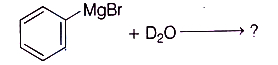
The product formed in the given reaction is
A
Phenyl-$OD$
B
Phenol
C
Benzene
D
Deuterobenzene
Solution
(D) Phenyl magnesium bromide is a Grignard reagent. The carbon atom attached to the metal $Mg$ is strongly basic and abstracts $D^{+}$ from heavy water $(D_2O)$. The reaction of a Grignard reagent with $D_2O$ provides a convenient method for introducing a deuterium atom into a molecule at a specific location.
The reaction is:
$C_6H_5MgBr + D_2O \rightarrow C_6H_5D + Mg(OD)Br$
Thus,the product formed is deuterobenzene.
The reaction is:
$C_6H_5MgBr + D_2O \rightarrow C_6H_5D + Mg(OD)Br$
Thus,the product formed is deuterobenzene.
0 likesView Solution
5
ChemistryEasyMCQAP EAMCET · 2022
An organic compound $(A)$ on ozonolysis followed by treatment with zinc dust and water gives product $(P)$,which can be used to preserve biological specimens. Identify $(A)$.
A
$2,3$-dimethylbut-$2$-ene
B
but-$2$-ene
C
ethene
D
cyclohexene
Solution
(C) Formaldehyde $(HCHO)$ is commonly used to preserve biological specimens as it acts as a fixative by cross-linking proteins.
Ozonolysis of an alkene followed by treatment with zinc dust and water (reductive ozonolysis) cleaves the $C=C$ double bond to form carbonyl compounds.
For the product $(P)$ to be formaldehyde $(HCHO)$,the starting alkene $(A)$ must be ethene $(CH_2=CH_2)$.
The reaction is as follows:
$CH_2=CH_2 + O_3 \xrightarrow{Zn/H_2O} 2HCHO$ (Formaldehyde).
Ozonolysis of an alkene followed by treatment with zinc dust and water (reductive ozonolysis) cleaves the $C=C$ double bond to form carbonyl compounds.
For the product $(P)$ to be formaldehyde $(HCHO)$,the starting alkene $(A)$ must be ethene $(CH_2=CH_2)$.
The reaction is as follows:
$CH_2=CH_2 + O_3 \xrightarrow{Zn/H_2O} 2HCHO$ (Formaldehyde).
0 likesView Solution
6
ChemistryEasyMCQAP EAMCET · 2022
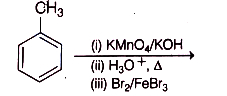
Identify the major product from the following reaction sequence.
A
$3-$Bromobenzoic acid
B
$2,4,6-$Tribromobenzoic acid
C
$2-$Bromobenzoic acid
D
$4-$Bromobenzoic acid
Solution
(A) The reaction sequence is as follows:
$1$. Oxidation of toluene with $KMnO_4/KOH$ followed by acidic workup $(H_3O^+, \Delta)$ yields benzoic acid $(C_6H_5COOH)$.
$2$. The $-COOH$ group is a strongly deactivating group and is meta-directing for electrophilic aromatic substitution.
$3$. Electrophilic aromatic bromination of benzoic acid using $Br_2/FeBr_3$ introduces the bromine atom at the meta-position,resulting in $3$-bromobenzoic acid.
$1$. Oxidation of toluene with $KMnO_4/KOH$ followed by acidic workup $(H_3O^+, \Delta)$ yields benzoic acid $(C_6H_5COOH)$.
$2$. The $-COOH$ group is a strongly deactivating group and is meta-directing for electrophilic aromatic substitution.
$3$. Electrophilic aromatic bromination of benzoic acid using $Br_2/FeBr_3$ introduces the bromine atom at the meta-position,resulting in $3$-bromobenzoic acid.
0 likesView Solution
7
ChemistryEasyMCQAP EAMCET · 2022
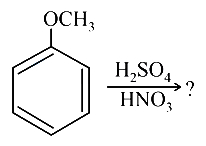
Identify the major product of the following reaction:
A
m-Nitromethoxybenzene
B
p-Nitromethoxybenzene
C
o-Nitromethoxybenzene
D
Nitrobenzene
Solution
(B) The methoxy group $(-OCH_3)$ is an activating group and is ortho/para-directing due to the resonance effect.
Nitration of anisole (methoxybenzene) using a mixture of concentrated $HNO_3$ and $H_2SO_4$ yields a mixture of ortho- and para-nitroanisole.
Due to steric hindrance at the ortho position,the para-isomer is formed as the major product.
Therefore,the major product is $p$-nitromethoxybenzene.
Nitration of anisole (methoxybenzene) using a mixture of concentrated $HNO_3$ and $H_2SO_4$ yields a mixture of ortho- and para-nitroanisole.
Due to steric hindrance at the ortho position,the para-isomer is formed as the major product.
Therefore,the major product is $p$-nitromethoxybenzene.
0 likesView Solution
8
ChemistryMediumMCQAP EAMCET · 2022
On electrolysis of an aqueous solution of sodium butanoate,a hydrocarbon is formed. The number of carbon atoms present in the hydrocarbon is:
A
$6$
B
$4$
C
$8$
D
$3$
Solution
(A) The electrolysis of sodium salts of carboxylic acids is known as Kolbe's electrolysis.
For sodium butanoate $(CH_3CH_2CH_2COONa)$,the reaction is:
$2CH_3CH_2CH_2COONa + 2H_2O \rightarrow CH_3CH_2CH_2-CH_2CH_2CH_3 + 2CO_2 + H_2 + 2NaOH$.
The hydrocarbon formed is hexane $(C_6H_{14})$,which contains $6$ carbon atoms.
For sodium butanoate $(CH_3CH_2CH_2COONa)$,the reaction is:
$2CH_3CH_2CH_2COONa + 2H_2O \rightarrow CH_3CH_2CH_2-CH_2CH_2CH_3 + 2CO_2 + H_2 + 2NaOH$.
The hydrocarbon formed is hexane $(C_6H_{14})$,which contains $6$ carbon atoms.
0 likesView Solution
9
ChemistryMediumMCQAP EAMCET · 2022
The formal charges of atoms $(1)$,$(2)$ and $(3)$ in the ion $[\underset{(1)}{O}=\underset{(2)}{N}=\underset{(3)}{O}]^{+}$ are:
A
$0, +2, -1$
B
$0, +1, 0$
C
$+2, 0, -1$
D
$+1, 0, 0$
Solution
(B) The formula for formal charge is: $\text{Formal charge} = \text{Valence electrons} - \text{Non-bonding electrons} - \frac{1}{2} \times \text{Bonding electrons}$.
In the ion $[\underset{(1)}{\ddot{O}}=\underset{(2)}{N}=\underset{(3)}{\ddot{O}}]^{+}$,the nitrogen atom is bonded to two oxygen atoms with double bonds.
For oxygen $(1)$: $\text{Valence electrons} = 6$,$\text{Non-bonding electrons} = 4$,$\text{Bonding electrons} = 4$. $\text{Formal charge} = 6 - 4 - \frac{4}{2} = 0$.
For nitrogen $(2)$: $\text{Valence electrons} = 5$,$\text{Non-bonding electrons} = 0$,$\text{Bonding electrons} = 8$. $\text{Formal charge} = 5 - 0 - \frac{8}{2} = +1$.
For oxygen $(3)$: $\text{Valence electrons} = 6$,$\text{Non-bonding electrons} = 4$,$\text{Bonding electrons} = 4$. $\text{Formal charge} = 6 - 4 - \frac{4}{2} = 0$.
Thus,the formal charges are $0, +1, 0$.
In the ion $[\underset{(1)}{\ddot{O}}=\underset{(2)}{N}=\underset{(3)}{\ddot{O}}]^{+}$,the nitrogen atom is bonded to two oxygen atoms with double bonds.
For oxygen $(1)$: $\text{Valence electrons} = 6$,$\text{Non-bonding electrons} = 4$,$\text{Bonding electrons} = 4$. $\text{Formal charge} = 6 - 4 - \frac{4}{2} = 0$.
For nitrogen $(2)$: $\text{Valence electrons} = 5$,$\text{Non-bonding electrons} = 0$,$\text{Bonding electrons} = 8$. $\text{Formal charge} = 5 - 0 - \frac{8}{2} = +1$.
For oxygen $(3)$: $\text{Valence electrons} = 6$,$\text{Non-bonding electrons} = 4$,$\text{Bonding electrons} = 4$. $\text{Formal charge} = 6 - 4 - \frac{4}{2} = 0$.
Thus,the formal charges are $0, +1, 0$.
0 likesView Solution
10
ChemistryEasyMCQAP EAMCET · 2022
The set of molecules in which the central atom does not obey the octet rule is
A
$CO_2, SiH_4, BeCl_2$
B
$H_2O, Cl_2O, CO_2$
C
$CH_4, NH_3, OF_2$
D
$SF_6, PCl_5, XeF_2$
Solution
(D) The octet rule,proposed by Lewis,states that atoms tend to bond such that they have $8$ electrons in their valence shell,achieving a stable noble gas configuration.
In $SF_6$,the central $S$ atom has $12$ valence electrons.
In $PCl_5$,the central $P$ atom has $10$ valence electrons.
In $XeF_2$,the central $Xe$ atom has $10$ valence electrons.
Since these central atoms do not have $8$ electrons,they are examples of an expanded octet and do not obey the octet rule.
In $SF_6$,the central $S$ atom has $12$ valence electrons.
In $PCl_5$,the central $P$ atom has $10$ valence electrons.
In $XeF_2$,the central $Xe$ atom has $10$ valence electrons.
Since these central atoms do not have $8$ electrons,they are examples of an expanded octet and do not obey the octet rule.
0 likesView Solution
11
ChemistryEasyMCQAP EAMCET · 2022
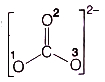
In the Lewis dot structure of carbonate ion shown,the formal charges on the oxygen atoms $1, 2,$ and $3$ are respectively:
A
$-2, 0, 0$
B
$-1, 0, -1$
C
$0, -1, -1$
D
$-3, 0, +1$
Solution
(B) The formal charge $(FC)$ is calculated using the formula: $FC = \text{Valence electrons} - \text{Non-bonding electrons} - \frac{1}{2} \times \text{Bonding electrons}$.
For oxygen atom $1$ (single bond,$6$ lone pair electrons): $FC = 6 - 6 - \frac{1}{2} \times 2 = -1$.
For oxygen atom $2$ (double bond,$4$ lone pair electrons): $FC = 6 - 4 - \frac{1}{2} \times 4 = 0$.
For oxygen atom $3$ (single bond,$6$ lone pair electrons): $FC = 6 - 6 - \frac{1}{2} \times 2 = -1$.
Thus,the formal charges on oxygen atoms $1, 2,$ and $3$ are $-1, 0,$ and $-1$ respectively.
For oxygen atom $1$ (single bond,$6$ lone pair electrons): $FC = 6 - 6 - \frac{1}{2} \times 2 = -1$.
For oxygen atom $2$ (double bond,$4$ lone pair electrons): $FC = 6 - 4 - \frac{1}{2} \times 4 = 0$.
For oxygen atom $3$ (single bond,$6$ lone pair electrons): $FC = 6 - 6 - \frac{1}{2} \times 2 = -1$.
Thus,the formal charges on oxygen atoms $1, 2,$ and $3$ are $-1, 0,$ and $-1$ respectively.
0 likesView Solution
12
ChemistryEasyMCQAP EAMCET · 2022
The general formula of the compound formed when a metal $(M)$ of group $1$ reacts with a non-metal $(X)$ of group $16$ is:
A
$M X_6$
B
$M_2 X_3$
C
$M X_2$
D
$M_2 X$
Solution
(D) Group $1$ elements $(M)$ have an outermost shell electronic configuration of $ns^1$,making them monovalent with a valency of $+1$.
Group $16$ elements $(X)$ have an outermost shell electronic configuration of $ns^2 np^4$,requiring $2$ electrons to complete their octet,making them divalent with a valency of $-2$.
To form a neutral ionic compound,the total positive charge must balance the total negative charge.
Thus,two atoms of $M$ (each $+1$) are required to balance one atom of $X$ $(-2)$.
The resulting formula is $M_2 X$.
Group $16$ elements $(X)$ have an outermost shell electronic configuration of $ns^2 np^4$,requiring $2$ electrons to complete their octet,making them divalent with a valency of $-2$.
To form a neutral ionic compound,the total positive charge must balance the total negative charge.
Thus,two atoms of $M$ (each $+1$) are required to balance one atom of $X$ $(-2)$.
The resulting formula is $M_2 X$.
0 likesView Solution
13
ChemistryEasyMCQAP EAMCET · 2022
Identify the correct statements from the following.
$(I)$ $SnCl_2$ is ionic,but $SnCl_4$ is covalent in nature.
$(II)$ All linear diatomic molecules have zero dipole moment.
$(III)$ Both $NO$ and $O_2$ are paramagnetic.
$(I)$ $SnCl_2$ is ionic,but $SnCl_4$ is covalent in nature.
$(II)$ All linear diatomic molecules have zero dipole moment.
$(III)$ Both $NO$ and $O_2$ are paramagnetic.
A
$(I)$ and $(III)$ only
B
$(I)$ and $(II)$ only
C
$(II)$ and $(III)$ only
D
$(I)$,$(II)$ and $(III)$
Solution
(A) Statement $(I)$ is correct: According to Fajan's rule,a higher oxidation state of the central metal atom leads to greater covalent character. $Sn$ in $SnCl_4$ $(+4)$ has a higher oxidation state than in $SnCl_2$ $(+2)$,making $SnCl_4$ more covalent.
Statement $(II)$ is incorrect: Linear diatomic molecules like $HF$,$HCl$,and $HBr$ are polar and possess a non-zero dipole moment.
Statement $(III)$ is correct: $NO$ has one unpaired electron and $O_2$ has two unpaired electrons in its antibonding molecular orbitals,making both paramagnetic.
Therefore,statements $(I)$ and $(III)$ are correct.
Statement $(II)$ is incorrect: Linear diatomic molecules like $HF$,$HCl$,and $HBr$ are polar and possess a non-zero dipole moment.
Statement $(III)$ is correct: $NO$ has one unpaired electron and $O_2$ has two unpaired electrons in its antibonding molecular orbitals,making both paramagnetic.
Therefore,statements $(I)$ and $(III)$ are correct.
0 likesView Solution
14
ChemistryMediumMCQAP EAMCET · 2022
The shapes of $XeF_2, XeF_4$,and $XeO_3$ respectively are
A
Linear,Tetrahedral,Pyramidal
B
Angular,Square Planar,Pyramidal
C
Linear,Tetrahedral,Planar
D
Linear,Square planar,Pyramidal
Solution
(D) To determine the shapes,we use the $VSEPR$ theory:
$1$. $XeF_2$: The central atom $Xe$ has $8$ valence electrons. It forms $2$ bonds with $F$ atoms and has $3$ lone pairs. The steric number is $2 + 3 = 5$ ($sp^3d$ hybridization). The shape is linear.
$2$. $XeF_4$: The central atom $Xe$ has $8$ valence electrons. It forms $4$ bonds with $F$ atoms and has $2$ lone pairs. The steric number is $4 + 2 = 6$ ($sp^3d^2$ hybridization). The shape is square planar.
$3$. $XeO_3$: The central atom $Xe$ has $8$ valence electrons. It forms $3$ double bonds with $O$ atoms and has $1$ lone pair. The steric number is $3 + 1 = 4$ ($sp^3$ hybridization). The shape is pyramidal.
$1$. $XeF_2$: The central atom $Xe$ has $8$ valence electrons. It forms $2$ bonds with $F$ atoms and has $3$ lone pairs. The steric number is $2 + 3 = 5$ ($sp^3d$ hybridization). The shape is linear.
$2$. $XeF_4$: The central atom $Xe$ has $8$ valence electrons. It forms $4$ bonds with $F$ atoms and has $2$ lone pairs. The steric number is $4 + 2 = 6$ ($sp^3d^2$ hybridization). The shape is square planar.
$3$. $XeO_3$: The central atom $Xe$ has $8$ valence electrons. It forms $3$ double bonds with $O$ atoms and has $1$ lone pair. The steric number is $3 + 1 = 4$ ($sp^3$ hybridization). The shape is pyramidal.
0 likesView Solution
15
ChemistryMediumMCQAP EAMCET · 2022
The tetra-atomic molecules/ions with different shapes are
A
$TeCl_4, SeF_4$
B
$CH_4, PCl_4^{+}$
C
$SF_4, NH_4^{+}$
D
$SiH_4, CCl_4$
Solution
(C) $TeCl_4$ has a see-saw shape due to $sp^3d$ hybridization with one lone pair. $SeF_4$ also has a see-saw shape due to $sp^3d$ hybridization with one lone pair.
$CH_4$ and $PCl_4^{+}$ both have a tetrahedral shape due to $sp^3$ hybridization with zero lone pairs.
$SF_4$ has a see-saw shape ($sp^3d$,one lone pair),whereas $NH_4^{+}$ has a tetrahedral shape ($sp^3$,zero lone pairs). Thus,they have different shapes.
$SiH_4$ and $CCl_4$ both have a tetrahedral shape due to $sp^3$ hybridization with zero lone pairs.
$CH_4$ and $PCl_4^{+}$ both have a tetrahedral shape due to $sp^3$ hybridization with zero lone pairs.
$SF_4$ has a see-saw shape ($sp^3d$,one lone pair),whereas $NH_4^{+}$ has a tetrahedral shape ($sp^3$,zero lone pairs). Thus,they have different shapes.
$SiH_4$ and $CCl_4$ both have a tetrahedral shape due to $sp^3$ hybridization with zero lone pairs.
0 likesView Solution
16
ChemistryEasyMCQAP EAMCET · 2022
Identify the pair of species with same geometries.
A
$XeF_4, PCl_4^{+}$
B
$NH_3, ClF_3$
C
$SF_4, NH_4^{+}$
D
$XeF_2, I_3^{-}$
Solution
(D) $XeF_4$: square planar; $PCl_4^{+}$: tetrahedral.
$NH_3$: pyramidal; $ClF_3$: $T$-shaped.
$SF_4$: see-saw; $NH_4^{+}$: tetrahedral.
$XeF_2$: linear; $I_3^{-}$: linear.
Thus,$XeF_2$ and $I_3^{-}$ have the same linear geometry.
$NH_3$: pyramidal; $ClF_3$: $T$-shaped.
$SF_4$: see-saw; $NH_4^{+}$: tetrahedral.
$XeF_2$: linear; $I_3^{-}$: linear.
Thus,$XeF_2$ and $I_3^{-}$ have the same linear geometry.
0 likesView Solution
17
ChemistryMediumMCQAP EAMCET · 2022
Match the following:
| List-$I$ (Molecule/ion) | List-$II$ (Hybridisation) |
| :--- | :--- |
| $(A)$ $ICl_4^-$ | $(P)$ $sp^3$ |
| $(B)$ $NO_3^-$ | $(Q)$ $sp^3d$ |
| $(C)$ $PCl_4^+$ | $(R)$ $sp^3d^2$ |
| $(D)$ $SiF_6^{2-}$ | $(S)$ $sp^2$ |
| | $(T)$ $sp$ |
| List-$I$ (Molecule/ion) | List-$II$ (Hybridisation) |
| :--- | :--- |
| $(A)$ $ICl_4^-$ | $(P)$ $sp^3$ |
| $(B)$ $NO_3^-$ | $(Q)$ $sp^3d$ |
| $(C)$ $PCl_4^+$ | $(R)$ $sp^3d^2$ |
| $(D)$ $SiF_6^{2-}$ | $(S)$ $sp^2$ |
| | $(T)$ $sp$ |
A
$A-R, B-S, C-P, D-R$
B
$A-R, B-P, C-S, D-R$
C
$A-Q, B-S, C-P, D-R$
D
$A-R, B-S, C-P, D-Q$
Solution
(A) To determine the hybridization,we use the formula: $\text{Steric Number} = \frac{1}{2} (V + M - C + A)$,where $V$ is the number of valence electrons of the central atom,$M$ is the number of monovalent atoms,$C$ is the cationic charge,and $A$ is the anionic charge.
$(A)$ $ICl_4^-$: $\text{Steric Number} = \frac{1}{2} (7 + 4 + 1) = 6$. Hybridization is $sp^3d^2$ $(R)$.
$(B)$ $NO_3^-$: $\text{Steric Number} = \frac{1}{2} (5 + 0 + 1) = 3$. Hybridization is $sp^2$ $(S)$.
$(C)$ $PCl_4^+$: $\text{Steric Number} = \frac{1}{2} (5 + 4 - 1) = 4$. Hybridization is $sp^3$ $(P)$.
$(D)$ $SiF_6^{2-}$: $\text{Steric Number} = \frac{1}{2} (4 + 6 + 2) = 6$. Hybridization is $sp^3d^2$ $(R)$.
Thus,the correct matching is $A-R, B-S, C-P, D-R$.
$(A)$ $ICl_4^-$: $\text{Steric Number} = \frac{1}{2} (7 + 4 + 1) = 6$. Hybridization is $sp^3d^2$ $(R)$.
$(B)$ $NO_3^-$: $\text{Steric Number} = \frac{1}{2} (5 + 0 + 1) = 3$. Hybridization is $sp^2$ $(S)$.
$(C)$ $PCl_4^+$: $\text{Steric Number} = \frac{1}{2} (5 + 4 - 1) = 4$. Hybridization is $sp^3$ $(P)$.
$(D)$ $SiF_6^{2-}$: $\text{Steric Number} = \frac{1}{2} (4 + 6 + 2) = 6$. Hybridization is $sp^3d^2$ $(R)$.
Thus,the correct matching is $A-R, B-S, C-P, D-R$.
0 likesView Solution
18
ChemistryMediumMCQAP EAMCET · 2022
The number of $sp^2$ and $sp^3$ hybridised carbons in cumene,respectively,are:
A
$6, 2$
B
$3, 6$
C
$6, 3$
D
$4, 4$
Solution
(C) Cumene (isopropylbenzene) has the chemical formula $C_6H_5CH(CH_3)_2$.
$1$. The benzene ring consists of $6$ carbons,all of which are $sp^2$-hybridised.
$2$. The isopropyl group attached to the ring consists of $3$ carbons: one $CH$ group and two $CH_3$ groups.
$3$. All $3$ carbons in the isopropyl group are $sp^3$-hybridised.
Therefore,the number of $sp^2$-hybridised carbons is $6$ and the number of $sp^3$-hybridised carbons is $3$.
$1$. The benzene ring consists of $6$ carbons,all of which are $sp^2$-hybridised.
$2$. The isopropyl group attached to the ring consists of $3$ carbons: one $CH$ group and two $CH_3$ groups.
$3$. All $3$ carbons in the isopropyl group are $sp^3$-hybridised.
Therefore,the number of $sp^2$-hybridised carbons is $6$ and the number of $sp^3$-hybridised carbons is $3$.
0 likesView Solution
19
ChemistryEasyMCQAP EAMCET · 2022
The molecule which has a greater number of lone pairs of electrons than bond pairs of electrons on its central atom is
A
$XeF_2$
B
$ClF_3$
C
$XeF_4$
D
$SF_4$
Solution
(A) To determine the molecule where the number of lone pairs is greater than the number of bond pairs on the central atom,we analyze each option:
$1$. For $XeF_2$: Central atom $Xe$ has $3$ lone pairs and $2$ bond pairs. Here,$3 > 2$.
$2$. For $ClF_3$: Central atom $Cl$ has $2$ lone pairs and $3$ bond pairs. Here,$2 < 3$.
$3$. For $XeF_4$: Central atom $Xe$ has $2$ lone pairs and $4$ bond pairs. Here,$2 < 4$.
$4$. For $SF_4$: Central atom $S$ has $1$ lone pair and $4$ bond pairs. Here,$1 < 4$.
Therefore,the molecule with more lone pairs than bond pairs is $XeF_2$.
$1$. For $XeF_2$: Central atom $Xe$ has $3$ lone pairs and $2$ bond pairs. Here,$3 > 2$.
$2$. For $ClF_3$: Central atom $Cl$ has $2$ lone pairs and $3$ bond pairs. Here,$2 < 3$.
$3$. For $XeF_4$: Central atom $Xe$ has $2$ lone pairs and $4$ bond pairs. Here,$2 < 4$.
$4$. For $SF_4$: Central atom $S$ has $1$ lone pair and $4$ bond pairs. Here,$1 < 4$.
Therefore,the molecule with more lone pairs than bond pairs is $XeF_2$.
0 likesView Solution
20
ChemistryEasyMCQAP EAMCET · 2022
The structures of $BCl_3$ and $BCl_3 \cdot NH_3$,respectively are
A
Planar trigonal and Tetrahedral
B
Planar trigonal and Pyramidal
C
Pyramidal and Tetrahedral
D
Pyramidal and Pyramidal
Solution
(A) In $BCl_3$,the boron atom is $sp^2$ hybridized,resulting in a trigonal planar geometry.
When $BCl_3$ reacts with $NH_3$,it forms an adduct $BCl_3 \cdot NH_3$.
In this adduct,the boron atom undergoes a change in hybridization from $sp^2$ to $sp^3$,resulting in a tetrahedral geometry around the boron atom.
When $BCl_3$ reacts with $NH_3$,it forms an adduct $BCl_3 \cdot NH_3$.
In this adduct,the boron atom undergoes a change in hybridization from $sp^2$ to $sp^3$,resulting in a tetrahedral geometry around the boron atom.
0 likesView Solution
21
ChemistryDifficultMCQAP EAMCET · 2022
The bond lengths of $C_2$,$N_2$ and $B_2$ molecules are $X_1$,$X_2$ and $X_3$ $pm$ respectively. The correct order of their bond lengths is
A
$X_3 > X_1 > X_2$
B
$X_2 > X_3 > X_1$
C
$X_1 > X_2 > X_3$
D
$X_1 > X_3 > X_2$
Solution
(A) Bond length is inversely proportional to bond order. The bond orders of the given molecules are calculated using Molecular Orbital Theory $(MOT)$.
$\text{Bond Order} = \frac{\text{Number of BMO } e^{-} - \text{Number of ABMO } e^{-}}{2}$
For $B_2$ ($10$ electrons): $\sigma 1s^2 \sigma^* 1s^2 \sigma 2s^2 \sigma^* 2s^2 \pi 2p_{x}^1 = \pi 2p_{y}^1$. Bond Order $= \frac{6-4}{2} = 1$.
For $C_2$ ($12$ electrons): $\sigma 1s^2 \sigma^* 1s^2 \sigma 2s^2 \sigma^* 2s^2 \pi 2p_{x}^2 = \pi 2p_{y}^2$. Bond Order $= \frac{8-4}{2} = 2$.
For $N_2$ ($14$ electrons): $\sigma 1s^2 \sigma^* 1s^2 \sigma 2s^2 \sigma^* 2s^2 \pi 2p_{x}^2 = \pi 2p_{y}^2 \sigma 2p_{z}^2$. Bond Order $= \frac{10-4}{2} = 3$.
Since the bond order is $N_2 (3) > C_2 (2) > B_2 (1)$,the bond length order is $B_2 > C_2 > N_2$,which corresponds to $X_3 > X_1 > X_2$.
$\text{Bond Order} = \frac{\text{Number of BMO } e^{-} - \text{Number of ABMO } e^{-}}{2}$
For $B_2$ ($10$ electrons): $\sigma 1s^2 \sigma^* 1s^2 \sigma 2s^2 \sigma^* 2s^2 \pi 2p_{x}^1 = \pi 2p_{y}^1$. Bond Order $= \frac{6-4}{2} = 1$.
For $C_2$ ($12$ electrons): $\sigma 1s^2 \sigma^* 1s^2 \sigma 2s^2 \sigma^* 2s^2 \pi 2p_{x}^2 = \pi 2p_{y}^2$. Bond Order $= \frac{8-4}{2} = 2$.
For $N_2$ ($14$ electrons): $\sigma 1s^2 \sigma^* 1s^2 \sigma 2s^2 \sigma^* 2s^2 \pi 2p_{x}^2 = \pi 2p_{y}^2 \sigma 2p_{z}^2$. Bond Order $= \frac{10-4}{2} = 3$.
Since the bond order is $N_2 (3) > C_2 (2) > B_2 (1)$,the bond length order is $B_2 > C_2 > N_2$,which corresponds to $X_3 > X_1 > X_2$.
0 likesView Solution
22
ChemistryEasyMCQAP EAMCET · 2022
The set of species having only fractional bond order values is
A
$C_2^{2-}, N_2, O_2^{2-}$
B
$O_2^{+}, O_2^{-}, N_2^{+}$
C
$O_2^{2+}, O_2, C_2^{2-}$
D
$Li_2, H_2^{+}, C_2$
Solution
(B) Bond order $(BO) = \frac{1}{2} \times (\text{Number of electrons in bonding } MOs - \text{Number of electrons in anti-bonding } MOs)$.
For species to have fractional bond order,the total number of electrons must be odd.
$(A) C_2^{2-} (14e^-), N_2 (14e^-), O_2^{2-} (18e^-)$: All have even electrons,so bond orders are integers $(3, 3, 1)$.
$(B) O_2^{+} (15e^-), O_2^{-} (17e^-), N_2^{+} (13e^-)$: All have odd electrons,so bond orders are fractional $(2.5, 1.5, 2.5)$.
$(C) O_2^{2+} (14e^-), O_2 (16e^-), C_2^{2-} (14e^-)$: $O_2$ has $16e^-$ (even),bond order is $2$.
$(D) Li_2 (6e^-), H_2^{+} (1e^-), C_2 (12e^-)$: $Li_2$ and $C_2$ have even electrons,bond orders are integers $(1, 2)$.
Thus,only option $(B)$ contains species with fractional bond orders.
For species to have fractional bond order,the total number of electrons must be odd.
$(A) C_2^{2-} (14e^-), N_2 (14e^-), O_2^{2-} (18e^-)$: All have even electrons,so bond orders are integers $(3, 3, 1)$.
$(B) O_2^{+} (15e^-), O_2^{-} (17e^-), N_2^{+} (13e^-)$: All have odd electrons,so bond orders are fractional $(2.5, 1.5, 2.5)$.
$(C) O_2^{2+} (14e^-), O_2 (16e^-), C_2^{2-} (14e^-)$: $O_2$ has $16e^-$ (even),bond order is $2$.
$(D) Li_2 (6e^-), H_2^{+} (1e^-), C_2 (12e^-)$: $Li_2$ and $C_2$ have even electrons,bond orders are integers $(1, 2)$.
Thus,only option $(B)$ contains species with fractional bond orders.
0 likesView Solution
23
ChemistryEasyMCQAP EAMCET · 2022
The bond order values of anions of sodium peroxide and potassium superoxide are respectively:
A
$1, 1.5$
B
$1, 0.5$
C
$0.5, 1$
D
$2, 0.5$
Solution
(A) Sodium peroxide $(Na_2O_2)$ contains the peroxide anion $O_2^{2-}$.
Potassium superoxide $(KO_2)$ contains the superoxide anion $O_2^-$.
For $O_2^{2-}$: Total electrons = $18$. Electronic configuration: $\sigma 1s^2, \sigma^* 1s^2, \sigma 2s^2, \sigma^* 2s^2, \sigma 2p_z^2, \pi 2p_x^2 = \pi 2p_y^2, \pi^* 2p_x^2 = \pi^* 2p_y^2$.
Bond order = $\frac{10 - 8}{2} = 1$.
For $O_2^-$: Total electrons = $17$. Electronic configuration: $\sigma 1s^2, \sigma^* 1s^2, \sigma 2s^2, \sigma^* 2s^2, \sigma 2p_z^2, \pi 2p_x^2 = \pi 2p_y^2, \pi^* 2p_x^2 = \pi^* 2p_y^1$.
Bond order = $\frac{10 - 7}{2} = 1.5$.
Potassium superoxide $(KO_2)$ contains the superoxide anion $O_2^-$.
For $O_2^{2-}$: Total electrons = $18$. Electronic configuration: $\sigma 1s^2, \sigma^* 1s^2, \sigma 2s^2, \sigma^* 2s^2, \sigma 2p_z^2, \pi 2p_x^2 = \pi 2p_y^2, \pi^* 2p_x^2 = \pi^* 2p_y^2$.
Bond order = $\frac{10 - 8}{2} = 1$.
For $O_2^-$: Total electrons = $17$. Electronic configuration: $\sigma 1s^2, \sigma^* 1s^2, \sigma 2s^2, \sigma^* 2s^2, \sigma 2p_z^2, \pi 2p_x^2 = \pi 2p_y^2, \pi^* 2p_x^2 = \pi^* 2p_y^1$.
Bond order = $\frac{10 - 7}{2} = 1.5$.
0 likesView Solution
24
ChemistryEasyMCQAP EAMCET · 2022
Arrange the following in the correct order of their bond orders.
$I. N_2, II. O_2, III. O_2^+, IV. O_2^-$
$I. N_2, II. O_2, III. O_2^+, IV. O_2^-$
A
$II > III > I > IV$
B
$III > II > IV > I$
C
$I > III > II > IV$
D
$I > II > III > IV$
Solution
(C) Bond order is defined as the number of chemical bonds present between two atoms of a molecule.
Using Molecular Orbital Theory $(MOT)$:
$I. N_2$ ($14$ electrons): $\sigma 1s^2, \sigma^* 1s^2, \sigma 2s^2, \sigma^* 2s^2, \pi 2p_x^2 = \pi 2p_y^2, \sigma 2p_z^2$. Bond order $= \frac{10-4}{2} = 3$.
$II. O_2$ ($16$ electrons): $\sigma 1s^2, \sigma^* 1s^2, \sigma 2s^2, \sigma^* 2s^2, \sigma 2p_z^2, \pi 2p_x^2 = \pi 2p_y^2, \pi^* 2p_x^1 = \pi^* 2p_y^1$. Bond order $= \frac{10-6}{2} = 2$.
$III. O_2^+$ ($15$ electrons): $\sigma 1s^2, \sigma^* 1s^2, \sigma 2s^2, \sigma^* 2s^2, \sigma 2p_z^2, \pi 2p_x^2 = \pi 2p_y^2, \pi^* 2p_x^1$. Bond order $= \frac{10-5}{2} = 2.5$.
$IV. O_2^-$ ($17$ electrons): $\sigma 1s^2, \sigma^* 1s^2, \sigma 2s^2, \sigma^* 2s^2, \sigma 2p_z^2, \pi 2p_x^2 = \pi 2p_y^2, \pi^* 2p_x^2 = \pi^* 2p_y^1$. Bond order $= \frac{10-7}{2} = 1.5$.
Comparing the bond orders: $3 (I) > 2.5 (III) > 2 (II) > 1.5 (IV)$.
Thus,the correct order is $I > III > II > IV$.
Using Molecular Orbital Theory $(MOT)$:
$I. N_2$ ($14$ electrons): $\sigma 1s^2, \sigma^* 1s^2, \sigma 2s^2, \sigma^* 2s^2, \pi 2p_x^2 = \pi 2p_y^2, \sigma 2p_z^2$. Bond order $= \frac{10-4}{2} = 3$.
$II. O_2$ ($16$ electrons): $\sigma 1s^2, \sigma^* 1s^2, \sigma 2s^2, \sigma^* 2s^2, \sigma 2p_z^2, \pi 2p_x^2 = \pi 2p_y^2, \pi^* 2p_x^1 = \pi^* 2p_y^1$. Bond order $= \frac{10-6}{2} = 2$.
$III. O_2^+$ ($15$ electrons): $\sigma 1s^2, \sigma^* 1s^2, \sigma 2s^2, \sigma^* 2s^2, \sigma 2p_z^2, \pi 2p_x^2 = \pi 2p_y^2, \pi^* 2p_x^1$. Bond order $= \frac{10-5}{2} = 2.5$.
$IV. O_2^-$ ($17$ electrons): $\sigma 1s^2, \sigma^* 1s^2, \sigma 2s^2, \sigma^* 2s^2, \sigma 2p_z^2, \pi 2p_x^2 = \pi 2p_y^2, \pi^* 2p_x^2 = \pi^* 2p_y^1$. Bond order $= \frac{10-7}{2} = 1.5$.
Comparing the bond orders: $3 (I) > 2.5 (III) > 2 (II) > 1.5 (IV)$.
Thus,the correct order is $I > III > II > IV$.
0 likesView Solution
25
ChemistryEasyMCQAP EAMCET · 2022
Arrange the following species in the decreasing order of their bond orders:
$(I)$ $NO$
$(II)$ $NO^+$
$(III)$ $NO^-$
$(I)$ $NO$
$(II)$ $NO^+$
$(III)$ $NO^-$
A
$I > II > III$
B
$II > I > III$
C
$II > III > I$
D
$III > II > I$
Solution
(B) The bond order $(BO)$ is calculated using the formula: $BO = \frac{N_b - N_a}{2}$,where $N_b$ is the number of electrons in bonding molecular orbitals and $N_a$ is the number of electrons in antibonding molecular orbitals.
For $NO^+$ ($14$ electrons): The configuration is $\sigma 1s^2, \sigma^* 1s^2, \sigma 2s^2, \sigma^* 2s^2, \sigma 2p_z^2, \pi 2p_x^2 = \pi 2p_y^2$. $BO = \frac{10 - 4}{2} = 3.0$.
For $NO$ ($15$ electrons): The configuration is $\sigma 1s^2, \sigma^* 1s^2, \sigma 2s^2, \sigma^* 2s^2, \sigma 2p_z^2, \pi 2p_x^2 = \pi 2p_y^2, \pi^* 2p_x^1$. $BO = \frac{10 - 5}{2} = 2.5$.
For $NO^-$ ($16$ electrons): The configuration is $\sigma 1s^2, \sigma^* 1s^2, \sigma 2s^2, \sigma^* 2s^2, \sigma 2p_z^2, \pi 2p_x^2 = \pi 2p_y^2, \pi^* 2p_x^1 = \pi^* 2p_y^1$. $BO = \frac{10 - 6}{2} = 2.0$.
Comparing the bond orders: $3.0 (II) > 2.5 (I) > 2.0 (III)$.
Thus,the decreasing order is $II > I > III$.
For $NO^+$ ($14$ electrons): The configuration is $\sigma 1s^2, \sigma^* 1s^2, \sigma 2s^2, \sigma^* 2s^2, \sigma 2p_z^2, \pi 2p_x^2 = \pi 2p_y^2$. $BO = \frac{10 - 4}{2} = 3.0$.
For $NO$ ($15$ electrons): The configuration is $\sigma 1s^2, \sigma^* 1s^2, \sigma 2s^2, \sigma^* 2s^2, \sigma 2p_z^2, \pi 2p_x^2 = \pi 2p_y^2, \pi^* 2p_x^1$. $BO = \frac{10 - 5}{2} = 2.5$.
For $NO^-$ ($16$ electrons): The configuration is $\sigma 1s^2, \sigma^* 1s^2, \sigma 2s^2, \sigma^* 2s^2, \sigma 2p_z^2, \pi 2p_x^2 = \pi 2p_y^2, \pi^* 2p_x^1 = \pi^* 2p_y^1$. $BO = \frac{10 - 6}{2} = 2.0$.
Comparing the bond orders: $3.0 (II) > 2.5 (I) > 2.0 (III)$.
Thus,the decreasing order is $II > I > III$.
0 likesView Solution
26
ChemistryDifficultMCQAP EAMCET · 2022
As per molecular orbital theory,the pair of molecules which do not exist is:
A
$Li_2, B_2$
B
$He_2, C_2$
C
$Be_2, C_2$
D
$Be_2, Ne_2$
Solution
(D) According to molecular orbital theory,a molecule does not exist if its bond order is $0$. The bond order is calculated as $\frac{1}{2} (N_b - N_a)$,where $N_b$ is the number of electrons in bonding orbitals and $N_a$ is the number of electrons in anti-bonding orbitals.
Since $He_2, Be_2,$ and $Ne_2$ have a bond order of $0$,they do not exist. Therefore,the pair $Be_2$ and $Ne_2$ does not exist.
| Molecule | Bond Order |
|---|---|
| $He_2$ | $\frac{1}{2}(2-2) = 0$ |
| $Be_2$ | $\frac{1}{2}(4-4) = 0$ |
| $Ne_2$ | $\frac{1}{2}(10-10) = 0$ |
Since $He_2, Be_2,$ and $Ne_2$ have a bond order of $0$,they do not exist. Therefore,the pair $Be_2$ and $Ne_2$ does not exist.
0 likesView Solution
27
ChemistryMediumMCQAP EAMCET · 2022
If the bond order of $CO$ is $x$,the bond order of $O_2^{2-}$ ion is
A
$x$
B
$x / 2$
C
$x / 3$
D
$2x$
Solution
(C) The bond order of $CO$ is calculated as $3$,so $x = 3$.
The electronic configuration of $O_2^{2-}$ is $\sigma 1s^2, \sigma^* 1s^2, \sigma 2s^2, \sigma^* 2s^2, \sigma 2p_z^2, \pi 2p_x^2 = \pi 2p_y^2, \pi^* 2p_x^2 = \pi^* 2p_y^2$.
The number of bonding electrons $(N_b)$ is $10$ and the number of antibonding electrons $(N_a)$ is $8$.
Bond order of $O_2^{2-} = \frac{1}{2}(N_b - N_a) = \frac{1}{2}(10 - 8) = 1$.
Since $x = 3$,the bond order $1$ can be expressed as $x / 3$.
The electronic configuration of $O_2^{2-}$ is $\sigma 1s^2, \sigma^* 1s^2, \sigma 2s^2, \sigma^* 2s^2, \sigma 2p_z^2, \pi 2p_x^2 = \pi 2p_y^2, \pi^* 2p_x^2 = \pi^* 2p_y^2$.
The number of bonding electrons $(N_b)$ is $10$ and the number of antibonding electrons $(N_a)$ is $8$.
Bond order of $O_2^{2-} = \frac{1}{2}(N_b - N_a) = \frac{1}{2}(10 - 8) = 1$.
Since $x = 3$,the bond order $1$ can be expressed as $x / 3$.
0 likesView Solution
28
ChemistryEasyMCQAP EAMCET · 2022
The bond order of dioxygen is '$m$'. The bond order values of $N_2^+$ and $C_2^{2-}$ are respectively:
A
$\frac{5m}{4}, \frac{3m}{2}$
B
$\frac{3m}{2}, \frac{5m}{4}$
C
$\frac{m}{2}, \frac{m}{3}$
D
$\frac{2m}{3}, \frac{m}{2}$
Solution
(A) The bond order of $O_2$ is $m = 2$.
The total number of electrons in $N_2^+$ is $7 + 7 - 1 = 13$. The bond order for $13$ electrons is $2.5$. Since $m = 2$,we have $2.5 = \frac{5 \times 2}{4} = \frac{5m}{4}$.
The total number of electrons in $C_2^{2-}$ is $6 + 6 + 2 = 14$. The bond order for $14$ electrons is $3$. Since $m = 2$,we have $3 = \frac{3 \times 2}{2} = \frac{3m}{2}$.
Thus,the bond order values are $\frac{5m}{4}$ and $\frac{3m}{2}$ respectively.
The total number of electrons in $N_2^+$ is $7 + 7 - 1 = 13$. The bond order for $13$ electrons is $2.5$. Since $m = 2$,we have $2.5 = \frac{5 \times 2}{4} = \frac{5m}{4}$.
The total number of electrons in $C_2^{2-}$ is $6 + 6 + 2 = 14$. The bond order for $14$ electrons is $3$. Since $m = 2$,we have $3 = \frac{3 \times 2}{2} = \frac{3m}{2}$.
Thus,the bond order values are $\frac{5m}{4}$ and $\frac{3m}{2}$ respectively.
0 likesView Solution
29
ChemistryMediumMCQAP EAMCET · 2022
Choose the correct option from the following regarding the covalent character of compounds.
A
$KF$ is more covalent than $KI$
B
$SnCl_4$ is less covalent than $SnCl_2$
C
$LiF$ is more covalent than $KF$
D
$ZnCl_2$ is less covalent than $NaCl$
Solution
(C) According to Fajan's rules,the covalent character of an ionic bond increases with the polarization of the anion.
Polarization is favored by a smaller cation size and a larger anion size.
Comparing $LiF$ and $KF$: $Li^+$ is smaller than $K^+$,so $Li^+$ has a higher polarizing power,making $LiF$ more covalent than $KF$.
Comparing $KF$ and $KI$: $I^-$ is larger than $F^-$,so $KI$ is more covalent than $KF$.
Comparing $SnCl_4$ and $SnCl_2$: $Sn^{4+}$ has a higher charge density than $Sn^{2+}$,making $SnCl_4$ more covalent.
Comparing $ZnCl_2$ and $NaCl$: $Zn^{2+}$ has a pseudo-inert gas configuration ($18$ electrons in the valence shell),which is more polarizing than the inert gas configuration of $Na^+$,making $ZnCl_2$ more covalent than $NaCl$.
Therefore,the correct statement is that $LiF$ is more covalent than $KF$.
Polarization is favored by a smaller cation size and a larger anion size.
Comparing $LiF$ and $KF$: $Li^+$ is smaller than $K^+$,so $Li^+$ has a higher polarizing power,making $LiF$ more covalent than $KF$.
Comparing $KF$ and $KI$: $I^-$ is larger than $F^-$,so $KI$ is more covalent than $KF$.
Comparing $SnCl_4$ and $SnCl_2$: $Sn^{4+}$ has a higher charge density than $Sn^{2+}$,making $SnCl_4$ more covalent.
Comparing $ZnCl_2$ and $NaCl$: $Zn^{2+}$ has a pseudo-inert gas configuration ($18$ electrons in the valence shell),which is more polarizing than the inert gas configuration of $Na^+$,making $ZnCl_2$ more covalent than $NaCl$.
Therefore,the correct statement is that $LiF$ is more covalent than $KF$.
0 likesView Solution
30
ChemistryEasyMCQAP EAMCET · 2022
The combination of which of the following gives an ionic compound with maximum covalent character?
A
$Mg^{2+}$ and $Cl^{-}$
B
$Mg^{2+}$ and $O^{2-}$
C
$Na^{+}$ and $Br^{-}$
D
$Na^{+}$ and $O^{2-}$
Solution
(A) According to Fajan's rule,the covalent character in an ionic compound increases with a smaller size of the cation and a larger size of the anion.
Comparing the cations: $Mg^{2+}$ is smaller than $Na^{+}$ due to higher charge density.
Comparing the anions: $O^{2-}$ is smaller than $Cl^{-}$ and $Br^{-}$. However,the polarizing power of $Mg^{2+}$ is significantly higher than $Na^{+}$.
Among the given options,$Mg^{2+}$ and $Cl^{-}$ provides a combination where the cation has high charge and the anion is relatively large and polarizable,leading to significant covalent character. Specifically,$MgCl_2$ is more covalent than $NaCl$ or $MgO$ due to the balance of cation size and anion polarizability.
Comparing the cations: $Mg^{2+}$ is smaller than $Na^{+}$ due to higher charge density.
Comparing the anions: $O^{2-}$ is smaller than $Cl^{-}$ and $Br^{-}$. However,the polarizing power of $Mg^{2+}$ is significantly higher than $Na^{+}$.
Among the given options,$Mg^{2+}$ and $Cl^{-}$ provides a combination where the cation has high charge and the anion is relatively large and polarizable,leading to significant covalent character. Specifically,$MgCl_2$ is more covalent than $NaCl$ or $MgO$ due to the balance of cation size and anion polarizability.
0 likesView Solution
31
ChemistryEasyMCQAP EAMCET · 2022
The correct order of dipole moment of the molecules $NH_3$ $(I)$,$BF_3$ $(II)$,$H_2O$ $(III)$,$NF_3$ $(IV)$ is
A
$III > I > IV > II$
B
$IV > I > III > II$
C
$I > IV > II > III$
D
$III > II > I > IV$
Solution
(A) Dipole moment is a vector quantity. It is defined as the product of the magnitude of the charge and the distance between the centers of the positive and negative charges.
Dipole moment of $NF_3$ and $NH_3$: The dipole moment of $NH_3$ $(1.46 \ D)$ is larger than $NF_3$ $(0.24 \ D)$ because in $NH_3$,the dipole moment vector of the $N-H$ bonds and the lone pair are in the same direction,while in $NF_3$ molecule,the dipole moment vector of the lone pair and the $N-F$ bond pairs are in opposite directions.
Dipole moment of $H_2O$ and $NH_3$: Both have dipole moments due to their bent and pyramidal geometries respectively. The dipole moment of $H_2O$ $(1.85 \ D)$ is greater than $NH_3$ because $O$ is more electronegative than $N$.
Dipole moment of $BF_3$: It is zero because it has a symmetrical trigonal planar structure.
Therefore,the correct order of dipole moments is $H_2O$ $(III)$ > $NH_3$ $(I)$ > $NF_3$ $(IV)$ > $BF_3$ $(II)$.
Dipole moment of $NF_3$ and $NH_3$: The dipole moment of $NH_3$ $(1.46 \ D)$ is larger than $NF_3$ $(0.24 \ D)$ because in $NH_3$,the dipole moment vector of the $N-H$ bonds and the lone pair are in the same direction,while in $NF_3$ molecule,the dipole moment vector of the lone pair and the $N-F$ bond pairs are in opposite directions.
Dipole moment of $H_2O$ and $NH_3$: Both have dipole moments due to their bent and pyramidal geometries respectively. The dipole moment of $H_2O$ $(1.85 \ D)$ is greater than $NH_3$ because $O$ is more electronegative than $N$.
Dipole moment of $BF_3$: It is zero because it has a symmetrical trigonal planar structure.
Therefore,the correct order of dipole moments is $H_2O$ $(III)$ > $NH_3$ $(I)$ > $NF_3$ $(IV)$ > $BF_3$ $(II)$.
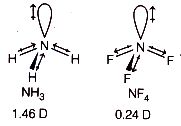
0 likesView Solution
32
ChemistryEasyMCQAP EAMCET · 2022
At $500 \ K$,for the reaction $N_{2(g)} + 3H_{2(g)} \rightleftharpoons 2NH_{3(g)}$,the $K_p$ is $0.036 \ atm^{-2}$. What is its $K_C$ in $L^2 \ mol^{-2}$? $(R = 0.082 \ L \ atm \ mol^{-1} \ K^{-1})$.
A
$2.1 \times 10^{-4}$
B
$2.1 \times 10^{-5}$
C
$60.5$
D
$605$
Solution
(C) The relationship between $K_p$ and $K_C$ is given by the formula: $K_p = K_C(RT)^{\Delta n}$.
For the reaction $N_{2(g)} + 3H_{2(g)} \rightleftharpoons 2NH_{3(g)}$,the change in the number of moles of gas is $\Delta n = n_{products} - n_{reactants} = 2 - (1 + 3) = -2$.
Given $K_p = 0.036 \ atm^{-2}$,$T = 500 \ K$,and $R = 0.082 \ L \ atm \ mol^{-1} \ K^{-1}$.
Substituting the values into the formula: $0.036 = K_C(0.082 \times 500)^{-2}$.
$0.036 = K_C(41)^{-2}$.
$K_C = 0.036 \times (41)^2$.
$K_C = 0.036 \times 1681 = 60.516 \ L^2 \ mol^{-2}$.
For the reaction $N_{2(g)} + 3H_{2(g)} \rightleftharpoons 2NH_{3(g)}$,the change in the number of moles of gas is $\Delta n = n_{products} - n_{reactants} = 2 - (1 + 3) = -2$.
Given $K_p = 0.036 \ atm^{-2}$,$T = 500 \ K$,and $R = 0.082 \ L \ atm \ mol^{-1} \ K^{-1}$.
Substituting the values into the formula: $0.036 = K_C(0.082 \times 500)^{-2}$.
$0.036 = K_C(41)^{-2}$.
$K_C = 0.036 \times (41)^2$.
$K_C = 0.036 \times 1681 = 60.516 \ L^2 \ mol^{-2}$.
0 likesView Solution
33
ChemistryEasyMCQAP EAMCET · 2022
For ammonia formation from constituent elements,the expression for $K_{C}$ is
A
$K_{C} = \frac{[NH_3]^2}{[N_2][H_2]^3}$
B
$K_{C} = \frac{[N_2][H_2]^3}{[NH_3]^2}$
C
$K_{C} = \frac{[NH_3]}{[N_2][H_2]}$
D
$K_{C} = [NH_3]^2$
Solution
(A) The balanced chemical equation for the formation of ammonia is:
$N_2(g) + 3H_2(g) \rightleftharpoons 2NH_3(g)$
According to the law of chemical equilibrium,the equilibrium constant $K_{C}$ is defined as the ratio of the product of the concentrations of the products to the product of the concentrations of the reactants,each raised to the power of their stoichiometric coefficients.
Therefore,$K_{C} = \frac{[NH_3]^2}{[N_2][H_2]^3}$.
$N_2(g) + 3H_2(g) \rightleftharpoons 2NH_3(g)$
According to the law of chemical equilibrium,the equilibrium constant $K_{C}$ is defined as the ratio of the product of the concentrations of the products to the product of the concentrations of the reactants,each raised to the power of their stoichiometric coefficients.
Therefore,$K_{C} = \frac{[NH_3]^2}{[N_2][H_2]^3}$.
0 likesView Solution
34
ChemistryEasyMCQAP EAMCET · 2022
For the formation of $NH_{3(g)}$ from its constituent elements,which of the relations between the reaction quotient $(Q)$ and equilibrium constant $(K_C)$ is correct for the backward reaction?
A
$Q = K_C$
B
$Q > K_C$
C
$Q < K_C$
D
$Q = K_C = 1$
Solution
(B) The chemical equation for the formation of ammonia is: $N_{2(g)} + 3H_{2(g)} \rightleftharpoons 2NH_{3(g)}$.
For a reversible reaction,the direction of the reaction is determined by the relationship between the reaction quotient $(Q)$ and the equilibrium constant $(K_C)$.
If $Q > K_C$,the system is not at equilibrium and the reaction proceeds in the backward direction to form reactants from products.
Therefore,for the backward reaction to occur,the condition is $Q > K_C$.
For a reversible reaction,the direction of the reaction is determined by the relationship between the reaction quotient $(Q)$ and the equilibrium constant $(K_C)$.
If $Q > K_C$,the system is not at equilibrium and the reaction proceeds in the backward direction to form reactants from products.
Therefore,for the backward reaction to occur,the condition is $Q > K_C$.
0 likesView Solution
35
ChemistryEasyMCQAP EAMCET · 2022
The value of $K_P / K_C$ for the reaction at $T(K)$ is:
$CO_{(g)} + \frac{1}{2} O_{2(g)} \rightleftharpoons CO_{2(g)}$
$CO_{(g)} + \frac{1}{2} O_{2(g)} \rightleftharpoons CO_{2(g)}$
A
$\sqrt{RT}$
B
$2RT$
C
$RT$
D
$1 / \sqrt{RT}$
Solution
(D) The relationship between $K_P$ and $K_C$ is given by the equation: $K_P = K_C(RT)^{\Delta n}$.
Here,$\Delta n$ is the change in the number of gaseous moles,calculated as: $\Delta n = n_{p(g)} - n_{r(g)}$.
For the given reaction: $CO_{(g)} + \frac{1}{2} O_{2(g)} \rightleftharpoons CO_{2(g)}$,
$\Delta n = 1 - (1 + \frac{1}{2}) = 1 - 1.5 = -\frac{1}{2}$.
Substituting this into the equation: $\frac{K_P}{K_C} = (RT)^{-1/2} = \frac{1}{\sqrt{RT}}$.
Here,$\Delta n$ is the change in the number of gaseous moles,calculated as: $\Delta n = n_{p(g)} - n_{r(g)}$.
For the given reaction: $CO_{(g)} + \frac{1}{2} O_{2(g)} \rightleftharpoons CO_{2(g)}$,
$\Delta n = 1 - (1 + \frac{1}{2}) = 1 - 1.5 = -\frac{1}{2}$.
Substituting this into the equation: $\frac{K_P}{K_C} = (RT)^{-1/2} = \frac{1}{\sqrt{RT}}$.
0 likesView Solution
36
ChemistryDifficultMCQAP EAMCET · 2022
$A$ $1.0 \ L$ of aqueous solution contains $1 \times 10^{-8} \ M \ NaBr$,$1 \times 10^{-8} \ M \ NaCl$ and $1 \times 10^{-8} \ M \ NaI$. To this solution,$1 \times 10^{-10} \ M$ aqueous $AgNO_3$ solution is added dropwise. The order of precipitation of $AgX$ $(X = Cl, Br, I)$ is:
$(K_{sp}(AgCl) = 1.8 \times 10^{-10}; K_{sp}(AgBr) = 5 \times 10^{-13}; K_{sp}(AgI) = 8.3 \times 10^{-17})$
$(K_{sp}(AgCl) = 1.8 \times 10^{-10}; K_{sp}(AgBr) = 5 \times 10^{-13}; K_{sp}(AgI) = 8.3 \times 10^{-17})$
A
$AgBr, AgCl, AgI$
B
$AgCl, AgBr, AgI$
C
$AgI, AgBr, AgCl$
D
$AgBr, AgI, AgCl$
Solution
(C) The precipitation of a salt occurs when the ionic product exceeds its solubility product $(K_{sp})$.
For a salt $AgX$,the precipitation starts when $[Ag^{+}] = \frac{K_{sp}(AgX)}{[X^{-}]}$.
Given $[Cl^{-}] = [Br^{-}] = [I^{-}] = 1 \times 10^{-8} \ M$.
For $AgCl$: $[Ag^{+}] = \frac{1.8 \times 10^{-10}}{10^{-8}} = 1.8 \times 10^{-2} \ M$.
For $AgBr$: $[Ag^{+}] = \frac{5 \times 10^{-13}}{10^{-8}} = 5 \times 10^{-5} \ M$.
For $AgI$: $[Ag^{+}] = \frac{8.3 \times 10^{-17}}{10^{-8}} = 8.3 \times 10^{-9} \ M$.
Since the concentration of $Ag^{+}$ required for precipitation is lowest for $AgI$,it will precipitate first,followed by $AgBr$,and finally $AgCl$.
The order of precipitation is $AgI > AgBr > AgCl$.
For a salt $AgX$,the precipitation starts when $[Ag^{+}] = \frac{K_{sp}(AgX)}{[X^{-}]}$.
Given $[Cl^{-}] = [Br^{-}] = [I^{-}] = 1 \times 10^{-8} \ M$.
For $AgCl$: $[Ag^{+}] = \frac{1.8 \times 10^{-10}}{10^{-8}} = 1.8 \times 10^{-2} \ M$.
For $AgBr$: $[Ag^{+}] = \frac{5 \times 10^{-13}}{10^{-8}} = 5 \times 10^{-5} \ M$.
For $AgI$: $[Ag^{+}] = \frac{8.3 \times 10^{-17}}{10^{-8}} = 8.3 \times 10^{-9} \ M$.
Since the concentration of $Ag^{+}$ required for precipitation is lowest for $AgI$,it will precipitate first,followed by $AgBr$,and finally $AgCl$.
The order of precipitation is $AgI > AgBr > AgCl$.
0 likesView Solution
37
ChemistryEasyMCQAP EAMCET · 2022
The formation of ammonia from its constituent elements is an exothermic reaction. The effect of increasing temperature on the reaction equilibrium is
A
The rate of the forward reaction becomes zero
B
No effect of temperature
C
Forward reaction is favored
D
Backward reaction is favored
Solution
(D) Consider the reaction for the formation of ammonia from nitrogen and hydrogen by Haber's process:
$N_{2(g)} + 3H_{2(g)} \rightleftharpoons 2NH_{3(g)}; \Delta H = -92.4 \ kJ$
The forward reaction is exothermic $(\Delta H < 0)$,while the reverse reaction is endothermic $(\Delta H > 0)$.
According to Le Chatelier's principle,if the temperature of a system at equilibrium is increased,the system will shift in the direction that absorbs heat to counteract the change.
Therefore,an increase in temperature favors the endothermic (backward) reaction.
As a result,the backward reaction is favored,leading to a decrease in the yield of ammonia.
$N_{2(g)} + 3H_{2(g)} \rightleftharpoons 2NH_{3(g)}; \Delta H = -92.4 \ kJ$
The forward reaction is exothermic $(\Delta H < 0)$,while the reverse reaction is endothermic $(\Delta H > 0)$.
According to Le Chatelier's principle,if the temperature of a system at equilibrium is increased,the system will shift in the direction that absorbs heat to counteract the change.
Therefore,an increase in temperature favors the endothermic (backward) reaction.
As a result,the backward reaction is favored,leading to a decrease in the yield of ammonia.
0 likesView Solution
38
ChemistryMediumMCQAP EAMCET · 2022
For a reaction $A_{(g)} + \frac{1}{2} B_{(g)} \rightleftharpoons C_{(g)} + \text{heat}$,favorable conditions for the reaction to occur in the forward direction are:
A
Low $T$ and Low $P$
B
Low $T$ and high $P$
C
High $T$ and Low $P$
D
High $T$ and high $P$
Solution
(B) The reaction is $A_{(g)} + \frac{1}{2} B_{(g)} \rightleftharpoons C_{(g)} + \text{heat}$.
Since the reaction releases heat,it is an exothermic reaction.
According to Le Chatelier's principle,low temperature favors the forward direction for exothermic reactions.
Calculate the change in the number of gaseous moles: $\Delta n_g = 1 - (1 + 0.5) = -0.5$.
Since $\Delta n_g < 0$,the number of gas molecules decreases in the forward reaction.
Therefore,high pressure is favorable for the forward reaction.
Since the reaction releases heat,it is an exothermic reaction.
According to Le Chatelier's principle,low temperature favors the forward direction for exothermic reactions.
Calculate the change in the number of gaseous moles: $\Delta n_g = 1 - (1 + 0.5) = -0.5$.
Since $\Delta n_g < 0$,the number of gas molecules decreases in the forward reaction.
Therefore,high pressure is favorable for the forward reaction.
0 likesView Solution
39
ChemistryMCQAP EAMCET · 2022
Observe the following reaction: $2 A + B \longrightarrow C$. The rate of formation of $C$ is $2.2 \times 10^{-3} \ mol \ L^{-1} \ min^{-1}$. What is the value of $-\frac{d[A]}{dt}$ (in $mol \ L^{-1} \ min^{-1}$)?
A
$2.2 \times 10^{-3}$
B
$1.1 \times 10^{-3}$
C
$4.4 \times 10^{-3}$
D
$5.5 \times 10^{-3}$
Solution
(C) For the reaction $2 A + B \longrightarrow C$,the rate of reaction is given by:
Rate $= -\frac{1}{2} \frac{d[A]}{dt} = -\frac{d[B]}{dt} = \frac{d[C]}{dt}$
Given that the rate of formation of $C$ is $\frac{d[C]}{dt} = 2.2 \times 10^{-3} \ mol \ L^{-1} \ min^{-1}$.
Equating the terms for $A$ and $C$:
$-\frac{1}{2} \frac{d[A]}{dt} = \frac{d[C]}{dt}$
$-\frac{d[A]}{dt} = 2 \times \frac{d[C]}{dt}$
$-\frac{d[A]}{dt} = 2 \times (2.2 \times 10^{-3}) = 4.4 \times 10^{-3} \ mol \ L^{-1} \ min^{-1}$.
Rate $= -\frac{1}{2} \frac{d[A]}{dt} = -\frac{d[B]}{dt} = \frac{d[C]}{dt}$
Given that the rate of formation of $C$ is $\frac{d[C]}{dt} = 2.2 \times 10^{-3} \ mol \ L^{-1} \ min^{-1}$.
Equating the terms for $A$ and $C$:
$-\frac{1}{2} \frac{d[A]}{dt} = \frac{d[C]}{dt}$
$-\frac{d[A]}{dt} = 2 \times \frac{d[C]}{dt}$
$-\frac{d[A]}{dt} = 2 \times (2.2 \times 10^{-3}) = 4.4 \times 10^{-3} \ mol \ L^{-1} \ min^{-1}$.
0 likesView Solution
40
ChemistryMCQAP EAMCET · 2022
The reaction $X \rightarrow \text{products}$ is a first order reaction. In $40 \text{ minutes}$,the concentration of $X$ changes from $1.0 \text{ M}$ to $0.25 \text{ M}$. What is the rate of reaction when $[X] = 0.1 \text{ M}$? $(\log 4 = 0.60)$
A
$1.73 \times 10^{-3} \text{ mol L}^{-1} \text{ min}^{-1}$
B
$3.47 \times 10^{-4} \text{ mol L}^{-1} \text{ min}^{-1}$
C
$1.73 \times 10^{-4} \text{ mol L}^{-1} \text{ min}^{-1}$
D
$3.47 \times 10^{-3} \text{ mol L}^{-1} \text{ min}^{-1}$
Solution
(D) For a first order reaction,the rate constant $k$ is given by: $k = \frac{2.303}{t} \log \frac{[X]_0}{[X]_t}$.
Given $[X]_0 = 1.0 \text{ M}$,$[X]_t = 0.25 \text{ M}$,and $t = 40 \text{ min}$.
$k = \frac{2.303}{40} \log \frac{1.0}{0.25} = \frac{2.303}{40} \log 4$.
Using $\log 4 = 0.60$,$k = \frac{2.303 \times 0.60}{40} = \frac{1.3818}{40} = 0.034545 \text{ min}^{-1}$.
The rate of reaction is given by $\text{Rate} = k[X]$.
At $[X] = 0.1 \text{ M}$,$\text{Rate} = 0.034545 \times 0.1 = 0.0034545 \text{ mol L}^{-1} \text{ min}^{-1} \approx 3.45 \times 10^{-3} \text{ mol L}^{-1} \text{ min}^{-1}$.
Rounding to the nearest option,the correct answer is $3.47 \times 10^{-3} \text{ mol L}^{-1} \text{ min}^{-1}$.
Given $[X]_0 = 1.0 \text{ M}$,$[X]_t = 0.25 \text{ M}$,and $t = 40 \text{ min}$.
$k = \frac{2.303}{40} \log \frac{1.0}{0.25} = \frac{2.303}{40} \log 4$.
Using $\log 4 = 0.60$,$k = \frac{2.303 \times 0.60}{40} = \frac{1.3818}{40} = 0.034545 \text{ min}^{-1}$.
The rate of reaction is given by $\text{Rate} = k[X]$.
At $[X] = 0.1 \text{ M}$,$\text{Rate} = 0.034545 \times 0.1 = 0.0034545 \text{ mol L}^{-1} \text{ min}^{-1} \approx 3.45 \times 10^{-3} \text{ mol L}^{-1} \text{ min}^{-1}$.
Rounding to the nearest option,the correct answer is $3.47 \times 10^{-3} \text{ mol L}^{-1} \text{ min}^{-1}$.
0 likesView Solution
41
ChemistryMCQAP EAMCET · 2022
During electro-osmosis of $Fe(OH)_3$ sol,
A
sol particles move towards the anode.
B
sol particles move towards the cathode.
C
the dispersion medium moves towards the anode.
D
the dispersion medium moves towards the cathode.
Solution
(C) $Fe(OH)_3$ sol is a positively charged sol. In electro-osmosis,the movement of the dispersion medium is observed under the influence of an electric field while the movement of sol particles is prevented. Since the sol particles are positively charged,they would naturally move towards the cathode. Therefore,in electro-osmosis,the dispersion medium moves in the opposite direction,i.e.,towards the anode.
0 likesView Solution
42
ChemistryMCQAP EAMCET · 2022
If the rate of disappearance of $N_2O_5$ in the following reaction is $1.2 \times 10^{-5} \ mol \ L^{-1} \ s^{-1}$,the rate of production of $NO_2$ in $mol \ L^{-1} \ s^{-1}$ is:
$2 \ N_2O_{5(g)} \longrightarrow 4 \ NO_{2(g)} + O_{2(g)}$
$2 \ N_2O_{5(g)} \longrightarrow 4 \ NO_{2(g)} + O_{2(g)}$
A
$1.2 \times 10^{-5}$
B
$3.6 \times 10^{-5}$
C
$2.4 \times 10^{-5}$
D
$4.8 \times 10^{-5}$
Solution
(C) For the reaction $2 \ N_2O_{5(g)} \longrightarrow 4 \ NO_{2(g)} + O_{2(g)}$,the rate expression is given by:
$-\frac{1}{2} \frac{d[N_2O_5]}{dt} = \frac{1}{4} \frac{d[NO_2]}{dt} = \frac{d[O_2]}{dt}$
Given that the rate of disappearance of $N_2O_5$ is $-\frac{d[N_2O_5]}{dt} = 1.2 \times 10^{-5} \ mol \ L^{-1} \ s^{-1}$.
From the rate expression,we have:
$\frac{d[NO_2]}{dt} = 2 \times \left(-\frac{d[N_2O_5]}{dt}\right)$
$\frac{d[NO_2]}{dt} = 2 \times (1.2 \times 10^{-5}) = 2.4 \times 10^{-5} \ mol \ L^{-1} \ s^{-1}$.
$-\frac{1}{2} \frac{d[N_2O_5]}{dt} = \frac{1}{4} \frac{d[NO_2]}{dt} = \frac{d[O_2]}{dt}$
Given that the rate of disappearance of $N_2O_5$ is $-\frac{d[N_2O_5]}{dt} = 1.2 \times 10^{-5} \ mol \ L^{-1} \ s^{-1}$.
From the rate expression,we have:
$\frac{d[NO_2]}{dt} = 2 \times \left(-\frac{d[N_2O_5]}{dt}\right)$
$\frac{d[NO_2]}{dt} = 2 \times (1.2 \times 10^{-5}) = 2.4 \times 10^{-5} \ mol \ L^{-1} \ s^{-1}$.
0 likesView Solution
43
ChemistryMCQAP EAMCET · 2022
The rate constant,$k$,of a zero order reaction $2 NH_3(g) \xrightarrow[1130 \ K]{Pt} N_2(g) + 3 H_2(g)$ is $y \times 10^{-4} \ mol \ L^{-1} \ s^{-1}$. The rate of formation of hydrogen (in $mol \ L^{-1} \ s^{-1}$) is
A
$y \times 10^{-4}$
B
$2 y \times 10^{-4}$
C
$3 y \times 10^{-4}$
D
$\frac{y}{3} \times 10^{-4}$
Solution
(C) For a zero order reaction,the rate of reaction is equal to the rate constant,$k$.
$r = k = y \times 10^{-4} \ mol \ L^{-1} \ s^{-1}$.
From the stoichiometry of the reaction $2 NH_3(g) \rightarrow N_2(g) + 3 H_2(g)$,the rate of reaction is given by:
$r = -\frac{1}{2} \frac{d[NH_3]}{dt} = \frac{d[N_2]}{dt} = \frac{1}{3} \frac{d[H_2]}{dt}$.
Therefore,the rate of formation of hydrogen is:
$\frac{d[H_2]}{dt} = 3 \times r = 3 \times (y \times 10^{-4}) = 3 y \times 10^{-4} \ mol \ L^{-1} \ s^{-1}$.
$r = k = y \times 10^{-4} \ mol \ L^{-1} \ s^{-1}$.
From the stoichiometry of the reaction $2 NH_3(g) \rightarrow N_2(g) + 3 H_2(g)$,the rate of reaction is given by:
$r = -\frac{1}{2} \frac{d[NH_3]}{dt} = \frac{d[N_2]}{dt} = \frac{1}{3} \frac{d[H_2]}{dt}$.
Therefore,the rate of formation of hydrogen is:
$\frac{d[H_2]}{dt} = 3 \times r = 3 \times (y \times 10^{-4}) = 3 y \times 10^{-4} \ mol \ L^{-1} \ s^{-1}$.
0 likesView Solution
44
ChemistryMCQAP EAMCET · 2022
........ of a reaction cannot be determined experimentally.
A
Order
B
Rate
C
Rate constant
D
Molecularity
Solution
(D) The correct answer is $D$.
Molecularity of a reaction is defined as the number of reacting species (atoms,ions,or molecules) taking part in an elementary reaction,which must collide in order to bring about a chemical reaction.
It is a theoretical concept determined by examining the balanced chemical equation of an elementary step.
In contrast,the order of a reaction is an experimental quantity.
Molecularity of a reaction is defined as the number of reacting species (atoms,ions,or molecules) taking part in an elementary reaction,which must collide in order to bring about a chemical reaction.
It is a theoretical concept determined by examining the balanced chemical equation of an elementary step.
In contrast,the order of a reaction is an experimental quantity.
0 likesView Solution
45
ChemistryMCQAP EAMCET · 2022
Consider the following reaction: $A \longrightarrow \text{Products}$. This reaction is completed in $100 \ min$. The rate constant of this reaction at $t_1 = 10 \ min$ is $10^{-2} \ min^{-1}$. What is the rate constant (in $min^{-1}$) at $t_2 = 20 \ min$?
A
$2 \times 10^{-2}$
B
$10^{-2}$
C
$5 \times 10^{-3}$
D
$0.1$
Solution
(B) For a chemical reaction,the rate constant $(k)$ is a characteristic property that depends only on temperature and the nature of the reactant.
It is independent of the concentration of the reactants or the time elapsed during the reaction.
Therefore,the rate constant at $t_2 = 20 \ min$ remains the same as it was at $t_1 = 10 \ min$.
Thus,the rate constant is $10^{-2} \ min^{-1}$.
It is independent of the concentration of the reactants or the time elapsed during the reaction.
Therefore,the rate constant at $t_2 = 20 \ min$ remains the same as it was at $t_1 = 10 \ min$.
Thus,the rate constant is $10^{-2} \ min^{-1}$.
0 likesView Solution
46
ChemistryMCQAP EAMCET · 2022
$10 \ g$ of a radioactive element is disintegrated to $1 \ g$ in $2.303 \ \text{minutes}$. What is the half-life (in minutes) of that radioactive element?
A
$1 / 0.693$
B
$6.93$
C
$1$
D
$0.693$
Solution
(D) Radioactive disintegration follows first-order kinetics.
The rate constant $k$ is given by $k = \frac{2.303}{t} \log \frac{a}{a-x}$.
Given $a = 10 \ g$,$a-x = 1 \ g$,and $t = 2.303 \ \text{min}$.
Substituting the values: $k = \frac{2.303}{2.303} \log \frac{10}{1} = 1 \times \log(10) = 1 \ \text{min}^{-1}$.
The half-life $t_{1/2}$ is calculated as $t_{1/2} = \frac{0.693}{k} = \frac{0.693}{1} = 0.693 \ \text{min}$.
The rate constant $k$ is given by $k = \frac{2.303}{t} \log \frac{a}{a-x}$.
Given $a = 10 \ g$,$a-x = 1 \ g$,and $t = 2.303 \ \text{min}$.
Substituting the values: $k = \frac{2.303}{2.303} \log \frac{10}{1} = 1 \times \log(10) = 1 \ \text{min}^{-1}$.
The half-life $t_{1/2}$ is calculated as $t_{1/2} = \frac{0.693}{k} = \frac{0.693}{1} = 0.693 \ \text{min}$.
0 likesView Solution
47
ChemistryMCQAP EAMCET · 2022
The half-lives of two radioactive nuclides $A$ and $B$ are $1 \ min$ and $2 \ min$ respectively. Equal weights of $A$ and $B$ are taken separately and allowed to disintegrate for $4 \ min$. What will be the ratio of weights of $A$ and $B$ disintegrated?
A
$1:1$
B
$5:4$
C
$1:2$
D
$1:3$
Solution
(B) For $A$,$t_{1/2} = 1 \ min$.
After $4 \ min$,the number of half-lives $n_A = \frac{4}{1} = 4$.
Fraction of $A$ remaining $= (1/2)^4 = 1/16$.
Fraction of $A$ disintegrated $= 1 - 1/16 = 15/16$.
For $B$,$t_{1/2} = 2 \ min$.
After $4 \ min$,the number of half-lives $n_B = \frac{4}{2} = 2$.
Fraction of $B$ remaining $= (1/2)^2 = 1/4$.
Fraction of $B$ disintegrated $= 1 - 1/4 = 3/4$.
Ratio of disintegrated weights of $A$ and $B = \frac{15/16}{3/4} = \frac{15}{16} \times \frac{4}{3} = \frac{5}{4}$ or $5:4$.
After $4 \ min$,the number of half-lives $n_A = \frac{4}{1} = 4$.
Fraction of $A$ remaining $= (1/2)^4 = 1/16$.
Fraction of $A$ disintegrated $= 1 - 1/16 = 15/16$.
For $B$,$t_{1/2} = 2 \ min$.
After $4 \ min$,the number of half-lives $n_B = \frac{4}{2} = 2$.
Fraction of $B$ remaining $= (1/2)^2 = 1/4$.
Fraction of $B$ disintegrated $= 1 - 1/4 = 3/4$.
Ratio of disintegrated weights of $A$ and $B = \frac{15/16}{3/4} = \frac{15}{16} \times \frac{4}{3} = \frac{5}{4}$ or $5:4$.
0 likesView Solution
48
ChemistryMCQAP EAMCET · 2022
For a first order reaction at $27^{\circ} C$,the ratio of time required for $75 \%$ completion to $25 \%$ completion of reaction is
A
$3$
B
$2.303$
C
$4.8$
D
$0.477$
Solution
(C) For a first order reaction,the time $t$ is given by $t = \frac{2.303}{k} \log_{10} \frac{a}{a-x}$.
Let the initial concentration $a = 100$.
For $75 \%$ completion,$x = 75$,so $a-x = 25$. Thus,$t_{75\%} = \frac{2.303}{k} \log \frac{100}{25} = \frac{2.303}{k} \log 4$.
For $25 \%$ completion,$x = 25$,so $a-x = 75$. Thus,$t_{25\%} = \frac{2.303}{k} \log \frac{100}{75} = \frac{2.303}{k} \log \frac{4}{3}$.
The ratio is $\frac{t_{75\%}}{t_{25\%}} = \frac{\log 4}{\log 4 - \log 3} = \frac{0.6020}{0.6020 - 0.4771} = \frac{0.6020}{0.1249} \approx 4.8$.
Let the initial concentration $a = 100$.
For $75 \%$ completion,$x = 75$,so $a-x = 25$. Thus,$t_{75\%} = \frac{2.303}{k} \log \frac{100}{25} = \frac{2.303}{k} \log 4$.
For $25 \%$ completion,$x = 25$,so $a-x = 75$. Thus,$t_{25\%} = \frac{2.303}{k} \log \frac{100}{75} = \frac{2.303}{k} \log \frac{4}{3}$.
The ratio is $\frac{t_{75\%}}{t_{25\%}} = \frac{\log 4}{\log 4 - \log 3} = \frac{0.6020}{0.6020 - 0.4771} = \frac{0.6020}{0.1249} \approx 4.8$.
0 likesView Solution
49
ChemistryMCQAP EAMCET · 2022
Which one of the following plots is correct for a first order reaction?
A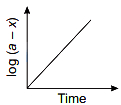
B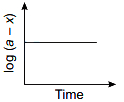
C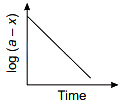
D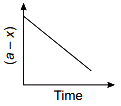
Solution
(C) The integrated rate equation for a first order reaction is given by:
$k = \frac{2.303}{t} \log \frac{a}{(a-x)}$
Rearranging this equation:
$\frac{kt}{2.303} = \log a - \log (a-x)$
$\log (a-x) = -\frac{k}{2.303} t + \log a$
This equation is in the form of a straight line $y = mx + c$,where $y = \log (a-x)$,$x = t$,slope $m = -\frac{k}{2.303}$,and intercept $c = \log a$.
Therefore,a plot of $\log (a-x)$ versus $t$ yields a straight line with a negative slope.
$k = \frac{2.303}{t} \log \frac{a}{(a-x)}$
Rearranging this equation:
$\frac{kt}{2.303} = \log a - \log (a-x)$
$\log (a-x) = -\frac{k}{2.303} t + \log a$
This equation is in the form of a straight line $y = mx + c$,where $y = \log (a-x)$,$x = t$,slope $m = -\frac{k}{2.303}$,and intercept $c = \log a$.
Therefore,a plot of $\log (a-x)$ versus $t$ yields a straight line with a negative slope.
0 likesView Solution
50
ChemistryMediumMCQAP EAMCET · 2022
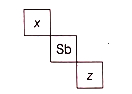
Identify the elements $x$ and $z$ in the following representation. $(Sb = \text{antimony})$
A
$Ge, Po$
B
$Sn, Ga$
C
$Ga, Bi$
D
$Si, Te$
Solution
(A) $Sb$ (Antimony) is a metalloid located in group $15$,period $5$ of the modern periodic table.
In the given zig-zag arrangement,$x$ is located in the group to the left of $Sb$ (group $14$) and in the same period $(5)$. Thus,$x$ is $Ge$ (Germanium).
$z$ is located in the group to the right of $Sb$ (group $16$) and in the next period $(6)$. Thus,$z$ is $Te$ (Tellurium).
In the given zig-zag arrangement,$x$ is located in the group to the left of $Sb$ (group $14$) and in the same period $(5)$. Thus,$x$ is $Ge$ (Germanium).
$z$ is located in the group to the right of $Sb$ (group $16$) and in the next period $(6)$. Thus,$z$ is $Te$ (Tellurium).
0 likesView Solution
51
ChemistryDifficultMCQAP EAMCET · 2022
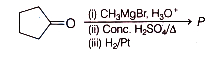
Identify the product $P$ from the following sequence of reactions?
A
Methylcyclopentane
B
$1-$methylcyclopent$-1-$ene
C
$1-$methylcyclopentanol
D
Cyclopent$-2-$en$-1-$ol
Solution
(A) The reaction sequence is as follows:
$1$. Cyclopentanone reacts with $CH_3MgBr$ followed by $H_3O^+$ to form $1$-methylcyclopentanol (a tertiary alcohol).
$2$. Treatment of $1$-methylcyclopentanol with $Conc. H_2SO_4/\Delta$ causes dehydration to form $1$-methylcyclopent-$1$-ene.
$3$. Hydrogenation of $1$-methylcyclopent-$1$-ene using $H_2/Pt$ reduces the double bond to form $1$-methylcyclopentane.
Thus,the final product $P$ is $1$-methylcyclopentane.
$1$. Cyclopentanone reacts with $CH_3MgBr$ followed by $H_3O^+$ to form $1$-methylcyclopentanol (a tertiary alcohol).
$2$. Treatment of $1$-methylcyclopentanol with $Conc. H_2SO_4/\Delta$ causes dehydration to form $1$-methylcyclopent-$1$-ene.
$3$. Hydrogenation of $1$-methylcyclopent-$1$-ene using $H_2/Pt$ reduces the double bond to form $1$-methylcyclopentane.
Thus,the final product $P$ is $1$-methylcyclopentane.
0 likesView Solution
52
ChemistryEasyMCQAP EAMCET · 2022
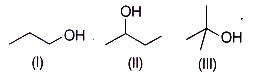
Identify the correct trend of acidic strength for the given alcohols.
A
$(I) > (III) > (II)$
B
$(I) > (II) > (III)$
C
$(III) > (I) > (II)$
D
$(III) > (II) > (I)$
Solution
(B) The acidic strength of alcohols depends on the stability of the conjugate base (alkoxide ion) formed after the release of a proton $(H^+)$.
Alkyl groups are electron-donating ($+I$ effect). As the number of alkyl groups attached to the carbon bearing the $-OH$ group increases,the electron density on the oxygen atom increases due to the $+I$ effect,which destabilizes the alkoxide ion.
Therefore,the stability of the alkoxide ion follows the order: Primary $(1^{\circ})$ > Secondary $(2^{\circ})$ > Tertiary $(3^{\circ})$.
Consequently,the acidic strength follows the same order: Primary $(I)$ > Secondary $(II)$ > Tertiary $(III)$.
Thus,the correct order is $(I) > (II) > (III)$.
Alkyl groups are electron-donating ($+I$ effect). As the number of alkyl groups attached to the carbon bearing the $-OH$ group increases,the electron density on the oxygen atom increases due to the $+I$ effect,which destabilizes the alkoxide ion.
Therefore,the stability of the alkoxide ion follows the order: Primary $(1^{\circ})$ > Secondary $(2^{\circ})$ > Tertiary $(3^{\circ})$.
Consequently,the acidic strength follows the same order: Primary $(I)$ > Secondary $(II)$ > Tertiary $(III)$.
Thus,the correct order is $(I) > (II) > (III)$.
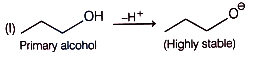
0 likesView Solution
53
ChemistryEasyMCQAP EAMCET · 2022
Which of the following represents the correct structure of resorcinol?
A
Hydroquinone (benzene-$1, 4$-diol)
B
Resorcinol (benzene-$1, 3$-diol)
C
Catechol (benzene-$1, 2$-diol)
D
Phloroglucinol (benzene-$1, 3, 5$-triol)
Solution
(B) Resorcinol is a dihydric phenol in which two hydroxyl $(-OH)$ groups are attached to the benzene ring at the $1$ and $3$ positions.
Its $IUPAC$ name is benzene-$1, 3$-diol.
Option $B$ correctly represents this structure.
Its $IUPAC$ name is benzene-$1, 3$-diol.
Option $B$ correctly represents this structure.
0 likesView Solution
54
ChemistryDifficultMCQAP EAMCET · 2022
Identify the major product from the following reaction sequence:
$Cyclohexyl-CH_2CH_2OH \xrightarrow[(ii) Cl_2/Red \ P \ (iii) H_2O]{(i) CrO_3, H_2SO_4}$
$Cyclohexyl-CH_2CH_2OH \xrightarrow[(ii) Cl_2/Red \ P \ (iii) H_2O]{(i) CrO_3, H_2SO_4}$
A
Cyclohexylacetic acid
B
Phenylacetic acid
C
$4-Chlorocyclohexylacetic$ acid
D
$2-Chloro-2-cyclohexylacetic$ acid
Solution
(D) The starting material is $2-cyclohexylethanol$.
$(i)$ Treatment with $CrO_3, H_2SO_4$ (Jones reagent) oxidizes the primary alcohol to a carboxylic acid,yielding $cyclohexylacetic$ acid $(C_6H_{11}CH_2COOH)$.
(ii) The reaction with $Cl_2/Red \ P$ is the Hell-Volhard-Zelinsky $(HVZ)$ reaction,which halogenates the $\alpha$-carbon of the carboxylic acid.
(iii) The product formed is $2-chloro-2-cyclohexylacetic$ acid $(C_6H_{11}CHClCOOH)$.
Thus,the correct option is $D$.
$(i)$ Treatment with $CrO_3, H_2SO_4$ (Jones reagent) oxidizes the primary alcohol to a carboxylic acid,yielding $cyclohexylacetic$ acid $(C_6H_{11}CH_2COOH)$.
(ii) The reaction with $Cl_2/Red \ P$ is the Hell-Volhard-Zelinsky $(HVZ)$ reaction,which halogenates the $\alpha$-carbon of the carboxylic acid.
(iii) The product formed is $2-chloro-2-cyclohexylacetic$ acid $(C_6H_{11}CHClCOOH)$.
Thus,the correct option is $D$.
0 likesView Solution
55
ChemistryDifficultMCQAP EAMCET · 2022
Identify the major product from the following reaction sequence: $Cyclopentylmethanol \xrightarrow[(iii) H^+, (iv) Br_2, Red P, (v) H_2O]{(i) PCC, (ii) Tollen's reagent, NaOH} ?$
A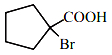
B
C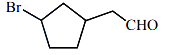
D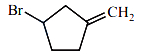
Solution
(A) The reaction sequence proceeds as follows:
$1$. $(i) PCC$: Oxidizes primary alcohol to aldehyde $(Cyclopentylmethanol \rightarrow Cyclopentanecarbaldehyde)$.
$2$. $(ii) Tollen's reagent, NaOH$: Oxidizes the aldehyde to a carboxylic acid $(Cyclopentanecarbaldehyde \rightarrow Cyclopentanecarboxylic acid)$.
$3$. $(iii) H^+$: Protonation step.
$4$. $(iv) Br_2, Red P$: This is the Hell-Volhard-Zelinsky $(HVZ)$ reaction,which alpha-halogenates the carboxylic acid $(Cyclopentanecarboxylic acid \rightarrow 1-Bromocyclopentanecarboxylic acid)$.
$5$. $(v) H_2O$: Workup step.
The final product is $1-bromocyclopentanecarboxylic acid$.
$1$. $(i) PCC$: Oxidizes primary alcohol to aldehyde $(Cyclopentylmethanol \rightarrow Cyclopentanecarbaldehyde)$.
$2$. $(ii) Tollen's reagent, NaOH$: Oxidizes the aldehyde to a carboxylic acid $(Cyclopentanecarbaldehyde \rightarrow Cyclopentanecarboxylic acid)$.
$3$. $(iii) H^+$: Protonation step.
$4$. $(iv) Br_2, Red P$: This is the Hell-Volhard-Zelinsky $(HVZ)$ reaction,which alpha-halogenates the carboxylic acid $(Cyclopentanecarboxylic acid \rightarrow 1-Bromocyclopentanecarboxylic acid)$.
$5$. $(v) H_2O$: Workup step.
The final product is $1-bromocyclopentanecarboxylic acid$.
0 likesView Solution
56
ChemistryMediumMCQAP EAMCET · 2022
When ethanol is treated with sulphuric acid at $413 \ K$,the reaction involved in it is:
A
$S_N2$
B
$S_N1$
C
addition
D
elimination
Solution
(A) The reaction of ethanol with $H_2SO_4$ at $413 \ K$ leads to the formation of ethoxyethane (diethyl ether).
This process is an intermolecular dehydration reaction.
The mechanism involves the protonation of one ethanol molecule followed by the nucleophilic attack of another ethanol molecule on the protonated species,which follows the $S_N2$ pathway.
This process is an intermolecular dehydration reaction.
The mechanism involves the protonation of one ethanol molecule followed by the nucleophilic attack of another ethanol molecule on the protonated species,which follows the $S_N2$ pathway.
0 likesView Solution
57
ChemistryMediumMCQAP EAMCET · 2022
The major product '$B$' of the following reaction sequence is
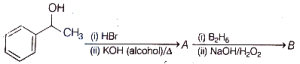
A
$1-$phenylethanol
B
Acetophenone
C
Phenylacetaldehyde
D
$2-$phenylethanol
Solution
(D) The reaction sequence is as follows:
$1$. $1-$phenylethanol reacts with $HBr$ to form $1-$bromo$-1-$phenylethane,which then undergoes dehydrohalogenation with alcoholic $KOH$ to yield styrene $(C_6H_5CH=CH_2)$.
$2$. Styrene undergoes hydroboration-oxidation (using $B_2H_6$ followed by $NaOH/H_2O_2$) to produce $2-$phenylethanol $(C_6H_5CH_2CH_2OH)$ as the major anti-Markovnikov product.
Therefore,the major product '$B$' is $2-$phenylethanol.
$1$. $1-$phenylethanol reacts with $HBr$ to form $1-$bromo$-1-$phenylethane,which then undergoes dehydrohalogenation with alcoholic $KOH$ to yield styrene $(C_6H_5CH=CH_2)$.
$2$. Styrene undergoes hydroboration-oxidation (using $B_2H_6$ followed by $NaOH/H_2O_2$) to produce $2-$phenylethanol $(C_6H_5CH_2CH_2OH)$ as the major anti-Markovnikov product.
Therefore,the major product '$B$' is $2-$phenylethanol.
0 likesView Solution
58
ChemistryMediumMCQAP EAMCET · 2022
Which of the following reactions takes place when tertiary butanol is passed over heated copper at $573 \ K$?
A
Dehydrogenation reaction
B
Dehydration reaction
C
Oxidation reaction
D
Addition reaction
Solution
(B) When tertiary butanol ($3^{\circ}$ alcohol) is passed over heated $Cu$ at $573 \ K$,isobutene is formed through an elimination reaction.
Since a water molecule is eliminated from the alcohol,this process is specifically classified as a dehydration reaction.
In contrast,$1^{\circ}$ alcohols undergo dehydrogenation to form aldehydes,and $2^{\circ}$ alcohols undergo dehydrogenation to form ketones under the same conditions.
Since a water molecule is eliminated from the alcohol,this process is specifically classified as a dehydration reaction.
In contrast,$1^{\circ}$ alcohols undergo dehydrogenation to form aldehydes,and $2^{\circ}$ alcohols undergo dehydrogenation to form ketones under the same conditions.
0 likesView Solution
59
ChemistryMediumMCQAP EAMCET · 2022
Identify the major product formed from the following reaction sequence:
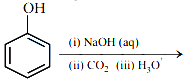
A
Benzene
B
Salicylic acid
C
$3-$Hydroxybenzoic acid
D
$4-$Hydroxybenzoic acid
Solution
(B) The reaction sequence is the $Kolbe-Schmitt$ reaction.
$1$. Phenol reacts with $NaOH$ to form sodium phenoxide.
$2$. Sodium phenoxide reacts with $CO_2$ under pressure to form an intermediate,which upon acidification $(H_3O^+)$ yields salicylic acid as the major product.
$3$. The ortho-substitution is favored due to the formation of a stable chelated intermediate involving the sodium ion and the oxygen atoms of the phenoxide and the carboxylate group.
$1$. Phenol reacts with $NaOH$ to form sodium phenoxide.
$2$. Sodium phenoxide reacts with $CO_2$ under pressure to form an intermediate,which upon acidification $(H_3O^+)$ yields salicylic acid as the major product.
$3$. The ortho-substitution is favored due to the formation of a stable chelated intermediate involving the sodium ion and the oxygen atoms of the phenoxide and the carboxylate group.
0 likesView Solution
60
ChemistryMediumMCQAP EAMCET · 2022
Identify the product$(s)$ formed in the following reaction.
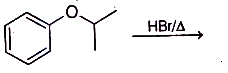
A
Phenol and isopropyl bromide
B
Bromobenzene and isopropyl alcohol
C
$4-$bromoisopropylbenzene
D
$2-$bromoisopropylbenzene
Solution
(A) The reaction of an alkyl aryl ether with $HBr$ involves the cleavage of the $C-O$ bond.
In the case of isopropyl phenyl ether,the oxygen atom is attached to a phenyl group and an isopropyl group.
The $C-O$ bond between the oxygen and the isopropyl group is cleaved because the resulting isopropyl carbocation is more stable (secondary carbocation) compared to the phenyl carbocation,which is not formed due to the partial double bond character of the $C-O$ bond in the aryl group.
Therefore,the reaction proceeds via an $S_N1$ mechanism,yielding phenol and isopropyl bromide as the products.
In the case of isopropyl phenyl ether,the oxygen atom is attached to a phenyl group and an isopropyl group.
The $C-O$ bond between the oxygen and the isopropyl group is cleaved because the resulting isopropyl carbocation is more stable (secondary carbocation) compared to the phenyl carbocation,which is not formed due to the partial double bond character of the $C-O$ bond in the aryl group.
Therefore,the reaction proceeds via an $S_N1$ mechanism,yielding phenol and isopropyl bromide as the products.
0 likesView Solution
61
ChemistryMediumMCQAP EAMCET · 2022
Identify $P$ and $Q$ respectively of the following reaction.
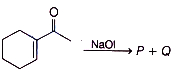
A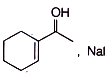
B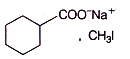
C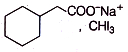
D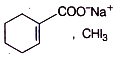
Solution
(D) The given substrate is a methyl ketone (cyclohex$-1-$en$-1-$yl methyl ketone),which contains the $CH_3CO-$ group.
In the presence of $NaOI$ (sodium hypoiodite),it undergoes the iodoform reaction.
The $CH_3$ group is converted into iodoform $(CHI_3)$,and the remaining part of the molecule is oxidized to a carboxylate salt $(RCOO^-Na^+)$.
Therefore,the reaction is:
$Cyclohex-1-en-1-yl \ methyl \ ketone + 3NaOI$ $\rightarrow Cyclohex-1-ene-1-carboxylate \ sodium \ salt (P) + CHI_3 (Q) + 2NaOH$.
Comparing this with the given options,option $D$ correctly represents $P$ and $Q$.
In the presence of $NaOI$ (sodium hypoiodite),it undergoes the iodoform reaction.
The $CH_3$ group is converted into iodoform $(CHI_3)$,and the remaining part of the molecule is oxidized to a carboxylate salt $(RCOO^-Na^+)$.
Therefore,the reaction is:
$Cyclohex-1-en-1-yl \ methyl \ ketone + 3NaOI$ $\rightarrow Cyclohex-1-ene-1-carboxylate \ sodium \ salt (P) + CHI_3 (Q) + 2NaOH$.
Comparing this with the given options,option $D$ correctly represents $P$ and $Q$.
0 likesView Solution
62
ChemistryEasyMCQAP EAMCET · 2022
Which of the following can undergo a disproportionation reaction on heating with concentrated alkali?
A
$C_6H_5CHO$
B
$C_6H_5COOH$
C
$C_6H_5CH_2OH$
D
$C_6H_5CH_2CHO$
Solution
(A) Aldehydes that do not possess an $\alpha$-hydrogen atom undergo a disproportionation reaction (self-oxidation and reduction) when heated with concentrated alkali. This reaction is known as the Cannizzaro reaction. Among the given options,benzaldehyde $(C_6H_5CHO)$ has no $\alpha$-hydrogen atom attached to the carbonyl carbon,and therefore,it undergoes the Cannizzaro reaction.
0 likesView Solution
63
ChemistryDifficultMCQAP EAMCET · 2022
Identify the major product from the following reaction sequence.
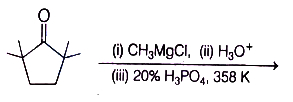
A
$2,2,5,5-$tetramethylcyclopentanol
B
$2,2,5-$trimethylcyclopent$-1-$ene
C
$1,2,2,5,5-$pentamethylcyclopentene
D
$2,2,5,5-$tetramethylcyclopent$-1-$ene
Solution
(C) The reaction proceeds in three steps:
$1$. Nucleophilic addition of the Grignard reagent $(CH_3MgCl)$ to the carbonyl group of $2,2,5,5$-tetramethylcyclopentanone,followed by acid workup $(H_3O^+)$,yields $1,2,2,5,5$-pentamethylcyclopentanol.
$2$. The subsequent treatment with $20\% \ H_3PO_4$ at $358 \ K$ causes acid-catalyzed dehydration of the tertiary alcohol.
$3$. Dehydration occurs via the formation of a carbocation,followed by the loss of a proton to form the most stable alkene. In this case,the double bond forms between the $C_1$ and $C_2$ positions to give $1,2,2,5,5$-pentamethylcyclopentene.
$1$. Nucleophilic addition of the Grignard reagent $(CH_3MgCl)$ to the carbonyl group of $2,2,5,5$-tetramethylcyclopentanone,followed by acid workup $(H_3O^+)$,yields $1,2,2,5,5$-pentamethylcyclopentanol.
$2$. The subsequent treatment with $20\% \ H_3PO_4$ at $358 \ K$ causes acid-catalyzed dehydration of the tertiary alcohol.
$3$. Dehydration occurs via the formation of a carbocation,followed by the loss of a proton to form the most stable alkene. In this case,the double bond forms between the $C_1$ and $C_2$ positions to give $1,2,2,5,5$-pentamethylcyclopentene.
0 likesView Solution
64
ChemistryMediumMCQAP EAMCET · 2022
Arrange the following compounds in decreasing order of their boiling points.
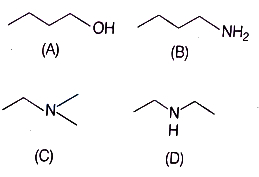
A
$A > B > D > C$
B
$A > C > D > B$
C
$B > C > D > A$
D
$C > A > B > D$
Solution
(A) The boiling point of $(A)$ butan$-1-$ol is the highest due to strong intermolecular $H$-bonding compared to amines.
Among the given amines,the boiling point follows the order: Primary amine $(B)$ $>$ Secondary amine $(D)$ $>$ Tertiary amine $(C)$.
This is because the extent of intermolecular $H$-bonding decreases from primary to secondary amines,and tertiary amines lack $H$-bonding due to the absence of $H$ atoms attached to the nitrogen atom.
Therefore,the correct decreasing order of boiling points is $A > B > D > C$.
Among the given amines,the boiling point follows the order: Primary amine $(B)$ $>$ Secondary amine $(D)$ $>$ Tertiary amine $(C)$.
This is because the extent of intermolecular $H$-bonding decreases from primary to secondary amines,and tertiary amines lack $H$-bonding due to the absence of $H$ atoms attached to the nitrogen atom.
Therefore,the correct decreasing order of boiling points is $A > B > D > C$.
0 likesView Solution
65
ChemistryMediumMCQAP EAMCET · 2022
The relative basic strength of the compounds is correctly shown in the option.
A
$NH_2OH > NH_3 > N_2H_4$
B
$N_2H_4 > NH_2OH > NH_3$
C
$NH_3 > N_2H_4 > NH_2OH$
D
$N_2H_4 > NH_3 > NH_2OH$
Solution
(C) The correct order of relative basic strength is $NH_3 > N_2H_4 > NH_2OH$.
In $NH_3$,the lone pair on nitrogen is completely available for donation,making it the most basic.
$N_2H_4$ and $NH_2OH$ are derivatives of $NH_3$ where one $H$ atom is replaced by $-NH_2$ and $-OH$ groups respectively.
The $-OH$ group is highly electron-withdrawing due to the high electronegativity of the oxygen atom,which significantly decreases the electron density on the nitrogen atom.
The $-I$ effect of the $-NH_2$ group is less than that of the $-OH$ group.
Therefore,the basic strength decreases as the electron-withdrawing nature of the substituent increases,leading to the order $NH_3 > N_2H_4 > NH_2OH$.
In $NH_3$,the lone pair on nitrogen is completely available for donation,making it the most basic.
$N_2H_4$ and $NH_2OH$ are derivatives of $NH_3$ where one $H$ atom is replaced by $-NH_2$ and $-OH$ groups respectively.
The $-OH$ group is highly electron-withdrawing due to the high electronegativity of the oxygen atom,which significantly decreases the electron density on the nitrogen atom.
The $-I$ effect of the $-NH_2$ group is less than that of the $-OH$ group.
Therefore,the basic strength decreases as the electron-withdrawing nature of the substituent increases,leading to the order $NH_3 > N_2H_4 > NH_2OH$.
0 likesView Solution
66
ChemistryEasyMCQAP EAMCET · 2022
Gabriel phthalimide synthesis is used for the preparation of which of the following?
A
Aniline
B
Pyrrolidine
C
Triethylamine
D
Ethylamine
Solution
(D) Gabriel phthalimide synthesis is specifically used for the preparation of primary $(1^{\circ})$ aliphatic amines.
It involves the reaction of potassium phthalimide with an alkyl halide,followed by alkaline hydrolysis.
Since aryl halides do not undergo nucleophilic substitution with the phthalimide anion,aromatic amines (like aniline) cannot be prepared by this method.
Secondary and tertiary amines are also not prepared by this method.
Among the given options,ethylamine $(CH_3CH_2NH_2)$ is a primary aliphatic amine,whereas aniline is aromatic,and the others are secondary or tertiary amines.
It involves the reaction of potassium phthalimide with an alkyl halide,followed by alkaline hydrolysis.
Since aryl halides do not undergo nucleophilic substitution with the phthalimide anion,aromatic amines (like aniline) cannot be prepared by this method.
Secondary and tertiary amines are also not prepared by this method.
Among the given options,ethylamine $(CH_3CH_2NH_2)$ is a primary aliphatic amine,whereas aniline is aromatic,and the others are secondary or tertiary amines.
0 likesView Solution
67
ChemistryEasyMCQAP EAMCET · 2022
The reagent $P$ used for the reaction is
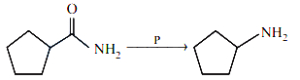
A
$Zn-Hg / HCl$
B
$HCl / SnCl_2$
C
$Br_2 / NaOH$
D
$ZnCl_2 / HCl$
Solution
(C) The given reaction is the conversion of an amide to a primary amine with one carbon atom less. This is known as the Hofmann bromamide degradation reaction. The reagents used for this reaction are $Br_2$ in the presence of a strong base like $NaOH$ or $KOH$.
0 likesView Solution
68
ChemistryMediumMCQAP EAMCET · 2022
Identify the major product formed from the sequence of reactions given below:
$C_6H_5NH_2$ $\xrightarrow[(ii) Cu_2Cl_2]{(i) NaNO_2/HCl, 273 K}$ $\xrightarrow{(iii) Na/dry ether} \text{Product}$
$C_6H_5NH_2$ $\xrightarrow[(ii) Cu_2Cl_2]{(i) NaNO_2/HCl, 273 K}$ $\xrightarrow{(iii) Na/dry ether} \text{Product}$
A
Chlorobenzene
B
Biphenyl
C
Diphenylmethane
D
Diphenylamine
Solution
(B) The reaction sequence is as follows:
$1$. Aniline $(C_6H_5NH_2)$ reacts with $NaNO_2/HCl$ at $273-278 \ K$ to form benzenediazonium chloride $(C_6H_5N_2^+Cl^-)$.
$2$. Benzenediazonium chloride reacts with $Cu_2Cl_2$ (Sandmeyer reaction) to form chlorobenzene $(C_6H_5Cl)$.
$3$. Chlorobenzene reacts with $Na$ in the presence of dry ether (Wurtz-Fittig reaction) to form biphenyl $(C_6H_5-C_6H_5)$.
$1$. Aniline $(C_6H_5NH_2)$ reacts with $NaNO_2/HCl$ at $273-278 \ K$ to form benzenediazonium chloride $(C_6H_5N_2^+Cl^-)$.
$2$. Benzenediazonium chloride reacts with $Cu_2Cl_2$ (Sandmeyer reaction) to form chlorobenzene $(C_6H_5Cl)$.
$3$. Chlorobenzene reacts with $Na$ in the presence of dry ether (Wurtz-Fittig reaction) to form biphenyl $(C_6H_5-C_6H_5)$.
0 likesView Solution
69
ChemistryMediumMCQAP EAMCET · 2022
Identify the major product of the following reaction:
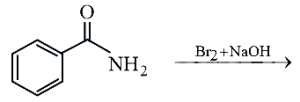
A
$4-$Bromobenzylamine
B
Benzylamine
C
$4-$Bromobenzamide
D
Aniline
Solution
(D) The given reaction is the Hoffmann bromamide degradation reaction. In this reaction,an amide $(R-CONH_2)$ reacts with bromine $(Br_2)$ in the presence of an aqueous base (like $NaOH$) to form a primary amine $(R-NH_2)$ with one carbon atom less than the starting amide.
In the given reactant,benzamide $(C_6H_5CONH_2)$,the carbonyl carbon is removed as a carbonate,and the phenyl group attaches directly to the nitrogen atom.
Therefore,the reaction is:
$C_6H_5CONH_2 + Br_2 + 4NaOH \rightarrow C_6H_5NH_2 + Na_2CO_3 + 2NaBr + 2H_2O$
The product formed is aniline $(C_6H_5NH_2)$.
In the given reactant,benzamide $(C_6H_5CONH_2)$,the carbonyl carbon is removed as a carbonate,and the phenyl group attaches directly to the nitrogen atom.
Therefore,the reaction is:
$C_6H_5CONH_2 + Br_2 + 4NaOH \rightarrow C_6H_5NH_2 + Na_2CO_3 + 2NaBr + 2H_2O$
The product formed is aniline $(C_6H_5NH_2)$.
0 likesView Solution
70
ChemistryEasyMCQAP EAMCET · 2022
Identify $X$ and $Y$ of the following reaction sequence.
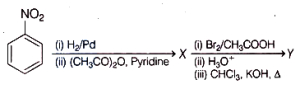
A
$X$ = $C_6H_5NHCOCH_3$,$Y$ = $p-Br-C_6H_4-NC$
B
$X$ = $p-CH_3COC_6H_4NH_2$,$Y$ = $p-CH_3COC_6H_4-NC(Br)$
C
$X$ = $C_6H_5NHCOCH_3$,$Y$ = $p-NHOHC_6H_4CHO$
D
$X$ = $C_6H_5NHCOCH_3$,$Y$ = $m-Br-C_6H_4-NC$
Solution
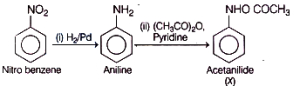
0 likesView Solution
71
ChemistryEasyMCQAP EAMCET · 2022
Carbohydrates are stored in plants and animals in which of the following forms respectively?
A
Glycogen,starch
B
Glycogen,glycogen
C
Starch,starch
D
Starch,glycogen
Solution
(D) Carbohydrates are stored in plants in the form of starch.
In animals,carbohydrates are stored in the form of glycogen.
Both starch and glycogen serve as energy reserves and are broken down during metabolism to release energy.
In animals,carbohydrates are stored in the form of glycogen.
Both starch and glycogen serve as energy reserves and are broken down during metabolism to release energy.
0 likesView Solution
72
ChemistryMediumMCQAP EAMCET · 2022
Statement $I$. Despite having an aldehyde group,glucose does not give the Schiff test.
Statement $II$. Glucose exists in $\alpha$ and $\beta$ crystalline forms.
Statement $II$. Glucose exists in $\alpha$ and $\beta$ crystalline forms.
A
Both statements $I$ and $II$ are incorrect.
B
Both statements $I$ and $II$ are correct.
C
Statement $I$ is correct but statement $II$ is incorrect.
D
Statement $I$ is incorrect but statement $II$ is correct.
Solution
(B) Glucose does not react with Schiff's reagent because the aldehyde group in glucose is not free; it is involved in the formation of a hemiacetal structure.
Glucose exists in two different crystalline anomeric forms,$\alpha-D$-glucose and $\beta-D$-glucose.
Thus,both statements $I$ and $II$ are correct.
Glucose exists in two different crystalline anomeric forms,$\alpha-D$-glucose and $\beta-D$-glucose.
Thus,both statements $I$ and $II$ are correct.
0 likesView Solution
73
ChemistryEasyMCQAP EAMCET · 2022
Hydrolysis of which disaccharide in the presence of the enzyme maltase gives glucose only?
A
Sucrose
B
Cellulose
C
Lactose
D
Maltose
Solution
(D) The enzyme maltase specifically catalyzes the hydrolysis of maltose into two molecules of $D$-glucose.
$C_{12}H_{22}O_{11} + H_2O \xrightarrow{\text{maltase}} 2C_6H_{12}O_6$ (glucose).
$C_{12}H_{22}O_{11} + H_2O \xrightarrow{\text{maltase}} 2C_6H_{12}O_6$ (glucose).
0 likesView Solution
74
ChemistryEasyMCQAP EAMCET · 2022
If sucrose is boiled with dilute $HCl$ in an alcoholic solution,the ratio in which glucose and fructose are formed is
A
$1: 1$
B
$1: 2$
C
$2: 1$
D
$4: 1$
Solution
(A) Sucrose is a disaccharide composed of one molecule of glucose and one molecule of fructose linked by a glycosidic bond.
Upon hydrolysis with dilute $HCl$,the glycosidic bond breaks to yield an equimolar mixture of glucose and fructose.
The chemical reaction is: $C_{12}H_{22}O_{11} + H_2O \xrightarrow{H^+} C_6H_{12}O_6 (\text{glucose}) + C_6H_{12}O_6 (\text{fructose})$.
Therefore,the ratio of glucose to fructose formed is $1: 1$.
Upon hydrolysis with dilute $HCl$,the glycosidic bond breaks to yield an equimolar mixture of glucose and fructose.
The chemical reaction is: $C_{12}H_{22}O_{11} + H_2O \xrightarrow{H^+} C_6H_{12}O_6 (\text{glucose}) + C_6H_{12}O_6 (\text{fructose})$.
Therefore,the ratio of glucose to fructose formed is $1: 1$.
0 likesView Solution
75
ChemistryEasyMCQAP EAMCET · 2022
What is the functional group present in serine,an amino acid,in addition to $-NH_2$ and $-COOH$ groups?
A
$-OH$
B
$-SH$
C
$-NH^{-}$
D
None of these
Solution
(A) Serine is an amino acid with the chemical structure $HOCH_2-CH(NH_2)-COOH$.
Apart from the amino group $(-NH_2)$ and the carboxylic acid group $(-COOH)$,it contains a hydroxyl group $(-OH)$ in its side chain.
Apart from the amino group $(-NH_2)$ and the carboxylic acid group $(-COOH)$,it contains a hydroxyl group $(-OH)$ in its side chain.
0 likesView Solution
76
ChemistryEasyMCQAP EAMCET · 2022
The total number of amino acids present in insulin is
A
$55$
B
$1051$
C
$51$
D
$100$
Solution
(C) Human insulin is a peptide hormone composed of two polypeptide chains,chain $A$ and chain $B$,linked by disulfide bridges.
Chain $A$ consists of $21$ amino acids and chain $B$ consists of $30$ amino acids.
Therefore,the total number of amino acids in insulin is $21 + 30 = 51$.
Chain $A$ consists of $21$ amino acids and chain $B$ consists of $30$ amino acids.
Therefore,the total number of amino acids in insulin is $21 + 30 = 51$.
0 likesView Solution
77
ChemistryEasyMCQAP EAMCET · 2022
Which of the following amino acids is optically inactive?
A
Glycine
B
Proline
C
Tyrosine
D
Alanine
Solution
(A) An amino acid is optically active if it contains at least one chiral (asymmetrical) carbon atom.
Glycine has the structure $H_2N-CH_2-COOH$.
In glycine,the central carbon atom is bonded to two identical hydrogen atoms,meaning it does not have a chiral center.
Therefore,glycine is the only naturally occurring amino acid that is optically inactive.
Glycine has the structure $H_2N-CH_2-COOH$.
In glycine,the central carbon atom is bonded to two identical hydrogen atoms,meaning it does not have a chiral center.
Therefore,glycine is the only naturally occurring amino acid that is optically inactive.
0 likesView Solution
78
ChemistryEasyMCQAP EAMCET · 2022
Which of the following molecules is eliminated during peptide bond formation?
A
$H_2O$
B
$NH_3$
C
$CH_3OH$
D
$CO_2$
Solution
(A) Chemically,a peptide linkage is an amide bond formed between the $-COOH$ group of one amino acid and the $-NH_2$ group of another amino acid.
During this condensation reaction,the hydroxyl group $(-OH)$ from the carboxyl group and a hydrogen atom $(-H)$ from the amino group combine to form a water molecule $(H_2O)$,which is eliminated.
This results in the formation of a peptide bond $(-CO-NH-)$.
Therefore,the molecule eliminated during peptide bond formation is $H_2O$.
During this condensation reaction,the hydroxyl group $(-OH)$ from the carboxyl group and a hydrogen atom $(-H)$ from the amino group combine to form a water molecule $(H_2O)$,which is eliminated.
This results in the formation of a peptide bond $(-CO-NH-)$.
Therefore,the molecule eliminated during peptide bond formation is $H_2O$.
0 likesView Solution
79
ChemistryDifficultMCQAP EAMCET · 2022
Glycylalanine is a dipeptide of which amino acids?
A
$H_2NCH_2COOH$ and $H_2NCH(CH_3)COOH$
B
$(CH_3)_2CHCH(NH_2)COOH$ and $H_2NCH_2COOH$
C
$(CH_3)_2CHCH_2CH(NH_2)COOH$ and $H_2NCH_2COOH$
D
$(CH_3)_2CHCH(NH_2)COOH$ and $(CH_3)_2CHCH(NH_2)COOH$
Solution
(A) Glycylalanine is a dipeptide formed by the condensation of glycine $(H_2NCH_2COOH)$ and alanine $(H_2NCH(CH_3)COOH)$.
During the formation of the peptide bond,a water molecule is eliminated between the carboxyl group of glycine and the amino group of alanine,resulting in the dipeptide glycylalanine.
During the formation of the peptide bond,a water molecule is eliminated between the carboxyl group of glycine and the amino group of alanine,resulting in the dipeptide glycylalanine.
0 likesView Solution
80
ChemistryEasyMCQAP EAMCET · 2022
In which of the following is $Keratin$,a fibrous protein,absent?
A
Hair
B
Muscles
C
Silk
D
Wool
Solution
(B) $Keratin$ is a fibrous structural protein found in the outer protective layers of animals,such as hair,wool,nails,and skin.
$Silk$ is composed of a different fibrous protein called $Fibroin$.
$Muscles$ are primarily composed of contractile proteins like $Actin$ and $Myosin$.
Therefore,$Keratin$ is absent in $Muscles$ and $Silk$.
$Silk$ is composed of a different fibrous protein called $Fibroin$.
$Muscles$ are primarily composed of contractile proteins like $Actin$ and $Myosin$.
Therefore,$Keratin$ is absent in $Muscles$ and $Silk$.
0 likesView Solution
81
ChemistryEasyMCQAP EAMCET · 2022
Which of the following is not true about the denaturation of protein?
A
$2^{\circ}$ structure gets destroyed
B
$3^{\circ}$ structure gets destroyed
C
$1^{\circ}$ structure gets destroyed
D
Bioactivity is lost
Solution
(C) During the denaturation of proteins,the $1^{\circ}$ (primary) structure remains intact because the peptide bonds are not broken.
However,the $2^{\circ}$ (secondary) and $3^{\circ}$ (tertiary) structures are destroyed due to the disruption of hydrogen bonds and other non-covalent interactions.
As a result,the protein loses its specific shape and its biological activity is lost.
However,the $2^{\circ}$ (secondary) and $3^{\circ}$ (tertiary) structures are destroyed due to the disruption of hydrogen bonds and other non-covalent interactions.
As a result,the protein loses its specific shape and its biological activity is lost.
0 likesView Solution
82
ChemistryEasyMCQAP EAMCET · 2022
Which of the following is not a type of $RNA$?
A
$m$-$RNA$
B
$d$-$RNA$
C
$t$-$RNA$
D
$r$-$RNA$
Solution
(B) There are three main types of $RNA$ involved in protein synthesis: $m$-$RNA$ (messenger $RNA$),$t$-$RNA$ (transfer $RNA$),and $r$-$RNA$ (ribosomal $RNA$).
$d$-$RNA$ is not a recognized type of $RNA$.
$d$-$RNA$ is not a recognized type of $RNA$.
0 likesView Solution
83
ChemistryEasyMCQAP EAMCET · 2022
The sugar present in $DNA$ is:
A
$\beta-D-2-$ribose
B
$\beta-D-2-$deoxyribose
C
$\alpha-D-2-$ribose
D
$\alpha-D-2-$deoxyribose
Solution
(B) The sugar present in $DNA$ is $\beta-D-2-$deoxyribose.
In contrast,the sugar present in $RNA$ is $\beta-D-$ribose.
In contrast,the sugar present in $RNA$ is $\beta-D-$ribose.
0 likesView Solution
84
ChemistryEasyMCQAP EAMCET · 2022
Hydrolysis of nucleic acid gives nitrogenous base,sugar and......
A
sulphuric acid
B
phosphorous acid
C
sulphurous acid
D
phosphoric acid
Solution
(D) Complete hydrolysis of nucleic acids ($DNA$ or $RNA$) yields three components: a nitrogenous base,a pentose sugar (ribose or deoxyribose),and phosphoric acid $(H_3PO_4)$.
0 likesView Solution
85
ChemistryEasyMCQAP EAMCET · 2022
Hydrolysis of which of the following nucleic acids does not give an equal number of $A$ and $T$ or $G$ and $C$?
$(A)$ $m$-$RNA$
$(B)$ Single strand $DNA$
$(C)$ $r$-$RNA$
$(D)$ Double helix $DNA$
$(A)$ $m$-$RNA$
$(B)$ Single strand $DNA$
$(C)$ $r$-$RNA$
$(D)$ Double helix $DNA$
A
$(A)$,$(B)$,$(C)$
B
$(B)$,$(C)$,$(D)$
C
$(B)$ only
D
$(A)$ only
Solution
(A) According to Chargaff's rule,the amount of adenine $(A)$ is equal to the amount of thymine $(T)$,and the amount of guanine $(G)$ is equal to the amount of cytosine $(C)$ only in double-stranded $DNA$.
$m$-$RNA$,$r$-$RNA$,and single-stranded $DNA$ are single-stranded molecules.
Therefore,they do not follow Chargaff's rule and do not yield an equal number of $A$ and $T$ or $G$ and $C$ upon hydrolysis.
Thus,$(A)$,$(B)$,and $(C)$ do not give equal numbers of these bases.
$m$-$RNA$,$r$-$RNA$,and single-stranded $DNA$ are single-stranded molecules.
Therefore,they do not follow Chargaff's rule and do not yield an equal number of $A$ and $T$ or $G$ and $C$ upon hydrolysis.
Thus,$(A)$,$(B)$,and $(C)$ do not give equal numbers of these bases.
0 likesView Solution
86
ChemistryEasyMCQAP EAMCET · 2022
Which of the following vitamins cannot be stored in the body?
A
$A$
B
$C$
C
$E$
D
$K$
Solution
(B) Vitamins are classified into two groups based on their solubility in water or fat.
Fat-soluble vitamins: Vitamins that are soluble in fat and oils but insoluble in water belong to this group. These include vitamins $A, D, E$,and $K$. They are stored in the liver and adipose (fat-storing) tissues.
Water-soluble vitamins: $B$-group vitamins and vitamin $C$ are soluble in water. Water-soluble vitamins must be supplied regularly in the diet because they are readily excreted in urine and cannot be stored in our body (except for vitamin $B_{12}$).
Fat-soluble vitamins: Vitamins that are soluble in fat and oils but insoluble in water belong to this group. These include vitamins $A, D, E$,and $K$. They are stored in the liver and adipose (fat-storing) tissues.
Water-soluble vitamins: $B$-group vitamins and vitamin $C$ are soluble in water. Water-soluble vitamins must be supplied regularly in the diet because they are readily excreted in urine and cannot be stored in our body (except for vitamin $B_{12}$).
0 likesView Solution
87
ChemistryEasyMCQAP EAMCET · 2022
Pernicious anemia is caused due to deficiency of which vitamin?
A
$B_{12}$
B
$B_{1}$
C
$B_{6}$
D
$B_{2}$
Solution
(A) Pernicious anemia is caused by the deficiency of vitamin $B_{12}$.
The deficiency of vitamin $B_{1}$ causes Beri-beri.
The deficiency of vitamin $B_{6}$ causes convulsions.
The deficiency of vitamin $B_{2}$ causes cheilosis (fissuring at corners of mouth and lips),digestive disorders,and a burning sensation of the skin.
The deficiency of vitamin $B_{1}$ causes Beri-beri.
The deficiency of vitamin $B_{6}$ causes convulsions.
The deficiency of vitamin $B_{2}$ causes cheilosis (fissuring at corners of mouth and lips),digestive disorders,and a burning sensation of the skin.
0 likesView Solution
88
ChemistryEasyMCQAP EAMCET · 2022
Thiamine is
A
Nitrogenous base
B
Amino acid
C
Hormone
D
Vitamin
Solution
(D) Thiamine,also known as Vitamin $B_1$,is a water-soluble vitamin with the chemical formula $C_{12}H_{17}N_4OS^+$.
It plays a crucial role in energy metabolism and nerve function.
It plays a crucial role in energy metabolism and nerve function.
0 likesView Solution
89
ChemistryEasyMCQAP EAMCET · 2022
Match the following.
| List-$I$ (Substance) | List-$II$ (Use) |
|---|---|
| $(A)$ Methanoic acid | $(i)$ Textile |
| $(B)$ Ethanoic acid | $(iv)$ Vinegar |
| $(C)$ Hexanedioic acid | $(ii)$ Polymer |
| $(D)$ Sodium benzoate | $(iii)$ Food preservative |
A
$(A)-(i), (B)-(iv), (C)-(ii), (D)-(iii)$
B
$(A)-(ii), (B)-(iv), (C)-(i), (D)-(iii)$
C
$(A)-(iii), (B)-(iv), (C)-(ii), (D)-(i)$
D
$(A)-(iv), (B)-(iii), (C)-(ii), (D)-(i)$
Solution
(A) The correct matching is as follows:
$(A)$ Methanoic acid is used in the textile industry as a $pH$ regulator.
$(B)$ Ethanoic acid is used as vinegar,which is a $4-7 \%$ solution of acetic acid.
$(C)$ Hexanedioic acid (adipic acid) is a precursor for the production of nylon (polymer).
$(D)$ Sodium benzoate is widely used as a food preservative to prevent spoilage.
$(A)$ Methanoic acid is used in the textile industry as a $pH$ regulator.
$(B)$ Ethanoic acid is used as vinegar,which is a $4-7 \%$ solution of acetic acid.
$(C)$ Hexanedioic acid (adipic acid) is a precursor for the production of nylon (polymer).
$(D)$ Sodium benzoate is widely used as a food preservative to prevent spoilage.
0 likesView Solution
90
ChemistryEasyMCQAP EAMCET · 2022
What is the product formed upon hydrolysis of the minor product obtained from the reaction of $1-$bromopropane with ethanolic $KCN$?
A
$CH_3CH_2CH_2NH_2$
B
$CH_3CH_2CH_2NC$
C
$CH_3CH_2CH_2COOH$
D
$CH_3CH_2COOH$
Solution
(A) The reaction of $1-$bromopropane $(CH_3CH_2CH_2Br)$ with ethanolic $KCN$ is a nucleophilic substitution reaction. $CN^-$ is an ambident nucleophile. The major product is the nitrile $(CH_3CH_2CH_2CN)$ due to attack by carbon,while the minor product is the isocyanide $(CH_3CH_2CH_2NC)$ due to attack by nitrogen.
Hydrolysis of the minor product,$CH_3CH_2CH_2NC$,yields a primary amine and formic acid:
$CH_3CH_2CH_2NC + 2H_2O \xrightarrow{H^+} CH_3CH_2CH_2NH_2 + HCOOH$
Thus,the product is $n-$propylamine $(CH_3CH_2CH_2NH_2)$.
Hydrolysis of the minor product,$CH_3CH_2CH_2NC$,yields a primary amine and formic acid:
$CH_3CH_2CH_2NC + 2H_2O \xrightarrow{H^+} CH_3CH_2CH_2NH_2 + HCOOH$
Thus,the product is $n-$propylamine $(CH_3CH_2CH_2NH_2)$.
0 likesView Solution
91
ChemistryEasyMCQAP EAMCET · 2022
Match the name of the acid from List-$I$ with the source from which it is derived.
| $A$. Formic acid | $I$. Rancid butter |
| $B$. Acetic acid | $II$. Vinegar |
| $C$. Butyric acid | $III$. Red ants |
A
$A-I, B-II, C-III$
B
$A-II, B-I, C-III$
C
$A-III, B-II, C-I$
D
$A-III, B-I, C-II$
Solution
(C) The sources of the given carboxylic acids are as follows:
$A$. Formic acid $(HCOOH)$ is found in red ants.
$B$. Acetic acid $(CH_3COOH)$ is the main component of vinegar.
$C$. Butyric acid $(CH_3CH_2CH_2COOH)$ is found in rancid butter.
Therefore,the correct matching is $A-III, B-II, C-I$.
$A$. Formic acid $(HCOOH)$ is found in red ants.
$B$. Acetic acid $(CH_3COOH)$ is the main component of vinegar.
$C$. Butyric acid $(CH_3CH_2CH_2COOH)$ is found in rancid butter.
Therefore,the correct matching is $A-III, B-II, C-I$.
0 likesView Solution
92
ChemistryMediumMCQAP EAMCET · 2022
An aryl carboxylic acid on treatment with sodium hydrogen carbonate liberates a gaseous molecule. Identify the gas molecule liberated.
A
$H_2$
B
$CO_2$
C
$CO$
D
$O_2$
Solution
(B) Carboxylic acids react with sodium hydrogen carbonate $(NaHCO_3)$ to produce a salt,water,and carbon dioxide gas. This reaction is a characteristic test for the presence of the carboxyl $(-COOH)$ group in organic compounds.
The chemical equation for the reaction is:
$RCOOH + NaHCO_3 \rightarrow RCOONa + H_2O + CO_2 \uparrow$
Thus,the gas liberated is carbon dioxide $(CO_2)$.
The chemical equation for the reaction is:
$RCOOH + NaHCO_3 \rightarrow RCOONa + H_2O + CO_2 \uparrow$
Thus,the gas liberated is carbon dioxide $(CO_2)$.
0 likesView Solution
93
ChemistryEasyMCQAP EAMCET · 2022
Aluminium chloride in acidified aqueous solution gives a complex ion '$X$'. The hybridisation of the central atom in $X$ is
A
$sp^3$
B
$sp^2d$
C
$d^2sp^3$
D
$sp^3d^2$
Solution
(D) When aluminium chloride is dissolved in an acidified aqueous solution,it forms the hexa-aquaaluminium$(III)$ complex ion,$[Al(H_2O)_6]^{3+}$.
In this complex,the central $Al^{3+}$ ion has an electronic configuration of $[Ne] 3s^0 3p^0 3d^0$.
To accommodate six lone pairs from six water molecules,the $Al^{3+}$ ion undergoes $sp^3d^2$ hybridisation,utilizing one $3s$,three $3p$,and two $3d$ orbitals.
The reaction is: $AlCl_3 + 6H_2O \longrightarrow [Al(H_2O)_6]^{3+} + 3Cl^-$.
In this complex,the central $Al^{3+}$ ion has an electronic configuration of $[Ne] 3s^0 3p^0 3d^0$.
To accommodate six lone pairs from six water molecules,the $Al^{3+}$ ion undergoes $sp^3d^2$ hybridisation,utilizing one $3s$,three $3p$,and two $3d$ orbitals.
The reaction is: $AlCl_3 + 6H_2O \longrightarrow [Al(H_2O)_6]^{3+} + 3Cl^-$.
0 likesView Solution
94
ChemistryMediumMCQAP EAMCET · 2022
Assertion $(A)$: For an endothermic dissolution process,an increase in temperature increases the solubility in a nearly saturated solution.
Reason $(R)$: In a saturated solution,dynamic equilibrium exists between the dissolved solute and the undissolved solute.
Reason $(R)$: In a saturated solution,dynamic equilibrium exists between the dissolved solute and the undissolved solute.
A
Both $(A)$ and $(R)$ are correct and $(R)$ is the correct explanation of $(A)$
B
Both $(A)$ and $(R)$ are correct,but $(R)$ is not the correct explanation of $(A)$
C
$(A)$ is correct but $(R)$ is not correct
D
$(A)$ is incorrect but $(R)$ is correct
Solution
(A) According to Le Chatelier's principle,for an endothermic process,the dissolution can be represented as: $\text{Solute} + \text{Solvent} + \text{Heat} \rightleftharpoons \text{Solution}$.
When the temperature is increased,the equilibrium shifts in the forward direction to absorb the extra heat,thereby increasing the solubility of the solute.
The reason statement is also correct because a saturated solution represents a state of dynamic equilibrium where the rate of dissolution equals the rate of crystallization.
Since the shift in equilibrium due to temperature change is explained by Le Chatelier's principle,$(R)$ is the correct explanation for $(A)$.
When the temperature is increased,the equilibrium shifts in the forward direction to absorb the extra heat,thereby increasing the solubility of the solute.
The reason statement is also correct because a saturated solution represents a state of dynamic equilibrium where the rate of dissolution equals the rate of crystallization.
Since the shift in equilibrium due to temperature change is explained by Le Chatelier's principle,$(R)$ is the correct explanation for $(A)$.
0 likesView Solution
95
ChemistryDifficultMCQAP EAMCET · 2022
The rate equation for the reaction $2 A + B \longrightarrow$ products is $\text{rate} = k[A][B]^2$. If $k$ at $T \ K$ is $5.0 \times 10^{-6} \ mol^{-2} \ L^2 \ s^{-1}$,the initial rate of the reaction,when $[A] = 0.05 \ mol \ L^{-1}$ and $[B] = 0.1 \ mol \ L^{-1}$ is:
A
$1.25 \times 10^{-9} \ mol \ L^{-1} \ s^{-1}$
B
$1.25 \times 10^{-9} \ mol \ L^{-1} \ s^{-1}$
C
$2.50 \times 10^{-9} \ mol \ L^{-1} \ s^{-1}$
D
$2.50 \times 10^{-9} \ mol \ L^{-1} \ s^{-1}$
Solution
(C) The rate law for the reaction is given by $\text{Rate} = k[A][B]^2$.
Given values are:
$k = 5.0 \times 10^{-6} \ mol^{-2} \ L^2 \ s^{-1}$
$[A] = 0.05 \ mol \ L^{-1} = 5 \times 10^{-2} \ mol \ L^{-1}$
$[B] = 0.1 \ mol \ L^{-1} = 1 \times 10^{-1} \ mol \ L^{-1}$
Substituting these values into the rate equation:
$\text{Rate} = (5.0 \times 10^{-6}) \times (0.05) \times (0.1)^2$
$\text{Rate} = 5.0 \times 10^{-6} \times 5 \times 10^{-2} \times 1 \times 10^{-2}$
$\text{Rate} = 25 \times 10^{-10} \ mol \ L^{-1} \ s^{-1}$
$\text{Rate} = 2.50 \times 10^{-9} \ mol \ L^{-1} \ s^{-1}$
Given values are:
$k = 5.0 \times 10^{-6} \ mol^{-2} \ L^2 \ s^{-1}$
$[A] = 0.05 \ mol \ L^{-1} = 5 \times 10^{-2} \ mol \ L^{-1}$
$[B] = 0.1 \ mol \ L^{-1} = 1 \times 10^{-1} \ mol \ L^{-1}$
Substituting these values into the rate equation:
$\text{Rate} = (5.0 \times 10^{-6}) \times (0.05) \times (0.1)^2$
$\text{Rate} = 5.0 \times 10^{-6} \times 5 \times 10^{-2} \times 1 \times 10^{-2}$
$\text{Rate} = 25 \times 10^{-10} \ mol \ L^{-1} \ s^{-1}$
$\text{Rate} = 2.50 \times 10^{-9} \ mol \ L^{-1} \ s^{-1}$
0 likesView Solution
96
ChemistryDifficultMCQAP EAMCET · 2022
What is the concentration (in $mol \ L^{-1}$) of the product $B$ after $20 \ s$ in the following reaction? Given that $A \longrightarrow 3B$,rate $= k[A]^0$. The data is provided in the table below:
| Time $(s)$ | Concentration of reactant $A$ $(mol \ L^{-1})$ |
| :--- | :--- |
| $0$ | $0.1$ |
| $15$ | $0.05$ |
| $20$ | $0.1 - x$ |
| Time $(s)$ | Concentration of reactant $A$ $(mol \ L^{-1})$ |
| :--- | :--- |
| $0$ | $0.1$ |
| $15$ | $0.05$ |
| $20$ | $0.1 - x$ |
A
$6.6 \times 10^{-2}$
B
$1.32 \times 10^{-1}$
C
$1.98 \times 10^{-1}$
D
$2.2 \times 10^{-2}$
Solution
(C) For a zero-order reaction,$A \longrightarrow 3B$,the rate law is $[A] = [A]_0 - kt$.
From the table,at $t = 15 \ s$,$[A] = 0.05 \ mol \ L^{-1}$ and $[A]_0 = 0.1 \ mol \ L^{-1}$.
Substituting these values: $0.05 = 0.1 - k(15) \implies 15k = 0.05 \implies k = \frac{0.05}{15} = \frac{1}{300} \ mol \ L^{-1} \ s^{-1}$.
Now,at $t = 20 \ s$,the concentration of $A$ is $[A] = [A]_0 - kt = 0.1 - (\frac{1}{300}) \times 20 = 0.1 - \frac{20}{300} = 0.1 - 0.0667 = 0.0333 \ mol \ L^{-1}$.
The amount of $A$ reacted is $\Delta[A] = [A]_0 - [A] = 0.1 - 0.0333 = 0.0667 \ mol \ L^{-1}$.
According to the stoichiometry $A \longrightarrow 3B$,the concentration of product $B$ formed is $3 \times \Delta[A] = 3 \times 0.0667 = 0.2001 \ mol \ L^{-1}$.
Rounding to the nearest option,we get $0.198 \ mol \ L^{-1}$ or $1.98 \times 10^{-1} \ mol \ L^{-1}$.
From the table,at $t = 15 \ s$,$[A] = 0.05 \ mol \ L^{-1}$ and $[A]_0 = 0.1 \ mol \ L^{-1}$.
Substituting these values: $0.05 = 0.1 - k(15) \implies 15k = 0.05 \implies k = \frac{0.05}{15} = \frac{1}{300} \ mol \ L^{-1} \ s^{-1}$.
Now,at $t = 20 \ s$,the concentration of $A$ is $[A] = [A]_0 - kt = 0.1 - (\frac{1}{300}) \times 20 = 0.1 - \frac{20}{300} = 0.1 - 0.0667 = 0.0333 \ mol \ L^{-1}$.
The amount of $A$ reacted is $\Delta[A] = [A]_0 - [A] = 0.1 - 0.0333 = 0.0667 \ mol \ L^{-1}$.
According to the stoichiometry $A \longrightarrow 3B$,the concentration of product $B$ formed is $3 \times \Delta[A] = 3 \times 0.0667 = 0.2001 \ mol \ L^{-1}$.
Rounding to the nearest option,we get $0.198 \ mol \ L^{-1}$ or $1.98 \times 10^{-1} \ mol \ L^{-1}$.
0 likesView Solution
97
ChemistryEasyMCQAP EAMCET · 2022
........ of a reaction cannot be determined experimentally.
A
Order
B
Rate
C
Rate constant
D
Molecularity
Solution
(D) The correct answer is $D$.
Molecularity is a theoretical concept defined as the number of reacting species (atoms,ions,or molecules) taking part in an elementary reaction,which must collide simultaneously in order to bring about a chemical reaction.
It is determined by examining the balanced chemical equation of an elementary step and cannot be determined experimentally,unlike the order of a reaction which is an experimental quantity.
Molecularity is a theoretical concept defined as the number of reacting species (atoms,ions,or molecules) taking part in an elementary reaction,which must collide simultaneously in order to bring about a chemical reaction.
It is determined by examining the balanced chemical equation of an elementary step and cannot be determined experimentally,unlike the order of a reaction which is an experimental quantity.
0 likesView Solution
98
ChemistryDifficultMCQAP EAMCET · 2022
For the reaction $A \longrightarrow 3 B$,the rate is given by $rate = k[A]^0$. Based on the data provided in the table,what is the concentration of the product $B$ (in $mol \ L^{-1}$) after $20 \ s$?
| Time $(s)$ | Concentration of the reactant $(mol \ L^{-1})$ |
| $0$ | $0.1$ |
| $15$ | $0.05$ |
| $20$ | $0.1 - x$ |
A
$6.6 \times 10^{-2}$
B
$1.32 \times 10^{-1}$
C
$1.98 \times 10^{-1}$
D
$2.2 \times 10^{-2}$
Solution
(C) For a zero-order reaction $A \longrightarrow 3 B$,the rate law is $[A] = [A_0] - kt$.
From the table,at $t = 0$,$[A_0] = 0.1 \ mol \ L^{-1}$.
At $t = 15 \ s$,$[A] = 0.05 \ mol \ L^{-1}$.
Substituting these values: $0.05 = 0.1 - k(15)$,which gives $k = 0.05 / 15 = 1/300 \ mol \ L^{-1} \ s^{-1}$.
At $t = 20 \ s$,the concentration of $A$ remaining is $[A] = 0.1 - (1/300) \times 20 = 0.1 - 0.0667 = 0.0333 \ mol \ L^{-1}$.
The amount of $A$ reacted is $0.1 - 0.0333 = 0.0667 \ mol \ L^{-1}$.
According to the stoichiometry,$1 \ mol$ of $A$ produces $3 \ mol$ of $B$.
Therefore,concentration of $B = 3 \times 0.0667 = 0.2001 \ mol \ L^{-1} \approx 1.98 \times 10^{-1} \ mol \ L^{-1}$.
From the table,at $t = 0$,$[A_0] = 0.1 \ mol \ L^{-1}$.
At $t = 15 \ s$,$[A] = 0.05 \ mol \ L^{-1}$.
Substituting these values: $0.05 = 0.1 - k(15)$,which gives $k = 0.05 / 15 = 1/300 \ mol \ L^{-1} \ s^{-1}$.
At $t = 20 \ s$,the concentration of $A$ remaining is $[A] = 0.1 - (1/300) \times 20 = 0.1 - 0.0667 = 0.0333 \ mol \ L^{-1}$.
The amount of $A$ reacted is $0.1 - 0.0333 = 0.0667 \ mol \ L^{-1}$.
According to the stoichiometry,$1 \ mol$ of $A$ produces $3 \ mol$ of $B$.
Therefore,concentration of $B = 3 \times 0.0667 = 0.2001 \ mol \ L^{-1} \approx 1.98 \times 10^{-1} \ mol \ L^{-1}$.
0 likesView Solution
99
ChemistryEasyMCQAP EAMCET · 2022
The rate constant,$k$ of a zero order reaction $2 NH_{3(g)} \xrightarrow[1130 \ K]{Pt} N_{2(g)} + 3 H_{2(g)}$ is $y \times 10^{-4} \ mol \ L^{-1} \ s^{-1}$. The rate of formation of hydrogen (in $mol \ L^{-1} \ s^{-1}$) is
A
$y \times 10^{-4}$
B
$2 y \times 10^{-4}$
C
$3 y \times 10^{-4}$
D
$\frac{y}{3} \times 10^{-4}$
Solution
(C) For a zero order reaction,the rate of reaction $r$ is equal to the rate constant $k$.
Given $r = k = y \times 10^{-4} \ mol \ L^{-1} \ s^{-1}$.
The stoichiometric equation is $2 NH_{3(g)} \rightarrow N_{2(g)} + 3 H_{2(g)}$.
The rate of reaction is expressed as $r = -\frac{1}{2} \frac{d[NH_3]}{dt} = \frac{d[N_2]}{dt} = \frac{1}{3} \frac{d[H_2]}{dt}$.
Therefore,the rate of formation of hydrogen is $\frac{d[H_2]}{dt} = 3 \times r$.
Substituting the value of $r$,we get $\frac{d[H_2]}{dt} = 3 \times (y \times 10^{-4}) = 3y \times 10^{-4} \ mol \ L^{-1} \ s^{-1}$.
Given $r = k = y \times 10^{-4} \ mol \ L^{-1} \ s^{-1}$.
The stoichiometric equation is $2 NH_{3(g)} \rightarrow N_{2(g)} + 3 H_{2(g)}$.
The rate of reaction is expressed as $r = -\frac{1}{2} \frac{d[NH_3]}{dt} = \frac{d[N_2]}{dt} = \frac{1}{3} \frac{d[H_2]}{dt}$.
Therefore,the rate of formation of hydrogen is $\frac{d[H_2]}{dt} = 3 \times r$.
Substituting the value of $r$,we get $\frac{d[H_2]}{dt} = 3 \times (y \times 10^{-4}) = 3y \times 10^{-4} \ mol \ L^{-1} \ s^{-1}$.
0 likesView Solution
100
ChemistryEasyMCQAP EAMCET · 2022
If the rate of disappearance of $N_2O_5$ in the following reaction is $1.2 \times 10^{-5} \ mol \ L^{-1} \ s^{-1}$,the rate of production of $NO_2$ in $mol \ L^{-1} \ s^{-1}$ is:
$2N_2O_{5(g)} \longrightarrow 4NO_{2(g)} + O_{2(g)}$
$2N_2O_{5(g)} \longrightarrow 4NO_{2(g)} + O_{2(g)}$
A
$1.2 \times 10^{-5}$
B
$3.6 \times 10^{-5}$
C
$2.4 \times 10^{-5}$
D
$4.8 \times 10^{-5}$
Solution
(C) For the reaction $2N_2O_{5(g)} \longrightarrow 4NO_{2(g)} + O_{2(g)}$,the rate expression is given by:
$-\frac{1}{2} \frac{d[N_2O_5]}{dt} = \frac{1}{4} \frac{d[NO_2]}{dt} = \frac{d[O_2]}{dt}$
Given that the rate of disappearance of $N_2O_5$ is $-\frac{d[N_2O_5]}{dt} = 1.2 \times 10^{-5} \ mol \ L^{-1} \ s^{-1}$.
From the rate expression,we have:
$\frac{1}{4} \frac{d[NO_2]}{dt} = \frac{1}{2} \left( -\frac{d[N_2O_5]}{dt} \right)$
$\frac{d[NO_2]}{dt} = 2 \times \left( -\frac{d[N_2O_5]}{dt} \right)$
$\frac{d[NO_2]}{dt} = 2 \times (1.2 \times 10^{-5} \ mol \ L^{-1} \ s^{-1}) = 2.4 \times 10^{-5} \ mol \ L^{-1} \ s^{-1}$.
$-\frac{1}{2} \frac{d[N_2O_5]}{dt} = \frac{1}{4} \frac{d[NO_2]}{dt} = \frac{d[O_2]}{dt}$
Given that the rate of disappearance of $N_2O_5$ is $-\frac{d[N_2O_5]}{dt} = 1.2 \times 10^{-5} \ mol \ L^{-1} \ s^{-1}$.
From the rate expression,we have:
$\frac{1}{4} \frac{d[NO_2]}{dt} = \frac{1}{2} \left( -\frac{d[N_2O_5]}{dt} \right)$
$\frac{d[NO_2]}{dt} = 2 \times \left( -\frac{d[N_2O_5]}{dt} \right)$
$\frac{d[NO_2]}{dt} = 2 \times (1.2 \times 10^{-5} \ mol \ L^{-1} \ s^{-1}) = 2.4 \times 10^{-5} \ mol \ L^{-1} \ s^{-1}$.
0 likesView Solution
Vedclass Products
For Students
Vedclass Test Series
Mock tests in real AP EAMCET style covering Chemistry with performance analysis. 5-day free trial.
Start Free TrialFor Teachers
Exam Paper Generator
Generate Set A/B/C/D Chemistry papers from 7.5L+ questions in 2 minutes. 3 chapters free.
Try FreeFor Institutes
Online Exam Module
Run live AP EAMCET mock exams with unlimited students, 360° analytics & white-label branding.
See DemoFrequently Asked Questions
How many Chemistry questions are in AP EAMCET 2022?
There are 435 Chemistry questions from the AP EAMCET 2022 paper on Vedclass, each with a detailed step-by-step solution in English.
Are AP EAMCET 2022 Chemistry solutions available in English?
Yes. All solutions on this page are in English. You can also switch to English or Hindi using the language buttons above the questions.
Can I practice AP EAMCET 2022 Chemistry as a timed test?
Yes. Use the Vedclass Test Series to attempt a full AP EAMCET mock test covering Chemistry with time limits and instant score analysis.
Can teachers create Chemistry papers from AP EAMCET previous year questions?
Yes. The Vedclass Exam Paper Generator lets teachers mix AP EAMCET Chemistry questions and generate Set A/B/C/D papers in minutes.
For Teachers & Institutes
Build a Custom Chemistry Paper
Pick AP EAMCET 2022 Chemistry questions, set difficulty, and generate Set A/B/C/D in 2 minutes.