
PhysicsQ1–100 of 388 questions
Page 1 of 4 · English
1
PhysicsEasyMCQAP EAMCET · 2022
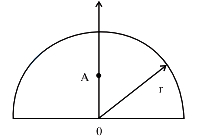
The centre of mass of a homogeneous semi-circular plate of radius $r$ is located at $A$ as shown in the figure. The distance $OA$ is
A
$\frac{2r}{3 \pi}$
B
$\frac{4 r}{3 \pi}$
C
$\frac{3r}{2 \pi}$
D
$\frac{r}{\pi}$
Solution
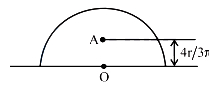
(B) The centre of mass $(COM)$ of a homogeneous semi-circular plate of radius $r$ is located on the axis of symmetry at a distance of $\frac{4r}{3\pi}$ from the centre of its straight edge $(O)$.
Therefore,the distance $OA = \frac{4r}{3\pi}$.
Therefore,the distance $OA = \frac{4r}{3\pi}$.
0 likesView Solution
2
PhysicsEasyMCQAP EAMCET · 2022
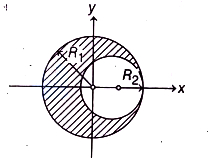
$A$ circular portion of radius $R_2$ has been removed from one edge of a circular disc of radius $R_1$. The correct expression for the centre of mass for the remaining portion of the disc is
A
$-\frac{R_2^2}{R_1+R_2}$
B
$-\frac{R_2^2}{R_1-R_2}$
C
$\frac{R_2^2}{R_1+R_2}$
D
$-\frac{R_1^2}{R_1+R_2}$
Solution
(A) Let the original disc have radius $R_1$ and mass $M_1 = \sigma \pi R_1^2$,where $\sigma$ is the surface mass density. Its center of mass is at the origin $(0,0)$.
Let the removed circular portion have radius $R_2$ and mass $M_2 = \sigma \pi R_2^2$. Its center is at $(R_1 - R_2, 0)$ as shown in the figure.
The center of mass of the remaining portion is given by:
$x_{CM} = \frac{M_1 x_1 - M_2 x_2}{M_1 - M_2}$
Substituting the values:
$x_{CM} = \frac{(\sigma \pi R_1^2)(0) - (\sigma \pi R_2^2)(R_1 - R_2)}{\sigma \pi R_1^2 - \sigma \pi R_2^2}$
$x_{CM} = \frac{-R_2^2(R_1 - R_2)}{R_1^2 - R_2^2}$
$x_{CM} = \frac{-R_2^2(R_1 - R_2)}{(R_1 - R_2)(R_1 + R_2)}$
$x_{CM} = -\frac{R_2^2}{R_1 + R_2}$
Let the removed circular portion have radius $R_2$ and mass $M_2 = \sigma \pi R_2^2$. Its center is at $(R_1 - R_2, 0)$ as shown in the figure.
The center of mass of the remaining portion is given by:
$x_{CM} = \frac{M_1 x_1 - M_2 x_2}{M_1 - M_2}$
Substituting the values:
$x_{CM} = \frac{(\sigma \pi R_1^2)(0) - (\sigma \pi R_2^2)(R_1 - R_2)}{\sigma \pi R_1^2 - \sigma \pi R_2^2}$
$x_{CM} = \frac{-R_2^2(R_1 - R_2)}{R_1^2 - R_2^2}$
$x_{CM} = \frac{-R_2^2(R_1 - R_2)}{(R_1 - R_2)(R_1 + R_2)}$
$x_{CM} = -\frac{R_2^2}{R_1 + R_2}$
0 likesView Solution
3
PhysicsMediumMCQAP EAMCET · 2022
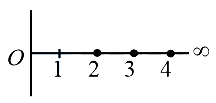
Masses $m \left(\frac{1}{3}\right)^N \frac{1}{N}$ are placed at $x=N$,where $N=2, 3, 4, \ldots \infty$. If the total mass of the system is $M$,then the centre of mass is
A
$\frac{1}{6} \frac{m}{M}$
B
$\frac{1}{5} \frac{m}{M}$
C
$\frac{1}{3} \frac{m}{M}$
D
$\frac{1}{2} \frac{m}{M}$
Solution
(A) The mass at position $x=N$ is given by $m_N = m \left(\frac{1}{3}\right)^N \frac{1}{N}$.
The centre of mass $X_{cm}$ along the $X$-axis is given by the formula:
$X_{cm} = \frac{\sum m_N x_N}{\sum m_N} = \frac{\sum_{N=2}^{\infty} \left[ m \left(\frac{1}{3}\right)^N \frac{1}{N} \right] \times N}{M}$
$X_{cm} = \frac{m}{M} \sum_{N=2}^{\infty} \left(\frac{1}{3}\right)^N$
This is an infinite geometric progression with the first term $a = \left(\frac{1}{3}\right)^2 = \frac{1}{9}$ and common ratio $r = \frac{1}{3}$.
The sum of an infinite geometric series is $S = \frac{a}{1-r}$.
$X_{cm} = \frac{m}{M} \left[ \frac{1/9}{1 - 1/3} \right] = \frac{m}{M} \left[ \frac{1/9}{2/3} \right] = \frac{m}{M} \left[ \frac{1}{9} \times \frac{3}{2} \right] = \frac{m}{6M}$.
The centre of mass $X_{cm}$ along the $X$-axis is given by the formula:
$X_{cm} = \frac{\sum m_N x_N}{\sum m_N} = \frac{\sum_{N=2}^{\infty} \left[ m \left(\frac{1}{3}\right)^N \frac{1}{N} \right] \times N}{M}$
$X_{cm} = \frac{m}{M} \sum_{N=2}^{\infty} \left(\frac{1}{3}\right)^N$
This is an infinite geometric progression with the first term $a = \left(\frac{1}{3}\right)^2 = \frac{1}{9}$ and common ratio $r = \frac{1}{3}$.
The sum of an infinite geometric series is $S = \frac{a}{1-r}$.
$X_{cm} = \frac{m}{M} \left[ \frac{1/9}{1 - 1/3} \right] = \frac{m}{M} \left[ \frac{1/9}{2/3} \right] = \frac{m}{M} \left[ \frac{1}{9} \times \frac{3}{2} \right] = \frac{m}{6M}$.
0 likesView Solution
4
PhysicsDifficultMCQAP EAMCET · 2022
Masses $m, (1/2)(m/2), (1/2)^2(m/3), \dots, (1/2)^{N-1}(m/N), \dots \infty$ are placed at $x = 1, 2, 3, \dots, N, \dots \infty$ respectively. If the total mass is $M$,then the centre of mass of the system is:
A
$(\frac{2m}{M}, 0, 0)$
B
$(\frac{m}{2M}, 0, 0)$
C
$(\frac{4m}{M}, 0, 0)$
D
$(\frac{m}{4M}, 0, 0)$
Solution
(A) The position of the centre of mass $X_{CM}$ is given by the formula $X_{CM} = \frac{\sum m_i x_i}{M}$.
Substituting the given values:
$X_{CM} = \frac{m(1) + (1/2)(m/2)(2) + (1/2)^2(m/3)(3) + \dots + (1/2)^{N-1}(m/N)(N) + \dots}{M}$
$X_{CM} = \frac{m + (1/2)m + (1/2)^2m + \dots + (1/2)^{N-1}m + \dots}{M}$
$X_{CM} = \frac{m}{M} [1 + 1/2 + (1/2)^2 + \dots + (1/2)^{N-1} + \dots]$
The term in the bracket is an infinite geometric progression with first term $a = 1$ and common ratio $r = 1/2$.
The sum of an infinite $G$.$P$. is $S = \frac{a}{1-r} = \frac{1}{1 - 1/2} = \frac{1}{1/2} = 2$.
Therefore,$X_{CM} = \frac{m}{M} \times 2 = \frac{2m}{M}$.
Since the masses are placed only along the $X$-axis,$Y_{CM} = 0$ and $Z_{CM} = 0$.
Thus,the centre of mass is $(\frac{2m}{M}, 0, 0)$.
Substituting the given values:
$X_{CM} = \frac{m(1) + (1/2)(m/2)(2) + (1/2)^2(m/3)(3) + \dots + (1/2)^{N-1}(m/N)(N) + \dots}{M}$
$X_{CM} = \frac{m + (1/2)m + (1/2)^2m + \dots + (1/2)^{N-1}m + \dots}{M}$
$X_{CM} = \frac{m}{M} [1 + 1/2 + (1/2)^2 + \dots + (1/2)^{N-1} + \dots]$
The term in the bracket is an infinite geometric progression with first term $a = 1$ and common ratio $r = 1/2$.
The sum of an infinite $G$.$P$. is $S = \frac{a}{1-r} = \frac{1}{1 - 1/2} = \frac{1}{1/2} = 2$.
Therefore,$X_{CM} = \frac{m}{M} \times 2 = \frac{2m}{M}$.
Since the masses are placed only along the $X$-axis,$Y_{CM} = 0$ and $Z_{CM} = 0$.
Thus,the centre of mass is $(\frac{2m}{M}, 0, 0)$.
0 likesView Solution
5
PhysicsEasyMCQAP EAMCET · 2022
Two balls $A$ and $B$,of masses $M$ and $2M$ respectively,collide with each other. If ball $A$ moves with a speed of $150 \ m \ s^{-1}$ and collides with ball $B$ moving with speed $v$ in the opposite direction,and after the collision ball $A$ comes to rest with the coefficient of restitution being $1$,then the speed of ball $B$ before it collides with ball $A$ is: (in $m \ s^{-1}$)
A
$37.5$
B
$12.5$
C
$75$
D
$25$
Solution
(A) Applying the law of conservation of linear momentum before and after the collision:
$M(150) + 2M(-v) = M(0) + 2M(v')$ (Taking the direction of ball $A$ as positive)
$150 - 2v = 2v'$
$v' = 75 - v \dots (1)$
Now,the coefficient of restitution $e$ is given by:
$e = \frac{v_2 - v_1}{u_1 - u_2} = 1$
$1 = \frac{v' - 0}{150 - (-v)}$
$150 + v = v' \dots (2)$
Equating $(1)$ and $(2)$:
$75 - v = 150 + v$
$2v = -75$
Since we are looking for the speed (magnitude),we consider the relative velocities. Re-evaluating with standard convention: Let $A$ move at $+150$ and $B$ move at $-v$. After collision,$A$ is at $0$ and $B$ moves at $+v'$.
$150M - 2Mv = 2Mv' \Rightarrow 75 - v = v'$
$e = \frac{v' - 0}{150 - (-v)} = 1 \Rightarrow v' = 150 + v$
Solving $75 - v = 150 + v$ gives $v = -37.5$. The magnitude of speed is $37.5 \ m \ s^{-1}$.
$M(150) + 2M(-v) = M(0) + 2M(v')$ (Taking the direction of ball $A$ as positive)
$150 - 2v = 2v'$
$v' = 75 - v \dots (1)$
Now,the coefficient of restitution $e$ is given by:
$e = \frac{v_2 - v_1}{u_1 - u_2} = 1$
$1 = \frac{v' - 0}{150 - (-v)}$
$150 + v = v' \dots (2)$
Equating $(1)$ and $(2)$:
$75 - v = 150 + v$
$2v = -75$
Since we are looking for the speed (magnitude),we consider the relative velocities. Re-evaluating with standard convention: Let $A$ move at $+150$ and $B$ move at $-v$. After collision,$A$ is at $0$ and $B$ moves at $+v'$.
$150M - 2Mv = 2Mv' \Rightarrow 75 - v = v'$
$e = \frac{v' - 0}{150 - (-v)} = 1 \Rightarrow v' = 150 + v$
Solving $75 - v = 150 + v$ gives $v = -37.5$. The magnitude of speed is $37.5 \ m \ s^{-1}$.
0 likesView Solution
6
PhysicsDifficultMCQAP EAMCET · 2022
Ball $A$ of mass $1 \,kg$ moving along a straight line with a velocity of $4 \,ms^{-1}$ hits another ball $B$ of mass $3 \,kg$ which is at rest. After collision, they stick together and move with the same velocity along the same straight line. If the time of impact of the collision is $0.1 \,s$, then the force exerted on $B$ is (in $\,N$)
A
$30$
B
$24$
C
$36$
D
$27$
Solution
(A) For ball $A$: $m_A = 1 \,kg$, $u_A = 4 \,ms^{-1}$. For ball $B$: $m_B = 3 \,kg$, $u_B = 0 \,ms^{-1}$.
Total initial momentum $p_i = m_A u_A + m_B u_B = (1 \times 4) + (3 \times 0) = 4 \,kg \cdot ms^{-1}$.
After collision, both bodies stick together and move with a common velocity $v$.
Total final momentum $p_f = (m_A + m_B)v = (1 + 3)v = 4v$.
By the law of conservation of linear momentum, $p_i = p_f$, so $4 = 4v$, which gives $v = 1 \,ms^{-1}$.
The force exerted on ball $B$ is the rate of change of momentum of ball $B$:
$F_B = \frac{\Delta p_B}{\Delta t} = \frac{m_B(v - u_B)}{\Delta t} = \frac{3(1 - 0)}{0.1} = \frac{3}{0.1} = 30 \,N$.
Total initial momentum $p_i = m_A u_A + m_B u_B = (1 \times 4) + (3 \times 0) = 4 \,kg \cdot ms^{-1}$.
After collision, both bodies stick together and move with a common velocity $v$.
Total final momentum $p_f = (m_A + m_B)v = (1 + 3)v = 4v$.
By the law of conservation of linear momentum, $p_i = p_f$, so $4 = 4v$, which gives $v = 1 \,ms^{-1}$.
The force exerted on ball $B$ is the rate of change of momentum of ball $B$:
$F_B = \frac{\Delta p_B}{\Delta t} = \frac{m_B(v - u_B)}{\Delta t} = \frac{3(1 - 0)}{0.1} = \frac{3}{0.1} = 30 \,N$.
0 likesView Solution
7
PhysicsMediumMCQAP EAMCET · 2022
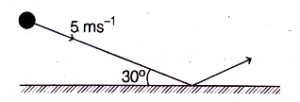
$A$ cricket ball hits the ground with a speed of $5 \,m \,s^{-1}$ making an angle of $30^{\circ}$ with the horizontal. If the coefficient of restitution is $0.2$, the speed of the reflected ball in $m \,s^{-1}$ is
A
$\sqrt{22}$
B
$\sqrt{15}$
C
$\sqrt{19}$
D
$\sqrt{11}$
Solution
(C) The initial velocity of the ball is $u = 5 \,m \,s^{-1}$ at an angle of $30^{\circ}$ with the horizontal.
We resolve this velocity into horizontal and vertical components:
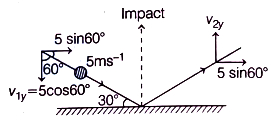
Horizontal component, $v_{1x} = u \cos 30^{\circ} = 5 \times \frac{\sqrt{3}}{2} = \frac{5\sqrt{3}}{2} \,m \,s^{-1}$.
Vertical component, $v_{1y} = u \sin 30^{\circ} = 5 \times \frac{1}{2} = 2.5 \,m \,s^{-1}$.
During the collision with the ground, the horizontal component of velocity remains unchanged because there is no impulse along the horizontal direction.
$v_{2x} = v_{1x} = \frac{5\sqrt{3}}{2} \,m \,s^{-1}$.
The vertical component changes according to the coefficient of restitution $e = 0.2$:
$v_{2y} = e \times v_{1y} = 0.2 \times 2.5 = 0.5 \,m \,s^{-1}$.
The final speed of the ball $v_f$ is the magnitude of the resultant velocity vector:
$v_f = \sqrt{v_{2x}^2 + v_{2y}^2} = \sqrt{\left(\frac{5\sqrt{3}}{2}\right)^2 + (0.5)^2}$
$v_f = \sqrt{\frac{25 \times 3}{4} + 0.25} = \sqrt{\frac{75}{4} + \frac{1}{4}} = \sqrt{\frac{76}{4}} = \sqrt{19} \,m \,s^{-1}$.
We resolve this velocity into horizontal and vertical components:
Horizontal component, $v_{1x} = u \cos 30^{\circ} = 5 \times \frac{\sqrt{3}}{2} = \frac{5\sqrt{3}}{2} \,m \,s^{-1}$.
Vertical component, $v_{1y} = u \sin 30^{\circ} = 5 \times \frac{1}{2} = 2.5 \,m \,s^{-1}$.
During the collision with the ground, the horizontal component of velocity remains unchanged because there is no impulse along the horizontal direction.
$v_{2x} = v_{1x} = \frac{5\sqrt{3}}{2} \,m \,s^{-1}$.
The vertical component changes according to the coefficient of restitution $e = 0.2$:
$v_{2y} = e \times v_{1y} = 0.2 \times 2.5 = 0.5 \,m \,s^{-1}$.
The final speed of the ball $v_f$ is the magnitude of the resultant velocity vector:
$v_f = \sqrt{v_{2x}^2 + v_{2y}^2} = \sqrt{\left(\frac{5\sqrt{3}}{2}\right)^2 + (0.5)^2}$
$v_f = \sqrt{\frac{25 \times 3}{4} + 0.25} = \sqrt{\frac{75}{4} + \frac{1}{4}} = \sqrt{\frac{76}{4}} = \sqrt{19} \,m \,s^{-1}$.
0 likesView Solution
8
PhysicsEasyMCQAP EAMCET · 2022
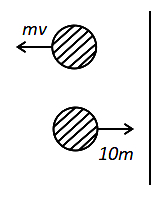
$A$ ball of mass $0.5 \ kg$ moving horizontally at $10 \ m \ s^{-1}$ strikes a vertical wall and rebounds with speed $v$. The magnitude of the change in linear momentum is found to be $8.0 \ kg \ m \ s^{-1}$. The magnitude of $v$ is, (in $m \ s^{-1}$)
A
$6.0$
B
$9.0$
C
$26.0$
D
$13.0$
Solution
(A) Linear momentum is a vector quantity.
Let the direction towards the wall be positive.
Initial momentum $\vec{p}_i = m \times 10 \hat{i} = 0.5 \times 10 \hat{i} = 5 \hat{i} \ kg \ m \ s^{-1}$.
After rebounding,the ball moves in the opposite direction.
Final momentum $\vec{p}_f = -m \times v \hat{i} = -0.5 \times v \hat{i} \ kg \ m \ s^{-1}$.
The change in linear momentum is $\Delta \vec{p} = \vec{p}_f - \vec{p}_i$.
$\Delta \vec{p} = (-0.5v \hat{i}) - (5 \hat{i}) = -(0.5v + 5) \hat{i}$.
The magnitude of the change in linear momentum is given as $8.0 \ kg \ m \ s^{-1}$.
$|\Delta \vec{p}| = 0.5v + 5 = 8.0$.
$0.5v = 8.0 - 5 = 3.0$.
$v = \frac{3.0}{0.5} = 6.0 \ m \ s^{-1}$.
Let the direction towards the wall be positive.
Initial momentum $\vec{p}_i = m \times 10 \hat{i} = 0.5 \times 10 \hat{i} = 5 \hat{i} \ kg \ m \ s^{-1}$.
After rebounding,the ball moves in the opposite direction.
Final momentum $\vec{p}_f = -m \times v \hat{i} = -0.5 \times v \hat{i} \ kg \ m \ s^{-1}$.
The change in linear momentum is $\Delta \vec{p} = \vec{p}_f - \vec{p}_i$.
$\Delta \vec{p} = (-0.5v \hat{i}) - (5 \hat{i}) = -(0.5v + 5) \hat{i}$.
The magnitude of the change in linear momentum is given as $8.0 \ kg \ m \ s^{-1}$.
$|\Delta \vec{p}| = 0.5v + 5 = 8.0$.
$0.5v = 8.0 - 5 = 3.0$.
$v = \frac{3.0}{0.5} = 6.0 \ m \ s^{-1}$.
0 likesView Solution
9
PhysicsEasyMCQAP EAMCET · 2022
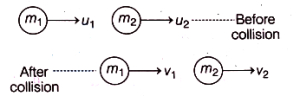
Two wooden blocks of mass $M_1$ and $M_2$ rest on a frictionless table. $A$ bullet of mass $m$ is fired at $M_1$ with speed $v$,which gets embedded in it,and the two together finally collide with $M_2$. Find the velocity of $M_2$ after the collision. (Assume the collision between the $(M_1+m)$ system and $M_2$ is elastic and treat the problem as one-dimensional.)
A
$\frac{2 m v}{M_1+M_2+m}$
B
$\frac{m v}{M_1+M_2+m}$
C
$\frac{(M_1+M_2+m) v}{M_1+M_2+m}$
D
$\frac{M_1+M_2}{M_1+M_2+m} v$
Solution
(A) Step $1$: The bullet of mass $m$ strikes $M_1$ and gets embedded in it. This is a perfectly inelastic collision. By the law of conservation of linear momentum:
$m v = (m + M_1) v_1$
where $v_1$ is the velocity of the $(m + M_1)$ system after the first collision.
$v_1 = \frac{m v}{m + M_1}$
Step $2$: The system $(m + M_1)$ now moves with velocity $v_1$ and collides elastically with $M_2$,which is initially at rest $(u_2 = 0)$.
For an elastic collision between two masses $m_A$ and $m_B$ where $m_B$ is initially at rest,the final velocity $v_B$ of mass $m_B$ is given by:
$v_B = \frac{2 m_A}{m_A + m_B} u_A$
Here,$m_A = (m + M_1)$,$m_B = M_2$,and $u_A = v_1$.
Substituting these values:
$v_2 = \frac{2(m + M_1)}{(m + M_1) + M_2} v_1$
$v_2 = \frac{2(m + M_1)}{m + M_1 + M_2} \cdot \frac{m v}{m + M_1}$
$v_2 = \frac{2 m v}{m + M_1 + M_2}$
Thus,the velocity of $M_2$ after the collision is $\frac{2 m v}{M_1 + M_2 + m}$.
$m v = (m + M_1) v_1$
where $v_1$ is the velocity of the $(m + M_1)$ system after the first collision.
$v_1 = \frac{m v}{m + M_1}$
Step $2$: The system $(m + M_1)$ now moves with velocity $v_1$ and collides elastically with $M_2$,which is initially at rest $(u_2 = 0)$.
For an elastic collision between two masses $m_A$ and $m_B$ where $m_B$ is initially at rest,the final velocity $v_B$ of mass $m_B$ is given by:
$v_B = \frac{2 m_A}{m_A + m_B} u_A$
Here,$m_A = (m + M_1)$,$m_B = M_2$,and $u_A = v_1$.
Substituting these values:
$v_2 = \frac{2(m + M_1)}{(m + M_1) + M_2} v_1$
$v_2 = \frac{2(m + M_1)}{m + M_1 + M_2} \cdot \frac{m v}{m + M_1}$
$v_2 = \frac{2 m v}{m + M_1 + M_2}$
Thus,the velocity of $M_2$ after the collision is $\frac{2 m v}{M_1 + M_2 + m}$.
0 likesView Solution
10
PhysicsDifficultMCQAP EAMCET · 2022
$A$ uniform solid sphere of radius $R$ produces a gravitational acceleration of $a_o$ on its surface. The distance of the point from the centre of the sphere where the gravitational acceleration becomes $\frac{a_o}{4}$ is,
A
$4 R$
B
$\frac{3}{2} R$
C
$2 R$
D
$3 R$
Solution
(C) The gravitational acceleration $g$ at a distance $r$ from the centre of a uniform solid sphere of mass $M$ and radius $R$ (where $r \ge R$) is given by $g = \frac{GM}{r^2}$.
On the surface,$r = R$,so $a_o = \frac{GM}{R^2}$.
We want to find the distance $r$ where the acceleration becomes $a = \frac{a_o}{4}$.
Substituting the expressions,we get $\frac{GM}{r^2} = \frac{1}{4} \left( \frac{GM}{R^2} \right)$.
Canceling $GM$ from both sides,we get $\frac{1}{r^2} = \frac{1}{4R^2}$.
Taking the square root of both sides,$r^2 = 4R^2$,which gives $r = 2R$.
Thus,the distance from the centre of the sphere is $2R$.
On the surface,$r = R$,so $a_o = \frac{GM}{R^2}$.
We want to find the distance $r$ where the acceleration becomes $a = \frac{a_o}{4}$.
Substituting the expressions,we get $\frac{GM}{r^2} = \frac{1}{4} \left( \frac{GM}{R^2} \right)$.
Canceling $GM$ from both sides,we get $\frac{1}{r^2} = \frac{1}{4R^2}$.
Taking the square root of both sides,$r^2 = 4R^2$,which gives $r = 2R$.
Thus,the distance from the centre of the sphere is $2R$.
0 likesView Solution
11
PhysicsEasyMCQAP EAMCET · 2022
There is a planet which is $8$ times more massive and $27$ times denser than the Earth. If $g^{\prime}$ and $g$ are the accelerations due to gravity on the surfaces of the planet and the Earth respectively,then:
A
$g^{\prime} = 8g$
B
$g^{\prime} = 27g$
C
$g^{\prime} = 18g$
D
$g^{\prime} = \frac{9}{4}g$
Solution
(C) The acceleration due to gravity $g$ on the surface of a planet is given by $g = \frac{GM}{R^2}$.
Since density $\rho = \frac{M}{V} = \frac{M}{\frac{4}{3}\pi R^3}$,we can express the radius $R$ as $R = \left( \frac{3M}{4\pi \rho} \right)^{1/3}$.
Substituting $R$ into the formula for $g$:
$g = \frac{GM}{(\frac{3M}{4\pi \rho})^{2/3}} = G M^{1/3} (\frac{4\pi \rho}{3})^{2/3}$.
This shows that $g \propto M^{1/3} \rho^{2/3}$.
Given for the planet: $M^{\prime} = 8M$ and $\rho^{\prime} = 27\rho$.
Taking the ratio:
$\frac{g^{\prime}}{g} = \left( \frac{M^{\prime}}{M} \right)^{1/3} \left( \frac{\rho^{\prime}}{\rho} \right)^{2/3}$.
$\frac{g^{\prime}}{g} = (8)^{1/3} \times (27)^{2/3} = 2 \times (3^3)^{2/3} = 2 \times 3^2 = 2 \times 9 = 18$.
Therefore,$g^{\prime} = 18g$.
Since density $\rho = \frac{M}{V} = \frac{M}{\frac{4}{3}\pi R^3}$,we can express the radius $R$ as $R = \left( \frac{3M}{4\pi \rho} \right)^{1/3}$.
Substituting $R$ into the formula for $g$:
$g = \frac{GM}{(\frac{3M}{4\pi \rho})^{2/3}} = G M^{1/3} (\frac{4\pi \rho}{3})^{2/3}$.
This shows that $g \propto M^{1/3} \rho^{2/3}$.
Given for the planet: $M^{\prime} = 8M$ and $\rho^{\prime} = 27\rho$.
Taking the ratio:
$\frac{g^{\prime}}{g} = \left( \frac{M^{\prime}}{M} \right)^{1/3} \left( \frac{\rho^{\prime}}{\rho} \right)^{2/3}$.
$\frac{g^{\prime}}{g} = (8)^{1/3} \times (27)^{2/3} = 2 \times (3^3)^{2/3} = 2 \times 3^2 = 2 \times 9 = 18$.
Therefore,$g^{\prime} = 18g$.
0 likesView Solution
12
PhysicsMediumMCQAP EAMCET · 2022
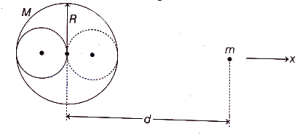
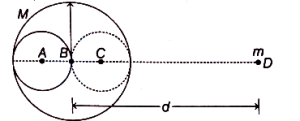
As shown in the figure,two spherical cavities are made in a uniform solid sphere of radius $R$. The boundaries of the cavities touch at the centre of the sphere. The centers of the cavities and the sphere lie on the $X$-axis. The mass of the solid sphere before the cavities were created was $M$. The gravitational force on a point mass $m$ at a distance $d$ away from the centre of the solid sphere is
A
$\frac{G M m}{d^2}\left[1-\frac{1}{8} \frac{1}{\left(1+\frac{R}{2 d}\right)^2}-\frac{1}{8} \frac{1}{\left(1-\frac{R}{2 d}\right)^2}\right]$
B
$\frac{G M m}{d^2}\left[1-\frac{1}{8} \frac{1}{\left(1+\frac{R}{d}\right)^2}-\frac{1}{8} \frac{1}{\left(1-\frac{R}{d}\right)^2}\right]$
C
$\frac{G M m}{d^2}\left[1-\frac{1}{8} \frac{1}{\left(1+\frac{d}{R}\right)^2}-\frac{1}{8} \frac{1}{\left(1-\frac{d}{R}\right)^2}\right]$
D
$\frac{G M m}{d^2}\left[1-\frac{1}{8} \frac{1}{\left(1+\frac{d}{R}\right)^2}+\frac{1}{8} \frac{1}{\left(1-\frac{d}{R}\right)^2}\right]$
Solution
(A) The radius of the solid sphere is $R$ and its mass is $M$. The density of the sphere is $\rho = \frac{M}{\frac{4}{3} \pi R^3}$.
Each spherical cavity has a radius of $R/2$. The mass of each removed portion is $M' = \rho \times \text{Volume of cavity} = \frac{M}{\frac{4}{3} \pi R^3} \times \frac{4}{3} \pi (R/2)^3 = \frac{M}{8}$.
The center of the sphere is at the origin. Let the center of the left cavity be at $x = -R/2$ and the center of the right cavity be at $x = R/2$. The point mass $m$ is at $x = d$.
The gravitational force on $m$ is the force due to the full sphere minus the forces due to the two removed spherical masses.
$F = \frac{G M m}{d^2} - \frac{G M' m}{(d - R/2)^2} - \frac{G M' m}{(d + R/2)^2}$.
Substituting $M' = M/8$:
$F = \frac{G M m}{d^2} - \frac{G M m}{8(d - R/2)^2} - \frac{G M m}{8(d + R/2)^2}$.
Factoring out $\frac{G M m}{d^2}$:
$F = \frac{G M m}{d^2} \left[ 1 - \frac{1}{8(1 - R/2d)^2} - \frac{1}{8(1 + R/2d)^2} \right]$.
Each spherical cavity has a radius of $R/2$. The mass of each removed portion is $M' = \rho \times \text{Volume of cavity} = \frac{M}{\frac{4}{3} \pi R^3} \times \frac{4}{3} \pi (R/2)^3 = \frac{M}{8}$.
The center of the sphere is at the origin. Let the center of the left cavity be at $x = -R/2$ and the center of the right cavity be at $x = R/2$. The point mass $m$ is at $x = d$.
The gravitational force on $m$ is the force due to the full sphere minus the forces due to the two removed spherical masses.
$F = \frac{G M m}{d^2} - \frac{G M' m}{(d - R/2)^2} - \frac{G M' m}{(d + R/2)^2}$.
Substituting $M' = M/8$:
$F = \frac{G M m}{d^2} - \frac{G M m}{8(d - R/2)^2} - \frac{G M m}{8(d + R/2)^2}$.
Factoring out $\frac{G M m}{d^2}$:
$F = \frac{G M m}{d^2} \left[ 1 - \frac{1}{8(1 - R/2d)^2} - \frac{1}{8(1 + R/2d)^2} \right]$.
0 likesView Solution
13
PhysicsMediumMCQAP EAMCET · 2022
$A$ projectile is thrown straight upward from the Earth's surface with an initial speed $v = \alpha v_E$,where $\alpha$ is a constant and $v_E$ is the escape speed. The projectile travels up to a height $h = 800 \ km$ from the Earth's surface before it comes to rest. The value of the constant $\alpha$ is (Radius of the Earth $R = 6400 \ km$):
A
$\frac{1}{3}$
B
$\frac{1}{2}$
C
$\frac{2}{3}$
D
$\frac{3}{4}$
Solution
(A) The escape velocity is given by $v_E = \sqrt{\frac{2GM}{R}}$.
At the Earth's surface,the total mechanical energy is $E_1 = KE_1 + PE_1 = \frac{1}{2}mv^2 - \frac{GMm}{R}$.
Substituting $v = \alpha v_E = \alpha \sqrt{\frac{2GM}{R}}$,we get $KE_1 = \frac{1}{2}m(\alpha^2 \cdot \frac{2GM}{R}) = \frac{GMm\alpha^2}{R}$.
So,$E_1 = \frac{GMm\alpha^2}{R} - \frac{GMm}{R} = \frac{GMm}{R}(\alpha^2 - 1)$.
At the maximum height $h$,the velocity is $0$,so $KE_2 = 0$ and $PE_2 = -\frac{GMm}{R+h}$.
By the law of conservation of energy,$E_1 = E_2$:
$\frac{GMm}{R}(\alpha^2 - 1) = -\frac{GMm}{R+h}$.
$\alpha^2 - 1 = -\frac{R}{R+h} = -\frac{6400}{6400+800} = -\frac{6400}{7200} = -\frac{8}{9}$.
$\alpha^2 = 1 - \frac{8}{9} = \frac{1}{9}$.
Therefore,$\alpha = \frac{1}{3}$.
At the Earth's surface,the total mechanical energy is $E_1 = KE_1 + PE_1 = \frac{1}{2}mv^2 - \frac{GMm}{R}$.
Substituting $v = \alpha v_E = \alpha \sqrt{\frac{2GM}{R}}$,we get $KE_1 = \frac{1}{2}m(\alpha^2 \cdot \frac{2GM}{R}) = \frac{GMm\alpha^2}{R}$.
So,$E_1 = \frac{GMm\alpha^2}{R} - \frac{GMm}{R} = \frac{GMm}{R}(\alpha^2 - 1)$.
At the maximum height $h$,the velocity is $0$,so $KE_2 = 0$ and $PE_2 = -\frac{GMm}{R+h}$.
By the law of conservation of energy,$E_1 = E_2$:
$\frac{GMm}{R}(\alpha^2 - 1) = -\frac{GMm}{R+h}$.
$\alpha^2 - 1 = -\frac{R}{R+h} = -\frac{6400}{6400+800} = -\frac{6400}{7200} = -\frac{8}{9}$.
$\alpha^2 = 1 - \frac{8}{9} = \frac{1}{9}$.
Therefore,$\alpha = \frac{1}{3}$.
0 likesView Solution
14
PhysicsEasyMCQAP EAMCET · 2022
An object is thrown directly away from the surface of the earth with an initial speed $v$. The object reaches up to a height of $\frac{4}{5} R_E$ from the earth's surface,where $R_E$ is the radius of the earth. If the escape velocity of the object is $v_E$,then the value of $\frac{v}{v_E}$ is:
A
$4/3$
B
$3/4$
C
$2/3$
D
$4/5$
Solution
(C) Using the law of conservation of mechanical energy between the surface of the earth and the maximum height $h$:
Total energy at surface = Total energy at maximum height
$-\frac{G M m}{R_E} + \frac{1}{2} m v^2 = -\frac{G M m}{R_E + h} + 0$
Given $h = \frac{4}{5} R_E$,so $R_E + h = R_E + \frac{4}{5} R_E = \frac{9}{5} R_E$.
Substituting $GM = g R_E^2$:
$-\frac{g R_E^2 m}{R_E} + \frac{1}{2} m v^2 = -\frac{g R_E^2 m}{\frac{9}{5} R_E}$
$-g R_E + \frac{v^2}{2} = -\frac{5}{9} g R_E$
$\frac{v^2}{2} = g R_E - \frac{5}{9} g R_E = \frac{4}{9} g R_E$
$v^2 = \frac{8}{9} g R_E$
$v = \sqrt{\frac{8}{9} g R_E} = \frac{2}{3} \sqrt{2 g R_E}$
Since escape velocity $v_E = \sqrt{2 g R_E}$,we have $v = \frac{2}{3} v_E$.
Therefore,$\frac{v}{v_E} = \frac{2}{3}$.
Total energy at surface = Total energy at maximum height
$-\frac{G M m}{R_E} + \frac{1}{2} m v^2 = -\frac{G M m}{R_E + h} + 0$
Given $h = \frac{4}{5} R_E$,so $R_E + h = R_E + \frac{4}{5} R_E = \frac{9}{5} R_E$.
Substituting $GM = g R_E^2$:
$-\frac{g R_E^2 m}{R_E} + \frac{1}{2} m v^2 = -\frac{g R_E^2 m}{\frac{9}{5} R_E}$
$-g R_E + \frac{v^2}{2} = -\frac{5}{9} g R_E$
$\frac{v^2}{2} = g R_E - \frac{5}{9} g R_E = \frac{4}{9} g R_E$
$v^2 = \frac{8}{9} g R_E$
$v = \sqrt{\frac{8}{9} g R_E} = \frac{2}{3} \sqrt{2 g R_E}$
Since escape velocity $v_E = \sqrt{2 g R_E}$,we have $v = \frac{2}{3} v_E$.
Therefore,$\frac{v}{v_E} = \frac{2}{3}$.
0 likesView Solution
15
PhysicsEasyMCQAP EAMCET · 2022
The escape speed of an object on the surface of the earth is $V$. If the object is thrown out with speed $4V$ from the surface of the earth,what will be the speed of the object far away from the earth?
A
$3V$
B
$\sqrt{15}V$
C
$2.5V$
D
$\sqrt{8}V$
Solution
(B) Let $V_e = V$ be the escape speed of the object on the surface of the earth. The formula for escape speed is $V = \sqrt{\frac{2GM}{R}}$.
By the law of conservation of mechanical energy,the total energy at the surface equals the total energy at infinity:
$K_i + U_i = K_f + U_f$
$\frac{1}{2}m(4V)^2 - \frac{GMm}{R} = \frac{1}{2}mV_0^2 + 0$
Since $V^2 = \frac{2GM}{R}$,we have $\frac{GM}{R} = \frac{V^2}{2}$.
Substituting this into the energy equation:
$\frac{1}{2}m(16V^2) - m(\frac{V^2}{2}) = \frac{1}{2}mV_0^2$
$8mV^2 - 0.5mV^2 = 0.5mV_0^2$
$7.5V^2 = 0.5V_0^2$
$V_0^2 = 15V^2$
$V_0 = \sqrt{15}V$
By the law of conservation of mechanical energy,the total energy at the surface equals the total energy at infinity:
$K_i + U_i = K_f + U_f$
$\frac{1}{2}m(4V)^2 - \frac{GMm}{R} = \frac{1}{2}mV_0^2 + 0$
Since $V^2 = \frac{2GM}{R}$,we have $\frac{GM}{R} = \frac{V^2}{2}$.
Substituting this into the energy equation:
$\frac{1}{2}m(16V^2) - m(\frac{V^2}{2}) = \frac{1}{2}mV_0^2$
$8mV^2 - 0.5mV^2 = 0.5mV_0^2$
$7.5V^2 = 0.5V_0^2$
$V_0^2 = 15V^2$
$V_0 = \sqrt{15}V$
0 likesView Solution
16
PhysicsMediumMCQAP EAMCET · 2022
The escape velocity of an object from a planet is $16 \ km/s$. If the escape velocity of the object from another planet having twice the density and three times the radius of the planet is $v \sqrt{2} \ km/s$,then the value of $v$ is
A
$12$
B
$48$
C
$18$
D
$36$
Solution
(B) The escape velocity $v_e$ is given by the formula:
$v_e = \sqrt{\frac{2GM}{R}}$
Since the mass $M$ of a planet can be expressed in terms of its density $d$ and radius $R$ as $M = d \times \frac{4}{3} \pi R^3$,we substitute this into the formula:
$v_e = \sqrt{\frac{2G}{R} \times \frac{4}{3} \pi R^3 d} = \sqrt{\frac{8}{3} G \pi R^2 d} = R \sqrt{\frac{8}{3} G \pi d}$
For the first planet $(A)$:
$v_1 = 16 \ km/s = R \sqrt{\frac{8}{3} G \pi d}$
For the second planet $(B)$ with radius $R' = 3R$ and density $d' = 2d$:
$v_2 = (3R) \sqrt{\frac{8}{3} G \pi (2d)} = 3R \sqrt{2} \sqrt{\frac{8}{3} G \pi d} = 3 \sqrt{2} \times v_1$
Substituting $v_1 = 16 \ km/s$:
$v_2 = 3 \sqrt{2} \times 16 = 48 \sqrt{2} \ km/s$
Given $v_2 = v \sqrt{2} \ km/s$,we find:
$v = 48$
$v_e = \sqrt{\frac{2GM}{R}}$
Since the mass $M$ of a planet can be expressed in terms of its density $d$ and radius $R$ as $M = d \times \frac{4}{3} \pi R^3$,we substitute this into the formula:
$v_e = \sqrt{\frac{2G}{R} \times \frac{4}{3} \pi R^3 d} = \sqrt{\frac{8}{3} G \pi R^2 d} = R \sqrt{\frac{8}{3} G \pi d}$
For the first planet $(A)$:
$v_1 = 16 \ km/s = R \sqrt{\frac{8}{3} G \pi d}$
For the second planet $(B)$ with radius $R' = 3R$ and density $d' = 2d$:
$v_2 = (3R) \sqrt{\frac{8}{3} G \pi (2d)} = 3R \sqrt{2} \sqrt{\frac{8}{3} G \pi d} = 3 \sqrt{2} \times v_1$
Substituting $v_1 = 16 \ km/s$:
$v_2 = 3 \sqrt{2} \times 16 = 48 \sqrt{2} \ km/s$
Given $v_2 = v \sqrt{2} \ km/s$,we find:
$v = 48$
0 likesView Solution
17
PhysicsMediumMCQAP EAMCET · 2022
Statement $(A)$ Two artificial satellites revolving in the same circular orbit have the same period of revolution.
Statement $(B)$ The orbital velocity is inversely proportional to the square root of the radius of the orbit.
Statement $(C)$ The escape velocity of a body is independent of the altitude of the point of projection.
Statement $(B)$ The orbital velocity is inversely proportional to the square root of the radius of the orbit.
Statement $(C)$ The escape velocity of a body is independent of the altitude of the point of projection.
A
$A, B, C$ are true
B
$A, B$ are true,$C$ is false
C
$A, C$ are true,$B$ is false
D
$B, C$ are true,$A$ is false
Solution
(B) The time period $T$ of a satellite revolving around a planet is given by $T = 2\pi \sqrt{\frac{r^3}{GM}}$. Since both satellites are in the same circular orbit,their orbital radius $r$ is the same,meaning their time periods are identical. Thus,Statement $(A)$ is true.
The orbital velocity $v$ of a satellite is given by $v = \sqrt{\frac{GM}{r}}$. This shows that $v \propto \frac{1}{\sqrt{r}}$,meaning the orbital velocity is inversely proportional to the square root of the radius of the orbit. Thus,Statement $(B)$ is true.
The escape velocity $v_e$ from a point at distance $r$ from the center of a planet is given by $v_e = \sqrt{\frac{2GM}{r}}$. Since $r = R + h$ (where $R$ is the radius of the planet and $h$ is the altitude),the escape velocity depends on the altitude $h$. Thus,Statement $(C)$ is false.
The orbital velocity $v$ of a satellite is given by $v = \sqrt{\frac{GM}{r}}$. This shows that $v \propto \frac{1}{\sqrt{r}}$,meaning the orbital velocity is inversely proportional to the square root of the radius of the orbit. Thus,Statement $(B)$ is true.
The escape velocity $v_e$ from a point at distance $r$ from the center of a planet is given by $v_e = \sqrt{\frac{2GM}{r}}$. Since $r = R + h$ (where $R$ is the radius of the planet and $h$ is the altitude),the escape velocity depends on the altitude $h$. Thus,Statement $(C)$ is false.
0 likesView Solution
18
PhysicsEasyMCQAP EAMCET · 2022
Two planets,$A$ and $B$,orbit around a star such that the time period of $A$ is $8$ times the time period of $B$. The ratio of the orbital velocities of planets $A$ and $B$ is:
A
$4: 1$
B
$1: 4$
C
$2: 1$
D
$1: 2$
Solution
(D) Given: $T_A = 8 T_B$.
According to Kepler's third law,$T^2 \propto R^3$,where $T$ is the time period and $R$ is the orbital radius.
Thus,$\frac{T_A^2}{T_B^2} = \frac{R_A^3}{R_B^3} \Rightarrow (8)^2 = \left(\frac{R_A}{R_B}\right)^3 \Rightarrow 64 = \left(\frac{R_A}{R_B}\right)^3$.
Taking the cube root,$\frac{R_A}{R_B} = (64)^{1/3} = 4$.
Orbital velocity $V$ is given by $V = \frac{2 \pi R}{T}$.
Therefore,the ratio of orbital velocities is $\frac{V_A}{V_B} = \frac{R_A}{R_B} \times \frac{T_B}{T_A} = 4 \times \frac{1}{8} = \frac{1}{2}$.
Hence,the ratio is $1: 2$.
According to Kepler's third law,$T^2 \propto R^3$,where $T$ is the time period and $R$ is the orbital radius.
Thus,$\frac{T_A^2}{T_B^2} = \frac{R_A^3}{R_B^3} \Rightarrow (8)^2 = \left(\frac{R_A}{R_B}\right)^3 \Rightarrow 64 = \left(\frac{R_A}{R_B}\right)^3$.
Taking the cube root,$\frac{R_A}{R_B} = (64)^{1/3} = 4$.
Orbital velocity $V$ is given by $V = \frac{2 \pi R}{T}$.
Therefore,the ratio of orbital velocities is $\frac{V_A}{V_B} = \frac{R_A}{R_B} \times \frac{T_B}{T_A} = 4 \times \frac{1}{8} = \frac{1}{2}$.
Hence,the ratio is $1: 2$.
0 likesView Solution
19
PhysicsEasyMCQAP EAMCET · 2022
The orbital period of a geostationary satellite is (in $\,h$)
A
$2$
B
$5$
C
$24$
D
$12$
Solution
(C) geostationary satellite is a satellite that orbits the Earth in the same direction as the Earth's rotation (from west to east).
Its orbital period is exactly equal to the Earth's rotational period, which is $24 \,h$ (or $1 \,day$).
Its orbital period is exactly equal to the Earth's rotational period, which is $24 \,h$ (or $1 \,day$).
0 likesView Solution
20
PhysicsMediumMCQAP EAMCET · 2022
$A$ satellite is orbiting the Earth. If its orbital radius is reduced to half of its initial value,then the percentage change in its total energy is: (in $\%$)
A
$100$
B
$75$
C
$50$
D
$25$
Solution
(A) The total energy $E$ of a satellite of mass $m$ orbiting the Earth of mass $M_e$ at a distance $r$ is given by:
$E = -\frac{G M_e m}{2r}$
This shows that $E \propto \frac{1}{r}$.
Let the initial radius be $r_1$ and the initial energy be $E_1 = -\frac{G M_e m}{2r_1}$.
When the radius is reduced to half,$r_2 = \frac{r_1}{2}$.
The new energy is $E_2 = -\frac{G M_e m}{2r_2} = -\frac{G M_e m}{2(r_1/2)} = -\frac{G M_e m}{r_1} = 2 E_1$.
The change in total energy is $\Delta E = E_2 - E_1 = 2E_1 - E_1 = E_1$.
The percentage change is given by $\frac{|\Delta E|}{|E_1|} \times 100\% = \frac{|E_1|}{|E_1|} \times 100\% = 100\%$.
$E = -\frac{G M_e m}{2r}$
This shows that $E \propto \frac{1}{r}$.
Let the initial radius be $r_1$ and the initial energy be $E_1 = -\frac{G M_e m}{2r_1}$.
When the radius is reduced to half,$r_2 = \frac{r_1}{2}$.
The new energy is $E_2 = -\frac{G M_e m}{2r_2} = -\frac{G M_e m}{2(r_1/2)} = -\frac{G M_e m}{r_1} = 2 E_1$.
The change in total energy is $\Delta E = E_2 - E_1 = 2E_1 - E_1 = E_1$.
The percentage change is given by $\frac{|\Delta E|}{|E_1|} \times 100\% = \frac{|E_1|}{|E_1|} \times 100\% = 100\%$.
0 likesView Solution
21
PhysicsMediumMCQAP EAMCET · 2022
When a ball is dropped from a height $h$,it takes $t \ s$ to reach the ground. If the same experiment is done on a different planet having a mass $100$ times the earth's mass and a radius $10$ times the earth's radius,then the time it will take to cover the same height on the new planet is:
A
$t \ s$
B
$100t \ s$
C
$\frac{t}{100} \ s$
D
$\frac{t}{10} \ s$
Solution
(A) The acceleration due to gravity on the surface of a planet is given by $g = \frac{GM}{R^2}$.
For Earth,$g_e = \frac{GM}{R^2}$.
For the new planet,the mass $M' = 100M$ and the radius $R' = 10R$.
Therefore,the acceleration due to gravity on the new planet is $g_p = \frac{G(100M)}{(10R)^2} = \frac{100GM}{100R^2} = \frac{GM}{R^2} = g_e$.
Since the height $h$ is the same and the acceleration due to gravity $g$ is the same,the time taken to reach the ground is given by $h = \frac{1}{2}gt^2$,which implies $t = \sqrt{\frac{2h}{g}}$.
Since $h$ and $g$ are identical for both,the time taken $t$ remains the same.
For Earth,$g_e = \frac{GM}{R^2}$.
For the new planet,the mass $M' = 100M$ and the radius $R' = 10R$.
Therefore,the acceleration due to gravity on the new planet is $g_p = \frac{G(100M)}{(10R)^2} = \frac{100GM}{100R^2} = \frac{GM}{R^2} = g_e$.
Since the height $h$ is the same and the acceleration due to gravity $g$ is the same,the time taken to reach the ground is given by $h = \frac{1}{2}gt^2$,which implies $t = \sqrt{\frac{2h}{g}}$.
Since $h$ and $g$ are identical for both,the time taken $t$ remains the same.
0 likesView Solution
22
PhysicsEasyMCQAP EAMCET · 2022
The number of vibrational degrees of freedom of a diatomic molecule is
A
$0$
B
$1$
C
$2$
D
$3$
Solution
(B) In three-dimensional space,a molecule has a total of $3N$ degrees of freedom,where $N$ is the number of atoms. For a diatomic molecule,$N = 2$,so the total degrees of freedom are $3 \times 2 = 6$.
These $6$ degrees of freedom are categorized as follows:
$1$. Translational degrees of freedom: $3$ (along the $x, y,$ and $z$ axes).
$2$. Rotational degrees of freedom: $2$ (for a linear diatomic molecule).
$3$. Vibrational degrees of freedom: The remaining degrees of freedom are calculated as $6 - (3 + 2) = 1$.
Therefore,a diatomic molecule has $1$ vibrational degree of freedom.
These $6$ degrees of freedom are categorized as follows:
$1$. Translational degrees of freedom: $3$ (along the $x, y,$ and $z$ axes).
$2$. Rotational degrees of freedom: $2$ (for a linear diatomic molecule).
$3$. Vibrational degrees of freedom: The remaining degrees of freedom are calculated as $6 - (3 + 2) = 1$.
Therefore,a diatomic molecule has $1$ vibrational degree of freedom.
0 likesView Solution
23
PhysicsEasyMCQAP EAMCET · 2022
In a non-rigid diatomic molecule with an additional vibrational mode,what is the relationship between $C_v$ and $C_p$?
A
$81 C_{v}^2=49 C_{P}^2$
B
$49 C_{v}^2=25 C_{P}^2$
C
$49 C_{v}^2=81 C_{P}^2$
D
$25 C_{v}^2=49 C_{P}^2$
Solution
(C) For a non-rigid diatomic molecule,the degrees of freedom $(f)$ are calculated as follows:
Translational degrees of freedom $= 3$
Rotational degrees of freedom $= 2$
Vibrational degrees of freedom $= 2$ (one for kinetic energy and one for potential energy).
Total degrees of freedom $(f) = 3 + 2 + 2 = 7$.
The ratio of specific heats is given by $\gamma = \frac{C_p}{C_v} = 1 + \frac{2}{f}$.
Substituting $f = 7$,we get $\gamma = 1 + \frac{2}{7} = \frac{9}{7}$.
Therefore,$\frac{C_p}{C_v} = \frac{9}{7}$,which implies $7 C_p = 9 C_v$.
Squaring both sides,we get $49 C_p^2 = 81 C_v^2$.
Translational degrees of freedom $= 3$
Rotational degrees of freedom $= 2$
Vibrational degrees of freedom $= 2$ (one for kinetic energy and one for potential energy).
Total degrees of freedom $(f) = 3 + 2 + 2 = 7$.
The ratio of specific heats is given by $\gamma = \frac{C_p}{C_v} = 1 + \frac{2}{f}$.
Substituting $f = 7$,we get $\gamma = 1 + \frac{2}{7} = \frac{9}{7}$.
Therefore,$\frac{C_p}{C_v} = \frac{9}{7}$,which implies $7 C_p = 9 C_v$.
Squaring both sides,we get $49 C_p^2 = 81 C_v^2$.
0 likesView Solution
24
PhysicsEasyMCQAP EAMCET · 2022
The number of rotational degrees of freedom of a diatomic molecule is:
A
$0$
B
$1$
C
$2$
D
$3$
Solution
(C) diatomic molecule consists of two atoms connected by a rigid bond.
It can rotate about two axes that are perpendicular to the line joining the two atoms.
Rotation about the axis passing through the two atoms is generally neglected in classical kinetic theory because the moment of inertia about this axis is negligible.
Therefore,a diatomic molecule has $2$ rotational degrees of freedom.
It can rotate about two axes that are perpendicular to the line joining the two atoms.
Rotation about the axis passing through the two atoms is generally neglected in classical kinetic theory because the moment of inertia about this axis is negligible.
Therefore,a diatomic molecule has $2$ rotational degrees of freedom.
0 likesView Solution
25
PhysicsEasyMCQAP EAMCET · 2022
$A$ vessel containing nitrogen gas is supplied a heat of $498 \,J$, so as to raise the temperature of the gas by $40^{\circ} C$ at constant pressure. The mass of nitrogen gas in the vessel is (Molecular mass of nitrogen $= 28 \,g/mol$; Universal gas constant $= 8.3 \,J \,mol^{-1} \,K^{-1}$) (in $\,g$)
A
$18$
B
$12$
C
$20$
D
$15$
Solution
(B) The heat supplied at constant pressure is given by the formula: $\Delta Q = n C_P \Delta T$.
Since nitrogen $(N_2)$ is a diatomic gas, its degrees of freedom $f = 5$.
The molar heat capacity at constant pressure is $C_P = (\frac{f}{2} + 1) R = (\frac{5}{2} + 1) R = \frac{7}{2} R$.
The number of moles $n = \frac{M}{M_0}$, where $M$ is the mass of the gas and $M_0$ is the molar mass $(28 \,g/mol)$.
Substituting the values: $498 = (\frac{M}{28}) \times (\frac{7}{2}) \times 8.3 \times 40$.
Simplifying the equation: $498 = M \times (\frac{7}{56}) \times 8.3 \times 40$.
$498 = M \times 0.125 \times 332$.
$498 = M \times 41.5$.
$M = \frac{498}{41.5} = 12 \,g$.
Since nitrogen $(N_2)$ is a diatomic gas, its degrees of freedom $f = 5$.
The molar heat capacity at constant pressure is $C_P = (\frac{f}{2} + 1) R = (\frac{5}{2} + 1) R = \frac{7}{2} R$.
The number of moles $n = \frac{M}{M_0}$, where $M$ is the mass of the gas and $M_0$ is the molar mass $(28 \,g/mol)$.
Substituting the values: $498 = (\frac{M}{28}) \times (\frac{7}{2}) \times 8.3 \times 40$.
Simplifying the equation: $498 = M \times (\frac{7}{56}) \times 8.3 \times 40$.
$498 = M \times 0.125 \times 332$.
$498 = M \times 41.5$.
$M = \frac{498}{41.5} = 12 \,g$.
0 likesView Solution
26
PhysicsEasyMCQAP EAMCET · 2022
The volume of a gas at $30^{\circ} C$ temperature and $760 \ mm$ of $Hg$ pressure is $100 \ cc$. Then its volume at the same temperature and $400 \ mm$ of $Hg$ is (in $cc$)
A
$190$
B
$210$
C
$150$
D
$120$
Solution
(A) Given: Initial volume $V_i = 100 \ cc$.
Initial pressure $P_i = 760 \ mm$ of $Hg$.
Initial temperature $T_i = 30^{\circ} C$.
Final temperature $T_f = 30^{\circ} C$ (since the temperature remains constant).
Final pressure $P_f = 400 \ mm$ of $Hg$.
Since the temperature is constant,we apply Boyle's Law: $P_i V_i = P_f V_f$.
Substituting the values: $760 \times 100 = 400 \times V_f$.
Solving for $V_f$: $V_f = \frac{760 \times 100}{400}$.
$V_f = \frac{76000}{400} = 190 \ cc$.
Initial pressure $P_i = 760 \ mm$ of $Hg$.
Initial temperature $T_i = 30^{\circ} C$.
Final temperature $T_f = 30^{\circ} C$ (since the temperature remains constant).
Final pressure $P_f = 400 \ mm$ of $Hg$.
Since the temperature is constant,we apply Boyle's Law: $P_i V_i = P_f V_f$.
Substituting the values: $760 \times 100 = 400 \times V_f$.
Solving for $V_f$: $V_f = \frac{760 \times 100}{400}$.
$V_f = \frac{76000}{400} = 190 \ cc$.
0 likesView Solution
27
PhysicsEasyMCQAP EAMCET · 2022
Assertion $(A)$: When an ideal gas is compressed adiabatically,its temperature and the average kinetic energy of the gas molecules increase.
Reason $(R)$: The kinetic energy increases because of collisions of molecules with the moving parts of the wall.
Reason $(R)$: The kinetic energy increases because of collisions of molecules with the moving parts of the wall.
A
$A$ and $R$ are true and $R$ is the correct explanation of $A$.
B
$A$ and $R$ are true but $R$ is not the correct explanation of $A$.
C
$A$ is true and $R$ is false.
D
$A$ is false and $R$ is true.
Solution
(A) In an adiabatic compression,work is done on the gas,which increases its internal energy. Since the internal energy of an ideal gas is directly proportional to its absolute temperature $(U \propto T)$,the temperature of the gas increases.
According to the kinetic theory of gases,the average kinetic energy of gas molecules is given by $K_{avg} = \frac{3}{2} k_B T$. As the temperature $T$ increases,the average kinetic energy also increases.
This increase in kinetic energy occurs because,during compression,the molecules collide with the moving piston (wall). When a molecule hits a wall moving towards it,the molecule gains speed (and thus kinetic energy) due to the elastic collision,similar to a ball bouncing off a moving bat. Therefore,both the assertion and the reason are true,and the reason correctly explains the assertion.
According to the kinetic theory of gases,the average kinetic energy of gas molecules is given by $K_{avg} = \frac{3}{2} k_B T$. As the temperature $T$ increases,the average kinetic energy also increases.
This increase in kinetic energy occurs because,during compression,the molecules collide with the moving piston (wall). When a molecule hits a wall moving towards it,the molecule gains speed (and thus kinetic energy) due to the elastic collision,similar to a ball bouncing off a moving bat. Therefore,both the assertion and the reason are true,and the reason correctly explains the assertion.
0 likesView Solution
28
PhysicsMediumMCQAP EAMCET · 2022
$A$ gaseous mixture consists of $4 \ g$ oxygen and $4 \ g$ of helium. The ratio $\frac{C_p}{C_V}$ of the mixture is ($C_p$ and $C_V$ are molar specific heats of the mixture at constant pressure and at constant volume respectively).
A
$\frac{29}{13}$
B
$\frac{47}{18}$
C
$\frac{47}{29}$
D
$\frac{18}{13}$
Solution
(C) For a gas mixture,the adiabatic index $\gamma_{\text{mix}}$ is given by $\gamma_{\text{mix}} = \frac{C_{p(\text{mix})}}{C_{V(\text{mix})}}$.
Using the formula for mixture properties: $\gamma_{\text{mix}} = \frac{n_1 C_{p1} + n_2 C_{p2}}{n_1 C_{V1} + n_2 C_{V2}}$.
For oxygen $(O_2)$,which is diatomic: $n_1 = \frac{4 \ g}{32 \ g/mol} = \frac{1}{8} \ mol$. $C_{p1} = \frac{7}{2}R$,$C_{V1} = \frac{5}{2}R$.
For helium (He),which is monatomic: $n_2 = \frac{4 \ g}{4 \ g/mol} = 1 \ mol$. $C_{p2} = \frac{5}{2}R$,$C_{V2} = \frac{3}{2}R$.
Substituting these values into the formula:
$\gamma_{\text{mix}} = \frac{(\frac{1}{8} \times \frac{7}{2}R) + (1 \times \frac{5}{2}R)}{(\frac{1}{8} \times \frac{5}{2}R) + (1 \times \frac{3}{2}R)}$
$\gamma_{\text{mix}} = \frac{\frac{7}{16} + \frac{5}{2}}{\frac{5}{16} + \frac{3}{2}} = \frac{\frac{7+40}{16}}{\frac{5+24}{16}} = \frac{47}{29}$.
Using the formula for mixture properties: $\gamma_{\text{mix}} = \frac{n_1 C_{p1} + n_2 C_{p2}}{n_1 C_{V1} + n_2 C_{V2}}$.
For oxygen $(O_2)$,which is diatomic: $n_1 = \frac{4 \ g}{32 \ g/mol} = \frac{1}{8} \ mol$. $C_{p1} = \frac{7}{2}R$,$C_{V1} = \frac{5}{2}R$.
For helium (He),which is monatomic: $n_2 = \frac{4 \ g}{4 \ g/mol} = 1 \ mol$. $C_{p2} = \frac{5}{2}R$,$C_{V2} = \frac{3}{2}R$.
Substituting these values into the formula:
$\gamma_{\text{mix}} = \frac{(\frac{1}{8} \times \frac{7}{2}R) + (1 \times \frac{5}{2}R)}{(\frac{1}{8} \times \frac{5}{2}R) + (1 \times \frac{3}{2}R)}$
$\gamma_{\text{mix}} = \frac{\frac{7}{16} + \frac{5}{2}}{\frac{5}{16} + \frac{3}{2}} = \frac{\frac{7+40}{16}}{\frac{5+24}{16}} = \frac{47}{29}$.
0 likesView Solution
29
PhysicsMediumMCQAP EAMCET · 2022
The rms speed of oxygen at room temperature is about $500 \,m/s$. The rms speed of hydrogen at the same temperature is about (in $\,m/s$)
A
$125$
B
$2000$
C
$8000$
D
$500$
Solution
(B) The root mean square (rms) speed of a gas molecule is given by the formula $V_{rms} = \sqrt{\frac{3RT}{M_0}}$, where $R$ is the universal gas constant, $T$ is the absolute temperature, and $M_0$ is the molar mass of the gas.
Since $R$ and $T$ are constant for both gases, we have $V_{rms} \propto \frac{1}{\sqrt{M_0}}$.
Therefore, the ratio of the rms speeds of hydrogen $(H_2)$ and oxygen $(O_2)$ is given by:
$\frac{(V_{rms})_{H_2}}{(V_{rms})_{O_2}} = \sqrt{\frac{M_{O_2}}{M_{H_2}}} = \sqrt{\frac{32}{2}} = \sqrt{16} = 4$.
Given $(V_{rms})_{O_2} = 500 \,m/s$, we find:
$(V_{rms})_{H_2} = 4 \times 500 \,m/s = 2000 \,m/s$.
Since $R$ and $T$ are constant for both gases, we have $V_{rms} \propto \frac{1}{\sqrt{M_0}}$.
Therefore, the ratio of the rms speeds of hydrogen $(H_2)$ and oxygen $(O_2)$ is given by:
$\frac{(V_{rms})_{H_2}}{(V_{rms})_{O_2}} = \sqrt{\frac{M_{O_2}}{M_{H_2}}} = \sqrt{\frac{32}{2}} = \sqrt{16} = 4$.
Given $(V_{rms})_{O_2} = 500 \,m/s$, we find:
$(V_{rms})_{H_2} = 4 \times 500 \,m/s = 2000 \,m/s$.
0 likesView Solution
30
PhysicsEasyMCQAP EAMCET · 2022
Two boxes are at the same temperature. The first box contains gas with molecular mass $m_1$ and rms speed $v_1$. The second box contains gas with molecular mass $m_2$ and average speed $v_2$. If $v_1 = 1.5 v_2$,then $\frac{m_1}{m_2}$ is
A
$1.25$
B
$0.74$
C
$0.52$
D
$0.26$
Solution
(C) The root mean square speed of a gas is given by $v_{rms} = \sqrt{\frac{3RT}{m_1}}$.
The average speed of a gas is given by $v_{avg} = \sqrt{\frac{8RT}{\pi m_2}}$.
Given that $v_1 = 1.5 v_2$,we substitute the expressions:
$\sqrt{\frac{3RT}{m_1}} = 1.5 \times \sqrt{\frac{8RT}{\pi m_2}}$.
Squaring both sides,we get:
$\frac{3RT}{m_1} = (1.5)^2 \times \frac{8RT}{\pi m_2}$.
$\frac{3}{m_1} = 2.25 \times \frac{8}{\pi m_2}$.
Rearranging for the ratio $\frac{m_1}{m_2}$:
$\frac{m_1}{m_2} = \frac{3 \pi}{2.25 \times 8} = \frac{3 \times 3.14159}{18} = \frac{9.42477}{18} \approx 0.52$.
The average speed of a gas is given by $v_{avg} = \sqrt{\frac{8RT}{\pi m_2}}$.
Given that $v_1 = 1.5 v_2$,we substitute the expressions:
$\sqrt{\frac{3RT}{m_1}} = 1.5 \times \sqrt{\frac{8RT}{\pi m_2}}$.
Squaring both sides,we get:
$\frac{3RT}{m_1} = (1.5)^2 \times \frac{8RT}{\pi m_2}$.
$\frac{3}{m_1} = 2.25 \times \frac{8}{\pi m_2}$.
Rearranging for the ratio $\frac{m_1}{m_2}$:
$\frac{m_1}{m_2} = \frac{3 \pi}{2.25 \times 8} = \frac{3 \times 3.14159}{18} = \frac{9.42477}{18} \approx 0.52$.
0 likesView Solution
31
PhysicsEasyMCQAP EAMCET · 2022
The temperature at which the r.m.s. velocity of a gas triples its r.m.s. velocity at $0^{\circ} C$ is:
A
$2184 \,K$
B
$2184^{\circ} C$
C
$2100^{\circ} C$
D
$555 \,J$
Solution
(B) The root mean square (r.m.s.) velocity of a gas is given by the formula $v_{rms} = \sqrt{\frac{3RT}{M}}$, which implies $v_{rms} \propto \sqrt{T}$, where $T$ is the absolute temperature in Kelvin.
Let $v_0$ be the r.m.s. velocity at $T_0 = 0^{\circ} C = 273 \,K$.
Let $v_T$ be the r.m.s. velocity at temperature $T$.
According to the problem, $v_T = 3v_0$.
Using the proportionality $v_{rms} \propto \sqrt{T}$, we have:
$\frac{v_T}{v_0} = \sqrt{\frac{T}{T_0}}$
$3 = \sqrt{\frac{T}{273}}$
Squaring both sides:
$9 = \frac{T}{273}$
$T = 9 \times 273 = 2457 \,K$.
To convert this temperature to Celsius:
$T(^{\circ} C) = 2457 - 273 = 2184^{\circ} C$.
Let $v_0$ be the r.m.s. velocity at $T_0 = 0^{\circ} C = 273 \,K$.
Let $v_T$ be the r.m.s. velocity at temperature $T$.
According to the problem, $v_T = 3v_0$.
Using the proportionality $v_{rms} \propto \sqrt{T}$, we have:
$\frac{v_T}{v_0} = \sqrt{\frac{T}{T_0}}$
$3 = \sqrt{\frac{T}{273}}$
Squaring both sides:
$9 = \frac{T}{273}$
$T = 9 \times 273 = 2457 \,K$.
To convert this temperature to Celsius:
$T(^{\circ} C) = 2457 - 273 = 2184^{\circ} C$.
0 likesView Solution
32
PhysicsMediumMCQAP EAMCET · 2022
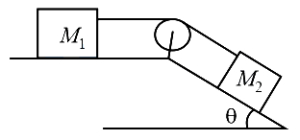
Two masses $M_1$ and $M_2$ are arranged as shown in the figure. Let '$a$' be the magnitude of the acceleration of the system. If the mass of $M_1$ is doubled and that of $M_2$ is halved,then the new acceleration of the system is (Treat all surfaces as smooth; masses of pulley and rope are negligible).
A
$\left(\frac{M_1+M_2}{4 M_1+M_2}\right) a$
B
$\left(\frac{2 M_1+M_2}{4 M_1+M_2}\right) a$
C
$\left(\frac{M_1+2 M_2}{4 M_1+2 M_2}\right) a$
D
$\left(\frac{M_1+2 M_2}{M_1+M_2}\right) a$
Solution
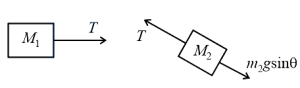
(A) For the given system,the equation of motion is derived from the net force divided by the total mass.
$a = \frac{M_2 g \sin \theta}{M_1 + M_2}$
When the mass of $M_1$ is doubled $(M_1' = 2M_1)$ and the mass of $M_2$ is halved $(M_2' = M_2/2)$,the new acceleration $a'$ is:
$a' = \frac{M_2' g \sin \theta}{M_1' + M_2'} = \frac{(M_2/2) g \sin \theta}{2M_1 + M_2/2}$
Multiplying the numerator and denominator by $2$:
$a' = \frac{M_2 g \sin \theta}{4M_1 + M_2}$
Now,express $a'$ in terms of $a$:
$a' = \left( \frac{M_2 g \sin \theta}{M_1 + M_2} \right) \times \left( \frac{M_1 + M_2}{4M_1 + M_2} \right) = a \left( \frac{M_1 + M_2}{4M_1 + M_2} \right)$
$a = \frac{M_2 g \sin \theta}{M_1 + M_2}$
When the mass of $M_1$ is doubled $(M_1' = 2M_1)$ and the mass of $M_2$ is halved $(M_2' = M_2/2)$,the new acceleration $a'$ is:
$a' = \frac{M_2' g \sin \theta}{M_1' + M_2'} = \frac{(M_2/2) g \sin \theta}{2M_1 + M_2/2}$
Multiplying the numerator and denominator by $2$:
$a' = \frac{M_2 g \sin \theta}{4M_1 + M_2}$
Now,express $a'$ in terms of $a$:
$a' = \left( \frac{M_2 g \sin \theta}{M_1 + M_2} \right) \times \left( \frac{M_1 + M_2}{4M_1 + M_2} \right) = a \left( \frac{M_1 + M_2}{4M_1 + M_2} \right)$
0 likesView Solution
33
PhysicsMediumMCQAP EAMCET · 2022
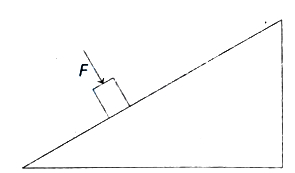
$A$ box of mass $2 \ kg$ is placed on an inclined plane that makes $30^{\circ}$ with the horizontal. The coefficient of friction between the box and the inclined plane is $0.2$. $A$ force $F$ is applied on the box perpendicular to the incline to prevent the box from sliding down. The minimum value of $F$ is (acceleration due to gravity $= 10 \ ms^{-2}$) (in $N$)
A
$28.6$
B
$22.8$
C
$32.7$
D
$44.6$
Solution
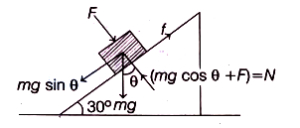
(C) The block has a tendency to slide downwards,so the friction force $f$ acts in the upward direction along the incline.
For the box not to slide,the maximum static friction must balance the component of weight acting downwards along the incline.
$f_{max} \geq mg \sin \theta$
Since $f_{max} = \mu N$,where $N$ is the normal reaction force.
The force $F$ is applied perpendicular to the incline,so the normal reaction $N$ is:
$N = mg \cos \theta + F$
Substituting $N$ into the friction equation:
$\mu(mg \cos \theta + F) \geq mg \sin \theta$
$\mu mg \cos \theta + \mu F \geq mg \sin \theta$
$\mu F \geq mg \sin \theta - \mu mg \cos \theta$
$F \geq \frac{mg(\sin \theta - \mu \cos \theta)}{\mu}$
Given: $m = 2 \ kg$,$g = 10 \ ms^{-2}$,$\theta = 30^{\circ}$,$\mu = 0.2$.
$F \geq \frac{2 \times 10 \times (\sin 30^{\circ} - 0.2 \times \cos 30^{\circ})}{0.2}$
$F \geq \frac{20 \times (0.5 - 0.2 \times 0.866)}{0.2}$
$F \geq \frac{20 \times (0.5 - 0.1732)}{0.2}$
$F \geq \frac{20 \times 0.3268}{0.2}$
$F \geq 100 \times 0.3268 = 32.68 \ N$
Rounding to one decimal place,the minimum value of $F$ is $32.7 \ N$.
For the box not to slide,the maximum static friction must balance the component of weight acting downwards along the incline.
$f_{max} \geq mg \sin \theta$
Since $f_{max} = \mu N$,where $N$ is the normal reaction force.
The force $F$ is applied perpendicular to the incline,so the normal reaction $N$ is:
$N = mg \cos \theta + F$
Substituting $N$ into the friction equation:
$\mu(mg \cos \theta + F) \geq mg \sin \theta$
$\mu mg \cos \theta + \mu F \geq mg \sin \theta$
$\mu F \geq mg \sin \theta - \mu mg \cos \theta$
$F \geq \frac{mg(\sin \theta - \mu \cos \theta)}{\mu}$
Given: $m = 2 \ kg$,$g = 10 \ ms^{-2}$,$\theta = 30^{\circ}$,$\mu = 0.2$.
$F \geq \frac{2 \times 10 \times (\sin 30^{\circ} - 0.2 \times \cos 30^{\circ})}{0.2}$
$F \geq \frac{20 \times (0.5 - 0.2 \times 0.866)}{0.2}$
$F \geq \frac{20 \times (0.5 - 0.1732)}{0.2}$
$F \geq \frac{20 \times 0.3268}{0.2}$
$F \geq 100 \times 0.3268 = 32.68 \ N$
Rounding to one decimal place,the minimum value of $F$ is $32.7 \ N$.
0 likesView Solution
34
PhysicsDifficultMCQAP EAMCET · 2022
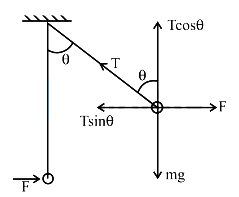
$A$ block of mass $8 \ kg$ is suspended by a rope of length $3 \ m$ from the ceiling. $A$ force of $40 \ N$ is applied horizontally to the block. Then the angle that the rope makes with the vertical in equilibrium is (acceleration due to gravity $= 10 \ m \ s^{-2}$,neglect the mass of the rope).
A
$\sin ^{-1}\left(\frac{1}{2}\right)$
B
$\tan ^{-1}\left(\frac{1}{2}\right)$
C
$\sin ^{-1}\left(\frac{1}{3}\right)$
D
$\tan ^{-1}\left(\frac{1}{3}\right)$
Solution
(B) Let $\theta$ be the angle that the string makes with the vertical in equilibrium.
At equilibrium,the forces acting on the block are balanced:
$1$. Horizontal force balance: $F = T \sin \theta$ ... $(i)$
$2$. Vertical force balance: $mg = T \cos \theta$ ... (ii)
Dividing equation $(i)$ by equation (ii),we get:
$\frac{F}{mg} = \frac{T \sin \theta}{T \cos \theta} = \tan \theta$
Given $F = 40 \ N$,$m = 8 \ kg$,and $g = 10 \ m \ s^{-2}$:
$\tan \theta = \frac{40}{8 \times 10} = \frac{40}{80} = \frac{1}{2}$
Therefore,$\theta = \tan ^{-1}\left(\frac{1}{2}\right)$.
At equilibrium,the forces acting on the block are balanced:
$1$. Horizontal force balance: $F = T \sin \theta$ ... $(i)$
$2$. Vertical force balance: $mg = T \cos \theta$ ... (ii)
Dividing equation $(i)$ by equation (ii),we get:
$\frac{F}{mg} = \frac{T \sin \theta}{T \cos \theta} = \tan \theta$
Given $F = 40 \ N$,$m = 8 \ kg$,and $g = 10 \ m \ s^{-2}$:
$\tan \theta = \frac{40}{8 \times 10} = \frac{40}{80} = \frac{1}{2}$
Therefore,$\theta = \tan ^{-1}\left(\frac{1}{2}\right)$.
0 likesView Solution
35
PhysicsMediumMCQAP EAMCET · 2022
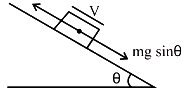
An object requires $500 \,N$ force to be pulled up on a $30^{\circ}$ frictionless smooth inclined plane at a constant speed. The weight of the object is
A
$500 \sqrt{2} \,N$
B
$1000 \,N$
C
$1000 \sqrt{2} \,N$
D
$500 \sqrt{3} \,N$
Solution
(B) For an object moving at a constant speed on a frictionless inclined plane, the net force acting on it must be zero.
When the object is pulled up the plane, the applied force $F$ must balance the component of the gravitational force acting down the plane.
The component of the weight $W = mg$ acting down the inclined plane is $mg \sin \theta$.
Given:
Applied force $F = 500 \,N$
Angle of inclination $\theta = 30^{\circ}$
Since the object moves at a constant speed, the forces are in equilibrium:
$F = mg \sin 30^{\circ}$
$500 \,N = mg \cdot \frac{1}{2}$
$mg = 500 \,N \times 2$
$mg = 1000 \,N$
Therefore, the weight of the object is $1000 \,N$.
When the object is pulled up the plane, the applied force $F$ must balance the component of the gravitational force acting down the plane.
The component of the weight $W = mg$ acting down the inclined plane is $mg \sin \theta$.
Given:
Applied force $F = 500 \,N$
Angle of inclination $\theta = 30^{\circ}$
Since the object moves at a constant speed, the forces are in equilibrium:
$F = mg \sin 30^{\circ}$
$500 \,N = mg \cdot \frac{1}{2}$
$mg = 500 \,N \times 2$
$mg = 1000 \,N$
Therefore, the weight of the object is $1000 \,N$.
0 likesView Solution
36
PhysicsEasyMCQAP EAMCET · 2022
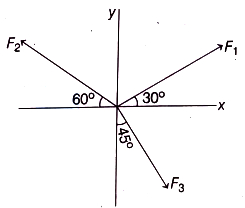
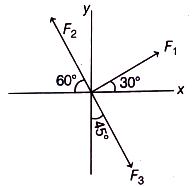
Three forces of magnitude $F_1, F_2$ and $F_3$ act on a body located at the origin as shown in the figure. The condition that gives zero net force is
A
$F_2=-(2+\sqrt{3}) F_1; F_3=\frac{-4}{\sqrt{6}-\sqrt{2}} F_1$
B
$F_2=-(2-\sqrt{3}) F_1; F_3=\frac{-4}{\sqrt{6}+\sqrt{2}} F_1$
C
$F_2=-(2+\sqrt{3}) F_1; F_3=(\sqrt{6}-\sqrt{2}) F_1$
D
$F_2=-(2+\sqrt{2}) F_1; F_3=\frac{-2}{\sqrt{6}-\sqrt{2}} F_1$
Solution
(A) For the body to be in equilibrium,the net force must be zero,i.e.,$\Sigma F_x = 0$ and $\Sigma F_y = 0$.
Resolving the forces into $x$ and $y$ components:
$F_{1x} = F_1 \cos 30^{\circ} = F_1 \frac{\sqrt{3}}{2}$,$F_{1y} = F_1 \sin 30^{\circ} = F_1 \frac{1}{2}$
$F_{2x} = -F_2 \cos 60^{\circ} = -F_2 \frac{1}{2}$,$F_{2y} = F_2 \sin 60^{\circ} = F_2 \frac{\sqrt{3}}{2}$
$F_{3x} = F_3 \sin 45^{\circ} = F_3 \frac{1}{\sqrt{2}}$,$F_{3y} = -F_3 \cos 45^{\circ} = -F_3 \frac{1}{\sqrt{2}}$
For $\Sigma F_x = 0$:
$F_1 \frac{\sqrt{3}}{2} - F_2 \frac{1}{2} + F_3 \frac{1}{\sqrt{2}} = 0 \Rightarrow \sqrt{3} F_1 - F_2 + \sqrt{2} F_3 = 0$ ... $(i)$
For $\Sigma F_y = 0$:
$F_1 \frac{1}{2} + F_2 \frac{\sqrt{3}}{2} - F_3 \frac{1}{\sqrt{2}} = 0 \Rightarrow F_1 + \sqrt{3} F_2 - \sqrt{2} F_3 = 0$ ... (ii)
Adding $(i)$ and (ii):
$(\sqrt{3}+1) F_1 + (\sqrt{3}-1) F_2 = 0 \Rightarrow F_2 = -F_1 \frac{\sqrt{3}+1}{\sqrt{3}-1} = -F_1 \frac{(\sqrt{3}+1)^2}{3-1} = -F_1 \frac{4+2\sqrt{3}}{2} = -F_1(2+\sqrt{3})$
Substituting $F_2$ in $(i)$:
$\sqrt{3} F_1 - [-F_1(2+\sqrt{3})] + \sqrt{2} F_3 = 0$
$\sqrt{3} F_1 + 2 F_1 + \sqrt{3} F_1 + \sqrt{2} F_3 = 0$
$\sqrt{2} F_3 = -F_1(2+2\sqrt{3}) \Rightarrow F_3 = -F_1 \frac{2(1+\sqrt{3})}{\sqrt{2}} = -\sqrt{2} F_1(1+\sqrt{3}) = -F_1(\sqrt{2}+\sqrt{6})$
Note: The option $C$ is $F_3 = -F_1(\sqrt{2}+\sqrt{6})$,which is equivalent to $F_3 = \frac{-4 F_1}{\sqrt{6}-\sqrt{2}}$.
Resolving the forces into $x$ and $y$ components:
$F_{1x} = F_1 \cos 30^{\circ} = F_1 \frac{\sqrt{3}}{2}$,$F_{1y} = F_1 \sin 30^{\circ} = F_1 \frac{1}{2}$
$F_{2x} = -F_2 \cos 60^{\circ} = -F_2 \frac{1}{2}$,$F_{2y} = F_2 \sin 60^{\circ} = F_2 \frac{\sqrt{3}}{2}$
$F_{3x} = F_3 \sin 45^{\circ} = F_3 \frac{1}{\sqrt{2}}$,$F_{3y} = -F_3 \cos 45^{\circ} = -F_3 \frac{1}{\sqrt{2}}$
For $\Sigma F_x = 0$:
$F_1 \frac{\sqrt{3}}{2} - F_2 \frac{1}{2} + F_3 \frac{1}{\sqrt{2}} = 0 \Rightarrow \sqrt{3} F_1 - F_2 + \sqrt{2} F_3 = 0$ ... $(i)$
For $\Sigma F_y = 0$:
$F_1 \frac{1}{2} + F_2 \frac{\sqrt{3}}{2} - F_3 \frac{1}{\sqrt{2}} = 0 \Rightarrow F_1 + \sqrt{3} F_2 - \sqrt{2} F_3 = 0$ ... (ii)
Adding $(i)$ and (ii):
$(\sqrt{3}+1) F_1 + (\sqrt{3}-1) F_2 = 0 \Rightarrow F_2 = -F_1 \frac{\sqrt{3}+1}{\sqrt{3}-1} = -F_1 \frac{(\sqrt{3}+1)^2}{3-1} = -F_1 \frac{4+2\sqrt{3}}{2} = -F_1(2+\sqrt{3})$
Substituting $F_2$ in $(i)$:
$\sqrt{3} F_1 - [-F_1(2+\sqrt{3})] + \sqrt{2} F_3 = 0$
$\sqrt{3} F_1 + 2 F_1 + \sqrt{3} F_1 + \sqrt{2} F_3 = 0$
$\sqrt{2} F_3 = -F_1(2+2\sqrt{3}) \Rightarrow F_3 = -F_1 \frac{2(1+\sqrt{3})}{\sqrt{2}} = -\sqrt{2} F_1(1+\sqrt{3}) = -F_1(\sqrt{2}+\sqrt{6})$
Note: The option $C$ is $F_3 = -F_1(\sqrt{2}+\sqrt{6})$,which is equivalent to $F_3 = \frac{-4 F_1}{\sqrt{6}-\sqrt{2}}$.
0 likesView Solution
37
PhysicsEasyMCQAP EAMCET · 2022
$A$ body is travelling with $10 \,ms^{-1}$ on a rough horizontal surface. Its velocity after $2 \,s$ is $4 \,ms^{-1}$. The coefficient of kinetic friction between the block and the plane is (acceleration due to gravity $= 10 \,ms^{-2}$)
A
$0.4$
B
$0.3$
C
$0.5$
D
$0.2$
Solution
(B) Initial speed of the body on the horizontal rough surface,$u = 10 \,ms^{-1}$.
Final velocity,$v = 4 \,ms^{-1}$ and time,$t = 2 \,s$.
If $a$ is the retardation due to friction,then by using the equation of motion:
$v = u - at$
$4 = 10 - a \times 2$
$2a = 6 \Rightarrow a = 3 \,ms^{-2}$.
According to Newton's second law,the frictional force is given by $f_k = ma$.
Since $f_k = \mu_k N = \mu_k mg$,we have:
$\mu_k mg = ma$
$\mu_k = \frac{a}{g} = \frac{3}{10} = 0.3$.
Final velocity,$v = 4 \,ms^{-1}$ and time,$t = 2 \,s$.
If $a$ is the retardation due to friction,then by using the equation of motion:
$v = u - at$
$4 = 10 - a \times 2$
$2a = 6 \Rightarrow a = 3 \,ms^{-2}$.
According to Newton's second law,the frictional force is given by $f_k = ma$.
Since $f_k = \mu_k N = \mu_k mg$,we have:
$\mu_k mg = ma$
$\mu_k = \frac{a}{g} = \frac{3}{10} = 0.3$.
0 likesView Solution
38
PhysicsMediumMCQAP EAMCET · 2022
The coefficient of friction between an object and a surface,if we need to move an object of weight $150 \ N$ on a horizontal surface with a force of $75 \ N$,is
A
$0.8$
B
$0.5$
C
$0.7$
D
$0.9$
Solution
(B) The weight of the object is $W = mg = 150 \ N$.
To move the object on a horizontal surface,the applied force $F$ must be at least equal to the limiting friction force $f_l$.
The limiting friction force is given by $f_l = \mu N$,where $\mu$ is the coefficient of friction and $N$ is the normal reaction.
For a horizontal surface,the normal reaction $N$ is equal to the weight of the object,so $N = mg = 150 \ N$.
Given that the force required to move the object is $F = 75 \ N$,we have:
$F = \mu N$
$75 = \mu \times 150$
$\mu = \frac{75}{150} = 0.5$.
Thus,the coefficient of friction is $0.5$.
To move the object on a horizontal surface,the applied force $F$ must be at least equal to the limiting friction force $f_l$.
The limiting friction force is given by $f_l = \mu N$,where $\mu$ is the coefficient of friction and $N$ is the normal reaction.
For a horizontal surface,the normal reaction $N$ is equal to the weight of the object,so $N = mg = 150 \ N$.
Given that the force required to move the object is $F = 75 \ N$,we have:
$F = \mu N$
$75 = \mu \times 150$
$\mu = \frac{75}{150} = 0.5$.
Thus,the coefficient of friction is $0.5$.
0 likesView Solution
39
PhysicsEasyMCQAP EAMCET · 2022
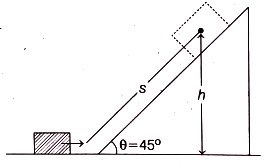
$A$ block of mass $5 \text{ kg}$ starts up a $45^{\circ}$ inclined plane with an initial kinetic energy of $100 \text{ J}$. If the coefficient of friction between the block and the plane is $0.5$,then the distance covered by the block before it stops is (Acceleration due to gravity $= 10 \text{ ms}^{-2}$)
A
$\frac{4 \sqrt{2}}{3} \text{ m}$
B
$\frac{3}{\sqrt{2}} \text{ m}$
C
$2 \sqrt{2} \text{ m}$
D
$\frac{6}{5} \sqrt{2} \text{ m}$
Solution
(A) The block stops on the inclined plane when its initial kinetic energy is used to do work against friction and is partly converted into potential energy.
Given the angle of inclination is $\theta = 45^{\circ}$,the distance covered on the incline $(s)$ is related to the vertical height $(h)$ as:
$\sin 45^{\circ} = \frac{h}{s} \implies s = \frac{h}{\sin 45^{\circ}} = h \sqrt{2}$.
According to the work-energy theorem,the initial kinetic energy $(K.E.)$ is equal to the work done against friction plus the gain in potential energy:
$K.E. = W_{\text{friction}} + \Delta U$
$K.E. = (\mu mg \cos \theta) \cdot s + mgh$
Substituting $s = h \sqrt{2}$ and $\cos 45^{\circ} = \frac{1}{\sqrt{2}}$:
$100 = (0.5 \times 5 \times 10 \times \frac{1}{\sqrt{2}}) \times (h \sqrt{2}) + (5 \times 10 \times h)$
$100 = (0.5 \times 5 \times 10 \times h) + 50h$
$100 = 25h + 50h$
$100 = 75h$
$h = \frac{100}{75} = \frac{4}{3} \text{ m}$.
Now,the distance covered $s$ is:
$s = h \sqrt{2} = \frac{4}{3} \sqrt{2} \text{ m}$.
Given the angle of inclination is $\theta = 45^{\circ}$,the distance covered on the incline $(s)$ is related to the vertical height $(h)$ as:
$\sin 45^{\circ} = \frac{h}{s} \implies s = \frac{h}{\sin 45^{\circ}} = h \sqrt{2}$.
According to the work-energy theorem,the initial kinetic energy $(K.E.)$ is equal to the work done against friction plus the gain in potential energy:
$K.E. = W_{\text{friction}} + \Delta U$
$K.E. = (\mu mg \cos \theta) \cdot s + mgh$
Substituting $s = h \sqrt{2}$ and $\cos 45^{\circ} = \frac{1}{\sqrt{2}}$:
$100 = (0.5 \times 5 \times 10 \times \frac{1}{\sqrt{2}}) \times (h \sqrt{2}) + (5 \times 10 \times h)$
$100 = (0.5 \times 5 \times 10 \times h) + 50h$
$100 = 25h + 50h$
$100 = 75h$
$h = \frac{100}{75} = \frac{4}{3} \text{ m}$.
Now,the distance covered $s$ is:
$s = h \sqrt{2} = \frac{4}{3} \sqrt{2} \text{ m}$.
0 likesView Solution
40
PhysicsEasyMCQAP EAMCET · 2022
Which of the following is true about the coefficient of static friction $(\mu_s)$ and the coefficient of kinetic friction $(\mu_k)$?
A
$\mu_s$ is always equal to $\mu_k$
B
$\mu_s$ is always greater than $\mu_k$
C
$\mu_s$ is always less than $\mu_k$
D
Depending upon applications,$\mu_s$ can be greater,less,or equal to $\mu_k$
Solution
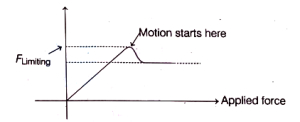
(B) The graph of friction versus applied force shows that the maximum value of static friction (limiting friction) is greater than the kinetic friction acting during motion.
Since the limiting friction is given by $f_{s,max} = \mu_s N$ and kinetic friction is $f_k = \mu_k N$,where $N$ is the normal force.
From the graph,$f_{s,max} > f_k$.
Therefore,$\mu_s N > \mu_k N$,which implies $\mu_s > \mu_k$.
Since the limiting friction is given by $f_{s,max} = \mu_s N$ and kinetic friction is $f_k = \mu_k N$,where $N$ is the normal force.
From the graph,$f_{s,max} > f_k$.
Therefore,$\mu_s N > \mu_k N$,which implies $\mu_s > \mu_k$.
0 likesView Solution
41
PhysicsEasyMCQAP EAMCET · 2022
$A$ block is lying at rest inside a bus. What is the maximum acceleration of the bus such that the block remains stationary? (The static friction coefficient $\mu = 0.2$,acceleration due to gravity $g = 10 \ m/s^2$)
A
$1 \ m/s^2$
B
$0.5 \ m/s^2$
C
$2 \ cm/s^2$
D
$2 \ m/s^2$
Solution
(D) When the bus accelerates forward with acceleration $a$,a pseudo force $F_p = ma$ acts on the block in the backward direction relative to the bus.
For the block to remain stationary relative to the bus,the static friction force $f_s$ must balance this pseudo force.
The maximum static friction force is given by $f_{s,max} = \mu N = \mu mg$.
For the block to remain stationary,the pseudo force must be less than or equal to the maximum static friction force:
$ma \leq \mu mg$
$a \leq \mu g$
Substituting the given values:
$a \leq 0.2 \times 10 \ m/s^2$
$a \leq 2 \ m/s^2$
Therefore,the maximum acceleration of the bus such that the block remains stationary is $2 \ m/s^2$.
For the block to remain stationary relative to the bus,the static friction force $f_s$ must balance this pseudo force.
The maximum static friction force is given by $f_{s,max} = \mu N = \mu mg$.
For the block to remain stationary,the pseudo force must be less than or equal to the maximum static friction force:
$ma \leq \mu mg$
$a \leq \mu g$
Substituting the given values:
$a \leq 0.2 \times 10 \ m/s^2$
$a \leq 2 \ m/s^2$
Therefore,the maximum acceleration of the bus such that the block remains stationary is $2 \ m/s^2$.
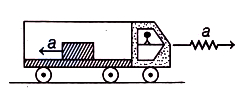
0 likesView Solution
42
PhysicsEasyMCQAP EAMCET · 2022
Two rectangular blocks of masses $40 \ kg$ and $60 \ kg$ are connected by a string and kept on a frictionless horizontal table. If a force of $1000 \ N$ is applied on the $60 \ kg$ block away from the $40 \ kg$ block,then the tension in the string is: (in $N$)
A
$450$
B
$400$
C
$350$
D
$500$
Solution
(B) The total mass of the system is $M = 40 \ kg + 60 \ kg = 100 \ kg$.
Applying Newton's second law to the entire system,the acceleration $a$ is given by:
$a = \frac{F}{M} = \frac{1000 \ N}{100 \ kg} = 10 \ m/s^2$.
Now,consider the $40 \ kg$ block. The only horizontal force acting on it is the tension $T$ in the string.
Applying Newton's second law to the $40 \ kg$ block:
$T = m_1 \times a$
$T = 40 \ kg \times 10 \ m/s^2 = 400 \ N$.
Applying Newton's second law to the entire system,the acceleration $a$ is given by:
$a = \frac{F}{M} = \frac{1000 \ N}{100 \ kg} = 10 \ m/s^2$.
Now,consider the $40 \ kg$ block. The only horizontal force acting on it is the tension $T$ in the string.
Applying Newton's second law to the $40 \ kg$ block:
$T = m_1 \times a$
$T = 40 \ kg \times 10 \ m/s^2 = 400 \ N$.
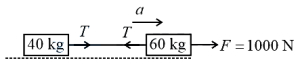
0 likesView Solution
43
PhysicsDifficultMCQAP EAMCET · 2022
$A$ cricket ball of mass $50 \ g$ having velocity $50 \ cm \ s^{-1}$ is stopped in $0.5 \ s$. The force applied to stop the ball is (in $N$)
A
$0.07$
B
$0.05$
C
$5$
D
$7$
Solution
(B) Given:
Mass $m = 50 \ g = 50 \times 10^{-3} \ kg = 0.05 \ kg$
Initial velocity $u = 50 \ cm \ s^{-1} = 50 \times 10^{-2} \ m \ s^{-1} = 0.5 \ m \ s^{-1}$
Final velocity $v = 0 \ m \ s^{-1}$
Time $t = 0.5 \ s$
Initial momentum $p_i = m \times u = 0.05 \ kg \times 0.5 \ m \ s^{-1} = 0.025 \ kg \ m \ s^{-1}$
Final momentum $p_f = m \times v = 0.05 \ kg \times 0 \ m \ s^{-1} = 0 \ kg \ m \ s^{-1}$
According to Newton's second law,the force $F$ is the rate of change of momentum:
$F = \frac{\Delta p}{t} = \frac{p_f - p_i}{t}$
$F = \frac{0 - 0.025 \ kg \ m \ s^{-1}}{0.5 \ s}$
$F = -0.05 \ N$
The magnitude of the force applied to stop the ball is $0.05 \ N$.
Mass $m = 50 \ g = 50 \times 10^{-3} \ kg = 0.05 \ kg$
Initial velocity $u = 50 \ cm \ s^{-1} = 50 \times 10^{-2} \ m \ s^{-1} = 0.5 \ m \ s^{-1}$
Final velocity $v = 0 \ m \ s^{-1}$
Time $t = 0.5 \ s$
Initial momentum $p_i = m \times u = 0.05 \ kg \times 0.5 \ m \ s^{-1} = 0.025 \ kg \ m \ s^{-1}$
Final momentum $p_f = m \times v = 0.05 \ kg \times 0 \ m \ s^{-1} = 0 \ kg \ m \ s^{-1}$
According to Newton's second law,the force $F$ is the rate of change of momentum:
$F = \frac{\Delta p}{t} = \frac{p_f - p_i}{t}$
$F = \frac{0 - 0.025 \ kg \ m \ s^{-1}}{0.5 \ s}$
$F = -0.05 \ N$
The magnitude of the force applied to stop the ball is $0.05 \ N$.
0 likesView Solution
44
PhysicsMediumMCQAP EAMCET · 2022
$A$ bar of mass $m$ resting on a smooth horizontal plane starts moving due to a constant force $F$. In the process of its rectilinear motion,the angle $\theta$ between the direction of this force and the horizontal varies as $\theta = k x$,where $k$ is a constant and $x$ is the distance traversed by the bar from its initial position. The velocity $(v)$ of the bar as a function of the angle $\theta$ is
A
$v = \sqrt{\frac{2 F \sin \theta}{m k}}$
B
$v = \sqrt{\frac{2 F}{m k \sin \theta}}$
C
$v = \frac{2 F \sin \theta}{m k}$
D
$v = \frac{2 F}{m k \sin \theta}$
Solution
(A) The component of the force responsible for horizontal motion is $F \cos \theta$.
So,the acceleration of the bar is $a = \frac{F \cos \theta}{m}$.
Since acceleration $a = v \frac{d v}{d x}$,we have:
$v \frac{d v}{d x} = \frac{F \cos \theta}{m}$
Given $\theta = k x$,we have $d \theta = k d x$,or $d x = \frac{d \theta}{k}$.
Substituting these into the equation:
$v d v = \frac{F \cos \theta}{m} \cdot \frac{d \theta}{k}$
Integrating both sides with initial conditions $v = 0$ at $\theta = 0$:
$\int_{0}^{v} v d v = \frac{F}{m k} \int_{0}^{\theta} \cos \theta d \theta$
$\frac{v^2}{2} = \frac{F}{m k} [\sin \theta]_{0}^{\theta}$
$\frac{v^2}{2} = \frac{F \sin \theta}{m k}$
$v^2 = \frac{2 F \sin \theta}{m k}$
$v = \sqrt{\frac{2 F \sin \theta}{m k}}$
So,the acceleration of the bar is $a = \frac{F \cos \theta}{m}$.
Since acceleration $a = v \frac{d v}{d x}$,we have:
$v \frac{d v}{d x} = \frac{F \cos \theta}{m}$
Given $\theta = k x$,we have $d \theta = k d x$,or $d x = \frac{d \theta}{k}$.
Substituting these into the equation:
$v d v = \frac{F \cos \theta}{m} \cdot \frac{d \theta}{k}$
Integrating both sides with initial conditions $v = 0$ at $\theta = 0$:
$\int_{0}^{v} v d v = \frac{F}{m k} \int_{0}^{\theta} \cos \theta d \theta$
$\frac{v^2}{2} = \frac{F}{m k} [\sin \theta]_{0}^{\theta}$
$\frac{v^2}{2} = \frac{F \sin \theta}{m k}$
$v^2 = \frac{2 F \sin \theta}{m k}$
$v = \sqrt{\frac{2 F \sin \theta}{m k}}$
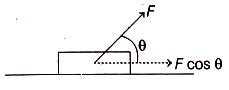
0 likesView Solution
45
PhysicsMediumMCQAP EAMCET · 2022
Consider three masses $m_1, m_2$ and $m_3$ $(m_1 > m_2 > m_3)$ that are at rest on an inclined plane as shown in the figure. The angle of inclination $(\theta)$ of the plane is gradually increased until the masses just begin to slide. (Assume the coefficient of static friction between the masses and the surface is constant). Then,which of the following statements is correct?
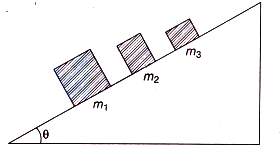
A
$m_3$ begins to slide at a higher inclination angle than $m_1$ and $m_2$.
B
$m_3$ begins to slide at a lower inclination angle than $m_1$ and $m_2$.
C
$m_1, m_2$ and $m_3$ begin to slide at the same inclination angle.
D
$m_2$ begins to slide at a higher inclination angle than $m_1$ and $m_3$.
Solution
(C) An object begins to slide down an inclined plane when the angle of inclination (also called the angle of repose) is equal to the angle of friction. Let $\theta$ be the angle at which a mass begins to slide down an incline.
At the verge of sliding,the force of static friction $f_s$ is equal to the downward component of gravity.
$f_s = mg \sin \theta$
Since $f_s = \mu N$ and the normal force $N = mg \cos \theta$,we have:
$\mu (mg \cos \theta) = mg \sin \theta$
$\mu = \frac{\sin \theta}{\cos \theta} = \tan \theta$
$\theta = \tan^{-1} \mu$
Since the angle of repose $\theta$ depends only on the coefficient of static friction $\mu$ and is independent of the mass $m$ of the body,all three masses will begin to slide at the same instant at the same inclination angle $\theta$.
At the verge of sliding,the force of static friction $f_s$ is equal to the downward component of gravity.
$f_s = mg \sin \theta$
Since $f_s = \mu N$ and the normal force $N = mg \cos \theta$,we have:
$\mu (mg \cos \theta) = mg \sin \theta$
$\mu = \frac{\sin \theta}{\cos \theta} = \tan \theta$
$\theta = \tan^{-1} \mu$
Since the angle of repose $\theta$ depends only on the coefficient of static friction $\mu$ and is independent of the mass $m$ of the body,all three masses will begin to slide at the same instant at the same inclination angle $\theta$.
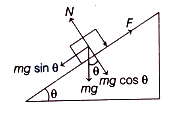
0 likesView Solution
46
PhysicsEasyMCQAP EAMCET · 2022
In the case of a wire having negligible mass,suspended from a ceiling and stretched under the action of a weight $F$ suspended from its other end,the tension at any cross-section of the wire is
A
Zero
B
$2 F$
C
$0.5 F$
D
$F$
Solution
(D) Consider a wire of negligible mass suspended from a ceiling. $A$ force $F$ is applied at the lower end of the wire.
Since the wire is massless,the net force on any segment of the wire must be zero for it to be in equilibrium.
If we take any cross-section of the wire and consider the lower part of the wire below that section,the only forces acting on this part are the tension $T$ acting upwards at the cross-section and the weight $F$ acting downwards at the end.
Applying Newton's second law,$T - F = ma$. Since the mass $m$ of the wire is zero,$T - F = 0$,which gives $T = F$.
Therefore,the tension at any cross-section of the wire is $F$.
Since the wire is massless,the net force on any segment of the wire must be zero for it to be in equilibrium.
If we take any cross-section of the wire and consider the lower part of the wire below that section,the only forces acting on this part are the tension $T$ acting upwards at the cross-section and the weight $F$ acting downwards at the end.
Applying Newton's second law,$T - F = ma$. Since the mass $m$ of the wire is zero,$T - F = 0$,which gives $T = F$.
Therefore,the tension at any cross-section of the wire is $F$.
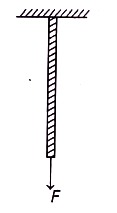
0 likesView Solution
47
PhysicsEasyMCQAP EAMCET · 2022
$A$ body of mass $0.6 \, kg$ is moving along a circular path of radius $1 \, m$. If the body moves with $\frac{900}{\pi}$ revolutions per minute, its kinetic energy is: (in $ \, J$)
A
$120$
B
$270$
C
$360$
D
$240$
Solution
(B) Given: Mass $m = 0.6 \, kg$, Radius $r = 1 \, m$, Frequency $f = \frac{900}{\pi} \, \text{rpm}$.
First, convert the frequency to revolutions per second (Hz):
$f = \frac{900}{\pi} \times \frac{1}{60} = \frac{15}{\pi} \, \text{Hz}$.
The angular velocity $\omega = 2 \pi f = 2 \pi \times \frac{15}{\pi} = 30 \, \text{rad/s}$.
The linear velocity $v = \omega r = 30 \times 1 = 30 \, \text{m/s}$.
Kinetic energy $K = \frac{1}{2} m v^2$.
$K = \frac{1}{2} \times 0.6 \times (30)^2$.
$K = 0.3 \times 900 = 270 \, \text{J}$.
First, convert the frequency to revolutions per second (Hz):
$f = \frac{900}{\pi} \times \frac{1}{60} = \frac{15}{\pi} \, \text{Hz}$.
The angular velocity $\omega = 2 \pi f = 2 \pi \times \frac{15}{\pi} = 30 \, \text{rad/s}$.
The linear velocity $v = \omega r = 30 \times 1 = 30 \, \text{m/s}$.
Kinetic energy $K = \frac{1}{2} m v^2$.
$K = \frac{1}{2} \times 0.6 \times (30)^2$.
$K = 0.3 \times 900 = 270 \, \text{J}$.
0 likesView Solution
48
PhysicsEasyMCQAP EAMCET · 2022
The coefficient of static friction between the road and tyres of a car is $0.4$. The maximum permissible speed of the car is $10 \,ms^{-1}$ on a curved unbanked road. Then the maximum radius of curvature of the road is (acceleration due to gravity $= 10 \,ms^{-2}$)
A
$10 \sqrt{5} \,m$
B
$25 \,m$
C
$20 \sqrt{2} \,m$
D
$30 \,m$
Solution
(B) The necessary centripetal force for a car on a curved unbanked road is provided by the static friction force between the tyres and the road.
For safe turning,the centripetal force must be less than or equal to the maximum static friction force:
$\frac{mV^2}{r} \leq \mu mg$
To find the maximum radius $r$ for a given speed $V$,we use the limiting case:
$\frac{mV^2}{r} = \mu mg$
$r = \frac{V^2}{\mu g}$
Given values are $V = 10 \,ms^{-1}$,$\mu = 0.4$,and $g = 10 \,ms^{-2}$.
Substituting these values into the equation:
$r = \frac{10^2}{0.4 \times 10}$
$r = \frac{100}{4}$
$r = 25 \,m$
Thus,the maximum radius of curvature is $25 \,m$.
For safe turning,the centripetal force must be less than or equal to the maximum static friction force:
$\frac{mV^2}{r} \leq \mu mg$
To find the maximum radius $r$ for a given speed $V$,we use the limiting case:
$\frac{mV^2}{r} = \mu mg$
$r = \frac{V^2}{\mu g}$
Given values are $V = 10 \,ms^{-1}$,$\mu = 0.4$,and $g = 10 \,ms^{-2}$.
Substituting these values into the equation:
$r = \frac{10^2}{0.4 \times 10}$
$r = \frac{100}{4}$
$r = 25 \,m$
Thus,the maximum radius of curvature is $25 \,m$.
0 likesView Solution
49
PhysicsEasyMCQAP EAMCET · 2022
$A$ system consists of two springs connected in series,each having a spring constant of $10 \text{ N m}^{-1}$. The minimum work required to stretch this system by $1 \text{ cm}$ in $\text{erg}$ is
A
$1500$
B
$2000$
C
$3000$
D
$2500$
Solution
(D) For springs connected in series,the effective spring constant $K_{\text{eff}}$ is given by:
$\frac{1}{K_{\text{eff}}} = \frac{1}{K_1} + \frac{1}{K_2}$
Given $K_1 = K_2 = 10 \text{ N/m}$,we have:
$\frac{1}{K_{\text{eff}}} = \frac{1}{10} + \frac{1}{10} = \frac{2}{10} = \frac{1}{5}$
Thus,$K_{\text{eff}} = 5 \text{ N/m}$.
To convert $K_{\text{eff}}$ to $\text{dyne/cm}$:
$1 \text{ N} = 10^5 \text{ dyne}$ and $1 \text{ m} = 100 \text{ cm}$.
$K_{\text{eff}} = 5 \times \frac{10^5 \text{ dyne}}{100 \text{ cm}} = 5 \times 10^3 \text{ dyne/cm}$.
The work done $W$ to stretch the system by $x = 1 \text{ cm}$ is:
$W = \frac{1}{2} K_{\text{eff}} x^2 = \frac{1}{2} \times (5 \times 10^3) \times (1)^2 = 2500 \text{ erg}$.
$\frac{1}{K_{\text{eff}}} = \frac{1}{K_1} + \frac{1}{K_2}$
Given $K_1 = K_2 = 10 \text{ N/m}$,we have:
$\frac{1}{K_{\text{eff}}} = \frac{1}{10} + \frac{1}{10} = \frac{2}{10} = \frac{1}{5}$
Thus,$K_{\text{eff}} = 5 \text{ N/m}$.
To convert $K_{\text{eff}}$ to $\text{dyne/cm}$:
$1 \text{ N} = 10^5 \text{ dyne}$ and $1 \text{ m} = 100 \text{ cm}$.
$K_{\text{eff}} = 5 \times \frac{10^5 \text{ dyne}}{100 \text{ cm}} = 5 \times 10^3 \text{ dyne/cm}$.
The work done $W$ to stretch the system by $x = 1 \text{ cm}$ is:
$W = \frac{1}{2} K_{\text{eff}} x^2 = \frac{1}{2} \times (5 \times 10^3) \times (1)^2 = 2500 \text{ erg}$.
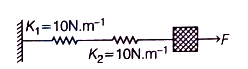
0 likesView Solution
50
PhysicsMediumMCQAP EAMCET · 2022
An object moving along the $x$-axis with a uniform acceleration has a velocity $\vec{v} = (12 \ cm \ s^{-1}) \hat{i}$ at $x = 3 \ cm$. After $2 \ s$,if it is at $x = -5 \ cm$,then its acceleration is:
A
$\vec{a} = (-16 \ cm \ s^{-2}) \hat{i}$
B
$\vec{a} = (11 \ cm \ s^{-2}) \hat{i}$
C
$\vec{a} = (-11 \ cm \ s^{-2}) \hat{i}$
D
$\vec{a} = (8 \ cm \ s^{-2}) \hat{i}$
Solution
(A) Given: Initial position $x_i = 3 \ cm$,final position $x_f = -5 \ cm$,initial velocity $\vec{u} = 12 \hat{i} \ cm \ s^{-1}$,and time $t = 2 \ s$.
Displacement $\vec{s} = x_f - x_i = (-5 - 3) \hat{i} = -8 \hat{i} \ cm$.
Using the equation of motion $\vec{s} = \vec{u}t + \frac{1}{2} \vec{a}t^2$:
$-8 \hat{i} = (12 \hat{i})(2) + \frac{1}{2} \vec{a} (2)^2$
$-8 \hat{i} = 24 \hat{i} + 2 \vec{a}$
$2 \vec{a} = -8 \hat{i} - 24 \hat{i} = -32 \hat{i}$
$\vec{a} = -16 \ cm \ s^{-2} \hat{i}$.
Displacement $\vec{s} = x_f - x_i = (-5 - 3) \hat{i} = -8 \hat{i} \ cm$.
Using the equation of motion $\vec{s} = \vec{u}t + \frac{1}{2} \vec{a}t^2$:
$-8 \hat{i} = (12 \hat{i})(2) + \frac{1}{2} \vec{a} (2)^2$
$-8 \hat{i} = 24 \hat{i} + 2 \vec{a}$
$2 \vec{a} = -8 \hat{i} - 24 \hat{i} = -32 \hat{i}$
$\vec{a} = -16 \ cm \ s^{-2} \hat{i}$.
0 likesView Solution
51
PhysicsMediumMCQAP EAMCET · 2022
Capacitive reactance of a capacitor in an $AC$ circuit is $3 \ k\Omega$. If this capacitor is connected to a new $AC$ source of double frequency,the capacitive reactance will become:
A
$1.5 \ k\Omega$
B
$3 \ k\Omega$
C
$6 \ k\Omega$
D
$5.2 \ k\Omega$
Solution
(A) The capacitive reactance $X_C$ of a capacitor is given by the formula: $X_C = \frac{1}{2 \pi f C}$.
Here,$f$ is the frequency of the $AC$ source and $C$ is the capacitance.
From the formula,it is clear that $X_C \propto \frac{1}{f}$.
Given,initial capacitive reactance $X_{C1} = 3 \ k\Omega$ at frequency $f_1 = f$.
When the frequency is doubled,$f_2 = 2f$.
The new capacitive reactance $X_{C2}$ will be: $X_{C2} = \frac{1}{2 \pi (2f) C} = \frac{1}{2} \times \left( \frac{1}{2 \pi f C} \right) = \frac{X_{C1}}{2}$.
Substituting the value: $X_{C2} = \frac{3 \ k\Omega}{2} = 1.5 \ k\Omega$.
Here,$f$ is the frequency of the $AC$ source and $C$ is the capacitance.
From the formula,it is clear that $X_C \propto \frac{1}{f}$.
Given,initial capacitive reactance $X_{C1} = 3 \ k\Omega$ at frequency $f_1 = f$.
When the frequency is doubled,$f_2 = 2f$.
The new capacitive reactance $X_{C2}$ will be: $X_{C2} = \frac{1}{2 \pi (2f) C} = \frac{1}{2} \times \left( \frac{1}{2 \pi f C} \right) = \frac{X_{C1}}{2}$.
Substituting the value: $X_{C2} = \frac{3 \ k\Omega}{2} = 1.5 \ k\Omega$.
0 likesView Solution
52
PhysicsMediumMCQAP EAMCET · 2022
$A$ $70 mH$ inductor is connected to a $220 V, 50 Hz$ $AC$ supply. The rms value of the current in the circuit is:
A
$\frac{100}{\sqrt{2} \pi} A$
B
$10 A$
C
$\frac{50}{\pi} A$
D
$\frac{10 \sqrt{2}}{\pi} A$
Solution
(B) Given: Inductance $L = 70 mH = 70 \times 10^{-3} H$,Voltage $V_{rms} = 220 V$,Frequency $f = 50 Hz$.
Inductive reactance is given by $\chi_{L} = \omega L = 2 \pi f L$.
Substituting the values: $\chi_{L} = 2 \times \pi \times 50 \times 70 \times 10^{-3} = 7 \pi \Omega$.
The rms current is $i_{rms} = \frac{V_{rms}}{\chi_{L}} = \frac{220}{7 \pi} \approx \frac{10}{\pi} A$ (Note: Based on standard textbook values,if $L = 70 mH$,the result is $\frac{220}{7 \pi} A$. However,checking the options,if $L = 70 mH$ and $V = 220 V$,the calculation yields $10 A$ only if $\pi \approx 3.14$ and $L$ was adjusted. Re-evaluating: $i_{rms} = \frac{220}{2 \pi \times 50 \times 70 \times 10^{-3}} = \frac{220}{7 \pi} \approx 10 A$ is not exact. Given the options,$10 A$ is the intended answer assuming approximation or specific values).
Inductive reactance is given by $\chi_{L} = \omega L = 2 \pi f L$.
Substituting the values: $\chi_{L} = 2 \times \pi \times 50 \times 70 \times 10^{-3} = 7 \pi \Omega$.
The rms current is $i_{rms} = \frac{V_{rms}}{\chi_{L}} = \frac{220}{7 \pi} \approx \frac{10}{\pi} A$ (Note: Based on standard textbook values,if $L = 70 mH$,the result is $\frac{220}{7 \pi} A$. However,checking the options,if $L = 70 mH$ and $V = 220 V$,the calculation yields $10 A$ only if $\pi \approx 3.14$ and $L$ was adjusted. Re-evaluating: $i_{rms} = \frac{220}{2 \pi \times 50 \times 70 \times 10^{-3}} = \frac{220}{7 \pi} \approx 10 A$ is not exact. Given the options,$10 A$ is the intended answer assuming approximation or specific values).
0 likesView Solution
53
PhysicsMediumMCQAP EAMCET · 2022
The impedance of an $LR$ circuit with $L=\frac{60}{\pi} \text{ mH}$,$R=8 \Omega$ and frequency $f=50 \text{ Hz}$ is (in $Omega$)
A
$1.3$
B
$14.3$
C
$20$
D
$10$
Solution
(D) The impedance $Z$ of an $LR$ circuit is given by the formula: $Z = \sqrt{R^2 + X_L^2}$,where $X_L = \omega L = 2 \pi f L$.
Given: $R = 8 \Omega$,$L = \frac{60}{\pi} \text{ mH} = \frac{60}{\pi} \times 10^{-3} \text{ H}$,and $f = 50 \text{ Hz}$.
First,calculate the inductive reactance $X_L$:
$X_L = 2 \pi \times 50 \times \left( \frac{60}{\pi} \times 10^{-3} \right) = 100 \pi \times \frac{60}{\pi} \times 10^{-3} = 6000 \times 10^{-3} = 6 \Omega$.
Now,calculate the impedance $Z$:
$Z = \sqrt{R^2 + X_L^2} = \sqrt{8^2 + 6^2} = \sqrt{64 + 36} = \sqrt{100} = 10 \Omega$.
Given: $R = 8 \Omega$,$L = \frac{60}{\pi} \text{ mH} = \frac{60}{\pi} \times 10^{-3} \text{ H}$,and $f = 50 \text{ Hz}$.
First,calculate the inductive reactance $X_L$:
$X_L = 2 \pi \times 50 \times \left( \frac{60}{\pi} \times 10^{-3} \right) = 100 \pi \times \frac{60}{\pi} \times 10^{-3} = 6000 \times 10^{-3} = 6 \Omega$.
Now,calculate the impedance $Z$:
$Z = \sqrt{R^2 + X_L^2} = \sqrt{8^2 + 6^2} = \sqrt{64 + 36} = \sqrt{100} = 10 \Omega$.
0 likesView Solution
54
PhysicsEasyMCQAP EAMCET · 2022
Resonance frequency of $L-C-R$ series $AC$ circuit is $f_0$. Now,if the inductance is reduced to $\frac{1}{4}$ times and the capacitance is increased to $16$ times,then the new resonance frequency becomes:
A
$\frac{f_0}{4}$
B
$\frac{f_0}{2}$
C
$2 f_0$
D
$4 f_0$
Solution
(B) The resonance frequency of a series $L-C-R$ circuit is given by the formula:
$f_0 = \frac{1}{2 \pi \sqrt{L C}} \quad \dots (i)$
When the inductance is reduced to $L^{\prime} = \frac{L}{4}$ and the capacitance is increased to $C^{\prime} = 16 C$,the new resonance frequency $f_0^{\prime}$ is:
$f_0^{\prime} = \frac{1}{2 \pi \sqrt{L^{\prime} C^{\prime}}}$
Substituting the new values:
$f_0^{\prime} = \frac{1}{2 \pi \sqrt{(\frac{L}{4}) \times (16 C)}}$
$f_0^{\prime} = \frac{1}{2 \pi \sqrt{4 L C}}$
$f_0^{\prime} = \frac{1}{2} \times \frac{1}{2 \pi \sqrt{L C}}$
Using equation $(i)$,we get:
$f_0^{\prime} = \frac{f_0}{2}$
$f_0 = \frac{1}{2 \pi \sqrt{L C}} \quad \dots (i)$
When the inductance is reduced to $L^{\prime} = \frac{L}{4}$ and the capacitance is increased to $C^{\prime} = 16 C$,the new resonance frequency $f_0^{\prime}$ is:
$f_0^{\prime} = \frac{1}{2 \pi \sqrt{L^{\prime} C^{\prime}}}$
Substituting the new values:
$f_0^{\prime} = \frac{1}{2 \pi \sqrt{(\frac{L}{4}) \times (16 C)}}$
$f_0^{\prime} = \frac{1}{2 \pi \sqrt{4 L C}}$
$f_0^{\prime} = \frac{1}{2} \times \frac{1}{2 \pi \sqrt{L C}}$
Using equation $(i)$,we get:
$f_0^{\prime} = \frac{f_0}{2}$
0 likesView Solution
55
PhysicsEasyMCQAP EAMCET · 2022
$A$ $\frac{50}{\pi} \mu F$ capacitor is connected to a $250 \, V, 50 \, Hz$ $AC$ supply. Then the rms current of the circuit is (in $ \, A$)
A
$1.25$
B
$4.9$
C
$5$
D
$6$
Solution
(A) Given: Capacitance $C = \frac{50}{\pi} \mu F = \frac{50}{\pi} \times 10^{-6} \, F$.
Source voltage $V_{rms} = 250 \, V$ and frequency $f = 50 \, Hz$.
The capacitive reactance $X_C$ is given by the formula $X_C = \frac{1}{2 \pi f C}$.
Substituting the values: $X_C = \frac{1}{2 \pi \times 50 \times (\frac{50}{\pi} \times 10^{-6})} = \frac{1}{100 \times 50 \times 10^{-6}} = \frac{1}{5000 \times 10^{-6}} = \frac{1}{0.005} = 200 \, \Omega$.
The rms current $I_{rms}$ is given by $I_{rms} = \frac{V_{rms}}{X_C}$.
$I_{rms} = \frac{250}{200} = 1.25 \, A$.
Source voltage $V_{rms} = 250 \, V$ and frequency $f = 50 \, Hz$.
The capacitive reactance $X_C$ is given by the formula $X_C = \frac{1}{2 \pi f C}$.
Substituting the values: $X_C = \frac{1}{2 \pi \times 50 \times (\frac{50}{\pi} \times 10^{-6})} = \frac{1}{100 \times 50 \times 10^{-6}} = \frac{1}{5000 \times 10^{-6}} = \frac{1}{0.005} = 200 \, \Omega$.
The rms current $I_{rms}$ is given by $I_{rms} = \frac{V_{rms}}{X_C}$.
$I_{rms} = \frac{250}{200} = 1.25 \, A$.
0 likesView Solution
56
PhysicsEasyMCQAP EAMCET · 2022
The current $i$ in the circuit given below is
A
$-\frac{3 E}{4 R}$
B
$-\frac{2 E}{R}$
C
$-\frac{E}{3 R}$
D
$-\frac{E}{R}$
Solution
(A) Let us assume the current distribution in the given circuit is as shown.
Now,we apply Kirchhoff's loop rule in loop $1$ and loop $2$ to get the following equations:
In loop $1$,
$-i R - (i + i_1) R - 2 E + E = 0$
$-2 i R - i_1 R = E$
$i_1 R + 2 i R = -E$ ... $(i)$
In loop $2$,
$-3 E + i_1 R + \frac{i_1}{2} R + i_1 R + 2 E + (i + i_1) R = 0$
$\frac{7}{2} i_1 R + i R = E$
$7 i_1 R + 2 i R = 2 E$ ... (ii)
Now,$7 \times$ eq. $(i)$ - eq. (ii) gives:
$7(i_1 R + 2 i R) - (7 i_1 R + 2 i R) = 7(-E) - 2 E$
$7 i_1 R + 14 i R - 7 i_1 R - 2 i R = -9 E$
$12 i R = -9 E$
$i = -\frac{9 E}{12 R} = -\frac{3 E}{4 R}$
Now,we apply Kirchhoff's loop rule in loop $1$ and loop $2$ to get the following equations:
In loop $1$,
$-i R - (i + i_1) R - 2 E + E = 0$
$-2 i R - i_1 R = E$
$i_1 R + 2 i R = -E$ ... $(i)$
In loop $2$,
$-3 E + i_1 R + \frac{i_1}{2} R + i_1 R + 2 E + (i + i_1) R = 0$
$\frac{7}{2} i_1 R + i R = E$
$7 i_1 R + 2 i R = 2 E$ ... (ii)
Now,$7 \times$ eq. $(i)$ - eq. (ii) gives:
$7(i_1 R + 2 i R) - (7 i_1 R + 2 i R) = 7(-E) - 2 E$
$7 i_1 R + 14 i R - 7 i_1 R - 2 i R = -9 E$
$12 i R = -9 E$
$i = -\frac{9 E}{12 R} = -\frac{3 E}{4 R}$
0 likesView Solution
57
PhysicsEasyMCQAP EAMCET · 2022
$A$ $100 \mu F$ capacitor is connected to a $100 \text{ V}$, $50 \text{ Hz}$ $AC$ supply. The rms value of the current is (in $\text{ A}$)
A
$3.14$
B
$4.75$
C
$2.33$
D
$5.5$
Solution
(A) Given: $V_{rms} = 100 \text{ V}$, $f = 50 \text{ Hz}$, $C = 100 \mu F = 100 \times 10^{-6} \text{ F}$.
First, calculate the capacitive reactance $X_C$ using the formula $X_C = \frac{1}{2 \pi f C}$.
$X_C = \frac{1}{2 \times \pi \times 50 \times 100 \times 10^{-6}} = \frac{1}{100 \pi \times 10^{-4}} = \frac{1}{0.01 \pi} = \frac{100}{\pi} \Omega$.
The rms value of the current $I_{rms}$ is given by $I_{rms} = \frac{V_{rms}}{X_C}$.
$I_{rms} = \frac{100}{100 / \pi} = \pi \text{ A}$.
Since $\pi \approx 3.14$, the current is $3.14 \text{ A}$.
First, calculate the capacitive reactance $X_C$ using the formula $X_C = \frac{1}{2 \pi f C}$.
$X_C = \frac{1}{2 \times \pi \times 50 \times 100 \times 10^{-6}} = \frac{1}{100 \pi \times 10^{-4}} = \frac{1}{0.01 \pi} = \frac{100}{\pi} \Omega$.
The rms value of the current $I_{rms}$ is given by $I_{rms} = \frac{V_{rms}}{X_C}$.
$I_{rms} = \frac{100}{100 / \pi} = \pi \text{ A}$.
Since $\pi \approx 3.14$, the current is $3.14 \text{ A}$.
0 likesView Solution
58
PhysicsEasyMCQAP EAMCET · 2022
$A$ coil of inductance $0.1 H$ and resistance $110 \Omega$ is connected to a source of $110 V$ and $350 Hz$. The phase difference between the voltage maximum and the current maximum is
A
$\tan ^{-1}(1.5)$
B
$\tan ^{-1}(0.5)$
C
$\tan ^{-1}(1.73)$
D
$\tan ^{-1}(2)$
Solution
(D) The inductive reactance is given by $X_L = \omega L = 2 \pi f L$.
Substituting the given values: $X_L = 2 \times \pi \times 350 \times 0.1 = 70 \pi \approx 70 \times 3.14159 = 219.9 \Omega$.
In an $RL$ series circuit,the phase difference $\phi$ between the voltage and the current is given by $\tan \phi = \frac{X_L}{R}$.
Substituting the values: $\tan \phi = \frac{219.9}{110} \approx 1.999 \approx 2$.
Therefore,the phase difference is $\phi = \tan ^{-1}(2)$.
Substituting the given values: $X_L = 2 \times \pi \times 350 \times 0.1 = 70 \pi \approx 70 \times 3.14159 = 219.9 \Omega$.
In an $RL$ series circuit,the phase difference $\phi$ between the voltage and the current is given by $\tan \phi = \frac{X_L}{R}$.
Substituting the values: $\tan \phi = \frac{219.9}{110} \approx 1.999 \approx 2$.
Therefore,the phase difference is $\phi = \tan ^{-1}(2)$.
0 likesView Solution
59
PhysicsEasyMCQAP EAMCET · 2022
An $R-L-C$ circuit consists of a $150 \Omega$ resistor,$20 \mu F$ capacitor,and a $500 mH$ inductor connected in series with a $100 V$ $AC$ supply. The angular frequency of the supply voltage is $400 rad s^{-1}$. The phase angle between the current and the applied voltage is
A
$\tan^{-1}(0.8)$
B
$\tan^{-1}(0.25)$
C
$\tan^{-1}(0.6)$
D
$\tan^{-1}(0.5)$
Solution
(D) In an $R-L-C$ series circuit,the given values are:
$R = 150 \Omega$
$C = 20 \mu F = 20 \times 10^{-6} F = 2 \times 10^{-5} F$
$L = 500 mH = 0.5 H$
$\omega = 400 rad s^{-1}$
First,calculate the inductive reactance $X_L$:
$X_L = \omega L = 400 \times 0.5 = 200 \Omega$
Next,calculate the capacitive reactance $X_C$:
$X_C = \frac{1}{\omega C} = \frac{1}{400 \times 2 \times 10^{-5}} = \frac{1}{800 \times 10^{-5}} = \frac{10^5}{800} = \frac{1000}{8} = 125 \Omega$
The phase angle $\phi$ is given by the formula:
$\tan \phi = \frac{X_L - X_C}{R}$
Substituting the values:
$\tan \phi = \frac{200 - 125}{150} = \frac{75}{150} = 0.5$
Therefore,the phase angle is $\phi = \tan^{-1}(0.5)$.
$R = 150 \Omega$
$C = 20 \mu F = 20 \times 10^{-6} F = 2 \times 10^{-5} F$
$L = 500 mH = 0.5 H$
$\omega = 400 rad s^{-1}$
First,calculate the inductive reactance $X_L$:
$X_L = \omega L = 400 \times 0.5 = 200 \Omega$
Next,calculate the capacitive reactance $X_C$:
$X_C = \frac{1}{\omega C} = \frac{1}{400 \times 2 \times 10^{-5}} = \frac{1}{800 \times 10^{-5}} = \frac{10^5}{800} = \frac{1000}{8} = 125 \Omega$
The phase angle $\phi$ is given by the formula:
$\tan \phi = \frac{X_L - X_C}{R}$
Substituting the values:
$\tan \phi = \frac{200 - 125}{150} = \frac{75}{150} = 0.5$
Therefore,the phase angle is $\phi = \tan^{-1}(0.5)$.
0 likesView Solution
60
PhysicsEasyMCQAP EAMCET · 2022
$A$ circuit contains an inductance of $\frac{1}{6 \pi} \text{ H}$ and a resistance of $15 \text{ } \Omega$ in series. If an $AC$ voltage of $100 \text{ V}$ and $60 \text{ Hz}$ is applied to the circuit,then the current in the circuit and the phase difference between voltage and current are,respectively:
A
$4 \text{ A}$ and $\tan^{-1}\left(\frac{4}{5}\right)$
B
$5.3 \text{ A}$ and $\tan^{-1}\left(\frac{3}{4}\right)$
C
$4 \text{ A}$ and $\tan^{-1}\left(\frac{4}{3}\right)$
D
$5.3 \text{ A}$ and $\tan^{-1}\left(\frac{4}{3}\right)$
Solution
(C) Given: Inductance $L = \frac{1}{6 \pi} \text{ H}$,Resistance $R = 15 \text{ } \Omega$,Voltage $V = 100 \text{ V}$,Frequency $f = 60 \text{ Hz}$.
First,calculate the inductive reactance $X_L$:
$X_L = L \omega = L(2 \pi f) = \left(\frac{1}{6 \pi}\right) \times 2 \pi \times 60 = 20 \text{ } \Omega$.
Next,calculate the impedance $Z$ of the $LR$ series circuit:
$Z = \sqrt{R^2 + X_L^2} = \sqrt{15^2 + 20^2} = \sqrt{225 + 400} = \sqrt{625} = 25 \text{ } \Omega$.
The current $I$ in the circuit is:
$I = \frac{V}{Z} = \frac{100}{25} = 4 \text{ A}$.
The phase difference $\phi$ between voltage and current is given by:
$\tan \phi = \frac{X_L}{R} = \frac{20}{15} = \frac{4}{3}$.
Therefore,$\phi = \tan^{-1}\left(\frac{4}{3}\right)$.
First,calculate the inductive reactance $X_L$:
$X_L = L \omega = L(2 \pi f) = \left(\frac{1}{6 \pi}\right) \times 2 \pi \times 60 = 20 \text{ } \Omega$.
Next,calculate the impedance $Z$ of the $LR$ series circuit:
$Z = \sqrt{R^2 + X_L^2} = \sqrt{15^2 + 20^2} = \sqrt{225 + 400} = \sqrt{625} = 25 \text{ } \Omega$.
The current $I$ in the circuit is:
$I = \frac{V}{Z} = \frac{100}{25} = 4 \text{ A}$.
The phase difference $\phi$ between voltage and current is given by:
$\tan \phi = \frac{X_L}{R} = \frac{20}{15} = \frac{4}{3}$.
Therefore,$\phi = \tan^{-1}\left(\frac{4}{3}\right)$.
0 likesView Solution
61
PhysicsEasyMCQAP EAMCET · 2022
Capacitive reactance of a capacitor in an $AC$ circuit is $6 \ k\Omega$. If the same capacitor is connected to an $AC$ source of double the frequency,the capacitive reactance will become
A
$6 \ k\Omega$
B
$3 \ k\Omega$
C
$1.5 \ k\Omega$
D
$8.5 \ k\Omega$
Solution
(B) The capacitive reactance $X_C$ of a capacitor is given by the formula $X_C = \frac{1}{2 \pi f C}$,where $f$ is the frequency of the $AC$ source and $C$ is the capacitance.
From this relation,we can see that $X_C \propto \frac{1}{f}$.
Let the initial frequency be $f_1$ and the initial reactance be $X_{C1} = 6 \ k\Omega$.
Let the new frequency be $f_2 = 2f_1$.
The new reactance $X_{C2}$ is given by the ratio:
$\frac{X_{C2}}{X_{C1}} = \frac{f_1}{f_2} = \frac{f_1}{2f_1} = \frac{1}{2}$.
Therefore,$X_{C2} = \frac{X_{C1}}{2} = \frac{6 \ k\Omega}{2} = 3 \ k\Omega$.
From this relation,we can see that $X_C \propto \frac{1}{f}$.
Let the initial frequency be $f_1$ and the initial reactance be $X_{C1} = 6 \ k\Omega$.
Let the new frequency be $f_2 = 2f_1$.
The new reactance $X_{C2}$ is given by the ratio:
$\frac{X_{C2}}{X_{C1}} = \frac{f_1}{f_2} = \frac{f_1}{2f_1} = \frac{1}{2}$.
Therefore,$X_{C2} = \frac{X_{C1}}{2} = \frac{6 \ k\Omega}{2} = 3 \ k\Omega$.
0 likesView Solution
62
PhysicsEasyMCQAP EAMCET · 2022
An inductor of reactance $1 \Omega$ and a resistor of resistance $3 \Omega$ are connected in series to the terminals of a $10 \ V$ (rms) $AC$ source. The power dissipated in the circuit is (in $W$)
A
$33.3$
B
$30$
C
$31.6$
D
$20$
Solution
(B) The average power dissipated in an $LR$ series circuit is given by the formula:
$P_{avg} = I_{rms}^2 R = \frac{V_{rms}^2 R}{Z^2}$
Here,$Z$ is the impedance of the circuit,given by $Z = \sqrt{X_L^2 + R^2}$.
Given values are $X_L = 1 \ \Omega$,$R = 3 \ \Omega$,and $V_{rms} = 10 \ V$.
First,calculate the impedance $Z$:
$Z = \sqrt{1^2 + 3^2} = \sqrt{1 + 9} = \sqrt{10} \ \Omega$.
Now,calculate the average power $P_{avg}$:
$P_{avg} = \frac{(10)^2 \times 3}{(\sqrt{10})^2} = \frac{100 \times 3}{10} = 30 \ W$.
Thus,the power dissipated in the circuit is $30 \ W$.
$P_{avg} = I_{rms}^2 R = \frac{V_{rms}^2 R}{Z^2}$
Here,$Z$ is the impedance of the circuit,given by $Z = \sqrt{X_L^2 + R^2}$.
Given values are $X_L = 1 \ \Omega$,$R = 3 \ \Omega$,and $V_{rms} = 10 \ V$.
First,calculate the impedance $Z$:
$Z = \sqrt{1^2 + 3^2} = \sqrt{1 + 9} = \sqrt{10} \ \Omega$.
Now,calculate the average power $P_{avg}$:
$P_{avg} = \frac{(10)^2 \times 3}{(\sqrt{10})^2} = \frac{100 \times 3}{10} = 30 \ W$.
Thus,the power dissipated in the circuit is $30 \ W$.
0 likesView Solution
63
PhysicsDifficultMCQAP EAMCET · 2022
The frequency of the light emitted when an electron transitions from the $n=4$ to $n=2$ level in a hydrogen atom is $\frac{3}{7}$ times the frequency of a transition in a $Li^{2+}$ ion. Which transition in the $Li^{2+}$ ion corresponds to this?
A
$4$ to $3$
B
$4$ to $1$
C
$3$ to $2$
D
None of these
Solution
(A) The energy of a photon emitted during a transition is given by $E = 13.6 Z^2 \left( \frac{1}{n_1^2} - \frac{1}{n_2^2} \right) \text{ eV}$.
For hydrogen $(Z=1)$,the transition from $n=4$ to $n=2$ is:
$E_H = 13.6 \times 1^2 \left( \frac{1}{2^2} - \frac{1}{4^2} \right) = 13.6 \left( \frac{1}{4} - \frac{1}{16} \right) = 13.6 \left( \frac{3}{16} \right) = 2.55 \text{ eV}$.
Given that the frequency (and thus energy) of the $Li^{2+}$ transition $(Z=3)$ is such that $E_H = \frac{3}{7} E_{Li}$,we have $E_{Li} = \frac{7}{3} E_H = \frac{7}{3} \times 2.55 = 5.95 \text{ eV}$.
For $Li^{2+}$,$E_{Li} = 13.6 \times 3^2 \left( \frac{1}{n_1^2} - \frac{1}{n_2^2} \right) = 122.4 \left( \frac{1}{n_1^2} - \frac{1}{n_2^2} \right) = 5.95 \text{ eV}$.
$\left( \frac{1}{n_1^2} - \frac{1}{n_2^2} \right) = \frac{5.95}{122.4} \approx 0.0486$.
Testing transitions:
For $n_2=4$ to $n_1=3$: $\frac{1}{9} - \frac{1}{16} = 0.111 - 0.0625 = 0.0486$.
Thus,the transition is $4$ to $3$.
For hydrogen $(Z=1)$,the transition from $n=4$ to $n=2$ is:
$E_H = 13.6 \times 1^2 \left( \frac{1}{2^2} - \frac{1}{4^2} \right) = 13.6 \left( \frac{1}{4} - \frac{1}{16} \right) = 13.6 \left( \frac{3}{16} \right) = 2.55 \text{ eV}$.
Given that the frequency (and thus energy) of the $Li^{2+}$ transition $(Z=3)$ is such that $E_H = \frac{3}{7} E_{Li}$,we have $E_{Li} = \frac{7}{3} E_H = \frac{7}{3} \times 2.55 = 5.95 \text{ eV}$.
For $Li^{2+}$,$E_{Li} = 13.6 \times 3^2 \left( \frac{1}{n_1^2} - \frac{1}{n_2^2} \right) = 122.4 \left( \frac{1}{n_1^2} - \frac{1}{n_2^2} \right) = 5.95 \text{ eV}$.
$\left( \frac{1}{n_1^2} - \frac{1}{n_2^2} \right) = \frac{5.95}{122.4} \approx 0.0486$.
Testing transitions:
For $n_2=4$ to $n_1=3$: $\frac{1}{9} - \frac{1}{16} = 0.111 - 0.0625 = 0.0486$.
Thus,the transition is $4$ to $3$.
0 likesView Solution
64
PhysicsEasyMCQAP EAMCET · 2022
The shortest wavelength in the Paschen series of the Hydrogen spectrum is (Rydberg constant of hydrogen $R_H = 1.097 \times 10^7 \ m^{-1}$). (in $nm$)
A
$91.2$
B
$364.6$
C
$820.4$
D
$2278.9$
Solution
(C) The wavelength $\lambda$ for the hydrogen spectrum is given by the Rydberg formula: $\frac{1}{\lambda} = R_H \left( \frac{1}{n_1^2} - \frac{1}{n_2^2} \right)$.
For the Paschen series,the transition occurs to the $n_1 = 3$ energy level.
The shortest wavelength corresponds to the transition from the highest energy level,$n_2 = \infty$.
Substituting these values into the formula:
$\frac{1}{\lambda_S} = R_H \left( \frac{1}{3^2} - \frac{1}{\infty^2} \right) = R_H \left( \frac{1}{9} - 0 \right) = \frac{R_H}{9}$.
Therefore,$\lambda_S = \frac{9}{R_H}$.
Given $R_H = 1.097 \times 10^7 \ m^{-1}$,we have:
$\lambda_S = \frac{9}{1.097 \times 10^7} \ m \approx 8.204 \times 10^{-7} \ m$.
Converting to nanometers $(1 \ nm = 10^{-9} \ m)$:
$\lambda_S = 820.4 \ nm$.
For the Paschen series,the transition occurs to the $n_1 = 3$ energy level.
The shortest wavelength corresponds to the transition from the highest energy level,$n_2 = \infty$.
Substituting these values into the formula:
$\frac{1}{\lambda_S} = R_H \left( \frac{1}{3^2} - \frac{1}{\infty^2} \right) = R_H \left( \frac{1}{9} - 0 \right) = \frac{R_H}{9}$.
Therefore,$\lambda_S = \frac{9}{R_H}$.
Given $R_H = 1.097 \times 10^7 \ m^{-1}$,we have:
$\lambda_S = \frac{9}{1.097 \times 10^7} \ m \approx 8.204 \times 10^{-7} \ m$.
Converting to nanometers $(1 \ nm = 10^{-9} \ m)$:
$\lambda_S = 820.4 \ nm$.
0 likesView Solution
65
PhysicsMediumMCQAP EAMCET · 2022
Light from the Paschen series of a hydrogen atom is able to eject photoelectrons from a metal. Then the work function of the metal is:
A
$3.4 \text{ eV}$
B
$1.54 \text{ eV}$
C
None of these
D
$1.1 \text{ eV}$
Solution
(D) In the Paschen series,an electron transitions from a higher energy state to the $n=3$ state. The energy of a photon in the Paschen series is given by $E = 13.6 \left( \frac{1}{3^2} - \frac{1}{n^2} \right) \text{ eV}$,where $n = 4, 5, 6, \dots$
The minimum energy corresponds to the transition from $n=4$ to $n=3$:
$E_{\min} = 13.6 \left( \frac{1}{9} - \frac{1}{16} \right) = 13.6 \left( \frac{16-9}{144} \right) = 13.6 \left( \frac{7}{144} \right) \approx 0.66 \text{ eV}$.
The maximum energy corresponds to the transition from $n=\infty$ to $n=3$:
$E_{\max} = 13.6 \left( \frac{1}{9} - 0 \right) = \frac{13.6}{9} \approx 1.51 \text{ eV}$.
For a photon to eject a photoelectron,its energy must be greater than or equal to the work function $\phi_0$ of the metal. Thus,$\phi_0 \leq E_{\text{photon}}$. Since the maximum energy of a Paschen photon is $1.51 \text{ eV}$,the work function must satisfy $\phi_0 \leq 1.51 \text{ eV}$.
Among the given options,$1.1 \text{ eV}$ is the only value that satisfies this condition.
The minimum energy corresponds to the transition from $n=4$ to $n=3$:
$E_{\min} = 13.6 \left( \frac{1}{9} - \frac{1}{16} \right) = 13.6 \left( \frac{16-9}{144} \right) = 13.6 \left( \frac{7}{144} \right) \approx 0.66 \text{ eV}$.
The maximum energy corresponds to the transition from $n=\infty$ to $n=3$:
$E_{\max} = 13.6 \left( \frac{1}{9} - 0 \right) = \frac{13.6}{9} \approx 1.51 \text{ eV}$.
For a photon to eject a photoelectron,its energy must be greater than or equal to the work function $\phi_0$ of the metal. Thus,$\phi_0 \leq E_{\text{photon}}$. Since the maximum energy of a Paschen photon is $1.51 \text{ eV}$,the work function must satisfy $\phi_0 \leq 1.51 \text{ eV}$.
Among the given options,$1.1 \text{ eV}$ is the only value that satisfies this condition.
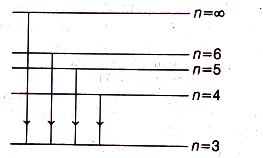
0 likesView Solution
66
PhysicsEasyMCQAP EAMCET · 2022
The following parameter is the same for all hydrogen-like atoms and ions in their ground state.
A
Radius of the orbit
B
Speed of the electron
C
Energy of the atom
D
Orbital angular momentum of the electron.
Solution
(D) According to Bohr's postulate,the orbital angular momentum $L$ of an electron in a hydrogen atom or a hydrogen-like ion is given by the formula:
$L = \frac{n h}{2 \pi}$
where $n$ is the principal quantum number,$h$ is Planck's constant,and $\pi$ is a mathematical constant.
For the ground state,the principal quantum number is $n = 1$ for all hydrogen-like atoms and ions.
Since $h$ and $\pi$ are universal constants,the value of $L$ for $n = 1$ is $L = \frac{h}{2 \pi}$,which is independent of the atomic number $Z$.
Therefore,the orbital angular momentum of the electron is the same for all hydrogen-like atoms and ions in their ground state.
$L = \frac{n h}{2 \pi}$
where $n$ is the principal quantum number,$h$ is Planck's constant,and $\pi$ is a mathematical constant.
For the ground state,the principal quantum number is $n = 1$ for all hydrogen-like atoms and ions.
Since $h$ and $\pi$ are universal constants,the value of $L$ for $n = 1$ is $L = \frac{h}{2 \pi}$,which is independent of the atomic number $Z$.
Therefore,the orbital angular momentum of the electron is the same for all hydrogen-like atoms and ions in their ground state.
0 likesView Solution
67
PhysicsMediumMCQAP EAMCET · 2022
An electron in the hydrogen atom excites from the $2^{nd}$ orbit to the $4^{th}$ orbit. The change in angular momentum of the electron is (Planck's constant $h = 6.64 \times 10^{-34} \ J \cdot s$).
A
$2.11 \times 10^{-34} \ J \cdot s$
B
$1.05 \times 10^{-34} \ J \cdot s$
C
$0.57 \times 10^{-34} \ J \cdot s$
D
$4.22 \times 10^{-34} \ J \cdot s$
Solution
(A) According to Bohr's postulate,the angular momentum $L$ of an electron in the $n^{th}$ orbit is given by $L = \frac{nh}{2\pi}$.
Given that the electron excites from the $n_1 = 2$ orbit to the $n_2 = 4$ orbit.
The change in angular momentum $\Delta L$ is given by:
$\Delta L = L_2 - L_1 = \frac{n_2 h}{2\pi} - \frac{n_1 h}{2\pi} = \frac{h}{2\pi} (n_2 - n_1)$.
Substituting the values:
$\Delta L = \frac{6.64 \times 10^{-34}}{2 \times 3.14} (4 - 2)$.
$\Delta L = \frac{6.64 \times 10^{-34}}{6.28} \times 2$.
$\Delta L = 1.0576 \times 10^{-34} \times 2 \approx 2.11 \times 10^{-34} \ J \cdot s$.
Given that the electron excites from the $n_1 = 2$ orbit to the $n_2 = 4$ orbit.
The change in angular momentum $\Delta L$ is given by:
$\Delta L = L_2 - L_1 = \frac{n_2 h}{2\pi} - \frac{n_1 h}{2\pi} = \frac{h}{2\pi} (n_2 - n_1)$.
Substituting the values:
$\Delta L = \frac{6.64 \times 10^{-34}}{2 \times 3.14} (4 - 2)$.
$\Delta L = \frac{6.64 \times 10^{-34}}{6.28} \times 2$.
$\Delta L = 1.0576 \times 10^{-34} \times 2 \approx 2.11 \times 10^{-34} \ J \cdot s$.
0 likesView Solution
68
PhysicsMediumMCQAP EAMCET · 2022
Energy of a stationary electron in the hydrogen atom is $E = -\frac{13.6}{n^2} \text{ eV}$. Calculate the energies required to excite the electron in a hydrogen atom to $(a)$ its second excited state and $(b)$ its ionized state,respectively.
A
$(a) \sim 10 \text{ eV}, (b) 13.6 \text{ eV}$
B
$(a) \sim 12 \text{ eV}, (b) 13.6 \text{ eV}$
C
$(a) \sim 12 \text{ eV}, (b) 10.6 \text{ eV}$
D
$(a) \sim 8 \text{ eV}, (b) 13.6 \text{ eV}$
Solution
(B) For a hydrogen atom,the energy of the ground state $(n=1)$ is $E_1 = -\frac{13.6}{1^2} = -13.6 \text{ eV}$.
For the second excited state,$n=3$. The energy is $E_3 = -\frac{13.6}{3^2} = -\frac{13.6}{9} \approx -1.51 \text{ eV}$.
The energy required to excite the electron from the ground state to the second excited state is $\Delta E = E_3 - E_1 = -1.51 - (-13.6) = 12.09 \text{ eV} \approx 12 \text{ eV}$.
$(b)$ The ionization energy is the energy required to remove the electron from the ground state $(n=1)$ to infinity $(n=\infty)$.
$E_{\infty} = 0 \text{ eV}$.
Energy required = $E_{\infty} - E_1 = 0 - (-13.6) = 13.6 \text{ eV}$.
For the second excited state,$n=3$. The energy is $E_3 = -\frac{13.6}{3^2} = -\frac{13.6}{9} \approx -1.51 \text{ eV}$.
The energy required to excite the electron from the ground state to the second excited state is $\Delta E = E_3 - E_1 = -1.51 - (-13.6) = 12.09 \text{ eV} \approx 12 \text{ eV}$.
$(b)$ The ionization energy is the energy required to remove the electron from the ground state $(n=1)$ to infinity $(n=\infty)$.
$E_{\infty} = 0 \text{ eV}$.
Energy required = $E_{\infty} - E_1 = 0 - (-13.6) = 13.6 \text{ eV}$.
0 likesView Solution
69
PhysicsEasyMCQAP EAMCET · 2022
$A$ hydrogen atom at the ground level absorbs a photon and is excited to $n=4$ level. The potential energy of the electron in the excited state is
A
$-0.85 eV$
B
$+0.85 eV$
C
$-1.7 eV$
D
$+1.7 eV$
Solution
(C) The total energy of an electron in the $n$-th orbit of a hydrogen atom is given by $E_n = -\frac{13.6}{n^2} eV$.
For the excited state $n=4$,the total energy is $E_4 = -\frac{13.6}{4^2} = -\frac{13.6}{16} = -0.85 eV$.
The potential energy $(PE)$ of an electron in a Bohr orbit is related to the total energy $(E)$ by the relation $PE = 2E$.
Therefore,$PE = 2 \times (-0.85 eV) = -1.7 eV$.
For the excited state $n=4$,the total energy is $E_4 = -\frac{13.6}{4^2} = -\frac{13.6}{16} = -0.85 eV$.
The potential energy $(PE)$ of an electron in a Bohr orbit is related to the total energy $(E)$ by the relation $PE = 2E$.
Therefore,$PE = 2 \times (-0.85 eV) = -1.7 eV$.
0 likesView Solution
70
PhysicsMediumMCQAP EAMCET · 2022
The ratio of radii of $3^{\text{rd}}$ and $6^{\text{th}}$ Bohr's orbit in a hydrogen atom is
A
$0.25$
B
$0.33$
C
$4$
D
$3$
Solution
(A) The radius of the $n^{\text{th}}$ Bohr orbit is given by the formula $r_n = a_0 n^2$,where $a_0$ is the Bohr radius and $n$ is the principal quantum number.
Therefore,the ratio of the radii of the $3^{\text{rd}}$ and $6^{\text{th}}$ orbits is given by $\frac{r_3}{r_6} = \frac{n_3^2}{n_6^2}$.
Substituting the values $n_3 = 3$ and $n_6 = 6$,we get $\frac{r_3}{r_6} = \frac{3^2}{6^2} = \frac{9}{36}$.
Simplifying this fraction,we obtain $\frac{r_3}{r_6} = \frac{1}{4} = 0.25$.
Therefore,the ratio of the radii of the $3^{\text{rd}}$ and $6^{\text{th}}$ orbits is given by $\frac{r_3}{r_6} = \frac{n_3^2}{n_6^2}$.
Substituting the values $n_3 = 3$ and $n_6 = 6$,we get $\frac{r_3}{r_6} = \frac{3^2}{6^2} = \frac{9}{36}$.
Simplifying this fraction,we obtain $\frac{r_3}{r_6} = \frac{1}{4} = 0.25$.
0 likesView Solution
71
PhysicsEasyMCQAP EAMCET · 2022
As the quantum number $n$ increases,the difference in energy between consecutive energy levels
A
Remains the same
B
Increases
C
Decreases
D
Sometimes increases and sometimes decreases
Solution
(C) The energy of the $n^{th}$ level in a hydrogen atom is given by $E_n = -\frac{13.6}{n^2} \text{ eV}$.
The energy difference between consecutive levels is $\Delta E = E_{n+1} - E_n = 13.6 \left[ \frac{1}{n^2} - \frac{1}{(n+1)^2} \right]$.
Simplifying this expression,we get $\Delta E = 13.6 \left[ \frac{(n+1)^2 - n^2}{n^2(n+1)^2} \right] = 13.6 \left[ \frac{2n+1}{n^2(n+1)^2} \right]$.
For large values of $n$,$\Delta E \approx 13.6 \left[ \frac{2n}{n^4} \right] = \frac{27.2}{n^3}$.
Since $\Delta E \propto \frac{1}{n^3}$,as the quantum number $n$ increases,the energy difference $\Delta E$ decreases.
The energy difference between consecutive levels is $\Delta E = E_{n+1} - E_n = 13.6 \left[ \frac{1}{n^2} - \frac{1}{(n+1)^2} \right]$.
Simplifying this expression,we get $\Delta E = 13.6 \left[ \frac{(n+1)^2 - n^2}{n^2(n+1)^2} \right] = 13.6 \left[ \frac{2n+1}{n^2(n+1)^2} \right]$.
For large values of $n$,$\Delta E \approx 13.6 \left[ \frac{2n}{n^4} \right] = \frac{27.2}{n^3}$.
Since $\Delta E \propto \frac{1}{n^3}$,as the quantum number $n$ increases,the energy difference $\Delta E$ decreases.
0 likesView Solution
72
PhysicsDifficultMCQAP EAMCET · 2022
Statement $(A)$: As one considers orbits with higher values of $n$ in a hydrogen atom,the electric potential energy of the atom increases.
Statement $(B)$: In Thomson's model,an atom is a spherical cloud of positive charges with electrons embedded in it.
Statement $(C)$: The orbital picture in Bohr's model of the hydrogen atom was consistent with the uncertainty principle.
Statement $(B)$: In Thomson's model,an atom is a spherical cloud of positive charges with electrons embedded in it.
Statement $(C)$: The orbital picture in Bohr's model of the hydrogen atom was consistent with the uncertainty principle.
A
$A, B$ and $C$ are true
B
$A, B$ true,but $C$ false
C
$B, C$ true,but $A$ false
D
$A, C$ true but $B$ false
Solution
(B) In a hydrogen atom,the potential energy $(PE)$ of an electron in the $n$th orbit is given by $PE = -\frac{kZe^2}{r}$.
For higher values of $n$,the radius $r$ increases because $r \propto n^2$.
As $r$ increases,the magnitude of the negative potential energy decreases,meaning the value of the potential energy increases (becomes less negative).
Thus,statement $(A)$ is correct.
In Thomson's model,an atom is described as a spherical cloud of positive charge with electrons embedded within it,similar to a plum pudding. Thus,statement $(B)$ is correct.
According to Bohr's model,an electron in an atom is located at a definite distance from the nucleus and revolves with a definite velocity. However,Heisenberg's uncertainty principle states that it is impossible to determine the exact position and momentum of a moving electron simultaneously.
Therefore,Bohr's model contradicts the uncertainty principle,making statement $(C)$ incorrect.
Hence,option $(b)$ is the correct answer.
For higher values of $n$,the radius $r$ increases because $r \propto n^2$.
As $r$ increases,the magnitude of the negative potential energy decreases,meaning the value of the potential energy increases (becomes less negative).
Thus,statement $(A)$ is correct.
In Thomson's model,an atom is described as a spherical cloud of positive charge with electrons embedded within it,similar to a plum pudding. Thus,statement $(B)$ is correct.
According to Bohr's model,an electron in an atom is located at a definite distance from the nucleus and revolves with a definite velocity. However,Heisenberg's uncertainty principle states that it is impossible to determine the exact position and momentum of a moving electron simultaneously.
Therefore,Bohr's model contradicts the uncertainty principle,making statement $(C)$ incorrect.
Hence,option $(b)$ is the correct answer.
0 likesView Solution
73
PhysicsEasyMCQAP EAMCET · 2022
Two parallel plate capacitors of $8 \mu F$ each are connected in parallel to a $10 \ V$ battery. The plate separation in one of the capacitors is reduced to $40 \%$ of its initial value. The increase in the total charge stored on the capacitors is
A
$80 \mu C$
B
$120 \mu C$
C
$100 \mu C$
D
$\frac{160}{3} \mu C$
Solution
(B) Given,$C_1 = C_2 = 8 \mu F = 8 \times 10^{-6} \ F$ and $V = 10 \ V$.
Since $C_1$ and $C_2$ are connected in parallel,the initial equivalent capacitance is $C_{eq} = C_1 + C_2 = 16 \mu F = 1.6 \times 10^{-5} \ F$.
The initial total charge is $q_i = C_{eq} \cdot V = 1.6 \times 10^{-5} \times 10 = 1.6 \times 10^{-4} \ C = 160 \mu C$.
We know that capacitance $C = \frac{\varepsilon_0 A}{d}$,so $C \propto \frac{1}{d}$.
If the plate separation $d$ is reduced to $40 \%$ of its initial value,the new separation is $d' = 0.4d$. Thus,the new capacitance $C'$ becomes $C' = \frac{C}{0.4} = \frac{C}{2/5} = 2.5C = \frac{5}{2}C$.
Wait,the problem states the separation is reduced $TO$ $40 \%$,meaning $d' = 0.4d$. So $C' = \frac{C}{0.4} = 2.5 \times 8 \mu F = 20 \mu F$.
New total capacitance $C_{eq}' = C' + C_2 = 20 \mu F + 8 \mu F = 28 \mu F$.
New charge $q_f = C_{eq}' \cdot V = 28 \mu F \times 10 \ V = 280 \mu C$.
Increase in charge $\Delta q = q_f - q_i = 280 \mu C - 160 \mu C = 120 \mu C$.
Since $C_1$ and $C_2$ are connected in parallel,the initial equivalent capacitance is $C_{eq} = C_1 + C_2 = 16 \mu F = 1.6 \times 10^{-5} \ F$.
The initial total charge is $q_i = C_{eq} \cdot V = 1.6 \times 10^{-5} \times 10 = 1.6 \times 10^{-4} \ C = 160 \mu C$.
We know that capacitance $C = \frac{\varepsilon_0 A}{d}$,so $C \propto \frac{1}{d}$.
If the plate separation $d$ is reduced to $40 \%$ of its initial value,the new separation is $d' = 0.4d$. Thus,the new capacitance $C'$ becomes $C' = \frac{C}{0.4} = \frac{C}{2/5} = 2.5C = \frac{5}{2}C$.
Wait,the problem states the separation is reduced $TO$ $40 \%$,meaning $d' = 0.4d$. So $C' = \frac{C}{0.4} = 2.5 \times 8 \mu F = 20 \mu F$.
New total capacitance $C_{eq}' = C' + C_2 = 20 \mu F + 8 \mu F = 28 \mu F$.
New charge $q_f = C_{eq}' \cdot V = 28 \mu F \times 10 \ V = 280 \mu C$.
Increase in charge $\Delta q = q_f - q_i = 280 \mu C - 160 \mu C = 120 \mu C$.
0 likesView Solution
74
PhysicsEasyMCQAP EAMCET · 2022
$A$ capacitor has capacitance $C_0$ when there is no dielectric between its plates. Two slabs of dielectric constant $K_1$ and $K_2$ respectively,with area equal to the area of the plates but thickness half of the distance between the plates,are placed in between the plates. Then the new capacitance is
A
$C_0(K_1+K_2)$
B
$C_0\left(\frac{K_1 K_2}{K_1+K_2}\right)$
C
$C_0\left(\frac{K_1+K_2}{K_1 K_2}\right)$
D
$2 C_0\left(\frac{K_1 K_2}{K_1+K_2}\right)$
Solution
(D) The initial capacitance of the capacitor is $C_0 = \frac{\varepsilon_0 A}{d}$.
When two dielectric slabs of thickness $d/2$ are placed between the plates,the arrangement acts as two capacitors in series,each with plate separation $d/2$.
The capacitance of the first slab is $C_1 = \frac{K_1 \varepsilon_0 A}{d/2} = \frac{2 K_1 \varepsilon_0 A}{d} = 2 K_1 C_0$.
The capacitance of the second slab is $C_2 = \frac{K_2 \varepsilon_0 A}{d/2} = \frac{2 K_2 \varepsilon_0 A}{d} = 2 K_2 C_0$.
Since they are in series,the equivalent capacitance $C_{eq}$ is given by:
$\frac{1}{C_{eq}} = \frac{1}{C_1} + \frac{1}{C_2} = \frac{1}{2 K_1 C_0} + \frac{1}{2 K_2 C_0} = \frac{1}{2 C_0} \left( \frac{1}{K_1} + \frac{1}{K_2} \right) = \frac{1}{2 C_0} \left( \frac{K_1 + K_2}{K_1 K_2} \right)$.
Therefore,$C_{eq} = 2 C_0 \left( \frac{K_1 K_2}{K_1 + K_2} \right)$.
When two dielectric slabs of thickness $d/2$ are placed between the plates,the arrangement acts as two capacitors in series,each with plate separation $d/2$.
The capacitance of the first slab is $C_1 = \frac{K_1 \varepsilon_0 A}{d/2} = \frac{2 K_1 \varepsilon_0 A}{d} = 2 K_1 C_0$.
The capacitance of the second slab is $C_2 = \frac{K_2 \varepsilon_0 A}{d/2} = \frac{2 K_2 \varepsilon_0 A}{d} = 2 K_2 C_0$.
Since they are in series,the equivalent capacitance $C_{eq}$ is given by:
$\frac{1}{C_{eq}} = \frac{1}{C_1} + \frac{1}{C_2} = \frac{1}{2 K_1 C_0} + \frac{1}{2 K_2 C_0} = \frac{1}{2 C_0} \left( \frac{1}{K_1} + \frac{1}{K_2} \right) = \frac{1}{2 C_0} \left( \frac{K_1 + K_2}{K_1 K_2} \right)$.
Therefore,$C_{eq} = 2 C_0 \left( \frac{K_1 K_2}{K_1 + K_2} \right)$.
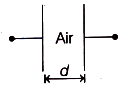
0 likesView Solution
75
PhysicsEasyMCQAP EAMCET · 2022
The effective capacitance between points $X$ and $Y$ in the figure shown below is. (Assume all the capacitors are $4 \mu F$ each) (in $\mu F$)
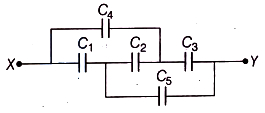
A
$3$
B
$1$
C
$4$
D
$2$
Solution
(C) Given, $C_1 = C_2 = C_3 = C_4 = C_5 = 4 \mu F$.
Looking at the circuit, we can identify that the capacitors $C_1, C_2, C_3, C_4, C_5$ form a bridge network.
Let the nodes be $X$ (input), $Y$ (output), and intermediate nodes $A, B, C$.
By analyzing the potential distribution, we can see that the circuit is equivalent to a parallel combination of two branches.
Specifically, the branch containing $C_1$ and $C_2$ in series is in parallel with the branch containing $C_4$ and $C_5$ in series, and so on.
However, a simpler way to view this is to recognize that the circuit simplifies to two parallel branches, each consisting of two capacitors in series.
$C_{eq} = (C_1 \text{ in series with } C_2) + (C_4 \text{ in series with } C_5)$.
Since all $C = 4 \mu F$, the series combination of two $4 \mu F$ capacitors is $\frac{4 \times 4}{4 + 4} = 2 \mu F$.
Thus, $C_{eq} = 2 \mu F + 2 \mu F = 4 \mu F$.
Looking at the circuit, we can identify that the capacitors $C_1, C_2, C_3, C_4, C_5$ form a bridge network.
Let the nodes be $X$ (input), $Y$ (output), and intermediate nodes $A, B, C$.
By analyzing the potential distribution, we can see that the circuit is equivalent to a parallel combination of two branches.
Specifically, the branch containing $C_1$ and $C_2$ in series is in parallel with the branch containing $C_4$ and $C_5$ in series, and so on.
However, a simpler way to view this is to recognize that the circuit simplifies to two parallel branches, each consisting of two capacitors in series.
$C_{eq} = (C_1 \text{ in series with } C_2) + (C_4 \text{ in series with } C_5)$.
Since all $C = 4 \mu F$, the series combination of two $4 \mu F$ capacitors is $\frac{4 \times 4}{4 + 4} = 2 \mu F$.
Thus, $C_{eq} = 2 \mu F + 2 \mu F = 4 \mu F$.
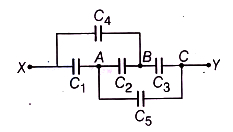
0 likesView Solution
76
PhysicsMediumMCQAP EAMCET · 2022
$A$ parallel plate capacitor with air between the plates has a capacitance of $12 \mu F$. If the distance between the plates is doubled and the space between the plates is filled with a substance of dielectric constant $4$,what will be the new capacitance of the capacitor (in $\mu F$)?
A
$24$
B
$72$
C
$6$
D
$12$
Solution
(A) The capacitance of a parallel plate capacitor is given by $C = \frac{K A \varepsilon_0}{d}$.
Initially,for air,$K_1 = 1$ and $d_1 = d$,so $C_1 = \frac{A \varepsilon_0}{d} = 12 \mu F$.
When the distance is doubled,$d_2 = 2d$,and the dielectric constant is $K_2 = 4$.
The new capacitance $C_2$ is given by $C_2 = \frac{K_2 A \varepsilon_0}{d_2}$.
Substituting the values,we get $C_2 = \frac{4 A \varepsilon_0}{2d} = 2 \left( \frac{A \varepsilon_0}{d} \right) = 2 \times C_1$.
Therefore,$C_2 = 2 \times 12 \mu F = 24 \mu F$.
Initially,for air,$K_1 = 1$ and $d_1 = d$,so $C_1 = \frac{A \varepsilon_0}{d} = 12 \mu F$.
When the distance is doubled,$d_2 = 2d$,and the dielectric constant is $K_2 = 4$.
The new capacitance $C_2$ is given by $C_2 = \frac{K_2 A \varepsilon_0}{d_2}$.
Substituting the values,we get $C_2 = \frac{4 A \varepsilon_0}{2d} = 2 \left( \frac{A \varepsilon_0}{d} \right) = 2 \times C_1$.
Therefore,$C_2 = 2 \times 12 \mu F = 24 \mu F$.
0 likesView Solution
77
PhysicsMediumMCQAP EAMCET · 2022
$A$ capacitor of capacitance $C_1 = 10 \mu F$ is charged using a $9 \text{ V}$ battery. It is then removed from the battery and connected to another uncharged capacitor $C_2 = 20 \mu F$ as shown in the figure. The charge on $C_2$ after equilibrium is reached is:
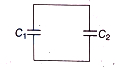
A
$6.0 \times 10^{-5} \text{ C}$
B
$60 \times 10^{-6} \text{ C}$
C
$3.0 \times 10^{-5} \text{ C}$
D
$3.0 \times 10^{-6} \text{ C}$
Solution
(A) Given:
$C_1 = 10 \mu F = 10^{-5} \text{ F}$
$V_1 = 9 \text{ V}$
Initial charge on capacitor $C_1$:
$q_1 = C_1 V_1 = 10^{-5} \times 9 = 9 \times 10^{-5} \text{ C}$
When the uncharged capacitor $C_2 = 20 \mu F = 2 \times 10^{-5} \text{ F}$ is connected in parallel to the charged capacitor $C_1$,charge flows from $C_1$ to $C_2$ until both capacitors reach a common potential $V$.
The common potential $V$ is given by:
$V = \frac{\text{Total Charge}}{\text{Total Capacitance}} = \frac{q_1}{C_1 + C_2}$
$V = \frac{9 \times 10^{-5}}{10^{-5} + 2 \times 10^{-5}} = \frac{9 \times 10^{-5}}{3 \times 10^{-5}} = 3 \text{ V}$
The charge on capacitor $C_2$ at equilibrium is:
$q_2 = C_2 V = (2 \times 10^{-5} \text{ F}) \times (3 \text{ V}) = 6 \times 10^{-5} \text{ C}$
$C_1 = 10 \mu F = 10^{-5} \text{ F}$
$V_1 = 9 \text{ V}$
Initial charge on capacitor $C_1$:
$q_1 = C_1 V_1 = 10^{-5} \times 9 = 9 \times 10^{-5} \text{ C}$
When the uncharged capacitor $C_2 = 20 \mu F = 2 \times 10^{-5} \text{ F}$ is connected in parallel to the charged capacitor $C_1$,charge flows from $C_1$ to $C_2$ until both capacitors reach a common potential $V$.
The common potential $V$ is given by:
$V = \frac{\text{Total Charge}}{\text{Total Capacitance}} = \frac{q_1}{C_1 + C_2}$
$V = \frac{9 \times 10^{-5}}{10^{-5} + 2 \times 10^{-5}} = \frac{9 \times 10^{-5}}{3 \times 10^{-5}} = 3 \text{ V}$
The charge on capacitor $C_2$ at equilibrium is:
$q_2 = C_2 V = (2 \times 10^{-5} \text{ F}) \times (3 \text{ V}) = 6 \times 10^{-5} \text{ C}$
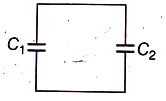
0 likesView Solution
78
PhysicsMediumMCQAP EAMCET · 2022
$A$ parallel plate capacitor of capacitance $500 \ pF$ is charged with a $100 \ V$ supply. It is then disconnected from the supply and connected to another uncharged $500 \ pF$ capacitor. The electrostatic energy lost in this process is (in $\mu J$)
A
$1.25$
B
$0.175$
C
$0.225$
D
$0.275$
Solution
(A) Initial stored energy $U_i = \frac{1}{2} C_1 V_1^2$
$U_i = \frac{1}{2} \times 500 \times 10^{-12} \times (100)^2 = 2.5 \ \mu J$
When the capacitors are connected,the charge is redistributed until the potential becomes common.
Common potential $V = \frac{C_1 V_1 + C_2 V_2}{C_1 + C_2} = \frac{500 \times 10^{-12} \times 100 + 0}{500 \times 10^{-12} + 500 \times 10^{-12}} = 50 \ V$
Final stored energy $U_f = \frac{1}{2} (C_1 + C_2) V^2$
$U_f = \frac{1}{2} \times (1000 \times 10^{-12}) \times (50)^2 = 1.25 \ \mu J$
Energy lost $\Delta U = U_i - U_f = 2.5 \ \mu J - 1.25 \ \mu J = 1.25 \ \mu J$
$U_i = \frac{1}{2} \times 500 \times 10^{-12} \times (100)^2 = 2.5 \ \mu J$
When the capacitors are connected,the charge is redistributed until the potential becomes common.
Common potential $V = \frac{C_1 V_1 + C_2 V_2}{C_1 + C_2} = \frac{500 \times 10^{-12} \times 100 + 0}{500 \times 10^{-12} + 500 \times 10^{-12}} = 50 \ V$
Final stored energy $U_f = \frac{1}{2} (C_1 + C_2) V^2$
$U_f = \frac{1}{2} \times (1000 \times 10^{-12}) \times (50)^2 = 1.25 \ \mu J$
Energy lost $\Delta U = U_i - U_f = 2.5 \ \mu J - 1.25 \ \mu J = 1.25 \ \mu J$
0 likesView Solution
79
PhysicsMediumMCQAP EAMCET · 2022
$A$ capacitor of capacitance $C_1 = 1 \ \mu F$ is charged using a $9 \ V$ battery. $C_1$ is then removed from the battery and connected to capacitors $C_2$ and $C_3$ of $2 \ \mu F$ and $3 \ \mu F$ respectively,as shown in the figure. Find the charge on $C_3$ after equilibrium is reached.
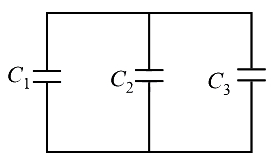
A
$4.5 \times 10^{-6} \ C$
B
$3.5 \times 10^{-6} \ C$
C
$2.5 \times 10^{-6} \ C$
D
$1.5 \times 10^{-5} \ C$
Solution
(A) Initially,when $C_1$ is connected to a $9 \ V$ battery,the charge on it is $q_0 = C_1 V = 1 \ \mu F \times 9 \ V = 9 \ \mu C$.
When $C_1$ is connected to $C_2$ and $C_3$ in parallel,the total charge $q_0$ is redistributed among the three capacitors such that they all have the same potential difference $V'$.
By the law of conservation of charge,$q_1 + q_2 + q_3 = q_0 = 9 \ \mu C$.
Since they are in parallel,$V' = \frac{q_1}{C_1} = \frac{q_2}{C_2} = \frac{q_3}{C_3}$.
Substituting the values,$\frac{q_1}{1} = \frac{q_2}{2} = \frac{q_3}{3} = V'$.
Thus,$q_1 = V'$,$q_2 = 2V'$,and $q_3 = 3V'$.
Substituting these into the conservation equation: $V' + 2V' + 3V' = 9 \ \mu C$.
$6V' = 9 \ \mu C \Rightarrow V' = 1.5 \ V$.
The charge on $C_3$ is $q_3 = C_3 V' = 3 \ \mu F \times 1.5 \ V = 4.5 \ \mu C = 4.5 \times 10^{-6} \ C$.
When $C_1$ is connected to $C_2$ and $C_3$ in parallel,the total charge $q_0$ is redistributed among the three capacitors such that they all have the same potential difference $V'$.
By the law of conservation of charge,$q_1 + q_2 + q_3 = q_0 = 9 \ \mu C$.
Since they are in parallel,$V' = \frac{q_1}{C_1} = \frac{q_2}{C_2} = \frac{q_3}{C_3}$.
Substituting the values,$\frac{q_1}{1} = \frac{q_2}{2} = \frac{q_3}{3} = V'$.
Thus,$q_1 = V'$,$q_2 = 2V'$,and $q_3 = 3V'$.
Substituting these into the conservation equation: $V' + 2V' + 3V' = 9 \ \mu C$.
$6V' = 9 \ \mu C \Rightarrow V' = 1.5 \ V$.
The charge on $C_3$ is $q_3 = C_3 V' = 3 \ \mu F \times 1.5 \ V = 4.5 \ \mu C = 4.5 \times 10^{-6} \ C$.
0 likesView Solution
80
PhysicsEasyMCQAP EAMCET · 2022
Find the equivalent capacitance between the points $A$ and $B$ in the given figure.
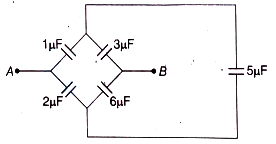
A
$\frac{3}{8} \mu F$
B
$\frac{9}{4} \mu F$
C
$\frac{4}{5} \mu F$
D
$2 \mu F$
Solution
(B) The given circuit is a Wheatstone bridge configuration. Let the capacitors be $C_1 = 1 \mu F$,$C_2 = 3 \mu F$,$C_3 = 2 \mu F$,$C_4 = 6 \mu F$,and the central capacitor $C_5 = 5 \mu F$.
Check the ratio of capacitors in the arms: $\frac{C_1}{C_3} = \frac{1}{2}$ and $\frac{C_2}{C_4} = \frac{3}{6} = \frac{1}{2}$.
Since $\frac{C_1}{C_3} = \frac{C_2}{C_4}$,the Wheatstone bridge is balanced.
In a balanced Wheatstone bridge,no charge flows through the central capacitor $C_5$,so it can be removed from the circuit.
Now,the circuit consists of two parallel branches: one with $C_1$ and $C_2$ in series,and the other with $C_3$ and $C_4$ in series.
Equivalent capacitance of the upper branch: $C_{up} = \frac{C_1 C_2}{C_1 + C_2} = \frac{1 \times 3}{1 + 3} = \frac{3}{4} \mu F$.
Equivalent capacitance of the lower branch: $C_{low} = \frac{C_3 C_4}{C_3 + C_4} = \frac{2 \times 6}{2 + 6} = \frac{12}{8} = \frac{3}{2} \mu F$.
Since these two branches are in parallel,the total equivalent capacitance $C_{AB} = C_{up} + C_{low} = \frac{3}{4} + \frac{3}{2} = \frac{3 + 6}{4} = \frac{9}{4} \mu F$.
Check the ratio of capacitors in the arms: $\frac{C_1}{C_3} = \frac{1}{2}$ and $\frac{C_2}{C_4} = \frac{3}{6} = \frac{1}{2}$.
Since $\frac{C_1}{C_3} = \frac{C_2}{C_4}$,the Wheatstone bridge is balanced.
In a balanced Wheatstone bridge,no charge flows through the central capacitor $C_5$,so it can be removed from the circuit.
Now,the circuit consists of two parallel branches: one with $C_1$ and $C_2$ in series,and the other with $C_3$ and $C_4$ in series.
Equivalent capacitance of the upper branch: $C_{up} = \frac{C_1 C_2}{C_1 + C_2} = \frac{1 \times 3}{1 + 3} = \frac{3}{4} \mu F$.
Equivalent capacitance of the lower branch: $C_{low} = \frac{C_3 C_4}{C_3 + C_4} = \frac{2 \times 6}{2 + 6} = \frac{12}{8} = \frac{3}{2} \mu F$.
Since these two branches are in parallel,the total equivalent capacitance $C_{AB} = C_{up} + C_{low} = \frac{3}{4} + \frac{3}{2} = \frac{3 + 6}{4} = \frac{9}{4} \mu F$.
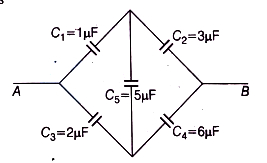
0 likesView Solution
81
PhysicsMediumMCQAP EAMCET · 2022
In a parallel plate capacitor,if $10^{12}$ electrons pass from one plate to another,a potential difference of $10 \,V$ is developed across the plates. The capacitance of the capacitor is
A
$0.16 \times 10^{-8} \,F$
B
$1.6 \times 10^{-8} \,F$
C
$16 \times 10^{-8} \,F$
D
$0.8 \times 10^{-8} \,F$
Solution
(B) The magnitude of the charge transferred between the plates is given by $Q = N \cdot e$.
Given $N = 10^{12}$ electrons and $e = 1.6 \times 10^{-19} \,C$.
So,$Q = 10^{12} \times 1.6 \times 10^{-19} = 1.6 \times 10^{-7} \,C$.
The potential difference developed is $V = 10 \,V$.
The capacitance $C$ is defined as $C = \frac{Q}{V}$.
Substituting the values,$C = \frac{1.6 \times 10^{-7}}{10} = 1.6 \times 10^{-8} \,F$.
Given $N = 10^{12}$ electrons and $e = 1.6 \times 10^{-19} \,C$.
So,$Q = 10^{12} \times 1.6 \times 10^{-19} = 1.6 \times 10^{-7} \,C$.
The potential difference developed is $V = 10 \,V$.
The capacitance $C$ is defined as $C = \frac{Q}{V}$.
Substituting the values,$C = \frac{1.6 \times 10^{-7}}{10} = 1.6 \times 10^{-8} \,F$.
0 likesView Solution
82
PhysicsEasyMCQAP EAMCET · 2022
$25$ capacitors,each of capacitance $2 \mu F$,are connected in series to a battery of $100 \ V$. The total charge stored on the capacitors is
A
$2.0 \times 10^{-5} C$
B
$2.5 \times 10^{-3} C$
C
$4.0 \times 10^{-6} C$
D
$8.0 \times 10^{-5} C$
Solution
(D) In a series combination of $n$ identical capacitors each of capacitance $C$,the equivalent capacitance $C_{eq}$ is given by:
$C_{eq} = \frac{C}{n}$
Given $n = 25$ and $C = 2 \mu F = 2 \times 10^{-6} F$.
$C_{eq} = \frac{2 \times 10^{-6}}{25} F = 0.08 \times 10^{-6} F = 8 \times 10^{-8} F$.
The potential difference applied is $V = 100 \ V$.
The total charge $Q$ stored on the series combination is the same as the charge on each capacitor,given by:
$Q = C_{eq} \times V$
$Q = (8 \times 10^{-8} F) \times (100 \ V)$
$Q = 8 \times 10^{-6} C$.
$C_{eq} = \frac{C}{n}$
Given $n = 25$ and $C = 2 \mu F = 2 \times 10^{-6} F$.
$C_{eq} = \frac{2 \times 10^{-6}}{25} F = 0.08 \times 10^{-6} F = 8 \times 10^{-8} F$.
The potential difference applied is $V = 100 \ V$.
The total charge $Q$ stored on the series combination is the same as the charge on each capacitor,given by:
$Q = C_{eq} \times V$
$Q = (8 \times 10^{-8} F) \times (100 \ V)$
$Q = 8 \times 10^{-6} C$.
0 likesView Solution
83
PhysicsMediumMCQAP EAMCET · 2022
The maximum number of $TV$ signals that can be transmitted along a coaxial cable is
A
$100$
B
$125$
C
$140$
D
$90$
Solution
(B) coaxial cable,also known as $TV$ aerial cable or coax,is primarily used to carry video and data signals from an antenna to a device such as a satellite dish or television.
This is due to the well-insulated conductor wire,which prevents frequency interference.
Coaxial cables can transmit a high range of frequencies due to low power losses.
The maximum number of $TV$ signals that can be transmitted simultaneously along a single coaxial cable is $125$.
This is due to the well-insulated conductor wire,which prevents frequency interference.
Coaxial cables can transmit a high range of frequencies due to low power losses.
The maximum number of $TV$ signals that can be transmitted simultaneously along a single coaxial cable is $125$.
0 likesView Solution
84
PhysicsEasyMCQAP EAMCET · 2022
Frequencies in the $UHF$ range normally propagate by means of:
A
Space waves
B
Surface waves
C
Ground waves
D
Sky waves
Solution
(A) The $UHF$ (Ultra High Frequency) range typically spans from $300 \ MHz$ to $3000 \ MHz$.
Due to their high frequency,these waves cannot be reflected by the ionosphere (sky waves) and are heavily attenuated by the ground (ground waves).
Therefore,they propagate primarily through line-of-sight communication,which is achieved by means of space waves.
Due to their high frequency,these waves cannot be reflected by the ionosphere (sky waves) and are heavily attenuated by the ground (ground waves).
Therefore,they propagate primarily through line-of-sight communication,which is achieved by means of space waves.
0 likesView Solution
85
PhysicsEasyMCQAP EAMCET · 2022
Microwaves are used in the following:
A
$FM$ radio
B
Eye surgery
C
Cancer treatment
D
Radar system
Solution
(D) Microwaves have a short wavelength and travel in straight lines. They do not bend significantly around corners of obstacles in their path. Due to this property,they are highly effective for detection and tracking,which is why they are extensively used in radar systems for remote sensing and navigation.
0 likesView Solution
86
PhysicsEasyMCQAP EAMCET · 2022
The frequency band for uplink satellite communication is
A
$5.9-6.4 \text{ GHz}$
B
$54-72 \text{ MHz}$
C
$88-108 \text{ MHz}$
D
$540-1600 \text{ kHz}$
Solution
(A) In satellite communication,the uplink frequency is the frequency at which the ground station transmits signals to the satellite.
This frequency is kept high (in the microwave range) to ensure that the signals can penetrate the ionosphere without being reflected back to Earth.
The standard frequency band used for uplink satellite communication is $5.9-6.4 \text{ GHz}$.
This frequency is kept high (in the microwave range) to ensure that the signals can penetrate the ionosphere without being reflected back to Earth.
The standard frequency band used for uplink satellite communication is $5.9-6.4 \text{ GHz}$.
0 likesView Solution
87
PhysicsMediumMCQAP EAMCET · 2022
$A$ carrier wave is used to transmit a message signal. If the peak voltage of the modulating signal and the carrier signal are increased by $1 \%$ and $3 \%$ respectively,the modulation index is changed by (in $\%$)
A
$-2$
B
$4$
C
$2$
D
$-4$
Solution
(A) The modulation index $m$ is defined as the ratio of the peak voltage of the modulating signal $(E_m)$ to the peak voltage of the carrier signal $(E_c)$: $m = \frac{E_m}{E_c}$.
When the modulating signal is increased by $1 \%$,the new peak voltage is $E_m' = E_m(1 + 0.01) = 1.01 E_m$.
When the carrier signal is increased by $3 \%$,the new peak voltage is $E_c' = E_c(1 + 0.03) = 1.03 E_c$.
The new modulation index $m'$ is given by $m' = \frac{E_m'}{E_c'} = \frac{1.01 E_m}{1.03 E_c} \approx 0.9806 m$.
The percentage change in the modulation index is $\frac{m' - m}{m} \times 100 = (0.9806 - 1) \times 100 \approx -1.94 \% \approx -2 \%$.
Thus,the modulation index changes by approximately $-2 \%$.
When the modulating signal is increased by $1 \%$,the new peak voltage is $E_m' = E_m(1 + 0.01) = 1.01 E_m$.
When the carrier signal is increased by $3 \%$,the new peak voltage is $E_c' = E_c(1 + 0.03) = 1.03 E_c$.
The new modulation index $m'$ is given by $m' = \frac{E_m'}{E_c'} = \frac{1.01 E_m}{1.03 E_c} \approx 0.9806 m$.
The percentage change in the modulation index is $\frac{m' - m}{m} \times 100 = (0.9806 - 1) \times 100 \approx -1.94 \% \approx -2 \%$.
Thus,the modulation index changes by approximately $-2 \%$.
0 likesView Solution
88
PhysicsMediumMCQAP EAMCET · 2022
$A$ message signal of frequency $8 \text{ kHz}$ and peak voltage $12 \text{ V}$ is used to modulate a carrier of frequency $1.2 \text{ MHz}$ and peak voltage $20 \text{ V}$. The modulation index is
A
$0.2$
B
$0.3$
C
$0.4$
D
$0.6$
Solution
(D) The modulation index $\mu$ is defined as the ratio of the peak voltage of the message signal $(A_m)$ to the peak voltage of the carrier signal $(A_c)$.
Given:
$A_m = 12 \text{ V}$
$A_c = 20 \text{ V}$
Formula:
$\mu = \frac{A_m}{A_c}$
Calculation:
$\mu = \frac{12}{20} = \frac{3}{5} = 0.6$
Therefore,the modulation index is $0.6$.
Given:
$A_m = 12 \text{ V}$
$A_c = 20 \text{ V}$
Formula:
$\mu = \frac{A_m}{A_c}$
Calculation:
$\mu = \frac{12}{20} = \frac{3}{5} = 0.6$
Therefore,the modulation index is $0.6$.
0 likesView Solution
89
PhysicsMediumMCQAP EAMCET · 2022
The maximum amplitude of an $AM$ wave is found to be $20 \,V$ while its minimum amplitude is $4 \,V$. The modulation index is
A
$0.33$
B
$0.67$
C
$0.44$
D
$0.63$
Solution
(B) Maximum amplitude of $AM$ wave, $A_{\max} = 20 \,V$.
Minimum amplitude of $AM$ wave, $A_{\min} = 4 \,V$.
The modulation index $\mu$ is given by the formula:
$\mu = \frac{A_{\max} - A_{\min}}{A_{\max} + A_{\min}}$
Substituting the values:
$\mu = \frac{20 - 4}{20 + 4} = \frac{16}{24} = \frac{2}{3} \approx 0.67$.
Minimum amplitude of $AM$ wave, $A_{\min} = 4 \,V$.
The modulation index $\mu$ is given by the formula:
$\mu = \frac{A_{\max} - A_{\min}}{A_{\max} + A_{\min}}$
Substituting the values:
$\mu = \frac{20 - 4}{20 + 4} = \frac{16}{24} = \frac{2}{3} \approx 0.67$.
0 likesView Solution
90
PhysicsEasyMCQAP EAMCET · 2022
The minimum size of an antenna for transmitting electromagnetic waves at $1500 \text{ MHz}$ is
A
$2 \text{ cm}$
B
$5 \text{ cm}$
C
$2 \text{ m}$
D
$200 \text{ cm}$
Solution
(B) The minimum size of a transmitting antenna is given by $l = \frac{\lambda}{4}$.
Given frequency $f = 1500 \text{ MHz} = 1500 \times 10^6 \text{ Hz}$.
The speed of light $c = 3 \times 10^8 \text{ m/s}$.
The wavelength $\lambda = \frac{c}{f} = \frac{3 \times 10^8}{1500 \times 10^6} = \frac{3}{15} = 0.2 \text{ m}$.
Therefore,the minimum length $l = \frac{0.2}{4} = 0.05 \text{ m}$.
Converting to centimeters,$l = 0.05 \times 100 = 5 \text{ cm}$.
Given frequency $f = 1500 \text{ MHz} = 1500 \times 10^6 \text{ Hz}$.
The speed of light $c = 3 \times 10^8 \text{ m/s}$.
The wavelength $\lambda = \frac{c}{f} = \frac{3 \times 10^8}{1500 \times 10^6} = \frac{3}{15} = 0.2 \text{ m}$.
Therefore,the minimum length $l = \frac{0.2}{4} = 0.05 \text{ m}$.
Converting to centimeters,$l = 0.05 \times 100 = 5 \text{ cm}$.
0 likesView Solution
91
PhysicsEasyMCQAP EAMCET · 2022
The amplitude of the side bands of the modulated signal, if the carrier signal and message signal amplitudes are $25 \,V$ and $5 \,V$ respectively, is (in $\,V$)
A
$0.5$
B
$2.5$
C
$0.2$
D
$5$
Solution
(B) The modulation index $m$ is defined as the ratio of the message signal amplitude $A_m$ to the carrier signal amplitude $A_c$.
$m = \frac{A_m}{A_c} = \frac{5 \,V}{25 \,V} = \frac{1}{5} = 0.2$.
In amplitude modulation, the amplitude of each sideband (upper and lower) is given by the formula $\frac{m A_c}{2}$.
Substituting the values, we get:
Amplitude of side band $= \frac{0.2 \times 25 \,V}{2} = \frac{5 \,V}{2} = 2.5 \,V$.
$m = \frac{A_m}{A_c} = \frac{5 \,V}{25 \,V} = \frac{1}{5} = 0.2$.
In amplitude modulation, the amplitude of each sideband (upper and lower) is given by the formula $\frac{m A_c}{2}$.
Substituting the values, we get:
Amplitude of side band $= \frac{0.2 \times 25 \,V}{2} = \frac{5 \,V}{2} = 2.5 \,V$.
0 likesView Solution
92
PhysicsEasyMCQAP EAMCET · 2022
$A$ carrier wave of peak voltage $60 \,V$ is used to transmit a message signal. Then the peak voltage of the modulating signal in order to have a modulation index of $90 \%$ is (in $\,V$)
A
$30$
B
$54$
C
$45$
D
$60$
Solution
(B) The modulation index $\mu$ is defined as the ratio of the amplitude of the modulating signal $(A_M)$ to the amplitude of the carrier wave $(A_C)$.
$\mu = \frac{A_M}{A_C}$
Given,$\mu = 90 \% = 0.9$ and $A_C = 60 \,V$.
Substituting the values into the formula:
$0.9 = \frac{A_M}{60}$
$A_M = 0.9 \times 60$
$A_M = 54 \,V$
Thus,the peak voltage of the modulating signal is $54 \,V$.
$\mu = \frac{A_M}{A_C}$
Given,$\mu = 90 \% = 0.9$ and $A_C = 60 \,V$.
Substituting the values into the formula:
$0.9 = \frac{A_M}{60}$
$A_M = 0.9 \times 60$
$A_M = 54 \,V$
Thus,the peak voltage of the modulating signal is $54 \,V$.
0 likesView Solution
93
PhysicsMediumMCQAP EAMCET · 2022
The frequency range suitable for beyond-the-horizon communication using sky waves is:
A
$10 kHz$
B
$10 MHz$
C
$1 GHz$
D
$1000 GHz$
Solution
(B) Sky wave propagation,also known as skip propagation,involves the reflection of radio waves off the ionosphere to reach locations beyond the horizon.
This mode of communication is typically effective for frequencies in the range of $3 MHz$ to $30 MHz$,which is known as the High Frequency $(HF)$ band.
Among the given options,$10 MHz$ falls within this range,making it the most suitable frequency for sky wave communication.
This mode of communication is typically effective for frequencies in the range of $3 MHz$ to $30 MHz$,which is known as the High Frequency $(HF)$ band.
Among the given options,$10 MHz$ falls within this range,making it the most suitable frequency for sky wave communication.
0 likesView Solution
94
PhysicsEasyMCQAP EAMCET · 2022
$A$ cell can supply currents of $1 \ A$ and $0.5 \ A$ via resistances of $2.5 \ \Omega$ and $10 \ \Omega$ respectively. The internal resistance of the cell is (in $Omega$)
A
$2$
B
$3$
C
$4$
D
$5$
Solution
(D) Let the electromotive force $(EMF)$ of the cell be $E$ and its internal resistance be $r$.
According to Ohm's law,the current $I$ in a circuit with external resistance $R$ is given by $I = \frac{E}{R + r}$.
For the first case: $1 = \frac{E}{2.5 + r} \implies E = 2.5 + r$ (Equation $1$).
For the second case: $0.5 = \frac{E}{10 + r} \implies E = 0.5(10 + r) = 5 + 0.5r$ (Equation $2$).
Equating the two expressions for $E$:
$2.5 + r = 5 + 0.5r$
$r - 0.5r = 5 - 2.5$
$0.5r = 2.5$
$r = \frac{2.5}{0.5} = 5 \ \Omega$.
Therefore,the internal resistance of the cell is $5 \ \Omega$.
According to Ohm's law,the current $I$ in a circuit with external resistance $R$ is given by $I = \frac{E}{R + r}$.
For the first case: $1 = \frac{E}{2.5 + r} \implies E = 2.5 + r$ (Equation $1$).
For the second case: $0.5 = \frac{E}{10 + r} \implies E = 0.5(10 + r) = 5 + 0.5r$ (Equation $2$).
Equating the two expressions for $E$:
$2.5 + r = 5 + 0.5r$
$r - 0.5r = 5 - 2.5$
$0.5r = 2.5$
$r = \frac{2.5}{0.5} = 5 \ \Omega$.
Therefore,the internal resistance of the cell is $5 \ \Omega$.
0 likesView Solution
95
PhysicsDifficultMCQAP EAMCET · 2022
$A$ battery with a $12 \, V$ emf has an initial charge of $80 \, A \cdot h$. If the potential across the terminals stays constant until the battery is completely discharged, then this battery can deliver energy at the rate of $120 \, W$ for a time of: (in $ \, h$)
A
$16$
B
$8$
C
$4$
D
$5$
Solution
(B) Given:
Electromotive force (emf) $\varepsilon = 12 \, V$
Total charge capacity $q = 80 \, A \cdot h$
Power output $P = 120 \, W$
The total energy $E$ stored in the battery is given by $E = q \cdot \varepsilon$.
Substituting the values: $E = 80 \, A \cdot h \times 12 \, V = 960 \, W \cdot h$.
Since power $P$ is the rate of energy delivery, $P = E / \Delta t$, where $\Delta t$ is the time.
Therefore, $\Delta t = E / P = 960 \, W \cdot h / 120 \, W = 8 \, h$.
Thus, the battery can deliver energy at the rate of $120 \, W$ for $8 \, h$.
Electromotive force (emf) $\varepsilon = 12 \, V$
Total charge capacity $q = 80 \, A \cdot h$
Power output $P = 120 \, W$
The total energy $E$ stored in the battery is given by $E = q \cdot \varepsilon$.
Substituting the values: $E = 80 \, A \cdot h \times 12 \, V = 960 \, W \cdot h$.
Since power $P$ is the rate of energy delivery, $P = E / \Delta t$, where $\Delta t$ is the time.
Therefore, $\Delta t = E / P = 960 \, W \cdot h / 120 \, W = 8 \, h$.
Thus, the battery can deliver energy at the rate of $120 \, W$ for $8 \, h$.
0 likesView Solution
96
PhysicsEasyMCQAP EAMCET · 2022
$A$ $8 \Omega$ resistor is connected to a battery that has an internal resistance of $0.2 \Omega$. If the voltage across the battery (the terminal voltage) is $10 \ V$,then the emf of the battery is (in $V$)
A
$10.15$
B
$10.20$
C
$10.25$
D
$9.80$
Solution
(C) The terminal voltage $V$ of a battery is given by the relation $V = E - Ir$,where $E$ is the emf,$I$ is the current,and $r$ is the internal resistance.
Given:
External resistance $R = 8 \ \Omega$
Internal resistance $r = 0.2 \ \Omega$
Terminal voltage $V = 10 \ V$
The current $I$ flowing through the circuit is given by Ohm's law applied to the external resistor:
$I = \frac{V}{R} = \frac{10 \ V}{8 \ \Omega} = 1.25 \ A$
Now,substituting the values into the terminal voltage equation:
$V = E - Ir$
$10 = E - (1.25 \ A \times 0.2 \ \Omega)$
$10 = E - 0.25 \ V$
$E = 10 + 0.25 = 10.25 \ V$
Therefore,the emf of the battery is $10.25 \ V$.
Given:
External resistance $R = 8 \ \Omega$
Internal resistance $r = 0.2 \ \Omega$
Terminal voltage $V = 10 \ V$
The current $I$ flowing through the circuit is given by Ohm's law applied to the external resistor:
$I = \frac{V}{R} = \frac{10 \ V}{8 \ \Omega} = 1.25 \ A$
Now,substituting the values into the terminal voltage equation:
$V = E - Ir$
$10 = E - (1.25 \ A \times 0.2 \ \Omega)$
$10 = E - 0.25 \ V$
$E = 10 + 0.25 = 10.25 \ V$
Therefore,the emf of the battery is $10.25 \ V$.
0 likesView Solution
97
PhysicsDifficultMCQAP EAMCET · 2022
Current density in a cylindrical wire of radius $R$ varies with radial distance as $J(r) = \beta(r + r_0)^2$. The current through the shaded section of the wire shown in the figure is:
A
$\pi \beta \left[ \frac{R^4}{12} + \frac{r_0^2 R^2}{6} + \frac{2 r_0 R^3}{9} \right]$
B
$\pi \beta \left[ \frac{R^4}{6} + \frac{r_0^2 R^2}{12} + \frac{r_0 R^3}{9} \right]$
C
$\pi \beta \left[ \frac{R^4}{12} + \frac{r_0^2 R^2}{12} + \frac{r_0 R^3}{9} \right]$
D
$\pi \beta \left[ \frac{R^4}{12} + \frac{r_0^2 R^2}{6} + \frac{2 r_0 R^3}{9} \right]$
Solution
(A) The current density $J$ is given as $J(r) = \beta(r + r_0)^2$.
Consider a small elemental area $dA$ at a radial distance $r$ with thickness $dr$ and angular width $d\theta$. The area element is $dA = r dr d\theta$.
The current $di$ through this element is $di = J(r) dA = \beta(r + r_0)^2 r dr d\theta$.
The shaded region consists of two sectors,each with an angular width of $\pi/6$. The total angular width is $\Delta \theta = \pi/6 + \pi/6 = \pi/3$.
The total current $I$ through the shaded region is obtained by integrating $di$ over $r$ from $0$ to $R$ and $\theta$ over the total angular width $\Delta \theta$:
$I = \int_0^{\pi/3} d\theta \int_0^R \beta(r^2 + 2rr_0 + r_0^2) r dr$
$I = \frac{\pi}{3} \beta \int_0^R (r^3 + 2r_0r^2 + r_0^2r) dr$
$I = \frac{\pi \beta}{3} \left[ \frac{r^4}{4} + \frac{2r_0r^3}{3} + \frac{r_0^2r^2}{2} \right]_0^R$
$I = \frac{\pi \beta}{3} \left[ \frac{R^4}{4} + \frac{2r_0R^3}{3} + \frac{r_0^2R^2}{2} \right]$
$I = \pi \beta \left[ \frac{R^4}{12} + \frac{2r_0R^3}{9} + \frac{r_0^2R^2}{6} \right]$
Consider a small elemental area $dA$ at a radial distance $r$ with thickness $dr$ and angular width $d\theta$. The area element is $dA = r dr d\theta$.
The current $di$ through this element is $di = J(r) dA = \beta(r + r_0)^2 r dr d\theta$.
The shaded region consists of two sectors,each with an angular width of $\pi/6$. The total angular width is $\Delta \theta = \pi/6 + \pi/6 = \pi/3$.
The total current $I$ through the shaded region is obtained by integrating $di$ over $r$ from $0$ to $R$ and $\theta$ over the total angular width $\Delta \theta$:
$I = \int_0^{\pi/3} d\theta \int_0^R \beta(r^2 + 2rr_0 + r_0^2) r dr$
$I = \frac{\pi}{3} \beta \int_0^R (r^3 + 2r_0r^2 + r_0^2r) dr$
$I = \frac{\pi \beta}{3} \left[ \frac{r^4}{4} + \frac{2r_0r^3}{3} + \frac{r_0^2r^2}{2} \right]_0^R$
$I = \frac{\pi \beta}{3} \left[ \frac{R^4}{4} + \frac{2r_0R^3}{3} + \frac{r_0^2R^2}{2} \right]$
$I = \pi \beta \left[ \frac{R^4}{12} + \frac{2r_0R^3}{9} + \frac{r_0^2R^2}{6} \right]$
0 likesView Solution
98
PhysicsEasyMCQAP EAMCET · 2022
An electron takes $40 \times 10^3 \ s$ to drift from one end of a metal wire of length $2 \ m$ to its other end. The area of cross-section of the wire is $4 \ mm^2$ and it is carrying a current of $1.6 \ A$. The number density of free electrons in the metal wire is
A
$8 \times 10^{28} \ m^{-3}$
B
$6 \times 10^{28} \ m^{-3}$
C
$4 \times 10^{28} \ m^{-3}$
D
$5 \times 10^{28} \ m^{-3}$
Solution
(D) The drift velocity $v_d$ is given by the ratio of length $L$ to the time $t$ taken to drift across the wire:
$v_d = \frac{L}{t} = \frac{2 \ m}{40 \times 10^3 \ s} = 0.5 \times 10^{-4} \ m/s = 5 \times 10^{-5} \ m/s$.
The current $I$ in a conductor is related to the number density $n$ of free electrons by the formula:
$I = n e A v_d$
where $e = 1.6 \times 10^{-19} \ C$ is the charge of an electron and $A$ is the cross-sectional area.
Given $A = 4 \ mm^2 = 4 \times 10^{-6} \ m^2$ and $I = 1.6 \ A$,we rearrange for $n$:
$n = \frac{I}{e A v_d}$
$n = \frac{1.6}{(1.6 \times 10^{-19}) \times (4 \times 10^{-6}) \times (5 \times 10^{-5})}$
$n = \frac{1.6}{1.6 \times 10^{-19} \times 20 \times 10^{-11}}$
$n = \frac{1}{20 \times 10^{-30}} = \frac{1}{2} \times 10^{29} = 5 \times 10^{28} \ m^{-3}$.
$v_d = \frac{L}{t} = \frac{2 \ m}{40 \times 10^3 \ s} = 0.5 \times 10^{-4} \ m/s = 5 \times 10^{-5} \ m/s$.
The current $I$ in a conductor is related to the number density $n$ of free electrons by the formula:
$I = n e A v_d$
where $e = 1.6 \times 10^{-19} \ C$ is the charge of an electron and $A$ is the cross-sectional area.
Given $A = 4 \ mm^2 = 4 \times 10^{-6} \ m^2$ and $I = 1.6 \ A$,we rearrange for $n$:
$n = \frac{I}{e A v_d}$
$n = \frac{1.6}{(1.6 \times 10^{-19}) \times (4 \times 10^{-6}) \times (5 \times 10^{-5})}$
$n = \frac{1.6}{1.6 \times 10^{-19} \times 20 \times 10^{-11}}$
$n = \frac{1}{20 \times 10^{-30}} = \frac{1}{2} \times 10^{29} = 5 \times 10^{28} \ m^{-3}$.
0 likesView Solution
99
PhysicsDifficultMCQAP EAMCET · 2022
$A$ galvanometer has a coil of resistance $100 \Omega$ showing a full scale deflection at $50 \mu A$. The resistance that should be added to use it as an ammeter of range $10 \text{ mA}$ is
A
$5 \Omega$
B
$5 \times 10^{-2} \Omega$
C
$0.5 \Omega$
D
$1 \Omega$
Solution
(C) Given,resistance of galvanometer $R_g = 100 \Omega$.
Full scale deflection current $I_g = 50 \mu A = 5 \times 10^{-5} \text{ A}$.
Required range of ammeter $I = 10 \text{ mA} = 10^{-2} \text{ A}$.
To convert a galvanometer into an ammeter,a shunt resistance $R_s$ is connected in parallel.
The formula for shunt resistance is $R_s = \frac{I_g}{I - I_g} \times R_g$.
Substituting the values:
$R_s = \frac{5 \times 10^{-5}}{10^{-2} - 5 \times 10^{-5}} \times 100$
$R_s = \frac{5 \times 10^{-5}}{100 \times 10^{-4} - 0.5 \times 10^{-4}} \times 100$
$R_s = \frac{5 \times 10^{-5}}{995 \times 10^{-5}} \times 100$
$R_s = \frac{500}{995} \approx 0.5025 \Omega$.
Thus,the resistance to be added is approximately $0.5 \Omega$.
Full scale deflection current $I_g = 50 \mu A = 5 \times 10^{-5} \text{ A}$.
Required range of ammeter $I = 10 \text{ mA} = 10^{-2} \text{ A}$.
To convert a galvanometer into an ammeter,a shunt resistance $R_s$ is connected in parallel.
The formula for shunt resistance is $R_s = \frac{I_g}{I - I_g} \times R_g$.
Substituting the values:
$R_s = \frac{5 \times 10^{-5}}{10^{-2} - 5 \times 10^{-5}} \times 100$
$R_s = \frac{5 \times 10^{-5}}{100 \times 10^{-4} - 0.5 \times 10^{-4}} \times 100$
$R_s = \frac{5 \times 10^{-5}}{995 \times 10^{-5}} \times 100$
$R_s = \frac{500}{995} \approx 0.5025 \Omega$.
Thus,the resistance to be added is approximately $0.5 \Omega$.
0 likesView Solution
100
PhysicsEasyMCQAP EAMCET · 2022
Two cells $A$ and $B$ are connected in the secondary circuit of a potentiometer one at a time and the balancing lengths are respectively $360 \ cm$ and $420 \ cm$. If the emf of $A$ is $2.4 \ V$,the emf of the second cell $B$ is (in $V$)
A
$2.8$
B
$3.2$
C
$3.0$
D
$2.6$
Solution
(A) In a potentiometer experiment,the emf $E$ of a cell is directly proportional to its balancing length $l$,given by the relation $E \propto l$.
Therefore,for two cells $E_1$ and $E_2$ with balancing lengths $l_1$ and $l_2$,we have the ratio: $\frac{E_1}{E_2} = \frac{l_1}{l_2}$.
Rearranging for $E_2$,we get: $E_2 = E_1 \cdot \frac{l_2}{l_1}$.
Given values are $E_1 = 2.4 \ V$,$l_1 = 360 \ cm$,and $l_2 = 420 \ cm$.
Substituting these values into the formula: $E_2 = 2.4 \times \frac{420}{360}$.
Simplifying the fraction: $E_2 = 2.4 \times \frac{7}{6} = 0.4 \times 7 = 2.8 \ V$.
Thus,the emf of cell $B$ is $2.8 \ V$.
Therefore,for two cells $E_1$ and $E_2$ with balancing lengths $l_1$ and $l_2$,we have the ratio: $\frac{E_1}{E_2} = \frac{l_1}{l_2}$.
Rearranging for $E_2$,we get: $E_2 = E_1 \cdot \frac{l_2}{l_1}$.
Given values are $E_1 = 2.4 \ V$,$l_1 = 360 \ cm$,and $l_2 = 420 \ cm$.
Substituting these values into the formula: $E_2 = 2.4 \times \frac{420}{360}$.
Simplifying the fraction: $E_2 = 2.4 \times \frac{7}{6} = 0.4 \times 7 = 2.8 \ V$.
Thus,the emf of cell $B$ is $2.8 \ V$.
0 likesView Solution
Vedclass Products
For Students
Vedclass Test Series
Mock tests in real AP EAMCET style covering Physics with performance analysis. 5-day free trial.
Start Free TrialFor Teachers
Exam Paper Generator
Generate Set A/B/C/D Physics papers from 7.5L+ questions in 2 minutes. 3 chapters free.
Try FreeFor Institutes
Online Exam Module
Run live AP EAMCET mock exams with unlimited students, 360° analytics & white-label branding.
See DemoFrequently Asked Questions
How many Physics questions are in AP EAMCET 2022?
There are 388 Physics questions from the AP EAMCET 2022 paper on Vedclass, each with a detailed step-by-step solution in English.
Are AP EAMCET 2022 Physics solutions available in English?
Yes. All solutions on this page are in English. You can also switch to English or Hindi using the language buttons above the questions.
Can I practice AP EAMCET 2022 Physics as a timed test?
Yes. Use the Vedclass Test Series to attempt a full AP EAMCET mock test covering Physics with time limits and instant score analysis.
Can teachers create Physics papers from AP EAMCET previous year questions?
Yes. The Vedclass Exam Paper Generator lets teachers mix AP EAMCET Physics questions and generate Set A/B/C/D papers in minutes.
For Teachers & Institutes
Build a Custom Physics Paper
Pick AP EAMCET 2022 Physics questions, set difficulty, and generate Set A/B/C/D in 2 minutes.