
MathematicsQ101–200 of 799 questions
Page 3 of 10 · Gujarati
101
MathematicsMediumMCQAP EAMCET · 2022
$200$ અસમાન વસ્તુઓને $10$ જૂથોમાં,દરેક જૂથમાં $20$ ઘટકો હોય તે રીતે વહેંચવાની રીતોની સંખ્યા કેટલી છે?
A
$(200)! / (20!)^{10} \cdot 10!$
B
$(200)! / (10!)^{10} \cdot 20!$
C
$(200)! / (20!)^{10} \cdot 10!$
D
$(200)! / (10!)^{20} \cdot 20!$
Solution
(C) $mn$ ભિન્ન વસ્તુઓને $n$ કદના $m$ સમાન જૂથોમાં વહેંચવાની રીતોની સંખ્યા $\frac{(mn)!}{(n!)^m \cdot m!}$ સૂત્ર દ્વારા આપવામાં આવે છે.
અહીં,$mn = 200$ અને $n = 20$,જેનો અર્થ છે કે $m = 10$.
આ કિંમતોને સૂત્રમાં મૂકતા,આપણને રીતોની સંખ્યા $\frac{200!}{(20!)^{10} \cdot 10!}$ મળે છે.
અહીં,$mn = 200$ અને $n = 20$,જેનો અર્થ છે કે $m = 10$.
આ કિંમતોને સૂત્રમાં મૂકતા,આપણને રીતોની સંખ્યા $\frac{200!}{(20!)^{10} \cdot 10!}$ મળે છે.
0 likesView Solution
102
MathematicsDifficultMCQAP EAMCET · 2022
ત્રણ વ્યક્તિઓ $A, B, C$ જેની પાસે અનુક્રમે $6, 7$ અને $8$ એક રૂપિયાના સિક્કા છે,તેઓ સામૂહિક રીતે $₹ 10$ નું દાન કેટલી અલગ અલગ રીતે કરી શકે?
A
$47$
B
$66$
C
$56$
D
$60$
Solution
(A) ધારો કે $x_1, x_2, x_3$ એ $A, B, C$ દ્વારા દાનમાં આપેલા સિક્કાઓની સંખ્યા છે. આપણે $x_1 + x_2 + x_3 = 10$ માટે $0 \le x_1 \le 6, 0 \le x_2 \le 7, 0 \le x_3 \le 8$ ની શરતો સાથે ઉકેલો શોધવાના છે.
કોઈપણ મર્યાદા વગર કુલ ઉકેલો ${ }^{12} C_2 = 66$ છે.
ઇન્ક્લુઝન-એક્સક્લુઝન સિદ્ધાંતનો ઉપયોગ કરતા:
$P_1: x_1 \ge 7$ માટે ઉકેલો: ${ }^5 C_2 = 10$.
$P_2: x_2 \ge 8$ માટે ઉકેલો: ${ }^4 C_2 = 6$.
$P_3: x_3 \ge 9$ માટે ઉકેલો: ${ }^3 C_2 = 3$.
કુલ માન્ય રીતો $= 66 - (10 + 6 + 3) = 47$.
કોઈપણ મર્યાદા વગર કુલ ઉકેલો ${ }^{12} C_2 = 66$ છે.
ઇન્ક્લુઝન-એક્સક્લુઝન સિદ્ધાંતનો ઉપયોગ કરતા:
$P_1: x_1 \ge 7$ માટે ઉકેલો: ${ }^5 C_2 = 10$.
$P_2: x_2 \ge 8$ માટે ઉકેલો: ${ }^4 C_2 = 6$.
$P_3: x_3 \ge 9$ માટે ઉકેલો: ${ }^3 C_2 = 3$.
કુલ માન્ય રીતો $= 66 - (10 + 6 + 3) = 47$.
0 likesView Solution
103
MathematicsMediumMCQAP EAMCET · 2022
એક વ્યક્તિ $6$ મિત્રોને પત્રો લખે છે અને અનુરૂપ પરબિડીયાઓ પર સરનામાં લખે છે. પત્રોને પરબિડીયાઓમાં કેટલી રીતે મૂકી શકાય કે જેથી ઓછામાં ઓછા બે પત્રો ખોટા પરબિડીયામાં હોય?
નોંધ : $D_n = n! \left( \sum_{i=0}^n \frac{(-1)^i}{i!} \right)$
નોંધ : $D_n = n! \left( \sum_{i=0}^n \frac{(-1)^i}{i!} \right)$
A
${ }^6 C _4 \cdot D_2$
B
$\sum_{r=3}^6{ }^6 C_{6-r} \cdot D_r$
C
$\sum_{r=2}^6{ }^6 C_{6-r} \cdot D_r$
D
${ }^6 C_1 D_5 + { }^6 C_0 \cdot D_6$
Solution
(C) $6$ પત્રોને $6$ પરબિડીયાઓમાં મૂકવાની કુલ રીતો $6!$ છે.
ઓછામાં ઓછા બે પત્રો ખોટા પરબિડીયામાં હોય તેવી રીતોની સંખ્યા $\sum_{r=2}^6 { }^6 C_{6-r} D_r = { }^6 C_4 D_2 + { }^6 C_3 D_3 + { }^6 C_2 D_4 + { }^6 C_1 D_5 + { }^6 C_0 D_6$ દ્વારા આપવામાં આવે છે,
જ્યાં $D_r = r! \left( \sum_{i=0}^r \frac{(-1)^i}{i!} \right)$ છે.
ઓછામાં ઓછા બે પત્રો ખોટા પરબિડીયામાં હોય તેવી રીતોની સંખ્યા $\sum_{r=2}^6 { }^6 C_{6-r} D_r = { }^6 C_4 D_2 + { }^6 C_3 D_3 + { }^6 C_2 D_4 + { }^6 C_1 D_5 + { }^6 C_0 D_6$ દ્વારા આપવામાં આવે છે,
જ્યાં $D_r = r! \left( \sum_{i=0}^r \frac{(-1)^i}{i!} \right)$ છે.
0 likesView Solution
104
MathematicsEasyMCQAP EAMCET · 2022
એક સમતલમાં $10$ બિંદુઓ છે,જેમાંથી $6$ બિંદુઓ સમરેખ છે. જો આ બિંદુઓને જોડીને બનતા ત્રિકોણની કુલ સંખ્યા $N$ હોય,તો $N=$
A
$120$
B
$850$
C
$100$
D
$150$
Solution
(C) $10$ બિંદુઓમાંથી $3$ બિંદુઓ પસંદ કરવાની કુલ રીતો $^{10}C_3$ દ્વારા મળે છે.
$^{10}C_3 = \frac{10 \times 9 \times 8}{3 \times 2 \times 1} = 120$.
$6$ બિંદુઓ સમરેખ હોવાથી,તેઓ ત્રિકોણ બનાવતા નથી. આ $6$ સમરેખ બિંદુઓમાંથી $3$ બિંદુઓ પસંદ કરવાની રીતો $^{6}C_3$ છે.
$^{6}C_3 = \frac{6 \times 5 \times 4}{3 \times 2 \times 1} = 20$.
તેથી,ત્રિકોણની કુલ સંખ્યા $N = 120 - 20 = 100$.
$^{10}C_3 = \frac{10 \times 9 \times 8}{3 \times 2 \times 1} = 120$.
$6$ બિંદુઓ સમરેખ હોવાથી,તેઓ ત્રિકોણ બનાવતા નથી. આ $6$ સમરેખ બિંદુઓમાંથી $3$ બિંદુઓ પસંદ કરવાની રીતો $^{6}C_3$ છે.
$^{6}C_3 = \frac{6 \times 5 \times 4}{3 \times 2 \times 1} = 20$.
તેથી,ત્રિકોણની કુલ સંખ્યા $N = 120 - 20 = 100$.
0 likesView Solution
105
MathematicsMediumMCQAP EAMCET · 2022
ધારો કે $T_n$ એ $n$-બાજુવાળા નિયમિત બહુકોણના શિરોબિંદુઓને જોડીને બનતા તમામ શક્ય ત્રિકોણોની સંખ્યા છે. જો $T_{n+1}-T_n=10$ હોય,તો $n$ ની કિંમત શોધો.
A
$5$
B
$3$
C
$7$
D
$4$
Solution
(A) ત્રિકોણ $n$ શિરોબિંદુઓમાંથી $3$ શિરોબિંદુઓ પસંદ કરીને બને છે. $3$ શિરોબિંદુઓ પસંદ કરવાની રીતોની સંખ્યા ${}^nC_3$ છે.
આપેલ છે કે $T_{n+1} - T_n = 10$.
નિત્યસમ ${}^{n+1}C_r - {}^nC_r = {}^nC_{r-1}$ નો ઉપયોગ કરતા:
${}^{n+1}C_3 - {}^nC_3 = {}^nC_2 = 10$.
સૂત્રનું વિસ્તરણ કરતા:
$\frac{n(n-1)}{2} = 10$
$n^2 - n = 20$
$n^2 - n - 20 = 0$
$(n-5)(n+4) = 0$
$n$ ધન પૂર્ણાંક હોવો જોઈએ,તેથી $n = 5$.
આપેલ છે કે $T_{n+1} - T_n = 10$.
નિત્યસમ ${}^{n+1}C_r - {}^nC_r = {}^nC_{r-1}$ નો ઉપયોગ કરતા:
${}^{n+1}C_3 - {}^nC_3 = {}^nC_2 = 10$.
સૂત્રનું વિસ્તરણ કરતા:
$\frac{n(n-1)}{2} = 10$
$n^2 - n = 20$
$n^2 - n - 20 = 0$
$(n-5)(n+4) = 0$
$n$ ધન પૂર્ણાંક હોવો જોઈએ,તેથી $n = 5$.
0 likesView Solution
106
MathematicsEasyMCQAP EAMCET · 2022
ધારો કે $P_1, P_2, \ldots, P_{15}$ એ વર્તુળ પરના $15$ બિંદુઓ છે. $P_i, P_j, P_k$ બિંદુઓ દ્વારા બનતા એવા ભિન્ન ત્રિકોણોની સંખ્યા શોધો કે જેથી $i+j+k \neq 15$ થાય.
A
$449$
B
$419$
C
$455$
D
$443$
Solution
(D) $15$ બિંદુઓનો ઉપયોગ કરીને બનાવી શકાય તેવા કુલ ભિન્ન ત્રિકોણોની સંખ્યા $^{15}C_3 = \frac{15 \times 14 \times 13}{3 \times 2 \times 1} = 455$ છે.
આપણે એવા કિસ્સાઓ બાકાત રાખવા પડશે જ્યાં $i+j+k = 15$,જ્યાં $1 \leq i < j < k \leq 15$ હોય.
$i+j+k = 15$ થાય તેવી $(i, j, k)$ ની શક્ય જોડીઓ:
$(1, 2, 12), (1, 3, 11), (1, 4, 10), (1, 5, 9), (1, 6, 8), (2, 3, 10), (2, 4, 9), (2, 5, 8), (2, 6, 7), (3, 4, 8), (3, 5, 7), (4, 5, 6)$.
આ ગણતરી કરતા,આપણને આવા $12$ કિસ્સાઓ મળે છે.
તેથી,જરૂરી ત્રિકોણોની સંખ્યા $455 - 12 = 443$ છે.
આપણે એવા કિસ્સાઓ બાકાત રાખવા પડશે જ્યાં $i+j+k = 15$,જ્યાં $1 \leq i < j < k \leq 15$ હોય.
$i+j+k = 15$ થાય તેવી $(i, j, k)$ ની શક્ય જોડીઓ:
$(1, 2, 12), (1, 3, 11), (1, 4, 10), (1, 5, 9), (1, 6, 8), (2, 3, 10), (2, 4, 9), (2, 5, 8), (2, 6, 7), (3, 4, 8), (3, 5, 7), (4, 5, 6)$.
આ ગણતરી કરતા,આપણને આવા $12$ કિસ્સાઓ મળે છે.
તેથી,જરૂરી ત્રિકોણોની સંખ્યા $455 - 12 = 443$ છે.
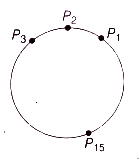
0 likesView Solution
107
MathematicsMediumMCQAP EAMCET · 2022
એક સમતલમાં $37$ સીધી રેખાઓ છે,જેમાંથી $13$ રેખાઓ બિંદુ $A$ માંથી પસાર થાય છે અને $11$ રેખાઓ બિંદુ $B$ માંથી પસાર થાય છે. વધુમાં,કોઈ પણ ત્રણ રેખાઓ (બિંદુ $A$ અને $B$ માંથી પસાર થતી રેખાઓ સિવાય) એક જ બિંદુમાંથી પસાર થતી નથી અને કોઈ પણ બે રેખાઓ સમાંતર નથી. તો સીધી રેખાઓના છેદબિંદુઓની સંખ્યા કેટલી છે?
A
$^{37}C_2$
B
$^{37}C_2 - ^{13}C_2 - ^{11}C_2$
C
$^{37}C_2 - ^{13}C_2 - ^{11}C_2 + 2$
D
$^{37}C_2 - 2$
Solution
(C) $37$ રેખાઓમાંથી $2$ રેખાઓ પસંદ કરવાની કુલ રીતો $^{37}C_2$ છે.
બિંદુ $A$ માંથી $13$ રેખાઓ પસાર થતી હોવાથી,તે $^{13}C_2$ અલગ છેદબિંદુઓ બનાવતી નથી; તેના બદલે,તે બધી $1$ બિંદુ પર છેદે છે. તેથી,આપણે $^{13}C_2$ બાદ કરીએ છીએ અને $1$ ઉમેરીએ છીએ.
તે જ રીતે,બિંદુ $B$ માંથી $11$ રેખાઓ પસાર થતી હોવાથી,આપણે $^{11}C_2$ બાદ કરીએ છીએ અને $1$ ઉમેરીએ છીએ.
તેથી,છેદબિંદુઓની કુલ સંખ્યા $^{37}C_2 - ^{13}C_2 - ^{11}C_2 + 2$ છે.
બિંદુ $A$ માંથી $13$ રેખાઓ પસાર થતી હોવાથી,તે $^{13}C_2$ અલગ છેદબિંદુઓ બનાવતી નથી; તેના બદલે,તે બધી $1$ બિંદુ પર છેદે છે. તેથી,આપણે $^{13}C_2$ બાદ કરીએ છીએ અને $1$ ઉમેરીએ છીએ.
તે જ રીતે,બિંદુ $B$ માંથી $11$ રેખાઓ પસાર થતી હોવાથી,આપણે $^{11}C_2$ બાદ કરીએ છીએ અને $1$ ઉમેરીએ છીએ.
તેથી,છેદબિંદુઓની કુલ સંખ્યા $^{37}C_2 - ^{13}C_2 - ^{11}C_2 + 2$ છે.
0 likesView Solution
108
MathematicsEasyMCQAP EAMCET · 2022
જો $\triangle ABC$ ના $r_1, r_2$ અને $r_3$ હરાત્મક શ્રેણી (Harmonic progression) માં હોય,તો $a, b$ અને $c$ શેમાં હશે?
A
સમાંતર શ્રેણી (arithmetic progression)
B
ગુણોત્તર શ્રેણી (geometric progression)
C
હરાત્મક શ્રેણી (harmonic progression)
D
અંકગણિત-ભૌમિતિક શ્રેણી (arithmetico-geometric progression)
Solution
(A) આપેલ છે કે $r_1, r_2, r_3$ એ $HP$ માં છે.
$r_1 = \frac{\Delta}{s-a}$,$r_2 = \frac{\Delta}{s-b}$,અને $r_3 = \frac{\Delta}{s-c}$ હોવાથી,જ્યાં $\Delta$ એ ક્ષેત્રફળ છે અને $s$ એ અર્ધ-પરિમિતિ છે.
$r_1, r_2, r_3$ એ $HP$ માં હોવા માટે:
$\frac{2}{r_2} = \frac{1}{r_1} + \frac{1}{r_3}$
કિંમતો મૂકતા:
$\frac{2(s-b)}{\Delta} = \frac{s-a}{\Delta} + \frac{s-c}{\Delta}$
$2s - 2b = s - a + s - c$
$2s - 2b = 2s - (a + c)$
$-2b = -(a + c)$
$2b = a + c$
આ દર્શાવે છે કે $a, b$ અને $c$ એ $AP$ માં છે.
$r_1 = \frac{\Delta}{s-a}$,$r_2 = \frac{\Delta}{s-b}$,અને $r_3 = \frac{\Delta}{s-c}$ હોવાથી,જ્યાં $\Delta$ એ ક્ષેત્રફળ છે અને $s$ એ અર્ધ-પરિમિતિ છે.
$r_1, r_2, r_3$ એ $HP$ માં હોવા માટે:
$\frac{2}{r_2} = \frac{1}{r_1} + \frac{1}{r_3}$
કિંમતો મૂકતા:
$\frac{2(s-b)}{\Delta} = \frac{s-a}{\Delta} + \frac{s-c}{\Delta}$
$2s - 2b = s - a + s - c$
$2s - 2b = 2s - (a + c)$
$-2b = -(a + c)$
$2b = a + c$
આ દર્શાવે છે કે $a, b$ અને $c$ એ $AP$ માં છે.
0 likesView Solution
109
MathematicsMediumMCQAP EAMCET · 2022
ક્રમિક ધન બેકી પૂર્ણાંકોની એવી કેટલી જોડીઓ છે કે જેના વર્ગોનો સરવાળો $290$ થાય?
A
$0$
B
$1$
C
$2$
D
$3$
Solution
(A) ધારો કે $x$ અને $x+2$ બે ક્રમિક ધન બેકી પૂર્ણાંકો છે.
આપેલ છે,$x^2 + (x+2)^2 = 290$.
સમીકરણનું વિસ્તરણ કરતા: $x^2 + x^2 + 4x + 4 = 290$.
$\Rightarrow 2x^2 + 4x - 286 = 0$.
$2$ વડે ભાગતા: $x^2 + 2x - 143 = 0$.
દ્વિઘાત સમીકરણના અવયવ પાડતા: $(x + 13)(x - 11) = 0$.
તેથી,$x = -13$ અથવા $x = 11$.
કારણ કે $x$ ધન બેકી પૂર્ણાંક હોવો જોઈએ,તેથી $x = -13$ શક્ય નથી.
જો $x = 11$ લઈએ,તો ક્રમિક બેકી પૂર્ણાંક $x+2 = 13$ મળે છે,જે બેકી સંખ્યા નથી.
તેથી,આવા કોઈ ક્રમિક ધન બેકી પૂર્ણાંકોની જોડી શક્ય નથી.
ઉકેલોની સંખ્યા $0$ છે.
આપેલ છે,$x^2 + (x+2)^2 = 290$.
સમીકરણનું વિસ્તરણ કરતા: $x^2 + x^2 + 4x + 4 = 290$.
$\Rightarrow 2x^2 + 4x - 286 = 0$.
$2$ વડે ભાગતા: $x^2 + 2x - 143 = 0$.
દ્વિઘાત સમીકરણના અવયવ પાડતા: $(x + 13)(x - 11) = 0$.
તેથી,$x = -13$ અથવા $x = 11$.
કારણ કે $x$ ધન બેકી પૂર્ણાંક હોવો જોઈએ,તેથી $x = -13$ શક્ય નથી.
જો $x = 11$ લઈએ,તો ક્રમિક બેકી પૂર્ણાંક $x+2 = 13$ મળે છે,જે બેકી સંખ્યા નથી.
તેથી,આવા કોઈ ક્રમિક ધન બેકી પૂર્ણાંકોની જોડી શક્ય નથી.
ઉકેલોની સંખ્યા $0$ છે.
0 likesView Solution
110
MathematicsDifficultMCQAP EAMCET · 2022
$a, b, c, d, e, f, g, h$ એ $\{-7, -5, -3, -2, 2, 4, 6, 13\}$ ગણના ભિન્ન ઘટકો છે. $(a+b+c+d)^2+(e+f+g+h)^2$ ની ન્યૂનતમ કિંમત શોધો.
A
$30$
B
$32$
C
$34$
D
$40$
Solution
(C) ધારો કે $S = \{-7, -5, -3, -2, 2, 4, 6, 13\}$. બધા ઘટકોનો સરવાળો $S_{total} = 8$ છે.
ધારો કે $x = a+b+c+d$ અને $y = e+f+g+h$.
$x+y = 8$ હોવાથી,$x^2+y^2$ ને ન્યૂનતમ કરવા માટે $|x-y|$ ને ન્યૂનતમ કરવું પડે.
$x$ ની કિંમત $4$ ની સૌથી નજીક લેતા,$x=5$ મળે છે,જેથી $y=3$ થાય.
તેથી,$x^2+y^2 = 5^2+3^2 = 25+9 = 34$.
ધારો કે $x = a+b+c+d$ અને $y = e+f+g+h$.
$x+y = 8$ હોવાથી,$x^2+y^2$ ને ન્યૂનતમ કરવા માટે $|x-y|$ ને ન્યૂનતમ કરવું પડે.
$x$ ની કિંમત $4$ ની સૌથી નજીક લેતા,$x=5$ મળે છે,જેથી $y=3$ થાય.
તેથી,$x^2+y^2 = 5^2+3^2 = 25+9 = 34$.
0 likesView Solution
111
MathematicsMediumMCQAP EAMCET · 2022
જો $\operatorname{cosech} x = \frac{4}{5}$ હોય,તો $\cosh x =$
A
$\sqrt{\frac{41}{21}}$
B
$\sqrt{\frac{41}{19}}$
C
$\sqrt{\frac{41}{25}}$
D
$\sqrt{\frac{41}{16}}$
Solution
(D) આપણે જાણીએ છીએ કે $\operatorname{cosech} x = \frac{1}{\sinh x}$.
આપેલ છે કે $\operatorname{cosech} x = \frac{4}{5}$,તેથી $\sinh x = \frac{5}{4}$.
નિત્યસમ $\cosh^2 x - \sinh^2 x = 1$ નો ઉપયોગ કરતા,$\cosh^2 x = 1 + \sinh^2 x$.
$\sinh x$ ની કિંમત મૂકતા: $\cosh^2 x = 1 + (\frac{5}{4})^2 = 1 + \frac{25}{16} = \frac{16 + 25}{16} = \frac{41}{16}$.
બધા વાસ્તવિક $x$ માટે $\cosh x > 0$ હોવાથી,આપણે ધન વર્ગમૂળ લઈએ છીએ: $\cosh x = \sqrt{\frac{41}{16}}$.
આપેલ છે કે $\operatorname{cosech} x = \frac{4}{5}$,તેથી $\sinh x = \frac{5}{4}$.
નિત્યસમ $\cosh^2 x - \sinh^2 x = 1$ નો ઉપયોગ કરતા,$\cosh^2 x = 1 + \sinh^2 x$.
$\sinh x$ ની કિંમત મૂકતા: $\cosh^2 x = 1 + (\frac{5}{4})^2 = 1 + \frac{25}{16} = \frac{16 + 25}{16} = \frac{41}{16}$.
બધા વાસ્તવિક $x$ માટે $\cosh x > 0$ હોવાથી,આપણે ધન વર્ગમૂળ લઈએ છીએ: $\cosh x = \sqrt{\frac{41}{16}}$.
0 likesView Solution
112
MathematicsMediumMCQAP EAMCET · 2022
કિંમત શોધો: $\sin(22 \frac{1}{2}^{\circ})$
A
$\sqrt{\frac{2+\sqrt{2}}{4}}$
B
$\frac{2+\sqrt{2}}{4}$
C
$\sqrt{\frac{2-\sqrt{2}}{4}}$
D
$\frac{2-\sqrt{2}}{4}$
Solution
(C) આપણે અડધા ખૂણાનું સૂત્ર જાણીએ છીએ: $\sin^2(\frac{A}{2}) = \frac{1 - \cos A}{2}$.
ધારો કે $A = 45^{\circ}$. તો $\frac{A}{2} = 22 \frac{1}{2}^{\circ}$.
$A$ ની કિંમત મૂકતા:
$\sin^2(22 \frac{1}{2}^{\circ}) = \frac{1 - \cos 45^{\circ}}{2}$
$= \frac{1 - \frac{1}{\sqrt{2}}}{2}$
$= \frac{\frac{\sqrt{2}-1}{\sqrt{2}}}{2} = \frac{\sqrt{2}-1}{2\sqrt{2}}$
છેદનું સંમેયીકરણ કરવા માટે,અંશ અને છેદને $\sqrt{2}$ વડે ગુણતા:
$= \frac{\sqrt{2}(\sqrt{2}-1)}{2\sqrt{2} \times \sqrt{2}} = \frac{2-\sqrt{2}}{4}$
તેથી,$\sin(22 \frac{1}{2}^{\circ}) = \sqrt{\frac{2-\sqrt{2}}{4}}$.
ધારો કે $A = 45^{\circ}$. તો $\frac{A}{2} = 22 \frac{1}{2}^{\circ}$.
$A$ ની કિંમત મૂકતા:
$\sin^2(22 \frac{1}{2}^{\circ}) = \frac{1 - \cos 45^{\circ}}{2}$
$= \frac{1 - \frac{1}{\sqrt{2}}}{2}$
$= \frac{\frac{\sqrt{2}-1}{\sqrt{2}}}{2} = \frac{\sqrt{2}-1}{2\sqrt{2}}$
છેદનું સંમેયીકરણ કરવા માટે,અંશ અને છેદને $\sqrt{2}$ વડે ગુણતા:
$= \frac{\sqrt{2}(\sqrt{2}-1)}{2\sqrt{2} \times \sqrt{2}} = \frac{2-\sqrt{2}}{4}$
તેથી,$\sin(22 \frac{1}{2}^{\circ}) = \sqrt{\frac{2-\sqrt{2}}{4}}$.
0 likesView Solution
113
MathematicsDifficultMCQAP EAMCET · 2022
$\cos ^4 x$ નું મૂલ્ય શું છે?
A
$\frac{3}{8}+\frac{1}{2} \cos 2 x+\frac{1}{8} \cos 4 x$
B
$\frac{3}{8}-\frac{1}{2} \cos 2 x+\frac{1}{8} \cos 4 x$
C
$\frac{3}{8}-\frac{1}{8} \cos 4 x+\frac{1}{2} \cos 2 x$
D
$\frac{1}{8} \cos 4 x+\frac{1}{2} \cos 2 x-\frac{3}{8}$
Solution
(A) આપણે જાણીએ છીએ કે $\cos 2x = 2\cos^2 x - 1$,જેનો અર્થ છે કે $\cos^2 x = \frac{1 + \cos 2x}{2}$.
હવે,$\cos^4 x = (\cos^2 x)^2 = \left(\frac{1 + \cos 2x}{2}\right)^2$.
આનું વિસ્તરણ કરતા,આપણને મળે છે $\cos^4 x = \frac{1 + \cos^2 2x + 2\cos 2x}{4} = \frac{1}{4} + \frac{1}{2}\cos 2x + \frac{1}{4}\cos^2 2x$.
નિત્યસમ $\cos^2 2x = \frac{1 + \cos 4x}{2}$ નો ઉપયોગ કરીને,આપણે કિંમત મૂકીએ છીએ:
$\cos^4 x = \frac{1}{4} + \frac{1}{2}\cos 2x + \frac{1}{4}\left(\frac{1 + \cos 4x}{2}\right)$.
$\cos^4 x = \frac{1}{4} + \frac{1}{2}\cos 2x + \frac{1}{8} + \frac{1}{8}\cos 4x$.
$\cos^4 x = \frac{3}{8} + \frac{1}{2}\cos 2x + \frac{1}{8}\cos 4x$.
હવે,$\cos^4 x = (\cos^2 x)^2 = \left(\frac{1 + \cos 2x}{2}\right)^2$.
આનું વિસ્તરણ કરતા,આપણને મળે છે $\cos^4 x = \frac{1 + \cos^2 2x + 2\cos 2x}{4} = \frac{1}{4} + \frac{1}{2}\cos 2x + \frac{1}{4}\cos^2 2x$.
નિત્યસમ $\cos^2 2x = \frac{1 + \cos 4x}{2}$ નો ઉપયોગ કરીને,આપણે કિંમત મૂકીએ છીએ:
$\cos^4 x = \frac{1}{4} + \frac{1}{2}\cos 2x + \frac{1}{4}\left(\frac{1 + \cos 4x}{2}\right)$.
$\cos^4 x = \frac{1}{4} + \frac{1}{2}\cos 2x + \frac{1}{8} + \frac{1}{8}\cos 4x$.
$\cos^4 x = \frac{3}{8} + \frac{1}{2}\cos 2x + \frac{1}{8}\cos 4x$.
0 likesView Solution
114
MathematicsMediumMCQAP EAMCET · 2022
$\frac{\sin \theta}{1-\cot \theta} + \frac{\cos \theta}{1-\tan \theta} = $
A
$0$
B
$1$
C
$\cos \theta - \sin \theta$
D
$\cos \theta + \sin \theta$
Solution
(D) આપેલ પદાવલિ: $\frac{\sin \theta}{1-\cot \theta} + \frac{\cos \theta}{1-\tan \theta}$
$\cot \theta = \frac{\cos \theta}{\sin \theta}$ અને $\tan \theta = \frac{\sin \theta}{\cos \theta}$ મૂકતા:
$= \frac{\sin \theta}{1-\frac{\cos \theta}{\sin \theta}} + \frac{\cos \theta}{1-\frac{\sin \theta}{\cos \theta}}$
$= \frac{\sin^2 \theta}{\sin \theta - \cos \theta} + \frac{\cos^2 \theta}{\cos \theta - \sin \theta}$
$= \frac{\sin^2 \theta}{\sin \theta - \cos \theta} - \frac{\cos^2 \theta}{\sin \theta - \cos \theta}$
$= \frac{\sin^2 \theta - \cos^2 \theta}{\sin \theta - \cos \theta}$
નિત્યસમ $a^2 - b^2 = (a-b)(a+b)$ નો ઉપયોગ કરતા:
$= \frac{(\sin \theta - \cos \theta)(\sin \theta + \cos \theta)}{\sin \theta - \cos \theta}$
$= \sin \theta + \cos \theta$
$\cot \theta = \frac{\cos \theta}{\sin \theta}$ અને $\tan \theta = \frac{\sin \theta}{\cos \theta}$ મૂકતા:
$= \frac{\sin \theta}{1-\frac{\cos \theta}{\sin \theta}} + \frac{\cos \theta}{1-\frac{\sin \theta}{\cos \theta}}$
$= \frac{\sin^2 \theta}{\sin \theta - \cos \theta} + \frac{\cos^2 \theta}{\cos \theta - \sin \theta}$
$= \frac{\sin^2 \theta}{\sin \theta - \cos \theta} - \frac{\cos^2 \theta}{\sin \theta - \cos \theta}$
$= \frac{\sin^2 \theta - \cos^2 \theta}{\sin \theta - \cos \theta}$
નિત્યસમ $a^2 - b^2 = (a-b)(a+b)$ નો ઉપયોગ કરતા:
$= \frac{(\sin \theta - \cos \theta)(\sin \theta + \cos \theta)}{\sin \theta - \cos \theta}$
$= \sin \theta + \cos \theta$
0 likesView Solution
115
MathematicsEasyMCQAP EAMCET · 2022
જો $\operatorname{cosech} x = \frac{4}{5}$ હોય,તો $\sinh x = $
A
$\frac{4}{5}$
B
$\frac{5}{4}$
C
$\frac{2}{3}$
D
$\frac{2}{5}$
Solution
(B) આપણે જાણીએ છીએ કે હાઇપરબોલિક વિધેયો નીચે મુજબ સંબંધિત છે:
$\sinh x = \frac{1}{\operatorname{cosech} x}$
આપેલ છે કે $\operatorname{cosech} x = \frac{4}{5}$,તેથી આ કિંમત સૂત્રમાં મૂકતા:
$\sinh x = \frac{1}{4/5} = \frac{5}{4}$
$\sinh x = \frac{1}{\operatorname{cosech} x}$
આપેલ છે કે $\operatorname{cosech} x = \frac{4}{5}$,તેથી આ કિંમત સૂત્રમાં મૂકતા:
$\sinh x = \frac{1}{4/5} = \frac{5}{4}$
0 likesView Solution
116
MathematicsMediumMCQAP EAMCET · 2022
$\frac{1+\tanh x}{1-\tanh x}$ નું મૂલ્ય શું છે?
A
$e^x$
B
$e^{-2x}$
C
$e^{2x}$
D
$e^{-x}$
Solution
(C) $\tanh x = \frac{e^x - e^{-x}}{e^x + e^{-x}}$ ની કિંમત મૂકતા,આપણને મળે છે:
$\frac{1+\tanh x}{1-\tanh x} = \frac{1 + \frac{e^x - e^{-x}}{e^x + e^{-x}}}{1 - \frac{e^x - e^{-x}}{e^x + e^{-x}}}$
$= \frac{\frac{e^x + e^{-x} + e^x - e^{-x}}{e^x + e^{-x}}}{\frac{e^x + e^{-x} - (e^x - e^{-x})}{e^x + e^{-x}}}$
$= \frac{2e^x}{2e^{-x}}$
$= e^{2x}$
$\frac{1+\tanh x}{1-\tanh x} = \frac{1 + \frac{e^x - e^{-x}}{e^x + e^{-x}}}{1 - \frac{e^x - e^{-x}}{e^x + e^{-x}}}$
$= \frac{\frac{e^x + e^{-x} + e^x - e^{-x}}{e^x + e^{-x}}}{\frac{e^x + e^{-x} - (e^x - e^{-x})}{e^x + e^{-x}}}$
$= \frac{2e^x}{2e^{-x}}$
$= e^{2x}$
0 likesView Solution
117
MathematicsEasyMCQAP EAMCET · 2022
$\tan \left(\frac{7 \pi}{8}\right)$ ની કિંમત શોધો.
A
$\sqrt{2}-1$
B
$1-\sqrt{2}$
C
$1+\sqrt{2}$
D
$\frac{1}{1+\sqrt{2}}$
Solution
(B) ધારો કે $A = \tan \left(\frac{7 \pi}{8}\right)$.
$\frac{7 \pi}{8} = \pi - \frac{\pi}{8}$ હોવાથી,$A = \tan \left(\pi - \frac{\pi}{8}\right) = -\tan \left(\frac{\pi}{8}\right)$.
સૂત્ર $\tan(2\theta) = \frac{2 \tan \theta}{1 - \tan^2 \theta}$ નો ઉપયોગ કરતા,$\theta = \frac{\pi}{8}$ લેતા.
$\tan \left(\frac{\pi}{4}\right) = \frac{2 \tan \left(\frac{\pi}{8}\right)}{1 - \tan^2 \left(\frac{\pi}{8}\right)} = 1$.
$\tan \left(\frac{\pi}{8}\right) = -A$ મૂકતા,$\frac{2(-A)}{1 - (-A)^2} = 1$.
$-2A = 1 - A^2 \Rightarrow A^2 - 2A - 1 = 0$.
દ્વિઘાત સૂત્ર $A = \frac{-b \pm \sqrt{b^2 - 4ac}}{2a}$ નો ઉપયોગ કરતા,$A = \frac{2 \pm \sqrt{4 + 4}}{2} = 1 \pm \sqrt{2}$.
$\frac{7 \pi}{8}$ એ બીજા ચરણમાં હોવાથી,$\tan \left(\frac{7 \pi}{8}\right) < 0$.
તેથી,$A = 1 - \sqrt{2}$.
$\frac{7 \pi}{8} = \pi - \frac{\pi}{8}$ હોવાથી,$A = \tan \left(\pi - \frac{\pi}{8}\right) = -\tan \left(\frac{\pi}{8}\right)$.
સૂત્ર $\tan(2\theta) = \frac{2 \tan \theta}{1 - \tan^2 \theta}$ નો ઉપયોગ કરતા,$\theta = \frac{\pi}{8}$ લેતા.
$\tan \left(\frac{\pi}{4}\right) = \frac{2 \tan \left(\frac{\pi}{8}\right)}{1 - \tan^2 \left(\frac{\pi}{8}\right)} = 1$.
$\tan \left(\frac{\pi}{8}\right) = -A$ મૂકતા,$\frac{2(-A)}{1 - (-A)^2} = 1$.
$-2A = 1 - A^2 \Rightarrow A^2 - 2A - 1 = 0$.
દ્વિઘાત સૂત્ર $A = \frac{-b \pm \sqrt{b^2 - 4ac}}{2a}$ નો ઉપયોગ કરતા,$A = \frac{2 \pm \sqrt{4 + 4}}{2} = 1 \pm \sqrt{2}$.
$\frac{7 \pi}{8}$ એ બીજા ચરણમાં હોવાથી,$\tan \left(\frac{7 \pi}{8}\right) < 0$.
તેથી,$A = 1 - \sqrt{2}$.
0 likesView Solution
118
MathematicsEasyMCQAP EAMCET · 2022
$1+\sec ^2 x \sin ^2 x=$
A
$\sin 2 x$
B
$\sin ^2 x$
C
$\tan ^2 x$
D
$\sec ^2 x$
Solution
(D) આપેલ પદાવલિ: $f(x) = 1 + \sec ^2 x \sin ^2 x$
કારણ કે $\sec x = \frac{1}{\cos x}$,તેથી $\sec ^2 x = \frac{1}{\cos ^2 x}$ થાય.
આ કિંમત પદાવલિમાં મૂકતા: $f(x) = 1 + \frac{\sin ^2 x}{\cos ^2 x}$
કારણ કે $\tan x = \frac{\sin x}{\cos x}$,તેથી $\tan ^2 x = \frac{\sin ^2 x}{\cos ^2 x}$ થાય.
તેથી,$f(x) = 1 + \tan ^2 x$
નિત્યસમ $1 + \tan ^2 x = \sec ^2 x$ નો ઉપયોગ કરતા,આપણને $f(x) = \sec ^2 x$ મળે છે.
કારણ કે $\sec x = \frac{1}{\cos x}$,તેથી $\sec ^2 x = \frac{1}{\cos ^2 x}$ થાય.
આ કિંમત પદાવલિમાં મૂકતા: $f(x) = 1 + \frac{\sin ^2 x}{\cos ^2 x}$
કારણ કે $\tan x = \frac{\sin x}{\cos x}$,તેથી $\tan ^2 x = \frac{\sin ^2 x}{\cos ^2 x}$ થાય.
તેથી,$f(x) = 1 + \tan ^2 x$
નિત્યસમ $1 + \tan ^2 x = \sec ^2 x$ નો ઉપયોગ કરતા,આપણને $f(x) = \sec ^2 x$ મળે છે.
0 likesView Solution
119
MathematicsEasyMCQAP EAMCET · 2022
નીચેનામાંથી કયા ત્રિકોણમિતીય મૂલ્યો ઋણ છે?
$I. \sin(-292^{\circ})$
$II. \tan(-190^{\circ})$
$III. \cos(-207^{\circ})$
$IV. \cot(-222^{\circ})$
$I. \sin(-292^{\circ})$
$II. \tan(-190^{\circ})$
$III. \cos(-207^{\circ})$
$IV. \cot(-222^{\circ})$
A
$II, III$ અને $IV$
B
માત્ર $III$
C
$I$ અને $III$
D
$II$ અને $III$
Solution
(A) દરેક પદનું મૂલ્ય તે કયા ચરણમાં છે તેના આધારે નક્કી કરીએ:
$I. \sin(-292^{\circ}) = \sin(68^{\circ})$. $68^{\circ}$ પ્રથમ ચરણમાં હોવાથી,$\sin(68^{\circ}) > 0$.
$II. \tan(-190^{\circ}) = -\tan(190^{\circ}) = -\tan(180^{\circ} + 10^{\circ}) = -\tan(10^{\circ})$. $\tan(10^{\circ}) > 0$ હોવાથી,આ મૂલ્ય ઋણ છે.
$III. \cos(-207^{\circ}) = \cos(207^{\circ}) = \cos(180^{\circ} + 27^{\circ}) = -\cos(27^{\circ})$. $\cos(27^{\circ}) > 0$ હોવાથી,આ મૂલ્ય ઋણ છે.
$IV. \cot(-222^{\circ}) = -\cot(222^{\circ}) = -\cot(180^{\circ} + 42^{\circ}) = -\cot(42^{\circ})$. $\cot(42^{\circ}) > 0$ હોવાથી,આ મૂલ્ય ઋણ છે.
આમ,$II, III$ અને $IV$ ઋણ છે.
$I. \sin(-292^{\circ}) = \sin(68^{\circ})$. $68^{\circ}$ પ્રથમ ચરણમાં હોવાથી,$\sin(68^{\circ}) > 0$.
$II. \tan(-190^{\circ}) = -\tan(190^{\circ}) = -\tan(180^{\circ} + 10^{\circ}) = -\tan(10^{\circ})$. $\tan(10^{\circ}) > 0$ હોવાથી,આ મૂલ્ય ઋણ છે.
$III. \cos(-207^{\circ}) = \cos(207^{\circ}) = \cos(180^{\circ} + 27^{\circ}) = -\cos(27^{\circ})$. $\cos(27^{\circ}) > 0$ હોવાથી,આ મૂલ્ય ઋણ છે.
$IV. \cot(-222^{\circ}) = -\cot(222^{\circ}) = -\cot(180^{\circ} + 42^{\circ}) = -\cot(42^{\circ})$. $\cot(42^{\circ}) > 0$ હોવાથી,આ મૂલ્ય ઋણ છે.
આમ,$II, III$ અને $IV$ ઋણ છે.
0 likesView Solution
120
MathematicsEasyMCQAP EAMCET · 2022
જો $\sin \theta + \operatorname{cosec} \theta = 4$ હોય,તો $\sin^2 \theta + \operatorname{cosec}^2 \theta = $
A
$12$
B
$18$
C
$16$
D
$14$
Solution
(D) આપેલ છે કે,$\sin \theta + \operatorname{cosec} \theta = 4$.
બંને બાજુ વર્ગ કરતા,આપણને મળે છે:
$(\sin \theta + \operatorname{cosec} \theta)^2 = 4^2$
$\sin^2 \theta + \operatorname{cosec}^2 \theta + 2 \sin \theta \operatorname{cosec} \theta = 16$
કારણ કે $\sin \theta \operatorname{cosec} \theta = 1$,તેથી:
$\sin^2 \theta + \operatorname{cosec}^2 \theta + 2(1) = 16$
$\sin^2 \theta + \operatorname{cosec}^2 \theta = 16 - 2 = 14$.
બંને બાજુ વર્ગ કરતા,આપણને મળે છે:
$(\sin \theta + \operatorname{cosec} \theta)^2 = 4^2$
$\sin^2 \theta + \operatorname{cosec}^2 \theta + 2 \sin \theta \operatorname{cosec} \theta = 16$
કારણ કે $\sin \theta \operatorname{cosec} \theta = 1$,તેથી:
$\sin^2 \theta + \operatorname{cosec}^2 \theta + 2(1) = 16$
$\sin^2 \theta + \operatorname{cosec}^2 \theta = 16 - 2 = 14$.
0 likesView Solution
121
MathematicsEasyMCQAP EAMCET · 2022
$\sin ^2 \frac{2 \pi}{3}+\cos ^2 \frac{5 \pi}{6}-\tan ^2 \frac{3 \pi}{4}=$
A
$0$
B
$1 / 2$
C
$1$
D
$1 / 3$
Solution
(B) આપેલ પદાવલિ: $\sin ^2\left(\frac{2 \pi}{3}\right)+\cos ^2\left(\frac{5 \pi}{6}\right)-\tan ^2\left(\frac{3 \pi}{4}\right)$
સંબંધિત ખૂણાઓનો ઉપયોગ કરતા: $\sin(\pi-x) = \sin x$,$\cos(\pi-x) = -\cos x$,$\tan(\pi-x) = -\tan x$
$= \sin ^2\left(\pi-\frac{\pi}{3}\right)+\cos ^2\left(\pi-\frac{\pi}{6}\right)-\tan ^2\left(\pi-\frac{\pi}{4}\right)$
$= \sin ^2\left(\frac{\pi}{3}\right)+\left(-\cos \frac{\pi}{6}\right)^2-\left(-\tan \frac{\pi}{4}\right)^2$
$= \left(\frac{\sqrt{3}}{2}\right)^2+\left(-\frac{\sqrt{3}}{2}\right)^2-(-1)^2$
$= \frac{3}{4}+\frac{3}{4}-1$
$= \frac{6}{4}-1 = \frac{3}{2}-1 = \frac{1}{2}$
સંબંધિત ખૂણાઓનો ઉપયોગ કરતા: $\sin(\pi-x) = \sin x$,$\cos(\pi-x) = -\cos x$,$\tan(\pi-x) = -\tan x$
$= \sin ^2\left(\pi-\frac{\pi}{3}\right)+\cos ^2\left(\pi-\frac{\pi}{6}\right)-\tan ^2\left(\pi-\frac{\pi}{4}\right)$
$= \sin ^2\left(\frac{\pi}{3}\right)+\left(-\cos \frac{\pi}{6}\right)^2-\left(-\tan \frac{\pi}{4}\right)^2$
$= \left(\frac{\sqrt{3}}{2}\right)^2+\left(-\frac{\sqrt{3}}{2}\right)^2-(-1)^2$
$= \frac{3}{4}+\frac{3}{4}-1$
$= \frac{6}{4}-1 = \frac{3}{2}-1 = \frac{1}{2}$
0 likesView Solution
122
MathematicsMediumMCQAP EAMCET · 2022
જો $2 \cosh 2x + 10 \sinh 2x = 5$ હોય,તો $x =$
A
$\frac{1}{2} \log \frac{4}{3}$
B
$\frac{1}{2} \log \frac{2}{3}$
C
$\frac{1}{2} \log \frac{3}{2}$
D
$\frac{1}{2} \log \frac{3}{4}$
Solution
(A) આપેલ સમીકરણ: $2 \cosh 2x + 10 \sinh 2x = 5$.
વ્યાખ્યાઓ $\cosh 2x = \frac{e^{2x} + e^{-2x}}{2}$ અને $\sinh 2x = \frac{e^{2x} - e^{-2x}}{2}$ નો ઉપયોગ કરતા:
$2 \left( \frac{e^{2x} + e^{-2x}}{2} \right) + 10 \left( \frac{e^{2x} - e^{-2x}}{2} \right) = 5$
$(e^{2x} + e^{-2x}) + 5(e^{2x} - e^{-2x}) = 5$
$6e^{2x} - 4e^{-2x} = 5$
$e^{2x}$ વડે ગુણતા: $6(e^{2x})^2 - 5e^{2x} - 4 = 0$.
ધારો કે $u = e^{2x}$,તો $6u^2 - 5u - 4 = 0$.
અવયવ પાડતા: $(3u - 4)(2u + 1) = 0$.
તેથી,$u = \frac{4}{3}$ અથવા $u = -\frac{1}{2}$.
$e^{2x} > 0$ હોવાથી,$e^{2x} = \frac{4}{3}$.
બંને બાજુ પ્રાકૃતિક લઘુગણક લેતા: $2x = \ln \frac{4}{3}$.
તેથી,$x = \frac{1}{2} \ln \frac{4}{3}$.
વ્યાખ્યાઓ $\cosh 2x = \frac{e^{2x} + e^{-2x}}{2}$ અને $\sinh 2x = \frac{e^{2x} - e^{-2x}}{2}$ નો ઉપયોગ કરતા:
$2 \left( \frac{e^{2x} + e^{-2x}}{2} \right) + 10 \left( \frac{e^{2x} - e^{-2x}}{2} \right) = 5$
$(e^{2x} + e^{-2x}) + 5(e^{2x} - e^{-2x}) = 5$
$6e^{2x} - 4e^{-2x} = 5$
$e^{2x}$ વડે ગુણતા: $6(e^{2x})^2 - 5e^{2x} - 4 = 0$.
ધારો કે $u = e^{2x}$,તો $6u^2 - 5u - 4 = 0$.
અવયવ પાડતા: $(3u - 4)(2u + 1) = 0$.
તેથી,$u = \frac{4}{3}$ અથવા $u = -\frac{1}{2}$.
$e^{2x} > 0$ હોવાથી,$e^{2x} = \frac{4}{3}$.
બંને બાજુ પ્રાકૃતિક લઘુગણક લેતા: $2x = \ln \frac{4}{3}$.
તેથી,$x = \frac{1}{2} \ln \frac{4}{3}$.
0 likesView Solution
123
MathematicsMediumMCQAP EAMCET · 2022
કિંમત શોધો: $\sqrt{\sin ^4 x+4 \cos ^2 x}-\sqrt{\cos ^4 x+4 \sin ^2 x}$
A
$1-\cos 2 x$
B
$\tan 2 x$
C
$\sin 2 x$
D
$\cos 2 x$
Solution
(D) આપેલ પદાવલિ: $\sqrt{\sin ^4 x+4 \cos ^2 x}-\sqrt{\cos ^4 x+4 \sin ^2 x}$
નિત્યસમ $\cos ^2 x = 1-\sin ^2 x$ અને $\sin ^2 x = 1-\cos ^2 x$ નો ઉપયોગ કરતા:
$= \sqrt{\sin ^4 x-4 \sin ^2 x+4}-\sqrt{\cos ^4 x-4 \cos ^2 x+4}$
$= \sqrt{(\sin ^2 x-2)^2}-\sqrt{(\cos ^2 x-2)^2}$
$= |\sin ^2 x-2|-|\cos ^2 x-2|$
$= (2-\sin ^2 x)-(2-\cos ^2 x)$
$= \cos ^2 x-\sin ^2 x$
$= \cos 2 x$
નિત્યસમ $\cos ^2 x = 1-\sin ^2 x$ અને $\sin ^2 x = 1-\cos ^2 x$ નો ઉપયોગ કરતા:
$= \sqrt{\sin ^4 x-4 \sin ^2 x+4}-\sqrt{\cos ^4 x-4 \cos ^2 x+4}$
$= \sqrt{(\sin ^2 x-2)^2}-\sqrt{(\cos ^2 x-2)^2}$
$= |\sin ^2 x-2|-|\cos ^2 x-2|$
$= (2-\sin ^2 x)-(2-\cos ^2 x)$
$= \cos ^2 x-\sin ^2 x$
$= \cos 2 x$
0 likesView Solution
124
MathematicsEasyMCQAP EAMCET · 2022
$\frac{1}{1+\sin \theta}+\frac{1}{1-\sin \theta} = $
A
$2 \cos ^2 \theta$
B
$-2 \cos ^2 \theta$
C
$2 \tan ^2 \theta$
D
$2 \sec ^2 \theta$
Solution
(D) $\frac{1}{1+\sin \theta} + \frac{1}{1-\sin \theta} = \frac{(1-\sin \theta) + (1+\sin \theta)}{(1+\sin \theta)(1-\sin \theta)}$
$= \frac{2}{1-\sin^2 \theta}$
$= \frac{2}{\cos^2 \theta}$
$= 2 \sec^2 \theta$
$= \frac{2}{1-\sin^2 \theta}$
$= \frac{2}{\cos^2 \theta}$
$= 2 \sec^2 \theta$
0 likesView Solution
125
MathematicsEasyMCQAP EAMCET · 2022
પદાવલિનું સાદું રૂપ આપો: $\frac{\cos x}{1+\sin x} + \tan x$
A
$1$
B
$\cos x + \sin x$
C
$\sin^2 x$
D
$\sec x$
Solution
(D) આપેલ પદાવલિ: $\frac{\cos x}{1+\sin x} + \tan x$
પ્રથમ પદના અંશ અને છેદને $(1-\sin x)$ વડે ગુણતા:
$\frac{\cos x(1-\sin x)}{(1+\sin x)(1-\sin x)} + \tan x$
નિત્યસમ $(1+\sin x)(1-\sin x) = 1-\sin^2 x = \cos^2 x$ નો ઉપયોગ કરતા:
$\frac{\cos x(1-\sin x)}{\cos^2 x} + \tan x$
અપૂર્ણાંકનું સાદું રૂપ આપતા:
$\frac{1-\sin x}{\cos x} + \tan x$
અપૂર્ણાંકને અલગ કરતા:
$\frac{1}{\cos x} - \frac{\sin x}{\cos x} + \tan x$
કારણ કે $\frac{1}{\cos x} = \sec x$ અને $\frac{\sin x}{\cos x} = \tan x$:
$\sec x - \tan x + \tan x = \sec x$
પ્રથમ પદના અંશ અને છેદને $(1-\sin x)$ વડે ગુણતા:
$\frac{\cos x(1-\sin x)}{(1+\sin x)(1-\sin x)} + \tan x$
નિત્યસમ $(1+\sin x)(1-\sin x) = 1-\sin^2 x = \cos^2 x$ નો ઉપયોગ કરતા:
$\frac{\cos x(1-\sin x)}{\cos^2 x} + \tan x$
અપૂર્ણાંકનું સાદું રૂપ આપતા:
$\frac{1-\sin x}{\cos x} + \tan x$
અપૂર્ણાંકને અલગ કરતા:
$\frac{1}{\cos x} - \frac{\sin x}{\cos x} + \tan x$
કારણ કે $\frac{1}{\cos x} = \sec x$ અને $\frac{\sin x}{\cos x} = \tan x$:
$\sec x - \tan x + \tan x = \sec x$
0 likesView Solution
126
MathematicsEasyMCQAP EAMCET · 2022
$\cos ^2 45^{\circ}+\cos ^2 135^{\circ}+\cos ^2 225^{\circ}+\cos ^2 315^{\circ} = $
A
$1$
B
$2$
C
$0$
D
$-1$
Solution
(B) આપણે ગુણધર્મ $\cos^2 \theta = \cos^2(180^{\circ} \pm \theta) = \cos^2(360^{\circ} \pm \theta)$ નો ઉપયોગ કરીએ છીએ.
$\cos 135^{\circ} = \cos(180^{\circ} - 45^{\circ}) = -\cos 45^{\circ} \implies \cos^2 135^{\circ} = \cos^2 45^{\circ}$.
$\cos 225^{\circ} = \cos(180^{\circ} + 45^{\circ}) = -\cos 45^{\circ} \implies \cos^2 225^{\circ} = \cos^2 45^{\circ}$.
$\cos 315^{\circ} = \cos(360^{\circ} - 45^{\circ}) = \cos 45^{\circ} \implies \cos^2 315^{\circ} = \cos^2 45^{\circ}$.
આમ,પદાવલિ નીચે મુજબ થાય છે:
$\cos^2 45^{\circ} + \cos^2 45^{\circ} + \cos^2 45^{\circ} + \cos^2 45^{\circ} = 4 \cos^2 45^{\circ}$.
કારણ કે $\cos 45^{\circ} = \frac{1}{\sqrt{2}}$,તેથી $\cos^2 45^{\circ} = \frac{1}{2}$.
તેથી,$4 \times \frac{1}{2} = 2$.
$\cos 135^{\circ} = \cos(180^{\circ} - 45^{\circ}) = -\cos 45^{\circ} \implies \cos^2 135^{\circ} = \cos^2 45^{\circ}$.
$\cos 225^{\circ} = \cos(180^{\circ} + 45^{\circ}) = -\cos 45^{\circ} \implies \cos^2 225^{\circ} = \cos^2 45^{\circ}$.
$\cos 315^{\circ} = \cos(360^{\circ} - 45^{\circ}) = \cos 45^{\circ} \implies \cos^2 315^{\circ} = \cos^2 45^{\circ}$.
આમ,પદાવલિ નીચે મુજબ થાય છે:
$\cos^2 45^{\circ} + \cos^2 45^{\circ} + \cos^2 45^{\circ} + \cos^2 45^{\circ} = 4 \cos^2 45^{\circ}$.
કારણ કે $\cos 45^{\circ} = \frac{1}{\sqrt{2}}$,તેથી $\cos^2 45^{\circ} = \frac{1}{2}$.
તેથી,$4 \times \frac{1}{2} = 2$.
0 likesView Solution
127
MathematicsMediumMCQAP EAMCET · 2022
ધારો કે $\theta \in R$ એ રીતે છે કે $3 \sinh (2 \theta)=13-3 e^{2 \theta}$,તો $\theta=$
A
$\frac{1}{2} \log 3$
B
$\frac{1}{3} \log 3$
C
$\log 3$
D
$\frac{1}{2} \log 5$
Solution
(A) આપેલ સમીકરણ: $3 \sinh (2 \theta) = 13 - 3 e^{2 \theta}$
$\sinh (2 \theta) = \frac{e^{2 \theta} - e^{-2 \theta}}{2}$ મૂકતા:
$3 \left( \frac{e^{2 \theta} - e^{-2 \theta}}{2} \right) = 13 - 3 e^{2 \theta}$
ધારો કે $x = e^{2 \theta}$. $e^{2 \theta} > 0$ હોવાથી,$x > 0$.
$\frac{3}{2} (x - \frac{1}{x}) = 13 - 3x$
$3(x^2 - 1) = 2x(13 - 3x)$
$3x^2 - 3 = 26x - 6x^2$
$9x^2 - 26x - 3 = 0$
દ્વિઘાત સમીકરણના અવયવ પાડતા: $9x^2 - 27x + x - 3 = 0$
$9x(x - 3) + 1(x - 3) = 0$
$(9x + 1)(x - 3) = 0$
$x > 0$ હોવાથી,$x = 3$ મળે.
$e^{2 \theta} = 3$
બંને બાજુ પ્રાકૃતિક લઘુગણક લેતા:
$2 \theta = \log 3$
$\theta = \frac{1}{2} \log 3$
$\sinh (2 \theta) = \frac{e^{2 \theta} - e^{-2 \theta}}{2}$ મૂકતા:
$3 \left( \frac{e^{2 \theta} - e^{-2 \theta}}{2} \right) = 13 - 3 e^{2 \theta}$
ધારો કે $x = e^{2 \theta}$. $e^{2 \theta} > 0$ હોવાથી,$x > 0$.
$\frac{3}{2} (x - \frac{1}{x}) = 13 - 3x$
$3(x^2 - 1) = 2x(13 - 3x)$
$3x^2 - 3 = 26x - 6x^2$
$9x^2 - 26x - 3 = 0$
દ્વિઘાત સમીકરણના અવયવ પાડતા: $9x^2 - 27x + x - 3 = 0$
$9x(x - 3) + 1(x - 3) = 0$
$(9x + 1)(x - 3) = 0$
$x > 0$ હોવાથી,$x = 3$ મળે.
$e^{2 \theta} = 3$
બંને બાજુ પ્રાકૃતિક લઘુગણક લેતા:
$2 \theta = \log 3$
$\theta = \frac{1}{2} \log 3$
0 likesView Solution
128
MathematicsEasyMCQAP EAMCET · 2022
$1+\cot ^2 30^{\circ}-\sec ^2 45^{\circ}=$
A
$1$
B
$2$
C
$0$
D
$-1$
Solution
(B) આપણે જાણીએ છીએ કે $\cot 30^{\circ} = \sqrt{3}$ અને $\sec 45^{\circ} = \sqrt{2}$ થાય છે.
આ કિંમતોને પદાવલિમાં મૂકતા:
$1 + (\sqrt{3})^2 - (\sqrt{2})^2$
$= 1 + 3 - 2$
$= 4 - 2$
$= 2$
આ કિંમતોને પદાવલિમાં મૂકતા:
$1 + (\sqrt{3})^2 - (\sqrt{2})^2$
$= 1 + 3 - 2$
$= 4 - 2$
$= 2$
0 likesView Solution
129
MathematicsEasyMCQAP EAMCET · 2022
$\frac{\sin x}{1+\cos x} + \frac{1+\cos x}{\sin x} = ?$
A
$2 \sec x$
B
$2 \operatorname{cosec} x$
C
$\tan 2x$
D
$\sin 2x$
Solution
(B) આપેલ પદાવલિ: $\frac{\sin x}{1+\cos x} + \frac{1+\cos x}{\sin x}$
છેદ સમાન કરતા: $\frac{\sin^2 x + (1+\cos x)^2}{\sin x(1+\cos x)}$
$= \frac{\sin^2 x + 1 + 2\cos x + \cos^2 x}{\sin x(1+\cos x)}$
$\sin^2 x + \cos^2 x = 1$ હોવાથી: $\frac{1 + 1 + 2\cos x}{\sin x(1+\cos x)}$
$= \frac{2 + 2\cos x}{\sin x(1+\cos x)} = \frac{2(1+\cos x)}{\sin x(1+\cos x)}$
$= \frac{2}{\sin x} = 2 \operatorname{cosec} x$
છેદ સમાન કરતા: $\frac{\sin^2 x + (1+\cos x)^2}{\sin x(1+\cos x)}$
$= \frac{\sin^2 x + 1 + 2\cos x + \cos^2 x}{\sin x(1+\cos x)}$
$\sin^2 x + \cos^2 x = 1$ હોવાથી: $\frac{1 + 1 + 2\cos x}{\sin x(1+\cos x)}$
$= \frac{2 + 2\cos x}{\sin x(1+\cos x)} = \frac{2(1+\cos x)}{\sin x(1+\cos x)}$
$= \frac{2}{\sin x} = 2 \operatorname{cosec} x$
0 likesView Solution
130
MathematicsEasyMCQAP EAMCET · 2022
$\cos \theta(\operatorname{cosec} \theta - \sec \theta) - \cot \theta =$
A
$-1$
B
$1$
C
$0$
D
$\cos^2 \theta - \tan^2 \theta$
Solution
(A) આપેલ પદાવલિ: $\cos \theta(\operatorname{cosec} \theta - \sec \theta) - \cot \theta$
$= \cos \theta \left( \frac{1}{\sin \theta} - \frac{1}{\cos \theta} \right) - \cot \theta$
$= \frac{\cos \theta}{\sin \theta} - \frac{\cos \theta}{\cos \theta} - \cot \theta$
$= \cot \theta - 1 - \cot \theta$
$= -1$
$= \cos \theta \left( \frac{1}{\sin \theta} - \frac{1}{\cos \theta} \right) - \cot \theta$
$= \frac{\cos \theta}{\sin \theta} - \frac{\cos \theta}{\cos \theta} - \cot \theta$
$= \cot \theta - 1 - \cot \theta$
$= -1$
0 likesView Solution
131
MathematicsEasyMCQAP EAMCET · 2022
$\cos \frac{\pi}{12} = ?$
A
$\frac{\sqrt{2}-\sqrt{3}}{2}$
B
$\frac{\sqrt{2}+\sqrt{3}}{2}$
C
$\frac{\sqrt{2}-\sqrt{6}}{4}$
D
$\frac{\sqrt{2}+\sqrt{6}}{4}$
Solution
(D) આપણે જાણીએ છીએ કે $\cos \theta = \cos(45^{\circ} - 30^{\circ})$ જ્યાં $\theta = \frac{\pi}{12} = 15^{\circ}$ છે.
$\cos(A - B) = \cos A \cos B + \sin A \sin B$ સૂત્રનો ઉપયોગ કરતા:
$\cos(45^{\circ} - 30^{\circ}) = \cos 45^{\circ} \cos 30^{\circ} + \sin 45^{\circ} \sin 30^{\circ}$
$= (\frac{1}{\sqrt{2}} \times \frac{\sqrt{3}}{2}) + (\frac{1}{\sqrt{2}} \times \frac{1}{2})$
$= \frac{\sqrt{3} + 1}{2\sqrt{2}}$
છેદનું સંમેયીકરણ કરતા:
$= \frac{\sqrt{2}(\sqrt{3} + 1)}{4} = \frac{\sqrt{6} + \sqrt{2}}{4}$.
$\cos(A - B) = \cos A \cos B + \sin A \sin B$ સૂત્રનો ઉપયોગ કરતા:
$\cos(45^{\circ} - 30^{\circ}) = \cos 45^{\circ} \cos 30^{\circ} + \sin 45^{\circ} \sin 30^{\circ}$
$= (\frac{1}{\sqrt{2}} \times \frac{\sqrt{3}}{2}) + (\frac{1}{\sqrt{2}} \times \frac{1}{2})$
$= \frac{\sqrt{3} + 1}{2\sqrt{2}}$
છેદનું સંમેયીકરણ કરતા:
$= \frac{\sqrt{2}(\sqrt{3} + 1)}{4} = \frac{\sqrt{6} + \sqrt{2}}{4}$.
0 likesView Solution
132
MathematicsMediumMCQAP EAMCET · 2022
$\cos ^4 \frac{\pi}{24} - \sin ^4 \frac{\pi}{24} = $
A
$\frac{\sqrt{2} - \sqrt{3}}{2}$
B
$\frac{\sqrt{2} + \sqrt{3}}{2}$
C
$\frac{\sqrt{2} - \sqrt{6}}{4}$
D
$\frac{\sqrt{2} + \sqrt{6}}{4}$
Solution
(D) આપણે નિત્યસમ $a^2 - b^2 = (a - b)(a + b)$ નો ઉપયોગ કરીએ છીએ.
$\cos ^4 \frac{\pi}{24} - \sin ^4 \frac{\pi}{24} = \left(\cos ^2 \frac{\pi}{24}\right)^2 - \left(\sin ^2 \frac{\pi}{24}\right)^2$
$= \left(\cos ^2 \frac{\pi}{24} + \sin ^2 \frac{\pi}{24}\right) \left(\cos ^2 \frac{\pi}{24} - \sin ^2 \frac{\pi}{24}\right)$
$\cos ^2 \theta + \sin ^2 \theta = 1$ અને $\cos ^2 \theta - \sin ^2 \theta = \cos 2\theta$ હોવાથી:
$= (1) \cdot \cos \left(2 \cdot \frac{\pi}{24}\right) = \cos \frac{\pi}{12}$
$\frac{\pi}{12} = 15^\circ$ હોવાથી,$\cos 15^\circ = \cos(45^\circ - 30^\circ) = \cos 45^\circ \cos 30^\circ + \sin 45^\circ \sin 30^\circ$
$= \left(\frac{1}{\sqrt{2}}\right) \left(\frac{\sqrt{3}}{2}\right) + \left(\frac{1}{\sqrt{2}}\right) \left(\frac{1}{2}\right) = \frac{\sqrt{3} + 1}{2\sqrt{2}} = \frac{\sqrt{6} + \sqrt{2}}{4}$
$\cos ^4 \frac{\pi}{24} - \sin ^4 \frac{\pi}{24} = \left(\cos ^2 \frac{\pi}{24}\right)^2 - \left(\sin ^2 \frac{\pi}{24}\right)^2$
$= \left(\cos ^2 \frac{\pi}{24} + \sin ^2 \frac{\pi}{24}\right) \left(\cos ^2 \frac{\pi}{24} - \sin ^2 \frac{\pi}{24}\right)$
$\cos ^2 \theta + \sin ^2 \theta = 1$ અને $\cos ^2 \theta - \sin ^2 \theta = \cos 2\theta$ હોવાથી:
$= (1) \cdot \cos \left(2 \cdot \frac{\pi}{24}\right) = \cos \frac{\pi}{12}$
$\frac{\pi}{12} = 15^\circ$ હોવાથી,$\cos 15^\circ = \cos(45^\circ - 30^\circ) = \cos 45^\circ \cos 30^\circ + \sin 45^\circ \sin 30^\circ$
$= \left(\frac{1}{\sqrt{2}}\right) \left(\frac{\sqrt{3}}{2}\right) + \left(\frac{1}{\sqrt{2}}\right) \left(\frac{1}{2}\right) = \frac{\sqrt{3} + 1}{2\sqrt{2}} = \frac{\sqrt{6} + \sqrt{2}}{4}$
0 likesView Solution
133
MathematicsEasyMCQAP EAMCET · 2022
$\cos \left(\frac{7 \pi}{12}\right)$ નું મૂલ્ય શું છે?
A
$\frac{\sqrt{2}+\sqrt{3}}{4}$
B
$\frac{\sqrt{2}-\sqrt{3}}{4}$
C
$\frac{\sqrt{2}-\sqrt{6}}{4}$
D
$\frac{\sqrt{6}-\sqrt{2}}{4}$
Solution
(C) આપણે $\frac{7 \pi}{12}$ ને $\frac{\pi}{3} + \frac{\pi}{4}$ તરીકે લખી શકીએ છીએ.
$\cos(A + B) = \cos A \cos B - \sin A \sin B$ સૂત્રનો ઉપયોગ કરતા:
$\cos \left(\frac{\pi}{3} + \frac{\pi}{4}\right) = \cos \frac{\pi}{3} \cos \frac{\pi}{4} - \sin \frac{\pi}{3} \sin \frac{\pi}{4}$
$= \left(\frac{1}{2}\right) \left(\frac{1}{\sqrt{2}}\right) - \left(\frac{\sqrt{3}}{2}\right) \left(\frac{1}{\sqrt{2}}\right)$
$= \frac{1 - \sqrt{3}}{2 \sqrt{2}} = \frac{\sqrt{2} - \sqrt{6}}{4}$
$\cos(A + B) = \cos A \cos B - \sin A \sin B$ સૂત્રનો ઉપયોગ કરતા:
$\cos \left(\frac{\pi}{3} + \frac{\pi}{4}\right) = \cos \frac{\pi}{3} \cos \frac{\pi}{4} - \sin \frac{\pi}{3} \sin \frac{\pi}{4}$
$= \left(\frac{1}{2}\right) \left(\frac{1}{\sqrt{2}}\right) - \left(\frac{\sqrt{3}}{2}\right) \left(\frac{1}{\sqrt{2}}\right)$
$= \frac{1 - \sqrt{3}}{2 \sqrt{2}} = \frac{\sqrt{2} - \sqrt{6}}{4}$
0 likesView Solution
134
MathematicsMediumMCQAP EAMCET · 2022
જો સમીકરણ $\cosh x - \frac{4}{5} \sinh x = 1$ નો એક ઉકેલ $x = 0$ હોય,તો બીજો ઉકેલ $x =$ છે.
A
$2 \log 2$
B
$2 \log 5$
C
$\log \left(\frac{4}{3}\right)$
D
$2 \log 3$
Solution
(D) આપેલ સમીકરણ: $\cosh x - \frac{4}{5} \sinh x = 1$
$5$ વડે ગુણતા: $5 \cosh x - 4 \sinh x = 5$
$\cosh x = \frac{e^x + e^{-x}}{2}$ અને $\sinh x = \frac{e^x - e^{-x}}{2}$ મૂકતા:
$5 \left(\frac{e^x + e^{-x}}{2}\right) - 4 \left(\frac{e^x - e^{-x}}{2}\right) = 5$
$2$ વડે ગુણતા: $5(e^x + e^{-x}) - 4(e^x - e^{-x}) = 10$
$5e^x + 5e^{-x} - 4e^x + 4e^{-x} = 10$
$e^x + 9e^{-x} = 10$
$e^x$ વડે ગુણતા: $(e^x)^2 - 10e^x + 9 = 0$
$(e^x - 1)(e^x - 9) = 0$
કિસ્સો $1$: $e^x = 1 \Rightarrow x = 0$
કિસ્સો $2$: $e^x = 9 \Rightarrow x = \ln 9 = \ln(3^2) = 2 \ln 3$
આમ,બીજો ઉકેલ $x = 2 \log 3$ છે.
$5$ વડે ગુણતા: $5 \cosh x - 4 \sinh x = 5$
$\cosh x = \frac{e^x + e^{-x}}{2}$ અને $\sinh x = \frac{e^x - e^{-x}}{2}$ મૂકતા:
$5 \left(\frac{e^x + e^{-x}}{2}\right) - 4 \left(\frac{e^x - e^{-x}}{2}\right) = 5$
$2$ વડે ગુણતા: $5(e^x + e^{-x}) - 4(e^x - e^{-x}) = 10$
$5e^x + 5e^{-x} - 4e^x + 4e^{-x} = 10$
$e^x + 9e^{-x} = 10$
$e^x$ વડે ગુણતા: $(e^x)^2 - 10e^x + 9 = 0$
$(e^x - 1)(e^x - 9) = 0$
કિસ્સો $1$: $e^x = 1 \Rightarrow x = 0$
કિસ્સો $2$: $e^x = 9 \Rightarrow x = \ln 9 = \ln(3^2) = 2 \ln 3$
આમ,બીજો ઉકેલ $x = 2 \log 3$ છે.
0 likesView Solution
135
MathematicsMediumMCQAP EAMCET · 2022
$\frac{\sin \theta + \sin 3 \theta}{\cos \theta + \cos 3 \theta}$ નું મૂલ્ય શું છે?
A
$\cos 2 \theta$
B
$\cot 2 \theta$
C
$\tan 2 \theta$
D
$\operatorname{cosec} \theta + \sin \theta$
Solution
(C) અમે સરવાળા-થી-ગુણાકારના સૂત્રોનો ઉપયોગ કરીએ છીએ: $\sin A + \sin B = 2 \sin \frac{A+B}{2} \cos \frac{A-B}{2}$ અને $\cos A + \cos B = 2 \cos \frac{A+B}{2} \cos \frac{A-B}{2}$.
આ સૂત્રોનો ઉપયોગ કરતા:
$\frac{\sin \theta + \sin 3 \theta}{\cos \theta + \cos 3 \theta} = \frac{2 \sin 2 \theta \cos(-\theta)}{2 \cos 2 \theta \cos(-\theta)}$
$\cos(-\theta) = \cos \theta$ હોવાથી:
$= \frac{\sin 2 \theta}{\cos 2 \theta} = \tan 2 \theta$.
આ સૂત્રોનો ઉપયોગ કરતા:
$\frac{\sin \theta + \sin 3 \theta}{\cos \theta + \cos 3 \theta} = \frac{2 \sin 2 \theta \cos(-\theta)}{2 \cos 2 \theta \cos(-\theta)}$
$\cos(-\theta) = \cos \theta$ હોવાથી:
$= \frac{\sin 2 \theta}{\cos 2 \theta} = \tan 2 \theta$.
0 likesView Solution
136
MathematicsMediumMCQAP EAMCET · 2022
ધારો કે $\alpha, \beta$ બે વાસ્તવિક સંખ્યાઓ છે જેથી $\pi < (\alpha-\beta) < 3 \pi$. જો $\sin \alpha+\sin \beta=\frac{-21}{65}$ અને $\cos \alpha+\cos \beta=\frac{-27}{65}$ હોય,તો $\cos \left(\frac{\beta-\alpha}{2}\right)=$
A
$\frac{-\sqrt{89}}{26 \sqrt{5}}$
B
$\frac{-\sqrt{8}}{26 \sqrt{5}}$
C
$\frac{-\sqrt{91}}{26 \sqrt{5}}$
D
$\frac{-\sqrt{72}}{26 \sqrt{5}}$
Solution
(A) આપેલ છે: $\sin \alpha+\sin \beta = -\frac{21}{65}$ અને $\cos \alpha+\cos \beta = -\frac{27}{65}$.
બંને સમીકરણોનો વર્ગ કરીને સરવાળો કરતા:
$(\sin \alpha+\sin \beta)^2 + (\cos \alpha+\cos \beta)^2 = \left(-\frac{21}{65}\right)^2 + \left(-\frac{27}{65}\right)^2$
$2 + 2(\cos \alpha \cos \beta + \sin \alpha \sin \beta) = \frac{441 + 729}{4225} = \frac{1170}{4225} = \frac{18}{65}$.
$2 + 2 \cos(\alpha - \beta) = \frac{18}{65} \implies 2 \cos(\alpha - \beta) = \frac{18}{65} - 2 = -\frac{112}{65}$.
$\cos(\alpha - \beta) = -\frac{56}{65}$.
નિત્યસમ $\cos(\alpha - \beta) = 2 \cos^2\left(\frac{\alpha - \beta}{2}\right) - 1$ નો ઉપયોગ કરતા:
$2 \cos^2\left(\frac{\alpha - \beta}{2}\right) - 1 = -\frac{56}{65} \implies 2 \cos^2\left(\frac{\alpha - \beta}{2}\right) = 1 - \frac{56}{65} = \frac{9}{65}$.
$\cos^2\left(\frac{\alpha - \beta}{2}\right) = \frac{9}{130}$.
$\pi < \alpha - \beta < 3\pi$ હોવાથી,$\frac{\pi}{2} < \frac{\alpha - \beta}{2} < \frac{3\pi}{2}$ મળે.
આ અંતરાલમાં,$\cos\left(\frac{\alpha - \beta}{2}\right)$ ઋણ છે.
$\cos\left(\frac{\alpha - \beta}{2}\right) = -\sqrt{\frac{9}{130}} = -\frac{3}{\sqrt{130}}$.
બંને સમીકરણોનો વર્ગ કરીને સરવાળો કરતા:
$(\sin \alpha+\sin \beta)^2 + (\cos \alpha+\cos \beta)^2 = \left(-\frac{21}{65}\right)^2 + \left(-\frac{27}{65}\right)^2$
$2 + 2(\cos \alpha \cos \beta + \sin \alpha \sin \beta) = \frac{441 + 729}{4225} = \frac{1170}{4225} = \frac{18}{65}$.
$2 + 2 \cos(\alpha - \beta) = \frac{18}{65} \implies 2 \cos(\alpha - \beta) = \frac{18}{65} - 2 = -\frac{112}{65}$.
$\cos(\alpha - \beta) = -\frac{56}{65}$.
નિત્યસમ $\cos(\alpha - \beta) = 2 \cos^2\left(\frac{\alpha - \beta}{2}\right) - 1$ નો ઉપયોગ કરતા:
$2 \cos^2\left(\frac{\alpha - \beta}{2}\right) - 1 = -\frac{56}{65} \implies 2 \cos^2\left(\frac{\alpha - \beta}{2}\right) = 1 - \frac{56}{65} = \frac{9}{65}$.
$\cos^2\left(\frac{\alpha - \beta}{2}\right) = \frac{9}{130}$.
$\pi < \alpha - \beta < 3\pi$ હોવાથી,$\frac{\pi}{2} < \frac{\alpha - \beta}{2} < \frac{3\pi}{2}$ મળે.
આ અંતરાલમાં,$\cos\left(\frac{\alpha - \beta}{2}\right)$ ઋણ છે.
$\cos\left(\frac{\alpha - \beta}{2}\right) = -\sqrt{\frac{9}{130}} = -\frac{3}{\sqrt{130}}$.
0 likesView Solution
137
MathematicsMediumMCQAP EAMCET · 2022
$(4 \cos^2 9^{\circ} - 3)(4 \cos^2 27^{\circ} - 3) = $
A
$\tan 9^{\circ}$
B
$\tan 27^{\circ}$
C
$\tan 81^{\circ}$
D
$\tan 63^{\circ}$
Solution
(A) આપણે નિત્યસમ $\cos 3\theta = 4 \cos^3 \theta - 3 \cos \theta = \cos \theta (4 \cos^2 \theta - 3)$ નો ઉપયોગ કરીએ છીએ.
તેથી,$4 \cos^2 \theta - 3 = \frac{\cos 3\theta}{\cos \theta}$.
આ કિંમત પદાવલિમાં મૂકતા:
$(4 \cos^2 9^{\circ} - 3)(4 \cos^2 27^{\circ} - 3) = \left( \frac{\cos 27^{\circ}}{\cos 9^{\circ}} \right) \left( \frac{\cos 81^{\circ}}{\cos 27^{\circ}} \right)$
$= \frac{\cos 81^{\circ}}{\cos 9^{\circ}}$
$= \frac{\cos(90^{\circ} - 9^{\circ})}{\cos 9^{\circ}}$
$= \frac{\sin 9^{\circ}}{\cos 9^{\circ}} = \tan 9^{\circ}$.
તેથી,$4 \cos^2 \theta - 3 = \frac{\cos 3\theta}{\cos \theta}$.
આ કિંમત પદાવલિમાં મૂકતા:
$(4 \cos^2 9^{\circ} - 3)(4 \cos^2 27^{\circ} - 3) = \left( \frac{\cos 27^{\circ}}{\cos 9^{\circ}} \right) \left( \frac{\cos 81^{\circ}}{\cos 27^{\circ}} \right)$
$= \frac{\cos 81^{\circ}}{\cos 9^{\circ}}$
$= \frac{\cos(90^{\circ} - 9^{\circ})}{\cos 9^{\circ}}$
$= \frac{\sin 9^{\circ}}{\cos 9^{\circ}} = \tan 9^{\circ}$.
0 likesView Solution
138
MathematicsEasyMCQAP EAMCET · 2022
સૌથી નાનો પૂર્ણાંક $n$ શોધો જેથી $\frac{1}{\sin 45^{\circ} \sin 46^{\circ}}+\frac{1}{\sin 47^{\circ} \sin 48^{\circ}}+\ldots+\frac{1}{\sin 133^{\circ} \sin 134^{\circ}}=\frac{1}{\sin \left(n^{\circ}\right)}$ થાય.
A
$1$
B
$2$
C
$3$
D
$4$
Solution
(A) ધારો કે આપેલ સરવાળો $S$ છે. શ્રેણી $S = \sum_{k=0}^{44} \frac{1}{\sin(45^{\circ}+2k) \sin(46^{\circ}+2k)}$ છે.
$\sin 1^{\circ}$ વડે ગુણતા અને ભાગતા,આપણને મળે:
$S = \frac{1}{\sin 1^{\circ}} \sum_{k=0}^{44} \frac{\sin((46^{\circ}+2k)-(45^{\circ}+2k))}{\sin(45^{\circ}+2k) \sin(46^{\circ}+2k)}$
$S = \frac{1}{\sin 1^{\circ}} \sum_{k=0}^{44} (\cot(45^{\circ}+2k) - \cot(46^{\circ}+2k))$
સરવાળાનું વિસ્તરણ કરતા:
$S = \frac{1}{\sin 1^{\circ}} [(\cot 45^{\circ} - \cot 46^{\circ}) + (\cot 47^{\circ} - \cot 48^{\circ}) + \ldots + (\cot 133^{\circ} - \cot 134^{\circ})]$
$\cot(180^{\circ}-\theta) = -\cot \theta$ હોવાથી,$\cot 133^{\circ} = -\cot 47^{\circ}$ અને $\cot 134^{\circ} = -\cot 46^{\circ}$ મળે.
આ કિંમતો મૂકતા,પદો ઉડી જાય છે:
$S = \frac{1}{\sin 1^{\circ}} (\cot 45^{\circ}) = \frac{1}{\sin 1^{\circ}}$.
આપેલ છે કે $\frac{1}{\sin(n^{\circ})} = \frac{1}{\sin 1^{\circ}}$,તેથી $n = 1$.
$\sin 1^{\circ}$ વડે ગુણતા અને ભાગતા,આપણને મળે:
$S = \frac{1}{\sin 1^{\circ}} \sum_{k=0}^{44} \frac{\sin((46^{\circ}+2k)-(45^{\circ}+2k))}{\sin(45^{\circ}+2k) \sin(46^{\circ}+2k)}$
$S = \frac{1}{\sin 1^{\circ}} \sum_{k=0}^{44} (\cot(45^{\circ}+2k) - \cot(46^{\circ}+2k))$
સરવાળાનું વિસ્તરણ કરતા:
$S = \frac{1}{\sin 1^{\circ}} [(\cot 45^{\circ} - \cot 46^{\circ}) + (\cot 47^{\circ} - \cot 48^{\circ}) + \ldots + (\cot 133^{\circ} - \cot 134^{\circ})]$
$\cot(180^{\circ}-\theta) = -\cot \theta$ હોવાથી,$\cot 133^{\circ} = -\cot 47^{\circ}$ અને $\cot 134^{\circ} = -\cot 46^{\circ}$ મળે.
આ કિંમતો મૂકતા,પદો ઉડી જાય છે:
$S = \frac{1}{\sin 1^{\circ}} (\cot 45^{\circ}) = \frac{1}{\sin 1^{\circ}}$.
આપેલ છે કે $\frac{1}{\sin(n^{\circ})} = \frac{1}{\sin 1^{\circ}}$,તેથી $n = 1$.
0 likesView Solution
139
MathematicsEasyMCQAP EAMCET · 2022
$\sin (x+y) \sec x \sec y=$
A
$\cos x \cos y$
B
$\tan x-\tan y$
C
$\cos x+\cos y$
D
$\tan x+\tan y$
Solution
(D) આપણે જાણીએ છીએ કે $\sin (x+y) = \sin x \cos y + \cos x \sin y$.
આ કિંમત પદાવલિમાં મૂકતા:
$\sin (x+y) \sec x \sec y = (\sin x \cos y + \cos x \sin y) \cdot \frac{1}{\cos x} \cdot \frac{1}{\cos y}$
$= \frac{\sin x \cos y}{\cos x \cos y} + \frac{\cos x \sin y}{\cos x \cos y}$
$= \frac{\sin x}{\cos x} + \frac{\sin y}{\cos y}$
$= \tan x + \tan y$
આ કિંમત પદાવલિમાં મૂકતા:
$\sin (x+y) \sec x \sec y = (\sin x \cos y + \cos x \sin y) \cdot \frac{1}{\cos x} \cdot \frac{1}{\cos y}$
$= \frac{\sin x \cos y}{\cos x \cos y} + \frac{\cos x \sin y}{\cos x \cos y}$
$= \frac{\sin x}{\cos x} + \frac{\sin y}{\cos y}$
$= \tan x + \tan y$
0 likesView Solution
140
MathematicsMediumMCQAP EAMCET · 2022
જો $\cosh (x-\log 3)=\sinh x$ હોય,તો $x=$
A
$\frac{1}{2} \log 3$
B
$\frac{1}{2} \log 6$
C
$\frac{1}{2} \log 5$
D
$\log 3$
Solution
(B) આપેલ છે: $\cosh (x-\log 3)=\sinh x$
વ્યાખ્યા $\cosh \theta = \frac{e^{\theta}+e^{-\theta}}{2}$ અને $\sinh \theta = \frac{e^{\theta}-e^{-\theta}}{2}$ નો ઉપયોગ કરતા:
$\frac{e^{x-\log 3}+e^{-(x-\log 3)}}{2} = \frac{e^x-e^{-x}}{2}$
$e^x \cdot e^{-\log 3} + e^{-x} \cdot e^{\log 3} = e^x - e^{-x}$
કારણ કે $e^{-\log 3} = \frac{1}{3}$ અને $e^{\log 3} = 3$:
$\frac{1}{3} e^x + 3 e^{-x} = e^x - e^{-x}$
$3 e^{-x} + e^{-x} = e^x - \frac{1}{3} e^x$
$4 e^{-x} = \frac{2}{3} e^x$
$e^{2x} = 4 \cdot \frac{3}{2} = 6$
$2x = \log 6$
$x = \frac{1}{2} \log 6$
વ્યાખ્યા $\cosh \theta = \frac{e^{\theta}+e^{-\theta}}{2}$ અને $\sinh \theta = \frac{e^{\theta}-e^{-\theta}}{2}$ નો ઉપયોગ કરતા:
$\frac{e^{x-\log 3}+e^{-(x-\log 3)}}{2} = \frac{e^x-e^{-x}}{2}$
$e^x \cdot e^{-\log 3} + e^{-x} \cdot e^{\log 3} = e^x - e^{-x}$
કારણ કે $e^{-\log 3} = \frac{1}{3}$ અને $e^{\log 3} = 3$:
$\frac{1}{3} e^x + 3 e^{-x} = e^x - e^{-x}$
$3 e^{-x} + e^{-x} = e^x - \frac{1}{3} e^x$
$4 e^{-x} = \frac{2}{3} e^x$
$e^{2x} = 4 \cdot \frac{3}{2} = 6$
$2x = \log 6$
$x = \frac{1}{2} \log 6$
0 likesView Solution
141
MathematicsEasyMCQAP EAMCET · 2022
જો $2 \sin 2 \theta = \sqrt{3}$ હોય,તો $\theta = $ ($^{\circ}$ માં)
A
$15$
B
$27$
C
$30$
D
$40$
Solution
(C) આપેલ છે કે $2 \sin 2 \theta = \sqrt{3}$.
બંને બાજુ $2$ વડે ભાગતા,આપણને $\sin 2 \theta = \frac{\sqrt{3}}{2}$ મળે છે.
આપણે જાણીએ છીએ કે $\sin 60^{\circ} = \frac{\sqrt{3}}{2}$,તેથી $\sin 2 \theta = \sin 60^{\circ}$.
ખૂણાઓની સરખામણી કરતા,$2 \theta = 60^{\circ}$.
તેથી,$\theta = \frac{60^{\circ}}{2} = 30^{\circ}$.
બંને બાજુ $2$ વડે ભાગતા,આપણને $\sin 2 \theta = \frac{\sqrt{3}}{2}$ મળે છે.
આપણે જાણીએ છીએ કે $\sin 60^{\circ} = \frac{\sqrt{3}}{2}$,તેથી $\sin 2 \theta = \sin 60^{\circ}$.
ખૂણાઓની સરખામણી કરતા,$2 \theta = 60^{\circ}$.
તેથી,$\theta = \frac{60^{\circ}}{2} = 30^{\circ}$.
0 likesView Solution
142
MathematicsDifficultMCQAP EAMCET · 2022
જો $4+6(e^{2x}+1) \tanh x = 11 \cosh x + 11 \sinh x$ હોય,તો $x=$
A
$\log_e 10$
B
$\log_e 4$
C
$\log_e 5$
D
$\log_e 2$
Solution
(D) આપેલ સમીકરણ: $4+6(e^{2x}+1) \tanh x = 11 \cosh x + 11 \sinh x$
$\tanh x = \frac{e^x-e^{-x}}{e^x+e^{-x}}$,$\cosh x = \frac{e^x+e^{-x}}{2}$,અને $\sinh x = \frac{e^x-e^{-x}}{2}$ મૂકતા:
$4+6(e^{2x}+1) \left(\frac{e^x-e^{-x}}{e^x+e^{-x}}\right) = 11 \left(\frac{e^x+e^{-x}}{2}\right) + 11 \left(\frac{e^x-e^{-x}}{2}\right)$
$4+6(e^{2x}+1) \left(\frac{e^{2x}-1}{e^{2x}+1}\right) = 11 \left(\frac{2e^x}{2}\right)$
$4+6(e^{2x}-1) = 11e^x$
$6e^{2x} - 11e^x - 2 = 0$
ધારો કે $e^x = t$,જ્યાં $t > 0$:
$6t^2 - 11t - 2 = 0$
$(6t+1)(t-2) = 0$
$t = 2$ અથવા $t = -\frac{1}{6}$
$t > 0$ હોવાથી,$e^x = 2$,જેનો અર્થ થાય છે $x = \log_e 2$.
$\tanh x = \frac{e^x-e^{-x}}{e^x+e^{-x}}$,$\cosh x = \frac{e^x+e^{-x}}{2}$,અને $\sinh x = \frac{e^x-e^{-x}}{2}$ મૂકતા:
$4+6(e^{2x}+1) \left(\frac{e^x-e^{-x}}{e^x+e^{-x}}\right) = 11 \left(\frac{e^x+e^{-x}}{2}\right) + 11 \left(\frac{e^x-e^{-x}}{2}\right)$
$4+6(e^{2x}+1) \left(\frac{e^{2x}-1}{e^{2x}+1}\right) = 11 \left(\frac{2e^x}{2}\right)$
$4+6(e^{2x}-1) = 11e^x$
$6e^{2x} - 11e^x - 2 = 0$
ધારો કે $e^x = t$,જ્યાં $t > 0$:
$6t^2 - 11t - 2 = 0$
$(6t+1)(t-2) = 0$
$t = 2$ અથવા $t = -\frac{1}{6}$
$t > 0$ હોવાથી,$e^x = 2$,જેનો અર્થ થાય છે $x = \log_e 2$.
0 likesView Solution
143
MathematicsEasyMCQAP EAMCET · 2022
$\sin \left(\frac{5 \pi}{24}\right) \cdot \cos \left(\frac{\pi}{24}\right)$ નું મૂલ્ય શું છે?
A
$\frac{1+\sqrt{2}}{4}$
B
$1+\sqrt{2}$
C
$\frac{1-\sqrt{2}}{4}$
D
$1-\sqrt{2}$
Solution
(A) $2 \sin A \cos B = \sin(A+B) + \sin(A-B)$ સૂત્રનો ઉપયોગ કરતા:
$\sin \left(\frac{5 \pi}{24}\right) \cos \left(\frac{\pi}{24}\right) = \frac{1}{2} \left[ \sin \left(\frac{5 \pi}{24} + \frac{\pi}{24}\right) + \sin \left(\frac{5 \pi}{24} - \frac{\pi}{24}\right) \right]$
$= \frac{1}{2} \left[ \sin \left(\frac{6 \pi}{24}\right) + \sin \left(\frac{4 \pi}{24}\right) \right]$
$= \frac{1}{2} \left[ \sin \left(\frac{\pi}{4}\right) + \sin \left(\frac{\pi}{6}\right) \right]$
$= \frac{1}{2} \left[ \frac{1}{\sqrt{2}} + \frac{1}{2} \right] = \frac{1}{2} \left[ \frac{\sqrt{2}+1}{2} \right] = \frac{\sqrt{2}+1}{4}$
$\sin \left(\frac{5 \pi}{24}\right) \cos \left(\frac{\pi}{24}\right) = \frac{1}{2} \left[ \sin \left(\frac{5 \pi}{24} + \frac{\pi}{24}\right) + \sin \left(\frac{5 \pi}{24} - \frac{\pi}{24}\right) \right]$
$= \frac{1}{2} \left[ \sin \left(\frac{6 \pi}{24}\right) + \sin \left(\frac{4 \pi}{24}\right) \right]$
$= \frac{1}{2} \left[ \sin \left(\frac{\pi}{4}\right) + \sin \left(\frac{\pi}{6}\right) \right]$
$= \frac{1}{2} \left[ \frac{1}{\sqrt{2}} + \frac{1}{2} \right] = \frac{1}{2} \left[ \frac{\sqrt{2}+1}{2} \right] = \frac{\sqrt{2}+1}{4}$
0 likesView Solution
144
MathematicsEasyMCQAP EAMCET · 2022
જો $\sin \theta = -\frac{3}{4}$ હોય,તો $\sin 2 \theta = $
A
$\frac{3 \sqrt{7}}{8}$
B
$-\frac{3 \sqrt{7}}{8}$
C
$\frac{2 \sqrt{3}}{7}$
D
$-\frac{2 \sqrt{3}}{7}$
Solution
(B) આપેલ છે કે $\sin \theta = -\frac{3}{4}$.
આપણે જાણીએ છીએ કે $\cos^2 \theta = 1 - \sin^2 \theta$.
$\cos^2 \theta = 1 - (-\frac{3}{4})^2 = 1 - \frac{9}{16} = \frac{7}{16}$.
તેથી,$\cos \theta = \pm \frac{\sqrt{7}}{4}$.
સૂત્ર $\sin 2 \theta = 2 \sin \theta \cos \theta$ નો ઉપયોગ કરતા:
જો $\cos \theta = \frac{\sqrt{7}}{4}$ હોય,તો $\sin 2 \theta = 2 \times (-\frac{3}{4}) \times (\frac{\sqrt{7}}{4}) = -\frac{3 \sqrt{7}}{8}$.
જો $\cos \theta = -\frac{\sqrt{7}}{4}$ હોય,તો $\sin 2 \theta = 2 \times (-\frac{3}{4}) \times (-\frac{\sqrt{7}}{4}) = \frac{3 \sqrt{7}}{8}$.
આપેલા વિકલ્પોમાં $-\frac{3 \sqrt{7}}{8}$ હોવાથી,સાચો વિકલ્પ $B$ છે.
આપણે જાણીએ છીએ કે $\cos^2 \theta = 1 - \sin^2 \theta$.
$\cos^2 \theta = 1 - (-\frac{3}{4})^2 = 1 - \frac{9}{16} = \frac{7}{16}$.
તેથી,$\cos \theta = \pm \frac{\sqrt{7}}{4}$.
સૂત્ર $\sin 2 \theta = 2 \sin \theta \cos \theta$ નો ઉપયોગ કરતા:
જો $\cos \theta = \frac{\sqrt{7}}{4}$ હોય,તો $\sin 2 \theta = 2 \times (-\frac{3}{4}) \times (\frac{\sqrt{7}}{4}) = -\frac{3 \sqrt{7}}{8}$.
જો $\cos \theta = -\frac{\sqrt{7}}{4}$ હોય,તો $\sin 2 \theta = 2 \times (-\frac{3}{4}) \times (-\frac{\sqrt{7}}{4}) = \frac{3 \sqrt{7}}{8}$.
આપેલા વિકલ્પોમાં $-\frac{3 \sqrt{7}}{8}$ હોવાથી,સાચો વિકલ્પ $B$ છે.
0 likesView Solution
145
MathematicsEasyMCQAP EAMCET · 2022
જો $\theta$ કોઈ ખૂણો હોય,તો $\sin^2 \theta \cos^2 \theta =$
A
$1 - \cos 2\theta$
B
$1 - \cos 4\theta$
C
$\frac{1}{4}(1 - \cos 4\theta)$
D
$\frac{1}{8}(1 - \cos 4\theta)$
Solution
(D) આપણે જાણીએ છીએ કે $\sin^2 \theta = \frac{1 - \cos 2\theta}{2}$ અને $\cos^2 \theta = \frac{1 + \cos 2\theta}{2}$.
આ કિંમતોને પદાવલિમાં મૂકતા:
$\sin^2 \theta \cos^2 \theta = \left(\frac{1 - \cos 2\theta}{2}\right) \left(\frac{1 + \cos 2\theta}{2}\right)$
$= \frac{(1 - \cos 2\theta)(1 + \cos 2\theta)}{4}$
$= \frac{1 - \cos^2 2\theta}{4}$
નિત્યસમ $\cos^2 A = \frac{1 + \cos 2A}{2}$ નો ઉપયોગ કરતા,આપણને $\cos^2 2\theta = \frac{1 + \cos 4\theta}{2}$ મળે છે.
$= \frac{1 - \left(\frac{1 + \cos 4\theta}{2}\right)}{4}$
$= \frac{\frac{2 - 1 - \cos 4\theta}{2}}{4}$
$= \frac{1 - \cos 4\theta}{8}$
આ કિંમતોને પદાવલિમાં મૂકતા:
$\sin^2 \theta \cos^2 \theta = \left(\frac{1 - \cos 2\theta}{2}\right) \left(\frac{1 + \cos 2\theta}{2}\right)$
$= \frac{(1 - \cos 2\theta)(1 + \cos 2\theta)}{4}$
$= \frac{1 - \cos^2 2\theta}{4}$
નિત્યસમ $\cos^2 A = \frac{1 + \cos 2A}{2}$ નો ઉપયોગ કરતા,આપણને $\cos^2 2\theta = \frac{1 + \cos 4\theta}{2}$ મળે છે.
$= \frac{1 - \left(\frac{1 + \cos 4\theta}{2}\right)}{4}$
$= \frac{\frac{2 - 1 - \cos 4\theta}{2}}{4}$
$= \frac{1 - \cos 4\theta}{8}$
0 likesView Solution
146
MathematicsMediumMCQAP EAMCET · 2022
જો $1-\cot 23^{\circ}=\frac{x}{1-\cot 22^{\circ}}$ હોય,તો $x=$
A
$1$
B
$2$
C
$\frac{1}{2}$
D
$3$
Solution
(B) આપેલ છે,$1-\cot 23^{\circ}=\frac{x}{1-\cot 22^{\circ}}$
$x = (1-\cot 23^{\circ})(1-\cot 22^{\circ})$
$x = (1 - \frac{\cos 23^{\circ}}{\sin 23^{\circ}})(1 - \frac{\cos 22^{\circ}}{\sin 22^{\circ}})$
$x = \frac{(\sin 23^{\circ} - \cos 23^{\circ})(\sin 22^{\circ} - \cos 22^{\circ})}{\sin 23^{\circ} \sin 22^{\circ}}$
$x = \frac{\sin 23^{\circ} \sin 22^{\circ} - \sin 23^{\circ} \cos 22^{\circ} - \cos 23^{\circ} \sin 22^{\circ} + \cos 23^{\circ} \cos 22^{\circ}}{\sin 23^{\circ} \sin 22^{\circ}}$
$\cos(A-B) = \cos A \cos B + \sin A \sin B$ અને $\sin(A+B) = \sin A \cos B + \cos A \sin B$ નો ઉપયોગ કરતા:
$x = \frac{\cos(23^{\circ}-22^{\circ}) - \sin(23^{\circ}+22^{\circ})}{\sin 23^{\circ} \sin 22^{\circ}}$
$x = \frac{\cos 1^{\circ} - \sin 45^{\circ}}{\sin 23^{\circ} \sin 22^{\circ}}$
$2 \sin A \sin B = \cos(A-B) - \cos(A+B)$ નો ઉપયોગ કરતા:
$x = \frac{2(\cos 1^{\circ} - \sin 45^{\circ})}{\cos(23^{\circ}-22^{\circ}) - \cos(23^{\circ}+22^{\circ})}$
$x = \frac{2(\cos 1^{\circ} - \frac{1}{\sqrt{2}})}{\cos 1^{\circ} - \cos 45^{\circ}} = \frac{2(\cos 1^{\circ} - \frac{1}{\sqrt{2}})}{\cos 1^{\circ} - \frac{1}{\sqrt{2}}} = 2$
$x = (1-\cot 23^{\circ})(1-\cot 22^{\circ})$
$x = (1 - \frac{\cos 23^{\circ}}{\sin 23^{\circ}})(1 - \frac{\cos 22^{\circ}}{\sin 22^{\circ}})$
$x = \frac{(\sin 23^{\circ} - \cos 23^{\circ})(\sin 22^{\circ} - \cos 22^{\circ})}{\sin 23^{\circ} \sin 22^{\circ}}$
$x = \frac{\sin 23^{\circ} \sin 22^{\circ} - \sin 23^{\circ} \cos 22^{\circ} - \cos 23^{\circ} \sin 22^{\circ} + \cos 23^{\circ} \cos 22^{\circ}}{\sin 23^{\circ} \sin 22^{\circ}}$
$\cos(A-B) = \cos A \cos B + \sin A \sin B$ અને $\sin(A+B) = \sin A \cos B + \cos A \sin B$ નો ઉપયોગ કરતા:
$x = \frac{\cos(23^{\circ}-22^{\circ}) - \sin(23^{\circ}+22^{\circ})}{\sin 23^{\circ} \sin 22^{\circ}}$
$x = \frac{\cos 1^{\circ} - \sin 45^{\circ}}{\sin 23^{\circ} \sin 22^{\circ}}$
$2 \sin A \sin B = \cos(A-B) - \cos(A+B)$ નો ઉપયોગ કરતા:
$x = \frac{2(\cos 1^{\circ} - \sin 45^{\circ})}{\cos(23^{\circ}-22^{\circ}) - \cos(23^{\circ}+22^{\circ})}$
$x = \frac{2(\cos 1^{\circ} - \frac{1}{\sqrt{2}})}{\cos 1^{\circ} - \cos 45^{\circ}} = \frac{2(\cos 1^{\circ} - \frac{1}{\sqrt{2}})}{\cos 1^{\circ} - \frac{1}{\sqrt{2}}} = 2$
0 likesView Solution
147
MathematicsMediumMCQAP EAMCET · 2022
ત્રિકોણ $ABC$ માં,$\tan \frac{A}{2} \tan \frac{B}{2} + \tan \frac{B}{2} \tan \frac{C}{2} + \tan \frac{C}{2} \tan \frac{A}{2} =$
A
$0$
B
$1$
C
$\frac{1}{2}$
D
$\pi$
Solution
(B) ત્રિકોણ $ABC$ માં,$A+B+C = \pi$.
$2$ વડે ભાગતા,આપણને $\frac{A}{2} + \frac{B}{2} + \frac{C}{2} = \frac{\pi}{2}$ મળે,જેનો અર્થ છે કે $\frac{A}{2} + \frac{B}{2} = \frac{\pi}{2} - \frac{C}{2}$.
બંને બાજુ ટેન્જન્ટ લેતા: $\tan(\frac{A}{2} + \frac{B}{2}) = \tan(\frac{\pi}{2} - \frac{C}{2}) = \cot \frac{C}{2}$.
નિત્યસમ $\tan(x+y) = \frac{\tan x + \tan y}{1 - \tan x \tan y}$ નો ઉપયોગ કરતા,આપણને $\frac{\tan \frac{A}{2} + \tan \frac{B}{2}}{1 - \tan \frac{A}{2} \tan \frac{B}{2}} = \frac{1}{\tan \frac{C}{2}}$ મળે છે.
ગુણાકાર કરતા: $\tan \frac{C}{2}(\tan \frac{A}{2} + \tan \frac{B}{2}) = 1 - \tan \frac{A}{2} \tan \frac{B}{2}$.
પદોને ગોઠવતા: $\tan \frac{A}{2} \tan \frac{B}{2} + \tan \frac{B}{2} \tan \frac{C}{2} + \tan \frac{C}{2} \tan \frac{A}{2} = 1$.
$2$ વડે ભાગતા,આપણને $\frac{A}{2} + \frac{B}{2} + \frac{C}{2} = \frac{\pi}{2}$ મળે,જેનો અર્થ છે કે $\frac{A}{2} + \frac{B}{2} = \frac{\pi}{2} - \frac{C}{2}$.
બંને બાજુ ટેન્જન્ટ લેતા: $\tan(\frac{A}{2} + \frac{B}{2}) = \tan(\frac{\pi}{2} - \frac{C}{2}) = \cot \frac{C}{2}$.
નિત્યસમ $\tan(x+y) = \frac{\tan x + \tan y}{1 - \tan x \tan y}$ નો ઉપયોગ કરતા,આપણને $\frac{\tan \frac{A}{2} + \tan \frac{B}{2}}{1 - \tan \frac{A}{2} \tan \frac{B}{2}} = \frac{1}{\tan \frac{C}{2}}$ મળે છે.
ગુણાકાર કરતા: $\tan \frac{C}{2}(\tan \frac{A}{2} + \tan \frac{B}{2}) = 1 - \tan \frac{A}{2} \tan \frac{B}{2}$.
પદોને ગોઠવતા: $\tan \frac{A}{2} \tan \frac{B}{2} + \tan \frac{B}{2} \tan \frac{C}{2} + \tan \frac{C}{2} \tan \frac{A}{2} = 1$.
0 likesView Solution
148
MathematicsMediumMCQAP EAMCET · 2022
$\triangle ABC$ માં,$\sin 2A + \sin 2B + \sin 2C =$
A
$4 \sin A \sin B \sin C$
B
$2 \sin A \sin B \sin C$
C
$4 \cos A \cos B \cos C$
D
$2 \sin A \cos B \cos C$
Solution
(A) $\triangle ABC$ માં,$A+B+C = \pi \Rightarrow A+B = \pi - C$.
$\sin 2A + \sin 2B + \sin 2C = 2 \sin(A+B) \cos(A-B) + 2 \sin C \cos C$.
કારણ કે $\sin(A+B) = \sin(\pi - C) = \sin C$,તેથી:
$= 2 \sin C \cos(A-B) + 2 \sin C \cos C$.
$= 2 \sin C [\cos(A-B) + \cos C]$.
કારણ કે $\cos C = \cos(\pi - (A+B)) = -\cos(A+B)$,તેથી:
$= 2 \sin C [\cos(A-B) - \cos(A+B)]$.
નિત્યસમ $\cos(A-B) - \cos(A+B) = 2 \sin A \sin B$ નો ઉપયોગ કરતા:
$= 2 \sin C [2 \sin A \sin B] = 4 \sin A \sin B \sin C$.
$\sin 2A + \sin 2B + \sin 2C = 2 \sin(A+B) \cos(A-B) + 2 \sin C \cos C$.
કારણ કે $\sin(A+B) = \sin(\pi - C) = \sin C$,તેથી:
$= 2 \sin C \cos(A-B) + 2 \sin C \cos C$.
$= 2 \sin C [\cos(A-B) + \cos C]$.
કારણ કે $\cos C = \cos(\pi - (A+B)) = -\cos(A+B)$,તેથી:
$= 2 \sin C [\cos(A-B) - \cos(A+B)]$.
નિત્યસમ $\cos(A-B) - \cos(A+B) = 2 \sin A \sin B$ નો ઉપયોગ કરતા:
$= 2 \sin C [2 \sin A \sin B] = 4 \sin A \sin B \sin C$.
0 likesView Solution
149
MathematicsDifficultMCQAP EAMCET · 2022
જો $(1+\tan 1^{\circ})(1+\tan 2^{\circ}) \ldots (1+\tan 45^{\circ})=2^n$ હોય,તો $n=$
A
$0$
B
$32$
C
$23$
D
$2$
Solution
(C) $A+B=45^{\circ}$ ધ્યાનમાં લો. તો $\tan(A+B)=1$,જેનો અર્થ છે કે $\tan A + \tan B = 1 - \tan A \tan B$.
બંને બાજુ $1 + \tan A \tan B$ ઉમેરતા $1 + \tan A + \tan B + \tan A \tan B = 2$ મળે,એટલે કે $(1+\tan A)(1+\tan B) = 2$.
આપણે $1^{\circ}$ થી $44^{\circ}$ સુધીના પદોને એવી રીતે જોડી શકીએ કે ખૂણાઓનો સરવાળો $45^{\circ}$ થાય:
$(1+\tan 1^{\circ})(1+\tan 44^{\circ}) = 2$,$(1+\tan 2^{\circ})(1+\tan 43^{\circ}) = 2$,...,$(1+\tan 22^{\circ})(1+\tan 23^{\circ}) = 2$.
આવી $22$ જોડીઓ છે,તેથી તેમનો ગુણાકાર $2^{22}$ થાય.
છેલ્લે,આપણે છેલ્લું પદ ઉમેરીએ: $(1+\tan 45^{\circ}) = 1+1 = 2$.
આમ,કુલ ગુણાકાર $2^{22} \times 2 = 2^{23}$ છે.
$2^n$ સાથે સરખાવતા,આપણને $n=23$ મળે છે.
બંને બાજુ $1 + \tan A \tan B$ ઉમેરતા $1 + \tan A + \tan B + \tan A \tan B = 2$ મળે,એટલે કે $(1+\tan A)(1+\tan B) = 2$.
આપણે $1^{\circ}$ થી $44^{\circ}$ સુધીના પદોને એવી રીતે જોડી શકીએ કે ખૂણાઓનો સરવાળો $45^{\circ}$ થાય:
$(1+\tan 1^{\circ})(1+\tan 44^{\circ}) = 2$,$(1+\tan 2^{\circ})(1+\tan 43^{\circ}) = 2$,...,$(1+\tan 22^{\circ})(1+\tan 23^{\circ}) = 2$.
આવી $22$ જોડીઓ છે,તેથી તેમનો ગુણાકાર $2^{22}$ થાય.
છેલ્લે,આપણે છેલ્લું પદ ઉમેરીએ: $(1+\tan 45^{\circ}) = 1+1 = 2$.
આમ,કુલ ગુણાકાર $2^{22} \times 2 = 2^{23}$ છે.
$2^n$ સાથે સરખાવતા,આપણને $n=23$ મળે છે.
0 likesView Solution
150
MathematicsMediumMCQAP EAMCET · 2022
જો $\sin^4 \theta \cos^2 \theta = \sum_{n=0}^{\infty} a_{2n} \cos 2n \theta$ હોય,તો $n$ ની ન્યૂનતમ કિંમત શોધો જેના માટે $a_{2n} = 0$ થાય.
A
$1$
B
$2$
C
$3$
D
$4$
Solution
(D) આપેલ છે,$\sin^4 \theta \cos^2 \theta = \sum_{n=0}^{\infty} a_{2n} \cos 2n \theta$.
આપણે જાણીએ છીએ કે $\sin^2 \theta = \frac{1 - \cos 2\theta}{2}$ અને $\cos^2 \theta = \frac{1 + \cos 2\theta}{2}$.
આ કિંમતો મૂકતા:
$\sin^4 \theta \cos^2 \theta = (\sin^2 \theta)^2 \cos^2 \theta = \left(\frac{1 - \cos 2\theta}{2}\right)^2 \left(\frac{1 + \cos 2\theta}{2}\right)$
$= \frac{1}{8} (1 - 2\cos 2\theta + \cos^2 2\theta)(1 + \cos 2\theta)$
$= \frac{1}{8} (1 - \cos 2\theta - \cos^2 2\theta + \cos^3 2\theta)$
$\cos^2 2\theta$ અને $\cos^3 2\theta$ ના સૂત્રો વાપરતા,આપણને $n=4$ માટે $a_{2n}=0$ મળે છે.
આપણે જાણીએ છીએ કે $\sin^2 \theta = \frac{1 - \cos 2\theta}{2}$ અને $\cos^2 \theta = \frac{1 + \cos 2\theta}{2}$.
આ કિંમતો મૂકતા:
$\sin^4 \theta \cos^2 \theta = (\sin^2 \theta)^2 \cos^2 \theta = \left(\frac{1 - \cos 2\theta}{2}\right)^2 \left(\frac{1 + \cos 2\theta}{2}\right)$
$= \frac{1}{8} (1 - 2\cos 2\theta + \cos^2 2\theta)(1 + \cos 2\theta)$
$= \frac{1}{8} (1 - \cos 2\theta - \cos^2 2\theta + \cos^3 2\theta)$
$\cos^2 2\theta$ અને $\cos^3 2\theta$ ના સૂત્રો વાપરતા,આપણને $n=4$ માટે $a_{2n}=0$ મળે છે.
0 likesView Solution
151
MathematicsMediumMCQAP EAMCET · 2022
જો $y = \sin \left(2 \tan ^{-1} \sqrt{\frac{1-x}{1+x}}\right)$ અને $x = \cos 2 \theta$ હોય,તો $\frac{d y}{d x} =$
A
$\frac{x}{\sqrt{1-x^2}}$
B
$-\cot 2 \theta$
C
$\tan 2 \theta$
D
$\frac{-x}{2 \sqrt{1-x^2}}$
Solution
(B) આપેલ છે કે $y = \sin \left(2 \tan ^{-1} \sqrt{\frac{1-x}{1+x}}\right)$ અને $x = \cos 2 \theta$.
$y$ ના પદમાં $x = \cos 2 \theta$ મૂકતા:
$\frac{1-x}{1+x} = \frac{1-\cos 2 \theta}{1+\cos 2 \theta} = \frac{2 \sin ^2 \theta}{2 \cos ^2 \theta} = \tan ^2 \theta$.
તેથી,$\tan ^{-1} \sqrt{\frac{1-x}{1+x}} = \tan ^{-1}(\tan \theta) = \theta$.
આમ,$y = \sin (2 \theta)$.
હવે,$y$ અને $x$ નું $\theta$ ની સાપેક્ષમાં વિકલન કરતા:
$\frac{d y}{d \theta} = \frac{d}{d \theta} (\sin 2 \theta) = 2 \cos 2 \theta$.
$\frac{d x}{d \theta} = \frac{d}{d \theta} (\cos 2 \theta) = -2 \sin 2 \theta$.
ચેઈન રૂલનો ઉપયોગ કરતા,$\frac{d y}{d x} = \frac{d y / d \theta}{d x / d \theta} = \frac{2 \cos 2 \theta}{-2 \sin 2 \theta} = -\cot 2 \theta$.
$y$ ના પદમાં $x = \cos 2 \theta$ મૂકતા:
$\frac{1-x}{1+x} = \frac{1-\cos 2 \theta}{1+\cos 2 \theta} = \frac{2 \sin ^2 \theta}{2 \cos ^2 \theta} = \tan ^2 \theta$.
તેથી,$\tan ^{-1} \sqrt{\frac{1-x}{1+x}} = \tan ^{-1}(\tan \theta) = \theta$.
આમ,$y = \sin (2 \theta)$.
હવે,$y$ અને $x$ નું $\theta$ ની સાપેક્ષમાં વિકલન કરતા:
$\frac{d y}{d \theta} = \frac{d}{d \theta} (\sin 2 \theta) = 2 \cos 2 \theta$.
$\frac{d x}{d \theta} = \frac{d}{d \theta} (\cos 2 \theta) = -2 \sin 2 \theta$.
ચેઈન રૂલનો ઉપયોગ કરતા,$\frac{d y}{d x} = \frac{d y / d \theta}{d x / d \theta} = \frac{2 \cos 2 \theta}{-2 \sin 2 \theta} = -\cot 2 \theta$.
0 likesView Solution
152
MathematicsDifficultMCQAP EAMCET · 2022
જો $f(x) = \cot^{-1} \left(\frac{x^{x} - x^{-x}}{2}\right)$ હોય,તો $f'(1)$ ની કિંમત શોધો.
A
$-1$
B
$\log_{e} 2$
C
$-\log_{e} 2$
D
$3$
Solution
(A) આપેલ છે કે $f(x) = \cot^{-1} \left(\frac{x^{x} - x^{-x}}{2}\right)$.
ચેઈન રૂલનો ઉપયોગ કરતા,$f'(x) = -\frac{1}{1 + \left(\frac{x^x - x^{-x}}{2}\right)^2} \cdot \frac{d}{dx} \left(\frac{x^x - x^{-x}}{2}\right)$.
પદને સાદું રૂપ આપતા,$f'(x) = -\frac{4}{4 + (x^x - x^{-x})^2} \cdot \frac{1}{2} \cdot \frac{d}{dx} (x^x - x^{-x})$.
નોંધો કે $(x^x + x^{-x})^2 = (x^x - x^{-x})^2 + 4$,તેથી $f'(x) = -\frac{2}{(x^x + x^{-x})^2} \cdot \frac{d}{dx} (x^x - x^{-x})$.
$\frac{d}{dx}(x^x) = x^x(1 + \log x)$ અને $\frac{d}{dx}(x^{-x}) = -x^{-x}(1 + \log x)$ હોવાથી,$\frac{d}{dx}(x^x - x^{-x}) = (x^x + x^{-x})(1 + \log x)$ મળે.
આમ,$f'(x) = -\frac{2}{(x^x + x^{-x})^2} \cdot (x^x + x^{-x})(1 + \log x) = -\frac{2(1 + \log x)}{x^x + x^{-x}}$.
$x = 1$ મુકતા,$f'(1) = -\frac{2(1 + \log 1)}{1^1 + 1^{-1}} = -\frac{2(1 + 0)}{1 + 1} = -\frac{2}{2} = -1$.
ચેઈન રૂલનો ઉપયોગ કરતા,$f'(x) = -\frac{1}{1 + \left(\frac{x^x - x^{-x}}{2}\right)^2} \cdot \frac{d}{dx} \left(\frac{x^x - x^{-x}}{2}\right)$.
પદને સાદું રૂપ આપતા,$f'(x) = -\frac{4}{4 + (x^x - x^{-x})^2} \cdot \frac{1}{2} \cdot \frac{d}{dx} (x^x - x^{-x})$.
નોંધો કે $(x^x + x^{-x})^2 = (x^x - x^{-x})^2 + 4$,તેથી $f'(x) = -\frac{2}{(x^x + x^{-x})^2} \cdot \frac{d}{dx} (x^x - x^{-x})$.
$\frac{d}{dx}(x^x) = x^x(1 + \log x)$ અને $\frac{d}{dx}(x^{-x}) = -x^{-x}(1 + \log x)$ હોવાથી,$\frac{d}{dx}(x^x - x^{-x}) = (x^x + x^{-x})(1 + \log x)$ મળે.
આમ,$f'(x) = -\frac{2}{(x^x + x^{-x})^2} \cdot (x^x + x^{-x})(1 + \log x) = -\frac{2(1 + \log x)}{x^x + x^{-x}}$.
$x = 1$ મુકતા,$f'(1) = -\frac{2(1 + \log 1)}{1^1 + 1^{-1}} = -\frac{2(1 + 0)}{1 + 1} = -\frac{2}{2} = -1$.
0 likesView Solution
153
MathematicsMediumMCQAP EAMCET · 2022
જો $y=\tan \left(3 \tan ^{-1} x\right)$ હોય,તો $\left(1-3 x^2\right) \frac{d^2 y}{d x^2}-12 x \frac{d y}{d x}=$
A
$6(x+y)$
B
$6(y-x)$
C
$6 y$
D
$-6 x$
Solution
(B) $y=\tan \left(3 \tan ^{-1} x\right)$
ધારો કે $\tan ^{-1} x=\theta$,તેથી $\tan \theta=x$.
$\tan 3\theta = \frac{3\tan \theta - \tan^3 \theta}{1-3\tan^2 \theta}$ સૂત્રનો ઉપયોગ કરતા,આપણને $y = \frac{3x-x^3}{1-3x^2}$ મળે છે.
તેથી,$(1-3x^2)y = 3x-x^3$.
બંને બાજુ $x$ ની સાપેક્ષમાં વિકલન કરતા:
$(1-3x^2)\frac{dy}{dx} + y(-6x) = 3-3x^2$.
ફરીથી $x$ ની સાપેક્ષમાં વિકલન કરતા:
$(1-3x^2)\frac{d^2y}{dx^2} + (-6x)\frac{dy}{dx} - 6(x\frac{dy}{dx} + y) = -6x$.
$(1-3x^2)\frac{d^2y}{dx^2} - 6x\frac{dy}{dx} - 6x\frac{dy}{dx} - 6y = -6x$.
$(1-3x^2)\frac{d^2y}{dx^2} - 12x\frac{dy}{dx} = 6y - 6x = 6(y-x)$.
ધારો કે $\tan ^{-1} x=\theta$,તેથી $\tan \theta=x$.
$\tan 3\theta = \frac{3\tan \theta - \tan^3 \theta}{1-3\tan^2 \theta}$ સૂત્રનો ઉપયોગ કરતા,આપણને $y = \frac{3x-x^3}{1-3x^2}$ મળે છે.
તેથી,$(1-3x^2)y = 3x-x^3$.
બંને બાજુ $x$ ની સાપેક્ષમાં વિકલન કરતા:
$(1-3x^2)\frac{dy}{dx} + y(-6x) = 3-3x^2$.
ફરીથી $x$ ની સાપેક્ષમાં વિકલન કરતા:
$(1-3x^2)\frac{d^2y}{dx^2} + (-6x)\frac{dy}{dx} - 6(x\frac{dy}{dx} + y) = -6x$.
$(1-3x^2)\frac{d^2y}{dx^2} - 6x\frac{dy}{dx} - 6x\frac{dy}{dx} - 6y = -6x$.
$(1-3x^2)\frac{d^2y}{dx^2} - 12x\frac{dy}{dx} = 6y - 6x = 6(y-x)$.
0 likesView Solution
154
MathematicsDifficultMCQAP EAMCET · 2022
જો $y = \frac{ax+b}{cx+d}$ અને $\frac{dx}{dy} = \frac{ad-bc}{Py^2+Qy+R}$ હોય,તો $P+Q+R =$
A
$(a+c)^2$
B
$(a-c)^2$
C
$\frac{ad-bc}{a^2-c^2-2ac}$
D
$\frac{1}{(a-c)^2}$
Solution
(B) આપેલ છે કે $y = \frac{ax+b}{cx+d}$.
$x$ માટે પદ ગોઠવતા:
$y(cx+d) = ax+b$
$cxy + dy = ax + b$
$x(cy - a) = b - dy$
$x = \frac{dy-b}{a-cy}$
$y$ ની સાપેક્ષમાં વિકલન કરતા:
$\frac{dx}{dy} = \frac{(a-cy)(d) - (dy-b)(-c)}{(a-cy)^2}$
$\frac{dx}{dy} = \frac{ad - cdy + cdy - bc}{(a-cy)^2} = \frac{ad-bc}{c^2y^2 - 2acy + a^2}$
આને $\frac{ad-bc}{Py^2+Qy+R}$ સાથે સરખાવતા,આપણને મળે છે:
$P = c^2, Q = -2ac, R = a^2$
તેથી,$P+Q+R = c^2 - 2ac + a^2 = (a-c)^2$.
$x$ માટે પદ ગોઠવતા:
$y(cx+d) = ax+b$
$cxy + dy = ax + b$
$x(cy - a) = b - dy$
$x = \frac{dy-b}{a-cy}$
$y$ ની સાપેક્ષમાં વિકલન કરતા:
$\frac{dx}{dy} = \frac{(a-cy)(d) - (dy-b)(-c)}{(a-cy)^2}$
$\frac{dx}{dy} = \frac{ad - cdy + cdy - bc}{(a-cy)^2} = \frac{ad-bc}{c^2y^2 - 2acy + a^2}$
આને $\frac{ad-bc}{Py^2+Qy+R}$ સાથે સરખાવતા,આપણને મળે છે:
$P = c^2, Q = -2ac, R = a^2$
તેથી,$P+Q+R = c^2 - 2ac + a^2 = (a-c)^2$.
0 likesView Solution
155
MathematicsMediumMCQAP EAMCET · 2022
જો $\frac{d^n y}{d x^n}=y_n$ અને $y=e^{\sqrt{x}}+e^{-\sqrt{x}}$ હોય,તો $4 x y_2+2 y_1=$
A
$-y$
B
$y$
C
$2 y$
D
$-2 y$
Solution
(B) આપેલ છે કે $y = e^{\sqrt{x}} + e^{-\sqrt{x}}$.
પ્રથમ વિકલન $y_1 = \frac{d}{dx}(e^{\sqrt{x}} + e^{-\sqrt{x}}) = e^{\sqrt{x}} \cdot \frac{1}{2\sqrt{x}} - e^{-\sqrt{x}} \cdot \frac{1}{2\sqrt{x}} = \frac{e^{\sqrt{x}} - e^{-\sqrt{x}}}{2\sqrt{x}}$.
$2\sqrt{x}$ વડે ગુણતા,આપણને $2\sqrt{x} y_1 = e^{\sqrt{x}} - e^{-\sqrt{x}}$ મળે છે.
બંને બાજુ $x$ ની સાપેક્ષમાં વિકલન કરતા:
$2\sqrt{x} y_2 + 2 y_1 \cdot \frac{1}{2\sqrt{x}} = e^{\sqrt{x}} \cdot \frac{1}{2\sqrt{x}} + e^{-\sqrt{x}} \cdot \frac{1}{2\sqrt{x}}$.
$2\sqrt{x} y_2 + \frac{y_1}{\sqrt{x}} = \frac{e^{\sqrt{x}} + e^{-\sqrt{x}}}{2\sqrt{x}} = \frac{y}{2\sqrt{x}}$.
આખા સમીકરણને $2\sqrt{x}$ વડે ગુણતા:
$4 x y_2 + 2 y_1 = y$.
પ્રથમ વિકલન $y_1 = \frac{d}{dx}(e^{\sqrt{x}} + e^{-\sqrt{x}}) = e^{\sqrt{x}} \cdot \frac{1}{2\sqrt{x}} - e^{-\sqrt{x}} \cdot \frac{1}{2\sqrt{x}} = \frac{e^{\sqrt{x}} - e^{-\sqrt{x}}}{2\sqrt{x}}$.
$2\sqrt{x}$ વડે ગુણતા,આપણને $2\sqrt{x} y_1 = e^{\sqrt{x}} - e^{-\sqrt{x}}$ મળે છે.
બંને બાજુ $x$ ની સાપેક્ષમાં વિકલન કરતા:
$2\sqrt{x} y_2 + 2 y_1 \cdot \frac{1}{2\sqrt{x}} = e^{\sqrt{x}} \cdot \frac{1}{2\sqrt{x}} + e^{-\sqrt{x}} \cdot \frac{1}{2\sqrt{x}}$.
$2\sqrt{x} y_2 + \frac{y_1}{\sqrt{x}} = \frac{e^{\sqrt{x}} + e^{-\sqrt{x}}}{2\sqrt{x}} = \frac{y}{2\sqrt{x}}$.
આખા સમીકરણને $2\sqrt{x}$ વડે ગુણતા:
$4 x y_2 + 2 y_1 = y$.
0 likesView Solution
156
MathematicsMediumMCQAP EAMCET · 2022
જો $y = \frac{\log x}{x}$ હોય,તો $x = 1$ આગળ $\frac{d^2 y}{d x^2}$ ની કિંમત શોધો.
A
$-e^{-3}$
B
$-3$
C
$3$
D
$e^3$
Solution
(B) આપેલ છે કે $y = \frac{\log x}{x}$.
પ્રથમ,ભાગાકારના નિયમનો ઉપયોગ કરીને પ્રથમ વિકલિત $\frac{dy}{dx}$ શોધો:
$\frac{dy}{dx} = \frac{x \cdot \frac{d}{dx}(\log x) - \log x \cdot \frac{d}{dx}(x)}{x^2} = \frac{x \cdot \frac{1}{x} - \log x}{x^2} = \frac{1 - \log x}{x^2}$.
હવે,$\frac{dy}{dx} = \frac{1 - \log x}{x^2}$ નું $x$ ની સાપેક્ષમાં વિકલન કરીને દ્વિતીય વિકલિત $\frac{d^2 y}{dx^2}$ શોધો:
$\frac{d^2 y}{dx^2} = \frac{x^2 \cdot \frac{d}{dx}(1 - \log x) - (1 - \log x) \cdot \frac{d}{dx}(x^2)}{(x^2)^2}$
$\frac{d^2 y}{dx^2} = \frac{x^2 \cdot (-\frac{1}{x}) - (1 - \log x) \cdot (2x)}{x^4} = \frac{-x - 2x + 2x \log x}{x^4} = \frac{-3x + 2x \log x}{x^4} = \frac{-3 + 2 \log x}{x^3}$.
$x = 1$ આગળ:
$\frac{d^2 y}{dx^2} = \frac{-3 + 2 \log 1}{1^3} = \frac{-3 + 2(0)}{1} = -3$.
પ્રથમ,ભાગાકારના નિયમનો ઉપયોગ કરીને પ્રથમ વિકલિત $\frac{dy}{dx}$ શોધો:
$\frac{dy}{dx} = \frac{x \cdot \frac{d}{dx}(\log x) - \log x \cdot \frac{d}{dx}(x)}{x^2} = \frac{x \cdot \frac{1}{x} - \log x}{x^2} = \frac{1 - \log x}{x^2}$.
હવે,$\frac{dy}{dx} = \frac{1 - \log x}{x^2}$ નું $x$ ની સાપેક્ષમાં વિકલન કરીને દ્વિતીય વિકલિત $\frac{d^2 y}{dx^2}$ શોધો:
$\frac{d^2 y}{dx^2} = \frac{x^2 \cdot \frac{d}{dx}(1 - \log x) - (1 - \log x) \cdot \frac{d}{dx}(x^2)}{(x^2)^2}$
$\frac{d^2 y}{dx^2} = \frac{x^2 \cdot (-\frac{1}{x}) - (1 - \log x) \cdot (2x)}{x^4} = \frac{-x - 2x + 2x \log x}{x^4} = \frac{-3x + 2x \log x}{x^4} = \frac{-3 + 2 \log x}{x^3}$.
$x = 1$ આગળ:
$\frac{d^2 y}{dx^2} = \frac{-3 + 2 \log 1}{1^3} = \frac{-3 + 2(0)}{1} = -3$.
0 likesView Solution
157
MathematicsEasyMCQAP EAMCET · 2022
જો $3 f(\cos x) + 2 f(\sin x) = 5 x$ હોય,તો $f^{\prime}(\cos x) + f^{\prime}(\sin x) =$
A
$-5(\sin x + \cos x)$
B
$-5 \sin x \cos x$
C
$\frac{-5}{\sin x} - \frac{5}{\cos x}$
D
$\frac{5}{\sin x} + \frac{5}{\cos x}$
Solution
(C) આપેલ છે: $3 f(\cos x) + 2 f(\sin x) = 5 x$ ...$(i)$
$x$ ને $(\frac{\pi}{2} - x)$ વડે બદલતા:
$3 f(\sin x) + 2 f(\cos x) = 5(\frac{\pi}{2} - x)$ ...$(ii)$
$(i)$ ને $3$ વડે અને $(ii)$ ને $2$ વડે ગુણતા:
$9 f(\cos x) + 6 f(\sin x) = 15 x$
$4 f(\cos x) + 6 f(\sin x) = 10(\frac{\pi}{2} - x) = 5\pi - 10 x$
સમીકરણોની બાદબાકી કરતા:
$5 f(\cos x) = 25 x - 5\pi \Rightarrow f(\cos x) = 5 x - \pi$
$x$ ની સાપેક્ષ વિકલન કરતા:
$f^{\prime}(\cos x) \cdot (-\sin x) = 5 \Rightarrow f^{\prime}(\cos x) = \frac{-5}{\sin x}$
તે જ રીતે,$(i)$ અને $(ii)$ પરથી,આપણને $f(\sin x) = \frac{5\pi}{2} - 5x$ મળે છે:
$f^{\prime}(\sin x) \cdot (\cos x) = -5 \Rightarrow f^{\prime}(\sin x) = \frac{-5}{\cos x}$
તેથી,$f^{\prime}(\cos x) + f^{\prime}(\sin x) = \frac{-5}{\sin x} - \frac{5}{\cos x}$.
$x$ ને $(\frac{\pi}{2} - x)$ વડે બદલતા:
$3 f(\sin x) + 2 f(\cos x) = 5(\frac{\pi}{2} - x)$ ...$(ii)$
$(i)$ ને $3$ વડે અને $(ii)$ ને $2$ વડે ગુણતા:
$9 f(\cos x) + 6 f(\sin x) = 15 x$
$4 f(\cos x) + 6 f(\sin x) = 10(\frac{\pi}{2} - x) = 5\pi - 10 x$
સમીકરણોની બાદબાકી કરતા:
$5 f(\cos x) = 25 x - 5\pi \Rightarrow f(\cos x) = 5 x - \pi$
$x$ ની સાપેક્ષ વિકલન કરતા:
$f^{\prime}(\cos x) \cdot (-\sin x) = 5 \Rightarrow f^{\prime}(\cos x) = \frac{-5}{\sin x}$
તે જ રીતે,$(i)$ અને $(ii)$ પરથી,આપણને $f(\sin x) = \frac{5\pi}{2} - 5x$ મળે છે:
$f^{\prime}(\sin x) \cdot (\cos x) = -5 \Rightarrow f^{\prime}(\sin x) = \frac{-5}{\cos x}$
તેથી,$f^{\prime}(\cos x) + f^{\prime}(\sin x) = \frac{-5}{\sin x} - \frac{5}{\cos x}$.
0 likesView Solution
158
MathematicsDifficultMCQAP EAMCET · 2022
જો $\frac{y}{x} \cos^4 \alpha + \frac{x}{y} \sin^4 \alpha = 2 \sin^2 \alpha \cos^2 \alpha$ હોય,તો $\frac{dy}{dx} = $
A
$\sin^3 \alpha \cos \alpha$
B
$\sin^2 \alpha \cos^2 \alpha$
C
$\frac{\sin^2 \alpha}{\cos^2 \alpha}$
D
$\sin \alpha \cos^3 \alpha$
Solution
(C) આપેલ સમીકરણ: $\frac{y}{x} \cos^4 \alpha + \frac{x}{y} \sin^4 \alpha = 2 \sin^2 \alpha \cos^2 \alpha$
બંને બાજુ $xy$ વડે ગુણતા:
$y^2 \cos^4 \alpha + x^2 \sin^4 \alpha = 2xy \sin^2 \alpha \cos^2 \alpha$
પદોને ગોઠવતા:
$x^2 \sin^4 \alpha - 2xy \sin^2 \alpha \cos^2 \alpha + y^2 \cos^4 \alpha = 0$
આ એક પૂર્ણવર્ગ પદાવલિ છે:
$(x \sin^2 \alpha - y \cos^2 \alpha)^2 = 0$
બંને બાજુ વર્ગમૂળ લેતા:
$x \sin^2 \alpha - y \cos^2 \alpha = 0$
$y \cos^2 \alpha = x \sin^2 \alpha$
$y = x \frac{\sin^2 \alpha}{\cos^2 \alpha}$
$x$ ની સાપેક્ષમાં વિકલન કરતા:
$\frac{dy}{dx} = \frac{\sin^2 \alpha}{\cos^2 \alpha}$
બંને બાજુ $xy$ વડે ગુણતા:
$y^2 \cos^4 \alpha + x^2 \sin^4 \alpha = 2xy \sin^2 \alpha \cos^2 \alpha$
પદોને ગોઠવતા:
$x^2 \sin^4 \alpha - 2xy \sin^2 \alpha \cos^2 \alpha + y^2 \cos^4 \alpha = 0$
આ એક પૂર્ણવર્ગ પદાવલિ છે:
$(x \sin^2 \alpha - y \cos^2 \alpha)^2 = 0$
બંને બાજુ વર્ગમૂળ લેતા:
$x \sin^2 \alpha - y \cos^2 \alpha = 0$
$y \cos^2 \alpha = x \sin^2 \alpha$
$y = x \frac{\sin^2 \alpha}{\cos^2 \alpha}$
$x$ ની સાપેક્ષમાં વિકલન કરતા:
$\frac{dy}{dx} = \frac{\sin^2 \alpha}{\cos^2 \alpha}$
0 likesView Solution
159
MathematicsDifficultMCQAP EAMCET · 2022
જો $\frac{d}{dx} \left( A \log \left( \frac{\sqrt{1-x^3}-1}{\sqrt{1-x^3}+1} \right) \right) = \frac{1}{x \sqrt{1-x^3}}$ હોય,તો $AB=$
A
$\frac{1}{3}$
B
$\frac{-1}{3}$
C
$\frac{-2}{3}$
D
$\frac{2}{3}$
Solution
(B) ધારો કે $I = \int \frac{1}{x \sqrt{1-x^3}} dx$. અંશ અને છેદને $x^2$ વડે ગુણતા:
$I = \int \frac{x^2}{x^3 \sqrt{1-x^3}} dx$.
ધારો કે $t = \sqrt{1-x^3}$,તેથી $t^2 = 1-x^3$,એટલે કે $x^3 = 1-t^2$.
વિકલન કરતા,$2t dt = -3x^2 dx$,તેથી $x^2 dx = -\frac{2}{3} t dt$.
આ કિંમતો સંકલનમાં મૂકતા:
$I = \int \frac{-\frac{2}{3} t dt}{(1-t^2) t} = -\frac{2}{3} \int \frac{dt}{1-t^2} = \frac{2}{3} \int \frac{dt}{t^2-1} = \frac{2}{3} \cdot \frac{1}{2} \log \left| \frac{t-1}{t+1} \right| + C = \frac{1}{3} \log \left| \frac{\sqrt{1-x^3}-1}{\sqrt{1-x^3}+1} \right| + C$.
આને આપેલ પદ $A \log \left( \frac{\sqrt{1-x^3}+B}{\sqrt{1-x^3}+1} \right)$ સાથે સરખાવતા,આપણને $A = \frac{1}{3}$ અને $B = -1$ મળે છે.
તેથી,$AB = \frac{1}{3} \times (-1) = -\frac{1}{3}$.
$I = \int \frac{x^2}{x^3 \sqrt{1-x^3}} dx$.
ધારો કે $t = \sqrt{1-x^3}$,તેથી $t^2 = 1-x^3$,એટલે કે $x^3 = 1-t^2$.
વિકલન કરતા,$2t dt = -3x^2 dx$,તેથી $x^2 dx = -\frac{2}{3} t dt$.
આ કિંમતો સંકલનમાં મૂકતા:
$I = \int \frac{-\frac{2}{3} t dt}{(1-t^2) t} = -\frac{2}{3} \int \frac{dt}{1-t^2} = \frac{2}{3} \int \frac{dt}{t^2-1} = \frac{2}{3} \cdot \frac{1}{2} \log \left| \frac{t-1}{t+1} \right| + C = \frac{1}{3} \log \left| \frac{\sqrt{1-x^3}-1}{\sqrt{1-x^3}+1} \right| + C$.
આને આપેલ પદ $A \log \left( \frac{\sqrt{1-x^3}+B}{\sqrt{1-x^3}+1} \right)$ સાથે સરખાવતા,આપણને $A = \frac{1}{3}$ અને $B = -1$ મળે છે.
તેથી,$AB = \frac{1}{3} \times (-1) = -\frac{1}{3}$.
0 likesView Solution
160
MathematicsMediumMCQAP EAMCET · 2022
જો વક્રો $y = x^3 - 3x^2 - 8x - 4$ અને $y = 3x^2 + 7x + 4$ એકબીજાને બિંદુ $P$ પર સ્પર્શતા હોય,તો $P$ આગળ સામાન્ય સ્પર્શકનું સમીકરણ શોધો.
A
$x - y + 1 = 0$
B
$2x - y + 1 = 0$
C
$x + y + 1 = 0$
D
$2x + y + 1 = 0$
Solution
(A) છેદબિંદુઓ શોધવા માટે,આપણે બંને વક્રોને સરખાવીએ: $x^3 - 3x^2 - 8x - 4 = 3x^2 + 7x + 4$
આ સમીકરણનું સાદું રૂપ $x^3 - 6x^2 - 15x - 8 = 0$ થાય છે.
આ ઘન સમીકરણના અવયવ પાડતા,આપણને $(x + 1)^2(x - 8) = 0$ મળે છે.
વક્રો ત્યાં સ્પર્શે છે જ્યાં વિકલિતના મૂલ્યો સમાન હોય અને છેદબિંદુઓ પુનરાવર્તિત થાય. $x = -1$ આગળ વક્રો સ્પર્શે છે.
$y = 3x^2 + 7x + 4$ માં $x = -1$ મૂકતા,આપણને $y = 3(-1)^2 + 7(-1) + 4 = 3 - 7 + 4 = 0$ મળે છે.
તેથી,સ્પર્શબિંદુ $P$ એ $(-1, 0)$ છે.
હવે,$y = 3x^2 + 7x + 4$ નું વિકલન કરીને $P(-1, 0)$ આગળ સ્પર્શકનો ઢાળ શોધીએ: $\frac{dy}{dx} = 6x + 7$.
$x = -1$ આગળ,ઢાળ $m = 6(-1) + 7 = 1$ મળે છે.
$(-1, 0)$ બિંદુ અને $m = 1$ ઢાળ ધરાવતા સ્પર્શકનું સમીકરણ $y - 0 = 1(x - (-1))$ થાય,જેનું સાદું રૂપ $y = x + 1$ અથવા $x - y + 1 = 0$ છે.
આ સમીકરણનું સાદું રૂપ $x^3 - 6x^2 - 15x - 8 = 0$ થાય છે.
આ ઘન સમીકરણના અવયવ પાડતા,આપણને $(x + 1)^2(x - 8) = 0$ મળે છે.
વક્રો ત્યાં સ્પર્શે છે જ્યાં વિકલિતના મૂલ્યો સમાન હોય અને છેદબિંદુઓ પુનરાવર્તિત થાય. $x = -1$ આગળ વક્રો સ્પર્શે છે.
$y = 3x^2 + 7x + 4$ માં $x = -1$ મૂકતા,આપણને $y = 3(-1)^2 + 7(-1) + 4 = 3 - 7 + 4 = 0$ મળે છે.
તેથી,સ્પર્શબિંદુ $P$ એ $(-1, 0)$ છે.
હવે,$y = 3x^2 + 7x + 4$ નું વિકલન કરીને $P(-1, 0)$ આગળ સ્પર્શકનો ઢાળ શોધીએ: $\frac{dy}{dx} = 6x + 7$.
$x = -1$ આગળ,ઢાળ $m = 6(-1) + 7 = 1$ મળે છે.
$(-1, 0)$ બિંદુ અને $m = 1$ ઢાળ ધરાવતા સ્પર્શકનું સમીકરણ $y - 0 = 1(x - (-1))$ થાય,જેનું સાદું રૂપ $y = x + 1$ અથવા $x - y + 1 = 0$ છે.
0 likesView Solution
161
MathematicsEasyMCQAP EAMCET · 2022
વક્ર $y^2 - 2x^3 - 4y + 8 = 0$ ને બિંદુ $(1, 2)$ માંથી પસાર થતા સ્પર્શકોની સંખ્યા કેટલી છે?
A
$0$
B
$2$
C
$1$
D
$3$
Solution
(B) ધારો કે $P(\alpha, \beta)$ એ વક્ર $y^2 - 2x^3 - 4y + 8 = 0$ પરનું કોઈ બિંદુ છે.
$x$ ની સાપેક્ષમાં વિકલન કરતા,$2y \frac{dy}{dx} - 6x^2 - 4 \frac{dy}{dx} = 0$ મળે.
$\Rightarrow (2y - 4) \frac{dy}{dx} = 6x^2$.
$\Rightarrow \frac{dy}{dx} = \frac{6x^2}{2y - 4} = \frac{3x^2}{y - 2}$.
આમ,$P(\alpha, \beta)$ આગળ ઢાળ $m = \frac{3\alpha^2}{\beta - 2}$ છે.
$P$ આગળ સ્પર્શકનું સમીકરણ $y - \beta = \frac{3\alpha^2}{\beta - 2} (x - \alpha)$ છે.
સ્પર્શક $(1, 2)$ માંથી પસાર થતો હોવાથી,$2 - \beta = \frac{3\alpha^2}{\beta - 2} (1 - \alpha)$.
$\Rightarrow -(\beta - 2)^2 = 3\alpha^2 (1 - \alpha)$.
$\Rightarrow 3\alpha^3 - 3\alpha^2 - \beta^2 + 4\beta - 4 = 0 \dots (i)$.
વળી,$P(\alpha, \beta)$ વક્ર પર હોવાથી,$\beta^2 - 4\beta + 8 = 2\alpha^3 \dots (ii)$.
$(ii)$ ને $(i)$ માં મૂકતા,$3\alpha^3 - 3\alpha^2 - (2\alpha^3 + 4\beta - 8) + 4\beta - 4 = 0$.
$\Rightarrow \alpha^3 - 3\alpha^2 + 4 = 0$.
અવયવ પાડતા,$(\alpha + 1)(\alpha - 2)^2 = 0$ મળે.
જો $\alpha = -1$,તો $\beta^2 - 4\beta + 8 = 2(-1)^3 = -2$,એટલે કે $\beta^2 - 4\beta + 10 = 0$. વિવેચક $D = 16 - 40 = -24 < 0$,તેથી $\beta$ વાસ્તવિક નથી.
જો $\alpha = 2$,તો $\beta^2 - 4\beta + 8 = 2(2)^3 = 16$,એટલે કે $\beta^2 - 4\beta - 8 = 0$.
$\beta$ માટે ઉકેલતા,$\beta = \frac{4 \pm \sqrt{16 + 32}}{2} = 2 \pm 2\sqrt{3}$.
આમ,સ્પર્શબિંદુઓ $(2, 2 + 2\sqrt{3})$ અને $(2, 2 - 2\sqrt{3})$ મળે છે,જે બે અલગ સ્પર્શકો આપે છે.
તેથી,સ્પર્શકોની સંખ્યા $2$ છે.
$x$ ની સાપેક્ષમાં વિકલન કરતા,$2y \frac{dy}{dx} - 6x^2 - 4 \frac{dy}{dx} = 0$ મળે.
$\Rightarrow (2y - 4) \frac{dy}{dx} = 6x^2$.
$\Rightarrow \frac{dy}{dx} = \frac{6x^2}{2y - 4} = \frac{3x^2}{y - 2}$.
આમ,$P(\alpha, \beta)$ આગળ ઢાળ $m = \frac{3\alpha^2}{\beta - 2}$ છે.
$P$ આગળ સ્પર્શકનું સમીકરણ $y - \beta = \frac{3\alpha^2}{\beta - 2} (x - \alpha)$ છે.
સ્પર્શક $(1, 2)$ માંથી પસાર થતો હોવાથી,$2 - \beta = \frac{3\alpha^2}{\beta - 2} (1 - \alpha)$.
$\Rightarrow -(\beta - 2)^2 = 3\alpha^2 (1 - \alpha)$.
$\Rightarrow 3\alpha^3 - 3\alpha^2 - \beta^2 + 4\beta - 4 = 0 \dots (i)$.
વળી,$P(\alpha, \beta)$ વક્ર પર હોવાથી,$\beta^2 - 4\beta + 8 = 2\alpha^3 \dots (ii)$.
$(ii)$ ને $(i)$ માં મૂકતા,$3\alpha^3 - 3\alpha^2 - (2\alpha^3 + 4\beta - 8) + 4\beta - 4 = 0$.
$\Rightarrow \alpha^3 - 3\alpha^2 + 4 = 0$.
અવયવ પાડતા,$(\alpha + 1)(\alpha - 2)^2 = 0$ મળે.
જો $\alpha = -1$,તો $\beta^2 - 4\beta + 8 = 2(-1)^3 = -2$,એટલે કે $\beta^2 - 4\beta + 10 = 0$. વિવેચક $D = 16 - 40 = -24 < 0$,તેથી $\beta$ વાસ્તવિક નથી.
જો $\alpha = 2$,તો $\beta^2 - 4\beta + 8 = 2(2)^3 = 16$,એટલે કે $\beta^2 - 4\beta - 8 = 0$.
$\beta$ માટે ઉકેલતા,$\beta = \frac{4 \pm \sqrt{16 + 32}}{2} = 2 \pm 2\sqrt{3}$.
આમ,સ્પર્શબિંદુઓ $(2, 2 + 2\sqrt{3})$ અને $(2, 2 - 2\sqrt{3})$ મળે છે,જે બે અલગ સ્પર્શકો આપે છે.
તેથી,સ્પર્શકોની સંખ્યા $2$ છે.
0 likesView Solution
162
MathematicsDifficultMCQAP EAMCET · 2022
જો સીધી રેખા $x \cos \alpha + y \sin \alpha = p$ એ વક્ર $(\frac{x}{a})^n + (\frac{y}{b})^n = 2$ ને તેના બિંદુ $(a, b)$ પર સ્પર્શે છે અને $\frac{1}{a^2} + \frac{1}{b^2} = \frac{k}{p^2}$ હોય,તો $k =$
A
$4$
B
$5$
C
$6$
D
$7$
Solution
(A) આપેલ વક્ર $(\frac{x}{a})^n + (\frac{y}{b})^n = 2$ છે.
બિંદુ $(a, b)$ પર,વક્રનું સમીકરણ $(\frac{a}{a})^n + (\frac{b}{b})^n = 1^n + 1^n = 2$ થાય છે,જે કોઈપણ $n$ માટે સાચું છે.
વક્રના સમીકરણનું $x$ ની સાપેક્ષમાં વિકલન કરતા:
$\frac{n}{a^n} x^{n-1} + \frac{n}{b^n} y^{n-1} \frac{dy}{dx} = 0$.
બિંદુ $(a, b)$ પર સ્પર્શકનો ઢાળ:
$(\frac{dy}{dx})_{(a, b)} = -\frac{b^{n-1}}{a^{n-1}} \cdot \frac{a^n}{b^n} = -\frac{b}{a}$.
બિંદુ $(a, b)$ પર સ્પર્શકનું સમીકરણ $y - b = -\frac{b}{a}(x - a)$ છે,જેનું સાદું રૂપ $bx + ay = 2ab$ થાય છે.
આને $x \cos \alpha + y \sin \alpha = p$ સાથે સરખાવતા,આપણને $\cos \alpha = \frac{b}{p}$ અને $\sin \alpha = \frac{a}{p}$ મળે છે.
$\cos^2 \alpha + \sin^2 \alpha = 1$ હોવાથી,$\frac{b^2}{p^2} + \frac{a^2}{p^2} = 1$,તેથી $a^2 + b^2 = p^2$.
આપેલ છે કે $\frac{1}{a^2} + \frac{1}{b^2} = \frac{a^2 + b^2}{a^2 b^2} = \frac{p^2}{a^2 b^2} = \frac{k}{p^2}$.
$p = 2ab$ પરથી,$p^2 = 4a^2 b^2$,તેથી $a^2 b^2 = \frac{p^2}{4}$.
આ કિંમત મૂકતા: $\frac{p^2}{p^2/4} = 4 = \frac{k}{p^2} \cdot p^2 = k$.
આમ,$k = 4$.
બિંદુ $(a, b)$ પર,વક્રનું સમીકરણ $(\frac{a}{a})^n + (\frac{b}{b})^n = 1^n + 1^n = 2$ થાય છે,જે કોઈપણ $n$ માટે સાચું છે.
વક્રના સમીકરણનું $x$ ની સાપેક્ષમાં વિકલન કરતા:
$\frac{n}{a^n} x^{n-1} + \frac{n}{b^n} y^{n-1} \frac{dy}{dx} = 0$.
બિંદુ $(a, b)$ પર સ્પર્શકનો ઢાળ:
$(\frac{dy}{dx})_{(a, b)} = -\frac{b^{n-1}}{a^{n-1}} \cdot \frac{a^n}{b^n} = -\frac{b}{a}$.
બિંદુ $(a, b)$ પર સ્પર્શકનું સમીકરણ $y - b = -\frac{b}{a}(x - a)$ છે,જેનું સાદું રૂપ $bx + ay = 2ab$ થાય છે.
આને $x \cos \alpha + y \sin \alpha = p$ સાથે સરખાવતા,આપણને $\cos \alpha = \frac{b}{p}$ અને $\sin \alpha = \frac{a}{p}$ મળે છે.
$\cos^2 \alpha + \sin^2 \alpha = 1$ હોવાથી,$\frac{b^2}{p^2} + \frac{a^2}{p^2} = 1$,તેથી $a^2 + b^2 = p^2$.
આપેલ છે કે $\frac{1}{a^2} + \frac{1}{b^2} = \frac{a^2 + b^2}{a^2 b^2} = \frac{p^2}{a^2 b^2} = \frac{k}{p^2}$.
$p = 2ab$ પરથી,$p^2 = 4a^2 b^2$,તેથી $a^2 b^2 = \frac{p^2}{4}$.
આ કિંમત મૂકતા: $\frac{p^2}{p^2/4} = 4 = \frac{k}{p^2} \cdot p^2 = k$.
આમ,$k = 4$.
0 likesView Solution
163
MathematicsMediumMCQAP EAMCET · 2022
જો વક્ર $3y = 6x - 5x^3$ પરના બિંદુ $P$ પર દોરેલો અભિલંબ $(0,0)$ માંથી પસાર થતો હોય,તો બિંદુ $P$ ના યામ (abscissa) નું ધન પૂર્ણાંક મૂલ્ય શોધો.
A
$1$
B
$\frac{2}{3}$
C
$\frac{1}{3}$
D
$-\frac{2}{3}$
Solution
(A) આપેલ વક્ર $3y = 6x - 5x^3$ છે.
$x$ ની સાપેક્ષ વિકલન કરતા,$3 \frac{dy}{dx} = 6 - 15x^2$,જેનું સાદું રૂપ $\frac{dy}{dx} = 2 - 5x^2$ થાય છે.
બિંદુ $P(h, k)$ પર અભિલંબનો ઢાળ $m_n = -\frac{1}{2 - 5h^2}$ છે.
$(0,0)$ માંથી પસાર થતા અભિલંબનું સમીકરણ $y = \left(-\frac{1}{2 - 5h^2}\right)x$ છે.
બિંદુ $(h, k)$ અભિલંબ પર હોવાથી,$k = \left(-\frac{1}{2 - 5h^2}\right)h$,એટલે કે $\frac{k}{h} = \frac{1}{5h^2 - 2}$ (સમીકરણ $i$).
બિંદુ $(h, k)$ વક્ર પર હોવાથી,$3k = 6h - 5h^3$,એટલે કે $\frac{k}{h} = \frac{6 - 5h^2}{3}$ (સમીકરણ $ii$).
સમીકરણ $(i)$ અને $(ii)$ ને સરખાવતા,$\frac{1}{5h^2 - 2} = \frac{6 - 5h^2}{3}$.
આનું સાદું રૂપ $3 = (6 - 5h^2)(5h^2 - 2) = 30h^2 - 12 - 25h^4 + 10h^2$ થાય છે.
ગોઠવતા $25h^4 - 40h^2 + 15 = 0$,અથવા $5h^4 - 8h^2 + 3 = 0$ મળે છે.
ધારો કે $z = h^2$,તો $5z^2 - 8z + 3 = 0$.
અવયવ પાડતા $(5z - 3)(z - 1) = 0$,તેથી $z = \frac{3}{5}$ અથવા $z = 1$.
$z = 1$ માટે,$h^2 = 1$,તેથી $h = \pm 1$.
ધન પૂર્ણાંક મૂલ્ય $h = 1$ છે.
$x$ ની સાપેક્ષ વિકલન કરતા,$3 \frac{dy}{dx} = 6 - 15x^2$,જેનું સાદું રૂપ $\frac{dy}{dx} = 2 - 5x^2$ થાય છે.
બિંદુ $P(h, k)$ પર અભિલંબનો ઢાળ $m_n = -\frac{1}{2 - 5h^2}$ છે.
$(0,0)$ માંથી પસાર થતા અભિલંબનું સમીકરણ $y = \left(-\frac{1}{2 - 5h^2}\right)x$ છે.
બિંદુ $(h, k)$ અભિલંબ પર હોવાથી,$k = \left(-\frac{1}{2 - 5h^2}\right)h$,એટલે કે $\frac{k}{h} = \frac{1}{5h^2 - 2}$ (સમીકરણ $i$).
બિંદુ $(h, k)$ વક્ર પર હોવાથી,$3k = 6h - 5h^3$,એટલે કે $\frac{k}{h} = \frac{6 - 5h^2}{3}$ (સમીકરણ $ii$).
સમીકરણ $(i)$ અને $(ii)$ ને સરખાવતા,$\frac{1}{5h^2 - 2} = \frac{6 - 5h^2}{3}$.
આનું સાદું રૂપ $3 = (6 - 5h^2)(5h^2 - 2) = 30h^2 - 12 - 25h^4 + 10h^2$ થાય છે.
ગોઠવતા $25h^4 - 40h^2 + 15 = 0$,અથવા $5h^4 - 8h^2 + 3 = 0$ મળે છે.
ધારો કે $z = h^2$,તો $5z^2 - 8z + 3 = 0$.
અવયવ પાડતા $(5z - 3)(z - 1) = 0$,તેથી $z = \frac{3}{5}$ અથવા $z = 1$.
$z = 1$ માટે,$h^2 = 1$,તેથી $h = \pm 1$.
ધન પૂર્ણાંક મૂલ્ય $h = 1$ છે.
0 likesView Solution
164
MathematicsEasyMCQAP EAMCET · 2022
બિંદુઓ $(0,3)$ અને $(5,-2)$ ને જોડતી રેખા એ વક્ર $y=\frac{c}{x+1}$ નો સ્પર્શક છે,તો $c=$
A
$1$
B
$-2$
C
$4$
D
$5$
Solution
(C) બિંદુઓ $(0,3)$ અને $(5,-2)$ ને જોડતી રેખાનો ઢાળ $m = \frac{-2-3}{5-0} = \frac{-5}{5} = -1$ છે.
આ રેખાનું સમીકરણ $(y-3) = -1(x-0)$ છે,જેનું સાદું રૂપ $y = -x+3$ થાય છે.
વક્ર $y = \frac{c}{x+1}$ માટે,કોઈપણ બિંદુ $(x, y)$ પર સ્પર્શકનો ઢાળ $\frac{dy}{dx} = \frac{-c}{(x+1)^2}$ દ્વારા મળે છે.
રેખા એ વક્રનો સ્પર્શક હોવાથી,સ્પર્શકનો ઢાળ રેખાના ઢાળ જેટલો હોવો જોઈએ: $\frac{-c}{(x+1)^2} = -1$,જેનો અર્થ છે કે $c = (x+1)^2$.
સ્પર્શબિંદુ પર,વક્ર અને રેખા એકબીજાને છેદે છે,તેથી $\frac{c}{x+1} = -x+3$.
આ સમીકરણમાં $c = (x+1)^2$ મૂકતા: $\frac{(x+1)^2}{x+1} = -x+3$,જેનું સાદું રૂપ $x+1 = -x+3$ થાય છે.
$x$ માટે ઉકેલતા: $2x = 2$,તેથી $x = 1$.
$x=1$ ને $c = (x+1)^2$ માં મૂકતા,આપણને $c = (1+1)^2 = 2^2 = 4$ મળે છે.
આ રેખાનું સમીકરણ $(y-3) = -1(x-0)$ છે,જેનું સાદું રૂપ $y = -x+3$ થાય છે.
વક્ર $y = \frac{c}{x+1}$ માટે,કોઈપણ બિંદુ $(x, y)$ પર સ્પર્શકનો ઢાળ $\frac{dy}{dx} = \frac{-c}{(x+1)^2}$ દ્વારા મળે છે.
રેખા એ વક્રનો સ્પર્શક હોવાથી,સ્પર્શકનો ઢાળ રેખાના ઢાળ જેટલો હોવો જોઈએ: $\frac{-c}{(x+1)^2} = -1$,જેનો અર્થ છે કે $c = (x+1)^2$.
સ્પર્શબિંદુ પર,વક્ર અને રેખા એકબીજાને છેદે છે,તેથી $\frac{c}{x+1} = -x+3$.
આ સમીકરણમાં $c = (x+1)^2$ મૂકતા: $\frac{(x+1)^2}{x+1} = -x+3$,જેનું સાદું રૂપ $x+1 = -x+3$ થાય છે.
$x$ માટે ઉકેલતા: $2x = 2$,તેથી $x = 1$.
$x=1$ ને $c = (x+1)^2$ માં મૂકતા,આપણને $c = (1+1)^2 = 2^2 = 4$ મળે છે.
0 likesView Solution
165
MathematicsMediumMCQAP EAMCET · 2022
વક્ર $y=x^2+4x+3$ પરનું બિંદુ જે રેખા $y=3x+2$ ની સૌથી નજીક છે તે કયું છે?
A
$\left(\frac{1}{2}, \frac{5}{4}\right)$
B
$\left(-\frac{1}{2}, \frac{5}{4}\right)$
C
$\left(2, -\frac{5}{3}\right)$
D
$\left(2, \frac{5}{3}\right)$
Solution
(B) ધારો કે વક્ર પરનું બિંદુ $P(x, y)$ છે જ્યાં $y = x^2 + 4x + 3$. રેખા $3x - y + 2 = 0$ છે.
બિંદુ રેખાની સૌથી નજીક હોવા માટે,તે બિંદુ પરનો સ્પર્શક આપેલી રેખાને સમાંતર હોવો જોઈએ.
સ્પર્શકનો ઢાળ $\frac{dy}{dx} = 2x + 4$ છે.
સ્પર્શક $y = 3x + 2$ ને સમાંતર હોવાથી,તેનો ઢાળ $3$ હોવો જોઈએ.
$2x + 4 = 3 \Rightarrow 2x = -1 \Rightarrow x = -\frac{1}{2}$.
હવે,$x = -\frac{1}{2}$ ને વક્રના સમીકરણમાં મૂકીને $y$-યામ શોધો:
$y = \left(-\frac{1}{2}\right)^2 + 4\left(-\frac{1}{2}\right) + 3 = \frac{1}{4} - 2 + 3 = \frac{1}{4} + 1 = \frac{5}{4}$.
આમ,બિંદુ $\left(-\frac{1}{2}, \frac{5}{4}\right)$ છે.
બિંદુ રેખાની સૌથી નજીક હોવા માટે,તે બિંદુ પરનો સ્પર્શક આપેલી રેખાને સમાંતર હોવો જોઈએ.
સ્પર્શકનો ઢાળ $\frac{dy}{dx} = 2x + 4$ છે.
સ્પર્શક $y = 3x + 2$ ને સમાંતર હોવાથી,તેનો ઢાળ $3$ હોવો જોઈએ.
$2x + 4 = 3 \Rightarrow 2x = -1 \Rightarrow x = -\frac{1}{2}$.
હવે,$x = -\frac{1}{2}$ ને વક્રના સમીકરણમાં મૂકીને $y$-યામ શોધો:
$y = \left(-\frac{1}{2}\right)^2 + 4\left(-\frac{1}{2}\right) + 3 = \frac{1}{4} - 2 + 3 = \frac{1}{4} + 1 = \frac{5}{4}$.
આમ,બિંદુ $\left(-\frac{1}{2}, \frac{5}{4}\right)$ છે.
0 likesView Solution
166
MathematicsEasyMCQAP EAMCET · 2022
જો $(0,0)$ માંથી પસાર થતી રેખા જે વક્ર $y=x^2+x+16$ ને સ્પર્શક હોય તેનો ઢાળ $m$ હોય,તો $m-4$ ની કિંમત શોધો.
A
$9$
B
$10$
C
$12$
D
$13$
Solution
(A) ધારો કે સ્પર્શબિંદુ $(x_1, y_1)$ છે.
વક્રનું સમીકરણ $y = x^2 + x + 16$ છે.
$(x_1, y_1)$ આગળ સ્પર્શકનો ઢાળ $\left.\frac{dy}{dx}\right|_{(x_1, y_1)} = 2x_1 + 1$ થાય.
સ્પર્શક રેખા $(0,0)$ અને $(x_1, y_1)$ માંથી પસાર થતી હોવાથી,તેનો ઢાળ $\frac{y_1 - 0}{x_1 - 0} = \frac{y_1}{x_1}$ પણ થાય.
બંને ઢાળને સરખાવતા: $2x_1 + 1 = \frac{y_1}{x_1} \Rightarrow y_1 = 2x_1^2 + x_1$ ...$(i)$
$(x_1, y_1)$ વક્ર પર હોવાથી,$y_1 = x_1^2 + x_1 + 16$ ...(ii)
$(i)$ અને (ii) ને સરખાવતા: $2x_1^2 + x_1 = x_1^2 + x_1 + 16 \Rightarrow x_1^2 = 16 \Rightarrow x_1 = \pm 4$.
જો $x_1 = 4$,તો $y_1 = 4^2 + 4 + 16 = 36$. તેથી ઢાળ $m = \frac{36}{4} = 9$.
જો $x_1 = -4$,તો $y_1 = (-4)^2 + (-4) + 16 = 28$. તેથી ઢાળ $m = \frac{28}{-4} = -7$.
અહીં વિકલ્પો જોતા $m=9$ લેતા જવાબ $9$ મળે છે.
વક્રનું સમીકરણ $y = x^2 + x + 16$ છે.
$(x_1, y_1)$ આગળ સ્પર્શકનો ઢાળ $\left.\frac{dy}{dx}\right|_{(x_1, y_1)} = 2x_1 + 1$ થાય.
સ્પર્શક રેખા $(0,0)$ અને $(x_1, y_1)$ માંથી પસાર થતી હોવાથી,તેનો ઢાળ $\frac{y_1 - 0}{x_1 - 0} = \frac{y_1}{x_1}$ પણ થાય.
બંને ઢાળને સરખાવતા: $2x_1 + 1 = \frac{y_1}{x_1} \Rightarrow y_1 = 2x_1^2 + x_1$ ...$(i)$
$(x_1, y_1)$ વક્ર પર હોવાથી,$y_1 = x_1^2 + x_1 + 16$ ...(ii)
$(i)$ અને (ii) ને સરખાવતા: $2x_1^2 + x_1 = x_1^2 + x_1 + 16 \Rightarrow x_1^2 = 16 \Rightarrow x_1 = \pm 4$.
જો $x_1 = 4$,તો $y_1 = 4^2 + 4 + 16 = 36$. તેથી ઢાળ $m = \frac{36}{4} = 9$.
જો $x_1 = -4$,તો $y_1 = (-4)^2 + (-4) + 16 = 28$. તેથી ઢાળ $m = \frac{28}{-4} = -7$.
અહીં વિકલ્પો જોતા $m=9$ લેતા જવાબ $9$ મળે છે.
0 likesView Solution
167
MathematicsMediumMCQAP EAMCET · 2022
જો વક્ર પરના બિંદુ $(x, y)$ આગળ સ્પર્શકનો ઢાળ $\frac{y-4}{x-3}$ હોય અને વક્ર $(4, 3)$ માંથી પસાર થતો હોય,તો તે $y=x$ રેખાને જ્યાં છેદે છે તે બિંદુ શોધો.
A
$(1, 1)$
B
$(3, 3)$
C
$(\frac{7}{2}, \frac{7}{2})$
D
$(-\frac{5}{2}, -\frac{5}{2})$
Solution
(C) આપેલ સ્પર્શકનો ઢાળ $\frac{dy}{dx} = \frac{y-4}{x-3}$ છે.
ચલને અલગ કરતા,$\int \frac{dy}{y-4} = \int \frac{dx}{x-3}$ મળે.
બંને બાજુ સંકલન કરતા,$\ln|y-4| = \ln|x-3| + C$ મળે.
વક્ર $(4, 3)$ માંથી પસાર થાય છે,તેથી $x=4$ અને $y=3$ મૂકતા: $\ln|3-4| = \ln|4-3| + C \Rightarrow \ln(1) = \ln(1) + C \Rightarrow C = 0$.
આમ,$\ln|y-4| = \ln|x-3|$,જેનો અર્થ છે કે $|y-4| = |x-3|$.
આના બે કિસ્સા મળે: $y-4 = x-3$ અથવા $y-4 = -(x-3)$.
કિસ્સો $1$: $y-x = 1$. આ રેખા $y=x$ ને છેદતી નથી.
કિસ્સો $2$: $y-4 = -x+3 \Rightarrow x+y = 7$.
$y=x$ સાથે છેદબિંદુ શોધવા માટે,$x+y=7$ માં $y=x$ મૂકતા: $x+x=7 \Rightarrow 2x=7 \Rightarrow x=\frac{7}{2}$.
તેથી,$y=\frac{7}{2}$. બિંદુ $(\frac{7}{2}, \frac{7}{2})$ છે.
ચલને અલગ કરતા,$\int \frac{dy}{y-4} = \int \frac{dx}{x-3}$ મળે.
બંને બાજુ સંકલન કરતા,$\ln|y-4| = \ln|x-3| + C$ મળે.
વક્ર $(4, 3)$ માંથી પસાર થાય છે,તેથી $x=4$ અને $y=3$ મૂકતા: $\ln|3-4| = \ln|4-3| + C \Rightarrow \ln(1) = \ln(1) + C \Rightarrow C = 0$.
આમ,$\ln|y-4| = \ln|x-3|$,જેનો અર્થ છે કે $|y-4| = |x-3|$.
આના બે કિસ્સા મળે: $y-4 = x-3$ અથવા $y-4 = -(x-3)$.
કિસ્સો $1$: $y-x = 1$. આ રેખા $y=x$ ને છેદતી નથી.
કિસ્સો $2$: $y-4 = -x+3 \Rightarrow x+y = 7$.
$y=x$ સાથે છેદબિંદુ શોધવા માટે,$x+y=7$ માં $y=x$ મૂકતા: $x+x=7 \Rightarrow 2x=7 \Rightarrow x=\frac{7}{2}$.
તેથી,$y=\frac{7}{2}$. બિંદુ $(\frac{7}{2}, \frac{7}{2})$ છે.
0 likesView Solution
168
MathematicsEasyMCQAP EAMCET · 2022
જો $m$ એ વક્ર $e^{y}=1+x^2$ ના $x=1$ આગળના સ્પર્શકનો ઢાળ હોય,તો $m=$
A
$1$
B
$2$
C
$\log 2$
D
$\frac{2}{\log 2}$
Solution
(A) આપેલ વક્રનું સમીકરણ: $e^{y} = 1 + x^2$.
બંને બાજુ પ્રાકૃતિક લઘુગણક લેતા: $y = \ln(1 + x^2)$.
ઢાળ $m$ શોધવા માટે,આપણે $y$ નું $x$ ની સાપેક્ષમાં વિકલન કરીશું:
$m = \frac{dy}{dx} = \frac{d}{dx}(\ln(1 + x^2)) = \frac{1}{1 + x^2} \cdot \frac{d}{dx}(1 + x^2)$.
$m = \frac{1}{1 + x^2} \cdot (2x) = \frac{2x}{1 + x^2}$.
હવે,$x = 1$ આગળ ઢાળની કિંમત શોધતા:
$m = \frac{2(1)}{1 + (1)^2} = \frac{2}{1 + 1} = \frac{2}{2} = 1$.
આમ,$m = 1$.
બંને બાજુ પ્રાકૃતિક લઘુગણક લેતા: $y = \ln(1 + x^2)$.
ઢાળ $m$ શોધવા માટે,આપણે $y$ નું $x$ ની સાપેક્ષમાં વિકલન કરીશું:
$m = \frac{dy}{dx} = \frac{d}{dx}(\ln(1 + x^2)) = \frac{1}{1 + x^2} \cdot \frac{d}{dx}(1 + x^2)$.
$m = \frac{1}{1 + x^2} \cdot (2x) = \frac{2x}{1 + x^2}$.
હવે,$x = 1$ આગળ ઢાળની કિંમત શોધતા:
$m = \frac{2(1)}{1 + (1)^2} = \frac{2}{1 + 1} = \frac{2}{2} = 1$.
આમ,$m = 1$.
0 likesView Solution
169
MathematicsMediumMCQAP EAMCET · 2022
$V$ એ વક્ર $y^3 - 3xy + 2 = 0$ પરના એવા બિંદુઓનો ગણ છે જ્યાં સ્પર્શક શિરોલંબ (vertical) છે,તો $V = $
A
$\Phi$
B
$\{(1, 0)\}$
C
$\{(1, 1)\}$
D
$\{(0, 0), (1, 1)\}$
Solution
(C) આપેલ વક્રનું સમીકરણ: $y^3 - 3xy + 2 = 0$.
$x$ ની સાપેક્ષમાં બંને બાજુ વિકલન કરતા:
$3y^2 \frac{dy}{dx} - 3(y + x \frac{dy}{dx}) = 0$.
$3$ વડે ભાગતા:
$y^2 \frac{dy}{dx} - y - x \frac{dy}{dx} = 0$.
$\frac{dy}{dx}(y^2 - x) = y$.
તેથી,$\frac{dy}{dx} = \frac{y}{y^2 - x}$.
સ્પર્શક શિરોલંબ હોવા માટે,છેદ શૂન્ય હોવો જોઈએ અને અંશ શૂન્ય ન હોવો જોઈએ:
$y^2 - x = 0 \Rightarrow x = y^2$ અને $y \neq 0$.
$x = y^2$ ને મૂળ વક્રના સમીકરણમાં મૂકતા:
$y^3 - 3(y^2)y + 2 = 0$.
$y^3 - 3y^3 + 2 = 0$.
$-2y^3 + 2 = 0 \Rightarrow y^3 = 1 \Rightarrow y = 1$.
$y = 1$ હોવાથી,$x = (1)^2 = 1$.
બિંદુ $(1, 1)$ મળે છે.
આમ,$V = \{(1, 1)\}$.
$x$ ની સાપેક્ષમાં બંને બાજુ વિકલન કરતા:
$3y^2 \frac{dy}{dx} - 3(y + x \frac{dy}{dx}) = 0$.
$3$ વડે ભાગતા:
$y^2 \frac{dy}{dx} - y - x \frac{dy}{dx} = 0$.
$\frac{dy}{dx}(y^2 - x) = y$.
તેથી,$\frac{dy}{dx} = \frac{y}{y^2 - x}$.
સ્પર્શક શિરોલંબ હોવા માટે,છેદ શૂન્ય હોવો જોઈએ અને અંશ શૂન્ય ન હોવો જોઈએ:
$y^2 - x = 0 \Rightarrow x = y^2$ અને $y \neq 0$.
$x = y^2$ ને મૂળ વક્રના સમીકરણમાં મૂકતા:
$y^3 - 3(y^2)y + 2 = 0$.
$y^3 - 3y^3 + 2 = 0$.
$-2y^3 + 2 = 0 \Rightarrow y^3 = 1 \Rightarrow y = 1$.
$y = 1$ હોવાથી,$x = (1)^2 = 1$.
બિંદુ $(1, 1)$ મળે છે.
આમ,$V = \{(1, 1)\}$.
0 likesView Solution
170
MathematicsEasyMCQAP EAMCET · 2022
વક્ર $y=\sqrt{9-2x^2}$ માટે જે બિંદુએ કોટિ (ordinate) અને ભુજ (abscissa) સમાન હોય,તે બિંદુએ સ્પર્શકનું સમીકરણ શું થાય?
A
$2x+y-3\sqrt{3}=0$
B
$2x+y+3\sqrt{3}=0$
C
$2x-y-3\sqrt{3}=0$
D
$2x-y+3\sqrt{3}=0$
Solution
(A) આપેલ વક્ર $y=\sqrt{9-2x^2}$ છે.
ધારો કે બિંદુ $(x_1, y_1)$ છે જ્યાં $x_1 = y_1$ છે.
વક્રના સમીકરણમાં $y_1 = x_1$ મૂકતા: $x_1 = \sqrt{9-2x_1^2}$.
બંને બાજુ વર્ગ કરતા: $x_1^2 = 9-2x_1^2 \Rightarrow 3x_1^2 = 9 \Rightarrow x_1^2 = 3 \Rightarrow x_1 = \pm\sqrt{3}$.
કારણ કે $y = \sqrt{9-2x^2}$ હંમેશા ધન હોવું જોઈએ,તેથી $y_1 = \sqrt{3}$. આમ,બિંદુ $(\sqrt{3}, \sqrt{3})$ છે.
હવે,ઢાળ $m = \frac{dy}{dx}$ શોધીએ:
$\frac{dy}{dx} = \frac{1}{2\sqrt{9-2x^2}} \times (-4x) = \frac{-2x}{\sqrt{9-2x^2}} = \frac{-2x}{y}$.
બિંદુ $(\sqrt{3}, \sqrt{3})$ આગળ ઢાળ $m = \frac{-2(\sqrt{3})}{\sqrt{3}} = -2$ થાય.
સ્પર્શકનું સમીકરણ $y - y_1 = m(x - x_1)$ મુજબ:
$y - \sqrt{3} = -2(x - \sqrt{3})$
$y - \sqrt{3} = -2x + 2\sqrt{3}$
$2x + y - 3\sqrt{3} = 0$.
ધારો કે બિંદુ $(x_1, y_1)$ છે જ્યાં $x_1 = y_1$ છે.
વક્રના સમીકરણમાં $y_1 = x_1$ મૂકતા: $x_1 = \sqrt{9-2x_1^2}$.
બંને બાજુ વર્ગ કરતા: $x_1^2 = 9-2x_1^2 \Rightarrow 3x_1^2 = 9 \Rightarrow x_1^2 = 3 \Rightarrow x_1 = \pm\sqrt{3}$.
કારણ કે $y = \sqrt{9-2x^2}$ હંમેશા ધન હોવું જોઈએ,તેથી $y_1 = \sqrt{3}$. આમ,બિંદુ $(\sqrt{3}, \sqrt{3})$ છે.
હવે,ઢાળ $m = \frac{dy}{dx}$ શોધીએ:
$\frac{dy}{dx} = \frac{1}{2\sqrt{9-2x^2}} \times (-4x) = \frac{-2x}{\sqrt{9-2x^2}} = \frac{-2x}{y}$.
બિંદુ $(\sqrt{3}, \sqrt{3})$ આગળ ઢાળ $m = \frac{-2(\sqrt{3})}{\sqrt{3}} = -2$ થાય.
સ્પર્શકનું સમીકરણ $y - y_1 = m(x - x_1)$ મુજબ:
$y - \sqrt{3} = -2(x - \sqrt{3})$
$y - \sqrt{3} = -2x + 2\sqrt{3}$
$2x + y - 3\sqrt{3} = 0$.
0 likesView Solution
171
MathematicsMediumMCQAP EAMCET · 2022
વક્રો $y^3-x^2 y+5 y-2 x=0$ અને $x^4-x^3 y^2+5 x+2 y=0$ પર $(0,0)$ આગળ દોરેલા સ્પર્શકો વચ્ચેનો ખૂણો શોધો.
A
$\frac{\pi}{6}$
B
$\frac{\pi}{4}$
C
$\frac{\pi}{3}$
D
$\frac{\pi}{2}$
Solution
(D) વક્ર $y^3-x^2 y+5 y-2 x=0$ માટે,$x$ ની સાપેક્ષે વિકલન કરતા:
$3 y^2 \frac{dy}{dx} - (x^2 \frac{dy}{dx} + 2xy) + 5 \frac{dy}{dx} - 2 = 0$
$(0,0)$ આગળ,આ $5 \frac{dy}{dx} - 2 = 0$ માં પરિણમે છે,તેથી ઢાળ $m_1 = \frac{2}{5}$ મળે.
વક્ર $x^4-x^3 y^2+5 x+2 y=0$ માટે,$x$ ની સાપેક્ષે વિકલન કરતા:
$4x^3 - (x^3 \cdot 2y \frac{dy}{dx} + 3x^2 y^2) + 5 + 2 \frac{dy}{dx} = 0$
$(0,0)$ આગળ,આ $5 + 2 \frac{dy}{dx} = 0$ માં પરિણમે છે,તેથી ઢાળ $m_2 = -\frac{5}{2}$ મળે.
અહીં $m_1 \times m_2 = (\frac{2}{5}) \times (-\frac{5}{2}) = -1$ હોવાથી,સ્પર્શકો પરસ્પર લંબ છે.
તેથી,તેમની વચ્ચેનો ખૂણો $\frac{\pi}{2}$ છે.
$3 y^2 \frac{dy}{dx} - (x^2 \frac{dy}{dx} + 2xy) + 5 \frac{dy}{dx} - 2 = 0$
$(0,0)$ આગળ,આ $5 \frac{dy}{dx} - 2 = 0$ માં પરિણમે છે,તેથી ઢાળ $m_1 = \frac{2}{5}$ મળે.
વક્ર $x^4-x^3 y^2+5 x+2 y=0$ માટે,$x$ ની સાપેક્ષે વિકલન કરતા:
$4x^3 - (x^3 \cdot 2y \frac{dy}{dx} + 3x^2 y^2) + 5 + 2 \frac{dy}{dx} = 0$
$(0,0)$ આગળ,આ $5 + 2 \frac{dy}{dx} = 0$ માં પરિણમે છે,તેથી ઢાળ $m_2 = -\frac{5}{2}$ મળે.
અહીં $m_1 \times m_2 = (\frac{2}{5}) \times (-\frac{5}{2}) = -1$ હોવાથી,સ્પર્શકો પરસ્પર લંબ છે.
તેથી,તેમની વચ્ચેનો ખૂણો $\frac{\pi}{2}$ છે.
0 likesView Solution
172
MathematicsMediumMCQAP EAMCET · 2022
વક્ર $x=a(1+\cos \theta)$,$y=a \sin \theta$ નો $\theta$ આગળનો અભિલંબ હંમેશા એક નિશ્ચિત બિંદુમાંથી પસાર થાય છે,તો તે નિશ્ચિત બિંદુ શોધો.
A
$(a, 0)$
B
$(0, a)$
C
$(0, 0)$
D
$(a, a)$
Solution
(A) આપેલ વક્રના પ્રાચલ સમીકરણો $x = a(1 + \cos \theta)$ અને $y = a \sin \theta$ છે.
પ્રથમ,આપણે વિકલન $\frac{dy}{dx}$ શોધીએ:
$\frac{dx}{d\theta} = -a \sin \theta$ અને $\frac{dy}{d\theta} = a \cos \theta$.
તેથી,$\frac{dy}{dx} = \frac{a \cos \theta}{-a \sin \theta} = -\cot \theta$.
અભિલંબનો ઢાળ $-\frac{1}{dy/dx} = -\frac{1}{-\cot \theta} = \tan \theta$ થાય.
બિંદુ $(x_1, y_1) = (a(1 + \cos \theta), a \sin \theta)$ આગળ અભિલંબનું સમીકરણ:
$y - a \sin \theta = \tan \theta (x - a(1 + \cos \theta))$.
સમીકરણનું સાદું રૂપ આપતા:
$y - a \sin \theta = \tan \theta (x - a - a \cos \theta)$
$y - a \sin \theta = x \tan \theta - a \tan \theta - a \frac{\sin \theta}{\cos \theta} \cdot \cos \theta$
$y - a \sin \theta = x \tan \theta - a \tan \theta - a \sin \theta$
$y = x \tan \theta - a \tan \theta$
$y = \tan \theta (x - a)$.
આ રેખા $\theta$ થી સ્વતંત્ર એવા નિશ્ચિત બિંદુમાંથી પસાર થાય તે માટે,આપણે $x - a = 0$ લઈએ,જે $x = a$ આપે છે.
સમીકરણમાં $x = a$ મૂકતા,આપણને $y = \tan \theta (a - a) = 0$ મળે છે.
તેથી,નિશ્ચિત બિંદુ $(a, 0)$ છે.
પ્રથમ,આપણે વિકલન $\frac{dy}{dx}$ શોધીએ:
$\frac{dx}{d\theta} = -a \sin \theta$ અને $\frac{dy}{d\theta} = a \cos \theta$.
તેથી,$\frac{dy}{dx} = \frac{a \cos \theta}{-a \sin \theta} = -\cot \theta$.
અભિલંબનો ઢાળ $-\frac{1}{dy/dx} = -\frac{1}{-\cot \theta} = \tan \theta$ થાય.
બિંદુ $(x_1, y_1) = (a(1 + \cos \theta), a \sin \theta)$ આગળ અભિલંબનું સમીકરણ:
$y - a \sin \theta = \tan \theta (x - a(1 + \cos \theta))$.
સમીકરણનું સાદું રૂપ આપતા:
$y - a \sin \theta = \tan \theta (x - a - a \cos \theta)$
$y - a \sin \theta = x \tan \theta - a \tan \theta - a \frac{\sin \theta}{\cos \theta} \cdot \cos \theta$
$y - a \sin \theta = x \tan \theta - a \tan \theta - a \sin \theta$
$y = x \tan \theta - a \tan \theta$
$y = \tan \theta (x - a)$.
આ રેખા $\theta$ થી સ્વતંત્ર એવા નિશ્ચિત બિંદુમાંથી પસાર થાય તે માટે,આપણે $x - a = 0$ લઈએ,જે $x = a$ આપે છે.
સમીકરણમાં $x = a$ મૂકતા,આપણને $y = \tan \theta (a - a) = 0$ મળે છે.
તેથી,નિશ્ચિત બિંદુ $(a, 0)$ છે.
0 likesView Solution
173
MathematicsEasyMCQAP EAMCET · 2022
વક્ર $y=a x^3+b x^2+c x+5$ એ $P(-2,0)$ બિંદુએ $X$-અક્ષને સ્પર્શે છે,તો $c=$
A
$4 a+5$
B
$4 a-5$
C
$5-4 a$
D
$0$
Solution
(A) આપેલ વક્રનું સમીકરણ: $y=a x^3+b x^2+c x+5$ ...$(i)$
વક્ર $P(-2,0)$ માંથી પસાર થાય છે,તેથી $x=-2$ અને $y=0$ ને સમીકરણ $(i)$ માં મૂકતા:
$0 = a(-2)^3 + b(-2)^2 + c(-2) + 5$
$0 = -8a + 4b - 2c + 5$ ...(ii)
હવે,વક્રનું વિકલન કરતા:
$\frac{dy}{dx} = 3ax^2 + 2bx + c$
વક્ર $P(-2,0)$ બિંદુએ $X$-અક્ષને સ્પર્શે છે,તેથી $x=-2$ આગળ સ્પર્શકનો ઢાળ $0$ થાય:
$\left[\frac{dy}{dx}\right]_{x=-2} = 3a(-2)^2 + 2b(-2) + c = 0$
$12a - 4b + c = 0$
$4b = 12a + c$ ...(iii)
સમીકરણ (iii) માંથી $4b$ ની કિંમત સમીકરણ (ii) માં મૂકતા:
$-8a + (12a + c) - 2c + 5 = 0$
$4a - c + 5 = 0$
$c = 4a + 5$
વક્ર $P(-2,0)$ માંથી પસાર થાય છે,તેથી $x=-2$ અને $y=0$ ને સમીકરણ $(i)$ માં મૂકતા:
$0 = a(-2)^3 + b(-2)^2 + c(-2) + 5$
$0 = -8a + 4b - 2c + 5$ ...(ii)
હવે,વક્રનું વિકલન કરતા:
$\frac{dy}{dx} = 3ax^2 + 2bx + c$
વક્ર $P(-2,0)$ બિંદુએ $X$-અક્ષને સ્પર્શે છે,તેથી $x=-2$ આગળ સ્પર્શકનો ઢાળ $0$ થાય:
$\left[\frac{dy}{dx}\right]_{x=-2} = 3a(-2)^2 + 2b(-2) + c = 0$
$12a - 4b + c = 0$
$4b = 12a + c$ ...(iii)
સમીકરણ (iii) માંથી $4b$ ની કિંમત સમીકરણ (ii) માં મૂકતા:
$-8a + (12a + c) - 2c + 5 = 0$
$4a - c + 5 = 0$
$c = 4a + 5$
0 likesView Solution
174
MathematicsEasyMCQAP EAMCET · 2022
વક્રો $y=x^2-1$ અને $y=8x-x^2-9$:
A
$(2,3)$ આગળ કાટખૂણે છેદે છે
B
$(2,3)$ આગળ એકબીજાને સ્પર્શે છે
C
$45^{\circ}$ ના ખૂણે છેદે છે
D
$60^{\circ}$ ના ખૂણે છેદે છે
Solution
(B) છેદબિંદુ શોધવા માટે,સમીકરણોને એકબીજાની બરાબર મૂકો:
$x^2-1 = 8x-x^2-9$
$2x^2-8x+8 = 0$
$x^2-4x+4 = 0$
$(x-2)^2 = 0$
$x = 2$
$x=2$ ને $y=x^2-1$ માં મૂકતા,આપણને $y=3$ મળે છે. તેથી,છેદબિંદુ $(2,3)$ છે.
હવે,$(2,3)$ આગળ સ્પર્શકોના ઢાળ નક્કી કરવા માટે વિકલન શોધો:
$C_1: y=x^2-1$ માટે,$\frac{dy}{dx} = 2x$. $x=2$ આગળ,$m_1 = 2(2) = 4$.
$C_2: y=8x-x^2-9$ માટે,$\frac{dy}{dx} = 8-2x$. $x=2$ આગળ,$m_2 = 8-2(2) = 4$.
જેમ કે ઢાળ સમાન છે $(m_1 = m_2 = 4)$,તેથી $(2,3)$ બિંદુએ વક્રોના સ્પર્શકો સમાન છે.
તેથી,બંને વક્રો $(2,3)$ બિંદુએ એકબીજાને સ્પર્શે છે.
$x^2-1 = 8x-x^2-9$
$2x^2-8x+8 = 0$
$x^2-4x+4 = 0$
$(x-2)^2 = 0$
$x = 2$
$x=2$ ને $y=x^2-1$ માં મૂકતા,આપણને $y=3$ મળે છે. તેથી,છેદબિંદુ $(2,3)$ છે.
હવે,$(2,3)$ આગળ સ્પર્શકોના ઢાળ નક્કી કરવા માટે વિકલન શોધો:
$C_1: y=x^2-1$ માટે,$\frac{dy}{dx} = 2x$. $x=2$ આગળ,$m_1 = 2(2) = 4$.
$C_2: y=8x-x^2-9$ માટે,$\frac{dy}{dx} = 8-2x$. $x=2$ આગળ,$m_2 = 8-2(2) = 4$.
જેમ કે ઢાળ સમાન છે $(m_1 = m_2 = 4)$,તેથી $(2,3)$ બિંદુએ વક્રોના સ્પર્શકો સમાન છે.
તેથી,બંને વક્રો $(2,3)$ બિંદુએ એકબીજાને સ્પર્શે છે.
0 likesView Solution
175
MathematicsEasyMCQAP EAMCET · 2022
$y = x + \frac{4}{x^2}$ વક્ર માટે $X$-અક્ષને સમાંતર સ્પર્શકનું સમીકરણ શોધો.
A
$y = 8$
B
$y = 0$
C
$y = 3$
D
$y = 2$
Solution
(C) આપેલ વક્રનું સમીકરણ: $y = x + \frac{4}{x^2}$.
$x$ ની સાપેક્ષમાં વિકલન કરતા: $\frac{dy}{dx} = 1 - \frac{8}{x^3}$.
સ્પર્શક $X$-અક્ષને સમાંતર હોવાથી,તેનો ઢાળ $0$ થાય. તેથી,$\frac{dy}{dx} = 0$ લેતા:
$1 - \frac{8}{x^3} = 0 \Rightarrow \frac{8}{x^3} = 1 \Rightarrow x^3 = 8 \Rightarrow x = 2$.
હવે,$x = 2$ ને મૂળ વક્રના સમીકરણમાં મૂકીને $y$ યામ શોધો:
$y = 2 + \frac{4}{2^2} = 2 + \frac{4}{4} = 2 + 1 = 3$.
આમ,સ્પર્શક એ $(2, 3)$ માંથી પસાર થતી આડી રેખા છે,તેથી તેનું સમીકરણ $y = 3$ છે.
$x$ ની સાપેક્ષમાં વિકલન કરતા: $\frac{dy}{dx} = 1 - \frac{8}{x^3}$.
સ્પર્શક $X$-અક્ષને સમાંતર હોવાથી,તેનો ઢાળ $0$ થાય. તેથી,$\frac{dy}{dx} = 0$ લેતા:
$1 - \frac{8}{x^3} = 0 \Rightarrow \frac{8}{x^3} = 1 \Rightarrow x^3 = 8 \Rightarrow x = 2$.
હવે,$x = 2$ ને મૂળ વક્રના સમીકરણમાં મૂકીને $y$ યામ શોધો:
$y = 2 + \frac{4}{2^2} = 2 + \frac{4}{4} = 2 + 1 = 3$.
આમ,સ્પર્શક એ $(2, 3)$ માંથી પસાર થતી આડી રેખા છે,તેથી તેનું સમીકરણ $y = 3$ છે.
0 likesView Solution
176
MathematicsEasyMCQAP EAMCET · 2022
વક્ર $y=f(x)$ ના બિંદુ $(3,4)$ આગળનો અભિલંબ ધન $X$-અક્ષ સાથે $\frac{3 \pi}{4}$ માપનો ખૂણો બનાવે છે,તો $f^{\prime}(3)$ ની કિંમત શોધો.
A
$1$
B
$-1$
C
$0$
D
$2$
Solution
(A) વક્ર $y=f(x)$ માટે કોઈ પણ બિંદુએ સ્પર્શકનો ઢાળ $\frac{dy}{dx} = f^{\prime}(x)$ દ્વારા મળે છે.
ધારો કે બિંદુ $(3,4)$ આગળ સ્પર્શકનો ઢાળ $m_t$ અને અભિલંબનો ઢાળ $m_n$ છે.
અભિલંબ ધન $X$-અક્ષ સાથે $\theta = \frac{3\pi}{4}$ માપનો ખૂણો બનાવે છે.
તેથી,અભિલંબનો ઢાળ $m_n = \tan\left(\frac{3\pi}{4}\right) = -1$ થાય.
આપણે જાણીએ છીએ કે સ્પર્શક અને અભિલંબના ઢાળ વચ્ચેનો સંબંધ $m_n = -\frac{1}{m_t}$ છે.
કિંમતો મૂકતા,$-1 = -\frac{1}{f^{\prime}(3)}$ મળે.
આમ,$f^{\prime}(3) = 1$ થાય.
ધારો કે બિંદુ $(3,4)$ આગળ સ્પર્શકનો ઢાળ $m_t$ અને અભિલંબનો ઢાળ $m_n$ છે.
અભિલંબ ધન $X$-અક્ષ સાથે $\theta = \frac{3\pi}{4}$ માપનો ખૂણો બનાવે છે.
તેથી,અભિલંબનો ઢાળ $m_n = \tan\left(\frac{3\pi}{4}\right) = -1$ થાય.
આપણે જાણીએ છીએ કે સ્પર્શક અને અભિલંબના ઢાળ વચ્ચેનો સંબંધ $m_n = -\frac{1}{m_t}$ છે.
કિંમતો મૂકતા,$-1 = -\frac{1}{f^{\prime}(3)}$ મળે.
આમ,$f^{\prime}(3) = 1$ થાય.
0 likesView Solution
177
MathematicsDifficultMCQAP EAMCET · 2022
વક્ર $\left(\frac{x}{a}\right)^n + \left(\frac{y}{b}\right)^n = 2$ પર બિંદુ $(a, b)$ આગળ દોરેલા સ્પર્શક દ્વારા યામ અક્ષો પર બનતા અંતઃખંડોનો સરવાળો કેટલો થાય?
A
$a+b$
B
$a^2+b^2$
C
$2(a-b)$
D
$2(a+b)$
Solution
(D) આપેલ વક્રનું સમીકરણ: $\left(\frac{x}{a}\right)^n + \left(\frac{y}{b}\right)^n = 2$.
$x$ ની સાપેક્ષમાં વિકલન કરતા:
$\frac{n}{a} \left(\frac{x}{a}\right)^{n-1} + \frac{n}{b} \left(\frac{y}{b}\right)^{n-1} \frac{dy}{dx} = 0$.
બિંદુ $(a, b)$ આગળ,ઢાળ $m$ છે:
$m = \left(\frac{dy}{dx}\right)_{(a,b)} = -\frac{b}{a} \left(\frac{a/a}{b/b}\right)^{n-1} = -\frac{b}{a}$.
$(a, b)$ આગળ સ્પર્શકનું સમીકરણ:
$y - b = -\frac{b}{a}(x - a) \Rightarrow ay - ab = -bx + ab \Rightarrow bx + ay = 2ab$.
$2ab$ વડે ભાગતા,આપણને મળે છે:
$\frac{x}{2a} + \frac{y}{2b} = 1$.
અક્ષો પરના અંતઃખંડો $2a$ અને $2b$ છે.
અંતઃખંડોનો સરવાળો $2a + 2b = 2(a+b)$ થાય.
$x$ ની સાપેક્ષમાં વિકલન કરતા:
$\frac{n}{a} \left(\frac{x}{a}\right)^{n-1} + \frac{n}{b} \left(\frac{y}{b}\right)^{n-1} \frac{dy}{dx} = 0$.
બિંદુ $(a, b)$ આગળ,ઢાળ $m$ છે:
$m = \left(\frac{dy}{dx}\right)_{(a,b)} = -\frac{b}{a} \left(\frac{a/a}{b/b}\right)^{n-1} = -\frac{b}{a}$.
$(a, b)$ આગળ સ્પર્શકનું સમીકરણ:
$y - b = -\frac{b}{a}(x - a) \Rightarrow ay - ab = -bx + ab \Rightarrow bx + ay = 2ab$.
$2ab$ વડે ભાગતા,આપણને મળે છે:
$\frac{x}{2a} + \frac{y}{2b} = 1$.
અક્ષો પરના અંતઃખંડો $2a$ અને $2b$ છે.
અંતઃખંડોનો સરવાળો $2a + 2b = 2(a+b)$ થાય.
0 likesView Solution
178
MathematicsDifficultMCQAP EAMCET · 2022
વક્ર $2y = e^{-x/2}$ અને $y$-અક્ષ વચ્ચેનો ખૂણો $\tan^{-1}(k)$ હોય,તો $k = $
A
$1$
B
$2$
C
$3$
D
$4$
Solution
(D) વક્રનું સમીકરણ $2y = e^{-x/2}$ છે.
$y$-અક્ષ સાથેના છેદબિંદુ માટે,આપણે $x = 0$ લઈએ છીએ.
$x = 0$ મૂકતા: $2y = e^0 = 1$,તેથી $y = 1/2$.
છેદબિંદુ $(0, 1/2)$ છે.
વક્રનું $x$ ની સાપેક્ષમાં વિકલન કરતા: $2 \frac{dy}{dx} = -\frac{1}{2} e^{-x/2}$.
$x = 0$ આગળ,સ્પર્શકનો ઢાળ $m_1 = \frac{dy}{dx} = -\frac{1}{4}$ મળે છે.
$y$-અક્ષ એ શિરોલંબ રેખા છે,તેથી તેનો ઢાળ $m_2$ અવ્યાખ્યાયિત છે.
વક્ર અને $y$-અક્ષ વચ્ચેનો ખૂણો $\theta$ શોધવા માટેનું સૂત્ર $\tan \theta = |\frac{1}{m}|$ છે.
અહીં,$m = -1/4$ હોવાથી,$\tan \theta = |\frac{1}{-1/4}| = 4$.
આપેલ છે કે ખૂણો $\tan^{-1}(k)$ છે,તેથી $\tan^{-1}(k) = \tan^{-1}(4)$.
આમ,$k = 4$.
$y$-અક્ષ સાથેના છેદબિંદુ માટે,આપણે $x = 0$ લઈએ છીએ.
$x = 0$ મૂકતા: $2y = e^0 = 1$,તેથી $y = 1/2$.
છેદબિંદુ $(0, 1/2)$ છે.
વક્રનું $x$ ની સાપેક્ષમાં વિકલન કરતા: $2 \frac{dy}{dx} = -\frac{1}{2} e^{-x/2}$.
$x = 0$ આગળ,સ્પર્શકનો ઢાળ $m_1 = \frac{dy}{dx} = -\frac{1}{4}$ મળે છે.
$y$-અક્ષ એ શિરોલંબ રેખા છે,તેથી તેનો ઢાળ $m_2$ અવ્યાખ્યાયિત છે.
વક્ર અને $y$-અક્ષ વચ્ચેનો ખૂણો $\theta$ શોધવા માટેનું સૂત્ર $\tan \theta = |\frac{1}{m}|$ છે.
અહીં,$m = -1/4$ હોવાથી,$\tan \theta = |\frac{1}{-1/4}| = 4$.
આપેલ છે કે ખૂણો $\tan^{-1}(k)$ છે,તેથી $\tan^{-1}(k) = \tan^{-1}(4)$.
આમ,$k = 4$.
0 likesView Solution
179
MathematicsMediumMCQAP EAMCET · 2022
વક્ર $x = a(\theta + \sin \theta)$,$y = a(1 - \cos \theta)$ પર $\theta = \pi / 3$ આગળ સ્પર્શક દ્વારા $X$-અક્ષ સાથે બનતો ખૂણો કેટલો છે?
A
$\pi / 6$
B
$\pi / 3$
C
$2\pi / 3$
D
$5\pi / 6$
Solution
(A) આપેલ વક્રના પ્રચલ સમીકરણો:
$x = a(\theta + \sin \theta)$ અને $y = a(1 - \cos \theta)$.
પ્રથમ,આપણે $\theta$ ની સાપેક્ષમાં વિકલન મેળવીએ:
$\frac{dx}{d\theta} = a(1 + \cos \theta)$
$\frac{dy}{d\theta} = a \sin \theta$
હવે,સ્પર્શકનો ઢાળ નીચે મુજબ મળે છે:
$\frac{dy}{dx} = \frac{dy/d\theta}{dx/d\theta} = \frac{a \sin \theta}{a(1 + \cos \theta)} = \frac{\sin \theta}{1 + \cos \theta}$
ત્રિકોણમિતીય નિત્યસમ $\sin \theta = 2 \sin(\theta/2) \cos(\theta/2)$ અને $1 + \cos \theta = 2 \cos^2(\theta/2)$ નો ઉપયોગ કરતા:
$\frac{dy}{dx} = \frac{2 \sin(\theta/2) \cos(\theta/2)}{2 \cos^2(\theta/2)} = \tan(\theta/2)$
$\theta = \pi / 3$ આગળ:
$\frac{dy}{dx} = \tan(\frac{\pi/3}{2}) = \tan(\pi / 6)$
સ્પર્શકનો ઢાળ $m = \tan \psi$ હોવાથી,જ્યાં $\psi$ એ $X$-અક્ષ સાથેનો ખૂણો છે:
$\tan \psi = \tan(\pi / 6) \Rightarrow \psi = \pi / 6$.
$x = a(\theta + \sin \theta)$ અને $y = a(1 - \cos \theta)$.
પ્રથમ,આપણે $\theta$ ની સાપેક્ષમાં વિકલન મેળવીએ:
$\frac{dx}{d\theta} = a(1 + \cos \theta)$
$\frac{dy}{d\theta} = a \sin \theta$
હવે,સ્પર્શકનો ઢાળ નીચે મુજબ મળે છે:
$\frac{dy}{dx} = \frac{dy/d\theta}{dx/d\theta} = \frac{a \sin \theta}{a(1 + \cos \theta)} = \frac{\sin \theta}{1 + \cos \theta}$
ત્રિકોણમિતીય નિત્યસમ $\sin \theta = 2 \sin(\theta/2) \cos(\theta/2)$ અને $1 + \cos \theta = 2 \cos^2(\theta/2)$ નો ઉપયોગ કરતા:
$\frac{dy}{dx} = \frac{2 \sin(\theta/2) \cos(\theta/2)}{2 \cos^2(\theta/2)} = \tan(\theta/2)$
$\theta = \pi / 3$ આગળ:
$\frac{dy}{dx} = \tan(\frac{\pi/3}{2}) = \tan(\pi / 6)$
સ્પર્શકનો ઢાળ $m = \tan \psi$ હોવાથી,જ્યાં $\psi$ એ $X$-અક્ષ સાથેનો ખૂણો છે:
$\tan \psi = \tan(\pi / 6) \Rightarrow \psi = \pi / 6$.
0 likesView Solution
180
MathematicsMediumMCQAP EAMCET · 2022
જો વક્રો $y^2=4x$ અને $y=e^{-x/2}$ વચ્ચેનો ખૂણો $\theta$ હોય,તો $\operatorname{cosec}^2(\theta/2)=$
A
$2$
B
$3$
C
$\sqrt{3}$
D
$\sqrt{2}$
Solution
(A) આપેલ વક્રો $y^2=4x$ અને $y=e^{-x/2}$ છે.
ધારો કે $(x_1, y_1)$ એ બંને વક્રોનું છેદબિંદુ છે.
$y^2=4x$ માટે,$x$ ની સાપેક્ષે વિકલન કરતા $2y \frac{dy}{dx} = 4$ મળે,તેથી $\frac{dy}{dx} = \frac{2}{y}$.
આમ,ઢાળ $m_1 = \frac{2}{y_1}$ છે.
$y=e^{-x/2}$ માટે,$x$ ની સાપેક્ષે વિકલન કરતા $\frac{dy}{dx} = -\frac{1}{2}e^{-x/2} = -\frac{1}{2}y$ મળે.
આમ,ઢાળ $m_2 = -\frac{y_1}{2}$ છે.
વક્રો વચ્ચેનો ખૂણો $\theta$ એ $\tan \theta = \left| \frac{m_1 - m_2}{1 + m_1 m_2} \right|$ દ્વારા આપવામાં આવે છે.
ઢાળની કિંમતો મૂકતા: $m_1 m_2 = (\frac{2}{y_1})(-\frac{y_1}{2}) = -1$.
કારણ કે $1 + m_1 m_2 = 1 - 1 = 0$,છેદ શૂન્ય થાય છે,જેનો અર્થ છે કે $\tan \theta = \infty$.
તેથી,$\theta = \frac{\pi}{2}$.
અંતે,$\operatorname{cosec}^2(\theta/2) = \operatorname{cosec}^2(\frac{\pi}{4}) = (\sqrt{2})^2 = 2$.
ધારો કે $(x_1, y_1)$ એ બંને વક્રોનું છેદબિંદુ છે.
$y^2=4x$ માટે,$x$ ની સાપેક્ષે વિકલન કરતા $2y \frac{dy}{dx} = 4$ મળે,તેથી $\frac{dy}{dx} = \frac{2}{y}$.
આમ,ઢાળ $m_1 = \frac{2}{y_1}$ છે.
$y=e^{-x/2}$ માટે,$x$ ની સાપેક્ષે વિકલન કરતા $\frac{dy}{dx} = -\frac{1}{2}e^{-x/2} = -\frac{1}{2}y$ મળે.
આમ,ઢાળ $m_2 = -\frac{y_1}{2}$ છે.
વક્રો વચ્ચેનો ખૂણો $\theta$ એ $\tan \theta = \left| \frac{m_1 - m_2}{1 + m_1 m_2} \right|$ દ્વારા આપવામાં આવે છે.
ઢાળની કિંમતો મૂકતા: $m_1 m_2 = (\frac{2}{y_1})(-\frac{y_1}{2}) = -1$.
કારણ કે $1 + m_1 m_2 = 1 - 1 = 0$,છેદ શૂન્ય થાય છે,જેનો અર્થ છે કે $\tan \theta = \infty$.
તેથી,$\theta = \frac{\pi}{2}$.
અંતે,$\operatorname{cosec}^2(\theta/2) = \operatorname{cosec}^2(\frac{\pi}{4}) = (\sqrt{2})^2 = 2$.
0 likesView Solution
181
MathematicsMediumMCQAP EAMCET · 2022
$y=x^3-a x^2+48 x+7$ એ $x$ ની તમામ વાસ્તવિક કિંમતો માટે વધતું વિધેય છે,તો $a$ કયા અંતરાલમાં આવે છે?
A
$(-14, 14)$
B
$(-12, 12)$
C
$(-16, 16)$
D
$(-21, 21)$
Solution
(B) આપેલ વિધેય $y=x^3-a x^2+48 x+7$ છે.
વિધેય $x$ ની તમામ વાસ્તવિક કિંમતો માટે વધતું વિધેય હોવા માટે,તેનું વિકલન અ-ઋણ હોવું જોઈએ,એટલે કે $\frac{dy}{dx} \geq 0$ તમામ $x \in \mathbb{R}$ માટે.
$x$ ની સાપેક્ષે વિકલન કરતા:
$\frac{dy}{dx} = 3x^2 - 2ax + 48$.
કારણ કે $3x^2 - 2ax + 48 \geq 0$ તમામ $x$ માટે,દ્વિઘાત પદાવલિનો વિવેચક $D \leq 0$ હોવો જોઈએ.
અહીં,$A=3, B=-2a, C=48$.
$D = B^2 - 4AC = (-2a)^2 - 4(3)(48) = 4a^2 - 576$.
$D \leq 0$ લેતા:
$4a^2 - 576 \leq 0$
$4(a^2 - 144) \leq 0$
$a^2 - 144 \leq 0$
$(a-12)(a+12) \leq 0$.
આમ,$a \in [-12, 12]$.
આપેલા વિકલ્પો મુજબ,અંતરાલ $(-12, 12)$ છે.
વિધેય $x$ ની તમામ વાસ્તવિક કિંમતો માટે વધતું વિધેય હોવા માટે,તેનું વિકલન અ-ઋણ હોવું જોઈએ,એટલે કે $\frac{dy}{dx} \geq 0$ તમામ $x \in \mathbb{R}$ માટે.
$x$ ની સાપેક્ષે વિકલન કરતા:
$\frac{dy}{dx} = 3x^2 - 2ax + 48$.
કારણ કે $3x^2 - 2ax + 48 \geq 0$ તમામ $x$ માટે,દ્વિઘાત પદાવલિનો વિવેચક $D \leq 0$ હોવો જોઈએ.
અહીં,$A=3, B=-2a, C=48$.
$D = B^2 - 4AC = (-2a)^2 - 4(3)(48) = 4a^2 - 576$.
$D \leq 0$ લેતા:
$4a^2 - 576 \leq 0$
$4(a^2 - 144) \leq 0$
$a^2 - 144 \leq 0$
$(a-12)(a+12) \leq 0$.
આમ,$a \in [-12, 12]$.
આપેલા વિકલ્પો મુજબ,અંતરાલ $(-12, 12)$ છે.
0 likesView Solution
182
MathematicsMediumMCQAP EAMCET · 2022
અંતરાલ $(7, \infty)$ માં,વિધેય $f(x) = |x-5| + 2|x-7|$ એ:
A
વધતું વિધેય
B
ઘટતું વિધેય
C
અચળ વિધેય
D
અંદાજ લગાવી શકાતું નથી
Solution
(A) આપેલ વિધેય $f(x) = |x-5| + 2|x-7|$ છે.
અંતરાલ $(7, \infty)$ માટે,આપણી પાસે $x > 7$ છે.
કારણ કે $x > 7$,તેથી $x > 5$ અને $x > 7$ થાય.
તેથી,$|x-5| = x-5$ અને $|x-7| = x-7$ થાય.
આ કિંમતોને વિધેયમાં મૂકતા:
$f(x) = (x-5) + 2(x-7)$
$f(x) = x - 5 + 2x - 14$
$f(x) = 3x - 19$.
હવે,વિકલિત $f'(x)$ શોધો:
$f'(x) = \frac{d}{dx}(3x - 19) = 3$.
અહીં $f'(x) = 3 > 0$ હોવાથી,અંતરાલ $(7, \infty)$ માં વિધેય વધતું વિધેય છે.
અંતરાલ $(7, \infty)$ માટે,આપણી પાસે $x > 7$ છે.
કારણ કે $x > 7$,તેથી $x > 5$ અને $x > 7$ થાય.
તેથી,$|x-5| = x-5$ અને $|x-7| = x-7$ થાય.
આ કિંમતોને વિધેયમાં મૂકતા:
$f(x) = (x-5) + 2(x-7)$
$f(x) = x - 5 + 2x - 14$
$f(x) = 3x - 19$.
હવે,વિકલિત $f'(x)$ શોધો:
$f'(x) = \frac{d}{dx}(3x - 19) = 3$.
અહીં $f'(x) = 3 > 0$ હોવાથી,અંતરાલ $(7, \infty)$ માં વિધેય વધતું વિધેય છે.
0 likesView Solution
183
MathematicsMediumMCQAP EAMCET · 2022
અંતરાલ $[-1, 1]$ પર $f(x) = \frac{x}{4 + x + x^2}$ નું મહત્તમ મૂલ્ય શું છે?
A
$-\frac{1}{4}$
B
$-\frac{1}{3}$
C
$\frac{1}{6}$
D
$\frac{1}{5}$
Solution
(C) આપેલ વિધેય $f(x) = \frac{x}{4 + x + x^2}$ છે.
મહત્તમ મૂલ્ય શોધવા માટે,આપણે ભાગાકારના નિયમનો ઉપયોગ કરીને $f(x)$ નું $x$ ની સાપેક્ષમાં વિકલન કરીએ:
$f'(x) = \frac{(4 + x + x^2)(1) - x(1 + 2x)}{(4 + x + x^2)^2}$
$f'(x) = \frac{4 + x + x^2 - x - 2x^2}{(4 + x + x^2)^2} = \frac{4 - x^2}{(4 + x + x^2)^2}$.
ક્રિટિકલ પોઈન્ટ્સ માટે,$f'(x) = 0$ લેતા,જેનો અર્થ છે $4 - x^2 = 0$,તેથી $x = \pm 2$.
કારણ કે $x = \pm 2$ એ અંતરાલ $[-1, 1]$ માં નથી,તેથી આપેલ અંતરાલમાં વિધેયને કોઈ ક્રિટિકલ પોઈન્ટ્સ નથી.
કારણ કે તમામ $x \in [-1, 1]$ માટે $4 - x^2 > 0$ છે,તેથી $f'(x) > 0$,જેનો અર્થ છે કે $f(x)$ એ $[-1, 1]$ પર સતત વધતું વિધેય છે.
તેથી,મહત્તમ મૂલ્ય અંતિમ બિંદુ $x = 1$ પર મળે છે:
$f(1) = \frac{1}{4 + 1 + 1^2} = \frac{1}{6}$.
મહત્તમ મૂલ્ય શોધવા માટે,આપણે ભાગાકારના નિયમનો ઉપયોગ કરીને $f(x)$ નું $x$ ની સાપેક્ષમાં વિકલન કરીએ:
$f'(x) = \frac{(4 + x + x^2)(1) - x(1 + 2x)}{(4 + x + x^2)^2}$
$f'(x) = \frac{4 + x + x^2 - x - 2x^2}{(4 + x + x^2)^2} = \frac{4 - x^2}{(4 + x + x^2)^2}$.
ક્રિટિકલ પોઈન્ટ્સ માટે,$f'(x) = 0$ લેતા,જેનો અર્થ છે $4 - x^2 = 0$,તેથી $x = \pm 2$.
કારણ કે $x = \pm 2$ એ અંતરાલ $[-1, 1]$ માં નથી,તેથી આપેલ અંતરાલમાં વિધેયને કોઈ ક્રિટિકલ પોઈન્ટ્સ નથી.
કારણ કે તમામ $x \in [-1, 1]$ માટે $4 - x^2 > 0$ છે,તેથી $f'(x) > 0$,જેનો અર્થ છે કે $f(x)$ એ $[-1, 1]$ પર સતત વધતું વિધેય છે.
તેથી,મહત્તમ મૂલ્ય અંતિમ બિંદુ $x = 1$ પર મળે છે:
$f(1) = \frac{1}{4 + 1 + 1^2} = \frac{1}{6}$.
0 likesView Solution
184
MathematicsMediumMCQAP EAMCET · 2022
$x > -2$ માટે $f(x) = x + \frac{4}{x + 2}$ ની ન્યૂનતમ કિંમત શોધો.
A
$-1$
B
$-2$
C
$1$
D
$2$
Solution
(D) આપેલ વિધેય: $f(x) = x + \frac{4}{x + 2}$,જ્યાં $x > -2$.
ક્રિટિકલ પોઈન્ટ્સ શોધવા માટે,આપણે વિકલન $f'(x)$ શોધીએ અને તેને $0$ સાથે સરખાવીએ:
$f'(x) = 1 - \frac{4}{(x + 2)^2}$
$f'(x) = 0$ લેતા:
$1 = \frac{4}{(x + 2)^2} \implies (x + 2)^2 = 4$
કારણ કે $x > -2$,તેથી $x + 2 = 2$,જે આપણને $x = 0$ આપે છે.
હવે,આપણે દ્વિતીય વિકલન $f''(x) = \frac{8}{(x + 2)^3}$ તપાસીએ.
$x = 0$ આગળ,$f''(0) = \frac{8}{2^3} = 1 > 0$.
કારણ કે $f''(0) > 0$ છે,તેથી વિધેયને $x = 0$ આગળ સ્થાનિક ન્યૂનતમ કિંમત મળે છે.
ન્યૂનતમ કિંમત $f(0) = 0 + \frac{4}{0 + 2} = \frac{4}{2} = 2$ છે.
ક્રિટિકલ પોઈન્ટ્સ શોધવા માટે,આપણે વિકલન $f'(x)$ શોધીએ અને તેને $0$ સાથે સરખાવીએ:
$f'(x) = 1 - \frac{4}{(x + 2)^2}$
$f'(x) = 0$ લેતા:
$1 = \frac{4}{(x + 2)^2} \implies (x + 2)^2 = 4$
કારણ કે $x > -2$,તેથી $x + 2 = 2$,જે આપણને $x = 0$ આપે છે.
હવે,આપણે દ્વિતીય વિકલન $f''(x) = \frac{8}{(x + 2)^3}$ તપાસીએ.
$x = 0$ આગળ,$f''(0) = \frac{8}{2^3} = 1 > 0$.
કારણ કે $f''(0) > 0$ છે,તેથી વિધેયને $x = 0$ આગળ સ્થાનિક ન્યૂનતમ કિંમત મળે છે.
ન્યૂનતમ કિંમત $f(0) = 0 + \frac{4}{0 + 2} = \frac{4}{2} = 2$ છે.
0 likesView Solution
185
MathematicsEasyMCQAP EAMCET · 2022
શરત કે $f(x) = ax^3 + bx^2 + cx + d$ ને કોઈ અંતિમ મૂલ્ય નથી,તે છે
A
$b^2 > 3ac$
B
$b^2 = 4ac$
C
$b^2 = 3ac$
D
$b^2 < 3ac$
Solution
(D) આપેલ વિધેય $f(x) = ax^3 + bx^2 + cx + d$ છે.
અંતિમ મૂલ્યો શોધવા માટે,આપણે $f(x)$ નું $x$ ની સાપેક્ષમાં વિકલન કરીએ:
$f'(x) = 3ax^2 + 2bx + c$.
વિધેયને કોઈ અંતિમ મૂલ્ય ન હોય જો તેનું વિકલન $f'(x)$ ચિહ્ન બદલે નહીં,જેનો અર્થ છે કે $f'(x) = 0$ ને કોઈ વાસ્તવિક બીજ નથી અથવા સમાન બીજ છે જેથી ચિહ્ન બદલાતું નથી.
દ્વિઘાત સમીકરણ $3ax^2 + 2bx + c = 0$ ને કોઈ વાસ્તવિક બીજ ન હોય તે માટે,તેનો વિવેચક $D < 0$ હોવો જોઈએ.
$D = (2b)^2 - 4(3a)(c) < 0$.
$4b^2 - 12ac < 0$.
$4$ વડે ભાગતા,આપણને $b^2 - 3ac < 0$ મળે છે,જેનો અર્થ છે કે $b^2 < 3ac$.
અંતિમ મૂલ્યો શોધવા માટે,આપણે $f(x)$ નું $x$ ની સાપેક્ષમાં વિકલન કરીએ:
$f'(x) = 3ax^2 + 2bx + c$.
વિધેયને કોઈ અંતિમ મૂલ્ય ન હોય જો તેનું વિકલન $f'(x)$ ચિહ્ન બદલે નહીં,જેનો અર્થ છે કે $f'(x) = 0$ ને કોઈ વાસ્તવિક બીજ નથી અથવા સમાન બીજ છે જેથી ચિહ્ન બદલાતું નથી.
દ્વિઘાત સમીકરણ $3ax^2 + 2bx + c = 0$ ને કોઈ વાસ્તવિક બીજ ન હોય તે માટે,તેનો વિવેચક $D < 0$ હોવો જોઈએ.
$D = (2b)^2 - 4(3a)(c) < 0$.
$4b^2 - 12ac < 0$.
$4$ વડે ભાગતા,આપણને $b^2 - 3ac < 0$ મળે છે,જેનો અર્થ છે કે $b^2 < 3ac$.
0 likesView Solution
186
MathematicsMediumMCQAP EAMCET · 2022
આપેલ ઘનફળ ધરાવતા બંધ નળાકારનું પૃષ્ઠફળ ન્યૂનતમ હોય ત્યારે તેની ઊંચાઈ અને પાયાની ત્રિજ્યાનો ગુણોત્તર કેટલો હોય?
A
$2 : 1$
B
$1 : 2$
C
$2 : 3$
D
$3 : 2$
Solution
(A) ધારો કે બંધ નળાકારની ઊંચાઈ $h$ અને પાયાની ત્રિજ્યા $r$ છે.
નળાકારનું ઘનફળ $V = \pi r^2 h$ છે,જેનો અર્થ છે કે $h = \frac{V}{\pi r^2}$.
બંધ નળાકારનું કુલ પૃષ્ઠફળ $S = 2 \pi r h + 2 \pi r^2$ છે.
પૃષ્ઠફળના સૂત્રમાં $h$ ની કિંમત મૂકતા: $S = 2 \pi r (\frac{V}{\pi r^2}) + 2 \pi r^2 = \frac{2V}{r} + 2 \pi r^2$.
ન્યૂનતમ પૃષ્ઠફળ શોધવા માટે,આપણે $S$ નું $r$ ની સાપેક્ષમાં વિકલન કરીએ અને તેને શૂન્ય સાથે સરખાવીએ: $\frac{dS}{dr} = -\frac{2V}{r^2} + 4 \pi r = 0$.
આનાથી આપણને $4 \pi r = \frac{2V}{r^2}$ મળે છે,તેથી $V = 2 \pi r^3$.
આ સમીકરણમાં $V = \pi r^2 h$ મૂકતા: $\pi r^2 h = 2 \pi r^3$.
બંને બાજુને $\pi r^2$ વડે ભાગતા,આપણને $h = 2r$ મળે છે,જેનો અર્થ છે કે ગુણોત્તર $h : r = 2 : 1$ છે.
નળાકારનું ઘનફળ $V = \pi r^2 h$ છે,જેનો અર્થ છે કે $h = \frac{V}{\pi r^2}$.
બંધ નળાકારનું કુલ પૃષ્ઠફળ $S = 2 \pi r h + 2 \pi r^2$ છે.
પૃષ્ઠફળના સૂત્રમાં $h$ ની કિંમત મૂકતા: $S = 2 \pi r (\frac{V}{\pi r^2}) + 2 \pi r^2 = \frac{2V}{r} + 2 \pi r^2$.
ન્યૂનતમ પૃષ્ઠફળ શોધવા માટે,આપણે $S$ નું $r$ ની સાપેક્ષમાં વિકલન કરીએ અને તેને શૂન્ય સાથે સરખાવીએ: $\frac{dS}{dr} = -\frac{2V}{r^2} + 4 \pi r = 0$.
આનાથી આપણને $4 \pi r = \frac{2V}{r^2}$ મળે છે,તેથી $V = 2 \pi r^3$.
આ સમીકરણમાં $V = \pi r^2 h$ મૂકતા: $\pi r^2 h = 2 \pi r^3$.
બંને બાજુને $\pi r^2$ વડે ભાગતા,આપણને $h = 2r$ મળે છે,જેનો અર્થ છે કે ગુણોત્તર $h : r = 2 : 1$ છે.
0 likesView Solution
187
MathematicsMediumMCQAP EAMCET · 2022
બે કણો $P$ અને $Q$ જે બિંદુઓ $P(t, t^3 - 16t - 3)$ અને $Q(t + 1, t^3 - 6t - 6)$ પર સ્થિત છે,તે સમતલમાં ગતિ કરી રહ્યા છે. તેમની ગતિ દરમિયાન બિંદુઓ વચ્ચેનું ન્યૂનતમ અંતર કેટલું છે?
A
$1$
B
$5$
C
$169$
D
$49$
Solution
(A) કણોના યામ $P(t, t^3 - 16t - 3)$ અને $Q(t + 1, t^3 - 6t - 6)$ છે.
બે કણો વચ્ચેનું અંતર $PQ$ અંતર સૂત્ર દ્વારા મળે છે:
$PQ = \sqrt{((t + 1) - t)^2 + ((t^3 - 6t - 6) - (t^3 - 16t - 3))^2}$
$PQ = \sqrt{(1)^2 + (t^3 - 6t - 6 - t^3 + 16t + 3)^2}$
$PQ = \sqrt{1 + (10t - 3)^2}$
ન્યૂનતમ અંતર શોધવા માટે,આપણે અંતરના વર્ગ $y = PQ^2 = 1 + (10t - 3)^2$ ને ન્યૂનતમ બનાવીએ.
ન્યૂનતમ મૂલ્ય માટે,આપણે $t$ ની સાપેક્ષમાં વિકલન શૂન્ય લઈએ છીએ:
$\frac{dy}{dt} = 2(10t - 3) \times 10 = 20(10t - 3) = 0$
આનાથી $10t - 3 = 0$ મળે છે,એટલે કે $t = \frac{3}{10}$.
$t = \frac{3}{10}$ ને $PQ$ ના સમીકરણમાં મૂકતા:
$PQ_{min} = \sqrt{1 + (10(\frac{3}{10}) - 3)^2} = \sqrt{1 + (3 - 3)^2} = \sqrt{1 + 0} = 1$.
આમ,ન્યૂનતમ અંતર $1$ છે.
બે કણો વચ્ચેનું અંતર $PQ$ અંતર સૂત્ર દ્વારા મળે છે:
$PQ = \sqrt{((t + 1) - t)^2 + ((t^3 - 6t - 6) - (t^3 - 16t - 3))^2}$
$PQ = \sqrt{(1)^2 + (t^3 - 6t - 6 - t^3 + 16t + 3)^2}$
$PQ = \sqrt{1 + (10t - 3)^2}$
ન્યૂનતમ અંતર શોધવા માટે,આપણે અંતરના વર્ગ $y = PQ^2 = 1 + (10t - 3)^2$ ને ન્યૂનતમ બનાવીએ.
ન્યૂનતમ મૂલ્ય માટે,આપણે $t$ ની સાપેક્ષમાં વિકલન શૂન્ય લઈએ છીએ:
$\frac{dy}{dt} = 2(10t - 3) \times 10 = 20(10t - 3) = 0$
આનાથી $10t - 3 = 0$ મળે છે,એટલે કે $t = \frac{3}{10}$.
$t = \frac{3}{10}$ ને $PQ$ ના સમીકરણમાં મૂકતા:
$PQ_{min} = \sqrt{1 + (10(\frac{3}{10}) - 3)^2} = \sqrt{1 + (3 - 3)^2} = \sqrt{1 + 0} = 1$.
આમ,ન્યૂનતમ અંતર $1$ છે.
0 likesView Solution
188
MathematicsMediumMCQAP EAMCET · 2022
જો $a, b > 0$ હોય,તો $0 < x < a$ માટે $y = \frac{b^2}{a-x} + \frac{a^2}{x}$ ની ન્યૂનતમ કિંમત શોધો.
A
$\frac{(a+b)^2}{a}$
B
$\frac{(a+b)^2}{b}$
C
$\frac{(a-b)^2}{a}$
D
$\frac{(a-b)^2}{b}$
Solution
(A) આપેલ વિધેય $y = \frac{b^2}{a-x} + \frac{a^2}{x}$ છે.
ન્યૂનતમ કિંમત શોધવા માટે,આપણે $x$ ની સાપેક્ષમાં વિકલન કરીએ:
$\frac{dy}{dx} = \frac{b^2}{(a-x)^2} - \frac{a^2}{x^2}$.
$\frac{dy}{dx} = 0$ લેતા,આપણને $\frac{b^2}{(a-x)^2} = \frac{a^2}{x^2}$ મળે,જેનો અર્થ છે કે $\frac{b}{a-x} = \pm \frac{a}{x}$.
$0 < x < a$ અને $a, b > 0$ હોવાથી,આપણે ધન મૂળ લઈએ: $\frac{b}{a-x} = \frac{a}{x} \Rightarrow bx = a^2 - ax \Rightarrow x(a+b) = a^2 \Rightarrow x = \frac{a^2}{a+b}$.
દ્વિતીય વિકલિત કસોટીનો ઉપયોગ કરતા: $\frac{d^2y}{dx^2} = \frac{2b^2}{(a-x)^3} + \frac{2a^2}{x^3}$.
$x = \frac{a^2}{a+b}$ એ $(0, a)$ માં હોવાથી,બંને પદો ધન છે,તેથી $\frac{d^2y}{dx^2} > 0$,જે ન્યૂનતમ કિંમત દર્શાવે છે.
$x = \frac{a^2}{a+b}$ ને $y$ માં મૂકતા:
$y_{\min} = \frac{b^2}{a - \frac{a^2}{a+b}} + \frac{a^2}{\frac{a^2}{a+b}} = \frac{b^2}{\frac{a^2+ab-a^2}{a+b}} + (a+b) = \frac{b^2(a+b)}{ab} + (a+b) = \frac{b(a+b)}{a} + (a+b) = (a+b)(\frac{b}{a} + 1) = (a+b)(\frac{a+b}{a}) = \frac{(a+b)^2}{a}$.
ન્યૂનતમ કિંમત શોધવા માટે,આપણે $x$ ની સાપેક્ષમાં વિકલન કરીએ:
$\frac{dy}{dx} = \frac{b^2}{(a-x)^2} - \frac{a^2}{x^2}$.
$\frac{dy}{dx} = 0$ લેતા,આપણને $\frac{b^2}{(a-x)^2} = \frac{a^2}{x^2}$ મળે,જેનો અર્થ છે કે $\frac{b}{a-x} = \pm \frac{a}{x}$.
$0 < x < a$ અને $a, b > 0$ હોવાથી,આપણે ધન મૂળ લઈએ: $\frac{b}{a-x} = \frac{a}{x} \Rightarrow bx = a^2 - ax \Rightarrow x(a+b) = a^2 \Rightarrow x = \frac{a^2}{a+b}$.
દ્વિતીય વિકલિત કસોટીનો ઉપયોગ કરતા: $\frac{d^2y}{dx^2} = \frac{2b^2}{(a-x)^3} + \frac{2a^2}{x^3}$.
$x = \frac{a^2}{a+b}$ એ $(0, a)$ માં હોવાથી,બંને પદો ધન છે,તેથી $\frac{d^2y}{dx^2} > 0$,જે ન્યૂનતમ કિંમત દર્શાવે છે.
$x = \frac{a^2}{a+b}$ ને $y$ માં મૂકતા:
$y_{\min} = \frac{b^2}{a - \frac{a^2}{a+b}} + \frac{a^2}{\frac{a^2}{a+b}} = \frac{b^2}{\frac{a^2+ab-a^2}{a+b}} + (a+b) = \frac{b^2(a+b)}{ab} + (a+b) = \frac{b(a+b)}{a} + (a+b) = (a+b)(\frac{b}{a} + 1) = (a+b)(\frac{a+b}{a}) = \frac{(a+b)^2}{a}$.
0 likesView Solution
189
MathematicsEasyMCQAP EAMCET · 2022
$h$ કર્ણ ધરાવતા કાટકોણ ત્રિકોણનું મહત્તમ ક્ષેત્રફળ કેટલું થાય?
A
$h^2 / 4$
B
$h^2 / 2$
C
$h^2 / \sqrt{2}$
D
$h^2 / 2\sqrt{2}$
Solution
(A) ધારો કે કાટકોણ ત્રિકોણ $ABC$ છે જેમાં કર્ણ $AC = h$ છે. ધારો કે $\angle A = \theta$.
તેથી બાજુઓ $AB = h \cos \theta$ અને $BC = h \sin \theta$ થશે.
ત્રિકોણનું ક્ષેત્રફળ $A = \frac{1}{2} \times \text{પાયો} \times \text{વેધ} = \frac{1}{2} (h \cos \theta)(h \sin \theta)$.
$A = \frac{h^2}{2} \sin \theta \cos \theta = \frac{h^2}{4} (2 \sin \theta \cos \theta) = \frac{h^2}{4} \sin 2\theta$.
ક્ષેત્રફળ મહત્તમ હોવા માટે,$\sin 2\theta$ મહત્તમ હોવું જોઈએ,જે $2\theta = 90^{\circ}$ અથવા $\theta = 45^{\circ}$ હોય ત્યારે $1$ થાય છે.
આમ,મહત્તમ ક્ષેત્રફળ $\frac{h^2}{4} \times 1 = \frac{h^2}{4}$ થાય.
તેથી બાજુઓ $AB = h \cos \theta$ અને $BC = h \sin \theta$ થશે.
ત્રિકોણનું ક્ષેત્રફળ $A = \frac{1}{2} \times \text{પાયો} \times \text{વેધ} = \frac{1}{2} (h \cos \theta)(h \sin \theta)$.
$A = \frac{h^2}{2} \sin \theta \cos \theta = \frac{h^2}{4} (2 \sin \theta \cos \theta) = \frac{h^2}{4} \sin 2\theta$.
ક્ષેત્રફળ મહત્તમ હોવા માટે,$\sin 2\theta$ મહત્તમ હોવું જોઈએ,જે $2\theta = 90^{\circ}$ અથવા $\theta = 45^{\circ}$ હોય ત્યારે $1$ થાય છે.
આમ,મહત્તમ ક્ષેત્રફળ $\frac{h^2}{4} \times 1 = \frac{h^2}{4}$ થાય.
0 likesView Solution
190
MathematicsEasyMCQAP EAMCET · 2022
$a$ ની કઈ કિંમત માટે વિધેય $f(x)=a \sin x+\frac{1}{3} \sin 3 x$ ને $x=\frac{\pi}{3}$ આગળ અંતિમ મૂલ્ય (extremum value) મળે છે?
A
$1$
B
$-1$
C
$0$
D
$2$
Solution
(D) આપેલ વિધેય $f(x)=a \sin x+\frac{1}{3} \sin 3 x$ છે.
અંતિમ મૂલ્ય શોધવા માટે,આપણે પ્રથમ વિકલિત $f'(x)$ શોધીએ:
$f'(x) = \frac{d}{dx}(a \sin x + \frac{1}{3} \sin 3x) = a \cos x + \frac{1}{3} \cdot 3 \cos 3x = a \cos x + \cos 3x$.
વિધેયને $x = \frac{\pi}{3}$ આગળ અંતિમ મૂલ્ય હોવાથી,$f'(\frac{\pi}{3}) = 0$ થવું જોઈએ.
વિકલિતમાં $x = \frac{\pi}{3}$ મૂકતા:
$a \cos(\frac{\pi}{3}) + \cos(3 \cdot \frac{\pi}{3}) = 0$.
$a(\frac{1}{2}) + \cos(\pi) = 0$.
કારણ કે $\cos(\pi) = -1$,તેથી:
$\frac{a}{2} - 1 = 0$.
$\frac{a}{2} = 1 \implies a = 2$.
અંતિમ મૂલ્ય શોધવા માટે,આપણે પ્રથમ વિકલિત $f'(x)$ શોધીએ:
$f'(x) = \frac{d}{dx}(a \sin x + \frac{1}{3} \sin 3x) = a \cos x + \frac{1}{3} \cdot 3 \cos 3x = a \cos x + \cos 3x$.
વિધેયને $x = \frac{\pi}{3}$ આગળ અંતિમ મૂલ્ય હોવાથી,$f'(\frac{\pi}{3}) = 0$ થવું જોઈએ.
વિકલિતમાં $x = \frac{\pi}{3}$ મૂકતા:
$a \cos(\frac{\pi}{3}) + \cos(3 \cdot \frac{\pi}{3}) = 0$.
$a(\frac{1}{2}) + \cos(\pi) = 0$.
કારણ કે $\cos(\pi) = -1$,તેથી:
$\frac{a}{2} - 1 = 0$.
$\frac{a}{2} = 1 \implies a = 2$.
0 likesView Solution
191
MathematicsMediumMCQAP EAMCET · 2022
ત્રિકોણની બે બાજુઓ આપેલી છે. જો ત્રિકોણનું ક્ષેત્રફળ મહત્તમ હોય,તો આપેલી બાજુઓ વચ્ચેનો ખૂણો કેટલો હશે ($^{\circ}$ માં)?
A
$45$
B
$30$
C
$60$
D
$90$
Solution
(D) ધારો કે ત્રિકોણની બે આપેલી બાજુઓ $a$ અને $b$ છે,અને તેમની વચ્ચેનો ખૂણો $\theta$ છે.
ત્રિકોણનું ક્ષેત્રફળ $A$ એ સૂત્ર $A = \frac{1}{2} ab \sin \theta$ દ્વારા આપવામાં આવે છે.
અહીં બાજુઓ $a$ અને $b$ નિશ્ચિત હોવાથી,ક્ષેત્રફળ $A$ માત્ર $\sin \theta$ પર આધાર રાખે છે.
ક્ષેત્રફળ મહત્તમ થાય તે માટે $\sin \theta$ નું મૂલ્ય મહત્તમ હોવું જોઈએ.
$\sin \theta$ નું મહત્તમ મૂલ્ય $1$ છે,જે $\theta = 90^{\circ}$ અથવા $\frac{\pi}{2} \text{ રેડિયન}$ હોય ત્યારે મળે છે.
તેથી,મહત્તમ ક્ષેત્રફળ માટે આપેલી બાજુઓ વચ્ચેનો ખૂણો $90^{\circ}$ છે.
ત્રિકોણનું ક્ષેત્રફળ $A$ એ સૂત્ર $A = \frac{1}{2} ab \sin \theta$ દ્વારા આપવામાં આવે છે.
અહીં બાજુઓ $a$ અને $b$ નિશ્ચિત હોવાથી,ક્ષેત્રફળ $A$ માત્ર $\sin \theta$ પર આધાર રાખે છે.
ક્ષેત્રફળ મહત્તમ થાય તે માટે $\sin \theta$ નું મૂલ્ય મહત્તમ હોવું જોઈએ.
$\sin \theta$ નું મહત્તમ મૂલ્ય $1$ છે,જે $\theta = 90^{\circ}$ અથવા $\frac{\pi}{2} \text{ રેડિયન}$ હોય ત્યારે મળે છે.
તેથી,મહત્તમ ક્ષેત્રફળ માટે આપેલી બાજુઓ વચ્ચેનો ખૂણો $90^{\circ}$ છે.
0 likesView Solution
192
MathematicsMediumMCQAP EAMCET · 2022
સીધી રેખા પર ગતિ કરતા કણ માટે,એવું અવલોકન કરવામાં આવે છે કે સમય '$t$' પર અંતર '$s$' એ $S = 6t - \frac{t^3}{2}$ દ્વારા આપવામાં આવે છે. ગતિ દરમિયાન મહત્તમ વેગ કેટલો હશે?
A
$3$
B
$6$
C
$9$
D
$12$
Solution
(B) કણનો વેગ $V$ એ સમયની સાપેક્ષમાં સ્થાનાંતરના ફેરફારનો દર છે:
$V = \frac{dS}{dt} = \frac{d}{dt}(6t - \frac{t^3}{2}) = 6 - \frac{3}{2}t^2$
મહત્તમ વેગ શોધવા માટે,આપણે સમયની સાપેક્ષમાં વેગનું વિકલન કરીએ છીએ:
$\frac{dV}{dt} = \frac{d}{dt}(6 - \frac{3}{2}t^2) = -3t$
$\frac{dV}{dt} = 0$ લેતા,આપણને $t = 0$ મળે છે.
અહીં $\frac{d^2V}{dt^2} = -3 < 0$ હોવાથી,$t = 0$ સમયે વેગ મહત્તમ છે.
વેગના સમીકરણમાં $t = 0$ મૂકતા:
$V_{max} = 6 - \frac{3}{2}(0)^2 = 6$.
$V = \frac{dS}{dt} = \frac{d}{dt}(6t - \frac{t^3}{2}) = 6 - \frac{3}{2}t^2$
મહત્તમ વેગ શોધવા માટે,આપણે સમયની સાપેક્ષમાં વેગનું વિકલન કરીએ છીએ:
$\frac{dV}{dt} = \frac{d}{dt}(6 - \frac{3}{2}t^2) = -3t$
$\frac{dV}{dt} = 0$ લેતા,આપણને $t = 0$ મળે છે.
અહીં $\frac{d^2V}{dt^2} = -3 < 0$ હોવાથી,$t = 0$ સમયે વેગ મહત્તમ છે.
વેગના સમીકરણમાં $t = 0$ મૂકતા:
$V_{max} = 6 - \frac{3}{2}(0)^2 = 6$.
0 likesView Solution
193
MathematicsMediumMCQAP EAMCET · 2022
ધારો કે $x \in R-\{-1,0,1\}$ માટે $f(x)=x^2+\frac{1}{x^2}$ અને $g(x)=x-\frac{1}{x}$ છે,તો $\frac{f(x)}{g(x)}$ ની સ્થાનિક ન્યૂનતમ કિંમત શોધો.
A
$-3$
B
$2 \sqrt{2}$
C
$-2 \sqrt{2}$
D
$3$
Solution
(B) આપેલ છે કે $f(x)=x^2+\frac{1}{x^2}$ અને $g(x)=x-\frac{1}{x}$.
આપણે $f(x)$ ને $g(x)$ ના સ્વરૂપમાં $f(x)=\left(x-\frac{1}{x}\right)^2+2$ તરીકે લખી શકીએ છીએ.
ધારો કે $t=x-\frac{1}{x}$. તો $f(x)=t^2+2$ અને $g(x)=t$ થાય.
આપણે $h(t)=\frac{f(x)}{g(x)}=\frac{t^2+2}{t}=t+\frac{2}{t}$ વ્યાખ્યાયિત કરીએ છીએ.
સ્થાનિક ન્યૂનતમ કિંમત શોધવા માટે,આપણે વિકલન કરીએ $h'(t)=1-\frac{2}{t^2}$.
$h'(t)=0$ લેતા,આપણને $1-\frac{2}{t^2}=0$ મળે છે,જેનો અર્થ છે કે $t^2=2$,તેથી $t=\pm \sqrt{2}$.
દ્વિતીય વિકલન કસોટીનો ઉપયોગ કરતા,$h''(t)=\frac{4}{t^3}$.
$t=\sqrt{2}$ માટે,$h''(\sqrt{2})=\frac{4}{(\sqrt{2})^3} > 0$,તેથી $t=\sqrt{2}$ એ સ્થાનિક ન્યૂનતમ બિંદુ છે.
સ્થાનિક ન્યૂનતમ કિંમત $h(\sqrt{2})=\sqrt{2}+\frac{2}{\sqrt{2}}=\sqrt{2}+\sqrt{2}=2\sqrt{2}$ છે.
આપણે $f(x)$ ને $g(x)$ ના સ્વરૂપમાં $f(x)=\left(x-\frac{1}{x}\right)^2+2$ તરીકે લખી શકીએ છીએ.
ધારો કે $t=x-\frac{1}{x}$. તો $f(x)=t^2+2$ અને $g(x)=t$ થાય.
આપણે $h(t)=\frac{f(x)}{g(x)}=\frac{t^2+2}{t}=t+\frac{2}{t}$ વ્યાખ્યાયિત કરીએ છીએ.
સ્થાનિક ન્યૂનતમ કિંમત શોધવા માટે,આપણે વિકલન કરીએ $h'(t)=1-\frac{2}{t^2}$.
$h'(t)=0$ લેતા,આપણને $1-\frac{2}{t^2}=0$ મળે છે,જેનો અર્થ છે કે $t^2=2$,તેથી $t=\pm \sqrt{2}$.
દ્વિતીય વિકલન કસોટીનો ઉપયોગ કરતા,$h''(t)=\frac{4}{t^3}$.
$t=\sqrt{2}$ માટે,$h''(\sqrt{2})=\frac{4}{(\sqrt{2})^3} > 0$,તેથી $t=\sqrt{2}$ એ સ્થાનિક ન્યૂનતમ બિંદુ છે.
સ્થાનિક ન્યૂનતમ કિંમત $h(\sqrt{2})=\sqrt{2}+\frac{2}{\sqrt{2}}=\sqrt{2}+\sqrt{2}=2\sqrt{2}$ છે.
0 likesView Solution
194
MathematicsEasyMCQAP EAMCET · 2022
એક સેક્ટરની પરિમિતિ અચળ છે. જો તેનું ક્ષેત્રફળ મહત્તમ હોય,તો સેક્ટરનો ખૂણો કેટલો હોવો જોઈએ?
A
$\frac{\pi^c}{6}$
B
$\frac{\pi^c}{4}$
C
$4^c$
D
$2^c$
Solution
(D) ધારો કે $r$ એ ત્રિજ્યા છે અને $\theta$ એ રેડિયનમાં સેક્ટરનો ખૂણો છે. સેક્ટરની પરિમિતિ $P = 2r + r\theta = r(2 + \theta)$ દ્વારા આપવામાં આવે છે.
પરિમિતિ અચળ હોવાથી,ધારો કે $P = k$,જ્યાં $k$ એક અચળાંક છે.
તેથી,$r(2 + \theta) = k$,જેનો અર્થ છે કે $r = \frac{k}{2 + \theta}$.
સેક્ટરનું ક્ષેત્રફળ $A = \frac{1}{2} r^2 \theta$ દ્વારા આપવામાં આવે છે.
$r$ ની કિંમત મૂકતા,આપણને મળે છે $A = \frac{1}{2} \left(\frac{k}{2 + \theta}\right)^2 \theta = \frac{k^2}{2} \cdot \frac{\theta}{(2 + \theta)^2}$.
મહત્તમ ક્ષેત્રફળ શોધવા માટે,આપણે $\theta$ ની સાપેક્ષમાં $A$ નું વિકલન કરીએ છીએ:
$\frac{dA}{d\theta} = \frac{k^2}{2} \left[ \frac{(2 + \theta)^2(1) - \theta(2)(2 + \theta)}{(2 + \theta)^4} \right] = \frac{k^2}{2} \cdot \frac{(2 + \theta) - 2\theta}{(2 + \theta)^3} = \frac{k^2}{2} \cdot \frac{2 - \theta}{(2 + \theta)^3}$.
$\frac{dA}{d\theta} = 0$ લેતા,આપણને $2 - \theta = 0$ મળે છે,જેનો અર્થ છે કે $\theta = 2$.
$\theta = 2$ માટે,દ્વિતીય વિકલન $\frac{d^2A}{d\theta^2}$ ઋણ છે,જે પુષ્ટિ કરે છે કે $\theta = 2^c$ પર ક્ષેત્રફળ મહત્તમ છે.
પરિમિતિ અચળ હોવાથી,ધારો કે $P = k$,જ્યાં $k$ એક અચળાંક છે.
તેથી,$r(2 + \theta) = k$,જેનો અર્થ છે કે $r = \frac{k}{2 + \theta}$.
સેક્ટરનું ક્ષેત્રફળ $A = \frac{1}{2} r^2 \theta$ દ્વારા આપવામાં આવે છે.
$r$ ની કિંમત મૂકતા,આપણને મળે છે $A = \frac{1}{2} \left(\frac{k}{2 + \theta}\right)^2 \theta = \frac{k^2}{2} \cdot \frac{\theta}{(2 + \theta)^2}$.
મહત્તમ ક્ષેત્રફળ શોધવા માટે,આપણે $\theta$ ની સાપેક્ષમાં $A$ નું વિકલન કરીએ છીએ:
$\frac{dA}{d\theta} = \frac{k^2}{2} \left[ \frac{(2 + \theta)^2(1) - \theta(2)(2 + \theta)}{(2 + \theta)^4} \right] = \frac{k^2}{2} \cdot \frac{(2 + \theta) - 2\theta}{(2 + \theta)^3} = \frac{k^2}{2} \cdot \frac{2 - \theta}{(2 + \theta)^3}$.
$\frac{dA}{d\theta} = 0$ લેતા,આપણને $2 - \theta = 0$ મળે છે,જેનો અર્થ છે કે $\theta = 2$.
$\theta = 2$ માટે,દ્વિતીય વિકલન $\frac{d^2A}{d\theta^2}$ ઋણ છે,જે પુષ્ટિ કરે છે કે $\theta = 2^c$ પર ક્ષેત્રફળ મહત્તમ છે.
0 likesView Solution
195
MathematicsEasyMCQAP EAMCET · 2022
વિધેય $f(x)=2 x^3-9 a x^2+12 a^2 x+1$ $(a>0)$ અનુક્રમે $p$ અને $q$ આગળ મહત્તમ અને ન્યૂનતમ મૂલ્ય પ્રાપ્ત કરે છે અને $p^2=q$ છે. તો,$a=$
A
$1$
B
$2$
C
$1/2$
D
$3$
Solution
(B) આપેલ વિધેય $f(x)=2 x^3-9 a x^2+12 a^2 x+1$ છે જ્યાં $a>0$.
સૌ પ્રથમ,વિકલિત $f^{\prime}(x)$ શોધો:
$f^{\prime}(x)=6 x^2-18 a x+12 a^2$
$f^{\prime}(x)=6(x^2-3 a x+2 a^2)=6(x-a)(x-2 a)$
સ્થાનિક મહત્તમ કે ન્યૂનતમ માટે,$f^{\prime}(x)=0$ લો:
$6(x-a)(x-2 a)=0 \Rightarrow x=a, 2 a$
દ્વિતીય વિકલિત કસોટીનો ઉપયોગ કરતા,$f^{\prime\prime}(x)=12 x-18 a$:
$x=a$ આગળ,$f^{\prime\prime}(a)=12 a-18 a=-6 a < 0$ ($a>0$ હોવાથી),તેથી $x=a$ એ સ્થાનિક મહત્તમ બિંદુ છે.
$x=2 a$ આગળ,$f^{\prime\prime}(2 a)=24 a-18 a=6 a > 0$ ($a>0$ હોવાથી),તેથી $x=2 a$ એ સ્થાનિક ન્યૂનતમ બિંદુ છે.
આમ,$p=a$ અને $q=2 a$.
શરત $p^2=q$ મુજબ:
$a^2=2 a$
$a^2-2 a=0$
$a(a-2)=0$
$a>0$ હોવાથી,આપણને $a=2$ મળે છે.
સૌ પ્રથમ,વિકલિત $f^{\prime}(x)$ શોધો:
$f^{\prime}(x)=6 x^2-18 a x+12 a^2$
$f^{\prime}(x)=6(x^2-3 a x+2 a^2)=6(x-a)(x-2 a)$
સ્થાનિક મહત્તમ કે ન્યૂનતમ માટે,$f^{\prime}(x)=0$ લો:
$6(x-a)(x-2 a)=0 \Rightarrow x=a, 2 a$
દ્વિતીય વિકલિત કસોટીનો ઉપયોગ કરતા,$f^{\prime\prime}(x)=12 x-18 a$:
$x=a$ આગળ,$f^{\prime\prime}(a)=12 a-18 a=-6 a < 0$ ($a>0$ હોવાથી),તેથી $x=a$ એ સ્થાનિક મહત્તમ બિંદુ છે.
$x=2 a$ આગળ,$f^{\prime\prime}(2 a)=24 a-18 a=6 a > 0$ ($a>0$ હોવાથી),તેથી $x=2 a$ એ સ્થાનિક ન્યૂનતમ બિંદુ છે.
આમ,$p=a$ અને $q=2 a$.
શરત $p^2=q$ મુજબ:
$a^2=2 a$
$a^2-2 a=0$
$a(a-2)=0$
$a>0$ હોવાથી,આપણને $a=2$ મળે છે.
0 likesView Solution
196
MathematicsEasyMCQAP EAMCET · 2022
વક્ર $y=x^2-4$ પરના બિંદુનું ઉગમબિંદુથી ન્યૂનતમ અંતર કેટલું છે?
A
$\frac{\sqrt{15}}{2}$
B
$\frac{\sqrt{19}}{2}$
C
$\sqrt{\frac{15}{2}}$
D
$\sqrt{\frac{19}{2}}$
Solution
(A) ધારો કે વક્ર પરનું બિંદુ $P(x, y) = (x, x^2-4)$ છે.
ઉગમબિંદુ $(0,0)$ થી અંતરનો વર્ગ $D^2 = S = x^2 + y^2 = x^2 + (x^2-4)^2$ છે.
$S = x^2 + x^4 - 8x^2 + 16 = x^4 - 7x^2 + 16$.
ન્યૂનતમ કિંમત શોધવા માટે,$S$ નું $x$ ની સાપેક્ષમાં વિકલન કરો અને તેને શૂન્ય સાથે સરખાવો:
$\frac{dS}{dx} = 4x^3 - 14x = 0$.
$2x(2x^2 - 7) = 0$.
આનાથી $x = 0$ અથવા $x^2 = \frac{7}{2}$ મળે છે.
જો $x = 0$,તો $S = 16$. જો $x^2 = \frac{7}{2}$,તો $S = (\frac{7}{2})^2 - 7(\frac{7}{2}) + 16 = \frac{49}{4} - \frac{49}{2} + 16 = 16 - \frac{49}{4} = \frac{64-49}{4} = \frac{15}{4}$.
ન્યૂનતમ અંતર $\sqrt{S} = \sqrt{\frac{15}{4}} = \frac{\sqrt{15}}{2}$ છે.
ઉગમબિંદુ $(0,0)$ થી અંતરનો વર્ગ $D^2 = S = x^2 + y^2 = x^2 + (x^2-4)^2$ છે.
$S = x^2 + x^4 - 8x^2 + 16 = x^4 - 7x^2 + 16$.
ન્યૂનતમ કિંમત શોધવા માટે,$S$ નું $x$ ની સાપેક્ષમાં વિકલન કરો અને તેને શૂન્ય સાથે સરખાવો:
$\frac{dS}{dx} = 4x^3 - 14x = 0$.
$2x(2x^2 - 7) = 0$.
આનાથી $x = 0$ અથવા $x^2 = \frac{7}{2}$ મળે છે.
જો $x = 0$,તો $S = 16$. જો $x^2 = \frac{7}{2}$,તો $S = (\frac{7}{2})^2 - 7(\frac{7}{2}) + 16 = \frac{49}{4} - \frac{49}{2} + 16 = 16 - \frac{49}{4} = \frac{64-49}{4} = \frac{15}{4}$.
ન્યૂનતમ અંતર $\sqrt{S} = \sqrt{\frac{15}{4}} = \frac{\sqrt{15}}{2}$ છે.
0 likesView Solution
197
MathematicsEasyMCQAP EAMCET · 2022
જો આપેલ પૃષ્ઠફળ ધરાવતા ખુલ્લા નળાકારનું ઘનફળ મહત્તમ હોય,તો તેની ત્રિજ્યા કેટલી હશે?
A
નળાકારની ઊંચાઈ
B
નળાકારની ઊંચાઈ/$2$
C
નળાકારની ઊંચાઈ કરતા $2$ ગણી
D
નળાકારની ઊંચાઈ કરતા $3$ ગણી
Solution
(A) ધારો કે પાયાની ત્રિજ્યા $R$ છે અને ઊંચાઈ $H$ છે. ખુલ્લા નળાકારનું પૃષ્ઠફળ $A = 2\pi RH + \pi R^2$ છે.
આના પરથી,આપણે $H$ ને $H = \frac{A - \pi R^2}{2\pi R}$ તરીકે લખી શકીએ.
ઘનફળ $V = \pi R^2 H = \pi R^2 \left( \frac{A - \pi R^2}{2\pi R} \right) = \frac{R}{2}(A - \pi R^2) = \frac{AR}{2} - \frac{\pi R^3}{2}$ છે.
મહત્તમ ઘનફળ મેળવવા માટે,આપણે $V$ નું $R$ ની સાપેક્ષમાં વિકલન કરીએ: $\frac{dV}{dR} = \frac{A}{2} - \frac{3\pi R^2}{2}$.
$\frac{dV}{dR} = 0$ લેતા,આપણને $A = 3\pi R^2$ મળે છે.
દ્વિતીય વિકલન ચકાસતા,$\frac{d^2V}{dR^2} = -3\pi R$,જે $R > 0$ માટે ઋણ છે,જે મહત્તમ મૂલ્ય દર્શાવે છે.
$A = 3\pi R^2$ ને પૃષ્ઠફળના સૂત્રમાં મૂકતા: $3\pi R^2 = 2\pi RH + \pi R^2$.
આનું સાદું રૂપ આપતા $2\pi R^2 = 2\pi RH$ મળે છે,જેનો અર્થ છે કે $R = H$.
આમ,ત્રિજ્યા એ નળાકારની ઊંચાઈ જેટલી છે.
આના પરથી,આપણે $H$ ને $H = \frac{A - \pi R^2}{2\pi R}$ તરીકે લખી શકીએ.
ઘનફળ $V = \pi R^2 H = \pi R^2 \left( \frac{A - \pi R^2}{2\pi R} \right) = \frac{R}{2}(A - \pi R^2) = \frac{AR}{2} - \frac{\pi R^3}{2}$ છે.
મહત્તમ ઘનફળ મેળવવા માટે,આપણે $V$ નું $R$ ની સાપેક્ષમાં વિકલન કરીએ: $\frac{dV}{dR} = \frac{A}{2} - \frac{3\pi R^2}{2}$.
$\frac{dV}{dR} = 0$ લેતા,આપણને $A = 3\pi R^2$ મળે છે.
દ્વિતીય વિકલન ચકાસતા,$\frac{d^2V}{dR^2} = -3\pi R$,જે $R > 0$ માટે ઋણ છે,જે મહત્તમ મૂલ્ય દર્શાવે છે.
$A = 3\pi R^2$ ને પૃષ્ઠફળના સૂત્રમાં મૂકતા: $3\pi R^2 = 2\pi RH + \pi R^2$.
આનું સાદું રૂપ આપતા $2\pi R^2 = 2\pi RH$ મળે છે,જેનો અર્થ છે કે $R = H$.
આમ,ત્રિજ્યા એ નળાકારની ઊંચાઈ જેટલી છે.
0 likesView Solution
198
MathematicsEasyMCQAP EAMCET · 2022
જો $x+y=k, x>0, y>0$ હોય,તો $x^2+y^2$ ન્યૂનતમ થાય,જો
A
$x>y$
B
$x < y$
C
$x=y$
D
$x=2 y$
Solution
(C) આપેલ છે કે $x+y=k$,જ્યાં $x>0$ અને $y>0$.
આપણે $y=k-x$ લખી શકીએ.
ધારો કે $f(x) = x^2+y^2 = x^2+(k-x)^2$.
પદાવલિનું વિસ્તરણ કરતા: $f(x) = x^2+k^2-2kx+x^2 = 2x^2-2kx+k^2$.
ન્યૂનતમ કિંમત શોધવા માટે,આપણે $f(x)$ નું $x$ ની સાપેક્ષમાં વિકલન કરીએ અને તેને શૂન્ય સાથે સરખાવીએ:
$f'(x) = 4x-2k = 0 \Rightarrow x = \frac{k}{2}$.
હવે,દ્વિતીય વિકલન તપાસીએ:
$f''(x) = 4 > 0$.
દ્વિતીય વિકલન ધન હોવાથી,વિધેય $x = \frac{k}{2}$ આગળ ન્યૂનતમ મૂલ્ય ધરાવે છે.
$x = \frac{k}{2}$ ને $y = k-x$ માં મૂકતા,આપણને $y = k - \frac{k}{2} = \frac{k}{2}$ મળે છે.
આમ,$x=y=\frac{k}{2}$ એ $x^2+y^2$ નું ન્યૂનતમ મૂલ્ય આપે છે.
આપણે $y=k-x$ લખી શકીએ.
ધારો કે $f(x) = x^2+y^2 = x^2+(k-x)^2$.
પદાવલિનું વિસ્તરણ કરતા: $f(x) = x^2+k^2-2kx+x^2 = 2x^2-2kx+k^2$.
ન્યૂનતમ કિંમત શોધવા માટે,આપણે $f(x)$ નું $x$ ની સાપેક્ષમાં વિકલન કરીએ અને તેને શૂન્ય સાથે સરખાવીએ:
$f'(x) = 4x-2k = 0 \Rightarrow x = \frac{k}{2}$.
હવે,દ્વિતીય વિકલન તપાસીએ:
$f''(x) = 4 > 0$.
દ્વિતીય વિકલન ધન હોવાથી,વિધેય $x = \frac{k}{2}$ આગળ ન્યૂનતમ મૂલ્ય ધરાવે છે.
$x = \frac{k}{2}$ ને $y = k-x$ માં મૂકતા,આપણને $y = k - \frac{k}{2} = \frac{k}{2}$ મળે છે.
આમ,$x=y=\frac{k}{2}$ એ $x^2+y^2$ નું ન્યૂનતમ મૂલ્ય આપે છે.
0 likesView Solution
199
MathematicsMediumMCQAP EAMCET · 2022
$10 \text{ cm}$ ત્રિજ્યા ધરાવતા વર્તુળમાં અંતર્ગત લંબચોરસનું મહત્તમ ક્ષેત્રફળ કેટલું થાય?
A
$100$
B
$200$
C
$250$
D
$150$
Solution
(B) ધારો કે લંબચોરસની લંબાઈ અને પહોળાઈ અનુક્રમે $x$ અને $y$ છે. લંબચોરસ $R = 10 \text{ cm}$ ત્રિજ્યા ધરાવતા વર્તુળમાં અંતર્ગત છે.
લંબચોરસનો વિકર્ણ એ વર્તુળના વ્યાસ જેટલો હોય છે,તેથી $x^2 + y^2 = (2R)^2 = (20)^2 = 400$.
લંબચોરસનું ક્ષેત્રફળ $A = xy$ છે. ક્ષેત્રફળને મહત્તમ કરવા માટે,આપણે $A^2 = x^2y^2$ ને મહત્તમ કરીએ.
ધારો કે $u = x^2$ અને $v = y^2$,તો $u + v = 400$. આપણે $uv$ ને મહત્તમ કરવા માંગીએ છીએ.
$AM$-$GM$ અસમતા મુજબ,$\frac{u+v}{2} \geq \sqrt{uv}$,તેથી $\sqrt{uv} \leq \frac{400}{2} = 200$.
આમ,$uv \leq (200)^2 = 40000$.
વૈકલ્પિક રીતે,વર્તુળમાં અંતર્ગત લંબચોરસનું ક્ષેત્રફળ ત્યારે મહત્તમ હોય છે જ્યારે તે ચોરસ હોય.
જો તે $a$ બાજુ ધરાવતો ચોરસ હોય,તો $a^2 + a^2 = (20)^2 \Rightarrow 2a^2 = 400 \Rightarrow a^2 = 200$.
ચોરસનું ક્ષેત્રફળ $a^2 = 200 \text{ cm}^2$ છે.
લંબચોરસનો વિકર્ણ એ વર્તુળના વ્યાસ જેટલો હોય છે,તેથી $x^2 + y^2 = (2R)^2 = (20)^2 = 400$.
લંબચોરસનું ક્ષેત્રફળ $A = xy$ છે. ક્ષેત્રફળને મહત્તમ કરવા માટે,આપણે $A^2 = x^2y^2$ ને મહત્તમ કરીએ.
ધારો કે $u = x^2$ અને $v = y^2$,તો $u + v = 400$. આપણે $uv$ ને મહત્તમ કરવા માંગીએ છીએ.
$AM$-$GM$ અસમતા મુજબ,$\frac{u+v}{2} \geq \sqrt{uv}$,તેથી $\sqrt{uv} \leq \frac{400}{2} = 200$.
આમ,$uv \leq (200)^2 = 40000$.
વૈકલ્પિક રીતે,વર્તુળમાં અંતર્ગત લંબચોરસનું ક્ષેત્રફળ ત્યારે મહત્તમ હોય છે જ્યારે તે ચોરસ હોય.
જો તે $a$ બાજુ ધરાવતો ચોરસ હોય,તો $a^2 + a^2 = (20)^2 \Rightarrow 2a^2 = 400 \Rightarrow a^2 = 200$.
ચોરસનું ક્ષેત્રફળ $a^2 = 200 \text{ cm}^2$ છે.
0 likesView Solution
200
MathematicsEasyMCQAP EAMCET · 2022
$x=0$ આગળ,$f(x)=\cos x-1+\frac{x^2}{2}-\frac{x^3}{3}$
A
ન્યૂનતમ કિંમત ધરાવે છે
B
મહત્તમ કિંમત ધરાવે છે
C
કોઈપણ અંતિમ (extremum) કિંમત ધરાવતું નથી
D
વ્યાખ્યાયિત નથી
Solution
(C) આપેલ છે કે $f(x)=\cos x-1+\frac{x^2}{2}-\frac{x^3}{3}$.
પ્રથમ,પ્રથમ વિકલિત $f'(x)$ શોધો:
$f'(x) = -\sin x + x - x^2$.
ત્યારબાદ,દ્વિતીય વિકલિત $f''(x)$ શોધો:
$f''(x) = -\cos x + 1 - 2x$.
$x=0$ આગળ કિંમત મેળવો:
$f'(0) = -\sin(0) + 0 - 0^2 = 0$.
$f''(0) = -\cos(0) + 1 - 2(0) = -1 + 1 = 0$.
કારણ કે $f'(0)=0$ અને $f''(0)=0$ છે,આપણે તૃતીય વિકલિત $f'''(x)$ તપાસીએ:
$f'''(x) = \sin x - 2$.
$x=0$ આગળ કિંમત મેળવો:
$f'''(0) = \sin(0) - 2 = -2$.
કારણ કે $x=0$ આગળ પ્રથમ શૂન્યતર વિકલિત એકી ક્રમનું (તૃતીય વિકલિત) છે,તેથી $x=0$ એ નતિપરિવર્તન બિંદુ (point of inflection) છે અને અંતિમ બિંદુ નથી.
તેથી,$x=0$ આગળ $f(x)$ ની કોઈ અંતિમ કિંમત નથી.
પ્રથમ,પ્રથમ વિકલિત $f'(x)$ શોધો:
$f'(x) = -\sin x + x - x^2$.
ત્યારબાદ,દ્વિતીય વિકલિત $f''(x)$ શોધો:
$f''(x) = -\cos x + 1 - 2x$.
$x=0$ આગળ કિંમત મેળવો:
$f'(0) = -\sin(0) + 0 - 0^2 = 0$.
$f''(0) = -\cos(0) + 1 - 2(0) = -1 + 1 = 0$.
કારણ કે $f'(0)=0$ અને $f''(0)=0$ છે,આપણે તૃતીય વિકલિત $f'''(x)$ તપાસીએ:
$f'''(x) = \sin x - 2$.
$x=0$ આગળ કિંમત મેળવો:
$f'''(0) = \sin(0) - 2 = -2$.
કારણ કે $x=0$ આગળ પ્રથમ શૂન્યતર વિકલિત એકી ક્રમનું (તૃતીય વિકલિત) છે,તેથી $x=0$ એ નતિપરિવર્તન બિંદુ (point of inflection) છે અને અંતિમ બિંદુ નથી.
તેથી,$x=0$ આગળ $f(x)$ ની કોઈ અંતિમ કિંમત નથી.
0 likesView Solution
Vedclass Products
For Students
Vedclass Test Series
Mock tests in real AP EAMCET style covering Mathematics with performance analysis. 5-day free trial.
Start Free TrialFor Teachers
Exam Paper Generator
Generate Set A/B/C/D Mathematics papers from 7.5L+ questions in 2 minutes. 3 chapters free.
Try FreeFor Institutes
Online Exam Module
Run live AP EAMCET mock exams with unlimited students, 360° analytics & white-label branding.
See DemoFrequently Asked Questions
How many Mathematics questions are in AP EAMCET 2022?
There are 799 Mathematics questions from the AP EAMCET 2022 paper on Vedclass, each with a detailed step-by-step solution in Gujarati.
Are AP EAMCET 2022 Mathematics solutions available in Gujarati?
Yes. All solutions on this page are in Gujarati. You can also switch to English or Hindi using the language buttons above the questions.
Can I practice AP EAMCET 2022 Mathematics as a timed test?
Yes. Use the Vedclass Test Series to attempt a full AP EAMCET mock test covering Mathematics with time limits and instant score analysis.
Can teachers create Mathematics papers from AP EAMCET previous year questions?
Yes. The Vedclass Exam Paper Generator lets teachers mix AP EAMCET Mathematics questions and generate Set A/B/C/D papers in minutes.
For Teachers & Institutes
Build a Custom Mathematics Paper
Pick AP EAMCET 2022 Mathematics questions, set difficulty, and generate Set A/B/C/D in 2 minutes.