
MathematicsQ101–200 of 652 questions
Page 3 of 7 · Gujarati
101
MathematicsDifficultMCQTS EAMCET · 2020
જો $(1+3x-2x^2)^n$ ના વિસ્તરણમાં $x^r$ $(r=0, 1, 2, \ldots, 2n)$ ના સહગુણકોનો સરવાળો $128$ હોય,તો $\sum_{r=1}^{2n} r \frac{^{2n}C_r}{^{2n}C_{r-1}} = $
A
$120$
B
$135$
C
$90$
D
$105$
Solution
(D) $(1+3x-2x^2)^n$ ના વિસ્તરણમાં સહગુણકોનો સરવાળો $x=1$ મૂકવાથી મળે છે.
આપેલ છે કે $P(1) = (1+3(1)-2(1)^2)^n = 128$.
$(1+3-2)^n = 128$ $\Rightarrow 2^n = 2^7$ $\Rightarrow n=7$.
આપણે સરવાળો $S = \sum_{r=1}^{2n} r \frac{^{2n}C_r}{^{2n}C_{r-1}}$ શોધવાનો છે.
ગુણધર્મ $\frac{^{n}C_r}{^{n}C_{r-1}} = \frac{n-r+1}{r}$ નો ઉપયોગ કરતા:
$\frac{^{2n}C_r}{^{2n}C_{r-1}} = \frac{2n-r+1}{r}$.
આ કિંમત સરવાળામાં મૂકતા:
$S = \sum_{r=1}^{2n} r \left( \frac{2n-r+1}{r} \right) = \sum_{r=1}^{2n} (2n-r+1)$.
આ $2n$ પદો ધરાવતી સમાંતર શ્રેણી છે.
$S = (2n) + (2n-1) + \ldots + 1 = \frac{(2n)(2n+1)}{2} = n(2n+1)$.
$n=7$ માટે,$S = 7(2(7)+1) = 7 \times 15 = 105$.
આપેલ છે કે $P(1) = (1+3(1)-2(1)^2)^n = 128$.
$(1+3-2)^n = 128$ $\Rightarrow 2^n = 2^7$ $\Rightarrow n=7$.
આપણે સરવાળો $S = \sum_{r=1}^{2n} r \frac{^{2n}C_r}{^{2n}C_{r-1}}$ શોધવાનો છે.
ગુણધર્મ $\frac{^{n}C_r}{^{n}C_{r-1}} = \frac{n-r+1}{r}$ નો ઉપયોગ કરતા:
$\frac{^{2n}C_r}{^{2n}C_{r-1}} = \frac{2n-r+1}{r}$.
આ કિંમત સરવાળામાં મૂકતા:
$S = \sum_{r=1}^{2n} r \left( \frac{2n-r+1}{r} \right) = \sum_{r=1}^{2n} (2n-r+1)$.
આ $2n$ પદો ધરાવતી સમાંતર શ્રેણી છે.
$S = (2n) + (2n-1) + \ldots + 1 = \frac{(2n)(2n+1)}{2} = n(2n+1)$.
$n=7$ માટે,$S = 7(2(7)+1) = 7 \times 15 = 105$.
0 likesView Solution
102
MathematicsDifficultMCQTS EAMCET · 2020
જ્યારે $3 < x < 5$ હોય ત્યારે $\sqrt{3+x} + \sqrt{5+x}$ ના વિસ્તરણમાં $x^{-3/2}$ અને $x^3$ ના સહગુણકોનો સરવાળો કેટલો થાય?
A
$\frac{-9+\sqrt{5}}{16}$
B
$\frac{3 \times 5^{-5/2} - 18}{8}$
C
$\frac{-6+\sqrt{5}}{6}$
D
$\frac{5-\sqrt{6}}{6}$
Solution
(B) આપેલ પદાવલિ: $f(x) = \sqrt{3+x} + \sqrt{5+x}$.
$3 < x < 5$ માટે, આપણે પદોનું વિસ્તરણ નીચે મુજબ કરીએ છીએ:
$f(x) = x^{1/2}(1 + 3/x)^{1/2} + \sqrt{5}(1 + x/5)^{1/2}$.
દ્વિપદી વિસ્તરણ $(1+u)^n = 1 + nu + \frac{n(n-1)}{2!}u^2 + \frac{n(n-1)(n-2)}{3!}u^3 + \dots$ નો ઉપયોગ કરતા:
પદ $1$: $x^{1/2} [1 + \frac{1}{2}(\frac{3}{x}) + \frac{\frac{1}{2}(\frac{1}{2}-1)}{2}(\frac{3}{x})^2 + \dots] = x^{1/2} + \frac{3}{2}x^{-1/2} - \frac{9}{8}x^{-3/2} + \dots$
$x^{-3/2}$ નો સહગુણક $-\frac{9}{8}$ છે.
પદ $2$: $\sqrt{5} [1 + \frac{1}{2}(\frac{x}{5}) + \frac{\frac{1}{2}(\frac{1}{2}-1)}{2}(\frac{x}{5})^2 + \frac{\frac{1}{2}(\frac{1}{2}-1)(\frac{1}{2}-2)}{6}(\frac{x}{5})^3 + \dots]$
$x^3$ નો સહગુણક $\sqrt{5} \times \frac{(\frac{1}{2})(-\frac{1}{2})(-\frac{3}{2})}{6} \times \frac{1}{5^3} = \frac{1}{16 \times 5^{5/2}}$ છે.
સહગુણકોનો સરવાળો: $-\frac{9}{8} + \frac{3 \times 5^{-5/2}}{8} = \frac{3 \times 5^{-5/2} - 18}{8}$.
આમ, વિકલ્પ $B$ સાચો છે.
$3 < x < 5$ માટે, આપણે પદોનું વિસ્તરણ નીચે મુજબ કરીએ છીએ:
$f(x) = x^{1/2}(1 + 3/x)^{1/2} + \sqrt{5}(1 + x/5)^{1/2}$.
દ્વિપદી વિસ્તરણ $(1+u)^n = 1 + nu + \frac{n(n-1)}{2!}u^2 + \frac{n(n-1)(n-2)}{3!}u^3 + \dots$ નો ઉપયોગ કરતા:
પદ $1$: $x^{1/2} [1 + \frac{1}{2}(\frac{3}{x}) + \frac{\frac{1}{2}(\frac{1}{2}-1)}{2}(\frac{3}{x})^2 + \dots] = x^{1/2} + \frac{3}{2}x^{-1/2} - \frac{9}{8}x^{-3/2} + \dots$
$x^{-3/2}$ નો સહગુણક $-\frac{9}{8}$ છે.
પદ $2$: $\sqrt{5} [1 + \frac{1}{2}(\frac{x}{5}) + \frac{\frac{1}{2}(\frac{1}{2}-1)}{2}(\frac{x}{5})^2 + \frac{\frac{1}{2}(\frac{1}{2}-1)(\frac{1}{2}-2)}{6}(\frac{x}{5})^3 + \dots]$
$x^3$ નો સહગુણક $\sqrt{5} \times \frac{(\frac{1}{2})(-\frac{1}{2})(-\frac{3}{2})}{6} \times \frac{1}{5^3} = \frac{1}{16 \times 5^{5/2}}$ છે.
સહગુણકોનો સરવાળો: $-\frac{9}{8} + \frac{3 \times 5^{-5/2}}{8} = \frac{3 \times 5^{-5/2} - 18}{8}$.
આમ, વિકલ્પ $B$ સાચો છે.
0 likesView Solution
103
MathematicsDifficultMCQTS EAMCET · 2020
જો ${}^n C_0, {}^n C_1, {}^n C_2, \ldots, {}^n C_n$ એ $(1+x)^n$ ના વિસ્તરણમાં દ્વિપદી સહગુણકો હોય,તો $n=10$ માટે,$\sum_{r=1}^{10} {}^n C_r \cdot r(r-4)$ ની કિંમત શોધો.
A
$5120$
B
$7680$
C
$20480$
D
$28160$
Solution
(B) આપેલ $n=10$ માટે,આપણે $S = \sum_{r=1}^{10} {}^n C_r r(r-4)$ ની ગણતરી કરવાની છે.
પદનું વિસ્તરણ કરતા: $r(r-4) = r(r-1) - 3r$.
તેથી,$S = \sum_{r=1}^{10} {}^n C_r r(r-1) - 3 \sum_{r=1}^{10} r {}^n C_r$.
નિત્યસમ $r(r-1) {}^n C_r = n(n-1) {}^{n-2} C_{r-2}$ અને $r {}^n C_r = n {}^{n-1} C_{r-1}$ નો ઉપયોગ કરતા:
$S = n(n-1) \sum_{r=2}^{10} {}^{n-2} C_{r-2} - 3n \sum_{r=1}^{10} {}^{n-1} C_{r-1}$.
કારણ કે $\sum_{k=0}^{m} {}^m C_k = 2^m$,તેથી:
$S = n(n-1) 2^{n-2} - 3n 2^{n-1}$.
$n=10$ મૂકતા:
$S = 10(9) 2^8 - 3(10) 2^9 = 90 \cdot 2^8 - 60 \cdot 2^8 = 30 \cdot 2^8$.
$S = 30 \times 256 = 7680$.
પદનું વિસ્તરણ કરતા: $r(r-4) = r(r-1) - 3r$.
તેથી,$S = \sum_{r=1}^{10} {}^n C_r r(r-1) - 3 \sum_{r=1}^{10} r {}^n C_r$.
નિત્યસમ $r(r-1) {}^n C_r = n(n-1) {}^{n-2} C_{r-2}$ અને $r {}^n C_r = n {}^{n-1} C_{r-1}$ નો ઉપયોગ કરતા:
$S = n(n-1) \sum_{r=2}^{10} {}^{n-2} C_{r-2} - 3n \sum_{r=1}^{10} {}^{n-1} C_{r-1}$.
કારણ કે $\sum_{k=0}^{m} {}^m C_k = 2^m$,તેથી:
$S = n(n-1) 2^{n-2} - 3n 2^{n-1}$.
$n=10$ મૂકતા:
$S = 10(9) 2^8 - 3(10) 2^9 = 90 \cdot 2^8 - 60 \cdot 2^8 = 30 \cdot 2^8$.
$S = 30 \times 256 = 7680$.
0 likesView Solution
104
MathematicsEasyMCQTS EAMCET · 2020
$0 < x < 1$ માટે,$\left(1+\frac{1}{x}\right)^{\frac{1}{2}}$ નું વિસ્તરણ શું છે?
A
$1+\frac{1}{2 x}-\frac{1}{2 !}\left(\frac{1}{2 x}\right)^2+\frac{1 \cdot 3}{3 !}\left(\frac{1}{2 x}\right)^3-\frac{1 \cdot 3 \cdot 5}{4 !}\left(\frac{1}{2 x}\right)^4+\ldots \infty$
B
$\frac{1}{\sqrt{x}}+\frac{1}{2} \sqrt{x}-\frac{1}{2 !} \frac{x \sqrt{x}}{2^2}+\frac{1 \cdot 3}{3 !} \frac{x^2 \sqrt{x}}{2^3}-\ldots \infty$
C
$1+\frac{1}{\sqrt{x}}+\frac{1}{2} x \sqrt{x}+\frac{1}{2 !} \frac{x^2 \sqrt{x}}{2^3}+\frac{1 \cdot 3}{3 !} \frac{x^3 \sqrt{x}}{2^4}+\ldots \infty$
D
$\frac{1}{\sqrt{x}}+\frac{1}{2 x \sqrt{x}}-\frac{1}{2 !}\left(\frac{1}{2 x}\right)^2 \frac{1}{\sqrt{x}}+\frac{1 \cdot 3}{3 !}\left(\frac{1}{2 x}\right)^3 \frac{1}{\sqrt{x}}-\ldots \infty$
Solution
(A) દ્વિપદી વિસ્તરણ $(1+y)^n$ માટે જ્યાં $|y| < 1$ હોય,તે $1 + ny + \frac{n(n-1)}{2!}y^2 + \frac{n(n-1)(n-2)}{3!}y^3 + \ldots$ છે.
અહીં,$\left(1+\frac{1}{x}\right)^{\frac{1}{2}}$ નું વિસ્તરણ સીધું દ્વિપદી પ્રમેયનો ઉપયોગ કરીને મેળવી શકાય છે,જે વિકલ્પ $A$ માં આપેલ છે.
અહીં,$\left(1+\frac{1}{x}\right)^{\frac{1}{2}}$ નું વિસ્તરણ સીધું દ્વિપદી પ્રમેયનો ઉપયોગ કરીને મેળવી શકાય છે,જે વિકલ્પ $A$ માં આપેલ છે.
0 likesView Solution
105
MathematicsDifficultMCQTS EAMCET · 2020
$1 - \frac{3}{16} + \frac{1 \cdot 4}{1 \cdot 2} \left(\frac{3}{16}\right)^2 - \frac{1 \cdot 4 \cdot 7}{1 \cdot 2 \cdot 3} \left(\frac{3}{16}\right)^3 + \ldots$
A
$\left(\frac{15}{6}\right)^{3/8}$
B
$\left(\frac{4}{5}\right)^{2/3}$
C
$\left(\frac{7}{4}\right)^{1/16}$
D
$\left(\frac{4}{15}\right)^{-2/5}$
Solution
(B) આપેલ શ્રેણી $1 - \frac{3}{16} + \frac{1 \cdot 4}{2!} \left(\frac{3}{16}\right)^2 - \frac{1 \cdot 4 \cdot 7}{3!} \left(\frac{3}{16}\right)^3 + \ldots$ છે.
દ્વિપદી વિસ્તરણ $(1+x)^n = 1 + nx + \frac{n(n-1)}{2!}x^2 + \frac{n(n-1)(n-2)}{3!}x^3 + \ldots$ સાથે સરખાવતા,
$nx = -\frac{3}{16}$ અને $\frac{n(n-1)}{2!}x^2 = \frac{1 \cdot 4}{2!} \left(\frac{3}{16}\right)^2$ મળે છે.
આથી $n(n-1)x^2 = 4 \left(\frac{3}{16}\right)^2$ થાય.
$nx = -\frac{3}{16}$ હોવાથી,$x = -\frac{3}{16n}$ મળે.
$n(n-1)x^2 = 4(nx)^2$ માં $x$ ની કિંમત મૂકતા,$n(n-1) \left(-\frac{3}{16n}\right)^2 = 4 \left(-\frac{3}{16}\right)^2$ મળે.
$\frac{n-1}{n} = 4$ $\Rightarrow n-1 = 4n$ $\Rightarrow 3n = -1$ $\Rightarrow n = -\frac{1}{3}$.
તેથી $x = -\frac{3}{16(-1/3)} = \frac{9}{16}$.
આમ,સરવાળો $(1+x)^n = (1 + \frac{9}{16})^{-1/3} = (\frac{25}{16})^{-1/3} = (\frac{16}{25})^{1/3} = (\frac{4}{5})^{2/3}$ થાય.
દ્વિપદી વિસ્તરણ $(1+x)^n = 1 + nx + \frac{n(n-1)}{2!}x^2 + \frac{n(n-1)(n-2)}{3!}x^3 + \ldots$ સાથે સરખાવતા,
$nx = -\frac{3}{16}$ અને $\frac{n(n-1)}{2!}x^2 = \frac{1 \cdot 4}{2!} \left(\frac{3}{16}\right)^2$ મળે છે.
આથી $n(n-1)x^2 = 4 \left(\frac{3}{16}\right)^2$ થાય.
$nx = -\frac{3}{16}$ હોવાથી,$x = -\frac{3}{16n}$ મળે.
$n(n-1)x^2 = 4(nx)^2$ માં $x$ ની કિંમત મૂકતા,$n(n-1) \left(-\frac{3}{16n}\right)^2 = 4 \left(-\frac{3}{16}\right)^2$ મળે.
$\frac{n-1}{n} = 4$ $\Rightarrow n-1 = 4n$ $\Rightarrow 3n = -1$ $\Rightarrow n = -\frac{1}{3}$.
તેથી $x = -\frac{3}{16(-1/3)} = \frac{9}{16}$.
આમ,સરવાળો $(1+x)^n = (1 + \frac{9}{16})^{-1/3} = (\frac{25}{16})^{-1/3} = (\frac{16}{25})^{1/3} = (\frac{4}{5})^{2/3}$ થાય.
0 likesView Solution
106
MathematicsEasyMCQTS EAMCET · 2020
દ્વિપદી વિસ્તરણ $(7+3x)^{-2/5}$ એ અંતરાલ $\left(\frac{-7}{3}, \frac{7}{3}\right)$ માં તમામ $x$ માટે માન્ય છે. જો તેના વિસ્તરણનું $4^{th}$ પદ $kx^3$ હોય,તો $(7^{12/5}k)$ ની કિંમત શોધો:
A
$\frac{-2}{125}$
B
$\frac{-108}{125}$
C
$\frac{-72}{125}$
D
$-\frac{36}{125}$
Solution
(B) આપેલ પદ $(7+3x)^{-2/5} = 7^{-2/5}(1+\frac{3}{7}x)^{-2/5}$ છે.
દ્વિપદી વિસ્તરણ સૂત્ર $(1+z)^n = 1 + nz + \frac{n(n-1)}{2!}z^2 + \frac{n(n-1)(n-2)}{3!}z^3 + \dots$ નો ઉપયોગ કરતા,જ્યાં $n = -2/5$ અને $z = \frac{3x}{7}$ છે.
$4^{th}$ પદ $\frac{n(n-1)(n-2)}{3!} z^3$ દ્વારા મળે છે.
કિંમતો મૂકતા:
$T_4 = 7^{-2/5} \times \frac{(-2/5)(-7/5)(-12/5)}{6} \times \frac{27x^3}{343}$
ગણતરી કરતા $T_4 = -\frac{108}{125} \times 7^{-12/5} x^3$ મળે છે.
તેથી,$k = -\frac{108}{125} \times 7^{-12/5}$.
આમ,$7^{12/5}k = -\frac{108}{125}$.
દ્વિપદી વિસ્તરણ સૂત્ર $(1+z)^n = 1 + nz + \frac{n(n-1)}{2!}z^2 + \frac{n(n-1)(n-2)}{3!}z^3 + \dots$ નો ઉપયોગ કરતા,જ્યાં $n = -2/5$ અને $z = \frac{3x}{7}$ છે.
$4^{th}$ પદ $\frac{n(n-1)(n-2)}{3!} z^3$ દ્વારા મળે છે.
કિંમતો મૂકતા:
$T_4 = 7^{-2/5} \times \frac{(-2/5)(-7/5)(-12/5)}{6} \times \frac{27x^3}{343}$
ગણતરી કરતા $T_4 = -\frac{108}{125} \times 7^{-12/5} x^3$ મળે છે.
તેથી,$k = -\frac{108}{125} \times 7^{-12/5}$.
આમ,$7^{12/5}k = -\frac{108}{125}$.
0 likesView Solution
107
MathematicsEasyMCQTS EAMCET · 2020
જો $A = \sin \theta |\sin \theta|$,$B = \cos \theta |\cos \theta|$ અને $\frac{99 \pi}{2} \leq \theta \leq \frac{100 \pi}{2}$ હોય,તો
A
$A + B = 1$
B
$A + B = -1$
C
$B - A = 1$
D
$B - A = -1$
Solution
(C) આપેલ છે,$A = \sin \theta |\sin \theta|$,$B = \cos \theta |\cos \theta|$ અને $\frac{99 \pi}{2} \leq \theta \leq \frac{100 \pi}{2}$.
અહીં $\frac{99 \pi}{2} = 49 \pi + \frac{\pi}{2}$ અને $\frac{100 \pi}{2} = 50 \pi$ હોવાથી,ખૂણો $\theta$ એ $4^{\text{th}}$ ચરણમાં છે.
$4^{\text{th}}$ ચરણમાં,$\sin \theta < 0$ અને $\cos \theta > 0$ હોય છે.
તેથી,$|\sin \theta| = -\sin \theta$ અને $|\cos \theta| = \cos \theta$.
આ કિંમતો મૂકતા,$A = \sin \theta (-\sin \theta) = -\sin^2 \theta$ અને $B = \cos \theta (\cos \theta) = \cos^2 \theta$ મળે.
આમ,$B - A = \cos^2 \theta - (-\sin^2 \theta) = \cos^2 \theta + \sin^2 \theta = 1$.
અહીં $\frac{99 \pi}{2} = 49 \pi + \frac{\pi}{2}$ અને $\frac{100 \pi}{2} = 50 \pi$ હોવાથી,ખૂણો $\theta$ એ $4^{\text{th}}$ ચરણમાં છે.
$4^{\text{th}}$ ચરણમાં,$\sin \theta < 0$ અને $\cos \theta > 0$ હોય છે.
તેથી,$|\sin \theta| = -\sin \theta$ અને $|\cos \theta| = \cos \theta$.
આ કિંમતો મૂકતા,$A = \sin \theta (-\sin \theta) = -\sin^2 \theta$ અને $B = \cos \theta (\cos \theta) = \cos^2 \theta$ મળે.
આમ,$B - A = \cos^2 \theta - (-\sin^2 \theta) = \cos^2 \theta + \sin^2 \theta = 1$.
0 likesView Solution
108
MathematicsMediumMCQTS EAMCET · 2020
જો $\sqrt{x}+\frac{1}{\sqrt{x}}=2 \cos \theta$ હોય,તો $x^6+x^{-6}=$
A
$2 \cos 6 \theta$
B
$2 \cos 12 \theta$
C
$2 \cos 3 \theta$
D
$2 \sin 3 \theta$
Solution
(B) આપેલ છે કે $\sqrt{x}+\frac{1}{\sqrt{x}}=2 \cos \theta$.
બંને બાજુ વર્ગ કરતા,આપણને મળે $x+\frac{1}{x}+2=4 \cos^2 \theta$.
તેથી,$x+\frac{1}{x}=2(2 \cos^2 \theta - 1) = 2 \cos 2 \theta$.
ધારો કે $x = e^{i2\theta}$,તો $x^n + x^{-n} = 2 \cos(n \cdot 2\theta) = 2 \cos(2n\theta)$.
$n=6$ માટે,$x^6 + x^{-6} = 2 \cos(2 \times 6 \theta) = 2 \cos 12 \theta$.
બંને બાજુ વર્ગ કરતા,આપણને મળે $x+\frac{1}{x}+2=4 \cos^2 \theta$.
તેથી,$x+\frac{1}{x}=2(2 \cos^2 \theta - 1) = 2 \cos 2 \theta$.
ધારો કે $x = e^{i2\theta}$,તો $x^n + x^{-n} = 2 \cos(n \cdot 2\theta) = 2 \cos(2n\theta)$.
$n=6$ માટે,$x^6 + x^{-6} = 2 \cos(2 \times 6 \theta) = 2 \cos 12 \theta$.
0 likesView Solution
109
MathematicsEasyMCQTS EAMCET · 2020
જો $A$ પ્રથમ ચરણમાં ન હોય,$B$ બીજા ચરણમાં ન હોય,$\sin A = \frac{11}{61}$ અને $\cos B = \frac{-7}{25}$ હોય,તો $A-B$ અને $A+B$ અનુક્રમે કયા ચરણમાં આવે છે?
A
$1, 2$
B
$2, 3$
C
$3, 4$
D
$4, 1$
Solution
(D) આપેલ છે,$\sin A = \frac{11}{61}$. $A$ પ્રથમ ચરણમાં નથી અને $\sin A > 0$ હોવાથી,$A$ બીજા ચરણમાં છે. તેથી,$\cos A = -\frac{60}{61}$.
આપેલ છે,$\cos B = \frac{-7}{25}$. $B$ બીજા ચરણમાં નથી અને $\cos B < 0$ હોવાથી,$B$ ત્રીજા ચરણમાં છે. તેથી,$\sin B = -\frac{24}{25}$.
$A-B$ માટે:
$\sin(A-B) = \sin A \cos B - \cos A \sin B = \frac{-1517}{1525} < 0$.
$\cos(A-B) = \cos A \cos B + \sin A \sin B = \frac{156}{1525} > 0$.
તેથી $A-B$ ચોથા ચરણમાં છે.
$A+B$ માટે:
$\sin(A+B) = \sin A \cos B + \cos A \sin B = \frac{1363}{1525} > 0$.
$\cos(A+B) = \cos A \cos B - \sin A \sin B = \frac{684}{1525} > 0$.
તેથી $A+B$ પ્રથમ ચરણમાં છે.
આપેલ છે,$\cos B = \frac{-7}{25}$. $B$ બીજા ચરણમાં નથી અને $\cos B < 0$ હોવાથી,$B$ ત્રીજા ચરણમાં છે. તેથી,$\sin B = -\frac{24}{25}$.
$A-B$ માટે:
$\sin(A-B) = \sin A \cos B - \cos A \sin B = \frac{-1517}{1525} < 0$.
$\cos(A-B) = \cos A \cos B + \sin A \sin B = \frac{156}{1525} > 0$.
તેથી $A-B$ ચોથા ચરણમાં છે.
$A+B$ માટે:
$\sin(A+B) = \sin A \cos B + \cos A \sin B = \frac{1363}{1525} > 0$.
$\cos(A+B) = \cos A \cos B - \sin A \sin B = \frac{684}{1525} > 0$.
તેથી $A+B$ પ્રથમ ચરણમાં છે.
0 likesView Solution
110
MathematicsEasyMCQTS EAMCET · 2020
ધારો કે $a$ એ $(3 \cos \theta - 4 \sin \theta)$ નું મહત્તમ મૂલ્ય છે અને $\theta \neq \frac{n \pi}{2}$. જો $\alpha = a \sin^2 \theta \cos^3 \theta$ અને $\beta = a \sin^3 \theta \cos^2 \theta$ હોય,તો $\sqrt{\frac{(\alpha^2 + \beta^2)^5}{(\alpha \beta)^4}} = $
A
$5 \sin \frac{\theta}{2} \cos^2 \frac{\theta}{2}$
B
$-3 \sin \theta$
C
$5$
D
$16$
Solution
(C) $3 \cos \theta - 4 \sin \theta$ નું મહત્તમ મૂલ્ય $\sqrt{3^2 + (-4)^2} = 5$ છે. તેથી,$a = 5$.
આપેલ છે કે $\alpha = 5 \sin^2 \theta \cos^3 \theta$ અને $\beta = 5 \sin^3 \theta \cos^2 \theta$.
તેથી $\alpha^2 + \beta^2 = 25 \sin^4 \theta \cos^6 \theta + 25 \sin^6 \theta \cos^4 \theta = 25 \sin^4 \theta \cos^4 \theta (\cos^2 \theta + \sin^2 \theta) = 25 \sin^4 \theta \cos^4 \theta$.
તેથી,$(\alpha^2 + \beta^2)^5 = (25 \sin^4 \theta \cos^4 \theta)^5 = 5^{10} \sin^{20} \theta \cos^{20} \theta$.
વળી,$\alpha \beta = 25 \sin^5 \theta \cos^5 \theta$.
તેથી $(\alpha \beta)^4 = (25 \sin^5 \theta \cos^5 \theta)^4 = 5^8 \sin^{20} \theta \cos^{20} \theta$.
અંતે,$\sqrt{\frac{(\alpha^2 + \beta^2)^5}{(\alpha \beta)^4}} = \sqrt{\frac{5^{10} \sin^{20} \theta \cos^{20} \theta}{5^8 \sin^{20} \theta \cos^{20} \theta}} = \sqrt{5^2} = 5$.
આપેલ છે કે $\alpha = 5 \sin^2 \theta \cos^3 \theta$ અને $\beta = 5 \sin^3 \theta \cos^2 \theta$.
તેથી $\alpha^2 + \beta^2 = 25 \sin^4 \theta \cos^6 \theta + 25 \sin^6 \theta \cos^4 \theta = 25 \sin^4 \theta \cos^4 \theta (\cos^2 \theta + \sin^2 \theta) = 25 \sin^4 \theta \cos^4 \theta$.
તેથી,$(\alpha^2 + \beta^2)^5 = (25 \sin^4 \theta \cos^4 \theta)^5 = 5^{10} \sin^{20} \theta \cos^{20} \theta$.
વળી,$\alpha \beta = 25 \sin^5 \theta \cos^5 \theta$.
તેથી $(\alpha \beta)^4 = (25 \sin^5 \theta \cos^5 \theta)^4 = 5^8 \sin^{20} \theta \cos^{20} \theta$.
અંતે,$\sqrt{\frac{(\alpha^2 + \beta^2)^5}{(\alpha \beta)^4}} = \sqrt{\frac{5^{10} \sin^{20} \theta \cos^{20} \theta}{5^8 \sin^{20} \theta \cos^{20} \theta}} = \sqrt{5^2} = 5$.
0 likesView Solution
111
MathematicsMediumMCQTS EAMCET · 2020
$\frac{\sin x}{\cos 3x} + \frac{\sin 3x}{\cos 9x} + \frac{\sin 9x}{\cos 27x} + \frac{\sin 27x}{\cos 81x}$ નો આવર્તમાન (period) શોધો.
A
$\frac{2\pi}{3}$
B
$\frac{\pi}{81}$
C
$2\pi$
D
$\pi$
Solution
(D) ધારો કે $f(x) = \frac{\sin x}{\cos 3x} + \frac{\sin 3x}{\cos 9x} + \frac{\sin 9x}{\cos 27x} + \frac{\sin 27x}{\cos 81x}$.
નિત્યસમ $\tan \theta - \tan \phi = \frac{\sin(\theta - \phi)}{\cos \theta \cos \phi}$ નો ઉપયોગ કરીને,દરેક પદને આ રીતે લખી શકાય:
$\frac{\sin x}{\cos 3x} = \frac{1}{2}(\tan 3x - \tan x)$.
તે જ રીતે,$\frac{\sin 3x}{\cos 9x} = \frac{1}{2}(\tan 9x - \tan 3x)$,
$\frac{\sin 9x}{\cos 27x} = \frac{1}{2}(\tan 27x - \tan 9x)$,
$\frac{\sin 27x}{\cos 81x} = \frac{1}{2}(\tan 81x - \tan 27x)$.
સરવાળો કરતા,$f(x) = \frac{1}{2}(\tan 81x - \tan x)$ મળે.
$\tan(kx)$ નો આવર્તમાન $\frac{\pi}{|k|}$ છે.
$\tan 81x$ નો આવર્તમાન $\frac{\pi}{81}$ અને $\tan x$ નો આવર્તમાન $\pi$ છે.
આવર્તમાનનો લ.સા.અ. $\text{L.C.M.}\left(\frac{\pi}{81}, \pi\right) = \pi$ થાય.
નિત્યસમ $\tan \theta - \tan \phi = \frac{\sin(\theta - \phi)}{\cos \theta \cos \phi}$ નો ઉપયોગ કરીને,દરેક પદને આ રીતે લખી શકાય:
$\frac{\sin x}{\cos 3x} = \frac{1}{2}(\tan 3x - \tan x)$.
તે જ રીતે,$\frac{\sin 3x}{\cos 9x} = \frac{1}{2}(\tan 9x - \tan 3x)$,
$\frac{\sin 9x}{\cos 27x} = \frac{1}{2}(\tan 27x - \tan 9x)$,
$\frac{\sin 27x}{\cos 81x} = \frac{1}{2}(\tan 81x - \tan 27x)$.
સરવાળો કરતા,$f(x) = \frac{1}{2}(\tan 81x - \tan x)$ મળે.
$\tan(kx)$ નો આવર્તમાન $\frac{\pi}{|k|}$ છે.
$\tan 81x$ નો આવર્તમાન $\frac{\pi}{81}$ અને $\tan x$ નો આવર્તમાન $\pi$ છે.
આવર્તમાનનો લ.સા.અ. $\text{L.C.M.}\left(\frac{\pi}{81}, \pi\right) = \pi$ થાય.
0 likesView Solution
112
MathematicsEasyMCQTS EAMCET · 2020
કેટલાક $a, b, c \in R$ માટે,જો $\sin 5 \theta = a \cos^4 \theta \sin \theta + b \cos^2 \theta \sin^3 \theta + c \sin^5 \theta$ હોય,તો $abc =$
A
-$10$
B
$10$
C
$0$
D
-$50$
Solution
(D) આપણે જાણીએ છીએ કે $\sin 5 \theta = \sin(3 \theta + 2 \theta) = \sin 3 \theta \cos 2 \theta + \cos 3 \theta \sin 2 \theta$.
$\sin 3 \theta = 3 \sin \theta - 4 \sin^3 \theta$,$\cos 2 \theta = 1 - 2 \sin^2 \theta$,$\cos 3 \theta = 4 \cos^3 \theta - 3 \cos \theta$,અને $\sin 2 \theta = 2 \sin \theta \cos \theta$ નો ઉપયોગ કરતા:
$\sin 5 \theta = 5 \sin \theta \cos^4 \theta - 10 \sin^3 \theta \cos^2 \theta + \sin^5 \theta$.
આને $a \cos^4 \theta \sin \theta + b \cos^2 \theta \sin^3 \theta + c \sin^5 \theta$ સાથે સરખાવતા,આપણને $a = 5$,$b = -10$,અને $c = 1$ મળે છે.
તેથી,$abc = 5 \times (-10) \times 1 = -50$.
$\sin 3 \theta = 3 \sin \theta - 4 \sin^3 \theta$,$\cos 2 \theta = 1 - 2 \sin^2 \theta$,$\cos 3 \theta = 4 \cos^3 \theta - 3 \cos \theta$,અને $\sin 2 \theta = 2 \sin \theta \cos \theta$ નો ઉપયોગ કરતા:
$\sin 5 \theta = 5 \sin \theta \cos^4 \theta - 10 \sin^3 \theta \cos^2 \theta + \sin^5 \theta$.
આને $a \cos^4 \theta \sin \theta + b \cos^2 \theta \sin^3 \theta + c \sin^5 \theta$ સાથે સરખાવતા,આપણને $a = 5$,$b = -10$,અને $c = 1$ મળે છે.
તેથી,$abc = 5 \times (-10) \times 1 = -50$.
0 likesView Solution
113
MathematicsDifficultMCQTS EAMCET · 2020
જો $\frac{\cos (\theta_1+\theta_2)}{\cos (\theta_1-\theta_2)}+\frac{\cos (\theta_3-\theta_4)}{\cos (\theta_3+\theta_4)}=0$ હોય,તો $\cot \theta_1 \cdot \cot \theta_2 \cdot \cot \theta_3 \cdot \cot \theta_4=$
A
$1$
B
$-1$
C
$2$
D
$\frac{1}{2}$
Solution
(A) આપેલ છે,$\frac{\cos (\theta_1+\theta_2)}{\cos (\theta_1-\theta_2)}+\frac{\cos (\theta_3-\theta_4)}{\cos (\theta_3+\theta_4)}=0$.
પ્રથમ પદના અંશ અને છેદને $\cos \theta_1 \cos \theta_2$ વડે અને બીજા પદને $\cos \theta_3 \cos \theta_4$ વડે ભાગતા,આપણને મળે:
$\frac{1-\tan \theta_1 \tan \theta_2}{1+\tan \theta_1 \tan \theta_2} + \frac{1-\tan \theta_3 \tan \theta_4}{1+\tan \theta_3 \tan \theta_4} = 0$.
ધારો કે $x = \tan \theta_1 \tan \theta_2$ અને $y = \tan \theta_3 \tan \theta_4$.
તેથી $\frac{1-x}{1+x} + \frac{1-y}{1+y} = 0$.
$(1-x)(1+y) + (1-y)(1+x) = 0$.
$1 + y - x - xy + 1 + x - y - xy = 0$.
$2 - 2xy = 0 \Rightarrow xy = 1$.
આમ,$(\tan \theta_1 \tan \theta_2)(\tan \theta_3 \tan \theta_4) = 1$.
તેથી,$\cot \theta_1 \cot \theta_2 \cot \theta_3 \cot \theta_4 = \frac{1}{\tan \theta_1 \tan \theta_2 \tan \theta_3 \tan \theta_4} = \frac{1}{1} = 1$.
પ્રથમ પદના અંશ અને છેદને $\cos \theta_1 \cos \theta_2$ વડે અને બીજા પદને $\cos \theta_3 \cos \theta_4$ વડે ભાગતા,આપણને મળે:
$\frac{1-\tan \theta_1 \tan \theta_2}{1+\tan \theta_1 \tan \theta_2} + \frac{1-\tan \theta_3 \tan \theta_4}{1+\tan \theta_3 \tan \theta_4} = 0$.
ધારો કે $x = \tan \theta_1 \tan \theta_2$ અને $y = \tan \theta_3 \tan \theta_4$.
તેથી $\frac{1-x}{1+x} + \frac{1-y}{1+y} = 0$.
$(1-x)(1+y) + (1-y)(1+x) = 0$.
$1 + y - x - xy + 1 + x - y - xy = 0$.
$2 - 2xy = 0 \Rightarrow xy = 1$.
આમ,$(\tan \theta_1 \tan \theta_2)(\tan \theta_3 \tan \theta_4) = 1$.
તેથી,$\cot \theta_1 \cot \theta_2 \cot \theta_3 \cot \theta_4 = \frac{1}{\tan \theta_1 \tan \theta_2 \tan \theta_3 \tan \theta_4} = \frac{1}{1} = 1$.
0 likesView Solution
114
MathematicsDifficultMCQTS EAMCET · 2020
જો $x = \operatorname{sech}^{-1} \frac{1}{2} + \tanh^{-1} \frac{1}{2}$ હોય,તો $\cosh x =$
A
$\frac{5 \sqrt{3} + 4}{3}$
B
$\frac{2 \sqrt{3} + 3}{2}$
C
$\frac{4 \sqrt{3} + 3}{3}$
D
$\frac{4 \sqrt{3} - 3}{3}$
Solution
(C) આપેલ છે કે,$x = \operatorname{sech}^{-1} \frac{1}{2} + \tanh^{-1} \frac{1}{2}$.
લોગરીધમિક સ્વરૂપોનો ઉપયોગ કરતા: $\operatorname{sech}^{-1} z = \ln \left( \frac{1 + \sqrt{1 - z^2}}{z} \right)$ અને $\tanh^{-1} z = \frac{1}{2} \ln \left( \frac{1 + z}{1 - z} \right)$.
$z = \frac{1}{2}$ માટે,$\operatorname{sech}^{-1} \frac{1}{2} = \ln (2 + \sqrt{3})$ અને $\tanh^{-1} \frac{1}{2} = \ln \sqrt{3}$.
તેથી,$x = \ln (2 + \sqrt{3}) + \ln \sqrt{3} = \ln (2\sqrt{3} + 3)$.
હવે,$\cosh x = \frac{e^x + e^{-x}}{2}$.
$e^x = 2\sqrt{3} + 3$ હોવાથી,$e^{-x} = \frac{2\sqrt{3} - 3}{3}$.
તેથી,$\cosh x = \frac{(2\sqrt{3} + 3) + \frac{2\sqrt{3} - 3}{3}}{2} = \frac{8\sqrt{3} + 6}{6} = \frac{4\sqrt{3} + 3}{3}$.
લોગરીધમિક સ્વરૂપોનો ઉપયોગ કરતા: $\operatorname{sech}^{-1} z = \ln \left( \frac{1 + \sqrt{1 - z^2}}{z} \right)$ અને $\tanh^{-1} z = \frac{1}{2} \ln \left( \frac{1 + z}{1 - z} \right)$.
$z = \frac{1}{2}$ માટે,$\operatorname{sech}^{-1} \frac{1}{2} = \ln (2 + \sqrt{3})$ અને $\tanh^{-1} \frac{1}{2} = \ln \sqrt{3}$.
તેથી,$x = \ln (2 + \sqrt{3}) + \ln \sqrt{3} = \ln (2\sqrt{3} + 3)$.
હવે,$\cosh x = \frac{e^x + e^{-x}}{2}$.
$e^x = 2\sqrt{3} + 3$ હોવાથી,$e^{-x} = \frac{2\sqrt{3} - 3}{3}$.
તેથી,$\cosh x = \frac{(2\sqrt{3} + 3) + \frac{2\sqrt{3} - 3}{3}}{2} = \frac{8\sqrt{3} + 6}{6} = \frac{4\sqrt{3} + 3}{3}$.
0 likesView Solution
115
MathematicsMediumMCQTS EAMCET · 2020
જો $\alpha$ એ સમીકરણ $25 \cos^2 \theta + 5 \cos \theta - 12 = 0$ નું બીજ હોય,અને $\frac{\pi}{2} < \alpha < \pi$ હોય,તો $\sin 2\alpha =$
A
$\frac{-3}{5}$
B
$\frac{-24}{25}$
C
$\frac{-4}{25}$
D
$\frac{-13}{18}$
Solution
(B) આપેલ સમીકરણ $25 \cos^2 \alpha + 5 \cos \alpha - 12 = 0$ છે. ધારો કે $x = \cos \alpha$. તેથી $25x^2 + 5x - 12 = 0$.
દ્વિઘાત સૂત્ર $x = \frac{-b \pm \sqrt{b^2 - 4ac}}{2a}$ નો ઉપયોગ કરતા:
$x = \frac{-5 \pm \sqrt{25 - 4(25)(-12)}}{50} = \frac{-5 \pm \sqrt{25 + 1200}}{50} = \frac{-5 \pm 35}{50}$.
તેથી,$x = \frac{30}{50} = \frac{3}{5}$ અથવા $x = \frac{-40}{50} = -\frac{4}{5}$.
કારણ કે $\frac{\pi}{2} < \alpha < \pi$,$\cos \alpha$ ઋણ હોવું જોઈએ.
તેથી,$\cos \alpha = -\frac{4}{5}$.
હવે,$\sin \alpha = \sqrt{1 - \cos^2 \alpha} = \sqrt{1 - \frac{16}{25}} = \sqrt{\frac{9}{25}} = \frac{3}{5}$ (કારણ કે બીજા ચરણમાં $\sin \alpha > 0$ હોય છે).
અંતે,$\sin 2\alpha = 2 \sin \alpha \cos \alpha = 2 \left(\frac{3}{5}\right) \left(-\frac{4}{5}\right) = -\frac{24}{25}$.
દ્વિઘાત સૂત્ર $x = \frac{-b \pm \sqrt{b^2 - 4ac}}{2a}$ નો ઉપયોગ કરતા:
$x = \frac{-5 \pm \sqrt{25 - 4(25)(-12)}}{50} = \frac{-5 \pm \sqrt{25 + 1200}}{50} = \frac{-5 \pm 35}{50}$.
તેથી,$x = \frac{30}{50} = \frac{3}{5}$ અથવા $x = \frac{-40}{50} = -\frac{4}{5}$.
કારણ કે $\frac{\pi}{2} < \alpha < \pi$,$\cos \alpha$ ઋણ હોવું જોઈએ.
તેથી,$\cos \alpha = -\frac{4}{5}$.
હવે,$\sin \alpha = \sqrt{1 - \cos^2 \alpha} = \sqrt{1 - \frac{16}{25}} = \sqrt{\frac{9}{25}} = \frac{3}{5}$ (કારણ કે બીજા ચરણમાં $\sin \alpha > 0$ હોય છે).
અંતે,$\sin 2\alpha = 2 \sin \alpha \cos \alpha = 2 \left(\frac{3}{5}\right) \left(-\frac{4}{5}\right) = -\frac{24}{25}$.
0 likesView Solution
116
MathematicsMediumMCQTS EAMCET · 2020
જો $\cos \left(\frac{\alpha-\beta}{2}\right)=2 \cos \left(\frac{\alpha+\beta}{2}\right)$ હોય,તો $\tan \frac{\alpha}{2} \tan \frac{\beta}{2}=$
A
$\frac{1}{2}$
B
$\frac{1}{4}$
C
$\frac{1}{3}$
D
$\frac{1}{8}$
Solution
(C) આપેલ છે,$\cos \left(\frac{\alpha-\beta}{2}\right)=2 \cos \left(\frac{\alpha+\beta}{2}\right)$.
યોગ-વિભાગની રીતનો ઉપયોગ કરતા:
$\frac{\cos \left(\frac{\alpha-\beta}{2}\right) + \cos \left(\frac{\alpha+\beta}{2}\right)}{\cos \left(\frac{\alpha-\beta}{2}\right) - \cos \left(\frac{\alpha+\beta}{2}\right)} = \frac{2+1}{2-1}$.
સરવાળાથી ગુણાકારના સૂત્રોનો ઉપયોગ કરતા:
$\frac{2 \cos \frac{\alpha}{2} \cos \frac{\beta}{2}}{2 \sin \frac{\alpha}{2} \sin \frac{\beta}{2}} = \frac{3}{1}$.
$\cot \frac{\alpha}{2} \cot \frac{\beta}{2} = 3$.
તેથી,$\tan \frac{\alpha}{2} \tan \frac{\beta}{2} = \frac{1}{3}$.
યોગ-વિભાગની રીતનો ઉપયોગ કરતા:
$\frac{\cos \left(\frac{\alpha-\beta}{2}\right) + \cos \left(\frac{\alpha+\beta}{2}\right)}{\cos \left(\frac{\alpha-\beta}{2}\right) - \cos \left(\frac{\alpha+\beta}{2}\right)} = \frac{2+1}{2-1}$.
સરવાળાથી ગુણાકારના સૂત્રોનો ઉપયોગ કરતા:
$\frac{2 \cos \frac{\alpha}{2} \cos \frac{\beta}{2}}{2 \sin \frac{\alpha}{2} \sin \frac{\beta}{2}} = \frac{3}{1}$.
$\cot \frac{\alpha}{2} \cot \frac{\beta}{2} = 3$.
તેથી,$\tan \frac{\alpha}{2} \tan \frac{\beta}{2} = \frac{1}{3}$.
0 likesView Solution
117
MathematicsEasyMCQTS EAMCET · 2020
$x$ (અંશમાં) ની સૌથી નાની ધન કિંમત શોધો જેના માટે $\tan(x+100^{\circ}) = \tan(x+50^{\circ}) \tan(x) \tan(x-50^{\circ})$ થાય. ($^{\circ}$ માં)
A
$15$
B
$22.5$
C
$75$
D
$30$
Solution
(D) આપેલ સમીકરણ: $\tan(x+100^{\circ}) = \tan(x+50^{\circ}) \tan(x) \tan(x-50^{\circ})$
નિત્યસમ $\tan(A+B)\tan(A-B) = \frac{\cos(2B)-\cos(2A)}{\cos(2B)+\cos(2A)}$ નો ઉપયોગ કરતા.
સમીકરણ ઉકેલતા આપણને $\sin(4x+100^{\circ}) = -\cos(50^{\circ})$ મળે છે.
$\sin(4x+100^{\circ}) = \sin(270^{\circ}-50^{\circ}) = \sin(220^{\circ})$.
$4x+100^{\circ} = 220^{\circ}$ $\Rightarrow 4x = 120^{\circ}$ $\Rightarrow x = 30^{\circ}$.
નિત્યસમ $\tan(A+B)\tan(A-B) = \frac{\cos(2B)-\cos(2A)}{\cos(2B)+\cos(2A)}$ નો ઉપયોગ કરતા.
સમીકરણ ઉકેલતા આપણને $\sin(4x+100^{\circ}) = -\cos(50^{\circ})$ મળે છે.
$\sin(4x+100^{\circ}) = \sin(270^{\circ}-50^{\circ}) = \sin(220^{\circ})$.
$4x+100^{\circ} = 220^{\circ}$ $\Rightarrow 4x = 120^{\circ}$ $\Rightarrow x = 30^{\circ}$.
0 likesView Solution
118
MathematicsMediumMCQTS EAMCET · 2020
જો $\tan \alpha = 2 \sin \beta \sin \gamma \operatorname{cosec}(\beta + \gamma)$ હોય,તો
A
$\cot \beta, \cot \alpha, \cot \gamma$ હરાત્મક શ્રેણીમાં છે
B
$\tan \gamma, \tan \alpha, \tan \beta$ હરાત્મક શ્રેણીમાં છે
C
$\cot \alpha, \cot \beta, \cot \gamma$ સમાંતર શ્રેણીમાં છે
D
$\tan \alpha, \tan \beta, \tan \gamma$ સમાંતર શ્રેણીમાં છે
Solution
(B) આપેલ છે,$\tan \alpha = 2 \sin \beta \sin \gamma \operatorname{cosec}(\beta + \gamma)$
$\Rightarrow \tan \alpha = \frac{2 \sin \beta \sin \gamma}{\sin(\beta + \gamma)}$
$\Rightarrow \tan \alpha = \frac{2 \sin \beta \sin \gamma}{\sin \beta \cos \gamma + \cos \beta \sin \gamma}$
અંશ અને છેદને $\sin \beta \sin \gamma$ વડે ભાગતા:
$\Rightarrow \tan \alpha = \frac{2}{\cot \gamma + \cot \beta}$
આ દર્શાવે છે કે $\cot \beta, \cot \alpha, \cot \gamma$ સમાંતર શ્રેણીમાં છે,જેનો અર્થ છે કે તેમના વ્યસ્ત $\tan \beta, \tan \alpha, \tan \gamma$ હરાત્મક શ્રેણીમાં છે.
$\Rightarrow \tan \alpha = \frac{2 \sin \beta \sin \gamma}{\sin(\beta + \gamma)}$
$\Rightarrow \tan \alpha = \frac{2 \sin \beta \sin \gamma}{\sin \beta \cos \gamma + \cos \beta \sin \gamma}$
અંશ અને છેદને $\sin \beta \sin \gamma$ વડે ભાગતા:
$\Rightarrow \tan \alpha = \frac{2}{\cot \gamma + \cot \beta}$
આ દર્શાવે છે કે $\cot \beta, \cot \alpha, \cot \gamma$ સમાંતર શ્રેણીમાં છે,જેનો અર્થ છે કે તેમના વ્યસ્ત $\tan \beta, \tan \alpha, \tan \gamma$ હરાત્મક શ્રેણીમાં છે.
0 likesView Solution
119
MathematicsDifficultMCQTS EAMCET · 2020
$n \in N$ માટે,જો $f(n) = (\cos nx)(\sec x)^n$ અને $g(n) = (\sin nx)(\sec x)^n$ હોય,તો $f(2020) - f(2019) + (\tan x)g(2019) =$
A
$\sin x$
B
$\cos x$
C
$0$
D
$1$
Solution
(C) આપેલ છે કે,$f(n) = \cos(nx)(\sec x)^n$ અને $g(n) = \sin(nx)(\sec x)^n$.
આપણે $f(2020) - f(2019) + \tan x \cdot g(2019)$ ની કિંમત શોધવાની છે.
પદોને મૂકતા:
$f(2020) - f(2019) + \tan x \cdot g(2019) = \cos(2020x)(\sec x)^{2020} - \cos(2019x)(\sec x)^{2019} + \frac{\sin x}{\cos x} \cdot \sin(2019x)(\sec x)^{2019}$.
છેલ્લા બે પદોમાંથી $(\sec x)^{2019}$ સામાન્ય લેતા:
$= \cos(2020x)(\sec x)^{2020} - (\sec x)^{2019} \left[ \cos(2019x) - \frac{\sin x \sin(2019x)}{\cos x} \right]$.
કૌંસની અંદરના પદનું સાદું રૂપ આપતા:
$= \cos(2020x)(\sec x)^{2020} - (\sec x)^{2019} \left[ \frac{\cos x \cos(2019x) - \sin x \sin(2019x)}{\cos x} \right]$.
નિત્યસમ $\cos(A+B) = \cos A \cos B - \sin A \sin B$ નો ઉપયોગ કરતા:
$= \cos(2020x)(\sec x)^{2020} - (\sec x)^{2019} \left[ \frac{\cos(2019x + x)}{\cos x} \right]$.
$= \cos(2020x)(\sec x)^{2020} - (\sec x)^{2019} \left[ \frac{\cos(2020x)}{\cos x} \right]$.
કારણ કે $\frac{1}{\cos x} = \sec x$:
$= \cos(2020x)(\sec x)^{2020} - \cos(2020x)(\sec x)^{2019} \cdot \sec x$.
$= \cos(2020x)(\sec x)^{2020} - \cos(2020x)(\sec x)^{2020} = 0$.
આપણે $f(2020) - f(2019) + \tan x \cdot g(2019)$ ની કિંમત શોધવાની છે.
પદોને મૂકતા:
$f(2020) - f(2019) + \tan x \cdot g(2019) = \cos(2020x)(\sec x)^{2020} - \cos(2019x)(\sec x)^{2019} + \frac{\sin x}{\cos x} \cdot \sin(2019x)(\sec x)^{2019}$.
છેલ્લા બે પદોમાંથી $(\sec x)^{2019}$ સામાન્ય લેતા:
$= \cos(2020x)(\sec x)^{2020} - (\sec x)^{2019} \left[ \cos(2019x) - \frac{\sin x \sin(2019x)}{\cos x} \right]$.
કૌંસની અંદરના પદનું સાદું રૂપ આપતા:
$= \cos(2020x)(\sec x)^{2020} - (\sec x)^{2019} \left[ \frac{\cos x \cos(2019x) - \sin x \sin(2019x)}{\cos x} \right]$.
નિત્યસમ $\cos(A+B) = \cos A \cos B - \sin A \sin B$ નો ઉપયોગ કરતા:
$= \cos(2020x)(\sec x)^{2020} - (\sec x)^{2019} \left[ \frac{\cos(2019x + x)}{\cos x} \right]$.
$= \cos(2020x)(\sec x)^{2020} - (\sec x)^{2019} \left[ \frac{\cos(2020x)}{\cos x} \right]$.
કારણ કે $\frac{1}{\cos x} = \sec x$:
$= \cos(2020x)(\sec x)^{2020} - \cos(2020x)(\sec x)^{2019} \cdot \sec x$.
$= \cos(2020x)(\sec x)^{2020} - \cos(2020x)(\sec x)^{2020} = 0$.
0 likesView Solution
120
MathematicsMediumMCQTS EAMCET · 2020
$\sin ^4 \frac{\pi}{8} + \cos ^4 \frac{3 \pi}{8} - \sin ^4 \frac{3 \pi}{8} + \sin ^4 \frac{5 \pi}{8} + \cos ^4 \frac{7 \pi}{8} - \sin ^4 \frac{7 \pi}{8} = ?$
A
$\frac{1}{4}$
B
$\frac{1}{2}$
C
$0$
D
$\frac{3}{4}$
Solution
(D) આપેલ પદાવલિ: $E = \sin ^4 \frac{\pi}{8} + \cos ^4 \frac{3 \pi}{8} - \sin ^4 \frac{3 \pi}{8} + \sin ^4 \frac{5 \pi}{8} + \cos ^4 \frac{7 \pi}{8} - \sin ^4 \frac{7 \pi}{8}$
$\sin(\pi - \theta) = \sin \theta$ અને $\cos(\pi - \theta) = -\cos \theta$ નો ઉપયોગ કરતા:
$\sin^4 \frac{5 \pi}{8} = \sin^4 \frac{3 \pi}{8}$
$\cos^4 \frac{7 \pi}{8} = \cos^4 \frac{\pi}{8}$
$\sin^4 \frac{7 \pi}{8} = \sin^4 \frac{\pi}{8}$
કિંમતો મૂકતા:
$E = \cos ^4 \frac{3 \pi}{8} + \cos ^4 \frac{\pi}{8}$
$\cos^2 \theta = \frac{1 + \cos 2 \theta}{2}$ સૂત્રનો ઉપયોગ કરતા:
$E = \frac{3}{4}$
$\sin(\pi - \theta) = \sin \theta$ અને $\cos(\pi - \theta) = -\cos \theta$ નો ઉપયોગ કરતા:
$\sin^4 \frac{5 \pi}{8} = \sin^4 \frac{3 \pi}{8}$
$\cos^4 \frac{7 \pi}{8} = \cos^4 \frac{\pi}{8}$
$\sin^4 \frac{7 \pi}{8} = \sin^4 \frac{\pi}{8}$
કિંમતો મૂકતા:
$E = \cos ^4 \frac{3 \pi}{8} + \cos ^4 \frac{\pi}{8}$
$\cos^2 \theta = \frac{1 + \cos 2 \theta}{2}$ સૂત્રનો ઉપયોગ કરતા:
$E = \frac{3}{4}$
0 likesView Solution
121
MathematicsEasyMCQTS EAMCET · 2020
વિધેય $f(x) = 1 + 2 \sin x + 3 \cos^2 x$ માટે $0 \leq x \leq \frac{2\pi}{3}$ અંતરાલમાં મહત્તમ અને ન્યૂનતમ કિંમતોનો ગુણોત્તર શોધો.
A
$3 : 1$
B
$13 : 9$
C
$9 : 4$
D
$8 : 13$
Solution
(B) આપેલ છે,$f(x) = 1 + 2 \sin x + 3 \cos^2 x$.
$\cos^2 x = 1 - \sin^2 x$ મૂકતા,આપણને મળે:
$f(x) = 1 + 2 \sin x + 3(1 - \sin^2 x) = 4 + 2 \sin x - 3 \sin^2 x$.
ધારો કે $t = \sin x$. $0 \leq x \leq \frac{2\pi}{3}$ હોવાથી,$t$ નો વિસ્તાર $[0, 1]$ છે.
$f(t) = -3t^2 + 2t + 4$.
આ એક નીચેની તરફ ખુલતો પરવલય છે જેનું શિરોબિંદુ $t = \frac{1}{3}$ પર છે.
$\frac{1}{3} \in [0, 1]$ હોવાથી,મહત્તમ કિંમત $f(\frac{1}{3}) = \frac{13}{3}$ છે.
અંતરાલ $[0, 1]$ માં ન્યૂનતમ કિંમત અંતિમ બિંદુઓ $t = 0$ અથવા $t = 1$ પર મળે છે.
$f(0) = 4$ અને $f(1) = 3$.
આમ,ન્યૂનતમ કિંમત $3$ છે.
મહત્તમ અને ન્યૂનતમનો ગુણોત્તર $\frac{13/3}{3} = \frac{13}{9}$ એટલે કે $13 : 9$ છે.
$\cos^2 x = 1 - \sin^2 x$ મૂકતા,આપણને મળે:
$f(x) = 1 + 2 \sin x + 3(1 - \sin^2 x) = 4 + 2 \sin x - 3 \sin^2 x$.
ધારો કે $t = \sin x$. $0 \leq x \leq \frac{2\pi}{3}$ હોવાથી,$t$ નો વિસ્તાર $[0, 1]$ છે.
$f(t) = -3t^2 + 2t + 4$.
આ એક નીચેની તરફ ખુલતો પરવલય છે જેનું શિરોબિંદુ $t = \frac{1}{3}$ પર છે.
$\frac{1}{3} \in [0, 1]$ હોવાથી,મહત્તમ કિંમત $f(\frac{1}{3}) = \frac{13}{3}$ છે.
અંતરાલ $[0, 1]$ માં ન્યૂનતમ કિંમત અંતિમ બિંદુઓ $t = 0$ અથવા $t = 1$ પર મળે છે.
$f(0) = 4$ અને $f(1) = 3$.
આમ,ન્યૂનતમ કિંમત $3$ છે.
મહત્તમ અને ન્યૂનતમનો ગુણોત્તર $\frac{13/3}{3} = \frac{13}{9}$ એટલે કે $13 : 9$ છે.
0 likesView Solution
122
MathematicsEasyMCQTS EAMCET · 2020
અંતરાલ $\left(-\frac{3\pi}{2}, \frac{5\pi}{2}\right)$ માં સમીકરણ $\sin^{2020} x - \cos^{2020} x + 2019 = 2020$ ના વાસ્તવિક ઉકેલોની સંખ્યા કેટલી છે?
A
$1$
B
$3$
C
$5$
D
અનંત
Solution
(B) આપેલ સમીકરણ: $\sin^{2020} x - \cos^{2020} x + 2019 = 2020$
$\Rightarrow \sin^{2020} x = 1 + \cos^{2020} x$
$\sin^{2020} x$ નો વિસ્તાર $[0, 1]$ છે અને $1 + \cos^{2020} x$ નો વિસ્તાર $[1, 2]$ છે,તેથી સમાનતા ત્યારે જ શક્ય છે જ્યારે $\sin^{2020} x = 1$ અને $\cos^{2020} x = 0$ હોય.
આનો અર્થ છે કે $\sin x = \pm 1$ અને $\cos x = 0$.
અંતરાલ $\left(-\frac{3\pi}{2}, \frac{5\pi}{2}\right)$ માં $\cos x = 0$ માટે $x$ ની શક્ય કિંમતો $x = -\frac{\pi}{2}, \frac{\pi}{2}, \frac{3\pi}{2}$ છે.
આ કિંમતો $\sin^{2020} x = 1$ માં ચકાસતા,ત્રણેય કિંમતો ઉકેલ આપે છે.
આમ,કુલ $3$ વાસ્તવિક ઉકેલો મળે છે.
$\Rightarrow \sin^{2020} x = 1 + \cos^{2020} x$
$\sin^{2020} x$ નો વિસ્તાર $[0, 1]$ છે અને $1 + \cos^{2020} x$ નો વિસ્તાર $[1, 2]$ છે,તેથી સમાનતા ત્યારે જ શક્ય છે જ્યારે $\sin^{2020} x = 1$ અને $\cos^{2020} x = 0$ હોય.
આનો અર્થ છે કે $\sin x = \pm 1$ અને $\cos x = 0$.
અંતરાલ $\left(-\frac{3\pi}{2}, \frac{5\pi}{2}\right)$ માં $\cos x = 0$ માટે $x$ ની શક્ય કિંમતો $x = -\frac{\pi}{2}, \frac{\pi}{2}, \frac{3\pi}{2}$ છે.
આ કિંમતો $\sin^{2020} x = 1$ માં ચકાસતા,ત્રણેય કિંમતો ઉકેલ આપે છે.
આમ,કુલ $3$ વાસ્તવિક ઉકેલો મળે છે.
0 likesView Solution
123
MathematicsEasyMCQTS EAMCET · 2020
ત્રિકોણમિતીય સમીકરણ $\tan \theta + 5 \cot \theta = \sec \theta$ નો ઉકેલ ગણ શું છે?
A
$\left\{ \theta \mid \theta = 2n\pi \pm \frac{\pi}{3}, n \in \mathbb{Z} \right\}$
B
$\left\{ \theta \mid \theta = n\pi + (-1)^n \frac{\pi}{2}, n \in \mathbb{Z} \right\}$
C
$\left\{ \theta \mid \theta = n\pi + \frac{\pi}{6}, n \in \mathbb{Z} \right\}$
D
$\phi$
Solution
(D) આપેલ સમીકરણ: $\tan \theta + 5 \cot \theta = \sec \theta$.
$\sin \theta$ અને $\cos \theta$ માં ફેરવતા:
$\frac{\sin \theta}{\cos \theta} + \frac{5 \cos \theta}{\sin \theta} = \frac{1}{\cos \theta}$,જ્યાં $\sin \theta \neq 0$ અને $\cos \theta \neq 0$.
$\sin \theta \cos \theta$ વડે ગુણતા:
$\sin^2 \theta + 5 \cos^2 \theta = \sin \theta$.
$\cos^2 \theta = 1 - \sin^2 \theta$ મૂકતા:
$\sin^2 \theta + 5(1 - \sin^2 \theta) = \sin \theta$.
પદોને ગોઠવતા:
$4 \sin^2 \theta + \sin \theta - 5 = 0$.
અવયવ પાડતા:
$(4 \sin \theta + 5)(\sin \theta - 1) = 0$.
આથી $\sin \theta = -\frac{5}{4}$ અથવા $\sin \theta = 1$.
$-1 \leq \sin \theta \leq 1$ હોવાથી,$\sin \theta = -\frac{5}{4}$ શક્ય નથી.
$\sin \theta = 1$ માટે,$\theta = 2n\pi + \frac{\pi}{2}$ મળે.
પરંતુ,મૂળ સમીકરણ માટે $\cos \theta \neq 0$ હોવું જોઈએ. જો $\sin \theta = 1$ હોય,તો $\cos \theta = 0$ થાય,જે $\tan \theta$ અને $\sec \theta$ માટે અવ્યાખ્યાયિત છે.
તેથી,કોઈ ઉકેલ નથી,એટલે કે ઉકેલ ગણ $\phi$ છે.
$\sin \theta$ અને $\cos \theta$ માં ફેરવતા:
$\frac{\sin \theta}{\cos \theta} + \frac{5 \cos \theta}{\sin \theta} = \frac{1}{\cos \theta}$,જ્યાં $\sin \theta \neq 0$ અને $\cos \theta \neq 0$.
$\sin \theta \cos \theta$ વડે ગુણતા:
$\sin^2 \theta + 5 \cos^2 \theta = \sin \theta$.
$\cos^2 \theta = 1 - \sin^2 \theta$ મૂકતા:
$\sin^2 \theta + 5(1 - \sin^2 \theta) = \sin \theta$.
પદોને ગોઠવતા:
$4 \sin^2 \theta + \sin \theta - 5 = 0$.
અવયવ પાડતા:
$(4 \sin \theta + 5)(\sin \theta - 1) = 0$.
આથી $\sin \theta = -\frac{5}{4}$ અથવા $\sin \theta = 1$.
$-1 \leq \sin \theta \leq 1$ હોવાથી,$\sin \theta = -\frac{5}{4}$ શક્ય નથી.
$\sin \theta = 1$ માટે,$\theta = 2n\pi + \frac{\pi}{2}$ મળે.
પરંતુ,મૂળ સમીકરણ માટે $\cos \theta \neq 0$ હોવું જોઈએ. જો $\sin \theta = 1$ હોય,તો $\cos \theta = 0$ થાય,જે $\tan \theta$ અને $\sec \theta$ માટે અવ્યાખ્યાયિત છે.
તેથી,કોઈ ઉકેલ નથી,એટલે કે ઉકેલ ગણ $\phi$ છે.
0 likesView Solution
124
MathematicsMediumMCQTS EAMCET · 2020
સમીકરણ $\sin ^4 x-(k+3) \sin ^2 x-k-4=0$ નો ઉકેલ મળે જો
A
$k > 4$
B
$-4 \leq k \leq -3$
C
$k$ કોઈ પણ ધન પૂર્ણાંક હોય
D
$k=0$
Solution
(B) આપેલ સમીકરણ: $\sin ^4 x-(k+3) \sin ^2 x-k-4=0$.
આ $\sin ^2 x$ ના સ્વરૂપમાં દ્વિઘાત સમીકરણ છે.
દ્વિઘાત સૂત્રનો ઉપયોગ કરતા,$\sin ^2 x = \frac{(k+3) \pm \sqrt{(k+3)^2 + 4(k+4)}}{2}$.
વિવેચકનું સાદું રૂપ આપતા: $(k+3)^2 + 4k + 16 = k^2 + 10k + 25 = (k+5)^2$.
તેથી,$\sin ^2 x = \frac{(k+3) \pm (k+5)}{2}$.
આનાથી બે શક્ય કિંમતો મળે છે: $\sin ^2 x = k+4$ અથવા $\sin ^2 x = -1$.
કારણ કે $\sin ^2 x$ ઋણ ન હોઈ શકે,તેથી $\sin ^2 x = k+4$ લેતા.
આપણે જાણીએ છીએ કે $0 \leq \sin ^2 x \leq 1$,તેથી $0 \leq k+4 \leq 1$.
બધી બાજુથી $4$ બાદ કરતા,$-4 \leq k \leq -3$ મળે છે.
આ $\sin ^2 x$ ના સ્વરૂપમાં દ્વિઘાત સમીકરણ છે.
દ્વિઘાત સૂત્રનો ઉપયોગ કરતા,$\sin ^2 x = \frac{(k+3) \pm \sqrt{(k+3)^2 + 4(k+4)}}{2}$.
વિવેચકનું સાદું રૂપ આપતા: $(k+3)^2 + 4k + 16 = k^2 + 10k + 25 = (k+5)^2$.
તેથી,$\sin ^2 x = \frac{(k+3) \pm (k+5)}{2}$.
આનાથી બે શક્ય કિંમતો મળે છે: $\sin ^2 x = k+4$ અથવા $\sin ^2 x = -1$.
કારણ કે $\sin ^2 x$ ઋણ ન હોઈ શકે,તેથી $\sin ^2 x = k+4$ લેતા.
આપણે જાણીએ છીએ કે $0 \leq \sin ^2 x \leq 1$,તેથી $0 \leq k+4 \leq 1$.
બધી બાજુથી $4$ બાદ કરતા,$-4 \leq k \leq -3$ મળે છે.
0 likesView Solution
125
MathematicsMediumMCQTS EAMCET · 2020
જો $\sin 2\theta + \sin 2\phi = \frac{1}{2}$ અને $\cos 2\theta + \cos 2\phi = \frac{3}{2}$ હોય,તો $\cos^2(\theta - \phi) =$
A
$\frac{3}{8}$
B
$\frac{5}{8}$
C
$\frac{3}{4}$
D
$\frac{5}{4}$
Solution
(B) આપેલ સમીકરણો:
$\sin 2\theta + \sin 2\phi = \frac{1}{2}$ $(i)$
$\cos 2\theta + \cos 2\phi = \frac{3}{2}$ $(ii)$
બંને સમીકરણોનો વર્ગ કરતા:
$(\sin 2\theta + \sin 2\phi)^2 = \frac{1}{4}$
$\sin^2 2\theta + \sin^2 2\phi + 2\sin 2\theta \sin 2\phi = \frac{1}{4}$ $(iii)$
$(\cos 2\theta + \cos 2\phi)^2 = \frac{9}{4}$
$\cos^2 2\theta + \cos^2 2\phi + 2\cos 2\theta \cos 2\phi = \frac{9}{4}$ $(iv)$
$(iii)$ અને $(iv)$ નો સરવાળો કરતા:
$(\sin^2 2\theta + \cos^2 2\theta) + (\sin^2 2\phi + \cos^2 2\phi) + 2(\cos 2\theta \cos 2\phi + \sin 2\theta \sin 2\phi) = \frac{1}{4} + \frac{9}{4}$
$1 + 1 + 2\cos(2\theta - 2\phi) = \frac{10}{4}$
$2 + 2\cos 2(\theta - \phi) = \frac{5}{2}$
$2\cos 2(\theta - \phi) = \frac{5}{2} - 2 = \frac{1}{2}$
$\cos 2(\theta - \phi) = \frac{1}{4}$
નિત્યસમ $\cos 2A = 2\cos^2 A - 1$ નો ઉપયોગ કરતા:
$2\cos^2(\theta - \phi) - 1 = \frac{1}{4}$
$2\cos^2(\theta - \phi) = 1 + \frac{1}{4} = \frac{5}{4}$
$\cos^2(\theta - \phi) = \frac{5}{8}$
$\sin 2\theta + \sin 2\phi = \frac{1}{2}$ $(i)$
$\cos 2\theta + \cos 2\phi = \frac{3}{2}$ $(ii)$
બંને સમીકરણોનો વર્ગ કરતા:
$(\sin 2\theta + \sin 2\phi)^2 = \frac{1}{4}$
$\sin^2 2\theta + \sin^2 2\phi + 2\sin 2\theta \sin 2\phi = \frac{1}{4}$ $(iii)$
$(\cos 2\theta + \cos 2\phi)^2 = \frac{9}{4}$
$\cos^2 2\theta + \cos^2 2\phi + 2\cos 2\theta \cos 2\phi = \frac{9}{4}$ $(iv)$
$(iii)$ અને $(iv)$ નો સરવાળો કરતા:
$(\sin^2 2\theta + \cos^2 2\theta) + (\sin^2 2\phi + \cos^2 2\phi) + 2(\cos 2\theta \cos 2\phi + \sin 2\theta \sin 2\phi) = \frac{1}{4} + \frac{9}{4}$
$1 + 1 + 2\cos(2\theta - 2\phi) = \frac{10}{4}$
$2 + 2\cos 2(\theta - \phi) = \frac{5}{2}$
$2\cos 2(\theta - \phi) = \frac{5}{2} - 2 = \frac{1}{2}$
$\cos 2(\theta - \phi) = \frac{1}{4}$
નિત્યસમ $\cos 2A = 2\cos^2 A - 1$ નો ઉપયોગ કરતા:
$2\cos^2(\theta - \phi) - 1 = \frac{1}{4}$
$2\cos^2(\theta - \phi) = 1 + \frac{1}{4} = \frac{5}{4}$
$\cos^2(\theta - \phi) = \frac{5}{8}$
0 likesView Solution
126
MathematicsDifficultMCQTS EAMCET · 2020
વિધાન $(A)$: જો $A=15^{\circ}, B=17^{\circ}$ અને $C=13^{\circ}$ હોય,તો $\cot 2A + \cot 2B + \cot 2C = \cot 2A \cot 2B \cot 2C$.
કારણ $(R)$: $\triangle PQR$ માં,$\tan \frac{P}{2} \tan \frac{Q}{2} + \tan \frac{Q}{2} \tan \frac{R}{2} + \tan \frac{P}{2} \tan \frac{R}{2} = 1$.
નીચેનામાંથી સાચો વિકલ્પ પસંદ કરો:
કારણ $(R)$: $\triangle PQR$ માં,$\tan \frac{P}{2} \tan \frac{Q}{2} + \tan \frac{Q}{2} \tan \frac{R}{2} + \tan \frac{P}{2} \tan \frac{R}{2} = 1$.
નીચેનામાંથી સાચો વિકલ્પ પસંદ કરો:
A
$(A)$ સાચું છે,$(R)$ સાચું છે અને $(R)$ એ $(A)$ ની સાચી સમજૂતી છે
B
$(A)$ સાચું છે,$(R)$ સાચું છે પણ $(R)$ એ $(A)$ ની સાચી સમજૂતી નથી
C
$(A)$ સાચું છે પણ $(R)$ ખોટું છે
D
$(A)$ ખોટું છે પણ $(R)$ સાચું છે
Solution
(A) કારણ: $\triangle PQR$ માં,$P+Q+R=180^{\circ}$.
$\frac{P}{2} + \frac{Q}{2} + \frac{R}{2} = 90^{\circ} \Rightarrow \frac{P}{2} + \frac{Q}{2} = 90^{\circ} - \frac{R}{2}$.
બંને બાજુ ટેન્જન્ટ લેતા: $\tan(\frac{P}{2} + \frac{Q}{2}) = \tan(90^{\circ} - \frac{R}{2}) = \cot \frac{R}{2}$.
$\frac{\tan \frac{P}{2} + \tan \frac{Q}{2}}{1 - \tan \frac{P}{2} \tan \frac{Q}{2}} = \frac{1}{\tan \frac{R}{2}}$.
$(\tan \frac{P}{2} + \tan \frac{Q}{2}) \tan \frac{R}{2} = 1 - \tan \frac{P}{2} \tan \frac{Q}{2}$.
$\tan \frac{P}{2} \tan \frac{Q}{2} + \tan \frac{Q}{2} \tan \frac{R}{2} + \tan \frac{R}{2} \tan \frac{P}{2} = 1$. આમ,$(R)$ સાચું છે.
વિધાન: આપેલ છે $A=15^{\circ}, B=17^{\circ}, C=13^{\circ}$,તેથી $2A+2B+2C = 2(15^{\circ}+17^{\circ}+13^{\circ}) = 2(45^{\circ}) = 90^{\circ}$.
ધારો કે $P=4A, Q=4B, R=4C$. તો $P+Q+R = 4(15^{\circ}+17^{\circ}+13^{\circ}) = 180^{\circ}$.
$(R)$ માંથી મળતા નિત્યસમનો ઉપયોગ કરતા:
$\tan 2A \tan 2B + \tan 2B \tan 2C + \tan 2C \tan 2A = 1$.
$\tan \theta = \frac{1}{\cot \theta}$ મૂકતા:
$\frac{1}{\cot 2A \cot 2B} + \frac{1}{\cot 2B \cot 2C} + \frac{1}{\cot 2C \cot 2A} = 1$.
$\frac{\cot 2C + \cot 2A + \cot 2B}{\cot 2A \cot 2B \cot 2C} = 1$.
$\cot 2A + \cot 2B + \cot 2C = \cot 2A \cot 2B \cot 2C$. આમ,$(A)$ સાચું છે અને $(R)$ એ તેની સાચી સમજૂતી છે.
$\frac{P}{2} + \frac{Q}{2} + \frac{R}{2} = 90^{\circ} \Rightarrow \frac{P}{2} + \frac{Q}{2} = 90^{\circ} - \frac{R}{2}$.
બંને બાજુ ટેન્જન્ટ લેતા: $\tan(\frac{P}{2} + \frac{Q}{2}) = \tan(90^{\circ} - \frac{R}{2}) = \cot \frac{R}{2}$.
$\frac{\tan \frac{P}{2} + \tan \frac{Q}{2}}{1 - \tan \frac{P}{2} \tan \frac{Q}{2}} = \frac{1}{\tan \frac{R}{2}}$.
$(\tan \frac{P}{2} + \tan \frac{Q}{2}) \tan \frac{R}{2} = 1 - \tan \frac{P}{2} \tan \frac{Q}{2}$.
$\tan \frac{P}{2} \tan \frac{Q}{2} + \tan \frac{Q}{2} \tan \frac{R}{2} + \tan \frac{R}{2} \tan \frac{P}{2} = 1$. આમ,$(R)$ સાચું છે.
વિધાન: આપેલ છે $A=15^{\circ}, B=17^{\circ}, C=13^{\circ}$,તેથી $2A+2B+2C = 2(15^{\circ}+17^{\circ}+13^{\circ}) = 2(45^{\circ}) = 90^{\circ}$.
ધારો કે $P=4A, Q=4B, R=4C$. તો $P+Q+R = 4(15^{\circ}+17^{\circ}+13^{\circ}) = 180^{\circ}$.
$(R)$ માંથી મળતા નિત્યસમનો ઉપયોગ કરતા:
$\tan 2A \tan 2B + \tan 2B \tan 2C + \tan 2C \tan 2A = 1$.
$\tan \theta = \frac{1}{\cot \theta}$ મૂકતા:
$\frac{1}{\cot 2A \cot 2B} + \frac{1}{\cot 2B \cot 2C} + \frac{1}{\cot 2C \cot 2A} = 1$.
$\frac{\cot 2C + \cot 2A + \cot 2B}{\cot 2A \cot 2B \cot 2C} = 1$.
$\cot 2A + \cot 2B + \cot 2C = \cot 2A \cot 2B \cot 2C$. આમ,$(A)$ સાચું છે અને $(R)$ એ તેની સાચી સમજૂતી છે.
0 likesView Solution
127
MathematicsMediumMCQTS EAMCET · 2020
$\log (9+3 \sqrt{2}(2+\sqrt{5})+4 \sqrt{5})=$
A
$\sinh ^{-1} 3+\cosh ^{-1}\left(\frac{1}{3}\right)$
B
$\cosh ^{-1} 3+\sinh ^{-1} 3$
C
$\tanh ^{-1} 3+\sinh ^{-1} 3$
D
$\cosh ^{-1} 3+\tanh ^{-1} 3$
Solution
(B) આપણી પાસે છે,$\log (9+3 \sqrt{2}(2+\sqrt{5})+4 \sqrt{5})$
$= \log (9+6 \sqrt{2}+3 \sqrt{10}+4 \sqrt{5})$
$= \log ((3+\sqrt{10})(3+2 \sqrt{2}))$
$= \log (3+\sqrt{10}) + \log (3+\sqrt{8})$
$= \log (3+\sqrt{3^2+1}) + \log (3+\sqrt{3^2-1})$
નિત્યસમ $\sinh^{-1}(x) = \log(x + \sqrt{x^2+1})$ અને $\cosh^{-1}(x) = \log(x + \sqrt{x^2-1})$ નો ઉપયોગ કરતા:
$= \sinh^{-1} 3 + \cosh^{-1} 3$
$= \log (9+6 \sqrt{2}+3 \sqrt{10}+4 \sqrt{5})$
$= \log ((3+\sqrt{10})(3+2 \sqrt{2}))$
$= \log (3+\sqrt{10}) + \log (3+\sqrt{8})$
$= \log (3+\sqrt{3^2+1}) + \log (3+\sqrt{3^2-1})$
નિત્યસમ $\sinh^{-1}(x) = \log(x + \sqrt{x^2+1})$ અને $\cosh^{-1}(x) = \log(x + \sqrt{x^2-1})$ નો ઉપયોગ કરતા:
$= \sinh^{-1} 3 + \cosh^{-1} 3$
0 likesView Solution
128
MathematicsEasyMCQTS EAMCET · 2020
સમીકરણ $(\sqrt{3}-1) \sin \theta + (\sqrt{3}+1) \cos \theta = 2$ નો વ્યાપક ઉકેલ શોધો.
A
$2 n \pi \pm \frac{\pi}{4} + \frac{\pi}{12}$
B
$n \pi + (-1)^n \frac{\pi}{4} + \frac{\pi}{12}$
C
$2 n \pi \pm \frac{\pi}{4} - \frac{\pi}{12}$
D
$n \pi + (-1)^n \frac{\pi}{4} - \frac{\pi}{12}$
Solution
(A) આપેલ સમીકરણ: $(\sqrt{3}-1) \sin \theta + (\sqrt{3}+1) \cos \theta = 2$.
બંને બાજુને $\sqrt{(\sqrt{3}-1)^2 + (\sqrt{3}+1)^2} = 2\sqrt{2}$ વડે ભાગતા.
$\frac{\sqrt{3}-1}{2\sqrt{2}} \sin \theta + \frac{\sqrt{3}+1}{2\sqrt{2}} \cos \theta = \frac{1}{\sqrt{2}}$.
ધારો કે $\cos \alpha = \frac{\sqrt{3}+1}{2\sqrt{2}}$ અને $\sin \alpha = \frac{\sqrt{3}-1}{2\sqrt{2}}$.
તેથી $\tan \alpha = \tan(\frac{\pi}{12})$,એટલે કે $\alpha = \frac{\pi}{12}$.
સમીકરણ $\cos(\theta - \alpha) = \cos(\frac{\pi}{4})$ બને છે.
વ્યાપક ઉકેલ $\theta = 2n\pi \pm \frac{\pi}{4} + \frac{\pi}{12}$ છે.
બંને બાજુને $\sqrt{(\sqrt{3}-1)^2 + (\sqrt{3}+1)^2} = 2\sqrt{2}$ વડે ભાગતા.
$\frac{\sqrt{3}-1}{2\sqrt{2}} \sin \theta + \frac{\sqrt{3}+1}{2\sqrt{2}} \cos \theta = \frac{1}{\sqrt{2}}$.
ધારો કે $\cos \alpha = \frac{\sqrt{3}+1}{2\sqrt{2}}$ અને $\sin \alpha = \frac{\sqrt{3}-1}{2\sqrt{2}}$.
તેથી $\tan \alpha = \tan(\frac{\pi}{12})$,એટલે કે $\alpha = \frac{\pi}{12}$.
સમીકરણ $\cos(\theta - \alpha) = \cos(\frac{\pi}{4})$ બને છે.
વ્યાપક ઉકેલ $\theta = 2n\pi \pm \frac{\pi}{4} + \frac{\pi}{12}$ છે.
0 likesView Solution
129
MathematicsMediumMCQTS EAMCET · 2020
જો $\cos \left(\frac{\pi}{4}-x\right) \cos 2 x+\sin x \sin 2 x \sec x = \cos x \sin 2 x \sec x+\cos \left(\frac{\pi}{4}+x\right) \cos 2 x$ હોય,તો $\sec x$ ની શક્ય કિંમત કઈ છે?
A
$\frac{1}{2 \sqrt{2}}$
B
$3 \sqrt{2}$
C
$\frac{1}{\sqrt{2}}$
D
$\sqrt{2}$
Solution
(D) આપેલ સમીકરણ: $\cos \left(\frac{\pi}{4}-x\right) \cos 2 x+\sin x \sin 2 x \sec x = \cos x \sin 2 x \sec x+\cos \left(\frac{\pi}{4}+x\right) \cos 2 x$
પદોને ગોઠવતા: $\cos 2 x \left[ \cos \left(\frac{\pi}{4}-x\right) - \cos \left(\frac{\pi}{4}+x\right) \right] = \sin 2 x \sec x (\cos x - \sin x)$
સૂત્ર $\cos(A-B) - \cos(A+B) = 2 \sin A \sin B$ નો ઉપયોગ કરતા:
$\cos 2 x \left[ 2 \sin \frac{\pi}{4} \sin x \right] = \sin 2 x \sec x (\cos x - \sin x)$
$\sin \frac{\pi}{4} = \frac{1}{\sqrt{2}}$ અને $\sin 2 x = 2 \sin x \cos x$ હોવાથી:
$\cos 2 x \left( \frac{2}{\sqrt{2}} \sin x \right) = (2 \sin x \cos x) \sec x (\cos x - \sin x)$
$\sqrt{2} \cos 2 x \sin x = 2 \sin x (\cos x - \sin x)$
$\sin x \neq 0$ ધારીને,$\sin x$ વડે ભાગતા:
$\sqrt{2} (\cos^2 x - \sin^2 x) = 2 (\cos x - \sin x)$
$\sqrt{2} (\cos x - \sin x)(\cos x + \sin x) = 2 (\cos x - \sin x)$
જો $\cos x - \sin x \neq 0$ હોય,તો $\sqrt{2} (\cos x + \sin x) = 2$,એટલે કે $\cos x + \sin x = \sqrt{2}$.
$\sqrt{2}$ વડે ભાગતા,$\frac{1}{\sqrt{2}} \cos x + \frac{1}{\sqrt{2}} \sin x = 1$,જે $\cos \left(x - \frac{\pi}{4}\right) = 1$ છે.
તેથી,$x - \frac{\pi}{4} = 0$,એટલે કે $x = \frac{\pi}{4}$.
તેથી $\sec x = \sec \frac{\pi}{4} = \sqrt{2}$.
પદોને ગોઠવતા: $\cos 2 x \left[ \cos \left(\frac{\pi}{4}-x\right) - \cos \left(\frac{\pi}{4}+x\right) \right] = \sin 2 x \sec x (\cos x - \sin x)$
સૂત્ર $\cos(A-B) - \cos(A+B) = 2 \sin A \sin B$ નો ઉપયોગ કરતા:
$\cos 2 x \left[ 2 \sin \frac{\pi}{4} \sin x \right] = \sin 2 x \sec x (\cos x - \sin x)$
$\sin \frac{\pi}{4} = \frac{1}{\sqrt{2}}$ અને $\sin 2 x = 2 \sin x \cos x$ હોવાથી:
$\cos 2 x \left( \frac{2}{\sqrt{2}} \sin x \right) = (2 \sin x \cos x) \sec x (\cos x - \sin x)$
$\sqrt{2} \cos 2 x \sin x = 2 \sin x (\cos x - \sin x)$
$\sin x \neq 0$ ધારીને,$\sin x$ વડે ભાગતા:
$\sqrt{2} (\cos^2 x - \sin^2 x) = 2 (\cos x - \sin x)$
$\sqrt{2} (\cos x - \sin x)(\cos x + \sin x) = 2 (\cos x - \sin x)$
જો $\cos x - \sin x \neq 0$ હોય,તો $\sqrt{2} (\cos x + \sin x) = 2$,એટલે કે $\cos x + \sin x = \sqrt{2}$.
$\sqrt{2}$ વડે ભાગતા,$\frac{1}{\sqrt{2}} \cos x + \frac{1}{\sqrt{2}} \sin x = 1$,જે $\cos \left(x - \frac{\pi}{4}\right) = 1$ છે.
તેથી,$x - \frac{\pi}{4} = 0$,એટલે કે $x = \frac{\pi}{4}$.
તેથી $\sec x = \sec \frac{\pi}{4} = \sqrt{2}$.
0 likesView Solution
130
MathematicsMediumMCQTS EAMCET · 2020
જો $A+B+C=60^{\circ}$ હોય,તો $\cos (30^{\circ}-A)+\cos (30^{\circ}-B)+\cos (30^{\circ}-C)+\sin (A+B+C) = $
A
$4 \cos \frac{A}{2} \cos \frac{B}{2} \cos \frac{C}{2}$
B
$4 \sin \frac{A}{2} \sin \frac{B}{2} \sin \frac{C}{2}$
C
$4 \cos \frac{A}{2} \cos \frac{B}{2} \sin \frac{C}{2}$
D
$4 \cos \frac{A}{2} \sin \frac{B}{2} \cos \frac{C}{2}$
Solution
(A) આપેલ છે $A+B+C=60^{\circ}$,તેથી $\sin(A+B+C) = \sin(60^{\circ}) = \frac{\sqrt{3}}{2} = \cos(30^{\circ})$.
ધારો કે $S = \cos(30^{\circ}-A)+\cos(30^{\circ}-B)+\cos(30^{\circ}-C)+\cos(30^{\circ})$.
સરવાળાથી ગુણાકારના સૂત્ર $\cos X + \cos Y = 2 \cos \frac{X+Y}{2} \cos \frac{X-Y}{2}$ નો ઉપયોગ કરતા:
$S = 2 \cos \left(30^{\circ}-\frac{A+B}{2}\right) \cos \left(\frac{B-A}{2}\right) + 2 \cos \left(30^{\circ}-\frac{C}{2}\right) \cos \left(\frac{C}{2}\right)$.
$A+B = 60^{\circ}-C$ હોવાથી,$30^{\circ}-\frac{A+B}{2} = 30^{\circ}-\frac{60^{\circ}-C}{2} = \frac{C}{2}$.
$S = 2 \cos \frac{C}{2} \cos \frac{B-A}{2} + 2 \cos \left(30^{\circ}-\frac{C}{2}\right) \cos \frac{C}{2}$.
$S = 2 \cos \frac{C}{2} \left[ \cos \frac{B-A}{2} + \cos \left(30^{\circ}-\frac{C}{2}\right) \right]$.
$30^{\circ}-\frac{C}{2} = 30^{\circ}-\frac{60^{\circ}-A-B}{2} = \frac{A+B}{2}$ નો ઉપયોગ કરતા.
$S = 2 \cos \frac{C}{2} \left[ \cos \frac{B-A}{2} + \cos \frac{A+B}{2} \right] = 2 \cos \frac{C}{2} \left[ 2 \cos \frac{B}{2} \cos \frac{A}{2} \right]$.
$S = 4 \cos \frac{A}{2} \cos \frac{B}{2} \cos \frac{C}{2}$.
ધારો કે $S = \cos(30^{\circ}-A)+\cos(30^{\circ}-B)+\cos(30^{\circ}-C)+\cos(30^{\circ})$.
સરવાળાથી ગુણાકારના સૂત્ર $\cos X + \cos Y = 2 \cos \frac{X+Y}{2} \cos \frac{X-Y}{2}$ નો ઉપયોગ કરતા:
$S = 2 \cos \left(30^{\circ}-\frac{A+B}{2}\right) \cos \left(\frac{B-A}{2}\right) + 2 \cos \left(30^{\circ}-\frac{C}{2}\right) \cos \left(\frac{C}{2}\right)$.
$A+B = 60^{\circ}-C$ હોવાથી,$30^{\circ}-\frac{A+B}{2} = 30^{\circ}-\frac{60^{\circ}-C}{2} = \frac{C}{2}$.
$S = 2 \cos \frac{C}{2} \cos \frac{B-A}{2} + 2 \cos \left(30^{\circ}-\frac{C}{2}\right) \cos \frac{C}{2}$.
$S = 2 \cos \frac{C}{2} \left[ \cos \frac{B-A}{2} + \cos \left(30^{\circ}-\frac{C}{2}\right) \right]$.
$30^{\circ}-\frac{C}{2} = 30^{\circ}-\frac{60^{\circ}-A-B}{2} = \frac{A+B}{2}$ નો ઉપયોગ કરતા.
$S = 2 \cos \frac{C}{2} \left[ \cos \frac{B-A}{2} + \cos \frac{A+B}{2} \right] = 2 \cos \frac{C}{2} \left[ 2 \cos \frac{B}{2} \cos \frac{A}{2} \right]$.
$S = 4 \cos \frac{A}{2} \cos \frac{B}{2} \cos \frac{C}{2}$.
0 likesView Solution
131
MathematicsEasyMCQTS EAMCET · 2020
જો $\alpha = \frac{\sin^3 x}{\cos^2 x}$,$\beta = \frac{\cos^3 x}{\sin^2 x}$ અને $\sin x + \cos x = k$ હોય,તો $\alpha \sin x + \beta \cos x + 3 = $
A
$\frac{2}{(k^2-1)^2}$
B
$\frac{4}{(k^2-1)^2}$
C
$\frac{k^2-1}{2}$
D
$\frac{(k^2-1)^2}{4}$
Solution
(B) આપેલ છે કે,$\alpha = \frac{\sin^3 x}{\cos^2 x}$ અને $\beta = \frac{\cos^3 x}{\sin^2 x}$.
$\alpha \sin x + \beta \cos x + 3 = \frac{\sin^4 x}{\cos^2 x} + \frac{\cos^4 x}{\sin^2 x} + 3$.
$= \frac{\sin^6 x + \cos^6 x + 3 \sin^2 x \cos^2 x}{\sin^2 x \cos^2 x}$.
નિત્યસમ $a^3 + b^3 = (a+b)(a^2 - ab + b^2)$ નો ઉપયોગ કરતા,જ્યાં $a = \sin^2 x$ અને $b = \cos^2 x$:
$= \frac{(\sin^2 x + \cos^2 x)(\sin^4 x - \sin^2 x \cos^2 x + \cos^4 x) + 3 \sin^2 x \cos^2 x}{\sin^2 x \cos^2 x}$.
$= \frac{(\sin^2 x + \cos^2 x)^2 - 3 \sin^2 x \cos^2 x + 3 \sin^2 x \cos^2 x}{\sin^2 x \cos^2 x} = \frac{1}{\sin^2 x \cos^2 x}$.
આપેલ છે કે $\sin x + \cos x = k$,બંને બાજુ વર્ગ કરતા $1 + 2 \sin x \cos x = k^2$,તેથી $\sin x \cos x = \frac{k^2 - 1}{2}$.
આમ,$\frac{1}{\sin^2 x \cos^2 x} = \frac{1}{(\frac{k^2 - 1}{2})^2} = \frac{4}{(k^2 - 1)^2}$.
$\alpha \sin x + \beta \cos x + 3 = \frac{\sin^4 x}{\cos^2 x} + \frac{\cos^4 x}{\sin^2 x} + 3$.
$= \frac{\sin^6 x + \cos^6 x + 3 \sin^2 x \cos^2 x}{\sin^2 x \cos^2 x}$.
નિત્યસમ $a^3 + b^3 = (a+b)(a^2 - ab + b^2)$ નો ઉપયોગ કરતા,જ્યાં $a = \sin^2 x$ અને $b = \cos^2 x$:
$= \frac{(\sin^2 x + \cos^2 x)(\sin^4 x - \sin^2 x \cos^2 x + \cos^4 x) + 3 \sin^2 x \cos^2 x}{\sin^2 x \cos^2 x}$.
$= \frac{(\sin^2 x + \cos^2 x)^2 - 3 \sin^2 x \cos^2 x + 3 \sin^2 x \cos^2 x}{\sin^2 x \cos^2 x} = \frac{1}{\sin^2 x \cos^2 x}$.
આપેલ છે કે $\sin x + \cos x = k$,બંને બાજુ વર્ગ કરતા $1 + 2 \sin x \cos x = k^2$,તેથી $\sin x \cos x = \frac{k^2 - 1}{2}$.
આમ,$\frac{1}{\sin^2 x \cos^2 x} = \frac{1}{(\frac{k^2 - 1}{2})^2} = \frac{4}{(k^2 - 1)^2}$.
0 likesView Solution
132
MathematicsEasyMCQTS EAMCET · 2020
જો સમીકરણ $2 \cos ^2 x + 3 \sin x - 3 = 0$ ના શક્ય ઉકેલો ત્રિકોણના બે અસમાન ખૂણાઓ બનાવે છે,તો તે ત્રિકોણનો ત્રીજો ખૂણો શોધો.
A
$\frac{\pi}{2}$
B
$\frac{\pi}{3}$
C
$\frac{\pi}{6}$
D
$\frac{\pi}{4}$
Solution
(B) આપેલ સમીકરણ: $2 \cos ^2 x + 3 \sin x - 3 = 0$
નિત્યસમ $\cos ^2 x = 1 - \sin ^2 x$ નો ઉપયોગ કરતા:
$2(1 - \sin ^2 x) + 3 \sin x - 3 = 0$
$2 - 2 \sin ^2 x + 3 \sin x - 3 = 0$
$2 \sin ^2 x - 3 \sin x + 1 = 0$
અવયવ પાડતા:
$(2 \sin x - 1)(\sin x - 1) = 0$
તેથી $\sin x = \frac{1}{2}$ અથવા $\sin x = 1$.
$\sin x = \frac{1}{2}$ માટે,$x = \frac{\pi}{6}$.
$\sin x = 1$ માટે,$x = \frac{\pi}{2}$.
ત્રિકોણના બે ખૂણાઓ $\frac{\pi}{6}$ અને $\frac{\pi}{2}$ છે.
ત્રિકોણના ખૂણાઓનો સરવાળો $\pi$ થાય છે.
ત્રીજો ખૂણો $= \pi - (\frac{\pi}{6} + \frac{\pi}{2}) = \pi - \frac{2\pi}{3} = \frac{\pi}{3}$.
નિત્યસમ $\cos ^2 x = 1 - \sin ^2 x$ નો ઉપયોગ કરતા:
$2(1 - \sin ^2 x) + 3 \sin x - 3 = 0$
$2 - 2 \sin ^2 x + 3 \sin x - 3 = 0$
$2 \sin ^2 x - 3 \sin x + 1 = 0$
અવયવ પાડતા:
$(2 \sin x - 1)(\sin x - 1) = 0$
તેથી $\sin x = \frac{1}{2}$ અથવા $\sin x = 1$.
$\sin x = \frac{1}{2}$ માટે,$x = \frac{\pi}{6}$.
$\sin x = 1$ માટે,$x = \frac{\pi}{2}$.
ત્રિકોણના બે ખૂણાઓ $\frac{\pi}{6}$ અને $\frac{\pi}{2}$ છે.
ત્રિકોણના ખૂણાઓનો સરવાળો $\pi$ થાય છે.
ત્રીજો ખૂણો $= \pi - (\frac{\pi}{6} + \frac{\pi}{2}) = \pi - \frac{2\pi}{3} = \frac{\pi}{3}$.
0 likesView Solution
133
MathematicsEasyMCQTS EAMCET · 2020
જો $\sin \theta \cosh \alpha = \tan x$ અને $\cos \theta \sinh \alpha = \sec x$ હોય,તો $\cos 2 \theta \cosh 2 \alpha$ ની કિંમત શોધો.
A
$1$
B
$2$
C
$3$
D
$4$
Solution
(C) આપેલ સમીકરણો: $\sin \theta \cosh \alpha = \tan x$ અને $\cos \theta \sinh \alpha = \sec x$.
બંને બાજુ વર્ગ કરીને બાદબાકી કરતા: $\sec^2 x - \tan^2 x = (\cos \theta \sinh \alpha)^2 - (\sin \theta \cosh \alpha)^2$.
કારણ કે $\sec^2 x - \tan^2 x = 1$,તેથી: $\cos^2 \theta \sinh^2 \alpha - \sin^2 \theta \cosh^2 \alpha = 1$.
$\sin^2 \theta = 1 - \cos^2 \theta$ અને $\sinh^2 \alpha = \cosh^2 \alpha - 1$ નો ઉપયોગ કરતા:
$\cos^2 \theta (\cosh^2 \alpha - 1) - (1 - \cos^2 \theta) \cosh^2 \alpha = 1$.
$\cos^2 \theta \cosh^2 \alpha - \cos^2 \theta - \cosh^2 \alpha + \cos^2 \theta \cosh^2 \alpha = 1$.
$2 \cos^2 \theta \cosh^2 \alpha - \cos^2 \theta - \cosh^2 \alpha = 1$.
$\cosh 2 \alpha = 2 \cosh^2 \alpha - 1$ અને $\cos 2 \theta = 2 \cos^2 \theta - 1$ નિત્યસમનો ઉપયોગ કરતા:
$\cos 2 \theta \cosh 2 \alpha = 3$ મળે છે.
બંને બાજુ વર્ગ કરીને બાદબાકી કરતા: $\sec^2 x - \tan^2 x = (\cos \theta \sinh \alpha)^2 - (\sin \theta \cosh \alpha)^2$.
કારણ કે $\sec^2 x - \tan^2 x = 1$,તેથી: $\cos^2 \theta \sinh^2 \alpha - \sin^2 \theta \cosh^2 \alpha = 1$.
$\sin^2 \theta = 1 - \cos^2 \theta$ અને $\sinh^2 \alpha = \cosh^2 \alpha - 1$ નો ઉપયોગ કરતા:
$\cos^2 \theta (\cosh^2 \alpha - 1) - (1 - \cos^2 \theta) \cosh^2 \alpha = 1$.
$\cos^2 \theta \cosh^2 \alpha - \cos^2 \theta - \cosh^2 \alpha + \cos^2 \theta \cosh^2 \alpha = 1$.
$2 \cos^2 \theta \cosh^2 \alpha - \cos^2 \theta - \cosh^2 \alpha = 1$.
$\cosh 2 \alpha = 2 \cosh^2 \alpha - 1$ અને $\cos 2 \theta = 2 \cos^2 \theta - 1$ નિત્યસમનો ઉપયોગ કરતા:
$\cos 2 \theta \cosh 2 \alpha = 3$ મળે છે.
0 likesView Solution
134
MathematicsEasyMCQTS EAMCET · 2020
જો $\cot \left(\frac{A}{2}\right)=\sqrt{\frac{1+a}{1-a}} \cdot \cot \left(\frac{\theta}{2}\right)$ હોય,તો $\cos \theta=$
A
$\frac{\cos A+a}{1-a \cos A}$
B
$\frac{\cos A-a}{1-a \cos A}$
C
$\frac{\cos A-a}{1+a \cos A}$
D
$\frac{\cos A+a}{1+a \cos A}$
Solution
(B) આપેલ છે: $\cot \left(\frac{A}{2}\right)=\sqrt{\frac{1+a}{1-a}} \cot \left(\frac{\theta}{2}\right)$
બંને બાજુ વર્ગ કરતા: $\cot^2 \left(\frac{A}{2}\right) = \left(\frac{1+a}{1-a}\right) \cot^2 \left(\frac{\theta}{2}\right)$
$\cot^2 \left(\frac{x}{2}\right) = \frac{1+\cos x}{1-\cos x}$ નો ઉપયોગ કરતા:
$\frac{1+\cos A}{1-\cos A} = \left(\frac{1+a}{1-a}\right) \frac{1+\cos \theta}{1-\cos \theta}$
$\frac{1+\cos \theta}{1-\cos \theta} = \frac{(1+\cos A)(1-a)}{(1-\cos A)(1+a)} = \frac{1-a+\cos A-a \cos A}{1+a-\cos A-a \cos A}$
યોગ-વિયોગ પ્રમાણ (Componendo and Dividendo) લેતા:
$\frac{(1+\cos \theta)+(1-\cos \theta)}{(1+\cos \theta)-(1-\cos \theta)} = \frac{(1-a+\cos A-a \cos A)+(1+a-\cos A-a \cos A)}{(1-a+\cos A-a \cos A)-(1+a-\cos A-a \cos A)}$
$\frac{2}{2 \cos \theta} = \frac{2-2a \cos A}{2 \cos A-2a}$
$\frac{1}{\cos \theta} = \frac{1-a \cos A}{\cos A-a}$
તેથી,$\cos \theta = \frac{\cos A-a}{1-a \cos A}$
બંને બાજુ વર્ગ કરતા: $\cot^2 \left(\frac{A}{2}\right) = \left(\frac{1+a}{1-a}\right) \cot^2 \left(\frac{\theta}{2}\right)$
$\cot^2 \left(\frac{x}{2}\right) = \frac{1+\cos x}{1-\cos x}$ નો ઉપયોગ કરતા:
$\frac{1+\cos A}{1-\cos A} = \left(\frac{1+a}{1-a}\right) \frac{1+\cos \theta}{1-\cos \theta}$
$\frac{1+\cos \theta}{1-\cos \theta} = \frac{(1+\cos A)(1-a)}{(1-\cos A)(1+a)} = \frac{1-a+\cos A-a \cos A}{1+a-\cos A-a \cos A}$
યોગ-વિયોગ પ્રમાણ (Componendo and Dividendo) લેતા:
$\frac{(1+\cos \theta)+(1-\cos \theta)}{(1+\cos \theta)-(1-\cos \theta)} = \frac{(1-a+\cos A-a \cos A)+(1+a-\cos A-a \cos A)}{(1-a+\cos A-a \cos A)-(1+a-\cos A-a \cos A)}$
$\frac{2}{2 \cos \theta} = \frac{2-2a \cos A}{2 \cos A-2a}$
$\frac{1}{\cos \theta} = \frac{1-a \cos A}{\cos A-a}$
તેથી,$\cos \theta = \frac{\cos A-a}{1-a \cos A}$
0 likesView Solution
135
MathematicsMediumMCQTS EAMCET · 2020
List-$I$ ની વસ્તુઓને List-$II$ ની વસ્તુઓ સાથે જોડો:
| List-$I$ | List-$II$ |
| $A$. $\sin^2 x$ નો આવર્તમાન (period) છે | $I$. $\frac{2\pi}{3}$ |
| $B$. $\frac{\pi}{3}(\sqrt{3}\cos 3x + \sin 3x)$ ની મહત્તમ કિંમત | $II$. $12\pi$ |
| $C$. $\sin \frac{x}{3} + \cos \frac{x}{2}$ નો આવર્તમાન (period) છે | $III$. $\frac{\pi}{2}$ |
| $D$. $(0, \pi)$ માં $y=|\sin x|$ અને $y=1$ ના છેદબિંદુઓ | $IV$. $\frac{3\pi}{2}$ |
| $V$. $\pi$ |
A
$A-V, B-I, C-II, D-III$
B
$A-IV, B-I, C-II, D-III$
C
$A-III, B-I, C-IV, D-V$
D
$A-IV, B-III, C-II, D-V$
Solution
(A) . $\sin^2 x$ નો આવર્તમાન $\pi$ છે. તેથી,$A-V$.
$B$. $a \cos \theta + b \sin \theta$ ની મહત્તમ કિંમત $\sqrt{a^2+b^2}$ છે. અહીં,$\frac{\pi}{3} \sqrt{(\sqrt{3})^2+(1)^2} = \frac{\pi}{3} \times 2 = \frac{2\pi}{3}$. તેથી,$B-I$.
$C$. $\sin \frac{x}{3}$ નો આવર્તમાન $\frac{2\pi}{1/3} = 6\pi$ છે અને $\cos \frac{x}{2}$ નો આવર્તમાન $\frac{2\pi}{1/2} = 4\pi$ છે. સરવાળાનો આવર્તમાન $LCM(6\pi, 4\pi) = 12\pi$ છે. તેથી,$C-II$.
$D$. $y=|\sin x|$ અને $y=1$ માટે,$|\sin x|=1$,તેથી $\sin x = \pm 1$. અંતરાલ $(0, \pi)$ માં,$x = \frac{\pi}{2}$ પર $\sin x = 1$ થાય છે. તેથી,$D-III$.
આમ,સાચી જોડ $A-V, B-I, C-II, D-III$ છે.
$B$. $a \cos \theta + b \sin \theta$ ની મહત્તમ કિંમત $\sqrt{a^2+b^2}$ છે. અહીં,$\frac{\pi}{3} \sqrt{(\sqrt{3})^2+(1)^2} = \frac{\pi}{3} \times 2 = \frac{2\pi}{3}$. તેથી,$B-I$.
$C$. $\sin \frac{x}{3}$ નો આવર્તમાન $\frac{2\pi}{1/3} = 6\pi$ છે અને $\cos \frac{x}{2}$ નો આવર્તમાન $\frac{2\pi}{1/2} = 4\pi$ છે. સરવાળાનો આવર્તમાન $LCM(6\pi, 4\pi) = 12\pi$ છે. તેથી,$C-II$.
$D$. $y=|\sin x|$ અને $y=1$ માટે,$|\sin x|=1$,તેથી $\sin x = \pm 1$. અંતરાલ $(0, \pi)$ માં,$x = \frac{\pi}{2}$ પર $\sin x = 1$ થાય છે. તેથી,$D-III$.
આમ,સાચી જોડ $A-V, B-I, C-II, D-III$ છે.
0 likesView Solution
136
MathematicsEasyMCQTS EAMCET · 2020
જો $\cos x - \sin x = \sqrt{a} \sin x$ હોય,તો $a \sin x + \cos x - \sin x = $
A
$-\sqrt{a} \sin x$
B
$\sqrt{a} \cos x$
C
$(\sqrt{a} - 1) \sin x$
D
$-\sqrt{a} \cos x$
Solution
(B) આપેલ છે કે,$\cos x - \sin x = \sqrt{a} \sin x$.
પદોને ફરીથી ગોઠવતા,આપણને મળે $\cos x = \sin x(\sqrt{a} + 1)$.
બંને બાજુ $(\sqrt{a} - 1)$ વડે ગુણતા:
$(\sqrt{a} - 1) \cos x = \sin x(\sqrt{a} + 1)(\sqrt{a} - 1)$.
નિત્યસમ $(x+y)(x-y) = x^2 - y^2$ નો ઉપયોગ કરતા:
$(\sqrt{a} - 1) \cos x = \sin x(a - 1)$.
$\sqrt{a} \cos x - \cos x = a \sin x - \sin x$.
$a \sin x + \cos x - \sin x$ માટે ઉકેલતા:
$a \sin x + \cos x - \sin x = \sqrt{a} \cos x$.
પદોને ફરીથી ગોઠવતા,આપણને મળે $\cos x = \sin x(\sqrt{a} + 1)$.
બંને બાજુ $(\sqrt{a} - 1)$ વડે ગુણતા:
$(\sqrt{a} - 1) \cos x = \sin x(\sqrt{a} + 1)(\sqrt{a} - 1)$.
નિત્યસમ $(x+y)(x-y) = x^2 - y^2$ નો ઉપયોગ કરતા:
$(\sqrt{a} - 1) \cos x = \sin x(a - 1)$.
$\sqrt{a} \cos x - \cos x = a \sin x - \sin x$.
$a \sin x + \cos x - \sin x$ માટે ઉકેલતા:
$a \sin x + \cos x - \sin x = \sqrt{a} \cos x$.
0 likesView Solution
137
MathematicsMediumMCQTS EAMCET · 2020
જો $1+\frac{\cos \theta}{2}+\frac{\cos 2 \theta}{4}+\frac{\cos 3 \theta}{8}+\ldots = \frac{a-2 \cos \theta}{5+b \cos \theta}$ કોઈ $a, b \in R$ માટે હોય,તો $(a-b)^2=$
A
$0$
B
$64$
C
$36$
D
$125$
Solution
(B) આપેલ શ્રેણી $S = 1 + \frac{\cos \theta}{2} + \frac{\cos 2 \theta}{4} + \frac{\cos 3 \theta}{8} + \ldots$ છે.
આ $\sum_{n=0}^{\infty} \frac{\cos(n\theta)}{2^n}$ સ્વરૂપની અનંત શ્રેણી છે.
$r = \frac{1}{2}$ સાથે $\sum_{n=0}^{\infty} r^n \cos(n\theta) = \frac{1-r \cos \theta}{1-2r \cos \theta + r^2}$ સૂત્રનો ઉપયોગ કરતા:
$S = \frac{1-\frac{1}{2} \cos \theta}{1-2(\frac{1}{2}) \cos \theta + (\frac{1}{2})^2} = \frac{1-\frac{1}{2} \cos \theta}{1-\cos \theta + \frac{1}{4}} = \frac{\frac{2-\cos \theta}{2}}{\frac{5-4 \cos \theta}{4}} = \frac{2(2-\cos \theta)}{5-4 \cos \theta} = \frac{4-2 \cos \theta}{5-4 \cos \theta}$.
આને $\frac{a-2 \cos \theta}{5+b \cos \theta}$ સાથે સરખાવતા,આપણને $a = 4$ અને $b = -4$ મળે છે.
તેથી,$(a-b)^2 = (4 - (-4))^2 = (8)^2 = 64$.
આ $\sum_{n=0}^{\infty} \frac{\cos(n\theta)}{2^n}$ સ્વરૂપની અનંત શ્રેણી છે.
$r = \frac{1}{2}$ સાથે $\sum_{n=0}^{\infty} r^n \cos(n\theta) = \frac{1-r \cos \theta}{1-2r \cos \theta + r^2}$ સૂત્રનો ઉપયોગ કરતા:
$S = \frac{1-\frac{1}{2} \cos \theta}{1-2(\frac{1}{2}) \cos \theta + (\frac{1}{2})^2} = \frac{1-\frac{1}{2} \cos \theta}{1-\cos \theta + \frac{1}{4}} = \frac{\frac{2-\cos \theta}{2}}{\frac{5-4 \cos \theta}{4}} = \frac{2(2-\cos \theta)}{5-4 \cos \theta} = \frac{4-2 \cos \theta}{5-4 \cos \theta}$.
આને $\frac{a-2 \cos \theta}{5+b \cos \theta}$ સાથે સરખાવતા,આપણને $a = 4$ અને $b = -4$ મળે છે.
તેથી,$(a-b)^2 = (4 - (-4))^2 = (8)^2 = 64$.
0 likesView Solution
138
MathematicsEasyMCQTS EAMCET · 2020
જો $|\sin x-\cos ^2 x| \geq|3-3 \sin x+\sin ^2 x|+4|\sin x-1|$ હોય,તો $x=$
A
$(4 n+1) \frac{\pi}{2}, n \in Z$
B
$2 n \pi+\frac{\pi}{3}, n \in Z$
C
$n \pi+\frac{\pi}{2}, n \in Z$
D
$2 n \pi+\frac{\pi}{6}, n \in Z$
Solution
(A) આપેલ અસમતા: $|\sin x-\cos ^2 x| \geq|3-3 \sin x+\sin ^2 x|+4|\sin x-1|$
$\cos ^2 x = 1-\sin ^2 x$ મૂકતા:
$|\sin ^2 x+\sin x-1| \geq|\sin ^2 x-3 \sin x+3|+|4 \sin x-4|$
ધારો કે $a = \sin ^2 x-3 \sin x+3$ અને $b = 4 \sin x-4$. અસમતા $|a+b| \geq |a|+|b|$ સ્વરૂપમાં છે.
આ ત્યારે જ શક્ય છે જ્યારે $ab \geq 0$ હોય.
અહીં $a > 0$ હોવાથી,$b \geq 0$ થવું જોઈએ,એટલે કે $\sin x \geq 1$.
$\sin x$ ની મહત્તમ કિંમત $1$ હોવાથી,$\sin x = 1$.
તેથી,$x = (4n+1)\frac{\pi}{2}, n \in Z$.
$\cos ^2 x = 1-\sin ^2 x$ મૂકતા:
$|\sin ^2 x+\sin x-1| \geq|\sin ^2 x-3 \sin x+3|+|4 \sin x-4|$
ધારો કે $a = \sin ^2 x-3 \sin x+3$ અને $b = 4 \sin x-4$. અસમતા $|a+b| \geq |a|+|b|$ સ્વરૂપમાં છે.
આ ત્યારે જ શક્ય છે જ્યારે $ab \geq 0$ હોય.
અહીં $a > 0$ હોવાથી,$b \geq 0$ થવું જોઈએ,એટલે કે $\sin x \geq 1$.
$\sin x$ ની મહત્તમ કિંમત $1$ હોવાથી,$\sin x = 1$.
તેથી,$x = (4n+1)\frac{\pi}{2}, n \in Z$.
0 likesView Solution
139
MathematicsMediumMCQTS EAMCET · 2020
જ્યારે કોઓર્ડિનેટ અક્ષોને $\tan^{-1}(2)$ ખૂણા દ્વારા ફેરવવામાં આવે ત્યારે $3x^2 - 4xy = r^2$ નું રૂપાંતરિત સમીકરણ શું થાય?
A
$X^2 - 4Y^2 = r^2$
B
$2XY + r^2 = 0$
C
$4Y^2 - X^2 = r^2$
D
$XY = r^2$
Solution
(C) આપેલ છે $\theta = \tan^{-1}(2)$,તેથી $\tan \theta = 2$.
$\sin \theta = \frac{2}{\sqrt{5}}$ અને $\cos \theta = \frac{1}{\sqrt{5}}$.
અક્ષોના પરિભ્રમણ માટેના રૂપાંતરણ સમીકરણો $x = X \cos \theta - Y \sin \theta$ અને $y = X \sin \theta + Y \cos \theta$ છે.
કિંમતો મૂકતા: $x = \frac{X - 2Y}{\sqrt{5}}$ અને $y = \frac{2X + Y}{\sqrt{5}}$.
આ કિંમતોને મૂળ સમીકરણ $3x^2 - 4xy = r^2$ માં મૂકતા:
ગણતરી કરતા પરિણામ $4Y^2 - X^2 = r^2$ મળે છે.
$\sin \theta = \frac{2}{\sqrt{5}}$ અને $\cos \theta = \frac{1}{\sqrt{5}}$.
અક્ષોના પરિભ્રમણ માટેના રૂપાંતરણ સમીકરણો $x = X \cos \theta - Y \sin \theta$ અને $y = X \sin \theta + Y \cos \theta$ છે.
કિંમતો મૂકતા: $x = \frac{X - 2Y}{\sqrt{5}}$ અને $y = \frac{2X + Y}{\sqrt{5}}$.
આ કિંમતોને મૂળ સમીકરણ $3x^2 - 4xy = r^2$ માં મૂકતા:
ગણતરી કરતા પરિણામ $4Y^2 - X^2 = r^2$ મળે છે.
0 likesView Solution
140
MathematicsMediumMCQTS EAMCET · 2020
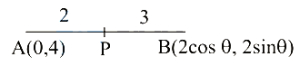
ધારો કે $A = (0, 4)$ અને $B = (2 \cos \theta, 2 \sin \theta)$,જ્યાં $0 < \theta < \frac{\pi}{2}$ છે. ધારો કે $P$ એ રેખાખંડ $AB$ નું $2:3$ ગુણોત્તરમાં અંતઃવિભાજન કરે છે. તો $P$ નો બિંદુપથ શું છે?
A
પરવલય
B
ઉપવલય
C
વર્તુળ
D
અતિવલય
Solution
(C) આપેલ છે $A = (0, 4)$ અને $B = (2 \cos \theta, 2 \sin \theta)$.
$P$ એ $AB$ નું $2:3$ ગુણોત્તરમાં અંતઃવિભાજન કરે છે.
વિભાજન સૂત્રનો ઉપયોગ કરતા,$P(x, y)$ ના યામ:
$x = \frac{2(2 \cos \theta) + 3(0)}{2 + 3} = \frac{4 \cos \theta}{5} \Rightarrow \cos \theta = \frac{5x}{4}$
$y = \frac{2(2 \sin \theta) + 3(4)}{2 + 3} = \frac{4 \sin \theta + 12}{5} \Rightarrow \sin \theta = \frac{5y - 12}{4}$
આપણે જાણીએ છીએ કે $\cos^2 \theta + \sin^2 \theta = 1$,તેથી:
$\left(\frac{5x}{4}\right)^2 + \left(\frac{5y - 12}{4}\right)^2 = 1$
$25x^2 + (5y - 12)^2 = 16$
આ સમીકરણ એક વર્તુળ દર્શાવે છે.
$P$ એ $AB$ નું $2:3$ ગુણોત્તરમાં અંતઃવિભાજન કરે છે.
વિભાજન સૂત્રનો ઉપયોગ કરતા,$P(x, y)$ ના યામ:
$x = \frac{2(2 \cos \theta) + 3(0)}{2 + 3} = \frac{4 \cos \theta}{5} \Rightarrow \cos \theta = \frac{5x}{4}$
$y = \frac{2(2 \sin \theta) + 3(4)}{2 + 3} = \frac{4 \sin \theta + 12}{5} \Rightarrow \sin \theta = \frac{5y - 12}{4}$
આપણે જાણીએ છીએ કે $\cos^2 \theta + \sin^2 \theta = 1$,તેથી:
$\left(\frac{5x}{4}\right)^2 + \left(\frac{5y - 12}{4}\right)^2 = 1$
$25x^2 + (5y - 12)^2 = 16$
આ સમીકરણ એક વર્તુળ દર્શાવે છે.
0 likesView Solution
141
MathematicsMediumMCQTS EAMCET · 2020
ધારો કે $ABCD$ એક ચતુષ્ફલક છે જેમાં તેના દરેક શિરોબિંદુઓના યામ સમાંતર શ્રેણીમાં છે. જો ચતુષ્ફલકનું મધ્યકેન્દ્ર $G$ એ $(2, 3, k)$ હોય,તો ઉગમબિંદુથી $G$ નું અંતર શોધો.
A
$\sqrt{38}$
B
$7$
C
$\sqrt{22}$
D
$\sqrt{29}$
Solution
(D) ધારો કે ચતુષ્ફલકના શિરોબિંદુઓ $A(x_1, y_1, z_1)$,$B(x_2, y_2, z_2)$,$C(x_3, y_3, z_3)$ અને $D(x_4, y_4, z_4)$ છે.
દરેક શિરોબિંદુના યામ સમાંતર શ્રેણીમાં હોવાથી,$y_i = x_i + d$ અને $z_i = x_i + 2d$ મળે.
મધ્યકેન્દ્ર $G = \left(\frac{\sum x_i}{4}, \frac{\sum y_i}{4}, \frac{\sum z_i}{4}\right) = (2, 3, k)$.
$x$-યામ પરથી: $\frac{\sum x_i}{4} = 2 \implies \sum x_i = 8$.
$y$-યામ પરથી: $\frac{\sum x_i + 4d}{4} = 3 \implies \frac{8 + 4d}{4} = 3 \implies d = 1$.
$z$-યામ પરથી: $k = \frac{\sum x_i + 8d}{4} = \frac{8 + 8(1)}{4} = 4$.
તેથી,$G = (2, 3, 4)$.
ઉગમબિંદુથી અંતર $= \sqrt{2^2 + 3^2 + 4^2} = \sqrt{29}$.
દરેક શિરોબિંદુના યામ સમાંતર શ્રેણીમાં હોવાથી,$y_i = x_i + d$ અને $z_i = x_i + 2d$ મળે.
મધ્યકેન્દ્ર $G = \left(\frac{\sum x_i}{4}, \frac{\sum y_i}{4}, \frac{\sum z_i}{4}\right) = (2, 3, k)$.
$x$-યામ પરથી: $\frac{\sum x_i}{4} = 2 \implies \sum x_i = 8$.
$y$-યામ પરથી: $\frac{\sum x_i + 4d}{4} = 3 \implies \frac{8 + 4d}{4} = 3 \implies d = 1$.
$z$-યામ પરથી: $k = \frac{\sum x_i + 8d}{4} = \frac{8 + 8(1)}{4} = 4$.
તેથી,$G = (2, 3, 4)$.
ઉગમબિંદુથી અંતર $= \sqrt{2^2 + 3^2 + 4^2} = \sqrt{29}$.
0 likesView Solution
142
MathematicsMediumMCQTS EAMCET · 2020
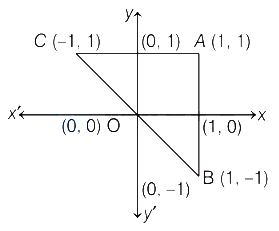
ધારો કે $A(1,1), B(1,-1), C(-1,1)$ એ $\triangle ABC$ ના શિરોબિંદુઓ છે. ધારો કે $S$ એ પરિકેન્દ્ર,$O$ એ લંબકેન્દ્ર અને $I$ એ $\triangle ABC$ નું અંતઃકેન્દ્ર છે. તો $IS + OS =$ ?
A
$4$
B
$2$
C
$2+2\sqrt{2}$
D
$2+\sqrt{2}$
Solution
(B) શિરોબિંદુઓ $A(1,1), B(1,-1), C(-1,1)$ છે.
$AB$ શિરોલંબ છે અને $AC$ સમક્ષિતિજ છે,તેથી $\triangle ABC$ એ $A(1,1)$ આગળ કાટકોણ ત્રિકોણ છે.
$1$. પરિકેન્દ્ર $S$: કાટકોણ ત્રિકોણ માટે,પરિકેન્દ્ર એ કર્ણ $BC$ નું મધ્યબિંદુ છે.
$S = (0,0)$.
$2$. લંબકેન્દ્ર $O$: કાટકોણ ત્રિકોણ માટે,લંબકેન્દ્ર એ કાટખૂણો બનાવતા શિરોબિંદુ પર હોય છે.
$O = A = (1,1)$.
$3$. અંતઃકેન્દ્ર $I$: બાજુઓની લંબાઈ $c=2, b=2, a=2\sqrt{2}$ છે.
અંતઃકેન્દ્ર $I = (\sqrt{2}-1, \sqrt{2}-1)$.
$OS = \sqrt{1^2+1^2} = \sqrt{2}$.
$IS = \sqrt{(\sqrt{2}-1)^2 + (\sqrt{2}-1)^2} = \sqrt{2}(\sqrt{2}-1) = 2-\sqrt{2}$.
$IS + OS = (2-\sqrt{2}) + \sqrt{2} = 2$.
$AB$ શિરોલંબ છે અને $AC$ સમક્ષિતિજ છે,તેથી $\triangle ABC$ એ $A(1,1)$ આગળ કાટકોણ ત્રિકોણ છે.
$1$. પરિકેન્દ્ર $S$: કાટકોણ ત્રિકોણ માટે,પરિકેન્દ્ર એ કર્ણ $BC$ નું મધ્યબિંદુ છે.
$S = (0,0)$.
$2$. લંબકેન્દ્ર $O$: કાટકોણ ત્રિકોણ માટે,લંબકેન્દ્ર એ કાટખૂણો બનાવતા શિરોબિંદુ પર હોય છે.
$O = A = (1,1)$.
$3$. અંતઃકેન્દ્ર $I$: બાજુઓની લંબાઈ $c=2, b=2, a=2\sqrt{2}$ છે.
અંતઃકેન્દ્ર $I = (\sqrt{2}-1, \sqrt{2}-1)$.
$OS = \sqrt{1^2+1^2} = \sqrt{2}$.
$IS = \sqrt{(\sqrt{2}-1)^2 + (\sqrt{2}-1)^2} = \sqrt{2}(\sqrt{2}-1) = 2-\sqrt{2}$.
$IS + OS = (2-\sqrt{2}) + \sqrt{2} = 2$.
0 likesView Solution
143
MathematicsEasyMCQTS EAMCET · 2020
એક $\triangle ABC$ ની બાજુઓ $AB$,$AC$ અને $BC$ ના સમીકરણો અનુક્રમે $x-3y=0$,$3x-y=0$ અને $x+y+4=0$ છે. જો $P$ અને $Q$ એ $B$ માંથી પસાર થતી રેખા $3x-y+k=0$ પરના બિંદુઓ હોય કે જેથી $PB:BQ=1:1$ થાય,તો $k=$
A
$8$
B
$12$
C
$-8$
D
$-12$
Solution
(A) બાજુઓના સમીકરણો નીચે મુજબ છે:
$AB: x-3y=0$
$AC: 3x-y=0$
$BC: x+y+4=0$
શિરોબિંદુ $B$ ના યામ શોધવા માટે,આપણે $AB$ અને $BC$ ના સમીકરણો ઉકેલીએ:
$x-3y=0 \Rightarrow x=3y$
$x+y+4=0$ માં $x=3y$ મુકતા:
$3y+y+4=0$ $\Rightarrow 4y=-4$ $\Rightarrow y=-1$
તેથી $x=3(-1)=-3$.
આમ,શિરોબિંદુ $B$ એ $(-3, -1)$ છે.
રેખા $3x-y+k=0$ એ $B(-3, -1)$ માંથી પસાર થતી હોવાથી,આપણે આ યામ રેખાના સમીકરણમાં મુકીએ:
$3(-3)-(-1)+k=0$
$-9+1+k=0$
$-8+k=0 \Rightarrow k=8$.
$AB: x-3y=0$
$AC: 3x-y=0$
$BC: x+y+4=0$
શિરોબિંદુ $B$ ના યામ શોધવા માટે,આપણે $AB$ અને $BC$ ના સમીકરણો ઉકેલીએ:
$x-3y=0 \Rightarrow x=3y$
$x+y+4=0$ માં $x=3y$ મુકતા:
$3y+y+4=0$ $\Rightarrow 4y=-4$ $\Rightarrow y=-1$
તેથી $x=3(-1)=-3$.
આમ,શિરોબિંદુ $B$ એ $(-3, -1)$ છે.
રેખા $3x-y+k=0$ એ $B(-3, -1)$ માંથી પસાર થતી હોવાથી,આપણે આ યામ રેખાના સમીકરણમાં મુકીએ:
$3(-3)-(-1)+k=0$
$-9+1+k=0$
$-8+k=0 \Rightarrow k=8$.
0 likesView Solution
144
MathematicsDifficultMCQTS EAMCET · 2020
ઉગમબિંદુને $(2, 3)$ બિંદુ પર સ્થાનાંતરિત કરીને અને ત્યારબાદ યામ અક્ષોને $\theta$ ખૂણે ઘડિયાળના કાંટાની વિરુદ્ધ દિશામાં ફેરવતા,જો સમીકરણ $3x^2 + 2xy + 3y^2 - 18x - 22y + 50 = 0$ નું રૂપાંતર $4X^2 + 2Y^2 - 1 = 0$ માં થાય,તો ખૂણો $\theta =$
A
$\frac{\pi}{6}$
B
$\frac{\pi}{2}$
C
$\frac{\pi}{4}$
D
$\frac{\pi}{3}$
Solution
(C) ધારો કે ઉગમબિંદુ $(h, k) = (2, 3)$ પર સ્થાનાંતરિત થાય છે. રૂપાંતરણ સમીકરણો $x = X \cos \theta - Y \sin \theta + 2$ અને $y = X \sin \theta + Y \cos \theta + 3$ છે.
આ કિંમતોને $3x^2 + 2xy + 3y^2 - 18x - 22y + 50 = 0$ માં મૂકતા,રૂપાંતરિત સમીકરણ $4X^2 + 2Y^2 - 1 = 0$ માં $XY$ પદ શૂન્ય થવું જોઈએ.
સામાન્ય દ્વિઘાત સમીકરણ $ax^2 + 2hxy + by^2 + 2gx + 2fy + c = 0$ માં $\theta$ ખૂણે પરિભ્રમણ પછી $XY$ નો સહગુણક $2h' = (b - a) \sin 2\theta + 2h \cos 2\theta$ દ્વારા મળે છે.
અહીં,$a = 3, b = 3, h = 1$.
$2h' = 0$ લેતા,આપણને $(3 - 3) \sin 2\theta + 2(1) \cos 2\theta = 0$ મળે છે.
આનો અર્થ એ છે કે $2 \cos 2\theta = 0$,તેથી $\cos 2\theta = 0$.
આમ,$2\theta = \frac{\pi}{2}$,જે $\theta = \frac{\pi}{4}$ આપે છે.
આ કિંમતોને $3x^2 + 2xy + 3y^2 - 18x - 22y + 50 = 0$ માં મૂકતા,રૂપાંતરિત સમીકરણ $4X^2 + 2Y^2 - 1 = 0$ માં $XY$ પદ શૂન્ય થવું જોઈએ.
સામાન્ય દ્વિઘાત સમીકરણ $ax^2 + 2hxy + by^2 + 2gx + 2fy + c = 0$ માં $\theta$ ખૂણે પરિભ્રમણ પછી $XY$ નો સહગુણક $2h' = (b - a) \sin 2\theta + 2h \cos 2\theta$ દ્વારા મળે છે.
અહીં,$a = 3, b = 3, h = 1$.
$2h' = 0$ લેતા,આપણને $(3 - 3) \sin 2\theta + 2(1) \cos 2\theta = 0$ મળે છે.
આનો અર્થ એ છે કે $2 \cos 2\theta = 0$,તેથી $\cos 2\theta = 0$.
આમ,$2\theta = \frac{\pi}{2}$,જે $\theta = \frac{\pi}{4}$ આપે છે.
0 likesView Solution
145
MathematicsMediumMCQTS EAMCET · 2020
જ્યારે ઉગમબિંદુને કોઓર્ડિનેટ અક્ષોના સ્થળાંતર દ્વારા $\left(\frac{3}{2}, \frac{3}{2}\right)$ બિંદુ પર ખસેડવામાં આવે છે,ત્યારે $32 x^2+8 x y+32 y^2-108 x-108 y+99=0$ નું રૂપાંતરિત સમીકરણ શું હશે?
A
$72 X^2+56 Y^2-63=0$
B
$X^2-14 X Y-7 Y^2-2=0$
C
$32 X^2-16 X Y+32 Y^2-225=0$
D
$32 X^2+8 X Y+32 Y^2-63=0$
Solution
(D) સમીકરણ $32 x^2+8 x y+32 y^2-108 x-108 y+99=0$ માં $x=X+\frac{3}{2}$ અને $y=Y+\frac{3}{2}$ મૂકતા:
$32(X+\frac{3}{2})^2 + 8(X+\frac{3}{2})(Y+\frac{3}{2}) + 32(Y+\frac{3}{2})^2 - 108(X+\frac{3}{2}) - 108(Y+\frac{3}{2}) + 99 = 0$
પદોનું વિસ્તરણ કરતા:
$32(X^2 + 3X + \frac{9}{4}) + 8(XY + \frac{3}{2}X + \frac{3}{2}Y + \frac{9}{4}) + 32(Y^2 + 3Y + \frac{9}{4}) - 108X - 162 - 108Y - 162 + 99 = 0$
$32X^2 + 96X + 72 + 8XY + 12X + 12Y + 18 + 32Y^2 + 96Y + 72 - 108X - 108Y - 162 - 162 + 99 = 0$
સમાન પદોને ભેગા કરતા:
$32X^2 + 32Y^2 + 8XY + (96+12-108)X + (96+12-108)Y + (72+18+72-162-162+99) = 0$
$32X^2 + 8XY + 32Y^2 - 63 = 0$
$32(X+\frac{3}{2})^2 + 8(X+\frac{3}{2})(Y+\frac{3}{2}) + 32(Y+\frac{3}{2})^2 - 108(X+\frac{3}{2}) - 108(Y+\frac{3}{2}) + 99 = 0$
પદોનું વિસ્તરણ કરતા:
$32(X^2 + 3X + \frac{9}{4}) + 8(XY + \frac{3}{2}X + \frac{3}{2}Y + \frac{9}{4}) + 32(Y^2 + 3Y + \frac{9}{4}) - 108X - 162 - 108Y - 162 + 99 = 0$
$32X^2 + 96X + 72 + 8XY + 12X + 12Y + 18 + 32Y^2 + 96Y + 72 - 108X - 108Y - 162 - 162 + 99 = 0$
સમાન પદોને ભેગા કરતા:
$32X^2 + 32Y^2 + 8XY + (96+12-108)X + (96+12-108)Y + (72+18+72-162-162+99) = 0$
$32X^2 + 8XY + 32Y^2 - 63 = 0$
0 likesView Solution
146
MathematicsMediumMCQTS EAMCET · 2020
$C_1$ અને $C_2$ એ વર્તુળો $x^2+y^2-2x+4y+1=0$ અને $x^2+y^2+4x-6y+12=0$ ના બાહ્ય અને આંતરિક સમાનતાના કેન્દ્રો છે. જો $C_1C_2$ ને વ્યાસ તરીકે ધરાવતા વર્તુળની ત્રિજ્યા $r$ હોય,તો $\frac{9}{2}r=$
A
$\sqrt{15}$
B
$3\sqrt{15}$
C
$2\sqrt{34}$
D
$3\sqrt{34}$
Solution
(D) વર્તુળ $S_1: x^2+y^2-2x+4y+1=0$ માટે,કેન્દ્ર $O_1 = (1, -2)$ અને ત્રિજ્યા $r_1 = 2$ છે.
વર્તુળ $S_2: x^2+y^2+4x-6y+12=0$ માટે,કેન્દ્ર $O_2 = (-2, 3)$ અને ત્રિજ્યા $r_2 = 1$ છે.
બાહ્ય સમાનતાનું કેન્દ્ર $C_1$ એ $O_1O_2$ નું $2:1$ ગુણોત્તરમાં બાહ્ય વિભાજન કરે છે.
$C_1 = (-5, 8)$.
આંતરિક સમાનતાનું કેન્દ્ર $C_2$ એ $O_1O_2$ નું $2:1$ ગુણોત્તરમાં આંતરિક વિભાજન કરે છે.
$C_2 = (-1, 4/3)$.
વ્યાસ $C_1C_2 = \sqrt{(-4)^2 + (20/3)^2} = \frac{4\sqrt{34}}{3}$.
વ્યાસ $2r = \frac{4\sqrt{34}}{3}$ હોવાથી,$r = \frac{2\sqrt{34}}{3}$.
તેથી,$\frac{9}{2}r = 3\sqrt{34}$.
વર્તુળ $S_2: x^2+y^2+4x-6y+12=0$ માટે,કેન્દ્ર $O_2 = (-2, 3)$ અને ત્રિજ્યા $r_2 = 1$ છે.
બાહ્ય સમાનતાનું કેન્દ્ર $C_1$ એ $O_1O_2$ નું $2:1$ ગુણોત્તરમાં બાહ્ય વિભાજન કરે છે.
$C_1 = (-5, 8)$.
આંતરિક સમાનતાનું કેન્દ્ર $C_2$ એ $O_1O_2$ નું $2:1$ ગુણોત્તરમાં આંતરિક વિભાજન કરે છે.
$C_2 = (-1, 4/3)$.
વ્યાસ $C_1C_2 = \sqrt{(-4)^2 + (20/3)^2} = \frac{4\sqrt{34}}{3}$.
વ્યાસ $2r = \frac{4\sqrt{34}}{3}$ હોવાથી,$r = \frac{2\sqrt{34}}{3}$.
તેથી,$\frac{9}{2}r = 3\sqrt{34}$.
0 likesView Solution
147
MathematicsMediumMCQTS EAMCET · 2020
ધારો કે $C$ એ કાર્ટેઝિયન સમતલમાં $ax^2+2hxy+by^2+2gx+2fy+c=0$ વક્ર છે. કોઓર્ડિનેટ અક્ષોને ધન દિશામાં $\frac{\pi}{4}$ ખૂણે ફેરવતા,જો $C$ નું રૂપાંતરિત સમીકરણ $Y^2+XY-X=0$ હોય,તો $(h^2-ab)-2gf=$
A
$0$
B
$2$
C
$1$
D
-$1$
Solution
(A) દ્વિઘાત વક્રનું સામાન્ય સમીકરણ $ax^2+2hxy+by^2+2gx+2fy+c=0$ છે. $\ldots(i)$
અક્ષોને $\theta = \frac{\pi}{4}$ ખૂણે ફેરવતા $x = \frac{X-Y}{\sqrt{2}}$ અને $y = \frac{X+Y}{\sqrt{2}}$ મળે છે.
આ કિંમતો $(i)$ માં મૂકતા રૂપાંતરિત સમીકરણ મળે છે:
$(\frac{a+b}{2}+h)X^2 + (b-a)XY + (\frac{a+b}{2}-h)Y^2 + \sqrt{2}(g+f)X + \sqrt{2}(f-g)Y + c = 0$.
$Y^2+XY-X=0$ સાથે સરખાવતા:
$1) \frac{a+b}{2}+h = 0$
$2) b-a = 1$
$3) \frac{a+b}{2}-h = 1$
$4) \sqrt{2}(g+f) = -1$
$5) f-g = 0$
ઉકેલતા $a+b=1, h=-\frac{1}{2}, b=1, a=0$ અને $f=g=-\frac{1}{2\sqrt{2}}$ મળે છે.
તેથી,$(h^2-ab)-2gf = (\frac{1}{4} - 0) - 2(\frac{1}{8}) = 0$.
અક્ષોને $\theta = \frac{\pi}{4}$ ખૂણે ફેરવતા $x = \frac{X-Y}{\sqrt{2}}$ અને $y = \frac{X+Y}{\sqrt{2}}$ મળે છે.
આ કિંમતો $(i)$ માં મૂકતા રૂપાંતરિત સમીકરણ મળે છે:
$(\frac{a+b}{2}+h)X^2 + (b-a)XY + (\frac{a+b}{2}-h)Y^2 + \sqrt{2}(g+f)X + \sqrt{2}(f-g)Y + c = 0$.
$Y^2+XY-X=0$ સાથે સરખાવતા:
$1) \frac{a+b}{2}+h = 0$
$2) b-a = 1$
$3) \frac{a+b}{2}-h = 1$
$4) \sqrt{2}(g+f) = -1$
$5) f-g = 0$
ઉકેલતા $a+b=1, h=-\frac{1}{2}, b=1, a=0$ અને $f=g=-\frac{1}{2\sqrt{2}}$ મળે છે.
તેથી,$(h^2-ab)-2gf = (\frac{1}{4} - 0) - 2(\frac{1}{8}) = 0$.
0 likesView Solution
148
MathematicsMediumMCQTS EAMCET · 2020
જ્યારે યામ અક્ષોને $\theta$ ખૂણે ઘડિયાળની વિરુદ્ધ દિશામાં ફેરવવામાં આવે છે,જો $x^2+y^2+2xy+2x+6y+1=0$ નું રૂપાંતરિત સમીકરણ $(2+\sqrt{3})X^2+2XY+(2-\sqrt{3})Y^2+aX+bY+2=0$ હોય,તો $3a-b=$
A
$10$
B
$2(1+2\sqrt{3})$
C
$20$
D
$2(3+\sqrt{3})$
Solution
(C) જ્યારે યામ અક્ષોને $\theta$ ખૂણે ઘડિયાળની વિરુદ્ધ દિશામાં ફેરવવામાં આવે,ત્યારે રૂપાંતરણ નીચે મુજબ છે:
$x = X \cos \theta - Y \sin \theta$
$y = X \sin \theta + Y \cos \theta$
આ કિંમતોને $x^2+y^2+2xy+2x+6y+1=0$ માં મૂકતા:
$(X \cos \theta - Y \sin \theta)^2 + (X \sin \theta + Y \cos \theta)^2 + 2(X \cos \theta - Y \sin \theta)(X \sin \theta + Y \cos \theta) + 2(X \cos \theta - Y \sin \theta) + 6(X \sin \theta + Y \cos \theta) + 1 = 0$
સહગુણકોનું સાદું રૂપ આપતા:
$X^2(1 + \sin 2\theta) + 2XY(\cos 2\theta) + Y^2(1 - \sin 2\theta) + X(2 \cos \theta + 6 \sin \theta) + Y(6 \cos \theta - 2 \sin \theta) + 1 = 0$
તેને $(2+\sqrt{3})X^2 + 2XY + (2-\sqrt{3})Y^2 + aX + bY + 2 = 0$ સાથે સરખાવતા:
નોંધ: આપેલ સમીકરણમાં અચળ પદ $2$ છે,તેથી મેળવેલા સમીકરણને $2$ વડે ગુણતા:
$2(1 + \sin 2\theta) = 2 + \sqrt{3}$ $\Rightarrow \sin 2\theta = \frac{\sqrt{3}}{2}$ $\Rightarrow 2\theta = 60^\circ$ $\Rightarrow \theta = 30^\circ$
તેથી $a = 2(2 \cos 30^\circ + 6 \sin 30^\circ) = 2(2 \cdot \frac{\sqrt{3}}{2} + 6 \cdot \frac{1}{2}) = 2(\sqrt{3} + 3) = 6 + 2\sqrt{3}$
$b = 2(6 \cos 30^\circ - 2 \sin 30^\circ) = 2(6 \cdot \frac{\sqrt{3}}{2} - 2 \cdot \frac{1}{2}) = 2(3\sqrt{3} - 1) = 6\sqrt{3} - 2$
$3a - b = 3(6 + 2\sqrt{3}) - (6\sqrt{3} - 2) = 18 + 6\sqrt{3} - 6\sqrt{3} + 2 = 20$
$x = X \cos \theta - Y \sin \theta$
$y = X \sin \theta + Y \cos \theta$
આ કિંમતોને $x^2+y^2+2xy+2x+6y+1=0$ માં મૂકતા:
$(X \cos \theta - Y \sin \theta)^2 + (X \sin \theta + Y \cos \theta)^2 + 2(X \cos \theta - Y \sin \theta)(X \sin \theta + Y \cos \theta) + 2(X \cos \theta - Y \sin \theta) + 6(X \sin \theta + Y \cos \theta) + 1 = 0$
સહગુણકોનું સાદું રૂપ આપતા:
$X^2(1 + \sin 2\theta) + 2XY(\cos 2\theta) + Y^2(1 - \sin 2\theta) + X(2 \cos \theta + 6 \sin \theta) + Y(6 \cos \theta - 2 \sin \theta) + 1 = 0$
તેને $(2+\sqrt{3})X^2 + 2XY + (2-\sqrt{3})Y^2 + aX + bY + 2 = 0$ સાથે સરખાવતા:
નોંધ: આપેલ સમીકરણમાં અચળ પદ $2$ છે,તેથી મેળવેલા સમીકરણને $2$ વડે ગુણતા:
$2(1 + \sin 2\theta) = 2 + \sqrt{3}$ $\Rightarrow \sin 2\theta = \frac{\sqrt{3}}{2}$ $\Rightarrow 2\theta = 60^\circ$ $\Rightarrow \theta = 30^\circ$
તેથી $a = 2(2 \cos 30^\circ + 6 \sin 30^\circ) = 2(2 \cdot \frac{\sqrt{3}}{2} + 6 \cdot \frac{1}{2}) = 2(\sqrt{3} + 3) = 6 + 2\sqrt{3}$
$b = 2(6 \cos 30^\circ - 2 \sin 30^\circ) = 2(6 \cdot \frac{\sqrt{3}}{2} - 2 \cdot \frac{1}{2}) = 2(3\sqrt{3} - 1) = 6\sqrt{3} - 2$
$3a - b = 3(6 + 2\sqrt{3}) - (6\sqrt{3} - 2) = 18 + 6\sqrt{3} - 6\sqrt{3} + 2 = 20$
0 likesView Solution
149
MathematicsDifficultMCQTS EAMCET · 2020
ધારો કે અક્ષો $X$ અને $Y$ એ અક્ષો $x$ અને $y$ ને $\theta$ ખૂણે ફેરવીને મેળવવામાં આવે છે. જો સમીકરણ $x^2+2 \sqrt{3} x y-y^2=4 a^2$ ને $XY$-અક્ષોના સંદર્ભમાં $X^2-Y^2=2 a^2$ માં રૂપાંતરિત કરવામાં આવે,તો $\theta$ ની કિંમત શોધો. ($^{\circ}$ માં)
A
$45$
B
$60$
C
$90$
D
$30$
Solution
(D) અક્ષોને $\theta$ ખૂણે ફેરવવા માટેના રૂપાંતરણ સમીકરણો $x = X \cos \theta - Y \sin \theta$ અને $y = X \sin \theta + Y \cos \theta$ છે.
આ કિંમતોને આપેલ સમીકરણ $x^2 + 2\sqrt{3}xy - y^2 = 4a^2$ માં મૂકતા:
$(X \cos \theta - Y \sin \theta)^2 + 2\sqrt{3}(X \cos \theta - Y \sin \theta)(X \sin \theta + Y \cos \theta) - (X \sin \theta + Y \cos \theta)^2 = 4a^2$.
પદોનું વિસ્તરણ કરતા,સમીકરણ $X^2 - Y^2 = 2a^2$ ના સ્વરૂપમાં આવવા માટે $XY$ પદનો સહગુણક શૂન્ય હોવો જોઈએ.
$XY$ પદનો સહગુણક $-2 \sin \theta \cos \theta + 2\sqrt{3}(\cos^2 \theta - \sin^2 \theta) - 2 \sin \theta \cos \theta = 0$ થાય છે.
આનું સાદું રૂપ $-4 \sin \theta \cos \theta + 2\sqrt{3} \cos 2\theta = 0$ એટલે કે $-2 \sin 2\theta + 2\sqrt{3} \cos 2\theta = 0$ થાય છે.
તેથી,$\tan 2\theta = \sqrt{3}$,જેનો અર્થ છે કે $2\theta = 60^{\circ}$,તેથી $\theta = 30^{\circ}$.
આ કિંમતોને આપેલ સમીકરણ $x^2 + 2\sqrt{3}xy - y^2 = 4a^2$ માં મૂકતા:
$(X \cos \theta - Y \sin \theta)^2 + 2\sqrt{3}(X \cos \theta - Y \sin \theta)(X \sin \theta + Y \cos \theta) - (X \sin \theta + Y \cos \theta)^2 = 4a^2$.
પદોનું વિસ્તરણ કરતા,સમીકરણ $X^2 - Y^2 = 2a^2$ ના સ્વરૂપમાં આવવા માટે $XY$ પદનો સહગુણક શૂન્ય હોવો જોઈએ.
$XY$ પદનો સહગુણક $-2 \sin \theta \cos \theta + 2\sqrt{3}(\cos^2 \theta - \sin^2 \theta) - 2 \sin \theta \cos \theta = 0$ થાય છે.
આનું સાદું રૂપ $-4 \sin \theta \cos \theta + 2\sqrt{3} \cos 2\theta = 0$ એટલે કે $-2 \sin 2\theta + 2\sqrt{3} \cos 2\theta = 0$ થાય છે.
તેથી,$\tan 2\theta = \sqrt{3}$,જેનો અર્થ છે કે $2\theta = 60^{\circ}$,તેથી $\theta = 30^{\circ}$.
0 likesView Solution
150
MathematicsEasyMCQTS EAMCET · 2020
ધારો કે $ABCD$ એક સમાંતરબાજુ ચતુષ્કોણ છે અને $E$ એ $AB$ નું મધ્યબિંદુ છે. જો $P$ એ $DE$ અને $AC$ નું છેદબિંદુ હોય,તો $\frac{DP}{PE} + \frac{AP}{PC} = $
A
$\frac{5}{2}$
B
$\frac{4}{3}$
C
$\frac{3}{2}$
D
$\frac{2}{3}$
Solution
(A) આપેલ છે કે $ABCD$ એક સમાંતરબાજુ ચતુષ્કોણ છે અને $E$ એ $AB$ નું મધ્યબિંદુ છે.
$AB \parallel CD$ હોવાથી,$AE \parallel CD$ થાય.
$\triangle PAE$ અને $\triangle PCD$ માં,
$\angle PAE = \angle PCD$ (યુગ્મકોણ)
$\angle APE = \angle CPD$ (અભિકોણ)
તેથી,$AA$ સમરૂપતાની શરત મુજબ $\triangle PAE \sim \triangle PCD$ થાય.
સમરૂપ ત્રિકોણના ગુણધર્મ મુજબ:
$\frac{PA}{PC} = \frac{PE}{PD} = \frac{AE}{CD}$.
$E$ એ $AB$ નું મધ્યબિંદુ હોવાથી,$AE = \frac{1}{2} AB$. વળી,સમાંતરબાજુ ચતુષ્કોણમાં $AB = CD$ હોવાથી,$AE = \frac{1}{2} CD$ થાય.
આમ,$\frac{PA}{PC} = \frac{PE}{PD} = \frac{1}{2}$.
આનો અર્થ એ છે કે $\frac{PA}{PC} = \frac{1}{2}$ અને $\frac{PD}{PE} = 2$.
તેથી,$\frac{DP}{PE} + \frac{AP}{PC} = 2 + \frac{1}{2} = \frac{5}{2}$.
$AB \parallel CD$ હોવાથી,$AE \parallel CD$ થાય.
$\triangle PAE$ અને $\triangle PCD$ માં,
$\angle PAE = \angle PCD$ (યુગ્મકોણ)
$\angle APE = \angle CPD$ (અભિકોણ)
તેથી,$AA$ સમરૂપતાની શરત મુજબ $\triangle PAE \sim \triangle PCD$ થાય.
સમરૂપ ત્રિકોણના ગુણધર્મ મુજબ:
$\frac{PA}{PC} = \frac{PE}{PD} = \frac{AE}{CD}$.
$E$ એ $AB$ નું મધ્યબિંદુ હોવાથી,$AE = \frac{1}{2} AB$. વળી,સમાંતરબાજુ ચતુષ્કોણમાં $AB = CD$ હોવાથી,$AE = \frac{1}{2} CD$ થાય.
આમ,$\frac{PA}{PC} = \frac{PE}{PD} = \frac{1}{2}$.
આનો અર્થ એ છે કે $\frac{PA}{PC} = \frac{1}{2}$ અને $\frac{PD}{PE} = 2$.
તેથી,$\frac{DP}{PE} + \frac{AP}{PC} = 2 + \frac{1}{2} = \frac{5}{2}$.
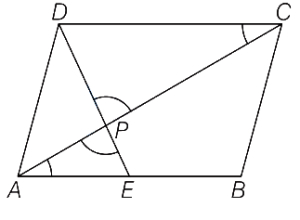
0 likesView Solution
151
MathematicsDifficultMCQTS EAMCET · 2020
જો $a x^2+2 h x y+b y^2=0$ હોય,તો $\frac{d^2 y}{d x^2}=$
A
$\frac{h^2-a b}{(h x+b y)^3}$
B
$\frac{2(h^2-a b)}{(h x+b y)^3}$
C
$\frac{(h x+b y)^3}{h^2-a b}$
D
$0$
Solution
(D) આપેલ સમીકરણ: $a x^2+2 h x y+b y^2=0$.
$x$ ની સાપેક્ષમાં વિકલન કરતા:
$2 a x+2 h(y+x \frac{d y}{d x})+2 b y \frac{d y}{d x}=0$.
$2$ વડે ભાગતા: $a x+h y+h x \frac{d y}{d x}+b y \frac{d y}{d x}=0$.
$\frac{d y}{d x}(h x+b y)=-(a x+h y) \implies \frac{d y}{d x}=-\frac{a x+h y}{h x+b y}$.
હવે,ભાગાકારના નિયમનો ઉપયોગ કરીને ફરીથી $x$ ની સાપેક્ષમાં વિકલન કરતા:
$\frac{d^2 y}{d x^2} = -\frac{(h x+b y)(a+h \frac{d y}{d x})-(a x+h y)(h+b \frac{d y}{d x})}{(h x+b y)^2}$.
$\frac{d y}{d x} = -\frac{a x+h y}{h x+b y}$ મૂકતા:
$\frac{d^2 y}{d x^2} = -\frac{(h x+b y)(a-h \frac{a x+h y}{h x+b y})-(a x+h y)(h-b \frac{a x+h y}{h x+b y})}{(h x+b y)^2}$.
અંશનું સાદુરૂપ આપતા:
$\frac{d^2 y}{d x^2} = -\frac{(a h x+a b y-a h x-h^2 y)-(a h x+b h y-a b x-b h y)}{(h x+b y)^3} = -\frac{a b y-h^2 y-a h x+a b x}{(h x+b y)^3}$.
કારણ કે $a x^2+2 h x y+b y^2=0$ એ ઉગમબિંદુમાંથી પસાર થતી બે રેખાઓ દર્શાવે છે,તેથી $\frac{d^2 y}{d x^2}=0$.
$x$ ની સાપેક્ષમાં વિકલન કરતા:
$2 a x+2 h(y+x \frac{d y}{d x})+2 b y \frac{d y}{d x}=0$.
$2$ વડે ભાગતા: $a x+h y+h x \frac{d y}{d x}+b y \frac{d y}{d x}=0$.
$\frac{d y}{d x}(h x+b y)=-(a x+h y) \implies \frac{d y}{d x}=-\frac{a x+h y}{h x+b y}$.
હવે,ભાગાકારના નિયમનો ઉપયોગ કરીને ફરીથી $x$ ની સાપેક્ષમાં વિકલન કરતા:
$\frac{d^2 y}{d x^2} = -\frac{(h x+b y)(a+h \frac{d y}{d x})-(a x+h y)(h+b \frac{d y}{d x})}{(h x+b y)^2}$.
$\frac{d y}{d x} = -\frac{a x+h y}{h x+b y}$ મૂકતા:
$\frac{d^2 y}{d x^2} = -\frac{(h x+b y)(a-h \frac{a x+h y}{h x+b y})-(a x+h y)(h-b \frac{a x+h y}{h x+b y})}{(h x+b y)^2}$.
અંશનું સાદુરૂપ આપતા:
$\frac{d^2 y}{d x^2} = -\frac{(a h x+a b y-a h x-h^2 y)-(a h x+b h y-a b x-b h y)}{(h x+b y)^3} = -\frac{a b y-h^2 y-a h x+a b x}{(h x+b y)^3}$.
કારણ કે $a x^2+2 h x y+b y^2=0$ એ ઉગમબિંદુમાંથી પસાર થતી બે રેખાઓ દર્શાવે છે,તેથી $\frac{d^2 y}{d x^2}=0$.
0 likesView Solution
152
MathematicsMediumMCQTS EAMCET · 2020
જો $p(x)$ એ એક બહુપદી હોય જે $p(2x) = p'(x) \cdot p''(x)$ નું સમાધાન કરે છે,તો $\sum_{x=1}^5 p(x) =$
A
$200$
B
$100$
C
$50$
D
$450$
Solution
(B) ધારો કે બહુપદી $p(x)$ ની ઘાત $n$ છે.
તો $p'(x)$ ની ઘાત $n-1$ અને $p''(x)$ ની ઘાત $n-2$ થાય.
સમીકરણ $p(2x) = p'(x) \cdot p''(x)$ ની બંને બાજુએ ઘાત સરખાવતા,આપણને મળે:
$n = (n-1) + (n-2) \Rightarrow n = 3$.
ધારો કે $p(x) = ax^3$.
તો $p'(x) = 3ax^2$ અને $p''(x) = 6ax$ થાય.
આ કિંમતો આપેલ સમીકરણમાં મૂકતા:
$a(2x)^3 = (3ax^2) \cdot (6ax)$
$8ax^3 = 18a^2x^3$
કારણ કે $p(x)$ એ $3$ ઘાતની બહુપદી છે,તેથી $a \neq 0$.
$8a = 18a^2 \Rightarrow a = \frac{8}{18} = \frac{4}{9}$.
આમ,$p(x) = \frac{4}{9}x^3$.
હવે,આપણે સરવાળો ગણીએ:
$\sum_{x=1}^5 p(x) = \frac{4}{9} \sum_{x=1}^5 x^3 = \frac{4}{9} \left( \frac{5(5+1)}{2} \right)^2$
$= \frac{4}{9} \left( \frac{30}{2} \right)^2 = \frac{4}{9} \cdot 15^2 = \frac{4}{9} \cdot 225 = 4 \cdot 25 = 100$.
તો $p'(x)$ ની ઘાત $n-1$ અને $p''(x)$ ની ઘાત $n-2$ થાય.
સમીકરણ $p(2x) = p'(x) \cdot p''(x)$ ની બંને બાજુએ ઘાત સરખાવતા,આપણને મળે:
$n = (n-1) + (n-2) \Rightarrow n = 3$.
ધારો કે $p(x) = ax^3$.
તો $p'(x) = 3ax^2$ અને $p''(x) = 6ax$ થાય.
આ કિંમતો આપેલ સમીકરણમાં મૂકતા:
$a(2x)^3 = (3ax^2) \cdot (6ax)$
$8ax^3 = 18a^2x^3$
કારણ કે $p(x)$ એ $3$ ઘાતની બહુપદી છે,તેથી $a \neq 0$.
$8a = 18a^2 \Rightarrow a = \frac{8}{18} = \frac{4}{9}$.
આમ,$p(x) = \frac{4}{9}x^3$.
હવે,આપણે સરવાળો ગણીએ:
$\sum_{x=1}^5 p(x) = \frac{4}{9} \sum_{x=1}^5 x^3 = \frac{4}{9} \left( \frac{5(5+1)}{2} \right)^2$
$= \frac{4}{9} \left( \frac{30}{2} \right)^2 = \frac{4}{9} \cdot 15^2 = \frac{4}{9} \cdot 225 = 4 \cdot 25 = 100$.
0 likesView Solution
153
MathematicsEasyMCQTS EAMCET · 2020
જો $\left(\frac{dy}{dx}\right) = \frac{1}{\left(\frac{dx}{dy}\right)}$ અને $\frac{d^2x}{dy^2}\left(\frac{dy}{dx}\right)^3 + \frac{d^2y}{dx^2} = k$ હોય,તો $e^{k f(x)} - k f(x) =$
A
$1$
B
$0$
C
$\frac{1}{2}$
D
$2$
Solution
(A) આપેલ છે કે,$\frac{dy}{dx} = \left(\frac{dx}{dy}\right)^{-1} \dots (i)$
બંને બાજુ $x$ ની સાપેક્ષમાં વિકલન કરતા:
$\frac{d^2y}{dx^2} = -\left(\frac{dx}{dy}\right)^{-2} \cdot \frac{d}{dx}\left(\frac{dx}{dy}\right)$
ચેઈન રૂલ $\frac{d}{dx} = \frac{dy}{dx} \cdot \frac{d}{dy}$ નો ઉપયોગ કરતા:
$\frac{d^2y}{dx^2} = -\left(\frac{dx}{dy}\right)^{-2} \cdot \left(\frac{d^2x}{dy^2} \cdot \frac{dy}{dx}\right)$
કારણ કે $\frac{dy}{dx} = \left(\frac{dx}{dy}\right)^{-1}$,આ કિંમત સમીકરણમાં મૂકતા:
$\frac{d^2y}{dx^2} = -\left(\frac{dy}{dx}\right)^2 \cdot \frac{d^2x}{dy^2} \cdot \frac{dy}{dx}$
$\frac{d^2y}{dx^2} = -\left(\frac{dy}{dx}\right)^3 \cdot \frac{d^2x}{dy^2}$
પદોને ગોઠવતા:
$\frac{d^2x}{dy^2} \left(\frac{dy}{dx}\right)^3 + \frac{d^2y}{dx^2} = 0$
આપેલ સમીકરણ $\frac{d^2x}{dy^2} \left(\frac{dy}{dx}\right)^3 + \frac{d^2y}{dx^2} = k$ સાથે સરખાવતા,આપણને $k = 0$ મળે છે.
હવે,$e^{k f(x)} - k f(x)$ ની કિંમત શોધતા:
$e^{0 \cdot f(x)} - 0 \cdot f(x) = e^0 - 0 = 1 - 0 = 1$.
બંને બાજુ $x$ ની સાપેક્ષમાં વિકલન કરતા:
$\frac{d^2y}{dx^2} = -\left(\frac{dx}{dy}\right)^{-2} \cdot \frac{d}{dx}\left(\frac{dx}{dy}\right)$
ચેઈન રૂલ $\frac{d}{dx} = \frac{dy}{dx} \cdot \frac{d}{dy}$ નો ઉપયોગ કરતા:
$\frac{d^2y}{dx^2} = -\left(\frac{dx}{dy}\right)^{-2} \cdot \left(\frac{d^2x}{dy^2} \cdot \frac{dy}{dx}\right)$
કારણ કે $\frac{dy}{dx} = \left(\frac{dx}{dy}\right)^{-1}$,આ કિંમત સમીકરણમાં મૂકતા:
$\frac{d^2y}{dx^2} = -\left(\frac{dy}{dx}\right)^2 \cdot \frac{d^2x}{dy^2} \cdot \frac{dy}{dx}$
$\frac{d^2y}{dx^2} = -\left(\frac{dy}{dx}\right)^3 \cdot \frac{d^2x}{dy^2}$
પદોને ગોઠવતા:
$\frac{d^2x}{dy^2} \left(\frac{dy}{dx}\right)^3 + \frac{d^2y}{dx^2} = 0$
આપેલ સમીકરણ $\frac{d^2x}{dy^2} \left(\frac{dy}{dx}\right)^3 + \frac{d^2y}{dx^2} = k$ સાથે સરખાવતા,આપણને $k = 0$ મળે છે.
હવે,$e^{k f(x)} - k f(x)$ ની કિંમત શોધતા:
$e^{0 \cdot f(x)} - 0 \cdot f(x) = e^0 - 0 = 1 - 0 = 1$.
0 likesView Solution
154
MathematicsDifficultMCQTS EAMCET · 2020
જો $f(x)=\frac{(x+1) \sinh x}{e^{2 x} \tan x}$ અને $\frac{f^{\prime}(x)}{f(x)}=\frac{1}{x+1}+\operatorname{coth} x+g(x)$ હોય,તો $g(x)=$
A
$-2+\frac{1}{\sin x \cos x}$
B
$2-2 \operatorname{cosec} 2 x$
C
$-2(1+\operatorname{cosec} 2 x)$
D
$2-\frac{1}{\sin x \cos x}$
Solution
(C) આપેલ છે કે $f(x) = \frac{(x+1) \sinh x}{e^{2x} \tan x} = (x+1) \sinh x e^{-2x} \cot x$.
બંને બાજુ પ્રાકૃતિક લઘુગણક લેતા: $\ln|f(x)| = \ln|x+1| + \ln|\sinh x| - 2x + \ln|\cot x|$.
$x$ ની સાપેક્ષમાં વિકલન કરતા: $\frac{f'(x)}{f(x)} = \frac{d}{dx}(\ln|x+1|) + \frac{d}{dx}(\ln|\sinh x|) + \frac{d}{dx}(-2x) + \frac{d}{dx}(\ln|\cot x|)$.
$\frac{f'(x)}{f(x)} = \frac{1}{x+1} + \frac{\cosh x}{\sinh x} - 2 + \frac{-\operatorname{cosec}^2 x}{\cot x}$.
કારણ કે $\frac{\cosh x}{\sinh x} = \operatorname{coth} x$ અને $\frac{\operatorname{cosec}^2 x}{\cot x} = \frac{1}{\sin^2 x} \cdot \frac{\sin x}{\cos x} = \frac{1}{\sin x \cos x} = \frac{2}{\sin 2x} = 2 \operatorname{cosec} 2x$.
તેથી,$\frac{f'(x)}{f(x)} = \frac{1}{x+1} + \operatorname{coth} x - 2 - 2 \operatorname{cosec} 2x$.
આપેલ સમીકરણ $\frac{1}{x+1} + \operatorname{coth} x + g(x)$ સાથે સરખાવતા,આપણને $g(x) = -2 - 2 \operatorname{cosec} 2x = -2(1 + \operatorname{cosec} 2x)$ મળે છે.
બંને બાજુ પ્રાકૃતિક લઘુગણક લેતા: $\ln|f(x)| = \ln|x+1| + \ln|\sinh x| - 2x + \ln|\cot x|$.
$x$ ની સાપેક્ષમાં વિકલન કરતા: $\frac{f'(x)}{f(x)} = \frac{d}{dx}(\ln|x+1|) + \frac{d}{dx}(\ln|\sinh x|) + \frac{d}{dx}(-2x) + \frac{d}{dx}(\ln|\cot x|)$.
$\frac{f'(x)}{f(x)} = \frac{1}{x+1} + \frac{\cosh x}{\sinh x} - 2 + \frac{-\operatorname{cosec}^2 x}{\cot x}$.
કારણ કે $\frac{\cosh x}{\sinh x} = \operatorname{coth} x$ અને $\frac{\operatorname{cosec}^2 x}{\cot x} = \frac{1}{\sin^2 x} \cdot \frac{\sin x}{\cos x} = \frac{1}{\sin x \cos x} = \frac{2}{\sin 2x} = 2 \operatorname{cosec} 2x$.
તેથી,$\frac{f'(x)}{f(x)} = \frac{1}{x+1} + \operatorname{coth} x - 2 - 2 \operatorname{cosec} 2x$.
આપેલ સમીકરણ $\frac{1}{x+1} + \operatorname{coth} x + g(x)$ સાથે સરખાવતા,આપણને $g(x) = -2 - 2 \operatorname{cosec} 2x = -2(1 + \operatorname{cosec} 2x)$ મળે છે.
0 likesView Solution
155
MathematicsMediumMCQTS EAMCET · 2020
જો $f(x)=\frac{x-1}{e^x}$ હોય,તો $f^{\prime}(0)+f^{\prime \prime}(0)=$
A
$0$
B
$1$
C
-$1$
D
$2$
Solution
(C) આપેલ છે કે,$f(x)=\frac{x-1}{e^x} \dots (i)$
ભાગાકારના નિયમ $\frac{d}{dx}(\frac{u}{v}) = \frac{v u' - u v'}{v^2}$ નો ઉપયોગ કરીને,આપણે $f(x)$ નું $x$ ની સાપેક્ષમાં વિકલન કરીએ:
$f'(x) = \frac{e^x(1) - (x-1)e^x}{(e^x)^2} = \frac{e^x(1 - x + 1)}{e^{2x}} = \frac{2-x}{e^x} \dots (ii)$
સમીકરણ $(ii)$ માં $x=0$ મૂકતા:
$f'(0) = \frac{2-0}{e^0} = 2 \dots (iii)$
હવે,સમીકરણ $(ii)$ નું $x$ ની સાપેક્ષમાં વિકલન કરતા:
$f''(x) = \frac{e^x(-1) - (2-x)e^x}{(e^x)^2} = \frac{e^x(-1 - 2 + x)}{e^{2x}} = \frac{x-3}{e^x} \dots (iv)$
સમીકરણ $(iv)$ માં $x=0$ મૂકતા:
$f''(0) = \frac{0-3}{e^0} = -3 \dots (v)$
સમીકરણ $(iii)$ અને $(v)$ નો સરવાળો કરતા:
$f'(0) + f''(0) = 2 + (-3) = -1$
ભાગાકારના નિયમ $\frac{d}{dx}(\frac{u}{v}) = \frac{v u' - u v'}{v^2}$ નો ઉપયોગ કરીને,આપણે $f(x)$ નું $x$ ની સાપેક્ષમાં વિકલન કરીએ:
$f'(x) = \frac{e^x(1) - (x-1)e^x}{(e^x)^2} = \frac{e^x(1 - x + 1)}{e^{2x}} = \frac{2-x}{e^x} \dots (ii)$
સમીકરણ $(ii)$ માં $x=0$ મૂકતા:
$f'(0) = \frac{2-0}{e^0} = 2 \dots (iii)$
હવે,સમીકરણ $(ii)$ નું $x$ ની સાપેક્ષમાં વિકલન કરતા:
$f''(x) = \frac{e^x(-1) - (2-x)e^x}{(e^x)^2} = \frac{e^x(-1 - 2 + x)}{e^{2x}} = \frac{x-3}{e^x} \dots (iv)$
સમીકરણ $(iv)$ માં $x=0$ મૂકતા:
$f''(0) = \frac{0-3}{e^0} = -3 \dots (v)$
સમીકરણ $(iii)$ અને $(v)$ નો સરવાળો કરતા:
$f'(0) + f''(0) = 2 + (-3) = -1$
0 likesView Solution
156
MathematicsMediumMCQTS EAMCET · 2020
જો $f(x) = \frac{1}{x^3} \int_5^x (2u^2 - u f'(u)) du$ હોય,તો $f'(5) = $
A
$\frac{13}{2}$
B
$\frac{2}{13}$
C
$\frac{13}{5}$
D
$\frac{5}{13}$
Solution
(D) આપેલ છે,$f(x) = \frac{1}{x^3} \int_5^x (2u^2 - u f'(u)) du$
$x^3$ વડે ગુણતા,આપણને મળે $x^3 f(x) = \int_5^x (2u^2 - u f'(u)) du$
લેબનિઝના નિયમનો ઉપયોગ કરીને $x$ ની સાપેક્ષમાં બંને બાજુ વિકલન કરતા:
$x^3 f'(x) + 3x^2 f(x) = 2x^2 - x f'(x)$
$f'(x)$ માટે પદોને ગોઠવતા:
$x^3 f'(x) + x f'(x) = 2x^2 - 3x^2 f(x)$
$f'(x)(x^3 + x) = 2x^2 - 3x^2 f(x)$
$f'(x) = \frac{2x^2 - 3x^2 f(x)}{x^3 + x}$
$x = 5$ માટે,આપણે જાણીએ છીએ કે $f(5) = \frac{1}{5^3} \int_5^5 (2u^2 - u f'(u)) du = 0$.
$x = 5$ અને $f(5) = 0$ ને $f'(x)$ ના સમીકરણમાં મૂકતા:
$f'(5) = \frac{2(5)^2 - 3(5)^2(0)}{5^3 + 5} = \frac{50}{125 + 5} = \frac{50}{130} = \frac{5}{13}$
$x^3$ વડે ગુણતા,આપણને મળે $x^3 f(x) = \int_5^x (2u^2 - u f'(u)) du$
લેબનિઝના નિયમનો ઉપયોગ કરીને $x$ ની સાપેક્ષમાં બંને બાજુ વિકલન કરતા:
$x^3 f'(x) + 3x^2 f(x) = 2x^2 - x f'(x)$
$f'(x)$ માટે પદોને ગોઠવતા:
$x^3 f'(x) + x f'(x) = 2x^2 - 3x^2 f(x)$
$f'(x)(x^3 + x) = 2x^2 - 3x^2 f(x)$
$f'(x) = \frac{2x^2 - 3x^2 f(x)}{x^3 + x}$
$x = 5$ માટે,આપણે જાણીએ છીએ કે $f(5) = \frac{1}{5^3} \int_5^5 (2u^2 - u f'(u)) du = 0$.
$x = 5$ અને $f(5) = 0$ ને $f'(x)$ ના સમીકરણમાં મૂકતા:
$f'(5) = \frac{2(5)^2 - 3(5)^2(0)}{5^3 + 5} = \frac{50}{125 + 5} = \frac{50}{130} = \frac{5}{13}$
0 likesView Solution
157
MathematicsEasyMCQTS EAMCET · 2020
ધારો કે $f: R \rightarrow R$ એ $f\left(\frac{x+y}{2}\right)=\frac{f(x)+f(y)}{2}$ દ્વારા વ્યાખ્યાયિત છે,જ્યાં $x$ અને $y$ માટે. જો $f^{\prime}(0)$ અસ્તિત્વ ધરાવે છે અને $-1$ છે અને $f(0)=1$ છે,તો $f(2)=$
A
-$1$
B
$0$
C
$1$/$2$
D
$1$
Solution
(A) આપેલ વિધેય સમીકરણ $f\left(\frac{x+y}{2}\right)=\frac{f(x)+f(y)}{2}$ છે.
આ જેન્સનનું વિધેય સમીકરણ છે,જે સૂચવે છે કે $f(x)$ એ $f(x) = ax + b$ સ્વરૂપનું સુરેખ વિધેય છે.
આપણને $f(0) = 1$ આપેલ છે.
$f(x) = ax + b$ માં $x = 0$ મૂકતા,આપણને $f(0) = a(0) + b = 1$ મળે છે,તેથી $b = 1$.
હવે,$f(x) = ax + 1$.
$x$ ની સાપેક્ષમાં વિકલન કરતા,આપણને $f^{\prime}(x) = a$ મળે છે.
આપણને $f^{\prime}(0) = -1$ આપેલ છે.
કારણ કે $f^{\prime}(x) = a$ એ અચળ છે,તેથી $f^{\prime}(0) = a = -1$.
આમ,વિધેય $f(x) = -x + 1$ છે.
$f(2)$ શોધવા માટે,વિધેયમાં $x = 2$ મૂકો:
$f(2) = -(2) + 1 = -1$.
આ જેન્સનનું વિધેય સમીકરણ છે,જે સૂચવે છે કે $f(x)$ એ $f(x) = ax + b$ સ્વરૂપનું સુરેખ વિધેય છે.
આપણને $f(0) = 1$ આપેલ છે.
$f(x) = ax + b$ માં $x = 0$ મૂકતા,આપણને $f(0) = a(0) + b = 1$ મળે છે,તેથી $b = 1$.
હવે,$f(x) = ax + 1$.
$x$ ની સાપેક્ષમાં વિકલન કરતા,આપણને $f^{\prime}(x) = a$ મળે છે.
આપણને $f^{\prime}(0) = -1$ આપેલ છે.
કારણ કે $f^{\prime}(x) = a$ એ અચળ છે,તેથી $f^{\prime}(0) = a = -1$.
આમ,વિધેય $f(x) = -x + 1$ છે.
$f(2)$ શોધવા માટે,વિધેયમાં $x = 2$ મૂકો:
$f(2) = -(2) + 1 = -1$.
0 likesView Solution
158
MathematicsMediumMCQTS EAMCET · 2020
વક્ર $x=a(\cos \theta+\theta \sin \theta), y=a(\sin \theta-\theta \cos \theta)$ પરના કોઈપણ બિંદુએ દોરેલા અભિલંબનું ઉગમબિંદુથી લંબ અંતર કેટલું થાય?
A
$a \theta$
B
$a^2$
C
$a$
D
$\frac{a}{\theta}$
Solution
(C) આપેલ વક્રના સમીકરણો: $x=a(\cos \theta+\theta \sin \theta)$ અને $y=a(\sin \theta-\theta \cos \theta)$.
પ્રથમ,આપણે $\theta$ ની સાપેક્ષમાં વિકલન મેળવીએ:
$\frac{dx}{d\theta} = a(-\sin \theta + \sin \theta + \theta \cos \theta) = a \theta \cos \theta$.
$\frac{dy}{d\theta} = a(\cos \theta - (\cos \theta - \theta \sin \theta)) = a \theta \sin \theta$.
તેથી,સ્પર્શકનો ઢાળ $\frac{dy}{dx} = \frac{dy/d\theta}{dx/d\theta} = \frac{a \theta \sin \theta}{a \theta \cos \theta} = \tan \theta$.
અભિલંબનો ઢાળ $-\frac{1}{\tan \theta} = -\cot \theta = -\frac{\cos \theta}{\sin \theta}$ થાય.
બિંદુ $(x, y)$ પર અભિલંબનું સમીકરણ:
$y - a(\sin \theta - \theta \cos \theta) = -\frac{\cos \theta}{\sin \theta} (x - a(\cos \theta + \theta \sin \theta))$.
$\sin \theta$ વડે ગુણતા:
$y \sin \theta - a \sin^2 \theta + a \theta \sin \theta \cos \theta = -x \cos \theta + a \cos^2 \theta + a \theta \sin \theta \cos \theta$.
પદોને ગોઠવતા:
$x \cos \theta + y \sin \theta - a(\sin^2 \theta + \cos^2 \theta) = 0$.
$x \cos \theta + y \sin \theta - a = 0$.
ઉગમબિંદુ $(0, 0)$ થી રેખા $Ax + By + C = 0$ નું લંબ અંતર $d = \frac{|C|}{\sqrt{A^2 + B^2}}$ સૂત્ર દ્વારા મળે છે.
અહીં,$A = \cos \theta$,$B = \sin \theta$,અને $C = -a$.
$d = \frac{|-a|}{\sqrt{\cos^2 \theta + \sin^2 \theta}} = \frac{a}{1} = a$.
પ્રથમ,આપણે $\theta$ ની સાપેક્ષમાં વિકલન મેળવીએ:
$\frac{dx}{d\theta} = a(-\sin \theta + \sin \theta + \theta \cos \theta) = a \theta \cos \theta$.
$\frac{dy}{d\theta} = a(\cos \theta - (\cos \theta - \theta \sin \theta)) = a \theta \sin \theta$.
તેથી,સ્પર્શકનો ઢાળ $\frac{dy}{dx} = \frac{dy/d\theta}{dx/d\theta} = \frac{a \theta \sin \theta}{a \theta \cos \theta} = \tan \theta$.
અભિલંબનો ઢાળ $-\frac{1}{\tan \theta} = -\cot \theta = -\frac{\cos \theta}{\sin \theta}$ થાય.
બિંદુ $(x, y)$ પર અભિલંબનું સમીકરણ:
$y - a(\sin \theta - \theta \cos \theta) = -\frac{\cos \theta}{\sin \theta} (x - a(\cos \theta + \theta \sin \theta))$.
$\sin \theta$ વડે ગુણતા:
$y \sin \theta - a \sin^2 \theta + a \theta \sin \theta \cos \theta = -x \cos \theta + a \cos^2 \theta + a \theta \sin \theta \cos \theta$.
પદોને ગોઠવતા:
$x \cos \theta + y \sin \theta - a(\sin^2 \theta + \cos^2 \theta) = 0$.
$x \cos \theta + y \sin \theta - a = 0$.
ઉગમબિંદુ $(0, 0)$ થી રેખા $Ax + By + C = 0$ નું લંબ અંતર $d = \frac{|C|}{\sqrt{A^2 + B^2}}$ સૂત્ર દ્વારા મળે છે.
અહીં,$A = \cos \theta$,$B = \sin \theta$,અને $C = -a$.
$d = \frac{|-a|}{\sqrt{\cos^2 \theta + \sin^2 \theta}} = \frac{a}{1} = a$.
0 likesView Solution
159
MathematicsEasyMCQTS EAMCET · 2020
ધારો કે $a$ એક નિશ્ચિત ધન વાસ્તવિક સંખ્યા છે અને $n$ એક સ્વૈચ્છિક અચળાંક છે. વક્ર $y = \frac{x^n}{a^{n-1}}$ માટે,જો કોઈપણ બિંદુ $(\alpha, \beta)$ આગળ સબનોર્મલની લંબાઈ $a^2$ ના પ્રમાણમાં હોય,તો $n =$
A
$2$
B
$1$
C
$0$
D
$\frac{3}{2}$
Solution
(D) આપેલ વક્રનું સમીકરણ: $y = \frac{x^n}{a^{n-1}}$.
પ્રથમ,આપણે વિકલન $\frac{dy}{dx}$ શોધીએ:
$\frac{dy}{dx} = \frac{n x^{n-1}}{a^{n-1}}$.
કોઈપણ બિંદુ $(\alpha, \beta)$ આગળ સબનોર્મલની લંબાઈનું સૂત્ર: $L = |y \frac{dy}{dx}|$.
બિંદુ $(\alpha, \beta)$ પર કિંમતો મૂકતા:
$L = \beta \cdot \left( \frac{n \alpha^{n-1}}{a^{n-1}} \right) = \left( \frac{\alpha^n}{a^{n-1}} \right) \cdot \left( \frac{n \alpha^{n-1}}{a^{n-1}} \right) = \frac{n \alpha^{2n-1}}{a^{2n-2}}$.
આપેલ છે કે સબનોર્મલની લંબાઈ $a^2$ ના પ્રમાણમાં છે. આ શરત મુજબ $n = \frac{3}{2}$ મળે છે.
પ્રથમ,આપણે વિકલન $\frac{dy}{dx}$ શોધીએ:
$\frac{dy}{dx} = \frac{n x^{n-1}}{a^{n-1}}$.
કોઈપણ બિંદુ $(\alpha, \beta)$ આગળ સબનોર્મલની લંબાઈનું સૂત્ર: $L = |y \frac{dy}{dx}|$.
બિંદુ $(\alpha, \beta)$ પર કિંમતો મૂકતા:
$L = \beta \cdot \left( \frac{n \alpha^{n-1}}{a^{n-1}} \right) = \left( \frac{\alpha^n}{a^{n-1}} \right) \cdot \left( \frac{n \alpha^{n-1}}{a^{n-1}} \right) = \frac{n \alpha^{2n-1}}{a^{2n-2}}$.
આપેલ છે કે સબનોર્મલની લંબાઈ $a^2$ ના પ્રમાણમાં છે. આ શરત મુજબ $n = \frac{3}{2}$ મળે છે.
0 likesView Solution
160
MathematicsMediumMCQTS EAMCET · 2020
જો વક્ર $x^2-a^2=\frac{x^2 y^2}{a^2}$ પરના કોઈપણ બિંદુ $P(\alpha, y)$ આગળ સબનોર્મલની લંબાઈ $\frac{k}{\alpha^3}$ હોય,તો $k=$
A
$a$
B
$a^2$
C
$\frac{3 a}{2}$
D
$a^4$
Solution
(D) આપેલ વક્ર $x^2-a^2=\frac{x^2 y^2}{a^2}$ છે.
$x$ ની સાપેક્ષમાં વિકલન કરતા:
$2x = \frac{1}{a^2} [x^2(2y) \frac{dy}{dx} + (2x)y^2]$.
$2x$ વડે ભાગતા:
$1 = \frac{1}{a^2} [xy \frac{dy}{dx} + y^2]$.
$a^2 = xy \frac{dy}{dx} + y^2 \Rightarrow xy \frac{dy}{dx} = a^2 - y^2$.
તેથી,$\frac{dy}{dx} = \frac{a^2 - y^2}{xy}$.
બિંદુ $P(\alpha, y)$ આગળ,ઢાળ $\frac{dy}{dx} = \frac{a^2 - y^2}{\alpha y}$ છે.
સબનોર્મલની લંબાઈ $|y \frac{dy}{dx}| = |y \cdot \frac{a^2 - y^2}{\alpha y}| = |\frac{a^2 - y^2}{\alpha}|$ થાય.
બિંદુ $P(\alpha, y)$ વક્ર પર હોવાથી,$\alpha^2 - a^2 = \frac{\alpha^2 y^2}{a^2} \Rightarrow y^2 = \frac{a^2}{\alpha^2}(\alpha^2 - a^2) = a^2 - \frac{a^4}{\alpha^2}$.
$y^2$ ની કિંમત સબનોર્મલના સૂત્રમાં મૂકતા:
લંબાઈ $= \frac{a^2 - (a^2 - \frac{a^4}{\alpha^2})}{\alpha} = \frac{a^4}{\alpha^3}$.
$\frac{k}{\alpha^3}$ સાથે સરખાવતા,આપણને $k = a^4$ મળે છે.
$x$ ની સાપેક્ષમાં વિકલન કરતા:
$2x = \frac{1}{a^2} [x^2(2y) \frac{dy}{dx} + (2x)y^2]$.
$2x$ વડે ભાગતા:
$1 = \frac{1}{a^2} [xy \frac{dy}{dx} + y^2]$.
$a^2 = xy \frac{dy}{dx} + y^2 \Rightarrow xy \frac{dy}{dx} = a^2 - y^2$.
તેથી,$\frac{dy}{dx} = \frac{a^2 - y^2}{xy}$.
બિંદુ $P(\alpha, y)$ આગળ,ઢાળ $\frac{dy}{dx} = \frac{a^2 - y^2}{\alpha y}$ છે.
સબનોર્મલની લંબાઈ $|y \frac{dy}{dx}| = |y \cdot \frac{a^2 - y^2}{\alpha y}| = |\frac{a^2 - y^2}{\alpha}|$ થાય.
બિંદુ $P(\alpha, y)$ વક્ર પર હોવાથી,$\alpha^2 - a^2 = \frac{\alpha^2 y^2}{a^2} \Rightarrow y^2 = \frac{a^2}{\alpha^2}(\alpha^2 - a^2) = a^2 - \frac{a^4}{\alpha^2}$.
$y^2$ ની કિંમત સબનોર્મલના સૂત્રમાં મૂકતા:
લંબાઈ $= \frac{a^2 - (a^2 - \frac{a^4}{\alpha^2})}{\alpha} = \frac{a^4}{\alpha^3}$.
$\frac{k}{\alpha^3}$ સાથે સરખાવતા,આપણને $k = a^4$ મળે છે.
0 likesView Solution
161
MathematicsEasyMCQTS EAMCET · 2020
$x_1, x_2 \in N$. જો $2$ ઢાળ ધરાવતી રેખા વક્ર $y=x^4-6x^3+13x^2-10x+5$ ને બિંદુઓ $P(x_1, y_1)$ અને $Q(x_2, y_2)$ આગળ સ્પર્શક હોય,તો $x_1x_2+y_1y_2=$
A
$17$
B
-$5$
C
$13$
D
-$10$
Solution
(A) આપેલ વક્રનું સમીકરણ $y=x^4-6x^3+13x^2-10x+5$ છે.
$x$ ની સાપેક્ષે વિકલન કરતા,$\frac{dy}{dx}=4x^3-18x^2+26x-10$ મળે.
બિંદુઓ $P(x_1, y_1)$ અને $Q(x_2, y_2)$ આગળ સ્પર્શકનો ઢાળ $2$ હોવાથી,$\frac{dy}{dx}=2$ લેતા:
$4x^3-18x^2+26x-10=2$
$4x^3-18x^2+26x-12=0$
$2$ વડે ભાગતા,$2x^3-9x^2+13x-6=0$ મળે.
આ ત્રિઘાત સમીકરણના અવયવ પાડતા $(x-1)(2x^2-7x+6)=0$ મળે,જેનું સાદું રૂપ $(x-1)(x-2)(2x-3)=0$ થાય છે.
ઉકેલો $x=1, 2, \frac{3}{2}$ છે.
$x_1, x_2 \in N$ આપેલ હોવાથી,આપણે $x_1=1$ અને $x_2=2$ લઈએ.
$x_1=1$ માટે,$y_1=1^4-6(1)^3+13(1)^2-10(1)+5=3$.
$x_2=2$ માટે,$y_2=2^4-6(2)^3+13(2)^2-10(2)+5=5$.
તેથી,$x_1x_2+y_1y_2=(1 \times 2)+(3 \times 5)=2+15=17$.
$x$ ની સાપેક્ષે વિકલન કરતા,$\frac{dy}{dx}=4x^3-18x^2+26x-10$ મળે.
બિંદુઓ $P(x_1, y_1)$ અને $Q(x_2, y_2)$ આગળ સ્પર્શકનો ઢાળ $2$ હોવાથી,$\frac{dy}{dx}=2$ લેતા:
$4x^3-18x^2+26x-10=2$
$4x^3-18x^2+26x-12=0$
$2$ વડે ભાગતા,$2x^3-9x^2+13x-6=0$ મળે.
આ ત્રિઘાત સમીકરણના અવયવ પાડતા $(x-1)(2x^2-7x+6)=0$ મળે,જેનું સાદું રૂપ $(x-1)(x-2)(2x-3)=0$ થાય છે.
ઉકેલો $x=1, 2, \frac{3}{2}$ છે.
$x_1, x_2 \in N$ આપેલ હોવાથી,આપણે $x_1=1$ અને $x_2=2$ લઈએ.
$x_1=1$ માટે,$y_1=1^4-6(1)^3+13(1)^2-10(1)+5=3$.
$x_2=2$ માટે,$y_2=2^4-6(2)^3+13(2)^2-10(2)+5=5$.
તેથી,$x_1x_2+y_1y_2=(1 \times 2)+(3 \times 5)=2+15=17$.
0 likesView Solution
162
MathematicsMediumMCQTS EAMCET · 2020
જો વક્ર $x=a(\theta+\sin \theta), y=a(1-\cos \theta)$ પર $P\left(\theta=\frac{\pi}{2}\right)$ આગળ દોરેલા સ્પર્શક અને અભિલંબ $X$-અક્ષને અનુક્રમે $A$ અને $B$ માં છેદે,તો $\triangle P A B$ નું ક્ષેત્રફળ (ચોરસ એકમમાં) કેટલું થાય?
A
$\frac{a^2}{\sqrt{2}}$
B
$\frac{\sqrt{2}}{a^2}$
C
$a^2$
D
$2 a^2$
Solution
(C) આપેલ વક્ર $x=a(\theta+\sin \theta)$ અને $y=a(1-\cos \theta)$ છે.
પ્રથમ,આપણે વિકલન શોધીએ $\frac{dy}{dx} = \frac{dy/d\theta}{dx/d\theta} = \frac{a \sin \theta}{a(1+\cos \theta)} = \tan \frac{\theta}{2}$.
$P\left(\theta=\frac{\pi}{2}\right)$ આગળ,સ્પર્શકનો ઢાળ $m_T = \tan \frac{\pi}{4} = 1$ અને અભિલંબનો ઢાળ $m_N = -1$ છે.
બિંદુ $P$ ના યામ $x = a(\frac{\pi}{2} + 1)$ અને $y = a(1 - 0) = a$ છે.
$P$ આગળ સ્પર્શકનું સમીકરણ: $y - a = 1(x - a(\frac{\pi}{2} + 1))$. $y=0$ લેતા,આપણને $x = a(\frac{\pi}{2} + 1) - a = \frac{a\pi}{2}$ મળે. તેથી,$A = (\frac{a\pi}{2}, 0)$.
$P$ આગળ અભિલંબનું સમીકરણ: $y - a = -1(x - a(\frac{\pi}{2} + 1))$. $y=0$ લેતા,આપણને $-a = -x + a(\frac{\pi}{2} + 1)$ મળે,તેથી $x = a(\frac{\pi}{2} + 2)$. તેથી,$B = (a(\frac{\pi}{2} + 2), 0)$.
$\triangle PAB$ નું ક્ષેત્રફળ $= \frac{1}{2} \times \text{પાયો} \times \text{વેધ} = \frac{1}{2} \times |x_B - x_A| \times y_P$.
ક્ષેત્રફળ $= \frac{1}{2} \times |a(\frac{\pi}{2} + 2) - \frac{a\pi}{2}| \times a = \frac{1}{2} \times |2a| \times a = a^2$.
પ્રથમ,આપણે વિકલન શોધીએ $\frac{dy}{dx} = \frac{dy/d\theta}{dx/d\theta} = \frac{a \sin \theta}{a(1+\cos \theta)} = \tan \frac{\theta}{2}$.
$P\left(\theta=\frac{\pi}{2}\right)$ આગળ,સ્પર્શકનો ઢાળ $m_T = \tan \frac{\pi}{4} = 1$ અને અભિલંબનો ઢાળ $m_N = -1$ છે.
બિંદુ $P$ ના યામ $x = a(\frac{\pi}{2} + 1)$ અને $y = a(1 - 0) = a$ છે.
$P$ આગળ સ્પર્શકનું સમીકરણ: $y - a = 1(x - a(\frac{\pi}{2} + 1))$. $y=0$ લેતા,આપણને $x = a(\frac{\pi}{2} + 1) - a = \frac{a\pi}{2}$ મળે. તેથી,$A = (\frac{a\pi}{2}, 0)$.
$P$ આગળ અભિલંબનું સમીકરણ: $y - a = -1(x - a(\frac{\pi}{2} + 1))$. $y=0$ લેતા,આપણને $-a = -x + a(\frac{\pi}{2} + 1)$ મળે,તેથી $x = a(\frac{\pi}{2} + 2)$. તેથી,$B = (a(\frac{\pi}{2} + 2), 0)$.
$\triangle PAB$ નું ક્ષેત્રફળ $= \frac{1}{2} \times \text{પાયો} \times \text{વેધ} = \frac{1}{2} \times |x_B - x_A| \times y_P$.
ક્ષેત્રફળ $= \frac{1}{2} \times |a(\frac{\pi}{2} + 2) - \frac{a\pi}{2}| \times a = \frac{1}{2} \times |2a| \times a = a^2$.
0 likesView Solution
163
MathematicsEasyMCQTS EAMCET · 2020
વક્ર $(\frac{x}{3})^n+(\frac{y}{4})^n=2$ પર બિંદુ $(3,4)$ આગળ દોરેલા સ્પર્શક અને અભિલંબ તથા $X$-અક્ષ દ્વારા બનતા ત્રિકોણનું ક્ષેત્રફળ (ચોરસ એકમમાં) શોધો.
A
$\frac{100}{3}$
B
$48$
C
$\frac{50}{3}$
D
$144$
Solution
(C) આપેલ વક્ર: $(\frac{x}{3})^n + (\frac{y}{4})^n = 2$. $x$ ની સાપેક્ષમાં વિકલન કરતા:
$\frac{n}{3} (\frac{x}{3})^{n-1} + \frac{n}{4} (\frac{y}{4})^{n-1} \frac{dy}{dx} = 0$.
બિંદુ $(3,4)$ આગળ સ્પર્શકનો ઢાળ:
$\frac{dy}{dx} = -\frac{4}{3} (\frac{3/3}{4/4})^{n-1} = -\frac{4}{3}$.
$(3,4)$ આગળ સ્પર્શકનું સમીકરણ: $y - 4 = -\frac{4}{3}(x - 3) \Rightarrow 4x + 3y = 24$.
સ્પર્શકનો $X$-અંત:ખંડ $y=0$ મૂકતા મળે છે,જે $4x = 24 \Rightarrow x = 6$ છે. તેથી,બિંદુ $C$ એ $(6,0)$ છે.
અભિલંબનો ઢાળ $-\frac{1}{dy/dx} = \frac{3}{4}$ થાય.
$(3,4)$ આગળ અભિલંબનું સમીકરણ: $y - 4 = \frac{3}{4}(x - 3) \Rightarrow 3x - 4y + 7 = 0$.
અભિલંબનો $X$-અંત:ખંડ $y=0$ મૂકતા મળે છે,જે $3x = -7 \Rightarrow x = -\frac{7}{3}$ છે. તેથી,બિંદુ $B$ એ $(-\frac{7}{3}, 0)$ છે.
ત્રિકોણ શિરોબિંદુઓ $A(3,4)$,$B(-\frac{7}{3}, 0)$,અને $C(6,0)$ દ્વારા બને છે.
પાયો $BC = 6 - (-\frac{7}{3}) = 6 + \frac{7}{3} = \frac{25}{3}$.
ત્રિકોણની ઊંચાઈ $A$ નો $y$-યામ છે,જે $4$ છે.
ક્ષેત્રફળ = $\frac{1}{2} \times \text{પાયો} \times \text{ઊંચાઈ} = \frac{1}{2} \times \frac{25}{3} \times 4 = \frac{50}{3}$ ચોરસ એકમ.
$\frac{n}{3} (\frac{x}{3})^{n-1} + \frac{n}{4} (\frac{y}{4})^{n-1} \frac{dy}{dx} = 0$.
બિંદુ $(3,4)$ આગળ સ્પર્શકનો ઢાળ:
$\frac{dy}{dx} = -\frac{4}{3} (\frac{3/3}{4/4})^{n-1} = -\frac{4}{3}$.
$(3,4)$ આગળ સ્પર્શકનું સમીકરણ: $y - 4 = -\frac{4}{3}(x - 3) \Rightarrow 4x + 3y = 24$.
સ્પર્શકનો $X$-અંત:ખંડ $y=0$ મૂકતા મળે છે,જે $4x = 24 \Rightarrow x = 6$ છે. તેથી,બિંદુ $C$ એ $(6,0)$ છે.
અભિલંબનો ઢાળ $-\frac{1}{dy/dx} = \frac{3}{4}$ થાય.
$(3,4)$ આગળ અભિલંબનું સમીકરણ: $y - 4 = \frac{3}{4}(x - 3) \Rightarrow 3x - 4y + 7 = 0$.
અભિલંબનો $X$-અંત:ખંડ $y=0$ મૂકતા મળે છે,જે $3x = -7 \Rightarrow x = -\frac{7}{3}$ છે. તેથી,બિંદુ $B$ એ $(-\frac{7}{3}, 0)$ છે.
ત્રિકોણ શિરોબિંદુઓ $A(3,4)$,$B(-\frac{7}{3}, 0)$,અને $C(6,0)$ દ્વારા બને છે.
પાયો $BC = 6 - (-\frac{7}{3}) = 6 + \frac{7}{3} = \frac{25}{3}$.
ત્રિકોણની ઊંચાઈ $A$ નો $y$-યામ છે,જે $4$ છે.
ક્ષેત્રફળ = $\frac{1}{2} \times \text{પાયો} \times \text{ઊંચાઈ} = \frac{1}{2} \times \frac{25}{3} \times 4 = \frac{50}{3}$ ચોરસ એકમ.
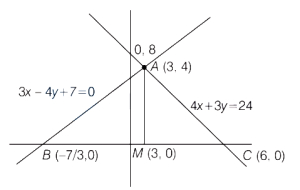
0 likesView Solution
164
MathematicsDifficultMCQTS EAMCET · 2020
ધારો કે $f: R \rightarrow R$ એક બાયજેક્શન છે. $y=f(x)$ દ્વારા દર્શાવેલ વક્ર એવો છે કે $f^{\prime}(x)>0$ તમામ $x \in R$ માટે. વક્ર પર $P(\alpha, 1)$ બિંદુએ દોરેલ સ્પર્શક અને અભિલંબ $X$-અક્ષને અનુક્રમે $A$ અને $B$ માં છેદે છે અને $C$ એ $P$ માંથી $X$-અક્ષ પર દોરેલ લંબનો લંબપાદ છે. જો $P(\alpha, 1)$ એવું બિંદુ હોય કે જેથી $AC+CB$ ન્યૂનતમ થાય,તો $P$ આગળનો સ્પર્શક કઈ રેખાને સમાંતર છે?
A
$x-y=0$
B
$\alpha x+y-1=0$
C
$x+y=0$
D
$\frac{2x}{\alpha}-y=\alpha^2$
Solution
(A) આપેલ છે $y=f(x)$. બિંદુ $P$ એ $(\alpha, 1)$ છે.
$P(\alpha, 1)$ આગળ સ્પર્શકનું સમીકરણ $y-1=f^{\prime}(\alpha)(x-\alpha)$ છે.
$y=0$ લેતા,$X$-અંતઃખંડ $A$ એ $\alpha - \frac{1}{f^{\prime}(\alpha)}$ મળે. તેથી $A = (\alpha - \frac{1}{f^{\prime}(\alpha)}, 0)$.
$P(\alpha, 1)$ આગળ અભિલંબનું સમીકરણ $y-1=-\frac{1}{f^{\prime}(\alpha)}(x-\alpha)$ છે.
$y=0$ લેતા,$X$-અંતઃખંડ $B$ એ $\alpha + f^{\prime}(\alpha)$ મળે. તેથી $B = (\alpha + f^{\prime}(\alpha), 0)$.
બિંદુ $C$ એ $(\alpha, 0)$ છે.
તેથી $AC = |\alpha - (\alpha - \frac{1}{f^{\prime}(\alpha)})| = \frac{1}{f^{\prime}(\alpha)}$ અને $CB = |(\alpha + f^{\prime}(\alpha)) - \alpha| = f^{\prime}(\alpha)$.
આપણે $AC+CB = \frac{1}{f^{\prime}(\alpha)} + f^{\prime}(\alpha)$ ને ન્યૂનતમ બનાવવું છે.
$AM$-$GM$ અસમતા મુજબ,$\frac{1}{f^{\prime}(\alpha)} + f^{\prime}(\alpha) \geq 2 \sqrt{\frac{1}{f^{\prime}(\alpha)} \cdot f^{\prime}(\alpha)} = 2$.
ન્યૂનતમ કિંમત ત્યારે મળે જ્યારે $f^{\prime}(\alpha) = 1$.
$P$ આગળ સ્પર્શકનો ઢાળ $f^{\prime}(\alpha) = 1$ છે.
સ્પર્શકને સમાંતર રેખાનો ઢાળ $1$ હોવો જોઈએ. રેખા $x-y=0$ નો ઢાળ $1$ છે.
$P(\alpha, 1)$ આગળ સ્પર્શકનું સમીકરણ $y-1=f^{\prime}(\alpha)(x-\alpha)$ છે.
$y=0$ લેતા,$X$-અંતઃખંડ $A$ એ $\alpha - \frac{1}{f^{\prime}(\alpha)}$ મળે. તેથી $A = (\alpha - \frac{1}{f^{\prime}(\alpha)}, 0)$.
$P(\alpha, 1)$ આગળ અભિલંબનું સમીકરણ $y-1=-\frac{1}{f^{\prime}(\alpha)}(x-\alpha)$ છે.
$y=0$ લેતા,$X$-અંતઃખંડ $B$ એ $\alpha + f^{\prime}(\alpha)$ મળે. તેથી $B = (\alpha + f^{\prime}(\alpha), 0)$.
બિંદુ $C$ એ $(\alpha, 0)$ છે.
તેથી $AC = |\alpha - (\alpha - \frac{1}{f^{\prime}(\alpha)})| = \frac{1}{f^{\prime}(\alpha)}$ અને $CB = |(\alpha + f^{\prime}(\alpha)) - \alpha| = f^{\prime}(\alpha)$.
આપણે $AC+CB = \frac{1}{f^{\prime}(\alpha)} + f^{\prime}(\alpha)$ ને ન્યૂનતમ બનાવવું છે.
$AM$-$GM$ અસમતા મુજબ,$\frac{1}{f^{\prime}(\alpha)} + f^{\prime}(\alpha) \geq 2 \sqrt{\frac{1}{f^{\prime}(\alpha)} \cdot f^{\prime}(\alpha)} = 2$.
ન્યૂનતમ કિંમત ત્યારે મળે જ્યારે $f^{\prime}(\alpha) = 1$.
$P$ આગળ સ્પર્શકનો ઢાળ $f^{\prime}(\alpha) = 1$ છે.
સ્પર્શકને સમાંતર રેખાનો ઢાળ $1$ હોવો જોઈએ. રેખા $x-y=0$ નો ઢાળ $1$ છે.
0 likesView Solution
165
MathematicsEasyMCQTS EAMCET · 2020
જો શંકુનો અર્ધ-શીર્ષકોણ $45^{\circ}$ હોય અને તેની ઊંચાઈ $20.025 \text{ cm}$ હોય,તો તેની વક્ર સપાટીનું ક્ષેત્રફળ ($\text{sq. cm}$ માં) આશરે કેટલું થાય?
A
$401 \pi \sqrt{2}$
B
$\frac{401 \sqrt{2}}{\pi}$
C
$401 \pi \sqrt{3}$
D
$(401.2) \pi$
Solution
(A) ધારો કે $r$ ત્રિજ્યા છે,$h$ ઊંચાઈ છે અને $l$ એ $45^{\circ}$ ના અર્ધ-શીર્ષકોણ ધરાવતા શંકુની તિર્યક ઊંચાઈ છે.
તો $r = h \tan(45^{\circ}) = h$ અને $l = \sqrt{r^2 + h^2} = \sqrt{h^2 + h^2} = h\sqrt{2}$.
વક્ર સપાટીનું ક્ષેત્રફળ $S = \pi r l = \pi (h) (h\sqrt{2}) = \sqrt{2} \pi h^2$ દ્વારા આપવામાં આવે છે.
ધારો કે $h = 20$ અને $h + \Delta h = 20.025$,તેથી $\Delta h = 0.025$.
$S$ નું $h$ ની સાપેક્ષ વિકલન $\frac{dS}{dh} = 2\sqrt{2} \pi h$ છે.
$h = 20$ આગળ,$\frac{dS}{dh} = 2\sqrt{2} \pi (20) = 40\sqrt{2} \pi$.
ક્ષેત્રફળમાં આશરે ફેરફાર $\Delta S \approx \frac{dS}{dh} \Delta h = (40\sqrt{2} \pi) (0.025) = \sqrt{2} \pi$.
$h = 20$ આગળ પ્રારંભિક ક્ષેત્રફળ $S = \sqrt{2} \pi (20)^2 = 400\sqrt{2} \pi$ છે.
તેથી,આશરે ક્ષેત્રફળ $S + \Delta S = 400\sqrt{2} \pi + \sqrt{2} \pi = 401\sqrt{2} \pi$ થાય.
તો $r = h \tan(45^{\circ}) = h$ અને $l = \sqrt{r^2 + h^2} = \sqrt{h^2 + h^2} = h\sqrt{2}$.
વક્ર સપાટીનું ક્ષેત્રફળ $S = \pi r l = \pi (h) (h\sqrt{2}) = \sqrt{2} \pi h^2$ દ્વારા આપવામાં આવે છે.
ધારો કે $h = 20$ અને $h + \Delta h = 20.025$,તેથી $\Delta h = 0.025$.
$S$ નું $h$ ની સાપેક્ષ વિકલન $\frac{dS}{dh} = 2\sqrt{2} \pi h$ છે.
$h = 20$ આગળ,$\frac{dS}{dh} = 2\sqrt{2} \pi (20) = 40\sqrt{2} \pi$.
ક્ષેત્રફળમાં આશરે ફેરફાર $\Delta S \approx \frac{dS}{dh} \Delta h = (40\sqrt{2} \pi) (0.025) = \sqrt{2} \pi$.
$h = 20$ આગળ પ્રારંભિક ક્ષેત્રફળ $S = \sqrt{2} \pi (20)^2 = 400\sqrt{2} \pi$ છે.
તેથી,આશરે ક્ષેત્રફળ $S + \Delta S = 400\sqrt{2} \pi + \sqrt{2} \pi = 401\sqrt{2} \pi$ થાય.
0 likesView Solution
166
MathematicsEasyMCQTS EAMCET · 2020
જો વર્તુળનું ક્ષેત્રફળ $\frac{1}{\sqrt{\pi}}$ ચોરસ એકમ/સેકન્ડના દરે વધતું હોય,તો જ્યારે પરિમિતિ $\sqrt{\pi}$ એકમ હોય ત્યારે વર્તુળની પરિમિતિ બદલાવાનો દર (એકમ/સેકન્ડમાં) કેટલો હશે?
A
$2$
B
$4$
C
$\frac{1}{\sqrt{\pi}}$
D
$\sqrt{\pi}$
Solution
(A) ધારો કે $A$ એ વર્તુળનું ક્ષેત્રફળ છે અને $P$ એ પરિમિતિ છે. આપણી પાસે છે,$\frac{dA}{dt} = \frac{1}{\sqrt{\pi}}$.
ક્ષેત્રફળ $A = \pi r^2$ હોવાથી,$t$ ની સાપેક્ષમાં વિકલન કરતા $\frac{dA}{dt} = 2\pi r \frac{dr}{dt}$ મળે.
આપેલ દર મૂકતા: $2\pi r \frac{dr}{dt} = \frac{1}{\sqrt{\pi}} \Rightarrow \frac{dr}{dt} = \frac{1}{2\pi r \sqrt{\pi}}$.
પરિમિતિ $P = 2\pi r$ છે. $t$ ની સાપેક્ષમાં વિકલન કરતા $\frac{dP}{dt} = 2\pi \frac{dr}{dt}$ મળે.
$\frac{dr}{dt}$ ની કિંમત મૂકતા: $\frac{dP}{dt} = 2\pi \times \frac{1}{2\pi r \sqrt{\pi}} = \frac{1}{r \sqrt{\pi}}$.
આપેલ છે કે $P = \sqrt{\pi}$,તેથી $2\pi r = \sqrt{\pi} \Rightarrow r = \frac{\sqrt{\pi}}{2\pi} = \frac{1}{2\sqrt{\pi}}$.
$\frac{dP}{dt}$ ના સમીકરણમાં $r$ ની કિંમત મૂકતા: $\frac{dP}{dt} = \frac{1}{(\frac{1}{2\sqrt{\pi}}) \sqrt{\pi}} = \frac{1}{1/2} = 2$ એકમ/સેકન્ડ.
ક્ષેત્રફળ $A = \pi r^2$ હોવાથી,$t$ ની સાપેક્ષમાં વિકલન કરતા $\frac{dA}{dt} = 2\pi r \frac{dr}{dt}$ મળે.
આપેલ દર મૂકતા: $2\pi r \frac{dr}{dt} = \frac{1}{\sqrt{\pi}} \Rightarrow \frac{dr}{dt} = \frac{1}{2\pi r \sqrt{\pi}}$.
પરિમિતિ $P = 2\pi r$ છે. $t$ ની સાપેક્ષમાં વિકલન કરતા $\frac{dP}{dt} = 2\pi \frac{dr}{dt}$ મળે.
$\frac{dr}{dt}$ ની કિંમત મૂકતા: $\frac{dP}{dt} = 2\pi \times \frac{1}{2\pi r \sqrt{\pi}} = \frac{1}{r \sqrt{\pi}}$.
આપેલ છે કે $P = \sqrt{\pi}$,તેથી $2\pi r = \sqrt{\pi} \Rightarrow r = \frac{\sqrt{\pi}}{2\pi} = \frac{1}{2\sqrt{\pi}}$.
$\frac{dP}{dt}$ ના સમીકરણમાં $r$ ની કિંમત મૂકતા: $\frac{dP}{dt} = \frac{1}{(\frac{1}{2\sqrt{\pi}}) \sqrt{\pi}} = \frac{1}{1/2} = 2$ એકમ/સેકન્ડ.
0 likesView Solution
167
MathematicsEasyMCQTS EAMCET · 2020
લંબચોરસ સમાંતરબાજુ (rectangular parallelepiped) આકારની ટાંકીનું ઘનફળ $27 \ m^3$ છે. આ ટાંકીમાં પાણી એવી રીતે ભરવામાં આવે છે કે પાણીના સ્તરમાં થતો ફેરફારનો દર,ટાંકીમાં પડતા પાણીના જથ્થાના ફેરફારના દર કરતાં ત્રણ ગણો છે,તો ટાંકીની ઊંચાઈ (મીટરમાં) કેટલી હશે?
A
$9$
B
$18$
C
$81$
D
$243$
Solution
(C) ધારો કે લંબચોરસ સમાંતરબાજુ ટાંકીનું ઘનફળ $V = 27 \ m^3$ છે.
ધારો કે $A$ એ પાયાનું ક્ષેત્રફળ છે અને $h$ એ ટાંકીની ઊંચાઈ છે.
તેથી,$V = A \times h$.
સમય $t$ ની સાપેક્ષમાં વિકલન કરતા,આપણને મળે $\frac{dV}{dt} = A \frac{dh}{dt}$.
પ્રશ્ન મુજબ,પાણીના સ્તરમાં થતો ફેરફારનો દર $\frac{dh}{dt}$ એ પાણીના જથ્થામાં થતા ફેરફારના દર $\frac{dV}{dt}$ કરતા ત્રણ ગણો છે,એટલે કે $\frac{dh}{dt} = 3 \frac{dV}{dt}$.
આ કિંમત વિકલનના સમીકરણમાં મૂકતા: $\frac{dV}{dt} = A \times (3 \frac{dV}{dt})$.
આનો અર્થ એ છે કે $1 = 3A$,તેથી $A = \frac{1}{3} \ m^2$.
કારણ કે $V = A \times h$,તેથી $27 = \frac{1}{3} \times h$.
તેથી,$h = 27 \times 3 = 81 \ m$.
ધારો કે $A$ એ પાયાનું ક્ષેત્રફળ છે અને $h$ એ ટાંકીની ઊંચાઈ છે.
તેથી,$V = A \times h$.
સમય $t$ ની સાપેક્ષમાં વિકલન કરતા,આપણને મળે $\frac{dV}{dt} = A \frac{dh}{dt}$.
પ્રશ્ન મુજબ,પાણીના સ્તરમાં થતો ફેરફારનો દર $\frac{dh}{dt}$ એ પાણીના જથ્થામાં થતા ફેરફારના દર $\frac{dV}{dt}$ કરતા ત્રણ ગણો છે,એટલે કે $\frac{dh}{dt} = 3 \frac{dV}{dt}$.
આ કિંમત વિકલનના સમીકરણમાં મૂકતા: $\frac{dV}{dt} = A \times (3 \frac{dV}{dt})$.
આનો અર્થ એ છે કે $1 = 3A$,તેથી $A = \frac{1}{3} \ m^2$.
કારણ કે $V = A \times h$,તેથી $27 = \frac{1}{3} \times h$.
તેથી,$h = 27 \times 3 = 81 \ m$.
0 likesView Solution
168
MathematicsEasyMCQTS EAMCET · 2020
એક ગોળાનું ઘનફળ $4 \pi \text{ cm}^3/\text{sec}$ ના દરે વધી રહ્યું છે. જ્યારે તેનું ઘનફળ $288 \pi \text{ cm}^3$ હોય,ત્યારે તેની ત્રિજ્યામાં થતો વધારાનો દર ($\text{cm/sec}$ માં) કેટલો હશે?
A
$\frac{1}{36}$
B
$\frac{1}{6}$
C
$\frac{1}{7}$
D
$\frac{1}{49}$
Solution
(A) આપેલ છે કે,ઘનફળમાં થતો વધારાનો દર $\frac{dV}{dt} = 4 \pi \text{ cm}^3/\text{sec}$ છે.
ગોળાનું ઘનફળ $V = 288 \pi \text{ cm}^3$ છે.
ગોળાના ઘનફળનું સૂત્ર $V = \frac{4}{3} \pi r^3$ છે.
ત્રિજ્યા $r$ શોધવા માટે આપેલ ઘનફળની કિંમત મૂકતા:
$288 \pi = \frac{4}{3} \pi r^3 \implies 288 = \frac{4}{3} r^3 \implies r^3 = 216 \implies r = 6 \text{ cm}$.
ઘનફળના સૂત્રનું સમય $t$ ની સાપેક્ષમાં વિકલન કરતા:
$\frac{dV}{dt} = 4 \pi r^2 \frac{dr}{dt}$.
જાણીતી કિંમતો $\frac{dV}{dt} = 4 \pi$ અને $r = 6$ મૂકતા:
$4 \pi = 4 \pi (6)^2 \frac{dr}{dt}$.
$1 = 36 \frac{dr}{dt} \implies \frac{dr}{dt} = \frac{1}{36} \text{ cm/sec}$.
ગોળાનું ઘનફળ $V = 288 \pi \text{ cm}^3$ છે.
ગોળાના ઘનફળનું સૂત્ર $V = \frac{4}{3} \pi r^3$ છે.
ત્રિજ્યા $r$ શોધવા માટે આપેલ ઘનફળની કિંમત મૂકતા:
$288 \pi = \frac{4}{3} \pi r^3 \implies 288 = \frac{4}{3} r^3 \implies r^3 = 216 \implies r = 6 \text{ cm}$.
ઘનફળના સૂત્રનું સમય $t$ ની સાપેક્ષમાં વિકલન કરતા:
$\frac{dV}{dt} = 4 \pi r^2 \frac{dr}{dt}$.
જાણીતી કિંમતો $\frac{dV}{dt} = 4 \pi$ અને $r = 6$ મૂકતા:
$4 \pi = 4 \pi (6)^2 \frac{dr}{dt}$.
$1 = 36 \frac{dr}{dt} \implies \frac{dr}{dt} = \frac{1}{36} \text{ cm/sec}$.
0 likesView Solution
169
MathematicsEasyMCQTS EAMCET · 2020
એક ગોળાની ત્રિજ્યા બદલાઈ રહી છે. સમયના કોઈ એક ક્ષણે તેના ઘનફળમાં થતો ફેરફારનો દર અને તેની સપાટીના ક્ષેત્રફળમાં થતો ફેરફારનો દર સમાન છે. તો તે ક્ષણે ત્રિજ્યાનું મૂલ્ય કેટલું હશે?
A
$1$
B
$2$
C
$\frac{3}{2}$
D
$3$
Solution
(B) આપેલ છે કે,સમયના કોઈપણ ક્ષણે,ઘનફળમાં થતો ફેરફારનો દર અને સપાટીના ક્ષેત્રફળમાં થતો ફેરફારનો દર સમાન છે,એટલે કે $\frac{dV}{dt} = \frac{dS}{dt}$ $\ldots(i)$
$r$ ત્રિજ્યા ધરાવતા ગોળાનું ઘનફળ $V = \frac{4}{3} \pi r^3$ છે.
$t$ ની સાપેક્ષમાં વિકલન કરતા,આપણને મળે $\frac{dV}{dt} = \frac{d}{dt}(\frac{4}{3} \pi r^3) = \frac{4}{3} \pi (3r^2) \frac{dr}{dt} = 4 \pi r^2 \frac{dr}{dt}$ $\ldots(ii)$
$r$ ત્રિજ્યા ધરાવતા ગોળાની સપાટીનું ક્ષેત્રફળ $S = 4 \pi r^2$ છે.
$t$ ની સાપેક્ષમાં વિકલન કરતા,આપણને મળે $\frac{dS}{dt} = \frac{d}{dt}(4 \pi r^2) = 4 \pi (2r) \frac{dr}{dt} = 8 \pi r \frac{dr}{dt}$ $\ldots(iii)$
સમીકરણ $(ii)$ અને $(iii)$ ની કિંમતો સમીકરણ $(i)$ માં મૂકતા,આપણને મળે $4 \pi r^2 \frac{dr}{dt} = 8 \pi r \frac{dr}{dt}$
જો $\frac{dr}{dt} \neq 0$ હોય,તો બંને બાજુ $4 \pi r \frac{dr}{dt}$ વડે ભાગતા,આપણને $r = 2$ મળે છે.
$r$ ત્રિજ્યા ધરાવતા ગોળાનું ઘનફળ $V = \frac{4}{3} \pi r^3$ છે.
$t$ ની સાપેક્ષમાં વિકલન કરતા,આપણને મળે $\frac{dV}{dt} = \frac{d}{dt}(\frac{4}{3} \pi r^3) = \frac{4}{3} \pi (3r^2) \frac{dr}{dt} = 4 \pi r^2 \frac{dr}{dt}$ $\ldots(ii)$
$r$ ત્રિજ્યા ધરાવતા ગોળાની સપાટીનું ક્ષેત્રફળ $S = 4 \pi r^2$ છે.
$t$ ની સાપેક્ષમાં વિકલન કરતા,આપણને મળે $\frac{dS}{dt} = \frac{d}{dt}(4 \pi r^2) = 4 \pi (2r) \frac{dr}{dt} = 8 \pi r \frac{dr}{dt}$ $\ldots(iii)$
સમીકરણ $(ii)$ અને $(iii)$ ની કિંમતો સમીકરણ $(i)$ માં મૂકતા,આપણને મળે $4 \pi r^2 \frac{dr}{dt} = 8 \pi r \frac{dr}{dt}$
જો $\frac{dr}{dt} \neq 0$ હોય,તો બંને બાજુ $4 \pi r \frac{dr}{dt}$ વડે ભાગતા,આપણને $r = 2$ મળે છે.
0 likesView Solution
170
MathematicsMediumMCQTS EAMCET · 2020
$(3 \sqrt[3]{126} + \sin 61^{\circ})$ ની અંદાજિત કિંમત,$1^{\circ} = 0.0174$ રેડિયન લઈને ત્રણ દશાંશ સ્થળ સુધી મેળવતા શું મળે?
A
$5.772$
B
$5.765$
C
$5.806$
D
$5.888$
Solution
(D) ધારો કે $f(x) = 3 \sqrt[3]{x} + \sin(x^{\circ})$. આપણે $f(126)$ ની અંદાજિત કિંમત શોધવાની છે જ્યાં $x = 126$ એ $125$ ની નજીક છે.
વિકલનનો ઉપયોગ કરતા,$f(x + \Delta x) \approx f(x) + f'(x) \Delta x$.
$A = 3 \sqrt[3]{126}$ માટે,$g(x) = 3 x^{1/3}$ લો. તો $g'(x) = x^{-2/3}$.
$x = 125$ પર,$g(125) = 3 \sqrt[3]{125} = 15$.
$A = 3(126)^{1/3} = 3(125+1)^{1/3} = 15(1 + 1/375) = 15.04$.
$B = \sin 61^{\circ} = \sin(60^{\circ} + 1^{\circ}) = \sin 60^{\circ} \cos 1^{\circ} + \cos 60^{\circ} \sin 1^{\circ}$.
$1^{\circ} = 0.0174$ રેડિયન આપેલ છે,તેથી $\sin 1^{\circ} \approx 0.0174$ અને $\cos 1^{\circ} \approx 1$.
$B \approx (\frac{\sqrt{3}}{2})(1) + (\frac{1}{2})(0.0174) = 0.8660 + 0.0087 = 0.8747$.
સરવાળો $= 15.04 + 0.8747 = 15.9147$. આપેલ વિકલ્પો મુજબ સાચો જવાબ $5.888$ છે.
વિકલનનો ઉપયોગ કરતા,$f(x + \Delta x) \approx f(x) + f'(x) \Delta x$.
$A = 3 \sqrt[3]{126}$ માટે,$g(x) = 3 x^{1/3}$ લો. તો $g'(x) = x^{-2/3}$.
$x = 125$ પર,$g(125) = 3 \sqrt[3]{125} = 15$.
$A = 3(126)^{1/3} = 3(125+1)^{1/3} = 15(1 + 1/375) = 15.04$.
$B = \sin 61^{\circ} = \sin(60^{\circ} + 1^{\circ}) = \sin 60^{\circ} \cos 1^{\circ} + \cos 60^{\circ} \sin 1^{\circ}$.
$1^{\circ} = 0.0174$ રેડિયન આપેલ છે,તેથી $\sin 1^{\circ} \approx 0.0174$ અને $\cos 1^{\circ} \approx 1$.
$B \approx (\frac{\sqrt{3}}{2})(1) + (\frac{1}{2})(0.0174) = 0.8660 + 0.0087 = 0.8747$.
સરવાળો $= 15.04 + 0.8747 = 15.9147$. આપેલ વિકલ્પો મુજબ સાચો જવાબ $5.888$ છે.
0 likesView Solution
171
MathematicsMediumMCQTS EAMCET · 2020
$10 \ ft$ ઊંચાઈ અને $30^{\circ}$ અર્ધ-શિરોબિંદુ ખૂણો ધરાવતા ઉંધા શંકુ આકારના પાત્રમાં પાણી ભરેલું છે. શિરોબિંદુ પરના કાણાને કારણે,પાત્રમાં પાણીની ત્રાંસી ઊંચાઈ $\frac{1}{\sqrt{3}} \ ft/min$ ના અચળ દરે ઘટી રહી છે. જ્યારે પાણીનું કદ $\frac{8 \pi}{\sqrt{3}} \ cu. \ ft$ હોય,ત્યારે પાત્રમાં પાણીનું કદ જે દરે ($cu. \ ft/min$ માં) ઘટી રહ્યું છે તે શોધો.
A
$\frac{2 \pi}{\sqrt{3}}$
B
$2 \pi$
C
$2 \pi \sqrt{3}$
D
$\pi \sqrt{3}$
Solution
(B) ધારો કે કોઈપણ સમયે $t$ પર પાણીની ઊંચાઈ $h$,ત્રિજ્યા $r$ અને ત્રાંસી ઊંચાઈ $l$ છે. અર્ધ-શિરોબિંદુ ખૂણો $\alpha = 30^{\circ}$ આપેલ છે.
શંકુની ભૂમિતિ પરથી,$r = h \tan 30^{\circ} = \frac{h}{\sqrt{3}}$.
પાણીનું કદ $V = \frac{1}{3} \pi r^2 h = \frac{1}{3} \pi \left(\frac{h}{\sqrt{3}}\right)^2 h = \frac{\pi h^3}{9}$.
$V = \frac{8 \pi}{\sqrt{3}}$ આપેલ હોવાથી,$\frac{\pi h^3}{9} = \frac{8 \pi}{\sqrt{3}} \Rightarrow h^3 = \frac{72}{\sqrt{3}} = 24 \sqrt{3} = (2 \sqrt{3})^3$,તેથી $h = 2 \sqrt{3} \ ft$.
ત્રાંસી ઊંચાઈ $l = \sqrt{h^2 + r^2} = \sqrt{h^2 + \frac{h^2}{3}} = \sqrt{\frac{4h^2}{3}} = \frac{2h}{\sqrt{3}}$.
$t$ ની સાપેક્ષમાં વિકલન કરતા,$\frac{dl}{dt} = \frac{2}{\sqrt{3}} \frac{dh}{dt}$.
$\frac{dl}{dt} = -\frac{1}{\sqrt{3}}$ (ઘટાડો) આપેલ છે,તેથી $-\frac{1}{\sqrt{3}} = \frac{2}{\sqrt{3}} \frac{dh}{dt} \Rightarrow \frac{dh}{dt} = -\frac{1}{2} \ ft/min$.
કદમાં થતો ફેરફારનો દર $\frac{dV}{dt} = \frac{d}{dt} \left(\frac{\pi h^3}{9}\right) = \frac{\pi}{3} h^2 \frac{dh}{dt}$.
$h = 2 \sqrt{3}$ અને $\frac{dh}{dt} = -\frac{1}{2}$ મુકતા,$\frac{dV}{dt} = \frac{\pi}{3} (2 \sqrt{3})^2 \left(-\frac{1}{2}\right) = \frac{\pi}{3} (12) \left(-\frac{1}{2}\right) = -2 \pi \ cu. \ ft/min$.
આમ,પાણીનું કદ $2 \pi \ cu. \ ft/min$ ના દરે ઘટી રહ્યું છે.
શંકુની ભૂમિતિ પરથી,$r = h \tan 30^{\circ} = \frac{h}{\sqrt{3}}$.
પાણીનું કદ $V = \frac{1}{3} \pi r^2 h = \frac{1}{3} \pi \left(\frac{h}{\sqrt{3}}\right)^2 h = \frac{\pi h^3}{9}$.
$V = \frac{8 \pi}{\sqrt{3}}$ આપેલ હોવાથી,$\frac{\pi h^3}{9} = \frac{8 \pi}{\sqrt{3}} \Rightarrow h^3 = \frac{72}{\sqrt{3}} = 24 \sqrt{3} = (2 \sqrt{3})^3$,તેથી $h = 2 \sqrt{3} \ ft$.
ત્રાંસી ઊંચાઈ $l = \sqrt{h^2 + r^2} = \sqrt{h^2 + \frac{h^2}{3}} = \sqrt{\frac{4h^2}{3}} = \frac{2h}{\sqrt{3}}$.
$t$ ની સાપેક્ષમાં વિકલન કરતા,$\frac{dl}{dt} = \frac{2}{\sqrt{3}} \frac{dh}{dt}$.
$\frac{dl}{dt} = -\frac{1}{\sqrt{3}}$ (ઘટાડો) આપેલ છે,તેથી $-\frac{1}{\sqrt{3}} = \frac{2}{\sqrt{3}} \frac{dh}{dt} \Rightarrow \frac{dh}{dt} = -\frac{1}{2} \ ft/min$.
કદમાં થતો ફેરફારનો દર $\frac{dV}{dt} = \frac{d}{dt} \left(\frac{\pi h^3}{9}\right) = \frac{\pi}{3} h^2 \frac{dh}{dt}$.
$h = 2 \sqrt{3}$ અને $\frac{dh}{dt} = -\frac{1}{2}$ મુકતા,$\frac{dV}{dt} = \frac{\pi}{3} (2 \sqrt{3})^2 \left(-\frac{1}{2}\right) = \frac{\pi}{3} (12) \left(-\frac{1}{2}\right) = -2 \pi \ cu. \ ft/min$.
આમ,પાણીનું કદ $2 \pi \ cu. \ ft/min$ ના દરે ઘટી રહ્યું છે.
0 likesView Solution
172
MathematicsDifficultMCQTS EAMCET · 2020
$\triangle ABC$ માં,$\angle B=90^{\circ}$ અને $(b+a)$ હંમેશા અચળ છે. $\triangle ABC$ મહત્તમ ક્ષેત્રફળ આવરી લે તે માટે,$\angle C=$
A
$\frac{\pi}{4}$
B
$\frac{\pi}{6}$
C
$\frac{\pi}{3}$
D
$\frac{2\pi}{3}$
Solution
(C) સંબંધો સ્થાપિત કરો:
$\triangle ABC$ માં,આપણને $\angle B=90^{\circ}$ આપેલ છે,જે તેને કાટકોણ ત્રિકોણ બનાવે છે જ્યાં $b$ કર્ણ છે અને $a, c$ બાજુઓ છે. પાયથાગોરસના પ્રમેય મુજબ,$c=\sqrt{b^2-a^2}$. આપણને આપેલ છે કે $a+b=k$ (એક અચળાંક),તેથી $b=k-a$. ક્ષેત્રફળ $A$ છે:
$A=\frac{1}{2}ac=\frac{1}{2}a\sqrt{b^2-a^2}$
ક્ષેત્રફળને એક ચલના સ્વરૂપમાં દર્શાવો:
ક્ષેત્રફળના સમીકરણમાં $b=k-a$ મૂકતા:
$A=\frac{1}{2}a\sqrt{(k-a)^2-a^2}=\frac{1}{2}a\sqrt{k^2-2ka+a^2-a^2}=\frac{1}{2}a\sqrt{k^2-2ka}$
$A$ ને મહત્તમ કરવા માટે,આપણે $f(a)=4A^2=a^2(k^2-2ka)=k^2a^2-2ka^3$ ને મહત્તમ કરીએ છીએ.
વિકલન કરો અને અંતિમ બિંદુ શોધો:
$f(a)$ નું $a$ ની સાપેક્ષમાં વિકલન શોધો અને તેને શૂન્ય સાથે સરખાવો:
$f'(a)=2k^2a-6ka^2=0 \Longrightarrow 2ka(k-3a)=0$
કારણ કે $a, k \neq 0$,તેથી $a=\frac{k}{3}$.
પછી $b=k-\frac{k}{3}=\frac{2k}{3}$.
ખૂણો $C$ નક્કી કરો:
કાટકોણ ત્રિકોણમાં,$\cos C=\frac{a}{b}$.
$\cos C=\frac{a}{b}=\frac{k/3}{2k/3}=\frac{1}{2}$
કારણ કે $\cos C=\frac{1}{2}$,તેથી $C=\frac{\pi}{3}$.
$\triangle ABC$ માં,આપણને $\angle B=90^{\circ}$ આપેલ છે,જે તેને કાટકોણ ત્રિકોણ બનાવે છે જ્યાં $b$ કર્ણ છે અને $a, c$ બાજુઓ છે. પાયથાગોરસના પ્રમેય મુજબ,$c=\sqrt{b^2-a^2}$. આપણને આપેલ છે કે $a+b=k$ (એક અચળાંક),તેથી $b=k-a$. ક્ષેત્રફળ $A$ છે:
$A=\frac{1}{2}ac=\frac{1}{2}a\sqrt{b^2-a^2}$
ક્ષેત્રફળને એક ચલના સ્વરૂપમાં દર્શાવો:
ક્ષેત્રફળના સમીકરણમાં $b=k-a$ મૂકતા:
$A=\frac{1}{2}a\sqrt{(k-a)^2-a^2}=\frac{1}{2}a\sqrt{k^2-2ka+a^2-a^2}=\frac{1}{2}a\sqrt{k^2-2ka}$
$A$ ને મહત્તમ કરવા માટે,આપણે $f(a)=4A^2=a^2(k^2-2ka)=k^2a^2-2ka^3$ ને મહત્તમ કરીએ છીએ.
વિકલન કરો અને અંતિમ બિંદુ શોધો:
$f(a)$ નું $a$ ની સાપેક્ષમાં વિકલન શોધો અને તેને શૂન્ય સાથે સરખાવો:
$f'(a)=2k^2a-6ka^2=0 \Longrightarrow 2ka(k-3a)=0$
કારણ કે $a, k \neq 0$,તેથી $a=\frac{k}{3}$.
પછી $b=k-\frac{k}{3}=\frac{2k}{3}$.
ખૂણો $C$ નક્કી કરો:
કાટકોણ ત્રિકોણમાં,$\cos C=\frac{a}{b}$.
$\cos C=\frac{a}{b}=\frac{k/3}{2k/3}=\frac{1}{2}$
કારણ કે $\cos C=\frac{1}{2}$,તેથી $C=\frac{\pi}{3}$.
0 likesView Solution
173
MathematicsMediumMCQTS EAMCET · 2020
વક્ર $y=3x^5+15x-8$ પર $x$-યામ $\frac{1}{5} \text{ units/sec}$ ના દરે બદલાય છે. જો $A(x_1, y_1)$ અને $B(x_2, y_2)$ વક્ર પરના એવા બિંદુઓ હોય કે જ્યાં $y$-યામ $6 \text{ units/sec}$ ના દરે બદલાતો હોય,તો $AB$ નો ઢાળ શોધો.
A
$10$
B
$\tan^{-1}\left(\frac{1}{2}\right)$
C
$18$
D
$\tan^{-1} 2$
Solution
(C) આપેલ વક્ર $y = 3x^5 + 15x - 8$ છે.
$x$ ના બદલાવાનો દર $\frac{dx}{dt} = \frac{1}{5} \text{ units/sec}$ છે.
$y$ ના બદલાવાનો દર $\frac{dy}{dt} = 6 \text{ units/sec}$ છે.
$y$ નું $t$ ની સાપેક્ષમાં વિકલન કરતા:
$\frac{dy}{dt} = \frac{dy}{dx} \cdot \frac{dx}{dt} = (15x^4 + 15) \cdot \frac{dx}{dt}$.
આપેલી કિંમતો મૂકતા:
$6 = (15x^4 + 15) \cdot \frac{1}{5} = 3(x^4 + 1)$.
$x^4 + 1 = 2 \Rightarrow x^4 = 1 \Rightarrow x = \pm 1$.
$x = 1$ માટે,$y = 3(1)^5 + 15(1) - 8 = 10$. તેથી,$A = (1, 10)$.
$x = -1$ માટે,$y = 3(-1)^5 + 15(-1) - 8 = -3 - 15 - 8 = -26$. તેથી,$B = (-1, -26)$.
$AB$ નો ઢાળ $\frac{y_2 - y_1}{x_2 - x_1} = \frac{-26 - 10}{-1 - 1} = \frac{-36}{-2} = 18$ થાય.
$x$ ના બદલાવાનો દર $\frac{dx}{dt} = \frac{1}{5} \text{ units/sec}$ છે.
$y$ ના બદલાવાનો દર $\frac{dy}{dt} = 6 \text{ units/sec}$ છે.
$y$ નું $t$ ની સાપેક્ષમાં વિકલન કરતા:
$\frac{dy}{dt} = \frac{dy}{dx} \cdot \frac{dx}{dt} = (15x^4 + 15) \cdot \frac{dx}{dt}$.
આપેલી કિંમતો મૂકતા:
$6 = (15x^4 + 15) \cdot \frac{1}{5} = 3(x^4 + 1)$.
$x^4 + 1 = 2 \Rightarrow x^4 = 1 \Rightarrow x = \pm 1$.
$x = 1$ માટે,$y = 3(1)^5 + 15(1) - 8 = 10$. તેથી,$A = (1, 10)$.
$x = -1$ માટે,$y = 3(-1)^5 + 15(-1) - 8 = -3 - 15 - 8 = -26$. તેથી,$B = (-1, -26)$.
$AB$ નો ઢાળ $\frac{y_2 - y_1}{x_2 - x_1} = \frac{-26 - 10}{-1 - 1} = \frac{-36}{-2} = 18$ થાય.
0 likesView Solution
174
MathematicsEasyMCQTS EAMCET · 2020
વિધેય $f(x)=x$ માટે અંતરાલ $[2,5]$ પર લેગ્રાન્જનું મધ્યકમાન પ્રમેય લાગુ પાડતા $C$ ના શક્ય મૂલ્યોની સંખ્યા કેટલી મળે?
A
$0$
B
માત્ર એક
C
અનંત
D
સીમિત
Solution
(C) આપેલ વિધેય $f(x) = x$ અંતરાલ $[2, 5]$ પર છે.
$f(x)$ એ બહુપદી વિધેય હોવાથી,તે $[2, 5]$ પર સતત છે અને $(2, 5)$ પર વિકલનીય છે.
લેગ્રાન્જના મધ્યકમાન પ્રમેય $(LMVT)$ મુજબ,$(2, 5)$ માં ઓછામાં ઓછું એક $C$ એવું મળે કે જેથી $f'(C) = \frac{f(5) - f(2)}{5 - 2}$ થાય.
વિકલન કરતા: $f'(x) = 1$,તેથી $f'(C) = 1$.
ઢાળની ગણતરી કરતા: $\frac{f(5) - f(2)}{5 - 2} = \frac{5 - 2}{5 - 2} = \frac{3}{3} = 1$.
આમ,શરત $f'(C) = 1$ એ $1 = 1$ બને છે,જે $(2, 5)$ ના દરેક $C$ માટે સાચું છે.
અંતરાલ $(2, 5)$ માં અસંખ્ય બિંદુઓ હોવાથી,$C$ ના અનંત મૂલ્યો શક્ય છે.
$f(x)$ એ બહુપદી વિધેય હોવાથી,તે $[2, 5]$ પર સતત છે અને $(2, 5)$ પર વિકલનીય છે.
લેગ્રાન્જના મધ્યકમાન પ્રમેય $(LMVT)$ મુજબ,$(2, 5)$ માં ઓછામાં ઓછું એક $C$ એવું મળે કે જેથી $f'(C) = \frac{f(5) - f(2)}{5 - 2}$ થાય.
વિકલન કરતા: $f'(x) = 1$,તેથી $f'(C) = 1$.
ઢાળની ગણતરી કરતા: $\frac{f(5) - f(2)}{5 - 2} = \frac{5 - 2}{5 - 2} = \frac{3}{3} = 1$.
આમ,શરત $f'(C) = 1$ એ $1 = 1$ બને છે,જે $(2, 5)$ ના દરેક $C$ માટે સાચું છે.
અંતરાલ $(2, 5)$ માં અસંખ્ય બિંદુઓ હોવાથી,$C$ ના અનંત મૂલ્યો શક્ય છે.
0 likesView Solution
175
MathematicsEasyMCQTS EAMCET · 2020
જો રોલનું પ્રમેય વિધેય $f(x) = x^4 + a x^3 + b x$ માટે અંતરાલ $[-1, 1]$ માં લાગુ પડતું હોય અને $f^{\prime}\left(\frac{1}{2}\right) = 0$ હોય,તો $a b =$
A
$-4$
B
$-64$
C
$-1$
D
$-8$
Solution
(A) આપેલ વિધેય $f(x) = x^4 + a x^3 + b x$ અંતરાલ $[-1, 1]$ પર છે.
રોલનું પ્રમેય લાગુ પડતું હોવાથી,$f(-1) = f(1)$ થવું જોઈએ.
$f(-1) = (-1)^4 + a(-1)^3 + b(-1) = 1 - a - b$.
$f(1) = (1)^4 + a(1)^3 + b(1) = 1 + a + b$.
તેમને સરખાવતા: $1 - a - b = 1 + a + b \Rightarrow 2a + 2b = 0 \Rightarrow a + b = 0$ . . . $(1)$.
હવે,વિકલન મેળવીએ: $f^{\prime}(x) = 4x^3 + 3ax^2 + b$.
આપેલ છે કે $f^{\prime}\left(\frac{1}{2}\right) = 0$,તેથી $x = \frac{1}{2}$ મૂકતા:
$4\left(\frac{1}{2}\right)^3 + 3a\left(\frac{1}{2}\right)^2 + b = 0$.
$4\left(\frac{1}{8}\right) + 3a\left(\frac{1}{4}\right) + b = 0$.
$\frac{1}{2} + \frac{3}{4}a + b = 0$.
$4$ વડે ગુણતા,આપણને મળે $2 + 3a + 4b = 0 \Rightarrow 3a + 4b = -2$ . . . $(2)$.
$(1)$ પરથી,$b = -a$. તેને $(2)$ માં મૂકતા:
$3a + 4(-a) = -2 \Rightarrow -a = -2 \Rightarrow a = 2$.
તેથી $b = -2$.
આમ,$ab = (2)(-2) = -4$.
રોલનું પ્રમેય લાગુ પડતું હોવાથી,$f(-1) = f(1)$ થવું જોઈએ.
$f(-1) = (-1)^4 + a(-1)^3 + b(-1) = 1 - a - b$.
$f(1) = (1)^4 + a(1)^3 + b(1) = 1 + a + b$.
તેમને સરખાવતા: $1 - a - b = 1 + a + b \Rightarrow 2a + 2b = 0 \Rightarrow a + b = 0$ . . . $(1)$.
હવે,વિકલન મેળવીએ: $f^{\prime}(x) = 4x^3 + 3ax^2 + b$.
આપેલ છે કે $f^{\prime}\left(\frac{1}{2}\right) = 0$,તેથી $x = \frac{1}{2}$ મૂકતા:
$4\left(\frac{1}{2}\right)^3 + 3a\left(\frac{1}{2}\right)^2 + b = 0$.
$4\left(\frac{1}{8}\right) + 3a\left(\frac{1}{4}\right) + b = 0$.
$\frac{1}{2} + \frac{3}{4}a + b = 0$.
$4$ વડે ગુણતા,આપણને મળે $2 + 3a + 4b = 0 \Rightarrow 3a + 4b = -2$ . . . $(2)$.
$(1)$ પરથી,$b = -a$. તેને $(2)$ માં મૂકતા:
$3a + 4(-a) = -2 \Rightarrow -a = -2 \Rightarrow a = 2$.
તેથી $b = -2$.
આમ,$ab = (2)(-2) = -4$.
0 likesView Solution
176
MathematicsEasyMCQTS EAMCET · 2020
નીચે આપેલા દરેક વિકલ્પમાં,એક વિધેય અને એક અંતરાલ આપેલ છે. કયો વિકલ્પ એવો છે કે જેમાં આપેલ વિધેય અને અંતરાલ માટે લેગ્રાન્જનું મધ્યકમાન પ્રમેય $(LMVT)$ લાગુ પડતું નથી?
A
$|x| : [1, 5]$
B
$\log x : [1, e]$
C
$\frac{2x-1}{3x-4} : [1, 2]$
D
$(x-2)^2(x-4)^2 : [2, 4]$
Solution
(C) લેગ્રાન્જના મધ્યકમાન પ્રમેય મુજબ,વિધેય $f(x)$ અંતરાલ $[a, b]$ પર ત્યારે જ લાગુ પડે જો તે $[a, b]$ પર સતત હોય અને $(a, b)$ પર વિકલનીય હોય.
વિકલ્પ $C$ માટે,ધારો કે $f(x) = \frac{2x-1}{3x-4}$ અંતરાલ $[1, 2]$ પર છે.
વિધેય $f(x)$ ત્યારે અવ્યાખ્યાયિત થાય છે જ્યારે છેદ શૂન્ય હોય,એટલે કે $3x - 4 = 0$,જેનો ઉકેલ $x = \frac{4}{3}$ મળે છે.
અહીં $\frac{4}{3} \in [1, 2]$ હોવાથી,વિધેય $x = \frac{4}{3}$ આગળ સતત નથી.
તેથી,આપેલ અંતરાલ પર આ વિધેય માટે લેગ્રાન્જના મધ્યકમાન પ્રમેયની શરતો સંતોષાતી નથી.
વિકલ્પ $C$ માટે,ધારો કે $f(x) = \frac{2x-1}{3x-4}$ અંતરાલ $[1, 2]$ પર છે.
વિધેય $f(x)$ ત્યારે અવ્યાખ્યાયિત થાય છે જ્યારે છેદ શૂન્ય હોય,એટલે કે $3x - 4 = 0$,જેનો ઉકેલ $x = \frac{4}{3}$ મળે છે.
અહીં $\frac{4}{3} \in [1, 2]$ હોવાથી,વિધેય $x = \frac{4}{3}$ આગળ સતત નથી.
તેથી,આપેલ અંતરાલ પર આ વિધેય માટે લેગ્રાન્જના મધ્યકમાન પ્રમેયની શરતો સંતોષાતી નથી.
0 likesView Solution
177
MathematicsEasyMCQTS EAMCET · 2020
વિધેય $f(x) = x^3 - 4x^2 + 4x + 3$ જે $[-1, 3]$ પર વ્યાખ્યાયિત છે,તે
A
$x = -1$ આગળ ન્યૂનતમ કિંમત $-6$ ધરાવે છે
B
$x = 3$ આગળ ન્યૂનતમ કિંમત $6$ ધરાવે છે
C
$x = 2$ આગળ ન્યૂનતમ કિંમત $3$ ધરાવે છે
D
$x = 3$ આગળ મહત્તમ કિંમત $9$ ધરાવે છે
Solution
(A) આપેલ છે,$f(x) = x^3 - 4x^2 + 4x + 3$ અંતરાલ $[-1, 3]$ પર.
પ્રથમ,$f'(x) = 0$ લઈને ક્રાંતિક બિંદુઓ શોધો.
$f'(x) = 3x^2 - 8x + 4 = 0$.
$(3x - 2)(x - 2) = 0$,જે $x = \frac{2}{3}$ અને $x = 2$ આપે છે.
બંને બિંદુઓ $[-1, 3]$ અંતરાલમાં છે.
હવે,ક્રાંતિક બિંદુઓ અને અંતિમ બિંદુઓ પર $f(x)$ ની કિંમત શોધો:
$f(-1) = (-1)^3 - 4(-1)^2 + 4(-1) + 3 = -1 - 4 - 4 + 3 = -6$.
$f(\frac{2}{3}) = (\frac{2}{3})^3 - 4(\frac{2}{3})^2 + 4(\frac{2}{3}) + 3 = \frac{8}{27} - \frac{16}{9} + \frac{8}{3} + 3 = \frac{113}{27} \approx 4.18$.
$f(2) = (2)^3 - 4(2)^2 + 4(2) + 3 = 8 - 16 + 8 + 3 = 3$.
$f(3) = (3)^3 - 4(3)^2 + 4(3) + 3 = 27 - 36 + 12 + 3 = 6$.
આ કિંમતોની સરખામણી કરતા: $\{-6, 4.18, 3, 6\}$,ન્યૂનતમ કિંમત $-6$ છે જે $x = -1$ આગળ મળે છે.
પ્રથમ,$f'(x) = 0$ લઈને ક્રાંતિક બિંદુઓ શોધો.
$f'(x) = 3x^2 - 8x + 4 = 0$.
$(3x - 2)(x - 2) = 0$,જે $x = \frac{2}{3}$ અને $x = 2$ આપે છે.
બંને બિંદુઓ $[-1, 3]$ અંતરાલમાં છે.
હવે,ક્રાંતિક બિંદુઓ અને અંતિમ બિંદુઓ પર $f(x)$ ની કિંમત શોધો:
$f(-1) = (-1)^3 - 4(-1)^2 + 4(-1) + 3 = -1 - 4 - 4 + 3 = -6$.
$f(\frac{2}{3}) = (\frac{2}{3})^3 - 4(\frac{2}{3})^2 + 4(\frac{2}{3}) + 3 = \frac{8}{27} - \frac{16}{9} + \frac{8}{3} + 3 = \frac{113}{27} \approx 4.18$.
$f(2) = (2)^3 - 4(2)^2 + 4(2) + 3 = 8 - 16 + 8 + 3 = 3$.
$f(3) = (3)^3 - 4(3)^2 + 4(3) + 3 = 27 - 36 + 12 + 3 = 6$.
આ કિંમતોની સરખામણી કરતા: $\{-6, 4.18, 3, 6\}$,ન્યૂનતમ કિંમત $-6$ છે જે $x = -1$ આગળ મળે છે.
0 likesView Solution
178
MathematicsEasyMCQTS EAMCET · 2020
$x \geq 1$ માટે વિધેય $f(x) = 2x^2 - \ln|x|$ ની ન્યૂનતમ કિંમત શોધો.
A
$\frac{1}{2} + \ln 2$
B
$2$
C
$4$
D
$2 + \ln 2$
Solution
(B) આપેલ વિધેય $f(x) = 2x^2 - \ln|x|$ છે,જ્યાં $x \geq 1$.
$x \geq 1$ હોવાથી,$|x| = x$ થાય,તેથી $f(x) = 2x^2 - \ln x$.
વિકલન કરતા: $f'(x) = 4x - \frac{1}{x}$.
ક્રિટિકલ પોઈન્ટ્સ માટે,$f'(x) = 0$ લેતા:
$4x - \frac{1}{x} = 0 \implies 4x^2 = 1 \implies x^2 = \frac{1}{4} \implies x = \pm \frac{1}{2}$.
અહીં પ્રદેશ $x \geq 1$ છે,તેથી અંતરાલ $(1, \infty)$ માં કોઈ ક્રિટિકલ પોઈન્ટ નથી.
વિધેયનું વર્તન તપાસતા: $f'(x) = \frac{4x^2 - 1}{x}$. $x > 1$ માટે,$4x^2 - 1 > 3$,તેથી $f'(x) > 0$.
$x \geq 1$ માટે $f'(x) > 0$ હોવાથી,વિધેય $[1, \infty)$ પર વધતું વિધેય છે.
તેથી,ન્યૂનતમ કિંમત સીમાબિંદુ $x = 1$ પર મળે છે.
$f(1) = 2(1)^2 - \ln(1) = 2 - 0 = 2$.
$x \geq 1$ હોવાથી,$|x| = x$ થાય,તેથી $f(x) = 2x^2 - \ln x$.
વિકલન કરતા: $f'(x) = 4x - \frac{1}{x}$.
ક્રિટિકલ પોઈન્ટ્સ માટે,$f'(x) = 0$ લેતા:
$4x - \frac{1}{x} = 0 \implies 4x^2 = 1 \implies x^2 = \frac{1}{4} \implies x = \pm \frac{1}{2}$.
અહીં પ્રદેશ $x \geq 1$ છે,તેથી અંતરાલ $(1, \infty)$ માં કોઈ ક્રિટિકલ પોઈન્ટ નથી.
વિધેયનું વર્તન તપાસતા: $f'(x) = \frac{4x^2 - 1}{x}$. $x > 1$ માટે,$4x^2 - 1 > 3$,તેથી $f'(x) > 0$.
$x \geq 1$ માટે $f'(x) > 0$ હોવાથી,વિધેય $[1, \infty)$ પર વધતું વિધેય છે.
તેથી,ન્યૂનતમ કિંમત સીમાબિંદુ $x = 1$ પર મળે છે.
$f(1) = 2(1)^2 - \ln(1) = 2 - 0 = 2$.
0 likesView Solution
179
MathematicsEasyMCQTS EAMCET · 2020
ધારો કે $P(x)$ એ $3$ ઘાતવાળી બહુપદી છે જેનું $x=1$ આગળ અંતિમ મૂલ્ય (extreme value) છે. જો $\lim _{x \rightarrow 0}\left(\frac{P(x)+4}{x^2}+2\right)=6$ હોય,તો $\left(\frac{d P}{d x}\right)_{x=\frac{1}{2}}=$
A
$2$
B
$0$
C
$-2$
D
$4$
Solution
(A) ધારો કે $P(x) = ax^3 + bx^2 + cx + d$.
તેથી $P'(x) = 3ax^2 + 2bx + c$.
$P(x)$ ને $x=1$ આગળ અંતિમ મૂલ્ય હોવાથી,$P'(1) = 0$ થાય,જેનો અર્થ છે કે $3a + 2b + c = 0$ ... $(i)$.
આપેલ છે કે $\lim_{x \rightarrow 0} \left(\frac{P(x)+4}{x^2} + 2\right) = 6$,તેથી $\lim_{x \rightarrow 0} \frac{P(x)+4}{x^2} = 4$.
$P(x)$ ની કિંમત મૂકતા,$\lim_{x \rightarrow 0} \frac{ax^3 + bx^2 + cx + d + 4}{x^2} = 4$.
સીમા (limit) શાંત હોવા માટે,$x^{-2}$ અને $x^{-1}$ ના સહગુણકો શૂન્ય હોવા જોઈએ.
આથી,$d+4 = 0 \Rightarrow d = -4$ અને $c = 0$.
તેથી $\lim_{x \rightarrow 0} (ax + b) = 4 \Rightarrow b = 4$.
સમીકરણ $(i)$ માં $b=4$ અને $c=0$ મૂકતા,$3a + 2(4) + 0 = 0 \Rightarrow 3a = -8 \Rightarrow a = -\frac{8}{3}$.
તેથી,$P(x) = -\frac{8}{3}x^3 + 4x^2 - 4$.
વિકલન $P'(x) = -8x^2 + 8x$ થાય.
$x = \frac{1}{2}$ આગળ કિંમત શોધતા,$P'(\frac{1}{2}) = -8(\frac{1}{4}) + 8(\frac{1}{2}) = -2 + 4 = 2$.
તેથી $P'(x) = 3ax^2 + 2bx + c$.
$P(x)$ ને $x=1$ આગળ અંતિમ મૂલ્ય હોવાથી,$P'(1) = 0$ થાય,જેનો અર્થ છે કે $3a + 2b + c = 0$ ... $(i)$.
આપેલ છે કે $\lim_{x \rightarrow 0} \left(\frac{P(x)+4}{x^2} + 2\right) = 6$,તેથી $\lim_{x \rightarrow 0} \frac{P(x)+4}{x^2} = 4$.
$P(x)$ ની કિંમત મૂકતા,$\lim_{x \rightarrow 0} \frac{ax^3 + bx^2 + cx + d + 4}{x^2} = 4$.
સીમા (limit) શાંત હોવા માટે,$x^{-2}$ અને $x^{-1}$ ના સહગુણકો શૂન્ય હોવા જોઈએ.
આથી,$d+4 = 0 \Rightarrow d = -4$ અને $c = 0$.
તેથી $\lim_{x \rightarrow 0} (ax + b) = 4 \Rightarrow b = 4$.
સમીકરણ $(i)$ માં $b=4$ અને $c=0$ મૂકતા,$3a + 2(4) + 0 = 0 \Rightarrow 3a = -8 \Rightarrow a = -\frac{8}{3}$.
તેથી,$P(x) = -\frac{8}{3}x^3 + 4x^2 - 4$.
વિકલન $P'(x) = -8x^2 + 8x$ થાય.
$x = \frac{1}{2}$ આગળ કિંમત શોધતા,$P'(\frac{1}{2}) = -8(\frac{1}{4}) + 8(\frac{1}{2}) = -2 + 4 = 2$.
0 likesView Solution
180
MathematicsEasyMCQTS EAMCET · 2020
List $I$ ના વિધેયોને List $II$ ની વસ્તુઓ સાથે જોડો.
| List $I$ | List $II$ |
| $A. 3x^4 - 2x^3 - 6x^2 + 6x + 1$ | $(I)$ $x = 4$ પર ન્યૂનતમ કિંમત ધરાવે છે |
| $B. x + \frac{1}{x}, \forall x < 0$ | $(II)$ $x = -1$ પર મહત્તમ કિંમત ધરાવે છે |
| $C. x^4(7 - x)^3$ | $(III)$ $x = 4$ પર મહત્તમ કિંમત ધરાવે છે |
| $D. x^4 + (8 - x)^4$ | $(IV)$ $[2, \infty)$ માં ઘટતું વિધેય છે |
| $(V)$ $[2, \infty)$ માં વધતું વિધેય છે |
A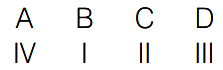
B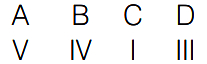
C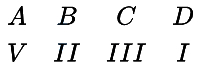
D
Solution
(D) $A. f(x) = 3x^4 - 2x^3 - 6x^2 + 6x + 1$
$f'(x) = 12x^3 - 6x^2 - 12x + 6 = 6(2x^3 - x^2 - 2x + 1) = 6(x-1)(2x-1)(x+1)$
$x > 1$ માટે,$f'(x) > 0$,તેથી $f(x)$ એ $[1, \infty)$ માં વધતું વિધેય છે. કારણ કે $[2, \infty) \subset [1, \infty)$,તેથી $f(x)$ એ $[2, \infty)$ માં વધતું વિધેય છે. આમ,$A \rightarrow V$.
$B. f(x) = x + \frac{1}{x}, x < 0$
$f'(x) = 1 - \frac{1}{x^2} = \frac{x^2 - 1}{x^2}$
$x < -1$ માટે,$f'(x) > 0$ (વધતું). $-1 < x < 0$ માટે,$f'(x) < 0$ (ઘટતું).
$x = -1$ પર,$f'(-1) = 0$ અને $x < 0$ માટે $f''(x) = \frac{2}{x^3} < 0$. આમ,$f(x)$ ને $x = -1$ પર મહત્તમ કિંમત છે. આમ,$B \rightarrow II$.
$C. f(x) = x^4(7 - x)^3$
$f'(x) = 4x^3(7-x)^3 - 3x^4(7-x)^2 = x^3(7-x)^2 [4(7-x) - 3x] = x^3(7-x)^2(28 - 7x) = 7x^3(7-x)^2(4-x)$
ક્રિટિકલ બિંદુઓ $x = 0, 4, 7$ છે. $x = 4$ ની આસપાસ $f'(x)$ ની નિશાની તપાસતા: $x < 4$ માટે,$f'(x) > 0$; $x > 4$ માટે,$f'(x) < 0$. આમ,$f(x)$ ને $x = 4$ પર મહત્તમ કિંમત છે. આમ,$C \rightarrow III$.
$D. f(x) = x^4 + (8-x)^4$
$f'(x) = 4x^3 - 4(8-x)^3 = 4(x^3 - (8-x)^3)$
$f'(x) = 0$ લેતા $\Rightarrow x = 8-x \Rightarrow x = 4$.
$f''(x) = 12x^2 + 12(8-x)^2$. $f''(4) = 12(16) + 12(16) > 0$ હોવાથી,$f(x)$ ને $x = 4$ પર ન્યૂનતમ કિંમત છે. આમ,$D \rightarrow I$.
સાચી જોડ: $A-V, B-II, C-III, D-I$.
$f'(x) = 12x^3 - 6x^2 - 12x + 6 = 6(2x^3 - x^2 - 2x + 1) = 6(x-1)(2x-1)(x+1)$
$x > 1$ માટે,$f'(x) > 0$,તેથી $f(x)$ એ $[1, \infty)$ માં વધતું વિધેય છે. કારણ કે $[2, \infty) \subset [1, \infty)$,તેથી $f(x)$ એ $[2, \infty)$ માં વધતું વિધેય છે. આમ,$A \rightarrow V$.
$B. f(x) = x + \frac{1}{x}, x < 0$
$f'(x) = 1 - \frac{1}{x^2} = \frac{x^2 - 1}{x^2}$
$x < -1$ માટે,$f'(x) > 0$ (વધતું). $-1 < x < 0$ માટે,$f'(x) < 0$ (ઘટતું).
$x = -1$ પર,$f'(-1) = 0$ અને $x < 0$ માટે $f''(x) = \frac{2}{x^3} < 0$. આમ,$f(x)$ ને $x = -1$ પર મહત્તમ કિંમત છે. આમ,$B \rightarrow II$.
$C. f(x) = x^4(7 - x)^3$
$f'(x) = 4x^3(7-x)^3 - 3x^4(7-x)^2 = x^3(7-x)^2 [4(7-x) - 3x] = x^3(7-x)^2(28 - 7x) = 7x^3(7-x)^2(4-x)$
ક્રિટિકલ બિંદુઓ $x = 0, 4, 7$ છે. $x = 4$ ની આસપાસ $f'(x)$ ની નિશાની તપાસતા: $x < 4$ માટે,$f'(x) > 0$; $x > 4$ માટે,$f'(x) < 0$. આમ,$f(x)$ ને $x = 4$ પર મહત્તમ કિંમત છે. આમ,$C \rightarrow III$.
$D. f(x) = x^4 + (8-x)^4$
$f'(x) = 4x^3 - 4(8-x)^3 = 4(x^3 - (8-x)^3)$
$f'(x) = 0$ લેતા $\Rightarrow x = 8-x \Rightarrow x = 4$.
$f''(x) = 12x^2 + 12(8-x)^2$. $f''(4) = 12(16) + 12(16) > 0$ હોવાથી,$f(x)$ ને $x = 4$ પર ન્યૂનતમ કિંમત છે. આમ,$D \rightarrow I$.
સાચી જોડ: $A-V, B-II, C-III, D-I$.
0 likesView Solution
181
MathematicsMediumMCQTS EAMCET · 2020
વિધાન $(A)$: વિધેય $f(x) = x - \log \left(\frac{1+x}{x}\right), x > 0$ ને કોઈ મહત્તમ મૂલ્ય નથી. કારણ $(R)$: જો કોઈ વિધેય $f(x)$ અંતરાલ $(a, b)$ માં ચુસ્ત વધતું વિધેય હોય,તો $(a, b)$ ના કોઈપણ બિંદુએ $f^{\prime}(x) \neq 0$ થાય. નીચેનામાંથી સાચો વિકલ્પ પસંદ કરો.
A
$(A)$ સાચું છે,$(R)$ સાચું છે અને $(R)$ એ $(A)$ ની સાચી સમજૂતી છે.
B
$(A)$ સાચું છે,$(R)$ સાચું છે પણ $(R)$ એ $(A)$ ની સાચી સમજૂતી નથી.
C
$(A)$ સાચું છે પણ $(R)$ ખોટું છે.
D
$(A)$ ખોટું છે પણ $(R)$ સાચું છે.
Solution
(A) આપેલ વિધેય: $f(x) = x - \log \left(\frac{1+x}{x}\right), x > 0$.
$x$ ની સાપેક્ષમાં વિકલન કરતા:
$f^{\prime}(x) = \frac{d}{dx}(x) - \frac{d}{dx} \log \left(\frac{1+x}{x}\right) = 1 - \frac{x}{1+x} \cdot \frac{d}{dx} \left( \frac{1}{x} + 1 \right) = 1 - \frac{x}{1+x} \cdot \left( -\frac{1}{x^2} \right) = 1 + \frac{1}{x(1+x)}$.
કારણ કે $x > 0$,તેથી $x(1+x) > 0$,અને તેથી $f^{\prime}(x) = 1 + \frac{1}{x(1+x)} > 1 > 0$ તમામ $x > 0$ માટે.
કારણ કે $f^{\prime}(x) > 0$ પ્રદેશના તમામ $x$ માટે છે,તેથી વિધેય $f(x)$ ચુસ્ત વધતું વિધેય છે અને તેને કોઈ સ્થાનિક મહત્તમ કે ન્યૂનતમ મૂલ્ય નથી.
કારણ $(R)$ જણાવે છે કે જો વિધેય ચુસ્ત વધતું હોય,તો $f^{\prime}(x) \neq 0$ થાય. આ ચુસ્ત વધતા વિધેયનો પ્રમાણિત ગુણધર્મ છે.
આમ,$(A)$ અને $(R)$ બંને સાચા છે,અને $(R)$ એ $(A)$ ની સાચી સમજૂતી છે.
$x$ ની સાપેક્ષમાં વિકલન કરતા:
$f^{\prime}(x) = \frac{d}{dx}(x) - \frac{d}{dx} \log \left(\frac{1+x}{x}\right) = 1 - \frac{x}{1+x} \cdot \frac{d}{dx} \left( \frac{1}{x} + 1 \right) = 1 - \frac{x}{1+x} \cdot \left( -\frac{1}{x^2} \right) = 1 + \frac{1}{x(1+x)}$.
કારણ કે $x > 0$,તેથી $x(1+x) > 0$,અને તેથી $f^{\prime}(x) = 1 + \frac{1}{x(1+x)} > 1 > 0$ તમામ $x > 0$ માટે.
કારણ કે $f^{\prime}(x) > 0$ પ્રદેશના તમામ $x$ માટે છે,તેથી વિધેય $f(x)$ ચુસ્ત વધતું વિધેય છે અને તેને કોઈ સ્થાનિક મહત્તમ કે ન્યૂનતમ મૂલ્ય નથી.
કારણ $(R)$ જણાવે છે કે જો વિધેય ચુસ્ત વધતું હોય,તો $f^{\prime}(x) \neq 0$ થાય. આ ચુસ્ત વધતા વિધેયનો પ્રમાણિત ગુણધર્મ છે.
આમ,$(A)$ અને $(R)$ બંને સાચા છે,અને $(R)$ એ $(A)$ ની સાચી સમજૂતી છે.
0 likesView Solution
182
MathematicsMediumMCQTS EAMCET · 2020
જો $\int \frac{(x-1) dx}{(x+1) \sqrt{x^3+x^2+x}} = f(x) + C$ હોય,તો $f(1) =$
A
$\frac{\pi}{4}$
B
$\frac{2 \pi}{5}$
C
$\frac{2 \pi}{3}$
D
$\frac{5 \pi}{6}$
Solution
(C) ધારો કે $I = \int \frac{x-1}{(x+1) \sqrt{x^3+x^2+x}} dx$.
વર્ગમૂળની અંદર અંશ અને છેદને $x$ વડે ભાગતા અને સાદું રૂપ આપતા:
$I = \int \frac{x-1}{(x+1) \sqrt{x^2(x+1+1/x)}} dx = \int \frac{x-1}{x(x+1) \sqrt{x+1+1/x}} dx$.
અંશ અને છેદને $x$ વડે ગુણતા:
$I = \int \frac{1-1/x^2}{(x+1/x+2) \sqrt{x+1/x+1}} dx$.
ધારો કે $t = \sqrt{x+1/x+1}$,તેથી $t^2 = x+1/x+1$.
બંને બાજુ વિકલન કરતા,$2t dt = (1-1/x^2) dx$.
આ કિંમતો સંકલનમાં મૂકતા:
$I = \int \frac{2t dt}{(t^2+1)t} = 2 \int \frac{dt}{t^2+1} = 2 \tan^{-1}(t) + C$.
આમ,$f(x) = 2 \tan^{-1}(\sqrt{x+1/x+1})$.
$x=1$ માટે કિંમત શોધતા:
$f(1) = 2 \tan^{-1}(\sqrt{1+1+1}) = 2 \tan^{-1}(\sqrt{3}) = 2 \times \frac{\pi}{3} = \frac{2 \pi}{3}$.
વર્ગમૂળની અંદર અંશ અને છેદને $x$ વડે ભાગતા અને સાદું રૂપ આપતા:
$I = \int \frac{x-1}{(x+1) \sqrt{x^2(x+1+1/x)}} dx = \int \frac{x-1}{x(x+1) \sqrt{x+1+1/x}} dx$.
અંશ અને છેદને $x$ વડે ગુણતા:
$I = \int \frac{1-1/x^2}{(x+1/x+2) \sqrt{x+1/x+1}} dx$.
ધારો કે $t = \sqrt{x+1/x+1}$,તેથી $t^2 = x+1/x+1$.
બંને બાજુ વિકલન કરતા,$2t dt = (1-1/x^2) dx$.
આ કિંમતો સંકલનમાં મૂકતા:
$I = \int \frac{2t dt}{(t^2+1)t} = 2 \int \frac{dt}{t^2+1} = 2 \tan^{-1}(t) + C$.
આમ,$f(x) = 2 \tan^{-1}(\sqrt{x+1/x+1})$.
$x=1$ માટે કિંમત શોધતા:
$f(1) = 2 \tan^{-1}(\sqrt{1+1+1}) = 2 \tan^{-1}(\sqrt{3}) = 2 \times \frac{\pi}{3} = \frac{2 \pi}{3}$.
0 likesView Solution
183
MathematicsEasyMCQTS EAMCET · 2020
જો $\int \frac{2 x^{12}+5 x^9}{\left(1+x^3+x^5\right)^3} d x=\frac{x^m}{l\left(1+x^3+x^5\right)^r}+C$ હોય,તો $\frac{m-l}{r}=$
A
$3$
B
$4$
C
$5$
D
$6$
Solution
(B) ધારો કે $I = \int \frac{2 x^{12}+5 x^9}{\left(1+x^3+x^5\right)^3} d x$.
સંકલનની અંદર અંશ અને છેદને $x^{15}$ વડે ભાગતા:
$I = \int \frac{2 x^{12}+5 x^9}{x^{15} \left(\frac{1}{x^5}+\frac{x^3}{x^5}+\frac{x^5}{x^5}\right)^3} d x = \int \frac{2 x^{-3}+5 x^{-6}}{\left(x^{-5}+x^{-2}+1\right)^3} d x$.
ધારો કે $t = 1 + x^{-2} + x^{-5}$.
તેથી $dt = (-2x^{-3} - 5x^{-6}) dx$,જેનો અર્થ છે કે $-(2x^{-3} + 5x^{-6}) dx = dt$.
આ કિંમત સંકલનમાં મૂકતા:
$I = -\int \frac{dt}{t^3} = -\int t^{-3} dt = -\frac{t^{-2}}{-2} + C = \frac{1}{2t^2} + C$.
$t$ ની કિંમત પાછી મૂકતા:
$I = \frac{1}{2 \left(1 + \frac{1}{x^2} + \frac{1}{x^5}\right)^2} + C = \frac{1}{2 \left(\frac{x^5+x^3+1}{x^5}\right)^2} + C = \frac{x^{10}}{2(1+x^3+x^5)^2} + C$.
આને $\frac{x^m}{l(1+x^3+x^5)^r} + C$ સાથે સરખાવતા,આપણને $m=10$,$l=2$,અને $r=2$ મળે છે.
તેથી,$\frac{m-l}{r} = \frac{10-2}{2} = \frac{8}{2} = 4$.
સંકલનની અંદર અંશ અને છેદને $x^{15}$ વડે ભાગતા:
$I = \int \frac{2 x^{12}+5 x^9}{x^{15} \left(\frac{1}{x^5}+\frac{x^3}{x^5}+\frac{x^5}{x^5}\right)^3} d x = \int \frac{2 x^{-3}+5 x^{-6}}{\left(x^{-5}+x^{-2}+1\right)^3} d x$.
ધારો કે $t = 1 + x^{-2} + x^{-5}$.
તેથી $dt = (-2x^{-3} - 5x^{-6}) dx$,જેનો અર્થ છે કે $-(2x^{-3} + 5x^{-6}) dx = dt$.
આ કિંમત સંકલનમાં મૂકતા:
$I = -\int \frac{dt}{t^3} = -\int t^{-3} dt = -\frac{t^{-2}}{-2} + C = \frac{1}{2t^2} + C$.
$t$ ની કિંમત પાછી મૂકતા:
$I = \frac{1}{2 \left(1 + \frac{1}{x^2} + \frac{1}{x^5}\right)^2} + C = \frac{1}{2 \left(\frac{x^5+x^3+1}{x^5}\right)^2} + C = \frac{x^{10}}{2(1+x^3+x^5)^2} + C$.
આને $\frac{x^m}{l(1+x^3+x^5)^r} + C$ સાથે સરખાવતા,આપણને $m=10$,$l=2$,અને $r=2$ મળે છે.
તેથી,$\frac{m-l}{r} = \frac{10-2}{2} = \frac{8}{2} = 4$.
0 likesView Solution
184
MathematicsMediumMCQTS EAMCET · 2020
$\int \frac{y^2+\sqrt[3]{y^4}+\sqrt[6]{y^2}}{y\left(1+\sqrt[3]{y^2}\right)} d y=$
A
$\frac{3}{4} \sqrt[3]{y^4}+3 \tan ^{-1}(\sqrt[3]{y})+C$
B
$\frac{3}{2} y^{2 / 3}+6 \tan ^{-1}\left(\sqrt[6]{y^2}\right)+C$
C
$\frac{2}{3 \sqrt[3]{y^2}}+6 \log \left(1+y^2\right)+C$
D
$\frac{3}{1+y}+\tan ^{-1}\left(\sqrt[3]{y^2}\right)+C$
Solution
(A) ધારો કે $I = \int \frac{y^2+\sqrt[3]{y^4}+\sqrt[6]{y^2}}{y\left(1+\sqrt[3]{y^2}\right)} d y$
$= \int \frac{y^2+y^{4/3}+y^{1/3}}{y(1+y^{2/3})} d y$
$= \int \frac{y^{4/3}(y^{2/3}+1)+y^{1/3}}{y(1+y^{2/3})} d y$
$= \int \left(y^{1/3} + \frac{y^{-2/3}}{1+y^{2/3}}\right) d y$
$= \frac{y^{4/3}}{4/3} + \int \frac{y^{-2/3}}{1+(y^{1/3})^2} d y$
$= \frac{3}{4} y^{4/3} + 3 \int \frac{d(y^{1/3})}{1+(y^{1/3})^2}$
$= \frac{3}{4} \sqrt[3]{y^4} + 3 \tan^{-1}(y^{1/3}) + C$
$= \frac{3}{4} \sqrt[3]{y^4} + 3 \tan^{-1}(\sqrt[3]{y}) + C$
$= \int \frac{y^2+y^{4/3}+y^{1/3}}{y(1+y^{2/3})} d y$
$= \int \frac{y^{4/3}(y^{2/3}+1)+y^{1/3}}{y(1+y^{2/3})} d y$
$= \int \left(y^{1/3} + \frac{y^{-2/3}}{1+y^{2/3}}\right) d y$
$= \frac{y^{4/3}}{4/3} + \int \frac{y^{-2/3}}{1+(y^{1/3})^2} d y$
$= \frac{3}{4} y^{4/3} + 3 \int \frac{d(y^{1/3})}{1+(y^{1/3})^2}$
$= \frac{3}{4} \sqrt[3]{y^4} + 3 \tan^{-1}(y^{1/3}) + C$
$= \frac{3}{4} \sqrt[3]{y^4} + 3 \tan^{-1}(\sqrt[3]{y}) + C$
0 likesView Solution
185
MathematicsEasyMCQTS EAMCET · 2020
$x \in \left(\frac{3 \pi}{4}, \pi\right)$ માટે,સંકલન $\int(\sqrt{1+\sin 2 x}+\sqrt{1-\sin 2 x}) \, dx$ ની કિંમત શોધો.
A
$-2 \cos x + C$
B
$2 \sin x + C$
C
$-2 \sin x + C$
D
$2 \cos x + C$
Solution
(A) આપેલ સંકલન $I = \int(\sqrt{1+\sin 2 x} + \sqrt{1-\sin 2 x}) \, dx$ છે.
નિત્યસમ $1 = \sin^2 x + \cos^2 x$ અને $\sin 2x = 2 \sin x \cos x$ નો ઉપયોગ કરતા:
$\sqrt{1+\sin 2x} = \sqrt{(\sin x + \cos x)^2} = |\sin x + \cos x|$
$\sqrt{1-\sin 2x} = \sqrt{(\sin x - \cos x)^2} = |\sin x - \cos x|$
જ્યારે $x \in \left(\frac{3 \pi}{4}, \pi\right)$ હોય,ત્યારે $\sin x > 0$ અને $\cos x < 0$ છે. વળી,$|\sin x| > |\cos x|$ હોવાથી,$\sin x + \cos x > 0$ અને $\sin x - \cos x > 0$ થાય.
તેથી,પદાવલિ $(\sin x + \cos x) + (\sin x - \cos x) = 2 \sin x$ બને છે.
આમ,$I = \int 2 \sin x \, dx = -2 \cos x + C$.
નિત્યસમ $1 = \sin^2 x + \cos^2 x$ અને $\sin 2x = 2 \sin x \cos x$ નો ઉપયોગ કરતા:
$\sqrt{1+\sin 2x} = \sqrt{(\sin x + \cos x)^2} = |\sin x + \cos x|$
$\sqrt{1-\sin 2x} = \sqrt{(\sin x - \cos x)^2} = |\sin x - \cos x|$
જ્યારે $x \in \left(\frac{3 \pi}{4}, \pi\right)$ હોય,ત્યારે $\sin x > 0$ અને $\cos x < 0$ છે. વળી,$|\sin x| > |\cos x|$ હોવાથી,$\sin x + \cos x > 0$ અને $\sin x - \cos x > 0$ થાય.
તેથી,પદાવલિ $(\sin x + \cos x) + (\sin x - \cos x) = 2 \sin x$ બને છે.
આમ,$I = \int 2 \sin x \, dx = -2 \cos x + C$.
0 likesView Solution
186
MathematicsEasyMCQTS EAMCET · 2020
$\int \frac{25 x^2+8}{\sqrt{25 x^2+9}} d x=$
A
$\frac{x}{2} \sqrt{25 x^2+9}+\frac{11}{10} \sinh ^{-1}\left(\frac{5 x}{3}\right)+C$
B
$\frac{x}{2} \sqrt{25 x^2+9}-\frac{7}{10} \log \left(\frac{5 x+\sqrt{25 x^2+9}}{3}\right)+C$
C
$\frac{x}{2} \sqrt{25 x^2+9}+\frac{7}{10} \sinh ^{-1}\left(\frac{5 x}{3}\right)+C$
D
$\frac{x}{2} \sqrt{25 x^2+9}+\frac{11}{10} \log \left(\frac{5 x-\sqrt{25 x^2+9}}{3}\right)+C$
Solution
(C) ધારો કે $I = \int \frac{25 x^2+8}{\sqrt{25 x^2+9}} dx$.
આપણે અંશને $(25x^2 + 9) - 1$ તરીકે લખી શકીએ છીએ.
તેથી,$I = \int \frac{25x^2 + 9 - 1}{\sqrt{25x^2 + 9}} dx = \int \sqrt{25x^2 + 9} dx - \int \frac{1}{\sqrt{25x^2 + 9}} dx$.
પ્રમાણિત સંકલન સૂત્ર $\int \sqrt{a^2x^2 + b^2} dx = \frac{x}{2}\sqrt{a^2x^2 + b^2} + \frac{b^2}{2a}\sinh^{-1}(\frac{ax}{b})$ અને $\int \frac{1}{\sqrt{a^2x^2 + b^2}} dx = \frac{1}{a}\sinh^{-1}(\frac{ax}{b})$ નો ઉપયોગ કરતા.
અહીં $a=5$ અને $b=3$ છે.
$I = [\frac{x}{2}\sqrt{25x^2 + 9} + \frac{9}{2(5)}\sinh^{-1}(\frac{5x}{3})] - \frac{1}{5}\sinh^{-1}(\frac{5x}{3}) + C$.
$I = \frac{x}{2}\sqrt{25x^2 + 9} + \frac{9}{10}\sinh^{-1}(\frac{5x}{3}) - \frac{2}{10}\sinh^{-1}(\frac{5x}{3}) + C$.
$I = \frac{x}{2}\sqrt{25x^2 + 9} + \frac{7}{10}\sinh^{-1}(\frac{5x}{3}) + C$.
આપણે અંશને $(25x^2 + 9) - 1$ તરીકે લખી શકીએ છીએ.
તેથી,$I = \int \frac{25x^2 + 9 - 1}{\sqrt{25x^2 + 9}} dx = \int \sqrt{25x^2 + 9} dx - \int \frac{1}{\sqrt{25x^2 + 9}} dx$.
પ્રમાણિત સંકલન સૂત્ર $\int \sqrt{a^2x^2 + b^2} dx = \frac{x}{2}\sqrt{a^2x^2 + b^2} + \frac{b^2}{2a}\sinh^{-1}(\frac{ax}{b})$ અને $\int \frac{1}{\sqrt{a^2x^2 + b^2}} dx = \frac{1}{a}\sinh^{-1}(\frac{ax}{b})$ નો ઉપયોગ કરતા.
અહીં $a=5$ અને $b=3$ છે.
$I = [\frac{x}{2}\sqrt{25x^2 + 9} + \frac{9}{2(5)}\sinh^{-1}(\frac{5x}{3})] - \frac{1}{5}\sinh^{-1}(\frac{5x}{3}) + C$.
$I = \frac{x}{2}\sqrt{25x^2 + 9} + \frac{9}{10}\sinh^{-1}(\frac{5x}{3}) - \frac{2}{10}\sinh^{-1}(\frac{5x}{3}) + C$.
$I = \frac{x}{2}\sqrt{25x^2 + 9} + \frac{7}{10}\sinh^{-1}(\frac{5x}{3}) + C$.
0 likesView Solution
187
MathematicsDifficultMCQTS EAMCET · 2020
$\begin{aligned} & \text{જો } 5(f(x))^2 = x f(x) + 30 \text{ અને } \\ & \int \frac{3 x^3 + (1 - 30 x^2) f(x)}{(10 f(x) - x)(x^3 - f(x))^2} dx \\ & = \frac{A}{B x^3 + D f(x)} + C, \text{ તો } A + B + D = \end{aligned}$
A
$2$
B
$1$
C
$\frac{1}{2}$
D
$-1$
Solution
(B) આપેલ છે કે $5(f(x))^2 = x f(x) + 30$. $x$ ની સાપેક્ષમાં વિકલન કરતા,આપણને $10 f(x) f'(x) = x f'(x) + f(x)$ મળે છે,જેનો અર્થ છે કે $(10 f(x) - x) f'(x) = f(x)$.
ધારો કે $I = \int \frac{3 x^3 + (1 - 30 x^2) f(x)}{(10 f(x) - x)(x^3 - f(x))^2} dx$.
અંશમાં $f(x) = (10 f(x) - x) f'(x)$ મૂકતા,આપણને મળે છે:
$I = \int \frac{3 x^3 - 30 x^2 f(x) + (10 f(x) - x) f'(x)}{(10 f(x) - x)(x^3 - f(x))^2} dx$
$I = \int \frac{3 x^2(x - 10 f(x)) + (10 f(x) - x) f'(x)}{(10 f(x) - x)(x^3 - f(x))^2} dx$
$I = \int \frac{-(10 f(x) - x)(3 x^2 - f'(x))}{(10 f(x) - x)(x^3 - f(x))^2} dx = -\int \frac{3 x^2 - f'(x)}{(x^3 - f(x))^2} dx$.
ધારો કે $t = x^3 - f(x)$,તો $dt = (3 x^2 - f'(x)) dx$.
આમ,$I = -\int \frac{dt}{t^2} = \frac{1}{t} + C = \frac{1}{x^3 - f(x)} + C$.
$\frac{A}{B x^3 + D f(x)} + C$ સાથે સરખાવતા,આપણને $A = 1, B = 1, D = -1$ મળે છે.
તેથી,$A + B + D = 1 + 1 - 1 = 1$.
ધારો કે $I = \int \frac{3 x^3 + (1 - 30 x^2) f(x)}{(10 f(x) - x)(x^3 - f(x))^2} dx$.
અંશમાં $f(x) = (10 f(x) - x) f'(x)$ મૂકતા,આપણને મળે છે:
$I = \int \frac{3 x^3 - 30 x^2 f(x) + (10 f(x) - x) f'(x)}{(10 f(x) - x)(x^3 - f(x))^2} dx$
$I = \int \frac{3 x^2(x - 10 f(x)) + (10 f(x) - x) f'(x)}{(10 f(x) - x)(x^3 - f(x))^2} dx$
$I = \int \frac{-(10 f(x) - x)(3 x^2 - f'(x))}{(10 f(x) - x)(x^3 - f(x))^2} dx = -\int \frac{3 x^2 - f'(x)}{(x^3 - f(x))^2} dx$.
ધારો કે $t = x^3 - f(x)$,તો $dt = (3 x^2 - f'(x)) dx$.
આમ,$I = -\int \frac{dt}{t^2} = \frac{1}{t} + C = \frac{1}{x^3 - f(x)} + C$.
$\frac{A}{B x^3 + D f(x)} + C$ સાથે સરખાવતા,આપણને $A = 1, B = 1, D = -1$ મળે છે.
તેથી,$A + B + D = 1 + 1 - 1 = 1$.
0 likesView Solution
188
MathematicsDifficultMCQTS EAMCET · 2020
જો $x \neq -1$ અને $\int \frac{x^3+x^2-x-1}{(x^5+x^4+3x^3+3x^2+x+1) \tan^{-1}(\frac{x^2+1}{x})} dx = A \log(f(x)) + C$ હોય,તો $A - \tan(f(2)) = $
A
$\frac{-3}{2}$
B
$\frac{-1}{2}$
C
$\frac{7}{2}$
D
$-2$
Solution
(A) ધારો કે $I = \int \frac{x^3+x^2-x-1}{(x^5+x^4+3x^3+3x^2+x+1) \tan^{-1}(\frac{x^2+1}{x})} dx$.
અંશના અવયવ પાડતા: $x^2(x+1) - 1(x+1) = (x^2-1)(x+1) = (x-1)(x+1)^2$.
છેદના અવયવ પાડતા: $x^4(x+1) + 3x^2(x+1) + 1(x+1) = (x+1)(x^4+3x^2+1)$.
તેથી,$I = \int \frac{(x-1)(x+1)^2}{(x+1)(x^4+3x^2+1) \tan^{-1}(\frac{x^2+1}{x})} dx = \int \frac{(x^2-1)}{(x^4+3x^2+1) \tan^{-1}(\frac{x^2+1}{x})} dx$.
અંશ અને છેદને $x^2$ વડે ભાગતા: $I = \int \frac{1 - \frac{1}{x^2}}{(x^2 + 3 + \frac{1}{x^2}) \tan^{-1}(x + \frac{1}{x})} dx = \int \frac{1 - \frac{1}{x^2}}{((x + \frac{1}{x})^2 + 1) \tan^{-1}(x + \frac{1}{x})} dx$.
ધારો કે $u = \tan^{-1}(x + \frac{1}{x})$,તો $du = \frac{1}{1 + (x + \frac{1}{x})^2} \cdot (1 - \frac{1}{x^2}) dx$.
આમ,$I = \int \frac{1}{u} du = \log|u| + C = \log|\tan^{-1}(x + \frac{1}{x})| + C$.
$A \log(f(x)) + C$ સાથે સરખાવતા,આપણને $A = 1$ અને $f(x) = \tan^{-1}(x + \frac{1}{x})$ મળે છે.
તેથી $f(2) = \tan^{-1}(2 + \frac{1}{2}) = \tan^{-1}(\frac{5}{2})$.
તેથી,$A - \tan(f(2)) = 1 - \tan(\tan^{-1}(\frac{5}{2})) = 1 - \frac{5}{2} = \frac{-3}{2}$.
અંશના અવયવ પાડતા: $x^2(x+1) - 1(x+1) = (x^2-1)(x+1) = (x-1)(x+1)^2$.
છેદના અવયવ પાડતા: $x^4(x+1) + 3x^2(x+1) + 1(x+1) = (x+1)(x^4+3x^2+1)$.
તેથી,$I = \int \frac{(x-1)(x+1)^2}{(x+1)(x^4+3x^2+1) \tan^{-1}(\frac{x^2+1}{x})} dx = \int \frac{(x^2-1)}{(x^4+3x^2+1) \tan^{-1}(\frac{x^2+1}{x})} dx$.
અંશ અને છેદને $x^2$ વડે ભાગતા: $I = \int \frac{1 - \frac{1}{x^2}}{(x^2 + 3 + \frac{1}{x^2}) \tan^{-1}(x + \frac{1}{x})} dx = \int \frac{1 - \frac{1}{x^2}}{((x + \frac{1}{x})^2 + 1) \tan^{-1}(x + \frac{1}{x})} dx$.
ધારો કે $u = \tan^{-1}(x + \frac{1}{x})$,તો $du = \frac{1}{1 + (x + \frac{1}{x})^2} \cdot (1 - \frac{1}{x^2}) dx$.
આમ,$I = \int \frac{1}{u} du = \log|u| + C = \log|\tan^{-1}(x + \frac{1}{x})| + C$.
$A \log(f(x)) + C$ સાથે સરખાવતા,આપણને $A = 1$ અને $f(x) = \tan^{-1}(x + \frac{1}{x})$ મળે છે.
તેથી $f(2) = \tan^{-1}(2 + \frac{1}{2}) = \tan^{-1}(\frac{5}{2})$.
તેથી,$A - \tan(f(2)) = 1 - \tan(\tan^{-1}(\frac{5}{2})) = 1 - \frac{5}{2} = \frac{-3}{2}$.
0 likesView Solution
189
MathematicsMediumMCQTS EAMCET · 2020
જો $\int \frac{1-(\cot x)^{2019}}{\tan x+(\cot x)^{2020}} dx = \frac{1}{n} \ln |(f(x))^n + (g(x))^n| + c$ હોય,તો $n[(f(x))^4 + (g(x))^4]_{x=\frac{\pi}{3}}$ ની કિંમત શોધો.
A
$\frac{10105}{16}$
B
$\frac{10012}{15}$
C
$\frac{20210}{9}$
D
$\frac{10105}{8}$
Solution
(D) ધારો કે $I = \int \frac{1-(\cot x)^{2019}}{\tan x+(\cot x)^{2020}} dx$.
અંશ અને છેદને $\sin x \cos^{2019} x$ વડે ગુણતા,સંકલ્યનું સાદું રૂપ મળે છે.
વધુમાં,$\frac{d}{dx}(\sin^{2021} x + \cos^{2021} x) = 2021 \sin^{2020} x \cos x - 2021 \cos^{2020} x \sin x = 2021 \sin x \cos x (\sin^{2019} x - \cos^{2019} x)$ થાય છે.
તેથી,સંકલન $\frac{1}{2021} \ln |\sin^{2021} x + \cos^{2021} x| + c$ મળે છે.
આપેલ સ્વરૂપ સાથે સરખાવતા,$n = 2021$,$f(x) = \sin x$,અને $g(x) = \cos x$ મળે છે.
આપણે $n[(f(x))^4 + (g(x))^4]_{x=\frac{\pi}{3}} = 2021 [\sin^4(\frac{\pi}{3}) + \cos^4(\frac{\pi}{3})]$ ની કિંમત શોધવાની છે.
$= 2021 [(\frac{\sqrt{3}}{2})^4 + (\frac{1}{2})^4] = 2021 [\frac{9}{16} + \frac{1}{16}] = 2021 [\frac{10}{16}] = 2021 [\frac{5}{8}] = \frac{10105}{8}$.
અંશ અને છેદને $\sin x \cos^{2019} x$ વડે ગુણતા,સંકલ્યનું સાદું રૂપ મળે છે.
વધુમાં,$\frac{d}{dx}(\sin^{2021} x + \cos^{2021} x) = 2021 \sin^{2020} x \cos x - 2021 \cos^{2020} x \sin x = 2021 \sin x \cos x (\sin^{2019} x - \cos^{2019} x)$ થાય છે.
તેથી,સંકલન $\frac{1}{2021} \ln |\sin^{2021} x + \cos^{2021} x| + c$ મળે છે.
આપેલ સ્વરૂપ સાથે સરખાવતા,$n = 2021$,$f(x) = \sin x$,અને $g(x) = \cos x$ મળે છે.
આપણે $n[(f(x))^4 + (g(x))^4]_{x=\frac{\pi}{3}} = 2021 [\sin^4(\frac{\pi}{3}) + \cos^4(\frac{\pi}{3})]$ ની કિંમત શોધવાની છે.
$= 2021 [(\frac{\sqrt{3}}{2})^4 + (\frac{1}{2})^4] = 2021 [\frac{9}{16} + \frac{1}{16}] = 2021 [\frac{10}{16}] = 2021 [\frac{5}{8}] = \frac{10105}{8}$.
0 likesView Solution
190
MathematicsDifficultMCQTS EAMCET · 2020
જો $\int \frac{a \cos x-2 \sin x}{b \sin x+5 \cos x} d x=\frac{7}{41} x+\frac{22}{41} \log |b \sin x+5 \cos x|+C, (a>0, b>0)$,તો $\int \frac{d x}{b+a \cos x}=$
A
$\frac{2}{3} \log \left(\frac{3 \tan \frac{x}{2}+4-\sqrt{3}}{3 \tan \frac{x}{2}+4+\sqrt{3}}\right)+C$
B
$\frac{2}{\sqrt{7}} \tan ^{-1}\left(\frac{\tan \frac{x}{2}}{\sqrt{7}}\right)+C$
C
$\frac{2}{\sqrt{7}} \log \left(\frac{\sqrt{7}-\tan \frac{x}{2}}{\sqrt{7}+\tan \frac{x}{2}}\right)+C$
D
$2 \sinh ^{-1}\left(\frac{2 \tan \frac{x}{2}}{1+\tan ^2 \frac{x}{2}}\right)+C$
Solution
(B) આપેલ છે કે,$\int \frac{a \cos x-2 \sin x}{b \sin x+5 \cos x} d x=\frac{7}{41} x+\frac{22}{41} \log |b \sin x+5 \cos x|+C$.
ધારો કે $a \cos x-2 \sin x = \lambda(b \sin x+5 \cos x) + \mu(b \cos x-5 \sin x)$.
$\sin x$ અને $\cos x$ ના સહગુણકોને સરખાવતા:
$a = 5\lambda + \mu b$ અને $-2 = b\lambda - 5\mu$.
આપેલ છે કે $\lambda = \frac{7}{41}$ અને $\mu = \frac{22}{41}$,તેથી:
$a = 5(\frac{7}{41}) + b(\frac{22}{41}) = \frac{35+22b}{41}$ અને $-2 = b(\frac{7}{41}) - 5(\frac{22}{41}) \Rightarrow -82 = 7b - 110 \Rightarrow 7b = 28 \Rightarrow b = 4$.
$a$ માં $b=4$ મૂકતા: $a = \frac{35+22(4)}{41} = \frac{35+88}{41} = \frac{123}{41} = 3$.
હવે,$\int \frac{d x}{b+a \cos x} = \int \frac{d x}{4+3 \cos x}$.
$\tan \frac{x}{2} = t$ આદેશ લેતા,$\cos x = \frac{1-t^2}{1+t^2}$ અને $dx = \frac{2 dt}{1+t^2}$:
$\int \frac{2 dt}{(1+t^2)(4+3(\frac{1-t^2}{1+t^2}))} = \int \frac{2 dt}{4+4t^2+3-3t^2} = \int \frac{2 dt}{7+t^2}$.
$= \frac{2}{\sqrt{7}} \tan^{-1}(\frac{t}{\sqrt{7}}) + C = \frac{2}{\sqrt{7}} \tan^{-1}\left(\frac{\tan \frac{x}{2}}{\sqrt{7}}\right) + C$.
ધારો કે $a \cos x-2 \sin x = \lambda(b \sin x+5 \cos x) + \mu(b \cos x-5 \sin x)$.
$\sin x$ અને $\cos x$ ના સહગુણકોને સરખાવતા:
$a = 5\lambda + \mu b$ અને $-2 = b\lambda - 5\mu$.
આપેલ છે કે $\lambda = \frac{7}{41}$ અને $\mu = \frac{22}{41}$,તેથી:
$a = 5(\frac{7}{41}) + b(\frac{22}{41}) = \frac{35+22b}{41}$ અને $-2 = b(\frac{7}{41}) - 5(\frac{22}{41}) \Rightarrow -82 = 7b - 110 \Rightarrow 7b = 28 \Rightarrow b = 4$.
$a$ માં $b=4$ મૂકતા: $a = \frac{35+22(4)}{41} = \frac{35+88}{41} = \frac{123}{41} = 3$.
હવે,$\int \frac{d x}{b+a \cos x} = \int \frac{d x}{4+3 \cos x}$.
$\tan \frac{x}{2} = t$ આદેશ લેતા,$\cos x = \frac{1-t^2}{1+t^2}$ અને $dx = \frac{2 dt}{1+t^2}$:
$\int \frac{2 dt}{(1+t^2)(4+3(\frac{1-t^2}{1+t^2}))} = \int \frac{2 dt}{4+4t^2+3-3t^2} = \int \frac{2 dt}{7+t^2}$.
$= \frac{2}{\sqrt{7}} \tan^{-1}(\frac{t}{\sqrt{7}}) + C = \frac{2}{\sqrt{7}} \tan^{-1}\left(\frac{\tan \frac{x}{2}}{\sqrt{7}}\right) + C$.
0 likesView Solution
191
MathematicsMediumMCQTS EAMCET · 2020
જો $\int \frac{\cos x}{\sqrt{4 \sin ^2 x+4 \sin x+5}} d x=\frac{1}{2} \sinh ^{-1}(f(x))+C$ હોય,તો $2 f(x)$ શોધો.
A
$1+\sin x$
B
$2 \sin x+1$
C
$4 \sin x+1$
D
$2 \sin x-\sin 4 x+2$
Solution
(B) ધારો કે $I = \int \frac{\cos x}{\sqrt{4 \sin ^2 x+4 \sin x+5}} d x$.
$\sin x = t$ આદેશ લેતા,$\cos x d x = d t$ મળે.
તેથી,$I = \int \frac{d t}{\sqrt{4 t^2+4 t+5}} = \frac{1}{2} \int \frac{d t}{\sqrt{t^2+t+\frac{5}{4}}}$.
છેદમાં પૂર્ણવર્ગ બનાવતા: $t^2+t+\frac{5}{4} = (t+\frac{1}{2})^2 + 1$.
તેથી,$I = \frac{1}{2} \int \frac{d t}{\sqrt{(t+\frac{1}{2})^2 + 1}}$.
સૂત્ર $\int \frac{du}{\sqrt{u^2+a^2}} = \sinh^{-1}(\frac{u}{a}) + C$ નો ઉપયોગ કરતા:
$I = \frac{1}{2} \sinh^{-1}(t+\frac{1}{2}) + C$.
$t = \sin x$ મૂકતા,$I = \frac{1}{2} \sinh^{-1}(\sin x + \frac{1}{2}) + C$ મળે.
આને $\frac{1}{2} \sinh^{-1}(f(x)) + C$ સાથે સરખાવતા,$f(x) = \sin x + \frac{1}{2}$ મળે.
તેથી,$2 f(x) = 2(\sin x + \frac{1}{2}) = 2 \sin x + 1$.
$\sin x = t$ આદેશ લેતા,$\cos x d x = d t$ મળે.
તેથી,$I = \int \frac{d t}{\sqrt{4 t^2+4 t+5}} = \frac{1}{2} \int \frac{d t}{\sqrt{t^2+t+\frac{5}{4}}}$.
છેદમાં પૂર્ણવર્ગ બનાવતા: $t^2+t+\frac{5}{4} = (t+\frac{1}{2})^2 + 1$.
તેથી,$I = \frac{1}{2} \int \frac{d t}{\sqrt{(t+\frac{1}{2})^2 + 1}}$.
સૂત્ર $\int \frac{du}{\sqrt{u^2+a^2}} = \sinh^{-1}(\frac{u}{a}) + C$ નો ઉપયોગ કરતા:
$I = \frac{1}{2} \sinh^{-1}(t+\frac{1}{2}) + C$.
$t = \sin x$ મૂકતા,$I = \frac{1}{2} \sinh^{-1}(\sin x + \frac{1}{2}) + C$ મળે.
આને $\frac{1}{2} \sinh^{-1}(f(x)) + C$ સાથે સરખાવતા,$f(x) = \sin x + \frac{1}{2}$ મળે.
તેથી,$2 f(x) = 2(\sin x + \frac{1}{2}) = 2 \sin x + 1$.
0 likesView Solution
192
MathematicsMediumMCQTS EAMCET · 2020
જો $\int e^{\sin ^2 x}(\sin x \cos x+\cos ^3 x \sin x) d x = e^{\sin ^2 x}(1+f(x))+c$ હોય,તો $f^{\prime}(x)=$
A
$\frac{1}{2} \sin ^2 x$
B
$\frac{1}{2} \cos ^2 x$
C
$-\frac{1}{2} \cos 2 x$
D
$-\frac{1}{2} \sin 2 x$
Solution
(D) ધારો કે $I = \int e^{\sin ^2 x}(\sin x \cos x + \cos ^3 x \sin x) d x$.
$\sin x \cos x$ સામાન્ય લેતા:
$I = \int e^{\sin ^2 x}(1 + \cos ^2 x) \sin x \cos x d x$.
$\cos ^2 x = 1 - \sin ^2 x$ હોવાથી:
$I = \int e^{\sin ^2 x}(1 + 1 - \sin ^2 x) \sin x \cos x d x = \int e^{\sin ^2 x}(2 - \sin ^2 x) \sin x \cos x d x$.
ધારો કે $t = \sin ^2 x$,તેથી $dt = 2 \sin x \cos x d x$,એટલે કે $\sin x \cos x d x = \frac{dt}{2}$.
સંકલનમાં કિંમત મૂકતા:
$I = \frac{1}{2} \int e^t(2 - t) d t = \int e^t d t - \frac{1}{2} \int t e^t d t$.
ખંડશઃ સંકલનનો ઉપયોગ કરતા $\int t e^t d t = t e^t - e^t$:
$I = e^t - \frac{1}{2}(t e^t - e^t) + C = e^t(1 - \frac{t}{2} + \frac{1}{2}) + C = e^t(\frac{3}{2} - \frac{t}{2}) + C$.
$e^{\sin ^2 x}(1 + f(x)) + C$ સાથે સરખાવતા,$1 + f(x) = \frac{3}{2} - \frac{\sin ^2 x}{2}$.
તેથી,$f(x) = \frac{1}{2} - \frac{\sin ^2 x}{2}$.
વિકલન કરતા: $f^{\prime}(x) = 0 - \frac{1}{2}(2 \sin x \cos x) = -\sin x \cos x = -\frac{1}{2} \sin 2 x$.
$\sin x \cos x$ સામાન્ય લેતા:
$I = \int e^{\sin ^2 x}(1 + \cos ^2 x) \sin x \cos x d x$.
$\cos ^2 x = 1 - \sin ^2 x$ હોવાથી:
$I = \int e^{\sin ^2 x}(1 + 1 - \sin ^2 x) \sin x \cos x d x = \int e^{\sin ^2 x}(2 - \sin ^2 x) \sin x \cos x d x$.
ધારો કે $t = \sin ^2 x$,તેથી $dt = 2 \sin x \cos x d x$,એટલે કે $\sin x \cos x d x = \frac{dt}{2}$.
સંકલનમાં કિંમત મૂકતા:
$I = \frac{1}{2} \int e^t(2 - t) d t = \int e^t d t - \frac{1}{2} \int t e^t d t$.
ખંડશઃ સંકલનનો ઉપયોગ કરતા $\int t e^t d t = t e^t - e^t$:
$I = e^t - \frac{1}{2}(t e^t - e^t) + C = e^t(1 - \frac{t}{2} + \frac{1}{2}) + C = e^t(\frac{3}{2} - \frac{t}{2}) + C$.
$e^{\sin ^2 x}(1 + f(x)) + C$ સાથે સરખાવતા,$1 + f(x) = \frac{3}{2} - \frac{\sin ^2 x}{2}$.
તેથી,$f(x) = \frac{1}{2} - \frac{\sin ^2 x}{2}$.
વિકલન કરતા: $f^{\prime}(x) = 0 - \frac{1}{2}(2 \sin x \cos x) = -\sin x \cos x = -\frac{1}{2} \sin 2 x$.
0 likesView Solution
193
MathematicsMediumMCQTS EAMCET · 2020
$\int \frac{x^2}{(\sqrt{4-x^2})^3} dx =$
A
$\frac{x^2}{\sqrt{4-x^2}}-\sin ^{-1}(\frac{x}{2})+C$
B
$\frac{x}{\sqrt{4-x^2}}-\tan ^{-1}(\frac{x}{\sqrt{4-x^2}})+C$
C
$\frac{x}{\sqrt{4-x^2}}+\sin ^{-1}(\frac{2}{\sqrt{4-x^2}})+C$
D
$\sqrt{4-x^2}-\tan ^{-1}(\frac{x}{2})+C$
Solution
(B) ધારો કે $I = \int \frac{x^2}{(\sqrt{4-x^2})^3} dx$.
$x = 2 \sin \theta$ આદેશ લેતા,$dx = 2 \cos \theta d\theta$ મળે.
આ કિંમતો સંકલનમાં મૂકતા:
$I = \int \frac{(2 \sin \theta)^2}{(\sqrt{4-4 \sin^2 \theta})^3} (2 \cos \theta) d\theta$
$I = \int \frac{4 \sin^2 \theta \cdot 2 \cos \theta}{(2 \cos \theta)^3} d\theta$
$I = \int \frac{8 \sin^2 \theta \cos \theta}{8 \cos^3 \theta} d\theta = \int \tan^2 \theta d\theta$
$I = \int (\sec^2 \theta - 1) d\theta = \tan \theta - \theta + C$.
અહીં $x = 2 \sin \theta$ હોવાથી,$\sin \theta = \frac{x}{2}$.
તેથી $\tan \theta = \frac{\sin \theta}{\cos \theta} = \frac{x/2}{\sqrt{1-(x/2)^2}} = \frac{x}{\sqrt{4-x^2}}$.
વળી,$\theta = \tan^{-1}(\frac{x}{\sqrt{4-x^2}})$.
આમ,$I = \frac{x}{\sqrt{4-x^2}} - \tan^{-1}(\frac{x}{\sqrt{4-x^2}}) + C$.
$x = 2 \sin \theta$ આદેશ લેતા,$dx = 2 \cos \theta d\theta$ મળે.
આ કિંમતો સંકલનમાં મૂકતા:
$I = \int \frac{(2 \sin \theta)^2}{(\sqrt{4-4 \sin^2 \theta})^3} (2 \cos \theta) d\theta$
$I = \int \frac{4 \sin^2 \theta \cdot 2 \cos \theta}{(2 \cos \theta)^3} d\theta$
$I = \int \frac{8 \sin^2 \theta \cos \theta}{8 \cos^3 \theta} d\theta = \int \tan^2 \theta d\theta$
$I = \int (\sec^2 \theta - 1) d\theta = \tan \theta - \theta + C$.
અહીં $x = 2 \sin \theta$ હોવાથી,$\sin \theta = \frac{x}{2}$.
તેથી $\tan \theta = \frac{\sin \theta}{\cos \theta} = \frac{x/2}{\sqrt{1-(x/2)^2}} = \frac{x}{\sqrt{4-x^2}}$.
વળી,$\theta = \tan^{-1}(\frac{x}{\sqrt{4-x^2}})$.
આમ,$I = \frac{x}{\sqrt{4-x^2}} - \tan^{-1}(\frac{x}{\sqrt{4-x^2}}) + C$.
0 likesView Solution
194
MathematicsEasyMCQTS EAMCET · 2020
$\int \left[ \frac{x^4-x}{x^{20}} \right]^{1/4} dx =$
A
$\frac{4}{15} \left( \frac{(x^3-1)^5}{x^{15}} \right)^{1/4} + C$
B
$\frac{4}{15} \left( \frac{x^4+1}{x^4} \right)^{1/4} + C$
C
$\frac{\sqrt{x^4+x^2+1}}{x} + C$
D
$\frac{3}{4} (x^{4/3} + x^{1/3}) + C$
Solution
(A) ધારો કે $I = \int \left( \frac{x^4-x}{x^{20}} \right)^{1/4} dx$.
$I = \int \left( \frac{x^4(1 - 1/x^3)}{x^{20}} \right)^{1/4} dx = \int \frac{1}{x^4} (1 - x^{-3})^{1/4} dx$.
ધારો કે $1 - x^{-3} = t$.
તેથી,બંને બાજુ $x$ ની સાપેક્ષમાં વિકલન કરતા,આપણને $3x^{-4} dx = dt$ મળે છે,જેનો અર્થ છે કે $\frac{1}{x^4} dx = \frac{1}{3} dt$.
આ કિંમતોને સંકલનમાં મૂકતા:
$I = \int (t)^{1/4} \cdot \frac{1}{3} dt = \frac{1}{3} \cdot \frac{t^{5/4}}{5/4} + C = \frac{4}{15} t^{5/4} + C$.
$t = 1 - \frac{1}{x^3} = \frac{x^3-1}{x^3}$ પાછું મૂકતા:
$I = \frac{4}{15} \left( \frac{x^3-1}{x^3} \right)^{5/4} + C = \frac{4}{15} \left( \frac{(x^3-1)^5}{x^{15}} \right)^{1/4} + C$.
$I = \int \left( \frac{x^4(1 - 1/x^3)}{x^{20}} \right)^{1/4} dx = \int \frac{1}{x^4} (1 - x^{-3})^{1/4} dx$.
ધારો કે $1 - x^{-3} = t$.
તેથી,બંને બાજુ $x$ ની સાપેક્ષમાં વિકલન કરતા,આપણને $3x^{-4} dx = dt$ મળે છે,જેનો અર્થ છે કે $\frac{1}{x^4} dx = \frac{1}{3} dt$.
આ કિંમતોને સંકલનમાં મૂકતા:
$I = \int (t)^{1/4} \cdot \frac{1}{3} dt = \frac{1}{3} \cdot \frac{t^{5/4}}{5/4} + C = \frac{4}{15} t^{5/4} + C$.
$t = 1 - \frac{1}{x^3} = \frac{x^3-1}{x^3}$ પાછું મૂકતા:
$I = \frac{4}{15} \left( \frac{x^3-1}{x^3} \right)^{5/4} + C = \frac{4}{15} \left( \frac{(x^3-1)^5}{x^{15}} \right)^{1/4} + C$.
0 likesView Solution
195
MathematicsMediumMCQTS EAMCET · 2020
$\int \frac{\left(x+\sqrt{1+x^2}\right)^2}{\sqrt{1+x^2}} d x=$
A
$\frac{x}{\sqrt{1+x^2}}+C$
B
$\log \left|x+\sqrt{1+x^2}\right|+C$
C
$x+\sqrt{1+x^2}+C$
D
$\frac{\left(x+\sqrt{1+x^2}\right)^2}{2}+C$
Solution
(D) ધારો કે $I = \int \frac{\left(x+\sqrt{1+x^2}\right)^2}{\sqrt{1+x^2}} d x$.
$t = x + \sqrt{1+x^2}$ આદેશ લેતા.
$x$ ની સાપેક્ષમાં વિકલન કરતા,$dt = \left(1 + \frac{2x}{2\sqrt{1+x^2}}\right) dx = \left(1 + \frac{x}{\sqrt{1+x^2}}\right) dx = \left(\frac{\sqrt{1+x^2} + x}{\sqrt{1+x^2}}\right) dx$ મળે.
આમ,સંકલન $I = \int t dt$ બને છે.
$t$ નું સંકલન કરતા,$I = \frac{t^2}{2} + C$ મળે.
$t$ ની કિંમત પાછી મૂકતા,$I = \frac{\left(x+\sqrt{1+x^2}\right)^2}{2} + C$ મળે.
$t = x + \sqrt{1+x^2}$ આદેશ લેતા.
$x$ ની સાપેક્ષમાં વિકલન કરતા,$dt = \left(1 + \frac{2x}{2\sqrt{1+x^2}}\right) dx = \left(1 + \frac{x}{\sqrt{1+x^2}}\right) dx = \left(\frac{\sqrt{1+x^2} + x}{\sqrt{1+x^2}}\right) dx$ મળે.
આમ,સંકલન $I = \int t dt$ બને છે.
$t$ નું સંકલન કરતા,$I = \frac{t^2}{2} + C$ મળે.
$t$ ની કિંમત પાછી મૂકતા,$I = \frac{\left(x+\sqrt{1+x^2}\right)^2}{2} + C$ મળે.
0 likesView Solution
196
MathematicsMediumMCQTS EAMCET · 2020
$\int \frac{d x}{(x-2) \sqrt{x^2-3 x+5}} =$
A
$\frac{-1}{\sqrt{3}} \cosh ^{-1}\left[\frac{7 x-8}{\sqrt{37}(x-2)}\right]+C$
B
$\frac{-1}{\sqrt{3}} \sinh ^{-1}\left[\frac{x+4}{\sqrt{11}(x-2)}\right]+C$
C
$\frac{-1}{\sqrt{3}} \cosh ^{-1}\left[\frac{x+4}{\sqrt{11}(x-2)}\right]+C$
D
$\frac{-1}{\sqrt{3}} \sinh ^{-1}\left[\frac{7 x-8}{\sqrt{37}(x-2)}\right]+C$
Solution
(B) ધારો કે $I = \int \frac{d x}{(x-2) \sqrt{x^2-3 x+5}}$.
$x-2 = \frac{1}{t}$ આદેશ લેતા,$dx = -\frac{1}{t^2} dt$ અને $x = 2 + \frac{1}{t}$ મળે.
આ કિંમતો સંકલનમાં મૂકતા:
$I = \int \frac{-1/t^2 dt}{(1/t) \sqrt{(2+1/t)^2 - 3(2+1/t) + 5}}$
$I = -\int \frac{dt/t}{\sqrt{4 + 4/t + 1/t^2 - 6 - 3/t + 5}}$
$I = -\int \frac{dt}{\sqrt{1/t^2 + 1/t + 3}} = -\int \frac{dt}{\sqrt{(1 + t + 3t^2)/t^2}} = -\int \frac{dt}{\sqrt{3t^2 + t + 1}}$
$I = -\frac{1}{\sqrt{3}} \int \frac{dt}{\sqrt{t^2 + t/3 + 1/3}} = -\frac{1}{\sqrt{3}} \int \frac{dt}{\sqrt{(t + 1/6)^2 + 11/36}}$
સૂત્ર $\int \frac{du}{\sqrt{u^2 + a^2}} = \sinh^{-1}(\frac{u}{a}) + C$ નો ઉપયોગ કરતા:
$I = -\frac{1}{\sqrt{3}} \sinh^{-1}\left( \frac{t + 1/6}{\sqrt{11}/6} \right) + C = -\frac{1}{\sqrt{3}} \sinh^{-1}\left( \frac{6t + 1}{\sqrt{11}} \right) + C$
અહીં $t = \frac{1}{x-2}$ હોવાથી:
$I = -\frac{1}{\sqrt{3}} \sinh^{-1}\left( \frac{6/(x-2) + 1}{\sqrt{11}} \right) + C = -\frac{1}{\sqrt{3}} \sinh^{-1}\left( \frac{6 + x - 2}{\sqrt{11}(x-2)} \right) + C$
$I = -\frac{1}{\sqrt{3}} \sinh^{-1}\left( \frac{x + 4}{\sqrt{11}(x-2)} \right) + C$.
$x-2 = \frac{1}{t}$ આદેશ લેતા,$dx = -\frac{1}{t^2} dt$ અને $x = 2 + \frac{1}{t}$ મળે.
આ કિંમતો સંકલનમાં મૂકતા:
$I = \int \frac{-1/t^2 dt}{(1/t) \sqrt{(2+1/t)^2 - 3(2+1/t) + 5}}$
$I = -\int \frac{dt/t}{\sqrt{4 + 4/t + 1/t^2 - 6 - 3/t + 5}}$
$I = -\int \frac{dt}{\sqrt{1/t^2 + 1/t + 3}} = -\int \frac{dt}{\sqrt{(1 + t + 3t^2)/t^2}} = -\int \frac{dt}{\sqrt{3t^2 + t + 1}}$
$I = -\frac{1}{\sqrt{3}} \int \frac{dt}{\sqrt{t^2 + t/3 + 1/3}} = -\frac{1}{\sqrt{3}} \int \frac{dt}{\sqrt{(t + 1/6)^2 + 11/36}}$
સૂત્ર $\int \frac{du}{\sqrt{u^2 + a^2}} = \sinh^{-1}(\frac{u}{a}) + C$ નો ઉપયોગ કરતા:
$I = -\frac{1}{\sqrt{3}} \sinh^{-1}\left( \frac{t + 1/6}{\sqrt{11}/6} \right) + C = -\frac{1}{\sqrt{3}} \sinh^{-1}\left( \frac{6t + 1}{\sqrt{11}} \right) + C$
અહીં $t = \frac{1}{x-2}$ હોવાથી:
$I = -\frac{1}{\sqrt{3}} \sinh^{-1}\left( \frac{6/(x-2) + 1}{\sqrt{11}} \right) + C = -\frac{1}{\sqrt{3}} \sinh^{-1}\left( \frac{6 + x - 2}{\sqrt{11}(x-2)} \right) + C$
$I = -\frac{1}{\sqrt{3}} \sinh^{-1}\left( \frac{x + 4}{\sqrt{11}(x-2)} \right) + C$.
0 likesView Solution
197
MathematicsDifficultMCQTS EAMCET · 2020
જો $\int \frac{(x-1) dx}{(x+1) \sqrt{x^3+x^2+x}} = A \cdot \tan^{-1} \sqrt{f(x)} + \text{અચળ}$,તો ક્રમયુક્ત જોડ $(A, f(-1)) =$
A
$(2, 1)$
B
$(2, -1)$
C
$(1, 2)$
D
$(-2, 2)$
Solution
(B) આપણી પાસે છે,$I = \int \frac{(x-1) dx}{(x+1) \sqrt{x^3+x^2+x}}$.
અંશ અને છેદને $x$ વડે ભાગતા,આપણને મળે $I = \int \frac{(1 - 1/x) dx}{(1 + 1/x) \sqrt{x + 1 + 1/x}}$.
ધારો કે $t = \sqrt{x + 1 + 1/x}$. તો $t^2 = x + 1 + 1/x$.
બંને બાજુ વિકલન કરતા,$2t dt = (1 - 1/x^2) dx = \frac{x^2-1}{x^2} dx = \frac{(x-1)(x+1)}{x^2} dx$.
વળી,$1 + 1/x = \frac{x+1}{x}$.
આ કિંમતો સંકલનમાં મૂકતા,આપણને મળે $I = \int \frac{2t dt}{t^2 \cdot (t^2-1) \cdot \frac{x}{x+1} \cdot \frac{x+1}{x}} = \int \frac{2 dt}{t^2+1} = 2 \tan^{-1}(t) + C$.
આમ,$I = 2 \tan^{-1} \sqrt{x + 1 + 1/x} + C$.
$A \tan^{-1} \sqrt{f(x)} + C$ સાથે સરખાવતા,આપણને $A = 2$ અને $f(x) = x + 1 + 1/x$ મળે છે.
તેથી $f(-1) = -1 + 1 + (1/-1) = -1$.
તેથી,ક્રમયુક્ત જોડ $(A, f(-1)) = (2, -1)$ છે.
અંશ અને છેદને $x$ વડે ભાગતા,આપણને મળે $I = \int \frac{(1 - 1/x) dx}{(1 + 1/x) \sqrt{x + 1 + 1/x}}$.
ધારો કે $t = \sqrt{x + 1 + 1/x}$. તો $t^2 = x + 1 + 1/x$.
બંને બાજુ વિકલન કરતા,$2t dt = (1 - 1/x^2) dx = \frac{x^2-1}{x^2} dx = \frac{(x-1)(x+1)}{x^2} dx$.
વળી,$1 + 1/x = \frac{x+1}{x}$.
આ કિંમતો સંકલનમાં મૂકતા,આપણને મળે $I = \int \frac{2t dt}{t^2 \cdot (t^2-1) \cdot \frac{x}{x+1} \cdot \frac{x+1}{x}} = \int \frac{2 dt}{t^2+1} = 2 \tan^{-1}(t) + C$.
આમ,$I = 2 \tan^{-1} \sqrt{x + 1 + 1/x} + C$.
$A \tan^{-1} \sqrt{f(x)} + C$ સાથે સરખાવતા,આપણને $A = 2$ અને $f(x) = x + 1 + 1/x$ મળે છે.
તેથી $f(-1) = -1 + 1 + (1/-1) = -1$.
તેથી,ક્રમયુક્ત જોડ $(A, f(-1)) = (2, -1)$ છે.
0 likesView Solution
198
MathematicsDifficultMCQTS EAMCET · 2020
$\int_0^{\frac{\pi}{2}} x^3 \sin x \, dx =$
A
$\frac{3 \pi^2}{4} - 3 \pi + 6$
B
$\frac{3 \pi^2}{4} + 3 \pi - 6$
C
$\frac{3 \pi^2}{4} + 6$
D
$\frac{3 \pi^2}{4} - 6$
Solution
(D) ધારો કે $I = \int_0^{\frac{\pi}{2}} x^3 \sin x \, dx$. ખંડશઃ સંકલન (integration by parts) $\int u \, dv = uv - \int v \, du$ નો ઉપયોગ કરતા,$u = x^3$ અને $dv = \sin x \, dx$ લો. તેથી $du = 3x^2 \, dx$ અને $v = -\cos x$ મળે.
$I = [-x^3 \cos x]_0^{\frac{\pi}{2}} + \int_0^{\frac{\pi}{2}} 3x^2 \cos x \, dx = 0 + 3 \int_0^{\frac{\pi}{2}} x^2 \cos x \, dx$.
હવે,$\int x^2 \cos x \, dx$ નું ફરીથી ખંડશઃ સંકલન કરતા,$u = x^2$ અને $dv = \cos x \, dx$ લો. તેથી $du = 2x \, dx$ અને $v = \sin x$ મળે.
$I = 3 \left( [x^2 \sin x]_0^{\frac{\pi}{2}} - \int_0^{\frac{\pi}{2}} 2x \sin x \, dx \right) = 3 \left( \frac{\pi^2}{4} - 2 \int_0^{\frac{\pi}{2}} x \sin x \, dx \right)$.
અંતે,$\int x \sin x \, dx$ નું ખંડશઃ સંકલન કરતા,$u = x$ અને $dv = \sin x \, dx$ લો. તેથી $du = dx$ અને $v = -\cos x$ મળે.
$\int_0^{\frac{\pi}{2}} x \sin x \, dx = [-x \cos x]_0^{\frac{\pi}{2}} + \int_0^{\frac{\pi}{2}} \cos x \, dx = 0 + [\sin x]_0^{\frac{\pi}{2}} = 1$.
કિંમત મૂકતા: $I = 3 \left( \frac{\pi^2}{4} - 2(1) \right) = \frac{3 \pi^2}{4} - 6$.
$I = [-x^3 \cos x]_0^{\frac{\pi}{2}} + \int_0^{\frac{\pi}{2}} 3x^2 \cos x \, dx = 0 + 3 \int_0^{\frac{\pi}{2}} x^2 \cos x \, dx$.
હવે,$\int x^2 \cos x \, dx$ નું ફરીથી ખંડશઃ સંકલન કરતા,$u = x^2$ અને $dv = \cos x \, dx$ લો. તેથી $du = 2x \, dx$ અને $v = \sin x$ મળે.
$I = 3 \left( [x^2 \sin x]_0^{\frac{\pi}{2}} - \int_0^{\frac{\pi}{2}} 2x \sin x \, dx \right) = 3 \left( \frac{\pi^2}{4} - 2 \int_0^{\frac{\pi}{2}} x \sin x \, dx \right)$.
અંતે,$\int x \sin x \, dx$ નું ખંડશઃ સંકલન કરતા,$u = x$ અને $dv = \sin x \, dx$ લો. તેથી $du = dx$ અને $v = -\cos x$ મળે.
$\int_0^{\frac{\pi}{2}} x \sin x \, dx = [-x \cos x]_0^{\frac{\pi}{2}} + \int_0^{\frac{\pi}{2}} \cos x \, dx = 0 + [\sin x]_0^{\frac{\pi}{2}} = 1$.
કિંમત મૂકતા: $I = 3 \left( \frac{\pi^2}{4} - 2(1) \right) = \frac{3 \pi^2}{4} - 6$.
0 likesView Solution
199
MathematicsDifficultMCQTS EAMCET · 2020
જો $I_n = \int x^n \sin x \, dx$ અને $I_6 - 360 I_2 = f(x) \cos x + g(x) \sin x$ હોય,તો $f(1) + g(1) =$
A
$-85$
B
$0$
C
$-53$
D
$75$
Solution
(A) ખંડશઃ સંકલનનો ઉપયોગ કરતા,$I_n = \int x^n \sin x \, dx = -x^n \cos x + n \int x^{n-1} \cos x \, dx = -x^n \cos x + n(x^{n-1} \sin x - (n-1) \int x^{n-2} \sin x \, dx)$.
તેથી,$I_n = -x^n \cos x + n x^{n-1} \sin x - n(n-1) I_{n-2}$.
આના પરથી પુનરાવર્તિત સંબંધ મળે છે: $I_n + n(n-1) I_{n-2} = -x^n \cos x + n x^{n-1} \sin x$.
$n=6$ માટે: $I_6 + 30 I_4 = -x^6 \cos x + 6 x^5 \sin x$.
$n=4$ માટે: $I_4 + 12 I_2 = -x^4 \cos x + 4 x^3 \sin x$.
બીજા સમીકરણને $-30$ વડે ગુણતા: $-30 I_4 - 360 I_2 = 30 x^4 \cos x - 120 x^3 \sin x$.
બંને સમીકરણોનો સરવાળો કરતા: $I_6 - 360 I_2 = (30 x^4 - x^6) \cos x + (6 x^5 - 120 x^3) \sin x$.
$f(x) \cos x + g(x) \sin x$ સાથે સરખાવતા,આપણને $f(x) = 30 x^4 - x^6$ અને $g(x) = 6 x^5 - 120 x^3$ મળે છે.
તેથી $f(1) = 30(1)^4 - (1)^6 = 29$ અને $g(1) = 6(1)^5 - 120(1)^3 = -114$.
આમ,$f(1) + g(1) = 29 - 114 = -85$.
તેથી,$I_n = -x^n \cos x + n x^{n-1} \sin x - n(n-1) I_{n-2}$.
આના પરથી પુનરાવર્તિત સંબંધ મળે છે: $I_n + n(n-1) I_{n-2} = -x^n \cos x + n x^{n-1} \sin x$.
$n=6$ માટે: $I_6 + 30 I_4 = -x^6 \cos x + 6 x^5 \sin x$.
$n=4$ માટે: $I_4 + 12 I_2 = -x^4 \cos x + 4 x^3 \sin x$.
બીજા સમીકરણને $-30$ વડે ગુણતા: $-30 I_4 - 360 I_2 = 30 x^4 \cos x - 120 x^3 \sin x$.
બંને સમીકરણોનો સરવાળો કરતા: $I_6 - 360 I_2 = (30 x^4 - x^6) \cos x + (6 x^5 - 120 x^3) \sin x$.
$f(x) \cos x + g(x) \sin x$ સાથે સરખાવતા,આપણને $f(x) = 30 x^4 - x^6$ અને $g(x) = 6 x^5 - 120 x^3$ મળે છે.
તેથી $f(1) = 30(1)^4 - (1)^6 = 29$ અને $g(1) = 6(1)^5 - 120(1)^3 = -114$.
આમ,$f(1) + g(1) = 29 - 114 = -85$.
0 likesView Solution
200
MathematicsMediumMCQTS EAMCET · 2020
$\int \frac{\tan ^{-1} x}{x^3} d x=$
A
$\frac{-\left(x^2+1\right)}{2 x} \tan ^{-1} x-\frac{1}{2 x}+C$
B
$\frac{-\left(x^2+1\right)}{2 x^2+1} \tan ^{-1} x-\frac{1}{2 x^2}+C$
C
$\frac{-1}{2 x}-\left(\frac{1}{2}+\frac{1}{2 x^2}\right) \tan ^{-1} x+C$
D
$\frac{1}{2 x}+\frac{1}{2 x^2} \tan ^{-1} x+C$
Solution
(C) ધારો કે $I = \int \frac{\tan ^{-1} x}{x^3} d x$.
ખંડશઃ સંકલનનો ઉપયોગ કરતા,$u = \tan ^{-1} x$ અને $dv = x^{-3} dx$ લો.
તેથી $du = \frac{1}{1+x^2} dx$ અને $v = \frac{x^{-2}}{-2} = -\frac{1}{2x^2}$ મળે.
$I = u v - \int v du = \tan ^{-1} x \left(-\frac{1}{2x^2}\right) - \int \left(-\frac{1}{2x^2}\right) \frac{1}{1+x^2} dx$.
$I = -\frac{\tan ^{-1} x}{2x^2} + \frac{1}{2} \int \frac{1}{x^2(1+x^2)} dx$.
આંશિક અપૂર્ણાંકની રીતનો ઉપયોગ કરતા,$\frac{1}{x^2(1+x^2)} = \frac{1}{x^2} - \frac{1}{1+x^2}$.
$I = -\frac{\tan ^{-1} x}{2x^2} + \frac{1}{2} \int \left(\frac{1}{x^2} - \frac{1}{1+x^2}\right) dx$.
$I = -\frac{\tan ^{-1} x}{2x^2} + \frac{1}{2} \left(-\frac{1}{x} - \tan ^{-1} x\right) + C$.
$I = -\frac{1}{2x} - \left(\frac{1}{2x^2} + \frac{1}{2}\right) \tan ^{-1} x + C$.
ખંડશઃ સંકલનનો ઉપયોગ કરતા,$u = \tan ^{-1} x$ અને $dv = x^{-3} dx$ લો.
તેથી $du = \frac{1}{1+x^2} dx$ અને $v = \frac{x^{-2}}{-2} = -\frac{1}{2x^2}$ મળે.
$I = u v - \int v du = \tan ^{-1} x \left(-\frac{1}{2x^2}\right) - \int \left(-\frac{1}{2x^2}\right) \frac{1}{1+x^2} dx$.
$I = -\frac{\tan ^{-1} x}{2x^2} + \frac{1}{2} \int \frac{1}{x^2(1+x^2)} dx$.
આંશિક અપૂર્ણાંકની રીતનો ઉપયોગ કરતા,$\frac{1}{x^2(1+x^2)} = \frac{1}{x^2} - \frac{1}{1+x^2}$.
$I = -\frac{\tan ^{-1} x}{2x^2} + \frac{1}{2} \int \left(\frac{1}{x^2} - \frac{1}{1+x^2}\right) dx$.
$I = -\frac{\tan ^{-1} x}{2x^2} + \frac{1}{2} \left(-\frac{1}{x} - \tan ^{-1} x\right) + C$.
$I = -\frac{1}{2x} - \left(\frac{1}{2x^2} + \frac{1}{2}\right) \tan ^{-1} x + C$.
0 likesView Solution
Vedclass Products
For Students
Vedclass Test Series
Mock tests in real TS EAMCET style covering Mathematics with performance analysis. 5-day free trial.
Start Free TrialFor Teachers
Exam Paper Generator
Generate Set A/B/C/D Mathematics papers from 7.5L+ questions in 2 minutes. 3 chapters free.
Try FreeFor Institutes
Online Exam Module
Run live TS EAMCET mock exams with unlimited students, 360° analytics & white-label branding.
See DemoFrequently Asked Questions
How many Mathematics questions are in TS EAMCET 2020?
There are 652 Mathematics questions from the TS EAMCET 2020 paper on Vedclass, each with a detailed step-by-step solution in Gujarati.
Are TS EAMCET 2020 Mathematics solutions available in Gujarati?
Yes. All solutions on this page are in Gujarati. You can also switch to English or Hindi using the language buttons above the questions.
Can I practice TS EAMCET 2020 Mathematics as a timed test?
Yes. Use the Vedclass Test Series to attempt a full TS EAMCET mock test covering Mathematics with time limits and instant score analysis.
Can teachers create Mathematics papers from TS EAMCET previous year questions?
Yes. The Vedclass Exam Paper Generator lets teachers mix TS EAMCET Mathematics questions and generate Set A/B/C/D papers in minutes.
For Teachers & Institutes
Build a Custom Mathematics Paper
Pick TS EAMCET 2020 Mathematics questions, set difficulty, and generate Set A/B/C/D in 2 minutes.