
MathematicsQ151–250 of 720 questions
Page 4 of 8 · Gujarati
151
MathematicsEasyMCQAP EAMCET · 2023
જો $\cos \theta, \sin \theta$ અને $\cot \theta$ સમગુણોત્તર શ્રેણીમાં હોય,તો $\sin ^9 \theta+\sin ^6 \theta+3 \sin ^5 \theta+\sin ^3 \theta+\sin ^2 \theta=$
A
$2$
B
$7$
C
$1$
D
$5$
Solution
(A) આપેલ છે કે $\cos \theta, \sin \theta, \cot \theta$ સમગુણોત્તર શ્રેણીમાં છે.
તેથી,$\frac{\sin \theta}{\cos \theta} = \frac{\cot \theta}{\sin \theta}$.
$\Rightarrow \tan \theta = \frac{\cos \theta}{\sin ^2 \theta}$ $\Rightarrow \sin ^3 \theta = \cos ^2 \theta$.
$\cos ^2 \theta = 1 - \sin ^2 \theta$ હોવાથી,$\sin ^3 \theta = 1 - \sin ^2 \theta$,જેનો અર્થ છે કે $\sin ^3 \theta + \sin ^2 \theta = 1$.
હવે,પદાવલિ $E = \sin ^9 \theta + \sin ^6 \theta + 3 \sin ^5 \theta + \sin ^3 \theta + \sin ^2 \theta$ ધ્યાનમાં લો.
$\sin ^3 \theta = \cos ^2 \theta$ અને $\sin ^2 \theta = 1 - \sin ^3 \theta$ મૂકતા:
$E = (\sin ^3 \theta)^3 + (\sin ^3 \theta)^2 + 3 \sin ^5 \theta + (\sin ^3 \theta + \sin ^2 \theta)$.
$E = (\cos ^2 \theta)^3 + (\cos ^2 \theta)^2 + 3 \sin ^5 \theta + 1$.
$\cos ^2 \theta = \sin ^3 \theta$ નો ઉપયોગ કરતા:
$E = (\sin ^3 \theta)^3 + (\sin ^3 \theta)^2 + 3 \sin ^5 \theta + 1 = \sin ^9 \theta + \sin ^6 \theta + 3 \sin ^5 \theta + 1$.
$\sin ^3 \theta + \sin ^2 \theta = 1$ હોવાથી,સાદું રૂપ આપતા જવાબ $2$ મળે છે.
તેથી,$\frac{\sin \theta}{\cos \theta} = \frac{\cot \theta}{\sin \theta}$.
$\Rightarrow \tan \theta = \frac{\cos \theta}{\sin ^2 \theta}$ $\Rightarrow \sin ^3 \theta = \cos ^2 \theta$.
$\cos ^2 \theta = 1 - \sin ^2 \theta$ હોવાથી,$\sin ^3 \theta = 1 - \sin ^2 \theta$,જેનો અર્થ છે કે $\sin ^3 \theta + \sin ^2 \theta = 1$.
હવે,પદાવલિ $E = \sin ^9 \theta + \sin ^6 \theta + 3 \sin ^5 \theta + \sin ^3 \theta + \sin ^2 \theta$ ધ્યાનમાં લો.
$\sin ^3 \theta = \cos ^2 \theta$ અને $\sin ^2 \theta = 1 - \sin ^3 \theta$ મૂકતા:
$E = (\sin ^3 \theta)^3 + (\sin ^3 \theta)^2 + 3 \sin ^5 \theta + (\sin ^3 \theta + \sin ^2 \theta)$.
$E = (\cos ^2 \theta)^3 + (\cos ^2 \theta)^2 + 3 \sin ^5 \theta + 1$.
$\cos ^2 \theta = \sin ^3 \theta$ નો ઉપયોગ કરતા:
$E = (\sin ^3 \theta)^3 + (\sin ^3 \theta)^2 + 3 \sin ^5 \theta + 1 = \sin ^9 \theta + \sin ^6 \theta + 3 \sin ^5 \theta + 1$.
$\sin ^3 \theta + \sin ^2 \theta = 1$ હોવાથી,સાદું રૂપ આપતા જવાબ $2$ મળે છે.
0 likesView Solution
152
MathematicsDifficultMCQAP EAMCET · 2023
જો $\cosh x = \operatorname{cosec} \theta$ હોય,તો $\coth^2 \frac{x}{2} = $
A
$\tan^2 \frac{\theta}{2}$
B
$\tan^2 \left( \frac{\pi}{4} - \frac{\theta}{2} \right)$
C
$\cot^2 \frac{\theta}{2}$
D
$\cot^2 \left( \frac{\pi}{4} - \frac{\theta}{2} \right)$
Solution
(D) આપેલ છે $\cosh x = \operatorname{cosec} \theta$.
નિત્યસમ $\cosh x = \frac{1 + \tanh^2(x/2)}{1 - \tanh^2(x/2)}$ નો ઉપયોગ કરતા:
$\frac{1 + \tanh^2(x/2)}{1 - \tanh^2(x/2)} = \operatorname{cosec} \theta$.
યોગ-વિયોગની રીત વાપરતા:
$\frac{2}{2 \tanh^2(x/2)} = \frac{\operatorname{cosec} \theta + 1}{\operatorname{cosec} \theta - 1}$.
$\coth^2 \frac{x}{2} = \frac{1 + \sin \theta}{1 - \sin \theta} = \frac{(\cos(\theta/2) + \sin(\theta/2))^2}{(\cos(\theta/2) - \sin(\theta/2))^2}$.
અંશ અને છેદને $\cos^2(\theta/2)$ વડે ભાગતા:
$\coth^2 \frac{x}{2} = \left( \frac{1 + \tan(\theta/2)}{1 - \tan(\theta/2)} \right)^2 = \tan^2 \left( \frac{\pi}{4} + \frac{\theta}{2} \right)$.
નોંધ: $\tan^2(\pi/4 + \theta/2)$ એ $\cot^2(\pi/4 - \theta/2)$ ને સમાન છે.
નિત્યસમ $\cosh x = \frac{1 + \tanh^2(x/2)}{1 - \tanh^2(x/2)}$ નો ઉપયોગ કરતા:
$\frac{1 + \tanh^2(x/2)}{1 - \tanh^2(x/2)} = \operatorname{cosec} \theta$.
યોગ-વિયોગની રીત વાપરતા:
$\frac{2}{2 \tanh^2(x/2)} = \frac{\operatorname{cosec} \theta + 1}{\operatorname{cosec} \theta - 1}$.
$\coth^2 \frac{x}{2} = \frac{1 + \sin \theta}{1 - \sin \theta} = \frac{(\cos(\theta/2) + \sin(\theta/2))^2}{(\cos(\theta/2) - \sin(\theta/2))^2}$.
અંશ અને છેદને $\cos^2(\theta/2)$ વડે ભાગતા:
$\coth^2 \frac{x}{2} = \left( \frac{1 + \tan(\theta/2)}{1 - \tan(\theta/2)} \right)^2 = \tan^2 \left( \frac{\pi}{4} + \frac{\theta}{2} \right)$.
નોંધ: $\tan^2(\pi/4 + \theta/2)$ એ $\cot^2(\pi/4 - \theta/2)$ ને સમાન છે.
0 likesView Solution
153
MathematicsMediumMCQAP EAMCET · 2023
જો $\cos A+\cos B+\cos C=0$ અને $\sin A+\sin B+\sin C=0$ હોય,તો $\cos (A-B)=$
A
$0$
B
$\frac{1}{2}$
C
$-\frac{2}{3}$
D
$-\frac{1}{2}$
Solution
(D) આપેલ છે કે $\cos A+\cos B+\cos C=0$ અને $\sin A+\sin B+\sin C=0$.
ધારો કે $x_1 = \cos A + i \sin A$,$x_2 = \cos B + i \sin B$,અને $x_3 = \cos C + i \sin C$.
તેથી $x_1 + x_2 + x_3 = 0$.
સંકર સંખ્યાઓના ગુણધર્મ મુજબ,$x_1+x_2+x_3=0$ નો અર્થ છે કે $x_1x_2+x_2x_3+x_3x_1=0$.
આમ,$x_1, x_2, x_3$ એ $z^3 - k = 0$ ના બીજ છે જ્યાં $k = x_1x_2x_3$.
$x_1+x_2 = -x_3$ નો વર્ગ કરતા,$x_1^2 + x_2^2 + 2x_1x_2 = x_3^2$.
$x_1x_2$ વડે ભાગતા,$x_1/x_2 + x_2/x_1 + 2 = x_3^2/(x_1x_2) = x_3^3/k = 1$.
તેથી $2 \cos(A-B) + 2 = 1$,જેનો અર્થ છે કે $2 \cos(A-B) = -1$.
તેથી,$\cos(A-B) = -\frac{1}{2}$.
ધારો કે $x_1 = \cos A + i \sin A$,$x_2 = \cos B + i \sin B$,અને $x_3 = \cos C + i \sin C$.
તેથી $x_1 + x_2 + x_3 = 0$.
સંકર સંખ્યાઓના ગુણધર્મ મુજબ,$x_1+x_2+x_3=0$ નો અર્થ છે કે $x_1x_2+x_2x_3+x_3x_1=0$.
આમ,$x_1, x_2, x_3$ એ $z^3 - k = 0$ ના બીજ છે જ્યાં $k = x_1x_2x_3$.
$x_1+x_2 = -x_3$ નો વર્ગ કરતા,$x_1^2 + x_2^2 + 2x_1x_2 = x_3^2$.
$x_1x_2$ વડે ભાગતા,$x_1/x_2 + x_2/x_1 + 2 = x_3^2/(x_1x_2) = x_3^3/k = 1$.
તેથી $2 \cos(A-B) + 2 = 1$,જેનો અર્થ છે કે $2 \cos(A-B) = -1$.
તેથી,$\cos(A-B) = -\frac{1}{2}$.
0 likesView Solution
154
MathematicsDifficultMCQAP EAMCET · 2023
એક સમદ્વિબાજુ ત્રિકોણની સમાન બાજુઓ $7x-y+3=0$ અને $x+y-3=0$ સમીકરણો દ્વારા આપવામાં આવી છે. જો ત્રીજી બાજુનો ઢાળ $m$ એક પૂર્ણાંક હોય,તો $m=$
A
-$3$
B
$3$
C
$4$
D
-$1$
Solution
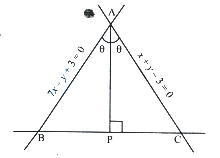
(A) ધારો કે $\triangle ABC$ એ સમદ્વિબાજુ ત્રિકોણ છે જ્યાં $AB=AC$. $\angle BAC$ નો ખૂણા દ્વિભાજક પાયા $BC$ ને લંબ હોય છે.
$7x-y+3=0$ અને $x+y-3=0$ રેખાઓના ખૂણા દ્વિભાજકોના સમીકરણો નીચે મુજબ છે:
$\frac{7x-y+3}{\sqrt{7^2+(-1)^2}} = \pm \frac{x+y-3}{\sqrt{1^2+1^2}}$
$\frac{7x-y+3}{5\sqrt{2}} = \pm \frac{x+y-3}{\sqrt{2}}$
$7x-y+3 = \pm 5(x+y-3)$
કિસ્સો $1$: $7x-y+3 = 5x+5y-15 \Rightarrow x-3y+9=0$. આ દ્વિભાજકનો ઢાળ $m_1 = \frac{1}{3}$ છે.
કિસ્સો $2$: $7x-y+3 = -5x-5y+15 \Rightarrow 3x+y-3=0$. આ દ્વિભાજકનો ઢાળ $m_2 = -3$ છે.
ત્રીજી બાજુ $BC$ એ ખૂણા દ્વિભાજકને લંબ હોવાથી,$BC$ નો ઢાળ $m$ એ $m \cdot m_{bisector} = -1$ નું પાલન કરે છે.
$m_1 = \frac{1}{3}$ માટે,$m = -3$.
$m_2 = -3$ માટે,$m = \frac{1}{3}$.
આપેલ છે કે $m$ પૂર્ણાંક છે,તેથી $m = -3$.
$7x-y+3=0$ અને $x+y-3=0$ રેખાઓના ખૂણા દ્વિભાજકોના સમીકરણો નીચે મુજબ છે:
$\frac{7x-y+3}{\sqrt{7^2+(-1)^2}} = \pm \frac{x+y-3}{\sqrt{1^2+1^2}}$
$\frac{7x-y+3}{5\sqrt{2}} = \pm \frac{x+y-3}{\sqrt{2}}$
$7x-y+3 = \pm 5(x+y-3)$
કિસ્સો $1$: $7x-y+3 = 5x+5y-15 \Rightarrow x-3y+9=0$. આ દ્વિભાજકનો ઢાળ $m_1 = \frac{1}{3}$ છે.
કિસ્સો $2$: $7x-y+3 = -5x-5y+15 \Rightarrow 3x+y-3=0$. આ દ્વિભાજકનો ઢાળ $m_2 = -3$ છે.
ત્રીજી બાજુ $BC$ એ ખૂણા દ્વિભાજકને લંબ હોવાથી,$BC$ નો ઢાળ $m$ એ $m \cdot m_{bisector} = -1$ નું પાલન કરે છે.
$m_1 = \frac{1}{3}$ માટે,$m = -3$.
$m_2 = -3$ માટે,$m = \frac{1}{3}$.
આપેલ છે કે $m$ પૂર્ણાંક છે,તેથી $m = -3$.
0 likesView Solution
155
MathematicsMediumMCQAP EAMCET · 2023
જો $\triangle ABC$ એ કાટકોણ સમદ્વિબાજુ ત્રિકોણ હોય અને $\angle C = 90^{\circ}$ હોય,તો $r : r_3 =$
A
$\sqrt{2} + 1 : \sqrt{2} - 1$
B
$\sqrt{2} - 1 : \sqrt{2} + 1$
C
$\sqrt{2} : 1$
D
$1 : \sqrt{2}$
Solution
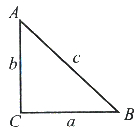
(B) આપેલ છે કે $\triangle ABC$ એ સમદ્વિબાજુ ત્રિકોણ છે જ્યાં $\angle C = 90^{\circ}$ છે.
તેથી,$AC = BC$. ધારો કે $AC = BC = a$.
$\triangle ABC$ માં,પાયથાગોરસના પ્રમેય મુજબ:
$c^2 = a^2 + b^2 = a^2 + a^2 = 2a^2$
$c = a\sqrt{2}$
આપણે જાણીએ છીએ કે અંતઃત્રિજ્યા $r = \frac{\Delta}{s}$ અને બહિઃત્રિજ્યા $r_3 = \frac{\Delta}{s-c}$ છે.
તેથી,$\frac{r}{r_3} = \frac{s-c}{s} = \frac{a+b-c}{a+b+c} = \frac{a+a-a\sqrt{2}}{a+a+a\sqrt{2}} = \frac{2a-a\sqrt{2}}{2a+a\sqrt{2}} = \frac{2-\sqrt{2}}{2+\sqrt{2}}$
છેદનું સંમેયીકરણ કરતા:
$\frac{2-\sqrt{2}}{2+\sqrt{2}} = \frac{\sqrt{2}(\sqrt{2}-1)}{\sqrt{2}(\sqrt{2}+1)} = \frac{\sqrt{2}-1}{\sqrt{2}+1}$
આમ,$r : r_3 = (\sqrt{2}-1) : (\sqrt{2}+1)$.
તેથી,$AC = BC$. ધારો કે $AC = BC = a$.
$\triangle ABC$ માં,પાયથાગોરસના પ્રમેય મુજબ:
$c^2 = a^2 + b^2 = a^2 + a^2 = 2a^2$
$c = a\sqrt{2}$
આપણે જાણીએ છીએ કે અંતઃત્રિજ્યા $r = \frac{\Delta}{s}$ અને બહિઃત્રિજ્યા $r_3 = \frac{\Delta}{s-c}$ છે.
તેથી,$\frac{r}{r_3} = \frac{s-c}{s} = \frac{a+b-c}{a+b+c} = \frac{a+a-a\sqrt{2}}{a+a+a\sqrt{2}} = \frac{2a-a\sqrt{2}}{2a+a\sqrt{2}} = \frac{2-\sqrt{2}}{2+\sqrt{2}}$
છેદનું સંમેયીકરણ કરતા:
$\frac{2-\sqrt{2}}{2+\sqrt{2}} = \frac{\sqrt{2}(\sqrt{2}-1)}{\sqrt{2}(\sqrt{2}+1)} = \frac{\sqrt{2}-1}{\sqrt{2}+1}$
આમ,$r : r_3 = (\sqrt{2}-1) : (\sqrt{2}+1)$.
0 likesView Solution
156
MathematicsMediumMCQAP EAMCET · 2023
વિધાન $(A)$: $y^2 - 2xy \sec^2 \alpha + (3 + \tan^2 \alpha)(\tan^2 \alpha - 1) x^2 = 0$ દ્વારા દર્શાવતી રેખાઓના ઢાળનો તફાવત $4$ છે.
કારણ $(R)$: $ax^2 + 2hxy + by^2 = 0$ દ્વારા દર્શાવતી રેખાઓના ઢાળનો તફાવત $\frac{2 \sqrt{h^2 - ab}}{|b|}$ છે.
કારણ $(R)$: $ax^2 + 2hxy + by^2 = 0$ દ્વારા દર્શાવતી રેખાઓના ઢાળનો તફાવત $\frac{2 \sqrt{h^2 - ab}}{|b|}$ છે.
A
$A$ અને $R$ બંને સાચા છે અને $R$ એ $A$ ની સાચી સમજૂતી છે
B
$A$ અને $R$ બંને સાચા છે પરંતુ $R$ એ $A$ ની સાચી સમજૂતી નથી
C
$A$ સાચું છે પરંતુ $R$ ખોટું છે
D
$A$ ખોટું છે પરંતુ $R$ સાચું છે
Solution
(A) $ax^2 + 2hxy + by^2 = 0$ દ્વારા દર્શાવતી રેખાઓના ઢાળનો તફાવત $\frac{2 \sqrt{h^2 - ab}}{|b|}$ છે.
આપેલ સમીકરણ $y^2 - 2xy \sec^2 \alpha + (3 + \tan^2 \alpha)(\tan^2 \alpha - 1) x^2 = 0$ માટે,$a = (3 + \tan^2 \alpha)(\tan^2 \alpha - 1)$,$h = -\sec^2 \alpha$,અને $b = 1$ છે.
ઢાળનો તફાવત $\frac{2 \sqrt{(-\sec^2 \alpha)^2 - (3 + \tan^2 \alpha)(\tan^2 \alpha - 1)(1)}}{|1|}$ છે.
ગણતરી કરતા,આપણને $2 \sqrt{4} = 4$ મળે છે.
આમ,$A$ અને $R$ બંને સાચા છે અને $R$ એ $A$ ની સાચી સમજૂતી છે.
આપેલ સમીકરણ $y^2 - 2xy \sec^2 \alpha + (3 + \tan^2 \alpha)(\tan^2 \alpha - 1) x^2 = 0$ માટે,$a = (3 + \tan^2 \alpha)(\tan^2 \alpha - 1)$,$h = -\sec^2 \alpha$,અને $b = 1$ છે.
ઢાળનો તફાવત $\frac{2 \sqrt{(-\sec^2 \alpha)^2 - (3 + \tan^2 \alpha)(\tan^2 \alpha - 1)(1)}}{|1|}$ છે.
ગણતરી કરતા,આપણને $2 \sqrt{4} = 4$ મળે છે.
આમ,$A$ અને $R$ બંને સાચા છે અને $R$ એ $A$ ની સાચી સમજૂતી છે.
0 likesView Solution
157
MathematicsMediumMCQAP EAMCET · 2023
જો $A=(2,3)$ અને $B=(-4,5)$ બે નિશ્ચિત બિંદુઓ હોય,તો બિંદુ $P$ નો બિંદુપથ શોધો જેથી $\triangle PAB$ નું ક્ષેત્રફળ $12$ ચોરસ એકમ થાય.
A
$x^2+6xy+9y^2+22x+66y+23=0$
B
$x^2-6xy+9y^2+22x+66y+23=0$
C
$x^2+6xy+9y^2-22x-66y-23=0$
D
$x^2-6xy+9y^2-22x-66y-23=0$
Solution
(C) ધારો કે બિંદુ $P$ ના યામ $(x, y)$ છે. $\triangle PAB$ નું ક્ષેત્રફળ નિશ્ચાયક સૂત્ર દ્વારા મળે છે:
$\frac{1}{2} |x(3-5) + 2(5-y) + (-4)(y-3)| = 12$
$\frac{1}{2} |-2x + 10 - 2y - 4y + 12| = 12$
$|-2x - 6y + 22| = 24$
$|x + 3y - 11| = 12$
આનો અર્થ એ છે કે $x + 3y - 11 = 12$ અથવા $x + 3y - 11 = -12$.
આમ,બિંદુપથ $(x + 3y - 23)(x + 3y + 1) = 0$ છે.
આનું વિસ્તરણ કરતા: $x^2 + 3xy + x + 3xy + 9y^2 + 3y - 23x - 69y - 23 = 0$
$x^2 + 6xy + 9y^2 - 22x - 66y - 23 = 0$.
$\frac{1}{2} |x(3-5) + 2(5-y) + (-4)(y-3)| = 12$
$\frac{1}{2} |-2x + 10 - 2y - 4y + 12| = 12$
$|-2x - 6y + 22| = 24$
$|x + 3y - 11| = 12$
આનો અર્થ એ છે કે $x + 3y - 11 = 12$ અથવા $x + 3y - 11 = -12$.
આમ,બિંદુપથ $(x + 3y - 23)(x + 3y + 1) = 0$ છે.
આનું વિસ્તરણ કરતા: $x^2 + 3xy + x + 3xy + 9y^2 + 3y - 23x - 69y - 23 = 0$
$x^2 + 6xy + 9y^2 - 22x - 66y - 23 = 0$.
0 likesView Solution
158
MathematicsEasyMCQAP EAMCET · 2023
ત્રિકોણની બાજુઓ $3x+2y-6=0$,$2x-3y+6=0$ અને $x+2y+2=0$ છે. જો $P(0, b)$ ત્રિકોણ પર અથવા ત્રિકોણની અંદર આવેલું હોય,તો $b$ કયા અંતરાલમાં હશે?
A
$[-1, 3]$
B
$[2, 3]$
C
$[-1, 2]$
D
$[-2, 2]$
Solution
(C) ત્રિકોણની બાજુઓના આપેલા સમીકરણો:
$L_1: 3x+2y-6=0$
$L_2: 2x-3y+6=0$
$L_3: x+2y+2=0$
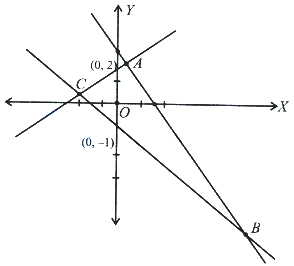
બિંદુ $P(0, b)$ ત્રિકોણ પર અથવા તેની અંદર હોય તે માટે $b$ ની રેન્જ શોધવા માટે,આપણે $y$-અક્ષ સાથે આ રેખાઓનું છેદબિંદુ શોધીએ ($x=0$ મૂકીને):
$L_1$ માટે: $3(0)+2y-6=0 \implies 2y=6 \implies y=3$
$L_2$ માટે: $2(0)-3y+6=0 \implies -3y=-6 \implies y=2$
$L_3$ માટે: $0+2y+2=0 \implies 2y=-2 \implies y=-1$
આલેખ પરથી જોઈ શકાય છે કે ત્રિકોણ આ રેખાઓ દ્વારા ઘેરાયેલું છે. $P(0, b)$ બિંદુ $y$-અક્ષ પર છે. $y$-અક્ષનો જે ભાગ ત્રિકોણની અંદર આવે છે તે $L_3$ સાથેના છેદબિંદુ $(y=-1)$ થી $L_2$ સાથેના છેદબિંદુ $(y=2)$ સુધીનો છે.
તેથી,$b$ ની રેન્જ $[-1, 2]$ છે.
$L_1: 3x+2y-6=0$
$L_2: 2x-3y+6=0$
$L_3: x+2y+2=0$
બિંદુ $P(0, b)$ ત્રિકોણ પર અથવા તેની અંદર હોય તે માટે $b$ ની રેન્જ શોધવા માટે,આપણે $y$-અક્ષ સાથે આ રેખાઓનું છેદબિંદુ શોધીએ ($x=0$ મૂકીને):
$L_1$ માટે: $3(0)+2y-6=0 \implies 2y=6 \implies y=3$
$L_2$ માટે: $2(0)-3y+6=0 \implies -3y=-6 \implies y=2$
$L_3$ માટે: $0+2y+2=0 \implies 2y=-2 \implies y=-1$
આલેખ પરથી જોઈ શકાય છે કે ત્રિકોણ આ રેખાઓ દ્વારા ઘેરાયેલું છે. $P(0, b)$ બિંદુ $y$-અક્ષ પર છે. $y$-અક્ષનો જે ભાગ ત્રિકોણની અંદર આવે છે તે $L_3$ સાથેના છેદબિંદુ $(y=-1)$ થી $L_2$ સાથેના છેદબિંદુ $(y=2)$ સુધીનો છે.
તેથી,$b$ ની રેન્જ $[-1, 2]$ છે.
0 likesView Solution
159
MathematicsMediumMCQAP EAMCET · 2023
સુરેખા $3x + 5y = 15$ પરનું એક બિંદુ જે યામ અક્ષોથી સમાન અંતરે છે,તે કયા ચરણમાં હશે?
A
$1^{\text{st}}$ ચરણ અથવા $2^{\text{nd}}$ ચરણ
B
માત્ર $4^{\text{th}}$ ચરણ
C
માત્ર $3^{\text{rd}}$ ચરણ
D
$3^{\text{rd}}$ અથવા $4^{\text{th}}$ ચરણમાં
Solution
(A) ધારો કે $P$ એ એક બિંદુ $(x, y)$ છે જે યામ અક્ષોથી સમાન અંતરે છે.
આનો અર્થ એ છે કે $|x| = |y|$,તેથી બિંદુ $y = x$ અથવા $y = -x$ રેખાઓ પર હોવું જોઈએ.
કિસ્સો $1$: $3x + 5y = 15$ અને $y = x$ નું છેદબિંદુ.
સમીકરણમાં $y = x$ મૂકતા: $3x + 5x = 15$ $\Rightarrow 8x = 15$ $\Rightarrow x = \frac{15}{8}$.
આમ,$y = \frac{15}{8}$. બિંદુ $(\frac{15}{8}, \frac{15}{8})$ છે,જે $1^{\text{st}}$ ચરણમાં છે.
કિસ્સો $2$: $3x + 5y = 15$ અને $y = -x$ નું છેદબિંદુ.
સમીકરણમાં $y = -x$ મૂકતા: $3x + 5(-x) = 15$ $\Rightarrow 3x - 5x = 15$ $\Rightarrow -2x = 15$ $\Rightarrow x = -\frac{15}{2}$.
આમ,$y = -(-\frac{15}{2}) = \frac{15}{2}$. બિંદુ $(-\frac{15}{2}, \frac{15}{2})$ છે,જે $2^{\text{nd}}$ ચરણમાં છે.
તેથી,બિંદુ $1^{\text{st}}$ અથવા $2^{\text{nd}}$ ચરણમાં આવેલું છે.
આનો અર્થ એ છે કે $|x| = |y|$,તેથી બિંદુ $y = x$ અથવા $y = -x$ રેખાઓ પર હોવું જોઈએ.
કિસ્સો $1$: $3x + 5y = 15$ અને $y = x$ નું છેદબિંદુ.
સમીકરણમાં $y = x$ મૂકતા: $3x + 5x = 15$ $\Rightarrow 8x = 15$ $\Rightarrow x = \frac{15}{8}$.
આમ,$y = \frac{15}{8}$. બિંદુ $(\frac{15}{8}, \frac{15}{8})$ છે,જે $1^{\text{st}}$ ચરણમાં છે.
કિસ્સો $2$: $3x + 5y = 15$ અને $y = -x$ નું છેદબિંદુ.
સમીકરણમાં $y = -x$ મૂકતા: $3x + 5(-x) = 15$ $\Rightarrow 3x - 5x = 15$ $\Rightarrow -2x = 15$ $\Rightarrow x = -\frac{15}{2}$.
આમ,$y = -(-\frac{15}{2}) = \frac{15}{2}$. બિંદુ $(-\frac{15}{2}, \frac{15}{2})$ છે,જે $2^{\text{nd}}$ ચરણમાં છે.
તેથી,બિંદુ $1^{\text{st}}$ અથવા $2^{\text{nd}}$ ચરણમાં આવેલું છે.
0 likesView Solution
160
MathematicsEasyMCQAP EAMCET · 2023
જો સમીકરણો $x=t^2+t+1$ અને $y=t^2-t+1$ એ પ્રચલ $t$ સાથે વક્ર $C$ દર્શાવે છે,તો $C$ નું કાર્તેઝિયન સમીકરણ શું છે?
A
$x^2-2xy+y^2-2x-2y+4=0$
B
$x^2+2xy+y^2-2x-2y+4=0$
C
$x^2-2xy+y^2+2x+2y+4=0$
D
$x^2-2xy-y^2+2x+2y+4=0$
Solution
(A) આપેલ સમીકરણો $x=t^2+t+1$ અને $y=t^2-t+1$ છે.
બંને સમીકરણોનો સરવાળો કરતા: $x+y = 2t^2+2 = 2(t^2+1)$.
બંને સમીકરણોની બાદબાકી કરતા: $x-y = 2t$,જેનો અર્થ છે કે $t = \frac{x-y}{2}$.
$t$ ની કિંમત $x+y$ ના સમીકરણમાં મૂકતા:
$x+y = 2\left(\left(\frac{x-y}{2}\right)^2 + 1\right)$
$x+y = 2\left(\frac{x^2+y^2-2xy}{4} + 1\right)$
$x+y = \frac{x^2+y^2-2xy}{2} + 2$
$2$ વડે ગુણતા: $2x+2y = x^2+y^2-2xy+4$
પદોને ગોઠવતા: $x^2-2xy+y^2-2x-2y+4=0$.
બંને સમીકરણોનો સરવાળો કરતા: $x+y = 2t^2+2 = 2(t^2+1)$.
બંને સમીકરણોની બાદબાકી કરતા: $x-y = 2t$,જેનો અર્થ છે કે $t = \frac{x-y}{2}$.
$t$ ની કિંમત $x+y$ ના સમીકરણમાં મૂકતા:
$x+y = 2\left(\left(\frac{x-y}{2}\right)^2 + 1\right)$
$x+y = 2\left(\frac{x^2+y^2-2xy}{4} + 1\right)$
$x+y = \frac{x^2+y^2-2xy}{2} + 2$
$2$ વડે ગુણતા: $2x+2y = x^2+y^2-2xy+4$
પદોને ગોઠવતા: $x^2-2xy+y^2-2x-2y+4=0$.
0 likesView Solution
161
MathematicsEasyMCQAP EAMCET · 2023
$(-2, 3)$,$(2, -1)$,અને $(4, 0)$ શિરોબિંદુઓ ધરાવતા ત્રિકોણનું પરિકેન્દ્ર શોધો:
A
$\left(\frac{3}{2}, \frac{5}{2}\right)$
B
$\left(\frac{3}{2}, -\frac{5}{2}\right)$
C
$\left(-\frac{3}{2}, \frac{5}{2}\right)$
D
$\left(-\frac{3}{2}, -\frac{5}{2}\right)$
Solution
(A) ધારો કે ત્રિકોણના શિરોબિંદુઓ $A(-2, 3)$,$B(2, -1)$,અને $C(4, 0)$ છે.
ધારો કે $O(x, y)$ એ ત્રિકોણનું પરિકેન્દ્ર છે.
વ્યાખ્યા મુજબ,પરિકેન્દ્ર બધા શિરોબિંદુઓથી સમાન અંતરે હોય છે,તેથી $OA = OB = OC$,જેનો અર્થ છે કે $OA^2 = OB^2 = OC^2$.
પ્રથમ,$OA^2 = OB^2$ લો:
$(x + 2)^2 + (y - 3)^2 = (x - 2)^2 + (y + 1)^2$
$x^2 + 4x + 4 + y^2 - 6y + 9 = x^2 - 4x + 4 + y^2 + 2y + 1$
$8x - 8y = -8 \Rightarrow x - y = -1$ ... $(i)$
આગળ,$OB^2 = OC^2$ લો:
$(x - 2)^2 + (y + 1)^2 = (x - 4)^2 + (y - 0)^2$
$x^2 - 4x + 4 + y^2 + 2y + 1 = x^2 - 8x + 16 + y^2$
$4x + 2y = 11$ ... $(ii)$
સમીકરણો $(i)$ અને $(ii)$ ઉકેલતા:
$(i)$ પરથી,$y = x + 1$.
$(ii)$ માં મૂકતા: $4x + 2(x + 1) = 11$ $\Rightarrow 6x = 9$ $\Rightarrow x = \frac{3}{2}$.
તેથી $y = \frac{3}{2} + 1 = \frac{5}{2}$.
આમ,પરિકેન્દ્ર $\left(\frac{3}{2}, \frac{5}{2}\right)$ છે.
ધારો કે $O(x, y)$ એ ત્રિકોણનું પરિકેન્દ્ર છે.
વ્યાખ્યા મુજબ,પરિકેન્દ્ર બધા શિરોબિંદુઓથી સમાન અંતરે હોય છે,તેથી $OA = OB = OC$,જેનો અર્થ છે કે $OA^2 = OB^2 = OC^2$.
પ્રથમ,$OA^2 = OB^2$ લો:
$(x + 2)^2 + (y - 3)^2 = (x - 2)^2 + (y + 1)^2$
$x^2 + 4x + 4 + y^2 - 6y + 9 = x^2 - 4x + 4 + y^2 + 2y + 1$
$8x - 8y = -8 \Rightarrow x - y = -1$ ... $(i)$
આગળ,$OB^2 = OC^2$ લો:
$(x - 2)^2 + (y + 1)^2 = (x - 4)^2 + (y - 0)^2$
$x^2 - 4x + 4 + y^2 + 2y + 1 = x^2 - 8x + 16 + y^2$
$4x + 2y = 11$ ... $(ii)$
સમીકરણો $(i)$ અને $(ii)$ ઉકેલતા:
$(i)$ પરથી,$y = x + 1$.
$(ii)$ માં મૂકતા: $4x + 2(x + 1) = 11$ $\Rightarrow 6x = 9$ $\Rightarrow x = \frac{3}{2}$.
તેથી $y = \frac{3}{2} + 1 = \frac{5}{2}$.
આમ,પરિકેન્દ્ર $\left(\frac{3}{2}, \frac{5}{2}\right)$ છે.
0 likesView Solution
162
MathematicsEasyMCQAP EAMCET · 2023
જો $PS$ એ $P(2,2)$,$Q(6,-1)$ અને $R(7,3)$ શિરોબિંદુઓ ધરાવતા ત્રિકોણની મધ્યગા હોય,તો $(1,-1)$ માંથી પસાર થતી અને $PS$ ને સમાંતર રેખાનું સમીકરણ શોધો.
A
$4x+7y+3=0$
B
$2x-9y-11=0$
C
$4x-7y-11=0$
D
$2x+9y+7=0$
Solution
(D) $S$ એ $QR$ નું મધ્યબિંદુ હોવાથી,તેના યામ $S = \left(\frac{6+7}{2}, \frac{-1+3}{2}\right) = \left(\frac{13}{2}, 1\right)$ છે.
મધ્યગા $PS$ નો ઢાળ $m = \frac{1-2}{\frac{13}{2}-2} = \frac{-1}{\frac{9}{2}} = -\frac{2}{9}$ છે.
$PS$ ને સમાંતર રેખાનો ઢાળ પણ $m = -\frac{2}{9}$ થશે.
$(1, -1)$ માંથી પસાર થતી અને $m = -\frac{2}{9}$ ઢાળ ધરાવતી રેખાનું સમીકરણ $y - y_1 = m(x - x_1)$ મુજબ મળે.
$y - (-1) = -\frac{2}{9}(x - 1)$
$9(y + 1) = -2(x - 1)$
$9y + 9 = -2x + 2$
$2x + 9y + 7 = 0$.
મધ્યગા $PS$ નો ઢાળ $m = \frac{1-2}{\frac{13}{2}-2} = \frac{-1}{\frac{9}{2}} = -\frac{2}{9}$ છે.
$PS$ ને સમાંતર રેખાનો ઢાળ પણ $m = -\frac{2}{9}$ થશે.
$(1, -1)$ માંથી પસાર થતી અને $m = -\frac{2}{9}$ ઢાળ ધરાવતી રેખાનું સમીકરણ $y - y_1 = m(x - x_1)$ મુજબ મળે.
$y - (-1) = -\frac{2}{9}(x - 1)$
$9(y + 1) = -2(x - 1)$
$9y + 9 = -2x + 2$
$2x + 9y + 7 = 0$.
0 likesView Solution
163
MathematicsMediumMCQAP EAMCET · 2023
ધારો કે ઉગમબિંદુ એ સમબાજુ ત્રિકોણ $ABC$ નું મધ્યકેન્દ્ર છે અને તેની એક બાજુ $x+y=3$ રેખા પર છે. જો $R$ અને $r$ અનુક્રમે તેના પરિવૃતની ત્રિજ્યા અને અંતઃત્રિજ્યા હોય,તો $R+r=$
A
$2 \sqrt{2}$
B
$\frac{9}{\sqrt{2}}$
C
$7 \sqrt{2}$
D
$\frac{3}{\sqrt{2}}$
Solution
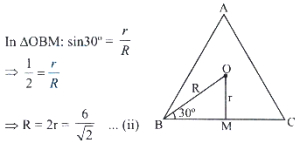
(B) સમબાજુ ત્રિકોણમાં,મધ્યકેન્દ્ર એ પરિકેન્દ્ર અને અંતઃકેન્દ્ર સાથે એકરૂપ હોય છે. ધારો કે $O$ એ ઉગમબિંદુ $(0,0)$ છે,જે મધ્યકેન્દ્ર છે.
અંતઃત્રિજ્યા $r$ એ મધ્યકેન્દ્ર $O(0,0)$ થી બાજુ $x+y-3=0$ સુધીનું લંબ અંતર છે.
$r = \left| \frac{0+0-3}{\sqrt{1^2+1^2}} \right| = \frac{3}{\sqrt{2}}$.
સમબાજુ ત્રિકોણમાં,પરિવૃતની ત્રિજ્યા $R$ એ અંતઃત્રિજ્યા $r$ કરતા બમણી હોય છે,તેથી $R = 2r$.
$R = 2 \times \frac{3}{\sqrt{2}} = \frac{6}{\sqrt{2}}$.
આમ,$R+r = \frac{6}{\sqrt{2}} + \frac{3}{\sqrt{2}} = \frac{9}{\sqrt{2}}$.
અંતઃત્રિજ્યા $r$ એ મધ્યકેન્દ્ર $O(0,0)$ થી બાજુ $x+y-3=0$ સુધીનું લંબ અંતર છે.
$r = \left| \frac{0+0-3}{\sqrt{1^2+1^2}} \right| = \frac{3}{\sqrt{2}}$.
સમબાજુ ત્રિકોણમાં,પરિવૃતની ત્રિજ્યા $R$ એ અંતઃત્રિજ્યા $r$ કરતા બમણી હોય છે,તેથી $R = 2r$.
$R = 2 \times \frac{3}{\sqrt{2}} = \frac{6}{\sqrt{2}}$.
આમ,$R+r = \frac{6}{\sqrt{2}} + \frac{3}{\sqrt{2}} = \frac{9}{\sqrt{2}}$.
0 likesView Solution
164
MathematicsEasyMCQAP EAMCET · 2023
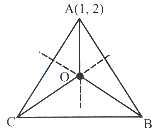
$\triangle ABC$ માં,જો $A=(1,2)$ હોય અને $B$ તથા $C$ માંથી પસાર થતી મધ્યગાઓના સમીકરણો અનુક્રમે $x+y=5$ અને $x=4$ હોય,તો $\triangle ABC$ નું ક્ષેત્રફળ શોધો.
A
$12$
B
$9$
C
$4$
D
$5$
Solution
(B) ધારો કે $B$ અને $C$ માંથી પસાર થતી મધ્યગાઓના સમીકરણો $L_1: x+y=5$ અને $L_2: x=4$ છે. આ મધ્યગાઓનું છેદબિંદુ એ મધ્યકેન્દ્ર $G$ છે. $x+y=5$ અને $x=4$ ઉકેલતા,આપણને $G=(4, 1)$ મળે છે.
ધારો કે $C$ એ $x=4$ પર છે,તેથી $C=(4, y_C)$. ધારો કે $B$ એ $x+y=5$ પર છે,તેથી $B=(x_B, 5-x_B)$.
મધ્યકેન્દ્રના સૂત્ર $G = (\frac{x_A+x_B+x_C}{3}, \frac{y_A+y_B+y_C}{3})$ નો ઉપયોગ કરતા:
$4 = \frac{1+x_B+4}{3}$ $\Rightarrow 12 = 5+x_B$ $\Rightarrow x_B=7$. તેથી $B=(7, 5-7) = (7, -2)$.
$1 = \frac{2+y_B+y_C}{3}$ $\Rightarrow 3 = 2+(-2)+y_C$ $\Rightarrow y_C=3$. તેથી $C=(4, 3)$.
શિરોબિંદુઓ $A(1, 2)$,$B(7, -2)$,અને $C(4, 3)$ છે.
$\triangle ABC$ નું ક્ષેત્રફળ $= \frac{1}{2} |x_A(y_B-y_C) + x_B(y_C-y_A) + x_C(y_A-y_B)|$
$= \frac{1}{2} |1(-2-3) + 7(3-2) + 4(2-(-2))|$
$= \frac{1}{2} |-5 + 7 + 16| = \frac{1}{2} |18| = 9$.
ધારો કે $C$ એ $x=4$ પર છે,તેથી $C=(4, y_C)$. ધારો કે $B$ એ $x+y=5$ પર છે,તેથી $B=(x_B, 5-x_B)$.
મધ્યકેન્દ્રના સૂત્ર $G = (\frac{x_A+x_B+x_C}{3}, \frac{y_A+y_B+y_C}{3})$ નો ઉપયોગ કરતા:
$4 = \frac{1+x_B+4}{3}$ $\Rightarrow 12 = 5+x_B$ $\Rightarrow x_B=7$. તેથી $B=(7, 5-7) = (7, -2)$.
$1 = \frac{2+y_B+y_C}{3}$ $\Rightarrow 3 = 2+(-2)+y_C$ $\Rightarrow y_C=3$. તેથી $C=(4, 3)$.
શિરોબિંદુઓ $A(1, 2)$,$B(7, -2)$,અને $C(4, 3)$ છે.
$\triangle ABC$ નું ક્ષેત્રફળ $= \frac{1}{2} |x_A(y_B-y_C) + x_B(y_C-y_A) + x_C(y_A-y_B)|$
$= \frac{1}{2} |1(-2-3) + 7(3-2) + 4(2-(-2))|$
$= \frac{1}{2} |-5 + 7 + 16| = \frac{1}{2} |18| = 9$.
0 likesView Solution
165
MathematicsMediumMCQAP EAMCET · 2023
$\triangle ABC$ માં,જો $r_1: r_2 = 7: 8$ અને $r_1: r_3 = 3: 4$ હોય,તો $a: b: c =$
A
$24: 21: 28$
B
$8: 7: 6$
C
$13: 14: 15$
D
$7: 8: 6$
Solution
(C) આપેલ છે: $r_1: r_2 = 7: 8$ અને $r_1: r_3 = 3: 4$.
આપણે જાણીએ છીએ કે $r_1 = \frac{\Delta}{s-a}$,$r_2 = \frac{\Delta}{s-b}$,અને $r_3 = \frac{\Delta}{s-c}$.
તેથી,$\frac{1}{s-a}: \frac{1}{s-b}: \frac{1}{s-c} = r_1: r_2: r_3$.
પ્રથમ,ગુણોત્તર $r_1: r_2: r_3$ શોધો:
$r_1: r_2 = 7: 8 = 21: 24$
$r_1: r_3 = 3: 4 = 21: 28$
તેથી,$r_1: r_2: r_3 = 21: 24: 28$.
ધારો કે $s-a = \frac{k}{21}$,$s-b = \frac{k}{24}$,અને $s-c = \frac{k}{28}$.
આનો સરવાળો કરતા: $(s-a) + (s-b) + (s-c) = 3s - (a+b+c) = 3s - 2s = s$.
તેથી,$s = k(\frac{1}{21} + \frac{1}{24} + \frac{1}{28}) = k(\frac{8+7+6}{168}) = k(\frac{21}{168}) = \frac{k}{8}$.
હવે,$a = s - (s-a) = k(\frac{1}{8} - \frac{1}{21}) = k(\frac{21-8}{168}) = \frac{13k}{168}$.
$b = s - (s-b) = k(\frac{1}{8} - \frac{1}{24}) = k(\frac{3-1}{24}) = \frac{2k}{24} = \frac{14k}{168}$.
$c = s - (s-c) = k(\frac{1}{8} - \frac{1}{28}) = k(\frac{7-2}{56}) = \frac{5k}{56} = \frac{15k}{168}$.
તેથી,$a: b: c = 13: 14: 15$.
આપણે જાણીએ છીએ કે $r_1 = \frac{\Delta}{s-a}$,$r_2 = \frac{\Delta}{s-b}$,અને $r_3 = \frac{\Delta}{s-c}$.
તેથી,$\frac{1}{s-a}: \frac{1}{s-b}: \frac{1}{s-c} = r_1: r_2: r_3$.
પ્રથમ,ગુણોત્તર $r_1: r_2: r_3$ શોધો:
$r_1: r_2 = 7: 8 = 21: 24$
$r_1: r_3 = 3: 4 = 21: 28$
તેથી,$r_1: r_2: r_3 = 21: 24: 28$.
ધારો કે $s-a = \frac{k}{21}$,$s-b = \frac{k}{24}$,અને $s-c = \frac{k}{28}$.
આનો સરવાળો કરતા: $(s-a) + (s-b) + (s-c) = 3s - (a+b+c) = 3s - 2s = s$.
તેથી,$s = k(\frac{1}{21} + \frac{1}{24} + \frac{1}{28}) = k(\frac{8+7+6}{168}) = k(\frac{21}{168}) = \frac{k}{8}$.
હવે,$a = s - (s-a) = k(\frac{1}{8} - \frac{1}{21}) = k(\frac{21-8}{168}) = \frac{13k}{168}$.
$b = s - (s-b) = k(\frac{1}{8} - \frac{1}{24}) = k(\frac{3-1}{24}) = \frac{2k}{24} = \frac{14k}{168}$.
$c = s - (s-c) = k(\frac{1}{8} - \frac{1}{28}) = k(\frac{7-2}{56}) = \frac{5k}{56} = \frac{15k}{168}$.
તેથી,$a: b: c = 13: 14: 15$.
0 likesView Solution
166
MathematicsEasyMCQAP EAMCET · 2023
જો કાટકોણ ત્રિકોણના કર્ણના અંત્યબિંદુઓ $(0, a)$ અને $(a, 0)$ હોય,તો ત્રીજા શિરોબિંદુનો બિંદુપથ શું થાય?
A
$x^2+y^2-ax-ay=0$
B
$x^2+y^2-ax+ay=0$
C
$x^2-y^2-ax-ay=0$
D
$x^2-y^2+ax-ay=0$
Solution
(A) ધારો કે ત્રીજું શિરોબિંદુ $B(x, y)$ છે. કર્ણના અંત્યબિંદુઓ $A(0, a)$ અને $C(a, 0)$ છે.
$\triangle ABC$ એ $B$ આગળ કાટકોણ ત્રિકોણ હોવાથી,$\angle ABC = 90^{\circ}$ થાય.
$AB$ નો ઢાળ $m_1 = \frac{y-a}{x-0} = \frac{y-a}{x}$ છે.
$BC$ નો ઢાળ $m_2 = \frac{y-0}{x-a} = \frac{y}{x-a}$ છે.
$AB \perp BC$ હોવાથી,તેમના ઢાળનો ગુણાકાર $-1$ થાય:
$\left(\frac{y-a}{x}\right) \times \left(\frac{y}{x-a}\right) = -1$
$y(y-a) = -x(x-a)$
$y^2 - ay = -x^2 + ax$
$x^2 + y^2 - ax - ay = 0$.
$\triangle ABC$ એ $B$ આગળ કાટકોણ ત્રિકોણ હોવાથી,$\angle ABC = 90^{\circ}$ થાય.
$AB$ નો ઢાળ $m_1 = \frac{y-a}{x-0} = \frac{y-a}{x}$ છે.
$BC$ નો ઢાળ $m_2 = \frac{y-0}{x-a} = \frac{y}{x-a}$ છે.
$AB \perp BC$ હોવાથી,તેમના ઢાળનો ગુણાકાર $-1$ થાય:
$\left(\frac{y-a}{x}\right) \times \left(\frac{y}{x-a}\right) = -1$
$y(y-a) = -x(x-a)$
$y^2 - ay = -x^2 + ax$
$x^2 + y^2 - ax - ay = 0$.
0 likesView Solution
167
MathematicsEasyMCQAP EAMCET · 2023
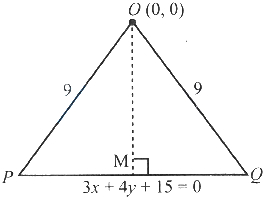
જો $O$ ઉગમબિંદુ હોય અને $P, Q$ એ રેખા $3x + 4y + 15 = 0$ પરના એવા બિંદુઓ હોય કે જેથી $OP = OQ = 9$ થાય, તો $\triangle OPQ$ નું ક્ષેત્રફળ શોધો। ($\sqrt{2}$ માં)
A
$6$
B
$9$
C
$12$
D
$18$
Solution
(D) ધારો કે $M$ એ $O(0,0)$ થી રેખા $3x + 4y + 15 = 0$ પર દોરેલા લંબનો લંબપાદ છે.
તેથી, લંબની લંબાઈ $OM = \left| \frac{3(0) + 4(0) + 15}{\sqrt{3^2 + 4^2}} \right| = \frac{15}{5} = 3$.
કાટકોણ ત્રિકોણ $\triangle OMQ$ માં, પાયથાગોરસના પ્રમેય મુજબ:
$MQ = \sqrt{OQ^2 - OM^2} = \sqrt{9^2 - 3^2} = \sqrt{81 - 9} = \sqrt{72} = 6 \sqrt{2}$.
$\triangle OPQ$ નું ક્ષેત્રફળ $= 2 \times (\triangle OMQ$ નું ક્ષેત્રફળ).
$\triangle OPQ$ નું ક્ષેત્રફળ $= 2 \times \left( \frac{1}{2} \times OM \times MQ \right) = OM \times MQ$.
$\triangle OPQ$ નું ક્ષેત્રફળ $= 3 \times 6 \sqrt{2} = 18 \sqrt{2}$.
તેથી, લંબની લંબાઈ $OM = \left| \frac{3(0) + 4(0) + 15}{\sqrt{3^2 + 4^2}} \right| = \frac{15}{5} = 3$.
કાટકોણ ત્રિકોણ $\triangle OMQ$ માં, પાયથાગોરસના પ્રમેય મુજબ:
$MQ = \sqrt{OQ^2 - OM^2} = \sqrt{9^2 - 3^2} = \sqrt{81 - 9} = \sqrt{72} = 6 \sqrt{2}$.
$\triangle OPQ$ નું ક્ષેત્રફળ $= 2 \times (\triangle OMQ$ નું ક્ષેત્રફળ).
$\triangle OPQ$ નું ક્ષેત્રફળ $= 2 \times \left( \frac{1}{2} \times OM \times MQ \right) = OM \times MQ$.
$\triangle OPQ$ નું ક્ષેત્રફળ $= 3 \times 6 \sqrt{2} = 18 \sqrt{2}$.
0 likesView Solution
168
MathematicsMediumMCQAP EAMCET · 2023
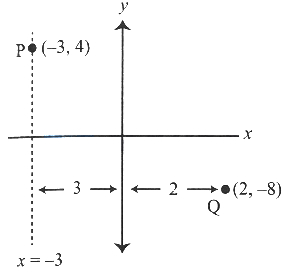
બિંદુ $(-3, 4)$ માંથી પસાર થતી અને બિંદુ $(2, -8)$ થી $5$ એકમ અંતરે હોય તેવી સીધી રેખાઓની સંખ્યા કેટલી છે?
A
$0$
B
$1$
C
$2$
D
અનંત
Solution
(C) ધારો કે બિંદુ $P(-3, 4)$ અને $Q(2, -8)$ છે. $P$ અને $Q$ વચ્ચેનું અંતર $d = \sqrt{(2 - (-3))^2 + (-8 - 4)^2} = \sqrt{5^2 + (-12)^2} = \sqrt{25 + 144} = \sqrt{169} = 13$ એકમ છે.
$P$ માંથી પસાર થતી કોઈપણ રેખાને રેખા $PQ$ સાથે અમુક ખૂણે $\theta$ દર્શાવી શકાય છે. આવી રેખા પર $Q$ થી લંબ અંતર $d \sin \theta$ છે,જ્યાં $d = 13$ છે.
આપણે અંતર $5$ એકમ જોઈએ છે,તેથી $13 \sin \theta = 5$,જે $\sin \theta = \frac{5}{13}$ આપે છે.
કારણ કે $|\sin \theta| \le 1$ અને $\frac{5}{13} < 1$,તેથી $[0, 2\pi)$ ની શ્રેણીમાં $\theta$ માટે બે શક્ય કિંમતો છે,એટલે કે $\theta = \arcsin(\frac{5}{13})$ અને $\theta = \pi - \arcsin(\frac{5}{13})$.
આમ,આવી $2$ રેખાઓ શક્ય છે.
$P$ માંથી પસાર થતી કોઈપણ રેખાને રેખા $PQ$ સાથે અમુક ખૂણે $\theta$ દર્શાવી શકાય છે. આવી રેખા પર $Q$ થી લંબ અંતર $d \sin \theta$ છે,જ્યાં $d = 13$ છે.
આપણે અંતર $5$ એકમ જોઈએ છે,તેથી $13 \sin \theta = 5$,જે $\sin \theta = \frac{5}{13}$ આપે છે.
કારણ કે $|\sin \theta| \le 1$ અને $\frac{5}{13} < 1$,તેથી $[0, 2\pi)$ ની શ્રેણીમાં $\theta$ માટે બે શક્ય કિંમતો છે,એટલે કે $\theta = \arcsin(\frac{5}{13})$ અને $\theta = \pi - \arcsin(\frac{5}{13})$.
આમ,આવી $2$ રેખાઓ શક્ય છે.
0 likesView Solution
169
MathematicsMediumMCQAP EAMCET · 2023
બિંદુઓ $\left(ct_1, \frac{c}{t_1}\right)$ અને $\left(ct_2, \frac{c}{t_2}\right)$ માંથી પસાર થતી રેખાનું સમીકરણ શું છે?
A
$x+t_1 t_2 y=c\left(t_1+t_2\right)$
B
$y+t_1 t_2 x=c\left(t_1+t_2\right)$
C
$x-t_1 t_2 y=c\left(t_1+t_2\right)$
D
$y-t_1 t_2 x=c\left(t_1+t_2\right)$
Solution
(A) બિંદુઓ $(ct_1, c/t_1)$ અને $(ct_2, c/t_2)$ માંથી પસાર થતી રેખાનો ઢાળ $m$ નીચે મુજબ છે:
$m = \frac{\frac{c}{t_2} - \frac{c}{t_1}}{ct_2 - ct_1} = \frac{c(t_1 - t_2)}{t_1 t_2} \cdot \frac{1}{c(t_2 - t_1)} = -\frac{1}{t_1 t_2}$
બિંદુ-ઢાળ સ્વરૂપ $(y - y_1) = m(x - x_1)$ નો ઉપયોગ કરીને:
$y - \frac{c}{t_1} = -\frac{1}{t_1 t_2}(x - ct_1)$
બંને બાજુ $t_1 t_2$ વડે ગુણતા:
$t_1 t_2 y - ct_2 = -(x - ct_1)$
$t_1 t_2 y - ct_2 = -x + ct_1$
$x + t_1 t_2 y = c(t_1 + t_2)$
$m = \frac{\frac{c}{t_2} - \frac{c}{t_1}}{ct_2 - ct_1} = \frac{c(t_1 - t_2)}{t_1 t_2} \cdot \frac{1}{c(t_2 - t_1)} = -\frac{1}{t_1 t_2}$
બિંદુ-ઢાળ સ્વરૂપ $(y - y_1) = m(x - x_1)$ નો ઉપયોગ કરીને:
$y - \frac{c}{t_1} = -\frac{1}{t_1 t_2}(x - ct_1)$
બંને બાજુ $t_1 t_2$ વડે ગુણતા:
$t_1 t_2 y - ct_2 = -(x - ct_1)$
$t_1 t_2 y - ct_2 = -x + ct_1$
$x + t_1 t_2 y = c(t_1 + t_2)$
0 likesView Solution
170
MathematicsMediumMCQAP EAMCET · 2023
જો $p$ અને $q$ એ $(a \cos \alpha, b \sin \alpha)$ અને $(a \cos \beta, b \sin \beta)$ બિંદુઓમાંથી પસાર થતી રેખાના અનુક્રમે $x$ અને $y$-અંતઃખંડો હોય,તો $\frac{a^2}{p^2}+\frac{b^2}{q^2}=$
A
$\sin ^2\left(\frac{\alpha-\beta}{2}\right)$
B
$\cos ^2\left(\frac{\alpha-\beta}{2}\right)$
C
$\sec ^2\left(\frac{\alpha-\beta}{2}\right)$
D
$\operatorname{cosec}^2\left(\frac{\alpha-\beta}{2}\right)$
Solution
(C) રેખાનું સમીકરણ અંતઃખંડ સ્વરૂપમાં $\frac{x}{p} + \frac{y}{q} = 1$ છે.
રેખા $(a \cos \alpha, b \sin \alpha)$ અને $(a \cos \beta, b \sin \beta)$ માંથી પસાર થતી હોવાથી:
$\frac{a \cos \alpha}{p} + \frac{b \sin \alpha}{q} = 1$ $(i)$
$\frac{a \cos \beta}{p} + \frac{b \sin \beta}{q} = 1$ (ii)
આ સમીકરણો ઉકેલતા,$\frac{a^2}{p^2} + \frac{b^2}{q^2} = \sec^2 \left(\frac{\alpha-\beta}{2}\right)$ મળે છે.
રેખા $(a \cos \alpha, b \sin \alpha)$ અને $(a \cos \beta, b \sin \beta)$ માંથી પસાર થતી હોવાથી:
$\frac{a \cos \alpha}{p} + \frac{b \sin \alpha}{q} = 1$ $(i)$
$\frac{a \cos \beta}{p} + \frac{b \sin \beta}{q} = 1$ (ii)
આ સમીકરણો ઉકેલતા,$\frac{a^2}{p^2} + \frac{b^2}{q^2} = \sec^2 \left(\frac{\alpha-\beta}{2}\right)$ મળે છે.
0 likesView Solution
171
MathematicsDifficultMCQAP EAMCET · 2023
$4$ એકમ લંબાઈ ધરાવતા ચોરસનું કેન્દ્ર $(3,7)$ છે અને એક વિકર્ણ રેખા $y=x$ ને સમાંતર છે. જો $(x_1, y_1), (x_2, y_2), (x_3, y_3)$ અને $(x_4, y_4)$ આ ચોરસના શિરોબિંદુઓ હોય,તો $\frac{y_1 y_2 y_3 y_4}{x_1 x_2 x_3 x_4}=$
A
$81$
B
$\frac{245}{16}$
C
$25$
D
$\frac{105}{2}$
Solution
(A) ચોરસનું કેન્દ્ર $P(3,7)$ છે અને બાજુની લંબાઈ $4$ છે. વિકર્ણની લંબાઈ $4\sqrt{2}$ છે,તેથી કેન્દ્રથી દરેક શિરોબિંદુનું અંતર $r = \frac{4\sqrt{2}}{2} = 2\sqrt{2}$ છે.
એક વિકર્ણ $y=x$ ને સમાંતર છે,તેથી તેનો ઢાળ $m_1 = 1$ છે. તે $x$-અક્ષ સાથે $\theta_1 = 45^\circ$ નો ખૂણો બનાવે છે.
બીજો વિકર્ણ પ્રથમ વિકર્ણને લંબ છે,તેથી તેનો ઢાળ $m_2 = -1$ છે અને તેનો ખૂણો $\theta_2 = 135^\circ$ છે.
રેખાના પ્રચલિત સ્વરૂપનો ઉપયોગ કરીને,શિરોબિંદુઓના યામ $(x, y) = (3 + r \cos \theta, 7 + r \sin \theta)$ છે.
પ્રથમ વિકર્ણ માટે $(\theta = 45^\circ)$: $(3 \pm 2\sqrt{2} \cos 45^\circ, 7 \pm 2\sqrt{2} \sin 45^\circ) = (3 \pm 2, 7 \pm 2)$,જે બિંદુઓ $(5,9)$ અને $(1,5)$ આપે છે.
બીજા વિકર્ણ માટે $(\theta = 135^\circ)$: $(3 \pm 2\sqrt{2} \cos 135^\circ, 7 \pm 2\sqrt{2} \sin 135^\circ) = (3 \mp 2, 7 \pm 2)$,જે બિંદુઓ $(1,9)$ અને $(5,5)$ આપે છે.
શિરોબિંદુઓ $(1,5), (5,5), (5,9), (1,9)$ છે.
આમ,$\frac{y_1 y_2 y_3 y_4}{x_1 x_2 x_3 x_4} = \frac{5 \times 5 \times 9 \times 9}{1 \times 5 \times 5 \times 1} = \frac{2025}{25} = 81$.
એક વિકર્ણ $y=x$ ને સમાંતર છે,તેથી તેનો ઢાળ $m_1 = 1$ છે. તે $x$-અક્ષ સાથે $\theta_1 = 45^\circ$ નો ખૂણો બનાવે છે.
બીજો વિકર્ણ પ્રથમ વિકર્ણને લંબ છે,તેથી તેનો ઢાળ $m_2 = -1$ છે અને તેનો ખૂણો $\theta_2 = 135^\circ$ છે.
રેખાના પ્રચલિત સ્વરૂપનો ઉપયોગ કરીને,શિરોબિંદુઓના યામ $(x, y) = (3 + r \cos \theta, 7 + r \sin \theta)$ છે.
પ્રથમ વિકર્ણ માટે $(\theta = 45^\circ)$: $(3 \pm 2\sqrt{2} \cos 45^\circ, 7 \pm 2\sqrt{2} \sin 45^\circ) = (3 \pm 2, 7 \pm 2)$,જે બિંદુઓ $(5,9)$ અને $(1,5)$ આપે છે.
બીજા વિકર્ણ માટે $(\theta = 135^\circ)$: $(3 \pm 2\sqrt{2} \cos 135^\circ, 7 \pm 2\sqrt{2} \sin 135^\circ) = (3 \mp 2, 7 \pm 2)$,જે બિંદુઓ $(1,9)$ અને $(5,5)$ આપે છે.
શિરોબિંદુઓ $(1,5), (5,5), (5,9), (1,9)$ છે.
આમ,$\frac{y_1 y_2 y_3 y_4}{x_1 x_2 x_3 x_4} = \frac{5 \times 5 \times 9 \times 9}{1 \times 5 \times 5 \times 1} = \frac{2025}{25} = 81$.
0 likesView Solution
172
MathematicsEasyMCQAP EAMCET · 2023
$x=0, y=0$ અને $3x+4y=12$ રેખાઓ દ્વારા બનતા ત્રિકોણનું ક્ષેત્રફળ (ચોરસ એકમમાં) કેટલું થાય?
A
$6$
B
$\frac{169}{7}$
C
$\frac{144}{7}$
D
$\frac{72}{7}$
Solution
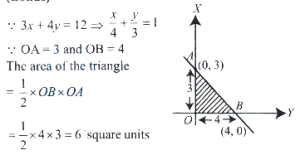
(A) આપેલ રેખાઓ $x=0$ ($y$-અક્ષ),$y=0$ ($x$-અક્ષ) અને $3x+4y=12$ છે.
રેખા $3x+4y=12$ ના અંતઃખંડો શોધવા માટે,આપણે તેને અંતઃખંડ સ્વરૂપ $\frac{x}{a} + \frac{y}{b} = 1$ માં લખીએ.
સમીકરણને $12$ વડે ભાગતા,આપણને $\frac{3x}{12} + \frac{4y}{12} = \frac{12}{12}$ મળે છે,જેનું સાદું રૂપ $\frac{x}{4} + \frac{y}{3} = 1$ થાય છે.
આનો અર્થ એ છે કે રેખા $x$-અક્ષને બિંદુ $B(4, 0)$ પર અને $y$-અક્ષને બિંદુ $A(0, 3)$ પર છેદે છે.
આ રેખાઓ દ્વારા બનતો ત્રિકોણ એ $O(0, 0)$,$A(0, 3)$ અને $B(4, 0)$ શિરોબિંદુઓ ધરાવતો કાટકોણ ત્રિકોણ છે.
ત્રિકોણનો પાયો $OB = 4$ એકમ અને વેધ $OA = 3$ એકમ છે.
ત્રિકોણનું ક્ષેત્રફળ $\frac{1}{2} \times \text{પાયો} \times \text{વેધ} = \frac{1}{2} \times 4 \times 3 = 6$ ચોરસ એકમ થાય.
રેખા $3x+4y=12$ ના અંતઃખંડો શોધવા માટે,આપણે તેને અંતઃખંડ સ્વરૂપ $\frac{x}{a} + \frac{y}{b} = 1$ માં લખીએ.
સમીકરણને $12$ વડે ભાગતા,આપણને $\frac{3x}{12} + \frac{4y}{12} = \frac{12}{12}$ મળે છે,જેનું સાદું રૂપ $\frac{x}{4} + \frac{y}{3} = 1$ થાય છે.
આનો અર્થ એ છે કે રેખા $x$-અક્ષને બિંદુ $B(4, 0)$ પર અને $y$-અક્ષને બિંદુ $A(0, 3)$ પર છેદે છે.
આ રેખાઓ દ્વારા બનતો ત્રિકોણ એ $O(0, 0)$,$A(0, 3)$ અને $B(4, 0)$ શિરોબિંદુઓ ધરાવતો કાટકોણ ત્રિકોણ છે.
ત્રિકોણનો પાયો $OB = 4$ એકમ અને વેધ $OA = 3$ એકમ છે.
ત્રિકોણનું ક્ષેત્રફળ $\frac{1}{2} \times \text{પાયો} \times \text{વેધ} = \frac{1}{2} \times 4 \times 3 = 6$ ચોરસ એકમ થાય.
0 likesView Solution
173
MathematicsDifficultMCQAP EAMCET · 2023
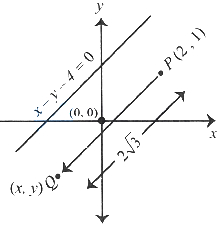
બિંદુ $P(2, 1)$ ને રેખા $L \equiv x-y-4=0$ ને સમાંતર $2 \sqrt{3}$ એકમ જેટલું સ્થાનાંતરિત કરીને બિંદુ $Q$ મેળવવામાં આવે છે. જો બિંદુ $Q$ ત્રીજા ચરણમાં હોય,તો $Q$ માંથી પસાર થતી અને $L$ ને લંબ રેખાનું સમીકરણ શોધો.
A
$2x+2y=1-\sqrt{6}$
B
$x+y=3-3\sqrt{6}$
C
$x+y=2-\sqrt{6}$
D
$x+y=3-2\sqrt{6}$
Solution
(D) આપેલ રેખા $L \equiv x-y-4=0$ છે. રેખા $L$ નો ઢાળ $m_1 = 1$ છે.
રેખા $PQ$ એ $L$ ને સમાંતર હોવાથી,તેનો ઢાળ પણ $m_1 = 1$ થશે.
બિંદુ $P(2, 1)$ માંથી પસાર થતી રેખા $PQ$ નું સમીકરણ $y-1 = 1(x-2)$ એટલે કે $y = x-1$ છે.
ધારો કે $Q$ એ $(x, x-1)$ છે. અંતર $PQ = 2\sqrt{3}$ છે.
અંતરના સૂત્ર મુજબ: $\sqrt{(x-2)^2 + ((x-1)-1)^2} = 2\sqrt{3}$.
$\sqrt{(x-2)^2 + (x-2)^2} = 2\sqrt{3} \Rightarrow \sqrt{2(x-2)^2} = 2\sqrt{3}$.
$|x-2|\sqrt{2} = 2\sqrt{3} \Rightarrow |x-2| = \sqrt{6}$.
તેથી,$x-2 = \sqrt{6}$ અથવા $x-2 = -\sqrt{6}$.
$x = 2+\sqrt{6}$ અથવા $x = 2-\sqrt{6}$.
$Q$ ત્રીજા ચરણમાં હોવાથી,બંને યામ ઋણ હોવા જોઈએ. $x = 2-\sqrt{6}$ માટે,$y = 1-\sqrt{6}$ મળે છે.
આમ,$Q = (2-\sqrt{6}, 1-\sqrt{6})$.
$L$ ને લંબ રેખાનો ઢાળ $m_2 = -1/m_1 = -1$ છે.
$Q$ માંથી પસાર થતી અને $-1$ ઢાળ ધરાવતી રેખાનું સમીકરણ:
$y-(1-\sqrt{6}) = -1(x-(2-\sqrt{6}))$.
$y-1+\sqrt{6} = -x+2-\sqrt{6}$.
$x+y = 3-2\sqrt{6}$.
રેખા $PQ$ એ $L$ ને સમાંતર હોવાથી,તેનો ઢાળ પણ $m_1 = 1$ થશે.
બિંદુ $P(2, 1)$ માંથી પસાર થતી રેખા $PQ$ નું સમીકરણ $y-1 = 1(x-2)$ એટલે કે $y = x-1$ છે.
ધારો કે $Q$ એ $(x, x-1)$ છે. અંતર $PQ = 2\sqrt{3}$ છે.
અંતરના સૂત્ર મુજબ: $\sqrt{(x-2)^2 + ((x-1)-1)^2} = 2\sqrt{3}$.
$\sqrt{(x-2)^2 + (x-2)^2} = 2\sqrt{3} \Rightarrow \sqrt{2(x-2)^2} = 2\sqrt{3}$.
$|x-2|\sqrt{2} = 2\sqrt{3} \Rightarrow |x-2| = \sqrt{6}$.
તેથી,$x-2 = \sqrt{6}$ અથવા $x-2 = -\sqrt{6}$.
$x = 2+\sqrt{6}$ અથવા $x = 2-\sqrt{6}$.
$Q$ ત્રીજા ચરણમાં હોવાથી,બંને યામ ઋણ હોવા જોઈએ. $x = 2-\sqrt{6}$ માટે,$y = 1-\sqrt{6}$ મળે છે.
આમ,$Q = (2-\sqrt{6}, 1-\sqrt{6})$.
$L$ ને લંબ રેખાનો ઢાળ $m_2 = -1/m_1 = -1$ છે.
$Q$ માંથી પસાર થતી અને $-1$ ઢાળ ધરાવતી રેખાનું સમીકરણ:
$y-(1-\sqrt{6}) = -1(x-(2-\sqrt{6}))$.
$y-1+\sqrt{6} = -x+2-\sqrt{6}$.
$x+y = 3-2\sqrt{6}$.
0 likesView Solution
174
MathematicsEasyMCQAP EAMCET · 2023
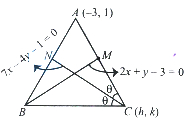
$\triangle ABC$ માં,શિરોબિંદુ $A$ ના યામ $(-3, 1)$ છે. જો $B$ માંથી પસાર થતી મધ્યગાનું સમીકરણ $2x + y - 3 = 0$ હોય અને $\angle C$ ના દ્વિભાજકનું સમીકરણ $7x - 4y - 1 = 0$ હોય,તો બાજુ $BC$ નું સમીકરણ શોધો.
A
$7x - 3y = 6$
B
$18x - y = 49$
C
$15x + y = 50$
D
$4x - y = 7$
Solution
(B) ધારો કે $C = (h, k)$. $C$ એ ખૂણાના દ્વિભાજક $7x - 4y - 1 = 0$ પર હોવાથી,$7h - 4k - 1 = 0$ અથવા $h = \frac{4k + 1}{7}$.
$M$ એ $AC$ નું મધ્યબિંદુ હોવાથી,$M = \left(\frac{-3 + h}{2}, \frac{1 + k}{2}\right) = \left(\frac{2k - 10}{7}, \frac{1+k}{2}\right)$.
$M$ એ મધ્યગા $BM$ $(2x + y - 3 = 0)$ પર હોવાથી,$2\left(\frac{2k - 10}{7}\right) + \frac{1+k}{2} - 3 = 0$.
$14$ વડે ગુણતા,$4(2k - 10) + 7(1+k) - 42 = 0$ $\Rightarrow 15k = 75$ $\Rightarrow k = 5$.
તેથી $h = 3$. આમ,$C = (3, 5)$.
$AC$ નો ઢાળ $m_{AC} = \frac{2}{3}$ અને દ્વિભાજક $CN$ નો ઢાળ $m_{bisector} = \frac{7}{4}$ છે.
$BC$ નો ઢાળ $m$ ધારો. ખૂણાના દ્વિભાજકના ગુણધર્મ મુજબ,$\left|\frac{m - 7/4}{1 + m(7/4)}\right| = \frac{1}{2}$.
ઉકેલતા $m = 18$ મળે છે.
$BC$ નું સમીકરણ $y - 5 = 18(x - 3) \Rightarrow 18x - y = 49$ થાય.
$M$ એ $AC$ નું મધ્યબિંદુ હોવાથી,$M = \left(\frac{-3 + h}{2}, \frac{1 + k}{2}\right) = \left(\frac{2k - 10}{7}, \frac{1+k}{2}\right)$.
$M$ એ મધ્યગા $BM$ $(2x + y - 3 = 0)$ પર હોવાથી,$2\left(\frac{2k - 10}{7}\right) + \frac{1+k}{2} - 3 = 0$.
$14$ વડે ગુણતા,$4(2k - 10) + 7(1+k) - 42 = 0$ $\Rightarrow 15k = 75$ $\Rightarrow k = 5$.
તેથી $h = 3$. આમ,$C = (3, 5)$.
$AC$ નો ઢાળ $m_{AC} = \frac{2}{3}$ અને દ્વિભાજક $CN$ નો ઢાળ $m_{bisector} = \frac{7}{4}$ છે.
$BC$ નો ઢાળ $m$ ધારો. ખૂણાના દ્વિભાજકના ગુણધર્મ મુજબ,$\left|\frac{m - 7/4}{1 + m(7/4)}\right| = \frac{1}{2}$.
ઉકેલતા $m = 18$ મળે છે.
$BC$ નું સમીકરણ $y - 5 = 18(x - 3) \Rightarrow 18x - y = 49$ થાય.
0 likesView Solution
175
MathematicsMediumMCQAP EAMCET · 2023
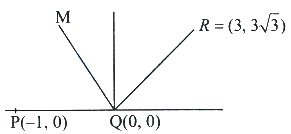
ધારો કે $P=(-1,0)$,$Q=(0,0)$ અને $R=(3,3\sqrt{3})$ ત્રણ બિંદુઓ છે. તો $\angle PQR$ ના દ્વિભાજકનું સમીકરણ શું થાય?
A
$\sqrt{3}x+y=0$
B
$x+\frac{\sqrt{3}}{2}y=0$
C
$-\frac{\sqrt{3}}{2}x+y=0$
D
$x+\sqrt{3}y=0$
Solution
(A) બિંદુઓના યામ $P(-1,0)$,$Q(0,0)$ અને $R(3,3\sqrt{3})$ છે.
રેખા $QP$ એ ઋણ $x$-અક્ષ પર છે,તેથી ધન $x$-અક્ષ સાથે તેનો ખૂણો $180^\circ$ છે.
રેખા $QR$ એ $(0,0)$ અને $(3,3\sqrt{3})$ માંથી પસાર થાય છે. તેનો ઢાળ $m = \frac{3\sqrt{3}-0}{3-0} = \sqrt{3}$ છે.
રેખા $QR$ ધન $x$-અક્ષ સાથે $\tan \theta = \sqrt{3}$ એટલે કે $\theta = 60^\circ$ નો ખૂણો બનાવે છે.
$\angle PQR$ એ રેખા $QP$ $(180^\circ)$ અને $QR$ $(60^\circ)$ વચ્ચેનો ખૂણો છે,જે $180^\circ - 60^\circ = 120^\circ$ છે.
$\angle PQR$ નો દ્વિભાજક ધન $x$-અક્ષ સાથે $60^\circ + \frac{120^\circ}{2} = 120^\circ$ નો ખૂણો બનાવશે.
દ્વિભાજકનો ઢાળ $\tan(120^\circ) = -\sqrt{3}$ છે.
દ્વિભાજક ઉગમબિંદુ $Q(0,0)$ માંથી પસાર થતો હોવાથી,તેનું સમીકરણ $y = -\sqrt{3}x$ એટલે કે $\sqrt{3}x + y = 0$ થાય.
રેખા $QP$ એ ઋણ $x$-અક્ષ પર છે,તેથી ધન $x$-અક્ષ સાથે તેનો ખૂણો $180^\circ$ છે.
રેખા $QR$ એ $(0,0)$ અને $(3,3\sqrt{3})$ માંથી પસાર થાય છે. તેનો ઢાળ $m = \frac{3\sqrt{3}-0}{3-0} = \sqrt{3}$ છે.
રેખા $QR$ ધન $x$-અક્ષ સાથે $\tan \theta = \sqrt{3}$ એટલે કે $\theta = 60^\circ$ નો ખૂણો બનાવે છે.
$\angle PQR$ એ રેખા $QP$ $(180^\circ)$ અને $QR$ $(60^\circ)$ વચ્ચેનો ખૂણો છે,જે $180^\circ - 60^\circ = 120^\circ$ છે.
$\angle PQR$ નો દ્વિભાજક ધન $x$-અક્ષ સાથે $60^\circ + \frac{120^\circ}{2} = 120^\circ$ નો ખૂણો બનાવશે.
દ્વિભાજકનો ઢાળ $\tan(120^\circ) = -\sqrt{3}$ છે.
દ્વિભાજક ઉગમબિંદુ $Q(0,0)$ માંથી પસાર થતો હોવાથી,તેનું સમીકરણ $y = -\sqrt{3}x$ એટલે કે $\sqrt{3}x + y = 0$ થાય.
0 likesView Solution
176
MathematicsEasyMCQAP EAMCET · 2023
ધારો કે વક્ર $x^2+2y^2=2$ એ રેખા $x+y=1$ ને બે બિંદુઓ $P$ અને $Q$ માં છેદે છે અને $O$ એ ઉગમબિંદુ છે. જો $\theta$ એ રેખાઓ $OP$ અને $OQ$ વચ્ચેનો લઘુકોણ હોય,તો $\tan \theta=$
A
$\frac{1}{4}$
B
$4$
C
$\sqrt{3}$
D
$\frac{1}{\sqrt{3}}$
Solution
(B) વક્રનું સમીકરણ $x^2+2y^2=2$ છે અને રેખા $x+y=1$ છે.
રેખાઓ $OP$ અને $OQ$ મેળવવા માટે,આપણે રેખાના સમીકરણનો ઉપયોગ કરીને વક્રના સમીકરણને સમઘાત બનાવીએ:
$x^2+2y^2=2(1)^2$
$x^2+2y^2=2(x+y)^2$
$x^2+2y^2=2(x^2+y^2+2xy)$
$x^2+2y^2=2x^2+2y^2+4xy$
$x^2+4xy=0$
આ ઉગમબિંદુમાંથી પસાર થતી રેખાઓની જોડી દર્શાવે છે. તેને સામાન્ય સ્વરૂપ $ax^2+2hxy+by^2=0$ સાથે સરખાવતા,આપણને $a=1$,$h=2$,અને $b=0$ મળે છે.
આ રેખાઓ વચ્ચેનો ખૂણો $\theta$ એ $\tan \theta = \left| \frac{2\sqrt{h^2-ab}}{a+b} \right|$ દ્વારા આપવામાં આવે છે.
કિંમતો મૂકતા: $\tan \theta = \left| \frac{2\sqrt{2^2-(1)(0)}}{1+0} \right| = \left| \frac{2\sqrt{4}}{1} \right| = 4$.
રેખાઓ $OP$ અને $OQ$ મેળવવા માટે,આપણે રેખાના સમીકરણનો ઉપયોગ કરીને વક્રના સમીકરણને સમઘાત બનાવીએ:
$x^2+2y^2=2(1)^2$
$x^2+2y^2=2(x+y)^2$
$x^2+2y^2=2(x^2+y^2+2xy)$
$x^2+2y^2=2x^2+2y^2+4xy$
$x^2+4xy=0$
આ ઉગમબિંદુમાંથી પસાર થતી રેખાઓની જોડી દર્શાવે છે. તેને સામાન્ય સ્વરૂપ $ax^2+2hxy+by^2=0$ સાથે સરખાવતા,આપણને $a=1$,$h=2$,અને $b=0$ મળે છે.
આ રેખાઓ વચ્ચેનો ખૂણો $\theta$ એ $\tan \theta = \left| \frac{2\sqrt{h^2-ab}}{a+b} \right|$ દ્વારા આપવામાં આવે છે.
કિંમતો મૂકતા: $\tan \theta = \left| \frac{2\sqrt{2^2-(1)(0)}}{1+0} \right| = \left| \frac{2\sqrt{4}}{1} \right| = 4$.
0 likesView Solution
177
MathematicsMediumMCQAP EAMCET · 2023
જો $P(1, 4)$ અને $Q(k, 3)$ ને જોડતા રેખાખંડના લંબદ્વિભાજકનો $y$-અંતઃખંડ $-4$ હોય,તો $k$ ની શક્ય કિંમત છે
A
$2$
B
$-2$
C
$-4$
D
$1$
Solution
(C) $PQ$ નું મધ્યબિંદુ $M = \left(\frac{1+k}{2}, \frac{7}{2}\right)$ છે.
રેખા $PQ$ નો ઢાળ $m = \frac{3-4}{k-1} = \frac{-1}{k-1}$ છે.
લંબદ્વિભાજકનો ઢાળ $m' = k-1$ છે.
લંબદ્વિભાજકનું સમીકરણ $y - \frac{7}{2} = (k-1)(x - \frac{1+k}{2})$ છે.
$y$-અંતઃખંડ માટે $x=0$ અને $y=-4$ લેતા:
$-4 - \frac{7}{2} = (k-1)(-\frac{1+k}{2})$
$-\frac{15}{2} = -\frac{k^2-1}{2}$
$15 = k^2 - 1$ $\Rightarrow k^2 = 16$ $\Rightarrow k = \pm 4$.
તેથી,$k$ ની શક્ય કિંમત $-4$ છે.
રેખા $PQ$ નો ઢાળ $m = \frac{3-4}{k-1} = \frac{-1}{k-1}$ છે.
લંબદ્વિભાજકનો ઢાળ $m' = k-1$ છે.
લંબદ્વિભાજકનું સમીકરણ $y - \frac{7}{2} = (k-1)(x - \frac{1+k}{2})$ છે.
$y$-અંતઃખંડ માટે $x=0$ અને $y=-4$ લેતા:
$-4 - \frac{7}{2} = (k-1)(-\frac{1+k}{2})$
$-\frac{15}{2} = -\frac{k^2-1}{2}$
$15 = k^2 - 1$ $\Rightarrow k^2 = 16$ $\Rightarrow k = \pm 4$.
તેથી,$k$ ની શક્ય કિંમત $-4$ છે.
0 likesView Solution
178
MathematicsEasyMCQAP EAMCET · 2023
બિંદુ $(a \cos^3 \theta, a \sin^3 \theta)$ માંથી પસાર થતી અને રેખા $x \cos \theta - y \sin \theta = a$ ને લંબ રેખાનું સમીકરણ શોધો.
A
$2x \sin \theta + 2y \cos \theta = a \sin 2\theta$
B
$x \cos \theta - y \sin \theta = a \sin 2\theta$
C
$x \sin \theta + y \sin \theta = a \cos 2\theta$
D
$x \sin \theta - y \cos \theta = a \cos 2\theta$
Solution
(A) આપેલી રેખા $x \cos \theta - y \sin \theta = a$ છે.
તેનો ઢાળ $m' = \frac{\cos \theta}{\sin \theta} = \cot \theta$ છે.
તેને લંબ રેખાનો ઢાળ $m = -\frac{1}{m'} = -\tan \theta$ થશે.
બિંદુ $(a \cos^3 \theta, a \sin^3 \theta)$ માંથી પસાર થતી અને $m = -\tan \theta$ ઢાળ ધરાવતી રેખાનું સમીકરણ:
$y - a \sin^3 \theta = -\tan \theta (x - a \cos^3 \theta)$
$y - a \sin^3 \theta = -\frac{\sin \theta}{\cos \theta} (x - a \cos^3 \theta)$
$y \cos \theta - a \sin^3 \theta \cos \theta = -x \sin \theta + a \cos^3 \theta \sin \theta$
$x \sin \theta + y \cos \theta = a \sin \theta \cos \theta (\sin^2 \theta + \cos^2 \theta)$
$x \sin \theta + y \cos \theta = a \sin \theta \cos \theta$
બંને બાજુ $2$ વડે ગુણતા:
$2x \sin \theta + 2y \cos \theta = a \sin 2\theta$.
તેનો ઢાળ $m' = \frac{\cos \theta}{\sin \theta} = \cot \theta$ છે.
તેને લંબ રેખાનો ઢાળ $m = -\frac{1}{m'} = -\tan \theta$ થશે.
બિંદુ $(a \cos^3 \theta, a \sin^3 \theta)$ માંથી પસાર થતી અને $m = -\tan \theta$ ઢાળ ધરાવતી રેખાનું સમીકરણ:
$y - a \sin^3 \theta = -\tan \theta (x - a \cos^3 \theta)$
$y - a \sin^3 \theta = -\frac{\sin \theta}{\cos \theta} (x - a \cos^3 \theta)$
$y \cos \theta - a \sin^3 \theta \cos \theta = -x \sin \theta + a \cos^3 \theta \sin \theta$
$x \sin \theta + y \cos \theta = a \sin \theta \cos \theta (\sin^2 \theta + \cos^2 \theta)$
$x \sin \theta + y \cos \theta = a \sin \theta \cos \theta$
બંને બાજુ $2$ વડે ગુણતા:
$2x \sin \theta + 2y \cos \theta = a \sin 2\theta$.
0 likesView Solution
179
MathematicsMediumMCQAP EAMCET · 2023
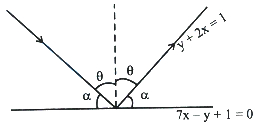
પ્રકાશનું એક કિરણ એક રેખા પર આપાત થઈને બીજી રેખા $7x - y + 1 = 0$ ને $(0, 1)$ બિંદુએ મળે છે અને ત્યારબાદ આ બિંદુએથી રેખા $y + 2x = 1$ ની દિશામાં પરાવર્તિત થાય છે. તો પ્રકાશના કિરણની આપાત રેખાનું સમીકરણ શોધો.
A
$41x - 25y + 25 = 0$
B
$41x + 38y + 38 = 0$
C
$41x - 38y + 38 = 0$
D
$41x + 25y - 25 = 0$
Solution
(C) ધારો કે આપાત કિરણનો ઢાળ $m$ છે. અરીસાની રેખા $7x - y + 1 = 0$ છે,જેનો ઢાળ $m_1 = 7$ છે. પરાવર્તિત કિરણ $y + 2x = 1$ છે,જેનો ઢાળ $m_2 = -2$ છે. આપાત બિંદુ $(0, 1)$ છે.
આપાતકોણ = પરાવર્તનકોણ હોવાથી,આપાત કિરણ અને અરીસા વચ્ચેનો ખૂણો એ પરાવર્તિત કિરણ અને અરીસા વચ્ચેના ખૂણા જેટલો જ હોય.
$\tan \theta = \left| \frac{m_1 - m_2}{1 + m_1 m_2} \right|$ સૂત્રનો ઉપયોગ કરતા:
$\left| \frac{m - 7}{1 + 7m} \right| = \left| \frac{7 - (-2)}{1 + 7(-2)} \right| = \left| \frac{9}{1 - 14} \right| = \frac{9}{13}$.
$\frac{m - 7}{1 + 7m} = \frac{9}{13}$ અથવા $\frac{m - 7}{1 + 7m} = -\frac{9}{13}$.
કિસ્સો $1$: $13(m - 7) = 9(1 + 7m)$ $\Rightarrow 13m - 91 = 9 + 63m$ $\Rightarrow -50m = 100$ $\Rightarrow m = -2$ (આ પરાવર્તિત કિરણનો ઢાળ છે).
કિસ્સો $2$: $13(m - 7) = -9(1 + 7m)$ $\Rightarrow 13m - 91 = -9 - 63m$ $\Rightarrow 76m = 82$ $\Rightarrow m = \frac{41}{38}$.
$(0, 1)$ માંથી પસાર થતી અને $m = \frac{41}{38}$ ઢાળ ધરાવતી આપાત રેખાનું સમીકરણ:
$y - 1 = \frac{41}{38}(x - 0)$ $\Rightarrow 38y - 38 = 41x$ $\Rightarrow 41x - 38y + 38 = 0$.
આપાતકોણ = પરાવર્તનકોણ હોવાથી,આપાત કિરણ અને અરીસા વચ્ચેનો ખૂણો એ પરાવર્તિત કિરણ અને અરીસા વચ્ચેના ખૂણા જેટલો જ હોય.
$\tan \theta = \left| \frac{m_1 - m_2}{1 + m_1 m_2} \right|$ સૂત્રનો ઉપયોગ કરતા:
$\left| \frac{m - 7}{1 + 7m} \right| = \left| \frac{7 - (-2)}{1 + 7(-2)} \right| = \left| \frac{9}{1 - 14} \right| = \frac{9}{13}$.
$\frac{m - 7}{1 + 7m} = \frac{9}{13}$ અથવા $\frac{m - 7}{1 + 7m} = -\frac{9}{13}$.
કિસ્સો $1$: $13(m - 7) = 9(1 + 7m)$ $\Rightarrow 13m - 91 = 9 + 63m$ $\Rightarrow -50m = 100$ $\Rightarrow m = -2$ (આ પરાવર્તિત કિરણનો ઢાળ છે).
કિસ્સો $2$: $13(m - 7) = -9(1 + 7m)$ $\Rightarrow 13m - 91 = -9 - 63m$ $\Rightarrow 76m = 82$ $\Rightarrow m = \frac{41}{38}$.
$(0, 1)$ માંથી પસાર થતી અને $m = \frac{41}{38}$ ઢાળ ધરાવતી આપાત રેખાનું સમીકરણ:
$y - 1 = \frac{41}{38}(x - 0)$ $\Rightarrow 38y - 38 = 41x$ $\Rightarrow 41x - 38y + 38 = 0$.
0 likesView Solution
180
MathematicsEasyMCQAP EAMCET · 2023
જો એક સીધી રેખા $L$ જે રેખા $3x - 4y = 6$ ને લંબ છે,તે યામ અક્ષો સાથે $6$ ચોરસ એકમ ક્ષેત્રફળ ધરાવતો ત્રિકોણ બનાવે છે,તો બિંદુ $(1, 1)$ થી રેખા $L$ નું ન્યૂનતમ લંબ અંતર કેટલું છે?
A
$1$
B
$\sqrt{2}$
C
$2$
D
$\sqrt{3}$
Solution
(A) રેખા $L$ એ $3x - 4y = 6$ ને લંબ છે. આપેલ રેખાનો ઢાળ $3/4$ છે,તેથી રેખા $L$ નો ઢાળ $-4/3$ થશે.
ધારો કે રેખા $L$ નું સમીકરણ $4x + 3y = k$ છે.
અક્ષો પરના અંતઃખંડો $x = k/4$ અને $y = k/3$ છે.
અક્ષો સાથે બનતા ત્રિકોણનું ક્ષેત્રફળ $\frac{1}{2} |\frac{k}{4}| |\frac{k}{3}| = 6$ છે.
$|k^2| / 24 = 6$ $\Rightarrow k^2 = 144$ $\Rightarrow k = \pm 12$.
$L$ માટે શક્ય સમીકરણો $4x + 3y - 12 = 0$ અને $4x + 3y + 12 = 0$ છે.
બિંદુ $(1, 1)$ થી $ax + by + c = 0$ નું અંતર $d = \frac{|ax_1 + by_1 + c|}{\sqrt{a^2 + b^2}}$ છે.
$4x + 3y - 12 = 0$ માટે,$d_1 = \frac{|4(1) + 3(1) - 12|}{\sqrt{4^2 + 3^2}} = \frac{|7 - 12|}{5} = \frac{5}{5} = 1$.
$4x + 3y + 12 = 0$ માટે,$d_2 = \frac{|4(1) + 3(1) + 12|}{\sqrt{4^2 + 3^2}} = \frac{|19|}{5} = 3.8$.
ન્યૂનતમ અંતર $1$ છે.
ધારો કે રેખા $L$ નું સમીકરણ $4x + 3y = k$ છે.
અક્ષો પરના અંતઃખંડો $x = k/4$ અને $y = k/3$ છે.
અક્ષો સાથે બનતા ત્રિકોણનું ક્ષેત્રફળ $\frac{1}{2} |\frac{k}{4}| |\frac{k}{3}| = 6$ છે.
$|k^2| / 24 = 6$ $\Rightarrow k^2 = 144$ $\Rightarrow k = \pm 12$.
$L$ માટે શક્ય સમીકરણો $4x + 3y - 12 = 0$ અને $4x + 3y + 12 = 0$ છે.
બિંદુ $(1, 1)$ થી $ax + by + c = 0$ નું અંતર $d = \frac{|ax_1 + by_1 + c|}{\sqrt{a^2 + b^2}}$ છે.
$4x + 3y - 12 = 0$ માટે,$d_1 = \frac{|4(1) + 3(1) - 12|}{\sqrt{4^2 + 3^2}} = \frac{|7 - 12|}{5} = \frac{5}{5} = 1$.
$4x + 3y + 12 = 0$ માટે,$d_2 = \frac{|4(1) + 3(1) + 12|}{\sqrt{4^2 + 3^2}} = \frac{|19|}{5} = 3.8$.
ન્યૂનતમ અંતર $1$ છે.
0 likesView Solution
181
MathematicsEasyMCQAP EAMCET · 2023
ધારો કે $PQR$ એક કાટકોણ સમદ્વિબાજુ ત્રિકોણ છે,જે $P(2, 1)$ આગળ કાટખૂણો ધરાવે છે. જો બાજુ $QR$ નું સમીકરણ $2x + y = 3$ હોય,તો $QR$ સિવાયની બાજુઓમાંથી એકનું સમીકરણ શું હશે?
A
$x + 2y - 4 = 0$
B
$3x - y - 5 = 0$
C
$x - 2y = 0$
D
$2x + y - 5 = 0$
Solution
(B) $\triangle PQR$ એ $P$ આગળ કાટખૂણો ધરાવતો સમદ્વિબાજુ કાટકોણ ત્રિકોણ હોવાથી,$\angle PQR = \angle PRQ = 45^{\circ}$ થાય.
રેખા $QR$ નો ઢાળ $m = -2$ છે.
ધારો કે $PQ$ નો ઢાળ $m_1$ છે. $PQ$ અને $QR$ વચ્ચેનો ખૂણો $45^{\circ}$ હોવાથી:
$\tan 45^{\circ} = |\frac{m_1 - (-2)}{1 + m_1(-2)}| = 1$
$|\frac{m_1 + 2}{1 - 2m_1}| = 1$
આથી $m_1 = -\frac{1}{3}$ અથવા $m_1 = 3$ મળે.
$P(2, 1)$ માંથી પસાર થતી રેખાઓના સમીકરણો:
$m_1 = -\frac{1}{3}$ માટે: $y - 1 = -\frac{1}{3}(x - 2) \Rightarrow x + 3y - 5 = 0$.
$m_2 = 3$ માટે: $y - 1 = 3(x - 2) \Rightarrow 3x - y - 5 = 0$.
આમ,સાચો વિકલ્પ $3x - y - 5 = 0$ છે.
રેખા $QR$ નો ઢાળ $m = -2$ છે.
ધારો કે $PQ$ નો ઢાળ $m_1$ છે. $PQ$ અને $QR$ વચ્ચેનો ખૂણો $45^{\circ}$ હોવાથી:
$\tan 45^{\circ} = |\frac{m_1 - (-2)}{1 + m_1(-2)}| = 1$
$|\frac{m_1 + 2}{1 - 2m_1}| = 1$
આથી $m_1 = -\frac{1}{3}$ અથવા $m_1 = 3$ મળે.
$P(2, 1)$ માંથી પસાર થતી રેખાઓના સમીકરણો:
$m_1 = -\frac{1}{3}$ માટે: $y - 1 = -\frac{1}{3}(x - 2) \Rightarrow x + 3y - 5 = 0$.
$m_2 = 3$ માટે: $y - 1 = 3(x - 2) \Rightarrow 3x - y - 5 = 0$.
આમ,સાચો વિકલ્પ $3x - y - 5 = 0$ છે.
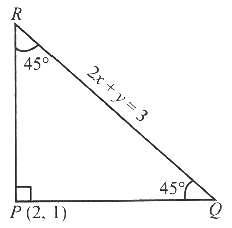
0 likesView Solution
182
MathematicsDifficultMCQAP EAMCET · 2023
રેખાઓ $p(p^2+1)x - y + q = 0$ અને $(p^2+1)^2 x + (p^2+1)y + 2q = 0$ એ રેખા $L$ ને લંબ હોય તે માટે
A
$p$ ની માત્ર એક કિંમત
B
$p$ ની માત્ર બે કિંમતો
C
$p$ ની બે થી વધુ કિંમતો
D
$p$ ની કોઈ કિંમત નહીં
Solution
(A) ધારો કે રેખા $L$ નો ઢાળ $m$ છે. આપેલી બંને રેખાઓ રેખા $L$ ને લંબ હોવાથી,તેઓ એકબીજાને સમાંતર હોવી જોઈએ.
બંને રેખાઓના ઢાળ અનુક્રમે $m_1$ અને $m_2$ છે.
પ્રથમ રેખા $p(p^2+1)x - y + q = 0$ માટે,ઢાળ $m_1 = p(p^2+1)$.
બીજી રેખા $(p^2+1)^2 x + (p^2+1)y + 2q = 0$ માટે,ઢાળ $m_2 = -\frac{(p^2+1)^2}{(p^2+1)} = -(p^2+1)$.
રેખાઓ સમાંતર હોવાથી,$m_1 = m_2$:
$p(p^2+1) = -(p^2+1)$.
કોઈપણ વાસ્તવિક $p$ માટે $(p^2+1) \neq 0$ હોવાથી,આપણે $(p^2+1)$ વડે ભાગી શકીએ:
$p = -1$.
આમ,$p$ ની માત્ર એક જ કિંમત મળે છે.
બંને રેખાઓના ઢાળ અનુક્રમે $m_1$ અને $m_2$ છે.
પ્રથમ રેખા $p(p^2+1)x - y + q = 0$ માટે,ઢાળ $m_1 = p(p^2+1)$.
બીજી રેખા $(p^2+1)^2 x + (p^2+1)y + 2q = 0$ માટે,ઢાળ $m_2 = -\frac{(p^2+1)^2}{(p^2+1)} = -(p^2+1)$.
રેખાઓ સમાંતર હોવાથી,$m_1 = m_2$:
$p(p^2+1) = -(p^2+1)$.
કોઈપણ વાસ્તવિક $p$ માટે $(p^2+1) \neq 0$ હોવાથી,આપણે $(p^2+1)$ વડે ભાગી શકીએ:
$p = -1$.
આમ,$p$ ની માત્ર એક જ કિંમત મળે છે.
0 likesView Solution
183
MathematicsMediumMCQAP EAMCET · 2023
એક સમબાજુ ચતુષ્કોણની બે બાજુઓ રેખાઓ $x-y+1=0$ અને $7x-y-5=0$ પર આવેલી છે. જો તેના વિકર્ણો $(-1,-2)$ પર છેદતા હોય,તો આ સમબાજુ ચતુષ્કોણનો એક શિરોબિંદુ કયું છે?
A
$(3,16)$
B
$(-1,-12)$
C
$\left(\frac{1}{3}, -\frac{8}{3}\right)$
D
$(2,9)$
Solution
(C) સમબાજુ ચતુષ્કોણની બે બાજુઓના સમીકરણો $L_1: x-y+1=0$ અને $L_2: 7x-y-5=0$ છે.
આ સમીકરણો ઉકેલતા,આપણને શિરોબિંદુ $V_1(1,2)$ મળે છે.
વિકર્ણો એકબીજાને $(-1,-2)$ બિંદુએ દુભાગે છે.
$V_1(1,2)$ ના સામેના શિરોબિંદુ $V_3$ માટે,મધ્યબિંદુ સૂત્ર મુજબ:
$-1 = \frac{1+x_3}{2} \Rightarrow x_3 = -3$ અને $-2 = \frac{2+y_3}{2} \Rightarrow y_3 = -6$.
તેથી $V_3 = (-3,-6)$.
બીજા વિકર્ણનો ઢાળ $m' = -\frac{1}{2}$ છે અને તે $(-1,-2)$ માંથી પસાર થાય છે,તેથી તેનું સમીકરણ $x + 2y + 5 = 0$ છે.
વિકલ્પ $C$ ચકાસતા: $\frac{1}{3} + 2(-\frac{8}{3}) + 5 = 0$.
તેથી,$\left(\frac{1}{3}, -\frac{8}{3}\right)$ એ એક શિરોબિંદુ છે.
આ સમીકરણો ઉકેલતા,આપણને શિરોબિંદુ $V_1(1,2)$ મળે છે.
વિકર્ણો એકબીજાને $(-1,-2)$ બિંદુએ દુભાગે છે.
$V_1(1,2)$ ના સામેના શિરોબિંદુ $V_3$ માટે,મધ્યબિંદુ સૂત્ર મુજબ:
$-1 = \frac{1+x_3}{2} \Rightarrow x_3 = -3$ અને $-2 = \frac{2+y_3}{2} \Rightarrow y_3 = -6$.
તેથી $V_3 = (-3,-6)$.
બીજા વિકર્ણનો ઢાળ $m' = -\frac{1}{2}$ છે અને તે $(-1,-2)$ માંથી પસાર થાય છે,તેથી તેનું સમીકરણ $x + 2y + 5 = 0$ છે.
વિકલ્પ $C$ ચકાસતા: $\frac{1}{3} + 2(-\frac{8}{3}) + 5 = 0$.
તેથી,$\left(\frac{1}{3}, -\frac{8}{3}\right)$ એ એક શિરોબિંદુ છે.
0 likesView Solution
184
MathematicsMediumMCQAP EAMCET · 2023
જો $2x^2-5xy+2y^2=0$ એ ત્રિકોણની બે બાજુઓ દર્શાવે છે જેનું મધ્યકેન્દ્ર $(1,1)$ છે,તો ત્રીજી બાજુનું સમીકરણ શું હશે?
A
$x+y+3=0$
B
$x-y-3=0$
C
$x+y-3=0$
D
$x-y+3=0$
Solution
(C) આપેલ સમીકરણ $2x^2-5xy+2y^2=0$ છે.
અવયવ પાડતા: $(2x-y)(x-2y)=0$.
આમ,બે બાજુઓ $y=2x$ અને $y=\frac{1}{2}x$ છે.
ધારો કે ત્રિકોણના શિરોબિંદુઓ $O(0,0)$,$A(a, 2a)$ અને $B(2b, b)$ છે.
મધ્યકેન્દ્ર $(1,1)$ આપેલ છે.
મધ્યકેન્દ્રના સૂત્રનો ઉપયોગ કરતા: $\frac{0+a+2b}{3}=1 \Rightarrow a+2b=3$ $(i)$ અને $\frac{0+2a+b}{3}=1 \Rightarrow 2a+b=3$ (ii).
સમીકરણો $(i)$ અને (ii) ઉકેલતા,આપણને $a=1$ અને $b=1$ મળે છે.
તેથી,શિરોબિંદુઓ $O(0,0)$,$A(1,2)$ અને $B(2,1)$ છે.
ત્રીજી બાજુ $A(1,2)$ અને $B(2,1)$ માંથી પસાર થાય છે.
$(1,2)$ અને $(2,1)$ માંથી પસાર થતી રેખાનું સમીકરણ $y-2 = \frac{1-2}{2-1}(x-1)$ છે,જેનું સાદું રૂપ $y-2 = -1(x-1) \Rightarrow x+y-3=0$ થાય છે.
અવયવ પાડતા: $(2x-y)(x-2y)=0$.
આમ,બે બાજુઓ $y=2x$ અને $y=\frac{1}{2}x$ છે.
ધારો કે ત્રિકોણના શિરોબિંદુઓ $O(0,0)$,$A(a, 2a)$ અને $B(2b, b)$ છે.
મધ્યકેન્દ્ર $(1,1)$ આપેલ છે.
મધ્યકેન્દ્રના સૂત્રનો ઉપયોગ કરતા: $\frac{0+a+2b}{3}=1 \Rightarrow a+2b=3$ $(i)$ અને $\frac{0+2a+b}{3}=1 \Rightarrow 2a+b=3$ (ii).
સમીકરણો $(i)$ અને (ii) ઉકેલતા,આપણને $a=1$ અને $b=1$ મળે છે.
તેથી,શિરોબિંદુઓ $O(0,0)$,$A(1,2)$ અને $B(2,1)$ છે.
ત્રીજી બાજુ $A(1,2)$ અને $B(2,1)$ માંથી પસાર થાય છે.
$(1,2)$ અને $(2,1)$ માંથી પસાર થતી રેખાનું સમીકરણ $y-2 = \frac{1-2}{2-1}(x-1)$ છે,જેનું સાદું રૂપ $y-2 = -1(x-1) \Rightarrow x+y-3=0$ થાય છે.
0 likesView Solution
185
MathematicsEasyMCQAP EAMCET · 2023
જો બિંદુ $(3, 8)$ નું રેખા $x + 3y = 7$ માં પ્રતિબિંબ $(\alpha, \beta)$ હોય,તો $\alpha + \beta =$
A
-$1$
B
$3$
C
-$5$
D
-$9$
Solution
(C) ધારો કે રેખા $L$ એ $x + 3y = 7$ છે અને બિંદુ $P$ એ $(3, 8)$ છે. ધારો કે $Q(h, k)$ એ રેખા $L$ માં બિંદુ $P$ નું પ્રતિબિંબ છે.
રેખા $L$ અરીસા તરીકે કામ કરે છે,તેથી રેખા $PQ$ એ $L$ ને લંબ છે અને $PQ$ નું મધ્યબિંદુ $R$ એ $L$ પર આવેલું છે.
રેખા $L$ નો ઢાળ $m_1 = -1/3$ છે.
$PQ \perp L$ હોવાથી,$PQ$ નો ઢાળ $m_2 = 3$ થશે.
બિંદુ $(3, 8)$ માંથી પસાર થતી અને $3$ ઢાળ ધરાવતી રેખા $PQ$ નું સમીકરણ $y - 8 = 3(x - 3) \Rightarrow y = 3x - 1$ છે.
$PQ$ નું મધ્યબિંદુ $R$ એ $(\frac{h+3}{2}, \frac{k+8}{2})$ છે.
$R$ એ $x + 3y = 7$ પર હોવાથી,$\frac{h+3}{2} + 3(\frac{k+8}{2}) = 7 \Rightarrow h + 3k = -13$ મળે.
સમીકરણમાં $k = 3h - 1$ મૂકતા: $h + 3(3h - 1) = -13$ $\Rightarrow 10h = -10$ $\Rightarrow h = -1$.
તેથી $k = 3(-1) - 1 = -4$.
આમ,$(\alpha, \beta) = (-1, -4)$.
તેથી,$\alpha + \beta = -1 + (-4) = -5$.
રેખા $L$ અરીસા તરીકે કામ કરે છે,તેથી રેખા $PQ$ એ $L$ ને લંબ છે અને $PQ$ નું મધ્યબિંદુ $R$ એ $L$ પર આવેલું છે.
રેખા $L$ નો ઢાળ $m_1 = -1/3$ છે.
$PQ \perp L$ હોવાથી,$PQ$ નો ઢાળ $m_2 = 3$ થશે.
બિંદુ $(3, 8)$ માંથી પસાર થતી અને $3$ ઢાળ ધરાવતી રેખા $PQ$ નું સમીકરણ $y - 8 = 3(x - 3) \Rightarrow y = 3x - 1$ છે.
$PQ$ નું મધ્યબિંદુ $R$ એ $(\frac{h+3}{2}, \frac{k+8}{2})$ છે.
$R$ એ $x + 3y = 7$ પર હોવાથી,$\frac{h+3}{2} + 3(\frac{k+8}{2}) = 7 \Rightarrow h + 3k = -13$ મળે.
સમીકરણમાં $k = 3h - 1$ મૂકતા: $h + 3(3h - 1) = -13$ $\Rightarrow 10h = -10$ $\Rightarrow h = -1$.
તેથી $k = 3(-1) - 1 = -4$.
આમ,$(\alpha, \beta) = (-1, -4)$.
તેથી,$\alpha + \beta = -1 + (-4) = -5$.
0 likesView Solution
186
MathematicsDifficultMCQAP EAMCET · 2023
રેખાઓની જોડી $(p^2-q^2) x^2+(q^2-r^2) xy+(r^2-p^2) y^2=0$ અને $(l-m) x^2+(m-n) xy+(n-l) y^2=0$ માટે સામાન્ય રેખાનું સમીકરણ કયું છે?
A
$x+y=0$
B
$x-y=0$
C
$x+y=pqr$
D
$x-y=pqr$
Solution
(B) આપેલ સમીકરણો છે:
$(p^2-q^2) x^2+(q^2-r^2) xy+(r^2-p^2) y^2=0$ ...$(i)$
$(l-m) x^2+(m-n) xy+(n-l) y^2=0$ ...(ii)
$Ax^2+Bxy+Cy^2=0$ સ્વરૂપના કોઈપણ સમીકરણ માટે,જો $A+B+C=0$ હોય,તો $(x-y)$ એ સમીકરણનો અવયવ છે.
સમીકરણ $(i)$ માટે: $(p^2-q^2) + (q^2-r^2) + (r^2-p^2) = 0$. તેથી,$(x-y)$ એક અવયવ છે.
સમીકરણ (ii) માટે: $(l-m) + (m-n) + (n-l) = 0$. તેથી,$(x-y)$ એક અવયવ છે.
બંને સમીકરણો ઉગમબિંદુમાંથી પસાર થતી રેખાઓની જોડી દર્શાવે છે અને $(x-y)$ અવયવ ધરાવે છે,તેથી સામાન્ય રેખા $x-y=0$ છે.
$(p^2-q^2) x^2+(q^2-r^2) xy+(r^2-p^2) y^2=0$ ...$(i)$
$(l-m) x^2+(m-n) xy+(n-l) y^2=0$ ...(ii)
$Ax^2+Bxy+Cy^2=0$ સ્વરૂપના કોઈપણ સમીકરણ માટે,જો $A+B+C=0$ હોય,તો $(x-y)$ એ સમીકરણનો અવયવ છે.
સમીકરણ $(i)$ માટે: $(p^2-q^2) + (q^2-r^2) + (r^2-p^2) = 0$. તેથી,$(x-y)$ એક અવયવ છે.
સમીકરણ (ii) માટે: $(l-m) + (m-n) + (n-l) = 0$. તેથી,$(x-y)$ એક અવયવ છે.
બંને સમીકરણો ઉગમબિંદુમાંથી પસાર થતી રેખાઓની જોડી દર્શાવે છે અને $(x-y)$ અવયવ ધરાવે છે,તેથી સામાન્ય રેખા $x-y=0$ છે.
0 likesView Solution
187
MathematicsMediumMCQAP EAMCET · 2023
$ax^2+2hxy-ay^2+2gx+2fy+c=0$ રેખાઓની જોડીના છેદબિંદુનું ઉગમબિંદુથી અંતરનો વર્ગ કેટલો થાય?
A
$\frac{f^2+g^2}{a^2+h^2}$
B
$\frac{f^2+g^2}{a^2-h^2}$
C
$\frac{f^2+g^2}{h^2-a^2}$
D
$\frac{f^2-g^2}{h^2-a^2}$
Solution
(A) આપેલ રેખાઓની જોડીનું સમીકરણ $ax^2+2hxy-ay^2+2gx+2fy+c=0$ છે.
ધારો કે છેદબિંદુ $(x_0, y_0)$ છે.
રેખાઓની જોડી $Ax^2+2Hxy+By^2+2Gx+2Fy+C=0$ ના છેદબિંદુના યામ $x_0 = \frac{HF-BG}{AB-H^2}$ અને $y_0 = \frac{GH-AF}{AB-H^2}$ સૂત્ર દ્વારા મળે છે.
અહીં,$A=a$,$H=h$,$B=-a$,$G=g$,$F=f$,$C=c$ છે.
આ કિંમતો મૂકતા:
$x_0 = \frac{hf+ag}{-(a^2+h^2)}$
$y_0 = \frac{af-gh}{a^2+h^2}$.
ઉગમબિંદુ $(0,0)$ થી અંતરનો વર્ગ $x_0^2 + y_0^2$ છે.
$x_0^2 + y_0^2 = \frac{(hf+ag)^2 + (af-gh)^2}{(a^2+h^2)^2} = \frac{f^2(h^2+a^2) + g^2(a^2+h^2)}{(a^2+h^2)^2} = \frac{f^2+g^2}{a^2+h^2}$.
ધારો કે છેદબિંદુ $(x_0, y_0)$ છે.
રેખાઓની જોડી $Ax^2+2Hxy+By^2+2Gx+2Fy+C=0$ ના છેદબિંદુના યામ $x_0 = \frac{HF-BG}{AB-H^2}$ અને $y_0 = \frac{GH-AF}{AB-H^2}$ સૂત્ર દ્વારા મળે છે.
અહીં,$A=a$,$H=h$,$B=-a$,$G=g$,$F=f$,$C=c$ છે.
આ કિંમતો મૂકતા:
$x_0 = \frac{hf+ag}{-(a^2+h^2)}$
$y_0 = \frac{af-gh}{a^2+h^2}$.
ઉગમબિંદુ $(0,0)$ થી અંતરનો વર્ગ $x_0^2 + y_0^2$ છે.
$x_0^2 + y_0^2 = \frac{(hf+ag)^2 + (af-gh)^2}{(a^2+h^2)^2} = \frac{f^2(h^2+a^2) + g^2(a^2+h^2)}{(a^2+h^2)^2} = \frac{f^2+g^2}{a^2+h^2}$.
0 likesView Solution
188
MathematicsMediumMCQAP EAMCET · 2023
બિંદુ $(3,4)$ માંથી પસાર થતી અને રેખા $x+y+1=0$ સાથે $45^{\circ}$ નો ખૂણો બનાવતી રેખાઓનું સંયુક્ત સમીકરણ શોધો.
A
$xy-4x-3y+12=0$
B
$(3x-2y-1)(x-2y+2)=0$
C
$(3x+2y-17)(x+2y-11)=0$
D
$xy-4x+3y+12=0$
Solution
(A) રેખા $x+y+1=0$ નો ઢાળ $m = -1$ છે. ધારો કે જરૂરી રેખાઓનો ઢાળ $m'$ છે.
બે રેખાઓ વચ્ચેનો ખૂણો $45^{\circ}$ હોવાથી,આપણે સૂત્ર $\tan \theta = |\frac{m_1 - m_2}{1 + m_1 m_2}|$ નો ઉપયોગ કરીએ છીએ.
$\tan 45^{\circ} = |\frac{m' - (-1)}{1 + m'(-1)}| \Rightarrow 1 = |\frac{m'+1}{1-m'}|$.
આનાથી બે કિસ્સા મળે છે: $\frac{m'+1}{1-m'} = 1$ અથવા $\frac{m'+1}{1-m'} = -1$.
કિસ્સો $1$: $m'+1 = 1-m'$ $\Rightarrow 2m' = 0$ $\Rightarrow m' = 0$.
રેખાનું સમીકરણ $y-4 = 0(x-3) \Rightarrow y-4 = 0$ છે.
કિસ્સો $2$: $m'+1 = -(1-m')$ $\Rightarrow m'+1 = -1+m'$ $\Rightarrow 1 = -1$,જેનો અર્થ છે કે રેખા શિરોલંબ છે $(m' = \infty)$.
રેખાનું સમીકરણ $x-3 = 0$ છે.
સંયુક્ત સમીકરણ $(x-3)(y-4) = 0 \Rightarrow xy-4x-3y+12 = 0$ છે.
બે રેખાઓ વચ્ચેનો ખૂણો $45^{\circ}$ હોવાથી,આપણે સૂત્ર $\tan \theta = |\frac{m_1 - m_2}{1 + m_1 m_2}|$ નો ઉપયોગ કરીએ છીએ.
$\tan 45^{\circ} = |\frac{m' - (-1)}{1 + m'(-1)}| \Rightarrow 1 = |\frac{m'+1}{1-m'}|$.
આનાથી બે કિસ્સા મળે છે: $\frac{m'+1}{1-m'} = 1$ અથવા $\frac{m'+1}{1-m'} = -1$.
કિસ્સો $1$: $m'+1 = 1-m'$ $\Rightarrow 2m' = 0$ $\Rightarrow m' = 0$.
રેખાનું સમીકરણ $y-4 = 0(x-3) \Rightarrow y-4 = 0$ છે.
કિસ્સો $2$: $m'+1 = -(1-m')$ $\Rightarrow m'+1 = -1+m'$ $\Rightarrow 1 = -1$,જેનો અર્થ છે કે રેખા શિરોલંબ છે $(m' = \infty)$.
રેખાનું સમીકરણ $x-3 = 0$ છે.
સંયુક્ત સમીકરણ $(x-3)(y-4) = 0 \Rightarrow xy-4x-3y+12 = 0$ છે.
0 likesView Solution
189
MathematicsMediumMCQAP EAMCET · 2023
સમબાજુ ચતુષ્કોણ $ABCD$ ના વિકર્ણો $AC$ અને $BD$ બિંદુ $(3,4)$ પર છેદે છે. જો $BD=2 \sqrt{2}$,$A=(1,2)$,$B=(\alpha, \beta)$,$D=(\gamma, \delta)$ અને $\alpha < \delta < \gamma < \beta$ હોય,તો $\beta+\gamma-\delta=$
A
$0$
B
$\alpha + 4$
C
$-2\alpha + 6$
D
$-3\alpha + 12$
Solution
(D) કારણ કે $BD=2 \sqrt{2}$,તેથી $OB=OD=\sqrt{2}$.
આપેલ છે કે $(3,4)$ એ $AC$ નું મધ્યબિંદુ છે,તેથી $C=(5,6)$.
આમ,$OA=OC=\sqrt{(3-1)^2+(4-2)^2}=\sqrt{4+4}=2 \sqrt{2}$.
$\triangle AOB$ માં,$OA^2+OB^2=AB^2$,તેથી $AB^2=(2\sqrt{2})^2+(\sqrt{2})^2=8+2=10$,જેનો અર્થ છે કે $AB=\sqrt{10}$.
કારણ કે $O(3,4)$ એ $BD$ નું મધ્યબિંદુ છે,તેથી $\alpha+\gamma=6$ અને $\beta+\delta=8$.
વળી,$OB^2=(\alpha-3)^2+(\beta-4)^2=2$ અને $OD^2=(\gamma-3)^2+(\delta-4)^2=2$.
કારણ કે $ABCD$ સમબાજુ ચતુષ્કોણ છે,$AB=BC=CD=DA=\sqrt{10}$.
$CD^2=10$ માટે અંતર સૂત્રનો ઉપયોગ કરતા,આપણને $(\gamma-5)^2+(\delta-6)^2=10$ મળે છે.
$\alpha < \delta < \gamma < \beta$ શરત સાથે $\alpha, \beta, \gamma, \delta$ માટેના સમીકરણો ઉકેલતા,આપણને $\beta-\delta=-2\alpha+6$ મળે છે.
અંતે,$\beta+\gamma-\delta=(\beta-\delta)+\gamma=(-2\alpha+6)+(6-\alpha)=-3\alpha+12$.
આપેલ છે કે $(3,4)$ એ $AC$ નું મધ્યબિંદુ છે,તેથી $C=(5,6)$.
આમ,$OA=OC=\sqrt{(3-1)^2+(4-2)^2}=\sqrt{4+4}=2 \sqrt{2}$.
$\triangle AOB$ માં,$OA^2+OB^2=AB^2$,તેથી $AB^2=(2\sqrt{2})^2+(\sqrt{2})^2=8+2=10$,જેનો અર્થ છે કે $AB=\sqrt{10}$.
કારણ કે $O(3,4)$ એ $BD$ નું મધ્યબિંદુ છે,તેથી $\alpha+\gamma=6$ અને $\beta+\delta=8$.
વળી,$OB^2=(\alpha-3)^2+(\beta-4)^2=2$ અને $OD^2=(\gamma-3)^2+(\delta-4)^2=2$.
કારણ કે $ABCD$ સમબાજુ ચતુષ્કોણ છે,$AB=BC=CD=DA=\sqrt{10}$.
$CD^2=10$ માટે અંતર સૂત્રનો ઉપયોગ કરતા,આપણને $(\gamma-5)^2+(\delta-6)^2=10$ મળે છે.
$\alpha < \delta < \gamma < \beta$ શરત સાથે $\alpha, \beta, \gamma, \delta$ માટેના સમીકરણો ઉકેલતા,આપણને $\beta-\delta=-2\alpha+6$ મળે છે.
અંતે,$\beta+\gamma-\delta=(\beta-\delta)+\gamma=(-2\alpha+6)+(6-\alpha)=-3\alpha+12$.
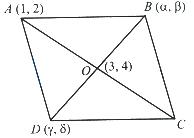
0 likesView Solution
190
MathematicsMediumMCQAP EAMCET · 2023
રેખાઓ $L_1: y-x=0$ અને $L_2: 2x+y=0$ એ રેખા $L_3: y+2=0$ ને અનુક્રમે $P$ અને $Q$ માં છેદે છે. $L_1$ અને $L_2$ વચ્ચેના લઘુકોણનો દ્વિભાજક $L_3$ ને $R$ માં છેદે છે.
વિધાન-$1$: $PR : RQ = 2\sqrt{2} : \sqrt{5}$
વિધાન-$2$: કોઈપણ ત્રિકોણમાં,ખૂણાનો દ્વિભાજક ત્રિકોણને બે સમાન ત્રિકોણમાં વિભાજિત કરે છે.
વિધાન-$1$: $PR : RQ = 2\sqrt{2} : \sqrt{5}$
વિધાન-$2$: કોઈપણ ત્રિકોણમાં,ખૂણાનો દ્વિભાજક ત્રિકોણને બે સમાન ત્રિકોણમાં વિભાજિત કરે છે.
A
વિધાન-$1$ સાચું છે,વિધાન-$2$ ખોટું છે
B
વિધાન-$1$ ખોટું છે,વિધાન-$2$ સાચું છે
C
વિધાન-$1$ અને વિધાન-$2$ બંને સાચા છે
D
વિધાન-$1$ અને વિધાન-$2$ બંને ખોટા છે
Solution
(A) આપેલ રેખાઓ $L_1: y-x=0$,$L_2: 2x+y=0$,અને $L_3: y+2=0$ છે.
$L_1$ અને $L_3$ નું છેદબિંદુ $y=-2$ ને $y-x=0$ માં મૂકતા $x=-2$ મળે છે. તેથી,$P = (-2, -2)$.
$L_2$ અને $L_3$ નું છેદબિંદુ $y=-2$ ને $2x+y=0$ માં મૂકતા $2x-2=0$ મળે છે,તેથી $x=1$. તેથી,$Q = (1, -2)$.
ઉગમબિંદુ $O$ એ $(0, 0)$ છે. લંબાઈઓ $OP = \sqrt{(-2-0)^2 + (-2-0)^2} = \sqrt{4+4} = \sqrt{8} = 2\sqrt{2}$ અને $OQ = \sqrt{(1-0)^2 + (-2-0)^2} = \sqrt{1+4} = \sqrt{5}$ છે.
$\triangle OPQ$ માં ખૂણાના દ્વિભાજકના પ્રમેય મુજબ,$\angle POQ$ નો દ્વિભાજક સામેની બાજુ $PQ$ ને તેની પાસેની બાજુઓ $OP$ અને $OQ$ ના ગુણોત્તરમાં વિભાજિત કરે છે.
આમ,$PR : RQ = OP : OQ = 2\sqrt{2} : \sqrt{5}$. તેથી,વિધાન-$1$ સાચું છે.
વિધાન-$2$ ખોટું છે કારણ કે ત્રિકોણનો ખૂણાનો દ્વિભાજક તેને બે સમાન ત્રિકોણમાં વિભાજિત કરતું નથી (સિવાય કે ત્રિકોણ તે ખૂણાની સાપેક્ષમાં સમદ્વિબાજુ હોય).
તેથી,વિધાન-$1$ સાચું છે અને વિધાન-$2$ ખોટું છે.
$L_1$ અને $L_3$ નું છેદબિંદુ $y=-2$ ને $y-x=0$ માં મૂકતા $x=-2$ મળે છે. તેથી,$P = (-2, -2)$.
$L_2$ અને $L_3$ નું છેદબિંદુ $y=-2$ ને $2x+y=0$ માં મૂકતા $2x-2=0$ મળે છે,તેથી $x=1$. તેથી,$Q = (1, -2)$.
ઉગમબિંદુ $O$ એ $(0, 0)$ છે. લંબાઈઓ $OP = \sqrt{(-2-0)^2 + (-2-0)^2} = \sqrt{4+4} = \sqrt{8} = 2\sqrt{2}$ અને $OQ = \sqrt{(1-0)^2 + (-2-0)^2} = \sqrt{1+4} = \sqrt{5}$ છે.
$\triangle OPQ$ માં ખૂણાના દ્વિભાજકના પ્રમેય મુજબ,$\angle POQ$ નો દ્વિભાજક સામેની બાજુ $PQ$ ને તેની પાસેની બાજુઓ $OP$ અને $OQ$ ના ગુણોત્તરમાં વિભાજિત કરે છે.
આમ,$PR : RQ = OP : OQ = 2\sqrt{2} : \sqrt{5}$. તેથી,વિધાન-$1$ સાચું છે.
વિધાન-$2$ ખોટું છે કારણ કે ત્રિકોણનો ખૂણાનો દ્વિભાજક તેને બે સમાન ત્રિકોણમાં વિભાજિત કરતું નથી (સિવાય કે ત્રિકોણ તે ખૂણાની સાપેક્ષમાં સમદ્વિબાજુ હોય).
તેથી,વિધાન-$1$ સાચું છે અને વિધાન-$2$ ખોટું છે.
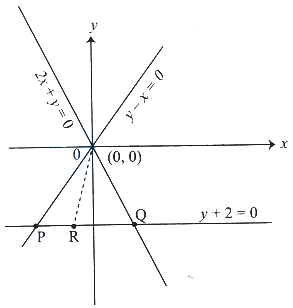
0 likesView Solution
191
MathematicsEasyMCQAP EAMCET · 2023
$(1,1)$ બિંદુ અને $x+y+1=0$ રેખાથી સમાન અંતરે આવેલા બિંદુનો બિંદુપથ શોધો.
A
$x^2-y^2+6x+4y-3=0$
B
$(x-y)^2-6(x+y)+3=0$
C
$(x+y)^2+6(x-y)+3=0$
D
$x^2+y^2-2x-2y+4=0$
Solution
(B) ધારો કે $(x, y)$ એ બિંદુ છે જે $(1, 1)$ અને રેખા $x+y+1=0$ થી સમાન અંતરે છે.
અંતરના સૂત્ર મુજબ,$(x, y)$ થી $(1, 1)$ નું અંતર $\sqrt{(x-1)^2+(y-1)^2}$ છે.
$(x, y)$ થી રેખા $x+y+1=0$ નું અંતર $\frac{|x+y+1|}{\sqrt{1^2+1^2}} = \frac{|x+y+1|}{\sqrt{2}}$ છે.
બંને અંતરોને સરખાવતા:
$\sqrt{(x-1)^2+(y-1)^2} = \frac{|x+y+1|}{\sqrt{2}}$
બંને બાજુ વર્ગ કરતા:
$(x-1)^2+(y-1)^2 = \frac{(x+y+1)^2}{2}$
$2(x^2-2x+1+y^2-2y+1) = x^2+y^2+1+2xy+2x+2y$
$2x^2+2y^2-4x-4y+4 = x^2+y^2+2xy+2x+2y+1$
$x^2+y^2-2xy-6x-6y+3 = 0$
$(x-y)^2-6(x+y)+3 = 0$.
અંતરના સૂત્ર મુજબ,$(x, y)$ થી $(1, 1)$ નું અંતર $\sqrt{(x-1)^2+(y-1)^2}$ છે.
$(x, y)$ થી રેખા $x+y+1=0$ નું અંતર $\frac{|x+y+1|}{\sqrt{1^2+1^2}} = \frac{|x+y+1|}{\sqrt{2}}$ છે.
બંને અંતરોને સરખાવતા:
$\sqrt{(x-1)^2+(y-1)^2} = \frac{|x+y+1|}{\sqrt{2}}$
બંને બાજુ વર્ગ કરતા:
$(x-1)^2+(y-1)^2 = \frac{(x+y+1)^2}{2}$
$2(x^2-2x+1+y^2-2y+1) = x^2+y^2+1+2xy+2x+2y$
$2x^2+2y^2-4x-4y+4 = x^2+y^2+2xy+2x+2y+1$
$x^2+y^2-2xy-6x-6y+3 = 0$
$(x-y)^2-6(x+y)+3 = 0$.
0 likesView Solution
192
MathematicsMediumMCQAP EAMCET · 2023
જો $t \in R - \{-1\}$ હોય,તો બિંદુ $\left(\frac{3at}{1+t^3}, \frac{3at^2}{1+t^3}\right)$ નો બિંદુપથ શું છે?
A
$x^3+y^3=3axy$
B
$x^3-3axy^2+y^3=0$
C
$x^3+y^3=3ax^2y^2$
D
$x^3-y^3=3axy$
Solution
(A) આપેલ છે કે $x = \frac{3at}{1+t^3}$ અને $y = \frac{3at^2}{1+t^3}$.
$x^3 + y^3 = \left(\frac{3at}{1+t^3}\right)^3 + \left(\frac{3at^2}{1+t^3}\right)^3$ લેતા.
$x^3 + y^3 = \frac{27a^3t^3 + 27a^3t^6}{(1+t^3)^3} = \frac{27a^3t^3(1+t^3)}{(1+t^3)^3} = \frac{27a^3t^3}{(1+t^3)^2}$.
હવે,$3axy = 3a \left(\frac{3at}{1+t^3}\right) \left(\frac{3at^2}{1+t^3}\right) = \frac{27a^3t^3}{(1+t^3)^2}$.
તેથી,$x^3 + y^3 = 3axy$.
$x^3 + y^3 = \left(\frac{3at}{1+t^3}\right)^3 + \left(\frac{3at^2}{1+t^3}\right)^3$ લેતા.
$x^3 + y^3 = \frac{27a^3t^3 + 27a^3t^6}{(1+t^3)^3} = \frac{27a^3t^3(1+t^3)}{(1+t^3)^3} = \frac{27a^3t^3}{(1+t^3)^2}$.
હવે,$3axy = 3a \left(\frac{3at}{1+t^3}\right) \left(\frac{3at^2}{1+t^3}\right) = \frac{27a^3t^3}{(1+t^3)^2}$.
તેથી,$x^3 + y^3 = 3axy$.
0 likesView Solution
193
MathematicsEasyMCQAP EAMCET · 2023
જો $A(2, 3)$ અને $B(2, -3)$ બે બિંદુઓ હોય,તો બિંદુ $P$ ના બિંદુપથનું સમીકરણ શોધો કે જેથી $PA + PB = 8$ થાય.
A
$16x^2 + 7y^2 - 64x - 48 = 0$
B
$16x^2 + 7y^2 - 64x + 48 = 0$
C
$16x^2 - 7y^2 + 64x - 48 = 0$
D
$16x^2 - 7y^2 + 64x + 48 = 0$
Solution
(A) ધારો કે બિંદુ $P$ ના યામ $(x, y)$ છે.
આપેલ છે કે $PA + PB = 8$.
$\sqrt{(x-2)^2 + (y-3)^2} + \sqrt{(x-2)^2 + (y+3)^2} = 8$
બંને બાજુ વર્ગ કરતા અને સાદુંરૂપ આપતા:
$16x^2 + 7y^2 - 64x - 48 = 0$.
આપેલ છે કે $PA + PB = 8$.
$\sqrt{(x-2)^2 + (y-3)^2} + \sqrt{(x-2)^2 + (y+3)^2} = 8$
બંને બાજુ વર્ગ કરતા અને સાદુંરૂપ આપતા:
$16x^2 + 7y^2 - 64x - 48 = 0$.
0 likesView Solution
194
MathematicsMediumMCQAP EAMCET · 2023
જો $2x^2 - 3xy + y^2 = 0$ એ ત્રિકોણની બે બાજુઓ દર્શાવે છે અને $x + y - 1 = 0$ તેની ત્રીજી બાજુ છે,તો તે ત્રિકોણના લંબકેન્દ્ર અને પરિકેન્દ્ર વચ્ચેનું અંતર શોધો.
A
$\frac{\sqrt{5}}{6}$
B
$\frac{5}{\sqrt{3}}$
C
$\frac{6}{\sqrt{5}}$
D
$\frac{\sqrt{3}}{5}$
Solution
(A) આપેલ રેખાઓની જોડી $2x^2 - 3xy + y^2 = 0$ છે.
અવયવ પાડતા,$(x - y)(2x - y) = 0$ મળે,જે રેખાઓ $L_1: x - y = 0$ અને $L_2: 2x - y = 0$ દર્શાવે છે.
ત્રીજી બાજુ $L_3: x + y = 1$ છે.
ત્રિકોણના શિરોબિંદુઓ:
$L_1$ અને $L_2$ નું છેદબિંદુ ઉગમબિંદુ $O(0, 0)$ છે.
$L_1$ $(x = y)$ અને $L_3$ $(x + y = 1)$ નું છેદબિંદુ: $2x = 1 \Rightarrow x = 1/2, y = 1/2$. એટલે કે,$A(1/2, 1/2)$.
$L_2$ $(y = 2x)$ અને $L_3$ $(x + y = 1)$ નું છેદબિંદુ: $x + 2x = 1$ $\Rightarrow 3x = 1$ $\Rightarrow x = 1/3, y = 2/3$. એટલે કે,$B(1/3, 2/3)$.
બાજુઓની લંબાઈ:
$OA^2 = (1/2)^2 + (1/2)^2 = 1/2$.
$OB^2 = (1/3)^2 + (2/3)^2 = 5/9$.
$AB^2 = (1/3 - 1/2)^2 + (2/3 - 1/2)^2 = 1/18$.
$OA^2 + AB^2 = 1/2 + 1/18 = 5/9 = OB^2$ હોવાથી,ત્રિકોણ $A$ આગળ કાટકોણ ત્રિકોણ છે.
કાટકોણ ત્રિકોણમાં,લંબકેન્દ્ર અને પરિકેન્દ્ર વચ્ચેનું અંતર કર્ણની લંબાઈનું અડધું હોય છે.
અંતર $= \frac{OB}{2} = \frac{\sqrt{5}}{6}$.
અવયવ પાડતા,$(x - y)(2x - y) = 0$ મળે,જે રેખાઓ $L_1: x - y = 0$ અને $L_2: 2x - y = 0$ દર્શાવે છે.
ત્રીજી બાજુ $L_3: x + y = 1$ છે.
ત્રિકોણના શિરોબિંદુઓ:
$L_1$ અને $L_2$ નું છેદબિંદુ ઉગમબિંદુ $O(0, 0)$ છે.
$L_1$ $(x = y)$ અને $L_3$ $(x + y = 1)$ નું છેદબિંદુ: $2x = 1 \Rightarrow x = 1/2, y = 1/2$. એટલે કે,$A(1/2, 1/2)$.
$L_2$ $(y = 2x)$ અને $L_3$ $(x + y = 1)$ નું છેદબિંદુ: $x + 2x = 1$ $\Rightarrow 3x = 1$ $\Rightarrow x = 1/3, y = 2/3$. એટલે કે,$B(1/3, 2/3)$.
બાજુઓની લંબાઈ:
$OA^2 = (1/2)^2 + (1/2)^2 = 1/2$.
$OB^2 = (1/3)^2 + (2/3)^2 = 5/9$.
$AB^2 = (1/3 - 1/2)^2 + (2/3 - 1/2)^2 = 1/18$.
$OA^2 + AB^2 = 1/2 + 1/18 = 5/9 = OB^2$ હોવાથી,ત્રિકોણ $A$ આગળ કાટકોણ ત્રિકોણ છે.
કાટકોણ ત્રિકોણમાં,લંબકેન્દ્ર અને પરિકેન્દ્ર વચ્ચેનું અંતર કર્ણની લંબાઈનું અડધું હોય છે.
અંતર $= \frac{OB}{2} = \frac{\sqrt{5}}{6}$.
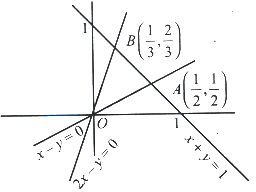
0 likesView Solution
195
MathematicsDifficultMCQAP EAMCET · 2023
જો $ad \neq 0$ અને $ax^3+3bx^2y+3cxy^2+dy^3=0$ દ્વારા દર્શાવતી રેખાઓમાંથી બે રેખાઓ પરસ્પર લંબ હોય,તો
A
$a^2+ac+bd+d^2=0$
B
$a^2+3ac+3bd+d^2=0$
C
$a^2-3ac-3bd+d^2=0$
D
$a^2+3ac-3bd+d^2=0$
Solution
(B) આપેલ સમીકરણ $ax^3+3bx^2y+3cxy^2+dy^3=0$ છે.
$x^3$ વડે ભાગતા અને $m = \frac{y}{x}$ લેતા,આપણને $m$ માં ત્રિઘાત સમીકરણ મળે છે: $dm^3+3cm^2+3bm+a=0$.
ધારો કે બીજ $m_1, m_2, m_3$ છે.
બીજના ગુણધર્મો પરથી,બીજનો ગુણાકાર $m_1m_2m_3 = -\frac{a}{d}$ થાય.
બે રેખાઓ પરસ્પર લંબ હોવાથી,$m_1m_2 = -1$ લો.
આ કિંમત ગુણાકારના સમીકરણમાં મૂકતા: $(-1)m_3 = -\frac{a}{d} \Rightarrow m_3 = \frac{a}{d}$.
$m_3$ એ ત્રિઘાત સમીકરણનું બીજ હોવાથી,તે $d(\frac{a}{d})^3+3c(\frac{a}{d})^2+3b(\frac{a}{d})+a=0$ નું સમાધાન કરશે.
$d^2$ વડે ગુણતા,આપણને $a^3+3a^2c+3abd+ad^2=0$ મળે છે.
$a$ વડે ભાગતા ($a \neq 0$ હોવાથી),આપણને $a^2+3ac+3bd+d^2=0$ મળે છે.
$x^3$ વડે ભાગતા અને $m = \frac{y}{x}$ લેતા,આપણને $m$ માં ત્રિઘાત સમીકરણ મળે છે: $dm^3+3cm^2+3bm+a=0$.
ધારો કે બીજ $m_1, m_2, m_3$ છે.
બીજના ગુણધર્મો પરથી,બીજનો ગુણાકાર $m_1m_2m_3 = -\frac{a}{d}$ થાય.
બે રેખાઓ પરસ્પર લંબ હોવાથી,$m_1m_2 = -1$ લો.
આ કિંમત ગુણાકારના સમીકરણમાં મૂકતા: $(-1)m_3 = -\frac{a}{d} \Rightarrow m_3 = \frac{a}{d}$.
$m_3$ એ ત્રિઘાત સમીકરણનું બીજ હોવાથી,તે $d(\frac{a}{d})^3+3c(\frac{a}{d})^2+3b(\frac{a}{d})+a=0$ નું સમાધાન કરશે.
$d^2$ વડે ગુણતા,આપણને $a^3+3a^2c+3abd+ad^2=0$ મળે છે.
$a$ વડે ભાગતા ($a \neq 0$ હોવાથી),આપણને $a^2+3ac+3bd+d^2=0$ મળે છે.
0 likesView Solution
196
MathematicsMediumMCQAP EAMCET · 2023
$4x^2 - 24xy + 11y^2 = 0$ રેખાઓ દ્વારા $X$-અક્ષ સાથે બનાવેલા ખૂણાઓના તફાવતનો ટેન્જન્ટ (tangent) નું નિરપેક્ષ મૂલ્ય શોધો.
A
$\frac{4}{11}$
B
$\frac{24}{11}$
C
$\frac{4}{3}$
D
$\frac{11}{24}$
Solution
(C) આપેલ રેખાઓની જોડીનું સમીકરણ: $4x^2 - 24xy + 11y^2 = 0$.
અવયવ પાડતા: $(2x - y)(2x - 11y) = 0$.
તેથી,બે રેખાઓના સમીકરણો $y = 2x$ અને $y = \frac{2}{11}x$ છે.
આ રેખાઓ દ્વારા $X$-અક્ષ સાથે બનાવેલા ખૂણાઓ $\theta_1$ અને $\theta_2$ માટે $\tan \theta_1 = 2$ અને $\tan \theta_2 = \frac{2}{11}$ થાય.
આપણે $\tan |\theta_1 - \theta_2|$ શોધવાનું છે.
સૂત્ર $\tan(A - B) = \frac{\tan A - \tan B}{1 + \tan A \tan B}$ નો ઉપયોગ કરતા:
$\tan(\theta_1 - \theta_2) = \frac{2 - \frac{2}{11}}{1 + 2 \times \frac{2}{11}} = \frac{\frac{20}{11}}{\frac{15}{11}} = \frac{20}{15} = \frac{4}{3}$.
તેથી,નિરપેક્ષ મૂલ્ય $\frac{4}{3}$ છે.
અવયવ પાડતા: $(2x - y)(2x - 11y) = 0$.
તેથી,બે રેખાઓના સમીકરણો $y = 2x$ અને $y = \frac{2}{11}x$ છે.
આ રેખાઓ દ્વારા $X$-અક્ષ સાથે બનાવેલા ખૂણાઓ $\theta_1$ અને $\theta_2$ માટે $\tan \theta_1 = 2$ અને $\tan \theta_2 = \frac{2}{11}$ થાય.
આપણે $\tan |\theta_1 - \theta_2|$ શોધવાનું છે.
સૂત્ર $\tan(A - B) = \frac{\tan A - \tan B}{1 + \tan A \tan B}$ નો ઉપયોગ કરતા:
$\tan(\theta_1 - \theta_2) = \frac{2 - \frac{2}{11}}{1 + 2 \times \frac{2}{11}} = \frac{\frac{20}{11}}{\frac{15}{11}} = \frac{20}{15} = \frac{4}{3}$.
તેથી,નિરપેક્ષ મૂલ્ય $\frac{4}{3}$ છે.
0 likesView Solution
197
MathematicsMediumMCQAP EAMCET · 2023
જો રેખાઓ $y=x+c$ અને $2x^2+5xy+3y^2=0$ દ્વારા બનતા ત્રિકોણનું ક્ષેત્રફળ $\frac{1}{20}$ ચોરસ એકમ હોય,તો $c=$
A
$\pm 1$
B
$\pm \sqrt{2}$
C
$\pm 3$
D
$\pm \sqrt{3}$
Solution
(A) આપેલ રેખાઓની જોડી $2x^2+5xy+3y^2=0$ છે.
તેના અવયવ પાડતા,આપણને $(x+y)(2x+3y)=0$ મળે છે.
આમ,બે રેખાઓ $x+y=0$ અને $2x+3y=0$ છે.
ત્રીજી રેખા $y=x+c$ છે,અથવા $x-y+c=0$.
ત્રિકોણના શિરોબિંદુઓ આ રેખાઓના છેદબિંદુઓ છે:
$1$. $x+y=0$ અને $2x+3y=0$ નું છેદબિંદુ ઉગમબિંદુ $(0,0)$ છે.
$2$. $x+y=0$ અને $x-y+c=0$ નું છેદબિંદુ: સમીકરણોનો સરવાળો કરતા,$2x+c=0 \Rightarrow x=-\frac{c}{2}$. તેથી $y=\frac{c}{2}$. એટલે કે,$B = (-\frac{c}{2}, \frac{c}{2})$.
$3$. $2x+3y=0$ અને $x-y+c=0$ નું છેદબિંદુ: બીજા સમીકરણ પરથી,$x=y-c$. પ્રથમ સમીકરણમાં મૂકતા,$2(y-c)+3y=0$ $\Rightarrow 5y=2c$ $\Rightarrow y=\frac{2c}{5}$. તેથી $x=\frac{2c}{5}-c=-\frac{3c}{5}$. એટલે કે,$C = (-\frac{3c}{5}, \frac{2c}{5})$.
$(0,0)$,$(x_1, y_1)$,અને $(x_2, y_2)$ શિરોબિંદુઓ ધરાવતા ત્રિકોણનું ક્ષેત્રફળ $\frac{1}{2} |x_1 y_2 - x_2 y_1|$ છે.
ક્ષેત્રફળ $= \frac{1}{2} |(-\frac{c}{2})(\frac{2c}{5}) - (-\frac{3c}{5})(\frac{c}{2})| = \frac{1}{2} |-\frac{c^2}{5} + \frac{3c^2}{10}| = \frac{1}{2} |\frac{c^2}{10}| = \frac{c^2}{20}$.
આપેલ ક્ષેત્રફળ $= \frac{1}{20}$ છે,તેથી $\frac{c^2}{20} = \frac{1}{20}$ $\Rightarrow c^2=1$ $\Rightarrow c = \pm 1$.
તેના અવયવ પાડતા,આપણને $(x+y)(2x+3y)=0$ મળે છે.
આમ,બે રેખાઓ $x+y=0$ અને $2x+3y=0$ છે.
ત્રીજી રેખા $y=x+c$ છે,અથવા $x-y+c=0$.
ત્રિકોણના શિરોબિંદુઓ આ રેખાઓના છેદબિંદુઓ છે:
$1$. $x+y=0$ અને $2x+3y=0$ નું છેદબિંદુ ઉગમબિંદુ $(0,0)$ છે.
$2$. $x+y=0$ અને $x-y+c=0$ નું છેદબિંદુ: સમીકરણોનો સરવાળો કરતા,$2x+c=0 \Rightarrow x=-\frac{c}{2}$. તેથી $y=\frac{c}{2}$. એટલે કે,$B = (-\frac{c}{2}, \frac{c}{2})$.
$3$. $2x+3y=0$ અને $x-y+c=0$ નું છેદબિંદુ: બીજા સમીકરણ પરથી,$x=y-c$. પ્રથમ સમીકરણમાં મૂકતા,$2(y-c)+3y=0$ $\Rightarrow 5y=2c$ $\Rightarrow y=\frac{2c}{5}$. તેથી $x=\frac{2c}{5}-c=-\frac{3c}{5}$. એટલે કે,$C = (-\frac{3c}{5}, \frac{2c}{5})$.
$(0,0)$,$(x_1, y_1)$,અને $(x_2, y_2)$ શિરોબિંદુઓ ધરાવતા ત્રિકોણનું ક્ષેત્રફળ $\frac{1}{2} |x_1 y_2 - x_2 y_1|$ છે.
ક્ષેત્રફળ $= \frac{1}{2} |(-\frac{c}{2})(\frac{2c}{5}) - (-\frac{3c}{5})(\frac{c}{2})| = \frac{1}{2} |-\frac{c^2}{5} + \frac{3c^2}{10}| = \frac{1}{2} |\frac{c^2}{10}| = \frac{c^2}{20}$.
આપેલ ક્ષેત્રફળ $= \frac{1}{20}$ છે,તેથી $\frac{c^2}{20} = \frac{1}{20}$ $\Rightarrow c^2=1$ $\Rightarrow c = \pm 1$.
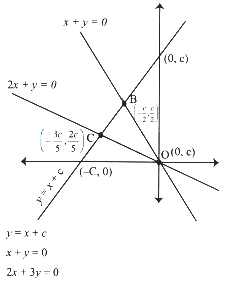
0 likesView Solution
198
MathematicsDifficultMCQAP EAMCET · 2023
જો $(x^2+y^2) \sin^2 \alpha = (x \cos \alpha - y \sin \alpha)^2$ દ્વારા આપવામાં આવેલી રેખાઓ એકબીજાને લંબ હોય,તો $\sin^2 \alpha + \tan^2 \alpha = $
A
$\frac{15}{4}$
B
$0$
C
$\frac{3}{2}$
D
$\frac{7}{12}$
Solution
(C) આપેલ સમીકરણ $(x^2+y^2) \sin^2 \alpha = (x \cos \alpha - y \sin \alpha)^2$ છે.
જમણી બાજુનું વિસ્તરણ કરતા: $(x^2+y^2) \sin^2 \alpha = x^2 \cos^2 \alpha + y^2 \sin^2 \alpha - 2xy \sin \alpha \cos \alpha$.
પદોને ગોઠવતા: $x^2(\sin^2 \alpha - \cos^2 \alpha) + 2xy \sin \alpha \cos \alpha + y^2(\sin^2 \alpha - \sin^2 \alpha) = 0$.
આનું સાદું રૂપ: $-x^2 \cos 2\alpha + xy \sin 2\alpha = 0$ મળે છે.
રેખાઓની જોડી $Ax^2 + 2Hxy + By^2 = 0$ લંબ હોય તે માટેની શરત $A + B = 0$ છે.
અહીં,$A = -\cos 2\alpha$ અને $B = 0$.
તેથી,$-\cos 2\alpha + 0 = 0$,જેનો અર્થ છે કે $\cos 2\alpha = 0$.
કારણ કે $\cos 2\alpha = 1 - 2\sin^2 \alpha = 0$,તેથી $\sin^2 \alpha = \frac{1}{2}$.
પછી $\cos^2 \alpha = 1 - \frac{1}{2} = \frac{1}{2}$.
તેથી,$\tan^2 \alpha = \frac{\sin^2 \alpha}{\cos^2 \alpha} = \frac{1/2}{1/2} = 1$.
અંતે,$\sin^2 \alpha + \tan^2 \alpha = \frac{1}{2} + 1 = \frac{3}{2}$.
જમણી બાજુનું વિસ્તરણ કરતા: $(x^2+y^2) \sin^2 \alpha = x^2 \cos^2 \alpha + y^2 \sin^2 \alpha - 2xy \sin \alpha \cos \alpha$.
પદોને ગોઠવતા: $x^2(\sin^2 \alpha - \cos^2 \alpha) + 2xy \sin \alpha \cos \alpha + y^2(\sin^2 \alpha - \sin^2 \alpha) = 0$.
આનું સાદું રૂપ: $-x^2 \cos 2\alpha + xy \sin 2\alpha = 0$ મળે છે.
રેખાઓની જોડી $Ax^2 + 2Hxy + By^2 = 0$ લંબ હોય તે માટેની શરત $A + B = 0$ છે.
અહીં,$A = -\cos 2\alpha$ અને $B = 0$.
તેથી,$-\cos 2\alpha + 0 = 0$,જેનો અર્થ છે કે $\cos 2\alpha = 0$.
કારણ કે $\cos 2\alpha = 1 - 2\sin^2 \alpha = 0$,તેથી $\sin^2 \alpha = \frac{1}{2}$.
પછી $\cos^2 \alpha = 1 - \frac{1}{2} = \frac{1}{2}$.
તેથી,$\tan^2 \alpha = \frac{\sin^2 \alpha}{\cos^2 \alpha} = \frac{1/2}{1/2} = 1$.
અંતે,$\sin^2 \alpha + \tan^2 \alpha = \frac{1}{2} + 1 = \frac{3}{2}$.
0 likesView Solution
199
MathematicsEasyMCQAP EAMCET · 2023
જો $3$ એકમ ત્રિજ્યા ધરાવતા વર્તુળનું સમીકરણ,જે વર્તુળ $x^2+y^2+6x-8y-11=0$ ને $(3,0)$ બિંદુએ બહારથી સ્પર્શે છે,તે $x^2+y^2+2gx+2fy+c=0$ હોય,તો $3g-4f+c=$
A
$0$
B
$5$
C
$1$
D
$-1$
Solution
(B) આપેલ વર્તુળ $x^2+y^2+6x-8y-11=0$ છે. તેનું કેન્દ્ર $C_1 = (-3, 4)$ અને ત્રિજ્યા $r_1 = \sqrt{(-3)^2 + 4^2 - (-11)} = \sqrt{9+16+11} = \sqrt{36} = 6$ છે.
ધારો કે જરૂરી વર્તુળ $x^2+y^2+2gx+2fy+c=0$ છે,જેનું કેન્દ્ર $C_2 = (-g, -f)$ અને ત્રિજ્યા $r_2 = 3$ છે.
વર્તુળો $(3,0)$ બિંદુએ બહારથી સ્પર્શતા હોવાથી,બિંદુ $(3,0)$ એ કેન્દ્રો $C_1(-3, 4)$ અને $C_2(-g, -f)$ ને જોડતા રેખાખંડનું $r_1:r_2 = 6:3 = 2:1$ ના ગુણોત્તરમાં અંતઃવિભાજન કરે છે.
વિભાજન સૂત્રનો ઉપયોગ કરતા:
$3 = \frac{2(-g) + 1(-3)}{2+1}$ $\Rightarrow 3 = \frac{-2g-3}{3}$ $\Rightarrow 9 = -2g-3$ $\Rightarrow 2g = -12$ $\Rightarrow g = -6$.
$0 = \frac{2(-f) + 1(4)}{2+1}$ $\Rightarrow 0 = \frac{-2f+4}{3}$ $\Rightarrow 0 = -2f+4$ $\Rightarrow 2f = 4$ $\Rightarrow f = 2$.
બીજા વર્તુળની ત્રિજ્યા $r_2 = \sqrt{g^2+f^2-c} = 3$ છે.
$g=-6$ અને $f=2$ મૂકતા: $\sqrt{(-6)^2 + 2^2 - c} = 3$ $\Rightarrow 36+4-c = 9$ $\Rightarrow 40-c = 9$ $\Rightarrow c = 31$.
અંતે,$3g-4f+c = 3(-6) - 4(2) + 31 = -18 - 8 + 31 = 5$.
ધારો કે જરૂરી વર્તુળ $x^2+y^2+2gx+2fy+c=0$ છે,જેનું કેન્દ્ર $C_2 = (-g, -f)$ અને ત્રિજ્યા $r_2 = 3$ છે.
વર્તુળો $(3,0)$ બિંદુએ બહારથી સ્પર્શતા હોવાથી,બિંદુ $(3,0)$ એ કેન્દ્રો $C_1(-3, 4)$ અને $C_2(-g, -f)$ ને જોડતા રેખાખંડનું $r_1:r_2 = 6:3 = 2:1$ ના ગુણોત્તરમાં અંતઃવિભાજન કરે છે.
વિભાજન સૂત્રનો ઉપયોગ કરતા:
$3 = \frac{2(-g) + 1(-3)}{2+1}$ $\Rightarrow 3 = \frac{-2g-3}{3}$ $\Rightarrow 9 = -2g-3$ $\Rightarrow 2g = -12$ $\Rightarrow g = -6$.
$0 = \frac{2(-f) + 1(4)}{2+1}$ $\Rightarrow 0 = \frac{-2f+4}{3}$ $\Rightarrow 0 = -2f+4$ $\Rightarrow 2f = 4$ $\Rightarrow f = 2$.
બીજા વર્તુળની ત્રિજ્યા $r_2 = \sqrt{g^2+f^2-c} = 3$ છે.
$g=-6$ અને $f=2$ મૂકતા: $\sqrt{(-6)^2 + 2^2 - c} = 3$ $\Rightarrow 36+4-c = 9$ $\Rightarrow 40-c = 9$ $\Rightarrow c = 31$.
અંતે,$3g-4f+c = 3(-6) - 4(2) + 31 = -18 - 8 + 31 = 5$.
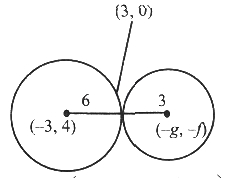
0 likesView Solution
200
MathematicsEasyMCQAP EAMCET · 2023
ધારો કે સમીકરણ $ax^2+2hxy+by^2+2gx+2fy+c=0$ એ ઉગમબિંદુ સિવાયનું બિંદુ વર્તુળ દર્શાવે છે. તો નીચેનામાંથી કઈ શરતનું પાલન થવું જોઈએ?
A
$bc > 0$
B
$b > 0$ અને $c < 0$
C
$b < 0$ અને $c > 0$
D
$b \leq 0$ અને $c < 0$
Solution
(A) આપેલ સમીકરણ: $ax^2+2hxy+by^2+2gx+2fy+c=0$ $(i)$
જો સમીકરણ $(i)$ વર્તુળ દર્શાવે,તો $a=b$ અને $h=0$ થાય.
આ કિંમતો $(i)$ માં મૂકતા: $bx^2+by^2+2gx+2fy+c=0$.
$b$ વડે ભાગતા ($b \neq 0$ હોવાથી): $x^2+y^2+2(\frac{g}{b})x+2(\frac{f}{b})y+\frac{c}{b}=0$.
બિંદુ વર્તુળ માટે,ત્રિજ્યા $r=0$ હોવી જોઈએ.
વર્તુળ $x^2+y^2+2gx+2fy+c=0$ ની ત્રિજ્યા $\sqrt{g^2+f^2-c}$ છે.
અહીં,$g' = \frac{g}{b}$,$f' = \frac{f}{b}$,અને $c' = \frac{c}{b}$ છે.
તેથી,$r^2 = (\frac{g}{b})^2 + (\frac{f}{b})^2 - \frac{c}{b} = 0$.
આનો અર્થ એ છે કે $\frac{g^2+f^2}{b^2} = \frac{c}{b}$.
$b^2$ વડે ગુણતા,આપણને $g^2+f^2 = bc$ મળે છે.
$g^2+f^2 \geq 0$ હોવાથી,$bc \geq 0$ થાય.
ઉગમબિંદુ સિવાયના બિંદુ વર્તુળ માટે,$g^2+f^2 > 0$,તેથી $bc > 0$.
જો સમીકરણ $(i)$ વર્તુળ દર્શાવે,તો $a=b$ અને $h=0$ થાય.
આ કિંમતો $(i)$ માં મૂકતા: $bx^2+by^2+2gx+2fy+c=0$.
$b$ વડે ભાગતા ($b \neq 0$ હોવાથી): $x^2+y^2+2(\frac{g}{b})x+2(\frac{f}{b})y+\frac{c}{b}=0$.
બિંદુ વર્તુળ માટે,ત્રિજ્યા $r=0$ હોવી જોઈએ.
વર્તુળ $x^2+y^2+2gx+2fy+c=0$ ની ત્રિજ્યા $\sqrt{g^2+f^2-c}$ છે.
અહીં,$g' = \frac{g}{b}$,$f' = \frac{f}{b}$,અને $c' = \frac{c}{b}$ છે.
તેથી,$r^2 = (\frac{g}{b})^2 + (\frac{f}{b})^2 - \frac{c}{b} = 0$.
આનો અર્થ એ છે કે $\frac{g^2+f^2}{b^2} = \frac{c}{b}$.
$b^2$ વડે ગુણતા,આપણને $g^2+f^2 = bc$ મળે છે.
$g^2+f^2 \geq 0$ હોવાથી,$bc \geq 0$ થાય.
ઉગમબિંદુ સિવાયના બિંદુ વર્તુળ માટે,$g^2+f^2 > 0$,તેથી $bc > 0$.
0 likesView Solution
201
MathematicsEasyMCQAP EAMCET · 2023
જો $\int \sqrt{x}(1-x^3)^{-\frac{1}{2}} dx = \frac{2}{3} g(f(x)) + c$ હોય,તો
A
$f(x)=\sqrt{x}, g(x)=\sin^{-1} x$
B
$f(x)=x^{\frac{3}{2}}, g(x)=\sin^{-1} x$
C
$f(x)=x^{\frac{3}{2}}, g(x)=\cos^{-1} x$
D
$f(x)=\sqrt{x}, g(x)=\cos^{-1} x$
Solution
(B) ધારો કે $I = \int \sqrt{x}(1-x^3)^{-\frac{1}{2}} dx$.
$t = x^{\frac{3}{2}}$ આદેશ લેતા,$dt = \frac{3}{2} x^{\frac{1}{2}} dx$,જેનો અર્થ છે કે $\sqrt{x} dx = \frac{2}{3} dt$.
અહીં $x^3 = (x^{\frac{3}{2}})^2 = t^2$ હોવાથી,સંકલન નીચે મુજબ થશે:
$I = \int (1-t^2)^{-\frac{1}{2}} \left(\frac{2}{3} dt\right) = \frac{2}{3} \int \frac{1}{\sqrt{1-t^2}} dt$.
સંકલન કરતા,આપણને $I = \frac{2}{3} \sin^{-1}(t) + c$ મળે છે.
$t = x^{\frac{3}{2}}$ પાછું મૂકતા,$I = \frac{2}{3} \sin^{-1}(x^{\frac{3}{2}}) + c$.
આને $\frac{2}{3} g(f(x)) + c$ સાથે સરખાવતા,$f(x) = x^{\frac{3}{2}}$ અને $g(x) = \sin^{-1} x$ મળે છે.
$t = x^{\frac{3}{2}}$ આદેશ લેતા,$dt = \frac{3}{2} x^{\frac{1}{2}} dx$,જેનો અર્થ છે કે $\sqrt{x} dx = \frac{2}{3} dt$.
અહીં $x^3 = (x^{\frac{3}{2}})^2 = t^2$ હોવાથી,સંકલન નીચે મુજબ થશે:
$I = \int (1-t^2)^{-\frac{1}{2}} \left(\frac{2}{3} dt\right) = \frac{2}{3} \int \frac{1}{\sqrt{1-t^2}} dt$.
સંકલન કરતા,આપણને $I = \frac{2}{3} \sin^{-1}(t) + c$ મળે છે.
$t = x^{\frac{3}{2}}$ પાછું મૂકતા,$I = \frac{2}{3} \sin^{-1}(x^{\frac{3}{2}}) + c$.
આને $\frac{2}{3} g(f(x)) + c$ સાથે સરખાવતા,$f(x) = x^{\frac{3}{2}}$ અને $g(x) = \sin^{-1} x$ મળે છે.
0 likesView Solution
202
MathematicsEasyMCQAP EAMCET · 2023
જો $n \geq 2$ માટે $f(x) = \frac{x}{(1 + nx^n)^{1/n}}$ હોય,તો $\int x^{n-2} f(x) dx =$
A
$\frac{1}{n(n-1)}(1 + nx^n)^{1 - 1/n} + C$
B
$\frac{1}{(n-1)}(1 + nx^n)^{1 - 1/n} + C$
C
$\frac{1}{n(n-1)}(1 + nx^n)^{1 + 1/n} + C$
D
$\frac{1}{n+1}(1 + nx^n)^{1 + 1/n} + C$
Solution
(A) આપેલ છે કે $\int x^{n-2} f(x) dx = \int x^{n-2} \cdot \frac{x}{(1 + nx^n)^{1/n}} dx = \int \frac{x^{n-1}}{(1 + nx^n)^{1/n}} dx$.
ધારો કે $t = 1 + nx^n$.
તેથી $dt = n \cdot n x^{n-1} dx = n^2 x^{n-1} dx$,જેનો અર્થ છે કે $x^{n-1} dx = \frac{1}{n^2} dt$.
આ કિંમતોને સંકલનમાં મૂકતા:
$\int \frac{1}{n^2} \cdot t^{-1/n} dt = \frac{1}{n^2} \left[ \frac{t^{-1/n + 1}}{-1/n + 1} \right] + C$.
$= \frac{1}{n^2} \left[ \frac{t^{(n-1)/n}}{(n-1)/n} \right] + C = \frac{1}{n^2} \cdot \frac{n}{n-1} \cdot t^{(n-1)/n} + C$.
$= \frac{1}{n(n-1)} (1 + nx^n)^{1 - 1/n} + C$.
ધારો કે $t = 1 + nx^n$.
તેથી $dt = n \cdot n x^{n-1} dx = n^2 x^{n-1} dx$,જેનો અર્થ છે કે $x^{n-1} dx = \frac{1}{n^2} dt$.
આ કિંમતોને સંકલનમાં મૂકતા:
$\int \frac{1}{n^2} \cdot t^{-1/n} dt = \frac{1}{n^2} \left[ \frac{t^{-1/n + 1}}{-1/n + 1} \right] + C$.
$= \frac{1}{n^2} \left[ \frac{t^{(n-1)/n}}{(n-1)/n} \right] + C = \frac{1}{n^2} \cdot \frac{n}{n-1} \cdot t^{(n-1)/n} + C$.
$= \frac{1}{n(n-1)} (1 + nx^n)^{1 - 1/n} + C$.
0 likesView Solution
203
MathematicsMediumMCQAP EAMCET · 2023
$\int \frac{1+x \cos x}{x\left[1-x^2\left(e^{\sin x}\right)^2\right]} d x=$
A
$\frac{1}{2} \log \left|\frac{\left(x e^{\sin x}\right)^2}{\left(x e^{\sin x}\right)^2+1}\right|+c$
B
$-\frac{1}{2} \log \left|\frac{\left(x e^{\sin x}\right)^2}{\left(x e^{\sin x}\right)^2+1}\right|+c$
C
$\frac{1}{2} \log \left|\frac{\left(x e^{\sin x}\right)^2}{\left(x e^{\sin x}\right)^2-1}\right|+c$
D
$-\frac{1}{2} \log \left|\frac{\left(x e^{\sin x}\right)^2}{\left(x e^{\sin x}\right)^2-1}\right|+c$
Solution
(D) ધારો કે $I = \int \frac{1+x \cos x}{x[1-x^2(e^{\sin x})^2]} dx$.
અંશ અને છેદને $e^{\sin x}$ વડે ગુણતા:
$I = \int \frac{(1+x \cos x) e^{\sin x}}{x e^{\sin x}[1-(x e^{\sin x})^2]} dx$.
ધારો કે $t = x e^{\sin x}$.
તેથી $dt = [e^{\sin x} + x e^{\sin x} \cos x] dx = e^{\sin x}(1+x \cos x) dx$.
આ કિંમતો સંકલનમાં મૂકતા:
$I = \int \frac{dt}{t(1-t^2)} = \int \frac{dt}{t(1-t)(1+t)}$.
આંશિક અપૂર્ણાંકનો ઉપયોગ કરતા:
$\frac{1}{t(1-t)(1+t)} = \frac{1}{t} + \frac{1}{2(1-t)} - \frac{1}{2(1+t)}$.
સંકલન કરતા:
$I = \ln|t| - \frac{1}{2} \ln|1-t| - \frac{1}{2} \ln|1+t| + C = \ln|t| - \frac{1}{2} \ln|1-t^2| + C$.
$I = \frac{1}{2} \ln|t^2| - \frac{1}{2} \ln|1-t^2| + C = \frac{1}{2} \ln \left| \frac{t^2}{1-t^2} \right| + C$.
$t = x e^{\sin x}$ પાછા મૂકતા:
$I = \frac{1}{2} \ln \left| \frac{(x e^{\sin x})^2}{1-(x e^{\sin x})^2} \right| + C = -\frac{1}{2} \ln \left| \frac{(x e^{\sin x})^2}{(x e^{\sin x})^2-1} \right| + C$.
અંશ અને છેદને $e^{\sin x}$ વડે ગુણતા:
$I = \int \frac{(1+x \cos x) e^{\sin x}}{x e^{\sin x}[1-(x e^{\sin x})^2]} dx$.
ધારો કે $t = x e^{\sin x}$.
તેથી $dt = [e^{\sin x} + x e^{\sin x} \cos x] dx = e^{\sin x}(1+x \cos x) dx$.
આ કિંમતો સંકલનમાં મૂકતા:
$I = \int \frac{dt}{t(1-t^2)} = \int \frac{dt}{t(1-t)(1+t)}$.
આંશિક અપૂર્ણાંકનો ઉપયોગ કરતા:
$\frac{1}{t(1-t)(1+t)} = \frac{1}{t} + \frac{1}{2(1-t)} - \frac{1}{2(1+t)}$.
સંકલન કરતા:
$I = \ln|t| - \frac{1}{2} \ln|1-t| - \frac{1}{2} \ln|1+t| + C = \ln|t| - \frac{1}{2} \ln|1-t^2| + C$.
$I = \frac{1}{2} \ln|t^2| - \frac{1}{2} \ln|1-t^2| + C = \frac{1}{2} \ln \left| \frac{t^2}{1-t^2} \right| + C$.
$t = x e^{\sin x}$ પાછા મૂકતા:
$I = \frac{1}{2} \ln \left| \frac{(x e^{\sin x})^2}{1-(x e^{\sin x})^2} \right| + C = -\frac{1}{2} \ln \left| \frac{(x e^{\sin x})^2}{(x e^{\sin x})^2-1} \right| + C$.
0 likesView Solution
204
MathematicsMediumMCQAP EAMCET · 2023
$\int \frac{d x}{(x-1) \sqrt{x+2}} = $
A
$\frac{2}{\sqrt{3}} \log \left|\frac{\sqrt{x+2}+\sqrt{3}}{\sqrt{x+2}-\sqrt{3}}\right|+C$
B
$\frac{-1}{\sqrt{3}} \log \left|\frac{\sqrt{x+2}-\sqrt{3}}{\sqrt{x+2}+\sqrt{3}}\right|+C$
C
$\frac{1}{\sqrt{3}} \log \left|\frac{\sqrt{x+2}+\sqrt{3}}{\sqrt{x+2}-\sqrt{3}}\right|+C$
D
$\frac{1}{\sqrt{3}} \log \left|\frac{\sqrt{x+2}-\sqrt{3}}{\sqrt{x+2}+\sqrt{3}}\right|+C$
Solution
(D) ધારો કે $I = \int \frac{d x}{(x-1) \sqrt{x+2}}$.
$t = \sqrt{x+2}$ આદેશ લેતા,તેથી $t^2 = x+2$,એટલે કે $x = t^2 - 2$.
તેથી $dx = 2t \, dt$ મળે.
આ કિંમતો સંકલનમાં મૂકતા:
$I = \int \frac{2t \, dt}{(t^2 - 2 - 1)t} = \int \frac{2 \, dt}{t^2 - 3}$.
પ્રમાણિત સંકલન સૂત્ર $\int \frac{dx}{x^2 - a^2} = \frac{1}{2a} \log \left| \frac{x-a}{x+a} \right| + C$ નો ઉપયોગ કરતા:
$I = 2 \times \frac{1}{2\sqrt{3}} \log \left| \frac{t-\sqrt{3}}{t+\sqrt{3}} \right| + C$.
$I = \frac{1}{\sqrt{3}} \log \left| \frac{\sqrt{x+2}-\sqrt{3}}{\sqrt{x+2}+\sqrt{3}} \right| + C$.
$t = \sqrt{x+2}$ આદેશ લેતા,તેથી $t^2 = x+2$,એટલે કે $x = t^2 - 2$.
તેથી $dx = 2t \, dt$ મળે.
આ કિંમતો સંકલનમાં મૂકતા:
$I = \int \frac{2t \, dt}{(t^2 - 2 - 1)t} = \int \frac{2 \, dt}{t^2 - 3}$.
પ્રમાણિત સંકલન સૂત્ર $\int \frac{dx}{x^2 - a^2} = \frac{1}{2a} \log \left| \frac{x-a}{x+a} \right| + C$ નો ઉપયોગ કરતા:
$I = 2 \times \frac{1}{2\sqrt{3}} \log \left| \frac{t-\sqrt{3}}{t+\sqrt{3}} \right| + C$.
$I = \frac{1}{\sqrt{3}} \log \left| \frac{\sqrt{x+2}-\sqrt{3}}{\sqrt{x+2}+\sqrt{3}} \right| + C$.
0 likesView Solution
205
MathematicsMediumMCQAP EAMCET · 2023
જો $I=\int_{-a}^a(x^4-2x^2)dx$ હોય,તો $I$ એ $a=$ માટે ન્યૂનતમ છે.
A
$2$
B
$-\sqrt{2}$
C
$\sqrt{2}$
D
$-2$
Solution
(C) આપેલ છે કે $I = \int_{-a}^a (x^4 - 2x^2) dx$.
અહીં વિધેય $f(x) = x^4 - 2x^2$ એ યુગ્મ વિધેય હોવાથી,આપણે લખી શકીએ:
$I = 2 \int_{0}^a (x^4 - 2x^2) dx = 2 \left[ \frac{x^5}{5} - \frac{2x^3}{3} \right]_0^a = 2 \left( \frac{a^5}{5} - \frac{2a^3}{3} \right)$.
ન્યૂનતમ કિંમત શોધવા માટે,આપણે $a$ ની સાપેક્ષમાં વિકલન કરીએ:
$\frac{dI}{da} = 2(a^4 - 2a^2) = 2a^2(a^2 - 2)$.
$\frac{dI}{da} = 0$ લેતા,આપણને $a = 0, \sqrt{2}, -\sqrt{2}$ મળે છે.
હવે,દ્વિતીય વિકલન મેળવતા:
$\frac{d^2I}{da^2} = 2(4a^3 - 4a) = 8a(a^2 - 1)$.
$a = \sqrt{2}$ માટે,$\frac{d^2I}{da^2} = 8(\sqrt{2})(2 - 1) = 8\sqrt{2} > 0$.
દ્વિતીય વિકલન ધન હોવાથી,$I$ એ $a = \sqrt{2}$ આગળ ન્યૂનતમ છે.
અહીં વિધેય $f(x) = x^4 - 2x^2$ એ યુગ્મ વિધેય હોવાથી,આપણે લખી શકીએ:
$I = 2 \int_{0}^a (x^4 - 2x^2) dx = 2 \left[ \frac{x^5}{5} - \frac{2x^3}{3} \right]_0^a = 2 \left( \frac{a^5}{5} - \frac{2a^3}{3} \right)$.
ન્યૂનતમ કિંમત શોધવા માટે,આપણે $a$ ની સાપેક્ષમાં વિકલન કરીએ:
$\frac{dI}{da} = 2(a^4 - 2a^2) = 2a^2(a^2 - 2)$.
$\frac{dI}{da} = 0$ લેતા,આપણને $a = 0, \sqrt{2}, -\sqrt{2}$ મળે છે.
હવે,દ્વિતીય વિકલન મેળવતા:
$\frac{d^2I}{da^2} = 2(4a^3 - 4a) = 8a(a^2 - 1)$.
$a = \sqrt{2}$ માટે,$\frac{d^2I}{da^2} = 8(\sqrt{2})(2 - 1) = 8\sqrt{2} > 0$.
દ્વિતીય વિકલન ધન હોવાથી,$I$ એ $a = \sqrt{2}$ આગળ ન્યૂનતમ છે.
0 likesView Solution
206
MathematicsDifficultMCQAP EAMCET · 2023
$\int x^3(\log x)^2 \, dx = $
A
$(\log x)^2 \frac{x^4}{4} + \frac{1}{2} \left[ (\log x) \frac{x^4}{4} + \frac{x^4}{16} \right] + C$
B
$(\log x)^2 \frac{x^4}{4} - \frac{1}{2} \left[ (\log x) \frac{x^4}{4} + \frac{x^4}{16} \right] + C$
C
$(\log x)^2 \frac{x^4}{4} - \frac{1}{2} \left[ (\log x) \frac{x^4}{4} - \frac{x^4}{16} \right] + C$
D
$(\log x)^2 \frac{x^4}{4} + \frac{1}{2} \left[ (\log x) \frac{x^4}{4} - \frac{x^4}{16} \right] + C$
Solution
(C) ખંડશઃ સંકલન (Integration by parts) નો ઉપયોગ કરતા,$\int u \, dv = uv - \int v \, du$.
ધારો કે $u = (\log x)^2$ અને $dv = x^3 \, dx$.
તેથી $du = 2(\log x) \cdot \frac{1}{x} \, dx$ અને $v = \frac{x^4}{4}$ મળે.
$I = \int x^3(\log x)^2 \, dx = (\log x)^2 \cdot \frac{x^4}{4} - \int \frac{x^4}{4} \cdot 2(\log x) \cdot \frac{1}{x} \, dx$
$I = \frac{x^4}{4}(\log x)^2 - \frac{1}{2} \int x^3 \log x \, dx$
હવે,$\int x^3 \log x \, dx$ માટે ફરીથી ખંડશઃ સંકલનનો ઉપયોગ કરતા:
ધારો કે $u = \log x$ અને $dv = x^3 \, dx$.
તેથી $du = \frac{1}{x} \, dx$ અને $v = \frac{x^4}{4}$ મળે.
$\int x^3 \log x \, dx = \frac{x^4}{4} \log x - \int \frac{x^4}{4} \cdot \frac{1}{x} \, dx = \frac{x^4}{4} \log x - \frac{x^4}{16}$.
આ કિંમત પાછી મૂકતા:
$I = \frac{x^4}{4}(\log x)^2 - \frac{1}{2} \left[ \frac{x^4}{4} \log x - \frac{x^4}{16} \right] + C$.
ધારો કે $u = (\log x)^2$ અને $dv = x^3 \, dx$.
તેથી $du = 2(\log x) \cdot \frac{1}{x} \, dx$ અને $v = \frac{x^4}{4}$ મળે.
$I = \int x^3(\log x)^2 \, dx = (\log x)^2 \cdot \frac{x^4}{4} - \int \frac{x^4}{4} \cdot 2(\log x) \cdot \frac{1}{x} \, dx$
$I = \frac{x^4}{4}(\log x)^2 - \frac{1}{2} \int x^3 \log x \, dx$
હવે,$\int x^3 \log x \, dx$ માટે ફરીથી ખંડશઃ સંકલનનો ઉપયોગ કરતા:
ધારો કે $u = \log x$ અને $dv = x^3 \, dx$.
તેથી $du = \frac{1}{x} \, dx$ અને $v = \frac{x^4}{4}$ મળે.
$\int x^3 \log x \, dx = \frac{x^4}{4} \log x - \int \frac{x^4}{4} \cdot \frac{1}{x} \, dx = \frac{x^4}{4} \log x - \frac{x^4}{16}$.
આ કિંમત પાછી મૂકતા:
$I = \frac{x^4}{4}(\log x)^2 - \frac{1}{2} \left[ \frac{x^4}{4} \log x - \frac{x^4}{16} \right] + C$.
0 likesView Solution
207
MathematicsMediumMCQAP EAMCET · 2023
$\int e^{\sin x} \frac{(x \cos^3 x - \sin x)}{\cos^2 x} dx =$
A
$e^{\sin x}(x - \sec x) + C$
B
$e^{\sin x}(x - \operatorname{cosec} x) + C$
C
$e^{\sin x}(x + \sec x) + C$
D
$e^{\sin x}(x + \operatorname{cosec} x) + C$
Solution
(A) ધારો કે $I = \int e^{\sin x} \left( \frac{x \cos^3 x - \sin x}{\cos^2 x} \right) dx$
$= \int e^{\sin x} (x \cos x - \tan x \sec x) dx$
અહીં,જો આપણે $f(x) = e^{\sin x}(x - \sec x)$ લઈએ,તો તેનું વિકલન કરતા:
$\frac{d}{dx} [e^{\sin x} (x - \sec x)] = e^{\sin x} \cos x (x - \sec x) + e^{\sin x} (1 - \sec x \tan x)$
$= x e^{\sin x} \cos x - e^{\sin x} + e^{\sin x} - e^{\sin x} \sec x \tan x$
$= e^{\sin x} (x \cos x - \sec x \tan x)$
તેથી,સંકલનનો જવાબ $e^{\sin x}(x - \sec x) + C$ છે.
$= \int e^{\sin x} (x \cos x - \tan x \sec x) dx$
અહીં,જો આપણે $f(x) = e^{\sin x}(x - \sec x)$ લઈએ,તો તેનું વિકલન કરતા:
$\frac{d}{dx} [e^{\sin x} (x - \sec x)] = e^{\sin x} \cos x (x - \sec x) + e^{\sin x} (1 - \sec x \tan x)$
$= x e^{\sin x} \cos x - e^{\sin x} + e^{\sin x} - e^{\sin x} \sec x \tan x$
$= e^{\sin x} (x \cos x - \sec x \tan x)$
તેથી,સંકલનનો જવાબ $e^{\sin x}(x - \sec x) + C$ છે.
0 likesView Solution
208
MathematicsEasyMCQAP EAMCET · 2023
જો $\frac{d}{d x}\left(\frac{x^2}{(x+2)(2 x+3)}\right)=\frac{A}{(x+2)^2}+\frac{B}{(2 x+3)^2}$ હોય,તો $A+B=$
A
$1 / 2$
B
$-5$
C
$-3 / 2$
D
$9 / 4$
Solution
(B) ધારો કે $f(x) = \frac{x^2}{(x+2)(2x+3)} = \frac{x^2}{2x^2+7x+6}$.
સૌ પ્રથમ આપણે $f(x)$ નું આંશિક અપૂર્ણાંકમાં વિભાજન કરીએ:
$\frac{x^2}{(x+2)(2x+3)} = \frac{1}{2} + \frac{-\frac{7}{2}x - 3}{(x+2)(2x+3)} = \frac{1}{2} + \frac{A'}{x+2} + \frac{B'}{2x+3}$.
આંશિક અપૂર્ણાંકનો ઉપયોગ કરતા: $\frac{-\frac{7}{2}x - 3}{(x+2)(2x+3)} = \frac{P}{x+2} + \frac{Q}{2x+3}$.
$x = -2$ લેતા: $P = \frac{-\frac{7}{2}(-2) - 3}{2(-2)+3} = \frac{4}{-1} = -4$.
$x = -3/2$ લેતા: $Q = \frac{-\frac{7}{2}(-3/2) - 3}{(-3/2)+2} = \frac{21/4 - 12/4}{1/2} = \frac{9/4}{1/2} = 9/2$.
તેથી,$f(x) = \frac{1}{2} - \frac{4}{x+2} + \frac{9/2}{2x+3}$.
હવે,$x$ ની સાપેક્ષમાં વિકલન કરતા:
$\frac{d}{dx} f(x) = 0 - 4(-1)(x+2)^{-2} + \frac{9}{2}(-1)(2x+3)^{-2} \cdot 2$
$\frac{d}{dx} f(x) = \frac{4}{(x+2)^2} - \frac{9}{(2x+3)^2}$.
આને $\frac{A}{(x+2)^2} + \frac{B}{(2x+3)^2}$ સાથે સરખાવતા,આપણને $A = 4$ અને $B = -9$ મળે છે.
તેથી,$A+B = 4 + (-9) = -5$.
સૌ પ્રથમ આપણે $f(x)$ નું આંશિક અપૂર્ણાંકમાં વિભાજન કરીએ:
$\frac{x^2}{(x+2)(2x+3)} = \frac{1}{2} + \frac{-\frac{7}{2}x - 3}{(x+2)(2x+3)} = \frac{1}{2} + \frac{A'}{x+2} + \frac{B'}{2x+3}$.
આંશિક અપૂર્ણાંકનો ઉપયોગ કરતા: $\frac{-\frac{7}{2}x - 3}{(x+2)(2x+3)} = \frac{P}{x+2} + \frac{Q}{2x+3}$.
$x = -2$ લેતા: $P = \frac{-\frac{7}{2}(-2) - 3}{2(-2)+3} = \frac{4}{-1} = -4$.
$x = -3/2$ લેતા: $Q = \frac{-\frac{7}{2}(-3/2) - 3}{(-3/2)+2} = \frac{21/4 - 12/4}{1/2} = \frac{9/4}{1/2} = 9/2$.
તેથી,$f(x) = \frac{1}{2} - \frac{4}{x+2} + \frac{9/2}{2x+3}$.
હવે,$x$ ની સાપેક્ષમાં વિકલન કરતા:
$\frac{d}{dx} f(x) = 0 - 4(-1)(x+2)^{-2} + \frac{9}{2}(-1)(2x+3)^{-2} \cdot 2$
$\frac{d}{dx} f(x) = \frac{4}{(x+2)^2} - \frac{9}{(2x+3)^2}$.
આને $\frac{A}{(x+2)^2} + \frac{B}{(2x+3)^2}$ સાથે સરખાવતા,આપણને $A = 4$ અને $B = -9$ મળે છે.
તેથી,$A+B = 4 + (-9) = -5$.
0 likesView Solution
209
MathematicsEasyMCQAP EAMCET · 2023
$\int \frac{x^2}{(x^2-1)(x^2+1)} dx = $
A
$\frac{1}{4} \log \left|\frac{x+1}{x-1}\right| - \frac{1}{2} \tan^{-1} x + c$
B
$\frac{1}{4} \log \left|\frac{x-1}{x+1}\right| + \frac{1}{2} \tan^{-1} x + c$
C
$\frac{1}{4} \log \left|\frac{x-1}{x+1}\right| - \frac{1}{2} \tan^{-1} x + c$
D
$\frac{1}{4} \log \left|\frac{x+1}{x-1}\right| + \frac{1}{2} \tan^{-1} x + c$
Solution
(B) ધારો કે $I = \int \frac{x^2}{(x^2-1)(x^2+1)} dx$.
આંશિક અપૂર્ણાંકનો ઉપયોગ કરીને,આપણે લખી શકીએ કે $\frac{x^2}{(x^2-1)(x^2+1)} = \frac{1}{2} \left( \frac{1}{x^2-1} + \frac{1}{x^2+1} \right)$.
હવે,$I = \frac{1}{2} \int \frac{1}{x^2-1} dx + \frac{1}{2} \int \frac{1}{x^2+1} dx$.
પ્રમાણિત સંકલન $\int \frac{1}{x^2-a^2} dx = \frac{1}{2a} \ln \left| \frac{x-a}{x+a} \right| + c$ અને $\int \frac{1}{x^2+1} dx = \tan^{-1} x + c$ નો ઉપયોગ કરતા,આપણને મળે છે:
$I = \frac{1}{2} \left( \frac{1}{2} \ln \left| \frac{x-1}{x+1} \right| \right) + \frac{1}{2} \tan^{-1} x + c$.
$I = \frac{1}{4} \ln \left| \frac{x-1}{x+1} \right| + \frac{1}{2} \tan^{-1} x + c$.
આંશિક અપૂર્ણાંકનો ઉપયોગ કરીને,આપણે લખી શકીએ કે $\frac{x^2}{(x^2-1)(x^2+1)} = \frac{1}{2} \left( \frac{1}{x^2-1} + \frac{1}{x^2+1} \right)$.
હવે,$I = \frac{1}{2} \int \frac{1}{x^2-1} dx + \frac{1}{2} \int \frac{1}{x^2+1} dx$.
પ્રમાણિત સંકલન $\int \frac{1}{x^2-a^2} dx = \frac{1}{2a} \ln \left| \frac{x-a}{x+a} \right| + c$ અને $\int \frac{1}{x^2+1} dx = \tan^{-1} x + c$ નો ઉપયોગ કરતા,આપણને મળે છે:
$I = \frac{1}{2} \left( \frac{1}{2} \ln \left| \frac{x-1}{x+1} \right| \right) + \frac{1}{2} \tan^{-1} x + c$.
$I = \frac{1}{4} \ln \left| \frac{x-1}{x+1} \right| + \frac{1}{2} \tan^{-1} x + c$.
0 likesView Solution
210
MathematicsDifficultMCQAP EAMCET · 2023
$\int \frac{\sqrt{x^4+x^{-4}+2}}{x^3} d x=$
A
$\log |x|-\frac{1}{4 x^4}+C$
B
$\log |x|+\frac{1}{4 x^4}+C$
C
$\log |x|-\frac{4}{x^4}+C$
D
$\log |x|+\frac{4}{x^4}+C$
Solution
(A) ધારો કે $I = \int \frac{\sqrt{x^4+x^{-4}+2}}{x^3} d x$
વર્ગમૂળની અંદરના પદને પૂર્ણવર્ગ તરીકે લખતા:
$x^4 + x^{-4} + 2 = (x^2)^2 + (x^{-2})^2 + 2(x^2)(x^{-2}) = (x^2 + x^{-2})^2$
આ કિંમત સંકલનમાં મૂકતા:
$I = \int \frac{\sqrt{(x^2 + x^{-2})^2}}{x^3} d x = \int \frac{x^2 + x^{-2}}{x^3} d x$
હવે,અંશના દરેક પદને $x^3$ વડે ભાગતા:
$I = \int \left( \frac{x^2}{x^3} + \frac{x^{-2}}{x^3} \right) d x = \int \left( \frac{1}{x} + x^{-5} \right) d x$
દરેક પદનું સંકલન કરતા:
$I = \int \frac{1}{x} d x + \int x^{-5} d x = \ln |x| + \frac{x^{-4}}{-4} + C$
$I = \ln |x| - \frac{1}{4x^4} + C$
વર્ગમૂળની અંદરના પદને પૂર્ણવર્ગ તરીકે લખતા:
$x^4 + x^{-4} + 2 = (x^2)^2 + (x^{-2})^2 + 2(x^2)(x^{-2}) = (x^2 + x^{-2})^2$
આ કિંમત સંકલનમાં મૂકતા:
$I = \int \frac{\sqrt{(x^2 + x^{-2})^2}}{x^3} d x = \int \frac{x^2 + x^{-2}}{x^3} d x$
હવે,અંશના દરેક પદને $x^3$ વડે ભાગતા:
$I = \int \left( \frac{x^2}{x^3} + \frac{x^{-2}}{x^3} \right) d x = \int \left( \frac{1}{x} + x^{-5} \right) d x$
દરેક પદનું સંકલન કરતા:
$I = \int \frac{1}{x} d x + \int x^{-5} d x = \ln |x| + \frac{x^{-4}}{-4} + C$
$I = \ln |x| - \frac{1}{4x^4} + C$
0 likesView Solution
211
MathematicsDifficultMCQAP EAMCET · 2023
જો $\int \frac{1}{x\left[(\log x)^2+4 \log x-1\right]} d x=A \log \left[\frac{\log x+B}{\log x+C}\right]+K$ જ્યાં $K$ એ સંકલનનો અચળાંક હોય,તો
A
$A=\frac{1}{2 \sqrt{5}}, B=(2-\sqrt{5}), C=(2+\sqrt{5})$
B
$A=-\frac{1}{2 \sqrt{5}}, B=(2-\sqrt{5}), C=(2+\sqrt{5})$
C
$A=\frac{1}{2 \sqrt{5}}, B=(2+\sqrt{5}), C=(2-\sqrt{5})$
D
$A=-\frac{1}{2 \sqrt{5}}, B=(2+\sqrt{5}), C=(2-\sqrt{5})$
Solution
(A) ધારો કે $I = \int \frac{1}{x[(\log x)^2 + 4 \log x - 1]} dx$.
$\log x = t$ આદેશ લેતા,$\frac{1}{x} dx = dt$ મળે.
તેથી સંકલન $I = \int \frac{1}{t^2 + 4t - 1} dt$ બને છે.
છેદમાં પૂર્ણવર્ગ બનાવતા: $t^2 + 4t - 1 = (t+2)^2 - 5 = (t+2)^2 - (\sqrt{5})^2$.
પ્રમાણિત સંકલન સૂત્ર $\int \frac{1}{u^2 - a^2} du = \frac{1}{2a} \log \left| \frac{u-a}{u+a} \right| + K$ નો ઉપયોગ કરતા:
$I = \frac{1}{2\sqrt{5}} \log \left| \frac{(t+2) - \sqrt{5}}{(t+2) + \sqrt{5}} \right| + K$.
$t = \log x$ પાછું મૂકતા:
$I = \frac{1}{2\sqrt{5}} \log \left| \frac{\log x + 2 - \sqrt{5}}{\log x + 2 + \sqrt{5}} \right| + K$.
આપેલ સ્વરૂપ સાથે સરખાવતા,$A = \frac{1}{2\sqrt{5}}$,$B = 2 - \sqrt{5}$,અને $C = 2 + \sqrt{5}$ મળે છે.
$\log x = t$ આદેશ લેતા,$\frac{1}{x} dx = dt$ મળે.
તેથી સંકલન $I = \int \frac{1}{t^2 + 4t - 1} dt$ બને છે.
છેદમાં પૂર્ણવર્ગ બનાવતા: $t^2 + 4t - 1 = (t+2)^2 - 5 = (t+2)^2 - (\sqrt{5})^2$.
પ્રમાણિત સંકલન સૂત્ર $\int \frac{1}{u^2 - a^2} du = \frac{1}{2a} \log \left| \frac{u-a}{u+a} \right| + K$ નો ઉપયોગ કરતા:
$I = \frac{1}{2\sqrt{5}} \log \left| \frac{(t+2) - \sqrt{5}}{(t+2) + \sqrt{5}} \right| + K$.
$t = \log x$ પાછું મૂકતા:
$I = \frac{1}{2\sqrt{5}} \log \left| \frac{\log x + 2 - \sqrt{5}}{\log x + 2 + \sqrt{5}} \right| + K$.
આપેલ સ્વરૂપ સાથે સરખાવતા,$A = \frac{1}{2\sqrt{5}}$,$B = 2 - \sqrt{5}$,અને $C = 2 + \sqrt{5}$ મળે છે.
0 likesView Solution
212
MathematicsDifficultMCQAP EAMCET · 2023
જો $f(x) = \log(\log x) + (\log x)^{-2}$ ના પ્રતિ-વિકલિત (anti-derivative) $g(x)$ નો આલેખ $(e, 2023 - e)$ માંથી પસાર થાય છે અને $g(x)$ માં $x$ થી સ્વતંત્ર પદ $k$ હોય,તો $k$ ના તમામ અંકોનો સરવાળો કેટલો થાય?
A
$5$
B
$6$
C
$7$
D
$8$
Solution
(C) આપેલ છે: $f(x) = \log(\log x) + (\log x)^{-2}$.
પ્રતિ-વિકલિત $g(x) = \int (\log(\log x) + (\log x)^{-2}) dx$.
ધારો કે $t = \log x$,તેથી $x = e^t$ અને $dx = e^t dt$.
આ કિંમતોને સંકલનમાં મૂકતા:
$g(x) = \int e^t (\log t + t^{-2}) dt$.
આપણે સંકલ્યને $e^t (\log t + t^{-1} - t^{-1} + t^{-2}) = e^t (\log t + t^{-1}) + e^t (-t^{-1} + t^{-2})$ તરીકે લખી શકીએ.
સૂત્ર $\int e^t (h(t) + h'(t)) dt = e^t h(t) + C$ નો ઉપયોગ કરતા,જ્યાં $h(t) = \log t$,આપણને મળે:
$g(x) = e^t \log t - e^t t^{-1} + C = e^t (\log t - t^{-1}) + C$.
$t = \log x$ પાછું મૂકતા:
$g(x) = x (\log(\log x) - (\log x)^{-1}) + C$.
આલેખ $(e, 2023 - e)$ માંથી પસાર થાય છે:
$2023 - e = e (\log(\log e) - (\log e)^{-1}) + C$.
$2023 - e = e (\log(1) - 1) + C$.
$2023 - e = e (0 - 1) + C = -e + C$.
તેથી,$C = 2023$.
$x$ થી સ્વતંત્ર પદ $k = 2023$ છે.
$k$ ના અંકોનો સરવાળો $2 + 0 + 2 + 3 = 7$ થાય છે.
પ્રતિ-વિકલિત $g(x) = \int (\log(\log x) + (\log x)^{-2}) dx$.
ધારો કે $t = \log x$,તેથી $x = e^t$ અને $dx = e^t dt$.
આ કિંમતોને સંકલનમાં મૂકતા:
$g(x) = \int e^t (\log t + t^{-2}) dt$.
આપણે સંકલ્યને $e^t (\log t + t^{-1} - t^{-1} + t^{-2}) = e^t (\log t + t^{-1}) + e^t (-t^{-1} + t^{-2})$ તરીકે લખી શકીએ.
સૂત્ર $\int e^t (h(t) + h'(t)) dt = e^t h(t) + C$ નો ઉપયોગ કરતા,જ્યાં $h(t) = \log t$,આપણને મળે:
$g(x) = e^t \log t - e^t t^{-1} + C = e^t (\log t - t^{-1}) + C$.
$t = \log x$ પાછું મૂકતા:
$g(x) = x (\log(\log x) - (\log x)^{-1}) + C$.
આલેખ $(e, 2023 - e)$ માંથી પસાર થાય છે:
$2023 - e = e (\log(\log e) - (\log e)^{-1}) + C$.
$2023 - e = e (\log(1) - 1) + C$.
$2023 - e = e (0 - 1) + C = -e + C$.
તેથી,$C = 2023$.
$x$ થી સ્વતંત્ર પદ $k = 2023$ છે.
$k$ ના અંકોનો સરવાળો $2 + 0 + 2 + 3 = 7$ થાય છે.
0 likesView Solution
213
MathematicsMediumMCQAP EAMCET · 2023
$\int \frac{dx}{\sin(x-a) \cos(x-b)} = $
A
$\frac{1}{\sin(a-b)} \log \left|\frac{\sin(x-a)}{\cos(x-b)}\right| + C$
B
$\frac{1}{\cos(b-a)} \log \left|\frac{\sin(x-a)}{\cos(x-b)}\right| + C$
C
$\frac{1}{\cos(b-a)} [\log |\sin(x-a) \cos(x-b)|] + C$
D
$\frac{1}{\sin(a-b)} [\log |\sin(x-a) \cos(x-b)|] + C$
Solution
(B) સંકલન $I = \int \frac{dx}{\sin(x-a) \cos(x-b)}$ ઉકેલવા માટે,$\cos(a-b)$ વડે ગુણો અને ભાગો:
$I = \frac{1}{\cos(a-b)} \int \frac{\cos((x-b)-(x-a))}{\sin(x-a) \cos(x-b)} dx$
નિત્યસમ $\cos(A-B) = \cos A \cos B + \sin A \sin B$ નો ઉપયોગ કરતા:
$I = \frac{1}{\cos(a-b)} \int \frac{\cos(x-b)\cos(x-a) + \sin(x-b)\sin(x-a)}{\sin(x-a) \cos(x-b)} dx$
$I = \frac{1}{\cos(a-b)} \int \left( \frac{\cos(x-b)\cos(x-a)}{\sin(x-a) \cos(x-b)} + \frac{\sin(x-b)\sin(x-a)}{\sin(x-a) \cos(x-b)} \right) dx$
$I = \frac{1}{\cos(a-b)} \int (\cot(x-a) + \tan(x-b)) dx$
દરેક પદનું સંકલન કરતા:
$I = \frac{1}{\cos(a-b)} [\ln|\sin(x-a)| - \ln|\cos(x-b)|] + C$
$I = \frac{1}{\cos(a-b)} \ln \left| \frac{\sin(x-a)}{\cos(x-b)} \right| + C$
$I = \frac{1}{\cos(a-b)} \int \frac{\cos((x-b)-(x-a))}{\sin(x-a) \cos(x-b)} dx$
નિત્યસમ $\cos(A-B) = \cos A \cos B + \sin A \sin B$ નો ઉપયોગ કરતા:
$I = \frac{1}{\cos(a-b)} \int \frac{\cos(x-b)\cos(x-a) + \sin(x-b)\sin(x-a)}{\sin(x-a) \cos(x-b)} dx$
$I = \frac{1}{\cos(a-b)} \int \left( \frac{\cos(x-b)\cos(x-a)}{\sin(x-a) \cos(x-b)} + \frac{\sin(x-b)\sin(x-a)}{\sin(x-a) \cos(x-b)} \right) dx$
$I = \frac{1}{\cos(a-b)} \int (\cot(x-a) + \tan(x-b)) dx$
દરેક પદનું સંકલન કરતા:
$I = \frac{1}{\cos(a-b)} [\ln|\sin(x-a)| - \ln|\cos(x-b)|] + C$
$I = \frac{1}{\cos(a-b)} \ln \left| \frac{\sin(x-a)}{\cos(x-b)} \right| + C$
0 likesView Solution
214
MathematicsEasyMCQAP EAMCET · 2023
$\int e^x \left( \frac{2 + \sin 2x}{1 + \cos 2x} \right) dx = $
A
$e^x \sec x + C$
B
$e^x \tan x + C$
C
$e^x \cot x + C$
D
$e^x \operatorname{cosec} x + C$
Solution
(B) આપણી પાસે સંકલન $I = \int e^x \left( \frac{2 + \sin 2x}{1 + \cos 2x} \right) dx$ છે.
ત્રિકોણમિતીય નિત્યસમ $\sin 2x = 2 \sin x \cos x$ અને $1 + \cos 2x = 2 \cos^2 x$ નો ઉપયોગ કરતા:
$I = \int e^x \left( \frac{2 + 2 \sin x \cos x}{2 \cos^2 x} \right) dx$
$I = \int e^x \left( \frac{2(1 + \sin x \cos x)}{2 \cos^2 x} \right) dx$
$I = \int e^x \left( \frac{1}{\cos^2 x} + \frac{\sin x \cos x}{\cos^2 x} \right) dx$
$I = \int e^x (\sec^2 x + \tan x) dx$.
પ્રમાણિત સંકલન સ્વરૂપ $\int e^x (f(x) + f'(x)) dx = e^x f(x) + C$ યાદ કરો.
અહીં,ધારો કે $f(x) = \tan x$,તો $f'(x) = \sec^2 x$ થાય.
તેથી,$I = e^x \tan x + C$.
ત્રિકોણમિતીય નિત્યસમ $\sin 2x = 2 \sin x \cos x$ અને $1 + \cos 2x = 2 \cos^2 x$ નો ઉપયોગ કરતા:
$I = \int e^x \left( \frac{2 + 2 \sin x \cos x}{2 \cos^2 x} \right) dx$
$I = \int e^x \left( \frac{2(1 + \sin x \cos x)}{2 \cos^2 x} \right) dx$
$I = \int e^x \left( \frac{1}{\cos^2 x} + \frac{\sin x \cos x}{\cos^2 x} \right) dx$
$I = \int e^x (\sec^2 x + \tan x) dx$.
પ્રમાણિત સંકલન સ્વરૂપ $\int e^x (f(x) + f'(x)) dx = e^x f(x) + C$ યાદ કરો.
અહીં,ધારો કે $f(x) = \tan x$,તો $f'(x) = \sec^2 x$ થાય.
તેથી,$I = e^x \tan x + C$.
0 likesView Solution
215
MathematicsEasyMCQAP EAMCET · 2023
$3. \int_0^{\frac{1}{2}} \frac{x \sin^{-1} x}{\sqrt{1-x^2}} dx =$
A
$\left(\frac{1}{2} + \frac{\sqrt{3}}{12} \pi\right)$
B
$\left(\frac{1}{2} - \frac{\sqrt{3}}{12} \pi\right)$
C
$\left(-\frac{1}{2} + \frac{\sqrt{3}}{12} \pi\right)$
D
$\left(-\frac{1}{2} - \frac{\sqrt{3}}{12} \pi\right)$
Solution
(B) ધારો કે $I = \int_0^{1/2} \frac{x \sin^{-1} x}{\sqrt{1-x^2}} dx$.
$\sin^{-1} x = t$ આદેશ લેતા,$x = \sin t$ અને $dx = \cos t dt$ મળે.
જ્યારે $x = 0$,ત્યારે $t = 0$ અને જ્યારે $x = 1/2$,ત્યારે $t = \pi/6$.
આ કિંમતો સંકલનમાં મૂકતા:
$I = \int_0^{\pi/6} \frac{\sin t \cdot t}{\sqrt{1-\sin^2 t}} \cdot \cos t dt = \int_0^{\pi/6} t \sin t dt$.
ખંડશઃ સંકલનનો ઉપયોગ કરતા: $\int u dv = uv - \int v du$.
$u = t$ અને $dv = \sin t dt$ લેતા,$du = dt$ અને $v = -\cos t$ મળે.
$I = [t(-\cos t)]_0^{\pi/6} - \int_0^{\pi/6} (-\cos t) dt$
$I = [-t \cos t + \sin t]_0^{\pi/6}$
$I = [-\frac{\pi}{6} \cos(\frac{\pi}{6}) + \sin(\frac{\pi}{6})] - [0 + \sin(0)]$
$I = [-\frac{\pi}{6} \cdot \frac{\sqrt{3}}{2} + \frac{1}{2}] = \frac{1}{2} - \frac{\sqrt{3}}{12} \pi$.
$\sin^{-1} x = t$ આદેશ લેતા,$x = \sin t$ અને $dx = \cos t dt$ મળે.
જ્યારે $x = 0$,ત્યારે $t = 0$ અને જ્યારે $x = 1/2$,ત્યારે $t = \pi/6$.
આ કિંમતો સંકલનમાં મૂકતા:
$I = \int_0^{\pi/6} \frac{\sin t \cdot t}{\sqrt{1-\sin^2 t}} \cdot \cos t dt = \int_0^{\pi/6} t \sin t dt$.
ખંડશઃ સંકલનનો ઉપયોગ કરતા: $\int u dv = uv - \int v du$.
$u = t$ અને $dv = \sin t dt$ લેતા,$du = dt$ અને $v = -\cos t$ મળે.
$I = [t(-\cos t)]_0^{\pi/6} - \int_0^{\pi/6} (-\cos t) dt$
$I = [-t \cos t + \sin t]_0^{\pi/6}$
$I = [-\frac{\pi}{6} \cos(\frac{\pi}{6}) + \sin(\frac{\pi}{6})] - [0 + \sin(0)]$
$I = [-\frac{\pi}{6} \cdot \frac{\sqrt{3}}{2} + \frac{1}{2}] = \frac{1}{2} - \frac{\sqrt{3}}{12} \pi$.
0 likesView Solution
216
MathematicsDifficultMCQAP EAMCET · 2023
જો $u(n) = \int_0^{\frac{\pi}{2}} (1 + \sin t)^n \sin 2t \, dt$,જ્યાં $n \in N$,તો $u(4) = $
A
$\frac{28 \pi}{5}$
B
$\frac{128}{35}$
C
$\frac{129}{15}$
D
$\frac{68 \pi}{15}$
Solution
(C) આપેલ છે કે $u(n) = \int_0^{\pi/2} (1 + \sin t)^n \sin 2t \, dt$.
નિત્યસમ $\sin 2t = 2 \sin t \cos t$ નો ઉપયોગ કરતા:
$u(n) = 2 \int_0^{\pi/2} (1 + \sin t)^n \sin t \cos t \, dt$.
ધારો કે $x = 1 + \sin t$,તેથી $dx = \cos t \, dt$.
જ્યારે $t = 0$,ત્યારે $x = 1$. જ્યારે $t = \pi/2$,ત્યારે $x = 2$.
આ કિંમતો સંકલનમાં મૂકતા:
$u(n) = 2 \int_1^2 x^n (x - 1) \, dx = 2 \int_1^2 (x^{n+1} - x^n) \, dx$.
સંકલન કરતા આપણને મળે છે:
$u(n) = 2 \left[ \frac{x^{n+2}}{n+2} - \frac{x^{n+1}}{n+1} \right]_1^2$.
$n = 4$ માટે:
$u(4) = 2 \left[ \frac{x^6}{6} - \frac{x^5}{5} \right]_1^2 = 2 \left( (\frac{2^6}{6} - \frac{2^5}{5}) - (\frac{1}{6} - \frac{1}{5}) \right)$.
$u(4) = 2 \left( (\frac{64}{6} - \frac{32}{5}) - (\frac{5 - 6}{30}) \right) = 2 \left( \frac{320 - 192}{30} + \frac{1}{30} \right)$.
$u(4) = 2 \left( \frac{128}{30} + \frac{1}{30} \right) = 2 \left( \frac{129}{30} \right) = \frac{129}{15}$.
નિત્યસમ $\sin 2t = 2 \sin t \cos t$ નો ઉપયોગ કરતા:
$u(n) = 2 \int_0^{\pi/2} (1 + \sin t)^n \sin t \cos t \, dt$.
ધારો કે $x = 1 + \sin t$,તેથી $dx = \cos t \, dt$.
જ્યારે $t = 0$,ત્યારે $x = 1$. જ્યારે $t = \pi/2$,ત્યારે $x = 2$.
આ કિંમતો સંકલનમાં મૂકતા:
$u(n) = 2 \int_1^2 x^n (x - 1) \, dx = 2 \int_1^2 (x^{n+1} - x^n) \, dx$.
સંકલન કરતા આપણને મળે છે:
$u(n) = 2 \left[ \frac{x^{n+2}}{n+2} - \frac{x^{n+1}}{n+1} \right]_1^2$.
$n = 4$ માટે:
$u(4) = 2 \left[ \frac{x^6}{6} - \frac{x^5}{5} \right]_1^2 = 2 \left( (\frac{2^6}{6} - \frac{2^5}{5}) - (\frac{1}{6} - \frac{1}{5}) \right)$.
$u(4) = 2 \left( (\frac{64}{6} - \frac{32}{5}) - (\frac{5 - 6}{30}) \right) = 2 \left( \frac{320 - 192}{30} + \frac{1}{30} \right)$.
$u(4) = 2 \left( \frac{128}{30} + \frac{1}{30} \right) = 2 \left( \frac{129}{30} \right) = \frac{129}{15}$.
0 likesView Solution
217
MathematicsEasyMCQAP EAMCET · 2023
$\int_{-\pi}^{\frac{\pi}{2}} \sin x \cdot \sin^2(\cos x) \, dx =$
A
$\frac{1-\sin 2}{4}$
B
$-\left(\frac{1+\sin 2}{4}\right)$
C
$\frac{\sin 2-2}{4}$
D
$-\left(\frac{2+\sin 2}{4}\right)$
Solution
(C) ધારો કે $I = \int_{-\pi}^{\frac{\pi}{2}} \sin x \cdot \sin^2(\cos x) \, dx$.
$t = \cos x$ આદેશ લેતા,$dt = -\sin x \, dx$,તેથી $\sin x \, dx = -dt$ થાય.
જ્યારે $x = -\pi$,ત્યારે $t = \cos(-\pi) = -1$.
જ્યારે $x = \frac{\pi}{2}$,ત્યારે $t = \cos(\frac{\pi}{2}) = 0$.
તેથી,$I = \int_{-1}^{0} \sin^2(t) (-dt) = \int_{0}^{-1} \sin^2(t) \, dt$.
નિત્યસમ $\sin^2(t) = \frac{1 - \cos(2t)}{2}$ નો ઉપયોગ કરતા:
$I = \int_{0}^{-1} \frac{1 - \cos(2t)}{2} \, dt = \frac{1}{2} \left[ t - \frac{\sin(2t)}{2} \right]_{0}^{-1}$.
$I = \frac{1}{2} \left[ (-1 - \frac{\sin(-2)}{2}) - (0 - 0) \right]$.
કારણ કે $\sin(-2) = -\sin(2)$,તેથી:
$I = \frac{1}{2} \left[ -1 + \frac{\sin(2)}{2} \right] = \frac{\sin(2) - 2}{4}$.
$t = \cos x$ આદેશ લેતા,$dt = -\sin x \, dx$,તેથી $\sin x \, dx = -dt$ થાય.
જ્યારે $x = -\pi$,ત્યારે $t = \cos(-\pi) = -1$.
જ્યારે $x = \frac{\pi}{2}$,ત્યારે $t = \cos(\frac{\pi}{2}) = 0$.
તેથી,$I = \int_{-1}^{0} \sin^2(t) (-dt) = \int_{0}^{-1} \sin^2(t) \, dt$.
નિત્યસમ $\sin^2(t) = \frac{1 - \cos(2t)}{2}$ નો ઉપયોગ કરતા:
$I = \int_{0}^{-1} \frac{1 - \cos(2t)}{2} \, dt = \frac{1}{2} \left[ t - \frac{\sin(2t)}{2} \right]_{0}^{-1}$.
$I = \frac{1}{2} \left[ (-1 - \frac{\sin(-2)}{2}) - (0 - 0) \right]$.
કારણ કે $\sin(-2) = -\sin(2)$,તેથી:
$I = \frac{1}{2} \left[ -1 + \frac{\sin(2)}{2} \right] = \frac{\sin(2) - 2}{4}$.
0 likesView Solution
218
MathematicsEasyMCQAP EAMCET · 2023
સમીકરણ $\int_x^1(1-t) dt = \frac{1}{2}$ નું સમાધાન કરતી $x$ ની ધન કિંમત કઈ છે?
A
$1$
B
$\sqrt{2}$
C
$3$
D
$2$
Solution
(D) આપેલ સમીકરણ $\int_x^1(1-t) dt = \frac{1}{2}$ છે.
સંકલનનું મૂલ્ય શોધતા: $\left[t - \frac{t^2}{2}\right]_x^1 = \frac{1}{2}$.
સીમાઓ મૂકતા: $(1 - \frac{1}{2}) - (x - \frac{x^2}{2}) = \frac{1}{2}$.
$\frac{1}{2} - x + \frac{x^2}{2} = \frac{1}{2}$.
બંને બાજુથી $\frac{1}{2}$ બાદ કરતા: $\frac{x^2}{2} - x = 0$.
$2$ વડે ગુણતા: $x^2 - 2x = 0$.
અવયવ પાડતા: $x(x - 2) = 0$.
આમ,$x = 0$ અથવા $x = 2$.
પ્રશ્નમાં $x$ ની ધન કિંમત પૂછવામાં આવી હોવાથી,$x = 2$ મળે છે.
સંકલનનું મૂલ્ય શોધતા: $\left[t - \frac{t^2}{2}\right]_x^1 = \frac{1}{2}$.
સીમાઓ મૂકતા: $(1 - \frac{1}{2}) - (x - \frac{x^2}{2}) = \frac{1}{2}$.
$\frac{1}{2} - x + \frac{x^2}{2} = \frac{1}{2}$.
બંને બાજુથી $\frac{1}{2}$ બાદ કરતા: $\frac{x^2}{2} - x = 0$.
$2$ વડે ગુણતા: $x^2 - 2x = 0$.
અવયવ પાડતા: $x(x - 2) = 0$.
આમ,$x = 0$ અથવા $x = 2$.
પ્રશ્નમાં $x$ ની ધન કિંમત પૂછવામાં આવી હોવાથી,$x = 2$ મળે છે.
0 likesView Solution
219
MathematicsEasyMCQAP EAMCET · 2023
જો $\int \frac{x^3}{\sqrt{1+x^2}} d x=A(1+x^2)^{\frac{3}{2}}+B(1+x^2)^{\frac{1}{2}}+C$ હોય,તો $A+B=$
A
$\frac{2}{3}$
B
$-\frac{2}{3}$
C
$\frac{1}{3}$
D
$-\frac{1}{3}$
Solution
(B) ધારો કે $I = \int \frac{x^3}{\sqrt{1+x^2}} d x$.
$1+x^2 = t^2$ આદેશ લેતા,$2x d x = 2t d t$ એટલે કે $x d x = t d t$ મળે.
વળી,$x^2 = t^2 - 1$.
આ કિંમતો સંકલનમાં મૂકતા:
$I = \int \frac{(t^2-1) t d t}{t} = \int (t^2-1) d t$.
$t$ ની સાપેક્ષે સંકલન કરતા:
$I = \frac{t^3}{3} - t + C$.
$t = (1+x^2)^{1/2}$ પાછું મૂકતા:
$I = \frac{1}{3}(1+x^2)^{3/2} - (1+x^2)^{1/2} + C$.
આને $A(1+x^2)^{3/2} + B(1+x^2)^{1/2} + C$ સાથે સરખાવતા,$A = \frac{1}{3}$ અને $B = -1$ મળે.
તેથી,$A+B = \frac{1}{3} - 1 = -\frac{2}{3}$.
$1+x^2 = t^2$ આદેશ લેતા,$2x d x = 2t d t$ એટલે કે $x d x = t d t$ મળે.
વળી,$x^2 = t^2 - 1$.
આ કિંમતો સંકલનમાં મૂકતા:
$I = \int \frac{(t^2-1) t d t}{t} = \int (t^2-1) d t$.
$t$ ની સાપેક્ષે સંકલન કરતા:
$I = \frac{t^3}{3} - t + C$.
$t = (1+x^2)^{1/2}$ પાછું મૂકતા:
$I = \frac{1}{3}(1+x^2)^{3/2} - (1+x^2)^{1/2} + C$.
આને $A(1+x^2)^{3/2} + B(1+x^2)^{1/2} + C$ સાથે સરખાવતા,$A = \frac{1}{3}$ અને $B = -1$ મળે.
તેથી,$A+B = \frac{1}{3} - 1 = -\frac{2}{3}$.
0 likesView Solution
220
MathematicsMediumMCQAP EAMCET · 2023
$\int_{\frac{\pi}{6}}^{\frac{\pi}{3}} \frac{1}{1+\sqrt{\cot x}} d x=$
A
$\frac{\pi}{4}$
B
$\frac{\pi}{2}$
C
$\frac{\pi}{6}$
D
$\frac{\pi}{12}$
Solution
(D) ધારો કે $I = \int_{\frac{\pi}{6}}^{\frac{\pi}{3}} \frac{1}{1+\sqrt{\cot x}} dx = \int_{\frac{\pi}{6}}^{\frac{\pi}{3}} \frac{\sqrt{\sin x}}{\sqrt{\sin x} + \sqrt{\cos x}} dx$ $(1)$
ગુણધર્મ $\int_{a}^{b} f(x) dx = \int_{a}^{b} f(a+b-x) dx$ નો ઉપયોગ કરતા,જ્યાં $a+b = \frac{\pi}{6} + \frac{\pi}{3} = \frac{\pi}{2}$:
$I = \int_{\frac{\pi}{6}}^{\frac{\pi}{3}} \frac{\sqrt{\sin(\frac{\pi}{2}-x)}}{\sqrt{\sin(\frac{\pi}{2}-x)} + \sqrt{\cos(\frac{\pi}{2}-x)}} dx = \int_{\frac{\pi}{6}}^{\frac{\pi}{3}} \frac{\sqrt{\cos x}}{\sqrt{\cos x} + \sqrt{\sin x}} dx$ $(2)$
$(1)$ અને $(2)$ નો સરવાળો કરતા:
$2I = \int_{\frac{\pi}{6}}^{\frac{\pi}{3}} \frac{\sqrt{\sin x} + \sqrt{\cos x}}{\sqrt{\sin x} + \sqrt{\cos x}} dx = \int_{\frac{\pi}{6}}^{\frac{\pi}{3}} 1 dx$
$2I = [x]_{\frac{\pi}{6}}^{\frac{\pi}{3}} = \frac{\pi}{3} - \frac{\pi}{6} = \frac{\pi}{6}$
$I = \frac{\pi}{12}$
ગુણધર્મ $\int_{a}^{b} f(x) dx = \int_{a}^{b} f(a+b-x) dx$ નો ઉપયોગ કરતા,જ્યાં $a+b = \frac{\pi}{6} + \frac{\pi}{3} = \frac{\pi}{2}$:
$I = \int_{\frac{\pi}{6}}^{\frac{\pi}{3}} \frac{\sqrt{\sin(\frac{\pi}{2}-x)}}{\sqrt{\sin(\frac{\pi}{2}-x)} + \sqrt{\cos(\frac{\pi}{2}-x)}} dx = \int_{\frac{\pi}{6}}^{\frac{\pi}{3}} \frac{\sqrt{\cos x}}{\sqrt{\cos x} + \sqrt{\sin x}} dx$ $(2)$
$(1)$ અને $(2)$ નો સરવાળો કરતા:
$2I = \int_{\frac{\pi}{6}}^{\frac{\pi}{3}} \frac{\sqrt{\sin x} + \sqrt{\cos x}}{\sqrt{\sin x} + \sqrt{\cos x}} dx = \int_{\frac{\pi}{6}}^{\frac{\pi}{3}} 1 dx$
$2I = [x]_{\frac{\pi}{6}}^{\frac{\pi}{3}} = \frac{\pi}{3} - \frac{\pi}{6} = \frac{\pi}{6}$
$I = \frac{\pi}{12}$
0 likesView Solution
221
MathematicsEasyMCQAP EAMCET · 2023
$\int_{\frac{1}{25}}^3 \frac{e^{\frac{3}{x}}}{x^2} d x=$
A
$-\frac{1}{3}(e^{75}-e)$
B
$\frac{1}{3}(e^{50}-e^{25})$
C
$-\frac{1}{3}(e^{50}-e)$
D
$\frac{1}{3}(e^{75}-e)$
Solution
(D) ધારો કે $I = \int_{\frac{1}{25}}^3 \frac{e^{\frac{3}{x}}}{x^2} d x$.
$t = \frac{3}{x}$ આદેશ લેતા.
તેથી $dt = -\frac{3}{x^2} dx$,જેનો અર્થ છે કે $\frac{1}{x^2} dx = -\frac{1}{3} dt$.
જ્યારે $x = 3$ હોય,ત્યારે $t = \frac{3}{3} = 1$.
જ્યારે $x = \frac{1}{25}$ હોય,ત્યારે $t = \frac{3}{1/25} = 75$.
આ કિંમતો સંકલનમાં મૂકતા:
$I = \int_{75}^1 e^t \left(-\frac{1}{3} dt\right) = -\frac{1}{3} \int_{75}^1 e^t dt$.
$I = -\frac{1}{3} [e^t]_{75}^1 = -\frac{1}{3} (e^1 - e^{75})$.
$I = \frac{1}{3} (e^{75} - e)$.
$t = \frac{3}{x}$ આદેશ લેતા.
તેથી $dt = -\frac{3}{x^2} dx$,જેનો અર્થ છે કે $\frac{1}{x^2} dx = -\frac{1}{3} dt$.
જ્યારે $x = 3$ હોય,ત્યારે $t = \frac{3}{3} = 1$.
જ્યારે $x = \frac{1}{25}$ હોય,ત્યારે $t = \frac{3}{1/25} = 75$.
આ કિંમતો સંકલનમાં મૂકતા:
$I = \int_{75}^1 e^t \left(-\frac{1}{3} dt\right) = -\frac{1}{3} \int_{75}^1 e^t dt$.
$I = -\frac{1}{3} [e^t]_{75}^1 = -\frac{1}{3} (e^1 - e^{75})$.
$I = \frac{1}{3} (e^{75} - e)$.
0 likesView Solution
222
MathematicsEasyMCQAP EAMCET · 2023
જો $\int \frac{dx}{1+\sin x} = \tan \left(\frac{x}{2}-\theta\right) + C$ હોય,તો $\theta=$
A
$\frac{\pi}{2}$
B
$\frac{\pi}{4}$
C
$\pi$
D
$\frac{\pi}{6}$
Solution
(B) આપણી પાસે સંકલન $I = \int \frac{dx}{1+\sin x}$ છે.
અંશ અને છેદને $(1-\sin x)$ વડે ગુણતા:
$I = \int \frac{1-\sin x}{1-\sin^2 x} dx = \int \frac{1-\sin x}{\cos^2 x} dx$
$I = \int (\sec^2 x - \sec x \tan x) dx = \tan x - \sec x + C$
અડધા ખૂણાના નિત્યસમ $\sin x = 2\sin(\frac{x}{2})\cos(\frac{x}{2})$ અને $\cos x = \cos^2(\frac{x}{2}) - \sin^2(\frac{x}{2})$ નો ઉપયોગ કરતા:
$I = \frac{\sin x - 1}{\cos x} + C = \frac{-(\cos(\frac{x}{2}) - \sin(\frac{x}{2}))^2}{(\cos(\frac{x}{2}) - \sin(\frac{x}{2}))(\cos(\frac{x}{2}) + \sin(\frac{x}{2}))} + C$
$I = -\frac{\cos(\frac{x}{2}) - \sin(\frac{x}{2})}{\cos(\frac{x}{2}) + \sin(\frac{x}{2})} + C = -\tan\left(\frac{\pi}{4} - \frac{x}{2}\right) + C$
કારણ કે $-\tan(A) = \tan(-A)$,તેથી $I = \tan\left(\frac{x}{2} - \frac{\pi}{4}\right) + C$.
આને $\tan(\frac{x}{2} - \theta) + C$ સાથે સરખાવતા,આપણને $\theta = \frac{\pi}{4}$ મળે છે.
અંશ અને છેદને $(1-\sin x)$ વડે ગુણતા:
$I = \int \frac{1-\sin x}{1-\sin^2 x} dx = \int \frac{1-\sin x}{\cos^2 x} dx$
$I = \int (\sec^2 x - \sec x \tan x) dx = \tan x - \sec x + C$
અડધા ખૂણાના નિત્યસમ $\sin x = 2\sin(\frac{x}{2})\cos(\frac{x}{2})$ અને $\cos x = \cos^2(\frac{x}{2}) - \sin^2(\frac{x}{2})$ નો ઉપયોગ કરતા:
$I = \frac{\sin x - 1}{\cos x} + C = \frac{-(\cos(\frac{x}{2}) - \sin(\frac{x}{2}))^2}{(\cos(\frac{x}{2}) - \sin(\frac{x}{2}))(\cos(\frac{x}{2}) + \sin(\frac{x}{2}))} + C$
$I = -\frac{\cos(\frac{x}{2}) - \sin(\frac{x}{2})}{\cos(\frac{x}{2}) + \sin(\frac{x}{2})} + C = -\tan\left(\frac{\pi}{4} - \frac{x}{2}\right) + C$
કારણ કે $-\tan(A) = \tan(-A)$,તેથી $I = \tan\left(\frac{x}{2} - \frac{\pi}{4}\right) + C$.
આને $\tan(\frac{x}{2} - \theta) + C$ સાથે સરખાવતા,આપણને $\theta = \frac{\pi}{4}$ મળે છે.
0 likesView Solution
223
MathematicsEasyMCQAP EAMCET · 2023
સંકલન શોધો: $\int \left(\frac{8^{1+x}+4^{1+x}}{2^{2x}}\right) dx$
A
$\frac{2^x}{\log 2}+4x+C$
B
$8 \cdot \frac{2^x}{\log 2}-4x+C$
C
$8 \cdot \frac{2^x}{\log 2}+4x+C$
D
$\frac{2^x}{\log 2}-4x+C$
Solution
(C) આપેલ સંકલન: $I = \int \left(\frac{8^{1+x}+4^{1+x}}{2^{2x}}\right) dx$
પદોને આ રીતે લખી શકાય: $8^{1+x} = 8 \cdot 8^x = 8 \cdot (2^3)^x = 8 \cdot 2^{3x}$ અને $4^{1+x} = 4 \cdot 4^x = 4 \cdot (2^2)^x = 4 \cdot 2^{2x}$
આ કિંમતો સંકલનમાં મૂકતા: $I = \int \frac{8 \cdot 2^{3x} + 4 \cdot 2^{2x}}{2^{2x}} dx$
દરેક પદને $2^{2x}$ વડે ભાગતા: $I = \int (8 \cdot 2^{3x-2x} + 4) dx = \int (8 \cdot 2^x + 4) dx$
$x$ ની સાપેક્ષે સંકલન કરતા: $I = 8 \int 2^x dx + \int 4 dx$
સૂત્ર $\int a^x dx = \frac{a^x}{\log_e a} + C$ નો ઉપયોગ કરતા: $I = 8 \cdot \frac{2^x}{\log_e 2} + 4x + C$
પદોને આ રીતે લખી શકાય: $8^{1+x} = 8 \cdot 8^x = 8 \cdot (2^3)^x = 8 \cdot 2^{3x}$ અને $4^{1+x} = 4 \cdot 4^x = 4 \cdot (2^2)^x = 4 \cdot 2^{2x}$
આ કિંમતો સંકલનમાં મૂકતા: $I = \int \frac{8 \cdot 2^{3x} + 4 \cdot 2^{2x}}{2^{2x}} dx$
દરેક પદને $2^{2x}$ વડે ભાગતા: $I = \int (8 \cdot 2^{3x-2x} + 4) dx = \int (8 \cdot 2^x + 4) dx$
$x$ ની સાપેક્ષે સંકલન કરતા: $I = 8 \int 2^x dx + \int 4 dx$
સૂત્ર $\int a^x dx = \frac{a^x}{\log_e a} + C$ નો ઉપયોગ કરતા: $I = 8 \cdot \frac{2^x}{\log_e 2} + 4x + C$
0 likesView Solution
224
MathematicsDifficultMCQAP EAMCET · 2023
$\int_0^{\frac{\pi}{2}} \frac{\sum_{n=0}^4 \left(\frac{n \pi}{4}+x\right)}{\cos x+\sin x} d x=$
A
$I=\frac{15 \pi}{2 \sqrt{2}} \log |\sqrt{2}+1|$
B
$\frac{\pi}{2 \sqrt{2}}$
C
$\frac{3 \pi}{\sqrt{2}}$
D
$(\sqrt{2}+1) \frac{\pi}{4}$
Solution
(A) ધારો કે $I = \int_0^{\frac{\pi}{2}} \frac{\sum_{n=0}^4 \left(\frac{n \pi}{4}+x\right)}{\cos x+\sin x} dx$.
અહીં $\sum_{n=0}^4 \left(\frac{n \pi}{4}+x\right) = (0+1+2+3+4) \frac{\pi}{4} + (1+1+1+1+1)x = \frac{10 \pi}{4} + 5x = \frac{5 \pi}{2} + 5x = 5 \left(\frac{\pi}{2} + x\right)$.
તેથી,$I = \int_0^{\frac{\pi}{2}} \frac{5 \left(\frac{\pi}{2} + x\right)}{\sqrt{2} \left(\frac{1}{\sqrt{2}} \cos x + \frac{1}{\sqrt{2}} \sin x\right)} dx = \frac{5}{\sqrt{2}} \int_0^{\frac{\pi}{2}} \left(\frac{\pi}{2} + x\right) \sec \left(x - \frac{\pi}{4}\right) dx$ ...$(i)$.
ગુણધર્મ $\int_0^a f(x) dx = \int_0^a f(a-x) dx$ નો ઉપયોગ કરતા,$x$ ને $\left(\frac{\pi}{2} - x\right)$ વડે બદલતા:
$I = \frac{5}{\sqrt{2}} \int_0^{\frac{\pi}{2}} \left[\frac{\pi}{2} + \left(\frac{\pi}{2} - x\right)\right] \sec \left(\left(\frac{\pi}{2} - x\right) - \frac{\pi}{4}\right) dx = \frac{5}{\sqrt{2}} \int_0^{\frac{\pi}{2}} (\pi - x) \sec \left(\frac{\pi}{4} - x\right) dx$.
કેમ કે $\sec(\alpha) = \sec(-\alpha)$,તેથી $\sec \left(\frac{\pi}{4} - x\right) = \sec \left(x - \frac{\pi}{4}\right)$.
આમ,$I = \frac{5}{\sqrt{2}} \int_0^{\frac{\pi}{2}} (\pi - x) \sec \left(x - \frac{\pi}{4}\right) dx$ ...(ii).
$(i)$ અને (ii) નો સરવાળો કરતા:
$2I = \frac{5}{\sqrt{2}} \int_0^{\frac{\pi}{2}} \left(\frac{\pi}{2} + x + \pi - x\right) \sec \left(x - \frac{\pi}{4}\right) dx = \frac{5}{\sqrt{2}} \cdot \frac{3 \pi}{2} \int_0^{\frac{\pi}{2}} \sec \left(x - \frac{\pi}{4}\right) dx$.
$2I = \frac{15 \pi}{2 \sqrt{2}} \left[ \log \left| \sec \left(x - \frac{\pi}{4}\right) + \tan \left(x - \frac{\pi}{4}\right) \right| \right]_0^{\frac{\pi}{2}}$.
$2I = \frac{15 \pi}{2 \sqrt{2}} \left[ \log |\sec \frac{\pi}{4} + \tan \frac{\pi}{4}| - \log |\sec \left(-\frac{\pi}{4}\right) + \tan \left(-\frac{\pi}{4}\right)| \right]$.
$2I = \frac{15 \pi}{2 \sqrt{2}} \left[ \log |\sqrt{2} + 1| - \log |\sqrt{2} - 1| \right] = \frac{15 \pi}{2 \sqrt{2}} \log \left| \frac{\sqrt{2} + 1}{\sqrt{2} - 1} \right| = \frac{15 \pi}{2 \sqrt{2}} \log |(\sqrt{2} + 1)^2| = \frac{15 \pi}{\sqrt{2}} \log |\sqrt{2} + 1|$.
તેથી,$I = \frac{15 \pi}{2 \sqrt{2}} \log |\sqrt{2} + 1|$.
અહીં $\sum_{n=0}^4 \left(\frac{n \pi}{4}+x\right) = (0+1+2+3+4) \frac{\pi}{4} + (1+1+1+1+1)x = \frac{10 \pi}{4} + 5x = \frac{5 \pi}{2} + 5x = 5 \left(\frac{\pi}{2} + x\right)$.
તેથી,$I = \int_0^{\frac{\pi}{2}} \frac{5 \left(\frac{\pi}{2} + x\right)}{\sqrt{2} \left(\frac{1}{\sqrt{2}} \cos x + \frac{1}{\sqrt{2}} \sin x\right)} dx = \frac{5}{\sqrt{2}} \int_0^{\frac{\pi}{2}} \left(\frac{\pi}{2} + x\right) \sec \left(x - \frac{\pi}{4}\right) dx$ ...$(i)$.
ગુણધર્મ $\int_0^a f(x) dx = \int_0^a f(a-x) dx$ નો ઉપયોગ કરતા,$x$ ને $\left(\frac{\pi}{2} - x\right)$ વડે બદલતા:
$I = \frac{5}{\sqrt{2}} \int_0^{\frac{\pi}{2}} \left[\frac{\pi}{2} + \left(\frac{\pi}{2} - x\right)\right] \sec \left(\left(\frac{\pi}{2} - x\right) - \frac{\pi}{4}\right) dx = \frac{5}{\sqrt{2}} \int_0^{\frac{\pi}{2}} (\pi - x) \sec \left(\frac{\pi}{4} - x\right) dx$.
કેમ કે $\sec(\alpha) = \sec(-\alpha)$,તેથી $\sec \left(\frac{\pi}{4} - x\right) = \sec \left(x - \frac{\pi}{4}\right)$.
આમ,$I = \frac{5}{\sqrt{2}} \int_0^{\frac{\pi}{2}} (\pi - x) \sec \left(x - \frac{\pi}{4}\right) dx$ ...(ii).
$(i)$ અને (ii) નો સરવાળો કરતા:
$2I = \frac{5}{\sqrt{2}} \int_0^{\frac{\pi}{2}} \left(\frac{\pi}{2} + x + \pi - x\right) \sec \left(x - \frac{\pi}{4}\right) dx = \frac{5}{\sqrt{2}} \cdot \frac{3 \pi}{2} \int_0^{\frac{\pi}{2}} \sec \left(x - \frac{\pi}{4}\right) dx$.
$2I = \frac{15 \pi}{2 \sqrt{2}} \left[ \log \left| \sec \left(x - \frac{\pi}{4}\right) + \tan \left(x - \frac{\pi}{4}\right) \right| \right]_0^{\frac{\pi}{2}}$.
$2I = \frac{15 \pi}{2 \sqrt{2}} \left[ \log |\sec \frac{\pi}{4} + \tan \frac{\pi}{4}| - \log |\sec \left(-\frac{\pi}{4}\right) + \tan \left(-\frac{\pi}{4}\right)| \right]$.
$2I = \frac{15 \pi}{2 \sqrt{2}} \left[ \log |\sqrt{2} + 1| - \log |\sqrt{2} - 1| \right] = \frac{15 \pi}{2 \sqrt{2}} \log \left| \frac{\sqrt{2} + 1}{\sqrt{2} - 1} \right| = \frac{15 \pi}{2 \sqrt{2}} \log |(\sqrt{2} + 1)^2| = \frac{15 \pi}{\sqrt{2}} \log |\sqrt{2} + 1|$.
તેથી,$I = \frac{15 \pi}{2 \sqrt{2}} \log |\sqrt{2} + 1|$.
0 likesView Solution
225
MathematicsDifficultMCQAP EAMCET · 2023
સંકલનનું મૂલ્ય શોધો: $\int_0^{50 \pi} \sqrt{1-\cos 2x} \, dx$ ($\sqrt{2}$ માં)
A
$-100$
B
$100$
C
$50$
D
$-50$
Solution
(B) આપણે જાણીએ છીએ કે $1 - \cos 2x = 2 \sin^2 x$.
આ કિંમત સંકલનમાં મૂકતા,આપણને મળે છે:
$I = \int_0^{50 \pi} \sqrt{2 \sin^2 x} \, dx = \sqrt{2} \int_0^{50 \pi} |\sin x| \, dx$.
કારણ કે $|\sin x|$ એ $\pi$ આવર્તકાળ ધરાવતું વિધેય છે,આપણે લખી શકીએ:
$I = \sqrt{2} \times 50 \int_0^{\pi} |\sin x| \, dx$.
અંતરાલ $[0, \pi]$ માં,$\sin x \ge 0$ છે,તેથી $|\sin x| = \sin x$.
$I = 50 \sqrt{2} \int_0^{\pi} \sin x \, dx$.
સંકલનનું મૂલ્ય શોધતા:
$I = 50 \sqrt{2} [-\cos x]_0^{\pi} = 50 \sqrt{2} (-(\cos \pi - \cos 0)) = 50 \sqrt{2} (-(-1 - 1)) = 50 \sqrt{2} (2) = 100 \sqrt{2}$.
આ કિંમત સંકલનમાં મૂકતા,આપણને મળે છે:
$I = \int_0^{50 \pi} \sqrt{2 \sin^2 x} \, dx = \sqrt{2} \int_0^{50 \pi} |\sin x| \, dx$.
કારણ કે $|\sin x|$ એ $\pi$ આવર્તકાળ ધરાવતું વિધેય છે,આપણે લખી શકીએ:
$I = \sqrt{2} \times 50 \int_0^{\pi} |\sin x| \, dx$.
અંતરાલ $[0, \pi]$ માં,$\sin x \ge 0$ છે,તેથી $|\sin x| = \sin x$.
$I = 50 \sqrt{2} \int_0^{\pi} \sin x \, dx$.
સંકલનનું મૂલ્ય શોધતા:
$I = 50 \sqrt{2} [-\cos x]_0^{\pi} = 50 \sqrt{2} (-(\cos \pi - \cos 0)) = 50 \sqrt{2} (-(-1 - 1)) = 50 \sqrt{2} (2) = 100 \sqrt{2}$.
0 likesView Solution
226
MathematicsEasyMCQAP EAMCET · 2023
જો $f(x) = \frac{x^3+5}{\sqrt{12+x}}$ અને $\int_{-5}^5 f(x) dx = \int_0^5 (f(x) + g(x)) dx$ હોય,તો $g(x) =$
A
$\frac{5-x^3}{\sqrt{12-x}}$
B
$-\left(\frac{5+x^3}{\sqrt{12+x}}\right)$
C
$\frac{-x^3+5}{\sqrt{12+x}}$
D
$\frac{5+x^3}{\sqrt{12-x}}$
Solution
(A) ધારો કે $I = \int_{-5}^5 \frac{x^3+5}{\sqrt{12+x}} dx$.
ગુણધર્મ $\int_a^b f(x) dx = \int_a^b f(a+b-x) dx$ નો ઉપયોગ કરતા:
$I = \int_{-5}^5 \frac{(-5+5-x)^3+5}{\sqrt{12+(-5+5-x)}} dx = \int_{-5}^5 \frac{-x^3+5}{\sqrt{12-x}} dx$.
$I$ માટેના બંને પદોનો સરવાળો કરતા:
$2I = \int_{-5}^5 \left( \frac{x^3+5}{\sqrt{12+x}} + \frac{5-x^3}{\sqrt{12-x}} \right) dx$.
વિધેય યુગ્મ હોવાથી,આપણે લખી શકીએ:
$2I = 2 \int_0^5 \left( \frac{x^3+5}{\sqrt{12+x}} + \frac{5-x^3}{\sqrt{12-x}} \right) dx$.
તેથી,$I = \int_0^5 \left( \frac{x^3+5}{\sqrt{12+x}} + \frac{5-x^3}{\sqrt{12-x}} \right) dx$.
આપેલ છે કે $\int_{-5}^5 f(x) dx = \int_0^5 (f(x) + g(x)) dx$,તેથી સરખામણી કરતા:
$\int_0^5 (f(x) + g(x)) dx = \int_0^5 \left( \frac{x^3+5}{\sqrt{12+x}} + \frac{5-x^3}{\sqrt{12-x}} \right) dx$.
આમ,$g(x) = \frac{5-x^3}{\sqrt{12-x}}$.
ગુણધર્મ $\int_a^b f(x) dx = \int_a^b f(a+b-x) dx$ નો ઉપયોગ કરતા:
$I = \int_{-5}^5 \frac{(-5+5-x)^3+5}{\sqrt{12+(-5+5-x)}} dx = \int_{-5}^5 \frac{-x^3+5}{\sqrt{12-x}} dx$.
$I$ માટેના બંને પદોનો સરવાળો કરતા:
$2I = \int_{-5}^5 \left( \frac{x^3+5}{\sqrt{12+x}} + \frac{5-x^3}{\sqrt{12-x}} \right) dx$.
વિધેય યુગ્મ હોવાથી,આપણે લખી શકીએ:
$2I = 2 \int_0^5 \left( \frac{x^3+5}{\sqrt{12+x}} + \frac{5-x^3}{\sqrt{12-x}} \right) dx$.
તેથી,$I = \int_0^5 \left( \frac{x^3+5}{\sqrt{12+x}} + \frac{5-x^3}{\sqrt{12-x}} \right) dx$.
આપેલ છે કે $\int_{-5}^5 f(x) dx = \int_0^5 (f(x) + g(x)) dx$,તેથી સરખામણી કરતા:
$\int_0^5 (f(x) + g(x)) dx = \int_0^5 \left( \frac{x^3+5}{\sqrt{12+x}} + \frac{5-x^3}{\sqrt{12-x}} \right) dx$.
આમ,$g(x) = \frac{5-x^3}{\sqrt{12-x}}$.
0 likesView Solution
227
MathematicsMediumMCQAP EAMCET · 2023
$\int_0^{\frac{\pi}{2}} \frac{\sin \left(\frac{\pi}{4}+x\right)+\sin \left(\frac{3 \pi}{4}+x\right)}{\cos x+\sin x} d x=$
A
$\frac{\pi}{\sqrt{2}}$
B
$\frac{\pi}{2 \sqrt{2}}$
C
$\frac{\pi}{3 \sqrt{2}}$
D
$\frac{\pi}{4 \sqrt{2}}$
Solution
(B) ધારો કે $I = \int_0^{\frac{\pi}{2}} \frac{\sin \left(\frac{\pi}{4}+x\right)+\sin \left(\frac{3 \pi}{4}+x\right)}{\cos x+\sin x} d x$.
નિત્યસમ $\sin(A+B) = \sin A \cos B + \cos A \sin B$ નો ઉપયોગ કરતા:
$\sin \left(\frac{\pi}{4}+x\right) = \frac{1}{\sqrt{2}} \cos x + \frac{1}{\sqrt{2}} \sin x = \frac{1}{\sqrt{2}} (\cos x + \sin x)$.
$\sin \left(\frac{3 \pi}{4}+x\right) = \sin \left(\pi - (\frac{\pi}{4} - x)\right) = \sin (\frac{\pi}{4} - x) = \frac{1}{\sqrt{2}} \cos x - \frac{1}{\sqrt{2}} \sin x = \frac{1}{\sqrt{2}} (\cos x - \sin x)$.
આ કિંમતોને સંકલનમાં મૂકતા:
$I = \int_0^{\frac{\pi}{2}} \frac{\frac{1}{\sqrt{2}} (\cos x + \sin x) + \frac{1}{\sqrt{2}} (\cos x - \sin x)}{\cos x + \sin x} d x$.
$I = \int_0^{\frac{\pi}{2}} \frac{\frac{2}{\sqrt{2}} \cos x}{\cos x + \sin x} d x = \sqrt{2} \int_0^{\frac{\pi}{2}} \frac{\cos x}{\cos x + \sin x} d x$.
ગુણધર્મ $\int_0^a f(x) d x = \int_0^a f(a-x) d x$ નો ઉપયોગ કરતા:
$I = \sqrt{2} \int_0^{\frac{\pi}{2}} \frac{\cos(\frac{\pi}{2}-x)}{\cos(\frac{\pi}{2}-x) + \sin(\frac{\pi}{2}-x)} d x = \sqrt{2} \int_0^{\frac{\pi}{2}} \frac{\sin x}{\sin x + \cos x} d x$.
$I$ માટેના બંને પદોનો સરવાળો કરતા:
$2I = \sqrt{2} \int_0^{\frac{\pi}{2}} \frac{\cos x + \sin x}{\cos x + \sin x} d x = \sqrt{2} \int_0^{\frac{\pi}{2}} 1 d x = \sqrt{2} [x]_0^{\frac{\pi}{2}} = \sqrt{2} \cdot \frac{\pi}{2} = \frac{\pi}{\sqrt{2}}$.
તેથી,$I = \frac{\pi}{2 \sqrt{2}}$.
નિત્યસમ $\sin(A+B) = \sin A \cos B + \cos A \sin B$ નો ઉપયોગ કરતા:
$\sin \left(\frac{\pi}{4}+x\right) = \frac{1}{\sqrt{2}} \cos x + \frac{1}{\sqrt{2}} \sin x = \frac{1}{\sqrt{2}} (\cos x + \sin x)$.
$\sin \left(\frac{3 \pi}{4}+x\right) = \sin \left(\pi - (\frac{\pi}{4} - x)\right) = \sin (\frac{\pi}{4} - x) = \frac{1}{\sqrt{2}} \cos x - \frac{1}{\sqrt{2}} \sin x = \frac{1}{\sqrt{2}} (\cos x - \sin x)$.
આ કિંમતોને સંકલનમાં મૂકતા:
$I = \int_0^{\frac{\pi}{2}} \frac{\frac{1}{\sqrt{2}} (\cos x + \sin x) + \frac{1}{\sqrt{2}} (\cos x - \sin x)}{\cos x + \sin x} d x$.
$I = \int_0^{\frac{\pi}{2}} \frac{\frac{2}{\sqrt{2}} \cos x}{\cos x + \sin x} d x = \sqrt{2} \int_0^{\frac{\pi}{2}} \frac{\cos x}{\cos x + \sin x} d x$.
ગુણધર્મ $\int_0^a f(x) d x = \int_0^a f(a-x) d x$ નો ઉપયોગ કરતા:
$I = \sqrt{2} \int_0^{\frac{\pi}{2}} \frac{\cos(\frac{\pi}{2}-x)}{\cos(\frac{\pi}{2}-x) + \sin(\frac{\pi}{2}-x)} d x = \sqrt{2} \int_0^{\frac{\pi}{2}} \frac{\sin x}{\sin x + \cos x} d x$.
$I$ માટેના બંને પદોનો સરવાળો કરતા:
$2I = \sqrt{2} \int_0^{\frac{\pi}{2}} \frac{\cos x + \sin x}{\cos x + \sin x} d x = \sqrt{2} \int_0^{\frac{\pi}{2}} 1 d x = \sqrt{2} [x]_0^{\frac{\pi}{2}} = \sqrt{2} \cdot \frac{\pi}{2} = \frac{\pi}{\sqrt{2}}$.
તેથી,$I = \frac{\pi}{2 \sqrt{2}}$.
0 likesView Solution
228
MathematicsEasyMCQAP EAMCET · 2023
$\int_0^1(\sqrt{10})^{2x} dx=$
A
$\frac{10}{\log 10}$
B
$\frac{9}{\log 10}$
C
$\frac{1}{\log 10}$
D
$\frac{9}{\log 5}$
Solution
(B) ધારો કે $I = \int_0^1 (\sqrt{10})^{2x} dx$.
કારણ કે $(\sqrt{10})^{2x} = (10^{1/2})^{2x} = 10^x$,તેથી સંકલન નીચે મુજબ થશે:
$I = \int_0^1 10^x dx$.
પ્રમાણિત સંકલન સૂત્ર $\int a^x dx = \frac{a^x}{\ln a} + C$ નો ઉપયોગ કરતા:
$I = \left[ \frac{10^x}{\ln 10} \right]_0^1$.
સીમાઓ મૂકતા:
$I = \frac{10^1}{\ln 10} - \frac{10^0}{\ln 10} = \frac{10}{\ln 10} - \frac{1}{\ln 10} = \frac{9}{\ln 10}$.
કારણ કે $(\sqrt{10})^{2x} = (10^{1/2})^{2x} = 10^x$,તેથી સંકલન નીચે મુજબ થશે:
$I = \int_0^1 10^x dx$.
પ્રમાણિત સંકલન સૂત્ર $\int a^x dx = \frac{a^x}{\ln a} + C$ નો ઉપયોગ કરતા:
$I = \left[ \frac{10^x}{\ln 10} \right]_0^1$.
સીમાઓ મૂકતા:
$I = \frac{10^1}{\ln 10} - \frac{10^0}{\ln 10} = \frac{10}{\ln 10} - \frac{1}{\ln 10} = \frac{9}{\ln 10}$.
0 likesView Solution
229
MathematicsEasyMCQAP EAMCET · 2023
$f(x) = \begin{cases} x^2, & 0 \leq x < 1 \\ \sqrt{x}, & 1 \leq x \leq 2 \end{cases} \implies \int_0^2 f(x) \, dx = ?$
A
$\frac{4 \sqrt{2}-1}{3}$
B
$\frac{4 \sqrt{2}+1}{3}$
C
$\frac{4 \sqrt{2}-1}{6}$
D
$\frac{4 \sqrt{2}+1}{6}$
Solution
(A) $\int_0^2 f(x) \, dx$ ની કિંમત શોધવા માટે,આપણે $f(x)$ ની વ્યાખ્યા મુજબ અંતરાલ $[0, 2]$ ને $x = 1$ પર વિભાજિત કરીએ છીએ.
$\int_0^2 f(x) \, dx = \int_0^1 x^2 \, dx + \int_1^2 \sqrt{x} \, dx$
પ્રથમ ભાગનું મૂલ્યાંકન: $\int_0^1 x^2 \, dx = \left[ \frac{x^3}{3} \right]_0^1 = \frac{1}{3} - 0 = \frac{1}{3}$
બીજા ભાગનું મૂલ્યાંકન: $\int_1^2 x^{1/2} \, dx = \left[ \frac{x^{3/2}}{3/2} \right]_1^2 = \left[ \frac{2}{3} x^{3/2} \right]_1^2 = \frac{2}{3} (2^{3/2} - 1^{3/2}) = \frac{2}{3} (2\sqrt{2} - 1)$
બંને ભાગોનો સરવાળો કરતા: $\frac{1}{3} + \frac{2}{3}(2\sqrt{2} - 1) = \frac{1 + 4\sqrt{2} - 2}{3} = \frac{4\sqrt{2} - 1}{3}$
$\int_0^2 f(x) \, dx = \int_0^1 x^2 \, dx + \int_1^2 \sqrt{x} \, dx$
પ્રથમ ભાગનું મૂલ્યાંકન: $\int_0^1 x^2 \, dx = \left[ \frac{x^3}{3} \right]_0^1 = \frac{1}{3} - 0 = \frac{1}{3}$
બીજા ભાગનું મૂલ્યાંકન: $\int_1^2 x^{1/2} \, dx = \left[ \frac{x^{3/2}}{3/2} \right]_1^2 = \left[ \frac{2}{3} x^{3/2} \right]_1^2 = \frac{2}{3} (2^{3/2} - 1^{3/2}) = \frac{2}{3} (2\sqrt{2} - 1)$
બંને ભાગોનો સરવાળો કરતા: $\frac{1}{3} + \frac{2}{3}(2\sqrt{2} - 1) = \frac{1 + 4\sqrt{2} - 2}{3} = \frac{4\sqrt{2} - 1}{3}$
0 likesView Solution
230
MathematicsDifficultMCQAP EAMCET · 2023
જો $\int_0^{2024 \pi} \frac{2023^{\sin ^2 x}}{2023^{\sin ^2 x}+2023^{\cos ^2 x}} d x=k$ હોય,તો $\left(\frac{2 k}{\pi}+1\right)=$
A
$2023$
B
$2025$
C
$2022$
D
$2024$
Solution
(B) ધારો કે $I = \int_0^{2024 \pi} \frac{2023^{\sin ^2 x}}{2023^{\sin ^2 x}+2023^{\cos ^2 x}} d x$.
સંકલિતનું આવર્તમાન $\pi$ હોવાથી,આપણે લખી શકીએ $I = 2024 \int_0^{\pi} \frac{2023^{\sin ^2 x}}{2023^{\sin ^2 x}+2023^{\cos ^2 x}} d x$.
ગુણધર્મ $\int_0^{2a} f(x) dx = 2 \int_0^a f(x) dx$ નો ઉપયોગ કરતા (જો $f(2a-x) = f(x)$ હોય),આપણને મળે $I = 2024 \times 2 \int_0^{\pi/2} \frac{2023^{\sin ^2 x}}{2023^{\sin ^2 x}+2023^{\cos ^2 x}} d x$.
ધારો કે $J = \int_0^{\pi/2} \frac{2023^{\sin ^2 x}}{2023^{\sin ^2 x}+2023^{\cos ^2 x}} d x$.
ગુણધર્મ $\int_0^a f(x) dx = \int_0^a f(a-x) dx$ નો ઉપયોગ કરતા,આપણને મળે $J = \int_0^{\pi/2} \frac{2023^{\cos ^2 x}}{2023^{\cos ^2 x}+2023^{\sin ^2 x}} d x$.
$J$ માટેના બંને પદોનો સરવાળો કરતા,$2J = \int_0^{\pi/2} 1 dx = \frac{\pi}{2}$,તેથી $J = \frac{\pi}{4}$.
આમ,$I = 2024 \times 2 \times \frac{\pi}{4} = 1012 \pi$.
આપેલ છે કે $k = I = 1012 \pi$,તેથી $\frac{2k}{\pi} + 1 = \frac{2(1012 \pi)}{\pi} + 1 = 2024 + 1 = 2025$.
સંકલિતનું આવર્તમાન $\pi$ હોવાથી,આપણે લખી શકીએ $I = 2024 \int_0^{\pi} \frac{2023^{\sin ^2 x}}{2023^{\sin ^2 x}+2023^{\cos ^2 x}} d x$.
ગુણધર્મ $\int_0^{2a} f(x) dx = 2 \int_0^a f(x) dx$ નો ઉપયોગ કરતા (જો $f(2a-x) = f(x)$ હોય),આપણને મળે $I = 2024 \times 2 \int_0^{\pi/2} \frac{2023^{\sin ^2 x}}{2023^{\sin ^2 x}+2023^{\cos ^2 x}} d x$.
ધારો કે $J = \int_0^{\pi/2} \frac{2023^{\sin ^2 x}}{2023^{\sin ^2 x}+2023^{\cos ^2 x}} d x$.
ગુણધર્મ $\int_0^a f(x) dx = \int_0^a f(a-x) dx$ નો ઉપયોગ કરતા,આપણને મળે $J = \int_0^{\pi/2} \frac{2023^{\cos ^2 x}}{2023^{\cos ^2 x}+2023^{\sin ^2 x}} d x$.
$J$ માટેના બંને પદોનો સરવાળો કરતા,$2J = \int_0^{\pi/2} 1 dx = \frac{\pi}{2}$,તેથી $J = \frac{\pi}{4}$.
આમ,$I = 2024 \times 2 \times \frac{\pi}{4} = 1012 \pi$.
આપેલ છે કે $k = I = 1012 \pi$,તેથી $\frac{2k}{\pi} + 1 = \frac{2(1012 \pi)}{\pi} + 1 = 2024 + 1 = 2025$.
0 likesView Solution
231
MathematicsMediumMCQAP EAMCET · 2023
$\int_0^\pi \frac{\cos x}{\sqrt{1-\sin ^2 x}} d x=$
A
$\pi$
B
$\frac{\pi}{2}$
C
$-\frac{\pi}{2}$
D
$0$
Solution
(D) ધારો કે $I = \int_0^\pi \frac{\cos x}{\sqrt{1-\sin^2 x}} dx$.
આપણે જાણીએ છીએ કે $\sqrt{1-\sin^2 x} = |\cos x|$,તેથી સંકલન $I = \int_0^\pi \frac{\cos x}{|\cos x|} dx$ બને છે.
આપણે જાણીએ છીએ કે $x \in [0, \pi/2)$ માટે $\cos x > 0$ અને $x \in (\pi/2, \pi]$ માટે $\cos x < 0$ છે.
તેથી,આપણે સંકલનને $x = \pi/2$ પર વિભાજિત કરીએ છીએ:
$I = \int_0^{\pi/2} \frac{\cos x}{\cos x} dx + \int_{\pi/2}^\pi \frac{\cos x}{-\cos x} dx$.
$I = \int_0^{\pi/2} 1 dx - \int_{\pi/2}^\pi 1 dx$.
$I = [x]_0^{\pi/2} - [x]_{\pi/2}^\pi$.
$I = (\pi/2 - 0) - (\pi - \pi/2) = \pi/2 - \pi/2 = 0$.
આપણે જાણીએ છીએ કે $\sqrt{1-\sin^2 x} = |\cos x|$,તેથી સંકલન $I = \int_0^\pi \frac{\cos x}{|\cos x|} dx$ બને છે.
આપણે જાણીએ છીએ કે $x \in [0, \pi/2)$ માટે $\cos x > 0$ અને $x \in (\pi/2, \pi]$ માટે $\cos x < 0$ છે.
તેથી,આપણે સંકલનને $x = \pi/2$ પર વિભાજિત કરીએ છીએ:
$I = \int_0^{\pi/2} \frac{\cos x}{\cos x} dx + \int_{\pi/2}^\pi \frac{\cos x}{-\cos x} dx$.
$I = \int_0^{\pi/2} 1 dx - \int_{\pi/2}^\pi 1 dx$.
$I = [x]_0^{\pi/2} - [x]_{\pi/2}^\pi$.
$I = (\pi/2 - 0) - (\pi - \pi/2) = \pi/2 - \pi/2 = 0$.
0 likesView Solution
232
MathematicsEasyMCQAP EAMCET · 2023
$\int_0^\pi x \sin^3 x \cos^2 x \, dx =$
A
$\frac{2\pi}{15}$
B
$\frac{4\pi}{15}$
C
$\frac{\pi}{30}$
D
$\frac{2\pi}{5}$
Solution
(A) ધારો કે $I = \int_0^\pi x \sin^3 x \cos^2 x \, dx$ ...$(i)$
ગુણધર્મ $\int_0^a f(x) \, dx = \int_0^a f(a-x) \, dx$ નો ઉપયોગ કરતા:
$I = \int_0^\pi (\pi - x) \sin^3(\pi - x) \cos^2(\pi - x) \, dx$
કારણ કે $\sin(\pi - x) = \sin x$ અને $\cos(\pi - x) = -\cos x$,તેથી:
$I = \int_0^\pi (\pi - x) \sin^3 x \cos^2 x \, dx$ ...(ii)
$(i)$ અને (ii) નો સરવાળો કરતા:
$2I = \int_0^\pi \pi \sin^3 x \cos^2 x \, dx = \pi \int_0^\pi (1 - \cos^2 x) \cos^2 x \sin x \, dx$
ધારો કે $t = \cos x$,તો $dt = -\sin x \, dx$. સીમાઓ $0 \to \pi$ થી બદલાઈને $1 \to -1$ થશે:
$2I = \pi \int_1^{-1} (1 - t^2) t^2 (-dt) = \pi \int_{-1}^1 (t^2 - t^4) \, dt$
$2I = \pi \left[ \frac{t^3}{3} - \frac{t^5}{5} \right]_{-1}^1 = \pi \left( (\frac{1}{3} - \frac{1}{5}) - (-\frac{1}{3} + \frac{1}{5}) \right) = \pi \left( \frac{2}{15} + \frac{2}{15} \right) = \frac{4\pi}{15}$
$I = \frac{2\pi}{15}$
ગુણધર્મ $\int_0^a f(x) \, dx = \int_0^a f(a-x) \, dx$ નો ઉપયોગ કરતા:
$I = \int_0^\pi (\pi - x) \sin^3(\pi - x) \cos^2(\pi - x) \, dx$
કારણ કે $\sin(\pi - x) = \sin x$ અને $\cos(\pi - x) = -\cos x$,તેથી:
$I = \int_0^\pi (\pi - x) \sin^3 x \cos^2 x \, dx$ ...(ii)
$(i)$ અને (ii) નો સરવાળો કરતા:
$2I = \int_0^\pi \pi \sin^3 x \cos^2 x \, dx = \pi \int_0^\pi (1 - \cos^2 x) \cos^2 x \sin x \, dx$
ધારો કે $t = \cos x$,તો $dt = -\sin x \, dx$. સીમાઓ $0 \to \pi$ થી બદલાઈને $1 \to -1$ થશે:
$2I = \pi \int_1^{-1} (1 - t^2) t^2 (-dt) = \pi \int_{-1}^1 (t^2 - t^4) \, dt$
$2I = \pi \left[ \frac{t^3}{3} - \frac{t^5}{5} \right]_{-1}^1 = \pi \left( (\frac{1}{3} - \frac{1}{5}) - (-\frac{1}{3} + \frac{1}{5}) \right) = \pi \left( \frac{2}{15} + \frac{2}{15} \right) = \frac{4\pi}{15}$
$I = \frac{2\pi}{15}$
0 likesView Solution
233
MathematicsMediumMCQAP EAMCET · 2023
જો $\int_0^{2 \pi} |x \sin x| \, dx = k \pi$ હોય,તો $k =$
A
$1$
B
$2$
C
$3$
D
$4$
Solution
(D) ધારો કે $I = \int_0^{2 \pi} |x \sin x| \, dx$. અંતરાલ $[0, 2 \pi]$ માં $x \ge 0$ હોવાથી,$I = \int_0^{2 \pi} x |\sin x| \, dx$ થાય.
અંતરાલ $[0, \pi]$ માં $\sin x \ge 0$ અને અંતરાલ $[\pi, 2 \pi]$ માં $\sin x \le 0$ છે.
તેથી,$I = \int_0^{\pi} x \sin x \, dx - \int_{\pi}^{2 \pi} x \sin x \, dx$.
ખંડશઃ સંકલનનો ઉપયોગ કરતા,$\int x \sin x \, dx = -x \cos x + \sin x$.
પ્રથમ સંકલનનું મૂલ્ય: $\int_0^{\pi} x \sin x \, dx = [-x \cos x + \sin x]_0^{\pi} = (-\pi(-1) + 0) - (0 + 0) = \pi$.
બીજા સંકલનનું મૂલ્ય: $\int_{\pi}^{2 \pi} x \sin x \, dx = [-x \cos x + \sin x]_{\pi}^{2 \pi} = (-2 \pi(1) + 0) - (-\pi(-1) + 0) = -2 \pi - \pi = -3 \pi$.
તેથી,$I = \pi - (-3 \pi) = 4 \pi$.
આપેલ છે કે $\int_0^{2 \pi} |x \sin x| \, dx = k \pi$,તેથી $4 \pi = k \pi$,જેનો અર્થ છે કે $k = 4$.
અંતરાલ $[0, \pi]$ માં $\sin x \ge 0$ અને અંતરાલ $[\pi, 2 \pi]$ માં $\sin x \le 0$ છે.
તેથી,$I = \int_0^{\pi} x \sin x \, dx - \int_{\pi}^{2 \pi} x \sin x \, dx$.
ખંડશઃ સંકલનનો ઉપયોગ કરતા,$\int x \sin x \, dx = -x \cos x + \sin x$.
પ્રથમ સંકલનનું મૂલ્ય: $\int_0^{\pi} x \sin x \, dx = [-x \cos x + \sin x]_0^{\pi} = (-\pi(-1) + 0) - (0 + 0) = \pi$.
બીજા સંકલનનું મૂલ્ય: $\int_{\pi}^{2 \pi} x \sin x \, dx = [-x \cos x + \sin x]_{\pi}^{2 \pi} = (-2 \pi(1) + 0) - (-\pi(-1) + 0) = -2 \pi - \pi = -3 \pi$.
તેથી,$I = \pi - (-3 \pi) = 4 \pi$.
આપેલ છે કે $\int_0^{2 \pi} |x \sin x| \, dx = k \pi$,તેથી $4 \pi = k \pi$,જેનો અર્થ છે કે $k = 4$.
0 likesView Solution
234
MathematicsMediumMCQAP EAMCET · 2023
જો $I=\int_1^3 \sqrt{3+x+x^2} dx$ હોય,તો $I$ કયા અંતરાલમાં આવે છે?
A
$(2 \sqrt{5}, 2 \sqrt{15})$
B
$(\sqrt{3}, 2 \sqrt{5})$
C
$(\sqrt{23}, \sqrt{33})$
D
$(2 \sqrt{15}, \sqrt{23})$
Solution
(A) ધારો કે $f(x) = \sqrt{3+x+x^2}$. કારણ કે $f(x)$ એ $[1, 3]$ પર વધતું વિધેય છે,તેથી તમામ $x \in [1, 3]$ માટે $f(1) \le f(x) \le f(3)$ થાય.
$f(1) = \sqrt{3+1+1} = \sqrt{5}$.
$f(3) = \sqrt{3+3+9} = \sqrt{15}$.
નિશ્ચિત સંકલનના ગુણધર્મ મુજબ,$\int_a^b f(x) dx \le (b-a) \times \max(f(x))$ અને $\int_a^b f(x) dx \ge (b-a) \times \min(f(x))$.
અહીં,$a=1, b=3$,તેથી $b-a = 2$.
આમ,$2 \times \sqrt{5} \le I \le 2 \times \sqrt{15}$.
તેથી,$I \in [2 \sqrt{5}, 2 \sqrt{15}]$.
આપેલા વિકલ્પો સાથે સરખાવતા,સાચો અંતરાલ $(2 \sqrt{5}, 2 \sqrt{15})$ છે.
$f(1) = \sqrt{3+1+1} = \sqrt{5}$.
$f(3) = \sqrt{3+3+9} = \sqrt{15}$.
નિશ્ચિત સંકલનના ગુણધર્મ મુજબ,$\int_a^b f(x) dx \le (b-a) \times \max(f(x))$ અને $\int_a^b f(x) dx \ge (b-a) \times \min(f(x))$.
અહીં,$a=1, b=3$,તેથી $b-a = 2$.
આમ,$2 \times \sqrt{5} \le I \le 2 \times \sqrt{15}$.
તેથી,$I \in [2 \sqrt{5}, 2 \sqrt{15}]$.
આપેલા વિકલ્પો સાથે સરખાવતા,સાચો અંતરાલ $(2 \sqrt{5}, 2 \sqrt{15})$ છે.
0 likesView Solution
235
MathematicsEasyMCQAP EAMCET · 2023
સંકલનનું મૂલ્ય શોધો: $\int_{-4 \pi}^{4 \pi} \tan ^9 x \sin ^6 x \cos ^3 x \, dx$
A
$16 \times \frac{\pi}{2}$
B
$8 \times \frac{2}{3}$
C
$16 \times \frac{14}{17} \times \frac{12}{15} \times \dots \times \frac{2}{3}$
D
$0$
Solution
(D) ધારો કે $f(x) = \tan ^9 x \sin ^6 x \cos ^3 x$.
આપણે $f(-x)$ ની કિંમત શોધીને વિધેય યુગ્મ છે કે અયુગ્મ તે ચકાસીએ:
$f(-x) = [\tan(-x)]^9 [\sin(-x)]^6 [\cos(-x)]^3$
આપણે જાણીએ છીએ કે $\tan(-x) = -\tan x$,$\sin(-x) = -\sin x$,અને $\cos(-x) = \cos x$,તેથી:
$f(-x) = (-\tan x)^9 (-\sin x)^6 (\cos x)^3$
$f(-x) = -\tan^9 x \cdot \sin^6 x \cdot \cos^3 x = -f(x)$.
અહીં $f(-x) = -f(x)$ હોવાથી,વિધેય $f(x)$ એ અયુગ્મ વિધેય છે.
નિશ્ચિત સંકલનના ગુણધર્મ મુજબ,જો $f(x)$ અયુગ્મ વિધેય હોય,તો $\int_{-a}^{a} f(x) \, dx = 0$ થાય.
તેથી,$\int_{-4 \pi}^{4 \pi} \tan ^9 x \sin ^6 x \cos ^3 x \, dx = 0$.
આપણે $f(-x)$ ની કિંમત શોધીને વિધેય યુગ્મ છે કે અયુગ્મ તે ચકાસીએ:
$f(-x) = [\tan(-x)]^9 [\sin(-x)]^6 [\cos(-x)]^3$
આપણે જાણીએ છીએ કે $\tan(-x) = -\tan x$,$\sin(-x) = -\sin x$,અને $\cos(-x) = \cos x$,તેથી:
$f(-x) = (-\tan x)^9 (-\sin x)^6 (\cos x)^3$
$f(-x) = -\tan^9 x \cdot \sin^6 x \cdot \cos^3 x = -f(x)$.
અહીં $f(-x) = -f(x)$ હોવાથી,વિધેય $f(x)$ એ અયુગ્મ વિધેય છે.
નિશ્ચિત સંકલનના ગુણધર્મ મુજબ,જો $f(x)$ અયુગ્મ વિધેય હોય,તો $\int_{-a}^{a} f(x) \, dx = 0$ થાય.
તેથી,$\int_{-4 \pi}^{4 \pi} \tan ^9 x \sin ^6 x \cos ^3 x \, dx = 0$.
0 likesView Solution
236
MathematicsEasyMCQAP EAMCET · 2023
જો $S_n = \int_0^{\frac{\pi}{2}} \frac{\sin((2n-1)x)}{\sin x} dx$ અને $n$ એ પૂર્ણાંક હોય,તો $S_{n+1} - S_n =$
A
$-\frac{\pi}{2}$
B
$1$
C
$0$
D
$\frac{\pi}{2}$
Solution
(C) આપેલ છે કે $S_n = \int_0^{\pi/2} \frac{\sin((2n-1)x)}{\sin x} dx$.
તેથી $S_{n+1} = \int_0^{\pi/2} \frac{\sin((2n+1)x)}{\sin x} dx$.
હવે,તફાવત ધ્યાનમાં લો:
$S_{n+1} - S_n = \int_0^{\pi/2} \frac{\sin((2n+1)x) - \sin((2n-1)x)}{\sin x} dx$.
ત્રિકોણમિતીય નિત્યસમ $\sin C - \sin D = 2 \cos(\frac{C+D}{2}) \sin(\frac{C-D}{2})$ નો ઉપયોગ કરતા:
$\sin((2n+1)x) - \sin((2n-1)x) = 2 \cos(2nx) \sin(x)$.
આ કિંમત સંકલનમાં મૂકતા:
$S_{n+1} - S_n = \int_0^{\pi/2} \frac{2 \cos(2nx) \sin x}{\sin x} dx = \int_0^{\pi/2} 2 \cos(2nx) dx$.
સંકલનનું મૂલ્ય શોધતા:
$S_{n+1} - S_n = [\frac{2 \sin(2nx)}{2n}]_0^{\pi/2} = [\frac{\sin(2nx)}{n}]_0^{\pi/2}$.
સીમાઓ મૂકતા:
$S_{n+1} - S_n = \frac{\sin(n\pi) - \sin(0)}{n} = \frac{0 - 0}{n} = 0$,કારણ કે $n$ એ પૂર્ણાંક છે.
તેથી $S_{n+1} = \int_0^{\pi/2} \frac{\sin((2n+1)x)}{\sin x} dx$.
હવે,તફાવત ધ્યાનમાં લો:
$S_{n+1} - S_n = \int_0^{\pi/2} \frac{\sin((2n+1)x) - \sin((2n-1)x)}{\sin x} dx$.
ત્રિકોણમિતીય નિત્યસમ $\sin C - \sin D = 2 \cos(\frac{C+D}{2}) \sin(\frac{C-D}{2})$ નો ઉપયોગ કરતા:
$\sin((2n+1)x) - \sin((2n-1)x) = 2 \cos(2nx) \sin(x)$.
આ કિંમત સંકલનમાં મૂકતા:
$S_{n+1} - S_n = \int_0^{\pi/2} \frac{2 \cos(2nx) \sin x}{\sin x} dx = \int_0^{\pi/2} 2 \cos(2nx) dx$.
સંકલનનું મૂલ્ય શોધતા:
$S_{n+1} - S_n = [\frac{2 \sin(2nx)}{2n}]_0^{\pi/2} = [\frac{\sin(2nx)}{n}]_0^{\pi/2}$.
સીમાઓ મૂકતા:
$S_{n+1} - S_n = \frac{\sin(n\pi) - \sin(0)}{n} = \frac{0 - 0}{n} = 0$,કારણ કે $n$ એ પૂર્ણાંક છે.
0 likesView Solution
237
MathematicsMediumMCQAP EAMCET · 2023
જો $m, n \in N$ માટે $a=2n$ અને $b=2m+1$ હોય,તો સંકલન $\int_{-\pi}^{\pi} e^{\sin^a x} \cot^b((2n+1)x) dx$ ની કિંમત શોધો.
A
$0$
B
$1$
C
$-1$
D
$\pi$
Solution
(A) આપેલ છે કે $a=2n$ અને $b=2m+1$ જ્યાં $m, n \in N$.
ધારો કે $I = \int_{-\pi}^{\pi} f(x) dx$,જ્યાં $f(x) = e^{\sin^a x} \cdot \cot^b((2n+1)x)$.
આપણે વિધેય $f(x)$ ની યુગ્મતા-અયુગ્મતા તપાસીએ:
$f(-x) = e^{\sin^a(-x)} \cdot \cot^b((2n+1)(-x))$.
કારણ કે $a=2n$ એ બેકી સંખ્યા છે,$\sin^a(-x) = (\sin(-x))^a = (-\sin x)^a = \sin^a x$.
કારણ કે $b=2m+1$ એ એકી સંખ્યા છે,$\cot^b((2n+1)(-x)) = (\cot(-(2n+1)x))^b = (-\cot((2n+1)x))^b = -\cot^b((2n+1)x)$.
તેથી,$f(-x) = e^{\sin^a x} \cdot (-\cot^b((2n+1)x)) = -f(x)$.
આમ,$f(x)$ એ અયુગ્મ વિધેય હોવાથી,સંમિત અંતરાલ $[-\pi, \pi]$ પર તેનું સંકલન શૂન્ય થાય છે.
તેથી,$I = 0$.
ધારો કે $I = \int_{-\pi}^{\pi} f(x) dx$,જ્યાં $f(x) = e^{\sin^a x} \cdot \cot^b((2n+1)x)$.
આપણે વિધેય $f(x)$ ની યુગ્મતા-અયુગ્મતા તપાસીએ:
$f(-x) = e^{\sin^a(-x)} \cdot \cot^b((2n+1)(-x))$.
કારણ કે $a=2n$ એ બેકી સંખ્યા છે,$\sin^a(-x) = (\sin(-x))^a = (-\sin x)^a = \sin^a x$.
કારણ કે $b=2m+1$ એ એકી સંખ્યા છે,$\cot^b((2n+1)(-x)) = (\cot(-(2n+1)x))^b = (-\cot((2n+1)x))^b = -\cot^b((2n+1)x)$.
તેથી,$f(-x) = e^{\sin^a x} \cdot (-\cot^b((2n+1)x)) = -f(x)$.
આમ,$f(x)$ એ અયુગ્મ વિધેય હોવાથી,સંમિત અંતરાલ $[-\pi, \pi]$ પર તેનું સંકલન શૂન્ય થાય છે.
તેથી,$I = 0$.
0 likesView Solution
238
MathematicsEasyMCQAP EAMCET · 2023
નીચેના વિધાનો $(A)$ અને $(B)$ ધ્યાનમાં લો:
$(A) \int_a^b \frac{d}{d x}(f(x)) d x = \frac{d}{d x} \int_a^b f(x) d x$
$(B) \frac{d}{d x} \left( \int f(x) d x \right) = f(x) + C$
નીચેનામાંથી કયું સાચું છે?
$(A) \int_a^b \frac{d}{d x}(f(x)) d x = \frac{d}{d x} \int_a^b f(x) d x$
$(B) \frac{d}{d x} \left( \int f(x) d x \right) = f(x) + C$
નીચેનામાંથી કયું સાચું છે?
A
માત્ર $(A)$ સાચું છે
B
માત્ર $(B)$ સાચું છે
C
$(A)$ અને $(B)$ બંને સાચા છે
D
$(A)$ અને $(B)$ બંને ખોટા છે
Solution
(D) વિધાન $(A)$ માટે: ડાબી બાજુ $\int_a^b \frac{d}{d x}(f(x)) d x = f(b) - f(a)$ છે,જે એક અચળ કિંમત છે. જમણી બાજુ $\frac{d}{d x} \int_a^b f(x) d x$ છે. કારણ કે $\int_a^b f(x) d x$ એ નિશ્ચિત સંકલન છે જેનું પરિણામ એક અચળ સંખ્યા મળે છે,તેથી $x$ ની સાપેક્ષમાં તેનું વિકલન $0$ થાય છે. આમ,સામાન્ય રીતે $f(b) - f(a) \neq 0$,તેથી $(A)$ ખોટું છે.
વિધાન $(B)$ માટે: અનિશ્ચિત સંકલનની વ્યાખ્યા મુજબ,$\frac{d}{d x} \int f(x) d x = f(x)$ થાય. અચળાંક $C$ ફક્ત અનિશ્ચિત સંકલનના પરિણામમાં જ હોય છે,તેના વિકલનમાં નહીં. તેથી,$\frac{d}{d x} \left( \int f(x) d x \right) = f(x)$ થાય,$f(x) + C$ નહીં. આમ,$(B)$ પણ ખોટું છે.
નિષ્કર્ષ: $(A)$ અને $(B)$ બંને ખોટા છે.
વિધાન $(B)$ માટે: અનિશ્ચિત સંકલનની વ્યાખ્યા મુજબ,$\frac{d}{d x} \int f(x) d x = f(x)$ થાય. અચળાંક $C$ ફક્ત અનિશ્ચિત સંકલનના પરિણામમાં જ હોય છે,તેના વિકલનમાં નહીં. તેથી,$\frac{d}{d x} \left( \int f(x) d x \right) = f(x)$ થાય,$f(x) + C$ નહીં. આમ,$(B)$ પણ ખોટું છે.
નિષ્કર્ષ: $(A)$ અને $(B)$ બંને ખોટા છે.
0 likesView Solution
239
MathematicsEasyMCQAP EAMCET · 2023
જો $\int_{n}^{n+1} g(x) dx = n^2, \forall n \in Z$ હોય,તો $\int_{-3}^3 g(x) dx$ ની કિંમત શોધો.
A
$19$
B
$28$
C
$9$
D
$27$
Solution
(A) આપેલ છે કે,$\int_n^{n+1} g(x) dx = n^2, \forall n \in Z$.
આપણે $\int_{-3}^3 g(x) dx$ ની કિંમત શોધવાની છે.
નિશ્ચિત સંકલનના સરવાળાના ગુણધર્મનો ઉપયોગ કરતા,આપણે લખી શકીએ:
$\int_{-3}^3 g(x) dx = \int_{-3}^{-2} g(x) dx + \int_{-2}^{-1} g(x) dx + \int_{-1}^0 g(x) dx + \int_0^1 g(x) dx + \int_1^2 g(x) dx + \int_2^3 g(x) dx$.
દરેક અંતરાલ માટે આપેલી કિંમતો મૂકતા:
$n = -3$ માટે: $\int_{-3}^{-2} g(x) dx = (-3)^2 = 9$.
$n = -2$ માટે: $\int_{-2}^{-1} g(x) dx = (-2)^2 = 4$.
$n = -1$ માટે: $\int_{-1}^0 g(x) dx = (-1)^2 = 1$.
$n = 0$ માટે: $\int_0^1 g(x) dx = (0)^2 = 0$.
$n = 1$ માટે: $\int_1^2 g(x) dx = (1)^2 = 1$.
$n = 2$ માટે: $\int_2^3 g(x) dx = (2)^2 = 4$.
આ કિંમતોનો સરવાળો કરતા:
$\int_{-3}^3 g(x) dx = 9 + 4 + 1 + 0 + 1 + 4 = 19$.
આપણે $\int_{-3}^3 g(x) dx$ ની કિંમત શોધવાની છે.
નિશ્ચિત સંકલનના સરવાળાના ગુણધર્મનો ઉપયોગ કરતા,આપણે લખી શકીએ:
$\int_{-3}^3 g(x) dx = \int_{-3}^{-2} g(x) dx + \int_{-2}^{-1} g(x) dx + \int_{-1}^0 g(x) dx + \int_0^1 g(x) dx + \int_1^2 g(x) dx + \int_2^3 g(x) dx$.
દરેક અંતરાલ માટે આપેલી કિંમતો મૂકતા:
$n = -3$ માટે: $\int_{-3}^{-2} g(x) dx = (-3)^2 = 9$.
$n = -2$ માટે: $\int_{-2}^{-1} g(x) dx = (-2)^2 = 4$.
$n = -1$ માટે: $\int_{-1}^0 g(x) dx = (-1)^2 = 1$.
$n = 0$ માટે: $\int_0^1 g(x) dx = (0)^2 = 0$.
$n = 1$ માટે: $\int_1^2 g(x) dx = (1)^2 = 1$.
$n = 2$ માટે: $\int_2^3 g(x) dx = (2)^2 = 4$.
આ કિંમતોનો સરવાળો કરતા:
$\int_{-3}^3 g(x) dx = 9 + 4 + 1 + 0 + 1 + 4 = 19$.
0 likesView Solution
240
MathematicsMediumMCQAP EAMCET · 2023
જો $[x]$ એ $x$ થી વધુ ન હોય તેવો મહત્તમ પૂર્ણાંક હોય,તો $\int_{-0.5}^{1.5} x^2[x] d x=$
A
$\frac{4.5}{4}$
B
$\frac{3}{4}$
C
$\frac{3.5}{4}$
D
$\frac{2.375}{2}$
Solution
(B) મહત્તમ પૂર્ણાંક વિધેય $[x]$ ની વ્યાખ્યાના આધારે આપણે સંકલનને વિભાજિત કરીએ છીએ:
$\int_{-0.5}^{1.5} x^2[x] d x = \int_{-0.5}^{0} x^2[x] d x + \int_{0}^{1} x^2[x] d x + \int_{1}^{1.5} x^2[x] d x$
$-0.5 \le x < 0$ માટે,$[x] = -1$.
$0 \le x < 1$ માટે,$[x] = 0$.
$1 \le x < 1.5$ માટે,$[x] = 1$.
આ કિંમતો મૂકતા:
$\int_{-0.5}^{0} x^2(-1) d x + \int_{0}^{1} x^2(0) d x + \int_{1}^{1.5} x^2(1) d x$
$= -\int_{-0.5}^{0} x^2 d x + 0 + \int_{1}^{1.5} x^2 d x$
$= -\left[ \frac{x^3}{3} \right]_{-0.5}^{0} + \left[ \frac{x^3}{3} \right]_{1}^{1.5}$
$= -\left( 0 - \frac{(-0.5)^3}{3} \right) + \left( \frac{(1.5)^3}{3} - \frac{1^3}{3} \right)$
$= -\left( 0 - \frac{-0.125}{3} \right) + \left( \frac{3.375}{3} - \frac{1}{3} \right)$
$= -\frac{0.125}{3} + \frac{2.375}{3} = \frac{2.25}{3} = 0.75 = \frac{3}{4}$
$\int_{-0.5}^{1.5} x^2[x] d x = \int_{-0.5}^{0} x^2[x] d x + \int_{0}^{1} x^2[x] d x + \int_{1}^{1.5} x^2[x] d x$
$-0.5 \le x < 0$ માટે,$[x] = -1$.
$0 \le x < 1$ માટે,$[x] = 0$.
$1 \le x < 1.5$ માટે,$[x] = 1$.
આ કિંમતો મૂકતા:
$\int_{-0.5}^{0} x^2(-1) d x + \int_{0}^{1} x^2(0) d x + \int_{1}^{1.5} x^2(1) d x$
$= -\int_{-0.5}^{0} x^2 d x + 0 + \int_{1}^{1.5} x^2 d x$
$= -\left[ \frac{x^3}{3} \right]_{-0.5}^{0} + \left[ \frac{x^3}{3} \right]_{1}^{1.5}$
$= -\left( 0 - \frac{(-0.5)^3}{3} \right) + \left( \frac{(1.5)^3}{3} - \frac{1^3}{3} \right)$
$= -\left( 0 - \frac{-0.125}{3} \right) + \left( \frac{3.375}{3} - \frac{1}{3} \right)$
$= -\frac{0.125}{3} + \frac{2.375}{3} = \frac{2.25}{3} = 0.75 = \frac{3}{4}$
0 likesView Solution
241
MathematicsDifficultMCQAP EAMCET · 2023
વિધાન $(A)$: $\int_0^{\frac{\pi}{2}} (\sin^6 x + \cos^6 x) dx$ એ અંતરાલ $(\frac{\pi}{8}, \frac{\pi}{2})$ માં આવેલું છે.
કારણ $(R)$: $\sin^6 x + \cos^6 x$ એ $\frac{\pi}{2}$ આવર્તમાન ધરાવતું આવર્તી વિધેય છે.
કારણ $(R)$: $\sin^6 x + \cos^6 x$ એ $\frac{\pi}{2}$ આવર્તમાન ધરાવતું આવર્તી વિધેય છે.
A
$A$ અને $R$ બંને સાચા છે અને $R$ એ $A$ ની સાચી સમજૂતી છે.
B
$A$ અને $R$ બંને સાચા છે પરંતુ $R$ એ $A$ ની સાચી સમજૂતી નથી.
C
$A$ સાચું છે,$R$ ખોટું છે.
D
$A$ ખોટું છે,$R$ સાચું છે.
Solution
(B) ધારો કે $I = \int_0^{\pi/2} (\sin^6 x + \cos^6 x) dx$.
નિત્યસમ $a^3 + b^3 = (a+b)(a^2 - ab + b^2)$ નો ઉપયોગ કરતા,$\sin^6 x + \cos^6 x = (\sin^2 x + \cos^2 x)(\sin^4 x - \sin^2 x \cos^2 x + \cos^4 x) = 1 \cdot ((\sin^2 x + \cos^2 x)^2 - 3 \sin^2 x \cos^2 x) = 1 - 3 \sin^2 x \cos^2 x = 1 - \frac{3}{4} \sin^2(2x)$.
$x \in [0, \pi/2]$ માટે,$0 \leq \sin^2(2x) \leq 1$,તેથી $1 - \frac{3}{4} \leq 1 - \frac{3}{4} \sin^2(2x) \leq 1$,જેનો અર્થ છે કે $\frac{1}{4} \leq \sin^6 x + \cos^6 x \leq 1$.
$[0, \pi/2]$ પર સંકલન કરતા,આપણને $\int_0^{\pi/2} \frac{1}{4} dx < I < \int_0^{\pi/2} 1 dx$ મળે,તેથી $\frac{\pi}{8} < I < \frac{\pi}{2}$. આમ,વિધાન $(A)$ સાચું છે.
કારણ $(R)$ માટે,$f(x) = \sin^6 x + \cos^6 x$. તો $f(x + \pi/2) = \sin^6(x + \pi/2) + \cos^6(x + \pi/2) = \cos^6 x + \sin^6 x = f(x)$. આમ,આવર્તમાન $\pi/2$ છે. કારણ $(R)$ સાચું છે.
જોકે,વિધેયનું આવર્તમાન એ સંકલન આપેલા અંતરાલમાં હોવાનું કારણ નથી. તેથી,વિકલ્પ $(B)$ સાચો છે.
નિત્યસમ $a^3 + b^3 = (a+b)(a^2 - ab + b^2)$ નો ઉપયોગ કરતા,$\sin^6 x + \cos^6 x = (\sin^2 x + \cos^2 x)(\sin^4 x - \sin^2 x \cos^2 x + \cos^4 x) = 1 \cdot ((\sin^2 x + \cos^2 x)^2 - 3 \sin^2 x \cos^2 x) = 1 - 3 \sin^2 x \cos^2 x = 1 - \frac{3}{4} \sin^2(2x)$.
$x \in [0, \pi/2]$ માટે,$0 \leq \sin^2(2x) \leq 1$,તેથી $1 - \frac{3}{4} \leq 1 - \frac{3}{4} \sin^2(2x) \leq 1$,જેનો અર્થ છે કે $\frac{1}{4} \leq \sin^6 x + \cos^6 x \leq 1$.
$[0, \pi/2]$ પર સંકલન કરતા,આપણને $\int_0^{\pi/2} \frac{1}{4} dx < I < \int_0^{\pi/2} 1 dx$ મળે,તેથી $\frac{\pi}{8} < I < \frac{\pi}{2}$. આમ,વિધાન $(A)$ સાચું છે.
કારણ $(R)$ માટે,$f(x) = \sin^6 x + \cos^6 x$. તો $f(x + \pi/2) = \sin^6(x + \pi/2) + \cos^6(x + \pi/2) = \cos^6 x + \sin^6 x = f(x)$. આમ,આવર્તમાન $\pi/2$ છે. કારણ $(R)$ સાચું છે.
જોકે,વિધેયનું આવર્તમાન એ સંકલન આપેલા અંતરાલમાં હોવાનું કારણ નથી. તેથી,વિકલ્પ $(B)$ સાચો છે.
0 likesView Solution
242
MathematicsEasyMCQAP EAMCET · 2023
જો $a \in Z^{+}$,$[x]$ એ $x$ થી વધુ ન હોય તેવો મહત્તમ પૂર્ણાંક હોય અને $\int_0^a 2^{[x]} dx = 127$ હોય,તો $a =$
A
$6$
B
$7$
C
$8$
D
$9$
Solution
(B) આપેલ સંકલન $\int_0^a 2^{[x]} dx = 127$ છે,જ્યાં $a \in Z^{+}$.
આપણે સંકલનને એકમ અંતરાલોમાં વિભાજિત કરી શકીએ છીએ:
$\int_0^1 2^{[x]} dx + \int_1^2 2^{[x]} dx + \dots + \int_{a-1}^a 2^{[x]} dx = 127$
કારણ કે $x \in [k, k+1)$ માટે $[x] = k$ થાય છે,તેથી સંકલન નીચે મુજબ થશે:
$\int_0^1 2^0 dx + \int_1^2 2^1 dx + \int_2^3 2^2 dx + \dots + \int_{a-1}^a 2^{a-1} dx = 127$
દરેક પદનું મૂલ્ય શોધતા:
$2^0(1-0) + 2^1(2-1) + 2^2(3-2) + \dots + 2^{a-1}(a-(a-1)) = 127$
$2^0 + 2^1 + 2^2 + \dots + 2^{a-1} = 127$
આ એક સમગુણોત્તર શ્રેણી છે જેમાં $n = a$ પદો છે,પ્રથમ પદ $1$ છે અને સામાન્ય ગુણોત્તર $2$ છે:
$\frac{1(2^a - 1)}{2 - 1} = 127$
$2^a - 1 = 127$
$2^a = 128$
$2^a = 2^7$
તેથી,$a = 7$.
આપણે સંકલનને એકમ અંતરાલોમાં વિભાજિત કરી શકીએ છીએ:
$\int_0^1 2^{[x]} dx + \int_1^2 2^{[x]} dx + \dots + \int_{a-1}^a 2^{[x]} dx = 127$
કારણ કે $x \in [k, k+1)$ માટે $[x] = k$ થાય છે,તેથી સંકલન નીચે મુજબ થશે:
$\int_0^1 2^0 dx + \int_1^2 2^1 dx + \int_2^3 2^2 dx + \dots + \int_{a-1}^a 2^{a-1} dx = 127$
દરેક પદનું મૂલ્ય શોધતા:
$2^0(1-0) + 2^1(2-1) + 2^2(3-2) + \dots + 2^{a-1}(a-(a-1)) = 127$
$2^0 + 2^1 + 2^2 + \dots + 2^{a-1} = 127$
આ એક સમગુણોત્તર શ્રેણી છે જેમાં $n = a$ પદો છે,પ્રથમ પદ $1$ છે અને સામાન્ય ગુણોત્તર $2$ છે:
$\frac{1(2^a - 1)}{2 - 1} = 127$
$2^a - 1 = 127$
$2^a = 128$
$2^a = 2^7$
તેથી,$a = 7$.
0 likesView Solution
243
MathematicsMediumMCQAP EAMCET · 2023
જો $[.]$ એ મહત્તમ પૂર્ણાંક વિધેય દર્શાવતું હોય,તો $\int_0^{1000} e^{x-[x]} dx=$
A
$\frac{e^{1000}-1}{1000}$
B
$1000(e-1)$
C
$\frac{e^{1000}-1}{e-1}$
D
$\frac{e-1}{1000}$
Solution
(B) વિધેય $f(x) = e^{x-[x]}$ એ $T = 1$ આવર્તકાળ ધરાવતું આવર્તી વિધેય છે.
આપણે $[0, 1000]$ અંતરાલ પરના સંકલનને $1$ લંબાઈના $1000$ સંકલનોમાં વિભાજિત કરી શકીએ છીએ:
$\int_0^{1000} e^{x-[x]} dx = \sum_{k=0}^{999} \int_k^{k+1} e^{x-[x]} dx$.
$x \in [k, k+1)$ માટે,$[x] = k$ થાય,તેથી સંકલ્ય $e^{x-k}$ બને છે.
આમ,$\int_k^{k+1} e^{x-k} dx = [e^{x-k}]_k^{k+1} = e^{(k+1)-k} - e^{k-k} = e^1 - e^0 = e-1$.
આવા $1000$ અંતરાલો હોવાથી,કુલ સરવાળો $1000 \times (e-1)$ થાય છે.
આપણે $[0, 1000]$ અંતરાલ પરના સંકલનને $1$ લંબાઈના $1000$ સંકલનોમાં વિભાજિત કરી શકીએ છીએ:
$\int_0^{1000} e^{x-[x]} dx = \sum_{k=0}^{999} \int_k^{k+1} e^{x-[x]} dx$.
$x \in [k, k+1)$ માટે,$[x] = k$ થાય,તેથી સંકલ્ય $e^{x-k}$ બને છે.
આમ,$\int_k^{k+1} e^{x-k} dx = [e^{x-k}]_k^{k+1} = e^{(k+1)-k} - e^{k-k} = e^1 - e^0 = e-1$.
આવા $1000$ અંતરાલો હોવાથી,કુલ સરવાળો $1000 \times (e-1)$ થાય છે.
0 likesView Solution
244
MathematicsDifficultMCQAP EAMCET · 2023
આપેલ છે કે $\frac{d}{d x} \int_0^{\phi(x)} f(t) d t=f(\phi(x)) \phi^{\prime}(x)$. બધા $x \in \left(0, \frac{\pi}{2}\right)$ માટે,જો $\int_1^{\cos x} t^2 f(t) d t=\cos 2 x$ હોય,તો $f\left(\frac{1}{\sqrt{2}}\right)=$
A
$2 \sqrt{2}$
B
$4 \sqrt{2}$
C
$\frac{\pi}{4}$
D
$\frac{-\pi}{4}$
Solution
(B) આપેલ સમીકરણ $\int_1^{\cos x} t^2 f(t) d t = \cos 2 x$ છે.
લેબનીઝના નિયમનો ઉપયોગ કરીને બંને બાજુ $x$ ની સાપેક્ષમાં વિકલન કરતા:
$\frac{d}{dx} \int_1^{\cos x} t^2 f(t) d t = \frac{d}{dx} (\cos 2 x)$
$(\cos x)^2 f(\cos x) \cdot \frac{d}{dx}(\cos x) = -2 \sin 2 x$
$\cos^2 x \cdot f(\cos x) \cdot (-\sin x) = -2 \sin 2 x$
કારણ કે $\sin 2 x = 2 \sin x \cos x$,તેથી:
$-\cos^2 x \cdot f(\cos x) \cdot \sin x = -2(2 \sin x \cos x)$
$x \in \left(0, \frac{\pi}{2}\right)$ માટે,$\sin x \neq 0$ અને $\cos x \neq 0$ હોવાથી,આપણે $-\sin x \cos x$ વડે ભાગી શકીએ:
$f(\cos x) = \frac{4 \sin x \cos x}{\cos^2 x \sin x} = \frac{4}{\cos x}$
આપણે $f\left(\frac{1}{\sqrt{2}}\right)$ શોધવા માંગીએ છીએ. ધારો કે $\cos x = \frac{1}{\sqrt{2}}$,જેનો અર્થ છે કે $x = \frac{\pi}{4}$.
આ કિંમતને $f(\cos x)$ ના પદમાં મૂકતા:
$f\left(\frac{1}{\sqrt{2}}\right) = \frac{4}{1/\sqrt{2}} = 4 \sqrt{2}$.
લેબનીઝના નિયમનો ઉપયોગ કરીને બંને બાજુ $x$ ની સાપેક્ષમાં વિકલન કરતા:
$\frac{d}{dx} \int_1^{\cos x} t^2 f(t) d t = \frac{d}{dx} (\cos 2 x)$
$(\cos x)^2 f(\cos x) \cdot \frac{d}{dx}(\cos x) = -2 \sin 2 x$
$\cos^2 x \cdot f(\cos x) \cdot (-\sin x) = -2 \sin 2 x$
કારણ કે $\sin 2 x = 2 \sin x \cos x$,તેથી:
$-\cos^2 x \cdot f(\cos x) \cdot \sin x = -2(2 \sin x \cos x)$
$x \in \left(0, \frac{\pi}{2}\right)$ માટે,$\sin x \neq 0$ અને $\cos x \neq 0$ હોવાથી,આપણે $-\sin x \cos x$ વડે ભાગી શકીએ:
$f(\cos x) = \frac{4 \sin x \cos x}{\cos^2 x \sin x} = \frac{4}{\cos x}$
આપણે $f\left(\frac{1}{\sqrt{2}}\right)$ શોધવા માંગીએ છીએ. ધારો કે $\cos x = \frac{1}{\sqrt{2}}$,જેનો અર્થ છે કે $x = \frac{\pi}{4}$.
આ કિંમતને $f(\cos x)$ ના પદમાં મૂકતા:
$f\left(\frac{1}{\sqrt{2}}\right) = \frac{4}{1/\sqrt{2}} = 4 \sqrt{2}$.
0 likesView Solution
245
MathematicsDifficultMCQAP EAMCET · 2023
જો $\int_3^b \frac{x-1}{2x-x^2} dx = \frac{1}{2}$ હોય,તો $(b-1)^2 =$
A
$2$
B
$\sqrt{2}$
C
$1+\frac{3}{e}$
D
$\sqrt{\frac{3}{e}-1}$
Solution
(C) આપેલ સંકલન $\int_3^b \frac{x-1}{2x-x^2} dx = \frac{1}{2}$ છે.
આપણે સંકલ્યને $-\frac{1}{2} \int_3^b \frac{-2x+2}{2x-x^2} dx = \frac{1}{2}$ તરીકે ફરીથી લખી શકીએ.
$-2$ વડે ગુણતા,આપણને $\int_3^b \frac{2-2x}{2x-x^2} dx = -1$ મળે છે.
સંકલન કરતા,$\left[ \ln|2x-x^2| \right]_3^b = -1$ મળે છે.
સીમાઓ મૂકતા: $\ln|2b-b^2| - \ln|6-9| = -1$.
$\ln|2b-b^2| - \ln(3) = -1$.
$\ln|2b-b^2| = \ln(3) - 1$.
બંને બાજુ ઘાતાંકીય લેતા: $|2b-b^2| = 3e^{-1} = \frac{3}{e}$.
કારણ કે $2b-b^2 = -(b^2-2b+1-1) = -(b-1)^2+1$,તેથી $|1-(b-1)^2| = \frac{3}{e}$.
ધારો કે $b$ એવું છે કે $2b-b^2 < 0$ (કારણ કે $b > 3$),તેથી $(b-1)^2 - 1 = \frac{3}{e}$.
તેથી,$(b-1)^2 = 1 + \frac{3}{e}$.
આપણે સંકલ્યને $-\frac{1}{2} \int_3^b \frac{-2x+2}{2x-x^2} dx = \frac{1}{2}$ તરીકે ફરીથી લખી શકીએ.
$-2$ વડે ગુણતા,આપણને $\int_3^b \frac{2-2x}{2x-x^2} dx = -1$ મળે છે.
સંકલન કરતા,$\left[ \ln|2x-x^2| \right]_3^b = -1$ મળે છે.
સીમાઓ મૂકતા: $\ln|2b-b^2| - \ln|6-9| = -1$.
$\ln|2b-b^2| - \ln(3) = -1$.
$\ln|2b-b^2| = \ln(3) - 1$.
બંને બાજુ ઘાતાંકીય લેતા: $|2b-b^2| = 3e^{-1} = \frac{3}{e}$.
કારણ કે $2b-b^2 = -(b^2-2b+1-1) = -(b-1)^2+1$,તેથી $|1-(b-1)^2| = \frac{3}{e}$.
ધારો કે $b$ એવું છે કે $2b-b^2 < 0$ (કારણ કે $b > 3$),તેથી $(b-1)^2 - 1 = \frac{3}{e}$.
તેથી,$(b-1)^2 = 1 + \frac{3}{e}$.
0 likesView Solution
246
MathematicsDifficultMCQAP EAMCET · 2023
જો $m \in Z^{+}$,$n=2m$ અને $\int_0^{\frac{\pi}{2}} \sin ^{m} x \cos ^{n} x \, dx = K(m) \int_0^{\frac{\pi}{2}} \sin ^m x \, dx$ હોય,તો $\frac{2^{m-1}(m-1)!}{(2m-1)!} K(m) =$
A
$\frac{1}{m+2} \cdot \frac{1}{m+4} \cdot \ldots \cdot \frac{1}{3m}$
B
$\frac{1}{2m+2} \cdot \frac{1}{2m+4} \cdot \ldots \cdot \frac{1}{3m}$
C
$\frac{\pi}{2} \cdot \frac{1}{m+2} \cdot \frac{1}{m+4} \cdot \ldots \cdot \frac{1}{3m}$
D
$\frac{\pi}{2} \cdot \frac{1}{2m+2} \cdot \frac{1}{2m+4} \cdot \ldots \cdot \frac{1}{3m}$
Solution
(A) વોલિસના સૂત્રનો ઉપયોગ કરતા,આપણી પાસે છે $\int_0^{\frac{\pi}{2}} \sin^m x \cos^n x \, dx = \frac{\Gamma(\frac{m+1}{2}) \Gamma(\frac{n+1}{2})}{2 \Gamma(\frac{m+n+2}{2})}$.
આપેલ છે કે $n=2m$,તેથી સંકલન $\int_0^{\frac{\pi}{2}} \sin^m x \cos^{2m} x \, dx = \frac{\Gamma(\frac{m+1}{2}) \Gamma(\frac{2m+1}{2})}{2 \Gamma(\frac{3m+2}{2})}$ બને છે.
વળી,$\int_0^{\frac{\pi}{2}} \sin^m x \, dx = \frac{\Gamma(\frac{m+1}{2}) \Gamma(\frac{1}{2})}{2 \Gamma(\frac{m+2}{2})}$.
તેથી,$K(m) = \frac{\int_0^{\frac{\pi}{2}} \sin^m x \cos^{2m} x \, dx}{\int_0^{\frac{\pi}{2}} \sin^m x \, dx} = \frac{\Gamma(\frac{2m+1}{2}) \Gamma(\frac{m+2}{2})}{\Gamma(\frac{3m+2}{2}) \Gamma(\frac{1}{2})}$.
ડુપ્લિકેશન સૂત્ર $\Gamma(z) \Gamma(z + \frac{1}{2}) = 2^{1-2z} \sqrt{\pi} \Gamma(2z)$ નો ઉપયોગ કરીને,$K(m)$ ને સાદું રૂપ આપતા ગુણાકાર સ્વરૂપ મળે છે:
$K(m) = \frac{(2m-1)!! (m-1)!}{2^{m-1} (3m-1)!!} \cdot \dots$
$\frac{2^{m-1}(m-1)!}{(2m-1)!} K(m)$ માં કિંમત મૂકતા,આપણને $\frac{1}{m+2} \cdot \frac{1}{m+4} \cdot \dots \cdot \frac{1}{3m}$ મળે છે.
આપેલ છે કે $n=2m$,તેથી સંકલન $\int_0^{\frac{\pi}{2}} \sin^m x \cos^{2m} x \, dx = \frac{\Gamma(\frac{m+1}{2}) \Gamma(\frac{2m+1}{2})}{2 \Gamma(\frac{3m+2}{2})}$ બને છે.
વળી,$\int_0^{\frac{\pi}{2}} \sin^m x \, dx = \frac{\Gamma(\frac{m+1}{2}) \Gamma(\frac{1}{2})}{2 \Gamma(\frac{m+2}{2})}$.
તેથી,$K(m) = \frac{\int_0^{\frac{\pi}{2}} \sin^m x \cos^{2m} x \, dx}{\int_0^{\frac{\pi}{2}} \sin^m x \, dx} = \frac{\Gamma(\frac{2m+1}{2}) \Gamma(\frac{m+2}{2})}{\Gamma(\frac{3m+2}{2}) \Gamma(\frac{1}{2})}$.
ડુપ્લિકેશન સૂત્ર $\Gamma(z) \Gamma(z + \frac{1}{2}) = 2^{1-2z} \sqrt{\pi} \Gamma(2z)$ નો ઉપયોગ કરીને,$K(m)$ ને સાદું રૂપ આપતા ગુણાકાર સ્વરૂપ મળે છે:
$K(m) = \frac{(2m-1)!! (m-1)!}{2^{m-1} (3m-1)!!} \cdot \dots$
$\frac{2^{m-1}(m-1)!}{(2m-1)!} K(m)$ માં કિંમત મૂકતા,આપણને $\frac{1}{m+2} \cdot \frac{1}{m+4} \cdot \dots \cdot \frac{1}{3m}$ મળે છે.
0 likesView Solution
247
MathematicsMediumMCQAP EAMCET · 2023
'$a$' ની એક શક્ય ધન કિંમત,જેના માટે $f^{\prime}(x)=0$ ના બીજ સમાન હોય,તે છે
A
$1$
B
$-1$
C
$7$
D
$0$
Solution
(A) આપેલ છે,$f(x) = \int_0^x [(a+1)(t+1)^2 - (a-1)(t^2+t+1)] dt$.
કલનશાસ્ત્રના મૂળભૂત પ્રમેય મુજબ,$f^{\prime}(x) = (a+1)(x+1)^2 - (a-1)(x^2+x+1)$.
પદોનું વિસ્તરણ કરતા: $f^{\prime}(x) = (a+1)(x^2+2x+1) - (a-1)(x^2+x+1)$.
$f^{\prime}(x) = (a+1)x^2 + 2(a+1)x + (a+1) - (a-1)x^2 - (a-1)x - (a-1)$.
$f^{\prime}(x) = 2x^2 + (a+3)x + 2 = 0$.
દ્વિઘાત સમીકરણ $Ax^2 + Bx + C = 0$ ના બીજ સમાન હોય તે માટે વિવેચક $D = B^2 - 4AC = 0$ હોવો જોઈએ.
અહીં,$A = 2$,$B = (a+3)$,અને $C = 2$.
$D = (a+3)^2 - 4(2)(2) = 0$.
$(a+3)^2 - 16 = 0$.
$(a+3)^2 = 16$.
$a+3 = \pm 4$.
કિસ્સો $1$: $a+3 = 4 \Rightarrow a = 1$.
કિસ્સો $2$: $a+3 = -4 \Rightarrow a = -7$.
પ્રશ્નમાં '$a$' ની ધન કિંમત પૂછવામાં આવી હોવાથી,જવાબ $1$ છે.
કલનશાસ્ત્રના મૂળભૂત પ્રમેય મુજબ,$f^{\prime}(x) = (a+1)(x+1)^2 - (a-1)(x^2+x+1)$.
પદોનું વિસ્તરણ કરતા: $f^{\prime}(x) = (a+1)(x^2+2x+1) - (a-1)(x^2+x+1)$.
$f^{\prime}(x) = (a+1)x^2 + 2(a+1)x + (a+1) - (a-1)x^2 - (a-1)x - (a-1)$.
$f^{\prime}(x) = 2x^2 + (a+3)x + 2 = 0$.
દ્વિઘાત સમીકરણ $Ax^2 + Bx + C = 0$ ના બીજ સમાન હોય તે માટે વિવેચક $D = B^2 - 4AC = 0$ હોવો જોઈએ.
અહીં,$A = 2$,$B = (a+3)$,અને $C = 2$.
$D = (a+3)^2 - 4(2)(2) = 0$.
$(a+3)^2 - 16 = 0$.
$(a+3)^2 = 16$.
$a+3 = \pm 4$.
કિસ્સો $1$: $a+3 = 4 \Rightarrow a = 1$.
કિસ્સો $2$: $a+3 = -4 \Rightarrow a = -7$.
પ્રશ્નમાં '$a$' ની ધન કિંમત પૂછવામાં આવી હોવાથી,જવાબ $1$ છે.
0 likesView Solution
248
MathematicsMediumMCQAP EAMCET · 2023
આપેલ છે કે $\frac{d}{d x}\left[\int_0^{\phi(x)} f(t) d t\right]=f(\phi(x)) \cdot \phi^{\prime}(x)$. જો $\int_0^{x^3} f(t) d t = x^2 \sin(2 \pi x)$ હોય,તો $f(8)$ ની કિંમત શોધો.
A
$\frac{2 \pi}{3}$
B
$\frac{4 \pi}{3}$
C
$\frac{\pi}{3}$
D
$\frac{\pi}{12}$
Solution
(A) આપેલ સંકલન સમીકરણ: $\int_0^{x^3} f(t) d t = x^2 \sin(2 \pi x)$.
બંને બાજુ $x$ ની સાપેક્ષમાં વિકલન કરતા (Leibniz નિયમનો ઉપયોગ કરીને):
$\frac{d}{d x}\left[\int_0^{x^3} f(t) d t\right] = \frac{d}{d x}\left[x^2 \sin(2 \pi x)\right]$
$f(x^3) \cdot \frac{d}{dx}(x^3) = 2x \sin(2 \pi x) + x^2 \cdot \cos(2 \pi x) \cdot 2 \pi$
$f(x^3) \cdot 3x^2 = 2x \sin(2 \pi x) + 2 \pi x^2 \cos(2 \pi x)$
બંને બાજુ $3x^2$ વડે ભાગતા ($x \neq 0$ માટે):
$f(x^3) = \frac{2x \sin(2 \pi x) + 2 \pi x^2 \cos(2 \pi x)}{3x^2}$
$f(x^3) = \frac{2}{3x} \sin(2 \pi x) + \frac{2 \pi}{3} \cos(2 \pi x)$
$f(8)$ શોધવા માટે,$x^3 = 8$ લેતા,જેનો અર્થ છે $x = 2$:
$f(8) = \frac{2}{3(2)} \sin(4 \pi) + \frac{2 \pi}{3} \cos(4 \pi)$
કારણ કે $\sin(4 \pi) = 0$ અને $\cos(4 \pi) = 1$:
$f(8) = \frac{1}{3}(0) + \frac{2 \pi}{3}(1) = \frac{2 \pi}{3}$.
બંને બાજુ $x$ ની સાપેક્ષમાં વિકલન કરતા (Leibniz નિયમનો ઉપયોગ કરીને):
$\frac{d}{d x}\left[\int_0^{x^3} f(t) d t\right] = \frac{d}{d x}\left[x^2 \sin(2 \pi x)\right]$
$f(x^3) \cdot \frac{d}{dx}(x^3) = 2x \sin(2 \pi x) + x^2 \cdot \cos(2 \pi x) \cdot 2 \pi$
$f(x^3) \cdot 3x^2 = 2x \sin(2 \pi x) + 2 \pi x^2 \cos(2 \pi x)$
બંને બાજુ $3x^2$ વડે ભાગતા ($x \neq 0$ માટે):
$f(x^3) = \frac{2x \sin(2 \pi x) + 2 \pi x^2 \cos(2 \pi x)}{3x^2}$
$f(x^3) = \frac{2}{3x} \sin(2 \pi x) + \frac{2 \pi}{3} \cos(2 \pi x)$
$f(8)$ શોધવા માટે,$x^3 = 8$ લેતા,જેનો અર્થ છે $x = 2$:
$f(8) = \frac{2}{3(2)} \sin(4 \pi) + \frac{2 \pi}{3} \cos(4 \pi)$
કારણ કે $\sin(4 \pi) = 0$ અને $\cos(4 \pi) = 1$:
$f(8) = \frac{1}{3}(0) + \frac{2 \pi}{3}(1) = \frac{2 \pi}{3}$.
0 likesView Solution
249
MathematicsEasyMCQAP EAMCET · 2023
વિધાન $(A)$: $\int_{\frac{\pi}{2}}^{\frac{3 \pi}{2}} [2 \sin x] dx = 0$,જ્યાં $[.]$ એ મહત્તમ પૂર્ણાંક વિધેય દર્શાવે છે.
કારણ $(R)$: $2 \sin x$ એ $\left[\frac{\pi}{2}, \frac{3 \pi}{2}\right]$ અંતરાલમાં ઘટતું વિધેય છે.
કારણ $(R)$: $2 \sin x$ એ $\left[\frac{\pi}{2}, \frac{3 \pi}{2}\right]$ અંતરાલમાં ઘટતું વિધેય છે.
A
$A$ અને $R$ બંને સાચા છે અને $R$ એ $A$ ની સાચી સમજૂતી છે
B
$A$ અને $R$ બંને સાચા છે પરંતુ $R$ એ $A$ ની સાચી સમજૂતી નથી
C
$A$ સાચું છે,$R$ ખોટું છે
D
$A$ ખોટું છે,$R$ સાચું છે
Solution
(D) સંકલન $I = \int_{\frac{\pi}{2}}^{\frac{3 \pi}{2}} [2 \sin x] dx$ ધ્યાનમાં લો.
અંતરાલ $\left[\frac{\pi}{2}, \pi\right]$ માં,$0 \le \sin x \le 1$,તેથી $0 \le 2 \sin x \le 2$.
ચોક્કસ રીતે,$x \in \left[\frac{\pi}{2}, \frac{5\pi}{6}\right)$ માટે,$1 \le 2 \sin x < 2 \implies [2 \sin x] = 1$.
$x \in \left[\frac{5\pi}{6}, \pi\right]$ માટે,$0 \le 2 \sin x < 1 \implies [2 \sin x] = 0$.
$x \in \left[\pi, \frac{7\pi}{6}\right]$ માટે,$-1 \le 2 \sin x < 0 \implies [2 \sin x] = -1$.
$x \in \left[\frac{7\pi}{6}, \frac{3\pi}{2}\right]$ માટે,$-2 \le 2 \sin x < -1 \implies [2 \sin x] = -2$.
સંકલનની ગણતરી કરતા: $\int_{\frac{\pi}{2}}^{\frac{5\pi}{6}} 1 dx + \int_{\frac{5\pi}{6}}^{\pi} 0 dx + \int_{\pi}^{\frac{7\pi}{6}} (-1) dx + \int_{\frac{7\pi}{6}}^{\frac{3\pi}{2}} (-2) dx = \left(\frac{\pi}{3}\right) + 0 - \left(\frac{\pi}{6}\right) - 2\left(\frac{\pi}{3}\right) = -\frac{\pi}{2} \neq 0$.
તેથી,$A$ ખોટું છે.
વિધેય $f(x) = 2 \sin x$ નું વિકલન $f'(x) = 2 \cos x$ છે. $\left[\frac{\pi}{2}, \frac{3\pi}{2}\right]$ માં,$\cos x \le 0$,તેથી $f'(x) \le 0$,જેનો અર્થ છે કે $f(x)$ ઘટતું વિધેય છે. તેથી,$R$ સાચું છે.
અંતરાલ $\left[\frac{\pi}{2}, \pi\right]$ માં,$0 \le \sin x \le 1$,તેથી $0 \le 2 \sin x \le 2$.
ચોક્કસ રીતે,$x \in \left[\frac{\pi}{2}, \frac{5\pi}{6}\right)$ માટે,$1 \le 2 \sin x < 2 \implies [2 \sin x] = 1$.
$x \in \left[\frac{5\pi}{6}, \pi\right]$ માટે,$0 \le 2 \sin x < 1 \implies [2 \sin x] = 0$.
$x \in \left[\pi, \frac{7\pi}{6}\right]$ માટે,$-1 \le 2 \sin x < 0 \implies [2 \sin x] = -1$.
$x \in \left[\frac{7\pi}{6}, \frac{3\pi}{2}\right]$ માટે,$-2 \le 2 \sin x < -1 \implies [2 \sin x] = -2$.
સંકલનની ગણતરી કરતા: $\int_{\frac{\pi}{2}}^{\frac{5\pi}{6}} 1 dx + \int_{\frac{5\pi}{6}}^{\pi} 0 dx + \int_{\pi}^{\frac{7\pi}{6}} (-1) dx + \int_{\frac{7\pi}{6}}^{\frac{3\pi}{2}} (-2) dx = \left(\frac{\pi}{3}\right) + 0 - \left(\frac{\pi}{6}\right) - 2\left(\frac{\pi}{3}\right) = -\frac{\pi}{2} \neq 0$.
તેથી,$A$ ખોટું છે.
વિધેય $f(x) = 2 \sin x$ નું વિકલન $f'(x) = 2 \cos x$ છે. $\left[\frac{\pi}{2}, \frac{3\pi}{2}\right]$ માં,$\cos x \le 0$,તેથી $f'(x) \le 0$,જેનો અર્થ છે કે $f(x)$ ઘટતું વિધેય છે. તેથી,$R$ સાચું છે.
0 likesView Solution
250
MathematicsMediumMCQAP EAMCET · 2023
વક્રો $x^2=9y$,$(x-6)^2=9y$ અને $X$-અક્ષ દ્વારા ઘેરાયેલ પ્રદેશનું ક્ષેત્રફળ (ચોરસ એકમમાં) શોધો.
A
$0$
B
$1$
C
$2$
D
$4$
Solution
(C) આપેલ વક્રો $x^2=9y$ અને $(x-6)^2=9y$ છે.
છેદબિંદુ શોધવા માટે,$9y = 9y$ લેતા:
$x^2 = (x-6)^2$
$x^2 = x^2 - 12x + 36$
$12x = 36 \implies x = 3$.
$x=3$ માટે,$y = \frac{3^2}{9} = 1$. તેથી,છેદબિંદુ $(3, 1)$ છે.
વક્રો અને $X$-અક્ષ દ્વારા ઘેરાયેલ ક્ષેત્રફળ એ $x=0$ થી $x=3$ અને $x=3$ થી $x=6$ સુધીના બે પરવલયો હેઠળના ક્ષેત્રફળનો સરવાળો છે:
$\text{Required Area} = \int_0^3 \frac{x^2}{9} dx + \int_3^6 \frac{(x-6)^2}{9} dx$
$= \frac{1}{9} \left[ \frac{x^3}{3} \right]_0^3 + \frac{1}{9} \left[ \frac{(x-6)^3}{3} \right]_3^6$
$= \frac{1}{27} [3^3 - 0^3] + \frac{1}{27} [(6-6)^3 - (3-6)^3]$
$= \frac{27}{27} + \frac{1}{27} [0 - (-27)]$
$= 1 + \frac{27}{27} = 1 + 1 = 2 \text{ ચોરસ એકમ.}$
છેદબિંદુ શોધવા માટે,$9y = 9y$ લેતા:
$x^2 = (x-6)^2$
$x^2 = x^2 - 12x + 36$
$12x = 36 \implies x = 3$.
$x=3$ માટે,$y = \frac{3^2}{9} = 1$. તેથી,છેદબિંદુ $(3, 1)$ છે.
વક્રો અને $X$-અક્ષ દ્વારા ઘેરાયેલ ક્ષેત્રફળ એ $x=0$ થી $x=3$ અને $x=3$ થી $x=6$ સુધીના બે પરવલયો હેઠળના ક્ષેત્રફળનો સરવાળો છે:
$\text{Required Area} = \int_0^3 \frac{x^2}{9} dx + \int_3^6 \frac{(x-6)^2}{9} dx$
$= \frac{1}{9} \left[ \frac{x^3}{3} \right]_0^3 + \frac{1}{9} \left[ \frac{(x-6)^3}{3} \right]_3^6$
$= \frac{1}{27} [3^3 - 0^3] + \frac{1}{27} [(6-6)^3 - (3-6)^3]$
$= \frac{27}{27} + \frac{1}{27} [0 - (-27)]$
$= 1 + \frac{27}{27} = 1 + 1 = 2 \text{ ચોરસ એકમ.}$
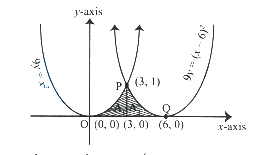
0 likesView Solution
Vedclass Products
For Students
Vedclass Test Series
Mock tests in real AP EAMCET style covering Mathematics with performance analysis. 5-day free trial.
Start Free TrialFor Teachers
Exam Paper Generator
Generate Set A/B/C/D Mathematics papers from 7.5L+ questions in 2 minutes. 3 chapters free.
Try FreeFor Institutes
Online Exam Module
Run live AP EAMCET mock exams with unlimited students, 360° analytics & white-label branding.
See DemoFrequently Asked Questions
How many Mathematics questions are in AP EAMCET 2023?
There are 720 Mathematics questions from the AP EAMCET 2023 paper on Vedclass, each with a detailed step-by-step solution in Gujarati.
Are AP EAMCET 2023 Mathematics solutions available in Gujarati?
Yes. All solutions on this page are in Gujarati. You can also switch to English or Hindi using the language buttons above the questions.
Can I practice AP EAMCET 2023 Mathematics as a timed test?
Yes. Use the Vedclass Test Series to attempt a full AP EAMCET mock test covering Mathematics with time limits and instant score analysis.
Can teachers create Mathematics papers from AP EAMCET previous year questions?
Yes. The Vedclass Exam Paper Generator lets teachers mix AP EAMCET Mathematics questions and generate Set A/B/C/D papers in minutes.
For Teachers & Institutes
Build a Custom Mathematics Paper
Pick AP EAMCET 2023 Mathematics questions, set difficulty, and generate Set A/B/C/D in 2 minutes.