
ChemistryQ1–100 of 414 questions
Page 1 of 5 · English
1
ChemistryMCQAP EAMCET · 2023
The amplitude of a wave represented by the displacement equation $y = \frac{1}{\sqrt{a}}\sin \omega t \pm \frac{1}{\sqrt{b}}\cos \omega t$ will be
A
$\frac{a + b}{ab}$
B
$\frac{\sqrt{a} + \sqrt{b}}{ab}$
C
$\frac{\sqrt{a} \pm \sqrt{b}}{ab}$
D
$\sqrt{\frac{a + b}{ab}}$
Solution
(D) The given equation is $y = \frac{1}{\sqrt{a}}\sin \omega t \pm \frac{1}{\sqrt{b}}\cos \omega t$.
We know that $\cos \omega t = \sin(\omega t + \frac{\pi}{2})$.
Substituting this,the equation becomes $y = \frac{1}{\sqrt{a}}\sin \omega t \pm \frac{1}{\sqrt{b}}\sin(\omega t + \frac{\pi}{2})$.
This represents the superposition of two simple harmonic motions with amplitudes $A_1 = \frac{1}{\sqrt{a}}$ and $A_2 = \frac{1}{\sqrt{b}}$,and a phase difference of $\phi = \frac{\pi}{2}$.
The resultant amplitude $A$ is given by $A = \sqrt{A_1^2 + A_2^2 + 2A_1A_2 \cos \phi}$.
Since $\cos(\frac{\pi}{2}) = 0$,the resultant amplitude is $A = \sqrt{A_1^2 + A_2^2}$.
Substituting the values: $A = \sqrt{(\frac{1}{\sqrt{a}})^2 + (\frac{1}{\sqrt{b}})^2} = \sqrt{\frac{1}{a} + \frac{1}{b}} = \sqrt{\frac{a + b}{ab}}$.
We know that $\cos \omega t = \sin(\omega t + \frac{\pi}{2})$.
Substituting this,the equation becomes $y = \frac{1}{\sqrt{a}}\sin \omega t \pm \frac{1}{\sqrt{b}}\sin(\omega t + \frac{\pi}{2})$.
This represents the superposition of two simple harmonic motions with amplitudes $A_1 = \frac{1}{\sqrt{a}}$ and $A_2 = \frac{1}{\sqrt{b}}$,and a phase difference of $\phi = \frac{\pi}{2}$.
The resultant amplitude $A$ is given by $A = \sqrt{A_1^2 + A_2^2 + 2A_1A_2 \cos \phi}$.
Since $\cos(\frac{\pi}{2}) = 0$,the resultant amplitude is $A = \sqrt{A_1^2 + A_2^2}$.
Substituting the values: $A = \sqrt{(\frac{1}{\sqrt{a}})^2 + (\frac{1}{\sqrt{b}})^2} = \sqrt{\frac{1}{a} + \frac{1}{b}} = \sqrt{\frac{a + b}{ab}}$.
0 likesView Solution
2
ChemistryMCQAP EAMCET · 2023
The frequency of a light ray is $6 \times 10^{14} \ Hz$. Its frequency when it propagates in a medium of refractive index $1.5$ will be:
A
$1.67 \times 10^{14} \ Hz$
B
$9.10 \times 10^{14} \ Hz$
C
$6 \times 10^{14} \ Hz$
D
$4 \times 10^{14} \ Hz$
Solution
(C) The frequency of a light wave is a characteristic property of the source of light and does not depend on the medium through which it propagates.
When light travels from one medium to another,its speed and wavelength change,but its frequency remains constant.
Therefore,the frequency of the light ray in the medium of refractive index $1.5$ will remain the same as its frequency in vacuum (or air),which is $6 \times 10^{14} \ Hz$.
When light travels from one medium to another,its speed and wavelength change,but its frequency remains constant.
Therefore,the frequency of the light ray in the medium of refractive index $1.5$ will remain the same as its frequency in vacuum (or air),which is $6 \times 10^{14} \ Hz$.
0 likesView Solution
3
ChemistryMediumMCQAP EAMCET · 2023
The correct order of $C-O$ bond length among $CO, CO_3^{2-}, CO_2$ is
A
$CO < CO_3^{2-} < CO_2$
B
$CO_3^{2-} < CO_2 < CO$
C
$CO < CO_2 < CO_3^{2-}$
D
$CO_2 < CO_3^{2-} < CO$
Solution
(C) Bond length is inversely proportional to bond order. Higher bond order results in shorter bond length.
$1.$ In $CO$, the bond order is $3$ $(:C \equiv O:^+)$, so the bond length is shortest $(112.8 \ pm)$.
$2.$ In $CO_2$, the bond order is $2$ $(O=C=O)$, so the bond length is intermediate $(122 \ pm)$.
$3.$ In $CO_3^{2-}$, the carbon atom is $sp^2$ hybridized and exhibits resonance. The bond order is $1.33$, which is the lowest, resulting in the longest bond length $(136 \ pm)$.
Therefore, the correct order of increasing bond length is $CO < CO_2 < CO_3^{2-}$.
$1.$ In $CO$, the bond order is $3$ $(:C \equiv O:^+)$, so the bond length is shortest $(112.8 \ pm)$.
$2.$ In $CO_2$, the bond order is $2$ $(O=C=O)$, so the bond length is intermediate $(122 \ pm)$.
$3.$ In $CO_3^{2-}$, the carbon atom is $sp^2$ hybridized and exhibits resonance. The bond order is $1.33$, which is the lowest, resulting in the longest bond length $(136 \ pm)$.
Therefore, the correct order of increasing bond length is $CO < CO_2 < CO_3^{2-}$.
0 likesView Solution
4
ChemistryMCQAP EAMCET · 2023
$A$ ball moving with velocity $2 \ m/s$ collides head-on with another stationary ball of double the mass. If the coefficient of restitution is $0.5$,then their velocities (in $m/s$) after collision will be
A
$0, 1$
B
$1, 1$
C
$1, 0.5$
D
$0, 2$
Solution
(A) Given: $m_{1} = m$,$m_{2} = 2m$,$u_{1} = 2 \ m/s$,$u_{2} = 0$,and coefficient of restitution $e = 0.5$.
Let $v_{1}$ and $v_{2}$ be the velocities after collision.
Applying the law of conservation of linear momentum:
$m_{1}u_{1} + m_{2}u_{2} = m_{1}v_{1} + m_{2}v_{2}$
$m(2) + 2m(0) = mv_{1} + 2mv_{2}$
$2 = v_{1} + 2v_{2} \quad ...(i)$
By the definition of the coefficient of restitution:
$e = \frac{v_{2} - v_{1}}{u_{1} - u_{2}}$
$0.5 = \frac{v_{2} - v_{1}}{2 - 0}$
$1 = v_{2} - v_{1} \quad ...(ii)$
Adding equations $(i)$ and $(ii)$:
$(v_{1} + 2v_{2}) + (v_{2} - v_{1}) = 2 + 1$
$3v_{2} = 3 \implies v_{2} = 1 \ m/s$
Substituting $v_{2} = 1$ in equation $(ii)$:
$1 = 1 - v_{1} \implies v_{1} = 0 \ m/s$
Thus,the velocities after collision are $0 \ m/s$ and $1 \ m/s$.
Let $v_{1}$ and $v_{2}$ be the velocities after collision.
Applying the law of conservation of linear momentum:
$m_{1}u_{1} + m_{2}u_{2} = m_{1}v_{1} + m_{2}v_{2}$
$m(2) + 2m(0) = mv_{1} + 2mv_{2}$
$2 = v_{1} + 2v_{2} \quad ...(i)$
By the definition of the coefficient of restitution:
$e = \frac{v_{2} - v_{1}}{u_{1} - u_{2}}$
$0.5 = \frac{v_{2} - v_{1}}{2 - 0}$
$1 = v_{2} - v_{1} \quad ...(ii)$
Adding equations $(i)$ and $(ii)$:
$(v_{1} + 2v_{2}) + (v_{2} - v_{1}) = 2 + 1$
$3v_{2} = 3 \implies v_{2} = 1 \ m/s$
Substituting $v_{2} = 1$ in equation $(ii)$:
$1 = 1 - v_{1} \implies v_{1} = 0 \ m/s$
Thus,the velocities after collision are $0 \ m/s$ and $1 \ m/s$.
0 likesView Solution
5
ChemistryMCQAP EAMCET · 2023
The amplitude of a wave represented by the displacement equation $y = \frac{1}{\sqrt{a}} \sin \omega t \pm \frac{1}{\sqrt{b}} \cos \omega t$ will be
A
$\frac{a + b}{ab}$
B
$\frac{\sqrt{a} + \sqrt{b}}{ab}$
C
$\frac{\sqrt{a} \pm \sqrt{b}}{ab}$
D
$\sqrt{\frac{a + b}{ab}}$
Solution
(D) The given equation is $y = \frac{1}{\sqrt{a}} \sin \omega t \pm \frac{1}{\sqrt{b}} \cos \omega t$.
We can rewrite $\cos \omega t$ as $\sin(\omega t + \frac{\pi}{2})$.
Thus,$y = \frac{1}{\sqrt{a}} \sin \omega t \pm \frac{1}{\sqrt{b}} \sin(\omega t + \frac{\pi}{2})$.
This represents the superposition of two simple harmonic motions with amplitudes $A_1 = \frac{1}{\sqrt{a}}$ and $A_2 = \frac{1}{\sqrt{b}}$,and a phase difference of $\phi = \frac{\pi}{2}$.
The resultant amplitude $A$ is given by $A = \sqrt{A_1^2 + A_2^2 + 2A_1A_2 \cos \phi}$.
Since $\cos(\frac{\pi}{2}) = 0$,the formula simplifies to $A = \sqrt{A_1^2 + A_2^2}$.
Substituting the values,$A = \sqrt{(\frac{1}{\sqrt{a}})^2 + (\frac{1}{\sqrt{b}})^2} = \sqrt{\frac{1}{a} + \frac{1}{b}}$.
Simplifying the expression,$A = \sqrt{\frac{a + b}{ab}}$.
We can rewrite $\cos \omega t$ as $\sin(\omega t + \frac{\pi}{2})$.
Thus,$y = \frac{1}{\sqrt{a}} \sin \omega t \pm \frac{1}{\sqrt{b}} \sin(\omega t + \frac{\pi}{2})$.
This represents the superposition of two simple harmonic motions with amplitudes $A_1 = \frac{1}{\sqrt{a}}$ and $A_2 = \frac{1}{\sqrt{b}}$,and a phase difference of $\phi = \frac{\pi}{2}$.
The resultant amplitude $A$ is given by $A = \sqrt{A_1^2 + A_2^2 + 2A_1A_2 \cos \phi}$.
Since $\cos(\frac{\pi}{2}) = 0$,the formula simplifies to $A = \sqrt{A_1^2 + A_2^2}$.
Substituting the values,$A = \sqrt{(\frac{1}{\sqrt{a}})^2 + (\frac{1}{\sqrt{b}})^2} = \sqrt{\frac{1}{a} + \frac{1}{b}}$.
Simplifying the expression,$A = \sqrt{\frac{a + b}{ab}}$.
0 likesView Solution
6
ChemistryMCQAP EAMCET · 2023
The correct order of $C-O$ bond length in $CO$,$CO_3^{2-}$ and $CO_2$ is:
A
$CO_3^{2-} < CO_2 < CO$
B
$CO_2 < CO_3^{2-} < CO$
C
$CO < CO_3^{2-} < CO_2$
D
$CO < CO_2 < CO_3^{2-}$
Solution
(D) The bond length is inversely proportional to the bond order. Higher bond order implies a shorter bond length.
$1$. In $CO$,the bond order is $3.0$.
$2$. In $CO_2$,the bond order is $2.0$.
$3$. In $CO_3^{2-}$,the bond order is $1.33$ (due to resonance).
Thus,the bond order order is $CO > CO_2 > CO_3^{2-}$.
Therefore,the bond length order is $CO < CO_2 < CO_3^{2-}$.
$1$. In $CO$,the bond order is $3.0$.
$2$. In $CO_2$,the bond order is $2.0$.
$3$. In $CO_3^{2-}$,the bond order is $1.33$ (due to resonance).
Thus,the bond order order is $CO > CO_2 > CO_3^{2-}$.
Therefore,the bond length order is $CO < CO_2 < CO_3^{2-}$.
0 likesView Solution
7
ChemistryMCQAP EAMCET · 2023
$A$ ball moving with velocity $2 \, m/s$ collides head-on with another stationary ball of double the mass. If the coefficient of restitution is $0.5$,then their velocities (in $m/s$) after collision will be
A
$0, 1$
B
$1, 1$
C
$1, 0.5$
D
$0, 2$
Solution
(A) Given: $m_1 = m$,$m_2 = 2m$,$u_1 = 2 \, m/s$,$u_2 = 0$,and $e = 0.5$.
Applying the law of conservation of linear momentum:
$m_1 u_1 + m_2 u_2 = m_1 v_1 + m_2 v_2$
$m(2) + 2m(0) = m v_1 + 2m v_2$
$2m = m v_1 + 2m v_2 \implies v_1 + 2v_2 = 2$ $...(i)$
Using the definition of the coefficient of restitution:
$e = \frac{v_2 - v_1}{u_1 - u_2}$
$0.5 = \frac{v_2 - v_1}{2 - 0}$
$v_2 - v_1 = 1$ $...(ii)$
Adding equations $(i)$ and $(ii)$:
$(v_1 + 2v_2) + (v_2 - v_1) = 2 + 1$
$3v_2 = 3 \implies v_2 = 1 \, m/s$
Substituting $v_2 = 1$ into equation $(ii)$:
$1 - v_1 = 1 \implies v_1 = 0 \, m/s$
Thus,the velocities after collision are $0 \, m/s$ and $1 \, m/s$.
Applying the law of conservation of linear momentum:
$m_1 u_1 + m_2 u_2 = m_1 v_1 + m_2 v_2$
$m(2) + 2m(0) = m v_1 + 2m v_2$
$2m = m v_1 + 2m v_2 \implies v_1 + 2v_2 = 2$ $...(i)$
Using the definition of the coefficient of restitution:
$e = \frac{v_2 - v_1}{u_1 - u_2}$
$0.5 = \frac{v_2 - v_1}{2 - 0}$
$v_2 - v_1 = 1$ $...(ii)$
Adding equations $(i)$ and $(ii)$:
$(v_1 + 2v_2) + (v_2 - v_1) = 2 + 1$
$3v_2 = 3 \implies v_2 = 1 \, m/s$
Substituting $v_2 = 1$ into equation $(ii)$:
$1 - v_1 = 1 \implies v_1 = 0 \, m/s$
Thus,the velocities after collision are $0 \, m/s$ and $1 \, m/s$.
0 likesView Solution
8
ChemistryMediumMCQAP EAMCET · 2023
What is '$X$' in the following reaction?

A
$1,4-$phenylenediacetic acid
B
Terephthalic acid (benzene$-1,4-$dicarboxylic acid)
C
$4-$ethylbenzoic acid
D
$4-$acetylbenzoic acid
Solution
(B) The reaction involves the oxidation of alkyl groups attached to a benzene ring using alkaline $KMnO_4$ followed by acidic workup $(H_3O^+)$.
Alkaline $KMnO_4$ is a strong oxidizing agent that oxidizes any alkyl side chain attached to the benzene ring to a carboxylic acid group $(-COOH)$,provided that the benzylic carbon has at least one hydrogen atom.
In the given reactant,$1$-ethyl-$4$-methylbenzene,both the ethyl group $(-CH_2CH_3)$ and the methyl group $(-CH_3)$ are attached to the benzene ring at the $1$ and $4$ positions.
Both of these alkyl groups have benzylic hydrogens,so both will be oxidized to carboxylic acid groups.
Therefore,the product $X$ is benzene-$1,4$-dicarboxylic acid,also known as terephthalic acid.
Alkaline $KMnO_4$ is a strong oxidizing agent that oxidizes any alkyl side chain attached to the benzene ring to a carboxylic acid group $(-COOH)$,provided that the benzylic carbon has at least one hydrogen atom.
In the given reactant,$1$-ethyl-$4$-methylbenzene,both the ethyl group $(-CH_2CH_3)$ and the methyl group $(-CH_3)$ are attached to the benzene ring at the $1$ and $4$ positions.
Both of these alkyl groups have benzylic hydrogens,so both will be oxidized to carboxylic acid groups.
Therefore,the product $X$ is benzene-$1,4$-dicarboxylic acid,also known as terephthalic acid.
0 likesView Solution
9
ChemistryEasyMCQAP EAMCET · 2023
Identify the incorrectly matched set from the following:
A
Molecules with incomplete octet: $BeH_2, BCl_3$
B
Polar molecules: $BF_3, CCl_4$
C
Molecules with expanded octet: $PCl_5, SF_6$
D
Odd electron molecules: $NO, NO_2$
Solution
(B) $BF_3$ and $CCl_4$ are non-polar molecules due to their symmetrical geometry,which leads to the cancellation of individual bond dipoles,resulting in a net dipole moment of $\mu = 0$. Therefore,the set containing $BF_3$ and $CCl_4$ as polar molecules is incorrectly matched.
0 likesView Solution
10
ChemistryEasyMCQAP EAMCET · 2023
The number of bond pairs of electrons and the total number of lone pairs of electrons in $XeOF_4$ are respectively:
A
$6, 10$
B
$5, 15$
C
$5, 10$
D
$6, 15$
Solution
(D) In the $XeOF_4$ molecule,the central atom $Xe$ is bonded to four $F$ atoms via single bonds and one $O$ atom via a double bond.
Thus,the total number of bond pairs is $4 + 2 = 6$.
Regarding lone pairs:
- Each of the four $F$ atoms has $3$ lone pairs $(4 \times 3 = 12)$.
- The $O$ atom has $2$ lone pairs.
- The $Xe$ atom has $1$ lone pair.
Total lone pairs $= 12 + 2 + 1 = 15$.
Thus,the total number of bond pairs is $4 + 2 = 6$.
Regarding lone pairs:
- Each of the four $F$ atoms has $3$ lone pairs $(4 \times 3 = 12)$.
- The $O$ atom has $2$ lone pairs.
- The $Xe$ atom has $1$ lone pair.
Total lone pairs $= 12 + 2 + 1 = 15$.
0 likesView Solution
11
ChemistryMediumMCQAP EAMCET · 2023
Which of the following is the correct order of increasing number of lone pair of electrons on the central atom?
A
$IF_5 < XeF_2 < IF_7 < ClF_3$
B
$IF_7 < ClF_3 < XeF_2 < IF_5$
C
$IF_7 < XeF_2 < ClF_3 < IF_5$
D
$IF_7 < IF_5 < ClF_3 < XeF_2$
Solution
(D) To determine the number of lone pairs on the central atom,we use the formula: $\text{Lone pairs} = \frac{V - N}{2}$,where $V$ is the number of valence electrons of the central atom and $N$ is the number of monovalent atoms bonded to it.
$1$. For $IF_7$: Central atom $I$ has $7$ valence electrons. It forms $7$ bonds with $F$ atoms. $\text{Lone pairs} = \frac{7 - 7}{2} = 0$.
$2$. For $IF_5$: Central atom $I$ has $7$ valence electrons. It forms $5$ bonds with $F$ atoms. $\text{Lone pairs} = \frac{7 - 5}{2} = 1$.
$3$. For $ClF_3$: Central atom $Cl$ has $7$ valence electrons. It forms $3$ bonds with $F$ atoms. $\text{Lone pairs} = \frac{7 - 3}{2} = 2$.
$4$. For $XeF_2$: Central atom $Xe$ has $8$ valence electrons. It forms $2$ bonds with $F$ atoms. $\text{Lone pairs} = \frac{8 - 2}{2} = 3$.
The number of lone pairs is: $IF_7 (0) < IF_5 (1) < ClF_3 (2) < XeF_2 (3)$.
Thus,the correct order is $IF_7 < IF_5 < ClF_3 < XeF_2$.
$1$. For $IF_7$: Central atom $I$ has $7$ valence electrons. It forms $7$ bonds with $F$ atoms. $\text{Lone pairs} = \frac{7 - 7}{2} = 0$.
$2$. For $IF_5$: Central atom $I$ has $7$ valence electrons. It forms $5$ bonds with $F$ atoms. $\text{Lone pairs} = \frac{7 - 5}{2} = 1$.
$3$. For $ClF_3$: Central atom $Cl$ has $7$ valence electrons. It forms $3$ bonds with $F$ atoms. $\text{Lone pairs} = \frac{7 - 3}{2} = 2$.
$4$. For $XeF_2$: Central atom $Xe$ has $8$ valence electrons. It forms $2$ bonds with $F$ atoms. $\text{Lone pairs} = \frac{8 - 2}{2} = 3$.
The number of lone pairs is: $IF_7 (0) < IF_5 (1) < ClF_3 (2) < XeF_2 (3)$.
Thus,the correct order is $IF_7 < IF_5 < ClF_3 < XeF_2$.
0 likesView Solution
12
ChemistryMediumMCQAP EAMCET · 2023
Which of the following sets is correct based on the table provided below?
| Molecule | Hybridization | Geometry | Number of lone pairs of electrons on central atom | |
|---|---|---|---|---|
| $I$ | $SiH_4$ | $sp^3$ | tetrahedral | $0$ |
| $II$ | $BeCl_2$ | $sp^2$ | linear | $1$ |
| $III$ | $SF_4$ | $dsp^3$ | square planar | $1$ |
| $IV$ | $SnCl_2$ | $sp$ | linear | $0$ |
A
$I$
B
$II$
C
$III$
D
$IV$
Solution
(A) $I$: $SiH_4$ has $Si$ in $sp^3$ hybridization with $0$ lone pairs,resulting in a tetrahedral geometry. This is correct.
$II$: $BeCl_2$ has $Be$ in $sp$ hybridization with $0$ lone pairs,resulting in a linear geometry. The table incorrectly states $sp^2$ and $1$ lone pair.
$III$: $SF_4$ has $S$ in $sp^3d$ hybridization with $1$ lone pair,resulting in a see-saw geometry. The table incorrectly states $dsp^3$ and square planar geometry.
$IV$: $SnCl_2$ has $Sn$ in $sp^2$ hybridization with $1$ lone pair,resulting in an angular (bent) geometry. The table incorrectly states $sp$ and linear geometry.
Therefore,only set $I$ is correct.
$II$: $BeCl_2$ has $Be$ in $sp$ hybridization with $0$ lone pairs,resulting in a linear geometry. The table incorrectly states $sp^2$ and $1$ lone pair.
$III$: $SF_4$ has $S$ in $sp^3d$ hybridization with $1$ lone pair,resulting in a see-saw geometry. The table incorrectly states $dsp^3$ and square planar geometry.
$IV$: $SnCl_2$ has $Sn$ in $sp^2$ hybridization with $1$ lone pair,resulting in an angular (bent) geometry. The table incorrectly states $sp$ and linear geometry.
Therefore,only set $I$ is correct.
0 likesView Solution
13
ChemistryEasyMCQAP EAMCET · 2023
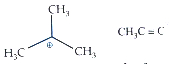
The hybridization of the positively charged carbon and the negatively charged carbon in the following structures are respectively:
A
$sp^2, sp$
B
$sp^2, sp^2$
C
$sp^3, sp^3$
D
$sp^3, sp^2$
Solution
(D) The positively charged carbon (carbocation) is bonded to three other atoms and has no lone pairs. The number of hybrid orbitals = $3 \text{ (bond pairs)} + 0 \text{ (lone pairs)} = 3$,which corresponds to $sp^2$ hybridization.
The negatively charged carbon (carbanion) is bonded to three other atoms and has one lone pair. The number of hybrid orbitals = $3 \text{ (bond pairs)} + 1 \text{ (lone pair)} = 4$,which corresponds to $sp^3$ hybridization.
Therefore,the hybridization is $sp^2$ and $sp^3$ respectively.
The negatively charged carbon (carbanion) is bonded to three other atoms and has one lone pair. The number of hybrid orbitals = $3 \text{ (bond pairs)} + 1 \text{ (lone pair)} = 4$,which corresponds to $sp^3$ hybridization.
Therefore,the hybridization is $sp^2$ and $sp^3$ respectively.
0 likesView Solution
14
ChemistryMediumMCQAP EAMCET · 2023
Match the following molecules/ions in List-$I$ with the number of lone pairs of electrons on the central atom in List-$II$.
| List-$I$ (molecule/ion) | List-$II$ (Number of lone pairs of electrons on the central atom) |
|---|---|
| $(A)$ $XeF_2$ | $(I)$ $2$ |
| $(B)$ $XeO_3$ | $(II)$ $0$ |
| $(C)$ $XeF_4$ | $(III)$ $3$ |
| $(D)$ $PF_6^-$ | $(IV)$ $1$ |
A
$A-III, B-IV, C-I, D-II$
B
$A-I, B-II, C-IV, D-III$
C
$A-II, B-I, C-III, D-IV$
D
$A-III, B-IV, C-II, D-I$
Solution
(A) To determine the number of lone pairs on the central atom,we use the formula: $\text{Lone pairs} = \frac{V - M - C + A}{2}$,where $V$ is the number of valence electrons of the central atom,$M$ is the number of monovalent atoms,$C$ is the cationic charge,and $A$ is the anionic charge.
$(A)$ For $XeF_2$: $V=8, M=2, C=0, A=0$. $\text{Lone pairs} = \frac{8-2}{2} = 3$. Thus,$A-III$.
$(B)$ For $XeO_3$: $V=8, M=0$ (Oxygen is divalent),$C=0, A=0$. $\text{Lone pairs} = \frac{8-0}{2} = 4$ valence electrons involved in bonding,but since $O$ is divalent,$3$ double bonds use $6$ electrons,leaving $1$ lone pair. Thus,$B-IV$.
$(C)$ For $XeF_4$: $V=8, M=4, C=0, A=0$. $\text{Lone pairs} = \frac{8-4}{2} = 2$. Thus,$C-I$.
$(D)$ For $PF_6^-$: $V=5, M=6, C=0, A=1$. $\text{Lone pairs} = \frac{5-6+1}{2} = 0$. Thus,$D-II$.
The correct matching is $A-III, B-IV, C-I, D-II$.
$(A)$ For $XeF_2$: $V=8, M=2, C=0, A=0$. $\text{Lone pairs} = \frac{8-2}{2} = 3$. Thus,$A-III$.
$(B)$ For $XeO_3$: $V=8, M=0$ (Oxygen is divalent),$C=0, A=0$. $\text{Lone pairs} = \frac{8-0}{2} = 4$ valence electrons involved in bonding,but since $O$ is divalent,$3$ double bonds use $6$ electrons,leaving $1$ lone pair. Thus,$B-IV$.
$(C)$ For $XeF_4$: $V=8, M=4, C=0, A=0$. $\text{Lone pairs} = \frac{8-4}{2} = 2$. Thus,$C-I$.
$(D)$ For $PF_6^-$: $V=5, M=6, C=0, A=1$. $\text{Lone pairs} = \frac{5-6+1}{2} = 0$. Thus,$D-II$.
The correct matching is $A-III, B-IV, C-I, D-II$.
0 likesView Solution
15
ChemistryMediumMCQAP EAMCET · 2023
Match the following:
$($Molecule$/$Ion$)$ $($Shape$)$
$A. I_3^- \rightarrow 4.$ Linear
$B. ClF_3 \rightarrow 1.$ $T-$shaped
$C. H_2O \rightarrow 3.$ Angular
$D. SF_4 \rightarrow 2.$ See$-$Saw
$($Molecule$/$Ion$)$ $($Shape$)$
$A. I_3^- \rightarrow 4.$ Linear
$B. ClF_3 \rightarrow 1.$ $T-$shaped
$C. H_2O \rightarrow 3.$ Angular
$D. SF_4 \rightarrow 2.$ See$-$Saw
A
$A-4, B-1, C-3, D-2$
B
$A-4, B-1, C-2, D-3$
C
$A-2, B-3, C-4, D-1$
D
$A-3, B-2, C-4, D-1$
Solution
$ (A) $ The shapes of the given molecules/ions are determined by $VSEPR$ theory:
$A. I_3^-$: The central iodine atom has $3$ lone pairs and $2$ bond pairs, resulting in a linear geometry ($sp^3d$ hybridization). Thus, $A-4$.
$B. ClF_3$: The central chlorine atom has $2$ lone pairs and $3$ bond pairs, resulting in a $T$-shaped geometry ($sp^3d$ hybridization). Thus, $B-1$.
$C. H_2O$: The central oxygen atom has $2$ lone pairs and $2$ bond pairs, resulting in an angular or bent geometry ($sp^3$ hybridization). Thus, $C-3$.
$D. SF_4$: The central sulfur atom has $1$ lone pair and $4$ bond pairs, resulting in a see-saw geometry ($sp^3d$ hybridization). Thus, $D-2$.
Therefore, the correct matching is $A-4, B-1, C-3, D-2$.
$A. I_3^-$: The central iodine atom has $3$ lone pairs and $2$ bond pairs, resulting in a linear geometry ($sp^3d$ hybridization). Thus, $A-4$.
$B. ClF_3$: The central chlorine atom has $2$ lone pairs and $3$ bond pairs, resulting in a $T$-shaped geometry ($sp^3d$ hybridization). Thus, $B-1$.
$C. H_2O$: The central oxygen atom has $2$ lone pairs and $2$ bond pairs, resulting in an angular or bent geometry ($sp^3$ hybridization). Thus, $C-3$.
$D. SF_4$: The central sulfur atom has $1$ lone pair and $4$ bond pairs, resulting in a see-saw geometry ($sp^3d$ hybridization). Thus, $D-2$.
Therefore, the correct matching is $A-4, B-1, C-3, D-2$.
0 likesView Solution
16
ChemistryMediumMCQAP EAMCET · 2023
The hybridization of the central atom of $ClF_3$,$NH_3$,and $SO_3$ are respectively:
A
$sp^2, sp^2, sp^2$
B
$sp^3d, sp^3, sp^2$
C
$sp^2, sp^3, sp^3d$
D
$sp^3d, sp^3, sp^3$
Solution
(B) To determine the hybridization,we calculate the steric number $(SN)$ using the formula: $SN = \text{number of sigma bonds} + \text{number of lone pairs}$.
$1$. For $ClF_3$: The central atom $Cl$ has $3$ bond pairs and $2$ lone pairs. $SN = 3 + 2 = 5$,which corresponds to $sp^3d$ hybridization.
$2$. For $NH_3$: The central atom $N$ has $3$ bond pairs and $1$ lone pair. $SN = 3 + 1 = 4$,which corresponds to $sp^3$ hybridization.
$3$. For $SO_3$: The central atom $S$ has $3$ bond pairs and $0$ lone pairs. $SN = 3 + 0 = 3$,which corresponds to $sp^2$ hybridization.
Thus,the hybridizations are $sp^3d, sp^3, sp^2$ respectively.
$1$. For $ClF_3$: The central atom $Cl$ has $3$ bond pairs and $2$ lone pairs. $SN = 3 + 2 = 5$,which corresponds to $sp^3d$ hybridization.
$2$. For $NH_3$: The central atom $N$ has $3$ bond pairs and $1$ lone pair. $SN = 3 + 1 = 4$,which corresponds to $sp^3$ hybridization.
$3$. For $SO_3$: The central atom $S$ has $3$ bond pairs and $0$ lone pairs. $SN = 3 + 0 = 3$,which corresponds to $sp^2$ hybridization.
Thus,the hybridizations are $sp^3d, sp^3, sp^2$ respectively.
0 likesView Solution
17
ChemistryMediumMCQAP EAMCET · 2023
Match the following List-$I$ (Hybridisation) with List-$II$ (Shape):
| List-$I$ (Hybridisation) | List-$II$ (Shape) |
|---|---|
| $A$. $dsp^2$ | $I$. Square planar |
| $B$. $sp^3$ | $II$. Tetrahedral |
| $C$. $d^2sp^3$ | $III$. Octahedral |
| $D$. $sp^3d$ | $IV$. Trigonal bipyramidal |
A
$A-II, B-I, C-III, D-IV$
B
$A-I, B-II, C-III, D-IV$
C
$A-III, B-IV, C-II, D-I$
D
$A-IV, B-III, C-II, D-I$
Solution
(B) . $dsp^2$ hybridisation corresponds to a square planar shape.
$B$. $sp^3$ hybridisation corresponds to a tetrahedral shape.
$C$. $d^2sp^3$ hybridisation corresponds to an octahedral shape.
$D$. $sp^3d$ hybridisation corresponds to a trigonal bipyramidal shape.
Therefore,the correct matching is $A-I, B-II, C-III, D-IV$.
$B$. $sp^3$ hybridisation corresponds to a tetrahedral shape.
$C$. $d^2sp^3$ hybridisation corresponds to an octahedral shape.
$D$. $sp^3d$ hybridisation corresponds to a trigonal bipyramidal shape.
Therefore,the correct matching is $A-I, B-II, C-III, D-IV$.
0 likesView Solution
18
ChemistryMediumMCQAP EAMCET · 2023
Which of the following pairs of molecules is isostructural?
A
$HgCl_2, SO_2$
B
$SnCl_2, PbCl_2$
C
$SF_4, XeF_4$
D
$NH_3, SO_3$
Solution
(B) $Sn$ and $Pb$ both belong to group $14$ of the periodic table.
Both $SnCl_2$ and $PbCl_2$ have a central atom with $2$ bond pairs and $1$ lone pair,resulting in a bent or angular molecular geometry.
Therefore,they are isostructural.
Both $SnCl_2$ and $PbCl_2$ have a central atom with $2$ bond pairs and $1$ lone pair,resulting in a bent or angular molecular geometry.
Therefore,they are isostructural.
0 likesView Solution
19
ChemistryEasyMCQAP EAMCET · 2023
The $O-H$ bond length in $H_2O$ in the gas phase is: (in $pm$)
A
$95.7$
B
$90.2$
C
$104.5$
D
$115.5$
Solution
(A) In the gas phase, the water molecule $(H_2O)$ has a bent geometry.
Experimental data shows that the $O-H$ bond length is $95.7 \ pm$ and the bond angle is $104.5^{\circ}$.
Experimental data shows that the $O-H$ bond length is $95.7 \ pm$ and the bond angle is $104.5^{\circ}$.
0 likesView Solution
20
ChemistryMediumMCQAP EAMCET · 2023
If the bond order in $C_2$ is '$x$',then the bond order in $B_2$ and $O_2$,respectively,are
A
$\frac{1}{2} x, 2 x$
B
$x, x$
C
$\frac{1}{2} x, x$
D
$x, 2 x$
Solution
(C) The bond order $(B.O.)$ is calculated as $B.O. = \frac{N_b - N_a}{2}$,where $N_b$ is the number of bonding electrons and $N_a$ is the number of antibonding electrons.
For $C_2$ ($12$ electrons): $\sigma 1s^2, \sigma^* 1s^2, \sigma 2s^2, \sigma^* 2s^2, \pi 2p_x^2, \pi 2p_y^2$. $B.O. = \frac{8 - 4}{2} = 2$. Thus,$x = 2$.
For $B_2$ ($10$ electrons): $\sigma 1s^2, \sigma^* 1s^2, \sigma 2s^2, \sigma^* 2s^2, \pi 2p_x^1, \pi 2p_y^1$. $B.O. = \frac{6 - 4}{2} = 1$. Since $x = 2$,$B.O. = \frac{1}{2} x = 1$.
For $O_2$ ($16$ electrons): $\sigma 1s^2, \sigma^* 1s^2, \sigma 2s^2, \sigma^* 2s^2, \sigma 2p_z^2, \pi 2p_x^2, \pi 2p_y^2, \pi^* 2p_x^1, \pi^* 2p_y^1$. $B.O. = \frac{10 - 6}{2} = 2$. Since $x = 2$,$B.O. = x = 2$.
Therefore,the bond orders for $B_2$ and $O_2$ are $\frac{1}{2} x$ and $x$,respectively.
For $C_2$ ($12$ electrons): $\sigma 1s^2, \sigma^* 1s^2, \sigma 2s^2, \sigma^* 2s^2, \pi 2p_x^2, \pi 2p_y^2$. $B.O. = \frac{8 - 4}{2} = 2$. Thus,$x = 2$.
For $B_2$ ($10$ electrons): $\sigma 1s^2, \sigma^* 1s^2, \sigma 2s^2, \sigma^* 2s^2, \pi 2p_x^1, \pi 2p_y^1$. $B.O. = \frac{6 - 4}{2} = 1$. Since $x = 2$,$B.O. = \frac{1}{2} x = 1$.
For $O_2$ ($16$ electrons): $\sigma 1s^2, \sigma^* 1s^2, \sigma 2s^2, \sigma^* 2s^2, \sigma 2p_z^2, \pi 2p_x^2, \pi 2p_y^2, \pi^* 2p_x^1, \pi^* 2p_y^1$. $B.O. = \frac{10 - 6}{2} = 2$. Since $x = 2$,$B.O. = x = 2$.
Therefore,the bond orders for $B_2$ and $O_2$ are $\frac{1}{2} x$ and $x$,respectively.
0 likesView Solution
21
ChemistryMediumMCQAP EAMCET · 2023
The correct order of bond angles of the following is: $H_2O$ $(I)$,$NH_3$ $(II)$,$CH_4$ $(III)$,$SO_2$ $(IV)$
A
$IV > III > II > I$
B
$IV > III > I > II$
C
$I > II > III > IV$
D
$I > II > IV > III$
Solution
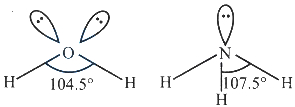
(A) According to $VSEPR$ theory,the bond angle depends on the hybridization and the number of lone pairs on the central atom.1. $SO_2$ $(IV)$: The central atom $S$ is $sp^2$ hybridized with one lone pair. The bond angle is approximately $119.5^\circ$.2. $CH_4$ $(III)$: The central atom $C$ is $sp^3$ hybridized with no lone pairs. It has a perfect tetrahedral bond angle of $109.5^\circ$.3. $NH_3$ $(II)$: The central atom $N$ is $sp^3$ hybridized with one lone pair. Due to lone pair-bond pair repulsion,the bond angle reduces to approximately $107^\circ$.4. $H_2O$ $(I)$: The central atom $O$ is $sp^3$ hybridized with two lone pairs. Due to greater lone pair-lone pair repulsion,the bond angle reduces further to approximately $104.5^\circ$.Therefore,the correct order is: $SO_2$ $(IV)$ $> CH_4$ $(III)$ $> NH_3$ $(II)$ $> H_2O$ $(I)$.
0 likesView Solution
22
ChemistryMediumMCQAP EAMCET · 2023
The $P-P-P$ bond angle in $P_4$ and $S-S-S$ bond angle in cyclo $S_8$ molecule are respectively
A
$60^{\circ}, 107^{\circ}$
B
$60^{\circ}, 40^{\circ}$
C
$107^{\circ}, 60^{\circ}$
D
$40^{\circ}, 60^{\circ}$
Solution
(A) In the $P_4$ molecule,the four phosphorus atoms are arranged at the corners of a regular tetrahedron. The bond angle between any two $P-P$ bonds is $60^{\circ}$.
In the cyclo $S_8$ molecule,the sulfur atoms are arranged in a puckered ring structure often referred to as a crown structure. The bond angle between $S-S-S$ bonds in this structure is approximately $107^{\circ}$.
In the cyclo $S_8$ molecule,the sulfur atoms are arranged in a puckered ring structure often referred to as a crown structure. The bond angle between $S-S-S$ bonds in this structure is approximately $107^{\circ}$.
0 likesView Solution
23
ChemistryMCQAP EAMCET · 2023
The correct order of $C-O$ bond length in $CO$,$CO_3^{2-}$,and $CO_2$ is:
A
$CO < CO_2 < CO_3^{2-}$
B
$CO_3^{2-} < CO_2 < CO$
C
$CO < CO_3^{2-} < CO_2$
D
$CO_2 < CO_3^{2-} < CO$
Solution
(A) The bond length is inversely proportional to the bond order.
$1$. In $CO$,the bond order is $3$ $(C \equiv O)$.
$2$. In $CO_2$,the bond order is $2$ $(O=C=O)$.
$3$. In $CO_3^{2-}$,the bond order is $1.33$ due to resonance.
Since the bond order follows the order $CO > CO_2 > CO_3^{2-}$,the bond length follows the order $CO < CO_2 < CO_3^{2-}$.
$1$. In $CO$,the bond order is $3$ $(C \equiv O)$.
$2$. In $CO_2$,the bond order is $2$ $(O=C=O)$.
$3$. In $CO_3^{2-}$,the bond order is $1.33$ due to resonance.
Since the bond order follows the order $CO > CO_2 > CO_3^{2-}$,the bond length follows the order $CO < CO_2 < CO_3^{2-}$.
0 likesView Solution
24
ChemistryMediumMCQAP EAMCET · 2023
In which of the following,the molecules are arranged in the increasing order of their bond angles?
A
$P_4 < S_6 < O_3 < S_8$
B
$S_6 < O_3 < S_8 < P_4$
C
$O_3 < S_8 < P_4 < S_6$
D
$P_4 < S_6 < S_8 < O_3$
Solution
(D) The bond angles for the given molecules are as follows:
$P_4$: $60^\circ$
$S_6$: $102^\circ$
$S_8$: $107^\circ$
$O_3$: $116^\circ$
Therefore,the increasing order of bond angles is $P_4 < S_6 < S_8 < O_3$.
$P_4$: $60^\circ$
$S_6$: $102^\circ$
$S_8$: $107^\circ$
$O_3$: $116^\circ$
Therefore,the increasing order of bond angles is $P_4 < S_6 < S_8 < O_3$.
0 likesView Solution
25
ChemistryEasyMCQAP EAMCET · 2023
In which of the following,orbitals are correctly arranged in the increasing order of their energies?
A
$4f < 5p < 5d < 6s$
B
$5p < 4f < 6s < 5d$
C
$5p < 6s < 4f < 5d$
D
$5p < 5d < 4f < 6s$
Solution
(C) For multi-electron atoms,the energy of the orbitals increases with an increase in their $(n+l)$ value.
According to the $(n+l)$ rule:
For $5p$: $n=5, l=1$,$(n+l) = 6$
For $6s$: $n=6, l=0$,$(n+l) = 6$
For $4f$: $n=4, l=3$,$(n+l) = 7$
For $5d$: $n=5, l=2$,$(n+l) = 7$
When $(n+l)$ values are equal,the orbital with the lower $n$ value has lower energy.
Comparing $5p$ and $6s$: $5p$ has lower $n$,so $5p < 6s$.
Comparing $4f$ and $5d$: $4f$ has lower $n$,so $4f < 5d$.
Thus,the correct increasing order of energy is: $5p < 6s < 4f < 5d$.
According to the $(n+l)$ rule:
For $5p$: $n=5, l=1$,$(n+l) = 6$
For $6s$: $n=6, l=0$,$(n+l) = 6$
For $4f$: $n=4, l=3$,$(n+l) = 7$
For $5d$: $n=5, l=2$,$(n+l) = 7$
When $(n+l)$ values are equal,the orbital with the lower $n$ value has lower energy.
Comparing $5p$ and $6s$: $5p$ has lower $n$,so $5p < 6s$.
Comparing $4f$ and $5d$: $4f$ has lower $n$,so $4f < 5d$.
Thus,the correct increasing order of energy is: $5p < 6s < 4f < 5d$.
0 likesView Solution
26
ChemistryEasyMCQAP EAMCET · 2023
Relative stability orders of $+1$ and $+3$ oxidation states of $Ga, In, Tl$ are respectively:
A
$Tl^{+} > In^{+} > Ga^{+}, Ga^{3+} > In^{3+} > Tl^{3+}$
B
$Ga^{+} > In^{+} > Tl^{+}, Tl^{3+} > In^{3+} > Ga^{3+}$
C
$Ga^{+} > In^{+} > Tl^{+}, Ga^{3+} > In^{3+} > Tl^{3+}$
D
$Tl^{+} > In^{+} > Ga^{+}, Tl^{3+} > In^{3+} > Ga^{3+}$
Solution
(A) Due to the inert pair effect,the stability of the $+1$ oxidation state increases down the group $13$ elements because the $ns^2$ electrons become more reluctant to participate in bonding.
Thus,the stability order for the $+1$ state is $Tl^{+} > In^{+} > Ga^{+}$.
Conversely,the stability of the $+3$ oxidation state decreases down the group.
Thus,the stability order for the $+3$ state is $Ga^{3+} > In^{3+} > Tl^{3+}$.
Therefore,the correct order is $Tl^{+} > In^{+} > Ga^{+}$ and $Ga^{3+} > In^{3+} > Tl^{3+}$.
Thus,the stability order for the $+1$ state is $Tl^{+} > In^{+} > Ga^{+}$.
Conversely,the stability of the $+3$ oxidation state decreases down the group.
Thus,the stability order for the $+3$ state is $Ga^{3+} > In^{3+} > Tl^{3+}$.
Therefore,the correct order is $Tl^{+} > In^{+} > Ga^{+}$ and $Ga^{3+} > In^{3+} > Tl^{3+}$.
0 likesView Solution
27
ChemistryEasyMCQAP EAMCET · 2023
Which of the following is not the property of covalent substances?
A
have definite shape
B
have low melting points
C
good conductors of electricity
D
soluble in non-polar solvents
Solution
(C) Covalent substances are generally poor conductors of electricity because they do not contain free electrons or ions to carry charge. Therefore,being a good conductor of electricity is not a property of covalent substances.
0 likesView Solution
28
ChemistryEasyMCQAP EAMCET · 2023
Given below are two statements:
Assertion $(A)$: Ionic compounds are formed by non-directional bonds.
Reasoning $(R)$: They are soluble in nonpolar solvents.
The correct answer is:
Assertion $(A)$: Ionic compounds are formed by non-directional bonds.
Reasoning $(R)$: They are soluble in nonpolar solvents.
The correct answer is:
A
Both $(A)$ and $(R)$ are correct and $(R)$ is the correct explanation of $(A)$
B
Both $(A)$ and $(R)$ are correct and $(R)$ is not the correct explanation of $(A)$
C
$(A)$ is correct but $(R)$ is not correct
D
$(A)$ is not correct but $(R)$ is correct
Solution
(C) Ionic bonds are electrostatic forces of attraction that are non-directional in nature,meaning they act in all directions equally. Thus,Assertion $(A)$ is correct.
Ionic compounds are polar in nature and are soluble in polar solvents (like water) due to ion-dipole interactions. They are generally insoluble in nonpolar solvents. Thus,Reasoning $(R)$ is incorrect.
Ionic compounds are polar in nature and are soluble in polar solvents (like water) due to ion-dipole interactions. They are generally insoluble in nonpolar solvents. Thus,Reasoning $(R)$ is incorrect.
0 likesView Solution
29
ChemistryEasyMCQAP EAMCET · 2023
What are the formal charges on the terminal oxygen atoms of the ozone $(O_3)$ molecule?
A
$+1, -1$
B
$+1, +1$
C
$-1, -1$
D
$0, -1$
Solution
(D) The structure of ozone $(O_3)$ consists of a central oxygen atom double-bonded to one terminal oxygen atom and single-bonded to another terminal oxygen atom.
Using the formal charge formula: $FC = V - L - \frac{1}{2}B$,where $V$ is the number of valence electrons,$L$ is the number of lone pair electrons,and $B$ is the number of bonding electrons.
For the central oxygen atom: $FC = 6 - 2 - \frac{1}{2}(6) = +1$.
For the terminal oxygen atom with a double bond: $FC = 6 - 4 - \frac{1}{2}(4) = 0$.
For the terminal oxygen atom with a single bond: $FC = 6 - 6 - \frac{1}{2}(2) = -1$.
Thus,the formal charges on the terminal oxygen atoms are $0$ and $-1$.
Using the formal charge formula: $FC = V - L - \frac{1}{2}B$,where $V$ is the number of valence electrons,$L$ is the number of lone pair electrons,and $B$ is the number of bonding electrons.
For the central oxygen atom: $FC = 6 - 2 - \frac{1}{2}(6) = +1$.
For the terminal oxygen atom with a double bond: $FC = 6 - 4 - \frac{1}{2}(4) = 0$.
For the terminal oxygen atom with a single bond: $FC = 6 - 6 - \frac{1}{2}(2) = -1$.
Thus,the formal charges on the terminal oxygen atoms are $0$ and $-1$.
0 likesView Solution
30
ChemistryMediumMCQAP EAMCET · 2023
Match the following molecules in List-$I$ with their respective dipole moments in List-$II$:
| List-$I$ (Molecules) | List-$II$ (Dipole moment $\mu$,$D$) |
| :--- | :--- |
| $A. \ H_2O$ | $I. \ 0$ |
| $B. \ BF_3$ | $II. \ 0.23$ |
| $C. \ NH_3$ | $III. \ 1.47$ |
| $D. \ NF_3$ | $IV. \ 1.85$ |
| List-$I$ (Molecules) | List-$II$ (Dipole moment $\mu$,$D$) |
| :--- | :--- |
| $A. \ H_2O$ | $I. \ 0$ |
| $B. \ BF_3$ | $II. \ 0.23$ |
| $C. \ NH_3$ | $III. \ 1.47$ |
| $D. \ NF_3$ | $IV. \ 1.85$ |
A
$A-IV, B-I, C-II, D-III$
B
$A-IV, B-I, C-III, D-II$
C
$A-IV, B-III, C-I, D-II$
D
$A-III, B-IV, C-II, D-I$
Solution
(B) The dipole moments of the given molecules are as follows:
$1. \ H_2O$: It has a bent geometry with a high dipole moment of $1.85 \ D$ $(A-IV)$.
$2. \ BF_3$: It has a trigonal planar geometry,making it a symmetric molecule with a net dipole moment of $0 \ D$ $(B-I)$.
$3. \ NH_3$: It has a trigonal pyramidal geometry with a dipole moment of $1.47 \ D$ $(C-III)$.
$4. \ NF_3$: It also has a trigonal pyramidal geometry,but due to the high electronegativity of fluorine,the bond dipoles oppose the lone pair dipole,resulting in a lower dipole moment of $0.23 \ D$ $(D-II)$.
Therefore,the correct matching is $A-IV, B-I, C-III, D-II$.
$1. \ H_2O$: It has a bent geometry with a high dipole moment of $1.85 \ D$ $(A-IV)$.
$2. \ BF_3$: It has a trigonal planar geometry,making it a symmetric molecule with a net dipole moment of $0 \ D$ $(B-I)$.
$3. \ NH_3$: It has a trigonal pyramidal geometry with a dipole moment of $1.47 \ D$ $(C-III)$.
$4. \ NF_3$: It also has a trigonal pyramidal geometry,but due to the high electronegativity of fluorine,the bond dipoles oppose the lone pair dipole,resulting in a lower dipole moment of $0.23 \ D$ $(D-II)$.
Therefore,the correct matching is $A-IV, B-I, C-III, D-II$.
0 likesView Solution
31
ChemistryMediumMCQAP EAMCET · 2023
One mole $H_2O_{(g)}$ and one mole $CO_{(g)}$ are taken in a $1 \ L$ flask and heated to $725 \ K$. At equilibrium,$40 \%$ of water reacted with $CO_{(g)}$ as follows:
$H_2O_{(g)} + CO_{(g)} \rightleftharpoons H_{2(g)} + CO_{2(g)}$
Its $K_c$ value is:
$H_2O_{(g)} + CO_{(g)} \rightleftharpoons H_{2(g)} + CO_{2(g)}$
Its $K_c$ value is:
A
$0.444$
B
$2.22$
C
$0.222$
D
$4.44$
Solution
(A) The reaction is: $H_2O_{(g)} + CO_{(g)} \rightleftharpoons H_{2(g)} + CO_{2(g)}$
Initial moles: $H_2O = 1.0 \ mol$,$CO = 1.0 \ mol$,$H_2 = 0 \ mol$,$CO_2 = 0 \ mol$.
Given that $40 \%$ of water reacts,the moles of $H_2O$ reacted $= 0.4 \times 1.0 = 0.4 \ mol$.
According to the stoichiometry of the reaction,$0.4 \ mol$ of $CO$ will also react,and $0.4 \ mol$ of $H_2$ and $0.4 \ mol$ of $CO_2$ will be formed.
Moles at equilibrium:
$n(H_2O) = 1.0 - 0.4 = 0.6 \ mol$
$n(CO) = 1.0 - 0.4 = 0.6 \ mol$
$n(H_2) = 0.4 \ mol$
$n(CO_2) = 0.4 \ mol$
Since the volume of the flask is $1 \ L$,the concentrations are equal to the number of moles.
$[H_2O] = 0.6 \ M, [CO] = 0.6 \ M, [H_2] = 0.4 \ M, [CO_2] = 0.4 \ M$
$K_c = \frac{[H_2][CO_2]}{[H_2O][CO]} = \frac{0.4 \times 0.4}{0.6 \times 0.6} = \frac{0.16}{0.36} = 0.444$
Initial moles: $H_2O = 1.0 \ mol$,$CO = 1.0 \ mol$,$H_2 = 0 \ mol$,$CO_2 = 0 \ mol$.
Given that $40 \%$ of water reacts,the moles of $H_2O$ reacted $= 0.4 \times 1.0 = 0.4 \ mol$.
According to the stoichiometry of the reaction,$0.4 \ mol$ of $CO$ will also react,and $0.4 \ mol$ of $H_2$ and $0.4 \ mol$ of $CO_2$ will be formed.
Moles at equilibrium:
$n(H_2O) = 1.0 - 0.4 = 0.6 \ mol$
$n(CO) = 1.0 - 0.4 = 0.6 \ mol$
$n(H_2) = 0.4 \ mol$
$n(CO_2) = 0.4 \ mol$
Since the volume of the flask is $1 \ L$,the concentrations are equal to the number of moles.
$[H_2O] = 0.6 \ M, [CO] = 0.6 \ M, [H_2] = 0.4 \ M, [CO_2] = 0.4 \ M$
$K_c = \frac{[H_2][CO_2]}{[H_2O][CO]} = \frac{0.4 \times 0.4}{0.6 \times 0.6} = \frac{0.16}{0.36} = 0.444$
0 likesView Solution
32
ChemistryMediumMCQAP EAMCET · 2023
At $T \ K$,the equilibrium constant for the reaction $a A_{(g)} \rightleftharpoons b B_{(g)}$ is $K_c$. If the reaction takes place in the following form $2a A_{(g)} \rightleftharpoons 2b B_{(g)}$,its equilibrium constant is $K_c^{\prime}$. The correct relationship between $K_c$ and $K_c^{\prime}$ is
A
$K_c^{\prime} = (K_c)^2$
B
$K_c^{\prime} = (K_c)^{\frac{1}{2}}$
C
$K_c^{\prime} = (K_c)^{-1}$
D
$K_c^{\prime} = K_c$
Solution
(A) For the reaction $a A_{(g)} \rightleftharpoons b B_{(g)}$,the equilibrium constant is $K_c = \frac{[B]^b}{[A]^a}$.
For the reaction $2a A_{(g)} \rightleftharpoons 2b B_{(g)}$,the equilibrium constant is $K_c^{\prime} = \frac{[B]^{2b}}{[A]^{2a}}$.
Comparing the two expressions,we can see that $K_c^{\prime} = \left( \frac{[B]^b}{[A]^a} \right)^2$.
Therefore,$K_c^{\prime} = (K_c)^2$.
For the reaction $2a A_{(g)} \rightleftharpoons 2b B_{(g)}$,the equilibrium constant is $K_c^{\prime} = \frac{[B]^{2b}}{[A]^{2a}}$.
Comparing the two expressions,we can see that $K_c^{\prime} = \left( \frac{[B]^b}{[A]^a} \right)^2$.
Therefore,$K_c^{\prime} = (K_c)^2$.
0 likesView Solution
33
ChemistryMediumMCQAP EAMCET · 2023
One mole of $PCl_{5(g)}$ was heated in a $1 \ L$ closed flask at $500 \ K$. At equilibrium,$0.1 \ mole$ of $Cl_{2(g)}$ was formed. What is its $K_{p}$ (in $atm$)? (Given $R=0.082 \ L \ atm \ mol^{-1} \ K^{-1}$)
A
$2.7 \times 10^{-4}$
B
$0.455$
C
$0.0111$
D
$90$
Solution
(B) The dissociation reaction is: $PCl_{5(g)} \rightleftharpoons PCl_{3(g)} + Cl_{2(g)}$
Initial moles: $1, 0, 0$
Equilibrium moles: $(1-0.1), 0.1, 0.1$
Since the volume is $1 \ L$,the concentrations are $[PCl_{5}] = 0.9 \ M$,$[PCl_{3}] = 0.1 \ M$,and $[Cl_{2}] = 0.1 \ M$.
$K_{c} = \frac{[PCl_{3}][Cl_{2}]}{[PCl_{5}]} = \frac{0.1 \times 0.1}{0.9} = \frac{0.01}{0.9} = 0.0111$
For the reaction,$\Delta n_{g} = (1+1) - 1 = 1$.
Using the relation $K_{p} = K_{c}(RT)^{\Delta n_{g}}$:
$K_{p} = 0.0111 \times (0.082 \times 500)^{1}$
$K_{p} = 0.0111 \times 41 = 0.4551 \approx 0.455 \ atm$.
Initial moles: $1, 0, 0$
Equilibrium moles: $(1-0.1), 0.1, 0.1$
Since the volume is $1 \ L$,the concentrations are $[PCl_{5}] = 0.9 \ M$,$[PCl_{3}] = 0.1 \ M$,and $[Cl_{2}] = 0.1 \ M$.
$K_{c} = \frac{[PCl_{3}][Cl_{2}]}{[PCl_{5}]} = \frac{0.1 \times 0.1}{0.9} = \frac{0.01}{0.9} = 0.0111$
For the reaction,$\Delta n_{g} = (1+1) - 1 = 1$.
Using the relation $K_{p} = K_{c}(RT)^{\Delta n_{g}}$:
$K_{p} = 0.0111 \times (0.082 \times 500)^{1}$
$K_{p} = 0.0111 \times 41 = 0.4551 \approx 0.455 \ atm$.
0 likesView Solution
34
ChemistryEasyMCQAP EAMCET · 2023
One mole of $A_{(g)}$ is heated to $T(K)$ until the following equilibrium is obtained:
$A_{(g)} \rightleftharpoons B_{(g)}$
The equilibrium constant of this reaction is $10^{-1}$. After reaching the equilibrium,$0.5 \ mol$ of $A_{(g)}$ is added and heated. The equilibrium is again established. The value of $\frac{[A]}{[B]}$ is:
$A_{(g)} \rightleftharpoons B_{(g)}$
The equilibrium constant of this reaction is $10^{-1}$. After reaching the equilibrium,$0.5 \ mol$ of $A_{(g)}$ is added and heated. The equilibrium is again established. The value of $\frac{[A]}{[B]}$ is:
A
$10^{-1}$
B
$10$
C
$10^{-2}$
D
$100$
Solution
(B) The equilibrium constant $K_C$ for the reaction $A_{(g)} \rightleftharpoons B_{(g)}$ is given by $K_C = \frac{[B]}{[A]} = 10^{-1}$.
Since the temperature remains constant,the value of the equilibrium constant $K_C$ remains unchanged regardless of the addition of reactants or products.
Therefore,at the new equilibrium state,the ratio $\frac{[B]}{[A]}$ will still be equal to $10^{-1}$.
Consequently,the value of $\frac{[A]}{[B]} = \frac{1}{K_C} = \frac{1}{10^{-1}} = 10$.
Since the temperature remains constant,the value of the equilibrium constant $K_C$ remains unchanged regardless of the addition of reactants or products.
Therefore,at the new equilibrium state,the ratio $\frac{[B]}{[A]}$ will still be equal to $10^{-1}$.
Consequently,the value of $\frac{[A]}{[B]} = \frac{1}{K_C} = \frac{1}{10^{-1}} = 10$.
0 likesView Solution
35
ChemistryMediumMCQAP EAMCET · 2023
Observe the following solutions:
$(i)$ $1 \ L$ of $10^{-6} \ M \ AgNO_3$
$(ii)$ $1 \ L$ of $10^{-7} \ M \ AgNO_3$
$(iii)$ $1 \ L$ of $10^{-9} \ M \ AgNO_3$
$(iv)$ $1 \ L$ of $10^{-3} \ M \ AgNO_3$
$(v)$ $1 \ L$ of $10^{-5} \ M \ NaCl$
Which of the above two solutions when mixed will give a white precipitate,$AgCl$?
$(Given \ K_{sp} \ of \ AgCl = 1 \times 10^{-10})$
$(i)$ $1 \ L$ of $10^{-6} \ M \ AgNO_3$
$(ii)$ $1 \ L$ of $10^{-7} \ M \ AgNO_3$
$(iii)$ $1 \ L$ of $10^{-9} \ M \ AgNO_3$
$(iv)$ $1 \ L$ of $10^{-3} \ M \ AgNO_3$
$(v)$ $1 \ L$ of $10^{-5} \ M \ NaCl$
Which of the above two solutions when mixed will give a white precipitate,$AgCl$?
$(Given \ K_{sp} \ of \ AgCl = 1 \times 10^{-10})$
A
$i, v$
B
$ii, v$
C
$iv, v$
D
$iii, v$
Solution
(C) precipitate of $AgCl$ forms when the ionic product $[Ag^{+}][Cl^{-}]$ exceeds the solubility product constant $K_{sp} = 1 \times 10^{-10} \ M^2$.
When mixing $1 \ L$ of each solution,the final volume becomes $2 \ L$,so the concentrations are halved.
For $(iv)$ and $(v)$:
$[Ag^{+}] = \frac{10^{-3} \ M}{2} = 0.5 \times 10^{-3} \ M$
$[Cl^{-}] = \frac{10^{-5} \ M}{2} = 0.5 \times 10^{-5} \ M$
Ionic product = $(0.5 \times 10^{-3}) \times (0.5 \times 10^{-5}) = 0.25 \times 10^{-8} = 2.5 \times 10^{-9}$.
Since $2.5 \times 10^{-9} > 1 \times 10^{-10}$,a precipitate will form.
When mixing $1 \ L$ of each solution,the final volume becomes $2 \ L$,so the concentrations are halved.
For $(iv)$ and $(v)$:
$[Ag^{+}] = \frac{10^{-3} \ M}{2} = 0.5 \times 10^{-3} \ M$
$[Cl^{-}] = \frac{10^{-5} \ M}{2} = 0.5 \times 10^{-5} \ M$
Ionic product = $(0.5 \times 10^{-3}) \times (0.5 \times 10^{-5}) = 0.25 \times 10^{-8} = 2.5 \times 10^{-9}$.
Since $2.5 \times 10^{-9} > 1 \times 10^{-10}$,a precipitate will form.
0 likesView Solution
36
ChemistryEasyMCQAP EAMCET · 2023
At $1000 \ K$,the value of $K_c$ for the reaction $A_{(g)} \rightleftharpoons B_{(g)} + C_{(g)}$ is $10 \ mol \ L^{-1}$. The value of $K_p$ (in $atm$) is: (Given $R = 0.082 \ L \ atm \ K^{-1} \ mol^{-1}$)
A
$82$
B
$0.82$
C
$8.2$
D
$820$
Solution
(D) The relationship between $K_p$ and $K_c$ is given by the formula: $K_p = K_c(RT)^{\Delta n_g}$.
Given values are: $K_c = 10 \ mol \ L^{-1}$,$T = 1000 \ K$,and $R = 0.082 \ L \ atm \ K^{-1} \ mol^{-1}$.
The change in the number of moles of gaseous species is $\Delta n_g = (n_{products} - n_{reactants}) = (1 + 1) - 1 = 1$.
Substituting these values into the formula: $K_p = 10 \times (0.082 \times 1000)^1$.
$K_p = 10 \times 82 = 820 \ atm$.
Given values are: $K_c = 10 \ mol \ L^{-1}$,$T = 1000 \ K$,and $R = 0.082 \ L \ atm \ K^{-1} \ mol^{-1}$.
The change in the number of moles of gaseous species is $\Delta n_g = (n_{products} - n_{reactants}) = (1 + 1) - 1 = 1$.
Substituting these values into the formula: $K_p = 10 \times (0.082 \times 1000)^1$.
$K_p = 10 \times 82 = 820 \ atm$.
0 likesView Solution
37
ChemistryMediumMCQAP EAMCET · 2023
At $T(K)$,the $K_p$ for the reaction $A_2B_{6(g)} \rightleftharpoons A_2B_{4(g)} + B_{2(g)}$ is $0.04 \text{ atm}$. The equilibrium pressure (in $\text{atm}$) of $A_2B_{6(g)}$ when it is placed in a flask at $4 \text{ atm}$ pressure and allowed to come to equilibrium is:
A
$0.362$
B
$0.380$
C
$3.62$
D
$2.62$
Solution
(C) For the reaction: $A_2B_{6(g)} \rightleftharpoons A_2B_{4(g)} + B_{2(g)}$
Initial pressure: $P_{A_2B_6} = 4 \text{ atm}$
At equilibrium: $P_{A_2B_6} = 4 - x$,$P_{A_2B_4} = x$,$P_{B_2} = x$
$K_p = \frac{P_{A_2B_4} \cdot P_{B_2}}{P_{A_2B_6}} = \frac{x^2}{4-x} = 0.04$
$x^2 = 0.16 - 0.04x$
$x^2 + 0.04x - 0.16 = 0$
Solving the quadratic equation: $x = \frac{-0.04 + \sqrt{(0.04)^2 - 4(1)(-0.16)}}{2} \approx 0.38 \text{ atm}$
Equilibrium pressure of $A_2B_6 = 4 - x = 4 - 0.38 = 3.62 \text{ atm}$.
Initial pressure: $P_{A_2B_6} = 4 \text{ atm}$
At equilibrium: $P_{A_2B_6} = 4 - x$,$P_{A_2B_4} = x$,$P_{B_2} = x$
$K_p = \frac{P_{A_2B_4} \cdot P_{B_2}}{P_{A_2B_6}} = \frac{x^2}{4-x} = 0.04$
$x^2 = 0.16 - 0.04x$
$x^2 + 0.04x - 0.16 = 0$
Solving the quadratic equation: $x = \frac{-0.04 + \sqrt{(0.04)^2 - 4(1)(-0.16)}}{2} \approx 0.38 \text{ atm}$
Equilibrium pressure of $A_2B_6 = 4 - x = 4 - 0.38 = 3.62 \text{ atm}$.
0 likesView Solution
38
ChemistryEasyMCQAP EAMCET · 2023
Observe the following equilibrium at $T(K)$:
$H_{2(g)} + I_{2(g)} \rightleftharpoons 2HI_{(g)}$
Which one of the following does not disturb the above equilibrium?
$H_{2(g)} + I_{2(g)} \rightleftharpoons 2HI_{(g)}$
Which one of the following does not disturb the above equilibrium?
A
Addition of $H_{2(g)}$
B
Removal of $HI_{(g)}$
C
Addition of $I_{2(g)}$
D
Addition of $He_{(g)}$
Solution
(D) According to Le Chatelier's principle,adding an inert gas like $He$ at constant volume does not change the partial pressures of the reacting species,and thus the equilibrium position remains unaffected.
Furthermore,for this reaction,the number of moles of gaseous reactants $(1 + 1 = 2)$ is equal to the number of moles of gaseous products $(2)$.
Therefore,even if the total pressure is changed,the equilibrium will not shift because the reaction quotient $Q_c$ remains equal to the equilibrium constant $K_c$.
Furthermore,for this reaction,the number of moles of gaseous reactants $(1 + 1 = 2)$ is equal to the number of moles of gaseous products $(2)$.
Therefore,even if the total pressure is changed,the equilibrium will not shift because the reaction quotient $Q_c$ remains equal to the equilibrium constant $K_c$.
0 likesView Solution
39
ChemistryEasyMCQAP EAMCET · 2023
Observe the following equilibrium:
$Fe^{3+}_{(aq)} + SCN^{-}_{(aq)} \rightleftharpoons [Fe(SCN)]^{2+}_{(aq)}$
(yellow) (colorless) (deep red)
Addition of aqueous oxalic acid solution to the above equilibrium:
$Fe^{3+}_{(aq)} + SCN^{-}_{(aq)} \rightleftharpoons [Fe(SCN)]^{2+}_{(aq)}$
(yellow) (colorless) (deep red)
Addition of aqueous oxalic acid solution to the above equilibrium:
A
Shifts the equilibrium towards the formation of $[Fe(SCN)]^{2+}$
B
Deep red color increases
C
Intensity of deep red color decreases
D
No change in equilibrium
Solution
(C) Addition of oxalic acid $(H_2C_2O_4)$ provides oxalate ions $(C_2O_4^{2-})$,which react with $Fe^{3+}$ ions to form a stable complex $[Fe(C_2O_4)_3]^{3-}$.
This reaction significantly decreases the concentration of free $Fe^{3+}$ ions in the solution.
According to Le Chatelier's principle,the equilibrium will shift to the left to compensate for the loss of $Fe^{3+}$ ions.
As the equilibrium shifts to the left,the concentration of the deep red complex $[Fe(SCN)]^{2+}$ decreases,leading to a decrease in the intensity of the deep red color.
This reaction significantly decreases the concentration of free $Fe^{3+}$ ions in the solution.
According to Le Chatelier's principle,the equilibrium will shift to the left to compensate for the loss of $Fe^{3+}$ ions.
As the equilibrium shifts to the left,the concentration of the deep red complex $[Fe(SCN)]^{2+}$ decreases,leading to a decrease in the intensity of the deep red color.
0 likesView Solution
40
ChemistryMCQAP EAMCET · 2023
Consider a gas phase reaction which occurs in a closed vessel: $2A \rightarrow 4B + C$. The concentration of $B$ is found to be increased by $5 \times 10^{-3} \ mol \ L^{-1}$ in $10 \ s$. The rate of disappearance of $A$ (in $mol \ L^{-1} \ s^{-1}$) is:
A
$4.75 \times 10^{-4}$
B
$7.5 \times 10^{-4}$
C
$1.25 \times 10^{-4}$
D
$2.5 \times 10^{-4}$
Solution
(D) The rate of reaction is given by the expression: $-\frac{1}{2} \frac{d[A]}{dt} = \frac{1}{4} \frac{d[B]}{dt}$.
Given that the rate of increase of concentration of $B$ is $\frac{\Delta[B]}{\Delta t} = \frac{5 \times 10^{-3} \ mol \ L^{-1}}{10 \ s} = 5 \times 10^{-4} \ mol \ L^{-1} \ s^{-1}$.
Substituting this into the rate expression: $-\frac{d[A]}{dt} = \frac{2}{4} \times \frac{d[B]}{dt} = \frac{1}{2} \times (5 \times 10^{-4} \ mol \ L^{-1} \ s^{-1})$.
Therefore,the rate of disappearance of $A$ is $2.5 \times 10^{-4} \ mol \ L^{-1} \ s^{-1}$.
Given that the rate of increase of concentration of $B$ is $\frac{\Delta[B]}{\Delta t} = \frac{5 \times 10^{-3} \ mol \ L^{-1}}{10 \ s} = 5 \times 10^{-4} \ mol \ L^{-1} \ s^{-1}$.
Substituting this into the rate expression: $-\frac{d[A]}{dt} = \frac{2}{4} \times \frac{d[B]}{dt} = \frac{1}{2} \times (5 \times 10^{-4} \ mol \ L^{-1} \ s^{-1})$.
Therefore,the rate of disappearance of $A$ is $2.5 \times 10^{-4} \ mol \ L^{-1} \ s^{-1}$.
0 likesView Solution
41
ChemistryMCQAP EAMCET · 2023
$A$ reaction,$3 X_{(g)} \rightarrow 2 Y_{(g)} + Z_{(g)}$,takes place in a closed vessel. What is the rate of formation of $Y$ (in $mol \ L^{-1} \ s^{-1}$) if the rate of disappearance of $X$ is $7.2 \times 10^{-3} \ mol \ L^{-1} \ s^{-1}$?
A
$3.6 \times 10^{-3}$
B
$4.8 \times 10^{-3}$
C
$2.4 \times 10^{-3}$
D
$1.2 \times 10^{-3}$
Solution
(B) The rate of reaction is given by the expression: $-\frac{1}{3} \frac{d[X]}{dt} = \frac{1}{2} \frac{d[Y]}{dt} = \frac{d[Z]}{dt}$.
Given that the rate of disappearance of $X$ is $-\frac{d[X]}{dt} = 7.2 \times 10^{-3} \ mol \ L^{-1} \ s^{-1}$.
Substituting this into the relation: $\frac{1}{2} \frac{d[Y]}{dt} = \frac{1}{3} \left( -\frac{d[X]}{dt} \right)$.
Therefore,the rate of formation of $Y$ is $\frac{d[Y]}{dt} = \frac{2}{3} \times (7.2 \times 10^{-3}) = 4.8 \times 10^{-3} \ mol \ L^{-1} \ s^{-1}$.
Given that the rate of disappearance of $X$ is $-\frac{d[X]}{dt} = 7.2 \times 10^{-3} \ mol \ L^{-1} \ s^{-1}$.
Substituting this into the relation: $\frac{1}{2} \frac{d[Y]}{dt} = \frac{1}{3} \left( -\frac{d[X]}{dt} \right)$.
Therefore,the rate of formation of $Y$ is $\frac{d[Y]}{dt} = \frac{2}{3} \times (7.2 \times 10^{-3}) = 4.8 \times 10^{-3} \ mol \ L^{-1} \ s^{-1}$.
0 likesView Solution
42
ChemistryMCQAP EAMCET · 2023
For a first order reaction,the concentration of reactant was reduced from $0.03 \ mol \ L^{-1}$ to $0.02 \ mol \ L^{-1}$ in $25 \ min$. What is its rate (in $mol \ L^{-1} \ s^{-1}$)?
A
$6.667 \times 10^{-6}$
B
$4 \times 10^{-4}$
C
$6.667 \times 10^{-4}$
D
$4 \times 10^{-6}$
Solution
(A) The rate of reaction is defined as the change in concentration of reactant over time: $Rate = -\frac{\Delta[R]}{\Delta t}$.
Given: $\Delta[R] = [R]_f - [R]_i = 0.02 \ mol \ L^{-1} - 0.03 \ mol \ L^{-1} = -0.01 \ mol \ L^{-1}$.
Time $\Delta t = 25 \ min = 25 \times 60 \ s = 1500 \ s$.
$Rate = -\frac{-0.01 \ mol \ L^{-1}}{1500 \ s} = \frac{0.01}{1500} \ mol \ L^{-1} \ s^{-1}$.
$Rate = 6.667 \times 10^{-6} \ mol \ L^{-1} \ s^{-1}$.
Given: $\Delta[R] = [R]_f - [R]_i = 0.02 \ mol \ L^{-1} - 0.03 \ mol \ L^{-1} = -0.01 \ mol \ L^{-1}$.
Time $\Delta t = 25 \ min = 25 \times 60 \ s = 1500 \ s$.
$Rate = -\frac{-0.01 \ mol \ L^{-1}}{1500 \ s} = \frac{0.01}{1500} \ mol \ L^{-1} \ s^{-1}$.
$Rate = 6.667 \times 10^{-6} \ mol \ L^{-1} \ s^{-1}$.
0 likesView Solution
43
ChemistryMCQAP EAMCET · 2023
In a first order reaction,the concentration of the reactant decreases from $0.6 \ M$ to $0.3 \ M$ in $15 \ min$. The time taken for the concentration to change from $0.1 \ M$ to $0.025 \ M$ in minutes is
A
$1.2$
B
$12$
C
$30$
D
$3$
Solution
(C) Since the concentration of the reactant decreases from $0.6 \ M$ to $0.3 \ M$ (i.e.,halved) in $15 \ min$,the half-life $(t_{1/2})$ of the reaction is $15 \ min$.
For a first-order reaction,the time required for the concentration to change from $[A]_0$ to $[A]$ is given by $t = \frac{2.303}{k} \log \frac{[A]_0}{[A]}$.
Given $[A]_0 = 0.1 \ M$ and $[A] = 0.025 \ M$,the ratio $\frac{[A]_0}{[A]} = \frac{0.1}{0.025} = 4 = 2^2$.
This implies that the concentration reduces to $1/4$ of its initial value,which corresponds to two half-lives $(2 \times t_{1/2})$.
Therefore,$t = 2 \times 15 \ min = 30 \ min$.
For a first-order reaction,the time required for the concentration to change from $[A]_0$ to $[A]$ is given by $t = \frac{2.303}{k} \log \frac{[A]_0}{[A]}$.
Given $[A]_0 = 0.1 \ M$ and $[A] = 0.025 \ M$,the ratio $\frac{[A]_0}{[A]} = \frac{0.1}{0.025} = 4 = 2^2$.
This implies that the concentration reduces to $1/4$ of its initial value,which corresponds to two half-lives $(2 \times t_{1/2})$.
Therefore,$t = 2 \times 15 \ min = 30 \ min$.
0 likesView Solution
44
ChemistryEasyMCQAP EAMCET · 2023
Which of the following alloys are correctly matched with their uses?
$(i)$ $Li-Mg$ armour plates
$(ii)$ $Cu-Be$ high strength springs
$(iii)$ $Mg-Al$ aircraft construction
$(i)$ $Li-Mg$ armour plates
$(ii)$ $Cu-Be$ high strength springs
$(iii)$ $Mg-Al$ aircraft construction
A
$i, ii$ only
B
$ii, iii$ only
C
$i, iii$ only
D
$i, ii, iii$
Solution
(D) $Li-Mg$ alloy is used in making armour plates due to its high strength-to-weight ratio.
$Cu-Be$ alloy is used in high-strength springs because of its excellent fatigue resistance and mechanical properties.
$Mg-Al$ alloy (Magnalium) is used in aircraft construction due to its lightweight and high strength properties.
Therefore,all the given pairs are correctly matched.
$Cu-Be$ alloy is used in high-strength springs because of its excellent fatigue resistance and mechanical properties.
$Mg-Al$ alloy (Magnalium) is used in aircraft construction due to its lightweight and high strength properties.
Therefore,all the given pairs are correctly matched.
0 likesView Solution
45
ChemistryEasyMCQAP EAMCET · 2023
The number of the following pairs of elements which exhibit a diagonal relationship is:
$1. B \text{ and } Si$
$2. Be \text{ and } Al$
$3. Li \text{ and } Mg$
$4. Al \text{ and } S$
$1. B \text{ and } Si$
$2. Be \text{ and } Al$
$3. Li \text{ and } Mg$
$4. Al \text{ and } S$
A
$2$
B
$1$
C
$3$
D
$4$
Solution
(C) diagonal relationship is observed between certain elements of the second and third periods.
The pairs that exhibit a diagonal relationship are:
$1. Li \text{ and } Mg$
$2. Be \text{ and } Al$
$3. B \text{ and } Si$
Therefore,there are $3$ such pairs in the given list.
The pair $Al \text{ and } S$ does not exhibit a diagonal relationship.
The pairs that exhibit a diagonal relationship are:
$1. Li \text{ and } Mg$
$2. Be \text{ and } Al$
$3. B \text{ and } Si$
Therefore,there are $3$ such pairs in the given list.
The pair $Al \text{ and } S$ does not exhibit a diagonal relationship.
0 likesView Solution
46
ChemistryEasyMCQAP EAMCET · 2023
The ion with the smallest radius among the following is:
A
$Ca^{2+}$
B
$K^{+}$
C
$Ti^{4+}$
D
$Sc^{3+}$
Solution
(C) All the given species are isoelectronic,having $18$ electrons.
In an isoelectronic series,the ionic radius decreases as the nuclear charge (atomic number) increases.
The atomic numbers are: $K (19)$,$Ca (20)$,$Sc (21)$,and $Ti (22)$.
Since $Ti^{4+}$ has the highest nuclear charge $(Z = 22)$,it exerts the strongest attraction on the electrons,resulting in the smallest ionic radius.
Thus,the order of ionic radii is: $K^{+} > Ca^{2+} > Sc^{3+} > Ti^{4+}$.
In an isoelectronic series,the ionic radius decreases as the nuclear charge (atomic number) increases.
The atomic numbers are: $K (19)$,$Ca (20)$,$Sc (21)$,and $Ti (22)$.
Since $Ti^{4+}$ has the highest nuclear charge $(Z = 22)$,it exerts the strongest attraction on the electrons,resulting in the smallest ionic radius.
Thus,the order of ionic radii is: $K^{+} > Ca^{2+} > Sc^{3+} > Ti^{4+}$.
0 likesView Solution
47
ChemistryEasyMCQAP EAMCET · 2023
The number of metalloids in the following elements are $Si$,$Mn$,$B$,$F$,$Cu$,$Ag$,$K$,$Sb$,$As$,$Na$,$Ge$.
A
$4$
B
$5$
C
$6$
D
$7$
Solution
(B) Metalloids are elements that exhibit properties intermediate between metals and non-metals. In the given list,the metalloids are $B$ (Boron),$Sb$ (Antimony),$As$ (Arsenic),$Ge$ (Germanium),and $Si$ (Silicon).
Thus,the total number of metalloids is $5$.
Note: $Si$ is classified as a metalloid in most standard chemistry textbooks.
Thus,the total number of metalloids is $5$.
Note: $Si$ is classified as a metalloid in most standard chemistry textbooks.
0 likesView Solution
48
ChemistryEasyMCQAP EAMCET · 2023
Identify the pair of elements with the highest and lowest electronegativity respectively.
A
$K$ and $Rb$
B
$I$ and $F$
C
$F$ and $Fr$
D
$Fr$ and $Li$
Solution
(C) Fluorine $(F)$ is the element with the highest electronegativity,as it is located at the extreme right of the second period in the periodic table.
Francium $(Fr)$ is the most electropositive or least electronegative element,as it is located at the bottom left of the periodic table.
Francium $(Fr)$ is the most electropositive or least electronegative element,as it is located at the bottom left of the periodic table.
0 likesView Solution
49
ChemistryMediumMCQAP EAMCET · 2023
The first ionization enthalpies of $Na, Mg$ and $Si$ are respectively $496, 737$ and $786 \ kJ \ mol^{-1}$. What would be the first ionization enthalpy of $Al$ in $kJ \ mol^{-1}$?
A
$450$
B
$750$
C
$575$
D
$800$
Solution
(C) $Na, Mg, Al$ and $Si$ belong to the $3^{rd}$ period of the periodic table.
Generally,the first ionization enthalpy increases across a period due to an increase in effective nuclear charge.
However,$Mg$ $(3s^2)$ has a fully-filled $s$-orbital,making it more stable than $Al$ $(3s^2 3p^1)$.
Therefore,the first ionization enthalpy of $Al$ is lower than that of $Mg$ but higher than that of $Na$.
Given values: $Na = 496 \ kJ \ mol^{-1}$,$Mg = 737 \ kJ \ mol^{-1}$,$Si = 786 \ kJ \ mol^{-1}$.
The value for $Al$ must be between $496$ and $737 \ kJ \ mol^{-1}$.
Thus,the correct value is $575 \ kJ \ mol^{-1}$.
Generally,the first ionization enthalpy increases across a period due to an increase in effective nuclear charge.
However,$Mg$ $(3s^2)$ has a fully-filled $s$-orbital,making it more stable than $Al$ $(3s^2 3p^1)$.
Therefore,the first ionization enthalpy of $Al$ is lower than that of $Mg$ but higher than that of $Na$.
Given values: $Na = 496 \ kJ \ mol^{-1}$,$Mg = 737 \ kJ \ mol^{-1}$,$Si = 786 \ kJ \ mol^{-1}$.
The value for $Al$ must be between $496$ and $737 \ kJ \ mol^{-1}$.
Thus,the correct value is $575 \ kJ \ mol^{-1}$.
0 likesView Solution
50
ChemistryEasyMCQAP EAMCET · 2023
The correct order of covalent radii of $Si$,$Ge$,and $Sn$ is:
A
$Ge < Si < Sn$
B
$Sn < Si < Ge$
C
$Si < Ge < Sn$
D
$Sn < Ge < Si$
Solution
(C) As we move down the group $14$ in the periodic table,the number of electron shells increases.
This increase in the number of shells leads to an increase in the atomic size and covalent radii.
Therefore,the correct order of covalent radii for $Si$,$Ge$,and $Sn$ is $Si < Ge < Sn$.
This increase in the number of shells leads to an increase in the atomic size and covalent radii.
Therefore,the correct order of covalent radii for $Si$,$Ge$,and $Sn$ is $Si < Ge < Sn$.
0 likesView Solution
51
ChemistryMediumMCQAP EAMCET · 2023
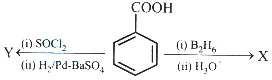
Identify $X$ and $Y$ in the following reactions:
A
Benzyl alcohol,Benzaldehyde
B
Benzyl alcohol,Benzaldehyde
C
Benzaldehyde,Benzaldehyde
D
Toluene,Benzyl alcohol
Solution
(B) $1$. For the formation of $X$: Benzoic acid reacts with $B_2H_6$ followed by hydrolysis $(H_3O^+)$ to undergo reduction,yielding benzyl alcohol $(C_6H_5CH_2OH)$ as $X$.
$2$. For the formation of $Y$: Benzoic acid reacts with $SOCl_2$ to form benzoyl chloride $(C_6H_5COCl)$,which then undergoes Rosenmund reduction using $H_2/Pd-BaSO_4$ to yield benzaldehyde $(C_6H_5CHO)$ as $Y$.
$3$. Therefore,$X$ is benzyl alcohol and $Y$ is benzaldehyde.
$2$. For the formation of $Y$: Benzoic acid reacts with $SOCl_2$ to form benzoyl chloride $(C_6H_5COCl)$,which then undergoes Rosenmund reduction using $H_2/Pd-BaSO_4$ to yield benzaldehyde $(C_6H_5CHO)$ as $Y$.
$3$. Therefore,$X$ is benzyl alcohol and $Y$ is benzaldehyde.
0 likesView Solution
52
ChemistryDifficultMCQAP EAMCET · 2023
Among the following,the appropriate reactants for the preparation of $1$-ethyl cyclohexanol are:
A
Ethylidene cyclohexane + $H_3O^+$
B
Vinyl cyclohexane + $BH_3$
C
Cyclohexyl magnesium bromide + Acetone
D
Acetyl cyclohexane + $NaBH_4$
Solution
(A) The preparation of $1$-ethyl cyclohexanol involves the acid-catalyzed hydration of ethylidene cyclohexane.
$1$. Ethylidene cyclohexane $(C_8H_{14})$ reacts with $H_3O^+$ (acid catalyst).
$2$. The double bond is protonated to form a stable tertiary carbocation at the $1$-position of the cyclohexane ring.
$3$. Water then attacks the carbocation,followed by deprotonation to yield $1$-ethyl cyclohexanol.
Thus,the correct reactants are ethylidene cyclohexane and $H_3O^+$.
$1$. Ethylidene cyclohexane $(C_8H_{14})$ reacts with $H_3O^+$ (acid catalyst).
$2$. The double bond is protonated to form a stable tertiary carbocation at the $1$-position of the cyclohexane ring.
$3$. Water then attacks the carbocation,followed by deprotonation to yield $1$-ethyl cyclohexanol.
Thus,the correct reactants are ethylidene cyclohexane and $H_3O^+$.
0 likesView Solution
53
ChemistryMediumMCQAP EAMCET · 2023
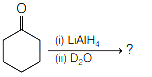
The major product of the following reaction is
A
Cyclohexanol with a $D$ atom attached to the carbon and an $-OH$ group.
B
Cyclohexanol with a $D$ atom attached to the carbon and an $-OD$ group.
C
Cyclohexanol with a $D$ atom and an $H$ atom attached to the carbon.
D
Cyclohexanol with an $H$ atom attached to the carbon and an $-OD$ group.
Solution
(D) $LiAlH_4$ acts as a source of hydride ion $(H^-)$,which attacks the electrophilic carbonyl carbon of cyclohexanone to form an alkoxide intermediate.
In the second step,$D_2O$ acts as a source of deuterium $(D^+)$,which protonates (deuterates) the alkoxide oxygen to form the final product,which is a cyclohexanol derivative with an $-OD$ group and a hydrogen atom attached to the alpha carbon.
In the second step,$D_2O$ acts as a source of deuterium $(D^+)$,which protonates (deuterates) the alkoxide oxygen to form the final product,which is a cyclohexanol derivative with an $-OD$ group and a hydrogen atom attached to the alpha carbon.
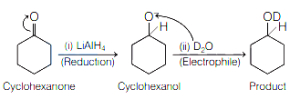
0 likesView Solution
54
ChemistryMediumMCQAP EAMCET · 2023
Which of the following reactions is not feasible?
A
$CH_3-CH_2-OH \xrightarrow{95\% \ H_2SO_4, \ 443 \ K} CH_2=CH_2$
B
$CH_3-CH_2-CH_2-CH_2-OH \xrightarrow{75\% \ H_2SO_4, \ 300 \ K} CH_3-CH_2-CH=CH_2$
C
$CH_3-CH_2-CH(OH)-CH_3 \xrightarrow{85\% \ H_3PO_4, \ 440 \ K} CH_3-CH=CH-CH_3$
D
$CH_3-C(CH_3)_2-OH \xrightarrow{20\% \ H_3PO_4, \ 358 \ K} CH_3-C(CH_3)=CH_2$
Solution
(B) The dehydration of alcohols to alkenes requires specific conditions depending on the degree of substitution of the alcohol.
Primary $(1^{\circ})$ alcohols,like butan$-1-$ol in option $(B)$,are the least reactive towards dehydration and typically require concentrated acid (e.g.,$95\% \ H_2SO_4$) and high temperatures (around $443 \ K$) to proceed.
Option $(B)$ suggests the dehydration of a primary alcohol at a very low temperature $(300 \ K)$ with a lower concentration of acid $(75\% \ H_2SO_4)$,which is insufficient to drive the elimination reaction.
Secondary and tertiary alcohols are more reactive and can undergo dehydration under milder conditions,making options $(C)$ and $(D)$ feasible.
Primary $(1^{\circ})$ alcohols,like butan$-1-$ol in option $(B)$,are the least reactive towards dehydration and typically require concentrated acid (e.g.,$95\% \ H_2SO_4$) and high temperatures (around $443 \ K$) to proceed.
Option $(B)$ suggests the dehydration of a primary alcohol at a very low temperature $(300 \ K)$ with a lower concentration of acid $(75\% \ H_2SO_4)$,which is insufficient to drive the elimination reaction.
Secondary and tertiary alcohols are more reactive and can undergo dehydration under milder conditions,making options $(C)$ and $(D)$ feasible.
0 likesView Solution
55
ChemistryMediumMCQAP EAMCET · 2023
What are $X$ and $Y$ respectively in the following reaction sequence?
$C_6H_5CH_3$ $\xrightarrow{X} C_6H_5CO_2H$ $\xrightarrow{Y} C_6H_5CH_2OH$
$C_6H_5CH_3$ $\xrightarrow{X} C_6H_5CO_2H$ $\xrightarrow{Y} C_6H_5CH_2OH$
A
$X = PCC$; $Y = (i) \ B_2H_6, (ii) \ H_3O^{+}$
B
$X = (i) \ KMnO_4 / OH^{-}, (ii) \ H_3O^{+}$; $Y = NaBH_4$
C
$X = (i) \ KMnO_4 / OH^{-}, \Delta, (ii) \ H_3O^{+}$; $Y = (i) \ B_2H_6, (ii) \ H_3O^{+}$
D
$X = PCC$; $Y = LAH$
Solution
(C) The conversion of toluene $(C_6H_5CH_3)$ to benzoic acid $(C_6H_5CO_2H)$ requires strong oxidation,which is achieved using alkaline $KMnO_4$ followed by acidic workup $(H_3O^{+})$.
Thus,$X = (i) \ KMnO_4 / OH^{-}, \Delta, (ii) \ H_3O^{+}$.
The reduction of benzoic acid to benzyl alcohol $(C_6H_5CH_2OH)$ is selectively performed by diborane $(B_2H_6)$ followed by acidic workup $(H_3O^{+})$,as $B_2H_6$ does not reduce the aromatic ring.
Thus,$Y = (i) \ B_2H_6, (ii) \ H_3O^{+}$.
Therefore,the correct option is $C$.
Thus,$X = (i) \ KMnO_4 / OH^{-}, \Delta, (ii) \ H_3O^{+}$.
The reduction of benzoic acid to benzyl alcohol $(C_6H_5CH_2OH)$ is selectively performed by diborane $(B_2H_6)$ followed by acidic workup $(H_3O^{+})$,as $B_2H_6$ does not reduce the aromatic ring.
Thus,$Y = (i) \ B_2H_6, (ii) \ H_3O^{+}$.
Therefore,the correct option is $C$.
0 likesView Solution
56
ChemistryMediumMCQAP EAMCET · 2023
Identify the correct products when ethanol reacts with $PCl_5$.
A
Chloroethane,Hydrochloric acid and Phosphorus acid
B
Chloroethane,Hydrochloric acid and Phosphoric acid
C
Chloroethane,Sulfuric acid and Phosphorous oxy chloride
D
Chloroethane,Hydrochloric acid and Phosphorous oxy chloride
Solution
(D) The reaction of ethanol with phosphorus pentachloride $(PCl_5)$ is a standard method for the preparation of alkyl halides.
The chemical equation is:
$CH_3CH_2OH + PCl_5 \rightarrow CH_3CH_2Cl + HCl + POCl_3$
Here,the products formed are chloroethane $(CH_3CH_2Cl)$,hydrogen chloride $(HCl)$,and phosphorus oxychloride $(POCl_3)$.
The chemical equation is:
$CH_3CH_2OH + PCl_5 \rightarrow CH_3CH_2Cl + HCl + POCl_3$
Here,the products formed are chloroethane $(CH_3CH_2Cl)$,hydrogen chloride $(HCl)$,and phosphorus oxychloride $(POCl_3)$.
0 likesView Solution
57
ChemistryMediumMCQAP EAMCET · 2023
What are $X$ and $Y$ in the following reactions?
A
$X = RCHO, Y = (CH_3)_2C=CH_2$
B
$X = RCOOH, Y = (CH_3)_2C=CH_2$
C
$X = RCHO, Y = (CH_3)_2C=CH_2$
D
$X = RCOR, Y = (CH_3)_2C=O$
Solution
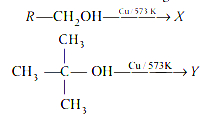
(C) When the vapours of a primary alcohol are passed over heated copper at $573 \ K$,dehydrogenation takes place and an aldehyde is formed: $R-CH_2OH \xrightarrow{Cu/573 \ K} R-CHO + H_2$.
In the case of tertiary alcohols,dehydration takes place to form an alkene: $(CH_3)_3C-OH \xrightarrow{Cu/573 \ K} (CH_3)_2C=CH_2 + H_2O$.
Thus,$X$ is an aldehyde $(RCHO)$ and $Y$ is an alkene $((CH_3)_2C=CH_2)$.
In the case of tertiary alcohols,dehydration takes place to form an alkene: $(CH_3)_3C-OH \xrightarrow{Cu/573 \ K} (CH_3)_2C=CH_2 + H_2O$.
Thus,$X$ is an aldehyde $(RCHO)$ and $Y$ is an alkene $((CH_3)_2C=CH_2)$.
0 likesView Solution
58
ChemistryMediumMCQAP EAMCET · 2023
$1$-$Chloro$-$4$-$nitrobenzene$,$1$-$Chloro$-$2,4$-$dinitrobenzene$ and $1$-$Chloro$-$2,4,6$-$trinitrobenzene$ are transformed to corresponding phenols with the reagents $X$,$Y$,$Z$ respectively. What are $X$,$Y$,$Z$?
A
$X = H_2O$; $Y = NaOH$,$365 \ K$; $Z = NaOH$,$445 \ K$
B
$X = (i) \ NaOH, 443 \ K, (ii) \ H^{+}$; $Y = (i) \ NaOH, 368 \ K, (ii) \ H^{+}$; $Z = \text{Warm } H_2O$
C
$X = (i) \ NaOH, 625 \ K, (ii) \ H^{+}$; $Y = (i) \ NaOH, 440 \ K, (ii) \ H^{+}$; $Z = H_2O / H^{+}$
D
$X = NaOH, 625 \ K$; $Y = H_2O$; $Z = NaOH, 440 \ K$
Solution
(B) The presence of electron-withdrawing groups like $-NO_2$ at ortho and para positions increases the reactivity of haloarenes towards nucleophilic substitution. As the number of $-NO_2$ groups increases,the reaction conditions become milder.
$1.$ $1$-$Chloro$-$4$-$nitrobenzene$ requires $(i) \ NaOH, 443 \ K, (ii) \ H^{+}$ to form $4$-$nitrophenol$.
$2.$ $1$-$Chloro$-$2,4$-$dinitrobenzene$ requires $(i) \ NaOH, 368 \ K, (ii) \ H^{+}$ to form $2,4$-$dinitrophenol$.
$3.$ $1$-$Chloro$-$2,4,6$-$trinitrobenzene$ reacts with just $\text{Warm } H_2O$ to form $2,4,6$-$trinitrophenol$ (picric acid).
$1.$ $1$-$Chloro$-$4$-$nitrobenzene$ requires $(i) \ NaOH, 443 \ K, (ii) \ H^{+}$ to form $4$-$nitrophenol$.
$2.$ $1$-$Chloro$-$2,4$-$dinitrobenzene$ requires $(i) \ NaOH, 368 \ K, (ii) \ H^{+}$ to form $2,4$-$dinitrophenol$.
$3.$ $1$-$Chloro$-$2,4,6$-$trinitrobenzene$ reacts with just $\text{Warm } H_2O$ to form $2,4,6$-$trinitrophenol$ (picric acid).
0 likesView Solution
59
ChemistryMediumMCQAP EAMCET · 2023
What are $X$ and $Y$ respectively in the following set of reactions?

A
$Toluene$ ; $p-acetoxy-toluene$
B
$Toluene$ ; $p-acetoxy-toluene$
C
$Phenol$ ; $phenyl-acetate$
D
$Phenol$ ; $p-hydroxy-phenyl-acetate$
Solution
(B) $1$. Reaction with $Zn$ dust and heat: $p-Cresol$ $(p-methylphenol)$ reacts with $Zn$ dust to undergo reduction,where the $-OH$ group is removed and replaced by a hydrogen atom,resulting in the formation of $Toluene$ $(X)$.
$2$. Reaction with $(CH_3CO)_2O$ followed by $H^+$: $p-Cresol$ reacts with acetic anhydride $(CH_3CO)_2O$ to undergo acetylation of the phenolic $-OH$ group,forming $p-acetoxy-toluene$ $(Y)$.
$2$. Reaction with $(CH_3CO)_2O$ followed by $H^+$: $p-Cresol$ reacts with acetic anhydride $(CH_3CO)_2O$ to undergo acetylation of the phenolic $-OH$ group,forming $p-acetoxy-toluene$ $(Y)$.
0 likesView Solution
60
ChemistryMediumMCQAP EAMCET · 2023
Which of the following is the major product,when $p$-cresol is treated with zinc dust?
A
Toluene
B
Heptane
C
Methyl cyclohexanol
D
Methyl cyclohexane
Solution
(A) When $p$-cresol ($4$-methylphenol) is heated with zinc dust,it undergoes a reduction reaction.
In this reaction,the phenolic $-OH$ group is removed and replaced by a hydrogen atom.
This process converts the phenol derivative into the corresponding hydrocarbon.
Thus,$p$-cresol reacts with zinc dust to form toluene $(C_6H_5CH_3)$ and zinc oxide $(ZnO)$.
The reaction is: $CH_3-C_6H_4-OH + Zn \rightarrow CH_3-C_6H_5 + ZnO$.
In this reaction,the phenolic $-OH$ group is removed and replaced by a hydrogen atom.
This process converts the phenol derivative into the corresponding hydrocarbon.
Thus,$p$-cresol reacts with zinc dust to form toluene $(C_6H_5CH_3)$ and zinc oxide $(ZnO)$.
The reaction is: $CH_3-C_6H_4-OH + Zn \rightarrow CH_3-C_6H_5 + ZnO$.
0 likesView Solution
61
ChemistryEasyMCQAP EAMCET · 2023
Reaction of phenol with which of the following reagents forms picric acid?
A
Conc. $H_2SO_4$
B
dil. $H_2SO_4$
C
Conc. $HNO_3$
D
dil. $HNO_3$
Solution
(C) When phenol is treated with concentrated nitric acid $(Conc. HNO_3)$,it undergoes electrophilic aromatic substitution to form $2,4,6$-trinitrophenol,which is commonly known as picric acid.
0 likesView Solution
62
ChemistryMediumMCQAP EAMCET · 2023
What are $X$ and $Y$ in the following reactions?
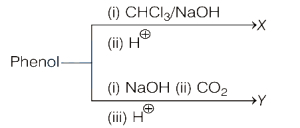
A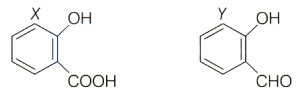
B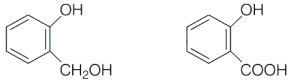
C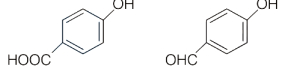
D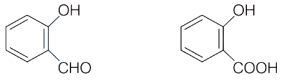
Solution
(D) The reaction of phenol with $CHCl_3$ and aqueous $NaOH$ followed by acidification is the Reimer-Tiemann reaction,which yields $2$-hydroxybenzaldehyde (salicylaldehyde) as product $X$.
The reaction of phenol with $NaOH$ followed by $CO_2$ and then acidification is the Kolbe-Schmitt reaction,which yields $2$-hydroxybenzoic acid (salicylic acid) as product $Y$.
Therefore,$X$ is $2$-hydroxybenzaldehyde and $Y$ is $2$-hydroxybenzoic acid.
The reaction of phenol with $NaOH$ followed by $CO_2$ and then acidification is the Kolbe-Schmitt reaction,which yields $2$-hydroxybenzoic acid (salicylic acid) as product $Y$.
Therefore,$X$ is $2$-hydroxybenzaldehyde and $Y$ is $2$-hydroxybenzoic acid.
0 likesView Solution
63
ChemistryEasyMCQAP EAMCET · 2023
The major product obtained in the following reaction is $C_2H_5ONa + (CH_3)_3C-Cl \rightarrow$
A
$CH_3-C(CH_3)_2-O-C_2H_5$
B
$CH_2=C(CH_3)_2$
C
$CH_3-CH(CH_3)-O-C_2H_5$
D
$(CH_3)_3C-CH_2CHO$
Solution
(B) The reaction involves a tertiary alkyl halide,$(CH_3)_3C-Cl$,and a strong base,$C_2H_5ONa$ (sodium ethoxide).
Since the alkyl halide is sterically hindered (tertiary),the $S_N2$ pathway is unfavorable.
Instead,the base acts as a proton acceptor,leading to an $E2$ elimination reaction.
The base abstracts a proton from one of the $\beta$-carbon atoms,resulting in the formation of an alkene.
The major product is $2$-methylpropene,which is $(CH_3)_2C=CH_2$.
Since the alkyl halide is sterically hindered (tertiary),the $S_N2$ pathway is unfavorable.
Instead,the base acts as a proton acceptor,leading to an $E2$ elimination reaction.
The base abstracts a proton from one of the $\beta$-carbon atoms,resulting in the formation of an alkene.
The major product is $2$-methylpropene,which is $(CH_3)_2C=CH_2$.
0 likesView Solution
64
ChemistryMediumMCQAP EAMCET · 2023
What are '$X$' and '$Y$' respectively in the following reactions?
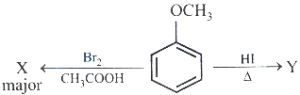
A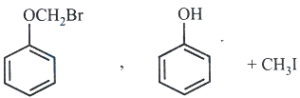
B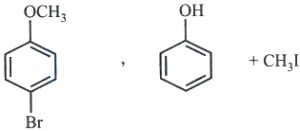
C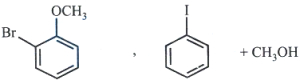
D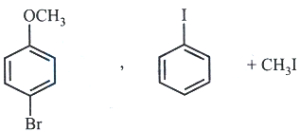
Solution
(C) $1$. Reaction with $Br_2$ in $CH_3COOH$: Anisole $(C_6H_5OCH_3)$ undergoes electrophilic aromatic substitution. The $-OCH_3$ group is ortho/para directing. Due to steric hindrance,the para-isomer is the major product $(X)$,which is $p$-bromoanisole.
$2$. Reaction with $HI$ and $\Delta$: Anisole reacts with $HI$ to undergo cleavage of the $C-O$ bond. Since the phenyl group is attached to the oxygen,the $C(phenyl)-O$ bond has partial double bond character and is difficult to break. Thus,the $C(methyl)-O$ bond breaks,resulting in the formation of phenol $(C_6H_5OH)$ and methyl iodide $(CH_3I)$ as $Y$.
$2$. Reaction with $HI$ and $\Delta$: Anisole reacts with $HI$ to undergo cleavage of the $C-O$ bond. Since the phenyl group is attached to the oxygen,the $C(phenyl)-O$ bond has partial double bond character and is difficult to break. Thus,the $C(methyl)-O$ bond breaks,resulting in the formation of phenol $(C_6H_5OH)$ and methyl iodide $(CH_3I)$ as $Y$.
0 likesView Solution
65
ChemistryMediumMCQAP EAMCET · 2023
What are $X$ and $Y$ in the following reactions?
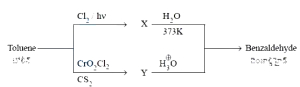
A
$X = C_6H_5CCl_3$,$Y = C_6H_5CH[OCr(OH)Cl_2]_2$
B
$X = C_6H_5CHCl_2$,$Y = C_6H_5CH[OCr(OH)Cl_2]_2$
C
$X = C_6H_5CH_2Cl$,$Y = C_6H_5CH[OCr(OH)_2Cl_2]_2$
D
$X = C_6H_4(CH_3)Cl$,$Y = C_6H_5CH[OCrCl_3]_2$
Solution
(B) The reaction of toluene with $Cl_2$ in the presence of $hv$ (photochemical chlorination) leads to the formation of benzal chloride $(C_6H_5CHCl_2)$ as the intermediate $X$,which upon hydrolysis at $373 \ K$ gives benzaldehyde.
The reaction of toluene with chromyl chloride $(CrO_2Cl_2)$ in $CS_2$ is the Etard reaction. This reaction proceeds through the formation of a brown chromium complex intermediate $Y$,which is $C_6H_5CH[OCr(OH)Cl_2]_2$. This complex upon acidic hydrolysis $(H_3O^+)$ yields benzaldehyde.
Therefore,$X = C_6H_5CHCl_2$ and $Y = C_6H_5CH[OCr(OH)Cl_2]_2$.
The reaction of toluene with chromyl chloride $(CrO_2Cl_2)$ in $CS_2$ is the Etard reaction. This reaction proceeds through the formation of a brown chromium complex intermediate $Y$,which is $C_6H_5CH[OCr(OH)Cl_2]_2$. This complex upon acidic hydrolysis $(H_3O^+)$ yields benzaldehyde.
Therefore,$X = C_6H_5CHCl_2$ and $Y = C_6H_5CH[OCr(OH)Cl_2]_2$.
0 likesView Solution
66
ChemistryMediumMCQAP EAMCET · 2023
What are $X$ and $Y$ respectively in the following reaction sequence?
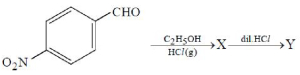
A
The diethyl acetal of $p$-nitrobenzaldehyde and $p$-nitrobenzaldehyde.
B
$A$ hemiacetal and the diethyl acetal.
C
The diethyl acetal and a hemiacetal.
D
$A$ hemiacetal and $p$-nitrobenzyl alcohol.
Solution
(A) The reaction of $p$-nitrobenzaldehyde with ethanol in the presence of dry $HCl(g)$ is an acetal formation reaction.
Aldehydes react with alcohols in the presence of dry $HCl$ to form hemiacetals,which further react with another molecule of alcohol to form acetals.
Step $1$: $p$-Nitrobenzaldehyde reacts with $C_2H_5OH$ in the presence of $HCl(g)$ to form the diethyl acetal,$X$,which is $p-NO_2-C_6H_4-CH(OC_2H_5)_2$.
Step $2$: The acetal $X$ on hydrolysis with dilute $HCl$ (acidic hydrolysis) regenerates the original aldehyde,$Y$,which is $p-nitrobenzaldehyde$ $(p-NO_2-C_6H_4-CHO)$.
Therefore,$X$ is the diethyl acetal and $Y$ is the original aldehyde.
Aldehydes react with alcohols in the presence of dry $HCl$ to form hemiacetals,which further react with another molecule of alcohol to form acetals.
Step $1$: $p$-Nitrobenzaldehyde reacts with $C_2H_5OH$ in the presence of $HCl(g)$ to form the diethyl acetal,$X$,which is $p-NO_2-C_6H_4-CH(OC_2H_5)_2$.
Step $2$: The acetal $X$ on hydrolysis with dilute $HCl$ (acidic hydrolysis) regenerates the original aldehyde,$Y$,which is $p-nitrobenzaldehyde$ $(p-NO_2-C_6H_4-CHO)$.
Therefore,$X$ is the diethyl acetal and $Y$ is the original aldehyde.
0 likesView Solution
67
ChemistryMediumMCQAP EAMCET · 2023
What are '$X$' and '$Y$' respectively in the following reactions?
$C_6H_5CHO + C_6H_5COCH_3$ $\xrightarrow[293 \ K]{OH^{-}} \underset{\text{major}}{X}$ $\xrightarrow{NaBH_4} Y$
$C_6H_5CHO + C_6H_5COCH_3$ $\xrightarrow[293 \ K]{OH^{-}} \underset{\text{major}}{X}$ $\xrightarrow{NaBH_4} Y$
A
$C_6H_5COCH=C(CH_3)C_6H_5, C_6H_5CH_2CH_2COC_6H_5$
B
$C_6H_5COCH=C(CH_3)C_6H_5, C_6H_5=CHCH(OH)C_6H_5$
C
$C_6H_5CH=CHCOC_6H_5, C_6H_5CH=CHCH(OH)C_6H_5$
D
$C_6H_5CH=CHCOC_6H_5, C_6H_5CH_2CH_2COC_6H_5$
Solution
(C) The reaction between benzaldehyde $(C_6H_5CHO)$ and acetophenone $(C_6H_5COCH_3)$ in the presence of a base $(OH^-)$ is a Claisen-Schmidt condensation reaction.
This reaction produces an $\alpha,\beta$-unsaturated ketone,which is $X = C_6H_5CH=CHCOC_6H_5$ (benzalacetophenone).
Next,$NaBH_4$ is a selective reducing agent that reduces the carbonyl group $(C=O)$ to a hydroxyl group $(-OH)$ without affecting the carbon-carbon double bond $(C=C)$.
Therefore,the reduction of $C_6H_5CH=CHCOC_6H_5$ with $NaBH_4$ yields $Y = C_6H_5CH=CHCH(OH)C_6H_5$ ($1$,$3$-diphenylprop$-2-$en$-1-$ol).
Thus,the correct option is $C$.
This reaction produces an $\alpha,\beta$-unsaturated ketone,which is $X = C_6H_5CH=CHCOC_6H_5$ (benzalacetophenone).
Next,$NaBH_4$ is a selective reducing agent that reduces the carbonyl group $(C=O)$ to a hydroxyl group $(-OH)$ without affecting the carbon-carbon double bond $(C=C)$.
Therefore,the reduction of $C_6H_5CH=CHCOC_6H_5$ with $NaBH_4$ yields $Y = C_6H_5CH=CHCH(OH)C_6H_5$ ($1$,$3$-diphenylprop$-2-$en$-1-$ol).
Thus,the correct option is $C$.
0 likesView Solution
68
ChemistryMediumMCQAP EAMCET · 2023
The number of products obtained in the following reaction is:
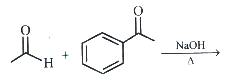
A
$1$
B
$3$
C
$2$
D
$4$
Solution
(D) The reaction involves $CH_3CHO$ (acetaldehyde) and $C_6H_5COCH_3$ (acetophenone) in the presence of $NaOH$ and heat. Both compounds contain $\alpha$-hydrogens,so they undergo self-aldol condensation and cross-aldol condensation.
$1$. Self-aldol condensation of $CH_3CHO$ gives one product.
$2$. Self-aldol condensation of $C_6H_5COCH_3$ gives one product.
$3$. Cross-aldol condensation of $CH_3CHO$ (as donor) and $C_6H_5COCH_3$ (as acceptor) gives one product.
$4$. Cross-aldol condensation of $C_6H_5COCH_3$ (as donor) and $CH_3CHO$ (as acceptor) gives one product.
Thus,a total of $4$ products are obtained.
$1$. Self-aldol condensation of $CH_3CHO$ gives one product.
$2$. Self-aldol condensation of $C_6H_5COCH_3$ gives one product.
$3$. Cross-aldol condensation of $CH_3CHO$ (as donor) and $C_6H_5COCH_3$ (as acceptor) gives one product.
$4$. Cross-aldol condensation of $C_6H_5COCH_3$ (as donor) and $CH_3CHO$ (as acceptor) gives one product.
Thus,a total of $4$ products are obtained.
0 likesView Solution
69
ChemistryMediumMCQAP EAMCET · 2023
Which of the following is a hemiacetal?
A
B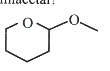
C
D
Solution
(A) hemiacetal is a functional group characterized by a carbon atom bonded to one $-OH$ group,one $-OR$ group,and two other carbon-containing groups (or hydrogen atoms).
In the given options,the structure in option $A$ shows a carbon atom bonded to an $-OH$ group and an ether oxygen atom within a ring,which fits the definition of a cyclic hemiacetal.
In the given options,the structure in option $A$ shows a carbon atom bonded to an $-OH$ group and an ether oxygen atom within a ring,which fits the definition of a cyclic hemiacetal.
0 likesView Solution
70
ChemistryMediumMCQAP EAMCET · 2023
What are '$X$' and '$Y$' in the following reaction?
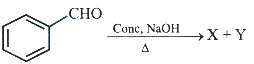
A
Phenol + Sodium benzoate
B
Benzyl alcohol + Benzoic acid
C
Benzyl alcohol + Sodium benzoate
D
Sodium benzyloxide + Benzoic acid
Solution
(C) The given reaction is the Cannizzaro reaction. Benzaldehyde $(C_6H_5CHO)$ does not have an $\alpha$-hydrogen atom,so it undergoes a self-oxidation and reduction (disproportionation) reaction in the presence of a concentrated base like $NaOH$.
One molecule of benzaldehyde is reduced to benzyl alcohol $(C_6H_5CH_2OH)$,and another molecule is oxidized to sodium benzoate $(C_6H_5COONa)$.
Thus,the products '$X$' and '$Y$' are benzyl alcohol and sodium benzoate.
One molecule of benzaldehyde is reduced to benzyl alcohol $(C_6H_5CH_2OH)$,and another molecule is oxidized to sodium benzoate $(C_6H_5COONa)$.
Thus,the products '$X$' and '$Y$' are benzyl alcohol and sodium benzoate.
0 likesView Solution
71
ChemistryMediumMCQAP EAMCET · 2023
Which of the following reagents will convert isobutyraldehyde to the corresponding acid?
| $I. HNO_3$ | $II. NH_2NH_2 / OH^-$ |
| $III. 2[Ag(NH_3)_2]^+$ | $IV. NaOH$ |
A
$I, III$
B
$I, II$
C
$II, IV$
D
$III, IV$
Solution
(A) Isobutyraldehyde is an aldehyde,which can be oxidized to the corresponding carboxylic acid (isobutyric acid) using oxidizing agents.
$HNO_3$ is a strong oxidizing agent.
$2[Ag(NH_3)_2]^+$ (Tollen's reagent) is a mild oxidizing agent that specifically oxidizes aldehydes to carboxylic acids.
$NH_2NH_2 / OH^-$ (Wolff-Kishner reduction) reduces aldehydes to alkanes.
$NaOH$ typically causes aldol condensation or Cannizzaro reaction (if no $\alpha$-hydrogen is present) but does not oxidize aldehydes to acids.
Therefore,reagents $I$ and $III$ are the correct oxidizing agents.
$HNO_3$ is a strong oxidizing agent.
$2[Ag(NH_3)_2]^+$ (Tollen's reagent) is a mild oxidizing agent that specifically oxidizes aldehydes to carboxylic acids.
$NH_2NH_2 / OH^-$ (Wolff-Kishner reduction) reduces aldehydes to alkanes.
$NaOH$ typically causes aldol condensation or Cannizzaro reaction (if no $\alpha$-hydrogen is present) but does not oxidize aldehydes to acids.
Therefore,reagents $I$ and $III$ are the correct oxidizing agents.
0 likesView Solution
72
ChemistryMediumMCQAP EAMCET · 2023
The number of aldehydes that undergo Cannizzaro reaction from the following are Phenyl ethanal,Methanal,$2-$Methoxy propanal,Trichloro ethanal.
A
$2$
B
$3$
C
$4$
D
$1$
Solution
(A) Aldehydes that do not have $\alpha$-hydrogens undergo the Cannizzaro reaction.
$1$. Methanal $(HCHO)$: It has no $\alpha$-carbon,hence no $\alpha$-hydrogen.
$2$. Trichloro ethanal $(CCl_3CHO)$: The carbon adjacent to the carbonyl group is bonded to three chlorine atoms,so there is no $\alpha$-hydrogen.
$3$. Phenyl ethanal $(C_6H_5CH_2CHO)$: It has two $\alpha$-hydrogens on the carbon attached to the phenyl ring.
$4$. $2-$Methoxy propanal $(CH_3OCH(CH_3)CHO)$: It has one $\alpha$-hydrogen on the carbon at the $2-$position.
Thus,only Methanal and Trichloro ethanal undergo the Cannizzaro reaction. The total number is $2$.
$1$. Methanal $(HCHO)$: It has no $\alpha$-carbon,hence no $\alpha$-hydrogen.
$2$. Trichloro ethanal $(CCl_3CHO)$: The carbon adjacent to the carbonyl group is bonded to three chlorine atoms,so there is no $\alpha$-hydrogen.
$3$. Phenyl ethanal $(C_6H_5CH_2CHO)$: It has two $\alpha$-hydrogens on the carbon attached to the phenyl ring.
$4$. $2-$Methoxy propanal $(CH_3OCH(CH_3)CHO)$: It has one $\alpha$-hydrogen on the carbon at the $2-$position.
Thus,only Methanal and Trichloro ethanal undergo the Cannizzaro reaction. The total number is $2$.
0 likesView Solution
73
ChemistryMediumMCQAP EAMCET · 2023
What are the products formed in the following reaction?
$CH_3CH_2CHO + 2Cu^{2+} + 5OH^{-} \rightarrow X + Y + 3H_2O$
$CH_3CH_2CHO + 2Cu^{2+} + 5OH^{-} \rightarrow X + Y + 3H_2O$
A
$CH_3CH_2COOH, Cu(OH)_2$
B
$CH_3CH_2COO^{-}, Cu$
C
$CH_3CH_2COOH, Cu_2O$
D
$CH_3CH_2COO^{-}, Cu_2O$
Solution
(D) The given reaction is the oxidation of an aldehyde (propanal) by Fehling's solution.
Fehling's solution is an alkaline solution of copper$(II)$ ions complexed with tartrate ions.
Aldehydes are oxidized to the corresponding carboxylate anions $(RCOO^{-})$ in the presence of base,while $Cu^{2+}$ ions are reduced to red-brown precipitate of copper$(I)$ oxide $(Cu_2O)$.
The balanced equation is:
$CH_3CH_2CHO + 2Cu^{2+} + 5OH^{-} \rightarrow CH_3CH_2COO^{-} + Cu_2O + 3H_2O$
Comparing this with the given reaction,$X = CH_3CH_2COO^{-}$ and $Y = Cu_2O$.
Fehling's solution is an alkaline solution of copper$(II)$ ions complexed with tartrate ions.
Aldehydes are oxidized to the corresponding carboxylate anions $(RCOO^{-})$ in the presence of base,while $Cu^{2+}$ ions are reduced to red-brown precipitate of copper$(I)$ oxide $(Cu_2O)$.
The balanced equation is:
$CH_3CH_2CHO + 2Cu^{2+} + 5OH^{-} \rightarrow CH_3CH_2COO^{-} + Cu_2O + 3H_2O$
Comparing this with the given reaction,$X = CH_3CH_2COO^{-}$ and $Y = Cu_2O$.
0 likesView Solution
74
ChemistryMediumMCQAP EAMCET · 2023
What are $X$ and $Y$ respectively in the following set of reactions?

A
Phenyl cyanide,Phenyl cyanide
B
Phenyl cyanide,Phenyl isocyanide
C
Phenyl isocyanide,Phenyl cyanide
D
Phenyl isocyanide,Phenyl isocyanide
Solution
(C) The reaction of aniline with $CHCl_3$ and $KOH$ (carbylamine reaction) produces phenyl isocyanide $(C_6H_5NC)$ as $X$.
The reaction of aniline with $NaNO_2/HCl$ followed by $CuCN/KCN$ (Sandmeyer reaction) produces phenyl cyanide $(C_6H_5CN)$ as $Y$.
Therefore,$X$ is phenyl isocyanide and $Y$ is phenyl cyanide.
The reaction of aniline with $NaNO_2/HCl$ followed by $CuCN/KCN$ (Sandmeyer reaction) produces phenyl cyanide $(C_6H_5CN)$ as $Y$.
Therefore,$X$ is phenyl isocyanide and $Y$ is phenyl cyanide.
0 likesView Solution
75
ChemistryEasyMCQAP EAMCET · 2023
Arrange the following in increasing order of their boiling points:
$I.$ $N$-Ethylethanamine
$II.$ Butanamine
$III.$ $N,N$-Dimethylethanamine
$I.$ $N$-Ethylethanamine
$II.$ Butanamine
$III.$ $N,N$-Dimethylethanamine
A
$III < I < II$
B
$III < II < I$
C
$II < III < I$
D
$II < I < III$
Solution
(A) The boiling points of isomeric amines follow the order: Primary $(1^{\circ})$ > Secondary $(2^{\circ})$ > Tertiary $(3^{\circ})$.
This is because primary amines $(R-NH_2)$ have two hydrogen atoms available for intermolecular hydrogen bonding,secondary amines $(R_2-NH)$ have one,and tertiary amines $(R_3-N)$ have none.
$I.$ $N$-Ethylethanamine (Secondary amine,$2^{\circ}$)
$II.$ Butanamine (Primary amine,$1^{\circ}$)
$III.$ $N,N$-Dimethylethanamine (Tertiary amine,$3^{\circ}$)
Therefore,the increasing order of boiling points is $III < I < II$.
This is because primary amines $(R-NH_2)$ have two hydrogen atoms available for intermolecular hydrogen bonding,secondary amines $(R_2-NH)$ have one,and tertiary amines $(R_3-N)$ have none.
$I.$ $N$-Ethylethanamine (Secondary amine,$2^{\circ}$)
$II.$ Butanamine (Primary amine,$1^{\circ}$)
$III.$ $N,N$-Dimethylethanamine (Tertiary amine,$3^{\circ}$)
Therefore,the increasing order of boiling points is $III < I < II$.
0 likesView Solution
76
ChemistryMediumMCQAP EAMCET · 2023
The sequence of reagents required to convert aniline to benzene nitrile is:
A
$NaNO_2 + HCl, 273-278 \ K$; $CuCN / KCN$
B
$NaNO_2 + HCl, 273-278 \ K$; $CuCN / KCN$
C
$NaNO_2 + HCl, 273-298 \ K$; $Cu / HCN$
D
$Cl_2 / Fe$; $KCN$
Solution
(A) The conversion of aniline to benzene nitrile involves two steps:
$1$. Diazotization: Aniline reacts with $NaNO_2$ and $HCl$ at $273-278 \ K$ to form benzene diazonium chloride.
$2$. Sandmeyer reaction: Benzene diazonium chloride reacts with $CuCN / KCN$ to form benzene nitrile (cyanobenzene).
$1$. Diazotization: Aniline reacts with $NaNO_2$ and $HCl$ at $273-278 \ K$ to form benzene diazonium chloride.
$2$. Sandmeyer reaction: Benzene diazonium chloride reacts with $CuCN / KCN$ to form benzene nitrile (cyanobenzene).
0 likesView Solution
77
ChemistryEasyMCQAP EAMCET · 2023
The product of an amine '$X$' with benzene sulphonyl chloride produces a product which is insoluble in alkali. The product of '$X$' with ethanoyl chloride is:
A
$C_6H_5NHCOCH_3$
B
$C_6H_5N(CH_3)COCH_3$
C
$C_6H_5N(CH_3)CH_2CH_3$
D
$C_6H_5NHCH_2CH_3$
Solution
(B) secondary amine reacts with Hinsberg reagent (benzene sulphonyl chloride) to form a sulfonamide that has no acidic hydrogen,making it insoluble in alkali.
Thus,'$X$' is a secondary amine,$C_6H_5NHCH_3$ ($N$-methylaniline).
The reaction of $C_6H_5NHCH_3$ with ethanoyl chloride $(CH_3COCl)$ is an acetylation reaction:
$C_6H_5NHCH_3 + CH_3COCl \rightarrow C_6H_5N(CH_3)COCH_3 + HCl$
The product formed is $N$-methyl-$N$-phenylacetamide,which corresponds to option $B$.
Thus,'$X$' is a secondary amine,$C_6H_5NHCH_3$ ($N$-methylaniline).
The reaction of $C_6H_5NHCH_3$ with ethanoyl chloride $(CH_3COCl)$ is an acetylation reaction:
$C_6H_5NHCH_3 + CH_3COCl \rightarrow C_6H_5N(CH_3)COCH_3 + HCl$
The product formed is $N$-methyl-$N$-phenylacetamide,which corresponds to option $B$.
0 likesView Solution
78
ChemistryEasyMCQAP EAMCET · 2023
Which of the following amines cannot be prepared by the Gabriel phthalimide synthesis method?
A
Ethylamine
B
Benzylamine
C
Phenylamine
D
Propylamine
Solution
(C) Gabriel phthalimide synthesis is used for the preparation of primary aliphatic amines.
It cannot be used for the preparation of aromatic primary amines (like Phenylamine or Aniline) because the aryl halides do not undergo nucleophilic substitution reaction with the potassium phthalimide salt easily due to the partial double bond character of the $C-X$ bond in aryl halides.
It cannot be used for the preparation of aromatic primary amines (like Phenylamine or Aniline) because the aryl halides do not undergo nucleophilic substitution reaction with the potassium phthalimide salt easily due to the partial double bond character of the $C-X$ bond in aryl halides.
0 likesView Solution
79
ChemistryEasyMCQAP EAMCET · 2023
What are $X$ and $Y$ in the following reactions?
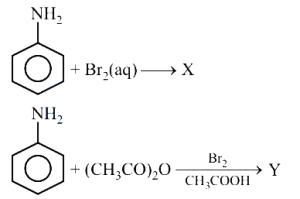
A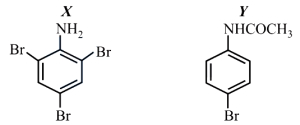
B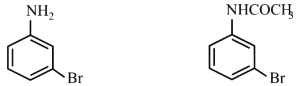
C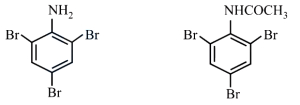
D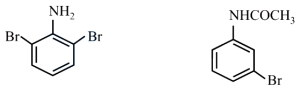
Solution
(A) $(i)$ Aniline is highly reactive towards electrophilic substitution. When treated with $Br_2$ in $H_2O$,it undergoes rapid poly-substitution to form $2, 4, 6-$tribromoaniline as the major product $(X)$.
$(ii)$ To control the reactivity of the $-NH_2$ group,it is first acetylated using acetic anhydride $(CH_3CO)_2O$ to form acetanilide. The $-NHCOCH_3$ group is less activating than the $-NH_2$ group,which restricts the bromination to the $p-$position,yielding $p-$bromoacetanilide as the major product $(Y)$.
$(ii)$ To control the reactivity of the $-NH_2$ group,it is first acetylated using acetic anhydride $(CH_3CO)_2O$ to form acetanilide. The $-NHCOCH_3$ group is less activating than the $-NH_2$ group,which restricts the bromination to the $p-$position,yielding $p-$bromoacetanilide as the major product $(Y)$.
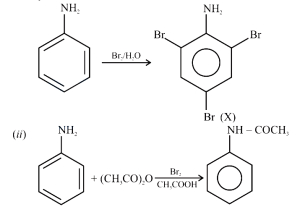
0 likesView Solution
80
ChemistryMediumMCQAP EAMCET · 2023
Identify $X$ and $Y$ in the following reactions:
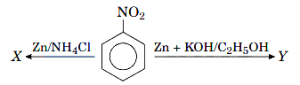
A
$X$ = Nitrosobenzene,$Y$ = Hydrazobenzene
B
$X$ = Aniline,$Y$ = Hydrazobenzene
C
$X$ = Phenylhydroxylamine,$Y$ = Hydrazobenzene
D
$X$ = Hydrazobenzene,$Y$ = Phenylhydroxylamine
Solution
(C) The reduction of nitrobenzene depends on the medium used:
$(i)$ In neutral medium,using $Zn$ dust and $NH_4Cl$ solution,nitrobenzene is reduced to phenylhydroxylamine $(C_6H_5NHOH)$. Thus,$X$ is phenylhydroxylamine.
(ii) In alkaline medium,using $Zn$ and $KOH/C_2H_5OH$,the reduction proceeds further to form hydrazobenzene $(C_6H_5NH-NHC_6H_5)$. Thus,$Y$ is hydrazobenzene.
Therefore,the correct option is $C$.
$(i)$ In neutral medium,using $Zn$ dust and $NH_4Cl$ solution,nitrobenzene is reduced to phenylhydroxylamine $(C_6H_5NHOH)$. Thus,$X$ is phenylhydroxylamine.
(ii) In alkaline medium,using $Zn$ and $KOH/C_2H_5OH$,the reduction proceeds further to form hydrazobenzene $(C_6H_5NH-NHC_6H_5)$. Thus,$Y$ is hydrazobenzene.
Therefore,the correct option is $C$.
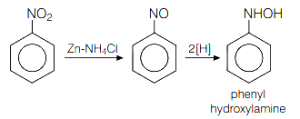
0 likesView Solution
81
ChemistryMediumMCQAP EAMCET · 2023
The type of reaction '$X$' and product '$Y$' of the following are respectively:
$C_6H_5N_2Cl + C_6H_5NH_2 \xrightarrow[H^{+}]{X} Y$
$C_6H_5N_2Cl + C_6H_5NH_2 \xrightarrow[H^{+}]{X} Y$
A
Electrophilic Substitution,$C_6H_5-N=N-C_6H_4-NH_2$ (para-aminoazobenzene)
B
Electrophilic Substitution,$C_6H_5-N=N-C_6H_4-NH_2$ (ortho-aminoazobenzene)
C
Nucleophilic Substitution,$C_6H_5-NH-NH-C_6H_4-NH_2$
D
Nucleophilic Substitution,$C_6H_5-NH-NH-C_6H_4-NH_2$
Solution
(A) The reaction between benzene diazonium chloride $(C_6H_5N_2Cl)$ and aniline $(C_6H_5NH_2)$ in the presence of a mild acid $(H^+)$ is a coupling reaction.
This is a type of electrophilic aromatic substitution reaction where the diazonium cation acts as an electrophile.
The electrophile attacks the electron-rich ring of aniline,primarily at the para-position due to steric hindrance at the ortho-position.
The product formed is $p$-aminoazobenzene $(C_6H_5-N=N-C_6H_4-NH_2)$.
This is a type of electrophilic aromatic substitution reaction where the diazonium cation acts as an electrophile.
The electrophile attacks the electron-rich ring of aniline,primarily at the para-position due to steric hindrance at the ortho-position.
The product formed is $p$-aminoazobenzene $(C_6H_5-N=N-C_6H_4-NH_2)$.
0 likesView Solution
82
ChemistryMediumMCQAP EAMCET · 2023
Which of the following produces nitrogen gas after the reaction with nitrous acid?
A
$(CH_3)_3 N$
B
$C_2 H_5 NH C_2 H_5$
C
$(C_2 H_5)_3 N$
D
$C_2 H_5 NH_2$
Solution
(D) Primary aliphatic amines $(R-NH_2)$ react with nitrous acid $(HNO_2)$ to form unstable diazonium salts,which decompose in the presence of water to release nitrogen gas $(N_2 \uparrow)$.
$C_2 H_5 NH_2 + HNO_2$ $\xrightarrow{0-5^{\circ}C} [C_2 H_5 N_2^+ Cl^-]$ $\xrightarrow{H_2 O} C_2 H_5 OH + N_2 \uparrow + HCl$
Secondary amines form $N$-nitrosoamines (yellow oily liquids),and tertiary amines form salts with nitrous acid without evolving nitrogen gas.
Therefore,$C_2 H_5 NH_2$ (a primary amine) is the correct answer.
$C_2 H_5 NH_2 + HNO_2$ $\xrightarrow{0-5^{\circ}C} [C_2 H_5 N_2^+ Cl^-]$ $\xrightarrow{H_2 O} C_2 H_5 OH + N_2 \uparrow + HCl$
Secondary amines form $N$-nitrosoamines (yellow oily liquids),and tertiary amines form salts with nitrous acid without evolving nitrogen gas.
Therefore,$C_2 H_5 NH_2$ (a primary amine) is the correct answer.
0 likesView Solution
83
ChemistryMediumMCQAP EAMCET · 2023
$X$ and $Y$ (major products) in the following reaction sequence are:
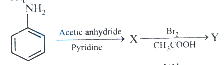
A
Aniline,$p$-bromoaniline
B
Acetanilide,$p$-bromoacetanilide
C
Acetanilide,$o$-bromoacetanilide
D
$N$-bromoacetanilide,$p$-bromoacetanilide
Solution
(B) $1$. The reaction of aniline with acetic anhydride in the presence of pyridine is an acylation reaction,which converts the $-NH_2$ group into an acetamido group $(-NHCOCH_3)$. The product $X$ is acetanilide.
$2$. Acetanilide undergoes electrophilic aromatic substitution (bromination) with $Br_2$ in $CH_3COOH$. The $-NHCOCH_3$ group is ortho/para directing. Due to steric hindrance,the para-isomer is the major product. The product $Y$ is $p$-bromoacetanilide.
$2$. Acetanilide undergoes electrophilic aromatic substitution (bromination) with $Br_2$ in $CH_3COOH$. The $-NHCOCH_3$ group is ortho/para directing. Due to steric hindrance,the para-isomer is the major product. The product $Y$ is $p$-bromoacetanilide.
0 likesView Solution
84
ChemistryMediumMCQAP EAMCET · 2023
In the given reactions,'$X$' and '$Y$' respectively are $C_6H_5CH_2NH_2$ $\xrightarrow{X} C_6H_5CONH_2$ $\xrightarrow{Y} C_6H_5NH_2$
A
$KMnO_4 / H^{+} / \Delta$ and $Br_2 / KOH$
B
$Br_2 / KOH$ and $KMnO_4 / H^{+} / \Delta$
C
$Br_2 / H^{+}$ and $NaBH_4$
D
$NaBH_4$ and $Br_2 / H^{+}$
Solution
(A) Step $1$: Oxidation of benzylamine $(C_6H_5CH_2NH_2)$ to benzamide $(C_6H_5CONH_2)$ is not a standard single-step reaction. However,considering the options provided,the conversion of the side chain to an amide group typically involves oxidation. $KMnO_4 / H^{+} / \Delta$ is a strong oxidizing agent capable of oxidizing the benzylic carbon to a carboxylic acid,which can then be converted to an amide.
Step $2$: The conversion of benzamide $(C_6H_5CONH_2)$ to aniline $(C_6H_5NH_2)$ is the classic $Hoffmann$ bromamide degradation reaction,which uses $Br_2 / KOH$ (or $Br_2 / NaOH$).
Therefore,$X$ is $KMnO_4 / H^{+} / \Delta$ and $Y$ is $Br_2 / KOH$.
Step $2$: The conversion of benzamide $(C_6H_5CONH_2)$ to aniline $(C_6H_5NH_2)$ is the classic $Hoffmann$ bromamide degradation reaction,which uses $Br_2 / KOH$ (or $Br_2 / NaOH$).
Therefore,$X$ is $KMnO_4 / H^{+} / \Delta$ and $Y$ is $Br_2 / KOH$.
0 likesView Solution
85
ChemistryEasyMCQAP EAMCET · 2023
Which of the following is not correctly matched for enzymatic reactions?
A
Proteins $\rightarrow$ Amino acids ; Trypsin
B
Starch $\rightarrow$ Maltose ; Diastase
C
Sucrose $\rightarrow$ glucose and fructose ; zymase
D
Maltose $\rightarrow$ glucose ; Maltase
Solution
(C) The conversion of sucrose into glucose and fructose is catalyzed by the enzyme $\text{invertase}$,not $\text{zymase}$.
$\text{Zymase}$ is the enzyme responsible for the conversion of glucose or fructose into ethanol and carbon dioxide.
Therefore,the pair in option $C$ is incorrectly matched.
$\text{Zymase}$ is the enzyme responsible for the conversion of glucose or fructose into ethanol and carbon dioxide.
Therefore,the pair in option $C$ is incorrectly matched.
0 likesView Solution
86
ChemistryMediumMCQAP EAMCET · 2023
The structure of $Gly-Ala$ is
A
$H_2N-CH(CH_3)-CO-NH-CH_2-COOH$
B
$H_2N-CH_2-CO-NH-CH(CH_3)-COOH$
C
$H_2N-CH(CH_3)-CO-NH-CH(CH_2OH)-COOH$
D
$H_2N-CH(CH_2OH)-CO-NH-CH(CH_3)-COOH$
Solution
(B) dipeptide is formed by the condensation reaction between the carboxyl group $(-COOH)$ of one amino acid and the amino group $(-NH_2)$ of another amino acid.
In the dipeptide $Gly-Ala$,$Gly$ (Glycine) is the $N$-terminal amino acid and $Ala$ (Alanine) is the $C$-terminal amino acid.
Glycine structure: $H_2N-CH_2-COOH$
Alanine structure: $H_2N-CH(CH_3)-COOH$
When $Gly$ and $Ala$ combine,the $-COOH$ group of $Gly$ reacts with the $-NH_2$ group of $Ala$ to form a peptide bond $(-CO-NH-)$.
The resulting structure is $H_2N-CH_2-CO-NH-CH(CH_3)-COOH$.
In the dipeptide $Gly-Ala$,$Gly$ (Glycine) is the $N$-terminal amino acid and $Ala$ (Alanine) is the $C$-terminal amino acid.
Glycine structure: $H_2N-CH_2-COOH$
Alanine structure: $H_2N-CH(CH_3)-COOH$
When $Gly$ and $Ala$ combine,the $-COOH$ group of $Gly$ reacts with the $-NH_2$ group of $Ala$ to form a peptide bond $(-CO-NH-)$.
The resulting structure is $H_2N-CH_2-CO-NH-CH(CH_3)-COOH$.
0 likesView Solution
87
ChemistryEasyMCQAP EAMCET · 2023
Which of the following are sulphur-containing amino acids?
| $(A)$. Serine | $(B)$. Cysteine |
| $(C)$. Lysine | $(D)$. Methionine |
A
$(A), (D)$
B
$(A), (C)$
C
$(B), (C)$
D
$(B), (D)$
Solution
(D) $S$-containing amino acids are Cysteine and Methionine.
Serine is an $OH$-containing amino acid.
Lysine is a basic amino acid containing an extra $-NH_2$ group.
Therefore,the correct options are $(B)$ and $(D)$.
Serine is an $OH$-containing amino acid.
Lysine is a basic amino acid containing an extra $-NH_2$ group.
Therefore,the correct options are $(B)$ and $(D)$.
0 likesView Solution
88
ChemistryMediumMCQAP EAMCET · 2023
In $D-glucose$ $(X)$ and $D-fructose$ $(Y)$,which hydroxyl group participates in hemiacetal/hemiketal formation?
A
$C-5$ in both $X$ and $Y$
B
$C-5$ in $X$ and $C-6$ in $Y$
C
$C-6$ in $X$ and $C-5$ in $Y$
D
$C-4$ in both $X$ and $Y$
Solution
(A) In $D-glucose$ $(X)$,the hydroxyl group at $C-5$ attacks the aldehyde group at $C-1$ to form a six-membered pyranose ring (hemiacetal).
In $D-fructose$ $(Y)$,the hydroxyl group at $C-5$ attacks the ketone group at $C-2$ to form a five-membered furanose ring (hemiketal).
Therefore,in both cases,the hydroxyl group at $C-5$ participates in the ring formation.
In $D-fructose$ $(Y)$,the hydroxyl group at $C-5$ attacks the ketone group at $C-2$ to form a five-membered furanose ring (hemiketal).
Therefore,in both cases,the hydroxyl group at $C-5$ participates in the ring formation.
0 likesView Solution
89
ChemistryEasyMCQAP EAMCET · 2023
In which of the following amino acids is the $-OH$ group present?
| $(A)$ Lysine | $(B)$ Serine |
| $(C)$ Tyrosine | $(D)$ Valine |
A
$(A), (B)$
B
$(A), (C)$
C
$(B), (C)$
D
$(B), (D)$
Solution
(C) To determine which amino acids contain an $-OH$ (hydroxyl) group in their side chain,let us examine the structures:
$1$. Lysine: Contains an amino group $(-NH_2)$ in its side chain.
$2$. Serine: Contains a hydroxymethyl group $(-CH_2OH)$ in its side chain,which includes an $-OH$ group.
$3$. Tyrosine: Contains a phenolic group $(-C_6H_4OH)$ in its side chain,which includes an $-OH$ group.
$4$. Valine: Contains an isopropyl group $(-CH(CH_3)_2)$ in its side chain,which does not contain an $-OH$ group.
Therefore,both Serine and Tyrosine contain an $-OH$ group. The correct option is $(C)$.
$1$. Lysine: Contains an amino group $(-NH_2)$ in its side chain.
$2$. Serine: Contains a hydroxymethyl group $(-CH_2OH)$ in its side chain,which includes an $-OH$ group.
$3$. Tyrosine: Contains a phenolic group $(-C_6H_4OH)$ in its side chain,which includes an $-OH$ group.
$4$. Valine: Contains an isopropyl group $(-CH(CH_3)_2)$ in its side chain,which does not contain an $-OH$ group.
Therefore,both Serine and Tyrosine contain an $-OH$ group. The correct option is $(C)$.
0 likesView Solution
90
ChemistryEasyMCQAP EAMCET · 2023
Identify the correct statement related to amino acids.
A
Nonessential amino acids cannot be synthesized in the body.
B
These are soluble in ether.
C
These are low melting solid substances.
D
In aqueous solution they exist as zwitter ion.
Solution
(D) Essential amino acids cannot be synthesized in our body,so we need to take them in our diet.
Amino acids are soluble in water but generally insoluble in organic solvents like ether.
Due to their crystalline nature,they are high melting solids because of strong dipole-dipole interactions.
In aqueous solutions,they exist as dipolar zwitter ions,as shown below:
$H_3N^+-CH(R)-COO^-$
Amino acids are soluble in water but generally insoluble in organic solvents like ether.
Due to their crystalline nature,they are high melting solids because of strong dipole-dipole interactions.
In aqueous solutions,they exist as dipolar zwitter ions,as shown below:
$H_3N^+-CH(R)-COO^-$
0 likesView Solution
91
ChemistryEasyMCQAP EAMCET · 2023
Which of the following are fibrous proteins?
$A$: Keratin
$B$: Insulin
$C$: Myosin
$D$: Albumin
$A$: Keratin
$B$: Insulin
$C$: Myosin
$D$: Albumin
A
$A, B$
B
$A, C$
C
$B, D$
D
$C, D$
Solution
(B) Fibrous proteins are long,thread-like structures that are insoluble in water. Examples include $Keratin$ (found in hair,wool,skin) and $Myosin$ (found in muscles).
Globular proteins have a spherical shape and are generally soluble in water. Examples include $Insulin$ and $Albumin$.
Therefore,$Keratin$ $(A)$ and $Myosin$ $(C)$ are fibrous proteins.
Globular proteins have a spherical shape and are generally soluble in water. Examples include $Insulin$ and $Albumin$.
Therefore,$Keratin$ $(A)$ and $Myosin$ $(C)$ are fibrous proteins.
0 likesView Solution
92
ChemistryMediumMCQAP EAMCET · 2023
Which of the following represents a nucleoside of $RNA$?
A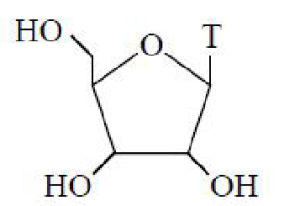
B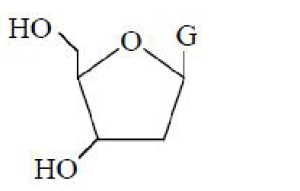
C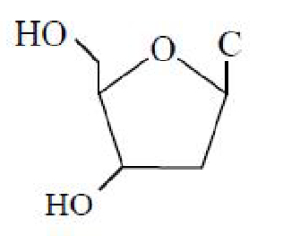
D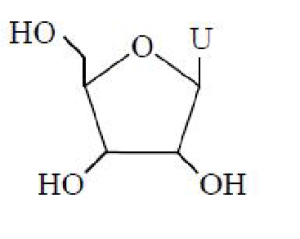
Solution
(D) nucleoside consists of a nitrogenous base attached to a pentose sugar.
In $RNA$,the pentose sugar is ribose,which has a hydroxyl $(-OH)$ group at both the $2'$ and $3'$ positions.
$RNA$ contains the nitrogenous bases Adenine $(A)$,Guanine $(G)$,Cytosine $(C)$,and Uracil $(U)$.
Thymine $(T)$ is found in $DNA$,not $RNA$.
Looking at the options:
Option $A$ has $T$ (Thymine),which is characteristic of $DNA$.
Option $B$ and $C$ show a deoxyribose sugar (missing the $-OH$ group at the $2'$ position),which is characteristic of $DNA$.
Option $D$ shows a ribose sugar (with $-OH$ groups at both $2'$ and $3'$ positions) attached to Uracil $(U)$,which is a characteristic nucleoside of $RNA$ (Uridine).
In $RNA$,the pentose sugar is ribose,which has a hydroxyl $(-OH)$ group at both the $2'$ and $3'$ positions.
$RNA$ contains the nitrogenous bases Adenine $(A)$,Guanine $(G)$,Cytosine $(C)$,and Uracil $(U)$.
Thymine $(T)$ is found in $DNA$,not $RNA$.
Looking at the options:
Option $A$ has $T$ (Thymine),which is characteristic of $DNA$.
Option $B$ and $C$ show a deoxyribose sugar (missing the $-OH$ group at the $2'$ position),which is characteristic of $DNA$.
Option $D$ shows a ribose sugar (with $-OH$ groups at both $2'$ and $3'$ positions) attached to Uracil $(U)$,which is a characteristic nucleoside of $RNA$ (Uridine).
0 likesView Solution
93
ChemistryEasyMCQAP EAMCET · 2023
Given below are two statements:
Assertion $(A)$: Hydrolysis of $DNA$ does not form equal number of $A$ and $T$; $G$ and $C$.
Reason $(R)$: In $DNA$,adenine forms hydrogen bonds with thymine and cytosine forms hydrogen bonds with guanine.
The correct answer is:
Assertion $(A)$: Hydrolysis of $DNA$ does not form equal number of $A$ and $T$; $G$ and $C$.
Reason $(R)$: In $DNA$,adenine forms hydrogen bonds with thymine and cytosine forms hydrogen bonds with guanine.
The correct answer is:
A
Both $A$ and $R$ are correct and $R$ is the correct explanation of $A$.
B
Both $A$ and $R$ are correct but $R$ is not the correct explanation of $A$.
C
$A$ is correct but $R$ is incorrect.
D
$A$ is incorrect but $R$ is correct.
Solution
(D) According to Chargaff's rule,in a double-stranded $DNA$ molecule,the amount of adenine $(A)$ is equal to the amount of thymine $(T)$,and the amount of guanine $(G)$ is equal to the amount of cytosine $(C)$.
This is because $A$ pairs with $T$ via two hydrogen bonds,and $G$ pairs with $C$ via three hydrogen bonds.
Therefore,the Assertion $(A)$ is incorrect because hydrolysis of $DNA$ yields equal amounts of $A$ and $T$,and $G$ and $C$.
The Reason $(R)$ is correct as it describes the base-pairing mechanism.
Thus,the correct option is $D$.
This is because $A$ pairs with $T$ via two hydrogen bonds,and $G$ pairs with $C$ via three hydrogen bonds.
Therefore,the Assertion $(A)$ is incorrect because hydrolysis of $DNA$ yields equal amounts of $A$ and $T$,and $G$ and $C$.
The Reason $(R)$ is correct as it describes the base-pairing mechanism.
Thus,the correct option is $D$.
0 likesView Solution
94
ChemistryMediumMCQAP EAMCET · 2023
In a nucleoside,the base is attached to which position of the sugar molecule?
A
$C-1'$
B
$C-2'$
C
$C-3'$
D
$C-5'$
Solution
(A) nucleoside is formed by the attachment of a nitrogenous base to the $1'$ position of a pentose sugar through an $N$-glycosidic linkage.
As shown in the structure,the nitrogenous base is attached to the $C-1'$ carbon atom of the sugar molecule.
As shown in the structure,the nitrogenous base is attached to the $C-1'$ carbon atom of the sugar molecule.
0 likesView Solution
95
ChemistryMediumMCQAP EAMCET · 2023
Which of the following bases are present both in $DNA$ and $RNA$?
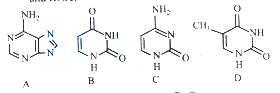
A
$A, C$
B
$B, C$
C
$A, B$
D
$A, D$
Solution
(A) In the given structures:
$A$ is Adenine,$B$ is Uracil,$C$ is Cytosine,and $D$ is Thymine.
Adenine $(A)$,Guanine $(G)$,and Cytosine $(C)$ are present in both $DNA$ and $RNA$.
Thymine $(T)$ is present only in $DNA$,and Uracil $(U)$ is present only in $RNA$.
Therefore,the bases present in both are Adenine $(A)$ and Cytosine $(C)$.
$A$ is Adenine,$B$ is Uracil,$C$ is Cytosine,and $D$ is Thymine.
Adenine $(A)$,Guanine $(G)$,and Cytosine $(C)$ are present in both $DNA$ and $RNA$.
Thymine $(T)$ is present only in $DNA$,and Uracil $(U)$ is present only in $RNA$.
Therefore,the bases present in both are Adenine $(A)$ and Cytosine $(C)$.
0 likesView Solution
96
ChemistryEasyMCQAP EAMCET · 2023
Which of the following correctly represents hydrogen bonded pairs in $DNA$?
A
$G \equiv C ; T=A$
B
$G=C ; T=A$
C
$G \equiv C ; T \equiv A$
D
$G \equiv C ; T=A$
Solution
(A) In $DNA$,the nitrogenous bases form specific hydrogen-bonded pairs.
Adenine $(A)$ pairs with Thymine $(T)$ through two hydrogen bonds $(A=T)$.
Guanine $(G)$ pairs with Cytosine $(C)$ through three hydrogen bonds $(G \equiv C)$.
Thus,the correct representation is $G \equiv C$ and $T=A$.
Adenine $(A)$ pairs with Thymine $(T)$ through two hydrogen bonds $(A=T)$.
Guanine $(G)$ pairs with Cytosine $(C)$ through three hydrogen bonds $(G \equiv C)$.
Thus,the correct representation is $G \equiv C$ and $T=A$.
0 likesView Solution
97
ChemistryMediumMCQAP EAMCET · 2023
Which of the following represents a nucleoside?
A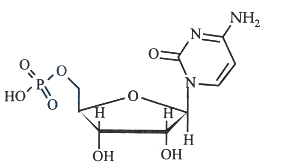
B
C
D
Solution
(C) nucleoside is composed of a pentose sugar and a nitrogenous base.
$A$ nucleotide is composed of a nucleoside and a phosphate group.
Option $A$ shows a nucleotide (cytidine monophosphate).
Option $B$ shows a sugar phosphate.
Option $C$ shows a nucleoside (uridine),which consists of a nitrogenous base (uracil) attached to a pentose sugar (ribose).
Option $D$ shows a pentose sugar (ribose).
$A$ nucleotide is composed of a nucleoside and a phosphate group.
Option $A$ shows a nucleotide (cytidine monophosphate).
Option $B$ shows a sugar phosphate.
Option $C$ shows a nucleoside (uridine),which consists of a nitrogenous base (uracil) attached to a pentose sugar (ribose).
Option $D$ shows a pentose sugar (ribose).
0 likesView Solution
98
ChemistryEasyMCQAP EAMCET · 2023
Deficiency of which vitamin causes convulsions?
A
Riboflavin
B
Thiamine
C
Ascorbic acid
D
Pyridoxine
Solution
(D) Deficiency of vitamin $B_6$ (pyridoxine) leads to neurological symptoms,including convulsions.
0 likesView Solution
99
ChemistryEasyMCQAP EAMCET · 2023
The source of vitamin,whose deficiency causes scurvy is
A
Amla
B
Carrot
C
Egg
D
Fish
Solution
(A) Scurvy is caused by the deficiency of Vitamin $C$ (ascorbic acid).
Vitamin $C$ is abundantly found in citrus fruits and amla (Indian gooseberry).
Vitamin $C$ is abundantly found in citrus fruits and amla (Indian gooseberry).
0 likesView Solution
100
ChemistryEasyMCQAP EAMCET · 2023
Match the following:
The correct answer is
| List-$I$ | List-$II$ |
| $A$. Beri Beri | $I$. Riboflavin |
| $B$. Scurvy | $II$. Thiamine |
| $C$. Cheilosis | $III$. Pyridoxine |
| $D$. Rickets | $IV$. Ascorbic acid |
| $V$. Vitamin $D$ |
The correct answer is
A
$A-III, B-IV, C-III, D-V$
B
$A-II, B-IV, C-I, D-V$
C
$A-III, B-V, C-I, D-II$
D
$A-III, B-V, C-IV, D-II$
Solution
(B) Beri-Beri is caused by the deficiency of Vitamin $B_1$ (thiamine).
Scurvy is caused by the deficiency of Vitamin $C$ (ascorbic acid).
Cheilosis is caused by the deficiency of Vitamin $B_2$ (riboflavin).
Rickets is caused by the deficiency of Vitamin $D$ (calciferol).
Therefore,the correct matching is $A-II, B-IV, C-I, D-V$.
Scurvy is caused by the deficiency of Vitamin $C$ (ascorbic acid).
Cheilosis is caused by the deficiency of Vitamin $B_2$ (riboflavin).
Rickets is caused by the deficiency of Vitamin $D$ (calciferol).
Therefore,the correct matching is $A-II, B-IV, C-I, D-V$.
0 likesView Solution
Vedclass Products
For Students
Vedclass Test Series
Mock tests in real AP EAMCET style covering Chemistry with performance analysis. 5-day free trial.
Start Free TrialFor Teachers
Exam Paper Generator
Generate Set A/B/C/D Chemistry papers from 7.5L+ questions in 2 minutes. 3 chapters free.
Try FreeFor Institutes
Online Exam Module
Run live AP EAMCET mock exams with unlimited students, 360° analytics & white-label branding.
See DemoFrequently Asked Questions
How many Chemistry questions are in AP EAMCET 2023?
There are 414 Chemistry questions from the AP EAMCET 2023 paper on Vedclass, each with a detailed step-by-step solution in English.
Are AP EAMCET 2023 Chemistry solutions available in English?
Yes. All solutions on this page are in English. You can also switch to English or Hindi using the language buttons above the questions.
Can I practice AP EAMCET 2023 Chemistry as a timed test?
Yes. Use the Vedclass Test Series to attempt a full AP EAMCET mock test covering Chemistry with time limits and instant score analysis.
Can teachers create Chemistry papers from AP EAMCET previous year questions?
Yes. The Vedclass Exam Paper Generator lets teachers mix AP EAMCET Chemistry questions and generate Set A/B/C/D papers in minutes.
For Teachers & Institutes
Build a Custom Chemistry Paper
Pick AP EAMCET 2023 Chemistry questions, set difficulty, and generate Set A/B/C/D in 2 minutes.