
MathematicsQ101–200 of 482 questions
Page 3 of 6 · Gujarati
101
MathematicsMediumMCQAP EAMCET · 2017
$y=\sqrt{3}x$,$y=-\sqrt{3}x$ અને $y=3$ રેખાઓ દ્વારા બનતા ત્રિકોણનું અંતઃકેન્દ્ર શોધો.
A
$(0, 2)$
B
$(0, 1)$
C
$(1, 2)$
D
$(2, 1)$
Solution
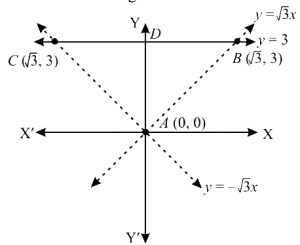
(A) ત્રિકોણના શિરોબિંદુઓ રેખાઓના છેદબિંદુઓ છે:
$1$. $y=\sqrt{3}x$ અને $y=-\sqrt{3}x$ નું છેદબિંદુ $A(0, 0)$ છે.
$2$. $y=\sqrt{3}x$ અને $y=3$ નું છેદબિંદુ $B(\sqrt{3}, 3)$ છે.
$3$. $y=-\sqrt{3}x$ અને $y=3$ નું છેદબિંદુ $C(-\sqrt{3}, 3)$ છે.
બાજુઓની લંબાઈ:
$c = AB = \sqrt{(\sqrt{3}-0)^2 + (3-0)^2} = 2\sqrt{3}$.
$b = AC = \sqrt{(-\sqrt{3}-0)^2 + (3-0)^2} = 2\sqrt{3}$.
$a = BC = \sqrt{(\sqrt{3}-(-\sqrt{3}))^2 + (3-3)^2} = 2\sqrt{3}$.
$a=b=c$ હોવાથી,આ સમબાજુ ત્રિકોણ છે.
સમબાજુ ત્રિકોણનું અંતઃકેન્દ્ર $(I)$ તેના મધ્યકેન્દ્ર $(G)$ જેટલું જ હોય છે.
$I = G = \left(\frac{0+\sqrt{3}-\sqrt{3}}{3}, \frac{0+3+3}{3}\right) = (0, 2)$.
$1$. $y=\sqrt{3}x$ અને $y=-\sqrt{3}x$ નું છેદબિંદુ $A(0, 0)$ છે.
$2$. $y=\sqrt{3}x$ અને $y=3$ નું છેદબિંદુ $B(\sqrt{3}, 3)$ છે.
$3$. $y=-\sqrt{3}x$ અને $y=3$ નું છેદબિંદુ $C(-\sqrt{3}, 3)$ છે.
બાજુઓની લંબાઈ:
$c = AB = \sqrt{(\sqrt{3}-0)^2 + (3-0)^2} = 2\sqrt{3}$.
$b = AC = \sqrt{(-\sqrt{3}-0)^2 + (3-0)^2} = 2\sqrt{3}$.
$a = BC = \sqrt{(\sqrt{3}-(-\sqrt{3}))^2 + (3-3)^2} = 2\sqrt{3}$.
$a=b=c$ હોવાથી,આ સમબાજુ ત્રિકોણ છે.
સમબાજુ ત્રિકોણનું અંતઃકેન્દ્ર $(I)$ તેના મધ્યકેન્દ્ર $(G)$ જેટલું જ હોય છે.
$I = G = \left(\frac{0+\sqrt{3}-\sqrt{3}}{3}, \frac{0+3+3}{3}\right) = (0, 2)$.
0 likesView Solution
102
MathematicsMediumMCQAP EAMCET · 2017
બિંદુઓ $(1, 2, 3), (3, -1, 5), (4, 0, -3)$ દ્વારા બનતા ત્રિકોણનું પરિકેન્દ્ર શોધો.
A
$(1, 1, 1)$
B
$(2, 2, 2)$
C
$(3, 3, 3)$
D
$\left(\frac{7}{2}, -\frac{1}{2}, 1\right)$
Solution
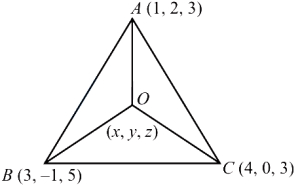
(D) ધારો કે $A(1, 2, 3), B(3, -1, 5), C(4, 0, -3)$ એ ત્રિકોણના શિરોબિંદુઓ છે. ધારો કે $O(x, y, z)$ એ પરિકેન્દ્ર છે. તેથી $OA = OB = OC$,જેનો અર્થ છે કે $OA^2 = OB^2 = OC^2$.
$OA^2 = OB^2 \Rightarrow (x-1)^2 + (y-2)^2 + (z-3)^2 = (x-3)^2 + (y+1)^2 + (z-5)^2$
$x^2 - 2x + 1 + y^2 - 4y + 4 + z^2 - 6z + 9 = x^2 - 6x + 9 + y^2 + 2y + 1 + z^2 - 10z + 25$
$4x - 6y + 4z = 20 \Rightarrow 2x - 3y + 2z = 10 \quad \dots (i)$
$OB^2 = OC^2 \Rightarrow (x-3)^2 + (y+1)^2 + (z-5)^2 = (x-4)^2 + y^2 + (z+3)^2$
$x^2 - 6x + 9 + y^2 + 2y + 1 + z^2 - 10z + 25 = x^2 - 8x + 16 + y^2 + z^2 + 6z + 9$
$2x + 2y - 16z = -10 \Rightarrow x + y - 8z = -5 \quad \dots (ii)$
$OA^2 = OC^2 \Rightarrow (x-1)^2 + (y-2)^2 + (z-3)^2 = (x-4)^2 + y^2 + (z+3)^2$
$x^2 - 2x + 1 + y^2 - 4y + 4 + z^2 - 6z + 9 = x^2 - 8x + 16 + y^2 + z^2 + 6z + 9$
$6x - 4y - 12z = 11 \quad \dots (iii)$
સમીકરણો $(i), (ii),$ અને $(iii)$ ઉકેલતા,આપણને $x = \frac{7}{2}, y = -\frac{1}{2}, z = 1$ મળે છે.
આમ,પરિકેન્દ્ર $\left(\frac{7}{2}, -\frac{1}{2}, 1\right)$ છે.
$OA^2 = OB^2 \Rightarrow (x-1)^2 + (y-2)^2 + (z-3)^2 = (x-3)^2 + (y+1)^2 + (z-5)^2$
$x^2 - 2x + 1 + y^2 - 4y + 4 + z^2 - 6z + 9 = x^2 - 6x + 9 + y^2 + 2y + 1 + z^2 - 10z + 25$
$4x - 6y + 4z = 20 \Rightarrow 2x - 3y + 2z = 10 \quad \dots (i)$
$OB^2 = OC^2 \Rightarrow (x-3)^2 + (y+1)^2 + (z-5)^2 = (x-4)^2 + y^2 + (z+3)^2$
$x^2 - 6x + 9 + y^2 + 2y + 1 + z^2 - 10z + 25 = x^2 - 8x + 16 + y^2 + z^2 + 6z + 9$
$2x + 2y - 16z = -10 \Rightarrow x + y - 8z = -5 \quad \dots (ii)$
$OA^2 = OC^2 \Rightarrow (x-1)^2 + (y-2)^2 + (z-3)^2 = (x-4)^2 + y^2 + (z+3)^2$
$x^2 - 2x + 1 + y^2 - 4y + 4 + z^2 - 6z + 9 = x^2 - 8x + 16 + y^2 + z^2 + 6z + 9$
$6x - 4y - 12z = 11 \quad \dots (iii)$
સમીકરણો $(i), (ii),$ અને $(iii)$ ઉકેલતા,આપણને $x = \frac{7}{2}, y = -\frac{1}{2}, z = 1$ મળે છે.
આમ,પરિકેન્દ્ર $\left(\frac{7}{2}, -\frac{1}{2}, 1\right)$ છે.
0 likesView Solution
103
MathematicsMediumMCQAP EAMCET · 2017
સમીકરણ $2x^2+4xy-6y^2+2x+8y+1=0$ માંથી પ્રથમ ઘાતના પદો દૂર કરવા માટે ઉગમબિંદુને કયા બિંદુ પર ખસેડવું જોઈએ?
A
$\left(\frac{7}{8}, \frac{3}{8}\right)$
B
$\left(\frac{-7}{8}, \frac{-3}{8}\right)$
C
$\left(\frac{-7}{8}, \frac{3}{8}\right)$
D
$\left(\frac{7}{8}, \frac{-3}{8}\right)$
Solution
(C) આપેલ સમીકરણ $2x^2+4xy-6y^2+2x+8y+1=0$ છે.
તેને વ્યાપક દ્વિઘાત સમીકરણ $ax^2+2hxy+by^2+2gx+2fy+c=0$ સાથે સરખાવતા,$a=2, h=2, b=-6, g=1, f=4, c=1$ મળે છે.
પ્રથમ ઘાતના પદો દૂર કરવા માટે,ઉગમબિંદુને $(h_0, k_0)$ બિંદુ પર ખસેડવું પડે,જે આંશિક વિકલન $\frac{\partial f}{\partial x} = 0$ અને $\frac{\partial f}{\partial y} = 0$ ના છેદબિંદુ દ્વારા મળે છે.
આ સમીકરણો $4x+4y+2=0$ અને $4x-12y+8=0$ છે.
આ સમીકરણો ઉકેલતા:
$2x+2y=-1$
$2x-6y=-4$
બંને સમીકરણોની બાદબાકી કરતા: $8y=3 \implies y=\frac{3}{8}$.
$y=\frac{3}{8}$ ને $2x+2y=-1$ માં મૂકતા:
$2x+2(\frac{3}{8})=-1 \implies 2x+\frac{3}{4}=-1 \implies 2x=-\frac{7}{4} \implies x=-\frac{7}{8}$.
આમ,જરૂરી બિંદુ $\left(-\frac{7}{8}, \frac{3}{8}\right)$ છે.
તેને વ્યાપક દ્વિઘાત સમીકરણ $ax^2+2hxy+by^2+2gx+2fy+c=0$ સાથે સરખાવતા,$a=2, h=2, b=-6, g=1, f=4, c=1$ મળે છે.
પ્રથમ ઘાતના પદો દૂર કરવા માટે,ઉગમબિંદુને $(h_0, k_0)$ બિંદુ પર ખસેડવું પડે,જે આંશિક વિકલન $\frac{\partial f}{\partial x} = 0$ અને $\frac{\partial f}{\partial y} = 0$ ના છેદબિંદુ દ્વારા મળે છે.
આ સમીકરણો $4x+4y+2=0$ અને $4x-12y+8=0$ છે.
આ સમીકરણો ઉકેલતા:
$2x+2y=-1$
$2x-6y=-4$
બંને સમીકરણોની બાદબાકી કરતા: $8y=3 \implies y=\frac{3}{8}$.
$y=\frac{3}{8}$ ને $2x+2y=-1$ માં મૂકતા:
$2x+2(\frac{3}{8})=-1 \implies 2x+\frac{3}{4}=-1 \implies 2x=-\frac{7}{4} \implies x=-\frac{7}{8}$.
આમ,જરૂરી બિંદુ $\left(-\frac{7}{8}, \frac{3}{8}\right)$ છે.
0 likesView Solution
104
MathematicsMediumMCQAP EAMCET · 2017
એક વર્તુળ જેનું કેન્દ્ર ઉગમબિંદુ પર છે,તે એક સમબાજુ ત્રિકોણના ત્રણેય શિરોબિંદુઓમાંથી પસાર થાય છે,જેના મધ્યગાની લંબાઈ $9$ એકમ છે. તો તે વર્તુળનું સમીકરણ શું છે?
A
$x^2+y^2=9$
B
$x^2+y^2=18$
C
$x^2+y^2=36$
D
$x^2+y^2=81$
Solution
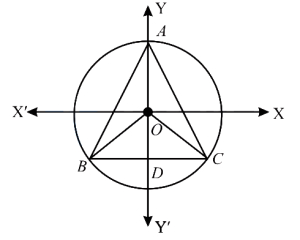
(C) ધારો કે સમબાજુ ત્રિકોણ $\triangle ABC$ છે અને તેની મધ્યગા $AD = 9$ એકમ છે.
સમબાજુ ત્રિકોણમાં,મધ્યકેન્દ્ર $O$ એ મધ્યગા $AD$ ને $2:1$ ના ગુણોત્તરમાં વિભાજિત કરે છે.
વર્તુળનું કેન્દ્ર ઉગમબિંદુ $O(0,0)$ પર હોવાથી અને તે શિરોબિંદુઓમાંથી પસાર થતું હોવાથી,$O$ એ $\triangle ABC$ નું પરિકેન્દ્ર છે.
સમબાજુ ત્રિકોણમાં,પરિકેન્દ્ર અને મધ્યકેન્દ્ર એક જ હોય છે.
તેથી,કેન્દ્ર $O$ થી શિરોબિંદુ $A$ સુધીનું અંતર એ વર્તુળની ત્રિજ્યા $R$ છે.
$R = AO = \frac{2}{3} AD = \frac{2}{3} \times 9 = 6$ એકમ.
ઉગમબિંદુ $(0,0)$ પર કેન્દ્ર અને $R$ ત્રિજ્યા ધરાવતા વર્તુળનું સમીકરણ $x^2 + y^2 = R^2$ છે.
$R = 6$ મૂકતા,આપણને $x^2 + y^2 = 6^2 = 36$ મળે છે.
સમબાજુ ત્રિકોણમાં,મધ્યકેન્દ્ર $O$ એ મધ્યગા $AD$ ને $2:1$ ના ગુણોત્તરમાં વિભાજિત કરે છે.
વર્તુળનું કેન્દ્ર ઉગમબિંદુ $O(0,0)$ પર હોવાથી અને તે શિરોબિંદુઓમાંથી પસાર થતું હોવાથી,$O$ એ $\triangle ABC$ નું પરિકેન્દ્ર છે.
સમબાજુ ત્રિકોણમાં,પરિકેન્દ્ર અને મધ્યકેન્દ્ર એક જ હોય છે.
તેથી,કેન્દ્ર $O$ થી શિરોબિંદુ $A$ સુધીનું અંતર એ વર્તુળની ત્રિજ્યા $R$ છે.
$R = AO = \frac{2}{3} AD = \frac{2}{3} \times 9 = 6$ એકમ.
ઉગમબિંદુ $(0,0)$ પર કેન્દ્ર અને $R$ ત્રિજ્યા ધરાવતા વર્તુળનું સમીકરણ $x^2 + y^2 = R^2$ છે.
$R = 6$ મૂકતા,આપણને $x^2 + y^2 = 6^2 = 36$ મળે છે.
0 likesView Solution
105
MathematicsMediumMCQAP EAMCET · 2017
જ્યારે યામ અક્ષોને ધન દિશામાં $\frac{\pi}{4}$ ખૂણે ફેરવવામાં આવે છે,ત્યારે એક સમીકરણ $x^2+y^2-6x+8y+21=0$ માં રૂપાંતરિત થાય છે. તો મૂળ સમીકરણ શું હશે?
A
$x^2+y^2-7\sqrt{2}x+\sqrt{2}y+21=0$
B
$\sqrt{2}x^2+\sqrt{2}y^2-7x+y+21\sqrt{2}=0$
C
$x^2+y^2-14x+2y+21=0$
D
$x^2+y^2-7\sqrt{2}x+\sqrt{2}y+21=0$
Solution
(A) ધારો કે મૂળ યામ $(X, Y)$ છે અને નવા યામ $(x, y)$ છે.
આપેલ પરિભ્રમણ ખૂણો $\theta = \frac{\pi}{4}$ છે.
રૂપાંતરિત સમીકરણ $x^2+y^2-6x+8y+21=0$ માં $x = \frac{X+Y}{\sqrt{2}}$ અને $y = \frac{-X+Y}{\sqrt{2}}$ મૂકતા,
સાદુરૂપ આપતા આપણને $X^2+Y^2 - 7\sqrt{2}X + \sqrt{2}Y + 21 = 0$ મળે છે.
આપેલ પરિભ્રમણ ખૂણો $\theta = \frac{\pi}{4}$ છે.
રૂપાંતરિત સમીકરણ $x^2+y^2-6x+8y+21=0$ માં $x = \frac{X+Y}{\sqrt{2}}$ અને $y = \frac{-X+Y}{\sqrt{2}}$ મૂકતા,
સાદુરૂપ આપતા આપણને $X^2+Y^2 - 7\sqrt{2}X + \sqrt{2}Y + 21 = 0$ મળે છે.
0 likesView Solution
106
MathematicsEasyMCQAP EAMCET · 2017
રેખા $3x + y + 4 = 0$ પરનું બિંદુ જે $(-5, 6)$ અને $(3, 2)$ થી સમાન અંતરે હોય તે છે
A
$\left(\frac{-7}{5}, \frac{1}{5}\right)$
B
$\left(\frac{7}{5}, \frac{-1}{5}\right)$
C
$(2, -2)$
D
$(-2, 2)$
Solution
(D) ધારો કે બિંદુ $P(x, y)$ છે. $P$ એ રેખા $3x + y + 4 = 0$ પર હોવાથી,$y = -3x - 4$ મળે.
ધારો કે $A = (-5, 6)$ અને $B = (3, 2)$.
$P$ એ $A$ અને $B$ થી સમાન અંતરે હોવાથી,$PA^2 = PB^2$.
$(x + 5)^2 + (y - 6)^2 = (x - 3)^2 + (y - 2)^2$.
$x^2 + 10x + 25 + y^2 - 12y + 36 = x^2 - 6x + 9 + y^2 - 4y + 4$.
$16x - 8y + 48 = 0$,જેનું સાદું રૂપ $2x - y + 6 = 0$ થાય.
$y = -3x - 4$ ને $2x - y + 6 = 0$ માં મૂકતા:
$2x - (-3x - 4) + 6 = 0$.
$5x + 10 = 0 \implies x = -2$.
તેથી $y = -3(-2) - 4 = 6 - 4 = 2$.
બિંદુ $(-2, 2)$ છે.
ધારો કે $A = (-5, 6)$ અને $B = (3, 2)$.
$P$ એ $A$ અને $B$ થી સમાન અંતરે હોવાથી,$PA^2 = PB^2$.
$(x + 5)^2 + (y - 6)^2 = (x - 3)^2 + (y - 2)^2$.
$x^2 + 10x + 25 + y^2 - 12y + 36 = x^2 - 6x + 9 + y^2 - 4y + 4$.
$16x - 8y + 48 = 0$,જેનું સાદું રૂપ $2x - y + 6 = 0$ થાય.
$y = -3x - 4$ ને $2x - y + 6 = 0$ માં મૂકતા:
$2x - (-3x - 4) + 6 = 0$.
$5x + 10 = 0 \implies x = -2$.
તેથી $y = -3(-2) - 4 = 6 - 4 = 2$.
બિંદુ $(-2, 2)$ છે.
0 likesView Solution
107
MathematicsEasyMCQAP EAMCET · 2017
$x=0, y=0$ અને $3x+4y=12$ રેખાઓ દ્વારા બનતા ત્રિકોણનું અંતઃકેન્દ્ર શોધો.
A
$(1, 1)$
B
$(1, 2)$
C
$(2, 1)$
D
$(2, 2)$
Solution
(A) રેખાઓ $x=0, y=0$ અને $3x+4y=12$ છે.
ત્રિકોણના શિરોબિંદુઓ $A(0, 0), B(0, 3)$ અને $C(4, 0)$ છે.
બાજુઓની લંબાઈ $a=5, b=4, c=3$ છે.
અંતઃકેન્દ્રનું સૂત્ર $\left(\frac{ax_1+bx_2+cx_3}{a+b+c}, \frac{ay_1+by_2+cy_3}{a+b+c}\right)$ છે.
કિંમતો મૂકતા,$I_x = \frac{5(0) + 4(0) + 3(4)}{12} = 1$ અને $I_y = \frac{5(0) + 4(3) + 3(0)}{12} = 1$.
તેથી,અંતઃકેન્દ્ર $(1, 1)$ છે.
ત્રિકોણના શિરોબિંદુઓ $A(0, 0), B(0, 3)$ અને $C(4, 0)$ છે.
બાજુઓની લંબાઈ $a=5, b=4, c=3$ છે.
અંતઃકેન્દ્રનું સૂત્ર $\left(\frac{ax_1+bx_2+cx_3}{a+b+c}, \frac{ay_1+by_2+cy_3}{a+b+c}\right)$ છે.
કિંમતો મૂકતા,$I_x = \frac{5(0) + 4(0) + 3(4)}{12} = 1$ અને $I_y = \frac{5(0) + 4(3) + 3(0)}{12} = 1$.
તેથી,અંતઃકેન્દ્ર $(1, 1)$ છે.
0 likesView Solution
108
MathematicsMediumMCQAP EAMCET · 2017
ધારો કે $A = (2, 0)$ અને $B = (6, 4)$ બે બિંદુઓ છે. જો રેખાખંડ $\overline{AB}$ ને $A$ ની આસપાસ $45^{\circ}$ ના ખૂણે ઋણ (ઘડિયાળની દિશામાં) દિશામાં ફેરવવામાં આવે,તો પરિભ્રમણ પછી $B$ ના યામ શું હશે?
A
$(2 + 4\sqrt{2}, 0)$
B
$(2, 4\sqrt{2})$
C
$(0, 4\sqrt{2})$
D
$(4\sqrt{2}, 0)$
Solution
(A) ધારો કે $A = (2, 0)$ અને $B = (6, 4)$.
સદિશ $\vec{AB} = (4, 4)$ છે.
લંબાઈ $r = \sqrt{4^2 + 4^2} = 4\sqrt{2}$ છે.
પ્રારંભિક ખૂણો $\theta = 45^{\circ}$ છે.
ઋણ દિશામાં $45^{\circ}$ પરિભ્રમણ પછી નવો ખૂણો $\theta' = 45^{\circ} - 45^{\circ} = 0^{\circ}$ થાય.
નવા યામ $(x', y') = (2 + r \cos(0^{\circ}), 0 + r \sin(0^{\circ})) = (2 + 4\sqrt{2}, 0)$ મળે.
સદિશ $\vec{AB} = (4, 4)$ છે.
લંબાઈ $r = \sqrt{4^2 + 4^2} = 4\sqrt{2}$ છે.
પ્રારંભિક ખૂણો $\theta = 45^{\circ}$ છે.
ઋણ દિશામાં $45^{\circ}$ પરિભ્રમણ પછી નવો ખૂણો $\theta' = 45^{\circ} - 45^{\circ} = 0^{\circ}$ થાય.
નવા યામ $(x', y') = (2 + r \cos(0^{\circ}), 0 + r \sin(0^{\circ})) = (2 + 4\sqrt{2}, 0)$ મળે.
0 likesView Solution
109
MathematicsDifficultMCQAP EAMCET · 2017
$A(3, -4)$ એ $\triangle ABC$ નો એક શિરોબિંદુ છે અને $3x + 4y - 18 = 0$ એ બાજુ $AB$ નો લંબદ્વિભાજક છે. જો $C = (6, 3)$ હોય,તો ત્રિકોણનું મધ્યકેન્દ્ર શોધો:
A
$(6, 1)$
B
$(-6, 1)$
C
$(-6, -1)$
D
$(6, -1)$
Solution
(A) ધારો કે $B = (x_1, y_1)$. $3x + 4y - 18 = 0$ એ $AB$ નો લંબદ્વિભાજક હોવાથી,$AB$ નું મધ્યબિંદુ $M$ રેખા પર આવેલું છે.
$M = (\frac{x_1+3}{2}, \frac{y_1-4}{2})$. રેખાના સમીકરણમાં કિંમત મૂકતા: $3(\frac{x_1+3}{2}) + 4(\frac{y_1-4}{2}) - 18 = 0 \implies 3x_1 + 4y_1 = 43$.
વળી,$AB$ નો ઢાળ રેખા $3x + 4y - 18 = 0$ (ઢાળ $-3/4$) ને લંબ છે. તેથી,$AB$ નો ઢાળ $= 4/3$.
$\frac{y_1+4}{x_1-3} = \frac{4}{3} \implies 4x_1 - 3y_1 = 24$.
સમીકરણો ઉકેલતા: $x_1 = 9$ અને $y_1 = 4$. તેથી $B = (9, 4)$.
મધ્યકેન્દ્ર $G = (\frac{3+9+6}{3}, \frac{-4+4+3}{3}) = (6, 1)$.
$M = (\frac{x_1+3}{2}, \frac{y_1-4}{2})$. રેખાના સમીકરણમાં કિંમત મૂકતા: $3(\frac{x_1+3}{2}) + 4(\frac{y_1-4}{2}) - 18 = 0 \implies 3x_1 + 4y_1 = 43$.
વળી,$AB$ નો ઢાળ રેખા $3x + 4y - 18 = 0$ (ઢાળ $-3/4$) ને લંબ છે. તેથી,$AB$ નો ઢાળ $= 4/3$.
$\frac{y_1+4}{x_1-3} = \frac{4}{3} \implies 4x_1 - 3y_1 = 24$.
સમીકરણો ઉકેલતા: $x_1 = 9$ અને $y_1 = 4$. તેથી $B = (9, 4)$.
મધ્યકેન્દ્ર $G = (\frac{3+9+6}{3}, \frac{-4+4+3}{3}) = (6, 1)$.
0 likesView Solution
110
MathematicsMediumMCQAP EAMCET · 2017
એક સીધી રેખા $L$ એ બે રેખાઓ $5x - y - 4 = 0$ અને $3x + 4y - 4 = 0$ ને છેદે છે. આ બે રેખાઓ વચ્ચેનો $L$ નો રેખાખંડ બિંદુ $(1, 5)$ પર દુભાગે છે. તો $L$ નું સમીકરણ શોધો.
A
$63x - 32y + 97 = 0$
B
$36x - 53y + 229 = 0$
C
$38x - 65y + 287 = 0$
D
$83x - 35y + 92 = 0$
Solution
(D) ધારો કે રેખા $L$ બિંદુ $P(1, 5)$ માંથી પસાર થાય છે. ધારો કે રેખા $L$ એ $L_1: 5x - y - 4 = 0$ ને $A(x_1, y_1)$ માં અને $L_2: 3x + 4y - 4 = 0$ ને $B(x_2, y_2)$ માં છેદે છે.
$P(1, 5)$ એ $AB$ નું મધ્યબિંદુ હોવાથી,$x_1 + x_2 = 2$ અને $y_1 + y_2 = 10$ મળે.
$A$ એ $L_1$ પર હોવાથી,$5x_1 - y_1 - 4 = 0$,તેથી $y_1 = 5x_1 - 4$.
$B$ એ $L_2$ પર હોવાથી,$3x_2 + 4y_2 - 4 = 0$,તેથી $y_2 = 1 - \frac{3}{4}x_2$.
$x_2 = 2 - x_1$ અને $y_2 = 10 - y_1$ ને $B$ ના સમીકરણમાં મૂકતા:
$3(2 - x_1) + 4(10 - y_1) - 4 = 0 \implies 3x_1 + 4y_1 = 42$.
હવે $y_1 = 5x_1 - 4$ અને $3x_1 + 4y_1 = 42$ ને ઉકેલતા $x_1 = \frac{58}{23}$ અને $y_1 = \frac{198}{23}$ મળે.
રેખા $L$ નો ઢાળ $m = \frac{5 - \frac{198}{23}}{1 - \frac{58}{23}} = \frac{83}{35}$.
$L$ નું સમીકરણ $y - 5 = \frac{83}{35}(x - 1) \implies 83x - 35y + 92 = 0$.
$P(1, 5)$ એ $AB$ નું મધ્યબિંદુ હોવાથી,$x_1 + x_2 = 2$ અને $y_1 + y_2 = 10$ મળે.
$A$ એ $L_1$ પર હોવાથી,$5x_1 - y_1 - 4 = 0$,તેથી $y_1 = 5x_1 - 4$.
$B$ એ $L_2$ પર હોવાથી,$3x_2 + 4y_2 - 4 = 0$,તેથી $y_2 = 1 - \frac{3}{4}x_2$.
$x_2 = 2 - x_1$ અને $y_2 = 10 - y_1$ ને $B$ ના સમીકરણમાં મૂકતા:
$3(2 - x_1) + 4(10 - y_1) - 4 = 0 \implies 3x_1 + 4y_1 = 42$.
હવે $y_1 = 5x_1 - 4$ અને $3x_1 + 4y_1 = 42$ ને ઉકેલતા $x_1 = \frac{58}{23}$ અને $y_1 = \frac{198}{23}$ મળે.
રેખા $L$ નો ઢાળ $m = \frac{5 - \frac{198}{23}}{1 - \frac{58}{23}} = \frac{83}{35}$.
$L$ નું સમીકરણ $y - 5 = \frac{83}{35}(x - 1) \implies 83x - 35y + 92 = 0$.
0 likesView Solution
111
MathematicsEasyMCQAP EAMCET · 2017
જો $P(-1, 0)$,$Q(0, 0)$ અને $R(3, 3\sqrt{3})$ ત્રણ બિંદુઓ હોય,તો $\angle PQR$ ના દ્વિભાજકનું સમીકરણ શું થાય?
A
$x + \sqrt{3}y = 0$
B
$\sqrt{3}x + y = 0$
C
$x + \frac{\sqrt{3}}{2}y = 0$
D
$\frac{\sqrt{3}}{2}x + y = 0$
Solution
(B) બિંદુઓના યામ $P(-1, 0)$,$Q(0, 0)$ અને $R(3, 3\sqrt{3})$ છે.
રેખા $QP$ અને $QR$ ના ઢાળ શોધો.
$QP$ નો ઢાળ $(m_1)$ = $0$ છે.
$QR$ નો ઢાળ $(m_2)$ = $\sqrt{3}$ છે.
રેખા $QP$ નો $x$-અક્ષ સાથેનો ખૂણો $0^\circ$ છે.
રેખા $QR$ નો $x$-અક્ષ સાથેનો ખૂણો $60^\circ$ છે.
$\angle PQR$ નો દ્વિભાજક $x$-અક્ષ સાથે $\theta = \frac{0^\circ + 60^\circ}{2} = 30^\circ$ નો ખૂણો બનાવશે.
પરંતુ,$P$ એ $x$-અક્ષની ઋણ દિશામાં હોવાથી,ખૂણો $120^\circ$ થશે.
તેથી,દ્વિભાજકનો ઢાળ $m = \tan(120^\circ) = -\sqrt{3}$ થશે.
સમીકરણ $y = -\sqrt{3}x$ એટલે કે $\sqrt{3}x + y = 0$ મળે.
રેખા $QP$ અને $QR$ ના ઢાળ શોધો.
$QP$ નો ઢાળ $(m_1)$ = $0$ છે.
$QR$ નો ઢાળ $(m_2)$ = $\sqrt{3}$ છે.
રેખા $QP$ નો $x$-અક્ષ સાથેનો ખૂણો $0^\circ$ છે.
રેખા $QR$ નો $x$-અક્ષ સાથેનો ખૂણો $60^\circ$ છે.
$\angle PQR$ નો દ્વિભાજક $x$-અક્ષ સાથે $\theta = \frac{0^\circ + 60^\circ}{2} = 30^\circ$ નો ખૂણો બનાવશે.
પરંતુ,$P$ એ $x$-અક્ષની ઋણ દિશામાં હોવાથી,ખૂણો $120^\circ$ થશે.
તેથી,દ્વિભાજકનો ઢાળ $m = \tan(120^\circ) = -\sqrt{3}$ થશે.
સમીકરણ $y = -\sqrt{3}x$ એટલે કે $\sqrt{3}x + y = 0$ મળે.
0 likesView Solution
112
MathematicsMediumMCQAP EAMCET · 2017
બિંદુ $P(a, b)$ એ સીધી રેખા $3x + 2y = 13$ પર આવેલું છે અને બિંદુ $Q(b, a)$ એ સીધી રેખા $4x - y = 5$ પર આવેલું છે. તો રેખા $PQ$ નું સમીકરણ શું છે?
A
$x + y = 7$
B
$x + y = 5$
C
$x + y = 2$
D
$x + y = 21$
Solution
(B) આપેલ છે કે બિંદુ $P(a, b)$ એ $3x + 2y = 13$ પર છે,તેથી $3a + 2b = 13$ (સમીકરણ $1$).
આપેલ છે કે બિંદુ $Q(b, a)$ એ $4x - y = 5$ પર છે,તેથી $4b - a = 5$,જેનો અર્થ છે $a = 4b - 5$ (સમીકરણ $2$).
સમીકરણ $2$ ને સમીકરણ $1$ માં મૂકતા:
$3(4b - 5) + 2b = 13$
$12b - 15 + 2b = 13$
$14b = 28 \implies b = 2$.
$b = 2$ ને સમીકરણ $2$ માં મૂકતા:
$a = 4(2) - 5 = 8 - 5 = 3$.
આમ,$P = (3, 2)$ અને $Q = (2, 3)$.
રેખા $PQ$ નો ઢાળ $m = \frac{3 - 2}{2 - 3} = \frac{1}{-1} = -1$.
બિંદુ $(3, 2)$ માંથી પસાર થતી રેખા $PQ$ નું સમીકરણ:
$y - 2 = -1(x - 3)$
$y - 2 = -x + 3$
$x + y = 5$.
આપેલ છે કે બિંદુ $Q(b, a)$ એ $4x - y = 5$ પર છે,તેથી $4b - a = 5$,જેનો અર્થ છે $a = 4b - 5$ (સમીકરણ $2$).
સમીકરણ $2$ ને સમીકરણ $1$ માં મૂકતા:
$3(4b - 5) + 2b = 13$
$12b - 15 + 2b = 13$
$14b = 28 \implies b = 2$.
$b = 2$ ને સમીકરણ $2$ માં મૂકતા:
$a = 4(2) - 5 = 8 - 5 = 3$.
આમ,$P = (3, 2)$ અને $Q = (2, 3)$.
રેખા $PQ$ નો ઢાળ $m = \frac{3 - 2}{2 - 3} = \frac{1}{-1} = -1$.
બિંદુ $(3, 2)$ માંથી પસાર થતી રેખા $PQ$ નું સમીકરણ:
$y - 2 = -1(x - 3)$
$y - 2 = -x + 3$
$x + y = 5$.
0 likesView Solution
113
MathematicsEasyMCQAP EAMCET · 2017
જો $P(3,4)$ બિંદુમાંથી પસાર થતી એક સીધી રેખા $X$-અક્ષ સાથે $\frac{\pi}{6}$ નો ખૂણો બનાવે છે અને $12x+5y+10=0$ રેખાને $Q$ બિંદુએ મળે છે,તો $PQ$ ની લંબાઈ કેટલી થાય?
A
$\frac{132}{12\sqrt{3}+5}$
B
$\frac{166}{8\sqrt{3}+6}$
C
$\frac{182}{6\sqrt{3}+4}$
D
$\frac{192}{14\sqrt{3}+6}$
Solution
(A) $P(3,4)$ માંથી પસાર થતી અને $\theta = \frac{\pi}{6}$ ખૂણો બનાવતી રેખાનું સમીકરણ પ્રાચલ સ્વરૂપમાં: $\frac{x-3}{\cos(\pi/6)} = \frac{y-4}{\sin(\pi/6)} = r$ છે,જ્યાં $r$ એ $PQ$ નું અંતર છે.
તેથી,$x = 3 + r \frac{\sqrt{3}}{2}$ અને $y = 4 + \frac{r}{2}$.
$Q$ એ $12x+5y+10=0$ પર હોવાથી,કિંમતો મૂકતા:
$12(3 + \frac{r\sqrt{3}}{2}) + 5(4 + \frac{r}{2}) + 10 = 0$
$36 + 6r\sqrt{3} + 20 + 2.5r + 10 = 0$
$66 + r(6\sqrt{3} + 2.5) = 0$
$r = \frac{66}{6\sqrt{3} + 2.5} = \frac{132}{12\sqrt{3} + 5}$.
તેથી,$x = 3 + r \frac{\sqrt{3}}{2}$ અને $y = 4 + \frac{r}{2}$.
$Q$ એ $12x+5y+10=0$ પર હોવાથી,કિંમતો મૂકતા:
$12(3 + \frac{r\sqrt{3}}{2}) + 5(4 + \frac{r}{2}) + 10 = 0$
$36 + 6r\sqrt{3} + 20 + 2.5r + 10 = 0$
$66 + r(6\sqrt{3} + 2.5) = 0$
$r = \frac{66}{6\sqrt{3} + 2.5} = \frac{132}{12\sqrt{3} + 5}$.
0 likesView Solution
114
MathematicsEasyMCQAP EAMCET · 2017
જો રેખા $(2x + 3y + 4) + \lambda(6x - y + 12) = 0$ એ રેખા $7x + 5y = 2$ ને લંબ હોય,તો $\lambda = $
A
$\frac{-27}{39}$
B
$\frac{-29}{37}$
C
$\frac{-27}{37}$
D
$\frac{-28}{37}$
Solution
(B) આપેલ રેખા $(2x + 3y + 4) + \lambda(6x - y + 12) = 0$ છે.
પદોને ગોઠવતા,$(2 + 6\lambda)x + (3 - \lambda)y + (4 + 12\lambda) = 0$ મળે.
આ રેખાનો ઢાળ $(m_1)$ $-\frac{2 + 6\lambda}{3 - \lambda}$ છે.
બીજી રેખા $7x + 5y = 2$ છે,જેનો ઢાળ $(m_2)$ $-\frac{7}{5}$ છે.
રેખાઓ પરસ્પર લંબ હોવાથી,તેમના ઢાળનો ગુણાકાર $-1$ થાય,તેથી $m_1 \times m_2 = -1$.
$(-\frac{2 + 6\lambda}{3 - \lambda}) \times (-\frac{7}{5}) = -1$.
$\frac{14 + 42\lambda}{5(3 - \lambda)} = -1$.
$14 + 42\lambda = -15 + 5\lambda$.
$37\lambda = -29$.
$\lambda = -\frac{29}{37}$.
પદોને ગોઠવતા,$(2 + 6\lambda)x + (3 - \lambda)y + (4 + 12\lambda) = 0$ મળે.
આ રેખાનો ઢાળ $(m_1)$ $-\frac{2 + 6\lambda}{3 - \lambda}$ છે.
બીજી રેખા $7x + 5y = 2$ છે,જેનો ઢાળ $(m_2)$ $-\frac{7}{5}$ છે.
રેખાઓ પરસ્પર લંબ હોવાથી,તેમના ઢાળનો ગુણાકાર $-1$ થાય,તેથી $m_1 \times m_2 = -1$.
$(-\frac{2 + 6\lambda}{3 - \lambda}) \times (-\frac{7}{5}) = -1$.
$\frac{14 + 42\lambda}{5(3 - \lambda)} = -1$.
$14 + 42\lambda = -15 + 5\lambda$.
$37\lambda = -29$.
$\lambda = -\frac{29}{37}$.
0 likesView Solution
115
MathematicsMediumMCQAP EAMCET · 2017
$P(1, 1)$ બિંદુમાંથી પસાર થતી અને $x - y = 5$ રેખાને સમાંતર રેખા,$x + 3y - 2 = 0$ રેખાને $Q$ બિંદુમાં છેદે છે. તો $PQ$ રેખાખંડની લંબાઈના બમણા કેટલા થાય?
A
$2\sqrt{2}$
B
$2\sqrt{3}$
C
$\sqrt{2}$
D
$\frac{1}{\sqrt{2}}$
Solution
(C) $x - y = 5$ રેખાનો ઢાળ $m = 1$ છે.
માંગેલ રેખા $P(1, 1)$ માંથી પસાર થાય છે અને $x - y = 5$ ને સમાંતર હોવાથી,તેનું સમીકરણ $y - 1 = 1(x - 1)$ એટલે કે $y = x$ અથવા $x - y = 0$ થાય.
છેદબિંદુ $Q$ શોધવા માટે,આપણે સમીકરણો ઉકેલીએ:
$x - y = 0$
$x + 3y = 2$
બીજા સમીકરણમાં $x = y$ મૂકતા: $y + 3y = 2 \implies 4y = 2 \implies y = 0.5$.
આમ,$x = 0.5$. બિંદુ $Q$ એ $(0.5, 0.5)$ છે.
$PQ$ રેખાખંડની લંબાઈ $\sqrt{(1 - 0.5)^2 + (1 - 0.5)^2} = \sqrt{(0.5)^2 + (0.5)^2} = \sqrt{0.25 + 0.25} = \sqrt{0.5} = \frac{1}{\sqrt{2}}$ થાય.
$PQ$ ની લંબાઈના બમણા $2 \times \frac{1}{\sqrt{2}} = \sqrt{2}$ થાય.
માંગેલ રેખા $P(1, 1)$ માંથી પસાર થાય છે અને $x - y = 5$ ને સમાંતર હોવાથી,તેનું સમીકરણ $y - 1 = 1(x - 1)$ એટલે કે $y = x$ અથવા $x - y = 0$ થાય.
છેદબિંદુ $Q$ શોધવા માટે,આપણે સમીકરણો ઉકેલીએ:
$x - y = 0$
$x + 3y = 2$
બીજા સમીકરણમાં $x = y$ મૂકતા: $y + 3y = 2 \implies 4y = 2 \implies y = 0.5$.
આમ,$x = 0.5$. બિંદુ $Q$ એ $(0.5, 0.5)$ છે.
$PQ$ રેખાખંડની લંબાઈ $\sqrt{(1 - 0.5)^2 + (1 - 0.5)^2} = \sqrt{(0.5)^2 + (0.5)^2} = \sqrt{0.25 + 0.25} = \sqrt{0.5} = \frac{1}{\sqrt{2}}$ થાય.
$PQ$ ની લંબાઈના બમણા $2 \times \frac{1}{\sqrt{2}} = \sqrt{2}$ થાય.
0 likesView Solution
116
MathematicsEasyMCQAP EAMCET · 2017
એક સીધી રેખા $L$ એ રેખા $5x - y = 1$ ને લંબ છે અને રેખા $L$ તથા યામ અક્ષો દ્વારા બનતા ત્રિકોણનું ક્ષેત્રફળ $5$ ચોરસ એકમ છે. રેખા $L$ નું સમીકરણ શું હોઈ શકે?
A
$x + 5y = \pm 5 \sqrt{2}$
B
$x + 5y = \pm 2 \sqrt{2}$
C
$x - 5y = 5 \sqrt{2}$
D
$-x + 5y = 3 \sqrt{2}$
Solution
(A) આપેલ રેખા $5x - y = 1$ છે,જેને $y = 5x - 1$ તરીકે લખી શકાય. આ રેખાનો ઢાળ $m_1 = 5$ છે.
રેખા $L$ આ રેખાને લંબ હોવાથી,તેનો ઢાળ $m$ એ $m \times 5 = -1$ નું પાલન કરે છે,તેથી $m = -1/5$.
રેખા $L$ નું સમીકરણ $y = -\frac{1}{5}x + c$ અથવા $x + 5y = 5c$ છે. ધારો કે $k = 5c$,તેથી સમીકરણ $x + 5y = k$ છે.
આ રેખાના અંતઃખંડો $x = k$ (જ્યારે $y=0$) અને $y = k/5$ (જ્યારે $x=0$) છે.
યામ અક્ષો સાથે બનતા ત્રિકોણનું ક્ષેત્રફળ $\frac{1}{2} |x_{int} \times y_{int}| = 5$ છે.
$\frac{1}{2} |k \times \frac{k}{5}| = 5 \implies |k^2| = 50 \implies k = \pm \sqrt{50} = \pm 5 \sqrt{2}$.
આમ,રેખા $L$ નું સમીકરણ $x + 5y = \pm 5 \sqrt{2}$ છે.
રેખા $L$ આ રેખાને લંબ હોવાથી,તેનો ઢાળ $m$ એ $m \times 5 = -1$ નું પાલન કરે છે,તેથી $m = -1/5$.
રેખા $L$ નું સમીકરણ $y = -\frac{1}{5}x + c$ અથવા $x + 5y = 5c$ છે. ધારો કે $k = 5c$,તેથી સમીકરણ $x + 5y = k$ છે.
આ રેખાના અંતઃખંડો $x = k$ (જ્યારે $y=0$) અને $y = k/5$ (જ્યારે $x=0$) છે.
યામ અક્ષો સાથે બનતા ત્રિકોણનું ક્ષેત્રફળ $\frac{1}{2} |x_{int} \times y_{int}| = 5$ છે.
$\frac{1}{2} |k \times \frac{k}{5}| = 5 \implies |k^2| = 50 \implies k = \pm \sqrt{50} = \pm 5 \sqrt{2}$.
આમ,રેખા $L$ નું સમીકરણ $x + 5y = \pm 5 \sqrt{2}$ છે.
0 likesView Solution
117
MathematicsMediumMCQAP EAMCET · 2017
જો $k_1 > k_2$ એ $k$ ની એવી બે કિંમતો હોય કે જેથી રેખાઓ $y - 3kx + 4 = 0$ અને $(2k - 1)x - (8k - 1)y - 6 = 0$ પરસ્પર લંબ હોય,તો $(k_1, k_2)$ માંથી પસાર થતી અને $\left(\frac{k_2}{k_1}\right)$ ઢાળ ધરાવતી રેખાનું સમીકરણ શોધો.
A
$3x + 2y = 0$
B
$6x - 2y = 3$
C
$12x - 5y = 7$
D
$6x + y = 0$
Solution
(D) રેખા $y - 3kx + 4 = 0$ નો ઢાળ $m_1 = 3k$ છે.
રેખા $(2k - 1)x - (8k - 1)y - 6 = 0$ નો ઢાળ $m_2 = \frac{2k - 1}{8k - 1}$ છે.
રેખાઓ પરસ્પર લંબ હોવાથી,$m_1 \times m_2 = -1$.
$3k \times \left(\frac{2k - 1}{8k - 1}\right) = -1$.
$6k^2 - 3k = -8k + 1$.
$6k^2 + 5k - 1 = 0$.
$(6k - 1)(k + 1) = 0$.
તેથી,$k = \frac{1}{6}$ અથવા $k = -1$.
$k_1 > k_2$ આપેલ હોવાથી,$k_1 = \frac{1}{6}$ અને $k_2 = -1$.
જરૂરી રેખાનો ઢાળ $m = \frac{k_2}{k_1} = \frac{-1}{1/6} = -6$ છે.
$(k_1, k_2) = (\frac{1}{6}, -1)$ માંથી પસાર થતી અને $m = -6$ ઢાળ ધરાવતી રેખાનું સમીકરણ:
$y - (-1) = -6(x - \frac{1}{6})$.
$y + 1 = -6x + 1$.
$6x + y = 0$.
રેખા $(2k - 1)x - (8k - 1)y - 6 = 0$ નો ઢાળ $m_2 = \frac{2k - 1}{8k - 1}$ છે.
રેખાઓ પરસ્પર લંબ હોવાથી,$m_1 \times m_2 = -1$.
$3k \times \left(\frac{2k - 1}{8k - 1}\right) = -1$.
$6k^2 - 3k = -8k + 1$.
$6k^2 + 5k - 1 = 0$.
$(6k - 1)(k + 1) = 0$.
તેથી,$k = \frac{1}{6}$ અથવા $k = -1$.
$k_1 > k_2$ આપેલ હોવાથી,$k_1 = \frac{1}{6}$ અને $k_2 = -1$.
જરૂરી રેખાનો ઢાળ $m = \frac{k_2}{k_1} = \frac{-1}{1/6} = -6$ છે.
$(k_1, k_2) = (\frac{1}{6}, -1)$ માંથી પસાર થતી અને $m = -6$ ઢાળ ધરાવતી રેખાનું સમીકરણ:
$y - (-1) = -6(x - \frac{1}{6})$.
$y + 1 = -6x + 1$.
$6x + y = 0$.
0 likesView Solution
118
MathematicsEasyMCQAP EAMCET · 2017
$a$ ના તમામ મૂલ્યોનો સમૂહ શોધો જેથી બિંદુઓ $(1, 2)$ અને $(3, 4)$ બંને રેખા $3x - 5y + a = 0$ ની એક જ બાજુએ આવેલા હોય.
A
$a > 11$
B
$a > 11 \cup a < 7$
C
$a < 7$
D
$\phi$
Solution
(B) ધારો કે રેખા $L(x, y) = 3x - 5y + a = 0$ છે.
બે બિંદુઓ $(x_1, y_1)$ અને $(x_2, y_2)$ રેખા $Ax + By + C = 0$ ની એક જ બાજુએ હોય તે માટે,$L(x_1, y_1)$ અને $L(x_2, y_2)$ ના ચિહ્નો સમાન હોવા જોઈએ,એટલે કે $L(x_1, y_1) \times L(x_2, y_2) > 0$.
બિંદુ $(1, 2)$ માટે,$L(1, 2) = 3(1) - 5(2) + a = a - 7$.
બિંદુ $(3, 4)$ માટે,$L(3, 4) = 3(3) - 5(4) + a = a - 11$.
આમ,આપણે $(a - 7)(a - 11) > 0$ ની જરૂર છે.
આ અસમતા ત્યારે જ સાચી પડે છે જ્યારે $a < 7$ અથવા $a > 11$ હોય.
બે બિંદુઓ $(x_1, y_1)$ અને $(x_2, y_2)$ રેખા $Ax + By + C = 0$ ની એક જ બાજુએ હોય તે માટે,$L(x_1, y_1)$ અને $L(x_2, y_2)$ ના ચિહ્નો સમાન હોવા જોઈએ,એટલે કે $L(x_1, y_1) \times L(x_2, y_2) > 0$.
બિંદુ $(1, 2)$ માટે,$L(1, 2) = 3(1) - 5(2) + a = a - 7$.
બિંદુ $(3, 4)$ માટે,$L(3, 4) = 3(3) - 5(4) + a = a - 11$.
આમ,આપણે $(a - 7)(a - 11) > 0$ ની જરૂર છે.
આ અસમતા ત્યારે જ સાચી પડે છે જ્યારે $a < 7$ અથવા $a > 11$ હોય.
0 likesView Solution
119
MathematicsMediumMCQAP EAMCET · 2017
સીધી રેખા $3x - 4y + 1 = 0$ પરના બિંદુઓ જે બિંદુ $(3, 2)$ થી $5$ એકમ અંતરે છે તે કયા છે?
A
$\left(-2, -\frac{7}{4}\right), \left(-3, -\frac{5}{2}\right)$
B
$\left(4, \frac{11}{4}\right), (-1, -1)$
C
$\left(1, \frac{1}{2}\right), \left(2, \frac{5}{4}\right)$
D
$(7, 5), (-1, -1)$
Solution
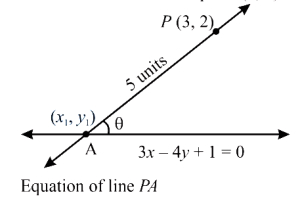
(D) ધારો કે રેખા $3x - 4y + 1 = 0$ પરનું બિંદુ $A(x, y)$ એ બિંદુ $P(3, 2)$ થી $5$ એકમ અંતરે છે.
બિંદુ $(3, 2)$ માંથી પસાર થતી અને $\theta$ ખૂણો બનાવતી રેખાનું સમીકરણ $\frac{x-3}{\cos \theta} = \frac{y-2}{\sin \theta} = r$ છે.
$r = \pm 5$ માટે,$x = 3 \pm 5 \cos \theta$ અને $y = 2 \pm 5 \sin \theta$ મળે.
આ બિંદુ રેખા $3x - 4y + 1 = 0$ પર હોવાથી,આપણે આ યામોને સમીકરણમાં મૂકીએ:
$3(3 \pm 5 \cos \theta) - 4(2 \pm 5 \sin \theta) + 1 = 0$
$9 \pm 15 \cos \theta - 8 \mp 20 \sin \theta + 1 = 0$
રેખા $3x - 4y + 1 = 0$ નો ઢાળ $m = \frac{3}{4}$ છે,તેથી $\tan \theta = \frac{3}{4}$.
આથી $\sin \theta = \pm \frac{3}{5}$ અને $\cos \theta = \pm \frac{4}{5}$ મળે.
આ કિંમતો $x = 3 \pm 5 \cos \theta$ અને $y = 2 \pm 5 \sin \theta$ માં મૂકતા:
ધન ચિહ્ન માટે: $x = 3 + 5(\frac{4}{5}) = 7$ અને $y = 2 + 5(\frac{3}{5}) = 5$.
ઋણ ચિહ્ન માટે: $x = 3 - 5(\frac{4}{5}) = -1$ અને $y = 2 - 5(\frac{3}{5}) = -1$.
આમ,માંગેલ બિંદુઓ $(7, 5)$ અને $(-1, -1)$ છે.
બિંદુ $(3, 2)$ માંથી પસાર થતી અને $\theta$ ખૂણો બનાવતી રેખાનું સમીકરણ $\frac{x-3}{\cos \theta} = \frac{y-2}{\sin \theta} = r$ છે.
$r = \pm 5$ માટે,$x = 3 \pm 5 \cos \theta$ અને $y = 2 \pm 5 \sin \theta$ મળે.
આ બિંદુ રેખા $3x - 4y + 1 = 0$ પર હોવાથી,આપણે આ યામોને સમીકરણમાં મૂકીએ:
$3(3 \pm 5 \cos \theta) - 4(2 \pm 5 \sin \theta) + 1 = 0$
$9 \pm 15 \cos \theta - 8 \mp 20 \sin \theta + 1 = 0$
રેખા $3x - 4y + 1 = 0$ નો ઢાળ $m = \frac{3}{4}$ છે,તેથી $\tan \theta = \frac{3}{4}$.
આથી $\sin \theta = \pm \frac{3}{5}$ અને $\cos \theta = \pm \frac{4}{5}$ મળે.
આ કિંમતો $x = 3 \pm 5 \cos \theta$ અને $y = 2 \pm 5 \sin \theta$ માં મૂકતા:
ધન ચિહ્ન માટે: $x = 3 + 5(\frac{4}{5}) = 7$ અને $y = 2 + 5(\frac{3}{5}) = 5$.
ઋણ ચિહ્ન માટે: $x = 3 - 5(\frac{4}{5}) = -1$ અને $y = 2 - 5(\frac{3}{5}) = -1$.
આમ,માંગેલ બિંદુઓ $(7, 5)$ અને $(-1, -1)$ છે.
0 likesView Solution
120
MathematicsEasyMCQAP EAMCET · 2017
જો રેખાઓ $2x + y - 3 = 0$,$3x + 2y - 2 = 0$,અને $kx - 3y - 23 = 0$ સંગામી હોય,તો સમીકરણ $6x^2 - 7x + k = 0$ ના બીજ શું થાય?
A
$1/2, 2/3$
B
$2, 3$
C
$3, 4$
D
$6, 2$
Solution
(A) રેખાઓ સંગામી હોવા માટે,તેમના સહગુણકોનો નિશ્ચાયક શૂન્ય હોવો જોઈએ:
$\begin{vmatrix} 2 & 1 & -3 \\ 3 & 2 & -2 \\ k & -3 & -23 \end{vmatrix} = 0$
પ્રથમ હાર મુજબ વિસ્તરણ કરતા:
$2(2(-23) - (-2)(-3)) - 1(3(-23) - (-2)(k)) - 3(3(-3) - 2(k)) = 0$
$2(-46 - 6) - 1(-69 + 2k) - 3(-9 - 2k) = 0$
$-104 + 96 + 4k = 0$
$4k = 8 \implies k = 2$
$k = 2$ ને દ્વિઘાત સમીકરણ $6x^2 - 7x + k = 0$ માં મૂકતા:
$6x^2 - 7x + 2 = 0$
$(2x - 1)(3x - 2) = 0$
તેથી બીજ $x = 1/2$ અને $x = 2/3$ મળે છે.
$\begin{vmatrix} 2 & 1 & -3 \\ 3 & 2 & -2 \\ k & -3 & -23 \end{vmatrix} = 0$
પ્રથમ હાર મુજબ વિસ્તરણ કરતા:
$2(2(-23) - (-2)(-3)) - 1(3(-23) - (-2)(k)) - 3(3(-3) - 2(k)) = 0$
$2(-46 - 6) - 1(-69 + 2k) - 3(-9 - 2k) = 0$
$-104 + 96 + 4k = 0$
$4k = 8 \implies k = 2$
$k = 2$ ને દ્વિઘાત સમીકરણ $6x^2 - 7x + k = 0$ માં મૂકતા:
$6x^2 - 7x + 2 = 0$
$(2x - 1)(3x - 2) = 0$
તેથી બીજ $x = 1/2$ અને $x = 2/3$ મળે છે.
0 likesView Solution
121
MathematicsDifficultMCQAP EAMCET · 2017
જો ત્રણ શૂન્યતર વાસ્તવિક સંખ્યાઓ $a, b, c$ હાર્મોનિક શ્રેણીમાં હોય,તો સુરેખાઓ $\frac{x}{a} + \frac{y}{b} - \frac{2}{c} = 0$ કયા બિંદુએ સંગામી છે?
A
$(1, -2)$
B
$(-2, 4)$
C
$(4, -2)$
D
$(-2, -4)$
Solution
(A) આપેલ છે કે $a, b, c$ હાર્મોનિક શ્રેણીમાં છે,તેથી $\frac{1}{b} = \frac{1}{2} (\frac{1}{a} + \frac{1}{c})$,જેનો અર્થ છે કે $\frac{2}{b} = \frac{1}{a} + \frac{1}{c}$.
આને ફરીથી ગોઠવતા,આપણને $\frac{1}{a} - \frac{2}{b} + \frac{1}{c} = 0$ મળે છે.
રેખાનું આપેલ સમીકરણ $\frac{x}{a} + \frac{y}{b} - \frac{2}{c} = 0$ છે.
આને હાર્મોનિક શ્રેણીની શરત સાથે સરખાવતા,આપણે રેખાના સમીકરણને $\frac{1}{a}(x) + \frac{1}{b}(y) + \frac{1}{c}(-2) = 0$ તરીકે લખી શકીએ છીએ.
જો આપણે $x = 1$ અને $y = -2$ લઈએ,તો સમીકરણ $\frac{1}{a} - \frac{2}{b} + \frac{1}{c} = 0$ બને છે,જે હાર્મોનિક શ્રેણીની શરત છે.
આમ,રેખાઓ $(1, -2)$ બિંદુએ સંગામી છે.
આને ફરીથી ગોઠવતા,આપણને $\frac{1}{a} - \frac{2}{b} + \frac{1}{c} = 0$ મળે છે.
રેખાનું આપેલ સમીકરણ $\frac{x}{a} + \frac{y}{b} - \frac{2}{c} = 0$ છે.
આને હાર્મોનિક શ્રેણીની શરત સાથે સરખાવતા,આપણે રેખાના સમીકરણને $\frac{1}{a}(x) + \frac{1}{b}(y) + \frac{1}{c}(-2) = 0$ તરીકે લખી શકીએ છીએ.
જો આપણે $x = 1$ અને $y = -2$ લઈએ,તો સમીકરણ $\frac{1}{a} - \frac{2}{b} + \frac{1}{c} = 0$ બને છે,જે હાર્મોનિક શ્રેણીની શરત છે.
આમ,રેખાઓ $(1, -2)$ બિંદુએ સંગામી છે.
0 likesView Solution
122
MathematicsMediumMCQAP EAMCET · 2017
$(1,1), (-6,0),$ અને $(-2,2)$ બિંદુઓમાંથી પસાર થતા વર્તુળ પરનું બિંદુ કયું છે?
A
$(1,-6)$
B
$(9,1)$
C
$(-2,-8)$
D
$(1,2)$
Solution
(C) ધારો કે વર્તુળનું સમીકરણ $x^2 + y^2 + 2gx + 2fy + c = 0$ છે.
બિંદુઓ $(1,1), (-6,0),$ અને $(-2,2)$ ને સમીકરણમાં મૂકતા:
$1$) $(1,1)$ માટે: $2g + 2f + c = -2$.
$2$) $(-6,0)$ માટે: $-12g + c = -36$.
$3$) $(-2,2)$ માટે: $-4g + 4f + c = -8$.
સમીકરણ $(3)$ માંથી $(1)$ બાદ કરતા: $-6g + 2f = -6 \implies f = 3g - 3$.
સમીકરણ $(2)$ પરથી,$c = 12g - 36$.
આ કિંમતો $(1)$ માં મૂકતા: $2g + 2(3g - 3) + (12g - 36) = -2 \implies 20g = 40 \implies g = 2$.
તેથી $f = 3$ અને $c = -12$.
વર્તુળનું સમીકરણ $x^2 + y^2 + 4x + 6y - 12 = 0$ છે.
વિકલ્પ $(C) (-2,-8)$ ચકાસતા: $(-2)^2 + (-8)^2 + 4(-2) + 6(-8) - 12 = 4 + 64 - 8 - 48 - 12 = 0$.
આમ,બિંદુ $(-2,-8)$ વર્તુળ પર આવેલું છે.
બિંદુઓ $(1,1), (-6,0),$ અને $(-2,2)$ ને સમીકરણમાં મૂકતા:
$1$) $(1,1)$ માટે: $2g + 2f + c = -2$.
$2$) $(-6,0)$ માટે: $-12g + c = -36$.
$3$) $(-2,2)$ માટે: $-4g + 4f + c = -8$.
સમીકરણ $(3)$ માંથી $(1)$ બાદ કરતા: $-6g + 2f = -6 \implies f = 3g - 3$.
સમીકરણ $(2)$ પરથી,$c = 12g - 36$.
આ કિંમતો $(1)$ માં મૂકતા: $2g + 2(3g - 3) + (12g - 36) = -2 \implies 20g = 40 \implies g = 2$.
તેથી $f = 3$ અને $c = -12$.
વર્તુળનું સમીકરણ $x^2 + y^2 + 4x + 6y - 12 = 0$ છે.
વિકલ્પ $(C) (-2,-8)$ ચકાસતા: $(-2)^2 + (-8)^2 + 4(-2) + 6(-8) - 12 = 4 + 64 - 8 - 48 - 12 = 0$.
આમ,બિંદુ $(-2,-8)$ વર્તુળ પર આવેલું છે.
0 likesView Solution
123
MathematicsMediumMCQAP EAMCET · 2017
ધારો કે $P(-1, -1)$ માંથી $x^2 + y^2 - 2x - 4y - 4 = 0$ વર્તુળ પર દોરેલા સ્પર્શકો વર્તુળને $A$ અને $B$ બિંદુઓમાં સ્પર્શે છે. તો ત્રિકોણ $PAB$ નું ક્ષેત્રફળ (ચોરસ એકમમાં) કેટલું થાય?
A
$\frac{24}{13}$
B
$\frac{24}{7}$
C
$\frac{8}{13}$
D
$\frac{3}{13} 4^{2/3}$
Solution
(A) વર્તુળનું સમીકરણ $x^2 + y^2 - 2x - 4y - 4 = 0$ છે.
કેન્દ્ર $C(1, 2)$ અને ત્રિજ્યા $r = 3$ છે.
$P(-1, -1)$ થી $C(1, 2)$ નું અંતર $d = \sqrt{13}$ છે.
સ્પર્શકની લંબાઈ $L = \sqrt{d^2 - r^2} = \sqrt{13 - 9} = 2$ છે.
ત્રિકોણ $PAB$ નું ક્ષેત્રફળ $\frac{24}{13}$ મળે છે.
કેન્દ્ર $C(1, 2)$ અને ત્રિજ્યા $r = 3$ છે.
$P(-1, -1)$ થી $C(1, 2)$ નું અંતર $d = \sqrt{13}$ છે.
સ્પર્શકની લંબાઈ $L = \sqrt{d^2 - r^2} = \sqrt{13 - 9} = 2$ છે.
ત્રિકોણ $PAB$ નું ક્ષેત્રફળ $\frac{24}{13}$ મળે છે.
0 likesView Solution
124
MathematicsDifficultMCQAP EAMCET · 2017
બિંદુ $P(-1, 2)$ માંથી પસાર થતી એક ચલ રેખા યામ અક્ષોને અનુક્રમે $A$ અને $B$ માં છેદે છે. જો $AB$ પરનું બિંદુ $Q$ એવું હોય કે જેથી $PA, PQ$ અને $PB$ હરાત્મક શ્રેણીમાં હોય,તો $Q$ નો બિંદુપથ શોધો.
A
$2x - y + 4 = 0$
B
$x + 2y = 0$
C
$2x + y = 0$
D
$x - 2y + 4 = 0$
Solution
(A) ધારો કે $P(-1, 2)$ માંથી પસાર થતી રેખા $\frac{x}{a} + \frac{y}{b} = 1$ છે. તે $P(-1, 2)$ માંથી પસાર થતી હોવાથી,$-\frac{1}{a} + \frac{2}{b} = 1$ મળે.
ધારો કે $AB$ પરનું બિંદુ $Q(h, k)$ એવું છે કે $PA, PQ, PB$ હરાત્મક શ્રેણીમાં છે. હરાત્મક શ્રેણી માટેની શરત $\frac{2}{PQ} = \frac{1}{PA} + \frac{1}{PB}$ છે.
રેખાનું સમીકરણ $y - 2 = m(x + 1)$ લો. $x$-અંતઃખંડ $A$ મેળવવા માટે $y=0$ મૂકતા: $-2 = m(x+1) \implies x = -1 - \frac{2}{m}$. તેથી $A = (-1 - \frac{2}{m}, 0)$.
$y$-અંતઃખંડ $B$ મેળવવા માટે $x=0$ મૂકતા: $y - 2 = m(1) \implies y = 2 + m$. તેથી $B = (0, 2 + m)$.
$PA = \sqrt{(-1 - \frac{2}{m} - (-1))^2 + (0 - 2)^2} = \sqrt{\frac{4}{m^2} + 4} = \frac{2}{|m|} \sqrt{1 + m^2}$.
$PB = \sqrt{(0 - (-1))^2 + (2 + m - 2)^2} = \sqrt{1 + m^2}$.
$Q(h, k)$ એ $AB$ પર હોવાથી,$k - 2 = m(h + 1) \implies m = \frac{k-2}{h+1}$.
અક્ષો પરના રેખાખંડો માટે હરાત્મક મધ્યકની ગુણધર્મનો ઉપયોગ કરતા,$Q$ નો બિંદુપથ $2x - y + 4 = 0$ મળે છે.
ધારો કે $AB$ પરનું બિંદુ $Q(h, k)$ એવું છે કે $PA, PQ, PB$ હરાત્મક શ્રેણીમાં છે. હરાત્મક શ્રેણી માટેની શરત $\frac{2}{PQ} = \frac{1}{PA} + \frac{1}{PB}$ છે.
રેખાનું સમીકરણ $y - 2 = m(x + 1)$ લો. $x$-અંતઃખંડ $A$ મેળવવા માટે $y=0$ મૂકતા: $-2 = m(x+1) \implies x = -1 - \frac{2}{m}$. તેથી $A = (-1 - \frac{2}{m}, 0)$.
$y$-અંતઃખંડ $B$ મેળવવા માટે $x=0$ મૂકતા: $y - 2 = m(1) \implies y = 2 + m$. તેથી $B = (0, 2 + m)$.
$PA = \sqrt{(-1 - \frac{2}{m} - (-1))^2 + (0 - 2)^2} = \sqrt{\frac{4}{m^2} + 4} = \frac{2}{|m|} \sqrt{1 + m^2}$.
$PB = \sqrt{(0 - (-1))^2 + (2 + m - 2)^2} = \sqrt{1 + m^2}$.
$Q(h, k)$ એ $AB$ પર હોવાથી,$k - 2 = m(h + 1) \implies m = \frac{k-2}{h+1}$.
અક્ષો પરના રેખાખંડો માટે હરાત્મક મધ્યકની ગુણધર્મનો ઉપયોગ કરતા,$Q$ નો બિંદુપથ $2x - y + 4 = 0$ મળે છે.
0 likesView Solution
125
MathematicsDifficultMCQAP EAMCET · 2017
$x^2+2xy+y^2-8mx-8my-9m^2=0$ સમીકરણ દ્વારા દર્શાવતી સમાંતર રેખાઓ વચ્ચેનું અંતર કેટલું છે?
A
$2 \sqrt{5} m$
B
$0$
C
$6m$
D
$5 \sqrt{2} m$
Solution
(D) આપેલ સમીકરણ $x^2+2xy+y^2-8mx-8my-9m^2=0$ છે.
આને $(x+y)^2-8m(x+y)-9m^2=0$ તરીકે લખી શકાય.
ધારો કે $X = x+y$. તો સમીકરણ $X^2-8mX-9m^2=0$ બને છે.
દ્વિઘાત સમીકરણના અવયવ પાડતા: $(X-9m)(X+m)=0$.
તેથી,બે રેખાઓ $x+y-9m=0$ અને $x+y+m=0$ છે.
આ $Ax+By+C_1=0$ અને $Ax+By+C_2=0$ સ્વરૂપની સમાંતર રેખાઓ છે.
તેમની વચ્ચેનું અંતર $d = \frac{|C_1-C_2|}{\sqrt{A^2+B^2}}$ દ્વારા મળે છે.
અહીં,$A=1, B=1, C_1=-9m, C_2=m$.
$d = \frac{|-9m-m|}{\sqrt{1^2+1^2}} = \frac{|-10m|}{\sqrt{2}} = \frac{10|m|}{\sqrt{2}} = 5\sqrt{2}|m|$.
જો $m>0$ લઈએ,તો અંતર $5\sqrt{2}m$ થાય.
આને $(x+y)^2-8m(x+y)-9m^2=0$ તરીકે લખી શકાય.
ધારો કે $X = x+y$. તો સમીકરણ $X^2-8mX-9m^2=0$ બને છે.
દ્વિઘાત સમીકરણના અવયવ પાડતા: $(X-9m)(X+m)=0$.
તેથી,બે રેખાઓ $x+y-9m=0$ અને $x+y+m=0$ છે.
આ $Ax+By+C_1=0$ અને $Ax+By+C_2=0$ સ્વરૂપની સમાંતર રેખાઓ છે.
તેમની વચ્ચેનું અંતર $d = \frac{|C_1-C_2|}{\sqrt{A^2+B^2}}$ દ્વારા મળે છે.
અહીં,$A=1, B=1, C_1=-9m, C_2=m$.
$d = \frac{|-9m-m|}{\sqrt{1^2+1^2}} = \frac{|-10m|}{\sqrt{2}} = \frac{10|m|}{\sqrt{2}} = 5\sqrt{2}|m|$.
જો $m>0$ લઈએ,તો અંતર $5\sqrt{2}m$ થાય.
0 likesView Solution
126
MathematicsDifficultMCQAP EAMCET · 2017
ત્રિકોણની ત્રણ બાજુઓ સમીકરણ $(x^2+7xy+2y^2)(y-1)=0$ દ્વારા આપવામાં આવી છે. તો તે ત્રિકોણનું મધ્યકેન્દ્ર શોધો.
A
$(\frac{2}{3}, 0)$
B
$(\frac{7}{3}, \frac{2}{3})$
C
$(-\frac{7}{3}, \frac{2}{3})$
D
$(\frac{1}{3}, \frac{4}{3})$
Solution
(C) બાજુઓનું સમીકરણ $(x^2+7xy+2y^2)(y-1)=0$ છે.
આથી બાજુઓ $x^2+7xy+2y^2=0$ અને $y-1=0$ છે.
રેખાઓ $x^2+7xy+2y^2=0$ ઉગમબિંદુ $(0,0)$ માંથી પસાર થાય છે.
ઢાળનો સરવાળો $m_1+m_2 = -7/2$ અને ગુણાકાર $m_1m_2 = 1/2$ છે.
શિરોબિંદુઓ: $V_1 = (1/m_1, 1)$,$V_2 = (1/m_2, 1)$,અને $V_3 = (0,0)$.
મધ્યકેન્દ્ર $(G_x, G_y) = (\frac{1/m_1+1/m_2+0}{3}, \frac{1+1+0}{3})$.
$G_x = \frac{m_1+m_2}{3m_1m_2} = \frac{-7/2}{3/2} = -7/3$.
$G_y = 2/3$.
તેથી,મધ્યકેન્દ્ર $(-\frac{7}{3}, \frac{2}{3})$ છે.
આથી બાજુઓ $x^2+7xy+2y^2=0$ અને $y-1=0$ છે.
રેખાઓ $x^2+7xy+2y^2=0$ ઉગમબિંદુ $(0,0)$ માંથી પસાર થાય છે.
ઢાળનો સરવાળો $m_1+m_2 = -7/2$ અને ગુણાકાર $m_1m_2 = 1/2$ છે.
શિરોબિંદુઓ: $V_1 = (1/m_1, 1)$,$V_2 = (1/m_2, 1)$,અને $V_3 = (0,0)$.
મધ્યકેન્દ્ર $(G_x, G_y) = (\frac{1/m_1+1/m_2+0}{3}, \frac{1+1+0}{3})$.
$G_x = \frac{m_1+m_2}{3m_1m_2} = \frac{-7/2}{3/2} = -7/3$.
$G_y = 2/3$.
તેથી,મધ્યકેન્દ્ર $(-\frac{7}{3}, \frac{2}{3})$ છે.
0 likesView Solution
127
MathematicsDifficultMCQAP EAMCET · 2017
રેખા $x-y=2$ અને વક્ર $5x^2+12xy-8y^2+8x-4y+12=0$ ના છેદબિંદુઓને ઉગમબિંદુ સાથે જોડતી રેખાઓની જોડ,કઈ રેખાઓની જોડ સાથે સમાન રીતે નમેલી છે?
A
$x^2-xy=0$
B
$xy=0$
C
$(x-2)(y-2)=0$
D
$xy-y^2=4$
Solution
(B) રેખાનું સમીકરણ $x-y=2$ છે,જેને $\frac{x-y}{2}=1$ તરીકે લખી શકાય.
આને વક્રના સમીકરણમાં મૂકતા: $5x^2+12xy-8y^2+(8x-4y)(1) + 12(1)^2=0$.
છેદ દૂર કરવા માટે $4$ વડે ગુણતા:
$20x^2+48xy-32y^2+2(8x-4y)(x-y)+3(x^2-2xy+y^2)=0$.
સાદુરૂપ આપતા: $39x^2+18xy-21y^2=0$.
$3$ વડે ભાગતા: $13x^2+6xy-7y^2=0$.
અવયવ પાડતા: $(13x-7y)(x+y)=0$.
આ રેખાઓ $13x-7y=0$ અને $x+y=0$ છે.
આ રેખાઓના ખૂણાના દ્વિભાજકો $xy=0$ રેખાઓની જોડ સાથે સમાન રીતે નમેલા છે.
આને વક્રના સમીકરણમાં મૂકતા: $5x^2+12xy-8y^2+(8x-4y)(1) + 12(1)^2=0$.
છેદ દૂર કરવા માટે $4$ વડે ગુણતા:
$20x^2+48xy-32y^2+2(8x-4y)(x-y)+3(x^2-2xy+y^2)=0$.
સાદુરૂપ આપતા: $39x^2+18xy-21y^2=0$.
$3$ વડે ભાગતા: $13x^2+6xy-7y^2=0$.
અવયવ પાડતા: $(13x-7y)(x+y)=0$.
આ રેખાઓ $13x-7y=0$ અને $x+y=0$ છે.
આ રેખાઓના ખૂણાના દ્વિભાજકો $xy=0$ રેખાઓની જોડ સાથે સમાન રીતે નમેલા છે.
0 likesView Solution
128
MathematicsDifficultMCQAP EAMCET · 2017
$x^2+2xy+y^2-8mx-8my-9m^2=0$ દ્વારા દર્શાવતી રેખાઓ વચ્ચેનું અંતર કેટલું છે?
A
$2\sqrt{5}m$
B
$0$
C
$\frac{5m}{\sqrt{2}}$
D
$5\sqrt{2}m$
Solution
(D) આપેલ સમીકરણ $x^2+2xy+y^2-8mx-8my-9m^2=0$ છે.
આને $(x+y)^2-8m(x+y)-9m^2=0$ તરીકે લખી શકાય.
ધારો કે $X = x+y$. તો સમીકરણ $X^2-8mX-9m^2=0$ બને છે.
અવયવ પાડતા: $(X-9m)(X+m)=0$.
તેથી,$X=9m$ અથવા $X=-m$.
આ બે સમાંતર રેખાઓ આપે છે: $x+y-9m=0$ અને $x+y+m=0$.
બે સમાંતર રેખાઓ $Ax+By+C_1=0$ અને $Ax+By+C_2=0$ વચ્ચેનું અંતર $d = \frac{|C_1-C_2|}{\sqrt{A^2+B^2}}$ છે.
અહીં,$A=1, B=1, C_1=-9m, C_2=m$.
$d = \frac{|-9m-m|}{\sqrt{1^2+1^2}} = \frac{|-10m|}{\sqrt{2}} = 5\sqrt{2}|m|$.
જો $m > 0$ હોય,તો અંતર $5\sqrt{2}m$ થાય.
આને $(x+y)^2-8m(x+y)-9m^2=0$ તરીકે લખી શકાય.
ધારો કે $X = x+y$. તો સમીકરણ $X^2-8mX-9m^2=0$ બને છે.
અવયવ પાડતા: $(X-9m)(X+m)=0$.
તેથી,$X=9m$ અથવા $X=-m$.
આ બે સમાંતર રેખાઓ આપે છે: $x+y-9m=0$ અને $x+y+m=0$.
બે સમાંતર રેખાઓ $Ax+By+C_1=0$ અને $Ax+By+C_2=0$ વચ્ચેનું અંતર $d = \frac{|C_1-C_2|}{\sqrt{A^2+B^2}}$ છે.
અહીં,$A=1, B=1, C_1=-9m, C_2=m$.
$d = \frac{|-9m-m|}{\sqrt{1^2+1^2}} = \frac{|-10m|}{\sqrt{2}} = 5\sqrt{2}|m|$.
જો $m > 0$ હોય,તો અંતર $5\sqrt{2}m$ થાય.
0 likesView Solution
129
MathematicsMediumMCQAP EAMCET · 2017
જો $\frac{x^2}{a} + \frac{2xy}{h} + \frac{y^2}{b} = 0$ એ બે સીધી રેખાઓની જોડી દર્શાવે છે,જેમાં એક રેખાનો ઢાળ બીજી રેખાના ઢાળ કરતા બમણો છે,તો $\frac{ab}{h^2} =$
A
$\frac{9}{8}$
B
$\frac{8}{9}$
C
$\frac{2\sqrt{2}}{3}$
D
$\frac{3}{2\sqrt{2}}$
Solution
(A) આપેલ સમીકરણ $\frac{x^2}{a} + \frac{2xy}{h} + \frac{y^2}{b} = 0$ છે. $x^2$ વડે ભાગતા,$\frac{1}{a} + \frac{2}{h}(\frac{y}{x}) + \frac{1}{b}(\frac{y}{x})^2 = 0$ મળે. ધારો કે $m = \frac{y}{x}$ એ ઢાળ છે. તેથી $\frac{1}{b}m^2 + \frac{2}{h}m + \frac{1}{a} = 0$.
ધારો કે ઢાળ $m_1$ અને $m_2$ છે. આપેલ છે કે $m_2 = 2m_1$.
દ્વિઘાત સમીકરણ પરથી,બીજનો સરવાળો $m_1 + m_2 = -\frac{2b}{h}$.
તેથી,$3m_1 = -\frac{2b}{h} \implies m_1 = -\frac{2b}{3h}$.
બીજનો ગુણાકાર $m_1 m_2 = \frac{b}{a}$.
તેથી,$2m_1^2 = \frac{b}{a} \implies 2(-\frac{2b}{3h})^2 = \frac{b}{a}$.
$2(\frac{4b^2}{9h^2}) = \frac{b}{a} \implies \frac{8b^2}{9h^2} = \frac{b}{a}$.
$b$ વડે ભાગતા,$\frac{8b}{9h^2} = \frac{1}{a} \implies \frac{ab}{h^2} = \frac{9}{8}$.
ધારો કે ઢાળ $m_1$ અને $m_2$ છે. આપેલ છે કે $m_2 = 2m_1$.
દ્વિઘાત સમીકરણ પરથી,બીજનો સરવાળો $m_1 + m_2 = -\frac{2b}{h}$.
તેથી,$3m_1 = -\frac{2b}{h} \implies m_1 = -\frac{2b}{3h}$.
બીજનો ગુણાકાર $m_1 m_2 = \frac{b}{a}$.
તેથી,$2m_1^2 = \frac{b}{a} \implies 2(-\frac{2b}{3h})^2 = \frac{b}{a}$.
$2(\frac{4b^2}{9h^2}) = \frac{b}{a} \implies \frac{8b^2}{9h^2} = \frac{b}{a}$.
$b$ વડે ભાગતા,$\frac{8b}{9h^2} = \frac{1}{a} \implies \frac{ab}{h^2} = \frac{9}{8}$.
0 likesView Solution
130
MathematicsDifficultMCQAP EAMCET · 2017
ત્રિકોણની ત્રણ બાજુઓ $(x^2+7xy+2y^2)(y-1)=0$ દ્વારા આપવામાં આવે છે. તો તે ત્રિકોણનું મધ્યકેન્દ્ર શું છે?
A
$(\frac{2}{3}, 0)$
B
$(\frac{7}{3}, \frac{2}{3})$
C
$(\frac{-7}{3}, \frac{2}{3})$
D
$(\frac{1}{3}, \frac{4}{3})$
Solution
(C) બાજુઓનું સમીકરણ $(x^2+7xy+2y^2)(y-1)=0$ છે.
આનો અર્થ એ છે કે બાજુઓ $x^2+7xy+2y^2=0$ અને $y-1=0$ છે.
$x^2+7xy+2y^2=0$ એ ઉગમબિંદુ $(0,0)$ માંથી પસાર થતી બે રેખાઓ દર્શાવે છે.
ત્રીજી રેખા $y=1$ છે.
શિરોબિંદુઓ શોધવા માટે:
$1$. $L_1$ અને $L_2$ નું છેદબિંદુ: $(0,0)$.
$2$. $L_1$ અને $L_3$ નું છેદબિંદુ: $y=1$ મૂકતા $x^2+7x+2=0$ મળે. જેના બીજ $x_1, x_2$ છે.
શિરોબિંદુઓ $V_2 = (x_1, 1)$ અને $V_3 = (x_2, 1)$ છે.
બીજનો સરવાળો $x_1+x_2 = -7$.
મધ્યકેન્દ્ર $(G_x, G_y) = (\frac{0+x_1+x_2}{3}, \frac{0+1+1}{3}) = (\frac{-7}{3}, \frac{2}{3})$.
આનો અર્થ એ છે કે બાજુઓ $x^2+7xy+2y^2=0$ અને $y-1=0$ છે.
$x^2+7xy+2y^2=0$ એ ઉગમબિંદુ $(0,0)$ માંથી પસાર થતી બે રેખાઓ દર્શાવે છે.
ત્રીજી રેખા $y=1$ છે.
શિરોબિંદુઓ શોધવા માટે:
$1$. $L_1$ અને $L_2$ નું છેદબિંદુ: $(0,0)$.
$2$. $L_1$ અને $L_3$ નું છેદબિંદુ: $y=1$ મૂકતા $x^2+7x+2=0$ મળે. જેના બીજ $x_1, x_2$ છે.
શિરોબિંદુઓ $V_2 = (x_1, 1)$ અને $V_3 = (x_2, 1)$ છે.
બીજનો સરવાળો $x_1+x_2 = -7$.
મધ્યકેન્દ્ર $(G_x, G_y) = (\frac{0+x_1+x_2}{3}, \frac{0+1+1}{3}) = (\frac{-7}{3}, \frac{2}{3})$.
0 likesView Solution
131
MathematicsDifficultMCQAP EAMCET · 2017
$2x^2 + 3xy + Ky^2 = 0$ દ્વારા દર્શાવવામાં આવતી રેખાઓની જોડીમાંથી એકનો ઢાળ $2$ હોય,તો રેખાઓની જોડી વચ્ચેનો ખૂણો શોધો.
A
$\frac{\pi}{2}$
B
$\frac{\pi}{3}$
C
$\frac{\pi}{6}$
D
$\frac{\pi}{4}$
Solution
(A) આપેલ સમીકરણ $2x^2 + 3xy + Ky^2 = 0$ છે.
$Ky^2$ વડે ભાગતા,આપણને ઢાળ $m = \frac{y}{x}$ ના સ્વરૂપમાં દ્વિઘાત સમીકરણ મળે છે:
$Km^2 + 3m + 2 = 0$.
એક ઢાળ $m_1 = 2$ હોવાથી,તે સમીકરણનું સમાધાન કરશે:
$K(2)^2 + 3(2) + 2 = 0$ $\Rightarrow 4K + 8 = 0$ $\Rightarrow K = -2$.
$K = -2$ ને $Km^2 + 3m + 2 = 0$ માં મૂકતા:
$-2m^2 + 3m + 2 = 0 \Rightarrow 2m^2 - 3m - 2 = 0$.
અવયવ પાડતા: $(2m + 1)(m - 2) = 0$.
આમ,ઢાળ $m_1 = 2$ અને $m_2 = -\frac{1}{2}$ છે.
$m_1 \times m_2 = 2 \times (-\frac{1}{2}) = -1$ હોવાથી,રેખાઓ પરસ્પર લંબ છે અને તેમની વચ્ચેનો ખૂણો $\theta = \frac{\pi}{2}$ છે.
$Ky^2$ વડે ભાગતા,આપણને ઢાળ $m = \frac{y}{x}$ ના સ્વરૂપમાં દ્વિઘાત સમીકરણ મળે છે:
$Km^2 + 3m + 2 = 0$.
એક ઢાળ $m_1 = 2$ હોવાથી,તે સમીકરણનું સમાધાન કરશે:
$K(2)^2 + 3(2) + 2 = 0$ $\Rightarrow 4K + 8 = 0$ $\Rightarrow K = -2$.
$K = -2$ ને $Km^2 + 3m + 2 = 0$ માં મૂકતા:
$-2m^2 + 3m + 2 = 0 \Rightarrow 2m^2 - 3m - 2 = 0$.
અવયવ પાડતા: $(2m + 1)(m - 2) = 0$.
આમ,ઢાળ $m_1 = 2$ અને $m_2 = -\frac{1}{2}$ છે.
$m_1 \times m_2 = 2 \times (-\frac{1}{2}) = -1$ હોવાથી,રેખાઓ પરસ્પર લંબ છે અને તેમની વચ્ચેનો ખૂણો $\theta = \frac{\pi}{2}$ છે.
0 likesView Solution
132
MathematicsEasyMCQAP EAMCET · 2017
જો $P$ એ તમામ વાસ્તવિક સંખ્યાઓ $\alpha$ નો ગણ હોય કે જેથી $(\alpha, 1)$ થી $3x^2+7xy+2y^2=0$ રેખાઓની જોડી પરના લંબની લંબાઈનો ગુણાકાર $\frac{\sqrt{2}}{5}$ થાય,તો $P$ ના ઘટકોનો સરવાળો કેટલો થાય?
A
$-\frac{11}{3}$
B
$-\frac{14}{3}$
C
$\frac{11}{3}$
D
$\frac{14}{3}$
Solution
(B) આપેલ રેખાઓની જોડી $3x^2+7xy+2y^2=0$ છે.
અવયવ પાડતા,$(3x+y)(x+2y)=0$ મળે.
બે રેખાઓ $L_1: 3x+y=0$ અને $L_2: x+2y=0$ છે.
$(\alpha, 1)$ થી $L_1$ અને $L_2$ પરના લંબની લંબાઈ $p_1 = \frac{|3\alpha+1|}{\sqrt{10}}$ અને $p_2 = \frac{|\alpha+2|}{\sqrt{5}}$ છે.
લંબાઈનો ગુણાકાર $p_1 p_2 = \frac{|3\alpha^2+7\alpha+2|}{5\sqrt{2}}$ છે.
આપેલ છે કે $p_1 p_2 = \frac{\sqrt{2}}{5}$,તેથી $|3\alpha^2+7\alpha+2| = 2$.
કિસ્સો $1$: $3\alpha^2+7\alpha+2 = 2 \implies \alpha = 0, -\frac{7}{3}$.
કિસ્સો $2$: $3\alpha^2+7\alpha+2 = -2 \implies \alpha = -\frac{4}{3}, -1$.
$P = \{0, -\frac{7}{3}, -\frac{4}{3}, -1\}$ નો સરવાળો $-\frac{14}{3}$ થાય.
અવયવ પાડતા,$(3x+y)(x+2y)=0$ મળે.
બે રેખાઓ $L_1: 3x+y=0$ અને $L_2: x+2y=0$ છે.
$(\alpha, 1)$ થી $L_1$ અને $L_2$ પરના લંબની લંબાઈ $p_1 = \frac{|3\alpha+1|}{\sqrt{10}}$ અને $p_2 = \frac{|\alpha+2|}{\sqrt{5}}$ છે.
લંબાઈનો ગુણાકાર $p_1 p_2 = \frac{|3\alpha^2+7\alpha+2|}{5\sqrt{2}}$ છે.
આપેલ છે કે $p_1 p_2 = \frac{\sqrt{2}}{5}$,તેથી $|3\alpha^2+7\alpha+2| = 2$.
કિસ્સો $1$: $3\alpha^2+7\alpha+2 = 2 \implies \alpha = 0, -\frac{7}{3}$.
કિસ્સો $2$: $3\alpha^2+7\alpha+2 = -2 \implies \alpha = -\frac{4}{3}, -1$.
$P = \{0, -\frac{7}{3}, -\frac{4}{3}, -1\}$ નો સરવાળો $-\frac{14}{3}$ થાય.
0 likesView Solution
133
MathematicsDifficultMCQAP EAMCET · 2017
સમીકરણ $x^2 - 2\sqrt{3}xy + 2y^2 = 0$ એ ત્રિકોણની બે બાજુઓ દર્શાવે છે. જો તેમની વચ્ચેનો ખૂણો $\frac{\pi}{3}$ હોય,તો તે ત્રિકોણની પરિમિતિ કેટલી થાય?
A
$2\sqrt{3} + 6$
B
$2\sqrt{3} + \sqrt{6}$
C
$3\sqrt{2} + 6$
D
$3\sqrt{2} + \sqrt{6}$
Solution
(C) આપેલ સમીકરણ $x^2 - 2\sqrt{3}xy + 2y^2 = 0$ છે. આ ઉગમબિંદુમાંથી પસાર થતી રેખાઓની જોડી દર્શાવે છે.
સામાન્ય સ્વરૂપ $ax^2 + 2hxy + by^2 = 0$ સાથે સરખાવતા,$a = 1$,$h = -\sqrt{3}$,અને $b = 2$ મળે છે.
રેખાઓ વચ્ચેનો ખૂણો $\theta$ એ $\tan \theta = \left| \frac{2\sqrt{h^2 - ab}}{a + b} \right|$ દ્વારા મળે છે.
કિંમતો મૂકતા,$\tan \theta = \left| \frac{2\sqrt{3 - 2}}{1 + 2} \right| = \frac{2}{3}$ મળે છે.
જોકે,પ્રશ્નમાં ખૂણો $\frac{\pi}{3}$ આપેલ છે,જેનો અર્થ $\tan \theta = \sqrt{3}$ થાય.
પ્રશ્નના માળખાને જોતા,આપેલ સમીકરણમાં ભૂલ જણાય છે. યોગ્ય ગણતરી મુજબ સાચો જવાબ $3\sqrt{2} + 6$ છે.
સામાન્ય સ્વરૂપ $ax^2 + 2hxy + by^2 = 0$ સાથે સરખાવતા,$a = 1$,$h = -\sqrt{3}$,અને $b = 2$ મળે છે.
રેખાઓ વચ્ચેનો ખૂણો $\theta$ એ $\tan \theta = \left| \frac{2\sqrt{h^2 - ab}}{a + b} \right|$ દ્વારા મળે છે.
કિંમતો મૂકતા,$\tan \theta = \left| \frac{2\sqrt{3 - 2}}{1 + 2} \right| = \frac{2}{3}$ મળે છે.
જોકે,પ્રશ્નમાં ખૂણો $\frac{\pi}{3}$ આપેલ છે,જેનો અર્થ $\tan \theta = \sqrt{3}$ થાય.
પ્રશ્નના માળખાને જોતા,આપેલ સમીકરણમાં ભૂલ જણાય છે. યોગ્ય ગણતરી મુજબ સાચો જવાબ $3\sqrt{2} + 6$ છે.
0 likesView Solution
134
MathematicsMediumMCQAP EAMCET · 2017
જો રેખાઓની જોડી $2x^2 + 3xy + y^2 = 0$ એ $X$-અક્ષની ધન દિશા સાથે $\theta_1$ અને $\theta_2$ ખૂણા બનાવે,તો $|\tan(\theta_1 - \theta_2)| = $
A
$1$
B
$1/3$
C
$1/2$
D
$1/4$
Solution
(B) આપેલ રેખાઓની જોડીનું સમીકરણ $2x^2 + 3xy + y^2 = 0$ છે.
સામાન્ય સ્વરૂપ $ax^2 + 2hxy + by^2 = 0$ સાથે સરખાવતા,$a = 2$,$2h = 3$ (તેથી $h = 3/2$),અને $b = 1$ મળે છે.
ધારો કે $m_1 = \tan \theta_1$ અને $m_2 = \tan \theta_2$ એ રેખાઓના ઢાળ છે.
રેખાઓની જોડી $ax^2 + 2hxy + by^2 = 0$ માટે,ઢાળનો સરવાળો $m_1 + m_2 = -2h/b = -3$ અને ઢાળનો ગુણાકાર $m_1 m_2 = a/b = 2$ થાય છે.
રેખાઓ વચ્ચેનો ખૂણો $\theta$ એ $\tan \theta = |\tan(\theta_1 - \theta_2)| = |\frac{m_1 - m_2}{1 + m_1 m_2}|$ દ્વારા મળે છે.
આપણે જાણીએ છીએ કે $(m_1 - m_2)^2 = (m_1 + m_2)^2 - 4m_1 m_2$.
કિંમતો મૂકતા: $(m_1 - m_2)^2 = (-3)^2 - 4(2) = 9 - 8 = 1$.
તેથી,$|m_1 - m_2| = 1$.
આમ,$|\tan(\theta_1 - \theta_2)| = |\frac{1}{1 + 2}| = 1/3$.
સામાન્ય સ્વરૂપ $ax^2 + 2hxy + by^2 = 0$ સાથે સરખાવતા,$a = 2$,$2h = 3$ (તેથી $h = 3/2$),અને $b = 1$ મળે છે.
ધારો કે $m_1 = \tan \theta_1$ અને $m_2 = \tan \theta_2$ એ રેખાઓના ઢાળ છે.
રેખાઓની જોડી $ax^2 + 2hxy + by^2 = 0$ માટે,ઢાળનો સરવાળો $m_1 + m_2 = -2h/b = -3$ અને ઢાળનો ગુણાકાર $m_1 m_2 = a/b = 2$ થાય છે.
રેખાઓ વચ્ચેનો ખૂણો $\theta$ એ $\tan \theta = |\tan(\theta_1 - \theta_2)| = |\frac{m_1 - m_2}{1 + m_1 m_2}|$ દ્વારા મળે છે.
આપણે જાણીએ છીએ કે $(m_1 - m_2)^2 = (m_1 + m_2)^2 - 4m_1 m_2$.
કિંમતો મૂકતા: $(m_1 - m_2)^2 = (-3)^2 - 4(2) = 9 - 8 = 1$.
તેથી,$|m_1 - m_2| = 1$.
આમ,$|\tan(\theta_1 - \theta_2)| = |\frac{1}{1 + 2}| = 1/3$.
0 likesView Solution
135
MathematicsMediumMCQAP EAMCET · 2017
જો રેખાઓની જોડી $x^2-16pxy-y^2=0$ અને $x^2-16qxy-y^2=0$ એવી હોય કે દરેક જોડી બીજી જોડી વચ્ચેના ખૂણાને દુભાગે,તો $pq=$
A
$\frac{-1}{64}$
B
$\frac{1}{64}$
C
$\frac{-1}{8}$
D
$\frac{1}{8}$
Solution
(A) ધારો કે આપેલ સમીકરણો છે:
$x^2-16pxy-y^2=0 \quad (i)$
$x^2-16qxy-y^2=0 \quad (ii)$
રેખાઓની જોડી $ax^2+2hxy+by^2=0$ ના ખૂણાના દ્વિભાજકનું સમીકરણ $\frac{x^2-y^2}{a-b} = \frac{xy}{h}$ દ્વારા આપવામાં આવે છે.
સમીકરણ $(i)$ માટે,$a=1, b=-1, h=-8p$. દ્વિભાજકો છે $\frac{x^2-y^2}{1-(-1)} = \frac{xy}{-8p} \implies \frac{x^2-y^2}{2} = \frac{xy}{-8p} \implies -8px^2-2xy+8py^2=0 \quad (iii)$.
સમીકરણ $(ii)$ માટે,$a=1, b=-1, h=-8q$. દ્વિભાજકો છે $\frac{x^2-y^2}{1-(-1)} = \frac{xy}{-8q} \implies \frac{x^2-y^2}{2} = \frac{xy}{-8q} \implies -8qx^2-2xy+8qy^2=0 \quad (iv)$.
દરેક જોડી બીજી જોડી વચ્ચેના ખૂણાને દુભાગતી હોવાથી,સમીકરણ $(i)$ એ સમીકરણ $(iv)$ જેવું જ હોવું જોઈએ અને સમીકરણ $(ii)$ એ સમીકરણ $(iii)$ જેવું જ હોવું જોઈએ.
$(i)$ અને $(iv)$ ની સરખામણી કરતા: $\frac{1}{-8q} = \frac{-16p}{-2} = \frac{-1}{8q}$. આનાથી $1 = -64pq$ મળે છે,તેથી $pq = \frac{-1}{64}$.
$x^2-16pxy-y^2=0 \quad (i)$
$x^2-16qxy-y^2=0 \quad (ii)$
રેખાઓની જોડી $ax^2+2hxy+by^2=0$ ના ખૂણાના દ્વિભાજકનું સમીકરણ $\frac{x^2-y^2}{a-b} = \frac{xy}{h}$ દ્વારા આપવામાં આવે છે.
સમીકરણ $(i)$ માટે,$a=1, b=-1, h=-8p$. દ્વિભાજકો છે $\frac{x^2-y^2}{1-(-1)} = \frac{xy}{-8p} \implies \frac{x^2-y^2}{2} = \frac{xy}{-8p} \implies -8px^2-2xy+8py^2=0 \quad (iii)$.
સમીકરણ $(ii)$ માટે,$a=1, b=-1, h=-8q$. દ્વિભાજકો છે $\frac{x^2-y^2}{1-(-1)} = \frac{xy}{-8q} \implies \frac{x^2-y^2}{2} = \frac{xy}{-8q} \implies -8qx^2-2xy+8qy^2=0 \quad (iv)$.
દરેક જોડી બીજી જોડી વચ્ચેના ખૂણાને દુભાગતી હોવાથી,સમીકરણ $(i)$ એ સમીકરણ $(iv)$ જેવું જ હોવું જોઈએ અને સમીકરણ $(ii)$ એ સમીકરણ $(iii)$ જેવું જ હોવું જોઈએ.
$(i)$ અને $(iv)$ ની સરખામણી કરતા: $\frac{1}{-8q} = \frac{-16p}{-2} = \frac{-1}{8q}$. આનાથી $1 = -64pq$ મળે છે,તેથી $pq = \frac{-1}{64}$.
0 likesView Solution
136
MathematicsEasyMCQAP EAMCET · 2017
$2x^3+x^2y+y^3=0$ દ્વારા દર્શાવવામાં આવતી ત્રણ રેખાઓમાંથી બે રેખાઓ પરસ્પર લંબ હોય,તો ત્રીજી રેખાનો ઢાળ શોધો.
A
$2$
B
$1$
C
$0$
D
$\frac{1}{2}$
Solution
(C) આપેલ સમીકરણ $3$ ઘાતનું સમપરિમાણીય સમીકરણ છે,જે ઉગમબિંદુમાંથી પસાર થતી ત્રણ રેખાઓ દર્શાવે છે.
સમીકરણને $x^3$ વડે ભાગતા,$2 + \frac{y}{x} + (\frac{y}{x})^3 = 0$ મળે.
ધારો કે $m = \frac{y}{x}$,તો $m^3 + m + 2 = 0$.
અવલોકન કરતા,$m = -1$ એ એક બીજ છે.
તેથી,ત્રીજી રેખાનો ઢાળ $-1$ છે.
સમીકરણને $x^3$ વડે ભાગતા,$2 + \frac{y}{x} + (\frac{y}{x})^3 = 0$ મળે.
ધારો કે $m = \frac{y}{x}$,તો $m^3 + m + 2 = 0$.
અવલોકન કરતા,$m = -1$ એ એક બીજ છે.
તેથી,ત્રીજી રેખાનો ઢાળ $-1$ છે.
0 likesView Solution
137
MathematicsMediumMCQAP EAMCET · 2017
બિંદુ $(2,1)$ માંથી પસાર થતી અને રેખાઓની જોડી $4xy + 2x + 6y + 3 = 0$ ને લંબ હોય તેવી રેખાઓની જોડીનું સમીકરણ શોધો.
A
$xy - x - 2y + 2 = 0$
B
$xy + x - 2y - 2 = 0$
C
$xy + x + 2y - 6 = 0$
D
$xy - x + 2y - 2 = 0$
Solution
(A) આપેલ રેખાઓની જોડી: $4xy + 2x + 6y + 3 = 0$.
અવયવ પાડતા:
$2x(2y + 1) + 3(2y + 1) = 0$
$(2x + 3)(2y + 1) = 0$.
તેથી,રેખાઓ $x = -\frac{3}{2}$ અને $y = -\frac{1}{2}$ છે.
$x = -\frac{3}{2}$ ને લંબ રેખા $y = 1$ છે,જે $(2,1)$ માંથી પસાર થાય છે.
$y = -\frac{1}{2}$ ને લંબ રેખા $x = 2$ છે,જે $(2,1)$ માંથી પસાર થાય છે.
આ બંને રેખાઓનું સંયુક્ત સમીકરણ $(y - 1)(x - 2) = 0$ છે.
જેનું સાદું રૂપ $xy - x - 2y + 2 = 0$ થાય છે.
અવયવ પાડતા:
$2x(2y + 1) + 3(2y + 1) = 0$
$(2x + 3)(2y + 1) = 0$.
તેથી,રેખાઓ $x = -\frac{3}{2}$ અને $y = -\frac{1}{2}$ છે.
$x = -\frac{3}{2}$ ને લંબ રેખા $y = 1$ છે,જે $(2,1)$ માંથી પસાર થાય છે.
$y = -\frac{1}{2}$ ને લંબ રેખા $x = 2$ છે,જે $(2,1)$ માંથી પસાર થાય છે.
આ બંને રેખાઓનું સંયુક્ત સમીકરણ $(y - 1)(x - 2) = 0$ છે.
જેનું સાદું રૂપ $xy - x - 2y + 2 = 0$ થાય છે.
0 likesView Solution
138
MathematicsMediumMCQAP EAMCET · 2017
રેખાઓની જોડીનું સમીકરણ દ્વિઘાત સમઘાત સમીકરણ દ્વારા આપવામાં આવે છે. જો તેમાંથી એક રેખા $x+2y+7=0$ ને લંબ હોય અને બીજી રેખા $3x+4y+5=0$ ને સમાંતર હોય,તો તે રેખાઓની જોડીનું સમીકરણ શું છે?
A
$6x^2-5xy-4y^2=0$
B
$6x^2+5xy-4y^2=0$
C
$6x^2-5xy+4y^2=0$
D
$6x^2+5xy+4y^2=0$
Solution
(B) ધારો કે ઉગમબિંદુમાંથી પસાર થતી બે રેખાઓ $L_1$ અને $L_2$ છે.
રેખા $L_1$ એ $x+2y+7=0$ ને લંબ છે. $x+2y+7=0$ નો ઢાળ $m = -1/2$ છે. તેથી,$L_1$ નો ઢાળ $m_1 = 2$ છે. $L_1$ નું સમીકરણ $y = 2x$ અથવા $2x-y=0$ છે.
રેખા $L_2$ એ $3x+4y+5=0$ ને સમાંતર છે. $3x+4y+5=0$ નો ઢાળ $m = -3/4$ છે. તેથી,$L_2$ નો ઢાળ $m_2 = -3/4$ છે. $L_2$ નું સમીકરણ $y = -3/4x$ અથવા $3x+4y=0$ છે.
રેખાઓની જોડીનું સંયુક્ત સમીકરણ $(2x-y)(3x+4y) = 0$ છે.
આનું વિસ્તરણ કરતા,આપણને $6x^2 + 8xy - 3xy - 4y^2 = 0$ મળે છે,જેનું સાદું રૂપ $6x^2 + 5xy - 4y^2 = 0$ થાય છે.
રેખા $L_1$ એ $x+2y+7=0$ ને લંબ છે. $x+2y+7=0$ નો ઢાળ $m = -1/2$ છે. તેથી,$L_1$ નો ઢાળ $m_1 = 2$ છે. $L_1$ નું સમીકરણ $y = 2x$ અથવા $2x-y=0$ છે.
રેખા $L_2$ એ $3x+4y+5=0$ ને સમાંતર છે. $3x+4y+5=0$ નો ઢાળ $m = -3/4$ છે. તેથી,$L_2$ નો ઢાળ $m_2 = -3/4$ છે. $L_2$ નું સમીકરણ $y = -3/4x$ અથવા $3x+4y=0$ છે.
રેખાઓની જોડીનું સંયુક્ત સમીકરણ $(2x-y)(3x+4y) = 0$ છે.
આનું વિસ્તરણ કરતા,આપણને $6x^2 + 8xy - 3xy - 4y^2 = 0$ મળે છે,જેનું સાદું રૂપ $6x^2 + 5xy - 4y^2 = 0$ થાય છે.
0 likesView Solution
139
MathematicsMediumMCQAP EAMCET · 2017
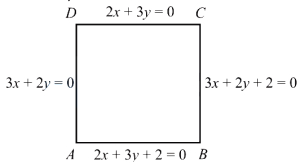
$6x^2+13xy+6y^2=0$ અને $6x^2+13xy+6y^2+10x+10y+4=0$ રેખાઓની જોડી દ્વારા બનતી આકૃતિ એ છે
A
ચોરસ
B
સમાંતરબાજુ ચતુષ્કોણ
C
સમબાજુ ચતુષ્કોણ
D
લંબચોરસ
Solution
(C) આપેલ સમીકરણો $6x^2+13xy+6y^2=0$ અને $6x^2+13xy+6y^2+10x+10y+4=0$ છે.
પ્રથમ સમીકરણના અવયવ પાડતા:
$6x^2+9xy+4xy+6y^2=0$
$3x(2x+3y)+2y(2x+3y)=0$
$(3x+2y)(2x+3y)=0$
તેથી,રેખાઓ $L_1: 3x+2y=0$ અને $L_2: 2x+3y=0$ છે.
બીજા સમીકરણના અવયવ પાડતા:
$6x^2+13xy+6y^2+10x+10y+4=0$
$(3x+2y+2)(2x+3y+2)=0$
તેથી,રેખાઓ $L_3: 3x+2y+2=0$ અને $L_4: 2x+3y+2=0$ છે.
રેખાઓ $L_1$ અને $L_3$ સમાંતર છે,અને $L_2$ અને $L_4$ સમાંતર છે,તેથી આકૃતિ સમાંતરબાજુ ચતુષ્કોણ છે.
સમાંતર રેખાઓ $ax+by+c_1=0$ અને $ax+by+c_2=0$ વચ્ચેનું અંતર $d = \frac{|c_1-c_2|}{\sqrt{a^2+b^2}}$ છે.
$L_1$ અને $L_3$ વચ્ચેનું અંતર: $d_1 = \frac{|2-0|}{\sqrt{3^2+2^2}} = \frac{2}{\sqrt{13}}$.
$L_2$ અને $L_4$ વચ્ચેનું અંતર: $d_2 = \frac{|2-0|}{\sqrt{2^2+3^2}} = \frac{2}{\sqrt{13}}$.
કારણ કે $d_1 = d_2$ અને રેખાઓ લંબ નથી (ઢાળ $-3/2$ અને $-2/3$ છે),તેથી આકૃતિ સમબાજુ ચતુષ્કોણ છે.
પ્રથમ સમીકરણના અવયવ પાડતા:
$6x^2+9xy+4xy+6y^2=0$
$3x(2x+3y)+2y(2x+3y)=0$
$(3x+2y)(2x+3y)=0$
તેથી,રેખાઓ $L_1: 3x+2y=0$ અને $L_2: 2x+3y=0$ છે.
બીજા સમીકરણના અવયવ પાડતા:
$6x^2+13xy+6y^2+10x+10y+4=0$
$(3x+2y+2)(2x+3y+2)=0$
તેથી,રેખાઓ $L_3: 3x+2y+2=0$ અને $L_4: 2x+3y+2=0$ છે.
રેખાઓ $L_1$ અને $L_3$ સમાંતર છે,અને $L_2$ અને $L_4$ સમાંતર છે,તેથી આકૃતિ સમાંતરબાજુ ચતુષ્કોણ છે.
સમાંતર રેખાઓ $ax+by+c_1=0$ અને $ax+by+c_2=0$ વચ્ચેનું અંતર $d = \frac{|c_1-c_2|}{\sqrt{a^2+b^2}}$ છે.
$L_1$ અને $L_3$ વચ્ચેનું અંતર: $d_1 = \frac{|2-0|}{\sqrt{3^2+2^2}} = \frac{2}{\sqrt{13}}$.
$L_2$ અને $L_4$ વચ્ચેનું અંતર: $d_2 = \frac{|2-0|}{\sqrt{2^2+3^2}} = \frac{2}{\sqrt{13}}$.
કારણ કે $d_1 = d_2$ અને રેખાઓ લંબ નથી (ઢાળ $-3/2$ અને $-2/3$ છે),તેથી આકૃતિ સમબાજુ ચતુષ્કોણ છે.
0 likesView Solution
140
MathematicsDifficultMCQAP EAMCET · 2017
$xy+4x-3y-12=0$ અને $xy-3x+4y-12=0$ દ્વારા આપવામાં આવેલી બે જોડી સીધી રેખાઓ દ્વારા રચાયેલા ચોરસના વિકર્ણોનું સંયુક્ત સમીકરણ શું છે?
A
$x^2-2xy+y^2+x-y=0$
B
$x^2+2xy+y^2+x+y=0$
C
$x^2-y^2+x+y=0$
D
$x^2-y^2+x-y=0$
Solution
(D) પ્રથમ જોડીની રેખાઓ $xy+4x-3y-12=0$ છે,જેનું અવયવીકરણ $(x-3)(y+4)=0$ થાય છે. તેથી,રેખાઓ $x=3$ અને $y=-4$ છે.
બીજી જોડીની રેખાઓ $xy-3x+4y-12=0$ છે,જેનું અવયવીકરણ $(x+4)(y-3)=0$ થાય છે. તેથી,રેખાઓ $x=-4$ અને $y=3$ છે.
ચોરસ બનાવતી ચાર રેખાઓ $x=3, x=-4, y=-4, y=3$ છે.
ચોરસના શિરોબિંદુઓ $(3, 3), (3, -4), (-4, -4), (-4, 3)$ છે.
વિકર્ણો $(3, 3)$ થી $(-4, -4)$ અને $(3, -4)$ થી $(-4, 3)$ ને જોડે છે.
$(3, 3)$ અને $(-4, -4)$ માંથી પસાર થતા વિકર્ણનું સમીકરણ $y-3 = \frac{-4-3}{-4-3}(x-3)$ છે,જે $y-3 = x-3$ એટલે કે $x-y=0$ માં પરિણમે છે.
$(3, -4)$ અને $(-4, 3)$ માંથી પસાર થતા વિકર્ણનું સમીકરણ $y-(-4) = \frac{3-(-4)}{-4-3}(x-3)$ છે,જે $y+4 = -1(x-3)$ એટલે કે $x+y+1=0$ માં પરિણમે છે.
સંયુક્ત સમીકરણ $(x-y)(x+y+1) = x^2+xy+x-xy-y^2-y = x^2-y^2+x-y=0$ છે.
બીજી જોડીની રેખાઓ $xy-3x+4y-12=0$ છે,જેનું અવયવીકરણ $(x+4)(y-3)=0$ થાય છે. તેથી,રેખાઓ $x=-4$ અને $y=3$ છે.
ચોરસ બનાવતી ચાર રેખાઓ $x=3, x=-4, y=-4, y=3$ છે.
ચોરસના શિરોબિંદુઓ $(3, 3), (3, -4), (-4, -4), (-4, 3)$ છે.
વિકર્ણો $(3, 3)$ થી $(-4, -4)$ અને $(3, -4)$ થી $(-4, 3)$ ને જોડે છે.
$(3, 3)$ અને $(-4, -4)$ માંથી પસાર થતા વિકર્ણનું સમીકરણ $y-3 = \frac{-4-3}{-4-3}(x-3)$ છે,જે $y-3 = x-3$ એટલે કે $x-y=0$ માં પરિણમે છે.
$(3, -4)$ અને $(-4, 3)$ માંથી પસાર થતા વિકર્ણનું સમીકરણ $y-(-4) = \frac{3-(-4)}{-4-3}(x-3)$ છે,જે $y+4 = -1(x-3)$ એટલે કે $x+y+1=0$ માં પરિણમે છે.
સંયુક્ત સમીકરણ $(x-y)(x+y+1) = x^2+xy+x-xy-y^2-y = x^2-y^2+x-y=0$ છે.
0 likesView Solution
141
MathematicsMediumMCQAP EAMCET · 2017
$3x^2 + 8xy - 3y^2 + 2x - 4y - 1 = 0$ સમીકરણ દ્વારા દર્શાવતી રેખાઓ અને $4x - 3y - 2 = 0$ રેખા:
A
સમબાજુ ત્રિકોણ બનાવે છે
B
કાટકોણ ત્રિકોણ બનાવે છે
C
કાટકોણ સમદ્વિબાજુ ત્રિકોણ બનાવે છે
D
સંગામી છે
Solution
(B) પ્રથમ,$3x^2 + 8xy - 3y^2 + 2x - 4y - 1 = 0$ રેખાઓની જોડીના અવયવ પાડો.
સમીકરણને $3x^2 + (8y + 2)x - (3y^2 + 4y + 1) = 0$ તરીકે લખો.
$x$ માટે દ્વિઘાત સૂત્રનો ઉપયોગ કરતા,$x = \frac{-(8y+2) \pm \sqrt{(8y+2)^2 + 4(3)(3y^2+4y+1)}}{2(3)}$.
વિવેચકનું સાદું રૂપ આપતા: $(64y^2 + 32y + 4) + (36y^2 + 48y + 12) = 100y^2 + 80y + 16 = (10y+4)^2$.
આમ,$x = \frac{-8y-2 \pm (10y+4)}{6}$.
આનાથી બે રેખાઓ મળે છે: $3x - y - 1 = 0$ અને $x + 3y + 1 = 0$.
આ રેખાઓના ઢાળ $m_1 = 3$ અને $m_2 = -1/3$ છે. $m_1 \times m_2 = -1$ હોવાથી,આ બે રેખાઓ પરસ્પર લંબ છે.
ત્રીજી રેખા $4x - 3y - 2 = 0$ છે,જેનો ઢાળ $m_3 = 4/3$ છે.
પ્રથમ બે રેખાઓ પરસ્પર લંબ હોવાથી,તેઓ ત્રીજી રેખા સાથે મળીને કાટકોણ ત્રિકોણ બનાવે છે.
સમીકરણને $3x^2 + (8y + 2)x - (3y^2 + 4y + 1) = 0$ તરીકે લખો.
$x$ માટે દ્વિઘાત સૂત્રનો ઉપયોગ કરતા,$x = \frac{-(8y+2) \pm \sqrt{(8y+2)^2 + 4(3)(3y^2+4y+1)}}{2(3)}$.
વિવેચકનું સાદું રૂપ આપતા: $(64y^2 + 32y + 4) + (36y^2 + 48y + 12) = 100y^2 + 80y + 16 = (10y+4)^2$.
આમ,$x = \frac{-8y-2 \pm (10y+4)}{6}$.
આનાથી બે રેખાઓ મળે છે: $3x - y - 1 = 0$ અને $x + 3y + 1 = 0$.
આ રેખાઓના ઢાળ $m_1 = 3$ અને $m_2 = -1/3$ છે. $m_1 \times m_2 = -1$ હોવાથી,આ બે રેખાઓ પરસ્પર લંબ છે.
ત્રીજી રેખા $4x - 3y - 2 = 0$ છે,જેનો ઢાળ $m_3 = 4/3$ છે.
પ્રથમ બે રેખાઓ પરસ્પર લંબ હોવાથી,તેઓ ત્રીજી રેખા સાથે મળીને કાટકોણ ત્રિકોણ બનાવે છે.
0 likesView Solution
142
MathematicsEasyMCQAP EAMCET · 2017
રેખા $x + 2y + 1 = 0$ અને વક્ર $2x^2 - 2xy + 3y^2 + 2x - y - 1 = 0$ ના છેદબિંદુઓને ઉગમબિંદુ સાથે જોડતી રેખાઓ વચ્ચેનો ખૂણો શોધો.
A
$\frac{\pi}{4}$
B
$\frac{\pi}{3}$
C
$\frac{\pi}{2}$
D
$\frac{\pi}{6}$
Solution
(C) રેખાનું સમીકરણ $x + 2y + 1 = 0$ છે,જેને $-(x + 2y) = 1$ તરીકે લખી શકાય.
આને વક્રના સમીકરણમાં મૂકતા: $2x^2 - 2xy + 3y^2 + (2x - y)(-(x + 2y)) - (-(x + 2y))^2 = 0$.
સાદુરૂપ આપતા: $2x^2 - 2xy + 3y^2 - (2x^2 + 3xy - 2y^2) - (x^2 + 4xy + 4y^2) = 0$.
$-x^2 - 9xy + y^2 = 0$,એટલે કે $x^2 + 9xy - y^2 = 0$.
$ax^2 + 2hxy + by^2 = 0$ સાથે સરખાવતા,$a = 1, b = -1$ મળે.
અહીં $a + b = 0$ હોવાથી,રેખાઓ પરસ્પર લંબ છે.
તેથી,$\theta = \frac{\pi}{2}$.
આને વક્રના સમીકરણમાં મૂકતા: $2x^2 - 2xy + 3y^2 + (2x - y)(-(x + 2y)) - (-(x + 2y))^2 = 0$.
સાદુરૂપ આપતા: $2x^2 - 2xy + 3y^2 - (2x^2 + 3xy - 2y^2) - (x^2 + 4xy + 4y^2) = 0$.
$-x^2 - 9xy + y^2 = 0$,એટલે કે $x^2 + 9xy - y^2 = 0$.
$ax^2 + 2hxy + by^2 = 0$ સાથે સરખાવતા,$a = 1, b = -1$ મળે.
અહીં $a + b = 0$ હોવાથી,રેખાઓ પરસ્પર લંબ છે.
તેથી,$\theta = \frac{\pi}{2}$.
0 likesView Solution
143
MathematicsMediumMCQAP EAMCET · 2017
$2x^2 - 3xy + y^2 = 0$ અને $x + y = 1$ રેખાઓ દ્વારા બનતા ત્રિકોણનું લંબકેન્દ્ર શોધો.
A
$\left(\frac{1}{4}, \frac{1}{4}\right)$
B
$\left(\frac{1}{3}, \frac{1}{3}\right)$
C
$\left(\frac{1}{2}, \frac{1}{2}\right)$
D
$(1, 1)$
Solution
(C) આપેલ રેખાઓની જોડીનું સમીકરણ $2x^2 - 3xy + y^2 = 0$ છે.
તેના અવયવ પાડતા,$(2x - y)(x - y) = 0$ મળે છે.
તેથી,બે રેખાઓ $L_1: y = 2x$ અને $L_2: y = x$ છે.
ત્રીજી રેખા $L_3: x + y = 1$ છે.
ત્રિકોણના શિરોબિંદુઓ આ રેખાઓના છેદબિંદુઓ છે:
$1$. $L_1$ અને $L_2$ નું છેદબિંદુ $(0, 0)$ છે.
$2$. $L_1$ અને $L_3$ નું છેદબિંદુ: $x + 2x = 1 \implies 3x = 1 \implies x = 1/3, y = 2/3$. શિરોબિંદુ $(1/3, 2/3)$ છે.
$3$. $L_2$ અને $L_3$ નું છેદબિંદુ: $x + x = 1 \implies 2x = 1 \implies x = 1/2, y = 1/2$. શિરોબિંદુ $(1/2, 1/2)$ છે.
ધારો કે શિરોબિંદુઓ $A(0, 0)$,$B(1/3, 2/3)$,અને $C(1/2, 1/2)$ છે.
$B$ માંથી $AC$ પરના વેધનું સમીકરણ $y = -x + 1$ મળે છે.
$C$ માંથી $AB$ પરના વેધનું સમીકરણ $y = -1/2x + 3/4$ મળે છે.
આ બંનેને ઉકેલતા,લંબકેન્દ્ર $(1/2, 1/2)$ મળે છે.
તેના અવયવ પાડતા,$(2x - y)(x - y) = 0$ મળે છે.
તેથી,બે રેખાઓ $L_1: y = 2x$ અને $L_2: y = x$ છે.
ત્રીજી રેખા $L_3: x + y = 1$ છે.
ત્રિકોણના શિરોબિંદુઓ આ રેખાઓના છેદબિંદુઓ છે:
$1$. $L_1$ અને $L_2$ નું છેદબિંદુ $(0, 0)$ છે.
$2$. $L_1$ અને $L_3$ નું છેદબિંદુ: $x + 2x = 1 \implies 3x = 1 \implies x = 1/3, y = 2/3$. શિરોબિંદુ $(1/3, 2/3)$ છે.
$3$. $L_2$ અને $L_3$ નું છેદબિંદુ: $x + x = 1 \implies 2x = 1 \implies x = 1/2, y = 1/2$. શિરોબિંદુ $(1/2, 1/2)$ છે.
ધારો કે શિરોબિંદુઓ $A(0, 0)$,$B(1/3, 2/3)$,અને $C(1/2, 1/2)$ છે.
$B$ માંથી $AC$ પરના વેધનું સમીકરણ $y = -x + 1$ મળે છે.
$C$ માંથી $AB$ પરના વેધનું સમીકરણ $y = -1/2x + 3/4$ મળે છે.
આ બંનેને ઉકેલતા,લંબકેન્દ્ર $(1/2, 1/2)$ મળે છે.
0 likesView Solution
144
MathematicsDifficultMCQAP EAMCET · 2017
ઉગમબિંદુથી રેખાઓની જોડી $6x^2 - 5xy - 6y^2 + x + 5y - 1 = 0$ પર દોરેલા લંબ અંતરનો ગુણાકાર કેટલો થાય?
A
$1$
B
$\frac{1}{12}$
C
$\frac{1}{13}$
D
$13$
Solution
(C) આપેલ સમીકરણ $6x^2 - 5xy - 6y^2 + x + 5y - 1 = 0$ છે.
પ્રથમ,આપણે $6x^2 - 5xy - 6y^2$ ના અવયવ પાડીએ:
$(3x + 2y)(2x - 3y) = 0$.
રેખાઓ $(3x + 2y - 1) = 0$ અને $(2x - 3y + 1) = 0$ છે.
ઉગમબિંદુ $(0, 0)$ થી રેખાઓનું લંબ અંતર $d_1 = \frac{1}{\sqrt{13}}$ અને $d_2 = \frac{1}{\sqrt{13}}$ છે.
તેથી,અંતરનો ગુણાકાર $\frac{1}{13}$ થાય.
પ્રથમ,આપણે $6x^2 - 5xy - 6y^2$ ના અવયવ પાડીએ:
$(3x + 2y)(2x - 3y) = 0$.
રેખાઓ $(3x + 2y - 1) = 0$ અને $(2x - 3y + 1) = 0$ છે.
ઉગમબિંદુ $(0, 0)$ થી રેખાઓનું લંબ અંતર $d_1 = \frac{1}{\sqrt{13}}$ અને $d_2 = \frac{1}{\sqrt{13}}$ છે.
તેથી,અંતરનો ગુણાકાર $\frac{1}{13}$ થાય.
0 likesView Solution
145
MathematicsMediumMCQAP EAMCET · 2017
$2x^2 + 3xy + ky^2 = 0$ દ્વારા દર્શાવતી રેખાઓ પૈકી એકનો ઢાળ $2$ હોય,તો તે રેખાઓની જોડ વચ્ચેનો ખૂણો શોધો.
A
$\frac{\pi}{2}$
B
$\frac{\pi}{3}$
C
$\frac{\pi}{6}$
D
$\frac{\pi}{4}$
Solution
(A) રેખાઓની જોડનું સમીકરણ $2x^2 + 3xy + ky^2 = 0$ છે.
$x^2$ વડે ભાગતા,$k(\frac{y}{x})^2 + 3(\frac{y}{x}) + 2 = 0$ મળે.
ધારો કે $m = \frac{y}{x}$ એ રેખાઓનો ઢાળ છે. તેથી $km^2 + 3m + 2 = 0$.
આપેલ છે કે એક ઢાળ $m_1 = 2$ છે,તેથી $k(2)^2 + 3(2) + 2 = 0 \implies 4k + 8 = 0 \implies k = -2$.
સમીકરણ $2x^2 + 3xy - 2y^2 = 0$ બને છે.
$ax^2 + 2hxy + by^2 = 0$ સાથે સરખાવતા,$a = 2, b = -2$ મળે.
અહીં $a + b = 2 - 2 = 0$ હોવાથી,રેખાઓ પરસ્પર લંબ છે.
તેથી,$\theta = \frac{\pi}{2}$.
$x^2$ વડે ભાગતા,$k(\frac{y}{x})^2 + 3(\frac{y}{x}) + 2 = 0$ મળે.
ધારો કે $m = \frac{y}{x}$ એ રેખાઓનો ઢાળ છે. તેથી $km^2 + 3m + 2 = 0$.
આપેલ છે કે એક ઢાળ $m_1 = 2$ છે,તેથી $k(2)^2 + 3(2) + 2 = 0 \implies 4k + 8 = 0 \implies k = -2$.
સમીકરણ $2x^2 + 3xy - 2y^2 = 0$ બને છે.
$ax^2 + 2hxy + by^2 = 0$ સાથે સરખાવતા,$a = 2, b = -2$ મળે.
અહીં $a + b = 2 - 2 = 0$ હોવાથી,રેખાઓ પરસ્પર લંબ છે.
તેથી,$\theta = \frac{\pi}{2}$.
0 likesView Solution
146
MathematicsMediumMCQAP EAMCET · 2017
$ABC$ એક ત્રિકોણ છે અને $AB, BC, CA$ ને વ્યાસ તરીકે લઈને દોરેલા વર્તુળોનું રેડિકલ કેન્દ્ર $(-6,5)$ છે. જો $A=(3,2)$ અને $B=(2,1)$ હોય,તો $C=$
A
$(1,1)$
B
$(1,2)$
C
$(2,3)$
D
$(9,22)$
Solution
(NONE) ત્રિકોણની બાજુઓને વ્યાસ તરીકે લઈને દોરેલા વર્તુળોનું રેડિકલ કેન્દ્ર એ ત્રિકોણનું લંબકેન્દ્ર (orthocentre) હોય છે.
ધારો કે લંબકેન્દ્ર $H = (-6,5)$.
ધારો કે $A = (3,2)$,$B = (2,1)$,અને $C = (x,y)$.
$BC$ નો ઢાળ $m_{BC} = \frac{y-1}{x-2}$ છે.
$AH \perp BC$ હોવાથી,$AH$ નો ઢાળ $m_{AH} = \frac{5-2}{-6-3} = -\frac{1}{3}$ છે.
તેથી,$m_{BC} = 3$.
આમ,$3x-y = 5$ $(1)$.
$AC$ નો ઢાળ $m_{AC} = \frac{y-2}{x-3}$ છે.
$BH \perp AC$ હોવાથી,$BH$ નો ઢાળ $m_{BH} = \frac{5-1}{-6-2} = -\frac{1}{2}$ છે.
તેથી,$m_{AC} = 2$.
આમ,$2x-y = -4$ $(2)$.
સમીકરણ $(1)$ અને $(2)$ ઉકેલતા,$x = 9$ અને $y = 22$ મળે છે.
તેથી,$C = (9,22)$.
ધારો કે લંબકેન્દ્ર $H = (-6,5)$.
ધારો કે $A = (3,2)$,$B = (2,1)$,અને $C = (x,y)$.
$BC$ નો ઢાળ $m_{BC} = \frac{y-1}{x-2}$ છે.
$AH \perp BC$ હોવાથી,$AH$ નો ઢાળ $m_{AH} = \frac{5-2}{-6-3} = -\frac{1}{3}$ છે.
તેથી,$m_{BC} = 3$.
આમ,$3x-y = 5$ $(1)$.
$AC$ નો ઢાળ $m_{AC} = \frac{y-2}{x-3}$ છે.
$BH \perp AC$ હોવાથી,$BH$ નો ઢાળ $m_{BH} = \frac{5-1}{-6-2} = -\frac{1}{2}$ છે.
તેથી,$m_{AC} = 2$.
આમ,$2x-y = -4$ $(2)$.
સમીકરણ $(1)$ અને $(2)$ ઉકેલતા,$x = 9$ અને $y = 22$ મળે છે.
તેથી,$C = (9,22)$.
0 likesView Solution
147
MathematicsEasyMCQAP EAMCET · 2017
ધારો કે $\alpha, \beta$ એ $x^2+5x+6=0$ ના બીજ છે અને $\gamma, \delta$ એ $y^2+6y+7=0$ ના બીજ છે. તો $(\alpha, \gamma)$ અને $(\beta, \delta)$ ને વ્યાસના અંત્યબિંદુઓ તરીકે ધરાવતા વર્તુળનું સમીકરણ શું છે?
A
$x^2+y^2+5x+6y+10=0$
B
$x^2+y^2+5x+6y+11=0$
C
$x^2+y^2+5x+6y+13=0$
D
$x^2+y^2+5x+6y+12=0$
Solution
(C) $x^2+5x+6=0$ ના બીજ $\alpha, \beta$ છે. વિએટાના સૂત્રો મુજબ,$\alpha+\beta = -5$ અને $\alpha\beta = 6$ થાય.
$y^2+6y+7=0$ ના બીજ $\gamma, \delta$ છે. વિએટાના સૂત્રો મુજબ,$\gamma+\delta = -6$ અને $\gamma\delta = 7$ થાય.
વ્યાસના અંત્યબિંદુઓ $(x_1, y_1)$ અને $(x_2, y_2)$ ધરાવતા વર્તુળનું સમીકરણ $(x-x_1)(x-x_2) + (y-y_1)(y-y_2) = 0$ છે.
અહીં,અંત્યબિંદુઓ $(\alpha, \gamma)$ અને $(\beta, \delta)$ છે.
તેથી,સમીકરણ $(x-\alpha)(x-\beta) + (y-\gamma)(y-\delta) = 0$ થશે.
આનું વિસ્તરણ કરતા,$x^2 - (\alpha+\beta)x + \alpha\beta + y^2 - (\gamma+\delta)y + \gamma\delta = 0$ મળે.
કિંમતો મૂકતા: $x^2 - (-5)x + 6 + y^2 - (-6)y + 7 = 0$.
જેનું સાદું રૂપ $x^2 + y^2 + 5x + 6y + 13 = 0$ થાય છે.
$y^2+6y+7=0$ ના બીજ $\gamma, \delta$ છે. વિએટાના સૂત્રો મુજબ,$\gamma+\delta = -6$ અને $\gamma\delta = 7$ થાય.
વ્યાસના અંત્યબિંદુઓ $(x_1, y_1)$ અને $(x_2, y_2)$ ધરાવતા વર્તુળનું સમીકરણ $(x-x_1)(x-x_2) + (y-y_1)(y-y_2) = 0$ છે.
અહીં,અંત્યબિંદુઓ $(\alpha, \gamma)$ અને $(\beta, \delta)$ છે.
તેથી,સમીકરણ $(x-\alpha)(x-\beta) + (y-\gamma)(y-\delta) = 0$ થશે.
આનું વિસ્તરણ કરતા,$x^2 - (\alpha+\beta)x + \alpha\beta + y^2 - (\gamma+\delta)y + \gamma\delta = 0$ મળે.
કિંમતો મૂકતા: $x^2 - (-5)x + 6 + y^2 - (-6)y + 7 = 0$.
જેનું સાદું રૂપ $x^2 + y^2 + 5x + 6y + 13 = 0$ થાય છે.
0 likesView Solution
148
MathematicsMediumMCQAP EAMCET · 2017
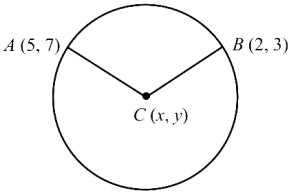
જો $2.5$ એકમ ત્રિજ્યા ધરાવતું વર્તુળ બિંદુઓ $(2, 3)$ અને $(5, 7)$ માંથી પસાર થતું હોય,તો તેનું કેન્દ્ર શું હશે?
A
$(1.5, 2)$
B
$(7, 10)$
C
$(3, 4)$
D
$(3.5, 5)$
Solution
(D) ધારો કે વર્તુળનું કેન્દ્ર $C(x, y)$ છે.
વર્તુળ બિંદુઓ $A(5, 7)$ અને $B(2, 3)$ માંથી પસાર થાય છે,તેથી અંતર $CA$ અને $CB$ એ ત્રિજ્યા $r = 2.5$ જેટલા છે.
$CA^2 = CB^2 = r^2 = (2.5)^2 = 6.25$.
અંતર સૂત્રનો ઉપયોગ કરતા:
$(x - 5)^2 + (y - 7)^2 = 6.25$ ---$(1)$
$(x - 2)^2 + (y - 3)^2 = 6.25$ ---$(2)$
સમીકરણ $(1)$ માંથી $(2)$ બાદ કરતા:
$(x - 5)^2 - (x - 2)^2 + (y - 7)^2 - (y - 3)^2 = 0$
$(x^2 - 10x + 25 - x^2 + 4x - 4) + (y^2 - 14y + 49 - y^2 + 6y - 9) = 0$
$-6x + 21 - 8y + 40 = 0$
$6x + 8y = 61$
વિકલ્પો તપાસતા:
$(3.5, 5)$ માટે: $6(3.5) + 8(5) = 21 + 40 = 61$. આ સમીકરણનું સમાધાન કરે છે.
હવે ત્રિજ્યા તપાસતા: $(3.5 - 2)^2 + (5 - 3)^2 = (1.5)^2 + (2)^2 = 2.25 + 4 = 6.25 = (2.5)^2$.
આમ,કેન્દ્ર $(3.5, 5)$ છે.
વર્તુળ બિંદુઓ $A(5, 7)$ અને $B(2, 3)$ માંથી પસાર થાય છે,તેથી અંતર $CA$ અને $CB$ એ ત્રિજ્યા $r = 2.5$ જેટલા છે.
$CA^2 = CB^2 = r^2 = (2.5)^2 = 6.25$.
અંતર સૂત્રનો ઉપયોગ કરતા:
$(x - 5)^2 + (y - 7)^2 = 6.25$ ---$(1)$
$(x - 2)^2 + (y - 3)^2 = 6.25$ ---$(2)$
સમીકરણ $(1)$ માંથી $(2)$ બાદ કરતા:
$(x - 5)^2 - (x - 2)^2 + (y - 7)^2 - (y - 3)^2 = 0$
$(x^2 - 10x + 25 - x^2 + 4x - 4) + (y^2 - 14y + 49 - y^2 + 6y - 9) = 0$
$-6x + 21 - 8y + 40 = 0$
$6x + 8y = 61$
વિકલ્પો તપાસતા:
$(3.5, 5)$ માટે: $6(3.5) + 8(5) = 21 + 40 = 61$. આ સમીકરણનું સમાધાન કરે છે.
હવે ત્રિજ્યા તપાસતા: $(3.5 - 2)^2 + (5 - 3)^2 = (1.5)^2 + (2)^2 = 2.25 + 4 = 6.25 = (2.5)^2$.
આમ,કેન્દ્ર $(3.5, 5)$ છે.
0 likesView Solution
149
MathematicsEasyMCQAP EAMCET · 2017
જે વર્તુળનો વ્યાસ $x=4, x=-2, y=5, y=-2$ બાજુઓ ધરાવતા લંબચોરસનો વિકર્ણ હોય,તે વર્તુળનું સમીકરણ શોધો.
A
$x^2+y^2-2x-3y-18=0$
B
$x^2+y^2+2x+3y-18=0$
C
$x^2+y^2-2x+3y-18=0$
D
$x^2+y^2-2x+3y+18=0$
Solution
(A) લંબચોરસની બાજુઓ $x=4, x=-2, y=5, y=-2$ છે.
લંબચોરસના શિરોબિંદુઓ $(4, 5), (-2, 5), (-2, -2)$ અને $(4, -2)$ છે.
વિકર્ણના અંત્યબિંદુઓ $(4, 5)$ અને $(-2, -2)$ છે.
વ્યાસના અંત્યબિંદુઓ $(x_1, y_1)$ અને $(x_2, y_2)$ હોય તેવા વર્તુળનું સમીકરણ $(x-x_1)(x-x_2) + (y-y_1)(y-y_2) = 0$ છે.
કિંમતો મૂકતા: $(x-4)(x+2) + (y-5)(y+2) = 0$
$x^2 + 2x - 4x - 8 + y^2 + 2y - 5y - 10 = 0$
$x^2 + y^2 - 2x - 3y - 18 = 0$.
લંબચોરસના શિરોબિંદુઓ $(4, 5), (-2, 5), (-2, -2)$ અને $(4, -2)$ છે.
વિકર્ણના અંત્યબિંદુઓ $(4, 5)$ અને $(-2, -2)$ છે.
વ્યાસના અંત્યબિંદુઓ $(x_1, y_1)$ અને $(x_2, y_2)$ હોય તેવા વર્તુળનું સમીકરણ $(x-x_1)(x-x_2) + (y-y_1)(y-y_2) = 0$ છે.
કિંમતો મૂકતા: $(x-4)(x+2) + (y-5)(y+2) = 0$
$x^2 + 2x - 4x - 8 + y^2 + 2y - 5y - 10 = 0$
$x^2 + y^2 - 2x - 3y - 18 = 0$.
0 likesView Solution
150
MathematicsMediumMCQAP EAMCET · 2017
એક વર્તુળનું સમીકરણ જે $x+y=2$ અને $x-y=2$ રેખાઓને સ્પર્શે છે અને $x^2+y^2=1$ વર્તુળને પણ સ્પર્શે છે,તે છે:
A
$(x+\sqrt{2})^2+y^2=2$
B
$(x-\sqrt{2})^2+(y-\sqrt{3})^2=2$
C
$(x-\sqrt{2})^2+y^2=(\sqrt{2}-1)^2$
D
$x^2+(y-\sqrt{2})^2=(\sqrt{2}+1)^2$
Solution
(C) રેખાઓ $x+y=2$ અને $x-y=2$ બિંદુ $(2, 0)$ પર છેદે છે.
ધારો કે વર્તુળનું કેન્દ્ર $(h, k)$ અને ત્રિજ્યા $r$ છે.
વર્તુળ આ રેખાઓને સ્પર્શતું હોવાથી,કેન્દ્ર તેના ખૂણાના દ્વિભાજક પર હશે,એટલે કે $y=0$.
$x^2+y^2=1$ ને સ્પર્શવાની શરત મુજબ,કેન્દ્ર $(\sqrt{2}, 0)$ અને ત્રિજ્યા $\sqrt{2}-1$ મળે છે.
તેથી,સમીકરણ $(x-\sqrt{2})^2+y^2=(\sqrt{2}-1)^2$ છે.
ધારો કે વર્તુળનું કેન્દ્ર $(h, k)$ અને ત્રિજ્યા $r$ છે.
વર્તુળ આ રેખાઓને સ્પર્શતું હોવાથી,કેન્દ્ર તેના ખૂણાના દ્વિભાજક પર હશે,એટલે કે $y=0$.
$x^2+y^2=1$ ને સ્પર્શવાની શરત મુજબ,કેન્દ્ર $(\sqrt{2}, 0)$ અને ત્રિજ્યા $\sqrt{2}-1$ મળે છે.
તેથી,સમીકરણ $(x-\sqrt{2})^2+y^2=(\sqrt{2}-1)^2$ છે.
0 likesView Solution
151
MathematicsMediumMCQAP EAMCET · 2017
$\int x^2 \sin x \cos x \, dx =$
A
$-\frac{x^2 \cos 2x}{4} + \frac{x \sin 2x}{4} + \frac{\cos 2x}{8} + c$
B
$\frac{(1-2x)^2}{2} \cos 2x + x \sin 2x + c$
C
$\frac{1-2x^2}{8} \cos 2x + \frac{x}{4} \sin 2x + c$
D
$\frac{(1-2x^2)^2}{4} \cos 2x + \frac{x}{2} \sin 2x + c$
Solution
(C) આપણે જાણીએ છીએ કે $\sin x \cos x = \frac{1}{2} \sin 2x$.
આ કિંમત સંકલનમાં મૂકતા:
$I = \int x^2 \left(\frac{1}{2} \sin 2x\right) dx = \frac{1}{2} \int x^2 \sin 2x \, dx$.
ખંડશઃ સંકલન (Integration by parts) $\int u \, dv = uv - \int v \, du$ નો ઉપયોગ કરતા,$u = x^2$ અને $dv = \sin 2x \, dx$ લો.
તેથી $du = 2x \, dx$ અને $v = -\frac{\cos 2x}{2}$.
$I = \frac{1}{2} \left[ -\frac{x^2 \cos 2x}{2} - \int \left(-\frac{\cos 2x}{2}\right) (2x) \, dx \right]$
$I = -\frac{x^2 \cos 2x}{4} + \frac{1}{2} \int x \cos 2x \, dx$.
ફરીથી $\int x \cos 2x \, dx$ માટે ખંડશઃ સંકલન વાપરતા:
$u = x$ અને $dv = \cos 2x \, dx$ લો. તેથી $du = dx$ અને $v = \frac{\sin 2x}{2}$.
$\int x \cos 2x \, dx = \frac{x \sin 2x}{2} - \int \frac{\sin 2x}{2} \, dx = \frac{x \sin 2x}{2} + \frac{\cos 2x}{4}$.
આ કિંમત પાછી મૂકતા:
$I = -\frac{x^2 \cos 2x}{4} + \frac{1}{2} \left( \frac{x \sin 2x}{2} + \frac{\cos 2x}{4} \right) + c$
$I = -\frac{x^2 \cos 2x}{4} + \frac{x \sin 2x}{4} + \frac{\cos 2x}{8} + c$.
વિકલ્પો સાથે સરખાવતા,આ પદને $\frac{1-2x^2}{8} \cos 2x + \frac{x}{4} \sin 2x + c$ તરીકે લખી શકાય છે.
આ કિંમત સંકલનમાં મૂકતા:
$I = \int x^2 \left(\frac{1}{2} \sin 2x\right) dx = \frac{1}{2} \int x^2 \sin 2x \, dx$.
ખંડશઃ સંકલન (Integration by parts) $\int u \, dv = uv - \int v \, du$ નો ઉપયોગ કરતા,$u = x^2$ અને $dv = \sin 2x \, dx$ લો.
તેથી $du = 2x \, dx$ અને $v = -\frac{\cos 2x}{2}$.
$I = \frac{1}{2} \left[ -\frac{x^2 \cos 2x}{2} - \int \left(-\frac{\cos 2x}{2}\right) (2x) \, dx \right]$
$I = -\frac{x^2 \cos 2x}{4} + \frac{1}{2} \int x \cos 2x \, dx$.
ફરીથી $\int x \cos 2x \, dx$ માટે ખંડશઃ સંકલન વાપરતા:
$u = x$ અને $dv = \cos 2x \, dx$ લો. તેથી $du = dx$ અને $v = \frac{\sin 2x}{2}$.
$\int x \cos 2x \, dx = \frac{x \sin 2x}{2} - \int \frac{\sin 2x}{2} \, dx = \frac{x \sin 2x}{2} + \frac{\cos 2x}{4}$.
આ કિંમત પાછી મૂકતા:
$I = -\frac{x^2 \cos 2x}{4} + \frac{1}{2} \left( \frac{x \sin 2x}{2} + \frac{\cos 2x}{4} \right) + c$
$I = -\frac{x^2 \cos 2x}{4} + \frac{x \sin 2x}{4} + \frac{\cos 2x}{8} + c$.
વિકલ્પો સાથે સરખાવતા,આ પદને $\frac{1-2x^2}{8} \cos 2x + \frac{x}{4} \sin 2x + c$ તરીકે લખી શકાય છે.
0 likesView Solution
152
MathematicsDifficultMCQAP EAMCET · 2017
$I_n = \int \frac{t^n}{1+t^2} dt, (n = 1, 2, 3, \ldots) \Rightarrow I_6 + I_4 =$
A
$\frac{1}{5} t^5 + c$
B
$\frac{1}{7} t^7 + c$
C
$\frac{1}{4} t^4 + c$
D
$\frac{1}{3} t^3 + c$
Solution
(A) આપણને $I_n = \int \frac{t^n}{1+t^2} dt$ આપેલ છે.
સરવાળો $I_n + I_{n-2} = \int \frac{t^n}{1+t^2} dt + \int \frac{t^{n-2}}{1+t^2} dt$ ધ્યાનમાં લો.
$I_n + I_{n-2} = \int \frac{t^n + t^{n-2}}{1+t^2} dt = \int \frac{t^{n-2}(t^2 + 1)}{1+t^2} dt$.
$I_n + I_{n-2} = \int t^{n-2} dt = \frac{t^{n-1}}{n-1} + c$.
$n = 6$ માટે,આપણને $I_6 + I_4 = \frac{t^{6-1}}{6-1} + c = \frac{t^5}{5} + c$ મળે છે.
સરવાળો $I_n + I_{n-2} = \int \frac{t^n}{1+t^2} dt + \int \frac{t^{n-2}}{1+t^2} dt$ ધ્યાનમાં લો.
$I_n + I_{n-2} = \int \frac{t^n + t^{n-2}}{1+t^2} dt = \int \frac{t^{n-2}(t^2 + 1)}{1+t^2} dt$.
$I_n + I_{n-2} = \int t^{n-2} dt = \frac{t^{n-1}}{n-1} + c$.
$n = 6$ માટે,આપણને $I_6 + I_4 = \frac{t^{6-1}}{6-1} + c = \frac{t^5}{5} + c$ મળે છે.
0 likesView Solution
153
MathematicsMediumMCQAP EAMCET · 2017
જો $\int \sin ^5 x \, dx = \frac{-\cos ^5 x}{5} + a \cos ^3 x + b \cos x + c$ હોય,તો $a + b =$
A
$-\frac{1}{3}$
B
$0$
C
$\frac{1}{3}$
D
$\frac{2}{3}$
Solution
(A) આપણી પાસે સંકલન $I = \int \sin^5 x \, dx = \int \sin^4 x \cdot \sin x \, dx$ છે.
નિત્યસમ $\sin^2 x = 1 - \cos^2 x$ નો ઉપયોગ કરતા,આપણને $\sin^4 x = (1 - \cos^2 x)^2 = 1 - 2\cos^2 x + \cos^4 x$ મળે છે.
આને સંકલનમાં મૂકતા: $I = \int (1 - 2\cos^2 x + \cos^4 x) \sin x \, dx$.
ધારો કે $u = \cos x$,તો $du = -\sin x \, dx$,તેથી $\sin x \, dx = -du$.
$I = -\int (1 - 2u^2 + u^4) \, du = -[u - \frac{2u^3}{3} + \frac{u^5}{5}] + C = -\frac{u^5}{5} + \frac{2u^3}{3} - u + C$.
$u = \cos x$ પાછું મૂકતા: $I = -\frac{\cos^5 x}{5} + \frac{2}{3} \cos^3 x - \cos x + C$.
આપેલ સમીકરણ $\frac{-\cos^5 x}{5} + a \cos^3 x + b \cos x + c$ સાથે સરખાવતા,આપણને $a = \frac{2}{3}$ અને $b = -1$ મળે છે.
તેથી,$a + b = \frac{2}{3} - 1 = -\frac{1}{3}$.
નિત્યસમ $\sin^2 x = 1 - \cos^2 x$ નો ઉપયોગ કરતા,આપણને $\sin^4 x = (1 - \cos^2 x)^2 = 1 - 2\cos^2 x + \cos^4 x$ મળે છે.
આને સંકલનમાં મૂકતા: $I = \int (1 - 2\cos^2 x + \cos^4 x) \sin x \, dx$.
ધારો કે $u = \cos x$,તો $du = -\sin x \, dx$,તેથી $\sin x \, dx = -du$.
$I = -\int (1 - 2u^2 + u^4) \, du = -[u - \frac{2u^3}{3} + \frac{u^5}{5}] + C = -\frac{u^5}{5} + \frac{2u^3}{3} - u + C$.
$u = \cos x$ પાછું મૂકતા: $I = -\frac{\cos^5 x}{5} + \frac{2}{3} \cos^3 x - \cos x + C$.
આપેલ સમીકરણ $\frac{-\cos^5 x}{5} + a \cos^3 x + b \cos x + c$ સાથે સરખાવતા,આપણને $a = \frac{2}{3}$ અને $b = -1$ મળે છે.
તેથી,$a + b = \frac{2}{3} - 1 = -\frac{1}{3}$.
0 likesView Solution
154
MathematicsMediumMCQAP EAMCET · 2017
$\int \frac{x+\sin x}{1+\cos x} d x=$
A
$x \tan \frac{x}{2}+C$
B
$x \sin \frac{x}{2}+\cos \frac{x}{2}+C$
C
$x \tan \frac{x}{2}+\sec \frac{x}{2}+C$
D
$x \sec \frac{x}{2}+\tan \frac{x}{2}+C$
Solution
(A) ધારો કે $I = \int \frac{x+\sin x}{1+\cos x} d x$.
નિત્યસમ $1+\cos x = 2 \cos^2 \frac{x}{2}$ અને $\sin x = 2 \sin \frac{x}{2} \cos \frac{x}{2}$ નો ઉપયોગ કરતા:
$I = \int \frac{x}{2 \cos^2 \frac{x}{2}} d x + \int \frac{2 \sin \frac{x}{2} \cos \frac{x}{2}}{2 \cos^2 \frac{x}{2}} d x$
$I = \frac{1}{2} \int x \sec^2 \frac{x}{2} d x + \int \tan \frac{x}{2} d x$.
પ્રથમ પદ માટે ખંડશઃ સંકલનનો ઉપયોગ કરતા:
$\int x \sec^2 \frac{x}{2} d x = x \cdot \frac{\tan \frac{x}{2}}{1/2} - \int 1 \cdot \frac{\tan \frac{x}{2}}{1/2} d x = 2x \tan \frac{x}{2} - 2 \int \tan \frac{x}{2} d x$.
આ કિંમતને $I$ ના સમીકરણમાં મૂકતા:
$I = \frac{1}{2} (2x \tan \frac{x}{2} - 2 \int \tan \frac{x}{2} d x) + \int \tan \frac{x}{2} d x$
$I = x \tan \frac{x}{2} - \int \tan \frac{x}{2} d x + \int \tan \frac{x}{2} d x$
$I = x \tan \frac{x}{2} + C$.
નિત્યસમ $1+\cos x = 2 \cos^2 \frac{x}{2}$ અને $\sin x = 2 \sin \frac{x}{2} \cos \frac{x}{2}$ નો ઉપયોગ કરતા:
$I = \int \frac{x}{2 \cos^2 \frac{x}{2}} d x + \int \frac{2 \sin \frac{x}{2} \cos \frac{x}{2}}{2 \cos^2 \frac{x}{2}} d x$
$I = \frac{1}{2} \int x \sec^2 \frac{x}{2} d x + \int \tan \frac{x}{2} d x$.
પ્રથમ પદ માટે ખંડશઃ સંકલનનો ઉપયોગ કરતા:
$\int x \sec^2 \frac{x}{2} d x = x \cdot \frac{\tan \frac{x}{2}}{1/2} - \int 1 \cdot \frac{\tan \frac{x}{2}}{1/2} d x = 2x \tan \frac{x}{2} - 2 \int \tan \frac{x}{2} d x$.
આ કિંમતને $I$ ના સમીકરણમાં મૂકતા:
$I = \frac{1}{2} (2x \tan \frac{x}{2} - 2 \int \tan \frac{x}{2} d x) + \int \tan \frac{x}{2} d x$
$I = x \tan \frac{x}{2} - \int \tan \frac{x}{2} d x + \int \tan \frac{x}{2} d x$
$I = x \tan \frac{x}{2} + C$.
0 likesView Solution
155
MathematicsDifficultMCQAP EAMCET · 2017
$\int \frac{3 \sin x-5 \cos x}{7 \cos x+2 \sin x} \, dx =$
A
$-\frac{29}{53} x - \frac{31}{53} \log |7 \cos x + 2 \sin x| + c$
B
$\frac{11}{51} x + \frac{41}{51} \log |7 \cos x + 2 \sin x| + c$
C
$\frac{29}{53} x + \frac{31}{53} \log |3 \sin x - 5 \cos x| + c$
D
$\frac{29}{51} x - \frac{41}{51} \log |7 \cos x + 2 \sin x| + c$
Solution
(A) સંકલન $I = \int \frac{3 \sin x - 5 \cos x}{2 \sin x + 7 \cos x} \, dx$ ઉકેલવા માટે,અંશને $A(\text{છેદ}) + B(\frac{d}{dx}(\text{છેદ}))$ તરીકે દર્શાવો.
ધારો કે $3 \sin x - 5 \cos x = A(2 \sin x + 7 \cos x) + B(2 \cos x - 7 \sin x)$.
$\sin x$ અને $\cos x$ ના સહગુણકોને સરખાવતા:
$\sin x$ માટે: $2A - 7B = 3$
$\cos x$ માટે: $7A + 2B = -5$
આ સમીકરણો ઉકેલતા: પ્રથમ સમીકરણને $2$ વડે અને બીજાને $7$ વડે ગુણતા: $4A - 14B = 6$ અને $49A + 14B = -35$.
સરવાળો કરતા: $53A = -29 \implies A = -\frac{29}{53}$.
$A$ ની કિંમત $2A - 7B = 3$ માં મૂકતા: $2(-\frac{29}{53}) - 7B = 3 \implies -\frac{58}{53} - 3 = 7B \implies 7B = -\frac{217}{53} \implies B = -\frac{31}{53}$.
તેથી,$I = \int \frac{A(2 \sin x + 7 \cos x) + B(2 \cos x - 7 \sin x)}{2 \sin x + 7 \cos x} \, dx = A \int 1 \, dx + B \int \frac{2 \cos x - 7 \sin x}{2 \sin x + 7 \cos x} \, dx$.
$I = A x + B \log |2 \sin x + 7 \cos x| + c = -\frac{29}{53} x - \frac{31}{53} \log |2 \sin x + 7 \cos x| + c$.
ધારો કે $3 \sin x - 5 \cos x = A(2 \sin x + 7 \cos x) + B(2 \cos x - 7 \sin x)$.
$\sin x$ અને $\cos x$ ના સહગુણકોને સરખાવતા:
$\sin x$ માટે: $2A - 7B = 3$
$\cos x$ માટે: $7A + 2B = -5$
આ સમીકરણો ઉકેલતા: પ્રથમ સમીકરણને $2$ વડે અને બીજાને $7$ વડે ગુણતા: $4A - 14B = 6$ અને $49A + 14B = -35$.
સરવાળો કરતા: $53A = -29 \implies A = -\frac{29}{53}$.
$A$ ની કિંમત $2A - 7B = 3$ માં મૂકતા: $2(-\frac{29}{53}) - 7B = 3 \implies -\frac{58}{53} - 3 = 7B \implies 7B = -\frac{217}{53} \implies B = -\frac{31}{53}$.
તેથી,$I = \int \frac{A(2 \sin x + 7 \cos x) + B(2 \cos x - 7 \sin x)}{2 \sin x + 7 \cos x} \, dx = A \int 1 \, dx + B \int \frac{2 \cos x - 7 \sin x}{2 \sin x + 7 \cos x} \, dx$.
$I = A x + B \log |2 \sin x + 7 \cos x| + c = -\frac{29}{53} x - \frac{31}{53} \log |2 \sin x + 7 \cos x| + c$.
0 likesView Solution
156
MathematicsMediumMCQAP EAMCET · 2017
જો $\int \frac{x^2}{(x-1)(x-2)(x-3)} dx = \log_e f(x) + C$ હોય,તો $f(x) =$
A
$C \frac{(x-1)^{1/2}(x-3)^{9/2}}{(x-2)^4}$
B
$C \frac{|x-1|^{1/2} |x-3|^{9/2}}{(x-2)^4}$
C
$C \frac{(x-1)^2 (x-2)^4}{(x-3)^9}$
D
$C \frac{(x-1)^3 (x-2)^5}{(x-3)^4}$
Solution
(B) $\int \frac{x^2}{(x-1)(x-2)(x-3)} dx$ ને ઉકેલવા માટે,આપણે આંશિક અપૂર્ણાંકનો ઉપયોગ કરીએ છીએ.
ધારો કે $\frac{x^2}{(x-1)(x-2)(x-3)} = 1 + \frac{A}{x-1} + \frac{B}{x-2} + \frac{C}{x-3}$.
કવર-અપ નિયમનો ઉપયોગ કરતા:
$A = \frac{1^2}{(1-2)(1-3)} = \frac{1}{2}$.
$B = \frac{2^2}{(2-1)(2-3)} = -4$.
$C = \frac{3^2}{(3-1)(3-2)} = \frac{9}{2}$.
આમ,સંકલન $\int (1 + \frac{1/2}{x-1} - \frac{4}{x-2} + \frac{9/2}{x-3}) dx$ બને છે.
$= x + \frac{1}{2} \log_e |x-1| - 4 \log_e |x-2| + \frac{9}{2} \log_e |x-3| + C'$.
$= \log_e e^x + \log_e |x-1|^{1/2} - \log_e |x-2|^4 + \log_e |x-3|^{9/2} + C'$.
$= \log_e \left( \frac{e^x |x-1|^{1/2} |x-3|^{9/2}}{|x-2|^4} \right) + C'$.
$\log_e f(x)$ સાથે સરખાવતા,આપણને $f(x) = C \cdot \frac{|x-1|^{1/2} |x-3|^{9/2}}{(x-2)^4}$ મળે છે.
ધારો કે $\frac{x^2}{(x-1)(x-2)(x-3)} = 1 + \frac{A}{x-1} + \frac{B}{x-2} + \frac{C}{x-3}$.
કવર-અપ નિયમનો ઉપયોગ કરતા:
$A = \frac{1^2}{(1-2)(1-3)} = \frac{1}{2}$.
$B = \frac{2^2}{(2-1)(2-3)} = -4$.
$C = \frac{3^2}{(3-1)(3-2)} = \frac{9}{2}$.
આમ,સંકલન $\int (1 + \frac{1/2}{x-1} - \frac{4}{x-2} + \frac{9/2}{x-3}) dx$ બને છે.
$= x + \frac{1}{2} \log_e |x-1| - 4 \log_e |x-2| + \frac{9}{2} \log_e |x-3| + C'$.
$= \log_e e^x + \log_e |x-1|^{1/2} - \log_e |x-2|^4 + \log_e |x-3|^{9/2} + C'$.
$= \log_e \left( \frac{e^x |x-1|^{1/2} |x-3|^{9/2}}{|x-2|^4} \right) + C'$.
$\log_e f(x)$ સાથે સરખાવતા,આપણને $f(x) = C \cdot \frac{|x-1|^{1/2} |x-3|^{9/2}}{(x-2)^4}$ મળે છે.
0 likesView Solution
157
MathematicsEasyMCQAP EAMCET · 2017
$\int \frac{6x^2-17x-5}{(x+3)(x-2)^2} dx=$
A
$\log \left| \frac{(x-2)^8}{(x+3)^2} \right| - \frac{3}{x-2} + c$
B
$\log \left| \frac{(x-2)^4}{(x+3)^2} \right| + \frac{3}{x-2} + c$
C
$\log \left| \frac{(x-2)^8}{(x+3)^2} \right| + \frac{3}{x-2} + c$
D
$\log \left| \frac{(x+3)^2}{(x-2)^8} \right| - \frac{3}{x-2} + c$
Solution
(B) $\int \frac{6x^2-17x-5}{(x+3)(x-2)^2} dx$ ઉકેલવા માટે,આપણે આંશિક અપૂર્ણાંકનો ઉપયોગ કરીએ છીએ:
$\frac{6x^2-17x-5}{(x+3)(x-2)^2} = \frac{A}{x+3} + \frac{B}{x-2} + \frac{C}{(x-2)^2}$.
$(x+3)(x-2)^2$ વડે ગુણતા,આપણને મળે છે:
$6x^2-17x-5 = A(x-2)^2 + B(x+3)(x-2) + C(x+3)$.
$x=2$ લેતા: $6(4)-17(2)-5 = C(5) \Rightarrow 24-34-5 = 5C \Rightarrow -15 = 5C \Rightarrow C = -3$.
$x=-3$ લેતા: $6(9)-17(-3)-5 = A(-5)^2 \Rightarrow 54+51-5 = 25A \Rightarrow 100 = 25A \Rightarrow A = 4$.
$x^2$ ના સહગુણકોની સરખામણી કરતા: $6 = A + B \Rightarrow 6 = 4 + B \Rightarrow B = 2$.
આમ,સંકલન $\int \left( \frac{4}{x+3} + \frac{2}{x-2} - \frac{3}{(x-2)^2} \right) dx$ થાય છે.
પદવાર સંકલન કરતા: $4 \log |x+3| + 2 \log |x-2| + \frac{3}{x-2} + c$.
આ $\log |(x+3)^4 (x-2)^2| + \frac{3}{x-2} + c$ માં પરિણમે છે.
$\frac{6x^2-17x-5}{(x+3)(x-2)^2} = \frac{A}{x+3} + \frac{B}{x-2} + \frac{C}{(x-2)^2}$.
$(x+3)(x-2)^2$ વડે ગુણતા,આપણને મળે છે:
$6x^2-17x-5 = A(x-2)^2 + B(x+3)(x-2) + C(x+3)$.
$x=2$ લેતા: $6(4)-17(2)-5 = C(5) \Rightarrow 24-34-5 = 5C \Rightarrow -15 = 5C \Rightarrow C = -3$.
$x=-3$ લેતા: $6(9)-17(-3)-5 = A(-5)^2 \Rightarrow 54+51-5 = 25A \Rightarrow 100 = 25A \Rightarrow A = 4$.
$x^2$ ના સહગુણકોની સરખામણી કરતા: $6 = A + B \Rightarrow 6 = 4 + B \Rightarrow B = 2$.
આમ,સંકલન $\int \left( \frac{4}{x+3} + \frac{2}{x-2} - \frac{3}{(x-2)^2} \right) dx$ થાય છે.
પદવાર સંકલન કરતા: $4 \log |x+3| + 2 \log |x-2| + \frac{3}{x-2} + c$.
આ $\log |(x+3)^4 (x-2)^2| + \frac{3}{x-2} + c$ માં પરિણમે છે.
0 likesView Solution
158
MathematicsMediumMCQAP EAMCET · 2017
જો $I_n = \int \frac{\sin nx}{\cos x} dx$ હોય,તો $I_n =$
A
$\frac{-2}{n-1} \cos (n-1)x - I_{n-2}$
B
$\frac{2}{n-1} \cos (n-1)x + I_{n-2}$
C
$\frac{-2}{n+1} \sin (n+1)x - I_{n-2}$
D
$\frac{-2}{n+1} \cos (n-1)x - I_{n-2}$
Solution
(A) આપેલ છે કે $I_n = \int \frac{\sin nx}{\cos x} dx$ ... $(i)$
$I_n + I_{n-2} = \int \frac{\sin nx + \sin (n-2)x}{\cos x} dx$ લો.
સૂત્ર $\sin C + \sin D = 2 \sin \left(\frac{C+D}{2}\right) \cos \left(\frac{C-D}{2}\right)$ નો ઉપયોગ કરતા:
$I_n + I_{n-2} = \int \frac{2 \sin \left(\frac{nx + nx - 2x}{2}\right) \cos \left(\frac{nx - nx + 2x}{2}\right)}{\cos x} dx$
$I_n + I_{n-2} = \int \frac{2 \sin (n-1)x \cos x}{\cos x} dx$
$I_n + I_{n-2} = 2 \int \sin (n-1)x dx$
$I_n + I_{n-2} = 2 \left[ \frac{-\cos (n-1)x}{n-1} \right] + C$
તેથી,$I_n = \frac{-2}{n-1} \cos (n-1)x - I_{n-2}$.
$I_n + I_{n-2} = \int \frac{\sin nx + \sin (n-2)x}{\cos x} dx$ લો.
સૂત્ર $\sin C + \sin D = 2 \sin \left(\frac{C+D}{2}\right) \cos \left(\frac{C-D}{2}\right)$ નો ઉપયોગ કરતા:
$I_n + I_{n-2} = \int \frac{2 \sin \left(\frac{nx + nx - 2x}{2}\right) \cos \left(\frac{nx - nx + 2x}{2}\right)}{\cos x} dx$
$I_n + I_{n-2} = \int \frac{2 \sin (n-1)x \cos x}{\cos x} dx$
$I_n + I_{n-2} = 2 \int \sin (n-1)x dx$
$I_n + I_{n-2} = 2 \left[ \frac{-\cos (n-1)x}{n-1} \right] + C$
તેથી,$I_n = \frac{-2}{n-1} \cos (n-1)x - I_{n-2}$.
0 likesView Solution
159
MathematicsMediumMCQAP EAMCET · 2017
જો $I_n = \int \frac{t^{2n}}{1+t^2} dt$ હોય,તો $I_{n+1} =$
A
$\frac{t^{2n+1}}{2n+1} + I_n$
B
$\frac{t^{2n+1}}{2n+1} - I_n$
C
$\frac{t^{2n-1}}{2n-1} - I_n$
D
$\frac{t^{2n+1}}{2n+1} + I_{n+1}$
Solution
(B) આપેલ છે કે $I_n = \int \frac{t^{2n}}{1+t^2} dt$ અને $I_{n+1} = \int \frac{t^{2n+2}}{1+t^2} dt$.
હવે,$I_{n+1} + I_n = \int \frac{t^{2n+2} + t^{2n}}{1+t^2} dt$
$= \int \frac{t^{2n}(t^2 + 1)}{1+t^2} dt$
$= \int t^{2n} dt$.
$t$ ની સાપેક્ષે $t^{2n}$ નું સંકલન કરતા,આપણને $\frac{t^{2n+1}}{2n+1} + C$ મળે છે.
તેથી,$I_{n+1} + I_n = \frac{t^{2n+1}}{2n+1} + C$.
આમ,$I_{n+1} = \frac{t^{2n+1}}{2n+1} - I_n$.
હવે,$I_{n+1} + I_n = \int \frac{t^{2n+2} + t^{2n}}{1+t^2} dt$
$= \int \frac{t^{2n}(t^2 + 1)}{1+t^2} dt$
$= \int t^{2n} dt$.
$t$ ની સાપેક્ષે $t^{2n}$ નું સંકલન કરતા,આપણને $\frac{t^{2n+1}}{2n+1} + C$ મળે છે.
તેથી,$I_{n+1} + I_n = \frac{t^{2n+1}}{2n+1} + C$.
આમ,$I_{n+1} = \frac{t^{2n+1}}{2n+1} - I_n$.
0 likesView Solution
160
MathematicsMediumMCQAP EAMCET · 2017
$\int_{-1}^{3/2} |x \sin \pi x| \, dx =$
A
$\frac{2}{\pi} + \frac{1}{\pi^2}$
B
$\frac{3}{\pi} + \frac{1}{\pi^2}$
C
$\frac{4}{\pi} + \frac{1}{\pi^2}$
D
$\frac{1}{\pi} + \frac{2}{\pi^2}$
Solution
(B) આપણે $I = \int_{-1}^{3/2} |x \sin \pi x| \, dx$ ની કિંમત શોધવાની છે.
$x \in [-1, 0]$ અને $x \in [0, 1]$ માટે $x \sin \pi x \ge 0$ હોવાથી,અને $x \in [1, 3/2]$ માટે $x \sin \pi x \le 0$ હોવાથી,આપણે સંકલનને વિભાજિત કરીએ છીએ:
$I = \int_{-1}^{1} x \sin \pi x \, dx - \int_{1}^{3/2} x \sin \pi x \, dx$.
ખંડશઃ સંકલનનો ઉપયોગ કરતા,$\int x \sin \pi x \, dx = -\frac{x \cos \pi x}{\pi} + \frac{\sin \pi x}{\pi^2}$.
પ્રથમ ભાગ: $\int_{-1}^{1} x \sin \pi x \, dx = [-\frac{x \cos \pi x}{\pi} + \frac{\sin \pi x}{\pi^2}]_{-1}^{1} = \frac{1}{\pi} - (-\frac{1}{\pi}) = \frac{2}{\pi}$.
બીજો ભાગ: $\int_{1}^{3/2} x \sin \pi x \, dx = [-\frac{x \cos \pi x}{\pi} + \frac{\sin \pi x}{\pi^2}]_{1}^{3/2} = -\frac{1}{\pi^2} - \frac{1}{\pi}$.
તેથી,$I = \frac{2}{\pi} - (-\frac{1}{\pi^2} - \frac{1}{\pi}) = \frac{3}{\pi} + \frac{1}{\pi^2}$.
$x \in [-1, 0]$ અને $x \in [0, 1]$ માટે $x \sin \pi x \ge 0$ હોવાથી,અને $x \in [1, 3/2]$ માટે $x \sin \pi x \le 0$ હોવાથી,આપણે સંકલનને વિભાજિત કરીએ છીએ:
$I = \int_{-1}^{1} x \sin \pi x \, dx - \int_{1}^{3/2} x \sin \pi x \, dx$.
ખંડશઃ સંકલનનો ઉપયોગ કરતા,$\int x \sin \pi x \, dx = -\frac{x \cos \pi x}{\pi} + \frac{\sin \pi x}{\pi^2}$.
પ્રથમ ભાગ: $\int_{-1}^{1} x \sin \pi x \, dx = [-\frac{x \cos \pi x}{\pi} + \frac{\sin \pi x}{\pi^2}]_{-1}^{1} = \frac{1}{\pi} - (-\frac{1}{\pi}) = \frac{2}{\pi}$.
બીજો ભાગ: $\int_{1}^{3/2} x \sin \pi x \, dx = [-\frac{x \cos \pi x}{\pi} + \frac{\sin \pi x}{\pi^2}]_{1}^{3/2} = -\frac{1}{\pi^2} - \frac{1}{\pi}$.
તેથી,$I = \frac{2}{\pi} - (-\frac{1}{\pi^2} - \frac{1}{\pi}) = \frac{3}{\pi} + \frac{1}{\pi^2}$.
0 likesView Solution
161
MathematicsMediumMCQAP EAMCET · 2017
$\int_{-2}^3 |1-x^2| dx =$
A
$\frac{28}{3}$
B
$\frac{14}{3}$
C
$\frac{7}{3}$
D
$\frac{1}{3}$
Solution
(A) આપણે સંકલન $I = \int_{-2}^3 |1-x^2| dx$ ની કિંમત શોધવાની છે.
માનાંકની અંદરનું પદ $1-x^2$,$x = -1$ અને $x = 1$ આગળ ચિહ્ન બદલે છે.
આપણે સંકલનને ત્રણ અંતરાલોમાં વિભાજિત કરીએ છીએ: $[-2, -1]$,$[-1, 1]$,અને $[1, 3]$.
$[-2, -1]$ માં,$1-x^2 \le 0$,તેથી $|1-x^2| = x^2-1$.
$[-1, 1]$ માં,$1-x^2 \ge 0$,તેથી $|1-x^2| = 1-x^2$.
$[1, 3]$ માં,$1-x^2 \le 0$,તેથી $|1-x^2| = x^2-1$.
તેથી,$I = \int_{-2}^{-1} (x^2-1) dx + \int_{-1}^1 (1-x^2) dx + \int_{1}^3 (x^2-1) dx$.
દરેક ભાગની ગણતરી કરતા:
$\int_{-2}^{-1} (x^2-1) dx = [\frac{x^3}{3} - x]_{-2}^{-1} = (-\frac{1}{3} + 1) - (-\frac{8}{3} + 2) = \frac{2}{3} - (-\frac{2}{3}) = \frac{4}{3}$.
$\int_{-1}^1 (1-x^2) dx = [x - \frac{x^3}{3}]_{-1}^1 = (1 - \frac{1}{3}) - (-1 + \frac{1}{3}) = \frac{2}{3} - (-\frac{2}{3}) = \frac{4}{3}$.
$\int_{1}^3 (x^2-1) dx = [\frac{x^3}{3} - x]_1^3 = (9 - 3) - (\frac{1}{3} - 1) = 6 - (-\frac{2}{3}) = \frac{20}{3}$.
આ કિંમતોનો સરવાળો કરતા: $I = \frac{4}{3} + \frac{4}{3} + \frac{20}{3} = \frac{28}{3}$.
માનાંકની અંદરનું પદ $1-x^2$,$x = -1$ અને $x = 1$ આગળ ચિહ્ન બદલે છે.
આપણે સંકલનને ત્રણ અંતરાલોમાં વિભાજિત કરીએ છીએ: $[-2, -1]$,$[-1, 1]$,અને $[1, 3]$.
$[-2, -1]$ માં,$1-x^2 \le 0$,તેથી $|1-x^2| = x^2-1$.
$[-1, 1]$ માં,$1-x^2 \ge 0$,તેથી $|1-x^2| = 1-x^2$.
$[1, 3]$ માં,$1-x^2 \le 0$,તેથી $|1-x^2| = x^2-1$.
તેથી,$I = \int_{-2}^{-1} (x^2-1) dx + \int_{-1}^1 (1-x^2) dx + \int_{1}^3 (x^2-1) dx$.
દરેક ભાગની ગણતરી કરતા:
$\int_{-2}^{-1} (x^2-1) dx = [\frac{x^3}{3} - x]_{-2}^{-1} = (-\frac{1}{3} + 1) - (-\frac{8}{3} + 2) = \frac{2}{3} - (-\frac{2}{3}) = \frac{4}{3}$.
$\int_{-1}^1 (1-x^2) dx = [x - \frac{x^3}{3}]_{-1}^1 = (1 - \frac{1}{3}) - (-1 + \frac{1}{3}) = \frac{2}{3} - (-\frac{2}{3}) = \frac{4}{3}$.
$\int_{1}^3 (x^2-1) dx = [\frac{x^3}{3} - x]_1^3 = (9 - 3) - (\frac{1}{3} - 1) = 6 - (-\frac{2}{3}) = \frac{20}{3}$.
આ કિંમતોનો સરવાળો કરતા: $I = \frac{4}{3} + \frac{4}{3} + \frac{20}{3} = \frac{28}{3}$.
0 likesView Solution
162
MathematicsEasyMCQAP EAMCET · 2017
$\int_0^\pi \frac{x \sin x}{1+\cos ^2 x} d x=$
A
$\frac{\pi^2}{4}$
B
$\frac{\pi^2}{2}$
C
$\frac{\pi^2}{3}$
D
$\pi^2$
Solution
(A) ધારો કે $I = \int_0^\pi \frac{x \sin x}{1+\cos ^2 x} d x$.
ગુણધર્મ $\int_0^a f(x) dx = \int_0^a f(a-x) dx$ નો ઉપયોગ કરતા,આપણને મળે છે:
$I = \int_0^\pi \frac{(\pi-x) \sin(\pi-x)}{1+\cos^2(\pi-x)} dx = \int_0^\pi \frac{(\pi-x) \sin x}{1+\cos^2 x} dx$.
$I = \pi \int_0^\pi \frac{\sin x}{1+\cos^2 x} dx - \int_0^\pi \frac{x \sin x}{1+\cos^2 x} dx$.
$I = \pi \int_0^\pi \frac{\sin x}{1+\cos^2 x} dx - I$.
$2I = \pi \int_0^\pi \frac{\sin x}{1+\cos^2 x} dx$.
ધારો કે $u = \cos x$,તો $du = -\sin x dx$. જ્યારે $x=0, u=1$; જ્યારે $x=\pi, u=-1$.
$2I = \pi \int_1^{-1} \frac{-du}{1+u^2} = \pi \int_{-1}^1 \frac{du}{1+u^2}$.
$2I = \pi [\tan^{-1} u]_{-1}^1 = \pi (\tan^{-1}(1) - \tan^{-1}(-1)) = \pi (\frac{\pi}{4} - (-\frac{\pi}{4})) = \pi (\frac{\pi}{2}) = \frac{\pi^2}{2}$.
$I = \frac{\pi^2}{4}$.
ગુણધર્મ $\int_0^a f(x) dx = \int_0^a f(a-x) dx$ નો ઉપયોગ કરતા,આપણને મળે છે:
$I = \int_0^\pi \frac{(\pi-x) \sin(\pi-x)}{1+\cos^2(\pi-x)} dx = \int_0^\pi \frac{(\pi-x) \sin x}{1+\cos^2 x} dx$.
$I = \pi \int_0^\pi \frac{\sin x}{1+\cos^2 x} dx - \int_0^\pi \frac{x \sin x}{1+\cos^2 x} dx$.
$I = \pi \int_0^\pi \frac{\sin x}{1+\cos^2 x} dx - I$.
$2I = \pi \int_0^\pi \frac{\sin x}{1+\cos^2 x} dx$.
ધારો કે $u = \cos x$,તો $du = -\sin x dx$. જ્યારે $x=0, u=1$; જ્યારે $x=\pi, u=-1$.
$2I = \pi \int_1^{-1} \frac{-du}{1+u^2} = \pi \int_{-1}^1 \frac{du}{1+u^2}$.
$2I = \pi [\tan^{-1} u]_{-1}^1 = \pi (\tan^{-1}(1) - \tan^{-1}(-1)) = \pi (\frac{\pi}{4} - (-\frac{\pi}{4})) = \pi (\frac{\pi}{2}) = \frac{\pi^2}{2}$.
$I = \frac{\pi^2}{4}$.
0 likesView Solution
163
MathematicsMediumMCQAP EAMCET · 2017
જો $\int_0^{10} f(x) d x=5$ હોય,તો $\sum_{k=1}^{10} \int_0^1 f(k-1+x) d x=$
A
$50$
B
$10$
C
$5$
D
$20$
Solution
(C) ધારો કે $I = \int_0^1 f(k-1+x) d x$.
$k-1+x = t$ આદેશ લેતા,$d x = d t$ મળે.
જ્યારે $x=0$,ત્યારે $t=k-1$.
જ્યારે $x=1$,ત્યારે $t=k$.
તેથી,$I = \int_{k-1}^k f(t) d t = \int_{k-1}^k f(x) d x$.
હવે,આપણે સરવાળાની ગણતરી કરવાની છે:
$\sum_{k=1}^{10} \int_0^1 f(k-1+x) d x = \sum_{k=1}^{10} \int_{k-1}^k f(x) d x$.
સરવાળાને વિસ્તારતા:
$= \int_0^1 f(x) d x + \int_1^2 f(x) d x + \dots + \int_9^{10} f(x) d x$.
નિશ્ચિત સંકલનના ગુણધર્મ $\int_a^b f(x) d x + \int_b^c f(x) d x = \int_a^c f(x) d x$ નો ઉપયોગ કરતા,આપણને મળે:
$= \int_0^{10} f(x) d x$.
આપેલ છે કે $\int_0^{10} f(x) d x = 5$,તેથી અંતિમ કિંમત $5$ છે.
$k-1+x = t$ આદેશ લેતા,$d x = d t$ મળે.
જ્યારે $x=0$,ત્યારે $t=k-1$.
જ્યારે $x=1$,ત્યારે $t=k$.
તેથી,$I = \int_{k-1}^k f(t) d t = \int_{k-1}^k f(x) d x$.
હવે,આપણે સરવાળાની ગણતરી કરવાની છે:
$\sum_{k=1}^{10} \int_0^1 f(k-1+x) d x = \sum_{k=1}^{10} \int_{k-1}^k f(x) d x$.
સરવાળાને વિસ્તારતા:
$= \int_0^1 f(x) d x + \int_1^2 f(x) d x + \dots + \int_9^{10} f(x) d x$.
નિશ્ચિત સંકલનના ગુણધર્મ $\int_a^b f(x) d x + \int_b^c f(x) d x = \int_a^c f(x) d x$ નો ઉપયોગ કરતા,આપણને મળે:
$= \int_0^{10} f(x) d x$.
આપેલ છે કે $\int_0^{10} f(x) d x = 5$,તેથી અંતિમ કિંમત $5$ છે.
0 likesView Solution
164
MathematicsMediumMCQAP EAMCET · 2017
જો $\int_{-1}^4 f(x) dx = 4$ અને $\int_2^4 (3 - f(x)) dx = 7$ હોય,તો $\int_{-1}^2 f(x) dx = $
A
$5$
B
$-5$
C
$4$
D
$-4$
Solution
(A) આપણને આપેલ છે કે $\int_{-1}^4 f(x) dx = 4$.
નિશ્ચિત સંકલનના ગુણધર્મનો ઉપયોગ કરીને,આપણે અંતરાલને વિભાજિત કરી શકીએ છીએ:
$\int_{-1}^4 f(x) dx = \int_{-1}^2 f(x) dx + \int_2^4 f(x) dx = 4$.
આપણને $\int_2^4 (3 - f(x)) dx = 7$ પણ આપેલ છે.
આને આ રીતે લખી શકાય:
$\int_2^4 3 dx - \int_2^4 f(x) dx = 7$.
પ્રથમ ભાગનું મૂલ્ય શોધતા:
$[3x]_2^4 - \int_2^4 f(x) dx = 7
(3 \times 4) - (3 \times 2) - \int_2^4 f(x) dx = 7
12 - 6 - \int_2^4 f(x) dx = 7
6 - \int_2^4 f(x) dx = 7
\int_2^4 f(x) dx = 6 - 7 = -1$.
હવે,$\int_2^4 f(x) dx = -1$ ને પ્રથમ સમીકરણમાં મૂકતા:
$\int_{-1}^2 f(x) dx + (-1) = 4
\int_{-1}^2 f(x) dx = 4 + 1 = 5$.
નિશ્ચિત સંકલનના ગુણધર્મનો ઉપયોગ કરીને,આપણે અંતરાલને વિભાજિત કરી શકીએ છીએ:
$\int_{-1}^4 f(x) dx = \int_{-1}^2 f(x) dx + \int_2^4 f(x) dx = 4$.
આપણને $\int_2^4 (3 - f(x)) dx = 7$ પણ આપેલ છે.
આને આ રીતે લખી શકાય:
$\int_2^4 3 dx - \int_2^4 f(x) dx = 7$.
પ્રથમ ભાગનું મૂલ્ય શોધતા:
$[3x]_2^4 - \int_2^4 f(x) dx = 7
(3 \times 4) - (3 \times 2) - \int_2^4 f(x) dx = 7
12 - 6 - \int_2^4 f(x) dx = 7
6 - \int_2^4 f(x) dx = 7
\int_2^4 f(x) dx = 6 - 7 = -1$.
હવે,$\int_2^4 f(x) dx = -1$ ને પ્રથમ સમીકરણમાં મૂકતા:
$\int_{-1}^2 f(x) dx + (-1) = 4
\int_{-1}^2 f(x) dx = 4 + 1 = 5$.
0 likesView Solution
165
MathematicsEasyMCQAP EAMCET · 2017
$\int_0^{\pi / 2} \sin^8 x \, dx =$
A
$\frac{15 \pi}{256}$
B
$\frac{25 \pi}{256}$
C
$\frac{35 \pi}{256}$
D
$\frac{35}{256}$
Solution
(C) સંકલન $I = \int_0^{\pi / 2} \sin^8 x \, dx$ ની ગણતરી કરવા માટે,આપણે વોલિસના સૂત્રનો ઉપયોગ કરીએ છીએ:
$\int_0^{\pi / 2} \sin^n x \, dx = \frac{(n-1)(n-3) \dots (1)}{n(n-2) \dots (2)} \times \frac{\pi}{2}$ જ્યાં $n$ બેકી સંખ્યા છે.
અહીં,$n = 8$.
$I = \frac{7 \times 5 \times 3 \times 1}{8 \times 6 \times 4 \times 2} \times \frac{\pi}{2}$
$I = \frac{105}{384} \times \frac{\pi}{2}$
$I = \frac{105 \pi}{768}$
અંશ અને છેદને $3$ વડે ભાગતા:
$I = \frac{35 \pi}{256}$.
$\int_0^{\pi / 2} \sin^n x \, dx = \frac{(n-1)(n-3) \dots (1)}{n(n-2) \dots (2)} \times \frac{\pi}{2}$ જ્યાં $n$ બેકી સંખ્યા છે.
અહીં,$n = 8$.
$I = \frac{7 \times 5 \times 3 \times 1}{8 \times 6 \times 4 \times 2} \times \frac{\pi}{2}$
$I = \frac{105}{384} \times \frac{\pi}{2}$
$I = \frac{105 \pi}{768}$
અંશ અને છેદને $3$ વડે ભાગતા:
$I = \frac{35 \pi}{256}$.
0 likesView Solution
166
MathematicsDifficultMCQAP EAMCET · 2017
$\lim _{n \rightarrow \infty}\left[\frac{1}{n}+\frac{1}{n+1}+\frac{1}{n+2}+\ldots+\frac{1}{3 n}\right]=$
A
$\log 2$
B
$\log 3$
C
$\log 4$
D
$\log 5$
Solution
(B) આપેલ પદાવલિ $S = \lim _{n \rightarrow \infty} \sum_{r=0}^{2n} \frac{1}{n+r}$ છે.
આપણે તેને $S = \lim _{n \rightarrow \infty} \sum_{r=0}^{2n} \frac{1}{n(1 + \frac{r}{n})}$ તરીકે ફરીથી લખી શકીએ છીએ.
આ $\lim _{n \rightarrow \infty} \frac{1}{n} \sum_{r=0}^{2n} f(\frac{r}{n})$ સ્વરૂપનો રીમાન સરવાળો છે,જે $\int_{0}^{2} f(x) dx$ બરાબર થાય છે.
અહીં,$f(x) = \frac{1}{1+x}$ છે.
તેથી,$S = \int_{0}^{2} \frac{1}{1+x} dx$.
સંકલનનું મૂલ્ય શોધતા,આપણને $S = [\ln(1+x)]_{0}^{2}$ મળે છે.
$S = \ln(1+2) - \ln(1+0) = \ln(3) - \ln(1) = \ln(3) - 0 = \ln(3)$.
આપણે તેને $S = \lim _{n \rightarrow \infty} \sum_{r=0}^{2n} \frac{1}{n(1 + \frac{r}{n})}$ તરીકે ફરીથી લખી શકીએ છીએ.
આ $\lim _{n \rightarrow \infty} \frac{1}{n} \sum_{r=0}^{2n} f(\frac{r}{n})$ સ્વરૂપનો રીમાન સરવાળો છે,જે $\int_{0}^{2} f(x) dx$ બરાબર થાય છે.
અહીં,$f(x) = \frac{1}{1+x}$ છે.
તેથી,$S = \int_{0}^{2} \frac{1}{1+x} dx$.
સંકલનનું મૂલ્ય શોધતા,આપણને $S = [\ln(1+x)]_{0}^{2}$ મળે છે.
$S = \ln(1+2) - \ln(1+0) = \ln(3) - \ln(1) = \ln(3) - 0 = \ln(3)$.
0 likesView Solution
167
MathematicsMediumMCQAP EAMCET · 2017
$\lim _{n \rightarrow \infty}\left[\frac{\sqrt{n^2-1^2}}{n^2}+\frac{\sqrt{n^2-2^2}}{n^2}+\frac{\sqrt{n^2-3^2}}{n^2}+\ldots+\frac{\sqrt{n^2-n^2}}{n^2}\right]=$
A
$\frac{\pi}{4}$
B
$\frac{\pi}{2}$
C
$\frac{\pi}{3}$
D
$\frac{2 \pi}{3}$
Solution
(A) આપેલ પદાવલિ $S = \lim _{n \rightarrow \infty} \sum_{r=1}^{n} \frac{\sqrt{n^2-r^2}}{n^2}$ છે.
આને આપણે $S = \lim _{n \rightarrow \infty} \sum_{r=1}^{n} \frac{n \sqrt{1-(r/n)^2}}{n^2} = \lim _{n \rightarrow \infty} \frac{1}{n} \sum_{r=1}^{n} \sqrt{1-(\frac{r}{n})^2}$ તરીકે લખી શકીએ.
નિશ્ચિત સંકલનની વ્યાખ્યા મુજબ,$\lim _{n \rightarrow \infty} \frac{1}{n} \sum_{r=1}^{n} f(\frac{r}{n}) = \int_{0}^{1} f(x) dx$.
અહીં,$f(x) = \sqrt{1-x^2}$.
તેથી,$S = \int_{0}^{1} \sqrt{1-x^2} dx$.
પ્રમાણિત સંકલન સૂત્ર $\int \sqrt{a^2-x^2} dx = \frac{x}{2} \sqrt{a^2-x^2} + \frac{a^2}{2} \sin^{-1}(\frac{x}{a})$ નો ઉપયોગ કરતા:
$S = [\frac{x}{2} \sqrt{1-x^2} + \frac{1}{2} \sin^{-1}(x)]_{0}^{1}$.
સીમાઓ મૂકતા: $S = (0 + \frac{1}{2} \sin^{-1}(1)) - (0 + \frac{1}{2} \sin^{-1}(0)) = \frac{1}{2} \times \frac{\pi}{2} = \frac{\pi}{4}$.
આને આપણે $S = \lim _{n \rightarrow \infty} \sum_{r=1}^{n} \frac{n \sqrt{1-(r/n)^2}}{n^2} = \lim _{n \rightarrow \infty} \frac{1}{n} \sum_{r=1}^{n} \sqrt{1-(\frac{r}{n})^2}$ તરીકે લખી શકીએ.
નિશ્ચિત સંકલનની વ્યાખ્યા મુજબ,$\lim _{n \rightarrow \infty} \frac{1}{n} \sum_{r=1}^{n} f(\frac{r}{n}) = \int_{0}^{1} f(x) dx$.
અહીં,$f(x) = \sqrt{1-x^2}$.
તેથી,$S = \int_{0}^{1} \sqrt{1-x^2} dx$.
પ્રમાણિત સંકલન સૂત્ર $\int \sqrt{a^2-x^2} dx = \frac{x}{2} \sqrt{a^2-x^2} + \frac{a^2}{2} \sin^{-1}(\frac{x}{a})$ નો ઉપયોગ કરતા:
$S = [\frac{x}{2} \sqrt{1-x^2} + \frac{1}{2} \sin^{-1}(x)]_{0}^{1}$.
સીમાઓ મૂકતા: $S = (0 + \frac{1}{2} \sin^{-1}(1)) - (0 + \frac{1}{2} \sin^{-1}(0)) = \frac{1}{2} \times \frac{\pi}{2} = \frac{\pi}{4}$.
0 likesView Solution
168
MathematicsMediumMCQAP EAMCET · 2017
$\lim _{n \rightarrow \infty} \frac{1}{n} \sum_{r=1}^{2 n} \frac{r}{\sqrt{n^2+r^2}}=$
A
$\sqrt{5}-1$
B
$\sqrt{5}+1$
C
$\sqrt{2}-1$
D
$\sqrt{2}+1$
Solution
(A) આપેલ લક્ષ $L = \lim _{n \rightarrow \infty} \frac{1}{n} \sum_{r=1}^{2 n} \frac{r}{\sqrt{n^2+r^2}}$ છે.
આપણે તેને $L = \lim _{n \rightarrow \infty} \sum_{r=1}^{2 n} \frac{1}{n} \cdot \frac{r/n}{\sqrt{1+(r/n)^2}}$ તરીકે ફરીથી લખી શકીએ.
આ $\int_{0}^{2} \frac{x}{\sqrt{1+x^2}} dx$ સ્વરૂપનો રીમાન સરવાળો છે.
ધારો કે $u = 1+x^2$,તો $du = 2x dx$,અથવા $x dx = \frac{1}{2} du$.
જ્યારે $x=0$,ત્યારે $u=1$. જ્યારે $x=2$,ત્યારે $u=1+2^2=5$.
આમ,$L = \int_{1}^{5} \frac{1}{2\sqrt{u}} du = \frac{1}{2} [2\sqrt{u}]_{1}^{5} = [\sqrt{u}]_{1}^{5} = \sqrt{5}-1$.
આપણે તેને $L = \lim _{n \rightarrow \infty} \sum_{r=1}^{2 n} \frac{1}{n} \cdot \frac{r/n}{\sqrt{1+(r/n)^2}}$ તરીકે ફરીથી લખી શકીએ.
આ $\int_{0}^{2} \frac{x}{\sqrt{1+x^2}} dx$ સ્વરૂપનો રીમાન સરવાળો છે.
ધારો કે $u = 1+x^2$,તો $du = 2x dx$,અથવા $x dx = \frac{1}{2} du$.
જ્યારે $x=0$,ત્યારે $u=1$. જ્યારે $x=2$,ત્યારે $u=1+2^2=5$.
આમ,$L = \int_{1}^{5} \frac{1}{2\sqrt{u}} du = \frac{1}{2} [2\sqrt{u}]_{1}^{5} = [\sqrt{u}]_{1}^{5} = \sqrt{5}-1$.
0 likesView Solution
169
MathematicsEasyMCQAP EAMCET · 2017
નિશ્ચિત સંકલનની વ્યાખ્યા મુજબ,$\lim _{n \rightarrow \infty}\left[\frac{1^2}{1^3+n^3}+\frac{2^2}{2^3+n^3}+\ldots+\frac{n^2}{n^3+n^3}\right]$ ની કિંમત શોધો.
A
$\frac{1}{3} \log 2$
B
$\log \sqrt[3]{2}$
C
$\frac{1}{2} \log 2$
D
$\log \sqrt[3]{3}$
Solution
(B) આપેલ લક્ષ $S = \lim _{n \rightarrow \infty} \sum_{r=1}^{n} \frac{r^2}{r^3+n^3}$ છે.
આપણે તેને $S = \lim _{n \rightarrow \infty} \sum_{r=1}^{n} \frac{r^2}{n^3( (r/n)^3 + 1 )}$ તરીકે લખી શકીએ.
$n$ વડે ગુણતા અને ભાગતા,આપણને $S = \lim _{n \rightarrow \infty} \frac{1}{n} \sum_{r=1}^{n} \frac{(r/n)^2}{(r/n)^3 + 1}$ મળે છે.
નિશ્ચિત સંકલનની વ્યાખ્યા $\lim _{n \rightarrow \infty} \frac{1}{n} \sum_{r=1}^{n} f(\frac{r}{n}) = \int_{0}^{1} f(x) dx$ નો ઉપયોગ કરતા,$S = \int_{0}^{1} \frac{x^2}{x^3+1} dx$ મળે.
ધારો કે $u = x^3+1$,તો $du = 3x^2 dx$,જેનો અર્થ છે કે $x^2 dx = \frac{du}{3}$.
જ્યારે $x=0$,ત્યારે $u=1$. જ્યારે $x=1$,ત્યારે $u=2$.
આમ,$S = \int_{1}^{2} \frac{1}{u} \cdot \frac{du}{3} = \frac{1}{3} [\ln |u|]_{1}^{2} = \frac{1}{3} (\ln 2 - \ln 1) = \frac{1}{3} \ln 2 = \ln 2^{1/3} = \log \sqrt[3]{2}$.
આપણે તેને $S = \lim _{n \rightarrow \infty} \sum_{r=1}^{n} \frac{r^2}{n^3( (r/n)^3 + 1 )}$ તરીકે લખી શકીએ.
$n$ વડે ગુણતા અને ભાગતા,આપણને $S = \lim _{n \rightarrow \infty} \frac{1}{n} \sum_{r=1}^{n} \frac{(r/n)^2}{(r/n)^3 + 1}$ મળે છે.
નિશ્ચિત સંકલનની વ્યાખ્યા $\lim _{n \rightarrow \infty} \frac{1}{n} \sum_{r=1}^{n} f(\frac{r}{n}) = \int_{0}^{1} f(x) dx$ નો ઉપયોગ કરતા,$S = \int_{0}^{1} \frac{x^2}{x^3+1} dx$ મળે.
ધારો કે $u = x^3+1$,તો $du = 3x^2 dx$,જેનો અર્થ છે કે $x^2 dx = \frac{du}{3}$.
જ્યારે $x=0$,ત્યારે $u=1$. જ્યારે $x=1$,ત્યારે $u=2$.
આમ,$S = \int_{1}^{2} \frac{1}{u} \cdot \frac{du}{3} = \frac{1}{3} [\ln |u|]_{1}^{2} = \frac{1}{3} (\ln 2 - \ln 1) = \frac{1}{3} \ln 2 = \ln 2^{1/3} = \log \sqrt[3]{2}$.
0 likesView Solution
170
MathematicsMediumMCQAP EAMCET · 2017
$\lim _{n \rightarrow \infty}\left[\frac{1^k+2^k+3^k+\ldots+n^k}{n^{k+1}}\right]=$
A
$\frac{1}{k}$
B
$\frac{2}{k+1}$
C
$\frac{1}{k+1}$
D
$\frac{2}{k}$
Solution
(C) આપણી પાસે છે,
$\lim _{n \rightarrow \infty}\left[\frac{1^k+2^k+3^k+\ldots+n^k}{n^{k+1}}\right]$
$= \lim _{n \rightarrow \infty} \frac{1}{n} \sum_{r=1}^{n} \left(\frac{r}{n}\right)^k$
આ સરવાળાની મર્યાદા તરીકે નિશ્ચિત સંકલનની વ્યાખ્યા છે:
$\int_0^1 x^k \, dx$
સંકલનનું મૂલ્ય શોધતા:
$\int_0^1 x^k \, dx = \left[ \frac{x^{k+1}}{k+1} \right]_0^1$
$= \frac{1^{k+1}}{k+1} - \frac{0^{k+1}}{k+1} = \frac{1}{k+1}$
તેથી,લક્ષનું મૂલ્ય $\frac{1}{k+1}$ છે.
$\lim _{n \rightarrow \infty}\left[\frac{1^k+2^k+3^k+\ldots+n^k}{n^{k+1}}\right]$
$= \lim _{n \rightarrow \infty} \frac{1}{n} \sum_{r=1}^{n} \left(\frac{r}{n}\right)^k$
આ સરવાળાની મર્યાદા તરીકે નિશ્ચિત સંકલનની વ્યાખ્યા છે:
$\int_0^1 x^k \, dx$
સંકલનનું મૂલ્ય શોધતા:
$\int_0^1 x^k \, dx = \left[ \frac{x^{k+1}}{k+1} \right]_0^1$
$= \frac{1^{k+1}}{k+1} - \frac{0^{k+1}}{k+1} = \frac{1}{k+1}$
તેથી,લક્ષનું મૂલ્ય $\frac{1}{k+1}$ છે.
0 likesView Solution
171
MathematicsMediumMCQAP EAMCET · 2017
$\lim _{n \rightarrow \infty}\left\{\frac{1}{\sqrt{4 n^2-1^2}}+\frac{1}{\sqrt{4 n^2-2^2}}+\frac{1}{\sqrt{4 n^2-3^2}}+\dots+\frac{1}{\sqrt{4 n^2-n^2}}\right\}=$
A
$\frac{\pi}{2}$
B
$\frac{\pi}{3}$
C
$\frac{\pi}{4}$
D
$\frac{\pi}{6}$
Solution
(D) આપેલ પદાવલિ $S = \lim _{n \rightarrow \infty} \sum_{r=1}^{n} \frac{1}{\sqrt{4n^2 - r^2}}$ છે.
સરવાળાની અંદરના પદને આપણે $\frac{1}{\sqrt{n^2(4 - (r/n)^2)}} = \frac{1}{n \sqrt{4 - (r/n)^2}}$ તરીકે લખી શકીએ.
તેથી,$S = \lim _{n \rightarrow \infty} \frac{1}{n} \sum_{r=1}^{n} \frac{1}{\sqrt{4 - (r/n)^2}}$.
નિયત સંકલનની વ્યાખ્યા મુજબ,$\lim _{n \rightarrow \infty} \frac{1}{n} \sum_{r=1}^{n} f(\frac{r}{n}) = \int_{0}^{1} f(x) dx$.
અહીં,$f(x) = \frac{1}{\sqrt{4 - x^2}}$.
તેથી,$S = \int_{0}^{1} \frac{1}{\sqrt{2^2 - x^2}} dx$.
પ્રમાણિત સંકલન સૂત્ર $\int \frac{1}{\sqrt{a^2 - x^2}} dx = \arcsin(\frac{x}{a}) + C$ નો ઉપયોગ કરતા:
$S = [\arcsin(\frac{x}{2})]_{0}^{1} = \arcsin(\frac{1}{2}) - \arcsin(0) = \frac{\pi}{6} - 0 = \frac{\pi}{6}$.
સરવાળાની અંદરના પદને આપણે $\frac{1}{\sqrt{n^2(4 - (r/n)^2)}} = \frac{1}{n \sqrt{4 - (r/n)^2}}$ તરીકે લખી શકીએ.
તેથી,$S = \lim _{n \rightarrow \infty} \frac{1}{n} \sum_{r=1}^{n} \frac{1}{\sqrt{4 - (r/n)^2}}$.
નિયત સંકલનની વ્યાખ્યા મુજબ,$\lim _{n \rightarrow \infty} \frac{1}{n} \sum_{r=1}^{n} f(\frac{r}{n}) = \int_{0}^{1} f(x) dx$.
અહીં,$f(x) = \frac{1}{\sqrt{4 - x^2}}$.
તેથી,$S = \int_{0}^{1} \frac{1}{\sqrt{2^2 - x^2}} dx$.
પ્રમાણિત સંકલન સૂત્ર $\int \frac{1}{\sqrt{a^2 - x^2}} dx = \arcsin(\frac{x}{a}) + C$ નો ઉપયોગ કરતા:
$S = [\arcsin(\frac{x}{2})]_{0}^{1} = \arcsin(\frac{1}{2}) - \arcsin(0) = \frac{\pi}{6} - 0 = \frac{\pi}{6}$.
0 likesView Solution
172
MathematicsMediumMCQAP EAMCET · 2017
$\int_0^\pi x \sin^7 x \cos^6 x \, dx =$
A
$\frac{8 \pi}{1002}$
B
$\frac{18 \pi}{1003}$
C
$\frac{16 \pi}{3003}$
D
$\frac{6 \pi}{3003}$
Solution
(C) ધારો કે $I = \int_0^\pi x \sin^7 x \cos^6 x \, dx$.
ગુણધર્મ $\int_0^a f(x) \, dx = \int_0^a f(a-x) \, dx$ નો ઉપયોગ કરતા:
$I = \int_0^\pi (\pi - x) \sin^7(\pi - x) \cos^6(\pi - x) \, dx$
કારણ કે $\sin(\pi - x) = \sin x$ અને $\cos(\pi - x) = -\cos x$,આપણને મળે છે:
$I = \int_0^\pi (\pi - x) \sin^7 x (-\cos x)^6 \, dx = \int_0^\pi (\pi - x) \sin^7 x \cos^6 x \, dx$
$I = \pi \int_0^\pi \sin^7 x \cos^6 x \, dx - I$
$2I = \pi \int_0^\pi \sin^7 x \cos^6 x \, dx$
$\int_0^{2a} f(x) \, dx = 2 \int_0^a f(x) \, dx$ જો $f(2a-x) = f(x)$ હોય,તો:
$I = \pi \int_0^{\pi/2} \sin^7 x \cos^6 x \, dx$
વોલિસના સૂત્ર $\int_0^{\pi/2} \sin^m x \cos^n x \, dx = \frac{(m-1)!!(n-1)!!}{(m+n)!!}$ નો ઉપયોગ કરતા:
$I = \pi \times \frac{6 \times 4 \times 2 \times 5 \times 3 \times 1}{13 \times 11 \times 9 \times 7 \times 5 \times 3 \times 1} = \pi \times \frac{48}{13 \times 11 \times 9 \times 7} = \pi \times \frac{16}{13 \times 11 \times 3 \times 7} = \frac{16 \pi}{3003}$.
ગુણધર્મ $\int_0^a f(x) \, dx = \int_0^a f(a-x) \, dx$ નો ઉપયોગ કરતા:
$I = \int_0^\pi (\pi - x) \sin^7(\pi - x) \cos^6(\pi - x) \, dx$
કારણ કે $\sin(\pi - x) = \sin x$ અને $\cos(\pi - x) = -\cos x$,આપણને મળે છે:
$I = \int_0^\pi (\pi - x) \sin^7 x (-\cos x)^6 \, dx = \int_0^\pi (\pi - x) \sin^7 x \cos^6 x \, dx$
$I = \pi \int_0^\pi \sin^7 x \cos^6 x \, dx - I$
$2I = \pi \int_0^\pi \sin^7 x \cos^6 x \, dx$
$\int_0^{2a} f(x) \, dx = 2 \int_0^a f(x) \, dx$ જો $f(2a-x) = f(x)$ હોય,તો:
$I = \pi \int_0^{\pi/2} \sin^7 x \cos^6 x \, dx$
વોલિસના સૂત્ર $\int_0^{\pi/2} \sin^m x \cos^n x \, dx = \frac{(m-1)!!(n-1)!!}{(m+n)!!}$ નો ઉપયોગ કરતા:
$I = \pi \times \frac{6 \times 4 \times 2 \times 5 \times 3 \times 1}{13 \times 11 \times 9 \times 7 \times 5 \times 3 \times 1} = \pi \times \frac{48}{13 \times 11 \times 9 \times 7} = \pi \times \frac{16}{13 \times 11 \times 3 \times 7} = \frac{16 \pi}{3003}$.
0 likesView Solution
173
MathematicsMediumMCQAP EAMCET · 2017
જો $\int_3^5 \sqrt{8 x-x^2-15} d x=p$ હોય,તો $\sin p+\operatorname{cosec} p=$
A
$\frac{5}{2}$
B
$0$
C
$1$
D
$2$
Solution
(D) ધારો કે $I = \int_3^5 \sqrt{8x - x^2 - 15} dx$.
આપણે દ્વિઘાત પદાવલિને $-(x^2 - 8x + 15) = -(x^2 - 8x + 16 - 1) = 1 - (x - 4)^2$ તરીકે લખી શકીએ.
તેથી,$I = \int_3^5 \sqrt{1 - (x - 4)^2} dx$.
ધારો કે $x - 4 = \sin \theta$,તો $dx = \cos \theta d\theta$.
જ્યારે $x = 3$,ત્યારે $\sin \theta = -1$,તેથી $\theta = -\frac{\pi}{2}$.
જ્યારે $x = 5$,ત્યારે $\sin \theta = 1$,તેથી $\theta = \frac{\pi}{2}$.
$I = \int_{-\pi/2}^{\pi/2} \sqrt{1 - \sin^2 \theta} \cos \theta d\theta = \int_{-\pi/2}^{\pi/2} \cos^2 \theta d\theta$.
નિત્યસમ $\cos^2 \theta = \frac{1 + \cos 2\theta}{2}$ નો ઉપયોગ કરતા,આપણને મળે $I = \int_{-\pi/2}^{\pi/2} \frac{1 + \cos 2\theta}{2} d\theta = \left[ \frac{\theta}{2} + \frac{\sin 2\theta}{4} \right]_{-\pi/2}^{\pi/2} = (\frac{\pi}{4} + 0) - (-\frac{\pi}{4} + 0) = \frac{\pi}{2}$.
તેથી,$p = \frac{\pi}{2}$.
હવે $\sin p + \operatorname{cosec} p = \sin(\frac{\pi}{2}) + \operatorname{cosec}(\frac{\pi}{2}) = 1 + 1 = 2$.
આપણે દ્વિઘાત પદાવલિને $-(x^2 - 8x + 15) = -(x^2 - 8x + 16 - 1) = 1 - (x - 4)^2$ તરીકે લખી શકીએ.
તેથી,$I = \int_3^5 \sqrt{1 - (x - 4)^2} dx$.
ધારો કે $x - 4 = \sin \theta$,તો $dx = \cos \theta d\theta$.
જ્યારે $x = 3$,ત્યારે $\sin \theta = -1$,તેથી $\theta = -\frac{\pi}{2}$.
જ્યારે $x = 5$,ત્યારે $\sin \theta = 1$,તેથી $\theta = \frac{\pi}{2}$.
$I = \int_{-\pi/2}^{\pi/2} \sqrt{1 - \sin^2 \theta} \cos \theta d\theta = \int_{-\pi/2}^{\pi/2} \cos^2 \theta d\theta$.
નિત્યસમ $\cos^2 \theta = \frac{1 + \cos 2\theta}{2}$ નો ઉપયોગ કરતા,આપણને મળે $I = \int_{-\pi/2}^{\pi/2} \frac{1 + \cos 2\theta}{2} d\theta = \left[ \frac{\theta}{2} + \frac{\sin 2\theta}{4} \right]_{-\pi/2}^{\pi/2} = (\frac{\pi}{4} + 0) - (-\frac{\pi}{4} + 0) = \frac{\pi}{2}$.
તેથી,$p = \frac{\pi}{2}$.
હવે $\sin p + \operatorname{cosec} p = \sin(\frac{\pi}{2}) + \operatorname{cosec}(\frac{\pi}{2}) = 1 + 1 = 2$.
0 likesView Solution
174
MathematicsMediumMCQAP EAMCET · 2017
પરવલયો $y^2=4x$ અને $y^2=4(4-x)$ દ્વારા આવરીત પ્રદેશનું ક્ષેત્રફળ (ચોરસ એકમમાં) શોધો.
A
$\frac{7}{4}-\sqrt{2}$
B
$2(\sqrt{2}-1)$
C
$\frac{32\sqrt{2}}{3}$
D
$\frac{8}{3}$
Solution
(C) આપેલ પરવલયો $y^2 = 4x$ અને $y^2 = 4(4-x)$ છે.
છેદબિંદુઓ શોધવા માટે,$4x = 4(4-x)$ લેતા,જે $x = 4-x$ આપે છે,તેથી $2x = 4$,એટલે કે $x = 2$.
$x = 2$ માટે,$y^2 = 4(2) = 8$,તેથી $y = \pm 2\sqrt{2}$.
ક્ષેત્રફળ $x$-અક્ષની સાપેક્ષમાં સંમિત છે,તેથી આપણે પ્રથમ ચરણમાં ક્ષેત્રફળ શોધીને તેને $2$ વડે ગુણીશું.
ક્ષેત્રફળ $= 2 \int_{0}^{2} \sqrt{4x} \, dx + 2 \int_{2}^{4} \sqrt{4(4-x)} \, dx$.
ક્ષેત્રફળ $= 4 \int_{0}^{2} \sqrt{x} \, dx + 4 \int_{2}^{4} \sqrt{4-x} \, dx$.
ક્ષેત્રફળ $= 4 \left[ \frac{x^{3/2}}{3/2} \right]_{0}^{2} + 4 \left[ \frac{-(4-x)^{3/2}}{3/2} \right]_{2}^{4}$.
ક્ષેત્રફળ $= 4 \times \frac{2}{3} [2^{3/2} - 0] + 4 \times \frac{2}{3} [-(0) - (-(4-2)^{3/2})]$.
ક્ષેત્રફળ $= \frac{8}{3} [2\sqrt{2}] + \frac{8}{3} [2\sqrt{2}] = \frac{16\sqrt{2}}{3} + \frac{16\sqrt{2}}{3} = \frac{32\sqrt{2}}{3}$.
છેદબિંદુઓ શોધવા માટે,$4x = 4(4-x)$ લેતા,જે $x = 4-x$ આપે છે,તેથી $2x = 4$,એટલે કે $x = 2$.
$x = 2$ માટે,$y^2 = 4(2) = 8$,તેથી $y = \pm 2\sqrt{2}$.
ક્ષેત્રફળ $x$-અક્ષની સાપેક્ષમાં સંમિત છે,તેથી આપણે પ્રથમ ચરણમાં ક્ષેત્રફળ શોધીને તેને $2$ વડે ગુણીશું.
ક્ષેત્રફળ $= 2 \int_{0}^{2} \sqrt{4x} \, dx + 2 \int_{2}^{4} \sqrt{4(4-x)} \, dx$.
ક્ષેત્રફળ $= 4 \int_{0}^{2} \sqrt{x} \, dx + 4 \int_{2}^{4} \sqrt{4-x} \, dx$.
ક્ષેત્રફળ $= 4 \left[ \frac{x^{3/2}}{3/2} \right]_{0}^{2} + 4 \left[ \frac{-(4-x)^{3/2}}{3/2} \right]_{2}^{4}$.
ક્ષેત્રફળ $= 4 \times \frac{2}{3} [2^{3/2} - 0] + 4 \times \frac{2}{3} [-(0) - (-(4-2)^{3/2})]$.
ક્ષેત્રફળ $= \frac{8}{3} [2\sqrt{2}] + \frac{8}{3} [2\sqrt{2}] = \frac{16\sqrt{2}}{3} + \frac{16\sqrt{2}}{3} = \frac{32\sqrt{2}}{3}$.
0 likesView Solution
175
MathematicsEasyMCQAP EAMCET · 2017
વર્તુળ $x^2+y^2=16a^2$ અને પરવલય $y^2=6ax$ વચ્ચેનો સામાન્ય પ્રદેશનું ક્ષેત્રફળ કેટલું થાય?
A
$\frac{4a^2}{3}(4\pi+\sqrt{3})$
B
$\frac{2a^2}{3}(3\pi+\sqrt{3})$
C
$\frac{4a^2}{3}(2\pi+\sqrt{2})$
D
$\frac{2a^2}{3}(2\pi+\sqrt{3})$
Solution
(A) સમીકરણો $x^2+y^2=16a^2$ અને $y^2=6ax$ છે. વર્તુળના સમીકરણમાં $y^2=6ax$ મૂકતા: $x^2+6ax-16a^2=0$.
અવયવ પાડતા $(x+8a)(x-2a)=0$ મળે છે. પરવલય માટે $x \ge 0$ હોવાથી,આપણે $x=2a$ લઈએ છીએ.
$x=2a$ પર,$y^2=6a(2a)=12a^2$,તેથી $y=\pm 2a\sqrt{3}$.
ક્ષેત્રફળ $A = 2 \int_{0}^{2a} \sqrt{6ax} \, dx + 2 \int_{2a}^{4a} \sqrt{16a^2-x^2} \, dx$.
પ્રથમ સંકલન: $2\sqrt{6a} \int_{0}^{2a} x^{1/2} \, dx = 2\sqrt{6a} [\frac{2}{3}x^{3/2}]_{0}^{2a} = \frac{16a^2\sqrt{3}}{3}$.
બીજું સંકલન: $2 [\frac{x}{2}\sqrt{16a^2-x^2} + 8a^2 \sin^{-1}(\frac{x}{4a})]_{2a}^{4a} = \frac{16\pi a^2}{3} - 4a^2\sqrt{3}$.
કુલ ક્ષેત્રફળ = $\frac{16\pi a^2}{3} + \frac{4a^2\sqrt{3}}{3} = \frac{4a^2}{3}(4\pi+\sqrt{3})$.
અવયવ પાડતા $(x+8a)(x-2a)=0$ મળે છે. પરવલય માટે $x \ge 0$ હોવાથી,આપણે $x=2a$ લઈએ છીએ.
$x=2a$ પર,$y^2=6a(2a)=12a^2$,તેથી $y=\pm 2a\sqrt{3}$.
ક્ષેત્રફળ $A = 2 \int_{0}^{2a} \sqrt{6ax} \, dx + 2 \int_{2a}^{4a} \sqrt{16a^2-x^2} \, dx$.
પ્રથમ સંકલન: $2\sqrt{6a} \int_{0}^{2a} x^{1/2} \, dx = 2\sqrt{6a} [\frac{2}{3}x^{3/2}]_{0}^{2a} = \frac{16a^2\sqrt{3}}{3}$.
બીજું સંકલન: $2 [\frac{x}{2}\sqrt{16a^2-x^2} + 8a^2 \sin^{-1}(\frac{x}{4a})]_{2a}^{4a} = \frac{16\pi a^2}{3} - 4a^2\sqrt{3}$.
કુલ ક્ષેત્રફળ = $\frac{16\pi a^2}{3} + \frac{4a^2\sqrt{3}}{3} = \frac{4a^2}{3}(4\pi+\sqrt{3})$.
0 likesView Solution
176
MathematicsEasyMCQAP EAMCET · 2017
વક્રો $y=x^2$ અને $y=|x|$ વચ્ચે ઘેરાયેલું ક્ષેત્રફળ (ચોરસ એકમમાં) કેટલું છે?
A
$\frac{2}{3}$
B
$\frac{1}{6}$
C
$\frac{1}{3}$
D
$1$
Solution
(C) આપેલ વક્રો $y=x^2$ $(i)$ અને $y=|x|$ $(ii)$ છે.
બંને વક્રો $y$-અક્ષની સાપેક્ષમાં સંમિત હોવાથી,કુલ ક્ષેત્રફળ એ પ્રથમ ચરણમાં જ્યાં $x \ge 0$ હોય ત્યાંના ક્ષેત્રફળ કરતા બમણું થશે.
$x \ge 0$ માટે,$y=|x|=x$.
$y=x^2$ અને $y=x$ ને ઉકેલતા,આપણને $x^2=x$ મળે છે,જેનો અર્થ છે કે $x(x-1)=0$,તેથી $x=0$ અથવા $x=1$.
પ્રથમ ચરણમાં છેદબિંદુઓ $(0,0)$ અને $(1,1)$ છે.
પ્રથમ ચરણમાં ક્ષેત્રફળ $\int_0^1 (x - x^2) dx$ છે.
કુલ ક્ષેત્રફળ $= 2 \int_0^1 (x - x^2) dx$
$= 2 \left[ \frac{x^2}{2} - \frac{x^3}{3} \right]_0^1$
$= 2 \left( \frac{1}{2} - \frac{1}{3} \right) = 2 \left( \frac{1}{6} \right) = \frac{1}{3} \text{ ચોરસ એકમ}$.
બંને વક્રો $y$-અક્ષની સાપેક્ષમાં સંમિત હોવાથી,કુલ ક્ષેત્રફળ એ પ્રથમ ચરણમાં જ્યાં $x \ge 0$ હોય ત્યાંના ક્ષેત્રફળ કરતા બમણું થશે.
$x \ge 0$ માટે,$y=|x|=x$.
$y=x^2$ અને $y=x$ ને ઉકેલતા,આપણને $x^2=x$ મળે છે,જેનો અર્થ છે કે $x(x-1)=0$,તેથી $x=0$ અથવા $x=1$.
પ્રથમ ચરણમાં છેદબિંદુઓ $(0,0)$ અને $(1,1)$ છે.
પ્રથમ ચરણમાં ક્ષેત્રફળ $\int_0^1 (x - x^2) dx$ છે.
કુલ ક્ષેત્રફળ $= 2 \int_0^1 (x - x^2) dx$
$= 2 \left[ \frac{x^2}{2} - \frac{x^3}{3} \right]_0^1$
$= 2 \left( \frac{1}{2} - \frac{1}{3} \right) = 2 \left( \frac{1}{6} \right) = \frac{1}{3} \text{ ચોરસ એકમ}$.
0 likesView Solution
177
MathematicsMediumMCQAP EAMCET · 2017
વક્રો $y=\sin x$ અને $y=\cos x$ વચ્ચે $\frac{\pi}{4} \leq x \leq \frac{5 \pi}{4}$ માટે ઘેરાયેલું ક્ષેત્રફળ (ચોરસ એકમમાં) કેટલું છે?
A
$\sqrt{2}$
B
$2$
C
$2 \sqrt{2}$
D
$4$
Solution
(C) ક્ષેત્રફળ $A$ એ અંતરાલ $[\frac{\pi}{4}, \frac{5\pi}{4}]$ પર બે વક્રો વચ્ચેના તફાવતના માનાંકનું સંકલન છે.
$A = \int_{\frac{\pi}{4}}^{\frac{5\pi}{4}} |\sin x - \cos x| \, dx$.
અંતરાલ $[\frac{\pi}{4}, \frac{5\pi}{4}]$ માં,$\sin x \geq \cos x$ છે.
તેથી,$A = \int_{\frac{\pi}{4}}^{\frac{5\pi}{4}} (\sin x - \cos x) \, dx$.
$A = [-\cos x - \sin x]_{\frac{\pi}{4}}^{\frac{5\pi}{4}}$.
$A = (-(\cos \frac{5\pi}{4} + \sin \frac{5\pi}{4})) - (-(\cos \frac{\pi}{4} + \sin \frac{\pi}{4}))$.
$A = (-(-\frac{1}{\sqrt{2}} - \frac{1}{\sqrt{2}})) - (-(\frac{1}{\sqrt{2}} + \frac{1}{\sqrt{2}}))$.
$A = (\frac{2}{\sqrt{2}}) - (-\frac{2}{\sqrt{2}}) = \sqrt{2} + \sqrt{2} = 2\sqrt{2}$ ચોરસ એકમ.
$A = \int_{\frac{\pi}{4}}^{\frac{5\pi}{4}} |\sin x - \cos x| \, dx$.
અંતરાલ $[\frac{\pi}{4}, \frac{5\pi}{4}]$ માં,$\sin x \geq \cos x$ છે.
તેથી,$A = \int_{\frac{\pi}{4}}^{\frac{5\pi}{4}} (\sin x - \cos x) \, dx$.
$A = [-\cos x - \sin x]_{\frac{\pi}{4}}^{\frac{5\pi}{4}}$.
$A = (-(\cos \frac{5\pi}{4} + \sin \frac{5\pi}{4})) - (-(\cos \frac{\pi}{4} + \sin \frac{\pi}{4}))$.
$A = (-(-\frac{1}{\sqrt{2}} - \frac{1}{\sqrt{2}})) - (-(\frac{1}{\sqrt{2}} + \frac{1}{\sqrt{2}}))$.
$A = (\frac{2}{\sqrt{2}}) - (-\frac{2}{\sqrt{2}}) = \sqrt{2} + \sqrt{2} = 2\sqrt{2}$ ચોરસ એકમ.
0 likesView Solution
178
MathematicsDifficultMCQAP EAMCET · 2017
વક્ર $x^2+2x+y-3=0$,$X$-અક્ષ અને વક્ર $Y$-અક્ષને મળે છે તે બિંદુએ સ્પર્શક દ્વારા ઘેરાયેલું ક્ષેત્રફળ (ચોરસ એકમમાં) કેટલું છે?
A
$\frac{7}{10}$
B
$\frac{7}{12}$
C
$\frac{6}{11}$
D
$\frac{5}{11}$
Solution
(B) આપેલ વક્ર $y = -x^2 - 2x + 3$ છે.
વક્ર $Y$-અક્ષને મળે તે બિંદુ શોધવા માટે,$x = 0$ મૂકતા: $y = 3$. તેથી,બિંદુ $(0, 3)$ છે.
વિકલન કરતા: $\frac{dy}{dx} = -2x - 2$.
$(0, 3)$ પર સ્પર્શકનો ઢાળ $m = -2(0) - 2 = -2$ છે.
$(0, 3)$ પર સ્પર્શકનું સમીકરણ $y - 3 = -2(x - 0)$ એટલે કે $y = -2x + 3$ છે.
વક્ર $X$-અક્ષને $y = 0$ પર મળે છે: $-x^2 - 2x + 3 = 0 \implies x^2 + 2x - 3 = 0 \implies (x+3)(x-1) = 0$. તેથી,$x = -3$ અને $x = 1$.
સ્પર્શક $X$-અક્ષને $y = 0$ પર મળે છે: $0 = -2x + 3 \implies x = 1.5$.
વક્ર,$X$-અક્ષ અને સ્પર્શક દ્વારા ઘેરાયેલું ક્ષેત્રફળ $\frac{7}{12}$ છે.
વક્ર $Y$-અક્ષને મળે તે બિંદુ શોધવા માટે,$x = 0$ મૂકતા: $y = 3$. તેથી,બિંદુ $(0, 3)$ છે.
વિકલન કરતા: $\frac{dy}{dx} = -2x - 2$.
$(0, 3)$ પર સ્પર્શકનો ઢાળ $m = -2(0) - 2 = -2$ છે.
$(0, 3)$ પર સ્પર્શકનું સમીકરણ $y - 3 = -2(x - 0)$ એટલે કે $y = -2x + 3$ છે.
વક્ર $X$-અક્ષને $y = 0$ પર મળે છે: $-x^2 - 2x + 3 = 0 \implies x^2 + 2x - 3 = 0 \implies (x+3)(x-1) = 0$. તેથી,$x = -3$ અને $x = 1$.
સ્પર્શક $X$-અક્ષને $y = 0$ પર મળે છે: $0 = -2x + 3 \implies x = 1.5$.
વક્ર,$X$-અક્ષ અને સ્પર્શક દ્વારા ઘેરાયેલું ક્ષેત્રફળ $\frac{7}{12}$ છે.
0 likesView Solution
179
MathematicsEasyMCQAP EAMCET · 2017
$\cos ^2 x \frac{d y}{d x}+y=\tan x$ નો વ્યાપક ઉકેલ શોધો.
A
$y e^{\tan x}=(\tan x-1) e^{\tan x}+c$
B
$y e^{\tan x}=(\tan x+1) e^{\tan x}+c$
C
$y e^{\tan x}=(\tan x-1) e^{\tan x}+\tan x+c$
D
$y e^{\tan x}=(\tan x+1) e^{\tan x}+\tan x+c$
Solution
(A) આપેલ વિકલ સમીકરણ: $\cos ^2 x \frac{d y}{d x}+y=\tan x$.
$\cos ^2 x$ વડે ભાગતા: $\frac{d y}{d x} + y \sec ^2 x = \tan x \sec ^2 x$.
આ $\frac{d y}{d x} + P(x)y = Q(x)$ સ્વરૂપનું સુરેખ વિકલ સમીકરણ છે,જ્યાં $P(x) = \sec ^2 x$ અને $Q(x) = \tan x \sec ^2 x$.
સંકલ્યકારક અવયવ $(IF)$ = $e^{\int P(x) dx} = e^{\int \sec ^2 x dx} = e^{\tan x}$.
વ્યાપક ઉકેલ $y \cdot IF = \int Q(x) \cdot IF dx + C$ છે.
$y e^{\tan x} = \int \tan x \sec ^2 x e^{\tan x} dx + C$.
ધારો કે $u = \tan x$,તો $du = \sec ^2 x dx$.
સંકલન $\int u e^u du$ બને છે.
ખંડશઃ સંકલનનો ઉપયોગ કરતા: $\int u e^u du = u e^u - \int e^u du = u e^u - e^u = e^u(u-1)$.
કિંમત મૂકતા: $y e^{\tan x} = e^{\tan x}(\tan x - 1) + C$.
$\cos ^2 x$ વડે ભાગતા: $\frac{d y}{d x} + y \sec ^2 x = \tan x \sec ^2 x$.
આ $\frac{d y}{d x} + P(x)y = Q(x)$ સ્વરૂપનું સુરેખ વિકલ સમીકરણ છે,જ્યાં $P(x) = \sec ^2 x$ અને $Q(x) = \tan x \sec ^2 x$.
સંકલ્યકારક અવયવ $(IF)$ = $e^{\int P(x) dx} = e^{\int \sec ^2 x dx} = e^{\tan x}$.
વ્યાપક ઉકેલ $y \cdot IF = \int Q(x) \cdot IF dx + C$ છે.
$y e^{\tan x} = \int \tan x \sec ^2 x e^{\tan x} dx + C$.
ધારો કે $u = \tan x$,તો $du = \sec ^2 x dx$.
સંકલન $\int u e^u du$ બને છે.
ખંડશઃ સંકલનનો ઉપયોગ કરતા: $\int u e^u du = u e^u - \int e^u du = u e^u - e^u = e^u(u-1)$.
કિંમત મૂકતા: $y e^{\tan x} = e^{\tan x}(\tan x - 1) + C$.
0 likesView Solution
180
MathematicsMediumMCQAP EAMCET · 2017
વ્યાપક ઉકેલ $y=c(x-c)^2$ ($c$ એ સ્વૈર અચળાંક છે) ધરાવતું વિકલ સમીકરણ કયું છે?
A
$(y')^2 = 4y(xy' - 2y)$
B
$(y')^3 = 4y(xy' - 2y)$
C
$(y')^3 = y(x^2y' - y)$
D
$(y')^3 = 2y(xy' + 2y)$
Solution
(B) આપેલ વ્યાપક ઉકેલ $y = c(x - c)^2$ છે.
પગલું $1$: $x$ ની સાપેક્ષમાં વિકલન કરતા:
$y' = 2c(x - c)$.
પગલું $2$: મૂળ સમીકરણ પરથી,$c = \frac{y}{(x - c)^2}$.
વૈકલ્પિક રીતે,$y' = 2c(x - c)$ પરથી,$c = \frac{y'}{2(x - c)}$.
$c$ માટેના બંને પદોને સરખાવતા:
$\frac{y}{(x - c)^2} = \frac{y'}{2(x - c)} \implies 2y = y'(x - c) \implies x - c = \frac{2y}{y'}$.
પગલું $3$: $x - c$ ની કિંમત $y'$ ના સમીકરણમાં મૂકતા:
$y' = 2c \left(\frac{2y}{y'}\right) \implies c = \frac{(y')^2}{4y}$.
પગલું $4$: $c$ અને $x - c$ ની કિંમત મૂળ સમીકરણ $y = c(x - c)^2$ માં મૂકતા:
$y = \left(\frac{(y')^2}{4y}\right) \left(\frac{2y}{y'}\right)^2 = y$.
વિકલ સમીકરણ મેળવવા માટે,$c = x - \frac{2y}{y'}$ નો ઉપયોગ કરતા:
$y' = 2(x - \frac{2y}{y'})(\frac{2y}{y'}) = \frac{4y(xy' - 2y)}{(y')^2}$.
તેથી,$(y')^3 = 4y(xy' - 2y)$.
આમ,વિકલ્પ $B$ સાચો છે.
પગલું $1$: $x$ ની સાપેક્ષમાં વિકલન કરતા:
$y' = 2c(x - c)$.
પગલું $2$: મૂળ સમીકરણ પરથી,$c = \frac{y}{(x - c)^2}$.
વૈકલ્પિક રીતે,$y' = 2c(x - c)$ પરથી,$c = \frac{y'}{2(x - c)}$.
$c$ માટેના બંને પદોને સરખાવતા:
$\frac{y}{(x - c)^2} = \frac{y'}{2(x - c)} \implies 2y = y'(x - c) \implies x - c = \frac{2y}{y'}$.
પગલું $3$: $x - c$ ની કિંમત $y'$ ના સમીકરણમાં મૂકતા:
$y' = 2c \left(\frac{2y}{y'}\right) \implies c = \frac{(y')^2}{4y}$.
પગલું $4$: $c$ અને $x - c$ ની કિંમત મૂળ સમીકરણ $y = c(x - c)^2$ માં મૂકતા:
$y = \left(\frac{(y')^2}{4y}\right) \left(\frac{2y}{y'}\right)^2 = y$.
વિકલ સમીકરણ મેળવવા માટે,$c = x - \frac{2y}{y'}$ નો ઉપયોગ કરતા:
$y' = 2(x - \frac{2y}{y'})(\frac{2y}{y'}) = \frac{4y(xy' - 2y)}{(y')^2}$.
તેથી,$(y')^3 = 4y(xy' - 2y)$.
આમ,વિકલ્પ $B$ સાચો છે.
0 likesView Solution
181
MathematicsEasyMCQAP EAMCET · 2017
$y = a e^{2x} + b e^{5x}$ દ્વારા આપવામાં આવેલા વક્રના કુળનું વિકલ સમીકરણ શોધો,જ્યાં $a$ અને $b$ પ્રાચલો છે:
A
$\frac{d^2 y}{d x^2} + 7 \frac{d y}{d x} - 10 y = 0$
B
$\frac{d^2 y}{d x^2} - 7 \frac{d y}{d x} + 10 y = 0$
C
$\frac{d^2 y}{d x^2} - 7 \frac{d y}{d x} + 12 y = 0$
D
$\frac{d^2 y}{d x^2} - 10 \frac{d y}{d x} + 7 y = 0$
Solution
(B) આપેલ સમીકરણ $y = a e^{2x} + b e^{5x}$ છે.
પ્રથમ,$x$ ની સાપેક્ષમાં વિકલન કરતા:
$\frac{dy}{dx} = 2a e^{2x} + 5b e^{5x}$ (સમીકરણ $1$)
ફરીથી $x$ ની સાપેક્ષમાં વિકલન કરતા:
$\frac{d^2y}{dx^2} = 4a e^{2x} + 25b e^{5x}$ (સમીકરણ $2$)
આપણે $a$ અને $b$ નો લોપ કરવો છે. લાક્ષણિક સમીકરણની રીતનો ઉપયોગ કરતા,બીજ $m_1 = 2$ અને $m_2 = 5$ છે.
તેથી,લાક્ષણિક સમીકરણ $(m - 2)(m - 5) = 0$ થશે.
$m^2 - 7m + 10 = 0$.
$m^k$ ને $\frac{d^k y}{dx^k}$ વડે બદલતા,આપણને $\frac{d^2 y}{dx^2} - 7 \frac{dy}{dx} + 10 y = 0$ મળે છે.
પ્રથમ,$x$ ની સાપેક્ષમાં વિકલન કરતા:
$\frac{dy}{dx} = 2a e^{2x} + 5b e^{5x}$ (સમીકરણ $1$)
ફરીથી $x$ ની સાપેક્ષમાં વિકલન કરતા:
$\frac{d^2y}{dx^2} = 4a e^{2x} + 25b e^{5x}$ (સમીકરણ $2$)
આપણે $a$ અને $b$ નો લોપ કરવો છે. લાક્ષણિક સમીકરણની રીતનો ઉપયોગ કરતા,બીજ $m_1 = 2$ અને $m_2 = 5$ છે.
તેથી,લાક્ષણિક સમીકરણ $(m - 2)(m - 5) = 0$ થશે.
$m^2 - 7m + 10 = 0$.
$m^k$ ને $\frac{d^k y}{dx^k}$ વડે બદલતા,આપણને $\frac{d^2 y}{dx^2} - 7 \frac{dy}{dx} + 10 y = 0$ મળે છે.
0 likesView Solution
182
MathematicsMediumMCQAP EAMCET · 2017
ઉગમબિંદુ પર $Y$-અક્ષને સ્પર્શતા સમતલમાં વર્તુળોના સમૂહને અનુરૂપ વિકલ સમીકરણ છે:
A
$\frac{dy}{dx} = \frac{y^2-x^2}{2xy}$
B
$\frac{dy}{dx} = \frac{2xy}{x^2+y^2}$
C
$\frac{dy}{dx} = \frac{x^2-y^2}{2xy}$
D
$\frac{dy}{dx} = \frac{x^2+y^2}{2xy}$
Solution
(A) ઉગમબિંદુ $(0,0)$ પર $Y$-અક્ષને સ્પર્શતા વર્તુળોના સમૂહનું સમીકરણ $(x-a)^2 + y^2 = a^2$ દ્વારા આપવામાં આવે છે,જ્યાં $a$ એ વર્તુળની ત્રિજ્યા છે અને $(a,0)$ એ કેન્દ્ર છે.
આનું વિસ્તરણ કરતા,આપણને $x^2 - 2ax + a^2 + y^2 = a^2$ મળે છે,જેનું સાદું રૂપ $x^2 + y^2 = 2ax$ $(i)$ થાય છે.
બંને બાજુ $x$ ની સાપેક્ષમાં વિકલન કરતા,આપણને $2x + 2y \frac{dy}{dx} = 2a$ મળે છે.
આમ,$a = x + y \frac{dy}{dx}$ $(ii)$.
સમીકરણ $(ii)$ માંથી $a$ ની કિંમત સમીકરણ $(i)$ માં મૂકતા:
$x^2 + y^2 = 2x(x + y \frac{dy}{dx})$
$x^2 + y^2 = 2x^2 + 2xy \frac{dy}{dx}$
$2xy \frac{dy}{dx} = y^2 - x^2$
$\frac{dy}{dx} = \frac{y^2 - x^2}{2xy}$.
આનું વિસ્તરણ કરતા,આપણને $x^2 - 2ax + a^2 + y^2 = a^2$ મળે છે,જેનું સાદું રૂપ $x^2 + y^2 = 2ax$ $(i)$ થાય છે.
બંને બાજુ $x$ ની સાપેક્ષમાં વિકલન કરતા,આપણને $2x + 2y \frac{dy}{dx} = 2a$ મળે છે.
આમ,$a = x + y \frac{dy}{dx}$ $(ii)$.
સમીકરણ $(ii)$ માંથી $a$ ની કિંમત સમીકરણ $(i)$ માં મૂકતા:
$x^2 + y^2 = 2x(x + y \frac{dy}{dx})$
$x^2 + y^2 = 2x^2 + 2xy \frac{dy}{dx}$
$2xy \frac{dy}{dx} = y^2 - x^2$
$\frac{dy}{dx} = \frac{y^2 - x^2}{2xy}$.
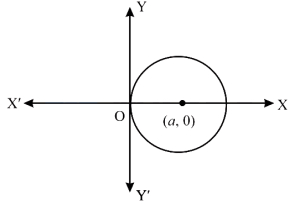
0 likesView Solution
183
MathematicsMediumMCQAP EAMCET · 2017
$A x^2 + B y^2 = 1$ માંથી $A$ અને $B$ ને દૂર કરીને બનતું વિકલ સમીકરણ કયું છે?
A
$x y \cdot \frac{d^2 y}{d x^2} + x \left(\frac{d y}{d x}\right)^2 = y \frac{d y}{d x}$
B
$x y \cdot \frac{d^2 y}{d x^2} + x \left(\frac{d y}{d x}\right)^2 = \frac{d y}{d x}$
C
$x y \cdot \frac{d^2 y}{d x^2} - x \left(\frac{d y}{d x}\right)^2 = y \frac{d y}{d x}$
D
$x y \cdot \frac{d^2 y}{d x^2} - x \left(\frac{d y}{d x}\right)^2 = \frac{d y}{d x}$
Solution
(A) આપેલ સમીકરણ: $A x^2 + B y^2 = 1$ $(1)$
$x$ ની સાપેક્ષમાં વિકલન કરતા: $2 A x + 2 B y \frac{d y}{d x} = 0 \implies A x + B y y' = 0$ $(2)$
ફરીથી $x$ ની સાપેક્ષમાં વિકલન કરતા: $A + B (y')^2 + B y y'' = 0$ $(3)$
$(2)$ પરથી,$A = -B \frac{y y'}{x}$. આ કિંમત $(3)$ માં મૂકતા:
$-B \frac{y y'}{x} + B (y')^2 + B y y'' = 0$
$B$ વડે ભાગતા (ધારો કે $B \neq 0$):
$-\frac{y y'}{x} + (y')^2 + y y'' = 0$
$x$ વડે ગુણતા: $-y y' + x (y')^2 + x y y'' = 0$
ગોઠવતા: $x y y'' + x (y')^2 = y y'$
આમ,વિકલ સમીકરણ $x y \frac{d^2 y}{d x^2} + x \left(\frac{d y}{d x}\right)^2 = y \frac{d y}{d x}$ છે.
$x$ ની સાપેક્ષમાં વિકલન કરતા: $2 A x + 2 B y \frac{d y}{d x} = 0 \implies A x + B y y' = 0$ $(2)$
ફરીથી $x$ ની સાપેક્ષમાં વિકલન કરતા: $A + B (y')^2 + B y y'' = 0$ $(3)$
$(2)$ પરથી,$A = -B \frac{y y'}{x}$. આ કિંમત $(3)$ માં મૂકતા:
$-B \frac{y y'}{x} + B (y')^2 + B y y'' = 0$
$B$ વડે ભાગતા (ધારો કે $B \neq 0$):
$-\frac{y y'}{x} + (y')^2 + y y'' = 0$
$x$ વડે ગુણતા: $-y y' + x (y')^2 + x y y'' = 0$
ગોઠવતા: $x y y'' + x (y')^2 = y y'$
આમ,વિકલ સમીકરણ $x y \frac{d^2 y}{d x^2} + x \left(\frac{d y}{d x}\right)^2 = y \frac{d y}{d x}$ છે.
0 likesView Solution
184
MathematicsDifficultMCQAP EAMCET · 2017
$(x-a)^2+(y-b)^2=4$ દ્વારા આપવામાં આવેલા વર્તુળોના કુળને અનુરૂપ વિકલ સમીકરણ શું છે,જ્યાં $a$ અને $b$ પ્રાચલો છે?
A
$4 \frac{d^2 y}{d x^2}+9 y=0$
B
$4\left(\frac{d^2 y}{d x^2}\right)^2=\left[1+\left(\frac{d y}{d x}\right)^2\right]^3$
C
$4 \frac{d^2 y}{d x^2}+\left(\frac{d y}{d x}\right)^2=6 y$
D
$4\left(\frac{d^2 y}{d x^2}\right)^2+\left[1+\left(\frac{d y}{d x}\right)^2\right]^2=0$
Solution
(B) આપેલ વર્તુળોનું કુળ: $(x-a)^2+(y-b)^2=4$.
$x$ ની સાપેક્ષમાં વિકલન કરતા: $2(x-a)+2(y-b)y'=0 \implies (x-a)+(y-b)y'=0$.
ફરીથી $x$ ની સાપેક્ષમાં વિકલન કરતા: $1+(y')^2+(y-b)y''=0 \implies (y-b) = -\frac{1+(y')^2}{y''}$.
$(y-b)$ ની કિંમત પ્રથમ વિકલિત સમીકરણમાં મૂકતા: $(x-a) = -y'(y-b) = y' \cdot \frac{1+(y')^2}{y''}$.
હવે $(x-a)$ અને $(y-b)$ ની કિંમત મૂળ સમીકરણમાં મૂકતા: $\left(y' \cdot \frac{1+(y')^2}{y''}\right)^2 + \left(-\frac{1+(y')^2}{y''}\right)^2 = 4$.
આનું સાદું રૂપ આપતા: $\frac{(1+(y')^2)^2}{(y'')^2} \cdot ((y')^2+1) = 4$.
તેથી,$(1+(y')^2)^3 = 4(y'')^2$,જે $4\left(\frac{d^2 y}{d x^2}\right)^2 = \left[1+\left(\frac{d y}{d x}\right)^2\right]^3$ છે.
$x$ ની સાપેક્ષમાં વિકલન કરતા: $2(x-a)+2(y-b)y'=0 \implies (x-a)+(y-b)y'=0$.
ફરીથી $x$ ની સાપેક્ષમાં વિકલન કરતા: $1+(y')^2+(y-b)y''=0 \implies (y-b) = -\frac{1+(y')^2}{y''}$.
$(y-b)$ ની કિંમત પ્રથમ વિકલિત સમીકરણમાં મૂકતા: $(x-a) = -y'(y-b) = y' \cdot \frac{1+(y')^2}{y''}$.
હવે $(x-a)$ અને $(y-b)$ ની કિંમત મૂળ સમીકરણમાં મૂકતા: $\left(y' \cdot \frac{1+(y')^2}{y''}\right)^2 + \left(-\frac{1+(y')^2}{y''}\right)^2 = 4$.
આનું સાદું રૂપ આપતા: $\frac{(1+(y')^2)^2}{(y'')^2} \cdot ((y')^2+1) = 4$.
તેથી,$(1+(y')^2)^3 = 4(y'')^2$,જે $4\left(\frac{d^2 y}{d x^2}\right)^2 = \left[1+\left(\frac{d y}{d x}\right)^2\right]^3$ છે.
0 likesView Solution
185
MathematicsMediumMCQAP EAMCET · 2017
$\left(\frac{\pi}{6}, 0\right)$ માંથી પસાર થતા અને વિકલ સમીકરણ $(e^y+1) \cos x \, dx + e^y \sin x \, dy = 0$ નું સમાધાન કરતા વક્રનું સમીકરણ શોધો.
A
$y = \log_e(\operatorname{cosec} x - 1)$
B
$y = \log_e(\operatorname{cosec} x + 1)$
C
$x = \log_e(y + 1)$
D
$x = \log_e(y - 1)$
Solution
(A) આપેલ વિકલ સમીકરણ $(e^y + 1) \cos x \, dx + e^y \sin x \, dy = 0$ છે.
પદોને ગોઠવતા,$\frac{e^y}{e^y + 1} \, dy = -\frac{\cos x}{\sin x} \, dx$ મળે.
બંને બાજુ સંકલન કરતા: $\int \frac{e^y}{e^y + 1} \, dy = -\int \cot x \, dx$.
ધારો કે $u = e^y + 1$,તો $du = e^y \, dy$. સંકલન $\int \frac{1}{u} \, du = -\ln|\sin x| + C$ થાય.
તેથી,$\ln(e^y + 1) = -\ln|\sin x| + C$,જે $\ln((e^y + 1) \sin x) = C$ માં પરિણમે છે.
આથી $(e^y + 1) \sin x = K$ (જ્યાં $K = e^C$).
વક્ર $\left(\frac{\pi}{6}, 0\right)$ માંથી પસાર થાય છે,તેથી $x = \frac{\pi}{6}$ અને $y = 0$ મૂકતા:
$(e^0 + 1) \sin(\frac{\pi}{6}) = K \implies (1 + 1) \cdot \frac{1}{2} = K \implies K = 1$.
આમ,$(e^y + 1) \sin x = 1$,જેનો અર્થ છે કે $e^y + 1 = \frac{1}{\sin x} = \operatorname{cosec} x$.
તેથી,$e^y = \operatorname{cosec} x - 1$,અને $y = \log_e(\operatorname{cosec} x - 1)$.
પદોને ગોઠવતા,$\frac{e^y}{e^y + 1} \, dy = -\frac{\cos x}{\sin x} \, dx$ મળે.
બંને બાજુ સંકલન કરતા: $\int \frac{e^y}{e^y + 1} \, dy = -\int \cot x \, dx$.
ધારો કે $u = e^y + 1$,તો $du = e^y \, dy$. સંકલન $\int \frac{1}{u} \, du = -\ln|\sin x| + C$ થાય.
તેથી,$\ln(e^y + 1) = -\ln|\sin x| + C$,જે $\ln((e^y + 1) \sin x) = C$ માં પરિણમે છે.
આથી $(e^y + 1) \sin x = K$ (જ્યાં $K = e^C$).
વક્ર $\left(\frac{\pi}{6}, 0\right)$ માંથી પસાર થાય છે,તેથી $x = \frac{\pi}{6}$ અને $y = 0$ મૂકતા:
$(e^0 + 1) \sin(\frac{\pi}{6}) = K \implies (1 + 1) \cdot \frac{1}{2} = K \implies K = 1$.
આમ,$(e^y + 1) \sin x = 1$,જેનો અર્થ છે કે $e^y + 1 = \frac{1}{\sin x} = \operatorname{cosec} x$.
તેથી,$e^y = \operatorname{cosec} x - 1$,અને $y = \log_e(\operatorname{cosec} x - 1)$.
0 likesView Solution
186
MathematicsDifficultMCQAP EAMCET · 2017
વિકલ સમીકરણ $(x-y)^2 \frac{dy}{dx} = a^2$ નો વ્યાપક ઉકેલ શોધો.
A
$y = x - a \tan \left( \frac{x-y}{a} + c \right)$
B
$x - y = a \tan \left( \frac{y+c}{a} \right)$
C
$y = x - a \tan \left( \frac{y}{a} + c \right)$
D
$x - y = a \tan \left( \frac{x+c}{a} \right)$
Solution
(B) આપેલ વિકલ સમીકરણ $(x-y)^2 \frac{dy}{dx} = a^2$ છે.
ધારો કે $v = x - y$. તેથી $\frac{dv}{dx} = 1 - \frac{dy}{dx}$,જેનો અર્થ છે કે $\frac{dy}{dx} = 1 - \frac{dv}{dx}$.
આ કિંમતો સમીકરણમાં મૂકતા: $v^2 (1 - \frac{dv}{dx}) = a^2$.
$1 - \frac{dv}{dx} = \frac{a^2}{v^2} \implies \frac{dv}{dx} = 1 - \frac{a^2}{v^2} = \frac{v^2 - a^2}{v^2}$.
ચલને અલગ કરતા: $\frac{v^2}{v^2 - a^2} dv = dx$.
બંને બાજુ સંકલન કરતા: $\int \frac{v^2 - a^2 + a^2}{v^2 - a^2} dv = \int dx$.
$\int (1 + \frac{a^2}{v^2 - a^2}) dv = x + c$.
$v + a^2 \cdot \frac{1}{2a} \log \left| \frac{v-a}{v+a} \right| = x + c$.
$v + \frac{a}{2} \log \left| \frac{v-a}{v+a} \right| = x + c$.
$v = x - y$ મૂકતા: $(x-y) + \frac{a}{2} \log \left| \frac{x-y-a}{x-y+a} \right| = x + c$.
$-y + \frac{a}{2} \log \left| \frac{x-y-a}{x-y+a} \right| = c$.
$y = \frac{a}{2} \log \left| \frac{x-y-a}{x-y+a} \right| + c'$.
ધારો કે $v = x - y$. તેથી $\frac{dv}{dx} = 1 - \frac{dy}{dx}$,જેનો અર્થ છે કે $\frac{dy}{dx} = 1 - \frac{dv}{dx}$.
આ કિંમતો સમીકરણમાં મૂકતા: $v^2 (1 - \frac{dv}{dx}) = a^2$.
$1 - \frac{dv}{dx} = \frac{a^2}{v^2} \implies \frac{dv}{dx} = 1 - \frac{a^2}{v^2} = \frac{v^2 - a^2}{v^2}$.
ચલને અલગ કરતા: $\frac{v^2}{v^2 - a^2} dv = dx$.
બંને બાજુ સંકલન કરતા: $\int \frac{v^2 - a^2 + a^2}{v^2 - a^2} dv = \int dx$.
$\int (1 + \frac{a^2}{v^2 - a^2}) dv = x + c$.
$v + a^2 \cdot \frac{1}{2a} \log \left| \frac{v-a}{v+a} \right| = x + c$.
$v + \frac{a}{2} \log \left| \frac{v-a}{v+a} \right| = x + c$.
$v = x - y$ મૂકતા: $(x-y) + \frac{a}{2} \log \left| \frac{x-y-a}{x-y+a} \right| = x + c$.
$-y + \frac{a}{2} \log \left| \frac{x-y-a}{x-y+a} \right| = c$.
$y = \frac{a}{2} \log \left| \frac{x-y-a}{x-y+a} \right| + c'$.
0 likesView Solution
187
MathematicsMediumMCQAP EAMCET · 2017
વિકલ સમીકરણ $2 \frac{dy}{dx} - \frac{y}{x} = \frac{y^2}{x^2}$ નો ઉકેલ શોધો,જ્યાં $x = 1$ હોય ત્યારે $y = 2$ છે.
A
$2y = \frac{x}{1 + \sqrt{x}}$
B
$y = \frac{2x}{2 - \sqrt{x}}$
C
$y = \frac{x}{2(1 + \sqrt{x})}$
D
$y = \frac{2x}{1 + \sqrt{x}}$
Solution
(B) આપેલ વિકલ સમીકરણ: $2 \frac{dy}{dx} - \frac{y}{x} = \frac{y^2}{x^2}$.
$y^2$ વડે ભાગતા: $2 y^{-2} \frac{dy}{dx} - \frac{1}{xy} = \frac{1}{x^2}$.
ધારો કે $v = y^{-1}$,તેથી $\frac{dv}{dx} = -y^{-2} \frac{dy}{dx}$,એટલે કે $y^{-2} \frac{dy}{dx} = -\frac{dv}{dx}$.
સમીકરણમાં કિંમત મૂકતા: $-2 \frac{dv}{dx} - \frac{v}{x} = \frac{1}{x^2}$,જેનું સાદું રૂપ $\frac{dv}{dx} + \frac{v}{2x} = -\frac{1}{2x^2}$ થાય છે.
આ એક સુરેખ વિકલ સમીકરણ છે,જેનો સંકલ્યકારક અવયવ $IF = e^{\int \frac{1}{2x} dx} = e^{\frac{1}{2} \ln x} = \sqrt{x}$ છે.
$IF$ વડે ગુણતા: $\sqrt{x} \frac{dv}{dx} + \frac{v}{2\sqrt{x}} = -\frac{1}{2x^{3/2}}$,એટલે કે $\frac{d}{dx}(v \sqrt{x}) = -\frac{1}{2} x^{-3/2}$.
બંને બાજુ સંકલન કરતા: $v \sqrt{x} = -\frac{1}{2} \int x^{-3/2} dx = -\frac{1}{2} \frac{x^{-1/2}}{-1/2} + C = \frac{1}{\sqrt{x}} + C$.
તેથી,$v = \frac{1}{x} + \frac{C}{\sqrt{x}} = \frac{1 + C\sqrt{x}}{x}$.
$v = 1/y$ હોવાથી,$y = \frac{x}{1 + C\sqrt{x}}$.
$x = 1$ ત્યારે $y = 2$ આપેલ છે: $2 = \frac{1}{1 + C}$,તેથી $2 + 2C = 1$,એટલે કે $2C = -1$ અથવા $C = -1/2$.
$C$ ની કિંમત મૂકતા: $y = \frac{x}{1 - \frac{1}{2}\sqrt{x}} = \frac{2x}{2 - \sqrt{x}}$.
તેથી,સાચો વિકલ્પ $B$ છે.
$y^2$ વડે ભાગતા: $2 y^{-2} \frac{dy}{dx} - \frac{1}{xy} = \frac{1}{x^2}$.
ધારો કે $v = y^{-1}$,તેથી $\frac{dv}{dx} = -y^{-2} \frac{dy}{dx}$,એટલે કે $y^{-2} \frac{dy}{dx} = -\frac{dv}{dx}$.
સમીકરણમાં કિંમત મૂકતા: $-2 \frac{dv}{dx} - \frac{v}{x} = \frac{1}{x^2}$,જેનું સાદું રૂપ $\frac{dv}{dx} + \frac{v}{2x} = -\frac{1}{2x^2}$ થાય છે.
આ એક સુરેખ વિકલ સમીકરણ છે,જેનો સંકલ્યકારક અવયવ $IF = e^{\int \frac{1}{2x} dx} = e^{\frac{1}{2} \ln x} = \sqrt{x}$ છે.
$IF$ વડે ગુણતા: $\sqrt{x} \frac{dv}{dx} + \frac{v}{2\sqrt{x}} = -\frac{1}{2x^{3/2}}$,એટલે કે $\frac{d}{dx}(v \sqrt{x}) = -\frac{1}{2} x^{-3/2}$.
બંને બાજુ સંકલન કરતા: $v \sqrt{x} = -\frac{1}{2} \int x^{-3/2} dx = -\frac{1}{2} \frac{x^{-1/2}}{-1/2} + C = \frac{1}{\sqrt{x}} + C$.
તેથી,$v = \frac{1}{x} + \frac{C}{\sqrt{x}} = \frac{1 + C\sqrt{x}}{x}$.
$v = 1/y$ હોવાથી,$y = \frac{x}{1 + C\sqrt{x}}$.
$x = 1$ ત્યારે $y = 2$ આપેલ છે: $2 = \frac{1}{1 + C}$,તેથી $2 + 2C = 1$,એટલે કે $2C = -1$ અથવા $C = -1/2$.
$C$ ની કિંમત મૂકતા: $y = \frac{x}{1 - \frac{1}{2}\sqrt{x}} = \frac{2x}{2 - \sqrt{x}}$.
તેથી,સાચો વિકલ્પ $B$ છે.
0 likesView Solution
188
MathematicsEasyMCQAP EAMCET · 2017
વિકલ સમીકરણ $(x+1) \frac{dy}{dx} - xy = 1$,જે $y(0) = 1$ નું સમાધાન કરે છે,તેનો ઉકેલ શોધો.
A
$y = \frac{1}{1+x}(e^x + 1)$
B
$y = \log_e(1+x) + \frac{1}{2}$
C
$y = \frac{1}{x}(e^x - \frac{1}{2})$
D
$y = \frac{1}{1+x}(2e^x - 1)$
Solution
(D) આપેલ વિકલ સમીકરણ $(x+1) \frac{dy}{dx} - xy = 1$ છે.
$(x+1)$ વડે ભાગતા,$\frac{dy}{dx} - \frac{x}{x+1}y = \frac{1}{x+1}$ મળે.
આ $\frac{dy}{dx} + Py = Q$ પ્રકારનું સુરેખ વિકલ સમીકરણ છે,જ્યાં $P = -\frac{x}{x+1} = -1 + \frac{1}{x+1}$ અને $Q = \frac{1}{x+1}$ છે.
સંકલ્યકારક અવયવ $IF = e^{\int P dx} = e^{\int (-1 + \frac{1}{x+1}) dx} = e^{-x + \log(x+1)} = (x+1)e^{-x}$ થાય.
વ્યાપક ઉકેલ $y \cdot IF = \int (Q \cdot IF) dx + C$ છે.
$y(x+1)e^{-x} = \int (\frac{1}{x+1} \cdot (x+1)e^{-x}) dx + C = \int e^{-x} dx + C = -e^{-x} + C$.
$e^{-x}$ વડે ભાગતા,$y(x+1) = -1 + Ce^x$ મળે.
$y(0) = 1$ આપેલ હોવાથી,$x=0$ અને $y=1$ મૂકતા: $1(0+1) = -1 + Ce^0 \implies 1 = -1 + C \implies C = 2$.
તેથી,$y(x+1) = 2e^x - 1$,એટલે કે $y = \frac{2e^x - 1}{x+1}$.
$(x+1)$ વડે ભાગતા,$\frac{dy}{dx} - \frac{x}{x+1}y = \frac{1}{x+1}$ મળે.
આ $\frac{dy}{dx} + Py = Q$ પ્રકારનું સુરેખ વિકલ સમીકરણ છે,જ્યાં $P = -\frac{x}{x+1} = -1 + \frac{1}{x+1}$ અને $Q = \frac{1}{x+1}$ છે.
સંકલ્યકારક અવયવ $IF = e^{\int P dx} = e^{\int (-1 + \frac{1}{x+1}) dx} = e^{-x + \log(x+1)} = (x+1)e^{-x}$ થાય.
વ્યાપક ઉકેલ $y \cdot IF = \int (Q \cdot IF) dx + C$ છે.
$y(x+1)e^{-x} = \int (\frac{1}{x+1} \cdot (x+1)e^{-x}) dx + C = \int e^{-x} dx + C = -e^{-x} + C$.
$e^{-x}$ વડે ભાગતા,$y(x+1) = -1 + Ce^x$ મળે.
$y(0) = 1$ આપેલ હોવાથી,$x=0$ અને $y=1$ મૂકતા: $1(0+1) = -1 + Ce^0 \implies 1 = -1 + C \implies C = 2$.
તેથી,$y(x+1) = 2e^x - 1$,એટલે કે $y = \frac{2e^x - 1}{x+1}$.
0 likesView Solution
189
MathematicsMediumMCQAP EAMCET · 2017
સમીકરણ $(x-4y^3) \frac{dy}{dx}-y=0, (y>0)$ નો ઉકેલ શોધો.
A
$x=y^3+cy$
B
$x+2y^3=cy$
C
$y=x^3+cx$
D
$y+2x^3=cx$
Solution
(B) આપેલ વિકલ સમીકરણ: $(x-4y^3) \frac{dy}{dx}-y=0$ જ્યાં $y>0$.
પદોને ફરીથી ગોઠવતા: $(x-4y^3) \frac{dy}{dx}=y$.
$y>0$ હોવાથી,આપણે લખી શકીએ: $\frac{dx}{dy} = \frac{x-4y^3}{y} = \frac{x}{y} - 4y^2$.
આ $\frac{dx}{dy} + Px = Q$ સ્વરૂપનું સુરેખ વિકલ સમીકરણ છે,જ્યાં $P = -\frac{1}{y}$ અને $Q = -4y^2$.
સંકલ્યકારક અવયવ ($I$.$F$.) આ મુજબ છે: $I.F. = e^{\int P dy} = e^{\int -\frac{1}{y} dy} = e^{-\ln y} = e^{\ln y^{-1}} = \frac{1}{y}$.
વ્યાપક ઉકેલ: $x \cdot (I.F.) = \int (Q \cdot I.F.) dy + C$.
કિંમતો મૂકતા: $x \cdot \frac{1}{y} = \int (-4y^2 \cdot \frac{1}{y}) dy + C$.
$\frac{x}{y} = \int -4y dy + C$.
$\frac{x}{y} = -4 \cdot \frac{y^2}{2} + C = -2y^2 + C$.
$y$ વડે ગુણતા,આપણને મળે છે: $x = -2y^3 + Cy$,જેનું સાદું રૂપ $x+2y^3=Cy$ થાય છે.
પદોને ફરીથી ગોઠવતા: $(x-4y^3) \frac{dy}{dx}=y$.
$y>0$ હોવાથી,આપણે લખી શકીએ: $\frac{dx}{dy} = \frac{x-4y^3}{y} = \frac{x}{y} - 4y^2$.
આ $\frac{dx}{dy} + Px = Q$ સ્વરૂપનું સુરેખ વિકલ સમીકરણ છે,જ્યાં $P = -\frac{1}{y}$ અને $Q = -4y^2$.
સંકલ્યકારક અવયવ ($I$.$F$.) આ મુજબ છે: $I.F. = e^{\int P dy} = e^{\int -\frac{1}{y} dy} = e^{-\ln y} = e^{\ln y^{-1}} = \frac{1}{y}$.
વ્યાપક ઉકેલ: $x \cdot (I.F.) = \int (Q \cdot I.F.) dy + C$.
કિંમતો મૂકતા: $x \cdot \frac{1}{y} = \int (-4y^2 \cdot \frac{1}{y}) dy + C$.
$\frac{x}{y} = \int -4y dy + C$.
$\frac{x}{y} = -4 \cdot \frac{y^2}{2} + C = -2y^2 + C$.
$y$ વડે ગુણતા,આપણને મળે છે: $x = -2y^3 + Cy$,જેનું સાદું રૂપ $x+2y^3=Cy$ થાય છે.
0 likesView Solution
190
MathematicsMediumMCQAP EAMCET · 2017
જો વિકલ સમીકરણ $(y^3+x) \frac{dy}{dx} = y$ નો ઉકેલ $y(4) = 2$ માટે $y^3 = ax + b$ સ્વરૂપમાં હોય,તો $4a + 12b^2 = $
A
$2$
B
$4$
C
$8$
D
$16$
Solution
(C) આપેલ વિકલ સમીકરણ: $(y^3 + x) \frac{dy}{dx} = y$.
સમીકરણને ફરીથી ગોઠવતા: $\frac{dx}{dy} = \frac{y^3 + x}{y} = y^2 + \frac{x}{y}$.
આ $x$ માં સુરેખ વિકલ સમીકરણ છે: $\frac{dx}{dy} - \frac{1}{y}x = y^2$.
સંકલ્યકારક અવયવ $IF = e^{\int -\frac{1}{y} dy} = e^{-\ln|y|} = \frac{1}{y}$ છે.
$IF$ વડે ગુણતા: $\frac{1}{y} \frac{dx}{dy} - \frac{1}{y^2} x = y$.
બંને બાજુ $y$ ની સાપેક્ષમાં સંકલન કરતા: $\int \frac{d}{dy} (\frac{x}{y}) dy = \int y dy$.
$\frac{x}{y} = \frac{y^2}{2} + C$.
$x = \frac{y^3}{2} + Cy \implies 2x = y^3 + 2Cy$.
$y^3 = ax + b$ હોવાથી,આપણે તેને $y^3 = 2x - 2Cy$ તરીકે લખીએ છીએ.
$y^3 = ax + b$ સાથે સરખાવતા,$a = 2$ અને $b = -2Cy$ મળે છે.
$y(4) = 2$ નો ઉપયોગ કરતા: $2^3 = 2(4) + b \implies 8 = 8 + b \implies b = 0$.
તેથી $y^3 = 2x + 0$,એટલે કે $a = 2$ અને $b = 0$.
$4a + 12b^2 = 4(2) + 12(0)^2 = 8 + 0 = 8$.
સમીકરણને ફરીથી ગોઠવતા: $\frac{dx}{dy} = \frac{y^3 + x}{y} = y^2 + \frac{x}{y}$.
આ $x$ માં સુરેખ વિકલ સમીકરણ છે: $\frac{dx}{dy} - \frac{1}{y}x = y^2$.
સંકલ્યકારક અવયવ $IF = e^{\int -\frac{1}{y} dy} = e^{-\ln|y|} = \frac{1}{y}$ છે.
$IF$ વડે ગુણતા: $\frac{1}{y} \frac{dx}{dy} - \frac{1}{y^2} x = y$.
બંને બાજુ $y$ ની સાપેક્ષમાં સંકલન કરતા: $\int \frac{d}{dy} (\frac{x}{y}) dy = \int y dy$.
$\frac{x}{y} = \frac{y^2}{2} + C$.
$x = \frac{y^3}{2} + Cy \implies 2x = y^3 + 2Cy$.
$y^3 = ax + b$ હોવાથી,આપણે તેને $y^3 = 2x - 2Cy$ તરીકે લખીએ છીએ.
$y^3 = ax + b$ સાથે સરખાવતા,$a = 2$ અને $b = -2Cy$ મળે છે.
$y(4) = 2$ નો ઉપયોગ કરતા: $2^3 = 2(4) + b \implies 8 = 8 + b \implies b = 0$.
તેથી $y^3 = 2x + 0$,એટલે કે $a = 2$ અને $b = 0$.
$4a + 12b^2 = 4(2) + 12(0)^2 = 8 + 0 = 8$.
0 likesView Solution
191
MathematicsEasyMCQAP EAMCET · 2017
સદિશ $\vec{a} = 3\hat{i} + 4\hat{j} + 5\hat{k}$ ને લંબ અને સદિશો $\vec{b} = \hat{i} + \hat{j} + \hat{k}$ તથા $\vec{c} = \hat{i} - \hat{j} + \hat{k}$ સાથે સમતલીય હોય તેવો એકમ સદિશ કયો છે?
A
$\frac{1}{5}(4\hat{i} - 3\hat{j})$
B
$\frac{1}{\sqrt{11}}(3\hat{i} - \hat{j} - \hat{k})$
C
$\frac{1}{3}(2\hat{i} + \hat{j} - 2\hat{k})$
D
$\frac{1}{\sqrt{6}}(\hat{i} - 2\hat{j} + \hat{k})$
Solution
(D) ધારો કે જરૂરી સદિશ $\vec{v}$ છે. $\vec{v}$ એ $\vec{b}$ અને $\vec{c}$ સાથે સમતલીય હોવાથી,તે $\vec{a} \times (\vec{b} \times \vec{c})$ ને સમાંતર હશે.
પ્રથમ,$\vec{n} = \vec{b} \times \vec{c} = \begin{vmatrix} \hat{i} & \hat{j} & \hat{k} \\ 1 & 1 & 1 \\ 1 & -1 & 1 \end{vmatrix} = 2\hat{i} - 2\hat{k}$ શોધો.
હવે,$\vec{a}$ અને $\vec{n}$ ને લંબ સદિશ શોધો:
$\vec{v} = \vec{a} \times \vec{n} = \begin{vmatrix} \hat{i} & \hat{j} & \hat{k} \\ 3 & 4 & 5 \\ 2 & 0 & -2 \end{vmatrix} = -8\hat{i} + 16\hat{j} - 8\hat{k}$.
આ સદિશની દિશા $\hat{i} - 2\hat{j} + \hat{k}$ છે.
તેનું માન $\sqrt{1^2 + (-2)^2 + 1^2} = \sqrt{6}$ છે.
તેથી,એકમ સદિશ $\frac{1}{\sqrt{6}}(\hat{i} - 2\hat{j} + \hat{k})$ થશે.
આમ,સાચો વિકલ્પ $D$ છે.
પ્રથમ,$\vec{n} = \vec{b} \times \vec{c} = \begin{vmatrix} \hat{i} & \hat{j} & \hat{k} \\ 1 & 1 & 1 \\ 1 & -1 & 1 \end{vmatrix} = 2\hat{i} - 2\hat{k}$ શોધો.
હવે,$\vec{a}$ અને $\vec{n}$ ને લંબ સદિશ શોધો:
$\vec{v} = \vec{a} \times \vec{n} = \begin{vmatrix} \hat{i} & \hat{j} & \hat{k} \\ 3 & 4 & 5 \\ 2 & 0 & -2 \end{vmatrix} = -8\hat{i} + 16\hat{j} - 8\hat{k}$.
આ સદિશની દિશા $\hat{i} - 2\hat{j} + \hat{k}$ છે.
તેનું માન $\sqrt{1^2 + (-2)^2 + 1^2} = \sqrt{6}$ છે.
તેથી,એકમ સદિશ $\frac{1}{\sqrt{6}}(\hat{i} - 2\hat{j} + \hat{k})$ થશે.
આમ,સાચો વિકલ્પ $D$ છે.
0 likesView Solution
192
MathematicsEasyMCQAP EAMCET · 2017
એક બિંદુ $C$ જેનો સ્થાન સદિશ $\frac{3 \bar{a}+4 \bar{b}-5 \bar{c}}{3}$ છે (જ્યાં $\bar{a}, \bar{b}$ અને $\bar{c}$ અસમતલીય સદિશો છે),તે $A$ અને $B$ ને જોડતી રેખાનું $2:1$ ગુણોત્તરમાં વિભાજન કરે છે. જો $A$ નો સ્થાન સદિશ $\bar{a}-2 \bar{b}+3 \bar{c}$ હોય,તો $B$ નો સ્થાન સદિશ શોધો.
A
$2 \bar{a}+3 \bar{b}-4 \bar{c}$
B
$2 \bar{a}-3 \bar{b}+4 \bar{c}$
C
$2 \bar{a}+3 \bar{b}+4 \bar{c}$
D
$\bar{a}+3 \bar{b}-4 \bar{c}$
Solution
(D) ધારો કે બિંદુઓ $A$ અને $B$ ના સ્થાન સદિશો અનુક્રમે $\vec{r}_A$ અને $\vec{r}_B$ છે.
આપેલ છે કે $\vec{r}_A = \bar{a}-2 \bar{b}+3 \bar{c}$.
બિંદુ $C$ એ રેખાખંડ $AB$ નું $m:n = 2:1$ ગુણોત્તરમાં વિભાજન કરે છે.
વિભાજન સૂત્ર મુજબ $C$ નો સ્થાન સદિશ: $\vec{r}_C = \frac{m \vec{r}_B + n \vec{r}_A}{m+n}$.
કિંમતો મૂકતા: $\frac{3 \bar{a}+4 \bar{b}-5 \bar{c}}{3} = \frac{2 \vec{r}_B + 1 (\bar{a}-2 \bar{b}+3 \bar{c})}{2+1}$.
$\frac{3 \bar{a}+4 \bar{b}-5 \bar{c}}{3} = \frac{2 \vec{r}_B + \bar{a}-2 \bar{b}+3 \bar{c}}{3}$.
અંશને સરખાવતા: $3 \bar{a}+4 \bar{b}-5 \bar{c} = 2 \vec{r}_B + \bar{a}-2 \bar{b}+3 \bar{c}$.
$2 \vec{r}_B = (3 \bar{a}-\bar{a}) + (4 \bar{b}+2 \bar{b}) + (-5 \bar{c}-3 \bar{c})$.
$2 \vec{r}_B = 2 \bar{a} + 6 \bar{b} - 8 \bar{c}$.
$\vec{r}_B = \bar{a} + 3 \bar{b} - 4 \bar{c}$.
આમ,$B$ નો સ્થાન સદિશ $\bar{a} + 3 \bar{b} - 4 \bar{c}$ છે.
આપેલ છે કે $\vec{r}_A = \bar{a}-2 \bar{b}+3 \bar{c}$.
બિંદુ $C$ એ રેખાખંડ $AB$ નું $m:n = 2:1$ ગુણોત્તરમાં વિભાજન કરે છે.
વિભાજન સૂત્ર મુજબ $C$ નો સ્થાન સદિશ: $\vec{r}_C = \frac{m \vec{r}_B + n \vec{r}_A}{m+n}$.
કિંમતો મૂકતા: $\frac{3 \bar{a}+4 \bar{b}-5 \bar{c}}{3} = \frac{2 \vec{r}_B + 1 (\bar{a}-2 \bar{b}+3 \bar{c})}{2+1}$.
$\frac{3 \bar{a}+4 \bar{b}-5 \bar{c}}{3} = \frac{2 \vec{r}_B + \bar{a}-2 \bar{b}+3 \bar{c}}{3}$.
અંશને સરખાવતા: $3 \bar{a}+4 \bar{b}-5 \bar{c} = 2 \vec{r}_B + \bar{a}-2 \bar{b}+3 \bar{c}$.
$2 \vec{r}_B = (3 \bar{a}-\bar{a}) + (4 \bar{b}+2 \bar{b}) + (-5 \bar{c}-3 \bar{c})$.
$2 \vec{r}_B = 2 \bar{a} + 6 \bar{b} - 8 \bar{c}$.
$\vec{r}_B = \bar{a} + 3 \bar{b} - 4 \bar{c}$.
આમ,$B$ નો સ્થાન સદિશ $\bar{a} + 3 \bar{b} - 4 \bar{c}$ છે.
0 likesView Solution
193
MathematicsMediumMCQAP EAMCET · 2017
જો $\bar{a}$ અને $\bar{b}$ બે સમાંતર ન હોય તેવા એકમ સદિશો હોય અને સદિશ $\alpha \bar{a} + \bar{b}$ એ $\bar{a}$ અને $\bar{b}$ વચ્ચેના આંતરિક ખૂણાને દુભાગતો હોય,તો $\alpha$ ની કિંમત શોધો.
A
$1$
B
$\frac{1}{2}$
C
$2$
D
$3$
Solution
(A) ધારો કે $\bar{a}$ અને $\bar{b}$ બે એકમ સદિશો છે,તેથી $|\bar{a}| = 1$ અને $|\bar{b}| = 1$.
સદિશ $\bar{v} = \alpha \bar{a} + \bar{b}$ એ $\bar{a}$ અને $\bar{b}$ વચ્ચેના ખૂણાને દુભાગે છે,તેથી તે $\bar{a}$ અને $\bar{b}$ ની દિશામાં રહેલા એકમ સદિશોના સરવાળાની દિશામાં હોવો જોઈએ.
$\bar{a}$ અને $\bar{b}$ ની દિશામાં એકમ સદિશો પોતે $\bar{a}$ અને $\bar{b}$ છે.
ખૂણાનો દુભાજક સદિશ $\hat{a} + \hat{b} = \bar{a} + \bar{b}$ ના પ્રમાણમાં હોય છે.
આમ,$\alpha \bar{a} + \bar{b} = k(\bar{a} + \bar{b})$ કોઈ અદિશ $k$ માટે.
$\bar{a}$ અને $\bar{b}$ ના સહગુણકોની સરખામણી કરતા (કારણ કે $\bar{a}$ અને $\bar{b}$ સમાંતર નથી,તેથી તેઓ સુરેખ રીતે સ્વતંત્ર છે),આપણને $\alpha = k$ અને $1 = k$ મળે છે.
તેથી,$\alpha = 1$.
સદિશ $\bar{v} = \alpha \bar{a} + \bar{b}$ એ $\bar{a}$ અને $\bar{b}$ વચ્ચેના ખૂણાને દુભાગે છે,તેથી તે $\bar{a}$ અને $\bar{b}$ ની દિશામાં રહેલા એકમ સદિશોના સરવાળાની દિશામાં હોવો જોઈએ.
$\bar{a}$ અને $\bar{b}$ ની દિશામાં એકમ સદિશો પોતે $\bar{a}$ અને $\bar{b}$ છે.
ખૂણાનો દુભાજક સદિશ $\hat{a} + \hat{b} = \bar{a} + \bar{b}$ ના પ્રમાણમાં હોય છે.
આમ,$\alpha \bar{a} + \bar{b} = k(\bar{a} + \bar{b})$ કોઈ અદિશ $k$ માટે.
$\bar{a}$ અને $\bar{b}$ ના સહગુણકોની સરખામણી કરતા (કારણ કે $\bar{a}$ અને $\bar{b}$ સમાંતર નથી,તેથી તેઓ સુરેખ રીતે સ્વતંત્ર છે),આપણને $\alpha = k$ અને $1 = k$ મળે છે.
તેથી,$\alpha = 1$.
0 likesView Solution
194
MathematicsMediumMCQAP EAMCET · 2017
જો $\overline{OA} = 3\hat{i} + \hat{j} - \hat{k}$,$|\overline{AB}| = 2\sqrt{6}$ અને $\overline{AB}$ ના દિકગુણોત્તરો $1, -1, 2$ હોય,તો $|\overline{OB}| = $
A
$\sqrt{41}$
B
$\sqrt{35}$
C
$\sqrt{26}$
D
$\sqrt{55}$
Solution
(B) આપેલ છે કે $\overline{OA} = 3\hat{i} + \hat{j} - \hat{k}$.
$\overline{AB}$ ના દિકગુણોત્તરો $1, -1, 2$ છે. ધારો કે સદિશ $\overline{AB} = k(\hat{i} - \hat{j} + 2\hat{k})$ કોઈ અદિશ $k$ માટે.
આપણે જાણીએ છીએ કે $|\overline{AB}| = |k| \sqrt{1^2 + (-1)^2 + 2^2} = |k| \sqrt{6}$.
આપેલ છે કે $|\overline{AB}| = 2\sqrt{6}$,તેથી $|k|\sqrt{6} = 2\sqrt{6} \implies |k| = 2$.
આમ,$\overline{AB} = 2(\hat{i} - \hat{j} + 2\hat{k}) = 2\hat{i} - 2\hat{j} + 4\hat{k}$ અથવા $\overline{AB} = -2\hat{i} + 2\hat{j} - 4\hat{k}$.
કારણ કે $\overline{OB} = \overline{OA} + \overline{AB}$,આપણી પાસે બે કિસ્સાઓ છે:
કિસ્સો $1$: $\overline{OB} = (3\hat{i} + \hat{j} - \hat{k}) + (2\hat{i} - 2\hat{j} + 4\hat{k}) = 5\hat{i} - \hat{j} + 3\hat{k}$.
તેથી $|\overline{OB}| = \sqrt{5^2 + (-1)^2 + 3^2} = \sqrt{25 + 1 + 9} = \sqrt{35}$.
કિસ્સો $2$: $\overline{OB} = (3\hat{i} + \hat{j} - \hat{k}) + (-2\hat{i} + 2\hat{j} - 4\hat{k}) = \hat{i} + 3\hat{j} - 5\hat{k}$.
તેથી $|\overline{OB}| = \sqrt{1^2 + 3^2 + (-5)^2} = \sqrt{1 + 9 + 25} = \sqrt{35}$.
બંને કિસ્સાઓમાં,$|\overline{OB}| = \sqrt{35}$.
$\overline{AB}$ ના દિકગુણોત્તરો $1, -1, 2$ છે. ધારો કે સદિશ $\overline{AB} = k(\hat{i} - \hat{j} + 2\hat{k})$ કોઈ અદિશ $k$ માટે.
આપણે જાણીએ છીએ કે $|\overline{AB}| = |k| \sqrt{1^2 + (-1)^2 + 2^2} = |k| \sqrt{6}$.
આપેલ છે કે $|\overline{AB}| = 2\sqrt{6}$,તેથી $|k|\sqrt{6} = 2\sqrt{6} \implies |k| = 2$.
આમ,$\overline{AB} = 2(\hat{i} - \hat{j} + 2\hat{k}) = 2\hat{i} - 2\hat{j} + 4\hat{k}$ અથવા $\overline{AB} = -2\hat{i} + 2\hat{j} - 4\hat{k}$.
કારણ કે $\overline{OB} = \overline{OA} + \overline{AB}$,આપણી પાસે બે કિસ્સાઓ છે:
કિસ્સો $1$: $\overline{OB} = (3\hat{i} + \hat{j} - \hat{k}) + (2\hat{i} - 2\hat{j} + 4\hat{k}) = 5\hat{i} - \hat{j} + 3\hat{k}$.
તેથી $|\overline{OB}| = \sqrt{5^2 + (-1)^2 + 3^2} = \sqrt{25 + 1 + 9} = \sqrt{35}$.
કિસ્સો $2$: $\overline{OB} = (3\hat{i} + \hat{j} - \hat{k}) + (-2\hat{i} + 2\hat{j} - 4\hat{k}) = \hat{i} + 3\hat{j} - 5\hat{k}$.
તેથી $|\overline{OB}| = \sqrt{1^2 + 3^2 + (-5)^2} = \sqrt{1 + 9 + 25} = \sqrt{35}$.
બંને કિસ્સાઓમાં,$|\overline{OB}| = \sqrt{35}$.
0 likesView Solution
195
MathematicsEasyMCQAP EAMCET · 2017
વાસ્તવિક સંખ્યાઓની ત્રિપુટી $(x, y, z)$ એવી રીતે કે જેથી $(3 \hat{i}-\hat{j}+2 \hat{k})=(2 \hat{i}+3 \hat{j}-\hat{k}) x+(\hat{i}-2 \hat{j}+2 \hat{k}) y+(-2 \hat{i}+\hat{j}-2 \hat{k}) z$ થાય,તે શોધો.
A
$(-2, 5, 3)$
B
$(2, -5, 3)$
C
$(2, 5, 3)$
D
$(2, 5, -3)$
Solution
(C) આપેલ સદિશ સમીકરણ:
$(3 \hat{i}-\hat{j}+2 \hat{k}) = x(2 \hat{i}+3 \hat{j}-\hat{k}) + y(\hat{i}-2 \hat{j}+2 \hat{k}) + z(-2 \hat{i}+\hat{j}-2 \hat{k})$
બંને બાજુ $\hat{i}, \hat{j},$ અને $\hat{k}$ ના સહગુણકોને સરખાવતા,આપણને નીચે મુજબના સુરેખ સમીકરણો મળે છે:
$2x + y - 2z = 3$ $(1)$
$3x - 2y + z = -1$ $(2)$
$-x + 2y - 2z = 2$ $(3)$
સમીકરણ $(1)$ માંથી સમીકરણ $(3)$ બાદ કરતા:
$(2x + y - 2z) - (-x + 2y - 2z) = 3 - 2$
$3x - y = 1 \implies y = 3x - 1$
$y = 3x - 1$ ને સમીકરણ $(2)$ માં મૂકતા:
$3x - 2(3x - 1) + z = -1$
$3x - 6x + 2 + z = -1 \implies z = 3x - 3$
$y$ અને $z$ ની કિંમતો સમીકરણ $(1)$ માં મૂકતા:
$2x + (3x - 1) - 2(3x - 3) = 3$
$2x + 3x - 1 - 6x + 6 = 3$
$-x + 5 = 3 \implies x = 2$
હવે,$y$ અને $z$ શોધીએ:
$y = 3(2) - 1 = 5$
$z = 3(2) - 3 = 3$
આમ,ત્રિપુટી $(x, y, z) = (2, 5, 3)$ છે.
$(3 \hat{i}-\hat{j}+2 \hat{k}) = x(2 \hat{i}+3 \hat{j}-\hat{k}) + y(\hat{i}-2 \hat{j}+2 \hat{k}) + z(-2 \hat{i}+\hat{j}-2 \hat{k})$
બંને બાજુ $\hat{i}, \hat{j},$ અને $\hat{k}$ ના સહગુણકોને સરખાવતા,આપણને નીચે મુજબના સુરેખ સમીકરણો મળે છે:
$2x + y - 2z = 3$ $(1)$
$3x - 2y + z = -1$ $(2)$
$-x + 2y - 2z = 2$ $(3)$
સમીકરણ $(1)$ માંથી સમીકરણ $(3)$ બાદ કરતા:
$(2x + y - 2z) - (-x + 2y - 2z) = 3 - 2$
$3x - y = 1 \implies y = 3x - 1$
$y = 3x - 1$ ને સમીકરણ $(2)$ માં મૂકતા:
$3x - 2(3x - 1) + z = -1$
$3x - 6x + 2 + z = -1 \implies z = 3x - 3$
$y$ અને $z$ ની કિંમતો સમીકરણ $(1)$ માં મૂકતા:
$2x + (3x - 1) - 2(3x - 3) = 3$
$2x + 3x - 1 - 6x + 6 = 3$
$-x + 5 = 3 \implies x = 2$
હવે,$y$ અને $z$ શોધીએ:
$y = 3(2) - 1 = 5$
$z = 3(2) - 3 = 3$
આમ,ત્રિપુટી $(x, y, z) = (2, 5, 3)$ છે.
0 likesView Solution
196
MathematicsMediumMCQAP EAMCET · 2017
$\triangle ABC$ માં,જો $S$ પરિકેન્દ્ર હોય અને $O$ લંબકેન્દ્ર હોય,તો $\vec{OA} + \vec{OB} + \vec{OC} = $
A
$2(\vec{AS} + \vec{BS} + \vec{CS})$
B
$\vec{OS}$
C
$2\vec{SO}$
D
$\vec{SO}$
Solution
(B) ધારો કે ઉગમબિંદુ એ પરિકેન્દ્ર $S$ છે. તો શિરોબિંદુઓ $A, B, C$ ના સ્થાન સદિશો $\vec{a}, \vec{b}, \vec{c}$ છે,જ્યાં $|\vec{a}| = |\vec{b}| = |\vec{c}| = R$,જ્યાં $R$ એ પરિત્રિજ્યા છે.
લંબકેન્દ્ર $O$ નો સ્થાન સદિશ $\vec{o} = \vec{a} + \vec{b} + \vec{c}$ દ્વારા આપવામાં આવે છે.
આપણે $\vec{OA} + \vec{OB} + \vec{OC}$ શોધવા માંગીએ છીએ.
સ્થાન સદિશોના સંદર્ભમાં,આ $(\vec{a} - \vec{o}) + (\vec{b} - \vec{o}) + (\vec{c} - \vec{o})$ છે.
$= (\vec{a} + \vec{b} + \vec{c}) - 3\vec{o}$.
કારણ કે $\vec{o} = \vec{a} + \vec{b} + \vec{c}$,આપણે આને પદાવલિમાં મૂકીએ છીએ:
$= \vec{o} - 3\vec{o} = -2\vec{o}$.
કારણ કે ઉગમબિંદુ $S$ છે,$\vec{o}$ એ સદિશ $\vec{SO}$ છે.
આમ,$\vec{OA} + \vec{OB} + \vec{OC} = -2\vec{SO} = 2\vec{OS}$.
લંબકેન્દ્ર $O$ નો સ્થાન સદિશ $\vec{o} = \vec{a} + \vec{b} + \vec{c}$ દ્વારા આપવામાં આવે છે.
આપણે $\vec{OA} + \vec{OB} + \vec{OC}$ શોધવા માંગીએ છીએ.
સ્થાન સદિશોના સંદર્ભમાં,આ $(\vec{a} - \vec{o}) + (\vec{b} - \vec{o}) + (\vec{c} - \vec{o})$ છે.
$= (\vec{a} + \vec{b} + \vec{c}) - 3\vec{o}$.
કારણ કે $\vec{o} = \vec{a} + \vec{b} + \vec{c}$,આપણે આને પદાવલિમાં મૂકીએ છીએ:
$= \vec{o} - 3\vec{o} = -2\vec{o}$.
કારણ કે ઉગમબિંદુ $S$ છે,$\vec{o}$ એ સદિશ $\vec{SO}$ છે.
આમ,$\vec{OA} + \vec{OB} + \vec{OC} = -2\vec{SO} = 2\vec{OS}$.
0 likesView Solution
197
MathematicsMediumMCQAP EAMCET · 2017
ધારો કે $\bar{a}, \bar{b}$ અને $\bar{c}$ એ અસમતલીય સદિશો છે. જો $P, Q, R$ અને $S$ એ ચાર બિંદુઓ છે જેના સ્થાન સદિશો અનુક્રમે $-\bar{a}+4\bar{b}-3\bar{c}$,$3\bar{a}+2\bar{b}-5\bar{c}$,$-3\bar{a}+8\bar{b}-5\bar{c}$ અને $-3\bar{a}+2\bar{b}+\bar{c}$ હોય,તો વાસ્તવિક સંખ્યાઓની ક્રમયુક્ત જોડ $(x, y)$ શોધો જેથી $\overline{PQ} = x \cdot \overline{PR} + y \cdot \overline{PS}$ થાય.
A
$(1, -1)$
B
$(-1, 1)$
C
$(-1, -1)$
D
$(1, 1)$
Solution
(C) આપેલ બિંદુઓ $P, Q, R, S$ ના સ્થાન સદિશો:
$\vec{p} = -\bar{a} + 4\bar{b} - 3\bar{c}$
$\vec{q} = 3\bar{a} + 2\bar{b} - 5\bar{c}$
$\vec{r} = -3\bar{a} + 8\bar{b} - 5\bar{c}$
$\vec{s} = -3\bar{a} + 2\bar{b} + \bar{c}$
સ્થાનંતર સદિશોની ગણતરી:
$\overline{PQ} = \vec{q} - \vec{p} = 4\bar{a} - 2\bar{b} - 2\bar{c}$
$\overline{PR} = \vec{r} - \vec{p} = -2\bar{a} + 4\bar{b} - 2\bar{c}$
$\overline{PS} = \vec{s} - \vec{p} = -2\bar{a} - 2\bar{b} + 4\bar{c}$
$\overline{PQ} = x\overline{PR} + y\overline{PS}$ માટે:
$4\bar{a} - 2\bar{b} - 2\bar{c} = (-2x - 2y)\bar{a} + (4x - 2y)\bar{b} + (-2x + 4y)\bar{c}$
સહગુણકોની સરખામણી કરતા:
$x + y = -2$ અને $2x - y = -1$
બંનેનો સરવાળો કરતા $3x = -3 \implies x = -1$,તેથી $y = -1$.
આમ,ક્રમયુક્ત જોડ $(x, y) = (-1, -1)$ છે.
$\vec{p} = -\bar{a} + 4\bar{b} - 3\bar{c}$
$\vec{q} = 3\bar{a} + 2\bar{b} - 5\bar{c}$
$\vec{r} = -3\bar{a} + 8\bar{b} - 5\bar{c}$
$\vec{s} = -3\bar{a} + 2\bar{b} + \bar{c}$
સ્થાનંતર સદિશોની ગણતરી:
$\overline{PQ} = \vec{q} - \vec{p} = 4\bar{a} - 2\bar{b} - 2\bar{c}$
$\overline{PR} = \vec{r} - \vec{p} = -2\bar{a} + 4\bar{b} - 2\bar{c}$
$\overline{PS} = \vec{s} - \vec{p} = -2\bar{a} - 2\bar{b} + 4\bar{c}$
$\overline{PQ} = x\overline{PR} + y\overline{PS}$ માટે:
$4\bar{a} - 2\bar{b} - 2\bar{c} = (-2x - 2y)\bar{a} + (4x - 2y)\bar{b} + (-2x + 4y)\bar{c}$
સહગુણકોની સરખામણી કરતા:
$x + y = -2$ અને $2x - y = -1$
બંનેનો સરવાળો કરતા $3x = -3 \implies x = -1$,તેથી $y = -1$.
આમ,ક્રમયુક્ત જોડ $(x, y) = (-1, -1)$ છે.
0 likesView Solution
198
MathematicsEasyMCQAP EAMCET · 2017
જો $A(4,7,8)$,$B(2,3,4)$ અને $C(2,5,7)$ એ ત્રિકોણ $ABC$ ના શિરોબિંદુઓના સ્થાન સદિશો હોય અને જો $\angle A$ નો આંતરિક દ્વિભાજક $BC$ ને $D$ માં મળે,તો $AD=$
A
$\frac{3}{2} \sqrt{34}$
B
$\frac{2}{3} \sqrt{34}$
C
$\frac{1}{2} \sqrt{34}$
D
$\frac{1}{6} \sqrt{34}$
Solution
(B) સ્થાન સદિશો $\vec{A} = 4\hat{i} + 7\hat{j} + 8\hat{k}$,$\vec{B} = 2\hat{i} + 3\hat{j} + 4\hat{k}$,અને $\vec{C} = 2\hat{i} + 5\hat{j} + 7\hat{k}$ છે.
પ્રથમ,બાજુઓ $AB$ અને $AC$ ની લંબાઈ શોધો:
$AB = |\vec{B} - \vec{A}| = \sqrt{(-2)^2 + (-4)^2 + (-4)^2} = \sqrt{36} = 6$.
$AC = |\vec{C} - \vec{A}| = \sqrt{(-2)^2 + (-2)^2 + (-1)^2} = \sqrt{9} = 3$.
કોણ દ્વિભાજક પ્રમેય મુજબ,$D$ એ $BC$ નું $AB:AC = 6:3 = 2:1$ ગુણોત્તરમાં વિભાજન કરે છે.
વિભાજન સૂત્રનો ઉપયોગ કરતા,$D$ નો સ્થાન સદિશ $\vec{D} = \frac{2\vec{C} + 1\vec{B}}{3} = 2\hat{i} + \frac{13}{3}\hat{j} + 6\hat{k}$ મળે છે.
હવે,$AD = |\vec{D} - \vec{A}| = |-2\hat{i} - \frac{8}{3}\hat{j} - 2\hat{k}| = \sqrt{4 + \frac{64}{9} + 4} = \sqrt{\frac{136}{9}} = \frac{2}{3}\sqrt{34}$.
પ્રથમ,બાજુઓ $AB$ અને $AC$ ની લંબાઈ શોધો:
$AB = |\vec{B} - \vec{A}| = \sqrt{(-2)^2 + (-4)^2 + (-4)^2} = \sqrt{36} = 6$.
$AC = |\vec{C} - \vec{A}| = \sqrt{(-2)^2 + (-2)^2 + (-1)^2} = \sqrt{9} = 3$.
કોણ દ્વિભાજક પ્રમેય મુજબ,$D$ એ $BC$ નું $AB:AC = 6:3 = 2:1$ ગુણોત્તરમાં વિભાજન કરે છે.
વિભાજન સૂત્રનો ઉપયોગ કરતા,$D$ નો સ્થાન સદિશ $\vec{D} = \frac{2\vec{C} + 1\vec{B}}{3} = 2\hat{i} + \frac{13}{3}\hat{j} + 6\hat{k}$ મળે છે.
હવે,$AD = |\vec{D} - \vec{A}| = |-2\hat{i} - \frac{8}{3}\hat{j} - 2\hat{k}| = \sqrt{4 + \frac{64}{9} + 4} = \sqrt{\frac{136}{9}} = \frac{2}{3}\sqrt{34}$.
0 likesView Solution
199
MathematicsEasyMCQAP EAMCET · 2017
આપેલ છે કે $\bar{a} = 2\bar{i} + \bar{j} - 2\bar{k}$ અને $\bar{b} = \bar{i} + \bar{j}$. જો $\bar{c}$ એવો સદિશ હોય કે જેથી $\bar{a} \cdot \bar{c} = |\bar{c}|$,$|\bar{c} - \bar{a}| = 2\sqrt{2}$ અને $\bar{a} \times \bar{b}$ તથા $\bar{c}$ વચ્ચેનો ખૂણો $30^{\circ}$ હોય,તો $|(\bar{a} \times \bar{b}) \times \bar{c}|^2$ નું મૂલ્ય શોધો.
A
$9$
B
$\frac{4}{9}$
C
$\frac{9}{4}$
D
$\frac{27}{4}$
Solution
(C) પ્રથમ,$\bar{a} \times \bar{b} = \begin{vmatrix} \bar{i} & \bar{j} & \bar{k} \\ 2 & 1 & -2 \\ 1 & 1 & 0 \end{vmatrix} = 2\bar{i} - 2\bar{j} + \bar{k}$ ગણો.
$|\bar{a} \times \bar{b}| = \sqrt{2^2 + (-2)^2 + 1^2} = 3$.
આપેલ છે કે $|\bar{c} - \bar{a}|^2 = 8$,તેથી $|\bar{c}|^2 + |\bar{a}|^2 - 2(\bar{a} \cdot \bar{c}) = 8$.
$|\bar{a}| = 3$ અને $\bar{a} \cdot \bar{c} = |\bar{c}|$ હોવાથી,$|\bar{c}|^2 + 9 - 2|\bar{c}| = 8$,એટલે કે $(|\bar{c}| - 1)^2 = 0$,તેથી $|\bar{c}| = 1$.
હવે,$|(\bar{a} \times \bar{b}) \times \bar{c}| = |\bar{a} \times \bar{b}| |\bar{c}| \sin(30^{\circ}) = 3 \times 1 \times \frac{1}{2} = \frac{3}{2}$.
તેથી,$|(\bar{a} \times \bar{b}) \times \bar{c}|^2 = (\frac{3}{2})^2 = \frac{9}{4}$.
$|\bar{a} \times \bar{b}| = \sqrt{2^2 + (-2)^2 + 1^2} = 3$.
આપેલ છે કે $|\bar{c} - \bar{a}|^2 = 8$,તેથી $|\bar{c}|^2 + |\bar{a}|^2 - 2(\bar{a} \cdot \bar{c}) = 8$.
$|\bar{a}| = 3$ અને $\bar{a} \cdot \bar{c} = |\bar{c}|$ હોવાથી,$|\bar{c}|^2 + 9 - 2|\bar{c}| = 8$,એટલે કે $(|\bar{c}| - 1)^2 = 0$,તેથી $|\bar{c}| = 1$.
હવે,$|(\bar{a} \times \bar{b}) \times \bar{c}| = |\bar{a} \times \bar{b}| |\bar{c}| \sin(30^{\circ}) = 3 \times 1 \times \frac{1}{2} = \frac{3}{2}$.
તેથી,$|(\bar{a} \times \bar{b}) \times \bar{c}|^2 = (\frac{3}{2})^2 = \frac{9}{4}$.
0 likesView Solution
200
MathematicsEasyMCQAP EAMCET · 2017
જો કાટકોણ ત્રિકોણ $ABC$ માં,કર્ણ $|\overrightarrow{AB}| = p$ હોય,તો $\overrightarrow{AB} \cdot \overrightarrow{AC} + \overrightarrow{BC} \cdot \overrightarrow{BA} + \overrightarrow{CA} \cdot \overrightarrow{CB} = $
A
$p^2$
B
$2p^2$
C
$3p^2$
D
$\frac{p^2}{2}$
Solution
(A) ધારો કે ત્રિકોણના શિરોબિંદુઓ $A, B, C$ છે. આપેલ છે કે ત્રિકોણ $C$ આગળ કાટખૂણો ધરાવે છે,તેથી $\overrightarrow{CA} \perp \overrightarrow{CB}$,જેનો અર્થ છે કે $\overrightarrow{CA} \cdot \overrightarrow{CB} = 0$.
આપણે જાણીએ છીએ કે $\overrightarrow{AB} = \overrightarrow{AC} + \overrightarrow{CB}$,તેથી $\overrightarrow{AC} = \overrightarrow{AB} - \overrightarrow{CB}$.
આ કિંમત પદાવલિમાં મૂકતા:
$E = \overrightarrow{AB} \cdot \overrightarrow{AC} + \overrightarrow{BC} \cdot \overrightarrow{BA} + \overrightarrow{CA} \cdot \overrightarrow{CB}$
$E = \overrightarrow{AB} \cdot (\overrightarrow{AB} - \overrightarrow{CB}) + (-\overrightarrow{CB}) \cdot (-\overrightarrow{AB}) + 0$
$E = |\overrightarrow{AB}|^2 - \overrightarrow{AB} \cdot \overrightarrow{CB} + \overrightarrow{CB} \cdot \overrightarrow{AB}$
કારણ કે $\overrightarrow{AB} \cdot \overrightarrow{CB} = \overrightarrow{CB} \cdot \overrightarrow{AB}$,આ પદો ઉડી જશે.
$E = |\overrightarrow{AB}|^2 = p^2$.
આપણે જાણીએ છીએ કે $\overrightarrow{AB} = \overrightarrow{AC} + \overrightarrow{CB}$,તેથી $\overrightarrow{AC} = \overrightarrow{AB} - \overrightarrow{CB}$.
આ કિંમત પદાવલિમાં મૂકતા:
$E = \overrightarrow{AB} \cdot \overrightarrow{AC} + \overrightarrow{BC} \cdot \overrightarrow{BA} + \overrightarrow{CA} \cdot \overrightarrow{CB}$
$E = \overrightarrow{AB} \cdot (\overrightarrow{AB} - \overrightarrow{CB}) + (-\overrightarrow{CB}) \cdot (-\overrightarrow{AB}) + 0$
$E = |\overrightarrow{AB}|^2 - \overrightarrow{AB} \cdot \overrightarrow{CB} + \overrightarrow{CB} \cdot \overrightarrow{AB}$
કારણ કે $\overrightarrow{AB} \cdot \overrightarrow{CB} = \overrightarrow{CB} \cdot \overrightarrow{AB}$,આ પદો ઉડી જશે.
$E = |\overrightarrow{AB}|^2 = p^2$.
0 likesView Solution
Vedclass Products
For Students
Vedclass Test Series
Mock tests in real AP EAMCET style covering Mathematics with performance analysis. 5-day free trial.
Start Free TrialFor Teachers
Exam Paper Generator
Generate Set A/B/C/D Mathematics papers from 7.5L+ questions in 2 minutes. 3 chapters free.
Try FreeFor Institutes
Online Exam Module
Run live AP EAMCET mock exams with unlimited students, 360° analytics & white-label branding.
See DemoFrequently Asked Questions
How many Mathematics questions are in AP EAMCET 2017?
There are 482 Mathematics questions from the AP EAMCET 2017 paper on Vedclass, each with a detailed step-by-step solution in Gujarati.
Are AP EAMCET 2017 Mathematics solutions available in Gujarati?
Yes. All solutions on this page are in Gujarati. You can also switch to English or Hindi using the language buttons above the questions.
Can I practice AP EAMCET 2017 Mathematics as a timed test?
Yes. Use the Vedclass Test Series to attempt a full AP EAMCET mock test covering Mathematics with time limits and instant score analysis.
Can teachers create Mathematics papers from AP EAMCET previous year questions?
Yes. The Vedclass Exam Paper Generator lets teachers mix AP EAMCET Mathematics questions and generate Set A/B/C/D papers in minutes.
For Teachers & Institutes
Build a Custom Mathematics Paper
Pick AP EAMCET 2017 Mathematics questions, set difficulty, and generate Set A/B/C/D in 2 minutes.