
ChemistryQ1–100 of 292 questions
Page 1 of 3 · English
1
ChemistryMediumMCQAP EAMCET · 2017
$A$ solution which is $10^{-3} \ M$ each in $Mn^{2+}, Fe^{2+}, Zn^{2+},$ and $Hg^{2+}$ is treated with $10^{-16} \ M$ sulphide ion. If $K_{sp}$ of $MnS, FeS, ZnS,$ and $HgS$ are $10^{-15}, 10^{-23}, 10^{-20},$ and $10^{-54}$ respectively,which one will precipitate first?
A
$FeS$
B
$MnS$
C
$HgS$
D
$ZnS$
Solution
(C) The ionic product for each metal sulphide is calculated as: $Q = [M^{2+}][S^{2-}] = 10^{-3} \times 10^{-16} = 10^{-19}$.
Precipitation occurs when the ionic product exceeds the solubility product $(K_{sp})$.
Comparing the $K_{sp}$ values: $MnS (10^{-15}), FeS (10^{-23}), ZnS (10^{-20}), HgS (10^{-54})$.
Since $HgS$ has the lowest $K_{sp}$ $(10^{-54})$,it will be the first to satisfy the condition $Q > K_{sp}$ as the sulphide ion concentration increases,and it will precipitate first.
Precipitation occurs when the ionic product exceeds the solubility product $(K_{sp})$.
Comparing the $K_{sp}$ values: $MnS (10^{-15}), FeS (10^{-23}), ZnS (10^{-20}), HgS (10^{-54})$.
Since $HgS$ has the lowest $K_{sp}$ $(10^{-54})$,it will be the first to satisfy the condition $Q > K_{sp}$ as the sulphide ion concentration increases,and it will precipitate first.
0 likesView Solution
2
ChemistryMCQAP EAMCET · 2017
The coefficient of $x^5$ in the expansion of $(1 + x)^{21} + (1 + x)^{22} + \dots + (1 + x)^{30}$ is
A
$^{51}C_5$
B
$^9C_5$
C
$^{31}C_6 - ^{21}C_6$
D
$^{30}C_5 + ^{20}C_5$
Solution
(C) The given expression is a geometric series: $S = (1 + x)^{21} + (1 + x)^{22} + \dots + (1 + x)^{30}$.
Here,the first term $a = (1 + x)^{21}$,the common ratio $r = (1 + x)$,and the number of terms $n = 10$.
Using the sum formula $S = a \frac{r^n - 1}{r - 1}$,we get:
$S = (1 + x)^{21} \left[ \frac{(1 + x)^{10} - 1}{(1 + x) - 1} \right] = \frac{1}{x} [(1 + x)^{31} - (1 + x)^{21}]$.
To find the coefficient of $x^5$ in $S$,we need the coefficient of $x^5$ in $\frac{1}{x} [(1 + x)^{31} - (1 + x)^{21}]$.
This is equivalent to finding the coefficient of $x^6$ in $[(1 + x)^{31} - (1 + x)^{21}]$.
The coefficient of $x^6$ in $(1 + x)^{31}$ is $^{31}C_6$ and in $(1 + x)^{21}$ is $^{21}C_6$.
Thus,the required coefficient is $^{31}C_6 - ^{21}C_6$.
Here,the first term $a = (1 + x)^{21}$,the common ratio $r = (1 + x)$,and the number of terms $n = 10$.
Using the sum formula $S = a \frac{r^n - 1}{r - 1}$,we get:
$S = (1 + x)^{21} \left[ \frac{(1 + x)^{10} - 1}{(1 + x) - 1} \right] = \frac{1}{x} [(1 + x)^{31} - (1 + x)^{21}]$.
To find the coefficient of $x^5$ in $S$,we need the coefficient of $x^5$ in $\frac{1}{x} [(1 + x)^{31} - (1 + x)^{21}]$.
This is equivalent to finding the coefficient of $x^6$ in $[(1 + x)^{31} - (1 + x)^{21}]$.
The coefficient of $x^6$ in $(1 + x)^{31}$ is $^{31}C_6$ and in $(1 + x)^{21}$ is $^{21}C_6$.
Thus,the required coefficient is $^{31}C_6 - ^{21}C_6$.
0 likesView Solution
3
ChemistryMCQAP EAMCET · 2017
The value of $\cot 70^{\circ} + 4\cos 70^{\circ}$ is
A
$\frac{1}{\sqrt{3}}$
B
$\sqrt{3}$
C
$2\sqrt{3}$
D
$\frac{1}{2}$
Solution
(B) Let $E = \cot 70^{\circ} + 4\cos 70^{\circ} = \frac{\cos 70^{\circ} + 4\sin 70^{\circ}\cos 70^{\circ}}{\sin 70^{\circ}}$
Using $2\sin \theta \cos \theta = \sin 2\theta$,we have $4\sin 70^{\circ}\cos 70^{\circ} = 2\sin 140^{\circ}$.
$E = \frac{\cos 70^{\circ} + 2\sin 140^{\circ}}{\sin 70^{\circ}} = \frac{\sin 20^{\circ} + 2\sin(180^{\circ} - 40^{\circ})}{\sin 70^{\circ}}$
$E = \frac{\sin 20^{\circ} + 2\sin 40^{\circ}}{\sin 70^{\circ}} = \frac{\sin 20^{\circ} + \sin 40^{\circ} + \sin 40^{\circ}}{\sin 70^{\circ}}$
Using $\sin C + \sin D = 2\sin(\frac{C+D}{2})\cos(\frac{C-D}{2})$,we get $\sin 20^{\circ} + \sin 40^{\circ} = 2\sin 30^{\circ}\cos 10^{\circ} = \cos 10^{\circ}$.
Since $\cos 10^{\circ} = \sin 80^{\circ}$,$E = \frac{\sin 80^{\circ} + \sin 40^{\circ}}{\sin 70^{\circ}}$
$E = \frac{2\sin 60^{\circ}\cos 20^{\circ}}{\cos 20^{\circ}} = 2\sin 60^{\circ} = 2 \times \frac{\sqrt{3}}{2} = \sqrt{3}$.
Using $2\sin \theta \cos \theta = \sin 2\theta$,we have $4\sin 70^{\circ}\cos 70^{\circ} = 2\sin 140^{\circ}$.
$E = \frac{\cos 70^{\circ} + 2\sin 140^{\circ}}{\sin 70^{\circ}} = \frac{\sin 20^{\circ} + 2\sin(180^{\circ} - 40^{\circ})}{\sin 70^{\circ}}$
$E = \frac{\sin 20^{\circ} + 2\sin 40^{\circ}}{\sin 70^{\circ}} = \frac{\sin 20^{\circ} + \sin 40^{\circ} + \sin 40^{\circ}}{\sin 70^{\circ}}$
Using $\sin C + \sin D = 2\sin(\frac{C+D}{2})\cos(\frac{C-D}{2})$,we get $\sin 20^{\circ} + \sin 40^{\circ} = 2\sin 30^{\circ}\cos 10^{\circ} = \cos 10^{\circ}$.
Since $\cos 10^{\circ} = \sin 80^{\circ}$,$E = \frac{\sin 80^{\circ} + \sin 40^{\circ}}{\sin 70^{\circ}}$
$E = \frac{2\sin 60^{\circ}\cos 20^{\circ}}{\cos 20^{\circ}} = 2\sin 60^{\circ} = 2 \times \frac{\sqrt{3}}{2} = \sqrt{3}$.
0 likesView Solution
4
ChemistryMCQAP EAMCET · 2017
$\frac{{\sqrt{2} - \sin \alpha - \cos \alpha }}{{\sin \alpha - \cos \alpha }} = $
A
$\sec \left( {\frac{\alpha }{2} - \frac{\pi }{8}} \right)$
B
$\cos \left( {\frac{\pi }{8} - \frac{\alpha }{2}} \right)$
C
$\tan \left( {\frac{\alpha }{2} - \frac{\pi }{8}} \right)$
D
$\cot \left( {\frac{\alpha }{2} - \frac{\pi }{2}} \right)$
Solution
(C) Given expression: $E = \frac{{\sqrt{2} - (\sin \alpha + \cos \alpha )}}{{\sin \alpha - \cos \alpha }}$
Multiply numerator and denominator by $\frac{1}{\sqrt{2}}$:
$E = \frac{{1 - (\frac{1}{\sqrt{2}}\sin \alpha + \frac{1}{\sqrt{2}}\cos \alpha )}}{{\frac{1}{\sqrt{2}}\sin \alpha - \frac{1}{\sqrt{2}}\cos \alpha }}$
Using $\cos \frac{\pi}{4} = \sin \frac{\pi}{4} = \frac{1}{\sqrt{2}}$:
$E = \frac{{1 - \cos(\alpha - \frac{\pi}{4})}}{{\sin(\alpha - \frac{\pi}{4})}}$
Let $\theta = \alpha - \frac{\pi}{4}$. Then $E = \frac{{1 - \cos \theta }}{{\sin \theta }}$
Using half-angle formulas $1 - \cos \theta = 2\sin^2(\frac{\theta}{2})$ and $\sin \theta = 2\sin(\frac{\theta}{2})\cos(\frac{\theta}{2})$:
$E = \frac{{2\sin^2(\frac{\theta}{2})}}{{2\sin(\frac{\theta}{2})\cos(\frac{\theta}{2})}} = \tan(\frac{\theta}{2})$
Substituting $\theta = \alpha - \frac{\pi}{4}$ back:
$E = \tan(\frac{\alpha}{2} - \frac{\pi}{8})$
Multiply numerator and denominator by $\frac{1}{\sqrt{2}}$:
$E = \frac{{1 - (\frac{1}{\sqrt{2}}\sin \alpha + \frac{1}{\sqrt{2}}\cos \alpha )}}{{\frac{1}{\sqrt{2}}\sin \alpha - \frac{1}{\sqrt{2}}\cos \alpha }}$
Using $\cos \frac{\pi}{4} = \sin \frac{\pi}{4} = \frac{1}{\sqrt{2}}$:
$E = \frac{{1 - \cos(\alpha - \frac{\pi}{4})}}{{\sin(\alpha - \frac{\pi}{4})}}$
Let $\theta = \alpha - \frac{\pi}{4}$. Then $E = \frac{{1 - \cos \theta }}{{\sin \theta }}$
Using half-angle formulas $1 - \cos \theta = 2\sin^2(\frac{\theta}{2})$ and $\sin \theta = 2\sin(\frac{\theta}{2})\cos(\frac{\theta}{2})$:
$E = \frac{{2\sin^2(\frac{\theta}{2})}}{{2\sin(\frac{\theta}{2})\cos(\frac{\theta}{2})}} = \tan(\frac{\theta}{2})$
Substituting $\theta = \alpha - \frac{\pi}{4}$ back:
$E = \tan(\frac{\alpha}{2} - \frac{\pi}{8})$
0 likesView Solution
5
ChemistryMCQAP EAMCET · 2017
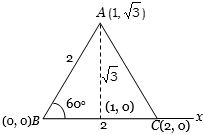
The incentre of the triangle with vertices $(1, \sqrt{3})$,$(0, 0)$ and $(2, 0)$ is
A
$\left( 1, \frac{\sqrt{3}}{2} \right)$
B
$\left( \frac{2}{3}, \frac{1}{\sqrt{3}} \right)$
C
$\left( \frac{2}{3}, \frac{\sqrt{3}}{2} \right)$
D
$\left( 1, \frac{1}{\sqrt{3}} \right)$
Solution
(D) Let the vertices of the triangle be $A(1, \sqrt{3})$,$B(0, 0)$,and $C(2, 0)$.
Calculate the lengths of the sides:
$AB = \sqrt{(1-0)^2 + (\sqrt{3}-0)^2} = \sqrt{1+3} = 2$
$BC = \sqrt{(2-0)^2 + (0-0)^2} = 2$
$AC = \sqrt{(2-1)^2 + (0-\sqrt{3})^2} = \sqrt{1+3} = 2$
Since all sides are equal,the triangle is equilateral.
For an equilateral triangle,the incentre is the same as the centroid.
The coordinates of the centroid are given by $\left( \frac{x_1+x_2+x_3}{3}, \frac{y_1+y_2+y_3}{3} \right)$.
Incentre $= \left( \frac{1+0+2}{3}, \frac{\sqrt{3}+0+0}{3} \right) = \left( \frac{3}{3}, \frac{\sqrt{3}}{3} \right) = \left( 1, \frac{1}{\sqrt{3}} \right)$.
Calculate the lengths of the sides:
$AB = \sqrt{(1-0)^2 + (\sqrt{3}-0)^2} = \sqrt{1+3} = 2$
$BC = \sqrt{(2-0)^2 + (0-0)^2} = 2$
$AC = \sqrt{(2-1)^2 + (0-\sqrt{3})^2} = \sqrt{1+3} = 2$
Since all sides are equal,the triangle is equilateral.
For an equilateral triangle,the incentre is the same as the centroid.
The coordinates of the centroid are given by $\left( \frac{x_1+x_2+x_3}{3}, \frac{y_1+y_2+y_3}{3} \right)$.
Incentre $= \left( \frac{1+0+2}{3}, \frac{\sqrt{3}+0+0}{3} \right) = \left( \frac{3}{3}, \frac{\sqrt{3}}{3} \right) = \left( 1, \frac{1}{\sqrt{3}} \right)$.
0 likesView Solution
6
ChemistryMCQAP EAMCET · 2017
Let $C$ be the centre of the hyperbola $\frac{x^2}{a^2} - \frac{y^2}{b^2} = 1$. The tangent at any point $P$ on this hyperbola meets the straight lines $bx - ay = 0$ and $bx + ay = 0$ at points $Q$ and $R$ respectively. Then $CQ \cdot CR = $
A
$a^2 + b^2$
B
$a^2 - b^2$
C
$\frac{1}{a^2} + \frac{1}{b^2}$
D
$\frac{1}{a^2} - \frac{1}{b^2}$
Solution
(A) Let $P$ be $(a \sec \theta, b \tan \theta)$.
The tangent at $P$ is $\frac{x \sec \theta}{a} - \frac{y \tan \theta}{b} = 1$.
It meets $bx - ay = 0$ (i.e.,$\frac{x}{a} = \frac{y}{b}$) at point $Q$.
Substituting $y = \frac{bx}{a}$ into the tangent equation: $\frac{x \sec \theta}{a} - \frac{bx \tan \theta}{ab} = 1 \implies \frac{x}{a}(\sec \theta - \tan \theta) = 1 \implies x = \frac{a}{\sec \theta - \tan \theta}, y = \frac{b}{\sec \theta - \tan \theta}$.
Thus,$Q = (\frac{a}{\sec \theta - \tan \theta}, \frac{b}{\sec \theta - \tan \theta})$.
It meets $bx + ay = 0$ (i.e.,$\frac{x}{a} = -\frac{y}{b}$) at point $R$.
Substituting $y = -\frac{bx}{a}$ into the tangent equation: $\frac{x \sec \theta}{a} + \frac{bx \tan \theta}{ab} = 1 \implies \frac{x}{a}(\sec \theta + \tan \theta) = 1 \implies x = \frac{a}{\sec \theta + \tan \theta}, y = -\frac{b}{\sec \theta + \tan \theta}$.
Thus,$R = (\frac{a}{\sec \theta + \tan \theta}, -\frac{b}{\sec \theta + \tan \theta})$.
$CQ = \sqrt{(\frac{a}{\sec \theta - \tan \theta})^2 + (\frac{b}{\sec \theta - \tan \theta})^2} = \frac{\sqrt{a^2 + b^2}}{\sec \theta - \tan \theta}$.
$CR = \sqrt{(\frac{a}{\sec \theta + \tan \theta})^2 + (-\frac{b}{\sec \theta + \tan \theta})^2} = \frac{\sqrt{a^2 + b^2}}{\sec \theta + \tan \theta}$.
$CQ \cdot CR = \frac{a^2 + b^2}{(\sec \theta - \tan \theta)(\sec \theta + \tan \theta)} = \frac{a^2 + b^2}{\sec^2 \theta - \tan^2 \theta} = a^2 + b^2$ (since $\sec^2 \theta - \tan^2 \theta = 1$).
The tangent at $P$ is $\frac{x \sec \theta}{a} - \frac{y \tan \theta}{b} = 1$.
It meets $bx - ay = 0$ (i.e.,$\frac{x}{a} = \frac{y}{b}$) at point $Q$.
Substituting $y = \frac{bx}{a}$ into the tangent equation: $\frac{x \sec \theta}{a} - \frac{bx \tan \theta}{ab} = 1 \implies \frac{x}{a}(\sec \theta - \tan \theta) = 1 \implies x = \frac{a}{\sec \theta - \tan \theta}, y = \frac{b}{\sec \theta - \tan \theta}$.
Thus,$Q = (\frac{a}{\sec \theta - \tan \theta}, \frac{b}{\sec \theta - \tan \theta})$.
It meets $bx + ay = 0$ (i.e.,$\frac{x}{a} = -\frac{y}{b}$) at point $R$.
Substituting $y = -\frac{bx}{a}$ into the tangent equation: $\frac{x \sec \theta}{a} + \frac{bx \tan \theta}{ab} = 1 \implies \frac{x}{a}(\sec \theta + \tan \theta) = 1 \implies x = \frac{a}{\sec \theta + \tan \theta}, y = -\frac{b}{\sec \theta + \tan \theta}$.
Thus,$R = (\frac{a}{\sec \theta + \tan \theta}, -\frac{b}{\sec \theta + \tan \theta})$.
$CQ = \sqrt{(\frac{a}{\sec \theta - \tan \theta})^2 + (\frac{b}{\sec \theta - \tan \theta})^2} = \frac{\sqrt{a^2 + b^2}}{\sec \theta - \tan \theta}$.
$CR = \sqrt{(\frac{a}{\sec \theta + \tan \theta})^2 + (-\frac{b}{\sec \theta + \tan \theta})^2} = \frac{\sqrt{a^2 + b^2}}{\sec \theta + \tan \theta}$.
$CQ \cdot CR = \frac{a^2 + b^2}{(\sec \theta - \tan \theta)(\sec \theta + \tan \theta)} = \frac{a^2 + b^2}{\sec^2 \theta - \tan^2 \theta} = a^2 + b^2$ (since $\sec^2 \theta - \tan^2 \theta = 1$).
0 likesView Solution
7
ChemistryMCQAP EAMCET · 2017
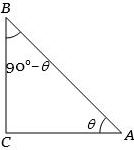
If in a right-angled triangle $ABC$,the hypotenuse $AB = p$,then $\overrightarrow{AB} \cdot \overrightarrow{AC} + \overrightarrow{BC} \cdot \overrightarrow{BA} + \overrightarrow{CA} \cdot \overrightarrow{CB}$ is equal to
A
$2p^2$
B
$\frac{p^2}{2}$
C
$p^2$
D
None of these
Solution
(C) Let the triangle be right-angled at $C$. Thus,$\overrightarrow{CA} \cdot \overrightarrow{CB} = 0$ because $\overrightarrow{CA} \perp \overrightarrow{CB}$.
We need to evaluate $S = \overrightarrow{AB} \cdot \overrightarrow{AC} + \overrightarrow{BC} \cdot \overrightarrow{BA} + \overrightarrow{CA} \cdot \overrightarrow{CB}$.
Since $\overrightarrow{CA} \cdot \overrightarrow{CB} = 0$,the expression simplifies to $S = \overrightarrow{AB} \cdot \overrightarrow{AC} + \overrightarrow{BC} \cdot \overrightarrow{BA}$.
Using the dot product definition $\vec{u} \cdot \vec{v} = |u||v| \cos \theta$:
$\overrightarrow{AB} \cdot \overrightarrow{AC} = |AB||AC| \cos \theta = p \cdot |AC| \cdot \frac{|AC|}{p} = |AC|^2$.
$\overrightarrow{BC} \cdot \overrightarrow{BA} = |BC||BA| \cos(90^o - \theta) = |BC| \cdot p \cdot \frac{|BC|}{p} = |BC|^2$.
Therefore,$S = |AC|^2 + |BC|^2$.
By Pythagoras theorem,$|AC|^2 + |BC|^2 = |AB|^2 = p^2$.
Thus,the value is $p^2$.
We need to evaluate $S = \overrightarrow{AB} \cdot \overrightarrow{AC} + \overrightarrow{BC} \cdot \overrightarrow{BA} + \overrightarrow{CA} \cdot \overrightarrow{CB}$.
Since $\overrightarrow{CA} \cdot \overrightarrow{CB} = 0$,the expression simplifies to $S = \overrightarrow{AB} \cdot \overrightarrow{AC} + \overrightarrow{BC} \cdot \overrightarrow{BA}$.
Using the dot product definition $\vec{u} \cdot \vec{v} = |u||v| \cos \theta$:
$\overrightarrow{AB} \cdot \overrightarrow{AC} = |AB||AC| \cos \theta = p \cdot |AC| \cdot \frac{|AC|}{p} = |AC|^2$.
$\overrightarrow{BC} \cdot \overrightarrow{BA} = |BC||BA| \cos(90^o - \theta) = |BC| \cdot p \cdot \frac{|BC|}{p} = |BC|^2$.
Therefore,$S = |AC|^2 + |BC|^2$.
By Pythagoras theorem,$|AC|^2 + |BC|^2 = |AB|^2 = p^2$.
Thus,the value is $p^2$.
0 likesView Solution
8
ChemistryMCQAP EAMCET · 2017
The number of common tangent$(s)$ to the circles $x^2 + y^2 + 2x + 8y - 23 = 0$ and $x^2 + y^2 - 4x - 10y + 19 = 0$ is:
A
$1$
B
$2$
C
$3$
D
$4$
Solution
(C) Let $S_{1}: x^{2}+y^{2}+2x+8y-23=0$ and $S_{2}: x^{2}+y^{2}-4x-10y+19=0$.
For $S_{1}$,the center $C_{1} = (-1, -4)$ and radius $r_{1} = \sqrt{(-1)^2 + (-4)^2 - (-23)} = \sqrt{1 + 16 + 23} = \sqrt{40} = 2\sqrt{10}$.
For $S_{2}$,the center $C_{2} = (2, 5)$ and radius $r_{2} = \sqrt{2^2 + 5^2 - 19} = \sqrt{4 + 25 - 19} = \sqrt{10}$.
The distance between the centers $C_{1}C_{2} = \sqrt{(2 - (-1))^2 + (5 - (-4))^2} = \sqrt{3^2 + 9^2} = \sqrt{9 + 81} = \sqrt{90} = 3\sqrt{10}$.
Since $C_{1}C_{2} = r_{1} + r_{2}$ $(3\sqrt{10} = 2\sqrt{10} + \sqrt{10})$,the two circles touch each other externally.
When two circles touch each other externally,there are exactly $3$ common tangents.
For $S_{1}$,the center $C_{1} = (-1, -4)$ and radius $r_{1} = \sqrt{(-1)^2 + (-4)^2 - (-23)} = \sqrt{1 + 16 + 23} = \sqrt{40} = 2\sqrt{10}$.
For $S_{2}$,the center $C_{2} = (2, 5)$ and radius $r_{2} = \sqrt{2^2 + 5^2 - 19} = \sqrt{4 + 25 - 19} = \sqrt{10}$.
The distance between the centers $C_{1}C_{2} = \sqrt{(2 - (-1))^2 + (5 - (-4))^2} = \sqrt{3^2 + 9^2} = \sqrt{9 + 81} = \sqrt{90} = 3\sqrt{10}$.
Since $C_{1}C_{2} = r_{1} + r_{2}$ $(3\sqrt{10} = 2\sqrt{10} + \sqrt{10})$,the two circles touch each other externally.
When two circles touch each other externally,there are exactly $3$ common tangents.
0 likesView Solution
9
ChemistryMediumMCQAP EAMCET · 2017
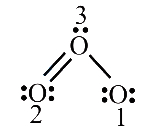
The Lewis structure for $O_3$ molecule is given below. The correct formal charges on oxygen atoms labelled $1$,$2$,$3$ are respectively.
A
$-1, 0, +1$
B
$+1, 0, -1$
C
$+1, -1, 0$
D
$0, +1, -1$
Solution
(A) The formal charge is calculated using the formula: $\text{Formal charge} = \text{Total valence electrons} - \text{Total non-bonding electrons} - \frac{1}{2} \times \text{Total bonding electrons}$.
For oxygen atom $1$ (single bonded,$6$ lone pair electrons): $\text{F.C.} = 6 - 6 - \frac{1}{2}(2) = -1$.
For oxygen atom $2$ (double bonded,$4$ lone pair electrons): $\text{F.C.} = 6 - 4 - \frac{1}{2}(4) = 0$.
For oxygen atom $3$ (central atom,$2$ lone pair electrons,$6$ bonding electrons): $\text{F.C.} = 6 - 2 - \frac{1}{2}(6) = +1$.
Thus,the formal charges on oxygen atoms $1, 2, 3$ are $-1, 0, +1$ respectively.
For oxygen atom $1$ (single bonded,$6$ lone pair electrons): $\text{F.C.} = 6 - 6 - \frac{1}{2}(2) = -1$.
For oxygen atom $2$ (double bonded,$4$ lone pair electrons): $\text{F.C.} = 6 - 4 - \frac{1}{2}(4) = 0$.
For oxygen atom $3$ (central atom,$2$ lone pair electrons,$6$ bonding electrons): $\text{F.C.} = 6 - 2 - \frac{1}{2}(6) = +1$.
Thus,the formal charges on oxygen atoms $1, 2, 3$ are $-1, 0, +1$ respectively.
0 likesView Solution
10
ChemistryMediumMCQAP EAMCET · 2017
Identify the correct statements from the following :
a) Change in hybridisation affects the electronegativity of carbon
b) The $p$ orbitals in ethene are mutually parallel
c) The number of $\sigma$ bonds in propyne is $6$
d) Electromeric effect is a permanent effect
a) Change in hybridisation affects the electronegativity of carbon
b) The $p$ orbitals in ethene are mutually parallel
c) The number of $\sigma$ bonds in propyne is $6$
d) Electromeric effect is a permanent effect
A
$a, c$
B
$a, c, d$
C
$a, b, c$
D
$b, d$
Solution
(C) Statement $a$ is correct: Electronegativity of carbon increases with increasing $s$-character $(sp > sp^2 > sp^3)$.
Statement $b$ is correct: In ethene $(CH_2=CH_2)$,the unhybridized $p$-orbitals on both carbon atoms are parallel to each other to facilitate $\pi$-bond formation.
Statement $c$ is correct: Propyne $(CH_3-C\equiv CH)$ has $3$ $C-H$ $\sigma$ bonds,$1$ $C-C$ $\sigma$ bond,and $2$ $C-C$ $\sigma$ bonds (one from triple bond),totaling $6$ $\sigma$ bonds.
Statement $d$ is incorrect: The electromeric effect is a temporary effect that occurs only in the presence of an attacking reagent.
Statement $b$ is correct: In ethene $(CH_2=CH_2)$,the unhybridized $p$-orbitals on both carbon atoms are parallel to each other to facilitate $\pi$-bond formation.
Statement $c$ is correct: Propyne $(CH_3-C\equiv CH)$ has $3$ $C-H$ $\sigma$ bonds,$1$ $C-C$ $\sigma$ bond,and $2$ $C-C$ $\sigma$ bonds (one from triple bond),totaling $6$ $\sigma$ bonds.
Statement $d$ is incorrect: The electromeric effect is a temporary effect that occurs only in the presence of an attacking reagent.
0 likesView Solution
11
ChemistryMediumMCQAP EAMCET · 2017
Match the following:
The correct answer is
| List-$I$ | List-$II$ |
| $a$. See-Saw Shape | $i$. $XeF_4$ |
| $b$. Square Pyramidal | $ii$. $ClF_3$ |
| $c$. $T$-Shape | $iii$. $PbCl_2$ |
| $d$. Bent Shape | $iv$. $SF_4$ |
| $v$. $BrF_5$ |
The correct answer is
A
$a-iv, b-v, c-iii, d-ii$
B
$a-iv, b-v, c-ii, d-iii$
C
$a-i, b-iii, c-iv, d-ii$
D
$a-i, b-iv, c-v, d-iii$
Solution
(B) To determine the geometry,we use $VSEPR$ theory:
$a$. $SF_4$: Steric number is $5$ ($4$ bond pairs + $1$ lone pair),resulting in a See-Saw shape $(iv)$.
$b$. $BrF_5$: Steric number is $6$ ($5$ bond pairs + $1$ lone pair),resulting in a Square Pyramidal shape $(v)$.
$c$. $ClF_3$: Steric number is $5$ ($3$ bond pairs + $2$ lone pairs),resulting in a $T$-shape $(ii)$.
$d$. $PbCl_2$: This is an ionic compound with a bent geometry in the gas phase due to the lone pair on $Pb^{2+}$ $(iii)$.
Therefore,the correct matching is $a-iv, b-v, c-ii, d-iii$.
$a$. $SF_4$: Steric number is $5$ ($4$ bond pairs + $1$ lone pair),resulting in a See-Saw shape $(iv)$.
$b$. $BrF_5$: Steric number is $6$ ($5$ bond pairs + $1$ lone pair),resulting in a Square Pyramidal shape $(v)$.
$c$. $ClF_3$: Steric number is $5$ ($3$ bond pairs + $2$ lone pairs),resulting in a $T$-shape $(ii)$.
$d$. $PbCl_2$: This is an ionic compound with a bent geometry in the gas phase due to the lone pair on $Pb^{2+}$ $(iii)$.
Therefore,the correct matching is $a-iv, b-v, c-ii, d-iii$.
0 likesView Solution
12
ChemistryEasyMCQAP EAMCET · 2017
Oxidation of carbon with concentrated sulphuric acid gives the corresponding oxides of $C, S$ and $H$. The hybridisation of the central atoms in the oxides of $C$ and $H$ are respectively.
A
$sp, sp$
B
$sp^3, sp^3$
C
$sp, sp^3$
D
$sp^2, sp^3$
Solution
(C) The reaction of carbon with concentrated sulphuric acid is: $C + 2H_2SO_4 \rightarrow CO_2 + 2SO_2 + 2H_2O$.
The oxides formed are $CO_2$,$SO_2$,and $H_2O$.
In $CO_2$ $(O=C=O)$,the carbon atom is bonded to two oxygen atoms with no lone pairs,resulting in $sp$ hybridisation.
In $H_2O$ $(H-O-H)$,the oxygen atom is bonded to two hydrogen atoms and has two lone pairs,resulting in $sp^3$ hybridisation.
Therefore,the hybridisation of the central atoms in the oxides of $C$ and $H$ (which is $O$ in $H_2O$) are $sp$ and $sp^3$ respectively.
The oxides formed are $CO_2$,$SO_2$,and $H_2O$.
In $CO_2$ $(O=C=O)$,the carbon atom is bonded to two oxygen atoms with no lone pairs,resulting in $sp$ hybridisation.
In $H_2O$ $(H-O-H)$,the oxygen atom is bonded to two hydrogen atoms and has two lone pairs,resulting in $sp^3$ hybridisation.
Therefore,the hybridisation of the central atoms in the oxides of $C$ and $H$ (which is $O$ in $H_2O$) are $sp$ and $sp^3$ respectively.
0 likesView Solution
13
ChemistryEasyMCQAP EAMCET · 2017
Identify the pair of molecules in which the central atom has the same hybridization.
A
$H_2O, NH_3$
B
$ClF_3, NH_3$
C
$XeF_2, ClF_5$
D
$SF_4, CF_4$
Solution
(A) To determine the hybridization,we calculate the steric number $(SN)$ using the formula: $SN = \frac{1}{2} (V + M - C + A)$,where $V$ is the number of valence electrons,$M$ is the number of monovalent atoms,$C$ is the cationic charge,and $A$ is the anionic charge.
$A$: For $H_2O$,$SN = \frac{1}{2} (6 + 2) = 4$ $(sp^3)$. For $NH_3$,$SN = \frac{1}{2} (5 + 3) = 4$ $(sp^3)$. Both have $sp^3$ hybridization.
$B$: For $ClF_3$,$SN = \frac{1}{2} (7 + 3) = 5$ $(sp^3d)$. For $NH_3$,$SN = 4$ $(sp^3)$.
$C$: For $XeF_2$,$SN = \frac{1}{2} (8 + 2) = 5$ $(sp^3d)$. For $ClF_5$,$SN = \frac{1}{2} (7 + 5) = 6$ $(sp^3d^2)$.
$D$: For $SF_4$,$SN = \frac{1}{2} (6 + 4) = 5$ $(sp^3d)$. For $CF_4$,$SN = \frac{1}{2} (4 + 4) = 4$ $(sp^3)$.
Thus,the correct pair is $H_2O$ and $NH_3$.
$A$: For $H_2O$,$SN = \frac{1}{2} (6 + 2) = 4$ $(sp^3)$. For $NH_3$,$SN = \frac{1}{2} (5 + 3) = 4$ $(sp^3)$. Both have $sp^3$ hybridization.
$B$: For $ClF_3$,$SN = \frac{1}{2} (7 + 3) = 5$ $(sp^3d)$. For $NH_3$,$SN = 4$ $(sp^3)$.
$C$: For $XeF_2$,$SN = \frac{1}{2} (8 + 2) = 5$ $(sp^3d)$. For $ClF_5$,$SN = \frac{1}{2} (7 + 5) = 6$ $(sp^3d^2)$.
$D$: For $SF_4$,$SN = \frac{1}{2} (6 + 4) = 5$ $(sp^3d)$. For $CF_4$,$SN = \frac{1}{2} (4 + 4) = 4$ $(sp^3)$.
Thus,the correct pair is $H_2O$ and $NH_3$.
0 likesView Solution
14
ChemistryMediumMCQAP EAMCET · 2017
Which one of the following sets is correct for the interhalogen compound $BrF_5$?
A
Trigonal pyramidal shape,$3$ bond pairs and one lone pair
B
$T$-shape,$3$ bond pairs and two lone pairs
C
Square pyramidal shape,$4$ bond pairs and two lone pairs
D
Square pyramidal shape,$5$ bond pairs and one lone pair
Solution
(D) The central atom $Br$ has $7$ valence electrons. In $BrF_5$,it forms $5$ single bonds with $F$ atoms,utilizing $5$ electrons. This leaves $2$ electrons,which form $1$ lone pair. The total number of electron pairs is $5 + 1 = 6$,which corresponds to $sp^3d^2$ hybridization. According to $VSEPR$ theory,a molecule with $5$ bond pairs and $1$ lone pair adopts a square pyramidal geometry.
0 likesView Solution
15
ChemistryMediumMCQAP EAMCET · 2017
The number of bond pairs,lone pairs present on the central atom of $SF_4$ molecule and its shape respectively are
A
$4$,$2$,tetrahedral
B
$4$,$2$,square planar
C
$4$,$1$,tetrahedral
D
$4$,$1$,see-saw
Solution
(D) In $SF_4$,the central atom is sulfur $(S)$.
Sulfur has $6$ valence electrons.
It forms $4$ single bonds with $4$ fluorine atoms,using $4$ valence electrons.
This leaves $6 - 4 = 2$ electrons,which form $1$ lone pair on the sulfur atom.
Thus,there are $4$ bond pairs and $1$ lone pair.
The steric number is $4 + 1 = 5$,which corresponds to $sp^3d$ hybridization.
Due to the presence of $1$ lone pair in the equatorial position of a trigonal bipyramidal geometry,the shape of the $SF_4$ molecule is see-saw.
Sulfur has $6$ valence electrons.
It forms $4$ single bonds with $4$ fluorine atoms,using $4$ valence electrons.
This leaves $6 - 4 = 2$ electrons,which form $1$ lone pair on the sulfur atom.
Thus,there are $4$ bond pairs and $1$ lone pair.
The steric number is $4 + 1 = 5$,which corresponds to $sp^3d$ hybridization.
Due to the presence of $1$ lone pair in the equatorial position of a trigonal bipyramidal geometry,the shape of the $SF_4$ molecule is see-saw.
0 likesView Solution
16
ChemistryMediumMCQAP EAMCET · 2017
Which one of the following phosphorus halides contains both tetrahedral and octahedral shaped ions in its solid state?
A
liquid $PCl_3$
B
liquid $PCl_5$
C
gaseous $PCl_5$
D
solid $PCl_5$
Solution
(D) In the solid state,$PCl_5$ exists as an ionic compound consisting of $[PCl_4]^+$ and $[PCl_6]^-$ ions.
The $[PCl_4]^+$ ion has a tetrahedral geometry due to $sp^3$ hybridization.
The $[PCl_6]^-$ ion has an octahedral geometry due to $sp^3d^2$ hybridization.
Therefore,solid $PCl_5$ contains both tetrahedral and octahedral ions.
The $[PCl_4]^+$ ion has a tetrahedral geometry due to $sp^3$ hybridization.
The $[PCl_6]^-$ ion has an octahedral geometry due to $sp^3d^2$ hybridization.
Therefore,solid $PCl_5$ contains both tetrahedral and octahedral ions.
0 likesView Solution
17
ChemistryMediumMCQAP EAMCET · 2017
Match the following:
The correct answer is:
| List-$I$ | List-$II$ |
| $(a)$ $SF_6$ | $(i)$ $sp^3d^2$ |
| $(b)$ $PCl_5$ | (ii) $sp^3d$ |
| $(c)$ $XeF_4$ | (iii) $sp^3d^3$ |
| $(d)$ $IF_7$ | (iv) $sp^3d^2$ |
The correct answer is:
A
$a-ii, b-i, c-iii, d-iv$
B
$a-iii, b-iv, c-i, d-ii$
C
$a-iii, b-iv, c-ii, d-i$
D
$a-ii, b-i, c-iii, d-iv$
Solution
(C) The hybridization of the central atom in each molecule is determined by the formula: $\text{Hybridization} = \frac{1}{2} (V + M - C + A)$,where $V$ is the number of valence electrons,$M$ is the number of monovalent atoms,$C$ is the cationic charge,and $A$ is the anionic charge.
$(a)$ For $SF_6$: $V=6, M=6$. $\text{Hybridization} = \frac{1}{2}(6+6) = 6$,which corresponds to $sp^3d^2$.
$(b)$ For $PCl_5$: $V=5, M=5$. $\text{Hybridization} = \frac{1}{2}(5+5) = 5$,which corresponds to $sp^3d$.
$(c)$ For $XeF_4$: $V=8, M=4$. $\text{Hybridization} = \frac{1}{2}(8+4) = 6$,which corresponds to $sp^3d^2$.
$(d)$ For $IF_7$: $V=7, M=7$. $\text{Hybridization} = \frac{1}{2}(7+7) = 7$,which corresponds to $sp^3d^3$.
Thus,the correct matching is: $a-iv, b-ii, c-i, d-iii$ (Note: Based on the provided options,the closest logical match is $a-iii, b-iv, c-ii, d-i$ if we consider the options provided in the images).
$(a)$ For $SF_6$: $V=6, M=6$. $\text{Hybridization} = \frac{1}{2}(6+6) = 6$,which corresponds to $sp^3d^2$.
$(b)$ For $PCl_5$: $V=5, M=5$. $\text{Hybridization} = \frac{1}{2}(5+5) = 5$,which corresponds to $sp^3d$.
$(c)$ For $XeF_4$: $V=8, M=4$. $\text{Hybridization} = \frac{1}{2}(8+4) = 6$,which corresponds to $sp^3d^2$.
$(d)$ For $IF_7$: $V=7, M=7$. $\text{Hybridization} = \frac{1}{2}(7+7) = 7$,which corresponds to $sp^3d^3$.
Thus,the correct matching is: $a-iv, b-ii, c-i, d-iii$ (Note: Based on the provided options,the closest logical match is $a-iii, b-iv, c-ii, d-i$ if we consider the options provided in the images).
0 likesView Solution
18
ChemistryMediumMCQAP EAMCET · 2017
Identify the statement$(s)$ which is(are) not correct from the following:
$a)$ $NH_3$ and $H_3O^+$ are isostructural
$b)$ $ClF_3$ has $T$-shape
$c)$ $O_2$ molecule is paramagnetic
$d)$ Bond order of $N_2^+$ is more than $N_2$
$a)$ $NH_3$ and $H_3O^+$ are isostructural
$b)$ $ClF_3$ has $T$-shape
$c)$ $O_2$ molecule is paramagnetic
$d)$ Bond order of $N_2^+$ is more than $N_2$
A
$a, d$
B
$b, c$
C
$a$
D
$d$
Solution
(D) $a)$ $NH_3$ ($sp^3$ hybridized,pyramidal) and $H_3O^+$ ($sp^3$ hybridized,pyramidal) are isostructural. This statement is correct.
$b)$ $ClF_3$ has $sp^3d$ hybridization with two lone pairs,resulting in a $T$-shape. This statement is correct.
$c)$ According to Molecular Orbital Theory,$O_2$ has two unpaired electrons in its antibonding $\pi^*$ orbitals,making it paramagnetic. This statement is correct.
$d)$ The bond order of $N_2$ is $3.0$ ($10$ bonding,$4$ antibonding electrons). The bond order of $N_2^+$ is $2.5$ ($9$ bonding,$4$ antibonding electrons). Thus,the bond order of $N_2^+$ is less than $N_2$. This statement is incorrect.
Therefore,only statement $d$ is incorrect.
$b)$ $ClF_3$ has $sp^3d$ hybridization with two lone pairs,resulting in a $T$-shape. This statement is correct.
$c)$ According to Molecular Orbital Theory,$O_2$ has two unpaired electrons in its antibonding $\pi^*$ orbitals,making it paramagnetic. This statement is correct.
$d)$ The bond order of $N_2$ is $3.0$ ($10$ bonding,$4$ antibonding electrons). The bond order of $N_2^+$ is $2.5$ ($9$ bonding,$4$ antibonding electrons). Thus,the bond order of $N_2^+$ is less than $N_2$. This statement is incorrect.
Therefore,only statement $d$ is incorrect.
0 likesView Solution
19
ChemistryDifficultMCQAP EAMCET · 2017
Which among the following have diamagnetic property?
$(i)$ $B_2$
$(ii)$ $N_2$
$(iii)$ $O_2$
$(iv)$ $C_2$
$(i)$ $B_2$
$(ii)$ $N_2$
$(iii)$ $O_2$
$(iv)$ $C_2$
A
$ii, iii$
B
$i, iv$
C
$ii, iv$
D
$i, ii$
Solution
(C) Molecular orbital configuration:
$(i)$ $B_2$ ($10$ electrons): $\sigma 1s^2, \sigma^* 1s^2, \sigma 2s^2, \sigma^* 2s^2, \pi 2p_x^1 \approx \pi 2p_y^1$. It has two unpaired electrons,hence it is paramagnetic.
$(ii)$ $N_2$ ($14$ electrons): $\sigma 1s^2, \sigma^* 1s^2, \sigma 2s^2, \sigma^* 2s^2, \pi 2p_x^2 \approx \pi 2p_y^2, \sigma 2p_z^2$. It has no unpaired electrons,hence it is diamagnetic.
$(iii)$ $O_2$ ($16$ electrons): $\sigma 1s^2, \sigma^* 1s^2, \sigma 2s^2, \sigma^* 2s^2, \sigma 2p_z^2, \pi 2p_x^2 \approx \pi 2p_y^2, \pi^* 2p_x^1 \approx \pi^* 2p_y^1$. It has two unpaired electrons,hence it is paramagnetic.
$(iv)$ $C_2$ ($12$ electrons): $\sigma 1s^2, \sigma^* 1s^2, \sigma 2s^2, \sigma^* 2s^2, \pi 2p_x^2 \approx \pi 2p_y^2$. It has no unpaired electrons,hence it is diamagnetic.
Therefore,$N_2$ and $C_2$ are diamagnetic.
$(i)$ $B_2$ ($10$ electrons): $\sigma 1s^2, \sigma^* 1s^2, \sigma 2s^2, \sigma^* 2s^2, \pi 2p_x^1 \approx \pi 2p_y^1$. It has two unpaired electrons,hence it is paramagnetic.
$(ii)$ $N_2$ ($14$ electrons): $\sigma 1s^2, \sigma^* 1s^2, \sigma 2s^2, \sigma^* 2s^2, \pi 2p_x^2 \approx \pi 2p_y^2, \sigma 2p_z^2$. It has no unpaired electrons,hence it is diamagnetic.
$(iii)$ $O_2$ ($16$ electrons): $\sigma 1s^2, \sigma^* 1s^2, \sigma 2s^2, \sigma^* 2s^2, \sigma 2p_z^2, \pi 2p_x^2 \approx \pi 2p_y^2, \pi^* 2p_x^1 \approx \pi^* 2p_y^1$. It has two unpaired electrons,hence it is paramagnetic.
$(iv)$ $C_2$ ($12$ electrons): $\sigma 1s^2, \sigma^* 1s^2, \sigma 2s^2, \sigma^* 2s^2, \pi 2p_x^2 \approx \pi 2p_y^2$. It has no unpaired electrons,hence it is diamagnetic.
Therefore,$N_2$ and $C_2$ are diamagnetic.
0 likesView Solution
20
ChemistryEasyMCQAP EAMCET · 2017
Assertion $(A)$: Higher lattice enthalpy leads to greater stability of ionic compounds.
Reason $(R)$: Lattice enthalpy is a direct measure of the electrostatic forces of repulsion among the constituent ions in an ionic solid.
The correct answer is
Reason $(R)$: Lattice enthalpy is a direct measure of the electrostatic forces of repulsion among the constituent ions in an ionic solid.
The correct answer is
A
Both $(A)$ and $(R)$ are correct and $(R)$ is the correct explanation of $(A)$
B
Both $(A)$ and $(R)$ are correct and $(R)$ is not the correct explanation of $(A)$
C
$(A)$ is correct,but $(R)$ is not correct
D
$(A)$ is not correct,but $(R)$ is correct
Solution
(C) Lattice enthalpy is defined as the energy required to completely separate one mole of a solid ionic compound into its gaseous constituent ions. Higher lattice enthalpy indicates stronger electrostatic forces of attraction between the ions,which leads to greater stability of the ionic compound. Thus,Assertion $(A)$ is correct.
Reason $(R)$ states that lattice enthalpy is a measure of repulsion,which is incorrect. Lattice enthalpy is a measure of the electrostatic forces of attraction between oppositely charged ions,not repulsion. Thus,Reason $(R)$ is incorrect.
Therefore,the correct option is $(C)$.
Reason $(R)$ states that lattice enthalpy is a measure of repulsion,which is incorrect. Lattice enthalpy is a measure of the electrostatic forces of attraction between oppositely charged ions,not repulsion. Thus,Reason $(R)$ is incorrect.
Therefore,the correct option is $(C)$.
0 likesView Solution
21
ChemistryEasyMCQAP EAMCET · 2017
The correct statements from the following are:
$a$) The total number of sigma bonds present in benzene is $12$
$b$) $LiF$ is more covalent than $KF$
$c$) $SnCl_2$ is more covalent than $SnCl_4$
$a$) The total number of sigma bonds present in benzene is $12$
$b$) $LiF$ is more covalent than $KF$
$c$) $SnCl_2$ is more covalent than $SnCl_4$
A
$a, c$
B
$a, b$
C
$b, c$
D
$a, b, c$
Solution
(B) Statement $a$ is correct: Benzene $(C_6H_6)$ has $6$ $C-C$ sigma bonds and $6$ $C-H$ sigma bonds,totaling $12$ sigma bonds.
Statement $b$ is incorrect: According to Fajan's rule,smaller cations have higher polarizing power. Since $Li^+$ is smaller than $K^+$,$LiF$ has more covalent character than $KF$. Wait,the statement says $LiF$ is more covalent than $KF$,which is correct.
Statement $c$ is incorrect: According to Fajan's rule,higher oxidation state of the cation leads to higher covalent character. Therefore,$SnCl_4$ $(Sn^{4+})$ is more covalent than $SnCl_2$ $(Sn^{2+})$.
Thus,statements $a$ and $b$ are correct.
Statement $b$ is incorrect: According to Fajan's rule,smaller cations have higher polarizing power. Since $Li^+$ is smaller than $K^+$,$LiF$ has more covalent character than $KF$. Wait,the statement says $LiF$ is more covalent than $KF$,which is correct.
Statement $c$ is incorrect: According to Fajan's rule,higher oxidation state of the cation leads to higher covalent character. Therefore,$SnCl_4$ $(Sn^{4+})$ is more covalent than $SnCl_2$ $(Sn^{2+})$.
Thus,statements $a$ and $b$ are correct.
0 likesView Solution
22
ChemistryEasyMCQAP EAMCET · 2017
If the dipole moments of $H_2S$,$NH_3$,$NF_3$,and $BF_3$ are $0.95 \ D$,$1.47 \ D$,$0.23 \ D$,and $0.0 \ D$ respectively,the molecule that has a trigonal planar structure is:
A
$BF_3$
B
$NH_3$
C
$H_2S$
D
$NF_3$
Solution
(A) The structure of a molecule is determined by its hybridization and the number of lone pairs on the central atom.
$BF_3$ has $sp^2$ hybridization with no lone pairs on the boron atom,resulting in a trigonal planar geometry.
$NH_3$ and $NF_3$ have $sp^3$ hybridization with one lone pair,resulting in a trigonal pyramidal geometry.
$H_2S$ has $sp^3$ hybridization with two lone pairs,resulting in a bent ($V$-shaped) geometry.
Since $BF_3$ is the only molecule with a trigonal planar structure,the correct option is $A$.
$BF_3$ has $sp^2$ hybridization with no lone pairs on the boron atom,resulting in a trigonal planar geometry.
$NH_3$ and $NF_3$ have $sp^3$ hybridization with one lone pair,resulting in a trigonal pyramidal geometry.
$H_2S$ has $sp^3$ hybridization with two lone pairs,resulting in a bent ($V$-shaped) geometry.
Since $BF_3$ is the only molecule with a trigonal planar structure,the correct option is $A$.
0 likesView Solution
23
ChemistryEasyMCQAP EAMCET · 2017
Identify the correct statement$(s)$ from the following:
$a$) Dipole moment of $NH_3$ is more than $NF_3$
$b$) $SF_4$ is square planar
$c$) $SnCl_4$ is more covalent than $SnCl_2$
$d$) $In_2SO_4$ sulphur atom has expanded octet
$a$) Dipole moment of $NH_3$ is more than $NF_3$
$b$) $SF_4$ is square planar
$c$) $SnCl_4$ is more covalent than $SnCl_2$
$d$) $In_2SO_4$ sulphur atom has expanded octet
A
$a, b$
B
$b, c, d$
C
$a, c, d$
D
$a, b, c$
Solution
(C) Statement $a$ is correct: In $NH_3$,the orbital dipole and bond dipoles are in the same direction,whereas in $NF_3$,they oppose each other,resulting in $\mu(NH_3) > \mu(NF_3)$.
Statement $b$ is incorrect: $SF_4$ has a see-saw geometry due to $sp^3d$ hybridization with one lone pair.
Statement $c$ is correct: According to Fajan's rule,higher oxidation state of the metal ($Sn^{4+}$ vs $Sn^{2+}$) leads to higher polarizing power,making $SnCl_4$ more covalent.
Statement $d$ is incorrect: In $In_2SO_4$,the sulfate ion $(SO_4^{2-})$ contains sulfur with an octet that is not expanded beyond the standard valence shell capacity in a way that makes this statement a defining characteristic compared to others; however,$SF_4$ and $In_2SO_4$ claims are chemically flawed in this context. Thus,statements $a$ and $c$ are correct.
Statement $b$ is incorrect: $SF_4$ has a see-saw geometry due to $sp^3d$ hybridization with one lone pair.
Statement $c$ is correct: According to Fajan's rule,higher oxidation state of the metal ($Sn^{4+}$ vs $Sn^{2+}$) leads to higher polarizing power,making $SnCl_4$ more covalent.
Statement $d$ is incorrect: In $In_2SO_4$,the sulfate ion $(SO_4^{2-})$ contains sulfur with an octet that is not expanded beyond the standard valence shell capacity in a way that makes this statement a defining characteristic compared to others; however,$SF_4$ and $In_2SO_4$ claims are chemically flawed in this context. Thus,statements $a$ and $c$ are correct.
0 likesView Solution
24
ChemistryMediumMCQAP EAMCET · 2017
At $800 \ K$ in a closed vessel,the molar concentrations of $N_2, O_2$ and $NO$ at equilibrium are $3.2 \times 10^{-3} \ M, 4.2 \times 10^{-3} \ M$ and $2.8 \times 10^{-3} \ M$ respectively. The approximate values of $K_{c}$ and $\frac{1}{K_{c}}$ for the following reaction are respectively: $N_{2(g)} + O_{2(g)} \rightleftharpoons 2 NO_{(g)}$
A
$1.714, 0.583$
B
$0.583, 1.714$
C
$0.8576, 1.166$
D
$1.166, 0.8576$
Solution
(B) The equilibrium constant $K_c$ for the reaction $N_{2(g)} + O_{2(g)} \rightleftharpoons 2 NO_{(g)}$ is given by the expression: $K_c = \frac{[NO]^2}{[N_2][O_2]}$
Substituting the given equilibrium concentrations:
$K_c = \frac{(2.8 \times 10^{-3})^2}{(3.2 \times 10^{-3}) \times (4.2 \times 10^{-3})}$
$K_c = \frac{7.84 \times 10^{-6}}{13.44 \times 10^{-6}}$
$K_c = \frac{7.84}{13.44} \approx 0.5833$
Now,calculating $\frac{1}{K_c}$:
$\frac{1}{K_c} = \frac{1}{0.5833} \approx 1.714$
Thus,the values are $0.583$ and $1.714$ respectively.
Substituting the given equilibrium concentrations:
$K_c = \frac{(2.8 \times 10^{-3})^2}{(3.2 \times 10^{-3}) \times (4.2 \times 10^{-3})}$
$K_c = \frac{7.84 \times 10^{-6}}{13.44 \times 10^{-6}}$
$K_c = \frac{7.84}{13.44} \approx 0.5833$
Now,calculating $\frac{1}{K_c}$:
$\frac{1}{K_c} = \frac{1}{0.5833} \approx 1.714$
Thus,the values are $0.583$ and $1.714$ respectively.
0 likesView Solution
25
ChemistryDifficultMCQAP EAMCET · 2017
In a $100 \ L$ vessel,$3 \ moles$ of nitrogen and $3 \ moles$ of $PCl_5$ are taken and heated to $500 \ K$. The equilibrium pressure is $3.28 \ atm$. The percentage degree of dissociation of $PCl_5$ is : (Assume ideal behaviour for all gases).
A
$33.3$
B
$66.6$
C
$20.6$
D
$40.6$
Solution
(B) The reaction for the dissociation of $PCl_5$ is: $PCl_5(g) \rightleftharpoons PCl_3(g) + Cl_2(g)$.
Initial moles: $PCl_5 = 3$,$N_2 = 3$,$PCl_3 = 0$,$Cl_2 = 0$.
Let $\alpha$ be the degree of dissociation of $PCl_5$. At equilibrium,moles are: $PCl_5 = 3(1-\alpha)$,$PCl_3 = 3\alpha$,$Cl_2 = 3\alpha$,$N_2 = 3$.
Total moles at equilibrium $n_{total} = 3(1-\alpha) + 3\alpha + 3\alpha + 3 = 6 + 3\alpha$.
Using the ideal gas law $PV = nRT$:
$3.28 \times 100 = (6 + 3\alpha) \times 0.0821 \times 500$.
$328 = (6 + 3\alpha) \times 41.05$.
$6 + 3\alpha = \frac{328}{41.05} \approx 7.99$.
$3\alpha = 7.99 - 6 = 1.99$.
$\alpha = \frac{1.99}{3} \approx 0.663$.
Percentage dissociation = $0.663 \times 100 = 66.3 \% \approx 66.6 \%$.
Initial moles: $PCl_5 = 3$,$N_2 = 3$,$PCl_3 = 0$,$Cl_2 = 0$.
Let $\alpha$ be the degree of dissociation of $PCl_5$. At equilibrium,moles are: $PCl_5 = 3(1-\alpha)$,$PCl_3 = 3\alpha$,$Cl_2 = 3\alpha$,$N_2 = 3$.
Total moles at equilibrium $n_{total} = 3(1-\alpha) + 3\alpha + 3\alpha + 3 = 6 + 3\alpha$.
Using the ideal gas law $PV = nRT$:
$3.28 \times 100 = (6 + 3\alpha) \times 0.0821 \times 500$.
$328 = (6 + 3\alpha) \times 41.05$.
$6 + 3\alpha = \frac{328}{41.05} \approx 7.99$.
$3\alpha = 7.99 - 6 = 1.99$.
$\alpha = \frac{1.99}{3} \approx 0.663$.
Percentage dissociation = $0.663 \times 100 = 66.3 \% \approx 66.6 \%$.
0 likesView Solution
26
ChemistryMediumMCQAP EAMCET · 2017
At $T \ K$,$K_{c}$ for the reaction $SO_{2(g)} + NO_{2(g)} \rightleftharpoons SO_{3(g)} + NO_{(g)}$ is $16$. If initially one mole each of all the four gases are taken in a $1 \ L$ vessel,the equilibrium concentrations of $SO_{3(g)}$ and $SO_{2(g)}$ in $mol \ L^{-1}$ respectively are:
A
$1.6, 0.4$
B
$0.4, 1.6$
C
$0.8, 3.2$
D
$3.2, 0.8$
Solution
(A) The reaction is $SO_{2(g)} + NO_{2(g)} \rightleftharpoons SO_{3(g)} + NO_{(g)}$.
Initial concentrations are $[SO_2] = 1 \ M, [NO_2] = 1 \ M, [SO_3] = 1 \ M, [NO] = 1 \ M$.
Let $x$ be the change in concentration at equilibrium.
Equilibrium concentrations: $[SO_2] = 1-x, [NO_2] = 1-x, [SO_3] = 1+x, [NO] = 1+x$.
$K_c = \frac{[SO_3][NO]}{[SO_2][NO_2]} = \frac{(1+x)(1+x)}{(1-x)(1-x)} = 16$.
Taking the square root on both sides: $\frac{1+x}{1-x} = 4$.
$1+x = 4 - 4x \implies 5x = 3 \implies x = 0.6$.
Equilibrium concentrations:
$[SO_3] = 1 + 0.6 = 1.6 \ mol \ L^{-1}$.
$[SO_2] = 1 - 0.6 = 0.4 \ mol \ L^{-1}$.
Thus,the concentrations are $1.6$ and $0.4$ respectively.
Initial concentrations are $[SO_2] = 1 \ M, [NO_2] = 1 \ M, [SO_3] = 1 \ M, [NO] = 1 \ M$.
Let $x$ be the change in concentration at equilibrium.
Equilibrium concentrations: $[SO_2] = 1-x, [NO_2] = 1-x, [SO_3] = 1+x, [NO] = 1+x$.
$K_c = \frac{[SO_3][NO]}{[SO_2][NO_2]} = \frac{(1+x)(1+x)}{(1-x)(1-x)} = 16$.
Taking the square root on both sides: $\frac{1+x}{1-x} = 4$.
$1+x = 4 - 4x \implies 5x = 3 \implies x = 0.6$.
Equilibrium concentrations:
$[SO_3] = 1 + 0.6 = 1.6 \ mol \ L^{-1}$.
$[SO_2] = 1 - 0.6 = 0.4 \ mol \ L^{-1}$.
Thus,the concentrations are $1.6$ and $0.4$ respectively.
0 likesView Solution
27
ChemistryMediumMCQAP EAMCET · 2017
The equilibrium constant $K_c$ for the following equilibrium:
$2 SO_{2(g)} + O_{2(g)} \rightleftharpoons 2 SO_{3(g)}$
at $563 \ K$ is $100$. At equilibrium,the number of moles of $SO_3$ in the $10 \ L$ flask is twice the number of moles of $SO_2$. Calculate the number of moles of oxygen.
$2 SO_{2(g)} + O_{2(g)} \rightleftharpoons 2 SO_{3(g)}$
at $563 \ K$ is $100$. At equilibrium,the number of moles of $SO_3$ in the $10 \ L$ flask is twice the number of moles of $SO_2$. Calculate the number of moles of oxygen.
A
$0.4$
B
$0.3$
C
$0.2$
D
$0.1$
Solution
(A) Let the number of moles of $SO_2$ at equilibrium be $x$. Then,the number of moles of $SO_3$ is $2x$.
Given volume $V = 10 \ L$ and $K_c = 100$.
The equilibrium expression is $K_c = \frac{[SO_3]^2}{[SO_2]^2 [O_2]}$.
Substituting the concentrations: $[SO_3] = \frac{2x}{10}$,$[SO_2] = \frac{x}{10}$,and $[O_2] = \frac{n_{O_2}}{10}$.
$100 = \frac{(\frac{2x}{10})^2}{(\frac{x}{10})^2 \times (\frac{n_{O_2}}{10})}$
$100 = \frac{4x^2 / 100}{(x^2 / 100) \times (n_{O_2} / 10)}$
$100 = \frac{4}{n_{O_2} / 10} = \frac{40}{n_{O_2}}$
$n_{O_2} = \frac{40}{100} = 0.4 \ mol$.
Given volume $V = 10 \ L$ and $K_c = 100$.
The equilibrium expression is $K_c = \frac{[SO_3]^2}{[SO_2]^2 [O_2]}$.
Substituting the concentrations: $[SO_3] = \frac{2x}{10}$,$[SO_2] = \frac{x}{10}$,and $[O_2] = \frac{n_{O_2}}{10}$.
$100 = \frac{(\frac{2x}{10})^2}{(\frac{x}{10})^2 \times (\frac{n_{O_2}}{10})}$
$100 = \frac{4x^2 / 100}{(x^2 / 100) \times (n_{O_2} / 10)}$
$100 = \frac{4}{n_{O_2} / 10} = \frac{40}{n_{O_2}}$
$n_{O_2} = \frac{40}{100} = 0.4 \ mol$.
0 likesView Solution
28
ChemistryMediumMCQAP EAMCET · 2017
(i) $H_3PO_{4\text{(aq)}} \rightleftharpoons H^+{_{\text{(aq)}}} + H_2PO_4^-{_{\text{(aq)}}}$
(ii) $H_2PO_4^-{_{\text{(aq)}}} \rightleftharpoons H^+{_{\text{(aq)}}} + HPO_4^{2-}{_{\text{(aq)}}}$
(iii) $HPO_4^{2-}{_{\text{(aq)}}} \rightleftharpoons H^+{_{\text{(aq)}}} + PO_4^{3-}{_{\text{(aq)}}}$
The equilibrium constants for the above reactions at a certain temperature are $K_1$,$K_2$,and $K_3$ respectively. The equilibrium constant for the reaction $H_3PO_{4\text{(aq)}} \rightleftharpoons 3H^{+}{_{\text{(aq)}}} + PO_4^{3-}{_{\text{(aq)}}}$
$K = K_1 \times K_2 \times K_3$ is
(ii) $H_2PO_4^-{_{\text{(aq)}}} \rightleftharpoons H^+{_{\text{(aq)}}} + HPO_4^{2-}{_{\text{(aq)}}}$
(iii) $HPO_4^{2-}{_{\text{(aq)}}} \rightleftharpoons H^+{_{\text{(aq)}}} + PO_4^{3-}{_{\text{(aq)}}}$
The equilibrium constants for the above reactions at a certain temperature are $K_1$,$K_2$,and $K_3$ respectively. The equilibrium constant for the reaction $H_3PO_{4\text{(aq)}} \rightleftharpoons 3H^{+}{_{\text{(aq)}}} + PO_4^{3-}{_{\text{(aq)}}}$
$K = K_1 \times K_2 \times K_3$ is
A
$K_1 + K_2 + K_3$
B
$\frac{K_1}{K_2 + K_3}$
C
$\frac{K_3}{K_1 K_2}$
D
$K_1 K_2 K_3$
Solution
(D) The given reactions are:
(i) $H_3PO_{4\text{(aq)}} \rightleftharpoons H^+{_{\text{(aq)}}} + H_2PO_4^-{_{\text{(aq)}}} ; \ K_1 = \frac{[H^+][H_2PO_4^-]}{[H_3PO_4]}$
(ii) $H_2PO_4^-{_{\text{(aq)}}} \rightleftharpoons H^+{_{\text{(aq)}}} + HPO_4^{2-}{_{\text{(aq)}}} ; \ K_2 = \frac{[H^+][HPO_4^{2-}]}{[H_2PO_4^-]}$
(iii) $HPO_4^{2-}{_{\text{(aq)}}} \rightleftharpoons H^+{_{\text{(aq)}}} + PO_4^{3-}{_{\text{(aq)}}} ; \ K_3 = \frac{[H^+][PO_4^{3-}]}{[HPO_4^{2-}]}$
Adding these three reactions gives the net reaction:
$H_3PO_{4\text{(aq)}} \rightleftharpoons 3H^{+}{_{\text{(aq)}}} + PO_4^{3-}{_{\text{(aq)}}}$
When reactions are added,their equilibrium constants are multiplied.
Therefore,the equilibrium constant $K$ for the net reaction is:
$K = K_1 \times K_2 \times K_3$
(i) $H_3PO_{4\text{(aq)}} \rightleftharpoons H^+{_{\text{(aq)}}} + H_2PO_4^-{_{\text{(aq)}}} ; \ K_1 = \frac{[H^+][H_2PO_4^-]}{[H_3PO_4]}$
(ii) $H_2PO_4^-{_{\text{(aq)}}} \rightleftharpoons H^+{_{\text{(aq)}}} + HPO_4^{2-}{_{\text{(aq)}}} ; \ K_2 = \frac{[H^+][HPO_4^{2-}]}{[H_2PO_4^-]}$
(iii) $HPO_4^{2-}{_{\text{(aq)}}} \rightleftharpoons H^+{_{\text{(aq)}}} + PO_4^{3-}{_{\text{(aq)}}} ; \ K_3 = \frac{[H^+][PO_4^{3-}]}{[HPO_4^{2-}]}$
Adding these three reactions gives the net reaction:
$H_3PO_{4\text{(aq)}} \rightleftharpoons 3H^{+}{_{\text{(aq)}}} + PO_4^{3-}{_{\text{(aq)}}}$
When reactions are added,their equilibrium constants are multiplied.
Therefore,the equilibrium constant $K$ for the net reaction is:
$K = K_1 \times K_2 \times K_3$
0 likesView Solution
29
ChemistryEasyMCQAP EAMCET · 2017
If $K_C$ for the equilibrium reaction $2 ABC_{(g)} \rightleftharpoons 2 AB_{(g)} + C_{2(g)}$ is $X$ at $T \ K$,its $K_P$ at the same temperature is:
A
$X \cdot T$
B
$X(RT)$
C
$\left(\frac{X}{T}\right) R$
D
$\frac{XT}{R}$
Solution
(B) The relationship between $K_P$ and $K_C$ is given by the formula: $K_P = K_C(RT)^{\Delta n_g}$.
For the reaction $2 ABC_{(g)} \rightleftharpoons 2 AB_{(g)} + C_{2(g)}$,the change in the number of moles of gaseous species is $\Delta n_g = (2 + 1) - 2 = 1$.
Substituting the values into the formula: $K_P = X(RT)^1 = X(RT)$.
For the reaction $2 ABC_{(g)} \rightleftharpoons 2 AB_{(g)} + C_{2(g)}$,the change in the number of moles of gaseous species is $\Delta n_g = (2 + 1) - 2 = 1$.
Substituting the values into the formula: $K_P = X(RT)^1 = X(RT)$.
0 likesView Solution
30
ChemistryMCQAP EAMCET · 2017
Consider a gas phase reaction which occurs in a closed vessel: $2A \rightarrow 4B + C$. The concentration of $B$ is found to be increased by $5 \times 10^{-3} \ mol \ L^{-1}$ in $10 \ s$. The rate of disappearance of $A$ (in $mol \ L^{-1} \ s^{-1}$) is:
A
$4.75 \times 10^{-4}$
B
$7.5 \times 10^{-4}$
C
$1.25 \times 10^{-4}$
D
$2.5 \times 10^{-4}$
Solution
(D) The rate of reaction is given by the expression: $-\frac{1}{2} \frac{d[A]}{dt} = \frac{1}{4} \frac{d[B]}{dt}$.
Given that the rate of increase of concentration of $B$ is $\frac{\Delta[B]}{\Delta t} = \frac{5 \times 10^{-3} \ mol \ L^{-1}}{10 \ s} = 5 \times 10^{-4} \ mol \ L^{-1} \ s^{-1}$.
Substituting this into the rate expression: $-\frac{d[A]}{dt} = \frac{2}{4} \times \frac{d[B]}{dt} = \frac{1}{2} \times (5 \times 10^{-4} \ mol \ L^{-1} \ s^{-1})$.
Therefore,the rate of disappearance of $A$ is $2.5 \times 10^{-4} \ mol \ L^{-1} \ s^{-1}$.
Given that the rate of increase of concentration of $B$ is $\frac{\Delta[B]}{\Delta t} = \frac{5 \times 10^{-3} \ mol \ L^{-1}}{10 \ s} = 5 \times 10^{-4} \ mol \ L^{-1} \ s^{-1}$.
Substituting this into the rate expression: $-\frac{d[A]}{dt} = \frac{2}{4} \times \frac{d[B]}{dt} = \frac{1}{2} \times (5 \times 10^{-4} \ mol \ L^{-1} \ s^{-1})$.
Therefore,the rate of disappearance of $A$ is $2.5 \times 10^{-4} \ mol \ L^{-1} \ s^{-1}$.
0 likesView Solution
31
ChemistryMCQAP EAMCET · 2017
The rate constant,$k$,of a zero order reaction $2 NH_3(g) \xrightarrow[1130 \ K]{Pt} N_2(g) + 3 H_2(g)$ is $y \times 10^{-4} \ mol \ L^{-1} \ s^{-1}$. The rate of formation of hydrogen (in $mol \ L^{-1} \ s^{-1}$) is
A
$y \times 10^{-4}$
B
$2 y \times 10^{-4}$
C
$3 y \times 10^{-4}$
D
$\frac{y}{3} \times 10^{-4}$
Solution
(C) For a zero order reaction,the rate of reaction is equal to the rate constant,$k$.
$r = k = y \times 10^{-4} \ mol \ L^{-1} \ s^{-1}$.
From the stoichiometry of the reaction $2 NH_3(g) \rightarrow N_2(g) + 3 H_2(g)$,the rate of reaction is given by:
$r = -\frac{1}{2} \frac{d[NH_3]}{dt} = \frac{d[N_2]}{dt} = \frac{1}{3} \frac{d[H_2]}{dt}$.
Therefore,the rate of formation of hydrogen is:
$\frac{d[H_2]}{dt} = 3 \times r = 3 \times (y \times 10^{-4}) = 3 y \times 10^{-4} \ mol \ L^{-1} \ s^{-1}$.
$r = k = y \times 10^{-4} \ mol \ L^{-1} \ s^{-1}$.
From the stoichiometry of the reaction $2 NH_3(g) \rightarrow N_2(g) + 3 H_2(g)$,the rate of reaction is given by:
$r = -\frac{1}{2} \frac{d[NH_3]}{dt} = \frac{d[N_2]}{dt} = \frac{1}{3} \frac{d[H_2]}{dt}$.
Therefore,the rate of formation of hydrogen is:
$\frac{d[H_2]}{dt} = 3 \times r = 3 \times (y \times 10^{-4}) = 3 y \times 10^{-4} \ mol \ L^{-1} \ s^{-1}$.
0 likesView Solution
32
ChemistryMCQAP EAMCET · 2017
The rate constant of a first order reaction at $27^{\circ} C$ is $10^{-3} \ min^{-1}$. The temperature coefficient of this reaction is $2$. What is the rate constant (in $min^{-1}$) at $17^{\circ} C$ for this reaction?
A
$10^{-3}$
B
$5 \times 10^{-4}$
C
$2 \times 10^{-3}$
D
$10^{-2}$
Solution
(B) The temperature coefficient is defined as the ratio of rate constants at temperatures differing by $10^{\circ} C$.
Given: Temperature coefficient $= \frac{k_{t+10}}{k_t} = 2$.
Here,$t+10 = 27^{\circ} C$,so $t = 17^{\circ} C$.
Therefore,$2 = \frac{k_{27}}{k_{17}} = \frac{10^{-3}}{k_{17}}$.
$k_{17} = \frac{10^{-3}}{2} = 0.5 \times 10^{-3} = 5 \times 10^{-4} \ min^{-1}$.
Given: Temperature coefficient $= \frac{k_{t+10}}{k_t} = 2$.
Here,$t+10 = 27^{\circ} C$,so $t = 17^{\circ} C$.
Therefore,$2 = \frac{k_{27}}{k_{17}} = \frac{10^{-3}}{k_{17}}$.
$k_{17} = \frac{10^{-3}}{2} = 0.5 \times 10^{-3} = 5 \times 10^{-4} \ min^{-1}$.
0 likesView Solution
33
ChemistryEasyMCQAP EAMCET · 2017
The correct order of first ionisation enthalpy of group-$13$ elements is
A
$B > Tl > Ga > Al > In$
B
$B > Al > Ga > In > Tl$
C
$B > Ga > Al > In > Tl$
D
$B > Tl > Al > Ga > In$
Solution
(A) The first ionisation enthalpy of group-$13$ elements does not decrease regularly down the group due to the poor shielding effect of $d$ and $f$ orbitals.
The observed order is $B > Tl > Ga > Al > In$.
Boron $(B)$ has the highest value due to its small size.
Thallium $(Tl)$ has a higher ionisation enthalpy than Indium $(In)$ and Aluminium $(Al)$ due to the lanthanoid contraction,which increases the effective nuclear charge.
The observed order is $B > Tl > Ga > Al > In$.
Boron $(B)$ has the highest value due to its small size.
Thallium $(Tl)$ has a higher ionisation enthalpy than Indium $(In)$ and Aluminium $(Al)$ due to the lanthanoid contraction,which increases the effective nuclear charge.
0 likesView Solution
34
ChemistryEasyMCQAP EAMCET · 2017
Arrange the following oxides in the increasing order of their basic nature: $(a) Al_2O_3, (b) K_2O, (c) P_2O_5, (d) MgO$.
A
$d < b < c < a$
B
$b < c < a < d$
C
$c < a < d < b$
D
$a < c < d < b$
Solution
(C) The basic nature of oxides increases as the metallic character of the element increases.
In a period,the basic nature of oxides decreases from left to right,while in a group,it increases from top to bottom.
$P_2O_5$ is an acidic oxide.
$Al_2O_3$ is an amphoteric oxide.
$MgO$ is a basic oxide.
$K_2O$ is a strongly basic oxide.
Thus,the increasing order of basic nature is $P_2O_5 < Al_2O_3 < MgO < K_2O$,which corresponds to $c < a < d < b$.
In a period,the basic nature of oxides decreases from left to right,while in a group,it increases from top to bottom.
$P_2O_5$ is an acidic oxide.
$Al_2O_3$ is an amphoteric oxide.
$MgO$ is a basic oxide.
$K_2O$ is a strongly basic oxide.
Thus,the increasing order of basic nature is $P_2O_5 < Al_2O_3 < MgO < K_2O$,which corresponds to $c < a < d < b$.
0 likesView Solution
35
ChemistryEasyMCQAP EAMCET · 2017
The ground state energy of $H$ is equal to
A
First excited state energy of $He^{+}$
B
Ground state energy of $Be^{3+}$
C
First excited state energy of $Li^{2+}$
D
Ground state energy of $Li^{2+}$
Solution
(A) The energy of an electron in a hydrogen-like species is given by the formula: $E_n = -13.6 \times \frac{Z^2}{n^2} \text{ eV}$.
For the ground state of $H$ $(Z=1, n=1)$,$E_1 = -13.6 \times \frac{1^2}{1^2} = -13.6 \text{ eV}$.
Now,calculate the energy for the options:
$A$: $He^{+}$ $(Z=2)$,first excited state $(n=2)$: $E_2 = -13.6 \times \frac{2^2}{2^2} = -13.6 \text{ eV}$.
$B$: $Be^{3+}$ $(Z=4)$,ground state $(n=1)$: $E_1 = -13.6 \times \frac{4^2}{1^2} = -217.6 \text{ eV}$.
$C$: $Li^{2+}$ $(Z=3)$,first excited state $(n=2)$: $E_2 = -13.6 \times \frac{3^2}{2^2} = -30.6 \text{ eV}$.
$D$: $Li^{2+}$ $(Z=3)$,ground state $(n=1)$: $E_1 = -13.6 \times \frac{3^2}{1^2} = -122.4 \text{ eV}$.
Thus,the ground state energy of $H$ is equal to the first excited state energy of $He^{+}$.
For the ground state of $H$ $(Z=1, n=1)$,$E_1 = -13.6 \times \frac{1^2}{1^2} = -13.6 \text{ eV}$.
Now,calculate the energy for the options:
$A$: $He^{+}$ $(Z=2)$,first excited state $(n=2)$: $E_2 = -13.6 \times \frac{2^2}{2^2} = -13.6 \text{ eV}$.
$B$: $Be^{3+}$ $(Z=4)$,ground state $(n=1)$: $E_1 = -13.6 \times \frac{4^2}{1^2} = -217.6 \text{ eV}$.
$C$: $Li^{2+}$ $(Z=3)$,first excited state $(n=2)$: $E_2 = -13.6 \times \frac{3^2}{2^2} = -30.6 \text{ eV}$.
$D$: $Li^{2+}$ $(Z=3)$,ground state $(n=1)$: $E_1 = -13.6 \times \frac{3^2}{1^2} = -122.4 \text{ eV}$.
Thus,the ground state energy of $H$ is equal to the first excited state energy of $He^{+}$.
0 likesView Solution
36
ChemistryEasyMCQAP EAMCET · 2017
Identify the set of elements in which they are arranged in the increasing order of electron gain enthalpies.
A
$O < S < F < Cl$
B
$Cl < F < S < O$
C
$O < F < S < Cl$
D
$S < O < Cl < F$
Solution
(A) The electron gain enthalpy becomes more negative as we move from left to right across a period and becomes less negative as we move down a group.
However,due to small size,the electron-electron repulsion in $F$ and $O$ makes their electron gain enthalpies less negative than those of $Cl$ and $S$ respectively.
The order of increasing electron gain enthalpy (more negative value means lower enthalpy) is:
$O < S < F < Cl$.
Thus,the correct order is $O < S < F < Cl$.
However,due to small size,the electron-electron repulsion in $F$ and $O$ makes their electron gain enthalpies less negative than those of $Cl$ and $S$ respectively.
The order of increasing electron gain enthalpy (more negative value means lower enthalpy) is:
$O < S < F < Cl$.
Thus,the correct order is $O < S < F < Cl$.
0 likesView Solution
37
ChemistryEasyMCQAP EAMCET · 2017
Which of the following statements is not correct?
A
First ionization enthalpy of nitrogen is greater than that of carbon
B
Electron gain enthalpy of oxygen is greater than that of sulphur
C
Ionic radius of $Mg^{2+}$ is greater than that of $Al^{3+}$
D
Electronegativity of fluorine is greater than that of oxygen
Solution
(B) The correct answer is $B$.
$(A)$ Nitrogen $(2s^2 2p^3)$ has a stable half-filled $p$-orbital,so its first ionization enthalpy is higher than carbon $(2s^2 2p^2)$. This statement is correct.
$(B)$ Electron gain enthalpy of sulphur is more negative than that of oxygen due to the small size of oxygen,which leads to inter-electronic repulsions. Thus,the electron gain enthalpy of oxygen is less than that of sulphur. This statement is incorrect.
$(C)$ $Mg^{2+}$ and $Al^{3+}$ are isoelectronic species ($10$ electrons). For isoelectronic species,ionic radius decreases as the nuclear charge increases. Since $Z$ of $Al$ $(13)$ is greater than $Mg$ $(12)$,the radius of $Mg^{2+}$ is greater than $Al^{3+}$. This statement is correct.
$(D)$ Electronegativity increases across a period. Fluorine is more electronegative than oxygen. This statement is correct.
$(A)$ Nitrogen $(2s^2 2p^3)$ has a stable half-filled $p$-orbital,so its first ionization enthalpy is higher than carbon $(2s^2 2p^2)$. This statement is correct.
$(B)$ Electron gain enthalpy of sulphur is more negative than that of oxygen due to the small size of oxygen,which leads to inter-electronic repulsions. Thus,the electron gain enthalpy of oxygen is less than that of sulphur. This statement is incorrect.
$(C)$ $Mg^{2+}$ and $Al^{3+}$ are isoelectronic species ($10$ electrons). For isoelectronic species,ionic radius decreases as the nuclear charge increases. Since $Z$ of $Al$ $(13)$ is greater than $Mg$ $(12)$,the radius of $Mg^{2+}$ is greater than $Al^{3+}$. This statement is correct.
$(D)$ Electronegativity increases across a period. Fluorine is more electronegative than oxygen. This statement is correct.
0 likesView Solution
38
ChemistryEasyMCQAP EAMCET · 2017
From the following,identify the reactions which are responsible for the depletion of the ozone layer.
$I. Cl\dot{O}_{(g)} + NO_{2_{(g)}} \rightarrow ClONO_{2_{(g)}}$
$II. CF_2Cl_{2_{(g)}} \xrightarrow{uv} \dot{Cl}_{(g)} + \dot{CF}_2Cl_{(g)}$
$III. \dot{Cl}_{(g)} + CH_{4_{(g)}} \rightarrow HCl_{(g)} + \dot{C}H_{3_{(g)}}$
$IV. \dot{Cl}_{(g)} + O_{3_{(g)}} \rightarrow Cl\dot{O}_{(g)} + O_{2_{(g)}}$
$V. Cl\dot{O}_{(g)} + O_{(g)} \rightarrow \dot{Cl}_{(g)} + O_{2_{(g)}}$
$I. Cl\dot{O}_{(g)} + NO_{2_{(g)}} \rightarrow ClONO_{2_{(g)}}$
$II. CF_2Cl_{2_{(g)}} \xrightarrow{uv} \dot{Cl}_{(g)} + \dot{CF}_2Cl_{(g)}$
$III. \dot{Cl}_{(g)} + CH_{4_{(g)}} \rightarrow HCl_{(g)} + \dot{C}H_{3_{(g)}}$
$IV. \dot{Cl}_{(g)} + O_{3_{(g)}} \rightarrow Cl\dot{O}_{(g)} + O_{2_{(g)}}$
$V. Cl\dot{O}_{(g)} + O_{(g)} \rightarrow \dot{Cl}_{(g)} + O_{2_{(g)}}$
A
$I, III, IV$
B
$I, II, III$
C
$II, IV, V$
D
$II, III, IV$
Solution
(C) The depletion of the ozone layer is primarily caused by chlorofluorocarbons $(CFCs)$.
$1$. Reaction $II$ represents the photolysis of $CF_2Cl_2$ by $uv$ radiation to produce chlorine radicals $(\dot{Cl})$.
$2$. Reaction $IV$ shows the chlorine radical reacting with ozone $(O_3)$ to form chlorine monoxide $(Cl\dot{O})$ and oxygen $(O_2)$.
$3$. Reaction $V$ shows the chlorine monoxide radical reacting with atomic oxygen $(O)$ to regenerate the chlorine radical $(\dot{Cl})$,which continues the catalytic cycle of ozone destruction.
Therefore,reactions $II, IV,$ and $V$ are responsible for the depletion of the ozone layer.
$1$. Reaction $II$ represents the photolysis of $CF_2Cl_2$ by $uv$ radiation to produce chlorine radicals $(\dot{Cl})$.
$2$. Reaction $IV$ shows the chlorine radical reacting with ozone $(O_3)$ to form chlorine monoxide $(Cl\dot{O})$ and oxygen $(O_2)$.
$3$. Reaction $V$ shows the chlorine monoxide radical reacting with atomic oxygen $(O)$ to regenerate the chlorine radical $(\dot{Cl})$,which continues the catalytic cycle of ozone destruction.
Therefore,reactions $II, IV,$ and $V$ are responsible for the depletion of the ozone layer.
0 likesView Solution
39
ChemistryEasyMCQAP EAMCET · 2017
Which of the following forms holes in the ozone layer?
A
$CO$
B
$SO_2$
C
$CO_2$
D
$CF_2Cl_2$
Solution
(D) Chlorofluorocarbons (CFCs) such as $CF_2Cl_2$ (Freon-$12$),$CFCl_3$,and other halogenated compounds are responsible for ozone layer depletion.
These compounds release chlorine radicals in the stratosphere upon exposure to ultraviolet radiation:
$CF_2Cl_2 \xrightarrow{h\nu} \dot{Cl} + \dot{CF}_2Cl$
These chlorine radicals then react with ozone $(O_3)$:
$\dot{Cl} + O_3 \longrightarrow \dot{ClO} + O_2$
$\dot{ClO} + O \longrightarrow \dot{Cl} + O_2$
Thus,$CF_2Cl_2$ is the correct answer.
These compounds release chlorine radicals in the stratosphere upon exposure to ultraviolet radiation:
$CF_2Cl_2 \xrightarrow{h\nu} \dot{Cl} + \dot{CF}_2Cl$
These chlorine radicals then react with ozone $(O_3)$:
$\dot{Cl} + O_3 \longrightarrow \dot{ClO} + O_2$
$\dot{ClO} + O \longrightarrow \dot{Cl} + O_2$
Thus,$CF_2Cl_2$ is the correct answer.
0 likesView Solution
40
ChemistryEasyMCQAP EAMCET · 2017
Identify the correct statements from the following:
$a$) $BOD$ value of clean water is less than $5 \ ppm$
$b$) Oxidation of ethene in the presence of $Pd^{2+}$ catalyst in aqueous medium gives acetic acid
$c$) Photochemical smog causes damage to plant life
$d$) Reducing smog is a mixture of smoke,fog and $SO_2$
$a$) $BOD$ value of clean water is less than $5 \ ppm$
$b$) Oxidation of ethene in the presence of $Pd^{2+}$ catalyst in aqueous medium gives acetic acid
$c$) Photochemical smog causes damage to plant life
$d$) Reducing smog is a mixture of smoke,fog and $SO_2$
A
$a, b, c$
B
$b, c, d$
C
$a, c, d$
D
$a, b, d$
Solution
(C) ) The $BOD$ value of clean water is indeed less than $5 \ ppm$. This is a correct statement.
$b$) The Wacker process involves the oxidation of ethene to acetaldehyde $(CH_3CHO)$ in the presence of $Pd^{2+}$ and $Cu^{2+}$ catalysts,not acetic acid. Thus,this statement is incorrect.
$c$) Photochemical smog is known to cause damage to plant life,irritate eyes,and cause respiratory issues. This is a correct statement.
$d$) Reducing smog (classical smog) is a mixture of smoke,fog,and sulfur dioxide $(SO_2)$. This is a correct statement.
Therefore,statements $a, c,$ and $d$ are correct.
$b$) The Wacker process involves the oxidation of ethene to acetaldehyde $(CH_3CHO)$ in the presence of $Pd^{2+}$ and $Cu^{2+}$ catalysts,not acetic acid. Thus,this statement is incorrect.
$c$) Photochemical smog is known to cause damage to plant life,irritate eyes,and cause respiratory issues. This is a correct statement.
$d$) Reducing smog (classical smog) is a mixture of smoke,fog,and sulfur dioxide $(SO_2)$. This is a correct statement.
Therefore,statements $a, c,$ and $d$ are correct.
0 likesView Solution
41
ChemistryEasyMCQAP EAMCET · 2017
Which of the following statements are correct?
a) $F^{-}$ ion concentration above $2 \ ppm$ causes brown mottling of teeth
b) The maximum limit of nitrate in drinking water is $400 \ ppm$
c) Depletion of ozone layer leads to cataract and skin cancer
d) The irritant red haze in the traffic is due to oxides of sulphur
a) $F^{-}$ ion concentration above $2 \ ppm$ causes brown mottling of teeth
b) The maximum limit of nitrate in drinking water is $400 \ ppm$
c) Depletion of ozone layer leads to cataract and skin cancer
d) The irritant red haze in the traffic is due to oxides of sulphur
A
$b, c$
B
$a, d$
C
$b, d$
D
$a, c$
Solution
(D) Statement $a$ is correct: Fluoride ion concentration above $2 \ ppm$ causes brown mottling of teeth.
Statement $b$ is incorrect: The maximum limit of nitrate in drinking water is $50 \ ppm$,not $400 \ ppm$.
Statement $c$ is correct: Depletion of the ozone layer allows more $UV$ radiation to reach the Earth,which leads to cataracts and skin cancer.
Statement $d$ is incorrect: The irritant red haze in traffic is due to oxides of nitrogen $(NO_x)$,not oxides of sulphur.
Therefore,statements $a$ and $c$ are correct.
Statement $b$ is incorrect: The maximum limit of nitrate in drinking water is $50 \ ppm$,not $400 \ ppm$.
Statement $c$ is correct: Depletion of the ozone layer allows more $UV$ radiation to reach the Earth,which leads to cataracts and skin cancer.
Statement $d$ is incorrect: The irritant red haze in traffic is due to oxides of nitrogen $(NO_x)$,not oxides of sulphur.
Therefore,statements $a$ and $c$ are correct.
0 likesView Solution
42
ChemistryEasyMCQAP EAMCET · 2017
The growth of fish gets inhibited,if the concentration of dissolved oxygen is below $X \ ppm$. The value of $X$ is
A
$6$
B
$8$
C
$9$
D
$10$
Solution
(A) The concentration of dissolved oxygen in water is essential for the survival of aquatic life.
For the healthy growth of fish,the concentration of dissolved oxygen should be approximately $6 \ ppm$.
If the concentration of dissolved oxygen falls below $6 \ ppm$,the growth of fish gets inhibited.
Therefore,the value of $X$ is $6$.
For the healthy growth of fish,the concentration of dissolved oxygen should be approximately $6 \ ppm$.
If the concentration of dissolved oxygen falls below $6 \ ppm$,the growth of fish gets inhibited.
Therefore,the value of $X$ is $6$.
0 likesView Solution
43
ChemistryEasyMCQAP EAMCET · 2017
The $COD$ (Chemical Oxygen Demand) of a water sample is determined using:
A
$50 \% H_2SO_4, K_2Cr_2O_7$
B
$50 \% NaOH, K_2Cr_2O_7$
C
$50 \% CH_3COOH, KMnO_4$
D
$50 \% H_2SO_4, FeSO_4$
Solution
(A) The $COD$ (Chemical Oxygen Demand) is a measure of the amount of oxygen required to chemically oxidize organic matter in a water sample.
It is determined by refluxing the water sample with a known excess of potassium dichromate $(K_2Cr_2O_7)$ in the presence of concentrated sulfuric acid $(H_2SO_4)$.
The excess $K_2Cr_2O_7$ is then back-titrated with ferrous ammonium sulfate.
Therefore,the correct reagents used are $50 \% H_2SO_4$ and $K_2Cr_2O_7$.
It is determined by refluxing the water sample with a known excess of potassium dichromate $(K_2Cr_2O_7)$ in the presence of concentrated sulfuric acid $(H_2SO_4)$.
The excess $K_2Cr_2O_7$ is then back-titrated with ferrous ammonium sulfate.
Therefore,the correct reagents used are $50 \% H_2SO_4$ and $K_2Cr_2O_7$.
0 likesView Solution
44
ChemistryEasyMCQAP EAMCET · 2017
Meta-directing groups among the following are: $(a) -CN$,$(b) -COR$,$(c) -NHCOR$,$(d) -SO_3H$,$(e) -OCH_3$
A
$a, b, d$
B
$b, c, d$
C
$a, b, c, d$
D
$b, c, d, e$
Solution
(A) Meta-directing groups are electron-withdrawing groups (EWGs) that decrease the electron density on the benzene ring through $-M$ or $-I$ effects.
$(a) -CN$ is meta-directing.
$(b) -COR$ is meta-directing.
$(c) -NHCOR$ is ortho/para-directing due to the $+M$ effect of the nitrogen atom.
$(d) -SO_3H$ is meta-directing.
$(e) -OCH_3$ is ortho/para-directing due to the $+M$ effect of the oxygen atom.
Therefore,the meta-directing groups are $a, b,$ and $d$.
$(a) -CN$ is meta-directing.
$(b) -COR$ is meta-directing.
$(c) -NHCOR$ is ortho/para-directing due to the $+M$ effect of the nitrogen atom.
$(d) -SO_3H$ is meta-directing.
$(e) -OCH_3$ is ortho/para-directing due to the $+M$ effect of the oxygen atom.
Therefore,the meta-directing groups are $a, b,$ and $d$.
0 likesView Solution
45
ChemistryEasyMCQAP EAMCET · 2017
The trend in acidic behaviour of the following hydrocarbons is:
$a: HC \equiv CH$
$b: CH_2 = CH_2$
$c: CH_3 - CH_3$
$d: CH_3 - C \equiv CH$
$a: HC \equiv CH$
$b: CH_2 = CH_2$
$c: CH_3 - CH_3$
$d: CH_3 - C \equiv CH$
A
$c > d > a > b$
B
$d > a > b > c$
C
$a > d > b > c$
D
$b > a > d > c$
Solution
(C) The acidic character of hydrocarbons depends on the percentage of $s$-character in the $C-H$ bond. Higher $s$-character leads to higher electronegativity of the carbon atom,making the $C-H$ bond more polar and the hydrogen more acidic.
$1$. $a: HC \equiv CH$ ($sp$ hybridized,$50\% \ s$-character)
$2$. $d: CH_3 - C \equiv CH$ ($sp$ hybridized terminal alkyne,$50\% \ s$-character,but the $+I$ effect of the methyl group decreases acidity compared to $a$)
$3$. $b: CH_2 = CH_2$ ($sp^2$ hybridized,$33.3\% \ s$-character)
$4$. $c: CH_3 - CH_3$ ($sp^3$ hybridized,$25\% \ s$-character)
Therefore,the order of acidity is $a > d > b > c$.
$1$. $a: HC \equiv CH$ ($sp$ hybridized,$50\% \ s$-character)
$2$. $d: CH_3 - C \equiv CH$ ($sp$ hybridized terminal alkyne,$50\% \ s$-character,but the $+I$ effect of the methyl group decreases acidity compared to $a$)
$3$. $b: CH_2 = CH_2$ ($sp^2$ hybridized,$33.3\% \ s$-character)
$4$. $c: CH_3 - CH_3$ ($sp^3$ hybridized,$25\% \ s$-character)
Therefore,the order of acidity is $a > d > b > c$.
0 likesView Solution
46
ChemistryMediumMCQAP EAMCET · 2017
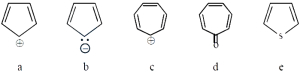
Which of the following structures are aromatic?
A
$a, c, e$
B
$b, c, d, e$
C
$a, b, c$
D
$b, d$
Solution
(D) compound is aromatic if it follows $H$ückel's rule ($4n+2$ $\pi$ electrons),is planar,and cyclic with continuous conjugation.
$a$: Cyclopentadienyl cation has $4$ $\pi$ electrons ($4n$ system),so it is anti-aromatic.
$b$: Cyclopentadienyl anion has $6$ $\pi$ electrons ($4n+2$ where $n=1$),so it is aromatic.
$c$: Cycloheptatrienyl anion has $8$ $\pi$ electrons ($4n$ system),so it is anti-aromatic.
$d$: Tropone (cycloheptatrienone) has $6$ $\pi$ electrons in the ring (due to polarization of $C=O$ bond),so it is aromatic.
$e$: Thiophene has $6$ $\pi$ electrons ($4$ from double bonds + $2$ from lone pair on $S$),so it is aromatic.
Thus,structures $b, d, e$ are aromatic. However,based on the provided options,the most appropriate choice is $b, d$ if we consider the specific set provided in the options.
$a$: Cyclopentadienyl cation has $4$ $\pi$ electrons ($4n$ system),so it is anti-aromatic.
$b$: Cyclopentadienyl anion has $6$ $\pi$ electrons ($4n+2$ where $n=1$),so it is aromatic.
$c$: Cycloheptatrienyl anion has $8$ $\pi$ electrons ($4n$ system),so it is anti-aromatic.
$d$: Tropone (cycloheptatrienone) has $6$ $\pi$ electrons in the ring (due to polarization of $C=O$ bond),so it is aromatic.
$e$: Thiophene has $6$ $\pi$ electrons ($4$ from double bonds + $2$ from lone pair on $S$),so it is aromatic.
Thus,structures $b, d, e$ are aromatic. However,based on the provided options,the most appropriate choice is $b, d$ if we consider the specific set provided in the options.
0 likesView Solution
47
ChemistryEasyMCQAP EAMCET · 2017
Identify the correct statements for a ring system to exhibit aromaticity.
$(i)$ It must not be planar.
$(ii)$ It must possess $(4n+2) \pi$-electrons.
$(iii)$ It must be planar.
$(iv)$ It must possess $4n \pi$-electrons.
The correct answer is
$(i)$ It must not be planar.
$(ii)$ It must possess $(4n+2) \pi$-electrons.
$(iii)$ It must be planar.
$(iv)$ It must possess $4n \pi$-electrons.
The correct answer is
A
$ii$,$iv$
B
$i$,$ii$
C
$i$,$iv$
D
$ii$,$iii$
Solution
(D) For a compound to be aromatic,it must satisfy $H$ückel's rule and structural requirements:
$(1)$ The molecule must be cyclic and planar to allow for continuous delocalization of $\pi$-electrons.
$(2)$ It must possess $(4n+2) \pi$-electrons,where $n$ is an integer $(n = 0, 1, 2, \dots)$.
$(3)$ It must have a fully conjugated $\pi$-electron system.
Therefore,statements $(ii)$ and $(iii)$ are correct.
$(1)$ The molecule must be cyclic and planar to allow for continuous delocalization of $\pi$-electrons.
$(2)$ It must possess $(4n+2) \pi$-electrons,where $n$ is an integer $(n = 0, 1, 2, \dots)$.
$(3)$ It must have a fully conjugated $\pi$-electron system.
Therefore,statements $(ii)$ and $(iii)$ are correct.
0 likesView Solution
48
ChemistryMediumMCQAP EAMCET · 2017
The number of resonance structures that aniline and anilinium ion can have are respectively:
A
$5, 2$
B
$4, 5$
C
$3, 4$
D
$2, 5$
Solution
(A) Aniline $(C_6H_5NH_2)$ has a lone pair on the nitrogen atom which is in conjugation with the benzene ring. This allows for the delocalization of the lone pair into the ring,resulting in $5$ resonance structures (one original structure + $4$ canonical forms).
In the anilinium ion $(C_6H_5NH_3^+)$,the nitrogen atom has a positive charge and no lone pair available for conjugation with the benzene ring. Therefore,the only resonance structures possible are the $2$ Kekulé structures of the benzene ring itself.
In the anilinium ion $(C_6H_5NH_3^+)$,the nitrogen atom has a positive charge and no lone pair available for conjugation with the benzene ring. Therefore,the only resonance structures possible are the $2$ Kekulé structures of the benzene ring itself.
0 likesView Solution
49
ChemistryMediumMCQAP EAMCET · 2017
Which of the following statements are not correct?
$a$. The energy of resonance hybrid structure is higher than that of the possible canonical structures of the molecule.
$b$. When inductive effect and electromeric effect operate in opposite directions,electromeric effect predominates.
$c$. When the $\pi$ electrons of the multiple bond are transferred to that atom to which the attacking reagent does not get attached,it is known as $+E$ effect.
$d$. The resonance structures with separation of opposite charges are more stable.
$a$. The energy of resonance hybrid structure is higher than that of the possible canonical structures of the molecule.
$b$. When inductive effect and electromeric effect operate in opposite directions,electromeric effect predominates.
$c$. When the $\pi$ electrons of the multiple bond are transferred to that atom to which the attacking reagent does not get attached,it is known as $+E$ effect.
$d$. The resonance structures with separation of opposite charges are more stable.
A
$a, c, d$
B
$c, d$
C
$b, c, d$
D
$a, b, c$
Solution
(A) . Incorrect. The resonance hybrid is always more stable and has lower energy than any of the individual canonical structures.
$b$. Correct. The electromeric effect is a temporary effect and generally predominates over the permanent inductive effect when they oppose each other.
$c$. Incorrect. The $+E$ effect occurs when $\pi$ electrons are transferred to the atom to which the attacking reagent gets attached. If they are transferred to the other atom,it is the $-E$ effect.
$d$. Incorrect. Resonance structures with separation of opposite charges are less stable than those without charge separation,as they require energy to separate the charges.
$b$. Correct. The electromeric effect is a temporary effect and generally predominates over the permanent inductive effect when they oppose each other.
$c$. Incorrect. The $+E$ effect occurs when $\pi$ electrons are transferred to the atom to which the attacking reagent gets attached. If they are transferred to the other atom,it is the $-E$ effect.
$d$. Incorrect. Resonance structures with separation of opposite charges are less stable than those without charge separation,as they require energy to separate the charges.
0 likesView Solution
50
ChemistryMediumMCQAP EAMCET · 2017
Which of the following represents the sawhorse projection of the staggered conformation of ethane?
A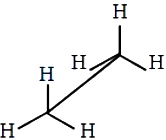
B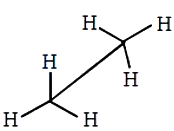
C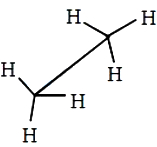
D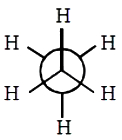
Solution
(B) In a sawhorse projection,the staggered conformation of ethane is characterized by the hydrogen atoms on the front carbon being positioned between the hydrogen atoms on the back carbon,minimizing steric repulsion.
Looking at the provided images:
Image $A$ shows an eclipsed conformation.
Image $B$ shows a staggered conformation where the $C-H$ bonds on the front carbon are staggered with respect to the $C-H$ bonds on the back carbon.
Image $C$ shows a staggered conformation,but Image $B$ is the standard representation.
Image $D$ is a Newman projection,not a sawhorse projection.
Therefore,the correct representation for the staggered conformation of ethane in sawhorse projection is $B$.
Looking at the provided images:
Image $A$ shows an eclipsed conformation.
Image $B$ shows a staggered conformation where the $C-H$ bonds on the front carbon are staggered with respect to the $C-H$ bonds on the back carbon.
Image $C$ shows a staggered conformation,but Image $B$ is the standard representation.
Image $D$ is a Newman projection,not a sawhorse projection.
Therefore,the correct representation for the staggered conformation of ethane in sawhorse projection is $B$.
0 likesView Solution
51
ChemistryMediumMCQAP EAMCET · 2017
Identify $X$ and $Y$ in the following reactions:
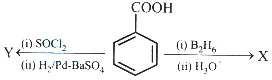
A
Benzyl alcohol,Benzaldehyde
B
Benzyl alcohol,Benzaldehyde
C
Benzaldehyde,Benzaldehyde
D
Toluene,Benzyl alcohol
Solution
(B) $1$. For the formation of $X$: Benzoic acid reacts with $B_2H_6$ followed by hydrolysis $(H_3O^+)$ to undergo reduction,yielding benzyl alcohol $(C_6H_5CH_2OH)$ as $X$.
$2$. For the formation of $Y$: Benzoic acid reacts with $SOCl_2$ to form benzoyl chloride $(C_6H_5COCl)$,which then undergoes Rosenmund reduction using $H_2/Pd-BaSO_4$ to yield benzaldehyde $(C_6H_5CHO)$ as $Y$.
$3$. Therefore,$X$ is benzyl alcohol and $Y$ is benzaldehyde.
$2$. For the formation of $Y$: Benzoic acid reacts with $SOCl_2$ to form benzoyl chloride $(C_6H_5COCl)$,which then undergoes Rosenmund reduction using $H_2/Pd-BaSO_4$ to yield benzaldehyde $(C_6H_5CHO)$ as $Y$.
$3$. Therefore,$X$ is benzyl alcohol and $Y$ is benzaldehyde.
0 likesView Solution
52
ChemistryMediumMCQAP EAMCET · 2017
What are $X$ and $Y$ in the following reactions?
$CH_2O \xrightarrow[(ii) H_3O^+]{(i) X} CH_3(CH_2)_2CH_2OH$
$Y \xrightarrow[(ii) H_3O^+]{(i) C_2H_5MgBr} CH_3CH_2C(CH_3)_2OH$
$CH_2O \xrightarrow[(ii) H_3O^+]{(i) X} CH_3(CH_2)_2CH_2OH$
$Y \xrightarrow[(ii) H_3O^+]{(i) C_2H_5MgBr} CH_3CH_2C(CH_3)_2OH$
A
$X = CH_3-CH(CH_3)-MgBr, Y = C_2H_5COCH_3$
B
$X = CH_3CH_2CH_2MgBr, Y = CH_3-CO-CH_3$
C
$X = CH_3-CH_2-MgBr, Y = CH_3CH_2CHO$
D
$X = (CH_3)_3CMgBr, Y = CH_3-CO-CH_3$
Solution
(B) For the first reaction:
$CH_2O$ (formaldehyde) reacts with a Grignard reagent $(RMgBr)$ followed by hydrolysis to form a primary alcohol. The product is $CH_3CH_2CH_2CH_2OH$ (butan$-1-$ol). The Grignard reagent must be $CH_3CH_2CH_2MgBr$ (propylmagnesium bromide).
For the second reaction:
$Y$ reacts with $C_2H_5MgBr$ followed by hydrolysis to form $CH_3CH_2C(CH_3)_2OH$ ($2$-methylbutan$-2-$ol). This is a tertiary alcohol. The reaction of a ketone with a Grignard reagent produces a tertiary alcohol. Comparing the structure,$Y$ must be $CH_3COCH_3$ (acetone or propanone).
Thus,$X = CH_3CH_2CH_2MgBr$ and $Y = CH_3COCH_3$.
$CH_2O$ (formaldehyde) reacts with a Grignard reagent $(RMgBr)$ followed by hydrolysis to form a primary alcohol. The product is $CH_3CH_2CH_2CH_2OH$ (butan$-1-$ol). The Grignard reagent must be $CH_3CH_2CH_2MgBr$ (propylmagnesium bromide).
For the second reaction:
$Y$ reacts with $C_2H_5MgBr$ followed by hydrolysis to form $CH_3CH_2C(CH_3)_2OH$ ($2$-methylbutan$-2-$ol). This is a tertiary alcohol. The reaction of a ketone with a Grignard reagent produces a tertiary alcohol. Comparing the structure,$Y$ must be $CH_3COCH_3$ (acetone or propanone).
Thus,$X = CH_3CH_2CH_2MgBr$ and $Y = CH_3COCH_3$.
0 likesView Solution
53
ChemistryMediumMCQAP EAMCET · 2017
What are $X$ and $Y$ in the following reactions?
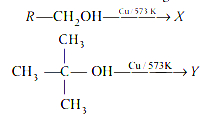
A
$X = RCHO, Y = (CH_3)_2C=CH_2$
B
$X = RCOOH, Y = (CH_3)_2C=CH_2$
C
$X = RCHO, Y = (CH_3)_2C=CH_2$
D
$X = RCOR, Y = (CH_3)_2C=O$
Solution
(C) When the vapours of a primary alcohol are passed over heated copper at $573 \ K$,dehydrogenation takes place and an aldehyde is formed: $R-CH_2OH \xrightarrow{Cu/573 \ K} R-CHO + H_2$.
In the case of tertiary alcohols,dehydration takes place to form an alkene: $(CH_3)_3C-OH \xrightarrow{Cu/573 \ K} (CH_3)_2C=CH_2 + H_2O$.
Thus,$X$ is an aldehyde $(RCHO)$ and $Y$ is an alkene $((CH_3)_2C=CH_2)$.
In the case of tertiary alcohols,dehydration takes place to form an alkene: $(CH_3)_3C-OH \xrightarrow{Cu/573 \ K} (CH_3)_2C=CH_2 + H_2O$.
Thus,$X$ is an aldehyde $(RCHO)$ and $Y$ is an alkene $((CH_3)_2C=CH_2)$.
0 likesView Solution
54
ChemistryMediumMCQAP EAMCET · 2017
What are $X$ and $Y$ in the following reaction? $R-OH + PCl_5 \rightarrow X + Y + HCl$
A
$X = R-OCl, Y = PCl_3$
B
$X = R-Cl, Y = POCl_3$
C
$X = R-O-R, Y = POCl_3$
D
$X = R-Cl, Y = P(OH)_3$
Solution
(B) In the reaction of alcohols with $PCl_5$,the hydroxyl group $(-OH)$ is replaced by a chlorine atom to form an alkyl chloride $(R-Cl)$.
The side products are phosphorus oxychloride $(POCl_3)$ and hydrogen chloride $(HCl)$.
The balanced chemical equation is: $R-OH + PCl_5 \rightarrow R-Cl + POCl_3 + HCl$.
Thus,$X = R-Cl$ and $Y = POCl_3$.
The side products are phosphorus oxychloride $(POCl_3)$ and hydrogen chloride $(HCl)$.
The balanced chemical equation is: $R-OH + PCl_5 \rightarrow R-Cl + POCl_3 + HCl$.
Thus,$X = R-Cl$ and $Y = POCl_3$.
0 likesView Solution
55
ChemistryMediumMCQAP EAMCET · 2017
What are $X$ and $Y$ respectively in the following set of reactions?

A
$Toluene$ ; $p-acetoxy-toluene$
B
$Toluene$ ; $p-acetoxy-toluene$
C
$Phenol$ ; $phenyl-acetate$
D
$Phenol$ ; $p-hydroxy-phenyl-acetate$
Solution
(B) $1$. Reaction with $Zn$ dust and heat: $p-Cresol$ $(p-methylphenol)$ reacts with $Zn$ dust to undergo reduction,where the $-OH$ group is removed and replaced by a hydrogen atom,resulting in the formation of $Toluene$ $(X)$.
$2$. Reaction with $(CH_3CO)_2O$ followed by $H^+$: $p-Cresol$ reacts with acetic anhydride $(CH_3CO)_2O$ to undergo acetylation of the phenolic $-OH$ group,forming $p-acetoxy-toluene$ $(Y)$.
$2$. Reaction with $(CH_3CO)_2O$ followed by $H^+$: $p-Cresol$ reacts with acetic anhydride $(CH_3CO)_2O$ to undergo acetylation of the phenolic $-OH$ group,forming $p-acetoxy-toluene$ $(Y)$.
0 likesView Solution
56
ChemistryMediumMCQAP EAMCET · 2017
What are $X$ and $Y$ in the following reactions?
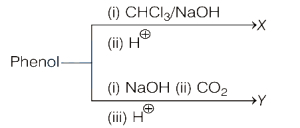
A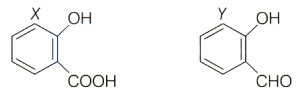
B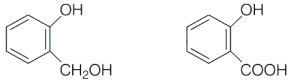
C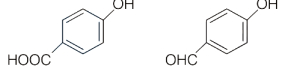
D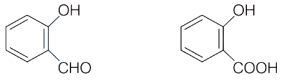
Solution
(D) The reaction of phenol with $CHCl_3$ and aqueous $NaOH$ followed by acidification is the Reimer-Tiemann reaction,which yields $2$-hydroxybenzaldehyde (salicylaldehyde) as product $X$.
The reaction of phenol with $NaOH$ followed by $CO_2$ and then acidification is the Kolbe-Schmitt reaction,which yields $2$-hydroxybenzoic acid (salicylic acid) as product $Y$.
Therefore,$X$ is $2$-hydroxybenzaldehyde and $Y$ is $2$-hydroxybenzoic acid.
The reaction of phenol with $NaOH$ followed by $CO_2$ and then acidification is the Kolbe-Schmitt reaction,which yields $2$-hydroxybenzoic acid (salicylic acid) as product $Y$.
Therefore,$X$ is $2$-hydroxybenzaldehyde and $Y$ is $2$-hydroxybenzoic acid.
0 likesView Solution
57
ChemistryEasyMCQAP EAMCET · 2017
Which of the following reactions involve the carbon-carbon bond formation?
A
Hydroboration-Oxidation of alkenes
B
Cannizzaro reaction
C
Reimer-Tiemann reaction
D
Stephen reaction
Solution
(C) The $Reimer-Tiemann$ reaction involves the treatment of phenol with $CHCl_3$ in the presence of aqueous $NaOH$,which leads to the introduction of a $-CHO$ group at the ortho position of the benzene ring. This process involves the formation of a new $C-C$ bond between the benzene ring and the dichlorocarbene intermediate $(:CCl_2)$.
$1.$ Hydroboration-Oxidation of alkenes involves the addition of $H_2O$ across a double bond.
$2.$ Cannizzaro reaction is a disproportionation reaction of aldehydes lacking $\alpha$-hydrogen.
$3.$ Stephen reaction is the reduction of nitriles to aldehydes using $SnCl_2/HCl$.
$1.$ Hydroboration-Oxidation of alkenes involves the addition of $H_2O$ across a double bond.
$2.$ Cannizzaro reaction is a disproportionation reaction of aldehydes lacking $\alpha$-hydrogen.
$3.$ Stephen reaction is the reduction of nitriles to aldehydes using $SnCl_2/HCl$.
0 likesView Solution
58
ChemistryMediumMCQAP EAMCET · 2017
Identify $X$ and $Y$ in the following reaction:
$X \xrightarrow{Y} \text{Benzoquinone}$
$X \xrightarrow{Y} \text{Benzoquinone}$
A
$X$ = Cyclohexanol,$Y$ = Zn
B
$X$ = Phenol,$Y$ = $Na_2Cr_2O_7 / H_2SO_4$
C
$X$ = Cyclohex$-2-$en$-1-$ol,$Y$ = $Na_2Cr_2O_7 / H_2SO_4$
D
$X$ = Phenol,$Y$ = Zn
Solution
(B) The oxidation of phenol with chromic acid ($Na_2Cr_2O_7$ in the presence of $H_2SO_4$) yields $p$-benzoquinone.
Therefore,$X$ is phenol and $Y$ is $Na_2Cr_2O_7 / H_2SO_4$.
Therefore,$X$ is phenol and $Y$ is $Na_2Cr_2O_7 / H_2SO_4$.
0 likesView Solution
59
ChemistryMediumMCQAP EAMCET · 2017
The reaction of anisole with acetyl chloride in the presence of anhydrous $AlCl_3$ gives $X$ and $Y$. $X$ and $Y$ are
A
$o-$Methoxyacetophenone and $p-$methoxyacetophenone
B
$o-$Ethoxyacetophenone and $p-$ethoxyacetophenone
C
$o-$Methoxypropiophenone and $p-$methoxypropiophenone
D
$o-$Ethoxypropiophenone and $p-$ethoxypropiophenone
Solution
(A) Anisole $(C_6H_5OCH_3)$ undergoes Friedel-Crafts acylation when treated with acetyl chloride $(CH_3COCl)$ in the presence of anhydrous $AlCl_3$.
The methoxy group $(-OCH_3)$ is an ortho/para-directing group.
Therefore,the reaction yields a mixture of ortho-substituted and para-substituted products.
The products formed are $o-$methoxyacetophenone and $p-$methoxyacetophenone.
The methoxy group $(-OCH_3)$ is an ortho/para-directing group.
Therefore,the reaction yields a mixture of ortho-substituted and para-substituted products.
The products formed are $o-$methoxyacetophenone and $p-$methoxyacetophenone.
0 likesView Solution
60
ChemistryEasyMCQAP EAMCET · 2017
What are $A$ and $B$ in the following reaction?
$CH_3-CH_2-CH_2-O-C(CH_3)_2-CH_2-CH_3 \xrightarrow{HI} A + B$
$CH_3-CH_2-CH_2-O-C(CH_3)_2-CH_2-CH_3 \xrightarrow{HI} A + B$
A
$A = CH_3CH_2I, B = HO-C(CH_3)_2-CH_2CH_3$
B
$A = CH_3CH_2I, B = H_3C-O-C(CH_3)_2-CH_2CH_3$
C
$A = CH_3CH_2CH_2OH, B = I-C(CH_3)_2-CH_2CH_3$
D
$A = CH_3CH_3, B = IH_2C-O-C(CH_3)_2-CH_2CH_3$
Solution
(C) The reaction of an ether with $HI$ proceeds via an $S_N1$ mechanism when one of the alkyl groups is tertiary,as it can form a stable carbocation.
In the given ether,$CH_3-CH_2-CH_2-O-C(CH_3)_2-CH_2-CH_3$,the oxygen atom is attached to a primary alkyl group ($n$-propyl) and a tertiary alkyl group ($2$-methylbutan$-2-$yl).
When $HI$ is added,the oxygen gets protonated. The bond between the oxygen and the tertiary carbon breaks to form a stable tertiary carbocation,which then reacts with the iodide ion $(I^-)$ to form an alkyl iodide,and the primary group forms an alcohol.
Therefore,the products are $CH_3-CH_2-CH_2-OH$ (propan$-1-$ol) and $I-C(CH_3)_2-CH_2-CH_3$ ($2$-iodo$-2-$methylbutane).
Comparing this with the given options,option $C$ represents the correct products.
In the given ether,$CH_3-CH_2-CH_2-O-C(CH_3)_2-CH_2-CH_3$,the oxygen atom is attached to a primary alkyl group ($n$-propyl) and a tertiary alkyl group ($2$-methylbutan$-2-$yl).
When $HI$ is added,the oxygen gets protonated. The bond between the oxygen and the tertiary carbon breaks to form a stable tertiary carbocation,which then reacts with the iodide ion $(I^-)$ to form an alkyl iodide,and the primary group forms an alcohol.
Therefore,the products are $CH_3-CH_2-CH_2-OH$ (propan$-1-$ol) and $I-C(CH_3)_2-CH_2-CH_3$ ($2$-iodo$-2-$methylbutane).
Comparing this with the given options,option $C$ represents the correct products.
0 likesView Solution
61
ChemistryMediumMCQAP EAMCET · 2017
What are $X$ and $Y$ in the following reactions?
a) Benzoic acid $\xrightarrow[Conc. H_2SO_4]{Conc. HNO_3} X$
b) $R-CH_2-COOH \xrightarrow[ii) H_2O]{i) Br_2 / Red \ P} Y$
a) Benzoic acid $\xrightarrow[Conc. H_2SO_4]{Conc. HNO_3} X$
b) $R-CH_2-COOH \xrightarrow[ii) H_2O]{i) Br_2 / Red \ P} Y$
A
$X$ = $3,5-$dinitrobenzoic acid,$Y$ = $R$-CH_2-COBr
B
$X$ = $3,5-$dinitrobenzoic acid,$Y$ = $R$-$CH$(Br)-COBr
C
$X$ = $3-$nitrobenzoic acid,$Y$ = $R$-CH_2-COBr
D
$X$ = $3-$nitrobenzoic acid,$Y$ = $R$-$CH$(Br)-$COOH$
Solution
(D) For reaction $(a)$: Benzoic acid contains a $-COOH$ group,which is a deactivating and meta-directing group. Nitration with $Conc. HNO_3 + Conc. H_2SO_4$ yields $m$-nitrobenzoic acid as the major product. Thus,$X$ is $3$-nitrobenzoic acid.
For reaction $(b)$: This is the Hell-Volhard-Zelinsky $(HVZ)$ reaction. Carboxylic acids having an $\alpha$-hydrogen atom are halogenated at the $\alpha$-position on treatment with $Br_2$ in the presence of small amount of red phosphorus. The product $Y$ is an $\alpha$-bromo carboxylic acid,$R-CH(Br)-COOH$.
For reaction $(b)$: This is the Hell-Volhard-Zelinsky $(HVZ)$ reaction. Carboxylic acids having an $\alpha$-hydrogen atom are halogenated at the $\alpha$-position on treatment with $Br_2$ in the presence of small amount of red phosphorus. The product $Y$ is an $\alpha$-bromo carboxylic acid,$R-CH(Br)-COOH$.
0 likesView Solution
62
ChemistryMediumMCQAP EAMCET · 2017
What are $X$ and $Y$ in the following reactions?
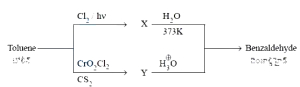
A
$X = C_6H_5CCl_3$,$Y = C_6H_5CH[OCr(OH)Cl_2]_2$
B
$X = C_6H_5CHCl_2$,$Y = C_6H_5CH[OCr(OH)Cl_2]_2$
C
$X = C_6H_5CH_2Cl$,$Y = C_6H_5CH[OCr(OH)_2Cl_2]_2$
D
$X = C_6H_4(CH_3)Cl$,$Y = C_6H_5CH[OCrCl_3]_2$
Solution
(B) The reaction of toluene with $Cl_2$ in the presence of $hv$ (photochemical chlorination) leads to the formation of benzal chloride $(C_6H_5CHCl_2)$ as the intermediate $X$,which upon hydrolysis at $373 \ K$ gives benzaldehyde.
The reaction of toluene with chromyl chloride $(CrO_2Cl_2)$ in $CS_2$ is the Etard reaction. This reaction proceeds through the formation of a brown chromium complex intermediate $Y$,which is $C_6H_5CH[OCr(OH)Cl_2]_2$. This complex upon acidic hydrolysis $(H_3O^+)$ yields benzaldehyde.
Therefore,$X = C_6H_5CHCl_2$ and $Y = C_6H_5CH[OCr(OH)Cl_2]_2$.
The reaction of toluene with chromyl chloride $(CrO_2Cl_2)$ in $CS_2$ is the Etard reaction. This reaction proceeds through the formation of a brown chromium complex intermediate $Y$,which is $C_6H_5CH[OCr(OH)Cl_2]_2$. This complex upon acidic hydrolysis $(H_3O^+)$ yields benzaldehyde.
Therefore,$X = C_6H_5CHCl_2$ and $Y = C_6H_5CH[OCr(OH)Cl_2]_2$.
0 likesView Solution
63
ChemistryEasyMCQAP EAMCET · 2017
The reagents used in the Etard reaction $(I)$ and the Stephen reaction $(II)$ are:
A
$PCC$ and $SnCl_2 / HCl$
B
$SnCl_2 / HCl$ and $CrO_2Cl_2$
C
$CrO_2Cl_2$ and $SnCl_2 / HCl$
D
$CrO_2Cl_2$ and $PCC$
Solution
(C) The Etard reaction $(I)$ involves the oxidation of toluene to benzaldehyde using chromyl chloride $(CrO_2Cl_2)$ in the presence of $CCl_4$ as a solvent. The reaction proceeds through the formation of a brown chromium complex,which is subsequently hydrolyzed to give benzaldehyde.
The Stephen reaction $(II)$ involves the reduction of nitriles $(R-CN)$ to imines using stannous chloride $(SnCl_2)$ in the presence of hydrochloric acid $(HCl)$,followed by hydrolysis to yield the corresponding aldehyde $(R-CHO)$.
The Stephen reaction $(II)$ involves the reduction of nitriles $(R-CN)$ to imines using stannous chloride $(SnCl_2)$ in the presence of hydrochloric acid $(HCl)$,followed by hydrolysis to yield the corresponding aldehyde $(R-CHO)$.
0 likesView Solution
64
ChemistryMediumMCQAP EAMCET · 2017
What are $A$,$B$,and $C$ in the following reactions?
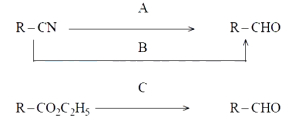
A
$A$: $i) \ K_2Cr_2O_7, ii) \ H^{\oplus}$; $B$: $i) \ SnCl_2|HCl, ii) \ H_3O^{\oplus}$; $C$: $i) \ AlH(i-Bu)_2, ii) \ H_2O$
B
$A$: $i) \ SnCl_2|HCl, ii) \ H_3O^{\oplus}$; $B$: $i) \ AlH(i-Bu)_2, ii) \ H_2O$; $C$: $i) \ DIBAL-H, ii) \ H_2O$
C
$A$: $H_2|Pd-BaSO_4$; $B$: $Al_2O_3$; $C$: $i) \ SnCl_2|HCl, ii) \ H_2O$
D
$A$: $Al_2O_3$; $B$: $i) \ SnCl_2|HCl, ii) \ H_3O^{\oplus}$; $C$: $i) \ DIBAL-H, ii) \ H_2O$
Solution
(B) The conversion of $R-CN$ to $R-CHO$ is a standard reduction reaction known as the Stephen reduction,which uses $SnCl_2$ in the presence of $HCl$ followed by hydrolysis $(H_3O^{\oplus})$. Thus,$A$ represents the Stephen reduction reagents.
The conversion of $R-CN$ to $R-CHO$ can also be achieved using $DIBAL-H$ (Diisobutylaluminium hydride),which is a selective reducing agent. In the provided options,$B$ corresponds to $AlH(i-Bu)_2$ (which is $DIBAL-H$) followed by water.
The conversion of an ester $(R-CO_2C_2H_5)$ to an aldehyde $(R-CHO)$ is also specifically carried out using $DIBAL-H$ followed by water. Thus,$C$ represents $DIBAL-H$ followed by $H_2O$.
Comparing these with the given options,option $B$ correctly identifies $A$ as $SnCl_2|HCl$ followed by $H_3O^{\oplus}$,$B$ as $AlH(i-Bu)_2$ followed by $H_2O$,and $C$ as $DIBAL-H$ followed by $H_2O$.
The conversion of $R-CN$ to $R-CHO$ can also be achieved using $DIBAL-H$ (Diisobutylaluminium hydride),which is a selective reducing agent. In the provided options,$B$ corresponds to $AlH(i-Bu)_2$ (which is $DIBAL-H$) followed by water.
The conversion of an ester $(R-CO_2C_2H_5)$ to an aldehyde $(R-CHO)$ is also specifically carried out using $DIBAL-H$ followed by water. Thus,$C$ represents $DIBAL-H$ followed by $H_2O$.
Comparing these with the given options,option $B$ correctly identifies $A$ as $SnCl_2|HCl$ followed by $H_3O^{\oplus}$,$B$ as $AlH(i-Bu)_2$ followed by $H_2O$,and $C$ as $DIBAL-H$ followed by $H_2O$.
0 likesView Solution
65
ChemistryMediumMCQAP EAMCET · 2017
What are '$X$' and '$Y$' in the following reaction?
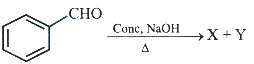
A
Phenol + Sodium benzoate
B
Benzyl alcohol + Benzoic acid
C
Benzyl alcohol + Sodium benzoate
D
Sodium benzyloxide + Benzoic acid
Solution
(C) The given reaction is the Cannizzaro reaction. Benzaldehyde $(C_6H_5CHO)$ does not have an $\alpha$-hydrogen atom,so it undergoes a self-oxidation and reduction (disproportionation) reaction in the presence of a concentrated base like $NaOH$.
One molecule of benzaldehyde is reduced to benzyl alcohol $(C_6H_5CH_2OH)$,and another molecule is oxidized to sodium benzoate $(C_6H_5COONa)$.
Thus,the products '$X$' and '$Y$' are benzyl alcohol and sodium benzoate.
One molecule of benzaldehyde is reduced to benzyl alcohol $(C_6H_5CH_2OH)$,and another molecule is oxidized to sodium benzoate $(C_6H_5COONa)$.
Thus,the products '$X$' and '$Y$' are benzyl alcohol and sodium benzoate.
0 likesView Solution
66
ChemistryDifficultMCQAP EAMCET · 2017
Which one of the following is not formed by aldol condensation of a mixture of ethanal and propanal?
A
$2-$Methylpent$-2-$enal
B
But$-2-$enal
C
Pent$-2-$enal
D
Hex$-3-$enal
Solution
(D) The aldol condensation of a mixture of ethanal $(CH_3CHO)$ and propanal $(CH_3CH_2CHO)$ involves four possible products:
$1$. Self-condensation of ethanal: $CH_3CH=CHCHO$ (But$-2-$enal).
$2$. Self-condensation of propanal: $CH_3CH_2CH=C(CH_3)CHO$ ($2-$Methylpent$-2-$enal).
$3$. Cross-condensation (ethanal as nucleophile,propanal as electrophile): $CH_3CH_2CH=CHCHO$ (Pent$-2-$enal).
$4$. Cross-condensation (propanal as nucleophile,ethanal as electrophile): $CH_3CH=C(CH_3)CHO$ ($2-$Methylbut$-2-$enal).
Hex$-3-$enal is not formed in this reaction.
$1$. Self-condensation of ethanal: $CH_3CH=CHCHO$ (But$-2-$enal).
$2$. Self-condensation of propanal: $CH_3CH_2CH=C(CH_3)CHO$ ($2-$Methylpent$-2-$enal).
$3$. Cross-condensation (ethanal as nucleophile,propanal as electrophile): $CH_3CH_2CH=CHCHO$ (Pent$-2-$enal).
$4$. Cross-condensation (propanal as nucleophile,ethanal as electrophile): $CH_3CH=C(CH_3)CHO$ ($2-$Methylbut$-2-$enal).
Hex$-3-$enal is not formed in this reaction.
0 likesView Solution
67
ChemistryDifficultMCQAP EAMCET · 2017
What are $A, B, C$ and $D$ in the following cross-aldol condensation reaction?
$\text{Propanal} + \text{Ethanal} \xrightarrow[ii) \ \Delta]{i) \ NaOH} A + B + C + D$
(The products are the four possible $\alpha,\beta$-unsaturated aldehydes formed by self and cross-aldol condensation followed by dehydration.)
$\text{Propanal} + \text{Ethanal} \xrightarrow[ii) \ \Delta]{i) \ NaOH} A + B + C + D$
(The products are the four possible $\alpha,\beta$-unsaturated aldehydes formed by self and cross-aldol condensation followed by dehydration.)
A
B
C
D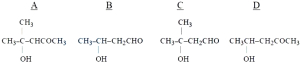
Solution
(A) The reaction is a cross-aldol condensation between propanal $(CH_3CH_2CHO)$ and ethanal $(CH_3CHO)$ in the presence of $NaOH$ followed by heating $(\Delta)$.
This reaction produces four possible $\alpha,\beta$-unsaturated aldehydes:
$1$. Self-aldol of ethanal: $2CH_3CHO \rightarrow CH_3CH=CHCHO$ (But$-2-$enal).
$2$. Self-aldol of propanal: $2CH_3CH_2CHO \rightarrow CH_3CH_2CH=C(CH_3)CHO$ ($2$-methylpent$-2-$enal).
$3$. Cross-aldol (propanal as donor,ethanal as acceptor): $CH_3CH_2CHO + CH_3CHO \rightarrow CH_3CH_2CH=CHCHO$ (Pent$-2-$enal).
$4$. Cross-aldol (ethanal as donor,propanal as acceptor): $CH_3CHO + CH_3CH_2CHO \rightarrow CH_3CH=C(CH_3)CHO$ ($2$-methylbut$-2-$enal).
Thus,the four products are $CH_3CH=CHCHO$,$CH_3CH_2CH=C(CH_3)CHO$,$CH_3CH_2CH=CHCHO$,and $CH_3CH=C(CH_3)CHO$.
This reaction produces four possible $\alpha,\beta$-unsaturated aldehydes:
$1$. Self-aldol of ethanal: $2CH_3CHO \rightarrow CH_3CH=CHCHO$ (But$-2-$enal).
$2$. Self-aldol of propanal: $2CH_3CH_2CHO \rightarrow CH_3CH_2CH=C(CH_3)CHO$ ($2$-methylpent$-2-$enal).
$3$. Cross-aldol (propanal as donor,ethanal as acceptor): $CH_3CH_2CHO + CH_3CHO \rightarrow CH_3CH_2CH=CHCHO$ (Pent$-2-$enal).
$4$. Cross-aldol (ethanal as donor,propanal as acceptor): $CH_3CHO + CH_3CH_2CHO \rightarrow CH_3CH=C(CH_3)CHO$ ($2$-methylbut$-2-$enal).
Thus,the four products are $CH_3CH=CHCHO$,$CH_3CH_2CH=C(CH_3)CHO$,$CH_3CH_2CH=CHCHO$,and $CH_3CH=C(CH_3)CHO$.
0 likesView Solution
68
ChemistryMediumMCQAP EAMCET · 2017
Identify $A$ and $B$ in the following reactions: $R-CHO \xrightarrow{A} R-CH_2OH \xleftarrow{B} R-COOH$
A
| $A: NaBH_4$ | $B: H_2 | Pd$ |
B
| $A: H_2 | Pd$ | $B: i) LiAlH_4, ii) H_3O^+$ |
C
| $A: SnCl_2$ | $B: MnO_2$ |
D
| $A: NaBH_4$ | $B: SnCl_2$ |
Solution
(B) The reaction $R-CHO \rightarrow R-CH_2OH$ is the reduction of an aldehyde to a primary alcohol. Both $NaBH_4$ and $H_2 | Pd$ can perform this reduction.
The reaction $R-COOH \rightarrow R-CH_2OH$ is the reduction of a carboxylic acid to a primary alcohol. Carboxylic acids are resistant to reduction by $NaBH_4$ and $H_2 | Pd$. $A$ strong reducing agent like $LiAlH_4$ followed by acidic workup $(H_3O^+)$ is required for this transformation.
Comparing the options,option $B$ provides a valid set of reagents for both steps: $H_2 | Pd$ can reduce the aldehyde,and $LiAlH_4$ is the standard reagent for reducing carboxylic acids to primary alcohols.
The reaction $R-COOH \rightarrow R-CH_2OH$ is the reduction of a carboxylic acid to a primary alcohol. Carboxylic acids are resistant to reduction by $NaBH_4$ and $H_2 | Pd$. $A$ strong reducing agent like $LiAlH_4$ followed by acidic workup $(H_3O^+)$ is required for this transformation.
Comparing the options,option $B$ provides a valid set of reagents for both steps: $H_2 | Pd$ can reduce the aldehyde,and $LiAlH_4$ is the standard reagent for reducing carboxylic acids to primary alcohols.
0 likesView Solution
69
ChemistryMediumMCQAP EAMCET · 2017
The compound formed when propanone is made to react with ethyl magnesium bromide followed by hydrolysis is
A
$2-$Methylbutan$-2-$ol
B
Pentan$-2-$ol
C
$2-$Methylpropan$-2-$ol
D
$3-$Methylbutan$-2-$ol
Solution
(A) The reaction of propanone $(CH_3COCH_3)$ with ethyl magnesium bromide $(CH_3CH_2MgBr)$ is a Grignard reaction.
$1$. Nucleophilic attack: The ethyl group $(CH_3CH_2^-)$ from the Grignard reagent attacks the electrophilic carbonyl carbon of propanone to form an alkoxide intermediate: $CH_3COCH_3 + CH_3CH_2MgBr \rightarrow CH_3C(OMgBr)(CH_2CH_3)CH_3$.
$2$. Hydrolysis: Subsequent hydrolysis of the intermediate with water $(H_2O/H^+)$ yields the tertiary alcohol: $CH_3C(OMgBr)(CH_2CH_3)CH_3 + H_2O \rightarrow CH_3C(OH)(CH_2CH_3)CH_3 + Mg(OH)Br$.
$3$. The product is $2-$methylbutan$-2-$ol.
$1$. Nucleophilic attack: The ethyl group $(CH_3CH_2^-)$ from the Grignard reagent attacks the electrophilic carbonyl carbon of propanone to form an alkoxide intermediate: $CH_3COCH_3 + CH_3CH_2MgBr \rightarrow CH_3C(OMgBr)(CH_2CH_3)CH_3$.
$2$. Hydrolysis: Subsequent hydrolysis of the intermediate with water $(H_2O/H^+)$ yields the tertiary alcohol: $CH_3C(OMgBr)(CH_2CH_3)CH_3 + H_2O \rightarrow CH_3C(OH)(CH_2CH_3)CH_3 + Mg(OH)Br$.
$3$. The product is $2-$methylbutan$-2-$ol.
0 likesView Solution
70
ChemistryMediumMCQAP EAMCET · 2017
Identify the products $y$ and $x$ in the following reaction sequence:
$C_6H_5CONH_2 \xrightarrow{NaOBr} y$
$C_6H_5CONH_2 \xrightarrow[(ii) H_3O^+]{(i) C_6H_5SO_2Cl / py, \Delta} x$
$C_6H_5CONH_2 \xrightarrow{NaOBr} y$
$C_6H_5CONH_2 \xrightarrow[(ii) H_3O^+]{(i) C_6H_5SO_2Cl / py, \Delta} x$
A
y = $C_6H_5COOH$,x = $p-Br-C_6H_4NH_2$
B
y = $C_6H_5COOH$,x = $C_6H_5NH_2$
C
y = $C_6H_5NH_2$,x = $C_6H_5NH_2$
D
y = $C_6H_5NH_2$,x = $p-Br-C_6H_4NH_2$
Solution
(C) $1$. The reaction $C_6H_5CONH_2 \xrightarrow{NaOBr} y$ is the Hofmann bromamide degradation reaction,which converts an amide into a primary amine with one carbon atom less. Thus,$y$ is aniline $(C_6H_5NH_2)$.
$2$. The reaction $C_6H_5CONH_2 \xrightarrow[(ii) H_3O^+]{(i) C_6H_5SO_2Cl / py, \Delta} x$ involves the reaction of benzamide with benzenesulfonyl chloride in the presence of pyridine,followed by heating and acidic hydrolysis. This sequence is a variation of the Curtius or Lossen-type rearrangement or simply a dehydration/hydrolysis pathway leading to the formation of aniline $(C_6H_5NH_2)$.
$3$. Therefore,both $y$ and $x$ are aniline $(C_6H_5NH_2)$. The correct option is $(C)$.
$2$. The reaction $C_6H_5CONH_2 \xrightarrow[(ii) H_3O^+]{(i) C_6H_5SO_2Cl / py, \Delta} x$ involves the reaction of benzamide with benzenesulfonyl chloride in the presence of pyridine,followed by heating and acidic hydrolysis. This sequence is a variation of the Curtius or Lossen-type rearrangement or simply a dehydration/hydrolysis pathway leading to the formation of aniline $(C_6H_5NH_2)$.
$3$. Therefore,both $y$ and $x$ are aniline $(C_6H_5NH_2)$. The correct option is $(C)$.
0 likesView Solution
71
ChemistryMediumMCQAP EAMCET · 2017
What are $X$ and $Y$ respectively in the following set of reactions?

A
Phenyl cyanide,Phenyl cyanide
B
Phenyl cyanide,Phenyl isocyanide
C
Phenyl isocyanide,Phenyl cyanide
D
Phenyl isocyanide,Phenyl isocyanide
Solution
(C) The reaction of aniline with $CHCl_3$ and $KOH$ (carbylamine reaction) produces phenyl isocyanide $(C_6H_5NC)$ as $X$.
The reaction of aniline with $NaNO_2/HCl$ followed by $CuCN/KCN$ (Sandmeyer reaction) produces phenyl cyanide $(C_6H_5CN)$ as $Y$.
Therefore,$X$ is phenyl isocyanide and $Y$ is phenyl cyanide.
The reaction of aniline with $NaNO_2/HCl$ followed by $CuCN/KCN$ (Sandmeyer reaction) produces phenyl cyanide $(C_6H_5CN)$ as $Y$.
Therefore,$X$ is phenyl isocyanide and $Y$ is phenyl cyanide.
0 likesView Solution
72
ChemistryMediumMCQAP EAMCET · 2017
Which of the following would produce an alcohol on treatment with $NaNO_2$ and $HCl$ in the presence of water?
A
$CH_3-CH_2-CH_2-NH_2$
B
$CH_3-CH_2-NH-CH_3$
C
$(CH_3)_3N$
D
$C_6H_5-NH_2$
Solution
(A) Primary aliphatic amines $(R-NH_2)$ react with nitrous acid ($HNO_2$,generated in situ from $NaNO_2 + HCl$) to form unstable aliphatic diazonium salts,which decompose in the presence of water to yield alcohols $(R-OH)$,$N_2$ gas,and $HCl$.
$R-NH_2 + NaNO_2 + HCl$ $\rightarrow [R-N_2^+Cl^-] + H_2O$ $\rightarrow R-OH + N_2 + HCl$
Option $A$ is a primary aliphatic amine ($n$-propylamine),which will produce propan$-1-$ol.
Secondary amines $(R_2NH)$ form $N$-nitrosoamines,and tertiary amines $(R_3N)$ form salts with nitrous acid,neither of which yields an alcohol under these conditions. Aniline $(C_6H_5-NH_2)$ forms a stable benzenediazonium chloride at low temperatures $(0-5 \ ^\circ C)$.
$R-NH_2 + NaNO_2 + HCl$ $\rightarrow [R-N_2^+Cl^-] + H_2O$ $\rightarrow R-OH + N_2 + HCl$
Option $A$ is a primary aliphatic amine ($n$-propylamine),which will produce propan$-1-$ol.
Secondary amines $(R_2NH)$ form $N$-nitrosoamines,and tertiary amines $(R_3N)$ form salts with nitrous acid,neither of which yields an alcohol under these conditions. Aniline $(C_6H_5-NH_2)$ forms a stable benzenediazonium chloride at low temperatures $(0-5 \ ^\circ C)$.
0 likesView Solution
73
ChemistryDifficultMCQAP EAMCET · 2017
$C_6H_5NH_2$ $\xrightarrow[\substack{NaNO_2 \\ HCl, 0-5^{\circ}C}]{} X$ $\xrightarrow[CuCl]{HCl} Y$ $\xrightarrow[\text{dry ether}]{CH_3Cl, Na} Z$
What is $Z$ in the sequence of reactions?
What is $Z$ in the sequence of reactions?
A
Biphenyl
B
Toluene
C
Ethylbenzene
D
$4-$Chlorotoluene
Solution
(B) Step $1$: Aniline $(C_6H_5NH_2)$ reacts with $NaNO_2$ and $HCl$ at $0-5^{\circ}C$ to form Benzenediazonium chloride $(X = C_6H_5N_2^+Cl^-)$.
Step $2$: Benzenediazonium chloride reacts with $CuCl/HCl$ (Sandmeyer reaction) to form Chlorobenzene $(Y = C_6H_5Cl)$.
Step $3$: Chlorobenzene reacts with $CH_3Cl$ and $Na$ in the presence of dry ether (Wurtz-Fittig reaction) to form Toluene $(Z = C_6H_5CH_3)$.
Step $2$: Benzenediazonium chloride reacts with $CuCl/HCl$ (Sandmeyer reaction) to form Chlorobenzene $(Y = C_6H_5Cl)$.
Step $3$: Chlorobenzene reacts with $CH_3Cl$ and $Na$ in the presence of dry ether (Wurtz-Fittig reaction) to form Toluene $(Z = C_6H_5CH_3)$.
0 likesView Solution
74
ChemistryEasyMCQAP EAMCET · 2017
What are $A$ and $B$ in the following reactions?
$A \xrightarrow{H_2 / Ni} R-CH_2-NH_2 \xleftarrow[ii) H_2O]{i) LiAlH_4} B$
$A \xrightarrow{H_2 / Ni} R-CH_2-NH_2 \xleftarrow[ii) H_2O]{i) LiAlH_4} B$
A
$A = R-CH_2-NC, B = R-CH=NOH$
B
$A = R-CH=NOH, B = R-CN$
C
$A = R-CONH_2, B = R-CH_2-NC$
D
$A = R-CN, B = R-CONH_2$
Solution
(D) and $B$ are precursors that can be reduced to form the primary amine $R-CH_2-NH_2$.
$1.$ Nitriles $(R-CN)$ undergo catalytic hydrogenation with $H_2/Ni$ to produce primary amines: $R-CN + 2H_2 \xrightarrow{Ni} R-CH_2-NH_2$
$2.$ Amides $(R-CONH_2)$ are reduced by $LiAlH_4$ followed by hydrolysis to produce primary amines: $R-CONH_2 \xrightarrow[ii) H_2O]{i) LiAlH_4} R-CH_2-NH_2$
Therefore,$A = R-CN$ and $B = R-CONH_2$.
$1.$ Nitriles $(R-CN)$ undergo catalytic hydrogenation with $H_2/Ni$ to produce primary amines: $R-CN + 2H_2 \xrightarrow{Ni} R-CH_2-NH_2$
$2.$ Amides $(R-CONH_2)$ are reduced by $LiAlH_4$ followed by hydrolysis to produce primary amines: $R-CONH_2 \xrightarrow[ii) H_2O]{i) LiAlH_4} R-CH_2-NH_2$
Therefore,$A = R-CN$ and $B = R-CONH_2$.
0 likesView Solution
75
ChemistryEasyMCQAP EAMCET · 2017
Identify $Z$ in the above sequence of reactions.
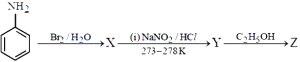
A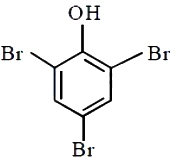
B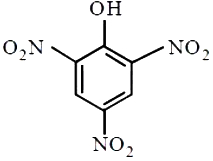
C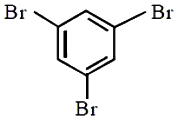
D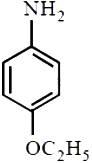
Solution
(C) $1$. Aniline reacts with $Br_2/H_2O$ to form $2,4,6$-tribromoaniline $(X)$.
$2$. $2,4,6$-tribromoaniline reacts with $NaNO_2/HCl$ at $273-278 \ K$ to form the diazonium salt,$2,4,6$-tribromobenzenediazonium chloride $(Y)$.
$3$. The diazonium salt $(Y)$ reacts with ethanol $(C_2H_5OH)$ to undergo reduction,where the diazonium group is replaced by a hydrogen atom,yielding $1,3,5$-tribromobenzene $(Z)$.
$2$. $2,4,6$-tribromoaniline reacts with $NaNO_2/HCl$ at $273-278 \ K$ to form the diazonium salt,$2,4,6$-tribromobenzenediazonium chloride $(Y)$.
$3$. The diazonium salt $(Y)$ reacts with ethanol $(C_2H_5OH)$ to undergo reduction,where the diazonium group is replaced by a hydrogen atom,yielding $1,3,5$-tribromobenzene $(Z)$.
0 likesView Solution
76
ChemistryMediumMCQAP EAMCET · 2017
What are $A, B, C$ and $D$ in the following reactions?
$i)$ Aniline $\xrightarrow[273 \ K]{NaNO_2 \mid HCl} A$ $\xrightarrow{B} \text{Phenol}$
$ii)$ Cumene $\xrightarrow{O_2} C$ $\xrightarrow{D} \text{Phenol} + \text{acetone}$
$i)$ Aniline $\xrightarrow[273 \ K]{NaNO_2 \mid HCl} A$ $\xrightarrow{B} \text{Phenol}$
$ii)$ Cumene $\xrightarrow{O_2} C$ $\xrightarrow{D} \text{Phenol} + \text{acetone}$
A
$A$: $C_6H_5N_2^+Cl^-$,$B$: $\text{Warm } H_2O$,$C$: $C_6H_5C(CH_3)_2OOH$,$D$: $H^+/H_2O$
B
$A$: $C_6H_5Cl$,$B$: $623 \ K/300 \ atm$,$C$: $C_6H_5C(CH_3)_2OH$,$D$: $H_2O_2$
C
$A$: $C_6H_5ONa$,$B$: $H_3O^+$,$C$: $C_6H_5CH(CH_3)CH_2OOH$,$D$: $H_2O_2$
D
$A$: $C_6H_5NHOH$,$B$: $NaOH$,$C$: $C_6H_5OCH(CH_3)_2$,$D$: $H^+/H_2O_2$
Solution
(D) In reaction $(i)$,Aniline reacts with $NaNO_2/HCl$ at $273 \ K$ to form benzene diazonium chloride $(A = C_6H_5N_2^+Cl^-)$. This compound on hydrolysis with warm water $(B = \text{Warm } H_2O)$ yields phenol.
In reaction $(ii)$,Cumene (isopropylbenzene) undergoes oxidation with $O_2$ to form cumene hydroperoxide $(C = C_6H_5C(CH_3)_2OOH)$. This hydroperoxide on treatment with dilute acid $(D = H^+/H_2O)$ undergoes rearrangement to give phenol and acetone.
Thus,the correct set is option $D$.
In reaction $(ii)$,Cumene (isopropylbenzene) undergoes oxidation with $O_2$ to form cumene hydroperoxide $(C = C_6H_5C(CH_3)_2OOH)$. This hydroperoxide on treatment with dilute acid $(D = H^+/H_2O)$ undergoes rearrangement to give phenol and acetone.
Thus,the correct set is option $D$.
0 likesView Solution
77
ChemistryEasyMCQAP EAMCET · 2017
What are $X$ and $Y$ in the following reactions?
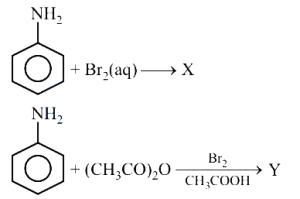
A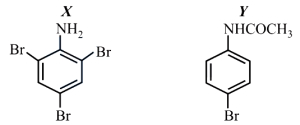
B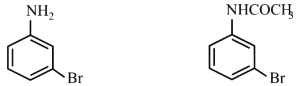
C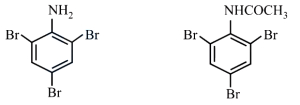
D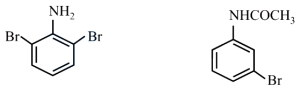
Solution
(A) $(i)$ Aniline is highly reactive towards electrophilic substitution. When treated with $Br_2$ in $H_2O$,it undergoes rapid poly-substitution to form $2, 4, 6-$tribromoaniline as the major product $(X)$.
$(ii)$ To control the reactivity of the $-NH_2$ group,it is first acetylated using acetic anhydride $(CH_3CO)_2O$ to form acetanilide. The $-NHCOCH_3$ group is less activating than the $-NH_2$ group,which restricts the bromination to the $p-$position,yielding $p-$bromoacetanilide as the major product $(Y)$.
$(ii)$ To control the reactivity of the $-NH_2$ group,it is first acetylated using acetic anhydride $(CH_3CO)_2O$ to form acetanilide. The $-NHCOCH_3$ group is less activating than the $-NH_2$ group,which restricts the bromination to the $p-$position,yielding $p-$bromoacetanilide as the major product $(Y)$.
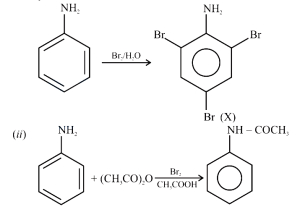
0 likesView Solution
78
ChemistryMediumMCQAP EAMCET · 2017
Identify $X$ and $Y$ in the following reactions:
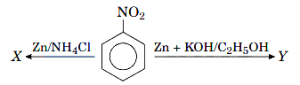
A
$X$ = Nitrosobenzene,$Y$ = Hydrazobenzene
B
$X$ = Aniline,$Y$ = Hydrazobenzene
C
$X$ = Phenylhydroxylamine,$Y$ = Hydrazobenzene
D
$X$ = Hydrazobenzene,$Y$ = Phenylhydroxylamine
Solution
(C) The reduction of nitrobenzene depends on the medium used:
$(i)$ In neutral medium,using $Zn$ dust and $NH_4Cl$ solution,nitrobenzene is reduced to phenylhydroxylamine $(C_6H_5NHOH)$. Thus,$X$ is phenylhydroxylamine.
(ii) In alkaline medium,using $Zn$ and $KOH/C_2H_5OH$,the reduction proceeds further to form hydrazobenzene $(C_6H_5NH-NHC_6H_5)$. Thus,$Y$ is hydrazobenzene.
Therefore,the correct option is $C$.
$(i)$ In neutral medium,using $Zn$ dust and $NH_4Cl$ solution,nitrobenzene is reduced to phenylhydroxylamine $(C_6H_5NHOH)$. Thus,$X$ is phenylhydroxylamine.
(ii) In alkaline medium,using $Zn$ and $KOH/C_2H_5OH$,the reduction proceeds further to form hydrazobenzene $(C_6H_5NH-NHC_6H_5)$. Thus,$Y$ is hydrazobenzene.
Therefore,the correct option is $C$.
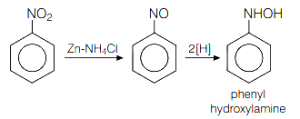
0 likesView Solution
79
ChemistryEasyMCQAP EAMCET · 2017
$\beta-D-(+)-$Glucopyranose is represented by which of the following structures?
A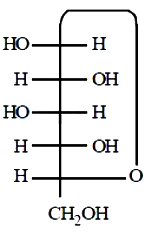
B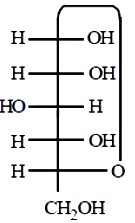
C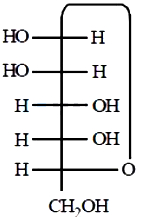
D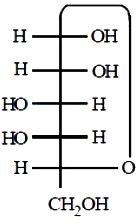
Solution
(A) The structure of $\beta-D-(+)-$glucopyranose in its Haworth or cyclic form is characterized by the orientation of the hydroxyl group at the anomeric carbon $(C_1)$.
In the $\beta$-anomer,the $-OH$ group at $C_1$ is on the same side as the $-CH_2OH$ group (upwards in the Haworth projection,or in the same relative configuration in the Fischer-like cyclic projection).
Specifically,for $D$-glucose,the configuration at $C_2, C_3, C_4,$ and $C_5$ follows the standard $D$-glucose pattern.
Comparing the given options,structure $A$ represents $\beta-D-(+)-$glucopyranose where the $-OH$ group at the anomeric carbon is oriented such that it corresponds to the $\beta$-configuration.
In the $\beta$-anomer,the $-OH$ group at $C_1$ is on the same side as the $-CH_2OH$ group (upwards in the Haworth projection,or in the same relative configuration in the Fischer-like cyclic projection).
Specifically,for $D$-glucose,the configuration at $C_2, C_3, C_4,$ and $C_5$ follows the standard $D$-glucose pattern.
Comparing the given options,structure $A$ represents $\beta-D-(+)-$glucopyranose where the $-OH$ group at the anomeric carbon is oriented such that it corresponds to the $\beta$-configuration.
0 likesView Solution
80
ChemistryEasyMCQAP EAMCET · 2017
Which one of the following ions participates in the production of $ATP$ from the oxidation of glucose?
A
$Na^{+}$
B
$Co^{2+}$
C
$Fe^{3+}$
D
$K^{+}$
Solution
(C) The production of $ATP$ during the oxidation of glucose occurs primarily through the electron transport chain $(ETC)$ in the mitochondria.
$Fe^{3+}$ ions are essential components of cytochromes,which are heme-containing proteins that act as electron carriers in the $ETC$.
These cytochromes undergo reversible oxidation and reduction,specifically involving the transition between $Fe^{2+}$ and $Fe^{3+}$ states,to facilitate the transfer of electrons and the subsequent generation of the proton gradient required for $ATP$ synthesis.
$Fe^{3+}$ ions are essential components of cytochromes,which are heme-containing proteins that act as electron carriers in the $ETC$.
These cytochromes undergo reversible oxidation and reduction,specifically involving the transition between $Fe^{2+}$ and $Fe^{3+}$ states,to facilitate the transfer of electrons and the subsequent generation of the proton gradient required for $ATP$ synthesis.
0 likesView Solution
81
ChemistryEasyMCQAP EAMCET · 2017
The general formula of an $\alpha$-amino acid is shown below. Identify the side chain $-R$ for the amino acid serine.
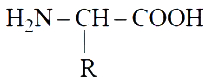
A
$-CH_2SH$
B
$-CH_2OH$
C
$-CH(OH)CH_3$
D
$-CH_2CONH_2$
Solution
(B) The general formula of an $\alpha$-amino acid is $H_2N-CH(R)-COOH$.
For the amino acid serine,the side chain $-R$ is a hydroxymethyl group,which is represented as $-CH_2OH$.
Therefore,the correct option is $B$.
For the amino acid serine,the side chain $-R$ is a hydroxymethyl group,which is represented as $-CH_2OH$.
Therefore,the correct option is $B$.
0 likesView Solution
82
ChemistryEasyMCQAP EAMCET · 2017
Which of the following statements are correct?
a) In maltose,$C-1$ of one $\alpha-D$-glucose is linked to $C-4$ of second $\alpha-D$-glucose.
b) Quaternary structure of protein represents spatial arrangement of two or more polypeptide chains with respect to each other.
c) Nucleotide units in a nucleic acid are joined to each other through a phosphodiester linkage.
d) Abnormally low level of thyroxine leads to hypothyroidism.
a) In maltose,$C-1$ of one $\alpha-D$-glucose is linked to $C-4$ of second $\alpha-D$-glucose.
b) Quaternary structure of protein represents spatial arrangement of two or more polypeptide chains with respect to each other.
c) Nucleotide units in a nucleic acid are joined to each other through a phosphodiester linkage.
d) Abnormally low level of thyroxine leads to hypothyroidism.
A
$a, b, c$
B
$a, b, c, d$
C
$b, c$
D
$a, c, d$
Solution
(B) Statement $a$ is correct: Maltose is a disaccharide formed by two $\alpha-D$-glucose units linked by an $\alpha(1 \rightarrow 4)$ glycosidic bond.
Statement $b$ is correct: The quaternary structure describes the spatial arrangement and interaction of multiple polypeptide subunits in a protein.
Statement $c$ is correct: Nucleotides in $DNA$ and $RNA$ are linked by $3'-5'$ phosphodiester bonds.
Statement $d$ is correct: $A$ deficiency in thyroxine hormone production results in hypothyroidism.
Therefore,all statements $a, b, c,$ and $d$ are correct.
Statement $b$ is correct: The quaternary structure describes the spatial arrangement and interaction of multiple polypeptide subunits in a protein.
Statement $c$ is correct: Nucleotides in $DNA$ and $RNA$ are linked by $3'-5'$ phosphodiester bonds.
Statement $d$ is correct: $A$ deficiency in thyroxine hormone production results in hypothyroidism.
Therefore,all statements $a, b, c,$ and $d$ are correct.
0 likesView Solution
83
ChemistryEasyMCQAP EAMCET · 2017
Identify the statement which is not correct from the following.
$(i)$ Carbohydrates are stored as glycogen in animals.
$(ii)$ In glycylalanine,the carbonyl group of peptide bond belongs to alanine.
$(iii)$ Base - sugar - phosphate unit is known as nucleoside.
$(iv)$ Obesity is due to hypothyroidism.
The correct answer is
$(i)$ Carbohydrates are stored as glycogen in animals.
$(ii)$ In glycylalanine,the carbonyl group of peptide bond belongs to alanine.
$(iii)$ Base - sugar - phosphate unit is known as nucleoside.
$(iv)$ Obesity is due to hypothyroidism.
The correct answer is
A
$i, iv$
B
$ii, iii, iv$
C
$i, iii, iv$
D
$ii, iii$
Solution
(D) Statement $(i)$ is correct: Carbohydrates are stored as glycogen in animals.
Statement $(ii)$ is incorrect: In glycylalanine,the peptide bond is formed between the carboxyl group of glycine and the amino group of alanine. Therefore,the carbonyl group $(C=O)$ of the peptide bond belongs to glycine,not alanine.
Statement $(iii)$ is incorrect: $A$ unit consisting of a nitrogenous base,a sugar,and a phosphate group is known as a nucleotide. $A$ nucleoside consists only of a base and a sugar.
Statement $(iv)$ is correct: Obesity can be a symptom of hypothyroidism due to a slowed metabolic rate.
Thus,statements $(ii)$ and $(iii)$ are incorrect.
Statement $(ii)$ is incorrect: In glycylalanine,the peptide bond is formed between the carboxyl group of glycine and the amino group of alanine. Therefore,the carbonyl group $(C=O)$ of the peptide bond belongs to glycine,not alanine.
Statement $(iii)$ is incorrect: $A$ unit consisting of a nitrogenous base,a sugar,and a phosphate group is known as a nucleotide. $A$ nucleoside consists only of a base and a sugar.
Statement $(iv)$ is correct: Obesity can be a symptom of hypothyroidism due to a slowed metabolic rate.
Thus,statements $(ii)$ and $(iii)$ are incorrect.
0 likesView Solution
84
ChemistryEasyMCQAP EAMCET · 2017
Match the following:
The correct matching is:
| List-$I$ | List-$II$ |
|---|---|
| $b$. Vitamin $E$ | $i$. Meat |
| $c$. Vitamin $K$ | $ii$. Sunflower oil |
| $d$. Vitamin $B_{12}$ | $iii$. Egg white |
| $e$. Vitamin $B_2$ | $iv$. Exposure to sunlight |
| $v$. Green leafy vegetables |
The correct matching is:
A
$b-ii, c-v, d-i, e-iii$
B
$b-ii, c-v, d-iii, e-i$
C
$b-v, c-ii, d-i, e-iii$
D
$b-ii, c-v, d-iv, e-i$
Solution
(A) The correct matches are as follows:
$b$. Vitamin $E$ is found in $ii$. Sunflower oil.
$c$. Vitamin $K$ is found in $v$. Green leafy vegetables.
$d$. Vitamin $B_{12}$ is found in $i$. Meat.
$e$. Vitamin $B_2$ is found in $iii$. Egg white.
Thus,the correct sequence is $b-ii, c-v, d-i, e-iii$.
$b$. Vitamin $E$ is found in $ii$. Sunflower oil.
$c$. Vitamin $K$ is found in $v$. Green leafy vegetables.
$d$. Vitamin $B_{12}$ is found in $i$. Meat.
$e$. Vitamin $B_2$ is found in $iii$. Egg white.
Thus,the correct sequence is $b-ii, c-v, d-i, e-iii$.
0 likesView Solution
85
ChemistryEasyMCQAP EAMCET · 2017
Which of the following statements are correct?
$a$. Deficiency of vitamin $K$ results in increased blood clotting time.
$b$. The sources of vitamin $B_2$ are milk and liver.
$c$. Hexapeptide has six peptide bonds.
$d$. Improper functioning of adrenal cortex results in hypoglycemia.
$a$. Deficiency of vitamin $K$ results in increased blood clotting time.
$b$. The sources of vitamin $B_2$ are milk and liver.
$c$. Hexapeptide has six peptide bonds.
$d$. Improper functioning of adrenal cortex results in hypoglycemia.
A
$b, c$
B
$a, c$
C
$b, d$
D
$a, b, d$
Solution
(D) . Vitamin $K$ is essential for the synthesis of prothrombin,which is required for blood clotting. Its deficiency leads to an increase in blood clotting time. This statement is correct.
$b$. Milk and liver are rich sources of vitamin $B_2$ (riboflavin). This statement is correct.
$c$. $A$ hexapeptide consists of $6$ amino acids linked by $5$ peptide bonds,not $6$. This statement is incorrect.
$d$. The adrenal cortex produces hormones like cortisol. Improper functioning (hypoadrenalism) can lead to hypoglycemia. This statement is correct.
Therefore,statements $a, b,$ and $d$ are correct.
$b$. Milk and liver are rich sources of vitamin $B_2$ (riboflavin). This statement is correct.
$c$. $A$ hexapeptide consists of $6$ amino acids linked by $5$ peptide bonds,not $6$. This statement is incorrect.
$d$. The adrenal cortex produces hormones like cortisol. Improper functioning (hypoadrenalism) can lead to hypoglycemia. This statement is correct.
Therefore,statements $a, b,$ and $d$ are correct.
0 likesView Solution
86
ChemistryMediumMCQAP EAMCET · 2017
The $C-Cl$ bond lengths (in $pm$) in haloarene and haloalkane are respectively:
A
$169, 177$
B
$177, 169$
C
$195, 187$
D
$197, 185$
Solution
(A) In haloarenes, the $C-Cl$ bond acquires partial double bond character due to resonance between the lone pair of electrons on the chlorine atom and the $\pi$-electron system of the benzene ring.
This partial double bond character results in a shorter bond length compared to the pure single $C-Cl$ bond found in haloalkanes.
The bond length of $C-Cl$ in chlorobenzene (haloarene) is approximately $169 \ pm$, while in chloromethane (haloalkane) it is approximately $177 \ pm$.
Therefore, the correct order is $169 \ pm$ and $177 \ pm$.
This partial double bond character results in a shorter bond length compared to the pure single $C-Cl$ bond found in haloalkanes.
The bond length of $C-Cl$ in chlorobenzene (haloarene) is approximately $169 \ pm$, while in chloromethane (haloalkane) it is approximately $177 \ pm$.
Therefore, the correct order is $169 \ pm$ and $177 \ pm$.
0 likesView Solution
87
ChemistryDifficultMCQAP EAMCET · 2017
What is the concentration (in $mol \ L^{-1}$) of the product $B$ after $20 \ s$ in the following reaction? Given that $A \longrightarrow 3B$,rate $= k[A]^0$. The data is provided in the table below:
| Time $(s)$ | Concentration of reactant $A$ $(mol \ L^{-1})$ |
| :--- | :--- |
| $0$ | $0.1$ |
| $15$ | $0.05$ |
| $20$ | $0.1 - x$ |
| Time $(s)$ | Concentration of reactant $A$ $(mol \ L^{-1})$ |
| :--- | :--- |
| $0$ | $0.1$ |
| $15$ | $0.05$ |
| $20$ | $0.1 - x$ |
A
$6.6 \times 10^{-2}$
B
$1.32 \times 10^{-1}$
C
$1.98 \times 10^{-1}$
D
$2.2 \times 10^{-2}$
Solution
(C) For a zero-order reaction,$A \longrightarrow 3B$,the rate law is $[A] = [A]_0 - kt$.
From the table,at $t = 15 \ s$,$[A] = 0.05 \ mol \ L^{-1}$ and $[A]_0 = 0.1 \ mol \ L^{-1}$.
Substituting these values: $0.05 = 0.1 - k(15) \implies 15k = 0.05 \implies k = \frac{0.05}{15} = \frac{1}{300} \ mol \ L^{-1} \ s^{-1}$.
Now,at $t = 20 \ s$,the concentration of $A$ is $[A] = [A]_0 - kt = 0.1 - (\frac{1}{300}) \times 20 = 0.1 - \frac{20}{300} = 0.1 - 0.0667 = 0.0333 \ mol \ L^{-1}$.
The amount of $A$ reacted is $\Delta[A] = [A]_0 - [A] = 0.1 - 0.0333 = 0.0667 \ mol \ L^{-1}$.
According to the stoichiometry $A \longrightarrow 3B$,the concentration of product $B$ formed is $3 \times \Delta[A] = 3 \times 0.0667 = 0.2001 \ mol \ L^{-1}$.
Rounding to the nearest option,we get $0.198 \ mol \ L^{-1}$ or $1.98 \times 10^{-1} \ mol \ L^{-1}$.
From the table,at $t = 15 \ s$,$[A] = 0.05 \ mol \ L^{-1}$ and $[A]_0 = 0.1 \ mol \ L^{-1}$.
Substituting these values: $0.05 = 0.1 - k(15) \implies 15k = 0.05 \implies k = \frac{0.05}{15} = \frac{1}{300} \ mol \ L^{-1} \ s^{-1}$.
Now,at $t = 20 \ s$,the concentration of $A$ is $[A] = [A]_0 - kt = 0.1 - (\frac{1}{300}) \times 20 = 0.1 - \frac{20}{300} = 0.1 - 0.0667 = 0.0333 \ mol \ L^{-1}$.
The amount of $A$ reacted is $\Delta[A] = [A]_0 - [A] = 0.1 - 0.0333 = 0.0667 \ mol \ L^{-1}$.
According to the stoichiometry $A \longrightarrow 3B$,the concentration of product $B$ formed is $3 \times \Delta[A] = 3 \times 0.0667 = 0.2001 \ mol \ L^{-1}$.
Rounding to the nearest option,we get $0.198 \ mol \ L^{-1}$ or $1.98 \times 10^{-1} \ mol \ L^{-1}$.
0 likesView Solution
88
ChemistryDifficultMCQAP EAMCET · 2017
For the reaction $A \longrightarrow 3 B$,the rate is given by $rate = k[A]^0$. Based on the data provided in the table,what is the concentration of the product $B$ (in $mol \ L^{-1}$) after $20 \ s$?
| Time $(s)$ | Concentration of the reactant $(mol \ L^{-1})$ |
| $0$ | $0.1$ |
| $15$ | $0.05$ |
| $20$ | $0.1 - x$ |
A
$6.6 \times 10^{-2}$
B
$1.32 \times 10^{-1}$
C
$1.98 \times 10^{-1}$
D
$2.2 \times 10^{-2}$
Solution
(C) For a zero-order reaction $A \longrightarrow 3 B$,the rate law is $[A] = [A_0] - kt$.
From the table,at $t = 0$,$[A_0] = 0.1 \ mol \ L^{-1}$.
At $t = 15 \ s$,$[A] = 0.05 \ mol \ L^{-1}$.
Substituting these values: $0.05 = 0.1 - k(15)$,which gives $k = 0.05 / 15 = 1/300 \ mol \ L^{-1} \ s^{-1}$.
At $t = 20 \ s$,the concentration of $A$ remaining is $[A] = 0.1 - (1/300) \times 20 = 0.1 - 0.0667 = 0.0333 \ mol \ L^{-1}$.
The amount of $A$ reacted is $0.1 - 0.0333 = 0.0667 \ mol \ L^{-1}$.
According to the stoichiometry,$1 \ mol$ of $A$ produces $3 \ mol$ of $B$.
Therefore,concentration of $B = 3 \times 0.0667 = 0.2001 \ mol \ L^{-1} \approx 1.98 \times 10^{-1} \ mol \ L^{-1}$.
From the table,at $t = 0$,$[A_0] = 0.1 \ mol \ L^{-1}$.
At $t = 15 \ s$,$[A] = 0.05 \ mol \ L^{-1}$.
Substituting these values: $0.05 = 0.1 - k(15)$,which gives $k = 0.05 / 15 = 1/300 \ mol \ L^{-1} \ s^{-1}$.
At $t = 20 \ s$,the concentration of $A$ remaining is $[A] = 0.1 - (1/300) \times 20 = 0.1 - 0.0667 = 0.0333 \ mol \ L^{-1}$.
The amount of $A$ reacted is $0.1 - 0.0333 = 0.0667 \ mol \ L^{-1}$.
According to the stoichiometry,$1 \ mol$ of $A$ produces $3 \ mol$ of $B$.
Therefore,concentration of $B = 3 \times 0.0667 = 0.2001 \ mol \ L^{-1} \approx 1.98 \times 10^{-1} \ mol \ L^{-1}$.
0 likesView Solution
89
ChemistryEasyMCQAP EAMCET · 2017
The rate constant,$k$ of a zero order reaction $2 NH_{3(g)} \xrightarrow[1130 \ K]{Pt} N_{2(g)} + 3 H_{2(g)}$ is $y \times 10^{-4} \ mol \ L^{-1} \ s^{-1}$. The rate of formation of hydrogen (in $mol \ L^{-1} \ s^{-1}$) is
A
$y \times 10^{-4}$
B
$2 y \times 10^{-4}$
C
$3 y \times 10^{-4}$
D
$\frac{y}{3} \times 10^{-4}$
Solution
(C) For a zero order reaction,the rate of reaction $r$ is equal to the rate constant $k$.
Given $r = k = y \times 10^{-4} \ mol \ L^{-1} \ s^{-1}$.
The stoichiometric equation is $2 NH_{3(g)} \rightarrow N_{2(g)} + 3 H_{2(g)}$.
The rate of reaction is expressed as $r = -\frac{1}{2} \frac{d[NH_3]}{dt} = \frac{d[N_2]}{dt} = \frac{1}{3} \frac{d[H_2]}{dt}$.
Therefore,the rate of formation of hydrogen is $\frac{d[H_2]}{dt} = 3 \times r$.
Substituting the value of $r$,we get $\frac{d[H_2]}{dt} = 3 \times (y \times 10^{-4}) = 3y \times 10^{-4} \ mol \ L^{-1} \ s^{-1}$.
Given $r = k = y \times 10^{-4} \ mol \ L^{-1} \ s^{-1}$.
The stoichiometric equation is $2 NH_{3(g)} \rightarrow N_{2(g)} + 3 H_{2(g)}$.
The rate of reaction is expressed as $r = -\frac{1}{2} \frac{d[NH_3]}{dt} = \frac{d[N_2]}{dt} = \frac{1}{3} \frac{d[H_2]}{dt}$.
Therefore,the rate of formation of hydrogen is $\frac{d[H_2]}{dt} = 3 \times r$.
Substituting the value of $r$,we get $\frac{d[H_2]}{dt} = 3 \times (y \times 10^{-4}) = 3y \times 10^{-4} \ mol \ L^{-1} \ s^{-1}$.
0 likesView Solution
90
ChemistryEasyMCQAP EAMCET · 2017
Consider a gas phase reaction which occurs in a closed vessel: $2 \ A \rightarrow 4 \ B + C$. The concentration of $B$ is found to be increased by $5 \times 10^{-3} \ mol \ L^{-1}$ in $10 \ s$. The rate of disappearance of $A$ (in $mol \ L^{-1} \ s^{-1}$) is:
A
$4.75 \times 10^{-4}$
B
$7.5 \times 10^{-4}$
C
$1.25 \times 10^{-4}$
D
$2.5 \times 10^{-4}$
Solution
(D) For the reaction $2 \ A \rightarrow 4 \ B + C$,the rate expression is given by: $-\frac{1}{2} \frac{d[A]}{dt} = \frac{1}{4} \frac{d[B]}{dt}$.
We need to find the rate of disappearance of $A$,which is $-\frac{d[A]}{dt}$.
From the expression: $-\frac{d[A]}{dt} = \frac{2}{4} \frac{d[B]}{dt} = \frac{1}{2} \frac{d[B]}{dt}$.
Given $\frac{\Delta [B]}{\Delta t} = \frac{5 \times 10^{-3} \ mol \ L^{-1}}{10 \ s} = 5 \times 10^{-4} \ mol \ L^{-1} \ s^{-1}$.
Therefore,$-\frac{d[A]}{dt} = \frac{1}{2} \times (5 \times 10^{-4} \ mol \ L^{-1} \ s^{-1}) = 2.5 \times 10^{-4} \ mol \ L^{-1} \ s^{-1}$.
We need to find the rate of disappearance of $A$,which is $-\frac{d[A]}{dt}$.
From the expression: $-\frac{d[A]}{dt} = \frac{2}{4} \frac{d[B]}{dt} = \frac{1}{2} \frac{d[B]}{dt}$.
Given $\frac{\Delta [B]}{\Delta t} = \frac{5 \times 10^{-3} \ mol \ L^{-1}}{10 \ s} = 5 \times 10^{-4} \ mol \ L^{-1} \ s^{-1}$.
Therefore,$-\frac{d[A]}{dt} = \frac{1}{2} \times (5 \times 10^{-4} \ mol \ L^{-1} \ s^{-1}) = 2.5 \times 10^{-4} \ mol \ L^{-1} \ s^{-1}$.
0 likesView Solution
91
ChemistryEasyMCQAP EAMCET · 2017
The rate constant of a first order reaction is $3.46 \times 10^{-2} \ s^{-1}$ at $298 \ K$. What is the rate constant of the reaction at $350 \ K$ if its activation energy is $50.1 \ kJ \ mol^{-1}$ (in $s^{-1}$)? $(R = 8.314 \ J \ K^{-1} \ mol^{-1})$
$(\log 2 = 0.3010)$
$(\log 2 = 0.3010)$
A
$0.592$
B
$0.692$
C
$0.792$
D
$0.892$
Solution
(B) Given: $K_1 = 3.46 \times 10^{-2} \ s^{-1}$,$T_1 = 298 \ K$,$T_2 = 350 \ K$,$E_a = 50.1 \ kJ \ mol^{-1} = 50100 \ J \ mol^{-1}$,$R = 8.314 \ J \ K^{-1} \ mol^{-1}$.
Using the Arrhenius equation: $\log \frac{K_2}{K_1} = \frac{E_a}{2.303 R} \left[ \frac{T_2 - T_1}{T_1 T_2} \right]$.
Substituting the values:
$\log \frac{K_2}{3.46 \times 10^{-2}} = \frac{50100}{2.303 \times 8.314} \left[ \frac{350 - 298}{298 \times 350} \right]$.
$\log \frac{K_2}{3.46 \times 10^{-2}} = \frac{50100}{19.147} \times \left[ \frac{52}{104300} \right]$.
$\log \frac{K_2}{3.46 \times 10^{-2}} = 2616.59 \times 0.0004985 \approx 1.304$.
$\frac{K_2}{3.46 \times 10^{-2}} = 10^{1.304} \approx 20.14$.
$K_2 = 20.14 \times 3.46 \times 10^{-2} \approx 0.696 \ s^{-1}$.
The closest option is $0.692 \ s^{-1}$.
Using the Arrhenius equation: $\log \frac{K_2}{K_1} = \frac{E_a}{2.303 R} \left[ \frac{T_2 - T_1}{T_1 T_2} \right]$.
Substituting the values:
$\log \frac{K_2}{3.46 \times 10^{-2}} = \frac{50100}{2.303 \times 8.314} \left[ \frac{350 - 298}{298 \times 350} \right]$.
$\log \frac{K_2}{3.46 \times 10^{-2}} = \frac{50100}{19.147} \times \left[ \frac{52}{104300} \right]$.
$\log \frac{K_2}{3.46 \times 10^{-2}} = 2616.59 \times 0.0004985 \approx 1.304$.
$\frac{K_2}{3.46 \times 10^{-2}} = 10^{1.304} \approx 20.14$.
$K_2 = 20.14 \times 3.46 \times 10^{-2} \approx 0.696 \ s^{-1}$.
The closest option is $0.692 \ s^{-1}$.
0 likesView Solution
92
ChemistryEasyMCQAP EAMCET · 2017
Which of the following is an antihistamine?
A
Chlordiazepoxide
B
Chloramphenicol
C
Terfenadine
D
Serotonin
Solution
(C) The structures provided correspond to the following drugs:
$A$: Chlordiazepoxide (a tranquilizer)
$B$: Chloramphenicol (an antibiotic)
$C$: Terfenadine (an antihistamine)
$D$: Serotonin (a neurotransmitter)
Therefore,the correct answer is $C$.
$A$: Chlordiazepoxide (a tranquilizer)
$B$: Chloramphenicol (an antibiotic)
$C$: Terfenadine (an antihistamine)
$D$: Serotonin (a neurotransmitter)
Therefore,the correct answer is $C$.
0 likesView Solution
93
ChemistryEasyMCQAP EAMCET · 2017
Identify a bacteriostatic $(A)$ and bacteriocidal $(B)$ antibiotic from the following:
A
| $A$ | $B$ |
| $\text{Erythromycin}$ | $\text{Chloramphenicol}$ |
B
| $A$ | $B$ |
| $\text{Ofloxacin}$ | $\text{Tetracycline}$ |
C
| $A$ | $B$ |
| $\text{Chloramphenicol}$ | $\text{Norethindrone}$ |
D
| $A$ | $B$ |
| $\text{Tetracycline}$ | $\text{Ofloxacin}$ |
Solution
(D) Bacteriostatic antibiotics are those that inhibit the growth of organisms. Examples include $\text{Tetracycline}$,$\text{Chloramphenicol}$,and $\text{Erythromycin}$.
Bactericidal antibiotics are those that have a killing effect on organisms. Examples include $\text{Penicillin}$,$\text{Aminoglycosides}$,and $\text{Ofloxacin}$.
Therefore,$A$ is $\text{Tetracycline}$ and $B$ is $\text{Ofloxacin}$.
Bactericidal antibiotics are those that have a killing effect on organisms. Examples include $\text{Penicillin}$,$\text{Aminoglycosides}$,and $\text{Ofloxacin}$.
Therefore,$A$ is $\text{Tetracycline}$ and $B$ is $\text{Ofloxacin}$.
0 likesView Solution
94
ChemistryEasyMCQAP EAMCET · 2017
The $-As=As-$ linkage is present in which of the following medicines?
A
Prontosil
B
Sulphapyridine
C
Salvarsan
D
Serotonin
Solution
(C) The medicine $Salvarsan$ contains the $-As=As-$ linkage.
It was the first effective treatment discovered for syphilis.
$Paul \ Ehrlich$ developed this drug,which is an arsenic-based compound.
It was the first effective treatment discovered for syphilis.
$Paul \ Ehrlich$ developed this drug,which is an arsenic-based compound.
0 likesView Solution
95
ChemistryEasyMCQAP EAMCET · 2017
$Cimetidine$ among the following is
A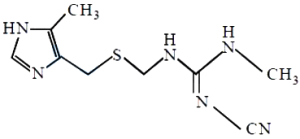
B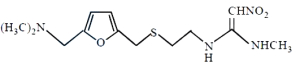
C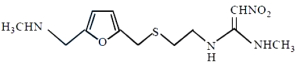
D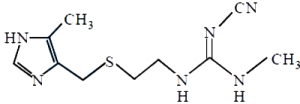
Solution
(D) $Cimetidine$ is an $H_2$-receptor antagonist used to treat stomach ulcers and acid reflux. Its chemical structure consists of an imidazole ring attached to a thioether chain,which is linked to a cyanoguanidine group. Comparing the given structures,option $D$ represents the correct chemical structure of $Cimetidine$.
0 likesView Solution
96
ChemistryEasyMCQAP EAMCET · 2017
Consider the following structure. For codeine,$R$ stands for:
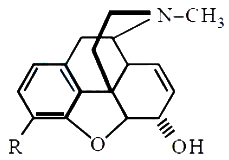
A
$-OAc$
B
$-OCH_3$
C
$-OH$
D
$-NH_2$
Solution
(B) The structure provided is the morphine skeleton.
In morphine,the substituent at the $R$ position is a hydroxyl group $(-OH)$.
In codeine,which is the methyl ether of morphine,the hydroxyl group at the $R$ position is replaced by a methoxy group $(-OCH_3)$.
Therefore,for codeine,$R$ stands for $-OCH_3$.
In morphine,the substituent at the $R$ position is a hydroxyl group $(-OH)$.
In codeine,which is the methyl ether of morphine,the hydroxyl group at the $R$ position is replaced by a methoxy group $(-OCH_3)$.
Therefore,for codeine,$R$ stands for $-OCH_3$.
0 likesView Solution
97
ChemistryEasyMCQAP EAMCET · 2017
Which of the following statements are not correct?
$a$) Antihistamine also functions as an antacid
$b$) The shape of an active site of an enzyme does not change when the drug binds to an allosteric site
$c$) Chemical messengers communicate the message between two neurons
$d$) Potassium soaps are hard,while sodium soaps are soft to skin
The correct answer is
$a$) Antihistamine also functions as an antacid
$b$) The shape of an active site of an enzyme does not change when the drug binds to an allosteric site
$c$) Chemical messengers communicate the message between two neurons
$d$) Potassium soaps are hard,while sodium soaps are soft to skin
The correct answer is
A
$a, b, d$
B
$b, c, d$
C
$a, c$
D
$c, d$
Solution
(A) ) Incorrect: Antihistamines (like cimetidine) are used to treat acidity,but they are distinct from antacids (like $Mg(OH)_2$). However,some antihistamines are specifically designed to inhibit acid secretion. The statement is generally considered incorrect in the context of drug classification.
$b$) Incorrect: When a drug binds to an allosteric site,it changes the shape of the active site,preventing the substrate from binding.
$c$) Correct: Chemical messengers are chemicals that transmit signals between neurons or between neurons and muscles.
$d$) Incorrect: Sodium soaps are hard,while potassium soaps are soft and used in shaving creams and shampoos.
Therefore,statements $a, b,$ and $d$ are incorrect.
$b$) Incorrect: When a drug binds to an allosteric site,it changes the shape of the active site,preventing the substrate from binding.
$c$) Correct: Chemical messengers are chemicals that transmit signals between neurons or between neurons and muscles.
$d$) Incorrect: Sodium soaps are hard,while potassium soaps are soft and used in shaving creams and shampoos.
Therefore,statements $a, b,$ and $d$ are incorrect.
0 likesView Solution
98
ChemistryEasyMCQAP EAMCET · 2017
The drug,which was designed to prevent the interaction of histamine with the receptors present in the stomach wall,is
A
prontosil
B
cimetidine
C
aspartame
D
equanil
Solution
(B) Cimetidine is a drug designed to prevent the interaction of histamine with the receptors present in the stomach wall. It acts as an $H_2$-receptor antagonist,reducing the production of stomach acid. The structure of cimetidine is shown in the image.
0 likesView Solution
99
ChemistryEasyMCQAP EAMCET · 2017
Which of the following structures represents the compound generally added to soaps to impart antiseptic properties?
A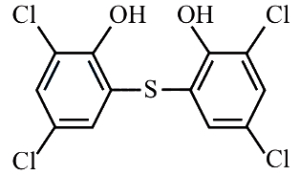
B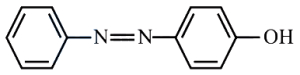
C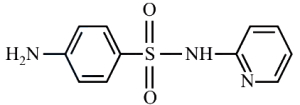
D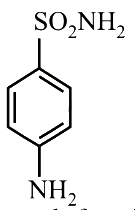
Solution
(A) Bithionol is added to soaps to impart antiseptic properties. Its structure consists of two $2,4$-dichlorophenol units connected by a sulfur bridge. This compound helps in reducing the odor produced by bacterial decomposition of organic matter on the skin.
0 likesView Solution
100
ChemistryEasyMCQAP EAMCET · 2017
Identify an artificial sweetener $(A)$ and tranquilizer $(B)$ from the following.
A
$A$: Saccharin,$B$: Meprobamate
B
$A$: Sulphanilamide,$B$: Iproniazid
C
$A$: Iproniazid,$B$: Sulphanilamide
D
$A$: Meprobamate,$B$: Saccharin
Solution
(A) The structure shown in option $A$ represents:
$A$: Saccharin (an artificial sweetener).
$B$: Meprobamate (a tranquilizer).
Saccharin is a well-known artificial sweetener,and Meprobamate is a mild tranquilizer used for relieving stress and tension.
$A$: Saccharin (an artificial sweetener).
$B$: Meprobamate (a tranquilizer).
Saccharin is a well-known artificial sweetener,and Meprobamate is a mild tranquilizer used for relieving stress and tension.
0 likesView Solution
Vedclass Products
For Students
Vedclass Test Series
Mock tests in real AP EAMCET style covering Chemistry with performance analysis. 5-day free trial.
Start Free TrialFor Teachers
Exam Paper Generator
Generate Set A/B/C/D Chemistry papers from 7.5L+ questions in 2 minutes. 3 chapters free.
Try FreeFor Institutes
Online Exam Module
Run live AP EAMCET mock exams with unlimited students, 360° analytics & white-label branding.
See DemoFrequently Asked Questions
How many Chemistry questions are in AP EAMCET 2017?
There are 292 Chemistry questions from the AP EAMCET 2017 paper on Vedclass, each with a detailed step-by-step solution in English.
Are AP EAMCET 2017 Chemistry solutions available in English?
Yes. All solutions on this page are in English. You can also switch to English or Hindi using the language buttons above the questions.
Can I practice AP EAMCET 2017 Chemistry as a timed test?
Yes. Use the Vedclass Test Series to attempt a full AP EAMCET mock test covering Chemistry with time limits and instant score analysis.
Can teachers create Chemistry papers from AP EAMCET previous year questions?
Yes. The Vedclass Exam Paper Generator lets teachers mix AP EAMCET Chemistry questions and generate Set A/B/C/D papers in minutes.
For Teachers & Institutes
Build a Custom Chemistry Paper
Pick AP EAMCET 2017 Chemistry questions, set difficulty, and generate Set A/B/C/D in 2 minutes.