
MathematicsQ51–150 of 482 questions
Page 2 of 6 · Gujarati
51
MathematicsDifficultMCQAP EAMCET · 2017
જો $\alpha$ એ સમીકરણ $x^6-1=0$ નું વાસ્તવિક ન હોય તેવું બીજ હોય,તો $\frac{\alpha^2+\alpha^3+\alpha^4+\alpha^5}{\alpha+1} = $
A
$\alpha$
B
$1$
C
$0$
D
$-1$
Solution
(D) આપેલ સમીકરણ $x^6-1=0$ છે,જેનો અર્થ છે કે $x^6=1$.
$\alpha$ એ બીજ હોવાથી,$\alpha^6=1$.
વળી,$\alpha \neq 1$ કારણ કે $\alpha$ એ વાસ્તવિક નથી.
અંશને $\alpha^2(1+\alpha+\alpha^2+\alpha^3)$ તરીકે લખી શકાય.
$\alpha^6-1 = (\alpha-1)(\alpha^5+\alpha^4+\alpha^3+\alpha^2+\alpha+1) = 0$ અને $\alpha \neq 1$ હોવાથી,$\alpha^5+\alpha^4+\alpha^3+\alpha^2+\alpha+1 = 0$ થાય.
આથી $\alpha^5+\alpha^4+\alpha^3+\alpha^2 = -(\alpha+1)$.
આ કિંમત મૂકતા: $\frac{-(\alpha+1)}{\alpha+1} = -1$.
$\alpha$ એ બીજ હોવાથી,$\alpha^6=1$.
વળી,$\alpha \neq 1$ કારણ કે $\alpha$ એ વાસ્તવિક નથી.
અંશને $\alpha^2(1+\alpha+\alpha^2+\alpha^3)$ તરીકે લખી શકાય.
$\alpha^6-1 = (\alpha-1)(\alpha^5+\alpha^4+\alpha^3+\alpha^2+\alpha+1) = 0$ અને $\alpha \neq 1$ હોવાથી,$\alpha^5+\alpha^4+\alpha^3+\alpha^2+\alpha+1 = 0$ થાય.
આથી $\alpha^5+\alpha^4+\alpha^3+\alpha^2 = -(\alpha+1)$.
આ કિંમત મૂકતા: $\frac{-(\alpha+1)}{\alpha+1} = -1$.
0 likesView Solution
52
MathematicsDifficultMCQAP EAMCET · 2017
જો $z=x+iy$ અને જો આર્ગેન્ડ સમતલમાં બિંદુ $P$ એ $z$ ને દર્શાવતું હોય,તો સમીકરણ $|z-3i|+|z+3i|=10$ નું સમાધાન કરતા $P$ નો બિંદુપથ શું છે?
A
કેન્દ્ર $(-3,3)$ વાળું વર્તુળ
B
ઉત્કેન્દ્રિયતા $\frac{5}{3}$ વાળું અતિવલય
C
ઉત્કેન્દ્રિયતા $\frac{3}{5}$ વાળું ઉપવલય
D
ઉત્કેન્દ્રિયતા $\frac{4}{5}$ વાળું ઉપવલય
Solution
(C) આપેલ સમીકરણ $|z-z_1| + |z-z_2| = 2a$ સ્વરૂપનું છે,જ્યાં $z_1 = 3i$ અને $z_2 = -3i$ છે.
આ એક ઉપવલય દર્શાવે છે જેના નાભિઓ $(0, 3)$ અને $(0, -3)$ પર છે.
નાભિઓ વચ્ચેનું અંતર $2ae = |z_1 - z_2| = |3i - (-3i)| = |6i| = 6$ છે.
અહીં $2a = 10$ આપેલ છે,તેથી $a = 5$.
સંબંધ $2ae = 6$ નો ઉપયોગ કરતા,આપણને $5e = 3$ મળે છે,જેનો અર્થ છે કે $e = \frac{3}{5}$.
આમ,બિંદુપથ એ $\frac{3}{5}$ ઉત્કેન્દ્રિયતા વાળું ઉપવલય છે.
આ એક ઉપવલય દર્શાવે છે જેના નાભિઓ $(0, 3)$ અને $(0, -3)$ પર છે.
નાભિઓ વચ્ચેનું અંતર $2ae = |z_1 - z_2| = |3i - (-3i)| = |6i| = 6$ છે.
અહીં $2a = 10$ આપેલ છે,તેથી $a = 5$.
સંબંધ $2ae = 6$ નો ઉપયોગ કરતા,આપણને $5e = 3$ મળે છે,જેનો અર્થ છે કે $e = \frac{3}{5}$.
આમ,બિંદુપથ એ $\frac{3}{5}$ ઉત્કેન્દ્રિયતા વાળું ઉપવલય છે.
0 likesView Solution
53
MathematicsMediumMCQAP EAMCET · 2017
જો $\log _{\frac{1}{\sqrt{3}}}\left\{\frac{|z|^2-|z|+1}{2+|z|}\right\}>-2$ હોય,તો $z$ કોની અંદર આવે છે?
A
ત્રિકોણ
B
ઉપવલય
C
વર્તુળ
D
ચોરસ
Solution
(C) આપેલ છે કે,$\log _{\frac{1}{\sqrt{3}}}\left\{\frac{|z|^2-|z|+1}{2+|z|}\right\}>-2$.
અહીં આધાર $a = \frac{1}{\sqrt{3}}$ એ $0 < a < 1$ શરતનું પાલન કરે છે,તેથી લઘુગણક દૂર કરતી વખતે અસમતા ઉલટાય છે:
$\frac{|z|^2-|z|+1}{2+|z|} < \left(\frac{1}{\sqrt{3}}\right)^{-2}$.
જમણી બાજુનું સાદું રૂપ આપતા: $\left(\frac{1}{\sqrt{3}}\right)^{-2} = (\sqrt{3})^2 = 3$.
આમ,$\frac{|z|^2-|z|+1}{2+|z|} < 3$.
બંને બાજુ $(2+|z|)$ વડે ગુણતા (કારણ કે $|z| \ge 0$,તેથી $2+|z| > 0$):
$|z|^2-|z|+1 < 3(2+|z|)$.
$|z|^2-|z|+1 < 6+3|z|$.
$|z|^2-4|z|-5 < 0$.
અવયવ પાડતા: $(|z|-5)(|z|+1) < 0$.
કારણ કે $|z| \ge 0$,$|z|+1$ હંમેશા ધન છે,તેથી $|z|-5 < 0$ હોવું જોઈએ,જેનો અર્થ છે $|z| < 5$.
આ ઉગમબિંદુ પર કેન્દ્રિત $5$ ત્રિજ્યા ધરાવતા વર્તુળનો અંદરનો ભાગ દર્શાવે છે.
અહીં આધાર $a = \frac{1}{\sqrt{3}}$ એ $0 < a < 1$ શરતનું પાલન કરે છે,તેથી લઘુગણક દૂર કરતી વખતે અસમતા ઉલટાય છે:
$\frac{|z|^2-|z|+1}{2+|z|} < \left(\frac{1}{\sqrt{3}}\right)^{-2}$.
જમણી બાજુનું સાદું રૂપ આપતા: $\left(\frac{1}{\sqrt{3}}\right)^{-2} = (\sqrt{3})^2 = 3$.
આમ,$\frac{|z|^2-|z|+1}{2+|z|} < 3$.
બંને બાજુ $(2+|z|)$ વડે ગુણતા (કારણ કે $|z| \ge 0$,તેથી $2+|z| > 0$):
$|z|^2-|z|+1 < 3(2+|z|)$.
$|z|^2-|z|+1 < 6+3|z|$.
$|z|^2-4|z|-5 < 0$.
અવયવ પાડતા: $(|z|-5)(|z|+1) < 0$.
કારણ કે $|z| \ge 0$,$|z|+1$ હંમેશા ધન છે,તેથી $|z|-5 < 0$ હોવું જોઈએ,જેનો અર્થ છે $|z| < 5$.
આ ઉગમબિંદુ પર કેન્દ્રિત $5$ ત્રિજ્યા ધરાવતા વર્તુળનો અંદરનો ભાગ દર્શાવે છે.
0 likesView Solution
54
MathematicsMediumMCQAP EAMCET · 2017
$7$ અલગ-અલગ રંગની શીટ્સમાંથી એક સમયે એક કે તેથી વધુ શીટ્સ લઈને આપી શકાય તેવા વિવિધ સંકેતોની સંખ્યા કેટલી છે?
A
$127$
B
$5913$
C
$13699$
D
$13700$
Solution
(C) સંકેત બનાવવા માટે,આપણે એક સમયે $1, 2, 3, 4, 5, 6,$ અથવા $7$ શીટ્સ પસંદ કરી શકીએ છીએ.
સંકેતમાં શીટ્સનો ક્રમ મહત્વનો હોવાથી,આપણે ક્રમચયના સૂત્રનો ઉપયોગ કરીએ છીએ: $P(n, r) = \frac{n!}{(n-r)!}$.
કુલ સંકેતોની સંખ્યા દરેક કિસ્સા માટે ક્રમચયનો સરવાળો છે:
$S = P(7, 1) + P(7, 2) + P(7, 3) + P(7, 4) + P(7, 5) + P(7, 6) + P(7, 7)$
$S = 7 + 42 + 210 + 840 + 2520 + 5040 + 5040 = 13699$
સંકેતમાં શીટ્સનો ક્રમ મહત્વનો હોવાથી,આપણે ક્રમચયના સૂત્રનો ઉપયોગ કરીએ છીએ: $P(n, r) = \frac{n!}{(n-r)!}$.
કુલ સંકેતોની સંખ્યા દરેક કિસ્સા માટે ક્રમચયનો સરવાળો છે:
$S = P(7, 1) + P(7, 2) + P(7, 3) + P(7, 4) + P(7, 5) + P(7, 6) + P(7, 7)$
$S = 7 + 42 + 210 + 840 + 2520 + 5040 + 5040 = 13699$
0 likesView Solution
55
MathematicsDifficultMCQAP EAMCET · 2017
$1, 2, 3, 4, 5, 6, 7, 8, 9$ અંકોનો ઉપયોગ કરીને બનાવી શકાય તેવી ચાર અંકની સંખ્યાઓ જે $3$ વડે વિભાજ્ય હોય,જ્યારે અંકોનું પુનરાવર્તન ગમે તેટલી વાર કરી શકાય,તેની સંખ્યા કેટલી છે?
A
$2187$
B
$1458$
C
$6561$
D
$2916$
Solution
(A) જો કોઈ સંખ્યાના અંકોનો સરવાળો $3$ વડે વિભાજ્ય હોય,તો તે સંખ્યા $3$ વડે વિભાજ્ય હોય છે.
ધારો કે ચાર અંકની સંખ્યા $d_1 d_2 d_3 d_4$ છે.
પ્રથમ ત્રણ અંકો $(d_1, d_2, d_3)$ માટે $9$ વિકલ્પો છે,જે ${1, 2, 3, 4, 5, 6, 7, 8, 9}$ છે.
પ્રથમ ત્રણ અંકો પસંદ કરવાની કુલ રીતો $9 \times 9 \times 9 = 729$ છે.
ધારો કે પ્રથમ ત્રણ અંકોનો સરવાળો $S = d_1 + d_2 + d_3$ છે.
આખી સંખ્યા $3$ વડે વિભાજ્ય બને તે માટે,$S + d_4$ એ $3$ નો ગુણક હોવો જોઈએ.
$S$ ની કોઈપણ કિંમત માટે,આપણે $d_4 \in {1, 2, 3, 4, 5, 6, 7, 8, 9}$ માટે એવી કિંમતો શોધીએ છીએ કે જેથી $S + d_4 \equiv 0 \pmod{3}$ થાય.
જો $S \equiv 0 \pmod{3}$ હોય,તો $d_4 \in {3, 6, 9}$ ($3$ વિકલ્પો).
જો $S \equiv 1 \pmod{3}$ હોય,તો $d_4 \in {2, 5, 8}$ ($3$ વિકલ્પો).
જો $S \equiv 2 \pmod{3}$ હોય,તો $d_4 \in {1, 4, 7}$ ($3$ વિકલ્પો).
બધા કિસ્સાઓમાં,$d_4$ માટે બરાબર $3$ વિકલ્પો છે.
તેથી,આવી ચાર અંકની સંખ્યાઓની કુલ સંખ્યા $729 \times 3 = 2187$ છે.
ધારો કે ચાર અંકની સંખ્યા $d_1 d_2 d_3 d_4$ છે.
પ્રથમ ત્રણ અંકો $(d_1, d_2, d_3)$ માટે $9$ વિકલ્પો છે,જે ${1, 2, 3, 4, 5, 6, 7, 8, 9}$ છે.
પ્રથમ ત્રણ અંકો પસંદ કરવાની કુલ રીતો $9 \times 9 \times 9 = 729$ છે.
ધારો કે પ્રથમ ત્રણ અંકોનો સરવાળો $S = d_1 + d_2 + d_3$ છે.
આખી સંખ્યા $3$ વડે વિભાજ્ય બને તે માટે,$S + d_4$ એ $3$ નો ગુણક હોવો જોઈએ.
$S$ ની કોઈપણ કિંમત માટે,આપણે $d_4 \in {1, 2, 3, 4, 5, 6, 7, 8, 9}$ માટે એવી કિંમતો શોધીએ છીએ કે જેથી $S + d_4 \equiv 0 \pmod{3}$ થાય.
જો $S \equiv 0 \pmod{3}$ હોય,તો $d_4 \in {3, 6, 9}$ ($3$ વિકલ્પો).
જો $S \equiv 1 \pmod{3}$ હોય,તો $d_4 \in {2, 5, 8}$ ($3$ વિકલ્પો).
જો $S \equiv 2 \pmod{3}$ હોય,તો $d_4 \in {1, 4, 7}$ ($3$ વિકલ્પો).
બધા કિસ્સાઓમાં,$d_4$ માટે બરાબર $3$ વિકલ્પો છે.
તેથી,આવી ચાર અંકની સંખ્યાઓની કુલ સંખ્યા $729 \times 3 = 2187$ છે.
0 likesView Solution
56
MathematicsMediumMCQAP EAMCET · 2017
ચાર અંકની એવી તમામ સંખ્યાઓ કે જેમાં ચાર અલગ-અલગ અંકો ન હોય,તેની સંખ્યા કેટલી છે?
A
$4464$
B
$4848$
C
$4355$
D
$4454$
Solution
(A) ચાર અંકની કુલ સંખ્યાઓ $9 \times 10 \times 10 \times 10 = 9000$ છે.
ચાર અંકની એવી સંખ્યાઓ કે જેમાં ચાર અલગ-અલગ અંકો ન હોય તે શોધવા માટે,આપણે કુલ સંખ્યામાંથી ચાર અલગ-અલગ અંકો ધરાવતી સંખ્યાઓ બાદ કરીશું.
ચાર અલગ-અલગ અંકો ધરાવતી ચાર અંકની સંખ્યાઓ નીચે મુજબ ગણવામાં આવે છે:
પ્રથમ અંક (હજારનું સ્થાન) $1$ થી $9$ સુધીનો કોઈપણ અંક હોઈ શકે ($9$ વિકલ્પો).
બીજો અંક બાકીના $9$ અંકોમાંથી કોઈપણ હોઈ શકે ($9$ વિકલ્પો).
ત્રીજો અંક બાકીના $8$ અંકોમાંથી કોઈપણ હોઈ શકે ($8$ વિકલ્પો).
ચોથો અંક બાકીના $7$ અંકોમાંથી કોઈપણ હોઈ શકે ($7$ વિકલ્પો).
અલગ-અલગ અંકો ધરાવતી કુલ સંખ્યાઓ = $9 \times 9 \times 8 \times 7 = 4536$.
તેથી,ચાર અંકની એવી સંખ્યાઓ કે જેમાં ચાર અલગ-અલગ અંકો ન હોય = $9000 - 4536 = 4464$.
ચાર અંકની એવી સંખ્યાઓ કે જેમાં ચાર અલગ-અલગ અંકો ન હોય તે શોધવા માટે,આપણે કુલ સંખ્યામાંથી ચાર અલગ-અલગ અંકો ધરાવતી સંખ્યાઓ બાદ કરીશું.
ચાર અલગ-અલગ અંકો ધરાવતી ચાર અંકની સંખ્યાઓ નીચે મુજબ ગણવામાં આવે છે:
પ્રથમ અંક (હજારનું સ્થાન) $1$ થી $9$ સુધીનો કોઈપણ અંક હોઈ શકે ($9$ વિકલ્પો).
બીજો અંક બાકીના $9$ અંકોમાંથી કોઈપણ હોઈ શકે ($9$ વિકલ્પો).
ત્રીજો અંક બાકીના $8$ અંકોમાંથી કોઈપણ હોઈ શકે ($8$ વિકલ્પો).
ચોથો અંક બાકીના $7$ અંકોમાંથી કોઈપણ હોઈ શકે ($7$ વિકલ્પો).
અલગ-અલગ અંકો ધરાવતી કુલ સંખ્યાઓ = $9 \times 9 \times 8 \times 7 = 4536$.
તેથી,ચાર અંકની એવી સંખ્યાઓ કે જેમાં ચાર અલગ-અલગ અંકો ન હોય = $9000 - 4536 = 4464$.
0 likesView Solution
57
MathematicsEasyMCQAP EAMCET · 2017
$BANANA$ શબ્દના અક્ષરોને એવી રીતે ગોઠવવાની રીતોની સંખ્યા શોધો કે જેથી બંને $N$ સાથે ન આવે:
A
$60$
B
$80$
C
$40$
D
$120$
Solution
(C) $BANANA$ શબ્દમાં $6$ અક્ષરો છે: $A, A, A, B, N, N$.
કુલ ગોઠવણીઓ $= \frac{6!}{3!2!1!} = \frac{720}{6 \times 2} = 60$.
બંને $N$ સાથે ન આવે તેવી ગોઠવણીઓ શોધવા માટે,આપણે કુલ ગોઠવણીઓમાંથી બંને $N$ સાથે હોય તેવી ગોઠવણીઓ બાદ કરીશું.
બંને $N$ ને એક એકમ $(NN)$ તરીકે ગણો. હવે આપણી પાસે $5$ એકમો છે: $A, A, A, B, (NN)$.
$N$ સાથે હોય તેવી ગોઠવણીઓ $= \frac{5!}{3!1!1!} = \frac{120}{6} = 20$.
બંને $N$ સાથે ન આવે તેવી રીતોની સંખ્યા $= 60 - 20 = 40$.
કુલ ગોઠવણીઓ $= \frac{6!}{3!2!1!} = \frac{720}{6 \times 2} = 60$.
બંને $N$ સાથે ન આવે તેવી ગોઠવણીઓ શોધવા માટે,આપણે કુલ ગોઠવણીઓમાંથી બંને $N$ સાથે હોય તેવી ગોઠવણીઓ બાદ કરીશું.
બંને $N$ ને એક એકમ $(NN)$ તરીકે ગણો. હવે આપણી પાસે $5$ એકમો છે: $A, A, A, B, (NN)$.
$N$ સાથે હોય તેવી ગોઠવણીઓ $= \frac{5!}{3!1!1!} = \frac{120}{6} = 20$.
બંને $N$ સાથે ન આવે તેવી રીતોની સંખ્યા $= 60 - 20 = 40$.
0 likesView Solution
58
MathematicsMediumMCQAP EAMCET · 2017
$9$ શિષ્યવૃત્તિઓ $3$ વિદ્યાર્થીઓ વચ્ચે એવી રીતે વહેંચવાની રીતોની સંખ્યા શોધો કે જેથી દરેકને $3$ શિષ્યવૃત્તિ મળે.
A
$280$
B
$84$
C
$504$
D
$1680$
Solution
(D) $9$ શિષ્યવૃત્તિઓને $3$ વિદ્યાર્થીઓ વચ્ચે એવી રીતે વહેંચવા માટે કે જેથી દરેક વિદ્યાર્થીને $3$ શિષ્યવૃત્તિ મળે,આપણે મલ્ટિનોમિયલ ગુણાંકનો ઉપયોગ કરીએ છીએ.
રીતોની સંખ્યા આ સૂત્ર દ્વારા મળે છે:
$\frac{9!}{3! \times 3! \times 3!} = \frac{362880}{6 \times 6 \times 6} = \frac{362880}{216} = 1680$.
આમ,કુલ રીતોની સંખ્યા $1680$ છે.
રીતોની સંખ્યા આ સૂત્ર દ્વારા મળે છે:
$\frac{9!}{3! \times 3! \times 3!} = \frac{362880}{6 \times 6 \times 6} = \frac{362880}{216} = 1680$.
આમ,કુલ રીતોની સંખ્યા $1680$ છે.
0 likesView Solution
59
MathematicsMediumMCQAP EAMCET · 2017
બે ચોક્કસ સ્ટેશનો વચ્ચે રેલ્વે લાઇન પર $10$ મધ્યવર્તી સ્ટેશનો છે. ટ્રેન આ $3$ મધ્યવર્તી સ્ટેશનો પર એવી રીતે ઉભી રહે કે જેથી કોઈ પણ બે સ્ટેશન ક્રમિક ન હોય,તો તે કેટલી રીતે કરી શકાય?
A
$56$
B
$20$
C
$126$
D
$120$
Solution
(A) ધારો કે $10$ મધ્યવર્તી સ્ટેશનો $S_1, S_2, S_3, \dots, S_{10}$ છે.
આપણે $3$ સ્ટેશનો એવી રીતે પસંદ કરવાના છે કે જેથી કોઈ પણ બે ક્રમિક ન હોય.
આ સમસ્યા માટેનું સૂત્ર $^{n-r+1}C_r$ છે,જ્યાં $n = 10$ અને $r = 3$ છે.
રીતોની સંખ્યા $= ^{10-3+1}C_3 = ^8C_3$.
કિંમત ગણતા: $^8C_3 = \frac{8 \times 7 \times 6}{3 \times 2 \times 1} = 56$.
આપણે $3$ સ્ટેશનો એવી રીતે પસંદ કરવાના છે કે જેથી કોઈ પણ બે ક્રમિક ન હોય.
આ સમસ્યા માટેનું સૂત્ર $^{n-r+1}C_r$ છે,જ્યાં $n = 10$ અને $r = 3$ છે.
રીતોની સંખ્યા $= ^{10-3+1}C_3 = ^8C_3$.
કિંમત ગણતા: $^8C_3 = \frac{8 \times 7 \times 6}{3 \times 2 \times 1} = 56$.
0 likesView Solution
60
MathematicsEasyMCQAP EAMCET · 2017
ગણ $\{0, 1, 2, 3, 4, 5\}$ ના અંકોનો ઉપયોગ કરીને પુનરાવર્તન વગર $3000$ થી મોટી કેટલી પૂર્ણાંક સંખ્યાઓ બનાવી શકાય?
A
$1630$
B
$1380$
C
$1260$
D
$1200$
Solution
(B) $3000$ થી મોટી સંખ્યાઓ બનાવવા માટે આપણે $4, 5$ અને $6$ અંકની સંખ્યાઓ ધ્યાનમાં લઈશું.
$1$. $4$ અંકની સંખ્યાઓ: પ્રથમ અંક $3, 4$ અથવા $5$ હોઈ શકે ($3$ વિકલ્પો). બાકીના $3$ સ્થાન $5$ અંકોમાંથી $P(5, 3) = 60$ રીતે ભરી શકાય. કુલ = $3 \times 60 = 180$.
$2$. $5$ અંકની સંખ્યાઓ: પ્રથમ અંક $0$ ન હોઈ શકે ($5$ વિકલ્પો). બાકીના $4$ સ્થાન $P(5, 4) = 120$ રીતે ભરી શકાય. કુલ = $5 \times 120 = 600$.
$3$. $6$ અંકની સંખ્યાઓ: પ્રથમ અંક $0$ ન હોઈ શકે ($5$ વિકલ્પો). બાકીના $5$ સ્થાન $P(5, 5) = 120$ રીતે ભરી શકાય. કુલ = $5 \times 120 = 600$.
સરવાળો: $180 + 600 + 600 = 1380$.
$1$. $4$ અંકની સંખ્યાઓ: પ્રથમ અંક $3, 4$ અથવા $5$ હોઈ શકે ($3$ વિકલ્પો). બાકીના $3$ સ્થાન $5$ અંકોમાંથી $P(5, 3) = 60$ રીતે ભરી શકાય. કુલ = $3 \times 60 = 180$.
$2$. $5$ અંકની સંખ્યાઓ: પ્રથમ અંક $0$ ન હોઈ શકે ($5$ વિકલ્પો). બાકીના $4$ સ્થાન $P(5, 4) = 120$ રીતે ભરી શકાય. કુલ = $5 \times 120 = 600$.
$3$. $6$ અંકની સંખ્યાઓ: પ્રથમ અંક $0$ ન હોઈ શકે ($5$ વિકલ્પો). બાકીના $5$ સ્થાન $P(5, 5) = 120$ રીતે ભરી શકાય. કુલ = $5 \times 120 = 600$.
સરવાળો: $180 + 600 + 600 = 1380$.
0 likesView Solution
61
MathematicsMediumMCQAP EAMCET · 2017
"$CAPITAL$" શબ્દના અક્ષરોને તમામ શક્ય રીતે ગોઠવવામાં આવે અને શબ્દોને શબ્દકોશના ક્રમમાં ગોઠવવામાં આવે,તો "$CAPITAL$" શબ્દનો ક્રમ (rank) શું હશે?
A
$802$
B
$803$
C
$720$
D
$712$
Solution
(A) $CAPITAL$ શબ્દમાં અક્ષરોનો મૂળાક્ષર ક્રમ $A, A, C, I, L, P, T$ છે.
કુલ અક્ષરો = $7$. $A$ બે વાર પુનરાવર્તિત થાય છે.
$A$ થી શરૂ થતા શબ્દો: $\frac{6!}{1!} = 720$.
$C$ થી શરૂ થતા શબ્દો:
$CA...$: $4! = 24$.
$CAI...$: $4! = 24$.
$CAL...$: $4! = 24$.
$CAP...$:
$CAPA...$: $3! = 6$.
$CAPI...$:
$CAPIA...$: $2! = 2$.
$CAPIL...$:
$CAPILA...$: $1! = 1$.
$CAPITAL$: $1$.
કુલ ક્રમ = $720 + 24 + 24 + 24 + 6 + 2 + 1 + 1 = 802$.
કુલ અક્ષરો = $7$. $A$ બે વાર પુનરાવર્તિત થાય છે.
$A$ થી શરૂ થતા શબ્દો: $\frac{6!}{1!} = 720$.
$C$ થી શરૂ થતા શબ્દો:
$CA...$: $4! = 24$.
$CAI...$: $4! = 24$.
$CAL...$: $4! = 24$.
$CAP...$:
$CAPA...$: $3! = 6$.
$CAPI...$:
$CAPIA...$: $2! = 2$.
$CAPIL...$:
$CAPILA...$: $1! = 1$.
$CAPITAL$: $1$.
કુલ ક્રમ = $720 + 24 + 24 + 24 + 6 + 2 + 1 + 1 = 802$.
0 likesView Solution
62
MathematicsMediumMCQAP EAMCET · 2017
$6$ અલગ સફેદ ગુલાબ અને $5$ અલગ લાલ ગુલાબનો ઉપયોગ કરીને એવી રીતે હાર બનાવવાની રીતોની સંખ્યા કેટલી છે કે જેથી કોઈ પણ બે લાલ ગુલાબ સાથે ન આવે?
A
$21600$
B
$43200$
C
$86400$
D
$151200$
Solution
(B) પ્રથમ,$6$ અલગ સફેદ ગુલાબને વર્તુળમાં ગોઠવો. $n$ અલગ વસ્તુઓને વર્તુળમાં ગોઠવવાની રીતો $(n-1)!$ છે. તેથી,$6$ સફેદ ગુલાબને ગોઠવવાની રીતો $(6-1)! = 5! = 120$ છે.
વર્તુળમાં $6$ સફેદ ગુલાબ વચ્ચે $6$ જગ્યાઓ બને છે.
આપણે $5$ અલગ લાલ ગુલાબને આ $6$ જગ્યાઓમાં એવી રીતે ગોઠવવાના છે કે જેથી કોઈ પણ બે લાલ ગુલાબ સાથે ન આવે. $6$ માંથી $5$ જગ્યાઓ પસંદ કરવાની રીતો $^6C_5 = 6$ છે.
પસંદ કરેલી $5$ જગ્યાઓમાં $5$ અલગ લાલ ગુલાબને ગોઠવવાની રીતો $5! = 120$ છે.
હારને ઉલટાવી શકાય છે (ઘડિયાળની દિશામાં અને ઘડિયાળની વિરુદ્ધ દિશામાં ગોઠવણી સમાન ગણાય છે),તેથી આપણે $2$ વડે ભાગાકાર કરીશું.
કુલ રીતો $= \frac{5! \times ^6C_5 \times 5!}{2} = \frac{120 \times 6 \times 120}{2} = \frac{86400}{2} = 43200$.
વર્તુળમાં $6$ સફેદ ગુલાબ વચ્ચે $6$ જગ્યાઓ બને છે.
આપણે $5$ અલગ લાલ ગુલાબને આ $6$ જગ્યાઓમાં એવી રીતે ગોઠવવાના છે કે જેથી કોઈ પણ બે લાલ ગુલાબ સાથે ન આવે. $6$ માંથી $5$ જગ્યાઓ પસંદ કરવાની રીતો $^6C_5 = 6$ છે.
પસંદ કરેલી $5$ જગ્યાઓમાં $5$ અલગ લાલ ગુલાબને ગોઠવવાની રીતો $5! = 120$ છે.
હારને ઉલટાવી શકાય છે (ઘડિયાળની દિશામાં અને ઘડિયાળની વિરુદ્ધ દિશામાં ગોઠવણી સમાન ગણાય છે),તેથી આપણે $2$ વડે ભાગાકાર કરીશું.
કુલ રીતો $= \frac{5! \times ^6C_5 \times 5!}{2} = \frac{120 \times 6 \times 120}{2} = \frac{86400}{2} = 43200$.
0 likesView Solution
63
MathematicsMediumMCQAP EAMCET · 2017
એક પ્રશ્નપત્રમાં $4$ પ્રશ્નો છે,જેમાં દરેકના $4$ વૈકલ્પિક જવાબો છે. ઉમેદવાર એક અથવા વધુ પ્રશ્નોના જવાબ આપી શકે તે રીતે કુલ કેટલી રીતો છે?
A
$255$
B
$256$
C
$624$
D
$625$
Solution
(C) દરેક પ્રશ્ન માટે,જવાબ આપવા માટે $4$ વિકલ્પો છે,અને પ્રશ્ન ખાલી છોડવા માટે $1$ વિકલ્પ છે.
દરેક $4$ પ્રશ્નો માટે,ઉમેદવાર પાસે $5$ શક્યતાઓ છે: કાં તો $4$ જવાબોમાંથી એક પસંદ કરવો અથવા પ્રશ્નનો જવાબ ન આપવો.
$4$ પ્રશ્નોના જવાબ આપવાની કુલ રીતો (કેટલાક ખાલી છોડવા સહિત) $5^4 = 625$ છે.
ઉમેદવારે 'એક અથવા વધુ' પ્રશ્નોના જવાબ આપવાના હોવાથી,આપણે તે કિસ્સો બાદ કરવો પડશે જેમાં ઉમેદવાર બધા $4$ પ્રશ્નો ખાલી છોડે છે.
કુલ રીતો = $5^4 - 1 = 625 - 1 = 624$.
દરેક $4$ પ્રશ્નો માટે,ઉમેદવાર પાસે $5$ શક્યતાઓ છે: કાં તો $4$ જવાબોમાંથી એક પસંદ કરવો અથવા પ્રશ્નનો જવાબ ન આપવો.
$4$ પ્રશ્નોના જવાબ આપવાની કુલ રીતો (કેટલાક ખાલી છોડવા સહિત) $5^4 = 625$ છે.
ઉમેદવારે 'એક અથવા વધુ' પ્રશ્નોના જવાબ આપવાના હોવાથી,આપણે તે કિસ્સો બાદ કરવો પડશે જેમાં ઉમેદવાર બધા $4$ પ્રશ્નો ખાલી છોડે છે.
કુલ રીતો = $5^4 - 1 = 625 - 1 = 624$.
0 likesView Solution
64
MathematicsEasyMCQAP EAMCET · 2017
$^{29}C_5 + \sum_{r=0}^{4} {^{(33-r)}C_4} =$
A
$^{33}C_5$
B
$^{34}C_5$
C
$^{34}C_4$
D
$^{33}C_4$
Solution
(B) આપણે નિત્યસમ $^{n}C_r + ^{n}C_{r-1} = ^{n+1}C_r$ નો ઉપયોગ કરીએ છીએ.
સરવાળાનું વિસ્તરણ કરતા:
$\sum_{r=0}^{4} {^{(33-r)}C_4} = ^{33}C_4 + ^{32}C_4 + ^{31}C_4 + ^{30}C_4 + ^{29}C_4$.
હવે,પદાવલિ આ મુજબ બને છે:
$^{29}C_5 + ^{29}C_4 + ^{30}C_4 + ^{31}C_4 + ^{32}C_4 + ^{33}C_4$.
નિત્યસમ $^{n}C_r + ^{n}C_{r-1} = ^{n+1}C_r$ નો ઉપયોગ કરતા:
$^{29}C_5 + ^{29}C_4 = ^{30}C_5$.
$^{30}C_5 + ^{30}C_4 = ^{31}C_5$.
$^{31}C_5 + ^{31}C_4 = ^{32}C_5$.
$^{32}C_5 + ^{32}C_4 = ^{33}C_5$.
$^{33}C_5 + ^{33}C_4 = ^{34}C_5$.
આમ,અંતિમ જવાબ $^{34}C_5$ છે.
સરવાળાનું વિસ્તરણ કરતા:
$\sum_{r=0}^{4} {^{(33-r)}C_4} = ^{33}C_4 + ^{32}C_4 + ^{31}C_4 + ^{30}C_4 + ^{29}C_4$.
હવે,પદાવલિ આ મુજબ બને છે:
$^{29}C_5 + ^{29}C_4 + ^{30}C_4 + ^{31}C_4 + ^{32}C_4 + ^{33}C_4$.
નિત્યસમ $^{n}C_r + ^{n}C_{r-1} = ^{n+1}C_r$ નો ઉપયોગ કરતા:
$^{29}C_5 + ^{29}C_4 = ^{30}C_5$.
$^{30}C_5 + ^{30}C_4 = ^{31}C_5$.
$^{31}C_5 + ^{31}C_4 = ^{32}C_5$.
$^{32}C_5 + ^{32}C_4 = ^{33}C_5$.
$^{33}C_5 + ^{33}C_4 = ^{34}C_5$.
આમ,અંતિમ જવાબ $^{34}C_5$ છે.
0 likesView Solution
65
MathematicsMediumMCQAP EAMCET · 2017
$37! = 2^{\alpha_2} \cdot 3^{\alpha_3} \cdot 5^{\alpha_5} \cdots 37^{\alpha_{37}}$ ના અવિભાજ્ય અવયવીકરણમાં,ગુણોત્તર $\alpha_3 : \alpha_5$ શું છે?
A
$3 : 5$
B
$17 : 8$
C
$5 : 3$
D
$8 : 21$
Solution
(B) $n!$ ના અવિભાજ્ય અવયવીકરણમાં અવિભાજ્ય $p$ નો ઘાતાંક લેજેન્ડ્રના સૂત્ર દ્વારા આપવામાં આવે છે: $E_p(n!) = \sum_{k=1}^{\infty} \lfloor \frac{n}{p^k} \rfloor$.
$n = 37$ અને $p = 3$ માટે:
$\alpha_3 = \lfloor \frac{37}{3} \rfloor + \lfloor \frac{37}{9} \rfloor + \lfloor \frac{37}{27} \rfloor = 12 + 4 + 1 = 17$.
$n = 37$ અને $p = 5$ માટે:
$\alpha_5 = \lfloor \frac{37}{5} \rfloor + \lfloor \frac{37}{25} \rfloor = 7 + 1 = 8$.
આમ,ગુણોત્તર $\alpha_3 : \alpha_5 = 17 : 8$ છે.
$n = 37$ અને $p = 3$ માટે:
$\alpha_3 = \lfloor \frac{37}{3} \rfloor + \lfloor \frac{37}{9} \rfloor + \lfloor \frac{37}{27} \rfloor = 12 + 4 + 1 = 17$.
$n = 37$ અને $p = 5$ માટે:
$\alpha_5 = \lfloor \frac{37}{5} \rfloor + \lfloor \frac{37}{25} \rfloor = 7 + 1 = 8$.
આમ,ગુણોત્તર $\alpha_3 : \alpha_5 = 17 : 8$ છે.
0 likesView Solution
66
MathematicsEasyMCQAP EAMCET · 2017
જો ગણ $A=\{a_1, a_2, a_3, \ldots, a_n\}$,$n \geq 8$ માંથી $8$ ઘટકો ધરાવતા ઉપગણોની સંખ્યા,$a_4$ નો સમાવેશ કરતા આવા ઉપગણોની સંખ્યા કરતા પાંચ ગણી હોય,તો $n=$
A
$35$
B
$40$
C
$45$
D
$50$
Solution
(B) $n$ ઘટકોના ગણમાંથી $8$ ઘટકો ધરાવતા ઉપગણોની કુલ સંખ્યા $\binom{n}{8}$ દ્વારા આપવામાં આવે છે.
$a_4$ નો સમાવેશ કરતા $8$ ઘટકો ધરાવતા ઉપગણોની સંખ્યા એ બાકીના $(n-1)$ ઘટકોમાંથી $7$ ઘટકો પસંદ કરવા સમાન છે,જે $\binom{n-1}{7}$ છે.
પ્રશ્ન મુજબ,$\binom{n}{8} = 5 \times \binom{n-1}{7}$.
$\binom{n}{r} = \frac{n}{r} \binom{n-1}{r-1}$ નિત્યસમનો ઉપયોગ કરતા,આપણને મળે $\binom{n}{8} = \frac{n}{8} \binom{n-1}{7}$.
આ કિંમત સમીકરણમાં મૂકતા: $\frac{n}{8} \binom{n-1}{7} = 5 \times \binom{n-1}{7}$.
$\binom{n-1}{7} \neq 0$ હોવાથી,બંને બાજુ $\binom{n-1}{7}$ વડે ભાગતા $\frac{n}{8} = 5$ મળે.
તેથી,$n = 5 \times 8 = 40$.
$a_4$ નો સમાવેશ કરતા $8$ ઘટકો ધરાવતા ઉપગણોની સંખ્યા એ બાકીના $(n-1)$ ઘટકોમાંથી $7$ ઘટકો પસંદ કરવા સમાન છે,જે $\binom{n-1}{7}$ છે.
પ્રશ્ન મુજબ,$\binom{n}{8} = 5 \times \binom{n-1}{7}$.
$\binom{n}{r} = \frac{n}{r} \binom{n-1}{r-1}$ નિત્યસમનો ઉપયોગ કરતા,આપણને મળે $\binom{n}{8} = \frac{n}{8} \binom{n-1}{7}$.
આ કિંમત સમીકરણમાં મૂકતા: $\frac{n}{8} \binom{n-1}{7} = 5 \times \binom{n-1}{7}$.
$\binom{n-1}{7} \neq 0$ હોવાથી,બંને બાજુ $\binom{n-1}{7}$ વડે ભાગતા $\frac{n}{8} = 5$ મળે.
તેથી,$n = 5 \times 8 = 40$.
0 likesView Solution
67
MathematicsMediumMCQAP EAMCET · 2017
ધારો કે $t_n$ એ $n$ બાજુઓ ધરાવતા નિયમિત બહુકોણના શિરોબિંદુઓનો ઉપયોગ કરીને બનતા ત્રિકોણોની સંખ્યા છે. જો $t_{n+1} = t_n + 28$ હોય,તો $n =$
A
$11$
B
$9$
C
$8$
D
$7$
Solution
(C) $n$ શિરોબિંદુઓમાંથી $3$ શિરોબિંદુઓ પસંદ કરીને બનતા ત્રિકોણોની સંખ્યા $t_n = \binom{n}{3} = \frac{n(n-1)(n-2)}{6}$ દ્વારા આપવામાં આવે છે.
આપેલ શરત $t_{n+1} = t_n + 28$ મુજબ:
$\binom{n+1}{3} - \binom{n}{3} = 28$.
ગુણધર્મ $\binom{n+1}{3} - \binom{n}{3} = \binom{n}{2}$ નો ઉપયોગ કરતા:
$\binom{n}{2} = 28$.
$\frac{n(n-1)}{2} = 28$.
$n(n-1) = 56$.
$n^2 - n - 56 = 0$.
$(n-8)(n+7) = 0$.
$n$ ધન હોવાથી,$n = 8$.
આપેલ શરત $t_{n+1} = t_n + 28$ મુજબ:
$\binom{n+1}{3} - \binom{n}{3} = 28$.
ગુણધર્મ $\binom{n+1}{3} - \binom{n}{3} = \binom{n}{2}$ નો ઉપયોગ કરતા:
$\binom{n}{2} = 28$.
$\frac{n(n-1)}{2} = 28$.
$n(n-1) = 56$.
$n^2 - n - 56 = 0$.
$(n-8)(n+7) = 0$.
$n$ ધન હોવાથી,$n = 8$.
0 likesView Solution
68
MathematicsMediumMCQAP EAMCET · 2017
$p, x_1, x_2, \ldots, x_n$ અને $q, y_1, y_2, \ldots, y_n$ એ અનુક્રમે $a$ અને $b$ સામાન્ય તફાવત ધરાવતી બે સમાંતર શ્રેણીઓ છે. જો $\alpha$ અને $\beta$ એ અનુક્રમે $x_1, x_2, \ldots, x_n$ અને $y_1, y_2, \ldots, y_n$ ના સમાંતર મધ્યકો હોય,તો $P(\alpha, \beta)$ નો બિંદુપથ શું થાય?
A
$a(x-p)=b(y-q)$
B
$b(x-p)=a(y-q)$
C
$\alpha(x-p)=\beta(y-q)$
D
$p(x-\alpha)=q(y-\beta)$
Solution
(B) આપેલ છે કે $p, x_1, x_2, \ldots, x_n$ એ $a$ સામાન્ય તફાવત ધરાવતી સમાંતર શ્રેણી છે,તેથી $x_k = p + ka$. આમ,$x_1 = p+a$ અને $x_n = p+na$. $x_1, \ldots, x_n$ નો સમાંતર મધ્યક $\alpha = \frac{x_1 + x_n}{2} = \frac{2p + a(n+1)}{2} \quad (i)$.
તે જ રીતે,$q, y_1, \ldots, y_n$ માટે સામાન્ય તફાવત $b$ છે,તેથી $\beta = \frac{y_1 + y_n}{2} = \frac{2q + b(n+1)}{2} \quad (ii)$.
સમીકરણ $(i)$ અને $(ii)$ પરથી,$\frac{2(\alpha - p)}{a} = n+1$ અને $\frac{2(\beta - q)}{b} = n+1$.
તેથી,$\frac{2(\alpha - p)}{a} = \frac{2(\beta - q)}{b}$,જેનું સાદું રૂપ $b(\alpha - p) = a(\beta - q)$ થાય છે.
આમ,$P(\alpha, \beta)$ નો બિંદુપથ $b(x-p) = a(y-q)$ છે.
તે જ રીતે,$q, y_1, \ldots, y_n$ માટે સામાન્ય તફાવત $b$ છે,તેથી $\beta = \frac{y_1 + y_n}{2} = \frac{2q + b(n+1)}{2} \quad (ii)$.
સમીકરણ $(i)$ અને $(ii)$ પરથી,$\frac{2(\alpha - p)}{a} = n+1$ અને $\frac{2(\beta - q)}{b} = n+1$.
તેથી,$\frac{2(\alpha - p)}{a} = \frac{2(\beta - q)}{b}$,જેનું સાદું રૂપ $b(\alpha - p) = a(\beta - q)$ થાય છે.
આમ,$P(\alpha, \beta)$ નો બિંદુપથ $b(x-p) = a(y-q)$ છે.
0 likesView Solution
69
MathematicsDifficultMCQAP EAMCET · 2017
જો $4^3+8^3+12^3+\ldots$ $n$ પદો સુધી $= k n^2(n+1)^2$ (બધા $n \in N$ માટે),તો $k=$
A
$4$
B
$8$
C
$16$
D
$32$
Solution
(C) આપેલ શ્રેણી $S_n = 4^3 + 8^3 + 12^3 + \ldots + (4n)^3$ છે.
આને $S_n = \sum_{r=1}^{n} (4r)^3$ તરીકે લખી શકાય.
$S_n = \sum_{r=1}^{n} 64r^3 = 64 \sum_{r=1}^{n} r^3$.
પ્રથમ $n$ પ્રાકૃતિક સંખ્યાઓના ઘનનો સરવાળો કરવાના સૂત્રનો ઉપયોગ કરતા,$\sum_{r=1}^{n} r^3 = \left[ \frac{n(n+1)}{2} \right]^2 = \frac{n^2(n+1)^2}{4}$.
આ કિંમત $S_n$ ના સૂત્રમાં મૂકતા:
$S_n = 64 \times \frac{n^2(n+1)^2}{4} = 16n^2(n+1)^2$.
આને આપેલ સ્વરૂપ $k n^2(n+1)^2$ સાથે સરખાવતા,આપણને $k = 16$ મળે છે.
આને $S_n = \sum_{r=1}^{n} (4r)^3$ તરીકે લખી શકાય.
$S_n = \sum_{r=1}^{n} 64r^3 = 64 \sum_{r=1}^{n} r^3$.
પ્રથમ $n$ પ્રાકૃતિક સંખ્યાઓના ઘનનો સરવાળો કરવાના સૂત્રનો ઉપયોગ કરતા,$\sum_{r=1}^{n} r^3 = \left[ \frac{n(n+1)}{2} \right]^2 = \frac{n^2(n+1)^2}{4}$.
આ કિંમત $S_n$ ના સૂત્રમાં મૂકતા:
$S_n = 64 \times \frac{n^2(n+1)^2}{4} = 16n^2(n+1)^2$.
આને આપેલ સ્વરૂપ $k n^2(n+1)^2$ સાથે સરખાવતા,આપણને $k = 16$ મળે છે.
0 likesView Solution
70
MathematicsEasyMCQAP EAMCET · 2017
બધા $n \in N$ માટે,સરવાળો $S_n = 1+\frac{1}{\sqrt{2}}+\frac{1}{\sqrt{3}}+\ldots+\frac{1}{\sqrt{n}}$ નીચેનામાંથી કઈ અસમતાનું પાલન કરે છે?
A
$> n$
B
$< \sqrt{n}$
C
$\leq \sqrt{n}$
D
$\geq \sqrt{n}$
Solution
(D) ધારો કે $S_n = 1 + \frac{1}{\sqrt{2}} + \frac{1}{\sqrt{3}} + \ldots + \frac{1}{\sqrt{n}}$.
કોઈપણ $k \geq 1$ માટે,આપણી પાસે $\sqrt{k} \leq \sqrt{n}$ છે,જેનો અર્થ છે કે $\frac{1}{\sqrt{k}} \geq \frac{1}{\sqrt{n}}$.
આ અસમતાનો $k=1$ થી $n$ સુધી સરવાળો કરતા:
$S_n = \sum_{k=1}^{n} \frac{1}{\sqrt{k}} \geq \sum_{k=1}^{n} \frac{1}{\sqrt{n}}$.
$S_n \geq n \times \frac{1}{\sqrt{n}} = \sqrt{n}$.
આમ,બધા $n \in N$ માટે $S_n \geq \sqrt{n}$ થાય છે.
કોઈપણ $k \geq 1$ માટે,આપણી પાસે $\sqrt{k} \leq \sqrt{n}$ છે,જેનો અર્થ છે કે $\frac{1}{\sqrt{k}} \geq \frac{1}{\sqrt{n}}$.
આ અસમતાનો $k=1$ થી $n$ સુધી સરવાળો કરતા:
$S_n = \sum_{k=1}^{n} \frac{1}{\sqrt{k}} \geq \sum_{k=1}^{n} \frac{1}{\sqrt{n}}$.
$S_n \geq n \times \frac{1}{\sqrt{n}} = \sqrt{n}$.
આમ,બધા $n \in N$ માટે $S_n \geq \sqrt{n}$ થાય છે.
0 likesView Solution
71
MathematicsMediumMCQAP EAMCET · 2017
જો $\omega$ એ એકમનું સંકર ઘનમૂળ હોય,તો કોઈપણ $n>1$ માટે,$\sum_{r=1}^{n-1} r(r+1-\omega)(r+1-\omega^2) =$
A
$\frac{n^2(n+1)^2}{4}$
B
$\frac{n(n+1)(2n+1)}{6}$
C
$\frac{n(n-1)}{4}(n^2+3n+4)$
D
$\frac{n(n+1)(2n+1)}{4}$
Solution
(C) આપણી પાસે છે,$\sum_{r=1}^{n-1} r(r+1-\omega)(r+1-\omega^2)$
$= \sum_{r=1}^{n-1} r((r+1)^2 - (r+1)(\omega + \omega^2) + \omega^3)$
કારણ કે $\omega^3 = 1$ અને $1 + \omega + \omega^2 = 0$,તેથી $\omega + \omega^2 = -1$.
$= \sum_{r=1}^{n-1} r((r+1)^2 + (r+1) + 1)$
$= \sum_{r=1}^{n-1} r(r^2 + 2r + 1 + r + 1 + 1) = \sum_{r=1}^{n-1} r(r^2 + 3r + 3)$
$= \sum_{r=1}^{n-1} (r^3 + 3r^2 + 3r)$
$= \left[\frac{(n-1)n}{2}\right]^2 + 3 \cdot \frac{(n-1)n(2n-2+1)}{6} + 3 \cdot \frac{(n-1)n}{2}$
$= \frac{n^2(n-1)^2}{4} + \frac{n(n-1)(2n-1)}{2} + \frac{3n(n-1)}{2}$
$= \frac{n(n-1)}{4} [n(n-1) + 2(2n-1) + 6]$
$= \frac{n(n-1)}{4} [n^2 - n + 4n - 2 + 6]$
$= \frac{n(n-1)}{4} (n^2 + 3n + 4)$
$= \sum_{r=1}^{n-1} r((r+1)^2 - (r+1)(\omega + \omega^2) + \omega^3)$
કારણ કે $\omega^3 = 1$ અને $1 + \omega + \omega^2 = 0$,તેથી $\omega + \omega^2 = -1$.
$= \sum_{r=1}^{n-1} r((r+1)^2 + (r+1) + 1)$
$= \sum_{r=1}^{n-1} r(r^2 + 2r + 1 + r + 1 + 1) = \sum_{r=1}^{n-1} r(r^2 + 3r + 3)$
$= \sum_{r=1}^{n-1} (r^3 + 3r^2 + 3r)$
$= \left[\frac{(n-1)n}{2}\right]^2 + 3 \cdot \frac{(n-1)n(2n-2+1)}{6} + 3 \cdot \frac{(n-1)n}{2}$
$= \frac{n^2(n-1)^2}{4} + \frac{n(n-1)(2n-1)}{2} + \frac{3n(n-1)}{2}$
$= \frac{n(n-1)}{4} [n(n-1) + 2(2n-1) + 6]$
$= \frac{n(n-1)}{4} [n^2 - n + 4n - 2 + 6]$
$= \frac{n(n-1)}{4} (n^2 + 3n + 4)$
0 likesView Solution
72
MathematicsMediumMCQAP EAMCET · 2017
શ્રેણી $\frac{1}{2 \cdot 5} + \frac{1}{5 \cdot 8} + \frac{1}{8 \cdot 11} + \ldots$ ના પ્રથમ $n$ પદોનો સરવાળો શોધો.
A
$\frac{3n}{2(3n+2)}$
B
$\frac{3n}{3n+2}$
C
$\frac{n}{2(3n+2)}$
D
$\frac{n}{3n+2}$
Solution
(C) ધારો કે સરવાળો $S_n = \frac{1}{2 \cdot 5} + \frac{1}{5 \cdot 8} + \frac{1}{8 \cdot 11} + \ldots + \frac{1}{(3n-1)(3n+2)}$ છે.
સામાન્ય પદ $T_k = \frac{1}{(3k-1)(3k+2)}$ છે.
આપણે $T_k = \frac{1}{3} \left( \frac{1}{3k-1} - \frac{1}{3k+2} \right)$ લખી શકીએ.
તેથી,$S_n = \sum_{k=1}^{n} T_k = \frac{1}{3} \sum_{k=1}^{n} \left( \frac{1}{3k-1} - \frac{1}{3k+2} \right)$.
આ એક ટેલિસ્કોપિંગ શ્રેણી છે:
$S_n = \frac{1}{3} \left[ \left( \frac{1}{2} - \frac{1}{5} \right) + \left( \frac{1}{5} - \frac{1}{8} \right) + \ldots + \left( \frac{1}{3n-1} - \frac{1}{3n+2} \right) \right]$.
બધા વચ્ચેના પદો ઉડી જશે,તેથી:
$S_n = \frac{1}{3} \left( \frac{1}{2} - \frac{1}{3n+2} \right) = \frac{1}{3} \left( \frac{3n+2-2}{2(3n+2)} \right) = \frac{n}{2(3n+2)}$.
સામાન્ય પદ $T_k = \frac{1}{(3k-1)(3k+2)}$ છે.
આપણે $T_k = \frac{1}{3} \left( \frac{1}{3k-1} - \frac{1}{3k+2} \right)$ લખી શકીએ.
તેથી,$S_n = \sum_{k=1}^{n} T_k = \frac{1}{3} \sum_{k=1}^{n} \left( \frac{1}{3k-1} - \frac{1}{3k+2} \right)$.
આ એક ટેલિસ્કોપિંગ શ્રેણી છે:
$S_n = \frac{1}{3} \left[ \left( \frac{1}{2} - \frac{1}{5} \right) + \left( \frac{1}{5} - \frac{1}{8} \right) + \ldots + \left( \frac{1}{3n-1} - \frac{1}{3n+2} \right) \right]$.
બધા વચ્ચેના પદો ઉડી જશે,તેથી:
$S_n = \frac{1}{3} \left( \frac{1}{2} - \frac{1}{3n+2} \right) = \frac{1}{3} \left( \frac{3n+2-2}{2(3n+2)} \right) = \frac{n}{2(3n+2)}$.
0 likesView Solution
73
MathematicsMediumMCQAP EAMCET · 2017
જો $\sin x \cosh y = \cos \theta$ અને $\cos x \sinh y = \sin \theta$ હોય,તો $\sinh^2 y =$
A
$\cosh^2 x$
B
$\cos^2 x$
C
$\sin^2 x$
D
$\sinh^2 x$
Solution
(B) આપેલ સમીકરણો:
$(1)$ $\sin x \cosh y = \cos \theta$
$(2)$ $\cos x \sinh y = \sin \theta$
બંને સમીકરણોનો વર્ગ કરતા:
$(1)$ $\sin^2 x \cosh^2 y = \cos^2 \theta$
$(2)$ $\cos^2 x \sinh^2 y = \sin^2 \theta$
આપણે જાણીએ છીએ કે $\cosh^2 y - \sinh^2 y = 1$,તેથી $\cosh^2 y = 1 + \sinh^2 y$.
આ કિંમત પ્રથમ સમીકરણમાં મૂકતા:
$\sin^2 x (1 + \sinh^2 y) = \cos^2 \theta$
$\sin^2 x + \sin^2 x \sinh^2 y = \cos^2 \theta$
$(2)$ પરથી,$\sin^2 \theta = \cos^2 x \sinh^2 y$.
$\cos^2 \theta = 1 - \sin^2 \theta$ નો ઉપયોગ કરતા:
$\sin^2 x + \sin^2 x \sinh^2 y = 1 - \cos^2 x \sinh^2 y$
$\sinh^2 y (\sin^2 x + \cos^2 x) = 1 - \sin^2 x$
$\sin^2 x + \cos^2 x = 1$ અને $1 - \sin^2 x = \cos^2 x$ હોવાથી:
$\sinh^2 y = \cos^2 x$.
$(1)$ $\sin x \cosh y = \cos \theta$
$(2)$ $\cos x \sinh y = \sin \theta$
બંને સમીકરણોનો વર્ગ કરતા:
$(1)$ $\sin^2 x \cosh^2 y = \cos^2 \theta$
$(2)$ $\cos^2 x \sinh^2 y = \sin^2 \theta$
આપણે જાણીએ છીએ કે $\cosh^2 y - \sinh^2 y = 1$,તેથી $\cosh^2 y = 1 + \sinh^2 y$.
આ કિંમત પ્રથમ સમીકરણમાં મૂકતા:
$\sin^2 x (1 + \sinh^2 y) = \cos^2 \theta$
$\sin^2 x + \sin^2 x \sinh^2 y = \cos^2 \theta$
$(2)$ પરથી,$\sin^2 \theta = \cos^2 x \sinh^2 y$.
$\cos^2 \theta = 1 - \sin^2 \theta$ નો ઉપયોગ કરતા:
$\sin^2 x + \sin^2 x \sinh^2 y = 1 - \cos^2 x \sinh^2 y$
$\sinh^2 y (\sin^2 x + \cos^2 x) = 1 - \sin^2 x$
$\sin^2 x + \cos^2 x = 1$ અને $1 - \sin^2 x = \cos^2 x$ હોવાથી:
$\sinh^2 y = \cos^2 x$.
0 likesView Solution
74
MathematicsMediumMCQAP EAMCET · 2017
$\cot 70^{\circ} + 4 \cos 70^{\circ}$ ની કિંમત શોધો.
A
$\frac{1}{\sqrt{3}}$
B
$\sqrt{3}$
C
$2 \sqrt{3}$
D
$\frac{1}{2}$
Solution
(B) ધારો કે $x = \cot 70^{\circ} + 4 \cos 70^{\circ}$.
આને $x = \frac{\cos 70^{\circ}}{\sin 70^{\circ}} + 4 \cos 70^{\circ} = \frac{\cos 70^{\circ} + 4 \sin 70^{\circ} \cos 70^{\circ}}{\sin 70^{\circ}}$ તરીકે લખી શકાય.
$2 \sin \theta \cos \theta = \sin 2\theta$ નિત્યસમનો ઉપયોગ કરતા,$x = \frac{\cos 70^{\circ} + 2 \sin 140^{\circ}}{\sin 70^{\circ}}$.
$\sin 140^{\circ} = \sin(180^{\circ} - 40^{\circ}) = \sin 40^{\circ}$ હોવાથી,$x = \frac{\cos 70^{\circ} + 2 \sin 40^{\circ}}{\sin 70^{\circ}}$.
$\cos 70^{\circ} = \sin 20^{\circ}$ નો ઉપયોગ કરતા,$x = \frac{\sin 20^{\circ} + 2 \sin 40^{\circ}}{\sin 70^{\circ}} = \frac{\sin 20^{\circ} + \sin 40^{\circ} + \sin 40^{\circ}}{\sin 70^{\circ}}$.
$\sin C + \sin D = 2 \sin \frac{C+D}{2} \cos \frac{C-D}{2}$ નો ઉપયોગ કરતા,$\sin 20^{\circ} + \sin 40^{\circ} = 2 \sin 30^{\circ} \cos 10^{\circ} = 2 \times \frac{1}{2} \times \cos 10^{\circ} = \cos 10^{\circ}$.
તેથી,$x = \frac{\cos 10^{\circ} + \sin 40^{\circ}}{\sin 70^{\circ}} = \frac{\sin 80^{\circ} + \sin 40^{\circ}}{\sin 70^{\circ}}$.
$\sin C + \sin D = 2 \sin \frac{C+D}{2} \cos \frac{C-D}{2}$ નો ઉપયોગ કરતા,$x = \frac{2 \sin 60^{\circ} \cos 20^{\circ}}{\sin 70^{\circ}} = \frac{2 \times \frac{\sqrt{3}}{2} \times \cos 20^{\circ}}{\cos 20^{\circ}} = \sqrt{3}$.
આને $x = \frac{\cos 70^{\circ}}{\sin 70^{\circ}} + 4 \cos 70^{\circ} = \frac{\cos 70^{\circ} + 4 \sin 70^{\circ} \cos 70^{\circ}}{\sin 70^{\circ}}$ તરીકે લખી શકાય.
$2 \sin \theta \cos \theta = \sin 2\theta$ નિત્યસમનો ઉપયોગ કરતા,$x = \frac{\cos 70^{\circ} + 2 \sin 140^{\circ}}{\sin 70^{\circ}}$.
$\sin 140^{\circ} = \sin(180^{\circ} - 40^{\circ}) = \sin 40^{\circ}$ હોવાથી,$x = \frac{\cos 70^{\circ} + 2 \sin 40^{\circ}}{\sin 70^{\circ}}$.
$\cos 70^{\circ} = \sin 20^{\circ}$ નો ઉપયોગ કરતા,$x = \frac{\sin 20^{\circ} + 2 \sin 40^{\circ}}{\sin 70^{\circ}} = \frac{\sin 20^{\circ} + \sin 40^{\circ} + \sin 40^{\circ}}{\sin 70^{\circ}}$.
$\sin C + \sin D = 2 \sin \frac{C+D}{2} \cos \frac{C-D}{2}$ નો ઉપયોગ કરતા,$\sin 20^{\circ} + \sin 40^{\circ} = 2 \sin 30^{\circ} \cos 10^{\circ} = 2 \times \frac{1}{2} \times \cos 10^{\circ} = \cos 10^{\circ}$.
તેથી,$x = \frac{\cos 10^{\circ} + \sin 40^{\circ}}{\sin 70^{\circ}} = \frac{\sin 80^{\circ} + \sin 40^{\circ}}{\sin 70^{\circ}}$.
$\sin C + \sin D = 2 \sin \frac{C+D}{2} \cos \frac{C-D}{2}$ નો ઉપયોગ કરતા,$x = \frac{2 \sin 60^{\circ} \cos 20^{\circ}}{\sin 70^{\circ}} = \frac{2 \times \frac{\sqrt{3}}{2} \times \cos 20^{\circ}}{\cos 20^{\circ}} = \sqrt{3}$.
0 likesView Solution
75
MathematicsEasyMCQAP EAMCET · 2017
જો $\sin(270^{\circ}-x^{\circ})=\cos 292^{\circ}$ હોય,તો $x$ ની એક કિંમત છે
A
$120$
B
$60$
C
$113$
D
$112$
Solution
(D) આપેલ સમીકરણ: $\sin(270^{\circ}-x^{\circ})=\cos 292^{\circ}$.
સંબંધિત ખૂણાના સૂત્ર $\sin(270^{\circ}-\theta) = -\cos \theta$ નો ઉપયોગ કરતા:
$-\cos x^{\circ} = \cos 292^{\circ}$.
આપણે જાણીએ છીએ કે $\cos(180^{\circ}+\theta) = -\cos \theta$,તેથી:
$-\cos x^{\circ} = \cos(180^{\circ}+x^{\circ})$.
હવે,$\cos(180^{\circ}+x^{\circ}) = \cos 292^{\circ}$ ને સરખાવતા:
$180+x = 292 \implies x = 292-180 = 112$.
આમ,$x = 112$.
સંબંધિત ખૂણાના સૂત્ર $\sin(270^{\circ}-\theta) = -\cos \theta$ નો ઉપયોગ કરતા:
$-\cos x^{\circ} = \cos 292^{\circ}$.
આપણે જાણીએ છીએ કે $\cos(180^{\circ}+\theta) = -\cos \theta$,તેથી:
$-\cos x^{\circ} = \cos(180^{\circ}+x^{\circ})$.
હવે,$\cos(180^{\circ}+x^{\circ}) = \cos 292^{\circ}$ ને સરખાવતા:
$180+x = 292 \implies x = 292-180 = 112$.
આમ,$x = 112$.
0 likesView Solution
76
MathematicsEasyMCQAP EAMCET · 2017
$\cos ^4 \frac{\pi}{12} + \cos ^4 \frac{5 \pi}{12} + \cos ^4 \frac{7 \pi}{12} + \cos ^4 \frac{11 \pi}{12} = $
A
$2$
B
$1$
C
$\frac{7}{4}$
D
$\frac{3}{2}$
Solution
(C) ધારો કે $\theta_1 = \frac{\pi}{12}$,$\theta_2 = \frac{5\pi}{12}$,$\theta_3 = \frac{7\pi}{12}$,અને $\theta_4 = \frac{11\pi}{12}$.
અહીં $\theta_3 = \pi - \theta_2$ અને $\theta_4 = \pi - \theta_1$ છે.
$\cos(\pi - x) = -\cos x$ હોવાથી,$\cos^4(\pi - x) = \cos^4 x$ થાય.
તેથી,પદાવલિ $2(\cos^4 \frac{\pi}{12} + \cos^4 \frac{5\pi}{12})$ બને છે.
$\cos^2 x = \frac{1 + \cos 2x}{2}$ નો ઉપયોગ કરતા,$\cos^4 x = \frac{3 + 4\cos 2x + \cos 4x}{8}$ મળે.
$x = \frac{\pi}{12}$ માટે,$\cos^4 \frac{\pi}{12} = \frac{3 + 2\sqrt{3} + 0.5}{8} = \frac{3.5 + 2\sqrt{3}}{8}$.
$x = \frac{5\pi}{12}$ માટે,$\cos^4 \frac{5\pi}{12} = \frac{3 - 2\sqrt{3} + 0.5}{8} = \frac{3.5 - 2\sqrt{3}}{8}$.
સરવાળો કરતા: $2 \times (\frac{7}{8}) = \frac{7}{4}$.
અહીં $\theta_3 = \pi - \theta_2$ અને $\theta_4 = \pi - \theta_1$ છે.
$\cos(\pi - x) = -\cos x$ હોવાથી,$\cos^4(\pi - x) = \cos^4 x$ થાય.
તેથી,પદાવલિ $2(\cos^4 \frac{\pi}{12} + \cos^4 \frac{5\pi}{12})$ બને છે.
$\cos^2 x = \frac{1 + \cos 2x}{2}$ નો ઉપયોગ કરતા,$\cos^4 x = \frac{3 + 4\cos 2x + \cos 4x}{8}$ મળે.
$x = \frac{\pi}{12}$ માટે,$\cos^4 \frac{\pi}{12} = \frac{3 + 2\sqrt{3} + 0.5}{8} = \frac{3.5 + 2\sqrt{3}}{8}$.
$x = \frac{5\pi}{12}$ માટે,$\cos^4 \frac{5\pi}{12} = \frac{3 - 2\sqrt{3} + 0.5}{8} = \frac{3.5 - 2\sqrt{3}}{8}$.
સરવાળો કરતા: $2 \times (\frac{7}{8}) = \frac{7}{4}$.
0 likesView Solution
77
MathematicsEasyMCQAP EAMCET · 2017
જો $\frac{\tan (\alpha+\beta-\gamma)}{\tan (\alpha-\beta+\gamma)}=\frac{\tan \gamma}{\tan \beta}$ અને $\beta \neq \gamma$ હોય,તો $\sin 2 \alpha+\sin 2 \beta+\sin 2 \gamma$ ની કિંમત શોધો.
A
$0$
B
$1$
C
$2$
D
$\frac{1}{2}$
Solution
(A) આપેલ છે કે $\frac{\tan (\alpha+\beta-\gamma)}{\tan (\alpha-\beta+\gamma)}=\frac{\tan \gamma}{\tan \beta}$.
યોગ-વિયોગની રીત (Componendo and dividendo) વાપરતા:
$\frac{\tan (\alpha+\beta-\gamma)+\tan (\alpha-\beta+\gamma)}{\tan (\alpha+\beta-\gamma)-\tan (\alpha-\beta+\gamma)}=\frac{\tan \gamma+\tan \beta}{\tan \gamma-\tan \beta}$.
$\tan A + \tan B = \frac{\sin(A+B)}{\cos A \cos B}$ અને $\tan A - \tan B = \frac{\sin(A-B)}{\cos A \cos B}$ સૂત્રનો ઉપયોગ કરતા:
$\frac{\sin(2\alpha)}{\sin(2\beta-2\gamma)} = \frac{\sin(\gamma+\beta)}{\sin(\gamma-\beta)}$.
$\sin(2\alpha) = \frac{\sin(\gamma+\beta) \sin(2\beta-2\gamma)}{\sin(\gamma-\beta)} = -2 \sin(\beta+\gamma) \cos(\beta-\gamma)$.
$2 \sin A \cos B = \sin(A+B) + \sin(A-B)$ સૂત્રનો ઉપયોગ કરતા:
$\sin(2\alpha) = -(\sin(2\beta) + \sin(2\gamma))$.
તેથી,$\sin 2\alpha + \sin 2\beta + \sin 2\gamma = 0$.
યોગ-વિયોગની રીત (Componendo and dividendo) વાપરતા:
$\frac{\tan (\alpha+\beta-\gamma)+\tan (\alpha-\beta+\gamma)}{\tan (\alpha+\beta-\gamma)-\tan (\alpha-\beta+\gamma)}=\frac{\tan \gamma+\tan \beta}{\tan \gamma-\tan \beta}$.
$\tan A + \tan B = \frac{\sin(A+B)}{\cos A \cos B}$ અને $\tan A - \tan B = \frac{\sin(A-B)}{\cos A \cos B}$ સૂત્રનો ઉપયોગ કરતા:
$\frac{\sin(2\alpha)}{\sin(2\beta-2\gamma)} = \frac{\sin(\gamma+\beta)}{\sin(\gamma-\beta)}$.
$\sin(2\alpha) = \frac{\sin(\gamma+\beta) \sin(2\beta-2\gamma)}{\sin(\gamma-\beta)} = -2 \sin(\beta+\gamma) \cos(\beta-\gamma)$.
$2 \sin A \cos B = \sin(A+B) + \sin(A-B)$ સૂત્રનો ઉપયોગ કરતા:
$\sin(2\alpha) = -(\sin(2\beta) + \sin(2\gamma))$.
તેથી,$\sin 2\alpha + \sin 2\beta + \sin 2\gamma = 0$.
0 likesView Solution
78
MathematicsDifficultMCQAP EAMCET · 2017
જો $\cos \alpha + \cos \beta = a$,$\sin \alpha + \sin \beta = b$ અને $\alpha - \beta = 2 \theta$ હોય,તો $\frac{\cos 3 \theta}{\cos \theta} = $
A
$a^2 + b^2 - 2$
B
$a^2 + b^2 - 3$
C
$3 - a^2 - b^2$
D
$\frac{a^2 + b^2}{4}$
Solution
(B) આપેલ છે કે $\cos \alpha + \cos \beta = a$ અને $\sin \alpha + \sin \beta = b$.
આ સમીકરણોનો વર્ગ કરીને સરવાળો કરતા:
$(\cos \alpha + \cos \beta)^2 + (\sin \alpha + \sin \beta)^2 = a^2 + b^2$
$(\cos^2 \alpha + \sin^2 \alpha) + (\cos^2 \beta + \sin^2 \beta) + 2(\cos \alpha \cos \beta + \sin \alpha \sin \beta) = a^2 + b^2$
$1 + 1 + 2 \cos(\alpha - \beta) = a^2 + b^2$
$2 + 2 \cos(2 \theta) = a^2 + b^2$
$2(1 + \cos 2 \theta) = a^2 + b^2$
$2(2 \cos^2 \theta) = a^2 + b^2$
$4 \cos^2 \theta = a^2 + b^2$
$\cos^2 \theta = \frac{a^2 + b^2}{4}$.
હવે,$\frac{\cos 3 \theta}{\cos \theta} = \frac{4 \cos^3 \theta - 3 \cos \theta}{\cos \theta} = 4 \cos^2 \theta - 3$.
$\cos^2 \theta = \frac{a^2 + b^2}{4}$ મૂકતા:
$4 \left( \frac{a^2 + b^2}{4} \right) - 3 = a^2 + b^2 - 3$.
આ સમીકરણોનો વર્ગ કરીને સરવાળો કરતા:
$(\cos \alpha + \cos \beta)^2 + (\sin \alpha + \sin \beta)^2 = a^2 + b^2$
$(\cos^2 \alpha + \sin^2 \alpha) + (\cos^2 \beta + \sin^2 \beta) + 2(\cos \alpha \cos \beta + \sin \alpha \sin \beta) = a^2 + b^2$
$1 + 1 + 2 \cos(\alpha - \beta) = a^2 + b^2$
$2 + 2 \cos(2 \theta) = a^2 + b^2$
$2(1 + \cos 2 \theta) = a^2 + b^2$
$2(2 \cos^2 \theta) = a^2 + b^2$
$4 \cos^2 \theta = a^2 + b^2$
$\cos^2 \theta = \frac{a^2 + b^2}{4}$.
હવે,$\frac{\cos 3 \theta}{\cos \theta} = \frac{4 \cos^3 \theta - 3 \cos \theta}{\cos \theta} = 4 \cos^2 \theta - 3$.
$\cos^2 \theta = \frac{a^2 + b^2}{4}$ મૂકતા:
$4 \left( \frac{a^2 + b^2}{4} \right) - 3 = a^2 + b^2 - 3$.
0 likesView Solution
79
MathematicsEasyMCQAP EAMCET · 2017
$\cos ^3 \theta + \cos ^3(120^{\circ} + \theta) + \cos ^3(\theta - 120^{\circ}) = $
A
$\frac{\sqrt{3}}{2} \cos \theta$
B
$\frac{3}{4} \sec ^3 \theta$
C
$\frac{3}{2} \tan ^3 \theta$
D
$\frac{3}{4} \cos 3 \theta$
Solution
(D) આપણે નિત્યસમ $\cos 3A = 4 \cos^3 A - 3 \cos A$ નો ઉપયોગ કરીએ છીએ,જેનો અર્થ છે $\cos^3 A = \frac{1}{4} (\cos 3A + 3 \cos A)$.
દરેક પદ માટે આ લાગુ પાડતા:
$\cos^3 \theta = \frac{1}{4} (\cos 3\theta + 3 \cos \theta)$
$\cos^3(120^{\circ} + \theta) = \frac{1}{4} (\cos(360^{\circ} + 3\theta) + 3 \cos(120^{\circ} + \theta)) = \frac{1}{4} (\cos 3\theta + 3 \cos(120^{\circ} + \theta))$
$\cos^3(\theta - 120^{\circ}) = \frac{1}{4} (\cos(3\theta - 360^{\circ}) + 3 \cos(\theta - 120^{\circ})) = \frac{1}{4} (\cos 3\theta + 3 \cos(\theta - 120^{\circ}))$
આ બધાનો સરવાળો કરતા:
સરવાળો $= \frac{1}{4} [3 \cos 3\theta + 3 (\cos \theta + \cos(120^{\circ} + \theta) + \cos(\theta - 120^{\circ}))]$
સરવાળાથી ગુણાકારના સૂત્ર $\cos(A+B) + \cos(A-B) = 2 \cos A \cos B$ નો ઉપયોગ કરતા:
$\cos(120^{\circ} + \theta) + \cos(\theta - 120^{\circ}) = 2 \cos \theta \cos 120^{\circ} = 2 \cos \theta (-1/2) = -\cos \theta$
આ કિંમત પાછી મૂકતા:
સરવાળો $= \frac{1}{4} [3 \cos 3\theta + 3 (\cos \theta - \cos \theta)] = \frac{3}{4} \cos 3\theta$.
દરેક પદ માટે આ લાગુ પાડતા:
$\cos^3 \theta = \frac{1}{4} (\cos 3\theta + 3 \cos \theta)$
$\cos^3(120^{\circ} + \theta) = \frac{1}{4} (\cos(360^{\circ} + 3\theta) + 3 \cos(120^{\circ} + \theta)) = \frac{1}{4} (\cos 3\theta + 3 \cos(120^{\circ} + \theta))$
$\cos^3(\theta - 120^{\circ}) = \frac{1}{4} (\cos(3\theta - 360^{\circ}) + 3 \cos(\theta - 120^{\circ})) = \frac{1}{4} (\cos 3\theta + 3 \cos(\theta - 120^{\circ}))$
આ બધાનો સરવાળો કરતા:
સરવાળો $= \frac{1}{4} [3 \cos 3\theta + 3 (\cos \theta + \cos(120^{\circ} + \theta) + \cos(\theta - 120^{\circ}))]$
સરવાળાથી ગુણાકારના સૂત્ર $\cos(A+B) + \cos(A-B) = 2 \cos A \cos B$ નો ઉપયોગ કરતા:
$\cos(120^{\circ} + \theta) + \cos(\theta - 120^{\circ}) = 2 \cos \theta \cos 120^{\circ} = 2 \cos \theta (-1/2) = -\cos \theta$
આ કિંમત પાછી મૂકતા:
સરવાળો $= \frac{1}{4} [3 \cos 3\theta + 3 (\cos \theta - \cos \theta)] = \frac{3}{4} \cos 3\theta$.
0 likesView Solution
80
MathematicsEasyMCQAP EAMCET · 2017
જો $\sin(x+3\alpha) + 3\sin(x-\alpha) = 0$ હોય,તો
A
$\tan x = \tan \alpha$
B
$\tan x = \tan^2 \alpha$
C
$\tan x = \tan^3 \alpha$
D
$\tan x = 3\tan \alpha$
Solution
(C) આપેલ સમીકરણ: $\sin(x+3\alpha) + 3\sin(x-\alpha) = 0$
$\sin(A \pm B) = \sin A \cos B \pm \cos A \sin B$ નો ઉપયોગ કરીને વિસ્તરણ કરતા:
$(\sin x \cos 3\alpha + \cos x \sin 3\alpha) + 3(\sin x \cos \alpha - \cos x \sin \alpha) = 0$
$\cos 3\alpha = 4\cos^3 \alpha - 3\cos \alpha$ અને $\sin 3\alpha = 3\sin \alpha - 4\sin^3 \alpha$ નો ઉપયોગ કરતા:
$\sin x(4\cos^3 \alpha - 3\cos \alpha) + \cos x(3\sin \alpha - 4\sin^3 \alpha) + 3\sin x \cos \alpha - 3\cos x \sin \alpha = 0$
$\sin x(4\cos^3 \alpha) - 4\cos x \sin^3 \alpha = 0$
$4\sin x \cos^3 \alpha = 4\cos x \sin^3 \alpha$
$\tan x = \tan^3 \alpha$
$\sin(A \pm B) = \sin A \cos B \pm \cos A \sin B$ નો ઉપયોગ કરીને વિસ્તરણ કરતા:
$(\sin x \cos 3\alpha + \cos x \sin 3\alpha) + 3(\sin x \cos \alpha - \cos x \sin \alpha) = 0$
$\cos 3\alpha = 4\cos^3 \alpha - 3\cos \alpha$ અને $\sin 3\alpha = 3\sin \alpha - 4\sin^3 \alpha$ નો ઉપયોગ કરતા:
$\sin x(4\cos^3 \alpha - 3\cos \alpha) + \cos x(3\sin \alpha - 4\sin^3 \alpha) + 3\sin x \cos \alpha - 3\cos x \sin \alpha = 0$
$\sin x(4\cos^3 \alpha) - 4\cos x \sin^3 \alpha = 0$
$4\sin x \cos^3 \alpha = 4\cos x \sin^3 \alpha$
$\tan x = \tan^3 \alpha$
0 likesView Solution
81
MathematicsDifficultMCQAP EAMCET · 2017
$\cos 20^{\circ} + \cos 30^{\circ} + \cos 40^{\circ} = $
A
$1 - 2 \sin 10^{\circ} \sin 15^{\circ} \sin 20^{\circ}$
B
$4 \cos 20^{\circ} \cos 30^{\circ} \cos 40^{\circ}$
C
$4 \cos 10^{\circ} \cos 15^{\circ} \cos 20^{\circ}$
D
$4 \cos 25^{\circ} \cos 30^{\circ} \cos 35^{\circ}$
Solution
(C) આપણી પાસે પદાવલિ $\cos 20^{\circ} + \cos 30^{\circ} + \cos 40^{\circ}$ છે.
પ્રથમ અને ત્રીજા પદ માટે સરવાળા-ગુણાકારના સૂત્ર $\cos A + \cos B = 2 \cos \frac{A+B}{2} \cos \frac{A-B}{2}$ નો ઉપયોગ કરતા:
$\cos 40^{\circ} + \cos 20^{\circ} = 2 \cos 30^{\circ} \cos 10^{\circ}$.
હવે પદાવલિ $2 \cos 30^{\circ} \cos 10^{\circ} + \cos 30^{\circ}$ બને છે.
$\cos 30^{\circ}$ સામાન્ય લેતા,આપણને $\cos 30^{\circ} (2 \cos 10^{\circ} + 1)$ મળે છે.
વિકલ્પ $C$ ચકાસતા: $4 \cos 10^{\circ} \cos 15^{\circ} \cos 20^{\circ}$ એ સાચો જવાબ છે.
પ્રથમ અને ત્રીજા પદ માટે સરવાળા-ગુણાકારના સૂત્ર $\cos A + \cos B = 2 \cos \frac{A+B}{2} \cos \frac{A-B}{2}$ નો ઉપયોગ કરતા:
$\cos 40^{\circ} + \cos 20^{\circ} = 2 \cos 30^{\circ} \cos 10^{\circ}$.
હવે પદાવલિ $2 \cos 30^{\circ} \cos 10^{\circ} + \cos 30^{\circ}$ બને છે.
$\cos 30^{\circ}$ સામાન્ય લેતા,આપણને $\cos 30^{\circ} (2 \cos 10^{\circ} + 1)$ મળે છે.
વિકલ્પ $C$ ચકાસતા: $4 \cos 10^{\circ} \cos 15^{\circ} \cos 20^{\circ}$ એ સાચો જવાબ છે.
0 likesView Solution
82
MathematicsMediumMCQAP EAMCET · 2017
$1+\cos 10^{\circ}+\cos 20^{\circ}+\cos 30^{\circ}=$
A
$4 \sin 10^{\circ} \sin 20^{\circ} \sin 30^{\circ}$
B
$4 \cos 5^{\circ} \cos 10^{\circ} \cos 15^{\circ}$
C
$4 \cos 10^{\circ} \cos 20^{\circ} \cos 30^{\circ}$
D
$4 \sin 5^{\circ} \sin 10^{\circ} \sin 15^{\circ}$
Solution
(B) આપણી પાસે છે,
$1+\cos 10^{\circ}+\cos 20^{\circ}+\cos 30^{\circ} = (1+\cos 10^{\circ}) + (\cos 20^{\circ}+\cos 30^{\circ})$
$= 2\cos^2 5^{\circ} + 2\cos 25^{\circ} \cos 5^{\circ}$
$= 2\cos 5^{\circ} (\cos 5^{\circ} + \cos 25^{\circ})$
$= 2\cos 5^{\circ} (2\cos \frac{25^{\circ}+5^{\circ}}{2} \cos \frac{25^{\circ}-5^{\circ}}{2})$
$= 2\cos 5^{\circ} (2\cos 15^{\circ} \cos 10^{\circ})$
$= 4\cos 5^{\circ} \cos 10^{\circ} \cos 15^{\circ}$
$1+\cos 10^{\circ}+\cos 20^{\circ}+\cos 30^{\circ} = (1+\cos 10^{\circ}) + (\cos 20^{\circ}+\cos 30^{\circ})$
$= 2\cos^2 5^{\circ} + 2\cos 25^{\circ} \cos 5^{\circ}$
$= 2\cos 5^{\circ} (\cos 5^{\circ} + \cos 25^{\circ})$
$= 2\cos 5^{\circ} (2\cos \frac{25^{\circ}+5^{\circ}}{2} \cos \frac{25^{\circ}-5^{\circ}}{2})$
$= 2\cos 5^{\circ} (2\cos 15^{\circ} \cos 10^{\circ})$
$= 4\cos 5^{\circ} \cos 10^{\circ} \cos 15^{\circ}$
0 likesView Solution
83
MathematicsMediumMCQAP EAMCET · 2017
$\cos \frac{2 \pi}{15} \cos \frac{4 \pi}{15} \cos \frac{8 \pi}{15} \cos \frac{14 \pi}{15} = $
A
$\frac{9}{16}$
B
$\frac{1}{8}$
C
$\frac{1}{16}$
D
$\frac{1}{24}$
Solution
(C) ધારો કે $P = \cos \frac{2 \pi}{15} \cos \frac{4 \pi}{15} \cos \frac{8 \pi}{15} \cos \frac{14 \pi}{15}$.
નોંધો કે $\cos \frac{14 \pi}{15} = \cos (\pi - \frac{\pi}{15}) = -\cos \frac{\pi}{15}$.
તેથી,$P = -\cos \frac{\pi}{15} \cos \frac{2 \pi}{15} \cos \frac{4 \pi}{15} \cos \frac{8 \pi}{15}$.
$2^4 \sin \frac{\pi}{15}$ વડે ગુણતા અને ભાગતા:
$P = -\frac{1}{16 \sin \frac{\pi}{15}} (16 \sin \frac{\pi}{15} \cos \frac{\pi}{15} \cos \frac{2 \pi}{15} \cos \frac{4 \pi}{15} \cos \frac{8 \pi}{15})$.
$\sin 2\theta = 2 \sin \theta \cos \theta$ નિત્યસમનો ઉપયોગ કરતા:
$P = -\frac{\sin \frac{16 \pi}{15}}{16 \sin \frac{\pi}{15}}$.
$\sin \frac{16 \pi}{15} = \sin (\pi + \frac{\pi}{15}) = -\sin \frac{\pi}{15}$ હોવાથી,
$P = -\frac{-\sin \frac{\pi}{15}}{16 \sin \frac{\pi}{15}} = \frac{1}{16}$.
નોંધો કે $\cos \frac{14 \pi}{15} = \cos (\pi - \frac{\pi}{15}) = -\cos \frac{\pi}{15}$.
તેથી,$P = -\cos \frac{\pi}{15} \cos \frac{2 \pi}{15} \cos \frac{4 \pi}{15} \cos \frac{8 \pi}{15}$.
$2^4 \sin \frac{\pi}{15}$ વડે ગુણતા અને ભાગતા:
$P = -\frac{1}{16 \sin \frac{\pi}{15}} (16 \sin \frac{\pi}{15} \cos \frac{\pi}{15} \cos \frac{2 \pi}{15} \cos \frac{4 \pi}{15} \cos \frac{8 \pi}{15})$.
$\sin 2\theta = 2 \sin \theta \cos \theta$ નિત્યસમનો ઉપયોગ કરતા:
$P = -\frac{\sin \frac{16 \pi}{15}}{16 \sin \frac{\pi}{15}}$.
$\sin \frac{16 \pi}{15} = \sin (\pi + \frac{\pi}{15}) = -\sin \frac{\pi}{15}$ હોવાથી,
$P = -\frac{-\sin \frac{\pi}{15}}{16 \sin \frac{\pi}{15}} = \frac{1}{16}$.
0 likesView Solution
84
MathematicsMediumMCQAP EAMCET · 2017
$\frac{\sqrt{2}-\sin \alpha-\cos \alpha}{\sin \alpha-\cos \alpha}=$
A
$\sec \left(\frac{\alpha}{2}-\frac{\pi}{8}\right)$
B
$\cos \left(\frac{\pi}{8}-\frac{\alpha}{2}\right)$
C
$\tan \left(\frac{\alpha}{2}-\frac{\pi}{8}\right)$
D
$\cot \left(\frac{\alpha}{2}-\frac{\pi}{2}\right)$
Solution
(C) આપેલ પદાવલિ $E = \frac{\sqrt{2}-(\sin \alpha+\cos \alpha)}{\sin \alpha-\cos \alpha}$ છે.
અંશ અને છેદને $\frac{1}{\sqrt{2}}$ વડે ગુણતા:
$E = \frac{1-\frac{1}{\sqrt{2}}(\sin \alpha+\cos \alpha)}{\frac{1}{\sqrt{2}}(\sin \alpha-\cos \alpha)}$.
$\sin \frac{\pi}{4} = \cos \frac{\pi}{4} = \frac{1}{\sqrt{2}}$ નો ઉપયોગ કરતા:
$E = \frac{1-\sin(\alpha+\frac{\pi}{4})}{\sin(\alpha-\frac{\pi}{4})}$.
$1-\sin \theta = 2\sin^2(\frac{\pi}{4}-\frac{\theta}{2})$ અને $\sin \theta = 2\sin(\frac{\theta}{2})\cos(\frac{\theta}{2})$ સૂત્રોનો ઉપયોગ કરતા:
$E = \tan(\frac{\alpha}{2}-\frac{\pi}{8})$ મળે છે.
અંશ અને છેદને $\frac{1}{\sqrt{2}}$ વડે ગુણતા:
$E = \frac{1-\frac{1}{\sqrt{2}}(\sin \alpha+\cos \alpha)}{\frac{1}{\sqrt{2}}(\sin \alpha-\cos \alpha)}$.
$\sin \frac{\pi}{4} = \cos \frac{\pi}{4} = \frac{1}{\sqrt{2}}$ નો ઉપયોગ કરતા:
$E = \frac{1-\sin(\alpha+\frac{\pi}{4})}{\sin(\alpha-\frac{\pi}{4})}$.
$1-\sin \theta = 2\sin^2(\frac{\pi}{4}-\frac{\theta}{2})$ અને $\sin \theta = 2\sin(\frac{\theta}{2})\cos(\frac{\theta}{2})$ સૂત્રોનો ઉપયોગ કરતા:
$E = \tan(\frac{\alpha}{2}-\frac{\pi}{8})$ મળે છે.
0 likesView Solution
85
MathematicsMediumMCQAP EAMCET · 2017
$\cos 12^{\circ} + \cos 60^{\circ} + \cos 84^{\circ} + \cos 132^{\circ} + \cos 156^{\circ} = $
A
$\frac{-1}{4}$
B
$\frac{-1}{2}$
C
$0$
D
$\frac{1}{4}$
Solution
(C) ધારો કે $S = \cos 12^{\circ} + \cos 60^{\circ} + \cos 84^{\circ} + \cos 132^{\circ} + \cos 156^{\circ}$.
આપણે જાણીએ છીએ કે $\cos 60^{\circ} = \frac{1}{2}$.
તેથી,$S = \frac{1}{2} + (\cos 12^{\circ} + \cos 84^{\circ} + \cos 132^{\circ} + \cos 156^{\circ})$.
$\cos 132^{\circ} = -\cos 48^{\circ}$ અને $\cos 156^{\circ} = -\cos 24^{\circ}$ નો ઉપયોગ કરતા:
$S = \frac{1}{2} + (\cos 84^{\circ} - \cos 48^{\circ}) + (\cos 12^{\circ} - \cos 24^{\circ})$.
સૂત્ર $\cos C - \cos D = -2 \sin \frac{C+D}{2} \sin \frac{C-D}{2}$ નો ઉપયોગ કરતા:
$S = \frac{1}{2} - 2 \sin 18^{\circ} (\sin 66^{\circ} - \sin 6^{\circ}) = \frac{1}{2} - 2 \sin 18^{\circ} \cos 36^{\circ}$.
$\sin 18^{\circ} = \frac{\sqrt{5}-1}{4}$ અને $\cos 36^{\circ} = \frac{\sqrt{5}+1}{4}$ કિંમતો મૂકતા,$S = 0$ મળે છે.
આપણે જાણીએ છીએ કે $\cos 60^{\circ} = \frac{1}{2}$.
તેથી,$S = \frac{1}{2} + (\cos 12^{\circ} + \cos 84^{\circ} + \cos 132^{\circ} + \cos 156^{\circ})$.
$\cos 132^{\circ} = -\cos 48^{\circ}$ અને $\cos 156^{\circ} = -\cos 24^{\circ}$ નો ઉપયોગ કરતા:
$S = \frac{1}{2} + (\cos 84^{\circ} - \cos 48^{\circ}) + (\cos 12^{\circ} - \cos 24^{\circ})$.
સૂત્ર $\cos C - \cos D = -2 \sin \frac{C+D}{2} \sin \frac{C-D}{2}$ નો ઉપયોગ કરતા:
$S = \frac{1}{2} - 2 \sin 18^{\circ} (\sin 66^{\circ} - \sin 6^{\circ}) = \frac{1}{2} - 2 \sin 18^{\circ} \cos 36^{\circ}$.
$\sin 18^{\circ} = \frac{\sqrt{5}-1}{4}$ અને $\cos 36^{\circ} = \frac{\sqrt{5}+1}{4}$ કિંમતો મૂકતા,$S = 0$ મળે છે.
0 likesView Solution
86
MathematicsMediumMCQAP EAMCET · 2017
$\sin ^4 \frac{\pi}{8}+\cos ^4 \frac{\pi}{8}+\sin ^4 \frac{3 \pi}{8}+\cos ^4 \frac{3 \pi}{8}+\sin ^4 \frac{5 \pi}{8}+\cos ^4 \frac{5 \pi}{8}+\sin ^4 \frac{7 \pi}{8}+\cos ^4 \frac{7 \pi}{8}=$
A
$3$
B
$\frac{3}{2}$
C
$4$
D
$8$
Solution
(A) આપણે જાણીએ છીએ કે $\sin^4 \theta + \cos^4 \theta = (\sin^2 \theta + \cos^2 \theta)^2 - 2 \sin^2 \theta \cos^2 \theta = 1 - \frac{1}{2} \sin^2(2 \theta)$.
ધારો કે $S = \sum_{k=1,3,5,7} (\sin^4 \frac{k \pi}{8} + \cos^4 \frac{k \pi}{8})$.
આ નિત્યસમનો ઉપયોગ કરતા,$S = \sum_{k=1,3,5,7} (1 - \frac{1}{2} \sin^2 \frac{k \pi}{4})$.
અહીં $4$ પદો હોવાથી,$S = 4 - \frac{1}{2} (\sin^2 \frac{\pi}{4} + \sin^2 \frac{3 \pi}{4} + \sin^2 \frac{5 \pi}{4} + \sin^2 \frac{7 \pi}{4})$.
આપણે જાણીએ છીએ કે $\sin^2 \frac{\pi}{4} = \frac{1}{2}$,$\sin^2 \frac{3 \pi}{4} = \frac{1}{2}$,$\sin^2 \frac{5 \pi}{4} = \frac{1}{2}$,અને $\sin^2 \frac{7 \pi}{4} = \frac{1}{2}$.
તેથી,$S = 4 - \frac{1}{2} (\frac{1}{2} + \frac{1}{2} + \frac{1}{2} + \frac{1}{2}) = 4 - \frac{1}{2} (2) = 4 - 1 = 3$.
ધારો કે $S = \sum_{k=1,3,5,7} (\sin^4 \frac{k \pi}{8} + \cos^4 \frac{k \pi}{8})$.
આ નિત્યસમનો ઉપયોગ કરતા,$S = \sum_{k=1,3,5,7} (1 - \frac{1}{2} \sin^2 \frac{k \pi}{4})$.
અહીં $4$ પદો હોવાથી,$S = 4 - \frac{1}{2} (\sin^2 \frac{\pi}{4} + \sin^2 \frac{3 \pi}{4} + \sin^2 \frac{5 \pi}{4} + \sin^2 \frac{7 \pi}{4})$.
આપણે જાણીએ છીએ કે $\sin^2 \frac{\pi}{4} = \frac{1}{2}$,$\sin^2 \frac{3 \pi}{4} = \frac{1}{2}$,$\sin^2 \frac{5 \pi}{4} = \frac{1}{2}$,અને $\sin^2 \frac{7 \pi}{4} = \frac{1}{2}$.
તેથી,$S = 4 - \frac{1}{2} (\frac{1}{2} + \frac{1}{2} + \frac{1}{2} + \frac{1}{2}) = 4 - \frac{1}{2} (2) = 4 - 1 = 3$.
0 likesView Solution
87
MathematicsDifficultMCQAP EAMCET · 2017
ત્રિકોણમિતીય સમીકરણ $(\sqrt{3}-1) \sin \theta + (\sqrt{3}+1) \cos \theta = 2$ નો વ્યાપક ઉકેલ શોધો.
A
$2n\pi \pm \frac{\pi}{4} + \frac{\pi}{12}$
B
$n\pi + (-1)^n \frac{\pi}{4} + \frac{\pi}{12}$
C
$2n\pi \pm \frac{\pi}{4} - \frac{\pi}{12}$
D
$n\pi + (-1)^n \frac{\pi}{4} - \frac{\pi}{12}$
Solution
(A) આપેલ સમીકરણ: $(\sqrt{3}-1) \sin \theta + (\sqrt{3}+1) \cos \theta = 2$.
બંને બાજુને $\sqrt{(\sqrt{3}-1)^2 + (\sqrt{3}+1)^2} = 2\sqrt{2}$ વડે ભાગતા.
$\frac{\sqrt{3}-1}{2\sqrt{2}} \sin \theta + \frac{\sqrt{3}+1}{2\sqrt{2}} \cos \theta = \frac{1}{\sqrt{2}}$.
અહીં $\cos \alpha = \frac{\sqrt{3}-1}{2\sqrt{2}}$ અને $\sin \alpha = \frac{\sqrt{3}+1}{2\sqrt{2}}$ લેતા,$\tan \alpha = \tan(\frac{5\pi}{12})$ મળે.
તેથી,$\sin(\theta + \frac{5\pi}{12}) = \sin(\frac{\pi}{4})$.
ઉકેલ: $\theta = 2n\pi \pm \frac{\pi}{4} + \frac{\pi}{12}$.
બંને બાજુને $\sqrt{(\sqrt{3}-1)^2 + (\sqrt{3}+1)^2} = 2\sqrt{2}$ વડે ભાગતા.
$\frac{\sqrt{3}-1}{2\sqrt{2}} \sin \theta + \frac{\sqrt{3}+1}{2\sqrt{2}} \cos \theta = \frac{1}{\sqrt{2}}$.
અહીં $\cos \alpha = \frac{\sqrt{3}-1}{2\sqrt{2}}$ અને $\sin \alpha = \frac{\sqrt{3}+1}{2\sqrt{2}}$ લેતા,$\tan \alpha = \tan(\frac{5\pi}{12})$ મળે.
તેથી,$\sin(\theta + \frac{5\pi}{12}) = \sin(\frac{\pi}{4})$.
ઉકેલ: $\theta = 2n\pi \pm \frac{\pi}{4} + \frac{\pi}{12}$.
0 likesView Solution
88
MathematicsEasyMCQAP EAMCET · 2017
જો $\cot \frac{x}{2} - \operatorname{cosec} \frac{x}{2} = \cot x$ હોય,તો $x$ ની કિંમતો શું છે?
A
$2 n \pi$
B
$4 n \pi \pm \frac{2 \pi}{3}$
C
$2 n \pi \pm \frac{\pi}{3}$
D
$n \pi$
Solution
(A) આપેલ સમીકરણ: $\cot \frac{x}{2} - \operatorname{cosec} \frac{x}{2} = \cot x$.
નિત્યસમ $\cot \theta = \frac{\cos \theta}{\sin \theta}$ અને $\operatorname{cosec} \theta = \frac{1}{\sin \theta}$ નો ઉપયોગ કરતા:
$\frac{\cos(x/2) - 1}{\sin(x/2)} = \frac{\cos x}{\sin x}$.
$\cos(x/2) - 1 = -2 \sin^2(x/4)$ અને $\sin(x/2) = 2 \sin(x/4) \cos(x/4)$ મૂકતા,ડાબી બાજુ:
$\frac{-2 \sin^2(x/4)}{2 \sin(x/4) \cos(x/4)} = -\tan(x/4)$.
જમણી બાજુ $\cot x = \frac{1}{\tan x}$ છે.
તેથી,$-\tan(x/4) = \frac{1}{\tan x}$,જેનો અર્થ છે $\tan x \cdot \tan(x/4) = -1$.
આ સમીકરણ માટે $x$ ની કોઈ વાસ્તવિક કિંમતો શક્ય નથી.
નિત્યસમ $\cot \theta = \frac{\cos \theta}{\sin \theta}$ અને $\operatorname{cosec} \theta = \frac{1}{\sin \theta}$ નો ઉપયોગ કરતા:
$\frac{\cos(x/2) - 1}{\sin(x/2)} = \frac{\cos x}{\sin x}$.
$\cos(x/2) - 1 = -2 \sin^2(x/4)$ અને $\sin(x/2) = 2 \sin(x/4) \cos(x/4)$ મૂકતા,ડાબી બાજુ:
$\frac{-2 \sin^2(x/4)}{2 \sin(x/4) \cos(x/4)} = -\tan(x/4)$.
જમણી બાજુ $\cot x = \frac{1}{\tan x}$ છે.
તેથી,$-\tan(x/4) = \frac{1}{\tan x}$,જેનો અર્થ છે $\tan x \cdot \tan(x/4) = -1$.
આ સમીકરણ માટે $x$ ની કોઈ વાસ્તવિક કિંમતો શક્ય નથી.
0 likesView Solution
89
MathematicsDifficultMCQAP EAMCET · 2017
$1+\cos^2 \theta = 3 \sin \theta \cos \theta \Rightarrow \theta = ?$
A
$n\pi + \frac{\pi}{4}, n\pi + \tan^{-1}\left(\frac{1}{2}\right); n \in \mathbb{Z}$
B
$n\pi - \frac{\pi}{4}, n\pi + \tan^{-1}(2); n \in \mathbb{Z}$
C
$n\pi + \frac{\pi}{4}, n\pi + \tan^{-1}(2); n \in \mathbb{Z}$
D
$n\pi - \frac{\pi}{4}, n\pi + \tan^{-1}\left(\frac{1}{2}\right); n \in \mathbb{Z}$
Solution
(C) આપેલ સમીકરણ: $1 + \cos^2 \theta = 3 \sin \theta \cos \theta$.
બંને બાજુને $\cos^2 \theta$ વડે ભાગતા:
$\sec^2 \theta + 1 = 3 \tan \theta$.
$\sec^2 \theta = 1 + \tan^2 \theta$ હોવાથી:
$(1 + \tan^2 \theta) + 1 = 3 \tan \theta$
$\tan^2 \theta - 3 \tan \theta + 2 = 0$.
અવયવ પાડતા:
$(\tan \theta - 1)(\tan \theta - 2) = 0$.
બે કિસ્સાઓ મળે છે:
કિસ્સો $1$: $\tan \theta = 1 \Rightarrow \theta = n\pi + \frac{\pi}{4}$.
કિસ્સો $2$: $\tan \theta = 2 \Rightarrow \theta = n\pi + \tan^{-1}(2)$.
આમ,ઉકેલ $n\pi + \frac{\pi}{4}, n\pi + \tan^{-1}(2); n \in \mathbb{Z}$ છે.
બંને બાજુને $\cos^2 \theta$ વડે ભાગતા:
$\sec^2 \theta + 1 = 3 \tan \theta$.
$\sec^2 \theta = 1 + \tan^2 \theta$ હોવાથી:
$(1 + \tan^2 \theta) + 1 = 3 \tan \theta$
$\tan^2 \theta - 3 \tan \theta + 2 = 0$.
અવયવ પાડતા:
$(\tan \theta - 1)(\tan \theta - 2) = 0$.
બે કિસ્સાઓ મળે છે:
કિસ્સો $1$: $\tan \theta = 1 \Rightarrow \theta = n\pi + \frac{\pi}{4}$.
કિસ્સો $2$: $\tan \theta = 2 \Rightarrow \theta = n\pi + \tan^{-1}(2)$.
આમ,ઉકેલ $n\pi + \frac{\pi}{4}, n\pi + \tan^{-1}(2); n \in \mathbb{Z}$ છે.
0 likesView Solution
90
MathematicsMediumMCQAP EAMCET · 2017
જો $0 \leq x \leq 2 \pi$ હોય,તો $x$ ના વાસ્તવિક મૂલ્યોની સંખ્યા જે સમીકરણ $\sin x + \sin 2x + \sin 3x + \sin 4x = 0$ નું સમાધાન કરે છે તે કેટલી છે?
A
$9$
B
$7$
C
$3$
D
$5$
Solution
(A) આપેલ સમીકરણ: $\sin x + \sin 2x + \sin 3x + \sin 4x = 0$.
પદોને જૂથબદ્ધ કરતા: $(\sin 4x + \sin x) + (\sin 3x + \sin 2x) = 0$.
સૂત્ર $\sin C + \sin D = 2 \sin(\frac{C+D}{2}) \cos(\frac{C-D}{2})$ નો ઉપયોગ કરતા:
$2 \sin(\frac{5x}{2}) \cos(\frac{3x}{2}) + 2 \sin(\frac{5x}{2}) \cos(\frac{x}{2}) = 0$.
$2 \sin(\frac{5x}{2}) [\cos(\frac{3x}{2}) + \cos(\frac{x}{2})] = 0$.
$\cos C + \cos D = 2 \cos(\frac{C+D}{2}) \cos(\frac{C-D}{2})$ નો ઉપયોગ કરતા:
$4 \sin(\frac{5x}{2}) \cos x \cos(\frac{x}{2}) = 0$.
કેસ $1$: $\sin(\frac{5x}{2}) = 0 \implies x = \frac{2n \pi}{5}$. $0 \leq x \leq 2 \pi$ માટે,$x \in \{0, \frac{2 \pi}{5}, \frac{4 \pi}{5}, \frac{6 \pi}{5}, \frac{8 \pi}{5}, 2 \pi\}$.
કેસ $2$: $\cos x = 0 \implies x = \frac{\pi}{2}, \frac{3 \pi}{2}$.
કેસ $3$: $\cos(\frac{x}{2}) = 0 \implies x = \pi$.
કુલ અનન્ય મૂલ્યોની સંખ્યા $9$ છે.
પદોને જૂથબદ્ધ કરતા: $(\sin 4x + \sin x) + (\sin 3x + \sin 2x) = 0$.
સૂત્ર $\sin C + \sin D = 2 \sin(\frac{C+D}{2}) \cos(\frac{C-D}{2})$ નો ઉપયોગ કરતા:
$2 \sin(\frac{5x}{2}) \cos(\frac{3x}{2}) + 2 \sin(\frac{5x}{2}) \cos(\frac{x}{2}) = 0$.
$2 \sin(\frac{5x}{2}) [\cos(\frac{3x}{2}) + \cos(\frac{x}{2})] = 0$.
$\cos C + \cos D = 2 \cos(\frac{C+D}{2}) \cos(\frac{C-D}{2})$ નો ઉપયોગ કરતા:
$4 \sin(\frac{5x}{2}) \cos x \cos(\frac{x}{2}) = 0$.
કેસ $1$: $\sin(\frac{5x}{2}) = 0 \implies x = \frac{2n \pi}{5}$. $0 \leq x \leq 2 \pi$ માટે,$x \in \{0, \frac{2 \pi}{5}, \frac{4 \pi}{5}, \frac{6 \pi}{5}, \frac{8 \pi}{5}, 2 \pi\}$.
કેસ $2$: $\cos x = 0 \implies x = \frac{\pi}{2}, \frac{3 \pi}{2}$.
કેસ $3$: $\cos(\frac{x}{2}) = 0 \implies x = \pi$.
કુલ અનન્ય મૂલ્યોની સંખ્યા $9$ છે.
0 likesView Solution
91
MathematicsMediumMCQAP EAMCET · 2017
ત્રિકોણમિતીય સમીકરણ $1+\cos x \cdot \cos 5 x=\sin ^2 x$ ના $[0, 2 \pi]$ અંતરાલમાં ઉકેલોની સંખ્યા કેટલી છે?
A
$8$
B
$12$
C
$10$
D
$6$
Solution
(C) આપેલ સમીકરણ: $1+\cos x \cdot \cos 5 x=\sin ^2 x$
નિત્યસમ $\sin ^2 x = 1 - \cos ^2 x$ નો ઉપયોગ કરતા:
$1+\cos x \cdot \cos 5 x = 1 - \cos ^2 x$
$\Rightarrow \cos ^2 x + \cos x \cdot \cos 5 x = 0$
$\Rightarrow \cos x(\cos x + \cos 5 x) = 0$
સરવાળાથી ગુણાકારના સૂત્ર $\cos A + \cos B = 2 \cos(\frac{A+B}{2}) \cos(\frac{A-B}{2})$ નો ઉપયોગ કરતા:
$\Rightarrow \cos x [2 \cos(3x) \cos(-2x)] = 0$
$\cos(-2x) = \cos(2x)$ હોવાથી:
$2 \cos x \cos 3x \cos 2x = 0$
આથી $\cos x = 0$ અથવા $\cos 3x = 0$ અથવા $\cos 2x = 0$.
$x \in [0, 2 \pi]$ માટે:
$1$. $\cos x = 0 \Rightarrow x = \frac{\pi}{2}, \frac{3 \pi}{2}$ ($2$ ઉકેલો)
$2$. $\cos 3x = 0$ $\Rightarrow 3x = \frac{\pi}{2}, \frac{3 \pi}{2}, \frac{5 \pi}{2}, \frac{7 \pi}{2}, \frac{9 \pi}{2}, \frac{11 \pi}{2}$ $\Rightarrow x = \frac{\pi}{6}, \frac{\pi}{2}, \frac{5 \pi}{6}, \frac{7 \pi}{6}, \frac{3 \pi}{2}, \frac{11 \pi}{6}$ ($6$ ઉકેલો)
$3$. $\cos 2x = 0$ $\Rightarrow 2x = \frac{\pi}{2}, \frac{3 \pi}{2}, \frac{5 \pi}{2}, \frac{7 \pi}{2}$ $\Rightarrow x = \frac{\pi}{4}, \frac{3 \pi}{4}, \frac{5 \pi}{4}, \frac{7 \pi}{4}$ ($4$ ઉકેલો)
આ બધાને ભેગા કરતા અને પુનરાવર્તિત ઉકેલો $(\frac{\pi}{2}, \frac{3 \pi}{2})$ દૂર કરતા,કુલ $10$ ઉકેલો મળે છે.
નિત્યસમ $\sin ^2 x = 1 - \cos ^2 x$ નો ઉપયોગ કરતા:
$1+\cos x \cdot \cos 5 x = 1 - \cos ^2 x$
$\Rightarrow \cos ^2 x + \cos x \cdot \cos 5 x = 0$
$\Rightarrow \cos x(\cos x + \cos 5 x) = 0$
સરવાળાથી ગુણાકારના સૂત્ર $\cos A + \cos B = 2 \cos(\frac{A+B}{2}) \cos(\frac{A-B}{2})$ નો ઉપયોગ કરતા:
$\Rightarrow \cos x [2 \cos(3x) \cos(-2x)] = 0$
$\cos(-2x) = \cos(2x)$ હોવાથી:
$2 \cos x \cos 3x \cos 2x = 0$
આથી $\cos x = 0$ અથવા $\cos 3x = 0$ અથવા $\cos 2x = 0$.
$x \in [0, 2 \pi]$ માટે:
$1$. $\cos x = 0 \Rightarrow x = \frac{\pi}{2}, \frac{3 \pi}{2}$ ($2$ ઉકેલો)
$2$. $\cos 3x = 0$ $\Rightarrow 3x = \frac{\pi}{2}, \frac{3 \pi}{2}, \frac{5 \pi}{2}, \frac{7 \pi}{2}, \frac{9 \pi}{2}, \frac{11 \pi}{2}$ $\Rightarrow x = \frac{\pi}{6}, \frac{\pi}{2}, \frac{5 \pi}{6}, \frac{7 \pi}{6}, \frac{3 \pi}{2}, \frac{11 \pi}{6}$ ($6$ ઉકેલો)
$3$. $\cos 2x = 0$ $\Rightarrow 2x = \frac{\pi}{2}, \frac{3 \pi}{2}, \frac{5 \pi}{2}, \frac{7 \pi}{2}$ $\Rightarrow x = \frac{\pi}{4}, \frac{3 \pi}{4}, \frac{5 \pi}{4}, \frac{7 \pi}{4}$ ($4$ ઉકેલો)
આ બધાને ભેગા કરતા અને પુનરાવર્તિત ઉકેલો $(\frac{\pi}{2}, \frac{3 \pi}{2})$ દૂર કરતા,કુલ $10$ ઉકેલો મળે છે.
0 likesView Solution
92
MathematicsMediumMCQAP EAMCET · 2017
જો $\tanh ^2 x = \tan ^2 \theta$ હોય,તો $\cosh 2x =$
A
$\cos \theta$
B
$\sin \theta$
C
$\cos 2\theta$
D
$\sec 2\theta$
Solution
(D) આપણને આપેલ છે કે $\tanh ^2 x = \tan ^2 \theta$.
નિત્યસમ $\cosh 2x = \frac{1 + \tanh ^2 x}{1 - \tanh ^2 x}$ નો ઉપયોગ કરીને,આપણે $\tanh ^2 x = \tan ^2 \theta$ મૂકીએ:
$\cosh 2x = \frac{1 + \tan ^2 \theta}{1 - \tan ^2 \theta}$.
આપણે જાણીએ છીએ કે $1 + \tan ^2 \theta = \sec ^2 \theta$ અને $1 - \tan ^2 \theta = \frac{\cos ^2 \theta - \sin ^2 \theta}{\cos ^2 \theta} = \frac{\cos 2\theta}{\cos ^2 \theta}$.
આમ,$\cosh 2x = \frac{\sec ^2 \theta}{\frac{\cos 2\theta}{\cos ^2 \theta}} = \frac{1}{\cos ^2 \theta} \times \frac{\cos ^2 \theta}{\cos 2\theta} = \frac{1}{\cos 2\theta} = \sec 2\theta$.
તેથી,સાચો વિકલ્પ $D$ છે.
નિત્યસમ $\cosh 2x = \frac{1 + \tanh ^2 x}{1 - \tanh ^2 x}$ નો ઉપયોગ કરીને,આપણે $\tanh ^2 x = \tan ^2 \theta$ મૂકીએ:
$\cosh 2x = \frac{1 + \tan ^2 \theta}{1 - \tan ^2 \theta}$.
આપણે જાણીએ છીએ કે $1 + \tan ^2 \theta = \sec ^2 \theta$ અને $1 - \tan ^2 \theta = \frac{\cos ^2 \theta - \sin ^2 \theta}{\cos ^2 \theta} = \frac{\cos 2\theta}{\cos ^2 \theta}$.
આમ,$\cosh 2x = \frac{\sec ^2 \theta}{\frac{\cos 2\theta}{\cos ^2 \theta}} = \frac{1}{\cos ^2 \theta} \times \frac{\cos ^2 \theta}{\cos 2\theta} = \frac{1}{\cos 2\theta} = \sec 2\theta$.
તેથી,સાચો વિકલ્પ $D$ છે.
0 likesView Solution
93
MathematicsDifficultMCQAP EAMCET · 2017
$A(2,3)$ અને $B(3,-5)$ એ $\triangle ABC$ ના બે શિરોબિંદુઓ છે. જો $\triangle ABC$ નું મધ્યકેન્દ્ર રેખા $2x+y-2=0$ પર ગતિ કરતું હોય,તો $C$ નો બિંદુપથ શોધો.
A
$2x+y+2=0$
B
$2x+y-2=0$
C
$2x+y+3=0$
D
$2x+y-3=0$
Solution
(A) ધારો કે શિરોબિંદુ $C$ ના યામ $(h,k)$ છે.
$A(2,3)$,$B(3,-5)$ અને $C(h,k)$ શિરોબિંદુઓ ધરાવતા $\triangle ABC$ નું મધ્યકેન્દ્ર $G(x,y)$ નીચે મુજબ મળે:
$x = \frac{2+3+h}{3} = \frac{5+h}{3} \implies h = 3x-5$
$y = \frac{3-5+k}{3} = \frac{k-2}{3} \implies k = 3y+2$
મધ્યકેન્દ્ર $G(x,y)$ રેખા $2x+y-2=0$ પર હોવાથી,$x = \frac{h+5}{3}$ અને $y = \frac{k-2}{3}$ ને સમીકરણમાં મૂકતા:
$2(\frac{h+5}{3}) + (\frac{k-2}{3}) - 2 = 0$
$3$ વડે ગુણતા:
$2(h+5) + (k-2) - 6 = 0$
$2h + 10 + k - 2 - 6 = 0$
$2h + k + 2 = 0$
$(h,k)$ ને $(x,y)$ વડે બદલતા,$C$ નો બિંદુપથ $2x+y+2=0$ મળે છે.
$A(2,3)$,$B(3,-5)$ અને $C(h,k)$ શિરોબિંદુઓ ધરાવતા $\triangle ABC$ નું મધ્યકેન્દ્ર $G(x,y)$ નીચે મુજબ મળે:
$x = \frac{2+3+h}{3} = \frac{5+h}{3} \implies h = 3x-5$
$y = \frac{3-5+k}{3} = \frac{k-2}{3} \implies k = 3y+2$
મધ્યકેન્દ્ર $G(x,y)$ રેખા $2x+y-2=0$ પર હોવાથી,$x = \frac{h+5}{3}$ અને $y = \frac{k-2}{3}$ ને સમીકરણમાં મૂકતા:
$2(\frac{h+5}{3}) + (\frac{k-2}{3}) - 2 = 0$
$3$ વડે ગુણતા:
$2(h+5) + (k-2) - 6 = 0$
$2h + 10 + k - 2 - 6 = 0$
$2h + k + 2 = 0$
$(h,k)$ ને $(x,y)$ વડે બદલતા,$C$ નો બિંદુપથ $2x+y+2=0$ મળે છે.
0 likesView Solution
94
MathematicsEasyMCQAP EAMCET · 2017
જો $p$ અને $q$ એ ઉગમબિંદુથી રેખાઓ $x \sec \alpha + y \operatorname{cosec} \alpha = 10$ અને $x \cos \alpha - y \sin \alpha = 10 \cos 2 \alpha$ પર દોરેલા લંબની લંબાઈ હોય,તો $4 p^2 + q^2 =$
A
$10$
B
$20$
C
$40$
D
$100$
Solution
(D) ઉગમબિંદુ $(0, 0)$ થી રેખા $Ax + By + C = 0$ પરના લંબની લંબાઈ $d = \frac{|C|}{\sqrt{A^2 + B^2}}$ દ્વારા મળે છે.
પ્રથમ રેખા $x \sec \alpha + y \operatorname{cosec} \alpha - 10 = 0$ માટે,$p = \frac{|-10|}{\sqrt{\sec^2 \alpha + \operatorname{cosec}^2 \alpha}} = 10 \sin \alpha \cos \alpha = 5 \sin 2 \alpha$ મળે.
તેથી,$p^2 = 25 \sin^2 2 \alpha$,એટલે કે $4p^2 = 100 \sin^2 2 \alpha$.
બીજી રેખા $x \cos \alpha - y \sin \alpha - 10 \cos 2 \alpha = 0$ માટે,$q = \frac{|-10 \cos 2 \alpha|}{\sqrt{\cos^2 \alpha + \sin^2 \alpha}} = 10 \cos 2 \alpha$ મળે.
તેથી,$q^2 = 100 \cos^2 2 \alpha$.
આમ,$4p^2 + q^2 = 100 \sin^2 2 \alpha + 100 \cos^2 2 \alpha = 100(1) = 100$.
પ્રથમ રેખા $x \sec \alpha + y \operatorname{cosec} \alpha - 10 = 0$ માટે,$p = \frac{|-10|}{\sqrt{\sec^2 \alpha + \operatorname{cosec}^2 \alpha}} = 10 \sin \alpha \cos \alpha = 5 \sin 2 \alpha$ મળે.
તેથી,$p^2 = 25 \sin^2 2 \alpha$,એટલે કે $4p^2 = 100 \sin^2 2 \alpha$.
બીજી રેખા $x \cos \alpha - y \sin \alpha - 10 \cos 2 \alpha = 0$ માટે,$q = \frac{|-10 \cos 2 \alpha|}{\sqrt{\cos^2 \alpha + \sin^2 \alpha}} = 10 \cos 2 \alpha$ મળે.
તેથી,$q^2 = 100 \cos^2 2 \alpha$.
આમ,$4p^2 + q^2 = 100 \sin^2 2 \alpha + 100 \cos^2 2 \alpha = 100(1) = 100$.
0 likesView Solution
95
MathematicsMediumMCQAP EAMCET · 2017
બિંદુ $P(x, y)$ નો બિંદુપથ શોધો જેથી $\triangle PAB$ નું ક્ષેત્રફળ $7$ થાય,જ્યાં $A(4, 5)$ અને $B(-2, 3)$ આપેલા બિંદુઓ છે.
A
એક સીધી રેખા
B
સમાંતર રેખાઓની જોડી
C
એક વર્તુળ
D
એક ઉપવલય
Solution
(B) ધારો કે બિંદુ $P$ ના યામ $(x, y)$ છે. $\triangle PAB$ નું ક્ષેત્રફળ,જેના શિરોબિંદુઓ $P(x, y)$,$A(4, 5)$ અને $B(-2, 3)$ છે,તે સૂત્ર દ્વારા મળે છે: $\text{Area} = \frac{1}{2} |x_1(y_2 - y_3) + x_2(y_3 - y_1) + x_3(y_1 - y_2)| = 7$.
યામો મૂકતા: $\frac{1}{2} |x(5 - 3) + 4(3 - y) + (-2)(y - 5)| = 7$.
$\frac{1}{2} |2x + 12 - 4y - 2y + 10| = 7$.
$|2x - 6y + 22| = 14$.
$2$ વડે ભાગતા: $|x - 3y + 11| = 7$.
આ બે કિસ્સાઓ સૂચવે છે: $x - 3y + 11 = 7$ અથવા $x - 3y + 11 = -7$.
આ સમીકરણો બે સમાંતર રેખાઓ દર્શાવે છે: $x - 3y + 4 = 0$ અને $x - 3y + 18 = 0$.
આમ,બિંદુપથ એ સમાંતર રેખાઓની જોડી છે.
યામો મૂકતા: $\frac{1}{2} |x(5 - 3) + 4(3 - y) + (-2)(y - 5)| = 7$.
$\frac{1}{2} |2x + 12 - 4y - 2y + 10| = 7$.
$|2x - 6y + 22| = 14$.
$2$ વડે ભાગતા: $|x - 3y + 11| = 7$.
આ બે કિસ્સાઓ સૂચવે છે: $x - 3y + 11 = 7$ અથવા $x - 3y + 11 = -7$.
આ સમીકરણો બે સમાંતર રેખાઓ દર્શાવે છે: $x - 3y + 4 = 0$ અને $x - 3y + 18 = 0$.
આમ,બિંદુપથ એ સમાંતર રેખાઓની જોડી છે.
0 likesView Solution
96
MathematicsMediumMCQAP EAMCET · 2017
જો બિંદુ $P(4,1)$ નું રેખા $x-y=0$ માં પ્રતિબિંબ લેવામાં આવે,ત્યારબાદ ધન $X$-અક્ષની દિશામાં $2$ એકમ જેટલું સ્થાનાંતર કરવામાં આવે અને અંતે $X$-અક્ષ પર પ્રક્ષેપિત કરવામાં આવે,તો અંતિમ સ્થિતિમાં $P$ ના યામ શું હશે?
A
$(3,4)$
B
$(3,0)$
C
$(1,0)$
D
$(4,3)$
Solution
(B) પગલું $1$: બિંદુ $P(4,1)$ નું રેખા $x-y=0$ (અથવા $y=x$) માં પ્રતિબિંબ. $y=x$ માં પ્રતિબિંબનો નિયમ $(x,y) \to (y,x)$ છે. તેથી,નવું બિંદુ $P'$ એ $(1,4)$ થશે.
પગલું $2$: ધન $X$-અક્ષની દિશામાં $2$ એકમનું સ્થાનાંતર. નિયમ $(x,y) \to (x+2, y)$ છે. તેથી,$P'' = (1+2, 4) = (3,4)$ થશે.
પગલું $3$: $X$-અક્ષ પર પ્રક્ષેપણ. બિંદુ $(x,y)$ નું $X$-અક્ષ પરનું પ્રક્ષેપણ $(x,0)$ છે. તેથી,અંતિમ બિંદુ $(3,0)$ થશે.
પગલું $2$: ધન $X$-અક્ષની દિશામાં $2$ એકમનું સ્થાનાંતર. નિયમ $(x,y) \to (x+2, y)$ છે. તેથી,$P'' = (1+2, 4) = (3,4)$ થશે.
પગલું $3$: $X$-અક્ષ પર પ્રક્ષેપણ. બિંદુ $(x,y)$ નું $X$-અક્ષ પરનું પ્રક્ષેપણ $(x,0)$ છે. તેથી,અંતિમ બિંદુ $(3,0)$ થશે.
0 likesView Solution
97
MathematicsEasyMCQAP EAMCET · 2017
જો $P$ એક એવું ચલ બિંદુ હોય કે જેથી $P$ થી બિંદુઓ $A(2,2)$ અને $B(2,-2)$ ના અંતરનો સરવાળો $4$ થાય,તો $P$ નો બિંદુપથ શું દર્શાવે છે?
A
એક ઉપવલય
B
એક શિરોલંબ રેખા
C
એક શિરોલંબ રેખાખંડ
D
એક સમક્ષિતિજ રેખાખંડ
Solution
(C) ધારો કે $P = (x, y)$. આપેલ શરત $PA + PB = 4$ છે.
બિંદુઓ $A(2, 2)$ અને $B(2, -2)$ વચ્ચેનું અંતર $d = \sqrt{(2-2)^2 + (2 - (-2))^2} = \sqrt{0^2 + 4^2} = 4$ છે.
કારણ કે અંતરનો સરવાળો $PA + PB$ એ નિશ્ચિત બિંદુઓ $A$ અને $B$ વચ્ચેના અંતર જેટલો છે (એટલે કે $PA + PB = AB = 4$),તેથી બિંદુ $P$ એ $A$ અને $B$ ને જોડતા રેખાખંડ પર હોવું જોઈએ.
બિંદુઓ $A(2, 2)$ અને $B(2, -2)$ બંનેનો $x$-યામ $2$ છે,તેથી તેમને જોડતો રેખાખંડ એક શિરોલંબ રેખાખંડ છે.
તેથી,$P$ નો બિંદુપથ એ $y = -2$ અને $y = 2$ ની વચ્ચેની શિરોલંબ રેખા $x = 2$ નો રેખાખંડ છે.
બિંદુઓ $A(2, 2)$ અને $B(2, -2)$ વચ્ચેનું અંતર $d = \sqrt{(2-2)^2 + (2 - (-2))^2} = \sqrt{0^2 + 4^2} = 4$ છે.
કારણ કે અંતરનો સરવાળો $PA + PB$ એ નિશ્ચિત બિંદુઓ $A$ અને $B$ વચ્ચેના અંતર જેટલો છે (એટલે કે $PA + PB = AB = 4$),તેથી બિંદુ $P$ એ $A$ અને $B$ ને જોડતા રેખાખંડ પર હોવું જોઈએ.
બિંદુઓ $A(2, 2)$ અને $B(2, -2)$ બંનેનો $x$-યામ $2$ છે,તેથી તેમને જોડતો રેખાખંડ એક શિરોલંબ રેખાખંડ છે.
તેથી,$P$ નો બિંદુપથ એ $y = -2$ અને $y = 2$ ની વચ્ચેની શિરોલંબ રેખા $x = 2$ નો રેખાખંડ છે.
0 likesView Solution
98
MathematicsMediumMCQAP EAMCET · 2017
સમીકરણ $4x^2+9y^2-8x+36y+4=0$ માંથી $x$ અને $y$ પદો દૂર કરવા માટે ઉગમબિંદુને કયા બિંદુ પર ખસેડવું જોઈએ?
A
$(1, -2)$
B
$(-1, 2)$
C
$(1, 2)$
D
$(-1, -2)$
Solution
(A) આપેલ સમીકરણ $4x^2 + 9y^2 - 8x + 36y + 4 = 0$ છે.
$x$ અને $y$ પદો દૂર કરવા માટે,આપણે ઉગમબિંદુને $(h, k)$ પર ખસેડીએ છીએ.
ધારો કે $x = X + h$ અને $y = Y + k$.
સમીકરણમાં કિંમતો મૂકતા: $4(X+h)^2 + 9(Y+k)^2 - 8(X+h) + 36(Y+k) + 4 = 0$.
પદોનું વિસ્તરણ કરતા: $4(X^2 + 2hX + h^2) + 9(Y^2 + 2kY + k^2) - 8X - 8h + 36Y + 36k + 4 = 0$.
રેખીય પદોને જૂથબદ્ધ કરતા: $(8h - 8)X + (18k + 36)Y + (4h^2 + 9k^2 - 8h + 36k + 4) = 0$.
$X$ અને $Y$ પદો દૂર કરવા માટે,તેમના સહગુણકો શૂન્ય હોવા જોઈએ:
$8h - 8 = 0 \implies h = 1$.
$18k + 36 = 0 \implies k = -2$.
આમ,ઉગમબિંદુને $(1, -2)$ પર ખસેડવામાં આવે છે.
$x$ અને $y$ પદો દૂર કરવા માટે,આપણે ઉગમબિંદુને $(h, k)$ પર ખસેડીએ છીએ.
ધારો કે $x = X + h$ અને $y = Y + k$.
સમીકરણમાં કિંમતો મૂકતા: $4(X+h)^2 + 9(Y+k)^2 - 8(X+h) + 36(Y+k) + 4 = 0$.
પદોનું વિસ્તરણ કરતા: $4(X^2 + 2hX + h^2) + 9(Y^2 + 2kY + k^2) - 8X - 8h + 36Y + 36k + 4 = 0$.
રેખીય પદોને જૂથબદ્ધ કરતા: $(8h - 8)X + (18k + 36)Y + (4h^2 + 9k^2 - 8h + 36k + 4) = 0$.
$X$ અને $Y$ પદો દૂર કરવા માટે,તેમના સહગુણકો શૂન્ય હોવા જોઈએ:
$8h - 8 = 0 \implies h = 1$.
$18k + 36 = 0 \implies k = -2$.
આમ,ઉગમબિંદુને $(1, -2)$ પર ખસેડવામાં આવે છે.
0 likesView Solution
99
MathematicsEasyMCQAP EAMCET · 2017
જો $A = (a, 0)$ અને $B = (-a, 0)$ હોય,તો બિંદુ $P = (x, y)$ નો બિંદુપથ શોધો જેથી $PA^2 - PB^2 = a^2$ થાય.
A
વર્તુળ
B
ઉપવલય
C
અતિવલય
D
સીધી રેખા
Solution
(D) ધારો કે બિંદુ $P$ ના યામ $(x, y)$ છે.
આપેલ છે કે $A = (a, 0)$ અને $B = (-a, 0)$.
અંતર $PA$ નો વર્ગ $PA^2 = (x - a)^2 + (y - 0)^2 = x^2 - 2ax + a^2 + y^2$ છે.
અંતર $PB$ નો વર્ગ $PB^2 = (x + a)^2 + (y - 0)^2 = x^2 + 2ax + a^2 + y^2$ છે.
પ્રશ્ન મુજબ,$PA^2 - PB^2 = a^2$.
સમીકરણમાં કિંમતો મૂકતા:
$(x^2 - 2ax + a^2 + y^2) - (x^2 + 2ax + a^2 + y^2) = a^2$.
સમીકરણનું સાદું રૂપ આપતા:
$-2ax - 2ax = a^2$.
$-4ax = a^2$.
$a \neq 0$ હોવાથી,$-a$ વડે ભાગતા:
$4x = -a$,અથવા $x = -\frac{a}{4}$.
આ $y$-અક્ષને સમાંતર એક સીધી રેખાનું સમીકરણ છે.
આપેલ છે કે $A = (a, 0)$ અને $B = (-a, 0)$.
અંતર $PA$ નો વર્ગ $PA^2 = (x - a)^2 + (y - 0)^2 = x^2 - 2ax + a^2 + y^2$ છે.
અંતર $PB$ નો વર્ગ $PB^2 = (x + a)^2 + (y - 0)^2 = x^2 + 2ax + a^2 + y^2$ છે.
પ્રશ્ન મુજબ,$PA^2 - PB^2 = a^2$.
સમીકરણમાં કિંમતો મૂકતા:
$(x^2 - 2ax + a^2 + y^2) - (x^2 + 2ax + a^2 + y^2) = a^2$.
સમીકરણનું સાદું રૂપ આપતા:
$-2ax - 2ax = a^2$.
$-4ax = a^2$.
$a \neq 0$ હોવાથી,$-a$ વડે ભાગતા:
$4x = -a$,અથવા $x = -\frac{a}{4}$.
આ $y$-અક્ષને સમાંતર એક સીધી રેખાનું સમીકરણ છે.
0 likesView Solution
100
MathematicsMediumMCQAP EAMCET · 2017
સમીકરણ $x^2+2xy-y^2=0$ માંથી $xy$ પદ દૂર કરવા માટે કોઓર્ડિનેટ અક્ષોને કેટલા ખૂણે ફેરવવા જોઈએ?
A
$\frac{\pi}{4}$
B
$\frac{\pi}{3}$
C
$\frac{\pi}{8}$
D
$\frac{\pi}{6}$
Solution
(C) દ્વિઘાતનું સામાન્ય સમીકરણ $ax^2 + 2hxy + by^2 = 0$ છે.
$x^2 + 2xy - y^2 = 0$ સાથે સરખાવતા,આપણને $a = 1$,$h = 1$,અને $b = -1$ મળે છે.
$xy$ પદ દૂર કરવા માટે જરૂરી પરિભ્રમણનો ખૂણો $\theta$ એ $\tan(2\theta) = \frac{2h}{a-b}$ દ્વારા મળે છે.
કિંમતો મૂકતા,$\tan(2\theta) = \frac{2(1)}{1 - (-1)} = \frac{2}{2} = 1$.
તેથી,$2\theta = \frac{\pi}{4}$,જેનો અર્થ છે કે $\theta = \frac{\pi}{8}$.
$x^2 + 2xy - y^2 = 0$ સાથે સરખાવતા,આપણને $a = 1$,$h = 1$,અને $b = -1$ મળે છે.
$xy$ પદ દૂર કરવા માટે જરૂરી પરિભ્રમણનો ખૂણો $\theta$ એ $\tan(2\theta) = \frac{2h}{a-b}$ દ્વારા મળે છે.
કિંમતો મૂકતા,$\tan(2\theta) = \frac{2(1)}{1 - (-1)} = \frac{2}{2} = 1$.
તેથી,$2\theta = \frac{\pi}{4}$,જેનો અર્થ છે કે $\theta = \frac{\pi}{8}$.
0 likesView Solution
101
MathematicsEasyMCQAP EAMCET · 2017
$x^2-4 \neq 0$ માટે,$x=3$ આગળ $\frac{d}{d x}\left[\log \left\{e^x\left(\frac{x-2}{x+2}\right)^{\frac{3}{4}}\right\}\right]$ નું મૂલ્ય શોધો.
A
$\frac{8}{5}$
B
$2$
C
$1$
D
$\frac{8 e^3}{5}$
Solution
(A) ધારો કે $y = \log \left\{e^x \left(\frac{x-2}{x+2}\right)^{\frac{3}{4}}\right\}$ છે.
લઘુગણકના ગુણધર્મોનો ઉપયોગ કરતા:
$y = \log e^x + \log \left(\frac{x-2}{x+2}\right)^{\frac{3}{4}} = x \log e + \frac{3}{4} \log \left(\frac{x-2}{x+2}\right) = x + \frac{3}{4} [\log(x-2) - \log(x+2)]$.
$x$ ની સાપેક્ષમાં વિકલન કરતા:
$\frac{dy}{dx} = 1 + \frac{3}{4} \left[ \frac{1}{x-2} - \frac{1}{x+2} \right] = 1 + \frac{3}{4} \left[ \frac{(x+2) - (x-2)}{(x-2)(x+2)} \right] = 1 + \frac{3}{4} \left[ \frac{4}{x^2-4} \right] = 1 + \frac{3}{x^2-4}$.
$x = 3$ આગળ:
$\left(\frac{dy}{dx}\right)_{x=3} = 1 + \frac{3}{3^2-4} = 1 + \frac{3}{9-4} = 1 + \frac{3}{5} = \frac{8}{5}$.
લઘુગણકના ગુણધર્મોનો ઉપયોગ કરતા:
$y = \log e^x + \log \left(\frac{x-2}{x+2}\right)^{\frac{3}{4}} = x \log e + \frac{3}{4} \log \left(\frac{x-2}{x+2}\right) = x + \frac{3}{4} [\log(x-2) - \log(x+2)]$.
$x$ ની સાપેક્ષમાં વિકલન કરતા:
$\frac{dy}{dx} = 1 + \frac{3}{4} \left[ \frac{1}{x-2} - \frac{1}{x+2} \right] = 1 + \frac{3}{4} \left[ \frac{(x+2) - (x-2)}{(x-2)(x+2)} \right] = 1 + \frac{3}{4} \left[ \frac{4}{x^2-4} \right] = 1 + \frac{3}{x^2-4}$.
$x = 3$ આગળ:
$\left(\frac{dy}{dx}\right)_{x=3} = 1 + \frac{3}{3^2-4} = 1 + \frac{3}{9-4} = 1 + \frac{3}{5} = \frac{8}{5}$.
0 likesView Solution
102
MathematicsEasyMCQAP EAMCET · 2017
$y = a \cos x + (b + 2x) \sin x \Rightarrow y^{\prime \prime} + y = $
A
$\cos x$
B
$2 \cos x$
C
$3 \cos x$
D
$4 \cos x$
Solution
(D) આપેલ છે કે $y = a \cos x + (b + 2x) \sin x$.
પ્રથમ,ગુણાકારના નિયમનો ઉપયોગ કરીને પ્રથમ વિકલિત $y^{\prime}$ મેળવો:
$y^{\prime} = -a \sin x + (b + 2x) \cos x + 2 \sin x$.
હવે,દ્વિતીય વિકલિત $y^{\prime \prime}$ મેળવો:
$y^{\prime \prime} = -a \cos x - (b + 2x) \sin x + 2 \cos x + 2 \cos x$.
$y^{\prime \prime} = -(a \cos x + (b + 2x) \sin x) + 4 \cos x$.
કારણ કે $y = a \cos x + (b + 2x) \sin x$,આપણે $y$ ને પદાવલિમાં મૂકીએ:
$y^{\prime \prime} = -y + 4 \cos x$.
તેથી,$y^{\prime \prime} + y = 4 \cos x$.
પ્રથમ,ગુણાકારના નિયમનો ઉપયોગ કરીને પ્રથમ વિકલિત $y^{\prime}$ મેળવો:
$y^{\prime} = -a \sin x + (b + 2x) \cos x + 2 \sin x$.
હવે,દ્વિતીય વિકલિત $y^{\prime \prime}$ મેળવો:
$y^{\prime \prime} = -a \cos x - (b + 2x) \sin x + 2 \cos x + 2 \cos x$.
$y^{\prime \prime} = -(a \cos x + (b + 2x) \sin x) + 4 \cos x$.
કારણ કે $y = a \cos x + (b + 2x) \sin x$,આપણે $y$ ને પદાવલિમાં મૂકીએ:
$y^{\prime \prime} = -y + 4 \cos x$.
તેથી,$y^{\prime \prime} + y = 4 \cos x$.
0 likesView Solution
103
MathematicsMediumMCQAP EAMCET · 2017
$x^3+y^3=3xy \Rightarrow \frac{dy}{dx}=$
A
$\frac{y-x^2}{y^2-x}$
B
$\frac{y+x^2}{y^2+x}$
C
$\frac{y-x^2}{y^2+x}$
D
$\frac{y+x^2}{y^2-x}$
Solution
(A) આપેલ સમીકરણ: $x^3+y^3=3xy$.
બંને બાજુ $x$ ની સાપેક્ષમાં વિકલન કરતા:
$\frac{d}{dx}(x^3) + \frac{d}{dx}(y^3) = \frac{d}{dx}(3xy)$.
$3x^2 + 3y^2 \frac{dy}{dx} = 3(y + x \frac{dy}{dx})$.
$3$ વડે ભાગતા:
$x^2 + y^2 \frac{dy}{dx} = y + x \frac{dy}{dx}$.
$\frac{dy}{dx}$ ને અલગ કરવા માટે પદોની ગોઠવણી કરતા:
$y^2 \frac{dy}{dx} - x \frac{dy}{dx} = y - x^2$.
$\frac{dy}{dx}(y^2 - x) = y - x^2$.
તેથી,$\frac{dy}{dx} = \frac{y-x^2}{y^2-x}$.
બંને બાજુ $x$ ની સાપેક્ષમાં વિકલન કરતા:
$\frac{d}{dx}(x^3) + \frac{d}{dx}(y^3) = \frac{d}{dx}(3xy)$.
$3x^2 + 3y^2 \frac{dy}{dx} = 3(y + x \frac{dy}{dx})$.
$3$ વડે ભાગતા:
$x^2 + y^2 \frac{dy}{dx} = y + x \frac{dy}{dx}$.
$\frac{dy}{dx}$ ને અલગ કરવા માટે પદોની ગોઠવણી કરતા:
$y^2 \frac{dy}{dx} - x \frac{dy}{dx} = y - x^2$.
$\frac{dy}{dx}(y^2 - x) = y - x^2$.
તેથી,$\frac{dy}{dx} = \frac{y-x^2}{y^2-x}$.
0 likesView Solution
104
MathematicsEasyMCQAP EAMCET · 2017
જો $y=x^x+x^7+7^x+7^7$ હોય,તો $\frac{dy}{dx}=$
A
$x \cdot x^{x-1}+7 x^6+x 7^{x-1}$
B
$x^x(1+\log_e x)+7 x^6+7^x(\log_e 7)$
C
$x^x(1+\log_e x)+7 x^6+x \cdot 7^{x-1}$
D
$x \cdot x^{x-1} \log_e x+7 x^6+7^x(\log_7 e)$
Solution
(B) આપેલ છે $y = x^x + x^7 + 7^x + 7^7$.
$\frac{dy}{dx}$ શોધવા માટે,આપણે દરેક પદનું $x$ ની સાપેક્ષમાં વિકલન કરીશું.
$1$. $x^x$ માટે: ધારો કે $u = x^x$. બંને બાજુ $\log$ લેતા,$\log u = x \log x$. $x$ ની સાપેક્ષમાં વિકલન કરતા,$\frac{1}{u} \frac{du}{dx} = 1 \cdot \log x + x \cdot \frac{1}{x} = \log x + 1$. તેથી,$\frac{du}{dx} = x^x(1 + \log_e x)$.
$2$. $x^7$ માટે: ઘાતનો નિયમ વાપરતા,$\frac{d}{dx}(x^7) = 7x^6$.
$3$. $7^x$ માટે: ઘાતાંકીય નિયમ $\frac{d}{dx}(a^x) = a^x \log_e a$ વાપરતા,આપણને $\frac{d}{dx}(7^x) = 7^x \log_e 7$ મળે છે.
$4$. $7^7$ માટે: $7^7$ અચળ હોવાથી,તેનું વિકલન $0$ થાય છે.
આ બધાને જોડતા,$\frac{dy}{dx} = x^x(1 + \log_e x) + 7x^6 + 7^x \log_e 7 + 0$.
તેથી,$\frac{dy}{dx} = x^x(1 + \log_e x) + 7x^6 + 7^x \log_e 7$.
$\frac{dy}{dx}$ શોધવા માટે,આપણે દરેક પદનું $x$ ની સાપેક્ષમાં વિકલન કરીશું.
$1$. $x^x$ માટે: ધારો કે $u = x^x$. બંને બાજુ $\log$ લેતા,$\log u = x \log x$. $x$ ની સાપેક્ષમાં વિકલન કરતા,$\frac{1}{u} \frac{du}{dx} = 1 \cdot \log x + x \cdot \frac{1}{x} = \log x + 1$. તેથી,$\frac{du}{dx} = x^x(1 + \log_e x)$.
$2$. $x^7$ માટે: ઘાતનો નિયમ વાપરતા,$\frac{d}{dx}(x^7) = 7x^6$.
$3$. $7^x$ માટે: ઘાતાંકીય નિયમ $\frac{d}{dx}(a^x) = a^x \log_e a$ વાપરતા,આપણને $\frac{d}{dx}(7^x) = 7^x \log_e 7$ મળે છે.
$4$. $7^7$ માટે: $7^7$ અચળ હોવાથી,તેનું વિકલન $0$ થાય છે.
આ બધાને જોડતા,$\frac{dy}{dx} = x^x(1 + \log_e x) + 7x^6 + 7^x \log_e 7 + 0$.
તેથી,$\frac{dy}{dx} = x^x(1 + \log_e x) + 7x^6 + 7^x \log_e 7$.
0 likesView Solution
105
MathematicsMediumMCQAP EAMCET · 2017
વક્ર $x=a(\theta+\sin \theta), y=a(1-\cos \theta)$ માટે $\theta=\frac{\pi}{2}$ આગળ અભિલંબની લંબાઈ શોધો.
A
$a^2$
B
$a \sqrt{2}$
C
$2 a$
D
$a$
Solution
(B) આપેલ વક્રના પ્રાચલ સમીકરણો $x = a(\theta + \sin \theta)$ અને $y = a(1 - \cos \theta)$ છે.
પ્રથમ,આપણે $\theta$ ની સાપેક્ષમાં વિકલન મેળવીએ:
$\frac{dx}{d\theta} = a(1 + \cos \theta)$
$\frac{dy}{d\theta} = a(\sin \theta)$
હવે,સ્પર્શકનો ઢાળ $m = \frac{dy}{dx} = \frac{dy/d\theta}{dx/d\theta} = \frac{a \sin \theta}{a(1 + \cos \theta)} = \frac{\sin \theta}{1 + \cos \theta} = \tan(\frac{\theta}{2})$.
$\theta = \frac{\pi}{2}$ આગળ,સ્પર્શકનો ઢાળ $m = \tan(\frac{\pi}{4}) = 1$.
અભિલંબનો ઢાળ $m_n = -\frac{1}{m} = -1$ થશે.
$\theta = \frac{\pi}{2}$ આગળ બિંદુના યામ $x = a(\frac{\pi}{2} + 1)$ અને $y = a(1 - 0) = a$ છે.
અભિલંબની લંબાઈનું સૂત્ર $|y \sqrt{1 + m^2}|$ છે,તેથી $|a \sqrt{1 + (1)^2}| = |a \sqrt{2}| = a \sqrt{2}$.
પ્રથમ,આપણે $\theta$ ની સાપેક્ષમાં વિકલન મેળવીએ:
$\frac{dx}{d\theta} = a(1 + \cos \theta)$
$\frac{dy}{d\theta} = a(\sin \theta)$
હવે,સ્પર્શકનો ઢાળ $m = \frac{dy}{dx} = \frac{dy/d\theta}{dx/d\theta} = \frac{a \sin \theta}{a(1 + \cos \theta)} = \frac{\sin \theta}{1 + \cos \theta} = \tan(\frac{\theta}{2})$.
$\theta = \frac{\pi}{2}$ આગળ,સ્પર્શકનો ઢાળ $m = \tan(\frac{\pi}{4}) = 1$.
અભિલંબનો ઢાળ $m_n = -\frac{1}{m} = -1$ થશે.
$\theta = \frac{\pi}{2}$ આગળ બિંદુના યામ $x = a(\frac{\pi}{2} + 1)$ અને $y = a(1 - 0) = a$ છે.
અભિલંબની લંબાઈનું સૂત્ર $|y \sqrt{1 + m^2}|$ છે,તેથી $|a \sqrt{1 + (1)^2}| = |a \sqrt{2}| = a \sqrt{2}$.
0 likesView Solution
106
MathematicsMediumMCQAP EAMCET · 2017
જો $x=a(\cos t+t \sin t)$ અને $y=a(\sin t-t \cos t)$ હોય,તો $\sqrt{(\frac{dx}{dt})^2+(\frac{dy}{dt})^2}=$
A
$a$
B
$at$
C
$a^2 t^2$
D
$a^2 t$
Solution
(B) આપેલ છે કે $x = a(\cos t + t \sin t)$.
$t$ ની સાપેક્ષમાં વિકલન કરતા:
$\frac{dx}{dt} = a(-\sin t + \sin t + t \cos t) = at \cos t$.
આપેલ છે કે $y = a(\sin t - t \cos t)$.
$t$ ની સાપેક્ષમાં વિકલન કરતા:
$\frac{dy}{dt} = a(\cos t - (\cos t - t \sin t)) = a(\cos t - \cos t + t \sin t) = at \sin t$.
હવે,$\sqrt{(\frac{dx}{dt})^2 + (\frac{dy}{dt})^2}$ ની ગણતરી કરતા:
$= \sqrt{(at \cos t)^2 + (at \sin t)^2}$
$= \sqrt{a^2 t^2 \cos^2 t + a^2 t^2 \sin^2 t}$
$= \sqrt{a^2 t^2 (\cos^2 t + \sin^2 t)}$
$= \sqrt{a^2 t^2 (1)}$
$= at$.
$t$ ની સાપેક્ષમાં વિકલન કરતા:
$\frac{dx}{dt} = a(-\sin t + \sin t + t \cos t) = at \cos t$.
આપેલ છે કે $y = a(\sin t - t \cos t)$.
$t$ ની સાપેક્ષમાં વિકલન કરતા:
$\frac{dy}{dt} = a(\cos t - (\cos t - t \sin t)) = a(\cos t - \cos t + t \sin t) = at \sin t$.
હવે,$\sqrt{(\frac{dx}{dt})^2 + (\frac{dy}{dt})^2}$ ની ગણતરી કરતા:
$= \sqrt{(at \cos t)^2 + (at \sin t)^2}$
$= \sqrt{a^2 t^2 \cos^2 t + a^2 t^2 \sin^2 t}$
$= \sqrt{a^2 t^2 (\cos^2 t + \sin^2 t)}$
$= \sqrt{a^2 t^2 (1)}$
$= at$.
0 likesView Solution
107
MathematicsMediumMCQAP EAMCET · 2017
જો $y = t^2 + t^3$ અને $x = t - t^4$ હોય,તો $t = 1$ આગળ $\frac{d^2 y}{d x^2}$ નું મૂલ્ય કેટલું થાય?
A
$\frac{2}{3}$
B
$\frac{-2}{3}$
C
$\frac{4}{3}$
D
$\frac{-4}{3}$
Solution
(D) આપેલ છે કે $y = t^2 + t^3$ અને $x = t - t^4$.
પ્રથમ,$t$ ની સાપેક્ષમાં વિકલન મેળવો:
$\frac{dy}{dt} = 2t + 3t^2$
$\frac{dx}{dt} = 1 - 4t^3$
હવે,$\frac{dy}{dx} = \frac{dy/dt}{dx/dt} = \frac{2t + 3t^2}{1 - 4t^3}$ મેળવો.
$\frac{d^2y}{dx^2}$ શોધવા માટે,$\frac{dy}{dx}$ નું $x$ ની સાપેક્ષમાં વિકલન કરો:
$\frac{d^2y}{dx^2} = \frac{d}{dt} \left( \frac{2t + 3t^2}{1 - 4t^3} \right) \cdot \frac{dt}{dx} = \frac{d}{dt} \left( \frac{2t + 3t^2}{1 - 4t^3} \right) \cdot \frac{1}{1 - 4t^3}$.
ભાગાકારના નિયમ $\frac{d}{dt} \left( \frac{u}{v} \right) = \frac{u'v - uv'}{v^2}$ નો ઉપયોગ કરતા:
$\frac{d}{dt} \left( \frac{2t + 3t^2}{1 - 4t^3} \right) = \frac{(2 + 6t)(1 - 4t^3) - (2t + 3t^2)(-12t^2)}{(1 - 4t^3)^2} = \frac{12t^4 + 16t^3 + 6t + 2}{(1 - 4t^3)^2}$.
આમ,$\frac{d^2y}{dx^2} = \frac{12t^4 + 16t^3 + 6t + 2}{(1 - 4t^3)^3}$.
$t = 1$ આગળ:
$\frac{d^2y}{dx^2} = \frac{12(1)^4 + 16(1)^3 + 6(1) + 2}{(1 - 4(1)^3)^3} = \frac{36}{-27} = -\frac{4}{3}$.
પ્રથમ,$t$ ની સાપેક્ષમાં વિકલન મેળવો:
$\frac{dy}{dt} = 2t + 3t^2$
$\frac{dx}{dt} = 1 - 4t^3$
હવે,$\frac{dy}{dx} = \frac{dy/dt}{dx/dt} = \frac{2t + 3t^2}{1 - 4t^3}$ મેળવો.
$\frac{d^2y}{dx^2}$ શોધવા માટે,$\frac{dy}{dx}$ નું $x$ ની સાપેક્ષમાં વિકલન કરો:
$\frac{d^2y}{dx^2} = \frac{d}{dt} \left( \frac{2t + 3t^2}{1 - 4t^3} \right) \cdot \frac{dt}{dx} = \frac{d}{dt} \left( \frac{2t + 3t^2}{1 - 4t^3} \right) \cdot \frac{1}{1 - 4t^3}$.
ભાગાકારના નિયમ $\frac{d}{dt} \left( \frac{u}{v} \right) = \frac{u'v - uv'}{v^2}$ નો ઉપયોગ કરતા:
$\frac{d}{dt} \left( \frac{2t + 3t^2}{1 - 4t^3} \right) = \frac{(2 + 6t)(1 - 4t^3) - (2t + 3t^2)(-12t^2)}{(1 - 4t^3)^2} = \frac{12t^4 + 16t^3 + 6t + 2}{(1 - 4t^3)^2}$.
આમ,$\frac{d^2y}{dx^2} = \frac{12t^4 + 16t^3 + 6t + 2}{(1 - 4t^3)^3}$.
$t = 1$ આગળ:
$\frac{d^2y}{dx^2} = \frac{12(1)^4 + 16(1)^3 + 6(1) + 2}{(1 - 4(1)^3)^3} = \frac{36}{-27} = -\frac{4}{3}$.
0 likesView Solution
108
MathematicsEasyMCQAP EAMCET · 2017
જો $a \neq 0$ માટે,$x = a(1 - \sin t)$ અને $y = a(t + \cos t)$ હોય,તો $\frac{d^2 y}{d x^2} = $
A
$\frac{1 - \sin t}{a \cos^2 t}$
B
$\frac{1}{4a} \operatorname{cosec}^4\left(\frac{t}{2}\right)$
C
$\frac{\sin t - 1}{a \cos^3 t}$
D
$\frac{1}{4a} \sec^4\left(\frac{t}{2}\right)$
Solution
(C) આપેલ છે કે $x = a(1 - \sin t)$ અને $y = a(t + \cos t)$.
પ્રથમ,$\frac{dx}{dt} = -a \cos t$ અને $\frac{dy}{dt} = a(1 - \sin t)$ મેળવો.
ત્યારબાદ,$\frac{dy}{dx} = \frac{dy/dt}{dx/dt} = \frac{a(1 - \sin t)}{-a \cos t} = \frac{\sin t - 1}{\cos t} = \tan t - \sec t$.
હવે,$x$ ની સાપેક્ષમાં વિકલન કરતા:
$\frac{d^2y}{dx^2} = \frac{d}{dx}(\tan t - \sec t) = \frac{d}{dt}(\tan t - \sec t) \cdot \frac{dt}{dx}$.
$\frac{d^2y}{dx^2} = (\sec^2 t - \sec t \tan t) \cdot \frac{1}{-a \cos t} = \frac{\sec t(\sec t - \tan t)}{-a \cos t} = \frac{\frac{1}{\cos t}(\frac{1 - \sin t}{\cos t})}{-a \cos t} = \frac{1 - \sin t}{-a \cos^3 t} = \frac{\sin t - 1}{a \cos^3 t}$.
પ્રથમ,$\frac{dx}{dt} = -a \cos t$ અને $\frac{dy}{dt} = a(1 - \sin t)$ મેળવો.
ત્યારબાદ,$\frac{dy}{dx} = \frac{dy/dt}{dx/dt} = \frac{a(1 - \sin t)}{-a \cos t} = \frac{\sin t - 1}{\cos t} = \tan t - \sec t$.
હવે,$x$ ની સાપેક્ષમાં વિકલન કરતા:
$\frac{d^2y}{dx^2} = \frac{d}{dx}(\tan t - \sec t) = \frac{d}{dt}(\tan t - \sec t) \cdot \frac{dt}{dx}$.
$\frac{d^2y}{dx^2} = (\sec^2 t - \sec t \tan t) \cdot \frac{1}{-a \cos t} = \frac{\sec t(\sec t - \tan t)}{-a \cos t} = \frac{\frac{1}{\cos t}(\frac{1 - \sin t}{\cos t})}{-a \cos t} = \frac{1 - \sin t}{-a \cos^3 t} = \frac{\sin t - 1}{a \cos^3 t}$.
0 likesView Solution
109
MathematicsMediumMCQAP EAMCET · 2017
$y = \log \left( \frac{\sqrt{x^2+1}-x}{\sqrt{x^2+1}+x} \right) \Rightarrow \frac{dy}{dx} = $
A
$\frac{1}{\sqrt{1+x^2}}$
B
$\frac{2}{\sqrt{1+x^2}}$
C
$\frac{-1}{\sqrt{1+x^2}}$
D
$\frac{-2}{\sqrt{1+x^2}}$
Solution
(D) આપેલ છે $y = \log \left( \frac{\sqrt{x^2+1}-x}{\sqrt{x^2+1}+x} \right)$.
લઘુગણકની અંદરના પદનું સંમેયીકરણ કરતા:
$y = \log \left( \frac{(\sqrt{x^2+1}-x)^2}{(\sqrt{x^2+1}+x)(\sqrt{x^2+1}-x)} \right) = \log \left( \frac{(\sqrt{x^2+1}-x)^2}{(x^2+1)-x^2} \right) = \log (\sqrt{x^2+1}-x)^2$.
ગુણધર્મ $\log(a^b) = b \log a$ નો ઉપયોગ કરતા,આપણને મળે $y = 2 \log(\sqrt{x^2+1}-x)$.
$x$ ની સાપેક્ષમાં વિકલન કરતા:
$\frac{dy}{dx} = 2 \cdot \frac{1}{\sqrt{x^2+1}-x} \cdot \left( \frac{1}{2\sqrt{x^2+1}} \cdot 2x - 1 \right)$.
$\frac{dy}{dx} = 2 \cdot \frac{1}{\sqrt{x^2+1}-x} \cdot \left( \frac{x-\sqrt{x^2+1}}{\sqrt{x^2+1}} \right)$.
$\frac{dy}{dx} = 2 \cdot \frac{-( \sqrt{x^2+1}-x )}{\sqrt{x^2+1}(\sqrt{x^2+1}-x)} = \frac{-2}{\sqrt{x^2+1}}$.
લઘુગણકની અંદરના પદનું સંમેયીકરણ કરતા:
$y = \log \left( \frac{(\sqrt{x^2+1}-x)^2}{(\sqrt{x^2+1}+x)(\sqrt{x^2+1}-x)} \right) = \log \left( \frac{(\sqrt{x^2+1}-x)^2}{(x^2+1)-x^2} \right) = \log (\sqrt{x^2+1}-x)^2$.
ગુણધર્મ $\log(a^b) = b \log a$ નો ઉપયોગ કરતા,આપણને મળે $y = 2 \log(\sqrt{x^2+1}-x)$.
$x$ ની સાપેક્ષમાં વિકલન કરતા:
$\frac{dy}{dx} = 2 \cdot \frac{1}{\sqrt{x^2+1}-x} \cdot \left( \frac{1}{2\sqrt{x^2+1}} \cdot 2x - 1 \right)$.
$\frac{dy}{dx} = 2 \cdot \frac{1}{\sqrt{x^2+1}-x} \cdot \left( \frac{x-\sqrt{x^2+1}}{\sqrt{x^2+1}} \right)$.
$\frac{dy}{dx} = 2 \cdot \frac{-( \sqrt{x^2+1}-x )}{\sqrt{x^2+1}(\sqrt{x^2+1}-x)} = \frac{-2}{\sqrt{x^2+1}}$.
0 likesView Solution
110
MathematicsDifficultMCQAP EAMCET · 2017
જો $0 < |x| < 1$ માટે $f(x) = \operatorname{Tan}^{-1} \left[ \frac{\sqrt{1+x^2} + \sqrt{1-x^2}}{\sqrt{1+x^2} - \sqrt{1-x^2}} \right]$ હોય,તો $f'(x) =$
A
$\frac{x}{\sqrt{1-x^4}}$
B
$\frac{-x}{\sqrt{1-x^4}}$
C
$\frac{x}{\sqrt{1-x^2}}$
D
$\frac{-x}{\sqrt{1-x^2}}$
Solution
(B) ધારો કે $x^2 = \cos(2\theta)$,જ્યાં $2\theta \in (0, \pi)$,તેથી $\theta = \frac{1}{2} \cos^{-1}(x^2)$.
ત્યારબાદ $\sqrt{1+x^2} = \sqrt{1+\cos(2\theta)} = \sqrt{2\cos^2\theta} = \sqrt{2}\cos\theta$ અને $\sqrt{1-x^2} = \sqrt{1-\cos(2\theta)} = \sqrt{2\sin^2\theta} = \sqrt{2}\sin\theta$.
આ કિંમતોને $f(x)$ માં મૂકતા:
$f(x) = \operatorname{Tan}^{-1} \left[ \frac{\sqrt{2}\cos\theta + \sqrt{2}\sin\theta}{\sqrt{2}\cos\theta - \sqrt{2}\sin\theta} \right] = \operatorname{Tan}^{-1} \left[ \frac{\cos\theta + \sin\theta}{\cos\theta - \sin\theta} \right] = \operatorname{Tan}^{-1} \left[ \frac{1 + \tan\theta}{1 - \tan\theta} \right] = \operatorname{Tan}^{-1} [\tan(\frac{\pi}{4} + \theta)] = \frac{\pi}{4} + \theta$.
$\theta$ ની કિંમત પાછી મૂકતા: $f(x) = \frac{\pi}{4} + \frac{1}{2} \cos^{-1}(x^2)$.
$x$ ની સાપેક્ષમાં વિકલન કરતા:
$f'(x) = 0 + \frac{1}{2} \cdot \frac{-1}{\sqrt{1-(x^2)^2}} \cdot \frac{d}{dx}(x^2) = \frac{-1}{2\sqrt{1-x^4}} \cdot 2x = \frac{-x}{\sqrt{1-x^4}}$.
ત્યારબાદ $\sqrt{1+x^2} = \sqrt{1+\cos(2\theta)} = \sqrt{2\cos^2\theta} = \sqrt{2}\cos\theta$ અને $\sqrt{1-x^2} = \sqrt{1-\cos(2\theta)} = \sqrt{2\sin^2\theta} = \sqrt{2}\sin\theta$.
આ કિંમતોને $f(x)$ માં મૂકતા:
$f(x) = \operatorname{Tan}^{-1} \left[ \frac{\sqrt{2}\cos\theta + \sqrt{2}\sin\theta}{\sqrt{2}\cos\theta - \sqrt{2}\sin\theta} \right] = \operatorname{Tan}^{-1} \left[ \frac{\cos\theta + \sin\theta}{\cos\theta - \sin\theta} \right] = \operatorname{Tan}^{-1} \left[ \frac{1 + \tan\theta}{1 - \tan\theta} \right] = \operatorname{Tan}^{-1} [\tan(\frac{\pi}{4} + \theta)] = \frac{\pi}{4} + \theta$.
$\theta$ ની કિંમત પાછી મૂકતા: $f(x) = \frac{\pi}{4} + \frac{1}{2} \cos^{-1}(x^2)$.
$x$ ની સાપેક્ષમાં વિકલન કરતા:
$f'(x) = 0 + \frac{1}{2} \cdot \frac{-1}{\sqrt{1-(x^2)^2}} \cdot \frac{d}{dx}(x^2) = \frac{-1}{2\sqrt{1-x^4}} \cdot 2x = \frac{-x}{\sqrt{1-x^4}}$.
0 likesView Solution
111
MathematicsMediumMCQAP EAMCET · 2017
જો $0 < |x| < 1$ માટે $y = \operatorname{Tan}^{-1}\left(\frac{\sqrt{1+x^2}+\sqrt{1-x^2}}{\sqrt{1+x^2}-\sqrt{1-x^2}}\right)$ હોય,તો $\frac{dy}{dx} = $
A
$\frac{x}{\sqrt{1-x^4}}$
B
$\frac{x^2}{\sqrt{1-x^4}}$
C
$\frac{\sqrt{1+x^2}}{\sqrt{1-x^4}}$
D
$\frac{-x}{\sqrt{1-x^4}}$
Solution
(D) ધારો કે $x^2 = \cos(2\theta)$,તેથી $2\theta = \cos^{-1}(x^2)$,જેનો અર્થ છે $\theta = \frac{1}{2} \cos^{-1}(x^2)$.
ત્યારબાદ $\sqrt{1+x^2} = \sqrt{1+\cos(2\theta)} = \sqrt{2\cos^2(\theta)} = \sqrt{2}\cos(\theta)$ અને $\sqrt{1-x^2} = \sqrt{1-\cos(2\theta)} = \sqrt{2\sin^2(\theta)} = \sqrt{2}\sin(\theta)$.
આ કિંમતોને $y$ ના સમીકરણમાં મૂકતા:
$y = \operatorname{Tan}^{-1}\left(\frac{\sqrt{2}\cos(\theta) + \sqrt{2}\sin(\theta)}{\sqrt{2}\cos(\theta) - \sqrt{2}\sin(\theta)}\right) = \operatorname{Tan}^{-1}\left(\frac{\cos(\theta) + \sin(\theta)}{\cos(\theta) - \sin(\theta)}\right)$.
અંશ અને છેદને $\cos(\theta)$ વડે ભાગતા:
$y = \operatorname{Tan}^{-1}\left(\frac{1 + \tan(\theta)}{1 - \tan(\theta)}\right) = \operatorname{Tan}^{-1}(\tan(\frac{\pi}{4} + \theta)) = \frac{\pi}{4} + \theta$.
$\theta = \frac{1}{2} \cos^{-1}(x^2)$ મૂકતા:
$y = \frac{\pi}{4} + \frac{1}{2} \cos^{-1}(x^2)$.
$x$ ની સાપેક્ષમાં વિકલન કરતા:
$\frac{dy}{dx} = 0 + \frac{1}{2} \left(-\frac{1}{\sqrt{1-(x^2)^2}}\right) \cdot (2x) = -\frac{x}{\sqrt{1-x^4}}$.
આમ,સાચો વિકલ્પ $D$ છે.
ત્યારબાદ $\sqrt{1+x^2} = \sqrt{1+\cos(2\theta)} = \sqrt{2\cos^2(\theta)} = \sqrt{2}\cos(\theta)$ અને $\sqrt{1-x^2} = \sqrt{1-\cos(2\theta)} = \sqrt{2\sin^2(\theta)} = \sqrt{2}\sin(\theta)$.
આ કિંમતોને $y$ ના સમીકરણમાં મૂકતા:
$y = \operatorname{Tan}^{-1}\left(\frac{\sqrt{2}\cos(\theta) + \sqrt{2}\sin(\theta)}{\sqrt{2}\cos(\theta) - \sqrt{2}\sin(\theta)}\right) = \operatorname{Tan}^{-1}\left(\frac{\cos(\theta) + \sin(\theta)}{\cos(\theta) - \sin(\theta)}\right)$.
અંશ અને છેદને $\cos(\theta)$ વડે ભાગતા:
$y = \operatorname{Tan}^{-1}\left(\frac{1 + \tan(\theta)}{1 - \tan(\theta)}\right) = \operatorname{Tan}^{-1}(\tan(\frac{\pi}{4} + \theta)) = \frac{\pi}{4} + \theta$.
$\theta = \frac{1}{2} \cos^{-1}(x^2)$ મૂકતા:
$y = \frac{\pi}{4} + \frac{1}{2} \cos^{-1}(x^2)$.
$x$ ની સાપેક્ષમાં વિકલન કરતા:
$\frac{dy}{dx} = 0 + \frac{1}{2} \left(-\frac{1}{\sqrt{1-(x^2)^2}}\right) \cdot (2x) = -\frac{x}{\sqrt{1-x^4}}$.
આમ,સાચો વિકલ્પ $D$ છે.
0 likesView Solution
112
MathematicsDifficultMCQAP EAMCET · 2017
$\begin{aligned} & \text{જો } y = \tan^{-1} \left\{ \frac{x}{1 + \sqrt{1 - x^2}} \right\} \\ & + \sin \left\{ 2 \tan^{-1} \sqrt{\frac{1 - x}{1 + x}} \right\} \text{ હોય, તો } \frac{dy}{dx} = \end{aligned}$
A
$\frac{1 - 2x}{2 \sqrt{1 - x^2}}$
B
$\frac{1 - 2x}{x \sqrt{1 - x^2}}$
C
$\frac{2x + 1}{x \sqrt{1 - x}}$
D
$\frac{2 - x}{2 \sqrt{1 - x^2}}$
Solution
(A) આપેલ છે કે,$y = \tan^{-1} \left\{ \frac{x}{1 + \sqrt{1 - x^2}} \right\} + \sin \left\{ 2 \tan^{-1} \sqrt{\frac{1 - x}{1 + x}} \right\}$.
ધારો કે $x = \cos 2\theta$,તેથી $\theta = \frac{1}{2} \cos^{-1} x$.
$x = \cos 2\theta$ ને પદાવલિમાં મૂકતા:
$y = \tan^{-1} \left\{ \frac{\cos 2\theta}{1 + \sin 2\theta} \right\} + \sin \left\{ 2 \tan^{-1} \sqrt{\frac{1 - \cos 2\theta}{1 + \cos 2\theta}} \right\}$
$y = \tan^{-1} \left\{ \frac{\cos^2 \theta - \sin^2 \theta}{(\cos \theta + \sin \theta)^2} \right\} + \sin \left\{ 2 \tan^{-1} (\tan \theta) \right\}$
$y = \tan^{-1} \left\{ \frac{\cos \theta - \sin \theta}{\cos \theta + \sin \theta} \right\} + \sin 2\theta$
$y = \tan^{-1} \left\{ \tan \left( \frac{\pi}{4} - \theta \right) \right\} + \sin 2\theta$
$y = \frac{\pi}{4} - \theta + \sin 2\theta$
$\theta = \frac{1}{2} \cos^{-1} x$ અને $\sin 2\theta = \sqrt{1 - x^2}$ મૂકતા:
$y = \frac{\pi}{4} - \frac{1}{2} \cos^{-1} x + \sqrt{1 - x^2}$
$x$ ની સાપેક્ષ વિકલન કરતા:
$\frac{dy}{dx} = 0 - \frac{1}{2} \left( -\frac{1}{\sqrt{1 - x^2}} \right) + \frac{1}{2\sqrt{1 - x^2}} (-2x)$
$\frac{dy}{dx} = \frac{1}{2\sqrt{1 - x^2}} - \frac{x}{\sqrt{1 - x^2}} = \frac{1 - 2x}{2\sqrt{1 - x^2}}$.
ધારો કે $x = \cos 2\theta$,તેથી $\theta = \frac{1}{2} \cos^{-1} x$.
$x = \cos 2\theta$ ને પદાવલિમાં મૂકતા:
$y = \tan^{-1} \left\{ \frac{\cos 2\theta}{1 + \sin 2\theta} \right\} + \sin \left\{ 2 \tan^{-1} \sqrt{\frac{1 - \cos 2\theta}{1 + \cos 2\theta}} \right\}$
$y = \tan^{-1} \left\{ \frac{\cos^2 \theta - \sin^2 \theta}{(\cos \theta + \sin \theta)^2} \right\} + \sin \left\{ 2 \tan^{-1} (\tan \theta) \right\}$
$y = \tan^{-1} \left\{ \frac{\cos \theta - \sin \theta}{\cos \theta + \sin \theta} \right\} + \sin 2\theta$
$y = \tan^{-1} \left\{ \tan \left( \frac{\pi}{4} - \theta \right) \right\} + \sin 2\theta$
$y = \frac{\pi}{4} - \theta + \sin 2\theta$
$\theta = \frac{1}{2} \cos^{-1} x$ અને $\sin 2\theta = \sqrt{1 - x^2}$ મૂકતા:
$y = \frac{\pi}{4} - \frac{1}{2} \cos^{-1} x + \sqrt{1 - x^2}$
$x$ ની સાપેક્ષ વિકલન કરતા:
$\frac{dy}{dx} = 0 - \frac{1}{2} \left( -\frac{1}{\sqrt{1 - x^2}} \right) + \frac{1}{2\sqrt{1 - x^2}} (-2x)$
$\frac{dy}{dx} = \frac{1}{2\sqrt{1 - x^2}} - \frac{x}{\sqrt{1 - x^2}} = \frac{1 - 2x}{2\sqrt{1 - x^2}}$.
0 likesView Solution
113
MathematicsMediumMCQAP EAMCET · 2017
જો $y = x \operatorname{Tan}^{-1}\left(\frac{x}{y}\right)$ હોય,તો $\frac{dy}{dx} = $
A
$\frac{y^2}{x^2+y^2}$
B
$\frac{xy}{x^2+y^2}$
C
$\frac{y}{x}$
D
$\frac{y^2}{x^2}$
Solution
(C) આપેલ સમીકરણ $y = x \operatorname{Tan}^{-1}\left(\frac{x}{y}\right)$ છે.
$x$ વડે ભાગતા: $\frac{y}{x} = \operatorname{Tan}^{-1}\left(\frac{x}{y}\right)$.
ધારો કે $v = \frac{y}{x}$,તેથી $y = vx$. તો $\frac{x}{y} = \frac{1}{v}$.
સમીકરણ $v = \operatorname{Tan}^{-1}\left(\frac{1}{v}\right)$ બને છે,જેનો અર્થ છે $\tan(v) = \frac{1}{v}$,અથવા $v \tan(v) = 1$.
જોકે,$y = x \operatorname{Tan}^{-1}\left(\frac{x}{y}\right)$ નું $x$ ની સાપેક્ષમાં વિકલન કરતા:
$\frac{dy}{dx} = \operatorname{Tan}^{-1}\left(\frac{x}{y}\right) + x \cdot \frac{1}{1 + (x/y)^2} \cdot \frac{d}{dx}\left(\frac{x}{y}\right)$
$\frac{dy}{dx} = \operatorname{Tan}^{-1}\left(\frac{x}{y}\right) + x \cdot \frac{y^2}{x^2+y^2} \cdot \left(\frac{y - x \frac{dy}{dx}}{y^2}\right)$
$\frac{dy}{dx} = \frac{y}{x} + \frac{x}{x^2+y^2} \cdot (y - x \frac{dy}{dx})$
$\frac{dy}{dx} = \frac{y}{x} + \frac{xy}{x^2+y^2} - \frac{x^2}{x^2+y^2} \frac{dy}{dx}$
$\frac{dy}{dx} \left(1 + \frac{x^2}{x^2+y^2}\right) = \frac{y}{x} + \frac{xy}{x^2+y^2}$
$\frac{dy}{dx} \left(\frac{2x^2+y^2}{x^2+y^2}\right) = \frac{2x^2y+y^3}{x(x^2+y^2)}$
$\frac{dy}{dx} = \frac{y}{x}$.
$x$ વડે ભાગતા: $\frac{y}{x} = \operatorname{Tan}^{-1}\left(\frac{x}{y}\right)$.
ધારો કે $v = \frac{y}{x}$,તેથી $y = vx$. તો $\frac{x}{y} = \frac{1}{v}$.
સમીકરણ $v = \operatorname{Tan}^{-1}\left(\frac{1}{v}\right)$ બને છે,જેનો અર્થ છે $\tan(v) = \frac{1}{v}$,અથવા $v \tan(v) = 1$.
જોકે,$y = x \operatorname{Tan}^{-1}\left(\frac{x}{y}\right)$ નું $x$ ની સાપેક્ષમાં વિકલન કરતા:
$\frac{dy}{dx} = \operatorname{Tan}^{-1}\left(\frac{x}{y}\right) + x \cdot \frac{1}{1 + (x/y)^2} \cdot \frac{d}{dx}\left(\frac{x}{y}\right)$
$\frac{dy}{dx} = \operatorname{Tan}^{-1}\left(\frac{x}{y}\right) + x \cdot \frac{y^2}{x^2+y^2} \cdot \left(\frac{y - x \frac{dy}{dx}}{y^2}\right)$
$\frac{dy}{dx} = \frac{y}{x} + \frac{x}{x^2+y^2} \cdot (y - x \frac{dy}{dx})$
$\frac{dy}{dx} = \frac{y}{x} + \frac{xy}{x^2+y^2} - \frac{x^2}{x^2+y^2} \frac{dy}{dx}$
$\frac{dy}{dx} \left(1 + \frac{x^2}{x^2+y^2}\right) = \frac{y}{x} + \frac{xy}{x^2+y^2}$
$\frac{dy}{dx} \left(\frac{2x^2+y^2}{x^2+y^2}\right) = \frac{2x^2y+y^3}{x(x^2+y^2)}$
$\frac{dy}{dx} = \frac{y}{x}$.
0 likesView Solution
114
MathematicsMediumMCQAP EAMCET · 2017
જો $y = \frac{\sinh^{-1} x}{\sqrt{1+x^2}}$ હોય,તો $(1+x^2) y_2 + 3xy_1 + y = $
A
$2$
B
$1$
C
$-1$
D
$0$
Solution
(D) આપેલ છે,$y = \frac{\sinh^{-1} x}{\sqrt{1+x^2}}$
$\sqrt{1+x^2} y = \sinh^{-1} x$
$x$ ની સાપેક્ષમાં વિકલન કરતા,આપણને મળે છે:
$\sqrt{1+x^2} y_1 + y \cdot \frac{1}{2\sqrt{1+x^2}} \cdot 2x = \frac{1}{\sqrt{1+x^2}}$
બંને બાજુ $\sqrt{1+x^2}$ વડે ગુણતા,આપણને મળે છે:
$(1+x^2) y_1 + xy = 1$
ફરીથી $x$ ની સાપેક્ષમાં વિકલન કરતા,આપણને મળે છે:
$(1+x^2) y_2 + y_1(2x) + x y_1 + y = 0$
$(1+x^2) y_2 + 3xy_1 + y = 0$
$\sqrt{1+x^2} y = \sinh^{-1} x$
$x$ ની સાપેક્ષમાં વિકલન કરતા,આપણને મળે છે:
$\sqrt{1+x^2} y_1 + y \cdot \frac{1}{2\sqrt{1+x^2}} \cdot 2x = \frac{1}{\sqrt{1+x^2}}$
બંને બાજુ $\sqrt{1+x^2}$ વડે ગુણતા,આપણને મળે છે:
$(1+x^2) y_1 + xy = 1$
ફરીથી $x$ ની સાપેક્ષમાં વિકલન કરતા,આપણને મળે છે:
$(1+x^2) y_2 + y_1(2x) + x y_1 + y = 0$
$(1+x^2) y_2 + 3xy_1 + y = 0$
0 likesView Solution
115
MathematicsMediumMCQAP EAMCET · 2017
જો $a y^4 = (x + b)^5$ હોય,તો $\frac{y \cdot (\frac{d^2 y}{d x^2})}{(\frac{d y}{d x})^2} = $
A
$5$
B
$-5$
C
$\frac{1}{5}$
D
$\frac{-1}{5}$
Solution
(C) આપેલ સમીકરણ $a y^4 = (x + b)^5$ છે.
બંને બાજુ પ્રાકૃતિક લઘુગણક લેતા: $\ln(a) + 4 \ln(y) = 5 \ln(x + b)$.
$x$ ની સાપેક્ષમાં વિકલન કરતા: $\frac{4}{y} \cdot \frac{dy}{dx} = \frac{5}{x + b}$.
તેથી,$\frac{dy}{dx} = \frac{5y}{4(x + b)}$.
ભાગાકારના નિયમનો ઉપયોગ કરીને ફરીથી $x$ ની સાપેક્ષમાં વિકલન કરતા: $\frac{d^2y}{dx^2} = \frac{5}{4} \cdot \frac{(x + b) \frac{dy}{dx} - y}{(x + b)^2}$.
$\frac{dy}{dx} = \frac{5y}{4(x + b)}$ ની કિંમત મૂકતા: $\frac{d^2y}{dx^2} = \frac{5}{4} \cdot \frac{(x + b) \cdot \frac{5y}{4(x + b)} - y}{(x + b)^2} = \frac{5}{4} \cdot \frac{\frac{5y}{4} - y}{(x + b)^2} = \frac{5}{4} \cdot \frac{y}{4(x + b)^2} = \frac{5y}{16(x + b)^2}$.
હવે,ગુણોત્તરની ગણતરી કરતા: $\frac{y \cdot (\frac{d^2y}{dx^2})}{(\frac{dy}{dx})^2} = \frac{y \cdot \frac{5y}{16(x + b)^2}}{(\frac{5y}{4(x + b)})^2} = \frac{\frac{5y^2}{16(x + b)^2}}{\frac{25y^2}{16(x + b)^2}} = \frac{5}{25} = \frac{1}{5}$.
બંને બાજુ પ્રાકૃતિક લઘુગણક લેતા: $\ln(a) + 4 \ln(y) = 5 \ln(x + b)$.
$x$ ની સાપેક્ષમાં વિકલન કરતા: $\frac{4}{y} \cdot \frac{dy}{dx} = \frac{5}{x + b}$.
તેથી,$\frac{dy}{dx} = \frac{5y}{4(x + b)}$.
ભાગાકારના નિયમનો ઉપયોગ કરીને ફરીથી $x$ ની સાપેક્ષમાં વિકલન કરતા: $\frac{d^2y}{dx^2} = \frac{5}{4} \cdot \frac{(x + b) \frac{dy}{dx} - y}{(x + b)^2}$.
$\frac{dy}{dx} = \frac{5y}{4(x + b)}$ ની કિંમત મૂકતા: $\frac{d^2y}{dx^2} = \frac{5}{4} \cdot \frac{(x + b) \cdot \frac{5y}{4(x + b)} - y}{(x + b)^2} = \frac{5}{4} \cdot \frac{\frac{5y}{4} - y}{(x + b)^2} = \frac{5}{4} \cdot \frac{y}{4(x + b)^2} = \frac{5y}{16(x + b)^2}$.
હવે,ગુણોત્તરની ગણતરી કરતા: $\frac{y \cdot (\frac{d^2y}{dx^2})}{(\frac{dy}{dx})^2} = \frac{y \cdot \frac{5y}{16(x + b)^2}}{(\frac{5y}{4(x + b)})^2} = \frac{\frac{5y^2}{16(x + b)^2}}{\frac{25y^2}{16(x + b)^2}} = \frac{5}{25} = \frac{1}{5}$.
0 likesView Solution
116
MathematicsMediumMCQAP EAMCET · 2017
જો $y=a \cos (\log x)+b \sin (\log x)$ હોય,તો $x^2 y_2+x y_1=$
A
$0$
B
$y$
C
$2 y$
D
$-y$
Solution
(D) આપેલ છે કે $y = a \cos(\log x) + b \sin(\log x)$.
$x$ ની સાપેક્ષમાં વિકલન કરતા:
$y_1 = \frac{dy}{dx} = -a \sin(\log x) \cdot \frac{1}{x} + b \cos(\log x) \cdot \frac{1}{x}$
$x y_1 = -a \sin(\log x) + b \cos(\log x)$.
ફરીથી $x$ ની સાપેક્ષમાં વિકલન કરતા:
$x y_2 + y_1 = -a \cos(\log x) \cdot \frac{1}{x} - b \sin(\log x) \cdot \frac{1}{x}$
$x$ વડે ગુણતા:
$x^2 y_2 + x y_1 = -[a \cos(\log x) + b \sin(\log x)]$
કારણ કે $y = a \cos(\log x) + b \sin(\log x)$,તેથી:
$x^2 y_2 + x y_1 = -y$.
$x$ ની સાપેક્ષમાં વિકલન કરતા:
$y_1 = \frac{dy}{dx} = -a \sin(\log x) \cdot \frac{1}{x} + b \cos(\log x) \cdot \frac{1}{x}$
$x y_1 = -a \sin(\log x) + b \cos(\log x)$.
ફરીથી $x$ ની સાપેક્ષમાં વિકલન કરતા:
$x y_2 + y_1 = -a \cos(\log x) \cdot \frac{1}{x} - b \sin(\log x) \cdot \frac{1}{x}$
$x$ વડે ગુણતા:
$x^2 y_2 + x y_1 = -[a \cos(\log x) + b \sin(\log x)]$
કારણ કે $y = a \cos(\log x) + b \sin(\log x)$,તેથી:
$x^2 y_2 + x y_1 = -y$.
0 likesView Solution
117
MathematicsEasyMCQAP EAMCET · 2017
જો $ab \neq 0$ હોય,તો વક્ર $\left(\frac{x}{a}\right)^n + \left(\frac{y}{b}\right)^n = 2$ માટે બિંદુ $(a, b)$ આગળ સ્પર્શકનું સમીકરણ શું થાય?
A
$\frac{x}{a} + \frac{y}{b} = 1$
B
$ax + by = 1$
C
$\frac{x}{a} + \frac{y}{b} = 2$
D
$ax + by = 2n$
Solution
(C) આપેલ વક્રનું સમીકરણ $\left(\frac{x}{a}\right)^n + \left(\frac{y}{b}\right)^n = 2$ છે.
બિંદુ $(a, b)$ આગળ સ્પર્શકનો ઢાળ શોધવા માટે,આપણે $x$ ની સાપેક્ષમાં વિકલન કરીએ:
$n\left(\frac{x}{a}\right)^{n-1} \cdot \frac{1}{a} + n\left(\frac{y}{b}\right)^{n-1} \cdot \frac{1}{b} \cdot \frac{dy}{dx} = 0$.
બિંદુ $(a, b)$ આગળ,$x = a$ અને $y = b$ મૂકતા:
$n(1)^{n-1} \cdot \frac{1}{a} + n(1)^{n-1} \cdot \frac{1}{b} \cdot \frac{dy}{dx} = 0$.
$\frac{n}{a} + \frac{n}{b} \cdot \frac{dy}{dx} = 0$.
$\frac{n}{b} \cdot \frac{dy}{dx} = -\frac{n}{a} \implies \frac{dy}{dx} = -\frac{b}{a}$.
બિંદુ $(a, b)$ આગળ સ્પર્શકનું સમીકરણ $y - b = m(x - a)$ છે,જ્યાં $m = -\frac{b}{a}$.
$y - b = -\frac{b}{a}(x - a)$.
$a(y - b) = -b(x - a)$.
$ay - ab = -bx + ab$.
$bx + ay = 2ab$.
બંને બાજુ $ab$ વડે ભાગતા,આપણને $\frac{x}{a} + \frac{y}{b} = 2$ મળે છે.
તેથી,સાચો વિકલ્પ $C$ છે.
બિંદુ $(a, b)$ આગળ સ્પર્શકનો ઢાળ શોધવા માટે,આપણે $x$ ની સાપેક્ષમાં વિકલન કરીએ:
$n\left(\frac{x}{a}\right)^{n-1} \cdot \frac{1}{a} + n\left(\frac{y}{b}\right)^{n-1} \cdot \frac{1}{b} \cdot \frac{dy}{dx} = 0$.
બિંદુ $(a, b)$ આગળ,$x = a$ અને $y = b$ મૂકતા:
$n(1)^{n-1} \cdot \frac{1}{a} + n(1)^{n-1} \cdot \frac{1}{b} \cdot \frac{dy}{dx} = 0$.
$\frac{n}{a} + \frac{n}{b} \cdot \frac{dy}{dx} = 0$.
$\frac{n}{b} \cdot \frac{dy}{dx} = -\frac{n}{a} \implies \frac{dy}{dx} = -\frac{b}{a}$.
બિંદુ $(a, b)$ આગળ સ્પર્શકનું સમીકરણ $y - b = m(x - a)$ છે,જ્યાં $m = -\frac{b}{a}$.
$y - b = -\frac{b}{a}(x - a)$.
$a(y - b) = -b(x - a)$.
$ay - ab = -bx + ab$.
$bx + ay = 2ab$.
બંને બાજુ $ab$ વડે ભાગતા,આપણને $\frac{x}{a} + \frac{y}{b} = 2$ મળે છે.
તેથી,સાચો વિકલ્પ $C$ છે.
0 likesView Solution
118
MathematicsDifficultMCQAP EAMCET · 2017
જો વક્ર $x^{2/3} + y^{2/3} = a^{2/3}$ નો અભિલંબ $X$-અક્ષ સાથે $\phi$ ખૂણો બનાવે,તો તે અભિલંબનું સમીકરણ શું થાય?
A
$y - a \sin^3 \phi = \tan \phi (x - a \cos^3 \phi)$
B
$y \cos \phi - x \sin \phi = a \cos 2 \phi$
C
$y \cos \phi - x \sin \phi = a \cos^2 \phi$
D
$y + a \sin^2 \phi = x \cos \phi - a \sin 2 \phi$
Solution
(B) વક્રનું સમીકરણ $x^{2/3} + y^{2/3} = a^{2/3}$ છે.
પ્રચલિત સમીકરણો $x = a \cos^3 \theta$ અને $y = a \sin^3 \theta$ છે.
વિકલન $\frac{dy}{dx} = \frac{dy/d\theta}{dx/d\theta} = \frac{3a \sin^2 \theta \cos \theta}{-3a \cos^2 \theta \sin \theta} = -\tan \theta$ મળે.
સ્પર્શકનો ઢાળ $m_T = -\tan \theta$ છે.
અભિલંબનો ઢાળ $m_N = \frac{-1}{m_T} = \cot \theta$ છે.
આપેલ છે કે અભિલંબ $X$-અક્ષ સાથે $\phi$ ખૂણો બનાવે છે,તેથી તેનો ઢાળ $\tan \phi$ છે.
આમ,$\tan \phi = \cot \theta = \tan(\frac{\pi}{2} - \theta)$,જેનો અર્થ છે કે $\phi = \frac{\pi}{2} - \theta$,અથવા $\theta = \frac{\pi}{2} - \phi$.
$\theta$ ની કિંમત પ્રચલિત યામોમાં મૂકતા: $x = a \cos^3(\frac{\pi}{2} - \phi) = a \sin^3 \phi$ અને $y = a \sin^3(\frac{\pi}{2} - \phi) = a \cos^3 \phi$.
$(a \sin^3 \phi, a \cos^3 \phi)$ બિંદુએ અને $\tan \phi$ ઢાળવાળા અભિલંબનું સમીકરણ:
$y - a \cos^3 \phi = \tan \phi (x - a \sin^3 \phi)$
$y \cos \phi - a \cos^4 \phi = x \sin \phi - a \sin^4 \phi$
$y \cos \phi - x \sin \phi = a (\cos^4 \phi - \sin^4 \phi)$
$y \cos \phi - x \sin \phi = a (\cos^2 \phi - \sin^2 \phi)(\cos^2 \phi + \sin^2 \phi)$
$y \cos \phi - x \sin \phi = a \cos 2 \phi$.
પ્રચલિત સમીકરણો $x = a \cos^3 \theta$ અને $y = a \sin^3 \theta$ છે.
વિકલન $\frac{dy}{dx} = \frac{dy/d\theta}{dx/d\theta} = \frac{3a \sin^2 \theta \cos \theta}{-3a \cos^2 \theta \sin \theta} = -\tan \theta$ મળે.
સ્પર્શકનો ઢાળ $m_T = -\tan \theta$ છે.
અભિલંબનો ઢાળ $m_N = \frac{-1}{m_T} = \cot \theta$ છે.
આપેલ છે કે અભિલંબ $X$-અક્ષ સાથે $\phi$ ખૂણો બનાવે છે,તેથી તેનો ઢાળ $\tan \phi$ છે.
આમ,$\tan \phi = \cot \theta = \tan(\frac{\pi}{2} - \theta)$,જેનો અર્થ છે કે $\phi = \frac{\pi}{2} - \theta$,અથવા $\theta = \frac{\pi}{2} - \phi$.
$\theta$ ની કિંમત પ્રચલિત યામોમાં મૂકતા: $x = a \cos^3(\frac{\pi}{2} - \phi) = a \sin^3 \phi$ અને $y = a \sin^3(\frac{\pi}{2} - \phi) = a \cos^3 \phi$.
$(a \sin^3 \phi, a \cos^3 \phi)$ બિંદુએ અને $\tan \phi$ ઢાળવાળા અભિલંબનું સમીકરણ:
$y - a \cos^3 \phi = \tan \phi (x - a \sin^3 \phi)$
$y \cos \phi - a \cos^4 \phi = x \sin \phi - a \sin^4 \phi$
$y \cos \phi - x \sin \phi = a (\cos^4 \phi - \sin^4 \phi)$
$y \cos \phi - x \sin \phi = a (\cos^2 \phi - \sin^2 \phi)(\cos^2 \phi + \sin^2 \phi)$
$y \cos \phi - x \sin \phi = a \cos 2 \phi$.
0 likesView Solution
119
MathematicsMediumMCQAP EAMCET · 2017
વક્રો $x^2=3y$ અને $x^2+y^2=4$ વચ્ચેનો ખૂણો શોધો.
A
$\tan ^{-1} \frac{5}{\sqrt{3}}$
B
$\tan ^{-1} \sqrt{\frac{5}{3}}$
C
$\tan ^{-1} \frac{2}{\sqrt{3}}$
D
$\frac{\pi}{3}$
Solution
(A) આપેલ વક્રો:
$x^2 = 3y \quad ...(i)$
$x^2 + y^2 = 4 \quad ...(ii)$
સમીકરણ $(ii)$ માં $x^2 = 3y$ મૂકતા,આપણને મળે:
$3y + y^2 = 4$
$y^2 + 3y - 4 = 0$
$(y + 4)(y - 1) = 0$
$x^2 = 3y$ હોવાથી,$y$ અઋણ હોવો જોઈએ,તેથી $y = 1$.
$y = 1$ ને $x^2 = 3y$ માં મૂકતા,$x^2 = 3$,તેથી $x = \pm \sqrt{3}$.
આમ,છેદબિંદુઓ $(\sqrt{3}, 1)$ અને $(-\sqrt{3}, 1)$ છે.
હવે,$x$ ની સાપેક્ષમાં વિકલન કરતા:
$(i)$ માટે,$2x = 3 \frac{dy}{dx} \implies \frac{dy}{dx} = \frac{2x}{3}$.
$(ii)$ માટે,$2x + 2y \frac{dy}{dx} = 0 \implies \frac{dy}{dx} = -\frac{x}{y}$.
બિંદુ $(\sqrt{3}, 1)$ આગળ:
$m_1 = \frac{2\sqrt{3}}{3} = \frac{2}{\sqrt{3}}$
$m_2 = -\frac{\sqrt{3}}{1} = -\sqrt{3}$
વક્રો વચ્ચેનો ખૂણો $\theta$ નીચે મુજબ મળે:
$\tan \theta = \left| \frac{m_1 - m_2}{1 + m_1 m_2} \right| = \left| \frac{\frac{2}{\sqrt{3}} - (-\sqrt{3})}{1 + (\frac{2}{\sqrt{3}})(-\sqrt{3})} \right|$
$\tan \theta = \left| \frac{\frac{2 + 3}{\sqrt{3}}}{1 - 2} \right| = \left| \frac{5/\sqrt{3}}{-1} \right| = \frac{5}{\sqrt{3}}$
તેથી,$\theta = \tan^{-1} \left( \frac{5}{\sqrt{3}} \right)$.
$x^2 = 3y \quad ...(i)$
$x^2 + y^2 = 4 \quad ...(ii)$
સમીકરણ $(ii)$ માં $x^2 = 3y$ મૂકતા,આપણને મળે:
$3y + y^2 = 4$
$y^2 + 3y - 4 = 0$
$(y + 4)(y - 1) = 0$
$x^2 = 3y$ હોવાથી,$y$ અઋણ હોવો જોઈએ,તેથી $y = 1$.
$y = 1$ ને $x^2 = 3y$ માં મૂકતા,$x^2 = 3$,તેથી $x = \pm \sqrt{3}$.
આમ,છેદબિંદુઓ $(\sqrt{3}, 1)$ અને $(-\sqrt{3}, 1)$ છે.
હવે,$x$ ની સાપેક્ષમાં વિકલન કરતા:
$(i)$ માટે,$2x = 3 \frac{dy}{dx} \implies \frac{dy}{dx} = \frac{2x}{3}$.
$(ii)$ માટે,$2x + 2y \frac{dy}{dx} = 0 \implies \frac{dy}{dx} = -\frac{x}{y}$.
બિંદુ $(\sqrt{3}, 1)$ આગળ:
$m_1 = \frac{2\sqrt{3}}{3} = \frac{2}{\sqrt{3}}$
$m_2 = -\frac{\sqrt{3}}{1} = -\sqrt{3}$
વક્રો વચ્ચેનો ખૂણો $\theta$ નીચે મુજબ મળે:
$\tan \theta = \left| \frac{m_1 - m_2}{1 + m_1 m_2} \right| = \left| \frac{\frac{2}{\sqrt{3}} - (-\sqrt{3})}{1 + (\frac{2}{\sqrt{3}})(-\sqrt{3})} \right|$
$\tan \theta = \left| \frac{\frac{2 + 3}{\sqrt{3}}}{1 - 2} \right| = \left| \frac{5/\sqrt{3}}{-1} \right| = \frac{5}{\sqrt{3}}$
તેથી,$\theta = \tan^{-1} \left( \frac{5}{\sqrt{3}} \right)$.
0 likesView Solution
120
MathematicsMediumMCQAP EAMCET · 2017
વક્રો $x^2 y = 1$ અને $y(x^2 + 1) = 2$ વચ્ચેનો ખૂણો શોધો.
A
$\operatorname{Tan}^{-1} \frac{8}{9}$
B
$\operatorname{Tan}^{-1} 2$
C
$\operatorname{Tan}^{-1} \frac{1}{2}$
D
$\operatorname{Tan}^{-1} \frac{1}{3}$
Solution
(D) આપેલ વક્રો $C_1: x^2 y = 1$ અને $C_2: y(x^2 + 1) = 2$ છે.
પ્રથમ,બીજા સમીકરણમાં $y = 1/x^2$ મૂકીને છેદબિંદુઓ શોધો: $(1/x^2)(x^2 + 1) = 2 \implies 1 + 1/x^2 = 2 \implies 1/x^2 = 1 \implies x^2 = 1 \implies x = \pm 1$.
$x = 1$ માટે,$y = 1$. $x = -1$ માટે,$y = 1$. છેદબિંદુઓ $(1, 1)$ અને $(-1, 1)$ છે.
$C_1$ માટે,$y = x^{-2} \implies dy/dx = -2x^{-3} = -2/x^3$. $(1, 1)$ આગળ,$m_1 = -2$.
$C_2$ માટે,$y = 2/(x^2 + 1) \implies dy/dx = -2(2x)/(x^2 + 1)^2 = -4x/(x^2 + 1)^2$. $(1, 1)$ આગળ,$m_2 = -4(1)/(1+1)^2 = -4/4 = -1$.
વક્રો વચ્ચેનો ખૂણો $\theta$ એ $\tan \theta = |(m_1 - m_2) / (1 + m_1 m_2)|$ દ્વારા મળે છે.
$\tan \theta = |(-2 - (-1)) / (1 + (-2)(-1))| = |-1 / (1 + 2)| = |-1/3| = 1/3$.
તેથી,$\theta = \operatorname{Tan}^{-1}(1/3)$.
પ્રથમ,બીજા સમીકરણમાં $y = 1/x^2$ મૂકીને છેદબિંદુઓ શોધો: $(1/x^2)(x^2 + 1) = 2 \implies 1 + 1/x^2 = 2 \implies 1/x^2 = 1 \implies x^2 = 1 \implies x = \pm 1$.
$x = 1$ માટે,$y = 1$. $x = -1$ માટે,$y = 1$. છેદબિંદુઓ $(1, 1)$ અને $(-1, 1)$ છે.
$C_1$ માટે,$y = x^{-2} \implies dy/dx = -2x^{-3} = -2/x^3$. $(1, 1)$ આગળ,$m_1 = -2$.
$C_2$ માટે,$y = 2/(x^2 + 1) \implies dy/dx = -2(2x)/(x^2 + 1)^2 = -4x/(x^2 + 1)^2$. $(1, 1)$ આગળ,$m_2 = -4(1)/(1+1)^2 = -4/4 = -1$.
વક્રો વચ્ચેનો ખૂણો $\theta$ એ $\tan \theta = |(m_1 - m_2) / (1 + m_1 m_2)|$ દ્વારા મળે છે.
$\tan \theta = |(-2 - (-1)) / (1 + (-2)(-1))| = |-1 / (1 + 2)| = |-1/3| = 1/3$.
તેથી,$\theta = \operatorname{Tan}^{-1}(1/3)$.
0 likesView Solution
121
MathematicsMediumMCQAP EAMCET · 2017
$10 \ cm$ ત્રિજ્યા ધરાવતા આપેલા શંકુમાં અંતર્ગત મહત્તમ વક્રસપાટીનું ક્ષેત્રફળ ધરાવતા લંબવૃત્તીય નળાકારની ત્રિજ્યા ($cm$ માં) કેટલી હશે?
A
$2.5$
B
$5$
C
$10$
D
$7.5$
Solution
(B) ધારો કે શંકુની ત્રિજ્યા $R = 10 \ cm$ અને તેની ઊંચાઈ $H$ છે. ધારો કે અંતર્ગત નળાકારની ત્રિજ્યા $r$ અને તેની ઊંચાઈ $h$ છે.
સમરૂપ ત્રિકોણોના ગુણધર્મ મુજબ,$\frac{H-h}{r} = \frac{H}{R}$,જેનો અર્થ છે કે $h = H(1 - \frac{r}{R})$.
નળાકારની વક્રસપાટીનું ક્ષેત્રફળ $S = 2\pi rh = 2\pi r H(1 - \frac{r}{R}) = 2\pi H(r - \frac{r^2}{R})$ થાય.
$S$ ને મહત્તમ કરવા માટે,આપણે $r$ ની સાપેક્ષમાં વિકલન કરીને તેને શૂન્ય સાથે સરખાવીએ: $\frac{dS}{dr} = 2\pi H(1 - \frac{2r}{R}) = 0$.
આનાથી $1 - \frac{2r}{R} = 0$ મળે છે,તેથી $r = \frac{R}{2}$.
અહીં $R = 10 \ cm$ આપેલ હોવાથી,$r = \frac{10}{2} = 5 \ cm$ મળે.
સમરૂપ ત્રિકોણોના ગુણધર્મ મુજબ,$\frac{H-h}{r} = \frac{H}{R}$,જેનો અર્થ છે કે $h = H(1 - \frac{r}{R})$.
નળાકારની વક્રસપાટીનું ક્ષેત્રફળ $S = 2\pi rh = 2\pi r H(1 - \frac{r}{R}) = 2\pi H(r - \frac{r^2}{R})$ થાય.
$S$ ને મહત્તમ કરવા માટે,આપણે $r$ ની સાપેક્ષમાં વિકલન કરીને તેને શૂન્ય સાથે સરખાવીએ: $\frac{dS}{dr} = 2\pi H(1 - \frac{2r}{R}) = 0$.
આનાથી $1 - \frac{2r}{R} = 0$ મળે છે,તેથી $r = \frac{R}{2}$.
અહીં $R = 10 \ cm$ આપેલ હોવાથી,$r = \frac{10}{2} = 5 \ cm$ મળે.
0 likesView Solution
122
MathematicsEasyMCQAP EAMCET · 2017
એક સમઘનની દરેક ધાર $1 \text{ cm/sec}$ ના દરે વધી રહી છે. તો જ્યારે તેની દરેક ધારની લંબાઈ $5 \text{ cm}$ હોય,ત્યારે તેના ઘનફળમાં થતા ફેરફારનો દર ($\text{cc/sec}$ માં) કેટલો હશે?
A
$25$
B
$75$
C
$125$
D
$175$
Solution
(B) ધારો કે $x$ એ સમઘનની ધારની લંબાઈ છે અને $V$ એ તેનું ઘનફળ છે.
આપેલ છે કે ધારની લંબાઈમાં ફેરફારનો દર $\frac{dx}{dt} = 1 \text{ cm/sec}$ છે.
સમઘનનું ઘનફળ $V = x^3$ દ્વારા આપવામાં આવે છે.
સમય $t$ ની સાપેક્ષમાં બંને બાજુ વિકલન કરતા,આપણને $\frac{dV}{dt} = 3x^2 \frac{dx}{dt}$ મળે છે.
જ્યારે ધારની લંબાઈ $x = 5 \text{ cm}$ હોય,ત્યારે આપણે વિકલિતમાં કિંમતો મૂકીએ:
$\frac{dV}{dt} = 3(5)^2(1) = 3 \times 25 \times 1 = 75 \text{ cc/sec}$.
આમ,ઘનફળમાં થતા ફેરફારનો દર $75 \text{ cc/sec}$ છે.
આપેલ છે કે ધારની લંબાઈમાં ફેરફારનો દર $\frac{dx}{dt} = 1 \text{ cm/sec}$ છે.
સમઘનનું ઘનફળ $V = x^3$ દ્વારા આપવામાં આવે છે.
સમય $t$ ની સાપેક્ષમાં બંને બાજુ વિકલન કરતા,આપણને $\frac{dV}{dt} = 3x^2 \frac{dx}{dt}$ મળે છે.
જ્યારે ધારની લંબાઈ $x = 5 \text{ cm}$ હોય,ત્યારે આપણે વિકલિતમાં કિંમતો મૂકીએ:
$\frac{dV}{dt} = 3(5)^2(1) = 3 \times 25 \times 1 = 75 \text{ cc/sec}$.
આમ,ઘનફળમાં થતા ફેરફારનો દર $75 \text{ cc/sec}$ છે.
0 likesView Solution
123
MathematicsMediumMCQAP EAMCET · 2017
એક કણ $S = t^3 - 3t^2 + 4t - 2$ ના નિયમ મુજબ રેખા પર ગતિ કરી રહ્યો છે,જ્યાં $S$ મીટરમાં અને $t$ સેકન્ડમાં માપવામાં આવે છે. જ્યારે તેનો પ્રવેગ શૂન્ય હોય ત્યારે કણનો વેગ ($m/s$ માં) કેટલો હશે?
A
$2$
B
$1/4$
C
$17/4$
D
$1$
Solution
(D) આપેલ સ્થાન વિધેય $S(t) = t^3 - 3t^2 + 4t - 2$ છે.
વેગ $v(t)$ એ $S(t)$ નું $t$ ની સાપેક્ષ વિકલન છે:
$v(t) = \frac{dS}{dt} = 3t^2 - 6t + 4$.
પ્રવેગ $a(t)$ એ $v(t)$ નું $t$ ની સાપેક્ષ વિકલન છે:
$a(t) = \frac{dv}{dt} = 6t - 6$.
પ્રવેગ શૂન્ય હોય તે સમય $t$ શોધવા માટે:
$6t - 6 = 0 \implies t = 1 \text{ સેકન્ડ}$.
હવે,$t = 1$ ને વેગના વિધેયમાં મૂકતા:
$v(1) = 3(1)^2 - 6(1) + 4 = 3 - 6 + 4 = 1 \text{ m/s}$.
આમ,જ્યારે પ્રવેગ શૂન્ય હોય ત્યારે કણનો વેગ $1 \text{ m/s}$ છે.
વેગ $v(t)$ એ $S(t)$ નું $t$ ની સાપેક્ષ વિકલન છે:
$v(t) = \frac{dS}{dt} = 3t^2 - 6t + 4$.
પ્રવેગ $a(t)$ એ $v(t)$ નું $t$ ની સાપેક્ષ વિકલન છે:
$a(t) = \frac{dv}{dt} = 6t - 6$.
પ્રવેગ શૂન્ય હોય તે સમય $t$ શોધવા માટે:
$6t - 6 = 0 \implies t = 1 \text{ સેકન્ડ}$.
હવે,$t = 1$ ને વેગના વિધેયમાં મૂકતા:
$v(1) = 3(1)^2 - 6(1) + 4 = 3 - 6 + 4 = 1 \text{ m/s}$.
આમ,જ્યારે પ્રવેગ શૂન્ય હોય ત્યારે કણનો વેગ $1 \text{ m/s}$ છે.
0 likesView Solution
124
MathematicsMediumMCQAP EAMCET · 2017
જો વક્ર $x^3 = 12y$ પર $x > 0$ માટે $x$ ના ફેરફારનો દર $y$ ના ફેરફારના દર કરતા વધારે હોય,તો $x$ કયા અંતરાલમાં હશે?
A
$(-2, 0) \cup (0, 2)$
B
$(-2, 2)$
C
$[3, \infty)$
D
$(0, 2)$
Solution
(D) આપેલ વક્ર $x^3 = 12y$ છે. બંને બાજુ સમય $t$ ની સાપેક્ષમાં વિકલન કરતા:
$3x^2 \frac{dx}{dt} = 12 \frac{dy}{dt}$
$\frac{dy}{dt} = \frac{3x^2}{12} \frac{dx}{dt} = \frac{x^2}{4} \frac{dx}{dt}$
આપેલ છે કે $x$ ના ફેરફારનો દર $y$ ના ફેરફારના દર કરતા વધારે છે,એટલે કે $\frac{dx}{dt} > \frac{dy}{dt}$.
$\frac{dy}{dt}$ ની કિંમત મૂકતા:
$\frac{dx}{dt} > \frac{x^2}{4} \frac{dx}{dt}$
$x > 0$ હોવાથી,$\frac{dx}{dt}$ ધન છે,તેથી $\frac{dx}{dt}$ વડે ભાગતા:
$1 > \frac{x^2}{4}$
$x^2 < 4$
$|x| < 2$
$x > 0$ ની શરત આપેલ હોવાથી,$x$ માટેનો અંતરાલ $(0, 2)$ છે.
$3x^2 \frac{dx}{dt} = 12 \frac{dy}{dt}$
$\frac{dy}{dt} = \frac{3x^2}{12} \frac{dx}{dt} = \frac{x^2}{4} \frac{dx}{dt}$
આપેલ છે કે $x$ ના ફેરફારનો દર $y$ ના ફેરફારના દર કરતા વધારે છે,એટલે કે $\frac{dx}{dt} > \frac{dy}{dt}$.
$\frac{dy}{dt}$ ની કિંમત મૂકતા:
$\frac{dx}{dt} > \frac{x^2}{4} \frac{dx}{dt}$
$x > 0$ હોવાથી,$\frac{dx}{dt}$ ધન છે,તેથી $\frac{dx}{dt}$ વડે ભાગતા:
$1 > \frac{x^2}{4}$
$x^2 < 4$
$|x| < 2$
$x > 0$ ની શરત આપેલ હોવાથી,$x$ માટેનો અંતરાલ $(0, 2)$ છે.
0 likesView Solution
125
MathematicsMediumMCQAP EAMCET · 2017
એક પાત્ર ઊંધા શંકુ આકારનું છે. તેની ઊંચાઈ $6 \ m$ છે અને ઉપરના ભાગે ત્રિજ્યા $4 \ m$ છે. જો તેમાં $3 \ m^3/min$ ના દરે પાણી ભરવામાં આવે,તો જ્યારે પાણીનું સ્તર $3 \ m$ હોય ત્યારે પાણીની ઊંચાઈમાં થતા ફેરફારનો દર ($m/min$ માં) શોધો.
A
$\frac{3}{4 \pi}$
B
$\frac{2}{9 \pi}$
C
$16 \pi$
D
$2 \pi$
Solution
(A) ધારો કે $V$ એ ઘનફળ છે,$r$ એ ત્રિજ્યા છે અને $h$ એ કોઈપણ સમયે $t$ પર ઊંધા શંકુમાં પાણીની ઊંચાઈ છે.
આપેલ છે,$\frac{dV}{dt} = 3 \ m^3/min$.
શંકુનું ઘનફળ $V = \frac{1}{3} \pi r^2 h$ છે.
શંકુમાં ત્રિકોણની સમાનતા પરથી,આપણી પાસે $\frac{r}{h} = \frac{4}{6} = \frac{2}{3}$ છે,જેનો અર્થ છે કે $r = \frac{2}{3}h$.
ઘનફળના સૂત્રમાં $r$ ની કિંમત મૂકતા:
$V = \frac{1}{3} \pi \left(\frac{2}{3}h\right)^2 h = \frac{1}{3} \pi \left(\frac{4}{9}h^2\right) h = \frac{4}{27} \pi h^3$.
$t$ ની સાપેક્ષમાં વિકલન કરતા:
$\frac{dV}{dt} = \frac{4}{27} \pi (3h^2) \frac{dh}{dt} = \frac{4}{9} \pi h^2 \frac{dh}{dt}$.
આપેલ છે $\frac{dV}{dt} = 3$ અને આપણે જ્યારે $h = 3 \ m$ હોય ત્યારે $\frac{dh}{dt}$ શોધવાનું છે:
$3 = \frac{4}{9} \pi (3)^2 \frac{dh}{dt}$
$3 = \frac{4}{9} \pi (9) \frac{dh}{dt}$
$3 = 4 \pi \frac{dh}{dt}$
$\frac{dh}{dt} = \frac{3}{4 \pi} \ m/min$.
આપેલ છે,$\frac{dV}{dt} = 3 \ m^3/min$.
શંકુનું ઘનફળ $V = \frac{1}{3} \pi r^2 h$ છે.
શંકુમાં ત્રિકોણની સમાનતા પરથી,આપણી પાસે $\frac{r}{h} = \frac{4}{6} = \frac{2}{3}$ છે,જેનો અર્થ છે કે $r = \frac{2}{3}h$.
ઘનફળના સૂત્રમાં $r$ ની કિંમત મૂકતા:
$V = \frac{1}{3} \pi \left(\frac{2}{3}h\right)^2 h = \frac{1}{3} \pi \left(\frac{4}{9}h^2\right) h = \frac{4}{27} \pi h^3$.
$t$ ની સાપેક્ષમાં વિકલન કરતા:
$\frac{dV}{dt} = \frac{4}{27} \pi (3h^2) \frac{dh}{dt} = \frac{4}{9} \pi h^2 \frac{dh}{dt}$.
આપેલ છે $\frac{dV}{dt} = 3$ અને આપણે જ્યારે $h = 3 \ m$ હોય ત્યારે $\frac{dh}{dt}$ શોધવાનું છે:
$3 = \frac{4}{9} \pi (3)^2 \frac{dh}{dt}$
$3 = \frac{4}{9} \pi (9) \frac{dh}{dt}$
$3 = 4 \pi \frac{dh}{dt}$
$\frac{dh}{dt} = \frac{3}{4 \pi} \ m/min$.
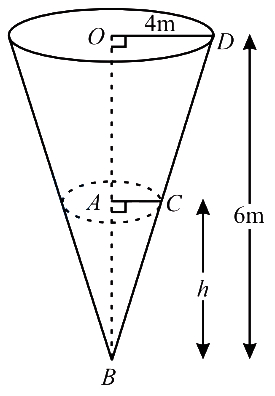
0 likesView Solution
126
MathematicsEasyMCQAP EAMCET · 2017
વિધેય $f(x) = x(x+3)(x-2)$ માટે અંતરાલ $[-1, 4]$ માં લેગ્રાન્જનું મધ્યકમાન પ્રમેય $(LMVT)$ લાગુ પડે તે માટે $c$ ની કિંમત શોધો:
A
$\frac{4}{3}$
B
$\frac{8}{3}$
C
$2$
D
$\frac{-8}{3}$
Solution
(C) આપેલ વિધેય: $f(x) = x(x+3)(x-2) = x^3 + x^2 - 6x$.
$f(x)$ બહુપદી હોવાથી તે $[-1, 4]$ પર સતત છે અને $(-1, 4)$ પર વિકલનીય છે.
$LMVT$ મુજબ,ઓછામાં ઓછું એક $c \in (-1, 4)$ એવું મળે કે જેથી $f'(c) = \frac{f(b) - f(a)}{b - a}$.
અહીં $a = -1$ અને $b = 4$ છે.
$f(-1) = (-1)(2)(-3) = 6$.
$f(4) = (4)(7)(2) = 56$.
$f'(x) = 3x^2 + 2x - 6$.
તેથી,$3c^2 + 2c - 6 = \frac{56 - 6}{4 - (-1)} = \frac{50}{5} = 10$.
$3c^2 + 2c - 16 = 0$.
દ્વિઘાત સૂત્રનો ઉપયોગ કરતા: $c = \frac{-2 \pm \sqrt{4 - 4(3)(-16)}}{6} = \frac{-2 \pm 14}{6}$.
બે શક્ય કિંમતો: $c_1 = 2$ અને $c_2 = -\frac{8}{3}$.
$c \in (-1, 4)$ હોવાથી,$c = 2$ એ સાચો જવાબ છે.
$f(x)$ બહુપદી હોવાથી તે $[-1, 4]$ પર સતત છે અને $(-1, 4)$ પર વિકલનીય છે.
$LMVT$ મુજબ,ઓછામાં ઓછું એક $c \in (-1, 4)$ એવું મળે કે જેથી $f'(c) = \frac{f(b) - f(a)}{b - a}$.
અહીં $a = -1$ અને $b = 4$ છે.
$f(-1) = (-1)(2)(-3) = 6$.
$f(4) = (4)(7)(2) = 56$.
$f'(x) = 3x^2 + 2x - 6$.
તેથી,$3c^2 + 2c - 6 = \frac{56 - 6}{4 - (-1)} = \frac{50}{5} = 10$.
$3c^2 + 2c - 16 = 0$.
દ્વિઘાત સૂત્રનો ઉપયોગ કરતા: $c = \frac{-2 \pm \sqrt{4 - 4(3)(-16)}}{6} = \frac{-2 \pm 14}{6}$.
બે શક્ય કિંમતો: $c_1 = 2$ અને $c_2 = -\frac{8}{3}$.
$c \in (-1, 4)$ હોવાથી,$c = 2$ એ સાચો જવાબ છે.
0 likesView Solution
127
MathematicsEasyMCQAP EAMCET · 2017
વિધેય $f(x) = x \cdot e^{x(1-x)}$ એ
A
$\left[-\frac{1}{2}, 1\right]$ માં વધતું વિધેય છે
B
$\left[-\frac{1}{2}, 1\right]$ માં ઘટતું વિધેય છે
C
$R$ માં વધતું વિધેય છે
D
$R$ માં ઘટતું વિધેય છે
Solution
(A) આપેલ વિધેય $f(x) = x \cdot e^{x-x^2}$ છે.
વધતા કે ઘટતા અંતરાલ શોધવા માટે,આપણે વિકલિત $f'(x)$ શોધીએ.
ગુણાકારના નિયમ અને સાંકળના નિયમનો ઉપયોગ કરતા: $f'(x) = 1 \cdot e^{x-x^2} + x \cdot e^{x-x^2} \cdot (1-2x)$.
$f'(x) = e^{x-x^2} [1 + x(1-2x)] = e^{x-x^2} (1 + x - 2x^2)$.
દ્વિઘાત પદાવલિના અવયવ પાડતા: $1 + x - 2x^2 = -(2x^2 - x - 1) = -(2x+1)(x-1) = (2x+1)(1-x)$.
તેથી,$f'(x) = e^{x-x^2} (2x+1)(1-x)$.
વિધેય વધતું હોય તે માટે,$f'(x) \geq 0$ હોવું જોઈએ.
કારણ કે $e^{x-x^2} > 0$ તમામ $x \in R$ માટે,$f'(x)$ ની નિશાની $(2x+1)(1-x)$ પર આધાર રાખે છે.
$(2x+1)(1-x) \geq 0$ નો અર્થ છે કે $-\frac{1}{2} \leq x \leq 1$.
આમ,વિધેય અંતરાલ $\left[-\frac{1}{2}, 1\right]$ માં વધતું વિધેય છે.
વધતા કે ઘટતા અંતરાલ શોધવા માટે,આપણે વિકલિત $f'(x)$ શોધીએ.
ગુણાકારના નિયમ અને સાંકળના નિયમનો ઉપયોગ કરતા: $f'(x) = 1 \cdot e^{x-x^2} + x \cdot e^{x-x^2} \cdot (1-2x)$.
$f'(x) = e^{x-x^2} [1 + x(1-2x)] = e^{x-x^2} (1 + x - 2x^2)$.
દ્વિઘાત પદાવલિના અવયવ પાડતા: $1 + x - 2x^2 = -(2x^2 - x - 1) = -(2x+1)(x-1) = (2x+1)(1-x)$.
તેથી,$f'(x) = e^{x-x^2} (2x+1)(1-x)$.
વિધેય વધતું હોય તે માટે,$f'(x) \geq 0$ હોવું જોઈએ.
કારણ કે $e^{x-x^2} > 0$ તમામ $x \in R$ માટે,$f'(x)$ ની નિશાની $(2x+1)(1-x)$ પર આધાર રાખે છે.
$(2x+1)(1-x) \geq 0$ નો અર્થ છે કે $-\frac{1}{2} \leq x \leq 1$.
આમ,વિધેય અંતરાલ $\left[-\frac{1}{2}, 1\right]$ માં વધતું વિધેય છે.
0 likesView Solution
128
MathematicsEasyMCQAP EAMCET · 2017
ધારો કે એક પ્રકારના બેક્ટેરિયા વિધેય $f(t) = t^4$ મુજબ વધે છે,જ્યાં $t$ સેકન્ડમાં આપેલ છે. જો $t_0$ સેકન્ડ પછી બેક્ટેરિયાના વધવાનો દર $4000 \text{ units/second}$ હોય,તો $t_0 =$
A
$0$
B
$10$
C
$20$
D
$30$
Solution
(B) બેક્ટેરિયાના વધવાનું વિધેય $f(t) = t^4$ દ્વારા આપવામાં આવે છે.
વધવાનો દર શોધવા માટે,આપણે $f(t)$ નું સમય $t$ ની સાપેક્ષમાં વિકલન કરીએ છીએ:
$f'(t) = \frac{d}{dt}(t^4) = 4t^3$.
આપણને આપેલ છે કે $t = t_0$ સમયે વધવાનો દર $4000 \text{ units/second}$ છે.
તેથી,$f'(t_0) = 4t_0^3 = 4000$.
બંને બાજુ $4$ વડે ભાગતા,આપણને $t_0^3 = 1000$ મળે છે.
બંને બાજુ ઘનમૂળ લેતા,$t_0 = \sqrt[3]{1000} = 10$.
આમ,$t_0 = 10$ સેકન્ડ.
વધવાનો દર શોધવા માટે,આપણે $f(t)$ નું સમય $t$ ની સાપેક્ષમાં વિકલન કરીએ છીએ:
$f'(t) = \frac{d}{dt}(t^4) = 4t^3$.
આપણને આપેલ છે કે $t = t_0$ સમયે વધવાનો દર $4000 \text{ units/second}$ છે.
તેથી,$f'(t_0) = 4t_0^3 = 4000$.
બંને બાજુ $4$ વડે ભાગતા,આપણને $t_0^3 = 1000$ મળે છે.
બંને બાજુ ઘનમૂળ લેતા,$t_0 = \sqrt[3]{1000} = 10$.
આમ,$t_0 = 10$ સેકન્ડ.
0 likesView Solution
129
MathematicsEasyMCQAP EAMCET · 2017
અંતરાલ $[0, 1]$ પર વાસ્તવિક વિધેય $f(x)=(x+1)^{1/3}-(x-1)^{1/3}$ ની મહત્તમ કિંમત શોધો:
A
$1$
B
$2^{1/3}$
C
$2$
D
$3^{1/3}$
Solution
(C) $[0, 1]$ પર $f(x) = (x+1)^{1/3} - (x-1)^{1/3}$ ની મહત્તમ કિંમત શોધવા માટે,આપણે વિકલિત $f'(x)$ શોધીએ.
$f'(x) = \frac{1}{3}(x+1)^{-2/3} - \frac{1}{3}(x-1)^{-2/3} = \frac{1}{3} \left[ \frac{1}{(x+1)^{2/3}} - \frac{1}{(x-1)^{2/3}} \right]$.
$f'(x) = 0$ લેતા,આપણને $(x-1)^{2/3} = (x+1)^{2/3}$ મળે છે,જેનો અર્થ છે કે $|x-1| = |x+1|$.
બંને બાજુ વર્ગ કરતા,$(x-1)^2 = (x+1)^2$,તેથી $x^2 - 2x + 1 = x^2 + 2x + 1$,જે $4x = 0$ આપે છે,એટલે કે $x = 0$.
હવે,આપણે ક્રાંતિક બિંદુ $x=0$ અને અંતિમ બિંદુઓ $x=0$ અને $x=1$ પર $f(x)$ ની કિંમત તપાસીએ.
$x=0$ માટે,$f(0) = (0+1)^{1/3} - (0-1)^{1/3} = 1 - (-1) = 2$.
$x=1$ માટે,$f(1) = (1+1)^{1/3} - (1-1)^{1/3} = 2^{1/3} - 0 = 2^{1/3}$.
$f(0) = 2$ અને $f(1) = 2^{1/3} \approx 1.26$ ની સરખામણી કરતા,મહત્તમ કિંમત $2$ છે.
$f'(x) = \frac{1}{3}(x+1)^{-2/3} - \frac{1}{3}(x-1)^{-2/3} = \frac{1}{3} \left[ \frac{1}{(x+1)^{2/3}} - \frac{1}{(x-1)^{2/3}} \right]$.
$f'(x) = 0$ લેતા,આપણને $(x-1)^{2/3} = (x+1)^{2/3}$ મળે છે,જેનો અર્થ છે કે $|x-1| = |x+1|$.
બંને બાજુ વર્ગ કરતા,$(x-1)^2 = (x+1)^2$,તેથી $x^2 - 2x + 1 = x^2 + 2x + 1$,જે $4x = 0$ આપે છે,એટલે કે $x = 0$.
હવે,આપણે ક્રાંતિક બિંદુ $x=0$ અને અંતિમ બિંદુઓ $x=0$ અને $x=1$ પર $f(x)$ ની કિંમત તપાસીએ.
$x=0$ માટે,$f(0) = (0+1)^{1/3} - (0-1)^{1/3} = 1 - (-1) = 2$.
$x=1$ માટે,$f(1) = (1+1)^{1/3} - (1-1)^{1/3} = 2^{1/3} - 0 = 2^{1/3}$.
$f(0) = 2$ અને $f(1) = 2^{1/3} \approx 1.26$ ની સરખામણી કરતા,મહત્તમ કિંમત $2$ છે.
0 likesView Solution
130
MathematicsDifficultMCQAP EAMCET · 2017
જો $0 < x < \frac{\pi}{2}$ હોય,તો $(0,0)$,$(x, \cos x)$ અને $(\sin^3 x, 0)$ શિરોબિંદુઓ ધરાવતા ત્રિકોણનું મહત્તમ ક્ષેત્રફળ (ચોરસ એકમમાં) કેટલું થાય?
A
$\frac{3 \sqrt{3}}{32}$
B
$\frac{7 \sqrt{3}}{32}$
C
$\frac{5 \sqrt{3}}{32}$
D
$\frac{3 \sqrt{3}}{16}$
Solution
(A) $(0,0)$,$(x_1, y_1)$,અને $(x_2, y_2)$ શિરોબિંદુઓ ધરાવતા ત્રિકોણનું ક્ષેત્રફળ $A = \frac{1}{2} |x_1 y_2 - x_2 y_1|$ દ્વારા આપવામાં આવે છે.
અહીં,શિરોબિંદુઓ $(0,0)$,$(x, \cos x)$,અને $(\sin^3 x, 0)$ છે.
તેથી,$x \in (0, \frac{\pi}{2})$ માટે $A(x) = \frac{1}{2} |x(0) - (\sin^3 x)(\cos x)| = \frac{1}{2} \sin^3 x \cos x$ થાય.
મહત્તમ મૂલ્ય શોધવા માટે,આપણે $A(x)$ નું $x$ ની સાપેક્ષમાં વિકલન કરીએ:
$A'(x) = \frac{1}{2} [3 \sin^2 x \cos x \cdot \cos x + \sin^3 x (-\sin x)] = \frac{1}{2} [3 \sin^2 x \cos^2 x - \sin^4 x]$.
$A'(x) = 0$ લેતા,આપણને $3 \sin^2 x \cos^2 x = \sin^4 x$ મળે છે.
કારણ કે $\sin x \neq 0$,તેથી $3 \cos^2 x = \sin^2 x$,જેનો અર્થ છે કે $\tan^2 x = 3$,તેથી $\tan x = \sqrt{3}$ ($x \in (0, \frac{\pi}{2})$ હોવાથી).
આમ,$x = \frac{\pi}{3}$.
$x = \frac{\pi}{3}$ પર,$\sin x = \frac{\sqrt{3}}{2}$ અને $\cos x = \frac{1}{2}$ થાય.
આ કિંમતોને $A(x)$ માં મૂકતા:
$A = \frac{1}{2} (\frac{\sqrt{3}}{2})^3 (\frac{1}{2}) = \frac{1}{2} (\frac{3 \sqrt{3}}{8}) (\frac{1}{2}) = \frac{3 \sqrt{3}}{32}$.
અહીં,શિરોબિંદુઓ $(0,0)$,$(x, \cos x)$,અને $(\sin^3 x, 0)$ છે.
તેથી,$x \in (0, \frac{\pi}{2})$ માટે $A(x) = \frac{1}{2} |x(0) - (\sin^3 x)(\cos x)| = \frac{1}{2} \sin^3 x \cos x$ થાય.
મહત્તમ મૂલ્ય શોધવા માટે,આપણે $A(x)$ નું $x$ ની સાપેક્ષમાં વિકલન કરીએ:
$A'(x) = \frac{1}{2} [3 \sin^2 x \cos x \cdot \cos x + \sin^3 x (-\sin x)] = \frac{1}{2} [3 \sin^2 x \cos^2 x - \sin^4 x]$.
$A'(x) = 0$ લેતા,આપણને $3 \sin^2 x \cos^2 x = \sin^4 x$ મળે છે.
કારણ કે $\sin x \neq 0$,તેથી $3 \cos^2 x = \sin^2 x$,જેનો અર્થ છે કે $\tan^2 x = 3$,તેથી $\tan x = \sqrt{3}$ ($x \in (0, \frac{\pi}{2})$ હોવાથી).
આમ,$x = \frac{\pi}{3}$.
$x = \frac{\pi}{3}$ પર,$\sin x = \frac{\sqrt{3}}{2}$ અને $\cos x = \frac{1}{2}$ થાય.
આ કિંમતોને $A(x)$ માં મૂકતા:
$A = \frac{1}{2} (\frac{\sqrt{3}}{2})^3 (\frac{1}{2}) = \frac{1}{2} (\frac{3 \sqrt{3}}{8}) (\frac{1}{2}) = \frac{3 \sqrt{3}}{32}$.
0 likesView Solution
131
MathematicsDifficultMCQAP EAMCET · 2017
જો આપેલ ઘનફળ $V$ ધરાવતું નળાકાર પાત્ર,જેના ઉપરના ભાગે ઢાંકણ નથી,તે ધાતુની શીટમાંથી બનાવવાનું હોય,તો વપરાતી ધાતુની શીટ ન્યૂનતમ હોય તે માટે પાત્રની ત્રિજ્યા $(r)$ અને ઊંચાઈ $(h)$ કેટલી હશે?
A
$r=\sqrt[3]{\frac{\pi}{V}}, h=\sqrt[3]{\frac{\pi}{V}}$
B
$r=\sqrt{\pi V}, h=\sqrt{\pi V}$
C
$r=\sqrt[3]{\frac{V}{\pi}}, h=\sqrt[3]{\frac{V}{\pi}}$
D
$r=\sqrt{\frac{V}{\pi}}, h=\sqrt{\frac{V}{\pi}}$
Solution
(C) આપેલ છે કે નળાકાર પાત્રનું ઘનફળ $V$ છે અને તેના ઉપરના ભાગે ઢાંકણ નથી.
ધારો કે $r$ એ ત્રિજ્યા છે અને $h$ એ નળાકારની ઊંચાઈ છે.
નળાકારનું ઘનફળ $V = \pi r^2 h$ દ્વારા આપવામાં આવે છે,જેનો અર્થ છે કે $h = \frac{V}{\pi r^2}$.
વપરાતી ધાતુની શીટનું કુલ પૃષ્ઠફળ $S$ (તળિયું સહિત પણ ઢાંકણ વગર) નીચે મુજબ છે:
$S = 2\pi rh + \pi r^2$
$S$ ના સમીકરણમાં $h = \frac{V}{\pi r^2}$ મૂકતા:
$S(r) = 2\pi r \left(\frac{V}{\pi r^2}\right) + \pi r^2 = \frac{2V}{r} + \pi r^2$
ન્યૂનતમ પૃષ્ઠફળ શોધવા માટે,આપણે $S(r)$ નું $r$ ની સાપેક્ષમાં વિકલન કરીએ અને તેને શૂન્ય સાથે સરખાવીએ:
$S'(r) = -\frac{2V}{r^2} + 2\pi r = 0$
$2\pi r = \frac{2V}{r^2} \Rightarrow r^3 = \frac{V}{\pi} \Rightarrow r = \sqrt[3]{\frac{V}{\pi}}$
હવે,$h$ ના સમીકરણમાં $r$ ની કિંમત મૂકતા:
$h = \frac{V}{\pi r^2} = \frac{V}{\pi (V/\pi)^{2/3}} = \frac{V}{\pi} \cdot \left(\frac{\pi}{V}\right)^{2/3} = \left(\frac{V}{\pi}\right)^{1/3} = \sqrt[3]{\frac{V}{\pi}}$
આમ,ન્યૂનતમ પૃષ્ઠફળ માટે ત્રિજ્યા અને ઊંચાઈ $r = \sqrt[3]{\frac{V}{\pi}}$ અને $h = \sqrt[3]{\frac{V}{\pi}}$ છે.
ધારો કે $r$ એ ત્રિજ્યા છે અને $h$ એ નળાકારની ઊંચાઈ છે.
નળાકારનું ઘનફળ $V = \pi r^2 h$ દ્વારા આપવામાં આવે છે,જેનો અર્થ છે કે $h = \frac{V}{\pi r^2}$.
વપરાતી ધાતુની શીટનું કુલ પૃષ્ઠફળ $S$ (તળિયું સહિત પણ ઢાંકણ વગર) નીચે મુજબ છે:
$S = 2\pi rh + \pi r^2$
$S$ ના સમીકરણમાં $h = \frac{V}{\pi r^2}$ મૂકતા:
$S(r) = 2\pi r \left(\frac{V}{\pi r^2}\right) + \pi r^2 = \frac{2V}{r} + \pi r^2$
ન્યૂનતમ પૃષ્ઠફળ શોધવા માટે,આપણે $S(r)$ નું $r$ ની સાપેક્ષમાં વિકલન કરીએ અને તેને શૂન્ય સાથે સરખાવીએ:
$S'(r) = -\frac{2V}{r^2} + 2\pi r = 0$
$2\pi r = \frac{2V}{r^2} \Rightarrow r^3 = \frac{V}{\pi} \Rightarrow r = \sqrt[3]{\frac{V}{\pi}}$
હવે,$h$ ના સમીકરણમાં $r$ ની કિંમત મૂકતા:
$h = \frac{V}{\pi r^2} = \frac{V}{\pi (V/\pi)^{2/3}} = \frac{V}{\pi} \cdot \left(\frac{\pi}{V}\right)^{2/3} = \left(\frac{V}{\pi}\right)^{1/3} = \sqrt[3]{\frac{V}{\pi}}$
આમ,ન્યૂનતમ પૃષ્ઠફળ માટે ત્રિજ્યા અને ઊંચાઈ $r = \sqrt[3]{\frac{V}{\pi}}$ અને $h = \sqrt[3]{\frac{V}{\pi}}$ છે.
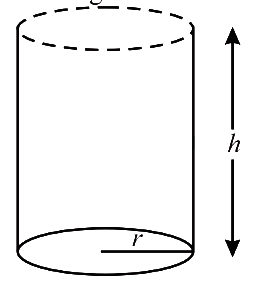
0 likesView Solution
132
MathematicsEasyMCQAP EAMCET · 2017
એક ઉત્પાદક $x$ વસ્તુઓ દરેકને $\left(5 - \frac{x}{100}\right)$ રૂપિયાની કિંમતે વેચી શકે છે. $x$ વસ્તુઓની પડતર કિંમત Rs. $\left(\frac{x}{5} + 500\right)$ છે. મહત્તમ નફો મેળવવા માટે ઉત્પાદકે કેટલી વસ્તુઓ વેચવી જોઈએ?
A
$230$
B
$240$
C
$260$
D
$376$
Solution
(B) ધારો કે $R(x)$ એ આવક વિધેય છે અને $C(x)$ એ ખર્ચ વિધેય છે.
આવક $R(x) = x \times \left(5 - \frac{x}{100}\right) = 5x - \frac{x^2}{100}$.
નફાનું વિધેય $P(x) = R(x) - C(x) = \left(5x - \frac{x^2}{100}\right) - \left(\frac{x}{5} + 500\right)$.
$P(x) = 5x - \frac{x^2}{100} - \frac{x}{5} - 500 = 4.8x - \frac{x^2}{100} - 500$.
મહત્તમ નફો શોધવા માટે,આપણે વિકલન $P'(x)$ શોધીએ છીએ અને તેને $0$ ની બરાબર લઈએ છીએ.
$P'(x) = 4.8 - \frac{2x}{100} = 4.8 - \frac{x}{50}$.
$P'(x) = 0$ લેતા,આપણને $4.8 = \frac{x}{50}$ મળે છે,જેનો અર્થ છે કે $x = 4.8 \times 50 = 240$.
ચકાસણી કરવા માટે,આપણે દ્વિતીય વિકલન $P''(x) = -\frac{1}{50}$ તપાસીએ છીએ.
કારણ કે $P''(x) < 0$ છે,તેથી $x = 240$ પર નફો મહત્તમ છે.
આવક $R(x) = x \times \left(5 - \frac{x}{100}\right) = 5x - \frac{x^2}{100}$.
નફાનું વિધેય $P(x) = R(x) - C(x) = \left(5x - \frac{x^2}{100}\right) - \left(\frac{x}{5} + 500\right)$.
$P(x) = 5x - \frac{x^2}{100} - \frac{x}{5} - 500 = 4.8x - \frac{x^2}{100} - 500$.
મહત્તમ નફો શોધવા માટે,આપણે વિકલન $P'(x)$ શોધીએ છીએ અને તેને $0$ ની બરાબર લઈએ છીએ.
$P'(x) = 4.8 - \frac{2x}{100} = 4.8 - \frac{x}{50}$.
$P'(x) = 0$ લેતા,આપણને $4.8 = \frac{x}{50}$ મળે છે,જેનો અર્થ છે કે $x = 4.8 \times 50 = 240$.
ચકાસણી કરવા માટે,આપણે દ્વિતીય વિકલન $P''(x) = -\frac{1}{50}$ તપાસીએ છીએ.
કારણ કે $P''(x) < 0$ છે,તેથી $x = 240$ પર નફો મહત્તમ છે.
0 likesView Solution
133
MathematicsEasyMCQAP EAMCET · 2017
વક્ર $3y^2 = (x+5)^3$ માટે કોઈપણ બિંદુએ,જો $ST$ એ સબટેન્જન્ટની લંબાઈ દર્શાવે છે અને $SN$ એ સબનોર્મલની લંબાઈ દર્શાવે છે,તો $9(ST)^2 = $
A
$8 SN$
B
$\frac{8}{3} SN$
C
$27 SN$
D
$8(SN)^2$
Solution
(A) આપેલ વક્ર $3y^2 = (x+5)^3$ છે.
$x$ ની સાપેક્ષમાં વિકલન કરતા,આપણને $6y \frac{dy}{dx} = 3(x+5)^2$ મળે છે,જેનો અર્થ છે કે $\frac{dy}{dx} = \frac{(x+5)^2}{2y}$.
સબટેન્જન્ટની લંબાઈ $ST = |\frac{y}{dy/dx}| = |\frac{y}{(x+5)^2 / 2y}| = |\frac{2y^2}{(x+5)^2}|$ થાય.
$y^2 = \frac{(x+5)^3}{3}$ મૂકતા,આપણને $ST = |\frac{2(x+5)^3}{3(x+5)^2}| = |\frac{2(x+5)}{3}|$ મળે છે.
આમ,$(ST)^2 = \frac{4(x+5)^2}{9}$,તેથી $9(ST)^2 = 4(x+5)^2$.
સબનોર્મલની લંબાઈ $SN = |y \frac{dy}{dx}| = |y \cdot \frac{(x+5)^2}{2y}| = |\frac{(x+5)^2}{2}|$ થાય.
તેથી,$8 SN = 8 \cdot \frac{(x+5)^2}{2} = 4(x+5)^2$.
બંને પરિણામોની સરખામણી કરતા,આપણને $9(ST)^2 = 8 SN$ મળે છે.
$x$ ની સાપેક્ષમાં વિકલન કરતા,આપણને $6y \frac{dy}{dx} = 3(x+5)^2$ મળે છે,જેનો અર્થ છે કે $\frac{dy}{dx} = \frac{(x+5)^2}{2y}$.
સબટેન્જન્ટની લંબાઈ $ST = |\frac{y}{dy/dx}| = |\frac{y}{(x+5)^2 / 2y}| = |\frac{2y^2}{(x+5)^2}|$ થાય.
$y^2 = \frac{(x+5)^3}{3}$ મૂકતા,આપણને $ST = |\frac{2(x+5)^3}{3(x+5)^2}| = |\frac{2(x+5)}{3}|$ મળે છે.
આમ,$(ST)^2 = \frac{4(x+5)^2}{9}$,તેથી $9(ST)^2 = 4(x+5)^2$.
સબનોર્મલની લંબાઈ $SN = |y \frac{dy}{dx}| = |y \cdot \frac{(x+5)^2}{2y}| = |\frac{(x+5)^2}{2}|$ થાય.
તેથી,$8 SN = 8 \cdot \frac{(x+5)^2}{2} = 4(x+5)^2$.
બંને પરિણામોની સરખામણી કરતા,આપણને $9(ST)^2 = 8 SN$ મળે છે.
0 likesView Solution
134
MathematicsMediumMCQAP EAMCET · 2017
લેગ્રાન્જનું મધ્યકમાન પ્રમેય $(LMVT)$ અંતરાલ $[0, 1]$ માં નીચેનામાંથી કયા વિધેય માટે લાગુ પડતું નથી?
A
$f(x) = \begin{cases} \frac{1}{2} - x, & x < \frac{1}{2} \\ (\frac{1}{2} - x)^2, & x \geq \frac{1}{2} \end{cases}$
B
$f(x) = \begin{cases} \frac{\sin x}{x}, & x \neq 0 \\ 1, & x = 0 \end{cases}$
C
$f(x) = x|x|$
D
$f(x) = |x|$
Solution
(D) લેગ્રાન્જના મધ્યકમાન પ્રમેય $(LMVT)$ ને $[a, b]$ પર લાગુ કરવા માટે,વિધેય $f(x)$ નીચેની શરતોનું પાલન કરતું હોવું જોઈએ:
$1$. $[a, b]$ પર સતત હોવું જોઈએ.
$2$. $(a, b)$ પર વિકલનીય હોવું જોઈએ.
અંતરાલ $[0, 1]$ માટે વિકલ્પોનું વિશ્લેષણ કરીએ:
- વિકલ્પ $A$: વિધેય $x = 1/2$ પર સતત છે કારણ કે $\lim_{x \to 1/2^-} (1/2 - x) = 0$ અને $f(1/2) = 0$. તે દરેક જગ્યાએ વિકલનીય છે.
- વિકલ્પ $B$: વિધેય $x = 0$ પર સતત છે કારણ કે $\lim_{x \to 0} \frac{\sin x}{x} = 1 = f(0)$. તે દરેક જગ્યાએ વિકલનીય છે.
- વિકલ્પ $C$: $f(x) = x|x|$ એ તમામ $x \in \mathbb{R}$ માટે સતત અને વિકલનીય છે.
- વિકલ્પ $D$: $f(x) = |x|$. $x = 0$ આગળ,ડાબી બાજુનું વિકલન $-1$ છે અને જમણી બાજુનું વિકલન $1$ છે. ડાબી બાજુનું વિકલન $\neq$ જમણી બાજુનું વિકલન હોવાથી,વિધેય $x = 0$ આગળ વિકલનીય નથી. $0 \in [0, 1]$ હોવાથી,$LMVT$ એ $f(x) = |x|$ માટે $[0, 1]$ પર લાગુ પડતું નથી.
$1$. $[a, b]$ પર સતત હોવું જોઈએ.
$2$. $(a, b)$ પર વિકલનીય હોવું જોઈએ.
અંતરાલ $[0, 1]$ માટે વિકલ્પોનું વિશ્લેષણ કરીએ:
- વિકલ્પ $A$: વિધેય $x = 1/2$ પર સતત છે કારણ કે $\lim_{x \to 1/2^-} (1/2 - x) = 0$ અને $f(1/2) = 0$. તે દરેક જગ્યાએ વિકલનીય છે.
- વિકલ્પ $B$: વિધેય $x = 0$ પર સતત છે કારણ કે $\lim_{x \to 0} \frac{\sin x}{x} = 1 = f(0)$. તે દરેક જગ્યાએ વિકલનીય છે.
- વિકલ્પ $C$: $f(x) = x|x|$ એ તમામ $x \in \mathbb{R}$ માટે સતત અને વિકલનીય છે.
- વિકલ્પ $D$: $f(x) = |x|$. $x = 0$ આગળ,ડાબી બાજુનું વિકલન $-1$ છે અને જમણી બાજુનું વિકલન $1$ છે. ડાબી બાજુનું વિકલન $\neq$ જમણી બાજુનું વિકલન હોવાથી,વિધેય $x = 0$ આગળ વિકલનીય નથી. $0 \in [0, 1]$ હોવાથી,$LMVT$ એ $f(x) = |x|$ માટે $[0, 1]$ પર લાગુ પડતું નથી.
0 likesView Solution
135
MathematicsMediumMCQAP EAMCET · 2017
અંતરાલ $[1, 2]$ માં વિધેય $f(x)=(x-1)^3(x-2)^5$ માટે રોલના પ્રમેયનો અચળાંક $c$ શું છે?
A
$\frac{3}{2}$
B
$\frac{11}{6}$
C
$\frac{13}{8}$
D
$\frac{11}{8}$
Solution
(D) રોલના પ્રમેય લાગુ કરવા માટે,$f(x)$ એ $[1, 2]$ પર સતત,$(1, 2)$ પર વિકલનીય હોવું જોઈએ અને $f(1) = f(2)$ હોવું જોઈએ.
અહીં,$f(1) = (1-1)^3(1-2)^5 = 0$ અને $f(2) = (2-1)^3(2-2)^5 = 0$. તેથી $f(1) = f(2) = 0$ હોવાથી રોલનું પ્રમેય લાગુ પડે છે.
આપણે $c \in (1, 2)$ શોધવાનું છે જેથી $f'(c) = 0$ થાય.
ગુણાકારના નિયમનો ઉપયોગ કરતા: $f'(x) = 3(x-1)^2(x-2)^5 + 5(x-1)^3(x-2)^4$.
સામાન્ય પદો બહાર કાઢતા: $f'(x) = (x-1)^2(x-2)^4 [3(x-2) + 5(x-1)]$.
$f'(x) = (x-1)^2(x-2)^4 [3x - 6 + 5x - 5] = (x-1)^2(x-2)^4 (8x - 11)$.
$c \in (1, 2)$ માટે $f'(c) = 0$ લેતા:
$(c-1)^2(c-2)^4 (8c - 11) = 0$.
$c \neq 1$ અને $c \neq 2$ હોવાથી,$8c - 11 = 0$ થવું જોઈએ,જેનો અર્થ છે કે $c = \frac{11}{8}$.
અહીં,$f(1) = (1-1)^3(1-2)^5 = 0$ અને $f(2) = (2-1)^3(2-2)^5 = 0$. તેથી $f(1) = f(2) = 0$ હોવાથી રોલનું પ્રમેય લાગુ પડે છે.
આપણે $c \in (1, 2)$ શોધવાનું છે જેથી $f'(c) = 0$ થાય.
ગુણાકારના નિયમનો ઉપયોગ કરતા: $f'(x) = 3(x-1)^2(x-2)^5 + 5(x-1)^3(x-2)^4$.
સામાન્ય પદો બહાર કાઢતા: $f'(x) = (x-1)^2(x-2)^4 [3(x-2) + 5(x-1)]$.
$f'(x) = (x-1)^2(x-2)^4 [3x - 6 + 5x - 5] = (x-1)^2(x-2)^4 (8x - 11)$.
$c \in (1, 2)$ માટે $f'(c) = 0$ લેતા:
$(c-1)^2(c-2)^4 (8c - 11) = 0$.
$c \neq 1$ અને $c \neq 2$ હોવાથી,$8c - 11 = 0$ થવું જોઈએ,જેનો અર્થ છે કે $c = \frac{11}{8}$.
0 likesView Solution
136
MathematicsMediumMCQAP EAMCET · 2017
વિધેય $f(x)=(x-1)(x-2)$ માટે જે $\left[0, \frac{1}{2}\right]$ પર વ્યાખ્યાયિત છે,લેગ્રાન્જના મધ્યકમાન પ્રમેયનું પાલન કરતું $c$ નું મૂલ્ય શોધો.
A
$\frac{1}{5}$
B
$\frac{1}{3}$
C
$\frac{1}{7}$
D
$\frac{1}{4}$
Solution
(D) આપેલ વિધેય $f(x) = (x-1)(x-2) = x^2 - 3x + 2$ અંતરાલ $[0, 1/2]$ પર છે.
લેગ્રાન્જના મધ્યકમાન પ્રમેય મુજબ,કોઈ $c \in (0, 1/2)$ અસ્તિત્વ ધરાવે છે જેથી $f'(c) = \frac{f(b) - f(a)}{b - a}$ થાય.
અહીં,$a = 0$ અને $b = 1/2$.
$f(a) = f(0) = (0-1)(0-2) = 2$.
$f(b) = f(1/2) = (1/2 - 1)(1/2 - 2) = (-1/2)(-3/2) = 3/4$.
$f'(x) = 2x - 3$,તેથી $f'(c) = 2c - 3$.
સૂત્રમાં કિંમતો મૂકતા: $2c - 3 = \frac{3/4 - 2}{1/2 - 0}$.
$2c - 3 = \frac{-5/4}{1/2} = -5/2$.
$2c = 3 - 5/2 = 1/2$.
$c = 1/4$.
કારણ કે $1/4 \in (0, 1/2)$,તેથી $c$ નું મૂલ્ય $1/4$ છે.
લેગ્રાન્જના મધ્યકમાન પ્રમેય મુજબ,કોઈ $c \in (0, 1/2)$ અસ્તિત્વ ધરાવે છે જેથી $f'(c) = \frac{f(b) - f(a)}{b - a}$ થાય.
અહીં,$a = 0$ અને $b = 1/2$.
$f(a) = f(0) = (0-1)(0-2) = 2$.
$f(b) = f(1/2) = (1/2 - 1)(1/2 - 2) = (-1/2)(-3/2) = 3/4$.
$f'(x) = 2x - 3$,તેથી $f'(c) = 2c - 3$.
સૂત્રમાં કિંમતો મૂકતા: $2c - 3 = \frac{3/4 - 2}{1/2 - 0}$.
$2c - 3 = \frac{-5/4}{1/2} = -5/2$.
$2c = 3 - 5/2 = 1/2$.
$c = 1/4$.
કારણ કે $1/4 \in (0, 1/2)$,તેથી $c$ નું મૂલ્ય $1/4$ છે.
0 likesView Solution
137
MathematicsMediumMCQAP EAMCET · 2017
$\int \frac{1}{x \sqrt{x^6+1}} \, dx =$
A
$\frac{1}{3} \operatorname{Sinh}^{-1}\left(\frac{1}{x^3}\right)+C$
B
$-\frac{1}{3} \operatorname{Sinh}^{-1}\left(x^3\right)+C$
C
$-\frac{1}{3} \operatorname{Sinh}^{-1}\left(\frac{1}{x^3}\right)+C$
D
$3 \operatorname{Sinh}^{-1}\left(\frac{1}{x^3}\right)+C$
Solution
(C) ધારો કે $I = \int \frac{1}{x \sqrt{x^6+1}} \, dx$.
અંશ અને છેદને $x^2$ વડે ગુણતા:
$I = \int \frac{x^2}{x^3 \sqrt{(x^3)^2+1}} \, dx$.
ધારો કે $u = x^3$,તેથી $du = 3x^2 \, dx$,જેનો અર્થ છે કે $x^2 \, dx = \frac{du}{3}$.
આ કિંમતો સંકલનમાં મૂકતા:
$I = \frac{1}{3} \int \frac{du}{u \sqrt{u^2+1}}$.
પ્રમાણિત સંકલન સૂત્ર $\int \frac{du}{u \sqrt{u^2+a^2}} = -\frac{1}{a} \operatorname{Sinh}^{-1} \left( \frac{a}{u} \right) + C$ નો ઉપયોગ કરતા:
$I = \frac{1}{3} \left( -\operatorname{Sinh}^{-1} \left( \frac{1}{u} \right) \right) + C = -\frac{1}{3} \operatorname{Sinh}^{-1} \left( \frac{1}{x^3} \right) + C$.
અંશ અને છેદને $x^2$ વડે ગુણતા:
$I = \int \frac{x^2}{x^3 \sqrt{(x^3)^2+1}} \, dx$.
ધારો કે $u = x^3$,તેથી $du = 3x^2 \, dx$,જેનો અર્થ છે કે $x^2 \, dx = \frac{du}{3}$.
આ કિંમતો સંકલનમાં મૂકતા:
$I = \frac{1}{3} \int \frac{du}{u \sqrt{u^2+1}}$.
પ્રમાણિત સંકલન સૂત્ર $\int \frac{du}{u \sqrt{u^2+a^2}} = -\frac{1}{a} \operatorname{Sinh}^{-1} \left( \frac{a}{u} \right) + C$ નો ઉપયોગ કરતા:
$I = \frac{1}{3} \left( -\operatorname{Sinh}^{-1} \left( \frac{1}{u} \right) \right) + C = -\frac{1}{3} \operatorname{Sinh}^{-1} \left( \frac{1}{x^3} \right) + C$.
0 likesView Solution
138
MathematicsMediumMCQAP EAMCET · 2017
$\int(\sqrt{\tan x}+\sqrt{\cot x}) d x=$
A
$\sqrt{2} \tan^{-1}\left(\frac{\tan x-1}{\sqrt{2 \tan x}}\right)+c$
B
$\sqrt{2} \tan^{-1}\left(\frac{\tan x+1}{\sqrt{2 \tan x}}\right)+c$
C
$\frac{1}{\sqrt{2}} \tan^{-1}\left(\frac{\tan x-1}{\sqrt{2 \tan x}}\right)+c$
D
$\frac{1}{\sqrt{2}} \tan^{-1}\left(\frac{\tan x+1}{\sqrt{2 \tan x}}\right)+c$
Solution
(A) ધારો કે $I = \int (\sqrt{\tan x} + \sqrt{\cot x}) dx = \int \frac{\tan x + 1}{\sqrt{\tan x}} dx$.
$\tan x = t^2$ આદેશ લેતા,$\sec^2 x dx = 2t dt$ મળે.
$\sec^2 x = 1 + \tan^2 x = 1 + t^4$ હોવાથી,$dx = \frac{2t}{1+t^4} dt$ થાય.
તેથી,$I = \int \frac{t^2 + 1}{t} \cdot \frac{2t}{1+t^4} dt = 2 \int \frac{t^2 + 1}{t^4 + 1} dt$.
અંશ અને છેદને $t^2$ વડે ભાગતા: $I = 2 \int \frac{1 + 1/t^2}{t^2 + 1/t^2} dt = 2 \int \frac{1 + 1/t^2}{(t - 1/t)^2 + 2} dt$.
$u = t - 1/t$ લેતા,$du = (1 + 1/t^2) dt$ મળે.
$I = 2 \int \frac{du}{u^2 + (\sqrt{2})^2} = 2 \cdot \frac{1}{\sqrt{2}} \tan^{-1}\left(\frac{u}{\sqrt{2}}\right) + c = \sqrt{2} \tan^{-1}\left(\frac{t - 1/t}{\sqrt{2}}\right) + c$.
$t = \sqrt{\tan x}$ મૂકતા,$I = \sqrt{2} \tan^{-1}\left(\frac{\tan x - 1}{\sqrt{2 \tan x}}\right) + c$ મળે.
$\tan x = t^2$ આદેશ લેતા,$\sec^2 x dx = 2t dt$ મળે.
$\sec^2 x = 1 + \tan^2 x = 1 + t^4$ હોવાથી,$dx = \frac{2t}{1+t^4} dt$ થાય.
તેથી,$I = \int \frac{t^2 + 1}{t} \cdot \frac{2t}{1+t^4} dt = 2 \int \frac{t^2 + 1}{t^4 + 1} dt$.
અંશ અને છેદને $t^2$ વડે ભાગતા: $I = 2 \int \frac{1 + 1/t^2}{t^2 + 1/t^2} dt = 2 \int \frac{1 + 1/t^2}{(t - 1/t)^2 + 2} dt$.
$u = t - 1/t$ લેતા,$du = (1 + 1/t^2) dt$ મળે.
$I = 2 \int \frac{du}{u^2 + (\sqrt{2})^2} = 2 \cdot \frac{1}{\sqrt{2}} \tan^{-1}\left(\frac{u}{\sqrt{2}}\right) + c = \sqrt{2} \tan^{-1}\left(\frac{t - 1/t}{\sqrt{2}}\right) + c$.
$t = \sqrt{\tan x}$ મૂકતા,$I = \sqrt{2} \tan^{-1}\left(\frac{\tan x - 1}{\sqrt{2 \tan x}}\right) + c$ મળે.
0 likesView Solution
139
MathematicsDifficultMCQAP EAMCET · 2017
$\int \frac{1-x^7}{x(1+x^7)} dx = a \ln |x| + b \ln |x^7+1| + c \Rightarrow (a, b) = $
A
$(1, 2/7)$
B
$(1, -7/2)$
C
$(1, -2/7)$
D
$(2, -2/7)$
Solution
(C) આપણી પાસે સંકલન $I = \int \frac{1-x^7}{x(1+x^7)} dx$ છે.
અંશ અને છેદને $x^6$ વડે ગુણતા:
$I = \int \frac{x^6(1-x^7)}{x^7(1+x^7)} dx$.
ધારો કે $u = x^7$,તેથી $du = 7x^6 dx$,જેનો અર્થ છે $x^6 dx = \frac{du}{7}$.
સંકલનમાં કિંમતો મૂકતા:
$I = \int \frac{1-u}{u(1+u)} \cdot \frac{du}{7} = \frac{1}{7} \int \frac{1-u}{u(1+u)} du$.
આંશિક અપૂર્ણાંકની રીત વાપરતા: $\frac{1-u}{u(1+u)} = \frac{A}{u} + \frac{B}{1+u}$.
$1-u = A(1+u) + Bu$.
$u=0$ માટે,$A=1$.
$u=-1$ માટે,$1-(-1) = B(-1) \Rightarrow B = -2$.
તેથી,$I = \frac{1}{7} \int (\frac{1}{u} - \frac{2}{1+u}) du = \frac{1}{7} (\ln |u| - 2 \ln |1+u|) + C$.
$u = x^7$ પાછા મૂકતા:
$I = \frac{1}{7} \ln |x^7| - \frac{2}{7} \ln |x^7+1| + C = \frac{7}{7} \ln |x| - \frac{2}{7} \ln |x^7+1| + C = 1 \ln |x| - \frac{2}{7} \ln |x^7+1| + C$.
આને $a \ln |x| + b \ln |x^7+1| + c$ સાથે સરખાવતા,આપણને $a = 1$ અને $b = -2/7$ મળે છે.
અંશ અને છેદને $x^6$ વડે ગુણતા:
$I = \int \frac{x^6(1-x^7)}{x^7(1+x^7)} dx$.
ધારો કે $u = x^7$,તેથી $du = 7x^6 dx$,જેનો અર્થ છે $x^6 dx = \frac{du}{7}$.
સંકલનમાં કિંમતો મૂકતા:
$I = \int \frac{1-u}{u(1+u)} \cdot \frac{du}{7} = \frac{1}{7} \int \frac{1-u}{u(1+u)} du$.
આંશિક અપૂર્ણાંકની રીત વાપરતા: $\frac{1-u}{u(1+u)} = \frac{A}{u} + \frac{B}{1+u}$.
$1-u = A(1+u) + Bu$.
$u=0$ માટે,$A=1$.
$u=-1$ માટે,$1-(-1) = B(-1) \Rightarrow B = -2$.
તેથી,$I = \frac{1}{7} \int (\frac{1}{u} - \frac{2}{1+u}) du = \frac{1}{7} (\ln |u| - 2 \ln |1+u|) + C$.
$u = x^7$ પાછા મૂકતા:
$I = \frac{1}{7} \ln |x^7| - \frac{2}{7} \ln |x^7+1| + C = \frac{7}{7} \ln |x| - \frac{2}{7} \ln |x^7+1| + C = 1 \ln |x| - \frac{2}{7} \ln |x^7+1| + C$.
આને $a \ln |x| + b \ln |x^7+1| + c$ સાથે સરખાવતા,આપણને $a = 1$ અને $b = -2/7$ મળે છે.
0 likesView Solution
140
MathematicsMediumMCQAP EAMCET · 2017
$\int \frac{e^x-1}{e^x+1} dx =$
A
$2 \log_e(1+e^x) + x + c$
B
$2 \log_e(1+e^x) - x + c$
C
$\log_e(1+e^x) + x + c$
D
$\log_e(1+e^x) - x + c$
Solution
(B) ધારો કે $I = \int \frac{e^x-1}{e^x+1} dx$.
આપણે સંકલ્યને આ રીતે લખી શકીએ: $I = \int \frac{(e^x+1)-2}{e^x+1} dx$.
આનું સાદું રૂપ આપતા: $I = \int (1 - \frac{2}{e^x+1}) dx = \int 1 dx - 2 \int \frac{1}{e^x+1} dx$.
$\int \frac{1}{e^x+1} dx$ નું સંકલન કરવા માટે,અંશ અને છેદને $e^{-x}$ વડે ગુણો:
$I = x - 2 \int \frac{e^{-x}}{1+e^{-x}} dx$.
ધારો કે $t = 1+e^{-x}$,તેથી $dt = -e^{-x} dx$,જેનો અર્થ છે કે $e^{-x} dx = -dt$.
આ કિંમતો સંકલનમાં મૂકતા:
$I = x - 2 \int \frac{-dt}{t} = x + 2 \int \frac{1}{t} dt$.
$I = x + 2 \log_e|t| + c = x + 2 \log_e(1+e^{-x}) + c$.
કારણ કે $1+e^{-x} = \frac{e^x+1}{e^x}$,તેથી:
$I = x + 2 \log_e(\frac{e^x+1}{e^x}) + c = x + 2 \log_e(e^x+1) - 2 \log_e(e^x) + c$.
$I = x + 2 \log_e(e^x+1) - 2x + c = 2 \log_e(e^x+1) - x + c$.
આપણે સંકલ્યને આ રીતે લખી શકીએ: $I = \int \frac{(e^x+1)-2}{e^x+1} dx$.
આનું સાદું રૂપ આપતા: $I = \int (1 - \frac{2}{e^x+1}) dx = \int 1 dx - 2 \int \frac{1}{e^x+1} dx$.
$\int \frac{1}{e^x+1} dx$ નું સંકલન કરવા માટે,અંશ અને છેદને $e^{-x}$ વડે ગુણો:
$I = x - 2 \int \frac{e^{-x}}{1+e^{-x}} dx$.
ધારો કે $t = 1+e^{-x}$,તેથી $dt = -e^{-x} dx$,જેનો અર્થ છે કે $e^{-x} dx = -dt$.
આ કિંમતો સંકલનમાં મૂકતા:
$I = x - 2 \int \frac{-dt}{t} = x + 2 \int \frac{1}{t} dt$.
$I = x + 2 \log_e|t| + c = x + 2 \log_e(1+e^{-x}) + c$.
કારણ કે $1+e^{-x} = \frac{e^x+1}{e^x}$,તેથી:
$I = x + 2 \log_e(\frac{e^x+1}{e^x}) + c = x + 2 \log_e(e^x+1) - 2 \log_e(e^x) + c$.
$I = x + 2 \log_e(e^x+1) - 2x + c = 2 \log_e(e^x+1) - x + c$.
0 likesView Solution
141
MathematicsDifficultMCQAP EAMCET · 2017
$\int \cos^{-1}(2x^2-1) \, dx =$
A
$2(x \sin^{-1} x + \sqrt{1-x^2}) + c$
B
$2(x \cos^{-1} x + \sqrt{1-x^2}) + c$
C
$2(x \cos^{-1} x - \sqrt{1-x^2}) + c$
D
$2(x \sin^{-1} x - \sqrt{1-x^2}) + c$
Solution
(C) ધારો કે $I = \int \cos^{-1}(2x^2-1) \, dx$.
$x = \cos \theta$ આદેશ લેતા,$dx = -\sin \theta \, d\theta$ મળે.
સંકલન $I = \int \cos^{-1}(2 \cos^2 \theta - 1) \cdot (-\sin \theta) \, d\theta$ થશે.
નિત્યસમ $\cos 2\theta = 2 \cos^2 \theta - 1$ નો ઉપયોગ કરતા,$I = \int \cos^{-1}(\cos 2\theta) \cdot (-\sin \theta) \, d\theta = \int 2\theta \cdot (-\sin \theta) \, d\theta = -2 \int \theta \sin \theta \, d\theta$.
ખંડશઃ સંકલન (Integration by parts) $\int u \, dv = uv - \int v \, du$ નો ઉપયોગ કરતા,જ્યાં $u = \theta$ અને $dv = \sin \theta \, d\theta$:
$I = -2 [\theta(-\cos \theta) - \int (-\cos \theta) \, d\theta] = -2 [-\theta \cos \theta + \sin \theta] + c = 2\theta \cos \theta - 2 \sin \theta + c$.
અહીં $x = \cos \theta$ હોવાથી,$\theta = \cos^{-1} x$ અને $\sin \theta = \sqrt{1 - \cos^2 \theta} = \sqrt{1-x^2}$ મળે.
આ કિંમતો મૂકતા,$I = 2x \cos^{-1} x - 2\sqrt{1-x^2} + c = 2(x \cos^{-1} x - \sqrt{1-x^2}) + c$.
$x = \cos \theta$ આદેશ લેતા,$dx = -\sin \theta \, d\theta$ મળે.
સંકલન $I = \int \cos^{-1}(2 \cos^2 \theta - 1) \cdot (-\sin \theta) \, d\theta$ થશે.
નિત્યસમ $\cos 2\theta = 2 \cos^2 \theta - 1$ નો ઉપયોગ કરતા,$I = \int \cos^{-1}(\cos 2\theta) \cdot (-\sin \theta) \, d\theta = \int 2\theta \cdot (-\sin \theta) \, d\theta = -2 \int \theta \sin \theta \, d\theta$.
ખંડશઃ સંકલન (Integration by parts) $\int u \, dv = uv - \int v \, du$ નો ઉપયોગ કરતા,જ્યાં $u = \theta$ અને $dv = \sin \theta \, d\theta$:
$I = -2 [\theta(-\cos \theta) - \int (-\cos \theta) \, d\theta] = -2 [-\theta \cos \theta + \sin \theta] + c = 2\theta \cos \theta - 2 \sin \theta + c$.
અહીં $x = \cos \theta$ હોવાથી,$\theta = \cos^{-1} x$ અને $\sin \theta = \sqrt{1 - \cos^2 \theta} = \sqrt{1-x^2}$ મળે.
આ કિંમતો મૂકતા,$I = 2x \cos^{-1} x - 2\sqrt{1-x^2} + c = 2(x \cos^{-1} x - \sqrt{1-x^2}) + c$.
0 likesView Solution
142
MathematicsDifficultMCQAP EAMCET · 2017
$\int \frac{dx}{x(x^2+1)^3} = ?$
A
$\frac{1}{2(x^2+1)} + \frac{1}{4(x^2+1)^2} + \log \sqrt{\frac{x^2}{x^2+1}} + c$
B
$\frac{1}{x^2+1} + \frac{1}{2(x^2+1)^2} + \log \sqrt{\frac{x}{x^2+1}} + c$
C
$\frac{1}{2(x^2+1)} + \frac{1}{4(x^2+1)^3} + \log \sqrt{\frac{x}{x+1}} + c$
D
$\frac{2}{x^2+1} - \frac{1}{4(x^2+1)^2} - \log \sqrt{\frac{x}{x+1}} + c$
Solution
(A) ધારો કે $I = \int \frac{dx}{x(x^2+1)^3}$. અંશ અને છેદને $x$ વડે ગુણતા:
$I = \int \frac{x dx}{x^2(x^2+1)^3}$.
ધારો કે $x^2 = t$,તેથી $2x dx = dt$,એટલે કે $x dx = \frac{dt}{2}$.
$I = \frac{1}{2} \int \frac{dt}{t(t+1)^3}$.
આંશિક અપૂર્ણાંકનો ઉપયોગ કરતા: $\frac{1}{t(t+1)^3} = \frac{A}{t} + \frac{B}{t+1} + \frac{C}{(t+1)^2} + \frac{D}{(t+1)^3}$.
અચળાંકો માટે ઉકેલતા: $A=1, B=-1, C=-1, D=-1$.
$I = \frac{1}{2} [\int \frac{1}{t} dt - \int \frac{1}{t+1} dt - \int \frac{1}{(t+1)^2} dt - \int \frac{1}{(t+1)^3} dt]$.
$I = \frac{1}{2} [\log|t| - \log|t+1| + \frac{1}{t+1} + \frac{1}{2(t+1)^2}] + c$.
$t = x^2$ મૂકતા:
$I = \frac{1}{2} \log \frac{x^2}{x^2+1} + \frac{1}{2(x^2+1)} + \frac{1}{4(x^2+1)^2} + c$.
$I = \log \sqrt{\frac{x^2}{x^2+1}} + \frac{1}{2(x^2+1)} + \frac{1}{4(x^2+1)^2} + c$.
$I = \int \frac{x dx}{x^2(x^2+1)^3}$.
ધારો કે $x^2 = t$,તેથી $2x dx = dt$,એટલે કે $x dx = \frac{dt}{2}$.
$I = \frac{1}{2} \int \frac{dt}{t(t+1)^3}$.
આંશિક અપૂર્ણાંકનો ઉપયોગ કરતા: $\frac{1}{t(t+1)^3} = \frac{A}{t} + \frac{B}{t+1} + \frac{C}{(t+1)^2} + \frac{D}{(t+1)^3}$.
અચળાંકો માટે ઉકેલતા: $A=1, B=-1, C=-1, D=-1$.
$I = \frac{1}{2} [\int \frac{1}{t} dt - \int \frac{1}{t+1} dt - \int \frac{1}{(t+1)^2} dt - \int \frac{1}{(t+1)^3} dt]$.
$I = \frac{1}{2} [\log|t| - \log|t+1| + \frac{1}{t+1} + \frac{1}{2(t+1)^2}] + c$.
$t = x^2$ મૂકતા:
$I = \frac{1}{2} \log \frac{x^2}{x^2+1} + \frac{1}{2(x^2+1)} + \frac{1}{4(x^2+1)^2} + c$.
$I = \log \sqrt{\frac{x^2}{x^2+1}} + \frac{1}{2(x^2+1)} + \frac{1}{4(x^2+1)^2} + c$.
0 likesView Solution
143
MathematicsDifficultMCQAP EAMCET · 2017
$\int \frac{d x}{x^{2 / 3}\left(1+x^{2 / 3}\right)}=$
A
$3 \operatorname{Sin}^{-1}\left(x^{1 / 3}\right)+c$
B
$3 \operatorname{Cos}^{-1}\left(x^{1 / 3}\right)+c$
C
$3 \operatorname{Tan}^{-1}\left(x^{1 / 3}\right)+c$
D
$3 \operatorname{Sec}^{-1}\left(x^{1 / 3}\right)+c$
Solution
(C) ધારો કે $I = \int \frac{d x}{x^{2 / 3}(1+x^{2 / 3})}$.
$x^{1/3} = t$ આદેશ લેતા,$x = t^3$ મળે,તેથી $dx = 3t^2 dt$ થાય.
આ કિંમતો સંકલનમાં મૂકતા:
$I = \int \frac{3t^2 dt}{(t^2)(1+t^2)} = \int \frac{3 dt}{1+t^2}$.
$\frac{1}{1+t^2}$ નું સંકલન $\tan^{-1}(t)$ થાય છે.
તેથી,$I = 3 \tan^{-1}(t) + c$.
$t = x^{1/3}$ પાછું મૂકતા,આપણને $I = 3 \tan^{-1}(x^{1/3}) + c$ મળે છે.
$x^{1/3} = t$ આદેશ લેતા,$x = t^3$ મળે,તેથી $dx = 3t^2 dt$ થાય.
આ કિંમતો સંકલનમાં મૂકતા:
$I = \int \frac{3t^2 dt}{(t^2)(1+t^2)} = \int \frac{3 dt}{1+t^2}$.
$\frac{1}{1+t^2}$ નું સંકલન $\tan^{-1}(t)$ થાય છે.
તેથી,$I = 3 \tan^{-1}(t) + c$.
$t = x^{1/3}$ પાછું મૂકતા,આપણને $I = 3 \tan^{-1}(x^{1/3}) + c$ મળે છે.
0 likesView Solution
144
MathematicsMediumMCQAP EAMCET · 2017
જો $0 < a < 1$ હોય,તો $\int \frac{dx}{1-2a \cos x + a^2} =$
A
$\frac{1}{1-a^2} \tan^{-1}\left[\frac{1+a}{1-a} \tan \frac{x}{2}\right] + c$
B
$\frac{2}{1+a^2} \tan^{-1}\left[\frac{1-a}{1+a} \tan \frac{x}{2}\right] + c$
C
$\frac{2}{1-a^2} \tan^{-1}\left[\frac{1+a}{1-a} \tan \frac{x}{2}\right] + c$
D
$\frac{2}{1+a} \tan^{-1}\left[\frac{1-a^2}{1+a^2} \tan \frac{x}{2}\right] + c$
Solution
(C) ધારો કે $I = \int \frac{dx}{1-2a \cos x + a^2}$.
નિત્યસમ $\cos x = \frac{1-\tan^2(x/2)}{1+\tan^2(x/2)}$ નો ઉપયોગ કરતા:
$I = \int \frac{dx}{1-2a \left(\frac{1-\tan^2(x/2)}{1+\tan^2(x/2)}\right) + a^2} = \int \frac{\sec^2(x/2) dx}{(1+a^2)(1+\tan^2(x/2)) - 2a(1-\tan^2(x/2))}$.
ધારો કે $t = \tan(x/2)$,તેથી $dt = \frac{1}{2} \sec^2(x/2) dx$,એટલે કે $\sec^2(x/2) dx = 2 dt$.
$I = \int \frac{2 dt}{(1+a^2)(1+t^2) - 2a(1-t^2)} = \int \frac{2 dt}{1+a^2+t^2+a^2t^2-2a+2at^2} = \int \frac{2 dt}{(1-a)^2 + t^2(1+a)^2}$.
$I = \frac{2}{(1+a)^2} \int \frac{dt}{\left(\frac{1-a}{1+a}\right)^2 + t^2}$.
$\int \frac{dx}{k^2+x^2} = \frac{1}{k} \tan^{-1}(\frac{x}{k})$ સૂત્રનો ઉપયોગ કરતા:
$I = \frac{2}{(1+a)^2} \cdot \frac{1+a}{1-a} \tan^{-1}\left(t \cdot \frac{1+a}{1-a}\right) + c = \frac{2}{1-a^2} \tan^{-1}\left[\frac{1+a}{1-a} \tan \frac{x}{2}\right] + c$.
નિત્યસમ $\cos x = \frac{1-\tan^2(x/2)}{1+\tan^2(x/2)}$ નો ઉપયોગ કરતા:
$I = \int \frac{dx}{1-2a \left(\frac{1-\tan^2(x/2)}{1+\tan^2(x/2)}\right) + a^2} = \int \frac{\sec^2(x/2) dx}{(1+a^2)(1+\tan^2(x/2)) - 2a(1-\tan^2(x/2))}$.
ધારો કે $t = \tan(x/2)$,તેથી $dt = \frac{1}{2} \sec^2(x/2) dx$,એટલે કે $\sec^2(x/2) dx = 2 dt$.
$I = \int \frac{2 dt}{(1+a^2)(1+t^2) - 2a(1-t^2)} = \int \frac{2 dt}{1+a^2+t^2+a^2t^2-2a+2at^2} = \int \frac{2 dt}{(1-a)^2 + t^2(1+a)^2}$.
$I = \frac{2}{(1+a)^2} \int \frac{dt}{\left(\frac{1-a}{1+a}\right)^2 + t^2}$.
$\int \frac{dx}{k^2+x^2} = \frac{1}{k} \tan^{-1}(\frac{x}{k})$ સૂત્રનો ઉપયોગ કરતા:
$I = \frac{2}{(1+a)^2} \cdot \frac{1+a}{1-a} \tan^{-1}\left(t \cdot \frac{1+a}{1-a}\right) + c = \frac{2}{1-a^2} \tan^{-1}\left[\frac{1+a}{1-a} \tan \frac{x}{2}\right] + c$.
0 likesView Solution
145
MathematicsDifficultMCQAP EAMCET · 2017
$\int \frac{6x+5}{\sqrt{6+x-2x^2}} dx =$
A
$-3 \sqrt{6+x-2x^2} + \frac{13}{2\sqrt{2}} \sin^{-1}\left(\frac{4x-1}{7}\right) + c$
B
$-3 \sqrt{6+x-2x^2} + \frac{13}{\sqrt{2}} \sinh^{-1}\left(\frac{4x-1}{7}\right) + c$
C
$-3 \sqrt{6+x-2x^2} + \frac{13}{2\sqrt{3}} \sinh^{-1}\left(\frac{4x+1}{7}\right) + c$
D
$3 \sqrt{6+x-2x^2} - \frac{13}{2\sqrt{2}} \cos^{-1}\left(\frac{4x-1}{7}\right) + c$
Solution
(A) ધારો કે $I = \int \frac{6x+5}{\sqrt{6+x-2x^2}} dx$.
અંશને $6x+5 = A \frac{d}{dx}(6+x-2x^2) + B$ તરીકે દર્શાવીએ.
$6x+5 = A(1-4x) + B = -4Ax + (A+B)$.
સહગુણકોની સરખામણી કરતા,$-4A = 6 \implies A = -\frac{3}{2}$ અને $A+B = 5 \implies B = 5 + \frac{3}{2} = \frac{13}{2}$.
તેથી,$I = \int \frac{-\frac{3}{2}(1-4x) + \frac{13}{2}}{\sqrt{6+x-2x^2}} dx = -\frac{3}{2} \int \frac{1-4x}{\sqrt{6+x-2x^2}} dx + \frac{13}{2} \int \frac{dx}{\sqrt{6+x-2x^2}}$.
પ્રથમ ભાગ માટે,$u = 6+x-2x^2$ લેતા,$du = (1-4x)dx$ મળે.
સંકલન $-\frac{3}{2} \int u^{-1/2} du = -\frac{3}{2} (2\sqrt{u}) = -3\sqrt{6+x-2x^2}$ થાય.
બીજા ભાગ માટે,$\int \frac{dx}{\sqrt{6+x-2x^2}} = \frac{1}{\sqrt{2}} \int \frac{dx}{\sqrt{3 + \frac{x}{2} - x^2}} = \frac{1}{\sqrt{2}} \int \frac{dx}{\sqrt{\frac{49}{16} - (x-\frac{1}{4})^2}} = \frac{1}{\sqrt{2}} \sin^{-1}\left(\frac{4x-1}{7}\right)$.
બંનેને જોડતા,$I = -3\sqrt{6+x-2x^2} + \frac{13}{2\sqrt{2}} \sin^{-1}\left(\frac{4x-1}{7}\right) + c$ મળે.
અંશને $6x+5 = A \frac{d}{dx}(6+x-2x^2) + B$ તરીકે દર્શાવીએ.
$6x+5 = A(1-4x) + B = -4Ax + (A+B)$.
સહગુણકોની સરખામણી કરતા,$-4A = 6 \implies A = -\frac{3}{2}$ અને $A+B = 5 \implies B = 5 + \frac{3}{2} = \frac{13}{2}$.
તેથી,$I = \int \frac{-\frac{3}{2}(1-4x) + \frac{13}{2}}{\sqrt{6+x-2x^2}} dx = -\frac{3}{2} \int \frac{1-4x}{\sqrt{6+x-2x^2}} dx + \frac{13}{2} \int \frac{dx}{\sqrt{6+x-2x^2}}$.
પ્રથમ ભાગ માટે,$u = 6+x-2x^2$ લેતા,$du = (1-4x)dx$ મળે.
સંકલન $-\frac{3}{2} \int u^{-1/2} du = -\frac{3}{2} (2\sqrt{u}) = -3\sqrt{6+x-2x^2}$ થાય.
બીજા ભાગ માટે,$\int \frac{dx}{\sqrt{6+x-2x^2}} = \frac{1}{\sqrt{2}} \int \frac{dx}{\sqrt{3 + \frac{x}{2} - x^2}} = \frac{1}{\sqrt{2}} \int \frac{dx}{\sqrt{\frac{49}{16} - (x-\frac{1}{4})^2}} = \frac{1}{\sqrt{2}} \sin^{-1}\left(\frac{4x-1}{7}\right)$.
બંનેને જોડતા,$I = -3\sqrt{6+x-2x^2} + \frac{13}{2\sqrt{2}} \sin^{-1}\left(\frac{4x-1}{7}\right) + c$ મળે.
0 likesView Solution
146
MathematicsMediumMCQAP EAMCET · 2017
$\int \frac{5 x^2+3}{x^2\left(x^2-2\right)} d x=$
A
$\frac{13}{2 \sqrt{2}} \log \left|\frac{\sqrt{2}-x}{\sqrt{2}+x}\right|+\frac{3}{2 x}+C$
B
$\frac{13}{4 \sqrt{2}} \log \left|\frac{x+\sqrt{2}}{x-\sqrt{2}}\right|+\frac{3}{2 x}+C$
C
$\frac{13}{4 \sqrt{2}} \log \left|\frac{x-\sqrt{2}}{x+\sqrt{2}}\right|+\frac{3}{2 x}+C$
D
$\frac{5}{3 \sqrt{2}} \log \left|\frac{x+\sqrt{2}}{x-\sqrt{2}}\right|+\frac{3}{5} x+C$
Solution
(C) ધારો કે $I = \int \frac{5x^2+3}{x^2(x^2-2)} dx$.
આંશિક અપૂર્ણાંકનો ઉપયોગ કરીને,ધારો કે $\frac{5x^2+3}{x^2(x^2-2)} = \frac{A}{x^2} + \frac{B}{x^2-2}$.
તેથી $5x^2+3 = A(x^2-2) + Bx^2$.
$x^2$ ના સહગુણકોની સરખામણી કરતા: $A+B = 5$.
અચળ પદોની સરખામણી કરતા: $-2A = 3 \implies A = -\frac{3}{2}$.
$A+B=5$ માં $A$ ની કિંમત મૂકતા: $-\frac{3}{2} + B = 5 \implies B = 5 + \frac{3}{2} = \frac{13}{2}$.
આમ,$I = \int \left( -\frac{3}{2x^2} + \frac{13}{2(x^2-2)} \right) dx$.
$I = -\frac{3}{2} \int x^{-2} dx + \frac{13}{2} \int \frac{1}{x^2-(\sqrt{2})^2} dx$.
સૂત્ર $\int \frac{1}{x^2-a^2} dx = \frac{1}{2a} \log \left| \frac{x-a}{x+a} \right| + C$ નો ઉપયોગ કરતા:
$I = -\frac{3}{2} \left( -\frac{1}{x} \right) + \frac{13}{2} \cdot \frac{1}{2\sqrt{2}} \log \left| \frac{x-\sqrt{2}}{x+\sqrt{2}} \right| + C$.
$I = \frac{3}{2x} + \frac{13}{4\sqrt{2}} \log \left| \frac{x-\sqrt{2}}{x+\sqrt{2}} \right| + C$.
આંશિક અપૂર્ણાંકનો ઉપયોગ કરીને,ધારો કે $\frac{5x^2+3}{x^2(x^2-2)} = \frac{A}{x^2} + \frac{B}{x^2-2}$.
તેથી $5x^2+3 = A(x^2-2) + Bx^2$.
$x^2$ ના સહગુણકોની સરખામણી કરતા: $A+B = 5$.
અચળ પદોની સરખામણી કરતા: $-2A = 3 \implies A = -\frac{3}{2}$.
$A+B=5$ માં $A$ ની કિંમત મૂકતા: $-\frac{3}{2} + B = 5 \implies B = 5 + \frac{3}{2} = \frac{13}{2}$.
આમ,$I = \int \left( -\frac{3}{2x^2} + \frac{13}{2(x^2-2)} \right) dx$.
$I = -\frac{3}{2} \int x^{-2} dx + \frac{13}{2} \int \frac{1}{x^2-(\sqrt{2})^2} dx$.
સૂત્ર $\int \frac{1}{x^2-a^2} dx = \frac{1}{2a} \log \left| \frac{x-a}{x+a} \right| + C$ નો ઉપયોગ કરતા:
$I = -\frac{3}{2} \left( -\frac{1}{x} \right) + \frac{13}{2} \cdot \frac{1}{2\sqrt{2}} \log \left| \frac{x-\sqrt{2}}{x+\sqrt{2}} \right| + C$.
$I = \frac{3}{2x} + \frac{13}{4\sqrt{2}} \log \left| \frac{x-\sqrt{2}}{x+\sqrt{2}} \right| + C$.
0 likesView Solution
147
MathematicsMediumMCQAP EAMCET · 2017
$\int \frac{x^{e-1}+e^{x-1}}{x^e+e^x} d x=$
A
$\frac{-1}{e} \log \left|x^e+e^x\right|+C$
B
$-e \log \left|x^{e}+e^x\right|+C$
C
$\frac{1}{e} \log \left|x^e+e^x\right|+C$
D
$e \log \left|x^{e}+e^x\right|+C$
Solution
(C) ધારો કે $I = \int \frac{x^{e-1}+e^{x-1}}{x^e+e^x} dx$ ... $(i)$
$x^e + e^x = t$ મૂકતા ... $(ii)$
બંને બાજુ $x$ ની સાપેક્ષમાં વિકલન કરતા,આપણને મળે છે:
$\frac{d}{dx}(x^e + e^x) = \frac{dt}{dx}$
$e x^{e-1} + e^x = \frac{dt}{dx}$
$(e x^{e-1} + e^x) dx = dt$
$e$ સામાન્ય કાઢતા:
$e(x^{e-1} + \frac{e^x}{e}) dx = dt$
$e(x^{e-1} + e^{x-1}) dx = dt$
$(x^{e-1} + e^{x-1}) dx = \frac{1}{e} dt$ ... $(iii)$
$(ii)$ અને $(iii)$ ની કિંમતો $(i)$ માં મૂકતા:
$I = \int \frac{1}{t} \cdot \frac{1}{e} dt$
$I = \frac{1}{e} \int \frac{1}{t} dt$
$I = \frac{1}{e} \log |t| + C$
$t = x^e + e^x$ પાછા મૂકતા:
$I = \frac{1}{e} \log |x^e + e^x| + C$
$x^e + e^x = t$ મૂકતા ... $(ii)$
બંને બાજુ $x$ ની સાપેક્ષમાં વિકલન કરતા,આપણને મળે છે:
$\frac{d}{dx}(x^e + e^x) = \frac{dt}{dx}$
$e x^{e-1} + e^x = \frac{dt}{dx}$
$(e x^{e-1} + e^x) dx = dt$
$e$ સામાન્ય કાઢતા:
$e(x^{e-1} + \frac{e^x}{e}) dx = dt$
$e(x^{e-1} + e^{x-1}) dx = dt$
$(x^{e-1} + e^{x-1}) dx = \frac{1}{e} dt$ ... $(iii)$
$(ii)$ અને $(iii)$ ની કિંમતો $(i)$ માં મૂકતા:
$I = \int \frac{1}{t} \cdot \frac{1}{e} dt$
$I = \frac{1}{e} \int \frac{1}{t} dt$
$I = \frac{1}{e} \log |t| + C$
$t = x^e + e^x$ પાછા મૂકતા:
$I = \frac{1}{e} \log |x^e + e^x| + C$
0 likesView Solution
148
MathematicsDifficultMCQAP EAMCET · 2017
$\int \frac{\sin (x-a)}{\sin (x-b)} d x = A x + B \log |\sin (x-b)| + C \Rightarrow (A, B) = $
A
$(\cos (b-a), \sin (b-a))$
B
$(\cos (b-a), \sin (a-b))$
C
$(-\cos (b-a), \sin (b-a))$
D
$(-\cos (b-a), \sin (a-b))$
Solution
(A) સંકલન $I = \int \frac{\sin (x-a)}{\sin (x-b)} dx$ ની ગણતરી કરવા માટે,આપણે અંશને $\sin((x-b) + (b-a))$ તરીકે લખીએ છીએ.
$\sin(u+v) = \sin u \cos v + \cos u \sin v$ નિત્યસમનો ઉપયોગ કરતા:
$I = \int \frac{\sin(x-b)\cos(b-a) + \cos(x-b)\sin(b-a)}{\sin(x-b)} dx$
$I = \int \cos(b-a) dx + \int \sin(b-a) \cot(x-b) dx$
$I = x \cos(b-a) + \sin(b-a) \log |\sin(x-b)| + C$
આને $Ax + B \log |\sin(x-b)| + C$ સાથે સરખાવતા,આપણને $A = \cos(b-a)$ અને $B = \sin(b-a)$ મળે છે.
આમ,$(A, B) = (\cos(b-a), \sin(b-a))$.
$\sin(u+v) = \sin u \cos v + \cos u \sin v$ નિત્યસમનો ઉપયોગ કરતા:
$I = \int \frac{\sin(x-b)\cos(b-a) + \cos(x-b)\sin(b-a)}{\sin(x-b)} dx$
$I = \int \cos(b-a) dx + \int \sin(b-a) \cot(x-b) dx$
$I = x \cos(b-a) + \sin(b-a) \log |\sin(x-b)| + C$
આને $Ax + B \log |\sin(x-b)| + C$ સાથે સરખાવતા,આપણને $A = \cos(b-a)$ અને $B = \sin(b-a)$ મળે છે.
આમ,$(A, B) = (\cos(b-a), \sin(b-a))$.
0 likesView Solution
149
MathematicsMediumMCQAP EAMCET · 2017
$\int \frac{\log _e x}{\left(1+\log _e x\right)^2} d x=$
A
$-\frac{x}{1+\log _e x}+C$
B
$\frac{x}{\left(1+\log _e x\right)^2}+C$
C
$\frac{x}{\left(1+\log _e x\right)}+C$
D
$\frac{-x}{\left(1+\log _e x\right)^2}+C$
Solution
(C) ધારો કે $I = \int \frac{\log _e x}{(1+\log _e x)^2} dx$.
$\log _e x = t$ આદેશ લેતા,$x = e^t$ અને $dx = e^t dt$ મળે.
આ કિંમતો સંકલનમાં મૂકતા:
$I = \int \frac{t}{(1+t)^2} e^t dt$.
અંશને $(t+1-1)$ તરીકે લખતા:
$I = \int \frac{t+1-1}{(1+t)^2} e^t dt = \int \left( \frac{1}{1+t} - \frac{1}{(1+t)^2} \right) e^t dt$.
પ્રમાણિત સંકલન સૂત્ર $\int e^x [f(x) + f'(x)] dx = e^x f(x) + C$ નો ઉપયોગ કરતા,જ્યાં $f(t) = \frac{1}{1+t}$ અને $f'(t) = -\frac{1}{(1+t)^2}$:
$I = e^t \left( \frac{1}{1+t} \right) + C$.
$t = \log _e x$ પાછું મૂકતા:
$I = e^{\log _e x} \left( \frac{1}{1+\log _e x} \right) + C = \frac{x}{1+\log _e x} + C$.
$\log _e x = t$ આદેશ લેતા,$x = e^t$ અને $dx = e^t dt$ મળે.
આ કિંમતો સંકલનમાં મૂકતા:
$I = \int \frac{t}{(1+t)^2} e^t dt$.
અંશને $(t+1-1)$ તરીકે લખતા:
$I = \int \frac{t+1-1}{(1+t)^2} e^t dt = \int \left( \frac{1}{1+t} - \frac{1}{(1+t)^2} \right) e^t dt$.
પ્રમાણિત સંકલન સૂત્ર $\int e^x [f(x) + f'(x)] dx = e^x f(x) + C$ નો ઉપયોગ કરતા,જ્યાં $f(t) = \frac{1}{1+t}$ અને $f'(t) = -\frac{1}{(1+t)^2}$:
$I = e^t \left( \frac{1}{1+t} \right) + C$.
$t = \log _e x$ પાછું મૂકતા:
$I = e^{\log _e x} \left( \frac{1}{1+\log _e x} \right) + C = \frac{x}{1+\log _e x} + C$.
0 likesView Solution
150
MathematicsMediumMCQAP EAMCET · 2017
$\int x^5 e^{-2 x} d x=$
A
$e^{-2 x}\left[\frac{x^5}{2}-\frac{5 x^4}{2^2}+\frac{20 x^3}{2^3}-\frac{60 x^2}{2^4}+\frac{120 x}{2^5}-\frac{120}{2^6}\right]+c$
B
$-e^{-2 x}\left[\frac{x^5}{2}+\frac{5 x^4}{4}+\frac{5 x^3}{2}+\frac{15 x^2}{4}+\frac{15 x}{4}+\frac{15}{8}\right]+c$
C
$-e^{-2 x}\left[\frac{x^5}{2}+\frac{5 x^4}{4}+\frac{5 x^3}{2}+\frac{15 x^2}{4}+\frac{15 x}{4}+\frac{15}{8}\right]+c$
D
$e^{-2 x}\left[\frac{x^5}{2}+\frac{5 x^4}{4}+\frac{5 x^3}{2}+\frac{15 x^2}{4}+\frac{15 x}{4}+\frac{15}{8}\right]+c$
Solution
(B) $\int x^5 e^{-2 x} d x$ ની ગણતરી કરવા માટે,આપણે ઇન્ટિગ્રેશન બાય પાર્ટ્સના સૂત્રનો ઉપયોગ કરીએ છીએ અથવા ટેબ્યુલર પદ્ધતિ (બર્નુલીનું સૂત્ર) વાપરીએ છીએ: $\int u v' dx = u v - u' v_1 + u'' v_2 - u''' v_3 + \dots$
અહીં,$u = x^5$ અને $v' = e^{-2 x}$ છે.
$u = x^5, u' = 5x^4, u'' = 20x^3, u''' = 60x^2, u^{(4)} = 120x, u^{(5)} = 120, u^{(6)} = 0$.
$v = e^{-2 x}, v_1 = \frac{e^{-2 x}}{-2}, v_2 = \frac{e^{-2 x}}{4}, v_3 = \frac{e^{-2 x}}{-8}, v_4 = \frac{e^{-2 x}}{16}, v_5 = \frac{e^{-2 x}}{-32}, v_6 = \frac{e^{-2 x}}{64}$.
સૂત્ર લાગુ પાડતા:
$\int x^5 e^{-2 x} d x = x^5 \left(\frac{e^{-2 x}}{-2}\right) - 5x^4 \left(\frac{e^{-2 x}}{4}\right) + 20x^3 \left(\frac{e^{-2 x}}{-8}\right) - 60x^2 \left(\frac{e^{-2 x}}{16}\right) + 120x \left(\frac{e^{-2 x}}{-32}\right) - 120 \left(\frac{e^{-2 x}}{64}\right) + c$
$= -e^{-2 x} \left[ \frac{x^5}{2} + \frac{5x^4}{4} + \frac{20x^3}{8} + \frac{60x^2}{16} + \frac{120x}{32} + \frac{120}{64} \right] + c$
$= -e^{-2 x} \left[ \frac{x^5}{2} + \frac{5x^4}{4} + \frac{5x^3}{2} + \frac{15x^2}{4} + \frac{15x}{4} + \frac{15}{8} \right] + c$.
અહીં,$u = x^5$ અને $v' = e^{-2 x}$ છે.
$u = x^5, u' = 5x^4, u'' = 20x^3, u''' = 60x^2, u^{(4)} = 120x, u^{(5)} = 120, u^{(6)} = 0$.
$v = e^{-2 x}, v_1 = \frac{e^{-2 x}}{-2}, v_2 = \frac{e^{-2 x}}{4}, v_3 = \frac{e^{-2 x}}{-8}, v_4 = \frac{e^{-2 x}}{16}, v_5 = \frac{e^{-2 x}}{-32}, v_6 = \frac{e^{-2 x}}{64}$.
સૂત્ર લાગુ પાડતા:
$\int x^5 e^{-2 x} d x = x^5 \left(\frac{e^{-2 x}}{-2}\right) - 5x^4 \left(\frac{e^{-2 x}}{4}\right) + 20x^3 \left(\frac{e^{-2 x}}{-8}\right) - 60x^2 \left(\frac{e^{-2 x}}{16}\right) + 120x \left(\frac{e^{-2 x}}{-32}\right) - 120 \left(\frac{e^{-2 x}}{64}\right) + c$
$= -e^{-2 x} \left[ \frac{x^5}{2} + \frac{5x^4}{4} + \frac{20x^3}{8} + \frac{60x^2}{16} + \frac{120x}{32} + \frac{120}{64} \right] + c$
$= -e^{-2 x} \left[ \frac{x^5}{2} + \frac{5x^4}{4} + \frac{5x^3}{2} + \frac{15x^2}{4} + \frac{15x}{4} + \frac{15}{8} \right] + c$.
0 likesView Solution
Vedclass Products
For Students
Vedclass Test Series
Mock tests in real AP EAMCET style covering Mathematics with performance analysis. 5-day free trial.
Start Free TrialFor Teachers
Exam Paper Generator
Generate Set A/B/C/D Mathematics papers from 7.5L+ questions in 2 minutes. 3 chapters free.
Try FreeFor Institutes
Online Exam Module
Run live AP EAMCET mock exams with unlimited students, 360° analytics & white-label branding.
See DemoFrequently Asked Questions
How many Mathematics questions are in AP EAMCET 2017?
There are 482 Mathematics questions from the AP EAMCET 2017 paper on Vedclass, each with a detailed step-by-step solution in Gujarati.
Are AP EAMCET 2017 Mathematics solutions available in Gujarati?
Yes. All solutions on this page are in Gujarati. You can also switch to English or Hindi using the language buttons above the questions.
Can I practice AP EAMCET 2017 Mathematics as a timed test?
Yes. Use the Vedclass Test Series to attempt a full AP EAMCET mock test covering Mathematics with time limits and instant score analysis.
Can teachers create Mathematics papers from AP EAMCET previous year questions?
Yes. The Vedclass Exam Paper Generator lets teachers mix AP EAMCET Mathematics questions and generate Set A/B/C/D papers in minutes.
For Teachers & Institutes
Build a Custom Mathematics Paper
Pick AP EAMCET 2017 Mathematics questions, set difficulty, and generate Set A/B/C/D in 2 minutes.