
MathematicsQ1–60 of 60 questions
Page 1 of 1 · Gujarati
1
MathematicsDifficultMCQKCET · 2007
$252$ ના ધન ભાજકોની સંખ્યા કેટલી છે?
A
$9$
B
$5$
C
$18$
D
$10$
Solution
(C) આપણે જાણીએ છીએ કે,જો $a = p_{1}^{\alpha_{1}} \cdot p_{2}^{\alpha_{2}} \cdot p_{3}^{\alpha_{3}} \dots$ હોય
તો $a$ ના કુલ ધન ભાજકોની સંખ્યા $T(a) = (\alpha_{1} + 1)(\alpha_{2} + 1)(\alpha_{3} + 1) \dots$ દ્વારા મળે છે.
આપેલ છે,$252 = 2^{2} \times 3^{2} \times 7^{1}$
અહીં,$\alpha_{1} = 2, \alpha_{2} = 2, \alpha_{3} = 1$
$\therefore T(252) = (2 + 1)(2 + 1)(1 + 1)$
$= 3 \cdot 3 \cdot 2$
$= 18$
તો $a$ ના કુલ ધન ભાજકોની સંખ્યા $T(a) = (\alpha_{1} + 1)(\alpha_{2} + 1)(\alpha_{3} + 1) \dots$ દ્વારા મળે છે.
આપેલ છે,$252 = 2^{2} \times 3^{2} \times 7^{1}$
અહીં,$\alpha_{1} = 2, \alpha_{2} = 2, \alpha_{3} = 1$
$\therefore T(252) = (2 + 1)(2 + 1)(1 + 1)$
$= 3 \cdot 3 \cdot 2$
$= 18$
0 likesView Solution
2
MathematicsEasyMCQKCET · 2007
$7^{2 \log _{7} 5}$ ની કિંમત કેટલી થાય?
A
$\log _{7} 35$
B
$5$
C
$25$
D
$\log _{7} 25$
Solution
(C) આપેલ પદ $7^{2 \log _{7} 5}$ છે.
લઘુગણકના ગુણધર્મ $n \log _{a} x = \log _{a} x^{n}$ નો ઉપયોગ કરતા:
$7^{\log _{7} 5^{2}}$
નિત્યસમ $a^{\log _{a} x} = x$ (જ્યાં $x > 0$) નો ઉપયોગ કરતા:
$5^{2} = 25$
તેથી,સાચો જવાબ $25$ છે.
લઘુગણકના ગુણધર્મ $n \log _{a} x = \log _{a} x^{n}$ નો ઉપયોગ કરતા:
$7^{\log _{7} 5^{2}}$
નિત્યસમ $a^{\log _{a} x} = x$ (જ્યાં $x > 0$) નો ઉપયોગ કરતા:
$5^{2} = 25$
તેથી,સાચો જવાબ $25$ છે.
0 likesView Solution
3
MathematicsMediumMCQKCET · 2007
એક ગ્રાફ $G$ માં $m$ શિરોબિંદુઓ એકી ડિગ્રીના અને $n$ શિરોબિંદુઓ બેકી ડિગ્રીના છે. તો નીચેનામાંથી કયું વિધાન હંમેશા સાચું છે?
A
$m+n$ એકી સંખ્યા છે
B
$m$ બેકી સંખ્યા છે
C
$n+1$ બેકી સંખ્યા છે
D
$m+1$ એકી સંખ્યા છે
Solution
(B) હેન્ડશેકિંગ લેમ્મા મુજબ,ગ્રાફના તમામ શિરોબિંદુઓની ડિગ્રીનો સરવાળો એ ધારની સંખ્યાના બમણા જેટલો હોય છે,જે એક બેકી સંખ્યા છે.
ધારો કે $V_{odd}$ એ એકી ડિગ્રી ધરાવતા શિરોબિંદુઓનો સમૂહ છે અને $V_{even}$ એ બેકી ડિગ્રી ધરાવતા શિરોબિંદુઓનો સમૂહ છે.
ડિગ્રીનો સરવાળો $\sum_{v \in V_{odd}} \text{deg}(v) + \sum_{v \in V_{even}} \text{deg}(v) = 2|E|$ છે.
કારણ કે $\sum_{v \in V_{even}} \text{deg}(v)$ હંમેશા બેકી હોય છે,તેથી કુલ સરવાળો બેકી રહે તે માટે $\sum_{v \in V_{odd}} \text{deg}(v)$ પણ બેકી હોવો જોઈએ.
$m$ એકી સંખ્યાઓનો સરવાળો બેકી થાય તે માટે,$m$ એ બેકી સંખ્યા હોવી જોઈએ.
તેથી,એકી ડિગ્રી ધરાવતા શિરોબિંદુઓની સંખ્યા $m$ હંમેશા બેકી હોય છે.
ધારો કે $V_{odd}$ એ એકી ડિગ્રી ધરાવતા શિરોબિંદુઓનો સમૂહ છે અને $V_{even}$ એ બેકી ડિગ્રી ધરાવતા શિરોબિંદુઓનો સમૂહ છે.
ડિગ્રીનો સરવાળો $\sum_{v \in V_{odd}} \text{deg}(v) + \sum_{v \in V_{even}} \text{deg}(v) = 2|E|$ છે.
કારણ કે $\sum_{v \in V_{even}} \text{deg}(v)$ હંમેશા બેકી હોય છે,તેથી કુલ સરવાળો બેકી રહે તે માટે $\sum_{v \in V_{odd}} \text{deg}(v)$ પણ બેકી હોવો જોઈએ.
$m$ એકી સંખ્યાઓનો સરવાળો બેકી થાય તે માટે,$m$ એ બેકી સંખ્યા હોવી જોઈએ.
તેથી,એકી ડિગ્રી ધરાવતા શિરોબિંદુઓની સંખ્યા $m$ હંમેશા બેકી હોય છે.
0 likesView Solution
4
MathematicsEasyMCQKCET · 2007
સંકર સંખ્યા $\frac{(1+i)^{2}}{1-i}$ નો અનુબદ્ધ (conjugate) શું થાય?
A
$1-i$
B
$1+i$
C
$-1+i$
D
$-1-i$
Solution
(D) ધારો કે $z = \frac{(1+i)^{2}}{1-i}$.
અંશનું વિસ્તરણ કરતા: $(1+i)^{2} = 1^{2} + i^{2} + 2i = 1 - 1 + 2i = 2i$.
તેથી,$z = \frac{2i}{1-i}$.
છેદના અનુબદ્ધ $(1+i)$ વડે અંશ અને છેદને ગુણતા:
$z = \frac{2i(1+i)}{(1-i)(1+i)} = \frac{2i + 2i^{2}}{1 - i^{2}} = \frac{2i - 2}{1 - (-1)} = \frac{2i - 2}{2} = i - 1$.
આમ,$z = -1 + i$.
સંકર સંખ્યા $z = a + bi$ નો અનુબદ્ધ $\bar{z} = a - bi$ થાય.
તેથી,$-1 + i$ નો અનુબદ્ધ $-1 - i$ થાય.
અંશનું વિસ્તરણ કરતા: $(1+i)^{2} = 1^{2} + i^{2} + 2i = 1 - 1 + 2i = 2i$.
તેથી,$z = \frac{2i}{1-i}$.
છેદના અનુબદ્ધ $(1+i)$ વડે અંશ અને છેદને ગુણતા:
$z = \frac{2i(1+i)}{(1-i)(1+i)} = \frac{2i + 2i^{2}}{1 - i^{2}} = \frac{2i - 2}{1 - (-1)} = \frac{2i - 2}{2} = i - 1$.
આમ,$z = -1 + i$.
સંકર સંખ્યા $z = a + bi$ નો અનુબદ્ધ $\bar{z} = a - bi$ થાય.
તેથી,$-1 + i$ નો અનુબદ્ધ $-1 - i$ થાય.
0 likesView Solution
5
MathematicsMediumMCQKCET · 2007
$(1+i)^{5}$ નો કંપનવિસ્તાર (કોણાર્ક) શોધો.
A
$\frac{3 \pi}{4}$
B
$\frac{-3 \pi}{4}$
C
$\frac{-5 \pi}{4}$
D
$\frac{5 \pi}{4}$
Solution
(B) ધારો કે $z = (1+i)^{5}$.
પ્રથમ,$1+i$ ને ધ્રુવીય સ્વરૂપમાં દર્શાવો: $1+i = \sqrt{2}(\cos \frac{\pi}{4} + i \sin \frac{\pi}{4})$.
ડી-મોઇવરના પ્રમેયનો ઉપયોગ કરતા,$z = (\sqrt{2})^{5}(\cos \frac{\pi}{4} + i \sin \frac{\pi}{4})^{5} = 4\sqrt{2}(\cos \frac{5\pi}{4} + i \sin \frac{5\pi}{4})$.
$z$ નો કોણાર્ક $\frac{5\pi}{4}$ છે.
મુખ્ય કોણાર્ક $(-\pi, \pi]$ અંતરાલમાં હોવો જોઈએ,તેથી $\frac{5\pi}{4}$ માંથી $2\pi$ બાદ કરતા:
$\frac{5\pi}{4} - 2\pi = -\frac{3\pi}{4}$.
આમ,મુખ્ય કંપનવિસ્તાર $-\frac{3\pi}{4}$ છે.
પ્રથમ,$1+i$ ને ધ્રુવીય સ્વરૂપમાં દર્શાવો: $1+i = \sqrt{2}(\cos \frac{\pi}{4} + i \sin \frac{\pi}{4})$.
ડી-મોઇવરના પ્રમેયનો ઉપયોગ કરતા,$z = (\sqrt{2})^{5}(\cos \frac{\pi}{4} + i \sin \frac{\pi}{4})^{5} = 4\sqrt{2}(\cos \frac{5\pi}{4} + i \sin \frac{5\pi}{4})$.
$z$ નો કોણાર્ક $\frac{5\pi}{4}$ છે.
મુખ્ય કોણાર્ક $(-\pi, \pi]$ અંતરાલમાં હોવો જોઈએ,તેથી $\frac{5\pi}{4}$ માંથી $2\pi$ બાદ કરતા:
$\frac{5\pi}{4} - 2\pi = -\frac{3\pi}{4}$.
આમ,મુખ્ય કંપનવિસ્તાર $-\frac{3\pi}{4}$ છે.
0 likesView Solution
6
MathematicsEasyMCQKCET · 2007
$i^{i}$ નો કાલ્પનિક ભાગ શું છે?
A
$0$
B
$1$
C
$2$
D
-$1$
Solution
(A) ધારો કે $z = i^{i}$.
બંને બાજુ પ્રાકૃતિક લઘુગણક લેતા,$\ln(z) = i \ln(i)$ મળે.
આપણે જાણીએ છીએ કે $i = e^{i(\pi/2 + 2n\pi)}$. મુખ્ય કિંમત માટે $n=0$ લેતા,$\ln(i) = i\pi/2$ થાય.
આ કિંમત સમીકરણમાં મૂકતા,$\ln(z) = i(i\pi/2) = i^{2}(\pi/2) = -\pi/2$ મળે.
તેથી,$z = e^{-\pi/2}$.
$e^{-\pi/2}$ એ સંપૂર્ણપણે વાસ્તવિક સંખ્યા છે,જેને $e^{-\pi/2} + 0i$ તરીકે લખી શકાય.
આમ,$i^{i}$ નો કાલ્પનિક ભાગ $0$ છે.
બંને બાજુ પ્રાકૃતિક લઘુગણક લેતા,$\ln(z) = i \ln(i)$ મળે.
આપણે જાણીએ છીએ કે $i = e^{i(\pi/2 + 2n\pi)}$. મુખ્ય કિંમત માટે $n=0$ લેતા,$\ln(i) = i\pi/2$ થાય.
આ કિંમત સમીકરણમાં મૂકતા,$\ln(z) = i(i\pi/2) = i^{2}(\pi/2) = -\pi/2$ મળે.
તેથી,$z = e^{-\pi/2}$.
$e^{-\pi/2}$ એ સંપૂર્ણપણે વાસ્તવિક સંખ્યા છે,જેને $e^{-\pi/2} + 0i$ તરીકે લખી શકાય.
આમ,$i^{i}$ નો કાલ્પનિક ભાગ $0$ છે.
0 likesView Solution
7
MathematicsEasyMCQKCET · 2007
જો $1, \omega, \omega^{2}$ એ એકમના ઘનમૂળ હોય,તો $(1+\omega)(1+\omega^{2})(1+\omega^{4})(1+\omega^{8})$ ની કિંમત શોધો.
A
$1$
B
$0$
C
$\omega^{2}$
D
$\omega$
Solution
(A) આપણે જાણીએ છીએ કે $1+\omega+\omega^{2}=0$ અને $\omega^{3}=1$.
આપેલ પદાવલિ: $(1+\omega)(1+\omega^{2})(1+\omega^{4})(1+\omega^{8})$
$= (1+\omega)(1+\omega^{2})(1+\omega)(1+\omega^{2})$
$= [(1+\omega)(1+\omega^{2})]^{2}$
$= [1+\omega^{2}+\omega+\omega^{3}]^{2}$
$= [1+(\omega^{2}+\omega)+1]^{2}$
$= [1+(-1)+1]^{2}$
$= [1]^{2} = 1$.
આપેલ પદાવલિ: $(1+\omega)(1+\omega^{2})(1+\omega^{4})(1+\omega^{8})$
$= (1+\omega)(1+\omega^{2})(1+\omega)(1+\omega^{2})$
$= [(1+\omega)(1+\omega^{2})]^{2}$
$= [1+\omega^{2}+\omega+\omega^{3}]^{2}$
$= [1+(\omega^{2}+\omega)+1]^{2}$
$= [1+(-1)+1]^{2}$
$= [1]^{2} = 1$.
0 likesView Solution
8
MathematicsDifficultMCQKCET · 2007
$\frac{1}{2 \cdot 5} + \frac{1}{5 \cdot 8} + \frac{1}{8 \cdot 11} + \ldots + \frac{1}{(3n-1)(3n+2)}$ ની કિંમત શોધો.
A
$\frac{n}{6n-4}$
B
$\frac{n}{6n+3}$
C
$\frac{n}{6n+4}$
D
$\frac{n+1}{6n+4}$
Solution
(C) ધારો કે સરવાળો $S_n = \sum_{k=1}^{n} \frac{1}{(3k-1)(3k+2)}$ છે.
સામાન્ય પદને આ રીતે લખી શકાય:
$\frac{1}{(3k-1)(3k+2)} = \frac{1}{3} \left( \frac{1}{3k-1} - \frac{1}{3k+2} \right)$.
હવે,$k=1$ થી $n$ સુધી સરવાળો લેતા:
$S_n = \frac{1}{3} \left[ \left( \frac{1}{2} - \frac{1}{5} \right) + \left( \frac{1}{5} - \frac{1}{8} \right) + \ldots + \left( \frac{1}{3n-1} - \frac{1}{3n+2} \right) \right]$.
આ એક ટેલિસ્કોપિંગ શ્રેણી છે જ્યાં વચ્ચેના પદો ઉડી જાય છે:
$S_n = \frac{1}{3} \left( \frac{1}{2} - \frac{1}{3n+2} \right)$.
$S_n = \frac{1}{3} \left( \frac{3n+2-2}{2(3n+2)} \right) = \frac{1}{3} \left( \frac{3n}{6n+4} \right) = \frac{n}{6n+4}$.
સામાન્ય પદને આ રીતે લખી શકાય:
$\frac{1}{(3k-1)(3k+2)} = \frac{1}{3} \left( \frac{1}{3k-1} - \frac{1}{3k+2} \right)$.
હવે,$k=1$ થી $n$ સુધી સરવાળો લેતા:
$S_n = \frac{1}{3} \left[ \left( \frac{1}{2} - \frac{1}{5} \right) + \left( \frac{1}{5} - \frac{1}{8} \right) + \ldots + \left( \frac{1}{3n-1} - \frac{1}{3n+2} \right) \right]$.
આ એક ટેલિસ્કોપિંગ શ્રેણી છે જ્યાં વચ્ચેના પદો ઉડી જાય છે:
$S_n = \frac{1}{3} \left( \frac{1}{2} - \frac{1}{3n+2} \right)$.
$S_n = \frac{1}{3} \left( \frac{3n+2-2}{2(3n+2)} \right) = \frac{1}{3} \left( \frac{3n}{6n+4} \right) = \frac{n}{6n+4}$.
0 likesView Solution
9
MathematicsEasyMCQKCET · 2007
વિસ્તરણ $\left(3x - \frac{1}{2x}\right)^{8}$ નું નવમું પદ શોધો.
A
$\frac{1}{512x^{9}}$
B
$\frac{-1}{512x^{9}}$
C
$\frac{-1}{256x^{8}}$
D
$\frac{1}{256x^{8}}$
Solution
(D) વિસ્તરણ $(x+a)^{n}$ નું સામાન્ય પદ $T_{r+1} = {}^{n}C_{r} x^{n-r} a^{r}$ છે.
આપેલ વિસ્તરણ $\left(3x - \frac{1}{2x}\right)^{8}$ માટે,$n = 8$ છે.
નવમું પદ $(T_{9})$ શોધવા માટે,$r+1 = 9$ લેતા,$r = 8$ મળે.
સૂત્રમાં $n = 8$,$r = 8$,$x = 3x$,અને $a = -\frac{1}{2x}$ મૂકતા:
$T_{9} = {}^{8}C_{8} (3x)^{8-8} \left(-\frac{1}{2x}\right)^{8}$
$T_{9} = 1 \cdot (3x)^{0} \cdot \left(-\frac{1}{2x}\right)^{8}$
$T_{9} = 1 \cdot 1 \cdot \frac{(-1)^{8}}{2^{8} x^{8}}$
$T_{9} = \frac{1}{256x^{8}}$
આપેલ વિસ્તરણ $\left(3x - \frac{1}{2x}\right)^{8}$ માટે,$n = 8$ છે.
નવમું પદ $(T_{9})$ શોધવા માટે,$r+1 = 9$ લેતા,$r = 8$ મળે.
સૂત્રમાં $n = 8$,$r = 8$,$x = 3x$,અને $a = -\frac{1}{2x}$ મૂકતા:
$T_{9} = {}^{8}C_{8} (3x)^{8-8} \left(-\frac{1}{2x}\right)^{8}$
$T_{9} = 1 \cdot (3x)^{0} \cdot \left(-\frac{1}{2x}\right)^{8}$
$T_{9} = 1 \cdot 1 \cdot \frac{(-1)^{8}}{2^{8} x^{8}}$
$T_{9} = \frac{1}{256x^{8}}$
0 likesView Solution
10
MathematicsMediumMCQKCET · 2007
જ્યારે $5^{124}$ ને $124$ વડે ભાગવામાં આવે ત્યારે મળતી શેષ કેટલી છે?
A
$5$
B
$0$
C
$2$
D
$1$
Solution
(A) આપણી પાસે છે,$5^{124} = (5^3)^{41} \cdot 5$.
કારણ કે $5^3 = 125$,આપણે લખી શકીએ $5^3 \equiv 1 \pmod{124}$.
તેથી,$(5^3)^{41} \equiv 1^{41} \equiv 1 \pmod{124}$.
બંને બાજુ $5$ વડે ગુણતા,આપણને મળે $(5^3)^{41} \cdot 5 \equiv 1 \cdot 5 \pmod{124}$.
આમ,$5^{124} \equiv 5 \pmod{124}$.
શેષ $5$ છે.
કારણ કે $5^3 = 125$,આપણે લખી શકીએ $5^3 \equiv 1 \pmod{124}$.
તેથી,$(5^3)^{41} \equiv 1^{41} \equiv 1 \pmod{124}$.
બંને બાજુ $5$ વડે ગુણતા,આપણને મળે $(5^3)^{41} \cdot 5 \equiv 1 \cdot 5 \pmod{124}$.
આમ,$5^{124} \equiv 5 \pmod{124}$.
શેષ $5$ છે.
0 likesView Solution
11
MathematicsEasyMCQKCET · 2007
$\sin ^{2} 17.5^{\circ} + \sin ^{2} 72.5^{\circ}$ ની કિંમત શોધો.
A
$\cos ^{2} 90^{\circ}$
B
$\tan ^{2} 45^{\circ}$
C
$\cos ^{2} 30^{\circ}$
D
$\sin ^{2} 45^{\circ}$
Solution
(B) આપણી પાસે છે,$\sin ^{2} 17.5^{\circ} + \sin ^{2} 72.5^{\circ}$
કારણ કે $\sin(90^{\circ} - \theta) = \cos \theta$,તેથી $\sin(72.5^{\circ}) = \sin(90^{\circ} - 17.5^{\circ}) = \cos(17.5^{\circ})$.
તેથી,$\sin ^{2} 17.5^{\circ} + \sin ^{2} 72.5^{\circ} = \sin ^{2} 17.5^{\circ} + \cos ^{2} 17.5^{\circ}$.
નિત્યસમ $\sin ^{2} \theta + \cos ^{2} \theta = 1$ નો ઉપયોગ કરતા,આપણને $1$ મળે છે.
કારણ કે $\tan 45^{\circ} = 1$,તેથી $\tan ^{2} 45^{\circ} = 1^{2} = 1$.
આમ,આ પદાવલિ $\tan ^{2} 45^{\circ}$ ને સમાન છે.
કારણ કે $\sin(90^{\circ} - \theta) = \cos \theta$,તેથી $\sin(72.5^{\circ}) = \sin(90^{\circ} - 17.5^{\circ}) = \cos(17.5^{\circ})$.
તેથી,$\sin ^{2} 17.5^{\circ} + \sin ^{2} 72.5^{\circ} = \sin ^{2} 17.5^{\circ} + \cos ^{2} 17.5^{\circ}$.
નિત્યસમ $\sin ^{2} \theta + \cos ^{2} \theta = 1$ નો ઉપયોગ કરતા,આપણને $1$ મળે છે.
કારણ કે $\tan 45^{\circ} = 1$,તેથી $\tan ^{2} 45^{\circ} = 1^{2} = 1$.
આમ,આ પદાવલિ $\tan ^{2} 45^{\circ}$ ને સમાન છે.
0 likesView Solution
12
MathematicsMediumMCQKCET · 2007
જો $\sin 3 \theta = \sin \theta$ હોય,તો $-2 \pi < \theta < 2 \pi$ માટે કેટલા ઉકેલો મળે?
A
$8$
B
$9$
C
$5$
D
$7$
Solution
(D) આપેલ છે $\sin 3 \theta = \sin \theta$.
$\sin 3 \theta - \sin \theta = 0$
સૂત્ર $\sin C - \sin D = 2 \cos \left(\frac{C+D}{2}\right) \sin \left(\frac{C-D}{2}\right)$ નો ઉપયોગ કરતા:
$2 \cos 2 \theta \sin \theta = 0$
આનો અર્થ એ કે $\cos 2 \theta = 0$ અથવા $\sin \theta = 0$.
જો $\sin \theta = 0$ હોય,તો $\theta = n \pi$.
$0 \le \theta \le 2 \pi$ માટે,ઉકેલો $\theta = 0, \pi, 2 \pi$ છે.
જો $\cos 2 \theta = 0$ હોય,તો $2 \theta = (2n+1) \frac{\pi}{2} \implies \theta = (2n+1) \frac{\pi}{4}$.
$0 \le \theta \le 2 \pi$ માટે,ઉકેલો $\theta = \frac{\pi}{4}, \frac{3 \pi}{4}, \frac{5 \pi}{4}, \frac{7 \pi}{4}$ છે.
કુલ ઉકેલોની સંખ્યા $3 + 4 = 7$ છે.
$\sin 3 \theta - \sin \theta = 0$
સૂત્ર $\sin C - \sin D = 2 \cos \left(\frac{C+D}{2}\right) \sin \left(\frac{C-D}{2}\right)$ નો ઉપયોગ કરતા:
$2 \cos 2 \theta \sin \theta = 0$
આનો અર્થ એ કે $\cos 2 \theta = 0$ અથવા $\sin \theta = 0$.
જો $\sin \theta = 0$ હોય,તો $\theta = n \pi$.
$0 \le \theta \le 2 \pi$ માટે,ઉકેલો $\theta = 0, \pi, 2 \pi$ છે.
જો $\cos 2 \theta = 0$ હોય,તો $2 \theta = (2n+1) \frac{\pi}{2} \implies \theta = (2n+1) \frac{\pi}{4}$.
$0 \le \theta \le 2 \pi$ માટે,ઉકેલો $\theta = \frac{\pi}{4}, \frac{3 \pi}{4}, \frac{5 \pi}{4}, \frac{7 \pi}{4}$ છે.
કુલ ઉકેલોની સંખ્યા $3 + 4 = 7$ છે.
0 likesView Solution
13
MathematicsMediumMCQKCET · 2007
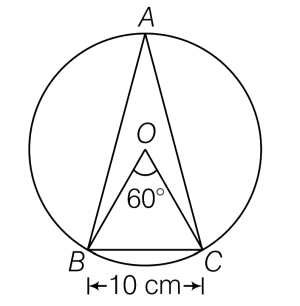
$ABC$ એક ત્રિકોણ છે જેમાં $\angle A=30^{\circ}$ અને $BC=10 \text{ cm}$ છે. ત્રિકોણના પરિવર્તુળનું ક્ષેત્રફળ શોધો.
A
$100 \pi \text{ cm}^2$
B
$5 \text{ cm}^2$
C
$25 \text{ cm}^2$
D
$\frac{100 \pi}{3} \text{ cm}^2$
Solution
(A) $\triangle ABC$ માં,$\angle A=30^{\circ}$ અને $BC=10 \text{ cm}$ છે.
ધારો કે $R$ એ $\triangle ABC$ ની પરિત્રિજ્યા છે.
સાઇનના નિયમ મુજબ,$\frac{BC}{\sin A} = 2R$.
આપેલ કિંમતો મૂકતા: $\frac{10}{\sin 30^{\circ}} = 2R$.
$\sin 30^{\circ} = \frac{1}{2}$ હોવાથી,$\frac{10}{1/2} = 2R$,જેનો અર્થ છે કે $20 = 2R$,તેથી $R = 10 \text{ cm}$.
પરિવર્તુળનું ક્ષેત્રફળ $\pi R^2$ દ્વારા મળે છે.
ક્ષેત્રફળ $= \pi (10)^2 = 100 \pi \text{ cm}^2$.
ધારો કે $R$ એ $\triangle ABC$ ની પરિત્રિજ્યા છે.
સાઇનના નિયમ મુજબ,$\frac{BC}{\sin A} = 2R$.
આપેલ કિંમતો મૂકતા: $\frac{10}{\sin 30^{\circ}} = 2R$.
$\sin 30^{\circ} = \frac{1}{2}$ હોવાથી,$\frac{10}{1/2} = 2R$,જેનો અર્થ છે કે $20 = 2R$,તેથી $R = 10 \text{ cm}$.
પરિવર્તુળનું ક્ષેત્રફળ $\pi R^2$ દ્વારા મળે છે.
ક્ષેત્રફળ $= \pi (10)^2 = 100 \pi \text{ cm}^2$.
0 likesView Solution
14
MathematicsDifficultMCQKCET · 2007
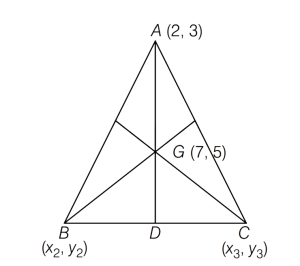
$ABC$ એક ત્રિકોણ છે,$G$ એ મધ્યકેન્દ્ર છે,અને $D$ એ $BC$ નું મધ્યબિંદુ છે. જો $A = (2, 3)$ અને $G = (7, 5)$ હોય,તો બિંદુ $D$ શું છે?
A
$\left(\frac{9}{2}, 4\right)$
B
$\left(\frac{19}{2}, 6\right)$
C
$\left(\frac{11}{2}, \frac{11}{2}\right)$
D
$\left(8, \frac{13}{2}\right)$
Solution
(B) ત્રિકોણ $ABC$ નું મધ્યકેન્દ્ર $G$ એ મધ્યગા $AD$ નું $2:1$ ગુણોત્તરમાં વિભાજન કરે છે.
ધારો કે $A = (2, 3)$,$G = (7, 5)$,અને $D = (x, y)$ છે.
વિભાજન સૂત્રનો ઉપયોગ કરતા,$G$ ના યામ નીચે મુજબ મળે છે:
$G = \left(\frac{2 \cdot x + 1 \cdot 2}{2+1}, \frac{2 \cdot y + 1 \cdot 3}{2+1}\right)$
યામને સરખાવતા:
$7 = \frac{2x + 2}{3}$ $\Rightarrow 21 = 2x + 2$ $\Rightarrow 2x = 19$ $\Rightarrow x = \frac{19}{2}$
$5 = \frac{2y + 3}{3}$ $\Rightarrow 15 = 2y + 3$ $\Rightarrow 2y = 12$ $\Rightarrow y = 6$
તેથી,બિંદુ $D$ ના યામ $\left(\frac{19}{2}, 6\right)$ છે.
ધારો કે $A = (2, 3)$,$G = (7, 5)$,અને $D = (x, y)$ છે.
વિભાજન સૂત્રનો ઉપયોગ કરતા,$G$ ના યામ નીચે મુજબ મળે છે:
$G = \left(\frac{2 \cdot x + 1 \cdot 2}{2+1}, \frac{2 \cdot y + 1 \cdot 3}{2+1}\right)$
યામને સરખાવતા:
$7 = \frac{2x + 2}{3}$ $\Rightarrow 21 = 2x + 2$ $\Rightarrow 2x = 19$ $\Rightarrow x = \frac{19}{2}$
$5 = \frac{2y + 3}{3}$ $\Rightarrow 15 = 2y + 3$ $\Rightarrow 2y = 12$ $\Rightarrow y = 6$
તેથી,બિંદુ $D$ ના યામ $\left(\frac{19}{2}, 6\right)$ છે.
0 likesView Solution
15
MathematicsMediumMCQKCET · 2007
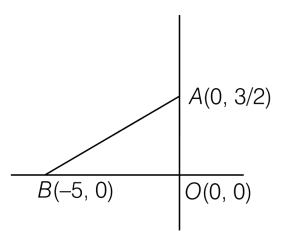
$A(0,0)$,$B(0, \frac{3}{2})$ અને $C(-5,0)$ શિરોબિંદુઓ ધરાવતા ત્રિકોણનું લંબકેન્દ્ર શોધો.
A
$\left(\frac{5}{2}, \frac{3}{4}\right)$
B
$\left(-\frac{5}{2}, \frac{3}{4}\right)$
C
$\left(-5, \frac{3}{2}\right)$
D
$(0,0)$
Solution
(D) આપેલા શિરોબિંદુઓ $A(0,0)$,$B(0, \frac{3}{2})$ અને $C(-5,0)$ છે.
અહીં $A$ ઉગમબિંદુ $(0,0)$ પર હોવાથી,$AB$ એ $y$-અક્ષ પર છે અને $AC$ એ $x$-અક્ષ પર છે.
આથી,આ ત્રિકોણ કાટકોણ ત્રિકોણ છે જેમાં કાટખૂણો શિરોબિંદુ $A(0,0)$ પર છે.
કાટકોણ ત્રિકોણમાં,લંબકેન્દ્ર એ કાટખૂણો ધરાવતું શિરોબિંદુ હોય છે.
તેથી,$\triangle ABC$ નું લંબકેન્દ્ર $(0,0)$ છે.
અહીં $A$ ઉગમબિંદુ $(0,0)$ પર હોવાથી,$AB$ એ $y$-અક્ષ પર છે અને $AC$ એ $x$-અક્ષ પર છે.
આથી,આ ત્રિકોણ કાટકોણ ત્રિકોણ છે જેમાં કાટખૂણો શિરોબિંદુ $A(0,0)$ પર છે.
કાટકોણ ત્રિકોણમાં,લંબકેન્દ્ર એ કાટખૂણો ધરાવતું શિરોબિંદુ હોય છે.
તેથી,$\triangle ABC$ નું લંબકેન્દ્ર $(0,0)$ છે.
0 likesView Solution
16
MathematicsMediumMCQKCET · 2007
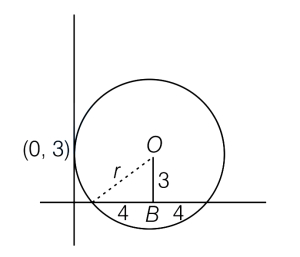
$Y$-અક્ષને $(0,3)$ બિંદુએ સ્પર્શતા અને $X$-અક્ષ પર $8$ એકમનો અંતઃખંડ બનાવતા બે વર્તુળોના સમીકરણો કયા છે?
A
$x^{2}+y^{2} \pm 10x-6y+9=0$
B
$x^{2}+y^{2} \pm 6x-10y+9=0$
C
$x^{2}+y^{2}-8x \pm 10y+9=0$
D
$x^{2}+y^{2}+10x \pm 6y+9=0$
Solution
(A) ધારો કે વર્તુળનું કેન્દ્ર $(h, k)$ છે. વર્તુળ $Y$-અક્ષને $(0,3)$ પર સ્પર્શે છે,તેથી ત્રિજ્યા $r = |h|$ થાય. આમ,કેન્દ્ર $(\pm r, 3)$ છે.
વર્તુળનું સમીકરણ $(x \mp r)^{2} + (y-3)^{2} = r^{2}$ છે.
વર્તુળ $X$-અક્ષ પર $8$ એકમનો અંતઃખંડ બનાવે છે,તેથી $2\sqrt{r^{2}-k^{2}} = 8$.
અહીં $k=3$ છે,તેથી $2\sqrt{r^{2}-3^{2}} = 8 \implies \sqrt{r^{2}-9} = 4 \implies r^{2}-9 = 16 \implies r^{2} = 25 \implies r = 5$.
કેન્દ્ર $(\pm 5, 3)$ મળે છે.
સમીકરણ $(x \mp 5)^{2} + (y-3)^{2} = 5^{2}$ થશે.
$x^{2} \mp 10x + 25 + y^{2} - 6y + 9 = 25$.
$x^{2} + y^{2} \mp 10x - 6y + 9 = 0$.
વર્તુળનું સમીકરણ $(x \mp r)^{2} + (y-3)^{2} = r^{2}$ છે.
વર્તુળ $X$-અક્ષ પર $8$ એકમનો અંતઃખંડ બનાવે છે,તેથી $2\sqrt{r^{2}-k^{2}} = 8$.
અહીં $k=3$ છે,તેથી $2\sqrt{r^{2}-3^{2}} = 8 \implies \sqrt{r^{2}-9} = 4 \implies r^{2}-9 = 16 \implies r^{2} = 25 \implies r = 5$.
કેન્દ્ર $(\pm 5, 3)$ મળે છે.
સમીકરણ $(x \mp 5)^{2} + (y-3)^{2} = 5^{2}$ થશે.
$x^{2} \mp 10x + 25 + y^{2} - 6y + 9 = 25$.
$x^{2} + y^{2} \mp 10x - 6y + 9 = 0$.
0 likesView Solution
17
MathematicsMediumMCQKCET · 2007
જો $3x + y + k = 0$ એ વર્તુળ $x^{2} + y^{2} = 10$ નો સ્પર્શક હોય,તો $k$ ની કિંમતો શોધો.
A
$\pm 7$
B
$\pm 5$
C
$\pm 10$
D
$\pm 9$
Solution
(C) રેખાનું સમીકરણ $3x + y + k = 0$ છે.
વર્તુળનું સમીકરણ $x^{2} + y^{2} = 10$ છે,જેનું કેન્દ્ર $(0, 0)$ અને ત્રિજ્યા $r = \sqrt{10}$ છે.
જો રેખા $Ax + By + C = 0$ એ વર્તુળનો સ્પર્શક હોય,તો કેન્દ્રથી રેખાનું લંબ અંતર ત્રિજ્યા જેટલું હોય:
$\left| \frac{Ax_{1} + By_{1} + C}{\sqrt{A^{2} + B^{2}}} \right| = r$
કિંમતો મૂકતા:
$\left| \frac{3(0) + 1(0) + k}{\sqrt{3^{2} + 1^{2}}} \right| = \sqrt{10}$
$\left| \frac{k}{\sqrt{10}} \right| = \sqrt{10}$
$|k| = 10$
તેથી,$k = \pm 10$.
વર્તુળનું સમીકરણ $x^{2} + y^{2} = 10$ છે,જેનું કેન્દ્ર $(0, 0)$ અને ત્રિજ્યા $r = \sqrt{10}$ છે.
જો રેખા $Ax + By + C = 0$ એ વર્તુળનો સ્પર્શક હોય,તો કેન્દ્રથી રેખાનું લંબ અંતર ત્રિજ્યા જેટલું હોય:
$\left| \frac{Ax_{1} + By_{1} + C}{\sqrt{A^{2} + B^{2}}} \right| = r$
કિંમતો મૂકતા:
$\left| \frac{3(0) + 1(0) + k}{\sqrt{3^{2} + 1^{2}}} \right| = \sqrt{10}$
$\left| \frac{k}{\sqrt{10}} \right| = \sqrt{10}$
$|k| = 10$
તેથી,$k = \pm 10$.
0 likesView Solution
18
MathematicsDifficultMCQKCET · 2007
જો વર્તુળો $x^{2}+y^{2}-2x-2y-7=0$ અને $x^{2}+y^{2}+4x+2y+k=0$ એકબીજાને લંબરૂપે છેદતા હોય,તો વર્તુળોની સામાન્ય જીવાની લંબાઈ શોધો.
A
$\frac{12}{\sqrt{13}}$
B
$2$
C
$5$
D
$8$
Solution
(A) આપેલ વર્તુળો $S_{1} \equiv x^{2}+y^{2}-2x-2y-7=0$ અને $S_{2} \equiv x^{2}+y^{2}+4x+2y+k=0$ છે.
અહીં,$g_{1}=-1, f_{1}=-1, c_{1}=-7$ અને $g_{2}=2, f_{2}=1, c_{2}=k$ છે.
વર્તુળો લંબરૂપે છેદતા હોવાથી,$2(g_{1}g_{2} + f_{1}f_{2}) = c_{1} + c_{2}$.
$2((-1)(2) + (-1)(1)) = -7 + k$
$2(-2 - 1) = -7 + k$
$-6 = -7 + k \Rightarrow k = 1$.
સામાન્ય જીવાનું સમીકરણ $S_{1} - S_{2} = 0$ છે.
$(x^{2}+y^{2}-2x-2y-7) - (x^{2}+y^{2}+4x+2y+1) = 0$
$-6x - 4y - 8 = 0 \Rightarrow 3x + 2y + 4 = 0$.
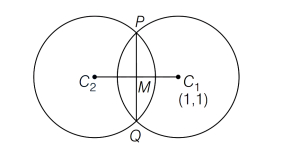
વર્તુળ $S_{1}$ માટે,કેન્દ્ર $C_{1} = (1, 1)$ અને ત્રિજ્યા $r_{1} = \sqrt{1^{2} + 1^{2} - (-7)} = \sqrt{9} = 3$ છે.
કેન્દ્ર $C_{1}(1, 1)$ થી જીવા $3x + 2y + 4 = 0$ નું લંબ અંતર $d$:
$d = \frac{|3(1) + 2(1) + 4|}{\sqrt{3^{2} + 2^{2}}} = \frac{|9|}{\sqrt{13}} = \frac{9}{\sqrt{13}}$.
સામાન્ય જીવાની લંબાઈ $2\sqrt{r_{1}^{2} - d^{2}}$ છે.
$= 2\sqrt{3^{2} - (\frac{9}{\sqrt{13}})^{2}} = 2\sqrt{9 - \frac{81}{13}} = 2\sqrt{\frac{117 - 81}{13}} = 2\sqrt{\frac{36}{13}} = \frac{12}{\sqrt{13}}$.
અહીં,$g_{1}=-1, f_{1}=-1, c_{1}=-7$ અને $g_{2}=2, f_{2}=1, c_{2}=k$ છે.
વર્તુળો લંબરૂપે છેદતા હોવાથી,$2(g_{1}g_{2} + f_{1}f_{2}) = c_{1} + c_{2}$.
$2((-1)(2) + (-1)(1)) = -7 + k$
$2(-2 - 1) = -7 + k$
$-6 = -7 + k \Rightarrow k = 1$.
સામાન્ય જીવાનું સમીકરણ $S_{1} - S_{2} = 0$ છે.
$(x^{2}+y^{2}-2x-2y-7) - (x^{2}+y^{2}+4x+2y+1) = 0$
$-6x - 4y - 8 = 0 \Rightarrow 3x + 2y + 4 = 0$.
વર્તુળ $S_{1}$ માટે,કેન્દ્ર $C_{1} = (1, 1)$ અને ત્રિજ્યા $r_{1} = \sqrt{1^{2} + 1^{2} - (-7)} = \sqrt{9} = 3$ છે.
કેન્દ્ર $C_{1}(1, 1)$ થી જીવા $3x + 2y + 4 = 0$ નું લંબ અંતર $d$:
$d = \frac{|3(1) + 2(1) + 4|}{\sqrt{3^{2} + 2^{2}}} = \frac{|9|}{\sqrt{13}} = \frac{9}{\sqrt{13}}$.
સામાન્ય જીવાની લંબાઈ $2\sqrt{r_{1}^{2} - d^{2}}$ છે.
$= 2\sqrt{3^{2} - (\frac{9}{\sqrt{13}})^{2}} = 2\sqrt{9 - \frac{81}{13}} = 2\sqrt{\frac{117 - 81}{13}} = 2\sqrt{\frac{36}{13}} = \frac{12}{\sqrt{13}}$.
0 likesView Solution
19
MathematicsMediumMCQKCET · 2007
વર્તુળો $x^{2}+y^{2}=4$ અને $x^{2}+y^{2}-6x-8y-24=0$ ના સામાન્ય સ્પર્શકોની સંખ્યા કેટલી છે?
A
$3$
B
$4$
C
$2$
D
$1$
Solution
(D) આપેલ વર્તુળોના સમીકરણો છે:
$C_{1}: x^{2}+y^{2}=4$,જેનું કેન્દ્ર $O_{1}=(0,0)$ અને ત્રિજ્યા $r_{1}=2$ છે.
$C_{2}: x^{2}+y^{2}-6x-8y-24=0$,જેનું કેન્દ્ર $O_{2}=(3,4)$ અને ત્રિજ્યા $r_{2}=\sqrt{3^{2}+4^{2}-(-24)}=\sqrt{9+16+24}=\sqrt{49}=7$ છે.
હવે,કેન્દ્રો $O_{1}$ અને $O_{2}$ વચ્ચેનું અંતર શોધો:
$d = \sqrt{(3-0)^{2}+(4-0)^{2}} = \sqrt{9+16} = 5$.
અંતર $d$ ની સરખામણી ત્રિજ્યાઓના સરવાળા અને તફાવત સાથે કરો:
$r_{1}+r_{2} = 2+7 = 9$.
$|r_{1}-r_{2}| = |2-7| = 5$.
અહીં $d = |r_{1}-r_{2}|$ હોવાથી,વર્તુળો એકબીજાને અંદરથી સ્પર્શે છે.
તેથી,સામાન્ય સ્પર્શકોની સંખ્યા $1$ છે.
$C_{1}: x^{2}+y^{2}=4$,જેનું કેન્દ્ર $O_{1}=(0,0)$ અને ત્રિજ્યા $r_{1}=2$ છે.
$C_{2}: x^{2}+y^{2}-6x-8y-24=0$,જેનું કેન્દ્ર $O_{2}=(3,4)$ અને ત્રિજ્યા $r_{2}=\sqrt{3^{2}+4^{2}-(-24)}=\sqrt{9+16+24}=\sqrt{49}=7$ છે.
હવે,કેન્દ્રો $O_{1}$ અને $O_{2}$ વચ્ચેનું અંતર શોધો:
$d = \sqrt{(3-0)^{2}+(4-0)^{2}} = \sqrt{9+16} = 5$.
અંતર $d$ ની સરખામણી ત્રિજ્યાઓના સરવાળા અને તફાવત સાથે કરો:
$r_{1}+r_{2} = 2+7 = 9$.
$|r_{1}-r_{2}| = |2-7| = 5$.
અહીં $d = |r_{1}-r_{2}|$ હોવાથી,વર્તુળો એકબીજાને અંદરથી સ્પર્શે છે.
તેથી,સામાન્ય સ્પર્શકોની સંખ્યા $1$ છે.
0 likesView Solution
20
MathematicsDifficultMCQKCET · 2007
ત્રણ વર્તુળો ધ્યાનમાં લો: $S_{1} \equiv x^{2}+y^{2}-6x-6y+4=0$,$S_{2} \equiv x^{2}+y^{2}-2x-4y+3=0$,અને $S_{3} \equiv x^{2}+y^{2}+2kx+2y+1=0$. જો આ ત્રણ વર્તુળોનું રેડિકલ કેન્દ્ર અસ્તિત્વ ધરાવતું હોય,તો નીચેનામાંથી $k$ ની કઈ કિંમત ન હોઈ શકે?
A
$2$
B
$1$
C
$5$
D
$4$
Solution
(C) ત્રણ વર્તુળોનું રેડિકલ કેન્દ્ર ત્યારે જ અસ્તિત્વ ધરાવે છે જો તેમની રેડિકલ ધરીઓ સમાંતર ન હોય.
પ્રથમ,$S_{1}$ અને $S_{2}$ ની રેડિકલ ધરી $S_{1} - S_{2} = 0$ દ્વારા મેળવો:
$-4x - 2y + 1 = 0 \Rightarrow 4x + 2y - 1 = 0$.
ત્યારબાદ,$S_{2}$ અને $S_{3}$ ની રેડિકલ ધરી $S_{2} - S_{3} = 0$ દ્વારા મેળવો:
$-(2+2k)x - 6y + 2 = 0 \Rightarrow (2+2k)x + 6y - 2 = 0$.
જો આ બે રેખાઓ સમાંતર હોય તો રેડિકલ કેન્દ્ર અસ્તિત્વ ધરાવતું નથી.
બે રેખાઓ $a_{1}x + b_{1}y + c_{1} = 0$ અને $a_{2}x + b_{2}y + c_{2} = 0$ સમાંતર હોય જો $\frac{a_{1}}{a_{2}} = \frac{b_{1}}{b_{2}}$ હોય.
તેથી,$\frac{4}{2+2k} = \frac{2}{6}$.
$24 = 4 + 4k$ $\Rightarrow 20 = 4k$ $\Rightarrow k = 5$.
આમ,જો $k = 5$ હોય,તો રેખાઓ સમાંતર છે અને રેડિકલ કેન્દ્ર અસ્તિત્વ ધરાવતું નથી.
તેથી,$k$ ની કિંમત $5$ ન હોઈ શકે.
પ્રથમ,$S_{1}$ અને $S_{2}$ ની રેડિકલ ધરી $S_{1} - S_{2} = 0$ દ્વારા મેળવો:
$-4x - 2y + 1 = 0 \Rightarrow 4x + 2y - 1 = 0$.
ત્યારબાદ,$S_{2}$ અને $S_{3}$ ની રેડિકલ ધરી $S_{2} - S_{3} = 0$ દ્વારા મેળવો:
$-(2+2k)x - 6y + 2 = 0 \Rightarrow (2+2k)x + 6y - 2 = 0$.
જો આ બે રેખાઓ સમાંતર હોય તો રેડિકલ કેન્દ્ર અસ્તિત્વ ધરાવતું નથી.
બે રેખાઓ $a_{1}x + b_{1}y + c_{1} = 0$ અને $a_{2}x + b_{2}y + c_{2} = 0$ સમાંતર હોય જો $\frac{a_{1}}{a_{2}} = \frac{b_{1}}{b_{2}}$ હોય.
તેથી,$\frac{4}{2+2k} = \frac{2}{6}$.
$24 = 4 + 4k$ $\Rightarrow 20 = 4k$ $\Rightarrow k = 5$.
આમ,જો $k = 5$ હોય,તો રેખાઓ સમાંતર છે અને રેડિકલ કેન્દ્ર અસ્તિત્વ ધરાવતું નથી.
તેથી,$k$ ની કિંમત $5$ ન હોઈ શકે.
0 likesView Solution
21
MathematicsMediumMCQKCET · 2007
પરવલય $y = 2x^{2} + x$ નું નાભિ (focus) શું છે?
A
$(0, 0)$
B
$(\frac{1}{2}, \frac{1}{4})$
C
$(-\frac{1}{4}, 0)$
D
$(-\frac{1}{4}, \frac{1}{8})$
Solution
(C) આપેલ પરવલયનું સમીકરણ $y = 2x^{2} + x$ છે.
$2$ વડે ભાગતા,$x^{2} + \frac{x}{2} = \frac{y}{2}$ મળે.
પૂર્ણવર્ગ બનાવતા,$x^{2} + \frac{x}{2} + \frac{1}{16} = \frac{y}{2} + \frac{1}{16}$.
આથી $(x + \frac{1}{4})^{2} = \frac{1}{2}(y + \frac{1}{8})$ મળે.
આને પ્રમાણિત સ્વરૂપ $X^{2} = 4AY$ સાથે સરખાવતા,જ્યાં $X = x + \frac{1}{4}$,$Y = y + \frac{1}{8}$,અને $4A = \frac{1}{2}$,તેથી $A = \frac{1}{8}$ મળે.
$(X, Y)$ યામ પદ્ધતિમાં નાભિ $(0, A) = (0, \frac{1}{8})$ છે.
કિંમતો પાછી મૂકતા,$x + \frac{1}{4} = 0 \Rightarrow x = -\frac{1}{4}$ અને $y + \frac{1}{8} = \frac{1}{8} \Rightarrow y = 0$.
આમ,આપેલ પરવલયનું નાભિ $(-\frac{1}{4}, 0)$ છે.
$2$ વડે ભાગતા,$x^{2} + \frac{x}{2} = \frac{y}{2}$ મળે.
પૂર્ણવર્ગ બનાવતા,$x^{2} + \frac{x}{2} + \frac{1}{16} = \frac{y}{2} + \frac{1}{16}$.
આથી $(x + \frac{1}{4})^{2} = \frac{1}{2}(y + \frac{1}{8})$ મળે.
આને પ્રમાણિત સ્વરૂપ $X^{2} = 4AY$ સાથે સરખાવતા,જ્યાં $X = x + \frac{1}{4}$,$Y = y + \frac{1}{8}$,અને $4A = \frac{1}{2}$,તેથી $A = \frac{1}{8}$ મળે.
$(X, Y)$ યામ પદ્ધતિમાં નાભિ $(0, A) = (0, \frac{1}{8})$ છે.
કિંમતો પાછી મૂકતા,$x + \frac{1}{4} = 0 \Rightarrow x = -\frac{1}{4}$ અને $y + \frac{1}{8} = \frac{1}{8} \Rightarrow y = 0$.
આમ,આપેલ પરવલયનું નાભિ $(-\frac{1}{4}, 0)$ છે.
0 likesView Solution
22
MathematicsEasyMCQKCET · 2007
જો $P$ એ ઉપવલય $\frac{x^{2}}{36}+\frac{y^{2}}{16}=1$ પરનું કોઈ બિંદુ હોય અને $S$ તથા $S^{\prime}$ તેના નાભિબિંદુઓ હોય,તો $PS + PS^{\prime}$ ની કિંમત કેટલી થાય?
A
$4$
B
$8$
C
$10$
D
$12$
Solution
(D) આપેલ ઉપવલયનું સમીકરણ $\frac{x^{2}}{36}+\frac{y^{2}}{16}=1$ છે.
તેને પ્રમાણિત સ્વરૂપ $\frac{x^{2}}{a^{2}}+\frac{y^{2}}{b^{2}}=1$ સાથે સરખાવતા,$a^{2}=36$ મળે,જેનો અર્થ છે કે $a=6$.
ઉપવલયની વ્યાખ્યા મુજબ,ઉપવલય પરના કોઈપણ બિંદુ $P$ માટે નાભિ અંતરોનો સરવાળો તેની મુખ્ય અક્ષની લંબાઈ જેટલો હોય છે.
તેથી,$PS + PS^{\prime} = 2a$.
$a$ ની કિંમત મૂકતા,$PS + PS^{\prime} = 2 \times 6 = 12$ મળે છે.
તેને પ્રમાણિત સ્વરૂપ $\frac{x^{2}}{a^{2}}+\frac{y^{2}}{b^{2}}=1$ સાથે સરખાવતા,$a^{2}=36$ મળે,જેનો અર્થ છે કે $a=6$.
ઉપવલયની વ્યાખ્યા મુજબ,ઉપવલય પરના કોઈપણ બિંદુ $P$ માટે નાભિ અંતરોનો સરવાળો તેની મુખ્ય અક્ષની લંબાઈ જેટલો હોય છે.
તેથી,$PS + PS^{\prime} = 2a$.
$a$ ની કિંમત મૂકતા,$PS + PS^{\prime} = 2 \times 6 = 12$ મળે છે.
0 likesView Solution
23
MathematicsMediumMCQKCET · 2007
જો ઉપવલય $\frac{x^{2}}{a^{2}}+\frac{y^{2}}{b^{2}}=1$ (જ્યાં $a > b$) ના સહાયક વર્તુળનું ક્ષેત્રફળ ઉપવલયના ક્ષેત્રફળ કરતાં બમણું હોય,તો ઉપવલયની ઉત્કેન્દ્રતા શોધો.
A
$\frac{1}{\sqrt{3}}$
B
$\frac{1}{2}$
C
$\frac{1}{\sqrt{2}}$
D
$\frac{\sqrt{3}}{2}$
Solution
(D) ઉપવલય $\frac{x^{2}}{a^{2}}+\frac{y^{2}}{b^{2}}=1$ ના સહાયક વર્તુળનું સમીકરણ $x^{2}+y^{2}=a^{2}$ છે.
સહાયક વર્તુળનું ક્ષેત્રફળ $= \pi a^{2}$.
ઉપવલયનું ક્ષેત્રફળ $= \pi ab$.
પ્રશ્ન મુજબ,સહાયક વર્તુળનું ક્ષેત્રફળ ઉપવલયના ક્ષેત્રફળ કરતાં બમણું છે:
$\pi a^{2} = 2(\pi ab)$
$a^{2} = 2ab$
$a = 2b \Rightarrow b = \frac{a}{2}$.
ઉપવલયની ઉત્કેન્દ્રતા $e$ નીચે મુજબ છે:
$e = \sqrt{1 - \frac{b^{2}}{a^{2}}}$
$e = \sqrt{1 - \frac{(a/2)^{2}}{a^{2}}}$
$e = \sqrt{1 - \frac{a^{2}/4}{a^{2}}}$
$e = \sqrt{1 - \frac{1}{4}} = \sqrt{\frac{3}{4}} = \frac{\sqrt{3}}{2}$.
સહાયક વર્તુળનું ક્ષેત્રફળ $= \pi a^{2}$.
ઉપવલયનું ક્ષેત્રફળ $= \pi ab$.
પ્રશ્ન મુજબ,સહાયક વર્તુળનું ક્ષેત્રફળ ઉપવલયના ક્ષેત્રફળ કરતાં બમણું છે:
$\pi a^{2} = 2(\pi ab)$
$a^{2} = 2ab$
$a = 2b \Rightarrow b = \frac{a}{2}$.
ઉપવલયની ઉત્કેન્દ્રતા $e$ નીચે મુજબ છે:
$e = \sqrt{1 - \frac{b^{2}}{a^{2}}}$
$e = \sqrt{1 - \frac{(a/2)^{2}}{a^{2}}}$
$e = \sqrt{1 - \frac{a^{2}/4}{a^{2}}}$
$e = \sqrt{1 - \frac{1}{4}} = \sqrt{\frac{3}{4}} = \frac{\sqrt{3}}{2}$.
0 likesView Solution
24
MathematicsEasyMCQKCET · 2007
જો $\frac{x^{2}}{36}-\frac{y^{2}}{k^{2}}=1$ એ અતિવલય (hyperbola) હોય,તો નીચેનામાંથી કયું વિધાન સાચું હોઈ શકે?
A
$(-3, 1)$ અતિવલય પર આવેલું છે
B
$(3, 1)$ અતિવલય પર આવેલું છે
C
$(10, 4)$ અતિવલય પર આવેલું છે
D
$(5, 2)$ અતિવલય પર આવેલું છે
Solution
(C) અતિવલયનું આપેલ સમીકરણ: $\frac{x^{2}}{36}-\frac{y^{2}}{k^{2}}=1$.
$k^{2}$ માટે ગોઠવતા:
$\frac{y^{2}}{k^{2}} = \frac{x^{2}-36}{36}$
$k^{2} = \frac{36y^{2}}{x^{2}-36}$.
$k^{2} > 0$ હોવાથી,$x^{2}-36 > 0$ હોવું જોઈએ,જેનો અર્થ છે કે $x^{2} > 36$ અથવા $|x| > 6$.
વિકલ્પો તપાસતા:
$A$. $(-3, 1) \Rightarrow x^{2} = 9 < 36$ (ખોટું)
$B$. $(3, 1) \Rightarrow x^{2} = 9 < 36$ (ખોટું)
$C$. $(10, 4) \Rightarrow x^{2} = 100 > 36$ (સાચું)
$D$. $(5, 2) \Rightarrow x^{2} = 25 < 36$ (ખોટું)
તેથી,બિંદુ $(10, 4)$ અતિવલય પર હોઈ શકે છે.
$k^{2}$ માટે ગોઠવતા:
$\frac{y^{2}}{k^{2}} = \frac{x^{2}-36}{36}$
$k^{2} = \frac{36y^{2}}{x^{2}-36}$.
$k^{2} > 0$ હોવાથી,$x^{2}-36 > 0$ હોવું જોઈએ,જેનો અર્થ છે કે $x^{2} > 36$ અથવા $|x| > 6$.
વિકલ્પો તપાસતા:
$A$. $(-3, 1) \Rightarrow x^{2} = 9 < 36$ (ખોટું)
$B$. $(3, 1) \Rightarrow x^{2} = 9 < 36$ (ખોટું)
$C$. $(10, 4) \Rightarrow x^{2} = 100 > 36$ (સાચું)
$D$. $(5, 2) \Rightarrow x^{2} = 25 < 36$ (ખોટું)
તેથી,બિંદુ $(10, 4)$ અતિવલય પર હોઈ શકે છે.
0 likesView Solution
25
MathematicsEasyMCQKCET · 2007
$\lim _{x \rightarrow 1} \frac{\tan \left(x^{2}-1\right)}{x-1}$ ની કિંમત શોધો.
A
$2$
B
$\frac{1}{2}$
C
$-2$
D
$\frac{-1}{2}$
Solution
(A) આપેલ લક્ષ $\lim _{x \rightarrow 1} \frac{\tan \left(x^{2}-1\right)}{x-1}$ છે.
$x=1$ મૂકતા,આપણને $\frac{0}{0}$ સ્વરૂપ મળે છે.
$L$'Hospital ના નિયમનો ઉપયોગ કરતા,અંશ અને છેદનું $x$ ની સાપેક્ષમાં વિકલન કરતા:
$\lim _{x \rightarrow 1} \frac{\frac{d}{dx} \tan \left(x^{2}-1\right)}{\frac{d}{dx} (x-1)}$
$= \lim _{x \rightarrow 1} \frac{\sec ^{2}\left(x^{2}-1\right) \cdot (2x)}{1}$
$= \sec ^{2}(1^{2}-1) \cdot 2(1)$
$= \sec ^{2}(0) \cdot 2$
$= 1 \cdot 2 = 2$.
$x=1$ મૂકતા,આપણને $\frac{0}{0}$ સ્વરૂપ મળે છે.
$L$'Hospital ના નિયમનો ઉપયોગ કરતા,અંશ અને છેદનું $x$ ની સાપેક્ષમાં વિકલન કરતા:
$\lim _{x \rightarrow 1} \frac{\frac{d}{dx} \tan \left(x^{2}-1\right)}{\frac{d}{dx} (x-1)}$
$= \lim _{x \rightarrow 1} \frac{\sec ^{2}\left(x^{2}-1\right) \cdot (2x)}{1}$
$= \sec ^{2}(1^{2}-1) \cdot 2(1)$
$= \sec ^{2}(0) \cdot 2$
$= 1 \cdot 2 = 2$.
0 likesView Solution
26
MathematicsEasyMCQKCET · 2007
વિધાન "જો $2$ અવિભાજ્ય છે,તો $3$ એકી છે" નું નિષેધ શું થાય?
A
$2$ અવિભાજ્ય નથી,તો $3$ એકી નથી
B
$2$ અવિભાજ્ય છે અને $3$ એકી નથી
C
$2$ અવિભાજ્ય નથી અને $3$ એકી છે
D
$2$ અવિભાજ્ય નથી,તો $3$ એકી છે
Solution
(B) ધારો કે $p$ એ વિધાન "$2$ અવિભાજ્ય છે" છે.
ધારો કે $q$ એ વિધાન "$3$ એકી છે" છે.
આપેલ વિધાન $p \rightarrow q$ છે.
ગર્ભિત વિધાન $p \rightarrow q$ નો નિષેધ $\sim(p \rightarrow q) \equiv p \wedge \sim q$ દ્વારા આપવામાં આવે છે.
અહીં,$p$ એ "$2$ અવિભાજ્ય છે" અને $\sim q$ એ "$3$ એકી નથી" છે.
તેથી,નિષેધ "$2$ અવિભાજ્ય છે અને $3$ એકી નથી" થાય.
ધારો કે $q$ એ વિધાન "$3$ એકી છે" છે.
આપેલ વિધાન $p \rightarrow q$ છે.
ગર્ભિત વિધાન $p \rightarrow q$ નો નિષેધ $\sim(p \rightarrow q) \equiv p \wedge \sim q$ દ્વારા આપવામાં આવે છે.
અહીં,$p$ એ "$2$ અવિભાજ્ય છે" અને $\sim q$ એ "$3$ એકી નથી" છે.
તેથી,નિષેધ "$2$ અવિભાજ્ય છે અને $3$ એકી નથી" થાય.
0 likesView Solution
27
MathematicsDifficultMCQKCET · 2007
$\frac{3 x^{2}+1}{x^{2}-6 x+8}$ ની કિંમત શું થાય?
A
$3+\frac{49}{2(x-4)}-\frac{13}{2(x-2)}$
B
$\frac{49}{2(x-4)}-\frac{13}{2(x-2)}$
C
$\frac{-49}{2(x-4)}+\frac{13}{2(x-2)}$
D
$\frac{49}{2(x-4)}+\frac{13}{2(x-2)}$
Solution
(A) આપેલ પદાવલિ: $\frac{3 x^{2}+1}{x^{2}-6 x+8}$.
અંશ અને છેદની ઘાત સમાન હોવાથી,આપણે ભાગાકાર કરતા:
$\frac{3 x^{2}+1}{x^{2}-6 x+8} = 3 + \frac{18 x - 23}{x^{2}-6 x+8}$.
હવે,શેષને આંશિક અપૂર્ણાંકમાં વિભાજિત કરતા:
$\frac{18 x - 23}{(x-2)(x-4)} = \frac{A}{x-2} + \frac{B}{x-4}$.
$18 x - 23 = A(x-4) + B(x-2)$.
$x=2$ લેતા: $18(2) - 23 = A(2-4) \Rightarrow 13 = -2A \Rightarrow A = -\frac{13}{2}$.
$x=4$ લેતા: $18(4) - 23 = B(4-2) \Rightarrow 49 = 2B \Rightarrow B = \frac{49}{2}$.
આ કિંમતો મૂકતા:
$\frac{3 x^{2}+1}{x^{2}-6 x+8} = 3 - \frac{13}{2(x-2)} + \frac{49}{2(x-4)}$.
જે વિકલ્પ $A$ સાથે સુસંગત છે.
અંશ અને છેદની ઘાત સમાન હોવાથી,આપણે ભાગાકાર કરતા:
$\frac{3 x^{2}+1}{x^{2}-6 x+8} = 3 + \frac{18 x - 23}{x^{2}-6 x+8}$.
હવે,શેષને આંશિક અપૂર્ણાંકમાં વિભાજિત કરતા:
$\frac{18 x - 23}{(x-2)(x-4)} = \frac{A}{x-2} + \frac{B}{x-4}$.
$18 x - 23 = A(x-4) + B(x-2)$.
$x=2$ લેતા: $18(2) - 23 = A(2-4) \Rightarrow 13 = -2A \Rightarrow A = -\frac{13}{2}$.
$x=4$ લેતા: $18(4) - 23 = B(4-2) \Rightarrow 49 = 2B \Rightarrow B = \frac{49}{2}$.
આ કિંમતો મૂકતા:
$\frac{3 x^{2}+1}{x^{2}-6 x+8} = 3 - \frac{13}{2(x-2)} + \frac{49}{2(x-4)}$.
જે વિકલ્પ $A$ સાથે સુસંગત છે.
0 likesView Solution
28
MathematicsEasyMCQKCET · 2007
$xy=0$ રેખાઓની જોડી,$x-4=0$ અને $y+5=0$ રેખા દ્વારા ઘેરાયેલું ક્ષેત્રફળ કેટલું છે?
A
$20 \text{ ચોરસ એકમ}$
B
$10 \text{ ચોરસ એકમ}$
C
$\frac{5}{4} \text{ ચોરસ એકમ}$
D
$0 \text{ ચોરસ એકમ}$
Solution
(A) આપેલ રેખાઓની જોડી $xy=0$ એ યામ અક્ષો દર્શાવે છે,એટલે કે $x=0$ અને $y=0$.
અન્ય રેખાઓ $x-4=0$ (જે $x=4$ છે) અને $y+5=0$ (જે $y=-5$ છે) છે.
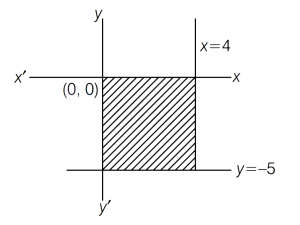
આ ચાર રેખાઓ $x=0, x=4, y=0$ અને $y=-5$ કાર્ટેઝિયન સમતલમાં એક લંબચોરસ પ્રદેશ બનાવે છે.
આ લંબચોરસના શિરોબિંદુઓ $(0, 0), (4, 0), (4, -5)$ અને $(0, -5)$ છે.
લંબચોરસની લંબાઈ એ $x=0$ અને $x=4$ વચ્ચેનું અંતર છે,જે $|4-0| = 4 \text{ એકમ}$ છે.
લંબચોરસની પહોળાઈ એ $y=0$ અને $y=-5$ વચ્ચેનું અંતર છે,જે $|0-(-5)| = 5 \text{ એકમ}$ છે.
તેથી,લંબચોરસનું ક્ષેત્રફળ $= \text{લંબાઈ} \times \text{પહોળાઈ} = 4 \times 5 = 20 \text{ ચોરસ એકમ}$ થાય.
અન્ય રેખાઓ $x-4=0$ (જે $x=4$ છે) અને $y+5=0$ (જે $y=-5$ છે) છે.
આ ચાર રેખાઓ $x=0, x=4, y=0$ અને $y=-5$ કાર્ટેઝિયન સમતલમાં એક લંબચોરસ પ્રદેશ બનાવે છે.
આ લંબચોરસના શિરોબિંદુઓ $(0, 0), (4, 0), (4, -5)$ અને $(0, -5)$ છે.
લંબચોરસની લંબાઈ એ $x=0$ અને $x=4$ વચ્ચેનું અંતર છે,જે $|4-0| = 4 \text{ એકમ}$ છે.
લંબચોરસની પહોળાઈ એ $y=0$ અને $y=-5$ વચ્ચેનું અંતર છે,જે $|0-(-5)| = 5 \text{ એકમ}$ છે.
તેથી,લંબચોરસનું ક્ષેત્રફળ $= \text{લંબાઈ} \times \text{પહોળાઈ} = 4 \times 5 = 20 \text{ ચોરસ એકમ}$ થાય.
0 likesView Solution
29
MathematicsDifficultMCQKCET · 2007
બિંદુ $(3,4)$ માંથી રેખા $2x+y-7=0$ પર દોરેલા લંબના લંબપાદના યામ શોધો.
A
$\left(\frac{9}{5}, \frac{17}{5}\right)$
B
$(1,5)$
C
$(-5,1)$
D
$(1,-5)$
Solution
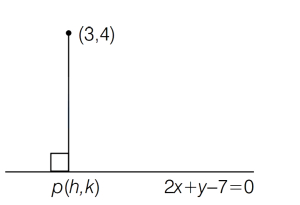
(A) આપણે જાણીએ છીએ કે બિંદુ $(x_1, y_1)$ માંથી રેખા $ax+by+c=0$ પર દોરેલા લંબના લંબપાદ $(h, k)$ માટેનું સૂત્ર નીચે મુજબ છે:
$\frac{h-x_1}{a} = \frac{k-y_1}{b} = \frac{-(ax_1+by_1+c)}{a^2+b^2}$
અહીં,બિંદુ $(x_1, y_1) = (3,4)$ છે અને રેખા $2x+y-7=0$ છે.
તેથી,$a=2, b=1, c=-7$.
આ કિંમતો સૂત્રમાં મૂકતા:
$\frac{h-3}{2} = \frac{k-4}{1} = \frac{-(2(3) + 1(4) - 7)}{2^2 + 1^2}$
$\frac{h-3}{2} = \frac{k-4}{1} = \frac{-(6+4-7)}{4+1}$
$\frac{h-3}{2} = \frac{k-4}{1} = \frac{-3}{5}$
હવે,$h$ માટે ઉકેલતા:
$h-3 = 2 \times \left(\frac{-3}{5}\right) = \frac{-6}{5}$
$h = 3 - \frac{6}{5} = \frac{15-6}{5} = \frac{9}{5}$
$k$ માટે ઉકેલતા:
$k-4 = 1 \times \left(\frac{-3}{5}\right) = \frac{-3}{5}$
$k = 4 - \frac{3}{5} = \frac{20-3}{5} = \frac{17}{5}$
તેથી,લંબપાદના યામ $\left(\frac{9}{5}, \frac{17}{5}\right)$ છે.
$\frac{h-x_1}{a} = \frac{k-y_1}{b} = \frac{-(ax_1+by_1+c)}{a^2+b^2}$
અહીં,બિંદુ $(x_1, y_1) = (3,4)$ છે અને રેખા $2x+y-7=0$ છે.
તેથી,$a=2, b=1, c=-7$.
આ કિંમતો સૂત્રમાં મૂકતા:
$\frac{h-3}{2} = \frac{k-4}{1} = \frac{-(2(3) + 1(4) - 7)}{2^2 + 1^2}$
$\frac{h-3}{2} = \frac{k-4}{1} = \frac{-(6+4-7)}{4+1}$
$\frac{h-3}{2} = \frac{k-4}{1} = \frac{-3}{5}$
હવે,$h$ માટે ઉકેલતા:
$h-3 = 2 \times \left(\frac{-3}{5}\right) = \frac{-6}{5}$
$h = 3 - \frac{6}{5} = \frac{15-6}{5} = \frac{9}{5}$
$k$ માટે ઉકેલતા:
$k-4 = 1 \times \left(\frac{-3}{5}\right) = \frac{-3}{5}$
$k = 4 - \frac{3}{5} = \frac{20-3}{5} = \frac{17}{5}$
તેથી,લંબપાદના યામ $\left(\frac{9}{5}, \frac{17}{5}\right)$ છે.
0 likesView Solution
30
MathematicsMediumMCQKCET · 2007
સમૂહ $(G, \times_{15})$ માં,જ્યાં $G = \{3, 6, 9, 12\}$ અને $\times_{15}$ એ $15$ મોડ્યુલો ગુણાકાર છે,તો તટસ્થ ઘટક (identity element) કયો છે?
A
$3$
B
$6$
C
$12$
D
$9$
Solution
(B) સમૂહ $(G, \times_{15})$ માં તટસ્થ ઘટક $e$ એ શરત $a \times_{15} e = a$ નું પાલન કરે છે,જ્યાં $a \in G$.
કોમ્પોઝિશન ટેબલ પરથી,આપણે જોઈ શકીએ છીએ કે $6$ ની હરોળ $G$ ના ઘટકોને તે જ ક્રમમાં દર્શાવે છે.
કોષ્ટક મુજબ,$3 \times_{15} 6 = 3$,$6 \times_{15} 6 = 6$,$9 \times_{15} 6 = 9$,અને $12 \times_{15} 6 = 12$ થાય છે,તેથી તટસ્થ ઘટક $6$ છે.
કોમ્પોઝિશન ટેબલ પરથી,આપણે જોઈ શકીએ છીએ કે $6$ ની હરોળ $G$ ના ઘટકોને તે જ ક્રમમાં દર્શાવે છે.
કોષ્ટક મુજબ,$3 \times_{15} 6 = 3$,$6 \times_{15} 6 = 6$,$9 \times_{15} 6 = 9$,અને $12 \times_{15} 6 = 12$ થાય છે,તેથી તટસ્થ ઘટક $6$ છે.
0 likesView Solution
31
MathematicsMediumMCQKCET · 2007
એક જૂથ $(G, *)$ માં $10$ ઘટકો છે. $G$ ના ઘટકોની ન્યૂનતમ સંખ્યા,જે તેમના પોતાના વ્યસ્ત છે,તે છે
A
$2$
B
$1$
C
$9$
D
$0$
Solution
(B) કોઈપણ જૂથ $(G, *)$ માં,તટસ્થ ઘટક $e$ હંમેશા તેનો પોતાનો વ્યસ્ત હોય છે,કારણ કે $e * e = e$.
જૂથ $G$ માં ઓછામાં ઓછો તટસ્થ ઘટક હોવો આવશ્યક છે,તેથી તેમના પોતાના વ્યસ્ત હોય તેવા ઘટકોની ન્યૂનતમ સંખ્યા $1$ છે.
જૂથ $G$ માં ઓછામાં ઓછો તટસ્થ ઘટક હોવો આવશ્યક છે,તેથી તેમના પોતાના વ્યસ્ત હોય તેવા ઘટકોની ન્યૂનતમ સંખ્યા $1$ છે.
0 likesView Solution
32
MathematicsEasyMCQKCET · 2007
આપેલ ક્રિયાના સંદર્ભમાં નીચેનામાંથી કયું જૂથ (group) નથી?
A
સરવાળાની ક્રિયા હેઠળ બેકી પૂર્ણાંકોનો ગણ
B
સરવાળાની ક્રિયા હેઠળ એકી પૂર્ણાંકોનો ગણ
C
સરવાળાની ક્રિયા હેઠળ $\{0\}$
D
ગુણાકારની ક્રિયા હેઠળ $\{1, -1\}$
Solution
(B) કોઈ ગણ $G$ અને દ્વિતીય ક્રિયા $*$ માટે,જો તે સંવૃતતા,જૂથનો નિયમ,તટસ્થ ઘટકનું અસ્તિત્વ અને વ્યસ્ત ઘટકનું અસ્તિત્વ ધરાવતું હોય તો તેને જૂથ કહેવાય.
સરવાળાની ક્રિયા હેઠળ એકી પૂર્ણાંકોના ગણ માટે,ધારો કે $a = 1$ અને $b = 3$. તો $a + b = 4$,જે બેકી પૂર્ણાંક છે.
બે એકી પૂર્ણાંકોનો સરવાળો હંમેશા બેકી સંખ્યા હોવાથી,આ ગણ સરવાળાની ક્રિયા હેઠળ સંવૃત નથી.
વધુમાં,સરવાળા માટે તટસ્થ ઘટક $0$ છે,જે એકી સંખ્યા નથી.
તેથી,સરવાળાની ક્રિયા હેઠળ એકી પૂર્ણાંકોનો ગણ એ જૂથ નથી.
સરવાળાની ક્રિયા હેઠળ એકી પૂર્ણાંકોના ગણ માટે,ધારો કે $a = 1$ અને $b = 3$. તો $a + b = 4$,જે બેકી પૂર્ણાંક છે.
બે એકી પૂર્ણાંકોનો સરવાળો હંમેશા બેકી સંખ્યા હોવાથી,આ ગણ સરવાળાની ક્રિયા હેઠળ સંવૃત નથી.
વધુમાં,સરવાળા માટે તટસ્થ ઘટક $0$ છે,જે એકી સંખ્યા નથી.
તેથી,સરવાળાની ક્રિયા હેઠળ એકી પૂર્ણાંકોનો ગણ એ જૂથ નથી.
0 likesView Solution
33
MathematicsMediumMCQKCET · 2007
જો $A=\left[\begin{array}{ccc}1 & -2 & 2 \\ 0 & 2 & -3 \\ 3 & -2 & 4\end{array}\right]$ હોય,તો $A \cdot \operatorname{adj}(A)$ બરાબર શું થાય?
A
$\left[\begin{array}{lll}5 & 1 & 1 \\ 1 & 5 & 1 \\ 1 & 1 & 5\end{array}\right]$
B
$\left[\begin{array}{lll}5 & 0 & 0 \\ 0 & 5 & 0 \\ 0 & 0 & 5\end{array}\right]$
C
$\left[\begin{array}{lll}8 & 0 & 0 \\ 0 & 8 & 0 \\ 0 & 0 & 8\end{array}\right]$
D
$\left[\begin{array}{lll}0 & 0 & 0 \\ 0 & 0 & 0 \\ 0 & 0 & 0\end{array}\right]$
Solution
(C) આપણે જાણીએ છીએ કે કોઈપણ ચોરસ શ્રેણિક $A$ માટે,$A \cdot \operatorname{adj}(A) = |A| I$,જ્યાં $|A|$ એ $A$ નો નિશ્ચાયક છે અને $I$ એ સમાન કક્ષાનો એકમ શ્રેણિક છે.
સૌ પ્રથમ,$A$ નો નિશ્ચાયક શોધો:
$|A| = 1(2 \times 4 - (-3) \times (-2)) - (-2)(0 \times 4 - (-3) \times 3) + 2(0 \times (-2) - 2 \times 3)$
$|A| = 1(8 - 6) + 2(0 + 9) + 2(0 - 6)$
$|A| = 1(2) + 2(9) + 2(-6)$
$|A| = 2 + 18 - 12 = 8$
અહીં $A$ એ $3 \times 3$ શ્રેણિક છે,તેથી $I = \left[\begin{array}{ccc}1 & 0 & 0 \\ 0 & 1 & 0 \\ 0 & 0 & 1\end{array}\right]$.
તેથી,$A \cdot \operatorname{adj}(A) = |A| I = 8 \left[\begin{array}{ccc}1 & 0 & 0 \\ 0 & 1 & 0 \\ 0 & 0 & 1\end{array}\right] = \left[\begin{array}{ccc}8 & 0 & 0 \\ 0 & 8 & 0 \\ 0 & 0 & 8\end{array}\right]$.
સૌ પ્રથમ,$A$ નો નિશ્ચાયક શોધો:
$|A| = 1(2 \times 4 - (-3) \times (-2)) - (-2)(0 \times 4 - (-3) \times 3) + 2(0 \times (-2) - 2 \times 3)$
$|A| = 1(8 - 6) + 2(0 + 9) + 2(0 - 6)$
$|A| = 1(2) + 2(9) + 2(-6)$
$|A| = 2 + 18 - 12 = 8$
અહીં $A$ એ $3 \times 3$ શ્રેણિક છે,તેથી $I = \left[\begin{array}{ccc}1 & 0 & 0 \\ 0 & 1 & 0 \\ 0 & 0 & 1\end{array}\right]$.
તેથી,$A \cdot \operatorname{adj}(A) = |A| I = 8 \left[\begin{array}{ccc}1 & 0 & 0 \\ 0 & 1 & 0 \\ 0 & 0 & 1\end{array}\right] = \left[\begin{array}{ccc}8 & 0 & 0 \\ 0 & 8 & 0 \\ 0 & 0 & 8\end{array}\right]$.
0 likesView Solution
34
MathematicsMediumMCQKCET · 2007
જો $A=\left[\begin{array}{ccc}1 & -1 & 1 \\ 2 & 1 & -3 \\ 1 & 1 & 1\end{array}\right]$,$10 B=\left[\begin{array}{ccc}4 & 2 & 2 \\ -5 & 0 & \alpha \\ 1 & -2 & 3\end{array}\right]$ અને $B$ એ $A$ નો વ્યસ્ત શ્રેણિક હોય,તો $\alpha$ ની કિંમત શોધો.
A
$2$
B
$0$
C
$5$
D
$4$
Solution
(C) આપેલ છે કે,$A=\left[\begin{array}{ccc}1 & -1 & 1 \\ 2 & 1 & -3 \\ 1 & 1 & 1\end{array}\right]$ અને $10 B=\left[\begin{array}{ccc}4 & 2 & 2 \\ -5 & 0 & \alpha \\ 1 & -2 & 3\end{array}\right]$.
કારણ કે $B$ એ $A$ નો વ્યસ્ત શ્રેણિક છે,તેથી $B = A^{-1}$.
આમ,$10 A^{-1} = \left[\begin{array}{ccc}4 & 2 & 2 \\ -5 & 0 & \alpha \\ 1 & -2 & 3\end{array}\right]$.
બંને બાજુ જમણી બાજુથી $A$ વડે ગુણતા,$10 A^{-1} A = \left[\begin{array}{ccc}4 & 2 & 2 \\ -5 & 0 & \alpha \\ 1 & -2 & 3\end{array}\right] A$.
$A^{-1} A = I$ હોવાથી,$10 I = \left[\begin{array}{ccc}4 & 2 & 2 \\ -5 & 0 & \alpha \\ 1 & -2 & 3\end{array}\right] \left[\begin{array}{ccc}1 & -1 & 1 \\ 2 & 1 & -3 \\ 1 & 1 & 1\end{array}\right]$.
જમણી બાજુનો ગુણાકાર કરતા:
$\left[\begin{array}{ccc}4(1)+2(2)+2(1) & 4(-1)+2(1)+2(1) & 4(1)+2(-3)+2(1) \\ -5(1)+0(2)+\alpha(1) & -5(-1)+0(1)+\alpha(1) & -5(1)+0(-3)+\alpha(1) \\ 1(1)-2(2)+3(1) & 1(-1)-2(1)+3(1) & 1(1)-2(-3)+3(1)\end{array}\right] = \left[\begin{array}{ccc}10 & 0 & 0 \\ -5+\alpha & \alpha+5 & -5+\alpha \\ 0 & 0 & 10\end{array}\right]$.
આને $10 I = \left[\begin{array}{ccc}10 & 0 & 0 \\ 0 & 10 & 0 \\ 0 & 0 & 10\end{array}\right]$ સાથે સરખાવતા.
$(2, 1)$ સ્થાન પરના ઘટકને સરખાવતા,$-5 + \alpha = 0$,જેનો અર્થ છે કે $\alpha = 5$.
કારણ કે $B$ એ $A$ નો વ્યસ્ત શ્રેણિક છે,તેથી $B = A^{-1}$.
આમ,$10 A^{-1} = \left[\begin{array}{ccc}4 & 2 & 2 \\ -5 & 0 & \alpha \\ 1 & -2 & 3\end{array}\right]$.
બંને બાજુ જમણી બાજુથી $A$ વડે ગુણતા,$10 A^{-1} A = \left[\begin{array}{ccc}4 & 2 & 2 \\ -5 & 0 & \alpha \\ 1 & -2 & 3\end{array}\right] A$.
$A^{-1} A = I$ હોવાથી,$10 I = \left[\begin{array}{ccc}4 & 2 & 2 \\ -5 & 0 & \alpha \\ 1 & -2 & 3\end{array}\right] \left[\begin{array}{ccc}1 & -1 & 1 \\ 2 & 1 & -3 \\ 1 & 1 & 1\end{array}\right]$.
જમણી બાજુનો ગુણાકાર કરતા:
$\left[\begin{array}{ccc}4(1)+2(2)+2(1) & 4(-1)+2(1)+2(1) & 4(1)+2(-3)+2(1) \\ -5(1)+0(2)+\alpha(1) & -5(-1)+0(1)+\alpha(1) & -5(1)+0(-3)+\alpha(1) \\ 1(1)-2(2)+3(1) & 1(-1)-2(1)+3(1) & 1(1)-2(-3)+3(1)\end{array}\right] = \left[\begin{array}{ccc}10 & 0 & 0 \\ -5+\alpha & \alpha+5 & -5+\alpha \\ 0 & 0 & 10\end{array}\right]$.
આને $10 I = \left[\begin{array}{ccc}10 & 0 & 0 \\ 0 & 10 & 0 \\ 0 & 0 & 10\end{array}\right]$ સાથે સરખાવતા.
$(2, 1)$ સ્થાન પરના ઘટકને સરખાવતા,$-5 + \alpha = 0$,જેનો અર્થ છે કે $\alpha = 5$.
0 likesView Solution
35
MathematicsEasyMCQKCET · 2007
જો $A = \begin{bmatrix} 0 & x & 16 \\ x & 5 & 7 \\ 0 & 9 & x \end{bmatrix}$ એ સિંગ્યુલર શ્રેણિક હોય,તો $x$ ની શક્ય કિંમતો કઈ છે?
A
$0, 12, -12$
B
$0, 1, -1$
C
$0, 4, -4$
D
$0, 5, -5$
Solution
(A) જો શ્રેણિક $A$ સિંગ્યુલર હોય તો તેનો નિશ્ચાયક $|A| = 0$ થાય.
આપેલ છે કે $A = \begin{bmatrix} 0 & x & 16 \\ x & 5 & 7 \\ 0 & 9 & x \end{bmatrix}$.
પ્રથમ સ્તંભને અનુલક્ષીને નિશ્ચાયકનું વિસ્તરણ કરતા:
$|A| = 0 \cdot \begin{vmatrix} 5 & 7 \\ 9 & x \end{vmatrix} - x \cdot \begin{vmatrix} x & 16 \\ 9 & x \end{vmatrix} + 0 \cdot \begin{vmatrix} x & 16 \\ 5 & 7 \end{vmatrix} = 0$.
$-x(x^2 - 144) = 0$.
$-x(x - 12)(x + 12) = 0$.
તેથી,$x$ ની શક્ય કિંમતો $0, 12, -12$ છે.
આપેલ છે કે $A = \begin{bmatrix} 0 & x & 16 \\ x & 5 & 7 \\ 0 & 9 & x \end{bmatrix}$.
પ્રથમ સ્તંભને અનુલક્ષીને નિશ્ચાયકનું વિસ્તરણ કરતા:
$|A| = 0 \cdot \begin{vmatrix} 5 & 7 \\ 9 & x \end{vmatrix} - x \cdot \begin{vmatrix} x & 16 \\ 9 & x \end{vmatrix} + 0 \cdot \begin{vmatrix} x & 16 \\ 5 & 7 \end{vmatrix} = 0$.
$-x(x^2 - 144) = 0$.
$-x(x - 12)(x + 12) = 0$.
તેથી,$x$ ની શક્ય કિંમતો $0, 12, -12$ છે.
0 likesView Solution
36
MathematicsMediumMCQKCET · 2007
$\left|\begin{array}{lll}x & p & q \\ p & x & q \\ p & q & x\end{array}\right|$ ની કિંમત શોધો.
A
$(x-p)(x-q)(x+p+q)$
B
$x(x-p)(x-q)$
C
$(p-q)(x-q)(x-p)$
D
$pq(x-p)(x-q)$
Solution
(A) ધારો કે $\Delta = \left|\begin{array}{lll}x & p & q \\ p & x & q \\ p & q & x\end{array}\right|$.
$R_1 \to R_1 - R_2$ પ્રક્રિયા કરતા:
$\Delta = \left|\begin{array}{lll}x-p & p-x & 0 \\ p & x & q \\ p & q & x\end{array}\right| = (x-p) \left|\begin{array}{lll}1 & -1 & 0 \\ p & x & q \\ p & q & x\end{array}\right|$.
$C_2 \to C_2 + C_1$ પ્રક્રિયા કરતા:
$\Delta = (x-p) \left|\begin{array}{lll}1 & 0 & 0 \\ p & x+p & q \\ p & q+p & x\end{array}\right|$.
$R_1$ ની સાપેક્ષમાં વિસ્તરણ કરતા:
$\Delta = (x-p) [1 \cdot ((x+p)x - q(q+p)) - 0 + 0]$
$\Delta = (x-p) [x^2 + xp - q^2 - qp]$
$\Delta = (x-p) [x^2 - q^2 + xp - qp]$
$\Delta = (x-p) [(x-q)(x+q) + p(x-q)]$
$\Delta = (x-p)(x-q)(x+q+p)$.
$R_1 \to R_1 - R_2$ પ્રક્રિયા કરતા:
$\Delta = \left|\begin{array}{lll}x-p & p-x & 0 \\ p & x & q \\ p & q & x\end{array}\right| = (x-p) \left|\begin{array}{lll}1 & -1 & 0 \\ p & x & q \\ p & q & x\end{array}\right|$.
$C_2 \to C_2 + C_1$ પ્રક્રિયા કરતા:
$\Delta = (x-p) \left|\begin{array}{lll}1 & 0 & 0 \\ p & x+p & q \\ p & q+p & x\end{array}\right|$.
$R_1$ ની સાપેક્ષમાં વિસ્તરણ કરતા:
$\Delta = (x-p) [1 \cdot ((x+p)x - q(q+p)) - 0 + 0]$
$\Delta = (x-p) [x^2 + xp - q^2 - qp]$
$\Delta = (x-p) [x^2 - q^2 + xp - qp]$
$\Delta = (x-p) [(x-q)(x+q) + p(x-q)]$
$\Delta = (x-p)(x-q)(x+q+p)$.
0 likesView Solution
37
MathematicsDifficultMCQKCET · 2007
$\tan ^{-1} x+2 \cot ^{-1} x=\frac{2 \pi}{3}$ નો ઉકેલ શોધો.
A
$-\frac{1}{\sqrt{3}}$
B
$\frac{1}{\sqrt{3}}$
C
$-\sqrt{3}$
D
$\sqrt{3}$
Solution
(D) આપેલ સમીકરણ: $\tan ^{-1} x+2 \cot ^{-1} x=\frac{2 \pi}{3}$
આપણે જાણીએ છીએ કે $x > 0$ માટે $\cot ^{-1} x = \tan ^{-1} (\frac{1}{x})$ થાય છે.
આ કિંમત મૂકતા: $\tan ^{-1} x + 2 \tan ^{-1} (\frac{1}{x}) = \frac{2 \pi}{3}$
નિત્યસમ $2 \tan ^{-1} y = \tan ^{-1} (\frac{2y}{1-y^2})$ નો ઉપયોગ કરતા:
$\tan ^{-1} x + \tan ^{-1} (\frac{2/x}{1-1/x^2}) = \frac{2 \pi}{3}$
$\tan ^{-1} x + \tan ^{-1} (\frac{2x}{x^2-1}) = \frac{2 \pi}{3}$
$\tan ^{-1} A + \tan ^{-1} B = \tan ^{-1} (\frac{A+B}{1-AB})$ સૂત્ર વાપરતા:
$\tan ^{-1} (\frac{x + \frac{2x}{x^2-1}}{1 - x(\frac{2x}{x^2-1})}) = \frac{2 \pi}{3}$
$\frac{\frac{x^3-x+2x}{x^2-1}}{\frac{x^2-1-2x^2}{x^2-1}} = \tan (\frac{2 \pi}{3})$
$\frac{x^3+x}{-x^2-1} = -\sqrt{3}$
$\frac{x(x^2+1)}{-(x^2+1)} = -\sqrt{3}$
$-x = -\sqrt{3} \implies x = \sqrt{3}$
આપણે જાણીએ છીએ કે $x > 0$ માટે $\cot ^{-1} x = \tan ^{-1} (\frac{1}{x})$ થાય છે.
આ કિંમત મૂકતા: $\tan ^{-1} x + 2 \tan ^{-1} (\frac{1}{x}) = \frac{2 \pi}{3}$
નિત્યસમ $2 \tan ^{-1} y = \tan ^{-1} (\frac{2y}{1-y^2})$ નો ઉપયોગ કરતા:
$\tan ^{-1} x + \tan ^{-1} (\frac{2/x}{1-1/x^2}) = \frac{2 \pi}{3}$
$\tan ^{-1} x + \tan ^{-1} (\frac{2x}{x^2-1}) = \frac{2 \pi}{3}$
$\tan ^{-1} A + \tan ^{-1} B = \tan ^{-1} (\frac{A+B}{1-AB})$ સૂત્ર વાપરતા:
$\tan ^{-1} (\frac{x + \frac{2x}{x^2-1}}{1 - x(\frac{2x}{x^2-1})}) = \frac{2 \pi}{3}$
$\frac{\frac{x^3-x+2x}{x^2-1}}{\frac{x^2-1-2x^2}{x^2-1}} = \tan (\frac{2 \pi}{3})$
$\frac{x^3+x}{-x^2-1} = -\sqrt{3}$
$\frac{x(x^2+1)}{-(x^2+1)} = -\sqrt{3}$
$-x = -\sqrt{3} \implies x = \sqrt{3}$
0 likesView Solution
38
MathematicsEasyMCQKCET · 2007
$\sin \left[2 \cos ^{-1} \frac{\sqrt{5}}{3}\right]$ નું મૂલ્ય શોધો.
A
$\frac{\sqrt{5}}{3}$
B
$\frac{2 \sqrt{5}}{3}$
C
$\frac{4 \sqrt{5}}{9}$
D
$\frac{2 \sqrt{5}}{9}$
Solution
(C) ધારો કે $\theta = \cos ^{-1} \frac{\sqrt{5}}{3}$,તેથી $\cos \theta = \frac{\sqrt{5}}{3}$.
આપણે $\sin(2\theta)$ નું મૂલ્ય શોધવાનું છે.
નિત્યસમ $\sin(2\theta) = 2 \sin \theta \cos \theta$ નો ઉપયોગ કરતા.
અહીં $\cos \theta = \frac{\sqrt{5}}{3}$ હોવાથી,$\sin \theta = \sqrt{1 - \cos^2 \theta} = \sqrt{1 - \left(\frac{\sqrt{5}}{3}\right)^2} = \sqrt{1 - \frac{5}{9}} = \sqrt{\frac{4}{9}} = \frac{2}{3}$ મળે.
તેથી,$\sin(2\theta) = 2 \times \left(\frac{2}{3}\right) \times \left(\frac{\sqrt{5}}{3}\right) = \frac{4 \sqrt{5}}{9}$ થાય.
આપણે $\sin(2\theta)$ નું મૂલ્ય શોધવાનું છે.
નિત્યસમ $\sin(2\theta) = 2 \sin \theta \cos \theta$ નો ઉપયોગ કરતા.
અહીં $\cos \theta = \frac{\sqrt{5}}{3}$ હોવાથી,$\sin \theta = \sqrt{1 - \cos^2 \theta} = \sqrt{1 - \left(\frac{\sqrt{5}}{3}\right)^2} = \sqrt{1 - \frac{5}{9}} = \sqrt{\frac{4}{9}} = \frac{2}{3}$ મળે.
તેથી,$\sin(2\theta) = 2 \times \left(\frac{2}{3}\right) \times \left(\frac{\sqrt{5}}{3}\right) = \frac{4 \sqrt{5}}{9}$ થાય.
0 likesView Solution
39
MathematicsEasyMCQKCET · 2007
જો $f: R \rightarrow R$ એ $f(x)=|x|$ દ્વારા વ્યાખ્યાયિત હોય,તો
A
$f^{-1}(x)=-x$
B
$f^{-1}(x)=\frac{1}{|x|}$
C
વિધેય $f^{-1}(x)$ અસ્તિત્વ ધરાવતું નથી
D
$f^{-1}(x)=\frac{1}{x}$
Solution
(C) આપણી પાસે $f(x) = |x|$ છે.
કોઈપણ વિધેયનું પ્રતિવિધેય મેળવવા માટે તે એક-એક (injective) અને વ્યાપ્ત (surjective) હોવું જરૂરી છે.
અહીં $f(1) = |1| = 1$ અને $f(-1) = |-1| = 1$ લો.
અહીં $f(1) = f(-1)$ છે પરંતુ $1 \neq -1$ હોવાથી,આ વિધેય એક-એક નથી.
વિધેય એક-એક ન હોવાથી તે બાયજેક્ટિવ (bijective) નથી.
તેથી,પ્રતિવિધેય $f^{-1}(x)$ અસ્તિત્વ ધરાવતું નથી.
કોઈપણ વિધેયનું પ્રતિવિધેય મેળવવા માટે તે એક-એક (injective) અને વ્યાપ્ત (surjective) હોવું જરૂરી છે.
અહીં $f(1) = |1| = 1$ અને $f(-1) = |-1| = 1$ લો.
અહીં $f(1) = f(-1)$ છે પરંતુ $1 \neq -1$ હોવાથી,આ વિધેય એક-એક નથી.
વિધેય એક-એક ન હોવાથી તે બાયજેક્ટિવ (bijective) નથી.
તેથી,પ્રતિવિધેય $f^{-1}(x)$ અસ્તિત્વ ધરાવતું નથી.
0 likesView Solution
40
MathematicsEasyMCQKCET · 2007
જો વિધેય $f(x)=\begin{cases} \frac{1-\cos x}{x^{2}}, & x \neq 0 \text{ માટે } \\ k, & x=0 \text{ માટે } \end{cases}$ એ $x=0$ આગળ સતત હોય,તો $k$ ની કિંમત શોધો.
A
$1$
B
$0$
C
$\frac{1}{2}$
D
$-1$
Solution
(C) આપેલ વિધેય $f(x) = \begin{cases} \frac{1-\cos x}{x^{2}}, & x \neq 0 \\ k, & x=0 \end{cases}$ છે.
વિધેય $x=0$ આગળ સતત હોવાથી,$\lim_{x \rightarrow 0} f(x) = f(0)$ થવું જોઈએ.
તેથી,$\lim_{x \rightarrow 0} \frac{1-\cos x}{x^{2}} = k$.
લક્ષના સૂત્ર $\lim_{x \rightarrow 0} \frac{1-\cos x}{x^{2}} = \frac{1}{2}$ નો ઉપયોગ કરતા:
$\lim_{x \rightarrow 0} \frac{2\sin^{2}(x/2)}{x^{2}} = \lim_{x \rightarrow 0} \frac{2\sin^{2}(x/2)}{4(x/2)^{2}} = \frac{2}{4} \cdot (1)^{2} = \frac{1}{2}$.
આમ,$k = \frac{1}{2}$ મળે છે.
વિધેય $x=0$ આગળ સતત હોવાથી,$\lim_{x \rightarrow 0} f(x) = f(0)$ થવું જોઈએ.
તેથી,$\lim_{x \rightarrow 0} \frac{1-\cos x}{x^{2}} = k$.
લક્ષના સૂત્ર $\lim_{x \rightarrow 0} \frac{1-\cos x}{x^{2}} = \frac{1}{2}$ નો ઉપયોગ કરતા:
$\lim_{x \rightarrow 0} \frac{2\sin^{2}(x/2)}{x^{2}} = \lim_{x \rightarrow 0} \frac{2\sin^{2}(x/2)}{4(x/2)^{2}} = \frac{2}{4} \cdot (1)^{2} = \frac{1}{2}$.
આમ,$k = \frac{1}{2}$ મળે છે.
0 likesView Solution
41
MathematicsEasyMCQKCET · 2007
જો $y=2^{\log x}$ હોય,તો $\frac{d y}{d x}$ શું થાય?
A
$\frac{2^{\log x}}{\log 2}$
B
$2^{\log x} \cdot \log 2$
C
$\frac{2^{\log x}}{x}$
D
$\frac{2^{\log x} \cdot \log 2}{x}$
Solution
(D) આપેલ છે કે,$y=2^{\log x}$.
ચેઈન રૂલ અને વિકલનના સૂત્ર $\frac{d}{dx}(a^u) = a^u \cdot \ln a \cdot \frac{du}{dx}$ નો ઉપયોગ કરતા,જ્યાં $u = \log x$ અને $a = 2$ છે.
$\frac{dy}{dx} = \frac{d}{dx}(2^{\log x}) = 2^{\log x} \cdot \ln 2 \cdot \frac{d}{dx}(\log x)$.
કારણ કે $\frac{d}{dx}(\log x) = \frac{1}{x}$ છે,તેથી:
$\frac{dy}{dx} = 2^{\log x} \cdot \ln 2 \cdot \frac{1}{x}$.
આમ,$\frac{dy}{dx} = \frac{2^{\log x} \cdot \log 2}{x}$.
ચેઈન રૂલ અને વિકલનના સૂત્ર $\frac{d}{dx}(a^u) = a^u \cdot \ln a \cdot \frac{du}{dx}$ નો ઉપયોગ કરતા,જ્યાં $u = \log x$ અને $a = 2$ છે.
$\frac{dy}{dx} = \frac{d}{dx}(2^{\log x}) = 2^{\log x} \cdot \ln 2 \cdot \frac{d}{dx}(\log x)$.
કારણ કે $\frac{d}{dx}(\log x) = \frac{1}{x}$ છે,તેથી:
$\frac{dy}{dx} = 2^{\log x} \cdot \ln 2 \cdot \frac{1}{x}$.
આમ,$\frac{dy}{dx} = \frac{2^{\log x} \cdot \log 2}{x}$.
0 likesView Solution
42
MathematicsMediumMCQKCET · 2007
જો $x^{x}=y^{y}$ હોય,તો $\frac{d y}{d x}$ શું થાય?
A
$-\frac{y}{x}$
B
$-\frac{x}{y}$
C
$1+\log \left(\frac{x}{y}\right)$
D
$\frac{1+\log x}{1+\log y}$
Solution
(D) આપેલ છે કે,$x^{x}=y^{y}$.
બંને બાજુ પ્રાકૃતિક લઘુગણક (log) લેતા,આપણને મળે છે:
$x \log x = y \log y$.
બંને બાજુ $x$ ની સાપેક્ષમાં વિકલન કરતા:
$\frac{d}{dx}(x \log x) = \frac{d}{dx}(y \log y)$.
ગુણાકારના નિયમ $(uv)' = u'v + uv'$ નો ઉપયોગ કરતા:
$(1 \cdot \log x + x \cdot \frac{1}{x}) = (1 \cdot \log y + y \cdot \frac{1}{y} \cdot \frac{dy}{dx})$.
$(\log x + 1) = (\log y + 1) \frac{dy}{dx}$.
તેથી,$\frac{dy}{dx} = \frac{1+\log x}{1+\log y}$.
બંને બાજુ પ્રાકૃતિક લઘુગણક (log) લેતા,આપણને મળે છે:
$x \log x = y \log y$.
બંને બાજુ $x$ ની સાપેક્ષમાં વિકલન કરતા:
$\frac{d}{dx}(x \log x) = \frac{d}{dx}(y \log y)$.
ગુણાકારના નિયમ $(uv)' = u'v + uv'$ નો ઉપયોગ કરતા:
$(1 \cdot \log x + x \cdot \frac{1}{x}) = (1 \cdot \log y + y \cdot \frac{1}{y} \cdot \frac{dy}{dx})$.
$(\log x + 1) = (\log y + 1) \frac{dy}{dx}$.
તેથી,$\frac{dy}{dx} = \frac{1+\log x}{1+\log y}$.
0 likesView Solution
43
MathematicsMediumMCQKCET · 2007
જો $\sec ^{-1}\left(\frac{1+x}{1-y}\right)=a$ હોય,તો $\frac{d y}{d x}$ શું થાય?
A
$\frac{y-1}{x+1}$
B
$\frac{y+1}{x-1}$
C
$\frac{x-1}{y-1}$
D
$\frac{x-1}{y+1}$
Solution
(A) આપેલ છે,$\sec ^{-1}\left(\frac{1+x}{1-y}\right)=a$
બંને બાજુ $\sec$ લેતા,આપણને મળે છે:
$\frac{1+x}{1-y}=\sec a$
પદોને ગોઠવતા:
$1+x = (1-y) \sec a$
$1+x = \sec a - y \sec a$
$y \sec a = \sec a - 1 - x$
$y = \frac{\sec a - 1 - x}{\sec a} = 1 - \frac{1+x}{\sec a}$
બંને બાજુ $x$ ની સાપેક્ષમાં વિકલન કરતા:
$\frac{d y}{d x} = 0 - \frac{1}{\sec a} \cdot \frac{d}{d x}(1+x)$
$\frac{d y}{d x} = -\frac{1}{\sec a} \cdot (1)$
અહીં $\sec a = \frac{1+x}{1-y}$ હોવાથી,કિંમત મૂકતા:
$\frac{d y}{d x} = -\frac{1}{\frac{1+x}{1-y}} = -\frac{1-y}{1+x} = \frac{y-1}{x+1}$
બંને બાજુ $\sec$ લેતા,આપણને મળે છે:
$\frac{1+x}{1-y}=\sec a$
પદોને ગોઠવતા:
$1+x = (1-y) \sec a$
$1+x = \sec a - y \sec a$
$y \sec a = \sec a - 1 - x$
$y = \frac{\sec a - 1 - x}{\sec a} = 1 - \frac{1+x}{\sec a}$
બંને બાજુ $x$ ની સાપેક્ષમાં વિકલન કરતા:
$\frac{d y}{d x} = 0 - \frac{1}{\sec a} \cdot \frac{d}{d x}(1+x)$
$\frac{d y}{d x} = -\frac{1}{\sec a} \cdot (1)$
અહીં $\sec a = \frac{1+x}{1-y}$ હોવાથી,કિંમત મૂકતા:
$\frac{d y}{d x} = -\frac{1}{\frac{1+x}{1-y}} = -\frac{1-y}{1+x} = \frac{y-1}{x+1}$
0 likesView Solution
44
MathematicsMediumMCQKCET · 2007
જો $y = \cos^{2} \frac{3x}{2} - \sin^{2} \frac{3x}{2}$ હોય,તો $\frac{d^{2}y}{dx^{2}}$ શું થાય?
A
$-3 \sqrt{1-y^{2}}$
B
$9y$
C
$-9y$
D
$3 \sqrt{1-y^{2}}$
Solution
(C) આપેલ છે કે,$y = \cos^{2} \frac{3x}{2} - \sin^{2} \frac{3x}{2}$.
ત્રિકોણમિતીય નિત્યસમ $\cos(2\theta) = \cos^{2}\theta - \sin^{2}\theta$ નો ઉપયોગ કરતા,અહીં $\theta = \frac{3x}{2}$ છે,તેથી $2\theta = 3x$ થાય.
આમ,$y = \cos(3x)$.
હવે,$x$ ની સાપેક્ષે વિકલન કરતા:
$\frac{dy}{dx} = -\sin(3x) \cdot 3 = -3\sin(3x)$.
હવે,ફરીથી $x$ ની સાપેક્ષે વિકલન કરતા:
$\frac{d^{2}y}{dx^{2}} = -3 \cdot \cos(3x) \cdot 3 = -9\cos(3x)$.
કારણ કે $y = \cos(3x)$,તેથી કિંમત મૂકતા:
$\frac{d^{2}y}{dx^{2}} = -9y$.
ત્રિકોણમિતીય નિત્યસમ $\cos(2\theta) = \cos^{2}\theta - \sin^{2}\theta$ નો ઉપયોગ કરતા,અહીં $\theta = \frac{3x}{2}$ છે,તેથી $2\theta = 3x$ થાય.
આમ,$y = \cos(3x)$.
હવે,$x$ ની સાપેક્ષે વિકલન કરતા:
$\frac{dy}{dx} = -\sin(3x) \cdot 3 = -3\sin(3x)$.
હવે,ફરીથી $x$ ની સાપેક્ષે વિકલન કરતા:
$\frac{d^{2}y}{dx^{2}} = -3 \cdot \cos(3x) \cdot 3 = -9\cos(3x)$.
કારણ કે $y = \cos(3x)$,તેથી કિંમત મૂકતા:
$\frac{d^{2}y}{dx^{2}} = -9y$.
0 likesView Solution
45
MathematicsMediumMCQKCET · 2007
વક્ર $y^{2}=x$ પરનું બિંદુ,જેના પરનો સ્પર્શક $X$-અક્ષ સાથે $45^{\circ}$ નો ખૂણો બનાવે છે તે
A
$\left(\frac{1}{4}, \frac{1}{2}\right)$
B
$\left(\frac{1}{2}, \frac{1}{4}\right)$
C
$\left(\frac{1}{2}, -\frac{1}{2}\right)$
D
$\left(\frac{1}{2}, \frac{1}{2}\right)$
Solution
(A) આપેલ વક્ર $y^{2}=x$ છે.
બંને બાજુ $x$ ની સાપેક્ષમાં વિકલન કરતા,આપણને મળે છે:
$2y \frac{dy}{dx} = 1$
$\frac{dy}{dx} = \frac{1}{2y}$.
સ્પર્શકનો ઢાળ $m = \tan(\theta)$ દ્વારા આપવામાં આવે છે.
આપેલ છે કે $\theta = 45^{\circ}$,તેથી $m = \tan(45^{\circ}) = 1$.
ઢાળને સરખાવતા,આપણને મળે છે:
$\frac{1}{2y} = 1 \Rightarrow y = \frac{1}{2}$.
$y = \frac{1}{2}$ ને વક્રના સમીકરણ $y^{2} = x$ માં મૂકતા:
$x = \left(\frac{1}{2}\right)^{2} = \frac{1}{4}$.
આમ,જરૂરી બિંદુ $\left(\frac{1}{4}, \frac{1}{2}\right)$ છે.
બંને બાજુ $x$ ની સાપેક્ષમાં વિકલન કરતા,આપણને મળે છે:
$2y \frac{dy}{dx} = 1$
$\frac{dy}{dx} = \frac{1}{2y}$.
સ્પર્શકનો ઢાળ $m = \tan(\theta)$ દ્વારા આપવામાં આવે છે.
આપેલ છે કે $\theta = 45^{\circ}$,તેથી $m = \tan(45^{\circ}) = 1$.
ઢાળને સરખાવતા,આપણને મળે છે:
$\frac{1}{2y} = 1 \Rightarrow y = \frac{1}{2}$.
$y = \frac{1}{2}$ ને વક્રના સમીકરણ $y^{2} = x$ માં મૂકતા:
$x = \left(\frac{1}{2}\right)^{2} = \frac{1}{4}$.
આમ,જરૂરી બિંદુ $\left(\frac{1}{4}, \frac{1}{2}\right)$ છે.
0 likesView Solution
46
MathematicsDifficultMCQKCET · 2007
વક્ર $x^{2} y^{2}=a^{4}$ માટે $(-a, a)$ બિંદુએ અસ્પર્શકની લંબાઈ કેટલી થાય?
A
$a/2$
B
$2a$
C
$a$
D
$a/3$
Solution
(C) આપેલ વક્ર $x^{2} y^{2} = a^{4}$ છે.
$x$ ની સાપેક્ષમાં વિકલન કરતા:
$2x y^{2} + 2x^{2} y \frac{dy}{dx} = 0$.
$(-a, a)$ બિંદુએ કિંમત મુકતા:
$2(-a)(a)^{2} + 2(-a)^{2}(a) \frac{dy}{dx} = 0$.
$-2a^{3} + 2a^{3} \frac{dy}{dx} = 0$.
$2a^{3} \frac{dy}{dx} = 2a^{3} \implies \frac{dy}{dx} = 1$.
અસ્પર્શકની લંબાઈનું સૂત્ર $\left| \frac{y}{dy/dx} \right|$ છે.
$y = a$ અને $\frac{dy}{dx} = 1$ મુકતા:
અસ્પર્શકની લંબાઈ $= \left| \frac{a}{1} \right| = a$.
$x$ ની સાપેક્ષમાં વિકલન કરતા:
$2x y^{2} + 2x^{2} y \frac{dy}{dx} = 0$.
$(-a, a)$ બિંદુએ કિંમત મુકતા:
$2(-a)(a)^{2} + 2(-a)^{2}(a) \frac{dy}{dx} = 0$.
$-2a^{3} + 2a^{3} \frac{dy}{dx} = 0$.
$2a^{3} \frac{dy}{dx} = 2a^{3} \implies \frac{dy}{dx} = 1$.
અસ્પર્શકની લંબાઈનું સૂત્ર $\left| \frac{y}{dy/dx} \right|$ છે.
$y = a$ અને $\frac{dy}{dx} = 1$ મુકતા:
અસ્પર્શકની લંબાઈ $= \left| \frac{a}{1} \right| = a$.
0 likesView Solution
47
MathematicsDifficultMCQKCET · 2007
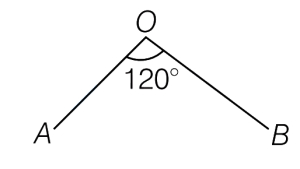
$OA$ અને $OB$ એ $120^{\circ}$ નો ખૂણો બનાવતા બે રસ્તાઓ છે. $X$ અને $Y$ એક જ સમયે '$O$' થી શરૂ કરે છે. $X$ એ $4 \text{ km/h}$ ની ઝડપે $OA$ પર મુસાફરી કરે છે અને $Y$ એ $3 \text{ km/h}$ ની ઝડપે $OB$ પર મુસાફરી કરે છે. $1 \text{ h}$ પછી $X$ અને $Y$ વચ્ચેનું ટૂંકું અંતર જે દરે વધી રહ્યું છે તે છે
A
$\sqrt{37} \text{ km/h}$
B
$37 \text{ km/h}$
C
$13 \text{ km/h}$
D
$\sqrt{13} \text{ km/h}$
Solution
(A) ધારો કે $O$ એ ઉગમબિંદુ $(0,0)$ છે. ધારો કે સમય $t$ પર $X$ નું સ્થાન $OA$ પર $x(t) = 4t$ છે અને $Y$ નું સ્થાન $OB$ પર $y(t) = 3t$ છે.
ધારો કે $A$ એ સમય $t$ પર $X$ અને $Y$ વચ્ચેનું ટૂંકું અંતર છે.
$\triangle OXY$ માં કોસાઇનના નિયમનો ઉપયોગ કરતા:
$A^2 = (4t)^2 + (3t)^2 - 2(4t)(3t) \cos(120^{\circ})$
કારણ કે $\cos(120^{\circ}) = -\frac{1}{2}$,તેથી:
$A^2 = 16t^2 + 9t^2 - 24t^2 \left(-\frac{1}{2}\right)$
$A^2 = 25t^2 + 12t^2 = 37t^2$
$A = \sqrt{37}t$
$t$ ની સાપેક્ષમાં વિકલન કરતા:
$2A \frac{dA}{dt} = 37(2t)$
$\frac{dA}{dt} = \frac{37t}{A}$
$A = \sqrt{37}t$ મૂકતા:
$\frac{dA}{dt} = \frac{37t}{\sqrt{37}t} = \sqrt{37} \text{ km/h}$.
આમ,અંતર વધવાનો દર $\sqrt{37} \text{ km/h}$ છે.
ધારો કે $A$ એ સમય $t$ પર $X$ અને $Y$ વચ્ચેનું ટૂંકું અંતર છે.
$\triangle OXY$ માં કોસાઇનના નિયમનો ઉપયોગ કરતા:
$A^2 = (4t)^2 + (3t)^2 - 2(4t)(3t) \cos(120^{\circ})$
કારણ કે $\cos(120^{\circ}) = -\frac{1}{2}$,તેથી:
$A^2 = 16t^2 + 9t^2 - 24t^2 \left(-\frac{1}{2}\right)$
$A^2 = 25t^2 + 12t^2 = 37t^2$
$A = \sqrt{37}t$
$t$ ની સાપેક્ષમાં વિકલન કરતા:
$2A \frac{dA}{dt} = 37(2t)$
$\frac{dA}{dt} = \frac{37t}{A}$
$A = \sqrt{37}t$ મૂકતા:
$\frac{dA}{dt} = \frac{37t}{\sqrt{37}t} = \sqrt{37} \text{ km/h}$.
આમ,અંતર વધવાનો દર $\sqrt{37} \text{ km/h}$ છે.
0 likesView Solution
48
MathematicsEasyMCQKCET · 2007
જે અંતરાલમાં $y = -x^{2} + 6x - 3$ વધતું વિધેય છે તે અંતરાલ કયો છે?
A
$x < 3$
B
$x > 3$
C
$7 < x < 8$
D
$5 < x < 6$
Solution
(A) આપેલ વિધેય $y = -x^{2} + 6x - 3$ છે.
વિધેય કયા અંતરાલમાં વધે છે તે શોધવા માટે,આપણે તેનું પ્રથમ વિકલન કરીએ:
$\frac{dy}{dx} = -2x + 6$.
વિધેય ત્યારે વધતું વિધેય કહેવાય જ્યારે તેનું વિકલન શૂન્ય કરતા મોટું હોય,એટલે કે $\frac{dy}{dx} > 0$.
વિકલનને શૂન્ય કરતા મોટું લેતા:
$-2x + 6 > 0$.
બંને બાજુથી $6$ બાદ કરતા:
$-2x > -6$.
$-2$ વડે ભાગતા (અને અસમતાની નિશાની બદલતા):
$x < 3$.
તેથી,વિધેય $x < 3$ અંતરાલમાં વધતું વિધેય છે.
વિધેય કયા અંતરાલમાં વધે છે તે શોધવા માટે,આપણે તેનું પ્રથમ વિકલન કરીએ:
$\frac{dy}{dx} = -2x + 6$.
વિધેય ત્યારે વધતું વિધેય કહેવાય જ્યારે તેનું વિકલન શૂન્ય કરતા મોટું હોય,એટલે કે $\frac{dy}{dx} > 0$.
વિકલનને શૂન્ય કરતા મોટું લેતા:
$-2x + 6 > 0$.
બંને બાજુથી $6$ બાદ કરતા:
$-2x > -6$.
$-2$ વડે ભાગતા (અને અસમતાની નિશાની બદલતા):
$x < 3$.
તેથી,વિધેય $x < 3$ અંતરાલમાં વધતું વિધેય છે.
0 likesView Solution
49
MathematicsEasyMCQKCET · 2007
$\int \frac{1}{1+\cos 8x} dx$ નું મૂલ્ય શું છે?
A
$\frac{\tan 2x}{8}+c$
B
$\frac{\tan 8x}{8}+c$
C
$\frac{\tan 4x}{4}+c$
D
$\frac{\tan 4x}{8}+c$
Solution
(D) આપણે જાણીએ છીએ કે $1 + \cos 2\theta = 2 \cos^2 \theta$.
$\theta = 4x$ માટે આ નિત્યસમનો ઉપયોગ કરતા,આપણને $1 + \cos 8x = 2 \cos^2 4x$ મળે છે.
આ કિંમતને સંકલનમાં મૂકતા:
$I = \int \frac{1}{2 \cos^2 4x} dx$
$I = \frac{1}{2} \int \sec^2 4x dx$
પ્રમાણિત સંકલન $\int \sec^2(ax) dx = \frac{\tan(ax)}{a} + c$ નો ઉપયોગ કરતા:
$I = \frac{1}{2} \cdot \frac{\tan 4x}{4} + c$
$I = \frac{\tan 4x}{8} + c$
$\theta = 4x$ માટે આ નિત્યસમનો ઉપયોગ કરતા,આપણને $1 + \cos 8x = 2 \cos^2 4x$ મળે છે.
આ કિંમતને સંકલનમાં મૂકતા:
$I = \int \frac{1}{2 \cos^2 4x} dx$
$I = \frac{1}{2} \int \sec^2 4x dx$
પ્રમાણિત સંકલન $\int \sec^2(ax) dx = \frac{\tan(ax)}{a} + c$ નો ઉપયોગ કરતા:
$I = \frac{1}{2} \cdot \frac{\tan 4x}{4} + c$
$I = \frac{\tan 4x}{8} + c$
0 likesView Solution
50
MathematicsEasyMCQKCET · 2007
$\int e^{x}(x^{5}+5x^{4}+1)dx$ નું મૂલ્ય શોધો.
A
$e^{x}x^{5}+c$
B
$e^{x}x^{5}+e^{x}+c$
C
$e^{x+1}x^{5}+c$
D
$5x^{4}e^{x}+c$
Solution
(B) આપણે જાણીએ છીએ કે $\int e^{x}(f(x)+f'(x))dx = e^{x}f(x)+c$.
અહીં,ધારો કે $f(x) = x^{5}$.
તેથી,$f'(x) = 5x^{4}$.
આપેલ સંકલન $\int e^{x}(x^{5}+5x^{4}+1)dx$ છે.
આપણે તેને $\int e^{x}(x^{5}+5x^{4})dx + \int e^{x}dx$ તરીકે લખી શકીએ છીએ.
સૂત્ર $\int e^{x}(f(x)+f'(x))dx = e^{x}f(x)+c$ નો ઉપયોગ કરતા,આપણને $\int e^{x}(x^{5}+5x^{4})dx = e^{x}x^{5}+c_1$ મળે છે.
આમ,કુલ સંકલન $e^{x}x^{5} + e^{x} + c$ થાય છે.
અહીં,ધારો કે $f(x) = x^{5}$.
તેથી,$f'(x) = 5x^{4}$.
આપેલ સંકલન $\int e^{x}(x^{5}+5x^{4}+1)dx$ છે.
આપણે તેને $\int e^{x}(x^{5}+5x^{4})dx + \int e^{x}dx$ તરીકે લખી શકીએ છીએ.
સૂત્ર $\int e^{x}(f(x)+f'(x))dx = e^{x}f(x)+c$ નો ઉપયોગ કરતા,આપણને $\int e^{x}(x^{5}+5x^{4})dx = e^{x}x^{5}+c_1$ મળે છે.
આમ,કુલ સંકલન $e^{x}x^{5} + e^{x} + c$ થાય છે.
0 likesView Solution
51
MathematicsEasyMCQKCET · 2007
$\int \frac{x^{2}+1}{x^{2}-1} d x$ નું મૂલ્ય શું છે?
A
$\log \left(\frac{x-1}{x+1}\right)+c$
B
$\log \left(\frac{x+1}{x-1}\right)+c$
C
$x+\log \left(\frac{x-1}{x+1}\right)+c$
D
$\log \left(x^{2}-1\right)+c$
Solution
(C) ધારો કે $I = \int \frac{x^{2}+1}{x^{2}-1} d x$.
અંશને $x^{2}-1+2$ તરીકે લખી શકાય છે.
તેથી,$I = \int \frac{x^{2}-1+2}{x^{2}-1} d x$.
$I = \int \left( \frac{x^{2}-1}{x^{2}-1} + \frac{2}{x^{2}-1} \right) d x$.
$I = \int 1 d x + 2 \int \frac{1}{x^{2}-1} d x$.
પ્રમાણિત સંકલન સૂત્ર $\int \frac{1}{x^{2}-a^{2}} d x = \frac{1}{2a} \log \left| \frac{x-a}{x+a} \right| + c$ નો ઉપયોગ કરતા,જ્યાં $a=1$:
$I = x + 2 \cdot \frac{1}{2(1)} \log \left| \frac{x-1}{x+1} \right| + c$.
$I = x + \log \left| \frac{x-1}{x+1} \right| + c$.
અંશને $x^{2}-1+2$ તરીકે લખી શકાય છે.
તેથી,$I = \int \frac{x^{2}-1+2}{x^{2}-1} d x$.
$I = \int \left( \frac{x^{2}-1}{x^{2}-1} + \frac{2}{x^{2}-1} \right) d x$.
$I = \int 1 d x + 2 \int \frac{1}{x^{2}-1} d x$.
પ્રમાણિત સંકલન સૂત્ર $\int \frac{1}{x^{2}-a^{2}} d x = \frac{1}{2a} \log \left| \frac{x-a}{x+a} \right| + c$ નો ઉપયોગ કરતા,જ્યાં $a=1$:
$I = x + 2 \cdot \frac{1}{2(1)} \log \left| \frac{x-1}{x+1} \right| + c$.
$I = x + \log \left| \frac{x-1}{x+1} \right| + c$.
0 likesView Solution
52
MathematicsMediumMCQKCET · 2007
જો $k \int_{0}^{1} x \cdot f(3x) \, dx = \int_{0}^{3} t \cdot f(t) \, dt$ હોય,તો $k$ ની કિંમત શોધો.
A
$9$
B
$3$
C
$\frac{1}{9}$
D
$\frac{1}{3}$
Solution
(A) ધારો કે $I = k \int_{0}^{1} x \cdot f(3x) \, dx$.
$t = 3x$ આદેશ લેતા,$dt = 3 \, dx$,જેનો અર્થ છે કે $dx = \frac{dt}{3}$.
જ્યારે $x = 0$,ત્યારે $t = 0$. જ્યારે $x = 1$,ત્યારે $t = 3$.
આ કિંમતો સંકલનમાં મૂકતા:
$I = k \int_{0}^{3} \left(\frac{t}{3}\right) \cdot f(t) \cdot \left(\frac{dt}{3}\right)$
$I = \frac{k}{9} \int_{0}^{3} t \cdot f(t) \, dt$.
આપેલ છે કે $I = \int_{0}^{3} t \cdot f(t) \, dt$,તેથી બંને પદોને સરખાવતા:
$\frac{k}{9} \int_{0}^{3} t \cdot f(t) \, dt = \int_{0}^{3} t \cdot f(t) \, dt$.
સહગુણકોની સરખામણી કરતા,આપણને $\frac{k}{9} = 1$ મળે છે,જેનો અર્થ છે કે $k = 9$.
$t = 3x$ આદેશ લેતા,$dt = 3 \, dx$,જેનો અર્થ છે કે $dx = \frac{dt}{3}$.
જ્યારે $x = 0$,ત્યારે $t = 0$. જ્યારે $x = 1$,ત્યારે $t = 3$.
આ કિંમતો સંકલનમાં મૂકતા:
$I = k \int_{0}^{3} \left(\frac{t}{3}\right) \cdot f(t) \cdot \left(\frac{dt}{3}\right)$
$I = \frac{k}{9} \int_{0}^{3} t \cdot f(t) \, dt$.
આપેલ છે કે $I = \int_{0}^{3} t \cdot f(t) \, dt$,તેથી બંને પદોને સરખાવતા:
$\frac{k}{9} \int_{0}^{3} t \cdot f(t) \, dt = \int_{0}^{3} t \cdot f(t) \, dt$.
સહગુણકોની સરખામણી કરતા,આપણને $\frac{k}{9} = 1$ મળે છે,જેનો અર્થ છે કે $k = 9$.
0 likesView Solution
53
MathematicsEasyMCQKCET · 2007
સંકલન $\int_{0}^{\pi / 2} (\sin^{100} x - \cos^{100} x) dx$ ની કિંમત છે
A
$\frac{1}{100}$
B
$\frac{100!}{(100)^{100}}$
C
$\frac{\pi}{100}$
D
$0$
Solution
(D) ધારો કે $I = \int_{0}^{\pi / 2} (\sin^{100} x - \cos^{100} x) dx$.
ગુણધર્મ $\int_{0}^{a} f(x) dx = \int_{0}^{a} f(a-x) dx$ નો ઉપયોગ કરતા,આપણને મળે છે:
$I = \int_{0}^{\pi / 2} (\sin^{100}(\frac{\pi}{2} - x) - \cos^{100}(\frac{\pi}{2} - x)) dx$
$I = \int_{0}^{\pi / 2} (\cos^{100} x - \sin^{100} x) dx$
$I = -\int_{0}^{\pi / 2} (\sin^{100} x - \cos^{100} x) dx$
$I = -I$
$2I = 0$
$I = 0$.
ગુણધર્મ $\int_{0}^{a} f(x) dx = \int_{0}^{a} f(a-x) dx$ નો ઉપયોગ કરતા,આપણને મળે છે:
$I = \int_{0}^{\pi / 2} (\sin^{100}(\frac{\pi}{2} - x) - \cos^{100}(\frac{\pi}{2} - x)) dx$
$I = \int_{0}^{\pi / 2} (\cos^{100} x - \sin^{100} x) dx$
$I = -\int_{0}^{\pi / 2} (\sin^{100} x - \cos^{100} x) dx$
$I = -I$
$2I = 0$
$I = 0$.
0 likesView Solution
54
MathematicsDifficultMCQKCET · 2007
વક્ર $x=4-y^{2}$ અને $Y$-અક્ષ દ્વારા ઘેરાયેલું ક્ષેત્રફળ કેટલું છે?
A
$16 \text{ ચોરસ એકમ}$
B
$32 \text{ ચોરસ એકમ}$
C
$\frac{32}{3} \text{ ચોરસ એકમ}$
D
$\frac{16}{3} \text{ ચોરસ એકમ}$
Solution
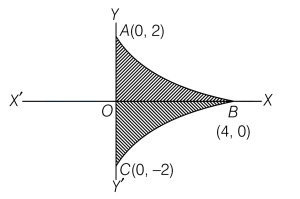
(C) આપેલ વક્ર $x = 4 - y^2$ છે. વક્ર $Y$-અક્ષને જ્યાં $x = 0$ હોય ત્યાં છેદે છે,જે $4 - y^2 = 0$ આપે છે,તેથી $y = \pm 2$. છેદબિંદુઓ $(0, 2)$ અને $(0, -2)$ છે.
વક્ર $X$-અક્ષની સાપેક્ષમાં સંમિત હોવાથી,કુલ ક્ષેત્રફળ $A$ એ પ્રથમ ચરણમાં મળતા ક્ષેત્રફળ કરતા બમણું થશે.
$A = 2 \int_{0}^{2} x \, dy$
$A = 2 \int_{0}^{2} (4 - y^2) \, dy$
$A = 2 \left[ 4y - \frac{y^3}{3} \right]_{0}^{2}$
$A = 2 \left[ (4(2) - \frac{2^3}{3}) - (0) \right]$
$A = 2 \left[ 8 - \frac{8}{3} \right]$
$A = 2 \left[ \frac{24 - 8}{3} \right] = 2 \left( \frac{16}{3} \right) = \frac{32}{3} \text{ ચોરસ એકમ}$.
વક્ર $X$-અક્ષની સાપેક્ષમાં સંમિત હોવાથી,કુલ ક્ષેત્રફળ $A$ એ પ્રથમ ચરણમાં મળતા ક્ષેત્રફળ કરતા બમણું થશે.
$A = 2 \int_{0}^{2} x \, dy$
$A = 2 \int_{0}^{2} (4 - y^2) \, dy$
$A = 2 \left[ 4y - \frac{y^3}{3} \right]_{0}^{2}$
$A = 2 \left[ (4(2) - \frac{2^3}{3}) - (0) \right]$
$A = 2 \left[ 8 - \frac{8}{3} \right]$
$A = 2 \left[ \frac{24 - 8}{3} \right] = 2 \left( \frac{16}{3} \right) = \frac{32}{3} \text{ ચોરસ એકમ}$.
0 likesView Solution
55
MathematicsEasyMCQKCET · 2007
વિકલ સમીકરણ $\left[1+\left(\frac{dy}{dx}\right)^{5}\right]^{\frac{1}{3}}=\frac{d^{2}y}{dx^{2}}$ ની કક્ષા અને પરિમાણ અનુક્રમે છે
A
$1, 5$
B
$2, 1$
C
$2, 5$
D
$2, 3$
Solution
(D) આપેલ વિકલ સમીકરણ $\left[1+\left(\frac{dy}{dx}\right)^{5}\right]^{\frac{1}{3}}=\frac{d^{2}y}{dx^{2}}$ છે.
પરિમાણ શોધવા માટે,આપણે બંને બાજુ $3$ ઘાત લઈને અપૂર્ણાંક ઘાત દૂર કરવી પડશે:
$\left[\left[1+\left(\frac{dy}{dx}\right)^{5}\right]^{\frac{1}{3}}\right]^{3}=\left(\frac{d^{2}y}{dx^{2}}\right)^{3}$.
આનું સાદું રૂપ $1+\left(\frac{dy}{dx}\right)^{5}=\left(\frac{d^{2}y}{dx^{2}}\right)^{3}$ થાય છે.
વિકલ સમીકરણની કક્ષા એ તેમાં રહેલા સૌથી ઉચ્ચ વિકલન છે,જે $\frac{d^{2}y}{dx^{2}}$ છે,તેથી કક્ષા $2$ છે.
પરિમાણ એ સમીકરણને રેડિકલ અને અપૂર્ણાંકથી મુક્ત કર્યા પછી સૌથી ઉચ્ચ વિકલનની ઘાત છે,જે $3$ છે.
તેથી,કક્ષા અને પરિમાણ અનુક્રમે $2$ અને $3$ છે.
પરિમાણ શોધવા માટે,આપણે બંને બાજુ $3$ ઘાત લઈને અપૂર્ણાંક ઘાત દૂર કરવી પડશે:
$\left[\left[1+\left(\frac{dy}{dx}\right)^{5}\right]^{\frac{1}{3}}\right]^{3}=\left(\frac{d^{2}y}{dx^{2}}\right)^{3}$.
આનું સાદું રૂપ $1+\left(\frac{dy}{dx}\right)^{5}=\left(\frac{d^{2}y}{dx^{2}}\right)^{3}$ થાય છે.
વિકલ સમીકરણની કક્ષા એ તેમાં રહેલા સૌથી ઉચ્ચ વિકલન છે,જે $\frac{d^{2}y}{dx^{2}}$ છે,તેથી કક્ષા $2$ છે.
પરિમાણ એ સમીકરણને રેડિકલ અને અપૂર્ણાંકથી મુક્ત કર્યા પછી સૌથી ઉચ્ચ વિકલનની ઘાત છે,જે $3$ છે.
તેથી,કક્ષા અને પરિમાણ અનુક્રમે $2$ અને $3$ છે.
0 likesView Solution
56
MathematicsMediumMCQKCET · 2007
જે રેખાઓનો ઢાળ તેના $y$-અંતઃખંડ જેટલો હોય તેવી રેખાઓની સંહતિનું વિકલ સમીકરણ શોધો.
A
$(x+1) \frac{dy}{dx} - y = 0$
B
$(x+1) \frac{dy}{dx} + y = 0$
C
$\frac{dy}{dx} = \frac{x-1}{y-1}$
D
$\frac{dy}{dx} = \frac{x+1}{y+1}$
Solution
(A) રેખાનું સમીકરણ જેનો ઢાળ $y$-અંતઃખંડ જેટલો છે,તે $y = mx + c$ છે.
અહીં આપેલ છે કે ઢાળ $m$ એ $y$-અંતઃખંડ $c$ જેટલો છે,તેથી $m = c$.
આ કિંમત મૂકતા,$y = cx + c = c(x+1)$ મળે છે.
બંને બાજુ $x$ ની સાપેક્ષમાં વિકલન કરતા,$\frac{dy}{dx} = c$ મળે છે.
હવે $c$ ની કિંમત પ્રથમ સમીકરણમાંથી મૂકતા,$\frac{dy}{dx} = \frac{y}{x+1}$ મળે છે.
તેથી,$(x+1) \frac{dy}{dx} - y = 0$ એ માંગેલ વિકલ સમીકરણ છે.
અહીં આપેલ છે કે ઢાળ $m$ એ $y$-અંતઃખંડ $c$ જેટલો છે,તેથી $m = c$.
આ કિંમત મૂકતા,$y = cx + c = c(x+1)$ મળે છે.
બંને બાજુ $x$ ની સાપેક્ષમાં વિકલન કરતા,$\frac{dy}{dx} = c$ મળે છે.
હવે $c$ ની કિંમત પ્રથમ સમીકરણમાંથી મૂકતા,$\frac{dy}{dx} = \frac{y}{x+1}$ મળે છે.
તેથી,$(x+1) \frac{dy}{dx} - y = 0$ એ માંગેલ વિકલ સમીકરણ છે.
0 likesView Solution
57
MathematicsMediumMCQKCET · 2007
જો $a$ અને $b$ એવા સદિશો હોય કે જેથી $|a+b| = |a-b|$ થાય,તો $a$ અને $b$ વચ્ચેનો ખૂણો કેટલો હશે ($^{\circ}$ માં)?
A
$120$
B
$60$
C
$90$
D
$30$
Solution
(C) આપેલ છે કે,$|a+b| = |a-b|$.
બંને બાજુ વર્ગ કરતા,આપણને મળે:
$|a+b|^2 = |a-b|^2$
$(a+b) \cdot (a+b) = (a-b) \cdot (a-b)$
$|a|^2 + |b|^2 + 2(a \cdot b) = |a|^2 + |b|^2 - 2(a \cdot b)$
$2(a \cdot b) = -2(a \cdot b)$
$4(a \cdot b) = 0$
$a \cdot b = 0$
બે સદિશોનો અદિશ ગુણાકાર $0$ હોવાથી,સદિશો $a$ અને $b$ એકબીજાને લંબ છે.
તેથી,$a$ અને $b$ વચ્ચેનો ખૂણો $90^{\circ}$ છે.
બંને બાજુ વર્ગ કરતા,આપણને મળે:
$|a+b|^2 = |a-b|^2$
$(a+b) \cdot (a+b) = (a-b) \cdot (a-b)$
$|a|^2 + |b|^2 + 2(a \cdot b) = |a|^2 + |b|^2 - 2(a \cdot b)$
$2(a \cdot b) = -2(a \cdot b)$
$4(a \cdot b) = 0$
$a \cdot b = 0$
બે સદિશોનો અદિશ ગુણાકાર $0$ હોવાથી,સદિશો $a$ અને $b$ એકબીજાને લંબ છે.
તેથી,$a$ અને $b$ વચ્ચેનો ખૂણો $90^{\circ}$ છે.
0 likesView Solution
58
MathematicsEasyMCQKCET · 2007
$OA$ અને $OB$ એ અનુક્રમે $5$ અને $6$ માન ધરાવતા બે સદિશો છે. જો $\angle BOA = 60^{\circ}$ હોય,તો $OA \cdot OB$ ની કિંમત શોધો.
A
$0$
B
$15$
C
$-15$
D
$15 \sqrt{3}$
Solution
(B) આપેલ છે કે સદિશો $OA$ અને $OB$ ના માન $|OA| = 5$ અને $|OB| = 6$ છે.
બે સદિશો વચ્ચેનો ખૂણો $\theta = \angle BOA = 60^{\circ}$ છે.
બે સદિશોનો અદિશ ગુણાકાર (ડોટ પ્રોડક્ટ) નીચેના સૂત્ર દ્વારા મળે છે: $OA \cdot OB = |OA| |OB| \cos \theta$.
આપેલી કિંમતો મૂકતા:
$OA \cdot OB = 5 \times 6 \times \cos 60^{\circ}$.
કારણ કે $\cos 60^{\circ} = \frac{1}{2}$,તેથી:
$OA \cdot OB = 30 \times \frac{1}{2} = 15$.
આમ,$OA \cdot OB$ ની કિંમત $15$ છે.
બે સદિશો વચ્ચેનો ખૂણો $\theta = \angle BOA = 60^{\circ}$ છે.
બે સદિશોનો અદિશ ગુણાકાર (ડોટ પ્રોડક્ટ) નીચેના સૂત્ર દ્વારા મળે છે: $OA \cdot OB = |OA| |OB| \cos \theta$.
આપેલી કિંમતો મૂકતા:
$OA \cdot OB = 5 \times 6 \times \cos 60^{\circ}$.
કારણ કે $\cos 60^{\circ} = \frac{1}{2}$,તેથી:
$OA \cdot OB = 30 \times \frac{1}{2} = 15$.
આમ,$OA \cdot OB$ ની કિંમત $15$ છે.
0 likesView Solution
59
MathematicsMediumMCQKCET · 2007
$A(1, -1, 2)$,$B(2, 0, -1)$ અને $C(0, 2, 1)$ બિંદુઓ ધરાવતા સમતલને લંબ સદિશ કયો છે?
A
$4 \hat{i} + 8 \hat{j} - 4 \hat{k}$
B
$8 \hat{i} + 4 \hat{j} + 4 \hat{k}$
C
$3 \hat{i} + \hat{j} + 2 \hat{k}$
D
$\hat{i} + \hat{j} - \hat{k}$
Solution
(B) બિંદુઓ $A, B$ અને $C$ ધરાવતા સમતલને લંબ સદિશ શોધવા માટે,આપણે સમતલમાં રહેલા બે સદિશો,જેમ કે $\vec{AB}$ અને $\vec{AC}$ નો ક્રોસ પ્રોડક્ટ શોધીએ છીએ.
આપેલ બિંદુઓ: $A(1, -1, 2)$,$B(2, 0, -1)$,$C(0, 2, 1)$.
$\vec{AB} = (2-1)\hat{i} + (0 - (-1))\hat{j} + (-1-2)\hat{k} = \hat{i} + \hat{j} - 3\hat{k}$
$\vec{AC} = (0-1)\hat{i} + (2 - (-1))\hat{j} + (1-2)\hat{k} = -\hat{i} + 3\hat{j} - \hat{k}$
લંબ સદિશ $\vec{n} = \vec{AB} \times \vec{AC} = \left|\begin{array}{ccc} \hat{i} & \hat{j} & \hat{k} \\ 1 & 1 & -3 \\ -1 & 3 & -1 \end{array}\right|$
$\vec{n} = \hat{i}(-1 - (-9)) - \hat{j}(-1 - 3) + \hat{k}(3 - (-1))$
$\vec{n} = \hat{i}(8) - \hat{j}(-4) + \hat{k}(4) = 8\hat{i} + 4\hat{j} + 4\hat{k}$
આમ,સમતલને લંબ સદિશ $8\hat{i} + 4\hat{j} + 4\hat{k}$ છે.
આપેલ બિંદુઓ: $A(1, -1, 2)$,$B(2, 0, -1)$,$C(0, 2, 1)$.
$\vec{AB} = (2-1)\hat{i} + (0 - (-1))\hat{j} + (-1-2)\hat{k} = \hat{i} + \hat{j} - 3\hat{k}$
$\vec{AC} = (0-1)\hat{i} + (2 - (-1))\hat{j} + (1-2)\hat{k} = -\hat{i} + 3\hat{j} - \hat{k}$
લંબ સદિશ $\vec{n} = \vec{AB} \times \vec{AC} = \left|\begin{array}{ccc} \hat{i} & \hat{j} & \hat{k} \\ 1 & 1 & -3 \\ -1 & 3 & -1 \end{array}\right|$
$\vec{n} = \hat{i}(-1 - (-9)) - \hat{j}(-1 - 3) + \hat{k}(3 - (-1))$
$\vec{n} = \hat{i}(8) - \hat{j}(-4) + \hat{k}(4) = 8\hat{i} + 4\hat{j} + 4\hat{k}$
આમ,સમતલને લંબ સદિશ $8\hat{i} + 4\hat{j} + 4\hat{k}$ છે.
0 likesView Solution
60
MathematicsDifficultMCQKCET · 2007
જો $a = 2 \hat{i} + 3 \hat{j} - \hat{k}$,$b = \hat{i} + 2 \hat{j} - 5 \hat{k}$,અને $c = 3 \hat{i} + 5 \hat{j} - \hat{k}$ હોય,તો $a$ ને લંબ અને $b$ તથા $c$ ને સમાવતા સમતલમાં હોય તેવો સદિશ કયો છે?
A
$-17 \hat{i} + 21 \hat{j} - 97 \hat{k}$
B
$17 \hat{i} + 21 \hat{j} - 123 \hat{k}$
C
$-17 \hat{i} - 21 \hat{j} + 97 \hat{k}$
D
$-17 \hat{i} - 21 \hat{j} - 97 \hat{k}$
Solution
(D) અને $c$ ના સમતલમાં રહેલો સદિશ $b$ અને $c$ ના રૈખિક સંયોજન દ્વારા મળે છે. $a$ ને લંબ અને $b$ તથા $c$ ના સમતલમાં રહેલો સદિશ $a \times (b \times c)$ દ્વારા મળે છે.
પ્રથમ,આપણે $b \times c$ ની ગણતરી કરીએ:
$b \times c = \begin{vmatrix} \hat{i} & \hat{j} & \hat{k} \\ 1 & 2 & -5 \\ 3 & 5 & -1 \end{vmatrix} = \hat{i}(-2 + 25) - \hat{j}(-1 + 15) + \hat{k}(5 - 6) = 23 \hat{i} - 14 \hat{j} - \hat{k}$.
હવે,આપણે $a \times (b \times c)$ ની ગણતરી કરીએ:
$a \times (b \times c) = \begin{vmatrix} \hat{i} & \hat{j} & \hat{k} \\ 2 & 3 & -1 \\ 23 & -14 & -1 \end{vmatrix} = \hat{i}(-3 - 14) - \hat{j}(-2 + 23) + \hat{k}(-28 - 69) = -17 \hat{i} - 21 \hat{j} - 97 \hat{k}$.
આમ,જરૂરી સદિશ $-17 \hat{i} - 21 \hat{j} - 97 \hat{k}$ છે.
પ્રથમ,આપણે $b \times c$ ની ગણતરી કરીએ:
$b \times c = \begin{vmatrix} \hat{i} & \hat{j} & \hat{k} \\ 1 & 2 & -5 \\ 3 & 5 & -1 \end{vmatrix} = \hat{i}(-2 + 25) - \hat{j}(-1 + 15) + \hat{k}(5 - 6) = 23 \hat{i} - 14 \hat{j} - \hat{k}$.
હવે,આપણે $a \times (b \times c)$ ની ગણતરી કરીએ:
$a \times (b \times c) = \begin{vmatrix} \hat{i} & \hat{j} & \hat{k} \\ 2 & 3 & -1 \\ 23 & -14 & -1 \end{vmatrix} = \hat{i}(-3 - 14) - \hat{j}(-2 + 23) + \hat{k}(-28 - 69) = -17 \hat{i} - 21 \hat{j} - 97 \hat{k}$.
આમ,જરૂરી સદિશ $-17 \hat{i} - 21 \hat{j} - 97 \hat{k}$ છે.
0 likesView Solution
Vedclass Products
For Students
Vedclass Test Series
Mock tests in real KCET style covering Mathematics with performance analysis. 5-day free trial.
Start Free TrialFor Teachers
Exam Paper Generator
Generate Set A/B/C/D Mathematics papers from 7.5L+ questions in 2 minutes. 3 chapters free.
Try FreeFor Institutes
Online Exam Module
Run live KCET mock exams with unlimited students, 360° analytics & white-label branding.
See DemoFrequently Asked Questions
How many Mathematics questions are in KCET 2007?
There are 60 Mathematics questions from the KCET 2007 paper on Vedclass, each with a detailed step-by-step solution in Gujarati.
Are KCET 2007 Mathematics solutions available in Gujarati?
Yes. All solutions on this page are in Gujarati. You can also switch to English or Hindi using the language buttons above the questions.
Can I practice KCET 2007 Mathematics as a timed test?
Yes. Use the Vedclass Test Series to attempt a full KCET mock test covering Mathematics with time limits and instant score analysis.
Can teachers create Mathematics papers from KCET previous year questions?
Yes. The Vedclass Exam Paper Generator lets teachers mix KCET Mathematics questions and generate Set A/B/C/D papers in minutes.
For Teachers & Institutes
Build a Custom Mathematics Paper
Pick KCET 2007 Mathematics questions, set difficulty, and generate Set A/B/C/D in 2 minutes.