
ChemistryQ1–72 of 72 questions
Page 1 of 1 · English
1
ChemistryMCQKCET · 2007
$A$ $20 \, cm$ length of a certain solution causes right-handed rotation of $38^\circ$. $A$ $30 \, cm$ length of another solution causes left-handed rotation of $24^\circ$. The optical rotation caused by a $30 \, cm$ length of a mixture of the above solutions in the volume ratio $1 : 2$ is:
A
Left-handed rotation of $14^\circ$
B
Right-handed rotation of $14^\circ$
C
Left-handed rotation of $3^\circ$
D
Right-handed rotation of $3^\circ$
Solution
(D) The optical rotation $\theta$ is directly proportional to the length $l$ of the solution,i.e.,$\theta \propto l$.
For the first solution,the rotation per unit length is $\frac{38^\circ}{20 \, cm} = 1.9^\circ/cm$ (right-handed).
For the second solution,the rotation per unit length is $\frac{24^\circ}{30 \, cm} = 0.8^\circ/cm$ (left-handed,denoted as $-0.8^\circ/cm$).
In a mixture with a volume ratio of $1:2$ in a $30 \, cm$ tube,the lengths occupied are $10 \, cm$ of the first solution and $20 \, cm$ of the second solution.
Rotation by the first part: $\theta_1 = 1.9^\circ/cm \times 10 \, cm = +19^\circ$.
Rotation by the second part: $\theta_2 = -0.8^\circ/cm \times 20 \, cm = -16^\circ$.
Total rotation: $\theta_{total} = \theta_1 + \theta_2 = 19^\circ - 16^\circ = +3^\circ$.
$A$ positive value indicates a right-handed rotation.
For the first solution,the rotation per unit length is $\frac{38^\circ}{20 \, cm} = 1.9^\circ/cm$ (right-handed).
For the second solution,the rotation per unit length is $\frac{24^\circ}{30 \, cm} = 0.8^\circ/cm$ (left-handed,denoted as $-0.8^\circ/cm$).
In a mixture with a volume ratio of $1:2$ in a $30 \, cm$ tube,the lengths occupied are $10 \, cm$ of the first solution and $20 \, cm$ of the second solution.
Rotation by the first part: $\theta_1 = 1.9^\circ/cm \times 10 \, cm = +19^\circ$.
Rotation by the second part: $\theta_2 = -0.8^\circ/cm \times 20 \, cm = -16^\circ$.
Total rotation: $\theta_{total} = \theta_1 + \theta_2 = 19^\circ - 16^\circ = +3^\circ$.
$A$ positive value indicates a right-handed rotation.
0 likesView Solution
2
ChemistryMCQKCET · 2007
The focus of the parabola $y = 2x^2 + x$ is
A
$(0, 0)$
B
$(\frac{1}{2}, \frac{1}{4})$
C
$(-\frac{1}{4}, 0)$
D
$(-\frac{1}{4}, \frac{1}{8})$
Solution
(C) The given equation of the parabola is $y = 2x^2 + x$.
Divide by $2$: $x^2 + \frac{x}{2} = \frac{y}{2}$.
Complete the square: $(x + \frac{1}{4})^2 = \frac{y}{2} + \frac{1}{16}$.
$(x + \frac{1}{4})^2 = \frac{1}{2}(y + \frac{1}{8})$.
Comparing this with the standard form $X^2 = 4AY$,where $X = x + \frac{1}{4}$,$Y = y + \frac{1}{8}$,and $4A = \frac{1}{2} \Rightarrow A = \frac{1}{8}$.
The focus of the standard parabola $X^2 = 4AY$ is $(0, A) = (0, \frac{1}{8})$.
Thus,$X = 0$ and $Y = \frac{1}{8}$.
Substituting back: $x + \frac{1}{4} = 0 \Rightarrow x = -\frac{1}{4}$ and $y + \frac{1}{8} = \frac{1}{8} \Rightarrow y = 0$.
Therefore,the focus is $(-\frac{1}{4}, 0)$.
Divide by $2$: $x^2 + \frac{x}{2} = \frac{y}{2}$.
Complete the square: $(x + \frac{1}{4})^2 = \frac{y}{2} + \frac{1}{16}$.
$(x + \frac{1}{4})^2 = \frac{1}{2}(y + \frac{1}{8})$.
Comparing this with the standard form $X^2 = 4AY$,where $X = x + \frac{1}{4}$,$Y = y + \frac{1}{8}$,and $4A = \frac{1}{2} \Rightarrow A = \frac{1}{8}$.
The focus of the standard parabola $X^2 = 4AY$ is $(0, A) = (0, \frac{1}{8})$.
Thus,$X = 0$ and $Y = \frac{1}{8}$.
Substituting back: $x + \frac{1}{4} = 0 \Rightarrow x = -\frac{1}{4}$ and $y + \frac{1}{8} = \frac{1}{8} \Rightarrow y = 0$.
Therefore,the focus is $(-\frac{1}{4}, 0)$.
0 likesView Solution
3
ChemistryMCQKCET · 2007
If the area of the auxiliary circle of the ellipse $\frac{x^{2}}{a^{2}} + \frac{y^{2}}{b^{2}} = 1$ $(a > b)$ is twice the area of the ellipse,then the eccentricity of the ellipse is
A
$\frac{1}{\sqrt{2}}$
B
$\frac{\sqrt{3}}{2}$
C
$\frac{1}{\sqrt{3}}$
D
$\frac{1}{2}$
Solution
(B) The area of the ellipse $\frac{x^{2}}{a^{2}} + \frac{y^{2}}{b^{2}} = 1$ is given by $A_{e} = \pi ab$.
The auxiliary circle of this ellipse is $x^{2} + y^{2} = a^{2}$,and its area is $A_{c} = \pi a^{2}$.
According to the problem,$A_{c} = 2 A_{e}$.
Substituting the values,we get $\pi a^{2} = 2 \pi ab$,which simplifies to $a = 2b$.
The eccentricity $e$ of an ellipse is given by $e = \sqrt{1 - \frac{b^{2}}{a^{2}}}$.
Substituting $a = 2b$,we get $e = \sqrt{1 - \frac{b^{2}}{(2b)^{2}}} = \sqrt{1 - \frac{b^{2}}{4b^{2}}} = \sqrt{1 - \frac{1}{4}} = \sqrt{\frac{3}{4}} = \frac{\sqrt{3}}{2}$.
The auxiliary circle of this ellipse is $x^{2} + y^{2} = a^{2}$,and its area is $A_{c} = \pi a^{2}$.
According to the problem,$A_{c} = 2 A_{e}$.
Substituting the values,we get $\pi a^{2} = 2 \pi ab$,which simplifies to $a = 2b$.
The eccentricity $e$ of an ellipse is given by $e = \sqrt{1 - \frac{b^{2}}{a^{2}}}$.
Substituting $a = 2b$,we get $e = \sqrt{1 - \frac{b^{2}}{(2b)^{2}}} = \sqrt{1 - \frac{b^{2}}{4b^{2}}} = \sqrt{1 - \frac{1}{4}} = \sqrt{\frac{3}{4}} = \frac{\sqrt{3}}{2}$.
0 likesView Solution
4
ChemistryMCQKCET · 2007
If the area of the auxiliary circle of the ellipse $\frac{x^2}{a^2} + \frac{y^2}{b^2} = 1$ $(a > b)$ is twice the area of the ellipse,then the eccentricity of the ellipse is
A
$\frac{1}{\sqrt{2}}$
B
$\frac{\sqrt{3}}{2}$
C
$\frac{1}{\sqrt{3}}$
D
$\frac{1}{2}$
Solution
(B) The area of the ellipse $\frac{x^2}{a^2} + \frac{y^2}{b^2} = 1$ is given by $A_{e} = \pi ab$.
The auxiliary circle of the ellipse is $x^2 + y^2 = a^2$,and its area is $A_{c} = \pi a^2$.
According to the problem,$A_{c} = 2 A_{e}$,so $\pi a^2 = 2 \pi ab$.
Dividing by $\pi a$ (since $a \neq 0$),we get $a = 2b$.
The eccentricity $e$ of the ellipse is given by $e = \sqrt{1 - \frac{b^2}{a^2}}$.
Substituting $a = 2b$,we get $e = \sqrt{1 - \frac{b^2}{(2b)^2}} = \sqrt{1 - \frac{b^2}{4b^2}} = \sqrt{1 - \frac{1}{4}} = \sqrt{\frac{3}{4}} = \frac{\sqrt{3}}{2}$.
The auxiliary circle of the ellipse is $x^2 + y^2 = a^2$,and its area is $A_{c} = \pi a^2$.
According to the problem,$A_{c} = 2 A_{e}$,so $\pi a^2 = 2 \pi ab$.
Dividing by $\pi a$ (since $a \neq 0$),we get $a = 2b$.
The eccentricity $e$ of the ellipse is given by $e = \sqrt{1 - \frac{b^2}{a^2}}$.
Substituting $a = 2b$,we get $e = \sqrt{1 - \frac{b^2}{(2b)^2}} = \sqrt{1 - \frac{b^2}{4b^2}} = \sqrt{1 - \frac{1}{4}} = \sqrt{\frac{3}{4}} = \frac{\sqrt{3}}{2}$.
0 likesView Solution
5
ChemistryMCQKCET · 2007
The ratio of the velocity of sound in hydrogen $(\gamma = 7/5)$ to that in helium $(\gamma = 5/3)$ at the same temperature is
A
$\sqrt{\frac{5}{42}}$
B
$\sqrt{\frac{5}{21}}$
C
$\frac{\sqrt{42}}{5}$
D
$\frac{\sqrt{21}}{5}$
Solution
(C) The velocity of sound in an ideal gas is given by the formula $\nu = \sqrt{\frac{\gamma R T}{M}}$.
Since the temperature $T$ is the same for both gases,the velocity is proportional to $\sqrt{\frac{\gamma}{M}}$,where $\gamma$ is the adiabatic index and $M$ is the molar mass.
For hydrogen $(H_2)$,$M_{H_2} = 2 \times 10^{-3} \ kg/mol$ and $\gamma_{H_2} = 7/5$.
For helium $(He)$,$M_{He} = 4 \times 10^{-3} \ kg/mol$ and $\gamma_{He} = 5/3$.
The ratio of the velocity of sound in hydrogen to that in helium is:
$\frac{\nu_{H_2}}{\nu_{He}} = \sqrt{\frac{\gamma_{H_2}}{\gamma_{He}} \times \frac{M_{He}}{M_{H_2}}}$
Substituting the values:
$\frac{\nu_{H_2}}{\nu_{He}} = \sqrt{\frac{7/5}{5/3} \times \frac{4}{2}} = \sqrt{\frac{7}{5} \times \frac{3}{5} \times 2} = \sqrt{\frac{42}{25}} = \frac{\sqrt{42}}{5}$.
Since the temperature $T$ is the same for both gases,the velocity is proportional to $\sqrt{\frac{\gamma}{M}}$,where $\gamma$ is the adiabatic index and $M$ is the molar mass.
For hydrogen $(H_2)$,$M_{H_2} = 2 \times 10^{-3} \ kg/mol$ and $\gamma_{H_2} = 7/5$.
For helium $(He)$,$M_{He} = 4 \times 10^{-3} \ kg/mol$ and $\gamma_{He} = 5/3$.
The ratio of the velocity of sound in hydrogen to that in helium is:
$\frac{\nu_{H_2}}{\nu_{He}} = \sqrt{\frac{\gamma_{H_2}}{\gamma_{He}} \times \frac{M_{He}}{M_{H_2}}}$
Substituting the values:
$\frac{\nu_{H_2}}{\nu_{He}} = \sqrt{\frac{7/5}{5/3} \times \frac{4}{2}} = \sqrt{\frac{7}{5} \times \frac{3}{5} \times 2} = \sqrt{\frac{42}{25}} = \frac{\sqrt{42}}{5}$.
0 likesView Solution
6
ChemistryMCQKCET · 2007
When the angle of incidence is $60^{\circ}$ on the surface of a glass slab,it is found that the reflected ray is completely polarized. The velocity of light in glass is
A
$\sqrt{2} \times 10^{8} \, m/s$
B
$\sqrt{3} \times 10^{8} \, m/s$
C
$2 \times 10^{8} \, m/s$
D
$3 \times 10^{8} \, m/s$
Solution
(B) According to Brewster's Law,when the reflected ray is completely polarized,the angle of incidence is equal to the Brewster's angle $(i_{p})$.
Given $i_{p} = 60^{\circ}$.
The refractive index $\mu$ is given by $\mu = \tan(i_{p})$.
$\mu = \tan(60^{\circ}) = \sqrt{3}$.
The velocity of light in a medium is given by $v = \frac{c}{\mu}$,where $c$ is the speed of light in vacuum $(3 \times 10^{8} \, m/s)$.
$v = \frac{3 \times 10^{8}}{\sqrt{3}} = \sqrt{3} \times 10^{8} \, m/s$.
Given $i_{p} = 60^{\circ}$.
The refractive index $\mu$ is given by $\mu = \tan(i_{p})$.
$\mu = \tan(60^{\circ}) = \sqrt{3}$.
The velocity of light in a medium is given by $v = \frac{c}{\mu}$,where $c$ is the speed of light in vacuum $(3 \times 10^{8} \, m/s)$.
$v = \frac{3 \times 10^{8}}{\sqrt{3}} = \sqrt{3} \times 10^{8} \, m/s$.
0 likesView Solution
7
ChemistryMCQKCET · 2007
The amino acid which is not optically active is
A
Lactic acid
B
Serine
C
Alanine
D
Glycine
Solution
(D) Glycine $(NH_2-CH_2-COOH)$ is the only amino acid that is not optically active because it does not have a chiral carbon atom.
For a carbon atom to be chiral,it must be bonded to $4$ different groups.
Glycine has two identical hydrogen atoms attached to the $\alpha$-carbon,which means it lacks a chiral center and is therefore achiral and optically inactive.
For a carbon atom to be chiral,it must be bonded to $4$ different groups.
Glycine has two identical hydrogen atoms attached to the $\alpha$-carbon,which means it lacks a chiral center and is therefore achiral and optically inactive.
0 likesView Solution
8
ChemistryMCQKCET · 2007
$A$ single slit Fraunhofer diffraction pattern is formed with white light. For what wavelength of light does the third secondary maximum in the diffraction pattern coincide with the second secondary maximum in the pattern for red light of wavelength $6500 \ \mathring{A}$?
A
$4400$
B
$4100$
C
$4642.8$
D
$9100$
Solution
(C) The condition for the $n^{th}$ secondary maximum in a single slit diffraction pattern is given by $x = \frac{(2n+1) \lambda D}{2a}$,where $n$ is the order of the secondary maximum.
For the second secondary maximum $(n=2)$ of red light $(\lambda_1 = 6500 \ \mathring{A})$,the position is:
$x = \frac{(2 \times 2 + 1) \lambda_1 D}{2a} = \frac{5 \lambda_1 D}{2a}$.
For the third secondary maximum $(n=3)$ of light with wavelength $\lambda_2$,the position is:
$x = \frac{(2 \times 3 + 1) \lambda_2 D}{2a} = \frac{7 \lambda_2 D}{2a}$.
Since the positions coincide,we equate them:
$\frac{5 \lambda_1 D}{2a} = \frac{7 \lambda_2 D}{2a}$.
This simplifies to:
$5 \lambda_1 = 7 \lambda_2$.
Substituting $\lambda_1 = 6500 \ \mathring{A}$:
$\lambda_2 = \frac{5 \times 6500}{7} = \frac{32500}{7} \approx 4642.8 \ \mathring{A}$.
For the second secondary maximum $(n=2)$ of red light $(\lambda_1 = 6500 \ \mathring{A})$,the position is:
$x = \frac{(2 \times 2 + 1) \lambda_1 D}{2a} = \frac{5 \lambda_1 D}{2a}$.
For the third secondary maximum $(n=3)$ of light with wavelength $\lambda_2$,the position is:
$x = \frac{(2 \times 3 + 1) \lambda_2 D}{2a} = \frac{7 \lambda_2 D}{2a}$.
Since the positions coincide,we equate them:
$\frac{5 \lambda_1 D}{2a} = \frac{7 \lambda_2 D}{2a}$.
This simplifies to:
$5 \lambda_1 = 7 \lambda_2$.
Substituting $\lambda_1 = 6500 \ \mathring{A}$:
$\lambda_2 = \frac{5 \times 6500}{7} = \frac{32500}{7} \approx 4642.8 \ \mathring{A}$.
0 likesView Solution
9
ChemistryMCQKCET · 2007
An inductance of $\frac{200}{\pi} \ mH$,a capacitance of $\frac{10^{-3}}{\pi} \ F$ and a resistance of $10 \ \Omega$ are connected in series with an $AC$ source of $220 \ V, 50 \ Hz$. The phase angle of the circuit is:
A
$\frac{\pi}{6}$
B
$\frac{\pi}{4}$
C
$\frac{\pi}{2}$
D
$\frac{\pi}{3}$
Solution
(B) The phase angle $\theta$ in an $LCR$ series circuit is given by $\tan \theta = \frac{X_L - X_C}{R}$.
First,calculate the inductive reactance: $X_L = 2 \pi f L = 2 \pi \times 50 \times \left(\frac{200}{\pi} \times 10^{-3}\right) = 20 \ \Omega$.
Next,calculate the capacitive reactance: $X_C = \frac{1}{2 \pi f C} = \frac{1}{2 \pi \times 50 \times \left(\frac{10^{-3}}{\pi}\right)} = \frac{1}{100 \times 10^{-3}} = 10 \ \Omega$.
Given resistance $R = 10 \ \Omega$.
Substituting these values into the formula: $\tan \theta = \frac{20 - 10}{10} = \frac{10}{10} = 1$.
Therefore,$\theta = \tan^{-1}(1) = \frac{\pi}{4}$.
First,calculate the inductive reactance: $X_L = 2 \pi f L = 2 \pi \times 50 \times \left(\frac{200}{\pi} \times 10^{-3}\right) = 20 \ \Omega$.
Next,calculate the capacitive reactance: $X_C = \frac{1}{2 \pi f C} = \frac{1}{2 \pi \times 50 \times \left(\frac{10^{-3}}{\pi}\right)} = \frac{1}{100 \times 10^{-3}} = 10 \ \Omega$.
Given resistance $R = 10 \ \Omega$.
Substituting these values into the formula: $\tan \theta = \frac{20 - 10}{10} = \frac{10}{10} = 1$.
Therefore,$\theta = \tan^{-1}(1) = \frac{\pi}{4}$.
0 likesView Solution
10
ChemistryMediumMCQKCET · 2007
During the formation of a chemical bond,
A
electron-electron repulsion becomes more than the nucleus-electron attraction
B
energy of the system does not change
C
energy increases
D
energy decreases
Solution
(D) During the formation of a chemical bond,the system moves to a state of lower potential energy to achieve stability. Therefore,the energy of the system decreases as the atoms approach each other and form a bond.
0 likesView Solution
11
ChemistryMediumMCQKCET · 2007
In an acetylene molecule,the bond between the carbon atoms consists of:
A
three $\pi$ bonds
B
one $\sigma$ and two $\pi$ bonds
C
two $\sigma$ and one $\pi$ bonds
D
three $\sigma$ bonds
Solution
(B) The chemical formula of acetylene is $C_2H_2$,and its structural formula is $H-C \equiv C-H$.
In the triple bond between the two carbon atoms,there is one $\sigma$ bond (formed by the head-on overlap of $sp$ hybrid orbitals) and two $\pi$ bonds (formed by the lateral overlap of unhybridized $2p$ orbitals).
In the triple bond between the two carbon atoms,there is one $\sigma$ bond (formed by the head-on overlap of $sp$ hybrid orbitals) and two $\pi$ bonds (formed by the lateral overlap of unhybridized $2p$ orbitals).
0 likesView Solution
12
ChemistryEasyMCQKCET · 2007
The number of antibonding electron pairs in $O_{2}^{2-}$ molecular ion on the basis of molecular orbital theory is (Atomic number of $O$ is $8$)
A
$5$
B
$4$
C
$3$
D
$2$
Solution
(B) The total number of electrons in $O_{2}^{2-}$ is $8 + 8 + 2 = 18$.
The molecular orbital configuration is: $\sigma 1s^2, \sigma^* 1s^2, \sigma 2s^2, \sigma^* 2s^2, \sigma 2p_z^2, \pi 2p_x^2 = \pi 2p_y^2, \pi^* 2p_x^2 = \pi^* 2p_y^2$.
The antibonding orbitals are $\sigma^* 1s$,$\sigma^* 2s$,$\pi^* 2p_x$,and $\pi^* 2p_y$.
Each of these contains $2$ electrons,forming $4$ antibonding electron pairs.
The molecular orbital configuration is: $\sigma 1s^2, \sigma^* 1s^2, \sigma 2s^2, \sigma^* 2s^2, \sigma 2p_z^2, \pi 2p_x^2 = \pi 2p_y^2, \pi^* 2p_x^2 = \pi^* 2p_y^2$.
The antibonding orbitals are $\sigma^* 1s$,$\sigma^* 2s$,$\pi^* 2p_x$,and $\pi^* 2p_y$.
Each of these contains $2$ electrons,forming $4$ antibonding electron pairs.
0 likesView Solution
13
ChemistryMediumMCQKCET · 2007
The gram molecular volume of an ideal gas at $STP$ is $22400 \ cm^{3}$. However,for oxygen gas,the question asks for the volume. Given the options provided,the correct value for $1 \ \text{mole}$ of any ideal gas at $STP$ is $22400 \ cm^{3}$. Please note that the provided solution in the prompt was incorrect. (in $cm^{3}$)
A
$3200$
B
$5600$
C
$22400$
D
$11200$
Solution
(C) The gram molecular volume is defined as the volume occupied by $1 \ \text{mole}$ of any gas at $STP$ $(Standard \ Temperature \ and \ Pressure)$.
According to Avogadro's hypothesis,$1 \ \text{mole}$ of any ideal gas occupies $22.4 \ L$ or $22400 \ cm^{3}$ at $STP$.
Therefore,the gram molecular volume of oxygen at $STP$ is $22400 \ cm^{3}$.
According to Avogadro's hypothesis,$1 \ \text{mole}$ of any ideal gas occupies $22.4 \ L$ or $22400 \ cm^{3}$ at $STP$.
Therefore,the gram molecular volume of oxygen at $STP$ is $22400 \ cm^{3}$.
0 likesView Solution
14
ChemistryMCQKCET · 2007
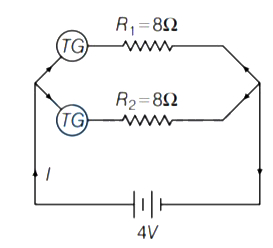
Two tangent galvanometers $A$ and $B$ have coils of radii $8 \, cm$ and $16 \, cm$ respectively and resistance $8 \, \Omega$ each. They are connected in parallel with a cell of emf $4 \, V$ and negligible internal resistance. The deflections produced in the tangent galvanometers $A$ and $B$ are $30°$ and $60°$ respectively. If $A$ has $2$ turns, then $B$ must have: (in $turns$)
A
$18$
B
$12$
C
$6$
D
$2$
Solution
(B) The current $I$ in a tangent galvanometer is given by $I = \frac{2 r H}{\mu_{0} N} \tan \theta$, where $r$ is the radius, $H$ is the horizontal component of the Earth's magnetic field, $N$ is the number of turns, and $\theta$ is the deflection.
Since the galvanometers are connected in parallel to a $4 \, V$ source, the voltage across each is $4 \, V$. The current in each galvanometer is $I_A = I_B = \frac{V}{R} = \frac{4 \, V}{8 \, \Omega} = 0.5 \, A$.
From the formula, we have $\frac{N I}{r \tan \theta} = \frac{2 H}{\mu_{0}} = \text{constant}$.
Therefore, $\frac{N_A I_A}{r_A \tan \theta_A} = \frac{N_B I_B}{r_B \tan \theta_B}$.
Since $I_A = I_B$, we have $\frac{N_A}{r_A \tan \theta_A} = \frac{N_B}{r_B \tan \theta_B}$.
Substituting the values: $\frac{2}{8 \cdot \tan 30°} = \frac{N_B}{16 \cdot \tan 60°}$.
$\frac{2}{8 \cdot (1/\sqrt{3})} = \frac{N_B}{16 \cdot \sqrt{3}}$.
$\frac{2 \sqrt{3}}{8} = \frac{N_B}{16 \sqrt{3}}$.
$N_B = \frac{2 \sqrt{3} \cdot 16 \sqrt{3}}{8} = \frac{32 \cdot 3}{8} = 4 \cdot 3 = 12$ turns.
Since the galvanometers are connected in parallel to a $4 \, V$ source, the voltage across each is $4 \, V$. The current in each galvanometer is $I_A = I_B = \frac{V}{R} = \frac{4 \, V}{8 \, \Omega} = 0.5 \, A$.
From the formula, we have $\frac{N I}{r \tan \theta} = \frac{2 H}{\mu_{0}} = \text{constant}$.
Therefore, $\frac{N_A I_A}{r_A \tan \theta_A} = \frac{N_B I_B}{r_B \tan \theta_B}$.
Since $I_A = I_B$, we have $\frac{N_A}{r_A \tan \theta_A} = \frac{N_B}{r_B \tan \theta_B}$.
Substituting the values: $\frac{2}{8 \cdot \tan 30°} = \frac{N_B}{16 \cdot \tan 60°}$.
$\frac{2}{8 \cdot (1/\sqrt{3})} = \frac{N_B}{16 \cdot \sqrt{3}}$.
$\frac{2 \sqrt{3}}{8} = \frac{N_B}{16 \sqrt{3}}$.
$N_B = \frac{2 \sqrt{3} \cdot 16 \sqrt{3}}{8} = \frac{32 \cdot 3}{8} = 4 \cdot 3 = 12$ turns.
0 likesView Solution
15
ChemistryMCQKCET · 2007
If the area of the auxiliary circle of the ellipse $\frac{x^{2}}{a^{2}}+\frac{y^{2}}{b^{2}}=1$ $(a>b)$ is twice the area of the ellipse,then the eccentricity of the ellipse is
A
$\frac{1}{\sqrt{2}}$
B
$\frac{\sqrt{3}}{2}$
C
$\frac{1}{\sqrt{3}}$
D
$\frac{1}{2}$
Solution
(B) The area of the ellipse $\frac{x^{2}}{a^{2}}+\frac{y^{2}}{b^{2}}=1$ is given by $A_{e} = \pi ab$.
The auxiliary circle of the ellipse is $x^{2}+y^{2}=a^{2}$,and its area is $A_{c} = \pi a^{2}$.
According to the problem,the area of the auxiliary circle is twice the area of the ellipse:
$\pi a^{2} = 2(\pi ab)$
$a^{2} = 2ab$
Since $a \neq 0$,we have $a = 2b$.
The eccentricity $e$ of the ellipse is given by $e = \sqrt{1-\frac{b^{2}}{a^{2}}}$.
Substituting $a = 2b$ into the formula:
$e = \sqrt{1-\frac{b^{2}}{(2b)^{2}}} = \sqrt{1-\frac{b^{2}}{4b^{2}}} = \sqrt{1-\frac{1}{4}} = \sqrt{\frac{3}{4}} = \frac{\sqrt{3}}{2}$.
The auxiliary circle of the ellipse is $x^{2}+y^{2}=a^{2}$,and its area is $A_{c} = \pi a^{2}$.
According to the problem,the area of the auxiliary circle is twice the area of the ellipse:
$\pi a^{2} = 2(\pi ab)$
$a^{2} = 2ab$
Since $a \neq 0$,we have $a = 2b$.
The eccentricity $e$ of the ellipse is given by $e = \sqrt{1-\frac{b^{2}}{a^{2}}}$.
Substituting $a = 2b$ into the formula:
$e = \sqrt{1-\frac{b^{2}}{(2b)^{2}}} = \sqrt{1-\frac{b^{2}}{4b^{2}}} = \sqrt{1-\frac{1}{4}} = \sqrt{\frac{3}{4}} = \frac{\sqrt{3}}{2}$.
0 likesView Solution
16
ChemistryMCQKCET · 2007
The general formula of a cycloalkane is
A
$C_n H_n$
B
$C_n H_{2n}$
C
$C_n H_{2n-2}$
D
$C_n H_{2n+2}$
Solution
(B) Cycloalkanes are saturated cyclic hydrocarbons.
They contain one ring and no double or triple bonds.
The general formula for an acyclic alkane is $C_n H_{2n+2}$.
Forming a ring requires the removal of two hydrogen atoms from the ends of the chain,resulting in the general formula $C_n H_{2n}$ for cycloalkanes.
They contain one ring and no double or triple bonds.
The general formula for an acyclic alkane is $C_n H_{2n+2}$.
Forming a ring requires the removal of two hydrogen atoms from the ends of the chain,resulting in the general formula $C_n H_{2n}$ for cycloalkanes.
0 likesView Solution
17
ChemistryEasyMCQKCET · 2007
$+I$ effect is shown by:
A
$-CH_3$
B
$-Br$
C
$-Cl$
D
$-NO_2$
Solution
(A) The inductive effect ($I$-effect) is the permanent displacement of sigma electrons along a carbon chain due to the presence of an electron-withdrawing or electron-donating group.
Groups that donate electron density towards the carbon chain exhibit the $+I$ effect (e.g.,alkyl groups like $-CH_3$).
Groups that withdraw electron density from the carbon chain exhibit the $-I$ effect (e.g.,halogens like $-Br$,$-Cl$,and electron-withdrawing groups like $-NO_2$).
Therefore,$-CH_3$ shows the $+I$ effect.
Groups that donate electron density towards the carbon chain exhibit the $+I$ effect (e.g.,alkyl groups like $-CH_3$).
Groups that withdraw electron density from the carbon chain exhibit the $-I$ effect (e.g.,halogens like $-Br$,$-Cl$,and electron-withdrawing groups like $-NO_2$).
Therefore,$-CH_3$ shows the $+I$ effect.
0 likesView Solution
18
ChemistryEasyMCQKCET · 2007
For a stable molecule,the value of bond order must be
A
there is no relationship between stability and bond order
B
zero
C
positive
D
negative
Solution
(C) The stability of a molecule is directly proportional to the bond order,represented as $\text{Bond order} \propto \text{Stability}$.
For a molecule to be stable,it must have a positive bond order.
If the bond order is $0$ or negative,the molecule is unstable and will not exist.
For a molecule to be stable,it must have a positive bond order.
If the bond order is $0$ or negative,the molecule is unstable and will not exist.
0 likesView Solution
19
ChemistryMediumMCQKCET · 2007
How many chiral carbon atoms are present in $2,3,4$-trichloropentane?
A
$4$
B
$1$
C
$2$
D
$3$
Solution
(C) The structure of $2,3,4$-trichloropentane is $CH_3-CHCl-CHCl-CHCl-CH_3$.
In this molecule,the carbon atoms at positions $2$ and $4$ are bonded to four different groups: a hydrogen atom $(-H)$,a chlorine atom $(-Cl)$,a methyl group $(-CH_3)$,and a $-CHCl-CHCl_2$ group (for $C-2$) or a $-CHCl-CH_3$ group (for $C-4$).
The carbon atom at position $3$ is not chiral because it is bonded to two identical $-CHCl-CH_3$ groups.
Therefore,there are $2$ chiral carbon atoms present in $2,3,4$-trichloropentane.
In this molecule,the carbon atoms at positions $2$ and $4$ are bonded to four different groups: a hydrogen atom $(-H)$,a chlorine atom $(-Cl)$,a methyl group $(-CH_3)$,and a $-CHCl-CHCl_2$ group (for $C-2$) or a $-CHCl-CH_3$ group (for $C-4$).
The carbon atom at position $3$ is not chiral because it is bonded to two identical $-CHCl-CH_3$ groups.
Therefore,there are $2$ chiral carbon atoms present in $2,3,4$-trichloropentane.
0 likesView Solution
20
ChemistryEasyMCQKCET · 2007
Which one of the following shows functional isomerism?
A
$C_2H_4$
B
$C_3H_6$
C
$C_2H_5OH$
D
$CH_2Cl_2$
Solution
(C) $C_2H_5OH$ shows functional isomerism with dimethyl ether.
$\text{CH}_3\text{CH}_2\text{OH} \text{ (Ethanol)} \rightleftharpoons \text{CH}_3\text{OCH}_3 \text{ (Dimethyl ether)}$
$\text{CH}_3\text{CH}_2\text{OH} \text{ (Ethanol)} \rightleftharpoons \text{CH}_3\text{OCH}_3 \text{ (Dimethyl ether)}$
0 likesView Solution
21
ChemistryMediumMCQKCET · 2007
The angle strain in cyclopropane is:
A
$24^{\circ} 44^{\prime}$
B
$9^{\circ} 44^{\prime}$
C
$44^{\prime}$
D
$-5^{\circ} 16^{\prime}$
Solution
(A) The bond angle in cyclopropane is calculated as $\theta = \frac{180(n-2)}{n} = \frac{180(3-2)}{3} = 60^{\circ}$.
Angle strain is defined as $\alpha = \frac{1}{2} (109^{\circ} 28^{\prime} - \theta)$.
Substituting the value of $\theta = 60^{\circ}$:
$\alpha = \frac{1}{2} (109^{\circ} 28^{\prime} - 60^{\circ}) = \frac{1}{2} (49^{\circ} 28^{\prime}) = 24^{\circ} 44^{\prime}$.
Angle strain is defined as $\alpha = \frac{1}{2} (109^{\circ} 28^{\prime} - \theta)$.
Substituting the value of $\theta = 60^{\circ}$:
$\alpha = \frac{1}{2} (109^{\circ} 28^{\prime} - 60^{\circ}) = \frac{1}{2} (49^{\circ} 28^{\prime}) = 24^{\circ} 44^{\prime}$.
0 likesView Solution
22
ChemistryMediumMCQKCET · 2007
Acidified sodium fusion extract on addition of ferric chloride solution gives blood red colouration,which confirms the presence of:
A
$S$ and $Cl$
B
$N$ and $S$
C
$N$
D
$S$
Solution
(B) When both nitrogen $(N)$ and sulfur $(S)$ are present in an organic compound,sodium fusion produces sodium thiocyanate $(NaCNS)$.
Upon adding acidified ferric chloride $(FeCl_3)$ solution to the extract,the ferric ions react with thiocyanate ions to form ferric thiocyanide,which exhibits a blood-red colouration.
The chemical reaction is: $3 \ NaCNS + FeCl_3 \longrightarrow Fe(CNS)_3 + 3 \ NaCl$ (blood-red colour).
Upon adding acidified ferric chloride $(FeCl_3)$ solution to the extract,the ferric ions react with thiocyanate ions to form ferric thiocyanide,which exhibits a blood-red colouration.
The chemical reaction is: $3 \ NaCNS + FeCl_3 \longrightarrow Fe(CNS)_3 + 3 \ NaCl$ (blood-red colour).
0 likesView Solution
23
ChemistryEasyMCQKCET · 2007
Presence of halogen in organic compounds can be detected using
A
Leibig's test
B
Duma's test
C
Kjeldahl test
D
Beilstein's test
Solution
(D) The presence of halogen in an organic compound can be detected by $Beilstein's$ test. In this test,a copper wire is heated in a flame until it shows no green color,then it is dipped in the organic compound and heated again. The appearance of a green flame indicates the presence of a halogen.
0 likesView Solution
24
ChemistryEasyMCQKCET · 2007
Benzene reacts with chlorine in sunlight to give a final product.
A
$CCl_{4}$
B
$C_{6}H_{6}Cl_{6}$
C
$C_{6}Cl_{6}$
D
$C_{6}H_{5}Cl$
Solution
(B) Benzene reacts with chlorine in the presence of sunlight via a free radical addition reaction to give benzene hexachloride $(C_{6}H_{6}Cl_{6})$,also known as gammexane or lindane.
$C_{6}H_{6} + 3Cl_{2} \xrightarrow{\text{Sunlight}} C_{6}H_{6}Cl_{6}$
$C_{6}H_{6} + 3Cl_{2} \xrightarrow{\text{Sunlight}} C_{6}H_{6}Cl_{6}$
0 likesView Solution
25
ChemistryEasyMCQKCET · 2007
The hydroxyl ion concentration of $10^{-2} \ M \ HCl$ is:
A
$1 \times 10^{1} \ mol \ dm^{-3}$
B
$1 \times 10^{-12} \ mol \ dm^{-3}$
C
$1 \times 10^{-1} \ mol \ dm^{-3}$
D
$1 \times 10^{-14} \ mol \ dm^{-3}$
Solution
(B) For a strong acid like $HCl$,the concentration of hydrogen ions is $[H^+] = 10^{-2} \ M$.
Using the ionic product of water,$K_w = [H^+][OH^-] = 10^{-14}$ at $298 \ K$.
Substituting the values: $[10^{-2}][OH^-] = 10^{-14}$.
Therefore,$[OH^-] = \frac{10^{-14}}{10^{-2}} = 10^{-12} \ mol \ dm^{-3}$.
Using the ionic product of water,$K_w = [H^+][OH^-] = 10^{-14}$ at $298 \ K$.
Substituting the values: $[10^{-2}][OH^-] = 10^{-14}$.
Therefore,$[OH^-] = \frac{10^{-14}}{10^{-2}} = 10^{-12} \ mol \ dm^{-3}$.
0 likesView Solution
26
ChemistryDifficultMCQKCET · 2007
Geometrical isomerism is shown by
A
$abC=Cab$
B
$ > C=C < $
C
$-C\equiv C^{-}$
D
None of these
Solution
(A) Geometrical isomerism is shown by compounds containing a $C=C$ double bond,provided that each carbon atom of the double bond is attached to two different groups.
The general condition for geometrical isomerism is $abC=Cab$,where $a \neq b$.
The general condition for geometrical isomerism is $abC=Cab$,where $a \neq b$.
0 likesView Solution
27
ChemistryMediumMCQKCET · 2007
Which one of the following salts on being dissolved in water gives $pH > 7$ at $25^{\circ} C$?
A
$KCN$
B
$KNO_{3}$
C
$NH_{4}Cl$
D
$NH_{4}CN$
Solution
(A) $KCN$ is a salt of a weak acid $(HCN)$ and a strong base $(KOH)$.
When dissolved in water,the $CN^-$ ion undergoes hydrolysis to form $OH^-$ ions,resulting in a basic solution with $pH > 7$ at $25^{\circ} C$.
$KNO_3$ is a salt of a strong acid and a strong base $(pH = 7)$.
$NH_4Cl$ is a salt of a weak base and a strong acid $(pH < 7)$.
$NH_4CN$ is a salt of a weak acid and a weak base $(pH \approx 7)$.
When dissolved in water,the $CN^-$ ion undergoes hydrolysis to form $OH^-$ ions,resulting in a basic solution with $pH > 7$ at $25^{\circ} C$.
$KNO_3$ is a salt of a strong acid and a strong base $(pH = 7)$.
$NH_4Cl$ is a salt of a weak base and a strong acid $(pH < 7)$.
$NH_4CN$ is a salt of a weak acid and a weak base $(pH \approx 7)$.
0 likesView Solution
28
ChemistryDifficultMCQKCET · 2007
Graphite is a soft solid lubricant extremely difficult to melt. The reason for this anomalous behaviour is that graphite
A
is an allotropic form of carbon
B
is a non-crystalline substance
C
has carbon atoms arranged in large plates of rings of strongly bonded carbon atoms with weak interplate bonds
D
has molecules of variable molecular masses like polymers
Solution
(C) Graphite is a soft solid lubricant that is extremely difficult to melt.
This is because graphite has a layered structure where carbon atoms are arranged in large hexagonal plates (rings) held together by strong covalent bonds within the layers,while the layers themselves are held together by weak van der Waals forces (interplate bonds).
These weak interplate bonds allow the layers to slide over each other,making it a lubricant,while the strong covalent bonds within the layers require very high temperatures to break,making it difficult to melt.
This is because graphite has a layered structure where carbon atoms are arranged in large hexagonal plates (rings) held together by strong covalent bonds within the layers,while the layers themselves are held together by weak van der Waals forces (interplate bonds).
These weak interplate bonds allow the layers to slide over each other,making it a lubricant,while the strong covalent bonds within the layers require very high temperatures to break,making it difficult to melt.
0 likesView Solution
29
ChemistryEasyMCQKCET · 2007
In the ionic equation $BiO_{3}^{-} + 6H^{+} + x e^{-} \longrightarrow Bi^{3+} + 3H_{2}O$,the value of $x$ is:
A
$6$
B
$2$
C
$4$
D
$3$
Solution
(B) To find the value of $x$,we must balance the charge on both sides of the equation.
In the reactant side,the total charge is: $(-1) + 6(+1) + x(-1) = 5 - x$.
In the product side,the total charge is: $(+3) + 3(0) = +3$.
Equating the charges: $5 - x = 3$.
Solving for $x$: $x = 5 - 3 = 2$.
Thus,the balanced equation is $BiO_{3}^{-} + 6H^{+} + 2e^{-} \longrightarrow Bi^{3+} + 3H_{2}O$.
In the reactant side,the total charge is: $(-1) + 6(+1) + x(-1) = 5 - x$.
In the product side,the total charge is: $(+3) + 3(0) = +3$.
Equating the charges: $5 - x = 3$.
Solving for $x$: $x = 5 - 3 = 2$.
Thus,the balanced equation is $BiO_{3}^{-} + 6H^{+} + 2e^{-} \longrightarrow Bi^{3+} + 3H_{2}O$.
0 likesView Solution
30
ChemistryEasyMCQKCET · 2007
What is the equivalent weight of $SnCl_{2}$ in the following reaction: $SnCl_{2} + Cl_{2} \longrightarrow SnCl_{4}$?
A
$95$
B
$45$
C
$60$
D
$30$
Solution
(A) The given reaction is: $SnCl_{2} + Cl_{2} \longrightarrow SnCl_{4}$.
In this reaction,the oxidation state of $Sn$ changes from $+2$ in $SnCl_{2}$ to $+4$ in $SnCl_{4}$.
The $n$-factor is the change in oxidation state per molecule,which is $|4 - 2| = 2$.
The molar mass of $SnCl_{2} = 118.7 + 2 \times 35.5 = 118.7 + 71 = 189.7 \approx 190 \ g/mol$.
The equivalent weight is calculated as: $\text{Equivalent weight} = \frac{\text{Molar mass}}{n\text{-factor}} = \frac{190}{2} = 95$.
In this reaction,the oxidation state of $Sn$ changes from $+2$ in $SnCl_{2}$ to $+4$ in $SnCl_{4}$.
The $n$-factor is the change in oxidation state per molecule,which is $|4 - 2| = 2$.
The molar mass of $SnCl_{2} = 118.7 + 2 \times 35.5 = 118.7 + 71 = 189.7 \approx 190 \ g/mol$.
The equivalent weight is calculated as: $\text{Equivalent weight} = \frac{\text{Molar mass}}{n\text{-factor}} = \frac{190}{2} = 95$.
0 likesView Solution
31
ChemistryEasyMCQKCET · 2007
An oxide of an element contains $20 \%$ oxygen by weight. Calculate the equivalent weight of the element.
A
$8$
B
$16$
C
$32$
D
$12$
Solution
(C) Let the total weight of the oxide be $100 \ g$.
Since the oxide contains $20 \%$ oxygen by weight,the weight of oxygen is $20 \ g$ and the weight of the element is $100 - 20 = 80 \ g$.
The equivalent weight of oxygen is $8 \ g$.
According to the law of equivalence,the number of gram equivalents of the element must be equal to the number of gram equivalents of oxygen.
$\frac{\text{Weight of element}}{\text{Equivalent weight of element}} = \frac{\text{Weight of oxygen}}{\text{Equivalent weight of oxygen}}$
$\frac{80}{E} = \frac{20}{8}$
$E = \frac{80 \times 8}{20} = 32$
Therefore,the equivalent weight of the element is $32$.
Since the oxide contains $20 \%$ oxygen by weight,the weight of oxygen is $20 \ g$ and the weight of the element is $100 - 20 = 80 \ g$.
The equivalent weight of oxygen is $8 \ g$.
According to the law of equivalence,the number of gram equivalents of the element must be equal to the number of gram equivalents of oxygen.
$\frac{\text{Weight of element}}{\text{Equivalent weight of element}} = \frac{\text{Weight of oxygen}}{\text{Equivalent weight of oxygen}}$
$\frac{80}{E} = \frac{20}{8}$
$E = \frac{80 \times 8}{20} = 32$
Therefore,the equivalent weight of the element is $32$.
0 likesView Solution
32
ChemistryEasyMCQKCET · 2007
When $KBr$ is dissolved in water,$K^{+}$ ions are
A
hydrated
B
hydrolysed
C
reduced
D
oxidised
Solution
(A) When $KBr$ is dissolved in water,it dissociates into $K^{+}$ and $Br^{-}$ ions.
These ions interact with water molecules through ion-dipole interactions,a process known as hydration.
These ions interact with water molecules through ion-dipole interactions,a process known as hydration.
0 likesView Solution
33
ChemistryMediumMCQKCET · 2007
Molarity of a given orthophosphoric acid solution is $3 \ M$. Its normality is (in $N$)
A
$9$
B
$0.3$
C
$3$
D
$1$
Solution
(A) Orthophosphoric acid $(H_{3}PO_{4})$ is a tribasic acid,meaning its basicity is $3$.
The relationship between normality and molarity is given by the formula: $\text{Normality} = \text{Molarity} \times \text{basicity}$.
Substituting the given values: $\text{Normality} = 3 \ M \times 3 = 9 \ N$.
The relationship between normality and molarity is given by the formula: $\text{Normality} = \text{Molarity} \times \text{basicity}$.
Substituting the given values: $\text{Normality} = 3 \ M \times 3 = 9 \ N$.
0 likesView Solution
34
ChemistryDifficultMCQKCET · 2007
The number of gram molecules of chlorine in $6.02 \times 10^{25}$ hydrogen chloride molecules is
A
$10$
B
$100$
C
$50$
D
$5$
Solution
(B) The chemical formula for hydrogen chloride is $HCl$.
One molecule of $HCl$ contains one atom of chlorine.
Therefore,$6.02 \times 10^{25}$ molecules of $HCl$ contain $6.02 \times 10^{25}$ atoms of chlorine.
The number of moles (gram molecules) of chlorine atoms is calculated as:
$\text{Number of moles} = \frac{\text{Total number of atoms}}{\text{Avogadro's number}} = \frac{6.02 \times 10^{25}}{6.02 \times 10^{23}} = 100$.
One molecule of $HCl$ contains one atom of chlorine.
Therefore,$6.02 \times 10^{25}$ molecules of $HCl$ contain $6.02 \times 10^{25}$ atoms of chlorine.
The number of moles (gram molecules) of chlorine atoms is calculated as:
$\text{Number of moles} = \frac{\text{Total number of atoms}}{\text{Avogadro's number}} = \frac{6.02 \times 10^{25}}{6.02 \times 10^{23}} = 100$.
0 likesView Solution
35
ChemistryEasyMCQKCET · 2007
Which one of the following has the maximum number of atoms of oxygen?
A
$2 \ g$ of carbon monoxide
B
$2 \ g$ of carbon dioxide
C
$2 \ g$ of sulphur dioxide
D
$2 \ g$ of water
Solution
(D) The number of oxygen atoms is calculated as: $\text{Number of atoms} = \frac{\text{mass}}{\text{molar mass}} \times N_A \times \text{number of oxygen atoms in one molecule}$.
For $2 \ g$ of $CO$ $(M = 28 \ g/mol)$: $\frac{2}{28} \times 1 = 0.071 \ N_A$.
For $2 \ g$ of $CO_2$ $(M = 44 \ g/mol)$: $\frac{2}{44} \times 2 = 0.091 \ N_A$.
For $2 \ g$ of $SO_2$ $(M = 64 \ g/mol)$: $\frac{2}{64} \times 2 = 0.0625 \ N_A$.
For $2 \ g$ of $H_2O$ $(M = 18 \ g/mol)$: $\frac{2}{18} \times 1 = 0.111 \ N_A$.
Comparing the values,$2 \ g$ of $H_2O$ contains the maximum number of oxygen atoms.
For $2 \ g$ of $CO$ $(M = 28 \ g/mol)$: $\frac{2}{28} \times 1 = 0.071 \ N_A$.
For $2 \ g$ of $CO_2$ $(M = 44 \ g/mol)$: $\frac{2}{44} \times 2 = 0.091 \ N_A$.
For $2 \ g$ of $SO_2$ $(M = 64 \ g/mol)$: $\frac{2}{64} \times 2 = 0.0625 \ N_A$.
For $2 \ g$ of $H_2O$ $(M = 18 \ g/mol)$: $\frac{2}{18} \times 1 = 0.111 \ N_A$.
Comparing the values,$2 \ g$ of $H_2O$ contains the maximum number of oxygen atoms.
0 likesView Solution
36
ChemistryEasyMCQKCET · 2007
Dalton's law of partial pressure is applicable to which one of the following systems?
A
$NH_{3} + HCl$
B
$NO + O_{2}$
C
$H_{2} + Cl_{2}$
D
$CO + H_{2}$
Solution
(D) Dalton's law of partial pressure is applicable only to a mixture of non-reacting gases.
In the given options,$NH_{3} + HCl$ react to form $NH_{4}Cl$,$NO + O_{2}$ react to form $NO_{2}$,and $H_{2} + Cl_{2}$ react to form $HCl$.
However,$CO$ and $H_{2}$ do not react with each other under normal conditions.
Therefore,Dalton's law of partial pressure is applicable to the system $CO + H_{2}$.
In the given options,$NH_{3} + HCl$ react to form $NH_{4}Cl$,$NO + O_{2}$ react to form $NO_{2}$,and $H_{2} + Cl_{2}$ react to form $HCl$.
However,$CO$ and $H_{2}$ do not react with each other under normal conditions.
Therefore,Dalton's law of partial pressure is applicable to the system $CO + H_{2}$.
0 likesView Solution
37
ChemistryEasyMCQKCET · 2007
One mole of oxygen at $273 \ K$ and one mole of sulphur dioxide at $546 \ K$ are taken in two separate containers,then:
A
Kinetic energy of $O_{2} >$ kinetic energy of $SO_{2}$
B
Kinetic energy of $O_{2} < $ kinetic energy of $SO_{2}$
C
Kinetic energy of both are equal
D
None of the above
Solution
(B) The average kinetic energy $(KE)$ of one mole of an ideal gas is given by the formula: $KE = \frac{3}{2} RT$.
Since $R$ is a constant,$KE \propto T$.
For oxygen $(O_{2})$: $T_{O_{2}} = 273 \ K$.
For sulphur dioxide $(SO_{2})$: $T_{SO_{2}} = 546 \ K$.
Comparing the kinetic energies: $\frac{KE_{O_{2}}}{KE_{SO_{2}}} = \frac{T_{O_{2}}}{T_{SO_{2}}} = \frac{273}{546} = \frac{1}{2}$.
Therefore,$KE_{SO_{2}} = 2 \times KE_{O_{2}}$,which implies $KE_{SO_{2}} > KE_{O_{2}}$ or $KE_{O_{2}} < KE_{SO_{2}}$.
Since $R$ is a constant,$KE \propto T$.
For oxygen $(O_{2})$: $T_{O_{2}} = 273 \ K$.
For sulphur dioxide $(SO_{2})$: $T_{SO_{2}} = 546 \ K$.
Comparing the kinetic energies: $\frac{KE_{O_{2}}}{KE_{SO_{2}}} = \frac{T_{O_{2}}}{T_{SO_{2}}} = \frac{273}{546} = \frac{1}{2}$.
Therefore,$KE_{SO_{2}} = 2 \times KE_{O_{2}}$,which implies $KE_{SO_{2}} > KE_{O_{2}}$ or $KE_{O_{2}} < KE_{SO_{2}}$.
0 likesView Solution
38
ChemistryEasyMCQKCET · 2007
$Mg^{2+}$ is isoelectronic with
A
$Cu^{2+}$
B
$Zn^{2+}$
C
$Na^{+}$
D
$Ca^{2+}$
Solution
(C) Isoelectronic species are those that have the same number of electrons.
$Mg$ has an atomic number of $12$,so $Mg^{2+}$ has $12 - 2 = 10$ electrons.
$Na$ has an atomic number of $11$,so $Na^{+}$ has $11 - 1 = 10$ electrons.
Since both $Mg^{2+}$ and $Na^{+}$ have $10$ electrons,they are isoelectronic.
$Mg$ has an atomic number of $12$,so $Mg^{2+}$ has $12 - 2 = 10$ electrons.
$Na$ has an atomic number of $11$,so $Na^{+}$ has $11 - 1 = 10$ electrons.
Since both $Mg^{2+}$ and $Na^{+}$ have $10$ electrons,they are isoelectronic.
0 likesView Solution
39
ChemistryMediumMCQKCET · 2007
$A$ body of mass $10 \ mg$ is moving with a velocity of $100 \ ms^{-1}$. The wavelength of de-Broglie wave associated with it would be $(h=6.63 \times 10^{-34} \ Js)$.
A
$6.63 \times 10^{-35} \ m$
B
$6.63 \times 10^{-34} \ m$
C
$6.63 \times 10^{-31} \ m$
D
$6.63 \times 10^{-37} \ m$
Solution
(C) Given: Mass $m = 10 \ mg = 10 \times 10^{-6} \ kg = 10^{-5} \ kg$.
Velocity $v = 100 \ ms^{-1} = 10^2 \ ms^{-1}$.
Planck's constant $h = 6.63 \times 10^{-34} \ Js$.
Using the de-Broglie wavelength formula: $\lambda = \frac{h}{mv}$.
Substituting the values: $\lambda = \frac{6.63 \times 10^{-34}}{10^{-5} \times 10^2} = \frac{6.63 \times 10^{-34}}{10^{-3}} = 6.63 \times 10^{-31} \ m$.
Velocity $v = 100 \ ms^{-1} = 10^2 \ ms^{-1}$.
Planck's constant $h = 6.63 \times 10^{-34} \ Js$.
Using the de-Broglie wavelength formula: $\lambda = \frac{h}{mv}$.
Substituting the values: $\lambda = \frac{6.63 \times 10^{-34}}{10^{-5} \times 10^2} = \frac{6.63 \times 10^{-34}}{10^{-3}} = 6.63 \times 10^{-31} \ m$.
0 likesView Solution
40
ChemistryMediumMCQKCET · 2007
Which of the following is an intensive property?
A
temperature
B
viscosity
C
surface tension
D
all of these
Solution
(D) The properties of a system whose values are independent of the amount of substance present in the system are called intensive properties.
Examples include $temperature$,$viscosity$,$surface \ tension$,$pressure$,$density$,$molar \ heat \ capacity$,etc.
Since all the given options are independent of the amount of matter,they are all intensive properties.
Examples include $temperature$,$viscosity$,$surface \ tension$,$pressure$,$density$,$molar \ heat \ capacity$,etc.
Since all the given options are independent of the amount of matter,they are all intensive properties.
0 likesView Solution
41
ChemistryMediumMCQKCET · 2007
The relation between $\Delta H$ and $\Delta U$ is
A
$\Delta H = \Delta U + RT$
B
$\Delta H = \Delta U - \Delta nRT$
C
$\Delta H = \Delta U + \Delta nRT$
D
$\Delta U = \Delta H + \Delta nRT$
Solution
(C) The enthalpy change $(\Delta H)$ is related to the internal energy change $(\Delta U)$ by the equation:
$\Delta H = \Delta U + \Delta(PV)$
For gaseous reactions,this is expressed as:
$\Delta H = \Delta U + \Delta n_{g}RT$
where $\Delta n_{g}$ is the change in the number of moles of gaseous products and reactants.
$\Delta H = \Delta U + \Delta(PV)$
For gaseous reactions,this is expressed as:
$\Delta H = \Delta U + \Delta n_{g}RT$
where $\Delta n_{g}$ is the change in the number of moles of gaseous products and reactants.
0 likesView Solution
42
ChemistryMediumMCQKCET · 2007
Entropy of the universe is
A
constant
B
zero
C
continuously decreasing
D
continuously increasing
Solution
(D) According to the second law of thermodynamics,the entropy of the universe always increases in the course of every spontaneous (natural) change.
0 likesView Solution
43
ChemistryEasyMCQKCET · 2007
In which of the following processes is the maximum increase in entropy observed?
A
Melting of ice
B
Sublimation of naphthalene
C
Condensation of water
D
Dissolution of salt in water
Solution
(B) The order of entropy for states of matter is $Gas > Liquid > Solid$.
Sublimation is the process where a solid directly converts into a gas.
Since the transition from solid to gas involves the greatest increase in disorder,the sublimation of naphthalene shows the maximum increase in entropy.
Sublimation is the process where a solid directly converts into a gas.
Since the transition from solid to gas involves the greatest increase in disorder,the sublimation of naphthalene shows the maximum increase in entropy.
0 likesView Solution
44
ChemistryEasyMCQKCET · 2007
Considering the reaction $C_{(s)} + O_{2(g)} \longrightarrow CO_{2(g)} + 393.5 \ kJ$,the signs of $\Delta H, \Delta S$,and $\Delta G$ respectively are:
A
$+, -, -$
B
$-, +, +$
C
$-, -, -$
D
$-, +, -$
Solution
(C) $1$. $\Delta H$ is negative $(-)$ because the reaction is exothermic,as indicated by the release of $393.5 \ kJ$ of heat.
$2$. $\Delta S$ is negative $(-)$ because the number of moles of gaseous species decreases from $1 \ mol$ of $O_{2(g)}$ on the reactant side to $0 \ mol$ of gas on the product side (since $CO_2$ is produced,but the total moles of gas decrease from $1$ to $1$,wait,let's re-evaluate: $C_{(s)} + O_{2(g)} \longrightarrow CO_{2(g)}$. Here,$1 \ mol$ of gas reacts to form $1 \ mol$ of gas. However,the entropy change is generally considered negative or near zero due to the loss of the solid phase and the nature of the gas phase,but in standard textbook contexts for this specific reaction,$\Delta S$ is often considered negative due to the decrease in disorder).
$3$. $\Delta G$ is negative $(-)$ because the combustion of carbon is a spontaneous process at standard conditions.
$2$. $\Delta S$ is negative $(-)$ because the number of moles of gaseous species decreases from $1 \ mol$ of $O_{2(g)}$ on the reactant side to $0 \ mol$ of gas on the product side (since $CO_2$ is produced,but the total moles of gas decrease from $1$ to $1$,wait,let's re-evaluate: $C_{(s)} + O_{2(g)} \longrightarrow CO_{2(g)}$. Here,$1 \ mol$ of gas reacts to form $1 \ mol$ of gas. However,the entropy change is generally considered negative or near zero due to the loss of the solid phase and the nature of the gas phase,but in standard textbook contexts for this specific reaction,$\Delta S$ is often considered negative due to the decrease in disorder).
$3$. $\Delta G$ is negative $(-)$ because the combustion of carbon is a spontaneous process at standard conditions.
0 likesView Solution
45
ChemistryEasyMCQKCET · 2007
In the equilibrium state,the value of $\Delta G$ is:
A
zero
B
negative
C
positive
D
may be negative or positive
Solution
(A) For a spontaneous process,$\Delta G < 0$. For a non-spontaneous process,$\Delta G > 0$. At equilibrium,the system is at its minimum Gibbs free energy,and the change in Gibbs free energy is $\Delta G = 0$.
0 likesView Solution
46
ChemistryEasyMCQKCET · 2007
The general formula of a cycloalkane is
A
$C_n H_{2n+2}$
B
$C_n H_{2n-2}$
C
$C_n H_{2n}$
D
$C_n H_n$
Solution
(C) cycloalkane is a saturated hydrocarbon that contains one ring structure.
For an open-chain alkane,the general formula is $C_n H_{2n+2}$.
When a ring is formed,two hydrogen atoms are removed from the chain to connect the ends,resulting in the loss of $2$ hydrogen atoms.
Therefore,the general formula for a cycloalkane becomes $C_n H_{2n+2-2} = C_n H_{2n}$.
For an open-chain alkane,the general formula is $C_n H_{2n+2}$.
When a ring is formed,two hydrogen atoms are removed from the chain to connect the ends,resulting in the loss of $2$ hydrogen atoms.
Therefore,the general formula for a cycloalkane becomes $C_n H_{2n+2-2} = C_n H_{2n}$.
0 likesView Solution
47
ChemistryEasyMCQKCET · 2007
Denatured alcohol is:
A
ethanol + methanol
B
rectified spirit + methanol + naphtha
C
undistilled ethanol
D
rectified spirit
Solution
(B) Denatured alcohol is ethyl alcohol that has been made unfit for drinking by adding poisonous substances such as methanol,naphtha,pyridine,or rubber. This process is done to prevent the misuse of industrial alcohol for consumption.
0 likesView Solution
48
ChemistryMediumMCQKCET · 2007
Hofmann's bromamide reaction is used to convert:
A
acid to alcohol
B
alcohol to acid
C
amide to amine
D
amine to amide
Solution
(C) Hofmann's bromamide reaction is a degradation reaction used to convert a primary amide into a primary amine with one carbon atom less than the original amide.
The general chemical equation is:
$RCONH_{2} + Br_{2} + 4KOH \longrightarrow RNH_{2} + K_{2}CO_{3} + 2KBr + 2H_{2}O$
Thus,the reaction converts $\text{Amide} \longrightarrow \text{Amine}$.
The general chemical equation is:
$RCONH_{2} + Br_{2} + 4KOH \longrightarrow RNH_{2} + K_{2}CO_{3} + 2KBr + 2H_{2}O$
Thus,the reaction converts $\text{Amide} \longrightarrow \text{Amine}$.
0 likesView Solution
49
ChemistryDifficultMCQKCET · 2007
An alkyl halide reacts with alcoholic ammonia in a sealed tube,the product formed will be
A
a primary amine
B
a secondary amine
C
a tertiary amine
D
a mixture of all the three
Solution
(D) When an alkyl halide reacts with alcoholic ammonia in a sealed tube,a mixture of primary,secondary,and tertiary amines is formed due to successive alkylation reactions.
$R-X + NH_{3} \rightarrow R-NH_{2} + HX$ (Primary amine)
$R-NH_{2} + R-X \rightarrow R_{2}NH + HX$ (Secondary amine)
$R_{2}NH + R-X \rightarrow R_{3}N + HX$ (Tertiary amine)
$R_{3}N + R-X \rightarrow R_{4}N^{+}X^{-}$ (Quaternary ammonium salt)
$R-X + NH_{3} \rightarrow R-NH_{2} + HX$ (Primary amine)
$R-NH_{2} + R-X \rightarrow R_{2}NH + HX$ (Secondary amine)
$R_{2}NH + R-X \rightarrow R_{3}N + HX$ (Tertiary amine)
$R_{3}N + R-X \rightarrow R_{4}N^{+}X^{-}$ (Quaternary ammonium salt)
0 likesView Solution
50
ChemistryMediumMCQKCET · 2007
Maximum number of molecules of $CH_3I$ that can react with a molecule of $CH_3NH_2$ are
A
$3$
B
$4$
C
$2$
D
$1$
Solution
(A) $CH_3NH_2$ reacts with $CH_3I$ through a process called exhaustive alkylation (Hofmann's alkylation).
The reaction proceeds as follows:
$1. CH_3NH_2 + CH_3I \rightarrow (CH_3)_2NH + HI$ (Secondary amine)
$2. (CH_3)_2NH + CH_3I \rightarrow (CH_3)_3N + HI$ (Tertiary amine)
$3. (CH_3)_3N + CH_3I \rightarrow (CH_3)_4N^+I^-$ (Quaternary ammonium salt)
Thus,a total of $3$ molecules of $CH_3I$ react with one molecule of $CH_3NH_2$ to reach the final stable product.
The reaction proceeds as follows:
$1. CH_3NH_2 + CH_3I \rightarrow (CH_3)_2NH + HI$ (Secondary amine)
$2. (CH_3)_2NH + CH_3I \rightarrow (CH_3)_3N + HI$ (Tertiary amine)
$3. (CH_3)_3N + CH_3I \rightarrow (CH_3)_4N^+I^-$ (Quaternary ammonium salt)
Thus,a total of $3$ molecules of $CH_3I$ react with one molecule of $CH_3NH_2$ to reach the final stable product.
0 likesView Solution
51
ChemistryDifficultMCQKCET · 2007
The product formed when hydroxylamine $(NH_2OH)$ condenses with a carbonyl compound is called:
A
hydrazide
B
oxime
C
hydrazine
D
hydrazone
Solution
(B) When a carbonyl compound (aldehyde or ketone) reacts with hydroxylamine $(NH_2OH)$,it undergoes a condensation reaction to form an oxime $(>C=N-OH)$.
The general reaction is:
$R_2C=O + NH_2OH \rightarrow R_2C=N-OH + H_2O$.
The general reaction is:
$R_2C=O + NH_2OH \rightarrow R_2C=N-OH + H_2O$.
0 likesView Solution
52
ChemistryMediumMCQKCET · 2007
The amino acid which is not optically active is
A
lactic acid
B
serine
C
alanine
D
glycine
Solution
(D) An amino acid is optically active if it contains at least one chiral carbon atom (an asymmetric carbon atom bonded to four different groups).
Glycine has the structure $NH_2-CH_2-COOH$.
In glycine,the central carbon atom is bonded to two identical hydrogen atoms,meaning it does not have a chiral center.
Therefore,glycine is the only naturally occurring amino acid that is not optically active.
Glycine has the structure $NH_2-CH_2-COOH$.
In glycine,the central carbon atom is bonded to two identical hydrogen atoms,meaning it does not have a chiral center.
Therefore,glycine is the only naturally occurring amino acid that is not optically active.
0 likesView Solution
53
ChemistryMediumMCQKCET · 2007
$A$ metal present in vitamin $B_{12}$ is
A
aluminium
B
zinc
C
iron
D
cobalt
Solution
(D) Vitamin $B_{12}$ contains the metal cobalt.
The chemical name of vitamin $B_{12}$ is cyanocobalamin.
The chemical name of vitamin $B_{12}$ is cyanocobalamin.
0 likesView Solution
54
ChemistryEasyMCQKCET · 2007
Which of the following forms a colourless solution in aqueous medium?
A
$Cr^{3+}$
B
$Cu^{2+}$
C
$Sc^{3+}$
D
$Ti^{3+}$
Solution
(C) $Sc^{3+}$ has completely empty $d$-orbitals ($d^0$ configuration); hence,it forms a colourless solution in aqueous medium.
$Sc \ (21): [Ar] \ 3d^1 \ 4s^2$
$Sc^{3+}: [Ar] \ 3d^0 \ 4s^0$
Since there are no unpaired electrons to undergo $d-d$ transitions,the solution is colourless.
$Sc \ (21): [Ar] \ 3d^1 \ 4s^2$
$Sc^{3+}: [Ar] \ 3d^0 \ 4s^0$
Since there are no unpaired electrons to undergo $d-d$ transitions,the solution is colourless.
0 likesView Solution
55
ChemistryEasyMCQKCET · 2007
Which one of the following is a second order reaction?
A
$H_{2} + Br_{2} \longrightarrow 2 HBr$
B
$NH_{4}NO_{3} \longrightarrow N_{2} + 3 H_{2}O$
C
$H_{2} + Cl_{2} \xrightarrow{\text{sunlight}} 2 HCl$
D
$CH_{3}COOCH_{3} + NaOH \longrightarrow CH_{3}COONa + CH_{3}OH$
Solution
(D) reaction is said to be of second order if its rate depends on the concentration of two reactants or the square of the concentration of one reactant.
The saponification of an ester,such as the reaction between methyl acetate and sodium hydroxide,follows second-order kinetics.
The rate law for this reaction is $Rate = k[CH_{3}COOCH_{3}][NaOH]$.
Thus,$CH_{3}COOCH_{3} + NaOH \longrightarrow CH_{3}COONa + CH_{3}OH$ is a second-order reaction.
The saponification of an ester,such as the reaction between methyl acetate and sodium hydroxide,follows second-order kinetics.
The rate law for this reaction is $Rate = k[CH_{3}COOCH_{3}][NaOH]$.
Thus,$CH_{3}COOCH_{3} + NaOH \longrightarrow CH_{3}COONa + CH_{3}OH$ is a second-order reaction.
0 likesView Solution
56
ChemistryMediumMCQKCET · 2007
Paracetamol is a/an
A
antipyretic
B
analgesic
C
both $(A)$ and $(B)$
D
antimalarial
Solution
(C) Paracetamol acts as both an antipyretic and an analgesic.
An antipyretic is a drug that reduces fever,while an analgesic is a drug that relieves pain.
Therefore,it is used to lower body temperature during high fever and also to provide relief from pain.
An antipyretic is a drug that reduces fever,while an analgesic is a drug that relieves pain.
Therefore,it is used to lower body temperature during high fever and also to provide relief from pain.
0 likesView Solution
57
ChemistryEasyMCQKCET · 2007
The number of unidentate ligands attached to the central metal ion in a complex is called:
A
oxidation number
B
primary valency
C
coordination number
D
$EAN$
Solution
(C) The coordination number of a central metal ion in a complex is defined as the number of ligand donor atoms to which the metal is directly bonded. For unidentate ligands,the coordination number is equal to the number of ligands attached.
0 likesView Solution
58
ChemistryMediumMCQKCET · 2007
The oxidation state of iron in $K_{4}[Fe(CN)_{6}]$ is
A
$1$
B
$4$
C
$3$
D
$2$
Solution
(D) Let the oxidation state of iron in $K_{4}[Fe(CN)_{6}]$ be $x$.
$4(+1) + x + 6(-1) = 0$
$4 + x - 6 = 0$
$x = +2$
Therefore,the oxidation state of iron is $+2$.
$4(+1) + x + 6(-1) = 0$
$4 + x - 6 = 0$
$x = +2$
Therefore,the oxidation state of iron is $+2$.
0 likesView Solution
59
ChemistryEasyMCQKCET · 2007
Which complex cannot ionise in solution?
A
$[CoCl_{3}(NH_{3})_{3}]$
B
$K_{4}[Fe(CN)_{6}]$
C
$K_{2}[PtF_{6}]$
D
$[Pt(NH_{3})_{6}]Cl_{4}$
Solution
(A) complex ionises in solution only if it has counter-ions outside the coordination sphere.
In the complex $[CoCl_{3}(NH_{3})_{3}]$,all three $Cl^{-}$ ions are directly bonded to the central $Co^{3+}$ metal ion as ligands (satisfying both primary and secondary valencies).
Since there are no ions outside the square brackets,it does not dissociate into ions in an aqueous solution.
Therefore,it will not be precipitated by the addition of $AgNO_{3}$.
In the complex $[CoCl_{3}(NH_{3})_{3}]$,all three $Cl^{-}$ ions are directly bonded to the central $Co^{3+}$ metal ion as ligands (satisfying both primary and secondary valencies).
Since there are no ions outside the square brackets,it does not dissociate into ions in an aqueous solution.
Therefore,it will not be precipitated by the addition of $AgNO_{3}$.
0 likesView Solution
60
ChemistryEasyMCQKCET · 2007
The $IUPAC$ name of $Na_{3}[Co(NO_{2})_{6}]$ is
A
sodium hexanitrito cobaltate $(II)$
B
sodium hexanitro cobaltate $(III)$
C
sodium hexanitrito cobaltate $(III)$
D
sodium cobaltinitrite
Solution
(B) $1$. Identify the cation: $Na^+$ is sodium.
$2$. Identify the coordination entity: $[Co(NO_{2})_{6}]^{3-}$.
$3$. The ligand is $NO_{2}^-$,which is named 'nitro' when bonded through nitrogen.
$4$. There are $6$ such ligands,so the prefix is 'hexa'.
$5$. The central metal is cobalt,and since the complex is anionic,it is named 'cobaltate'.
$6$. Calculate the oxidation state of $Co$: $x + 6(-1) = -3$,so $x = +3$.
$7$. Combining these,the $IUPAC$ name is sodium hexanitrocobaltate $(III)$.
$2$. Identify the coordination entity: $[Co(NO_{2})_{6}]^{3-}$.
$3$. The ligand is $NO_{2}^-$,which is named 'nitro' when bonded through nitrogen.
$4$. There are $6$ such ligands,so the prefix is 'hexa'.
$5$. The central metal is cobalt,and since the complex is anionic,it is named 'cobaltate'.
$6$. Calculate the oxidation state of $Co$: $x + 6(-1) = -3$,so $x = +3$.
$7$. Combining these,the $IUPAC$ name is sodium hexanitrocobaltate $(III)$.
0 likesView Solution
61
ChemistryMediumMCQKCET · 2007
Formation of a coloured solution is possible when the metal ion in the compound contains:
A
paired electrons
B
lone pair of electrons
C
unpaired electrons
D
none of the above
Solution
(C) The formation of a coloured solution is possible when the metal ion in the compound contains unpaired electrons,which allow for $d-d$ transitions.
For example:
$Cu^{+}: 3d^{10} 4s^{0}$ (no unpaired electrons,colourless)
$Cu^{2+}: 3d^{9} 4s^{0}$ (one unpaired electron,blue)
For example:
$Cu^{+}: 3d^{10} 4s^{0}$ (no unpaired electrons,colourless)
$Cu^{2+}: 3d^{9} 4s^{0}$ (one unpaired electron,blue)
0 likesView Solution
62
ChemistryEasyMCQKCET · 2007
$2 SO_{2(g)} + O_{2(g)} \stackrel{V_{2}O_{5}}{\rightleftharpoons} 2 SO_{3(g)}$ is an example of
A
neutralisation reaction
B
homogeneous catalysis
C
heterogeneous catalysis
D
irreversible reaction
Solution
(C) The reaction is $2 SO_{2(g)} + O_{2(g)} \xrightarrow{V_{2}O_{5(s)}} 2 SO_{3(g)}$.
In this reaction,the reactants ($SO_2$ and $O_2$) are in the gaseous phase,while the catalyst $(V_2O_5)$ is in the solid phase.
Since the reactants and the catalyst are in different phases,this is an example of heterogeneous catalysis.
In this reaction,the reactants ($SO_2$ and $O_2$) are in the gaseous phase,while the catalyst $(V_2O_5)$ is in the solid phase.
Since the reactants and the catalyst are in different phases,this is an example of heterogeneous catalysis.
0 likesView Solution
63
ChemistryMediumMCQKCET · 2007
In the periodic table,metals usually used as catalysts belong to:
A
$f$-block
B
$d$-block
C
$p$-block
D
$s$-block
Solution
(B) In the periodic table,transition metals are commonly used as catalysts because they provide a large surface area and have variable oxidation states.
These metals belong to the $d$-block.
Examples include $Ni$,$Pt$,$V_2O_5$,and $Fe$.
These metals belong to the $d$-block.
Examples include $Ni$,$Pt$,$V_2O_5$,and $Fe$.
0 likesView Solution
64
ChemistryMediumMCQKCET · 2007
The electronic configuration of $Cr^{3+}$ is
A
$[Ar] 3d^{4} 4s^{2}$
B
$[Ar] 3d^{3} 4s^{0}$
C
$[Ar] 3d^{2} 4s^{1}$
D
$[Ar] 3d^{5} 4s^{1}$
Solution
(B) The atomic number of Chromium $(Cr)$ is $24$.
Its ground state electronic configuration is $[Ar] 3d^{5} 4s^{1}$.
To form the $Cr^{3+}$ ion,we remove $3$ electrons: one from the $4s$ orbital and two from the $3d$ orbital.
Therefore,the electronic configuration of $Cr^{3+}$ is $[Ar] 3d^{3} 4s^{0}$.
Its ground state electronic configuration is $[Ar] 3d^{5} 4s^{1}$.
To form the $Cr^{3+}$ ion,we remove $3$ electrons: one from the $4s$ orbital and two from the $3d$ orbital.
Therefore,the electronic configuration of $Cr^{3+}$ is $[Ar] 3d^{3} 4s^{0}$.
0 likesView Solution
65
ChemistryEasyMCQKCET · 2007
Identify the ore that does not contain iron.
A
Limonite
B
Siderite
C
Carnallite
D
Chalcopyrites
Solution
(C) The chemical formulas for the given ores are:
$1$. Limonite: $Fe_{2}O_{3} \cdot 3H_{2}O$ (Contains iron)
$2$. Siderite: $FeCO_{3}$ (Contains iron)
$3$. Carnallite: $KCl \cdot MgCl_{2} \cdot 6H_{2}O$ (Does not contain iron)
$4$. Chalcopyrites: $CuFeS_{2}$ (Contains iron)
Therefore,Carnallite is the ore that does not contain iron.
$1$. Limonite: $Fe_{2}O_{3} \cdot 3H_{2}O$ (Contains iron)
$2$. Siderite: $FeCO_{3}$ (Contains iron)
$3$. Carnallite: $KCl \cdot MgCl_{2} \cdot 6H_{2}O$ (Does not contain iron)
$4$. Chalcopyrites: $CuFeS_{2}$ (Contains iron)
Therefore,Carnallite is the ore that does not contain iron.
0 likesView Solution
66
ChemistryMediumMCQKCET · 2007
During the extraction of gold,the following reactions take place: $4Au + 8CN^{-} + 2H_2O + O_2 \longrightarrow 4[Au(CN)_2]^{-} + 4OH^{-}$ and $2[Au(CN)_2]^{-} + Zn \longrightarrow [Zn(CN)_4]^{2-} + 2Au$. $X$ and $Y$ are respectively:
A
$[Au(CN)_2]^{-}$ and $[Zn(CN)_6]^{4-}$
B
$[Au(CN)_4]^{2-}$ and $[Zn(CN)_4]^{2-}$
C
$[Au(CN)_4]^{3-}$ and $[Zn(CN)_4]^{2-}$
D
$[Au(CN)_2]^{-}$ and $[Zn(CN)_4]^{2-}$
Solution
(D) The extraction of gold involves the leaching of gold with a cyanide solution in the presence of air $(O_2)$:
$4Au + 8CN^{-} + 2H_2O + O_2 \longrightarrow 4[Au(CN)_2]^{-} + 4OH^{-}$
In this reaction,the gold is oxidized to the complex $[Au(CN)_2]^{-}$.
Next,the gold is recovered from the complex by displacement with zinc:
$2[Au(CN)_2]^{-} + Zn \longrightarrow 2Au + [Zn(CN)_4]^{2-}$
Comparing these with the given reactions,$X$ is $[Au(CN)_2]^{-}$ and $Y$ is $[Zn(CN)_4]^{2-}$.
$4Au + 8CN^{-} + 2H_2O + O_2 \longrightarrow 4[Au(CN)_2]^{-} + 4OH^{-}$
In this reaction,the gold is oxidized to the complex $[Au(CN)_2]^{-}$.
Next,the gold is recovered from the complex by displacement with zinc:
$2[Au(CN)_2]^{-} + Zn \longrightarrow 2Au + [Zn(CN)_4]^{2-}$
Comparing these with the given reactions,$X$ is $[Au(CN)_2]^{-}$ and $Y$ is $[Zn(CN)_4]^{2-}$.
0 likesView Solution
67
ChemistryMediumMCQKCET · 2007
The reagent used in Clemmensen's reduction is
A
conc. $H_2SO_4$
B
$Zn-Hg$ / conc. $HCl$
C
$aq. KOH$
D
$alc. KOH$
Solution
(B) In Clemmensen's reduction,$Zn-Hg$ amalgam with concentrated $HCl$ is used as the reagent.
This reaction reduces carbonyl groups $(>C=O)$ to methylene groups $(-CH_2-)$.
The general reaction is: $>C=O + 4[H] \xrightarrow{Zn-Hg / \text{conc. } HCl} >CH_2 + H_2O$.
This method is specifically used to convert aldehydes and ketones into their corresponding alkanes.
This reaction reduces carbonyl groups $(>C=O)$ to methylene groups $(-CH_2-)$.
The general reaction is: $>C=O + 4[H] \xrightarrow{Zn-Hg / \text{conc. } HCl} >CH_2 + H_2O$.
This method is specifically used to convert aldehydes and ketones into their corresponding alkanes.
0 likesView Solution
68
ChemistryEasyMCQKCET · 2007
The decomposition of benzene diazonium chloride using $Cu_{2}Cl_{2} / HCl$ to form chlorobenzene is known as:
A
Raschig's reaction
B
Sandmeyer's reaction
C
Kolbe's reaction
D
Cannizzaro's reaction
Solution
(B) The reaction of benzene diazonium chloride with $Cu_{2}Cl_{2} / HCl$ to produce chlorobenzene is a classic example of Sandmeyer's reaction.
In this reaction,the diazonium group $(-N_{2}^{+}Cl^{-})$ is replaced by a chlorine atom.
In this reaction,the diazonium group $(-N_{2}^{+}Cl^{-})$ is replaced by a chlorine atom.
0 likesView Solution
69
ChemistryDifficultMCQKCET · 2007
When conc. $H_{2}SO_{4}$ is heated with $P_{2}O_{5}$,the acid is converted into
A
sulphur trioxide
B
sulphur dioxide
C
sulphur
D
a mixture of sulphur dioxide and sulphur trioxide
Solution
(A) $P_{2}O_{5}$ is a powerful dehydrating agent. When concentrated $H_{2}SO_{4}$ is heated with $P_{2}O_{5}$,it undergoes dehydration to form sulphur trioxide $(SO_{3})$.
The chemical reaction is as follows:
$2H_{2}SO_{4} + P_{2}O_{5} \rightarrow 2SO_{3} + 2H_{3}PO_{4}$ (or $2H_{2}SO_{4} + 2P_{2}O_{5} \rightarrow 2SO_{3} + 4HPO_{3}$).
The chemical reaction is as follows:
$2H_{2}SO_{4} + P_{2}O_{5} \rightarrow 2SO_{3} + 2H_{3}PO_{4}$ (or $2H_{2}SO_{4} + 2P_{2}O_{5} \rightarrow 2SO_{3} + 4HPO_{3}$).
0 likesView Solution
70
ChemistryEasyMCQKCET · 2007
The noble gas mixture is cooled in a coconut charcoal bulb at $173 \ K$. The gases that are not adsorbed are
A
$Ne$ and $Xe$
B
$He$ and $Xe$
C
$Ar$ and $Kr$
D
$He$ and $Ne$
Solution
(D) The separation of noble gases is based on the principle of selective adsorption on coconut charcoal at different temperatures.
At $173 \ K$,$Ar$,$Kr$,and $Xe$ are adsorbed on the surface of the coconut charcoal.
However,$He$ and $Ne$ have very low boiling points and weak van der Waals forces,so they are not adsorbed at this temperature.
Therefore,the gases that remain in the gaseous phase are $He$ and $Ne$.
At $173 \ K$,$Ar$,$Kr$,and $Xe$ are adsorbed on the surface of the coconut charcoal.
However,$He$ and $Ne$ have very low boiling points and weak van der Waals forces,so they are not adsorbed at this temperature.
Therefore,the gases that remain in the gaseous phase are $He$ and $Ne$.
0 likesView Solution
71
ChemistryEasyMCQKCET · 2007
The volume of $10 \ N$ and $4 \ N$ $HCl$ required to make $1 \ L$ of $7 \ N$ $HCl$ are
A
$0.50 \ L$ of $10 \ N$ $HCl$ and $0.50 \ L$ of $4 \ N$ $HCl$
B
$0.60 \ L$ of $10 \ N$ $HCl$ and $0.40 \ L$ of $4 \ N$ $HCl$
C
$0.80 \ L$ of $10 \ N$ $HCl$ and $0.20 \ L$ of $4 \ N$ $HCl$
D
$0.75 \ L$ of $10 \ N$ $HCl$ and $0.25 \ L$ of $4 \ N$ $HCl$
Solution
(A) Let $V \ L$ of $10 \ N$ $HCl$ be mixed with $(1-V) \ L$ of $4 \ N$ $HCl$ to obtain $1 \ L$ of $7 \ N$ $HCl$.
Using the mixture formula $N_1 V_1 + N_2 V_2 = N_3 V_3$:
$10V + 4(1-V) = 7 \times 1$
$10V + 4 - 4V = 7$
$6V = 3$
$V = 0.50 \ L$
Thus,the volume of $10 \ N$ $HCl$ is $0.50 \ L$ and the volume of $4 \ N$ $HCl$ is $1 - 0.50 = 0.50 \ L$.
Using the mixture formula $N_1 V_1 + N_2 V_2 = N_3 V_3$:
$10V + 4(1-V) = 7 \times 1$
$10V + 4 - 4V = 7$
$6V = 3$
$V = 0.50 \ L$
Thus,the volume of $10 \ N$ $HCl$ is $0.50 \ L$ and the volume of $4 \ N$ $HCl$ is $1 - 0.50 = 0.50 \ L$.
0 likesView Solution
72
ChemistryEasyMCQKCET · 2007
When a sulphur sol is evaporated,sulphur is obtained. On mixing with water,the sulphur sol is not formed. The sol is
A
lyophilic
B
reversible
C
hydrophobic
D
hydrophilic
Solution
(C) Hydrophobic sols are irreversible in nature.
They have no affinity between the dispersed phase and the dispersion medium $(H_{2}O)$.
Once precipitated,they do not form the colloidal sol by simple addition of water.
They have no affinity between the dispersed phase and the dispersion medium $(H_{2}O)$.
Once precipitated,they do not form the colloidal sol by simple addition of water.
0 likesView Solution
Vedclass Products
For Students
Vedclass Test Series
Mock tests in real KCET style covering Chemistry with performance analysis. 5-day free trial.
Start Free TrialFor Teachers
Exam Paper Generator
Generate Set A/B/C/D Chemistry papers from 7.5L+ questions in 2 minutes. 3 chapters free.
Try FreeFor Institutes
Online Exam Module
Run live KCET mock exams with unlimited students, 360° analytics & white-label branding.
See DemoFrequently Asked Questions
How many Chemistry questions are in KCET 2007?
There are 72 Chemistry questions from the KCET 2007 paper on Vedclass, each with a detailed step-by-step solution in English.
Are KCET 2007 Chemistry solutions available in English?
Yes. All solutions on this page are in English. You can also switch to English or Hindi using the language buttons above the questions.
Can I practice KCET 2007 Chemistry as a timed test?
Yes. Use the Vedclass Test Series to attempt a full KCET mock test covering Chemistry with time limits and instant score analysis.
Can teachers create Chemistry papers from KCET previous year questions?
Yes. The Vedclass Exam Paper Generator lets teachers mix KCET Chemistry questions and generate Set A/B/C/D papers in minutes.
For Teachers & Institutes
Build a Custom Chemistry Paper
Pick KCET 2007 Chemistry questions, set difficulty, and generate Set A/B/C/D in 2 minutes.