
PhysicsQ1–60 of 60 questions
Page 1 of 1 · English
1
PhysicsMediumMCQKCET · 2007
$A$ shell of mass $20 \,kg$ at rest explodes into two fragments whose masses are in the ratio $2 : 3$. The smaller fragment moves with a velocity of $6 \,ms^{-1}$. The kinetic energy of the larger fragment is (in $\,J$)
A
$96$
B
$216$
C
$144$
D
$360$
Solution
(A) Total mass of the shell $M = 20 \,kg$.
Given the ratio of masses $m_1 : m_2 = 2 : 3$.
Thus,$m_1 = (2/5) \times 20 = 8 \,kg$ and $m_2 = (3/5) \times 20 = 12 \,kg$.
According to the law of conservation of linear momentum,the initial momentum is zero,so the final momentum must also be zero: $m_1 v_1 + m_2 v_2 = 0$.
Taking the smaller fragment velocity $v_1 = 6 \,ms^{-1}$,we have $8 \times 6 + 12 \times v_2 = 0$.
$48 + 12 v_2 = 0 \implies v_2 = -4 \,ms^{-1}$.
The magnitude of the velocity of the larger fragment is $4 \,ms^{-1}$.
Kinetic energy of the larger fragment $K_2 = \frac{1}{2} m_2 v_2^2 = \frac{1}{2} \times 12 \times (4)^2 = 6 \times 16 = 96 \,J$.
Given the ratio of masses $m_1 : m_2 = 2 : 3$.
Thus,$m_1 = (2/5) \times 20 = 8 \,kg$ and $m_2 = (3/5) \times 20 = 12 \,kg$.
According to the law of conservation of linear momentum,the initial momentum is zero,so the final momentum must also be zero: $m_1 v_1 + m_2 v_2 = 0$.
Taking the smaller fragment velocity $v_1 = 6 \,ms^{-1}$,we have $8 \times 6 + 12 \times v_2 = 0$.
$48 + 12 v_2 = 0 \implies v_2 = -4 \,ms^{-1}$.
The magnitude of the velocity of the larger fragment is $4 \,ms^{-1}$.
Kinetic energy of the larger fragment $K_2 = \frac{1}{2} m_2 v_2^2 = \frac{1}{2} \times 12 \times (4)^2 = 6 \times 16 = 96 \,J$.
0 likesView Solution
2
PhysicsEasyMCQKCET · 2007
The acceleration due to gravity becomes $\left(\frac{g}{2}\right)$ ($g =$ acceleration due to gravity on the surface of the earth) at a height equal to
A
$4 R$
B
$(\sqrt{2}-1) R$
C
$2 R$
D
$\frac{R}{2}$
Solution
(B) The acceleration due to gravity at the surface of the earth is $g = \frac{GM}{R^2}$.
At a height $h$ above the surface,the acceleration due to gravity $g'$ is given by $g' = \frac{GM}{(R+h)^2}$.
Dividing the two expressions,we get $\frac{g'}{g} = \left(\frac{R}{R+h}\right)^2$.
Given that $g' = \frac{g}{2}$,we substitute this into the equation:
$\frac{1}{2} = \left(\frac{R}{R+h}\right)^2$.
Taking the square root on both sides:
$\frac{1}{\sqrt{2}} = \frac{R}{R+h}$.
Rearranging the terms:
$R+h = R\sqrt{2}$.
$h = R(\sqrt{2}-1)$.
At a height $h$ above the surface,the acceleration due to gravity $g'$ is given by $g' = \frac{GM}{(R+h)^2}$.
Dividing the two expressions,we get $\frac{g'}{g} = \left(\frac{R}{R+h}\right)^2$.
Given that $g' = \frac{g}{2}$,we substitute this into the equation:
$\frac{1}{2} = \left(\frac{R}{R+h}\right)^2$.
Taking the square root on both sides:
$\frac{1}{\sqrt{2}} = \frac{R}{R+h}$.
Rearranging the terms:
$R+h = R\sqrt{2}$.
$h = R(\sqrt{2}-1)$.
0 likesView Solution
3
PhysicsMediumMCQKCET · 2007
The cylindrical tube of a spray pump has a cross-section of $8 \,cm^{2}$, one end of which has $40$ fine holes each of area $10^{-8} \,m^{2}$. If the liquid flows inside the tube with a speed of $0.15 \,m \,min^{-1}$, the speed with which the liquid is ejected through the holes is (in $\,ms^{-1}$)
A
$50$
B
$5$
C
$0.05$
D
$0.5$
Solution
(B) According to the equation of continuity, the volume flow rate remains constant throughout the system.
$A_{1} v_{1} = A_{2} v_{2}$
Here, $A_{1} = 8 \,cm^{2} = 8 \times 10^{-4} \,m^{2}$.
The speed inside the tube is $v_{1} = 0.15 \,m \,min^{-1} = \frac{0.15}{60} \,m \,s^{-1} = 0.0025 \,m \,s^{-1}$.
The total area of the $40$ holes is $A_{2} = 40 \times 10^{-8} \,m^{2}$.
Substituting these values into the continuity equation:
$(8 \times 10^{-4}) \times (0.0025) = (40 \times 10^{-8}) \times v_{2}$
$v_{2} = \frac{8 \times 10^{-4} \times 0.0025}{40 \times 10^{-8}}$
$v_{2} = \frac{2 \times 10^{-6}}{40 \times 10^{-8}} = \frac{200}{40} = 5 \,m \,s^{-1}$.
Thus, the speed with which the liquid is ejected is $5 \,m \,s^{-1}$.
$A_{1} v_{1} = A_{2} v_{2}$
Here, $A_{1} = 8 \,cm^{2} = 8 \times 10^{-4} \,m^{2}$.
The speed inside the tube is $v_{1} = 0.15 \,m \,min^{-1} = \frac{0.15}{60} \,m \,s^{-1} = 0.0025 \,m \,s^{-1}$.
The total area of the $40$ holes is $A_{2} = 40 \times 10^{-8} \,m^{2}$.
Substituting these values into the continuity equation:
$(8 \times 10^{-4}) \times (0.0025) = (40 \times 10^{-8}) \times v_{2}$
$v_{2} = \frac{8 \times 10^{-4} \times 0.0025}{40 \times 10^{-8}}$
$v_{2} = \frac{2 \times 10^{-6}}{40 \times 10^{-8}} = \frac{200}{40} = 5 \,m \,s^{-1}$.
Thus, the speed with which the liquid is ejected is $5 \,m \,s^{-1}$.
0 likesView Solution
4
PhysicsMediumMCQKCET · 2007
Water rises in plant fibres due to
A
capillarity
B
viscosity
C
fluid pressure
D
osmosis
Solution
(A) The rise or fall of liquids in narrow tubes or porous materials is known as capillarity.
Plant fibres act as a network of fine capillary tubes.
Therefore,water rises in plant fibres due to the phenomenon of capillarity.
Plant fibres act as a network of fine capillary tubes.
Therefore,water rises in plant fibres due to the phenomenon of capillarity.
0 likesView Solution
5
PhysicsEasyMCQKCET · 2007
The maximum height attained by a projectile when thrown at an angle $\theta$ with the horizontal is found to be half the horizontal range. Then $\theta$ is equal to
A
$\tan^{-1}(2)$
B
$\frac{\pi}{6}$
C
$\frac{\pi}{4}$
D
$\tan^{-1}(\frac{1}{2})$
Solution
(A) The formula for maximum height is $H = \frac{u^2 \sin^2 \theta}{2g}$.
The formula for horizontal range is $R = \frac{u^2 \sin 2\theta}{g} = \frac{2u^2 \sin \theta \cos \theta}{g}$.
According to the problem,$H = \frac{R}{2}$.
Substituting the formulas: $\frac{u^2 \sin^2 \theta}{2g} = \frac{1}{2} \left( \frac{2u^2 \sin \theta \cos \theta}{g} \right)$.
Simplifying the equation: $\frac{u^2 \sin^2 \theta}{2g} = \frac{u^2 \sin \theta \cos \theta}{g}$.
Dividing both sides by $\frac{u^2 \sin \theta}{g}$ (assuming $\sin \theta \neq 0$): $\frac{\sin \theta}{2} = \cos \theta$.
Therefore,$\tan \theta = 2$,which gives $\theta = \tan^{-1}(2)$.
The formula for horizontal range is $R = \frac{u^2 \sin 2\theta}{g} = \frac{2u^2 \sin \theta \cos \theta}{g}$.
According to the problem,$H = \frac{R}{2}$.
Substituting the formulas: $\frac{u^2 \sin^2 \theta}{2g} = \frac{1}{2} \left( \frac{2u^2 \sin \theta \cos \theta}{g} \right)$.
Simplifying the equation: $\frac{u^2 \sin^2 \theta}{2g} = \frac{u^2 \sin \theta \cos \theta}{g}$.
Dividing both sides by $\frac{u^2 \sin \theta}{g}$ (assuming $\sin \theta \neq 0$): $\frac{\sin \theta}{2} = \cos \theta$.
Therefore,$\tan \theta = 2$,which gives $\theta = \tan^{-1}(2)$.
0 likesView Solution
6
PhysicsMediumMCQKCET · 2007
Two identical rods $AC$ and $CB$ made of two different metals having thermal conductivities in the ratio $2:3$ are kept in contact with each other at the end $C$. $A$ is at $100^{\circ}C$ and $B$ is at $25^{\circ}C$. Then the junction $C$ is at: (in $^{\circ}C$)
A
$55$
B
$60$
C
$75$
D
$50$
Solution
(A) Let the temperature of the junction $C$ be $\theta$.
Since the rods are in series,the rate of heat flow through both rods must be equal in the steady state.
The rate of heat flow is given by $H = \frac{KA(\Delta T)}{L}$.
Since the rods are identical,$A$ and $L$ are the same for both.
Thus,$K_1(100 - \theta) = K_2(\theta - 25)$.
Rearranging,we get $\frac{K_1}{K_2} = \frac{\theta - 25}{100 - \theta}$.
Given $\frac{K_1}{K_2} = \frac{2}{3}$,we have $\frac{2}{3} = \frac{\theta - 25}{100 - \theta}$.
Cross-multiplying gives $2(100 - \theta) = 3(\theta - 25)$.
$200 - 2\theta = 3\theta - 75$.
$5\theta = 275$.
$\theta = 55^{\circ}C$.
Since the rods are in series,the rate of heat flow through both rods must be equal in the steady state.
The rate of heat flow is given by $H = \frac{KA(\Delta T)}{L}$.
Since the rods are identical,$A$ and $L$ are the same for both.
Thus,$K_1(100 - \theta) = K_2(\theta - 25)$.
Rearranging,we get $\frac{K_1}{K_2} = \frac{\theta - 25}{100 - \theta}$.
Given $\frac{K_1}{K_2} = \frac{2}{3}$,we have $\frac{2}{3} = \frac{\theta - 25}{100 - \theta}$.
Cross-multiplying gives $2(100 - \theta) = 3(\theta - 25)$.
$200 - 2\theta = 3\theta - 75$.
$5\theta = 275$.
$\theta = 55^{\circ}C$.
0 likesView Solution
7
PhysicsEasyMCQKCET · 2007
The surface temperature of the sun which has maximum energy emission at $500 \,nm$ is $6000 \,K$. The temperature of a star which has maximum energy emission at $400 \,nm$ will be: (in $\,K$)
A
$8500$
B
$4500$
C
$7500$
D
$6500$
Solution
(C) According to Wien's displacement law,the product of the wavelength of maximum emission $(\lambda_m)$ and the absolute temperature $(T)$ is constant:
$\lambda_{m1} T_1 = \lambda_{m2} T_2$
Given:
$\lambda_{m1} = 500 \,nm$,$T_1 = 6000 \,K$
$\lambda_{m2} = 400 \,nm$,$T_2 = ?$
Substituting the values into the equation:
$500 \,nm \times 6000 \,K = 400 \,nm \times T_2$
$T_2 = \frac{500 \times 6000}{400}$
$T_2 = 5 \times 1500$
$T_2 = 7500 \,K$
Therefore,the temperature of the star is $7500 \,K$.
$\lambda_{m1} T_1 = \lambda_{m2} T_2$
Given:
$\lambda_{m1} = 500 \,nm$,$T_1 = 6000 \,K$
$\lambda_{m2} = 400 \,nm$,$T_2 = ?$
Substituting the values into the equation:
$500 \,nm \times 6000 \,K = 400 \,nm \times T_2$
$T_2 = \frac{500 \times 6000}{400}$
$T_2 = 5 \times 1500$
$T_2 = 7500 \,K$
Therefore,the temperature of the star is $7500 \,K$.
0 likesView Solution
8
PhysicsEasyMCQKCET · 2007
$A$ Carnot's engine operates with a source at $127^{\circ} C$ and a sink at $27^{\circ} C$. If the source supplies $40 \ kJ$ of heat energy,the work done by the engine is (in $kJ$)
A
$30$
B
$10$
C
$4$
D
$1$
Solution
(B) The efficiency $\eta$ of a Carnot engine is given by $\eta = 1 - \frac{T_2}{T_1}$,where $T_1$ is the temperature of the source and $T_2$ is the temperature of the sink in Kelvin.
Given: $T_1 = 127^{\circ} C = 127 + 273 = 400 \ K$ and $T_2 = 27^{\circ} C = 27 + 273 = 300 \ K$.
Substituting the values: $\eta = 1 - \frac{300}{400} = 1 - 0.75 = 0.25$ or $\frac{1}{4}$.
Efficiency is also defined as $\eta = \frac{W}{Q_1}$,where $W$ is the work done and $Q_1$ is the heat supplied.
Given $Q_1 = 40 \ kJ$,we have $\frac{1}{4} = \frac{W}{40 \ kJ}$.
Therefore,$W = \frac{40}{4} \ kJ = 10 \ kJ$.
Given: $T_1 = 127^{\circ} C = 127 + 273 = 400 \ K$ and $T_2 = 27^{\circ} C = 27 + 273 = 300 \ K$.
Substituting the values: $\eta = 1 - \frac{300}{400} = 1 - 0.75 = 0.25$ or $\frac{1}{4}$.
Efficiency is also defined as $\eta = \frac{W}{Q_1}$,where $W$ is the work done and $Q_1$ is the heat supplied.
Given $Q_1 = 40 \ kJ$,we have $\frac{1}{4} = \frac{W}{40 \ kJ}$.
Therefore,$W = \frac{40}{4} \ kJ = 10 \ kJ$.
0 likesView Solution
9
PhysicsMediumMCQKCET · 2007
During an adiabatic process, the cube of the pressure is found to be inversely proportional to the fourth power of the volume. Then the ratio of specific heats is
A
$1$
B
$1.33$
C
$1.67$
D
$1.4$
Solution
(B) The equation for an adiabatic process is given by $P V^{\gamma} = \text{constant}$.
Given that the cube of the pressure is inversely proportional to the fourth power of the volume, we have $P^3 \propto V^{-4}$, which implies $P^3 V^4 = \text{constant}$.
Taking the cube root of both sides, we get $(P^3 V^4)^{1/3} = \text{constant}^{1/3}$, which simplifies to $P V^{4/3} = \text{constant}$.
Comparing this with the standard adiabatic equation $P V^{\gamma} = \text{constant}$, we identify $\gamma = 4/3$.
Thus, the ratio of specific heats is $\gamma = 1.33$.
Given that the cube of the pressure is inversely proportional to the fourth power of the volume, we have $P^3 \propto V^{-4}$, which implies $P^3 V^4 = \text{constant}$.
Taking the cube root of both sides, we get $(P^3 V^4)^{1/3} = \text{constant}^{1/3}$, which simplifies to $P V^{4/3} = \text{constant}$.
Comparing this with the standard adiabatic equation $P V^{\gamma} = \text{constant}$, we identify $\gamma = 4/3$.
Thus, the ratio of specific heats is $\gamma = 1.33$.
0 likesView Solution
10
PhysicsMediumMCQKCET · 2007
$310 \ J$ of heat is required to raise the temperature of $2 \ moles$ of an ideal gas at constant pressure from $25^{\circ} C$ to $35^{\circ} C$. The amount of heat required to raise the temperature of the gas through the same range at constant volume is (in $J$)
A
$384$
B
$144$
C
$276$
D
$452$
Solution
(B) At constant pressure,the heat required is given by $Q_p = n C_p \Delta T$.
Given $n = 2 \ moles$,$\Delta T = 35^{\circ} C - 25^{\circ} C = 10 \ K$,and $Q_p = 310 \ J$.
$310 = 2 \times C_p \times 10 \Rightarrow C_p = \frac{310}{20} = 15.5 \ J \ mol^{-1} K^{-1}$.
Using the relation $C_p - C_V = R$,where $R \approx 8.3 \ J \ mol^{-1} K^{-1}$:
$C_V = C_p - R = 15.5 - 8.3 = 7.2 \ J \ mol^{-1} K^{-1}$.
At constant volume,the heat required is $Q_V = n C_V \Delta T$.
$Q_V = 2 \times 7.2 \times 10 = 144 \ J$.
Given $n = 2 \ moles$,$\Delta T = 35^{\circ} C - 25^{\circ} C = 10 \ K$,and $Q_p = 310 \ J$.
$310 = 2 \times C_p \times 10 \Rightarrow C_p = \frac{310}{20} = 15.5 \ J \ mol^{-1} K^{-1}$.
Using the relation $C_p - C_V = R$,where $R \approx 8.3 \ J \ mol^{-1} K^{-1}$:
$C_V = C_p - R = 15.5 - 8.3 = 7.2 \ J \ mol^{-1} K^{-1}$.
At constant volume,the heat required is $Q_V = n C_V \Delta T$.
$Q_V = 2 \times 7.2 \times 10 = 144 \ J$.
0 likesView Solution
11
PhysicsEasyMCQKCET · 2007
The dimensional formula for impulse is
A
$[MLT^{-1}]$
B
$[ML^{-1} T]$
C
$[M^{-1} LT^{-1}]$
D
$[ML^{-1} T^{-1}]$
Solution
(A) Impulse is defined as the product of force and time interval.
Impulse = Force $\times$ Time
Dimensional formula of Force = $[MLT^{-2}]$
Dimensional formula of Time = $[T]$
Therefore,the dimensional formula of impulse = $[MLT^{-2}] \times [T] = [MLT^{-1}]$.
Impulse = Force $\times$ Time
Dimensional formula of Force = $[MLT^{-2}]$
Dimensional formula of Time = $[T]$
Therefore,the dimensional formula of impulse = $[MLT^{-2}] \times [T] = [MLT^{-1}]$.
0 likesView Solution
12
PhysicsEasyMCQKCET · 2007
The maximum particle velocity in a wave motion is half the wave velocity. Then the amplitude of the wave is equal to
A
$\frac{\lambda}{4 \pi}$
B
$\frac{2 \lambda}{\pi}$
C
$\frac{\lambda}{2 \pi}$
D
$\lambda$
Solution
(A) The equation of a simple harmonic wave is given by $y = a \sin \frac{2 \pi}{\lambda} (vt - x)$.
By differentiating the displacement $y$ with respect to time $t$,we obtain the particle velocity:
$v_p = \frac{dy}{dt} = a \cdot \frac{2 \pi v}{\lambda} \cos \frac{2 \pi}{\lambda} (vt - x)$.
The maximum particle velocity $(v_{p, \max})$ occurs when the cosine term is $1$:
$v_{p, \max} = \frac{2 \pi v a}{\lambda}$.
According to the problem,the maximum particle velocity is half the wave velocity $(v)$:
$v_{p, \max} = \frac{v}{2}$.
Equating the two expressions for $v_{p, \max}$:
$\frac{v}{2} = \frac{2 \pi v a}{\lambda}$.
Solving for the amplitude $a$:
$a = \frac{\lambda}{4 \pi}$.
By differentiating the displacement $y$ with respect to time $t$,we obtain the particle velocity:
$v_p = \frac{dy}{dt} = a \cdot \frac{2 \pi v}{\lambda} \cos \frac{2 \pi}{\lambda} (vt - x)$.
The maximum particle velocity $(v_{p, \max})$ occurs when the cosine term is $1$:
$v_{p, \max} = \frac{2 \pi v a}{\lambda}$.
According to the problem,the maximum particle velocity is half the wave velocity $(v)$:
$v_{p, \max} = \frac{v}{2}$.
Equating the two expressions for $v_{p, \max}$:
$\frac{v}{2} = \frac{2 \pi v a}{\lambda}$.
Solving for the amplitude $a$:
$a = \frac{\lambda}{4 \pi}$.
0 likesView Solution
13
PhysicsDifficultMCQKCET · 2007
An engine moving towards a wall with a velocity $50 \ m/s$ emits a note of $1.2 \ kHz$. The speed of sound in air is $350 \ m/s$. The frequency of the note after reflection from the wall as heard by the driver of the engine is: (in $kHz$)
A
$2.4$
B
$0.24$
C
$1.6$
D
$1.2$
Solution
(C) The problem involves two steps of the Doppler effect.
First,the wall acts as an observer receiving sound from the moving engine (source). The frequency received by the wall is $f_1 = f \left( \frac{v}{v - v_s} \right)$,where $f = 1.2 \ kHz$,$v = 350 \ m/s$,and $v_s = 50 \ m/s$.
$f_1 = 1.2 \left( \frac{350}{350 - 50} \right) = 1.2 \left( \frac{350}{300} \right) = 1.4 \ kHz$.
Second,the wall acts as a stationary source reflecting this frequency $f_1$ to the driver (observer) moving towards the wall with velocity $v_o = 50 \ m/s$.
The frequency heard by the driver is $f' = f_1 \left( \frac{v + v_o}{v} \right)$.
$f' = 1.4 \left( \frac{350 + 50}{350} \right) = 1.4 \left( \frac{400}{350} \right) = 1.4 \times \frac{8}{7} = 1.6 \ kHz$.
First,the wall acts as an observer receiving sound from the moving engine (source). The frequency received by the wall is $f_1 = f \left( \frac{v}{v - v_s} \right)$,where $f = 1.2 \ kHz$,$v = 350 \ m/s$,and $v_s = 50 \ m/s$.
$f_1 = 1.2 \left( \frac{350}{350 - 50} \right) = 1.2 \left( \frac{350}{300} \right) = 1.4 \ kHz$.
Second,the wall acts as a stationary source reflecting this frequency $f_1$ to the driver (observer) moving towards the wall with velocity $v_o = 50 \ m/s$.
The frequency heard by the driver is $f' = f_1 \left( \frac{v + v_o}{v} \right)$.
$f' = 1.4 \left( \frac{350 + 50}{350} \right) = 1.4 \left( \frac{400}{350} \right) = 1.4 \times \frac{8}{7} = 1.6 \ kHz$.
0 likesView Solution
14
PhysicsDifficultMCQKCET · 2007
$A$ glass tube is open at both ends. $A$ tuning fork of frequency $f$ resonates with the air column inside the tube. Now,the tube is placed vertically inside water so that half the length of the tube is filled with water. Now,the air column inside the tube is in unison with another fork of frequency $f^{\prime}$. Then,
A
$f^{\prime} = f$
B
$f^{\prime} = 4f$
C
$f^{\prime} = 2f$
D
$f^{\prime} = \frac{f}{2}$
Solution
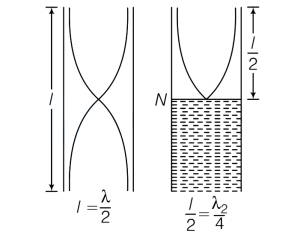
(A) For an open organ pipe of length $l$,the fundamental frequency is given by $f = \frac{v}{2l}$,where $v$ is the speed of sound in air.
When the tube is placed vertically in water such that half its length is submerged,it acts as a closed organ pipe of length $l' = \frac{l}{2}$.
The fundamental frequency of a closed organ pipe is given by $f' = \frac{v}{4l'}$.
Substituting $l' = \frac{l}{2}$ into the expression for $f'$,we get:
$f' = \frac{v}{4(l/2)} = \frac{v}{2l}$.
Comparing this with the initial frequency $f = \frac{v}{2l}$,we find that $f' = f$.
When the tube is placed vertically in water such that half its length is submerged,it acts as a closed organ pipe of length $l' = \frac{l}{2}$.
The fundamental frequency of a closed organ pipe is given by $f' = \frac{v}{4l'}$.
Substituting $l' = \frac{l}{2}$ into the expression for $f'$,we get:
$f' = \frac{v}{4(l/2)} = \frac{v}{2l}$.
Comparing this with the initial frequency $f = \frac{v}{2l}$,we find that $f' = f$.
0 likesView Solution
15
PhysicsEasyMCQKCET · 2007
The ratio of the velocity of sound in hydrogen $\left(\gamma=\frac{7}{5}\right)$ to that in helium $\left(\gamma=\frac{5}{3}\right)$ at the same temperature is
A
$\sqrt{\frac{5}{42}}$
B
$\sqrt{\frac{5}{21}}$
C
$\frac{\sqrt{42}}{5}$
D
$\frac{\sqrt{21}}{5}$
Solution
(C) The velocity of sound in an ideal gas is given by $v = \sqrt{\frac{\gamma RT}{M}}$,where $\gamma$ is the adiabatic index,$R$ is the gas constant,$T$ is the temperature,and $M$ is the molar mass.
Since the temperature $T$ is the same for both gases,the ratio of the velocities is $\frac{v_{H_2}}{v_{He}} = \sqrt{\frac{\gamma_{H_2} M_{He}}{\gamma_{He} M_{H_2}}}$.
For hydrogen $(H_2)$,$M_{H_2} = 2 \times 10^{-3} \ kg/mol$ and $\gamma_{H_2} = \frac{7}{5}$.
For helium $(He)$,$M_{He} = 4 \times 10^{-3} \ kg/mol$ and $\gamma_{He} = \frac{5}{3}$.
Substituting these values: $\frac{v_{H_2}}{v_{He}} = \sqrt{\frac{(7/5) \times 4}{(5/3) \times 2}} = \sqrt{\frac{7}{5} \times \frac{3}{5} \times \frac{4}{2}} = \sqrt{\frac{7 \times 3 \times 2}{5 \times 5}} = \sqrt{\frac{42}{25}} = \frac{\sqrt{42}}{5}$.
Since the temperature $T$ is the same for both gases,the ratio of the velocities is $\frac{v_{H_2}}{v_{He}} = \sqrt{\frac{\gamma_{H_2} M_{He}}{\gamma_{He} M_{H_2}}}$.
For hydrogen $(H_2)$,$M_{H_2} = 2 \times 10^{-3} \ kg/mol$ and $\gamma_{H_2} = \frac{7}{5}$.
For helium $(He)$,$M_{He} = 4 \times 10^{-3} \ kg/mol$ and $\gamma_{He} = \frac{5}{3}$.
Substituting these values: $\frac{v_{H_2}}{v_{He}} = \sqrt{\frac{(7/5) \times 4}{(5/3) \times 2}} = \sqrt{\frac{7}{5} \times \frac{3}{5} \times \frac{4}{2}} = \sqrt{\frac{7 \times 3 \times 2}{5 \times 5}} = \sqrt{\frac{42}{25}} = \frac{\sqrt{42}}{5}$.
0 likesView Solution
16
PhysicsMediumMCQKCET · 2007
An inductance of $\left(\frac{200}{\pi}\right) \text{mH}$,a capacitance of $\left(\frac{10^{-3}}{\pi}\right) \text{F}$,and a resistance of $10 \, \Omega$ are connected in series with an $AC$ source of $220 \, \text{V}, 50 \, \text{Hz}$. The phase angle of the circuit is:
A
$\frac{\pi}{6}$
B
$\frac{\pi}{4}$
C
$\frac{\pi}{2}$
D
$\frac{\pi}{3}$
Solution
(B) The phase angle $\theta$ between current $I$ and voltage $V$ in an $LCR$ series circuit is given by the formula:
$\tan \theta = \frac{X_L - X_C}{R}$
First,calculate the inductive reactance $X_L$:
$X_L = 2 \pi f L = 2 \pi \times 50 \times \left( \frac{200}{\pi} \times 10^{-3} \right) = 20 \, \Omega$
Next,calculate the capacitive reactance $X_C$:
$X_C = \frac{1}{2 \pi f C} = \frac{1}{2 \pi \times 50 \times (10^{-3} / \pi)} = \frac{1}{0.1} = 10 \, \Omega$
Given resistance $R = 10 \, \Omega$.
Substituting these values into the phase angle formula:
$\tan \theta = \frac{20 - 10}{10} = \frac{10}{10} = 1$
Since $\tan \theta = 1$,we have $\theta = \tan^{-1}(1) = \frac{\pi}{4}$ radians.
Thus,the phase angle of the circuit is $\frac{\pi}{4}$.
$\tan \theta = \frac{X_L - X_C}{R}$
First,calculate the inductive reactance $X_L$:
$X_L = 2 \pi f L = 2 \pi \times 50 \times \left( \frac{200}{\pi} \times 10^{-3} \right) = 20 \, \Omega$
Next,calculate the capacitive reactance $X_C$:
$X_C = \frac{1}{2 \pi f C} = \frac{1}{2 \pi \times 50 \times (10^{-3} / \pi)} = \frac{1}{0.1} = 10 \, \Omega$
Given resistance $R = 10 \, \Omega$.
Substituting these values into the phase angle formula:
$\tan \theta = \frac{20 - 10}{10} = \frac{10}{10} = 1$
Since $\tan \theta = 1$,we have $\theta = \tan^{-1}(1) = \frac{\pi}{4}$ radians.
Thus,the phase angle of the circuit is $\frac{\pi}{4}$.
0 likesView Solution
17
PhysicsEasyMCQKCET · 2007
$A$ step-down transformer reduces the voltage of a transmission line from $2200 \,V$ to $220 \,V$. The power delivered by it is $880 \,W$ and its efficiency is $88 \%$. The input current is
A
$4.65 \,mA$
B
$0.045 \,A$
C
$0.45 \,A$
D
$4.65 \,A$
Solution
(C) Efficiency of a transformer is defined as the ratio of output power to input power: $\eta = \frac{P_{out}}{P_{in}}$.
Given, $\eta = 88 \% = 0.88$ and $P_{out} = 880 \,W$.
Substituting these values: $0.88 = \frac{880}{P_{in}}$.
Therefore, $P_{in} = \frac{880}{0.88} = 1000 \,W$.
The input power is also given by $P_{in} = V_{in} \times I_{in}$, where $V_{in} = 2200 \,V$.
Thus, $I_{in} = \frac{P_{in}}{V_{in}} = \frac{1000}{2200} \,A$.
$I_{in} = \frac{10}{22} \,A \approx 0.4545 \,A$.
Rounding to two decimal places, the input current is $0.45 \,A$.
Given, $\eta = 88 \% = 0.88$ and $P_{out} = 880 \,W$.
Substituting these values: $0.88 = \frac{880}{P_{in}}$.
Therefore, $P_{in} = \frac{880}{0.88} = 1000 \,W$.
The input power is also given by $P_{in} = V_{in} \times I_{in}$, where $V_{in} = 2200 \,V$.
Thus, $I_{in} = \frac{P_{in}}{V_{in}} = \frac{1000}{2200} \,A$.
$I_{in} = \frac{10}{22} \,A \approx 0.4545 \,A$.
Rounding to two decimal places, the input current is $0.45 \,A$.
0 likesView Solution
18
PhysicsDifficultMCQKCET · 2007
Electrons in a certain energy level $n=n_{1}$ can emit $3$ spectral lines. When they are in another energy level $n=n_{2}$,they can emit $6$ spectral lines. The orbital speed of the electrons in these orbits are in the ratio:
A
$4:3$
B
$3:4$
C
$2:1$
D
$1:2$
Solution
(A) The number of spectral lines emitted when an electron transitions from energy level $n$ to lower levels is given by $N = \frac{n(n-1)}{2}$.
For the first case,$N = 3$:
$3 = \frac{n_{1}(n_{1}-1)}{2} \Rightarrow n_{1}^2 - n_{1} - 6 = 0 \Rightarrow (n_{1}-3)(n_{1}+2) = 0$.
Since $n_{1} > 0$,we have $n_{1} = 3$.
For the second case,$N = 6$:
$6 = \frac{n_{2}(n_{2}-1)}{2} \Rightarrow n_{2}^2 - n_{2} - 12 = 0 \Rightarrow (n_{2}-4)(n_{2}+3) = 0$.
Since $n_{2} > 0$,we have $n_{2} = 4$.
The orbital speed of an electron in the $n$-th orbit is given by $v_n = \frac{Ze^2}{2\varepsilon_0 hn}$,which implies $v \propto \frac{1}{n}$.
Therefore,the ratio of the speeds is $\frac{v_1}{v_2} = \frac{n_2}{n_1} = \frac{4}{3}$.
For the first case,$N = 3$:
$3 = \frac{n_{1}(n_{1}-1)}{2} \Rightarrow n_{1}^2 - n_{1} - 6 = 0 \Rightarrow (n_{1}-3)(n_{1}+2) = 0$.
Since $n_{1} > 0$,we have $n_{1} = 3$.
For the second case,$N = 6$:
$6 = \frac{n_{2}(n_{2}-1)}{2} \Rightarrow n_{2}^2 - n_{2} - 12 = 0 \Rightarrow (n_{2}-4)(n_{2}+3) = 0$.
Since $n_{2} > 0$,we have $n_{2} = 4$.
The orbital speed of an electron in the $n$-th orbit is given by $v_n = \frac{Ze^2}{2\varepsilon_0 hn}$,which implies $v \propto \frac{1}{n}$.
Therefore,the ratio of the speeds is $\frac{v_1}{v_2} = \frac{n_2}{n_1} = \frac{4}{3}$.
0 likesView Solution
19
PhysicsMediumMCQKCET · 2007
In Raman effect, Stokes' lines are spectral lines having
A
frequency greater than that of the original line
B
wavelength equal to that of the original line
C
wavelength less than that of the original line
D
wavelength greater than that of the original line
Solution
(D) In the Raman effect, when light is scattered by molecules, the scattered light contains frequencies different from the incident frequency.
Stokes' lines are the spectral lines observed in the scattered light that have a frequency lower than the incident (original) frequency.
Since frequency $(f)$ and wavelength $(\lambda)$ are inversely related by the equation $c = f\lambda$, a lower frequency corresponds to a longer (greater) wavelength.
Therefore, Stokes' lines have a wavelength greater than that of the original line.
Stokes' lines are the spectral lines observed in the scattered light that have a frequency lower than the incident (original) frequency.
Since frequency $(f)$ and wavelength $(\lambda)$ are inversely related by the equation $c = f\lambda$, a lower frequency corresponds to a longer (greater) wavelength.
Therefore, Stokes' lines have a wavelength greater than that of the original line.
0 likesView Solution
20
PhysicsMediumMCQKCET · 2007
The ionisation energy of $Li^{2+}$ is equal to
A
$9 h c R$
B
$6 h c R$
C
$2 h c R$
D
$h c R$
Solution
(A) The ionization energy of a hydrogen-like ion is given by the formula $E = R c h Z^2$,where $R$ is the Rydberg constant,$c$ is the speed of light,$h$ is Planck's constant,and $Z$ is the atomic number.
For the lithium ion $Li^{2+}$,the atomic number $Z = 3$.
Substituting the value of $Z$ into the formula:
$E = R c h (3)^2 = 9 R c h$.
Therefore,the ionization energy of $Li^{2+}$ is $9 h c R$.
For the lithium ion $Li^{2+}$,the atomic number $Z = 3$.
Substituting the value of $Z$ into the formula:
$E = R c h (3)^2 = 9 R c h$.
Therefore,the ionization energy of $Li^{2+}$ is $9 h c R$.
0 likesView Solution
21
PhysicsMediumMCQKCET · 2007
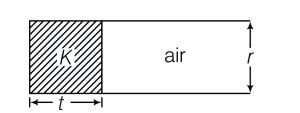
$A$ parallel plate capacitor with air as the dielectric has capacitance $C$. $A$ slab of dielectric constant $K$ and having the same thickness as the separation between the plates is introduced so as to fill one-fourth of the capacitor as shown in the figure. The new capacitance will be
A
$(K+3) \frac{C}{4}$
B
$(K+2) \frac{C}{4}$
C
$(K+1) \frac{C}{4}$
D
$\frac{K C}{4}$
Solution
(A) The original capacitance of the air-filled parallel plate capacitor is $C = \frac{\varepsilon_0 A}{d}$.
When a dielectric slab of constant $K$ is introduced to fill one-fourth of the area,the capacitor can be considered as two capacitors in parallel.
One capacitor has air as the dielectric with area $\frac{3A}{4}$ and plate separation $d$. Its capacitance is $C_1 = \frac{\varepsilon_0 (3A/4)}{d} = \frac{3}{4} \frac{\varepsilon_0 A}{d} = \frac{3C}{4}$.
The other capacitor has a dielectric $K$ with area $\frac{A}{4}$ and plate separation $d$. Its capacitance is $C_2 = \frac{K \varepsilon_0 (A/4)}{d} = \frac{K}{4} \frac{\varepsilon_0 A}{d} = \frac{KC}{4}$.
Since these two capacitors are in parallel,the equivalent capacitance is $C_{net} = C_1 + C_2$.
$C_{net} = \frac{3C}{4} + \frac{KC}{4} = \frac{C}{4}(K+3)$.
When a dielectric slab of constant $K$ is introduced to fill one-fourth of the area,the capacitor can be considered as two capacitors in parallel.
One capacitor has air as the dielectric with area $\frac{3A}{4}$ and plate separation $d$. Its capacitance is $C_1 = \frac{\varepsilon_0 (3A/4)}{d} = \frac{3}{4} \frac{\varepsilon_0 A}{d} = \frac{3C}{4}$.
The other capacitor has a dielectric $K$ with area $\frac{A}{4}$ and plate separation $d$. Its capacitance is $C_2 = \frac{K \varepsilon_0 (A/4)}{d} = \frac{K}{4} \frac{\varepsilon_0 A}{d} = \frac{KC}{4}$.
Since these two capacitors are in parallel,the equivalent capacitance is $C_{net} = C_1 + C_2$.
$C_{net} = \frac{3C}{4} + \frac{KC}{4} = \frac{C}{4}(K+3)$.
0 likesView Solution
22
PhysicsDifficultMCQKCET · 2007
Two identical capacitors each of capacitance $5 \mu F$ are charged to potentials $2 kV$ and $1 kV$ respectively. Their negative ends are connected together. When the positive ends are also connected together,the loss of energy of the system is
A
$160 \ J$
B
zero
C
$5 \ J$
D
$1.25 \ J$
Solution
(D) The loss of energy when two capacitors are connected in parallel is given by the formula: $\Delta U = \frac{1}{2} \frac{C_1 C_2}{C_1 + C_2} (V_1 - V_2)^2$.
Given: $C_1 = C_2 = 5 \mu F = 5 \times 10^{-6} \ F$,$V_1 = 2 \ kV = 2000 \ V$,and $V_2 = 1 \ kV = 1000 \ V$.
Substituting the values:
$\Delta U = \frac{1}{2} \times \frac{(5 \times 10^{-6}) \times (5 \times 10^{-6})}{5 \times 10^{-6} + 5 \times 10^{-6}} \times (2000 - 1000)^2$
$\Delta U = \frac{1}{2} \times \frac{25 \times 10^{-12}}{10 \times 10^{-6}} \times (1000)^2$
$\Delta U = \frac{1}{2} \times 2.5 \times 10^{-6} \times 10^6$
$\Delta U = 1.25 \ J$.
Given: $C_1 = C_2 = 5 \mu F = 5 \times 10^{-6} \ F$,$V_1 = 2 \ kV = 2000 \ V$,and $V_2 = 1 \ kV = 1000 \ V$.
Substituting the values:
$\Delta U = \frac{1}{2} \times \frac{(5 \times 10^{-6}) \times (5 \times 10^{-6})}{5 \times 10^{-6} + 5 \times 10^{-6}} \times (2000 - 1000)^2$
$\Delta U = \frac{1}{2} \times \frac{25 \times 10^{-12}}{10 \times 10^{-6}} \times (1000)^2$
$\Delta U = \frac{1}{2} \times 2.5 \times 10^{-6} \times 10^6$
$\Delta U = 1.25 \ J$.
0 likesView Solution
23
PhysicsDifficultMCQKCET · 2007
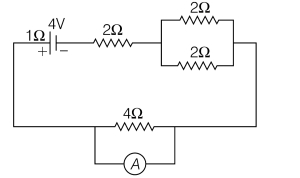
The current passing through the ideal ammeter in the circuit given below is (in $\text{ A}$)
A
$1.25$
B
$1$
C
$0.75$
D
$0.5$
Solution
(B) In the given circuit, the two $2 \Omega$ resistors are connected in parallel.
Their equivalent resistance $R_p$ is given by $\frac{1}{R_p} = \frac{1}{2} + \frac{1}{2} = 1 \Omega^{-1}$, so $R_p = 1 \Omega$.
An ideal ammeter has zero resistance and is connected in parallel with the $4 \Omega$ resistor. This effectively short-circuits the $4 \Omega$ resistor, meaning no current flows through it.
The total resistance of the circuit is the sum of the internal resistance of the battery $(1 \Omega)$, the series resistor $(2 \Omega)$, and the parallel combination $(1 \Omega)$.
$R_{net} = 1 \Omega + 2 \Omega + 1 \Omega = 4 \Omega$.
The total current $I$ flowing from the battery is $I = \frac{V}{R_{net}} = \frac{4 \text{ V}}{4 \Omega} = 1 \text{ A}$.
Since the ammeter is in parallel with the $4 \Omega$ resistor, all the current $I$ passes through the ideal ammeter.
Their equivalent resistance $R_p$ is given by $\frac{1}{R_p} = \frac{1}{2} + \frac{1}{2} = 1 \Omega^{-1}$, so $R_p = 1 \Omega$.
An ideal ammeter has zero resistance and is connected in parallel with the $4 \Omega$ resistor. This effectively short-circuits the $4 \Omega$ resistor, meaning no current flows through it.
The total resistance of the circuit is the sum of the internal resistance of the battery $(1 \Omega)$, the series resistor $(2 \Omega)$, and the parallel combination $(1 \Omega)$.
$R_{net} = 1 \Omega + 2 \Omega + 1 \Omega = 4 \Omega$.
The total current $I$ flowing from the battery is $I = \frac{V}{R_{net}} = \frac{4 \text{ V}}{4 \Omega} = 1 \text{ A}$.
Since the ammeter is in parallel with the $4 \Omega$ resistor, all the current $I$ passes through the ideal ammeter.
0 likesView Solution
24
PhysicsEasyMCQKCET · 2007
$A$ current of $5 \,A$ is passing through a metallic wire of cross-sectional area $4 \times 10^{-6} \,m^{2}$. If the density of charge carriers of the wire is $5 \times 10^{26} \,m^{-3}$, the drift velocity of the electrons will be:
A
$1 \times 10^{2} \,ms^{-1}$
B
$1.56 \times 10^{-2} \,ms^{-1}$
C
$1.56 \times 10^{-3} \,ms^{-1}$
D
$1 \times 10^{-2} \,ms^{-1}$
Solution
(B) The formula for drift velocity is given by $v_{d} = \frac{I}{n e A}$.
Here, $I = 5 \,A$, $n = 5 \times 10^{26} \,m^{-3}$, $e = 1.6 \times 10^{-19} \,C$, and $A = 4 \times 10^{-6} \,m^{2}$.
Substituting the values:
$v_{d} = \frac{5}{(5 \times 10^{26}) \times (1.6 \times 10^{-19}) \times (4 \times 10^{-6})}$
$v_{d} = \frac{5}{5 \times 1.6 \times 4 \times 10^{26-19-6}}$
$v_{d} = \frac{1}{6.4 \times 10^{1}}$
$v_{d} = \frac{1}{64} = 0.015625 \,ms^{-1} = 1.56 \times 10^{-2} \,ms^{-1}$.
Here, $I = 5 \,A$, $n = 5 \times 10^{26} \,m^{-3}$, $e = 1.6 \times 10^{-19} \,C$, and $A = 4 \times 10^{-6} \,m^{2}$.
Substituting the values:
$v_{d} = \frac{5}{(5 \times 10^{26}) \times (1.6 \times 10^{-19}) \times (4 \times 10^{-6})}$
$v_{d} = \frac{5}{5 \times 1.6 \times 4 \times 10^{26-19-6}}$
$v_{d} = \frac{1}{6.4 \times 10^{1}}$
$v_{d} = \frac{1}{64} = 0.015625 \,ms^{-1} = 1.56 \times 10^{-2} \,ms^{-1}$.
0 likesView Solution
25
PhysicsMediumMCQKCET · 2007
Two bulbs rated $25 \ W - 220 \ V$ and $100 \ W - 220 \ V$ are connected in series to a $440 \ V$ supply. Which of the following happens?
A
$100 \ W$ bulb fuses
B
$25 \ W$ bulb fuses
C
both the bulbs fuse
D
neither of the bulbs fuse
Solution
(B) The resistance of a bulb is given by $R = \frac{V^2}{P}$.
For the first bulb: $R_1 = \frac{220^2}{25} = 1936 \ \Omega$.
For the second bulb: $R_2 = \frac{220^2}{100} = 484 \ \Omega$.
Since the bulbs are connected in series,the total resistance is $R_{net} = R_1 + R_2 = 1936 + 484 = 2420 \ \Omega$.
The current flowing through the circuit is $I = \frac{V_{supply}}{R_{net}} = \frac{440}{2420} = \frac{2}{11} \ A$.
The potential difference across the $25 \ W$ bulb is $V_1 = I \times R_1 = \frac{2}{11} \times 1936 = 352 \ V$.
The potential difference across the $100 \ W$ bulb is $V_2 = I \times R_2 = \frac{2}{11} \times 484 = 88 \ V$.
Since the potential difference across the $25 \ W$ bulb $(352 \ V)$ exceeds its rated voltage $(220 \ V)$,the $25 \ W$ bulb will fuse.
For the first bulb: $R_1 = \frac{220^2}{25} = 1936 \ \Omega$.
For the second bulb: $R_2 = \frac{220^2}{100} = 484 \ \Omega$.
Since the bulbs are connected in series,the total resistance is $R_{net} = R_1 + R_2 = 1936 + 484 = 2420 \ \Omega$.
The current flowing through the circuit is $I = \frac{V_{supply}}{R_{net}} = \frac{440}{2420} = \frac{2}{11} \ A$.
The potential difference across the $25 \ W$ bulb is $V_1 = I \times R_1 = \frac{2}{11} \times 1936 = 352 \ V$.
The potential difference across the $100 \ W$ bulb is $V_2 = I \times R_2 = \frac{2}{11} \times 484 = 88 \ V$.
Since the potential difference across the $25 \ W$ bulb $(352 \ V)$ exceeds its rated voltage $(220 \ V)$,the $25 \ W$ bulb will fuse.
0 likesView Solution
26
PhysicsMediumMCQKCET · 2007
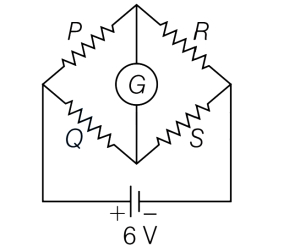
In the given Wheatstone's network,$P=10 \Omega$,$Q=20 \Omega, R=15 \Omega, S=30 \Omega$. The current passing through the battery (of negligible internal resistance) is:
A
$0.36 \text{ A}$
B
zero
C
$0.18 \text{ A}$
D
$0.72 \text{ A}$
Solution
(A) The balanced condition for a Wheatstone bridge is $\frac{P}{R} = \frac{Q}{S}$.
Given values: $P=10 \Omega, Q=20 \Omega, R=15 \Omega, S=30 \Omega$.
Checking the ratio: $\frac{P}{R} = \frac{10}{15} = \frac{2}{3}$ and $\frac{Q}{S} = \frac{20}{30} = \frac{2}{3}$.
Since $\frac{P}{R} = \frac{Q}{S}$,the bridge is balanced,and no current flows through the galvanometer.
Now,the circuit simplifies to two parallel branches: one with $(P+R)$ and the other with $(Q+S)$.
Resistance of the first branch,$R_1 = P + R = 10 + 15 = 25 \Omega$.
Resistance of the second branch,$R_2 = Q + S = 20 + 30 = 50 \Omega$.
Since $R_1$ and $R_2$ are in parallel,the equivalent resistance $R_{eq}$ is given by:
$\frac{1}{R_{eq}} = \frac{1}{R_1} + \frac{1}{R_2} = \frac{1}{25} + \frac{1}{50} = \frac{2+1}{50} = \frac{3}{50} \Omega^{-1}$.
Therefore,$R_{eq} = \frac{50}{3} \Omega$.
The current $I$ from the battery of voltage $V = 6 \text{ V}$ is:
$I = \frac{V}{R_{eq}} = \frac{6}{50/3} = \frac{6 \times 3}{50} = \frac{18}{50} = 0.36 \text{ A}$.
Given values: $P=10 \Omega, Q=20 \Omega, R=15 \Omega, S=30 \Omega$.
Checking the ratio: $\frac{P}{R} = \frac{10}{15} = \frac{2}{3}$ and $\frac{Q}{S} = \frac{20}{30} = \frac{2}{3}$.
Since $\frac{P}{R} = \frac{Q}{S}$,the bridge is balanced,and no current flows through the galvanometer.
Now,the circuit simplifies to two parallel branches: one with $(P+R)$ and the other with $(Q+S)$.
Resistance of the first branch,$R_1 = P + R = 10 + 15 = 25 \Omega$.
Resistance of the second branch,$R_2 = Q + S = 20 + 30 = 50 \Omega$.
Since $R_1$ and $R_2$ are in parallel,the equivalent resistance $R_{eq}$ is given by:
$\frac{1}{R_{eq}} = \frac{1}{R_1} + \frac{1}{R_2} = \frac{1}{25} + \frac{1}{50} = \frac{2+1}{50} = \frac{3}{50} \Omega^{-1}$.
Therefore,$R_{eq} = \frac{50}{3} \Omega$.
The current $I$ from the battery of voltage $V = 6 \text{ V}$ is:
$I = \frac{V}{R_{eq}} = \frac{6}{50/3} = \frac{6 \times 3}{50} = \frac{18}{50} = 0.36 \text{ A}$.
0 likesView Solution
27
PhysicsEasyMCQKCET · 2007
The de-Broglie wavelength of a proton (charge $= 1.6 \times 10^{-19} \ C$,mass $= 1.67 \times 10^{-27} \ kg$) accelerated through a potential difference of $1 \ kV$ is:
A
$600 \ \text{Å}$
B
$0.9 \times 10^{-12} \ m$
C
$7 \ \text{Å}$
D
$0.9 \ nm$
Solution
(B) The de-Broglie wavelength $\lambda$ is given by the formula: $\lambda = \frac{h}{p} = \frac{h}{\sqrt{2mK}}$,where $K = qV$ is the kinetic energy.
Substituting the values: $h = 6.63 \times 10^{-34} \ J \cdot s$,$m = 1.67 \times 10^{-27} \ kg$,$q = 1.6 \times 10^{-19} \ C$,and $V = 1000 \ V$.
$\lambda = \frac{6.63 \times 10^{-34}}{\sqrt{2 \times 1.67 \times 10^{-27} \times 1.6 \times 10^{-19} \times 1000}}$
$\lambda = \frac{6.63 \times 10^{-34}}{\sqrt{5.344 \times 10^{-43}}} = \frac{6.63 \times 10^{-34}}{7.31 \times 10^{-22}} \approx 0.9 \times 10^{-12} \ m$.
Substituting the values: $h = 6.63 \times 10^{-34} \ J \cdot s$,$m = 1.67 \times 10^{-27} \ kg$,$q = 1.6 \times 10^{-19} \ C$,and $V = 1000 \ V$.
$\lambda = \frac{6.63 \times 10^{-34}}{\sqrt{2 \times 1.67 \times 10^{-27} \times 1.6 \times 10^{-19} \times 1000}}$
$\lambda = \frac{6.63 \times 10^{-34}}{\sqrt{5.344 \times 10^{-43}}} = \frac{6.63 \times 10^{-34}}{7.31 \times 10^{-22}} \approx 0.9 \times 10^{-12} \ m$.
0 likesView Solution
28
PhysicsEasyMCQKCET · 2007
Which one of the following graphs correctly represents the variation of maximum kinetic energy $(E_{k})$ of the emitted electrons with frequency $(\nu)$ of incident light in the photoelectric effect?
A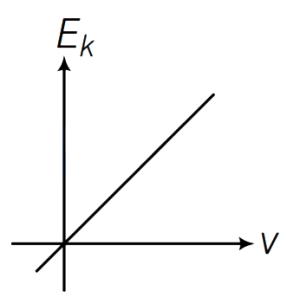
B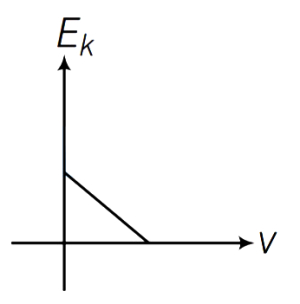
C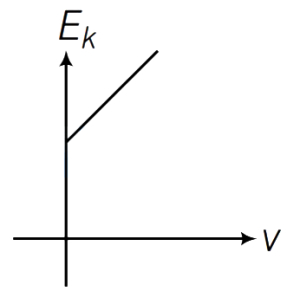
D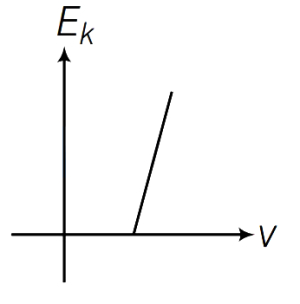
Solution
(D) According to Einstein's photoelectric equation:
$E_{k} = h\nu - \Phi$
where $E_{k}$ is the maximum kinetic energy,$h$ is Planck's constant,$\nu$ is the frequency of incident light,and $\Phi = h\nu_{0}$ is the work function of the metal surface ($\nu_{0}$ is the threshold frequency).
This equation is of the form $y = mx + c$,where:
$y = E_{k}$
$x = \nu$
$m = h$ (slope)
$c = -\Phi$ (y-intercept)
$1$. For $\nu < \nu_{0}$,the energy of the incident photon is less than the work function,so no photoelectric emission occurs,and $E_{k} = 0$.
$2$. For $\nu = \nu_{0}$,$E_{k} = 0$.
$3$. For $\nu > \nu_{0}$,$E_{k}$ increases linearly with frequency $\nu$.
Graph $D$ correctly shows that $E_{k}$ is zero until the threshold frequency $\nu_{0}$ is reached,after which it increases linearly.
$E_{k} = h\nu - \Phi$
where $E_{k}$ is the maximum kinetic energy,$h$ is Planck's constant,$\nu$ is the frequency of incident light,and $\Phi = h\nu_{0}$ is the work function of the metal surface ($\nu_{0}$ is the threshold frequency).
This equation is of the form $y = mx + c$,where:
$y = E_{k}$
$x = \nu$
$m = h$ (slope)
$c = -\Phi$ (y-intercept)
$1$. For $\nu < \nu_{0}$,the energy of the incident photon is less than the work function,so no photoelectric emission occurs,and $E_{k} = 0$.
$2$. For $\nu = \nu_{0}$,$E_{k} = 0$.
$3$. For $\nu > \nu_{0}$,$E_{k}$ increases linearly with frequency $\nu$.
Graph $D$ correctly shows that $E_{k}$ is zero until the threshold frequency $\nu_{0}$ is reached,after which it increases linearly.
0 likesView Solution
29
PhysicsMediumMCQKCET · 2007
$A$ and $B$ are two metals with threshold frequencies $1.8 \times 10^{14} \ Hz$ and $2.2 \times 10^{14} \ Hz$. Two identical photons of energy $0.825 \ eV$ each are incident on them. Then photoelectrons are emitted by (Take $h = 6.6 \times 10^{-34} \ J \cdot s$)
A
$B$ alone
B
$A$ alone
C
neither $A$ nor $B$
D
both $A$ and $B$
Solution
(B) The threshold energy (work function) is given by $\Phi = h \nu_0$. Given $h = 6.6 \times 10^{-34} \ J \cdot s$ and $1 \ eV = 1.6 \times 10^{-19} \ J$.
For metal $A$:
$\Phi_A = h \nu_A = (6.6 \times 10^{-34}) \times (1.8 \times 10^{14}) \ J = 11.88 \times 10^{-20} \ J$.
Converting to $eV$: $\Phi_A = \frac{11.88 \times 10^{-20}}{1.6 \times 10^{-19}} \ eV = 0.7425 \ eV$.
For metal $B$:
$\Phi_B = h \nu_B = (6.6 \times 10^{-34}) \times (2.2 \times 10^{14}) \ J = 14.52 \times 10^{-20} \ J$.
Converting to $eV$: $\Phi_B = \frac{14.52 \times 10^{-20}}{1.6 \times 10^{-19}} \ eV = 0.9075 \ eV$.
The energy of incident photons is $E = 0.825 \ eV$.
Since $E > \Phi_A$ $(0.825 \ eV > 0.7425 \ eV)$ and $E < \Phi_B$ $(0.825 \ eV < 0.9075 \ eV)$,photoelectrons are emitted only from metal $A$.
For metal $A$:
$\Phi_A = h \nu_A = (6.6 \times 10^{-34}) \times (1.8 \times 10^{14}) \ J = 11.88 \times 10^{-20} \ J$.
Converting to $eV$: $\Phi_A = \frac{11.88 \times 10^{-20}}{1.6 \times 10^{-19}} \ eV = 0.7425 \ eV$.
For metal $B$:
$\Phi_B = h \nu_B = (6.6 \times 10^{-34}) \times (2.2 \times 10^{14}) \ J = 14.52 \times 10^{-20} \ J$.
Converting to $eV$: $\Phi_B = \frac{14.52 \times 10^{-20}}{1.6 \times 10^{-19}} \ eV = 0.9075 \ eV$.
The energy of incident photons is $E = 0.825 \ eV$.
Since $E > \Phi_A$ $(0.825 \ eV > 0.7425 \ eV)$ and $E < \Phi_B$ $(0.825 \ eV < 0.9075 \ eV)$,photoelectrons are emitted only from metal $A$.
0 likesView Solution
30
PhysicsMediumMCQKCET · 2007
The electromagnetic theory of light failed to explain:
A
photoelectric effect
B
polarisation
C
diffraction
D
interference
Solution
(A) The classical electromagnetic theory of light treats light as a continuous wave. According to this theory,the energy of the wave depends on its intensity (amplitude). However,experimental observations of the photoelectric effect show that the emission of electrons depends on the frequency of the incident light,not its intensity. Furthermore,the emission is instantaneous,which contradicts the classical prediction of a time lag for energy absorption. Therefore,the electromagnetic theory of light failed to explain the photoelectric effect.
0 likesView Solution
31
PhysicsMediumMCQKCET · 2007
An electric bulb has a rated power of $50 \, W$ at $100 \, V$. If it is used on an $AC$ source of $200 \, V, 50 \, Hz$, a choke has to be used in series with it. This choke should have an inductance of (in $ \, H$)
A
$0.1$
B
$1$
C
$1.1$
D
$0.11$
Solution
(C) The resistance of the bulb is given by $R = \frac{V^2}{P} = \frac{100^2}{50} = 200 \, \Omega$.
For the bulb to operate at its rated power, the current $I$ must be $I = \frac{P}{V} = \frac{50}{100} = 0.5 \, A$.
When connected to a $200 \, V$ $AC$ source, the total impedance $Z$ of the circuit is $Z = \frac{V_{source}}{I} = \frac{200}{0.5} = 400 \, \Omega$.
The impedance of an $RL$ circuit is $Z = \sqrt{R^2 + X_L^2}$, where $X_L = 2\pi fL$.
Substituting the values: $400 = \sqrt{200^2 + X_L^2}$.
$160000 = 40000 + X_L^2 \implies X_L^2 = 120000$.
$X_L = \sqrt{120000} = 200\sqrt{3} \, \Omega$.
Since $X_L = 2\pi fL$, we have $200\sqrt{3} = 2 \times \pi \times 50 \times L$.
$L = \frac{200\sqrt{3}}{100\pi} = \frac{2\sqrt{3}}{\pi} \approx \frac{2 \times 1.732}{3.14} \approx 1.1 \, H$.
For the bulb to operate at its rated power, the current $I$ must be $I = \frac{P}{V} = \frac{50}{100} = 0.5 \, A$.
When connected to a $200 \, V$ $AC$ source, the total impedance $Z$ of the circuit is $Z = \frac{V_{source}}{I} = \frac{200}{0.5} = 400 \, \Omega$.
The impedance of an $RL$ circuit is $Z = \sqrt{R^2 + X_L^2}$, where $X_L = 2\pi fL$.
Substituting the values: $400 = \sqrt{200^2 + X_L^2}$.
$160000 = 40000 + X_L^2 \implies X_L^2 = 120000$.
$X_L = \sqrt{120000} = 200\sqrt{3} \, \Omega$.
Since $X_L = 2\pi fL$, we have $200\sqrt{3} = 2 \times \pi \times 50 \times L$.
$L = \frac{200\sqrt{3}}{100\pi} = \frac{2\sqrt{3}}{\pi} \approx \frac{2 \times 1.732}{3.14} \approx 1.1 \, H$.
0 likesView Solution
32
PhysicsEasyMCQKCET · 2007
Current in a coil changes from $4 \,A$ to zero in $0.1 \,s$ and the emf induced is $100 \,V$. The self inductance of the coil is (in $\,H$)
A
$0.25$
B
$0.4$
C
$2.5$
D
$4$
Solution
(C) The magnitude of the induced emf in a coil is given by the formula: $|e| = L \left| \frac{dI}{dt} \right|$.
Given:
Initial current $I_1 = 4 \,A$.
Final current $I_2 = 0 \,A$.
Change in current $dI = I_2 - I_1 = 0 - 4 = -4 \,A$.
Time interval $dt = 0.1 \,s$.
Induced emf $|e| = 100 \,V$.
Substituting these values into the formula:
$100 = L \times \frac{|-4|}{0.1}$.
$100 = L \times \frac{4}{0.1}$.
$100 = L \times 40$.
$L = \frac{100}{40} = 2.5 \,H$.
Therefore,the self-inductance of the coil is $2.5 \,H$.
Given:
Initial current $I_1 = 4 \,A$.
Final current $I_2 = 0 \,A$.
Change in current $dI = I_2 - I_1 = 0 - 4 = -4 \,A$.
Time interval $dt = 0.1 \,s$.
Induced emf $|e| = 100 \,V$.
Substituting these values into the formula:
$100 = L \times \frac{|-4|}{0.1}$.
$100 = L \times \frac{4}{0.1}$.
$100 = L \times 40$.
$L = \frac{100}{40} = 2.5 \,H$.
Therefore,the self-inductance of the coil is $2.5 \,H$.
0 likesView Solution
33
PhysicsEasyMCQKCET · 2007
All components of the electromagnetic spectrum in vacuum have the same
A
energy
B
velocity
C
wavelength
D
frequency
Solution
(B) In a vacuum,all components of the electromagnetic spectrum travel with the same speed,which is the speed of light,denoted by $c$.
This value is approximately $3 \times 10^{8} \ m/s$.
While their frequencies and wavelengths differ,their velocity remains constant in a vacuum.
This value is approximately $3 \times 10^{8} \ m/s$.
While their frequencies and wavelengths differ,their velocity remains constant in a vacuum.
0 likesView Solution
34
PhysicsEasyMCQKCET · 2007
Two identical charges repel each other with a force equal to $10 \text{ mg}$ wt when they are $0.6 \text{ m}$ apart in air $(g = 10 \text{ ms}^{-2})$. The value of each charge is:
A
$2 \text{ mC}$
B
$2 \times 10^{-7} \text{ C}$
C
$2 \text{ nC}$
D
$2 \mu\text{C}$
Solution
(D) The force of repulsion between two charges is given by Coulomb's law: $F = \frac{1}{4 \pi \varepsilon_{0}} \frac{q_{1} q_{2}}{r^{2}}$.
Given: $F = 10 \text{ mg wt} = 10 \times 10^{-3} \text{ kg} \times 10 \text{ ms}^{-2} = 0.1 \text{ N}$.
Distance $r = 0.6 \text{ m}$.
Since the charges are identical,let $q_{1} = q_{2} = q$.
Substituting the values: $0.1 = (9 \times 10^{9}) \times \frac{q^{2}}{(0.6)^{2}}$.
$q^{2} = \frac{0.1 \times 0.36}{9 \times 10^{9}} = \frac{0.036}{9 \times 10^{9}} = 0.004 \times 10^{-9} = 4 \times 10^{-12} \text{ C}^{2}$.
Taking the square root: $q = \sqrt{4 \times 10^{-12}} = 2 \times 10^{-6} \text{ C} = 2 \mu\text{C}$.
Given: $F = 10 \text{ mg wt} = 10 \times 10^{-3} \text{ kg} \times 10 \text{ ms}^{-2} = 0.1 \text{ N}$.
Distance $r = 0.6 \text{ m}$.
Since the charges are identical,let $q_{1} = q_{2} = q$.
Substituting the values: $0.1 = (9 \times 10^{9}) \times \frac{q^{2}}{(0.6)^{2}}$.
$q^{2} = \frac{0.1 \times 0.36}{9 \times 10^{9}} = \frac{0.036}{9 \times 10^{9}} = 0.004 \times 10^{-9} = 4 \times 10^{-12} \text{ C}^{2}$.
Taking the square root: $q = \sqrt{4 \times 10^{-12}} = 2 \times 10^{-6} \text{ C} = 2 \mu\text{C}$.
0 likesView Solution
35
PhysicsEasyMCQKCET · 2007
The potential of the electric field produced by a point charge at any point $(x, y, z)$ is given by $V = 3x^2 + 5$,where $x, y$ are in metres and $V$ is in volts. The intensity of the electric field at $(-2, 1, 0)$ is
A
$+12 \ Vm^{-1}$
B
$-12 \ Vm^{-1}$
C
$+17 \ Vm^{-1}$
D
$-17 \ Vm^{-1}$
Solution
(A) The electric field intensity $\vec{E}$ is related to the electric potential $V$ by the relation $\vec{E} = -\nabla V$.
Since the potential $V$ depends only on $x$,the electric field is given by $E_x = -\frac{dV}{dx}$.
Given $V = 3x^2 + 5$.
Calculating the derivative: $\frac{dV}{dx} = \frac{d}{dx}(3x^2 + 5) = 6x$.
Therefore,$E_x = -6x$.
At the point $(-2, 1, 0)$,the $x$-coordinate is $-2$.
Substituting $x = -2$ into the expression for $E_x$:
$E_x = -6(-2) = +12 \ Vm^{-1}$.
Thus,the intensity of the electric field at $(-2, 1, 0)$ is $+12 \ Vm^{-1}$.
Since the potential $V$ depends only on $x$,the electric field is given by $E_x = -\frac{dV}{dx}$.
Given $V = 3x^2 + 5$.
Calculating the derivative: $\frac{dV}{dx} = \frac{d}{dx}(3x^2 + 5) = 6x$.
Therefore,$E_x = -6x$.
At the point $(-2, 1, 0)$,the $x$-coordinate is $-2$.
Substituting $x = -2$ into the expression for $E_x$:
$E_x = -6(-2) = +12 \ Vm^{-1}$.
Thus,the intensity of the electric field at $(-2, 1, 0)$ is $+12 \ Vm^{-1}$.
0 likesView Solution
36
PhysicsMediumMCQKCET · 2007
The potential of a large liquid drop formed when eight identical small liquid drops are combined is $20 \,V$. What was the potential of each single small drop (in $\,V$)?
A
$10$
B
$7.5$
C
$5$
D
$2.5$
Solution
(C) Let the radius of each small drop be $r$ and its charge be $q$. The potential of a small drop is $V' = \frac{kq}{r}$.
When $8$ drops combine to form a large drop of radius $R$ and charge $Q$, the volume remains constant: $\frac{4}{3} \pi R^3 = 8 \times \frac{4}{3} \pi r^3$, which gives $R = 2r$.
The total charge of the large drop is $Q = 8q$.
The potential of the large drop is $V = \frac{kQ}{R} = \frac{k(8q)}{2r} = 4 \left( \frac{kq}{r} \right) = 4V'$.
Given $V = 20 \,V$, we have $20 = 4V'$.
Therefore, $V' = \frac{20}{4} = 5 \,V$.
When $8$ drops combine to form a large drop of radius $R$ and charge $Q$, the volume remains constant: $\frac{4}{3} \pi R^3 = 8 \times \frac{4}{3} \pi r^3$, which gives $R = 2r$.
The total charge of the large drop is $Q = 8q$.
The potential of the large drop is $V = \frac{kQ}{R} = \frac{k(8q)}{2r} = 4 \left( \frac{kq}{r} \right) = 4V'$.
Given $V = 20 \,V$, we have $20 = 4V'$.
Therefore, $V' = \frac{20}{4} = 5 \,V$.
0 likesView Solution
37
PhysicsDifficultMCQKCET · 2007
$A$ and $B$ are two infinitely long straight parallel conductors. $C$ is another straight conductor of length $1 \, m$ kept parallel to $A$ and $B$ as shown in the figure. Then the force experienced by $C$ is
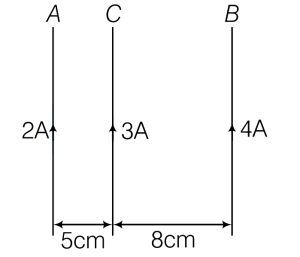
A
towards $A$ equal to $0.6 \times 10^{-5} \, N$
B
towards $B$ equal to $5.4 \times 10^{-5} \, N$
C
towards $A$ equal to $5.4 \times 10^{-5} \, N$
D
towards $B$ equal to $0.6 \times 10^{-5} \, N$
Solution
(D) The force per unit length between two parallel conductors carrying currents $I_1$ and $I_2$ separated by distance $r$ is given by $f = \frac{\mu_0 I_1 I_2}{2 \pi r}$. The force is attractive if currents are in the same direction.
Force on $C$ due to $A$ $(F_{AC})$:
$F_{AC} = \frac{\mu_0 I_A I_C L}{2 \pi r_{AC}} = \frac{2 \times 10^{-7} \times 2 \times 3 \times 1}{0.05} = \frac{12 \times 10^{-7}}{0.05} = 2.4 \times 10^{-5} \, N$ (towards $A$, attractive).
Force on $C$ due to $B$ $(F_{BC})$:
$F_{BC} = \frac{\mu_0 I_B I_C L}{2 \pi r_{BC}} = \frac{2 \times 10^{-7} \times 4 \times 3 \times 1}{0.08} = \frac{24 \times 10^{-7}}{0.08} = 3.0 \times 10^{-5} \, N$ (towards $B$, attractive).
Since $F_{BC} > F_{AC}$, the net force is $F_{net} = F_{BC} - F_{AC} = (3.0 - 2.4) \times 10^{-5} \, N = 0.6 \times 10^{-5} \, N$ towards $B$.
Force on $C$ due to $A$ $(F_{AC})$:
$F_{AC} = \frac{\mu_0 I_A I_C L}{2 \pi r_{AC}} = \frac{2 \times 10^{-7} \times 2 \times 3 \times 1}{0.05} = \frac{12 \times 10^{-7}}{0.05} = 2.4 \times 10^{-5} \, N$ (towards $A$, attractive).
Force on $C$ due to $B$ $(F_{BC})$:
$F_{BC} = \frac{\mu_0 I_B I_C L}{2 \pi r_{BC}} = \frac{2 \times 10^{-7} \times 4 \times 3 \times 1}{0.08} = \frac{24 \times 10^{-7}}{0.08} = 3.0 \times 10^{-5} \, N$ (towards $B$, attractive).
Since $F_{BC} > F_{AC}$, the net force is $F_{net} = F_{BC} - F_{AC} = (3.0 - 2.4) \times 10^{-5} \, N = 0.6 \times 10^{-5} \, N$ towards $B$.
0 likesView Solution
38
PhysicsMediumMCQKCET · 2007
$A$ circular coil carrying a certain current produces a magnetic field $B_{0}$ at its centre. The coil is now rewound so as to have $3$ turns and the same current is passed through it. The new magnetic field at the centre is
A
$\frac{B_{0}}{9}$
B
$9 B_{0}$
C
$\frac{B_{0}}{3}$
D
$3 B_{0}$
Solution
(B) The magnetic field $B$ at the centre of a circular coil with $N$ turns,radius $r$,and current $I$ is given by $B = \frac{\mu_{0} N I}{2 r}$.
Initially,for $N=1$ turn,the magnetic field is $B_{0} = \frac{\mu_{0} I}{2 r}$.
When the coil is rewound to have $N' = 3$ turns using the same length of wire,the new radius $r'$ becomes $r' = \frac{r}{3}$.
The new magnetic field $B'$ at the centre is $B' = \frac{\mu_{0} N' I}{2 r'} = \frac{\mu_{0} (3) I}{2 (r/3)}$.
Simplifying this,we get $B' = \frac{9 \mu_{0} I}{2 r} = 9 B_{0}$.
Initially,for $N=1$ turn,the magnetic field is $B_{0} = \frac{\mu_{0} I}{2 r}$.
When the coil is rewound to have $N' = 3$ turns using the same length of wire,the new radius $r'$ becomes $r' = \frac{r}{3}$.
The new magnetic field $B'$ at the centre is $B' = \frac{\mu_{0} N' I}{2 r'} = \frac{\mu_{0} (3) I}{2 (r/3)}$.
Simplifying this,we get $B' = \frac{9 \mu_{0} I}{2 r} = 9 B_{0}$.
0 likesView Solution
39
PhysicsMediumMCQKCET · 2007
$A$ proton and a deuteron with the same initial kinetic energy enter a magnetic field in a direction perpendicular to the direction of the field. The ratio of the radii of the circular trajectories described by them is
A
$1: 4$
B
$1: \sqrt{2}$
C
$1: 1$
D
$1: 2$
Solution
(B) For a charged particle moving in a perpendicular magnetic field,the magnetic force provides the centripetal force: $\frac{mv^2}{r} = Bqv$.
This simplifies to the radius formula: $r = \frac{mv}{Bq} = \frac{p}{Bq}$,where $p$ is the momentum.
Since the kinetic energy $E$ is the same for both,we use the relation $p = \sqrt{2mE}$.
Substituting this into the radius formula: $r = \frac{\sqrt{2mE}}{Bq}$.
For a proton $(p)$ and a deuteron $(d)$,the charges are equal $(q_p = q_d = e)$ and the kinetic energies are equal $(E_p = E_d = E)$.
The ratio of the radii is $\frac{r_p}{r_d} = \frac{\sqrt{2m_p E} / (Be)}{\sqrt{2m_d E} / (Be)} = \sqrt{\frac{m_p}{m_d}}$.
Given that the mass of a deuteron is twice the mass of a proton $(m_d = 2m_p)$,we have $\frac{r_p}{r_d} = \sqrt{\frac{m_p}{2m_p}} = \sqrt{\frac{1}{2}} = \frac{1}{\sqrt{2}}$.
This simplifies to the radius formula: $r = \frac{mv}{Bq} = \frac{p}{Bq}$,where $p$ is the momentum.
Since the kinetic energy $E$ is the same for both,we use the relation $p = \sqrt{2mE}$.
Substituting this into the radius formula: $r = \frac{\sqrt{2mE}}{Bq}$.
For a proton $(p)$ and a deuteron $(d)$,the charges are equal $(q_p = q_d = e)$ and the kinetic energies are equal $(E_p = E_d = E)$.
The ratio of the radii is $\frac{r_p}{r_d} = \frac{\sqrt{2m_p E} / (Be)}{\sqrt{2m_d E} / (Be)} = \sqrt{\frac{m_p}{m_d}}$.
Given that the mass of a deuteron is twice the mass of a proton $(m_d = 2m_p)$,we have $\frac{r_p}{r_d} = \sqrt{\frac{m_p}{2m_p}} = \sqrt{\frac{1}{2}} = \frac{1}{\sqrt{2}}$.
0 likesView Solution
40
PhysicsEasyMCQKCET · 2007
$A$ charged particle is moving in a magnetic field of strength $B$ perpendicular to the direction of the field. If $q$ and $m$ denote the charge and mass of the particle respectively,then the frequency of rotation of the particle is
A
$f=\frac{q B}{2 \pi m}$
B
$f=\frac{q B}{2 \pi m^{2}}$
C
$f=\frac{2 \pi^{2} m}{q B}$
D
$f=\frac{2 \pi m}{q B}$
Solution
(A) When a charged particle moves perpendicular to a magnetic field,the magnetic Lorentz force provides the necessary centripetal force for circular motion.
$F_m = F_c$
$Bqv = \frac{mv^2}{r}$
Since the angular velocity $\omega = \frac{v}{r}$,we can write $Bq = m\omega$.
Substituting $\omega = 2\pi f$,we get $Bq = m(2\pi f)$.
Solving for frequency $f$,we obtain $f = \frac{Bq}{2\pi m}$.
$F_m = F_c$
$Bqv = \frac{mv^2}{r}$
Since the angular velocity $\omega = \frac{v}{r}$,we can write $Bq = m\omega$.
Substituting $\omega = 2\pi f$,we get $Bq = m(2\pi f)$.
Solving for frequency $f$,we obtain $f = \frac{Bq}{2\pi m}$.
0 likesView Solution
41
PhysicsEasyMCQKCET · 2007
The volume of a nucleus is directly proportional to
A
$A$
B
$A^{3}$
C
$\sqrt{A}$
D
$A^{1/3}$ (where $A$ is the mass number of the nucleus)
Solution
(A) The radius of a nucleus is given by $R = R_{0} A^{1/3}$,where $R_{0} \approx 1.2 \times 10^{-15} \text{ m}$.
The volume of a nucleus $(V)$ is given by the formula for the volume of a sphere: $V = \frac{4}{3} \pi R^{3}$.
Substituting the expression for $R$ into the volume formula:
$V = \frac{4}{3} \pi (R_{0} A^{1/3})^{3}$
$V = \frac{4}{3} \pi R_{0}^{3} A$
Since $\frac{4}{3}$,$\pi$,and $R_{0}^{3}$ are constants,it follows that $V \propto A$.
Therefore,the volume of a nucleus is directly proportional to the mass number $A$.
The volume of a nucleus $(V)$ is given by the formula for the volume of a sphere: $V = \frac{4}{3} \pi R^{3}$.
Substituting the expression for $R$ into the volume formula:
$V = \frac{4}{3} \pi (R_{0} A^{1/3})^{3}$
$V = \frac{4}{3} \pi R_{0}^{3} A$
Since $\frac{4}{3}$,$\pi$,and $R_{0}^{3}$ are constants,it follows that $V \propto A$.
Therefore,the volume of a nucleus is directly proportional to the mass number $A$.
0 likesView Solution
42
PhysicsEasyMCQKCET · 2007
An electron is:
A
a hadron
B
a baryon
C
a nucleon
D
a lepton
Solution
(D) Leptons are a class of elementary particles that do not participate in strong nuclear interactions. They interact primarily through electromagnetic and weak nuclear forces.
An electron is a fundamental particle belonging to the lepton family.
An electron is a fundamental particle belonging to the lepton family.
0 likesView Solution
43
PhysicsEasyMCQKCET · 2007
$A$ radioactive element forms its own isotope after $3$ consecutive disintegrations. The particles emitted are
A
$3 \beta$-particles
B
$2 \beta$-particles and $1 \alpha$-particle
C
$2 \beta$-particles and $1 \gamma$-particle
D
$2 \alpha$-particles and $1 \beta$-particle
Solution
(B) For a radioactive element to form its own isotope,the atomic number $(Z)$ must remain the same,while the mass number $(A)$ changes.
An $\alpha$-particle emission decreases the atomic number by $2$ and the mass number by $4$ $(_{2}He^{4})$.
$A$ $\beta$-particle emission increases the atomic number by $1$ and keeps the mass number unchanged $(_{-1}\beta^{0})$.
To keep the atomic number $Z$ constant after $3$ disintegrations,we need to balance the change in $Z$: $\Delta Z = (n_{\alpha} \times -2) + (n_{\beta} \times 1) = 0$.
Given $n_{\alpha} + n_{\beta} = 3$,substituting $n_{\alpha} = 1$ gives $(-2) + (2) = 0$.
Therefore,the emission of $1$ $\alpha$-particle and $2$ $\beta$-particles results in the same atomic number,forming an isotope.
An $\alpha$-particle emission decreases the atomic number by $2$ and the mass number by $4$ $(_{2}He^{4})$.
$A$ $\beta$-particle emission increases the atomic number by $1$ and keeps the mass number unchanged $(_{-1}\beta^{0})$.
To keep the atomic number $Z$ constant after $3$ disintegrations,we need to balance the change in $Z$: $\Delta Z = (n_{\alpha} \times -2) + (n_{\beta} \times 1) = 0$.
Given $n_{\alpha} + n_{\beta} = 3$,substituting $n_{\alpha} = 1$ gives $(-2) + (2) = 0$.
Therefore,the emission of $1$ $\alpha$-particle and $2$ $\beta$-particles results in the same atomic number,forming an isotope.
0 likesView Solution
44
PhysicsEasyMCQKCET · 2007
$A$ radioactive substance contains $10000$ nuclei and its half-life period is $20$ days. The number of nuclei present at the end of $10$ days is
A
$7070$
B
$9000$
C
$8000$
D
$7500$
Solution
(A) The law of radioactive decay is given by the formula: $N = N_{0} \left(\frac{1}{2}\right)^{t/T}$.
Here,the initial number of nuclei $N_{0} = 10000$,the half-life $T = 20 \text{ days}$,and the time elapsed $t = 10 \text{ days}$.
Substituting these values into the formula:
$N = 10000 \times \left(\frac{1}{2}\right)^{10/20}$
$N = 10000 \times \left(\frac{1}{2}\right)^{1/2}$
$N = \frac{10000}{\sqrt{2}}$
Using $\sqrt{2} \approx 1.414$:
$N = \frac{10000}{1.414} \approx 7072.13$
Rounding to the nearest whole number,we get $N \approx 7070$.
Here,the initial number of nuclei $N_{0} = 10000$,the half-life $T = 20 \text{ days}$,and the time elapsed $t = 10 \text{ days}$.
Substituting these values into the formula:
$N = 10000 \times \left(\frac{1}{2}\right)^{10/20}$
$N = 10000 \times \left(\frac{1}{2}\right)^{1/2}$
$N = \frac{10000}{\sqrt{2}}$
Using $\sqrt{2} \approx 1.414$:
$N = \frac{10000}{1.414} \approx 7072.13$
Rounding to the nearest whole number,we get $N \approx 7070$.
0 likesView Solution
45
PhysicsMediumMCQKCET · 2007
Two thin equiconvex lenses each of focal length $0.2 \,m$ are placed coaxially with their optic centres $0.5 \,m$ apart. Then the focal length of the combination is (in $\,m$)
A
$-0.4$
B
$0.4$
C
$-0.1$
D
$0.1$
Solution
(A) The equivalent focal length $(F)$ of two thin lenses separated by a distance $d$ is given by the formula:
$\frac{1}{F} = \frac{1}{f_1} + \frac{1}{f_2} - \frac{d}{f_1 f_2}$
Given $f_1 = 0.2 \,m$,$f_2 = 0.2 \,m$,and $d = 0.5 \,m$.
Substituting these values into the formula:
$\frac{1}{F} = \frac{1}{0.2} + \frac{1}{0.2} - \frac{0.5}{(0.2)(0.2)}$
$\frac{1}{F} = 5 + 5 - \frac{0.5}{0.04}$
$\frac{1}{F} = 10 - 12.5$
$\frac{1}{F} = -2.5$
Therefore,$F = -\frac{1}{2.5} = -0.4 \,m$.
$\frac{1}{F} = \frac{1}{f_1} + \frac{1}{f_2} - \frac{d}{f_1 f_2}$
Given $f_1 = 0.2 \,m$,$f_2 = 0.2 \,m$,and $d = 0.5 \,m$.
Substituting these values into the formula:
$\frac{1}{F} = \frac{1}{0.2} + \frac{1}{0.2} - \frac{0.5}{(0.2)(0.2)}$
$\frac{1}{F} = 5 + 5 - \frac{0.5}{0.04}$
$\frac{1}{F} = 10 - 12.5$
$\frac{1}{F} = -2.5$
Therefore,$F = -\frac{1}{2.5} = -0.4 \,m$.
0 likesView Solution
46
PhysicsDifficultMCQKCET · 2007
The headlights of a jeep are $1.2 \,m$ apart. If the pupil of the eye of an observer has a diameter of $2 \,mm$ and light of wavelength $5896 \,\text{Å}$ is used, what should be the maximum distance of the jeep from the observer if the two headlights are just separated?
A
$33.9 \,km$
B
$33.9 \,m$
C
$3.34 \,km$
D
$3.39 \,km$
Solution
(C) The condition for the two headlights to be just resolved is given by the Rayleigh criterion: $\theta = 1.22 \frac{\lambda}{D}$, where $\theta$ is the angular resolution, $\lambda$ is the wavelength of light, and $D$ is the diameter of the pupil.
Also, $\theta = \frac{d}{x}$, where $d$ is the separation between the headlights and $x$ is the distance of the jeep from the observer.
Equating the two expressions: $\frac{d}{x} = 1.22 \frac{\lambda}{D} \Rightarrow x = \frac{d \times D}{1.22 \times \lambda}$.
Given: $d = 1.2 \,m$, $D = 2 \,mm = 2 \times 10^{-3} \,m$, $\lambda = 5896 \,\text{Å} = 5896 \times 10^{-10} \,m$.
Substituting the values: $x = \frac{1.2 \times 2 \times 10^{-3}}{1.22 \times 5896 \times 10^{-10}} \approx 3336 \,m$.
Converting to kilometers: $x \approx 3.34 \,km$.
Also, $\theta = \frac{d}{x}$, where $d$ is the separation between the headlights and $x$ is the distance of the jeep from the observer.
Equating the two expressions: $\frac{d}{x} = 1.22 \frac{\lambda}{D} \Rightarrow x = \frac{d \times D}{1.22 \times \lambda}$.
Given: $d = 1.2 \,m$, $D = 2 \,mm = 2 \times 10^{-3} \,m$, $\lambda = 5896 \,\text{Å} = 5896 \times 10^{-10} \,m$.
Substituting the values: $x = \frac{1.2 \times 2 \times 10^{-3}}{1.22 \times 5896 \times 10^{-10}} \approx 3336 \,m$.
Converting to kilometers: $x \approx 3.34 \,km$.
0 likesView Solution
47
PhysicsMediumMCQKCET · 2007
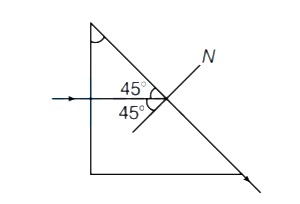
$A$ ray of light is incident normally on one face of a right-angled isosceles prism. It then grazes the hypotenuse. The refractive index of the material of the prism is
A
$1.33$
B
$1.414$
C
$1.5$
D
$1.732$
Solution
(B) ray of light incident normally on one face of a right-angled isosceles prism passes undeviated into the prism.
When it reaches the hypotenuse,the angle of incidence $i$ is $45^{\circ}$.
Since the ray grazes the hypotenuse,the angle of refraction is $90^{\circ}$.
Thus,the angle of incidence is equal to the critical angle $C$,so $C = 45^{\circ}$.
The refractive index $\mu$ is given by $\mu = \frac{1}{\sin C}$.
Substituting the value of $C$,we get $\mu = \frac{1}{\sin 45^{\circ}} = \frac{1}{1/\sqrt{2}} = \sqrt{2}$.
Therefore,$\mu \approx 1.414$.
When it reaches the hypotenuse,the angle of incidence $i$ is $45^{\circ}$.
Since the ray grazes the hypotenuse,the angle of refraction is $90^{\circ}$.
Thus,the angle of incidence is equal to the critical angle $C$,so $C = 45^{\circ}$.
The refractive index $\mu$ is given by $\mu = \frac{1}{\sin C}$.
Substituting the value of $C$,we get $\mu = \frac{1}{\sin 45^{\circ}} = \frac{1}{1/\sqrt{2}} = \sqrt{2}$.
Therefore,$\mu \approx 1.414$.
0 likesView Solution
48
PhysicsDifficultMCQKCET · 2007
$A$ prism of a certain angle deviates the red and blue rays by $8^{\circ}$ and $12^{\circ}$ respectively. Another prism of the same angle deviates the red and blue rays by $10^{\circ}$ and $14^{\circ}$ respectively. The prisms are small-angled and made of different materials. The dispersive powers of the materials of the prisms are in the ratio:
A
$5: 6$
B
$9: 11$
C
$6: 5$
D
$11: 9$
Solution
(C) The dispersive power $\omega$ of a prism is given by $\omega = \frac{\delta_{B} - \delta_{R}}{\delta_{y}}$,where $\delta_{B}$ and $\delta_{R}$ are the deviations for blue and red rays,and $\delta_{y}$ is the mean deviation,calculated as $\delta_{y} = \frac{\delta_{B} + \delta_{R}}{2}$.
For the first prism:
$\delta_{B1} = 12^{\circ}$,$\delta_{R1} = 8^{\circ}$.
$\delta_{y1} = \frac{12^{\circ} + 8^{\circ}}{2} = 10^{\circ}$.
$\omega_{1} = \frac{12^{\circ} - 8^{\circ}}{10^{\circ}} = \frac{4}{10} = \frac{2}{5}$.
For the second prism:
$\delta_{B2} = 14^{\circ}$,$\delta_{R2} = 10^{\circ}$.
$\delta_{y2} = \frac{14^{\circ} + 10^{\circ}}{2} = 12^{\circ}$.
$\omega_{2} = \frac{14^{\circ} - 10^{\circ}}{12^{\circ}} = \frac{4}{12} = \frac{1}{3}$.
The ratio of dispersive powers is $\frac{\omega_{1}}{\omega_{2}} = \frac{2/5}{1/3} = \frac{2}{5} \times 3 = \frac{6}{5}$.
For the first prism:
$\delta_{B1} = 12^{\circ}$,$\delta_{R1} = 8^{\circ}$.
$\delta_{y1} = \frac{12^{\circ} + 8^{\circ}}{2} = 10^{\circ}$.
$\omega_{1} = \frac{12^{\circ} - 8^{\circ}}{10^{\circ}} = \frac{4}{10} = \frac{2}{5}$.
For the second prism:
$\delta_{B2} = 14^{\circ}$,$\delta_{R2} = 10^{\circ}$.
$\delta_{y2} = \frac{14^{\circ} + 10^{\circ}}{2} = 12^{\circ}$.
$\omega_{2} = \frac{14^{\circ} - 10^{\circ}}{12^{\circ}} = \frac{4}{12} = \frac{1}{3}$.
The ratio of dispersive powers is $\frac{\omega_{1}}{\omega_{2}} = \frac{2/5}{1/3} = \frac{2}{5} \times 3 = \frac{6}{5}$.
0 likesView Solution
49
PhysicsMediumMCQKCET · 2007
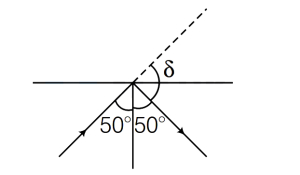
$A$ ray of light is travelling from glass to air. (refractive index of glass $= 1.5$). The angle of incidence is $50^{\circ}$. The deviation of the ray is
A
$0^{\circ}$
B
$80^{\circ}$
C
$50^{\circ} - \sin^{-1}\left[\frac{\sin 50^{\circ}}{1.5}\right]$
D
$\sin^{-1}\left[\frac{\sin 50^{\circ}}{1.5}\right] - 50^{\circ}$
Solution
(B) The refractive index of glass with respect to air is $\mu = 1.5$.
The critical angle $C$ is given by $\sin C = \frac{1}{\mu} = \frac{1}{1.5} = \frac{2}{3} \approx 0.667$.
$C = \sin^{-1}(0.667) \approx 41.8^{\circ} \approx 42^{\circ}$.
Since the angle of incidence $i = 50^{\circ}$ is greater than the critical angle $C = 42^{\circ}$,the light ray undergoes total internal reflection.
In total internal reflection,the angle of reflection $r$ is equal to the angle of incidence $i$,so $r = 50^{\circ}$.
The deviation $\delta$ is the angle between the original path of the incident ray and the reflected ray.
From the geometry of the reflection,the deviation is $\delta = 180^{\circ} - (i + r) = 180^{\circ} - (50^{\circ} + 50^{\circ}) = 180^{\circ} - 100^{\circ} = 80^{\circ}$.
The critical angle $C$ is given by $\sin C = \frac{1}{\mu} = \frac{1}{1.5} = \frac{2}{3} \approx 0.667$.
$C = \sin^{-1}(0.667) \approx 41.8^{\circ} \approx 42^{\circ}$.
Since the angle of incidence $i = 50^{\circ}$ is greater than the critical angle $C = 42^{\circ}$,the light ray undergoes total internal reflection.
In total internal reflection,the angle of reflection $r$ is equal to the angle of incidence $i$,so $r = 50^{\circ}$.
The deviation $\delta$ is the angle between the original path of the incident ray and the reflected ray.
From the geometry of the reflection,the deviation is $\delta = 180^{\circ} - (i + r) = 180^{\circ} - (50^{\circ} + 50^{\circ}) = 180^{\circ} - 100^{\circ} = 80^{\circ}$.
0 likesView Solution
50
PhysicsDifficultMCQKCET · 2007
$A$ vessel of height $2d$ is half-filled with a liquid of refractive index $\sqrt{2}$ and the other half with a liquid of refractive index $n$ (the given liquids are immiscible). Then the apparent depth of the inner surface of the bottom of the vessel (neglecting the thickness of the bottom of the vessel) will be
A
$\frac{n}{d(n+\sqrt{2})}$
B
$\frac{d(n+\sqrt{2})}{n \sqrt{2}}$
C
$\frac{\sqrt{2} n}{d(n+\sqrt{2})}$
D
$\frac{n d}{d+\sqrt{2 n}}$
Solution
(B) The apparent depth of an object in a medium is given by the formula: $\text{Apparent depth} = \frac{\text{Real depth}}{\text{Refractive index}}$.
The vessel has a total height of $2d$. It is half-filled with two immiscible liquids,so the real depth of each liquid is $d$.
For the first liquid with refractive index $\mu_1 = \sqrt{2}$,the apparent depth $x_1$ is:
$x_1 = \frac{d}{\sqrt{2}}$
For the second liquid with refractive index $\mu_2 = n$,the apparent depth $x_2$ is:
$x_2 = \frac{d}{n}$
The total apparent depth of the bottom of the vessel is the sum of the apparent depths of the two layers:
$\text{Total apparent depth} = x_1 + x_2 = \frac{d}{\sqrt{2}} + \frac{d}{n}$
Taking the common denominator:
$\text{Total apparent depth} = \frac{dn + d\sqrt{2}}{n\sqrt{2}} = \frac{d(n + \sqrt{2})}{n\sqrt{2}}$
The vessel has a total height of $2d$. It is half-filled with two immiscible liquids,so the real depth of each liquid is $d$.
For the first liquid with refractive index $\mu_1 = \sqrt{2}$,the apparent depth $x_1$ is:
$x_1 = \frac{d}{\sqrt{2}}$
For the second liquid with refractive index $\mu_2 = n$,the apparent depth $x_2$ is:
$x_2 = \frac{d}{n}$
The total apparent depth of the bottom of the vessel is the sum of the apparent depths of the two layers:
$\text{Total apparent depth} = x_1 + x_2 = \frac{d}{\sqrt{2}} + \frac{d}{n}$
Taking the common denominator:
$\text{Total apparent depth} = \frac{dn + d\sqrt{2}}{n\sqrt{2}} = \frac{d(n + \sqrt{2})}{n\sqrt{2}}$
0 likesView Solution
51
PhysicsMediumMCQKCET · 2007
In a reverse biased diode, when the applied voltage changes by $1 \, V$, the current is found to change by $0.5 \, \mu A$. The reverse bias resistance of the diode is
A
$2 \times 10^{5} \, \Omega$
B
$2 \times 10^{6} \, \Omega$
C
$200 \, \Omega$
D
$2 \, \Omega$
Solution
(B) The reverse bias resistance $(R)$ of a diode is defined as the ratio of the change in voltage $(\Delta V)$ to the change in current $(\Delta I)$.
Given:
Change in voltage, $\Delta V = 1 \, V$
Change in current, $\Delta I = 0.5 \, \mu A = 0.5 \times 10^{-6} \, A$
Using the formula:
$R = \frac{\Delta V}{\Delta I}$
$R = \frac{1}{0.5 \times 10^{-6}} \, \Omega$
$R = \frac{1}{0.5} \times 10^{6} \, \Omega$
$R = 2 \times 10^{6} \, \Omega$
Therefore, the reverse bias resistance is $2 \times 10^{6} \, \Omega$.
Given:
Change in voltage, $\Delta V = 1 \, V$
Change in current, $\Delta I = 0.5 \, \mu A = 0.5 \times 10^{-6} \, A$
Using the formula:
$R = \frac{\Delta V}{\Delta I}$
$R = \frac{1}{0.5 \times 10^{-6}} \, \Omega$
$R = \frac{1}{0.5} \times 10^{6} \, \Omega$
$R = 2 \times 10^{6} \, \Omega$
Therefore, the reverse bias resistance is $2 \times 10^{6} \, \Omega$.
0 likesView Solution
52
PhysicsEasyMCQKCET · 2007
The truth table given below is for ($A$ and $B$ are the inputs,$Y$ is the output).
| $A$ | $B$ | $Y$ |
|---|---|---|
| $0$ | $0$ | $1$ |
| $0$ | $1$ | $1$ |
| $1$ | $0$ | $1$ |
| $1$ | $1$ | $0$ |
A
$NOR$
B
$AND$
C
$XOR$
D
$NAND$
Solution
(D) The given truth table shows that the output $Y$ is $1$ when either $A$ or $B$ or both are $0$,and the output $Y$ is $0$ only when both inputs $A$ and $B$ are $1$.
This behavior corresponds to the Boolean expression $Y = \overline{A \cdot B}$.
This is the characteristic truth table of a $NAND$ gate,which is an $AND$ gate followed by a $NOT$ gate.
This behavior corresponds to the Boolean expression $Y = \overline{A \cdot B}$.
This is the characteristic truth table of a $NAND$ gate,which is an $AND$ gate followed by a $NOT$ gate.
0 likesView Solution
53
PhysicsEasyMCQKCET · 2007
Minority carriers in a $p$-type semiconductor are
A
free electrons
B
holes
C
neither holes nor free electrons
D
both holes and free electrons
Solution
(A) In a $p$-type semiconductor,the density of mobile holes is significantly higher than the density of conduction electrons due to the addition of trivalent impurity atoms.
Therefore,the majority charge carriers are holes,and the minority charge carriers are conduction (free) electrons.
Therefore,the majority charge carriers are holes,and the minority charge carriers are conduction (free) electrons.
0 likesView Solution
54
PhysicsEasyMCQKCET · 2007
The principle of $LASER$ action involves:
A
Amplification of a particular frequency emitted by the system
B
Population inversion
C
Stimulated emission
D
All of the above
Solution
(D) $LASER$ action relies on the following fundamental processes:
$(i)$ Population inversion: Achieving a state where more atoms are in an excited state than in the ground state.
(ii) Stimulated emission: An incident photon triggers an excited atom to emit a second photon identical in phase,frequency,and direction.
(iii) Amplification: The process of increasing the intensity of light by repeating stimulated emission within an optical cavity.
Therefore,all the given options are correct.
$(i)$ Population inversion: Achieving a state where more atoms are in an excited state than in the ground state.
(ii) Stimulated emission: An incident photon triggers an excited atom to emit a second photon identical in phase,frequency,and direction.
(iii) Amplification: The process of increasing the intensity of light by repeating stimulated emission within an optical cavity.
Therefore,all the given options are correct.
0 likesView Solution
55
PhysicsDifficultMCQKCET · 2007
$A$ single slit Fraunhofer diffraction pattern is formed with white light. For what wavelength of light does the third secondary maximum in the diffraction pattern coincide with the second secondary maximum in the pattern for red light of wavelength $6500 Å$ (in $Å$)?
A
$4400$
B
$4100$
C
$4642.8$
D
$9100$
Solution
(C) The condition for the $n^{th}$ secondary maximum in a single slit diffraction pattern is given by $x_n = \frac{(2n+1) \lambda D}{2a}$,where $n$ is the order of the secondary maximum.
For the second secondary maximum $(n=2)$ of red light $(\lambda_1 = 6500 Å)$: $x_2 = \frac{(2(2)+1) \lambda_1 D}{2a} = \frac{5 \lambda_1 D}{2a}$.
For the third secondary maximum $(n=3)$ of an unknown wavelength $(\lambda_2)$: $x_3 = \frac{(2(3)+1) \lambda_2 D}{2a} = \frac{7 \lambda_2 D}{2a}$.
Since the maxima coincide,$x_2 = x_3$,which implies $\frac{5 \lambda_1 D}{2a} = \frac{7 \lambda_2 D}{2a}$.
Simplifying,we get $5 \lambda_1 = 7 \lambda_2$.
Substituting $\lambda_1 = 6500 Å$,we have $5 \times 6500 = 7 \times \lambda_2$.
$\lambda_2 = \frac{32500}{7} Å \approx 4642.8 Å$.
For the second secondary maximum $(n=2)$ of red light $(\lambda_1 = 6500 Å)$: $x_2 = \frac{(2(2)+1) \lambda_1 D}{2a} = \frac{5 \lambda_1 D}{2a}$.
For the third secondary maximum $(n=3)$ of an unknown wavelength $(\lambda_2)$: $x_3 = \frac{(2(3)+1) \lambda_2 D}{2a} = \frac{7 \lambda_2 D}{2a}$.
Since the maxima coincide,$x_2 = x_3$,which implies $\frac{5 \lambda_1 D}{2a} = \frac{7 \lambda_2 D}{2a}$.
Simplifying,we get $5 \lambda_1 = 7 \lambda_2$.
Substituting $\lambda_1 = 6500 Å$,we have $5 \times 6500 = 7 \times \lambda_2$.
$\lambda_2 = \frac{32500}{7} Å \approx 4642.8 Å$.
0 likesView Solution
56
PhysicsMediumMCQKCET · 2007
When the angle of incidence is $60^{\circ}$ on the surface of a glass slab,it is found that the reflected ray is completely polarized. The velocity of light in glass is
A
$\sqrt{2} \times 10^{8} \text{ m/s}$
B
$\sqrt{3} \times 10^{8} \text{ m/s}$
C
$2 \times 10^{8} \text{ m/s}$
D
$3 \times 10^{8} \text{ m/s}$
Solution
(B) According to Brewster's Law,when the reflected ray is completely polarized,the angle of incidence is equal to the polarizing angle $(\theta_p)$.
Given,$\theta_p = 60^{\circ}$.
The refractive index of glass $(\mu_g)$ is given by $\mu_g = \tan \theta_p$.
$\mu_g = \tan 60^{\circ} = \sqrt{3}$.
We know that the refractive index is the ratio of the speed of light in vacuum $(c)$ to the speed of light in the medium $(v_g)$:
$\mu_g = \frac{c}{v_g}$.
Substituting the values,$\sqrt{3} = \frac{3 \times 10^8 \text{ m/s}}{v_g}$.
$v_g = \frac{3 \times 10^8}{\sqrt{3}} \text{ m/s} = \sqrt{3} \times 10^8 \text{ m/s}$.
Given,$\theta_p = 60^{\circ}$.
The refractive index of glass $(\mu_g)$ is given by $\mu_g = \tan \theta_p$.
$\mu_g = \tan 60^{\circ} = \sqrt{3}$.
We know that the refractive index is the ratio of the speed of light in vacuum $(c)$ to the speed of light in the medium $(v_g)$:
$\mu_g = \frac{c}{v_g}$.
Substituting the values,$\sqrt{3} = \frac{3 \times 10^8 \text{ m/s}}{v_g}$.
$v_g = \frac{3 \times 10^8}{\sqrt{3}} \text{ m/s} = \sqrt{3} \times 10^8 \text{ m/s}$.
0 likesView Solution
57
PhysicsDifficultMCQKCET · 2007
$A$ $20 \ cm$ length of a certain solution causes right-handed rotation of $38^{\circ}$. $A$ $30 \ cm$ length of another solution causes left-handed rotation of $24^{\circ}$. The optical rotation caused by a $30 \ cm$ length of a mixture of the above solutions in the volume ratio $1:2$ is
A
left-handed rotation of $14^{\circ}$
B
right-handed rotation of $14^{\circ}$
C
left-handed rotation of $3^{\circ}$
D
right-handed rotation of $3^{\circ}$
Solution
(D) For solution $A$: $L_{1} = 20 \ cm$,$\theta_{1} = +38^{\circ}$. Let concentration be $C_{1}$. The specific rotation is $\alpha_{1} = \frac{\theta_{1}}{L_{1} C_{1}} = \frac{38^{\circ}}{20 C_{1}}$.
For solution $B$: $L_{2} = 30 \ cm$,$\theta_{2} = -24^{\circ}$ (left-handed). Let concentration be $C_{2}$. The specific rotation is $\alpha_{2} = \frac{\theta_{2}}{L_{2} C_{2}} = \frac{-24^{\circ}}{30 C_{2}}$.
In the mixture,the volume ratio is $1:2$. Thus,the new concentrations are $C_{1}' = \frac{C_{1}}{3}$ and $C_{2}' = \frac{2C_{2}}{3}$.
The total optical rotation $\theta$ for a path length $l = 30 \ cm$ is given by $\theta = (\alpha_{1} C_{1}' + \alpha_{2} C_{2}') l$.
Substituting the values: $\theta = \left( \frac{38^{\circ}}{20 C_{1}} \cdot \frac{C_{1}}{3} + \frac{-24^{\circ}}{30 C_{2}} \cdot \frac{2 C_{2}}{3} \right) \times 30$.
$\theta = \left( \frac{38^{\circ}}{60} - \frac{48^{\circ}}{90} \right) \times 30 = \left( \frac{19^{\circ}}{30} - \frac{16^{\circ}}{30} \right) \times 30 = 19^{\circ} - 16^{\circ} = +3^{\circ}$.
Since the result is positive,it is a right-handed rotation of $3^{\circ}$.
For solution $B$: $L_{2} = 30 \ cm$,$\theta_{2} = -24^{\circ}$ (left-handed). Let concentration be $C_{2}$. The specific rotation is $\alpha_{2} = \frac{\theta_{2}}{L_{2} C_{2}} = \frac{-24^{\circ}}{30 C_{2}}$.
In the mixture,the volume ratio is $1:2$. Thus,the new concentrations are $C_{1}' = \frac{C_{1}}{3}$ and $C_{2}' = \frac{2C_{2}}{3}$.
The total optical rotation $\theta$ for a path length $l = 30 \ cm$ is given by $\theta = (\alpha_{1} C_{1}' + \alpha_{2} C_{2}') l$.
Substituting the values: $\theta = \left( \frac{38^{\circ}}{20 C_{1}} \cdot \frac{C_{1}}{3} + \frac{-24^{\circ}}{30 C_{2}} \cdot \frac{2 C_{2}}{3} \right) \times 30$.
$\theta = \left( \frac{38^{\circ}}{60} - \frac{48^{\circ}}{90} \right) \times 30 = \left( \frac{19^{\circ}}{30} - \frac{16^{\circ}}{30} \right) \times 30 = 19^{\circ} - 16^{\circ} = +3^{\circ}$.
Since the result is positive,it is a right-handed rotation of $3^{\circ}$.
0 likesView Solution
58
PhysicsMediumMCQKCET · 2007
Light from two coherent sources of the same amplitude $A$ and wavelength $\lambda$ illuminates the screen. The intensity of the central maximum is $I_{0}$. If the sources were incoherent,the intensity at the same point will be
A
$4 I_{0}$
B
$2 I_{0}$
C
$I_{0}$
D
$\frac{I_{0}}{2}$
Solution
(D) For coherent sources,the intensity at the central maximum is given by $I_{0} = (\sqrt{I_{1}} + \sqrt{I_{2}})^2$. Since both sources have the same amplitude $A$,their individual intensities are equal,say $I_{1} = I_{2} = I$.
Thus,$I_{0} = (\sqrt{I} + \sqrt{I})^2 = (2\sqrt{I})^2 = 4I$.
This implies that the intensity of each individual source is $I = \frac{I_{0}}{4}$.
When the sources are incoherent,the interference term averages to zero over time. Therefore,the resultant intensity is simply the sum of the individual intensities: $I_{res} = I_{1} + I_{2} = I + I = 2I$.
Substituting $I = \frac{I_{0}}{4}$ into the expression,we get $I_{res} = 2 \times (\frac{I_{0}}{4}) = \frac{I_{0}}{2}$.
Thus,$I_{0} = (\sqrt{I} + \sqrt{I})^2 = (2\sqrt{I})^2 = 4I$.
This implies that the intensity of each individual source is $I = \frac{I_{0}}{4}$.
When the sources are incoherent,the interference term averages to zero over time. Therefore,the resultant intensity is simply the sum of the individual intensities: $I_{res} = I_{1} + I_{2} = I + I = 2I$.
Substituting $I = \frac{I_{0}}{4}$ into the expression,we get $I_{res} = 2 \times (\frac{I_{0}}{4}) = \frac{I_{0}}{2}$.
0 likesView Solution
59
PhysicsMediumMCQKCET · 2007
In Young's double slit experiment with a sodium vapour lamp of wavelength $589 \ nm$ and the slits $0.589 \ mm$ apart,the half angular width of the central maximum is
A
$\sin^{-1}(0.001)$
B
$\sin^{-1}(0.00001)$
C
$\sin^{-1}(0.0001)$
D
$\sin^{-1}(0.01)$
Solution
(A) In Young's double slit experiment,the half angular width $\theta$ of the central maximum is given by the relation $\sin \theta = \frac{\lambda}{d}$.
Given wavelength $\lambda = 589 \ nm = 589 \times 10^{-9} \ m$.
Given slit separation $d = 0.589 \ mm = 0.589 \times 10^{-3} \ m$.
Substituting the values:
$\sin \theta = \frac{589 \times 10^{-9}}{0.589 \times 10^{-3}}$
$\sin \theta = \frac{589 \times 10^{-9}}{589 \times 10^{-6}} = 10^{-3} = 0.001$.
Therefore,$\theta = \sin^{-1}(0.001)$.
Given wavelength $\lambda = 589 \ nm = 589 \times 10^{-9} \ m$.
Given slit separation $d = 0.589 \ mm = 0.589 \times 10^{-3} \ m$.
Substituting the values:
$\sin \theta = \frac{589 \times 10^{-9}}{0.589 \times 10^{-3}}$
$\sin \theta = \frac{589 \times 10^{-9}}{589 \times 10^{-6}} = 10^{-3} = 0.001$.
Therefore,$\theta = \sin^{-1}(0.001)$.
0 likesView Solution
60
PhysicsMediumMCQKCET · 2007
Two tangent galvanometers $A$ and $B$ have coils of radii $8 \text{ cm}$ and $16 \text{ cm}$ respectively and have a resistance of $8 \Omega$ each. They are connected in parallel with a cell of emf $4 \text{ V}$ and negligible internal resistance. The deflections produced in the tangent galvanometers $A$ and $B$ are $30^{\circ}$ and $60^{\circ}$, respectively. If $A$ has $2$ turns, then $B$ must have: (in $turns$)
A
$18$
B
$12$
C
$6$
D
$2$
Solution
(B) The current $I$ through a tangent galvanometer is given by $I = \frac{2r B_H}{\mu_0 N} \tan \theta$, where $r$ is the radius, $N$ is the number of turns, and $\theta$ is the deflection.
Since the galvanometers are connected in parallel to a cell of emf $V$, the potential difference across each is the same $(V_A = V_B = V)$.
Given $V = IR$, we have $I = V/R$. Since $R$ is the same for both $(8 \Omega)$, the currents $I_A$ and $I_B$ are equal.
Thus, $\frac{2 r_A B_H}{\mu_0 N_A} \tan \theta_A = \frac{2 r_B B_H}{\mu_0 N_B} \tan \theta_B$.
Simplifying, we get $\frac{r_A \tan \theta_A}{N_A} = \frac{r_B \tan \theta_B}{N_B}$.
Substituting the given values: $r_A = 8 \text{ cm}$, $r_B = 16 \text{ cm}$, $N_A = 2$, $\theta_A = 30^{\circ}$, $\theta_B = 60^{\circ}$.
$\frac{8 \tan 30^{\circ}}{2} = \frac{16 \tan 60^{\circ}}{N_B}$.
$4 \times \frac{1}{\sqrt{3}} = \frac{16 \times \sqrt{3}}{N_B}$.
$N_B = \frac{16 \times \sqrt{3} \times \sqrt{3}}{4} = \frac{16 \times 3}{4} = 12$ turns.
Since the galvanometers are connected in parallel to a cell of emf $V$, the potential difference across each is the same $(V_A = V_B = V)$.
Given $V = IR$, we have $I = V/R$. Since $R$ is the same for both $(8 \Omega)$, the currents $I_A$ and $I_B$ are equal.
Thus, $\frac{2 r_A B_H}{\mu_0 N_A} \tan \theta_A = \frac{2 r_B B_H}{\mu_0 N_B} \tan \theta_B$.
Simplifying, we get $\frac{r_A \tan \theta_A}{N_A} = \frac{r_B \tan \theta_B}{N_B}$.
Substituting the given values: $r_A = 8 \text{ cm}$, $r_B = 16 \text{ cm}$, $N_A = 2$, $\theta_A = 30^{\circ}$, $\theta_B = 60^{\circ}$.
$\frac{8 \tan 30^{\circ}}{2} = \frac{16 \tan 60^{\circ}}{N_B}$.
$4 \times \frac{1}{\sqrt{3}} = \frac{16 \times \sqrt{3}}{N_B}$.
$N_B = \frac{16 \times \sqrt{3} \times \sqrt{3}}{4} = \frac{16 \times 3}{4} = 12$ turns.
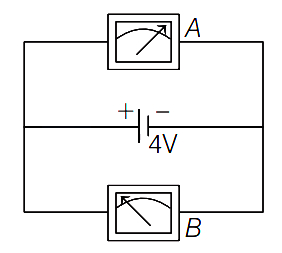
0 likesView Solution
Vedclass Products
For Students
Vedclass Test Series
Mock tests in real KCET style covering Physics with performance analysis. 5-day free trial.
Start Free TrialFor Teachers
Exam Paper Generator
Generate Set A/B/C/D Physics papers from 7.5L+ questions in 2 minutes. 3 chapters free.
Try FreeFor Institutes
Online Exam Module
Run live KCET mock exams with unlimited students, 360° analytics & white-label branding.
See DemoFrequently Asked Questions
How many Physics questions are in KCET 2007?
There are 60 Physics questions from the KCET 2007 paper on Vedclass, each with a detailed step-by-step solution in English.
Are KCET 2007 Physics solutions available in English?
Yes. All solutions on this page are in English. You can also switch to English or Hindi using the language buttons above the questions.
Can I practice KCET 2007 Physics as a timed test?
Yes. Use the Vedclass Test Series to attempt a full KCET mock test covering Physics with time limits and instant score analysis.
Can teachers create Physics papers from KCET previous year questions?
Yes. The Vedclass Exam Paper Generator lets teachers mix KCET Physics questions and generate Set A/B/C/D papers in minutes.
For Teachers & Institutes
Build a Custom Physics Paper
Pick KCET 2007 Physics questions, set difficulty, and generate Set A/B/C/D in 2 minutes.