
MathematicsQ101–200 of 497 questions
Page 3 of 6 · Gujarati
101
MathematicsEasyMCQAP EAMCET · 2018
રેખાઓ $2x + 3y + 6 = 0$,$2x - 3y + 6 = 0$,$2x + 3y - 6 = 0$ અને $2x - 3y - 6 = 0$ દ્વારા બનતા ચતુષ્કોણનું ક્ષેત્રફળ (ચોરસ એકમમાં) કેટલું છે?
A
$12$
B
$36$
C
$6$
D
$18$
Solution
(A) આપેલ રેખાઓ $a_1x \pm b_1y + c_1 = 0$ અને $a_1x \pm b_1y + c_2 = 0$ સ્વરૂપમાં છે.
રેખાઓ વચ્ચેનું અંતર $d_1 = \frac{|6 - (-6)|}{\sqrt{2^2 + 3^2}} = \frac{12}{\sqrt{13}}$ અને $d_2 = \frac{12}{\sqrt{13}}$ છે.
રેખાઓ વચ્ચેનો ખૂણો $\theta$ માટે $\sin \theta = 12/13$ મળે છે.
ક્ષેત્રફળ = $\frac{d_1 d_2}{\sin \theta} = \frac{(12/\sqrt{13}) \times (12/\sqrt{13})}{12/13} = 12$ ચોરસ એકમ.
રેખાઓ વચ્ચેનું અંતર $d_1 = \frac{|6 - (-6)|}{\sqrt{2^2 + 3^2}} = \frac{12}{\sqrt{13}}$ અને $d_2 = \frac{12}{\sqrt{13}}$ છે.
રેખાઓ વચ્ચેનો ખૂણો $\theta$ માટે $\sin \theta = 12/13$ મળે છે.
ક્ષેત્રફળ = $\frac{d_1 d_2}{\sin \theta} = \frac{(12/\sqrt{13}) \times (12/\sqrt{13})}{12/13} = 12$ ચોરસ એકમ.
0 likesView Solution
102
MathematicsMediumMCQAP EAMCET · 2018
જ્યારે યામ અક્ષોને ઉગમબિંદુની આસપાસ ધન દિશામાં $45^{\circ}$ ના ખૂણે ફેરવવામાં આવે છે,જો વક્રનું રૂપાંતરિત સમીકરણ $17x^2 - 16xy + 17y^2 = 225$ હોય,તો તે વક્રનું મૂળ સમીકરણ શું છે?
A
$25x^2 + 9y^2 = 225$
B
$9x^2 - 25y^2 = 225$
C
$25x^2 - 16xy + 9y^2 = 225$
D
$9x^2 + 25y^2 = 225$
Solution
(D) જ્યારે અક્ષોને ધન દિશામાં $\theta = 45^{\circ}$ ના ખૂણે ફેરવવામાં આવે છે,ત્યારે રૂપાંતરણ સમીકરણો $x = X \cos \theta - Y \sin \theta$ અને $y = X \sin \theta + Y \cos \theta$ છે.
$\theta = 45^{\circ}$ મૂકતા,આપણને $x = \frac{X-Y}{\sqrt{2}}$ અને $y = \frac{X+Y}{\sqrt{2}}$ મળે છે.
આપેલ રૂપાંતરિત સમીકરણ $17x^2 - 16xy + 17y^2 = 225$ માં $x$ અને $y$ ની કિંમતો મૂકતા:
$17\left(\frac{X-Y}{\sqrt{2}}\right)^2 - 16\left(\frac{X-Y}{\sqrt{2}}\right)\left(\frac{X+Y}{\sqrt{2}}\right) + 17\left(\frac{X+Y}{\sqrt{2}}\right)^2 = 225$
ગણતરી કરતા,આપણને $9X^2 + 25Y^2 = 225$ મળે છે.
તેથી,મૂળ સમીકરણ $9x^2 + 25y^2 = 225$ છે.
$\theta = 45^{\circ}$ મૂકતા,આપણને $x = \frac{X-Y}{\sqrt{2}}$ અને $y = \frac{X+Y}{\sqrt{2}}$ મળે છે.
આપેલ રૂપાંતરિત સમીકરણ $17x^2 - 16xy + 17y^2 = 225$ માં $x$ અને $y$ ની કિંમતો મૂકતા:
$17\left(\frac{X-Y}{\sqrt{2}}\right)^2 - 16\left(\frac{X-Y}{\sqrt{2}}\right)\left(\frac{X+Y}{\sqrt{2}}\right) + 17\left(\frac{X+Y}{\sqrt{2}}\right)^2 = 225$
ગણતરી કરતા,આપણને $9X^2 + 25Y^2 = 225$ મળે છે.
તેથી,મૂળ સમીકરણ $9x^2 + 25y^2 = 225$ છે.
0 likesView Solution
103
MathematicsMediumMCQAP EAMCET · 2018
ત્રિકોણનો શિરોબિંદુ $A$ એ રેખાઓ $x+y=1$ અને $2x+3y=6$ પર આવેલું છે. જો ત્રિકોણનું લંબકેન્દ્ર $O\left(\frac{3}{7}, \frac{22}{7}\right)$ હોય,તો $OA$ નું સમીકરણ અભિલંબ સ્વરૂપમાં શું હશે?
A
$x \cos \alpha+y \sin \alpha=7 ; \alpha=\tan ^{-1} \frac{1}{7}$
B
$x \cos \alpha+y \sin \alpha=\frac{13}{\sqrt{17}} ; \alpha=\tan ^{-1}(4)$
C
$x \cos \alpha+y \sin \alpha=\frac{13}{4} ; \alpha=\tan ^{-1}\left(\frac{13}{\sqrt{17}}\right)$
D
$x \cos \alpha+y \sin \alpha=\frac{13}{\sqrt{17}} ; \alpha=\tan ^{-1}\left(\frac{1}{4}\right)$
Solution
(B) શિરોબિંદુ $A$ એ રેખાઓ $x+y=1$ અને $2x+3y=6$ નું છેદબિંદુ છે.
તેને ઉકેલતા,આપણને $x = -3$ અને $y = 4$ મળે છે.
તેથી,$A(-3, 4)$ અને $O\left(\frac{3}{7}, \frac{22}{7}\right)$.
$A(-3, 4)$ અને $O\left(\frac{3}{7}, \frac{22}{7}\right)$ માંથી પસાર થતી રેખા $OA$ નું સમીકરણ:
$y - 4 = \frac{\frac{22}{7} - 4}{\frac{3}{7} - (-3)}(x + 3)$
$y - 4 = -\frac{1}{4}(x + 3)$
$x + 4y = 13$.
રેખા $x \cos \alpha + y \sin \alpha = p$ નું અભિલંબ સ્વરૂપ મેળવવા માટે $\sqrt{1^2 + 4^2} = \sqrt{17}$ વડે ભાગતા:
$\frac{1}{\sqrt{17}}x + \frac{4}{\sqrt{17}}y = \frac{13}{\sqrt{17}}$.
અહીં,$\cos \alpha = \frac{1}{\sqrt{17}}$ અને $\sin \alpha = \frac{4}{\sqrt{17}}$,તેથી $\tan \alpha = 4$,એટલે કે $\alpha = \tan^{-1}(4)$.
તેને ઉકેલતા,આપણને $x = -3$ અને $y = 4$ મળે છે.
તેથી,$A(-3, 4)$ અને $O\left(\frac{3}{7}, \frac{22}{7}\right)$.
$A(-3, 4)$ અને $O\left(\frac{3}{7}, \frac{22}{7}\right)$ માંથી પસાર થતી રેખા $OA$ નું સમીકરણ:
$y - 4 = \frac{\frac{22}{7} - 4}{\frac{3}{7} - (-3)}(x + 3)$
$y - 4 = -\frac{1}{4}(x + 3)$
$x + 4y = 13$.
રેખા $x \cos \alpha + y \sin \alpha = p$ નું અભિલંબ સ્વરૂપ મેળવવા માટે $\sqrt{1^2 + 4^2} = \sqrt{17}$ વડે ભાગતા:
$\frac{1}{\sqrt{17}}x + \frac{4}{\sqrt{17}}y = \frac{13}{\sqrt{17}}$.
અહીં,$\cos \alpha = \frac{1}{\sqrt{17}}$ અને $\sin \alpha = \frac{4}{\sqrt{17}}$,તેથી $\tan \alpha = 4$,એટલે કે $\alpha = \tan^{-1}(4)$.
0 likesView Solution
104
MathematicsEasyMCQAP EAMCET · 2018
જો $O, G, S$ એ અનુક્રમે ત્રિકોણના લંબકેન્દ્ર,મધ્યકેન્દ્ર અને પરિકેન્દ્ર હોય,જેના શિરોબિંદુઓ $A(2,3), B(2,4)$ અને $C(4,3)$ છે,તો $AO^2 + 9BG^2 + 4CS^2 =$
A
$\frac{77}{36}$
B
$13$
C
$\frac{8}{9}$
D
$\frac{5}{4}$
Solution
(B) ત્રિકોણના શિરોબિંદુઓ $A(2,3)$,$B(2,4)$,અને $C(4,3)$ છે.
$AB$ શિરોલંબ છે અને $AC$ સમક્ષિતિજ છે,તેથી ત્રિકોણ $A$ આગળ કાટખૂણો ધરાવે છે.
કાટકોણ ત્રિકોણ માટે,લંબકેન્દ્ર $O$ એ કાટખૂણા વાળું શિરોબિંદુ છે. તેથી,$O = A = (2,3)$.
તેથી,$AO^2 = (2-2)^2 + (3-3)^2 = 0$.
મધ્યકેન્દ્ર $G = \left(\frac{2+2+4}{3}, \frac{3+4+3}{3}\right) = \left(\frac{8}{3}, \frac{10}{3}\right)$.
$9BG^2 = 9 \times [(\frac{8}{3}-2)^2 + (\frac{10}{3}-4)^2] = 9 \times [\frac{4}{9} + \frac{4}{9}] = 8$.
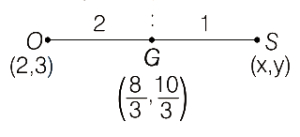
$G$ એ $O$ અને $S$ ને જોડતા રેખાખંડનું $2:1$ ગુણોત્તરમાં વિભાજન કરે છે. $S = \frac{3G - O}{2} = (3, \frac{7}{2})$.
$4CS^2 = 4 \times [(4-3)^2 + (3-\frac{7}{2})^2] = 4 \times [1 + \frac{1}{4}] = 5$.
$AO^2 + 9BG^2 + 4CS^2 = 0 + 8 + 5 = 13$.
$AB$ શિરોલંબ છે અને $AC$ સમક્ષિતિજ છે,તેથી ત્રિકોણ $A$ આગળ કાટખૂણો ધરાવે છે.
કાટકોણ ત્રિકોણ માટે,લંબકેન્દ્ર $O$ એ કાટખૂણા વાળું શિરોબિંદુ છે. તેથી,$O = A = (2,3)$.
તેથી,$AO^2 = (2-2)^2 + (3-3)^2 = 0$.
મધ્યકેન્દ્ર $G = \left(\frac{2+2+4}{3}, \frac{3+4+3}{3}\right) = \left(\frac{8}{3}, \frac{10}{3}\right)$.
$9BG^2 = 9 \times [(\frac{8}{3}-2)^2 + (\frac{10}{3}-4)^2] = 9 \times [\frac{4}{9} + \frac{4}{9}] = 8$.
$G$ એ $O$ અને $S$ ને જોડતા રેખાખંડનું $2:1$ ગુણોત્તરમાં વિભાજન કરે છે. $S = \frac{3G - O}{2} = (3, \frac{7}{2})$.
$4CS^2 = 4 \times [(4-3)^2 + (3-\frac{7}{2})^2] = 4 \times [1 + \frac{1}{4}] = 5$.
$AO^2 + 9BG^2 + 4CS^2 = 0 + 8 + 5 = 13$.
0 likesView Solution
105
MathematicsMediumMCQAP EAMCET · 2018
જો ત્રિકોણની બે બાજુઓ $3x^2-5xy+2y^2=0$ દ્વારા આપવામાં આવેલ હોય અને તેનું લંબકેન્દ્ર $(2,1)$ હોય,તો ત્રિકોણની ત્રીજી બાજુનું સમીકરણ શું થાય?
A
$5x-10y+1=0$
B
$10x+5y-1=0$
C
$5x-10y=21$
D
$10x+5y=21$
Solution
(D) ત્રિકોણની બે બાજુઓનું આપેલ સમીકરણ $3x^2-5xy+2y^2=0$ છે.
અવયવ પાડતા,$(3x-2y)(x-y)=0$.
તેથી,બે બાજુઓના સમીકરણો $L_1: 3x-2y=0$ અને $L_2: x-y=0$ છે.
લંબકેન્દ્ર $H(2,1)$ છે.
શિરોબિંદુ $B$ માંથી $AC$ પરનો વેધ $H(2,1)$ માંથી પસાર થાય છે અને $AC: x-y=0$ ને લંબ છે. લંબ રેખાનું સમીકરણ $x+y-3=0$ મળે છે.
$x+y-3=0$ અને $3x-2y=0$ નું છેદબિંદુ $B(6/5, 9/5)$ છે.
શિરોબિંદુ $C$ માંથી $AB$ પરનો વેધ $H(2,1)$ માંથી પસાર થાય છે અને $AB: 3x-2y=0$ ને લંબ છે. લંબ રેખાનું સમીકરણ $2x+3y-7=0$ મળે છે.
$2x+3y-7=0$ અને $x-y=0$ નું છેદબિંદુ $C(7/5, 7/5)$ છે.
ત્રીજી બાજુ $BC$ એ $(6/5, 9/5)$ અને $(7/5, 7/5)$ માંથી પસાર થાય છે.
ઢાળ $m = -2$ મળે છે.
સમીકરણ $10x+5y=21$ મળે છે.
અવયવ પાડતા,$(3x-2y)(x-y)=0$.
તેથી,બે બાજુઓના સમીકરણો $L_1: 3x-2y=0$ અને $L_2: x-y=0$ છે.
લંબકેન્દ્ર $H(2,1)$ છે.
શિરોબિંદુ $B$ માંથી $AC$ પરનો વેધ $H(2,1)$ માંથી પસાર થાય છે અને $AC: x-y=0$ ને લંબ છે. લંબ રેખાનું સમીકરણ $x+y-3=0$ મળે છે.
$x+y-3=0$ અને $3x-2y=0$ નું છેદબિંદુ $B(6/5, 9/5)$ છે.
શિરોબિંદુ $C$ માંથી $AB$ પરનો વેધ $H(2,1)$ માંથી પસાર થાય છે અને $AB: 3x-2y=0$ ને લંબ છે. લંબ રેખાનું સમીકરણ $2x+3y-7=0$ મળે છે.
$2x+3y-7=0$ અને $x-y=0$ નું છેદબિંદુ $C(7/5, 7/5)$ છે.
ત્રીજી બાજુ $BC$ એ $(6/5, 9/5)$ અને $(7/5, 7/5)$ માંથી પસાર થાય છે.
ઢાળ $m = -2$ મળે છે.
સમીકરણ $10x+5y=21$ મળે છે.
0 likesView Solution
106
MathematicsDifficultMCQAP EAMCET · 2018
જો ઉગમબિંદુને $(1, 1)$ બિંદુ પર ખસેડવામાં આવે અને અક્ષોને આ બિંદુની આસપાસ $45^{\circ}$ ના ખૂણે ફેરવવામાં આવે,તો $x^2 + 2xy + y^2 - 1 = 0$ સમીકરણનું રૂપાંતરિત સમીકરણ શું થશે?
A
$2y^2 - 4\sqrt{2}y - 3 = 0$
B
$2y^2 + 4\sqrt{2}y - 3 = 0$
C
$2x^2 + 4\sqrt{2}x + 3 = 0$
D
$2x^2 - 4\sqrt{2}x + 3 = 0$
Solution
(C) આપેલ સમીકરણ $x^2 + 2xy + y^2 - 1 = 0$ છે,જેને $(x + y)^2 = 1$ તરીકે લખી શકાય.
ઉગમબિંદુને $(1, 1)$ પર ખસેડ્યા પછી અને અક્ષોને $\theta = 45^{\circ}$ ખૂણે ફેરવ્યા પછી નવા યામ $(X, Y)$ છે.
રૂપાંતરણ સમીકરણો:
$x = 1 + X \cos 45^{\circ} - Y \sin 45^{\circ} = 1 + \frac{X - Y}{\sqrt{2}}$
$y = 1 + X \sin 45^{\circ} + Y \cos 45^{\circ} = 1 + \frac{X + Y}{\sqrt{2}}$
આ કિંમતો $(x + y)^2 = 1$ માં મૂકતા:
$(1 + \frac{X - Y}{\sqrt{2}} + 1 + \frac{X + Y}{\sqrt{2}})^2 = 1$
$(2 + \frac{2X}{\sqrt{2}})^2 = 1$
$(2 + X\sqrt{2})^2 = 1$
$4 + 4\sqrt{2}X + 2X^2 = 1$
$2X^2 + 4\sqrt{2}X + 3 = 0$.
આમ,રૂપાંતરિત સમીકરણ $2x^2 + 4\sqrt{2}x + 3 = 0$ છે.
ઉગમબિંદુને $(1, 1)$ પર ખસેડ્યા પછી અને અક્ષોને $\theta = 45^{\circ}$ ખૂણે ફેરવ્યા પછી નવા યામ $(X, Y)$ છે.
રૂપાંતરણ સમીકરણો:
$x = 1 + X \cos 45^{\circ} - Y \sin 45^{\circ} = 1 + \frac{X - Y}{\sqrt{2}}$
$y = 1 + X \sin 45^{\circ} + Y \cos 45^{\circ} = 1 + \frac{X + Y}{\sqrt{2}}$
આ કિંમતો $(x + y)^2 = 1$ માં મૂકતા:
$(1 + \frac{X - Y}{\sqrt{2}} + 1 + \frac{X + Y}{\sqrt{2}})^2 = 1$
$(2 + \frac{2X}{\sqrt{2}})^2 = 1$
$(2 + X\sqrt{2})^2 = 1$
$4 + 4\sqrt{2}X + 2X^2 = 1$
$2X^2 + 4\sqrt{2}X + 3 = 0$.
આમ,રૂપાંતરિત સમીકરણ $2x^2 + 4\sqrt{2}x + 3 = 0$ છે.
0 likesView Solution
107
MathematicsMediumMCQAP EAMCET · 2018
જો $(a, b)$ એ $4x^2 - 17xy + 4y^2 = 0$ અને $x + y - 5 = 0$ રેખાઓ દ્વારા બનતા ત્રિકોણનું મધ્યકેન્દ્ર હોય અને $c$ એ ત્રિકોણના ક્ષેત્રફળનું સંખ્યાત્મક મૂલ્ય હોય,તો $a + b + c =$
A
$\frac{25}{6}$
B
$\frac{25}{3}$
C
$\frac{65}{6}$
D
$\frac{15}{3}$
Solution
(C) સમીકરણ $4x^2 - 17xy + 4y^2 = 0$ ને $(4x - y)(x - 4y) = 0$ તરીકે અવયવ પાડી શકાય છે.
તેથી,રેખાઓ $L_1: 4x - y = 0$ અને $L_2: x - 4y = 0$ છે.
ત્રીજી રેખા $L_3: x + y = 5$ છે.
ત્રિકોણના શિરોબિંદુઓ શોધવા માટે,આપણે સમીકરણોની જોડી ઉકેલીએ છીએ:
$1$) $L_1$ અને $L_2$: $4x - y = 0$ અને $x - 4y = 0$ થી શિરોબિંદુ $V_1 = (0, 0)$ મળે છે.
$2$) $L_1$ અને $L_3$: $4x - y = 0$ અને $x + y = 5$ થી $5x = 5$ મળે,તેથી $x = 1, y = 4$. આમ $V_2 = (1, 4)$.
$3$) $L_2$ અને $L_3$: $x - 4y = 0$ અને $x + y = 5$ થી $5y = 5$ મળે,તેથી $y = 1, x = 4$. આમ $V_3 = (4, 1)$.
મધ્યકેન્દ્ર $(a, b) = (\frac{0+1+4}{3}, \frac{0+4+1}{3}) = (\frac{5}{3}, \frac{5}{3})$ છે.
તેથી,$a = \frac{5}{3}$ અને $b = \frac{5}{3}$.
શિરોબિંદુઓ $(0, 0), (1, 4), (4, 1)$ ધરાવતા ત્રિકોણનું ક્ષેત્રફળ $c = \frac{1}{2} |0(4-1) + 1(1-0) + 4(0-4)| = \frac{1}{2} |1 - 16| = \frac{15}{2}$ છે.
આમ,$a + b + c = \frac{5}{3} + \frac{5}{3} + \frac{15}{2} = \frac{10}{3} + \frac{15}{2} = \frac{20 + 45}{6} = \frac{65}{6}$.
તેથી,રેખાઓ $L_1: 4x - y = 0$ અને $L_2: x - 4y = 0$ છે.
ત્રીજી રેખા $L_3: x + y = 5$ છે.
ત્રિકોણના શિરોબિંદુઓ શોધવા માટે,આપણે સમીકરણોની જોડી ઉકેલીએ છીએ:
$1$) $L_1$ અને $L_2$: $4x - y = 0$ અને $x - 4y = 0$ થી શિરોબિંદુ $V_1 = (0, 0)$ મળે છે.
$2$) $L_1$ અને $L_3$: $4x - y = 0$ અને $x + y = 5$ થી $5x = 5$ મળે,તેથી $x = 1, y = 4$. આમ $V_2 = (1, 4)$.
$3$) $L_2$ અને $L_3$: $x - 4y = 0$ અને $x + y = 5$ થી $5y = 5$ મળે,તેથી $y = 1, x = 4$. આમ $V_3 = (4, 1)$.
મધ્યકેન્દ્ર $(a, b) = (\frac{0+1+4}{3}, \frac{0+4+1}{3}) = (\frac{5}{3}, \frac{5}{3})$ છે.
તેથી,$a = \frac{5}{3}$ અને $b = \frac{5}{3}$.
શિરોબિંદુઓ $(0, 0), (1, 4), (4, 1)$ ધરાવતા ત્રિકોણનું ક્ષેત્રફળ $c = \frac{1}{2} |0(4-1) + 1(1-0) + 4(0-4)| = \frac{1}{2} |1 - 16| = \frac{15}{2}$ છે.
આમ,$a + b + c = \frac{5}{3} + \frac{5}{3} + \frac{15}{2} = \frac{10}{3} + \frac{15}{2} = \frac{20 + 45}{6} = \frac{65}{6}$.
0 likesView Solution
108
MathematicsMediumMCQAP EAMCET · 2018
જ્યારે યામ અક્ષોને ઉગમબિંદુની આસપાસ $\tan^{-1}\left(\frac{3}{4}\right)$ ખૂણે ફેરવવામાં આવે છે,ત્યારે સમીકરણ $x^2+y^2=9$ કયા સમીકરણમાં રૂપાંતરિત થાય છે?
A
$x^2-y^2=9$
B
$x^2+y^2+2xy=4$
C
$x^2+y^2=9$
D
$x^2-y^2+9=0$
Solution
(C) ધારો કે $\theta = \tan^{-1}\left(\frac{3}{4}\right)$ એ પરિભ્રમણનો ખૂણો છે. તેથી $\cos \theta = \frac{4}{5}$ અને $\sin \theta = \frac{3}{5}$.
જ્યારે અક્ષોને $\theta$ ખૂણે ફેરવવામાં આવે છે,ત્યારે રૂપાંતરણ સમીકરણો $x = X \cos \theta - Y \sin \theta$ અને $y = X \sin \theta + Y \cos \theta$ છે.
$\sin \theta$ અને $\cos \theta$ ની કિંમતો મૂકતા,આપણને $x = \frac{4X - 3Y}{5}$ અને $y = \frac{3X + 4Y}{5}$ મળે છે.
આ કિંમતોને મૂળ સમીકરણ $x^2 + y^2 = 9$ માં મૂકતા:
$\left(\frac{4X - 3Y}{5}\right)^2 + \left(\frac{3X + 4Y}{5}\right)^2 = 9$
$\frac{16X^2 + 9Y^2 - 24XY + 9X^2 + 16Y^2 + 24XY}{25} = 9$
$\frac{25X^2 + 25Y^2}{25} = 9$
$X^2 + Y^2 = 9$.
આમ,સમીકરણ બદલાતું નથી.
જ્યારે અક્ષોને $\theta$ ખૂણે ફેરવવામાં આવે છે,ત્યારે રૂપાંતરણ સમીકરણો $x = X \cos \theta - Y \sin \theta$ અને $y = X \sin \theta + Y \cos \theta$ છે.
$\sin \theta$ અને $\cos \theta$ ની કિંમતો મૂકતા,આપણને $x = \frac{4X - 3Y}{5}$ અને $y = \frac{3X + 4Y}{5}$ મળે છે.
આ કિંમતોને મૂળ સમીકરણ $x^2 + y^2 = 9$ માં મૂકતા:
$\left(\frac{4X - 3Y}{5}\right)^2 + \left(\frac{3X + 4Y}{5}\right)^2 = 9$
$\frac{16X^2 + 9Y^2 - 24XY + 9X^2 + 16Y^2 + 24XY}{25} = 9$
$\frac{25X^2 + 25Y^2}{25} = 9$
$X^2 + Y^2 = 9$.
આમ,સમીકરણ બદલાતું નથી.
0 likesView Solution
109
MathematicsEasyMCQAP EAMCET · 2018
$(-2, 3), (1, -2)$ અને $(2, 1)$ શિરોબિંદુઓ ધરાવતા ત્રિકોણનું પરિકેન્દ્ર શોધો.
A
$\left(\frac{6}{7}, \frac{2}{7}\right)$
B
$\left(-\frac{6}{7}, \frac{2}{7}\right)$
C
$\left(\frac{6}{7}, -\frac{2}{7}\right)$
D
$\left(-\frac{6}{7}, -\frac{2}{7}\right)$
Solution
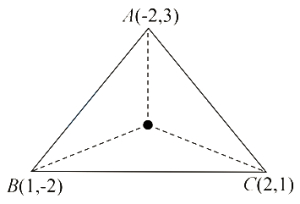
(B) ત્રિકોણનું પરિકેન્દ્ર તેના શિરોબિંદુઓથી સમાન અંતરે હોય છે. ધારો કે $O(x, y)$ એ $A(-2, 3), B(1, -2)$ અને $C(2, 1)$ શિરોબિંદુઓ ધરાવતા ત્રિકોણનું પરિકેન્દ્ર છે.
$OA = OB = OC$ હોવાથી,$OA^2 = OB^2 = OC^2$ થાય.
$OA^2 = (x + 2)^2 + (y - 3)^2 = x^2 + y^2 + 4x - 6y + 13$
$OB^2 = (x - 1)^2 + (y + 2)^2 = x^2 + y^2 - 2x + 4y + 5$
$OC^2 = (x - 2)^2 + (y - 1)^2 = x^2 + y^2 - 4x - 2y + 5$
$OA^2 = OB^2$ સરખાવતા:
$6x - 10y + 8 = 0 \Rightarrow 3x - 5y + 4 = 0 \dots (i)$
$OB^2 = OC^2$ સરખાવતા:
$2x + 6y = 0 \Rightarrow x = -3y \dots (ii)$
$(ii)$ ને $(i)$ માં મુકતા:
$3(-3y) - 5y + 4 = 0$ $\Rightarrow -14y = -4$ $\Rightarrow y = \frac{2}{7}$
તેથી,$x = -3\left(\frac{2}{7}\right) = -\frac{6}{7}$.
આમ,પરિકેન્દ્ર $\left(-\frac{6}{7}, \frac{2}{7}\right)$ છે.
$OA = OB = OC$ હોવાથી,$OA^2 = OB^2 = OC^2$ થાય.
$OA^2 = (x + 2)^2 + (y - 3)^2 = x^2 + y^2 + 4x - 6y + 13$
$OB^2 = (x - 1)^2 + (y + 2)^2 = x^2 + y^2 - 2x + 4y + 5$
$OC^2 = (x - 2)^2 + (y - 1)^2 = x^2 + y^2 - 4x - 2y + 5$
$OA^2 = OB^2$ સરખાવતા:
$6x - 10y + 8 = 0 \Rightarrow 3x - 5y + 4 = 0 \dots (i)$
$OB^2 = OC^2$ સરખાવતા:
$2x + 6y = 0 \Rightarrow x = -3y \dots (ii)$
$(ii)$ ને $(i)$ માં મુકતા:
$3(-3y) - 5y + 4 = 0$ $\Rightarrow -14y = -4$ $\Rightarrow y = \frac{2}{7}$
તેથી,$x = -3\left(\frac{2}{7}\right) = -\frac{6}{7}$.
આમ,પરિકેન્દ્ર $\left(-\frac{6}{7}, \frac{2}{7}\right)$ છે.
0 likesView Solution
110
MathematicsEasyMCQAP EAMCET · 2018
ઋણ ઢાળ ધરાવતી એક સીધી રેખા $L$ બિંદુ $(1,1)$ માંથી પસાર થાય છે અને ધન યામ અક્ષોને બિંદુઓ $A$ અને $B$ માં છેદે છે. જો $O$ ઉગમબિંદુ હોય,તો જેમ $L$ બદલાય તેમ $OA + OB$ ની ન્યૂનતમ કિંમત કેટલી થાય?
A
$1$
B
$2$
C
$3$
D
$4$
Solution
(D) બિંદુ $(1,1)$ માંથી પસાર થતી અને $m$ ઢાળ ધરાવતી રેખાનું સમીકરણ $y - 1 = m(x - 1)$ છે.
રેખા ધન અક્ષોને $A$ અને $B$ માં છેદે છે,તેથી $A$ શોધવા માટે $y=0$ અને $B$ શોધવા માટે $x=0$ લેતા.
$A$ માટે,$0 - 1 = m(x - 1) \implies x - 1 = -\frac{1}{m} \implies x = 1 - \frac{1}{m}$. તેથી,$A = (1 - \frac{1}{m}, 0)$.
$B$ માટે,$y - 1 = m(0 - 1) \implies y - 1 = -m \implies y = 1 - m$. તેથી,$B = (0, 1 - m)$.
$A$ અને $B$ ધન અક્ષો પર હોવાથી,$1 - \frac{1}{m} > 0$ અને $1 - m > 0$. $m < 0$ હોવાથી,ધારો કે $m = -k$ જ્યાં $k > 0$.
તો $OA = 1 + \frac{1}{k}$ અને $OB = 1 + k$.
$OA + OB = 2 + k + \frac{1}{k}$.
$AM$-$GM$ અસમતા મુજબ,$k + \frac{1}{k} \ge 2\sqrt{k \cdot \frac{1}{k}} = 2$.
તેથી ન્યૂનતમ કિંમત $2 + 2 = 4$ થાય.
રેખા ધન અક્ષોને $A$ અને $B$ માં છેદે છે,તેથી $A$ શોધવા માટે $y=0$ અને $B$ શોધવા માટે $x=0$ લેતા.
$A$ માટે,$0 - 1 = m(x - 1) \implies x - 1 = -\frac{1}{m} \implies x = 1 - \frac{1}{m}$. તેથી,$A = (1 - \frac{1}{m}, 0)$.
$B$ માટે,$y - 1 = m(0 - 1) \implies y - 1 = -m \implies y = 1 - m$. તેથી,$B = (0, 1 - m)$.
$A$ અને $B$ ધન અક્ષો પર હોવાથી,$1 - \frac{1}{m} > 0$ અને $1 - m > 0$. $m < 0$ હોવાથી,ધારો કે $m = -k$ જ્યાં $k > 0$.
તો $OA = 1 + \frac{1}{k}$ અને $OB = 1 + k$.
$OA + OB = 2 + k + \frac{1}{k}$.
$AM$-$GM$ અસમતા મુજબ,$k + \frac{1}{k} \ge 2\sqrt{k \cdot \frac{1}{k}} = 2$.
તેથી ન્યૂનતમ કિંમત $2 + 2 = 4$ થાય.
0 likesView Solution
111
MathematicsMediumMCQAP EAMCET · 2018
એક રેખા બિંદુ $(4,3)$ માંથી પસાર થાય છે અને તેના યામ અક્ષો પરના અંતઃખંડોનો સરવાળો $14$ છે. તો તે રેખાનું સમીકરણ શોધો.
A
$3x + 4y = 24$
B
$x + y = 7$
C
$3x + 4y = 24$ અથવા $x + y = 7$
D
$4x + 3y = 25$
Solution
(C) ધારો કે રેખાનું અંતઃખંડ સ્વરૂપ $\frac{x}{a} + \frac{y}{b} = 1$ છે.
રેખા $(4,3)$ માંથી પસાર થાય છે,તેથી $\frac{4}{a} + \frac{3}{b} = 1$.
અંતઃખંડોનો સરવાળો $a + b = 14$ છે,તેથી $b = 14 - a$.
કિંમત મૂકતા: $\frac{4}{a} + \frac{3}{14 - a} = 1$.
$a^2 - 15a + 56 = 0$ મળે છે.
$(a - 7)(a - 8) = 0$.
જો $a = 7$ તો $b = 7$,સમીકરણ $x + y = 7$ મળે.
જો $a = 8$ તો $b = 6$,સમીકરણ $3x + 4y = 24$ મળે.
રેખા $(4,3)$ માંથી પસાર થાય છે,તેથી $\frac{4}{a} + \frac{3}{b} = 1$.
અંતઃખંડોનો સરવાળો $a + b = 14$ છે,તેથી $b = 14 - a$.
કિંમત મૂકતા: $\frac{4}{a} + \frac{3}{14 - a} = 1$.
$a^2 - 15a + 56 = 0$ મળે છે.
$(a - 7)(a - 8) = 0$.
જો $a = 7$ તો $b = 7$,સમીકરણ $x + y = 7$ મળે.
જો $a = 8$ તો $b = 6$,સમીકરણ $3x + 4y = 24$ મળે.
0 likesView Solution
112
MathematicsMediumMCQAP EAMCET · 2018
નીચેનાને જોડો:
| યાદી-$I$ | યાદી-$II$ |
| $A$. $(4,3)$ માંથી પસાર થતી રેખાનું સમીકરણ જેનો $X$-અંતઃખંડ તેના $Y$-અંતઃખંડ કરતા બમણો છે | $I$. $x+y-2\sqrt{2}=0$ |
| $B$. $\triangle ABC$ ના શિરોબિંદુઓ $A(1,1), B(3,3), C(6,-6)$ હોય તો તેના મધ્યકેન્દ્ર અને પરિકેન્દ્રમાંથી પસાર થતી રેખાનું સમીકરણ | $II$. $7x+23y-8=0$ |
| $C$. જેનો $X$-અંતઃખંડ $(-3/5)$ હોય અને $x-y+2=0$ ને લંબ હોય તેવી રેખાનું સમીકરણ | $III$. $x+2y+\sqrt{2}=0$ |
| $D$. જેનું ઉગમબિંદુથી અંતર $2$ હોય અને ઉગમબિંદુમાંથી દોરેલો લંબ $X$-અક્ષની ધન દિશા સાથે $45^{\circ}$ નો ખૂણો બનાવે તેવી રેખાનું સમીકરણ | $IV$. $x+2y-10=0$ |
| $V$. $5x+5y+3=0$ |
A
$A-(V), B-(II), C-(IV), D-(I)$
B
$A-(III), B-(V), C-(IV), D-(II)$
C
$A-(IV), B-(II), C-(V), D-(I)$
D
$A-(II), B-(I), C-(III), D-(V)$
Solution
(C) . ધારો કે $Y$-અંતઃખંડ $a$ છે,તો $X$-અંતઃખંડ $2a$ છે. સમીકરણ: $\frac{x}{2a} + \frac{y}{a} = 1 \Rightarrow x+2y=2a$. તે $(4,3)$ માંથી પસાર થાય છે,તેથી $4+2(3)=2a \Rightarrow 2a=10$. સમીકરણ: $x+2y-10=0$ (વિકલ્પ $IV$).
$B$. મધ્યકેન્દ્ર $G = (\frac{10}{3}, -\frac{2}{3})$. પરિકેન્દ્ર $O = (\frac{21}{4}, -\frac{5}{4})$. $G$ અને $O$ માંથી પસાર થતી રેખા $7x+23y-8=0$ છે (વિકલ્પ $II$).
$C$. $x-y+2=0$ ને લંબ રેખાનો ઢાળ $-1$ છે. સમીકરણ: $y-0 = -1(x - (-3/5)) \Rightarrow 5x+5y+3=0$ (વિકલ્પ $V$).
$D$. અભિલંબ સ્વરૂપ: $x \cos 45^{\circ} + y \sin 45^{\circ} = 2 \Rightarrow x+y-2\sqrt{2}=0$ (વિકલ્પ $I$).
$B$. મધ્યકેન્દ્ર $G = (\frac{10}{3}, -\frac{2}{3})$. પરિકેન્દ્ર $O = (\frac{21}{4}, -\frac{5}{4})$. $G$ અને $O$ માંથી પસાર થતી રેખા $7x+23y-8=0$ છે (વિકલ્પ $II$).
$C$. $x-y+2=0$ ને લંબ રેખાનો ઢાળ $-1$ છે. સમીકરણ: $y-0 = -1(x - (-3/5)) \Rightarrow 5x+5y+3=0$ (વિકલ્પ $V$).
$D$. અભિલંબ સ્વરૂપ: $x \cos 45^{\circ} + y \sin 45^{\circ} = 2 \Rightarrow x+y-2\sqrt{2}=0$ (વિકલ્પ $I$).
0 likesView Solution
113
MathematicsDifficultMCQAP EAMCET · 2018
જો $ad-bc \neq 0$ હોય,તો $ax+by+2=0$,$ax+by+5=0$,$cx+dy+3=0$ અને $cx+dy+7=0$ રેખાઓ દ્વારા બનતા સમાંતરબાજુ ચતુષ્કોણનું ક્ષેત્રફળ (ચોરસ એકમમાં) કેટલું થાય?
A
$\frac{1}{|ad-bc|}$
B
$\frac{5}{|ad-bc|}$
C
$\frac{7}{|ad-bc|}$
D
$\frac{12}{|ad-bc|}$
Solution
(D) $a_1x+b_1y+c_1=0$,$a_1x+b_1y+c_2=0$,$a_2x+b_2y+d_1=0$ અને $a_2x+b_2y+d_2=0$ રેખાઓ દ્વારા બનતા સમાંતરબાજુ ચતુષ્કોણનું ક્ષેત્રફળ શોધવાનું સૂત્ર: $\text{Area} = \left| \frac{(c_1-c_2)(d_1-d_2)}{a_1b_2-a_2b_1} \right|$ છે.
અહીં,રેખાઓ $ax+by+2=0$,$ax+by+5=0$,$cx+dy+3=0$ અને $cx+dy+7=0$ છે.
સૂત્ર સાથે સરખાવતા,$c_1=2, c_2=5, d_1=3, d_2=7, a_1=a, b_1=b, a_2=c, b_2=d$ મળે છે.
આ કિંમતો સૂત્રમાં મૂકતા:
$\text{Area} = \left| \frac{(2-5)(3-7)}{ad-bc} \right|$
$\text{Area} = \left| \frac{(-3)(-4)}{ad-bc} \right|$
$\text{Area} = \frac{12}{|ad-bc|}$ ચોરસ એકમ.
અહીં,રેખાઓ $ax+by+2=0$,$ax+by+5=0$,$cx+dy+3=0$ અને $cx+dy+7=0$ છે.
સૂત્ર સાથે સરખાવતા,$c_1=2, c_2=5, d_1=3, d_2=7, a_1=a, b_1=b, a_2=c, b_2=d$ મળે છે.
આ કિંમતો સૂત્રમાં મૂકતા:
$\text{Area} = \left| \frac{(2-5)(3-7)}{ad-bc} \right|$
$\text{Area} = \left| \frac{(-3)(-4)}{ad-bc} \right|$
$\text{Area} = \frac{12}{|ad-bc|}$ ચોરસ એકમ.
0 likesView Solution
114
MathematicsEasyMCQAP EAMCET · 2018
જો $m=1$ એ રેખા $L$ નો ઢાળ હોય,તો $L$ સાથે $60^{\circ}$ ના ખૂણે નમેલી સમાંતર ન હોય તેવી રેખાઓના ઢાળનો ગુણાકાર કેટલો થાય?
A
$1$
B
$-1$
C
$\sqrt{3}$
D
$-\frac{1}{2}$
Solution
(A) ધારો કે રેખા $L$ સાથે $60^{\circ}$ ના ખૂણે નમેલી રેખાઓનો ઢાળ $n$ છે.
રેખા $L$ નો ઢાળ $m=1$ આપેલ છે.
બે રેખાઓના ઢાળ $m$ અને $n$ વચ્ચેનો ખૂણો $\theta$ માટે $\tan \theta = \left| \frac{n-m}{1+nm} \right|$ સૂત્રનો ઉપયોગ કરતા.
કિંમતો મૂકતા,$\tan 60^{\circ} = \left| \frac{n-1}{1+n} \right| = \sqrt{3}$.
બંને બાજુ વર્ગ કરતા,$\frac{(n-1)^2}{(n+1)^2} = 3$.
$(n-1)^2 = 3(n+1)^2
$ $\Rightarrow n^2 - 2n + 1 = 3n^2 + 6n + 3
$ $\Rightarrow 2n^2 + 8n + 2 = 0
$ $\Rightarrow n^2 + 4n + 1 = 0$.
આ દ્વિઘાત સમીકરણના બીજ એ બે રેખાઓના ઢાળ દર્શાવે છે.
ઢાળનો ગુણાકાર એ અચળ પદ અને $n^2$ ના સહગુણકનો ગુણોત્તર છે,જે $\frac{1}{1} = 1$ થાય છે.
રેખા $L$ નો ઢાળ $m=1$ આપેલ છે.
બે રેખાઓના ઢાળ $m$ અને $n$ વચ્ચેનો ખૂણો $\theta$ માટે $\tan \theta = \left| \frac{n-m}{1+nm} \right|$ સૂત્રનો ઉપયોગ કરતા.
કિંમતો મૂકતા,$\tan 60^{\circ} = \left| \frac{n-1}{1+n} \right| = \sqrt{3}$.
બંને બાજુ વર્ગ કરતા,$\frac{(n-1)^2}{(n+1)^2} = 3$.
$(n-1)^2 = 3(n+1)^2
$ $\Rightarrow n^2 - 2n + 1 = 3n^2 + 6n + 3
$ $\Rightarrow 2n^2 + 8n + 2 = 0
$ $\Rightarrow n^2 + 4n + 1 = 0$.
આ દ્વિઘાત સમીકરણના બીજ એ બે રેખાઓના ઢાળ દર્શાવે છે.
ઢાળનો ગુણાકાર એ અચળ પદ અને $n^2$ ના સહગુણકનો ગુણોત્તર છે,જે $\frac{1}{1} = 1$ થાય છે.
0 likesView Solution
115
MathematicsMediumMCQAP EAMCET · 2018
જો રેખા $x+2y=k$ એ વક્ર $x^2-xy+y^2+3x+3y-2=0$ ને બે બિંદુઓ $A$ અને $B$ માં છેદે છે અને જો $O$ એ ઉગમબિંદુ હોય,તો $\angle AOB=90^{\circ}$ માટેની શરત શું છે?
A
$k^2+k+1=0$
B
$k^2-2k+10=0$
C
$2k^2+9k-10=0$
D
$3k^2+8k-1=0$
Solution
(C) આપેલ વક્રનું સમીકરણ: $x^2-xy+y^2+3x+3y-2=0$ $(i)$ અને રેખાનું સમીકરણ: $x+2y=k$,જેનો અર્થ છે કે $\frac{x+2y}{k}=1$.
$\angle AOB=90^{\circ}$ માટેની શરત શોધવા માટે,આપણે રેખાના સમીકરણનો ઉપયોગ કરીને વક્રના સમીકરણને સમઘાત બનાવીએ:
$x^2-xy+y^2+(3x+3y)\left(\frac{x+2y}{k}\right)-2\left(\frac{x+2y}{k}\right)^2=0$.
$k^2$ વડે ગુણતા:
$k^2x^2-k^2xy+k^2y^2+3k(x^2+3xy+2y^2)-2(x^2+4xy+4y^2)=0$.
પદોને ગોઠવતા:
$x^2(k^2+3k-2) + xy(-k^2+9k-8) + y^2(k^2+6k-8) = 0$.
$\angle AOB=90^{\circ}$ માટે,$x^2$ અને $y^2$ ના સહગુણકોનો સરવાળો શૂન્ય થવો જોઈએ:
$(k^2+3k-2) + (k^2+6k-8) = 0$.
$2k^2+9k-10=0$.
$\angle AOB=90^{\circ}$ માટેની શરત શોધવા માટે,આપણે રેખાના સમીકરણનો ઉપયોગ કરીને વક્રના સમીકરણને સમઘાત બનાવીએ:
$x^2-xy+y^2+(3x+3y)\left(\frac{x+2y}{k}\right)-2\left(\frac{x+2y}{k}\right)^2=0$.
$k^2$ વડે ગુણતા:
$k^2x^2-k^2xy+k^2y^2+3k(x^2+3xy+2y^2)-2(x^2+4xy+4y^2)=0$.
પદોને ગોઠવતા:
$x^2(k^2+3k-2) + xy(-k^2+9k-8) + y^2(k^2+6k-8) = 0$.
$\angle AOB=90^{\circ}$ માટે,$x^2$ અને $y^2$ ના સહગુણકોનો સરવાળો શૂન્ય થવો જોઈએ:
$(k^2+3k-2) + (k^2+6k-8) = 0$.
$2k^2+9k-10=0$.
0 likesView Solution
116
MathematicsMediumMCQAP EAMCET · 2018
$23x^2 - 48xy + 3y^2 = 0$ અને $2x + 3y + 4 = 0$ સમીકરણો દ્વારા દર્શાવતી રેખાઓ શું બનાવે છે?
A
સમદ્વિબાજુ ત્રિકોણ
B
સમબાજુ ત્રિકોણ
C
કાટકોણ ત્રિકોણ
D
વિષમબાજુ ત્રિકોણ
Solution
(B) $23x^2 - 48xy + 3y^2 = 0$ દ્વારા દર્શાવતી રેખાઓની જોડી $y = m_1x$ અને $y = m_2x$ છે.
$ax^2 + 2hxy + by^2 = 0$ સાથે સરખાવતા,$a = 23, 2h = -48, b = 3$ મળે છે.
ઢાળનો સરવાળો $m_1 + m_2 = 16$ અને ગુણાકાર $m_1m_2 = 23/3$ છે.
ઢાળનો તફાવત $|m_1 - m_2| = 26/\sqrt{3}$ મળે છે.
આ રેખાઓ વચ્ચેનો ખૂણો $\tan \theta = \sqrt{3}$ એટલે કે $\theta = 60^{\circ}$ છે.
ત્રીજી રેખા $2x + 3y + 4 = 0$ નો ઢાળ $m_3 = -2/3$ છે.
ગણતરી કરતા,આ ત્રિકોણ સમબાજુ ત્રિકોણ બને છે.
$ax^2 + 2hxy + by^2 = 0$ સાથે સરખાવતા,$a = 23, 2h = -48, b = 3$ મળે છે.
ઢાળનો સરવાળો $m_1 + m_2 = 16$ અને ગુણાકાર $m_1m_2 = 23/3$ છે.
ઢાળનો તફાવત $|m_1 - m_2| = 26/\sqrt{3}$ મળે છે.
આ રેખાઓ વચ્ચેનો ખૂણો $\tan \theta = \sqrt{3}$ એટલે કે $\theta = 60^{\circ}$ છે.
ત્રીજી રેખા $2x + 3y + 4 = 0$ નો ઢાળ $m_3 = -2/3$ છે.
ગણતરી કરતા,આ ત્રિકોણ સમબાજુ ત્રિકોણ બને છે.
0 likesView Solution
117
MathematicsMediumMCQAP EAMCET · 2018
જો $2x^2+3xy-2y^2=0$ એ સમાંતરબાજુ ચતુષ્કોણની બે બાજુઓ દર્શાવે છે અને $3x+y+1=0$ એ તેનો એક વિકર્ણ છે,તો બીજો વિકર્ણ કયો છે?
A
$x-3y+1=0$
B
$x-3y+2=0$
C
$x-3y=0$
D
$3x-y=0$
Solution
(C) સમાંતરબાજુ ચતુષ્કોણની બે બાજુઓ દર્શાવતી રેખાઓની જોડી $2x^2+3xy-2y^2=0$ છે.
તેને $ax^2+2hxy+by^2=0$ સાથે સરખાવતા,$a=2, b=-2, h=\frac{3}{2}$ મળે છે.
આપેલ વિકર્ણ $3x+y=-1$ છે,જેને $lx+my=1$ સ્વરૂપમાં લખતા $l=3, m=1$ મળે છે.
સમાંતરબાજુ ચતુષ્કોણના બીજા વિકર્ણનું સૂત્ર $y(bl-hm) = x(am-hl)$ છે.
કિંમતો મૂકતા:
$y((-2)(3) - (\frac{3}{2})(1)) = x((2)(1) - (\frac{3}{2})(3))$
$y(-6 - \frac{3}{2}) = x(2 - \frac{9}{2})$
$y(-\frac{15}{2}) = x(-\frac{5}{2})$
$15y = 5x$
$3y = x \Rightarrow x-3y=0$.
તેને $ax^2+2hxy+by^2=0$ સાથે સરખાવતા,$a=2, b=-2, h=\frac{3}{2}$ મળે છે.
આપેલ વિકર્ણ $3x+y=-1$ છે,જેને $lx+my=1$ સ્વરૂપમાં લખતા $l=3, m=1$ મળે છે.
સમાંતરબાજુ ચતુષ્કોણના બીજા વિકર્ણનું સૂત્ર $y(bl-hm) = x(am-hl)$ છે.
કિંમતો મૂકતા:
$y((-2)(3) - (\frac{3}{2})(1)) = x((2)(1) - (\frac{3}{2})(3))$
$y(-6 - \frac{3}{2}) = x(2 - \frac{9}{2})$
$y(-\frac{15}{2}) = x(-\frac{5}{2})$
$15y = 5x$
$3y = x \Rightarrow x-3y=0$.
0 likesView Solution
118
MathematicsMediumMCQAP EAMCET · 2018
જો $(x_1, y_1)$ અને $(x_2, y_2)$ એ રેખા $x+y+3=0$ પરના બે બિંદુઓ હોય કે જેથી તે દરેક રેખા $x+2y+2=0$ થી $\sqrt{5}$ એકમ અંતરે હોય,તો $|x_1-x_2|$ નું મૂલ્ય શોધો:
A
$6$
B
$20$
C
$10$
D
$2$
Solution
(C) ધારો કે રેખા $x+y+3=0$ પરનું બિંદુ $(x, y)$ છે. તેથી,$y = -x-3$. બિંદુ $(x, -x-3)$ છે.
આ બિંદુનું રેખા $x+2y+2=0$ થી અંતર $\frac{|x+2(-x-3)+2|}{\sqrt{1^2+2^2}} = \sqrt{5}$ દ્વારા આપવામાં આવે છે.
$\frac{|x-2x-6+2|}{\sqrt{5}} = \sqrt{5} \implies |-x-4| = 5$.
$|x+4| = 5 \implies x+4 = 5$ અથવા $x+4 = -5$.
તેથી,$x_1 = 1$ અને $x_2 = -9$.
$|x_1-x_2| = |1 - (-9)| = |10| = 10$.
આ બિંદુનું રેખા $x+2y+2=0$ થી અંતર $\frac{|x+2(-x-3)+2|}{\sqrt{1^2+2^2}} = \sqrt{5}$ દ્વારા આપવામાં આવે છે.
$\frac{|x-2x-6+2|}{\sqrt{5}} = \sqrt{5} \implies |-x-4| = 5$.
$|x+4| = 5 \implies x+4 = 5$ અથવા $x+4 = -5$.
તેથી,$x_1 = 1$ અને $x_2 = -9$.
$|x_1-x_2| = |1 - (-9)| = |10| = 10$.
0 likesView Solution
119
MathematicsMediumMCQAP EAMCET · 2018
જો સીધી રેખા $L \equiv 3x+4y-k=0$ એ $P(2,-1)$ અને $Q(1,1)$ બિંદુઓને જોડતા રેખાખંડને $4:1$ ના ગુણોત્તરમાં કાપે,તો રેખા $y=x$ ને સમાંતર અને રેખાઓ $PQ$ તથા $L=0$ સાથે સંગામી હોય તેવી રેખાનું સમીકરણ શોધો.
A
$2x-2y+7=0$
B
$x-y+1=0$
C
$5x-5y-3=0$
D
$y=x+3$
Solution
(C) રેખાખંડ $PQ$ ને $4:1$ ના ગુણોત્તરમાં વિભાજન કરતા બિંદુ $R$ ના યામ:
$R = \left(\frac{4(1)+1(2)}{4+1}, \frac{4(1)+1(-1)}{4+1}\right) = \left(\frac{6}{5}, \frac{3}{5}\right)$
બિંદુ $R$ એ રેખા $L \equiv 3x+4y-k=0$ પર હોવાથી:
$3\left(\frac{6}{5}\right) + 4\left(\frac{3}{5}\right) - k = 0 \Rightarrow k=6$
તેથી,$L \equiv 3x+4y-6=0$.
રેખા $PQ$ નું સમીકરણ:
$2x+y-3=0$
સંગામી રેખાઓની સંહતિ:
$(3x+4y-6) + \lambda(2x+y-3) = 0$
રેખા $y=x$ ને સમાંતર હોવાથી તેનો ઢાળ $1$ થાય:
$-\frac{3+2\lambda}{4+\lambda} = 1 \Rightarrow \lambda = -\frac{7}{3}$
કિંમત મુકતા:
$5x-5y-3=0$
$R = \left(\frac{4(1)+1(2)}{4+1}, \frac{4(1)+1(-1)}{4+1}\right) = \left(\frac{6}{5}, \frac{3}{5}\right)$
બિંદુ $R$ એ રેખા $L \equiv 3x+4y-k=0$ પર હોવાથી:
$3\left(\frac{6}{5}\right) + 4\left(\frac{3}{5}\right) - k = 0 \Rightarrow k=6$
તેથી,$L \equiv 3x+4y-6=0$.
રેખા $PQ$ નું સમીકરણ:
$2x+y-3=0$
સંગામી રેખાઓની સંહતિ:
$(3x+4y-6) + \lambda(2x+y-3) = 0$
રેખા $y=x$ ને સમાંતર હોવાથી તેનો ઢાળ $1$ થાય:
$-\frac{3+2\lambda}{4+\lambda} = 1 \Rightarrow \lambda = -\frac{7}{3}$
કિંમત મુકતા:
$5x-5y-3=0$
0 likesView Solution
120
MathematicsEasyMCQAP EAMCET · 2018
$2x + 3y + 6 = 0$ અને $3x - y - 13 = 0$ રેખાઓના છેદબિંદુમાંથી પસાર થતી અને $3x - 4y + 5 = 0$ રેખાને સમાંતર રેખાનું સમીકરણ શોધો.
A
$3x - 4y + 75 = 0$
B
$3x - 4y + 15 = 0$
C
$3x - 4y + 25 = 0$
D
$3x - 4y - 25 = 0$
Solution
(D) પ્રથમ,$L_1: 2x + 3y + 6 = 0$ અને $L_2: 3x - y - 13 = 0$ નું છેદબિંદુ શોધો.
$L_2$ ને $3$ વડે ગુણતા: $9x - 3y - 39 = 0$.
$L_1$ માં ઉમેરતા: $(2x + 3y + 6) + (9x - 3y - 39) = 0$ $\Rightarrow 11x - 33 = 0$ $\Rightarrow x = 3$.
$x = 3$ ને $L_2$ માં મૂકતા: $3(3) - y - 13 = 0$ $\Rightarrow 9 - y - 13 = 0$ $\Rightarrow y = -4$.
છેદબિંદુ $(3, -4)$ છે.
$3x - 4y + 5 = 0$ ને સમાંતર રેખાનું સ્વરૂપ $3x - 4y + k = 0$ છે.
આ રેખા $(3, -4)$ માંથી પસાર થાય છે,તેથી યામ મૂકતા:
$3(3) - 4(-4) + k = 0$ $\Rightarrow 9 + 16 + k = 0$ $\Rightarrow 25 + k = 0$ $\Rightarrow k = -25$.
આમ,માંગેલ સમીકરણ $3x - 4y - 25 = 0$ છે.
$L_2$ ને $3$ વડે ગુણતા: $9x - 3y - 39 = 0$.
$L_1$ માં ઉમેરતા: $(2x + 3y + 6) + (9x - 3y - 39) = 0$ $\Rightarrow 11x - 33 = 0$ $\Rightarrow x = 3$.
$x = 3$ ને $L_2$ માં મૂકતા: $3(3) - y - 13 = 0$ $\Rightarrow 9 - y - 13 = 0$ $\Rightarrow y = -4$.
છેદબિંદુ $(3, -4)$ છે.
$3x - 4y + 5 = 0$ ને સમાંતર રેખાનું સ્વરૂપ $3x - 4y + k = 0$ છે.
આ રેખા $(3, -4)$ માંથી પસાર થાય છે,તેથી યામ મૂકતા:
$3(3) - 4(-4) + k = 0$ $\Rightarrow 9 + 16 + k = 0$ $\Rightarrow 25 + k = 0$ $\Rightarrow k = -25$.
આમ,માંગેલ સમીકરણ $3x - 4y - 25 = 0$ છે.
0 likesView Solution
121
MathematicsMediumMCQAP EAMCET · 2018
ધારો કે $a, b$ અને $c$ ભિન્ન છે અને તેમાંથી કોઈ પણ $1$ ની બરાબર નથી. જો રેખાઓ $x+ay+a=0$,$bx+y+b=0$ અને $cx+cy+1=0$ સંગામી હોય,તો $\frac{a}{a-1}+\frac{b}{b-1}+\frac{c}{c-1}$ ની કિંમત શોધો.
A
$-1$
B
$1$
C
$2$
D
$0$
Solution
(B) ત્રણ રેખાઓ $a_1x+b_1y+c_1=0$,$a_2x+b_2y+c_2=0$,અને $a_3x+b_3y+c_3=0$ સંગામી હોય જો તેમના સહગુણકોનો નિશ્ચાયક શૂન્ય હોય: $\begin{vmatrix} a_1 & b_1 & c_1 \\ a_2 & b_2 & c_2 \\ a_3 & b_3 & c_3 \end{vmatrix} = 0$.
આપેલ રેખાઓ $x+ay+a=0$,$bx+y+b=0$,અને $cx+cy+1=0$ છે.
સંગામી હોવાની શરત $\begin{vmatrix} 1 & a & a \\ b & 1 & b \\ c & c & 1 \end{vmatrix} = 0$ છે.
નિશ્ચાયકનું વિસ્તરણ કરતા: $1(1-bc) - a(b-bc) + a(bc-c) = 0$.
$1 - bc - ab + abc + abc - ac = 0$,જેનું સાદું રૂપ $ab+bc+ca - 2abc = 1$ થાય છે.
ધારો કે $S = \frac{a}{a-1} + \frac{b}{b-1} + \frac{c}{c-1}$.
$S = \frac{a(b-1)(c-1) + b(a-1)(c-1) + c(a-1)(b-1)}{(a-1)(b-1)(c-1)}$.
અંશનું વિસ્તરણ કરતા: $a(bc-b-c+1) + b(ac-a-c+1) + c(ab-a-b+1) = 3abc - 2(ab+bc+ca) + (a+b+c)$.
છેદનું વિસ્તરણ કરતા: $(ab-a-b+1)(c-1) = abc - ab - ac + a - bc + b + c - 1 = abc - (ab+bc+ca) + (a+b+c) - 1$.
$ab+bc+ca = 1+2abc$ નો ઉપયોગ કરતા,અંશ $3abc - 2(1+2abc) + (a+b+c) = -abc + (a+b+c) - 2$ બને છે.
છેદ $abc - (1+2abc) + (a+b+c) - 1 = -abc + (a+b+c) - 2$ બને છે.
આમ,$S = \frac{-abc + (a+b+c) - 2}{-abc + (a+b+c) - 2} = 1$.
આપેલ રેખાઓ $x+ay+a=0$,$bx+y+b=0$,અને $cx+cy+1=0$ છે.
સંગામી હોવાની શરત $\begin{vmatrix} 1 & a & a \\ b & 1 & b \\ c & c & 1 \end{vmatrix} = 0$ છે.
નિશ્ચાયકનું વિસ્તરણ કરતા: $1(1-bc) - a(b-bc) + a(bc-c) = 0$.
$1 - bc - ab + abc + abc - ac = 0$,જેનું સાદું રૂપ $ab+bc+ca - 2abc = 1$ થાય છે.
ધારો કે $S = \frac{a}{a-1} + \frac{b}{b-1} + \frac{c}{c-1}$.
$S = \frac{a(b-1)(c-1) + b(a-1)(c-1) + c(a-1)(b-1)}{(a-1)(b-1)(c-1)}$.
અંશનું વિસ્તરણ કરતા: $a(bc-b-c+1) + b(ac-a-c+1) + c(ab-a-b+1) = 3abc - 2(ab+bc+ca) + (a+b+c)$.
છેદનું વિસ્તરણ કરતા: $(ab-a-b+1)(c-1) = abc - ab - ac + a - bc + b + c - 1 = abc - (ab+bc+ca) + (a+b+c) - 1$.
$ab+bc+ca = 1+2abc$ નો ઉપયોગ કરતા,અંશ $3abc - 2(1+2abc) + (a+b+c) = -abc + (a+b+c) - 2$ બને છે.
છેદ $abc - (1+2abc) + (a+b+c) - 1 = -abc + (a+b+c) - 2$ બને છે.
આમ,$S = \frac{-abc + (a+b+c) - 2}{-abc + (a+b+c) - 2} = 1$.
0 likesView Solution
122
MathematicsMediumMCQAP EAMCET · 2018
જો સીધી રેખાઓ $2x + 3y - 1 = 0$,$x + 2y - 1 = 0$ અને $ax + by - 1 = 0$ ઉગમબિંદુને લંબકેન્દ્ર તરીકે ધરાવતો ત્રિકોણ બનાવે,તો $(a, b)$ ની કિંમત શોધો.
A
$(6, 4)$
B
$(-3, 3)$
C
$(-8, 8)$
D
$(0, 7)$
Solution
(C) ધારો કે રેખાઓ $L_1: 2x + 3y - 1 = 0$,$L_2: x + 2y - 1 = 0$ અને $L_3: ax + by - 1 = 0$ છે. ઉગમબિંદુ $(0, 0)$ લંબકેન્દ્ર છે.
$L_1$ અને $L_2$ ના છેદબિંદુમાંથી $L_3$ પરનો વેધ ઉગમબિંદુમાંથી પસાર થાય છે.
$L_1$ અને $L_2$ નું છેદબિંદુ $(-1, 1)$ મળે છે.
$(-1, 1)$ અને $(0, 0)$ માંથી પસાર થતી રેખા $x + y = 0$ છે.
આ રેખા $L_3$ ને લંબ હોવાથી,$L_3$ નો ઢાળ $-a/b$ છે.
$x + y = 0$ નો ઢાળ $-1$ છે. તેથી,$(-a/b) \times (-1) = -1$,જેનો અર્થ છે કે $a/b = -1$,એટલે કે $a = -b$.
આ જ રીતે,$L_2$ અને $L_3$ ના છેદબિંદુમાંથી $L_1$ પરનો વેધ ઉગમબિંદુમાંથી પસાર થાય છે.
ગણતરી કરતા $a = -8$ અને $b = 8$ મળે છે.
$L_1$ અને $L_2$ ના છેદબિંદુમાંથી $L_3$ પરનો વેધ ઉગમબિંદુમાંથી પસાર થાય છે.
$L_1$ અને $L_2$ નું છેદબિંદુ $(-1, 1)$ મળે છે.
$(-1, 1)$ અને $(0, 0)$ માંથી પસાર થતી રેખા $x + y = 0$ છે.
આ રેખા $L_3$ ને લંબ હોવાથી,$L_3$ નો ઢાળ $-a/b$ છે.
$x + y = 0$ નો ઢાળ $-1$ છે. તેથી,$(-a/b) \times (-1) = -1$,જેનો અર્થ છે કે $a/b = -1$,એટલે કે $a = -b$.
આ જ રીતે,$L_2$ અને $L_3$ ના છેદબિંદુમાંથી $L_1$ પરનો વેધ ઉગમબિંદુમાંથી પસાર થાય છે.
ગણતરી કરતા $a = -8$ અને $b = 8$ મળે છે.
0 likesView Solution
123
MathematicsMediumMCQAP EAMCET · 2018
જો બિંદુ $P$ એવી રીતે ગતિ કરે છે કે જેથી $P$ થી બિંદુઓ $A(1, -1)$ અને $B(-1, 1)$ સુધીના અંતરનો સરવાળો હંમેશા $4$ રહે,તો $P$ ના બિંદુપથનું સમીકરણ શું છે?
A
$16x^2 - 64x + 7y^2 = 48$
B
$3x^2 + 2xy + 3y^2 = 8$
C
$6x + 4y = 3$
D
$x^2 + y^2 - 8x + 6y = 0$
Solution
(B) ધારો કે બિંદુ $P(x, y)$ છે. આપેલ શરત $PA + PB = 4$ છે.
$\sqrt{(x-1)^2 + (y+1)^2} + \sqrt{(x+1)^2 + (y-1)^2} = 4$
બંને બાજુ વર્ગ કરતા:
$(x-1)^2 + (y+1)^2 + (x+1)^2 + (y-1)^2 + 2\sqrt{((x-1)^2 + (y+1)^2)((x+1)^2 + (y-1)^2)} = 16$
$2(x^2 + y^2 + 2) + 2\sqrt{(x^2 + y^2 + 2 - 2x + 2y)(x^2 + y^2 + 2 + 2x - 2y)} = 16$
$(x^2 + y^2 + 2) + \sqrt{(x^2 + y^2 + 2)^2 - (2x - 2y)^2} = 8$
$\sqrt{(x^2 + y^2 + 2)^2 - 4(x - y)^2} = 8 - (x^2 + y^2 + 2)$
ફરીથી વર્ગ કરતા:
$(x^2 + y^2 + 2)^2 - 4(x - y)^2 = (6 - (x^2 + y^2))^2$
$(x^2 + y^2 + 2)^2 - (x^2 + y^2 - 6)^2 = 4(x - y)^2$
$a^2 - b^2 = (a-b)(a+b)$ નો ઉપયોગ કરતા:
$((x^2 + y^2 + 2) - (x^2 + y^2 - 6))((x^2 + y^2 + 2) + (x^2 + y^2 - 6)) = 4(x^2 + y^2 - 2xy)$
$(8)(2x^2 + 2y^2 - 4) = 4(x^2 + y^2 - 2xy)$
$16(x^2 + y^2 - 2) = 4(x^2 + y^2 - 2xy)$
$4x^2 + 4y^2 - 8 = x^2 + y^2 - 2xy$
$3x^2 + 2xy + 3y^2 = 8$
$\sqrt{(x-1)^2 + (y+1)^2} + \sqrt{(x+1)^2 + (y-1)^2} = 4$
બંને બાજુ વર્ગ કરતા:
$(x-1)^2 + (y+1)^2 + (x+1)^2 + (y-1)^2 + 2\sqrt{((x-1)^2 + (y+1)^2)((x+1)^2 + (y-1)^2)} = 16$
$2(x^2 + y^2 + 2) + 2\sqrt{(x^2 + y^2 + 2 - 2x + 2y)(x^2 + y^2 + 2 + 2x - 2y)} = 16$
$(x^2 + y^2 + 2) + \sqrt{(x^2 + y^2 + 2)^2 - (2x - 2y)^2} = 8$
$\sqrt{(x^2 + y^2 + 2)^2 - 4(x - y)^2} = 8 - (x^2 + y^2 + 2)$
ફરીથી વર્ગ કરતા:
$(x^2 + y^2 + 2)^2 - 4(x - y)^2 = (6 - (x^2 + y^2))^2$
$(x^2 + y^2 + 2)^2 - (x^2 + y^2 - 6)^2 = 4(x - y)^2$
$a^2 - b^2 = (a-b)(a+b)$ નો ઉપયોગ કરતા:
$((x^2 + y^2 + 2) - (x^2 + y^2 - 6))((x^2 + y^2 + 2) + (x^2 + y^2 - 6)) = 4(x^2 + y^2 - 2xy)$
$(8)(2x^2 + 2y^2 - 4) = 4(x^2 + y^2 - 2xy)$
$16(x^2 + y^2 - 2) = 4(x^2 + y^2 - 2xy)$
$4x^2 + 4y^2 - 8 = x^2 + y^2 - 2xy$
$3x^2 + 2xy + 3y^2 = 8$
0 likesView Solution
124
MathematicsMediumMCQAP EAMCET · 2018
એક ચલ રેખા જે નિશ્ચિત બિંદુ $(\alpha, \beta)$ માંથી પસાર થાય છે,તે યામ અક્ષોને $A$ અને $B$ માં છેદે છે. જો $O$ ઉગમબિંદુ હોય,તો $\triangle OAB$ ના મધ્યકેન્દ્રનો બિંદુપથ શું છે?
A
$\beta x + \alpha y - 2 \alpha \beta = 0$
B
$\beta x + \alpha y - 3 xy = 0$
C
$\alpha x + \beta y - (\alpha^2 + \beta^2) = 0$
D
$\beta x + \alpha y + 3 xy = 0$
Solution
(B) ધારો કે બિંદુઓ $A(a, 0)$ અને $B(0, b)$ છે. ચલ રેખાનું સમીકરણ $\frac{x}{a} + \frac{y}{b} = 1$ છે.
રેખા $(\alpha, \beta)$ માંથી પસાર થતી હોવાથી,$\frac{\alpha}{a} + \frac{\beta}{b} = 1$ મળે.
$\triangle OAB$ નું મધ્યકેન્દ્ર $(h, k)$ એ $h = \frac{a}{3}$ અને $k = \frac{b}{3}$ છે.
તેથી,$a = 3h$ અને $b = 3k$.
આ કિંમતો સમીકરણમાં મૂકતા: $\frac{\alpha}{3h} + \frac{\beta}{3k} = 1$.
$3hk$ વડે ગુણતા,$\alpha k + \beta h = 3hk$ મળે.
$(h, k)$ ને $(x, y)$ વડે બદલતા,બિંદુપથ $\beta x + \alpha y - 3xy = 0$ મળે છે.
રેખા $(\alpha, \beta)$ માંથી પસાર થતી હોવાથી,$\frac{\alpha}{a} + \frac{\beta}{b} = 1$ મળે.
$\triangle OAB$ નું મધ્યકેન્દ્ર $(h, k)$ એ $h = \frac{a}{3}$ અને $k = \frac{b}{3}$ છે.
તેથી,$a = 3h$ અને $b = 3k$.
આ કિંમતો સમીકરણમાં મૂકતા: $\frac{\alpha}{3h} + \frac{\beta}{3k} = 1$.
$3hk$ વડે ગુણતા,$\alpha k + \beta h = 3hk$ મળે.
$(h, k)$ ને $(x, y)$ વડે બદલતા,બિંદુપથ $\beta x + \alpha y - 3xy = 0$ મળે છે.
0 likesView Solution
125
MathematicsDifficultMCQAP EAMCET · 2018
ઉગમબિંદુમાંથી પસાર થતી એક ચલ રેખા $L$ બે સમાંતર રેખાઓ $x-y+10=0$ અને $x-y+20=0$ ને અનુક્રમે $A$ અને $B$ બિંદુઓમાં છેદે છે. જો $P$ એ રેખા $L$ પરનું એવું બિંદુ હોય કે જેથી $OA, OP, OB$ હરાત્મક શ્રેણીમાં હોય,તો $P$ નો બિંદુપથ શોધો.
A
$3x+3y+40=0$
B
$3x+3y+20=0$
C
$3x-3y+40=0$
D
$3x-3y+20=0$
Solution
(C) ધારો કે ઉગમબિંદુમાંથી પસાર થતી રેખાનું સમીકરણ $y=mx$ છે,જે સમાંતર રેખાઓ $x-y+10=0$ અને $x-y+20=0$ ને અનુક્રમે $A$ અને $B$ બિંદુઓમાં છેદે છે.
બિંદુ $A$ માટે: $x-mx+10=0 \Rightarrow x=\frac{10}{m-1}, y=\frac{10m}{m-1}$.
તેથી,$OA = \frac{10\sqrt{1+m^2}}{|m-1|}$.
તે જ રીતે,બિંદુ $B$ માટે: $OB = \frac{20\sqrt{1+m^2}}{|m-1|}$.
ધારો કે $P(h, k)$ એ $y=mx$ પરનું બિંદુ છે,તેથી $m=\frac{k}{h}$ અને $OP = \sqrt{h^2+k^2}$.
$OA, OP, OB$ હરાત્મક શ્રેણીમાં હોવાથી,$\frac{2}{OP} = \frac{1}{OA} + \frac{1}{OB}$.
કિંમતો મૂકતા: $\frac{2}{\sqrt{h^2+k^2}} = \frac{|m-1|}{\sqrt{1+m^2}} \cdot \frac{3}{20}$.
$m = \frac{k}{h}$ મૂકતા,આપણને $3(k-h) = 40$ મળે છે.
તેથી,બિંદુપથ $3x-3y+40=0$ છે.
બિંદુ $A$ માટે: $x-mx+10=0 \Rightarrow x=\frac{10}{m-1}, y=\frac{10m}{m-1}$.
તેથી,$OA = \frac{10\sqrt{1+m^2}}{|m-1|}$.
તે જ રીતે,બિંદુ $B$ માટે: $OB = \frac{20\sqrt{1+m^2}}{|m-1|}$.
ધારો કે $P(h, k)$ એ $y=mx$ પરનું બિંદુ છે,તેથી $m=\frac{k}{h}$ અને $OP = \sqrt{h^2+k^2}$.
$OA, OP, OB$ હરાત્મક શ્રેણીમાં હોવાથી,$\frac{2}{OP} = \frac{1}{OA} + \frac{1}{OB}$.
કિંમતો મૂકતા: $\frac{2}{\sqrt{h^2+k^2}} = \frac{|m-1|}{\sqrt{1+m^2}} \cdot \frac{3}{20}$.
$m = \frac{k}{h}$ મૂકતા,આપણને $3(k-h) = 40$ મળે છે.
તેથી,બિંદુપથ $3x-3y+40=0$ છે.
0 likesView Solution
126
MathematicsEasyMCQAP EAMCET · 2018
$A(5,3), B(3,-2), C(2,-1)$ ત્રણ બિંદુઓ છે. જો $P(x,y)$ એક ચલ બિંદુ છે જેથી ચતુષ્કોણ $PABC$ નું ક્ષેત્રફળ $10$ ચોરસ એકમ હોય,તો $P$ નો બિંદુપથ શોધો.
A
$16x^2 - 24xy + 9y^2 - 144x + 108y - 76 = 0$
B
$16x^2 - 24xy + 9y^2 + 144x - 108y - 76 = 0$
C
$16x^2 - 24xy + 9y^2 - 144x + 108y + 76 = 0$
D
$16x^2 - 24xy + 9y^2 + 144x - 108y + 76 = 0$
Solution
(A) ચતુષ્કોણ $PABC$ નું ક્ષેત્રફળ એ $\triangle ABC$ અને $\triangle PAC$ ના ક્ષેત્રફળનો સરવાળો છે.
$\triangle ABC$ નું ક્ષેત્રફળ $= 3.5$ ચોરસ એકમ.
તેથી,$\triangle PAC$ નું ક્ષેત્રફળ $= 10 - 3.5 = 6.5$ ચોરસ એકમ.
$P(x,y)$ માટે,$\frac{1}{2} |4x - 3y - 11| = 6.5$
$|4x - 3y - 11| = 13$.
આ સમીકરણનું વર્ગ કરતાં $(4x - 3y - 11)^2 = 169$ મળે છે,જે વિકલ્પો સાથે સુસંગત છે.
$\triangle ABC$ નું ક્ષેત્રફળ $= 3.5$ ચોરસ એકમ.
તેથી,$\triangle PAC$ નું ક્ષેત્રફળ $= 10 - 3.5 = 6.5$ ચોરસ એકમ.
$P(x,y)$ માટે,$\frac{1}{2} |4x - 3y - 11| = 6.5$
$|4x - 3y - 11| = 13$.
આ સમીકરણનું વર્ગ કરતાં $(4x - 3y - 11)^2 = 169$ મળે છે,જે વિકલ્પો સાથે સુસંગત છે.
0 likesView Solution
127
MathematicsDifficultMCQAP EAMCET · 2018
ધારો કે $A, B$ અને $C$ સમતલમાં ત્રણ બિંદુઓ છે. બિંદુ $P$ નો બિંદુપથ જેવી રીતે ગતિ કરે છે કે જેથી $PA^2 + PB^2 = 2PC^2$ થાય,તે શું છે?
A
સીધી રેખા
B
સીધી રેખાઓની જોડી
C
વર્તુળ
D
પરવલય
Solution
(A) ધારો કે બિંદુઓના યામ $A(x_1, y_1)$,$B(x_2, y_2)$,અને $C(x_3, y_3)$ છે. ધારો કે $P(x, y)$ એ ચલ બિંદુ છે.
આપેલ શરત $PA^2 + PB^2 = 2PC^2$ છે.
અંતર સૂત્રનો ઉપયોગ કરતા: $(x - x_1)^2 + (y - y_1)^2 + (x - x_2)^2 + (y - y_2)^2 = 2[(x - x_3)^2 + (y - y_3)^2]$.
પદોનું વિસ્તરણ કરતા: $(x^2 - 2xx_1 + x_1^2 + y^2 - 2yy_1 + y_1^2) + (x^2 - 2xx_2 + x_2^2 + y^2 - 2yy_2 + y_2^2) = 2(x^2 - 2xx_3 + x_3^2 + y^2 - 2yy_3 + y_3^2)$.
સમીકરણનું સાદું રૂપ આપતા: $2x^2 + 2y^2 - 2x(x_1 + x_2) - 2y(y_1 + y_2) + x_1^2 + x_2^2 + y_1^2 + y_2^2 = 2x^2 + 2y^2 - 4xx_3 - 4yy_3 + 2x_3^2 + 2y_3^2$.
$x^2$ અને $y^2$ ના પદો ઉડી જાય છે,અને $x$ અને $y$ માં $Ax + By + C = 0$ સ્વરૂપનું સુરેખ સમીકરણ મળે છે.
તેથી,બિંદુ $P$ નો બિંદુપથ એક સીધી રેખા છે.
આપેલ શરત $PA^2 + PB^2 = 2PC^2$ છે.
અંતર સૂત્રનો ઉપયોગ કરતા: $(x - x_1)^2 + (y - y_1)^2 + (x - x_2)^2 + (y - y_2)^2 = 2[(x - x_3)^2 + (y - y_3)^2]$.
પદોનું વિસ્તરણ કરતા: $(x^2 - 2xx_1 + x_1^2 + y^2 - 2yy_1 + y_1^2) + (x^2 - 2xx_2 + x_2^2 + y^2 - 2yy_2 + y_2^2) = 2(x^2 - 2xx_3 + x_3^2 + y^2 - 2yy_3 + y_3^2)$.
સમીકરણનું સાદું રૂપ આપતા: $2x^2 + 2y^2 - 2x(x_1 + x_2) - 2y(y_1 + y_2) + x_1^2 + x_2^2 + y_1^2 + y_2^2 = 2x^2 + 2y^2 - 4xx_3 - 4yy_3 + 2x_3^2 + 2y_3^2$.
$x^2$ અને $y^2$ ના પદો ઉડી જાય છે,અને $x$ અને $y$ માં $Ax + By + C = 0$ સ્વરૂપનું સુરેખ સમીકરણ મળે છે.
તેથી,બિંદુ $P$ નો બિંદુપથ એક સીધી રેખા છે.
0 likesView Solution
128
MathematicsEasyMCQAP EAMCET · 2018
બિંદુ $(-1, 5)$ માંથી રેખાઓની જોડી $2x^2 - xy - 3y^2 + 6x + y + 4 = 0$ પર દોરેલા લંબની લંબાઈનો ગુણાકાર કેટલો થાય?
A
$\frac{68}{\sqrt{2}}$
B
$\frac{68}{\sqrt{26}}$
C
$\frac{65}{\sqrt{2}}$
D
$\frac{65}{\sqrt{26}}$
Solution
(D) આપેલ રેખાઓની જોડીનું સમીકરણ $2x^2 - xy - 3y^2 + 6x + y + 4 = 0$ છે.
તેના અવયવો પાડતા:
$2x^2 + x(6 - y) - (3y^2 - y - 4) = 0$.
$x$ માટે દ્વિઘાત સૂત્રનો ઉપયોગ કરતા:
$x = \frac{y-6 \pm (5y-2)}{4}$.
આથી બે રેખાઓ મળે છે:
$L_1: 2x - 3y + 4 = 0$.
$L_2: x + y + 1 = 0$.
બિંદુ $(-1, 5)$ થી $2x - 3y + 4 = 0$ પરના લંબની લંબાઈ $P_1 = \sqrt{13}$ છે.
બિંદુ $(-1, 5)$ થી $x + y + 1 = 0$ પરના લંબની લંબાઈ $P_2 = \frac{5}{\sqrt{2}}$ છે.
લંબની લંબાઈનો ગુણાકાર $P_1 \times P_2 = \sqrt{13} \times \frac{5}{\sqrt{2}} = \frac{65}{\sqrt{26}}$ થાય.
તેના અવયવો પાડતા:
$2x^2 + x(6 - y) - (3y^2 - y - 4) = 0$.
$x$ માટે દ્વિઘાત સૂત્રનો ઉપયોગ કરતા:
$x = \frac{y-6 \pm (5y-2)}{4}$.
આથી બે રેખાઓ મળે છે:
$L_1: 2x - 3y + 4 = 0$.
$L_2: x + y + 1 = 0$.
બિંદુ $(-1, 5)$ થી $2x - 3y + 4 = 0$ પરના લંબની લંબાઈ $P_1 = \sqrt{13}$ છે.
બિંદુ $(-1, 5)$ થી $x + y + 1 = 0$ પરના લંબની લંબાઈ $P_2 = \frac{5}{\sqrt{2}}$ છે.
લંબની લંબાઈનો ગુણાકાર $P_1 \times P_2 = \sqrt{13} \times \frac{5}{\sqrt{2}} = \frac{65}{\sqrt{26}}$ થાય.
0 likesView Solution
129
MathematicsEasyMCQAP EAMCET · 2018
$(1, -1)$ થી રેખાઓની જોડી $x^2 - 4xy + y^2 = 0$ પરના લંબ અંતરનો ગુણાકાર કેટલો થાય?
A
$1$
B
$\frac{2}{3}$
C
$\frac{3}{2}$
D
$2$
Solution
(C) આપેલ રેખાઓની જોડી $x^2 - 4xy + y^2 = 0$ છે.
સામાન્ય સ્વરૂપ $ax^2 + 2hxy + by^2 = 0$ સાથે સરખાવતા,$a = 1, h = -2, b = 1$ મળે છે.
બિંદુ $(x_1, y_1)$ થી રેખાઓ પરના લંબ અંતરનો ગુણાકાર $d_1 d_2 = \frac{|ax_1^2 + 2hx_1y_1 + by_1^2|}{\sqrt{(a-b)^2 + 4h^2}}$ સૂત્ર દ્વારા મળે છે.
કિંમતો મૂકતા: $x_1 = 1, y_1 = -1, a = 1, h = -2, b = 1$.
$d_1 d_2 = \frac{|1(1)^2 + 2(-2)(1)(-1) + 1(-1)^2|}{\sqrt{(1-1)^2 + 4(-2)^2}} = \frac{|1 + 4 + 1|}{\sqrt{0 + 16}} = \frac{6}{4} = \frac{3}{2}$.
સામાન્ય સ્વરૂપ $ax^2 + 2hxy + by^2 = 0$ સાથે સરખાવતા,$a = 1, h = -2, b = 1$ મળે છે.
બિંદુ $(x_1, y_1)$ થી રેખાઓ પરના લંબ અંતરનો ગુણાકાર $d_1 d_2 = \frac{|ax_1^2 + 2hx_1y_1 + by_1^2|}{\sqrt{(a-b)^2 + 4h^2}}$ સૂત્ર દ્વારા મળે છે.
કિંમતો મૂકતા: $x_1 = 1, y_1 = -1, a = 1, h = -2, b = 1$.
$d_1 d_2 = \frac{|1(1)^2 + 2(-2)(1)(-1) + 1(-1)^2|}{\sqrt{(1-1)^2 + 4(-2)^2}} = \frac{|1 + 4 + 1|}{\sqrt{0 + 16}} = \frac{6}{4} = \frac{3}{2}$.
0 likesView Solution
130
MathematicsMediumMCQAP EAMCET · 2018
સીધી રેખા $x+y=3$ અને સીધી રેખાઓની જોડી $x^2-y^2+2y=1$ ના ખૂણાના દ્વિભાજકો દ્વારા બનતા ત્રિકોણનું ક્ષેત્રફળ (ચોરસ એકમમાં) કેટલું છે?
A
$1$
B
$2$
C
$3$
D
$6$
Solution
(B) આપેલ સીધી રેખાઓની જોડી $x^2-y^2+2y-1=0$ છે.
આને $x^2-(y-1)^2=0$ તરીકે લખી શકાય,જેનું અવયવીકરણ $(x-y+1)(x+y-1)=0$ થાય છે.
આમ,બે રેખાઓ $L_1: x-y+1=0$ અને $L_2: x+y-1=0$ છે.
આ રેખાઓના ખૂણાના દ્વિભાજકો $\frac{x-y+1}{\sqrt{1^2+(-1)^2}} = \pm \frac{x+y-1}{\sqrt{1^2+1^2}}$ દ્વારા મળે છે,જેનું સાદું રૂપ $x-y+1 = \pm(x+y-1)$ થાય છે.
કિસ્સો $1$: $x-y+1 = x+y-1$ $\Rightarrow 2y=2$ $\Rightarrow y=1$.
કિસ્સો $2$: $x-y+1 = -(x+y-1)$ $\Rightarrow x-y+1 = -x-y+1$ $\Rightarrow 2x=0$ $\Rightarrow x=0$.
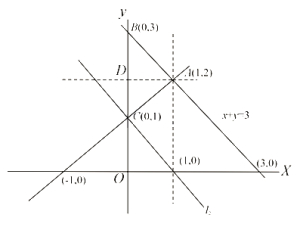
ત્રિકોણ રેખા $x+y=3$ અને રેખાઓ $x=0$ તથા $y=1$ દ્વારા રચાય છે.
ત્રિકોણના શિરોબિંદુઓ આ રેખાઓના છેદબિંદુઓ છે:
$1$. $x=0$ અને $y=1$ નું છેદબિંદુ $(0,1)$ છે.
$2$. $x=0$ અને $x+y=3$ નું છેદબિંદુ $(0,3)$ છે.
$3$. $y=1$ અને $x+y=3$ નું છેદબિંદુ $(2,1)$ છે.
શિરોબિંદુઓ $(0,1), (0,3),$ અને $(2,1)$ છે.
$y$-અક્ષ પર ત્રિકોણનો પાયો $|3-1|=2$ એકમ છે.
શિરોબિંદુ $(2,1)$ થી $y$-અક્ષ સુધીની ત્રિકોણની ઊંચાઈ $|2-0|=2$ એકમ છે.
ક્ષેત્રફળ $= \frac{1}{2} \times \text{પાયો} \times \text{ઊંચાઈ} = \frac{1}{2} \times 2 \times 2 = 2$ ચોરસ એકમ.
આને $x^2-(y-1)^2=0$ તરીકે લખી શકાય,જેનું અવયવીકરણ $(x-y+1)(x+y-1)=0$ થાય છે.
આમ,બે રેખાઓ $L_1: x-y+1=0$ અને $L_2: x+y-1=0$ છે.
આ રેખાઓના ખૂણાના દ્વિભાજકો $\frac{x-y+1}{\sqrt{1^2+(-1)^2}} = \pm \frac{x+y-1}{\sqrt{1^2+1^2}}$ દ્વારા મળે છે,જેનું સાદું રૂપ $x-y+1 = \pm(x+y-1)$ થાય છે.
કિસ્સો $1$: $x-y+1 = x+y-1$ $\Rightarrow 2y=2$ $\Rightarrow y=1$.
કિસ્સો $2$: $x-y+1 = -(x+y-1)$ $\Rightarrow x-y+1 = -x-y+1$ $\Rightarrow 2x=0$ $\Rightarrow x=0$.
ત્રિકોણ રેખા $x+y=3$ અને રેખાઓ $x=0$ તથા $y=1$ દ્વારા રચાય છે.
ત્રિકોણના શિરોબિંદુઓ આ રેખાઓના છેદબિંદુઓ છે:
$1$. $x=0$ અને $y=1$ નું છેદબિંદુ $(0,1)$ છે.
$2$. $x=0$ અને $x+y=3$ નું છેદબિંદુ $(0,3)$ છે.
$3$. $y=1$ અને $x+y=3$ નું છેદબિંદુ $(2,1)$ છે.
શિરોબિંદુઓ $(0,1), (0,3),$ અને $(2,1)$ છે.
$y$-અક્ષ પર ત્રિકોણનો પાયો $|3-1|=2$ એકમ છે.
શિરોબિંદુ $(2,1)$ થી $y$-અક્ષ સુધીની ત્રિકોણની ઊંચાઈ $|2-0|=2$ એકમ છે.
ક્ષેત્રફળ $= \frac{1}{2} \times \text{પાયો} \times \text{ઊંચાઈ} = \frac{1}{2} \times 2 \times 2 = 2$ ચોરસ એકમ.
0 likesView Solution
131
MathematicsMediumMCQAP EAMCET · 2018
જો સુરેખા $2x + 3y + 1 = 0$ એ રેખાઓની જોડી વચ્ચેના ખૂણાને દુભાગે છે,જેમાંથી એક રેખા $3x + 2y + 4 = 0$ છે,તો તે જોડીમાંની બીજી રેખાનું સમીકરણ શોધો.
A
$3x + 4y - 9 = 0$
B
$6x - 7y - 14 = 0$
C
$9x + 46y - 28 = 0$
D
$9x - 23y - 12 = 0$
Solution
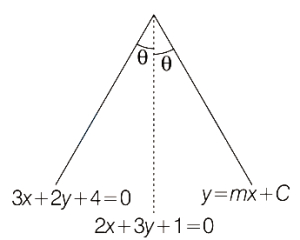
(C) ધારો કે બે રેખાઓ $L_1: 3x + 2y + 4 = 0$ અને $L_2: ax + by + c = 0$ છે. રેખા $L: 2x + 3y + 1 = 0$ એ ખૂણાનો દ્વિભાજક છે.
પ્રથમ,$L_1$ અને $L$ નું છેદબિંદુ શોધો:
$3x + 2y = -4$ ($3$ વડે ગુણતા $9x + 6y = -12$)
$2x + 3y = -1$ ($2$ વડે ગુણતા $4x + 6y = -2$)
સમીકરણોની બાદબાકી કરતા: $(9x - 4x) = -12 - (-2)$ $\Rightarrow 5x = -10$ $\Rightarrow x = -2$.
$x = -2$ ને $2x + 3y + 1 = 0$ માં મૂકતા: $2(-2) + 3y + 1 = 0$ $\Rightarrow -4 + 3y + 1 = 0$ $\Rightarrow 3y = 3$ $\Rightarrow y = 1$.
છેદબિંદુ $(-2, 1)$ છે.
ખૂણાનો દ્વિભાજક $L$ એ $L_1$ સાથે $\theta$ ખૂણો બનાવે છે. બીજી રેખા $L_2$ પણ $L$ સાથે બીજી બાજુ સમાન ખૂણો $\theta$ બનાવશે.
$L_1$ નો ઢાળ $m_1 = -3/2$ છે. $L$ નો ઢાળ $m = -2/3$ છે. ધારો કે $L_2$ નો ઢાળ $m_2$ છે.
$L_1$ અને $L$ વચ્ચેનો ખૂણો $\tan \theta = |(m - m_1) / (1 + m \cdot m_1)| = |(-2/3 - (-3/2)) / (1 + (-2/3)(-3/2))| = |(-4/6 + 9/6) / (1 + 1)| = |(5/6) / 2| = 5/12$ દ્વારા મળે છે.
જેમ કે $L$ ખૂણાને દુભાગે છે,$\tan \theta = |(m_2 - m) / (1 + m_2 \cdot m)| = 5/12$.
$|(m_2 + 2/3) / (1 - 2m_2/3)| = 5/12 \Rightarrow |(3m_2 + 2) / (3 - 2m_2)| = 5/12$.
કિસ્સો $1$: $(3m_2 + 2) / (3 - 2m_2) = 5/12$ $\Rightarrow 36m_2 + 24 = 15 - 10m_2$ $\Rightarrow 46m_2 = -9$ $\Rightarrow m_2 = -9/46$.
$(-2, 1)$ બિંદુનો ઉપયોગ કરીને: $y - 1 = (-9/46)(x + 2)$ $\Rightarrow 46y - 46 = -9x - 18$ $\Rightarrow 9x + 46y - 28 = 0$.
પ્રથમ,$L_1$ અને $L$ નું છેદબિંદુ શોધો:
$3x + 2y = -4$ ($3$ વડે ગુણતા $9x + 6y = -12$)
$2x + 3y = -1$ ($2$ વડે ગુણતા $4x + 6y = -2$)
સમીકરણોની બાદબાકી કરતા: $(9x - 4x) = -12 - (-2)$ $\Rightarrow 5x = -10$ $\Rightarrow x = -2$.
$x = -2$ ને $2x + 3y + 1 = 0$ માં મૂકતા: $2(-2) + 3y + 1 = 0$ $\Rightarrow -4 + 3y + 1 = 0$ $\Rightarrow 3y = 3$ $\Rightarrow y = 1$.
છેદબિંદુ $(-2, 1)$ છે.
ખૂણાનો દ્વિભાજક $L$ એ $L_1$ સાથે $\theta$ ખૂણો બનાવે છે. બીજી રેખા $L_2$ પણ $L$ સાથે બીજી બાજુ સમાન ખૂણો $\theta$ બનાવશે.
$L_1$ નો ઢાળ $m_1 = -3/2$ છે. $L$ નો ઢાળ $m = -2/3$ છે. ધારો કે $L_2$ નો ઢાળ $m_2$ છે.
$L_1$ અને $L$ વચ્ચેનો ખૂણો $\tan \theta = |(m - m_1) / (1 + m \cdot m_1)| = |(-2/3 - (-3/2)) / (1 + (-2/3)(-3/2))| = |(-4/6 + 9/6) / (1 + 1)| = |(5/6) / 2| = 5/12$ દ્વારા મળે છે.
જેમ કે $L$ ખૂણાને દુભાગે છે,$\tan \theta = |(m_2 - m) / (1 + m_2 \cdot m)| = 5/12$.
$|(m_2 + 2/3) / (1 - 2m_2/3)| = 5/12 \Rightarrow |(3m_2 + 2) / (3 - 2m_2)| = 5/12$.
કિસ્સો $1$: $(3m_2 + 2) / (3 - 2m_2) = 5/12$ $\Rightarrow 36m_2 + 24 = 15 - 10m_2$ $\Rightarrow 46m_2 = -9$ $\Rightarrow m_2 = -9/46$.
$(-2, 1)$ બિંદુનો ઉપયોગ કરીને: $y - 1 = (-9/46)(x + 2)$ $\Rightarrow 46y - 46 = -9x - 18$ $\Rightarrow 9x + 46y - 28 = 0$.
0 likesView Solution
132
MathematicsMediumMCQAP EAMCET · 2018
જો સમીકરણ $3x^2+7xy+2y^2+2gx+2fy+2=0$ એ બે છેદતી રેખાઓની જોડી દર્શાવતું હોય અને ઉગમબિંદુથી તેમના છેદબિંદુનું અંતરનો વર્ગ $\frac{2}{5}$ હોય,તો $f^2+g^2=$
A
$\frac{25}{4}$
B
$25$
C
$50$
D
$\frac{25}{2}$
Solution
(D) આપેલ સમીકરણ $3x^2+7xy+2y^2+2gx+2fy+2=0$ એ બે રેખાઓની જોડી દર્શાવે છે,તેથી શરત $abc+2fgh-af^2-bg^2-ch^2=0$ મુજબ:
$6f^2 + 4g^2 - 14fg = -25$ ---$(i)$
છેદબિંદુ શોધવા માટે,સમીકરણનું $x$ અને $y$ ની સાપેક્ષે આંશિક વિકલન કરતા:
$6x+7y+2g = 0$ ---(ii)
$7x+4y+2f = 0$ ---(iii)
આ સમીકરણો ઉકેલતા,છેદબિંદુ $\left(\frac{8g-14f}{25}, \frac{12f-14g}{25}\right)$ મળે છે.
ઉગમબિંદુથી અંતરનો વર્ગ $\frac{2}{5}$ હોવાથી:
$\left(\frac{8g-14f}{25}\right)^2 + \left(\frac{12f-14g}{25}\right)^2 = \frac{2}{5}$
સાદુરૂપ આપતા $26g^2 + 34f^2 - 56fg = 25$ મળે છે. ---(iv)
સમીકરણ $(i)$ અને (iv) ને ઉકેલતા:
$10g^2 + 10f^2 = 125$
તેથી,$f^2 + g^2 = \frac{25}{2}$
$6f^2 + 4g^2 - 14fg = -25$ ---$(i)$
છેદબિંદુ શોધવા માટે,સમીકરણનું $x$ અને $y$ ની સાપેક્ષે આંશિક વિકલન કરતા:
$6x+7y+2g = 0$ ---(ii)
$7x+4y+2f = 0$ ---(iii)
આ સમીકરણો ઉકેલતા,છેદબિંદુ $\left(\frac{8g-14f}{25}, \frac{12f-14g}{25}\right)$ મળે છે.
ઉગમબિંદુથી અંતરનો વર્ગ $\frac{2}{5}$ હોવાથી:
$\left(\frac{8g-14f}{25}\right)^2 + \left(\frac{12f-14g}{25}\right)^2 = \frac{2}{5}$
સાદુરૂપ આપતા $26g^2 + 34f^2 - 56fg = 25$ મળે છે. ---(iv)
સમીકરણ $(i)$ અને (iv) ને ઉકેલતા:
$10g^2 + 10f^2 = 125$
તેથી,$f^2 + g^2 = \frac{25}{2}$
0 likesView Solution
133
MathematicsDifficultMCQAP EAMCET · 2018
જો $4xy + 6x - 8y + c = 0$ સમીકરણ દ્વારા દર્શાવતી રેખાઓ યામ અક્ષો સાથે લંબચોરસ બનાવે,તો લંબચોરસનું ક્ષેત્રફળ (ચોરસ એકમમાં) કેટલું થાય?
A
$|c|$
B
$\left|\frac{c}{2}\right|$
C
$\left|\frac{c}{4}\right|$
D
$\left|\frac{c}{8}\right|$
Solution
(C) આપેલ સમીકરણ $4xy + 6x - 8y + c = 0$ છે.
આને $(x - 2)(y + 1.5) = \frac{12 - c}{4}$ તરીકે લખી શકાય.
લંબચોરસની બાજુઓ $x = 2$ અને $y = -1.5$ છે.
લંબચોરસનું ક્ષેત્રફળ $|2 \times (-1.5)| = 3$ થાય.
વિકલ્પ $C$ મુજબ,$|c|/4 = 12/4 = 3$ થાય છે,તેથી સાચો વિકલ્પ $C$ છે.
આને $(x - 2)(y + 1.5) = \frac{12 - c}{4}$ તરીકે લખી શકાય.
લંબચોરસની બાજુઓ $x = 2$ અને $y = -1.5$ છે.
લંબચોરસનું ક્ષેત્રફળ $|2 \times (-1.5)| = 3$ થાય.
વિકલ્પ $C$ મુજબ,$|c|/4 = 12/4 = 3$ થાય છે,તેથી સાચો વિકલ્પ $C$ છે.
0 likesView Solution
134
MathematicsMediumMCQAP EAMCET · 2018
જો $4xy + 6x - 8y + c = 0$ સમીકરણ દ્વારા દર્શાવતી રેખાઓ યામ અક્ષો સાથે લંબચોરસ બનાવે છે,તો લંબચોરસનું ક્ષેત્રફળ (ચોરસ એકમમાં) કેટલું થાય?
A
$|c|$
B
$|c/2|$
C
$|c/4|$
D
$|c/8|$
Solution
(C) આપેલ સમીકરણ $4xy + 6x - 8y + c = 0$ છે.
આ સમીકરણને અવયવ પાડતા: $(2y + 3)(x - 2) = -\frac{12 + c}{2}$ મળે.
રેખાઓ યામ અક્ષો સાથે લંબચોરસ બનાવે તે માટે,રેખાઓ $x = 2$ અને $y = -1.5$ સ્વરૂપમાં હોવી જોઈએ.
લંબચોરસની બાજુઓ $2$ અને $1.5$ છે.
તેથી,ક્ષેત્રફળ $2 \times 1.5 = 3$ થાય.
અહીં $c = -12$ હોવાથી,$|c/4| = |-12/4| = 3$ મળે છે.
આ સમીકરણને અવયવ પાડતા: $(2y + 3)(x - 2) = -\frac{12 + c}{2}$ મળે.
રેખાઓ યામ અક્ષો સાથે લંબચોરસ બનાવે તે માટે,રેખાઓ $x = 2$ અને $y = -1.5$ સ્વરૂપમાં હોવી જોઈએ.
લંબચોરસની બાજુઓ $2$ અને $1.5$ છે.
તેથી,ક્ષેત્રફળ $2 \times 1.5 = 3$ થાય.
અહીં $c = -12$ હોવાથી,$|c/4| = |-12/4| = 3$ મળે છે.
0 likesView Solution
135
MathematicsEasyMCQAP EAMCET · 2018
યામ અક્ષો અને રેખા $3x - 4y = 12$ ને સ્પર્શતા વર્તુળનું સમીકરણ શોધો.
A
$x^2 + y^2 + 6x + 6y + 9 = 0$
B
$x^2 + y^2 + 6x + 6y - 9 = 0$
C
$x^2 + y^2 - 6x - 6y + 9 = 0$
D
$x^2 + y^2 - 6x - 6y - 9 = 0$
Solution
(C) વર્તુળ બંને યામ અક્ષોને સ્પર્શે છે,તેથી તેનું કેન્દ્ર $(h, h)$ અને ત્રિજ્યા $|h|$ છે.
આપેલ છે કે વર્તુળ રેખા $3x - 4y - 12 = 0$ ને પણ સ્પર્શે છે,તેથી કેન્દ્ર $(h, h)$ થી રેખાનું લંબ અંતર ત્રિજ્યા $|h|$ જેટલું થાય.
$\therefore \left|\frac{3h - 4h - 12}{\sqrt{3^2 + (-4)^2}}\right| = |h|$
$\Rightarrow \left|\frac{-h - 12}{5}\right| = |h|$
$\Rightarrow |-h - 12| = 5|h|$
કિસ્સો $1$: $-h - 12 = 5h$ $\Rightarrow 6h = -12$ $\Rightarrow h = -2$.
કિસ્સો $2$: $-h - 12 = -5h$ $\Rightarrow 4h = 12$ $\Rightarrow h = 3$.
$h = 3$ માટે,સમીકરણ $(x - 3)^2 + (y - 3)^2 = 3^2$ થાય.
$x^2 - 6x + 9 + y^2 - 6y + 9 = 9$
$x^2 + y^2 - 6x - 6y + 9 = 0$.
આપેલ છે કે વર્તુળ રેખા $3x - 4y - 12 = 0$ ને પણ સ્પર્શે છે,તેથી કેન્દ્ર $(h, h)$ થી રેખાનું લંબ અંતર ત્રિજ્યા $|h|$ જેટલું થાય.
$\therefore \left|\frac{3h - 4h - 12}{\sqrt{3^2 + (-4)^2}}\right| = |h|$
$\Rightarrow \left|\frac{-h - 12}{5}\right| = |h|$
$\Rightarrow |-h - 12| = 5|h|$
કિસ્સો $1$: $-h - 12 = 5h$ $\Rightarrow 6h = -12$ $\Rightarrow h = -2$.
કિસ્સો $2$: $-h - 12 = -5h$ $\Rightarrow 4h = 12$ $\Rightarrow h = 3$.
$h = 3$ માટે,સમીકરણ $(x - 3)^2 + (y - 3)^2 = 3^2$ થાય.
$x^2 - 6x + 9 + y^2 - 6y + 9 = 9$
$x^2 + y^2 - 6x - 6y + 9 = 0$.
0 likesView Solution
136
MathematicsEasyMCQAP EAMCET · 2018
List-$I$ માં,$A, B, C$ માં વર્તુળોની જોડી આપવામાં આવી છે અને List-$II$ માં,તે વર્તુળોની જોડી વચ્ચેનો ખૂણો આપવામાં આવ્યો છે. List-$I$ માંથી List-$II$ સાથે વસ્તુઓને જોડો.
સાચી જોડણી છે
| List-$I$ | List-$II$ |
|---|---|
| $(A)$ $(x-2)^2+y^2=2$,$(x-2)^2+(y-1)^2=1$ | $I.$ $90^{\circ}$ |
| $(B)$ $x^2+y^2-6x-6y+9=0$,$x^2+y^2-4x+4y-9=0$ | $II.$ $135^{\circ}$ |
| $(C)$ $x^2+y^2+4x-14y+28=0$,$x^2+y^2+4x-5=0$ | $III.$ $60^{\circ}$ |
| $IV.$ $30^{\circ}$ |
સાચી જોડણી છે
A
$A-II, B-I, C-III$
B
$A-I, B-II, C-III$
C
$A-III, B-I, C-IV$
D
$A-II, B-I, C-IV$
Solution
(A) બે વર્તુળો વચ્ચેનો ખૂણો $\theta$ શોધવા માટેનું સૂત્ર $\cos \theta = \frac{r_1^2+r_2^2-d^2}{2 r_1 r_2}$ છે.
$(A)$ $(x-2)^2+y^2=2$ $(r_1=\sqrt{2}, c_1=(2,0))$ અને $(x-2)^2+(y-1)^2=1$ $(r_2=1, c_2=(2,1))$.
$d^2 = (2-2)^2 + (1-0)^2 = 1$.
$\cos \theta = \frac{2+1-1}{2 \times \sqrt{2} \times 1} = \frac{2}{2\sqrt{2}} = \frac{1}{\sqrt{2}}$.
$\theta = 45^{\circ}$ અથવા $135^{\circ}$. તેથી,$(A)$ એ $II$ સાથે જોડાય છે.
$(B)$ $x^2+y^2-6x-6y+9=0$ $(r_1=\sqrt{3^2+3^2-9}=3, c_1=(3,3))$ અને $x^2+y^2-4x+4y-9=0$ $(r_2=\sqrt{2^2+(-2)^2-(-9)}=\sqrt{17}, c_2=(2,-2))$.
$d^2 = (3-2)^2 + (3-(-2))^2 = 1^2 + 5^2 = 26$.
$\cos \theta = \frac{9+17-26}{2 \times 3 \times \sqrt{17}} = 0$.
$\theta = 90^{\circ}$. તેથી,$(B)$ એ $I$ સાથે જોડાય છે.
$(C)$ $x^2+y^2+4x-14y+28=0$ $(r_1=\sqrt{(-2)^2+7^2-28}=5, c_1=(-2,7))$ અને $x^2+y^2+4x-5=0$ $(r_2=\sqrt{(-2)^2+0^2-(-5)}=3, c_2=(-2,0))$.
$d^2 = (-2-(-2))^2 + (7-0)^2 = 49$.
$\cos \theta = \frac{25+9-49}{2 \times 5 \times 3} = \frac{-15}{30} = -\frac{1}{2}$.
$\theta = 120^{\circ}$ અથવા $60^{\circ}$. તેથી,$(C)$ એ $III$ સાથે જોડાય છે.
આમ,સાચી જોડણી $A-II, B-I, C-III$ છે.
$(A)$ $(x-2)^2+y^2=2$ $(r_1=\sqrt{2}, c_1=(2,0))$ અને $(x-2)^2+(y-1)^2=1$ $(r_2=1, c_2=(2,1))$.
$d^2 = (2-2)^2 + (1-0)^2 = 1$.
$\cos \theta = \frac{2+1-1}{2 \times \sqrt{2} \times 1} = \frac{2}{2\sqrt{2}} = \frac{1}{\sqrt{2}}$.
$\theta = 45^{\circ}$ અથવા $135^{\circ}$. તેથી,$(A)$ એ $II$ સાથે જોડાય છે.
$(B)$ $x^2+y^2-6x-6y+9=0$ $(r_1=\sqrt{3^2+3^2-9}=3, c_1=(3,3))$ અને $x^2+y^2-4x+4y-9=0$ $(r_2=\sqrt{2^2+(-2)^2-(-9)}=\sqrt{17}, c_2=(2,-2))$.
$d^2 = (3-2)^2 + (3-(-2))^2 = 1^2 + 5^2 = 26$.
$\cos \theta = \frac{9+17-26}{2 \times 3 \times \sqrt{17}} = 0$.
$\theta = 90^{\circ}$. તેથી,$(B)$ એ $I$ સાથે જોડાય છે.
$(C)$ $x^2+y^2+4x-14y+28=0$ $(r_1=\sqrt{(-2)^2+7^2-28}=5, c_1=(-2,7))$ અને $x^2+y^2+4x-5=0$ $(r_2=\sqrt{(-2)^2+0^2-(-5)}=3, c_2=(-2,0))$.
$d^2 = (-2-(-2))^2 + (7-0)^2 = 49$.
$\cos \theta = \frac{25+9-49}{2 \times 5 \times 3} = \frac{-15}{30} = -\frac{1}{2}$.
$\theta = 120^{\circ}$ અથવા $60^{\circ}$. તેથી,$(C)$ એ $III$ સાથે જોડાય છે.
આમ,સાચી જોડણી $A-II, B-I, C-III$ છે.
0 likesView Solution
137
MathematicsMediumMCQAP EAMCET · 2018
જો એક વર્તુળ રેખાઓ $3x - 4y - 10 = 0$ અને $3x - 4y + 30 = 0$ ને સ્પર્શે છે અને તેનું કેન્દ્ર રેખા $x + 2y = 0$ પર આવેલું છે,તો વર્તુળનું સમીકરણ શું છે?
A
$x^2 + y^2 + 4x - 2y - 11 = 0$
B
$x^2 + y^2 + 2x - 4y - 11 = 0$
C
$x^2 + y^2 - 4x + 2y - 11 = 0$
D
$x^2 + y^2 + 2x - y - 11 = 0$
Solution
(A) સમાંતર રેખાઓ $3x - 4y - 10 = 0$ અને $3x - 4y + 30 = 0$ વચ્ચેનું અંતર એ વર્તુળનો વ્યાસ છે.
વ્યાસ $d = \frac{|30 - (-10)|}{\sqrt{3^2 + (-4)^2}} = \frac{40}{5} = 8$.
તેથી,ત્રિજ્યા $r = \frac{d}{2} = 4$.
કેન્દ્ર $(h, k)$ એ રેખા $x + 2y = 0$ પર છે,તેથી $h = -2k$.
કેન્દ્ર બંને સમાંતર રેખાઓથી સમાન અંતરે છે. આપેલ રેખાઓની વચ્ચેની રેખા $3x - 4y + 10 = 0$ છે.
$x = -2k$ ને $3x - 4y + 10 = 0$ માં મૂકતા,$3(-2k) - 4k + 10 = 0$ મળે છે,જે $-10k = -10$ થાય છે,તેથી $k = 1$.
તેથી $h = -2(1) = -2$. કેન્દ્ર $(-2, 1)$ છે.
વર્તુળનું સમીકરણ $(x + 2)^2 + (y - 1)^2 = 4^2$ છે.
$x^2 + 4x + 4 + y^2 - 2y + 1 = 16$.
$x^2 + y^2 + 4x - 2y - 11 = 0$.
વ્યાસ $d = \frac{|30 - (-10)|}{\sqrt{3^2 + (-4)^2}} = \frac{40}{5} = 8$.
તેથી,ત્રિજ્યા $r = \frac{d}{2} = 4$.
કેન્દ્ર $(h, k)$ એ રેખા $x + 2y = 0$ પર છે,તેથી $h = -2k$.
કેન્દ્ર બંને સમાંતર રેખાઓથી સમાન અંતરે છે. આપેલ રેખાઓની વચ્ચેની રેખા $3x - 4y + 10 = 0$ છે.
$x = -2k$ ને $3x - 4y + 10 = 0$ માં મૂકતા,$3(-2k) - 4k + 10 = 0$ મળે છે,જે $-10k = -10$ થાય છે,તેથી $k = 1$.
તેથી $h = -2(1) = -2$. કેન્દ્ર $(-2, 1)$ છે.
વર્તુળનું સમીકરણ $(x + 2)^2 + (y - 1)^2 = 4^2$ છે.
$x^2 + 4x + 4 + y^2 - 2y + 1 = 16$.
$x^2 + y^2 + 4x - 2y - 11 = 0$.
0 likesView Solution
138
MathematicsEasyMCQAP EAMCET · 2018
$ABCD$ એ $16$ એકમ બાજુ ધરાવતો ચોરસ છે અને $A$ ઉગમબિંદુ છે. જો ચોરસ $ABCD$ ને પરિગત વર્તુળનું સમીકરણ $x^2+y^2=4k(x+y)$ હોય,તો $k=$
A
$2$
B
$4$
C
$16$
D
$64$
Solution
(B) ચોરસના શિરોબિંદુઓ $A(0,0)$,$B(16,0)$,$C(16,16)$,અને $D(0,16)$ છે.
વર્તુળ ચોરસને પરિગત હોવાથી,વિકર્ણ $AC$ એ વર્તુળનો વ્યાસ છે.
$A$ ના યામ $(0,0)$ અને $C$ ના યામ $(16,16)$ છે.
વ્યાસના અંત્યબિંદુઓ $(x_1, y_1)$ અને $(x_2, y_2)$ ધરાવતા વર્તુળનું સમીકરણ $(x-x_1)(x-x_2) + (y-y_1)(y-y_2) = 0$ છે.
$A$ અને $C$ ના યામ મૂકતા:
$(x-0)(x-16) + (y-0)(y-16) = 0$
$x(x-16) + y(y-16) = 0$
$x^2 - 16x + y^2 - 16y = 0$
$x^2 + y^2 = 16(x+y)$
આપેલ સમીકરણ $x^2 + y^2 = 4k(x+y)$ સાથે સરખાવતા:
$4k = 16$
$k = 4$
વર્તુળ ચોરસને પરિગત હોવાથી,વિકર્ણ $AC$ એ વર્તુળનો વ્યાસ છે.
$A$ ના યામ $(0,0)$ અને $C$ ના યામ $(16,16)$ છે.
વ્યાસના અંત્યબિંદુઓ $(x_1, y_1)$ અને $(x_2, y_2)$ ધરાવતા વર્તુળનું સમીકરણ $(x-x_1)(x-x_2) + (y-y_1)(y-y_2) = 0$ છે.
$A$ અને $C$ ના યામ મૂકતા:
$(x-0)(x-16) + (y-0)(y-16) = 0$
$x(x-16) + y(y-16) = 0$
$x^2 - 16x + y^2 - 16y = 0$
$x^2 + y^2 = 16(x+y)$
આપેલ સમીકરણ $x^2 + y^2 = 4k(x+y)$ સાથે સરખાવતા:
$4k = 16$
$k = 4$
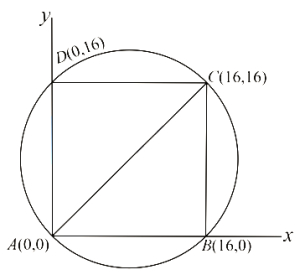
0 likesView Solution
139
MathematicsEasyMCQAP EAMCET · 2018
જો $(2,-14)$ થી વર્તુળ $x^2+y^2+6x+4y-12=0$ નું લઘુત્તમ અંતર $d$ હોય અને તે જ બિંદુથી વર્તુળ પર દોરેલા સ્પર્શકની લંબાઈ $l$ હોય,તો $\sqrt{d+l}=$
A
$13$
B
$2\sqrt{5}$
C
$12$
D
$5$
Solution
(B) આપેલ વર્તુળ: $x^2+y^2+6x+4y-12=0$.
$x^2+y^2+2gx+2fy+c=0$ સાથે સરખાવતા,$g=3, f=2, c=-12$ મળે.
કેન્દ્ર $O = (-g, -f) = (-3, -2)$.
ત્રિજ્યા $R = \sqrt{g^2+f^2-c} = \sqrt{3^2+2^2-(-12)} = \sqrt{9+4+12} = \sqrt{25} = 5$.
ધારો કે $P = (2, -14)$. અંતર $OP = \sqrt{(2 - (-3))^2 + (-14 - (-2))^2} = \sqrt{5^2 + (-12)^2} = \sqrt{25 + 144} = \sqrt{169} = 13$.
લઘુત્તમ અંતર $d = OP - R = 13 - 5 = 8$.
સ્પર્શકની લંબાઈ $l = \sqrt{OP^2 - R^2} = \sqrt{13^2 - 5^2} = \sqrt{169 - 25} = \sqrt{144} = 12$.
તેથી,$\sqrt{d+l} = \sqrt{8+12} = \sqrt{20} = 2\sqrt{5}$.
$x^2+y^2+2gx+2fy+c=0$ સાથે સરખાવતા,$g=3, f=2, c=-12$ મળે.
કેન્દ્ર $O = (-g, -f) = (-3, -2)$.
ત્રિજ્યા $R = \sqrt{g^2+f^2-c} = \sqrt{3^2+2^2-(-12)} = \sqrt{9+4+12} = \sqrt{25} = 5$.
ધારો કે $P = (2, -14)$. અંતર $OP = \sqrt{(2 - (-3))^2 + (-14 - (-2))^2} = \sqrt{5^2 + (-12)^2} = \sqrt{25 + 144} = \sqrt{169} = 13$.
લઘુત્તમ અંતર $d = OP - R = 13 - 5 = 8$.
સ્પર્શકની લંબાઈ $l = \sqrt{OP^2 - R^2} = \sqrt{13^2 - 5^2} = \sqrt{169 - 25} = \sqrt{144} = 12$.
તેથી,$\sqrt{d+l} = \sqrt{8+12} = \sqrt{20} = 2\sqrt{5}$.
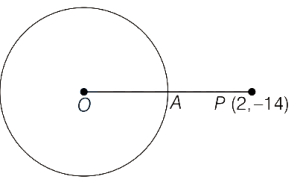
0 likesView Solution
140
MathematicsEasyMCQAP EAMCET · 2018
બિંદુ $(4,-3)$ થી વર્તુળ $x^2+y^2+4x-10y-7=0$ ના ન્યૂનતમ અને મહત્તમ અંતરનો સરવાળો કેટલો થાય?
A
$20$
B
$16$
C
$12$
D
$64$
Solution
(A) વર્તુળનું સમીકરણ $x^2+y^2+4x-10y-7=0$ છે.
તેને $x^2+y^2+2gx+2fy+c=0$ સાથે સરખાવતા,$g=2$,$f=-5$,અને $c=-7$ મળે છે.
વર્તુળનું કેન્દ્ર $C(-g, -f) = (-2, 5)$ અને ત્રિજ્યા $r = \sqrt{g^2+f^2-c} = \sqrt{2^2+(-5)^2-(-7)} = \sqrt{4+25+7} = \sqrt{36} = 6$ છે.
ધારો કે $P$ એ બિંદુ $(4, -3)$ છે. કેન્દ્ર $C(-2, 5)$ અને બિંદુ $P(4, -3)$ વચ્ચેનું અંતર $d = \sqrt{(4 - (-2))^2 + (-3 - 5)^2} = \sqrt{6^2 + (-8)^2} = \sqrt{36 + 64} = \sqrt{100} = 10$ છે.
બિંદુથી વર્તુળનું ન્યૂનતમ અંતર $|d - r| = |10 - 6| = 4$ છે.
બિંદુથી વર્તુળનું મહત્તમ અંતર $d + r = 10 + 6 = 16$ છે.
ન્યૂનતમ અને મહત્તમ અંતરનો સરવાળો $4 + 16 = 20$ થાય.
તેને $x^2+y^2+2gx+2fy+c=0$ સાથે સરખાવતા,$g=2$,$f=-5$,અને $c=-7$ મળે છે.
વર્તુળનું કેન્દ્ર $C(-g, -f) = (-2, 5)$ અને ત્રિજ્યા $r = \sqrt{g^2+f^2-c} = \sqrt{2^2+(-5)^2-(-7)} = \sqrt{4+25+7} = \sqrt{36} = 6$ છે.
ધારો કે $P$ એ બિંદુ $(4, -3)$ છે. કેન્દ્ર $C(-2, 5)$ અને બિંદુ $P(4, -3)$ વચ્ચેનું અંતર $d = \sqrt{(4 - (-2))^2 + (-3 - 5)^2} = \sqrt{6^2 + (-8)^2} = \sqrt{36 + 64} = \sqrt{100} = 10$ છે.
બિંદુથી વર્તુળનું ન્યૂનતમ અંતર $|d - r| = |10 - 6| = 4$ છે.
બિંદુથી વર્તુળનું મહત્તમ અંતર $d + r = 10 + 6 = 16$ છે.
ન્યૂનતમ અને મહત્તમ અંતરનો સરવાળો $4 + 16 = 20$ થાય.
0 likesView Solution
141
MathematicsMediumMCQAP EAMCET · 2018
જો રેખા $4x + 4y - 11 = 0$ એ વર્તુળ $x^2 + y^2 - 4x - 6y + 4 = 0$ ને $A$ અને $B$ માં છેદે,તો $A$ અને $B$ આગળ દોરેલા સ્પર્શકોનું છેદબિંદુ કયું છે?
A
$(-1, 2)$
B
$(-1, -2)$
C
$(2, 1)$
D
$(-2, -1)$
Solution
(D) ધારો કે જરૂરી છેદબિંદુ $(x_1, y_1)$ છે. વર્તુળ $x^2 + y^2 - 4x - 6y + 4 = 0$ ના સંદર્ભમાં સ્પર્શક જીવાની સમીકરણ $T = 0$ દ્વારા મળે છે:
$xx_1 + yy_1 - 2(x + x_1) - 3(y + y_1) + 4 = 0$
પદોને ગોઠવતા:
$(x_1 - 2)x + (y_1 - 3)y + (4 - 2x_1 - 3y_1) = 0$ $(i)$
આ રેખા $4x + 4y - 11 = 0$ દર્શાવતી હોવાથી,સહગુણકો પ્રમાણસર હશે:
$\frac{x_1 - 2}{4} = \frac{y_1 - 3}{4} = \frac{4 - 2x_1 - 3y_1}{-11} = K$
આથી,$x_1 = 4K + 2$ અને $y_1 = 4K + 3$.
ત્રીજા ગુણોત્તરમાં કિંમત મૂકતા:
$\frac{4 - 2(4K + 2) - 3(4K + 3)}{-11} = K$
$\frac{-20K - 9}{-11} = K$ $\Rightarrow -20K - 9 = -11K$ $\Rightarrow K = -1$
$x_1 = 4(-1) + 2 = -2$ અને $y_1 = 4(-1) + 3 = -1$.
આમ,છેદબિંદુ $(-2, -1)$ છે.
$xx_1 + yy_1 - 2(x + x_1) - 3(y + y_1) + 4 = 0$
પદોને ગોઠવતા:
$(x_1 - 2)x + (y_1 - 3)y + (4 - 2x_1 - 3y_1) = 0$ $(i)$
આ રેખા $4x + 4y - 11 = 0$ દર્શાવતી હોવાથી,સહગુણકો પ્રમાણસર હશે:
$\frac{x_1 - 2}{4} = \frac{y_1 - 3}{4} = \frac{4 - 2x_1 - 3y_1}{-11} = K$
આથી,$x_1 = 4K + 2$ અને $y_1 = 4K + 3$.
ત્રીજા ગુણોત્તરમાં કિંમત મૂકતા:
$\frac{4 - 2(4K + 2) - 3(4K + 3)}{-11} = K$
$\frac{-20K - 9}{-11} = K$ $\Rightarrow -20K - 9 = -11K$ $\Rightarrow K = -1$
$x_1 = 4(-1) + 2 = -2$ અને $y_1 = 4(-1) + 3 = -1$.
આમ,છેદબિંદુ $(-2, -1)$ છે.
0 likesView Solution
142
MathematicsMediumMCQAP EAMCET · 2018
બે વર્તુળો $x^2+y^2-4x+8y+5=0$ અને $x^2+y^2+2x+4y-3=0$ ના છેદબિંદુઓને ઉગમબિંદુ સાથે જોડતી રેખાઓની જોડનું સમીકરણ શું છે?
A
$13x^2+6xy-28y^2=0$
B
$xy-28y^2=0$
C
$(x+4)(x-5)=0$
D
$13x^2+68xy-28y^2=0$
Solution
(D) ધારો કે બે વર્તુળો $S_1: x^2+y^2-4x+8y+5=0$ અને $S_2: x^2+y^2+2x+4y-3=0$ છે.
સામાન્ય જીવા $S_1-S_2=0$ દ્વારા મળે છે.
$(x^2+y^2-4x+8y+5) - (x^2+y^2+2x+4y-3) = 0$
$-6x+4y+8=0 \Rightarrow 3x-2y-4=0$.
આમ,રેખાનું સમીકરણ $3x-2y=4$ અથવા $\frac{3x-2y}{4}=1$ છે.
ઉગમબિંદુને છેદબિંદુઓ સાથે જોડતી રેખાઓની જોડ મેળવવા માટે,આપણે રેખાના સમીકરણનો ઉપયોગ કરીને $S_2$ ના સમીકરણનું સમઘાતીકરણ કરીએ છીએ:
$x^2+y^2+(2x+4y)(1) - 3(1)^2 = 0$
$x^2+y^2+(2x+4y)(\frac{3x-2y}{4}) - 3(\frac{3x-2y}{4})^2 = 0$
છેદ દૂર કરવા માટે $16$ વડે ગુણતા:
$16(x^2+y^2) + 4(2x+4y)(3x-2y) - 3(9x^2+4y^2-12xy) = 0$
$16x^2+16y^2 + 4(6x^2+8xy-8y^2) - 27x^2-12y^2+36xy = 0$
$13x^2+68xy-28y^2=0$.
સામાન્ય જીવા $S_1-S_2=0$ દ્વારા મળે છે.
$(x^2+y^2-4x+8y+5) - (x^2+y^2+2x+4y-3) = 0$
$-6x+4y+8=0 \Rightarrow 3x-2y-4=0$.
આમ,રેખાનું સમીકરણ $3x-2y=4$ અથવા $\frac{3x-2y}{4}=1$ છે.
ઉગમબિંદુને છેદબિંદુઓ સાથે જોડતી રેખાઓની જોડ મેળવવા માટે,આપણે રેખાના સમીકરણનો ઉપયોગ કરીને $S_2$ ના સમીકરણનું સમઘાતીકરણ કરીએ છીએ:
$x^2+y^2+(2x+4y)(1) - 3(1)^2 = 0$
$x^2+y^2+(2x+4y)(\frac{3x-2y}{4}) - 3(\frac{3x-2y}{4})^2 = 0$
છેદ દૂર કરવા માટે $16$ વડે ગુણતા:
$16(x^2+y^2) + 4(2x+4y)(3x-2y) - 3(9x^2+4y^2-12xy) = 0$
$16x^2+16y^2 + 4(6x^2+8xy-8y^2) - 27x^2-12y^2+36xy = 0$
$13x^2+68xy-28y^2=0$.
0 likesView Solution
143
MathematicsEasyMCQAP EAMCET · 2018
જો વર્તુળ $x^2+y^2+2gx+2fy+c=0$ $(c>0)$ બંને યામ અક્ષોને સ્પર્શે છે અને ત્રીજા ચરણમાં આવેલું છે,તો રેખા $x+y+\sqrt{c}=0$ પર વર્તુળ દ્વારા અંતઃખંડિત જીવાની લંબાઈ કેટલી થાય?
A
$\sqrt{2c}$
B
$c$
C
$\sqrt{c}$
D
$\sqrt{\frac{c}{2}}$
Solution
(A) વર્તુળનું આપેલ સમીકરણ $x^2+y^2+2gx+2fy+c=0$ $(c>0)$ છે.
વર્તુળનું કેન્દ્ર $(-g, -f)$ છે અને ત્રિજ્યા $r = \sqrt{g^2+f^2-c}$ છે.
વર્તુળ બંને યામ અક્ષોને સ્પર્શતું હોવાથી,કેન્દ્રનું અક્ષોથી અંતર ત્રિજ્યા જેટલું થાય,તેથી $|-g| = |-f| = r = \sqrt{c}$.
વર્તુળ ત્રીજા ચરણમાં હોવાથી,કેન્દ્ર $(-\sqrt{c}, -\sqrt{c})$ થશે.
આમ,વર્તુળનું સમીકરણ $(x+\sqrt{c})^2 + (y+\sqrt{c})^2 = c$ થાય.
વર્તુળ $x$-અક્ષને $(-\sqrt{c}, 0)$ બિંદુએ અને $y$-અક્ષને $(0, -\sqrt{c})$ બિંદુએ સ્પર્શે છે.
ધારો કે આ બિંદુઓ $A(-\sqrt{c}, 0)$ અને $B(0, -\sqrt{c})$ છે.
આ બિંદુઓ રેખા $x+y+\sqrt{c}=0$ પર આવેલા છે કે નહીં તે ચકાસીએ:
બિંદુ $A$ માટે: $-\sqrt{c} + 0 + \sqrt{c} = 0$ (સાચું).
બિંદુ $B$ માટે: $0 - \sqrt{c} + \sqrt{c} = 0$ (સાચું).
આમ,રેખા દ્વારા વર્તુળ પર અંતઃખંડિત જીવા એ રેખાખંડ $AB$ છે.
જીવા $AB$ ની લંબાઈ $\sqrt{(0 - (-\sqrt{c}))^2 + (-\sqrt{c} - 0)^2} = \sqrt{(\sqrt{c})^2 + (-\sqrt{c})^2} = \sqrt{c+c} = \sqrt{2c}$ થાય.
વર્તુળનું કેન્દ્ર $(-g, -f)$ છે અને ત્રિજ્યા $r = \sqrt{g^2+f^2-c}$ છે.
વર્તુળ બંને યામ અક્ષોને સ્પર્શતું હોવાથી,કેન્દ્રનું અક્ષોથી અંતર ત્રિજ્યા જેટલું થાય,તેથી $|-g| = |-f| = r = \sqrt{c}$.
વર્તુળ ત્રીજા ચરણમાં હોવાથી,કેન્દ્ર $(-\sqrt{c}, -\sqrt{c})$ થશે.
આમ,વર્તુળનું સમીકરણ $(x+\sqrt{c})^2 + (y+\sqrt{c})^2 = c$ થાય.
વર્તુળ $x$-અક્ષને $(-\sqrt{c}, 0)$ બિંદુએ અને $y$-અક્ષને $(0, -\sqrt{c})$ બિંદુએ સ્પર્શે છે.
ધારો કે આ બિંદુઓ $A(-\sqrt{c}, 0)$ અને $B(0, -\sqrt{c})$ છે.
આ બિંદુઓ રેખા $x+y+\sqrt{c}=0$ પર આવેલા છે કે નહીં તે ચકાસીએ:
બિંદુ $A$ માટે: $-\sqrt{c} + 0 + \sqrt{c} = 0$ (સાચું).
બિંદુ $B$ માટે: $0 - \sqrt{c} + \sqrt{c} = 0$ (સાચું).
આમ,રેખા દ્વારા વર્તુળ પર અંતઃખંડિત જીવા એ રેખાખંડ $AB$ છે.
જીવા $AB$ ની લંબાઈ $\sqrt{(0 - (-\sqrt{c}))^2 + (-\sqrt{c} - 0)^2} = \sqrt{(\sqrt{c})^2 + (-\sqrt{c})^2} = \sqrt{c+c} = \sqrt{2c}$ થાય.
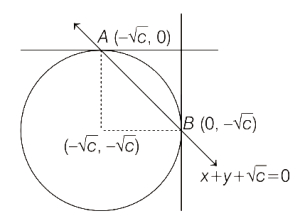
0 likesView Solution
144
MathematicsMediumMCQAP EAMCET · 2018
જો રેખાઓ $2x + y + 12 = 0$ અને $kx - 3y - 10 = 0$ એ વર્તુળ $x^2 + y^2 - 4x + 3y - 1 = 0$ ના સાપેક્ષમાં સંયુગ્મી (conjugate) હોય,તો $k =$
A
$4$
B
$-9$
C
$-3$
D
$-5$
Solution
(A) બે રેખાઓ $L_1: a_1x + b_1y + c_1 = 0$ અને $L_2: a_2x + b_2y + c_2 = 0$ વર્તુળ $x^2 + y^2 + 2gx + 2fy + c = 0$ ના સાપેક્ષમાં સંયુગ્મી હોવાની શરત $r^2(a_1a_2 + b_1b_2) = (g a_1 + f b_1 - c_1)(g a_2 + f b_2 - c_2)$ છે.
વર્તુળ $x^2 + y^2 - 4x + 3y - 1 = 0$ માટે,$g = -2$,$f = 3/2$,અને $c = -1$ છે.
ત્રિજ્યાનો વર્ગ $r^2 = g^2 + f^2 - c = (-2)^2 + (3/2)^2 - (-1) = 4 + 9/4 + 1 = 29/4$ છે.
રેખા $L_1: 2x + y + 12 = 0$ માટે,$a_1 = 2, b_1 = 1, c_1 = 12$.
રેખા $L_2: kx - 3y - 10 = 0$ માટે,$a_2 = k, b_2 = -3, c_2 = -10$.
આ કિંમતો શરતમાં મૂકતા:
$\frac{29}{4}(2k - 3) = (-2(2) + \frac{3}{2}(1) - 12)(-2(k) + \frac{3}{2}(-3) - (-10))$
$\frac{29}{4}(2k - 3) = (-14.5)(-2k + 5.5)$
$\frac{1}{2}(2k - 3) = -(-2k + 5.5)$
$k - 1.5 = 2k - 5.5$
$k = 4$.
વર્તુળ $x^2 + y^2 - 4x + 3y - 1 = 0$ માટે,$g = -2$,$f = 3/2$,અને $c = -1$ છે.
ત્રિજ્યાનો વર્ગ $r^2 = g^2 + f^2 - c = (-2)^2 + (3/2)^2 - (-1) = 4 + 9/4 + 1 = 29/4$ છે.
રેખા $L_1: 2x + y + 12 = 0$ માટે,$a_1 = 2, b_1 = 1, c_1 = 12$.
રેખા $L_2: kx - 3y - 10 = 0$ માટે,$a_2 = k, b_2 = -3, c_2 = -10$.
આ કિંમતો શરતમાં મૂકતા:
$\frac{29}{4}(2k - 3) = (-2(2) + \frac{3}{2}(1) - 12)(-2(k) + \frac{3}{2}(-3) - (-10))$
$\frac{29}{4}(2k - 3) = (-14.5)(-2k + 5.5)$
$\frac{1}{2}(2k - 3) = -(-2k + 5.5)$
$k - 1.5 = 2k - 5.5$
$k = 4$.
0 likesView Solution
145
MathematicsEasyMCQAP EAMCET · 2018
જો $P$ માંથી $x^2+y^2-2x+4y-20=0$ અને $x^2+y^2-2x-8y+1=0$ વર્તુળો પર દોરેલા સ્પર્શકોની લંબાઈનો ગુણોત્તર $2:1$ હોય,તો $P$ નો બિંદુપથ શોધો.
A
$x^2+y^2+2x+12y+8=0$
B
$x^2+y^2-2x+12y+8=0$
C
$x^2+y^2+2x-12y+8=0$
D
$x^2+y^2-2x-12y+8=0$
Solution
(D) આપણે જાણીએ છીએ કે $(x_1, y_1)$ માંથી વર્તુળ $x^2+y^2+2gx+2fy+c=0$ પર દોરેલા સ્પર્શકની લંબાઈ $\sqrt{x_1^2+y_1^2+2gx_1+2fy_1+c}$ છે.
ધારો કે $P = (h, k)$.
પ્રશ્ન મુજબ,સ્પર્શકોની લંબાઈનો ગુણોત્તર $2:1$ છે:
$\frac{\sqrt{h^2+k^2-2h+4k-20}}{\sqrt{h^2+k^2-2h-8k+1}} = \frac{2}{1}$
બંને બાજુ વર્ગ કરતા:
$\frac{h^2+k^2-2h+4k-20}{h^2+k^2-2h-8k+1} = 4$
$h^2+k^2-2h+4k-20 = 4(h^2+k^2-2h-8k+1)$
$h^2+k^2-2h+4k-20 = 4h^2+4k^2-8h-32k+4$
$3h^2+3k^2-6h-36k+24 = 0$
$3$ વડે ભાગતા:
$h^2+k^2-2h-12k+8 = 0$
તેથી,$P$ નો બિંદુપથ $x^2+y^2-2x-12y+8=0$ છે.
ધારો કે $P = (h, k)$.
પ્રશ્ન મુજબ,સ્પર્શકોની લંબાઈનો ગુણોત્તર $2:1$ છે:
$\frac{\sqrt{h^2+k^2-2h+4k-20}}{\sqrt{h^2+k^2-2h-8k+1}} = \frac{2}{1}$
બંને બાજુ વર્ગ કરતા:
$\frac{h^2+k^2-2h+4k-20}{h^2+k^2-2h-8k+1} = 4$
$h^2+k^2-2h+4k-20 = 4(h^2+k^2-2h-8k+1)$
$h^2+k^2-2h+4k-20 = 4h^2+4k^2-8h-32k+4$
$3h^2+3k^2-6h-36k+24 = 0$
$3$ વડે ભાગતા:
$h^2+k^2-2h-12k+8 = 0$
તેથી,$P$ નો બિંદુપથ $x^2+y^2-2x-12y+8=0$ છે.
0 likesView Solution
146
MathematicsMediumMCQAP EAMCET · 2018
વર્તુળ $2x^2 + 2y^2 - 3x + 5y - 7 = 0$ ના સંદર્ભમાં સુરેખા $9x + y - 28 = 0$ નો ધ્રુવ (pole) શોધો.
A
$(3, 1)$
B
$(3, -1)$
C
$(-3, 1)$
D
$(4, -8)$
Solution
(B) ધારો કે $(h, k)$ એ રેખા $9x + y - 28 = 0$ નો વર્તુળ $x^2 + y^2 - \frac{3}{2}x + \frac{5}{2}y - \frac{7}{2} = 0$ ના સંદર્ભમાં ધ્રુવ છે.
ધ્રુવીય રેખાનું સમીકરણ $hx + ky - \frac{3}{4}(x + h) + \frac{5}{4}(y + k) - \frac{7}{2} = 0$ છે.
આને સાદું રૂપ આપતા $x(4h - 3) + y(4k + 5) - 3h + 5k - 14 = 0$ મળે છે.
આ રેખા અને $9x + y - 28 = 0$ સમાન હોવાથી,સહગુણકો પ્રમાણમાં હશે:
$\frac{4h - 3}{9} = \frac{4k + 5}{1} = \frac{-3h + 5k - 14}{-28} = \lambda$.
ઉકેલતા $\lambda = 1$ મળે છે,જેનાથી $h = 3$ અને $k = -1$ મળે છે.
તેથી,ધ્રુવ $(3, -1)$ છે.
ધ્રુવીય રેખાનું સમીકરણ $hx + ky - \frac{3}{4}(x + h) + \frac{5}{4}(y + k) - \frac{7}{2} = 0$ છે.
આને સાદું રૂપ આપતા $x(4h - 3) + y(4k + 5) - 3h + 5k - 14 = 0$ મળે છે.
આ રેખા અને $9x + y - 28 = 0$ સમાન હોવાથી,સહગુણકો પ્રમાણમાં હશે:
$\frac{4h - 3}{9} = \frac{4k + 5}{1} = \frac{-3h + 5k - 14}{-28} = \lambda$.
ઉકેલતા $\lambda = 1$ મળે છે,જેનાથી $h = 3$ અને $k = -1$ મળે છે.
તેથી,ધ્રુવ $(3, -1)$ છે.
0 likesView Solution
147
MathematicsMediumMCQAP EAMCET · 2018
$(x+11)^2+(y-2)^2=225$ અને $(x-11)^2+(y+2)^2=25$ વર્તુળોને દોરેલા સામાન્ય સ્પર્શકોનું છેદબિંદુ શોધો.
A
$\left(\frac{-11}{2}, 1\right)$
B
$(-22,4)$
C
$\left(\frac{11}{2},-1\right)$
D
$(22,-4)$
Solution
(D) બે વર્તુળોના સામાન્ય સ્પર્શકો તેમના કેન્દ્રોને જોડતી રેખા પર બાહ્ય રીતે તેમની ત્રિજ્યાઓના ગુણોત્તરમાં વિભાજન કરે છે.
આપેલ વર્તુળો $(x+11)^2+(y-2)^2=15^2$ અને $(x-11)^2+(y+2)^2=5^2$ માટે,કેન્દ્રો $C_1 = (-11, 2)$ અને $C_2 = (11, -2)$ છે અને ત્રિજ્યાઓ $r_1 = 15$ અને $r_2 = 5$ છે.
ત્રિજ્યાઓનો ગુણોત્તર $r_1 : r_2 = 15 : 5 = 3 : 1$ છે.
બાહ્ય વિભાજનના સૂત્રનો ઉપયોગ કરતા:
$x = \frac{15(11) - 5(-11)}{15 - 5} = \frac{165 + 55}{10} = 22$
$y = \frac{15(-2) - 5(2)}{15 - 5} = \frac{-30 - 10}{10} = -4$
આમ,છેદબિંદુ $(22, -4)$ છે.
આપેલ વર્તુળો $(x+11)^2+(y-2)^2=15^2$ અને $(x-11)^2+(y+2)^2=5^2$ માટે,કેન્દ્રો $C_1 = (-11, 2)$ અને $C_2 = (11, -2)$ છે અને ત્રિજ્યાઓ $r_1 = 15$ અને $r_2 = 5$ છે.
ત્રિજ્યાઓનો ગુણોત્તર $r_1 : r_2 = 15 : 5 = 3 : 1$ છે.
બાહ્ય વિભાજનના સૂત્રનો ઉપયોગ કરતા:
$x = \frac{15(11) - 5(-11)}{15 - 5} = \frac{165 + 55}{10} = 22$
$y = \frac{15(-2) - 5(2)}{15 - 5} = \frac{-30 - 10}{10} = -4$
આમ,છેદબિંદુ $(22, -4)$ છે.
0 likesView Solution
148
MathematicsMediumMCQAP EAMCET · 2018
બિંદુ $P(0, b)$ માંથી વર્તુળ $x^2+y^2=16$ પર બે સ્પર્શકો દોરવામાં આવે છે અને આ બે સ્પર્શકો $X$-અક્ષને બે બિંદુઓ $A$ અને $B$ માં છેદે છે. જો $\triangle PAB$ નું ક્ષેત્રફળ ન્યૂનતમ હોય,તો તેના પરિવર્તુળનું સમીકરણ શું થાય?
A
$x^2+y^2=16 \sqrt{2}$
B
$x^2+y^2=64$
C
$x^2+y^2=32$
D
$x^2+y^2=4 \sqrt{2}$
Solution
(C) બિંદુ $P(0, b)$ માંથી વર્તુળ $x^2+y^2=16$ પરના સ્પર્શકોની જોડનું સમીકરણ $SS_1 = T^2$ મુજબ $(x^2+y^2-16)(b^2-16) = (by-16)^2$ છે.
$X$-અક્ષ પરના બિંદુઓ $A$ અને $B$ માટે,સમીકરણમાં $y=0$ મૂકતા:
$(x^2-16)(b^2-16) = (-16)^2 = 256$
$x^2-16 = \frac{256}{b^2-16}$
$x^2 = \frac{16b^2}{b^2-16} \Rightarrow x = \pm \frac{4b}{\sqrt{b^2-16}}$
આમ,$A$ અને $B$ ના યામ $(\pm \frac{4b}{\sqrt{b^2-16}}, 0)$ છે.
$\triangle PAB$ નું ક્ષેત્રફળ $\Delta = \frac{1}{2} \times \text{પાયો} \times \text{વેધ} = \frac{1}{2} \times \left( \frac{8b}{\sqrt{b^2-16}} \right) \times |b| = \frac{4b^2}{\sqrt{b^2-16}}$.
ક્ષેત્રફળ ન્યૂનતમ કરવા માટે,$b$ ની સાપેક્ષે વિકલન કરીને $0$ લેતા:
$\frac{d\Delta}{db} = 0 \Rightarrow b^2 = 32$.
$b^2=32$ માટે,$x$-યામ $\pm 4\sqrt{2}$ મળે છે.
શિરોબિંદુઓ $P(0, 4\sqrt{2})$,$A(4\sqrt{2}, 0)$ અને $B(-4\sqrt{2}, 0)$ છે.
આમ,પરિવર્તુળનું સમીકરણ $x^2+y^2=32$ મળે છે.
$X$-અક્ષ પરના બિંદુઓ $A$ અને $B$ માટે,સમીકરણમાં $y=0$ મૂકતા:
$(x^2-16)(b^2-16) = (-16)^2 = 256$
$x^2-16 = \frac{256}{b^2-16}$
$x^2 = \frac{16b^2}{b^2-16} \Rightarrow x = \pm \frac{4b}{\sqrt{b^2-16}}$
આમ,$A$ અને $B$ ના યામ $(\pm \frac{4b}{\sqrt{b^2-16}}, 0)$ છે.
$\triangle PAB$ નું ક્ષેત્રફળ $\Delta = \frac{1}{2} \times \text{પાયો} \times \text{વેધ} = \frac{1}{2} \times \left( \frac{8b}{\sqrt{b^2-16}} \right) \times |b| = \frac{4b^2}{\sqrt{b^2-16}}$.
ક્ષેત્રફળ ન્યૂનતમ કરવા માટે,$b$ ની સાપેક્ષે વિકલન કરીને $0$ લેતા:
$\frac{d\Delta}{db} = 0 \Rightarrow b^2 = 32$.
$b^2=32$ માટે,$x$-યામ $\pm 4\sqrt{2}$ મળે છે.
શિરોબિંદુઓ $P(0, 4\sqrt{2})$,$A(4\sqrt{2}, 0)$ અને $B(-4\sqrt{2}, 0)$ છે.
આમ,પરિવર્તુળનું સમીકરણ $x^2+y^2=32$ મળે છે.
0 likesView Solution
149
MathematicsMediumMCQAP EAMCET · 2018
જો વર્તુળ $x^2+y^2-12x-16y=0$ પર જે બિંદુઓએ રેખા $5y=5x+k$ વર્તુળને છેદે છે,ત્યાં દોરેલા સ્પર્શકો વચ્ચેનો ખૂણો $60^{\circ}$ હોય,તો $k$ ની કિંમત શોધો.
A
$5+\sqrt{2}$
B
$5(2 \pm 5 \sqrt{2})$
C
$2 \pm 5 \sqrt{2}$
D
$5 \pm 5 \sqrt{2}$
Solution
(B) વર્તુળનું સમીકરણ $x^2+y^2-12x-16y=0$ છે. તેનું કેન્દ્ર $C(6, 8)$ અને ત્રિજ્યા $r = 10$ છે.
સ્પર્શકો વચ્ચેનો ખૂણો $60^{\circ}$ હોવાથી,કેન્દ્રથી જીવા પરના લંબનું અંતર $d = r \cos(30^{\circ})$ થશે નહીં,પરંતુ $d = r \cos(60^{\circ}/2) = r \cos(30^{\circ})$ એ ખોટું છે. સાચું અંતર $d = r \cos(30^{\circ})$ નથી,પરંતુ $d = r \sin(30^{\circ}) = 10 \times \frac{1}{2} = 5$ છે.
રેખા $5x-5y+k=0$ નું કેન્દ્ર $(6, 8)$ થી અંતર $d = \frac{|5(6)-5(8)+k|}{\sqrt{5^2+(-5)^2}} = \frac{|k-10|}{5\sqrt{2}}$ છે.
તેથી,$\frac{|k-10|}{5\sqrt{2}} = 5 \Rightarrow |k-10| = 25\sqrt{2}$.
આમ,$k = 10 \pm 25\sqrt{2} = 5(2 \pm 5\sqrt{2})$.
સ્પર્શકો વચ્ચેનો ખૂણો $60^{\circ}$ હોવાથી,કેન્દ્રથી જીવા પરના લંબનું અંતર $d = r \cos(30^{\circ})$ થશે નહીં,પરંતુ $d = r \cos(60^{\circ}/2) = r \cos(30^{\circ})$ એ ખોટું છે. સાચું અંતર $d = r \cos(30^{\circ})$ નથી,પરંતુ $d = r \sin(30^{\circ}) = 10 \times \frac{1}{2} = 5$ છે.
રેખા $5x-5y+k=0$ નું કેન્દ્ર $(6, 8)$ થી અંતર $d = \frac{|5(6)-5(8)+k|}{\sqrt{5^2+(-5)^2}} = \frac{|k-10|}{5\sqrt{2}}$ છે.
તેથી,$\frac{|k-10|}{5\sqrt{2}} = 5 \Rightarrow |k-10| = 25\sqrt{2}$.
આમ,$k = 10 \pm 25\sqrt{2} = 5(2 \pm 5\sqrt{2})$.
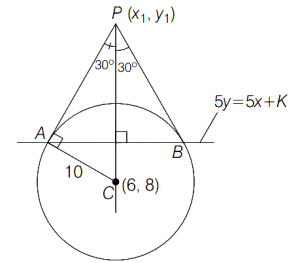
0 likesView Solution
150
MathematicsMediumMCQAP EAMCET · 2018
જો $P(x_1, y_1)$ એક એવું બિંદુ હોય કે જેથી તેમાંથી વર્તુળો $x^2+y^2-4x-6y-12=0$ અને $x^2+y^2+6x+18y+26=0$ પર દોરેલા સ્પર્શકોની લંબાઈનો ગુણોત્તર $2:3$ હોય,તો $P$ નો બિંદુપથ શોધો.
A
$5x^2+5y^2-60x-126y-212=0$
B
$x^2+y^2-24x+36y+62=0$
C
$5x^2+5y^2+60x+126y+212=0$
D
$x^2+y^2+24x+36y+62=0$
Solution
(A) ધારો કે વર્તુળોના સમીકરણો $S_1 \equiv x^2+y^2-4x-6y-12=0$ અને $S_2 \equiv x^2+y^2+6x+18y+26=0$ છે.
બિંદુ $P(x_1, y_1)$ માંથી વર્તુળ $S=0$ પરના સ્પર્શકની લંબાઈ $\sqrt{S}$ છે.
સ્પર્શકોની લંબાઈનો ગુણોત્તર $2:3$ આપેલ છે,તેથી:
$\frac{\sqrt{x_1^2+y_1^2-4x_1-6y_1-12}}{\sqrt{x_1^2+y_1^2+6x_1+18y_1+26}} = \frac{2}{3}$
બંને બાજુ વર્ગ કરતા:
$\frac{x_1^2+y_1^2-4x_1-6y_1-12}{x_1^2+y_1^2+6x_1+18y_1+26} = \frac{4}{9}$
ચોકડી ગુણાકાર કરતા:
$9(x_1^2+y_1^2-4x_1-6y_1-12) = 4(x_1^2+y_1^2+6x_1+18y_1+26)$
$9x_1^2+9y_1^2-36x_1-54y_1-108 = 4x_1^2+4y_1^2+24x_1+72y_1+104$
$5x_1^2+5y_1^2-60x_1-126y_1-212 = 0$
$(x_1, y_1)$ ને $(x, y)$ વડે બદલતા,બિંદુપથ $5x^2+5y^2-60x-126y-212=0$ મળે છે.
બિંદુ $P(x_1, y_1)$ માંથી વર્તુળ $S=0$ પરના સ્પર્શકની લંબાઈ $\sqrt{S}$ છે.
સ્પર્શકોની લંબાઈનો ગુણોત્તર $2:3$ આપેલ છે,તેથી:
$\frac{\sqrt{x_1^2+y_1^2-4x_1-6y_1-12}}{\sqrt{x_1^2+y_1^2+6x_1+18y_1+26}} = \frac{2}{3}$
બંને બાજુ વર્ગ કરતા:
$\frac{x_1^2+y_1^2-4x_1-6y_1-12}{x_1^2+y_1^2+6x_1+18y_1+26} = \frac{4}{9}$
ચોકડી ગુણાકાર કરતા:
$9(x_1^2+y_1^2-4x_1-6y_1-12) = 4(x_1^2+y_1^2+6x_1+18y_1+26)$
$9x_1^2+9y_1^2-36x_1-54y_1-108 = 4x_1^2+4y_1^2+24x_1+72y_1+104$
$5x_1^2+5y_1^2-60x_1-126y_1-212 = 0$
$(x_1, y_1)$ ને $(x, y)$ વડે બદલતા,બિંદુપથ $5x^2+5y^2-60x-126y-212=0$ મળે છે.
0 likesView Solution
151
MathematicsMediumMCQAP EAMCET · 2018
જો $g\left(\frac{t+1}{2 t+1}\right)=t+1$ હોય,તો $\int g(x) d x=$
A
$\frac{x^2}{2}+c$
B
$\log _e(2 x-1)+\frac{1}{2} \log _e|(x+1)|+c$
C
$\frac{1}{2} \log _e\left|\left(\frac{x+1}{2 x+1}\right)\right|+c$
D
$\frac{x}{2}+\frac{1}{4} \log _e|2 x-1|+c$
Solution
(D) આપેલ છે કે $g\left(\frac{t+1}{2 t+1}\right)=t+1$.
ધારો કે $x = \frac{t+1}{2 t+1}$.
તેથી $x(2t+1) = t+1 \Rightarrow 2tx + x = t+1 \Rightarrow t(2x-1) = 1-x$.
આમ,$t = \frac{1-x}{2x-1}$.
$g(x) = t+1$ માં $t$ ની કિંમત મૂકતા:
$g(x) = \frac{1-x}{2x-1} + 1 = \frac{1-x+2x-1}{2x-1} = \frac{x}{2x-1}$.
હવે,$\int g(x) dx = \int \frac{x}{2x-1} dx$.
$= \frac{1}{2} \int \frac{2x}{2x-1} dx = \frac{1}{2} \int \frac{2x-1+1}{2x-1} dx$.
$= \frac{1}{2} \int \left(1 + \frac{1}{2x-1}\right) dx$.
$= \frac{1}{2} \left(x + \frac{1}{2} \log _e|2x-1|\right) + C$.
$= \frac{x}{2} + \frac{1}{4} \log _e|2x-1| + C$.
ધારો કે $x = \frac{t+1}{2 t+1}$.
તેથી $x(2t+1) = t+1 \Rightarrow 2tx + x = t+1 \Rightarrow t(2x-1) = 1-x$.
આમ,$t = \frac{1-x}{2x-1}$.
$g(x) = t+1$ માં $t$ ની કિંમત મૂકતા:
$g(x) = \frac{1-x}{2x-1} + 1 = \frac{1-x+2x-1}{2x-1} = \frac{x}{2x-1}$.
હવે,$\int g(x) dx = \int \frac{x}{2x-1} dx$.
$= \frac{1}{2} \int \frac{2x}{2x-1} dx = \frac{1}{2} \int \frac{2x-1+1}{2x-1} dx$.
$= \frac{1}{2} \int \left(1 + \frac{1}{2x-1}\right) dx$.
$= \frac{1}{2} \left(x + \frac{1}{2} \log _e|2x-1|\right) + C$.
$= \frac{x}{2} + \frac{1}{4} \log _e|2x-1| + C$.
0 likesView Solution
152
MathematicsEasyMCQAP EAMCET · 2018
$\int \frac{x^4+1}{1+x^6} dx =$
A
$\tan^{-1}(x^3) + \tan^{-1} x + c$
B
$\frac{1}{3} \tan^{-1} x + \tan^{-1} x^3 + c$
C
$3 \tan^{-1} x^3 + \tan^{-1} x + c$
D
$\tan^{-1} x + \frac{1}{3} \tan^{-1} x^3 + c$
Solution
(D) આપણે સંકલન $I = \int \frac{x^4+1}{1+x^6} dx$ ની કિંમત શોધવાની છે.
અંશને $x^4+1 = (x^4 - x^2 + 1) + x^2$ તરીકે વિભાજિત કરો.
તેથી,$I = \int \frac{x^4 - x^2 + 1}{1+x^6} dx + \int \frac{x^2}{1+x^6} dx$.
ધારો કે $I_1 = \int \frac{x^4 - x^2 + 1}{1+(x^2)^3} dx$ અને $I_2 = \int \frac{x^2}{1+(x^3)^2} dx$.
$I_1$ માટે,નિત્યસમ $a^3+b^3 = (a+b)(a^2-ab+b^2)$ નો ઉપયોગ કરો:
$I_1 = \int \frac{x^4 - x^2 + 1}{(1+x^2)(x^4 - x^2 + 1)} dx = \int \frac{1}{1+x^2} dx = \tan^{-1} x$.
$I_2$ માટે,$x^3 = t$ લો,તો $3x^2 dx = dt$,તેથી $x^2 dx = \frac{dt}{3}$:
$I_2 = \int \frac{1}{1+t^2} \cdot \frac{dt}{3} = \frac{1}{3} \tan^{-1} t = \frac{1}{3} \tan^{-1} (x^3)$.
આ બંનેને જોડતા,$I = I_1 + I_2 = \tan^{-1} x + \frac{1}{3} \tan^{-1} (x^3) + C$.
અંશને $x^4+1 = (x^4 - x^2 + 1) + x^2$ તરીકે વિભાજિત કરો.
તેથી,$I = \int \frac{x^4 - x^2 + 1}{1+x^6} dx + \int \frac{x^2}{1+x^6} dx$.
ધારો કે $I_1 = \int \frac{x^4 - x^2 + 1}{1+(x^2)^3} dx$ અને $I_2 = \int \frac{x^2}{1+(x^3)^2} dx$.
$I_1$ માટે,નિત્યસમ $a^3+b^3 = (a+b)(a^2-ab+b^2)$ નો ઉપયોગ કરો:
$I_1 = \int \frac{x^4 - x^2 + 1}{(1+x^2)(x^4 - x^2 + 1)} dx = \int \frac{1}{1+x^2} dx = \tan^{-1} x$.
$I_2$ માટે,$x^3 = t$ લો,તો $3x^2 dx = dt$,તેથી $x^2 dx = \frac{dt}{3}$:
$I_2 = \int \frac{1}{1+t^2} \cdot \frac{dt}{3} = \frac{1}{3} \tan^{-1} t = \frac{1}{3} \tan^{-1} (x^3)$.
આ બંનેને જોડતા,$I = I_1 + I_2 = \tan^{-1} x + \frac{1}{3} \tan^{-1} (x^3) + C$.
0 likesView Solution
153
MathematicsMediumMCQAP EAMCET · 2018
જો $\int \frac{x^{\frac{1}{2}}}{\sqrt{a^3-x^3}} dx = P(x) + c$ હોય,તો $P(x) =$
A
$\frac{1}{3} \sin^{-1}\left(\frac{x^3}{a^3}\right)$
B
$\frac{2}{3} \cos^{-1}\left(\frac{x}{a}\right)$
C
$\frac{2}{3} \sin^{-1}\left(\left(\frac{x}{a}\right)^{\frac{3}{2}}\right)$
D
$\frac{2}{3} \sin^{-1}\left(\left(\frac{x}{a}\right)^{\frac{1}{2}}\right)$
Solution
(C) ધારો કે $I = \int \frac{x^{\frac{1}{2}}}{\sqrt{a^3-x^3}} dx$.
$t = x^{\frac{3}{2}}$ આદેશ લેતા,$dt = \frac{3}{2} x^{\frac{1}{2}} dx$ મળે,જેનો અર્થ છે કે $x^{\frac{1}{2}} dx = \frac{2}{3} dt$.
વળી,$t^2 = (x^{\frac{3}{2}})^2 = x^3$.
આ કિંમતો સંકલનમાં મૂકતા:
$I = \int \frac{\frac{2}{3} dt}{\sqrt{a^3 - t^2}} = \frac{2}{3} \int \frac{dt}{\sqrt{(\sqrt{a^3})^2 - t^2}}$.
પ્રમાણિત સંકલન સૂત્ર $\int \frac{du}{\sqrt{A^2 - u^2}} = \sin^{-1}(\frac{u}{A}) + c$ નો ઉપયોગ કરતા:
$I = \frac{2}{3} \sin^{-1}\left(\frac{t}{\sqrt{a^3}}\right) + c$.
$t = x^{\frac{3}{2}}$ પાછું મૂકતા:
$I = \frac{2}{3} \sin^{-1}\left(\frac{x^{\frac{3}{2}}}{a^{\frac{3}{2}}}\right) + c = \frac{2}{3} \sin^{-1}\left(\left(\frac{x}{a}\right)^{\frac{3}{2}}\right) + c$.
આમ,$P(x) = \frac{2}{3} \sin^{-1}\left(\left(\frac{x}{a}\right)^{\frac{3}{2}}\right)$.
$t = x^{\frac{3}{2}}$ આદેશ લેતા,$dt = \frac{3}{2} x^{\frac{1}{2}} dx$ મળે,જેનો અર્થ છે કે $x^{\frac{1}{2}} dx = \frac{2}{3} dt$.
વળી,$t^2 = (x^{\frac{3}{2}})^2 = x^3$.
આ કિંમતો સંકલનમાં મૂકતા:
$I = \int \frac{\frac{2}{3} dt}{\sqrt{a^3 - t^2}} = \frac{2}{3} \int \frac{dt}{\sqrt{(\sqrt{a^3})^2 - t^2}}$.
પ્રમાણિત સંકલન સૂત્ર $\int \frac{du}{\sqrt{A^2 - u^2}} = \sin^{-1}(\frac{u}{A}) + c$ નો ઉપયોગ કરતા:
$I = \frac{2}{3} \sin^{-1}\left(\frac{t}{\sqrt{a^3}}\right) + c$.
$t = x^{\frac{3}{2}}$ પાછું મૂકતા:
$I = \frac{2}{3} \sin^{-1}\left(\frac{x^{\frac{3}{2}}}{a^{\frac{3}{2}}}\right) + c = \frac{2}{3} \sin^{-1}\left(\left(\frac{x}{a}\right)^{\frac{3}{2}}\right) + c$.
આમ,$P(x) = \frac{2}{3} \sin^{-1}\left(\left(\frac{x}{a}\right)^{\frac{3}{2}}\right)$.
0 likesView Solution
154
MathematicsDifficultMCQAP EAMCET · 2018
સંકલન શોધો: $\int \operatorname{Tan}^{-1}\left(x^{\frac{1}{3}}\right) d x$
A
$\frac{1}{2} \log \left(1+x^{\frac{2}{3}}\right)-\frac{1}{2} x^{\frac{2}{3}}+c$
B
$x \operatorname{Tan}^{-1}\left(x^{\frac{1}{3}}\right)-\frac{1}{2} x^{\frac{2}{3}}+c$
C
$\frac{1}{2} \log \left(1+x^{\frac{1}{3}}\right)-\frac{1}{2} x^{\frac{2}{3}}+c$
D
$x \operatorname{Tan}^{-1}\left(x^{\frac{1}{3}}\right)+\frac{1}{2} \log \left(1+x^{\frac{2}{3}}\right)-\frac{1}{2} x^{\frac{2}{3}}+c$
Solution
(D) ધારો કે $I = \int \operatorname{Tan}^{-1}\left(x^{\frac{1}{3}}\right) d x$.
$x = t^3$ આદેશ લેતા,$dx = 3t^2 dt$ મળે.
$I = \int \operatorname{Tan}^{-1}(t) \cdot 3t^2 dt = 3 \int t^2 \operatorname{Tan}^{-1}(t) dt$.
ખંડશઃ સંકલનનો ઉપયોગ કરતા,$u = \operatorname{Tan}^{-1}(t)$ અને $dv = t^2 dt$ લેતા,
$du = \frac{1}{1+t^2} dt$ અને $v = \frac{t^3}{3}$ મળે.
$I = 3 \left[ \frac{t^3}{3} \operatorname{Tan}^{-1}(t) - \int \frac{t^3}{3(1+t^2)} dt \right] = t^3 \operatorname{Tan}^{-1}(t) - \int \frac{t^3}{1+t^2} dt$.
$\frac{t^3}{1+t^2} = \frac{t(t^2+1)-t}{1+t^2} = t - \frac{t}{1+t^2}$ હોવાથી,
$I = t^3 \operatorname{Tan}^{-1}(t) - \int \left( t - \frac{t}{1+t^2} \right) dt = t^3 \operatorname{Tan}^{-1}(t) - \frac{t^2}{2} + \frac{1}{2} \log(1+t^2) + c$.
$t = x^{\frac{1}{3}}$ મૂકતા,$I = x \operatorname{Tan}^{-1}(x^{\frac{1}{3}}) - \frac{1}{2} x^{\frac{2}{3}} + \frac{1}{2} \log(1+x^{\frac{2}{3}}) + c$ મળે.
$x = t^3$ આદેશ લેતા,$dx = 3t^2 dt$ મળે.
$I = \int \operatorname{Tan}^{-1}(t) \cdot 3t^2 dt = 3 \int t^2 \operatorname{Tan}^{-1}(t) dt$.
ખંડશઃ સંકલનનો ઉપયોગ કરતા,$u = \operatorname{Tan}^{-1}(t)$ અને $dv = t^2 dt$ લેતા,
$du = \frac{1}{1+t^2} dt$ અને $v = \frac{t^3}{3}$ મળે.
$I = 3 \left[ \frac{t^3}{3} \operatorname{Tan}^{-1}(t) - \int \frac{t^3}{3(1+t^2)} dt \right] = t^3 \operatorname{Tan}^{-1}(t) - \int \frac{t^3}{1+t^2} dt$.
$\frac{t^3}{1+t^2} = \frac{t(t^2+1)-t}{1+t^2} = t - \frac{t}{1+t^2}$ હોવાથી,
$I = t^3 \operatorname{Tan}^{-1}(t) - \int \left( t - \frac{t}{1+t^2} \right) dt = t^3 \operatorname{Tan}^{-1}(t) - \frac{t^2}{2} + \frac{1}{2} \log(1+t^2) + c$.
$t = x^{\frac{1}{3}}$ મૂકતા,$I = x \operatorname{Tan}^{-1}(x^{\frac{1}{3}}) - \frac{1}{2} x^{\frac{2}{3}} + \frac{1}{2} \log(1+x^{\frac{2}{3}}) + c$ મળે.
0 likesView Solution
155
MathematicsMediumMCQAP EAMCET · 2018
$\int \frac{\cos^3 x + \cos^5 x}{\sin^2 x + \sin^4 x} dx =$
A
$\sin x - 6 \tan^{-1}(\sin x) + c$
B
$\sin x - 2(\sin x)^{-1} + c$
C
$\sin x - 2(\sin x)^{-1} - 6 \tan^{-1}(\sin x) + c$
D
$\sin x - 2(\sin x)^{-1} + 5 \tan^{-1}(\sin x) + c$
Solution
(C) ધારો કે $I = \int \frac{\cos^3 x + \cos^5 x}{\sin^2 x + \sin^4 x} dx$.
$= \int \frac{\cos^3 x (1 + \cos^2 x)}{\sin^2 x (1 + \sin^2 x)} dx$
$= \int \frac{\cos^2 x (1 + \cos^2 x)}{\sin^2 x (1 + \sin^2 x)} \cos x dx$
$= \int \frac{(1 - \sin^2 x) (1 + 1 - \sin^2 x)}{\sin^2 x (1 + \sin^2 x)} \cos x dx$
$= \int \frac{(1 - \sin^2 x) (2 - \sin^2 x)}{\sin^2 x (1 + \sin^2 x)} \cos x dx$.
ધારો કે $\sin x = t$,તેથી $\cos x dx = dt$.
$I = \int \frac{(1 - t^2) (2 - t^2)}{t^2 (1 + t^2)} dt$
$= \int \frac{t^4 - 3t^2 + 2}{t^2 (1 + t^2)} dt$
$= \int \frac{t^2(t^2 + 1) - 4t^2 + 2}{t^2 (1 + t^2)} dt$
$= \int \left( 1 + \frac{2 - 4t^2}{t^2 (1 + t^2)} \right) dt$
$= \int 1 dt + \int \left( \frac{2}{t^2} - \frac{6}{1 + t^2} \right) dt$
$= t - \frac{2}{t} - 6 \tan^{-1} t + c$
$= \sin x - 2(\sin x)^{-1} - 6 \tan^{-1} (\sin x) + c$.
$= \int \frac{\cos^3 x (1 + \cos^2 x)}{\sin^2 x (1 + \sin^2 x)} dx$
$= \int \frac{\cos^2 x (1 + \cos^2 x)}{\sin^2 x (1 + \sin^2 x)} \cos x dx$
$= \int \frac{(1 - \sin^2 x) (1 + 1 - \sin^2 x)}{\sin^2 x (1 + \sin^2 x)} \cos x dx$
$= \int \frac{(1 - \sin^2 x) (2 - \sin^2 x)}{\sin^2 x (1 + \sin^2 x)} \cos x dx$.
ધારો કે $\sin x = t$,તેથી $\cos x dx = dt$.
$I = \int \frac{(1 - t^2) (2 - t^2)}{t^2 (1 + t^2)} dt$
$= \int \frac{t^4 - 3t^2 + 2}{t^2 (1 + t^2)} dt$
$= \int \frac{t^2(t^2 + 1) - 4t^2 + 2}{t^2 (1 + t^2)} dt$
$= \int \left( 1 + \frac{2 - 4t^2}{t^2 (1 + t^2)} \right) dt$
$= \int 1 dt + \int \left( \frac{2}{t^2} - \frac{6}{1 + t^2} \right) dt$
$= t - \frac{2}{t} - 6 \tan^{-1} t + c$
$= \sin x - 2(\sin x)^{-1} - 6 \tan^{-1} (\sin x) + c$.
0 likesView Solution
156
MathematicsMediumMCQAP EAMCET · 2018
$\int \frac{dx}{\tan x + \cot x + \sec x + \csc x} =$
A
$\frac{1}{2} (\sin x - \cos x + x) + c$
B
$\frac{1}{2} (\sin x - \cos x - x) + c$
C
$\frac{1}{2} (\sin x - \cos x - \tan x + \cot x) + c$
D
$\frac{1}{2} (\sin x + \cos x - \tan x - \cot x) + c$
Solution
(B) ધારો કે $I = \int \frac{dx}{\tan x + \cot x + \sec x + \csc x}$.
$= \int \frac{dx}{\left(\frac{\sin x}{\cos x} + \frac{\cos x}{\sin x} + \frac{1}{\cos x} + \frac{1}{\sin x}\right)}$
$= \int \frac{\sin x \cos x}{\sin^{2} x + \cos^{2} x + \sin x + \cos x} dx$
$= \int \frac{\sin x \cos x}{1 + \sin x + \cos x} dx$
અંશ અને છેદને $(\sin x + \cos x - 1)$ વડે ગુણતા:
$= \int \frac{\sin x \cos x (\sin x + \cos x - 1)}{(\sin x + \cos x)^{2} - 1} dx$
$= \int \frac{\sin x \cos x (\sin x + \cos x - 1)}{\sin^{2} x + \cos^{2} x + 2 \sin x \cos x - 1} dx$
$= \int \frac{\sin x \cos x (\sin x + \cos x - 1)}{2 \sin x \cos x} dx$
$= \frac{1}{2} \int (\sin x + \cos x - 1) dx$
$= \frac{1}{2} (-\cos x + \sin x - x) + c$.
$= \int \frac{dx}{\left(\frac{\sin x}{\cos x} + \frac{\cos x}{\sin x} + \frac{1}{\cos x} + \frac{1}{\sin x}\right)}$
$= \int \frac{\sin x \cos x}{\sin^{2} x + \cos^{2} x + \sin x + \cos x} dx$
$= \int \frac{\sin x \cos x}{1 + \sin x + \cos x} dx$
અંશ અને છેદને $(\sin x + \cos x - 1)$ વડે ગુણતા:
$= \int \frac{\sin x \cos x (\sin x + \cos x - 1)}{(\sin x + \cos x)^{2} - 1} dx$
$= \int \frac{\sin x \cos x (\sin x + \cos x - 1)}{\sin^{2} x + \cos^{2} x + 2 \sin x \cos x - 1} dx$
$= \int \frac{\sin x \cos x (\sin x + \cos x - 1)}{2 \sin x \cos x} dx$
$= \frac{1}{2} \int (\sin x + \cos x - 1) dx$
$= \frac{1}{2} (-\cos x + \sin x - x) + c$.
0 likesView Solution
157
MathematicsMediumMCQAP EAMCET · 2018
જો $f(x) = \int \csc^5 x \ dx$ હોય,તો $f(\frac{\pi}{4}) = $
A
$-\frac{1}{4} [3\sqrt{2} - 5\log(\sqrt{2} + 1)] + c$
B
$-\frac{1}{8} [5\sqrt{2} - 3\log(\sqrt{2} + 1)] + c$
C
$-\frac{1}{8} [7\sqrt{2} + 3\log(\sqrt{2} + 1)] + c$
D
$\frac{1}{8} [5\sqrt{2} + \log(\sqrt{2} + 1)] + c$
Solution
(C) આપણી પાસે $f(x) = \int \csc^5 x \ dx$ છે. $\int \csc^n x \ dx$ માટેના રિડક્શન સૂત્રનો ઉપયોગ કરતા,આપણે જાણીએ છીએ કે $\int \csc^n x \ dx = -\frac{\csc^{n-2} x \cot x}{n-1} + \frac{n-2}{n-1} \int \csc^{n-2} x \ dx$.
$n=5$ માટે,આપણને $f(x) = -\frac{\csc^3 x \cot x}{4} + \frac{3}{4} \int \csc^3 x \ dx$ મળે છે.
આપણે જાણીએ છીએ કે $\int \csc^3 x \ dx = -\frac{1}{2} \csc x \cot x + \frac{1}{2} \log |\csc x - \cot x| + C$.
આ કિંમત પાછી મૂકતા,$f(x) = -\frac{1}{4} \csc^3 x \cot x + \frac{3}{4} [-\frac{1}{2} \csc x \cot x + \frac{1}{2} \log |\csc x - \cot x|] + c$.
$f(x) = -\frac{1}{4} \csc^3 x \cot x - \frac{3}{8} \csc x \cot x + \frac{3}{8} \log |\csc x - \cot x| + c$.
$x = \frac{\pi}{4}$ પર,$\csc(\frac{\pi}{4}) = \sqrt{2}$ અને $\cot(\frac{\pi}{4}) = 1$ થાય.
$f(\frac{\pi}{4}) = -\frac{1}{4} (\sqrt{2})^3 (1) - \frac{3}{8} (\sqrt{2})(1) + \frac{3}{8} \log |\sqrt{2} - 1| + c$.
$f(\frac{\pi}{4}) = -\frac{2\sqrt{2}}{4} - \frac{3\sqrt{2}}{8} + \frac{3}{8} \log |\sqrt{2} - 1| + c$.
$f(\frac{\pi}{4}) = -\frac{4\sqrt{2}}{8} - \frac{3\sqrt{2}}{8} + \frac{3}{8} \log |\frac{(\sqrt{2}-1)(\sqrt{2}+1)}{\sqrt{2}+1}| + c$.
$f(\frac{\pi}{4}) = -\frac{7\sqrt{2}}{8} + \frac{3}{8} \log |\frac{1}{\sqrt{2}+1}| + c = -\frac{7\sqrt{2}}{8} - \frac{3}{8} \log(\sqrt{2}+1) + c$.
$f(\frac{\pi}{4}) = -\frac{1}{8} [7\sqrt{2} + 3 \log(\sqrt{2} + 1)] + c$.
$n=5$ માટે,આપણને $f(x) = -\frac{\csc^3 x \cot x}{4} + \frac{3}{4} \int \csc^3 x \ dx$ મળે છે.
આપણે જાણીએ છીએ કે $\int \csc^3 x \ dx = -\frac{1}{2} \csc x \cot x + \frac{1}{2} \log |\csc x - \cot x| + C$.
આ કિંમત પાછી મૂકતા,$f(x) = -\frac{1}{4} \csc^3 x \cot x + \frac{3}{4} [-\frac{1}{2} \csc x \cot x + \frac{1}{2} \log |\csc x - \cot x|] + c$.
$f(x) = -\frac{1}{4} \csc^3 x \cot x - \frac{3}{8} \csc x \cot x + \frac{3}{8} \log |\csc x - \cot x| + c$.
$x = \frac{\pi}{4}$ પર,$\csc(\frac{\pi}{4}) = \sqrt{2}$ અને $\cot(\frac{\pi}{4}) = 1$ થાય.
$f(\frac{\pi}{4}) = -\frac{1}{4} (\sqrt{2})^3 (1) - \frac{3}{8} (\sqrt{2})(1) + \frac{3}{8} \log |\sqrt{2} - 1| + c$.
$f(\frac{\pi}{4}) = -\frac{2\sqrt{2}}{4} - \frac{3\sqrt{2}}{8} + \frac{3}{8} \log |\sqrt{2} - 1| + c$.
$f(\frac{\pi}{4}) = -\frac{4\sqrt{2}}{8} - \frac{3\sqrt{2}}{8} + \frac{3}{8} \log |\frac{(\sqrt{2}-1)(\sqrt{2}+1)}{\sqrt{2}+1}| + c$.
$f(\frac{\pi}{4}) = -\frac{7\sqrt{2}}{8} + \frac{3}{8} \log |\frac{1}{\sqrt{2}+1}| + c = -\frac{7\sqrt{2}}{8} - \frac{3}{8} \log(\sqrt{2}+1) + c$.
$f(\frac{\pi}{4}) = -\frac{1}{8} [7\sqrt{2} + 3 \log(\sqrt{2} + 1)] + c$.
0 likesView Solution
158
MathematicsMediumMCQAP EAMCET · 2018
જો $f(x) = \int \operatorname{cosec}^5 x \, dx$ હોય,તો $f\left(\frac{\pi}{4}\right) = $
A
$-\frac{1}{4}[3 \sqrt{2} - 5 \log (\sqrt{2} + 1)] + c$
B
$-\frac{1}{8}[5 \sqrt{2} - 3 \log (\sqrt{2} + 1)] + c$
C
$-\frac{1}{8}[7 \sqrt{2} + 3 \log (\sqrt{2} + 1)] + c$
D
$\frac{1}{8}[5 \sqrt{2} + \log (\sqrt{2} + 1)] + c$
Solution
(C) આપણે $\int \operatorname{cosec}^n x \, dx = -\frac{\operatorname{cosec}^{n-2} x \cot x}{n-1} + \frac{n-2}{n-1} \int \operatorname{cosec}^{n-2} x \, dx$ માટે રિડક્શન ફોર્મ્યુલાનો ઉપયોગ કરીએ છીએ.
$n=5$ માટે,$\int \operatorname{cosec}^5 x \, dx = -\frac{\operatorname{cosec}^3 x \cot x}{4} + \frac{3}{4} \int \operatorname{cosec}^3 x \, dx$.
$n=3$ માટે,$\int \operatorname{cosec}^3 x \, dx = -\frac{\operatorname{cosec} x \cot x}{2} + \frac{1}{2} \log |\operatorname{cosec} x - \cot x| = -\frac{\operatorname{cosec} x \cot x}{2} + \frac{1}{2} \log |\operatorname{cosec} x - \cot x|$.
આ કિંમત પાછી મૂકતા,$f(x) = -\frac{\operatorname{cosec}^3 x \cot x}{4} + \frac{3}{4} \left( -\frac{\operatorname{cosec} x \cot x}{2} + \frac{1}{2} \log |\operatorname{cosec} x - \cot x| \right) + c$.
$f(x) = -\frac{1}{4} \operatorname{cosec}^3 x \cot x - \frac{3}{8} \operatorname{cosec} x \cot x + \frac{3}{8} \log |\operatorname{cosec} x - \cot x| + c$.
$x = \frac{\pi}{4}$ પર,$\operatorname{cosec} x = \sqrt{2}$ અને $\cot x = 1$.
$f\left(\frac{\pi}{4}\right) = -\frac{1}{4} (\sqrt{2})^3 (1) - \frac{3}{8} (\sqrt{2}) (1) + \frac{3}{8} \log |\sqrt{2} - 1| + c$.
$f\left(\frac{\pi}{4}\right) = -\frac{2\sqrt{2}}{4} - \frac{3\sqrt{2}}{8} + \frac{3}{8} \log (\sqrt{2} - 1) + c$.
$f\left(\frac{\pi}{4}\right) = -\frac{4\sqrt{2} + 3\sqrt{2}}{8} - \frac{3}{8} \log (\sqrt{2} + 1) + c = -\frac{1}{8} [7\sqrt{2} + 3 \log (\sqrt{2} + 1)] + c$.
$n=5$ માટે,$\int \operatorname{cosec}^5 x \, dx = -\frac{\operatorname{cosec}^3 x \cot x}{4} + \frac{3}{4} \int \operatorname{cosec}^3 x \, dx$.
$n=3$ માટે,$\int \operatorname{cosec}^3 x \, dx = -\frac{\operatorname{cosec} x \cot x}{2} + \frac{1}{2} \log |\operatorname{cosec} x - \cot x| = -\frac{\operatorname{cosec} x \cot x}{2} + \frac{1}{2} \log |\operatorname{cosec} x - \cot x|$.
આ કિંમત પાછી મૂકતા,$f(x) = -\frac{\operatorname{cosec}^3 x \cot x}{4} + \frac{3}{4} \left( -\frac{\operatorname{cosec} x \cot x}{2} + \frac{1}{2} \log |\operatorname{cosec} x - \cot x| \right) + c$.
$f(x) = -\frac{1}{4} \operatorname{cosec}^3 x \cot x - \frac{3}{8} \operatorname{cosec} x \cot x + \frac{3}{8} \log |\operatorname{cosec} x - \cot x| + c$.
$x = \frac{\pi}{4}$ પર,$\operatorname{cosec} x = \sqrt{2}$ અને $\cot x = 1$.
$f\left(\frac{\pi}{4}\right) = -\frac{1}{4} (\sqrt{2})^3 (1) - \frac{3}{8} (\sqrt{2}) (1) + \frac{3}{8} \log |\sqrt{2} - 1| + c$.
$f\left(\frac{\pi}{4}\right) = -\frac{2\sqrt{2}}{4} - \frac{3\sqrt{2}}{8} + \frac{3}{8} \log (\sqrt{2} - 1) + c$.
$f\left(\frac{\pi}{4}\right) = -\frac{4\sqrt{2} + 3\sqrt{2}}{8} - \frac{3}{8} \log (\sqrt{2} + 1) + c = -\frac{1}{8} [7\sqrt{2} + 3 \log (\sqrt{2} + 1)] + c$.
0 likesView Solution
159
MathematicsMediumMCQAP EAMCET · 2018
$\int (\log x)^3 x^5 dx = $
A
$x^6 \left[ \frac{(\log x)^3}{6} - \frac{(\log x)^2}{12} + \frac{\log x}{36} - \frac{1}{216} \right] + c$
B
$x^6 \left[ \frac{(\log x)^3}{6} - \frac{(\log x)^2}{12} + \frac{\log x}{72} - \frac{1}{216} \right] + c$
C
$x^6 \left[ \frac{(\log x)^3}{6} + \frac{(\log x)^2}{12} - \frac{\log x}{36} + \frac{1}{216} \right] + c$
D
$x^6 \left[ \frac{(\log x)^3}{6} - \frac{(\log x)^2}{6} + \frac{\log x}{36} - \frac{1}{216} \right] + c$
Solution
(A) ધારો કે $I = \int (\log x)^3 x^5 dx$. ખંડશઃ સંકલનનો ઉપયોગ કરતા $\int u v dx = u \int v dx - \int (u' \int v dx) dx$,જ્યાં $u = (\log x)^3$ અને $v = x^5$.
$I = (\log x)^3 \frac{x^6}{6} - \int 3(\log x)^2 \frac{1}{x} \frac{x^6}{6} dx = \frac{x^6}{6}(\log x)^3 - \frac{1}{2} \int x^5 (\log x)^2 dx$.
$\int x^5 (\log x)^2 dx$ માટે ફરીથી ખંડશઃ સંકલન કરતા:
$I = \frac{x^6}{6}(\log x)^3 - \frac{1}{2} \left[ (\log x)^2 \frac{x^6}{6} - \int 2(\log x) \frac{1}{x} \frac{x^6}{6} dx \right] = \frac{x^6}{6}(\log x)^3 - \frac{x^6}{12}(\log x)^2 + \frac{1}{6} \int x^5 \log x dx$.
$\int x^5 \log x dx$ માટે ફરીથી ખંડશઃ સંકલન કરતા:
$I = \frac{x^6}{6}(\log x)^3 - \frac{x^6}{12}(\log x)^2 + \frac{1}{6} \left[ \log x \frac{x^6}{6} - \int \frac{1}{x} \frac{x^6}{6} dx \right] = \frac{x^6}{6}(\log x)^3 - \frac{x^6}{12}(\log x)^2 + \frac{x^6}{36} \log x - \frac{1}{36} \int x^5 dx$.
$I = \frac{x^6}{6}(\log x)^3 - \frac{x^6}{12}(\log x)^2 + \frac{x^6}{36} \log x - \frac{1}{36} \frac{x^6}{6} + c = x^6 \left[ \frac{(\log x)^3}{6} - \frac{(\log x)^2}{12} + \frac{\log x}{36} - \frac{1}{216} \right] + c$.
$I = (\log x)^3 \frac{x^6}{6} - \int 3(\log x)^2 \frac{1}{x} \frac{x^6}{6} dx = \frac{x^6}{6}(\log x)^3 - \frac{1}{2} \int x^5 (\log x)^2 dx$.
$\int x^5 (\log x)^2 dx$ માટે ફરીથી ખંડશઃ સંકલન કરતા:
$I = \frac{x^6}{6}(\log x)^3 - \frac{1}{2} \left[ (\log x)^2 \frac{x^6}{6} - \int 2(\log x) \frac{1}{x} \frac{x^6}{6} dx \right] = \frac{x^6}{6}(\log x)^3 - \frac{x^6}{12}(\log x)^2 + \frac{1}{6} \int x^5 \log x dx$.
$\int x^5 \log x dx$ માટે ફરીથી ખંડશઃ સંકલન કરતા:
$I = \frac{x^6}{6}(\log x)^3 - \frac{x^6}{12}(\log x)^2 + \frac{1}{6} \left[ \log x \frac{x^6}{6} - \int \frac{1}{x} \frac{x^6}{6} dx \right] = \frac{x^6}{6}(\log x)^3 - \frac{x^6}{12}(\log x)^2 + \frac{x^6}{36} \log x - \frac{1}{36} \int x^5 dx$.
$I = \frac{x^6}{6}(\log x)^3 - \frac{x^6}{12}(\log x)^2 + \frac{x^6}{36} \log x - \frac{1}{36} \frac{x^6}{6} + c = x^6 \left[ \frac{(\log x)^3}{6} - \frac{(\log x)^2}{12} + \frac{\log x}{36} - \frac{1}{216} \right] + c$.
0 likesView Solution
160
MathematicsMediumMCQAP EAMCET · 2018
કોઈપણ પૂર્ણાંક $n \geq 2$ માટે,જો $I_n = \int \cot^n x \, dx$ હોય,તો $I_5 =$
A
$\frac{-\cot^4 x}{4} + \frac{\cot^2 x}{2} + \log |\sin x| + c$
B
$\frac{-\cot^4 x}{4} + \frac{\cot^2 x}{2} - \log |\sin x| + c$
C
$\frac{\cot^4 x}{4} + \frac{\cot^2 x}{2} + \log |\cos x| + c$
D
$\frac{\cot^4 x}{4} - \frac{\cot^2 x}{2} - \cot x + c$
Solution
(A) આપણને $I_n = \int \cot^n x \, dx$ આપેલ છે.
$n=5$ માટે,$I_5 = \int \cot^5 x \, dx$.
આપણે $\cot^5 x = \cot^3 x \cdot \cot^2 x = \cot^3 x (\csc^2 x - 1) = \cot^3 x \csc^2 x - \cot^3 x$ લખી શકીએ.
તેથી,$I_5 = \int \cot^3 x \csc^2 x \, dx - \int \cot^3 x \, dx$.
ધારો કે $u = \cot x$,તો $du = -\csc^2 x \, dx$,તેથી $\int \cot^3 x \csc^2 x \, dx = -\int u^3 \, du = -\frac{u^4}{4} = -\frac{\cot^4 x}{4}$.
હવે,$\int \cot^3 x \, dx = \int \cot x (\csc^2 x - 1) \, dx = \int \cot x \csc^2 x \, dx - \int \cot x \, dx$.
$\int \cot x \csc^2 x \, dx = -\frac{\cot^2 x}{2}$ અને $\int \cot x \, dx = \log |\sin x|$.
આમ,$\int \cot^3 x \, dx = -\frac{\cot^2 x}{2} - \log |\sin x|$.
આ કિંમતો મૂકતા,$I_5 = -\frac{\cot^4 x}{4} - (-\frac{\cot^2 x}{2} - \log |\sin x|) + c = -\frac{\cot^4 x}{4} + \frac{\cot^2 x}{2} + \log |\sin x| + c$.
$n=5$ માટે,$I_5 = \int \cot^5 x \, dx$.
આપણે $\cot^5 x = \cot^3 x \cdot \cot^2 x = \cot^3 x (\csc^2 x - 1) = \cot^3 x \csc^2 x - \cot^3 x$ લખી શકીએ.
તેથી,$I_5 = \int \cot^3 x \csc^2 x \, dx - \int \cot^3 x \, dx$.
ધારો કે $u = \cot x$,તો $du = -\csc^2 x \, dx$,તેથી $\int \cot^3 x \csc^2 x \, dx = -\int u^3 \, du = -\frac{u^4}{4} = -\frac{\cot^4 x}{4}$.
હવે,$\int \cot^3 x \, dx = \int \cot x (\csc^2 x - 1) \, dx = \int \cot x \csc^2 x \, dx - \int \cot x \, dx$.
$\int \cot x \csc^2 x \, dx = -\frac{\cot^2 x}{2}$ અને $\int \cot x \, dx = \log |\sin x|$.
આમ,$\int \cot^3 x \, dx = -\frac{\cot^2 x}{2} - \log |\sin x|$.
આ કિંમતો મૂકતા,$I_5 = -\frac{\cot^4 x}{4} - (-\frac{\cot^2 x}{2} - \log |\sin x|) + c = -\frac{\cot^4 x}{4} + \frac{\cot^2 x}{2} + \log |\sin x| + c$.
0 likesView Solution
161
MathematicsMediumMCQAP EAMCET · 2018
$\int \frac{x}{x^3-3 x+2} d x=$
A
$\frac{2}{9} \log \left|\frac{x-1}{x+2}\right|+c$
B
$\frac{2}{9} \log \left|\frac{x+2}{x-1}\right|+c$
C
$\frac{1}{3} \frac{1}{x-1}+\frac{2}{9} \log \left|\frac{x-1}{x+2}\right|+c$
D
$-\frac{1}{3} \frac{1}{(x-1)}+\frac{2}{9} \log \left|\frac{x-1}{x+2}\right|+c$
Solution
(D) સૌ પ્રથમ,છેદના અવયવો પાડો: $x^3-3x+2 = (x-1)^2(x+2)$.
આંશિક અપૂર્ણાંકની રીતનો ઉપયોગ કરતા: $\frac{x}{(x-1)^2(x+2)} = \frac{A}{x-1} + \frac{B}{(x-1)^2} + \frac{C}{x+2}$.
$(x-1)^2(x+2)$ વડે ગુણતા: $x = A(x-1)(x+2) + B(x+2) + C(x-1)^2$.
$x=1$ લેતા: $1 = B(3) \Rightarrow B = \frac{1}{3}$.
$x=-2$ લેતા: $-2 = C(-3)^2 \Rightarrow -2 = 9C \Rightarrow C = -\frac{2}{9}$.
$x^2$ ના સહગુણકોની સરખામણી કરતા: $0 = A + C \Rightarrow A = -C = \frac{2}{9}$.
આમ,સંકલન થશે: $\int \left( \frac{2/9}{x-1} + \frac{1/3}{(x-1)^2} - \frac{2/9}{x+2} \right) dx$.
$= \frac{2}{9} \log |x-1| - \frac{1}{3(x-1)} - \frac{2}{9} \log |x+2| + c$.
$= -\frac{1}{3(x-1)} + \frac{2}{9} \log \left| \frac{x-1}{x+2} \right| + c$.
આંશિક અપૂર્ણાંકની રીતનો ઉપયોગ કરતા: $\frac{x}{(x-1)^2(x+2)} = \frac{A}{x-1} + \frac{B}{(x-1)^2} + \frac{C}{x+2}$.
$(x-1)^2(x+2)$ વડે ગુણતા: $x = A(x-1)(x+2) + B(x+2) + C(x-1)^2$.
$x=1$ લેતા: $1 = B(3) \Rightarrow B = \frac{1}{3}$.
$x=-2$ લેતા: $-2 = C(-3)^2 \Rightarrow -2 = 9C \Rightarrow C = -\frac{2}{9}$.
$x^2$ ના સહગુણકોની સરખામણી કરતા: $0 = A + C \Rightarrow A = -C = \frac{2}{9}$.
આમ,સંકલન થશે: $\int \left( \frac{2/9}{x-1} + \frac{1/3}{(x-1)^2} - \frac{2/9}{x+2} \right) dx$.
$= \frac{2}{9} \log |x-1| - \frac{1}{3(x-1)} - \frac{2}{9} \log |x+2| + c$.
$= -\frac{1}{3(x-1)} + \frac{2}{9} \log \left| \frac{x-1}{x+2} \right| + c$.
0 likesView Solution
162
MathematicsDifficultMCQAP EAMCET · 2018
સંકલન શોધો: $\int \frac{dx}{\sin x + \sin 2x}$
A
$\frac{1}{6} \log (1-\cos x) + \frac{1}{2} \log (1+\cos x) + \frac{2}{3} \log |1+2 \cos x| + c$
B
$\frac{1}{6} \log (1-\cos x) - \frac{1}{2} \log (1+\cos x) - \frac{2}{3} \log |1+2 \cos x| + c$
C
$\frac{1}{6} \log (1-\cos x) + \frac{1}{2} \log (1+\cos x) - \frac{2}{3} \log |1+2 \cos x| + c$
D
$\frac{1}{6} \log [(1-\cos x)(1+\cos x)|1+2 \cos x|] + c$
Solution
(B) આપેલ છે $I = \int \frac{dx}{\sin x + \sin 2x}$.
$\sin 2x = 2 \sin x \cos x$ નો ઉપયોગ કરતા,$I = \int \frac{dx}{\sin x(1 + 2 \cos x)}$.
અંશ અને છેદને $\sin x$ વડે ગુણતા: $I = \int \frac{\sin x dx}{\sin^2 x(1 + 2 \cos x)} = \int \frac{\sin x dx}{(1 - \cos^2 x)(1 + 2 \cos x)} = \int \frac{\sin x dx}{(1 - \cos x)(1 + \cos x)(1 + 2 \cos x)}$.
ધારો કે $\cos x = t$,તેથી $-\sin x dx = dt$,એટલે કે $I = -\int \frac{dt}{(1-t)(1+t)(1+2t)}$.
આંશિક અપૂર્ણાંકની રીત વાપરતા: $\frac{1}{(1-t)(1+t)(1+2t)} = \frac{A}{1-t} + \frac{B}{1+t} + \frac{C}{1+2t}$.
અચળાંકો શોધતા: $A = \frac{1}{6}$,$B = \frac{1}{2}$,$C = -\frac{4}{3}$.
તેથી,$I = -\int (\frac{1/6}{1-t} + \frac{1/2}{1+t} - \frac{4/3}{1+2t}) dt = \frac{1}{6} \log |1-t| - \frac{1}{2} \log |1+t| + \frac{2}{3} \log |1+2t| + c$.
$t = \cos x$ મૂકતા: $I = \frac{1}{6} \log |1-\cos x| - \frac{1}{2} \log |1+\cos x| + \frac{2}{3} \log |1+2 \cos x| + c$.
$\sin 2x = 2 \sin x \cos x$ નો ઉપયોગ કરતા,$I = \int \frac{dx}{\sin x(1 + 2 \cos x)}$.
અંશ અને છેદને $\sin x$ વડે ગુણતા: $I = \int \frac{\sin x dx}{\sin^2 x(1 + 2 \cos x)} = \int \frac{\sin x dx}{(1 - \cos^2 x)(1 + 2 \cos x)} = \int \frac{\sin x dx}{(1 - \cos x)(1 + \cos x)(1 + 2 \cos x)}$.
ધારો કે $\cos x = t$,તેથી $-\sin x dx = dt$,એટલે કે $I = -\int \frac{dt}{(1-t)(1+t)(1+2t)}$.
આંશિક અપૂર્ણાંકની રીત વાપરતા: $\frac{1}{(1-t)(1+t)(1+2t)} = \frac{A}{1-t} + \frac{B}{1+t} + \frac{C}{1+2t}$.
અચળાંકો શોધતા: $A = \frac{1}{6}$,$B = \frac{1}{2}$,$C = -\frac{4}{3}$.
તેથી,$I = -\int (\frac{1/6}{1-t} + \frac{1/2}{1+t} - \frac{4/3}{1+2t}) dt = \frac{1}{6} \log |1-t| - \frac{1}{2} \log |1+t| + \frac{2}{3} \log |1+2t| + c$.
$t = \cos x$ મૂકતા: $I = \frac{1}{6} \log |1-\cos x| - \frac{1}{2} \log |1+\cos x| + \frac{2}{3} \log |1+2 \cos x| + c$.
0 likesView Solution
163
MathematicsMediumMCQAP EAMCET · 2018
જો $\int \frac{3x+1}{(x-1)^3(x+1)} dx = A \cdot \log \left|\frac{x+1}{x-1}\right| + \frac{B}{x-1} + \frac{C}{(x-1)^2} + D$ હોય,તો $A+B+C=$
A
$\frac{-5}{4}$
B
$\frac{5}{4}$
C
$\frac{-5}{2}$
D
$\frac{5}{2}$
Solution
(A) ધારો કે સંકલ્ય $\frac{3x+1}{(x-1)^3(x+1)} = \frac{a}{x+1} + \frac{b}{x-1} + \frac{c}{(x-1)^2} + \frac{d}{(x-1)^3}$ છે.
આંશિક અપૂર્ણાંક વિઘટન દ્વારા,$3x+1 = a(x-1)^3 + b(x+1)(x-1)^2 + c(x+1)(x-1) + d(x+1)$.
$x=1$ લેતા,$3(1)+1 = d(1+1) \implies 4 = 2d \implies d=2$.
$x=-1$ લેતા,$3(-1)+1 = a(-1-1)^3 \implies -2 = -8a \implies a = \frac{1}{4}$.
$x^3$ ના સહગુણકોની સરખામણી કરતા: $0 = a + b \implies b = -a = -\frac{1}{4}$.
અચળ પદોની સરખામણી કરતા: $1 = a(-1) + b(1) + c(-1) + d(1) \implies 1 = -\frac{1}{4} - \frac{1}{4} - c + 2 \implies 1 = \frac{3}{2} - c \implies c = \frac{1}{2}$.
આપેલ સ્વરૂપ સાથે સરખાવતા,$A = \frac{1}{4}$,$B = -\frac{1}{2}$,$C = -1$.
$A+B+C = \frac{1}{4} - \frac{1}{2} - 1 = \frac{1-2-4}{4} = -\frac{5}{4}$.
આંશિક અપૂર્ણાંક વિઘટન દ્વારા,$3x+1 = a(x-1)^3 + b(x+1)(x-1)^2 + c(x+1)(x-1) + d(x+1)$.
$x=1$ લેતા,$3(1)+1 = d(1+1) \implies 4 = 2d \implies d=2$.
$x=-1$ લેતા,$3(-1)+1 = a(-1-1)^3 \implies -2 = -8a \implies a = \frac{1}{4}$.
$x^3$ ના સહગુણકોની સરખામણી કરતા: $0 = a + b \implies b = -a = -\frac{1}{4}$.
અચળ પદોની સરખામણી કરતા: $1 = a(-1) + b(1) + c(-1) + d(1) \implies 1 = -\frac{1}{4} - \frac{1}{4} - c + 2 \implies 1 = \frac{3}{2} - c \implies c = \frac{1}{2}$.
આપેલ સ્વરૂપ સાથે સરખાવતા,$A = \frac{1}{4}$,$B = -\frac{1}{2}$,$C = -1$.
$A+B+C = \frac{1}{4} - \frac{1}{2} - 1 = \frac{1-2-4}{4} = -\frac{5}{4}$.
0 likesView Solution
164
MathematicsEasyMCQAP EAMCET · 2018
$\int \frac{x^8-9 x^2+18}{x^4-3 x^2+3} d x=$
A
$\frac{x^5}{4}+x^3+6 x^2+c$
B
$\frac{x^5}{5}+\frac{x^4}{4}+6 x+c$
C
$\frac{x^5}{5}+x^3+6 x+c$
D
$\frac{x^5}{5}-\frac{x^3}{2}+6 x^2+c$
Solution
(C) સંકલન $\int \frac{x^8-9 x^2+18}{x^4-3 x^2+3} d x$ ઉકેલવા માટે,આપણે સૌ પ્રથમ જોઈએ છીએ કે અંશની ઘાત $(8)$ એ છેદની ઘાત $(4)$ કરતા મોટી છે.
$x^8-9 x^2+18$ ને $x^4-3 x^2+3$ વડે ભાગાકાર કરતા:
$x^8-9 x^2+18 = (x^4-3 x^2+3)(x^4+3 x^2+6) + 0$.
આમ,સંકલન નીચે મુજબ બને છે:
$\int (x^4+3 x^2+6) d x$.
$x$ ની સાપેક્ષમાં દરેક પદનું સંકલન કરતા:
$= \int x^4 d x + 3 \int x^2 d x + 6 \int 1 d x$.
$= \frac{x^5}{5} + 3 \left( \frac{x^3}{3} \right) + 6x + c$.
$= \frac{x^5}{5} + x^3 + 6x + c$.
$x^8-9 x^2+18$ ને $x^4-3 x^2+3$ વડે ભાગાકાર કરતા:
$x^8-9 x^2+18 = (x^4-3 x^2+3)(x^4+3 x^2+6) + 0$.
આમ,સંકલન નીચે મુજબ બને છે:
$\int (x^4+3 x^2+6) d x$.
$x$ ની સાપેક્ષમાં દરેક પદનું સંકલન કરતા:
$= \int x^4 d x + 3 \int x^2 d x + 6 \int 1 d x$.
$= \frac{x^5}{5} + 3 \left( \frac{x^3}{3} \right) + 6x + c$.
$= \frac{x^5}{5} + x^3 + 6x + c$.
0 likesView Solution
165
MathematicsDifficultMCQAP EAMCET · 2018
$\int \frac{x - 1}{(x + 1) \sqrt{x(x^2 + x + 1)}} dx =$
A
$\tan^{-1} \left( \frac{\sqrt{x^2 + x + 1}}{x} \right) + c$
B
$2 \cdot \tan^{-1} \left( \frac{x^2 + x + 1}{x} \right) + c$
C
$\tan^{-1} \left( \frac{x^2 + x + 1}{x} \right) + c$
D
$2 \cdot \tan^{-1} \left( \sqrt{x + \frac{1}{x} + 1} \right) + c$
Solution
(D) ધારો કે $I = \int \frac{x - 1}{(x + 1) \sqrt{x(x^2 + x + 1)}} dx$.
વર્ગમૂળની અંદર અંશ અને છેદને $x$ વડે ભાગતા અને પદાવલિને ગોઠવતા:
$I = \int \frac{x - 1}{(x + 1) \sqrt{x^2(x + 1 + \frac{1}{x})}} dx = \int \frac{x - 1}{(x + 1) x \sqrt{x + 1 + \frac{1}{x}}} dx$.
અંશ અને છેદને $x^2$ વડે ભાગતા:
$I = \int \frac{\frac{1}{x} - \frac{1}{x^2}}{(1 + \frac{1}{x}) \sqrt{x + 1 + \frac{1}{x}}} dx$.
ધારો કે $t = \sqrt{x + 1 + \frac{1}{x}}$. તેથી $t^2 = x + 1 + \frac{1}{x}$,જેથી $2t dt = (1 - \frac{1}{x^2}) dx$.
આ આદેશથી સંકલન નીચે મુજબ સરળ બને છે:
$I = 2 \tan^{-1} \left( \sqrt{x + \frac{1}{x} + 1} \right) + c$.
વર્ગમૂળની અંદર અંશ અને છેદને $x$ વડે ભાગતા અને પદાવલિને ગોઠવતા:
$I = \int \frac{x - 1}{(x + 1) \sqrt{x^2(x + 1 + \frac{1}{x})}} dx = \int \frac{x - 1}{(x + 1) x \sqrt{x + 1 + \frac{1}{x}}} dx$.
અંશ અને છેદને $x^2$ વડે ભાગતા:
$I = \int \frac{\frac{1}{x} - \frac{1}{x^2}}{(1 + \frac{1}{x}) \sqrt{x + 1 + \frac{1}{x}}} dx$.
ધારો કે $t = \sqrt{x + 1 + \frac{1}{x}}$. તેથી $t^2 = x + 1 + \frac{1}{x}$,જેથી $2t dt = (1 - \frac{1}{x^2}) dx$.
આ આદેશથી સંકલન નીચે મુજબ સરળ બને છે:
$I = 2 \tan^{-1} \left( \sqrt{x + \frac{1}{x} + 1} \right) + c$.
0 likesView Solution
166
MathematicsMediumMCQAP EAMCET · 2018
$\int_0^{\frac{\pi}{2}} \frac{\cos x \, dx}{\sqrt{1+\cos x \sin x}} = $
A
$\sqrt{2} \cos ^{-1}\left(\frac{1}{\sqrt{3}}\right)$
B
$\frac{1}{\sqrt{2}} \sin ^{-1}\left(\frac{1}{\sqrt{3}}\right)$
C
$\sqrt{2} \sin ^{-1}\left(\frac{1}{\sqrt{3}}\right)$
D
$\sqrt{2} \sin ^{-1}(\sqrt{3})$
Solution
(C) ધારો કે $I = \int_0^{\frac{\pi}{2}} \frac{\cos x \, dx}{\sqrt{1+\cos x \sin x}} \quad \dots (i)$
ગુણધર્મ $\int_0^a f(x) \, dx = \int_0^a f(a-x) \, dx$ નો ઉપયોગ કરતા,આપણને મળે:
$I = \int_0^{\frac{\pi}{2}} \frac{\cos(\frac{\pi}{2}-x) \, dx}{\sqrt{1+\cos(\frac{\pi}{2}-x) \sin(\frac{\pi}{2}-x)}} = \int_0^{\frac{\pi}{2}} \frac{\sin x \, dx}{\sqrt{1+\sin x \cos x}} \quad \dots (ii)$
$(i)$ અને $(ii)$ નો સરવાળો કરતા:
$2I = \int_0^{\frac{\pi}{2}} \frac{\cos x + \sin x}{\sqrt{1+\cos x \sin x}} \, dx$
અંશ અને છેદને $\sqrt{2}$ વડે ગુણતા:
$2I = \int_0^{\frac{\pi}{2}} \frac{\sqrt{2}(\cos x + \sin x)}{\sqrt{2+2\sin x \cos x}} \, dx = \int_0^{\frac{\pi}{2}} \frac{\sqrt{2}(\cos x + \sin x)}{\sqrt{3 - (1 - 2\sin x \cos x)}} \, dx$
કારણ કે $1 - 2\sin x \cos x = (\sin x - \cos x)^2$ હોવાથી:
$2I = \int_0^{\frac{\pi}{2}} \frac{\sqrt{2}(\cos x + \sin x)}{\sqrt{3 - (\sin x - \cos x)^2}} \, dx$
ધારો કે $t = \sin x - \cos x$,તો $dt = (\cos x + \sin x) \, dx$.
સીમાઓ: જ્યારે $x=0, t=-1$; જ્યારે $x=\frac{\pi}{2}, t=1$.
$2I = \int_{-1}^1 \frac{\sqrt{2} \, dt}{\sqrt{3-t^2}} = 2 \int_0^1 \frac{\sqrt{2} \, dt}{\sqrt{(\sqrt{3})^2 - t^2}}$
$I = \sqrt{2} \left[ \sin^{-1} \left( \frac{t}{\sqrt{3}} \right) \right]_0^1 = \sqrt{2} \sin^{-1} \left( \frac{1}{\sqrt{3}} \right)$
ગુણધર્મ $\int_0^a f(x) \, dx = \int_0^a f(a-x) \, dx$ નો ઉપયોગ કરતા,આપણને મળે:
$I = \int_0^{\frac{\pi}{2}} \frac{\cos(\frac{\pi}{2}-x) \, dx}{\sqrt{1+\cos(\frac{\pi}{2}-x) \sin(\frac{\pi}{2}-x)}} = \int_0^{\frac{\pi}{2}} \frac{\sin x \, dx}{\sqrt{1+\sin x \cos x}} \quad \dots (ii)$
$(i)$ અને $(ii)$ નો સરવાળો કરતા:
$2I = \int_0^{\frac{\pi}{2}} \frac{\cos x + \sin x}{\sqrt{1+\cos x \sin x}} \, dx$
અંશ અને છેદને $\sqrt{2}$ વડે ગુણતા:
$2I = \int_0^{\frac{\pi}{2}} \frac{\sqrt{2}(\cos x + \sin x)}{\sqrt{2+2\sin x \cos x}} \, dx = \int_0^{\frac{\pi}{2}} \frac{\sqrt{2}(\cos x + \sin x)}{\sqrt{3 - (1 - 2\sin x \cos x)}} \, dx$
કારણ કે $1 - 2\sin x \cos x = (\sin x - \cos x)^2$ હોવાથી:
$2I = \int_0^{\frac{\pi}{2}} \frac{\sqrt{2}(\cos x + \sin x)}{\sqrt{3 - (\sin x - \cos x)^2}} \, dx$
ધારો કે $t = \sin x - \cos x$,તો $dt = (\cos x + \sin x) \, dx$.
સીમાઓ: જ્યારે $x=0, t=-1$; જ્યારે $x=\frac{\pi}{2}, t=1$.
$2I = \int_{-1}^1 \frac{\sqrt{2} \, dt}{\sqrt{3-t^2}} = 2 \int_0^1 \frac{\sqrt{2} \, dt}{\sqrt{(\sqrt{3})^2 - t^2}}$
$I = \sqrt{2} \left[ \sin^{-1} \left( \frac{t}{\sqrt{3}} \right) \right]_0^1 = \sqrt{2} \sin^{-1} \left( \frac{1}{\sqrt{3}} \right)$
0 likesView Solution
167
MathematicsMediumMCQAP EAMCET · 2018
$\int_{0}^{\pi} \frac{x \tan x}{\sec x + \tan x} dx =$
A
$\frac{\pi - 2}{2}$
B
$\frac{\pi + 2}{2}$
C
$\frac{\pi (\pi + 2)}{2}$
D
$\frac{\pi (\pi - 2)}{2}$
Solution
(D) ધારો કે $I = \int_{0}^{\pi} \frac{x \tan x}{\sec x + \tan x} dx$.
ગુણધર્મ $\int_{0}^{a} f(x) dx = \int_{0}^{a} f(a-x) dx$ નો ઉપયોગ કરતા:
$I = \int_{0}^{\pi} \frac{(\pi - x) \tan(\pi - x)}{\sec(\pi - x) + \tan(\pi - x)} dx$.
કારણ કે $\tan(\pi - x) = -\tan x$ અને $\sec(\pi - x) = -\sec x$,તેથી:
$I = \int_{0}^{\pi} \frac{(\pi - x)(-\tan x)}{-\sec x - \tan x} dx = \int_{0}^{\pi} \frac{(\pi - x) \tan x}{\sec x + \tan x} dx$.
$I = \pi \int_{0}^{\pi} \frac{\tan x}{\sec x + \tan x} dx - I$.
$2I = \pi \int_{0}^{\pi} \frac{\sin x}{1 + \sin x} dx$.
$2I = \pi \int_{0}^{\pi} \frac{\sin x(1 - \sin x)}{\cos^2 x} dx = \pi \int_{0}^{\pi} (\sec x \tan x - \tan^2 x) dx$.
$2I = \pi \int_{0}^{\pi} (\sec x \tan x - (\sec^2 x - 1)) dx$.
$2I = \pi [\sec x - \tan x + x]_{0}^{\pi}$.
$2I = \pi [(\sec \pi - \tan \pi + \pi) - (\sec 0 - \tan 0 + 0)]$.
$2I = \pi [(-1 - 0 + \pi) - (1 - 0 + 0)] = \pi (\pi - 2)$.
$I = \frac{\pi (\pi - 2)}{2}$.
ગુણધર્મ $\int_{0}^{a} f(x) dx = \int_{0}^{a} f(a-x) dx$ નો ઉપયોગ કરતા:
$I = \int_{0}^{\pi} \frac{(\pi - x) \tan(\pi - x)}{\sec(\pi - x) + \tan(\pi - x)} dx$.
કારણ કે $\tan(\pi - x) = -\tan x$ અને $\sec(\pi - x) = -\sec x$,તેથી:
$I = \int_{0}^{\pi} \frac{(\pi - x)(-\tan x)}{-\sec x - \tan x} dx = \int_{0}^{\pi} \frac{(\pi - x) \tan x}{\sec x + \tan x} dx$.
$I = \pi \int_{0}^{\pi} \frac{\tan x}{\sec x + \tan x} dx - I$.
$2I = \pi \int_{0}^{\pi} \frac{\sin x}{1 + \sin x} dx$.
$2I = \pi \int_{0}^{\pi} \frac{\sin x(1 - \sin x)}{\cos^2 x} dx = \pi \int_{0}^{\pi} (\sec x \tan x - \tan^2 x) dx$.
$2I = \pi \int_{0}^{\pi} (\sec x \tan x - (\sec^2 x - 1)) dx$.
$2I = \pi [\sec x - \tan x + x]_{0}^{\pi}$.
$2I = \pi [(\sec \pi - \tan \pi + \pi) - (\sec 0 - \tan 0 + 0)]$.
$2I = \pi [(-1 - 0 + \pi) - (1 - 0 + 0)] = \pi (\pi - 2)$.
$I = \frac{\pi (\pi - 2)}{2}$.
0 likesView Solution
168
MathematicsDifficultMCQAP EAMCET · 2018
$\int_0^\pi \frac{x \tan x}{\sec x+\tan x} d x$ ની કિંમત શોધો.
A
$\frac{\pi(\pi-2)}{2}$
B
$\frac{\pi+2}{2}$
C
$\frac{\pi(\pi+2)}{2}$
D
$\frac{\pi-2}{2}$
Solution
(A) ધારો કે $I = \int_0^\pi \frac{x \tan x}{\sec x+\tan x} d x \quad ...(i)$
ગુણધર્મ $\int_a^b f(x) d x = \int_a^b f(a+b-x) d x$ નો ઉપયોગ કરતા:
$I = \int_0^\pi \frac{(\pi-x) \tan(\pi-x)}{\sec(\pi-x)+\tan(\pi-x)} d x$
$\tan(\pi-x) = -\tan x$ અને $\sec(\pi-x) = -\sec x$ હોવાથી:
$I = \int_0^\pi \frac{(\pi-x)(-\tan x)}{-\sec x-\tan x} d x = \int_0^\pi \frac{(\pi-x) \tan x}{\sec x+\tan x} d x \quad ...(ii)$
$(i)$ અને $(ii)$ નો સરવાળો કરતા:
$2I = \int_0^\pi \frac{x \tan x + (\pi-x) \tan x}{\sec x+\tan x} d x = \int_0^\pi \frac{\pi \tan x}{\sec x+\tan x} d x$
$I = \frac{\pi}{2} \int_0^\pi \frac{\sin x}{1+\sin x} d x$
અંશ અને છેદને $(1-\sin x)$ વડે ગુણતા:
$I = \frac{\pi}{2} \int_0^\pi \frac{\sin x(1-\sin x)}{1-\sin^2 x} d x = \frac{\pi}{2} \int_0^\pi \frac{\sin x - \sin^2 x}{\cos^2 x} d x$
$I = \frac{\pi}{2} \int_0^\pi (\sec x \tan x - \tan^2 x) d x = \frac{\pi}{2} \int_0^\pi (\sec x \tan x - (\sec^2 x - 1)) d x$
$I = \frac{\pi}{2} [\sec x - \tan x + x]_0^\pi$
$I = \frac{\pi}{2} [(\sec \pi - \tan \pi + \pi) - (\sec 0 - \tan 0 + 0)]$
$I = \frac{\pi}{2} [(-1 - 0 + \pi) - (1 - 0 + 0)] = \frac{\pi}{2} (\pi - 2)$
ગુણધર્મ $\int_a^b f(x) d x = \int_a^b f(a+b-x) d x$ નો ઉપયોગ કરતા:
$I = \int_0^\pi \frac{(\pi-x) \tan(\pi-x)}{\sec(\pi-x)+\tan(\pi-x)} d x$
$\tan(\pi-x) = -\tan x$ અને $\sec(\pi-x) = -\sec x$ હોવાથી:
$I = \int_0^\pi \frac{(\pi-x)(-\tan x)}{-\sec x-\tan x} d x = \int_0^\pi \frac{(\pi-x) \tan x}{\sec x+\tan x} d x \quad ...(ii)$
$(i)$ અને $(ii)$ નો સરવાળો કરતા:
$2I = \int_0^\pi \frac{x \tan x + (\pi-x) \tan x}{\sec x+\tan x} d x = \int_0^\pi \frac{\pi \tan x}{\sec x+\tan x} d x$
$I = \frac{\pi}{2} \int_0^\pi \frac{\sin x}{1+\sin x} d x$
અંશ અને છેદને $(1-\sin x)$ વડે ગુણતા:
$I = \frac{\pi}{2} \int_0^\pi \frac{\sin x(1-\sin x)}{1-\sin^2 x} d x = \frac{\pi}{2} \int_0^\pi \frac{\sin x - \sin^2 x}{\cos^2 x} d x$
$I = \frac{\pi}{2} \int_0^\pi (\sec x \tan x - \tan^2 x) d x = \frac{\pi}{2} \int_0^\pi (\sec x \tan x - (\sec^2 x - 1)) d x$
$I = \frac{\pi}{2} [\sec x - \tan x + x]_0^\pi$
$I = \frac{\pi}{2} [(\sec \pi - \tan \pi + \pi) - (\sec 0 - \tan 0 + 0)]$
$I = \frac{\pi}{2} [(-1 - 0 + \pi) - (1 - 0 + 0)] = \frac{\pi}{2} (\pi - 2)$
0 likesView Solution
169
MathematicsMediumMCQAP EAMCET · 2018
$\int_0^{\alpha / 3} \frac{f(x)}{f(x)+f\left(\frac{\alpha-3 x}{3}\right)} d x=$
A
$\frac{2 \alpha}{3}$
B
$\frac{\alpha}{2}$
C
$\frac{\alpha}{3}$
D
$\frac{\alpha}{6}$
Solution
(D) ધારો કે $I = \int_0^{\alpha / 3} \frac{f(x)}{f(x)+f\left(\frac{\alpha-3 x}{3}\right)} d x$ $(i)$
ગુણધર્મ $\int_0^a f(x) dx = \int_0^a f(a-x) dx$ નો ઉપયોગ કરીને,આપણે $x$ ને $(\frac{\alpha}{3} - x)$ વડે બદલીએ છીએ:
$I = \int_0^{\alpha / 3} \frac{f(\frac{\alpha}{3} - x)}{f(\frac{\alpha}{3} - x) + f(\frac{\alpha - 3(\frac{\alpha}{3} - x)}{3})} dx$
$I = \int_0^{\alpha / 3} \frac{f(\frac{\alpha}{3} - x)}{f(\frac{\alpha}{3} - x) + f(x)} dx$ $(ii)$
$(i)$ અને $(ii)$ નો સરવાળો કરતા:
$2I = \int_0^{\alpha / 3} \frac{f(x) + f(\frac{\alpha}{3} - x)}{f(x) + f(\frac{\alpha}{3} - x)} dx$
$2I = \int_0^{\alpha / 3} 1 dx$
$2I = [x]_0^{\alpha / 3} = \frac{\alpha}{3}$
$I = \frac{\alpha}{6}$
ગુણધર્મ $\int_0^a f(x) dx = \int_0^a f(a-x) dx$ નો ઉપયોગ કરીને,આપણે $x$ ને $(\frac{\alpha}{3} - x)$ વડે બદલીએ છીએ:
$I = \int_0^{\alpha / 3} \frac{f(\frac{\alpha}{3} - x)}{f(\frac{\alpha}{3} - x) + f(\frac{\alpha - 3(\frac{\alpha}{3} - x)}{3})} dx$
$I = \int_0^{\alpha / 3} \frac{f(\frac{\alpha}{3} - x)}{f(\frac{\alpha}{3} - x) + f(x)} dx$ $(ii)$
$(i)$ અને $(ii)$ નો સરવાળો કરતા:
$2I = \int_0^{\alpha / 3} \frac{f(x) + f(\frac{\alpha}{3} - x)}{f(x) + f(\frac{\alpha}{3} - x)} dx$
$2I = \int_0^{\alpha / 3} 1 dx$
$2I = [x]_0^{\alpha / 3} = \frac{\alpha}{3}$
$I = \frac{\alpha}{6}$
0 likesView Solution
170
MathematicsMediumMCQAP EAMCET · 2018
$\int_0^3 |x^2 - 3x + 2| dx = $
A
$3/2$
B
$1/6$
C
$11/6$
D
$11/2$
Solution
(C) ધારો કે $I = \int_0^3 |x^2 - 3x + 2| dx$.
કારણ કે $x^2 - 3x + 2 = (x - 1)(x - 2)$,માનાંકની અંદરની પદાવલિ $x = 1$ અને $x = 2$ આગળ ચિહ્ન બદલે છે.
$x \in [0, 1]$ માટે,$x^2 - 3x + 2 \ge 0$.
$x \in (1, 2)$ માટે,$x^2 - 3x + 2 < 0$.
$x \in [2, 3]$ માટે,$x^2 - 3x + 2 \ge 0$.
આમ,$I = \int_0^1 (x^2 - 3x + 2) dx - \int_1^2 (x^2 - 3x + 2) dx + \int_2^3 (x^2 - 3x + 2) dx$.
સંકલન $\int (x^2 - 3x + 2) dx = \frac{x^3}{3} - \frac{3x^2}{2} + 2x + C$ મેળવતા.
$I = [\frac{x^3}{3} - \frac{3x^2}{2} + 2x]_0^1 - [\frac{x^3}{3} - \frac{3x^2}{2} + 2x]_1^2 + [\frac{x^3}{3} - \frac{3x^2}{2} + 2x]_2^3$.
$I = (\frac{1}{3} - \frac{3}{2} + 2) - [(\frac{8}{3} - 6 + 4) - (\frac{1}{3} - \frac{3}{2} + 2)] + [(\frac{27}{3} - \frac{27}{2} + 6) - (\frac{8}{3} - 6 + 4)]$.
$I = (\frac{5}{6}) - [(\frac{2}{3}) - (\frac{5}{6})] + [(\frac{3}{2}) - (\frac{2}{3})] = \frac{5}{6} + \frac{1}{6} + \frac{5}{6} = \frac{11}{6}$.
કારણ કે $x^2 - 3x + 2 = (x - 1)(x - 2)$,માનાંકની અંદરની પદાવલિ $x = 1$ અને $x = 2$ આગળ ચિહ્ન બદલે છે.
$x \in [0, 1]$ માટે,$x^2 - 3x + 2 \ge 0$.
$x \in (1, 2)$ માટે,$x^2 - 3x + 2 < 0$.
$x \in [2, 3]$ માટે,$x^2 - 3x + 2 \ge 0$.
આમ,$I = \int_0^1 (x^2 - 3x + 2) dx - \int_1^2 (x^2 - 3x + 2) dx + \int_2^3 (x^2 - 3x + 2) dx$.
સંકલન $\int (x^2 - 3x + 2) dx = \frac{x^3}{3} - \frac{3x^2}{2} + 2x + C$ મેળવતા.
$I = [\frac{x^3}{3} - \frac{3x^2}{2} + 2x]_0^1 - [\frac{x^3}{3} - \frac{3x^2}{2} + 2x]_1^2 + [\frac{x^3}{3} - \frac{3x^2}{2} + 2x]_2^3$.
$I = (\frac{1}{3} - \frac{3}{2} + 2) - [(\frac{8}{3} - 6 + 4) - (\frac{1}{3} - \frac{3}{2} + 2)] + [(\frac{27}{3} - \frac{27}{2} + 6) - (\frac{8}{3} - 6 + 4)]$.
$I = (\frac{5}{6}) - [(\frac{2}{3}) - (\frac{5}{6})] + [(\frac{3}{2}) - (\frac{2}{3})] = \frac{5}{6} + \frac{1}{6} + \frac{5}{6} = \frac{11}{6}$.
0 likesView Solution
171
MathematicsMediumMCQAP EAMCET · 2018
$\int_0^{\pi / 2} \log _e(\sin 2 x) d x$
A
$\pi \log 2$
B
$-\pi \log 2$
C
$\frac{\pi}{2} \log 2$
D
$-\frac{\pi}{2} \log 2$
Solution
(D) ધારો કે $I = \int_0^{\pi / 2} \log _e(\sin 2 x) d x$.
$2x = t$ આદેશ લેતા,$dx = \frac{1}{2} dt$ મળે.
જ્યારે $x = 0$,ત્યારે $t = 0$ અને જ્યારે $x = \frac{\pi}{2}$,ત્યારે $t = \pi$.
તેથી,$I = \frac{1}{2} \int_0^{\pi} \log _e(\sin t) dt$.
ગુણધર્મ $\int_0^{2a} f(x) dx = 2 \int_0^a f(x) dx$ નો ઉપયોગ કરતા,જ્યાં $f(2a-x) = f(x)$,આપણને મળે છે કે $\int_0^{\pi} \log _e(\sin t) dt = 2 \int_0^{\pi/2} \log _e(\sin t) dt$.
આમ,$I = \frac{1}{2} \times 2 \int_0^{\pi/2} \log _e(\sin t) dt = \int_0^{\pi/2} \log _e(\sin t) dt$.
આ એક પ્રમાણિત પરિણામ છે કે $\int_0^{\pi/2} \log _e(\sin t) dt = -\frac{\pi}{2} \log _e 2$.
તેથી,$I = -\frac{\pi}{2} \log _e 2$.
$2x = t$ આદેશ લેતા,$dx = \frac{1}{2} dt$ મળે.
જ્યારે $x = 0$,ત્યારે $t = 0$ અને જ્યારે $x = \frac{\pi}{2}$,ત્યારે $t = \pi$.
તેથી,$I = \frac{1}{2} \int_0^{\pi} \log _e(\sin t) dt$.
ગુણધર્મ $\int_0^{2a} f(x) dx = 2 \int_0^a f(x) dx$ નો ઉપયોગ કરતા,જ્યાં $f(2a-x) = f(x)$,આપણને મળે છે કે $\int_0^{\pi} \log _e(\sin t) dt = 2 \int_0^{\pi/2} \log _e(\sin t) dt$.
આમ,$I = \frac{1}{2} \times 2 \int_0^{\pi/2} \log _e(\sin t) dt = \int_0^{\pi/2} \log _e(\sin t) dt$.
આ એક પ્રમાણિત પરિણામ છે કે $\int_0^{\pi/2} \log _e(\sin t) dt = -\frac{\pi}{2} \log _e 2$.
તેથી,$I = -\frac{\pi}{2} \log _e 2$.
0 likesView Solution
172
MathematicsMediumMCQAP EAMCET · 2018
જો $a_n = \int_0^{\frac{\pi}{2}} \frac{\sin^2 nx}{\sin x} dx$ હોય,તો $a_2 - a_1, a_3 - a_2, a_4 - a_3$ એ શેમાં છે?
A
સમાંતર શ્રેણી
B
સમગુણોત્તર શ્રેણી
C
હરાત્મક શ્રેણી
D
અરિથમેટિકો-જિયોમેટ્રિક શ્રેણી
Solution
(C) તફાવત $a_{n+1} - a_n = \int_0^{\frac{\pi}{2}} \frac{\sin^2((n+1)x) - \sin^2(nx)}{\sin x} dx$ ધ્યાનમાં લો.
નિત્યસમ $\sin^2 A - \sin^2 B = \sin(A-B)\sin(A+B)$ નો ઉપયોગ કરતા,આપણને $\sin^2((n+1)x) - \sin^2(nx) = \sin(x)\sin((2n+1)x)$ મળે છે.
આમ,$a_{n+1} - a_n = \int_0^{\frac{\pi}{2}} \frac{\sin(x)\sin((2n+1)x)}{\sin x} dx = \int_0^{\frac{\pi}{2}} \sin((2n+1)x) dx$.
સંકલનનું મૂલ્ય શોધતા: $a_{n+1} - a_n = \left[ -\frac{\cos((2n+1)x)}{2n+1} \right]_0^{\frac{\pi}{2}} = -\frac{1}{2n+1} (\cos((2n+1)\frac{\pi}{2}) - \cos(0)) = -\frac{1}{2n+1} (0 - 1) = \frac{1}{2n+1}$.
$n=1$ માટે,$a_2 - a_1 = \frac{1}{3}$.
$n=2$ માટે,$a_3 - a_2 = \frac{1}{5}$.
$n=3$ માટે,$a_4 - a_3 = \frac{1}{7}$.
શ્રેણી $\frac{1}{3}, \frac{1}{5}, \frac{1}{7}, \dots$ છે.
કારણ કે તેમના વ્યસ્ત $3, 5, 7, \dots$ સમાંતર શ્રેણીમાં છે,તેથી આ શ્રેણી હરાત્મક શ્રેણીમાં છે.
નિત્યસમ $\sin^2 A - \sin^2 B = \sin(A-B)\sin(A+B)$ નો ઉપયોગ કરતા,આપણને $\sin^2((n+1)x) - \sin^2(nx) = \sin(x)\sin((2n+1)x)$ મળે છે.
આમ,$a_{n+1} - a_n = \int_0^{\frac{\pi}{2}} \frac{\sin(x)\sin((2n+1)x)}{\sin x} dx = \int_0^{\frac{\pi}{2}} \sin((2n+1)x) dx$.
સંકલનનું મૂલ્ય શોધતા: $a_{n+1} - a_n = \left[ -\frac{\cos((2n+1)x)}{2n+1} \right]_0^{\frac{\pi}{2}} = -\frac{1}{2n+1} (\cos((2n+1)\frac{\pi}{2}) - \cos(0)) = -\frac{1}{2n+1} (0 - 1) = \frac{1}{2n+1}$.
$n=1$ માટે,$a_2 - a_1 = \frac{1}{3}$.
$n=2$ માટે,$a_3 - a_2 = \frac{1}{5}$.
$n=3$ માટે,$a_4 - a_3 = \frac{1}{7}$.
શ્રેણી $\frac{1}{3}, \frac{1}{5}, \frac{1}{7}, \dots$ છે.
કારણ કે તેમના વ્યસ્ત $3, 5, 7, \dots$ સમાંતર શ્રેણીમાં છે,તેથી આ શ્રેણી હરાત્મક શ્રેણીમાં છે.
0 likesView Solution
173
MathematicsMediumMCQAP EAMCET · 2018
$n \geq 2$ માટે,ધારો કે $I_n = \int_0^{\pi / 4} \tan^n x \, dx$ અને $F_n = I_n + I_{n-2}$ છે. તો,$F_n - F_{n+1} =$
A
$\frac{1}{n}$
B
$\frac{1}{n-1}$
C
$\frac{1}{n(n-1)}$
D
$1+n$
Solution
(C) આપેલ છે કે $I_n = \int_0^{\pi / 4} \tan^n x \, dx$,જ્યાં $n \geq 2$.
$F_n = I_n + I_{n-2} = \int_0^{\pi / 4} (\tan^n x + \tan^{n-2} x) \, dx$.
$F_n = \int_0^{\pi / 4} \tan^{n-2} x (\tan^2 x + 1) \, dx = \int_0^{\pi / 4} \tan^{n-2} x \sec^2 x \, dx$.
ધારો કે $t = \tan x$,તો $dt = \sec^2 x \, dx$.
જ્યારે $x = 0, t = 0$ અને જ્યારે $x = \pi / 4, t = 1$.
$F_n = \int_0^1 t^{n-2} \, dt = \left[ \frac{t^{n-1}}{n-1} \right]_0^1 = \frac{1}{n-1}$.
તે જ રીતે,$F_{n+1} = \frac{1}{(n+1)-1} = \frac{1}{n}$.
તેથી,$F_n - F_{n+1} = \frac{1}{n-1} - \frac{1}{n} = \frac{n - (n-1)}{n(n-1)} = \frac{1}{n(n-1)}$.
$F_n = I_n + I_{n-2} = \int_0^{\pi / 4} (\tan^n x + \tan^{n-2} x) \, dx$.
$F_n = \int_0^{\pi / 4} \tan^{n-2} x (\tan^2 x + 1) \, dx = \int_0^{\pi / 4} \tan^{n-2} x \sec^2 x \, dx$.
ધારો કે $t = \tan x$,તો $dt = \sec^2 x \, dx$.
જ્યારે $x = 0, t = 0$ અને જ્યારે $x = \pi / 4, t = 1$.
$F_n = \int_0^1 t^{n-2} \, dt = \left[ \frac{t^{n-1}}{n-1} \right]_0^1 = \frac{1}{n-1}$.
તે જ રીતે,$F_{n+1} = \frac{1}{(n+1)-1} = \frac{1}{n}$.
તેથી,$F_n - F_{n+1} = \frac{1}{n-1} - \frac{1}{n} = \frac{n - (n-1)}{n(n-1)} = \frac{1}{n(n-1)}$.
0 likesView Solution
174
MathematicsMediumMCQAP EAMCET · 2018
$\lim _{n \rightarrow \infty} n\left[\frac{1}{3 n^2+8 n+4}+\frac{1}{3 n^2+16 n+16}+\ldots+\frac{1}{15 n^2}\right]=$
A
$\frac{1}{2} \log \frac{9}{5}$
B
$\frac{1}{4} \log \frac{9}{5}$
C
$2 \log \frac{9}{5}$
D
$\frac{1}{4} \log \frac{5}{9}$
Solution
(B) આપેલ પદાવલિ $S = \lim _{n \rightarrow \infty} n \sum_{r=1}^n \frac{1}{3 n^2+8 n r+4 r^2}$ છે.
અંશ અને છેદને $n^2$ વડે ભાગતા,આપણને મળે છે:
$S = \lim _{n \rightarrow \infty} \frac{1}{n} \sum_{r=1}^n \frac{1}{3+8(\frac{r}{n})+4(\frac{r}{n})^2}$.
આ એક રીમાન સરવાળો છે,જેને નિશ્ચિત સંકલન તરીકે લખી શકાય:
$S = \int_0^1 \frac{dx}{4x^2+8x+3} = \int_0^1 \frac{dx}{(2x+2)^2-1} = \int_0^1 \frac{dx}{4(x+1)^2-1}$.
સૂત્ર $\int \frac{dx}{x^2-a^2} = \frac{1}{2a} \ln |\frac{x-a}{x+a}|$ નો ઉપયોગ કરતા:
$S = \frac{1}{4} \int_0^1 \frac{dx}{(x+1)^2-(\frac{1}{2})^2} = \frac{1}{4} \times \frac{1}{2(\frac{1}{2})} [\ln |\frac{x+1-1/2}{x+1+1/2}|]_0^1$.
$S = \frac{1}{4} [\ln |\frac{x+1/2}{x+3/2}|]_0^1 = \frac{1}{4} [\ln \frac{3/2}{5/2} - \ln \frac{1/2}{3/2}] = \frac{1}{4} [\ln \frac{3}{5} - \ln \frac{1}{3}] = \frac{1}{4} \ln (\frac{3}{5} \times 3) = \frac{1}{4} \ln \frac{9}{5}$.
અંશ અને છેદને $n^2$ વડે ભાગતા,આપણને મળે છે:
$S = \lim _{n \rightarrow \infty} \frac{1}{n} \sum_{r=1}^n \frac{1}{3+8(\frac{r}{n})+4(\frac{r}{n})^2}$.
આ એક રીમાન સરવાળો છે,જેને નિશ્ચિત સંકલન તરીકે લખી શકાય:
$S = \int_0^1 \frac{dx}{4x^2+8x+3} = \int_0^1 \frac{dx}{(2x+2)^2-1} = \int_0^1 \frac{dx}{4(x+1)^2-1}$.
સૂત્ર $\int \frac{dx}{x^2-a^2} = \frac{1}{2a} \ln |\frac{x-a}{x+a}|$ નો ઉપયોગ કરતા:
$S = \frac{1}{4} \int_0^1 \frac{dx}{(x+1)^2-(\frac{1}{2})^2} = \frac{1}{4} \times \frac{1}{2(\frac{1}{2})} [\ln |\frac{x+1-1/2}{x+1+1/2}|]_0^1$.
$S = \frac{1}{4} [\ln |\frac{x+1/2}{x+3/2}|]_0^1 = \frac{1}{4} [\ln \frac{3/2}{5/2} - \ln \frac{1/2}{3/2}] = \frac{1}{4} [\ln \frac{3}{5} - \ln \frac{1}{3}] = \frac{1}{4} \ln (\frac{3}{5} \times 3) = \frac{1}{4} \ln \frac{9}{5}$.
0 likesView Solution
175
MathematicsMediumMCQAP EAMCET · 2018
$\lim _{n \rightarrow \infty} \frac{1}{n}\left\{\sin ^5\left(\frac{\pi}{6 n}\right)+\sin ^5\left(\frac{2 \pi}{6 n}\right)+\sin ^5\left(\frac{3 \pi}{6 n}\right)+\ldots+\sin ^5\left(\frac{\pi}{2}\right)\right\} = $
A
$\frac{8}{15 \pi}$
B
$\frac{8}{5 \pi}$
C
$\frac{32}{5 \pi}$
D
$\frac{16}{5 \pi}$
Solution
(D) આપેલ પદ $\lim _{n \rightarrow \infty} \frac{1}{n} \sum_{r=1}^{3n} \sin ^5\left(\frac{r \pi}{6 n}\right)$ છે.
નિશ્ચિત સંકલનની વ્યાખ્યા મુજબ,$\lim _{n \rightarrow \infty} \frac{1}{n} \sum_{r=1}^{kn} f\left(\frac{r}{n}\right) = \int_0^k f(x) dx$ થાય.
અહીં,$f(x) = \sin^5\left(\frac{\pi}{6} x\right)$ અને $k=3$ છે.
તેથી,સંકલન $\int_0^3 \sin ^5\left(\frac{\pi}{6} x\right) dx$ થશે.
ધારો કે $t = \frac{\pi}{6} x$,તો $dt = \frac{\pi}{6} dx$,જેનો અર્થ છે કે $dx = \frac{6}{\pi} dt$.
જ્યારે $x=0, t=0$ અને જ્યારે $x=3, t=\frac{\pi}{2}$ થાય.
સંકલન $\frac{6}{\pi} \int_0^{\pi/2} \sin^5(t) dt$ બને છે.
વોલિસના સૂત્રનો ઉપયોગ કરતા,$\int_0^{\pi/2} \sin^5(t) dt = \frac{4 \times 2}{5 \times 3 \times 1} = \frac{8}{15}$ મળે.
તેથી,કિંમત $\frac{6}{\pi} \times \frac{8}{15} = \frac{2 \times 8}{5 \pi} = \frac{16}{5 \pi}$ થાય.
નિશ્ચિત સંકલનની વ્યાખ્યા મુજબ,$\lim _{n \rightarrow \infty} \frac{1}{n} \sum_{r=1}^{kn} f\left(\frac{r}{n}\right) = \int_0^k f(x) dx$ થાય.
અહીં,$f(x) = \sin^5\left(\frac{\pi}{6} x\right)$ અને $k=3$ છે.
તેથી,સંકલન $\int_0^3 \sin ^5\left(\frac{\pi}{6} x\right) dx$ થશે.
ધારો કે $t = \frac{\pi}{6} x$,તો $dt = \frac{\pi}{6} dx$,જેનો અર્થ છે કે $dx = \frac{6}{\pi} dt$.
જ્યારે $x=0, t=0$ અને જ્યારે $x=3, t=\frac{\pi}{2}$ થાય.
સંકલન $\frac{6}{\pi} \int_0^{\pi/2} \sin^5(t) dt$ બને છે.
વોલિસના સૂત્રનો ઉપયોગ કરતા,$\int_0^{\pi/2} \sin^5(t) dt = \frac{4 \times 2}{5 \times 3 \times 1} = \frac{8}{15}$ મળે.
તેથી,કિંમત $\frac{6}{\pi} \times \frac{8}{15} = \frac{2 \times 8}{5 \pi} = \frac{16}{5 \pi}$ થાય.
0 likesView Solution
176
MathematicsEasyMCQAP EAMCET · 2018
લક્ષની કિંમત શોધો: $\lim_{n \to \infty} \sum_{r=1}^{n} \frac{n}{n^2 + r^2}$
A
$\frac{\pi}{4}$
B
$\frac{\pi}{2}$
C
$\frac{1}{2}$
D
$\frac{1}{4}$
Solution
(A) આપેલ પદાવલિ $\lim_{n \to \infty} \sum_{r=1}^{n} \frac{n}{n^2 + r^2}$ છે.
આપણે તેને $\lim_{n \to \infty} \sum_{r=1}^{n} \frac{n}{n^2(1 + (r/n)^2)}$ તરીકે ફરીથી લખી શકીએ છીએ.
આનું સાદું રૂપ $\lim_{n \to \infty} \frac{1}{n} \sum_{r=1}^{n} \frac{1}{1 + (r/n)^2}$ થાય છે.
નિશ્ચિત સંકલનની વ્યાખ્યા મુજબ,આ $\int_{0}^{1} \frac{1}{1 + x^2} dx$ ને સમાન છે.
$\frac{1}{1 + x^2}$ નું સંકલન $\tan^{-1}(x)$ છે.
$0$ થી $1$ સુધીની કિંમત મૂકતા,આપણને $\tan^{-1}(1) - \tan^{-1}(0) = \frac{\pi}{4} - 0 = \frac{\pi}{4}$ મળે છે.
આપણે તેને $\lim_{n \to \infty} \sum_{r=1}^{n} \frac{n}{n^2(1 + (r/n)^2)}$ તરીકે ફરીથી લખી શકીએ છીએ.
આનું સાદું રૂપ $\lim_{n \to \infty} \frac{1}{n} \sum_{r=1}^{n} \frac{1}{1 + (r/n)^2}$ થાય છે.
નિશ્ચિત સંકલનની વ્યાખ્યા મુજબ,આ $\int_{0}^{1} \frac{1}{1 + x^2} dx$ ને સમાન છે.
$\frac{1}{1 + x^2}$ નું સંકલન $\tan^{-1}(x)$ છે.
$0$ થી $1$ સુધીની કિંમત મૂકતા,આપણને $\tan^{-1}(1) - \tan^{-1}(0) = \frac{\pi}{4} - 0 = \frac{\pi}{4}$ મળે છે.
0 likesView Solution
177
MathematicsEasyMCQAP EAMCET · 2018
જો $a$ અને $b$ ધન પૂર્ણાંકો હોય કે જેથી $b > a$,તો $\lim_{n \to \infty} \left[ \frac{1}{na} + \frac{1}{na + 1} + \frac{1}{na + 2} + \dots + \frac{1}{nb} \right] = $
A
$\log \left( \frac{b}{a} \right)$
B
$\log \left( \frac{a}{b} \right)$
C
$\log (ab)$
D
$\log (a + b)$
Solution
(A) આપેલ લક્ષ $L = \lim_{n \to \infty} \sum_{r=0}^{n(b-a)} \frac{1}{na + r}$ છે.
આપણે તેને $L = \lim_{n \to \infty} \sum_{r=0}^{n(b-a)} \frac{1}{n(a + \frac{r}{n})}$ તરીકે લખી શકીએ છીએ.
આ $\lim_{n \to \infty} \frac{1}{n} \sum_{r=0}^{n(b-a)} f(\frac{r}{n})$ સ્વરૂપનો રીમાન સરવાળો છે,જ્યાં $f(x) = \frac{1}{a+x}$ છે.
તેને નિશ્ચિત સંકલનમાં ફેરવતા,આપણને $L = \int_{0}^{b-a} \frac{1}{a+x} dx$ મળે છે.
સંકલનનું મૂલ્ય શોધતા,$L = [\log(a+x)]_{0}^{b-a}$ મળે છે.
સીમાઓ મૂકતા,$L = \log(a + (b-a)) - \log(a + 0) = \log(b) - \log(a) = \log(\frac{b}{a})$.
આપણે તેને $L = \lim_{n \to \infty} \sum_{r=0}^{n(b-a)} \frac{1}{n(a + \frac{r}{n})}$ તરીકે લખી શકીએ છીએ.
આ $\lim_{n \to \infty} \frac{1}{n} \sum_{r=0}^{n(b-a)} f(\frac{r}{n})$ સ્વરૂપનો રીમાન સરવાળો છે,જ્યાં $f(x) = \frac{1}{a+x}$ છે.
તેને નિશ્ચિત સંકલનમાં ફેરવતા,આપણને $L = \int_{0}^{b-a} \frac{1}{a+x} dx$ મળે છે.
સંકલનનું મૂલ્ય શોધતા,$L = [\log(a+x)]_{0}^{b-a}$ મળે છે.
સીમાઓ મૂકતા,$L = \log(a + (b-a)) - \log(a + 0) = \log(b) - \log(a) = \log(\frac{b}{a})$.
0 likesView Solution
178
MathematicsMediumMCQAP EAMCET · 2018
$X$-અક્ષ અને વક્ર $y=1-x-6x^2$ દ્વારા આવૃત પ્રદેશનું ક્ષેત્રફળ (ચોરસ એકમમાં) કેટલું થાય?
A
$\frac{125}{216}$
B
$\frac{125}{512}$
C
$\frac{25}{216}$
D
$\frac{25}{512}$
Solution
(A) વક્ર $y=1-x-6x^2$ અને $X$-અક્ષ દ્વારા આવૃત ક્ષેત્રફળ શોધવા માટે,આપણે $y=0$ લઈને $X$-અક્ષ સાથેના છેદબિંદુઓ શોધીએ.
$1-x-6x^2=0$
$6x^2+x-1=0$
$6x^2+3x-2x-1=0$
$3x(2x+1)-1(2x+1)=0$
$(3x-1)(2x+1)=0$
તેથી,$x = \frac{1}{3}$ અને $x = -\frac{1}{2}$ મળે છે.
જરૂરી ક્ષેત્રફળ નીચે મુજબના સંકલન દ્વારા મળે છે:
$\text{Area} = \int_{-1/2}^{1/3} (1-x-6x^2) dx$
$= [x - \frac{x^2}{2} - 2x^3]_{-1/2}^{1/3}$
$= (\frac{1}{3} - \frac{(1/3)^2}{2} - 2(1/3)^3) - (-\frac{1}{2} - \frac{(-1/2)^2}{2} - 2(-1/2)^3)$
$= (\frac{1}{3} - \frac{1}{18} - \frac{2}{27}) - (-\frac{1}{2} - \frac{1}{8} + \frac{1}{4})$
$= (\frac{18-3-4}{54}) - (\frac{-4-1+2}{8})$
$= \frac{11}{54} - (-\frac{3}{8}) = \frac{11}{54} + \frac{3}{8}$
$= \frac{44+81}{216} = \frac{125}{216} \text{ ચોરસ એકમ}$.
$1-x-6x^2=0$
$6x^2+x-1=0$
$6x^2+3x-2x-1=0$
$3x(2x+1)-1(2x+1)=0$
$(3x-1)(2x+1)=0$
તેથી,$x = \frac{1}{3}$ અને $x = -\frac{1}{2}$ મળે છે.
જરૂરી ક્ષેત્રફળ નીચે મુજબના સંકલન દ્વારા મળે છે:
$\text{Area} = \int_{-1/2}^{1/3} (1-x-6x^2) dx$
$= [x - \frac{x^2}{2} - 2x^3]_{-1/2}^{1/3}$
$= (\frac{1}{3} - \frac{(1/3)^2}{2} - 2(1/3)^3) - (-\frac{1}{2} - \frac{(-1/2)^2}{2} - 2(-1/2)^3)$
$= (\frac{1}{3} - \frac{1}{18} - \frac{2}{27}) - (-\frac{1}{2} - \frac{1}{8} + \frac{1}{4})$
$= (\frac{18-3-4}{54}) - (\frac{-4-1+2}{8})$
$= \frac{11}{54} - (-\frac{3}{8}) = \frac{11}{54} + \frac{3}{8}$
$= \frac{44+81}{216} = \frac{125}{216} \text{ ચોરસ એકમ}$.
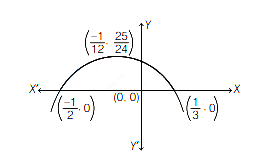
0 likesView Solution
179
MathematicsMediumMCQAP EAMCET · 2018
$OABC$ એક એકમ ચોરસ છે જ્યાં $O$ ઉગમબિંદુ છે અને $B=(1,1)$ છે. વક્રો $y^2=x$ અને $x^2=y$ ચોરસના ક્ષેત્રફળને ત્રણ ભાગ $a_1, a_2, a_3$ માં વિભાજિત કરે છે. જો $a_1, a_2, a_3$ એ આ ભાગોના ક્ષેત્રફળ (ચોરસ એકમમાં) હોય,તો $a_1+2a_2+3a_3=$
A
$1$
B
$2$
C
$6$
D
$64$
Solution
(B) એકમ ચોરસ $OABC$ નું ક્ષેત્રફળ $1 \text{ ચોરસ એકમ}$ છે. વક્રો $y^2=x$ અને $x^2=y$ એ $(0,0)$ અને $(1,1)$ પર છેદે છે.
ધારો કે $a_1, a_2, a_3$ એ ત્રણ ભાગોના ક્ષેત્રફળ છે. સંમિતિને કારણે,$a_1 = a_3$.
કુલ ક્ષેત્રફળ $a_1 + a_2 + a_3 = 1 \quad \dots(i)$ છે.
સંમિતિને કારણે,$a_1 = a_3 \quad \dots(ii)$.
ક્ષેત્રફળ $a_2$ એ $x=0$ થી $x=1$ સુધીના વક્રો $y = \sqrt{x}$ અને $y = x^2$ વચ્ચેનું ક્ષેત્રફળ છે:
$a_2 = \int_0^1 (\sqrt{x} - x^2) dx = \left[ \frac{2}{3}x^{3/2} - \frac{x^3}{3} \right]_0^1 = \frac{2}{3} - \frac{1}{3} = \frac{1}{3}$.
સમીકરણ $(i)$ માં $a_2 = \frac{1}{3}$ મૂકતા:
$a_1 + \frac{1}{3} + a_3 = 1 \implies a_1 + a_3 = \frac{2}{3}$.
કારણ કે $a_1 = a_3$,તેથી $2a_1 = \frac{2}{3} \implies a_1 = \frac{1}{3}$ અને $a_3 = \frac{1}{3}$.
આમ,$a_1 = a_2 = a_3 = \frac{1}{3}$.
આપણે $a_1 + 2a_2 + 3a_3$ શોધવાનું છે:
$a_1 + 2a_2 + 3a_3 = \frac{1}{3} + 2\left(\frac{1}{3}\right) + 3\left(\frac{1}{3}\right) = \frac{1+2+3}{3} = \frac{6}{3} = 2$.
ધારો કે $a_1, a_2, a_3$ એ ત્રણ ભાગોના ક્ષેત્રફળ છે. સંમિતિને કારણે,$a_1 = a_3$.
કુલ ક્ષેત્રફળ $a_1 + a_2 + a_3 = 1 \quad \dots(i)$ છે.
સંમિતિને કારણે,$a_1 = a_3 \quad \dots(ii)$.
ક્ષેત્રફળ $a_2$ એ $x=0$ થી $x=1$ સુધીના વક્રો $y = \sqrt{x}$ અને $y = x^2$ વચ્ચેનું ક્ષેત્રફળ છે:
$a_2 = \int_0^1 (\sqrt{x} - x^2) dx = \left[ \frac{2}{3}x^{3/2} - \frac{x^3}{3} \right]_0^1 = \frac{2}{3} - \frac{1}{3} = \frac{1}{3}$.
સમીકરણ $(i)$ માં $a_2 = \frac{1}{3}$ મૂકતા:
$a_1 + \frac{1}{3} + a_3 = 1 \implies a_1 + a_3 = \frac{2}{3}$.
કારણ કે $a_1 = a_3$,તેથી $2a_1 = \frac{2}{3} \implies a_1 = \frac{1}{3}$ અને $a_3 = \frac{1}{3}$.
આમ,$a_1 = a_2 = a_3 = \frac{1}{3}$.
આપણે $a_1 + 2a_2 + 3a_3$ શોધવાનું છે:
$a_1 + 2a_2 + 3a_3 = \frac{1}{3} + 2\left(\frac{1}{3}\right) + 3\left(\frac{1}{3}\right) = \frac{1+2+3}{3} = \frac{6}{3} = 2$.
0 likesView Solution
180
MathematicsMediumMCQAP EAMCET · 2018
વક્ર $y^2 = 8x$ અને તેના નાભિલંબ વચ્ચેનું ક્ષેત્રફળ (ચોરસ એકમમાં) કેટલું છે?
A
$\frac{32}{3}$
B
$\frac{64}{3}$
C
$\frac{16}{3}$
D
$\frac{8 \sqrt{2}}{3}$
Solution
(A) આપેલ પરવલય $y^2 = 8x$ છે. તેને $y^2 = 4ax$ સાથે સરખાવતા,આપણને $4a = 8$ મળે છે,તેથી $a = 2$.
પરવલયનો નાભિલંબ રેખા $x = a = 2$ છે.
વક્ર અને નાભિલંબ દ્વારા ઘેરાયેલું ક્ષેત્રફળ $x$-અક્ષની સાપેક્ષમાં સંમિત છે.
જરૂરી ક્ષેત્રફળ $A = 2 \int_0^2 y \, dx = 2 \int_0^2 \sqrt{8x} \, dx$ છે.
$A = 2 \times 2\sqrt{2} \int_0^2 x^{1/2} \, dx = 4\sqrt{2} \left[ \frac{x^{3/2}}{3/2} \right]_0^2$.
$A = 4\sqrt{2} \times \frac{2}{3} \times (2)^{3/2} = \frac{8\sqrt{2}}{3} \times 2\sqrt{2} = \frac{16 \times 2}{3} = \frac{32}{3}$ ચોરસ એકમ.
પરવલયનો નાભિલંબ રેખા $x = a = 2$ છે.
વક્ર અને નાભિલંબ દ્વારા ઘેરાયેલું ક્ષેત્રફળ $x$-અક્ષની સાપેક્ષમાં સંમિત છે.
જરૂરી ક્ષેત્રફળ $A = 2 \int_0^2 y \, dx = 2 \int_0^2 \sqrt{8x} \, dx$ છે.
$A = 2 \times 2\sqrt{2} \int_0^2 x^{1/2} \, dx = 4\sqrt{2} \left[ \frac{x^{3/2}}{3/2} \right]_0^2$.
$A = 4\sqrt{2} \times \frac{2}{3} \times (2)^{3/2} = \frac{8\sqrt{2}}{3} \times 2\sqrt{2} = \frac{16 \times 2}{3} = \frac{32}{3}$ ચોરસ એકમ.
0 likesView Solution
181
MathematicsEasyMCQAP EAMCET · 2018
$x=0$ અને $x=2$ રેખાઓ વચ્ચે વક્રો $y=2x^2$ અને $y=\max \{x-[x], x+|x|\}$ દ્વારા ઘેરાયેલું ક્ષેત્રફળ (ચોરસ એકમમાં) શોધો.
A
$\frac{4}{3}$
B
$\frac{1}{2}$
C
$1$
D
$2$
Solution
(D) આપેલ છે કે $y = \max \{x-[x], x+|x|\}$. $x \in [0, 2]$ માટે,$x \geq 0$,તેથી $x+|x| = 2x$ અને $x-[x] = \{x\}$.
કારણ કે $x \in [0, 2]$ માટે $2x \geq \{x\}$ છે,તેથી $y = 2x$ મળે.
આપણે $x = 0$ અને $x = 2$ ની વચ્ચે $y = 2x^2$ અને $y = 2x$ દ્વારા ઘેરાયેલું ક્ષેત્રફળ શોધવાનું છે.
વક્રો જ્યાં છેદે છે ત્યાં $2x^2 = 2x$,એટલે કે $x^2 - x = 0$,તેથી $x = 0$ અને $x = 1$ મળે.
$x \in [0, 1]$ માટે,$2x \geq 2x^2$. $x \in [1, 2]$ માટે,$2x^2 \geq 2x$.
ક્ષેત્રફળ નીચે મુજબ છે:
$A = \int_0^1 (2x - 2x^2) dx + \int_1^2 (2x^2 - 2x) dx$
$A = \left[x^2 - \frac{2x^3}{3}\right]_0^1 + \left[\frac{2x^3}{3} - x^2\right]_1^2$
$A = \left(1 - \frac{2}{3}\right) - 0 + \left(\left(\frac{16}{3} - 4\right) - \left(\frac{2}{3} - 1\right)\right)$
$A = \frac{1}{3} + \left(\frac{4}{3} - (-\frac{1}{3})\right) = \frac{1}{3} + \frac{5}{3} = \frac{6}{3} = 2 \text{ ચોરસ એકમ.}$
કારણ કે $x \in [0, 2]$ માટે $2x \geq \{x\}$ છે,તેથી $y = 2x$ મળે.
આપણે $x = 0$ અને $x = 2$ ની વચ્ચે $y = 2x^2$ અને $y = 2x$ દ્વારા ઘેરાયેલું ક્ષેત્રફળ શોધવાનું છે.
વક્રો જ્યાં છેદે છે ત્યાં $2x^2 = 2x$,એટલે કે $x^2 - x = 0$,તેથી $x = 0$ અને $x = 1$ મળે.
$x \in [0, 1]$ માટે,$2x \geq 2x^2$. $x \in [1, 2]$ માટે,$2x^2 \geq 2x$.
ક્ષેત્રફળ નીચે મુજબ છે:
$A = \int_0^1 (2x - 2x^2) dx + \int_1^2 (2x^2 - 2x) dx$
$A = \left[x^2 - \frac{2x^3}{3}\right]_0^1 + \left[\frac{2x^3}{3} - x^2\right]_1^2$
$A = \left(1 - \frac{2}{3}\right) - 0 + \left(\left(\frac{16}{3} - 4\right) - \left(\frac{2}{3} - 1\right)\right)$
$A = \frac{1}{3} + \left(\frac{4}{3} - (-\frac{1}{3})\right) = \frac{1}{3} + \frac{5}{3} = \frac{6}{3} = 2 \text{ ચોરસ એકમ.}$
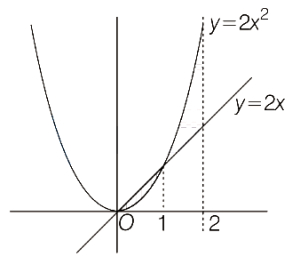
0 likesView Solution
182
MathematicsEasyMCQAP EAMCET · 2018
વક્રો $y = x \log x$ અને $y = 2x - 2x^2$ દ્વારા ઘેરાયેલા પ્રદેશનું ક્ષેત્રફળ (ચોરસ એકમમાં) કેટલું છે?
A
$\frac{1}{12}$
B
$\frac{7}{6}$
C
$\frac{7}{3}$
D
$\frac{7}{12}$
Solution
(D) વક્રો $y = x \log x$ અને $y = 2x - 2x^2$ દ્વારા ઘેરાયેલા પ્રદેશનું ક્ષેત્રફળ શોધવા માટે,આપણે પહેલા તેમના છેદબિંદુઓ શોધીએ: $x \log x = 2x - 2x^2$.
$x > 0$ માટે,$x$ વડે ભાગતા: $\log x = 2 - 2x$,જેનો અર્થ છે $\log x + 2x - 2 = 0$.
નિરીક્ષણ દ્વારા,$x = 1$ એ ઉકેલ છે કારણ કે $\log(1) + 2(1) - 2 = 0 + 2 - 2 = 0$.
અંતરાલ $x \in (0, 1]$ માટે,વક્ર $y = 2x - 2x^2$ એ $y = x \log x$ ની ઉપર આવેલો છે.
ક્ષેત્રફળ $A = \int_{0}^{1} (2x - 2x^2 - x \log x) dx$.
સંકલન કરતા: $\int_{0}^{1} 2x dx = [x^2]_{0}^{1} = 1$.
$\int_{0}^{1} 2x^2 dx = [\frac{2}{3}x^3]_{0}^{1} = \frac{2}{3}$.
ખંડશઃ સંકલનનો ઉપયોગ કરીને $\int x \log x dx = \frac{x^2}{2} \log x - \frac{x^2}{4}$.
$0$ થી $1$ સુધીની સીમાઓ લેતા: $[\frac{x^2}{2} \log x - \frac{x^2}{4}]_{0}^{1} = (0 - \frac{1}{4}) - (0) = -\frac{1}{4}$.
તેથી,$A = 1 - \frac{2}{3} - (-\frac{1}{4}) = 1 - \frac{2}{3} + \frac{1}{4} = \frac{12 - 8 + 3}{12} = \frac{7}{12}$.
$x > 0$ માટે,$x$ વડે ભાગતા: $\log x = 2 - 2x$,જેનો અર્થ છે $\log x + 2x - 2 = 0$.
નિરીક્ષણ દ્વારા,$x = 1$ એ ઉકેલ છે કારણ કે $\log(1) + 2(1) - 2 = 0 + 2 - 2 = 0$.
અંતરાલ $x \in (0, 1]$ માટે,વક્ર $y = 2x - 2x^2$ એ $y = x \log x$ ની ઉપર આવેલો છે.
ક્ષેત્રફળ $A = \int_{0}^{1} (2x - 2x^2 - x \log x) dx$.
સંકલન કરતા: $\int_{0}^{1} 2x dx = [x^2]_{0}^{1} = 1$.
$\int_{0}^{1} 2x^2 dx = [\frac{2}{3}x^3]_{0}^{1} = \frac{2}{3}$.
ખંડશઃ સંકલનનો ઉપયોગ કરીને $\int x \log x dx = \frac{x^2}{2} \log x - \frac{x^2}{4}$.
$0$ થી $1$ સુધીની સીમાઓ લેતા: $[\frac{x^2}{2} \log x - \frac{x^2}{4}]_{0}^{1} = (0 - \frac{1}{4}) - (0) = -\frac{1}{4}$.
તેથી,$A = 1 - \frac{2}{3} - (-\frac{1}{4}) = 1 - \frac{2}{3} + \frac{1}{4} = \frac{12 - 8 + 3}{12} = \frac{7}{12}$.
0 likesView Solution
183
MathematicsEasyMCQAP EAMCET · 2018
પ્રથમ ચરણમાં આવેલા અને $X$-અક્ષ,રેખા $x - \sqrt{3}y = 0$ અને વર્તુળ $x^2 + y^2 = 4$ દ્વારા ઘેરાયેલા પ્રદેશનું ક્ષેત્રફળ (ચોરસ એકમમાં) શોધો.
A
$\frac{\pi}{3}$
B
$\frac{2\pi}{3}$
C
$\frac{\pi}{2\sqrt{3}}$
D
$\frac{2\pi}{3\sqrt{2}}$
Solution
(A) આપેલ સમીકરણો $y = \frac{1}{\sqrt{3}}x$ અને $x^2 + y^2 = 4$ છે.
તેમને ઉકેલતા,આપણને પ્રથમ ચરણમાં છેદબિંદુ $A$ મળે છે: $x^2 + (\frac{x}{\sqrt{3}})^2 = 4 \implies x^2 + \frac{x^2}{3} = 4 \implies \frac{4x^2}{3} = 4 \implies x^2 = 3 \implies x = \sqrt{3}$.
તેથી $y = \frac{\sqrt{3}}{\sqrt{3}} = 1$. આમ,$A = (\sqrt{3}, 1)$.
જરૂરી ક્ષેત્રફળ એ ત્રિકોણ $OAB$ (જ્યાં $B$ એ $(\sqrt{3}, 0)$ છે) અને $x = \sqrt{3}$ થી $x = 2$ સુધી વર્તુળની નીચેના ભાગનું ક્ષેત્રફળનો સરવાળો છે.
ત્રિકોણ $OAB$ નું ક્ષેત્રફળ $= \frac{1}{2} \times \text{પાયો} \times \text{વેધ} = \frac{1}{2} \times \sqrt{3} \times 1 = \frac{\sqrt{3}}{2}$.
વર્તુળની નીચેનું ક્ષેત્રફળ $= \int_{\sqrt{3}}^{2} \sqrt{4 - x^2} dx = [\frac{x}{2}\sqrt{4 - x^2} + \frac{4}{2} \sin^{-1}(\frac{x}{2})]_{\sqrt{3}}^{2}$.
$= [0 + 2 \sin^{-1}(1)] - [\frac{\sqrt{3}}{2} \sqrt{4 - 3} + 2 \sin^{-1}(\frac{\sqrt{3}}{2})]$.
$= [2 \times \frac{\pi}{2}] - [\frac{\sqrt{3}}{2} + 2 \times \frac{\pi}{3}] = \pi - \frac{\sqrt{3}}{2} - \frac{2\pi}{3} = \frac{\pi}{3} - \frac{\sqrt{3}}{2}$.
કુલ ક્ષેત્રફળ $= \frac{\sqrt{3}}{2} + (\frac{\pi}{3} - \frac{\sqrt{3}}{2}) = \frac{\pi}{3} \text{ ચોરસ એકમ}$.
તેમને ઉકેલતા,આપણને પ્રથમ ચરણમાં છેદબિંદુ $A$ મળે છે: $x^2 + (\frac{x}{\sqrt{3}})^2 = 4 \implies x^2 + \frac{x^2}{3} = 4 \implies \frac{4x^2}{3} = 4 \implies x^2 = 3 \implies x = \sqrt{3}$.
તેથી $y = \frac{\sqrt{3}}{\sqrt{3}} = 1$. આમ,$A = (\sqrt{3}, 1)$.
જરૂરી ક્ષેત્રફળ એ ત્રિકોણ $OAB$ (જ્યાં $B$ એ $(\sqrt{3}, 0)$ છે) અને $x = \sqrt{3}$ થી $x = 2$ સુધી વર્તુળની નીચેના ભાગનું ક્ષેત્રફળનો સરવાળો છે.
ત્રિકોણ $OAB$ નું ક્ષેત્રફળ $= \frac{1}{2} \times \text{પાયો} \times \text{વેધ} = \frac{1}{2} \times \sqrt{3} \times 1 = \frac{\sqrt{3}}{2}$.
વર્તુળની નીચેનું ક્ષેત્રફળ $= \int_{\sqrt{3}}^{2} \sqrt{4 - x^2} dx = [\frac{x}{2}\sqrt{4 - x^2} + \frac{4}{2} \sin^{-1}(\frac{x}{2})]_{\sqrt{3}}^{2}$.
$= [0 + 2 \sin^{-1}(1)] - [\frac{\sqrt{3}}{2} \sqrt{4 - 3} + 2 \sin^{-1}(\frac{\sqrt{3}}{2})]$.
$= [2 \times \frac{\pi}{2}] - [\frac{\sqrt{3}}{2} + 2 \times \frac{\pi}{3}] = \pi - \frac{\sqrt{3}}{2} - \frac{2\pi}{3} = \frac{\pi}{3} - \frac{\sqrt{3}}{2}$.
કુલ ક્ષેત્રફળ $= \frac{\sqrt{3}}{2} + (\frac{\pi}{3} - \frac{\sqrt{3}}{2}) = \frac{\pi}{3} \text{ ચોરસ એકમ}$.
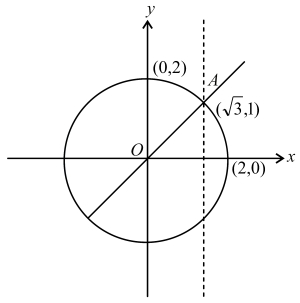
0 likesView Solution
184
MathematicsMediumMCQAP EAMCET · 2018
વિકલ સમીકરણ $y=px+\sqrt{a^2p^2+b^2}$,(જ્યાં $p=\frac{dy}{dx}$) નો ક્રમ અને ઘાત અનુક્રમે છે.
A
$2, 1$
B
$1, 2$
C
$1, 1$
D
$2, 2$
Solution
(B) આપેલ વિકલ સમીકરણ:
$y = px + \sqrt{a^2p^2 + b^2}$,જ્યાં $p = \frac{dy}{dx}$.
ક્રમ અને ઘાત શોધવા માટે,આપણે બંને બાજુ વર્ગ કરીને વર્ગમૂળ દૂર કરીએ:
$\sqrt{a^2p^2 + b^2} = y - px$
બંને બાજુ વર્ગ કરતા:
$a^2p^2 + b^2 = (y - px)^2$
$a^2p^2 + b^2 = y^2 + p^2x^2 - 2xyp$
પદોને ગોઠવતા:
$(x^2 - a^2)p^2 - 2xyp + (y^2 - b^2) = 0$
$p = \frac{dy}{dx}$ મૂકતા:
$(x^2 - a^2)\left(\frac{dy}{dx}\right)^2 - 2xy\left(\frac{dy}{dx}\right) + (y^2 - b^2) = 0$
અહીં સૌથી ઉચ્ચ વિકલન $\frac{dy}{dx}$ છે,તેથી ક્રમ $1$ છે.
સૌથી ઉચ્ચ વિકલનની મહત્તમ ઘાત $2$ છે,તેથી ઘાત $2$ છે.
આમ,ક્રમ અને ઘાત અનુક્રમે $1$ અને $2$ છે.
$y = px + \sqrt{a^2p^2 + b^2}$,જ્યાં $p = \frac{dy}{dx}$.
ક્રમ અને ઘાત શોધવા માટે,આપણે બંને બાજુ વર્ગ કરીને વર્ગમૂળ દૂર કરીએ:
$\sqrt{a^2p^2 + b^2} = y - px$
બંને બાજુ વર્ગ કરતા:
$a^2p^2 + b^2 = (y - px)^2$
$a^2p^2 + b^2 = y^2 + p^2x^2 - 2xyp$
પદોને ગોઠવતા:
$(x^2 - a^2)p^2 - 2xyp + (y^2 - b^2) = 0$
$p = \frac{dy}{dx}$ મૂકતા:
$(x^2 - a^2)\left(\frac{dy}{dx}\right)^2 - 2xy\left(\frac{dy}{dx}\right) + (y^2 - b^2) = 0$
અહીં સૌથી ઉચ્ચ વિકલન $\frac{dy}{dx}$ છે,તેથી ક્રમ $1$ છે.
સૌથી ઉચ્ચ વિકલનની મહત્તમ ઘાત $2$ છે,તેથી ઘાત $2$ છે.
આમ,ક્રમ અને ઘાત અનુક્રમે $1$ અને $2$ છે.
0 likesView Solution
185
MathematicsEasyMCQAP EAMCET · 2018
જો $l$ અને $m$ એ $XY$ સમતલમાં $5$ એકમ ત્રિજ્યા ધરાવતા તમામ વર્તુળોના સમૂહના વિકલ સમીકરણની અનુક્રમે ઘાત (degree) અને કક્ષા (order) હોય,તો $2l + 3m =$
A
$5$
B
$10$
C
$15$
D
$7$
Solution
(B) કેન્દ્ર $(h, k)$ અને ત્રિજ્યા $r = 5$ ધરાવતા વર્તુળનું સમીકરણ $(x - h)^2 + (y - k)^2 = 25$ છે.
અહીં બે સ્વૈર અચળાંકો $h$ અને $k$ હોવાથી,આપણે બે વાર વિકલન કરીશું.
$x$ ની સાપેક્ષમાં વિકલન કરતા: $2(x - h) + 2(y - k)y' = 0$,જે આપે છે $(x - h) = -(y - k)y'$.
ફરીથી વિકલન કરતા: $1 = -[(y')^2 + (y - k)y'']$,જે આપે છે $(y - k) = -\frac{1 + (y')^2}{y''}$.
$(y - k)$ ની કિંમત પ્રથમ વિકલિત સમીકરણમાં મૂકતા: $(x - h) = \left(\frac{1 + (y')^2}{y''}\right)y'$.
આ કિંમતોને મૂળ વર્તુળના સમીકરણમાં મૂકતા: $\left(\frac{1 + (y')^2}{y''}\right)^2 (y')^2 + \left(\frac{1 + (y')^2}{y''}\right)^2 = 25$.
સાદુરૂપ આપતા,આપણને $(1 + (y')^2)^3 = 25(y'')^2$ મળે છે.
કક્ષા $m$ એ સૌથી ઉચ્ચ વિકલિત છે,જે $y''$ છે,તેથી $m = 2$.
ઘાત $l$ એ સૌથી ઉચ્ચ વિકલિતની ઘાત છે,જે $2$ છે,તેથી $l = 2$.
આમ,$2l + 3m = 2(2) + 3(2) = 4 + 6 = 10$.
અહીં બે સ્વૈર અચળાંકો $h$ અને $k$ હોવાથી,આપણે બે વાર વિકલન કરીશું.
$x$ ની સાપેક્ષમાં વિકલન કરતા: $2(x - h) + 2(y - k)y' = 0$,જે આપે છે $(x - h) = -(y - k)y'$.
ફરીથી વિકલન કરતા: $1 = -[(y')^2 + (y - k)y'']$,જે આપે છે $(y - k) = -\frac{1 + (y')^2}{y''}$.
$(y - k)$ ની કિંમત પ્રથમ વિકલિત સમીકરણમાં મૂકતા: $(x - h) = \left(\frac{1 + (y')^2}{y''}\right)y'$.
આ કિંમતોને મૂળ વર્તુળના સમીકરણમાં મૂકતા: $\left(\frac{1 + (y')^2}{y''}\right)^2 (y')^2 + \left(\frac{1 + (y')^2}{y''}\right)^2 = 25$.
સાદુરૂપ આપતા,આપણને $(1 + (y')^2)^3 = 25(y'')^2$ મળે છે.
કક્ષા $m$ એ સૌથી ઉચ્ચ વિકલિત છે,જે $y''$ છે,તેથી $m = 2$.
ઘાત $l$ એ સૌથી ઉચ્ચ વિકલિતની ઘાત છે,જે $2$ છે,તેથી $l = 2$.
આમ,$2l + 3m = 2(2) + 3(2) = 4 + 6 = 10$.
0 likesView Solution
186
MathematicsEasyMCQAP EAMCET · 2018
પરવલયોના કુળ $y^2=4a(x+a)$ ને અનુરૂપ વિકલ સમીકરણ શોધો,જ્યાં $a$ એ પ્રાચલ છે.
A
$y\left(\frac{dy}{dx}\right)^2+2x\frac{dy}{dx}-y=0$
B
$y\left(\frac{dy}{dx}\right)^2+2x\frac{dy}{dx}+y=0$
C
$y\left(\frac{dy}{dx}\right)^2-2x\frac{dy}{dx}-y=0$
D
$y=2x\frac{dy}{dx}$
Solution
(A) આપેલ પરવલયનું કુળ $y^2 = 4a(x+a) \quad ...(i)$ છે.
$x$ ની સાપેક્ષમાં વિકલન કરતા:
$2y \frac{dy}{dx} = 4a$
$\Rightarrow a = \frac{1}{2} y \frac{dy}{dx} \quad ...(ii)$
સમીકરણ $(ii)$ માંથી $a$ ની કિંમત સમીકરણ $(i)$ માં મૂકતા:
$y^2 = 4 \left( \frac{1}{2} y \frac{dy}{dx} \right) \left( x + \frac{1}{2} y \frac{dy}{dx} \right)$
$y^2 = 2y \frac{dy}{dx} \left( x + \frac{1}{2} y \frac{dy}{dx} \right)$
$y$ વડે ભાગતા ($y \neq 0$ ધારતા):
$y = 2x \frac{dy}{dx} + y \left( \frac{dy}{dx} \right)^2$
પદોને ગોઠવતા,આપણને મળે છે:
$y \left( \frac{dy}{dx} \right)^2 + 2x \frac{dy}{dx} - y = 0$
$x$ ની સાપેક્ષમાં વિકલન કરતા:
$2y \frac{dy}{dx} = 4a$
$\Rightarrow a = \frac{1}{2} y \frac{dy}{dx} \quad ...(ii)$
સમીકરણ $(ii)$ માંથી $a$ ની કિંમત સમીકરણ $(i)$ માં મૂકતા:
$y^2 = 4 \left( \frac{1}{2} y \frac{dy}{dx} \right) \left( x + \frac{1}{2} y \frac{dy}{dx} \right)$
$y^2 = 2y \frac{dy}{dx} \left( x + \frac{1}{2} y \frac{dy}{dx} \right)$
$y$ વડે ભાગતા ($y \neq 0$ ધારતા):
$y = 2x \frac{dy}{dx} + y \left( \frac{dy}{dx} \right)^2$
પદોને ગોઠવતા,આપણને મળે છે:
$y \left( \frac{dy}{dx} \right)^2 + 2x \frac{dy}{dx} - y = 0$
0 likesView Solution
187
MathematicsEasyMCQAP EAMCET · 2018
જો $a$ અને $b$ સ્વૈચ્છિક અચળાંકો હોય,તો $\frac{x^2}{a^2}+\frac{y^2}{b^2}=1$ ને સામાન્ય ઉકેલ તરીકે ધરાવતું વિકલ સમીકરણ કયું છે?
A
$\left(\frac{d^2 y}{d x^2}\right)^2=\left[1+\left(\frac{d y}{d x}\right)^2\right]^3$
B
$(x^2-y^2) \frac{d^2 y}{d x^2}-2 x y \frac{d y}{d x}-y=0$
C
$x y \frac{d^2 y}{d x^2}+x\left(\frac{d y}{d x}\right)^2-y \frac{d y}{d x}=0$
D
$x^2 \frac{d^2 y}{d x^2}+2 x \frac{d y}{d x}-2 y=0$
Solution
(C) આપેલ સમીકરણ: $\frac{x^2}{a^2}+\frac{y^2}{b^2}=1$.
$x$ ની સાપેક્ષમાં વિકલન કરતા:
$\frac{2x}{a^2} + \frac{2y}{b^2} \frac{dy}{dx} = 0 \implies \frac{y}{b^2} \frac{dy}{dx} = -\frac{x}{a^2} \implies \frac{y}{x} \frac{dy}{dx} = -\frac{b^2}{a^2}$.
ફરીથી $x$ ની સાપેક્ષમાં વિકલન કરતા:
$\frac{d}{dx} \left( \frac{y}{x} \frac{dy}{dx} \right) = \frac{d}{dx} \left( -\frac{b^2}{a^2} \right) = 0$.
ગુણાકારના નિયમનો ઉપયોગ કરતા:
$\frac{y}{x} \frac{d^2y}{dx^2} + \frac{dy}{dx} \left( \frac{x \frac{dy}{dx} - y}{x^2} \right) = 0$.
$x^2$ વડે ગુણતા:
$xy \frac{d^2y}{dx^2} + x \left( \frac{dy}{dx} \right)^2 - y \frac{dy}{dx} = 0$.
$x$ ની સાપેક્ષમાં વિકલન કરતા:
$\frac{2x}{a^2} + \frac{2y}{b^2} \frac{dy}{dx} = 0 \implies \frac{y}{b^2} \frac{dy}{dx} = -\frac{x}{a^2} \implies \frac{y}{x} \frac{dy}{dx} = -\frac{b^2}{a^2}$.
ફરીથી $x$ ની સાપેક્ષમાં વિકલન કરતા:
$\frac{d}{dx} \left( \frac{y}{x} \frac{dy}{dx} \right) = \frac{d}{dx} \left( -\frac{b^2}{a^2} \right) = 0$.
ગુણાકારના નિયમનો ઉપયોગ કરતા:
$\frac{y}{x} \frac{d^2y}{dx^2} + \frac{dy}{dx} \left( \frac{x \frac{dy}{dx} - y}{x^2} \right) = 0$.
$x^2$ વડે ગુણતા:
$xy \frac{d^2y}{dx^2} + x \left( \frac{dy}{dx} \right)^2 - y \frac{dy}{dx} = 0$.
0 likesView Solution
188
MathematicsEasyMCQAP EAMCET · 2018
વક્રોના કુળ $r^2 = a^2 \cos 2\theta$ માટે વિકલ સમીકરણ શોધો,જ્યાં '$a$' એ સ્વૈર અચળાંક છે:
A
$r \frac{dr}{d\theta} + r^2 \tan 2\theta = 0$
B
$\frac{dr}{d\theta} = -r \tan 2\theta$
C
$\frac{dr}{d\theta} = r \tan 2\theta$
D
$\frac{dr}{d\theta} = -r \cot 2\theta$
Solution
(B) આપેલ વક્રોના કુળનું સમીકરણ: $r^2 = a^2 \cos 2\theta$.
$\theta$ ની સાપેક્ષમાં બંને બાજુ વિકલન કરતા:
$\frac{d}{d\theta}(r^2) = \frac{d}{d\theta}(a^2 \cos 2\theta)$.
ચેઈન રૂલનો ઉપયોગ કરતા: $2r \frac{dr}{d\theta} = a^2 (-\sin 2\theta) \cdot 2$.
સાદું રૂપ આપતા: $r \frac{dr}{d\theta} = -a^2 \sin 2\theta$.
મૂળ સમીકરણ પરથી,$a^2 = \frac{r^2}{\cos 2\theta}$.
વિકલિત સમીકરણમાં $a^2$ ની કિંમત મૂકતા:
$r \frac{dr}{d\theta} = -\left(\frac{r^2}{\cos 2\theta}\right) \sin 2\theta$.
$r \frac{dr}{d\theta} = -r^2 \tan 2\theta$.
$r$ વડે ભાગતા ($r \neq 0$ ધારીને):
$\frac{dr}{d\theta} = -r \tan 2\theta$.
$\theta$ ની સાપેક્ષમાં બંને બાજુ વિકલન કરતા:
$\frac{d}{d\theta}(r^2) = \frac{d}{d\theta}(a^2 \cos 2\theta)$.
ચેઈન રૂલનો ઉપયોગ કરતા: $2r \frac{dr}{d\theta} = a^2 (-\sin 2\theta) \cdot 2$.
સાદું રૂપ આપતા: $r \frac{dr}{d\theta} = -a^2 \sin 2\theta$.
મૂળ સમીકરણ પરથી,$a^2 = \frac{r^2}{\cos 2\theta}$.
વિકલિત સમીકરણમાં $a^2$ ની કિંમત મૂકતા:
$r \frac{dr}{d\theta} = -\left(\frac{r^2}{\cos 2\theta}\right) \sin 2\theta$.
$r \frac{dr}{d\theta} = -r^2 \tan 2\theta$.
$r$ વડે ભાગતા ($r \neq 0$ ધારીને):
$\frac{dr}{d\theta} = -r \tan 2\theta$.
0 likesView Solution
189
MathematicsDifficultMCQAP EAMCET · 2018
જો $m$ અને $n$ એ ઉગમબિંદુ પર નાભિ અને $X$-અક્ષ પર ધરી ધરાવતા પરવલયોના કુળના વિકલ સમીકરણનો ક્રમ અને ઘાત હોય,તો $m n-m+n=$
A
$1$
B
$4$
C
$3$
D
$2$
Solution
(C) ઉગમબિંદુ પર નાભિ અને $X$-અક્ષ પર ધરી ધરાવતા પરવલયોના કુળનું સમીકરણ $y^2 = 4a(x+a) = 4ax + 4a^2$ છે.
$x$ ની સાપેક્ષમાં વિકલન કરતા,આપણને $2y \frac{dy}{dx} = 4a$ મળે છે,જેનો અર્થ છે કે $a = \frac{1}{2} y \frac{dy}{dx}$.
$a$ ની કિંમત મૂળ સમીકરણમાં મૂકતા:
$y^2 = 4 \left( \frac{1}{2} y \frac{dy}{dx} \right) x + 4 \left( \frac{1}{2} y \frac{dy}{dx} \right)^2$
$y^2 = 2xy \frac{dy}{dx} + y^2 \left( \frac{dy}{dx} \right)^2$.
અહીં સૌથી ઉચ્ચ ક્રમનું વિકલન $\frac{dy}{dx}$ છે,તેથી ક્રમ $m = 1$.
સૌથી ઉચ્ચ ક્રમના વિકલનની ઘાત $2$ છે,તેથી ઘાત $n = 2$.
તેથી,$mn - m + n = (1 \times 2) - 1 + 2 = 2 - 1 + 2 = 3$.
$x$ ની સાપેક્ષમાં વિકલન કરતા,આપણને $2y \frac{dy}{dx} = 4a$ મળે છે,જેનો અર્થ છે કે $a = \frac{1}{2} y \frac{dy}{dx}$.
$a$ ની કિંમત મૂળ સમીકરણમાં મૂકતા:
$y^2 = 4 \left( \frac{1}{2} y \frac{dy}{dx} \right) x + 4 \left( \frac{1}{2} y \frac{dy}{dx} \right)^2$
$y^2 = 2xy \frac{dy}{dx} + y^2 \left( \frac{dy}{dx} \right)^2$.
અહીં સૌથી ઉચ્ચ ક્રમનું વિકલન $\frac{dy}{dx}$ છે,તેથી ક્રમ $m = 1$.
સૌથી ઉચ્ચ ક્રમના વિકલનની ઘાત $2$ છે,તેથી ઘાત $n = 2$.
તેથી,$mn - m + n = (1 \times 2) - 1 + 2 = 2 - 1 + 2 = 3$.
0 likesView Solution
190
MathematicsEasyMCQAP EAMCET · 2018
$\left(1+e^{\frac{x}{y}}\right) d x+e^{\frac{x}{y}}\left(1-\frac{x}{y}\right) d y=0$ નો વ્યાપક ઉકેલ શોધો.
A
$y e^{\frac{y}{x}}+x=c$
B
$y e^{\frac{x}{y}}-x=c$
C
$y e^{\frac{x}{y}}+y=c$
D
$x+y e^{\frac{x}{y}}=c$
Solution
(D) આપેલ સમીકરણ: $\left(1+e^{x / y}\right) d x+e^{x / y}\left(1-\frac{x}{y}\right) d y=0$
પદોને ગોઠવતા: $\frac{d x}{d y}=-\frac{e^{x / y}(1-x / y)}{1+e^{x / y}}$
ધારો કે $x=v y$,તેથી $\frac{d x}{d y}=v+y \frac{d v}{d y}$.
આ કિંમતો સમીકરણમાં મૂકતા: $v+y \frac{d v}{d y}=-\frac{e^v(1-v)}{1+e^v}$
$y \frac{d v}{d y}=-\frac{e^v-v e^v}{1+e^v}-v = \frac{-e^v+v e^v-v-v e^v}{1+e^v} = -\frac{v+e^v}{1+e^v}$
ચલને અલગ કરતા: $\frac{1+e^v}{v+e^v} d v=-\frac{d y}{y}$
બંને બાજુ સંકલન કરતા: $\int \frac{1+e^v}{v+e^v} d v=-\int \frac{d y}{y}$
ધારો કે $v+e^v=t$,તેથી $(1+e^v) d v=d t$.
તેથી,$\int \frac{d t}{t}=-\int \frac{d y}{y} \Rightarrow \ln|t|=-\ln|y|+\ln|c|$
$\ln|t|+\ln|y|=\ln|c| \Rightarrow \ln|t y|=\ln|c| \Rightarrow t y=c$
$t=v+e^v$ અને $v=x/y$ મૂકતા: $(x/y+e^{x/y}) y=c$
$x+y e^{x/y}=c$.
પદોને ગોઠવતા: $\frac{d x}{d y}=-\frac{e^{x / y}(1-x / y)}{1+e^{x / y}}$
ધારો કે $x=v y$,તેથી $\frac{d x}{d y}=v+y \frac{d v}{d y}$.
આ કિંમતો સમીકરણમાં મૂકતા: $v+y \frac{d v}{d y}=-\frac{e^v(1-v)}{1+e^v}$
$y \frac{d v}{d y}=-\frac{e^v-v e^v}{1+e^v}-v = \frac{-e^v+v e^v-v-v e^v}{1+e^v} = -\frac{v+e^v}{1+e^v}$
ચલને અલગ કરતા: $\frac{1+e^v}{v+e^v} d v=-\frac{d y}{y}$
બંને બાજુ સંકલન કરતા: $\int \frac{1+e^v}{v+e^v} d v=-\int \frac{d y}{y}$
ધારો કે $v+e^v=t$,તેથી $(1+e^v) d v=d t$.
તેથી,$\int \frac{d t}{t}=-\int \frac{d y}{y} \Rightarrow \ln|t|=-\ln|y|+\ln|c|$
$\ln|t|+\ln|y|=\ln|c| \Rightarrow \ln|t y|=\ln|c| \Rightarrow t y=c$
$t=v+e^v$ અને $v=x/y$ મૂકતા: $(x/y+e^{x/y}) y=c$
$x+y e^{x/y}=c$.
0 likesView Solution
191
MathematicsMediumMCQAP EAMCET · 2018
$\frac{dy}{dx} + y \tan x = 2x + x^2 \tan x$ નો વ્યાપક ઉકેલ શોધો:
A
$y - x^2 = c \sec x$
B
$y \cos x = x^2 \sec x + c$
C
$y \sec x = x^2 + c \cos x$
D
$y = x^2 + c \cos x$
Solution
(D) આપેલ વિકલ સમીકરણ $\frac{dy}{dx} + y \tan x = 2x + x^2 \tan x$ છે.
આ $\frac{dy}{dx} + Py = Q$ સ્વરૂપનું સુરેખ વિકલ સમીકરણ છે,જ્યાં $P = \tan x$ અને $Q = 2x + x^2 \tan x$ છે.
સૌ પ્રથમ,આપણે સંકલ્યકારક અવયવ ($I$.$F$.) શોધીએ:
$I.F. = e^{\int P dx} = e^{\int \tan x dx} = e^{\ln |\sec x|} = \sec x$.
વ્યાપક ઉકેલ આ મુજબ છે:
$y \cdot (I.F.) = \int Q \cdot (I.F.) dx + c$
$y \sec x = \int (2x + x^2 \tan x) \sec x dx + c$
$y \sec x = \int 2x \sec x dx + \int x^2 \tan x \sec x dx + c$
બીજા સંકલન $\int x^2 (\tan x \sec x) dx$ માટે ખંડશઃ સંકલનનો ઉપયોગ કરતા:
ધારો કે $u = x^2$ અને $dv = \sec x \tan x dx$. તો $du = 2x dx$ અને $v = \sec x$.
$\int x^2 \sec x \tan x dx = x^2 \sec x - \int 2x \sec x dx$.
આ કિંમત સમીકરણમાં મૂકતા:
$y \sec x = \int 2x \sec x dx + (x^2 \sec x - \int 2x \sec x dx) + c$
$y \sec x = x^2 \sec x + c$
બંને બાજુ $\cos x$ વડે ગુણતા:
$y = x^2 + c \cos x$.
આ $\frac{dy}{dx} + Py = Q$ સ્વરૂપનું સુરેખ વિકલ સમીકરણ છે,જ્યાં $P = \tan x$ અને $Q = 2x + x^2 \tan x$ છે.
સૌ પ્રથમ,આપણે સંકલ્યકારક અવયવ ($I$.$F$.) શોધીએ:
$I.F. = e^{\int P dx} = e^{\int \tan x dx} = e^{\ln |\sec x|} = \sec x$.
વ્યાપક ઉકેલ આ મુજબ છે:
$y \cdot (I.F.) = \int Q \cdot (I.F.) dx + c$
$y \sec x = \int (2x + x^2 \tan x) \sec x dx + c$
$y \sec x = \int 2x \sec x dx + \int x^2 \tan x \sec x dx + c$
બીજા સંકલન $\int x^2 (\tan x \sec x) dx$ માટે ખંડશઃ સંકલનનો ઉપયોગ કરતા:
ધારો કે $u = x^2$ અને $dv = \sec x \tan x dx$. તો $du = 2x dx$ અને $v = \sec x$.
$\int x^2 \sec x \tan x dx = x^2 \sec x - \int 2x \sec x dx$.
આ કિંમત સમીકરણમાં મૂકતા:
$y \sec x = \int 2x \sec x dx + (x^2 \sec x - \int 2x \sec x dx) + c$
$y \sec x = x^2 \sec x + c$
બંને બાજુ $\cos x$ વડે ગુણતા:
$y = x^2 + c \cos x$.
0 likesView Solution
192
MathematicsEasyMCQAP EAMCET · 2018
વિકલ સમીકરણ $\frac{dx}{dy} + 2yx = 2y$ નો ઉકેલ જે બિંદુ $(2,0)$ માંથી પસાર થાય છે તે શોધો.
A
$(x-1) = e^{-y^2}$
B
$(x-1) = e^{y^2}$
C
$(x-1) = 2e^{y^2}$
D
$(x-1) = 2e^{-y^2}$
Solution
(A) આપેલ વિકલ સમીકરણ $\frac{dx}{dy} + 2yx = 2y$ છે.
પદોને ફરીથી ગોઠવતા,આપણને $\frac{dx}{dy} = 2y(1-x)$ મળે છે.
ચલને અલગ કરતા,$\int \frac{dx}{1-x} = \int 2y \, dy$ મળે છે.
બંને બાજુ સંકલન કરતા,$-\ln|1-x| = y^2 + C$ મળે,જેને $\ln|1-x| = -y^2 - C$ તરીકે લખી શકાય.
બંને બાજુ ઘાતાંકીય લેતા,$|1-x| = e^{-y^2 - C} = Ae^{-y^2}$,જ્યાં $A = e^{-C}$.
આનો અર્થ એ છે કે $1-x = \pm Ae^{-y^2}$,અથવા $x-1 = Ke^{-y^2}$ જ્યાં $K = \mp A$.
વક્ર બિંદુ $(2,0)$ માંથી પસાર થતું હોવાથી,$x=2$ અને $y=0$ મૂકતા:
$2-1 = Ke^{-(0)^2} \Rightarrow 1 = K(1) \Rightarrow K=1$.
આમ,ઉકેલ $(x-1) = e^{-y^2}$ છે.
પદોને ફરીથી ગોઠવતા,આપણને $\frac{dx}{dy} = 2y(1-x)$ મળે છે.
ચલને અલગ કરતા,$\int \frac{dx}{1-x} = \int 2y \, dy$ મળે છે.
બંને બાજુ સંકલન કરતા,$-\ln|1-x| = y^2 + C$ મળે,જેને $\ln|1-x| = -y^2 - C$ તરીકે લખી શકાય.
બંને બાજુ ઘાતાંકીય લેતા,$|1-x| = e^{-y^2 - C} = Ae^{-y^2}$,જ્યાં $A = e^{-C}$.
આનો અર્થ એ છે કે $1-x = \pm Ae^{-y^2}$,અથવા $x-1 = Ke^{-y^2}$ જ્યાં $K = \mp A$.
વક્ર બિંદુ $(2,0)$ માંથી પસાર થતું હોવાથી,$x=2$ અને $y=0$ મૂકતા:
$2-1 = Ke^{-(0)^2} \Rightarrow 1 = K(1) \Rightarrow K=1$.
આમ,ઉકેલ $(x-1) = e^{-y^2}$ છે.
0 likesView Solution
193
MathematicsEasyMCQAP EAMCET · 2018
વિકલ સમીકરણ $\frac{dx}{dy} + \frac{x}{y} = x^2$ નો વ્યાપક ઉકેલ શોધો.
A
$\frac{1}{y} = cx - y \log x$
B
$\frac{1}{x} = cy + x \log x$
C
$\frac{1}{x} = cy - y \log y$
D
$\frac{1}{y} = cx + y \log x$
Solution
(C) આપેલ વિકલ સમીકરણ $\frac{dx}{dy} + \frac{x}{y} = x^2$ છે.
બંને બાજુ $x^2$ વડે ભાગતા,આપણને $\frac{1}{x^2} \frac{dx}{dy} + \frac{1}{xy} = 1$ મળે છે.
ધારો કે $t = \frac{1}{x}$,તો $\frac{dt}{dy} = -\frac{1}{x^2} \frac{dx}{dy}$ થાય.
આ કિંમત સમીકરણમાં મૂકતા,$-\frac{dt}{dy} + \frac{t}{y} = 1$ મળે,જેનું સાદું રૂપ $\frac{dt}{dy} - \frac{t}{y} = -1$ થાય છે.
આ $\frac{dt}{dy} + P(y)t = Q(y)$ પ્રકારનું સુરેખ વિકલ સમીકરણ છે,જ્યાં $P(y) = -\frac{1}{y}$ અને $Q(y) = -1$ છે.
સંકલ્યકારક અવયવ $I.F. = e^{\int P(y) dy} = e^{\int -\frac{1}{y} dy} = e^{-\log y} = \frac{1}{y}$ છે.
ઉકેલ $t \cdot (I.F.) = \int Q(y) \cdot (I.F.) dy + c$ છે.
$t \cdot \frac{1}{y} = \int (-1) \cdot \frac{1}{y} dy + c$.
$\frac{t}{y} = -\log |y| + c$.
$t = \frac{1}{x}$ મૂકતા,આપણને $\frac{1}{xy} = -\log |y| + c$ મળે,એટલે કે $\frac{1}{x} = cy - y \log |y|$.
બંને બાજુ $x^2$ વડે ભાગતા,આપણને $\frac{1}{x^2} \frac{dx}{dy} + \frac{1}{xy} = 1$ મળે છે.
ધારો કે $t = \frac{1}{x}$,તો $\frac{dt}{dy} = -\frac{1}{x^2} \frac{dx}{dy}$ થાય.
આ કિંમત સમીકરણમાં મૂકતા,$-\frac{dt}{dy} + \frac{t}{y} = 1$ મળે,જેનું સાદું રૂપ $\frac{dt}{dy} - \frac{t}{y} = -1$ થાય છે.
આ $\frac{dt}{dy} + P(y)t = Q(y)$ પ્રકારનું સુરેખ વિકલ સમીકરણ છે,જ્યાં $P(y) = -\frac{1}{y}$ અને $Q(y) = -1$ છે.
સંકલ્યકારક અવયવ $I.F. = e^{\int P(y) dy} = e^{\int -\frac{1}{y} dy} = e^{-\log y} = \frac{1}{y}$ છે.
ઉકેલ $t \cdot (I.F.) = \int Q(y) \cdot (I.F.) dy + c$ છે.
$t \cdot \frac{1}{y} = \int (-1) \cdot \frac{1}{y} dy + c$.
$\frac{t}{y} = -\log |y| + c$.
$t = \frac{1}{x}$ મૂકતા,આપણને $\frac{1}{xy} = -\log |y| + c$ મળે,એટલે કે $\frac{1}{x} = cy - y \log |y|$.
0 likesView Solution
194
MathematicsEasyMCQAP EAMCET · 2018
જો $-\frac{\pi}{4} < x < \frac{\pi}{4}$ હોય,તો વિકલ સમીકરણ $\cos^{2} x \cdot \frac{dy}{dx} - (\tan 2x) y = \cos^{4} x$ નો વ્યાપક ઉકેલ શું છે?
A
$y = \frac{1}{2} \left[ \frac{\tan 2x + c}{1 - \tan^{2} x} \right]$
B
$y = \frac{1}{2} \left[ \frac{\cos 2x + c}{1 - \tan^{2} x} \right]$
C
$y = \frac{1}{2} \left[ \frac{\sin 2x + c}{1 - \tan^{2} x} \right]$
D
$y = \frac{1}{2} \left[ \frac{\sin x + c}{1 - \tan^{2} x} \right]$
Solution
(C) આપેલ છે,$\cos^{2} x \cdot \frac{dy}{dx} - (\tan 2x) y = \cos^{4} x$
$\cos^{2} x$ વડે ભાગતા,આપણને મળે:
$\frac{dy}{dx} - \left(\frac{\tan 2x}{\cos^{2} x}\right) y = \cos^{2} x$
આ $\frac{dy}{dx} + Py = Q$ સ્વરૂપનું સુરેખ વિકલ સમીકરણ છે,જ્યાં $P = -\frac{\tan 2x}{\cos^{2} x}$ અને $Q = \cos^{2} x$ છે.
સંકલ્યકારક અવયવ $(I.F.)$ $e^{\int P dx}$ છે.
$\int P dx = -\int \frac{\tan 2x}{\cos^{2} x} dx = -\int \frac{2 \tan x}{(1 - \tan^{2} x) \cos^{2} x} dx$.
ધારો કે $\tan x = t$,તો $\sec^{2} x dx = dt$.
$\int P dx = -\int \frac{2t}{1 - t^{2}} dt = \ln |1 - t^{2}| = \ln |1 - \tan^{2} x|$.
તેથી,$I.F. = e^{\ln |1 - \tan^{2} x|} = 1 - \tan^{2} x$.
વ્યાપક ઉકેલ $y \cdot I.F. = \int (Q \cdot I.F.) dx + C$ છે.
$y(1 - \tan^{2} x) = \int (\cos^{2} x (1 - \tan^{2} x)) dx + C$.
$y(1 - \tan^{2} x) = \int (\cos^{2} x - \sin^{2} x) dx + C$.
$y(1 - \tan^{2} x) = \int \cos 2x dx + C$.
$y(1 - \tan^{2} x) = \frac{\sin 2x}{2} + C$.
$y = \frac{1}{2} \left[ \frac{\sin 2x + 2C}{1 - \tan^{2} x} \right]$.
$2C$ ને $c$ તરીકે લેતા,આપણને મળે $y = \frac{1}{2} \left[ \frac{\sin 2x + c}{1 - \tan^{2} x} \right]$.
$\cos^{2} x$ વડે ભાગતા,આપણને મળે:
$\frac{dy}{dx} - \left(\frac{\tan 2x}{\cos^{2} x}\right) y = \cos^{2} x$
આ $\frac{dy}{dx} + Py = Q$ સ્વરૂપનું સુરેખ વિકલ સમીકરણ છે,જ્યાં $P = -\frac{\tan 2x}{\cos^{2} x}$ અને $Q = \cos^{2} x$ છે.
સંકલ્યકારક અવયવ $(I.F.)$ $e^{\int P dx}$ છે.
$\int P dx = -\int \frac{\tan 2x}{\cos^{2} x} dx = -\int \frac{2 \tan x}{(1 - \tan^{2} x) \cos^{2} x} dx$.
ધારો કે $\tan x = t$,તો $\sec^{2} x dx = dt$.
$\int P dx = -\int \frac{2t}{1 - t^{2}} dt = \ln |1 - t^{2}| = \ln |1 - \tan^{2} x|$.
તેથી,$I.F. = e^{\ln |1 - \tan^{2} x|} = 1 - \tan^{2} x$.
વ્યાપક ઉકેલ $y \cdot I.F. = \int (Q \cdot I.F.) dx + C$ છે.
$y(1 - \tan^{2} x) = \int (\cos^{2} x (1 - \tan^{2} x)) dx + C$.
$y(1 - \tan^{2} x) = \int (\cos^{2} x - \sin^{2} x) dx + C$.
$y(1 - \tan^{2} x) = \int \cos 2x dx + C$.
$y(1 - \tan^{2} x) = \frac{\sin 2x}{2} + C$.
$y = \frac{1}{2} \left[ \frac{\sin 2x + 2C}{1 - \tan^{2} x} \right]$.
$2C$ ને $c$ તરીકે લેતા,આપણને મળે $y = \frac{1}{2} \left[ \frac{\sin 2x + c}{1 - \tan^{2} x} \right]$.
0 likesView Solution
195
MathematicsEasyMCQAP EAMCET · 2018
વિકલ સમીકરણ $\frac{dy}{dx} = \frac{x+2y-3}{2x+y-3}$ નો વ્યાપક ઉકેલ શોધો.
A
$(x+y-2)^3 = c(x-y)^2$
B
$(x+y-2) = c(x-y)^3$
C
$(x+y-2)^2 = c(x-y)^3$
D
$(x+y-2)^3 = c(x-y)$
Solution
(B) આપેલ વિકલ સમીકરણ $\frac{dy}{dx} = \frac{x+2y-3}{2x+y-3}$ છે.
ધારો કે $x = X+h$ અને $y = Y+k$. $h$ અને $k$ એવી રીતે પસંદ કરો કે જેથી $h+2k-3=0$ અને $2h+k-3=0$ થાય,જેનાથી આપણને $h=1$ અને $k=1$ મળે છે.
$x=X+1$ અને $y=Y+1$ મૂકતા,સમીકરણ $\frac{dY}{dX} = \frac{X+2Y}{2X+Y}$ બને છે.
આ એક સમપરિમાણ વિકલ સમીકરણ છે. ધારો કે $Y = vX$,તેથી $\frac{dY}{dX} = v + X\frac{dv}{dX}$.
તેથી,$v + X\frac{dv}{dX} = \frac{1+2v}{2+v}$.
$X\frac{dv}{dX} = \frac{1+2v-2v-v^2}{2+v} = \frac{1-v^2}{2+v}$.
ચલને અલગ કરતા: $\int \frac{v+2}{1-v^2} dv = \int \frac{dX}{X}$.
$\int (\frac{v}{1-v^2} + \frac{2}{1-v^2}) dv = \ln|X| + C$.
$-\frac{1}{2}\ln|1-v^2| + \ln|\frac{1+v}{1-v}| = \ln|X| + C$.
ગણતરી કરતા,આપણને $(x+y-2) = c(x-y)^3$ મળે છે.
ધારો કે $x = X+h$ અને $y = Y+k$. $h$ અને $k$ એવી રીતે પસંદ કરો કે જેથી $h+2k-3=0$ અને $2h+k-3=0$ થાય,જેનાથી આપણને $h=1$ અને $k=1$ મળે છે.
$x=X+1$ અને $y=Y+1$ મૂકતા,સમીકરણ $\frac{dY}{dX} = \frac{X+2Y}{2X+Y}$ બને છે.
આ એક સમપરિમાણ વિકલ સમીકરણ છે. ધારો કે $Y = vX$,તેથી $\frac{dY}{dX} = v + X\frac{dv}{dX}$.
તેથી,$v + X\frac{dv}{dX} = \frac{1+2v}{2+v}$.
$X\frac{dv}{dX} = \frac{1+2v-2v-v^2}{2+v} = \frac{1-v^2}{2+v}$.
ચલને અલગ કરતા: $\int \frac{v+2}{1-v^2} dv = \int \frac{dX}{X}$.
$\int (\frac{v}{1-v^2} + \frac{2}{1-v^2}) dv = \ln|X| + C$.
$-\frac{1}{2}\ln|1-v^2| + \ln|\frac{1+v}{1-v}| = \ln|X| + C$.
ગણતરી કરતા,આપણને $(x+y-2) = c(x-y)^3$ મળે છે.
0 likesView Solution
196
MathematicsDifficultMCQAP EAMCET · 2018
ધારો કે $a, b$ અને $c$ ત્રણ અસમતલીય સદિશો છે. બે રેખાઓના છેદબિંદુમાંથી પસાર થતી રેખાનું સદિશ સમીકરણ શોધો,જેમાં એક રેખા $a+2b-5c$ અને $-a-2b-3c$ બિંદુઓને જોડે છે અને બીજી રેખા $-4c$ અને $6a-4b+4c$ બિંદુઓને જોડે છે.
A
$r=2a-4b+3c+\mu(a-6b+4c)$
B
$r=3a+6b-c+\mu(a+2b+c)$
C
$r=2a+3b-c+\mu(a+b-c)$
D
$r=-2b+3c+\mu(a-4b+3c)$
Solution
(B) $A(a+2b-5c)$ અને $B(-a-2b-3c)$ માંથી પસાર થતી રેખાનું સમીકરણ $r = A + \lambda_1(B-A)$ છે.
$r = (a+2b-5c) + \lambda_1(-2a-4b+2c) = (a+2b-5c) + \lambda_1'(a+2b-c)$ જ્યાં $\lambda_1' = -2\lambda_1$.
સરળતા માટે,$r = (a+2b-5c) + \lambda_1(a+2b-c)$ $(i)$ લો.
$C(-4c)$ અને $D(6a-4b+4c)$ માંથી પસાર થતી રેખાનું સમીકરણ $r = C + \lambda_2(D-C)$ છે.
$r = -4c + \lambda_2(6a-4b+8c) = -4c + 2\lambda_2(3a-2b+4c)$ (ii).
છેદબિંદુ માટે $(i)$ અને (ii) ને સરખાવતા:
$(1+\lambda_1)a + (2+2\lambda_1)b + (-5-\lambda_1)c = (6\lambda_2)a + (-4\lambda_2)b + (-4+8\lambda_2)c$.
$a, b, c$ ના સહગુણકોની સરખામણી કરતા:
$1+\lambda_1 = 6\lambda_2$,$2+2\lambda_1 = -4\lambda_2$,$-5-\lambda_1 = -4+8\lambda_2$.
પ્રથમ બે સમીકરણો પરથી: $2(1+\lambda_1) = 2+2\lambda_1 = -4\lambda_2$,તેથી $2(6\lambda_2) = -4\lambda_2 \implies 16\lambda_2 = 0 \implies \lambda_2 = 0$.
તેથી $\lambda_1 = -1$. છેદબિંદુ $r = -4c + 0 = -4c$ છે.
વિકલ્પો તપાસતા,$\mu = -3$ માટે,વિકલ્પ $B$ આપે છે $r = (3a+6b-c) - 3(a+2b+c) = 3a+6b-c-3a-6b-3c = -4c$. આમ,વિકલ્પ $B$ માં આપેલી રેખા છેદબિંદુમાંથી પસાર થાય છે.
$r = (a+2b-5c) + \lambda_1(-2a-4b+2c) = (a+2b-5c) + \lambda_1'(a+2b-c)$ જ્યાં $\lambda_1' = -2\lambda_1$.
સરળતા માટે,$r = (a+2b-5c) + \lambda_1(a+2b-c)$ $(i)$ લો.
$C(-4c)$ અને $D(6a-4b+4c)$ માંથી પસાર થતી રેખાનું સમીકરણ $r = C + \lambda_2(D-C)$ છે.
$r = -4c + \lambda_2(6a-4b+8c) = -4c + 2\lambda_2(3a-2b+4c)$ (ii).
છેદબિંદુ માટે $(i)$ અને (ii) ને સરખાવતા:
$(1+\lambda_1)a + (2+2\lambda_1)b + (-5-\lambda_1)c = (6\lambda_2)a + (-4\lambda_2)b + (-4+8\lambda_2)c$.
$a, b, c$ ના સહગુણકોની સરખામણી કરતા:
$1+\lambda_1 = 6\lambda_2$,$2+2\lambda_1 = -4\lambda_2$,$-5-\lambda_1 = -4+8\lambda_2$.
પ્રથમ બે સમીકરણો પરથી: $2(1+\lambda_1) = 2+2\lambda_1 = -4\lambda_2$,તેથી $2(6\lambda_2) = -4\lambda_2 \implies 16\lambda_2 = 0 \implies \lambda_2 = 0$.
તેથી $\lambda_1 = -1$. છેદબિંદુ $r = -4c + 0 = -4c$ છે.
વિકલ્પો તપાસતા,$\mu = -3$ માટે,વિકલ્પ $B$ આપે છે $r = (3a+6b-c) - 3(a+2b+c) = 3a+6b-c-3a-6b-3c = -4c$. આમ,વિકલ્પ $B$ માં આપેલી રેખા છેદબિંદુમાંથી પસાર થાય છે.
0 likesView Solution
197
MathematicsMediumMCQAP EAMCET · 2018
$\triangle PQR$ માં,$M$ એ $QR$ નું મધ્યબિંદુ છે અને $C$ એ $PM$ નું મધ્યબિંદુ છે. જો $QC$ ને લંબાવતા તે $PR$ ને $N$ માં મળે,તો $\frac{|\overrightarrow{QN}|}{|\overrightarrow{CN}|}=$
A
$1$
B
$2$
C
$3$
D
$4$
Solution
(D) ધારો કે $P, Q, R$ ના સ્થાન સદિશો અનુક્રમે $\vec{p}, \vec{q}, \vec{r}$ છે.
$M$ એ $QR$ નું મધ્યબિંદુ હોવાથી,$M$ નો સ્થાન સદિશ $\vec{m} = \frac{\vec{q} + \vec{r}}{2}$ છે.
$C$ એ $PM$ નું મધ્યબિંદુ હોવાથી,$C$ નો સ્થાન સદિશ $\vec{c} = \frac{\vec{p} + \vec{m}}{2} = \frac{\vec{p} + \frac{\vec{q} + \vec{r}}{2}}{2} = \frac{2\vec{p} + \vec{q} + \vec{r}}{4}$ છે.
રેખા $QC$ એ $Q$ અને $C$ માંથી પસાર થાય છે. રેખા $QC$ નું સદિશ સમીકરણ $\vec{r} = \vec{q} + t(\vec{c} - \vec{q}) = \vec{q} + t(\frac{2\vec{p} + \vec{q} + \vec{r}}{4} - \vec{q}) = \vec{q} + t(\frac{2\vec{p} - 3\vec{q} + \vec{r}}{4})$ છે.
રેખા $PR$ એ $P$ અને $R$ માંથી પસાર થાય છે. રેખા $PR$ નું સદિશ સમીકરણ $\vec{r} = \vec{p} + s(\vec{r} - \vec{p}) = (1-s)\vec{p} + s\vec{r}$ છે.
છેદબિંદુ $N$ માટે $\vec{p}, \vec{q}, \vec{r}$ ના સહગુણકો સરખાવતા,આપણને $t = \frac{4}{3}$ અને $s = \frac{1}{3}$ મળે છે.
આમ,$\vec{n} = (1 - \frac{1}{3})\vec{p} + \frac{1}{3}\vec{r} = \frac{2\vec{p} + \vec{r}}{3}$.
વિભાજન સૂત્રનો ઉપયોગ કરતા,$N$ એ $QC$ નું $t : (1-t) = \frac{4}{3} : (1 - \frac{4}{3}) = 4 : -1$ ગુણોત્તરમાં વિભાજન કરે છે.
તેથી,$\overrightarrow{QN} = 4\overrightarrow{QC}$,જે સૂચવે છે કે $\frac{|\overrightarrow{QN}|}{|\overrightarrow{CN}|} = 4$.
$M$ એ $QR$ નું મધ્યબિંદુ હોવાથી,$M$ નો સ્થાન સદિશ $\vec{m} = \frac{\vec{q} + \vec{r}}{2}$ છે.
$C$ એ $PM$ નું મધ્યબિંદુ હોવાથી,$C$ નો સ્થાન સદિશ $\vec{c} = \frac{\vec{p} + \vec{m}}{2} = \frac{\vec{p} + \frac{\vec{q} + \vec{r}}{2}}{2} = \frac{2\vec{p} + \vec{q} + \vec{r}}{4}$ છે.
રેખા $QC$ એ $Q$ અને $C$ માંથી પસાર થાય છે. રેખા $QC$ નું સદિશ સમીકરણ $\vec{r} = \vec{q} + t(\vec{c} - \vec{q}) = \vec{q} + t(\frac{2\vec{p} + \vec{q} + \vec{r}}{4} - \vec{q}) = \vec{q} + t(\frac{2\vec{p} - 3\vec{q} + \vec{r}}{4})$ છે.
રેખા $PR$ એ $P$ અને $R$ માંથી પસાર થાય છે. રેખા $PR$ નું સદિશ સમીકરણ $\vec{r} = \vec{p} + s(\vec{r} - \vec{p}) = (1-s)\vec{p} + s\vec{r}$ છે.
છેદબિંદુ $N$ માટે $\vec{p}, \vec{q}, \vec{r}$ ના સહગુણકો સરખાવતા,આપણને $t = \frac{4}{3}$ અને $s = \frac{1}{3}$ મળે છે.
આમ,$\vec{n} = (1 - \frac{1}{3})\vec{p} + \frac{1}{3}\vec{r} = \frac{2\vec{p} + \vec{r}}{3}$.
વિભાજન સૂત્રનો ઉપયોગ કરતા,$N$ એ $QC$ નું $t : (1-t) = \frac{4}{3} : (1 - \frac{4}{3}) = 4 : -1$ ગુણોત્તરમાં વિભાજન કરે છે.
તેથી,$\overrightarrow{QN} = 4\overrightarrow{QC}$,જે સૂચવે છે કે $\frac{|\overrightarrow{QN}|}{|\overrightarrow{CN}|} = 4$.
0 likesView Solution
198
MathematicsEasyMCQAP EAMCET · 2018
જો $a=\hat{i}-2 \hat{j}-3 \hat{k}, b=2 \hat{i}+\hat{j}-\hat{k}, c=\hat{i}+3 \hat{j}-2 \hat{k}$ હોય,તો $[(a \times b) \times(b \times c), (b \times c) \times(c \times a), (c \times a) \times(a \times b)] = $
A
$160000$
B
$-8000$
C
$400$
D
$-40$
Solution
(A) આપેલ સદિશો $a=\hat{i}-2 \hat{j}-3 \hat{k}$,$b=2 \hat{i}+\hat{j}-\hat{k}$,અને $c=\hat{i}+3 \hat{j}-2 \hat{k}$ છે.
સદિશ ત્રિગુણિત ગુણાકારના નિત્યસમ $(u \times v) \times w = (u \cdot w)v - (v \cdot w)u$ નો ઉપયોગ કરતા:
$(a \times b) \times (b \times c) = [a b c]b$
$(b \times c) \times (c \times a) = [b c a]c = [a b c]c$
$(c \times a) \times (a \times b) = [c a b]a = [a b c]a$
હવે,અદિશ ત્રિગુણિત ગુણાકાર $[a b c]$ ની ગણતરી કરીએ:
$[a b c] = \begin{vmatrix} 1 & -2 & -3 \\ 2 & 1 & -1 \\ 1 & 3 & -2 \end{vmatrix} = 1(-2+3) + 2(-4+1) - 3(6-1) = 1 - 6 - 15 = -20$.
ધારો કે $k = [a b c] = -20$. તો પદાવલિ $[kb, kc, ka]$ બને છે.
અદિશ ત્રિગુણિત ગુણાકારના ગુણધર્મનો ઉપયોગ કરતા,$[kb, kc, ka] = k^3 [b c a] = k^3 [a b c] = k^3 \cdot k = k^4$.
$k = -20$ મૂકતા:
$(-20)^4 = 160000$.
સદિશ ત્રિગુણિત ગુણાકારના નિત્યસમ $(u \times v) \times w = (u \cdot w)v - (v \cdot w)u$ નો ઉપયોગ કરતા:
$(a \times b) \times (b \times c) = [a b c]b$
$(b \times c) \times (c \times a) = [b c a]c = [a b c]c$
$(c \times a) \times (a \times b) = [c a b]a = [a b c]a$
હવે,અદિશ ત્રિગુણિત ગુણાકાર $[a b c]$ ની ગણતરી કરીએ:
$[a b c] = \begin{vmatrix} 1 & -2 & -3 \\ 2 & 1 & -1 \\ 1 & 3 & -2 \end{vmatrix} = 1(-2+3) + 2(-4+1) - 3(6-1) = 1 - 6 - 15 = -20$.
ધારો કે $k = [a b c] = -20$. તો પદાવલિ $[kb, kc, ka]$ બને છે.
અદિશ ત્રિગુણિત ગુણાકારના ગુણધર્મનો ઉપયોગ કરતા,$[kb, kc, ka] = k^3 [b c a] = k^3 [a b c] = k^3 \cdot k = k^4$.
$k = -20$ મૂકતા:
$(-20)^4 = 160000$.
0 likesView Solution
199
MathematicsMediumMCQAP EAMCET · 2018
જો $a=\hat{i}+2 \hat{j}+3 \hat{k}$,$b=-\hat{i}+2 \hat{j}+\hat{k}$,$c=\hat{i}+2 \hat{j}-2 \hat{k}$,$n$ એ $a$ અને $b$ બંનેને લંબ હોય અને $\theta$ એ $c$ અને $n$ વચ્ચેનો ખૂણો હોય,તો $\sin \theta=$
A
$\sqrt{\frac{2}{3}}$
B
$\frac{\sqrt{2}}{3 \sqrt{3}}$
C
$\frac{2}{\sqrt{3}}$
D
$\frac{\sqrt{3}}{2}$
Solution
(B) આપેલ છે કે $n \perp a$ અને $n \perp b$,તેથી $n = a \times b$.
$n = \begin{vmatrix} \hat{i} & \hat{j} & \hat{k} \\ 1 & 2 & 3 \\ -1 & 2 & 1 \end{vmatrix} = \hat{i}(2-6) - \hat{j}(1+3) + \hat{k}(2+2) = -4\hat{i} - 4\hat{j} + 4\hat{k}$.
આપણે જાણીએ છીએ કે $\sin \theta = \frac{|n \times c|}{|n||c|}$.
$n \times c = \begin{vmatrix} \hat{i} & \hat{j} & \hat{k} \\ -4 & -4 & 4 \\ 1 & 2 & -2 \end{vmatrix} = \hat{i}(8-8) - \hat{j}(8-4) + \hat{k}(-8+4) = 0\hat{i} - 4\hat{j} - 4\hat{k}$.
$|n \times c| = \sqrt{0^2 + (-4)^2 + (-4)^2} = \sqrt{32} = 4\sqrt{2}$.
$|n| = \sqrt{(-4)^2 + (-4)^2 + 4^2} = \sqrt{48} = 4\sqrt{3}$.
$|c| = \sqrt{1^2 + 2^2 + (-2)^2} = \sqrt{9} = 3$.
$\sin \theta = \frac{4\sqrt{2}}{(4\sqrt{3}) \times 3} = \frac{\sqrt{2}}{3\sqrt{3}}$.
$n = \begin{vmatrix} \hat{i} & \hat{j} & \hat{k} \\ 1 & 2 & 3 \\ -1 & 2 & 1 \end{vmatrix} = \hat{i}(2-6) - \hat{j}(1+3) + \hat{k}(2+2) = -4\hat{i} - 4\hat{j} + 4\hat{k}$.
આપણે જાણીએ છીએ કે $\sin \theta = \frac{|n \times c|}{|n||c|}$.
$n \times c = \begin{vmatrix} \hat{i} & \hat{j} & \hat{k} \\ -4 & -4 & 4 \\ 1 & 2 & -2 \end{vmatrix} = \hat{i}(8-8) - \hat{j}(8-4) + \hat{k}(-8+4) = 0\hat{i} - 4\hat{j} - 4\hat{k}$.
$|n \times c| = \sqrt{0^2 + (-4)^2 + (-4)^2} = \sqrt{32} = 4\sqrt{2}$.
$|n| = \sqrt{(-4)^2 + (-4)^2 + 4^2} = \sqrt{48} = 4\sqrt{3}$.
$|c| = \sqrt{1^2 + 2^2 + (-2)^2} = \sqrt{9} = 3$.
$\sin \theta = \frac{4\sqrt{2}}{(4\sqrt{3}) \times 3} = \frac{\sqrt{2}}{3\sqrt{3}}$.
0 likesView Solution
200
MathematicsMediumMCQAP EAMCET · 2018
જો $a, b$ અને $c$ સમાન માન ધરાવતા પરસ્પર લંબ સદિશો હોય,તો $a$ અને $a+b+c$ વચ્ચેના ખૂણાનો કોસાઇન (cosine) શું થાય?
A
$\frac{1}{\sqrt{2}}$
B
$\frac{1}{\sqrt{3}}$
C
$\frac{1}{2}$
D
$\frac{\sqrt{3}}{2}$
Solution
(B) ધારો કે $|a|=|b|=|c|=\lambda$.
$a, b, c$ પરસ્પર લંબ હોવાથી,$a \cdot b = b \cdot c = c \cdot a = 0$ થાય.
હવે,$|a+b+c|^2 = (a+b+c) \cdot (a+b+c) = |a|^2 + |b|^2 + |c|^2 + 2(a \cdot b + b \cdot c + c \cdot a)$.
કિંમતો મૂકતા,$|a+b+c|^2 = \lambda^2 + \lambda^2 + \lambda^2 + 2(0) = 3\lambda^2$.
તેથી,$|a+b+c| = \sqrt{3}\lambda$.
ધારો કે $a$ અને $a+b+c$ વચ્ચેનો ખૂણો $\theta$ છે.
તો,$\cos \theta = \frac{a \cdot (a+b+c)}{|a| |a+b+c|} = \frac{a \cdot a + a \cdot b + a \cdot c}{|a| |a+b+c|} = \frac{|a|^2 + 0 + 0}{|a| |a+b+c|} = \frac{\lambda^2}{\lambda \cdot \sqrt{3}\lambda} = \frac{\lambda^2}{\sqrt{3}\lambda^2} = \frac{1}{\sqrt{3}}$.
$a, b, c$ પરસ્પર લંબ હોવાથી,$a \cdot b = b \cdot c = c \cdot a = 0$ થાય.
હવે,$|a+b+c|^2 = (a+b+c) \cdot (a+b+c) = |a|^2 + |b|^2 + |c|^2 + 2(a \cdot b + b \cdot c + c \cdot a)$.
કિંમતો મૂકતા,$|a+b+c|^2 = \lambda^2 + \lambda^2 + \lambda^2 + 2(0) = 3\lambda^2$.
તેથી,$|a+b+c| = \sqrt{3}\lambda$.
ધારો કે $a$ અને $a+b+c$ વચ્ચેનો ખૂણો $\theta$ છે.
તો,$\cos \theta = \frac{a \cdot (a+b+c)}{|a| |a+b+c|} = \frac{a \cdot a + a \cdot b + a \cdot c}{|a| |a+b+c|} = \frac{|a|^2 + 0 + 0}{|a| |a+b+c|} = \frac{\lambda^2}{\lambda \cdot \sqrt{3}\lambda} = \frac{\lambda^2}{\sqrt{3}\lambda^2} = \frac{1}{\sqrt{3}}$.
0 likesView Solution
Vedclass Products
For Students
Vedclass Test Series
Mock tests in real AP EAMCET style covering Mathematics with performance analysis. 5-day free trial.
Start Free TrialFor Teachers
Exam Paper Generator
Generate Set A/B/C/D Mathematics papers from 7.5L+ questions in 2 minutes. 3 chapters free.
Try FreeFor Institutes
Online Exam Module
Run live AP EAMCET mock exams with unlimited students, 360° analytics & white-label branding.
See DemoFrequently Asked Questions
How many Mathematics questions are in AP EAMCET 2018?
There are 497 Mathematics questions from the AP EAMCET 2018 paper on Vedclass, each with a detailed step-by-step solution in Gujarati.
Are AP EAMCET 2018 Mathematics solutions available in Gujarati?
Yes. All solutions on this page are in Gujarati. You can also switch to English or Hindi using the language buttons above the questions.
Can I practice AP EAMCET 2018 Mathematics as a timed test?
Yes. Use the Vedclass Test Series to attempt a full AP EAMCET mock test covering Mathematics with time limits and instant score analysis.
Can teachers create Mathematics papers from AP EAMCET previous year questions?
Yes. The Vedclass Exam Paper Generator lets teachers mix AP EAMCET Mathematics questions and generate Set A/B/C/D papers in minutes.
For Teachers & Institutes
Build a Custom Mathematics Paper
Pick AP EAMCET 2018 Mathematics questions, set difficulty, and generate Set A/B/C/D in 2 minutes.