
ChemistryQ1–100 of 412 questions
Page 1 of 6 · English
1
ChemistryMCQAP EAMCET · 2018
In a compound microscope,the focal lengths of two lenses are $1.5 \, cm$ and $6.25 \, cm$. An object is placed at $2 \, cm$ from the objective lens and the final image is formed at $25 \, cm$ from the eye lens. The distance between the two lenses is.......$cm$.
A
$6$
B
$7.75$
C
$9.25$
D
$11$
Solution
(D) For the objective lens: $f_o = 1.5 \, cm$,$u_o = -2 \, cm$.
Using the lens formula $\frac{1}{v_o} - \frac{1}{u_o} = \frac{1}{f_o}$,we get $\frac{1}{v_o} = \frac{1}{1.5} - \frac{1}{2} = \frac{2-1.5}{3} = \frac{0.5}{3} = \frac{1}{6}$.
Thus,$v_o = 6 \, cm$.
For the eye lens: $f_e = 6.25 \, cm$,$v_e = -25 \, cm$ (final image at near point).
Using the lens formula $\frac{1}{v_e} - \frac{1}{u_e} = \frac{1}{f_e}$,we get $\frac{1}{u_e} = \frac{1}{v_e} - \frac{1}{f_e} = \frac{1}{-25} - \frac{1}{6.25} = \frac{-1 - 4}{25} = \frac{-5}{25} = -\frac{1}{5}$.
Thus,$|u_e| = 5 \, cm$.
The distance between the lenses is $L = v_o + |u_e| = 6 + 5 = 11 \, cm$.
Using the lens formula $\frac{1}{v_o} - \frac{1}{u_o} = \frac{1}{f_o}$,we get $\frac{1}{v_o} = \frac{1}{1.5} - \frac{1}{2} = \frac{2-1.5}{3} = \frac{0.5}{3} = \frac{1}{6}$.
Thus,$v_o = 6 \, cm$.
For the eye lens: $f_e = 6.25 \, cm$,$v_e = -25 \, cm$ (final image at near point).
Using the lens formula $\frac{1}{v_e} - \frac{1}{u_e} = \frac{1}{f_e}$,we get $\frac{1}{u_e} = \frac{1}{v_e} - \frac{1}{f_e} = \frac{1}{-25} - \frac{1}{6.25} = \frac{-1 - 4}{25} = \frac{-5}{25} = -\frac{1}{5}$.
Thus,$|u_e| = 5 \, cm$.
The distance between the lenses is $L = v_o + |u_e| = 6 + 5 = 11 \, cm$.
0 likesView Solution
2
ChemistryMCQAP EAMCET · 2018
Two polaroids are placed in the path of an unpolarized beam of intensity $I_0$ such that no light is emitted from the second polaroid. If a third polaroid,whose polarization axis makes an angle $\theta$ with the polarization axis of the first polaroid,is placed between these polaroids,then the intensity of light emerging from the last polaroid will be
A
$\left( \frac{I_0}{8} \right) \sin^2 2\theta$
B
$\left( \frac{I_0}{4} \right) \sin^2 2\theta$
C
$\left( \frac{I_0}{2} \right) \cos^4 \theta$
D
$I_0 \cos^4 \theta$
Solution
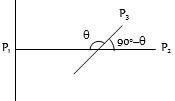
(A) Since no light is emitted from the second polaroid $(P_2)$,the first polaroid $(P_1)$ and the second polaroid $(P_2)$ must be crossed,meaning their polarization axes are perpendicular to each other.
Let the initial intensity of the unpolarized light be $I_0$.
The intensity of light after passing through the first polaroid $(P_1)$ is $I_1 = \frac{I_0}{2}$.
The third polaroid $(P_3)$ is placed at an angle $\theta$ with respect to $P_1$. According to Malus' Law,the intensity of light emerging from $P_3$ is $I_2 = I_1 \cos^2 \theta = \frac{I_0}{2} \cos^2 \theta$.
The angle between the polarization axis of $P_3$ and $P_2$ is $(90^\circ - \theta)$.
Applying Malus' Law again for the light passing through $P_2$,the final intensity $I_f$ is:
$I_f = I_2 \cos^2(90^\circ - \theta) = I_2 \sin^2 \theta$
$I_f = \left( \frac{I_0}{2} \cos^2 \theta \right) \sin^2 \theta = \frac{I_0}{2} (\sin \theta \cos \theta)^2$
Using the identity $\sin 2\theta = 2 \sin \theta \cos \theta$,we have $\sin \theta \cos \theta = \frac{\sin 2\theta}{2}$.
$I_f = \frac{I_0}{2} \left( \frac{\sin 2\theta}{2} \right)^2 = \frac{I_0}{2} \cdot \frac{\sin^2 2\theta}{4} = \frac{I_0}{8} \sin^2 2\theta$.
Let the initial intensity of the unpolarized light be $I_0$.
The intensity of light after passing through the first polaroid $(P_1)$ is $I_1 = \frac{I_0}{2}$.
The third polaroid $(P_3)$ is placed at an angle $\theta$ with respect to $P_1$. According to Malus' Law,the intensity of light emerging from $P_3$ is $I_2 = I_1 \cos^2 \theta = \frac{I_0}{2} \cos^2 \theta$.
The angle between the polarization axis of $P_3$ and $P_2$ is $(90^\circ - \theta)$.
Applying Malus' Law again for the light passing through $P_2$,the final intensity $I_f$ is:
$I_f = I_2 \cos^2(90^\circ - \theta) = I_2 \sin^2 \theta$
$I_f = \left( \frac{I_0}{2} \cos^2 \theta \right) \sin^2 \theta = \frac{I_0}{2} (\sin \theta \cos \theta)^2$
Using the identity $\sin 2\theta = 2 \sin \theta \cos \theta$,we have $\sin \theta \cos \theta = \frac{\sin 2\theta}{2}$.
$I_f = \frac{I_0}{2} \left( \frac{\sin 2\theta}{2} \right)^2 = \frac{I_0}{2} \cdot \frac{\sin^2 2\theta}{4} = \frac{I_0}{8} \sin^2 2\theta$.
0 likesView Solution
3
ChemistryMCQAP EAMCET · 2018
Two polaroids are placed in the path of an unpolarized beam of intensity $I_0$ such that no light is emitted from the second polaroid. If a third polaroid,whose polarization axis makes an angle $\theta$ with the polarization axis of the first polaroid,is placed between these polaroids,then the intensity of light emerging from the last polaroid will be:
A
$\left( \frac{I_0}{8} \right) \sin^2(2\theta)$
B
$\left( \frac{I_0}{4} \right) \sin^2(2\theta)$
C
$\left( \frac{I_0}{2} \right) \sin^2(2\theta)$
D
$I_0 \cos^4(\theta)$
Solution
(A) $1$. Initially,the unpolarized light of intensity $I_0$ passes through the first polaroid. The intensity of light emerging from the first polaroid is $I_1 = \frac{I_0}{2}$.
$2$. The second polaroid is placed such that no light emerges from it,meaning the first and second polaroids are crossed (angle between them is $90^\circ$).
$3$. $A$ third polaroid is placed between them at an angle $\theta$ with the first polaroid. The angle between the third and second polaroid is $(90^\circ - \theta)$.
$4$. Intensity after the third polaroid: $I_2 = I_1 \cos^2(\theta) = \frac{I_0}{2} \cos^2(\theta)$.
$5$. Intensity after the second (last) polaroid: $I_3 = I_2 \cos^2(90^\circ - \theta) = I_2 \sin^2(\theta)$.
$6$. Substituting $I_2$: $I_3 = \left( \frac{I_0}{2} \cos^2(\theta) \right) \sin^2(\theta) = \frac{I_0}{2} (\sin(\theta)\cos(\theta))^2 = \frac{I_0}{2} \left( \frac{\sin(2\theta)}{2} \right)^2 = \frac{I_0}{8} \sin^2(2\theta)$.
$2$. The second polaroid is placed such that no light emerges from it,meaning the first and second polaroids are crossed (angle between them is $90^\circ$).
$3$. $A$ third polaroid is placed between them at an angle $\theta$ with the first polaroid. The angle between the third and second polaroid is $(90^\circ - \theta)$.
$4$. Intensity after the third polaroid: $I_2 = I_1 \cos^2(\theta) = \frac{I_0}{2} \cos^2(\theta)$.
$5$. Intensity after the second (last) polaroid: $I_3 = I_2 \cos^2(90^\circ - \theta) = I_2 \sin^2(\theta)$.
$6$. Substituting $I_2$: $I_3 = \left( \frac{I_0}{2} \cos^2(\theta) \right) \sin^2(\theta) = \frac{I_0}{2} (\sin(\theta)\cos(\theta))^2 = \frac{I_0}{2} \left( \frac{\sin(2\theta)}{2} \right)^2 = \frac{I_0}{8} \sin^2(2\theta)$.
0 likesView Solution
4
ChemistryMCQAP EAMCET · 2018
Two polaroids are placed in the path of an unpolarized beam of intensity $I_0$ such that no light is emitted from the second polaroid. If a third polaroid,whose polarization axis makes an angle $\theta$ with the polarization axis of the first polaroid,is placed between these polaroids,then the intensity of light emerging from the last polaroid will be
A
$\left( \frac{I_0}{8} \right) \sin^2 2\theta$
B
$\left( \frac{I_0}{4} \right) \sin^2 2\theta$
C
$\left( \frac{I_0}{2} \right) \cos^2 2\theta$
D
$I_0 \cos^4 \theta$
Solution
(A) Let the initial intensity of the unpolarized light be $I_0$.
When unpolarized light passes through the first polaroid,the intensity of the transmitted light becomes $I_1 = \frac{I_0}{2}$.
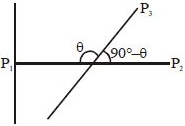
The third polaroid is placed at an angle $\theta$ with respect to the first polaroid. According to Malus' Law,the intensity of light after passing through the third polaroid is $I_2 = I_1 \cos^2 \theta = \frac{I_0}{2} \cos^2 \theta$.
The second polaroid is at an angle of $90^\circ$ with respect to the first,so the angle between the third and the second polaroid is $(90^\circ - \theta)$.
The intensity of light emerging from the last (second) polaroid is $I_3 = I_2 \cos^2(90^\circ - \theta) = I_2 \sin^2 \theta$.
Substituting $I_2$,we get $I_3 = \left( \frac{I_0}{2} \cos^2 \theta \right) \sin^2 \theta = \frac{I_0}{2} (\sin \theta \cos \theta)^2$.
Using the identity $\sin 2\theta = 2 \sin \theta \cos \theta$,we have $\sin \theta \cos \theta = \frac{\sin 2\theta}{2}$.
Thus,$I_3 = \frac{I_0}{2} \left( \frac{\sin 2\theta}{2} \right)^2 = \frac{I_0}{2} \cdot \frac{\sin^2 2\theta}{4} = \frac{I_0}{8} \sin^2 2\theta$.
When unpolarized light passes through the first polaroid,the intensity of the transmitted light becomes $I_1 = \frac{I_0}{2}$.
The third polaroid is placed at an angle $\theta$ with respect to the first polaroid. According to Malus' Law,the intensity of light after passing through the third polaroid is $I_2 = I_1 \cos^2 \theta = \frac{I_0}{2} \cos^2 \theta$.
The second polaroid is at an angle of $90^\circ$ with respect to the first,so the angle between the third and the second polaroid is $(90^\circ - \theta)$.
The intensity of light emerging from the last (second) polaroid is $I_3 = I_2 \cos^2(90^\circ - \theta) = I_2 \sin^2 \theta$.
Substituting $I_2$,we get $I_3 = \left( \frac{I_0}{2} \cos^2 \theta \right) \sin^2 \theta = \frac{I_0}{2} (\sin \theta \cos \theta)^2$.
Using the identity $\sin 2\theta = 2 \sin \theta \cos \theta$,we have $\sin \theta \cos \theta = \frac{\sin 2\theta}{2}$.
Thus,$I_3 = \frac{I_0}{2} \left( \frac{\sin 2\theta}{2} \right)^2 = \frac{I_0}{2} \cdot \frac{\sin^2 2\theta}{4} = \frac{I_0}{8} \sin^2 2\theta$.
0 likesView Solution
5
ChemistryMCQAP EAMCET · 2018
Two polaroids are placed in the path of an unpolarized beam of intensity $I_0$ such that no light is emitted from the second polaroid. If a third polaroid,whose polarization axis makes an angle $\theta$ with the polarization axis of the first polaroid,is placed between these polaroids,then the intensity of light emerging from the last polaroid will be:
A
$\left( \frac{I_0}{8} \right) \sin^2 2\theta$
B
$\left( \frac{I_0}{4} \right) \sin^2 2\theta$
C
$\left( \frac{I_0}{2} \right) \cos^2 \theta$
D
$I_0 \cos^4 \theta$
Solution
(A) Let the initial intensity of the unpolarized light be $I_0$.
When unpolarized light passes through the first polaroid,the intensity of the transmitted light is $I_1 = \frac{I_0}{2}$.
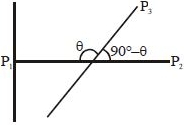
The third polaroid is placed at an angle $\theta$ with respect to the first polaroid. According to Malus's Law,the intensity of light emerging from the third polaroid is $I_2 = I_1 \cos^2 \theta = \frac{I_0}{2} \cos^2 \theta$.
The second polaroid is initially at $90^\circ$ to the first. Since the third polaroid is at $\theta$ to the first,the angle between the third and the second polaroid is $(90^\circ - \theta)$.
Applying Malus's Law again for the light passing through the second polaroid:
$I_3 = I_2 \cos^2(90^\circ - \theta) = I_2 \sin^2 \theta$.
Substituting the value of $I_2$:
$I_3 = \left( \frac{I_0}{2} \cos^2 \theta \right) \sin^2 \theta = \frac{I_0}{2} (\sin \theta \cos \theta)^2$.
Using the identity $\sin 2\theta = 2 \sin \theta \cos \theta$,we have $\sin \theta \cos \theta = \frac{\sin 2\theta}{2}$.
Therefore,$I_3 = \frac{I_0}{2} \left( \frac{\sin 2\theta}{2} \right)^2 = \frac{I_0}{2} \cdot \frac{\sin^2 2\theta}{4} = \frac{I_0}{8} \sin^2 2\theta$.
When unpolarized light passes through the first polaroid,the intensity of the transmitted light is $I_1 = \frac{I_0}{2}$.
The third polaroid is placed at an angle $\theta$ with respect to the first polaroid. According to Malus's Law,the intensity of light emerging from the third polaroid is $I_2 = I_1 \cos^2 \theta = \frac{I_0}{2} \cos^2 \theta$.
The second polaroid is initially at $90^\circ$ to the first. Since the third polaroid is at $\theta$ to the first,the angle between the third and the second polaroid is $(90^\circ - \theta)$.
Applying Malus's Law again for the light passing through the second polaroid:
$I_3 = I_2 \cos^2(90^\circ - \theta) = I_2 \sin^2 \theta$.
Substituting the value of $I_2$:
$I_3 = \left( \frac{I_0}{2} \cos^2 \theta \right) \sin^2 \theta = \frac{I_0}{2} (\sin \theta \cos \theta)^2$.
Using the identity $\sin 2\theta = 2 \sin \theta \cos \theta$,we have $\sin \theta \cos \theta = \frac{\sin 2\theta}{2}$.
Therefore,$I_3 = \frac{I_0}{2} \left( \frac{\sin 2\theta}{2} \right)^2 = \frac{I_0}{2} \cdot \frac{\sin^2 2\theta}{4} = \frac{I_0}{8} \sin^2 2\theta$.
0 likesView Solution
6
ChemistryMCQAP EAMCET · 2018
In a compound microscope,the focal lengths of two lenses are $1.5 \, cm$ and $6.25 \, cm$. An object is placed at $2 \, cm$ from the objective lens and the final image is formed at $25 \, cm$ from the eye lens. The distance between the two lenses is.....$cm$
A
$6$
B
$7.75$
C
$9.25$
D
$11$
Solution
(D) Given: $f_{o} = 1.5 \, cm$,$f_{e} = 6.25 \, cm$,$u_{o} = -2 \, cm$,$v_{e} = -25 \, cm$.
For the objective lens,using the lens formula $\frac{1}{f_{o}} = \frac{1}{v_{o}} - \frac{1}{u_{o}}$:
$\frac{1}{1.5} = \frac{1}{v_{o}} - \frac{1}{-2} \Rightarrow \frac{2}{3} = \frac{1}{v_{o}} + \frac{1}{2} \Rightarrow \frac{1}{v_{o}} = \frac{2}{3} - \frac{1}{2} = \frac{4-3}{6} = \frac{1}{6}$.
Thus,$v_{o} = 6 \, cm$.
For the eye lens,using the lens formula $\frac{1}{f_{e}} = \frac{1}{v_{e}} - \frac{1}{u_{e}}$:
$\frac{1}{6.25} = \frac{1}{-25} - \frac{1}{u_{e}} \Rightarrow \frac{1}{u_{e}} = -\frac{1}{25} - \frac{1}{6.25} = -\frac{1}{25} - \frac{4}{25} = -\frac{5}{25} = -\frac{1}{5}$.
Thus,$u_{e} = -5 \, cm$. The magnitude of the object distance for the eye lens is $|u_{e}| = 5 \, cm$.
The distance between the two lenses (tube length) is $L = v_{o} + |u_{e}| = 6 \, cm + 5 \, cm = 11 \, cm$.
For the objective lens,using the lens formula $\frac{1}{f_{o}} = \frac{1}{v_{o}} - \frac{1}{u_{o}}$:
$\frac{1}{1.5} = \frac{1}{v_{o}} - \frac{1}{-2} \Rightarrow \frac{2}{3} = \frac{1}{v_{o}} + \frac{1}{2} \Rightarrow \frac{1}{v_{o}} = \frac{2}{3} - \frac{1}{2} = \frac{4-3}{6} = \frac{1}{6}$.
Thus,$v_{o} = 6 \, cm$.
For the eye lens,using the lens formula $\frac{1}{f_{e}} = \frac{1}{v_{e}} - \frac{1}{u_{e}}$:
$\frac{1}{6.25} = \frac{1}{-25} - \frac{1}{u_{e}} \Rightarrow \frac{1}{u_{e}} = -\frac{1}{25} - \frac{1}{6.25} = -\frac{1}{25} - \frac{4}{25} = -\frac{5}{25} = -\frac{1}{5}$.
Thus,$u_{e} = -5 \, cm$. The magnitude of the object distance for the eye lens is $|u_{e}| = 5 \, cm$.
The distance between the two lenses (tube length) is $L = v_{o} + |u_{e}| = 6 \, cm + 5 \, cm = 11 \, cm$.
0 likesView Solution
7
ChemistryMCQAP EAMCET · 2018
In a compound microscope,the focal lengths of the two lenses are $1.5 \, cm$ and $6.25 \, cm$. If an object is placed at $2 \, cm$ from the objective lens and the final image is formed at $25 \, cm$ from the eye lens,the distance between the two lenses is ...... $cm$.
A
$6$
B
$7.75$
C
$9.25$
D
$11$
Solution
(D) For the objective lens: $f_o = 1.5 \, cm$,$u_o = -2 \, cm$. Using the lens formula $\frac{1}{v_o} - \frac{1}{u_o} = \frac{1}{f_o}$:
$\frac{1}{v_o} - \frac{1}{-2} = \frac{1}{1.5} \implies \frac{1}{v_o} = \frac{2}{3} - \frac{1}{2} = \frac{4-3}{6} = \frac{1}{6}$.
Thus,$v_o = 6 \, cm$.
For the eye lens: $f_e = 6.25 \, cm$,$v_e = -25 \, cm$. Using the lens formula $\frac{1}{v_e} - \frac{1}{u_e} = \frac{1}{f_e}$:
$\frac{1}{-25} - \frac{1}{u_e} = \frac{1}{6.25} \implies \frac{1}{u_e} = -\frac{1}{25} - \frac{1}{6.25} = -\frac{1}{25} - \frac{4}{25} = -\frac{5}{25} = -\frac{1}{5}$.
Thus,$|u_e| = 5 \, cm$.
The distance between the two lenses is $L = |v_o| + |u_e| = 6 + 5 = 11 \, cm$.
$\frac{1}{v_o} - \frac{1}{-2} = \frac{1}{1.5} \implies \frac{1}{v_o} = \frac{2}{3} - \frac{1}{2} = \frac{4-3}{6} = \frac{1}{6}$.
Thus,$v_o = 6 \, cm$.
For the eye lens: $f_e = 6.25 \, cm$,$v_e = -25 \, cm$. Using the lens formula $\frac{1}{v_e} - \frac{1}{u_e} = \frac{1}{f_e}$:
$\frac{1}{-25} - \frac{1}{u_e} = \frac{1}{6.25} \implies \frac{1}{u_e} = -\frac{1}{25} - \frac{1}{6.25} = -\frac{1}{25} - \frac{4}{25} = -\frac{5}{25} = -\frac{1}{5}$.
Thus,$|u_e| = 5 \, cm$.
The distance between the two lenses is $L = |v_o| + |u_e| = 6 + 5 = 11 \, cm$.
0 likesView Solution
8
ChemistryMCQAP EAMCET · 2018
In a compound microscope,the focal lengths of two lenses are $1.5 \ cm$ and $6.25 \ cm$. An object is placed at $2 \ cm$ from the objective lens and the final image is formed at $25 \ cm$ from the eye lens. The distance between the two lenses is $.... \ cm$.
A
$6.00$
B
$7.75$
C
$9.25$
D
$11$
Solution
(D) Given: Focal length of objective $f_{o} = 1.5 \ cm$,focal length of eyepiece $f_{e} = 6.25 \ cm$,object distance $u_{o} = -2 \ cm$,and final image distance $v_{e} = -25 \ cm$.
For the objective lens,using the lens formula $\frac{1}{f_{o}} = \frac{1}{v_{o}} - \frac{1}{u_{o}}$:
$\frac{1}{1.5} = \frac{1}{v_{o}} - \frac{1}{-2} \Rightarrow \frac{2}{3} = \frac{1}{v_{o}} + \frac{1}{2} \Rightarrow \frac{1}{v_{o}} = \frac{2}{3} - \frac{1}{2} = \frac{4-3}{6} = \frac{1}{6}$.
Thus,$v_{o} = 6 \ cm$.
For the eyepiece,using the lens formula $\frac{1}{f_{e}} = \frac{1}{v_{e}} - \frac{1}{u_{e}}$:
$\frac{1}{6.25} = \frac{1}{-25} - \frac{1}{u_{e}} \Rightarrow \frac{1}{u_{e}} = -\frac{1}{25} - \frac{1}{6.25} = -\frac{1}{25} - \frac{4}{25} = -\frac{5}{25} = -\frac{1}{5}$.
Thus,$u_{e} = -5 \ cm$.
The distance between the two lenses (tube length) is $L = v_{o} + |u_{e}| = 6 \ cm + 5 \ cm = 11 \ cm$.
For the objective lens,using the lens formula $\frac{1}{f_{o}} = \frac{1}{v_{o}} - \frac{1}{u_{o}}$:
$\frac{1}{1.5} = \frac{1}{v_{o}} - \frac{1}{-2} \Rightarrow \frac{2}{3} = \frac{1}{v_{o}} + \frac{1}{2} \Rightarrow \frac{1}{v_{o}} = \frac{2}{3} - \frac{1}{2} = \frac{4-3}{6} = \frac{1}{6}$.
Thus,$v_{o} = 6 \ cm$.
For the eyepiece,using the lens formula $\frac{1}{f_{e}} = \frac{1}{v_{e}} - \frac{1}{u_{e}}$:
$\frac{1}{6.25} = \frac{1}{-25} - \frac{1}{u_{e}} \Rightarrow \frac{1}{u_{e}} = -\frac{1}{25} - \frac{1}{6.25} = -\frac{1}{25} - \frac{4}{25} = -\frac{5}{25} = -\frac{1}{5}$.
Thus,$u_{e} = -5 \ cm$.
The distance between the two lenses (tube length) is $L = v_{o} + |u_{e}| = 6 \ cm + 5 \ cm = 11 \ cm$.
0 likesView Solution
9
ChemistryMCQAP EAMCET · 2018
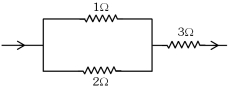
In the circuit shown in the figure,the power developed across the $1 \Omega$,$2 \Omega$,and $3 \Omega$ resistors are in the ratio of:
A
$1: 2: 3$
B
$4: 2: 27$
C
$6: 4: 9$
D
$2: 1: 27$
Solution
(B) Let the total current entering the parallel combination be $I$. The current $I$ splits into $I_1$ and $I_2$ through the $1 \Omega$ and $2 \Omega$ resistors respectively.
Using the current divider rule:
$I_1 = I \left( \frac{2}{1+2} \right) = \frac{2I}{3}$
$I_2 = I \left( \frac{1}{1+2} \right) = \frac{I}{3}$
The current flowing through the $3 \Omega$ resistor is the total current $I$.
The power developed across a resistor is given by $P = I^2 R$.
$P_1 = I_1^2 \times 1 = \left( \frac{2I}{3} \right)^2 \times 1 = \frac{4I^2}{9}$
$P_2 = I_2^2 \times 2 = \left( \frac{I}{3} \right)^2 \times 2 = \frac{2I^2}{9}$
$P_3 = I^2 \times 3 = 3I^2$
Now,the ratio $P_1 : P_2 : P_3 = \frac{4I^2}{9} : \frac{2I^2}{9} : 3I^2 = \frac{4}{9} : \frac{2}{9} : 3$.
Multiplying by $9$,we get $4 : 2 : 27$.
Using the current divider rule:
$I_1 = I \left( \frac{2}{1+2} \right) = \frac{2I}{3}$
$I_2 = I \left( \frac{1}{1+2} \right) = \frac{I}{3}$
The current flowing through the $3 \Omega$ resistor is the total current $I$.
The power developed across a resistor is given by $P = I^2 R$.
$P_1 = I_1^2 \times 1 = \left( \frac{2I}{3} \right)^2 \times 1 = \frac{4I^2}{9}$
$P_2 = I_2^2 \times 2 = \left( \frac{I}{3} \right)^2 \times 2 = \frac{2I^2}{9}$
$P_3 = I^2 \times 3 = 3I^2$
Now,the ratio $P_1 : P_2 : P_3 = \frac{4I^2}{9} : \frac{2I^2}{9} : 3I^2 = \frac{4}{9} : \frac{2}{9} : 3$.
Multiplying by $9$,we get $4 : 2 : 27$.
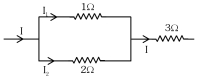
0 likesView Solution
10
ChemistryMCQAP EAMCET · 2018
The reagent used for the conversion of allyl alcohol to propenal is
A
$O_3 / H_2O - Zn$ dust
B
$DIBAL-H$
C
$CrO_2Cl_2 / H_3O^+$
D
$C_5H_5NH^+ CrO_3Cl^-$
Solution
(D) The conversion of allyl alcohol $(CH_2=CH-CH_2OH)$ to propenal $(CH_2=CH-CHO)$ requires a mild oxidizing agent that can selectively oxidize a primary alcohol to an aldehyde without affecting the carbon-carbon double bond.
Pyridinium chlorochromate $(PCC)$,represented as $C_5H_5NH^+ CrO_3Cl^-$,is a selective oxidizing agent used for this purpose.
The reaction is:
$CH_2=CH-CH_2OH + C_5H_5NH^+ CrO_3Cl^- \rightarrow CH_2=CH-CHO + C_5H_5NH^+ Cl^- + CrO_2 + H_2O$
Thus,the correct reagent is $C_5H_5NH^+ CrO_3Cl^-$.
Pyridinium chlorochromate $(PCC)$,represented as $C_5H_5NH^+ CrO_3Cl^-$,is a selective oxidizing agent used for this purpose.
The reaction is:
$CH_2=CH-CH_2OH + C_5H_5NH^+ CrO_3Cl^- \rightarrow CH_2=CH-CHO + C_5H_5NH^+ Cl^- + CrO_2 + H_2O$
Thus,the correct reagent is $C_5H_5NH^+ CrO_3Cl^-$.
0 likesView Solution
11
ChemistryMCQAP EAMCET · 2018
In which of the following reactions is benzaldehyde formed from benzoyl chloride and hydrogen in the presence of $Pd/BaSO_4$?
A
Stephen reaction
B
Etard reaction
C
Gatterman-Koch reaction
D
Rosenmund reduction reaction
Solution
(D) The reaction of benzoyl chloride with hydrogen in the presence of $Pd$ supported on $BaSO_4$ is a specific method for the preparation of aldehydes from acid chlorides.
This reaction is known as the Rosenmund reduction.
The chemical equation is: $C_6H_5COCl + H_2 \xrightarrow{Pd/BaSO_4} C_6H_5CHO + HCl$.
This reaction is known as the Rosenmund reduction.
The chemical equation is: $C_6H_5COCl + H_2 \xrightarrow{Pd/BaSO_4} C_6H_5CHO + HCl$.
0 likesView Solution
12
ChemistryMCQAP EAMCET · 2018
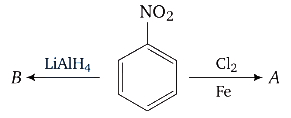
Identify $A$ and $B$ in the following reactions:
A
$A = m\text{-chloronitrobenzene}, B = \text{azobenzene}$
B
$A = p\text{-chloronitrobenzene}, B = \text{azobenzene}$
C
$A = m\text{-chloronitrobenzene}, B = \text{aniline}$
D
$A = o\text{-chloronitrobenzene}, B = \text{azobenzene}$
Solution
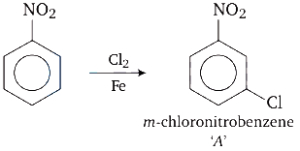
(A) $1$. The $-NO_2$ group is a deactivating and meta-directing group. Therefore,electrophilic aromatic substitution of nitrobenzene with $Cl_2$ in the presence of $Fe$ (Lewis acid) yields $m\text{-chloronitrobenzene}$ as the major product $(A)$.
$2$. The reduction of nitrobenzene with $LiAlH_4$ is a complex process. While $LiAlH_4$ is a strong reducing agent,under specific conditions,it can reduce nitrobenzene to azobenzene $(C_6H_5-N=N-C_6H_5)$ $(B)$.
$2$. The reduction of nitrobenzene with $LiAlH_4$ is a complex process. While $LiAlH_4$ is a strong reducing agent,under specific conditions,it can reduce nitrobenzene to azobenzene $(C_6H_5-N=N-C_6H_5)$ $(B)$.
0 likesView Solution
13
ChemistryMCQAP EAMCET · 2018
The difference between the radii of $n^{\text{th}}$ and $(n+1)^{\text{th}}$ orbits of a hydrogen atom is equal to the radius of the $(n-1)^{\text{th}}$ orbit of hydrogen. The angular momentum of the electron in the $n^{\text{th}}$ orbit is . . . . . . ($h$ is Planck's constant).
A
$\frac{h}{\pi}$
B
$\frac{2h}{\pi}$
C
$\frac{3h}{\pi}$
D
$\frac{4h}{\pi}$
Solution
(B) The radius of the $n^{\text{th}}$ orbit in a hydrogen atom is given by $r_n = a_0 n^2$,where $a_0$ is the Bohr radius. Thus,$r_n \propto n^2$.
According to the problem,the difference between the radii of the $(n+1)^{\text{th}}$ and $n^{\text{th}}$ orbits is equal to the radius of the $(n-1)^{\text{th}}$ orbit:
$r_{n+1} - r_n = r_{n-1}$
Substituting the proportionality $r_n \propto n^2$:
$(n+1)^2 - n^2 = (n-1)^2$
$n^2 + 2n + 1 - n^2 = n^2 - 2n + 1$
$2n = n^2 - 2n$
$n^2 - 4n = 0$
Since $n \neq 0$,we have $n = 4$.
According to Bohr's quantization postulate,the angular momentum $L$ of an electron in the $n^{\text{th}}$ orbit is given by $L = \frac{nh}{2\pi}$.
For $n = 4$:
$L = \frac{4h}{2\pi} = \frac{2h}{\pi}$.
According to the problem,the difference between the radii of the $(n+1)^{\text{th}}$ and $n^{\text{th}}$ orbits is equal to the radius of the $(n-1)^{\text{th}}$ orbit:
$r_{n+1} - r_n = r_{n-1}$
Substituting the proportionality $r_n \propto n^2$:
$(n+1)^2 - n^2 = (n-1)^2$
$n^2 + 2n + 1 - n^2 = n^2 - 2n + 1$
$2n = n^2 - 2n$
$n^2 - 4n = 0$
Since $n \neq 0$,we have $n = 4$.
According to Bohr's quantization postulate,the angular momentum $L$ of an electron in the $n^{\text{th}}$ orbit is given by $L = \frac{nh}{2\pi}$.
For $n = 4$:
$L = \frac{4h}{2\pi} = \frac{2h}{\pi}$.
0 likesView Solution
14
ChemistryMCQAP EAMCET · 2018
The type of bond connecting two nucleotides is
A
peptide bond
B
hydrogen bond
C
phosphodiester bond
D
glycosidic bond
Solution
(C) Nucleotides are the building blocks of nucleic acids like $DNA$ and $RNA$.
Two nucleotides are linked together by a $3'-5'$ phosphodiester bond,which connects the $3'$ carbon of the sugar of one nucleotide to the $5'$ carbon of the sugar of the next nucleotide through a phosphate group.
Therefore,the correct answer is a phosphodiester bond.
Two nucleotides are linked together by a $3'-5'$ phosphodiester bond,which connects the $3'$ carbon of the sugar of one nucleotide to the $5'$ carbon of the sugar of the next nucleotide through a phosphate group.
Therefore,the correct answer is a phosphodiester bond.
0 likesView Solution
15
ChemistryMCQAP EAMCET · 2018
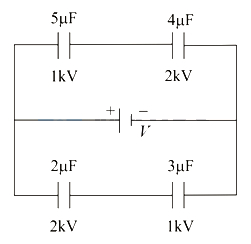
Four capacitors marked with their capacitances and breakdown voltages are connected as shown in the figure. Find the maximum $EMF$ of the source such that no capacitor breaks down. (in $kV$)
A
$10.5$
B
$5.25$
C
$2.25$
D
$1.25$
Solution
(C) Let the upper branch have capacitors $C_1 = 5 \ \mu F$ $(V_{b1} = 1 \ kV)$ and $C_2 = 4 \ \mu F$ $(V_{b2} = 2 \ kV)$. In series,charge $Q$ is constant. The maximum charge $C_1$ can hold is $Q_1 = C_1 V_{b1} = 5 \ \mu F \times 1 \ kV = 5 \ mC$. The maximum charge $C_2$ can hold is $Q_2 = C_2 V_{b2} = 4 \ \mu F \times 2 \ kV = 8 \ mC$. To prevent breakdown,$Q \le \min(Q_1, Q_2) = 5 \ mC$. The potential across the upper branch is $V_U = \frac{Q}{C_1} + \frac{Q}{C_2} = 1 \ kV + \frac{5 \ mC}{4 \ \mu F} = 1 \ kV + 1.25 \ kV = 2.25 \ kV$.
Let the lower branch have capacitors $C_3 = 2 \ \mu F$ $(V_{b3} = 2 \ kV)$ and $C_4 = 3 \ \mu F$ $(V_{b4} = 1 \ kV)$. The maximum charge $C_3$ can hold is $Q_3 = C_3 V_{b3} = 2 \ \mu F \times 2 \ kV = 4 \ mC$. The maximum charge $C_4$ can hold is $Q_4 = C_4 V_{b4} = 3 \ \mu F \times 1 \ kV = 3 \ mC$. To prevent breakdown,$Q' \le \min(Q_3, Q_4) = 3 \ mC$. The potential across the lower branch is $V_L = \frac{Q'}{C_3} + \frac{Q'}{C_4} = \frac{3 \ mC}{2 \ \mu F} + \frac{3 \ mC}{3 \ \mu F} = 1.5 \ kV + 1 \ kV = 2.5 \ kV$.
The source is connected in parallel to both branches,so $V = V_U = V_L$. To ensure no capacitor breaks down,we must choose the minimum of the two branch potentials: $V = \min(2.25 \ kV, 2.5 \ kV) = 2.25 \ kV$.
Let the lower branch have capacitors $C_3 = 2 \ \mu F$ $(V_{b3} = 2 \ kV)$ and $C_4 = 3 \ \mu F$ $(V_{b4} = 1 \ kV)$. The maximum charge $C_3$ can hold is $Q_3 = C_3 V_{b3} = 2 \ \mu F \times 2 \ kV = 4 \ mC$. The maximum charge $C_4$ can hold is $Q_4 = C_4 V_{b4} = 3 \ \mu F \times 1 \ kV = 3 \ mC$. To prevent breakdown,$Q' \le \min(Q_3, Q_4) = 3 \ mC$. The potential across the lower branch is $V_L = \frac{Q'}{C_3} + \frac{Q'}{C_4} = \frac{3 \ mC}{2 \ \mu F} + \frac{3 \ mC}{3 \ \mu F} = 1.5 \ kV + 1 \ kV = 2.5 \ kV$.
The source is connected in parallel to both branches,so $V = V_U = V_L$. To ensure no capacitor breaks down,we must choose the minimum of the two branch potentials: $V = \min(2.25 \ kV, 2.5 \ kV) = 2.25 \ kV$.
0 likesView Solution
16
ChemistryMCQAP EAMCET · 2018
$A$ circular disc of radius $R$ is removed from a bigger circular disc of radius $2R$ such that the circumferences of the discs touch. The centre of mass of the new disc is at a distance $\alpha R$ from the centre of the bigger disc. The value of $\alpha$ is
A
$\frac{1}{2}$
B
$\frac{1}{3}$
C
$\frac{1}{4}$
D
$\frac{1}{6}$
Solution
(B) Let the centre of the bigger disc be the origin $O(0,0)$.
Let the mass of the original disc be $M$ and its radius be $2R$.
The mass of the removed smaller disc of radius $R$ is $m = \frac{\pi R^2}{\pi (2R)^2} M = \frac{M}{4}$.
The centre of the removed disc is at a distance $R$ from the origin along the $x$-axis,so its coordinates are $(R, 0)$.
The centre of mass of the remaining part $(x_{CM})$ is given by the formula:
$x_{CM} = \frac{M_1 x_1 - m x_2}{M_1 - m}$
Here,$M_1 = M$,$x_1 = 0$,$m = M/4$,and $x_2 = R$.
$x_{CM} = \frac{M(0) - (M/4)(R)}{M - M/4} = \frac{-MR/4}{3M/4} = -\frac{R}{3}$.
The distance from the centre is $|x_{CM}| = \frac{R}{3}$.
Comparing this with $\alpha R$,we get $\alpha = \frac{1}{3}$.
Let the mass of the original disc be $M$ and its radius be $2R$.
The mass of the removed smaller disc of radius $R$ is $m = \frac{\pi R^2}{\pi (2R)^2} M = \frac{M}{4}$.
The centre of the removed disc is at a distance $R$ from the origin along the $x$-axis,so its coordinates are $(R, 0)$.
The centre of mass of the remaining part $(x_{CM})$ is given by the formula:
$x_{CM} = \frac{M_1 x_1 - m x_2}{M_1 - m}$
Here,$M_1 = M$,$x_1 = 0$,$m = M/4$,and $x_2 = R$.
$x_{CM} = \frac{M(0) - (M/4)(R)}{M - M/4} = \frac{-MR/4}{3M/4} = -\frac{R}{3}$.
The distance from the centre is $|x_{CM}| = \frac{R}{3}$.
Comparing this with $\alpha R$,we get $\alpha = \frac{1}{3}$.
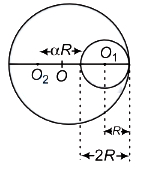
0 likesView Solution
17
ChemistryMCQAP EAMCET · 2018
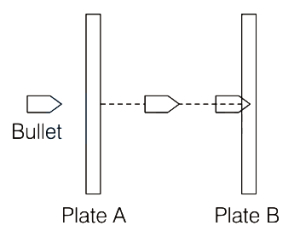
$A$ bullet of mass $10 \ g$ pierces through a plate $A$ of mass $500 \ g$ and then gets embedded into a second plate $B$ of mass $1.49 \ kg$ as shown in the figure. Initially,the two plates $A$ and $B$ are at rest and move with the same velocity after the collision. The percentage loss in the initial kinetic energy of the bullet,when it is between the plates $A$ and $B$,is . . . . . .
(Neglect any loss of material of the plates during the collision)
(Neglect any loss of material of the plates during the collision)
A
$25$
B
$56.25$
C
$43.75$
D
$75$
Solution
(C) Let $m = 10 \ g = 0.01 \ kg$ be the mass of the bullet,$M_A = 500 \ g = 0.5 \ kg$ be the mass of plate $A$,and $M_B = 1.49 \ kg$ be the mass of plate $B$.
Let $v_1$ be the initial velocity of the bullet,$v_3$ be the velocity of the bullet after passing through plate $A$,and $v_2$ be the final velocity of both plates $A$ and $B$ after the bullet embeds into $B$.
Applying the law of conservation of momentum for the entire system:
$m v_1 = M_A v_2 + (M_B + m) v_2$
$0.01 v_1 = (0.5 + 1.49 + 0.01) v_2 = 2 v_2$
$v_1 = 200 v_2$ --- $(i)$
Now,considering the collision between the bullet and plate $B$ only:
$m v_3 = (M_B + m) v_2$
$0.01 v_3 = (1.49 + 0.01) v_2 = 1.5 v_2$
$v_3 = 150 v_2$ --- $(ii)$
The percentage loss in kinetic energy of the bullet after passing through plate $A$ is:
$\text{Loss} \% = \frac{\frac{1}{2} m v_1^2 - \frac{1}{2} m v_3^2}{\frac{1}{2} m v_1^2} \times 100 = \left( 1 - \frac{v_3^2}{v_1^2} \right) \times 100$
Substituting the values from $(i)$ and $(ii)$:
$\text{Loss} \% = \left( 1 - \left( \frac{150 v_2}{200 v_2} \right)^2 \right) \times 100 = \left( 1 - \left( \frac{3}{4} \right)^2 \right) \times 100$
$\text{Loss} \% = \left( 1 - \frac{9}{16} \right) \times 100 = \frac{7}{16} \times 100 = 43.75 \%$
Let $v_1$ be the initial velocity of the bullet,$v_3$ be the velocity of the bullet after passing through plate $A$,and $v_2$ be the final velocity of both plates $A$ and $B$ after the bullet embeds into $B$.
Applying the law of conservation of momentum for the entire system:
$m v_1 = M_A v_2 + (M_B + m) v_2$
$0.01 v_1 = (0.5 + 1.49 + 0.01) v_2 = 2 v_2$
$v_1 = 200 v_2$ --- $(i)$
Now,considering the collision between the bullet and plate $B$ only:
$m v_3 = (M_B + m) v_2$
$0.01 v_3 = (1.49 + 0.01) v_2 = 1.5 v_2$
$v_3 = 150 v_2$ --- $(ii)$
The percentage loss in kinetic energy of the bullet after passing through plate $A$ is:
$\text{Loss} \% = \frac{\frac{1}{2} m v_1^2 - \frac{1}{2} m v_3^2}{\frac{1}{2} m v_1^2} \times 100 = \left( 1 - \frac{v_3^2}{v_1^2} \right) \times 100$
Substituting the values from $(i)$ and $(ii)$:
$\text{Loss} \% = \left( 1 - \left( \frac{150 v_2}{200 v_2} \right)^2 \right) \times 100 = \left( 1 - \left( \frac{3}{4} \right)^2 \right) \times 100$
$\text{Loss} \% = \left( 1 - \frac{9}{16} \right) \times 100 = \frac{7}{16} \times 100 = 43.75 \%$

0 likesView Solution
18
ChemistryMCQAP EAMCET · 2018
$A$ particle of mass $4 M$ which is initially at rest explodes into three pieces of masses $M$,$M$ and $2 M$. The equal masses move along $X$ and $Y$-axes with velocities $4 ~ms^{-1}$ and $6 ~ms^{-1}$,respectively. The magnitude of the velocity of the heavier mass is
A
$\sqrt{17} ~ms^{-1}$
B
$2 \sqrt{13} ~ms^{-1}$
C
$\sqrt{13} ~ms^{-1}$
D
$\frac{\sqrt{13}}{2} ~ms^{-1}$
Solution
(C) Initial mass of the particle $= 4 M$. Initial velocity $= 0$. Therefore,initial momentum $= 0$.
After the explosion,the system consists of three pieces with masses $M$,$M$,and $2 M$. Let the velocities of the pieces with mass $M$ be $\vec{v}_x = 4 \hat{i} ~ms^{-1}$ and $\vec{v}_y = 6 \hat{j} ~ms^{-1}$. Let the velocity of the piece with mass $2 M$ be $\vec{v}$.
According to the law of conservation of linear momentum:
$\vec{P}_{initial} = \vec{P}_{final}$
$0 = M(4 \hat{i}) + M(6 \hat{j}) + 2 M \vec{v}$
$0 = 4 M \hat{i} + 6 M \hat{j} + 2 M \vec{v}$
Dividing by $2 M$:
$0 = 2 \hat{i} + 3 \hat{j} + \vec{v}$
$\vec{v} = -2 \hat{i} - 3 \hat{j} ~ms^{-1}$
The magnitude of the velocity is:
$|\vec{v}| = \sqrt{(-2)^2 + (-3)^2} = \sqrt{4 + 9} = \sqrt{13} ~ms^{-1}$.
After the explosion,the system consists of three pieces with masses $M$,$M$,and $2 M$. Let the velocities of the pieces with mass $M$ be $\vec{v}_x = 4 \hat{i} ~ms^{-1}$ and $\vec{v}_y = 6 \hat{j} ~ms^{-1}$. Let the velocity of the piece with mass $2 M$ be $\vec{v}$.
According to the law of conservation of linear momentum:
$\vec{P}_{initial} = \vec{P}_{final}$
$0 = M(4 \hat{i}) + M(6 \hat{j}) + 2 M \vec{v}$
$0 = 4 M \hat{i} + 6 M \hat{j} + 2 M \vec{v}$
Dividing by $2 M$:
$0 = 2 \hat{i} + 3 \hat{j} + \vec{v}$
$\vec{v} = -2 \hat{i} - 3 \hat{j} ~ms^{-1}$
The magnitude of the velocity is:
$|\vec{v}| = \sqrt{(-2)^2 + (-3)^2} = \sqrt{4 + 9} = \sqrt{13} ~ms^{-1}$.
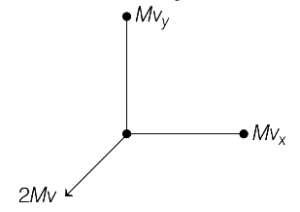
0 likesView Solution
19
ChemistryMCQAP EAMCET · 2018
$A$ particle of mass $4 m$ explodes into three pieces of masses $m, m$ and $2 m$. The equal masses move along $X$-axis and $Y$-axis with velocities $4 ms^{-1}$ and $6 ms^{-1}$ respectively. The magnitude of the velocity of the heavier mass is
A
$\sqrt{17} ms^{-1}$
B
$2 \sqrt{13} ms^{-1}$
C
$\sqrt{13} ms^{-1}$
D
$\frac{\sqrt{13}}{2} ms^{-1}$
Solution
(C) Initially,the particle of mass $4 m$ is at rest,so its initial momentum is zero.
Let the velocity of the heavier mass $(2 m)$ be $\vec{v} = v_x \hat{i} + v_y \hat{j}$.
According to the law of conservation of linear momentum,the total final momentum must be zero:
$\vec{P}_{initial} = \vec{P}_{final} = 0$
$m(4 \hat{i}) + m(6 \hat{j}) + 2m(v_x \hat{i} + v_y \hat{j}) = 0$
Dividing by $m$:
$4 \hat{i} + 6 \hat{j} + 2v_x \hat{i} + 2v_y \hat{j} = 0$
Equating the components:
$4 + 2v_x = 0 \Rightarrow v_x = -2 ms^{-1}$
$6 + 2v_y = 0 \Rightarrow v_y = -3 ms^{-1}$
The magnitude of the velocity of the heavier mass is:
$v = \sqrt{v_x^2 + v_y^2} = \sqrt{(-2)^2 + (-3)^2} = \sqrt{4 + 9} = \sqrt{13} ms^{-1}$
Let the velocity of the heavier mass $(2 m)$ be $\vec{v} = v_x \hat{i} + v_y \hat{j}$.
According to the law of conservation of linear momentum,the total final momentum must be zero:
$\vec{P}_{initial} = \vec{P}_{final} = 0$
$m(4 \hat{i}) + m(6 \hat{j}) + 2m(v_x \hat{i} + v_y \hat{j}) = 0$
Dividing by $m$:
$4 \hat{i} + 6 \hat{j} + 2v_x \hat{i} + 2v_y \hat{j} = 0$
Equating the components:
$4 + 2v_x = 0 \Rightarrow v_x = -2 ms^{-1}$
$6 + 2v_y = 0 \Rightarrow v_y = -3 ms^{-1}$
The magnitude of the velocity of the heavier mass is:
$v = \sqrt{v_x^2 + v_y^2} = \sqrt{(-2)^2 + (-3)^2} = \sqrt{4 + 9} = \sqrt{13} ms^{-1}$
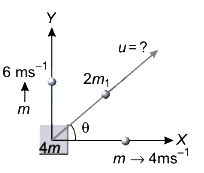
0 likesView Solution
20
ChemistryEasyMCQAP EAMCET · 2018
$XeF_4$ is square planar whereas $CCl_4$ is tetrahedral because
A
in $XeF_4$,'$Xe$' is $sp^2$ hybridised and in $CCl_4$ '$C$' is $sp^3$ hybridised
B
in both $XeF_4$ and $CCl_4$ the central atom is $sp^3$ hybridised
C
in $XeF_4$,'$Xe$' is $sp^3 d^2$ hybridised but due to the presence of $2$ lone pairs of electrons shape is square planar whereas in $CCl_4$ '$C$' is $sp^3$ hybridised
D
$Xe$ is noble gas,whereas $C$ is a non-metal
Solution
(C) $XeF_4$ has $Xe$ as the central atom with $4$ bond pairs and $2$ lone pairs,resulting in $sp^3 d^2$ hybridisation. The presence of $2$ lone pairs leads to a square planar geometry.
$CCl_4$ has $C$ as the central atom with $4$ bond pairs and $0$ lone pairs,resulting in $sp^3$ hybridisation and a tetrahedral geometry.
$CCl_4$ has $C$ as the central atom with $4$ bond pairs and $0$ lone pairs,resulting in $sp^3$ hybridisation and a tetrahedral geometry.
0 likesView Solution
21
ChemistryMediumMCQAP EAMCET · 2018
Which set of the following molecules has only one lone pair of electrons on their respective central atoms?
$(i)$ $SO_2$
$(ii)$ $XeF_4$
$(iii)$ $PbCl_2$
$(iv)$ $SF_4$
$(v)$ $ClF_3$
$(i)$ $SO_2$
$(ii)$ $XeF_4$
$(iii)$ $PbCl_2$
$(iv)$ $SF_4$
$(v)$ $ClF_3$
A
$(i)$,$(iii)$,$(iv)$
B
$(ii)$,$(iii)$,$(iv)$
C
$(i)$,$(ii)$,$(v)$
D
$(i)$,$(iii)$,$(v)$
Solution
(A) To determine the number of lone pairs on the central atom,we use the formula: $\text{Lone pair} = \frac{1}{2} (V - N)$,where $V$ is the number of valence electrons of the central atom and $N$ is the number of bonding electrons.
$(i)$ $SO_2$: $S$ has $6$ valence electrons. It forms $2$ double bonds with $O$ atoms,so $N = 4$. $\text{Lone pair} = \frac{1}{2} (6 - 4) = 1$.
$(ii)$ $XeF_4$: $Xe$ has $8$ valence electrons. It forms $4$ single bonds with $F$ atoms,so $N = 4$. $\text{Lone pair} = \frac{1}{2} (8 - 4) = 2$.
$(iii)$ $PbCl_2$: $Pb$ (Group $14$) has $4$ valence electrons. It forms $2$ single bonds with $Cl$ atoms,so $N = 2$. $\text{Lone pair} = \frac{1}{2} (4 - 2) = 1$.
$(iv)$ $SF_4$: $S$ has $6$ valence electrons. It forms $4$ single bonds with $F$ atoms,so $N = 4$. $\text{Lone pair} = \frac{1}{2} (6 - 4) = 1$.
$(v)$ $ClF_3$: $Cl$ has $7$ valence electrons. It forms $3$ single bonds with $F$ atoms,so $N = 3$. $\text{Lone pair} = \frac{1}{2} (7 - 3) = 2$.
Thus,molecules $(i)$,$(iii)$,and $(iv)$ have only one lone pair on their central atoms.
$(i)$ $SO_2$: $S$ has $6$ valence electrons. It forms $2$ double bonds with $O$ atoms,so $N = 4$. $\text{Lone pair} = \frac{1}{2} (6 - 4) = 1$.
$(ii)$ $XeF_4$: $Xe$ has $8$ valence electrons. It forms $4$ single bonds with $F$ atoms,so $N = 4$. $\text{Lone pair} = \frac{1}{2} (8 - 4) = 2$.
$(iii)$ $PbCl_2$: $Pb$ (Group $14$) has $4$ valence electrons. It forms $2$ single bonds with $Cl$ atoms,so $N = 2$. $\text{Lone pair} = \frac{1}{2} (4 - 2) = 1$.
$(iv)$ $SF_4$: $S$ has $6$ valence electrons. It forms $4$ single bonds with $F$ atoms,so $N = 4$. $\text{Lone pair} = \frac{1}{2} (6 - 4) = 1$.
$(v)$ $ClF_3$: $Cl$ has $7$ valence electrons. It forms $3$ single bonds with $F$ atoms,so $N = 3$. $\text{Lone pair} = \frac{1}{2} (7 - 3) = 2$.
Thus,molecules $(i)$,$(iii)$,and $(iv)$ have only one lone pair on their central atoms.
0 likesView Solution
22
ChemistryMediumMCQAP EAMCET · 2018
$X$ and $Y$ are two covalent molecules in which the hybridization of the central atoms is the same,but their shapes are different. $X$ and $Y$ are:
A
$XeF_4, NH_3$
B
$XeF_2, PF_5$
C
$BF_3, H_2O$
D
$CH_4, BeCl_2$
Solution
(B) The hybridization of the central atom in $XeF_2$ is $sp^3d$ (steric number $5$: $2$ bond pairs + $3$ lone pairs),resulting in a linear shape due to the lone pairs occupying equatorial positions.
The hybridization of the central atom in $PF_5$ is also $sp^3d$ (steric number $5$: $5$ bond pairs + $0$ lone pairs),resulting in a trigonal bipyramidal shape.
Since both have the same hybridization $(sp^3d)$ but different shapes (linear vs. trigonal bipyramidal),$XeF_2$ and $PF_5$ satisfy the given conditions.
The hybridization of the central atom in $PF_5$ is also $sp^3d$ (steric number $5$: $5$ bond pairs + $0$ lone pairs),resulting in a trigonal bipyramidal shape.
Since both have the same hybridization $(sp^3d)$ but different shapes (linear vs. trigonal bipyramidal),$XeF_2$ and $PF_5$ satisfy the given conditions.
0 likesView Solution
23
ChemistryMediumMCQAP EAMCET · 2018
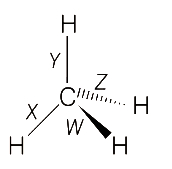
In the following three-dimensional structure of $CH_4$,the bonds are labelled as $W, X, Y$ and $Z$. The bonds projecting out of the plane are:
A
$X, Y$
B
$W, Z$
C
$X, Z$
D
$W, Y$
Solution
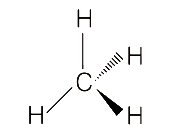
(B) The bonds that are projecting out of the plane are $W$ and $Z$.
Here,normal lines $(-)$ show the bonds lying in the plane of the paper.
Solid-wedge shows the bond projecting out of the plane of paper towards the observer $(W)$.
Dashed-wedge shows the bond projecting out of the plane of paper away from the observer $(Z)$.
Here,normal lines $(-)$ show the bonds lying in the plane of the paper.
Solid-wedge shows the bond projecting out of the plane of paper towards the observer $(W)$.
Dashed-wedge shows the bond projecting out of the plane of paper away from the observer $(Z)$.
0 likesView Solution
24
ChemistryMediumMCQAP EAMCET · 2018
An atom in a molecule has electrons in $1s, 2s, 2p, 3s, 3p, 3d$ and $4s$ orbitals. This atom can undergo hybridisations of type
A
$sp^3d^2, sp^3, p^3ds$
B
$d^2sp^3, p^2ds, dsp^2$
C
$sp^3, dsp^2, d^2sp^3$
D
$sp^3, dsp^2, dsp$
Solution
(C) The atom has electrons in the $3d$ and $4s$ orbitals,meaning it belongs to the $3d$ transition series.
Because it possesses $3d, 4s,$ and $4p$ orbitals,it can participate in various hybridizations.
$sp^3$ hybridization involves $4s$ and $4p$ orbitals (e.g.,$[NiCl_4]^{2-}$).
$dsp^2$ hybridization involves one $3d$,one $4s$,and two $4p$ orbitals (e.g.,$[Ni(CN)_4]^{2-}$).
$d^2sp^3$ hybridization involves two $3d$,one $4s$,and three $4p$ orbitals (e.g.,$[Cr(NH_3)_6]^{3+}$).
Therefore,the atom can undergo $sp^3, dsp^2,$ and $d^2sp^3$ hybridizations.
Because it possesses $3d, 4s,$ and $4p$ orbitals,it can participate in various hybridizations.
$sp^3$ hybridization involves $4s$ and $4p$ orbitals (e.g.,$[NiCl_4]^{2-}$).
$dsp^2$ hybridization involves one $3d$,one $4s$,and two $4p$ orbitals (e.g.,$[Ni(CN)_4]^{2-}$).
$d^2sp^3$ hybridization involves two $3d$,one $4s$,and three $4p$ orbitals (e.g.,$[Cr(NH_3)_6]^{3+}$).
Therefore,the atom can undergo $sp^3, dsp^2,$ and $d^2sp^3$ hybridizations.
0 likesView Solution
25
ChemistryMediumMCQAP EAMCET · 2018
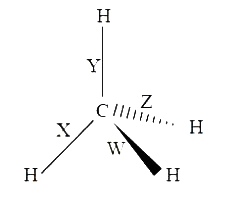
The three-dimensional structure of $CH_4$ is given below. The bonds are labelled as $W, X, Y$ and $Z$. What are the bonds lying in the plane $(A)$,projecting out of the plane away from the observer $(B)$ and projecting out of the plane towards the observer $(C)$?
A
| $A$ (In-plane) | $B$ (Away) | $C$ (Towards) |
| $X, Y$ | $Z$ | $W$ |
B
| $A$ (In-plane) | $B$ (Away) | $C$ (Towards) |
| $Z$ | $W$ | $X, Y$ |
C
| $A$ (In-plane) | $B$ (Away) | $C$ (Towards) |
| $X, Y$ | $W$ | $Z$ |
D
| $A$ (In-plane) | $B$ (Away) | $C$ (Towards) |
| $W$ | $X, Y$ | $Z$ |
Solution
(A) In the $CH_4$ molecule,the carbon atom is $sp^3$ hybridized with a tetrahedral geometry.
In the provided structure:
$1$. The bonds $X$ and $Y$ are represented by simple lines,indicating they lie in the plane of the paper.
$2$. The bond $Z$ is represented by a dashed wedge,indicating it projects away from the observer (behind the plane).
$3$. The bond $W$ is represented by a solid wedge,indicating it projects towards the observer (in front of the plane).
Therefore,the correct mapping is: In-plane $(A)$ = $X, Y$; Away from observer $(B)$ = $Z$; Towards observer $(C)$ = $W$.
In the provided structure:
$1$. The bonds $X$ and $Y$ are represented by simple lines,indicating they lie in the plane of the paper.
$2$. The bond $Z$ is represented by a dashed wedge,indicating it projects away from the observer (behind the plane).
$3$. The bond $W$ is represented by a solid wedge,indicating it projects towards the observer (in front of the plane).
Therefore,the correct mapping is: In-plane $(A)$ = $X, Y$; Away from observer $(B)$ = $Z$; Towards observer $(C)$ = $W$.
0 likesView Solution
26
ChemistryMediumMCQAP EAMCET · 2018
$X$ and $Y$ are two covalent molecules in which the hybridization of the central atoms is the same,but the shapes are different. What are $X$ and $Y$?
A
$XeF_4, NH_3$
B
$XeF_2, PF_5$
C
$BF_3, H_2O$
D
$CH_4, BeCl_2$
Solution
(B) $XeF_2$ and $PF_5$ both have $sp^3d$ hybridization.
According to the $\text{VSEPR}$ theory,their shapes are different.
$XeF_2$ has $3$ lone pairs on the central $Xe$ atom,resulting in a linear geometry.
$PF_5$ has $0$ lone pairs on the central $P$ atom,resulting in a trigonal bipyramidal geometry.
According to the $\text{VSEPR}$ theory,their shapes are different.
$XeF_2$ has $3$ lone pairs on the central $Xe$ atom,resulting in a linear geometry.
$PF_5$ has $0$ lone pairs on the central $P$ atom,resulting in a trigonal bipyramidal geometry.
0 likesView Solution
27
ChemistryDifficultMCQAP EAMCET · 2018
The species,which has the bond order same as that of $F_2$ molecule is
A
$O_2^{+}$
B
$O_2^{2-}$
C
$O_2$
D
$N_2^{+}$
Solution
(B) The total number of electrons in $F_2$ is $18$. According to Molecular Orbital Theory,the electronic configuration of $F_2$ is $\sigma 1s^2, \sigma^* 1s^2, \sigma 2s^2, \sigma^* 2s^2, \sigma 2p_z^2, \pi 2p_x^2 = \pi 2p_y^2, \pi^* 2p_x^2 = \pi^* 2p_y^2$.
Bond order $= \frac{1}{2} (N_b - N_a) = \frac{1}{2} (10 - 8) = 1$.
Now,checking the options:
$O_2^+$ has $15$ electrons,bond order $= 2.5$.
$O_2^{2-}$ has $18$ electrons,bond order $= \frac{1}{2} (10 - 8) = 1$.
$O_2$ has $16$ electrons,bond order $= 2$.
$N_2^+$ has $13$ electrons,bond order $= 2.5$.
Thus,$O_2^{2-}$ has the same bond order as $F_2$.
Bond order $= \frac{1}{2} (N_b - N_a) = \frac{1}{2} (10 - 8) = 1$.
Now,checking the options:
$O_2^+$ has $15$ electrons,bond order $= 2.5$.
$O_2^{2-}$ has $18$ electrons,bond order $= \frac{1}{2} (10 - 8) = 1$.
$O_2$ has $16$ electrons,bond order $= 2$.
$N_2^+$ has $13$ electrons,bond order $= 2.5$.
Thus,$O_2^{2-}$ has the same bond order as $F_2$.
0 likesView Solution
28
ChemistryMediumMCQAP EAMCET · 2018
The number of electrons present in bonding and antibonding orbitals in $O_2^{2-}$ is respectively
A
$10, 6$
B
$12, 6$
C
$11, 7$
D
$10, 8$
Solution
(D) The total number of electrons in $O_2^{2-}$ is $8 + 8 + 2 = 18$.
The molecular orbital configuration is:
$(\sigma 1s)^2, (\sigma^* 1s)^2, (\sigma 2s)^2, (\sigma^* 2s)^2, (\sigma 2p_z)^2, (\pi 2p_x)^2, (\pi 2p_y)^2, (\pi^* 2p_x)^2, (\pi^* 2p_y)^2$
Bonding electrons $(N_b)$ = $2 (\sigma 1s) + 2 (\sigma 2s) + 2 (\sigma 2p_z) + 2 (\pi 2p_x) + 2 (\pi 2p_y) = 10$
Antibonding electrons $(N_a)$ = $2 (\sigma^* 1s) + 2 (\sigma^* 2s) + 2 (\pi^* 2p_x) + 2 (\pi^* 2p_y) = 8$
Therefore,the number of electrons in bonding and antibonding orbitals is $10$ and $8$ respectively.
The molecular orbital configuration is:
$(\sigma 1s)^2, (\sigma^* 1s)^2, (\sigma 2s)^2, (\sigma^* 2s)^2, (\sigma 2p_z)^2, (\pi 2p_x)^2, (\pi 2p_y)^2, (\pi^* 2p_x)^2, (\pi^* 2p_y)^2$
Bonding electrons $(N_b)$ = $2 (\sigma 1s) + 2 (\sigma 2s) + 2 (\sigma 2p_z) + 2 (\pi 2p_x) + 2 (\pi 2p_y) = 10$
Antibonding electrons $(N_a)$ = $2 (\sigma^* 1s) + 2 (\sigma^* 2s) + 2 (\pi^* 2p_x) + 2 (\pi^* 2p_y) = 8$
Therefore,the number of electrons in bonding and antibonding orbitals is $10$ and $8$ respectively.
0 likesView Solution
29
ChemistryMediumMCQAP EAMCET · 2018
The bond dissociation energy $(E)$ and bond length $(R)$ of $O_2$,$N_2$,and $F_2$ follow the order as:
A
$E(N_2) > E(O_2) > E(F_2)$ and $R(N_2) > R(O_2) > R(F_2)$
B
$E(F_2) > E(O_2) > E(N_2)$ and $R(F_2) > R(O_2) > R(N_2)$
C
$E(N_2) > E(O_2) > E(F_2)$ and $R(F_2) > R(O_2) > R(N_2)$
D
$E(O_2) > E(N_2) > E(F_2)$ and $R(F_2) > R(N_2) > R(O_2)$
Solution
(C) Bond dissociation energy $(E)$ is directly proportional to the bond order,while bond length $(R)$ is inversely proportional to the bond order.
The bond orders are: $N_2$ (triple bond,$B.O. = 3$),$O_2$ (double bond,$B.O. = 2$),and $F_2$ (single bond,$B.O. = 1$).
Therefore,the order of bond dissociation energy is: $E(N_2) > E(O_2) > E(F_2)$.
The order of bond length is: $R(F_2) > R(O_2) > R(N_2)$.
The bond orders are: $N_2$ (triple bond,$B.O. = 3$),$O_2$ (double bond,$B.O. = 2$),and $F_2$ (single bond,$B.O. = 1$).
Therefore,the order of bond dissociation energy is: $E(N_2) > E(O_2) > E(F_2)$.
The order of bond length is: $R(F_2) > R(O_2) > R(N_2)$.
0 likesView Solution
30
ChemistryEasyMCQAP EAMCET · 2018
The correct order of energy of $\sigma_{2p_z}$,$\pi_{2p_x}$,$\pi_{2p_y}$,$\pi_{2p_x}^*$,$\pi_{2p_y}^*$ and $\sigma_{2p_z}^*$ orbitals in $F_2$ is:
A
$\sigma_{2p_z} < \pi_{2p_x} = \pi_{2p_y} < \pi_{2p_x}^* = \pi_{2p_y}^* < \sigma_{2p_z}^*$
B
$\pi_{2p_x} = \pi_{2p_y} < \sigma_{2p_z} < \pi_{2p_x}^* = \pi_{2p_y}^* < \sigma_{2p_z}^*$
C
$\sigma_{2p_z} > \pi_{2p_x} = \pi_{2p_y} > \pi_{2p_x}^* = \pi_{2p_y}^* > \sigma_{2p_z}^*$
D
$\pi_{2p_x} = \pi_{2p_y} < \pi_{2p_x}^* = \pi_{2p_y}^* < \sigma_{2p_z} < \sigma_{2p_z}^*$
Solution
(A) According to Molecular Orbital Theory,for molecules with $Z > 7$ (like $O_2$ and $F_2$),the energy of the $\sigma_{2p_z}$ orbital is lower than the energy of the $\pi_{2p_x}$ and $\pi_{2p_y}$ orbitals.
The correct energy order for $F_2$ is: $\sigma_{2p_z} < \pi_{2p_x} = \pi_{2p_y} < \pi_{2p_x}^* = \pi_{2p_y}^* < \sigma_{2p_z}^*$.
The correct energy order for $F_2$ is: $\sigma_{2p_z} < \pi_{2p_x} = \pi_{2p_y} < \pi_{2p_x}^* = \pi_{2p_y}^* < \sigma_{2p_z}^*$.
0 likesView Solution
31
ChemistryMCQAP EAMCET · 2018
The dipole moment order of which of the following pairs of molecules is $NOT$ correct?
A
$HF > HCl$
B
$H_2S > CO_2$
C
$NH_3 > NF_3$
D
$CH_4 > CHCl_3$
Solution
(D) $CH_4$ is a non-polar molecule with a tetrahedral geometry,resulting in a net dipole moment of $0 \ D$.
In $CHCl_3$,the presence of three $Cl$ atoms and one $H$ atom creates a polar molecule with a non-zero dipole moment.
Therefore,the dipole moment of $CHCl_3$ is greater than that of $CH_4$.
Thus,the order $CH_4 > CHCl_3$ is incorrect.
In $CHCl_3$,the presence of three $Cl$ atoms and one $H$ atom creates a polar molecule with a non-zero dipole moment.
Therefore,the dipole moment of $CHCl_3$ is greater than that of $CH_4$.
Thus,the order $CH_4 > CHCl_3$ is incorrect.
0 likesView Solution
32
ChemistryMediumMCQAP EAMCET · 2018
The correct order of dipole moments of $NH_3$,$H_2O$ and $NF_3$ is
A
$H_2O > NH_3 > NF_3$
B
$H_2O > NF_3 > NH_3$
C
$NF_3 > NH_3 > H_2O$
D
$NH_3 > NF_3 > H_2O$
Solution
(A) The dipole moments are: $H_2O = 1.85 \ D$,$NH_3 = 1.47 \ D$,and $NF_3 = 0.24 \ D$.
In $NH_3$,the dipole moments of the three $N-H$ bonds and the lone pair are in the same direction,resulting in a higher net dipole moment.
In $NF_3$,the dipole moments of the three $N-F$ bonds are in the opposite direction to the lone pair,which partially cancels out the net dipole moment.
$H_2O$ has a higher dipole moment than $NH_3$ due to the higher electronegativity difference between $O$ and $H$ compared to $N$ and $H$,and the presence of two lone pairs.
Thus,the correct order is $H_2O > NH_3 > NF_3$.
In $NH_3$,the dipole moments of the three $N-H$ bonds and the lone pair are in the same direction,resulting in a higher net dipole moment.
In $NF_3$,the dipole moments of the three $N-F$ bonds are in the opposite direction to the lone pair,which partially cancels out the net dipole moment.
$H_2O$ has a higher dipole moment than $NH_3$ due to the higher electronegativity difference between $O$ and $H$ compared to $N$ and $H$,and the presence of two lone pairs.
Thus,the correct order is $H_2O > NH_3 > NF_3$.
0 likesView Solution
33
ChemistryMediumMCQAP EAMCET · 2018
Which one of the following has the highest dipole moment?
A
$cis$-but-$2$-ene
B
$trans$-$1,2$-dichloroethene
C
$cis$-$1,2$-dichloroethene
D
$trans$-but-$2$-ene
Solution
$(C)$ The dipole moment $(\mu)$ depends on the polarity of the bonds and the molecular geometry.
$1$. In $trans$-but-$2$-ene and $trans$-$1,2$-dichloroethene, the bond moments cancel each other out due to symmetry, resulting in $\mu = 0 \ D$.
$2$. In $cis$-but-$2$-ene, the dipole moment is small $(\mu = 0.33 \ D)$ due to the small difference in electronegativity between $C$ and $H$.
$3$. In $cis$-$1,2$-dichloroethene, the $C-Cl$ bonds are highly polar and their dipole moments add up in the same direction, resulting in a high dipole moment of $\mu = 1.89 \ D$.
Therefore, $cis$-$1,2$-dichloroethene has the highest dipole moment.
$1$. In $trans$-but-$2$-ene and $trans$-$1,2$-dichloroethene, the bond moments cancel each other out due to symmetry, resulting in $\mu = 0 \ D$.
$2$. In $cis$-but-$2$-ene, the dipole moment is small $(\mu = 0.33 \ D)$ due to the small difference in electronegativity between $C$ and $H$.
$3$. In $cis$-$1,2$-dichloroethene, the $C-Cl$ bonds are highly polar and their dipole moments add up in the same direction, resulting in a high dipole moment of $\mu = 1.89 \ D$.
Therefore, $cis$-$1,2$-dichloroethene has the highest dipole moment.
0 likesView Solution
34
ChemistryEasyMCQAP EAMCET · 2018
Observe the following statements:
$i$. The dipole moment of $NH_3$ is higher than the dipole moment of $NF_3$.
$ii$. The dipole moment of chloroform $(CHCl_3)$ is zero.
$iii$. Covalent bond character in $NaCl$ is more compared to $CuCl$.
$i$. The dipole moment of $NH_3$ is higher than the dipole moment of $NF_3$.
$ii$. The dipole moment of chloroform $(CHCl_3)$ is zero.
$iii$. Covalent bond character in $NaCl$ is more compared to $CuCl$.
A
Only $i$ is correct
B
Only $ii$ is correct
C
Only $iii$ is correct
D
Only $i$ and $iii$ are correct
Solution
(A) $i$. In $NH_3$,the direction of the dipole moment of $N-H$ bonds and the lone pair are in the same direction,whereas in $NF_3$,the dipole moment of $N-F$ bonds and the lone pair are in opposite directions. Thus,the dipole moment of $NH_3$ $(1.46 \ D)$ is higher than $NF_3$ $(0.24 \ D)$. Statement $i$ is correct.
$ii$. Chloroform $(CHCl_3)$ has a net dipole moment of $1.04 \ D$ due to the difference in electronegativity between $C-H$ and $C-Cl$ bonds. Statement $ii$ is incorrect.
$iii$. According to Fajan's rule,$Cu^+$ (a pseudo-noble gas configuration) has higher polarising power than $Na^+$ (a noble gas configuration). Therefore,$CuCl$ has more covalent character than $NaCl$. Statement $iii$ is incorrect.
Therefore,only statement $i$ is correct.
$ii$. Chloroform $(CHCl_3)$ has a net dipole moment of $1.04 \ D$ due to the difference in electronegativity between $C-H$ and $C-Cl$ bonds. Statement $ii$ is incorrect.
$iii$. According to Fajan's rule,$Cu^+$ (a pseudo-noble gas configuration) has higher polarising power than $Na^+$ (a noble gas configuration). Therefore,$CuCl$ has more covalent character than $NaCl$. Statement $iii$ is incorrect.
Therefore,only statement $i$ is correct.
0 likesView Solution
35
ChemistryEasyMCQAP EAMCET · 2018
The dipole moment order of which of the following pairs of molecules is not correct?
A
$HF > HCl$
B
$H_2S > CO_2$
C
$NH_3 > NF_3$
D
$CH_4 > CHCl_3$
Solution
(D) The dipole moment of $CH_4$ is $0 \ D$ because it is a non-polar symmetric tetrahedral molecule.
In $CHCl_3$,the bond dipoles of $C-H$ and $C-Cl$ bonds do not cancel each other out,resulting in a net dipole moment of approximately $1.04 \ D$.
Therefore,the correct order is $CHCl_3 > CH_4$.
Thus,the statement $CH_4 > CHCl_3$ is incorrect.
In $CHCl_3$,the bond dipoles of $C-H$ and $C-Cl$ bonds do not cancel each other out,resulting in a net dipole moment of approximately $1.04 \ D$.
Therefore,the correct order is $CHCl_3 > CH_4$.
Thus,the statement $CH_4 > CHCl_3$ is incorrect.
0 likesView Solution
36
ChemistryEasyMCQAP EAMCET · 2018
At $1000 \ K$,the equilibrium constant $K_C$ for the reaction $2 \ NOCl_{(g)} \rightleftharpoons 2 \ NO_{(g)} + Cl_{2(g)}$ is $4.0 \times 10^{-6} \ mol \ L^{-1}$. The $K_P$ (in bar) at the same temperature is $\left(R=0.083 \ L \ bar \ K^{-1} \ mol^{-1}\right)$
A
$3.32 \times 10^{-6}$
B
$3.32 \times 10^4$
C
$3.32 \times 10^{-4}$
D
$3.32 \times 10^{-3}$
Solution
(C) Given: $K_C = 4.0 \times 10^{-6} \ mol \ L^{-1}$,$T = 1000 \ K$,$R = 0.083 \ L \ bar \ K^{-1} \ mol^{-1}$.
For the reaction $2 \ NOCl_{(g)} \rightleftharpoons 2 \ NO_{(g)} + Cl_{2(g)}$,the change in moles of gas is $\Delta n = (2 + 1) - 2 = 1$.
The relationship between $K_P$ and $K_C$ is given by $K_P = K_C(RT)^{\Delta n}$.
Substituting the values: $K_P = 4.0 \times 10^{-6} \times (0.083 \times 1000)^1$.
$K_P = 4.0 \times 10^{-6} \times 83 = 3.32 \times 10^{-4}$.
For the reaction $2 \ NOCl_{(g)} \rightleftharpoons 2 \ NO_{(g)} + Cl_{2(g)}$,the change in moles of gas is $\Delta n = (2 + 1) - 2 = 1$.
The relationship between $K_P$ and $K_C$ is given by $K_P = K_C(RT)^{\Delta n}$.
Substituting the values: $K_P = 4.0 \times 10^{-6} \times (0.083 \times 1000)^1$.
$K_P = 4.0 \times 10^{-6} \times 83 = 3.32 \times 10^{-4}$.
0 likesView Solution
37
ChemistryMCQAP EAMCET · 2018
For the gaseous reactions $(I)$ and $(II)$,the equilibrium constants are $X$ and $Y$ respectively.
$I$. $\frac{1}{2} N_{2(g)} + O_{2(g)} \rightleftharpoons NO_{2(g)}$
$II$. $2 NO_{2(g)} \rightleftharpoons N_2 O_{4(g)}$
Using the above reactions,the equilibrium constant $Z$ for the reaction $(III)$ given below is:
$III$. $N_2 O_{4(g)} \rightleftharpoons N_{2(g)} + 2 O_{2(g)}$
$I$. $\frac{1}{2} N_{2(g)} + O_{2(g)} \rightleftharpoons NO_{2(g)}$
$II$. $2 NO_{2(g)} \rightleftharpoons N_2 O_{4(g)}$
Using the above reactions,the equilibrium constant $Z$ for the reaction $(III)$ given below is:
$III$. $N_2 O_{4(g)} \rightleftharpoons N_{2(g)} + 2 O_{2(g)}$
A
$Z = X Y$
B
$Z = \frac{Y^2}{X}$
C
$Z = \frac{1}{X Y^2}$
D
$Z = \frac{1}{X^2 Y}$
Solution
(D) For reaction $(I)$: $\frac{1}{2} N_{2(g)} + O_{2(g)} \rightleftharpoons NO_{2(g)}$,the equilibrium constant is $X = \frac{[NO_2]}{[N_2]^{1/2} [O_2]}$.
Thus,$[N_2]^{1/2} [O_2] = \frac{[NO_2]}{X}$ ... $(i)$
For reaction $(II)$: $2 NO_{2(g)} \rightleftharpoons N_2 O_{4(g)}$,the equilibrium constant is $Y = \frac{[N_2 O_4]}{[NO_2]^2}$.
Thus,$[NO_2]^2 = \frac{[N_2 O_4]}{Y}$ ... $(ii)$
For reaction $(III)$: $N_2 O_{4(g)} \rightleftharpoons N_{2(g)} + 2 O_{2(g)}$,the equilibrium constant is $Z = \frac{[N_2] [O_2]^2}{[N_2 O_4]}$.
From equation $(i)$,squaring both sides gives $[N_2] [O_2]^2 = \frac{[NO_2]^2}{X^2}$.
Substituting this into the expression for $Z$:
$Z = \frac{[NO_2]^2}{X^2 [N_2 O_4]}$.
From equation $(ii)$,we know $\frac{[N_2 O_4]}{[NO_2]^2} = Y$,so $\frac{[NO_2]^2}{[N_2 O_4]} = \frac{1}{Y}$.
Therefore,$Z = \frac{1}{X^2 Y}$.
Thus,$[N_2]^{1/2} [O_2] = \frac{[NO_2]}{X}$ ... $(i)$
For reaction $(II)$: $2 NO_{2(g)} \rightleftharpoons N_2 O_{4(g)}$,the equilibrium constant is $Y = \frac{[N_2 O_4]}{[NO_2]^2}$.
Thus,$[NO_2]^2 = \frac{[N_2 O_4]}{Y}$ ... $(ii)$
For reaction $(III)$: $N_2 O_{4(g)} \rightleftharpoons N_{2(g)} + 2 O_{2(g)}$,the equilibrium constant is $Z = \frac{[N_2] [O_2]^2}{[N_2 O_4]}$.
From equation $(i)$,squaring both sides gives $[N_2] [O_2]^2 = \frac{[NO_2]^2}{X^2}$.
Substituting this into the expression for $Z$:
$Z = \frac{[NO_2]^2}{X^2 [N_2 O_4]}$.
From equation $(ii)$,we know $\frac{[N_2 O_4]}{[NO_2]^2} = Y$,so $\frac{[NO_2]^2}{[N_2 O_4]} = \frac{1}{Y}$.
Therefore,$Z = \frac{1}{X^2 Y}$.
0 likesView Solution
38
ChemistryMediumMCQAP EAMCET · 2018
At $1000 \ K$,if the equilibrium constant $K_p$ for the reaction $2 \ NOCl_{(g)} \rightleftharpoons 2 \ NO_{(g)} + Cl_{2(g)}$ is $4.157 \times 10^{-4} \ bar$,the $K_c$ (in $mol \ L^{-1}$) is $(R = 0.083 \ L \ bar \ K^{-1} \ mol^{-1})$
A
$4.16 \times 10^{-7}$
B
$4.16 \times 10^{-4}$
C
$50 \times 10^{-4}$
D
$5.0 \times 10^{-6}$
Solution
(D) The relationship between $K_p$ and $K_c$ is given by the formula: $K_p = K_c(RT)^{\Delta n}$.
Here,$\Delta n = (2 + 1) - 2 = 1$.
Given $K_p = 4.157 \times 10^{-4} \ bar$,$T = 1000 \ K$,and $R = 0.083 \ L \ bar \ K^{-1} \ mol^{-1}$.
Substituting the values: $4.157 \times 10^{-4} = K_c(0.083 \times 1000)^1$.
$K_c = \frac{4.157 \times 10^{-4}}{83} = 0.05008 \times 10^{-4} = 5.008 \times 10^{-6} \ mol \ L^{-1}$.
Thus,the correct value is approximately $5.0 \times 10^{-6}$.
Here,$\Delta n = (2 + 1) - 2 = 1$.
Given $K_p = 4.157 \times 10^{-4} \ bar$,$T = 1000 \ K$,and $R = 0.083 \ L \ bar \ K^{-1} \ mol^{-1}$.
Substituting the values: $4.157 \times 10^{-4} = K_c(0.083 \times 1000)^1$.
$K_c = \frac{4.157 \times 10^{-4}}{83} = 0.05008 \times 10^{-4} = 5.008 \times 10^{-6} \ mol \ L^{-1}$.
Thus,the correct value is approximately $5.0 \times 10^{-6}$.
0 likesView Solution
39
ChemistryMediumMCQAP EAMCET · 2018
At $T(K)$,the equilibrium constant of $H_{2(g)} + I_{2(g)} \rightleftharpoons 2 HI_{(g)}$ is $49$. If $[H_2]$ and $[I_2]$ at equilibrium at the same temperature are $2.0 \times 10^{-2} \ M$ and $8.0 \times 10^{-2} \ M$ respectively,the $[HI]$ at equilibrium in $mol \ L^{-1}$ is:
A
$2.8$
B
$0.28$
C
$0.14$
D
$1.4$
Solution
(B) Given,the equilibrium constant $K_C = 49$.
The equilibrium concentrations are $[H_2] = 2.0 \times 10^{-2} \ M$ and $[I_2] = 8.0 \times 10^{-2} \ M$.
The expression for the equilibrium constant for the reaction $H_{2(g)} + I_{2(g)} \rightleftharpoons 2 HI_{(g)}$ is $K_C = \frac{[HI]^2}{[H_2][I_2]}$.
Rearranging the formula to solve for $[HI]$,we get $[HI]^2 = K_C \times [H_2] \times [I_2]$.
Substituting the given values: $[HI]^2 = 49 \times (2.0 \times 10^{-2}) \times (8.0 \times 10^{-2}) = 49 \times 16 \times 10^{-4}$.
Taking the square root of both sides: $[HI] = \sqrt{49 \times 16 \times 10^{-4}} = 7 \times 4 \times 10^{-2} = 28 \times 10^{-2} = 0.28 \ mol \ L^{-1}$.
The equilibrium concentrations are $[H_2] = 2.0 \times 10^{-2} \ M$ and $[I_2] = 8.0 \times 10^{-2} \ M$.
The expression for the equilibrium constant for the reaction $H_{2(g)} + I_{2(g)} \rightleftharpoons 2 HI_{(g)}$ is $K_C = \frac{[HI]^2}{[H_2][I_2]}$.
Rearranging the formula to solve for $[HI]$,we get $[HI]^2 = K_C \times [H_2] \times [I_2]$.
Substituting the given values: $[HI]^2 = 49 \times (2.0 \times 10^{-2}) \times (8.0 \times 10^{-2}) = 49 \times 16 \times 10^{-4}$.
Taking the square root of both sides: $[HI] = \sqrt{49 \times 16 \times 10^{-4}} = 7 \times 4 \times 10^{-2} = 28 \times 10^{-2} = 0.28 \ mol \ L^{-1}$.
0 likesView Solution
40
ChemistryEasyMCQAP EAMCET · 2018
The equilibrium concentrations of $N_2, H_2$ and $NH_3$ in the formation of $NH_3$ at $500 \ K$ are $1.25 \times 10^{-2} \ M, 4.0 \times 10^{-2} \ M$ and $1.6 \times 10^{-2} \ M$ respectively. The equilibrium constant $K_{p}$ at the same temperature is
A
$3.2(RT)^{-2}$
B
$32(RT)^2$
C
$320(RT)^2$
D
$320(RT)^{-2}$
Solution
(D) The balanced chemical equation for the formation of $NH_3$ is: $N_2(g) + 3H_2(g) \rightleftharpoons 2NH_3(g)$.
First,calculate the equilibrium constant $K_c$:
$K_c = \frac{[NH_3]^2}{[N_2][H_2]^3} = \frac{(1.6 \times 10^{-2})^2}{(1.25 \times 10^{-2}) \times (4.0 \times 10^{-2})^3}$.
$K_c = \frac{2.56 \times 10^{-4}}{(1.25 \times 10^{-2}) \times (64 \times 10^{-6})} = \frac{2.56 \times 10^{-4}}{80 \times 10^{-8}} = \frac{2.56 \times 10^{-4}}{8 \times 10^{-7}} = 0.32 \times 10^3 = 320$.
The relationship between $K_p$ and $K_c$ is $K_p = K_c(RT)^{\Delta n}$.
Here,$\Delta n = 2 - (1 + 3) = 2 - 4 = -2$.
Therefore,$K_p = 320(RT)^{-2}$.
First,calculate the equilibrium constant $K_c$:
$K_c = \frac{[NH_3]^2}{[N_2][H_2]^3} = \frac{(1.6 \times 10^{-2})^2}{(1.25 \times 10^{-2}) \times (4.0 \times 10^{-2})^3}$.
$K_c = \frac{2.56 \times 10^{-4}}{(1.25 \times 10^{-2}) \times (64 \times 10^{-6})} = \frac{2.56 \times 10^{-4}}{80 \times 10^{-8}} = \frac{2.56 \times 10^{-4}}{8 \times 10^{-7}} = 0.32 \times 10^3 = 320$.
The relationship between $K_p$ and $K_c$ is $K_p = K_c(RT)^{\Delta n}$.
Here,$\Delta n = 2 - (1 + 3) = 2 - 4 = -2$.
Therefore,$K_p = 320(RT)^{-2}$.
0 likesView Solution
41
ChemistryDifficultMCQAP EAMCET · 2018
For the gaseous reactions $(I)$ and $(II)$,the equilibrium constants are $X$ and $Y$,respectively.
$I. \frac{1}{2} N_{2(g)} + O_{2(g)} \rightleftharpoons NO_{2(g)}$
$II. 2 NO_{2(g)} \rightleftharpoons N_2O_{4(g)}$
Using the above reactions,the equilibrium constant $Z$ for the reaction $(III)$ given below is:
$III. N_2O_{4(g)} \rightleftharpoons N_{2(g)} + 2 O_{2(g)}$
$I. \frac{1}{2} N_{2(g)} + O_{2(g)} \rightleftharpoons NO_{2(g)}$
$II. 2 NO_{2(g)} \rightleftharpoons N_2O_{4(g)}$
Using the above reactions,the equilibrium constant $Z$ for the reaction $(III)$ given below is:
$III. N_2O_{4(g)} \rightleftharpoons N_{2(g)} + 2 O_{2(g)}$
A
$Z = XY$
B
$Z = \frac{Y}{2X}$
C
$Z = \frac{1}{XY^2}$
D
$Z = \frac{1}{X^2Y}$
Solution
(D) Given reactions:
$I. \frac{1}{2} N_{2(g)} + O_{2(g)} \rightleftharpoons NO_{2(g)}$ with equilibrium constant $X$.
$II. 2 NO_{2(g)} \rightleftharpoons N_2O_{4(g)}$ with equilibrium constant $Y$.
Target reaction $(III): N_2O_{4(g)} \rightleftharpoons N_{2(g)} + 2 O_{2(g)}$.
To obtain reaction $(III)$,we reverse reaction $(II)$ and add it to twice the reverse of reaction $(I)$ (or simply reverse the sum of $2 \times Eq(I) + Eq(II)$):
$2 \times Eq(I): N_{2(g)} + 2 O_{2(g)} \rightleftharpoons 2 NO_{2(g)}$ with constant $X^2$.
$Eq(II): 2 NO_{2(g)} \rightleftharpoons N_2O_{4(g)}$ with constant $Y$.
Adding these gives: $N_{2(g)} + 2 O_{2(g)} \rightleftharpoons N_2O_{4(g)}$ with constant $K = X^2Y$.
Since reaction $(III)$ is the reverse of this sum,its equilibrium constant $Z = \frac{1}{K} = \frac{1}{X^2Y}$.
$I. \frac{1}{2} N_{2(g)} + O_{2(g)} \rightleftharpoons NO_{2(g)}$ with equilibrium constant $X$.
$II. 2 NO_{2(g)} \rightleftharpoons N_2O_{4(g)}$ with equilibrium constant $Y$.
Target reaction $(III): N_2O_{4(g)} \rightleftharpoons N_{2(g)} + 2 O_{2(g)}$.
To obtain reaction $(III)$,we reverse reaction $(II)$ and add it to twice the reverse of reaction $(I)$ (or simply reverse the sum of $2 \times Eq(I) + Eq(II)$):
$2 \times Eq(I): N_{2(g)} + 2 O_{2(g)} \rightleftharpoons 2 NO_{2(g)}$ with constant $X^2$.
$Eq(II): 2 NO_{2(g)} \rightleftharpoons N_2O_{4(g)}$ with constant $Y$.
Adding these gives: $N_{2(g)} + 2 O_{2(g)} \rightleftharpoons N_2O_{4(g)}$ with constant $K = X^2Y$.
Since reaction $(III)$ is the reverse of this sum,its equilibrium constant $Z = \frac{1}{K} = \frac{1}{X^2Y}$.
0 likesView Solution
42
ChemistryMCQAP EAMCET · 2018
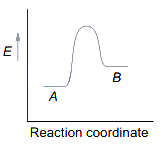
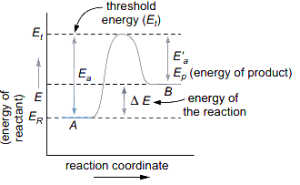
For a reversible reaction $A \rightleftharpoons B$,which one of the following statements is wrong from the given energy profile diagram?
A
Activation energy of forward reaction is greater than backward reaction
B
The forward reaction is endothermic
C
The threshold energy is less than that of activation energy
D
The energy of activation of forward reaction is equal to the sum of heat of reaction and the energy of activation of backward reaction
Solution
(C) From the energy profile diagram,we have:
$E_a = \text{activation energy of forward reaction}$
$E_a^{\prime} = \text{activation energy of backward reaction}$
$E_t = \text{threshold energy}$
$1$. The diagram shows that the peak energy $(E_t)$ is higher than the energy of the reactants $(E_R)$ and products $(E_P)$.
$2$. The activation energy for the forward reaction is $E_a = E_t - E_R$.
$3$. The activation energy for the backward reaction is $E_a^{\prime} = E_t - E_P$.
$4$. Since $E_P > E_R$,it follows that $E_a > E_a^{\prime}$. Thus,option $A$ is correct.
$5$. Since the potential energy of the product is greater than that of the reactant $(E_P > E_R)$,the reaction is endothermic. Thus,option $B$ is correct.
$6$. The threshold energy $(E_t)$ is the minimum energy required for the reaction to occur,which is always greater than or equal to the activation energy of the forward reaction $(E_t = E_a + E_R)$. Therefore,the statement that threshold energy is less than the activation energy is incorrect. Thus,option $C$ is wrong.
$7$. The energy of the forward reaction is $E_a = \Delta H + E_a^{\prime}$,where $\Delta H$ is the heat of reaction. Thus,option $D$ is correct.
$E_a = \text{activation energy of forward reaction}$
$E_a^{\prime} = \text{activation energy of backward reaction}$
$E_t = \text{threshold energy}$
$1$. The diagram shows that the peak energy $(E_t)$ is higher than the energy of the reactants $(E_R)$ and products $(E_P)$.
$2$. The activation energy for the forward reaction is $E_a = E_t - E_R$.
$3$. The activation energy for the backward reaction is $E_a^{\prime} = E_t - E_P$.
$4$. Since $E_P > E_R$,it follows that $E_a > E_a^{\prime}$. Thus,option $A$ is correct.
$5$. Since the potential energy of the product is greater than that of the reactant $(E_P > E_R)$,the reaction is endothermic. Thus,option $B$ is correct.
$6$. The threshold energy $(E_t)$ is the minimum energy required for the reaction to occur,which is always greater than or equal to the activation energy of the forward reaction $(E_t = E_a + E_R)$. Therefore,the statement that threshold energy is less than the activation energy is incorrect. Thus,option $C$ is wrong.
$7$. The energy of the forward reaction is $E_a = \Delta H + E_a^{\prime}$,where $\Delta H$ is the heat of reaction. Thus,option $D$ is correct.
0 likesView Solution
43
ChemistryMCQAP EAMCET · 2018
What is the slope of the straight line for the graph drawn between $\ln k$ and $\frac{1}{T}$,where $k$ is the rate constant of a reaction at temperature $T$?
A
$\frac{-E_a}{2.303 R}$
B
$\frac{-E_a}{R}$
C
$\frac{E_a}{R}$
D
$\frac{R}{E_a}$
Solution
(B) The Arrhenius equation is given by:
$k = A e^{-E_a / RT}$
Taking the natural logarithm $(\ln)$ on both sides:
$\ln k = \ln A - \frac{E_a}{RT}$
Rearranging this into the linear equation form $y = mx + c$:
$\ln k = (-\frac{E_a}{R}) (\frac{1}{T}) + \ln A$
Comparing this with the equation of a straight line $y = mx + c$,where $y = \ln k$,$x = \frac{1}{T}$,and $c = \ln A$,the slope $(m)$ is equal to $-\frac{E_a}{R}$.
$k = A e^{-E_a / RT}$
Taking the natural logarithm $(\ln)$ on both sides:
$\ln k = \ln A - \frac{E_a}{RT}$
Rearranging this into the linear equation form $y = mx + c$:
$\ln k = (-\frac{E_a}{R}) (\frac{1}{T}) + \ln A$
Comparing this with the equation of a straight line $y = mx + c$,where $y = \ln k$,$x = \frac{1}{T}$,and $c = \ln A$,the slope $(m)$ is equal to $-\frac{E_a}{R}$.
0 likesView Solution
44
ChemistryMCQAP EAMCET · 2018
Which one of the following equations represents the variation of viscosity coefficient $(\eta)$ with temperature $(T)$?
A
$\eta = A e^{-E / R T}$
B
$\eta = A e^{E / R T}$
C
$\eta = A e^{-E / k T}$
D
$\eta = A e^{-E / T}$
Solution
(B) The viscosity of liquids decreases as temperature increases because the intermolecular forces weaken.
This behavior is described by the Andrade equation,which is given by the expression: $\eta = A e^{E / R T}$.
Here,$A$ is a constant,$E$ is the activation energy for viscous flow,$R$ is the gas constant,and $T$ is the absolute temperature.
This behavior is described by the Andrade equation,which is given by the expression: $\eta = A e^{E / R T}$.
Here,$A$ is a constant,$E$ is the activation energy for viscous flow,$R$ is the gas constant,and $T$ is the absolute temperature.
0 likesView Solution
45
ChemistryEasyMCQAP EAMCET · 2018
To which group and period does the element belong if the electronic configuration of an element in its $-2$ oxidation state is $1s^2 2s^2 2p^6 3s^2 3p^6$?
A
period $3$,group $16$
B
period $3$,group $17$
C
period $4$,group $16$
D
period $4$,group $17$
Solution
(A) The electronic configuration of the ion with $-2$ oxidation state is $1s^2 2s^2 2p^6 3s^2 3p^6$,which corresponds to $18$ electrons.
In the neutral state,the number of electrons is $18 - 2 = 16$.
The element with atomic number $Z = 16$ is Sulphur $(S)$.
The electronic configuration of neutral Sulphur is $1s^2 2s^2 2p^6 3s^2 3p^4$.
Since the valence shell is $n = 3$,it belongs to period $3$.
Since it has $6$ valence electrons $(3s^2 3p^4)$,it belongs to group $16$.
In the neutral state,the number of electrons is $18 - 2 = 16$.
The element with atomic number $Z = 16$ is Sulphur $(S)$.
The electronic configuration of neutral Sulphur is $1s^2 2s^2 2p^6 3s^2 3p^4$.
Since the valence shell is $n = 3$,it belongs to period $3$.
Since it has $6$ valence electrons $(3s^2 3p^4)$,it belongs to group $16$.
0 likesView Solution
46
ChemistryEasyMCQAP EAMCET · 2018
Identify the correct statements from the following.
$(i)$ In the periodic table,about $78 \%$ of elements are metals.
$(ii)$ In a group,the metallic character decreases from top to bottom and in a period the nonmetallic character decreases from left to right.
$(iii)$ The element $Ho$ belongs to $f-$block.
$(i)$ In the periodic table,about $78 \%$ of elements are metals.
$(ii)$ In a group,the metallic character decreases from top to bottom and in a period the nonmetallic character decreases from left to right.
$(iii)$ The element $Ho$ belongs to $f-$block.
A
$i, ii, iii$
B
$ii, iii$
C
$i, iii$
D
$i, ii$
Solution
(C) Statement $(i)$ is correct: In the periodic table,about $78 \%$ of elements are metals.
Statement $(ii)$ is incorrect: In a group,metallic character increases from top to bottom,and in a period,non-metallic character increases from left to right.
Statement $(iii)$ is correct: The element $Ho$ (Holmium) has atomic number $67$ and belongs to the lanthanide series,which is part of the $f-$block.
Statement $(ii)$ is incorrect: In a group,metallic character increases from top to bottom,and in a period,non-metallic character increases from left to right.
Statement $(iii)$ is correct: The element $Ho$ (Holmium) has atomic number $67$ and belongs to the lanthanide series,which is part of the $f-$block.
0 likesView Solution
47
ChemistryEasyMCQAP EAMCET · 2018
Which of the following represents the correct order of ionic radii?
A
$Al^{3+} > Mg^{2+} > Na^{+} > O^{2-} > F^{-}$
B
$O^{2-} > F^{-} > Na^{+} > Mg^{2+} > Al^{3+}$
C
$Mg^{2+} > Al^{3+} > O^{2-} > F^{-} > Na^{+}$
D
$O^{2-} > F^{-} > Al^{3+} > Mg^{2+} > Na^{+}$
Solution
(B) The correct order is $O^{2-} > F^{-} > Na^{+} > Mg^{2+} > Al^{3+}$.
All these ions are isoelectronic species,meaning they have the same number of electrons ($10$ electrons) and the same electronic configuration $(1s^2, 2s^2, 2p^6)$.
For isoelectronic species,the ionic radius decreases as the nuclear charge (atomic number) increases.
The nuclear charges for these ions are: $O^{2-} (+8)$,$F^{-} (+9)$,$Na^{+} (+11)$,$Mg^{2+} (+12)$,and $Al^{3+} (+13)$.
Since the nuclear charge increases from $O^{2-}$ to $Al^{3+}$,the attraction between the nucleus and the electrons increases,leading to a decrease in the ionic radius.
All these ions are isoelectronic species,meaning they have the same number of electrons ($10$ electrons) and the same electronic configuration $(1s^2, 2s^2, 2p^6)$.
For isoelectronic species,the ionic radius decreases as the nuclear charge (atomic number) increases.
The nuclear charges for these ions are: $O^{2-} (+8)$,$F^{-} (+9)$,$Na^{+} (+11)$,$Mg^{2+} (+12)$,and $Al^{3+} (+13)$.
Since the nuclear charge increases from $O^{2-}$ to $Al^{3+}$,the attraction between the nucleus and the electrons increases,leading to a decrease in the ionic radius.
0 likesView Solution
48
ChemistryEasyMCQAP EAMCET · 2018
Which of the following is not correct corresponding to the chemistry of group $14$ elements?
A
Lead has no reaction with water due to the formation of a protective oxide layer.
B
$GeX_2$ is more stable than $GeX_4$.
C
$PbX_2$ is more stable than $PbX_4$.
D
Tin on reaction with steam liberates hydrogen.
Solution
(B) $Ge$ is an element of group $14$ (carbon family).
In group $14$,both $+2$ and $+4$ oxidation states are possible.
For $Ge$,the $+4$ oxidation state is more stable than the $+2$ oxidation state.
Due to the inert pair effect,which arises from the poor shielding of $s$-electrons by intervening $d$ and $f$-electrons,the stability of the $+4$ oxidation state decreases down the group from $Ge$ to $Pb$.
Consequently,for $Pb$,the $+2$ oxidation state is more stable than the $+4$ oxidation state.
Therefore,the statement "$GeX_2$ is more stable than $GeX_4$" is incorrect.
In group $14$,both $+2$ and $+4$ oxidation states are possible.
For $Ge$,the $+4$ oxidation state is more stable than the $+2$ oxidation state.
Due to the inert pair effect,which arises from the poor shielding of $s$-electrons by intervening $d$ and $f$-electrons,the stability of the $+4$ oxidation state decreases down the group from $Ge$ to $Pb$.
Consequently,for $Pb$,the $+2$ oxidation state is more stable than the $+4$ oxidation state.
Therefore,the statement "$GeX_2$ is more stable than $GeX_4$" is incorrect.
0 likesView Solution
49
ChemistryEasyMCQAP EAMCET · 2018
Identify the correct statements from the following:
$(i)$ The atomic radius of $Al$ is lower than the atomic radius of $Ga$.
$(ii)$ Boron exists in many allotropic forms.
$(iii)$ The melting point of $Ga$ is lowest among the group $13$ elements.
$(i)$ The atomic radius of $Al$ is lower than the atomic radius of $Ga$.
$(ii)$ Boron exists in many allotropic forms.
$(iii)$ The melting point of $Ga$ is lowest among the group $13$ elements.
A
$i, ii, iii$
B
$ii, iii$
C
$i, ii$
D
$i, iii$
Solution
(B) Statement $(i)$ is incorrect: The atomic radius of $Al$ $(143 \ pm)$ is actually larger than that of $Ga$ $(135 \ pm)$ due to the poor shielding effect of $d$-electrons in $Ga$.
Statement $(ii)$ is correct: Boron exists in several allotropic forms such as $\alpha$-rhombohedral, $\beta$-rhombohedral, and $\beta$-tetragonal.
Statement $(iii)$ is correct: The melting point of $Ga$ $(303 \ K)$ is the lowest among group $13$ elements due to its unique crystal structure.
Therefore, statements $(ii)$ and $(iii)$ are correct.
Statement $(ii)$ is correct: Boron exists in several allotropic forms such as $\alpha$-rhombohedral, $\beta$-rhombohedral, and $\beta$-tetragonal.
Statement $(iii)$ is correct: The melting point of $Ga$ $(303 \ K)$ is the lowest among group $13$ elements due to its unique crystal structure.
Therefore, statements $(ii)$ and $(iii)$ are correct.
0 likesView Solution
50
ChemistryMCQAP EAMCET · 2018
$A$ $TV$ transmitter has a range of $50 \ km$. The height of the $TV$ transmitter is . . . . . . (Radius of the earth,$R_e = 6.4 \times 10^6 \ m$). (in $m$)
A
$195.3$
B
$186.5$
C
$206$
D
$175$
Solution
(A) The range $d$ of a $TV$ transmitter is given by the formula $d = \sqrt{2 R_e h_T}$,where $R_e$ is the radius of the Earth and $h_T$ is the height of the transmitter.
Given: $d = 50 \ km = 50,000 \ m$,$R_e = 6.4 \times 10^6 \ m$.
Squaring both sides: $d^2 = 2 R_e h_T$.
$h_T = \frac{d^2}{2 R_e} = \frac{(50,000)^2}{2 \times 6.4 \times 10^6}$.
$h_T = \frac{2500 \times 10^6}{12.8 \times 10^6} = \frac{2500}{12.8} \approx 195.3 \ m$.
Given: $d = 50 \ km = 50,000 \ m$,$R_e = 6.4 \times 10^6 \ m$.
Squaring both sides: $d^2 = 2 R_e h_T$.
$h_T = \frac{d^2}{2 R_e} = \frac{(50,000)^2}{2 \times 6.4 \times 10^6}$.
$h_T = \frac{2500 \times 10^6}{12.8 \times 10^6} = \frac{2500}{12.8} \approx 195.3 \ m$.
0 likesView Solution
51
ChemistryMediumMCQAP EAMCET · 2018
Identify $X$ and $Y$ in the following reactions:
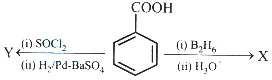
A
Benzyl alcohol,Benzaldehyde
B
Benzyl alcohol,Benzaldehyde
C
Benzaldehyde,Benzaldehyde
D
Toluene,Benzyl alcohol
Solution
(B) $1$. For the formation of $X$: Benzoic acid reacts with $B_2H_6$ followed by hydrolysis $(H_3O^+)$ to undergo reduction,yielding benzyl alcohol $(C_6H_5CH_2OH)$ as $X$.
$2$. For the formation of $Y$: Benzoic acid reacts with $SOCl_2$ to form benzoyl chloride $(C_6H_5COCl)$,which then undergoes Rosenmund reduction using $H_2/Pd-BaSO_4$ to yield benzaldehyde $(C_6H_5CHO)$ as $Y$.
$3$. Therefore,$X$ is benzyl alcohol and $Y$ is benzaldehyde.
$2$. For the formation of $Y$: Benzoic acid reacts with $SOCl_2$ to form benzoyl chloride $(C_6H_5COCl)$,which then undergoes Rosenmund reduction using $H_2/Pd-BaSO_4$ to yield benzaldehyde $(C_6H_5CHO)$ as $Y$.
$3$. Therefore,$X$ is benzyl alcohol and $Y$ is benzaldehyde.
0 likesView Solution
52
ChemistryMediumMCQAP EAMCET · 2018
Identify $A$ and $B$ in the following reaction: $C_6H_5CH_2-O-C_6H_5 + HI \rightarrow A + B$
A
$A = C_6H_5I, B = C_6H_5OCH_3$
B
$A = C_6H_5CH_2I, B = C_6H_5OH$
C
$A = C_6H_5CH_2OH, B = C_6H_5I$
D
$A = C_6H_6, B = C_6H_5CH_2OI$
Solution
(B) The reaction of an alkyl aryl ether with $HI$ involves the cleavage of the $C-O$ bond. In the case of benzyl phenyl ether $(C_6H_5CH_2-O-C_6H_5)$,the $C-O$ bond between the benzyl carbon and oxygen is cleaved because the benzyl carbocation is stabilized by resonance. The oxygen atom remains attached to the phenyl ring,forming phenol $(C_6H_5OH)$,while the benzyl group forms benzyl iodide $(C_6H_5CH_2I)$. Therefore,$A = C_6H_5CH_2I$ and $B = C_6H_5OH$.
0 likesView Solution
53
ChemistryMediumMCQAP EAMCET · 2018
Ethyl magnesium bromide reacts with acetone to give $X$. On hydrolysis,$X$ forms:
A
$CH_3-CH_2-CH_2-CH(OH)-CH_3$
B
$CH_3-CH_2-CH(OH)-CH_2-CH_3$
C
$CH_3-CH_2-C(OH)(CH_3)_2$
D
$CH_3-CH_2-CH(CH_3)-CH_2OH$
Solution
(C) Ethyl magnesium bromide $(CH_3CH_2MgBr)$ is a Grignard reagent.
It reacts with acetone $(CH_3COCH_3)$ to form an addition product $X$ $(CH_3CH_2-C(OMgBr)(CH_3)_2)$.
Upon hydrolysis,this addition product $X$ yields $2-$methylbutan$-2-$ol $(CH_3CH_2-C(OH)(CH_3)_2)$.
It reacts with acetone $(CH_3COCH_3)$ to form an addition product $X$ $(CH_3CH_2-C(OMgBr)(CH_3)_2)$.
Upon hydrolysis,this addition product $X$ yields $2-$methylbutan$-2-$ol $(CH_3CH_2-C(OH)(CH_3)_2)$.
0 likesView Solution
54
ChemistryMediumMCQAP EAMCET · 2018
What are $X$ and $Y$ in the following reaction?
$(CH_3)_3COCH_3 + HI \rightarrow X + Y$
$(CH_3)_3COCH_3 + HI \rightarrow X + Y$
A
$(H_3C)_3I \quad CH_3OH$
B
$(H_3C)_3COH \quad CH_3I$
C
$(H_3C)_3C-CH=CH_2 \quad CH_3I$
D
$(H_3C)_2C=CH_2 \quad CH_3OH$
Solution
(B) The reaction of an ether with $HI$ involves the protonation of the ether oxygen followed by a nucleophilic attack by the iodide ion.
In the case of tert-butyl methyl ether,the protonation occurs at the oxygen atom.
Since the tert-butyl group can form a stable carbocation,the reaction proceeds via an $S_N1$ mechanism (or $S_N2$ depending on conditions,but the products are consistent).
The iodide ion attacks the less sterically hindered methyl group,leading to the formation of tert-butyl alcohol and methyl iodide.
Thus,$X = (CH_3)_3COH$ and $Y = CH_3I$.
In the case of tert-butyl methyl ether,the protonation occurs at the oxygen atom.
Since the tert-butyl group can form a stable carbocation,the reaction proceeds via an $S_N1$ mechanism (or $S_N2$ depending on conditions,but the products are consistent).
The iodide ion attacks the less sterically hindered methyl group,leading to the formation of tert-butyl alcohol and methyl iodide.
Thus,$X = (CH_3)_3COH$ and $Y = CH_3I$.
0 likesView Solution
55
ChemistryMediumMCQAP EAMCET · 2018
What are $X$ and $Y$ in the following reactions?
$CH_2O \xrightarrow[(ii) H_3O^+]{(i) X} CH_3(CH_2)_2CH_2OH$
$Y \xrightarrow[(ii) H_3O^+]{(i) C_2H_5MgBr} CH_3CH_2C(CH_3)_2OH$
$CH_2O \xrightarrow[(ii) H_3O^+]{(i) X} CH_3(CH_2)_2CH_2OH$
$Y \xrightarrow[(ii) H_3O^+]{(i) C_2H_5MgBr} CH_3CH_2C(CH_3)_2OH$
A
$X = CH_3-CH(CH_3)-MgBr, Y = C_2H_5COCH_3$
B
$X = CH_3CH_2CH_2MgBr, Y = CH_3-CO-CH_3$
C
$X = CH_3-CH_2-MgBr, Y = CH_3CH_2CHO$
D
$X = (CH_3)_3CMgBr, Y = CH_3-CO-CH_3$
Solution
(B) For the first reaction:
$CH_2O$ (formaldehyde) reacts with a Grignard reagent $(RMgBr)$ followed by hydrolysis to form a primary alcohol. The product is $CH_3CH_2CH_2CH_2OH$ (butan$-1-$ol). The Grignard reagent must be $CH_3CH_2CH_2MgBr$ (propylmagnesium bromide).
For the second reaction:
$Y$ reacts with $C_2H_5MgBr$ followed by hydrolysis to form $CH_3CH_2C(CH_3)_2OH$ ($2$-methylbutan$-2-$ol). This is a tertiary alcohol. The reaction of a ketone with a Grignard reagent produces a tertiary alcohol. Comparing the structure,$Y$ must be $CH_3COCH_3$ (acetone or propanone).
Thus,$X = CH_3CH_2CH_2MgBr$ and $Y = CH_3COCH_3$.
$CH_2O$ (formaldehyde) reacts with a Grignard reagent $(RMgBr)$ followed by hydrolysis to form a primary alcohol. The product is $CH_3CH_2CH_2CH_2OH$ (butan$-1-$ol). The Grignard reagent must be $CH_3CH_2CH_2MgBr$ (propylmagnesium bromide).
For the second reaction:
$Y$ reacts with $C_2H_5MgBr$ followed by hydrolysis to form $CH_3CH_2C(CH_3)_2OH$ ($2$-methylbutan$-2-$ol). This is a tertiary alcohol. The reaction of a ketone with a Grignard reagent produces a tertiary alcohol. Comparing the structure,$Y$ must be $CH_3COCH_3$ (acetone or propanone).
Thus,$X = CH_3CH_2CH_2MgBr$ and $Y = CH_3COCH_3$.
0 likesView Solution
56
ChemistryMediumMCQAP EAMCET · 2018
What are $X$ and $Y$ in the following reactions?
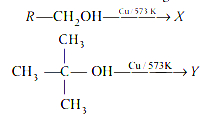
A
$X = RCHO, Y = (CH_3)_2C=CH_2$
B
$X = RCOOH, Y = (CH_3)_2C=CH_2$
C
$X = RCHO, Y = (CH_3)_2C=CH_2$
D
$X = RCOR, Y = (CH_3)_2C=O$
Solution
(C) When the vapours of a primary alcohol are passed over heated copper at $573 \ K$,dehydrogenation takes place and an aldehyde is formed: $R-CH_2OH \xrightarrow{Cu/573 \ K} R-CHO + H_2$.
In the case of tertiary alcohols,dehydration takes place to form an alkene: $(CH_3)_3C-OH \xrightarrow{Cu/573 \ K} (CH_3)_2C=CH_2 + H_2O$.
Thus,$X$ is an aldehyde $(RCHO)$ and $Y$ is an alkene $((CH_3)_2C=CH_2)$.
In the case of tertiary alcohols,dehydration takes place to form an alkene: $(CH_3)_3C-OH \xrightarrow{Cu/573 \ K} (CH_3)_2C=CH_2 + H_2O$.
Thus,$X$ is an aldehyde $(RCHO)$ and $Y$ is an alkene $((CH_3)_2C=CH_2)$.
0 likesView Solution
57
ChemistryMediumMCQAP EAMCET · 2018
Isopropyl benzene on aerial oxidation followed by acid hydrolysis of the resulting compound yields.
A
$ (CH_3)_2 CO, C_6 H_5-C_6 H_5 $
B
$ (CH_3)_2 CO, C_6 H_5 CH_3 $
C
$ (CH_3)_2 CO, C_6 H_5 OH $
D
$ (CH_3)_2 CHOH, C_6 H_5 CH_3 $
Solution
(C) The process described is the industrial preparation of phenol from cumene (isopropyl benzene).
$1$. Isopropyl benzene (cumene) undergoes aerial oxidation to form cumene hydroperoxide.
$2$. Cumene hydroperoxide,upon treatment with dilute acid (acid hydrolysis),decomposes to give phenol $(C_6H_5OH)$ and acetone $((CH_3)_2CO)$.
$1$. Isopropyl benzene (cumene) undergoes aerial oxidation to form cumene hydroperoxide.
$2$. Cumene hydroperoxide,upon treatment with dilute acid (acid hydrolysis),decomposes to give phenol $(C_6H_5OH)$ and acetone $((CH_3)_2CO)$.
0 likesView Solution
58
ChemistryMediumMCQAP EAMCET · 2018
What are $X$ and $Y$ respectively in the following set of reactions?

A
$Toluene$ ; $p-acetoxy-toluene$
B
$Toluene$ ; $p-acetoxy-toluene$
C
$Phenol$ ; $phenyl-acetate$
D
$Phenol$ ; $p-hydroxy-phenyl-acetate$
Solution
(B) $1$. Reaction with $Zn$ dust and heat: $p-Cresol$ $(p-methylphenol)$ reacts with $Zn$ dust to undergo reduction,where the $-OH$ group is removed and replaced by a hydrogen atom,resulting in the formation of $Toluene$ $(X)$.
$2$. Reaction with $(CH_3CO)_2O$ followed by $H^+$: $p-Cresol$ reacts with acetic anhydride $(CH_3CO)_2O$ to undergo acetylation of the phenolic $-OH$ group,forming $p-acetoxy-toluene$ $(Y)$.
$2$. Reaction with $(CH_3CO)_2O$ followed by $H^+$: $p-Cresol$ reacts with acetic anhydride $(CH_3CO)_2O$ to undergo acetylation of the phenolic $-OH$ group,forming $p-acetoxy-toluene$ $(Y)$.
0 likesView Solution
59
ChemistryEasyMCQAP EAMCET · 2018
The Reimer-Tiemann reaction involves the formation of $X$ from phenol through the intermediate $Y$. What are $X$ and $Y$?
A
$X$: Salicylaldehyde,$Y$: o-dichloromethyl phenoxide ion
B
$X$: m-hydroxybenzaldehyde,$Y$: m-dichloromethyl phenoxide ion
C
$X$: m-hydroxybenzoic acid,$Y$: m-trichloromethyl phenoxide ion
D
$X$: Salicylaldehyde,$Y$: o-trichloromethyl phenoxide ion
Solution
(A) The Reimer-Tiemann reaction is a chemical reaction used for the ortho-formylation of phenols.
In this reaction,phenol reacts with chloroform $(CHCl_3)$ in the presence of an aqueous base like $KOH$ to form salicylaldehyde $(X)$.
The reaction proceeds through the formation of a dichlorocarbene $(:CCl_2)$ intermediate,which attacks the phenoxide ion to form an ortho-dichloromethyl substituted phenoxide intermediate $(Y)$.
This intermediate $Y$ then undergoes hydrolysis to yield the final product,salicylaldehyde $(X)$.
In this reaction,phenol reacts with chloroform $(CHCl_3)$ in the presence of an aqueous base like $KOH$ to form salicylaldehyde $(X)$.
The reaction proceeds through the formation of a dichlorocarbene $(:CCl_2)$ intermediate,which attacks the phenoxide ion to form an ortho-dichloromethyl substituted phenoxide intermediate $(Y)$.
This intermediate $Y$ then undergoes hydrolysis to yield the final product,salicylaldehyde $(X)$.
0 likesView Solution
60
ChemistryMediumMCQAP EAMCET · 2018
What are $X$ and $Y$ in the following reactions?
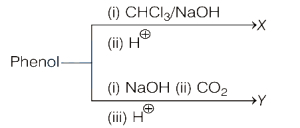
A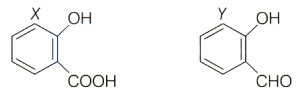
B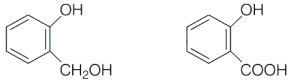
C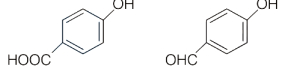
D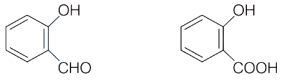
Solution
(D) The reaction of phenol with $CHCl_3$ and aqueous $NaOH$ followed by acidification is the Reimer-Tiemann reaction,which yields $2$-hydroxybenzaldehyde (salicylaldehyde) as product $X$.
The reaction of phenol with $NaOH$ followed by $CO_2$ and then acidification is the Kolbe-Schmitt reaction,which yields $2$-hydroxybenzoic acid (salicylic acid) as product $Y$.
Therefore,$X$ is $2$-hydroxybenzaldehyde and $Y$ is $2$-hydroxybenzoic acid.
The reaction of phenol with $NaOH$ followed by $CO_2$ and then acidification is the Kolbe-Schmitt reaction,which yields $2$-hydroxybenzoic acid (salicylic acid) as product $Y$.
Therefore,$X$ is $2$-hydroxybenzaldehyde and $Y$ is $2$-hydroxybenzoic acid.
0 likesView Solution
61
ChemistryMediumMCQAP EAMCET · 2018
Identify $X$ and $Y$ in the following reaction:
$X \xrightarrow{Y} \text{Benzoquinone}$
$X \xrightarrow{Y} \text{Benzoquinone}$
A
$X$ = Cyclohexanol,$Y$ = Zn
B
$X$ = Phenol,$Y$ = $Na_2Cr_2O_7 / H_2SO_4$
C
$X$ = Cyclohex$-2-$en$-1-$ol,$Y$ = $Na_2Cr_2O_7 / H_2SO_4$
D
$X$ = Phenol,$Y$ = Zn
Solution
(B) The oxidation of phenol with chromic acid ($Na_2Cr_2O_7$ in the presence of $H_2SO_4$) yields $p$-benzoquinone.
Therefore,$X$ is phenol and $Y$ is $Na_2Cr_2O_7 / H_2SO_4$.
Therefore,$X$ is phenol and $Y$ is $Na_2Cr_2O_7 / H_2SO_4$.
0 likesView Solution
62
ChemistryMediumMCQAP EAMCET · 2018
The reaction of $RCOOH$ with $R'OH$ takes place in the presence of $H_2SO_4$ to form an ester. The intermediate in the reaction is:
A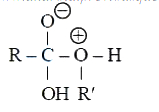
B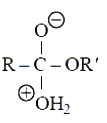
C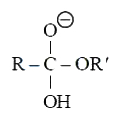
D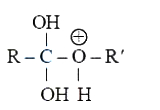
Solution
(A) The esterification reaction (Fischer esterification) proceeds via the nucleophilic acyl substitution mechanism.
$1$. The carbonyl oxygen of the carboxylic acid is protonated by $H_2SO_4$,making the carbonyl carbon more electrophilic.
$2$. The alcohol $(R'OH)$ acts as a nucleophile and attacks the electrophilic carbonyl carbon,forming a tetrahedral intermediate.
$3$. The structure of this tetrahedral intermediate is $R-C(OH)_2-OR'$,where the oxygen atom derived from the alcohol is protonated (bearing a positive charge).
$4$. Comparing the given options with the mechanism,the structure corresponding to the tetrahedral intermediate is represented in option $A$.
$1$. The carbonyl oxygen of the carboxylic acid is protonated by $H_2SO_4$,making the carbonyl carbon more electrophilic.
$2$. The alcohol $(R'OH)$ acts as a nucleophile and attacks the electrophilic carbonyl carbon,forming a tetrahedral intermediate.
$3$. The structure of this tetrahedral intermediate is $R-C(OH)_2-OR'$,where the oxygen atom derived from the alcohol is protonated (bearing a positive charge).
$4$. Comparing the given options with the mechanism,the structure corresponding to the tetrahedral intermediate is represented in option $A$.
0 likesView Solution
63
ChemistryMediumMCQAP EAMCET · 2018
Chloroethane with silver acetate forms $X$ and with $LiAlH_4$ forms $Y$. What are $X$ and $Y$?
A
$H_3CCH_2CH_3$ & $H_3CCHO$
B
$HCOOCH_2CH_3$ & $H_3CCH_2OH$
C
$H_3CCOOCH_2CH_3$ & $H_3CCH_3$
D
$H_3CCH_2COOH$ & $H_3CCH_2Li$
Solution
(C) $1$. Reaction with silver acetate $(CH_3COOAg)$: Chloroethane $(CH_3CH_2Cl)$ reacts with silver acetate via a nucleophilic substitution reaction to form ethyl acetate $(CH_3COOCH_2CH_3)$. Thus,$X = CH_3COOCH_2CH_3$.
$2$. Reaction with $LiAlH_4$: Chloroethane $(CH_3CH_2Cl)$ undergoes reduction with lithium aluminium hydride $(LiAlH_4)$ to form ethane $(CH_3CH_3)$. Thus,$Y = CH_3CH_3$.
$3$. Therefore,the correct option is $C$.
$2$. Reaction with $LiAlH_4$: Chloroethane $(CH_3CH_2Cl)$ undergoes reduction with lithium aluminium hydride $(LiAlH_4)$ to form ethane $(CH_3CH_3)$. Thus,$Y = CH_3CH_3$.
$3$. Therefore,the correct option is $C$.
0 likesView Solution
64
ChemistryMediumMCQAP EAMCET · 2018
What are $X$ and $Y$ in the following reactions?
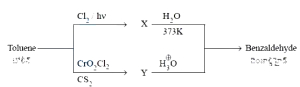
A
$X = C_6H_5CCl_3$,$Y = C_6H_5CH[OCr(OH)Cl_2]_2$
B
$X = C_6H_5CHCl_2$,$Y = C_6H_5CH[OCr(OH)Cl_2]_2$
C
$X = C_6H_5CH_2Cl$,$Y = C_6H_5CH[OCr(OH)_2Cl_2]_2$
D
$X = C_6H_4(CH_3)Cl$,$Y = C_6H_5CH[OCrCl_3]_2$
Solution
(B) The reaction of toluene with $Cl_2$ in the presence of $hv$ (photochemical chlorination) leads to the formation of benzal chloride $(C_6H_5CHCl_2)$ as the intermediate $X$,which upon hydrolysis at $373 \ K$ gives benzaldehyde.
The reaction of toluene with chromyl chloride $(CrO_2Cl_2)$ in $CS_2$ is the Etard reaction. This reaction proceeds through the formation of a brown chromium complex intermediate $Y$,which is $C_6H_5CH[OCr(OH)Cl_2]_2$. This complex upon acidic hydrolysis $(H_3O^+)$ yields benzaldehyde.
Therefore,$X = C_6H_5CHCl_2$ and $Y = C_6H_5CH[OCr(OH)Cl_2]_2$.
The reaction of toluene with chromyl chloride $(CrO_2Cl_2)$ in $CS_2$ is the Etard reaction. This reaction proceeds through the formation of a brown chromium complex intermediate $Y$,which is $C_6H_5CH[OCr(OH)Cl_2]_2$. This complex upon acidic hydrolysis $(H_3O^+)$ yields benzaldehyde.
Therefore,$X = C_6H_5CHCl_2$ and $Y = C_6H_5CH[OCr(OH)Cl_2]_2$.
0 likesView Solution
65
ChemistryEasyMCQAP EAMCET · 2018
The reagent used for the conversion of allyl alcohol into propenal is
A
$O_3 / H_2O - Zn$ dust
B
$DIBAL-H$
C
$CrO_2Cl_2 / H_3O^{+}$
D
$C_5H_5NH^{+} CrO_3Cl^{-}$
Solution
(D) The reagent used for the conversion of allyl alcohol into propenal is $C_5H_5NH^{+} CrO_3Cl^{-}$ [$PCC$ (pyridinium chlorochromate)].
$CH_2=CH-CH_2-OH \xrightarrow{PCC} CH_2=CH-CHO$
(Allyl alcohol) (Propenal)
Here,the reagent used must selectively oxidize the primary alcohol group $(-CH_2OH)$ to an aldehyde $(-CHO)$ without affecting the carbon-carbon double bond. $PCC$ is a mild oxidizing agent that performs this specific transformation.
$CH_2=CH-CH_2-OH \xrightarrow{PCC} CH_2=CH-CHO$
(Allyl alcohol) (Propenal)
Here,the reagent used must selectively oxidize the primary alcohol group $(-CH_2OH)$ to an aldehyde $(-CHO)$ without affecting the carbon-carbon double bond. $PCC$ is a mild oxidizing agent that performs this specific transformation.
0 likesView Solution
66
ChemistryEasyMCQAP EAMCET · 2018
The reagents used in the Etard reaction $(I)$ and the Stephen reaction $(II)$ are:
A
$PCC$ and $SnCl_2 / HCl$
B
$SnCl_2 / HCl$ and $CrO_2Cl_2$
C
$CrO_2Cl_2$ and $SnCl_2 / HCl$
D
$CrO_2Cl_2$ and $PCC$
Solution
(C) The Etard reaction $(I)$ involves the oxidation of toluene to benzaldehyde using chromyl chloride $(CrO_2Cl_2)$ in the presence of $CCl_4$ as a solvent. The reaction proceeds through the formation of a brown chromium complex,which is subsequently hydrolyzed to give benzaldehyde.
The Stephen reaction $(II)$ involves the reduction of nitriles $(R-CN)$ to imines using stannous chloride $(SnCl_2)$ in the presence of hydrochloric acid $(HCl)$,followed by hydrolysis to yield the corresponding aldehyde $(R-CHO)$.
The Stephen reaction $(II)$ involves the reduction of nitriles $(R-CN)$ to imines using stannous chloride $(SnCl_2)$ in the presence of hydrochloric acid $(HCl)$,followed by hydrolysis to yield the corresponding aldehyde $(R-CHO)$.
0 likesView Solution
67
ChemistryMediumMCQAP EAMCET · 2018
In which of the following reactions is benzaldehyde formed from benzoyl chloride and hydrogen in the presence of $Pd-BaSO_4$?
A
Stephen reaction
B
Etard reaction
C
Gattermann-Koch reaction
D
Rosenmund reduction reaction
Solution
(D) The reaction of benzoyl chloride with hydrogen in the presence of $Pd$ supported on $BaSO_4$ is known as the Rosenmund reduction reaction.
In this reaction,acid chlorides are selectively reduced to their corresponding aldehydes.
The chemical equation is:
$C_6H_5COCl + H_2 \xrightarrow{Pd/BaSO_4} C_6H_5CHO + HCl$
In this reaction,acid chlorides are selectively reduced to their corresponding aldehydes.
The chemical equation is:
$C_6H_5COCl + H_2 \xrightarrow{Pd/BaSO_4} C_6H_5CHO + HCl$
0 likesView Solution
68
ChemistryMediumMCQAP EAMCET · 2018
In the following reaction sequence,$X$ and $Y$ are:
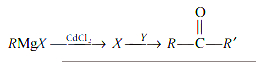
A
$R CdCl$ & $R^{\prime} COCl$
B
$R_2 Cd$ & $(R^{\prime} CO)_2$
C
$R_2 Cd$ & $R^{\prime} COCl$
D
$R_2 MgCdCl_2$ & $R COO R^{\prime}$
Solution
(C) The reaction of a Grignard reagent $(RMgX)$ with cadmium chloride $(CdCl_2)$ produces an organocadmium compound $(R_2Cd)$,which is represented as $X$.
This organocadmium compound $(R_2Cd)$ reacts with an acid chloride $(R^{\prime}COCl)$,represented as $Y$,to form a ketone $(R-CO-R^{\prime})$.
The reaction is:
$2RMgX + CdCl_2 \rightarrow R_2Cd + 2MgXCl$
$R_2Cd + 2R^{\prime}COCl \rightarrow 2R-CO-R^{\prime} + CdCl_2$
This organocadmium compound $(R_2Cd)$ reacts with an acid chloride $(R^{\prime}COCl)$,represented as $Y$,to form a ketone $(R-CO-R^{\prime})$.
The reaction is:
$2RMgX + CdCl_2 \rightarrow R_2Cd + 2MgXCl$
$R_2Cd + 2R^{\prime}COCl \rightarrow 2R-CO-R^{\prime} + CdCl_2$
0 likesView Solution
69
ChemistryMediumMCQAP EAMCET · 2018
What are '$X$' and '$Y$' in the following reaction?
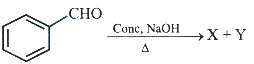
A
Phenol + Sodium benzoate
B
Benzyl alcohol + Benzoic acid
C
Benzyl alcohol + Sodium benzoate
D
Sodium benzyloxide + Benzoic acid
Solution
(C) The given reaction is the Cannizzaro reaction. Benzaldehyde $(C_6H_5CHO)$ does not have an $\alpha$-hydrogen atom,so it undergoes a self-oxidation and reduction (disproportionation) reaction in the presence of a concentrated base like $NaOH$.
One molecule of benzaldehyde is reduced to benzyl alcohol $(C_6H_5CH_2OH)$,and another molecule is oxidized to sodium benzoate $(C_6H_5COONa)$.
Thus,the products '$X$' and '$Y$' are benzyl alcohol and sodium benzoate.
One molecule of benzaldehyde is reduced to benzyl alcohol $(C_6H_5CH_2OH)$,and another molecule is oxidized to sodium benzoate $(C_6H_5COONa)$.
Thus,the products '$X$' and '$Y$' are benzyl alcohol and sodium benzoate.
0 likesView Solution
70
ChemistryMediumMCQAP EAMCET · 2018
The hydrogen atom bonded to the carbon designated by which number in $\stackrel{4}{C}H_3-\stackrel{3}{C}H_2-\stackrel{2}{C}H_2-\stackrel{1}{C}HO$ is most acidic?
A
$C-4$
B
$C-2$
C
$C-3$
D
$C-1$
Solution
(B) The acidity of $\alpha$-hydrogens in aldehydes and ketones is due to the electron-withdrawing effect of the carbonyl group $(C=O)$,which stabilizes the resulting conjugate base (enolate ion) through resonance.
In the given molecule,$CH_3-CH_2-CH_2-CHO$,the carbon atom adjacent to the carbonyl group $(C=O)$ is the $\alpha$-carbon.
The carbon labeled as $C-2$ is the $\alpha$-carbon,as it is directly attached to the carbonyl carbon $(C-1)$.
Therefore,the hydrogen atoms bonded to $C-2$ are the most acidic.
In the given molecule,$CH_3-CH_2-CH_2-CHO$,the carbon atom adjacent to the carbonyl group $(C=O)$ is the $\alpha$-carbon.
The carbon labeled as $C-2$ is the $\alpha$-carbon,as it is directly attached to the carbonyl carbon $(C-1)$.
Therefore,the hydrogen atoms bonded to $C-2$ are the most acidic.
0 likesView Solution
71
ChemistryEasyMCQAP EAMCET · 2018
Which of the following reactions does not represent the aldol condensation reaction?
A
Acetaldehyde with dilute $NaOH/\Delta$
B
Acetaldehyde and propanal with dilute $NaOH/\Delta$
C
Acetone with $Ba(OH)_2/\Delta$
D
Formaldehyde with concentrated $NaOH/\Delta$
Solution
(D) Aldol condensation is a reaction in which aldehydes or ketones containing at least one $\alpha$-hydrogen atom undergo self-condensation or cross-condensation in the presence of a dilute alkali (like dilute $NaOH$ or $Ba(OH)_2$) to form $\beta$-hydroxy aldehydes (aldols) or $\beta$-hydroxy ketones (ketols),which upon heating undergo dehydration to form $\alpha,\beta$-unsaturated carbonyl compounds.
$A$,$B$,and $C$ represent standard aldol condensation reactions because the reactants possess $\alpha$-hydrogen atoms.
Option $D$ involves formaldehyde $(HCHO)$,which does not contain any $\alpha$-hydrogen atom. In the presence of concentrated $NaOH$,formaldehyde undergoes the Cannizzaro reaction (a disproportionation reaction) rather than aldol condensation. Therefore,it does not represent an aldol condensation reaction.
$A$,$B$,and $C$ represent standard aldol condensation reactions because the reactants possess $\alpha$-hydrogen atoms.
Option $D$ involves formaldehyde $(HCHO)$,which does not contain any $\alpha$-hydrogen atom. In the presence of concentrated $NaOH$,formaldehyde undergoes the Cannizzaro reaction (a disproportionation reaction) rather than aldol condensation. Therefore,it does not represent an aldol condensation reaction.
0 likesView Solution
72
ChemistryEasyMCQAP EAMCET · 2018
Butanone reacts with methyl magnesium bromide to form an addition product $(Z)$. On hydrolysis,$(Z)$ gives:
A
$CH_3-CH_2-C(OH)(CH_3)_2$
B
$CH_3-CH_2-C(OH)(CH_2)-CH_3$
C
$CH_3-CH_2-CH_2-CH(OH)-CH_3$
D
$CH_3-CH_2-CH(CH_3)-CH_2-OH$
Solution
(A) The reaction of butanone $(CH_3-CO-CH_2-CH_3)$ with methyl magnesium bromide $(CH_3MgBr)$ is a nucleophilic addition reaction.
The nucleophilic methyl group $(CH_3^-)$ from the Grignard reagent attacks the electrophilic carbonyl carbon of butanone to form an intermediate addition product $(Z)$,which is $CH_3-C(OMgBr)(CH_3)-CH_2-CH_3$.
Upon subsequent hydrolysis with dilute acid $(H^+/H_2O)$,the intermediate $(Z)$ is converted into a tertiary alcohol,$2$-methylbutan$-2-$ol.
The structure of $2-$methylbutan$-2-$ol is $CH_3-CH_2-C(OH)(CH_3)_2$.
The nucleophilic methyl group $(CH_3^-)$ from the Grignard reagent attacks the electrophilic carbonyl carbon of butanone to form an intermediate addition product $(Z)$,which is $CH_3-C(OMgBr)(CH_3)-CH_2-CH_3$.
Upon subsequent hydrolysis with dilute acid $(H^+/H_2O)$,the intermediate $(Z)$ is converted into a tertiary alcohol,$2$-methylbutan$-2-$ol.
The structure of $2-$methylbutan$-2-$ol is $CH_3-CH_2-C(OH)(CH_3)_2$.
0 likesView Solution
73
ChemistryEasyMCQAP EAMCET · 2018
Which of the following reactions does not represent the aldol condensation reaction?
A
$2 CH_3CHO \xrightarrow{\text{dil. } NaOH / \Delta}$
B
$CH_3CHO + CH_3CH_2CHO \xrightarrow{\text{dil. } NaOH / \Delta}$
C
$2 CH_3COCH_3 \xrightarrow{(i) Ba(OH)_2, (ii) \Delta}$
D
$2 HCHO \xrightarrow{\text{conc. } NaOH / \Delta}$
Solution
(D) Aldol condensation requires the presence of at least one $\alpha-$hydrogen atom in the aldehyde or ketone.
$A$,$B$,and $C$ involve carbonyl compounds ($CH_3CHO$,$CH_3CH_2CHO$,$CH_3COCH_3$) that possess $\alpha-$hydrogens,thus they undergo aldol condensation.
$D$ involves formaldehyde $(HCHO)$,which has no $\alpha-$hydrogen. Therefore,it does not undergo aldol condensation. Instead,it undergoes the Cannizzaro reaction in the presence of concentrated $NaOH$.
$A$,$B$,and $C$ involve carbonyl compounds ($CH_3CHO$,$CH_3CH_2CHO$,$CH_3COCH_3$) that possess $\alpha-$hydrogens,thus they undergo aldol condensation.
$D$ involves formaldehyde $(HCHO)$,which has no $\alpha-$hydrogen. Therefore,it does not undergo aldol condensation. Instead,it undergoes the Cannizzaro reaction in the presence of concentrated $NaOH$.
0 likesView Solution
74
ChemistryMediumMCQAP EAMCET · 2018
Match the following:
| $A$. Lucas reagent | $I$. $SnCl_2 + HCl$ |
| $B$. Clemmensen reagent | $II$. $[Ag(NH_3)_2]^+$ |
| $C$. Tollen's reagent | $III$. Anhydrous $ZnCl_2 + conc. HCl$ |
| $D$. Stephen reagent | $IV$. $Zn-Hg/HCl$ |
A
$A-III, B-IV, C-II, D-I$
B
$A-III, B-IV, C-I, D-II$
C
$A-IV, B-II, C-III, D-V$
D
$A-IV, B-III, C-I, D-V$
Solution
(A) $(A)-(III)$: Anhydrous $ZnCl_2 + conc. HCl$ is called Lucas reagent and is used to distinguish between $1^{\circ}, 2^{\circ}, 3^{\circ}$ alcohols.
$(B)-(IV)$: $Zn-Hg/HCl$ is called Clemmensen reagent and is used in the conversion of carbonyl compounds into alkanes.
$(C)-(II)$: Tollen's reagent is $[Ag(NH_3)_2]^+$ and is used as an oxidizing agent.
$(D)-(I)$: Stephen reagent is $SnCl_2 + HCl$ and is used in the reduction of nitrile compounds.
$(B)-(IV)$: $Zn-Hg/HCl$ is called Clemmensen reagent and is used in the conversion of carbonyl compounds into alkanes.
$(C)-(II)$: Tollen's reagent is $[Ag(NH_3)_2]^+$ and is used as an oxidizing agent.
$(D)-(I)$: Stephen reagent is $SnCl_2 + HCl$ and is used in the reduction of nitrile compounds.
0 likesView Solution
75
ChemistryDifficultMCQAP EAMCET · 2018
Identify $A, B$,and $C$ in the following reactions:
Isopropyl chloride $\xrightarrow{NaOH} A$ $\xrightarrow{Cu/573 \ K} B$ $\xrightarrow{NaOI} C + \text{Iodoform}$
Isopropyl chloride $\xrightarrow{NaOH} A$ $\xrightarrow{Cu/573 \ K} B$ $\xrightarrow{NaOI} C + \text{Iodoform}$
A
$CH_3-CH_2-CH_2-OH, CH_3-CH_2-CHO, CH_3-CH_2-COONa$
B
$CH_3-CH_2-OH, CH_3-CHO, HCOONa$
C
$CH_3-CH(OH)-CH_3, CH_3-CO-CH_3, CH_3-COONa$
D
$CH_3-CH(OH)-CH_3, CH_3-CH_2-CHO, CH_3-COONa$
Solution
(C) The reaction sequence is as follows:
$1$. Isopropyl chloride $(CH_3-CHCl-CH_3)$ reacts with aqueous $NaOH$ (nucleophilic substitution) to form Isopropyl alcohol $(A)$: $CH_3-CHCl-CH_3 \xrightarrow{NaOH} CH_3-CH(OH)-CH_3 (A)$.
$2$. Isopropyl alcohol $(A)$ on dehydrogenation with $Cu$ at $573 \ K$ gives Acetone $(B)$: $CH_3-CH(OH)-CH_3 \xrightarrow{Cu/573 \ K} CH_3-CO-CH_3 (B)$.
$3$. Acetone $(B)$ undergoes the iodoform reaction with $NaOI$ to give Sodium acetate $(C)$ and Iodoform $(CHI_3)$: $CH_3-CO-CH_3 \xrightarrow{NaOI} CH_3-COONa (C) + CHI_3$.
Thus,the correct sequence is $A = CH_3-CH(OH)-CH_3$,$B = CH_3-CO-CH_3$,and $C = CH_3-COONa$.
$1$. Isopropyl chloride $(CH_3-CHCl-CH_3)$ reacts with aqueous $NaOH$ (nucleophilic substitution) to form Isopropyl alcohol $(A)$: $CH_3-CHCl-CH_3 \xrightarrow{NaOH} CH_3-CH(OH)-CH_3 (A)$.
$2$. Isopropyl alcohol $(A)$ on dehydrogenation with $Cu$ at $573 \ K$ gives Acetone $(B)$: $CH_3-CH(OH)-CH_3 \xrightarrow{Cu/573 \ K} CH_3-CO-CH_3 (B)$.
$3$. Acetone $(B)$ undergoes the iodoform reaction with $NaOI$ to give Sodium acetate $(C)$ and Iodoform $(CHI_3)$: $CH_3-CO-CH_3 \xrightarrow{NaOI} CH_3-COONa (C) + CHI_3$.
Thus,the correct sequence is $A = CH_3-CH(OH)-CH_3$,$B = CH_3-CO-CH_3$,and $C = CH_3-COONa$.
0 likesView Solution
76
ChemistryMediumMCQAP EAMCET · 2018
The compound which does not respond to iodoform test is
A
$CH_3-CHO$
B
$CH_3-CH(OH)-CH_3$
C
$C_2H_5-CO-C_2H_5$
D
$C_6H_5-COCH_3$
Solution
(C) The iodoform test is positive for compounds containing the $CH_3CO-$ group or the $CH_3CH(OH)-$ group.
$A$ $CH_3CHO$ contains a $CH_3CO-$ group,so it gives a positive test.
$B$ $CH_3CH(OH)CH_3$ contains a $CH_3CH(OH)-$ group,so it gives a positive test.
$C$ $C_2H_5-CO-C_2H_5$ (pentan-$3$-one) does not contain a $CH_3CO-$ group,so it does not respond to the iodoform test.
$D$ $C_6H_5-COCH_3$ (acetophenone) contains a $CH_3CO-$ group,so it gives a positive test.
$A$ $CH_3CHO$ contains a $CH_3CO-$ group,so it gives a positive test.
$B$ $CH_3CH(OH)CH_3$ contains a $CH_3CH(OH)-$ group,so it gives a positive test.
$C$ $C_2H_5-CO-C_2H_5$ (pentan-$3$-one) does not contain a $CH_3CO-$ group,so it does not respond to the iodoform test.
$D$ $C_6H_5-COCH_3$ (acetophenone) contains a $CH_3CO-$ group,so it gives a positive test.
0 likesView Solution
77
ChemistryMediumMCQAP EAMCET · 2018
The compound which does not respond to iodoform test is
A
$CH_3-CHO$
B
$CH_3CH(OH)CH_3$
C
$C_2H_5-CO-C_2H_5$
D
$C_6H_5COCH_3$
Solution
(C) The iodoform test is given by compounds containing either the $CH_3-CO-$ group or the $CH_3-CH(OH)-$ group.
$(1)$ $CH_3-CHO$ (acetaldehyde) contains the $CH_3-CO-$ group.
$(2)$ $CH_3CH(OH)CH_3$ (propan$-2-$ol) contains the $CH_3-CH(OH)-$ group.
$(3)$ $C_6H_5COCH_3$ (acetophenone) contains the $CH_3-CO-$ group.
$(4)$ $C_2H_5-CO-C_2H_5$ (pentan$-3-$one) does not contain either the $CH_3-CO-$ group or the $CH_3-CH(OH)-$ group.
Therefore,$C_2H_5-CO-C_2H_5$ does not respond to the iodoform test.
$(1)$ $CH_3-CHO$ (acetaldehyde) contains the $CH_3-CO-$ group.
$(2)$ $CH_3CH(OH)CH_3$ (propan$-2-$ol) contains the $CH_3-CH(OH)-$ group.
$(3)$ $C_6H_5COCH_3$ (acetophenone) contains the $CH_3-CO-$ group.
$(4)$ $C_2H_5-CO-C_2H_5$ (pentan$-3-$one) does not contain either the $CH_3-CO-$ group or the $CH_3-CH(OH)-$ group.
Therefore,$C_2H_5-CO-C_2H_5$ does not respond to the iodoform test.
0 likesView Solution
78
ChemistryMediumMCQAP EAMCET · 2018
Identify the products $y$ and $x$ in the following reaction sequence:
$C_6H_5CONH_2 \xrightarrow{NaOBr} y$
$C_6H_5CONH_2 \xrightarrow[(ii) H_3O^+]{(i) C_6H_5SO_2Cl / py, \Delta} x$
$C_6H_5CONH_2 \xrightarrow{NaOBr} y$
$C_6H_5CONH_2 \xrightarrow[(ii) H_3O^+]{(i) C_6H_5SO_2Cl / py, \Delta} x$
A
y = $C_6H_5COOH$,x = $p-Br-C_6H_4NH_2$
B
y = $C_6H_5COOH$,x = $C_6H_5NH_2$
C
y = $C_6H_5NH_2$,x = $C_6H_5NH_2$
D
y = $C_6H_5NH_2$,x = $p-Br-C_6H_4NH_2$
Solution
(C) $1$. The reaction $C_6H_5CONH_2 \xrightarrow{NaOBr} y$ is the Hofmann bromamide degradation reaction,which converts an amide into a primary amine with one carbon atom less. Thus,$y$ is aniline $(C_6H_5NH_2)$.
$2$. The reaction $C_6H_5CONH_2 \xrightarrow[(ii) H_3O^+]{(i) C_6H_5SO_2Cl / py, \Delta} x$ involves the reaction of benzamide with benzenesulfonyl chloride in the presence of pyridine,followed by heating and acidic hydrolysis. This sequence is a variation of the Curtius or Lossen-type rearrangement or simply a dehydration/hydrolysis pathway leading to the formation of aniline $(C_6H_5NH_2)$.
$3$. Therefore,both $y$ and $x$ are aniline $(C_6H_5NH_2)$. The correct option is $(C)$.
$2$. The reaction $C_6H_5CONH_2 \xrightarrow[(ii) H_3O^+]{(i) C_6H_5SO_2Cl / py, \Delta} x$ involves the reaction of benzamide with benzenesulfonyl chloride in the presence of pyridine,followed by heating and acidic hydrolysis. This sequence is a variation of the Curtius or Lossen-type rearrangement or simply a dehydration/hydrolysis pathway leading to the formation of aniline $(C_6H_5NH_2)$.
$3$. Therefore,both $y$ and $x$ are aniline $(C_6H_5NH_2)$. The correct option is $(C)$.
0 likesView Solution
79
ChemistryMediumMCQAP EAMCET · 2018
What are $X$ and $Y$ respectively in the following set of reactions?

A
Phenyl cyanide,Phenyl cyanide
B
Phenyl cyanide,Phenyl isocyanide
C
Phenyl isocyanide,Phenyl cyanide
D
Phenyl isocyanide,Phenyl isocyanide
Solution
(C) The reaction of aniline with $CHCl_3$ and $KOH$ (carbylamine reaction) produces phenyl isocyanide $(C_6H_5NC)$ as $X$.
The reaction of aniline with $NaNO_2/HCl$ followed by $CuCN/KCN$ (Sandmeyer reaction) produces phenyl cyanide $(C_6H_5CN)$ as $Y$.
Therefore,$X$ is phenyl isocyanide and $Y$ is phenyl cyanide.
The reaction of aniline with $NaNO_2/HCl$ followed by $CuCN/KCN$ (Sandmeyer reaction) produces phenyl cyanide $(C_6H_5CN)$ as $Y$.
Therefore,$X$ is phenyl isocyanide and $Y$ is phenyl cyanide.
0 likesView Solution
80
ChemistryMediumMCQAP EAMCET · 2018
What are $A, B$ and $C$ in the following reactions?
Phthalic acid $+\, NH_3 \rightarrow A \xrightarrow{\Delta} B \xrightarrow{\text{High temperature}} C$
Phthalic acid $+\, NH_3 \rightarrow A \xrightarrow{\Delta} B \xrightarrow{\text{High temperature}} C$
A
$A$: Ammonium phthalate,$B$: Phthalamide,$C$: Phthalimide
B
$A$: Ammonium phthalate,$B$: Phthalimide,$C$: Phthalamide
C
$A$: Phthalamide,$B$: Phthalimide,$C$: Ammonium phthalate
D
$A$: Phthalimide,$B$: Phthalamide,$C$: Ammonium phthalate
Solution
(A) The reaction of phthalic acid with ammonia proceeds as follows:
$1$. Phthalic acid reacts with $2$ moles of $NH_3$ to form ammonium phthalate $(A)$: $C_6H_4(COOH)_2 + 2NH_3 \longrightarrow C_6H_4(COO^-NH_4^+)_2$.
$2$. Heating ammonium phthalate $(A)$ results in the loss of water to form phthalamide $(B)$: $C_6H_4(COO^-NH_4^+)_2 \stackrel{\Delta}{\longrightarrow} C_6H_4(CONH_2)_2 + 2H_2O$.
$3$. Further heating of phthalamide $(B)$ at high temperature leads to the loss of $NH_3$ to form phthalimide $(C)$: $C_6H_4(CONH_2)_2 \stackrel{\text{High temperature}}{\longrightarrow} C_6H_4(CO)_2NH + NH_3$.
$1$. Phthalic acid reacts with $2$ moles of $NH_3$ to form ammonium phthalate $(A)$: $C_6H_4(COOH)_2 + 2NH_3 \longrightarrow C_6H_4(COO^-NH_4^+)_2$.
$2$. Heating ammonium phthalate $(A)$ results in the loss of water to form phthalamide $(B)$: $C_6H_4(COO^-NH_4^+)_2 \stackrel{\Delta}{\longrightarrow} C_6H_4(CONH_2)_2 + 2H_2O$.
$3$. Further heating of phthalamide $(B)$ at high temperature leads to the loss of $NH_3$ to form phthalimide $(C)$: $C_6H_4(CONH_2)_2 \stackrel{\text{High temperature}}{\longrightarrow} C_6H_4(CO)_2NH + NH_3$.
0 likesView Solution
81
ChemistryMediumMCQAP EAMCET · 2018
What are $X$ and $Y$ in the following reactions?
$X \xrightarrow[(ii) H_2O]{(i) LiAlH_4} R CH_2 NH_2 \xleftarrow{H_2 / Ni} Y$
$X \xrightarrow[(ii) H_2O]{(i) LiAlH_4} R CH_2 NH_2 \xleftarrow{H_2 / Ni} Y$
A
$RCOONH_4, RCH_2CN$
B
$RCN, RCONH_2$
C
$RNHCH_3, RCH_2NC$
D
$RCONH_2, RCN$
Solution
(D) In the given reaction,$X$ is $RCONH_2$ and $Y$ is $RCN$.
$LiAlH_4$ is a strong reducing agent that reduces amides $(RCONH_2)$ to primary amines $(RCH_2NH_2)$.
Catalytic hydrogenation of nitriles $(RCN)$ using $H_2/Ni$ also yields primary amines $(RCH_2NH_2)$.
$LiAlH_4$ is a strong reducing agent that reduces amides $(RCONH_2)$ to primary amines $(RCH_2NH_2)$.
Catalytic hydrogenation of nitriles $(RCN)$ using $H_2/Ni$ also yields primary amines $(RCH_2NH_2)$.
0 likesView Solution
82
ChemistryMediumMCQAP EAMCET · 2018
The reagent used for the distinction of $1^{\circ}$,$2^{\circ}$ and $3^{\circ}$ amines is
A
$CH_3COCl$
B
$ZnCl_2 \mid HCl$ (Lucas reagent)
C
Benzenesulfonyl chloride ($C_6H_5SO_2Cl$,Hinsberg reagent)
D
$[Ag(NH_3)_2]^{+}$ (Tollens' reagent)
Solution
(C) The reagent used to distinguish between primary $(1^{\circ})$,secondary $(2^{\circ})$,and tertiary $(3^{\circ})$ amines is benzenesulfonyl chloride $(C_6H_5SO_2Cl)$,commonly known as the Hinsberg reagent.
$1$. Primary $(1^{\circ})$ amines react with benzenesulfonyl chloride to form $N$-alkylbenzenesulfonamide,which is soluble in alkali due to the presence of an acidic hydrogen atom on the nitrogen.
$2$. Secondary $(2^{\circ})$ amines react to form $N$,$N$-dialkylbenzenesulfonamide,which is insoluble in alkali because it lacks an acidic hydrogen atom on the nitrogen.
$3$. Tertiary $(3^{\circ})$ amines do not react with benzenesulfonyl chloride in the absence of an acidic hydrogen atom on the nitrogen,and thus remain insoluble in the reaction mixture.
$1$. Primary $(1^{\circ})$ amines react with benzenesulfonyl chloride to form $N$-alkylbenzenesulfonamide,which is soluble in alkali due to the presence of an acidic hydrogen atom on the nitrogen.
$2$. Secondary $(2^{\circ})$ amines react to form $N$,$N$-dialkylbenzenesulfonamide,which is insoluble in alkali because it lacks an acidic hydrogen atom on the nitrogen.
$3$. Tertiary $(3^{\circ})$ amines do not react with benzenesulfonyl chloride in the absence of an acidic hydrogen atom on the nitrogen,and thus remain insoluble in the reaction mixture.
0 likesView Solution
83
ChemistryEasyMCQAP EAMCET · 2018
What are $X$ and $Y$ in the following reactions?
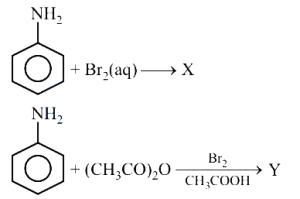
A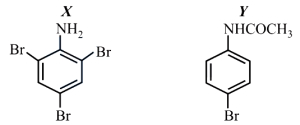
B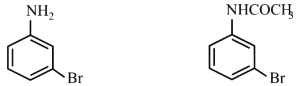
C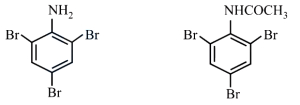
D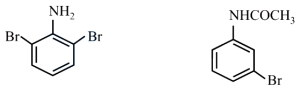
Solution
(A) $(i)$ Aniline is highly reactive towards electrophilic substitution. When treated with $Br_2$ in $H_2O$,it undergoes rapid poly-substitution to form $2, 4, 6-$tribromoaniline as the major product $(X)$.
$(ii)$ To control the reactivity of the $-NH_2$ group,it is first acetylated using acetic anhydride $(CH_3CO)_2O$ to form acetanilide. The $-NHCOCH_3$ group is less activating than the $-NH_2$ group,which restricts the bromination to the $p-$position,yielding $p-$bromoacetanilide as the major product $(Y)$.
$(ii)$ To control the reactivity of the $-NH_2$ group,it is first acetylated using acetic anhydride $(CH_3CO)_2O$ to form acetanilide. The $-NHCOCH_3$ group is less activating than the $-NH_2$ group,which restricts the bromination to the $p-$position,yielding $p-$bromoacetanilide as the major product $(Y)$.
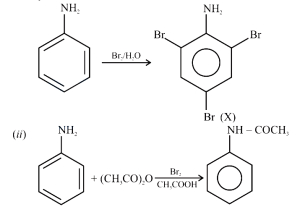
0 likesView Solution
84
ChemistryMediumMCQAP EAMCET · 2018
Identify $X$ and $Y$ in the following reactions:
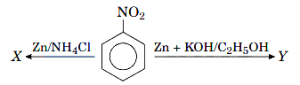
A
$X$ = Nitrosobenzene,$Y$ = Hydrazobenzene
B
$X$ = Aniline,$Y$ = Hydrazobenzene
C
$X$ = Phenylhydroxylamine,$Y$ = Hydrazobenzene
D
$X$ = Hydrazobenzene,$Y$ = Phenylhydroxylamine
Solution
(C) The reduction of nitrobenzene depends on the medium used:
$(i)$ In neutral medium,using $Zn$ dust and $NH_4Cl$ solution,nitrobenzene is reduced to phenylhydroxylamine $(C_6H_5NHOH)$. Thus,$X$ is phenylhydroxylamine.
(ii) In alkaline medium,using $Zn$ and $KOH/C_2H_5OH$,the reduction proceeds further to form hydrazobenzene $(C_6H_5NH-NHC_6H_5)$. Thus,$Y$ is hydrazobenzene.
Therefore,the correct option is $C$.
$(i)$ In neutral medium,using $Zn$ dust and $NH_4Cl$ solution,nitrobenzene is reduced to phenylhydroxylamine $(C_6H_5NHOH)$. Thus,$X$ is phenylhydroxylamine.
(ii) In alkaline medium,using $Zn$ and $KOH/C_2H_5OH$,the reduction proceeds further to form hydrazobenzene $(C_6H_5NH-NHC_6H_5)$. Thus,$Y$ is hydrazobenzene.
Therefore,the correct option is $C$.
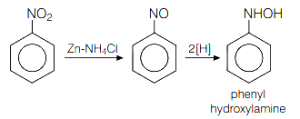
0 likesView Solution
85
ChemistryDifficultMCQAP EAMCET · 2018
What are $A$ and $B$ in the following reaction sequence?
$\text{Propionitrile} + A$ $\longrightarrow B$ $\xrightarrow{H_3O^{+}} \text{propiophenone}$
$\text{Propionitrile} + A$ $\longrightarrow B$ $\xrightarrow{H_3O^{+}} \text{propiophenone}$
A
$A = C_2H_5MgBr, B = CH_3CH_2C(NMgBr)C_2H_5$
B
$A = C_2H_5MgBr, B = CH_3CH_2CH_2C(NH)C_2H_5$
C
$A = C_6H_5MgBr, B = CH_3CH_2C(NMgBr)C_6H_5$
D
$A = C_6H_5CH_2MgBr, B = CH_3CH_2CH_2C(NH)CH_2C_6H_5$
Solution
(C) The reaction of a nitrile with a Grignard reagent $(RMgX)$ followed by acid hydrolysis yields a ketone.
For the formation of propiophenone $(CH_3CH_2-CO-C_6H_5)$,the starting material is propionitrile $(CH_3CH_2-CN)$.
The Grignard reagent $(A)$ must be phenylmagnesium bromide $(C_6H_5MgBr)$.
The reaction proceeds as follows:
$CH_3CH_2-C \equiv N + C_6H_5MgBr \longrightarrow CH_3CH_2-C(C_6H_5)=NMgBr$ $(B)$
$CH_3CH_2-C(C_6H_5)=NMgBr + 2H_2O \xrightarrow{H_3O^{+}} CH_3CH_2-CO-C_6H_5 + NH_3 + Mg(OH)Br$
Thus,$A$ is $C_6H_5MgBr$ and $B$ is $CH_3CH_2C(NMgBr)C_6H_5$.
For the formation of propiophenone $(CH_3CH_2-CO-C_6H_5)$,the starting material is propionitrile $(CH_3CH_2-CN)$.
The Grignard reagent $(A)$ must be phenylmagnesium bromide $(C_6H_5MgBr)$.
The reaction proceeds as follows:
$CH_3CH_2-C \equiv N + C_6H_5MgBr \longrightarrow CH_3CH_2-C(C_6H_5)=NMgBr$ $(B)$
$CH_3CH_2-C(C_6H_5)=NMgBr + 2H_2O \xrightarrow{H_3O^{+}} CH_3CH_2-CO-C_6H_5 + NH_3 + Mg(OH)Br$
Thus,$A$ is $C_6H_5MgBr$ and $B$ is $CH_3CH_2C(NMgBr)C_6H_5$.
0 likesView Solution
86
ChemistryMediumMCQAP EAMCET · 2018
$C_2H_5Cl$ $\xrightarrow{KCN} X$ $\xrightarrow{H_2 / \text{Catalyst}} Y$ $\xrightarrow{CHCl_3 / KOH} Z$
What is '$Z$' in the above sequence of reactions?
What is '$Z$' in the above sequence of reactions?
A
$CH_3CH_2CH_2NC$
B
$CH_3CH_2CH_2CN$
C
$CH_3CH_2NC$
D
$CH_3CHClCH_2CH_3$
Solution
(A) Step $1$: $C_2H_5Cl + KCN \rightarrow C_2H_5CN (X) + KCl$. Here,$X$ is propanenitrile $(CH_3CH_2CN)$.
Step $2$: $C_2H_5CN + 2H_2 \xrightarrow{\text{Catalyst}} CH_3CH_2CH_2NH_2 (Y)$. Here,$Y$ is propan$-1-$amine.
Step $3$: $CH_3CH_2CH_2NH_2 + CHCl_3 + 3KOH \xrightarrow{\Delta} CH_3CH_2CH_2NC (Z) + 3KCl + 3H_2O$. This is the carbylamine reaction,which is a test for primary amines. The product $Z$ is propyl isocyanide $(CH_3CH_2CH_2NC)$.
Step $2$: $C_2H_5CN + 2H_2 \xrightarrow{\text{Catalyst}} CH_3CH_2CH_2NH_2 (Y)$. Here,$Y$ is propan$-1-$amine.
Step $3$: $CH_3CH_2CH_2NH_2 + CHCl_3 + 3KOH \xrightarrow{\Delta} CH_3CH_2CH_2NC (Z) + 3KCl + 3H_2O$. This is the carbylamine reaction,which is a test for primary amines. The product $Z$ is propyl isocyanide $(CH_3CH_2CH_2NC)$.
0 likesView Solution
87
ChemistryEasyMCQAP EAMCET · 2018
The amine which does not react with chloroform and ethanolic potassium hydroxide is
A
$(CH_3)_2CH-NH-CH_3$
B
$C_6H_5-NH_2$
C
$3\text{-bromo-4-methylaniline}$
D
$4\text{-bromoaniline}$
Solution
(A) The reaction of primary amines with chloroform $(CHCl_3)$ and ethanolic potassium hydroxide $(KOH)$ to form isocyanides (carbylamines) is known as the carbylamine reaction.
This reaction is a characteristic test for primary amines.
Secondary and tertiary amines do not undergo this reaction.
In the given options:
$A$ is a secondary amine $((CH_3)_2CH-NH-CH_3)$,
$B$ is a primary amine $(C_6H_5-NH_2)$,
$C$ is a primary amine $(3\text{-bromo-4-methylaniline})$,
$D$ is a primary amine $(4\text{-bromoaniline})$.
Therefore,the secondary amine $(CH_3)_2CH-NH-CH_3$ will not react.
This reaction is a characteristic test for primary amines.
Secondary and tertiary amines do not undergo this reaction.
In the given options:
$A$ is a secondary amine $((CH_3)_2CH-NH-CH_3)$,
$B$ is a primary amine $(C_6H_5-NH_2)$,
$C$ is a primary amine $(3\text{-bromo-4-methylaniline})$,
$D$ is a primary amine $(4\text{-bromoaniline})$.
Therefore,the secondary amine $(CH_3)_2CH-NH-CH_3$ will not react.
0 likesView Solution
88
ChemistryEasyMCQAP EAMCET · 2018
The amine which does not react with chloroform and ethanolic potassium hydroxide is
A
$CH_3-CH_2-NH_2$
B
$C_6H_5-NH_2$
C
$(CH_3)_3N$
D
$CH_3-CH_2-NH-CH_3$
Solution
(C) The carbylamine reaction (also known as Hoffmann isocyanide synthesis) is a test used to identify primary amines. In this reaction,a primary amine reacts with chloroform $(CHCl_3)$ and an ethanolic base (like $KOH$) to form an isocyanide (carbylamine),which is characterized by a foul,offensive smell.
Only primary amines ($R-NH_2$ or $Ar-NH_2$) undergo this reaction.
Secondary amines $(R_2NH)$ and tertiary amines $(R_3N)$ do not possess the necessary hydrogen atoms on the nitrogen to form the isocyanide intermediate and thus do not give the carbylamine test.
In the given options:
$CH_3-CH_2-NH_2$ is a primary amine.
$C_6H_5-NH_2$ (aniline) is a primary amine.
$(CH_3)_3N$ is a tertiary amine.
$CH_3-CH_2-NH-CH_3$ is a secondary amine.
Since both $(CH_3)_3N$ and $CH_3-CH_2-NH-CH_3$ do not react,and typically such questions look for the tertiary amine or the most substituted one,$(CH_3)_3N$ is the standard answer for this type of question.
Only primary amines ($R-NH_2$ or $Ar-NH_2$) undergo this reaction.
Secondary amines $(R_2NH)$ and tertiary amines $(R_3N)$ do not possess the necessary hydrogen atoms on the nitrogen to form the isocyanide intermediate and thus do not give the carbylamine test.
In the given options:
$CH_3-CH_2-NH_2$ is a primary amine.
$C_6H_5-NH_2$ (aniline) is a primary amine.
$(CH_3)_3N$ is a tertiary amine.
$CH_3-CH_2-NH-CH_3$ is a secondary amine.
Since both $(CH_3)_3N$ and $CH_3-CH_2-NH-CH_3$ do not react,and typically such questions look for the tertiary amine or the most substituted one,$(CH_3)_3N$ is the standard answer for this type of question.
0 likesView Solution
89
ChemistryMediumMCQAP EAMCET · 2018
What are the structures of $X$,$Y$ and $Z$ in the following reaction sequence?

A
Structure of $X$: $C_6H_5NHCOCH_3$,Structure of $Y$: $m-NO_2-C_6H_4NHCOCH_3$,Structure of $Z$: $m-NO_2-C_6H_4NH_2$
B
Structure of $X$: $C_6H_5N(COCH_3)_2$,Structure of $Y$: $p-NO_2-C_6H_4N(COCH_3)_2$,Structure of $Z$: $p-NO_2-C_6H_4NH_2$
C
Structure of $X$: $C_6H_5N(COCH_3)_2$,Structure of $Y$: $3,5-(NO_2)_2-C_6H_3N(COCH_3)_2$,Structure of $Z$: $2,4,6-(NO_2)_3-C_6H_2NH_2$
D
Structure of $X$: $C_6H_5NHCOCH_3$,Structure of $Y$: $p-NO_2-C_6H_4NHCOCH_3$,Structure of $Z$: $p-NO_2-C_6H_4NH_2$
Solution
(D) $1$. The reaction of aniline $(C_6H_5NH_2)$ with acetic anhydride $((CH_3CO)_2O)$ in the presence of pyridine yields acetanilide $(C_6H_5NHCOCH_3)$,which is $X$.
$2$. Nitration of acetanilide with $HNO_3/H_2SO_4$ at $288 \ K$ gives $p$-nitroacetanilide $(p-NO_2-C_6H_4NHCOCH_3)$ as the major product,which is $Y$.
$3$. Hydrolysis of $p$-nitroacetanilide with $OH^-$ yields $p$-nitroaniline $(p-NO_2-C_6H_4NH_2)$,which is $Z$.
$4$. Thus,the correct sequence of structures corresponds to option $D$.
$2$. Nitration of acetanilide with $HNO_3/H_2SO_4$ at $288 \ K$ gives $p$-nitroacetanilide $(p-NO_2-C_6H_4NHCOCH_3)$ as the major product,which is $Y$.
$3$. Hydrolysis of $p$-nitroacetanilide with $OH^-$ yields $p$-nitroaniline $(p-NO_2-C_6H_4NH_2)$,which is $Z$.
$4$. Thus,the correct sequence of structures corresponds to option $D$.
0 likesView Solution
90
ChemistryEasyMCQAP EAMCET · 2018
$\beta-D-(-)-\text{fructofuranose}$ is:
A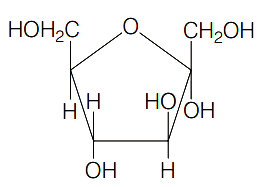
B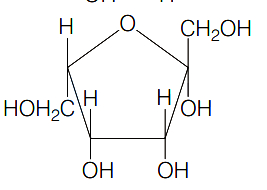
C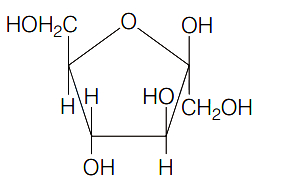
D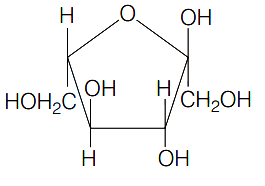
Solution
(C) The structure of $\beta-D-(-)-\text{fructofuranose}$ is characterized by a five-membered furanose ring.
In the $\beta$-anomer,the hydroxyl group $(-OH)$ at the anomeric carbon $(C-2)$ is on the same side as the $CH_2OH$ group at $C-5$.
Specifically,for $D$-fructose,the $CH_2OH$ group at $C-5$ is pointing upwards.
Therefore,in the $\beta$-anomer,the $-OH$ group at $C-2$ also points upwards.
Comparing the given options,the structure in option $C$ correctly represents this configuration.
In the $\beta$-anomer,the hydroxyl group $(-OH)$ at the anomeric carbon $(C-2)$ is on the same side as the $CH_2OH$ group at $C-5$.
Specifically,for $D$-fructose,the $CH_2OH$ group at $C-5$ is pointing upwards.
Therefore,in the $\beta$-anomer,the $-OH$ group at $C-2$ also points upwards.
Comparing the given options,the structure in option $C$ correctly represents this configuration.
0 likesView Solution
91
ChemistryEasyMCQAP EAMCET · 2018
The Fischer projection formula of $L-(-)-glucose$ is:
A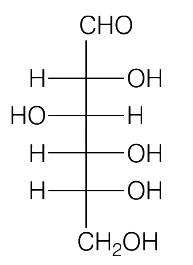
B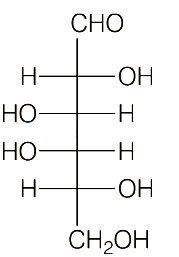
C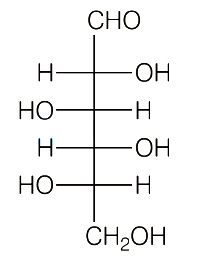
D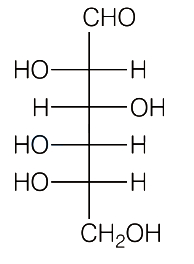
Solution
(D) The $D$ and $L$ configuration of monosaccharides is determined by the position of the $-OH$ group on the chiral carbon furthest from the carbonyl group (the $C-5$ carbon in glucose).
However,the question asks for the enantiomer of $D-(+)-glucose$,which is $L-(-)-glucose$.
In $D-(+)-glucose$,the $-OH$ groups are at positions: $C-2$ (right),$C-3$ (left),$C-4$ (right),and $C-5$ (right).
In $L-(-)-glucose$,the configuration at every chiral center is inverted compared to $D-glucose$.
Therefore,in $L-(-)-glucose$,the $-OH$ groups are at positions: $C-2$ (left),$C-3$ (right),$C-4$ (left),and $C-5$ (left).
This corresponds to the structure shown in option $D$.
However,the question asks for the enantiomer of $D-(+)-glucose$,which is $L-(-)-glucose$.
In $D-(+)-glucose$,the $-OH$ groups are at positions: $C-2$ (right),$C-3$ (left),$C-4$ (right),and $C-5$ (right).
In $L-(-)-glucose$,the configuration at every chiral center is inverted compared to $D-glucose$.
Therefore,in $L-(-)-glucose$,the $-OH$ groups are at positions: $C-2$ (left),$C-3$ (right),$C-4$ (left),and $C-5$ (left).
This corresponds to the structure shown in option $D$.
0 likesView Solution
92
ChemistryEasyMCQAP EAMCET · 2018
The Fischer projection formula of $D-(-)$-fructose is:
A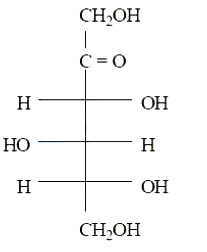
B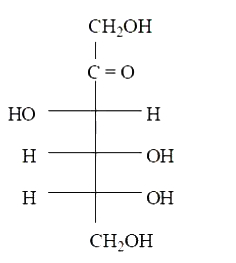
C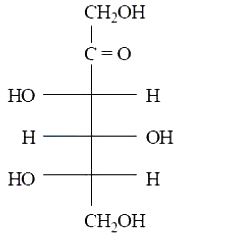
D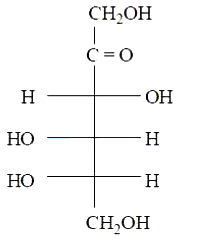
Solution
(B) -fructose is a ketohexose. Its open-chain structure has a ketone group at $C-2$. The configuration at the chiral centers $C-3, C-4,$ and $C-5$ is as follows:
At $C-3$,the $-OH$ group is on the left.
At $C-4$,the $-OH$ group is on the right.
At $C-5$,the $-OH$ group is on the right (which determines the $D$-configuration).
Comparing this with the given options,the structure in option $B$ matches the correct Fischer projection of $D$-fructose.
At $C-3$,the $-OH$ group is on the left.
At $C-4$,the $-OH$ group is on the right.
At $C-5$,the $-OH$ group is on the right (which determines the $D$-configuration).
Comparing this with the given options,the structure in option $B$ matches the correct Fischer projection of $D$-fructose.
0 likesView Solution
93
ChemistryEasyMCQAP EAMCET · 2018
Which one of the following is the structure of lactose?
A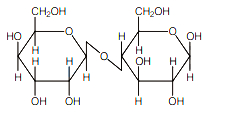
B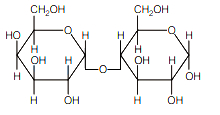
C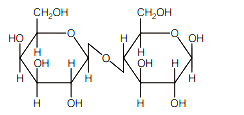
D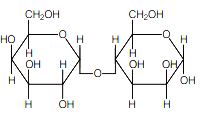
Solution
(A) Lactose is a disaccharide composed of $\beta-D-galactose$ and $\beta-D-glucose$ units.
These units are linked by a $\beta-1,4-glycosidic$ linkage.
The structure of lactose is correctly represented by the image $250769-$s,which shows the $\beta-1,4$ linkage between the $C-1$ of galactose and $C-4$ of glucose.
These units are linked by a $\beta-1,4-glycosidic$ linkage.
The structure of lactose is correctly represented by the image $250769-$s,which shows the $\beta-1,4$ linkage between the $C-1$ of galactose and $C-4$ of glucose.
0 likesView Solution
94
ChemistryEasyMCQAP EAMCET · 2018
Reducing saccharides among the following are:
| Sucrose | Ribose | Maltose | Lactose | Cellulose |
| $1$ | $2$ | $3$ | $4$ | $5$ |
A
$2, 4, 5$
B
$1, 3, 4$
C
$2, 3, 5$
D
$2, 3, 4$
Solution
(D) Reducing saccharides are carbohydrates that can act as reducing agents because they contain a free aldehyde or ketone group in their open-chain form.
$1$. Sucrose: Non-reducing sugar.
$2$. Ribose: Reducing sugar (contains a free aldehyde group).
$3$. Maltose: Reducing sugar (contains a free hemiacetal group).
$4$. Lactose: Reducing sugar (contains a free hemiacetal group).
$5$. Cellulose: Non-reducing polysaccharide.
Therefore,the reducing saccharides are $2, 3, 4$.
$1$. Sucrose: Non-reducing sugar.
$2$. Ribose: Reducing sugar (contains a free aldehyde group).
$3$. Maltose: Reducing sugar (contains a free hemiacetal group).
$4$. Lactose: Reducing sugar (contains a free hemiacetal group).
$5$. Cellulose: Non-reducing polysaccharide.
Therefore,the reducing saccharides are $2, 3, 4$.
0 likesView Solution
95
ChemistryEasyMCQAP EAMCET · 2018
The type of bond connecting two nucleotides is
A
peptide bond
B
hydrogen bond
C
phosphodiester bond
D
glycosidic bond
Solution
(C) $DNA$ is a polynucleotide chain where nucleotides are joined by phosphodiester bonds.
These bonds are strong covalent linkages between the phosphate group of one nucleotide and the sugar molecule of the adjacent nucleotide.
Specifically,the phosphate group connects the $5'$-carbon of one deoxyribose sugar to the $3'$-carbon of the next deoxyribose sugar.
These bonds are strong covalent linkages between the phosphate group of one nucleotide and the sugar molecule of the adjacent nucleotide.
Specifically,the phosphate group connects the $5'$-carbon of one deoxyribose sugar to the $3'$-carbon of the next deoxyribose sugar.
0 likesView Solution
96
ChemistryEasyMCQAP EAMCET · 2018
The hybridisation of atom '$X$' with atomic number $27$ in $[X F_6]^{3-}$ is
A
$d s p^2$
B
$d^2 s p^3$
C
$s p^3 d^2$
D
$s p^3$
Solution
(C) The atomic number of $Co$ is $27$. Its ground state electronic configuration is $[Ar] 3d^7 4s^2$.
In the complex $[CoF_6]^{3-}$,the oxidation state of $Co$ is $x + 6(-1) = -3$,so $x = +3$.
The electronic configuration of $Co^{3+}$ is $[Ar] 3d^6$.
Since $F^-$ is a weak field ligand,it does not cause pairing of electrons in the $3d$ orbitals.
Therefore,the $Co^{3+}$ ion uses one $4s$,three $4p$,and two $4d$ orbitals to form six $sp^3d^2$ hybrid orbitals to accommodate six pairs of electrons from six $F^-$ ions.
Thus,the hybridisation is $sp^3d^2$.
In the complex $[CoF_6]^{3-}$,the oxidation state of $Co$ is $x + 6(-1) = -3$,so $x = +3$.
The electronic configuration of $Co^{3+}$ is $[Ar] 3d^6$.
Since $F^-$ is a weak field ligand,it does not cause pairing of electrons in the $3d$ orbitals.
Therefore,the $Co^{3+}$ ion uses one $4s$,three $4p$,and two $4d$ orbitals to form six $sp^3d^2$ hybrid orbitals to accommodate six pairs of electrons from six $F^-$ ions.
Thus,the hybridisation is $sp^3d^2$.
0 likesView Solution
97
ChemistryMediumMCQAP EAMCET · 2018
Which of the following is correct with respect to the graph given?
$\begin{aligned} & [R]=\text{Concentration at time } t \\ & [R]_0=\text{Initial concentration} \end{aligned}$
$\begin{aligned} & [R]=\text{Concentration at time } t \\ & [R]_0=\text{Initial concentration} \end{aligned}$
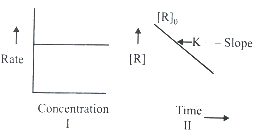
A
$I$ and $II$ represent zero order reaction.
B
$I$ represents first order and $II$ represents zero order reaction.
C
$I$ represents zero order and $II$ represents first order reaction.
D
$I$ and $II$ represent first order reaction.
Solution
(A) For a zero order reaction:
Rate $= k[R]^0 = k$. Thus,the rate is independent of concentration. Graph $I$ shows rate vs concentration as a constant line,which represents a zero order reaction.
For the integrated rate law of a zero order reaction:
$[R] = -kt + [R]_0$. This is in the form of $y = mx + c$,where $y = [R]$,$x = t$,$m = -k$,and $c = [R]_0$. Thus,graph $II$ represents a zero order reaction.
Therefore,both $I$ and $II$ represent zero order reactions.
Rate $= k[R]^0 = k$. Thus,the rate is independent of concentration. Graph $I$ shows rate vs concentration as a constant line,which represents a zero order reaction.
For the integrated rate law of a zero order reaction:
$[R] = -kt + [R]_0$. This is in the form of $y = mx + c$,where $y = [R]$,$x = t$,$m = -k$,and $c = [R]_0$. Thus,graph $II$ represents a zero order reaction.
Therefore,both $I$ and $II$ represent zero order reactions.
0 likesView Solution
98
ChemistryMediumMCQAP EAMCET · 2018
Which of the following is correct with respect to the graph given?
$[R] = \text{Concentration at time } 't'$
$[R]_0 = \text{Initial concentration}$
$[R] = \text{Concentration at time } 't'$
$[R]_0 = \text{Initial concentration}$
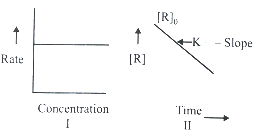
A
$I$ represents zero order and $II$ represents zero order reaction
B
$I$ represents zero order and $II$ represents zero order reaction
C
$I$ represents first order and $II$ represents zero order reaction
D
$I$ represents zero order and $II$ represents first order reaction
Solution
$(A)$ For a zero order reaction:
Rate $= K[A]^0 = K$
Thus, the rate does not change with concentration. Therefore, graph $I$ represents a zero order reaction.
For the integrated rate law of a zero order reaction:
$[R] = -Kt + [R]_0$
Comparing this with $y = mx + c$, the graph of $[R]$ vs $t$ is a straight line with a negative slope equal to $-K$. Thus, graph $II$ also represents a zero order reaction.
Rate $= K[A]^0 = K$
Thus, the rate does not change with concentration. Therefore, graph $I$ represents a zero order reaction.
For the integrated rate law of a zero order reaction:
$[R] = -Kt + [R]_0$
Comparing this with $y = mx + c$, the graph of $[R]$ vs $t$ is a straight line with a negative slope equal to $-K$. Thus, graph $II$ also represents a zero order reaction.
0 likesView Solution
99
ChemistryEasyMCQAP EAMCET · 2018
The initial rates of decrease of $I_2$ in acetone-iodine reaction catalysed by $H^{+}$ are given in the table.
The order with respect to $I_2, H^{+}$,acetone and total order of the reaction respectively are:
| Experiment | Initial $[I_2]$ $(mol \ L^{-1})$ | Initial $[H^{+}]$ $(mol \ L^{-1})$ | Initial $[CH_3COCH_3]$ $(mol \ L^{-1})$ | Initial rate $(mol \ L^{-1} \ s^{-1})$ |
| $1$ | $0.01$ | $0.1$ | $0.1$ | $0.096$ |
| $2$ | $0.01$ | $0.2$ | $0.1$ | $0.192$ |
| $3$ | $0.02$ | $0.2$ | $0.1$ | $0.192$ |
| $4$ | $0.01$ | $0.2$ | $0.2$ | $0.384$ |
The order with respect to $I_2, H^{+}$,acetone and total order of the reaction respectively are:
A
$0, 2, 1, 3$
B
$1, 0, 1, 2$
C
$0, 1, 1, 2$
D
$1, 1, 0, 2$
Solution
(C) Let the rate law be $r = k[I_2]^x [H^{+}]^y [CH_3COCH_3]^z$.
Comparing experiments $2$ and $3$: When $[H^{+}]$ and $[CH_3COCH_3]$ are constant,doubling $[I_2]$ ($0.01$ to $0.02$) does not change the rate $(0.192)$. Thus,$2^x = 1 \Rightarrow x = 0$.
Comparing experiments $1$ and $2$: When $[I_2]$ and $[CH_3COCH_3]$ are constant,doubling $[H^{+}]$ ($0.1$ to $0.2$) doubles the rate ($0.096$ to $0.192$). Thus,$2^y = 2 \Rightarrow y = 1$.
Comparing experiments $2$ and $4$: When $[I_2]$ and $[H^{+}]$ are constant,doubling $[CH_3COCH_3]$ ($0.1$ to $0.2$) doubles the rate ($0.192$ to $0.384$). Thus,$2^z = 2 \Rightarrow z = 1$.
Total order $= x + y + z = 0 + 1 + 1 = 2$.
The orders are $0, 1, 1, 2$.
Comparing experiments $2$ and $3$: When $[H^{+}]$ and $[CH_3COCH_3]$ are constant,doubling $[I_2]$ ($0.01$ to $0.02$) does not change the rate $(0.192)$. Thus,$2^x = 1 \Rightarrow x = 0$.
Comparing experiments $1$ and $2$: When $[I_2]$ and $[CH_3COCH_3]$ are constant,doubling $[H^{+}]$ ($0.1$ to $0.2$) doubles the rate ($0.096$ to $0.192$). Thus,$2^y = 2 \Rightarrow y = 1$.
Comparing experiments $2$ and $4$: When $[I_2]$ and $[H^{+}]$ are constant,doubling $[CH_3COCH_3]$ ($0.1$ to $0.2$) doubles the rate ($0.192$ to $0.384$). Thus,$2^z = 2 \Rightarrow z = 1$.
Total order $= x + y + z = 0 + 1 + 1 = 2$.
The orders are $0, 1, 1, 2$.
0 likesView Solution
100
ChemistryEasyMCQAP EAMCET · 2018
The slope of the graph drawn between $\ln k$ and $\frac{1}{T}$ as per Arrhenius equation gives the value ($R=$ gas constant,$E_a=$ Activation energy)
A
$\frac{R}{E_a}$
B
$\frac{E_a}{R}$
C
$\frac{-E_a}{R}$
D
$\frac{-R}{E_a}$
Solution
(C) The Arrhenius equation is given by $k = A e^{-E_a / RT}$.
Taking the natural logarithm on both sides,we get $\ln k = \ln A - \frac{E_a}{R} \cdot \frac{1}{T}$.
Comparing this with the equation of a straight line $y = mx + c$,where $y = \ln k$,$x = \frac{1}{T}$,and $c = \ln A$,the slope $m$ is equal to $-\frac{E_a}{R}$.
Taking the natural logarithm on both sides,we get $\ln k = \ln A - \frac{E_a}{R} \cdot \frac{1}{T}$.
Comparing this with the equation of a straight line $y = mx + c$,where $y = \ln k$,$x = \frac{1}{T}$,and $c = \ln A$,the slope $m$ is equal to $-\frac{E_a}{R}$.
0 likesView Solution
Vedclass Products
For Students
Vedclass Test Series
Mock tests in real AP EAMCET style covering Chemistry with performance analysis. 5-day free trial.
Start Free TrialFor Teachers
Exam Paper Generator
Generate Set A/B/C/D Chemistry papers from 7.5L+ questions in 2 minutes. 3 chapters free.
Try FreeFor Institutes
Online Exam Module
Run live AP EAMCET mock exams with unlimited students, 360° analytics & white-label branding.
See DemoFrequently Asked Questions
How many Chemistry questions are in AP EAMCET 2018?
There are 412 Chemistry questions from the AP EAMCET 2018 paper on Vedclass, each with a detailed step-by-step solution in English.
Are AP EAMCET 2018 Chemistry solutions available in English?
Yes. All solutions on this page are in English. You can also switch to English or Hindi using the language buttons above the questions.
Can I practice AP EAMCET 2018 Chemistry as a timed test?
Yes. Use the Vedclass Test Series to attempt a full AP EAMCET mock test covering Chemistry with time limits and instant score analysis.
Can teachers create Chemistry papers from AP EAMCET previous year questions?
Yes. The Vedclass Exam Paper Generator lets teachers mix AP EAMCET Chemistry questions and generate Set A/B/C/D papers in minutes.
For Teachers & Institutes
Build a Custom Chemistry Paper
Pick AP EAMCET 2018 Chemistry questions, set difficulty, and generate Set A/B/C/D in 2 minutes.