
MathematicsQ151–215 of 589 questions
Page 4 of 9 · Gujarati
151
MathematicsEasyMCQMHT CET · 2023
જો $\tan \theta = \frac{\sin \alpha - \cos \alpha}{\sin \alpha + \cos \alpha}$ અને $0 \leq \alpha \leq \frac{\pi}{2}$ હોય,તો $\cos 2 \theta$ ની કિંમત શોધો.
A
$\cos 2 \alpha$
B
$\sin \alpha$
C
$\cos \alpha$
D
$\sin 2 \alpha$
Solution
(D) આપેલ છે કે $\tan \theta = \frac{\sin \alpha - \cos \alpha}{\sin \alpha + \cos \alpha}$.
અંશ અને છેદને $\cos \alpha$ વડે ભાગતા,$\tan \theta = \frac{\tan \alpha - 1}{\tan \alpha + 1}$ મળે.
આપણે જાણીએ છીએ કે $\tan(\frac{\pi}{4}) = 1$,તેથી $\tan \theta = \frac{\tan \alpha - \tan(\frac{\pi}{4})}{1 + \tan \alpha \tan(\frac{\pi}{4})}$.
$\tan(A - B) = \frac{\tan A - \tan B}{1 + \tan A \tan B}$ સૂત્રનો ઉપયોગ કરતા,$\tan \theta = \tan(\alpha - \frac{\pi}{4})$ મળે.
તેથી,$\theta = \alpha - \frac{\pi}{4}$.
હવે $2 \theta = 2 \alpha - \frac{\pi}{2}$.
તેથી,$\cos 2 \theta = \cos(2 \alpha - \frac{\pi}{2})$.
$\cos(x - \frac{\pi}{2}) = \sin x$ નિત્યસમનો ઉપયોગ કરતા,$\cos 2 \theta = \sin 2 \alpha$ મળે.
અંશ અને છેદને $\cos \alpha$ વડે ભાગતા,$\tan \theta = \frac{\tan \alpha - 1}{\tan \alpha + 1}$ મળે.
આપણે જાણીએ છીએ કે $\tan(\frac{\pi}{4}) = 1$,તેથી $\tan \theta = \frac{\tan \alpha - \tan(\frac{\pi}{4})}{1 + \tan \alpha \tan(\frac{\pi}{4})}$.
$\tan(A - B) = \frac{\tan A - \tan B}{1 + \tan A \tan B}$ સૂત્રનો ઉપયોગ કરતા,$\tan \theta = \tan(\alpha - \frac{\pi}{4})$ મળે.
તેથી,$\theta = \alpha - \frac{\pi}{4}$.
હવે $2 \theta = 2 \alpha - \frac{\pi}{2}$.
તેથી,$\cos 2 \theta = \cos(2 \alpha - \frac{\pi}{2})$.
$\cos(x - \frac{\pi}{2}) = \sin x$ નિત્યસમનો ઉપયોગ કરતા,$\cos 2 \theta = \sin 2 \alpha$ મળે.
0 likesView Solution
152
MathematicsEasyMCQMHT CET · 2023
$\cos(18^{\circ}-A) \cdot \cos(18^{\circ}+A) - \cos(72^{\circ}-A) \cdot \cos(72^{\circ}+A)$ ની કિંમત શોધો.
A
$\cos 72^{\circ}$
B
$\sin 54^{\circ}$
C
$\sin 18^{\circ}$
D
$\cos 54^{\circ}$
Solution
(B) નિત્યસમ $\cos(x-y)\cos(x+y) = \cos^2 x - \sin^2 y$ નો ઉપયોગ કરતા:
$\cos(18^{\circ}-A)\cos(18^{\circ}+A) = \cos^2 18^{\circ} - \sin^2 A$
$\cos(72^{\circ}-A)\cos(72^{\circ}+A) = \cos^2 72^{\circ} - \sin^2 A$
બાદબાકી કરતા:
$(\cos^2 18^{\circ} - \sin^2 A) - (\cos^2 72^{\circ} - \sin^2 A) = \cos^2 18^{\circ} - \cos^2 72^{\circ}$
$\cos 72^{\circ} = \sin 18^{\circ}$ હોવાથી,આ $\cos^2 18^{\circ} - \sin^2 18^{\circ} = \cos(2 \times 18^{\circ}) = \cos 36^{\circ}$ થાય છે.
$\cos 36^{\circ} = \sin 54^{\circ}$ હોવાથી,જવાબ $\sin 54^{\circ}$ છે.
$\cos(18^{\circ}-A)\cos(18^{\circ}+A) = \cos^2 18^{\circ} - \sin^2 A$
$\cos(72^{\circ}-A)\cos(72^{\circ}+A) = \cos^2 72^{\circ} - \sin^2 A$
બાદબાકી કરતા:
$(\cos^2 18^{\circ} - \sin^2 A) - (\cos^2 72^{\circ} - \sin^2 A) = \cos^2 18^{\circ} - \cos^2 72^{\circ}$
$\cos 72^{\circ} = \sin 18^{\circ}$ હોવાથી,આ $\cos^2 18^{\circ} - \sin^2 18^{\circ} = \cos(2 \times 18^{\circ}) = \cos 36^{\circ}$ થાય છે.
$\cos 36^{\circ} = \sin 54^{\circ}$ હોવાથી,જવાબ $\sin 54^{\circ}$ છે.
0 likesView Solution
153
MathematicsEasyMCQMHT CET · 2023
અંતરાલ $(0, \frac{\pi}{2})$ માં $\sin x + \sin 5x = \sin 3x$ ના ઉકેલો છે
A
$\frac{\pi}{4}, \frac{\pi}{10}$
B
$\frac{\pi}{6}, \frac{\pi}{3}$
C
$\frac{\pi}{4}, \frac{\pi}{12}$
D
$\frac{\pi}{8}, \frac{\pi}{16}$
Solution
(B) આપેલ સમીકરણ: $\sin x + \sin 5x = \sin 3x$
સરવાળા-ગુણાકારના સૂત્ર $\sin A + \sin B = 2 \sin(\frac{A+B}{2}) \cos(\frac{A-B}{2})$ નો ઉપયોગ કરતા:
$2 \sin 3x \cos 2x = \sin 3x$
$\sin 3x (2 \cos 2x - 1) = 0$
કિસ્સો $1$: $\sin 3x = 0 \implies x = \frac{n\pi}{3}$. અંતરાલ $(0, \frac{\pi}{2})$ માટે $x = \frac{\pi}{3}$ ઉકેલ છે.
કિસ્સો $2$: $\cos 2x = \frac{1}{2} \implies 2x = 2n\pi \pm \frac{\pi}{3} \implies x = n\pi \pm \frac{\pi}{6}$. અંતરાલ $(0, \frac{\pi}{2})$ માટે $x = \frac{\pi}{6}$ ઉકેલ છે.
આમ,ઉકેલો $\frac{\pi}{6}, \frac{\pi}{3}$ છે.
સરવાળા-ગુણાકારના સૂત્ર $\sin A + \sin B = 2 \sin(\frac{A+B}{2}) \cos(\frac{A-B}{2})$ નો ઉપયોગ કરતા:
$2 \sin 3x \cos 2x = \sin 3x$
$\sin 3x (2 \cos 2x - 1) = 0$
કિસ્સો $1$: $\sin 3x = 0 \implies x = \frac{n\pi}{3}$. અંતરાલ $(0, \frac{\pi}{2})$ માટે $x = \frac{\pi}{3}$ ઉકેલ છે.
કિસ્સો $2$: $\cos 2x = \frac{1}{2} \implies 2x = 2n\pi \pm \frac{\pi}{3} \implies x = n\pi \pm \frac{\pi}{6}$. અંતરાલ $(0, \frac{\pi}{2})$ માટે $x = \frac{\pi}{6}$ ઉકેલ છે.
આમ,ઉકેલો $\frac{\pi}{6}, \frac{\pi}{3}$ છે.
0 likesView Solution
154
MathematicsEasyMCQMHT CET · 2023
જો $\sin (\theta-\alpha), \sin \theta$ અને $\sin (\theta+\alpha)$ એ $H.P.$ માં હોય,તો $\cos 2 \theta$ ની કિંમત શોધો.
A
$1+4 \cos ^2 \frac{\alpha}{2}$
B
$1-4 \cos ^2 \frac{\alpha}{2}$
C
$-1-4 \cos ^2 \frac{\alpha}{2}$
D
$-1+4 \cos ^2 \frac{\alpha}{2}$
Solution
(B) આપેલ છે કે $\sin (\theta-\alpha), \sin \theta, \sin (\theta+\alpha)$ એ $H.P.$ માં છે.
$\Rightarrow \frac{1}{\sin (\theta-\alpha)}, \frac{1}{\sin \theta}, \frac{1}{\sin (\theta+\alpha)}$ એ $A.P.$ માં છે.
$\therefore \frac{2}{\sin \theta} = \frac{1}{\sin (\theta-\alpha)} + \frac{1}{\sin (\theta+\alpha)}$
$\Rightarrow \frac{2}{\sin \theta} = \frac{\sin (\theta+\alpha) + \sin (\theta-\alpha)}{\sin (\theta-\alpha) \sin (\theta+\alpha)}$
સૂત્ર $\sin(A+B) + \sin(A-B) = 2 \sin A \cos B$ અને $\sin(A+B) \sin(A-B) = \sin^2 A - \sin^2 B$ નો ઉપયોગ કરતા:
$\Rightarrow \frac{2}{\sin \theta} = \frac{2 \sin \theta \cos \alpha}{\sin^2 \theta - \sin^2 \alpha}$
$\Rightarrow \sin^2 \theta - \sin^2 \alpha = \sin^2 \theta \cos \alpha$
$\Rightarrow \sin^2 \theta (1 - \cos \alpha) = \sin^2 \alpha$
$1 - \cos \alpha = 2 \sin^2 \frac{\alpha}{2}$ અને $\sin \alpha = 2 \sin \frac{\alpha}{2} \cos \frac{\alpha}{2}$ નો ઉપયોગ કરતા:
$\Rightarrow \sin^2 \theta (2 \sin^2 \frac{\alpha}{2}) = 4 \sin^2 \frac{\alpha}{2} \cos^2 \frac{\alpha}{2}$
$\Rightarrow \sin^2 \theta = 2 \cos^2 \frac{\alpha}{2}$
$\Rightarrow 1 - \cos^2 \theta = 2 \cos^2 \frac{\alpha}{2}$
$\Rightarrow \cos^2 \theta = 1 - 2 \cos^2 \frac{\alpha}{2}$
$\cos 2 \theta = 2 \cos^2 \theta - 1$ મેળવવા માટે $2$ વડે ગુણીને $1$ બાદ કરતા:
$\Rightarrow 2 \cos^2 \theta - 1 = 2(1 - 2 \cos^2 \frac{\alpha}{2}) - 1$
$\Rightarrow \cos 2 \theta = 2 - 4 \cos^2 \frac{\alpha}{2} - 1 = 1 - 4 \cos^2 \frac{\alpha}{2}$
$\Rightarrow \frac{1}{\sin (\theta-\alpha)}, \frac{1}{\sin \theta}, \frac{1}{\sin (\theta+\alpha)}$ એ $A.P.$ માં છે.
$\therefore \frac{2}{\sin \theta} = \frac{1}{\sin (\theta-\alpha)} + \frac{1}{\sin (\theta+\alpha)}$
$\Rightarrow \frac{2}{\sin \theta} = \frac{\sin (\theta+\alpha) + \sin (\theta-\alpha)}{\sin (\theta-\alpha) \sin (\theta+\alpha)}$
સૂત્ર $\sin(A+B) + \sin(A-B) = 2 \sin A \cos B$ અને $\sin(A+B) \sin(A-B) = \sin^2 A - \sin^2 B$ નો ઉપયોગ કરતા:
$\Rightarrow \frac{2}{\sin \theta} = \frac{2 \sin \theta \cos \alpha}{\sin^2 \theta - \sin^2 \alpha}$
$\Rightarrow \sin^2 \theta - \sin^2 \alpha = \sin^2 \theta \cos \alpha$
$\Rightarrow \sin^2 \theta (1 - \cos \alpha) = \sin^2 \alpha$
$1 - \cos \alpha = 2 \sin^2 \frac{\alpha}{2}$ અને $\sin \alpha = 2 \sin \frac{\alpha}{2} \cos \frac{\alpha}{2}$ નો ઉપયોગ કરતા:
$\Rightarrow \sin^2 \theta (2 \sin^2 \frac{\alpha}{2}) = 4 \sin^2 \frac{\alpha}{2} \cos^2 \frac{\alpha}{2}$
$\Rightarrow \sin^2 \theta = 2 \cos^2 \frac{\alpha}{2}$
$\Rightarrow 1 - \cos^2 \theta = 2 \cos^2 \frac{\alpha}{2}$
$\Rightarrow \cos^2 \theta = 1 - 2 \cos^2 \frac{\alpha}{2}$
$\cos 2 \theta = 2 \cos^2 \theta - 1$ મેળવવા માટે $2$ વડે ગુણીને $1$ બાદ કરતા:
$\Rightarrow 2 \cos^2 \theta - 1 = 2(1 - 2 \cos^2 \frac{\alpha}{2}) - 1$
$\Rightarrow \cos 2 \theta = 2 - 4 \cos^2 \frac{\alpha}{2} - 1 = 1 - 4 \cos^2 \frac{\alpha}{2}$
0 likesView Solution
155
MathematicsEasyMCQMHT CET · 2023
જો $a \cos 2 \theta + b \sin 2 \theta = c$ ના બીજ $\alpha$ અને $\beta$ હોય,તો $\tan \alpha + \tan \beta$ ની કિંમત શોધો.
A
$\frac{2 b}{c+a}$
B
$\frac{2 a}{b+c}$
C
$\frac{b}{c+a}$
D
$\frac{a}{b+c}$
Solution
(A) આપેલ સમીકરણ: $a \cos 2 \theta + b \sin 2 \theta = c$
નિત્યસમ $\cos 2 \theta = \frac{1 - \tan^2 \theta}{1 + \tan^2 \theta}$ અને $\sin 2 \theta = \frac{2 \tan \theta}{1 + \tan^2 \theta}$ નો ઉપયોગ કરતા:
$a \left( \frac{1 - \tan^2 \theta}{1 + \tan^2 \theta} \right) + b \left( \frac{2 \tan \theta}{1 + \tan^2 \theta} \right) = c$
બંને બાજુ $(1 + \tan^2 \theta)$ વડે ગુણતા:
$a(1 - \tan^2 \theta) + 2b \tan \theta = c(1 + \tan^2 \theta)$
$a - a \tan^2 \theta + 2b \tan \theta = c + c \tan^2 \theta$
$\tan \theta$ માં દ્વિઘાત સમીકરણ મેળવવા માટે પદોને ગોઠવતા:
$(a + c) \tan^2 \theta - 2b \tan \theta + (c - a) = 0$
$\alpha$ અને $\beta$ બીજ હોવાથી,$\tan \alpha$ અને $\tan \beta$ એ આ દ્વિઘાત સમીકરણના બીજ છે.
દ્વિઘાત સમીકરણ $Ax^2 + Bx + C = 0$ માટે બીજનો સરવાળો $-\frac{B}{A}$ થાય છે:
$\tan \alpha + \tan \beta = -\frac{-2b}{a + c} = \frac{2b}{c + a}$
નિત્યસમ $\cos 2 \theta = \frac{1 - \tan^2 \theta}{1 + \tan^2 \theta}$ અને $\sin 2 \theta = \frac{2 \tan \theta}{1 + \tan^2 \theta}$ નો ઉપયોગ કરતા:
$a \left( \frac{1 - \tan^2 \theta}{1 + \tan^2 \theta} \right) + b \left( \frac{2 \tan \theta}{1 + \tan^2 \theta} \right) = c$
બંને બાજુ $(1 + \tan^2 \theta)$ વડે ગુણતા:
$a(1 - \tan^2 \theta) + 2b \tan \theta = c(1 + \tan^2 \theta)$
$a - a \tan^2 \theta + 2b \tan \theta = c + c \tan^2 \theta$
$\tan \theta$ માં દ્વિઘાત સમીકરણ મેળવવા માટે પદોને ગોઠવતા:
$(a + c) \tan^2 \theta - 2b \tan \theta + (c - a) = 0$
$\alpha$ અને $\beta$ બીજ હોવાથી,$\tan \alpha$ અને $\tan \beta$ એ આ દ્વિઘાત સમીકરણના બીજ છે.
દ્વિઘાત સમીકરણ $Ax^2 + Bx + C = 0$ માટે બીજનો સરવાળો $-\frac{B}{A}$ થાય છે:
$\tan \alpha + \tan \beta = -\frac{-2b}{a + c} = \frac{2b}{c + a}$
0 likesView Solution
156
MathematicsMediumMCQMHT CET · 2023
જો $\sin 18^{\circ} = \frac{\sqrt{5}-1}{4}$ હોય,તો $\cos ^2 48^{\circ} - \sin ^2 12^{\circ}$ ની કિંમત શોધો.
A
$\frac{-\sqrt{5}+1}{8}$
B
$\frac{\sqrt{5}-1}{8}$
C
$\frac{\sqrt{5}+1}{8}$
D
$\frac{-1-\sqrt{5}}{8}$
Solution
(C) આપણે ત્રિકોણમિતીય નિત્યસમનો ઉપયોગ કરીએ: $\cos ^2 A - \sin ^2 B = \cos(A+B) \cdot \cos(A-B)$.
અહીં $A = 48^{\circ}$ અને $B = 12^{\circ}$ લેતા:
$\cos ^2 48^{\circ} - \sin ^2 12^{\circ} = \cos(60^{\circ}) \cdot \cos(36^{\circ})$
$= \frac{1}{2} \cdot (1 - 2\sin ^2 18^{\circ})$
$= \frac{1}{2} \left[ 1 - 2 \left( \frac{\sqrt{5}-1}{4} \right)^2 \right]$
$= \frac{1 + \sqrt{5}}{8}$.
અહીં $A = 48^{\circ}$ અને $B = 12^{\circ}$ લેતા:
$\cos ^2 48^{\circ} - \sin ^2 12^{\circ} = \cos(60^{\circ}) \cdot \cos(36^{\circ})$
$= \frac{1}{2} \cdot (1 - 2\sin ^2 18^{\circ})$
$= \frac{1}{2} \left[ 1 - 2 \left( \frac{\sqrt{5}-1}{4} \right)^2 \right]$
$= \frac{1 + \sqrt{5}}{8}$.
0 likesView Solution
157
MathematicsMediumMCQMHT CET · 2023
$\tan \frac{\pi}{8}$ નું મૂલ્ય શું છે?
A
$1-\sqrt{2}$
B
$-1-\sqrt{2}$
C
$\sqrt{2}-1$
D
$\sqrt{2}+1$
Solution
(C) આપણે જાણીએ છીએ કે $\tan 2\theta = \frac{2\tan \theta}{1-\tan^2 \theta}$.
$\theta = \frac{\pi}{8}$ લેતા,$\tan \frac{\pi}{4} = \frac{2\tan \frac{\pi}{8}}{1-\tan^2 \frac{\pi}{8}}$ મળે.
$\tan \frac{\pi}{4} = 1$ હોવાથી,$y = \tan \frac{\pi}{8}$ ધારો.
તેથી $1 = \frac{2y}{1-y^2}$,જેનો અર્થ છે $1 - y^2 = 2y$,અથવા $y^2 + 2y - 1 = 0$.
દ્વિઘાત સૂત્ર $y = \frac{-b \pm \sqrt{b^2 - 4ac}}{2a}$ નો ઉપયોગ કરતા,$y = \frac{-2 \pm \sqrt{4 - 4(1)(-1)}}{2} = \frac{-2 \pm \sqrt{8}}{2} = -1 \pm \sqrt{2}$ મળે.
$\frac{\pi}{8}$ એ પ્રથમ ચરણમાં હોવાથી,$\tan \frac{\pi}{8} > 0$ થાય.
તેથી,$\tan \frac{\pi}{8} = \sqrt{2} - 1$.
$\theta = \frac{\pi}{8}$ લેતા,$\tan \frac{\pi}{4} = \frac{2\tan \frac{\pi}{8}}{1-\tan^2 \frac{\pi}{8}}$ મળે.
$\tan \frac{\pi}{4} = 1$ હોવાથી,$y = \tan \frac{\pi}{8}$ ધારો.
તેથી $1 = \frac{2y}{1-y^2}$,જેનો અર્થ છે $1 - y^2 = 2y$,અથવા $y^2 + 2y - 1 = 0$.
દ્વિઘાત સૂત્ર $y = \frac{-b \pm \sqrt{b^2 - 4ac}}{2a}$ નો ઉપયોગ કરતા,$y = \frac{-2 \pm \sqrt{4 - 4(1)(-1)}}{2} = \frac{-2 \pm \sqrt{8}}{2} = -1 \pm \sqrt{2}$ મળે.
$\frac{\pi}{8}$ એ પ્રથમ ચરણમાં હોવાથી,$\tan \frac{\pi}{8} > 0$ થાય.
તેથી,$\tan \frac{\pi}{8} = \sqrt{2} - 1$.
0 likesView Solution
158
MathematicsEasyMCQMHT CET · 2023
$\cos ^2 48^{\circ}-\sin ^2 12^{\circ} = $ . . . . . . ,જો $\sin 18^{\circ} = \frac{\sqrt{5}-1}{4}$ હોય તો.
A
$\frac{-\sqrt{5}+1}{8}$
B
$\frac{\sqrt{5}-1}{8}$
C
$\frac{\sqrt{5}+1}{8}$
D
$\frac{-\sqrt{5}-1}{8}$
Solution
(C) આપણે નિત્યસમ $\cos^2 A - \sin^2 B = \cos(A+B) \cos(A-B)$ નો ઉપયોગ કરીશું.
અહીં,$A = 48^{\circ}$ અને $B = 12^{\circ}$ છે.
$\cos^2 48^{\circ} - \sin^2 12^{\circ} = \cos(48^{\circ} + 12^{\circ}) \cos(48^{\circ} - 12^{\circ})$
$= \cos 60^{\circ} \cos 36^{\circ}$
આપણે જાણીએ છીએ કે $\cos 60^{\circ} = \frac{1}{2}$ અને $\cos 36^{\circ} = \frac{\sqrt{5}+1}{4}$ છે.
તેથી,પદાવલિની કિંમત $\frac{1}{2} \times \frac{\sqrt{5}+1}{4} = \frac{\sqrt{5}+1}{8}$ થાય.
અહીં,$A = 48^{\circ}$ અને $B = 12^{\circ}$ છે.
$\cos^2 48^{\circ} - \sin^2 12^{\circ} = \cos(48^{\circ} + 12^{\circ}) \cos(48^{\circ} - 12^{\circ})$
$= \cos 60^{\circ} \cos 36^{\circ}$
આપણે જાણીએ છીએ કે $\cos 60^{\circ} = \frac{1}{2}$ અને $\cos 36^{\circ} = \frac{\sqrt{5}+1}{4}$ છે.
તેથી,પદાવલિની કિંમત $\frac{1}{2} \times \frac{\sqrt{5}+1}{4} = \frac{\sqrt{5}+1}{8}$ થાય.
0 likesView Solution
159
MathematicsMediumMCQMHT CET · 2023
જો $(1+\sqrt{1+x}) \tan x=1+\sqrt{1-x}$ હોય,તો $\sin 4x$ ની કિંમત શું થાય?
A
$x$
B
$-x$
C
$4x$
D
$-4x$
Solution
(A) આપેલ સમીકરણ: $(1+\sqrt{1+x}) \tan x = 1+\sqrt{1-x}$
$\tan x = \frac{1+\sqrt{1-x}}{1+\sqrt{1+x}}$
ધારો કે $x = \sin \theta$.
$\tan x = \frac{1+\sqrt{1-\sin \theta}}{1+\sqrt{1+\sin \theta}} = \frac{1+\sqrt{(\cos \frac{\theta}{2} - \sin \frac{\theta}{2})^2}}{1+\sqrt{(\cos \frac{\theta}{2} + \sin \frac{\theta}{2})^2}}$
$= \frac{1+\cos \frac{\theta}{2} - \sin \frac{\theta}{2}}{1+\cos \frac{\theta}{2} + \sin \frac{\theta}{2}}$
$= \frac{2\cos^2 \frac{\theta}{4} - 2\sin \frac{\theta}{4}\cos \frac{\theta}{4}}{2\cos^2 \frac{\theta}{4} + 2\sin \frac{\theta}{4}\cos \frac{\theta}{4}}$
$= \frac{2\cos \frac{\theta}{4}(\cos \frac{\theta}{4} - \sin \frac{\theta}{4})}{2\cos \frac{\theta}{4}(\cos \frac{\theta}{4} + \sin \frac{\theta}{4})} = \frac{1 - \tan \frac{\theta}{4}}{1 + \tan \frac{\theta}{4}} = \tan(\frac{\pi}{4} - \frac{\theta}{4})$
તેથી,$x = \frac{\pi}{4} - \frac{\theta}{4} \Rightarrow 4x = \pi - \theta$.
$\sin 4x = \sin(\pi - \theta) = \sin \theta = x$.
$\tan x = \frac{1+\sqrt{1-x}}{1+\sqrt{1+x}}$
ધારો કે $x = \sin \theta$.
$\tan x = \frac{1+\sqrt{1-\sin \theta}}{1+\sqrt{1+\sin \theta}} = \frac{1+\sqrt{(\cos \frac{\theta}{2} - \sin \frac{\theta}{2})^2}}{1+\sqrt{(\cos \frac{\theta}{2} + \sin \frac{\theta}{2})^2}}$
$= \frac{1+\cos \frac{\theta}{2} - \sin \frac{\theta}{2}}{1+\cos \frac{\theta}{2} + \sin \frac{\theta}{2}}$
$= \frac{2\cos^2 \frac{\theta}{4} - 2\sin \frac{\theta}{4}\cos \frac{\theta}{4}}{2\cos^2 \frac{\theta}{4} + 2\sin \frac{\theta}{4}\cos \frac{\theta}{4}}$
$= \frac{2\cos \frac{\theta}{4}(\cos \frac{\theta}{4} - \sin \frac{\theta}{4})}{2\cos \frac{\theta}{4}(\cos \frac{\theta}{4} + \sin \frac{\theta}{4})} = \frac{1 - \tan \frac{\theta}{4}}{1 + \tan \frac{\theta}{4}} = \tan(\frac{\pi}{4} - \frac{\theta}{4})$
તેથી,$x = \frac{\pi}{4} - \frac{\theta}{4} \Rightarrow 4x = \pi - \theta$.
$\sin 4x = \sin(\pi - \theta) = \sin \theta = x$.
0 likesView Solution
160
MathematicsMediumMCQMHT CET · 2023
જો $\cos 2B = \frac{\cos(A+C)}{\cos(A-C)}$ હોય,તો $\tan A, \tan B, \tan C$ એ
A
સમગુણોત્તર શ્રેણીમાં છે.
B
સમાંતર શ્રેણીમાં છે.
C
હરાત્મક શ્રેણીમાં છે.
D
અરિથમેટિકો-જિયોમેટ્રિક શ્રેણીમાં છે.
Solution
(A) આપેલ છે કે $\cos 2B = \frac{\cos(A+C)}{\cos(A-C)}$.
$\cos 2B = \frac{1-\tan^2 B}{1+\tan^2 B}$ સૂત્રનો ઉપયોગ કરતા:
$\frac{1-\tan^2 B}{1+\tan^2 B} = \frac{\cos A \cos C - \sin A \sin C}{\cos A \cos C + \sin A \sin C}$.
અંશ અને છેદને $\cos A \cos C$ વડે ભાગતા:
$\frac{1-\tan^2 B}{1+\tan^2 B} = \frac{1-\tan A \tan C}{1+\tan A \tan C}$.
ગુણાકાર કરતા:
$(1-\tan^2 B)(1+\tan A \tan C) = (1+\tan^2 B)(1-\tan A \tan C)$.
સાદુરૂપ આપતા:
$2 \tan A \tan C = 2 \tan^2 B$.
$\tan^2 B = \tan A \tan C$.
તેથી,$\tan A, \tan B, \tan C$ એ સમગુણોત્તર શ્રેણી $(G.P.)$ માં છે.
$\cos 2B = \frac{1-\tan^2 B}{1+\tan^2 B}$ સૂત્રનો ઉપયોગ કરતા:
$\frac{1-\tan^2 B}{1+\tan^2 B} = \frac{\cos A \cos C - \sin A \sin C}{\cos A \cos C + \sin A \sin C}$.
અંશ અને છેદને $\cos A \cos C$ વડે ભાગતા:
$\frac{1-\tan^2 B}{1+\tan^2 B} = \frac{1-\tan A \tan C}{1+\tan A \tan C}$.
ગુણાકાર કરતા:
$(1-\tan^2 B)(1+\tan A \tan C) = (1+\tan^2 B)(1-\tan A \tan C)$.
સાદુરૂપ આપતા:
$2 \tan A \tan C = 2 \tan^2 B$.
$\tan^2 B = \tan A \tan C$.
તેથી,$\tan A, \tan B, \tan C$ એ સમગુણોત્તર શ્રેણી $(G.P.)$ માં છે.
0 likesView Solution
161
MathematicsDifficultMCQMHT CET · 2023
ત્રિકોણ $ABC$ માં,સામાન્ય સંકેતો સાથે,જો $c=4$ હોય,તો $(a-b)^2 \cos^2 \frac{C}{2} + (a+b)^2 \sin^2 \frac{C}{2}$ ની કિંમત શોધો.
A
$4$
B
$16$
C
$9$
D
$2$
Solution
(B) આપેલ પદાવલિ: $(a-b)^2 \cos^2 \frac{C}{2} + (a+b)^2 \sin^2 \frac{C}{2}$
પદોનું વિસ્તરણ કરતા: $(a^2 - 2ab + b^2) \cos^2 \frac{C}{2} + (a^2 + 2ab + b^2) \sin^2 \frac{C}{2}$
પદોને ગોઠવતા: $(a^2 + b^2) (\cos^2 \frac{C}{2} + \sin^2 \frac{C}{2}) - 2ab \cos^2 \frac{C}{2} + 2ab \sin^2 \frac{C}{2}$
$\cos^2 \theta + \sin^2 \theta = 1$ હોવાથી,આ સાદું રૂપ બને છે: $(a^2 + b^2) - 2ab (\cos^2 \frac{C}{2} - \sin^2 \frac{C}{2})$
નિત્યસમ $\cos 2\theta = \cos^2 \theta - \sin^2 \theta$ નો ઉપયોગ કરતા,$\cos C = \cos^2 \frac{C}{2} - \sin^2 \frac{C}{2}$:
$= a^2 + b^2 - 2ab \cos C$
કોસાઇનના નિયમ મુજબ,$c^2 = a^2 + b^2 - 2ab \cos C$,તેથી:
$= c^2$
$c = 4$ આપેલ હોવાથી,કિંમત $4^2 = 16$ થાય.
પદોનું વિસ્તરણ કરતા: $(a^2 - 2ab + b^2) \cos^2 \frac{C}{2} + (a^2 + 2ab + b^2) \sin^2 \frac{C}{2}$
પદોને ગોઠવતા: $(a^2 + b^2) (\cos^2 \frac{C}{2} + \sin^2 \frac{C}{2}) - 2ab \cos^2 \frac{C}{2} + 2ab \sin^2 \frac{C}{2}$
$\cos^2 \theta + \sin^2 \theta = 1$ હોવાથી,આ સાદું રૂપ બને છે: $(a^2 + b^2) - 2ab (\cos^2 \frac{C}{2} - \sin^2 \frac{C}{2})$
નિત્યસમ $\cos 2\theta = \cos^2 \theta - \sin^2 \theta$ નો ઉપયોગ કરતા,$\cos C = \cos^2 \frac{C}{2} - \sin^2 \frac{C}{2}$:
$= a^2 + b^2 - 2ab \cos C$
કોસાઇનના નિયમ મુજબ,$c^2 = a^2 + b^2 - 2ab \cos C$,તેથી:
$= c^2$
$c = 4$ આપેલ હોવાથી,કિંમત $4^2 = 16$ થાય.
0 likesView Solution
162
MathematicsEasyMCQMHT CET · 2023
$\tan \left(\frac{\pi}{8}\right)$ નું મૂલ્ય શું છે?
A
$\sqrt{2}-1$
B
$1-\sqrt{2}$
C
$\sqrt{2}$
D
$\sqrt{2}+1$
Solution
(A) આપણે જાણીએ છીએ કે $\tan \left(\frac{A}{2}\right) = \frac{1-\cos A}{\sin A}$ સૂત્રનો ઉપયોગ કરતા.
$A = \frac{\pi}{4}$ લેતા,આપણને $\frac{A}{2} = \frac{\pi}{8}$ મળે છે.
તેથી,$\tan \left(\frac{\pi}{8}\right) = \frac{1-\cos(\pi/4)}{\sin(\pi/4)}$.
$\cos(\pi/4) = \frac{1}{\sqrt{2}}$ અને $\sin(\pi/4) = \frac{1}{\sqrt{2}}$ કિંમતો મૂકતા:
$\tan \left(\frac{\pi}{8}\right) = \frac{1 - \frac{1}{\sqrt{2}}}{\frac{1}{\sqrt{2}}} = \frac{\frac{\sqrt{2}-1}{\sqrt{2}}}{\frac{1}{\sqrt{2}}} = \sqrt{2}-1$.
$A = \frac{\pi}{4}$ લેતા,આપણને $\frac{A}{2} = \frac{\pi}{8}$ મળે છે.
તેથી,$\tan \left(\frac{\pi}{8}\right) = \frac{1-\cos(\pi/4)}{\sin(\pi/4)}$.
$\cos(\pi/4) = \frac{1}{\sqrt{2}}$ અને $\sin(\pi/4) = \frac{1}{\sqrt{2}}$ કિંમતો મૂકતા:
$\tan \left(\frac{\pi}{8}\right) = \frac{1 - \frac{1}{\sqrt{2}}}{\frac{1}{\sqrt{2}}} = \frac{\frac{\sqrt{2}-1}{\sqrt{2}}}{\frac{1}{\sqrt{2}}} = \sqrt{2}-1$.
0 likesView Solution
163
MathematicsMediumMCQMHT CET · 2023
સમીકરણ $16^{\sin^2 x} + 16^{\cos^2 x} = 10$ ના $[0, 2\pi]$ અંતરાલમાં ઉકેલોની સંખ્યા કેટલી છે?
A
$2$
B
$4$
C
$6$
D
$8$
Solution
(D) આપેલ સમીકરણ: $16^{\sin^2 x} + 16^{\cos^2 x} = 10$
$\cos^2 x = 1 - \sin^2 x$ હોવાથી:
$16^{\sin^2 x} + 16^{1 - \sin^2 x} = 10$
$16^{\sin^2 x} + \frac{16}{16^{\sin^2 x}} = 10$
ધારો કે $t = 16^{\sin^2 x}$. તેથી $t + \frac{16}{t} = 10$,જેનો અર્થ છે $t^2 - 10t + 16 = 0$.
$t$ માટે ઉકેલતા: $(t - 8)(t - 2) = 0$,તેથી $t = 8$ અથવા $t = 2$.
કિસ્સો $1$: $16^{\sin^2 x} = 2$ $\Rightarrow 2^{4\sin^2 x} = 2^1$ $\Rightarrow 4\sin^2 x = 1$ $\Rightarrow \sin^2 x = \frac{1}{4}$ $\Rightarrow \sin x = \pm \frac{1}{2}$.
$[0, 2\pi]$ માં,$\sin x = \pm \frac{1}{2}$ માટે $x = \frac{\pi}{6}, \frac{5\pi}{6}, \frac{7\pi}{6}, \frac{11\pi}{6}$ ($4$ ઉકેલો મળે છે).
કિસ્સો $2$: $16^{\sin^2 x} = 8$ $\Rightarrow 2^{4\sin^2 x} = 2^3$ $\Rightarrow 4\sin^2 x = 3$ $\Rightarrow \sin^2 x = \frac{3}{4}$ $\Rightarrow \sin x = \pm \frac{\sqrt{3}}{2}$.
$[0, 2\pi]$ માં,$\sin x = \pm \frac{\sqrt{3}}{2}$ માટે $x = \frac{\pi}{3}, \frac{2\pi}{3}, \frac{4\pi}{3}, \frac{5\pi}{3}$ ($4$ ઉકેલો મળે છે).
કુલ ઉકેલોની સંખ્યા = $4 + 4 = 8$.
$\cos^2 x = 1 - \sin^2 x$ હોવાથી:
$16^{\sin^2 x} + 16^{1 - \sin^2 x} = 10$
$16^{\sin^2 x} + \frac{16}{16^{\sin^2 x}} = 10$
ધારો કે $t = 16^{\sin^2 x}$. તેથી $t + \frac{16}{t} = 10$,જેનો અર્થ છે $t^2 - 10t + 16 = 0$.
$t$ માટે ઉકેલતા: $(t - 8)(t - 2) = 0$,તેથી $t = 8$ અથવા $t = 2$.
કિસ્સો $1$: $16^{\sin^2 x} = 2$ $\Rightarrow 2^{4\sin^2 x} = 2^1$ $\Rightarrow 4\sin^2 x = 1$ $\Rightarrow \sin^2 x = \frac{1}{4}$ $\Rightarrow \sin x = \pm \frac{1}{2}$.
$[0, 2\pi]$ માં,$\sin x = \pm \frac{1}{2}$ માટે $x = \frac{\pi}{6}, \frac{5\pi}{6}, \frac{7\pi}{6}, \frac{11\pi}{6}$ ($4$ ઉકેલો મળે છે).
કિસ્સો $2$: $16^{\sin^2 x} = 8$ $\Rightarrow 2^{4\sin^2 x} = 2^3$ $\Rightarrow 4\sin^2 x = 3$ $\Rightarrow \sin^2 x = \frac{3}{4}$ $\Rightarrow \sin x = \pm \frac{\sqrt{3}}{2}$.
$[0, 2\pi]$ માં,$\sin x = \pm \frac{\sqrt{3}}{2}$ માટે $x = \frac{\pi}{3}, \frac{2\pi}{3}, \frac{4\pi}{3}, \frac{5\pi}{3}$ ($4$ ઉકેલો મળે છે).
કુલ ઉકેલોની સંખ્યા = $4 + 4 = 8$.
0 likesView Solution
164
MathematicsEasyMCQMHT CET · 2023
$A(-1, 2, 3)$,$B(3, -2, 1)$,$C(2, 1, 3)$ અને $D(-1, -2, 4)$ શિરોબિંદુઓ ધરાવતા ચતુષ્ફલકનું મધ્યકેન્દ્ર શોધો.
A
$\left(\frac{3}{4}, \frac{-1}{4}, \frac{11}{4}\right)$
B
$\left(\frac{5}{4}, \frac{-3}{4}, \frac{7}{4}\right)$
C
$\left(\frac{-3}{4}, \frac{-1}{4}, \frac{11}{4}\right)$
D
$\left(\frac{-5}{4}, \frac{-3}{4}, \frac{-7}{4}\right)$
Solution
(A) $A(-1, 2, 3)$,$B(3, -2, 1)$,$C(2, 1, 3)$ અને $D(-1, -2, 4)$ શિરોબિંદુઓ ધરાવતા ચતુષ્ફલકનું મધ્યકેન્દ્ર $(G)$ શોધવાનું સૂત્ર નીચે મુજબ છે:
$G = \left(\frac{x_1+x_2+x_3+x_4}{4}, \frac{y_1+y_2+y_3+y_4}{4}, \frac{z_1+z_2+z_3+z_4}{4}\right)$
આપેલ યામોની કિંમતો મૂકતા:
$G = \left(\frac{-1+3+2-1}{4}, \frac{2-2+1-2}{4}, \frac{3+1+3+4}{4}\right)$
$G = \left(\frac{3}{4}, \frac{-1}{4}, \frac{11}{4}\right)$
આમ,સાચો વિકલ્પ $A$ છે.
$G = \left(\frac{x_1+x_2+x_3+x_4}{4}, \frac{y_1+y_2+y_3+y_4}{4}, \frac{z_1+z_2+z_3+z_4}{4}\right)$
આપેલ યામોની કિંમતો મૂકતા:
$G = \left(\frac{-1+3+2-1}{4}, \frac{2-2+1-2}{4}, \frac{3+1+3+4}{4}\right)$
$G = \left(\frac{3}{4}, \frac{-1}{4}, \frac{11}{4}\right)$
આમ,સાચો વિકલ્પ $A$ છે.
0 likesView Solution
165
MathematicsMediumMCQMHT CET · 2023
$20$ અવલોકનોનું વિચરણ $5$ છે. જો દરેક અવલોકનને $2$ વડે ગુણવામાં આવે,તો મળતા નવા અવલોકનોનું વિચરણ કેટલું થાય?
A
$40$
B
$80$
C
$20$
D
$10$
Solution
(C) ધારો કે અવલોકનો $x_1, x_2, \dots, x_{20}$ છે.
આપેલ છે કે,વિચરણ $\sigma^2 = 5$.
આપણે જાણીએ છીએ કે જો દરેક અવલોકનને અચળાંક $k$ વડે ગુણવામાં આવે,તો નવું વિચરણ $\sigma'^2 = k^2 \times \sigma^2$ દ્વારા મળે છે.
અહીં,$k = 2$ અને $\sigma^2 = 5$.
તેથી,નવું વિચરણ $\sigma'^2 = (2)^2 \times 5 = 4 \times 5 = 20$.
આપેલ છે કે,વિચરણ $\sigma^2 = 5$.
આપણે જાણીએ છીએ કે જો દરેક અવલોકનને અચળાંક $k$ વડે ગુણવામાં આવે,તો નવું વિચરણ $\sigma'^2 = k^2 \times \sigma^2$ દ્વારા મળે છે.
અહીં,$k = 2$ અને $\sigma^2 = 5$.
તેથી,નવું વિચરણ $\sigma'^2 = (2)^2 \times 5 = 4 \times 5 = 20$.
0 likesView Solution
166
MathematicsMediumMCQMHT CET · 2023
જો $g$ એ $f$ નો વ્યસ્ત હોય અને $f^{\prime}(x)=\frac{1}{1+x^3}$ હોય,તો $g^{\prime}(x)$ શું થાય?
A
$\frac{1}{1+(g(x))^3}$
B
$1+(g(x))^3$
C
$\frac{g(x)}{1+(g(x))^3}$
D
$\frac{(g(x))^3}{1+(g(x))^3}$
Solution
(B) આપેલ છે કે $g(x)$ એ વિધેય $f(x)$ નો વ્યસ્ત છે,તેથી $g(x) = f^{-1}(x)$ થાય.
આનો અર્થ એ છે કે $f(g(x)) = x$.
બંને બાજુ $x$ ની સાપેક્ષમાં વિકલન કરતા,ચેઈન રૂલનો ઉપયોગ કરીને આપણને મળે છે:
$f^{\prime}(g(x)) \cdot g^{\prime}(x) = 1$
તેથી,$g^{\prime}(x) = \frac{1}{f^{\prime}(g(x))}$ ... $(i)$
આપેલ છે કે $f^{\prime}(x) = \frac{1}{1+x^3}$,તેથી $x$ ની જગ્યાએ $g(x)$ મૂકતા:
$f^{\prime}(g(x)) = \frac{1}{1+(g(x))^3}$ ... $(ii)$
સમીકરણ $(ii)$ ને $(i)$ માં મૂકતા,આપણને મળે છે:
$g^{\prime}(x) = \frac{1}{\frac{1}{1+(g(x))^3}} = 1+(g(x))^3$.
આનો અર્થ એ છે કે $f(g(x)) = x$.
બંને બાજુ $x$ ની સાપેક્ષમાં વિકલન કરતા,ચેઈન રૂલનો ઉપયોગ કરીને આપણને મળે છે:
$f^{\prime}(g(x)) \cdot g^{\prime}(x) = 1$
તેથી,$g^{\prime}(x) = \frac{1}{f^{\prime}(g(x))}$ ... $(i)$
આપેલ છે કે $f^{\prime}(x) = \frac{1}{1+x^3}$,તેથી $x$ ની જગ્યાએ $g(x)$ મૂકતા:
$f^{\prime}(g(x)) = \frac{1}{1+(g(x))^3}$ ... $(ii)$
સમીકરણ $(ii)$ ને $(i)$ માં મૂકતા,આપણને મળે છે:
$g^{\prime}(x) = \frac{1}{\frac{1}{1+(g(x))^3}} = 1+(g(x))^3$.
0 likesView Solution
167
MathematicsEasyMCQMHT CET · 2023
સમય $t$ પર ગતિ કરતા કણનું સ્થાનાંતર $S$ એ $S=5+\frac{48}{t}+t^3$ દ્વારા આપવામાં આવે છે. તો જ્યારે વેગ શૂન્ય હોય ત્યારે તેનો પ્રવેગ કેટલો હશે?
A
$12$
B
$20$
C
$16$
D
$24$
Solution
(D) આપેલ છે,$S=5+\frac{48}{t}+t^3$.
વેગ $(V) = \frac{dS}{dt} = 0 - \frac{48}{t^2} + 3t^2$.
$V=0$ લેતા:
$-\frac{48}{t^2} + 3t^2 = 0
\Rightarrow 3t^2 = \frac{48}{t^2}
\Rightarrow t^4 = 16
\Rightarrow t = 2$ (કારણ કે $t > 0$).
હવે,પ્રવેગ $(A) = \frac{dV}{dt} = \frac{d}{dt}(-\frac{48}{t^2} + 3t^2) = \frac{96}{t^3} + 6t$.
$t=2$ પર,$A = \frac{96}{2^3} + 6(2) = \frac{96}{8} + 12 = 12 + 12 = 24$.
વેગ $(V) = \frac{dS}{dt} = 0 - \frac{48}{t^2} + 3t^2$.
$V=0$ લેતા:
$-\frac{48}{t^2} + 3t^2 = 0
\Rightarrow 3t^2 = \frac{48}{t^2}
\Rightarrow t^4 = 16
\Rightarrow t = 2$ (કારણ કે $t > 0$).
હવે,પ્રવેગ $(A) = \frac{dV}{dt} = \frac{d}{dt}(-\frac{48}{t^2} + 3t^2) = \frac{96}{t^3} + 6t$.
$t=2$ પર,$A = \frac{96}{2^3} + 6(2) = \frac{96}{8} + 12 = 12 + 12 = 24$.
0 likesView Solution
168
MathematicsMediumMCQMHT CET · 2023
ધારો કે $f: R \rightarrow R$ એક વિધેય છે જેથી $f(x)=x^3+x^2 f^{\prime}(1)+x f^{\prime \prime}(2)+6, x \in R$,તો $f(2)$ ની કિંમત શોધો.
A
$30$
B
$-4$
C
$-2$
D
$8$
Solution
(C) આપેલ છે કે $f(x)=x^3+x^2 f^{\prime}(1)+x f^{\prime \prime}(2)+6$.
$x$ ની સાપેક્ષમાં વિકલન કરતા,$f^{\prime}(x)=3 x^2+2 x f^{\prime}(1)+f^{\prime \prime}(2)$ મળે.
ફરીથી વિકલન કરતા,$f^{\prime \prime}(x)=6 x+2 f^{\prime}(1)$ મળે.
$f^{\prime}(x)$ માં $x=1$ મૂકતા:
$f^{\prime}(1)=3(1)^2+2(1) f^{\prime}(1)+f^{\prime \prime}(2) \Rightarrow f^{\prime}(1)+f^{\prime \prime}(2)=-3$ (સમીકરણ $I$).
$f^{\prime \prime}(x)$ માં $x=2$ મૂકતા:
$f^{\prime \prime}(2)=6(2)+2 f^{\prime}(1) \Rightarrow f^{\prime \prime}(2)=12+2 f^{\prime}(1)$ (સમીકરણ $II$).
સમીકરણ $II$ માંથી $f^{\prime \prime}(2)$ ની કિંમત સમીકરણ $I$ માં મૂકતા:
$f^{\prime}(1)+12+2 f^{\prime}(1)=-3 \Rightarrow 3 f^{\prime}(1)=-15 \Rightarrow f^{\prime}(1)=-5$.
હવે,સમીકરણ $II$ નો ઉપયોગ કરીને $f^{\prime \prime}(2)$ શોધો:
$f^{\prime \prime}(2)=12+2(-5)=12-10=2$.
અંતે,$f(x)$ માં $x=2$ મૂકીને $f^{\prime}(1)$ અને $f^{\prime \prime}(2)$ ની કિંમતો મૂકતા:
$f(2)=2^3+2^2(-5)+2(2)+6 = 8-20+4+6 = -2$.
$x$ ની સાપેક્ષમાં વિકલન કરતા,$f^{\prime}(x)=3 x^2+2 x f^{\prime}(1)+f^{\prime \prime}(2)$ મળે.
ફરીથી વિકલન કરતા,$f^{\prime \prime}(x)=6 x+2 f^{\prime}(1)$ મળે.
$f^{\prime}(x)$ માં $x=1$ મૂકતા:
$f^{\prime}(1)=3(1)^2+2(1) f^{\prime}(1)+f^{\prime \prime}(2) \Rightarrow f^{\prime}(1)+f^{\prime \prime}(2)=-3$ (સમીકરણ $I$).
$f^{\prime \prime}(x)$ માં $x=2$ મૂકતા:
$f^{\prime \prime}(2)=6(2)+2 f^{\prime}(1) \Rightarrow f^{\prime \prime}(2)=12+2 f^{\prime}(1)$ (સમીકરણ $II$).
સમીકરણ $II$ માંથી $f^{\prime \prime}(2)$ ની કિંમત સમીકરણ $I$ માં મૂકતા:
$f^{\prime}(1)+12+2 f^{\prime}(1)=-3 \Rightarrow 3 f^{\prime}(1)=-15 \Rightarrow f^{\prime}(1)=-5$.
હવે,સમીકરણ $II$ નો ઉપયોગ કરીને $f^{\prime \prime}(2)$ શોધો:
$f^{\prime \prime}(2)=12+2(-5)=12-10=2$.
અંતે,$f(x)$ માં $x=2$ મૂકીને $f^{\prime}(1)$ અને $f^{\prime \prime}(2)$ ની કિંમતો મૂકતા:
$f(2)=2^3+2^2(-5)+2(2)+6 = 8-20+4+6 = -2$.
0 likesView Solution
169
MathematicsDifficultMCQMHT CET · 2023
$x>1$ માટે,જો $(2 x)^{2 y}=4 e^{2 x-2 y}$ હોય,તો $(1+\log 2 x)^2 \frac{d y}{d x}$ ની કિંમત શોધો.
A
$\frac{x \log 2 x+\log 2}{x}$
B
$\frac{x \log 2 x-\log 2}{x}$
C
$x \log 2 x$
D
$\log 2 x$
Solution
(B) આપેલ સમીકરણ: $(2 x)^{2 y}=4 e^{2 x-2 y}$.
બંને બાજુ પ્રાકૃતિક લઘુગણક લેતા:
$2 y \log(2 x) = \log(4) + \log(e^{2 x-2 y})$
$2 y \log(2 x) = 2 \log 2 + 2 x - 2 y$
$2$ વડે ભાગતા:
$y \log(2 x) = \log 2 + x - y$
$y(1 + \log(2 x)) = x + \log 2$
$y = \frac{x + \log 2}{1 + \log(2 x)}$
ભાગાકારના નિયમનો ઉપયોગ કરીને $x$ ની સાપેક્ષમાં વિકલન કરતા:
$\frac{d y}{d x} = \frac{(1 + \log(2 x)) \cdot \frac{d}{d x}(x + \log 2) - (x + \log 2) \cdot \frac{d}{d x}(1 + \log(2 x))}{(1 + \log(2 x))^2}$
$\frac{d y}{d x} = \frac{(1 + \log(2 x)) \cdot 1 - (x + \log 2) \cdot \frac{1}{2 x} \cdot 2}{(1 + \log(2 x))^2}$
$\frac{d y}{d x} = \frac{1 + \log(2 x) - \frac{x + \log 2}{x}}{(1 + \log(2 x))^2}$
$(1 + \log(2 x))^2$ વડે ગુણતા:
$(1 + \log(2 x))^2 \frac{d y}{d x} = 1 + \log(2 x) - 1 - \frac{\log 2}{x}$
$= \log(2 x) - \frac{\log 2}{x} = \frac{x \log(2 x) - \log 2}{x}$.
બંને બાજુ પ્રાકૃતિક લઘુગણક લેતા:
$2 y \log(2 x) = \log(4) + \log(e^{2 x-2 y})$
$2 y \log(2 x) = 2 \log 2 + 2 x - 2 y$
$2$ વડે ભાગતા:
$y \log(2 x) = \log 2 + x - y$
$y(1 + \log(2 x)) = x + \log 2$
$y = \frac{x + \log 2}{1 + \log(2 x)}$
ભાગાકારના નિયમનો ઉપયોગ કરીને $x$ ની સાપેક્ષમાં વિકલન કરતા:
$\frac{d y}{d x} = \frac{(1 + \log(2 x)) \cdot \frac{d}{d x}(x + \log 2) - (x + \log 2) \cdot \frac{d}{d x}(1 + \log(2 x))}{(1 + \log(2 x))^2}$
$\frac{d y}{d x} = \frac{(1 + \log(2 x)) \cdot 1 - (x + \log 2) \cdot \frac{1}{2 x} \cdot 2}{(1 + \log(2 x))^2}$
$\frac{d y}{d x} = \frac{1 + \log(2 x) - \frac{x + \log 2}{x}}{(1 + \log(2 x))^2}$
$(1 + \log(2 x))^2$ વડે ગુણતા:
$(1 + \log(2 x))^2 \frac{d y}{d x} = 1 + \log(2 x) - 1 - \frac{\log 2}{x}$
$= \log(2 x) - \frac{\log 2}{x} = \frac{x \log(2 x) - \log 2}{x}$.
0 likesView Solution
170
MathematicsMediumMCQMHT CET · 2023
હાલમાં,એક પેઢી $1000$ વસ્તુઓનું ઉત્પાદન કરી રહી છે. એવું અનુમાન છે કે વધારાના કામદારો $x$ ના સંદર્ભમાં ઉત્પાદન $P$ ના ફેરફારનો દર $\frac{dP}{dx} = 100 - 12\sqrt{x}$ દ્વારા આપવામાં આવે છે. જો પેઢી $9$ વધુ કામદારોને રોજગાર આપે,તો વસ્તુઓના ઉત્પાદનનું નવું સ્તર કેટલું હશે?
A
$1684$
B
$1648$
C
$2116$
D
$1116$
Solution
(A) ઉત્પાદનમાં ફેરફારનો દર આપેલ છે: $\frac{dP}{dx} = 100 - 12\sqrt{x}$.
બંને બાજુ $x$ ના સંદર્ભમાં સંકલન કરતા:
$\int dP = \int (100 - 12x^{1/2}) dx$
$P = 100x - 12 \cdot \frac{x^{3/2}}{3/2} + C$
$P = 100x - 8x^{3/2} + C$
આપેલ છે કે જ્યારે $x = 0$ હોય ત્યારે પ્રારંભિક ઉત્પાદન $P = 1000$ છે:
$1000 = 100(0) - 8(0)^{3/2} + C \implies C = 1000$.
આમ,ઉત્પાદન વિધેય $P(x) = 100x - 8x\sqrt{x} + 1000$ છે.
$x = 9$ વધારાના કામદારો માટે:
$P(9) = 100(9) - 8(9)\sqrt{9} + 1000$
$P(9) = 900 - 8(9)(3) + 1000$
$P(9) = 900 - 216 + 1000 = 1684$.
વસ્તુઓના ઉત્પાદનનું નવું સ્તર $1684$ છે.
બંને બાજુ $x$ ના સંદર્ભમાં સંકલન કરતા:
$\int dP = \int (100 - 12x^{1/2}) dx$
$P = 100x - 12 \cdot \frac{x^{3/2}}{3/2} + C$
$P = 100x - 8x^{3/2} + C$
આપેલ છે કે જ્યારે $x = 0$ હોય ત્યારે પ્રારંભિક ઉત્પાદન $P = 1000$ છે:
$1000 = 100(0) - 8(0)^{3/2} + C \implies C = 1000$.
આમ,ઉત્પાદન વિધેય $P(x) = 100x - 8x\sqrt{x} + 1000$ છે.
$x = 9$ વધારાના કામદારો માટે:
$P(9) = 100(9) - 8(9)\sqrt{9} + 1000$
$P(9) = 900 - 8(9)(3) + 1000$
$P(9) = 900 - 216 + 1000 = 1684$.
વસ્તુઓના ઉત્પાદનનું નવું સ્તર $1684$ છે.
0 likesView Solution
171
MathematicsMediumMCQMHT CET · 2023
બધા બિંદુઓનો ગણ,જ્યાં વિધેય $f(x) = \frac{x}{1+|x|}$ નું વિકલન અસ્તિત્વ ધરાવે છે,તે છે
A
$(-\infty, \infty)$
B
$[0, \infty)$
C
$(-\infty, 0) \cup (0, \infty)$
D
$(0, \infty)$
Solution
(A) વિધેયને $f(x) = \frac{x}{1+|x|}$ તરીકે વ્યાખ્યાયિત કરવામાં આવ્યું છે.
આપણે તેને ટુકડાઓમાં નીચે મુજબ લખી શકીએ:
$f(x) = \begin{cases} \frac{x}{1-x}, & x < 0 \\ \frac{x}{1+x}, & x \geq 0 \end{cases}$
હવે,આપણે $x = 0$ આગળ વિકલનીયતા ચકાસીએ:
$x = 0$ આગળ ડાબી બાજુનું વિકલન $(LHD)$:
$LHD = \lim_{h \to 0^-} \frac{f(0+h) - f(0)}{h} = \lim_{h \to 0^-} \frac{\frac{h}{1-h} - 0}{h} = \lim_{h \to 0^-} \frac{1}{1-h} = 1$
$x = 0$ આગળ જમણી બાજુનું વિકલન $(RHD)$:
$RHD = \lim_{h \to 0^+} \frac{f(0+h) - f(0)}{h} = \lim_{h \to 0^+} \frac{\frac{h}{1+h} - 0}{h} = \lim_{h \to 0^+} \frac{1}{1+h} = 1$
અહીં $LHD = RHD = 1$ હોવાથી,વિધેય $x = 0$ આગળ વિકલનીય છે.
$x \neq 0$ માટે,વિધેય એ શૂન્ય ન હોય તેવા છેદ સાથેનું સંમેય વિધેય છે,તેથી તે દરેક જગ્યાએ વિકલનીય છે.
આમ,વિકલન તમામ $x \in (-\infty, \infty)$ માટે અસ્તિત્વ ધરાવે છે.
આપણે તેને ટુકડાઓમાં નીચે મુજબ લખી શકીએ:
$f(x) = \begin{cases} \frac{x}{1-x}, & x < 0 \\ \frac{x}{1+x}, & x \geq 0 \end{cases}$
હવે,આપણે $x = 0$ આગળ વિકલનીયતા ચકાસીએ:
$x = 0$ આગળ ડાબી બાજુનું વિકલન $(LHD)$:
$LHD = \lim_{h \to 0^-} \frac{f(0+h) - f(0)}{h} = \lim_{h \to 0^-} \frac{\frac{h}{1-h} - 0}{h} = \lim_{h \to 0^-} \frac{1}{1-h} = 1$
$x = 0$ આગળ જમણી બાજુનું વિકલન $(RHD)$:
$RHD = \lim_{h \to 0^+} \frac{f(0+h) - f(0)}{h} = \lim_{h \to 0^+} \frac{\frac{h}{1+h} - 0}{h} = \lim_{h \to 0^+} \frac{1}{1+h} = 1$
અહીં $LHD = RHD = 1$ હોવાથી,વિધેય $x = 0$ આગળ વિકલનીય છે.
$x \neq 0$ માટે,વિધેય એ શૂન્ય ન હોય તેવા છેદ સાથેનું સંમેય વિધેય છે,તેથી તે દરેક જગ્યાએ વિકલનીય છે.
આમ,વિકલન તમામ $x \in (-\infty, \infty)$ માટે અસ્તિત્વ ધરાવે છે.
0 likesView Solution
172
MathematicsEasyMCQMHT CET · 2023
વિધેય $f(x) = \sin^{-1}\left(\frac{|x|+5}{x^2+1}\right)$ નો પ્રદેશ $(-\infty, -a] \cup [a, \infty)$ છે. તો $a$ ની કિંમત શોધો.
A
$\frac{\sqrt{17}}{2} + 1$
B
$\frac{\sqrt{17} - 1}{2}$
C
$\frac{1 + \sqrt{17}}{2}$
D
$\frac{\sqrt{17}}{2} - 1$
Solution
(C) $f(x) = \sin^{-1}\left(\frac{|x|+5}{x^2+1}\right)$ વ્યાખ્યાયિત છે જો $-1 \leq \frac{|x|+5}{x^2+1} \leq 1$ હોય.
$|x|+5 > 0$ અને $x^2+1 > 0$ હોવાથી,ડાબી બાજુની અસમતા $\frac{|x|+5}{x^2+1} \geq -1$ હંમેશા સાચી છે.
આપણે ફક્ત $\frac{|x|+5}{x^2+1} \leq 1$ ઉકેલવાની જરૂર છે.
$|x|+5 \leq x^2+1$
$x^2 - |x| - 4 \geq 0$.
ધારો કે $t = |x|$,જ્યાં $t \geq 0$. તો $t^2 - t - 4 \geq 0$.
$t^2 - t - 4 = 0$ ના બીજ $t = \frac{1 \pm \sqrt{17}}{2}$ છે.
$t \geq 0$ હોવાથી,$t \geq \frac{1 + \sqrt{17}}{2}$.
તેથી,$|x| \geq \frac{1 + \sqrt{17}}{2}$,જેનો અર્થ છે કે $x \in \left(-\infty, -\frac{1 + \sqrt{17}}{2}\right] \cup \left[\frac{1 + \sqrt{17}}{2}, \infty\right)$.
આને $(-\infty, -a] \cup [a, \infty)$ સાથે સરખાવતા,$a = \frac{1 + \sqrt{17}}{2}$ મળે છે.
$|x|+5 > 0$ અને $x^2+1 > 0$ હોવાથી,ડાબી બાજુની અસમતા $\frac{|x|+5}{x^2+1} \geq -1$ હંમેશા સાચી છે.
આપણે ફક્ત $\frac{|x|+5}{x^2+1} \leq 1$ ઉકેલવાની જરૂર છે.
$|x|+5 \leq x^2+1$
$x^2 - |x| - 4 \geq 0$.
ધારો કે $t = |x|$,જ્યાં $t \geq 0$. તો $t^2 - t - 4 \geq 0$.
$t^2 - t - 4 = 0$ ના બીજ $t = \frac{1 \pm \sqrt{17}}{2}$ છે.
$t \geq 0$ હોવાથી,$t \geq \frac{1 + \sqrt{17}}{2}$.
તેથી,$|x| \geq \frac{1 + \sqrt{17}}{2}$,જેનો અર્થ છે કે $x \in \left(-\infty, -\frac{1 + \sqrt{17}}{2}\right] \cup \left[\frac{1 + \sqrt{17}}{2}, \infty\right)$.
આને $(-\infty, -a] \cup [a, \infty)$ સાથે સરખાવતા,$a = \frac{1 + \sqrt{17}}{2}$ મળે છે.
0 likesView Solution
173
MathematicsEasyMCQMHT CET · 2023
$2^x+2^y=2$ દ્વારા આપવામાં આવેલ વિધેયનો પ્રદેશ (domain) શું છે?
A
$0 < x \leq 1$
B
$0 \leq x \leq 1$
C
$-\infty < x \leq 0$
D
$-\infty < x < 1$
Solution
(D) આપેલ સમીકરણ $2^x+2^y=2$ છે.
આને $2^y = 2 - 2^x$ તરીકે લખી શકાય.
$y$ વ્યાખ્યાયિત થાય તે માટે,લઘુગણકનો આર્ગ્યુમેન્ટ ધન હોવો જોઈએ: $2 - 2^x > 0$.
આનો અર્થ એ છે કે $2^x < 2$.
આધાર $2 > 1$ હોવાથી,અસમતા ત્યારે જ સાચી ઠરે જ્યારે $x < 1$ હોય.
આમ,પ્રદેશ $(-\infty, 1)$ અથવા $-\infty < x < 1$ છે.
આને $2^y = 2 - 2^x$ તરીકે લખી શકાય.
$y$ વ્યાખ્યાયિત થાય તે માટે,લઘુગણકનો આર્ગ્યુમેન્ટ ધન હોવો જોઈએ: $2 - 2^x > 0$.
આનો અર્થ એ છે કે $2^x < 2$.
આધાર $2 > 1$ હોવાથી,અસમતા ત્યારે જ સાચી ઠરે જ્યારે $x < 1$ હોય.
આમ,પ્રદેશ $(-\infty, 1)$ અથવા $-\infty < x < 1$ છે.
0 likesView Solution
174
MathematicsEasyMCQMHT CET · 2023
$2^x+2^y=2$ સમીકરણ દ્વારા આપવામાં આવેલ વિધેય $y(x)$ નો પ્રદેશ (domain) શું છે?
A
$0 < x \leq 1$
B
$0 \leq x \leq 1$
C
$-\infty < x \leq 0$
D
$-\infty < x < 1$
Solution
(D) આપેલ સમીકરણ $2^x + 2^y = 2$ છે.
$2^y$ માટે ગોઠવતા,આપણને $2^y = 2 - 2^x$ મળે છે.
બધા વાસ્તવિક $y$ માટે $2^y > 0$ હોવાથી,પદ $2 - 2^x$ એ $0$ કરતા મોટું હોવું જોઈએ.
$2 - 2^x > 0 \Rightarrow 2^x < 2$.
$2 = 2^1$ હોવાથી,આપણી પાસે $2^x < 2^1$ છે.
આધાર $2 > 1$ હોવાથી,અસમતા $x < 1$ માટે સાચી છે.
આમ,પ્રદેશ $(-\infty, 1)$ છે,જેને $-\infty < x < 1$ તરીકે લખી શકાય છે.
$2^y$ માટે ગોઠવતા,આપણને $2^y = 2 - 2^x$ મળે છે.
બધા વાસ્તવિક $y$ માટે $2^y > 0$ હોવાથી,પદ $2 - 2^x$ એ $0$ કરતા મોટું હોવું જોઈએ.
$2 - 2^x > 0 \Rightarrow 2^x < 2$.
$2 = 2^1$ હોવાથી,આપણી પાસે $2^x < 2^1$ છે.
આધાર $2 > 1$ હોવાથી,અસમતા $x < 1$ માટે સાચી છે.
આમ,પ્રદેશ $(-\infty, 1)$ છે,જેને $-\infty < x < 1$ તરીકે લખી શકાય છે.
0 likesView Solution
175
MathematicsEasyMCQMHT CET · 2023
બધા જ વાસ્તવિક $x$ માટે,$\frac{1-x+x^2}{1+x+x^2}$ ની ન્યૂનતમ કિંમત શું છે?
A
$0$
B
$1$
C
$\frac{1}{3}$
D
$3$
Solution
(C) ધારો કે $f(x) = \frac{1-x+x^2}{1+x+x^2}$.
ભાગાકારના નિયમનો ઉપયોગ કરતા,$f'(x) = \frac{(1+x+x^2)(-1+2x) - (1-x+x^2)(1+2x)}{(1+x+x^2)^2}$.
અંશનું વિસ્તરણ કરતા: $(1+x+x^2)(-1+2x) = 2x^3+x^2+x-1$.
$(1-x+x^2)(1+2x) = 2x^3-x^2+x+1$.
બાદબાકી કરતા: $(2x^3+x^2+x-1) - (2x^3-x^2+x+1) = 2x^2-2$.
આમ,$f'(x) = \frac{2x^2-2}{(1+x+x^2)^2}$.
$f'(x) = 0$ લેતા $2x^2-2 = 0$,તેથી $x^2 = 1$,એટલે કે $x = 1$ અથવા $x = -1$.
આ બિંદુઓ પર $f(x)$ ની કિંમત શોધતા:
$f(1) = \frac{1-1+1}{1+1+1} = \frac{1}{3}$.
$f(-1) = \frac{1-(-1)+(-1)^2}{1+(-1)+(-1)^2} = \frac{3}{1} = 3$.
તેથી,$f(x)$ ની ન્યૂનતમ કિંમત $\frac{1}{3}$ છે.
ભાગાકારના નિયમનો ઉપયોગ કરતા,$f'(x) = \frac{(1+x+x^2)(-1+2x) - (1-x+x^2)(1+2x)}{(1+x+x^2)^2}$.
અંશનું વિસ્તરણ કરતા: $(1+x+x^2)(-1+2x) = 2x^3+x^2+x-1$.
$(1-x+x^2)(1+2x) = 2x^3-x^2+x+1$.
બાદબાકી કરતા: $(2x^3+x^2+x-1) - (2x^3-x^2+x+1) = 2x^2-2$.
આમ,$f'(x) = \frac{2x^2-2}{(1+x+x^2)^2}$.
$f'(x) = 0$ લેતા $2x^2-2 = 0$,તેથી $x^2 = 1$,એટલે કે $x = 1$ અથવા $x = -1$.
આ બિંદુઓ પર $f(x)$ ની કિંમત શોધતા:
$f(1) = \frac{1-1+1}{1+1+1} = \frac{1}{3}$.
$f(-1) = \frac{1-(-1)+(-1)^2}{1+(-1)+(-1)^2} = \frac{3}{1} = 3$.
તેથી,$f(x)$ ની ન્યૂનતમ કિંમત $\frac{1}{3}$ છે.
0 likesView Solution
176
MathematicsEasyMCQMHT CET · 2023
વિધેય $f(x) = \frac{x^2}{x^2+1}$ નો વિસ્તાર શોધો.
A
$(0, 1)$
B
$[0, 1)$
C
$(0, 1]$
D
$[0, 1]$
Solution
(B) ધારો કે $y = \frac{x^2}{x^2+1}$.
$y(x^2+1) = x^2$
$yx^2 + y = x^2$
$x^2(y-1) = -y$
$x^2 = \frac{y}{1-y}$.
$x$ વાસ્તવિક સંખ્યા હોય તે માટે,$x^2 \geq 0$ હોવું જોઈએ.
તેથી,$\frac{y}{1-y} \geq 0$.
આનો અર્થ એ છે કે $y(1-y) \geq 0$ અને $y \neq 1$.
અસમતા $y(y-1) \leq 0$ ઉકેલતા,આપણને $0 \leq y < 1$ મળે છે.
આમ,વિધેયનો વિસ્તાર $[0, 1)$ છે.
$y(x^2+1) = x^2$
$yx^2 + y = x^2$
$x^2(y-1) = -y$
$x^2 = \frac{y}{1-y}$.
$x$ વાસ્તવિક સંખ્યા હોય તે માટે,$x^2 \geq 0$ હોવું જોઈએ.
તેથી,$\frac{y}{1-y} \geq 0$.
આનો અર્થ એ છે કે $y(1-y) \geq 0$ અને $y \neq 1$.
અસમતા $y(y-1) \leq 0$ ઉકેલતા,આપણને $0 \leq y < 1$ મળે છે.
આમ,વિધેયનો વિસ્તાર $[0, 1)$ છે.
0 likesView Solution
177
MathematicsEasyMCQMHT CET · 2023
$f: R - \left(-\frac{3}{5}\right) \rightarrow R$ એ $f(x) = \frac{3x-2}{5x+3}$ દ્વારા વ્યાખ્યાયિત છે,તો $f \circ f(1)$ શું થાય?
A
$1$
B
$-\frac{13}{29}$
C
$\frac{13}{29}$
D
$-1$
Solution
(B) આપેલ છે કે $f(x) = \frac{3x-2}{5x+3}$.
પ્રથમ,$f(1)$ ની ગણતરી કરો:
$f(1) = \frac{3(1)-2}{5(1)+3} = \frac{3-2}{5+3} = \frac{1}{8}$.
હવે,$f(f(1)) = f\left(\frac{1}{8}\right)$ ની ગણતરી કરો:
$f\left(\frac{1}{8}\right) = \frac{3\left(\frac{1}{8}\right)-2}{5\left(\frac{1}{8}\right)+3} = \frac{\frac{3}{8}-2}{\frac{5}{8}+3}$.
અંશ અને છેદને $8$ વડે ગુણતા:
$f\left(\frac{1}{8}\right) = \frac{3-16}{5+24} = \frac{-13}{29}$.
પ્રથમ,$f(1)$ ની ગણતરી કરો:
$f(1) = \frac{3(1)-2}{5(1)+3} = \frac{3-2}{5+3} = \frac{1}{8}$.
હવે,$f(f(1)) = f\left(\frac{1}{8}\right)$ ની ગણતરી કરો:
$f\left(\frac{1}{8}\right) = \frac{3\left(\frac{1}{8}\right)-2}{5\left(\frac{1}{8}\right)+3} = \frac{\frac{3}{8}-2}{\frac{5}{8}+3}$.
અંશ અને છેદને $8$ વડે ગુણતા:
$f\left(\frac{1}{8}\right) = \frac{3-16}{5+24} = \frac{-13}{29}$.
0 likesView Solution
178
MathematicsDifficultMCQMHT CET · 2023
$f: R \rightarrow R$ અને $g: R \rightarrow R$ એવા બે વિધેયો છે કે જેથી $f(x)=2x-3$ અને $g(x)=x^3+5$ થાય,તો $(f \circ g)^{-1}(-9)$ ની કિંમત શોધો.
A
$-2$
B
$2$
C
$-\sqrt{2}$
D
$\sqrt{2}$
Solution
(A) આપેલ વિધેયો $f(x)=2x-3$ અને $g(x)=x^3+5$ છે.
સૌ પ્રથમ,આપણે સંયોજિત વિધેય $(f \circ g)(x) = f(g(x))$ શોધીએ.
$(f \circ g)(x) = 2(g(x)) - 3 = 2(x^3+5) - 3 = 2x^3 + 10 - 3 = 2x^3 + 7$.
ધારો કે $y = (f \circ g)(x) = 2x^3 + 7$.
પ્રતિવિધેય $(f \circ g)^{-1}(y)$ શોધવા માટે,આપણે $x$ ને $y$ ના સ્વરૂપમાં મેળવીએ:
$y - 7 = 2x^3$
$x^3 = \frac{y-7}{2}$
$x = \left(\frac{y-7}{2}\right)^{1/3}$.
આમ,$(f \circ g)^{-1}(y) = \left(\frac{y-7}{2}\right)^{1/3}$.
હવે,$y = -9$ મૂકતા:
$(f \circ g)^{-1}(-9) = \left(\frac{-9-7}{2}\right)^{1/3} = \left(\frac{-16}{2}\right)^{1/3} = (-8)^{1/3} = -2$.
સૌ પ્રથમ,આપણે સંયોજિત વિધેય $(f \circ g)(x) = f(g(x))$ શોધીએ.
$(f \circ g)(x) = 2(g(x)) - 3 = 2(x^3+5) - 3 = 2x^3 + 10 - 3 = 2x^3 + 7$.
ધારો કે $y = (f \circ g)(x) = 2x^3 + 7$.
પ્રતિવિધેય $(f \circ g)^{-1}(y)$ શોધવા માટે,આપણે $x$ ને $y$ ના સ્વરૂપમાં મેળવીએ:
$y - 7 = 2x^3$
$x^3 = \frac{y-7}{2}$
$x = \left(\frac{y-7}{2}\right)^{1/3}$.
આમ,$(f \circ g)^{-1}(y) = \left(\frac{y-7}{2}\right)^{1/3}$.
હવે,$y = -9$ મૂકતા:
$(f \circ g)^{-1}(-9) = \left(\frac{-9-7}{2}\right)^{1/3} = \left(\frac{-16}{2}\right)^{1/3} = (-8)^{1/3} = -2$.
0 likesView Solution
179
MathematicsEasyMCQMHT CET · 2023
જો $f(x)=e^x$,$g(x)=\sin^{-1} x$ અને $h(x)=f(g(x))$ હોય,તો $\frac{h^{\prime}(x)}{h(x)}$ શું થાય?
A
$e^{\sin^{-1} x}$
B
$\frac{1}{\sqrt{1-x^2}}$
C
$\sin^{-1} x$
D
$\frac{e^{\sin^{-1} x}}{\sqrt{1-x^2}}$
Solution
(B) $h(x) = f(g(x))$
$h(x) = f(\sin^{-1} x) = e^{\sin^{-1} x}$
$x$ ની સાપેક્ષમાં વિકલન કરતા:
$h^{\prime}(x) = \frac{d}{dx}(e^{\sin^{-1} x}) = e^{\sin^{-1} x} \cdot \frac{d}{dx}(\sin^{-1} x)$
$h^{\prime}(x) = e^{\sin^{-1} x} \cdot \frac{1}{\sqrt{1-x^2}}$
હવે,ગુણોત્તર $\frac{h^{\prime}(x)}{h(x)}$ ની ગણતરી કરતા:
$\frac{h^{\prime}(x)}{h(x)} = \frac{e^{\sin^{-1} x} \cdot \frac{1}{\sqrt{1-x^2}}}{e^{\sin^{-1} x}}$
$\frac{h^{\prime}(x)}{h(x)} = \frac{1}{\sqrt{1-x^2}}$
$h(x) = f(\sin^{-1} x) = e^{\sin^{-1} x}$
$x$ ની સાપેક્ષમાં વિકલન કરતા:
$h^{\prime}(x) = \frac{d}{dx}(e^{\sin^{-1} x}) = e^{\sin^{-1} x} \cdot \frac{d}{dx}(\sin^{-1} x)$
$h^{\prime}(x) = e^{\sin^{-1} x} \cdot \frac{1}{\sqrt{1-x^2}}$
હવે,ગુણોત્તર $\frac{h^{\prime}(x)}{h(x)}$ ની ગણતરી કરતા:
$\frac{h^{\prime}(x)}{h(x)} = \frac{e^{\sin^{-1} x} \cdot \frac{1}{\sqrt{1-x^2}}}{e^{\sin^{-1} x}}$
$\frac{h^{\prime}(x)}{h(x)} = \frac{1}{\sqrt{1-x^2}}$
0 likesView Solution
180
MathematicsDifficultMCQMHT CET · 2023
ધારો કે $f(x)=e^x-x$ અને $g(x)=x^2-x, \forall x \in R$. તો $x \in R$ નો એવો ગણ શોધો જ્યાં વિધેય $h(x)=(fog)(x)$ વધતું વિધેય હોય.
A
$\left[0, \frac{1}{2}\right] \cup [1, \infty)$
B
$\left[-1, -\frac{1}{2}\right] \cup \left[\frac{1}{2}, \infty\right)$
C
$[0, \infty)$
D
$\left[-\frac{1}{2}, 0\right] \cup [1, \infty)$
Solution
(A) આપેલ છે કે $f(x) = e^x - x$ અને $g(x) = x^2 - x$.
$h(x) = (fog)(x) = f(g(x)) = e^{x^2-x} - (x^2-x) = e^{x^2-x} - x^2 + x$.
હવે,$h(x)$ નું $x$ ની સાપેક્ષમાં વિકલન કરતા:
$h'(x) = e^{x^2-x}(2x-1) - 2x + 1$.
$h'(x) = (2x-1)(e^{x^2-x} - 1)$.
વિધેય $h(x)$ વધતું હોય તે માટે $h'(x) \geq 0$ હોવું જરૂરી છે.
$(2x-1)(e^{x^2-x} - 1) \geq 0$.
ધારો કે $u = x^2-x$. કારણ કે $e^u - 1$ ની નિશાની $u$ જેવી જ હોય છે,તેથી $(2x-1)(x^2-x) \geq 0$.
$(2x-1)x(x-1) \geq 0$.
ક્રિટીકલ પોઈન્ટ્સ $0, \frac{1}{2}, 1$ માટે સાઈન સ્કીમનો ઉપયોગ કરતા:
જ્યારે $x \in [0, \frac{1}{2}]$ હોય,ત્યારે $(2x-1) \leq 0$ અને $x(x-1) \leq 0$ થાય,તેથી ગુણાકાર $\geq 0$ મળે.
જ્યારે $x \in [1, \infty)$ હોય,ત્યારે $(2x-1) > 0$ અને $x(x-1) \geq 0$ થાય,તેથી ગુણાકાર $\geq 0$ મળે.
આમ,$h(x)$ એ $x \in [0, \frac{1}{2}] \cup [1, \infty)$ માટે વધતું વિધેય છે.
$h(x) = (fog)(x) = f(g(x)) = e^{x^2-x} - (x^2-x) = e^{x^2-x} - x^2 + x$.
હવે,$h(x)$ નું $x$ ની સાપેક્ષમાં વિકલન કરતા:
$h'(x) = e^{x^2-x}(2x-1) - 2x + 1$.
$h'(x) = (2x-1)(e^{x^2-x} - 1)$.
વિધેય $h(x)$ વધતું હોય તે માટે $h'(x) \geq 0$ હોવું જરૂરી છે.
$(2x-1)(e^{x^2-x} - 1) \geq 0$.
ધારો કે $u = x^2-x$. કારણ કે $e^u - 1$ ની નિશાની $u$ જેવી જ હોય છે,તેથી $(2x-1)(x^2-x) \geq 0$.
$(2x-1)x(x-1) \geq 0$.
ક્રિટીકલ પોઈન્ટ્સ $0, \frac{1}{2}, 1$ માટે સાઈન સ્કીમનો ઉપયોગ કરતા:
જ્યારે $x \in [0, \frac{1}{2}]$ હોય,ત્યારે $(2x-1) \leq 0$ અને $x(x-1) \leq 0$ થાય,તેથી ગુણાકાર $\geq 0$ મળે.
જ્યારે $x \in [1, \infty)$ હોય,ત્યારે $(2x-1) > 0$ અને $x(x-1) \geq 0$ થાય,તેથી ગુણાકાર $\geq 0$ મળે.
આમ,$h(x)$ એ $x \in [0, \frac{1}{2}] \cup [1, \infty)$ માટે વધતું વિધેય છે.
0 likesView Solution
181
MathematicsEasyMCQMHT CET · 2023
ધારો કે $f(x)=\log (\sin x), 0 < x < \pi$ અને $g(x)=\sin ^{-1}(e^{-x}), x \geq 0$. જો $\alpha$ એ એવી ધન વાસ્તવિક સંખ્યા છે કે જેથી $a=(f \circ g)^{\prime}(\alpha)$ અને $b=(f \circ g)(\alpha)$,તો
A
$a \alpha^2-b \alpha-a=0$
B
$a \alpha^2-b \alpha-a=1$
C
$a \alpha^2+b \alpha-a=-2 \alpha^2$
D
$a \alpha^2+b \alpha+a=0$
Solution
(B) આપેલ છે કે $f(x)=\log (\sin x), 0 < x < \pi$ અને $g(x)=\sin ^{-1}(e^{-x}), x \geq 0$.
સૌ પ્રથમ,આપણે સંયોજન વિધેય $(f \circ g)(x) = f(g(x))$ શોધીએ.
$(f \circ g)(x) = \log(\sin(\sin^{-1}(e^{-x}))) = \log(e^{-x}) = -x$.
હવે,આપણે વિકલન $(f \circ g)^{\prime}(x) = \frac{d}{dx}(-x) = -1$ શોધીએ.
આપેલ છે કે $a = (f \circ g)^{\prime}(\alpha) = -1$ અને $b = (f \circ g)(\alpha) = -\alpha$.
આ કિંમતોને વિકલ્પોમાં મૂકતા:
વિકલ્પ $(B)$ માટે: $a \alpha^2 - b \alpha - a = (-1)\alpha^2 - (-\alpha)\alpha - (-1) = -\alpha^2 + \alpha^2 + 1 = 1$.
આમ,$a \alpha^2 - b \alpha - a = 1$ સાચું છે.
સૌ પ્રથમ,આપણે સંયોજન વિધેય $(f \circ g)(x) = f(g(x))$ શોધીએ.
$(f \circ g)(x) = \log(\sin(\sin^{-1}(e^{-x}))) = \log(e^{-x}) = -x$.
હવે,આપણે વિકલન $(f \circ g)^{\prime}(x) = \frac{d}{dx}(-x) = -1$ શોધીએ.
આપેલ છે કે $a = (f \circ g)^{\prime}(\alpha) = -1$ અને $b = (f \circ g)(\alpha) = -\alpha$.
આ કિંમતોને વિકલ્પોમાં મૂકતા:
વિકલ્પ $(B)$ માટે: $a \alpha^2 - b \alpha - a = (-1)\alpha^2 - (-\alpha)\alpha - (-1) = -\alpha^2 + \alpha^2 + 1 = 1$.
આમ,$a \alpha^2 - b \alpha - a = 1$ સાચું છે.
0 likesView Solution
182
MathematicsEasyMCQMHT CET · 2023
જો $f(x)=\frac{3x+4}{5x-7}$ અને $g(x)=\frac{7x+4}{5x-3}$ હોય,તો $f(g(x))=$
A
$\frac{x^3+1}{x^2+2}$
B
$41x$
C
$g(f(x))$
D
$\frac{5x-7}{41}$
Solution
(C) $f(g(x)) = f\left(\frac{7x+4}{5x-3}\right)$
$= \frac{3\left(\frac{7x+4}{5x-3}\right)+4}{5\left(\frac{7x+4}{5x-3}\right)-7}$
$= \frac{21x+12+20x-12}{35x+20-35x+21}$
$= \frac{41x}{41}$
$= x$
તેવી જ રીતે,$g(f(x)) = g\left(\frac{3x+4}{5x-7}\right)$
$= \frac{7\left(\frac{3x+4}{5x-7}\right)+4}{5\left(\frac{3x+4}{5x-7}\right)-3}$
$= \frac{21x+28+20x-28}{15x+20-15x+21}$
$= \frac{41x}{41}$
$= x$
તેથી,$f(g(x)) = g(f(x)) = x$. વિકલ્પ $C$ માં $g(f(x))$ આપેલ છે,જે સાચો જવાબ છે.
$= \frac{3\left(\frac{7x+4}{5x-3}\right)+4}{5\left(\frac{7x+4}{5x-3}\right)-7}$
$= \frac{21x+12+20x-12}{35x+20-35x+21}$
$= \frac{41x}{41}$
$= x$
તેવી જ રીતે,$g(f(x)) = g\left(\frac{3x+4}{5x-7}\right)$
$= \frac{7\left(\frac{3x+4}{5x-7}\right)+4}{5\left(\frac{3x+4}{5x-7}\right)-3}$
$= \frac{21x+28+20x-28}{15x+20-15x+21}$
$= \frac{41x}{41}$
$= x$
તેથી,$f(g(x)) = g(f(x)) = x$. વિકલ્પ $C$ માં $g(f(x))$ આપેલ છે,જે સાચો જવાબ છે.
0 likesView Solution
183
MathematicsDifficultMCQMHT CET · 2023
જો $g(x)=1+\sqrt{x}$ અને $f(g(x))=3+2 \sqrt{x}+x$ હોય,તો $f(f(x))$ શું થાય?
A
$x^2+4 x+6$
B
$x^4+x^2+6$
C
$x^2+x+6$
D
$x^4+4 x^2+6$
Solution
(D) આપેલ છે કે $g(x)=1+\sqrt{x}$ અને $f(g(x))=3+2 \sqrt{x}+x$.
આપણે $f(g(x))$ ને આ રીતે ફરીથી લખી શકીએ:
$f(g(x)) = (1 + 2\sqrt{x} + x) + 2$
$f(g(x)) = (1 + \sqrt{x})^2 + 2$
કારણ કે $g(x) = 1 + \sqrt{x}$,આપણે સમીકરણમાં $g(x)$ ની કિંમત મૂકીએ:
$f(g(x)) = [g(x)]^2 + 2$
તેથી,વિધેય $f(x)$ ને $f(x) = x^2 + 2$ તરીકે વ્યાખ્યાયિત કરવામાં આવે છે.
હવે,આપણે $f(f(x))$ શોધવાનું છે:
$f(f(x)) = f(x^2 + 2)$
$f(f(x)) = (x^2 + 2)^2 + 2$
$f(f(x)) = x^4 + 4x^2 + 4 + 2$
$f(f(x)) = x^4 + 4x^2 + 6$.
આપણે $f(g(x))$ ને આ રીતે ફરીથી લખી શકીએ:
$f(g(x)) = (1 + 2\sqrt{x} + x) + 2$
$f(g(x)) = (1 + \sqrt{x})^2 + 2$
કારણ કે $g(x) = 1 + \sqrt{x}$,આપણે સમીકરણમાં $g(x)$ ની કિંમત મૂકીએ:
$f(g(x)) = [g(x)]^2 + 2$
તેથી,વિધેય $f(x)$ ને $f(x) = x^2 + 2$ તરીકે વ્યાખ્યાયિત કરવામાં આવે છે.
હવે,આપણે $f(f(x))$ શોધવાનું છે:
$f(f(x)) = f(x^2 + 2)$
$f(f(x)) = (x^2 + 2)^2 + 2$
$f(f(x)) = x^4 + 4x^2 + 4 + 2$
$f(f(x)) = x^4 + 4x^2 + 6$.
0 likesView Solution
184
MathematicsDifficultMCQMHT CET · 2023
જો $f(x)=x^2+1$ અને $g(x)=\frac{1}{x}$ હોય,તો $x=1$ આગળ $f(g(g(f(x))))$ ની કિંમત શોધો.
A
$4$
B
$1$
C
$5$
D
$3$
Solution
(C) આપેલ વિધેયો $f(x)=x^2+1$ અને $g(x)=\frac{1}{x}$ છે.
સૌ પ્રથમ,આપણે સંયોજિત વિધેય $f(g(g(f(x))))$ શોધીએ:
$f(x) = x^2+1$
$g(f(x)) = g(x^2+1) = \frac{1}{x^2+1}$
$g(g(f(x))) = g\left(\frac{1}{x^2+1}\right) = \frac{1}{\frac{1}{x^2+1}} = x^2+1$
$f(g(g(f(x)))) = f(x^2+1) = (x^2+1)^2+1$
હવે,$x=1$ ની કિંમત પદાવલિમાં મૂકતા:
$f(g(g(f(1)))) = (1^2+1)^2+1$
$= (1+1)^2+1$
$= 2^2+1$
$= 4+1 = 5$
સૌ પ્રથમ,આપણે સંયોજિત વિધેય $f(g(g(f(x))))$ શોધીએ:
$f(x) = x^2+1$
$g(f(x)) = g(x^2+1) = \frac{1}{x^2+1}$
$g(g(f(x))) = g\left(\frac{1}{x^2+1}\right) = \frac{1}{\frac{1}{x^2+1}} = x^2+1$
$f(g(g(f(x)))) = f(x^2+1) = (x^2+1)^2+1$
હવે,$x=1$ ની કિંમત પદાવલિમાં મૂકતા:
$f(g(g(f(1)))) = (1^2+1)^2+1$
$= (1+1)^2+1$
$= 2^2+1$
$= 4+1 = 5$
0 likesView Solution
185
MathematicsEasyMCQMHT CET · 2023
જો $f(x) = \frac{2x - 3}{3x - 4}$,$x \neq \frac{4}{3}$ હોય,તો $f^{-1}(x)$ ની કિંમત શું થાય?
A
$\frac{4x - 3}{3x - 2}$
B
$\frac{3x - 2}{4x + 3}$
C
$\frac{3x - 4}{4x - 2}$
D
$\frac{2x + 3}{4x - 3}$
Solution
(A) ધારો કે $f(x) = y$,જેનો અર્થ છે કે $x = f^{-1}(y)$.
આપેલ છે કે $y = \frac{2x - 3}{3x - 4}$.
બંને બાજુ $(3x - 4)$ વડે ગુણતા:
$y(3x - 4) = 2x - 3$
$3xy - 4y = 2x - 3$
$x$ ને અલગ કરવા માટે પદોની ગોઠવણી કરતા:
$3xy - 2x = 4y - 3$
$x(3y - 2) = 4y - 3$
$x = \frac{4y - 3}{3y - 2}$
કારણ કે $x = f^{-1}(y)$,તેથી $f^{-1}(y) = \frac{4y - 3}{3y - 2}$.
$y$ ને $x$ વડે બદલતા,આપણને $f^{-1}(x) = \frac{4x - 3}{3x - 2}$ મળે છે.
આપેલ છે કે $y = \frac{2x - 3}{3x - 4}$.
બંને બાજુ $(3x - 4)$ વડે ગુણતા:
$y(3x - 4) = 2x - 3$
$3xy - 4y = 2x - 3$
$x$ ને અલગ કરવા માટે પદોની ગોઠવણી કરતા:
$3xy - 2x = 4y - 3$
$x(3y - 2) = 4y - 3$
$x = \frac{4y - 3}{3y - 2}$
કારણ કે $x = f^{-1}(y)$,તેથી $f^{-1}(y) = \frac{4y - 3}{3y - 2}$.
$y$ ને $x$ વડે બદલતા,આપણને $f^{-1}(x) = \frac{4x - 3}{3x - 2}$ મળે છે.
0 likesView Solution
186
MathematicsDifficultMCQMHT CET · 2023
જો $3 f(x) - f\left(\frac{1}{x}\right) = 8 \log_2 x^3$ અને $x > 0$ હોય,તો $f(2), f(4), f(8)$ શેમાં છે?
A
$A$.$P$.
B
$G$.$P$.
C
$H$.$P$.
D
Arithmetico Geometric Progression.
Solution
(A) આપેલ સમીકરણ: $3 f(x) - f\left(\frac{1}{x}\right) = 8 \log_2 x^3 = 24 \log_2 x$ $(i)$
$x$ ને $\frac{1}{x}$ વડે બદલતા: $3 f\left(\frac{1}{x}\right) - f(x) = 24 \log_2 \left(\frac{1}{x}\right) = -24 \log_2 x$ $(ii)$
સમીકરણ $(i)$ ને $3$ વડે ગુણતા: $9 f(x) - 3 f\left(\frac{1}{x}\right) = 72 \log_2 x$ $(iii)$
સમીકરણ $(ii)$ અને $(iii)$ નો સરવાળો કરતા: $(9 f(x) - f(x)) + (3 f\left(\frac{1}{x}\right) - 3 f\left(\frac{1}{x}\right)) = 72 \log_2 x - 24 \log_2 x$
$8 f(x) = 48 \log_2 x \Rightarrow f(x) = 6 \log_2 x$
હવે,કિંમતો શોધીએ:
$f(2) = 6 \log_2 2 = 6(1) = 6$
$f(4) = 6 \log_2 4 = 6(2) = 12$
$f(8) = 6 \log_2 8 = 6(3) = 18$
અહીં $12 - 6 = 6$ અને $18 - 12 = 6$ હોવાથી,સામાન્ય તફાવત સમાન છે.
તેથી,$f(2), f(4), f(8)$ એ $A$.$P$. માં છે.
$x$ ને $\frac{1}{x}$ વડે બદલતા: $3 f\left(\frac{1}{x}\right) - f(x) = 24 \log_2 \left(\frac{1}{x}\right) = -24 \log_2 x$ $(ii)$
સમીકરણ $(i)$ ને $3$ વડે ગુણતા: $9 f(x) - 3 f\left(\frac{1}{x}\right) = 72 \log_2 x$ $(iii)$
સમીકરણ $(ii)$ અને $(iii)$ નો સરવાળો કરતા: $(9 f(x) - f(x)) + (3 f\left(\frac{1}{x}\right) - 3 f\left(\frac{1}{x}\right)) = 72 \log_2 x - 24 \log_2 x$
$8 f(x) = 48 \log_2 x \Rightarrow f(x) = 6 \log_2 x$
હવે,કિંમતો શોધીએ:
$f(2) = 6 \log_2 2 = 6(1) = 6$
$f(4) = 6 \log_2 4 = 6(2) = 12$
$f(8) = 6 \log_2 8 = 6(3) = 18$
અહીં $12 - 6 = 6$ અને $18 - 12 = 6$ હોવાથી,સામાન્ય તફાવત સમાન છે.
તેથી,$f(2), f(4), f(8)$ એ $A$.$P$. માં છે.
0 likesView Solution
187
MathematicsMediumMCQMHT CET · 2023
$13 \text{ feet}$ લાંબો સળિયો $AB$,તેના છેડાઓ $A$ અને $B$ અનુક્રમે બે લંબ રેખાઓ $OX$ અને $OY$ પર ગતિ કરે છે. જ્યારે $A$ એ $O$ થી $5 \text{ feet}$ દૂર હોય,ત્યારે તે $3 \text{ feet/sec}$ ના દરે દૂર જઈ રહ્યો છે. આ ક્ષણે,$B$ કયા દરે ગતિ કરી રહ્યો છે?
A
$\frac{5}{4} \text{ ft/sec}$ ઉપરની તરફ.
B
$\frac{4}{5} \text{ ft/sec}$ ઉપરની તરફ.
C
$\frac{5}{4} \text{ ft/sec}$ નીચેની તરફ.
D
$\frac{4}{5} \text{ ft/sec}$ નીચેની તરફ.
Solution
(C) નોંધો કે $\triangle OAB$ એ કાટકોણ ત્રિકોણ છે. ધારો કે $OA = x \text{ ft}$ અને $OB = y \text{ ft}$.
પાયથાગોરસના પ્રમેય મુજબ,$x^2 + y^2 = 13^2 = 169$.
તેથી,$y^2 = 169 - x^2$.
સમય $t$ ની સાપેક્ષમાં વિકલન કરતા,આપણને $2y \frac{dy}{dt} = -2x \frac{dx}{dt}$ મળે છે,જેનું સાદું રૂપ $y \frac{dy}{dt} = -x \frac{dx}{dt}$ થાય છે.
આપેલ છે કે $x = 5 \text{ ft}$ પર,$\frac{dx}{dt} = 3 \text{ ft/sec}$.
જ્યારે $x = 5$,ત્યારે $y = \sqrt{169 - 5^2} = \sqrt{144} = 12 \text{ ft}$.
આ કિંમતો મૂકતા: $12 \frac{dy}{dt} = -5(3) = -15$.
આમ,$\frac{dy}{dt} = -\frac{15}{12} = -\frac{5}{4} \text{ ft/sec}$.
ઋણ નિશાની સૂચવે છે કે $B$ એ $O$ તરફ નીચેની દિશામાં ગતિ કરી રહ્યો છે.
તેથી,$B$ એ $\frac{5}{4} \text{ ft/sec}$ ના દરે નીચેની તરફ ગતિ કરી રહ્યો છે.
પાયથાગોરસના પ્રમેય મુજબ,$x^2 + y^2 = 13^2 = 169$.
તેથી,$y^2 = 169 - x^2$.
સમય $t$ ની સાપેક્ષમાં વિકલન કરતા,આપણને $2y \frac{dy}{dt} = -2x \frac{dx}{dt}$ મળે છે,જેનું સાદું રૂપ $y \frac{dy}{dt} = -x \frac{dx}{dt}$ થાય છે.
આપેલ છે કે $x = 5 \text{ ft}$ પર,$\frac{dx}{dt} = 3 \text{ ft/sec}$.
જ્યારે $x = 5$,ત્યારે $y = \sqrt{169 - 5^2} = \sqrt{144} = 12 \text{ ft}$.
આ કિંમતો મૂકતા: $12 \frac{dy}{dt} = -5(3) = -15$.
આમ,$\frac{dy}{dt} = -\frac{15}{12} = -\frac{5}{4} \text{ ft/sec}$.
ઋણ નિશાની સૂચવે છે કે $B$ એ $O$ તરફ નીચેની દિશામાં ગતિ કરી રહ્યો છે.
તેથી,$B$ એ $\frac{5}{4} \text{ ft/sec}$ ના દરે નીચેની તરફ ગતિ કરી રહ્યો છે.
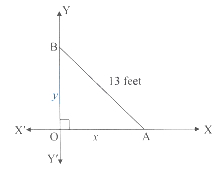
0 likesView Solution
188
MathematicsEasyMCQMHT CET · 2023
$5 \ m$ લાંબી સીડી એક ઉભી દીવાલ સાથે ટેકવેલી છે. જો તેનો ઉપરનો છેડો $10 \ cm/s$ ના દરે નીચે સરકતો હોય,તો જ્યારે તેનો નીચેનો છેડો દીવાલથી $4 \ m$ દૂર હોય ત્યારે સીડી અને જમીન વચ્ચેનો ખૂણો કયા દરે ($rad/s$ માં) ઘટી રહ્યો છે?
A
$0.1$
B
$0.025$
C
$0.05$
D
$0.0125$
Solution
(B) ધારો કે $x$ એ દીવાલથી નીચેના છેડાનું અંતર છે અને $y$ એ જમીનથી સીડીના ઉપરના છેડાની ઊંચાઈ છે. સીડીની લંબાઈ $L = 5 \ m$ છે.
પાયથાગોરસના પ્રમેય મુજબ,$x^2 + y^2 = 5^2 = 25$.
આપણને આપેલ છે કે ઉપરનો છેડો $10 \ cm/s = 0.1 \ m/s$ ના દરે નીચે સરકે છે,તેથી $\frac{dy}{dt} = -0.1 \ m/s$.
આપણે સીડી અને જમીન વચ્ચેના ખૂણા $\theta$ ના ફેરફારનો દર શોધવો છે,જ્યાં $\sin \theta = \frac{y}{5}$.
$t$ ની સાપેક્ષમાં વિકલન કરતા: $\cos \theta \frac{d\theta}{dt} = \frac{1}{5} \frac{dy}{dt}$.
જ્યારે $x = 4 \ m$,ત્યારે $y = \sqrt{5^2 - 4^2} = 3 \ m$.
તેથી $\cos \theta = \frac{x}{5} = \frac{4}{5}$.
કિંમતો મૂકતા: $\frac{4}{5} \frac{d\theta}{dt} = \frac{1}{5} (-0.1)$.
$\frac{d\theta}{dt} = -\frac{0.1}{4} = -0.025 \ rad/s$.
ખૂણો $0.025 \ rad/s$ ના દરે ઘટી રહ્યો છે.
પાયથાગોરસના પ્રમેય મુજબ,$x^2 + y^2 = 5^2 = 25$.
આપણને આપેલ છે કે ઉપરનો છેડો $10 \ cm/s = 0.1 \ m/s$ ના દરે નીચે સરકે છે,તેથી $\frac{dy}{dt} = -0.1 \ m/s$.
આપણે સીડી અને જમીન વચ્ચેના ખૂણા $\theta$ ના ફેરફારનો દર શોધવો છે,જ્યાં $\sin \theta = \frac{y}{5}$.
$t$ ની સાપેક્ષમાં વિકલન કરતા: $\cos \theta \frac{d\theta}{dt} = \frac{1}{5} \frac{dy}{dt}$.
જ્યારે $x = 4 \ m$,ત્યારે $y = \sqrt{5^2 - 4^2} = 3 \ m$.
તેથી $\cos \theta = \frac{x}{5} = \frac{4}{5}$.
કિંમતો મૂકતા: $\frac{4}{5} \frac{d\theta}{dt} = \frac{1}{5} (-0.1)$.
$\frac{d\theta}{dt} = -\frac{0.1}{4} = -0.025 \ rad/s$.
ખૂણો $0.025 \ rad/s$ ના દરે ઘટી રહ્યો છે.
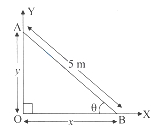
0 likesView Solution
189
MathematicsMediumMCQMHT CET · 2023
$5 \ m$ લાંબી એક નિસરણી ઊભી દીવાલ સાથે ટેકવેલી છે. જો તેનો ઉપરનો છેડો $10 \ cm/s$ ના દરે નીચે સરકતો હોય,તો જ્યારે તેનો નીચેનો છેડો દીવાલથી $4 \ m$ દૂર હોય ત્યારે નિસરણી અને જમીન વચ્ચેનો ખૂણો કેટલા રેડિયન/સેકન્ડના દરે ઘટી રહ્યો હશે?
A
$-0.1$
B
$-0.025$
C
$0.1$
D
$0.025$
Solution
(D) ધારો કે નિસરણીના નીચેના છેડાનું દીવાલથી અંતર $x$ છે અને ઉપરના છેડાની જમીનથી ઊંચાઈ $y$ છે. નિસરણીની લંબાઈ $L = 5 \ m$ છે.
પાયથાગોરસના પ્રમેય મુજબ,$x^2 + y^2 = 5^2 = 25$.
આપણને આપેલ છે કે ઉપરનો છેડો $10 \ cm/s = 0.1 \ m/s$ ના દરે નીચે સરકે છે,તેથી $\frac{dy}{dt} = -0.1 \ m/s$.
આપણે નિસરણી અને જમીન વચ્ચેના ખૂણા $\theta$ ના ફેરફારનો દર શોધવો છે,જ્યાં $\sin \theta = \frac{y}{5}$.
$t$ ની સાપેક્ષમાં વિકલન કરતા: $\cos \theta \frac{d\theta}{dt} = \frac{1}{5} \frac{dy}{dt}$.
જ્યારે $x = 4 \ m$ હોય,ત્યારે $y = \sqrt{25 - 4^2} = \sqrt{9} = 3 \ m$.
તેથી $\cos \theta = \frac{x}{5} = \frac{4}{5}$.
કિંમતો મૂકતા: $\frac{4}{5} \frac{d\theta}{dt} = \frac{1}{5} (-0.1)$.
$\frac{d\theta}{dt} = -\frac{0.1}{4} = -0.025 \ rad/s$.
આમ,ખૂણો $0.025 \ rad/s$ ના દરે ઘટી રહ્યો છે.
પાયથાગોરસના પ્રમેય મુજબ,$x^2 + y^2 = 5^2 = 25$.
આપણને આપેલ છે કે ઉપરનો છેડો $10 \ cm/s = 0.1 \ m/s$ ના દરે નીચે સરકે છે,તેથી $\frac{dy}{dt} = -0.1 \ m/s$.
આપણે નિસરણી અને જમીન વચ્ચેના ખૂણા $\theta$ ના ફેરફારનો દર શોધવો છે,જ્યાં $\sin \theta = \frac{y}{5}$.
$t$ ની સાપેક્ષમાં વિકલન કરતા: $\cos \theta \frac{d\theta}{dt} = \frac{1}{5} \frac{dy}{dt}$.
જ્યારે $x = 4 \ m$ હોય,ત્યારે $y = \sqrt{25 - 4^2} = \sqrt{9} = 3 \ m$.
તેથી $\cos \theta = \frac{x}{5} = \frac{4}{5}$.
કિંમતો મૂકતા: $\frac{4}{5} \frac{d\theta}{dt} = \frac{1}{5} (-0.1)$.
$\frac{d\theta}{dt} = -\frac{0.1}{4} = -0.025 \ rad/s$.
આમ,ખૂણો $0.025 \ rad/s$ ના દરે ઘટી રહ્યો છે.
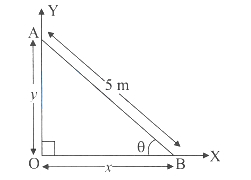
0 likesView Solution
190
MathematicsEasyMCQMHT CET · 2023
જો રેખા $ax + by + c = 0$ એ વક્ર $xy = 1$ નો અભિલંબ હોય,તો
A
$a > 0, b > 0$
B
$a > 0, b < 0$
C
$a < 0, b < 0$
D
$a = 0, b = 0$
Solution
(B) આપેલ વક્ર $xy = 1$ માટે,$y = \frac{1}{x}$ થાય.
$x$ ની સાપેક્ષ વિકલન કરતા,$\frac{dy}{dx} = -\frac{1}{x^2}$ મળે.
કોઈપણ બિંદુ $(x, y)$ પર સ્પર્શકનો ઢાળ $-\frac{1}{x^2}$ છે.
અભિલંબનો ઢાળ એ સ્પર્શકના ઢાળનો વ્યસ્ત અને વિરોધી છે,જે $x^2$ થાય.
રેખા $ax + by + c = 0$ નો ઢાળ $-\frac{a}{b}$ છે.
રેખા એ વક્રનો અભિલંબ હોવાથી,$x^2 = -\frac{a}{b}$ થાય.
વાસ્તવિક $x$ માટે $x^2$ હંમેશા અ-ઋણ હોવાથી,$-\frac{a}{b} > 0$ હોવું જોઈએ,જેનો અર્થ છે કે $\frac{a}{b} < 0$.
આ શરત ત્યારે જ શક્ય છે જ્યારે $a$ અને $b$ ના ચિહ્નો વિરુદ્ધ હોય,એટલે કે $(a > 0, b < 0)$ અથવા $(a < 0, b > 0)$.
$x$ ની સાપેક્ષ વિકલન કરતા,$\frac{dy}{dx} = -\frac{1}{x^2}$ મળે.
કોઈપણ બિંદુ $(x, y)$ પર સ્પર્શકનો ઢાળ $-\frac{1}{x^2}$ છે.
અભિલંબનો ઢાળ એ સ્પર્શકના ઢાળનો વ્યસ્ત અને વિરોધી છે,જે $x^2$ થાય.
રેખા $ax + by + c = 0$ નો ઢાળ $-\frac{a}{b}$ છે.
રેખા એ વક્રનો અભિલંબ હોવાથી,$x^2 = -\frac{a}{b}$ થાય.
વાસ્તવિક $x$ માટે $x^2$ હંમેશા અ-ઋણ હોવાથી,$-\frac{a}{b} > 0$ હોવું જોઈએ,જેનો અર્થ છે કે $\frac{a}{b} < 0$.
આ શરત ત્યારે જ શક્ય છે જ્યારે $a$ અને $b$ ના ચિહ્નો વિરુદ્ધ હોય,એટલે કે $(a > 0, b < 0)$ અથવા $(a < 0, b > 0)$.
0 likesView Solution
191
MathematicsEasyMCQMHT CET · 2023
$\int \frac{1}{\sin (x-a) \sin x} \,d x=$
A
$\sin a(\log (\sin (x-a) \cdot \operatorname{cosec} x))+c$, $\text{જ્યાં } c \text{ એ સંકલનનો અચળાંક છે.}$
B
$\operatorname{cosec} a(\log |\frac{\sin (x-a)}{\sin x}|)+c$, $\text{જ્યાં } c \text{ એ સંકલનનો અચળાંક છે.}$
C
$-\sin a(\log (\sin (x-a) \cdot \sin x))+c$, $\text{જ્યાં } c \text{ એ સંકલનનો અચળાંક છે.}$
D
$-\operatorname{cosec} a(\log (\sin (x-a) \cdot \sin x))+c$, $\text{જ્યાં } c \text{ એ સંકલનનો અચળાંક છે.}$
Solution
(B) $\text{ધારો કે } I = \int \frac{1}{\sin (x-a) \sin x} \,d x$.
$\text{અંશ અને છેદને } \sin a \text{ વડે ગુણતા:}$
$I = \frac{1}{\sin a} \int \frac{\sin a}{\sin (x-a) \sin x} \,d x$.
$\sin a \text{ ને } \sin (x - (x-a)) \text{ તરીકે લખતા:}$
$I = \frac{1}{\sin a} \int \frac{\sin (x - (x-a))}{\sin (x-a) \sin x} \,d x$.
$\text{નિત્યસમ } \sin (A-B) = \sin A \cos B - \cos A \sin B \text{ નો ઉપયોગ કરતા:}$
$I = \frac{1}{\sin a} \int \frac{\sin x \cos (x-a) - \cos x \sin (x-a)}{\sin (x-a) \sin x} \,d x$.
$\text{સંકલનને અલગ પાડતા:}$
$I = \frac{1}{\sin a} \left[ \int \frac{\sin x \cos (x-a)}{\sin (x-a) \sin x} \,d x - \int \frac{\cos x \sin (x-a)}{\sin (x-a) \sin x} \,d x \right]$.
$I = \frac{1}{\sin a} \left[ \int \cot (x-a) \,d x - \int \cot x \,d x \right]$.
$\text{સંકલન કરતા:}$
$I = \frac{1}{\sin a} [\log |\sin (x-a)| - \log |\sin x|] + c$.
$I = \operatorname{cosec} a \log |\frac{\sin (x-a)}{\sin x}| + c$.
$\text{અંશ અને છેદને } \sin a \text{ વડે ગુણતા:}$
$I = \frac{1}{\sin a} \int \frac{\sin a}{\sin (x-a) \sin x} \,d x$.
$\sin a \text{ ને } \sin (x - (x-a)) \text{ તરીકે લખતા:}$
$I = \frac{1}{\sin a} \int \frac{\sin (x - (x-a))}{\sin (x-a) \sin x} \,d x$.
$\text{નિત્યસમ } \sin (A-B) = \sin A \cos B - \cos A \sin B \text{ નો ઉપયોગ કરતા:}$
$I = \frac{1}{\sin a} \int \frac{\sin x \cos (x-a) - \cos x \sin (x-a)}{\sin (x-a) \sin x} \,d x$.
$\text{સંકલનને અલગ પાડતા:}$
$I = \frac{1}{\sin a} \left[ \int \frac{\sin x \cos (x-a)}{\sin (x-a) \sin x} \,d x - \int \frac{\cos x \sin (x-a)}{\sin (x-a) \sin x} \,d x \right]$.
$I = \frac{1}{\sin a} \left[ \int \cot (x-a) \,d x - \int \cot x \,d x \right]$.
$\text{સંકલન કરતા:}$
$I = \frac{1}{\sin a} [\log |\sin (x-a)| - \log |\sin x|] + c$.
$I = \operatorname{cosec} a \log |\frac{\sin (x-a)}{\sin x}| + c$.
0 likesView Solution
192
MathematicsDifficultMCQMHT CET · 2023
જો $I=\int \frac{\sin x+\sin ^3 x}{\cos 2 x} \,d x=P \cos x+Q \log \left|\frac{\sqrt{2} \cos x-1}{\sqrt{2} \cos x+1}\right|+c,$ (જ્યાં $c$ એ સંકલનનો અચળાંક છે),તો $P$ અને $Q$ ની કિંમતો અનુક્રમે શું થાય?
A
$\frac{1}{2}, \frac{3}{4 \sqrt{2}}$
B
$\frac{1}{2}, \frac{-3}{4 \sqrt{2}}$
C
$\frac{1}{2}, \frac{3}{2 \sqrt{2}}$
D
$\frac{1}{2}, \frac{-3}{2 \sqrt{2}}$
Solution
(B) આપેલ છે $I = \int \frac{\sin x + \sin^3 x}{\cos 2x} dx$.
$\sin^2 x = 1 - \cos^2 x$ નો ઉપયોગ કરતા,$\sin x(1 + \sin^2 x) = \sin x(1 + 1 - \cos^2 x) = \sin x(2 - \cos^2 x)$.
તેથી,$I = \int \frac{\sin x(2 - \cos^2 x)}{2 \cos^2 x - 1} dx$.
ધારો કે $\cos x = t$,તો $-\sin x dx = dt$,એટલે કે $\sin x dx = -dt$.
$I = \int \frac{t^2 - 2}{2t^2 - 1} (-dt) = \int \frac{2 - t^2}{2t^2 - 1} dt$.
$I = \frac{1}{2} \int \frac{4 - 2t^2}{2t^2 - 1} dt = \frac{1}{2} \int \frac{-(2t^2 - 1) + 3}{2t^2 - 1} dt$.
$I = \frac{1}{2} \int (-1 + \frac{3}{2t^2 - 1}) dt = \frac{1}{2} [-t + \frac{3}{2\sqrt{2}} \log |\frac{\sqrt{2}t - 1}{\sqrt{2}t + 1}|] + c$.
$I = -\frac{1}{2} \cos x + \frac{3}{4\sqrt{2}} \log |\frac{\sqrt{2} \cos x - 1}{\sqrt{2} \cos x + 1}| + c$.
$P \cos x + Q \log |\frac{\sqrt{2} \cos x - 1}{\sqrt{2} \cos x + 1}| + c$ સાથે સરખાવતા,આપણને $P = -\frac{1}{2}$ અને $Q = \frac{3}{4\sqrt{2}}$ મળે છે.
$\sin^2 x = 1 - \cos^2 x$ નો ઉપયોગ કરતા,$\sin x(1 + \sin^2 x) = \sin x(1 + 1 - \cos^2 x) = \sin x(2 - \cos^2 x)$.
તેથી,$I = \int \frac{\sin x(2 - \cos^2 x)}{2 \cos^2 x - 1} dx$.
ધારો કે $\cos x = t$,તો $-\sin x dx = dt$,એટલે કે $\sin x dx = -dt$.
$I = \int \frac{t^2 - 2}{2t^2 - 1} (-dt) = \int \frac{2 - t^2}{2t^2 - 1} dt$.
$I = \frac{1}{2} \int \frac{4 - 2t^2}{2t^2 - 1} dt = \frac{1}{2} \int \frac{-(2t^2 - 1) + 3}{2t^2 - 1} dt$.
$I = \frac{1}{2} \int (-1 + \frac{3}{2t^2 - 1}) dt = \frac{1}{2} [-t + \frac{3}{2\sqrt{2}} \log |\frac{\sqrt{2}t - 1}{\sqrt{2}t + 1}|] + c$.
$I = -\frac{1}{2} \cos x + \frac{3}{4\sqrt{2}} \log |\frac{\sqrt{2} \cos x - 1}{\sqrt{2} \cos x + 1}| + c$.
$P \cos x + Q \log |\frac{\sqrt{2} \cos x - 1}{\sqrt{2} \cos x + 1}| + c$ સાથે સરખાવતા,આપણને $P = -\frac{1}{2}$ અને $Q = \frac{3}{4\sqrt{2}}$ મળે છે.
0 likesView Solution
193
MathematicsDifficultMCQMHT CET · 2023
$\int \frac{e^{\tan ^{-1} x}}{1+x^2}\left[\left(\sec ^{-1} \sqrt{1+x^2}\right)^2+\cos ^{-1}\left(\frac{1-x^2}{1+x^2}\right)\right] d x, x>0=$
A
$\left(\tan ^{-1} x\right)^2 e^{\tan ^{-1} x}+c$,જ્યાં $c$ સંકલનનો અચળાંક છે.
B
$\left(\tan ^{-1} x\right) e^{\tan ^{-1} x}+c$,જ્યાં $c$ સંકલનનો અચળાંક છે.
C
$\left(\tan ^{-1} x\right) e^{2 \tan ^{-1} x}+c$,જ્યાં $c$ સંકલનનો અચળાંક છે.
D
$\left(\tan ^{-1} x\right)^2 e^{2 \tan ^{-1} x}+c$,જ્યાં $c$ સંકલનનો અચળાંક છે.
Solution
(A) ધારો કે $I = \int \frac{e^{\tan ^{-1} x}}{1+x^2}\left[\left(\sec ^{-1} \sqrt{1+x^2}\right)^2+\cos ^{-1}\left(\frac{1-x^2}{1+x^2}\right)\right] d x$.
$x = \tan t$ આદેશ લેતા,તેથી $dx = \sec^2 t dt$.
$x > 0$ હોવાથી,$t = \tan^{-1} x \in (0, \pi/2)$.
નોંધો કે $\sec^{-1} \sqrt{1+x^2} = \sec^{-1} \sqrt{1+\tan^2 t} = \sec^{-1} \sec t = t$.
તેમજ,$\cos^{-1} \left(\frac{1-x^2}{1+x^2}\right) = \cos^{-1} \cos 2t = 2t$.
આ કિંમતો સંકલનમાં મૂકતા:
$I = \int \frac{e^t}{1+\tan^2 t} [t^2 + 2t] \sec^2 t dt = \int e^t (t^2 + 2t) dt$.
સૂત્ર $\int e^t (f(t) + f'(t)) dt = e^t f(t) + c$ નો ઉપયોગ કરતા,જ્યાં $f(t) = t^2$ અને $f'(t) = 2t$:
$I = e^t t^2 + c = e^{\tan^{-1} x} (\tan^{-1} x)^2 + c$.
$x = \tan t$ આદેશ લેતા,તેથી $dx = \sec^2 t dt$.
$x > 0$ હોવાથી,$t = \tan^{-1} x \in (0, \pi/2)$.
નોંધો કે $\sec^{-1} \sqrt{1+x^2} = \sec^{-1} \sqrt{1+\tan^2 t} = \sec^{-1} \sec t = t$.
તેમજ,$\cos^{-1} \left(\frac{1-x^2}{1+x^2}\right) = \cos^{-1} \cos 2t = 2t$.
આ કિંમતો સંકલનમાં મૂકતા:
$I = \int \frac{e^t}{1+\tan^2 t} [t^2 + 2t] \sec^2 t dt = \int e^t (t^2 + 2t) dt$.
સૂત્ર $\int e^t (f(t) + f'(t)) dt = e^t f(t) + c$ નો ઉપયોગ કરતા,જ્યાં $f(t) = t^2$ અને $f'(t) = 2t$:
$I = e^t t^2 + c = e^{\tan^{-1} x} (\tan^{-1} x)^2 + c$.
0 likesView Solution
194
MathematicsEasyMCQMHT CET · 2023
$\int \frac{x+1}{x(1+x e^x)^2} d x=$
A
$\log \left|\frac{x e^x}{1+x e^x}\right|+c$,જ્યાં $c$ એ સંકલનનો અચળાંક છે.
B
$\log \left|\frac{x e^x}{1+x e^x}\right|-\frac{1}{1+x e^x}+c$,જ્યાં $c$ એ સંકલનનો અચળાંક છે.
C
$\log \left|1+x e^x\right|+\frac{1}{1+x e^x}+c$,જ્યાં $c$ એ સંકલનનો અચળાંક છે.
D
$\log \left|\frac{x e^x}{1+x e^x}\right|+\frac{1}{1+x e^x}+c$,જ્યાં $c$ એ સંકલનનો અચળાંક છે.
Solution
(D) ધારો કે $I = \int \frac{x+1}{x(1+x e^x)^2} dx$.
અંશ અને છેદને $e^x$ વડે ગુણતા:
$I = \int \frac{e^x(x+1)}{x e^x(1+x e^x)^2} dx$.
ધારો કે $t = x e^x$. તેથી $dt = (e^x + x e^x) dx = e^x(1+x) dx$.
આ કિંમત સંકલનમાં મૂકતા:
$I = \int \frac{dt}{t(1+t)^2}$.
આંશિક અપૂર્ણાંકની રીતનો ઉપયોગ કરતા: $\frac{1}{t(1+t)^2} = \frac{A}{t} + \frac{B}{1+t} + \frac{C}{(1+t)^2}$.
અચળાંકો શોધતા: $1 = A(1+t)^2 + Bt(1+t) + Ct$.
$t=0$ માટે,$A=1$. $t=-1$ માટે,$C=-1$. $t^2$ ના સહગુણકો સરખાવતા,$A+B=0 \Rightarrow B=-1$.
તેથી,$I = \int \left( \frac{1}{t} - \frac{1}{1+t} - \frac{1}{(1+t)^2} \right) dt$.
$I = \log |t| - \log |1+t| + \frac{1}{1+t} + c$.
$t = x e^x$ પાછા મૂકતા:
$I = \log |x e^x| - \log |1+x e^x| + \frac{1}{1+x e^x} + c$.
$I = \log \left| \frac{x e^x}{1+x e^x} \right| + \frac{1}{1+x e^x} + c$.
અંશ અને છેદને $e^x$ વડે ગુણતા:
$I = \int \frac{e^x(x+1)}{x e^x(1+x e^x)^2} dx$.
ધારો કે $t = x e^x$. તેથી $dt = (e^x + x e^x) dx = e^x(1+x) dx$.
આ કિંમત સંકલનમાં મૂકતા:
$I = \int \frac{dt}{t(1+t)^2}$.
આંશિક અપૂર્ણાંકની રીતનો ઉપયોગ કરતા: $\frac{1}{t(1+t)^2} = \frac{A}{t} + \frac{B}{1+t} + \frac{C}{(1+t)^2}$.
અચળાંકો શોધતા: $1 = A(1+t)^2 + Bt(1+t) + Ct$.
$t=0$ માટે,$A=1$. $t=-1$ માટે,$C=-1$. $t^2$ ના સહગુણકો સરખાવતા,$A+B=0 \Rightarrow B=-1$.
તેથી,$I = \int \left( \frac{1}{t} - \frac{1}{1+t} - \frac{1}{(1+t)^2} \right) dt$.
$I = \log |t| - \log |1+t| + \frac{1}{1+t} + c$.
$t = x e^x$ પાછા મૂકતા:
$I = \log |x e^x| - \log |1+x e^x| + \frac{1}{1+x e^x} + c$.
$I = \log \left| \frac{x e^x}{1+x e^x} \right| + \frac{1}{1+x e^x} + c$.
0 likesView Solution
195
MathematicsMediumMCQMHT CET · 2023
ધારો કે $\alpha \in (0, \frac{\pi}{2})$ નિશ્ચિત છે. જો સંકલન $\int \frac{\tan x+\tan \alpha}{\tan x-\tan \alpha} dx = A(x) \cos 2\alpha + B(x) \sin 2\alpha + c$ હોય (જ્યાં $c$ એ સંકલનનો અચળાંક છે),તો વિધેયો $A(x)$ અને $B(x)$ અનુક્રમે શું છે?
A
$x+\alpha$ અને $\log |\sin (x+\alpha)|$.
B
$x-\alpha$ અને $\log |\sin (x-\alpha)|$.
C
$x-\alpha$ અને $\log |\cos (x-\alpha)|$.
D
$x+\alpha$ અને $\log |\sin (x-\alpha)|$.
Solution
(B) ધારો કે $I = \int \frac{\tan x + \tan \alpha}{\tan x - \tan \alpha} dx$.
$= \int \frac{\frac{\sin x}{\cos x} + \frac{\sin \alpha}{\cos \alpha}}{\frac{\sin x}{\cos x} - \frac{\sin \alpha}{\cos \alpha}} dx$
$= \int \frac{\sin x \cos \alpha + \sin \alpha \cos x}{\sin x \cos \alpha - \sin \alpha \cos x} dx$
$= \int \frac{\sin (x+\alpha)}{\sin (x-\alpha)} dx$.
ધારો કે $t = x - \alpha$,તેથી $x = t + \alpha$ અને $dx = dt$.
$I = \int \frac{\sin (t + 2\alpha)}{\sin t} dt$
$= \int \frac{\sin t \cos 2\alpha + \cos t \sin 2\alpha}{\sin t} dt$
$= \cos 2\alpha \int 1 dt + \sin 2\alpha \int \cot t dt$
$= t \cos 2\alpha + \sin 2\alpha \log |\sin t| + c$
$= (x - \alpha) \cos 2\alpha + \log |\sin (x - \alpha)| \sin 2\alpha + c$.
આને $A(x) \cos 2\alpha + B(x) \sin 2\alpha + c$ સાથે સરખાવતા,આપણને $A(x) = x - \alpha$ અને $B(x) = \log |\sin (x - \alpha)|$ મળે છે.
$= \int \frac{\frac{\sin x}{\cos x} + \frac{\sin \alpha}{\cos \alpha}}{\frac{\sin x}{\cos x} - \frac{\sin \alpha}{\cos \alpha}} dx$
$= \int \frac{\sin x \cos \alpha + \sin \alpha \cos x}{\sin x \cos \alpha - \sin \alpha \cos x} dx$
$= \int \frac{\sin (x+\alpha)}{\sin (x-\alpha)} dx$.
ધારો કે $t = x - \alpha$,તેથી $x = t + \alpha$ અને $dx = dt$.
$I = \int \frac{\sin (t + 2\alpha)}{\sin t} dt$
$= \int \frac{\sin t \cos 2\alpha + \cos t \sin 2\alpha}{\sin t} dt$
$= \cos 2\alpha \int 1 dt + \sin 2\alpha \int \cot t dt$
$= t \cos 2\alpha + \sin 2\alpha \log |\sin t| + c$
$= (x - \alpha) \cos 2\alpha + \log |\sin (x - \alpha)| \sin 2\alpha + c$.
આને $A(x) \cos 2\alpha + B(x) \sin 2\alpha + c$ સાથે સરખાવતા,આપણને $A(x) = x - \alpha$ અને $B(x) = \log |\sin (x - \alpha)|$ મળે છે.
0 likesView Solution
196
MathematicsMediumMCQMHT CET · 2023
$\int(\sqrt{\tan x}+\sqrt{\cot x}) d x=$
A
$\sqrt{2} \sin ^{-1}(\sin x-\cos x)+c$,જ્યાં $c$ એ સંકલનનો અચળાંક છે.
B
$\frac{1}{\sqrt{2}} \sin ^{-1}(\sin x-\cos x)+c$,જ્યાં $c$ એ સંકલનનો અચળાંક છે.
C
$\sin ^{-1}(\sin x-\cos x)+c$,જ્યાં $c$ એ સંકલનનો અચળાંક છે.
D
$2 \sin ^{-1}(\sin x-\cos x)+c$,જ્યાં $c$ એ સંકલનનો અચળાંક છે.
Solution
(A) ધારો કે $I = \int(\sqrt{\tan x} + \sqrt{\cot x}) dx$.
આપણે તેને $I = \int \left(\sqrt{\frac{\sin x}{\cos x}} + \sqrt{\frac{\cos x}{\sin x}}\right) dx$ તરીકે લખી શકીએ.
સંકલ્યનું સાદું રૂપ આપતા,$I = \int \frac{\sin x + \cos x}{\sqrt{\sin x \cos x}} dx$ મળે.
ધારો કે $t = \sin x - \cos x$. તો $dt = (\cos x + \sin x) dx$.
$t = \sin x - \cos x$ ની બંને બાજુ વર્ગ કરતા,$t^2 = \sin^2 x + \cos^2 x - 2 \sin x \cos x = 1 - 2 \sin x \cos x$.
તેથી,$2 \sin x \cos x = 1 - t^2$,જેનો અર્થ છે કે $\sin x \cos x = \frac{1 - t^2}{2}$.
આ કિંમતો સંકલનમાં મૂકતા,$I = \int \frac{dt}{\sqrt{\frac{1 - t^2}{2}}} = \sqrt{2} \int \frac{dt}{\sqrt{1 - t^2}}$ મળે.
સંકલન કરતા,$I = \sqrt{2} \sin^{-1}(t) + c$ મળે.
$t = \sin x - \cos x$ પાછું મૂકતા,$I = \sqrt{2} \sin^{-1}(\sin x - \cos x) + c$ મળે.
આપણે તેને $I = \int \left(\sqrt{\frac{\sin x}{\cos x}} + \sqrt{\frac{\cos x}{\sin x}}\right) dx$ તરીકે લખી શકીએ.
સંકલ્યનું સાદું રૂપ આપતા,$I = \int \frac{\sin x + \cos x}{\sqrt{\sin x \cos x}} dx$ મળે.
ધારો કે $t = \sin x - \cos x$. તો $dt = (\cos x + \sin x) dx$.
$t = \sin x - \cos x$ ની બંને બાજુ વર્ગ કરતા,$t^2 = \sin^2 x + \cos^2 x - 2 \sin x \cos x = 1 - 2 \sin x \cos x$.
તેથી,$2 \sin x \cos x = 1 - t^2$,જેનો અર્થ છે કે $\sin x \cos x = \frac{1 - t^2}{2}$.
આ કિંમતો સંકલનમાં મૂકતા,$I = \int \frac{dt}{\sqrt{\frac{1 - t^2}{2}}} = \sqrt{2} \int \frac{dt}{\sqrt{1 - t^2}}$ મળે.
સંકલન કરતા,$I = \sqrt{2} \sin^{-1}(t) + c$ મળે.
$t = \sin x - \cos x$ પાછું મૂકતા,$I = \sqrt{2} \sin^{-1}(\sin x - \cos x) + c$ મળે.
0 likesView Solution
197
MathematicsMediumMCQMHT CET · 2023
જો $\int \frac{\sin x}{3+4 \cos ^2 x} \,dx = A \tan ^{-1}(B \cos x) + C$ હોય, (જ્યાં $C$ એ સંકલનનો અચળાંક છે), તો $A+B$ ની કિંમત શોધો.
A
$\frac{5}{2 \sqrt{3}}$
B
$\frac{-1}{2 \sqrt{3}}$
C
$\frac{-2}{\sqrt{3}}$
D
$\frac{\sqrt{3}}{2}$
Solution
(D) ધારો કે $I = \int \frac{\sin x}{3+4 \cos ^2 x} \,dx$.
$\cos x = t$ આદેશ લેતા, $-\sin x \,dx = dt$, એટલે કે $\sin x \,dx = -dt$.
આ કિંમતો સંકલનમાં મૂકતા, $I = \int \frac{-dt}{3+4 t^2} = -\int \frac{dt}{(\sqrt{3})^2 + (2t)^2}$.
પ્રમાણિત સંકલન સૂત્ર $\int \frac{dx}{a^2 + x^2} = \frac{1}{a} \tan^{-1}(\frac{x}{a}) + C$ નો ઉપયોગ કરતા:
$I = -\frac{1}{\sqrt{3}} \cdot \frac{1}{2} \tan^{-1}(\frac{2t}{\sqrt{3}}) + C = -\frac{1}{2\sqrt{3}} \tan^{-1}(\frac{2 \cos x}{\sqrt{3}}) + C$.
$A \tan^{-1}(B \cos x) + C$ સાથે સરખાવતા, આપણને $A = -\frac{1}{2\sqrt{3}}$ અને $B = \frac{2}{\sqrt{3}}$ મળે છે.
તેથી, $A + B = -\frac{1}{2\sqrt{3}} + \frac{2}{\sqrt{3}} = \frac{-1 + 4}{2\sqrt{3}} = \frac{3}{2\sqrt{3}} = \frac{\sqrt{3}}{2}$.
$\cos x = t$ આદેશ લેતા, $-\sin x \,dx = dt$, એટલે કે $\sin x \,dx = -dt$.
આ કિંમતો સંકલનમાં મૂકતા, $I = \int \frac{-dt}{3+4 t^2} = -\int \frac{dt}{(\sqrt{3})^2 + (2t)^2}$.
પ્રમાણિત સંકલન સૂત્ર $\int \frac{dx}{a^2 + x^2} = \frac{1}{a} \tan^{-1}(\frac{x}{a}) + C$ નો ઉપયોગ કરતા:
$I = -\frac{1}{\sqrt{3}} \cdot \frac{1}{2} \tan^{-1}(\frac{2t}{\sqrt{3}}) + C = -\frac{1}{2\sqrt{3}} \tan^{-1}(\frac{2 \cos x}{\sqrt{3}}) + C$.
$A \tan^{-1}(B \cos x) + C$ સાથે સરખાવતા, આપણને $A = -\frac{1}{2\sqrt{3}}$ અને $B = \frac{2}{\sqrt{3}}$ મળે છે.
તેથી, $A + B = -\frac{1}{2\sqrt{3}} + \frac{2}{\sqrt{3}} = \frac{-1 + 4}{2\sqrt{3}} = \frac{3}{2\sqrt{3}} = \frac{\sqrt{3}}{2}$.
0 likesView Solution
198
MathematicsMediumMCQMHT CET · 2023
જો $I=\int \frac{dx}{x^2(x^4+1)^{3/4}}$ હોય,તો $I$ શું થાય?
A
$\left(\frac{x^4+1}{x}\right)^{1/4}+c$,જ્યાં $c$ એ સંકલનનો અચળાંક છે.
B
$\frac{(x^4-1)^{1/4}}{x}+c$,જ્યાં $c$ એ સંકલનનો અચળાંક છે.
C
$-\frac{(x^4+1)^{1/4}}{x}+c$,જ્યાં $c$ એ સંકલનનો અચળાંક છે.
D
$-\left(\frac{x^4+1}{x}\right)^{1/4}+c$,જ્યાં $c$ એ સંકલનનો અચળાંક છે.
Solution
(C) આપેલ છે $I = \int \frac{dx}{x^2(x^4+1)^{3/4}}$.
આપણે કૌંસમાંથી $x^4$ સામાન્ય લઈને સંકલનને ફરીથી લખી શકીએ છીએ:
$I = \int \frac{dx}{x^2 \left[x^4(1 + \frac{1}{x^4})\right]^{3/4}} = \int \frac{dx}{x^2 \cdot x^3 (1 + \frac{1}{x^4})^{3/4}} = \int \frac{dx}{x^5 (1 + \frac{1}{x^4})^{3/4}}$.
ધારો કે $t = 1 + \frac{1}{x^4}$. તો $dt = -\frac{4}{x^5} dx$,જેનો અર્થ છે કે $\frac{dx}{x^5} = -\frac{1}{4} dt$.
આ કિંમતો સંકલનમાં મૂકતા:
$I = \int -\frac{1}{4} t^{-3/4} dt = -\frac{1}{4} \cdot \frac{t^{1/4}}{1/4} + c = -t^{1/4} + c$.
$t = 1 + \frac{1}{x^4} = \frac{x^4+1}{x^4}$ પાછું મૂકતા:
$I = -(1 + \frac{1}{x^4})^{1/4} + c = -\left(\frac{x^4+1}{x^4}\right)^{1/4} + c = -\frac{(x^4+1)^{1/4}}{x} + c$.
આપણે કૌંસમાંથી $x^4$ સામાન્ય લઈને સંકલનને ફરીથી લખી શકીએ છીએ:
$I = \int \frac{dx}{x^2 \left[x^4(1 + \frac{1}{x^4})\right]^{3/4}} = \int \frac{dx}{x^2 \cdot x^3 (1 + \frac{1}{x^4})^{3/4}} = \int \frac{dx}{x^5 (1 + \frac{1}{x^4})^{3/4}}$.
ધારો કે $t = 1 + \frac{1}{x^4}$. તો $dt = -\frac{4}{x^5} dx$,જેનો અર્થ છે કે $\frac{dx}{x^5} = -\frac{1}{4} dt$.
આ કિંમતો સંકલનમાં મૂકતા:
$I = \int -\frac{1}{4} t^{-3/4} dt = -\frac{1}{4} \cdot \frac{t^{1/4}}{1/4} + c = -t^{1/4} + c$.
$t = 1 + \frac{1}{x^4} = \frac{x^4+1}{x^4}$ પાછું મૂકતા:
$I = -(1 + \frac{1}{x^4})^{1/4} + c = -\left(\frac{x^4+1}{x^4}\right)^{1/4} + c = -\frac{(x^4+1)^{1/4}}{x} + c$.
0 likesView Solution
199
MathematicsMediumMCQMHT CET · 2023
$\int \frac{d x}{\sin x+\cos x}=$
A
$\sqrt{2} \log \tan \left(x+\frac{\pi}{4}\right)+c$,જ્યાં $c$ એ સંકલનનો અચળાંક છે.
B
$\frac{1}{\sqrt{2}} \log \tan \left(\frac{x}{2}+\frac{\pi}{8}\right)+c$,જ્યાં $c$ એ સંકલનનો અચળાંક છે.
C
$\frac{1}{\sqrt{2}} \log \left(\frac{\tan \frac{x}{2}-\sqrt{2}+1}{\tan \frac{x}{2}+\sqrt{2}+1}\right)+c$,જ્યાં $c$ એ સંકલનનો અચળાંક છે.
D
$-\frac{1}{\sqrt{2}} \log \left(\frac{\tan \frac{x}{2}-(\sqrt{2}+1)}{\tan \frac{x}{2}+\sqrt{2}-1}\right)+c$,જ્યાં $c$ એ સંકલનનો અચળાંક છે.
Solution
(D) ધારો કે $I = \int \frac{dx}{\sin x + \cos x}$.
આદેશ $\tan \frac{x}{2} = t$ લેતા,આપણને $dx = \frac{2}{1+t^2} dt$,$\sin x = \frac{2t}{1+t^2}$,અને $\cos x = \frac{1-t^2}{1+t^2}$ મળે છે.
આ કિંમતો સંકલનમાં મૂકતા:
$I = \int \frac{\frac{2}{1+t^2}}{\frac{2t}{1+t^2} + \frac{1-t^2}{1+t^2}} dt = \int \frac{2}{2t + 1 - t^2} dt = -2 \int \frac{1}{t^2 - 2t - 1} dt$.
છેદમાં પૂર્ણવર્ગ બનાવતા:
$t^2 - 2t - 1 = (t-1)^2 - 2 = (t-1)^2 - (\sqrt{2})^2$.
સૂત્ર $\int \frac{dx}{x^2 - a^2} = \frac{1}{2a} \log \left| \frac{x-a}{x+a} \right| + c$ નો ઉપયોગ કરતા:
$I = -2 \times \frac{1}{2\sqrt{2}} \log \left| \frac{t-1-\sqrt{2}}{t-1+\sqrt{2}} \right| + c = -\frac{1}{\sqrt{2}} \log \left| \frac{\tan \frac{x}{2} - 1 - \sqrt{2}}{\tan \frac{x}{2} - 1 + \sqrt{2}} \right| + c$.
પદને સાદું રૂપ આપતા:
$I = -\frac{1}{\sqrt{2}} \log \left| \frac{\tan \frac{x}{2} - (\sqrt{2} + 1)}{\tan \frac{x}{2} + \sqrt{2} - 1} \right| + c$.
આદેશ $\tan \frac{x}{2} = t$ લેતા,આપણને $dx = \frac{2}{1+t^2} dt$,$\sin x = \frac{2t}{1+t^2}$,અને $\cos x = \frac{1-t^2}{1+t^2}$ મળે છે.
આ કિંમતો સંકલનમાં મૂકતા:
$I = \int \frac{\frac{2}{1+t^2}}{\frac{2t}{1+t^2} + \frac{1-t^2}{1+t^2}} dt = \int \frac{2}{2t + 1 - t^2} dt = -2 \int \frac{1}{t^2 - 2t - 1} dt$.
છેદમાં પૂર્ણવર્ગ બનાવતા:
$t^2 - 2t - 1 = (t-1)^2 - 2 = (t-1)^2 - (\sqrt{2})^2$.
સૂત્ર $\int \frac{dx}{x^2 - a^2} = \frac{1}{2a} \log \left| \frac{x-a}{x+a} \right| + c$ નો ઉપયોગ કરતા:
$I = -2 \times \frac{1}{2\sqrt{2}} \log \left| \frac{t-1-\sqrt{2}}{t-1+\sqrt{2}} \right| + c = -\frac{1}{\sqrt{2}} \log \left| \frac{\tan \frac{x}{2} - 1 - \sqrt{2}}{\tan \frac{x}{2} - 1 + \sqrt{2}} \right| + c$.
પદને સાદું રૂપ આપતા:
$I = -\frac{1}{\sqrt{2}} \log \left| \frac{\tan \frac{x}{2} - (\sqrt{2} + 1)}{\tan \frac{x}{2} + \sqrt{2} - 1} \right| + c$.
0 likesView Solution
200
MathematicsDifficultMCQMHT CET · 2023
$\int \frac{(x^2-1) dx}{x^3 \sqrt{2x^4-2x^2+1}}$ નું મૂલ્ય શું છે?
A
$2 \sqrt{2-\frac{2}{x^2}+\frac{1}{x^4}}+c$,જ્યાં $c$ એ સંકલનનો અચળાંક છે.
B
$2 \sqrt{2+\frac{2}{x^2}+\frac{1}{x^4}}+c$,જ્યાં $c$ એ સંકલનનો અચળાંક છે.
C
$\frac{1}{2} \sqrt{2-\frac{2}{x^2}+\frac{1}{x^4}}+c$,જ્યાં $c$ એ સંકલનનો અચળાંક છે.
D
$2 \sqrt{2-\frac{2}{x^2}-\frac{1}{x^4}}+c$,જ્યાં $c$ એ સંકલનનો અચળાંક છે.
Solution
(C) ધારો કે $I = \int \frac{(x^2-1) dx}{x^3 \sqrt{2x^4-2x^2+1}}$.
વર્ગમૂળની અંદર અંશ અને છેદને $x^4$ વડે ભાગતા:
$I = \int \frac{(x^2-1) dx}{x^3 \cdot x^2 \sqrt{2-\frac{2}{x^2}+\frac{1}{x^4}}} = \int \frac{(\frac{1}{x^3} - \frac{1}{x^5}) dx}{\sqrt{2-\frac{2}{x^2}+\frac{1}{x^4}}}$.
ધારો કે $t = 2-\frac{2}{x^2}+\frac{1}{x^4}$.
તેથી $dt = (\frac{4}{x^3} - \frac{4}{x^5}) dx$,જેનો અર્થ છે કે $(\frac{1}{x^3} - \frac{1}{x^5}) dx = \frac{dt}{4}$.
આ કિંમતો સંકલનમાં મૂકતા:
$I = \int \frac{dt/4}{\sqrt{t}} = \frac{1}{4} \int t^{-1/2} dt = \frac{1}{4} \cdot \frac{t^{1/2}}{1/2} + c = \frac{1}{2} \sqrt{t} + c$.
$t$ ની કિંમત પાછી મૂકતા,આપણને મળે $I = \frac{1}{2} \sqrt{2-\frac{2}{x^2}+\frac{1}{x^4}} + c$.
વર્ગમૂળની અંદર અંશ અને છેદને $x^4$ વડે ભાગતા:
$I = \int \frac{(x^2-1) dx}{x^3 \cdot x^2 \sqrt{2-\frac{2}{x^2}+\frac{1}{x^4}}} = \int \frac{(\frac{1}{x^3} - \frac{1}{x^5}) dx}{\sqrt{2-\frac{2}{x^2}+\frac{1}{x^4}}}$.
ધારો કે $t = 2-\frac{2}{x^2}+\frac{1}{x^4}$.
તેથી $dt = (\frac{4}{x^3} - \frac{4}{x^5}) dx$,જેનો અર્થ છે કે $(\frac{1}{x^3} - \frac{1}{x^5}) dx = \frac{dt}{4}$.
આ કિંમતો સંકલનમાં મૂકતા:
$I = \int \frac{dt/4}{\sqrt{t}} = \frac{1}{4} \int t^{-1/2} dt = \frac{1}{4} \cdot \frac{t^{1/2}}{1/2} + c = \frac{1}{2} \sqrt{t} + c$.
$t$ ની કિંમત પાછી મૂકતા,આપણને મળે $I = \frac{1}{2} \sqrt{2-\frac{2}{x^2}+\frac{1}{x^4}} + c$.
0 likesView Solution
201
MathematicsMediumMCQMHT CET · 2023
જો $\int \frac{5 \tan x}{\tan x-2} \, dx = x + a \log |\sin x - 2 \cos x| + c$ (જ્યાં $c$ એ સંકલનનો અચળાંક છે),તો $a$ ની કિંમત શોધો.
A
$1$
B
$\frac{1}{2}$
C
$2$
D
$3$
Solution
(C) ધારો કે $I = \int \frac{5 \tan x}{\tan x - 2} \, dx = \int \frac{5 \sin x}{\sin x - 2 \cos x} \, dx$.
અંશને $5 \sin x = A(\sin x - 2 \cos x) + B \frac{d}{dx}(\sin x - 2 \cos x)$ સ્વરૂપે લખતા.
$5 \sin x = A(\sin x - 2 \cos x) + B(\cos x + 2 \sin x)$.
$\sin x$ અને $\cos x$ ના સહગુણકોને સરખાવતા:
$A + 2B = 5$ અને $-2A + B = 0$.
બીજા સમીકરણ પરથી,$B = 2A$. પ્રથમ સમીકરણમાં મૂકતા: $A + 2(2A) = 5 \implies 5A = 5 \implies A = 1$.
તેથી $B = 2(1) = 2$.
આમ,$I = \int \left( 1 + 2 \frac{\cos x + 2 \sin x}{\sin x - 2 \cos x} \right) \, dx$.
$I = \int 1 \, dx + 2 \int \frac{d(\sin x - 2 \cos x)}{\sin x - 2 \cos x} = x + 2 \log |\sin x - 2 \cos x| + c$.
આને $x + a \log |\sin x - 2 \cos x| + c$ સાથે સરખાવતા,આપણને $a = 2$ મળે છે.
અંશને $5 \sin x = A(\sin x - 2 \cos x) + B \frac{d}{dx}(\sin x - 2 \cos x)$ સ્વરૂપે લખતા.
$5 \sin x = A(\sin x - 2 \cos x) + B(\cos x + 2 \sin x)$.
$\sin x$ અને $\cos x$ ના સહગુણકોને સરખાવતા:
$A + 2B = 5$ અને $-2A + B = 0$.
બીજા સમીકરણ પરથી,$B = 2A$. પ્રથમ સમીકરણમાં મૂકતા: $A + 2(2A) = 5 \implies 5A = 5 \implies A = 1$.
તેથી $B = 2(1) = 2$.
આમ,$I = \int \left( 1 + 2 \frac{\cos x + 2 \sin x}{\sin x - 2 \cos x} \right) \, dx$.
$I = \int 1 \, dx + 2 \int \frac{d(\sin x - 2 \cos x)}{\sin x - 2 \cos x} = x + 2 \log |\sin x - 2 \cos x| + c$.
આને $x + a \log |\sin x - 2 \cos x| + c$ સાથે સરખાવતા,આપણને $a = 2$ મળે છે.
0 likesView Solution
202
MathematicsMediumMCQMHT CET · 2023
$\int \frac{d x}{x^2(x^4+1)^{\frac{3}{4}}}$ નું મૂલ્ય શું છે?
A
$\left(\frac{x^4+1}{x^4}\right)^{\frac{1}{4}}+c$,જ્યાં $c$ એ સંકલનનો અચળાંક છે.
B
$(x^4+1)^{\frac{1}{4}}+c$,જ્યાં $c$ એ સંકલનનો અચળાંક છે.
C
$-(x^4+1)^{\frac{1}{4}}+c$,જ્યાં $c$ એ સંકલનનો અચળાંક છે.
D
$-\left(\frac{x^4+1}{x^4}\right)^{\frac{1}{4}}+c$,જ્યાં $c$ એ સંકલનનો અચળાંક છે.
Solution
(D) ધારો કે $I = \int \frac{dx}{x^2(x^4+1)^{\frac{3}{4}}}$.
આપણે સંકલનને આ રીતે ફરીથી લખી શકીએ: $I = \int \frac{dx}{x^2 \cdot x^3 (1 + \frac{1}{x^4})^{\frac{3}{4}}} = \int \frac{dx}{x^5 (1 + \frac{1}{x^4})^{\frac{3}{4}}}$.
ધારો કે $t = 1 + \frac{1}{x^4}$. તો $dt = -\frac{4}{x^5} dx$,જેનો અર્થ છે કે $\frac{dx}{x^5} = -\frac{1}{4} dt$.
આ કિંમતોને સંકલનમાં મૂકતા,આપણને મળે છે:
$I = -\frac{1}{4} \int t^{-\frac{3}{4}} dt$.
$t$ ની સાપેક્ષમાં સંકલન કરતા,આપણને મળે છે:
$I = -\frac{1}{4} \cdot \frac{t^{\frac{1}{4}}}{\frac{1}{4}} + c = -t^{\frac{1}{4}} + c$.
$t = 1 + \frac{1}{x^4}$ પાછું મૂકતા,આપણને મળે છે:
$I = -(1 + \frac{1}{x^4})^{\frac{1}{4}} + c = -\left(\frac{x^4+1}{x^4}\right)^{\frac{1}{4}} + c$.
આપણે સંકલનને આ રીતે ફરીથી લખી શકીએ: $I = \int \frac{dx}{x^2 \cdot x^3 (1 + \frac{1}{x^4})^{\frac{3}{4}}} = \int \frac{dx}{x^5 (1 + \frac{1}{x^4})^{\frac{3}{4}}}$.
ધારો કે $t = 1 + \frac{1}{x^4}$. તો $dt = -\frac{4}{x^5} dx$,જેનો અર્થ છે કે $\frac{dx}{x^5} = -\frac{1}{4} dt$.
આ કિંમતોને સંકલનમાં મૂકતા,આપણને મળે છે:
$I = -\frac{1}{4} \int t^{-\frac{3}{4}} dt$.
$t$ ની સાપેક્ષમાં સંકલન કરતા,આપણને મળે છે:
$I = -\frac{1}{4} \cdot \frac{t^{\frac{1}{4}}}{\frac{1}{4}} + c = -t^{\frac{1}{4}} + c$.
$t = 1 + \frac{1}{x^4}$ પાછું મૂકતા,આપણને મળે છે:
$I = -(1 + \frac{1}{x^4})^{\frac{1}{4}} + c = -\left(\frac{x^4+1}{x^4}\right)^{\frac{1}{4}} + c$.
0 likesView Solution
203
MathematicsDifficultMCQMHT CET · 2023
$\int \frac{\log (\cot x)}{\sin 2 x} \,d x=$
A
$-\log (\cot x)^2+c$, $\text{જ્યાં } c \text{ એ સંકલનનો અચળાંક છે.}$
B
$2(\log (\cot x))^2+c$, $\text{જ્યાં } c \text{ એ સંકલનનો અચળાંક છે.}$
C
$\frac{-1}{4}(\log (\sin x))^2+c$, $\text{જ્યાં } c \text{ એ સંકલનનો અચળાંક છે.}$
D
$\frac{-1}{4}(\log (\cot x))^2+c$, $\text{જ્યાં } c \text{ એ સંકલનનો અચળાંક છે.}$
Solution
(D) $\text{ધારો કે } I = \int \frac{\log (\cot x)}{\sin 2 x} \,d x$.
$\log (\cot x) = t \text{ લો.}$
$\text{બંને બાજુ } x \text{ ની સાપેક્ષમાં વિકલન કરતા:}$
$\frac{1}{\cot x} \cdot (-\csc^2 x) \,d x = dt$.
$\Rightarrow \frac{\sin x}{\cos x} \cdot (-\frac{1}{\sin^2 x}) \,d x = dt$.
$\Rightarrow \frac{-1}{\sin x \cos x} \,d x = dt$.
$\sin 2x = 2 \sin x \cos x \text{ હોવાથી, } \sin x \cos x = \frac{\sin 2x}{2} \text{ મળે.}$
$\text{આ કિંમત મૂકતા: } \frac{-1}{\frac{\sin 2x}{2}} \,d x = dt \Rightarrow \frac{-2}{\sin 2x} \,d x = dt \Rightarrow \frac{d x}{\sin 2x} = \frac{-dt}{2}$.
$\text{હવે, સંકલનમાં આ કિંમતો મૂકતા:}$
$I = \int t \cdot (\frac{-dt}{2}) = -\frac{1}{2} \int t \,dt$.
$I = -\frac{1}{2} \cdot \frac{t^2}{2} + c = -\frac{1}{4} t^2 + c$.
$t = \log (\cot x) \text{ પાછા મૂકતા:}$
$I = -\frac{1}{4} [\log (\cot x)]^2 + c$.
$\log (\cot x) = t \text{ લો.}$
$\text{બંને બાજુ } x \text{ ની સાપેક્ષમાં વિકલન કરતા:}$
$\frac{1}{\cot x} \cdot (-\csc^2 x) \,d x = dt$.
$\Rightarrow \frac{\sin x}{\cos x} \cdot (-\frac{1}{\sin^2 x}) \,d x = dt$.
$\Rightarrow \frac{-1}{\sin x \cos x} \,d x = dt$.
$\sin 2x = 2 \sin x \cos x \text{ હોવાથી, } \sin x \cos x = \frac{\sin 2x}{2} \text{ મળે.}$
$\text{આ કિંમત મૂકતા: } \frac{-1}{\frac{\sin 2x}{2}} \,d x = dt \Rightarrow \frac{-2}{\sin 2x} \,d x = dt \Rightarrow \frac{d x}{\sin 2x} = \frac{-dt}{2}$.
$\text{હવે, સંકલનમાં આ કિંમતો મૂકતા:}$
$I = \int t \cdot (\frac{-dt}{2}) = -\frac{1}{2} \int t \,dt$.
$I = -\frac{1}{2} \cdot \frac{t^2}{2} + c = -\frac{1}{4} t^2 + c$.
$t = \log (\cot x) \text{ પાછા મૂકતા:}$
$I = -\frac{1}{4} [\log (\cot x)]^2 + c$.
0 likesView Solution
204
MathematicsMediumMCQMHT CET · 2023
જો $\int \frac{dx}{x \sqrt{1-x^3}} = k \log \left(\frac{\sqrt{1-x^3}-1}{\sqrt{1-x^3}+1}\right) + c$,(જ્યાં $c$ એ સંકલનનો અચળાંક છે),તો $k$ ની કિંમત શોધો.
A
$\frac{2}{3}$
B
$-\frac{2}{3}$
C
$\frac{1}{3}$
D
$-\frac{1}{3}$
Solution
(C) ધારો કે $I = \int \frac{dx}{x \sqrt{1-x^3}}$.
અંશ અને છેદને $x^2$ વડે ગુણતા:
$I = \int \frac{x^2 dx}{x^3 \sqrt{1-x^3}}$.
ધારો કે $1-x^3 = t^2$,તેથી $-3x^2 dx = 2t dt$,એટલે કે $x^2 dx = -\frac{2}{3} t dt$.
વળી,$x^3 = 1-t^2$.
આ કિંમતો સંકલનમાં મૂકતા:
$I = \int \frac{-\frac{2}{3} t dt}{(1-t^2) t} = -\frac{2}{3} \int \frac{dt}{1-t^2} = \frac{2}{3} \int \frac{dt}{t^2-1}$.
સૂત્ર $\int \frac{dx}{x^2-a^2} = \frac{1}{2a} \log \left|\frac{x-a}{x+a}\right| + c$ નો ઉપયોગ કરતા:
$I = \frac{2}{3} \times \frac{1}{2} \log \left|\frac{t-1}{t+1}\right| + c = \frac{1}{3} \log \left|\frac{\sqrt{1-x^3}-1}{\sqrt{1-x^3}+1}\right| + c$.
આપેલ પદ સાથે સરખાવતા,આપણને $k = \frac{1}{3}$ મળે છે.
અંશ અને છેદને $x^2$ વડે ગુણતા:
$I = \int \frac{x^2 dx}{x^3 \sqrt{1-x^3}}$.
ધારો કે $1-x^3 = t^2$,તેથી $-3x^2 dx = 2t dt$,એટલે કે $x^2 dx = -\frac{2}{3} t dt$.
વળી,$x^3 = 1-t^2$.
આ કિંમતો સંકલનમાં મૂકતા:
$I = \int \frac{-\frac{2}{3} t dt}{(1-t^2) t} = -\frac{2}{3} \int \frac{dt}{1-t^2} = \frac{2}{3} \int \frac{dt}{t^2-1}$.
સૂત્ર $\int \frac{dx}{x^2-a^2} = \frac{1}{2a} \log \left|\frac{x-a}{x+a}\right| + c$ નો ઉપયોગ કરતા:
$I = \frac{2}{3} \times \frac{1}{2} \log \left|\frac{t-1}{t+1}\right| + c = \frac{1}{3} \log \left|\frac{\sqrt{1-x^3}-1}{\sqrt{1-x^3}+1}\right| + c$.
આપેલ પદ સાથે સરખાવતા,આપણને $k = \frac{1}{3}$ મળે છે.
0 likesView Solution
205
MathematicsDifficultMCQMHT CET · 2023
$\int \frac{e^x(1+x)}{\cos ^2(e^x \cdot x)} dx =$
A
$-\cot(e^x) + c$,જ્યાં $c$ એ સંકલનનો અચળાંક છે.
B
$\tan(x \cdot e^x) + c$,જ્યાં $c$ એ સંકલનનો અચળાંક છે.
C
$\tan(e^x) + c$,જ્યાં $c$ એ સંકલનનો અચળાંક છે.
D
$-\cot(x \cdot e^x) + c$,જ્યાં $c$ એ સંકલનનો અચળાંક છે.
Solution
(B) ધારો કે $I = \int \frac{e^x(1+x)}{\cos^2(e^x \cdot x)} dx$.
$t = e^x \cdot x$ આદેશ લેતા.
તેથી,ગુણાકારના નિયમ મુજબ,$dt = (e^x \cdot x + e^x \cdot 1) dx = e^x(x+1) dx$.
આ કિંમતો સંકલનમાં મૂકતા:
$I = \int \frac{dt}{\cos^2 t} = \int \sec^2 t dt$.
$\sec^2 t$ નું સંકલન $\tan t + c$ થાય છે.
તેથી,$I = \tan(x \cdot e^x) + c$.
$t = e^x \cdot x$ આદેશ લેતા.
તેથી,ગુણાકારના નિયમ મુજબ,$dt = (e^x \cdot x + e^x \cdot 1) dx = e^x(x+1) dx$.
આ કિંમતો સંકલનમાં મૂકતા:
$I = \int \frac{dt}{\cos^2 t} = \int \sec^2 t dt$.
$\sec^2 t$ નું સંકલન $\tan t + c$ થાય છે.
તેથી,$I = \tan(x \cdot e^x) + c$.
0 likesView Solution
206
MathematicsMediumMCQMHT CET · 2023
$\int(1-\cos x) \operatorname{cosec}^2 x \, dx$ નું મૂલ્ય શું છે?
A
$\frac{1}{2} \tan \frac{x}{2} + c$,જ્યાં $c$ એ સંકલનનો અચળાંક છે.
B
$\tan \frac{x}{2} + c$,જ્યાં $c$ એ સંકલનનો અચળાંક છે.
C
$2 \cot \frac{x}{2} + c$,જ્યાં $c$ એ સંકલનનો અચળાંક છે.
D
$\cot \frac{x}{2} + c$,જ્યાં $c$ એ સંકલનનો અચળાંક છે.
Solution
(B) ધારો કે $I = \int (1 - \cos x) \operatorname{cosec}^2 x \, dx$
નિત્યસમ $1 - \cos x = 2 \sin^2 \frac{x}{2}$ અને $\sin x = 2 \sin \frac{x}{2} \cos \frac{x}{2}$ નો ઉપયોગ કરતા:
$I = \int \frac{2 \sin^2 \frac{x}{2}}{\sin^2 x} \, dx$
$I = \int \frac{2 \sin^2 \frac{x}{2}}{(2 \sin \frac{x}{2} \cos \frac{x}{2})^2} \, dx$
$I = \int \frac{2 \sin^2 \frac{x}{2}}{4 \sin^2 \frac{x}{2} \cos^2 \frac{x}{2}} \, dx$
$I = \frac{1}{2} \int \frac{1}{\cos^2 \frac{x}{2}} \, dx$
$I = \frac{1}{2} \int \sec^2 \frac{x}{2} \, dx$
$\sec^2 \frac{x}{2}$ નું સંકલન કરતા,આપણને મળે છે:
$I = \frac{1}{2} \cdot \frac{\tan \frac{x}{2}}{1/2} + c$
$I = \tan \frac{x}{2} + c$
નિત્યસમ $1 - \cos x = 2 \sin^2 \frac{x}{2}$ અને $\sin x = 2 \sin \frac{x}{2} \cos \frac{x}{2}$ નો ઉપયોગ કરતા:
$I = \int \frac{2 \sin^2 \frac{x}{2}}{\sin^2 x} \, dx$
$I = \int \frac{2 \sin^2 \frac{x}{2}}{(2 \sin \frac{x}{2} \cos \frac{x}{2})^2} \, dx$
$I = \int \frac{2 \sin^2 \frac{x}{2}}{4 \sin^2 \frac{x}{2} \cos^2 \frac{x}{2}} \, dx$
$I = \frac{1}{2} \int \frac{1}{\cos^2 \frac{x}{2}} \, dx$
$I = \frac{1}{2} \int \sec^2 \frac{x}{2} \, dx$
$\sec^2 \frac{x}{2}$ નું સંકલન કરતા,આપણને મળે છે:
$I = \frac{1}{2} \cdot \frac{\tan \frac{x}{2}}{1/2} + c$
$I = \tan \frac{x}{2} + c$
0 likesView Solution
207
MathematicsDifficultMCQMHT CET · 2023
જો $\int \frac{\cos 8 x+1}{\cot 2 x-\tan 2 x} \,d x=A \cos 8 x+c$ હોય, જ્યાં $c$ એ સ્વૈચ્છિક અચળાંક છે, તો $A$ ની કિંમત શોધો.
A
$\frac{1}{16}$
B
$\frac{1}{8}$
C
$\frac{-1}{8}$
D
$\frac{-1}{16}$
Solution
(D) આપેલ સંકલન $I = \int \frac{\cos 8 x+1}{\cot 2 x-\tan 2 x} \,d x$ છે.
નિત્યસમ $1+\cos \theta = 2 \cos^2 \frac{\theta}{2}$ નો ઉપયોગ કરતા, $\cos 8x + 1 = 2 \cos^2 4x$ મળે.
છેદ $\frac{\cos 2x}{\sin 2x} - \frac{\sin 2x}{\cos 2x} = \frac{\cos^2 2x - \sin^2 2x}{\sin 2x \cos 2x} = \frac{\cos 4x}{\frac{1}{2} \sin 4x} = \frac{2 \cos 4x}{\sin 4x}$ થાય.
આ કિંમતો સંકલનમાં મૂકતા:
$I = \int \frac{2 \cos^2 4x}{\frac{2 \cos 4x}{\sin 4x}} \,d x = \int \cos 4x \sin 4x \,d x$.
$2$ વડે ગુણતા અને ભાગતા:
$I = \frac{1}{2} \int 2 \sin 4x \cos 4x \,d x = \frac{1}{2} \int \sin 8x \,d x$.
$\sin 8x$ નું સંકલન $\frac{-\cos 8x}{8}$ થાય.
તેથી, $I = \frac{1}{2} \left( \frac{-\cos 8x}{8} \right) + c = \frac{-\cos 8x}{16} + c$.
$A \cos 8x + c$ સાથે સરખાવતા, $A = \frac{-1}{16}$ મળે.
નિત્યસમ $1+\cos \theta = 2 \cos^2 \frac{\theta}{2}$ નો ઉપયોગ કરતા, $\cos 8x + 1 = 2 \cos^2 4x$ મળે.
છેદ $\frac{\cos 2x}{\sin 2x} - \frac{\sin 2x}{\cos 2x} = \frac{\cos^2 2x - \sin^2 2x}{\sin 2x \cos 2x} = \frac{\cos 4x}{\frac{1}{2} \sin 4x} = \frac{2 \cos 4x}{\sin 4x}$ થાય.
આ કિંમતો સંકલનમાં મૂકતા:
$I = \int \frac{2 \cos^2 4x}{\frac{2 \cos 4x}{\sin 4x}} \,d x = \int \cos 4x \sin 4x \,d x$.
$2$ વડે ગુણતા અને ભાગતા:
$I = \frac{1}{2} \int 2 \sin 4x \cos 4x \,d x = \frac{1}{2} \int \sin 8x \,d x$.
$\sin 8x$ નું સંકલન $\frac{-\cos 8x}{8}$ થાય.
તેથી, $I = \frac{1}{2} \left( \frac{-\cos 8x}{8} \right) + c = \frac{-\cos 8x}{16} + c$.
$A \cos 8x + c$ સાથે સરખાવતા, $A = \frac{-1}{16}$ મળે.
0 likesView Solution
208
MathematicsDifficultMCQMHT CET · 2023
$\int x \sqrt{\frac{2 \sin \left(x^2+1\right)-\sin 2\left(x^2+1\right)}{2 \sin \left(x^2+1\right)+\sin 2\left(x^2+1\right)}} \, dx =$
A
$\log \left(\sec \left(\frac{x^2+1}{2}\right)\right)+c$,જ્યાં $c$ એ સંકલનનો અચળાંક છે.
B
$\log \left(\frac{x^2+1}{2}\right)+c$,જ્યાં $c$ એ સંકલનનો અચળાંક છે.
C
$\log \left(\sin \left(\frac{x^2+1}{2}\right)\right)+c$,જ્યાં $c$ એ સંકલનનો અચળાંક છે.
D
$2 \log \left(x^2+1\right)+c$,જ્યાં $c$ એ સંકલનનો અચળાંક છે.
Solution
(A) ધારો કે $I = \int x \sqrt{\frac{2 \sin \left(x^2+1\right)-\sin 2\left(x^2+1\right)}{2 \sin \left(x^2+1\right)+\sin 2\left(x^2+1\right)}} \, dx$
$\sin 2\theta = 2 \sin \theta \cos \theta$ નો ઉપયોગ કરતા:
$I = \int x \sqrt{\frac{2 \sin \left(x^2+1\right) - 2 \sin \left(x^2+1\right) \cos \left(x^2+1\right)}{2 \sin \left(x^2+1\right) + 2 \sin \left(x^2+1\right) \cos \left(x^2+1\right)}} \, dx$
$I = \int x \sqrt{\frac{1 - \cos \left(x^2+1\right)}{1 + \cos \left(x^2+1\right)}} \, dx$
$1 - \cos \theta = 2 \sin^2(\theta/2)$ અને $1 + \cos \theta = 2 \cos^2(\theta/2)$ નો ઉપયોગ કરતા:
$I = \int x \sqrt{\frac{2 \sin^2 \left(\frac{x^2+1}{2}\right)}{2 \cos^2 \left(\frac{x^2+1}{2}\right)}} \, dx$
$I = \int x \tan \left(\frac{x^2+1}{2}\right) \, dx$
ધારો કે $t = \frac{x^2+1}{2}$,તેથી $dt = x \, dx$.
$I = \int \tan t \, dt = \log |\sec t| + c$
$I = \log \left| \sec \left(\frac{x^2+1}{2}\right) \right| + c$
$\sin 2\theta = 2 \sin \theta \cos \theta$ નો ઉપયોગ કરતા:
$I = \int x \sqrt{\frac{2 \sin \left(x^2+1\right) - 2 \sin \left(x^2+1\right) \cos \left(x^2+1\right)}{2 \sin \left(x^2+1\right) + 2 \sin \left(x^2+1\right) \cos \left(x^2+1\right)}} \, dx$
$I = \int x \sqrt{\frac{1 - \cos \left(x^2+1\right)}{1 + \cos \left(x^2+1\right)}} \, dx$
$1 - \cos \theta = 2 \sin^2(\theta/2)$ અને $1 + \cos \theta = 2 \cos^2(\theta/2)$ નો ઉપયોગ કરતા:
$I = \int x \sqrt{\frac{2 \sin^2 \left(\frac{x^2+1}{2}\right)}{2 \cos^2 \left(\frac{x^2+1}{2}\right)}} \, dx$
$I = \int x \tan \left(\frac{x^2+1}{2}\right) \, dx$
ધારો કે $t = \frac{x^2+1}{2}$,તેથી $dt = x \, dx$.
$I = \int \tan t \, dt = \log |\sec t| + c$
$I = \log \left| \sec \left(\frac{x^2+1}{2}\right) \right| + c$
0 likesView Solution
209
MathematicsDifficultMCQMHT CET · 2023
સંકલન $\int \frac{\sin ^2 x \cos ^2 x}{\left(\sin ^5 x+\cos ^3 x \sin ^2 x+\sin ^3 x \cos ^2 x+\cos ^5 x\right)^2} \,d x$ ની કિંમત શોધો.
A
$\frac{1}{3\left(1+\tan ^3 x\right)}+c$, જ્યાં $c$ એ સંકલનનો અચળાંક છે.
B
$\frac{-1}{3\left(1+\tan ^3 x\right)}+c$, જ્યાં $c$ એ સંકલનનો અચળાંક છે.
C
$\frac{1}{1+\cot ^3 x}+c$, જ્યાં $c$ એ સંકલનનો અચળાંક છે.
D
$\frac{-1}{1+\cos ^3 x}+c$, જ્યાં $c$ એ સંકલનનો અચળાંક છે.
Solution
(B) ધારો કે $I = \int \frac{\sin ^2 x \cos ^2 x}{(\sin ^5 x + \cos ^3 x \sin ^2 x + \sin ^3 x \cos ^2 x + \cos ^5 x)^2} \,dx$.
છેદનું અવયવીકરણ કરતા: $\sin ^5 x + \sin ^3 x \cos ^2 x + \cos ^3 x \sin ^2 x + \cos ^5 x = \sin ^3 x(\sin ^2 x + \cos ^2 x) + \cos ^3 x(\sin ^2 x + \cos ^2 x) = \sin ^3 x + \cos ^3 x$.
તેથી, $I = \int \frac{\sin ^2 x \cos ^2 x}{(\sin ^3 x + \cos ^3 x)^2} \,dx$.
અંશ અને છેદને $\cos ^6 x$ વડે ભાગતા: $I = \int \frac{\tan ^2 x \sec ^2 x}{(1 + \tan ^3 x)^2} \,dx$.
ધારો કે $t = 1 + \tan ^3 x$. તો $dt = 3 \tan ^2 x \sec ^2 x \,dx$, જેનો અર્થ છે કે $\tan ^2 x \sec ^2 x \,dx = \frac{1}{3} dt$.
આ કિંમતો સંકલનમાં મૂકતા: $I = \frac{1}{3} \int \frac{1}{t^2} \,dt = \frac{1}{3} (-t^{-1}) + c = -\frac{1}{3t} + c$.
$t$ ની કિંમત પાછી મૂકતા: $I = \frac{-1}{3(1 + \tan ^3 x)} + c$.
છેદનું અવયવીકરણ કરતા: $\sin ^5 x + \sin ^3 x \cos ^2 x + \cos ^3 x \sin ^2 x + \cos ^5 x = \sin ^3 x(\sin ^2 x + \cos ^2 x) + \cos ^3 x(\sin ^2 x + \cos ^2 x) = \sin ^3 x + \cos ^3 x$.
તેથી, $I = \int \frac{\sin ^2 x \cos ^2 x}{(\sin ^3 x + \cos ^3 x)^2} \,dx$.
અંશ અને છેદને $\cos ^6 x$ વડે ભાગતા: $I = \int \frac{\tan ^2 x \sec ^2 x}{(1 + \tan ^3 x)^2} \,dx$.
ધારો કે $t = 1 + \tan ^3 x$. તો $dt = 3 \tan ^2 x \sec ^2 x \,dx$, જેનો અર્થ છે કે $\tan ^2 x \sec ^2 x \,dx = \frac{1}{3} dt$.
આ કિંમતો સંકલનમાં મૂકતા: $I = \frac{1}{3} \int \frac{1}{t^2} \,dt = \frac{1}{3} (-t^{-1}) + c = -\frac{1}{3t} + c$.
$t$ ની કિંમત પાછી મૂકતા: $I = \frac{-1}{3(1 + \tan ^3 x)} + c$.
0 likesView Solution
210
MathematicsMediumMCQMHT CET · 2023
$\int \frac{\operatorname{cosec} x \, dx}{\cos^2(1 + \log \tan \frac{x}{2})} = $
A
$\tan(1 + \log(\tan \frac{x}{2})) + c$,જ્યાં $c$ એ સંકલનનો અચળાંક છે
B
$\tan(1 + \log(\tan x)) + c$,જ્યાં $c$ એ સંકલનનો અચળાંક છે
C
$\tan(\log(\tan \frac{x}{2})) + c$,જ્યાં $c$ એ સંકલનનો અચળાંક છે
D
$\tan(\tan \frac{x}{2}) + c$,જ્યાં $c$ એ સંકલનનો અચળાંક છે
Solution
(A) ધારો કે $I = \int \frac{\operatorname{cosec} x \, dx}{\cos^2(1 + \log \tan \frac{x}{2})}$.
ધારો કે $t = 1 + \log(\tan \frac{x}{2})$.
બંને બાજુ $x$ ની સાપેક્ષમાં વિકલન કરતા:
$dt = \frac{1}{\tan \frac{x}{2}} \cdot \sec^2 \frac{x}{2} \cdot \frac{1}{2} \, dx$.
નિત્યસમ $\tan \frac{x}{2} = \frac{\sin \frac{x}{2}}{\cos \frac{x}{2}}$ અને $\sec^2 \frac{x}{2} = \frac{1}{\cos^2 \frac{x}{2}}$ નો ઉપયોગ કરતા:
$dt = \frac{\cos \frac{x}{2}}{\sin \frac{x}{2}} \cdot \frac{1}{\cos^2 \frac{x}{2}} \cdot \frac{1}{2} \, dx = \frac{1}{2 \sin \frac{x}{2} \cos \frac{x}{2}} \, dx$.
કારણ કે $\sin x = 2 \sin \frac{x}{2} \cos \frac{x}{2}$,તેથી $dt = \frac{1}{\sin x} \, dx = \operatorname{cosec} x \, dx$.
આ કિંમતો સંકલનમાં મૂકતા:
$I = \int \frac{1}{\cos^2 t} \, dt = \int \sec^2 t \, dt$.
સંકલન કરતા,$I = \tan t + c$ મળે.
$t$ ની મૂળ કિંમત પાછી મૂકતા,$I = \tan(1 + \log(\tan \frac{x}{2})) + c$ મળે.
ધારો કે $t = 1 + \log(\tan \frac{x}{2})$.
બંને બાજુ $x$ ની સાપેક્ષમાં વિકલન કરતા:
$dt = \frac{1}{\tan \frac{x}{2}} \cdot \sec^2 \frac{x}{2} \cdot \frac{1}{2} \, dx$.
નિત્યસમ $\tan \frac{x}{2} = \frac{\sin \frac{x}{2}}{\cos \frac{x}{2}}$ અને $\sec^2 \frac{x}{2} = \frac{1}{\cos^2 \frac{x}{2}}$ નો ઉપયોગ કરતા:
$dt = \frac{\cos \frac{x}{2}}{\sin \frac{x}{2}} \cdot \frac{1}{\cos^2 \frac{x}{2}} \cdot \frac{1}{2} \, dx = \frac{1}{2 \sin \frac{x}{2} \cos \frac{x}{2}} \, dx$.
કારણ કે $\sin x = 2 \sin \frac{x}{2} \cos \frac{x}{2}$,તેથી $dt = \frac{1}{\sin x} \, dx = \operatorname{cosec} x \, dx$.
આ કિંમતો સંકલનમાં મૂકતા:
$I = \int \frac{1}{\cos^2 t} \, dt = \int \sec^2 t \, dt$.
સંકલન કરતા,$I = \tan t + c$ મળે.
$t$ ની મૂળ કિંમત પાછી મૂકતા,$I = \tan(1 + \log(\tan \frac{x}{2})) + c$ મળે.
0 likesView Solution
211
MathematicsEasyMCQMHT CET · 2023
$\int \left( \frac{\tan \left( \frac{1}{x} \right)}{x} \right)^2 \, dx =$
A
$x - \tan x + c$,જ્યાં $c$ એ સંકલનનો અચળાંક છે.
B
$\frac{1}{x} - \tan \left( \frac{1}{x} \right) + c$,જ્યાં $c$ એ સંકલનનો અચળાંક છે.
C
$\frac{1}{x} + \tan \left( \frac{1}{x} \right) + c$,જ્યાં $c$ એ સંકલનનો અચળાંક છે.
D
$x + \tan x + c$,જ્યાં $c$ એ સંકલનનો અચળાંક છે.
Solution
(B) ધારો કે $I = \int \left( \frac{\tan \left( \frac{1}{x} \right)}{x} \right)^2 \, dx$.
$t = \frac{1}{x}$ આદેશ લેતા,$dt = -\frac{1}{x^2} \, dx$ મળે,જેનો અર્થ છે કે $dx = -x^2 \, dt = -\frac{1}{t^2} \, dt$.
આ કિંમતો સંકલનમાં મૂકતા:
$I = \int \tan^2(t) \cdot \frac{1}{x^2} \cdot (-x^2 \, dt) = -\int \tan^2(t) \, dt$.
નિત્યસમ $\tan^2(t) = \sec^2(t) - 1$ નો ઉપયોગ કરતા:
$I = -\int (\sec^2(t) - 1) \, dt = \int (1 - \sec^2(t)) \, dt$.
પદવાર સંકલન કરતા:
$I = t - \tan(t) + c$.
$t = \frac{1}{x}$ પાછા મૂકતા:
$I = \frac{1}{x} - \tan \left( \frac{1}{x} \right) + c$.
$t = \frac{1}{x}$ આદેશ લેતા,$dt = -\frac{1}{x^2} \, dx$ મળે,જેનો અર્થ છે કે $dx = -x^2 \, dt = -\frac{1}{t^2} \, dt$.
આ કિંમતો સંકલનમાં મૂકતા:
$I = \int \tan^2(t) \cdot \frac{1}{x^2} \cdot (-x^2 \, dt) = -\int \tan^2(t) \, dt$.
નિત્યસમ $\tan^2(t) = \sec^2(t) - 1$ નો ઉપયોગ કરતા:
$I = -\int (\sec^2(t) - 1) \, dt = \int (1 - \sec^2(t)) \, dt$.
પદવાર સંકલન કરતા:
$I = t - \tan(t) + c$.
$t = \frac{1}{x}$ પાછા મૂકતા:
$I = \frac{1}{x} - \tan \left( \frac{1}{x} \right) + c$.
0 likesView Solution
212
MathematicsDifficultMCQMHT CET · 2023
$\int \frac{1}{\cos ^3 x \sqrt{\sin 2 x}} \,d x=$
A
$\sqrt{2}\left(\sqrt{\tan x}+\frac{1}{5}(\tan x)^{\frac{5}{2}}\right)+c$,જ્યાં $c$ એ સંકલનનો અચળાંક છે.
B
$\left(\sqrt{\tan x}+\frac{2}{5}(\tan x)^{\frac{5}{2}}\right)+c$,જ્યાં $c$ એ સંકલનનો અચળાંક છે.
C
$\frac{1}{\sqrt{2}}\left(\sqrt{\tan x}+\frac{2}{5}(\tan x)^{\frac{5}{2}}\right)+c$,જ્યાં $c$ એ સંકલનનો અચળાંક છે.
D
$2\left(\sqrt{\tan x}+\frac{1}{5}(\tan x)^{\frac{5}{2}}\right)+c$,જ્યાં $c$ એ સંકલનનો અચળાંક છે.
Solution
(A) ધારો કે $I = \int \frac{1}{\cos ^3 x \sqrt{\sin 2 x}} \,d x$.
કારણ કે $\sin 2x = 2 \sin x \cos x$,તેથી $I = \int \frac{1}{\cos ^3 x \sqrt{2 \sin x \cos x}} \,d x = \frac{1}{\sqrt{2}} \int \frac{1}{\cos ^3 x \sqrt{\sin x} \sqrt{\cos x}} \,d x$.
આનું સાદું રૂપ આપતા $I = \frac{1}{\sqrt{2}} \int \frac{1}{\cos^{3.5} x \sqrt{\sin x}} \,d x = \frac{1}{\sqrt{2}} \int \frac{\sec^{3.5} x}{\sqrt{\tan x}} \,d x$.
ચાલો સંકલ્યને $\frac{\sec^2 x \cdot \sec^2 x}{\sqrt{2 \sin x \cos x}} = \frac{\sec^2 x \cdot \sec^2 x}{\sqrt{2 \tan x \cos^2 x}} = \frac{\sec^4 x}{\sqrt{2 \tan x}}$ તરીકે ફરીથી લખીએ.
તેથી,$I = \frac{1}{\sqrt{2}} \int \frac{\sec^4 x}{\sqrt{\tan x}} \,d x = \frac{1}{\sqrt{2}} \int \frac{(1+\tan^2 x) \sec^2 x}{\sqrt{\tan x}} \,d x$.
ધારો કે $\tan x = t$,તો $\sec^2 x \,d x = dt$.
$I = \frac{1}{\sqrt{2}} \int \frac{1+t^2}{\sqrt{t}} \,dt = \frac{1}{\sqrt{2}} \int (t^{-1/2} + t^{3/2}) \,dt$.
$I = \frac{1}{\sqrt{2}} \left( \frac{t^{1/2}}{1/2} + \frac{t^{5/2}}{5/2} \right) + c = \frac{1}{\sqrt{2}} \left( 2\sqrt{t} + \frac{2}{5} t^{5/2} \right) + c$.
$I = \sqrt{2} \sqrt{t} + \frac{\sqrt{2}}{5} t^{5/2} + c = \sqrt{2} \left( \sqrt{\tan x} + \frac{1}{5} (\tan x)^{5/2} \right) + c$.
કારણ કે $\sin 2x = 2 \sin x \cos x$,તેથી $I = \int \frac{1}{\cos ^3 x \sqrt{2 \sin x \cos x}} \,d x = \frac{1}{\sqrt{2}} \int \frac{1}{\cos ^3 x \sqrt{\sin x} \sqrt{\cos x}} \,d x$.
આનું સાદું રૂપ આપતા $I = \frac{1}{\sqrt{2}} \int \frac{1}{\cos^{3.5} x \sqrt{\sin x}} \,d x = \frac{1}{\sqrt{2}} \int \frac{\sec^{3.5} x}{\sqrt{\tan x}} \,d x$.
ચાલો સંકલ્યને $\frac{\sec^2 x \cdot \sec^2 x}{\sqrt{2 \sin x \cos x}} = \frac{\sec^2 x \cdot \sec^2 x}{\sqrt{2 \tan x \cos^2 x}} = \frac{\sec^4 x}{\sqrt{2 \tan x}}$ તરીકે ફરીથી લખીએ.
તેથી,$I = \frac{1}{\sqrt{2}} \int \frac{\sec^4 x}{\sqrt{\tan x}} \,d x = \frac{1}{\sqrt{2}} \int \frac{(1+\tan^2 x) \sec^2 x}{\sqrt{\tan x}} \,d x$.
ધારો કે $\tan x = t$,તો $\sec^2 x \,d x = dt$.
$I = \frac{1}{\sqrt{2}} \int \frac{1+t^2}{\sqrt{t}} \,dt = \frac{1}{\sqrt{2}} \int (t^{-1/2} + t^{3/2}) \,dt$.
$I = \frac{1}{\sqrt{2}} \left( \frac{t^{1/2}}{1/2} + \frac{t^{5/2}}{5/2} \right) + c = \frac{1}{\sqrt{2}} \left( 2\sqrt{t} + \frac{2}{5} t^{5/2} \right) + c$.
$I = \sqrt{2} \sqrt{t} + \frac{\sqrt{2}}{5} t^{5/2} + c = \sqrt{2} \left( \sqrt{\tan x} + \frac{1}{5} (\tan x)^{5/2} \right) + c$.
0 likesView Solution
213
MathematicsDifficultMCQMHT CET · 2023
જો $f(x)=\int \frac{x^2 \, dx}{(1+x^2)(1+\sqrt{1+x^2})}$ અને $f(0)=0$ હોય,તો $f(1)$ ની કિંમત શોધો.
A
$\log (1+\sqrt{2})$
B
$\log (1+\sqrt{2})-\frac{\pi}{4}$
C
$\log (1+\sqrt{2})+\frac{\pi}{4}$
D
$\log (1-\sqrt{2})$
Solution
(B) $x = \tan \theta$ આદેશ લેતા,$dx = \sec^2 \theta \, d\theta$ થાય.
તેથી,$f(x) = \int \frac{\tan^2 \theta \sec^2 \theta \, d\theta}{\sec^2 \theta(1+\sec \theta)} = \int \frac{\tan^2 \theta \, d\theta}{1+\sec \theta}$.
$\tan^2 \theta = \sec^2 \theta - 1$ હોવાથી,$\int \frac{\sec^2 \theta - 1}{1+\sec \theta} \, d\theta = \int (\sec \theta - 1) \, d\theta$ મળે.
સંકલન કરતા $f(x) = \log |\sec \theta + \tan \theta| - \theta + c$ મળે.
$x = \tan \theta$ અને $\sec \theta = \sqrt{1+x^2}$ પાછા મૂકતા,$f(x) = \log |x + \sqrt{1+x^2}| - \tan^{-1} x + c$ થાય.
$f(0) = 0$ આપેલ હોવાથી,$\log |0 + 1| - \tan^{-1}(0) + c = 0$,જેનો અર્થ છે કે $c = 0$.
આમ,$f(x) = \log |x + \sqrt{1+x^2}| - \tan^{-1} x$.
$x=1$ માટે,$f(1) = \log |1 + \sqrt{2}| - \tan^{-1}(1) = \log (1+\sqrt{2}) - \frac{\pi}{4}$.
તેથી,$f(x) = \int \frac{\tan^2 \theta \sec^2 \theta \, d\theta}{\sec^2 \theta(1+\sec \theta)} = \int \frac{\tan^2 \theta \, d\theta}{1+\sec \theta}$.
$\tan^2 \theta = \sec^2 \theta - 1$ હોવાથી,$\int \frac{\sec^2 \theta - 1}{1+\sec \theta} \, d\theta = \int (\sec \theta - 1) \, d\theta$ મળે.
સંકલન કરતા $f(x) = \log |\sec \theta + \tan \theta| - \theta + c$ મળે.
$x = \tan \theta$ અને $\sec \theta = \sqrt{1+x^2}$ પાછા મૂકતા,$f(x) = \log |x + \sqrt{1+x^2}| - \tan^{-1} x + c$ થાય.
$f(0) = 0$ આપેલ હોવાથી,$\log |0 + 1| - \tan^{-1}(0) + c = 0$,જેનો અર્થ છે કે $c = 0$.
આમ,$f(x) = \log |x + \sqrt{1+x^2}| - \tan^{-1} x$.
$x=1$ માટે,$f(1) = \log |1 + \sqrt{2}| - \tan^{-1}(1) = \log (1+\sqrt{2}) - \frac{\pi}{4}$.
0 likesView Solution
214
MathematicsMediumMCQMHT CET · 2023
જો $\int x^5 e^{-4 x^3} \,d x=\frac{1}{48} e^{-4 x^3} f(x)+c$,જ્યાં $c$ એ સંકલનનો અચળાંક છે,તો $f(x)$ શોધો.
A
$4 x^3+1$
B
$-4 x^3-1$
C
$-2 x^3-1$
D
$-2 x^3+1$
Solution
(B) ધારો કે $I = \int x^5 e^{-4 x^3} \,d x$.
$x^3 = t$ આદેશ લેતા,$3x^2 \,d x = dt$ મળે,એટલે કે $x^2 \,d x = \frac{1}{3} dt$.
અહીં $x^5 = x^3 \cdot x^2$ હોવાથી,સંકલન $I = \frac{1}{3} \int t e^{-4 t} dt$ થશે.
ખંડશઃ સંકલનનો ઉપયોગ કરતા,$\int u v \,dt = u \int v \,dt - \int (u' \int v \,dt) dt$,જ્યાં $u = t$ અને $v = e^{-4 t}$.
$I = \frac{1}{3} \left( t \cdot \frac{e^{-4 t}}{-4} - \int 1 \cdot \frac{e^{-4 t}}{-4} dt \right)$.
$I = \frac{1}{3} \left( -\frac{t e^{-4 t}}{4} + \frac{1}{4} \int e^{-4 t} dt \right)$.
$I = \frac{1}{3} \left( -\frac{t e^{-4 t}}{4} - \frac{e^{-4 t}}{16} \right) + c$.
$I = -\frac{t e^{-4 t}}{12} - \frac{e^{-4 t}}{48} + c$.
$I = \frac{e^{-4 t}}{48} (-4 t - 1) + c$.
$t = x^3$ પાછું મૂકતા,$I = \frac{1}{48} e^{-4 x^3} (-4 x^3 - 1) + c$.
આપેલ સ્વરૂપ સાથે સરખાવતા,$f(x) = -4 x^3 - 1$.
$x^3 = t$ આદેશ લેતા,$3x^2 \,d x = dt$ મળે,એટલે કે $x^2 \,d x = \frac{1}{3} dt$.
અહીં $x^5 = x^3 \cdot x^2$ હોવાથી,સંકલન $I = \frac{1}{3} \int t e^{-4 t} dt$ થશે.
ખંડશઃ સંકલનનો ઉપયોગ કરતા,$\int u v \,dt = u \int v \,dt - \int (u' \int v \,dt) dt$,જ્યાં $u = t$ અને $v = e^{-4 t}$.
$I = \frac{1}{3} \left( t \cdot \frac{e^{-4 t}}{-4} - \int 1 \cdot \frac{e^{-4 t}}{-4} dt \right)$.
$I = \frac{1}{3} \left( -\frac{t e^{-4 t}}{4} + \frac{1}{4} \int e^{-4 t} dt \right)$.
$I = \frac{1}{3} \left( -\frac{t e^{-4 t}}{4} - \frac{e^{-4 t}}{16} \right) + c$.
$I = -\frac{t e^{-4 t}}{12} - \frac{e^{-4 t}}{48} + c$.
$I = \frac{e^{-4 t}}{48} (-4 t - 1) + c$.
$t = x^3$ પાછું મૂકતા,$I = \frac{1}{48} e^{-4 x^3} (-4 x^3 - 1) + c$.
આપેલ સ્વરૂપ સાથે સરખાવતા,$f(x) = -4 x^3 - 1$.
0 likesView Solution
215
MathematicsMediumMCQMHT CET · 2023
$\int \frac{\log \left(x^2+a^2\right)}{x^2} \,d x=$
A
$-\frac{\log \left(x^2+a^2\right)}{x}+\frac{1}{a} \tan ^{-1} \frac{x}{a}+c$,જ્યાં $c$ એ સંકલનનો અચળાંક છે.
B
$-\frac{\log \left(x^2+a^2\right)}{x}+\frac{2}{a} \tan ^{-1} \frac{x}{a}+c$,જ્યાં $c$ એ સંકલનનો અચળાંક છે.
C
$\frac{\log \left(x^2+a^2\right)}{x^2}-\frac{1}{a} \tan ^{-1} \frac{x}{a}+c$,જ્યાં $c$ એ સંકલનનો અચળાંક છે.
D
$\frac{\log \left(x^2+a^2\right)}{x^2}-\frac{2}{a} \tan ^{-1} \frac{x}{a}+c$,જ્યાં $c$ એ સંકલનનો અચળાંક છે.
Solution
(B) ધારો કે $I = \int \frac{\log \left(x^2+a^2\right)}{x^2} \,d x$.
ખંડશઃ સંકલનની રીતનો ઉપયોગ કરતા,$\int u v \,d x = u \int v \,d x - \int \left( \frac{du}{dx} \int v \,d x \right) d x$.
ધારો કે $u = \log \left(x^2+a^2\right)$ અને $v = x^{-2}$.
તેથી $\frac{du}{dx} = \frac{2x}{x^2+a^2}$ અને $\int v \,d x = -\frac{1}{x}$.
$I = \log \left(x^2+a^2\right) \cdot \left(-\frac{1}{x}\right) - \int \left( \frac{2x}{x^2+a^2} \cdot \left(-\frac{1}{x}\right) \right) d x$.
$I = -\frac{\log \left(x^2+a^2\right)}{x} + 2 \int \frac{1}{x^2+a^2} \,d x$.
પ્રમાણિત સંકલન $\int \frac{1}{x^2+a^2} \,d x = \frac{1}{a} \tan^{-1} \left(\frac{x}{a}\right) + c$ નો ઉપયોગ કરતા.
$I = -\frac{\log \left(x^2+a^2\right)}{x} + \frac{2}{a} \tan^{-1} \left(\frac{x}{a}\right) + c$.
ખંડશઃ સંકલનની રીતનો ઉપયોગ કરતા,$\int u v \,d x = u \int v \,d x - \int \left( \frac{du}{dx} \int v \,d x \right) d x$.
ધારો કે $u = \log \left(x^2+a^2\right)$ અને $v = x^{-2}$.
તેથી $\frac{du}{dx} = \frac{2x}{x^2+a^2}$ અને $\int v \,d x = -\frac{1}{x}$.
$I = \log \left(x^2+a^2\right) \cdot \left(-\frac{1}{x}\right) - \int \left( \frac{2x}{x^2+a^2} \cdot \left(-\frac{1}{x}\right) \right) d x$.
$I = -\frac{\log \left(x^2+a^2\right)}{x} + 2 \int \frac{1}{x^2+a^2} \,d x$.
પ્રમાણિત સંકલન $\int \frac{1}{x^2+a^2} \,d x = \frac{1}{a} \tan^{-1} \left(\frac{x}{a}\right) + c$ નો ઉપયોગ કરતા.
$I = -\frac{\log \left(x^2+a^2\right)}{x} + \frac{2}{a} \tan^{-1} \left(\frac{x}{a}\right) + c$.
0 likesView Solution
Vedclass Products
For Students
Vedclass Test Series
Mock tests in real MHT CET style covering Mathematics with performance analysis. 5-day free trial.
Start Free TrialFor Teachers
Exam Paper Generator
Generate Set A/B/C/D Mathematics papers from 7.5L+ questions in 2 minutes. 3 chapters free.
Try FreeFor Institutes
Online Exam Module
Run live MHT CET mock exams with unlimited students, 360° analytics & white-label branding.
See DemoFrequently Asked Questions
How many Mathematics questions are in MHT CET 2023?
There are 589 Mathematics questions from the MHT CET 2023 paper on Vedclass, each with a detailed step-by-step solution in Gujarati.
Are MHT CET 2023 Mathematics solutions available in Gujarati?
Yes. All solutions on this page are in Gujarati. You can also switch to English or Hindi using the language buttons above the questions.
Can I practice MHT CET 2023 Mathematics as a timed test?
Yes. Use the Vedclass Test Series to attempt a full MHT CET mock test covering Mathematics with time limits and instant score analysis.
Can teachers create Mathematics papers from MHT CET previous year questions?
Yes. The Vedclass Exam Paper Generator lets teachers mix MHT CET Mathematics questions and generate Set A/B/C/D papers in minutes.
For Teachers & Institutes
Build a Custom Mathematics Paper
Pick MHT CET 2023 Mathematics questions, set difficulty, and generate Set A/B/C/D in 2 minutes.