
ChemistryQ1–100 of 716 questions
Page 1 of 8 · English
1
ChemistryMCQMHT CET · 2023
$A$ particle is moving in a circle with uniform speed $v$. In moving from a point to another diametrically opposite point:
A
The momentum changes by $mv$
B
The momentum changes by $2mv$
C
The kinetic energy changes by $(1/2)mv^2$
D
The kinetic energy changes by $mv^2$
Solution
(B) The particle moves with a constant speed $v$ in a circular path. Let the initial velocity be $\vec{v}_i = v\hat{i}$.
After moving to the diametrically opposite point,the velocity becomes $\vec{v}_f = -v\hat{i}$.
The change in momentum is $\Delta \vec{p} = m\vec{v}_f - m\vec{v}_i = m(-v\hat{i}) - m(v\hat{i}) = -2mv\hat{i}$.
The magnitude of the change in momentum is $|\Delta \vec{p}| = 2mv$.
Since the speed $v$ is uniform,the kinetic energy $K = (1/2)mv^2$ remains constant throughout the motion.
Therefore,the change in kinetic energy is zero.
Thus,the correct option is $B$.
After moving to the diametrically opposite point,the velocity becomes $\vec{v}_f = -v\hat{i}$.
The change in momentum is $\Delta \vec{p} = m\vec{v}_f - m\vec{v}_i = m(-v\hat{i}) - m(v\hat{i}) = -2mv\hat{i}$.
The magnitude of the change in momentum is $|\Delta \vec{p}| = 2mv$.
Since the speed $v$ is uniform,the kinetic energy $K = (1/2)mv^2$ remains constant throughout the motion.
Therefore,the change in kinetic energy is zero.
Thus,the correct option is $B$.
0 likesView Solution
2
ChemistryMCQMHT CET · 2023
$A$ gas is compressed at a constant pressure of $50 \ N/m^2$ from a volume of $10 \ m^3$ to a volume of $4 \ m^3$. Energy of $100 \ J$ is then added to the gas by heating. Its internal energy is:
A
Increased by $400 \ J$
B
Increased by $200 \ J$
C
Increased by $100 \ J$
D
Decreased by $200 \ J$
Solution
(A) According to the First Law of Thermodynamics $(FLOT)$: $\Delta Q = \Delta U + \Delta W$.
Here,$\Delta Q$ is the heat added to the system,$\Delta U$ is the change in internal energy,and $\Delta W$ is the work done by the gas.
Given: Pressure $P = 50 \ N/m^2$,initial volume $V_i = 10 \ m^3$,final volume $V_f = 4 \ m^3$,and heat added $\Delta Q = 100 \ J$.
The work done by the gas is $\Delta W = P \Delta V = P(V_f - V_i) = 50 \times (4 - 10) = 50 \times (-6) = -300 \ J$.
Substituting these values into the $FLOT$ equation: $100 = \Delta U + (-300)$.
Therefore,$\Delta U = 100 + 300 = 400 \ J$.
Since $\Delta U$ is positive,the internal energy increases by $400 \ J$.
Here,$\Delta Q$ is the heat added to the system,$\Delta U$ is the change in internal energy,and $\Delta W$ is the work done by the gas.
Given: Pressure $P = 50 \ N/m^2$,initial volume $V_i = 10 \ m^3$,final volume $V_f = 4 \ m^3$,and heat added $\Delta Q = 100 \ J$.
The work done by the gas is $\Delta W = P \Delta V = P(V_f - V_i) = 50 \times (4 - 10) = 50 \times (-6) = -300 \ J$.
Substituting these values into the $FLOT$ equation: $100 = \Delta U + (-300)$.
Therefore,$\Delta U = 100 + 300 = 400 \ J$.
Since $\Delta U$ is positive,the internal energy increases by $400 \ J$.
0 likesView Solution
3
ChemistryMCQMHT CET · 2023
An ideal refrigerator has a freezer at a temperature of $-13^{\circ}C$. The coefficient of performance of the refrigerator is $5$. The temperature of the air (to which heat is rejected) will be:
A
$325^{\circ}C$
B
$325K$
C
$39^{\circ}C$
D
$320^{\circ}C$
Solution
(C) The coefficient of performance $(K)$ of an ideal refrigerator is given by the formula: $K = \frac{T_2}{T_1 - T_2}$,where $T_2$ is the temperature of the freezer and $T_1$ is the temperature of the surroundings.
Given: $T_2 = -13^{\circ}C = 273 - 13 = 260K$ and $K = 5$.
Substituting the values into the formula: $5 = \frac{260}{T_1 - 260}$.
Multiplying both sides by $(T_1 - 260)$: $5(T_1 - 260) = 260$.
$5T_1 - 1300 = 260$.
$5T_1 = 1560$.
$T_1 = \frac{1560}{5} = 312K$.
Converting back to Celsius: $T_1 = 312 - 273 = 39^{\circ}C$.
Given: $T_2 = -13^{\circ}C = 273 - 13 = 260K$ and $K = 5$.
Substituting the values into the formula: $5 = \frac{260}{T_1 - 260}$.
Multiplying both sides by $(T_1 - 260)$: $5(T_1 - 260) = 260$.
$5T_1 - 1300 = 260$.
$5T_1 = 1560$.
$T_1 = \frac{1560}{5} = 312K$.
Converting back to Celsius: $T_1 = 312 - 273 = 39^{\circ}C$.
0 likesView Solution
4
ChemistryMCQMHT CET · 2023
When a charge of $3\, C$ is placed in a uniform electric field,it experiences a force of $3000\, N$. Within this field,the potential difference between two points separated by a distance of $1\, cm$ is:
A
$10$
B
$90$
C
$1000$
D
$3000$
Solution
(A) Given: Charge $q = 3\, C$,Force $F = 3000\, N$,Distance $d = 1\, cm = 10^{-2}\, m$.
First,calculate the electric field intensity $E$ using the formula $F = qE$:
$E = \frac{F}{q} = \frac{3000}{3} = 1000\, N/C$.
The potential difference $V$ between two points in a uniform electric field is given by $V = E \times d$:
$V = 1000 \times 10^{-2} = 10\, V$.
Therefore,the potential difference is $10\, V$.
First,calculate the electric field intensity $E$ using the formula $F = qE$:
$E = \frac{F}{q} = \frac{3000}{3} = 1000\, N/C$.
The potential difference $V$ between two points in a uniform electric field is given by $V = E \times d$:
$V = 1000 \times 10^{-2} = 10\, V$.
Therefore,the potential difference is $10\, V$.
0 likesView Solution
5
ChemistryMCQMHT CET · 2023
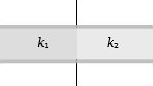
$A$ parallel plate capacitor with air as medium between the plates has a capacitance of $10\,\mu F$. The area of the capacitor is divided into two equal halves and filled with two media as shown in the figure having dielectric constants $k_1 = 2$ and $k_2 = 4$. The capacitance of the system will now be.......$\mu F$.
A
$10$
B
$20$
C
$30$
D
$40$
Solution
(C) The initial capacitance of the air-filled capacitor is $C = \frac{\varepsilon_0 A}{d} = 10\,\mu F$.
When the area is divided into two equal halves $(A_1 = A_2 = A/2)$ and filled with dielectrics,the two parts act as capacitors in parallel.
The equivalent capacitance $C_{eq}$ is given by $C_{eq} = C_1 + C_2$.
Here,$C_1 = \frac{k_1 \varepsilon_0 (A/2)}{d} = k_1 \times \frac{C}{2} = 2 \times \frac{10}{2} = 10\,\mu F$.
And $C_2 = \frac{k_2 \varepsilon_0 (A/2)}{d} = k_2 \times \frac{C}{2} = 4 \times \frac{10}{2} = 20\,\mu F$.
Therefore,$C_{eq} = 10 + 20 = 30\,\mu F$.
When the area is divided into two equal halves $(A_1 = A_2 = A/2)$ and filled with dielectrics,the two parts act as capacitors in parallel.
The equivalent capacitance $C_{eq}$ is given by $C_{eq} = C_1 + C_2$.
Here,$C_1 = \frac{k_1 \varepsilon_0 (A/2)}{d} = k_1 \times \frac{C}{2} = 2 \times \frac{10}{2} = 10\,\mu F$.
And $C_2 = \frac{k_2 \varepsilon_0 (A/2)}{d} = k_2 \times \frac{C}{2} = 4 \times \frac{10}{2} = 20\,\mu F$.
Therefore,$C_{eq} = 10 + 20 = 30\,\mu F$.
0 likesView Solution
6
ChemistryMCQMHT CET · 2023
Two identical capacitors have the same capacitance $C$. One of them is charged to potential $V_1$ and the other to $V_2$. The negative ends of the capacitors are connected together. When the positive ends are also connected,the decrease in energy of the combined system is
A
$\frac{1}{4}C(V_1^2 - V_2^2)$
B
$\frac{1}{4}C(V_1^2 + V_2^2)$
C
$\frac{1}{4}C(V_1 - V_2)^2$
D
$\frac{1}{4}C(V_1 + V_2)^2$
Solution
(C) Initial energy of the system is $U_i = \frac{1}{2}CV_1^2 + \frac{1}{2}CV_2^2$.
When the capacitors are connected in parallel,the common potential is $V = \frac{CV_1 + CV_2}{2C} = \frac{V_1 + V_2}{2}$.
Final energy of the system is $U_f = \frac{1}{2}(2C)V^2 = C \left( \frac{V_1 + V_2}{2} \right)^2 = \frac{1}{4}C(V_1 + V_2)^2$.
The decrease in energy is $\Delta U = U_i - U_f = \frac{1}{2}C(V_1^2 + V_2^2) - \frac{1}{4}C(V_1 + V_2)^2$.
Simplifying this,$\Delta U = \frac{1}{4}C [2V_1^2 + 2V_2^2 - (V_1^2 + V_2^2 + 2V_1V_2)] = \frac{1}{4}C(V_1^2 + V_2^2 - 2V_1V_2) = \frac{1}{4}C(V_1 - V_2)^2$.
When the capacitors are connected in parallel,the common potential is $V = \frac{CV_1 + CV_2}{2C} = \frac{V_1 + V_2}{2}$.
Final energy of the system is $U_f = \frac{1}{2}(2C)V^2 = C \left( \frac{V_1 + V_2}{2} \right)^2 = \frac{1}{4}C(V_1 + V_2)^2$.
The decrease in energy is $\Delta U = U_i - U_f = \frac{1}{2}C(V_1^2 + V_2^2) - \frac{1}{4}C(V_1 + V_2)^2$.
Simplifying this,$\Delta U = \frac{1}{4}C [2V_1^2 + 2V_2^2 - (V_1^2 + V_2^2 + 2V_1V_2)] = \frac{1}{4}C(V_1^2 + V_2^2 - 2V_1V_2) = \frac{1}{4}C(V_1 - V_2)^2$.
0 likesView Solution
7
ChemistryMCQMHT CET · 2023
What will be the phase difference between virtual voltage and virtual current,when the current in the circuit is wattless (in $^o$)?
A
$90$
B
$45$
C
$180$
D
$60$
Solution
(A) The average power consumed in an $AC$ circuit is given by $P = V_{rms} I_{rms} \cos \phi$,where $\phi$ is the phase difference between voltage and current.
If the current is wattless,it means the average power consumed in the circuit is zero $(P = 0)$.
Substituting $P = 0$ into the power formula: $0 = V_{rms} I_{rms} \cos \phi$.
Since $V_{rms}$ and $I_{rms}$ are not zero,we must have $\cos \phi = 0$.
This implies that $\phi = 90^o$ (or $\pi/2$ radians).
Therefore,the phase difference between virtual voltage and virtual current is $90^o$.
If the current is wattless,it means the average power consumed in the circuit is zero $(P = 0)$.
Substituting $P = 0$ into the power formula: $0 = V_{rms} I_{rms} \cos \phi$.
Since $V_{rms}$ and $I_{rms}$ are not zero,we must have $\cos \phi = 0$.
This implies that $\phi = 90^o$ (or $\pi/2$ radians).
Therefore,the phase difference between virtual voltage and virtual current is $90^o$.
0 likesView Solution
8
ChemistryMCQMHT CET · 2023
On increasing the reverse bias to a large value in a $PN-$junction diode,current
A
Increases slowly
B
Remains fixed
C
Suddenly increases
D
Decreases slowly
Solution
(C) When the reverse bias voltage applied to a $PN-$junction diode is increased to a sufficiently large value,the electric field across the junction becomes strong enough to break the covalent bonds of the semiconductor atoms. This leads to the generation of a large number of charge carriers,causing a sudden and sharp increase in the reverse current. This phenomenon is known as the breakdown of the $PN-$junction diode.
0 likesView Solution
9
ChemistryMCQMHT CET · 2023
$A$ beam of light of wavelength $600\, nm$ from a distant source falls on a single slit $1\, mm$ wide and the resulting diffraction pattern is observed on a screen $2\, m$ away. The distance between the first dark fringes on either side of the central bright fringe is
A
$1.2\, mm$
B
$1.2\, cm$
C
$2.4\, cm$
D
$2.4\, mm$
Solution
(D) The distance between the first dark fringes on either side of the central bright fringe is equal to the width of the central maximum.
The formula for the width of the central maximum in a single-slit diffraction pattern is given by $w = \frac{2\lambda D}{d}$.
Given:
$\lambda = 600\, nm = 600 \times 10^{-9}\, m$
$d = 1\, mm = 1 \times 10^{-3}\, m$
$D = 2\, m$
Substituting the values:
$w = \frac{2 \times 600 \times 10^{-9} \times 2}{1 \times 10^{-3}}$
$w = \frac{2400 \times 10^{-9}}{10^{-3}}$
$w = 2400 \times 10^{-6}\, m = 2.4 \times 10^{-3}\, m = 2.4\, mm$.
Therefore, the correct option is $D$.
The formula for the width of the central maximum in a single-slit diffraction pattern is given by $w = \frac{2\lambda D}{d}$.
Given:
$\lambda = 600\, nm = 600 \times 10^{-9}\, m$
$d = 1\, mm = 1 \times 10^{-3}\, m$
$D = 2\, m$
Substituting the values:
$w = \frac{2 \times 600 \times 10^{-9} \times 2}{1 \times 10^{-3}}$
$w = \frac{2400 \times 10^{-9}}{10^{-3}}$
$w = 2400 \times 10^{-6}\, m = 2.4 \times 10^{-3}\, m = 2.4\, mm$.
Therefore, the correct option is $D$.
0 likesView Solution
10
ChemistryMCQMHT CET · 2023
The maximum value of $xy$ when $x + 2y = 8$ is
A
$20$
B
$16$
C
$24$
D
$8$
Solution
(D) Given the constraint $x + 2y = 8$,we can express $y$ in terms of $x$ as $y = \frac{8 - x}{2}$.
Let the function to be maximized be $f(x) = xy$. Substituting the expression for $y$,we get $f(x) = x \left( \frac{8 - x}{2} \right) = 4x - \frac{x^2}{2}$.
To find the critical points,we calculate the first derivative: $f'(x) = \frac{d}{dx} (4x - \frac{x^2}{2}) = 4 - x$.
Setting $f'(x) = 0$,we get $4 - x = 0$,which implies $x = 4$.
Substituting $x = 4$ into the constraint equation,we find $y = \frac{8 - 4}{2} = 2$.
To verify that this is a maximum,we check the second derivative: $f''(x) = -1$. Since $f''(x) < 0$,the function attains a local maximum at $x = 4$.
The maximum value is $f(4) = 4 \times 2 = 8$.
Let the function to be maximized be $f(x) = xy$. Substituting the expression for $y$,we get $f(x) = x \left( \frac{8 - x}{2} \right) = 4x - \frac{x^2}{2}$.
To find the critical points,we calculate the first derivative: $f'(x) = \frac{d}{dx} (4x - \frac{x^2}{2}) = 4 - x$.
Setting $f'(x) = 0$,we get $4 - x = 0$,which implies $x = 4$.
Substituting $x = 4$ into the constraint equation,we find $y = \frac{8 - 4}{2} = 2$.
To verify that this is a maximum,we check the second derivative: $f''(x) = -1$. Since $f''(x) < 0$,the function attains a local maximum at $x = 4$.
The maximum value is $f(4) = 4 \times 2 = 8$.
0 likesView Solution
11
ChemistryMCQMHT CET · 2023
If a curve $y = a\sqrt{x} + bx$ passes through the point $(1, 2)$ and the area bounded by the curve,the line $x = 4$,and the $x$-axis is $8$ sq. units,then:
A
$a = 3, b = -1$
B
$a = 3, b = 1$
C
$a = -3, b = 1$
D
$a = -3, b = -1$
Solution
(A) Given the curve $y = a\sqrt{x} + bx$.
Since the curve passes through $(1, 2)$,we have $2 = a(1)^{1/2} + b(1)$,which implies $a + b = 2$ ... $(i)$.
The area bounded by the curve,the line $x = 4$,and the $x$-axis is given by $\int_{0}^{4} (a\sqrt{x} + bx) dx = 8$.
Evaluating the integral: $\left[ \frac{2a}{3}x^{3/2} + \frac{b}{2}x^2 \right]_{0}^{4} = 8$.
Substituting the limits: $\frac{2a}{3}(8) + \frac{b}{2}(16) = 8$.
This simplifies to $\frac{16a}{3} + 8b = 8$.
Dividing by $8$,we get $\frac{2a}{3} + b = 1$,or $2a + 3b = 3$ ... $(ii)$.
From $(i)$,$b = 2 - a$. Substituting into $(ii)$: $2a + 3(2 - a) = 3$.
$2a + 6 - 3a = 3$,which gives $-a = -3$,so $a = 3$.
Then $b = 2 - 3 = -1$.
Thus,$a = 3$ and $b = -1$.
Since the curve passes through $(1, 2)$,we have $2 = a(1)^{1/2} + b(1)$,which implies $a + b = 2$ ... $(i)$.
The area bounded by the curve,the line $x = 4$,and the $x$-axis is given by $\int_{0}^{4} (a\sqrt{x} + bx) dx = 8$.
Evaluating the integral: $\left[ \frac{2a}{3}x^{3/2} + \frac{b}{2}x^2 \right]_{0}^{4} = 8$.
Substituting the limits: $\frac{2a}{3}(8) + \frac{b}{2}(16) = 8$.
This simplifies to $\frac{16a}{3} + 8b = 8$.
Dividing by $8$,we get $\frac{2a}{3} + b = 1$,or $2a + 3b = 3$ ... $(ii)$.
From $(i)$,$b = 2 - a$. Substituting into $(ii)$: $2a + 3(2 - a) = 3$.
$2a + 6 - 3a = 3$,which gives $-a = -3$,so $a = 3$.
Then $b = 2 - 3 = -1$.
Thus,$a = 3$ and $b = -1$.
0 likesView Solution
12
ChemistryMCQMHT CET · 2023
The differential equation of all circles which pass through the origin and whose centre lies on the $y$-axis is
A
$({x^2} - {y^2})\frac{{dy}}{{dx}} - 2xy = 0$
B
$({x^2} - {y^2})\frac{{dy}}{{dx}} + 2xy = 0$
C
$({x^2} - {y^2})\frac{{dy}}{{dx}} - xy = 0$
D
$({x^2} - {y^2})\frac{{dy}}{{dx}} + xy = 0$
Solution
(A) The equation of a circle passing through the origin with its center on the $y$-axis is given by ${x^2} + {(y - a)^2} = {a^2}$,where $(0, a)$ is the center.
This simplifies to ${x^2} + {y^2} - 2ay = 0$.
Differentiating both sides with respect to $x$,we get $2x + 2y\frac{{dy}}{{dx}} - 2a\frac{{dy}}{{dx}} = 0$.
From this,we find $a\frac{{dy}}{{dx}} = x + y\frac{{dy}}{{dx}}$,so $a = \frac{{x + y\frac{{dy}}{{dx}}}}{\frac{{dy}}{{dx}}} = x\frac{{dx}}{{dy}} + y$.
Substituting the value of $2a$ into the original equation ${x^2} + {y^2} - 2ay = 0$:
${x^2} + {y^2} - 2y(x\frac{{dx}}{{dy}} + y) = 0$.
${x^2} + {y^2} - 2xy\frac{{dx}}{{dy}} - 2{y^2} = 0$.
${x^2} - {y^2} - 2xy\frac{{dx}}{{dy}} = 0$.
Multiplying by $\frac{{dy}}{{dx}}$,we get $({x^2} - {y^2})\frac{{dy}}{{dx}} - 2xy = 0$.
This simplifies to ${x^2} + {y^2} - 2ay = 0$.
Differentiating both sides with respect to $x$,we get $2x + 2y\frac{{dy}}{{dx}} - 2a\frac{{dy}}{{dx}} = 0$.
From this,we find $a\frac{{dy}}{{dx}} = x + y\frac{{dy}}{{dx}}$,so $a = \frac{{x + y\frac{{dy}}{{dx}}}}{\frac{{dy}}{{dx}}} = x\frac{{dx}}{{dy}} + y$.
Substituting the value of $2a$ into the original equation ${x^2} + {y^2} - 2ay = 0$:
${x^2} + {y^2} - 2y(x\frac{{dx}}{{dy}} + y) = 0$.
${x^2} + {y^2} - 2xy\frac{{dx}}{{dy}} - 2{y^2} = 0$.
${x^2} - {y^2} - 2xy\frac{{dx}}{{dy}} = 0$.
Multiplying by $\frac{{dy}}{{dx}}$,we get $({x^2} - {y^2})\frac{{dy}}{{dx}} - 2xy = 0$.
0 likesView Solution
13
ChemistryMCQMHT CET · 2023
If the vectors $p\hat{i} + \hat{j} + \hat{k}$,$\hat{i} + q\hat{j} + \hat{k}$,and $\hat{i} + \hat{j} + r\hat{k}$ $(p \neq q \neq r \neq 1)$ are coplanar,then find the value of $pqr - (p + q + r)$.
A
$-2$
B
$2$
C
$0$
D
$-1$
Solution
(A) यदि तीन सदिश $\vec{a}, \vec{b}, \vec{c}$ समतलीय हैं,तो उनका अदिश त्रिक गुणनफल (Scalar Triple Product) शून्य होता है,अर्थात $[\vec{a} \vec{b} \vec{c}] = 0$
सारणिक रूप में:
$\begin{vmatrix} p & 1 & 1 \\ 1 & q & 1 \\ 1 & 1 & r \end{vmatrix} = 0$
$R_1 \to R_1 - R_2$ और $R_2 \to R_2 - R_3$ का उपयोग करने पर:
$\begin{vmatrix} p-1 & 1-q & 0 \\ 0 & q-1 & 1-r \\ 1 & 1 & r \end{vmatrix} = 0$
विस्तार करने पर:
$(p-1)[(q-1)r - (1-r)] - (1-q)[0 - (1-r)] = 0$
$(p-1)(qr - q - 1 + r) + (1-q)(1-r) = 0$
$(p-1)(qr - q - 1 + r) + (1 - r - q + qr) = 0$
$(p-1)(qr - q - 1 + r) + 1(qr - q - 1 + r) = 0$
$(p-1+1)(qr - q - 1 + r) = 0$
$p(qr - q - 1 + r) = 0$
$pqr - pq - p + pr = 0$
हमें दिया गया है कि $p \neq 1, q \neq 1, r \neq 1$।
सारणिक को हल करने पर: $pqr - (p+q+r) + 2 = 0$
अतः,$pqr - (p+q+r) = -2$।
सारणिक रूप में:
$\begin{vmatrix} p & 1 & 1 \\ 1 & q & 1 \\ 1 & 1 & r \end{vmatrix} = 0$
$R_1 \to R_1 - R_2$ और $R_2 \to R_2 - R_3$ का उपयोग करने पर:
$\begin{vmatrix} p-1 & 1-q & 0 \\ 0 & q-1 & 1-r \\ 1 & 1 & r \end{vmatrix} = 0$
विस्तार करने पर:
$(p-1)[(q-1)r - (1-r)] - (1-q)[0 - (1-r)] = 0$
$(p-1)(qr - q - 1 + r) + (1-q)(1-r) = 0$
$(p-1)(qr - q - 1 + r) + (1 - r - q + qr) = 0$
$(p-1)(qr - q - 1 + r) + 1(qr - q - 1 + r) = 0$
$(p-1+1)(qr - q - 1 + r) = 0$
$p(qr - q - 1 + r) = 0$
$pqr - pq - p + pr = 0$
हमें दिया गया है कि $p \neq 1, q \neq 1, r \neq 1$।
सारणिक को हल करने पर: $pqr - (p+q+r) + 2 = 0$
अतः,$pqr - (p+q+r) = -2$।
0 likesView Solution
14
ChemistryMCQMHT CET · 2023
If $\bar{a}, \bar{b}, \bar{c}$ are non-coplanar unit vectors such that $\bar{a} \times (\bar{b} \times \bar{c}) = \frac{\bar{b} + \bar{c}}{\sqrt{2}}$,then the angle between $\bar{a}$ and $\bar{b}$ is:
A
$\frac{3\pi}{4}$
B
$\frac{\pi}{4}$
C
$\frac{\pi}{2}$
D
$\pi$
Solution
(A) Given $\bar{a} \times (\bar{b} \times \bar{c}) = \frac{\bar{b} + \bar{c}}{\sqrt{2}}$.
Using the vector triple product formula $\bar{a} \times (\bar{b} \times \bar{c}) = (\bar{a} \cdot \bar{c})\bar{b} - (\bar{a} \cdot \bar{b})\bar{c}$.
So,$(\bar{a} \cdot \bar{c})\bar{b} - (\bar{a} \cdot \bar{b})\bar{c} = \frac{1}{\sqrt{2}}\bar{b} + \frac{1}{\sqrt{2}}\bar{c}$.
Rearranging terms: $(\bar{a} \cdot \bar{c} - \frac{1}{\sqrt{2}})\bar{b} - (\bar{a} \cdot \bar{b} + \frac{1}{\sqrt{2}})\bar{c} = 0$.
Since $\bar{b}$ and $\bar{c}$ are non-coplanar (and thus linearly independent),their coefficients must be zero.
Therefore,$\bar{a} \cdot \bar{c} = \frac{1}{\sqrt{2}}$ and $\bar{a} \cdot \bar{b} = -\frac{1}{\sqrt{2}}$.
Since $\bar{a}$ and $\bar{b}$ are unit vectors,$|\bar{a}| = 1$ and $|\bar{b}| = 1$.
The angle $\theta$ between $\bar{a}$ and $\bar{b}$ is given by $\cos \theta = \frac{\bar{a} \cdot \bar{b}}{|\bar{a}||\bar{b}|} = \frac{-1/\sqrt{2}}{1 \times 1} = -\frac{1}{\sqrt{2}}$.
Thus,$\theta = \cos^{-1}(-\frac{1}{\sqrt{2}}) = \pi - \frac{\pi}{4} = \frac{3\pi}{4}$.
Using the vector triple product formula $\bar{a} \times (\bar{b} \times \bar{c}) = (\bar{a} \cdot \bar{c})\bar{b} - (\bar{a} \cdot \bar{b})\bar{c}$.
So,$(\bar{a} \cdot \bar{c})\bar{b} - (\bar{a} \cdot \bar{b})\bar{c} = \frac{1}{\sqrt{2}}\bar{b} + \frac{1}{\sqrt{2}}\bar{c}$.
Rearranging terms: $(\bar{a} \cdot \bar{c} - \frac{1}{\sqrt{2}})\bar{b} - (\bar{a} \cdot \bar{b} + \frac{1}{\sqrt{2}})\bar{c} = 0$.
Since $\bar{b}$ and $\bar{c}$ are non-coplanar (and thus linearly independent),their coefficients must be zero.
Therefore,$\bar{a} \cdot \bar{c} = \frac{1}{\sqrt{2}}$ and $\bar{a} \cdot \bar{b} = -\frac{1}{\sqrt{2}}$.
Since $\bar{a}$ and $\bar{b}$ are unit vectors,$|\bar{a}| = 1$ and $|\bar{b}| = 1$.
The angle $\theta$ between $\bar{a}$ and $\bar{b}$ is given by $\cos \theta = \frac{\bar{a} \cdot \bar{b}}{|\bar{a}||\bar{b}|} = \frac{-1/\sqrt{2}}{1 \times 1} = -\frac{1}{\sqrt{2}}$.
Thus,$\theta = \cos^{-1}(-\frac{1}{\sqrt{2}}) = \pi - \frac{\pi}{4} = \frac{3\pi}{4}$.
0 likesView Solution
15
ChemistryMCQMHT CET · 2023
When radiation of wavelength $\lambda$ is incident on a metallic surface,the stopping potential is $4.8 \ V$. If the same surface is irradiated with radiation of wavelength $2\lambda$,the stopping potential is $1.6 \ V$. The threshold wavelength for the metal is:
A
$2\lambda$
B
$4\lambda$
C
$6\lambda$
D
$8\lambda$
Solution
(B) According to Einstein's photoelectric equation,the stopping potential $V_s$ is given by: $eV_s = \frac{hc}{\lambda} - \phi$,where $\phi$ is the work function of the metal.
For wavelength $\lambda$,$e(4.8) = \frac{hc}{\lambda} - \phi$ --- $(1)$
For wavelength $2\lambda$,$e(1.6) = \frac{hc}{2\lambda} - \phi$ --- $(2)$
Subtracting equation $(2)$ from $(1)$:
$e(4.8 - 1.6) = \frac{hc}{\lambda} - \frac{hc}{2\lambda}$
$3.2e = \frac{hc}{2\lambda}$ --- $(3)$
From $(1)$,$\phi = \frac{hc}{\lambda} - 4.8e$. Since $\frac{hc}{\lambda} = 2 \times 3.2e = 6.4e$ (from eq $3$),
$\phi = 6.4e - 4.8e = 1.6e$.
The threshold wavelength $\lambda_0$ is given by $\phi = \frac{hc}{\lambda_0}$.
Since $\phi = 1.6e$ and $\frac{hc}{\lambda} = 6.4e$,we have $\frac{hc}{\lambda_0} = \frac{1}{4} \times \frac{hc}{\lambda}$.
Therefore,$\lambda_0 = 4\lambda$.
For wavelength $\lambda$,$e(4.8) = \frac{hc}{\lambda} - \phi$ --- $(1)$
For wavelength $2\lambda$,$e(1.6) = \frac{hc}{2\lambda} - \phi$ --- $(2)$
Subtracting equation $(2)$ from $(1)$:
$e(4.8 - 1.6) = \frac{hc}{\lambda} - \frac{hc}{2\lambda}$
$3.2e = \frac{hc}{2\lambda}$ --- $(3)$
From $(1)$,$\phi = \frac{hc}{\lambda} - 4.8e$. Since $\frac{hc}{\lambda} = 2 \times 3.2e = 6.4e$ (from eq $3$),
$\phi = 6.4e - 4.8e = 1.6e$.
The threshold wavelength $\lambda_0$ is given by $\phi = \frac{hc}{\lambda_0}$.
Since $\phi = 1.6e$ and $\frac{hc}{\lambda} = 6.4e$,we have $\frac{hc}{\lambda_0} = \frac{1}{4} \times \frac{hc}{\lambda}$.
Therefore,$\lambda_0 = 4\lambda$.
0 likesView Solution
16
ChemistryMCQMHT CET · 2023
If $\vec{a}=\frac{1}{\sqrt{10}}(3 \hat{i}+\hat{k})$ and $\vec b = \frac{1}{7}(2 \hat{i} + 3 \hat{j} - 6 \hat{k})$,then the value of $(2\vec a - \vec b) \cdot [(\vec a \times \vec b) \times (\vec a + 2\vec b)]$ is
A
$-3$
B
$5$
C
$3$
D
$-5$
Solution
(D) Given $\vec{a} = \frac{1}{\sqrt{10}}(3\hat{i} + \hat{k})$ and $\vec{b} = \frac{1}{7}(2\hat{i} + 3\hat{j} - 6\hat{k})$.
First,note that $|\vec{a}|^2 = \frac{1}{10}(3^2 + 1^2) = 1$ and $|\vec{b}|^2 = \frac{1}{49}(2^2 + 3^2 + (-6)^2) = \frac{4+9+36}{49} = 1$.
Also,$\vec{a} \cdot \vec{b} = \frac{1}{7\sqrt{10}}(3(2) + 0(3) + 1(-6)) = 0$.
Now,expand the expression: $(2\vec{a} - \vec{b}) \cdot [(\vec{a} \times \vec{b}) \times (\vec{a} + 2\vec{b})]$.
Using the vector triple product formula $\vec{u} \times (\vec{v} + \vec{w}) = \vec{u} \times \vec{v} + \vec{u} \times \vec{w}$,we have:
$(\vec{a} \times \vec{b}) \times (\vec{a} + 2\vec{b}) = (\vec{a} \times \vec{b}) \times \vec{a} + 2((\vec{a} \times \vec{b}) \times \vec{b})$.
Using $\vec{u} \times (\vec{v} \times \vec{w}) = (\vec{u} \cdot \vec{w})\vec{v} - (\vec{u} \cdot \vec{v})\vec{w}$,we get:
$(\vec{a} \times \vec{b}) \times \vec{a} = -(\vec{a} \times (\vec{a} \times \vec{b})) = -((\vec{a} \cdot \vec{b})\vec{a} - (\vec{a} \cdot \vec{a})\vec{b}) = - (0\vec{a} - 1\vec{b}) = \vec{b}$.
$2((\vec{a} \times \vec{b}) \times \vec{b}) = 2((\vec{a} \cdot \vec{b})\vec{b} - (\vec{b} \cdot \vec{b})\vec{a}) = 2(0\vec{b} - 1\vec{a}) = -2\vec{a}$.
So,the expression becomes $(2\vec{a} - \vec{b}) \cdot (\vec{b} - 2\vec{a})$.
$= -(2\vec{a} - \vec{b}) \cdot (2\vec{a} - \vec{b}) = -|2\vec{a} - \vec{b}|^2$.
$= -(4|\vec{a}|^2 + |\vec{b}|^2 - 4\vec{a} \cdot \vec{b}) = -(4(1) + 1 - 4(0)) = -5$.
First,note that $|\vec{a}|^2 = \frac{1}{10}(3^2 + 1^2) = 1$ and $|\vec{b}|^2 = \frac{1}{49}(2^2 + 3^2 + (-6)^2) = \frac{4+9+36}{49} = 1$.
Also,$\vec{a} \cdot \vec{b} = \frac{1}{7\sqrt{10}}(3(2) + 0(3) + 1(-6)) = 0$.
Now,expand the expression: $(2\vec{a} - \vec{b}) \cdot [(\vec{a} \times \vec{b}) \times (\vec{a} + 2\vec{b})]$.
Using the vector triple product formula $\vec{u} \times (\vec{v} + \vec{w}) = \vec{u} \times \vec{v} + \vec{u} \times \vec{w}$,we have:
$(\vec{a} \times \vec{b}) \times (\vec{a} + 2\vec{b}) = (\vec{a} \times \vec{b}) \times \vec{a} + 2((\vec{a} \times \vec{b}) \times \vec{b})$.
Using $\vec{u} \times (\vec{v} \times \vec{w}) = (\vec{u} \cdot \vec{w})\vec{v} - (\vec{u} \cdot \vec{v})\vec{w}$,we get:
$(\vec{a} \times \vec{b}) \times \vec{a} = -(\vec{a} \times (\vec{a} \times \vec{b})) = -((\vec{a} \cdot \vec{b})\vec{a} - (\vec{a} \cdot \vec{a})\vec{b}) = - (0\vec{a} - 1\vec{b}) = \vec{b}$.
$2((\vec{a} \times \vec{b}) \times \vec{b}) = 2((\vec{a} \cdot \vec{b})\vec{b} - (\vec{b} \cdot \vec{b})\vec{a}) = 2(0\vec{b} - 1\vec{a}) = -2\vec{a}$.
So,the expression becomes $(2\vec{a} - \vec{b}) \cdot (\vec{b} - 2\vec{a})$.
$= -(2\vec{a} - \vec{b}) \cdot (2\vec{a} - \vec{b}) = -|2\vec{a} - \vec{b}|^2$.
$= -(4|\vec{a}|^2 + |\vec{b}|^2 - 4\vec{a} \cdot \vec{b}) = -(4(1) + 1 - 4(0)) = -5$.
0 likesView Solution
17
ChemistryMCQMHT CET · 2023
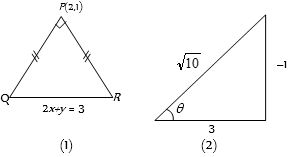
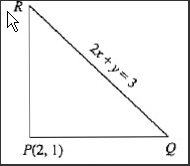
Let $PQR$ be a right-angled isosceles triangle,with the right angle at $P(2, 1)$. If the equation of the line $QR$ is $2x + y = 3$,then the equation representing the pair of lines $PQ$ and $PR$ is
A
$3x^2 - 3y^2 + 8xy + 20x + 10y + 25 = 0$
B
$3x^2 - 3y^2 + 8xy - 20x - 10y + 25 = 0$
C
$3x^2 - 3y^2 + 8xy + 10x + 15y + 20 = 0$
D
$3x^2 - 3y^2 - 8xy - 10x - 15y - 20 = 0$
Solution
(B) Let the slopes of $PQ$ and $PR$ be $m_1$ and $m_2$. Since $\triangle PQR$ is a right-angled isosceles triangle at $P$,the lines $PQ$ and $PR$ are perpendicular,so $m_1 m_2 = -1$. Also,the angle between $PQ$ and $QR$ is $45^\circ$. The slope of $QR$ is $m = -2$. Using the formula $\tan 45^\circ = |\frac{m_1 - (-2)}{1 + m_1(-2)}| = 1$,we get $|\frac{m_1 + 2}{1 - 2m_1}| = 1$. This gives $m_1 + 2 = 1 - 2m_1$ or $m_1 + 2 = -(1 - 2m_1)$. Solving $3m_1 = -1$ gives $m_1 = -1/3$,and $m_1 + 2 = -1 + 2m_1$ gives $m_1 = 3$. Thus,the slopes are $3$ and $-1/3$. The equations of the lines passing through $P(2, 1)$ are $y - 1 = 3(x - 2)$ and $y - 1 = -1/3(x - 2)$. Rewriting these as $3x - y - 5 = 0$ and $x + 3y - 5 = 0$. The combined equation is $(3x - y - 5)(x + 3y - 5) = 0$. Expanding this: $3x^2 + 9xy - 15x - xy - 3y^2 + 5y - 5x - 15y + 25 = 0$,which simplifies to $3x^2 - 3y^2 + 8xy - 20x - 10y + 25 = 0$.
0 likesView Solution
18
ChemistryMCQMHT CET · 2023
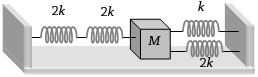
Four massless springs whose force constants are $2k, 2k, k$ and $2k$ respectively are attached to a mass $M$ kept on a frictionless plane (as shown in figure). If the mass $M$ is displaced in the horizontal direction,then the frequency of oscillation of the system is
A
$\frac{1}{2\pi}\sqrt{\frac{k}{4M}}$
B
$\frac{1}{2\pi}\sqrt{\frac{4k}{M}}$
C
$\frac{1}{2\pi}\sqrt{\frac{k}{7M}}$
D
$\frac{1}{2\pi}\sqrt{\frac{7k}{M}}$
Solution
(B) The two springs on the left side,each having a spring constant of $2k$,are connected in series. Their equivalent spring constant $k_{eq1}$ is given by:
$\frac{1}{k_{eq1}} = \frac{1}{2k} + \frac{1}{2k} = \frac{2}{2k} = \frac{1}{k} \implies k_{eq1} = k$.
The two springs on the right side of mass $M$ are connected in parallel. Their effective spring constant $k_{eq2}$ is:
$k_{eq2} = k + 2k = 3k$.
Now,the mass $M$ is connected to these two equivalent systems ($k_{eq1}$ and $k_{eq2}$) in parallel. Therefore,the net equivalent spring constant $k_{net}$ of the system is:
$k_{net} = k_{eq1} + k_{eq2} = k + 3k = 4k$.
The frequency of oscillation $f$ for a spring-mass system is given by:
$f = \frac{1}{2\pi}\sqrt{\frac{k_{net}}{M}} = \frac{1}{2\pi}\sqrt{\frac{4k}{M}}$.
$\frac{1}{k_{eq1}} = \frac{1}{2k} + \frac{1}{2k} = \frac{2}{2k} = \frac{1}{k} \implies k_{eq1} = k$.
The two springs on the right side of mass $M$ are connected in parallel. Their effective spring constant $k_{eq2}$ is:
$k_{eq2} = k + 2k = 3k$.
Now,the mass $M$ is connected to these two equivalent systems ($k_{eq1}$ and $k_{eq2}$) in parallel. Therefore,the net equivalent spring constant $k_{net}$ of the system is:
$k_{net} = k_{eq1} + k_{eq2} = k + 3k = 4k$.
The frequency of oscillation $f$ for a spring-mass system is given by:
$f = \frac{1}{2\pi}\sqrt{\frac{k_{net}}{M}} = \frac{1}{2\pi}\sqrt{\frac{4k}{M}}$.
0 likesView Solution
19
ChemistryMCQMHT CET · 2023
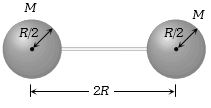
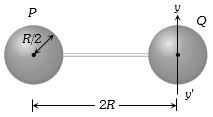
Two spheres each of mass $M$ and radius $\frac{R}{2}$ are connected at their centres with a massless rod of length $2R$. What will be the moment of inertia of the system about an axis passing through the centre of one of the spheres and perpendicular to the rod?
A
$\frac{21}{5}MR^2$
B
$\frac{2}{5}MR^2$
C
$\frac{5}{2}MR^2$
D
$\frac{5}{21}MR^2$
Solution
(A) Let the two spheres be $P$ and $Q$. The axis of rotation passes through the centre of sphere $Q$ and is perpendicular to the rod.
The moment of inertia of the system is $I_{\text{net}} = I_Q + I_P + I_{\text{rod}}$.
$1$. For sphere $Q$: The axis passes through its centre. The moment of inertia of a solid sphere about its central axis is $I_Q = \frac{2}{5} M r^2$,where $r = \frac{R}{2}$.
$I_Q = \frac{2}{5} M \left(\frac{R}{2}\right)^2 = \frac{2}{5} M \left(\frac{R^2}{4}\right) = \frac{1}{10} MR^2$.
$2$. For sphere $P$: The axis is at a distance $d = 2R$ from its centre. Using the parallel axis theorem,$I_P = I_{\text{cm}} + Md^2$.
$I_P = \frac{2}{5} M \left(\frac{R}{2}\right)^2 + M(2R)^2 = \frac{1}{10} MR^2 + 4MR^2 = \frac{41}{10} MR^2$.
$3$. For the rod: Since the rod is massless,$I_{\text{rod}} = 0$.
Total moment of inertia $I_{\text{net}} = I_Q + I_P = \frac{1}{10} MR^2 + \frac{41}{10} MR^2 = \frac{42}{10} MR^2 = \frac{21}{5} MR^2$.
The moment of inertia of the system is $I_{\text{net}} = I_Q + I_P + I_{\text{rod}}$.
$1$. For sphere $Q$: The axis passes through its centre. The moment of inertia of a solid sphere about its central axis is $I_Q = \frac{2}{5} M r^2$,where $r = \frac{R}{2}$.
$I_Q = \frac{2}{5} M \left(\frac{R}{2}\right)^2 = \frac{2}{5} M \left(\frac{R^2}{4}\right) = \frac{1}{10} MR^2$.
$2$. For sphere $P$: The axis is at a distance $d = 2R$ from its centre. Using the parallel axis theorem,$I_P = I_{\text{cm}} + Md^2$.
$I_P = \frac{2}{5} M \left(\frac{R}{2}\right)^2 + M(2R)^2 = \frac{1}{10} MR^2 + 4MR^2 = \frac{41}{10} MR^2$.
$3$. For the rod: Since the rod is massless,$I_{\text{rod}} = 0$.
Total moment of inertia $I_{\text{net}} = I_Q + I_P = \frac{1}{10} MR^2 + \frac{41}{10} MR^2 = \frac{42}{10} MR^2 = \frac{21}{5} MR^2$.
0 likesView Solution
20
ChemistryMCQMHT CET · 2023
Let $PQR$ be a right-angled isosceles triangle,with the right angle at $P(2, 1)$. If the equation of the line $QR$ is $2x + y = 3$,then the equation representing the pair of lines $PQ$ and $PR$ is:
A
$3x^2 - 3y^2 + 8xy + 20x + 10y + 25 = 0$
B
$3x^2 - 3y^2 + 8xy - 20x - 10y + 25 = 0$
C
$3x^2 - 3y^2 + 8xy + 10x + 15y + 20 = 0$
D
$3x^2 - 3y^2 - 8xy - 10x - 15y - 20 = 0$
Solution
(B) Let the slopes of $PQ$ and $PR$ be $m_1$ and $m_2$. Since $\triangle PQR$ is a right-angled isosceles triangle at $P$,the lines $PQ$ and $PR$ are perpendicular,so $m_1 m_2 = -1$. Let $m_1 = m$,then $m_2 = -\frac{1}{m}$.
Since $\triangle PQR$ is isosceles with $\angle P = 90^\circ$,we have $\angle PQR = \angle PRQ = 45^\circ$.
The slope of line $QR$ is $m_{QR} = -2$.
The angle between $PQ$ (slope $m$) and $QR$ (slope $-2$) is $45^\circ$:
$\tan 45^\circ = \left| \frac{m - (-2)}{1 + m(-2)} \right| = 1$
$\left| \frac{m+2}{1-2m} \right| = 1 \Rightarrow (m+2)^2 = (1-2m)^2$
$m^2 + 4m + 4 = 1 - 4m + 4m^2 \Rightarrow 3m^2 - 8m - 3 = 0$
$(3m+1)(m-3) = 0 \Rightarrow m = 3, -\frac{1}{3}$.
The equations of lines $PQ$ and $PR$ passing through $P(2, 1)$ are $y-1 = 3(x-2)$ and $y-1 = -\frac{1}{3}(x-2)$.
These can be written as $3x - y - 5 = 0$ and $x + 3y - 5 = 0$.
The joint equation is $(3x - y - 5)(x + 3y - 5) = 0$.
$3x^2 + 9xy - 15x - xy - 3y^2 + 5y - 5x - 15y + 25 = 0$
$3x^2 - 3y^2 + 8xy - 20x - 10y + 25 = 0$.
Since $\triangle PQR$ is isosceles with $\angle P = 90^\circ$,we have $\angle PQR = \angle PRQ = 45^\circ$.
The slope of line $QR$ is $m_{QR} = -2$.
The angle between $PQ$ (slope $m$) and $QR$ (slope $-2$) is $45^\circ$:
$\tan 45^\circ = \left| \frac{m - (-2)}{1 + m(-2)} \right| = 1$
$\left| \frac{m+2}{1-2m} \right| = 1 \Rightarrow (m+2)^2 = (1-2m)^2$
$m^2 + 4m + 4 = 1 - 4m + 4m^2 \Rightarrow 3m^2 - 8m - 3 = 0$
$(3m+1)(m-3) = 0 \Rightarrow m = 3, -\frac{1}{3}$.
The equations of lines $PQ$ and $PR$ passing through $P(2, 1)$ are $y-1 = 3(x-2)$ and $y-1 = -\frac{1}{3}(x-2)$.
These can be written as $3x - y - 5 = 0$ and $x + 3y - 5 = 0$.
The joint equation is $(3x - y - 5)(x + 3y - 5) = 0$.
$3x^2 + 9xy - 15x - xy - 3y^2 + 5y - 5x - 15y + 25 = 0$
$3x^2 - 3y^2 + 8xy - 20x - 10y + 25 = 0$.
0 likesView Solution
21
ChemistryMCQMHT CET · 2023
$A$ monoatomic ideal gas,initially at temperature $T_1$,is enclosed in a cylinder fitted with a frictionless piston. The gas is allowed to expand adiabatically to a temperature $T_2$ by releasing the piston suddenly. If $L_1$ and $L_2$ are the lengths of the gas column before and after expansion respectively,then $T_1/T_2$ is given by
A
$(\frac{L_1}{L_2})^{2/3}$
B
$\frac{L_1}{L_2}$
C
$\frac{L_2}{L_1}$
D
$(\frac{L_2}{L_1})^{2/3}$
Solution
(D) For an adiabatic process,the relationship between temperature $T$ and volume $V$ is given by $T V^{\gamma-1} = \text{constant}$.
Thus,$T_1 V_1^{\gamma-1} = T_2 V_2^{\gamma-1}$.
For a monoatomic gas,the adiabatic index $\gamma = 5/3$,so $\gamma - 1 = 2/3$.
The volume of the gas in a cylinder of cross-sectional area $A$ is $V = A \times L$,where $L$ is the length of the gas column.
Substituting $V_1 = A L_1$ and $V_2 = A L_2$ into the adiabatic equation:
$T_1 (A L_1)^{2/3} = T_2 (A L_2)^{2/3}$.
Dividing both sides by $T_2 (A L_1)^{2/3}$,we get:
$\frac{T_1}{T_2} = \frac{(A L_2)^{2/3}}{(A L_1)^{2/3}} = (\frac{L_2}{L_1})^{2/3}$.
Thus,$T_1 V_1^{\gamma-1} = T_2 V_2^{\gamma-1}$.
For a monoatomic gas,the adiabatic index $\gamma = 5/3$,so $\gamma - 1 = 2/3$.
The volume of the gas in a cylinder of cross-sectional area $A$ is $V = A \times L$,where $L$ is the length of the gas column.
Substituting $V_1 = A L_1$ and $V_2 = A L_2$ into the adiabatic equation:
$T_1 (A L_1)^{2/3} = T_2 (A L_2)^{2/3}$.
Dividing both sides by $T_2 (A L_1)^{2/3}$,we get:
$\frac{T_1}{T_2} = \frac{(A L_2)^{2/3}}{(A L_1)^{2/3}} = (\frac{L_2}{L_1})^{2/3}$.
0 likesView Solution
22
ChemistryMCQMHT CET · 2023
The variance of $20$ observations is $5$. If each observation is multiplied by $2$,then the new variance of the resulting observations is:
A
$5$
B
$10$
C
$20$
D
$40$
Solution
(C) Let the observations be $x_1, x_2, \dots, x_{20}$ with mean $\bar{x}$.
Given,variance $\sigma^2 = \frac{1}{20} \sum_{i=1}^{20} (x_i - \bar{x})^2 = 5$.
When each observation is multiplied by a constant $k=2$,the new observations are $y_i = 2x_i$.
The new mean is $\bar{y} = 2\bar{x}$.
The new variance is $\sigma_{new}^2 = \frac{1}{20} \sum_{i=1}^{20} (y_i - \bar{y})^2$.
Substituting $y_i = 2x_i$ and $\bar{y} = 2\bar{x}$:
$\sigma_{new}^2 = \frac{1}{20} \sum_{i=1}^{20} (2x_i - 2\bar{x})^2 = \frac{1}{20} \sum_{i=1}^{20} 4(x_i - \bar{x})^2$.
$\sigma_{new}^2 = 4 \times \left[ \frac{1}{20} \sum_{i=1}^{20} (x_i - \bar{x})^2 \right] = 4 \times 5 = 20$.
Given,variance $\sigma^2 = \frac{1}{20} \sum_{i=1}^{20} (x_i - \bar{x})^2 = 5$.
When each observation is multiplied by a constant $k=2$,the new observations are $y_i = 2x_i$.
The new mean is $\bar{y} = 2\bar{x}$.
The new variance is $\sigma_{new}^2 = \frac{1}{20} \sum_{i=1}^{20} (y_i - \bar{y})^2$.
Substituting $y_i = 2x_i$ and $\bar{y} = 2\bar{x}$:
$\sigma_{new}^2 = \frac{1}{20} \sum_{i=1}^{20} (2x_i - 2\bar{x})^2 = \frac{1}{20} \sum_{i=1}^{20} 4(x_i - \bar{x})^2$.
$\sigma_{new}^2 = 4 \times \left[ \frac{1}{20} \sum_{i=1}^{20} (x_i - \bar{x})^2 \right] = 4 \times 5 = 20$.
0 likesView Solution
23
ChemistryMCQMHT CET · 2023
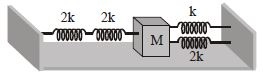
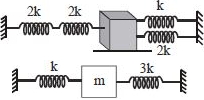
Four massless springs whose force constants are $2k, 2k, k$ and $2k$ respectively are attached to a mass $M$ kept on a frictionless plane (as shown in the figure). If the mass $M$ is displaced in the horizontal direction,then the frequency of oscillation of the system is:
A
$\frac{1}{2 \pi} \sqrt{\frac{k}{4M}}$
B
$\frac{1}{2 \pi} \sqrt{\frac{4k}{M}}$
C
$\frac{1}{2 \pi} \sqrt{\frac{k}{M}}$
D
$\frac{1}{2 \pi} \sqrt{\frac{7k}{M}}$
Solution
(B) $1$. The two springs on the left with force constants $2k$ and $2k$ are in series. Their equivalent spring constant $k_{L}$ is given by $\frac{1}{k_{L}} = \frac{1}{2k} + \frac{1}{2k} = \frac{2}{2k} = \frac{1}{k}$,so $k_{L} = k$.
$2$. The two springs on the right with force constants $k$ and $2k$ are in parallel. Their equivalent spring constant $k_{R}$ is given by $k_{R} = k + 2k = 3k$.
$3$. The left and right combinations are effectively in parallel with respect to the mass $M$. Thus,the total effective spring constant $k_{eff} = k_{L} + k_{R} = k + 3k = 4k$.
$4$. The frequency of oscillation $f$ is given by $f = \frac{1}{2 \pi} \sqrt{\frac{k_{eff}}{M}} = \frac{1}{2 \pi} \sqrt{\frac{4k}{M}}$.
$2$. The two springs on the right with force constants $k$ and $2k$ are in parallel. Their equivalent spring constant $k_{R}$ is given by $k_{R} = k + 2k = 3k$.
$3$. The left and right combinations are effectively in parallel with respect to the mass $M$. Thus,the total effective spring constant $k_{eff} = k_{L} + k_{R} = k + 3k = 4k$.
$4$. The frequency of oscillation $f$ is given by $f = \frac{1}{2 \pi} \sqrt{\frac{k_{eff}}{M}} = \frac{1}{2 \pi} \sqrt{\frac{4k}{M}}$.
0 likesView Solution
24
ChemistryMCQMHT CET · 2023
Two conducting circular loops of radii $R_1$ and $R_2$ are placed in the same plane with their centres coinciding. If $R_1 >> R_2$,the mutual inductance $M$ between them will be directly proportional to
A
$\frac{R_1}{R_2}$
B
$\frac{R_2}{R_1}$
C
$\frac{R_1^2}{R_2}$
D
$\frac{R_2^2}{R_1}$
Solution
(D) The magnetic field $B$ produced by the larger loop (radius $R_1$) at its centre is given by $B = \frac{\mu_0 i_1}{2 R_1}$.
Since $R_1 >> R_2$,we can assume this magnetic field is approximately uniform over the area of the smaller loop (radius $R_2$).
The magnetic flux $\phi_2$ passing through the smaller loop is $\phi_2 = B \cdot A_2$,where $A_2 = \pi R_2^2$ is the area of the smaller loop.
Substituting the values,we get $\phi_2 = \left( \frac{\mu_0 i_1}{2 R_1} \right) (\pi R_2^2)$.
By definition,the mutual inductance $M$ is given by $M = \frac{\phi_2}{i_1}$.
Therefore,$M = \frac{\mu_0 \pi R_2^2}{2 R_1}$.
From this expression,it is clear that $M \propto \frac{R_2^2}{R_1}$.
Since $R_1 >> R_2$,we can assume this magnetic field is approximately uniform over the area of the smaller loop (radius $R_2$).
The magnetic flux $\phi_2$ passing through the smaller loop is $\phi_2 = B \cdot A_2$,where $A_2 = \pi R_2^2$ is the area of the smaller loop.
Substituting the values,we get $\phi_2 = \left( \frac{\mu_0 i_1}{2 R_1} \right) (\pi R_2^2)$.
By definition,the mutual inductance $M$ is given by $M = \frac{\phi_2}{i_1}$.
Therefore,$M = \frac{\mu_0 \pi R_2^2}{2 R_1}$.
From this expression,it is clear that $M \propto \frac{R_2^2}{R_1}$.
0 likesView Solution
25
ChemistryMCQMHT CET · 2023
When a metallic surface is illuminated with radiation of wavelength $\lambda$,the stopping potential is $V$. If the same surface is illuminated with radiation of wavelength $2\lambda$,the stopping potential is $\frac{V}{4}$. The threshold wavelength for the metallic surface is:
A
$4\lambda$
B
$5\lambda$
C
$\frac{5}{2}\lambda$
D
$3\lambda$
Solution
(D) According to Einstein's photoelectric equation,the stopping potential $V$ is given by $eV = \frac{hc}{\lambda} - \frac{hc}{\lambda_0}$,where $\lambda_0$ is the threshold wavelength.
For the first case: $eV = \frac{hc}{\lambda} - \frac{hc}{\lambda_0}$ --- $(i)$
For the second case: $e(\frac{V}{4}) = \frac{hc}{2\lambda} - \frac{hc}{\lambda_0}$ --- $(ii)$
Multiplying equation $(ii)$ by $4$,we get: $eV = \frac{2hc}{\lambda} - \frac{4hc}{\lambda_0}$ --- $(iii)$
Equating $(i)$ and $(iii)$: $\frac{hc}{\lambda} - \frac{hc}{\lambda_0} = \frac{2hc}{\lambda} - \frac{4hc}{\lambda_0}$
Rearranging the terms: $\frac{3hc}{\lambda_0} = \frac{hc}{\lambda}$
Therefore,$\lambda_0 = 3\lambda$.
For the first case: $eV = \frac{hc}{\lambda} - \frac{hc}{\lambda_0}$ --- $(i)$
For the second case: $e(\frac{V}{4}) = \frac{hc}{2\lambda} - \frac{hc}{\lambda_0}$ --- $(ii)$
Multiplying equation $(ii)$ by $4$,we get: $eV = \frac{2hc}{\lambda} - \frac{4hc}{\lambda_0}$ --- $(iii)$
Equating $(i)$ and $(iii)$: $\frac{hc}{\lambda} - \frac{hc}{\lambda_0} = \frac{2hc}{\lambda} - \frac{4hc}{\lambda_0}$
Rearranging the terms: $\frac{3hc}{\lambda_0} = \frac{hc}{\lambda}$
Therefore,$\lambda_0 = 3\lambda$.
0 likesView Solution
26
ChemistryMCQMHT CET · 2023
When a metallic surface is illuminated with radiation of wavelength $\lambda$,the stopping potential is $V$. If the same surface is illuminated with radiation of wavelength $2\lambda$,the stopping potential is $\frac{V}{4}$. The threshold wavelength for the metallic surface is:
A
$4\lambda$
B
$5\lambda$
C
$\frac{5}{2}\lambda$
D
$3\lambda$
Solution
(D) According to Einstein's photoelectric equation,the stopping potential $V$ is given by: $eV = \frac{hc}{\lambda} - \Phi$,where $\Phi = \frac{hc}{\lambda_0}$ is the work function.
For wavelength $\lambda$: $eV = \frac{hc}{\lambda} - \frac{hc}{\lambda_0}$ --- $(i)$
For wavelength $2\lambda$: $e(\frac{V}{4}) = \frac{hc}{2\lambda} - \frac{hc}{\lambda_0}$ --- $(ii)$
Dividing equation $(i)$ by equation $(ii)$:
$4 = \frac{\frac{hc}{\lambda} - \frac{hc}{\lambda_0}}{\frac{hc}{2\lambda} - \frac{hc}{\lambda_0}} = \frac{\frac{1}{\lambda} - \frac{1}{\lambda_0}}{\frac{1}{2\lambda} - \frac{1}{\lambda_0}}$
$4(\frac{1}{2\lambda} - \frac{1}{\lambda_0}) = \frac{1}{\lambda} - \frac{1}{\lambda_0}$
$\frac{2}{\lambda} - \frac{4}{\lambda_0} = \frac{1}{\lambda} - \frac{1}{\lambda_0}$
$\frac{1}{\lambda} = \frac{3}{\lambda_0}$
$\lambda_0 = 3\lambda$.
For wavelength $\lambda$: $eV = \frac{hc}{\lambda} - \frac{hc}{\lambda_0}$ --- $(i)$
For wavelength $2\lambda$: $e(\frac{V}{4}) = \frac{hc}{2\lambda} - \frac{hc}{\lambda_0}$ --- $(ii)$
Dividing equation $(i)$ by equation $(ii)$:
$4 = \frac{\frac{hc}{\lambda} - \frac{hc}{\lambda_0}}{\frac{hc}{2\lambda} - \frac{hc}{\lambda_0}} = \frac{\frac{1}{\lambda} - \frac{1}{\lambda_0}}{\frac{1}{2\lambda} - \frac{1}{\lambda_0}}$
$4(\frac{1}{2\lambda} - \frac{1}{\lambda_0}) = \frac{1}{\lambda} - \frac{1}{\lambda_0}$
$\frac{2}{\lambda} - \frac{4}{\lambda_0} = \frac{1}{\lambda} - \frac{1}{\lambda_0}$
$\frac{1}{\lambda} = \frac{3}{\lambda_0}$
$\lambda_0 = 3\lambda$.
0 likesView Solution
27
ChemistryMCQMHT CET · 2023
Two identical capacitors have the same capacitance $C$. One of them is charged to potential $V_1$ and the other to $V_2$. The negative ends of the capacitors are connected together. When the positive ends are also connected,the decrease in energy of the combined system is
A
$\frac{1}{4}C(V_1^2 - V_2^2)$
B
$\frac{1}{4}C(V_1^2 + V_2^2)$
C
$\frac{1}{4}C(V_1 - V_2)^2$
D
$\frac{1}{4}C(V_1 + V_2)^2$
Solution
(C) The initial energy of the combined system is $U_i = \frac{1}{2}CV_1^2 + \frac{1}{2}CV_2^2$.
When the capacitors are connected in parallel,the common potential $V$ is given by $V = \frac{CV_1 + CV_2}{C + C} = \frac{V_1 + V_2}{2}$.
The final energy of the system is $U_f = \frac{1}{2}(2C)V^2 = C \left( \frac{V_1 + V_2}{2} \right)^2 = \frac{C}{4}(V_1 + V_2)^2$.
The decrease in energy is $\Delta U = U_i - U_f = \frac{1}{2}C(V_1^2 + V_2^2) - \frac{1}{4}C(V_1 + V_2)^2$.
Simplifying this,$\Delta U = \frac{C}{4} [2V_1^2 + 2V_2^2 - (V_1^2 + V_2^2 + 2V_1V_2)] = \frac{C}{4}(V_1^2 + V_2^2 - 2V_1V_2) = \frac{1}{4}C(V_1 - V_2)^2$.
When the capacitors are connected in parallel,the common potential $V$ is given by $V = \frac{CV_1 + CV_2}{C + C} = \frac{V_1 + V_2}{2}$.
The final energy of the system is $U_f = \frac{1}{2}(2C)V^2 = C \left( \frac{V_1 + V_2}{2} \right)^2 = \frac{C}{4}(V_1 + V_2)^2$.
The decrease in energy is $\Delta U = U_i - U_f = \frac{1}{2}C(V_1^2 + V_2^2) - \frac{1}{4}C(V_1 + V_2)^2$.
Simplifying this,$\Delta U = \frac{C}{4} [2V_1^2 + 2V_2^2 - (V_1^2 + V_2^2 + 2V_1V_2)] = \frac{C}{4}(V_1^2 + V_2^2 - 2V_1V_2) = \frac{1}{4}C(V_1 - V_2)^2$.
0 likesView Solution
28
ChemistryMCQMHT CET · 2023
When radiation of wavelength $\lambda$ is incident on a metallic surface,the stopping potential is $4.8 \ V$. If the same surface is illuminated with radiation of double the wavelength,then the stopping potential becomes $1.6 \ V$. Then the threshold wavelength for the surface is
A
$2 \ \lambda$
B
$4 \ \lambda$
C
$6 \ \lambda$
D
$8 \ \lambda$
Solution
(B) According to Einstein's photoelectric equation,the stopping potential $V_0$ is given by:
$\frac{hc}{e} \left( \frac{1}{\lambda} - \frac{1}{\lambda_0} \right) = V_0$
For the first case,with wavelength $\lambda$ and stopping potential $4.8 \ V$:
$\frac{hc}{e} \left( \frac{1}{\lambda} - \frac{1}{\lambda_0} \right) = 4.8$ --- $(i)$
For the second case,with wavelength $2\lambda$ and stopping potential $1.6 \ V$:
$\frac{hc}{e} \left( \frac{1}{2\lambda} - \frac{1}{\lambda_0} \right) = 1.6$ --- $(ii)$
Dividing equation $(i)$ by equation $(ii)$:
$\frac{\frac{1}{\lambda} - \frac{1}{\lambda_0}}{\frac{1}{2\lambda} - \frac{1}{\lambda_0}} = \frac{4.8}{1.6} = 3$
$\frac{1}{\lambda} - \frac{1}{\lambda_0} = 3 \left( \frac{1}{2\lambda} - \frac{1}{\lambda_0} \right)$
$\frac{1}{\lambda} - \frac{1}{\lambda_0} = \frac{1.5}{\lambda} - \frac{3}{\lambda_0}$
$\frac{3}{\lambda_0} - \frac{1}{\lambda_0} = \frac{1.5}{\lambda} - \frac{1}{\lambda}$
$\frac{2}{\lambda_0} = \frac{0.5}{\lambda} = \frac{1}{2\lambda}$
$\lambda_0 = 4\lambda$
$\frac{hc}{e} \left( \frac{1}{\lambda} - \frac{1}{\lambda_0} \right) = V_0$
For the first case,with wavelength $\lambda$ and stopping potential $4.8 \ V$:
$\frac{hc}{e} \left( \frac{1}{\lambda} - \frac{1}{\lambda_0} \right) = 4.8$ --- $(i)$
For the second case,with wavelength $2\lambda$ and stopping potential $1.6 \ V$:
$\frac{hc}{e} \left( \frac{1}{2\lambda} - \frac{1}{\lambda_0} \right) = 1.6$ --- $(ii)$
Dividing equation $(i)$ by equation $(ii)$:
$\frac{\frac{1}{\lambda} - \frac{1}{\lambda_0}}{\frac{1}{2\lambda} - \frac{1}{\lambda_0}} = \frac{4.8}{1.6} = 3$
$\frac{1}{\lambda} - \frac{1}{\lambda_0} = 3 \left( \frac{1}{2\lambda} - \frac{1}{\lambda_0} \right)$
$\frac{1}{\lambda} - \frac{1}{\lambda_0} = \frac{1.5}{\lambda} - \frac{3}{\lambda_0}$
$\frac{3}{\lambda_0} - \frac{1}{\lambda_0} = \frac{1.5}{\lambda} - \frac{1}{\lambda}$
$\frac{2}{\lambda_0} = \frac{0.5}{\lambda} = \frac{1}{2\lambda}$
$\lambda_0 = 4\lambda$
0 likesView Solution
29
ChemistryMCQMHT CET · 2023
The materials suitable for making electromagnets should have
A
high retentivity and low coercivity
B
low retentivity and low coercivity
C
high retentivity and high coercivity
D
low retentivity and high coercivity
Solution
(B) An electromagnet must be easily magnetized and demagnetized by the application and removal of an external magnetic field.
To achieve this,the material must have low retentivity so that it does not retain magnetism after the current is switched off.
Additionally,it must have low coercivity so that it can be easily demagnetized.
Therefore,the correct choice is low retentivity and low coercivity.
To achieve this,the material must have low retentivity so that it does not retain magnetism after the current is switched off.
Additionally,it must have low coercivity so that it can be easily demagnetized.
Therefore,the correct choice is low retentivity and low coercivity.
0 likesView Solution
30
ChemistryMCQMHT CET · 2023
The mutual inductance of a pair of coils,each of $N$ turns,is $M$ henry. If a current of $I$ ampere in one of the coils is brought to zero in $t$ seconds,the $emf$ induced per turn in the other coil,in volts,will be
A
$\frac{MI}{t}$
B
$\frac{NMI}{t}$
C
$\frac{MN}{It}$
D
$\frac{MI}{Nt}$
Solution
(D) The total induced $emf$ $(E)$ in a coil of $N$ turns due to mutual inductance $M$ is given by Faraday's law: $E = M \frac{dI}{dt}$.
Given that the current changes from $I$ to $0$ in time $t$,the magnitude of the rate of change of current is $\frac{dI}{dt} = \frac{I}{t}$.
Therefore,the total induced $emf$ in the coil is $E = M \frac{I}{t}$.
Since the question asks for the $emf$ induced per turn,we divide the total induced $emf$ by the number of turns $N$.
However,note that the total flux linkage is $N\phi = MI$. The induced $emf$ in the entire coil is $E = \frac{d(N\phi)}{dt} = M \frac{dI}{dt} = \frac{MI}{t}$.
The $emf$ induced per turn is $\frac{E}{N} = \frac{MI}{Nt}$ is incorrect based on standard definitions; rather,the $emf$ induced in the whole coil is $E = \frac{MI}{t}$. If the question asks for $emf$ per turn,it is $\frac{E}{N} = \frac{MI}{Nt}$.
Wait,re-evaluating: The total $emf$ induced in the secondary coil is $E = M \frac{dI}{dt} = \frac{MI}{t}$. This $emf$ is distributed across all $N$ turns. Thus,$emf$ per turn is $\frac{E}{N} = \frac{MI}{Nt}$.
Given that the current changes from $I$ to $0$ in time $t$,the magnitude of the rate of change of current is $\frac{dI}{dt} = \frac{I}{t}$.
Therefore,the total induced $emf$ in the coil is $E = M \frac{I}{t}$.
Since the question asks for the $emf$ induced per turn,we divide the total induced $emf$ by the number of turns $N$.
However,note that the total flux linkage is $N\phi = MI$. The induced $emf$ in the entire coil is $E = \frac{d(N\phi)}{dt} = M \frac{dI}{dt} = \frac{MI}{t}$.
The $emf$ induced per turn is $\frac{E}{N} = \frac{MI}{Nt}$ is incorrect based on standard definitions; rather,the $emf$ induced in the whole coil is $E = \frac{MI}{t}$. If the question asks for $emf$ per turn,it is $\frac{E}{N} = \frac{MI}{Nt}$.
Wait,re-evaluating: The total $emf$ induced in the secondary coil is $E = M \frac{dI}{dt} = \frac{MI}{t}$. This $emf$ is distributed across all $N$ turns. Thus,$emf$ per turn is $\frac{E}{N} = \frac{MI}{Nt}$.
0 likesView Solution
31
ChemistryMediumMCQMHT CET · 2023
Identify the product obtained in the following reaction:
$n CH_3 MgI + n H_2 O \xrightarrow{\text{dry ether}} \text{product}$
$n CH_3 MgI + n H_2 O \xrightarrow{\text{dry ether}} \text{product}$
A
$n MgI$ and $n CH_4$
B
$\frac{n}{2} C_2 H_6$
C
$n CH_3 OH$ and $n MgI$
D
$n CH_4$ and $n MgI(OH)$
Solution
(D) Grignard reagents $(RMgX)$ react with compounds containing active hydrogen atoms (like water,alcohols,or amines) to form the corresponding hydrocarbon.
The reaction is as follows:
$n CH_3 MgI + n H_2 O \rightarrow n CH_4 + n Mg(OH)I$
Here,$CH_3 MgI$ (Methyl magnesium iodide) reacts with $H_2 O$ to produce $CH_4$ (Methane) and $Mg(OH)I$ (Hydroxy magnesium iodide).
The reaction is as follows:
$n CH_3 MgI + n H_2 O \rightarrow n CH_4 + n Mg(OH)I$
Here,$CH_3 MgI$ (Methyl magnesium iodide) reacts with $H_2 O$ to produce $CH_4$ (Methane) and $Mg(OH)I$ (Hydroxy magnesium iodide).
0 likesView Solution
32
ChemistryEasyMCQMHT CET · 2023
What type of phenomenon does the Cannizzaro reaction exhibit?
A
Nucleophilic addition
B
Elimination
C
Disproportionation
D
Decomposition
Solution
(C) The Cannizzaro reaction is a redox reaction in which two molecules of an aldehyde (lacking an $\alpha$-hydrogen atom) react in the presence of a strong base to produce a primary alcohol and a carboxylic acid salt. Since the same aldehyde species is simultaneously oxidized and reduced,it is classified as a disproportionation reaction.
0 likesView Solution
33
ChemistryMCQMHT CET · 2023
Which of the following amines undergoes acylation reaction?
A
Ethyldimethylamine
B
$N$-Methylaniline
C
$N,N$-Dimethylmethanamine
D
$N,N$-Dimethylaniline
Solution
(B) Acylation reaction is characteristic of primary and secondary amines because they possess at least one replaceable hydrogen atom attached to the nitrogen atom.
$N$-Methylaniline $(C_6H_5NHCH_3)$ is a secondary amine,which contains one $N-H$ bond,allowing it to undergo acylation.
Ethyldimethylamine,$N,N$-Dimethylmethanamine,and $N,N$-Dimethylaniline are all tertiary amines and lack the necessary $N-H$ bond to undergo acylation.
$N$-Methylaniline $(C_6H_5NHCH_3)$ is a secondary amine,which contains one $N-H$ bond,allowing it to undergo acylation.
Ethyldimethylamine,$N,N$-Dimethylmethanamine,and $N,N$-Dimethylaniline are all tertiary amines and lack the necessary $N-H$ bond to undergo acylation.
0 likesView Solution
34
ChemistryEasyMCQMHT CET · 2023
Which of the following salts turns red litmus blue in its aqueous solution?
A
$NH_4NO_3$
B
$NH_4Cl$
C
$NH_4CN$
D
$NH_4F$
Solution
(C) salt turns red litmus blue if its aqueous solution is basic.
$NH_4NO_3$ is a salt of a strong acid $(HNO_3)$ and a weak base $(NH_4OH)$,making it acidic.
$NH_4Cl$ is a salt of a strong acid $(HCl)$ and a weak base $(NH_4OH)$,making it acidic.
$NH_4F$ is a salt of a weak acid $(HF)$ and a weak base $(NH_4OH)$. Since $K_a$ of $HF$ $(6.8 \times 10^{-4})$ is greater than $K_b$ of $NH_4OH$ $(1.8 \times 10^{-5})$,the solution is acidic.
$NH_4CN$ is a salt of a weak acid $HCN$ $(K_a = 4.0 \times 10^{-10})$ and a weak base $NH_4OH$ $(K_b = 1.8 \times 10^{-5})$.
Since $K_b > K_a$,the aqueous solution of $NH_4CN$ is basic and turns red litmus blue.
$NH_4NO_3$ is a salt of a strong acid $(HNO_3)$ and a weak base $(NH_4OH)$,making it acidic.
$NH_4Cl$ is a salt of a strong acid $(HCl)$ and a weak base $(NH_4OH)$,making it acidic.
$NH_4F$ is a salt of a weak acid $(HF)$ and a weak base $(NH_4OH)$. Since $K_a$ of $HF$ $(6.8 \times 10^{-4})$ is greater than $K_b$ of $NH_4OH$ $(1.8 \times 10^{-5})$,the solution is acidic.
$NH_4CN$ is a salt of a weak acid $HCN$ $(K_a = 4.0 \times 10^{-10})$ and a weak base $NH_4OH$ $(K_b = 1.8 \times 10^{-5})$.
Since $K_b > K_a$,the aqueous solution of $NH_4CN$ is basic and turns red litmus blue.
0 likesView Solution
35
ChemistryMCQMHT CET · 2023
Identify the product '$B$' in the following sequence of reactions.
$CH_3 Br$ $\xrightarrow{KCN} A$ $\xrightarrow{Na/C_2H_5OH} B$
$CH_3 Br$ $\xrightarrow{KCN} A$ $\xrightarrow{Na/C_2H_5OH} B$
A
Methyl cyanide
B
Ethylamine
C
Methylamine
D
Ethyl cyanide
Solution
(B) The reaction sequence is as follows:
$CH_3 Br \xrightarrow{KCN} CH_3 CN (A)$
$CH_3 CN \xrightarrow{Na/C_2H_5OH} CH_3-CH_2-NH_2 (B)$
The product '$B$' is $CH_3-CH_2-NH_2$,which is Ethylamine.
$CH_3 Br \xrightarrow{KCN} CH_3 CN (A)$
$CH_3 CN \xrightarrow{Na/C_2H_5OH} CH_3-CH_2-NH_2 (B)$
The product '$B$' is $CH_3-CH_2-NH_2$,which is Ethylamine.
0 likesView Solution
36
ChemistryMCQMHT CET · 2023
What type of glycosidic linkages are present in cellulose?
A
$\beta-1,6$
B
$\beta-1,4$
C
$\alpha-1,6$
D
$\alpha-1,4$
Solution
(B) Cellulose is a linear polysaccharide composed of $D$-glucose units.
These units are joined together by $\beta-1,4$-glycosidic linkages.
These units are joined together by $\beta-1,4$-glycosidic linkages.
0 likesView Solution
37
ChemistryMCQMHT CET · 2023
Identify the glycosidic linkage present in maltose.
A
$\beta-1,4$
B
$\alpha-1,6$
C
$\beta-1,6$
D
$\alpha-1,4$
Solution
(D) Maltose is a disaccharide composed of two $\alpha-D-glucose$ units.
These units are linked together by a glycosidic bond formed between the $C-1$ of one glucose molecule and the $C-4$ of the other.
Therefore,the linkage is an $\alpha-1,4-glycosidic$ linkage.
These units are linked together by a glycosidic bond formed between the $C-1$ of one glucose molecule and the $C-4$ of the other.
Therefore,the linkage is an $\alpha-1,4-glycosidic$ linkage.
0 likesView Solution
38
ChemistryMediumMCQMHT CET · 2023
Which of the following molecules does $NOT$ contain nitrogen in it?
A
Pyrrole
B
Piperidine
C
Pyridine
D
Pyran
Solution
(D) To determine which molecule does not contain nitrogen,let us examine the chemical structures of each:
$1$. Pyrrole $(C_4H_5N)$: Contains a nitrogen atom in a five-membered ring.
$2$. Piperidine $(C_5H_{11}N)$: Contains a nitrogen atom in a six-membered saturated ring.
$3$. Pyridine $(C_5H_5N)$: Contains a nitrogen atom in a six-membered aromatic ring.
$4$. Pyran $(C_5H_6O)$: Contains an oxygen atom in a six-membered ring,but no nitrogen atom.
Therefore,Pyran is the molecule that does not contain nitrogen.
$1$. Pyrrole $(C_4H_5N)$: Contains a nitrogen atom in a five-membered ring.
$2$. Piperidine $(C_5H_{11}N)$: Contains a nitrogen atom in a six-membered saturated ring.
$3$. Pyridine $(C_5H_5N)$: Contains a nitrogen atom in a six-membered aromatic ring.
$4$. Pyran $(C_5H_6O)$: Contains an oxygen atom in a six-membered ring,but no nitrogen atom.
Therefore,Pyran is the molecule that does not contain nitrogen.
0 likesView Solution
39
ChemistryMCQMHT CET · 2023
Which among the following is a pair of monocarboxylic acids?
A
Malonic acid and propionic acid
B
Valeric acid and succinic acid
C
Acetic acid and adipic acid
D
Butyric acid and caproic acid
Solution
(D) Monocarboxylic acids contain only one $-COOH$ group,while dicarboxylic acids contain two $-COOH$ groups.
$A$. Malonic acid $(HOOC-CH_2-COOH)$ and succinic acid $(HOOC-(CH_2)_2-COOH)$ are dicarboxylic acids.
$B$. Adipic acid $(HOOC-(CH_2)_4-COOH)$ is a dicarboxylic acid.
$C$. Butyric acid $(CH_3(CH_2)_2COOH)$ and caproic acid $(CH_3(CH_2)_4COOH)$ both contain only one $-COOH$ group,making them a pair of monocarboxylic acids.
$A$. Malonic acid $(HOOC-CH_2-COOH)$ and succinic acid $(HOOC-(CH_2)_2-COOH)$ are dicarboxylic acids.
$B$. Adipic acid $(HOOC-(CH_2)_4-COOH)$ is a dicarboxylic acid.
$C$. Butyric acid $(CH_3(CH_2)_2COOH)$ and caproic acid $(CH_3(CH_2)_4COOH)$ both contain only one $-COOH$ group,making them a pair of monocarboxylic acids.
0 likesView Solution
40
ChemistryMCQMHT CET · 2023
Identify the reagent used in the following reaction.
Benzoic acid $\stackrel{\text{Reagent}}{\Delta}$ Benzoyl chloride + Phosphorous oxychloride + Hydrogen chloride
Benzoic acid $\stackrel{\text{Reagent}}{\Delta}$ Benzoyl chloride + Phosphorous oxychloride + Hydrogen chloride
A
$PCl_3$
B
$HCl$
C
$PCl_5$
D
$SOCl_2$
Solution
(C) The reaction of carboxylic acids with phosphorus pentachloride $(PCl_5)$ yields acid chlorides,phosphorus oxychloride $(POCl_3)$,and hydrogen chloride $(HCl)$.
The chemical equation is:
$C_6H_5COOH + PCl_5 \xrightarrow{\Delta} C_6H_5COCl + POCl_3 + HCl$
Thus,the reagent used is $PCl_5$.
The chemical equation is:
$C_6H_5COOH + PCl_5 \xrightarrow{\Delta} C_6H_5COCl + POCl_3 + HCl$
Thus,the reagent used is $PCl_5$.
0 likesView Solution
41
ChemistryEasyMCQMHT CET · 2023
Which of the following molecules does $NOT$ obey the octet rule?
A
$CCl_4$
B
$Cl_2$
C
$O_2$
D
$BeF_2$
Solution
(D) In $BeF_2$,the central atom $Be$ has only $4$ electrons in its valence shell after forming two covalent bonds with $F$ atoms.
Since the number of electrons is less than $8$,it is an electron-deficient molecule and does not obey the octet rule.
Since the number of electrons is less than $8$,it is an electron-deficient molecule and does not obey the octet rule.
0 likesView Solution
42
ChemistryEasyMCQMHT CET · 2023
What is the formal charge on the carbon atom in the following Lewis structure?

A
$0$
B
$1$
C
$-1$
D
$2$
Solution
(A) The formula for formal charge is: $\text{Formal Charge} = \text{Total valence electrons} - \text{Non-bonding electrons} - \frac{1}{2} \times \text{Bonding electrons}$.
For the carbon atom $(C)$ in the $CO_2$ molecule:
- Total valence electrons $(VE)$ = $4$
- Non-bonding electrons $(NE)$ = $0$
- Bonding electrons $(BE)$ = $8$ (four bonds,each with two electrons)
$\text{Formal Charge on } C = 4 - 0 - \frac{8}{2} = 4 - 4 = 0$.
For the carbon atom $(C)$ in the $CO_2$ molecule:
- Total valence electrons $(VE)$ = $4$
- Non-bonding electrons $(NE)$ = $0$
- Bonding electrons $(BE)$ = $8$ (four bonds,each with two electrons)
$\text{Formal Charge on } C = 4 - 0 - \frac{8}{2} = 4 - 4 = 0$.
0 likesView Solution
43
ChemistryEasyMCQMHT CET · 2023
Which of the following molecules has no lone pair of electrons on the central atom?
A
$SO_2$
B
$SF_6$
C
$NH_3$
D
$SF_4$
Solution
(B) The number of lone pairs on the central atom can be calculated using the formula: $\text{Lone pairs} = \frac{1}{2} [V - B]$,where $V$ is the number of valence electrons of the central atom and $B$ is the number of bonding electrons (or bonds formed).
For $SF_6$: The central atom Sulfur $(S)$ has $6$ valence electrons and forms $6$ bonds with Fluorine atoms. $\text{Lone pairs} = \frac{1}{2} [6 - 6] = 0$.
For $SO_2$: Sulfur has $6$ valence electrons,forms $4$ bonds with Oxygen,leaving $1$ lone pair.
For $NH_3$: Nitrogen has $5$ valence electrons,forms $3$ bonds with Hydrogen,leaving $1$ lone pair.
For $SF_4$: Sulfur has $6$ valence electrons,forms $4$ bonds with Fluorine,leaving $1$ lone pair.
Thus,$SF_6$ has no lone pair on the central atom.
For $SF_6$: The central atom Sulfur $(S)$ has $6$ valence electrons and forms $6$ bonds with Fluorine atoms. $\text{Lone pairs} = \frac{1}{2} [6 - 6] = 0$.
For $SO_2$: Sulfur has $6$ valence electrons,forms $4$ bonds with Oxygen,leaving $1$ lone pair.
For $NH_3$: Nitrogen has $5$ valence electrons,forms $3$ bonds with Hydrogen,leaving $1$ lone pair.
For $SF_4$: Sulfur has $6$ valence electrons,forms $4$ bonds with Fluorine,leaving $1$ lone pair.
Thus,$SF_6$ has no lone pair on the central atom.
0 likesView Solution
44
ChemistryEasyMCQMHT CET · 2023
Identify the molecule from the following that does $NOT$ involve $sp^3$ hybridisation.
A
$CH_4$
B
$C_2H_2$
C
$H_2O$
D
$NH_3$
Solution
(B) In $CH_4$,the carbon atom is $sp^3$ hybridised.
In $C_2H_2$ (acetylene),the carbon atoms are $sp$ hybridised due to the presence of a triple bond.
In $H_2O$,the oxygen atom is $sp^3$ hybridised.
In $NH_3$,the nitrogen atom is $sp^3$ hybridised.
Therefore,$C_2H_2$ is the molecule that does not involve $sp^3$ hybridisation.
In $C_2H_2$ (acetylene),the carbon atoms are $sp$ hybridised due to the presence of a triple bond.
In $H_2O$,the oxygen atom is $sp^3$ hybridised.
In $NH_3$,the nitrogen atom is $sp^3$ hybridised.
Therefore,$C_2H_2$ is the molecule that does not involve $sp^3$ hybridisation.
0 likesView Solution
45
ChemistryEasyMCQMHT CET · 2023
What is the shape of $AB_4E$ type of molecule according to $\text{VSEPR}$ theory?
A
See-saw
B
Bent
C
Trigonal pyramidal
D
$T$-shape
Solution
(A) In $AB_4E$ type molecules,the central atom $A$ has $4$ bond pairs and $1$ lone pair.
The total number of electron pairs is $5$,which corresponds to a trigonal bipyramidal electron geometry.
To minimize electron-electron repulsions,the lone pair occupies an equatorial position,resulting in a see-saw molecular shape.
Example: $SF_4$.
The total number of electron pairs is $5$,which corresponds to a trigonal bipyramidal electron geometry.
To minimize electron-electron repulsions,the lone pair occupies an equatorial position,resulting in a see-saw molecular shape.
Example: $SF_4$.
0 likesView Solution
46
ChemistryMediumMCQMHT CET · 2023
What is the number of moles of $sp^3$ hybrid carbon atoms in one mole of $2-$Methylbut$-2-$ene?
A
Four
B
Three
C
Two
D
One
Solution
(B) The structure of $2-$Methylbut$-2-$ene is $CH_3-C(CH_3)=CH-CH_3$.
In this molecule,the carbon atoms at positions $1$,$3$,and the methyl group attached to position $2$ are $sp^3$ hybridized.
The carbon atoms at positions $2$ and $3$ are $sp^2$ hybridized because they are involved in the double bond.
Thus,there are $3$ $sp^3$ hybridized carbon atoms in one molecule of $2-$Methylbut$-2-$ene.
Therefore,in one mole of $2-$Methylbut$-2-$ene,there are $3$ moles of $sp^3$ hybrid carbon atoms.
In this molecule,the carbon atoms at positions $1$,$3$,and the methyl group attached to position $2$ are $sp^3$ hybridized.
The carbon atoms at positions $2$ and $3$ are $sp^2$ hybridized because they are involved in the double bond.
Thus,there are $3$ $sp^3$ hybridized carbon atoms in one molecule of $2-$Methylbut$-2-$ene.
Therefore,in one mole of $2-$Methylbut$-2-$ene,there are $3$ moles of $sp^3$ hybrid carbon atoms.
0 likesView Solution
47
ChemistryEasyMCQMHT CET · 2023
What is the geometry of the $PCl_5$ molecule as per $VSEPR$ theory?
A
Trigonal bipyramidal
B
Octahedral
C
Tetrahedral
D
Square pyramidal
Solution
(A) In the $PCl_5$ molecule,the central phosphorus atom $(P)$ is bonded to five chlorine atoms $(Cl)$.
According to $VSEPR$ theory,the molecule has $5$ bonding pairs and $0$ lone pairs of electrons around the central atom.
This corresponds to $sp^3d$ hybridization,which results in a trigonal bipyramidal geometry.
According to $VSEPR$ theory,the molecule has $5$ bonding pairs and $0$ lone pairs of electrons around the central atom.
This corresponds to $sp^3d$ hybridization,which results in a trigonal bipyramidal geometry.
0 likesView Solution
48
ChemistryEasyMCQMHT CET · 2023
What is the number of $sp^3$ hybrid carbon atoms in $HO(CH_2)_3CH(CH_3)CH(CH_3)_2$?
A
Five
B
Two
C
Eight
D
Four
Solution
(C) The given molecule is $HO-CH_2-CH_2-CH_2-CH(CH_3)-CH(CH_3)_2$.
Expanding the structure: $HO-CH_2-CH_2-CH_2-CH(CH_3)-CH(CH_3)_2$.
All carbon atoms in this molecule are bonded to four other atoms via single bonds,meaning they are all $sp^3$ hybridized.
Counting the carbon atoms: $3$ (from $(CH_2)_3$) + $1$ (from $CH$) + $1$ (from $CH_3$) + $1$ (from $CH$) + $2$ (from $(CH_3)_2$) = $8$ carbon atoms.
Therefore,there are $8$ $sp^3$ hybridized carbon atoms.
Expanding the structure: $HO-CH_2-CH_2-CH_2-CH(CH_3)-CH(CH_3)_2$.
All carbon atoms in this molecule are bonded to four other atoms via single bonds,meaning they are all $sp^3$ hybridized.
Counting the carbon atoms: $3$ (from $(CH_2)_3$) + $1$ (from $CH$) + $1$ (from $CH_3$) + $1$ (from $CH$) + $2$ (from $(CH_3)_2$) = $8$ carbon atoms.
Therefore,there are $8$ $sp^3$ hybridized carbon atoms.
0 likesView Solution
49
ChemistryEasyMCQMHT CET · 2023
What is the number of unpaired electrons in the $NO$ molecule?
A
$0$
B
$1$
C
$2$
D
$3$
Solution
(B) The total number of electrons in the $NO$ molecule is $7 + 8 = 15$.
According to Molecular Orbital Theory,the electronic configuration of $NO$ is:
$\sigma 1s^2, \sigma^* 1s^2, \sigma 2s^2, \sigma^* 2s^2, \sigma 2p_z^2, \pi 2p_x^2 = \pi 2p_y^2, \pi^* 2p_x^1$.
There is $1$ unpaired electron in the antibonding $\pi^* 2p_x$ orbital.
Therefore,the number of unpaired electrons is $1$.
According to Molecular Orbital Theory,the electronic configuration of $NO$ is:
$\sigma 1s^2, \sigma^* 1s^2, \sigma 2s^2, \sigma^* 2s^2, \sigma 2p_z^2, \pi 2p_x^2 = \pi 2p_y^2, \pi^* 2p_x^1$.
There is $1$ unpaired electron in the antibonding $\pi^* 2p_x$ orbital.
Therefore,the number of unpaired electrons is $1$.
0 likesView Solution
50
ChemistryEasyMCQMHT CET · 2023
Identify a molecule with an incomplete octet from the following.
A
$SF_6$
B
$PCl_5$
C
$LiCl$
D
$H_2SO_4$
Solution
(C) $Li$ in $LiCl$ has less than eight electrons in its valence shell. It has only two electrons shared in the bond. Hence,it has an incomplete octet.
$SF_6$,$PCl_5$,and $H_2SO_4$ are examples of molecules with an expanded octet,where the central atom has more than eight electrons.
$SF_6$,$PCl_5$,and $H_2SO_4$ are examples of molecules with an expanded octet,where the central atom has more than eight electrons.
0 likesView Solution
51
ChemistryMediumMCQMHT CET · 2023
Which one of the following aqueous solutions will exhibit the highest boiling point?
A
$0.015 \ M$ urea
B
$0.01 \ M \ KNO_3$
C
$0.01 \ M \ Na_2SO_4$
D
$0.015 \ M$ glucose
Solution
(C) The elevation in boiling point $(\Delta T_b)$ is a colligative property,which is directly proportional to the van't Hoff factor $(i)$ and the molarity $(M)$ of the solution: $\Delta T_b = i \times K_b \times M$.
For non-electrolytes like urea and glucose,$i = 1$.
For $KNO_3$,$i = 2$ $(K^{+} + NO_3^{-})$.
For $Na_2SO_4$,$i = 3$ $(2Na^{+} + SO_4^{2-})$.
Calculating the effective concentration $(i \times M)$:
$A: 1 \times 0.015 = 0.015 \ M$
$B: 2 \times 0.01 = 0.02 \ M$
$C: 3 \times 0.01 = 0.03 \ M$
$D: 1 \times 0.015 = 0.015 \ M$
Since $0.01 \ M \ Na_2SO_4$ has the highest effective concentration of solute particles,it will exhibit the highest boiling point.
For non-electrolytes like urea and glucose,$i = 1$.
For $KNO_3$,$i = 2$ $(K^{+} + NO_3^{-})$.
For $Na_2SO_4$,$i = 3$ $(2Na^{+} + SO_4^{2-})$.
Calculating the effective concentration $(i \times M)$:
$A: 1 \times 0.015 = 0.015 \ M$
$B: 2 \times 0.01 = 0.02 \ M$
$C: 3 \times 0.01 = 0.03 \ M$
$D: 1 \times 0.015 = 0.015 \ M$
Since $0.01 \ M \ Na_2SO_4$ has the highest effective concentration of solute particles,it will exhibit the highest boiling point.
0 likesView Solution
52
ChemistryEasyMCQMHT CET · 2023
Identify the compound with the highest acidic strength from the following.
A
Ethanol
B
$t-$Butyl alcohol
C
Phenol
D
$p-$Nitrophenol
Solution
(D) Alcohols are generally neutral or very weakly acidic,whereas phenols are more acidic than alcohols.
Electron-withdrawing groups,such as the nitro group $(-NO_2)$,stabilize the phenoxide ion through $-I$ and $-M$ effects,thereby increasing the acidity of the phenol.
Since $p-$nitrophenol contains a strong electron-withdrawing $-NO_2$ group at the para position,it exhibits the highest acidic strength among the given compounds.
Electron-withdrawing groups,such as the nitro group $(-NO_2)$,stabilize the phenoxide ion through $-I$ and $-M$ effects,thereby increasing the acidity of the phenol.
Since $p-$nitrophenol contains a strong electron-withdrawing $-NO_2$ group at the para position,it exhibits the highest acidic strength among the given compounds.
0 likesView Solution
53
ChemistryEasyMCQMHT CET · 2023
Which of the following is a tertiary benzylic alcohol?
A
Benzyl alcohol
B
$1-$Phenylethanol
C
$2-$Phenylpropan$-2-$ol
D
$1-$Phenylpropan$-1-$ol
Solution
(C) In a tertiary benzylic alcohol,the $-OH$ group is bonded to a $sp^3$ hybridized tertiary carbon atom,which is directly attached to an aromatic ring.
In option $C$,the structure is $C_6H_5-C(CH_3)_2-OH$. Here,the carbon atom attached to the $-OH$ group is bonded to one phenyl group and two methyl groups,making it a tertiary carbon atom attached to an aromatic ring. Thus,it is a tertiary benzylic alcohol.
In option $C$,the structure is $C_6H_5-C(CH_3)_2-OH$. Here,the carbon atom attached to the $-OH$ group is bonded to one phenyl group and two methyl groups,making it a tertiary carbon atom attached to an aromatic ring. Thus,it is a tertiary benzylic alcohol.
0 likesView Solution
54
ChemistryEasyMCQMHT CET · 2023
Which of the following is $NOT$ prepared by the action of Grignard's reagent on methanal?
A
Ethanol
B
Propan-$1$-$ol$
C
Propan-$2$-$ol$
D
Butan-$1$-$ol$
Solution
(C) Methanal $(HCHO)$ reacts with Grignard reagent $(RMgX)$ to form primary alcohols $(R-CH_2-OH)$.
Propan-$2$-$ol$ is a secondary alcohol,which is formed by the reaction of Grignard reagent with aldehydes other than methanal (e.g.,ethanal).
Therefore,propan-$2$-$ol$ cannot be prepared by the action of Grignard reagent on methanal.
Propan-$2$-$ol$ is a secondary alcohol,which is formed by the reaction of Grignard reagent with aldehydes other than methanal (e.g.,ethanal).
Therefore,propan-$2$-$ol$ cannot be prepared by the action of Grignard reagent on methanal.
0 likesView Solution
55
ChemistryMediumMCQMHT CET · 2023
Identify the compound '$A$' in the following sequence of reactions.
$A$ $\xrightarrow[\text{Dry ether}]{C_2H_5MgBr} B$ $\xrightarrow{H_2O/H^{+}} \text{3-Methylpentan-3-ol}$
$A$ $\xrightarrow[\text{Dry ether}]{C_2H_5MgBr} B$ $\xrightarrow{H_2O/H^{+}} \text{3-Methylpentan-3-ol}$
A
Propanal
B
Propanone
C
Butanal
D
Butanone
Solution
(D) The reaction of a Grignard reagent $(C_2H_5MgBr)$ with a ketone $(A)$ followed by acid hydrolysis $(H_2O/H^+)$ yields a tertiary alcohol.
Given the product is $\text{3-Methylpentan-3-ol}$,which has the structure $CH_3-CH_2-C(OH)(CH_3)-CH_2-CH_3$.
The Grignard reagent $C_2H_5MgBr$ provides an ethyl group $(C_2H_5)$.
Removing the ethyl group from the tertiary carbon of the product leaves a ketone with a methyl group and a propyl group attached to the carbonyl carbon,which is $CH_3-CH_2-C(=O)-CH_3$,known as $\text{Butanone}$.
Thus,the compound $A$ is $\text{Butanone}$.
Given the product is $\text{3-Methylpentan-3-ol}$,which has the structure $CH_3-CH_2-C(OH)(CH_3)-CH_2-CH_3$.
The Grignard reagent $C_2H_5MgBr$ provides an ethyl group $(C_2H_5)$.
Removing the ethyl group from the tertiary carbon of the product leaves a ketone with a methyl group and a propyl group attached to the carbonyl carbon,which is $CH_3-CH_2-C(=O)-CH_3$,known as $\text{Butanone}$.
Thus,the compound $A$ is $\text{Butanone}$.
0 likesView Solution
56
ChemistryEasyMCQMHT CET · 2023
Which among the following reactions occurs by the breaking of $C-O$ bond in alcohol?
A
Reaction with propionic acid.
B
Reaction with acetic anhydride.
C
Reaction with phosphorus trichloride.
D
Reaction with acetyl chloride.
Solution
(C) In the reaction of alcohols with phosphorus trichloride $(PCl_3)$,the $C-O$ bond of the alcohol is broken to form an alkyl chloride.
The chemical equation is: $3 R-OH + PCl_3 \longrightarrow 3 R-Cl + H_3PO_3$.
In contrast,reactions with carboxylic acids,acid anhydrides,and acid chlorides typically involve the cleavage of the $O-H$ bond of the alcohol.
The chemical equation is: $3 R-OH + PCl_3 \longrightarrow 3 R-Cl + H_3PO_3$.
In contrast,reactions with carboxylic acids,acid anhydrides,and acid chlorides typically involve the cleavage of the $O-H$ bond of the alcohol.
0 likesView Solution
57
ChemistryEasyMCQMHT CET · 2023
Identify the product formed when vapours of $2-$methylpropan$-2-$ol are passed over hot copper.
A
Propanone
B
$2-$Methylpropene
C
$2-$Methylpropanoic acid
D
Propanal
Solution
(B) When vapours of tertiary alcohols like $2-$methylpropan$-2-$ol are passed over hot copper at $573 \ K$,they undergo dehydration rather than dehydrogenation.
This reaction results in the formation of an alkene.
The reaction is: $(CH_3)_3C-OH \xrightarrow{Cu, 573 \ K} CH_3-C(CH_3)=CH_2 + H_2O$.
The product formed is $2-$methylpropene.
This reaction results in the formation of an alkene.
The reaction is: $(CH_3)_3C-OH \xrightarrow{Cu, 573 \ K} CH_3-C(CH_3)=CH_2 + H_2O$.
The product formed is $2-$methylpropene.
0 likesView Solution
58
ChemistryEasyMCQMHT CET · 2023
Which among the following compounds reacts fastest with $HBr$?
A
$2-$methylbutan$-2-$ol
B
pentan$-3-$ol
C
pentan$-2-$ol
D
$3-$methylpentan$-3-$ol
Solution
(D) The reactivity of alcohols with haloacids $(HX)$ follows the order: $3^{\circ} > 2^{\circ} > 1^{\circ}$.
This is because the reaction proceeds via the formation of a carbocation intermediate,and the stability of the carbocation follows the order: $3^{\circ} > 2^{\circ} > 1^{\circ}$.
Analyzing the given structures:
$(A)$ $CH_3CH_2C(CH_3)(OH)CH_3$ is a $3^{\circ}$ alcohol.
$(B)$ $CH_3CH_2CH(OH)CH_2CH_3$ is a $2^{\circ}$ alcohol.
$(C)$ $CH_3CH_2CH_2CH(OH)CH_3$ is a $2^{\circ}$ alcohol.
$(D)$ $CH_3CH_2C(OH)(CH_3)CH_2CH_3$ is a $3^{\circ}$ alcohol.
Both $(A)$ and $(D)$ are tertiary alcohols. However,$(D)$ is a more substituted tertiary alcohol ($3$-methylpentan$-3-$ol) compared to $(A)$ ($2$-methylbutan$-2-$ol),making the carbocation formed from $(D)$ slightly more stable due to increased hyperconjugation and inductive effects. Thus,$(D)$ reacts fastest.
This is because the reaction proceeds via the formation of a carbocation intermediate,and the stability of the carbocation follows the order: $3^{\circ} > 2^{\circ} > 1^{\circ}$.
Analyzing the given structures:
$(A)$ $CH_3CH_2C(CH_3)(OH)CH_3$ is a $3^{\circ}$ alcohol.
$(B)$ $CH_3CH_2CH(OH)CH_2CH_3$ is a $2^{\circ}$ alcohol.
$(C)$ $CH_3CH_2CH_2CH(OH)CH_3$ is a $2^{\circ}$ alcohol.
$(D)$ $CH_3CH_2C(OH)(CH_3)CH_2CH_3$ is a $3^{\circ}$ alcohol.
Both $(A)$ and $(D)$ are tertiary alcohols. However,$(D)$ is a more substituted tertiary alcohol ($3$-methylpentan$-3-$ol) compared to $(A)$ ($2$-methylbutan$-2-$ol),making the carbocation formed from $(D)$ slightly more stable due to increased hyperconjugation and inductive effects. Thus,$(D)$ reacts fastest.
0 likesView Solution
59
ChemistryMediumMCQMHT CET · 2023
Identify substrate '$A$' in the following sequence of reactions.
$A$ $\xrightarrow{SOCl_2}{\Delta} B$ $\xrightarrow[Na/\text{ether}]{C_2 H_5 Cl} \text{2-Methylbutane}$
$A$ $\xrightarrow{SOCl_2}{\Delta} B$ $\xrightarrow[Na/\text{ether}]{C_2 H_5 Cl} \text{2-Methylbutane}$
A
Propan$-1-$ol
B
Propan$-2-$ol
C
$2-$Chloropropane
D
Butan$-2-$ol
Solution
(B) The reaction sequence is a Wurtz-Fittig type coupling reaction.
Step $1$: $A \xrightarrow{SOCl_2, \Delta} B$. This is the conversion of an alcohol to an alkyl chloride. Propan$-2-$ol $(CH_3CH(OH)CH_3)$ reacts with $SOCl_2$ to form $2-$chloropropane $(CH_3CHClCH_3)$ as $B$.
Step $2$: $B + C_2H_5Cl \xrightarrow{Na/\text{ether}} \text{2-Methylbutane}$. This is a Wurtz reaction where $2-$chloropropane $(CH_3CHClCH_3)$ reacts with chloroethane $(C_2H_5Cl)$ in the presence of sodium and dry ether to form $2-$methylbutane $(CH_3CH(CH_3)CH_2CH_3)$.
Therefore,substrate $A$ is Propan$-2-$ol.
Step $1$: $A \xrightarrow{SOCl_2, \Delta} B$. This is the conversion of an alcohol to an alkyl chloride. Propan$-2-$ol $(CH_3CH(OH)CH_3)$ reacts with $SOCl_2$ to form $2-$chloropropane $(CH_3CHClCH_3)$ as $B$.
Step $2$: $B + C_2H_5Cl \xrightarrow{Na/\text{ether}} \text{2-Methylbutane}$. This is a Wurtz reaction where $2-$chloropropane $(CH_3CHClCH_3)$ reacts with chloroethane $(C_2H_5Cl)$ in the presence of sodium and dry ether to form $2-$methylbutane $(CH_3CH(CH_3)CH_2CH_3)$.
Therefore,substrate $A$ is Propan$-2-$ol.
0 likesView Solution
60
ChemistryMediumMCQMHT CET · 2023
Which of the following compounds is obtained when anisole is heated with dilute sulfuric acid?
A
Phenol and ethanol
B
Phenol and methanol
C
Pyrogallol and methanol
D
Phloroglucinol and ethanol
Solution
(B) When anisole $(C_6H_5OCH_3)$ is heated with dilute sulfuric acid $(H_2SO_4)$ under pressure,it undergoes acid-catalyzed hydrolysis.
The reaction is as follows:
$C_6H_5OCH_3 + H_2O \xrightarrow{H^+, \Delta} C_6H_5OH + CH_3OH$
Thus,the products obtained are phenol $(C_6H_5OH)$ and methanol $(CH_3OH)$.
The reaction is as follows:
$C_6H_5OCH_3 + H_2O \xrightarrow{H^+, \Delta} C_6H_5OH + CH_3OH$
Thus,the products obtained are phenol $(C_6H_5OH)$ and methanol $(CH_3OH)$.
0 likesView Solution
61
ChemistryMediumMCQMHT CET · 2023
Identify the product $A$ obtained in the following reaction.
$\text{Phenol} + \text{Conc. Nitric acid} \xrightarrow{\text{conc. } H_2SO_4} A$
$\text{Phenol} + \text{Conc. Nitric acid} \xrightarrow{\text{conc. } H_2SO_4} A$
A
$o-\text{Nitrophenol}$
B
$p-\text{Nitrophenol}$
C
$2,4,6-\text{Trinitrophenol}$
D
$\text{Mixture of ortho and para-nitrophenol}$
Solution
(C) When phenol is treated with concentrated nitric acid in the presence of concentrated $H_2SO_4$,it undergoes electrophilic aromatic substitution to form $2,4,6-\text{trinitrophenol}$,which is commonly known as picric acid.
This reaction involves the nitration of the phenol ring at all available ortho and para positions due to the strong activating effect of the $-\text{OH}$ group.
This reaction involves the nitration of the phenol ring at all available ortho and para positions due to the strong activating effect of the $-\text{OH}$ group.
0 likesView Solution
62
ChemistryEasyMCQMHT CET · 2023
Identify the product when phenol is heated with zinc dust.
A
Benzoquinone
B
Cyclohexane
C
Benzene
D
Cyclohexanol
Solution
(C) When phenol $(C_6H_5OH)$ is heated with zinc dust,it undergoes a reduction reaction.
Zinc dust acts as a reducing agent and removes the oxygen atom from the phenol group.
The reaction is as follows:
$C_6H_5OH + Zn \xrightarrow{\Delta} C_6H_6 + ZnO$
Thus,phenol is converted into benzene.
Zinc dust acts as a reducing agent and removes the oxygen atom from the phenol group.
The reaction is as follows:
$C_6H_5OH + Zn \xrightarrow{\Delta} C_6H_6 + ZnO$
Thus,phenol is converted into benzene.
0 likesView Solution
63
ChemistryEasyMCQMHT CET · 2023
Identify the solvent used in the bromination of phenol to obtain $2,4,6$-tribromophenol.
A
Chloroform
B
Water
C
Carbon tetrachloride
D
Carbon disulphide
Solution
(B) When phenol is treated with bromine water,it undergoes electrophilic substitution to form a white precipitate of $2,4,6$-tribromophenol.
The reaction is as follows:
$C_6H_5OH + 3Br_2 \xrightarrow{H_2O} C_6H_2Br_3OH + 3HBr$
Thus,water is the solvent used.
The reaction is as follows:
$C_6H_5OH + 3Br_2 \xrightarrow{H_2O} C_6H_2Br_3OH + 3HBr$
Thus,water is the solvent used.
0 likesView Solution
64
ChemistryEasyMCQMHT CET · 2023
Identify the product obtained when phenol is reacted with dilute nitric acid at low temperature.
A
$ortho$-Nitrophenol
B
$para$-Nitrophenol
C
Mixture of $ortho$- and $para$-nitrophenols
D
$2,4,6$-Trinitrophenol
Solution
(C) When phenol reacts with dilute nitric acid $(HNO_3)$ at low temperature $(298 \ K)$,it undergoes electrophilic aromatic substitution to form a mixture of $ortho$-nitrophenol and $para$-nitrophenol.
$C_6H_5OH + dil. HNO_3 \rightarrow o-Nitrophenol + p-Nitrophenol$
$C_6H_5OH + dil. HNO_3 \rightarrow o-Nitrophenol + p-Nitrophenol$
0 likesView Solution
65
ChemistryMediumMCQMHT CET · 2023
Identify the product obtained when ethoxybenzene reacts with hot and concentrated $HI$.
A
$Ethyl$ $iodide$ and $Phenol$
B
$Ethyl$ $alcohol$ and $Phenol$
C
$Ethyl$ $alcohol$ and $Iodobenzene$
D
$Ethyl$ $iodide$ and $Iodobenzene$
Solution
(A) The reaction of an alkyl aryl ether like ethoxybenzene $(C_6H_5OC_2H_5)$ with hot and concentrated $HI$ involves the cleavage of the $C-O$ bond between the alkyl group and the oxygen atom.
This occurs because the $C-O$ bond between the phenyl ring and oxygen has partial double bond character due to resonance,making it stronger and harder to break.
Therefore,the $HI$ attacks the alkyl group,resulting in the formation of phenol $(C_6H_5OH)$ and ethyl iodide $(C_2H_5I)$.
This occurs because the $C-O$ bond between the phenyl ring and oxygen has partial double bond character due to resonance,making it stronger and harder to break.
Therefore,the $HI$ attacks the alkyl group,resulting in the formation of phenol $(C_6H_5OH)$ and ethyl iodide $(C_2H_5I)$.
0 likesView Solution
66
ChemistryMediumMCQMHT CET · 2023
Which of the following compounds does $NOT$ undergo Williamson's synthesis?
A
$C_2H_5-Cl$
B
$CH_3-CH(CH_3)-CH_2-Cl$
C
$C_6H_5-Cl$
D
$CH_3-CH_2-CH_2-Cl$
Solution
(C) Williamson's synthesis involves the reaction of an alkyl halide with a sodium alkoxide to form an ether.
This reaction proceeds via an $S_N2$ mechanism.
Aryl halides,such as $C_6H_5-Cl$,do not undergo $S_N2$ reactions easily because the $C-Cl$ bond has partial double bond character due to resonance and the carbon atom is $sp^2$ hybridized,making it less susceptible to nucleophilic attack.
Therefore,$C_6H_5-Cl$ does not undergo Williamson's synthesis.
This reaction proceeds via an $S_N2$ mechanism.
Aryl halides,such as $C_6H_5-Cl$,do not undergo $S_N2$ reactions easily because the $C-Cl$ bond has partial double bond character due to resonance and the carbon atom is $sp^2$ hybridized,making it less susceptible to nucleophilic attack.
Therefore,$C_6H_5-Cl$ does not undergo Williamson's synthesis.
0 likesView Solution
67
ChemistryEasyMCQMHT CET · 2023
$Crotonyl$ alcohol is an example of
A
Allylic alcohol
B
Benzylic alcohol
C
Vinylic alcohol
D
Polyhydric alcohol
Solution
(A) $Crotonyl$ alcohol is represented by the formula $CH_3CH=CHCH_2OH$.
In this molecule,the $-OH$ group is attached to a carbon atom that is $sp^3$ hybridized and is adjacent to a carbon-carbon double bond $(C=C)$.
This structural feature defines an allylic alcohol.
In this molecule,the $-OH$ group is attached to a carbon atom that is $sp^3$ hybridized and is adjacent to a carbon-carbon double bond $(C=C)$.
This structural feature defines an allylic alcohol.
0 likesView Solution
68
ChemistryEasyMCQMHT CET · 2023
Which of the following is vinylic alcohol?
A
$prop-2-en-1-ol$
B
$but-2-en-2-ol$
C
$but-3-en-2-ol$
D
$2-Methylbut-3-en-2-ol$
Solution
(B) In vinylic alcohol,the $-OH$ group is attached to a $sp^2$ hybridized carbon atom which is part of a carbon-carbon double bond.
In $but-2-en-2-ol$ $(CH_3-C(OH)=CH-CH_3)$,the $-OH$ group is directly attached to the $sp^2$ hybridized carbon of the double bond.
Therefore,$but-2-en-2-ol$ is a vinylic alcohol.
In $but-2-en-2-ol$ $(CH_3-C(OH)=CH-CH_3)$,the $-OH$ group is directly attached to the $sp^2$ hybridized carbon of the double bond.
Therefore,$but-2-en-2-ol$ is a vinylic alcohol.
0 likesView Solution
69
ChemistryMediumMCQMHT CET · 2023
Which of the following is a pair of dihydric phenols?
A
Resorcinol and Pyrogallol
B
Quinol and Phloroglucinol
C
Phloroglucinol and Pyrogallol
D
Catechol and Quinol
Solution
(D) Dihydric phenols are compounds that contain two hydroxyl $(-OH)$ groups attached to a benzene ring.
Based on the provided structures:
$1$. Catechol: Contains two $-OH$ groups (dihydric).
$2$. Resorcinol: Contains two $-OH$ groups (dihydric).
$3$. Quinol: Contains two $-OH$ groups (dihydric).
$4$. Phloroglucinol: Contains three $-OH$ groups (trihydric).
$5$. Pyrogallol: Contains three $-OH$ groups (trihydric).
Therefore,the pair consisting of two dihydric phenols is Catechol and Quinol.
Based on the provided structures:
$1$. Catechol: Contains two $-OH$ groups (dihydric).
$2$. Resorcinol: Contains two $-OH$ groups (dihydric).
$3$. Quinol: Contains two $-OH$ groups (dihydric).
$4$. Phloroglucinol: Contains three $-OH$ groups (trihydric).
$5$. Pyrogallol: Contains three $-OH$ groups (trihydric).
Therefore,the pair consisting of two dihydric phenols is Catechol and Quinol.
0 likesView Solution
70
ChemistryEasyMCQMHT CET · 2023
Which of the following is a secondary allylic alcohol?
A
$H_2C=CH-CH_2-OH$
B
$CH_3-CH=CH-CH_2-OH$
C
$H_2C=CH-CH(OH)-CH_3$
D
$H_2C=CH-C(OH)(CH_3)_2$
Solution
(C) An allylic alcohol is one in which the $-OH$ group is attached to a carbon atom adjacent to a carbon-carbon double bond $(C=C-C-OH)$.
$A$. $H_2C=CH-CH_2-OH$: Primary allylic alcohol ($-OH$ is on a primary carbon).
$B$. $CH_3-CH=CH-CH_2-OH$: Primary allylic alcohol ($-OH$ is on a primary carbon).
$C$. $H_2C=CH-CH(OH)-CH_3$: Secondary allylic alcohol ($-OH$ is on a secondary carbon).
$D$. $H_2C=CH-C(OH)(CH_3)_2$: Tertiary allylic alcohol ($-OH$ is on a tertiary carbon).
Therefore,the correct option is $C$.
$A$. $H_2C=CH-CH_2-OH$: Primary allylic alcohol ($-OH$ is on a primary carbon).
$B$. $CH_3-CH=CH-CH_2-OH$: Primary allylic alcohol ($-OH$ is on a primary carbon).
$C$. $H_2C=CH-CH(OH)-CH_3$: Secondary allylic alcohol ($-OH$ is on a secondary carbon).
$D$. $H_2C=CH-C(OH)(CH_3)_2$: Tertiary allylic alcohol ($-OH$ is on a tertiary carbon).
Therefore,the correct option is $C$.
0 likesView Solution
71
ChemistryEasyMCQMHT CET · 2023
Which of the following reactions is Rosenmund reduction?
A
$R-COCl + H_2 \xrightarrow{Pd-BaSO_4} R-CHO + HCl$
B
$R-CN \xrightarrow{SnCl_2, HCl} R-CHO + NH_4Cl$
C
$R-CHO \xrightarrow{Zn-Hg, \text{conc. } HCl} R-CH_3 + H_2O$
D
$Ar-CH_3 \xrightarrow{CrO_2Cl_2, CS_2} Ar-CHO$
Solution
(A) The Rosenmund reduction is a hydrogenation process where an acyl chloride $(R-COCl)$ is reduced to an aldehyde $(R-CHO)$ using hydrogen gas in the presence of a poisoned palladium catalyst,specifically palladium on barium sulfate $(Pd-BaSO_4)$.
The reaction is represented as:
$R-COCl + H_2 \xrightarrow{Pd-BaSO_4} R-CHO + HCl$
Therefore,option $A$ represents the Rosenmund reduction.
The reaction is represented as:
$R-COCl + H_2 \xrightarrow{Pd-BaSO_4} R-CHO + HCl$
Therefore,option $A$ represents the Rosenmund reduction.
0 likesView Solution
72
ChemistryEasyMCQMHT CET · 2023
Which of the following compounds is obtained by Rosenmund reduction of benzoyl chloride?
A
Benzene
B
Benzyl alcohol
C
Benzaldehyde
D
Chlorobenzene
Solution
(C) Rosenmund reduction involves the hydrogenation of acid chlorides to aldehydes using $H_2$ gas in the presence of palladium supported on barium sulfate $(Pd-BaSO_4)$.
In this reaction,benzoyl chloride $(C_6H_5COCl)$ is reduced to benzaldehyde $(C_6H_5CHO)$.
The chemical equation is:
$C_6H_5COCl + H_2 \xrightarrow{Pd-BaSO_4} C_6H_5CHO + HCl$
Therefore,the correct product is benzaldehyde.
In this reaction,benzoyl chloride $(C_6H_5COCl)$ is reduced to benzaldehyde $(C_6H_5CHO)$.
The chemical equation is:
$C_6H_5COCl + H_2 \xrightarrow{Pd-BaSO_4} C_6H_5CHO + HCl$
Therefore,the correct product is benzaldehyde.
0 likesView Solution
73
ChemistryEasyMCQMHT CET · 2023
Which among the following phenols has the highest melting point?
A
$o-$Nitrophenol
B
$p-$Nitrophenol
C
$p-$Cresol
D
Phenol
Solution
(B) $p-$Nitrophenol has the highest melting point among the given compounds.
This is due to the presence of strong intermolecular hydrogen bonding in $p-$nitrophenol,which leads to the association of molecules.
In contrast,$o-$nitrophenol exhibits intramolecular hydrogen bonding,which reduces the intermolecular forces of attraction,resulting in a lower melting point.
This is due to the presence of strong intermolecular hydrogen bonding in $p-$nitrophenol,which leads to the association of molecules.
In contrast,$o-$nitrophenol exhibits intramolecular hydrogen bonding,which reduces the intermolecular forces of attraction,resulting in a lower melting point.
0 likesView Solution
74
ChemistryMediumMCQMHT CET · 2023
An organic compound '$A$' on reaction with $PCl_3$ gives an alkyl chloride having formula $C_3H_7Cl$. '$A$' on oxidation with $PCC$ forms an aldehyde having formula $C_3H_6O$. Identify '$A$'.
A
Propan$-1-$ol
B
Propan$-2-$ol
C
Propanoic acid
D
Propanone
Solution
(A) The reaction of an organic compound '$A$' with $PCl_3$ to form an alkyl chloride $(C_3H_7Cl)$ suggests that '$A$' is a primary alcohol,$CH_3-CH_2-CH_2-OH$ (Propan$-1-$ol).
Reaction $1$: $CH_3-CH_2-CH_2-OH + PCl_3 \rightarrow CH_3-CH_2-CH_2-Cl + H_3PO_3$.
Reaction $2$: Oxidation of a primary alcohol with $PCC$ (Pyridinium chlorochromate) yields an aldehyde.
$CH_3-CH_2-CH_2-OH \xrightarrow{PCC} CH_3-CH_2-CHO$ (Propanal,$C_3H_6O$).
Thus,'$A$' is Propan$-1-$ol.
Reaction $1$: $CH_3-CH_2-CH_2-OH + PCl_3 \rightarrow CH_3-CH_2-CH_2-Cl + H_3PO_3$.
Reaction $2$: Oxidation of a primary alcohol with $PCC$ (Pyridinium chlorochromate) yields an aldehyde.
$CH_3-CH_2-CH_2-OH \xrightarrow{PCC} CH_3-CH_2-CHO$ (Propanal,$C_3H_6O$).
Thus,'$A$' is Propan$-1-$ol.
0 likesView Solution
75
ChemistryEasyMCQMHT CET · 2023
Which of the following reagents is used in the Etard reaction?
A
Chromium chloride
B
Chromyl chloride
C
Chromium oxide
D
Chromic acid
Solution
(B) In the Etard reaction,the methyl group of toluene (methylbenzene) is oxidized using $CrO_2Cl_2$ (chromyl chloride) in the presence of $CS_2$ (carbon disulfide) as a solvent.
This process forms a chromium complex intermediate,which upon acid hydrolysis yields benzaldehyde.
Therefore,the reagent used is chromyl chloride.
This process forms a chromium complex intermediate,which upon acid hydrolysis yields benzaldehyde.
Therefore,the reagent used is chromyl chloride.
0 likesView Solution
76
ChemistryEasyMCQMHT CET · 2023
Which of the following compounds is obtained when toluene is treated with $CrO_2Cl_2$ in the presence of $CS_2$ followed by acid hydrolysis?
A
Chlorobenzene
B
Benzal chloride
C
Benzaldehyde
D
Benzoic acid
Solution
(C) The reaction of toluene with chromyl chloride $(CrO_2Cl_2)$ in the presence of carbon disulfide $(CS_2)$ followed by acid hydrolysis is known as the $Etard$ reaction.
In this reaction,the methyl group of toluene is oxidized to an aldehyde group,resulting in the formation of benzaldehyde $(C_6H_5CHO)$.
In this reaction,the methyl group of toluene is oxidized to an aldehyde group,resulting in the formation of benzaldehyde $(C_6H_5CHO)$.
0 likesView Solution
77
ChemistryMediumMCQMHT CET · 2023
Identify the product '$B$' in the following reaction starting from Toluene:
$\text{Toluene}$ $\xrightarrow[CS_2]{\text{Chromyl chloride}} A$ $\xrightarrow{H_3O^+} B$
$\text{Toluene}$ $\xrightarrow[CS_2]{\text{Chromyl chloride}} A$ $\xrightarrow{H_3O^+} B$
A
Benzal chloride
B
Benzaldehyde
C
Benzyl alcohol
D
Benzoic acid
Solution
(B) The given reaction is the Etard reaction.
In this reaction,Toluene is oxidized by chromyl chloride $(CrO_2Cl_2)$ in the presence of carbon disulfide $(CS_2)$ to form a brown chromium complex $(A)$.
This complex $(A)$ on hydrolysis with water $(H_3O^+)$ gives Benzaldehyde $(B)$.
The reaction is:
$C_6H_5CH_3 + 2CrO_2Cl_2$ $\xrightarrow{CS_2} C_6H_5CH(OCrOHCl_2)_2$ $\xrightarrow{H_3O^+} C_6H_5CHO$
Thus,the product '$B$' is Benzaldehyde.
In this reaction,Toluene is oxidized by chromyl chloride $(CrO_2Cl_2)$ in the presence of carbon disulfide $(CS_2)$ to form a brown chromium complex $(A)$.
This complex $(A)$ on hydrolysis with water $(H_3O^+)$ gives Benzaldehyde $(B)$.
The reaction is:
$C_6H_5CH_3 + 2CrO_2Cl_2$ $\xrightarrow{CS_2} C_6H_5CH(OCrOHCl_2)_2$ $\xrightarrow{H_3O^+} C_6H_5CHO$
Thus,the product '$B$' is Benzaldehyde.
0 likesView Solution
78
ChemistryEasyMCQMHT CET · 2023
Identify substrate '$A$' in the following reaction.
$nA \xrightarrow{\text{Dimethyl cadmium}} 2n \text{ Propanone} + n \text{ Cadmium chloride}$
$nA \xrightarrow{\text{Dimethyl cadmium}} 2n \text{ Propanone} + n \text{ Cadmium chloride}$
A
$Ethyl$ chloride
B
$Ethylene$ dichloride
C
$Ethanoyl$ chloride
D
$Ethylidene$ dichloride
Solution
(C) The reaction of acyl chlorides with dialkyl cadmium reagents is a standard method for the preparation of ketones.
Given the reaction: $2CH_3COCl + (CH_3)_2Cd \rightarrow 2CH_3COCH_3 + CdCl_2$.
Here,$CH_3COCl$ is $Ethanoyl$ chloride,which reacts with dimethyl cadmium to form $Propanone$ $(CH_3COCH_3)$.
Given the reaction: $2CH_3COCl + (CH_3)_2Cd \rightarrow 2CH_3COCH_3 + CdCl_2$.
Here,$CH_3COCl$ is $Ethanoyl$ chloride,which reacts with dimethyl cadmium to form $Propanone$ $(CH_3COCH_3)$.
0 likesView Solution
79
ChemistryEasyMCQMHT CET · 2023
What type of reaction is the formation of aldol from aldehyde?
A
Condensation reaction
B
Addition reaction
C
Substitution reaction
D
Elimination reaction
Solution
(A) The formation of aldol from aldehyde is known as an aldol condensation reaction.
In this reaction,two molecules of an aldehyde or ketone containing at least one $\alpha$-hydrogen atom react in the presence of a dilute alkali to form $\beta$-hydroxy aldehyde (aldol) or $\beta$-hydroxy ketone (ketol).
Since the reaction involves the combination of two molecules with the elimination of a water molecule (in the subsequent step),it is classified as a condensation reaction.
In this reaction,two molecules of an aldehyde or ketone containing at least one $\alpha$-hydrogen atom react in the presence of a dilute alkali to form $\beta$-hydroxy aldehyde (aldol) or $\beta$-hydroxy ketone (ketol).
Since the reaction involves the combination of two molecules with the elimination of a water molecule (in the subsequent step),it is classified as a condensation reaction.
0 likesView Solution
80
ChemistryMediumMCQMHT CET · 2023
Identify the product '$B$' in the following reaction sequence:
$\text{Ethyl phenyl ketone}$ $\xrightarrow{H_2N-NH_2} A$ $\xrightarrow{KOH, HO-(CH_2)_2-OH, \Delta} B$
$\text{Ethyl phenyl ketone}$ $\xrightarrow{H_2N-NH_2} A$ $\xrightarrow{KOH, HO-(CH_2)_2-OH, \Delta} B$
A
Phenylhydrazone
B
Ethyl benzene
C
n-Propyl benzene
D
Isopropyl benzene
Solution
(C) The given reaction is the Wolff-Kishner reduction.
In the first step,ethyl phenyl ketone $(C_6H_5-CO-CH_2CH_3)$ reacts with hydrazine $(H_2N-NH_2)$ to form a hydrazone $(A)$.
In the second step,the hydrazone is treated with a strong base $(KOH)$ in a high-boiling solvent like ethylene glycol $(HO-(CH_2)_2-OH)$ and heated $(\Delta)$.
This process reduces the carbonyl group $(C=O)$ to a methylene group $(CH_2)$.
Thus,the ethyl phenyl ketone $(C_6H_5-CO-CH_2CH_3)$ is reduced to $n$-propyl benzene $(C_6H_5-CH_2-CH_2CH_3)$.
In the first step,ethyl phenyl ketone $(C_6H_5-CO-CH_2CH_3)$ reacts with hydrazine $(H_2N-NH_2)$ to form a hydrazone $(A)$.
In the second step,the hydrazone is treated with a strong base $(KOH)$ in a high-boiling solvent like ethylene glycol $(HO-(CH_2)_2-OH)$ and heated $(\Delta)$.
This process reduces the carbonyl group $(C=O)$ to a methylene group $(CH_2)$.
Thus,the ethyl phenyl ketone $(C_6H_5-CO-CH_2CH_3)$ is reduced to $n$-propyl benzene $(C_6H_5-CH_2-CH_2CH_3)$.
0 likesView Solution
81
ChemistryMediumMCQMHT CET · 2023
Identify product $B$ in the following sequence of reactions:
$2 \ CH_3COCH_3$ $\xrightarrow{Ba(OH)_2} A$ $\xrightarrow{\Delta, -H_2O} B$
$2 \ CH_3COCH_3$ $\xrightarrow{Ba(OH)_2} A$ $\xrightarrow{\Delta, -H_2O} B$
A
$4-$Hydroxy$-4-$methylpentan$-2-$one
B
$2-$Methylpentan$-3-$one
C
$2-$Methylpent$-2-$en$-4-$one
D
$4-$Methylpent$-3-$en$-2-$one
Solution
(D) The reaction of $2$ molecules of propanone in the presence of $Ba(OH)_2$ is an aldol condensation reaction.
Step $1$: Two molecules of propanone undergo aldol condensation to form $4-$hydroxy$-4-$methylpentan$-2-$one (product $A$).
$2 CH_3COCH_3 \xrightarrow{Ba(OH)_2} (CH_3)_2C(OH)CH_2COCH_3$ (Product $A$)
Step $2$: Upon heating $( \Delta )$ and dehydration $(-H_2O)$,product $A$ loses a water molecule to form an $\alpha, \beta-$unsaturated ketone,which is $4-$methylpent$-3-$en$-2-$one (product $B$).
$(CH_3)_2C(OH)CH_2COCH_3 \xrightarrow{\Delta, -H_2O} (CH_3)_2C=CHCOCH_3$ (Product $B$)
Thus,the correct product $B$ is $4-$methylpent$-3-$en$-2-$one.
Step $1$: Two molecules of propanone undergo aldol condensation to form $4-$hydroxy$-4-$methylpentan$-2-$one (product $A$).
$2 CH_3COCH_3 \xrightarrow{Ba(OH)_2} (CH_3)_2C(OH)CH_2COCH_3$ (Product $A$)
Step $2$: Upon heating $( \Delta )$ and dehydration $(-H_2O)$,product $A$ loses a water molecule to form an $\alpha, \beta-$unsaturated ketone,which is $4-$methylpent$-3-$en$-2-$one (product $B$).
$(CH_3)_2C(OH)CH_2COCH_3 \xrightarrow{\Delta, -H_2O} (CH_3)_2C=CHCOCH_3$ (Product $B$)
Thus,the correct product $B$ is $4-$methylpent$-3-$en$-2-$one.
0 likesView Solution
82
ChemistryEasyMCQMHT CET · 2023
Which among the following colours is obtained in Schiff test of aldehydes?
A
Blue
B
Green
C
Magenta
D
Black
Solution
(C) When an alcoholic solution of an aldehyde is treated with a few drops of Schiff's reagent,a pink,red,or magenta colour appears.
0 likesView Solution
83
ChemistryMediumMCQMHT CET · 2023
Identify the products of the following reaction:
$HCHO + C_6H_5CHO \xrightarrow[ii. \ H_3O^+]{i. \ conc. \ NaOH} ?$
$HCHO + C_6H_5CHO \xrightarrow[ii. \ H_3O^+]{i. \ conc. \ NaOH} ?$
A
Methanoic acid and phenyl methanol
B
Methanol and benzoic acid
C
Methanol and phenol
D
Methanoic acid and phenol
Solution
(A) The reaction between methanal $(HCHO)$ and benzaldehyde $(C_6H_5CHO)$ in the presence of concentrated $NaOH$ is a cross-Cannizzaro reaction.
In this reaction,the more reactive aldehyde (methanal) undergoes oxidation to form a salt of carboxylic acid (sodium methanoate),which upon acidification $(H_3O^+)$ yields methanoic acid $(HCOOH)$.
The less reactive aldehyde (benzaldehyde) undergoes reduction to form the corresponding alcohol,phenyl methanol $(C_6H_5CH_2OH)$.
In this reaction,the more reactive aldehyde (methanal) undergoes oxidation to form a salt of carboxylic acid (sodium methanoate),which upon acidification $(H_3O^+)$ yields methanoic acid $(HCOOH)$.
The less reactive aldehyde (benzaldehyde) undergoes reduction to form the corresponding alcohol,phenyl methanol $(C_6H_5CH_2OH)$.
0 likesView Solution
84
ChemistryEasyMCQMHT CET · 2023
Which of the following on reaction with ammoniacal silver nitrate forms a silver precipitate?
A
Ethanol
B
Ethanal
C
Ethoxyethane
D
Ethanoic acid
Solution
(B) Ammoniacal silver nitrate is known as Tollens' reagent.
It acts as a mild oxidizing agent and specifically oxidizes aldehydes to their corresponding carboxylate anions.
During this process,the $Ag^+$ ions in the reagent are reduced to metallic silver,which forms a silver mirror or a greyish-black precipitate.
Among the given options,$Ethanal$ $(CH_3CHO)$ is an aldehyde,while the others are an alcohol,an ether,and a carboxylic acid,respectively.
Therefore,only $Ethanal$ reacts with Tollens' reagent to form a silver precipitate.
It acts as a mild oxidizing agent and specifically oxidizes aldehydes to their corresponding carboxylate anions.
During this process,the $Ag^+$ ions in the reagent are reduced to metallic silver,which forms a silver mirror or a greyish-black precipitate.
Among the given options,$Ethanal$ $(CH_3CHO)$ is an aldehyde,while the others are an alcohol,an ether,and a carboxylic acid,respectively.
Therefore,only $Ethanal$ reacts with Tollens' reagent to form a silver precipitate.
0 likesView Solution
85
ChemistryMediumMCQMHT CET · 2023
Which of the following amines undergoes acylation reaction?
A
Ethyldimethylamine
B
$N$-Methylaniline
C
$N,N$-Dimethylmethanamine
D
$N,N$-Dimethylaniline
Solution
(B) Acylation reaction occurs with primary and secondary amines because they possess at least one hydrogen atom attached to the nitrogen atom,which can be replaced by an acyl group.
$N$-Methylaniline $(C_6H_5NHCH_3)$ is a secondary amine and thus undergoes acylation.
Ethyldimethylamine,$N,N$-Dimethylmethanamine,and $N,N$-Dimethylaniline are all tertiary amines,which lack a hydrogen atom on the nitrogen and therefore do not undergo acylation.
$N$-Methylaniline $(C_6H_5NHCH_3)$ is a secondary amine and thus undergoes acylation.
Ethyldimethylamine,$N,N$-Dimethylmethanamine,and $N,N$-Dimethylaniline are all tertiary amines,which lack a hydrogen atom on the nitrogen and therefore do not undergo acylation.
0 likesView Solution
86
ChemistryMediumMCQMHT CET · 2023
Identify the product '$B$' in the following sequence of reactions.
$CH_3Br$ $\xrightarrow{KCN} A$ $\xrightarrow{Na / C_2H_5OH} B$
$CH_3Br$ $\xrightarrow{KCN} A$ $\xrightarrow{Na / C_2H_5OH} B$
A
Methyl cyanide
B
Ethyl amine
C
Methyl amine
D
Ethyl cyanide
Solution
(B) Step $1$: $CH_3Br$ reacts with $KCN$ to form methyl cyanide $(CH_3CN)$ as product $A$.
$CH_3Br + KCN \rightarrow CH_3CN + KBr$
Step $2$: Methyl cyanide $(CH_3CN)$ undergoes reduction with $Na / C_2H_5OH$ (Mendius reduction) to form ethyl amine $(CH_3CH_2NH_2)$ as product $B$.
$CH_3CN + 4[H] \xrightarrow{Na / C_2H_5OH} CH_3CH_2NH_2$
Therefore,the product $B$ is ethyl amine.
$CH_3Br + KCN \rightarrow CH_3CN + KBr$
Step $2$: Methyl cyanide $(CH_3CN)$ undergoes reduction with $Na / C_2H_5OH$ (Mendius reduction) to form ethyl amine $(CH_3CH_2NH_2)$ as product $B$.
$CH_3CN + 4[H] \xrightarrow{Na / C_2H_5OH} CH_3CH_2NH_2$
Therefore,the product $B$ is ethyl amine.
0 likesView Solution
87
ChemistryEasyMCQMHT CET · 2023
Aniline is treated with $NaNO_2 + HCl$ at low temperature to form:
A
$2-$Aminophenol
B
Benzaldehyde
C
Benzene
D
Benzenediazonium chloride
Solution
(D) When aniline $(C_6H_5NH_2)$ reacts with nitrous acid $(HNO_2)$,which is generated in situ by the reaction of $NaNO_2$ and $HCl$ at a low temperature of $273-278 \ K$,it undergoes a diazotization reaction.
This reaction converts the amino group $(-NH_2)$ into a diazonium group $(-N_2^+Cl^-)$,resulting in the formation of benzenediazonium chloride $(C_6H_5N_2^+Cl^-)$.
This reaction converts the amino group $(-NH_2)$ into a diazonium group $(-N_2^+Cl^-)$,resulting in the formation of benzenediazonium chloride $(C_6H_5N_2^+Cl^-)$.
0 likesView Solution
88
ChemistryEasyMCQMHT CET · 2023
Which of the following reagents is used in Gatterman-Koch formylation of arene?
A
$CrO_3$
B
$CO, HCl / AlCl_3$ (anhydrous)
C
$CrO_2Cl_2, CS_2$
D
$Cl_2, hv, H_3O^{+}$
Solution
(B) The Gatterman-Koch formylation of an arene involves the treatment of benzene or a substituted benzene with carbon monoxide $(CO)$ and hydrogen chloride $(HCl)$ under high pressure.
This reaction yields benzaldehyde or a substituted benzaldehyde.
The reaction is catalyzed by anhydrous aluminium chloride $(AlCl_3)$ or cuprous chloride $(CuCl)$.
Therefore,the correct reagent is $CO, HCl / AlCl_3$ (anhydrous).
This reaction yields benzaldehyde or a substituted benzaldehyde.
The reaction is catalyzed by anhydrous aluminium chloride $(AlCl_3)$ or cuprous chloride $(CuCl)$.
Therefore,the correct reagent is $CO, HCl / AlCl_3$ (anhydrous).
0 likesView Solution
89
ChemistryEasyMCQMHT CET · 2023
Identify '$A$' in the following reaction: $A \xrightarrow[\text{ether}]{LiAlH_4} \text{Ethanamine}$
A
$C_2H_5CN$
B
$CH_3CONH_2$
C
$C_2H_5CONH_2$
D
$CH_3NO_2$
Solution
(B) $LiAlH_4$ is a strong reducing agent that reduces amides to corresponding amines.
The reaction is: $CH_3CONH_2 \xrightarrow[\text{ether}]{LiAlH_4} CH_3CH_2NH_2$ (Ethanamine).
Thus,the reactant '$A$' is acetamide $(CH_3CONH_2)$.
The reaction is: $CH_3CONH_2 \xrightarrow[\text{ether}]{LiAlH_4} CH_3CH_2NH_2$ (Ethanamine).
Thus,the reactant '$A$' is acetamide $(CH_3CONH_2)$.
0 likesView Solution
90
ChemistryEasyMCQMHT CET · 2023
Identify substrate $A$ in the following reaction.
$A + AgOH \xrightarrow[ii) \Delta]{i) \text{moist } Ag_2O} CH_3CH_2N(CH_3)_2 + CH_2=CH_2$
$A + AgOH \xrightarrow[ii) \Delta]{i) \text{moist } Ag_2O} CH_3CH_2N(CH_3)_2 + CH_2=CH_2$
A
Diethyldimethyl ammonium halide
B
Ethyltrimethyl ammonium halide
C
Diethyldimethyl ammonium hydroxide
D
Ethyltrimethyl ammonium hydroxide
Solution
(A) The reaction is Hofmann elimination.
Substrate $A$ is diethyldimethyl ammonium halide,which reacts with moist $Ag_2O$ (forming $AgOH$) to produce the quaternary ammonium hydroxide.
$(CH_3CH_2)_2N^+(CH_3)_2X^- + AgOH \rightarrow (CH_3CH_2)_2N^+(CH_3)_2OH^- + AgX$
Upon heating,the quaternary ammonium hydroxide undergoes Hofmann elimination to form the alkene and the tertiary amine.
$(CH_3CH_2)_2N^+(CH_3)_2OH^- \xrightarrow{\Delta} CH_3CH_2N(CH_3)_2 + CH_2=CH_2 + H_2O$
Substrate $A$ is diethyldimethyl ammonium halide,which reacts with moist $Ag_2O$ (forming $AgOH$) to produce the quaternary ammonium hydroxide.
$(CH_3CH_2)_2N^+(CH_3)_2X^- + AgOH \rightarrow (CH_3CH_2)_2N^+(CH_3)_2OH^- + AgX$
Upon heating,the quaternary ammonium hydroxide undergoes Hofmann elimination to form the alkene and the tertiary amine.
$(CH_3CH_2)_2N^+(CH_3)_2OH^- \xrightarrow{\Delta} CH_3CH_2N(CH_3)_2 + CH_2=CH_2 + H_2O$
0 likesView Solution
91
ChemistryEasyMCQMHT CET · 2023
Identify product $B$ in the following reaction: $Aniline$ $\xrightarrow{NaNO_2 + HCl, 273 \ K} A$ $\xrightarrow{H_2O, \Delta} B + N_2 \uparrow$
A
Chlorobenzene
B
Benzyl alcohol
C
Benzenediazonium chloride
D
Phenol
Solution
(D) The reaction proceeds as follows:
$1$. $Aniline$ reacts with $NaNO_2 + HCl$ at $273 \ K$ to form $Benzenediazonium \ chloride$ $(A)$.
$C_6H_5NH_2 + NaNO_2 + 2HCl \xrightarrow{273 \ K} C_6H_5N_2^+Cl^- + NaCl + 2H_2O$
$2$. $Benzenediazonium \ chloride$ $(A)$ on heating with water $(H_2O, \Delta)$ undergoes hydrolysis to form $Phenol$ $(B)$ and releases $N_2$ gas.
$C_6H_5N_2^+Cl^- + H_2O \xrightarrow{\Delta} C_6H_5OH + N_2 \uparrow + HCl$
Therefore,product $B$ is $Phenol$.
$1$. $Aniline$ reacts with $NaNO_2 + HCl$ at $273 \ K$ to form $Benzenediazonium \ chloride$ $(A)$.
$C_6H_5NH_2 + NaNO_2 + 2HCl \xrightarrow{273 \ K} C_6H_5N_2^+Cl^- + NaCl + 2H_2O$
$2$. $Benzenediazonium \ chloride$ $(A)$ on heating with water $(H_2O, \Delta)$ undergoes hydrolysis to form $Phenol$ $(B)$ and releases $N_2$ gas.
$C_6H_5N_2^+Cl^- + H_2O \xrightarrow{\Delta} C_6H_5OH + N_2 \uparrow + HCl$
Therefore,product $B$ is $Phenol$.
0 likesView Solution
92
ChemistryMediumMCQMHT CET · 2023
Identify the $CORRECT$ decreasing order of basic strength of compounds from the following.
A
$CH_3NH_2 > (CH_3)_2NH > C_6H_5NH_2 > NH_3$
B
$(CH_3)_2NH > CH_3NH_2 > NH_3 > C_6H_5NH_2$
C
$NH_3 > CH_3NH_2 > (CH_3)_2NH > C_6H_5NH_2$
D
$C_6H_5NH_2 > (CH_3)_2NH > CH_3NH_2 > NH_3$
Solution
(B) Arylamines are generally weaker bases than ammonia and aliphatic amines due to the resonance effect,which delocalizes the lone pair of electrons on the nitrogen atom into the benzene ring.
Aliphatic amines are stronger bases than ammonia due to the electron-donating inductive effect ($+I$ effect) of the alkyl groups.
Among aliphatic amines,$(CH_3)_2NH$ ($2^{\circ}$ amine) is a stronger base than $CH_3NH_2$ ($1^{\circ}$ amine) in the gas phase or non-polar solvents due to the greater inductive effect of two methyl groups.
Therefore,the correct decreasing order of basic strength is: $(CH_3)_2NH > CH_3NH_2 > NH_3 > C_6H_5NH_2$.
Aliphatic amines are stronger bases than ammonia due to the electron-donating inductive effect ($+I$ effect) of the alkyl groups.
Among aliphatic amines,$(CH_3)_2NH$ ($2^{\circ}$ amine) is a stronger base than $CH_3NH_2$ ($1^{\circ}$ amine) in the gas phase or non-polar solvents due to the greater inductive effect of two methyl groups.
Therefore,the correct decreasing order of basic strength is: $(CH_3)_2NH > CH_3NH_2 > NH_3 > C_6H_5NH_2$.
0 likesView Solution
93
ChemistryMediumMCQMHT CET · 2023
Identify substrate $A$ in the following conversion.
$A + \underset{\text{(excess)}}{CH_3 I} \xrightarrow{\Delta} C_2 H_5(CH_3)_3 N^+ I^-$
$A + \underset{\text{(excess)}}{CH_3 I} \xrightarrow{\Delta} C_2 H_5(CH_3)_3 N^+ I^-$
A
$C_2 H_5 NO_2$
B
$C_2 H_5 CN$
C
$C_2 H_5 NH_2$
D
$CH_3 CONH_2$
Solution
(C) The reaction involves the exhaustive methylation of an amine using excess methyl iodide $(CH_3 I)$.
$C_2 H_5 NH_2 + 3CH_3 I \xrightarrow{\Delta} C_2 H_5(CH_3)_3 N^+ I^- + 2HI$
This reaction is known as the exhaustive alkylation (or Hofmann's exhaustive methylation) of amines,where a primary amine reacts with excess alkyl halide to form a quaternary ammonium salt.
$C_2 H_5 NH_2 + 3CH_3 I \xrightarrow{\Delta} C_2 H_5(CH_3)_3 N^+ I^- + 2HI$
This reaction is known as the exhaustive alkylation (or Hofmann's exhaustive methylation) of amines,where a primary amine reacts with excess alkyl halide to form a quaternary ammonium salt.
0 likesView Solution
94
ChemistryMediumMCQMHT CET · 2023
Identify '$B$' in the following conversions:
$CH_3Br$ $\xrightarrow{KCN} A$ $\xrightarrow{Na / C_2H_5OH} B$
$CH_3Br$ $\xrightarrow{KCN} A$ $\xrightarrow{Na / C_2H_5OH} B$
A
$CH_3CN$
B
$CH_3OC_2H_5$
C
$CH_3ONa$
D
$CH_3CH_2NH_2$
Solution
(D) Step $1$: Reaction of $CH_3Br$ with $KCN$ gives methyl cyanide $(CH_3CN)$ as $A$.
$CH_3Br + KCN \rightarrow CH_3CN + KBr$
Step $2$: Reduction of methyl cyanide $(CH_3CN)$ with $Na / C_2H_5OH$ (Mendius reduction) yields ethylamine $(CH_3CH_2NH_2)$ as $B$.
$CH_3CN + 4[H] \xrightarrow{Na / C_2H_5OH} CH_3CH_2NH_2$
$CH_3Br + KCN \rightarrow CH_3CN + KBr$
Step $2$: Reduction of methyl cyanide $(CH_3CN)$ with $Na / C_2H_5OH$ (Mendius reduction) yields ethylamine $(CH_3CH_2NH_2)$ as $B$.
$CH_3CN + 4[H] \xrightarrow{Na / C_2H_5OH} CH_3CH_2NH_2$
0 likesView Solution
95
ChemistryEasyMCQMHT CET · 2023
What is the molecular formula of $p$-toluidine?
A
$C_8H_{10}N_2$
B
$C_7H_9N$
C
$C_{10}H_{14}N_2$
D
$C_{10}H_{14}N$
Solution
(B) $p$-Toluidine is $4$-methylaniline.
Its structure consists of a benzene ring with a methyl group $(-CH_3)$ at the $1$-position and an amino group $(-NH_2)$ at the $4$-position (para position).
The molecular formula is derived by counting the atoms: $6$ carbons in the ring + $1$ carbon in the methyl group = $C_7$.
$4$ hydrogens on the ring + $3$ hydrogens in the methyl group + $2$ hydrogens in the amino group = $H_9$.
$1$ nitrogen atom = $N$.
Thus,the molecular formula is $C_7H_9N$.
Its structure consists of a benzene ring with a methyl group $(-CH_3)$ at the $1$-position and an amino group $(-NH_2)$ at the $4$-position (para position).
The molecular formula is derived by counting the atoms: $6$ carbons in the ring + $1$ carbon in the methyl group = $C_7$.
$4$ hydrogens on the ring + $3$ hydrogens in the methyl group + $2$ hydrogens in the amino group = $H_9$.
$1$ nitrogen atom = $N$.
Thus,the molecular formula is $C_7H_9N$.
0 likesView Solution
96
ChemistryEasyMCQMHT CET · 2023
What is the molecular formula of cyclohexylamine?
A
$C_6H_8N$
B
$C_6H_{10}N$
C
$C_6H_{12}N$
D
$C_6H_{13}N$
Solution
(D) Cyclohexylamine consists of a cyclohexane ring $(C_6H_{11})$ attached to an amino group $(-NH_2)$.
Combining these,we get $C_6H_{11} + NH_2 = C_6H_{13}N$.
Therefore,the molecular formula of cyclohexylamine is $C_6H_{13}N$.
Combining these,we get $C_6H_{11} + NH_2 = C_6H_{13}N$.
Therefore,the molecular formula of cyclohexylamine is $C_6H_{13}N$.
0 likesView Solution
97
ChemistryEasyMCQMHT CET · 2023
Which of the following amines on heating with chloroform generates a foul-smelling product?
A
Ethanamine
B
Ethylmethylamine
C
Ethyldimethylamine
D
Diethylmethylamine
Solution
(A) The reaction of primary amines with chloroform $(CHCl_3)$ in the presence of an alcoholic base $(KOH)$ is known as the carbylamine reaction.
This reaction produces isocyanides (carbylamines),which have a characteristic foul smell.
Since only primary amines undergo this reaction,among the given options,$CH_3CH_2NH_2$ (Ethanamine) is a primary amine,while the others are secondary or tertiary amines.
This reaction produces isocyanides (carbylamines),which have a characteristic foul smell.
Since only primary amines undergo this reaction,among the given options,$CH_3CH_2NH_2$ (Ethanamine) is a primary amine,while the others are secondary or tertiary amines.
0 likesView Solution
98
ChemistryEasyMCQMHT CET · 2023
What is the value of specific rotation exhibited by glucose molecule?
A
$+52.7^{\circ}$
B
$-92.4^{\circ}$
C
$+66.5^{\circ}$
D
$+40.3^{\circ}$
Solution
(A) The specific rotation of $D-(+)$-glucose in aqueous solution is $+52.7^{\circ}$.
This value is obtained after the process of mutarotation,where the equilibrium mixture of $\alpha-D$-glucose $(+112^{\circ})$ and $\beta-D$-glucose $(+19^{\circ})$ is formed.
This value is obtained after the process of mutarotation,where the equilibrium mixture of $\alpha-D$-glucose $(+112^{\circ})$ and $\beta-D$-glucose $(+19^{\circ})$ is formed.
0 likesView Solution
99
ChemistryEasyMCQMHT CET · 2023
Which carbon atoms (numbered from $C_1$ to $C_6$) are involved in the formation of the ring structure of glucose?
A
$C_2$ and $C_5$
B
$C_1$ and $C_3$
C
$C_1$ and $C_4$
D
$C_1$ and $C_5$
Solution
(D) The ring structure of glucose is formed by the intramolecular hemiacetal formation.
This involves the reaction between the aldehyde group at $C_1$ and the hydroxyl group at $C_5$ to form a six-membered pyranose ring.
This involves the reaction between the aldehyde group at $C_1$ and the hydroxyl group at $C_5$ to form a six-membered pyranose ring.
0 likesView Solution
100
ChemistryEasyMCQMHT CET · 2023
Identify the reagent that confirms the presence of five $-OH$ groups in glucose.
A
$NH_2OH$
B
$HCN$
C
dil. $HNO_3$
D
Acetic anhydride
Solution
(D) Glucose reacts with acetic anhydride to form glucose pentaacetate. The reaction is as follows:
$CHO-(CHOH)_4-CH_2OH + 5(CH_3CO)_2O \rightarrow CHO-(CHOCOCH_3)_4-CH_2OCOCH_3 + 5CH_3COOH$
This reaction confirms the presence of five hydroxyl $(-OH)$ groups in the glucose molecule.
$CHO-(CHOH)_4-CH_2OH + 5(CH_3CO)_2O \rightarrow CHO-(CHOCOCH_3)_4-CH_2OCOCH_3 + 5CH_3COOH$
This reaction confirms the presence of five hydroxyl $(-OH)$ groups in the glucose molecule.
0 likesView Solution
Vedclass Products
For Students
Vedclass Test Series
Mock tests in real MHT CET style covering Chemistry with performance analysis. 5-day free trial.
Start Free TrialFor Teachers
Exam Paper Generator
Generate Set A/B/C/D Chemistry papers from 7.5L+ questions in 2 minutes. 3 chapters free.
Try FreeFor Institutes
Online Exam Module
Run live MHT CET mock exams with unlimited students, 360° analytics & white-label branding.
See DemoFrequently Asked Questions
How many Chemistry questions are in MHT CET 2023?
There are 716 Chemistry questions from the MHT CET 2023 paper on Vedclass, each with a detailed step-by-step solution in English.
Are MHT CET 2023 Chemistry solutions available in English?
Yes. All solutions on this page are in English. You can also switch to English or Hindi using the language buttons above the questions.
Can I practice MHT CET 2023 Chemistry as a timed test?
Yes. Use the Vedclass Test Series to attempt a full MHT CET mock test covering Chemistry with time limits and instant score analysis.
Can teachers create Chemistry papers from MHT CET previous year questions?
Yes. The Vedclass Exam Paper Generator lets teachers mix MHT CET Chemistry questions and generate Set A/B/C/D papers in minutes.
For Teachers & Institutes
Build a Custom Chemistry Paper
Pick MHT CET 2023 Chemistry questions, set difficulty, and generate Set A/B/C/D in 2 minutes.