
MathematicsQ201–258 of 698 questions
Page 5 of 10 · Gujarati
201
MathematicsMediumMCQMHT CET · 2020
$\cos x \cdot \cos 7 x - \cos 5 x \cdot \cos 13 x = $
A
$2 \cos ^{2} 6 x \cdot \cos 12 x$
B
$2 \sin ^{2} 6 x \cdot \cos 6 x$
C
$2 \sin 6 x \cdot \sin 12 x$
D
$2 \sin 6 x \cdot \cos 12 x$
Solution
(B) અમે સૂત્ર $2 \cos A \cos B = \cos(A+B) + \cos(A-B)$ નો ઉપયોગ કરીએ છીએ.
$\cos x \cos 7 x - \cos 5 x \cos 13 x = \frac{1}{2} [2 \cos 7 x \cos x - 2 \cos 13 x \cos 5 x]$
$= \frac{1}{2} [(\cos 8 x + \cos 6 x) - (\cos 18 x + \cos 8 x)]$
$= \frac{1}{2} [\cos 6 x - \cos 18 x]$
સૂત્ર $\cos C - \cos D = -2 \sin \frac{C+D}{2} \sin \frac{C-D}{2}$ નો ઉપયોગ કરતા:
$= \frac{1}{2} [-2 \sin \frac{6 x + 18 x}{2} \sin \frac{6 x - 18 x}{2}]$
$= - \sin 12 x \sin(-6 x)$
$= \sin 12 x \sin 6 x$
કારણ કે $\sin 12 x = 2 \sin 6 x \cos 6 x$,તેથી:
$= (2 \sin 6 x \cos 6 x) \sin 6 x = 2 \sin ^{2} 6 x \cos 6 x$.
$\cos x \cos 7 x - \cos 5 x \cos 13 x = \frac{1}{2} [2 \cos 7 x \cos x - 2 \cos 13 x \cos 5 x]$
$= \frac{1}{2} [(\cos 8 x + \cos 6 x) - (\cos 18 x + \cos 8 x)]$
$= \frac{1}{2} [\cos 6 x - \cos 18 x]$
સૂત્ર $\cos C - \cos D = -2 \sin \frac{C+D}{2} \sin \frac{C-D}{2}$ નો ઉપયોગ કરતા:
$= \frac{1}{2} [-2 \sin \frac{6 x + 18 x}{2} \sin \frac{6 x - 18 x}{2}]$
$= - \sin 12 x \sin(-6 x)$
$= \sin 12 x \sin 6 x$
કારણ કે $\sin 12 x = 2 \sin 6 x \cos 6 x$,તેથી:
$= (2 \sin 6 x \cos 6 x) \sin 6 x = 2 \sin ^{2} 6 x \cos 6 x$.
0 likesView Solution
202
MathematicsMediumMCQMHT CET · 2020
જો $A+B+C=180^{\circ}$ હોય,તો $\tan \left(\frac{A}{2}\right) \tan \left(\frac{B}{2}\right)+\tan \left(\frac{B}{2}\right) \tan \left(\frac{C}{2}\right)+\tan \left(\frac{C}{2}\right) \tan \left(\frac{A}{2}\right)$ ની કિંમત શોધો.
A
$1$
B
$-1$
C
$-2$
D
$2$
Solution
(A) આપેલ છે કે $A+B+C=180^{\circ}$,તેથી $\frac{A+B+C}{2} = 90^{\circ}$.
આથી,$\frac{A+B}{2} = 90^{\circ} - \frac{C}{2}$.
બંને બાજુ ટેન્જન્ટ લેતા: $\tan \left(\frac{A+B}{2}\right) = \tan \left(90^{\circ} - \frac{C}{2}\right) = \cot \left(\frac{C}{2}\right)$.
સૂત્ર $\tan(x+y) = \frac{\tan x + \tan y}{1 - \tan x \tan y}$ નો ઉપયોગ કરતા:
$\frac{\tan(A/2) + \tan(B/2)}{1 - \tan(A/2) \tan(B/2)} = \frac{1}{\tan(C/2)}$.
ગુણાકાર કરતા: $\tan(C/2) [\tan(A/2) + \tan(B/2)] = 1 - \tan(A/2) \tan(B/2)$.
પદોને ગોઠવતા: $\tan(A/2) \tan(B/2) + \tan(B/2) \tan(C/2) + \tan(C/2) \tan(A/2) = 1$.
આથી,$\frac{A+B}{2} = 90^{\circ} - \frac{C}{2}$.
બંને બાજુ ટેન્જન્ટ લેતા: $\tan \left(\frac{A+B}{2}\right) = \tan \left(90^{\circ} - \frac{C}{2}\right) = \cot \left(\frac{C}{2}\right)$.
સૂત્ર $\tan(x+y) = \frac{\tan x + \tan y}{1 - \tan x \tan y}$ નો ઉપયોગ કરતા:
$\frac{\tan(A/2) + \tan(B/2)}{1 - \tan(A/2) \tan(B/2)} = \frac{1}{\tan(C/2)}$.
ગુણાકાર કરતા: $\tan(C/2) [\tan(A/2) + \tan(B/2)] = 1 - \tan(A/2) \tan(B/2)$.
પદોને ગોઠવતા: $\tan(A/2) \tan(B/2) + \tan(B/2) \tan(C/2) + \tan(C/2) \tan(A/2) = 1$.
0 likesView Solution
203
MathematicsMediumMCQMHT CET · 2020
$\frac{1-\sin \theta+\cos \theta}{1-\sin \theta-\cos \theta} = $
A
$\cot \frac{\theta}{2}$
B
$-\cot \frac{\theta}{2}$
C
$\tan \frac{\theta}{2}$
D
$-\tan \frac{\theta}{2}$
Solution
(B) આપણે નિત્યસમ $\sin \theta = 2 \sin \frac{\theta}{2} \cos \frac{\theta}{2}$ અને $\cos \theta = 2 \cos^2 \frac{\theta}{2} - 1 = 1 - 2 \sin^2 \frac{\theta}{2}$ નો ઉપયોગ કરીએ છીએ.
આ કિંમતો પદાવલિમાં મૂકતા:
$\frac{1 - (2 \sin \frac{\theta}{2} \cos \frac{\theta}{2}) + (2 \cos^2 \frac{\theta}{2} - 1)}{1 - (2 \sin \frac{\theta}{2} \cos \frac{\theta}{2}) - (1 - 2 \sin^2 \frac{\theta}{2})}$
$= \frac{2 \cos^2 \frac{\theta}{2} - 2 \sin \frac{\theta}{2} \cos \frac{\theta}{2}}{2 \sin^2 \frac{\theta}{2} - 2 \sin \frac{\theta}{2} \cos \frac{\theta}{2}}$
$= \frac{2 \cos \frac{\theta}{2} (\cos \frac{\theta}{2} - \sin \frac{\theta}{2})}{2 \sin \frac{\theta}{2} (\sin \frac{\theta}{2} - \cos \frac{\theta}{2})}$
$= \frac{2 \cos \frac{\theta}{2} (\cos \frac{\theta}{2} - \sin \frac{\theta}{2})}{-2 \sin \frac{\theta}{2} (\cos \frac{\theta}{2} - \sin \frac{\theta}{2})}$
$= -\frac{\cos \frac{\theta}{2}}{\sin \frac{\theta}{2}} = -\cot \frac{\theta}{2}$.
આ કિંમતો પદાવલિમાં મૂકતા:
$\frac{1 - (2 \sin \frac{\theta}{2} \cos \frac{\theta}{2}) + (2 \cos^2 \frac{\theta}{2} - 1)}{1 - (2 \sin \frac{\theta}{2} \cos \frac{\theta}{2}) - (1 - 2 \sin^2 \frac{\theta}{2})}$
$= \frac{2 \cos^2 \frac{\theta}{2} - 2 \sin \frac{\theta}{2} \cos \frac{\theta}{2}}{2 \sin^2 \frac{\theta}{2} - 2 \sin \frac{\theta}{2} \cos \frac{\theta}{2}}$
$= \frac{2 \cos \frac{\theta}{2} (\cos \frac{\theta}{2} - \sin \frac{\theta}{2})}{2 \sin \frac{\theta}{2} (\sin \frac{\theta}{2} - \cos \frac{\theta}{2})}$
$= \frac{2 \cos \frac{\theta}{2} (\cos \frac{\theta}{2} - \sin \frac{\theta}{2})}{-2 \sin \frac{\theta}{2} (\cos \frac{\theta}{2} - \sin \frac{\theta}{2})}$
$= -\frac{\cos \frac{\theta}{2}}{\sin \frac{\theta}{2}} = -\cot \frac{\theta}{2}$.
0 likesView Solution
204
MathematicsEasyMCQMHT CET · 2020
વિધેય $y = e^{5 + \sqrt{3} \sin x + \cos x}$ ની મહત્તમ કિંમત શું છે?
A
$e^{7}$
B
$e^{2}$
C
$e^{5}$
D
$e^{8}$
Solution
(A) પદ $\sqrt{3} \sin x + \cos x$ ને $R \sin(x + \alpha)$ સ્વરૂપમાં લખી શકાય,જ્યાં $R = \sqrt{(\sqrt{3})^2 + (1)^2} = \sqrt{3 + 1} = 2$ છે.
આમ,$\sqrt{3} \sin x + \cos x$ ની મહત્તમ કિંમત $2$ છે.
તેથી,વિધેય $y = e^{5 + \sqrt{3} \sin x + \cos x}$ ની મહત્તમ કિંમત $e^{5 + 2} = e^{7}$ થાય.
આમ,$\sqrt{3} \sin x + \cos x$ ની મહત્તમ કિંમત $2$ છે.
તેથી,વિધેય $y = e^{5 + \sqrt{3} \sin x + \cos x}$ ની મહત્તમ કિંમત $e^{5 + 2} = e^{7}$ થાય.
0 likesView Solution
205
MathematicsEasyMCQMHT CET · 2020
જો $\cos 2\theta = \sin \alpha$ હોય,તો $\theta =$
A
$n\pi \pm (\frac{\pi}{2} - \alpha), n \in \mathbb{Z}$
B
$n\pi \pm (\frac{\pi}{4} + \frac{\alpha}{2}), n \in \mathbb{Z}$
C
$\frac{1}{2}[n\pi + (-1)^n \alpha], n \in \mathbb{Z}$
D
$n\pi \pm (\frac{\pi}{4} - \frac{\alpha}{2}), n \in \mathbb{Z}$
Solution
(D) આપેલ છે કે $\cos 2\theta = \sin \alpha$.
આપણે જાણીએ છીએ કે $\sin \alpha = \cos(\frac{\pi}{2} - \alpha)$.
તેથી,$\cos 2\theta = \cos(\frac{\pi}{2} - \alpha)$.
$\cos x = \cos y$ માટેનો વ્યાપક ઉકેલ $x = 2n\pi \pm y$ છે,જ્યાં $n \in \mathbb{Z}$.
આ મુજબ,$2\theta = 2n\pi \pm (\frac{\pi}{2} - \alpha)$.
$2$ વડે ભાગતા,આપણને $\theta = n\pi \pm (\frac{\pi}{4} - \frac{\alpha}{2})$ મળે,જ્યાં $n \in \mathbb{Z}$.
આપણે જાણીએ છીએ કે $\sin \alpha = \cos(\frac{\pi}{2} - \alpha)$.
તેથી,$\cos 2\theta = \cos(\frac{\pi}{2} - \alpha)$.
$\cos x = \cos y$ માટેનો વ્યાપક ઉકેલ $x = 2n\pi \pm y$ છે,જ્યાં $n \in \mathbb{Z}$.
આ મુજબ,$2\theta = 2n\pi \pm (\frac{\pi}{2} - \alpha)$.
$2$ વડે ભાગતા,આપણને $\theta = n\pi \pm (\frac{\pi}{4} - \frac{\alpha}{2})$ મળે,જ્યાં $n \in \mathbb{Z}$.
0 likesView Solution
206
MathematicsEasyMCQMHT CET · 2020
$\tan 3x = 1$ નો વ્યાપક ઉકેલ શોધો.
A
$x = n\pi, n \in Z$
B
$x = n\left(\frac{\pi}{3}\right) + \frac{\pi}{12}, n \in Z$
C
$x = n\pi + \frac{\pi}{4}, n \in Z$
D
$x = n\pi \pm \frac{\pi}{4}, n \in Z$
Solution
(B) આપણે જાણીએ છીએ કે $\tan \theta = \tan \alpha$ નો અર્થ $\theta = n\pi + \alpha$ થાય છે,જ્યાં $n \in Z$.
આપેલ છે કે $\tan 3x = 1$.
કારણ કે $\tan \frac{\pi}{4} = 1$,તેથી $\tan 3x = \tan \frac{\pi}{4}$.
તેથી,$3x = n\pi + \frac{\pi}{4}$.
$3$ વડે ભાગતા,આપણને $x = \frac{n\pi}{3} + \frac{\pi}{12}$ મળે છે,જ્યાં $n \in Z$.
આપેલ છે કે $\tan 3x = 1$.
કારણ કે $\tan \frac{\pi}{4} = 1$,તેથી $\tan 3x = \tan \frac{\pi}{4}$.
તેથી,$3x = n\pi + \frac{\pi}{4}$.
$3$ વડે ભાગતા,આપણને $x = \frac{n\pi}{3} + \frac{\pi}{12}$ મળે છે,જ્યાં $n \in Z$.
0 likesView Solution
207
MathematicsMediumMCQMHT CET · 2020
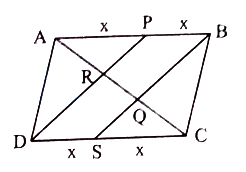
$ABCD$ એક સમાંતરબાજુ ચતુષ્કોણ છે,$P$ એ $AB$ નું મધ્યબિંદુ છે. જો $R$ એ $AC$ અને $DP$ નું છેદબિંદુ હોય,તો $R$ એ $AC$ નું કયા ગુણોત્તરમાં અંતઃવિભાજન કરે છે?
A
$3: 1$
B
$2: 1$
C
$1: 2$
D
$2: 3$
Solution
(C) $\triangle ABP$ અને $\triangle CDP$ માં,$AB \parallel DC$ અને $AB = DC$ છે. $P$ એ $AB$ નું મધ્યબિંદુ હોવાથી,$AP = PB = \frac{1}{2} AB = \frac{1}{2} DC$ થાય.
$\triangle APR$ અને $\triangle CPD$ ને ધ્યાનમાં લો:
$\angle PAR = \angle PCD$ (યુગ્મકોણ,કારણ કે $AB \parallel DC$)
$\angle APR = \angle CPD$ (અભિકોણ)
તેથી,$AA$ સમરૂપતાની શરત મુજબ $\triangle APR \sim \triangle CPD$ થાય.
તેથી,અનુરૂપ બાજુઓનો ગુણોત્તર સમાન હોય:
$\frac{AR}{CR} = \frac{AP}{CD} = \frac{\frac{1}{2} AB}{AB} = \frac{1}{2}$.
આમ,$R$ એ $AC$ નું $1: 2$ ગુણોત્તરમાં વિભાજન કરે છે.
$\triangle APR$ અને $\triangle CPD$ ને ધ્યાનમાં લો:
$\angle PAR = \angle PCD$ (યુગ્મકોણ,કારણ કે $AB \parallel DC$)
$\angle APR = \angle CPD$ (અભિકોણ)
તેથી,$AA$ સમરૂપતાની શરત મુજબ $\triangle APR \sim \triangle CPD$ થાય.
તેથી,અનુરૂપ બાજુઓનો ગુણોત્તર સમાન હોય:
$\frac{AR}{CR} = \frac{AP}{CD} = \frac{\frac{1}{2} AB}{AB} = \frac{1}{2}$.
આમ,$R$ એ $AC$ નું $1: 2$ ગુણોત્તરમાં વિભાજન કરે છે.
0 likesView Solution
208
MathematicsEasyMCQMHT CET · 2020
જો $P(3,2,6), Q(1,4,5)$ અને $R(3,5,3)$ એ $\Delta PQR$ ના શિરોબિંદુઓ હોય,તો $m \angle PQR$ કેટલો થાય ($^{\circ}$ માં)?
A
$90$
B
$50$
C
$70$
D
$30$
Solution
(A) આપેલ ત્રિકોણના શિરોબિંદુઓ $P(3,2,6), Q(1,4,5)$ અને $R(3,5,3)$ છે.
સૌ પ્રથમ,આપણે સદિશો $\vec{QP}$ અને $\vec{QR}$ ના દિશા ગુણોત્તર શોધીએ.
સદિશ $\vec{QP} = (3-1, 2-4, 6-5) = (2, -2, 1)$.
સદિશ $\vec{QR} = (3-1, 5-4, 3-5) = (2, 1, -2)$.
હવે,આપણે $\vec{QP}$ અને $\vec{QR}$ નો અદિશ ગુણાકાર (dot product) શોધીએ:
$\vec{QP} \cdot \vec{QR} = (2)(2) + (-2)(1) + (1)(-2) = 4 - 2 - 2 = 0$.
અદિશ ગુણાકાર $0$ હોવાથી,સદિશો $\vec{QP}$ અને $\vec{QR}$ એકબીજાને લંબ છે.
તેથી,$m \angle PQR = 90^{\circ}$ થાય.
સૌ પ્રથમ,આપણે સદિશો $\vec{QP}$ અને $\vec{QR}$ ના દિશા ગુણોત્તર શોધીએ.
સદિશ $\vec{QP} = (3-1, 2-4, 6-5) = (2, -2, 1)$.
સદિશ $\vec{QR} = (3-1, 5-4, 3-5) = (2, 1, -2)$.
હવે,આપણે $\vec{QP}$ અને $\vec{QR}$ નો અદિશ ગુણાકાર (dot product) શોધીએ:
$\vec{QP} \cdot \vec{QR} = (2)(2) + (-2)(1) + (1)(-2) = 4 - 2 - 2 = 0$.
અદિશ ગુણાકાર $0$ હોવાથી,સદિશો $\vec{QP}$ અને $\vec{QR}$ એકબીજાને લંબ છે.
તેથી,$m \angle PQR = 90^{\circ}$ થાય.
0 likesView Solution
209
MathematicsEasyMCQMHT CET · 2020
$\cot ^{-1} x$ નું $\log (1+x^{2})$ ની સાપેક્ષમાં વિકલન શું થાય?
A
$-2 x$
B
$-\frac{1}{2 x}$
C
$\frac{1}{2 x}$
D
$2 x$
Solution
(B) ધારો કે $u = \cot ^{-1} x$ અને $v = \log (1+x^{2})$.
પ્રથમ,આપણે $x$ ની સાપેક્ષમાં $u$ નું વિકલન શોધીએ:
$\frac{du}{dx} = -\frac{1}{1+x^{2}}$.
ત્યારબાદ,સાંકળના નિયમનો ઉપયોગ કરીને $x$ ની સાપેક્ષમાં $v$ નું વિકલન શોધીએ:
$\frac{dv}{dx} = \frac{1}{1+x^{2}} \times \frac{d}{dx}(1+x^{2}) = \frac{2x}{1+x^{2}}$.
હવે,$v$ ની સાપેક્ષમાં $u$ નું વિકલન શોધીએ:
$\frac{du}{dv} = \frac{du/dx}{dv/dx} = \frac{-1/(1+x^{2})}{2x/(1+x^{2})} = -\frac{1}{2x}$.
આમ,સાચો વિકલ્પ $B$ છે.
પ્રથમ,આપણે $x$ ની સાપેક્ષમાં $u$ નું વિકલન શોધીએ:
$\frac{du}{dx} = -\frac{1}{1+x^{2}}$.
ત્યારબાદ,સાંકળના નિયમનો ઉપયોગ કરીને $x$ ની સાપેક્ષમાં $v$ નું વિકલન શોધીએ:
$\frac{dv}{dx} = \frac{1}{1+x^{2}} \times \frac{d}{dx}(1+x^{2}) = \frac{2x}{1+x^{2}}$.
હવે,$v$ ની સાપેક્ષમાં $u$ નું વિકલન શોધીએ:
$\frac{du}{dv} = \frac{du/dx}{dv/dx} = \frac{-1/(1+x^{2})}{2x/(1+x^{2})} = -\frac{1}{2x}$.
આમ,સાચો વિકલ્પ $B$ છે.
0 likesView Solution
210
MathematicsDifficultMCQMHT CET · 2020
જો $y = \tan^{-1} \left[ \frac{x - \sqrt{1 - x^2}}{x + \sqrt{1 - x^2}} \right]$ હોય,તો $\frac{dy}{dx} = $
A
$\frac{-1}{\sqrt{1 - x^2}}$
B
$\frac{-x}{\sqrt{1 - x^2}}$
C
$\frac{1}{\sqrt{1 - x^2}}$
D
$\frac{x}{\sqrt{1 - x^2}}$
Solution
(C) આપેલ છે $y = \tan^{-1} \left[ \frac{x - \sqrt{1 - x^2}}{x + \sqrt{1 - x^2}} \right]$.
ધારો કે $x = \cos \theta$,તેથી $\theta = \cos^{-1} x$.
$x = \cos \theta$ ને પદાવલિમાં મૂકતા:
$y = \tan^{-1} \left[ \frac{\cos \theta - \sin \theta}{\cos \theta + \sin \theta} \right]$
અંશ અને છેદને $\cos \theta$ વડે ભાગતા:
$y = \tan^{-1} \left[ \frac{1 - \tan \theta}{1 + \tan \theta} \right]$
સૂત્ર $\tan(\frac{\pi}{4} - \theta) = \frac{1 - \tan \theta}{1 + \tan \theta}$ નો ઉપયોગ કરતા:
$y = \tan^{-1} \left[ \tan \left( \frac{\pi}{4} - \theta \right) \right] = \frac{\pi}{4} - \theta$
$\theta = \cos^{-1} x$ પાછું મૂકતા:
$y = \frac{\pi}{4} - \cos^{-1} x$
$x$ ની સાપેક્ષ વિકલન કરતા:
$\frac{dy}{dx} = \frac{d}{dx} \left( \frac{\pi}{4} - \cos^{-1} x \right) = 0 - \left( -\frac{1}{\sqrt{1 - x^2}} \right) = \frac{1}{\sqrt{1 - x^2}}$.
ધારો કે $x = \cos \theta$,તેથી $\theta = \cos^{-1} x$.
$x = \cos \theta$ ને પદાવલિમાં મૂકતા:
$y = \tan^{-1} \left[ \frac{\cos \theta - \sin \theta}{\cos \theta + \sin \theta} \right]$
અંશ અને છેદને $\cos \theta$ વડે ભાગતા:
$y = \tan^{-1} \left[ \frac{1 - \tan \theta}{1 + \tan \theta} \right]$
સૂત્ર $\tan(\frac{\pi}{4} - \theta) = \frac{1 - \tan \theta}{1 + \tan \theta}$ નો ઉપયોગ કરતા:
$y = \tan^{-1} \left[ \tan \left( \frac{\pi}{4} - \theta \right) \right] = \frac{\pi}{4} - \theta$
$\theta = \cos^{-1} x$ પાછું મૂકતા:
$y = \frac{\pi}{4} - \cos^{-1} x$
$x$ ની સાપેક્ષ વિકલન કરતા:
$\frac{dy}{dx} = \frac{d}{dx} \left( \frac{\pi}{4} - \cos^{-1} x \right) = 0 - \left( -\frac{1}{\sqrt{1 - x^2}} \right) = \frac{1}{\sqrt{1 - x^2}}$.
0 likesView Solution
211
MathematicsMediumMCQMHT CET · 2020
જો $f(x) = \sin^{-1}\left(\sqrt{\frac{1-x}{2}}\right)$ હોય,તો $f^{\prime}(x) = $
A
$\frac{-1}{2 \sqrt{1-x^{2}}}$
B
$\frac{1}{\sqrt{1-x^{2}}}$
C
$\frac{-1}{2 \sqrt{1+x^{2}}}$
D
$\frac{1}{2 \sqrt{1+x^{2}}}$
Solution
(A) આપેલ છે કે $f(x) = \sin^{-1}\left(\sqrt{\frac{1-x}{2}}\right)$.
રીત $1$: સાંકળના નિયમનો ઉપયોગ કરીને:
$f^{\prime}(x) = \frac{d}{dx}\left[\sin^{-1}\left(\sqrt{\frac{1-x}{2}}\right)\right] = \frac{1}{\sqrt{1-\left(\sqrt{\frac{1-x}{2}}\right)^{2}}} \cdot \frac{d}{dx}\left(\sqrt{\frac{1-x}{2}}\right)$
$= \frac{1}{\sqrt{1-\frac{1-x}{2}}} \cdot \frac{1}{2\sqrt{\frac{1-x}{2}}} \cdot \left(-\frac{1}{2}\right)$
$= \frac{1}{\sqrt{\frac{1+x}{2}}} \cdot \frac{1}{\sqrt{2}\sqrt{1-x}} \cdot \left(-\frac{1}{2}\right)$
$= \frac{\sqrt{2}}{\sqrt{1+x}} \cdot \frac{1}{\sqrt{2}\sqrt{1-x}} \cdot \left(-\frac{1}{2}\right) = \frac{-1}{2\sqrt{1-x^{2}}}$.
રીત $2$: આદેશની રીતનો ઉપયોગ કરીને:
ધારો કે $x = \cos \theta$,તો $\sqrt{\frac{1-x}{2}} = \sqrt{\frac{1-\cos \theta}{2}} = \sqrt{\frac{2\sin^{2}(\theta/2)}{2}} = \sin(\theta/2)$.
તેથી,$f(x) = \sin^{-1}(\sin(\theta/2)) = \theta/2 = \frac{1}{2}\cos^{-1}(x)$.
$x$ ની સાપેક્ષમાં વિકલન કરતા:
$f^{\prime}(x) = \frac{1}{2} \cdot \left(-\frac{1}{\sqrt{1-x^{2}}}\right) = \frac{-1}{2\sqrt{1-x^{2}}}$.
આમ,સાચો વિકલ્પ $A$ છે.
રીત $1$: સાંકળના નિયમનો ઉપયોગ કરીને:
$f^{\prime}(x) = \frac{d}{dx}\left[\sin^{-1}\left(\sqrt{\frac{1-x}{2}}\right)\right] = \frac{1}{\sqrt{1-\left(\sqrt{\frac{1-x}{2}}\right)^{2}}} \cdot \frac{d}{dx}\left(\sqrt{\frac{1-x}{2}}\right)$
$= \frac{1}{\sqrt{1-\frac{1-x}{2}}} \cdot \frac{1}{2\sqrt{\frac{1-x}{2}}} \cdot \left(-\frac{1}{2}\right)$
$= \frac{1}{\sqrt{\frac{1+x}{2}}} \cdot \frac{1}{\sqrt{2}\sqrt{1-x}} \cdot \left(-\frac{1}{2}\right)$
$= \frac{\sqrt{2}}{\sqrt{1+x}} \cdot \frac{1}{\sqrt{2}\sqrt{1-x}} \cdot \left(-\frac{1}{2}\right) = \frac{-1}{2\sqrt{1-x^{2}}}$.
રીત $2$: આદેશની રીતનો ઉપયોગ કરીને:
ધારો કે $x = \cos \theta$,તો $\sqrt{\frac{1-x}{2}} = \sqrt{\frac{1-\cos \theta}{2}} = \sqrt{\frac{2\sin^{2}(\theta/2)}{2}} = \sin(\theta/2)$.
તેથી,$f(x) = \sin^{-1}(\sin(\theta/2)) = \theta/2 = \frac{1}{2}\cos^{-1}(x)$.
$x$ ની સાપેક્ષમાં વિકલન કરતા:
$f^{\prime}(x) = \frac{1}{2} \cdot \left(-\frac{1}{\sqrt{1-x^{2}}}\right) = \frac{-1}{2\sqrt{1-x^{2}}}$.
આમ,સાચો વિકલ્પ $A$ છે.
0 likesView Solution
212
MathematicsDifficultMCQMHT CET · 2020
જો $y = \sin^{-1} \left[ \frac{\sqrt{1+x} + \sqrt{1-x}}{2} \right]$ હોય,તો $\frac{dy}{dx} = $
A
$-\frac{1}{2\sqrt{1-x^2}}$
B
$-\frac{1}{2\sqrt{x^2-1}}$
C
$\frac{1}{4\sqrt{1-x^2}}$
D
$-\frac{1}{2\sqrt{1+x}}$
Solution
(A) ધારો કે $x = \cos(2\theta)$,તેથી $2\theta = \cos^{-1}(x)$ અને $\theta = \frac{1}{2} \cos^{-1}(x)$.
તેથી $\sqrt{1+x} = \sqrt{1+\cos(2\theta)} = \sqrt{2\cos^2(\theta)} = \sqrt{2} \cos(\theta)$ અને $\sqrt{1-x} = \sqrt{1-\cos(2\theta)} = \sqrt{2\sin^2(\theta)} = \sqrt{2} \sin(\theta)$.
આ કિંમતો $y$ ના સમીકરણમાં મૂકતા:
$y = \sin^{-1} \left[ \frac{\sqrt{2}\cos(\theta) + \sqrt{2}\sin(\theta)}{2} \right] = \sin^{-1} \left[ \frac{1}{\sqrt{2}} \cos(\theta) + \frac{1}{\sqrt{2}} \sin(\theta) \right]$.
નિત્યસમ $\sin(\frac{\pi}{4} + \theta) = \sin(\frac{\pi}{4}) \cos(\theta) + \cos(\frac{\pi}{4}) \sin(\theta) = \frac{1}{\sqrt{2}} \cos(\theta) + \frac{1}{\sqrt{2}} \sin(\theta)$ નો ઉપયોગ કરતા.
તેથી,$y = \sin^{-1} [\sin(\frac{\pi}{4} + \theta)] = \frac{\pi}{4} + \theta = \frac{\pi}{4} + \frac{1}{2} \cos^{-1}(x)$.
$x$ ની સાપેક્ષમાં વિકલન કરતા:
$\frac{dy}{dx} = 0 + \frac{1}{2} \left( -\frac{1}{\sqrt{1-x^2}} \right) = -\frac{1}{2\sqrt{1-x^2}}$.
તેથી $\sqrt{1+x} = \sqrt{1+\cos(2\theta)} = \sqrt{2\cos^2(\theta)} = \sqrt{2} \cos(\theta)$ અને $\sqrt{1-x} = \sqrt{1-\cos(2\theta)} = \sqrt{2\sin^2(\theta)} = \sqrt{2} \sin(\theta)$.
આ કિંમતો $y$ ના સમીકરણમાં મૂકતા:
$y = \sin^{-1} \left[ \frac{\sqrt{2}\cos(\theta) + \sqrt{2}\sin(\theta)}{2} \right] = \sin^{-1} \left[ \frac{1}{\sqrt{2}} \cos(\theta) + \frac{1}{\sqrt{2}} \sin(\theta) \right]$.
નિત્યસમ $\sin(\frac{\pi}{4} + \theta) = \sin(\frac{\pi}{4}) \cos(\theta) + \cos(\frac{\pi}{4}) \sin(\theta) = \frac{1}{\sqrt{2}} \cos(\theta) + \frac{1}{\sqrt{2}} \sin(\theta)$ નો ઉપયોગ કરતા.
તેથી,$y = \sin^{-1} [\sin(\frac{\pi}{4} + \theta)] = \frac{\pi}{4} + \theta = \frac{\pi}{4} + \frac{1}{2} \cos^{-1}(x)$.
$x$ ની સાપેક્ષમાં વિકલન કરતા:
$\frac{dy}{dx} = 0 + \frac{1}{2} \left( -\frac{1}{\sqrt{1-x^2}} \right) = -\frac{1}{2\sqrt{1-x^2}}$.
0 likesView Solution
213
MathematicsMediumMCQMHT CET · 2020
જો $y = \sec(\tan^{-1} x)$ હોય,તો $x = 1$ આગળ $\frac{dy}{dx}$ ની કિંમત શોધો.
A
$\sqrt{2}$
B
$\frac{1}{2}$
C
$1$
D
$\frac{1}{\sqrt{2}}$
Solution
(D) આપેલ છે કે $y = \sec(\tan^{-1} x)$.
ચેઈન રૂલનો ઉપયોગ કરતા,$\frac{dy}{dx} = \sec(\tan^{-1} x) \tan(\tan^{-1} x) \cdot \frac{d}{dx}(\tan^{-1} x)$.
આપણે જાણીએ છીએ કે $\frac{d}{dx}(\tan^{-1} x) = \frac{1}{1+x^2}$,તેથી $\frac{dy}{dx} = \sec(\tan^{-1} x) \cdot x \cdot \frac{1}{1+x^2}$.
$x = 1$ આગળ,$\tan^{-1}(1) = \frac{\pi}{4}$.
તેથી,$\frac{dy}{dx} = \sec(\frac{\pi}{4}) \cdot 1 \cdot \frac{1}{1+1^2} = \sqrt{2} \cdot \frac{1}{2} = \frac{1}{\sqrt{2}}$.
વૈકલ્પિક રીતે,ધારો કે $\tan^{-1} x = \theta$,તો $\tan \theta = x$. $\sec^2 \theta = 1 + \tan^2 \theta$ હોવાથી,$\sec \theta = \sqrt{1+x^2}$.
આમ,$y = \sqrt{1+x^2}$.
તેથી $\frac{dy}{dx} = \frac{1}{2\sqrt{1+x^2}} \cdot 2x = \frac{x}{\sqrt{1+x^2}}$.
$x = 1$ આગળ,$\frac{dy}{dx} = \frac{1}{\sqrt{1+1^2}} = \frac{1}{\sqrt{2}}$.
ચેઈન રૂલનો ઉપયોગ કરતા,$\frac{dy}{dx} = \sec(\tan^{-1} x) \tan(\tan^{-1} x) \cdot \frac{d}{dx}(\tan^{-1} x)$.
આપણે જાણીએ છીએ કે $\frac{d}{dx}(\tan^{-1} x) = \frac{1}{1+x^2}$,તેથી $\frac{dy}{dx} = \sec(\tan^{-1} x) \cdot x \cdot \frac{1}{1+x^2}$.
$x = 1$ આગળ,$\tan^{-1}(1) = \frac{\pi}{4}$.
તેથી,$\frac{dy}{dx} = \sec(\frac{\pi}{4}) \cdot 1 \cdot \frac{1}{1+1^2} = \sqrt{2} \cdot \frac{1}{2} = \frac{1}{\sqrt{2}}$.
વૈકલ્પિક રીતે,ધારો કે $\tan^{-1} x = \theta$,તો $\tan \theta = x$. $\sec^2 \theta = 1 + \tan^2 \theta$ હોવાથી,$\sec \theta = \sqrt{1+x^2}$.
આમ,$y = \sqrt{1+x^2}$.
તેથી $\frac{dy}{dx} = \frac{1}{2\sqrt{1+x^2}} \cdot 2x = \frac{x}{\sqrt{1+x^2}}$.
$x = 1$ આગળ,$\frac{dy}{dx} = \frac{1}{\sqrt{1+1^2}} = \frac{1}{\sqrt{2}}$.
0 likesView Solution
214
MathematicsMediumMCQMHT CET · 2020
જો $x^{2}+y^{2}=1$ હોય,તો $\frac{d^{2} x}{d y^{2}}=$
A
$x^{3}$
B
$y^{3}$
C
$-\frac{1}{x^{3}}$
D
$-y^{3}$
Solution
(C) આપેલ સમીકરણ $x^{2}+y^{2}=1$ છે.
બંને બાજુ $y$ ની સાપેક્ષમાં વિકલન કરતા:
$2x \frac{dx}{dy} + 2y = 0$
$2x \frac{dx}{dy} = -2y$
$\frac{dx}{dy} = -\frac{y}{x}$
હવે,ભાગાકારના નિયમનો ઉપયોગ કરીને $\frac{dx}{dy}$ નું $y$ ની સાપેક્ષમાં વિકલન કરતા:
$\frac{d^{2}x}{dy^{2}} = \frac{d}{dy} \left( -\frac{y}{x} \right) = -\left[ \frac{x(1) - y(\frac{dx}{dy})}{x^{2}} \right]$
$\frac{dx}{dy} = -\frac{y}{x}$ ની કિંમત મૂકતા:
$\frac{d^{2}x}{dy^{2}} = -\left[ \frac{x - y(-\frac{y}{x})}{x^{2}} \right]$
$\frac{d^{2}x}{dy^{2}} = -\left[ \frac{x + \frac{y^{2}}{x}}{x^{2}} \right] = -\left[ \frac{x^{2} + y^{2}}{x^{3}} \right]$
કારણ કે $x^{2}+y^{2}=1$,તેથી:
$\frac{d^{2}x}{dy^{2}} = -\frac{1}{x^{3}}$
બંને બાજુ $y$ ની સાપેક્ષમાં વિકલન કરતા:
$2x \frac{dx}{dy} + 2y = 0$
$2x \frac{dx}{dy} = -2y$
$\frac{dx}{dy} = -\frac{y}{x}$
હવે,ભાગાકારના નિયમનો ઉપયોગ કરીને $\frac{dx}{dy}$ નું $y$ ની સાપેક્ષમાં વિકલન કરતા:
$\frac{d^{2}x}{dy^{2}} = \frac{d}{dy} \left( -\frac{y}{x} \right) = -\left[ \frac{x(1) - y(\frac{dx}{dy})}{x^{2}} \right]$
$\frac{dx}{dy} = -\frac{y}{x}$ ની કિંમત મૂકતા:
$\frac{d^{2}x}{dy^{2}} = -\left[ \frac{x - y(-\frac{y}{x})}{x^{2}} \right]$
$\frac{d^{2}x}{dy^{2}} = -\left[ \frac{x + \frac{y^{2}}{x}}{x^{2}} \right] = -\left[ \frac{x^{2} + y^{2}}{x^{3}} \right]$
કારણ કે $x^{2}+y^{2}=1$,તેથી:
$\frac{d^{2}x}{dy^{2}} = -\frac{1}{x^{3}}$
0 likesView Solution
215
MathematicsEasyMCQMHT CET · 2020
જો $y=e^{4x} \cos 5x$ હોય,તો $x=0$ આગળ $\frac{d^{2}y}{dx^{2}}$ ની કિંમત શોધો.
A
$-9$
B
$9$
C
$8$
D
$-8$
Solution
(A) આપેલ છે કે $y = e^{4x} \cos 5x$.
ગુણાકારનો નિયમ વાપરતા,$\frac{dy}{dx} = e^{4x}(-5 \sin 5x) + \cos 5x(4e^{4x}) = e^{4x}(4 \cos 5x - 5 \sin 5x)$.
હવે,$x$ ની સાપેક્ષમાં ફરીથી વિકલન કરતા:
$\frac{d^{2}y}{dx^{2}} = e^{4x}(-20 \sin 5x - 25 \cos 5x) + (4 \cos 5x - 5 \sin 5x)(4e^{4x})$.
$x=0$ આગળ કિંમત મુકતા:
$\left(\frac{d^{2}y}{dx^{2}}\right)_{x=0} = e^{0}(-20 \sin 0 - 25 \cos 0) + (4 \cos 0 - 5 \sin 0)(4e^{0})$.
કારણ કે $\sin 0 = 0$ અને $\cos 0 = 1$:
$\left(\frac{d^{2}y}{dx^{2}}\right)_{x=0} = 1(0 - 25) + (4 - 0)(4) = -25 + 16 = -9$.
ગુણાકારનો નિયમ વાપરતા,$\frac{dy}{dx} = e^{4x}(-5 \sin 5x) + \cos 5x(4e^{4x}) = e^{4x}(4 \cos 5x - 5 \sin 5x)$.
હવે,$x$ ની સાપેક્ષમાં ફરીથી વિકલન કરતા:
$\frac{d^{2}y}{dx^{2}} = e^{4x}(-20 \sin 5x - 25 \cos 5x) + (4 \cos 5x - 5 \sin 5x)(4e^{4x})$.
$x=0$ આગળ કિંમત મુકતા:
$\left(\frac{d^{2}y}{dx^{2}}\right)_{x=0} = e^{0}(-20 \sin 0 - 25 \cos 0) + (4 \cos 0 - 5 \sin 0)(4e^{0})$.
કારણ કે $\sin 0 = 0$ અને $\cos 0 = 1$:
$\left(\frac{d^{2}y}{dx^{2}}\right)_{x=0} = 1(0 - 25) + (4 - 0)(4) = -25 + 16 = -9$.
0 likesView Solution
216
MathematicsMediumMCQMHT CET · 2020
જો $\sqrt{x+y}+\sqrt{y-x}=5$ હોય,તો $\left(\frac{d^{2} y}{d x^{2}}\right)=$
A
$\frac{2}{25}$
B
$\frac{2}{5}$
C
$\frac{-2}{5}$
D
$\frac{-2}{25}$
Solution
(A) આપેલ છે કે $\sqrt{x+y}+\sqrt{y-x}=5$.
પદોને ફરીથી ગોઠવતા,આપણને મળે $\sqrt{y-x}=5-\sqrt{x+y}$.
બંને બાજુ વર્ગ કરતા,$y-x = 25 + (x+y) - 10\sqrt{x+y}$.
સાદું રૂપ આપતા,$-2x = 25 - 10\sqrt{x+y}$,જે આપે છે $10\sqrt{x+y} = 2x + 25$.
$x$ ની સાપેક્ષમાં બંને બાજુ વિકલન કરતા:
$10 \times \frac{1}{2\sqrt{x+y}} \times (1 + \frac{dy}{dx}) = 2$.
$\frac{5}{\sqrt{x+y}} \times (1 + \frac{dy}{dx}) = 2$.
$1 + \frac{dy}{dx} = \frac{2\sqrt{x+y}}{5}$.
$x$ ની સાપેક્ષમાં ફરીથી વિકલન કરતા:
$\frac{d^2y}{dx^2} = \frac{2}{5} \times \frac{1}{2\sqrt{x+y}} \times (1 + \frac{dy}{dx})$.
અગાઉના સ્ટેપમાંથી $(1 + \frac{dy}{dx})$ ની કિંમત મૂકતા:
$\frac{d^2y}{dx^2} = \frac{1}{5\sqrt{x+y}} \times \frac{2\sqrt{x+y}}{5} = \frac{2}{25}$.
પદોને ફરીથી ગોઠવતા,આપણને મળે $\sqrt{y-x}=5-\sqrt{x+y}$.
બંને બાજુ વર્ગ કરતા,$y-x = 25 + (x+y) - 10\sqrt{x+y}$.
સાદું રૂપ આપતા,$-2x = 25 - 10\sqrt{x+y}$,જે આપે છે $10\sqrt{x+y} = 2x + 25$.
$x$ ની સાપેક્ષમાં બંને બાજુ વિકલન કરતા:
$10 \times \frac{1}{2\sqrt{x+y}} \times (1 + \frac{dy}{dx}) = 2$.
$\frac{5}{\sqrt{x+y}} \times (1 + \frac{dy}{dx}) = 2$.
$1 + \frac{dy}{dx} = \frac{2\sqrt{x+y}}{5}$.
$x$ ની સાપેક્ષમાં ફરીથી વિકલન કરતા:
$\frac{d^2y}{dx^2} = \frac{2}{5} \times \frac{1}{2\sqrt{x+y}} \times (1 + \frac{dy}{dx})$.
અગાઉના સ્ટેપમાંથી $(1 + \frac{dy}{dx})$ ની કિંમત મૂકતા:
$\frac{d^2y}{dx^2} = \frac{1}{5\sqrt{x+y}} \times \frac{2\sqrt{x+y}}{5} = \frac{2}{25}$.
0 likesView Solution
217
MathematicsMediumMCQMHT CET · 2020
જો $x=a(1-\cos \theta)$ અને $y=a(\theta-\sin \theta)$ હોય,તો $\frac{d^{2} y}{d x^{2}}=$
A
$\frac{\cos ^{2}(\theta/2)}{2a \operatorname{cosec} \theta}$
B
$\frac{\operatorname{cosec}^{4}(\theta/2)}{4a}$
C
$\frac{1}{4a \sin^{4}(\theta/2)}$
D
$\frac{\operatorname{cosec}^{3}(\theta/2)}{4a}$
Solution
(B) આપેલ છે કે $x = a(1 - \cos \theta)$ અને $y = a(\theta - \sin \theta)$.
પ્રથમ,$\frac{dx}{d\theta} = a \sin \theta$ અને $\frac{dy}{d\theta} = a(1 - \cos \theta)$ મેળવો.
ત્યારબાદ,$\frac{dy}{dx} = \frac{dy/d\theta}{dx/d\theta} = \frac{a(1 - \cos \theta)}{a \sin \theta} = \frac{2 \sin^{2}(\theta/2)}{2 \sin(\theta/2) \cos(\theta/2)} = \tan(\theta/2)$.
હવે,$x$ ની સાપેક્ષમાં વિકલન કરતા: $\frac{d^{2}y}{dx^{2}} = \frac{d}{dx}(\tan(\theta/2)) = \sec^{2}(\theta/2) \cdot \frac{1}{2} \cdot \frac{d\theta}{dx}$.
કારણ કે $\frac{dx}{d\theta} = a \sin \theta$,તેથી $\frac{d\theta}{dx} = \frac{1}{a \sin \theta}$.
આ કિંમત મૂકતા: $\frac{d^{2}y}{dx^{2}} = \frac{1}{2} \sec^{2}(\theta/2) \cdot \frac{1}{a(2 \sin(\theta/2) \cos(\theta/2))} = \frac{1}{4a \sin(\theta/2) \cos^{3}(\theta/2)} = \frac{\sec^{4}(\theta/2)}{4a}$.
પ્રથમ,$\frac{dx}{d\theta} = a \sin \theta$ અને $\frac{dy}{d\theta} = a(1 - \cos \theta)$ મેળવો.
ત્યારબાદ,$\frac{dy}{dx} = \frac{dy/d\theta}{dx/d\theta} = \frac{a(1 - \cos \theta)}{a \sin \theta} = \frac{2 \sin^{2}(\theta/2)}{2 \sin(\theta/2) \cos(\theta/2)} = \tan(\theta/2)$.
હવે,$x$ ની સાપેક્ષમાં વિકલન કરતા: $\frac{d^{2}y}{dx^{2}} = \frac{d}{dx}(\tan(\theta/2)) = \sec^{2}(\theta/2) \cdot \frac{1}{2} \cdot \frac{d\theta}{dx}$.
કારણ કે $\frac{dx}{d\theta} = a \sin \theta$,તેથી $\frac{d\theta}{dx} = \frac{1}{a \sin \theta}$.
આ કિંમત મૂકતા: $\frac{d^{2}y}{dx^{2}} = \frac{1}{2} \sec^{2}(\theta/2) \cdot \frac{1}{a(2 \sin(\theta/2) \cos(\theta/2))} = \frac{1}{4a \sin(\theta/2) \cos^{3}(\theta/2)} = \frac{\sec^{4}(\theta/2)}{4a}$.
0 likesView Solution
218
MathematicsEasyMCQMHT CET · 2020
જો $y = \cos^{2}\left(\frac{5x}{2}\right) - \sin^{2}\left(\frac{5x}{2}\right)$ હોય,તો $\frac{d^{2}y}{dx^{2}} = $
A
$-5 \sqrt{1-y^{2}}$
B
$5 \sqrt{1-y^{2}}$
C
$25 y$
D
$-25 y$
Solution
(D) અમને વિધેય $y = \cos^{2}\left(\frac{5x}{2}\right) - \sin^{2}\left(\frac{5x}{2}\right)$ આપેલ છે.
ત્રિકોણમિતીય નિત્યસમ $\cos(2\theta) = \cos^{2}(\theta) - \sin^{2}(\theta)$ નો ઉપયોગ કરીને,આપણે $\theta = \frac{5x}{2}$ લઈને પદને સરળ બનાવી શકીએ છીએ.
આમ,$y = \cos\left(2 \times \frac{5x}{2}\right) = \cos(5x)$.
હવે,આપણે $x$ ની સાપેક્ષમાં પ્રથમ વિકલન મેળવીએ:
$\frac{dy}{dx} = \frac{d}{dx}(\cos(5x)) = -5 \sin(5x)$.
ત્યારબાદ,આપણે $x$ ની સાપેક્ષમાં દ્વિતીય વિકલન મેળવીએ:
$\frac{d^{2}y}{dx^{2}} = \frac{d}{dx}(-5 \sin(5x)) = -5 \times 5 \cos(5x) = -25 \cos(5x)$.
કારણ કે $y = \cos(5x)$,આપણે પદમાં $y$ ની કિંમત મૂકતા:
$\frac{d^{2}y}{dx^{2}} = -25y$.
ત્રિકોણમિતીય નિત્યસમ $\cos(2\theta) = \cos^{2}(\theta) - \sin^{2}(\theta)$ નો ઉપયોગ કરીને,આપણે $\theta = \frac{5x}{2}$ લઈને પદને સરળ બનાવી શકીએ છીએ.
આમ,$y = \cos\left(2 \times \frac{5x}{2}\right) = \cos(5x)$.
હવે,આપણે $x$ ની સાપેક્ષમાં પ્રથમ વિકલન મેળવીએ:
$\frac{dy}{dx} = \frac{d}{dx}(\cos(5x)) = -5 \sin(5x)$.
ત્યારબાદ,આપણે $x$ ની સાપેક્ષમાં દ્વિતીય વિકલન મેળવીએ:
$\frac{d^{2}y}{dx^{2}} = \frac{d}{dx}(-5 \sin(5x)) = -5 \times 5 \cos(5x) = -25 \cos(5x)$.
કારણ કે $y = \cos(5x)$,આપણે પદમાં $y$ ની કિંમત મૂકતા:
$\frac{d^{2}y}{dx^{2}} = -25y$.
0 likesView Solution
219
MathematicsEasyMCQMHT CET · 2020
જો $f(x)=e^{x} g(x)$,$g(0)=4$,અને $g^{\prime}(0)=2$ હોય,તો $f^{\prime}(0)=$
A
$4$
B
$6$
C
$1$
D
$2$
Solution
(B) આપેલ વિધેય $f(x) = e^{x} g(x)$ છે.
વિકલન માટે ગુણાકારનો નિયમ વાપરતા,$f^{\prime}(x) = \frac{d}{dx}(e^{x}) \cdot g(x) + e^{x} \cdot \frac{d}{dx}(g(x))$.
આથી $f^{\prime}(x) = e^{x} g(x) + e^{x} g^{\prime}(x) = e^{x} (g(x) + g^{\prime}(x))$ મળે છે.
હવે,વિકલિતના પદમાં $x = 0$ મૂકતા:
$f^{\prime}(0) = e^{0} (g(0) + g^{\prime}(0))$.
આપેલ છે કે $g(0) = 4$ અને $g^{\prime}(0) = 2$,અને આપણે જાણીએ છીએ કે $e^{0} = 1$:
$f^{\prime}(0) = 1 \cdot (4 + 2) = 6$.
વિકલન માટે ગુણાકારનો નિયમ વાપરતા,$f^{\prime}(x) = \frac{d}{dx}(e^{x}) \cdot g(x) + e^{x} \cdot \frac{d}{dx}(g(x))$.
આથી $f^{\prime}(x) = e^{x} g(x) + e^{x} g^{\prime}(x) = e^{x} (g(x) + g^{\prime}(x))$ મળે છે.
હવે,વિકલિતના પદમાં $x = 0$ મૂકતા:
$f^{\prime}(0) = e^{0} (g(0) + g^{\prime}(0))$.
આપેલ છે કે $g(0) = 4$ અને $g^{\prime}(0) = 2$,અને આપણે જાણીએ છીએ કે $e^{0} = 1$:
$f^{\prime}(0) = 1 \cdot (4 + 2) = 6$.
0 likesView Solution
220
MathematicsMediumMCQMHT CET · 2020
જો $2 f(x) = f^{\prime}(x)$ અને $f(0) = 3$ હોય,તો $f(2)$ ની કિંમત શોધો.
A
$3 e^{2}$
B
$2 e^{3}$
C
$4 e^{3}$
D
$3 e^{4}$
Solution
(D) આપેલ વિકલ સમીકરણ $f^{\prime}(x) = 2 f(x)$ છે.
પદોને ગોઠવતા,આપણને $\frac{f^{\prime}(x)}{f(x)} = 2$ મળે છે.
બંને બાજુ $x$ ની સાપેક્ષમાં સંકલન કરતા:
$\int \frac{f^{\prime}(x)}{f(x)} dx = \int 2 dx$
$\ln |f(x)| = 2x + C$.
પ્રારંભિક શરત $f(0) = 3$ નો ઉપયોગ કરતા:
$\ln |f(0)| = 2(0) + C \Rightarrow \ln 3 = C$.
$C$ ની કિંમત સમીકરણમાં મૂકતા:
$\ln |f(x)| = 2x + \ln 3$.
$f(2)$ શોધવા માટે,$x = 2$ મૂકતા:
$\ln |f(2)| = 2(2) + \ln 3 = 4 + \ln 3$.
બંને બાજુ ઘાતાંકીય લેતા:
$f(2) = e^{4 + \ln 3} = e^{4} \cdot e^{\ln 3} = 3 e^{4}$.
પદોને ગોઠવતા,આપણને $\frac{f^{\prime}(x)}{f(x)} = 2$ મળે છે.
બંને બાજુ $x$ ની સાપેક્ષમાં સંકલન કરતા:
$\int \frac{f^{\prime}(x)}{f(x)} dx = \int 2 dx$
$\ln |f(x)| = 2x + C$.
પ્રારંભિક શરત $f(0) = 3$ નો ઉપયોગ કરતા:
$\ln |f(0)| = 2(0) + C \Rightarrow \ln 3 = C$.
$C$ ની કિંમત સમીકરણમાં મૂકતા:
$\ln |f(x)| = 2x + \ln 3$.
$f(2)$ શોધવા માટે,$x = 2$ મૂકતા:
$\ln |f(2)| = 2(2) + \ln 3 = 4 + \ln 3$.
બંને બાજુ ઘાતાંકીય લેતા:
$f(2) = e^{4 + \ln 3} = e^{4} \cdot e^{\ln 3} = 3 e^{4}$.
0 likesView Solution
221
MathematicsEasyMCQMHT CET · 2020
વાસ્તવિક મૂલ્ય ધરાવતા વિધેય $f(x) = \frac{x+2}{9-x^{2}}$ નો પ્રદેશ શોધો.
A
$-3 \leq x \leq 3$
B
$R - \{-3, 3\}$
C
$R$
D
$R - \{3\}$
Solution
(B) વિધેય $f(x) = \frac{x+2}{9-x^{2}}$ એ છેદ શૂન્ય ન હોય ત્યાં સુધી વ્યાખ્યાયિત છે.
છેદને શૂન્ય લેતા: $9 - x^{2} = 0$.
આથી $x^{2} = 9$,એટલે કે $x = \pm 3$.
આમ,વિધેય $x = 3$ અને $x = -3$ આગળ વ્યાખ્યાયિત નથી.
તેથી,વિધેયનો પ્રદેશ $\{-3, 3\}$ સિવાયની તમામ વાસ્તવિક સંખ્યાઓનો ગણ છે,જે $R - \{-3, 3\}$ તરીકે લખાય છે.
છેદને શૂન્ય લેતા: $9 - x^{2} = 0$.
આથી $x^{2} = 9$,એટલે કે $x = \pm 3$.
આમ,વિધેય $x = 3$ અને $x = -3$ આગળ વ્યાખ્યાયિત નથી.
તેથી,વિધેયનો પ્રદેશ $\{-3, 3\}$ સિવાયની તમામ વાસ્તવિક સંખ્યાઓનો ગણ છે,જે $R - \{-3, 3\}$ તરીકે લખાય છે.
0 likesView Solution
222
MathematicsEasyMCQMHT CET · 2020
વિધેય $f(y) = \frac{\cos^{-1}(y-5)}{\sqrt{25-y^2}}$ નો પ્રદેશ શોધો.
A
$(4, 6]$
B
$(-5, 5)$
C
$[4, 5)$
D
$(4, 5]$
Solution
(C) વિધેય $f(y) = \frac{\cos^{-1}(y-5)}{\sqrt{25-y^2}}$ વ્યાખ્યાયિત થવા માટે,નીચેની શરતો સંતોષાવી જોઈએ:
$1$. $\cos^{-1}$ નો આર્ગ્યુમેન્ટ $[-1, 1]$ અંતરાલમાં હોવો જોઈએ,તેથી $-1 \leq y-5 \leq 1$. બંને બાજુ $5$ ઉમેરતા $4 \leq y \leq 6$ મળે છે.
$2$. છેદ શૂન્ય ન હોવો જોઈએ અને વર્ગમૂળની અંદરની કિંમત ધન હોવી જોઈએ,તેથી $25-y^2 > 0$,જેનો અર્થ છે $y^2 < 25$,અથવા $-5 < y < 5$.
$3$. બંને શરતોનો છેદ લેતા: $y \in [4, 6]$ અને $y \in (-5, 5)$.
$4$. છેદ $4 \leq y < 5$ મળે છે,જેને અંતરાલ $[4, 5)$ તરીકે લખી શકાય.
તેથી,પ્રદેશ $[4, 5)$ છે.
$1$. $\cos^{-1}$ નો આર્ગ્યુમેન્ટ $[-1, 1]$ અંતરાલમાં હોવો જોઈએ,તેથી $-1 \leq y-5 \leq 1$. બંને બાજુ $5$ ઉમેરતા $4 \leq y \leq 6$ મળે છે.
$2$. છેદ શૂન્ય ન હોવો જોઈએ અને વર્ગમૂળની અંદરની કિંમત ધન હોવી જોઈએ,તેથી $25-y^2 > 0$,જેનો અર્થ છે $y^2 < 25$,અથવા $-5 < y < 5$.
$3$. બંને શરતોનો છેદ લેતા: $y \in [4, 6]$ અને $y \in (-5, 5)$.
$4$. છેદ $4 \leq y < 5$ મળે છે,જેને અંતરાલ $[4, 5)$ તરીકે લખી શકાય.
તેથી,પ્રદેશ $[4, 5)$ છે.
0 likesView Solution
223
MathematicsEasyMCQMHT CET · 2020
મહત્તમ પૂર્ણાંક વિધેય $f(x) = [x]$ માટે,જ્યાં $x \in R$,નીચેનામાંથી કયું સત્ય છે?
A
$[x] + 1 = x$
B
$[x] + 1 \leq x$
C
$[x] + 1 > x$
D
$[x] + 1 < x$
Solution
(C) મહત્તમ પૂર્ણાંક વિધેય $[x]$ ને $x$ થી નાની અથવા તેના જેટલી મહત્તમ પૂર્ણાંક સંખ્યા તરીકે વ્યાખ્યાયિત કરવામાં આવે છે.
જો $x$ પૂર્ણાંક હોય,તો $[x] = x$,જે સૂચવે છે કે $[x] + 1 = x + 1 > x$.
જો $x$ પૂર્ણાંક ન હોય,તો $[x] < x < [x] + 1$.
બંને કિસ્સાઓમાં,આપણને $[x] + 1 > x$ મળે છે.
જો $x$ પૂર્ણાંક હોય,તો $[x] = x$,જે સૂચવે છે કે $[x] + 1 = x + 1 > x$.
જો $x$ પૂર્ણાંક ન હોય,તો $[x] < x < [x] + 1$.
બંને કિસ્સાઓમાં,આપણને $[x] + 1 > x$ મળે છે.
0 likesView Solution
224
MathematicsEasyMCQMHT CET · 2020
વિધેય $f(x) = \sqrt{x}$ નો પ્રદેશ શું છે?
A
$R - \{0\}$
B
$R^{+}$
C
$R^{+} \cup \{0\}$
D
$R$
Solution
(C) $f(x) = \sqrt{x}$ વાસ્તવિક સંખ્યાઓના ગણમાં વ્યાખ્યાયિત થાય તે માટે,વર્ગમૂળની અંદરની અભિવ્યક્તિ અ-ઋણ હોવી જોઈએ.
તેથી,$x \geq 0$.
પ્રદેશ એ તમામ અ-ઋણ વાસ્તવિક સંખ્યાઓનો ગણ છે,જેને $[0, \infty)$ અથવા $R^{+} \cup \{0\}$ તરીકે દર્શાવવામાં આવે છે.
આમ,સાચો વિકલ્પ $C$ છે.
તેથી,$x \geq 0$.
પ્રદેશ એ તમામ અ-ઋણ વાસ્તવિક સંખ્યાઓનો ગણ છે,જેને $[0, \infty)$ અથવા $R^{+} \cup \{0\}$ તરીકે દર્શાવવામાં આવે છે.
આમ,સાચો વિકલ્પ $C$ છે.
0 likesView Solution
225
MathematicsEasyMCQMHT CET · 2020
$R = \{(x, y) : y = x + \frac{6}{x}, x, y \in N \text{ અને } x < 6\}$ દ્વારા આપવામાં આવેલા સંબંધ $R$ નો પ્રદેશ અને વિસ્તાર શોધો.
A
પ્રદેશ $= \{2, 3\}$,વિસ્તાર $= \{5\}$.
B
પ્રદેશ $= \{1, 2\}$,વિસ્તાર $= \{5, 7\}$.
C
પ્રદેશ $= \{1, 2, 3, 4, 5\}$,વિસ્તાર $= \{7, 5, 5.5, 6.2\}$.
D
પ્રદેશ $= \{1, 2, 3\}$,વિસ્તાર $= \{5, 7\}$.
Solution
(D) આપેલ સંબંધ $R = \{(x, y) : y = x + \frac{6}{x}, x, y \in N, x < 6\}$ છે.
દરેક $x \in \{1, 2, 3, 4, 5\}$ માટે તપાસીએ કે $y$ પ્રાકૃતિક સંખ્યા $(N)$ છે કે નહીં:
$x = 1$ માટે,$y = 1 + \frac{6}{1} = 7 \in N$.
$x = 2$ માટે,$y = 2 + \frac{6}{2} = 2 + 3 = 5 \in N$.
$x = 3$ માટે,$y = 3 + \frac{6}{3} = 3 + 2 = 5 \in N$.
$x = 4$ માટે,$y = 4 + \frac{6}{4} = 4 + 1.5 = 5.5 \notin N$.
$x = 5$ માટે,$y = 5 + \frac{6}{5} = 5 + 1.2 = 6.2 \notin N$.
આમ,સંબંધ $R = \{(1, 7), (2, 5), (3, 5)\}$ છે.
પ્રદેશ એ પ્રથમ ઘટકોનો ગણ છે: $\{1, 2, 3\}$.
વિસ્તાર એ બીજા ઘટકોનો ગણ છે: $\{5, 7\}$.
દરેક $x \in \{1, 2, 3, 4, 5\}$ માટે તપાસીએ કે $y$ પ્રાકૃતિક સંખ્યા $(N)$ છે કે નહીં:
$x = 1$ માટે,$y = 1 + \frac{6}{1} = 7 \in N$.
$x = 2$ માટે,$y = 2 + \frac{6}{2} = 2 + 3 = 5 \in N$.
$x = 3$ માટે,$y = 3 + \frac{6}{3} = 3 + 2 = 5 \in N$.
$x = 4$ માટે,$y = 4 + \frac{6}{4} = 4 + 1.5 = 5.5 \notin N$.
$x = 5$ માટે,$y = 5 + \frac{6}{5} = 5 + 1.2 = 6.2 \notin N$.
આમ,સંબંધ $R = \{(1, 7), (2, 5), (3, 5)\}$ છે.
પ્રદેશ એ પ્રથમ ઘટકોનો ગણ છે: $\{1, 2, 3\}$.
વિસ્તાર એ બીજા ઘટકોનો ગણ છે: $\{5, 7\}$.
0 likesView Solution
226
MathematicsEasyMCQMHT CET · 2020
જો $f(x) = \frac{2x+3}{3x-2}$,$x \neq \frac{2}{3}$ હોય,તો વિધેય $f \circ f$ એ
A
યુગ્મ વિધેય છે
B
તદેવ વિધેય છે
C
અચળ વિધેય છે
D
ઘાતાંકીય વિધેય છે
Solution
(B) આપેલ છે કે $f(x) = \frac{2x+3}{3x-2}$.
આપણે $(f \circ f)(x) = f(f(x))$ શોધવાનું છે.
$f(f(x)) = \frac{2 \left( \frac{2x+3}{3x-2} \right) + 3}{3 \left( \frac{2x+3}{3x-2} \right) - 2}$
અંશ અને છેદને $(3x-2)$ વડે ગુણતા:
$= \frac{2(2x+3) + 3(3x-2)}{3(2x+3) - 2(3x-2)}$
$= \frac{4x + 6 + 9x - 6}{6x + 9 - 6x + 4}$
$= \frac{13x}{13} = x$
તેથી,$(f \circ f)(x) = x$ હોવાથી,આ વિધેય તદેવ વિધેય છે.
આપણે $(f \circ f)(x) = f(f(x))$ શોધવાનું છે.
$f(f(x)) = \frac{2 \left( \frac{2x+3}{3x-2} \right) + 3}{3 \left( \frac{2x+3}{3x-2} \right) - 2}$
અંશ અને છેદને $(3x-2)$ વડે ગુણતા:
$= \frac{2(2x+3) + 3(3x-2)}{3(2x+3) - 2(3x-2)}$
$= \frac{4x + 6 + 9x - 6}{6x + 9 - 6x + 4}$
$= \frac{13x}{13} = x$
તેથી,$(f \circ f)(x) = x$ હોવાથી,આ વિધેય તદેવ વિધેય છે.
0 likesView Solution
227
MathematicsEasyMCQMHT CET · 2020
વિધેય $f(x) = \frac{x-3}{5-x}, x \neq 5$ નો વિસ્તાર શોધો.
A
$R - \{1\}$
B
$R - \{-5\}$
C
$R - \{5\}$
D
$R - \{-1\}$
Solution
(D) ધારો કે $y = \frac{x-3}{5-x}$.
$y(5-x) = x-3$
$5y - xy = x - 3$
$5y + 3 = x + xy$
$5y + 3 = x(1+y)$
$x = \frac{5y+3}{1+y}$.
$x$ વ્યાખ્યાયિત થાય તે માટે છેદ $1+y \neq 0$ હોવો જોઈએ,જેનો અર્થ છે કે $y \neq -1$.
આમ,વિધેયનો વિસ્તાર $R - \{-1\}$ છે.
તેથી,સાચો વિકલ્પ $D$ છે.
$y(5-x) = x-3$
$5y - xy = x - 3$
$5y + 3 = x + xy$
$5y + 3 = x(1+y)$
$x = \frac{5y+3}{1+y}$.
$x$ વ્યાખ્યાયિત થાય તે માટે છેદ $1+y \neq 0$ હોવો જોઈએ,જેનો અર્થ છે કે $y \neq -1$.
આમ,વિધેયનો વિસ્તાર $R - \{-1\}$ છે.
તેથી,સાચો વિકલ્પ $D$ છે.
0 likesView Solution
228
MathematicsEasyMCQMHT CET · 2020
જો $f: R \rightarrow R$,જ્યાં $f(x)=\frac{e^{x}+e^{-x}}{e^{x}-e^{-x}}$,હોય તો $f$ એ
A
એક આવર્ત વિધેય છે
B
એક યુગ્મ વિધેય છે
C
એક અયુગ્મ વિધેય છે
D
એક યુગ્મ કે અયુગ્મ વિધેય નથી
Solution
(C) આપેલ વિધેય $f(x) = \frac{e^{x} + e^{-x}}{e^{x} - e^{-x}}$ છે.
વિધેય યુગ્મ છે કે અયુગ્મ તે ચકાસવા માટે,આપણે $f(-x)$ ની કિંમત શોધીએ:
$f(-x) = \frac{e^{-x} + e^{-(-x)}}{e^{-x} - e^{-(-x)}}$
$f(-x) = \frac{e^{-x} + e^{x}}{e^{-x} - e^{x}}$
છેદમાંથી ઋણ ચિહ્ન સામાન્ય કાઢતા:
$f(-x) = \frac{e^{x} + e^{-x}}{-(e^{x} - e^{-x})}$
$f(-x) = -\left( \frac{e^{x} + e^{-x}}{e^{x} - e^{-x}} \right)$
$f(-x) = -f(x)$
આમ,$f(-x) = -f(x)$ હોવાથી,વિધેય $f(x)$ એ અયુગ્મ વિધેય છે.
વિધેય યુગ્મ છે કે અયુગ્મ તે ચકાસવા માટે,આપણે $f(-x)$ ની કિંમત શોધીએ:
$f(-x) = \frac{e^{-x} + e^{-(-x)}}{e^{-x} - e^{-(-x)}}$
$f(-x) = \frac{e^{-x} + e^{x}}{e^{-x} - e^{x}}$
છેદમાંથી ઋણ ચિહ્ન સામાન્ય કાઢતા:
$f(-x) = \frac{e^{x} + e^{-x}}{-(e^{x} - e^{-x})}$
$f(-x) = -\left( \frac{e^{x} + e^{-x}}{e^{x} - e^{-x}} \right)$
$f(-x) = -f(x)$
આમ,$f(-x) = -f(x)$ હોવાથી,વિધેય $f(x)$ એ અયુગ્મ વિધેય છે.
0 likesView Solution
229
MathematicsEasyMCQMHT CET · 2020
જો $f(x) = \frac{2x+3}{3x-2}$,$x \neq \frac{2}{3}$ હોય,તો $(f \circ f)(x)$ શું છે?
A
એક યુગ્મ વિધેય
B
બધા $x \in R$ માટે વ્યાખ્યાયિત નથી
C
એક અચળ વિધેય
D
એક અયુગ્મ વિધેય
Solution
(D) આપેલ છે કે $f(x) = \frac{2x+3}{3x-2}$.
આપણે $(f \circ f)(x) = f(f(x))$ શોધવાનું છે.
$(f \circ f)(x) = f\left(\frac{2x+3}{3x-2}\right) = \frac{2\left(\frac{2x+3}{3x-2}\right) + 3}{3\left(\frac{2x+3}{3x-2}\right) - 2}$.
અંશ અને છેદને $(3x-2)$ વડે ગુણતા:
$(f \circ f)(x) = \frac{2(2x+3) + 3(3x-2)}{3(2x+3) - 2(3x-2)}$.
$(f \circ f)(x) = \frac{4x + 6 + 9x - 6}{6x + 9 - 6x + 4} = \frac{13x}{13} = x$.
કારણ કે $(f \circ f)(x) = x$ અને $g(x) = x$ એ એક અયુગ્મ વિધેય છે,તેથી પરિણામ એક અયુગ્મ વિધેય છે.
આપણે $(f \circ f)(x) = f(f(x))$ શોધવાનું છે.
$(f \circ f)(x) = f\left(\frac{2x+3}{3x-2}\right) = \frac{2\left(\frac{2x+3}{3x-2}\right) + 3}{3\left(\frac{2x+3}{3x-2}\right) - 2}$.
અંશ અને છેદને $(3x-2)$ વડે ગુણતા:
$(f \circ f)(x) = \frac{2(2x+3) + 3(3x-2)}{3(2x+3) - 2(3x-2)}$.
$(f \circ f)(x) = \frac{4x + 6 + 9x - 6}{6x + 9 - 6x + 4} = \frac{13x}{13} = x$.
કારણ કે $(f \circ f)(x) = x$ અને $g(x) = x$ એ એક અયુગ્મ વિધેય છે,તેથી પરિણામ એક અયુગ્મ વિધેય છે.
0 likesView Solution
230
MathematicsEasyMCQMHT CET · 2020
જો $f(x) = \frac{4x+7}{7x-4}$ હોય,તો $f\{f[f(2)]\}$ ની કિંમત શોધો.
A
$\frac{3}{2}$
B
$\frac{2}{3}$
C
$\frac{35}{39}$
D
$\frac{39}{35}$
Solution
(A) આપેલ છે કે $f(x) = \frac{4x+7}{7x-4}$.
પ્રથમ,$f(2)$ ની ગણતરી કરો:
$f(2) = \frac{4(2)+7}{7(2)-4} = \frac{8+7}{14-4} = \frac{15}{10} = \frac{3}{2}$.
ત્યારબાદ,$f[f(2)] = f(\frac{3}{2})$ ની ગણતરી કરો:
$f(\frac{3}{2}) = \frac{4(\frac{3}{2})+7}{7(\frac{3}{2})-4} = \frac{6+7}{\frac{21}{2}-4} = \frac{13}{\frac{21-8}{2}} = \frac{13 \times 2}{13} = 2$.
છેલ્લે,$f\{f[f(2)]\} = f(2)$ ની ગણતરી કરો:
$f(2) = \frac{3}{2}$.
વૈકલ્પિક રીતે,નોંધો કે $f(f(x)) = x$,જેનો અર્થ છે કે $f(f(f(x))) = f(x)$.
આમ,$f(f(f(2))) = f(2) = \frac{3}{2}$.
પ્રથમ,$f(2)$ ની ગણતરી કરો:
$f(2) = \frac{4(2)+7}{7(2)-4} = \frac{8+7}{14-4} = \frac{15}{10} = \frac{3}{2}$.
ત્યારબાદ,$f[f(2)] = f(\frac{3}{2})$ ની ગણતરી કરો:
$f(\frac{3}{2}) = \frac{4(\frac{3}{2})+7}{7(\frac{3}{2})-4} = \frac{6+7}{\frac{21}{2}-4} = \frac{13}{\frac{21-8}{2}} = \frac{13 \times 2}{13} = 2$.
છેલ્લે,$f\{f[f(2)]\} = f(2)$ ની ગણતરી કરો:
$f(2) = \frac{3}{2}$.
વૈકલ્પિક રીતે,નોંધો કે $f(f(x)) = x$,જેનો અર્થ છે કે $f(f(f(x))) = f(x)$.
આમ,$f(f(f(2))) = f(2) = \frac{3}{2}$.
0 likesView Solution
231
MathematicsEasyMCQMHT CET · 2020
જો $f: R \rightarrow R$ અને $g: R \rightarrow R$ એ $f(x) = x^{2} - 3x + 4$ અને $g(x) = 2x + 1$ દ્વારા વ્યાખ્યાયિત હોય,તો $x$ ની કઈ કિંમત માટે $f(x) = (f \circ g)(x)$ થાય?
A
$1, \frac{-2}{3}$
B
$-1, \frac{2}{3}$
C
$1, \frac{2}{3}$
D
$-1, \frac{-2}{3}$
Solution
(B) $(f \circ g)(x) = f[g(x)] = f(2x + 1) = (2x + 1)^{2} - 3(2x + 1) + 4$
$= 4x^{2} + 4x + 1 - 6x - 3 + 4 = 4x^{2} - 2x + 2$
આપેલ છે કે $f(x) = (f \circ g)(x)$
$\therefore x^{2} - 3x + 4 = 4x^{2} - 2x + 2$
$3x^{2} + x - 2 = 0$
$3x^{2} + 3x - 2x - 2 = 0$
$3x(x + 1) - 2(x + 1) = 0$
$(x + 1)(3x - 2) = 0$
$\therefore x = -1, \frac{2}{3}$
$= 4x^{2} + 4x + 1 - 6x - 3 + 4 = 4x^{2} - 2x + 2$
આપેલ છે કે $f(x) = (f \circ g)(x)$
$\therefore x^{2} - 3x + 4 = 4x^{2} - 2x + 2$
$3x^{2} + x - 2 = 0$
$3x^{2} + 3x - 2x - 2 = 0$
$3x(x + 1) - 2(x + 1) = 0$
$(x + 1)(3x - 2) = 0$
$\therefore x = -1, \frac{2}{3}$
0 likesView Solution
232
MathematicsEasyMCQMHT CET · 2020
જો $f(x) = \frac{3x+4}{5x-7}, x \neq \frac{7}{5}$ અને $g(x) = \frac{7x+4}{5x-3}, x \neq \frac{3}{5}$ હોય,તો $(g \circ f)(3) = $
A
$-3$
B
$-\frac{1}{3}$
C
$3$
D
$\frac{1}{3}$
Solution
(C) આપેલ છે કે $f(x) = \frac{3x+4}{5x-7}$ અને $g(x) = \frac{7x+4}{5x-3}$.
આપણે $(g \circ f)(x) = g(f(x))$ શોધવાનું છે.
$g(f(x)) = \frac{7(f(x)) + 4}{5(f(x)) - 3}$
$f(x) = \frac{3x+4}{5x-7}$ મૂકતા:
$g(f(x)) = \frac{7(\frac{3x+4}{5x-7}) + 4}{5(\frac{3x+4}{5x-7}) - 3}$
અંશ અને છેદને $(5x-7)$ વડે ગુણતા:
$g(f(x)) = \frac{7(3x+4) + 4(5x-7)}{5(3x+4) - 3(5x-7)}$
$g(f(x)) = \frac{21x + 28 + 20x - 28}{15x + 20 - 15x + 21}$
$g(f(x)) = \frac{41x}{41} = x$
તેથી,$(g \circ f)(3) = 3$.
આપણે $(g \circ f)(x) = g(f(x))$ શોધવાનું છે.
$g(f(x)) = \frac{7(f(x)) + 4}{5(f(x)) - 3}$
$f(x) = \frac{3x+4}{5x-7}$ મૂકતા:
$g(f(x)) = \frac{7(\frac{3x+4}{5x-7}) + 4}{5(\frac{3x+4}{5x-7}) - 3}$
અંશ અને છેદને $(5x-7)$ વડે ગુણતા:
$g(f(x)) = \frac{7(3x+4) + 4(5x-7)}{5(3x+4) - 3(5x-7)}$
$g(f(x)) = \frac{21x + 28 + 20x - 28}{15x + 20 - 15x + 21}$
$g(f(x)) = \frac{41x}{41} = x$
તેથી,$(g \circ f)(3) = 3$.
0 likesView Solution
233
MathematicsEasyMCQMHT CET · 2020
જો $f(x)=2x^{2}+bx+c$,$f(0)=3$ અને $f(2)=1$ હોય,તો $(f \circ f)(1)=$
A
$0$
B
$2$
C
$1$
D
$3$
Solution
(D) આપેલ છે કે $f(x) = 2x^{2} + bx + c$.
કારણ કે $f(0) = 3$,તેથી $2(0)^{2} + b(0) + c = 3$,જે આપણને $c = 3$ આપે છે.
હવે,$f(x) = 2x^{2} + bx + 3$.
આપેલ છે કે $f(2) = 1$,તેથી $2(2)^{2} + b(2) + 3 = 1$.
$8 + 2b + 3 = 1 \Rightarrow 2b + 11 = 1 \Rightarrow 2b = -10 \Rightarrow b = -5$.
આમ,$f(x) = 2x^{2} - 5x + 3$.
પ્રથમ,$f(1) = 2(1)^{2} - 5(1) + 3 = 2 - 5 + 3 = 0$ શોધો.
હવે,$(f \circ f)(1) = f(f(1)) = f(0)$.
કારણ કે $f(0) = 3$,તેથી $(f \circ f)(1) = 3$ મળે છે.
કારણ કે $f(0) = 3$,તેથી $2(0)^{2} + b(0) + c = 3$,જે આપણને $c = 3$ આપે છે.
હવે,$f(x) = 2x^{2} + bx + 3$.
આપેલ છે કે $f(2) = 1$,તેથી $2(2)^{2} + b(2) + 3 = 1$.
$8 + 2b + 3 = 1 \Rightarrow 2b + 11 = 1 \Rightarrow 2b = -10 \Rightarrow b = -5$.
આમ,$f(x) = 2x^{2} - 5x + 3$.
પ્રથમ,$f(1) = 2(1)^{2} - 5(1) + 3 = 2 - 5 + 3 = 0$ શોધો.
હવે,$(f \circ f)(1) = f(f(1)) = f(0)$.
કારણ કે $f(0) = 3$,તેથી $(f \circ f)(1) = 3$ મળે છે.
0 likesView Solution
234
MathematicsEasyMCQMHT CET · 2020
જો $f: R \rightarrow R$ અને $g: R \rightarrow R$ એ બે વિધેયો $f(x)=2x-3$ અને $g(x)=x^{3}+5$ દ્વારા વ્યાખ્યાયિત હોય,તો $(fog)^{-1}(x) = $
A
$\left(\frac{2x+3}{2}\right)^{\frac{1}{2}}$
B
$\left(\frac{x-7}{2}\right)^{\frac{1}{3}}$
C
$\left(\frac{x-7}{2}\right)^{\frac{1}{2}}$
D
$\left(\frac{x+7}{2}\right)^{\frac{1}{3}}$
Solution
(B) આપેલ છે કે $f(x)=2x-3$ અને $g(x)=x^{3}+5$.
સૌ પ્રથમ,સંયોજિત વિધેય $(fog)(x)$ શોધો:
$(fog)(x) = f(g(x)) = f(x^{3}+5) = 2(x^{3}+5)-3 = 2x^{3}+10-3 = 2x^{3}+7$.
ધારો કે $y = (fog)(x) = 2x^{3}+7$.
વ્યસ્ત વિધેય શોધવા માટે,$y$ ના સ્વરૂપમાં $x$ ની કિંમત શોધો:
$y-7 = 2x^{3} \Rightarrow x^{3} = \frac{y-7}{2} \Rightarrow x = \left(\frac{y-7}{2}\right)^{\frac{1}{3}}$.
$y$ ને $x$ વડે બદલતા,આપણને $(fog)^{-1}(x) = \left(\frac{x-7}{2}\right)^{\frac{1}{3}}$ મળે છે.
સૌ પ્રથમ,સંયોજિત વિધેય $(fog)(x)$ શોધો:
$(fog)(x) = f(g(x)) = f(x^{3}+5) = 2(x^{3}+5)-3 = 2x^{3}+10-3 = 2x^{3}+7$.
ધારો કે $y = (fog)(x) = 2x^{3}+7$.
વ્યસ્ત વિધેય શોધવા માટે,$y$ ના સ્વરૂપમાં $x$ ની કિંમત શોધો:
$y-7 = 2x^{3} \Rightarrow x^{3} = \frac{y-7}{2} \Rightarrow x = \left(\frac{y-7}{2}\right)^{\frac{1}{3}}$.
$y$ ને $x$ વડે બદલતા,આપણને $(fog)^{-1}(x) = \left(\frac{x-7}{2}\right)^{\frac{1}{3}}$ મળે છે.
0 likesView Solution
235
MathematicsEasyMCQMHT CET · 2020
જો $f: R \rightarrow R$ એ $f(x)=7x+8$ દ્વારા આપવામાં આવેલ હોય અને $f^{-1}(12)=\frac{k}{7}$ હોય,તો $k$ ની કિંમત શોધો.
A
$7$
B
$1$
C
$4$
D
$8$
Solution
(C) આપેલ છે કે $f(x) = 7x + 8 = y$.
વ્યસ્ત વિધેય $f^{-1}(y)$ શોધવા માટે,આપણે $y$ ના સ્વરૂપમાં $x$ ની કિંમત મેળવીએ:
$7x = y - 8$
$x = \frac{y - 8}{7}$
આમ,$f^{-1}(y) = \frac{y - 8}{7}$,જેનો અર્થ છે કે $f^{-1}(x) = \frac{x - 8}{7}$.
આપેલ છે કે $f^{-1}(12) = \frac{k}{7}$,તેથી $x = 12$ ને વ્યસ્ત વિધેયમાં મૂકતા:
$f^{-1}(12) = \frac{12 - 8}{7} = \frac{4}{7}$.
$\frac{4}{7}$ ની સરખામણી $\frac{k}{7}$ સાથે કરતા,આપણને $k = 4$ મળે છે.
વ્યસ્ત વિધેય $f^{-1}(y)$ શોધવા માટે,આપણે $y$ ના સ્વરૂપમાં $x$ ની કિંમત મેળવીએ:
$7x = y - 8$
$x = \frac{y - 8}{7}$
આમ,$f^{-1}(y) = \frac{y - 8}{7}$,જેનો અર્થ છે કે $f^{-1}(x) = \frac{x - 8}{7}$.
આપેલ છે કે $f^{-1}(12) = \frac{k}{7}$,તેથી $x = 12$ ને વ્યસ્ત વિધેયમાં મૂકતા:
$f^{-1}(12) = \frac{12 - 8}{7} = \frac{4}{7}$.
$\frac{4}{7}$ ની સરખામણી $\frac{k}{7}$ સાથે કરતા,આપણને $k = 4$ મળે છે.
0 likesView Solution
236
MathematicsEasyMCQMHT CET · 2020
જો વિધેય $f: R \rightarrow R$ એ $f(x) = \frac{4x}{5} + 3$ દ્વારા વ્યાખ્યાયિત હોય,તો $f^{-1}(x) =$ શું થાય?
A
$\frac{5(x+3)}{4}$
B
$\frac{5(x-3)}{4}$
C
$\frac{4(x+3)}{5}$
D
$\frac{4(x-3)}{5}$
Solution
(B) પ્રતિવિધેય $f^{-1}(x)$ શોધવા માટે,આપણે $f(x) = y$ લઈએ.
$y = \frac{4x}{5} + 3$
બંને બાજુથી $3$ બાદ કરતા:
$y - 3 = \frac{4x}{5}$
બંને બાજુ $5$ વડે ગુણતા:
$5(y - 3) = 4x$
$4$ વડે ભાગતા:
$x = \frac{5(y - 3)}{4}$
અહીં $x = f^{-1}(y)$ હોવાથી,$f^{-1}(y) = \frac{5(y - 3)}{4}$ મળે.
$y$ ને $x$ વડે બદલતા,આપણને મળે:
$f^{-1}(x) = \frac{5(x - 3)}{4}$
આમ,સાચો વિકલ્પ $B$ છે.
$y = \frac{4x}{5} + 3$
બંને બાજુથી $3$ બાદ કરતા:
$y - 3 = \frac{4x}{5}$
બંને બાજુ $5$ વડે ગુણતા:
$5(y - 3) = 4x$
$4$ વડે ભાગતા:
$x = \frac{5(y - 3)}{4}$
અહીં $x = f^{-1}(y)$ હોવાથી,$f^{-1}(y) = \frac{5(y - 3)}{4}$ મળે.
$y$ ને $x$ વડે બદલતા,આપણને મળે:
$f^{-1}(x) = \frac{5(x - 3)}{4}$
આમ,સાચો વિકલ્પ $B$ છે.
0 likesView Solution
237
MathematicsEasyMCQMHT CET · 2020
જો $f(x) = \frac{3x+2}{5x-3}$,જ્યાં $x \in R - \{\frac{3}{5}\}$,હોય તો:
A
$f^{-1}(x) = f(x)$
B
$f^{-1}(x)$ અસ્તિત્વ ધરાવતું નથી.
C
$f[f(x)] = -x$
D
$f^{-1}(x) = -f(x)$
Solution
(A) ધારો કે $y = f(x) = \frac{3x+2}{5x-3}$.
તેથી $y(5x - 3) = 3x + 2$.
આનું વિસ્તરણ કરતા,આપણને $5xy - 3y = 3x + 2$ મળે છે.
$x$ માટે ઉકેલવા માટે પદોને ગોઠવતા,આપણને $5xy - 3x = 3y + 2$ મળે છે.
$x$ સામાન્ય લેતા,$x(5y - 3) = 3y + 2$ મળે છે.
આમ,$x = \frac{3y+2}{5y-3}$.
વ્યાખ્યા મુજબ,$f^{-1}(y) = x = \frac{3y+2}{5y-3}$.
$y$ ને $x$ વડે બદલતા,આપણને $f^{-1}(x) = \frac{3x+2}{5x-3}$ મળે છે.
તેથી $f^{-1}(x) = f(x)$,સાચો વિકલ્પ $A$ છે.
તેથી $y(5x - 3) = 3x + 2$.
આનું વિસ્તરણ કરતા,આપણને $5xy - 3y = 3x + 2$ મળે છે.
$x$ માટે ઉકેલવા માટે પદોને ગોઠવતા,આપણને $5xy - 3x = 3y + 2$ મળે છે.
$x$ સામાન્ય લેતા,$x(5y - 3) = 3y + 2$ મળે છે.
આમ,$x = \frac{3y+2}{5y-3}$.
વ્યાખ્યા મુજબ,$f^{-1}(y) = x = \frac{3y+2}{5y-3}$.
$y$ ને $x$ વડે બદલતા,આપણને $f^{-1}(x) = \frac{3x+2}{5x-3}$ મળે છે.
તેથી $f^{-1}(x) = f(x)$,સાચો વિકલ્પ $A$ છે.
0 likesView Solution
238
MathematicsEasyMCQMHT CET · 2020
જો $f(x) = [x]^{2} - 5[x] + 6 = 0$ હોય,જ્યાં $[x]$ એ મહત્તમ પૂર્ણાંક વિધેય દર્શાવે છે,તો $x \in$
A
$(2, 4]$
B
$[2, 4]$
C
$[2, 4)$
D
$(2, 4)$
Solution
(C) આપેલ સમીકરણ: $[x]^{2} - 5[x] + 6 = 0$.
ધારો કે $t = [x]$. તો સમીકરણ $t^{2} - 5t + 6 = 0$ બને છે.
દ્વિઘાત સમીકરણના અવયવ પાડતા: $(t - 3)(t - 2) = 0$.
આથી $t = 2$ અથવા $t = 3$ મળે છે.
તેથી,$[x] = 2$ અથવા $[x] = 3$.
મહત્તમ પૂર્ણાંક વિધેયની વ્યાખ્યા મુજબ:
જો $[x] = 2$ હોય,તો $x \in [2, 3)$.
જો $[x] = 3$ હોય,તો $x \in [3, 4)$.
આ અંતરાલોને જોડતા,આપણને $x \in [2, 3) \cup [3, 4) = [2, 4)$ મળે છે.
તેથી,સાચો વિકલ્પ $C$ છે.
ધારો કે $t = [x]$. તો સમીકરણ $t^{2} - 5t + 6 = 0$ બને છે.
દ્વિઘાત સમીકરણના અવયવ પાડતા: $(t - 3)(t - 2) = 0$.
આથી $t = 2$ અથવા $t = 3$ મળે છે.
તેથી,$[x] = 2$ અથવા $[x] = 3$.
મહત્તમ પૂર્ણાંક વિધેયની વ્યાખ્યા મુજબ:
જો $[x] = 2$ હોય,તો $x \in [2, 3)$.
જો $[x] = 3$ હોય,તો $x \in [3, 4)$.
આ અંતરાલોને જોડતા,આપણને $x \in [2, 3) \cup [3, 4) = [2, 4)$ મળે છે.
તેથી,સાચો વિકલ્પ $C$ છે.
0 likesView Solution
239
MathematicsEasyMCQMHT CET · 2020
જો $f(x) = x^{2} - 3x + 4$ અને $f(x) = f(2x + 1)$ હોય,તો $x =$
A
$-1, \frac{2}{3}$
B
$-1, \frac{3}{2}$
C
$1, \frac{3}{2}$
D
$1, \frac{2}{3}$
Solution
(A) આપેલ છે કે $f(x) = x^{2} - 3x + 4$.
સૌ પ્રથમ,આપણે $f(2x + 1)$ શોધીએ:
$f(2x + 1) = (2x + 1)^{2} - 3(2x + 1) + 4$
$= (4x^{2} + 4x + 1) - 6x - 3 + 4$
$= 4x^{2} - 2x + 2$.
$f(x) = f(2x + 1)$ હોવાથી,બંને પદાવલિઓને સરખાવતા:
$x^{2} - 3x + 4 = 4x^{2} - 2x + 2$
$3x^{2} + x - 2 = 0$
દ્વિઘાત સમીકરણના અવયવ પાડતા:
$3x^{2} + 3x - 2x - 2 = 0$
$3x(x + 1) - 2(x + 1) = 0$
$(x + 1)(3x - 2) = 0$
આમ,$x = -1$ અથવા $x = \frac{2}{3}$.
સૌ પ્રથમ,આપણે $f(2x + 1)$ શોધીએ:
$f(2x + 1) = (2x + 1)^{2} - 3(2x + 1) + 4$
$= (4x^{2} + 4x + 1) - 6x - 3 + 4$
$= 4x^{2} - 2x + 2$.
$f(x) = f(2x + 1)$ હોવાથી,બંને પદાવલિઓને સરખાવતા:
$x^{2} - 3x + 4 = 4x^{2} - 2x + 2$
$3x^{2} + x - 2 = 0$
દ્વિઘાત સમીકરણના અવયવ પાડતા:
$3x^{2} + 3x - 2x - 2 = 0$
$3x(x + 1) - 2(x + 1) = 0$
$(x + 1)(3x - 2) = 0$
આમ,$x = -1$ અથવા $x = \frac{2}{3}$.
0 likesView Solution
240
MathematicsEasyMCQMHT CET · 2020
$\int \frac{d x}{\sqrt{5+4 x-x^{2}}}=$
A
$\sin ^{-1}\left(\frac{x-2}{3}\right)+c$
B
$\log \left|(x-2)+\sqrt{5+4 x-x^{2}}\right|+c$
C
$\log \left|(x+2)+\sqrt{5+4 x-x^{2}}\right|+c$
D
$\sin ^{-1}\left(\frac{x+2}{3}\right)+c$
Solution
(A) સંકલન $I = \int \frac{dx}{\sqrt{5+4x-x^2}}$ ની ગણતરી કરવા માટે,આપણે વર્ગમૂળની અંદરની દ્વિઘાત પદાવલિ માટે પૂર્ણવર્ગની રીતનો ઉપયોગ કરીએ છીએ.
$5+4x-x^2 = -(x^2-4x-5) = -((x-2)^2 - 4 - 5) = -( (x-2)^2 - 9 ) = 9 - (x-2)^2$.
આ કિંમતને સંકલનમાં મૂકતા:
$I = \int \frac{dx}{\sqrt{3^2 - (x-2)^2}}$.
પ્રમાણિત સંકલન સૂત્ર $\int \frac{dx}{\sqrt{a^2 - x^2}} = \sin^{-1}(\frac{x}{a}) + c$ નો ઉપયોગ કરતા,આપણને મળે છે:
$I = \sin^{-1}\left(\frac{x-2}{3}\right) + c$.
$5+4x-x^2 = -(x^2-4x-5) = -((x-2)^2 - 4 - 5) = -( (x-2)^2 - 9 ) = 9 - (x-2)^2$.
આ કિંમતને સંકલનમાં મૂકતા:
$I = \int \frac{dx}{\sqrt{3^2 - (x-2)^2}}$.
પ્રમાણિત સંકલન સૂત્ર $\int \frac{dx}{\sqrt{a^2 - x^2}} = \sin^{-1}(\frac{x}{a}) + c$ નો ઉપયોગ કરતા,આપણને મળે છે:
$I = \sin^{-1}\left(\frac{x-2}{3}\right) + c$.
0 likesView Solution
241
MathematicsEasyMCQMHT CET · 2020
જો $f^{\prime}(x)=k(\cos x+\sin x)$ અને $f(0)=9, f\left(\frac{\pi}{2}\right)=15$ હોય,તો $f(x)=$
A
$3(\sin x-\cos x)+12$
B
$3(\sin x-\cos x)-12$
C
$3(\sin x+\cos x)+12$
D
$3(\cos x+\sin x)-12$
Solution
(A) આપેલ છે કે $f^{\prime}(x)=k(\cos x+\sin x)$.
બંને બાજુ $x$ ની સાપેક્ષમાં સંકલન કરતા:
$f(x) = \int k(\cos x + \sin x) dx = k(\sin x - \cos x) + C$.
શરત $f(0) = 9$ નો ઉપયોગ કરતા:
$f(0) = k(\sin 0 - \cos 0) + C = k(0 - 1) + C = -k + C = 9$ ...$(1)$.
શરત $f\left(\frac{\pi}{2}\right) = 15$ નો ઉપયોગ કરતા:
$f\left(\frac{\pi}{2}\right) = k\left(\sin \frac{\pi}{2} - \cos \frac{\pi}{2}\right) + C = k(1 - 0) + C = k + C = 15$ ...$(2)$.
સમીકરણ $(1)$ અને $(2)$ નો સરવાળો કરતા:
$(-k + C) + (k + C) = 9 + 15 \Rightarrow 2C = 24 \Rightarrow C = 12$.
$C = 12$ ને સમીકરણ $(2)$ માં મૂકતા:
$k + 12 = 15 \Rightarrow k = 3$.
આમ,$f(x) = 3(\sin x - \cos x) + 12$.
બંને બાજુ $x$ ની સાપેક્ષમાં સંકલન કરતા:
$f(x) = \int k(\cos x + \sin x) dx = k(\sin x - \cos x) + C$.
શરત $f(0) = 9$ નો ઉપયોગ કરતા:
$f(0) = k(\sin 0 - \cos 0) + C = k(0 - 1) + C = -k + C = 9$ ...$(1)$.
શરત $f\left(\frac{\pi}{2}\right) = 15$ નો ઉપયોગ કરતા:
$f\left(\frac{\pi}{2}\right) = k\left(\sin \frac{\pi}{2} - \cos \frac{\pi}{2}\right) + C = k(1 - 0) + C = k + C = 15$ ...$(2)$.
સમીકરણ $(1)$ અને $(2)$ નો સરવાળો કરતા:
$(-k + C) + (k + C) = 9 + 15 \Rightarrow 2C = 24 \Rightarrow C = 12$.
$C = 12$ ને સમીકરણ $(2)$ માં મૂકતા:
$k + 12 = 15 \Rightarrow k = 3$.
આમ,$f(x) = 3(\sin x - \cos x) + 12$.
0 likesView Solution
242
MathematicsMediumMCQMHT CET · 2020
$\int \frac{4 e^{x}+6 e^{-x}}{9 e^{x}-4 e^{-x}} d x=A x+B \log \left|9 e^{2 x}-4\right|+c$,હોય તો (જ્યાં $c$ એ સંકલનનો અચળાંક છે)
A
$A=\frac{3}{2}, B=\frac{35}{36}$
B
$A=\frac{1}{2}, B=\frac{35}{36}$
C
$A=\frac{-3}{2}, B=\frac{35}{36}$
D
$A=\frac{-3}{2}, B=\frac{36}{35}$
Solution
(C) અંશ અને છેદને $e^x$ વડે ગુણતા:
$I = \int \frac{4 e^{2x} + 6}{9 e^{2x} - 4} dx$
ધારો કે $4 e^{2x} + 6 = A(18 e^{2x}) + B(9 e^{2x} - 4)$
$e^{2x}$ ના સહગુણકો અને અચળ પદોની સરખામણી કરતા:
$18A + 9B = 4$ અને $-4B = 6$
$-4B = 6$ પરથી,આપણને $B = -\frac{3}{2}$ મળે છે
$18A + 9B = 4$ માં $B$ ની કિંમત મુકતા:
$18A + 9(-\frac{3}{2}) = 4 \Rightarrow 18A - \frac{27}{2} = 4 \Rightarrow 18A = \frac{35}{2} \Rightarrow A = \frac{35}{36}$
હવે,$I = \int \left[ \frac{\frac{35}{36}(18 e^{2x})}{9 e^{2x} - 4} - \frac{\frac{3}{2}(9 e^{2x} - 4)}{9 e^{2x} - 4} \right] dx$
$I = \frac{35}{36} \log |9 e^{2x} - 4| - \frac{3}{2} x + c$
$Ax + B \log |9 e^{2x} - 4| + c$ સાથે સરખાવતા,આપણને $A = -\frac{3}{2}$ અને $B = \frac{35}{36}$ મળે છે.
$I = \int \frac{4 e^{2x} + 6}{9 e^{2x} - 4} dx$
ધારો કે $4 e^{2x} + 6 = A(18 e^{2x}) + B(9 e^{2x} - 4)$
$e^{2x}$ ના સહગુણકો અને અચળ પદોની સરખામણી કરતા:
$18A + 9B = 4$ અને $-4B = 6$
$-4B = 6$ પરથી,આપણને $B = -\frac{3}{2}$ મળે છે
$18A + 9B = 4$ માં $B$ ની કિંમત મુકતા:
$18A + 9(-\frac{3}{2}) = 4 \Rightarrow 18A - \frac{27}{2} = 4 \Rightarrow 18A = \frac{35}{2} \Rightarrow A = \frac{35}{36}$
હવે,$I = \int \left[ \frac{\frac{35}{36}(18 e^{2x})}{9 e^{2x} - 4} - \frac{\frac{3}{2}(9 e^{2x} - 4)}{9 e^{2x} - 4} \right] dx$
$I = \frac{35}{36} \log |9 e^{2x} - 4| - \frac{3}{2} x + c$
$Ax + B \log |9 e^{2x} - 4| + c$ સાથે સરખાવતા,આપણને $A = -\frac{3}{2}$ અને $B = \frac{35}{36}$ મળે છે.
0 likesView Solution
243
MathematicsEasyMCQMHT CET · 2020
$\int \frac{dx}{\cos 2x + \sin^2 x} = $
A
$\sin x + c$
B
$\tan x + c$
C
$\sec^2 x + c$
D
$\cos x + c$
Solution
(B) આપણને સંકલન $I = \int \frac{dx}{\cos 2x + \sin^2 x}$ આપેલ છે.
ત્રિકોણમિતીય નિત્યસમ $\cos 2x = 1 - 2\sin^2 x$ નો ઉપયોગ કરીને,આપણે તેને છેદમાં મૂકીએ છીએ:
$I = \int \frac{dx}{1 - 2\sin^2 x + \sin^2 x}$
$I = \int \frac{dx}{1 - \sin^2 x}$
નિત્યસમ $1 - \sin^2 x = \cos^2 x$ નો ઉપયોગ કરતા,આપણને મળે છે:
$I = \int \frac{dx}{\cos^2 x}$
$I = \int \sec^2 x \, dx$
$\sec^2 x$ નું સંકલન $\tan x + c$ થાય છે.
તેથી,$I = \tan x + c$.
ત્રિકોણમિતીય નિત્યસમ $\cos 2x = 1 - 2\sin^2 x$ નો ઉપયોગ કરીને,આપણે તેને છેદમાં મૂકીએ છીએ:
$I = \int \frac{dx}{1 - 2\sin^2 x + \sin^2 x}$
$I = \int \frac{dx}{1 - \sin^2 x}$
નિત્યસમ $1 - \sin^2 x = \cos^2 x$ નો ઉપયોગ કરતા,આપણને મળે છે:
$I = \int \frac{dx}{\cos^2 x}$
$I = \int \sec^2 x \, dx$
$\sec^2 x$ નું સંકલન $\tan x + c$ થાય છે.
તેથી,$I = \tan x + c$.
0 likesView Solution
244
MathematicsEasyMCQMHT CET · 2020
$\int \frac{dx}{\cos 2x - \cos^2 x} = $
A
$-\cot x + c$
B
$\tan x + c$
C
$-\tan x + c$
D
$\cot x + c$
Solution
(D) આપેલ સંકલન $I = \int \frac{dx}{\cos 2x - \cos^2 x}$ છે.
ત્રિકોણમિતીય નિત્યસમ $\cos 2x = 2\cos^2 x - 1$ નો ઉપયોગ કરતા,છેદમાં કિંમત મૂકતા:
$I = \int \frac{dx}{(2\cos^2 x - 1) - \cos^2 x} = \int \frac{dx}{\cos^2 x - 1}$.
આપણે જાણીએ છીએ કે $\cos^2 x - 1 = - (1 - \cos^2 x) = -\sin^2 x$.
આ કિંમત સંકલનમાં મૂકતા:
$I = \int \frac{dx}{-\sin^2 x} = -\int \csc^2 x \, dx$.
કારણ કે $\cot x$ નું વિકલન $-\csc^2 x$ થાય છે,તેથી $-\csc^2 x$ નું સંકલન $\cot x + c$ થાય.
તેથી,$I = \cot x + c$.
ત્રિકોણમિતીય નિત્યસમ $\cos 2x = 2\cos^2 x - 1$ નો ઉપયોગ કરતા,છેદમાં કિંમત મૂકતા:
$I = \int \frac{dx}{(2\cos^2 x - 1) - \cos^2 x} = \int \frac{dx}{\cos^2 x - 1}$.
આપણે જાણીએ છીએ કે $\cos^2 x - 1 = - (1 - \cos^2 x) = -\sin^2 x$.
આ કિંમત સંકલનમાં મૂકતા:
$I = \int \frac{dx}{-\sin^2 x} = -\int \csc^2 x \, dx$.
કારણ કે $\cot x$ નું વિકલન $-\csc^2 x$ થાય છે,તેથી $-\csc^2 x$ નું સંકલન $\cot x + c$ થાય.
તેથી,$I = \cot x + c$.
0 likesView Solution
245
MathematicsEasyMCQMHT CET · 2020
જો $f^{\prime}(x)=k(\cos x-\sin x)$,$f^{\prime}(0)=3$,અને $f\left(\frac{\pi}{2}\right)=15$ હોય,તો $f(x)=$
A
$3(\sin x+\cos x)+12$
B
$3(\sin x+\cos x)-12$
C
$-3(\sin x+\cos x)-12$
D
$12(\sin x+\cos x)+3$
Solution
(A) આપેલ છે કે $f^{\prime}(x)=k(\cos x-\sin x)$.
વિકલનમાં $x=0$ મૂકતા: $f^{\prime}(0)=k(\cos 0-\sin 0)=k(1-0)=k$.
$f^{\prime}(0)=3$ હોવાથી,આપણને $k=3$ મળે છે.
હવે,$f(x)$ શોધવા માટે $f^{\prime}(x)$ નું સંકલન કરો:
$f(x)=\int 3(\cos x-\sin x) \, dx = 3(\sin x+\cos x)+C$.
$C$ શોધવા માટે શરત $f\left(\frac{\pi}{2}\right)=15$ નો ઉપયોગ કરો:
$f\left(\frac{\pi}{2}\right)=3(\sin \frac{\pi}{2}+\cos \frac{\pi}{2})+C = 3(1+0)+C = 3+C$.
$3+C=15$ લેતા,આપણને $C=12$ મળે છે.
તેથી,$f(x)=3(\sin x+\cos x)+12$.
વિકલનમાં $x=0$ મૂકતા: $f^{\prime}(0)=k(\cos 0-\sin 0)=k(1-0)=k$.
$f^{\prime}(0)=3$ હોવાથી,આપણને $k=3$ મળે છે.
હવે,$f(x)$ શોધવા માટે $f^{\prime}(x)$ નું સંકલન કરો:
$f(x)=\int 3(\cos x-\sin x) \, dx = 3(\sin x+\cos x)+C$.
$C$ શોધવા માટે શરત $f\left(\frac{\pi}{2}\right)=15$ નો ઉપયોગ કરો:
$f\left(\frac{\pi}{2}\right)=3(\sin \frac{\pi}{2}+\cos \frac{\pi}{2})+C = 3(1+0)+C = 3+C$.
$3+C=15$ લેતા,આપણને $C=12$ મળે છે.
તેથી,$f(x)=3(\sin x+\cos x)+12$.
0 likesView Solution
246
MathematicsMediumMCQMHT CET · 2020
$\int \frac{d x}{x^{2}+4 x+13} = $
A
$\frac{1}{3} \tan ^{-1}\left(\frac{x+2}{3}\right)+c$
B
$\frac{1}{6} \log \left(\frac{x-1}{x+5}\right)+c$
C
$\frac{1}{6} \tan ^{-1}\left(\frac{x+2}{3}\right)+c$
D
$3 \tan ^{-1}\left(\frac{x+2}{3}\right)+c$
Solution
(A) સંકલન $\int \frac{d x}{x^{2}+4 x+13}$ ની ગણતરી કરવા માટે,આપણે છેદમાં પૂર્ણવર્ગ બનાવીએ છીએ:
$x^{2}+4 x+13 = (x^{2}+4 x+4) + 9 = (x+2)^{2} + 3^{2}$.
હવે,સંકલન $\int \frac{d x}{(x+2)^{2} + 3^{2}}$ બને છે.
પ્રમાણિત સૂત્ર $\int \frac{d x}{x^{2}+a^{2}} = \frac{1}{a} \tan^{-1}\left(\frac{x}{a}\right) + c$ નો ઉપયોગ કરતા,જ્યાં $a=3$ અને ચલ $(x+2)$ છે:
$\int \frac{d x}{(x+2)^{2} + 3^{2}} = \frac{1}{3} \tan^{-1}\left(\frac{x+2}{3}\right) + c$.
આપેલા વિકલ્પો સાથે સરખાવતા,સાચો વિકલ્પ $A$ છે.
$x^{2}+4 x+13 = (x^{2}+4 x+4) + 9 = (x+2)^{2} + 3^{2}$.
હવે,સંકલન $\int \frac{d x}{(x+2)^{2} + 3^{2}}$ બને છે.
પ્રમાણિત સૂત્ર $\int \frac{d x}{x^{2}+a^{2}} = \frac{1}{a} \tan^{-1}\left(\frac{x}{a}\right) + c$ નો ઉપયોગ કરતા,જ્યાં $a=3$ અને ચલ $(x+2)$ છે:
$\int \frac{d x}{(x+2)^{2} + 3^{2}} = \frac{1}{3} \tan^{-1}\left(\frac{x+2}{3}\right) + c$.
આપેલા વિકલ્પો સાથે સરખાવતા,સાચો વિકલ્પ $A$ છે.
0 likesView Solution
247
MathematicsEasyMCQMHT CET · 2020
$\int \frac{d x}{\cos x \sqrt{\cos 2 x}} = $
A
$\sin ^{-1}(\tan x)+c$
B
$\frac{1}{2} \log \left|\tan \left(\frac{\pi}{4}+x\right)\right|+c$
C
$2 \log \left|\frac{1+\tan x}{1-\tan x}\right|+c$
D
$\frac{1}{2} \log \left|\frac{1-\tan x}{1+\tan x}\right|+c$
Solution
(A) ધારો કે $I = \int \frac{d x}{\cos x \sqrt{\cos 2 x}}$.
અંશ અને છેદને $\cos x$ વડે ભાગતા અથવા પદને ફરીથી લખતા:
$I = \int \frac{d x}{\cos x \sqrt{\cos^2 x - \sin^2 x}} = \int \frac{d x}{\cos x \cdot \cos x \sqrt{1 - \tan^2 x}} = \int \frac{\sec^2 x}{\sqrt{1 - \tan^2 x}} d x$.
$t = \tan x$ આદેશ લેતા,$dt = \sec^2 x d x$ મળે.
તેથી,$I = \int \frac{dt}{\sqrt{1 - t^2}} = \sin^{-1}(t) + c$.
$t = \tan x$ પાછું મૂકતા,આપણને $I = \sin^{-1}(\tan x) + c$ મળે છે.
અંશ અને છેદને $\cos x$ વડે ભાગતા અથવા પદને ફરીથી લખતા:
$I = \int \frac{d x}{\cos x \sqrt{\cos^2 x - \sin^2 x}} = \int \frac{d x}{\cos x \cdot \cos x \sqrt{1 - \tan^2 x}} = \int \frac{\sec^2 x}{\sqrt{1 - \tan^2 x}} d x$.
$t = \tan x$ આદેશ લેતા,$dt = \sec^2 x d x$ મળે.
તેથી,$I = \int \frac{dt}{\sqrt{1 - t^2}} = \sin^{-1}(t) + c$.
$t = \tan x$ પાછું મૂકતા,આપણને $I = \sin^{-1}(\tan x) + c$ મળે છે.
0 likesView Solution
248
MathematicsDifficultMCQMHT CET · 2020
$\int e^{\cos ^{-1} x} \left[ \frac{x-\sqrt{1-x^{2}}}{\sqrt{1-x^{2}}} \right] dx =$
A
$-e^{\sin ^{-1} x} + c$
B
$-x e^{\cos ^{-1} x} + c$
C
$-x e^{\sin ^{-1} x} + c$
D
$-e^{\cos ^{-1} x} + c$
Solution
(B) ધારો કે $\cos ^{-1} x = t$. તેથી $x = \cos t$ અને $dx = -\sin t \ dt$.
વધુમાં,$\frac{dx}{\sqrt{1-x^2}} = -dt$.
આ કિંમતો સંકલનમાં મૂકતા:
$I = \int e^t \left( \frac{\cos t}{\sin t} - 1 \right) (-\sin t \ dt) = \int e^t (\sin t - \cos t) dt$.
સૂત્ર $\int e^t (f(t) + f'(t)) dt = e^t f(t) + c$ નો ઉપયોગ કરતા,જ્યાં $f(t) = \sin t$ અને $f'(t) = \cos t$,આપણને મળે છે:
$I = -\int e^t (\cos t - \sin t) dt = -e^t \cos t + c$.
$t = \cos ^{-1} x$ પાછું મૂકતા:
$I = -x e^{\cos ^{-1} x} + c$.
વધુમાં,$\frac{dx}{\sqrt{1-x^2}} = -dt$.
આ કિંમતો સંકલનમાં મૂકતા:
$I = \int e^t \left( \frac{\cos t}{\sin t} - 1 \right) (-\sin t \ dt) = \int e^t (\sin t - \cos t) dt$.
સૂત્ર $\int e^t (f(t) + f'(t)) dt = e^t f(t) + c$ નો ઉપયોગ કરતા,જ્યાં $f(t) = \sin t$ અને $f'(t) = \cos t$,આપણને મળે છે:
$I = -\int e^t (\cos t - \sin t) dt = -e^t \cos t + c$.
$t = \cos ^{-1} x$ પાછું મૂકતા:
$I = -x e^{\cos ^{-1} x} + c$.
0 likesView Solution
249
MathematicsMediumMCQMHT CET · 2020
$\int \frac{5^{x}}{\sqrt{5^{-2x}-5^{2x}}} dx=$
A
$\sin ^{-1}\left(5^{2 x}\right)+c$
B
$\frac{\sin ^{-1}\left(5^{2 x}\right)}{\log 25}+c$
C
$\tan ^{-1}\left(5^{x}\right)+c$
D
$\tan ^{-1}\left(5^{2 x}\right) \cdot \log 25+c$
Solution
(B) ધારો કે $I = \int \frac{5^{x}}{\sqrt{5^{-2x}-5^{2x}}} dx$.
છેદને નીચે મુજબ લખી શકાય:
$\sqrt{5^{-2x}-5^{2x}} = \sqrt{\frac{1}{5^{2x}} - 5^{2x}} = \sqrt{\frac{1 - (5^{2x})^2}{5^{2x}}} = \frac{\sqrt{1 - (5^{2x})^2}}{5^x}$.
આ કિંમત સંકલનમાં મૂકતા:
$I = \int \frac{5^x}{\frac{\sqrt{1 - (5^{2x})^2}}{5^x}} dx = \int \frac{5^{2x}}{\sqrt{1 - (5^{2x})^2}} dx$.
ધારો કે $t = 5^{2x}$. તેથી $dt = 5^{2x} \cdot \ln(5) \cdot 2 dx = 2 \ln(5) \cdot 5^{2x} dx$.
તેથી,$5^{2x} dx = \frac{dt}{2 \ln(5)} = \frac{dt}{\ln(25)}$.
સંકલનમાં મૂકતા:
$I = \int \frac{1}{\sqrt{1 - t^2}} \cdot \frac{dt}{\ln(25)} = \frac{1}{\ln(25)} \int \frac{dt}{\sqrt{1 - t^2}}$.
$I = \frac{1}{\ln(25)} \sin^{-1}(t) + c = \frac{\sin^{-1}(5^{2x})}{\ln(25)} + c$.
છેદને નીચે મુજબ લખી શકાય:
$\sqrt{5^{-2x}-5^{2x}} = \sqrt{\frac{1}{5^{2x}} - 5^{2x}} = \sqrt{\frac{1 - (5^{2x})^2}{5^{2x}}} = \frac{\sqrt{1 - (5^{2x})^2}}{5^x}$.
આ કિંમત સંકલનમાં મૂકતા:
$I = \int \frac{5^x}{\frac{\sqrt{1 - (5^{2x})^2}}{5^x}} dx = \int \frac{5^{2x}}{\sqrt{1 - (5^{2x})^2}} dx$.
ધારો કે $t = 5^{2x}$. તેથી $dt = 5^{2x} \cdot \ln(5) \cdot 2 dx = 2 \ln(5) \cdot 5^{2x} dx$.
તેથી,$5^{2x} dx = \frac{dt}{2 \ln(5)} = \frac{dt}{\ln(25)}$.
સંકલનમાં મૂકતા:
$I = \int \frac{1}{\sqrt{1 - t^2}} \cdot \frac{dt}{\ln(25)} = \frac{1}{\ln(25)} \int \frac{dt}{\sqrt{1 - t^2}}$.
$I = \frac{1}{\ln(25)} \sin^{-1}(t) + c = \frac{\sin^{-1}(5^{2x})}{\ln(25)} + c$.
0 likesView Solution
250
MathematicsMediumMCQMHT CET · 2020
$\int \frac{d x}{(x+2) \sqrt{x+1}} = $
A
$\tan ^{-1}(\sqrt{x+1}) + c$
B
$2 \tan ^{-1}(\sqrt{x+1}) + c$
C
$2 \tan ^{-1}(\sqrt{x+2}) + c$
D
$\tan ^{-1}(\sqrt{x+2}) + c$
Solution
(B) ધારો કે $I = \int \frac{d x}{(x+2) \sqrt{x+1}}$.
$\sqrt{x+1} = t$ આદેશ લેતા,$x+1 = t^2$ મળે,તેથી $x = t^2 - 1$ અને $dx = 2t \, dt$ થાય.
આ કિંમતો સંકલનમાં મૂકતા:
$I = \int \frac{2t \, dt}{(t^2 - 1 + 2) \cdot t}$
$I = \int \frac{2t \, dt}{(t^2 + 1) \cdot t}$
$I = 2 \int \frac{dt}{t^2 + 1}$
પ્રમાણિત સંકલન સૂત્ર $\int \frac{dt}{t^2 + 1} = \tan^{-1}(t) + c$ નો ઉપયોગ કરતા:
$I = 2 \tan^{-1}(t) + c$
હવે $t = \sqrt{x+1}$ પાછું મૂકતા:
$I = 2 \tan^{-1}(\sqrt{x+1}) + c$.
$\sqrt{x+1} = t$ આદેશ લેતા,$x+1 = t^2$ મળે,તેથી $x = t^2 - 1$ અને $dx = 2t \, dt$ થાય.
આ કિંમતો સંકલનમાં મૂકતા:
$I = \int \frac{2t \, dt}{(t^2 - 1 + 2) \cdot t}$
$I = \int \frac{2t \, dt}{(t^2 + 1) \cdot t}$
$I = 2 \int \frac{dt}{t^2 + 1}$
પ્રમાણિત સંકલન સૂત્ર $\int \frac{dt}{t^2 + 1} = \tan^{-1}(t) + c$ નો ઉપયોગ કરતા:
$I = 2 \tan^{-1}(t) + c$
હવે $t = \sqrt{x+1}$ પાછું મૂકતા:
$I = 2 \tan^{-1}(\sqrt{x+1}) + c$.
0 likesView Solution
251
MathematicsEasyMCQMHT CET · 2020
$\int \frac{\sec x}{\sqrt{\log (\sec x+\tan x)}} d x=$
A
$\sqrt{\log (\sec x+\tan x)}+c$
B
$\sqrt{\sec x+\tan x}+c$
C
$2 \sqrt{\sec x+\tan x}+c$
D
$2 \sqrt{\log (\sec x+\tan x)}+c$
Solution
(D) ધારો કે $I = \int \frac{\sec x}{\sqrt{\log (\sec x+\tan x)}} dx$.
$t = \log (\sec x + \tan x)$ આદેશ લેતા.
બંને બાજુ $x$ ની સાપેક્ષમાં વિકલન કરતા:
$dt = \frac{1}{\sec x + \tan x} (\sec x \tan x + \sec^2 x) dx$.
$dt = \frac{\sec x(\tan x + \sec x)}{\sec x + \tan x} dx$.
$dt = \sec x dx$.
હવે,સંકલન નીચે મુજબ થશે:
$I = \int \frac{dt}{\sqrt{t}} = \int t^{-1/2} dt$.
$t$ ની સાપેક્ષમાં સંકલન કરતા:
$I = \frac{t^{1/2}}{1/2} + c = 2\sqrt{t} + c$.
$t = \log (\sec x + \tan x)$ પાછું મૂકતા:
$I = 2\sqrt{\log (\sec x + \tan x)} + c$.
$t = \log (\sec x + \tan x)$ આદેશ લેતા.
બંને બાજુ $x$ ની સાપેક્ષમાં વિકલન કરતા:
$dt = \frac{1}{\sec x + \tan x} (\sec x \tan x + \sec^2 x) dx$.
$dt = \frac{\sec x(\tan x + \sec x)}{\sec x + \tan x} dx$.
$dt = \sec x dx$.
હવે,સંકલન નીચે મુજબ થશે:
$I = \int \frac{dt}{\sqrt{t}} = \int t^{-1/2} dt$.
$t$ ની સાપેક્ષમાં સંકલન કરતા:
$I = \frac{t^{1/2}}{1/2} + c = 2\sqrt{t} + c$.
$t = \log (\sec x + \tan x)$ પાછું મૂકતા:
$I = 2\sqrt{\log (\sec x + \tan x)} + c$.
0 likesView Solution
252
MathematicsDifficultMCQMHT CET · 2020
$\int \frac{dx}{\sqrt{(x-1)(x-2)}}=$
A
$\log \left|\left(x-\frac{3}{2}\right)-\sqrt{x^{2}-3 x+2}\right|+c$
B
$\log \left|\left(x-\frac{3}{2}\right)+\sqrt{x^{2}-3 x+2}\right|+c$
C
$\log \left|(x-1)+\sqrt{x^{2}-3 x+2}\right|+c$
D
$\log \left|\left(x+\frac{3}{2}\right)+\sqrt{x^{2}-3 x+2}\right|+c$
Solution
(B) આપણે સંકલન $I = \int \frac{dx}{\sqrt{(x-1)(x-2)}}$ ની કિંમત શોધવાની છે.
પ્રથમ,છેદનું વિસ્તરણ કરો: $(x-1)(x-2) = x^2 - 3x + 2$.
હવે,દ્વિઘાત પદાવલિ માટે પૂર્ણવર્ગની રીતનો ઉપયોગ કરો: $x^2 - 3x + 2 = (x^2 - 3x + \frac{9}{4}) - \frac{9}{4} + 2 = (x - \frac{3}{2})^2 - \frac{1}{4} = (x - \frac{3}{2})^2 - (\frac{1}{2})^2$.
સંકલન આ મુજબ થશે: $I = \int \frac{dx}{\sqrt{(x - \frac{3}{2})^2 - (\frac{1}{2})^2}}$.
પ્રમાણિત સંકલન સૂત્ર $\int \frac{dx}{\sqrt{x^2 - a^2}} = \log |x + \sqrt{x^2 - a^2}| + c$ નો ઉપયોગ કરતા,આપણને મળે છે:
$I = \log |(x - \frac{3}{2}) + \sqrt{(x - \frac{3}{2})^2 - (\frac{1}{2})^2}| + c$.
વર્ગમૂળની અંદરના પદને મૂળ સ્વરૂપમાં લાવતા,આપણને મળે છે:
$I = \log |(x - \frac{3}{2}) + \sqrt{x^2 - 3x + 2}| + c$.
પ્રથમ,છેદનું વિસ્તરણ કરો: $(x-1)(x-2) = x^2 - 3x + 2$.
હવે,દ્વિઘાત પદાવલિ માટે પૂર્ણવર્ગની રીતનો ઉપયોગ કરો: $x^2 - 3x + 2 = (x^2 - 3x + \frac{9}{4}) - \frac{9}{4} + 2 = (x - \frac{3}{2})^2 - \frac{1}{4} = (x - \frac{3}{2})^2 - (\frac{1}{2})^2$.
સંકલન આ મુજબ થશે: $I = \int \frac{dx}{\sqrt{(x - \frac{3}{2})^2 - (\frac{1}{2})^2}}$.
પ્રમાણિત સંકલન સૂત્ર $\int \frac{dx}{\sqrt{x^2 - a^2}} = \log |x + \sqrt{x^2 - a^2}| + c$ નો ઉપયોગ કરતા,આપણને મળે છે:
$I = \log |(x - \frac{3}{2}) + \sqrt{(x - \frac{3}{2})^2 - (\frac{1}{2})^2}| + c$.
વર્ગમૂળની અંદરના પદને મૂળ સ્વરૂપમાં લાવતા,આપણને મળે છે:
$I = \log |(x - \frac{3}{2}) + \sqrt{x^2 - 3x + 2}| + c$.
0 likesView Solution
253
MathematicsEasyMCQMHT CET · 2020
$\int \left[ \frac{1+\log x}{\cos^{2}(x \log x)} \right] dx =$
A
$\sin(x \log x) + c$
B
$\sin^{2}(x \log x) + c$
C
$\log(x \log x) + c$
D
$\tan(x \log x) + c$
Solution
(D) ધારો કે $I = \int \frac{1+\log x}{\cos^{2}(x \log x)} dx$.
આદેશ લો: $t = x \log x$.
$x$ ની સાપેક્ષે વિકલન કરતા: $\frac{dt}{dx} = x \cdot \frac{1}{x} + \log x \cdot 1 = 1 + \log x$.
તેથી,$(1 + \log x) dx = dt$.
હવે સંકલનમાં કિંમત મુકતા: $I = \int \frac{1}{\cos^{2} t} dt = \int \sec^{2} t dt$.
$\sec^{2} t$ નું સંકલન $\tan t + c$ થાય છે.
$t = x \log x$ પાછું મુકતા,આપણને $I = \tan(x \log x) + c$ મળે છે.
આદેશ લો: $t = x \log x$.
$x$ ની સાપેક્ષે વિકલન કરતા: $\frac{dt}{dx} = x \cdot \frac{1}{x} + \log x \cdot 1 = 1 + \log x$.
તેથી,$(1 + \log x) dx = dt$.
હવે સંકલનમાં કિંમત મુકતા: $I = \int \frac{1}{\cos^{2} t} dt = \int \sec^{2} t dt$.
$\sec^{2} t$ નું સંકલન $\tan t + c$ થાય છે.
$t = x \log x$ પાછું મુકતા,આપણને $I = \tan(x \log x) + c$ મળે છે.
0 likesView Solution
254
MathematicsMediumMCQMHT CET · 2020
જો $\int x^{x}(1+\log x) d x=k x^{x}+c$ હોય,તો $k=$
A
$\log _{e} e$
B
$\log _{e}\left(\frac{1}{e^{2}}\right)$
C
$\log _{e}\left(e^{2}\right)$
D
$\log _{e}\left(\frac{1}{e}\right)$
Solution
(A) ધારો કે $I = \int x^{x}(1+\log x) dx$.
$u = x^{x}$ આદેશ લો.
બંને બાજુ પ્રાકૃતિક લઘુગણક લેતા,$\log u = x \log x$.
$x$ ની સાપેક્ષમાં વિકલન કરતા,$\frac{1}{u} \frac{du}{dx} = 1 \cdot \log x + x \cdot \frac{1}{x} = \log x + 1$.
તેથી,$\frac{du}{dx} = u(1 + \log x) = x^{x}(1 + \log x)$.
માટે,$du = x^{x}(1 + \log x) dx$.
આ કિંમત સંકલનમાં મૂકતા,$I = \int du = u + c$.
$u$ ની જગ્યાએ $x^{x}$ મૂકતા,આપણને $I = x^{x} + c$ મળે છે.
આપેલ પદ $k x^{x} + c$ સાથે સરખાવતા,$k = 1$ મળે છે.
કારણ કે $\log_{e} e = 1$,તેથી સાચો વિકલ્પ $A$ છે.
$u = x^{x}$ આદેશ લો.
બંને બાજુ પ્રાકૃતિક લઘુગણક લેતા,$\log u = x \log x$.
$x$ ની સાપેક્ષમાં વિકલન કરતા,$\frac{1}{u} \frac{du}{dx} = 1 \cdot \log x + x \cdot \frac{1}{x} = \log x + 1$.
તેથી,$\frac{du}{dx} = u(1 + \log x) = x^{x}(1 + \log x)$.
માટે,$du = x^{x}(1 + \log x) dx$.
આ કિંમત સંકલનમાં મૂકતા,$I = \int du = u + c$.
$u$ ની જગ્યાએ $x^{x}$ મૂકતા,આપણને $I = x^{x} + c$ મળે છે.
આપેલ પદ $k x^{x} + c$ સાથે સરખાવતા,$k = 1$ મળે છે.
કારણ કે $\log_{e} e = 1$,તેથી સાચો વિકલ્પ $A$ છે.
0 likesView Solution
255
MathematicsEasyMCQMHT CET · 2020
$\int \frac{\cos \sqrt{x}}{\sqrt{x}} \, dx =$
A
$\frac{1}{2} \cos \sqrt{x} + c$
B
$2 \sin \sqrt{x} + c$
C
$\frac{1}{2} \sin \sqrt{x} + c$
D
$2 \cos \sqrt{x} + c$
Solution
(B) ધારો કે $I = \int \frac{\cos \sqrt{x}}{\sqrt{x}} \, dx$.
$\sqrt{x} = t$ આદેશ લેતા.
તેથી,બંને બાજુ $x$ ની સાપેક્ષ વિકલન કરતા,$\frac{1}{2\sqrt{x}} \, dx = dt$,જેનો અર્થ છે કે $\frac{1}{\sqrt{x}} \, dx = 2 \, dt$.
આ કિંમતો સંકલનમાં મૂકતા,$I = \int \cos(t) \cdot 2 \, dt$.
$I = 2 \int \cos(t) \, dt$.
$\cos(t)$ નું સંકલન કરતા,$I = 2 \sin(t) + c$.
છેલ્લે $t = \sqrt{x}$ મૂકતા,આપણને $I = 2 \sin \sqrt{x} + c$ મળે છે.
$\sqrt{x} = t$ આદેશ લેતા.
તેથી,બંને બાજુ $x$ ની સાપેક્ષ વિકલન કરતા,$\frac{1}{2\sqrt{x}} \, dx = dt$,જેનો અર્થ છે કે $\frac{1}{\sqrt{x}} \, dx = 2 \, dt$.
આ કિંમતો સંકલનમાં મૂકતા,$I = \int \cos(t) \cdot 2 \, dt$.
$I = 2 \int \cos(t) \, dt$.
$\cos(t)$ નું સંકલન કરતા,$I = 2 \sin(t) + c$.
છેલ્લે $t = \sqrt{x}$ મૂકતા,આપણને $I = 2 \sin \sqrt{x} + c$ મળે છે.
0 likesView Solution
256
MathematicsDifficultMCQMHT CET · 2020
$\int 7^{7^{7^{x}}} 7^{7^{x}} 7^{x} \,d x=$
A
$\frac{7^{7^{7^{x}}}}{(\log 7)^{3}}+C$
B
$\frac{7^{7^{x}}}{(\log 7)^{2}}+C$
C
$\frac{7^{7^{x}}}{(\log 7)}+C$
D
$\frac{7^{7^{7^{x}}}}{(\log 7)^{2}}+C$
Solution
(A) $\text{ધારો કે } I = \int 7^{7^{7^{x}}} 7^{7^{x}} 7^{x} dx$.
$\text{ધારો કે } u = 7^{x}$. $\text{તેથી } du = 7^{x} \log 7 dx$,$\text{એટલે કે } 7^{x} dx = \frac{du}{\log 7}$.
$\text{સંકલન આ મુજબ બનશે: } I = \int 7^{7^{u}} 7^{u} \frac{du}{\log 7} = \frac{1}{\log 7} \int 7^{7^{u}} 7^{u} du$.
$\text{ધારો કે } v = 7^{u}$. $\text{તેથી } dv = 7^{u} \log 7 du$,$\text{એટલે કે } 7^{u} du = \frac{dv}{\log 7}$.
$\text{આ કિંમત સંકલનમાં મૂકતા,} I = \frac{1}{\log 7} \int 7^{v} \frac{dv}{\log 7} = \frac{1}{(\log 7)^{2}} \int 7^{v} dv$.
$\text{કારણ કે } \int 7^{v} dv = \frac{7^{v}}{\log 7} + C$,$\text{તેથી } I = \frac{7^{v}}{(\log 7)^{3}} + C$.
$\text{પાછી કિંમત } v = 7^{u} = 7^{7^{x}} \text{ મૂકતા,આપણને મળે } I = \frac{7^{7^{7^{x}}}}{(\log 7)^{3}} + C$.
$\text{ધારો કે } u = 7^{x}$. $\text{તેથી } du = 7^{x} \log 7 dx$,$\text{એટલે કે } 7^{x} dx = \frac{du}{\log 7}$.
$\text{સંકલન આ મુજબ બનશે: } I = \int 7^{7^{u}} 7^{u} \frac{du}{\log 7} = \frac{1}{\log 7} \int 7^{7^{u}} 7^{u} du$.
$\text{ધારો કે } v = 7^{u}$. $\text{તેથી } dv = 7^{u} \log 7 du$,$\text{એટલે કે } 7^{u} du = \frac{dv}{\log 7}$.
$\text{આ કિંમત સંકલનમાં મૂકતા,} I = \frac{1}{\log 7} \int 7^{v} \frac{dv}{\log 7} = \frac{1}{(\log 7)^{2}} \int 7^{v} dv$.
$\text{કારણ કે } \int 7^{v} dv = \frac{7^{v}}{\log 7} + C$,$\text{તેથી } I = \frac{7^{v}}{(\log 7)^{3}} + C$.
$\text{પાછી કિંમત } v = 7^{u} = 7^{7^{x}} \text{ મૂકતા,આપણને મળે } I = \frac{7^{7^{7^{x}}}}{(\log 7)^{3}} + C$.
0 likesView Solution
257
MathematicsEasyMCQMHT CET · 2020
જો $\int \sqrt{x-\frac{1}{x}}\left(\frac{x^{2}+1}{x^{2}}\right) d x=\frac{2}{3}\left(x-\frac{1}{x}\right)^{k}+c$ હોય,તો $k$ ની કિંમત શોધો.
A
$\frac{2}{3}$
B
$\frac{3}{2}$
C
$\frac{5}{2}$
D
$\frac{2}{5}$
Solution
(B) ધારો કે $I = \int \sqrt{x-\frac{1}{x}}\left(\frac{x^{2}+1}{x^{2}}\right) d x$.
$u = x - \frac{1}{x}$ આદેશ લેતા.
તેથી $du = (1 + \frac{1}{x^2}) dx = \frac{x^2+1}{x^2} dx$.
આ કિંમતો સંકલનમાં મૂકતા,આપણને મળે છે:
$I = \int \sqrt{u} du = \int u^{1/2} du$.
સંકલન કરતા,આપણને મળે છે:
$I = \frac{u^{3/2}}{3/2} + c = \frac{2}{3} u^{3/2} + c$.
$u = x - \frac{1}{x}$ પાછું મૂકતા:
$I = \frac{2}{3} (x - \frac{1}{x})^{3/2} + c$.
આપેલ પદ $\frac{2}{3}(x-\frac{1}{x})^k + c$ સાથે સરખાવતા,$k = \frac{3}{2}$ મળે છે.
$u = x - \frac{1}{x}$ આદેશ લેતા.
તેથી $du = (1 + \frac{1}{x^2}) dx = \frac{x^2+1}{x^2} dx$.
આ કિંમતો સંકલનમાં મૂકતા,આપણને મળે છે:
$I = \int \sqrt{u} du = \int u^{1/2} du$.
સંકલન કરતા,આપણને મળે છે:
$I = \frac{u^{3/2}}{3/2} + c = \frac{2}{3} u^{3/2} + c$.
$u = x - \frac{1}{x}$ પાછું મૂકતા:
$I = \frac{2}{3} (x - \frac{1}{x})^{3/2} + c$.
આપેલ પદ $\frac{2}{3}(x-\frac{1}{x})^k + c$ સાથે સરખાવતા,$k = \frac{3}{2}$ મળે છે.
0 likesView Solution
258
MathematicsEasyMCQMHT CET · 2020
$\int \frac{1+2 e^{-x}}{1-2 e^{-x}} d x=$
A
$x-\log \left|1-2 e^{-x}\right|+c$
B
$x+\log \left|1-2 e^{-x}\right|+c$
C
$x+2\log \left|1-2 e^{-x}\right|+c$
D
$\log \left|1-2 e^{-x}\right|+c$
Solution
(C) ધારો કે $I = \int \frac{1+2 e^{-x}}{1-2 e^{-x}} d x$.
અંશને $(1-2e^{-x}) + 4e^{-x}$ તરીકે લખી શકાય.
તેથી,$I = \int \frac{(1-2e^{-x}) + 4e^{-x}}{1-2e^{-x}} d x$.
$I = \int \left( 1 + \frac{4e^{-x}}{1-2e^{-x}} \right) d x$.
$I = \int 1 d x + 2 \int \frac{2e^{-x}}{1-2e^{-x}} d x$.
ધારો કે $u = 1-2e^{-x}$,તો $du = 2e^{-x} d x$.
$I = x + 2 \int \frac{1}{u} du = x + 2 \ln|u| + c$.
$u$ ની કિંમત પાછી મૂકતા,આપણને $I = x + 2 \ln|1-2e^{-x}| + c$ મળે છે.
અંશને $(1-2e^{-x}) + 4e^{-x}$ તરીકે લખી શકાય.
તેથી,$I = \int \frac{(1-2e^{-x}) + 4e^{-x}}{1-2e^{-x}} d x$.
$I = \int \left( 1 + \frac{4e^{-x}}{1-2e^{-x}} \right) d x$.
$I = \int 1 d x + 2 \int \frac{2e^{-x}}{1-2e^{-x}} d x$.
ધારો કે $u = 1-2e^{-x}$,તો $du = 2e^{-x} d x$.
$I = x + 2 \int \frac{1}{u} du = x + 2 \ln|u| + c$.
$u$ ની કિંમત પાછી મૂકતા,આપણને $I = x + 2 \ln|1-2e^{-x}| + c$ મળે છે.
0 likesView Solution
Vedclass Products
For Students
Vedclass Test Series
Mock tests in real MHT CET style covering Mathematics with performance analysis. 5-day free trial.
Start Free TrialFor Teachers
Exam Paper Generator
Generate Set A/B/C/D Mathematics papers from 7.5L+ questions in 2 minutes. 3 chapters free.
Try FreeFor Institutes
Online Exam Module
Run live MHT CET mock exams with unlimited students, 360° analytics & white-label branding.
See DemoFrequently Asked Questions
How many Mathematics questions are in MHT CET 2020?
There are 698 Mathematics questions from the MHT CET 2020 paper on Vedclass, each with a detailed step-by-step solution in Gujarati.
Are MHT CET 2020 Mathematics solutions available in Gujarati?
Yes. All solutions on this page are in Gujarati. You can also switch to English or Hindi using the language buttons above the questions.
Can I practice MHT CET 2020 Mathematics as a timed test?
Yes. Use the Vedclass Test Series to attempt a full MHT CET mock test covering Mathematics with time limits and instant score analysis.
Can teachers create Mathematics papers from MHT CET previous year questions?
Yes. The Vedclass Exam Paper Generator lets teachers mix MHT CET Mathematics questions and generate Set A/B/C/D papers in minutes.
For Teachers & Institutes
Build a Custom Mathematics Paper
Pick MHT CET 2020 Mathematics questions, set difficulty, and generate Set A/B/C/D in 2 minutes.