
ChemistryQ1–100 of 772 questions
Page 1 of 10 · English
1
ChemistryMCQMHT CET · 2020
The $P-P-P$ bond angle in white phosphorus is
A
$120^{\circ}$
B
$109^{\circ}28'$
C
$90^{\circ}$
D
$60^{\circ}$
Solution
(D) White phosphorus consists of discrete $P_4$ tetrahedral molecules.
In this structure,each phosphorus atom is linked to three other phosphorus atoms by single covalent bonds.
Due to the angular strain in the tetrahedral geometry,the $P-P-P$ bond angle is $60^{\circ}$.
In this structure,each phosphorus atom is linked to three other phosphorus atoms by single covalent bonds.
Due to the angular strain in the tetrahedral geometry,the $P-P-P$ bond angle is $60^{\circ}$.
0 likesView Solution
2
ChemistryMCQMHT CET · 2020
The principal value of ${\sin ^{ - 1}}\left( { - \frac{1}{2}} \right)$ is
A
$\frac{\pi }{3}$
B
$\frac{\pi }{6}$
C
$-\frac{\pi }{3}$
D
$-\frac{\pi }{6}$
Solution
(D) Let $y = \sin^{-1}\left(-\frac{1}{2}\right)$.
Then,$\sin(y) = -\frac{1}{2}$.
We know that the range of the principal value branch of $\sin^{-1}(x)$ is $[-\frac{\pi}{2}, \frac{\pi}{2}]$.
Since $\sin\left(\frac{\pi}{6}\right) = \frac{1}{2}$,we have $\sin\left(-\frac{\pi}{6}\right) = -\frac{1}{2}$.
Thus,the principal value is $-\frac{\pi}{6}$.
Then,$\sin(y) = -\frac{1}{2}$.
We know that the range of the principal value branch of $\sin^{-1}(x)$ is $[-\frac{\pi}{2}, \frac{\pi}{2}]$.
Since $\sin\left(\frac{\pi}{6}\right) = \frac{1}{2}$,we have $\sin\left(-\frac{\pi}{6}\right) = -\frac{1}{2}$.
Thus,the principal value is $-\frac{\pi}{6}$.
0 likesView Solution
3
ChemistryMCQMHT CET · 2020
The straight lines represented by the equation $9x^2 - 12xy + 4y^2 = 0$ are
A
Coincident
B
Perpendicular
C
Parallel
D
Inclined at an angle of $45^\circ$
Solution
(A) The given equation is $9x^2 - 12xy + 4y^2 = 0$.
Comparing this with the general homogeneous equation $ax^2 + 2hxy + by^2 = 0$,we get $a = 9$,$2h = -12$ (so $h = -6$),and $b = 4$.
The condition for the lines to be coincident is $h^2 - ab = 0$.
Substituting the values: $(-6)^2 - (9)(4) = 36 - 36 = 0$.
Since the condition $h^2 - ab = 0$ is satisfied,the lines are coincident.
Comparing this with the general homogeneous equation $ax^2 + 2hxy + by^2 = 0$,we get $a = 9$,$2h = -12$ (so $h = -6$),and $b = 4$.
The condition for the lines to be coincident is $h^2 - ab = 0$.
Substituting the values: $(-6)^2 - (9)(4) = 36 - 36 = 0$.
Since the condition $h^2 - ab = 0$ is satisfied,the lines are coincident.
0 likesView Solution
4
ChemistryMCQMHT CET · 2020
How many primary amines are possible for the formula $C_4H_{11}N$?
A
$1$
B
$2$
C
$3$
D
$4$
Solution
(D) The formula $C_4H_{11}N$ represents a saturated amine. Primary amines have the general structure $R-NH_2$.
For a four-carbon chain,the possible primary amine isomers are:
$1$. $CH_3-CH_2-CH_2-CH_2-NH_2$ ($n$-butylamine or $1$-aminobutane)
$2$. $CH_3-CH_2-CH(NH_2)-CH_3$ ($sec$-butylamine or $2$-aminobutane)
$3$. $CH_3-CH(CH_3)-CH_2-NH_2$ (isobutylamine or $2$-methyl-$1$-aminopropane)
$4$. $(CH_3)_3C-NH_2$ ($tert$-butylamine or $2$-methyl-$2$-aminopropane)
Thus,there are $4$ possible primary amines.
For a four-carbon chain,the possible primary amine isomers are:
$1$. $CH_3-CH_2-CH_2-CH_2-NH_2$ ($n$-butylamine or $1$-aminobutane)
$2$. $CH_3-CH_2-CH(NH_2)-CH_3$ ($sec$-butylamine or $2$-aminobutane)
$3$. $CH_3-CH(CH_3)-CH_2-NH_2$ (isobutylamine or $2$-methyl-$1$-aminopropane)
$4$. $(CH_3)_3C-NH_2$ ($tert$-butylamine or $2$-methyl-$2$-aminopropane)
Thus,there are $4$ possible primary amines.
0 likesView Solution
5
ChemistryMCQMHT CET · 2020
$A$ mass $M$,attached to a horizontal spring,executes $S.H.M.$ with amplitude $A_1$. When the mass $M$ passes through its mean position,a smaller mass $m$ is placed over it and both of them move together with amplitude $A_2$. The ratio of $\left( \frac{A_1}{A_2} \right)$ is
A
$\left( \frac{M + m}{M} \right)^{\frac{1}{2}}$
B
$\frac{M}{M + m}$
C
$\frac{M + m}{M}$
D
$\left( \frac{M}{M + m} \right)^{\frac{1}{2}}$
Solution
(A) At the mean position,the velocity of mass $M$ is maximum,given by $v_1 = A_1 \omega_1$,where $\omega_1 = \sqrt{\frac{K}{M}}$.
When mass $m$ is placed on $M$,the momentum is conserved during the collision (as the impulsive force acts vertically,not horizontally).
$M v_1 = (M + m) v_2$
Substituting $v_1 = A_1 \sqrt{\frac{K}{M}}$ and $v_2 = A_2 \omega_2 = A_2 \sqrt{\frac{K}{M+m}}$:
$M \left( A_1 \sqrt{\frac{K}{M}} \right) = (M + m) \left( A_2 \sqrt{\frac{K}{M + m}} \right)$
$A_1 \sqrt{MK} = A_2 \sqrt{(M + m)K}$
$\frac{A_1}{A_2} = \sqrt{\frac{M + m}{M}}$
When mass $m$ is placed on $M$,the momentum is conserved during the collision (as the impulsive force acts vertically,not horizontally).
$M v_1 = (M + m) v_2$
Substituting $v_1 = A_1 \sqrt{\frac{K}{M}}$ and $v_2 = A_2 \omega_2 = A_2 \sqrt{\frac{K}{M+m}}$:
$M \left( A_1 \sqrt{\frac{K}{M}} \right) = (M + m) \left( A_2 \sqrt{\frac{K}{M + m}} \right)$
$A_1 \sqrt{MK} = A_2 \sqrt{(M + m)K}$
$\frac{A_1}{A_2} = \sqrt{\frac{M + m}{M}}$
0 likesView Solution
6
ChemistryEasyMCQMHT CET · 2020
How many hydroxy groups are present in hydroxyquinol?
A
$4$
B
$1$
C
$3$
D
$2$
Solution
(C) The chemical structure of hydroxyquinol ($1,2,4$-trihydroxybenzene) consists of a benzene ring with three hydroxy $(-OH)$ groups attached at the $1$,$2$,and $4$ positions.
By observing the structure,we can count the number of $-OH$ groups,which is $3$.
Therefore,the correct option is $C$.
By observing the structure,we can count the number of $-OH$ groups,which is $3$.
Therefore,the correct option is $C$.
0 likesView Solution
7
ChemistryEasyMCQMHT CET · 2020
The product obtained when $2-$methylpropan$-2-$ol is treated with alumina $(Al_2O_3)$ at $423 \ K$ is
A
Propanone
B
Propene
C
Propanoic acid
D
Isobutylene
Solution
(D) When $2-$methylpropan$-2-$ol (tert-butyl alcohol) is passed over heated alumina $(Al_2O_3)$ at $423 \ K$,it undergoes dehydration to form $2-$methylpropene (isobutylene).
The reaction is: $(CH_3)_3C-OH \xrightarrow{Al_2O_3, 423 \ K} CH_3-C(CH_3)=CH_2 + H_2O$.
$2-$methylpropene is commonly known as isobutylene.
The reaction is: $(CH_3)_3C-OH \xrightarrow{Al_2O_3, 423 \ K} CH_3-C(CH_3)=CH_2 + H_2O$.
$2-$methylpropene is commonly known as isobutylene.
0 likesView Solution
8
ChemistryMediumMCQMHT CET · 2020
The catalyst used to convert sodium to sodium amide is
A
$V_{2}O_{5}$
B
$Pt$
C
$Fe(NO_{3})_{3}$
D
$Fe$
Solution
(C) Sodium amide $(NaNH_{2})$ is prepared by passing dry ammonia gas over molten sodium at $300-400 \ ^{\circ}C$.
However,it is more commonly prepared by the reaction of sodium with liquid ammonia in the presence of a catalyst.
$Fe(NO_{3})_{3}$ (iron$(III)$ nitrate) acts as a catalyst for this reaction.
The reaction is represented as: $2Na + 2NH_{3} \xrightarrow{Fe(NO_{3})_{3}} 2NaNH_{2} + H_{2}$.
However,it is more commonly prepared by the reaction of sodium with liquid ammonia in the presence of a catalyst.
$Fe(NO_{3})_{3}$ (iron$(III)$ nitrate) acts as a catalyst for this reaction.
The reaction is represented as: $2Na + 2NH_{3} \xrightarrow{Fe(NO_{3})_{3}} 2NaNH_{2} + H_{2}$.
0 likesView Solution
9
ChemistryEasyMCQMHT CET · 2020
What is the oxidation number of carbon in glucose?
A
$-6$
B
$+6$
C
$+3$
D
Zero
Solution
(D) The molecular formula of glucose is $C_6H_{12}O_6$. Let the oxidation number of carbon be $x$.
$6(x) + 12(+1) + 6(-2) = 0$
$6x + 12 - 12 = 0$
$6x = 0$
$x = 0$. Thus,the oxidation number of carbon in glucose is zero.
$6(x) + 12(+1) + 6(-2) = 0$
$6x + 12 - 12 = 0$
$6x = 0$
$x = 0$. Thus,the oxidation number of carbon in glucose is zero.
0 likesView Solution
10
ChemistryMediumMCQMHT CET · 2020
What is the quantity of glucose obtained when $68.4 \ g$ of sucrose is hydrolyzed in the laboratory under ideal conditions (in $g$)? (molar mass of sucrose $= 342 \ g \ mol^{-1}$)
A
$198.0$
B
$180$
C
$68.4$
D
$36.0$
Solution
(D) The hydrolysis reaction of sucrose is given by:
$C_{12}H_{22}O_{11} + H_2O \rightarrow C_6H_{12}O_6 \text{ (glucose)} + C_6H_{12}O_6 \text{ (fructose)}$
From the stoichiometry,$1 \ mol$ of sucrose $(342 \ g)$ produces $1 \ mol$ of glucose $(180 \ g)$.
Therefore,$68.4 \ g$ of sucrose will produce:
$\text{Mass of glucose} = \frac{180 \ g \times 68.4 \ g}{342 \ g} = 36.0 \ g$.
$C_{12}H_{22}O_{11} + H_2O \rightarrow C_6H_{12}O_6 \text{ (glucose)} + C_6H_{12}O_6 \text{ (fructose)}$
From the stoichiometry,$1 \ mol$ of sucrose $(342 \ g)$ produces $1 \ mol$ of glucose $(180 \ g)$.
Therefore,$68.4 \ g$ of sucrose will produce:
$\text{Mass of glucose} = \frac{180 \ g \times 68.4 \ g}{342 \ g} = 36.0 \ g$.
0 likesView Solution
11
ChemistryMediumMCQMHT CET · 2020
$H_{2}$ molecule is more stable than $Li_{2}$ molecule,because
A
In $H_{2}$ molecule $\sigma_{1s}$ molecular orbitals are shielded by electrons.
B
In $H_{2}$ bond order is one.
C
In $Li_{2}$ molecule $\sigma_{1s}$ molecular orbitals are shielded by electrons.
D
In $Li_{2}$ molecule,outer $\sigma_{2s}$ molecular orbitals are shielded by the inner electrons.
Solution
(D) The electronic configuration of $H_{2}$ is $(\sigma_{1s})^2$,giving a bond order of $\frac{2-0}{2} = 1$.
The electronic configuration of $Li_{2}$ is $(\sigma_{1s})^2, (\sigma_{1s}^*)^2, (\sigma_{2s})^2$,giving a bond order of $\frac{4-2}{2} = 1$.
However,in $Li_{2}$,the presence of inner $(\sigma_{1s})^2$ and $(\sigma_{1s}^*)^2$ electrons effectively shields the valence $\sigma_{2s}$ electrons from the nucleus,reducing the effective nuclear charge experienced by the bonding electrons and making the bond weaker compared to $H_{2}$.
The electronic configuration of $Li_{2}$ is $(\sigma_{1s})^2, (\sigma_{1s}^*)^2, (\sigma_{2s})^2$,giving a bond order of $\frac{4-2}{2} = 1$.
However,in $Li_{2}$,the presence of inner $(\sigma_{1s})^2$ and $(\sigma_{1s}^*)^2$ electrons effectively shields the valence $\sigma_{2s}$ electrons from the nucleus,reducing the effective nuclear charge experienced by the bonding electrons and making the bond weaker compared to $H_{2}$.
0 likesView Solution
12
ChemistryMediumMCQMHT CET · 2020
Which of the following molecules does not obey the octet rule?
A
$N_2$
B
$NaCl$
C
$Cl_2$
D
$SF_6$
Solution
(D) The octet rule states that atoms tend to form bonds such that they have $8$ electrons in their valence shell.
In the molecule $SF_6$,the central sulfur atom is bonded to $6$ fluorine atoms.
Each $S-F$ bond consists of $2$ electrons,so the sulfur atom has $6 \times 2 = 12$ electrons in its valence shell.
Since $12 > 8$,$SF_6$ is an example of an expanded octet and does not obey the octet rule.
In the molecule $SF_6$,the central sulfur atom is bonded to $6$ fluorine atoms.
Each $S-F$ bond consists of $2$ electrons,so the sulfur atom has $6 \times 2 = 12$ electrons in its valence shell.
Since $12 > 8$,$SF_6$ is an example of an expanded octet and does not obey the octet rule.
0 likesView Solution
13
ChemistryMediumMCQMHT CET · 2020
Which of the following molecules has a central atom with a complete octet?
A
Methane
B
Sulphur hexafluoride
C
Aluminium chloride
D
Boron trifluoride
Solution
(A) is the correct answer.
$1$. In $CH_{4}$ (Methane),the central carbon atom forms $4$ covalent bonds,sharing $8$ electrons in its valence shell,thus completing its octet.
$2$. In $SF_{6}$ (Sulphur hexafluoride),the central sulphur atom has $12$ electrons,which is an expanded octet.
$3$. In $AlCl_{3}$ (Aluminium chloride) and $BF_{3}$ (Boron trifluoride),the central atoms ($Al$ and $B$) have only $6$ electrons in their valence shells,representing an incomplete octet.
$1$. In $CH_{4}$ (Methane),the central carbon atom forms $4$ covalent bonds,sharing $8$ electrons in its valence shell,thus completing its octet.
$2$. In $SF_{6}$ (Sulphur hexafluoride),the central sulphur atom has $12$ electrons,which is an expanded octet.
$3$. In $AlCl_{3}$ (Aluminium chloride) and $BF_{3}$ (Boron trifluoride),the central atoms ($Al$ and $B$) have only $6$ electrons in their valence shells,representing an incomplete octet.
0 likesView Solution
14
ChemistryEasyMCQMHT CET · 2020
What is the formal charge on a hydrogen atom in a water molecule?
A
$1$
B
$0$
C
$-\frac{1}{2}$
D
$+\frac{1}{2}$
Solution
(B) The formula for formal charge $(F.C.)$ is:
$F.C. = V.E. - N.E. - \frac{1}{2} B.E.$
Where:
$V.E.$ = Valence electrons of the atom ($1$ for $H$)
$N.E.$ = Non-bonding electrons ($0$ for $H$)
$B.E.$ = Bonding electrons ($2$ for $H$)
Substituting the values for the hydrogen atom in $H_2O$:
$F.C. = 1 - 0 - \frac{1}{2}(2) = 1 - 1 = 0$
Therefore,the formal charge on the hydrogen atom is $0$.
$F.C. = V.E. - N.E. - \frac{1}{2} B.E.$
Where:
$V.E.$ = Valence electrons of the atom ($1$ for $H$)
$N.E.$ = Non-bonding electrons ($0$ for $H$)
$B.E.$ = Bonding electrons ($2$ for $H$)
Substituting the values for the hydrogen atom in $H_2O$:
$F.C. = 1 - 0 - \frac{1}{2}(2) = 1 - 1 = 0$
Therefore,the formal charge on the hydrogen atom is $0$.
0 likesView Solution
15
ChemistryEasyMCQMHT CET · 2020
The $H-N-H$ bond angle in $NH_{3}$ molecule is
A
$101^{\circ}$
B
$90^{\circ}$
C
$109^{\circ} 28^{\prime}$
D
$107^{\circ} 18^{\prime}$
Solution
(D) In $NH_{3}$ molecule,the nitrogen atom is $sp^{3}$ hybridized.
It has one lone pair and three bond pairs of electrons.
According to $VSEPR$ theory,the lone pair-bond pair repulsion is greater than the bond pair-bond pair repulsion.
Due to this,the bond angle decreases from the ideal tetrahedral angle of $109^{\circ} 28^{\prime}$ to $107^{\circ} 18^{\prime}$.
It has one lone pair and three bond pairs of electrons.
According to $VSEPR$ theory,the lone pair-bond pair repulsion is greater than the bond pair-bond pair repulsion.
Due to this,the bond angle decreases from the ideal tetrahedral angle of $109^{\circ} 28^{\prime}$ to $107^{\circ} 18^{\prime}$.
0 likesView Solution
16
ChemistryEasyMCQMHT CET · 2020
What type of hybridisation results in tetrahedral geometry?
A
$sp^{2}$
B
$sp$
C
$sp^{3}$
D
$dsp^{2}$
Solution
(C) Tetrahedral geometry is associated with $sp^{3}$ hybridisation,where one $s$ orbital and three $p$ orbitals mix to form four equivalent $sp^{3}$ hybrid orbitals directed towards the corners of a regular tetrahedron with bond angles of $109.5^{\circ}$.
0 likesView Solution
17
ChemistryMediumMCQMHT CET · 2020
Which type of overlap is involved in the formation of $O-H$ bonds in a water molecule?
A
$sp^{2}-p$
B
$sp^{3}-s$
C
$sp-s$
D
$sp^{2}-s$
Solution
(B) In a water molecule $(H_2O)$,the central oxygen atom undergoes $sp^{3}$ hybridization.
Two of the $sp^{3}$ hybrid orbitals of oxygen overlap with the $1s$ orbitals of two hydrogen atoms to form two $O-H$ sigma bonds.
Therefore,the type of overlap involved is $sp^{3}-s$.
Two of the $sp^{3}$ hybrid orbitals of oxygen overlap with the $1s$ orbitals of two hydrogen atoms to form two $O-H$ sigma bonds.
Therefore,the type of overlap involved is $sp^{3}-s$.
0 likesView Solution
18
ChemistryEasyMCQMHT CET · 2020
If one '$s$',three '$p$' and one '$d$' atomic orbitals take part in hybridization,then the number of hybrid orbitals formed is:
A
$5$
B
$3$
C
$4$
D
$6$
Solution
(A) The number of hybrid orbitals formed is always equal to the total number of atomic orbitals that participate in the hybridization process.
Here,the number of atomic orbitals involved is $1$ $(s)$ + $3$ $(p)$ + $1$ $(d)$ = $5$ orbitals.
Therefore,$5$ hybrid orbitals are formed.
Here,the number of atomic orbitals involved is $1$ $(s)$ + $3$ $(p)$ + $1$ $(d)$ = $5$ orbitals.
Therefore,$5$ hybrid orbitals are formed.
0 likesView Solution
19
ChemistryMediumMCQMHT CET · 2020
What type of hybridization is present in the $PCl_{5}$ molecule?
A
$sp^{2}$ hybridization
B
$sp^{3}$ hybridization
C
$sp^{3}d$ hybridization
D
$sp^{3}d^{2}$ hybridization
Solution
(C) The central atom in $PCl_{5}$ is phosphorus $(P)$.
Phosphorus has an atomic number of $15$,and its ground state electronic configuration is $[Ne] 3s^{2} 3p^{3}$.
In the excited state,one electron from the $3s$ orbital is promoted to the $3d$ orbital,resulting in five unpaired electrons $(3s^{1} 3p^{3} 3d^{1})$.
These five orbitals ($one$ $s$,$three$ $p$,and $one$ $d$) undergo hybridization to form five equivalent $sp^{3}d$ hybrid orbitals.
These hybrid orbitals overlap with the $p$-orbitals of five chlorine atoms to form five $P-Cl$ sigma bonds,resulting in a trigonal bipyramidal geometry.
Phosphorus has an atomic number of $15$,and its ground state electronic configuration is $[Ne] 3s^{2} 3p^{3}$.
In the excited state,one electron from the $3s$ orbital is promoted to the $3d$ orbital,resulting in five unpaired electrons $(3s^{1} 3p^{3} 3d^{1})$.
These five orbitals ($one$ $s$,$three$ $p$,and $one$ $d$) undergo hybridization to form five equivalent $sp^{3}d$ hybrid orbitals.
These hybrid orbitals overlap with the $p$-orbitals of five chlorine atoms to form five $P-Cl$ sigma bonds,resulting in a trigonal bipyramidal geometry.
0 likesView Solution
20
ChemistryMediumMCQMHT CET · 2020
In $PCl_{5}$ molecule,the angle $Cl-P-Cl$ present in a plane is equal to (in $^{\circ}$)
A
$180$
B
$120$
C
$90$
D
$104$
Solution
(B) The $PCl_{5}$ molecule has a trigonal bipyramidal geometry.
In this structure,three $Cl$ atoms are present in the equatorial plane,forming a trigonal arrangement around the central $P$ atom.
The bond angle between these equatorial $Cl-P-Cl$ bonds is $120^{\circ}$.
The other two $Cl$ atoms are in the axial positions,making a $90^{\circ}$ angle with the equatorial plane and a $180^{\circ}$ angle with each other.
In this structure,three $Cl$ atoms are present in the equatorial plane,forming a trigonal arrangement around the central $P$ atom.
The bond angle between these equatorial $Cl-P-Cl$ bonds is $120^{\circ}$.
The other two $Cl$ atoms are in the axial positions,making a $90^{\circ}$ angle with the equatorial plane and a $180^{\circ}$ angle with each other.
0 likesView Solution
21
ChemistryEasyMCQMHT CET · 2020
What is the value of the $C-O-H$ bond angle in $CH_3OH$ (in $^{\circ}$)?
A
$108.9$
B
$107$
C
$109.5$
D
$110$
Solution
(A) The $C-O-H$ bond angle in $CH_3OH$ (methanol) is $108.9^{\circ}$.
In methanol,the oxygen atom is $sp^3$ hybridized and has two lone pairs of electrons.
According to $VSEPR$ theory,the lone pair-lone pair repulsion is greater than the lone pair-bond pair repulsion,which in turn is greater than the bond pair-bond pair repulsion.
This repulsion causes the bond angle to deviate from the ideal tetrahedral angle of $109.5^{\circ}$ to $108.9^{\circ}$.
In methanol,the oxygen atom is $sp^3$ hybridized and has two lone pairs of electrons.
According to $VSEPR$ theory,the lone pair-lone pair repulsion is greater than the lone pair-bond pair repulsion,which in turn is greater than the bond pair-bond pair repulsion.
This repulsion causes the bond angle to deviate from the ideal tetrahedral angle of $109.5^{\circ}$ to $108.9^{\circ}$.
0 likesView Solution
22
ChemistryEasyMCQMHT CET · 2020
Which of the following is the correct decreasing order of the repulsive interaction of electron pairs in a molecule?
A
$lone \ pair-lone \ pair > lone \ pair-bond \ pair > bond \ pair-bond \ pair$
B
$bond \ pair-bond \ pair = bond \ pair-lone \ pair > lone \ pair-lone \ pair$
C
$lone \ pair-bond \ pair > lone \ pair-lone \ pair > bond \ pair-bond \ pair$
D
$bond \ pair-bond \ pair > lone \ pair-bond \ pair > lone \ pair-lone \ pair$
Solution
(A) According to the $VSEPR$ theory,the repulsive interaction between electron pairs follows the order: $lone \ pair-lone \ pair > lone \ pair-bond \ pair > bond \ pair-bond \ pair$.
This is because a $lone \ pair$ is under the influence of only one nucleus (the central atom),whereas a $bond \ pair$ is shared between two nuclei.
Consequently,the electron cloud of a $lone \ pair$ occupies more space around the central atom,leading to greater repulsion compared to $bond \ pair$ interactions.
This is because a $lone \ pair$ is under the influence of only one nucleus (the central atom),whereas a $bond \ pair$ is shared between two nuclei.
Consequently,the electron cloud of a $lone \ pair$ occupies more space around the central atom,leading to greater repulsion compared to $bond \ pair$ interactions.
0 likesView Solution
23
ChemistryMediumMCQMHT CET · 2020
Identify the molecule with linear geometry.
A
$ClF_{3}$
B
$XeF_{2}$
C
$BeF_{2}$
D
$SO_{2}$
Solution
(C) $1$. $ClF_{3}$ has $sp^{3}d$ hybridization with two lone pairs,resulting in a $T$-shaped geometry.
$2$. $XeF_{2}$ has $sp^{3}d$ hybridization with three lone pairs,resulting in a linear geometry.
$3$. $BeF_{2}$ has $sp$ hybridization with no lone pairs,resulting in a linear geometry.
$4$. $SO_{2}$ has $sp^{2}$ hybridization with one lone pair,resulting in a bent geometry.
$5$. Both $XeF_{2}$ and $BeF_{2}$ have linear geometry. However,in standard multiple-choice questions of this type,$BeF_{2}$ is the most fundamental example of linear geometry due to $sp$ hybridization.
$2$. $XeF_{2}$ has $sp^{3}d$ hybridization with three lone pairs,resulting in a linear geometry.
$3$. $BeF_{2}$ has $sp$ hybridization with no lone pairs,resulting in a linear geometry.
$4$. $SO_{2}$ has $sp^{2}$ hybridization with one lone pair,resulting in a bent geometry.
$5$. Both $XeF_{2}$ and $BeF_{2}$ have linear geometry. However,in standard multiple-choice questions of this type,$BeF_{2}$ is the most fundamental example of linear geometry due to $sp$ hybridization.
0 likesView Solution
24
ChemistryEasyMCQMHT CET · 2020
What is the bond length of the $C-C$ bond in an alkane where all carbon atoms are $sp^{3}$ hybridized (in $pm$)?
A
$154$
B
$133$
C
$112$
D
$120$
Solution
(A) In an alkane, all carbon atoms are $sp^{3}$ hybridized.
The carbon-carbon $(C-C)$ bond is formed by the overlap of one $sp^{3}$ orbital from each carbon atom.
The bond length of a $C-C$ single bond is $1.54$ $\mathring{A}$, which is equivalent to $154$ $pm$.
All these bonds are sigma $(\sigma)$ bonds.
The carbon-carbon $(C-C)$ bond is formed by the overlap of one $sp^{3}$ orbital from each carbon atom.
The bond length of a $C-C$ single bond is $1.54$ $\mathring{A}$, which is equivalent to $154$ $pm$.
All these bonds are sigma $(\sigma)$ bonds.
0 likesView Solution
25
ChemistryDifficultMCQMHT CET · 2020
Which of the following molecules contains $25 \% \,s$-character of the carbon atom in its hybrid state?
A
Ethylene
B
Acetylene
C
Methane
D
Benzene
Solution
(C) The percentage of $s$-character in a hybrid orbital is calculated as:
$s$-character $= (\frac{1}{n}) \times 100$,where $n$ is the number of hybrid orbitals.
For $sp^{3}$ hybridization,there are $4$ hybrid orbitals,so $s$-character $= (\frac{1}{4}) \times 100 = 25 \%$.
In $CH_{4}$ (Methane),the carbon atom is $sp^{3}$-hybridized.
In $C_{2}H_{4}$ (Ethylene),carbon is $sp^{2}$-hybridized ($33.3 \% \,s$-character).
In $C_{2}H_{2}$ (Acetylene),carbon is $sp$-hybridized ($50 \% \,s$-character).
In $C_{6}H_{6}$ (Benzene),carbon is $sp^{2}$-hybridized ($33.3 \% \,s$-character).
Therefore,methane contains $25 \% \,s$-character.
$s$-character $= (\frac{1}{n}) \times 100$,where $n$ is the number of hybrid orbitals.
For $sp^{3}$ hybridization,there are $4$ hybrid orbitals,so $s$-character $= (\frac{1}{4}) \times 100 = 25 \%$.
In $CH_{4}$ (Methane),the carbon atom is $sp^{3}$-hybridized.
In $C_{2}H_{4}$ (Ethylene),carbon is $sp^{2}$-hybridized ($33.3 \% \,s$-character).
In $C_{2}H_{2}$ (Acetylene),carbon is $sp$-hybridized ($50 \% \,s$-character).
In $C_{6}H_{6}$ (Benzene),carbon is $sp^{2}$-hybridized ($33.3 \% \,s$-character).
Therefore,methane contains $25 \% \,s$-character.
0 likesView Solution
26
ChemistryDifficultMCQMHT CET · 2020
In the resonance hybrid of an ozone $(O_3)$ molecule, the $O-O$ bond length is: (in $pm$)
A
$128$
B
$134.5$
C
$121$
D
$148$
Solution
(A) The ozone molecule $(O_3)$ exhibits resonance, where the two canonical forms contribute to the resonance hybrid.
In the resonance hybrid, the two $O-O$ bonds are equivalent due to the delocalization of $\pi$ electrons.
The experimental bond length for both $O-O$ bonds in the ozone molecule is $128 \ pm$, which is intermediate between the length of a single bond $(148 \ pm)$ and a double bond $(121 \ pm)$.
In the resonance hybrid, the two $O-O$ bonds are equivalent due to the delocalization of $\pi$ electrons.
The experimental bond length for both $O-O$ bonds in the ozone molecule is $128 \ pm$, which is intermediate between the length of a single bond $(148 \ pm)$ and a double bond $(121 \ pm)$.
0 likesView Solution
27
ChemistryDifficultMCQMHT CET · 2020
According to molecular orbital theory,antibonding molecular orbitals of $O_2$ contain
A
$4$ electrons
B
$6$ electrons
C
$10$ electrons
D
$8$ electrons
Solution
(B) According to Molecular Orbital Theory,the electronic configuration of the $O_2$ molecule ($16$ electrons) is:
$(\sigma 1s)^2 (\sigma^* 1s)^2 (\sigma 2s)^2 (\sigma^* 2s)^2 (\sigma 2p_z)^2 (\pi 2p_x)^2 = (\pi 2p_y)^2 (\pi^* 2p_x)^1 = (\pi^* 2p_y)^1$
The antibonding molecular orbitals (ABMOs) are $\sigma^* 1s$,$\sigma^* 2s$,$\pi^* 2p_x$,and $\pi^* 2p_y$.
The electrons in these antibonding orbitals are:
$\sigma^* 1s$: $2$ electrons
$\sigma^* 2s$: $2$ electrons
$\pi^* 2p_x$: $1$ electron
$\pi^* 2p_y$: $1$ electron
Total antibonding electrons = $2 + 2 + 1 + 1 = 6$ electrons.
$(\sigma 1s)^2 (\sigma^* 1s)^2 (\sigma 2s)^2 (\sigma^* 2s)^2 (\sigma 2p_z)^2 (\pi 2p_x)^2 = (\pi 2p_y)^2 (\pi^* 2p_x)^1 = (\pi^* 2p_y)^1$
The antibonding molecular orbitals (ABMOs) are $\sigma^* 1s$,$\sigma^* 2s$,$\pi^* 2p_x$,and $\pi^* 2p_y$.
The electrons in these antibonding orbitals are:
$\sigma^* 1s$: $2$ electrons
$\sigma^* 2s$: $2$ electrons
$\pi^* 2p_x$: $1$ electron
$\pi^* 2p_y$: $1$ electron
Total antibonding electrons = $2 + 2 + 1 + 1 = 6$ electrons.
0 likesView Solution
28
ChemistryMediumMCQMHT CET · 2020
What is the bond order of $B_{2}$ molecule?
A
$0$
B
$1$
C
$3$
D
$2$
Solution
(B) The electronic configuration of $B_{2}$ molecule ($10$ electrons) is: $\sigma 1s^2, \sigma^* 1s^2, \sigma 2s^2, \sigma^* 2s^2, \pi 2p_x^1, \pi 2p_y^1$.
Number of bonding electrons $(N_b)$ = $2+2+1+1 = 6$.
Number of antibonding electrons $(N_a)$ = $2+2 = 4$.
Bond order = $\frac{N_b - N_a}{2} = \frac{6 - 4}{2} = \frac{2}{2} = 1$.
Number of bonding electrons $(N_b)$ = $2+2+1+1 = 6$.
Number of antibonding electrons $(N_a)$ = $2+2 = 4$.
Bond order = $\frac{N_b - N_a}{2} = \frac{6 - 4}{2} = \frac{2}{2} = 1$.
0 likesView Solution
29
ChemistryMediumMCQMHT CET · 2020
What is the bond order in $N_{2}$ molecule?
A
$2$
B
zero
C
$1$
D
$3$
Solution
(D) The electronic configuration of $N_{2}$ ($14$ electrons) is: $\sigma 1s^2, \sigma^* 1s^2, \sigma 2s^2, \sigma^* 2s^2, \pi 2p_x^2 = \pi 2p_y^2, \sigma 2p_z^2$.
Bond order is calculated as: $\text{Bond Order} = \frac{N_b - N_a}{2}$,where $N_b$ is the number of bonding electrons and $N_a$ is the number of antibonding electrons.
Here,$N_b = 10$ and $N_a = 4$.
$\text{Bond Order} = \frac{10 - 4}{2} = \frac{6}{2} = 3$.
Thus,the bond order in $N_{2}$ is $3$.
Bond order is calculated as: $\text{Bond Order} = \frac{N_b - N_a}{2}$,where $N_b$ is the number of bonding electrons and $N_a$ is the number of antibonding electrons.
Here,$N_b = 10$ and $N_a = 4$.
$\text{Bond Order} = \frac{10 - 4}{2} = \frac{6}{2} = 3$.
Thus,the bond order in $N_{2}$ is $3$.
0 likesView Solution
30
ChemistryMediumMCQMHT CET · 2020
What is the bond order of the $Be_{2}$ molecule?
A
$2$
B
$3$
C
$0$
D
$1$
Solution
(C) The electronic configuration of the $Be_{2}$ molecule ($8$ electrons) is: $\sigma_{1s}^{2} \sigma_{1s}^{*2} \sigma_{2s}^{2} \sigma_{2s}^{*2}$.
Here,the number of bonding electrons $(N_{b})$ is $4$ and the number of antibonding electrons $(N_{a})$ is $4$.
The bond order is calculated as: $\text{Bond Order} = \frac{N_{b} - N_{a}}{2} = \frac{4 - 4}{2} = 0$.
Since the bond order is $0$,the $Be_{2}$ molecule does not exist.
Here,the number of bonding electrons $(N_{b})$ is $4$ and the number of antibonding electrons $(N_{a})$ is $4$.
The bond order is calculated as: $\text{Bond Order} = \frac{N_{b} - N_{a}}{2} = \frac{4 - 4}{2} = 0$.
Since the bond order is $0$,the $Be_{2}$ molecule does not exist.
0 likesView Solution
31
ChemistryEasyMCQMHT CET · 2020
Which of the following is true for the compound $AB$,if it is formed by the transfer of an electron from $A$ to $B$?
A
$B$ is divalent
B
$A$ is divalent
C
$AB$ forms an electrovalent bond
D
$AB$ forms a covalent bond
Solution
(C) When an electron is transferred from atom $A$ to atom $B$,$A$ loses one electron to form a cation $A^+$ and $B$ gains one electron to form an anion $B^-$.
Since the bond is formed by the electrostatic force of attraction between the oppositely charged ions ($A^+$ and $B^-$),it is an electrovalent or ionic bond.
Therefore,the compound $AB$ exhibits an electrovalent bond.
Since the bond is formed by the electrostatic force of attraction between the oppositely charged ions ($A^+$ and $B^-$),it is an electrovalent or ionic bond.
Therefore,the compound $AB$ exhibits an electrovalent bond.
0 likesView Solution
32
ChemistryMediumMCQMHT CET · 2020
Which of the following is an ionic compound?
A
$SO_{2}$
B
$ICl$
C
$CHCl_{3}$
D
$KI$
Solution
(D) An ionic compound is formed by the transfer of electrons between a metal and a non-metal.
$KI$ (Potassium Iodide) consists of a metal $(K^+)$ and a non-metal $(I^-)$,which are held together by strong electrostatic forces of attraction,making it an ionic compound.
$SO_{2}$,$ICl$,and $CHCl_{3}$ are covalent compounds formed by the sharing of electrons between non-metals.
Therefore,the correct option is $D$.
$KI$ (Potassium Iodide) consists of a metal $(K^+)$ and a non-metal $(I^-)$,which are held together by strong electrostatic forces of attraction,making it an ionic compound.
$SO_{2}$,$ICl$,and $CHCl_{3}$ are covalent compounds formed by the sharing of electrons between non-metals.
Therefore,the correct option is $D$.
0 likesView Solution
33
ChemistryEasyMCQMHT CET · 2020
If $Q$ is the magnitude of charge and $r$ is the distance between the centres of positive and negative charges,then the dipole moment $(\mu)$ is given by:
A
$\mu = Q + r$
B
$\mu = Q \times r$
C
$\mu = \frac{Q}{r}$
D
$\mu = Q - r$
Solution
(B) The dipole moment $(\mu)$ is defined as the product of the magnitude of the charge $(Q)$ and the distance $(r)$ between the centers of positive and negative charges.
Mathematically,it is expressed as: $\mu = Q \times r$.
Therefore,the correct expression is $\mu = Q \times r$.
Mathematically,it is expressed as: $\mu = Q \times r$.
Therefore,the correct expression is $\mu = Q \times r$.
0 likesView Solution
34
ChemistryEasyMCQMHT CET · 2020
Which of the following molecules has zero dipole moment?
A
$H_{2}O$
B
$H_{2}S$
C
$NF_{3}$
D
$CO_{2}$
Solution
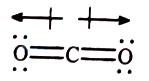
(D) In $CO_{2}$,the $C=O$ bond dipoles are equal in magnitude but oriented in opposite directions (at $180^{\circ}$).
Their vector sum is zero,so $CO_{2}$ has no net dipole moment.
Their vector sum is zero,so $CO_{2}$ has no net dipole moment.
0 likesView Solution
35
ChemistryMediumMCQMHT CET · 2020
Identify the type of intermolecular force present between benzene $(C_6H_6)$ and ammonia $(NH_3)$.
A
Hydrogen bonding
B
Dipole - dipole interaction
C
Dipole - induced dipole interaction
D
Ion - dipole interaction
Solution
(C) Benzene $(C_6H_6)$ is a non-polar molecule with no permanent dipole moment.
Ammonia $(NH_3)$ is a polar molecule with a permanent dipole moment.
When a polar molecule approaches a non-polar molecule,it induces a dipole in the non-polar molecule by distorting its electron cloud.
Therefore,the interaction between a permanent dipole $(NH_3)$ and an induced dipole (benzene) is known as a dipole - induced dipole interaction.
Ammonia $(NH_3)$ is a polar molecule with a permanent dipole moment.
When a polar molecule approaches a non-polar molecule,it induces a dipole in the non-polar molecule by distorting its electron cloud.
Therefore,the interaction between a permanent dipole $(NH_3)$ and an induced dipole (benzene) is known as a dipole - induced dipole interaction.
0 likesView Solution
36
ChemistryMediumMCQMHT CET · 2020
What type of intermolecular force is present between magnesium chloride and water?
A
Dipole-dipole interaction
B
Ion-dipole interaction
C
Dipole-induced dipole interaction
D
Hydrogen bonding
Solution
(B) The correct answer is $B$ (Ion-dipole interaction).
Magnesium chloride $(MgCl_2)$ dissociates in water into $Mg^{2+}$ and $Cl^-$ ions.
Water $(H_2O)$ is a polar molecule with a partial negative charge on the oxygen atom and a partial positive charge on the hydrogen atoms.
The interaction between the $Mg^{2+}$ ion and the partial negative charge on the oxygen atom of the water molecule is known as an ion-dipole interaction.
This is an attractive force between an ion and a polar molecule.
Magnesium chloride $(MgCl_2)$ dissociates in water into $Mg^{2+}$ and $Cl^-$ ions.
Water $(H_2O)$ is a polar molecule with a partial negative charge on the oxygen atom and a partial positive charge on the hydrogen atoms.
The interaction between the $Mg^{2+}$ ion and the partial negative charge on the oxygen atom of the water molecule is known as an ion-dipole interaction.
This is an attractive force between an ion and a polar molecule.
0 likesView Solution
37
ChemistryMediumMCQMHT CET · 2020
In which of the following compounds is intramolecular hydrogen bonding present?
A
ethanol
B
$o-$nitrophenol
C
water
D
ammonia
Solution
(B) The correct answer is $o-$nitrophenol.
In $o-$nitrophenol,there is intramolecular hydrogen bonding between the hydrogen atom of the $-OH$ group and the oxygen atom of the $-NO_2$ group,which are located on adjacent positions of the benzene ring. This type of hydrogen bonding occurs within the same molecule,resulting in a lower boiling point compared to its isomers.
In $o-$nitrophenol,there is intramolecular hydrogen bonding between the hydrogen atom of the $-OH$ group and the oxygen atom of the $-NO_2$ group,which are located on adjacent positions of the benzene ring. This type of hydrogen bonding occurs within the same molecule,resulting in a lower boiling point compared to its isomers.
0 likesView Solution
38
ChemistryEasyMCQMHT CET · 2020
Hydroxide of which alkali metal is used in the manufacture of soft soap?
A
Caesium
B
Sodium
C
Potassium
D
Lithium
Solution
(C) Soft soap is manufactured using $KOH$ (potassium hydroxide),also known as caustic potash.
Potassium soaps are more soluble in water compared to sodium soaps.
In their concentrated form,these potassium-based soaps are referred to as soft soaps.
Therefore,$KOH$ is the alkali used for this purpose.
Potassium soaps are more soluble in water compared to sodium soaps.
In their concentrated form,these potassium-based soaps are referred to as soft soaps.
Therefore,$KOH$ is the alkali used for this purpose.
0 likesView Solution
39
ChemistryEasyMCQMHT CET · 2020
What is the position of elements $La (Z=57)$ and $Ce (Z=58)$ respectively in the long form of the periodic table?
A
$La = \text{Group-}3, \text{Period-}6; Ce = \text{Group-}3, \text{Period-}6$
B
$La = \text{Group-}4, \text{Period-}7; Ce = \text{Group-}5, \text{Period-}7$
C
$La = \text{Group-}3, \text{Period-}7; Ce = \text{Group-}3, \text{Period-}6$
D
$La = \text{Group-}3, \text{Period-}6; Ce = \text{Group-}3, \text{Period-}7$
Solution
(A) The element $La (Z=57)$ has the electronic configuration $[Xe] 5d^1 6s^2$. It belongs to Group-$3$ and Period-$6$.
$Ce (Z=58)$ is the first element of the lanthanoid series with the configuration $[Xe] 4f^1 5d^1 6s^2$.
In the long form of the periodic table,all lanthanoids (from $Z=57$ to $71$) are placed in Group-$3$ and Period-$6$ to avoid disrupting the table structure.
Therefore,both $La$ and $Ce$ belong to Group-$3$ and Period-$6$.
$Ce (Z=58)$ is the first element of the lanthanoid series with the configuration $[Xe] 4f^1 5d^1 6s^2$.
In the long form of the periodic table,all lanthanoids (from $Z=57$ to $71$) are placed in Group-$3$ and Period-$6$ to avoid disrupting the table structure.
Therefore,both $La$ and $Ce$ belong to Group-$3$ and Period-$6$.
0 likesView Solution
40
ChemistryEasyMCQMHT CET · 2020
What is the temporary symbol of an element with an atomic number of $116$?
A
$UuS$
B
$Uut$
C
$Uuh$
D
$Uun$
Solution
(C) According to the $IUPAC$ nomenclature for elements with atomic numbers greater than $100$,the temporary symbol is derived from the digits of the atomic number:
$1 = un$ $(u)$,$1 = un$ $(u)$,$6 = hex$ $(h)$.
Therefore,for atomic number $116$,the temporary name is $\text{Ununhexium}$ and the temporary symbol is $Uuh$.
$1 = un$ $(u)$,$1 = un$ $(u)$,$6 = hex$ $(h)$.
Therefore,for atomic number $116$,the temporary name is $\text{Ununhexium}$ and the temporary symbol is $Uuh$.
0 likesView Solution
41
ChemistryEasyMCQMHT CET · 2020
What is the electronic configuration of the third element of group-$2$ in the periodic table?
A
$[Ne] 3s^1$
B
$[Ne] 3s^2$
C
$[Ar] 4s^1$
D
$[Ar] 4s^2$
Solution
(D) The elements of group-$2$ are Beryllium ($Be$,$Z=4$),Magnesium ($Mg$,$Z=12$),and Calcium ($Ca$,$Z=20$).
The third element of group-$2$ is Calcium $(Ca)$.
The atomic number of Calcium is $20$.
The electronic configuration of Calcium is $[Ar] 4s^2$.
The third element of group-$2$ is Calcium $(Ca)$.
The atomic number of Calcium is $20$.
The electronic configuration of Calcium is $[Ar] 4s^2$.
0 likesView Solution
42
ChemistryEasyMCQMHT CET · 2020
Which among the following elements has the lowest value of electronegativity?
A
$Bi$
B
$As$
C
$Sb$
D
$N$
Solution
(A) Electronegativity generally decreases down a group in the periodic table due to the increase in atomic size and shielding effect.
Group $15$ elements are $N, P, As, Sb, Bi$.
As we move from $N$ to $Bi$,the electronegativity decreases.
Therefore,$Bi$ (Bismuth) has the lowest electronegativity among the given elements.
Group $15$ elements are $N, P, As, Sb, Bi$.
As we move from $N$ to $Bi$,the electronegativity decreases.
Therefore,$Bi$ (Bismuth) has the lowest electronegativity among the given elements.
0 likesView Solution
43
ChemistryEasyMCQMHT CET · 2020
Which of the following salts contains interstitial water molecules?
A
$[Cr(H_{2}O)_{6}]Cl_{3}$
B
$CuSO_{4} \cdot 5H_{2}O$
C
$[Cu(H_{2}O)_{4}]SO_{4} \cdot H_{2}O$
D
$BaCl_{2} \cdot 2H_{2}O$
Solution
(D) $BaCl_{2} \cdot 2H_{2}O$ contains interstitial water molecules.
In this salt,the water molecules are not coordinated to the metal ion but are trapped within the crystal lattice structure,specifically in the interstitial sites.
In contrast,in $CuSO_{4} \cdot 5H_{2}O$,four water molecules are coordinated to the $Cu^{2+}$ ion,and one is hydrogen-bonded.
Therefore,$BaCl_{2} \cdot 2H_{2}O$ is the correct example of a salt with interstitial water.
In this salt,the water molecules are not coordinated to the metal ion but are trapped within the crystal lattice structure,specifically in the interstitial sites.
In contrast,in $CuSO_{4} \cdot 5H_{2}O$,four water molecules are coordinated to the $Cu^{2+}$ ion,and one is hydrogen-bonded.
Therefore,$BaCl_{2} \cdot 2H_{2}O$ is the correct example of a salt with interstitial water.
0 likesView Solution
44
ChemistryMediumMCQMHT CET · 2020
Which among the following orbitals form $\delta$ molecular orbitals?
A
$d_{xy}$ and $d_{x^2-y^2}$ orbitals
B
$d_{z^2}$ and $d_{x^2-y^2}$ orbitals
C
$d_{yz}$ and $d_{x^2-y^2}$ orbitals
D
$d_{xy}$ and $d_{yz}$ orbitals
Solution
(A) $\delta$ bond is formed by the lateral overlap of two $d$-orbitals where all four lobes of one orbital overlap with the four lobes of another orbital.
This occurs when two $d_{xy}$ orbitals or two $d_{x^2-y^2}$ orbitals approach each other along the $z$-axis.
Specifically,the $d_{xy}$ orbitals (lying in the $xy$-plane) and $d_{x^2-y^2}$ orbitals (lying along the $x$ and $y$ axes) are capable of forming $\delta$ bonds due to their specific spatial orientation.
Therefore,the correct pair is $d_{xy}$ and $d_{x^2-y^2}$.
This occurs when two $d_{xy}$ orbitals or two $d_{x^2-y^2}$ orbitals approach each other along the $z$-axis.
Specifically,the $d_{xy}$ orbitals (lying in the $xy$-plane) and $d_{x^2-y^2}$ orbitals (lying along the $x$ and $y$ axes) are capable of forming $\delta$ bonds due to their specific spatial orientation.
Therefore,the correct pair is $d_{xy}$ and $d_{x^2-y^2}$.
0 likesView Solution
45
ChemistryEasyMCQMHT CET · 2020
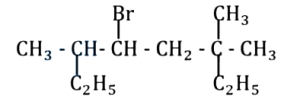
The $I.U.P.A.C.$ name of the following compound is:
A
$4-$bromo-$2-$ethyl-$2, 5-$dimethylheptane
B
$5-$bromo-$3, 3, 6-$trimethyloctane
C
$3-$bromo-$2, 5-$diethyl-$5-$methylhexane
D
$4-$bromo-$3, 6, 6-$trimethyloctane
Solution
(B) $1$. Identify the longest carbon chain. The longest chain contains $8$ carbon atoms,so the parent alkane is octane.
$2$. Number the chain from the end that gives the substituents the lowest possible locants. Numbering from left to right gives substituents at positions $4, 3, 6, 6$. Numbering from right to left gives substituents at positions $3, 3, 6, 5$. Comparing the sets $(3, 3, 5, 6)$ and $(3, 4, 6, 6)$,the set $(3, 3, 5, 6)$ is lower.
$3$. The substituents are: bromo at position $5$,and methyl groups at positions $3, 3, 6$.
$4$. Combining these,the name is $5-$bromo$-3, 3, 6-$trimethyloctane.
$2$. Number the chain from the end that gives the substituents the lowest possible locants. Numbering from left to right gives substituents at positions $4, 3, 6, 6$. Numbering from right to left gives substituents at positions $3, 3, 6, 5$. Comparing the sets $(3, 3, 5, 6)$ and $(3, 4, 6, 6)$,the set $(3, 3, 5, 6)$ is lower.
$3$. The substituents are: bromo at position $5$,and methyl groups at positions $3, 3, 6$.
$4$. Combining these,the name is $5-$bromo$-3, 3, 6-$trimethyloctane.
0 likesView Solution
46
ChemistryEasyMCQMHT CET · 2020
Number of primary carbon atoms present in $3-$Ethyl$-2,4-$dimethylheptane is?
A
$5$
B
$3$
C
$4$
D
$6$
Solution
(D) primary carbon atom is a carbon atom that is bonded to only one other carbon atom. In the structure of $3-$Ethyl$-2,4-$dimethylheptane,the terminal methyl $(-CH_3)$ groups are primary carbons.
Looking at the structure:
$1$. The $C-2$ position has one methyl group attached.
$2$. The $C-3$ position has an ethyl group attached,which ends in a methyl group.
$3$. The $C-4$ position has a methyl group attached.
$4$. The main chain heptane has two terminal methyl groups.
Counting these:
- Two methyls at $C-2$ (one is part of the chain,one is a substituent).
- One methyl at the end of the ethyl group at $C-3$.
- One methyl at $C-4$.
- Two terminal methyls of the heptane chain.
Total primary carbon atoms = $6$.
Looking at the structure:
$1$. The $C-2$ position has one methyl group attached.
$2$. The $C-3$ position has an ethyl group attached,which ends in a methyl group.
$3$. The $C-4$ position has a methyl group attached.
$4$. The main chain heptane has two terminal methyl groups.
Counting these:
- Two methyls at $C-2$ (one is part of the chain,one is a substituent).
- One methyl at the end of the ethyl group at $C-3$.
- One methyl at $C-4$.
- Two terminal methyls of the heptane chain.
Total primary carbon atoms = $6$.
0 likesView Solution
47
ChemistryEasyMCQMHT CET · 2020
The $IUPAC$ name of isobutyl bromide is
A
$2-$methyl$-1-$bromo propane
B
$1-$bromo$-2-$methyl propane
C
$2-$bromo$-2-$methyl propane
D
$2-$bromo$-1-$methyl propane
Solution
(B) The structure of isobutyl bromide is $(CH_3)_2CH-CH_2Br$.
To determine the $IUPAC$ name,we identify the longest carbon chain containing the functional group $(-Br)$.
The longest chain has $3$ carbon atoms,so the parent alkane is propane.
Numbering the chain starting from the carbon attached to the bromine atom gives the $1-$position to the bromine.
There is a methyl group at the $2-$position.
Thus,the $IUPAC$ name is $1-$bromo$-2-$methyl propane.
To determine the $IUPAC$ name,we identify the longest carbon chain containing the functional group $(-Br)$.
The longest chain has $3$ carbon atoms,so the parent alkane is propane.
Numbering the chain starting from the carbon attached to the bromine atom gives the $1-$position to the bromine.
There is a methyl group at the $2-$position.
Thus,the $IUPAC$ name is $1-$bromo$-2-$methyl propane.
0 likesView Solution
48
ChemistryMediumMCQMHT CET · 2020
What is the $IUPAC$ name of acrolein?
A
Prop$-2-$enal
B
$2-$methyl but$-2-$enal
C
$3-$methyl but$-2-$enal
D
But$-2-$enal
Solution
(A) The structure of acrolein is $CH_2=CH-CHO$.
It contains a carbon chain of $3$ carbon atoms with an aldehyde group $(-CHO)$ at position $1$ and a double bond starting at position $2$.
Therefore,the $IUPAC$ name is prop$-2-$enal.
It contains a carbon chain of $3$ carbon atoms with an aldehyde group $(-CHO)$ at position $1$ and a double bond starting at position $2$.
Therefore,the $IUPAC$ name is prop$-2-$enal.
0 likesView Solution
49
ChemistryMediumMCQMHT CET · 2020
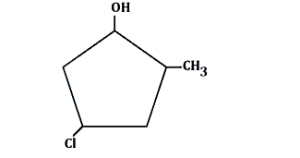
What is the $IUPAC$ name of the following compound?
A
$3-$chloro$-5-$methylcyclopentanol
B
$1-$chloro$-3-$methylcyclopentan$-4-$ol
C
$4-$chloro$-2-$methylcyclopentanol
D
$4-$chloro$-2-$hydroxy$-1-$methylcyclopentane
Solution
(C) $1$. Identify the principal functional group: The $-OH$ group is the principal functional group,so the parent chain is a cyclopentanol. The carbon attached to the $-OH$ group is assigned position $1$.
$2$. Number the ring: To give the lowest possible locants to the substituents ($-Cl$ and $-CH_3$),we number the ring in the direction that assigns the lowest numbers to the substituents. Numbering clockwise gives the $-CH_3$ at position $2$ and the $-Cl$ at position $4$. Numbering counter-clockwise gives the $-Cl$ at position $3$ and the $-CH_3$ at position $5$.
$3$. Compare locant sets: The set $(2, 4)$ is lower than $(3, 5)$. Therefore,we number clockwise starting from the carbon with the $-OH$ group.
$4$. Assemble the name: The substituents are $4-$chloro and $2-$methyl. Alphabetical order dictates that chloro comes before methyl. Thus,the $IUPAC$ name is $4-$chloro$-2-$methylcyclopentanol.
$2$. Number the ring: To give the lowest possible locants to the substituents ($-Cl$ and $-CH_3$),we number the ring in the direction that assigns the lowest numbers to the substituents. Numbering clockwise gives the $-CH_3$ at position $2$ and the $-Cl$ at position $4$. Numbering counter-clockwise gives the $-Cl$ at position $3$ and the $-CH_3$ at position $5$.
$3$. Compare locant sets: The set $(2, 4)$ is lower than $(3, 5)$. Therefore,we number clockwise starting from the carbon with the $-OH$ group.
$4$. Assemble the name: The substituents are $4-$chloro and $2-$methyl. Alphabetical order dictates that chloro comes before methyl. Thus,the $IUPAC$ name is $4-$chloro$-2-$methylcyclopentanol.
0 likesView Solution
50
ChemistryEasyMCQMHT CET · 2020
What is the molecular formula of $3-$bromopropene?
A
$C_3H_6Br$
B
$C_3H_7Br$
C
$C_3H_5Br$
D
$C_3H_3Br$
Solution
(C) The structure of $3-$bromopropene is $CH_2=CH-CH_2Br$.
Counting the atoms in the structure:
There are $3$ carbon atoms $(C_3)$.
There are $5$ hydrogen atoms $(H_5)$.
There is $1$ bromine atom $(Br)$.
Therefore,the molecular formula is $C_3H_5Br$.
Counting the atoms in the structure:
There are $3$ carbon atoms $(C_3)$.
There are $5$ hydrogen atoms $(H_5)$.
There is $1$ bromine atom $(Br)$.
Therefore,the molecular formula is $C_3H_5Br$.
0 likesView Solution
51
ChemistryMediumMCQMHT CET · 2020
Which of the following alcohols is prepared by acid-catalysed hydration of alkenes?
A
Ethanol
B
Methanol
C
Propan$-1-$ol
D
Butan$-1-$ol
Solution
(A) Acid-catalysed hydration of alkenes follows Markovnikov's rule,where the hydroxyl group $(-OH)$ attaches to the more substituted carbon atom.
$CH_2=CH_2 + H_2O \xrightarrow{H^+} CH_3CH_2OH$ (Ethanol).
$CH_3CH=CH_2 + H_2O \xrightarrow{H^+} CH_3CH(OH)CH_3$ (Propan$-2-$ol).
$CH_3CH_2CH=CH_2 + H_2O \xrightarrow{H^+} CH_3CH_2CH(OH)CH_3$ (Butan$-2-$ol).
Methanol $(CH_3OH)$ cannot be prepared by this method as it requires at least two carbon atoms.
Propan$-1-$ol and Butan$-1-$ol are primary alcohols that cannot be formed by direct hydration of simple alkenes due to Markovnikov's rule.
Therefore,Ethanol is the correct answer.
$CH_2=CH_2 + H_2O \xrightarrow{H^+} CH_3CH_2OH$ (Ethanol).
$CH_3CH=CH_2 + H_2O \xrightarrow{H^+} CH_3CH(OH)CH_3$ (Propan$-2-$ol).
$CH_3CH_2CH=CH_2 + H_2O \xrightarrow{H^+} CH_3CH_2CH(OH)CH_3$ (Butan$-2-$ol).
Methanol $(CH_3OH)$ cannot be prepared by this method as it requires at least two carbon atoms.
Propan$-1-$ol and Butan$-1-$ol are primary alcohols that cannot be formed by direct hydration of simple alkenes due to Markovnikov's rule.
Therefore,Ethanol is the correct answer.
0 likesView Solution
52
ChemistryEasyMCQMHT CET · 2020
Which of the following alcohols is $NOT$ prepared by acid catalyzed hydration of alkenes?
A
Ethanol
B
$Propan-2-ol$
C
$Propan-1-ol$
D
$2-Methylpropan-2-ol$
Solution
(C) Acid catalyzed hydration of alkenes follows Markovnikov's rule,where the hydroxyl group $(-OH)$ attaches to the more substituted carbon atom.
$Propan-1-ol$ $(CH_3CH_2CH_2OH)$ cannot be prepared by this method because the hydration of $propene$ $(CH_3CH=CH_2)$ yields $propan-2-ol$ as the major product according to Markovnikov's rule.
Therefore,$propan-1-ol$ is the correct answer.
$Propan-1-ol$ $(CH_3CH_2CH_2OH)$ cannot be prepared by this method because the hydration of $propene$ $(CH_3CH=CH_2)$ yields $propan-2-ol$ as the major product according to Markovnikov's rule.
Therefore,$propan-1-ol$ is the correct answer.
0 likesView Solution
53
ChemistryEasyMCQMHT CET · 2020
Which of the following alcohols is the most acidic?
A
$(CH_3)_3COH$
B
$(CH_3)_2CHOH$
C
$CH_3OH$
D
$CH_3CH_2OH$
Solution
(C) The acidity of alcohols depends on the stability of the alkoxide ion formed after the release of a proton $(H^+)$.
Alkyl groups are electron-donating ($+I$ effect) in nature.
As the number of alkyl groups attached to the carbon atom bearing the $-OH$ group increases,the electron density on the oxygen atom increases due to the $+I$ effect.
This destabilizes the alkoxide ion,thereby decreasing the acidic strength.
The order of acidity is: $CH_3OH > CH_3CH_2OH > (CH_3)_2CHOH > (CH_3)_3COH$.
Therefore,$CH_3OH$ is the most acidic.
Alkyl groups are electron-donating ($+I$ effect) in nature.
As the number of alkyl groups attached to the carbon atom bearing the $-OH$ group increases,the electron density on the oxygen atom increases due to the $+I$ effect.
This destabilizes the alkoxide ion,thereby decreasing the acidic strength.
The order of acidity is: $CH_3OH > CH_3CH_2OH > (CH_3)_2CHOH > (CH_3)_3COH$.
Therefore,$CH_3OH$ is the most acidic.
0 likesView Solution
54
ChemistryMediumMCQMHT CET · 2020
Identify compound '$B$' in the following series of reactions:
$CH_3CN$ $\xrightarrow{Na / \text{alcohol}} A$ $\xrightarrow{NaNO_2 / \text{dil. } HCl} B$
$CH_3CN$ $\xrightarrow{Na / \text{alcohol}} A$ $\xrightarrow{NaNO_2 / \text{dil. } HCl} B$
A
Nitroethane
B
Ethyl chloride
C
Ethyl alcohol
D
Ethyl amine
Solution
(C) $1$. The reduction of acetonitrile $(CH_3CN)$ with sodium and alcohol (Mendius reduction) yields ethyl amine $(A)$:
$CH_3CN + 4[H] \xrightarrow{Na / \text{alcohol}} CH_3CH_2NH_2$ ($A$ = Ethyl amine).
$2$. The reaction of primary aliphatic amines with nitrous acid $(NaNO_2 / \text{dil. } HCl)$ produces unstable diazonium salts,which decompose to form alcohols,nitrogen gas,and water:
$CH_3CH_2NH_2 + HNO_2$ $\xrightarrow{NaNO_2 / \text{dil. } HCl} [CH_3CH_2N_2^+Cl^-]$ $\xrightarrow{H_2O} CH_3CH_2OH + N_2 \uparrow + HCl$.
Thus,compound $B$ is ethyl alcohol.
$CH_3CN + 4[H] \xrightarrow{Na / \text{alcohol}} CH_3CH_2NH_2$ ($A$ = Ethyl amine).
$2$. The reaction of primary aliphatic amines with nitrous acid $(NaNO_2 / \text{dil. } HCl)$ produces unstable diazonium salts,which decompose to form alcohols,nitrogen gas,and water:
$CH_3CH_2NH_2 + HNO_2$ $\xrightarrow{NaNO_2 / \text{dil. } HCl} [CH_3CH_2N_2^+Cl^-]$ $\xrightarrow{H_2O} CH_3CH_2OH + N_2 \uparrow + HCl$.
Thus,compound $B$ is ethyl alcohol.
0 likesView Solution
55
ChemistryEasyMCQMHT CET · 2020
Which of the following is $\underline{\text{NOT}}$ a dihydric phenol?
A
$\alpha$-naphthol
B
Resorcinol
C
Hydroquinone
D
Catechol
Solution
(A) dihydric phenol is a compound containing two hydroxyl $(-OH)$ groups attached directly to a benzene ring.
$1$. $\alpha$-naphthol is a monohydric phenol (contains one $-OH$ group).
$2$. Resorcinol ($1,3$-dihydroxybenzene),Hydroquinone ($1,4$-dihydroxybenzene),and Catechol ($1,2$-dihydroxybenzene) are all dihydric phenols.
Therefore,$\alpha$-naphthol is not a dihydric phenol.
$1$. $\alpha$-naphthol is a monohydric phenol (contains one $-OH$ group).
$2$. Resorcinol ($1,3$-dihydroxybenzene),Hydroquinone ($1,4$-dihydroxybenzene),and Catechol ($1,2$-dihydroxybenzene) are all dihydric phenols.
Therefore,$\alpha$-naphthol is not a dihydric phenol.
0 likesView Solution
56
ChemistryMediumMCQMHT CET · 2020
Which of the following alcohols is least soluble in water?
A
Pentan-$1$-ol
B
$2$-methyl butan-$2$-ol
C
Pentan-$2$-ol
D
$2,2$-Dimethyl propan-$1$-ol
Solution
(A) The solubility of alcohols in water depends on the balance between the hydrophilic hydroxyl $(-OH)$ group and the hydrophobic alkyl chain.
As the size of the hydrophobic alkyl chain increases,the solubility of the alcohol in water decreases.
All the given alcohols are isomers with the molecular formula $C_5H_{12}O$.
However,the solubility also depends on the branching of the alkyl chain.
Increased branching reduces the surface area of the hydrophobic part,which generally increases solubility.
Comparing the structures:
$1$. Pentan-$1$-ol (straight chain,$5$ carbons)
$2$. $2$-methyl butan-$2$-ol (branched,$5$ carbons)
$3$. Pentan-$2$-ol (branched,$5$ carbons)
$4$. $2,2$-Dimethyl propan-$1$-ol (highly branched,$5$ carbons)
Among these,Pentan-$1$-ol has the longest straight alkyl chain,which makes it the least soluble in water compared to the more branched isomers.
As the size of the hydrophobic alkyl chain increases,the solubility of the alcohol in water decreases.
All the given alcohols are isomers with the molecular formula $C_5H_{12}O$.
However,the solubility also depends on the branching of the alkyl chain.
Increased branching reduces the surface area of the hydrophobic part,which generally increases solubility.
Comparing the structures:
$1$. Pentan-$1$-ol (straight chain,$5$ carbons)
$2$. $2$-methyl butan-$2$-ol (branched,$5$ carbons)
$3$. Pentan-$2$-ol (branched,$5$ carbons)
$4$. $2,2$-Dimethyl propan-$1$-ol (highly branched,$5$ carbons)
Among these,Pentan-$1$-ol has the longest straight alkyl chain,which makes it the least soluble in water compared to the more branched isomers.
0 likesView Solution
57
ChemistryMediumMCQMHT CET · 2020
Which of the following is reacted with benzaldehyde to obtain $1-$phenylethanol?
A
$C_{6}H_{5}MgBr$
B
$C_{6}H_{5}CH_{2}MgBr$
C
$CH_{3}MgBr$
D
$CH_{3}CH_{2}MgBr$
Solution
(C) The reaction of benzaldehyde $(C_{6}H_{5}CHO)$ with a Grignard reagent $(RMgX)$ followed by acid hydrolysis yields a secondary alcohol.
To obtain $1-$phenylethanol $(C_{6}H_{5}CH(OH)CH_{3})$,the Grignard reagent must provide the methyl group $(CH_{3})$.
Therefore,the reaction is:
$C_{6}H_{5}CHO + CH_{3}MgBr \rightarrow [C_{6}H_{5}CH(CH_{3})OMgBr]$
$[C_{6}H_{5}CH(CH_{3})OMgBr] + H_{2}O/H^{+} \rightarrow C_{6}H_{5}CH(OH)CH_{3} + Mg(OH)Br$
Thus,benzaldehyde reacts with $CH_{3}MgBr$ to produce $1-$phenylethanol.
To obtain $1-$phenylethanol $(C_{6}H_{5}CH(OH)CH_{3})$,the Grignard reagent must provide the methyl group $(CH_{3})$.
Therefore,the reaction is:
$C_{6}H_{5}CHO + CH_{3}MgBr \rightarrow [C_{6}H_{5}CH(CH_{3})OMgBr]$
$[C_{6}H_{5}CH(CH_{3})OMgBr] + H_{2}O/H^{+} \rightarrow C_{6}H_{5}CH(OH)CH_{3} + Mg(OH)Br$
Thus,benzaldehyde reacts with $CH_{3}MgBr$ to produce $1-$phenylethanol.
0 likesView Solution
58
ChemistryEasyMCQMHT CET · 2020
Which of the following reagents is used for the following conversion?
$CH_3-CH=CH-CHO \longrightarrow CH_3-CH=CH-CH_2OH$
$CH_3-CH=CH-CHO \longrightarrow CH_3-CH=CH-CH_2OH$
A
$H_3O^{+}$
B
$Zn-Hg / HCl$
C
$H_2 / Ni$
D
$LiAlH_4$
Solution
(D) $LiAlH_4$ (Lithium aluminium hydride) is a selective reducing agent that reduces the aldehyde group $(-CHO)$ to a primary alcohol $(-CH_2OH)$ without affecting the carbon-carbon double bond $(C=C)$.
Therefore,$CH_3-CH=CH-CHO$ is converted to $CH_3-CH=CH-CH_2OH$ using $LiAlH_4$.
Therefore,$CH_3-CH=CH-CHO$ is converted to $CH_3-CH=CH-CH_2OH$ using $LiAlH_4$.
0 likesView Solution
59
ChemistryEasyMCQMHT CET · 2020
Identify the alcohol that reacts immediately with Lucas reagent.
A
Ethanol
B
Butan-$2$-ol
C
$2$-Methylpropan-$2$-ol
D
Propan-$2$-ol
Solution
(C) The reaction of alcohols with Lucas reagent $(conc. \ HCl + ZnCl_2)$ follows the $S_N1$ mechanism,which depends on the stability of the carbocation intermediate.
Tertiary carbocations are the most stable,followed by secondary and then primary carbocations.
Therefore,tertiary alcohols react fastest with Lucas reagent at room temperature,resulting in immediate turbidity.
$2$-Methylpropan-$2$-ol is a tertiary alcohol,so it reacts immediately with Lucas reagent.
Tertiary carbocations are the most stable,followed by secondary and then primary carbocations.
Therefore,tertiary alcohols react fastest with Lucas reagent at room temperature,resulting in immediate turbidity.
$2$-Methylpropan-$2$-ol is a tertiary alcohol,so it reacts immediately with Lucas reagent.
0 likesView Solution
60
ChemistryEasyMCQMHT CET · 2020
When $Butan-2-ol$ is dehydrated using sulphuric acid,the concentration of acid and temperature needed respectively are:
A
$60 \% \ \text{conc. and } 373 \ K$
B
$20 \% \ \text{conc. and } 373 \ K$
C
$20 \% \ \text{conc. and } 363 \ K$
D
$95 \% \ \text{conc. and } 373 \ K$
Solution
(A) The dehydration of secondary alcohols like $Butan-2-ol$ $(CH_3-CH(OH)-CH_2-CH_3)$ typically requires $60 \% \ H_2SO_4$ at a temperature of $373 \ K$.
This reaction follows the $E1$ mechanism,where the major product is $But-2-ene$ (Saytzeff product) and the minor product is $But-1-ene$ (Hofmann product).
This reaction follows the $E1$ mechanism,where the major product is $But-2-ene$ (Saytzeff product) and the minor product is $But-1-ene$ (Hofmann product).
0 likesView Solution
61
ChemistryDifficultMCQMHT CET · 2020
Identify '$B$' in the following series of reactions:
$CH_3CH_2OH$ $\xrightarrow[H_2SO_4, \Delta]{NaBr} A$ $\xrightarrow{Mg, \text{Dry ether}} B$
$CH_3CH_2OH$ $\xrightarrow[H_2SO_4, \Delta]{NaBr} A$ $\xrightarrow{Mg, \text{Dry ether}} B$
A
Ethyl magnesium bromide
B
Ethyl bromide
C
Sodium ethoxide
D
Ethene
Solution
(A) Step $1$: Ethanol $(CH_3CH_2OH)$ reacts with $NaBr$ in the presence of $H_2SO_4$ and heat to undergo nucleophilic substitution,forming ethyl bromide $(CH_3CH_2Br)$ as product '$A$'.
$CH_3CH_2OH + NaBr + H_2SO_4 \xrightarrow{\Delta} CH_3CH_2Br + NaHSO_4 + H_2O$
Step $2$: Ethyl bromide $(CH_3CH_2Br)$ reacts with magnesium metal in the presence of dry ether to form a Grignard reagent,ethyl magnesium bromide $(CH_3CH_2MgBr)$,which is product '$B$'.
$CH_3CH_2Br + Mg \xrightarrow{\text{Dry ether}} CH_3CH_2MgBr$
$CH_3CH_2OH + NaBr + H_2SO_4 \xrightarrow{\Delta} CH_3CH_2Br + NaHSO_4 + H_2O$
Step $2$: Ethyl bromide $(CH_3CH_2Br)$ reacts with magnesium metal in the presence of dry ether to form a Grignard reagent,ethyl magnesium bromide $(CH_3CH_2MgBr)$,which is product '$B$'.
$CH_3CH_2Br + Mg \xrightarrow{\text{Dry ether}} CH_3CH_2MgBr$
0 likesView Solution
62
ChemistryDifficultMCQMHT CET · 2020
Identify $Z$ in the following sequence of reactions:
$CH_{3}-CH_{2}-CH_{2}-OH$ $\xrightarrow{PCl_{3}} X$ $\xrightarrow[\Delta]{alco.KOH} Y$ $\xrightarrow[H-OH/heat]{conc.H_{2}SO_{4}} Z$
$CH_{3}-CH_{2}-CH_{2}-OH$ $\xrightarrow{PCl_{3}} X$ $\xrightarrow[\Delta]{alco.KOH} Y$ $\xrightarrow[H-OH/heat]{conc.H_{2}SO_{4}} Z$
A
$CH_{3}-CH_{2}-CH_{2}-OH$
B
$(CH_{3})_{2}CH-OH$
C
$CH_{3}-CH=CH_{2}$
D
$CH_{3}-CH_{2}-CH_{3}$
Solution
(B) Step $1$: $CH_{3}-CH_{2}-CH_{2}-OH + PCl_{3} \rightarrow CH_{3}-CH_{2}-CH_{2}-Cl (X) + H_{3}PO_{3}$.
Step $2$: $CH_{3}-CH_{2}-CH_{2}-Cl + alco.KOH \xrightarrow{\Delta} CH_{3}-CH=CH_{2} (Y) + KCl + H_{2}O$ (Dehydrohalogenation).
Step $3$: $CH_{3}-CH=CH_{2} + H_{2}O \xrightarrow{conc.H_{2}SO_{4}} CH_{3}-CH(OH)-CH_{3} (Z)$ (Acid-catalyzed hydration following Markovnikov's rule).
Thus,$Z$ is propan-$2$-ol,which is $(CH_{3})_{2}CH-OH$.
Step $2$: $CH_{3}-CH_{2}-CH_{2}-Cl + alco.KOH \xrightarrow{\Delta} CH_{3}-CH=CH_{2} (Y) + KCl + H_{2}O$ (Dehydrohalogenation).
Step $3$: $CH_{3}-CH=CH_{2} + H_{2}O \xrightarrow{conc.H_{2}SO_{4}} CH_{3}-CH(OH)-CH_{3} (Z)$ (Acid-catalyzed hydration following Markovnikov's rule).
Thus,$Z$ is propan-$2$-ol,which is $(CH_{3})_{2}CH-OH$.
0 likesView Solution
63
ChemistryEasyMCQMHT CET · 2020
Identify '$A$' in the following reaction: $C_{2}H_{5}OH + HCl \xrightarrow{A} C_{2}H_{5}Cl + H_{2}O$
A
anhydrous $ZnCl_{2}$
B
pyridine
C
conc. $H_{2}SO_{4}$
D
$NaNO_{2}$
Solution
(A) The reaction of ethanol with $HCl$ to form ethyl chloride is known as the Grooves process.
In this reaction,anhydrous $ZnCl_{2}$ acts as a catalyst (Lewis acid) to facilitate the cleavage of the $C-O$ bond.
The reaction is: $C_{2}H_{5}OH + HCl \xrightarrow{\text{anhydrous } ZnCl_{2}} C_{2}H_{5}Cl + H_{2}O$.
In this reaction,anhydrous $ZnCl_{2}$ acts as a catalyst (Lewis acid) to facilitate the cleavage of the $C-O$ bond.
The reaction is: $C_{2}H_{5}OH + HCl \xrightarrow{\text{anhydrous } ZnCl_{2}} C_{2}H_{5}Cl + H_{2}O$.
0 likesView Solution
64
ChemistryEasyMCQMHT CET · 2020
Which of the following alcohols requires acidic $KMnO_4$ to convert it into an aldehyde or ketone?
A
Ethanol
B
Propan$-1-$ol
C
Propan$-2-$ol
D
$2-$Methylpropan$-2-$ol
Solution
(D) The correct answer is $D$ ($2-$Methylpropan$-2-$ol).
Primary and secondary alcohols can be oxidized to aldehydes/ketones using milder oxidizing agents like $PCC$ or $CrO_3$.
However,tertiary alcohols like $2-$methylpropan$-2-$ol are resistant to oxidation under normal conditions.
They require strong oxidizing agents such as acidic $KMnO_4$ and extreme conditions (high temperature) to undergo oxidation,which typically involves the cleavage of $C-C$ bonds to form smaller ketones or carboxylic acids.
Primary and secondary alcohols can be oxidized to aldehydes/ketones using milder oxidizing agents like $PCC$ or $CrO_3$.
However,tertiary alcohols like $2-$methylpropan$-2-$ol are resistant to oxidation under normal conditions.
They require strong oxidizing agents such as acidic $KMnO_4$ and extreme conditions (high temperature) to undergo oxidation,which typically involves the cleavage of $C-C$ bonds to form smaller ketones or carboxylic acids.
0 likesView Solution
65
ChemistryEasyMCQMHT CET · 2020
Identify '$A$' in the following reaction. $A + SOCl_2$ $\xrightarrow{\text{pyridine, reflux}} B$ $\xrightarrow{KCN \text{ (alco), } \Delta} \text{propanenitrile}$
A
Ethanol
B
Propane
C
$1$-Chloropropane
D
Propan-$1$-ol
Solution
(A) The final product is propanenitrile,which is $CH_3-CH_2-CN$.
This compound contains $3$ carbon atoms.
The reaction $B \xrightarrow{KCN, \Delta} CH_3-CH_2-CN$ indicates that $B$ must be an alkyl halide with $2$ carbon atoms,which is chloroethane $(CH_3-CH_2-Cl)$.
The reaction $A + SOCl_2 \xrightarrow{\text{pyridine}} B$ is the Darzens process for converting an alcohol into an alkyl chloride.
Therefore,$A$ must be ethanol $(CH_3-CH_2-OH)$.
Thus,$A$ is ethanol.
This compound contains $3$ carbon atoms.
The reaction $B \xrightarrow{KCN, \Delta} CH_3-CH_2-CN$ indicates that $B$ must be an alkyl halide with $2$ carbon atoms,which is chloroethane $(CH_3-CH_2-Cl)$.
The reaction $A + SOCl_2 \xrightarrow{\text{pyridine}} B$ is the Darzens process for converting an alcohol into an alkyl chloride.
Therefore,$A$ must be ethanol $(CH_3-CH_2-OH)$.
Thus,$A$ is ethanol.
0 likesView Solution
66
ChemistryEasyMCQMHT CET · 2020
Which of the following phenols is isolated from the defensive secretion of grasshopper species?
A
$4-$Methylphenol
B
Benzene$-1, 3-$diol
C
$2, 5-$dichlorophenol
D
Phenol
Solution
(C) The defensive froth emitted by the grasshopper $Romalea \ microptera$ contains several odorous compounds,including a chlorinated aromatic compound,$2, 5-$dichlorophenol.
This compound acts as a repellent to ants and is defensively useful to the grasshopper.
It is believed that this compound is derived from herbicides or herbicide derivatives ingested by the insect through its diet.
This compound acts as a repellent to ants and is defensively useful to the grasshopper.
It is believed that this compound is derived from herbicides or herbicide derivatives ingested by the insect through its diet.
0 likesView Solution
67
ChemistryEasyMCQMHT CET · 2020
Which of the following is a dihydric phenol?
A
Resorcinol
B
$m$-Cresol
C
Phloroglucinol
D
Pyrogallol
Solution
(A) dihydric phenol contains two hydroxyl $(-OH)$ groups attached to the benzene ring.
$1$. Resorcinol is benzene-$1,3$-diol,which is a dihydric phenol.
$2$. $m$-Cresol is a monohydric phenol ($3$-methylphenol).
$3$. Phloroglucinol is benzene-$1,3,5$-triol,which is a trihydric phenol.
$4$. Pyrogallol is benzene-$1,2,3$-triol,which is a trihydric phenol.
Therefore,the correct option is Resorcinol.
$1$. Resorcinol is benzene-$1,3$-diol,which is a dihydric phenol.
$2$. $m$-Cresol is a monohydric phenol ($3$-methylphenol).
$3$. Phloroglucinol is benzene-$1,3,5$-triol,which is a trihydric phenol.
$4$. Pyrogallol is benzene-$1,2,3$-triol,which is a trihydric phenol.
Therefore,the correct option is Resorcinol.
0 likesView Solution
68
ChemistryEasyMCQMHT CET · 2020
Which catalyst is used in the conversion of chlorobenzene to phenol by the Raschig process?
A
Calcium phosphate
B
Calcium carbonate
C
Calcium sulphate
D
Calcium chloride
Solution
(A) In the Raschig process,chlorobenzene is hydrolyzed to phenol by reacting it with steam at a high temperature of $698 \ K$ in the presence of a catalyst.
The catalyst used in this reaction is calcium phosphate,represented by the chemical formula $Ca_3(PO_4)_2$.
The reaction is as follows:
$C_6H_5Cl + H_2O \xrightarrow{698 \ K, \ Ca_3(PO_4)_2} C_6H_5OH + HCl$
Therefore,the correct option is $A$.
The catalyst used in this reaction is calcium phosphate,represented by the chemical formula $Ca_3(PO_4)_2$.
The reaction is as follows:
$C_6H_5Cl + H_2O \xrightarrow{698 \ K, \ Ca_3(PO_4)_2} C_6H_5OH + HCl$
Therefore,the correct option is $A$.
0 likesView Solution
69
ChemistryEasyMCQMHT CET · 2020
When carbolic acid is heated with concentrated nitric acid in the presence of concentrated sulphuric acid,it forms:
A
benzoic acid
B
picric acid
C
phthalic acid
D
benzene sulphonic acid
Solution
(B) Carbolic acid is another name for phenol $(C_6H_5OH)$.
When phenol is heated with a mixture of concentrated nitric acid $(HNO_3)$ and concentrated sulphuric acid $(H_2SO_4)$,it undergoes electrophilic aromatic substitution (nitration) at the $2, 4,$ and $6$ positions.
This reaction results in the formation of $2,4,6$-trinitrophenol,which is commonly known as picric acid.
The chemical reaction is as follows:
$C_6H_5OH + 3HNO_3 \xrightarrow{conc. H_2SO_4} C_6H_2(NO_2)_3OH + 3H_2O$
When phenol is heated with a mixture of concentrated nitric acid $(HNO_3)$ and concentrated sulphuric acid $(H_2SO_4)$,it undergoes electrophilic aromatic substitution (nitration) at the $2, 4,$ and $6$ positions.
This reaction results in the formation of $2,4,6$-trinitrophenol,which is commonly known as picric acid.
The chemical reaction is as follows:
$C_6H_5OH + 3HNO_3 \xrightarrow{conc. H_2SO_4} C_6H_2(NO_2)_3OH + 3H_2O$
0 likesView Solution
70
ChemistryMediumMCQMHT CET · 2020
Identify '$A$' and '$B$' respectively in the following reaction:
$Toluene$ $\xrightarrow{Cl_{2}/hv} A$ $\xrightarrow{H_{2}O/\Delta} B$
$Toluene$ $\xrightarrow{Cl_{2}/hv} A$ $\xrightarrow{H_{2}O/\Delta} B$
A
Benzoyl chloride and benzoic acid
B
Benzoyl chloride and benzaldehyde
C
Benzyl chloride and benzyl alcohol
D
Benzyl chloride and benzaldehyde
Solution
(C) The reaction of toluene with $Cl_{2}$ in the presence of $hv$ (sunlight) is a free radical substitution reaction that occurs at the side chain,producing benzyl chloride $(A)$.
$C_{6}H_{5}CH_{3} + Cl_{2} \xrightarrow{hv} C_{6}H_{5}CH_{2}Cl + HCl$
Here,$A$ is benzyl chloride $(C_{6}H_{5}CH_{2}Cl)$.
When benzyl chloride $(A)$ is treated with $H_{2}O$ (hydrolysis),it undergoes nucleophilic substitution to form benzyl alcohol $(B)$.
$C_{6}H_{5}CH_{2}Cl + H_{2}O \xrightarrow{\Delta} C_{6}H_{5}CH_{2}OH + HCl$
Thus,$A$ is benzyl chloride and $B$ is benzyl alcohol.
$C_{6}H_{5}CH_{3} + Cl_{2} \xrightarrow{hv} C_{6}H_{5}CH_{2}Cl + HCl$
Here,$A$ is benzyl chloride $(C_{6}H_{5}CH_{2}Cl)$.
When benzyl chloride $(A)$ is treated with $H_{2}O$ (hydrolysis),it undergoes nucleophilic substitution to form benzyl alcohol $(B)$.
$C_{6}H_{5}CH_{2}Cl + H_{2}O \xrightarrow{\Delta} C_{6}H_{5}CH_{2}OH + HCl$
Thus,$A$ is benzyl chloride and $B$ is benzyl alcohol.
0 likesView Solution
71
ChemistryDifficultMCQMHT CET · 2020
The formation of $p$-hydroxyazobenzene from benzene diazonium chloride and phenol in a mild alkaline medium is a:
A
nucleophilic substitution
B
electrophilic addition
C
nucleophilic addition
D
electrophilic substitution
Solution
(D) The reaction between benzene diazonium chloride and phenol in a mild alkaline medium is known as a coupling reaction.
In this reaction,the diazonium cation acts as an electrophile and attacks the electron-rich phenol ring at the para position.
Since an electrophile replaces a hydrogen atom on the aromatic ring,this process is classified as an electrophilic substitution reaction.
In this reaction,the diazonium cation acts as an electrophile and attacks the electron-rich phenol ring at the para position.
Since an electrophile replaces a hydrogen atom on the aromatic ring,this process is classified as an electrophilic substitution reaction.
0 likesView Solution
72
ChemistryEasyMCQMHT CET · 2020
$A$ reaction of phenol with chloroform in the presence of sodium hydroxide to form salicylaldehyde is known as
A
Reimer-Tiemann reaction
B
Friedel-Crafts reaction
C
Stephen's reaction
D
Kolbe's reaction
Solution
(A) When phenol is treated with chloroform $(CHCl_3)$ in the presence of aqueous sodium hydroxide $(NaOH)$,a formyl group $(-CHO)$ is introduced at the ortho position of the benzene ring.
This reaction is known as the Reimer-Tiemann reaction.
The reaction proceeds through the formation of a dichlorocarbene intermediate $(:CCl_2)$,which acts as an electrophile.
The final product obtained after acidification is salicylaldehyde (o-hydroxybenzaldehyde).
This reaction is known as the Reimer-Tiemann reaction.
The reaction proceeds through the formation of a dichlorocarbene intermediate $(:CCl_2)$,which acts as an electrophile.
The final product obtained after acidification is salicylaldehyde (o-hydroxybenzaldehyde).
0 likesView Solution
73
ChemistryEasyMCQMHT CET · 2020
When phenol reacts with dilute nitric acid at room temperature,the major product obtained is
A
$p$-nitrophenol
B
$m$-nitrophenol
C
$2,4,6$-trinitrophenol
D
$o$-nitrophenol
Solution
(D) When phenol reacts with dilute $HNO_3$ at low temperature,it undergoes electrophilic aromatic substitution to form a mixture of $o$-nitrophenol and $p$-nitrophenol.
$o$-nitrophenol is formed as the major product due to the presence of intra-molecular hydrogen bonding,which stabilizes the ortho isomer.
$o$-nitrophenol is formed as the major product due to the presence of intra-molecular hydrogen bonding,which stabilizes the ortho isomer.
0 likesView Solution
74
ChemistryMediumMCQMHT CET · 2020
Which of the following reactions of a diazonium salt involves the retention of the diazonium group?
A
Reaction with phenol
B
Reaction with phosphinic acid
C
Reaction with dilute sulphuric acid
D
Reaction with $HCl$ and $Cu$ powder
Solution
(A) The coupling reaction of benzene diazonium chloride with phenol involves the retention of the $-N=N-$ group,forming an azo dye ($p$-hydroxyazobenzene).
In other reactions like reduction with phosphinic acid $(H_3PO_2)$,hydrolysis with dilute $H_2SO_4$,or the Sandmeyer reaction with $HCl/Cu$,the diazonium group is replaced by other groups ($-H$,$-OH$,or $-Cl$ respectively),leading to the loss of the diazonium group.
Therefore,the correct option is $A$.
In other reactions like reduction with phosphinic acid $(H_3PO_2)$,hydrolysis with dilute $H_2SO_4$,or the Sandmeyer reaction with $HCl/Cu$,the diazonium group is replaced by other groups ($-H$,$-OH$,or $-Cl$ respectively),leading to the loss of the diazonium group.
Therefore,the correct option is $A$.
0 likesView Solution
75
ChemistryMediumMCQMHT CET · 2020
Which of the following compounds is obtained when phenol reacts with bromine water?
A
$2,4,6$-tribromophenol
B
$4$-Bromophenol
C
$2$-Bromophenol
D
$3$-Bromophenol
Solution
(A) When phenol reacts with bromine water $(Br_2/H_2O)$,it undergoes electrophilic aromatic substitution.
Due to the highly activating nature of the $-OH$ group,the reaction occurs at all available ortho and para positions simultaneously.
This results in the formation of a white precipitate of $2,4,6$-tribromophenol.
Due to the highly activating nature of the $-OH$ group,the reaction occurs at all available ortho and para positions simultaneously.
This results in the formation of a white precipitate of $2,4,6$-tribromophenol.
0 likesView Solution
76
ChemistryDifficultMCQMHT CET · 2020
Identify the product $Y$ in the following series of reactions.
$4-$Nitrotoluene $\xrightarrow[(CH_3CO)_2O / CrO_3]{273-278 \ K} X$ $\xrightarrow{H_3O^{+} / \Delta} Y$
$4-$Nitrotoluene $\xrightarrow[(CH_3CO)_2O / CrO_3]{273-278 \ K} X$ $\xrightarrow{H_3O^{+} / \Delta} Y$
A
$4-$nitrobenzaldehyde
B
Benzaldehyde
C
$4-$nitrobenzoic acid
D
Acetophenone
Solution
(A) The reaction is an example of the Etard reaction modification using acetic anhydride and chromic oxide.
Step $1$: $4-$Nitrotoluene reacts with acetic anhydride and $CrO_3$ at $273-278 \ K$ to form a gem-diacetate derivative $(X)$.
Step $2$: The gem-diacetate derivative $(X)$ undergoes acid-catalyzed hydrolysis $(H_3O^{+} / \Delta)$ to yield $4-$nitrobenzaldehyde $(Y)$.
Step $1$: $4-$Nitrotoluene reacts with acetic anhydride and $CrO_3$ at $273-278 \ K$ to form a gem-diacetate derivative $(X)$.
Step $2$: The gem-diacetate derivative $(X)$ undergoes acid-catalyzed hydrolysis $(H_3O^{+} / \Delta)$ to yield $4-$nitrobenzaldehyde $(Y)$.
0 likesView Solution
77
ChemistryEasyMCQMHT CET · 2020
Which of the following reagents is used to convert phenol to benzene?
A
$Zn$ (dust)
B
$Na$
C
$KMnO_{4}$ (acidified)
D
$LiAlH_{4}$
Solution
(A) When phenol is heated with zinc dust,it undergoes reduction to form benzene and zinc oxide.
$C_{6}H_{5}OH + Zn \xrightarrow{\Delta} C_{6}H_{6} + ZnO$
$C_{6}H_{5}OH + Zn \xrightarrow{\Delta} C_{6}H_{6} + ZnO$
0 likesView Solution
78
ChemistryEasyMCQMHT CET · 2020
Methoxyethane on reaction with hot concentrated $HI$ gives
A
iodomethane and ethanol
B
iodomethane and iodoethane
C
methanol and ethanol
D
methanol and iodoethane
Solution
(B) When an ether reacts with excess hot concentrated $HI$,the $C-O$ bonds are cleaved to form alkyl halides.
For methoxyethane $(CH_3OCH_2CH_3)$,the reaction with excess $HI$ proceeds as follows:
$CH_3OCH_2CH_3 + 2HI \xrightarrow{\Delta} CH_3I + CH_3CH_2I + H_2O$
The products formed are iodomethane $(CH_3I)$ and iodoethane $(CH_3CH_2I)$.
For methoxyethane $(CH_3OCH_2CH_3)$,the reaction with excess $HI$ proceeds as follows:
$CH_3OCH_2CH_3 + 2HI \xrightarrow{\Delta} CH_3I + CH_3CH_2I + H_2O$
The products formed are iodomethane $(CH_3I)$ and iodoethane $(CH_3CH_2I)$.
0 likesView Solution
79
ChemistryMediumMCQMHT CET · 2020
Identify product '$C$' in the following reaction:
$C_2H_5OH$ $\xrightarrow[\text{Pyridine}]{SOCl_2} A$ $\xrightarrow{C_2H_5ONa} B$ $\xrightarrow[\Delta, \text{Pressure}]{\text{dil. } H_2SO_4} C$
$C_2H_5OH$ $\xrightarrow[\text{Pyridine}]{SOCl_2} A$ $\xrightarrow{C_2H_5ONa} B$ $\xrightarrow[\Delta, \text{Pressure}]{\text{dil. } H_2SO_4} C$
A
Ethyl ethanoate
B
Ethanol
C
Ethanoic acid
D
But$-2-$ene
Solution
(B) $C_2H_5OH \xrightarrow[\text{Pyridine}]{SOCl_2} C_2H_5Cl$ $(A)$
$C_2H_5Cl + C_2H_5ONa \rightarrow C_2H_5-O-C_2H_5$ ($B$,Diethyl ether)
$C_2H_5-O-C_2H_5 + H_2O \xrightarrow[\Delta, \text{Pressure}]{\text{dil. } H_2SO_4} 2C_2H_5OH$ ($C$,Ethanol)
Thus,the product '$C$' is Ethanol.
$C_2H_5Cl + C_2H_5ONa \rightarrow C_2H_5-O-C_2H_5$ ($B$,Diethyl ether)
$C_2H_5-O-C_2H_5 + H_2O \xrightarrow[\Delta, \text{Pressure}]{\text{dil. } H_2SO_4} 2C_2H_5OH$ ($C$,Ethanol)
Thus,the product '$C$' is Ethanol.
0 likesView Solution
80
ChemistryMediumMCQMHT CET · 2020
Which of the following compounds does $NOT$ react with sodium metal?
A
$CH_{3}CH_{2}OH$
B
$C_{6}H_{5}OH$
C
$CH_{3}OCH_{3}$
D
$CH_{3}COOH$
Solution
(C) Sodium metal reacts with compounds containing an acidic hydrogen atom (like $-OH$ or $-COOH$ groups) to release hydrogen gas $(H_{2})$.
$CH_{3}CH_{2}OH$ (ethanol),$C_{6}H_{5}OH$ (phenol),and $CH_{3}COOH$ (acetic acid) all contain an acidic proton.
$CH_{3}OCH_{3}$ (dimethyl ether) does not contain any acidic hydrogen atom,therefore it does not react with sodium metal.
$CH_{3}CH_{2}OH$ (ethanol),$C_{6}H_{5}OH$ (phenol),and $CH_{3}COOH$ (acetic acid) all contain an acidic proton.
$CH_{3}OCH_{3}$ (dimethyl ether) does not contain any acidic hydrogen atom,therefore it does not react with sodium metal.
0 likesView Solution
81
ChemistryDifficultMCQMHT CET · 2020
An aqueous solution of sodium nitrite on boiling with $\alpha$-chlorosodium propionate gives:
A
$1$-Nitropropane
B
Nitroethane
C
$2$-Nitropropane
D
Nitromethane
Solution
(B) The reaction of $\alpha$-chlorosodium propionate $(CH_3CHClCOONa)$ with aqueous sodium nitrite $(NaNO_2)$ involves the displacement of the chlorine atom by the nitrite group,followed by decarboxylation upon boiling.
The reaction proceeds as follows:
$CH_3CHClCOONa + NaNO_2 \rightarrow CH_3CH(NO_2)COONa + NaCl$
Upon boiling,the intermediate undergoes decarboxylation:
$CH_3CH(NO_2)COONa \xrightarrow{\Delta} CH_3CH_2NO_2 + CO_2 + NaCl$
Thus,the final product is nitroethane.
The reaction proceeds as follows:
$CH_3CHClCOONa + NaNO_2 \rightarrow CH_3CH(NO_2)COONa + NaCl$
Upon boiling,the intermediate undergoes decarboxylation:
$CH_3CH(NO_2)COONa \xrightarrow{\Delta} CH_3CH_2NO_2 + CO_2 + NaCl$
Thus,the final product is nitroethane.
0 likesView Solution
82
ChemistryEasyMCQMHT CET · 2020
When methoxybenzene reacts with $HI$ at room temperature,the products formed are:
A
Iodomethane and Iodobenzene
B
Iodomethane and Phenol
C
Methanol and Iodobenzene
D
Iodomethane and Benzene
Solution
(B) The reaction of methoxybenzene $(C_6H_5OCH_3)$ with $HI$ involves the cleavage of the $C-O$ bond.
In aryl alkyl ethers,the $O-CH_3$ bond is weaker than the $O-C_6H_5$ bond because the $O-C_6H_5$ bond has partial double bond character due to resonance.
Therefore,the $HI$ attacks the methyl group,resulting in the formation of phenol $(C_6H_5OH)$ and iodomethane $(CH_3I)$.
The reaction is: $C_6H_5OCH_3 + HI \rightarrow C_6H_5OH + CH_3I$.
In aryl alkyl ethers,the $O-CH_3$ bond is weaker than the $O-C_6H_5$ bond because the $O-C_6H_5$ bond has partial double bond character due to resonance.
Therefore,the $HI$ attacks the methyl group,resulting in the formation of phenol $(C_6H_5OH)$ and iodomethane $(CH_3I)$.
The reaction is: $C_6H_5OCH_3 + HI \rightarrow C_6H_5OH + CH_3I$.
0 likesView Solution
83
ChemistryMediumMCQMHT CET · 2020
Which products are obtained when methoxy ethane is heated with $HI$?
A
$CH_{3}I$ and $C_{2}H_{5}I$
B
$CH_{3}I$ and $C_{2}H_{5}OH$
C
$CH_{3}OH$ and $C_{2}H_{5}OH$
D
$C_{2}H_{5}I$ and $CH_{3}OH$
Solution
(B) The reaction of an ether with $HI$ involves the protonation of the ether oxygen followed by nucleophilic attack by the iodide ion $(I^-)$.
For an unsymmetrical ether like methoxy ethane $(CH_{3}-O-C_{2}H_{5})$,the reaction proceeds via an $S_{N}2$ mechanism.
The iodide ion attacks the less sterically hindered alkyl group.
Here,the methyl group $(CH_{3}-)$ is less hindered than the ethyl group $(C_{2}H_{5}-)$.
Therefore,the reaction is: $CH_{3}-O-C_{2}H_{5} + HI \rightarrow CH_{3}I + C_{2}H_{5}OH$.
The products obtained are iodomethane $(CH_{3}I)$ and ethanol $(C_{2}H_{5}OH)$.
For an unsymmetrical ether like methoxy ethane $(CH_{3}-O-C_{2}H_{5})$,the reaction proceeds via an $S_{N}2$ mechanism.
The iodide ion attacks the less sterically hindered alkyl group.
Here,the methyl group $(CH_{3}-)$ is less hindered than the ethyl group $(C_{2}H_{5}-)$.
Therefore,the reaction is: $CH_{3}-O-C_{2}H_{5} + HI \rightarrow CH_{3}I + C_{2}H_{5}OH$.
The products obtained are iodomethane $(CH_{3}I)$ and ethanol $(C_{2}H_{5}OH)$.
0 likesView Solution
84
ChemistryEasyMCQMHT CET · 2020
Which among the following is a dihydric phenol?
A
$p$-Cresol
B
Phloroglucinol
C
Catechol
D
Pyrogallol
Solution
(C) dihydric phenol contains two hydroxyl $(-OH)$ groups attached to the benzene ring.
$1$. $p$-Cresol is a monohydric phenol with a methyl group at the para position.
$2$. Phloroglucinol ($1,3,5$-trihydroxybenzene) is a trihydric phenol.
$3$. Catechol ($1,2$-dihydroxybenzene) is a dihydric phenol.
$4$. Pyrogallol ($1,2,3$-trihydroxybenzene) is a trihydric phenol.
Therefore,Catechol is the correct answer.
$1$. $p$-Cresol is a monohydric phenol with a methyl group at the para position.
$2$. Phloroglucinol ($1,3,5$-trihydroxybenzene) is a trihydric phenol.
$3$. Catechol ($1,2$-dihydroxybenzene) is a dihydric phenol.
$4$. Pyrogallol ($1,2,3$-trihydroxybenzene) is a trihydric phenol.
Therefore,Catechol is the correct answer.
0 likesView Solution
85
ChemistryEasyMCQMHT CET · 2020
Which of the following is $\underline{NOT}$ a dihydric phenol?
A
Quinol
B
Resorcinol
C
Catechol
D
Hydroxyquinol
Solution
(D) dihydric phenol contains two hydroxyl $(-OH)$ groups attached to the benzene ring.
$1$. Catechol ($1,2$-dihydroxybenzene) is a dihydric phenol.
$2$. Resorcinol ($1,3$-dihydroxybenzene) is a dihydric phenol.
$3$. Quinol or Hydroquinone ($1,4$-dihydroxybenzene) is a dihydric phenol.
$4$. Hydroxyquinol ($1,2,4$-trihydroxybenzene) contains three hydroxyl groups,making it a trihydric phenol.
Therefore,Hydroxyquinol is not a dihydric phenol.
$1$. Catechol ($1,2$-dihydroxybenzene) is a dihydric phenol.
$2$. Resorcinol ($1,3$-dihydroxybenzene) is a dihydric phenol.
$3$. Quinol or Hydroquinone ($1,4$-dihydroxybenzene) is a dihydric phenol.
$4$. Hydroxyquinol ($1,2,4$-trihydroxybenzene) contains three hydroxyl groups,making it a trihydric phenol.
Therefore,Hydroxyquinol is not a dihydric phenol.
0 likesView Solution
86
ChemistryEasyMCQMHT CET · 2020
When an oxime is treated with trifluoroperoxyacetic acid,it yields:
A
$1^{\circ}$ nitroalkanes
B
$2^{\circ}$ nitroalkanes
C
$1^{\circ}$ amines
D
$2^{\circ}$ amines
Solution
(B) The oxidation of an oxime with trifluoroperoxyacetic acid $(CF_3COOOH)$ results in the formation of a nitro compound.
For example,the oxidation of acetone oxime $(CH_3-C(=N-OH)-CH_3)$ yields $2-$nitropropane $(CH_3-CH(NO_2)-CH_3)$.
Generally,aldoximes yield $1^{\circ}$ nitroalkanes,while ketoximes yield $2^{\circ}$ nitroalkanes.
For example,the oxidation of acetone oxime $(CH_3-C(=N-OH)-CH_3)$ yields $2-$nitropropane $(CH_3-CH(NO_2)-CH_3)$.
Generally,aldoximes yield $1^{\circ}$ nitroalkanes,while ketoximes yield $2^{\circ}$ nitroalkanes.
0 likesView Solution
87
ChemistryMediumMCQMHT CET · 2020
What is the final product obtained when benzonitrile reacts with phenyl magnesium bromide in equimolar proportion?
A
Diphenyl magnesium bromide
B
Benzene
C
Dicyclohexane
D
Benzophenone
Solution
(D) The reaction of benzonitrile $(C_6H_5CN)$ with phenyl magnesium bromide $(C_6H_5MgBr)$ in dry ether proceeds via a nucleophilic addition to the nitrile group.
$1$. The phenyl group from the Grignard reagent attacks the electrophilic carbon of the nitrile group to form an imine magnesium bromide complex $(C_6H_5-C(C_6H_5)=NMgBr)$.
$2$. Upon subsequent acid hydrolysis $(H_3O^+)$,the imine complex is converted into a ketone.
$3$. The final product formed is benzophenone $(C_6H_5-CO-C_6H_5)$.
$1$. The phenyl group from the Grignard reagent attacks the electrophilic carbon of the nitrile group to form an imine magnesium bromide complex $(C_6H_5-C(C_6H_5)=NMgBr)$.
$2$. Upon subsequent acid hydrolysis $(H_3O^+)$,the imine complex is converted into a ketone.
$3$. The final product formed is benzophenone $(C_6H_5-CO-C_6H_5)$.
0 likesView Solution
88
ChemistryEasyMCQMHT CET · 2020
Which of the following is Rosenmund reduction?
A
$R-COCl + H_2 \xrightarrow{Pd/BaSO_4} R-CHO + HCl$
B
$R-C \equiv N + 2[H]$ $\xrightarrow[dil. HCl]{SnCl_2} R-CH=NH \cdot HCl$ $\xrightarrow{H_3O^+} R-CHO + NH_4Cl$
C
$R-CHO \xrightarrow[\Delta]{H_2N-NH_2, KOH/\text{ethylene glycol}} R-CH_3 + N_2$
D
$R-CO-R + 4[H] \xrightarrow[\Delta]{Zn-Hg/\text{conc. } HCl} R-CH_2-R + H_2O$
Solution
(A) Rosenmund reduction is the hydrogenation of an acid chloride $(R-COCl)$ to an aldehyde $(R-CHO)$ using a palladium catalyst poisoned with barium sulfate $(Pd/BaSO_4)$.
The reaction is:
$R-COCl + H_2 \xrightarrow{Pd/BaSO_4} R-CHO + HCl$
Therefore,option $A$ represents the Rosenmund reduction.
The reaction is:
$R-COCl + H_2 \xrightarrow{Pd/BaSO_4} R-CHO + HCl$
Therefore,option $A$ represents the Rosenmund reduction.
0 likesView Solution
89
ChemistryEasyMCQMHT CET · 2020
Which of the following is obtained by hydrogenation of benzoyl chloride in the presence of $Pd$ on $BaSO_{4}$?
A
Benzene
B
Benzoic acid
C
Benzyl alcohol
D
Benzaldehyde
Solution
(D) The reaction of benzoyl chloride with $H_{2}$ in the presence of $Pd$ supported on $BaSO_{4}$ is known as the Rosenmund reduction.
In this reaction,the acid chloride is reduced to the corresponding aldehyde.
$C_{6}H_{5}COCl + H_{2} \xrightarrow{Pd/BaSO_{4}} C_{6}H_{5}CHO + HCl$
Therefore,benzaldehyde is obtained.
In this reaction,the acid chloride is reduced to the corresponding aldehyde.
$C_{6}H_{5}COCl + H_{2} \xrightarrow{Pd/BaSO_{4}} C_{6}H_{5}CHO + HCl$
Therefore,benzaldehyde is obtained.
0 likesView Solution
90
ChemistryMediumMCQMHT CET · 2020
Identify product $A$ in the following reaction: $R-C \equiv N \xrightarrow[ii) H_{3}O^{+}]{i) DIBAl-H} A$
A
$R-CONH_{2}$
B
$R-COOH$
C
$R-CHO$
D
$R-CH_{2}NH_{2}$
Solution
(C) The reaction of a nitrile $(R-C \equiv N)$ with $DIBAl-H$ (Diisobutylaluminium hydride) followed by acidic hydrolysis $(H_{3}O^{+})$ is a standard method for the preparation of aldehydes.
$DIBAl-H$ acts as a selective reducing agent that reduces the nitrile group to an imine intermediate,which upon hydrolysis yields the corresponding aldehyde $(R-CHO)$.
$DIBAl-H$ acts as a selective reducing agent that reduces the nitrile group to an imine intermediate,which upon hydrolysis yields the corresponding aldehyde $(R-CHO)$.
0 likesView Solution
91
ChemistryMediumMCQMHT CET · 2020
Which among the following compounds is obtained when calcium formate is dry distilled alone?
A
Methanoic acid
B
Methanal
C
Methanol
D
Methoxy methane
Solution
(B) When calcium formate $(HCOO)_2Ca$ is subjected to dry distillation,it undergoes thermal decomposition to produce formaldehyde (methanal) and calcium carbonate $(CaCO_3)$.
The chemical reaction is as follows:
$(HCOO)_2Ca \xrightarrow{\Delta} HCHO + CaCO_3$
Thus,the correct product is methanal.
The chemical reaction is as follows:
$(HCOO)_2Ca \xrightarrow{\Delta} HCHO + CaCO_3$
Thus,the correct product is methanal.
0 likesView Solution
92
ChemistryEasyMCQMHT CET · 2020
Chromyl chloride converts a methyl group to a chromium complex,which on acid hydrolysis gives the corresponding aldehyde. This reaction is called:
A
Stephen reaction
B
Wolff-Kishner reaction
C
Etard reaction
D
Rosenmund reaction
Solution
(C) When toluene is treated with a solution of chromyl chloride $(CrO_2Cl_2)$ in $CS_2$,a brown chromium complex is obtained,which on acid hydrolysis gives benzaldehyde. This reaction is known as the Etard reaction. The reaction is represented as follows:
$C_6H_5CH_3 + 2CrO_2Cl_2$ $\xrightarrow{CS_2} C_6H_5CH(OCrCl_2OH)_2$ $\xrightarrow{H_3O^+} C_6H_5CHO$
$C_6H_5CH_3 + 2CrO_2Cl_2$ $\xrightarrow{CS_2} C_6H_5CH(OCrCl_2OH)_2$ $\xrightarrow{H_3O^+} C_6H_5CHO$
0 likesView Solution
93
ChemistryEasyMCQMHT CET · 2020
Identify '$A$' in the following reaction: $A \xrightarrow{H_{2} / Pd-BaSO_{4}} C_{6}H_{5}CHO + HCl$
A
Benzoic acid
B
Benzyl chloride
C
Benzoyl chloride
D
Chlorobenzene
Solution
(C) The given reaction is the Rosenmund reduction,where an acid chloride is hydrogenated to an aldehyde using a poisoned catalyst,$Pd$ supported on $BaSO_{4}$.
In this reaction,benzoyl chloride $(C_{6}H_{5}COCl)$ reacts with $H_{2}$ in the presence of $Pd-BaSO_{4}$ to form benzaldehyde $(C_{6}H_{5}CHO)$ and $HCl$.
Therefore,'$A$' is benzoyl chloride.
In this reaction,benzoyl chloride $(C_{6}H_{5}COCl)$ reacts with $H_{2}$ in the presence of $Pd-BaSO_{4}$ to form benzaldehyde $(C_{6}H_{5}CHO)$ and $HCl$.
Therefore,'$A$' is benzoyl chloride.
0 likesView Solution
94
ChemistryEasyMCQMHT CET · 2020
An acyl chloride is hydrogenated over a catalyst of palladium on barium sulphate to form an aldehyde. This reaction is called:
A
Stephen reaction
B
Rosenmund reduction
C
Etard reaction
D
Wolff-Kishner reduction
Solution
(B) The hydrogenation of an acyl chloride $(RCOCl)$ to an aldehyde $(RCHO)$ using palladium $(Pd)$ supported on barium sulphate $(BaSO_4)$ is known as the $Rosenmund \ reduction$.
The $BaSO_4$ acts as a poison to prevent the further reduction of the aldehyde to a primary alcohol.
The $BaSO_4$ acts as a poison to prevent the further reduction of the aldehyde to a primary alcohol.
0 likesView Solution
95
ChemistryEasyMCQMHT CET · 2020
Which of the following is a Stephen reaction?
A
$R-C(=O)-R + 4[H] \xrightarrow{Zn-Hg/\text{conc. } HCl, \Delta} R-CH_2-R + H_2O$
B
$R-CH=O$ $\xrightarrow{H_2N-NH_2, -H_2O} R-CH=N-NH_2$ $\xrightarrow{KOH/\text{ethylene glycol}, \Delta} R-CH_3 + N_2$
C
$R-COCl \xrightarrow{H_2, Pd-BaSO_4} R-CHO + HCl$
D
$R-C \equiv N + 2[H]$ $\xrightarrow{SnCl_2/\text{dil. } HCl} R-CH=NH \cdot HCl$ $\xrightarrow{H_3O^+} R-CHO + NH_4Cl$
Solution
(D) The Stephen reaction involves the reduction of nitriles $(R-C \equiv N)$ to imines using stannous chloride $(SnCl_2)$ in the presence of hydrochloric acid $(HCl)$,followed by hydrolysis to yield aldehydes $(R-CHO)$.
Option $(D)$ represents the correct chemical equation for the Stephen reaction:
$R-C \equiv N + 2[H]$ $\xrightarrow{SnCl_2/\text{dil. } HCl} R-CH=NH \cdot HCl$ $\xrightarrow{H_3O^+} R-CHO + NH_4Cl$
Option $(D)$ represents the correct chemical equation for the Stephen reaction:
$R-C \equiv N + 2[H]$ $\xrightarrow{SnCl_2/\text{dil. } HCl} R-CH=NH \cdot HCl$ $\xrightarrow{H_3O^+} R-CHO + NH_4Cl$
0 likesView Solution
96
ChemistryEasyMCQMHT CET · 2020
Which of the following is used to convert olefins into aldehydes?
A
$H_{2}$ and $CO$
B
$H_{2}$
C
$CO$ and alkyne
D
$CO$
Solution
(A) The conversion of olefins (alkenes) into aldehydes is known as the hydroformylation or oxo process.
In this process,an alkene reacts with a mixture of $CO$ and $H_{2}$ in the presence of a metal catalyst,such as cobalt carbonyl $(Co_{2}(CO)_{8})$,to produce an aldehyde.
The reaction is represented as:
$CH_{3}-CH=CH_{2} \xrightarrow{CO/H_{2}/Co_{2}(CO)_{8}, \Delta} CH_{3}-CH_{2}-CH_{2}CHO$
In this process,an alkene reacts with a mixture of $CO$ and $H_{2}$ in the presence of a metal catalyst,such as cobalt carbonyl $(Co_{2}(CO)_{8})$,to produce an aldehyde.
The reaction is represented as:
$CH_{3}-CH=CH_{2} \xrightarrow{CO/H_{2}/Co_{2}(CO)_{8}, \Delta} CH_{3}-CH_{2}-CH_{2}CHO$
0 likesView Solution
97
ChemistryEasyMCQMHT CET · 2020
Which of the following catalysts is used in the Rosenmund reaction?
A
$Cu_2Cl_2$
B
$CS_2$
C
$Pd/BaSO_4$
D
$V_2O_5$
Solution
(C) The Rosenmund reaction involves the hydrogenation of acid chlorides to aldehydes using a palladium catalyst supported on barium sulphate $(Pd/BaSO_4)$.
$BaSO_4$ acts as a poison to prevent the further reduction of the aldehyde to an alcohol.
The reaction is represented as:
$RCOCl + H_2 \xrightarrow{Pd/BaSO_4} RCHO + HCl$
$BaSO_4$ acts as a poison to prevent the further reduction of the aldehyde to an alcohol.
The reaction is represented as:
$RCOCl + H_2 \xrightarrow{Pd/BaSO_4} RCHO + HCl$
0 likesView Solution
98
ChemistryEasyMCQMHT CET · 2020
The reaction in which the methyl group on a benzene ring is converted to an aldehydic group is called:
A
$Etard$ reaction
B
$Friedel-Crafts$ reaction
C
$Rosenmund$ reaction
D
$Gatterman-Koch$ reaction
Solution
(A) In the $Etard$ reaction,toluene is treated with chromyl chloride $(CrO_2Cl_2)$ in the presence of carbon disulfide $(CS_2)$ to form a brown chromium complex,which upon hydrolysis gives benzaldehyde. The reaction is:
$C_6H_5CH_3 + 2CrO_2Cl_2$ $\xrightarrow{CS_2} C_6H_5CH(OCrCl_2OH)_2$ $\xrightarrow{H_3O^+} C_6H_5CHO$.
Therefore,the correct option is $A$.
$C_6H_5CH_3 + 2CrO_2Cl_2$ $\xrightarrow{CS_2} C_6H_5CH(OCrCl_2OH)_2$ $\xrightarrow{H_3O^+} C_6H_5CHO$.
Therefore,the correct option is $A$.
0 likesView Solution
99
ChemistryMediumMCQMHT CET · 2020
Which among the following compounds is treated with benzonitrile in dry ether followed by acid hydrolysis to obtain benzophenone?
A
$CH_3COCH_3$
B
$C_6H_5MgBr$
C
$C_6H_5ONa$
D
$CH_3MgBr$
Solution
(B) The reaction of benzonitrile $(C_6H_5CN)$ with phenylmagnesium bromide $(C_6H_5MgBr)$ in the presence of dry ether,followed by acid hydrolysis,yields benzophenone $(C_6H_5COC_6H_5)$.
The chemical reaction is as follows:
$C_6H_5CN + C_6H_5MgBr$ $\xrightarrow{\text{dry ether}} C_6H_5C(NMgBr)C_6H_5$ $\xrightarrow{H_3O^+} C_6H_5COC_6H_5 + Mg(OH)Br + NH_3$
The chemical reaction is as follows:
$C_6H_5CN + C_6H_5MgBr$ $\xrightarrow{\text{dry ether}} C_6H_5C(NMgBr)C_6H_5$ $\xrightarrow{H_3O^+} C_6H_5COC_6H_5 + Mg(OH)Br + NH_3$
0 likesView Solution
100
ChemistryMediumMCQMHT CET · 2020
Identify '$A$' in the following reaction: $2A + (C_{6}H_{5}CH_{2})_{2}Cd \rightarrow 2CH_{3}-CO-CH_{2}-C_{6}H_{5} + CdCl_{2}$
A
$CH_{3}COCl$
B
$C_{6}H_{5}COCl$
C
$CH_{3}COCl$
D
$C_{6}H_{5}CH_{2}Cl$
Solution
(A) The reaction of an acid chloride with a dialkylcadmium reagent is a standard method for the preparation of ketones. The general reaction is: $2RCOCl + R'_{2}Cd \rightarrow 2RCOR' + CdCl_{2}$. In the given reaction,the product is $CH_{3}-CO-CH_{2}-C_{6}H_{5}$ (benzyl methyl ketone). Comparing this with the general reaction,$R$ must be $CH_{3}$ and $R'$ must be $C_{6}H_{5}CH_{2}$. Thus,$A$ is $CH_{3}COCl$ (acetyl chloride).
0 likesView Solution
Vedclass Products
For Students
Vedclass Test Series
Mock tests in real MHT CET style covering Chemistry with performance analysis. 5-day free trial.
Start Free TrialFor Teachers
Exam Paper Generator
Generate Set A/B/C/D Chemistry papers from 7.5L+ questions in 2 minutes. 3 chapters free.
Try FreeFor Institutes
Online Exam Module
Run live MHT CET mock exams with unlimited students, 360° analytics & white-label branding.
See DemoFrequently Asked Questions
How many Chemistry questions are in MHT CET 2020?
There are 772 Chemistry questions from the MHT CET 2020 paper on Vedclass, each with a detailed step-by-step solution in English.
Are MHT CET 2020 Chemistry solutions available in English?
Yes. All solutions on this page are in English. You can also switch to English or Hindi using the language buttons above the questions.
Can I practice MHT CET 2020 Chemistry as a timed test?
Yes. Use the Vedclass Test Series to attempt a full MHT CET mock test covering Chemistry with time limits and instant score analysis.
Can teachers create Chemistry papers from MHT CET previous year questions?
Yes. The Vedclass Exam Paper Generator lets teachers mix MHT CET Chemistry questions and generate Set A/B/C/D papers in minutes.
For Teachers & Institutes
Build a Custom Chemistry Paper
Pick MHT CET 2020 Chemistry questions, set difficulty, and generate Set A/B/C/D in 2 minutes.