
MathematicsQ201–250 of 479 questions
Page 5 of 6 · Gujarati
201
MathematicsDifficultMCQTS EAMCET · 2022
જો રેખા $2x - 3y + 4 = 0$ એ ઉપવલય $x = 3 \cos \theta, y = 5 \sin \theta$ ને $A$ અને $B$ બિંદુઓમાં છેદે અને $(\alpha, \beta)$ એ $\overline{AB}$ નું મધ્યબિંદુ હોય,તો $3\beta - 2\alpha =$
A
$-4$
B
$4$
C
$-5$
D
$5$
Solution
(B) ઉપવલયનું સમીકરણ $\frac{x^2}{9} + \frac{y^2}{25} = 1$ છે.
આપેલ રેખા $2x - 3y + 4 = 0$ પરથી $y = \frac{2x + 4}{3}$ મળે.
આ કિંમત ઉપવલયના સમીકરણમાં મૂકતા: $25x^2 + 9(\frac{2x + 4}{3})^2 = 225$.
$25x^2 + (2x + 4)^2 = 225 \Rightarrow 29x^2 + 16x - 209 = 0$.
$x$-યામનું મધ્યબિંદુ $\alpha = \frac{x_1 + x_2}{2} = \frac{-16/29}{2} = -\frac{8}{29}$.
તે જ રીતે,$y$-યામ માટે $x = \frac{3y - 4}{2}$ મૂકતા: $261y^2 - 600y - 500 = 0$.
$y$-યામનું મધ્યબિંદુ $\beta = \frac{y_1 + y_2}{2} = \frac{600/261}{2} = \frac{100}{87}$.
હવે,$3\beta - 2\alpha = 3(\frac{100}{87}) - 2(-\frac{8}{29}) = \frac{100}{29} + \frac{16}{29} = \frac{116}{29} = 4$.
આપેલ રેખા $2x - 3y + 4 = 0$ પરથી $y = \frac{2x + 4}{3}$ મળે.
આ કિંમત ઉપવલયના સમીકરણમાં મૂકતા: $25x^2 + 9(\frac{2x + 4}{3})^2 = 225$.
$25x^2 + (2x + 4)^2 = 225 \Rightarrow 29x^2 + 16x - 209 = 0$.
$x$-યામનું મધ્યબિંદુ $\alpha = \frac{x_1 + x_2}{2} = \frac{-16/29}{2} = -\frac{8}{29}$.
તે જ રીતે,$y$-યામ માટે $x = \frac{3y - 4}{2}$ મૂકતા: $261y^2 - 600y - 500 = 0$.
$y$-યામનું મધ્યબિંદુ $\beta = \frac{y_1 + y_2}{2} = \frac{600/261}{2} = \frac{100}{87}$.
હવે,$3\beta - 2\alpha = 3(\frac{100}{87}) - 2(-\frac{8}{29}) = \frac{100}{29} + \frac{16}{29} = \frac{116}{29} = 4$.
0 likesView Solution
202
MathematicsDifficultMCQTS EAMCET · 2022
જો $P(\theta)$ અને $Q\left(\frac{\pi}{2}+\theta\right)$ એ ઉપવલય $\frac{x^2}{a^2}+\frac{y^2}{b^2}=1$ પરના બે બિંદુઓ હોય અને $PQ$ ના મધ્યબિંદુનો બિંદુપથ $\frac{x^2}{\alpha^2}+\frac{y^2}{\beta^2}=1$ હોય,તો $\frac{a+b}{\alpha+\beta}=$
A
$\frac{1}{\sqrt{2}}$
B
$\sqrt{3}$
C
$\frac{1}{\sqrt{3}}$
D
$\sqrt{2}$
Solution
(D) ઉપવલય $\frac{x^2}{a^2}+\frac{y^2}{b^2}=1$ પરના બિંદુઓ $P$ અને $Q$ ના યામ $P = (a \cos \theta, b \sin \theta)$ અને $Q = (-a \sin \theta, b \cos \theta)$ છે.
ધારો કે $PQ$ નું મધ્યબિંદુ $(x, y)$ છે. તેથી,
$x = \frac{a(\cos \theta - \sin \theta)}{2} \Rightarrow \frac{2x}{a} = \cos \theta - \sin \theta$
$y = \frac{b(\sin \theta + \cos \theta)}{2} \Rightarrow \frac{2y}{b} = \sin \theta + \cos \theta$
આ સમીકરણોનો વર્ગ કરીને સરવાળો કરતા:
$(\frac{2x}{a})^2 + (\frac{2y}{b})^2 = (\cos \theta - \sin \theta)^2 + (\sin \theta + \cos \theta)^2$
$\frac{4x^2}{a^2} + \frac{4y^2}{b^2} = 2$
$\frac{x^2}{a^2/2} + \frac{y^2}{b^2/2} = 1$
આને $\frac{x^2}{\alpha^2} + \frac{y^2}{\beta^2} = 1$ સાથે સરખાવતા,$\alpha = \frac{a}{\sqrt{2}}$ અને $\beta = \frac{b}{\sqrt{2}}$ મળે.
તેથી,$\frac{a+b}{\alpha+\beta} = \frac{a+b}{\frac{a}{\sqrt{2}} + \frac{b}{\sqrt{2}}} = \sqrt{2}$.
ધારો કે $PQ$ નું મધ્યબિંદુ $(x, y)$ છે. તેથી,
$x = \frac{a(\cos \theta - \sin \theta)}{2} \Rightarrow \frac{2x}{a} = \cos \theta - \sin \theta$
$y = \frac{b(\sin \theta + \cos \theta)}{2} \Rightarrow \frac{2y}{b} = \sin \theta + \cos \theta$
આ સમીકરણોનો વર્ગ કરીને સરવાળો કરતા:
$(\frac{2x}{a})^2 + (\frac{2y}{b})^2 = (\cos \theta - \sin \theta)^2 + (\sin \theta + \cos \theta)^2$
$\frac{4x^2}{a^2} + \frac{4y^2}{b^2} = 2$
$\frac{x^2}{a^2/2} + \frac{y^2}{b^2/2} = 1$
આને $\frac{x^2}{\alpha^2} + \frac{y^2}{\beta^2} = 1$ સાથે સરખાવતા,$\alpha = \frac{a}{\sqrt{2}}$ અને $\beta = \frac{b}{\sqrt{2}}$ મળે.
તેથી,$\frac{a+b}{\alpha+\beta} = \frac{a+b}{\frac{a}{\sqrt{2}} + \frac{b}{\sqrt{2}}} = \sqrt{2}$.
0 likesView Solution
203
MathematicsEasyMCQTS EAMCET · 2022
જો $\frac{x^2}{k-\frac{5}{2}}+\frac{y^2}{\frac{7}{3}-k}= 1$ ($k$ એ વાસ્તવિક સંખ્યા છે) એ અતિવલય (hyperbola) દર્શાવતું હોય,તો $k$ ની તમામ કિંમતોનો ગણ કયો છે?
A
$\left(\frac{5}{2}, \infty\right)$
B
$\left(\frac{7}{3}, \frac{5}{2}\right)$
C
$\left(-\infty, \frac{7}{3}\right) \cup \left(\frac{5}{2}, \infty\right)$
D
$R - \left[\frac{7}{3}, \frac{5}{2}\right]$
Solution
(C) આપેલ સમીકરણ $\frac{x^2}{k-\frac{5}{2}} + \frac{y^2}{\frac{7}{3}-k} = 1$ છે.
તે અતિવલય દર્શાવે તે માટે છેદના ચિહ્નો વિરુદ્ધ હોવા જોઈએ,એટલે કે તેમનો ગુણાકાર ઋણ હોવો જોઈએ:
$(k - \frac{5}{2})(\frac{7}{3} - k) < 0$.
$-1$ વડે ગુણતા,આપણને $(k - \frac{5}{2})(k - \frac{7}{3}) > 0$ મળે છે.
અહીં $\frac{7}{3} < \frac{5}{2}$ હોવાથી,અસમતા $(k - \frac{7}{3})(k - \frac{5}{2}) > 0$ ત્યારે જ સાચી ઠરે જ્યારે $k < \frac{7}{3}$ અથવા $k > \frac{5}{2}$ હોય.
આમ,$k$ ની તમામ કિંમતોનો ગણ $\left(-\infty, \frac{7}{3}\right) \cup \left(\frac{5}{2}, \infty\right)$ છે.
તે અતિવલય દર્શાવે તે માટે છેદના ચિહ્નો વિરુદ્ધ હોવા જોઈએ,એટલે કે તેમનો ગુણાકાર ઋણ હોવો જોઈએ:
$(k - \frac{5}{2})(\frac{7}{3} - k) < 0$.
$-1$ વડે ગુણતા,આપણને $(k - \frac{5}{2})(k - \frac{7}{3}) > 0$ મળે છે.
અહીં $\frac{7}{3} < \frac{5}{2}$ હોવાથી,અસમતા $(k - \frac{7}{3})(k - \frac{5}{2}) > 0$ ત્યારે જ સાચી ઠરે જ્યારે $k < \frac{7}{3}$ અથવા $k > \frac{5}{2}$ હોય.
આમ,$k$ ની તમામ કિંમતોનો ગણ $\left(-\infty, \frac{7}{3}\right) \cup \left(\frac{5}{2}, \infty\right)$ છે.
0 likesView Solution
204
MathematicsEasyMCQTS EAMCET · 2022
જો $P(\theta) = (x_1, \frac{3 \sqrt{5}}{2})$,$0 < \theta < \frac{\pi}{2}$ એ અતિવલય $\frac{x^2}{25} - \frac{y^2}{9} = 1$ પરનું બિંદુ હોય,જ્યાં $\theta$ એ તેના પ્રચલિત સ્વરૂપમાં પ્રચલ છે,તો $2 x_1 + 9 \sin^2 \theta = $
A
$8$
B
$10$
C
$20$
D
$34$
Solution
(C) આપેલ અતિવલય $\frac{x^2}{25} - \frac{y^2}{9} = 1$ છે.
અતિવલય પરનું કોઈપણ બિંદુ $(5 \sec \theta, 3 \tan \theta)$ દ્વારા આપવામાં આવે છે.
આપેલ બિંદુ $P(\theta) = (x_1, \frac{3 \sqrt{5}}{2})$ માટે,$y$-યામ સરખાવતા: $3 \tan \theta = \frac{3 \sqrt{5}}{2} \implies \tan \theta = \frac{\sqrt{5}}{2}$.
$1 + \tan^2 \theta = \sec^2 \theta$ હોવાથી,$\sec^2 \theta = 1 + \frac{5}{4} = \frac{9}{4}$,તેથી $\sec \theta = \frac{3}{2}$ (કારણ કે $0 < \theta < \frac{\pi}{2}$).
આમ,$x_1 = 5 \sec \theta = 5 \times \frac{3}{2} = \frac{15}{2}$.
વળી,$\sin^2 \theta = 1 - \cos^2 \theta = 1 - \frac{1}{\sec^2 \theta} = 1 - \frac{4}{9} = \frac{5}{9}$.
અંતે,$2 x_1 + 9 \sin^2 \theta = 2(\frac{15}{2}) + 9(\frac{5}{9}) = 15 + 5 = 20$.
અતિવલય પરનું કોઈપણ બિંદુ $(5 \sec \theta, 3 \tan \theta)$ દ્વારા આપવામાં આવે છે.
આપેલ બિંદુ $P(\theta) = (x_1, \frac{3 \sqrt{5}}{2})$ માટે,$y$-યામ સરખાવતા: $3 \tan \theta = \frac{3 \sqrt{5}}{2} \implies \tan \theta = \frac{\sqrt{5}}{2}$.
$1 + \tan^2 \theta = \sec^2 \theta$ હોવાથી,$\sec^2 \theta = 1 + \frac{5}{4} = \frac{9}{4}$,તેથી $\sec \theta = \frac{3}{2}$ (કારણ કે $0 < \theta < \frac{\pi}{2}$).
આમ,$x_1 = 5 \sec \theta = 5 \times \frac{3}{2} = \frac{15}{2}$.
વળી,$\sin^2 \theta = 1 - \cos^2 \theta = 1 - \frac{1}{\sec^2 \theta} = 1 - \frac{4}{9} = \frac{5}{9}$.
અંતે,$2 x_1 + 9 \sin^2 \theta = 2(\frac{15}{2}) + 9(\frac{5}{9}) = 15 + 5 = 20$.
0 likesView Solution
205
MathematicsEasyMCQTS EAMCET · 2022
ધારો કે $S$ એ અતિવલય $\frac{x^2}{16}-\frac{y^2}{9}=1$ નું ધન $X$-અક્ષ પર આવેલું નાભિ છે અને $P(5, y_1)$ એ અતિવલય પરનું બિંદુ છે. તો $SP =$
A
$\frac{1}{4}$
B
$\frac{3}{4}$
C
$\frac{9}{4}$
D
$\frac{5}{4}$
Solution
(C) અતિવલયનું સમીકરણ $\frac{x^2}{16}-\frac{y^2}{9}=1$ આપેલ છે,જ્યાં $a^2=16$ અને $b^2=9$ છે.
બિંદુ $P(5, y_1)$ અતિવલય પર હોવાથી,$x=5$ મુકતા:
$\frac{25}{16}-\frac{y_1^2}{9}=1$
$\Rightarrow \frac{y_1^2}{9}=\frac{25}{16}-1 = \frac{9}{16}$
$\Rightarrow y_1^2 = \frac{81}{16}$ $\Rightarrow y_1 = \pm \frac{9}{4}$.
તેથી,$P = (5, \pm \frac{9}{4})$.
ઉત્કેન્દ્રિયતા $e = \sqrt{1+\frac{b^2}{a^2}} = \sqrt{1+\frac{9}{16}} = \frac{5}{4}$.
ધન $X$-અક્ષ પરનું નાભિ $S = (ae, 0) = (4 \times \frac{5}{4}, 0) = (5, 0)$.
હવે,અંતર $SP = \sqrt{(5-5)^2 + (0 - (\pm \frac{9}{4}))^2} = \sqrt{0 + \frac{81}{16}} = \frac{9}{4}$.
બિંદુ $P(5, y_1)$ અતિવલય પર હોવાથી,$x=5$ મુકતા:
$\frac{25}{16}-\frac{y_1^2}{9}=1$
$\Rightarrow \frac{y_1^2}{9}=\frac{25}{16}-1 = \frac{9}{16}$
$\Rightarrow y_1^2 = \frac{81}{16}$ $\Rightarrow y_1 = \pm \frac{9}{4}$.
તેથી,$P = (5, \pm \frac{9}{4})$.
ઉત્કેન્દ્રિયતા $e = \sqrt{1+\frac{b^2}{a^2}} = \sqrt{1+\frac{9}{16}} = \frac{5}{4}$.
ધન $X$-અક્ષ પરનું નાભિ $S = (ae, 0) = (4 \times \frac{5}{4}, 0) = (5, 0)$.
હવે,અંતર $SP = \sqrt{(5-5)^2 + (0 - (\pm \frac{9}{4}))^2} = \sqrt{0 + \frac{81}{16}} = \frac{9}{4}$.
0 likesView Solution
206
MathematicsDifficultMCQTS EAMCET · 2022
જો $e_1$ એ અતિવલય $x = \sec \theta, y = \sqrt{2} \tan \theta$ ની ઉત્કેન્દ્રતા હોય અને $e_2$ એ અતિવલય $x = \sqrt{2} \sec \theta, y = \tan \theta$ ની ઉત્કેન્દ્રતા હોય,તો $\frac{e_2^2}{e_1^2} = $
A
$1$
B
$2$
C
$\frac{1}{2}$
D
$\frac{1}{4}$
Solution
(C) આપેલ સમીકરણો પ્રચલિત સ્વરૂપ $x = a \sec \theta, y = b \tan \theta$ માં છે,જે અતિવલય $\frac{x^2}{a^2} - \frac{y^2}{b^2} = 1$ દર્શાવે છે.
ઉત્કેન્દ્રતા $e$ નું સૂત્ર $e^2 = 1 + \frac{b^2}{a^2} = \frac{a^2 + b^2}{a^2}$ છે.
પ્રથમ અતિવલય માટે,$a = 1$ અને $b = \sqrt{2}$,તેથી $e_1^2 = 1 + \frac{(\sqrt{2})^2}{1^2} = 1 + 2 = 3$.
બીજા અતિવલય માટે,$a = \sqrt{2}$ અને $b = 1$,તેથી $e_2^2 = 1 + \frac{1^2}{(\sqrt{2})^2} = 1 + \frac{1}{2} = \frac{3}{2}$.
તેથી,$\frac{e_2^2}{e_1^2} = \frac{3/2}{3} = \frac{1}{2}$.
ઉત્કેન્દ્રતા $e$ નું સૂત્ર $e^2 = 1 + \frac{b^2}{a^2} = \frac{a^2 + b^2}{a^2}$ છે.
પ્રથમ અતિવલય માટે,$a = 1$ અને $b = \sqrt{2}$,તેથી $e_1^2 = 1 + \frac{(\sqrt{2})^2}{1^2} = 1 + 2 = 3$.
બીજા અતિવલય માટે,$a = \sqrt{2}$ અને $b = 1$,તેથી $e_2^2 = 1 + \frac{1^2}{(\sqrt{2})^2} = 1 + \frac{1}{2} = \frac{3}{2}$.
તેથી,$\frac{e_2^2}{e_1^2} = \frac{3/2}{3} = \frac{1}{2}$.
0 likesView Solution
207
MathematicsMediumMCQTS EAMCET · 2022
ઉગમબિંદુ પર કેન્દ્ર ધરાવતું એક અતિવલય (hyperbola) બિંદુ $(5, 2)$ માંથી પસાર થાય છે અને $X$-અક્ષ પર તેની મુખ્ય અક્ષની લંબાઈ $8$ છે. તો તેના અનુબદ્ધ અતિવલય (conjugate hyperbola) ની ઉત્કેન્દ્રતા (eccentricity) શોધો.
A
$\frac{\sqrt{13}}{3}$
B
$\sqrt{\frac{13}{3}}$
C
$\frac{\sqrt{13}}{2}$
D
$\sqrt{\frac{13}{2}}$
Solution
(C) ઉગમબિંદુ પર કેન્દ્ર અને $X$-અક્ષ પર મુખ્ય અક્ષ ધરાવતા અતિવલયનું સમીકરણ $\frac{x^2}{a^2} - \frac{y^2}{b^2} = 1$ છે.
મુખ્ય અક્ષની લંબાઈ $2a = 8$ આપેલ છે,તેથી $a = 4$ અને $a^2 = 16$.
અતિવલય $(5, 2)$ માંથી પસાર થાય છે,તેથી $\frac{25}{16} - \frac{4}{b^2} = 1$.
$\frac{4}{b^2} = \frac{25}{16} - 1 = \frac{9}{16}$,જે આપણને $b^2 = \frac{64}{9}$ આપે છે.
અનુબદ્ધ અતિવલયનું સમીકરણ $\frac{y^2}{b^2} - \frac{x^2}{a^2} = 1$ છે.
અનુબદ્ધ અતિવલયની ઉત્કેન્દ્રતા $e'$ એ $e' = \sqrt{1 + \frac{a^2}{b^2}}$ દ્વારા મળે છે.
$e' = \sqrt{1 + \frac{16}{64/9}} = \sqrt{1 + \frac{16 \times 9}{64}} = \sqrt{1 + \frac{9}{4}} = \sqrt{\frac{13}{4}} = \frac{\sqrt{13}}{2}$.
મુખ્ય અક્ષની લંબાઈ $2a = 8$ આપેલ છે,તેથી $a = 4$ અને $a^2 = 16$.
અતિવલય $(5, 2)$ માંથી પસાર થાય છે,તેથી $\frac{25}{16} - \frac{4}{b^2} = 1$.
$\frac{4}{b^2} = \frac{25}{16} - 1 = \frac{9}{16}$,જે આપણને $b^2 = \frac{64}{9}$ આપે છે.
અનુબદ્ધ અતિવલયનું સમીકરણ $\frac{y^2}{b^2} - \frac{x^2}{a^2} = 1$ છે.
અનુબદ્ધ અતિવલયની ઉત્કેન્દ્રતા $e'$ એ $e' = \sqrt{1 + \frac{a^2}{b^2}}$ દ્વારા મળે છે.
$e' = \sqrt{1 + \frac{16}{64/9}} = \sqrt{1 + \frac{16 \times 9}{64}} = \sqrt{1 + \frac{9}{4}} = \sqrt{\frac{13}{4}} = \frac{\sqrt{13}}{2}$.
0 likesView Solution
208
MathematicsMediumMCQTS EAMCET · 2022
જો $S$ એ ઉપવલય $\frac{x^2}{9}+\frac{y^2}{4}=1$ નું ધન $X$-અક્ષ પર આવેલું નાભિ હોય અને $P(\theta)$ એ ઉપવલય પરનું એવું બિંદુ હોય કે જેથી $SP=1$ થાય,તો $\cos \theta=$
A
$\frac{1}{\sqrt{5}}$
B
$\frac{2}{\sqrt{5}}$
C
$\frac{1}{2}$
D
$\frac{1}{3}$
Solution
(B) ઉપવલય $\frac{x^2}{9}+\frac{y^2}{4}=1$ માટે,$a^2=9$ અને $b^2=4$ છે.
તેથી,$a=3$ અને $b=2$.
ઉત્કેન્દ્રતા $e = \sqrt{1 - \frac{4}{9}} = \frac{\sqrt{5}}{3}$ છે.
ધન $X$-અક્ષ પરનું નાભિ $S = (ae, 0) = (\sqrt{5}, 0)$ છે.
ઉપવલય પરનું બિંદુ $P = (3 \cos \theta, 2 \sin \theta)$ છે.
નાભિ અંતરનું સૂત્ર $SP = a - ex$ મુજબ,$SP = 3 - (\frac{\sqrt{5}}{3})(3 \cos \theta) = 3 - \sqrt{5} \cos \theta$.
$SP = 1$ આપેલ હોવાથી,$1 = 3 - \sqrt{5} \cos \theta$.
$\sqrt{5} \cos \theta = 2$.
$\cos \theta = \frac{2}{\sqrt{5}}$.
તેથી,$a=3$ અને $b=2$.
ઉત્કેન્દ્રતા $e = \sqrt{1 - \frac{4}{9}} = \frac{\sqrt{5}}{3}$ છે.
ધન $X$-અક્ષ પરનું નાભિ $S = (ae, 0) = (\sqrt{5}, 0)$ છે.
ઉપવલય પરનું બિંદુ $P = (3 \cos \theta, 2 \sin \theta)$ છે.
નાભિ અંતરનું સૂત્ર $SP = a - ex$ મુજબ,$SP = 3 - (\frac{\sqrt{5}}{3})(3 \cos \theta) = 3 - \sqrt{5} \cos \theta$.
$SP = 1$ આપેલ હોવાથી,$1 = 3 - \sqrt{5} \cos \theta$.
$\sqrt{5} \cos \theta = 2$.
$\cos \theta = \frac{2}{\sqrt{5}}$.
0 likesView Solution
209
MathematicsMediumMCQTS EAMCET · 2022
ધારો કે $e_1$ એ એક અતિવલયની ઉત્કેન્દ્રતા છે જેના માટે તેના નાભિઓ વચ્ચેનું અંતર તેના નિયામિકાઓ વચ્ચેના અંતર કરતા $2$ ગણું છે,અને $e_2$ એ બીજા અતિવલયની ઉત્કેન્દ્રતા છે જેના માટે તેની પ્રધાન અક્ષની લંબાઈ તેની અનુબદ્ધ અક્ષની લંબાઈ કરતા બમણી છે. તો $e_1 e_2 =$
A
$1$
B
$\frac{\sqrt{10}}{2}$
C
$\sqrt{5}$
D
$\frac{\sqrt{5}}{2}$
Solution
(B) પ્રથમ અતિવલય માટે,નાભિઓ વચ્ચેનું અંતર $2ae_1$ છે અને નિયામિકાઓ વચ્ચેનું અંતર $\frac{2a}{e_1}$ છે.
આપેલ છે કે $2ae_1 = 2 \times \frac{2a}{e_1}$,જેનું સાદું રૂપ $e_1^2 = 2$ થાય છે. $e_1 > 1$ હોવાથી,$e_1 = \sqrt{2}$ મળે.
બીજા અતિવલય માટે,પ્રધાન અક્ષની લંબાઈ $2a_2$ છે અને અનુબદ્ધ અક્ષની લંબાઈ $2b_2$ છે.
આપેલ છે કે $2a_2 = 2(2b_2)$,તેથી $a_2 = 2b_2$ અથવા $b_2 = \frac{a_2}{2}$.
ઉત્કેન્દ્રતા $e_2 = \sqrt{1 + \frac{b_2^2}{a_2^2}} = \sqrt{1 + \frac{(a_2/2)^2}{a_2^2}} = \sqrt{1 + \frac{1}{4}} = \sqrt{\frac{5}{4}} = \frac{\sqrt{5}}{2}$ મળે.
તેથી,$e_1 e_2 = \sqrt{2} \times \frac{\sqrt{5}}{2} = \frac{\sqrt{10}}{2}$.
આમ,વિકલ્પ $B$ સાચો છે.
આપેલ છે કે $2ae_1 = 2 \times \frac{2a}{e_1}$,જેનું સાદું રૂપ $e_1^2 = 2$ થાય છે. $e_1 > 1$ હોવાથી,$e_1 = \sqrt{2}$ મળે.
બીજા અતિવલય માટે,પ્રધાન અક્ષની લંબાઈ $2a_2$ છે અને અનુબદ્ધ અક્ષની લંબાઈ $2b_2$ છે.
આપેલ છે કે $2a_2 = 2(2b_2)$,તેથી $a_2 = 2b_2$ અથવા $b_2 = \frac{a_2}{2}$.
ઉત્કેન્દ્રતા $e_2 = \sqrt{1 + \frac{b_2^2}{a_2^2}} = \sqrt{1 + \frac{(a_2/2)^2}{a_2^2}} = \sqrt{1 + \frac{1}{4}} = \sqrt{\frac{5}{4}} = \frac{\sqrt{5}}{2}$ મળે.
તેથી,$e_1 e_2 = \sqrt{2} \times \frac{\sqrt{5}}{2} = \frac{\sqrt{10}}{2}$.
આમ,વિકલ્પ $B$ સાચો છે.
0 likesView Solution
210
MathematicsMediumMCQTS EAMCET · 2022
જો $P(\frac{\pi}{6})$ એ અતિવલય $\frac{x^2}{a^2}-\frac{y^2}{b^2}=1$ પરનું બિંદુ હોય,$S$ અને $S^{\prime}$ તેના નાભિઓ હોય,અને $SP + S^{\prime}P - 2|SP - S^{\prime}P| = 0$ હોય,તો ઉત્કેન્દ્રતા $e$ શોધો.
A
$\sqrt{2}$
B
$2$
C
$\sqrt{3}$
D
$3$
Solution
(C) અતિવલય $\frac{x^2}{a^2} - \frac{y^2}{b^2} = 1$ પરના બિંદુ $P$ માટે,નાભિ અંતર $SP = |ex - a|$ અને $S^{\prime}P = |ex + a|$ છે.
આપેલ શરત $SP + S^{\prime}P - 2|SP - S^{\prime}P| = 0$ મુજબ,આપણે જાણીએ છીએ કે $|SP - S^{\prime}P| = 2a$.
આ કિંમત સમીકરણમાં મૂકતા: $SP + S^{\prime}P = 2(2a) = 4a$.
અતિવલય માટે,નાભિ અંતરોનો સરવાળો $SP + S^{\prime}P = 2ex$ થાય છે.
તેથી,$2ex = 4a$,જેનો અર્થ છે કે $x = \frac{2a}{e}$.
બિંદુ $P(\frac{\pi}{6})$ એ પ્રાચલ સ્વરૂપમાં $(a \sec \theta, b \tan \theta)$ છે.
અહીં,$x = a \sec(\frac{\pi}{6}) = a \cdot \frac{2}{\sqrt{3}}$.
$x$ ની બંને કિંમતો સરખાવતા: $\frac{2a}{e} = \frac{2a}{\sqrt{3}}$.
તેથી,$e = \sqrt{3}$.
આપેલ શરત $SP + S^{\prime}P - 2|SP - S^{\prime}P| = 0$ મુજબ,આપણે જાણીએ છીએ કે $|SP - S^{\prime}P| = 2a$.
આ કિંમત સમીકરણમાં મૂકતા: $SP + S^{\prime}P = 2(2a) = 4a$.
અતિવલય માટે,નાભિ અંતરોનો સરવાળો $SP + S^{\prime}P = 2ex$ થાય છે.
તેથી,$2ex = 4a$,જેનો અર્થ છે કે $x = \frac{2a}{e}$.
બિંદુ $P(\frac{\pi}{6})$ એ પ્રાચલ સ્વરૂપમાં $(a \sec \theta, b \tan \theta)$ છે.
અહીં,$x = a \sec(\frac{\pi}{6}) = a \cdot \frac{2}{\sqrt{3}}$.
$x$ ની બંને કિંમતો સરખાવતા: $\frac{2a}{e} = \frac{2a}{\sqrt{3}}$.
તેથી,$e = \sqrt{3}$.
0 likesView Solution
211
MathematicsMediumMCQTS EAMCET · 2022
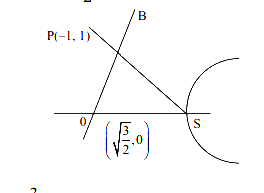
ધારો કે $S$ એ અતિવલય $x^2 - 2y^2 = 1$ નું નાભિ છે જે ધન $X$-અક્ષ પર આવેલું છે. ધારો કે $P(-1, 1)$ એક આપેલ બિંદુ છે. તો રેખા $PS$ દ્વારા યામ અક્ષો સાથે બનતા ત્રિકોણનું ક્ષેત્રફળ (ચોરસ એકમમાં) કેટલું થાય?
A
$\frac{\sqrt{2}}{2(\sqrt{2}+3)}$
B
$\frac{\sqrt{6}}{2(2+\sqrt{6})}$
C
$\frac{3}{2(2+\sqrt{6})}$
D
$\frac{\sqrt{3}}{2(\sqrt{2}+\sqrt{3})}$
Solution
(C) અતિવલયનું સમીકરણ $x^2 - 2y^2 = 1$ છે. $\frac{x^2}{a^2} - \frac{y^2}{b^2} = 1$ સાથે સરખાવતા,આપણને $a^2 = 1$ અને $b^2 = \frac{1}{2}$ મળે છે.
ઉત્કેન્દ્રતા $e = \sqrt{1 + \frac{b^2}{a^2}} = \sqrt{1 + \frac{1/2}{1}} = \sqrt{\frac{3}{2}}$.
નાભિ $S$ એ $(\sqrt{\frac{3}{2}}, 0)$ છે.
બિંદુ $P(-1, 1)$ અને $S(\sqrt{\frac{3}{2}}, 0)$ માંથી પસાર થતી રેખાનો ઢાળ $m = \frac{0 - 1}{\sqrt{\frac{3}{2}} - (-1)} = \frac{-\sqrt{2}}{\sqrt{3} + \sqrt{2}}$ છે.
રેખા $PS$ નું સમીકરણ $y = \frac{-\sqrt{2}}{\sqrt{3} + \sqrt{2}}(x - \sqrt{\frac{3}{2}})$ છે.
$Y$-અંતઃખંડ $(B)$ શોધવા માટે,$x = 0$ મૂકતા: $y = \frac{\sqrt{3}}{\sqrt{3} + \sqrt{2}}$.
યામ અક્ષો સાથે બનતા ત્રિકોણનું ક્ષેત્રફળ $\frac{1}{2} \times |OS| \times |OB| = \frac{1}{2} \times \sqrt{\frac{3}{2}} \times \frac{\sqrt{3}}{\sqrt{3} + \sqrt{2}} = \frac{3}{2(\sqrt{6} + 2)}$ છે.
આમ,સાચો વિકલ્પ $C$ છે.
ઉત્કેન્દ્રતા $e = \sqrt{1 + \frac{b^2}{a^2}} = \sqrt{1 + \frac{1/2}{1}} = \sqrt{\frac{3}{2}}$.
નાભિ $S$ એ $(\sqrt{\frac{3}{2}}, 0)$ છે.
બિંદુ $P(-1, 1)$ અને $S(\sqrt{\frac{3}{2}}, 0)$ માંથી પસાર થતી રેખાનો ઢાળ $m = \frac{0 - 1}{\sqrt{\frac{3}{2}} - (-1)} = \frac{-\sqrt{2}}{\sqrt{3} + \sqrt{2}}$ છે.
રેખા $PS$ નું સમીકરણ $y = \frac{-\sqrt{2}}{\sqrt{3} + \sqrt{2}}(x - \sqrt{\frac{3}{2}})$ છે.
$Y$-અંતઃખંડ $(B)$ શોધવા માટે,$x = 0$ મૂકતા: $y = \frac{\sqrt{3}}{\sqrt{3} + \sqrt{2}}$.
યામ અક્ષો સાથે બનતા ત્રિકોણનું ક્ષેત્રફળ $\frac{1}{2} \times |OS| \times |OB| = \frac{1}{2} \times \sqrt{\frac{3}{2}} \times \frac{\sqrt{3}}{\sqrt{3} + \sqrt{2}} = \frac{3}{2(\sqrt{6} + 2)}$ છે.
આમ,સાચો વિકલ્પ $C$ છે.
0 likesView Solution
212
MathematicsMediumMCQTS EAMCET · 2022
વિધાન: અતિવલય $9x^2 - 16y^2 = 9$ પરના બિંદુઓ $P(\frac{\pi}{4})$ અને $P(\frac{\pi}{3})$ વચ્ચેનું અંતર $\frac{1}{4} \sqrt{66 - 32\sqrt{2} - 18\sqrt{3}}$ છે.
કારણ: $x = a \cosh t, y = b \sinh t$ એ અતિવલય $\frac{x^2}{a^2} - \frac{y^2}{b^2} = 1$ ના પ્રચલ સમીકરણો છે.
કારણ: $x = a \cosh t, y = b \sinh t$ એ અતિવલય $\frac{x^2}{a^2} - \frac{y^2}{b^2} = 1$ ના પ્રચલ સમીકરણો છે.
A
$(A)$ સાચું છે,$(R)$ સાચું છે અને $(R)$ એ $(A)$ ની સાચી સમજૂતી છે
B
$(A)$ સાચું છે,$(R)$ સાચું છે પણ $(R)$ એ $(A)$ ની સાચી સમજૂતી નથી
C
$(A)$ સાચું છે પણ $(R)$ ખોટું છે
D
$(A)$ ખોટું છે પણ $(R)$ સાચું છે
Solution
(C) આપેલ સમીકરણ $9x^2 - 16y^2 = 9$ ને $\frac{x^2}{1^2} - \frac{y^2}{(3/4)^2} = 1$ તરીકે લખી શકાય. અહીં $a=1, b=3/4$ છે.
અતિવલય પરના પ્રચલ બિંદુઓ $(a \sec \theta, b \tan \theta)$ છે.
$\theta = \frac{\pi}{4}$ માટે,$P_1 = (\sqrt{2}, \frac{3}{4})$.
$\theta = \frac{\pi}{3}$ માટે,$P_2 = (2, \frac{3\sqrt{3}}{4})$.
અંતર $D = \sqrt{(2 - \sqrt{2})^2 + (\frac{3\sqrt{3}}{4} - \frac{3}{4})^2} = \frac{1}{2\sqrt{2}} \sqrt{66 - 32\sqrt{2} - 9\sqrt{3}}$.
વિધાન સાચું છે.
કારણ ખોટું છે કારણ કે અતિવલયના પ્રચલ સમીકરણો $x = a \sec \theta, y = b \tan \theta$ છે.
તેથી,$(A)$ સાચું છે પણ $(R)$ ખોટું છે.
અતિવલય પરના પ્રચલ બિંદુઓ $(a \sec \theta, b \tan \theta)$ છે.
$\theta = \frac{\pi}{4}$ માટે,$P_1 = (\sqrt{2}, \frac{3}{4})$.
$\theta = \frac{\pi}{3}$ માટે,$P_2 = (2, \frac{3\sqrt{3}}{4})$.
અંતર $D = \sqrt{(2 - \sqrt{2})^2 + (\frac{3\sqrt{3}}{4} - \frac{3}{4})^2} = \frac{1}{2\sqrt{2}} \sqrt{66 - 32\sqrt{2} - 9\sqrt{3}}$.
વિધાન સાચું છે.
કારણ ખોટું છે કારણ કે અતિવલયના પ્રચલ સમીકરણો $x = a \sec \theta, y = b \tan \theta$ છે.
તેથી,$(A)$ સાચું છે પણ $(R)$ ખોટું છે.
0 likesView Solution
213
MathematicsEasyMCQTS EAMCET · 2022
જો અતિવલય (hyperbola) નું નાભિલંબ (latus rectum) તેના કેન્દ્ર આગળ $120^{\circ}$ નો ખૂણો આંતરે,તો તેની ઉત્કેન્દ્રતા (eccentricity) કેટલી થાય?
A
$\sqrt{3}$
B
$\sqrt{2}$
C
$\frac{\sqrt{3}+1}{2}$
D
$\frac{\sqrt{3}+\sqrt{7}}{2}$
Solution
(D) ધારો કે અતિવલય $\frac{x^2}{a^2} - \frac{y^2}{b^2} = 1$ છે. કેન્દ્ર $(0, 0)$ છે.
નાભિલંબના અંત્યબિંદુઓ $(ae, \frac{b^2}{a})$ અને $(ae, -\frac{b^2}{a})$ છે.
નાભિલંબ દ્વારા કેન્દ્ર આગળ આંતરેલો ખૂણો $120^{\circ}$ છે.
તેથી,કેન્દ્ર અને એક અંત્યબિંદુ $(ae, \frac{b^2}{a})$ ને જોડતી રેખા $x$-અક્ષ સાથે $60^{\circ}$ નો ખૂણો બનાવે છે.
માટે,$\tan(60^{\circ}) = \frac{b^2/a}{ae} = \frac{b^2}{a^2e}$.
$\sqrt{3} = \frac{a^2(e^2 - 1)}{a^2e} = \frac{e^2 - 1}{e}$ હોવાથી,$e^2 - \sqrt{3}e - 1 = 0$ મળે.
દ્વિઘાત સૂત્રનો ઉપયોગ કરતા,$e = \frac{\sqrt{3} + \sqrt{7}}{2}$ મળે.
નાભિલંબના અંત્યબિંદુઓ $(ae, \frac{b^2}{a})$ અને $(ae, -\frac{b^2}{a})$ છે.
નાભિલંબ દ્વારા કેન્દ્ર આગળ આંતરેલો ખૂણો $120^{\circ}$ છે.
તેથી,કેન્દ્ર અને એક અંત્યબિંદુ $(ae, \frac{b^2}{a})$ ને જોડતી રેખા $x$-અક્ષ સાથે $60^{\circ}$ નો ખૂણો બનાવે છે.
માટે,$\tan(60^{\circ}) = \frac{b^2/a}{ae} = \frac{b^2}{a^2e}$.
$\sqrt{3} = \frac{a^2(e^2 - 1)}{a^2e} = \frac{e^2 - 1}{e}$ હોવાથી,$e^2 - \sqrt{3}e - 1 = 0$ મળે.
દ્વિઘાત સૂત્રનો ઉપયોગ કરતા,$e = \frac{\sqrt{3} + \sqrt{7}}{2}$ મળે.
0 likesView Solution
214
MathematicsMediumMCQTS EAMCET · 2022
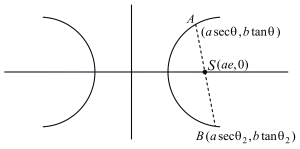
ધારો કે $A(\theta_1)$ અને $B(\theta_2)$ એ અતિવલય $\frac{x^2}{a^2}-\frac{y^2}{b^2}=1$ પરના બે બિંદુઓ છે અને $S$ એ અતિવલયનું નાભિ છે. જો $A, S, B$ સમરેખ હોય અને $a \cos \left(\frac{\theta_1+\theta_2}{2}\right)=k \cos \left(\frac{\theta_1-\theta_2}{2}\right)$ હોય,તો $k=$
A
$a^2+b^2$
B
$\sqrt{a^2+b^2}$
C
$a^2-b^2$
D
$a+b$
Solution
(B) અતિવલય $\frac{x^2}{a^2}-\frac{y^2}{b^2}=1$ પરના બિંદુઓ $A(\theta_1)$ અને $B(\theta_2)$ ને જોડતી જીવાનું સમીકરણ:
$\frac{x}{a} \cos \left(\frac{\theta_1-\theta_2}{2}\right)-\frac{y}{b} \sin \left(\frac{\theta_1+\theta_2}{2}\right)=\cos \left(\frac{\theta_1+\theta_2}{2}\right)$
આ જીવા નાભિ $S(ae, 0)$ માંથી પસાર થાય છે,તેથી $x=ae$ અને $y=0$ મૂકતા:
$\frac{ae}{a} \cos \left(\frac{\theta_1-\theta_2}{2}\right) = \cos \left(\frac{\theta_1+\theta_2}{2}\right)$
$e \cos \left(\frac{\theta_1-\theta_2}{2}\right) = \cos \left(\frac{\theta_1+\theta_2}{2}\right)$
સંબંધ $e = \frac{\sqrt{a^2+b^2}}{a}$ નો ઉપયોગ કરતા:
$\frac{\sqrt{a^2+b^2}}{a} \cos \left(\frac{\theta_1-\theta_2}{2}\right) = \cos \left(\frac{\theta_1+\theta_2}{2}\right)$
$\sqrt{a^2+b^2} \cos \left(\frac{\theta_1-\theta_2}{2}\right) = a \cos \left(\frac{\theta_1+\theta_2}{2}\right)$
આપેલ સમીકરણ $a \cos \left(\frac{\theta_1+\theta_2}{2}\right) = k \cos \left(\frac{\theta_1-\theta_2}{2}\right)$ સાથે સરખાવતા:
$k = \sqrt{a^2+b^2}$
$\frac{x}{a} \cos \left(\frac{\theta_1-\theta_2}{2}\right)-\frac{y}{b} \sin \left(\frac{\theta_1+\theta_2}{2}\right)=\cos \left(\frac{\theta_1+\theta_2}{2}\right)$
આ જીવા નાભિ $S(ae, 0)$ માંથી પસાર થાય છે,તેથી $x=ae$ અને $y=0$ મૂકતા:
$\frac{ae}{a} \cos \left(\frac{\theta_1-\theta_2}{2}\right) = \cos \left(\frac{\theta_1+\theta_2}{2}\right)$
$e \cos \left(\frac{\theta_1-\theta_2}{2}\right) = \cos \left(\frac{\theta_1+\theta_2}{2}\right)$
સંબંધ $e = \frac{\sqrt{a^2+b^2}}{a}$ નો ઉપયોગ કરતા:
$\frac{\sqrt{a^2+b^2}}{a} \cos \left(\frac{\theta_1-\theta_2}{2}\right) = \cos \left(\frac{\theta_1+\theta_2}{2}\right)$
$\sqrt{a^2+b^2} \cos \left(\frac{\theta_1-\theta_2}{2}\right) = a \cos \left(\frac{\theta_1+\theta_2}{2}\right)$
આપેલ સમીકરણ $a \cos \left(\frac{\theta_1+\theta_2}{2}\right) = k \cos \left(\frac{\theta_1-\theta_2}{2}\right)$ સાથે સરખાવતા:
$k = \sqrt{a^2+b^2}$
0 likesView Solution
215
MathematicsMediumMCQTS EAMCET · 2022
ધારો કે $P(\frac{\pi}{4}), Q(\frac{5 \pi}{4}), R(\frac{3 \pi}{4}), T(\frac{7 \pi}{4})$ એ અતિવલય $x^2-4y^2-4=0$ પરના બિંદુઓ પ્રાચલ સ્વરૂપમાં છે. તો ચતુષ્કોણ $PQRT$ નું ક્ષેત્રફળ (ચોરસ એકમમાં) શોધો. ($\sqrt{2}$ માં)
A
$4$
B
$16$
C
$32$
D
$8$
Solution
(D) અતિવલયનું સમીકરણ $x^2 - 4y^2 = 4$ છે, જેને $\frac{x^2}{4} - \frac{y^2}{1} = 1$ તરીકે લખી શકાય.
અહીં, $a = 2$ અને $b = 1$ છે।
પ્રાચલ યામ $(a \sec \theta, b \tan \theta) = (2 \sec \theta, \tan \theta)$ દ્વારા આપવામાં આવે છે.
બિંદુઓની ગણતરી કરતા:
$P(\frac{\pi}{4}) = (2 \sqrt{2}, 1)$
$Q(\frac{5 \pi}{4}) = (-2 \sqrt{2}, 1)$
$R(\frac{3 \pi}{4}) = (-2 \sqrt{2}, -1)$
$T(\frac{7 \pi}{4}) = (2 \sqrt{2}, -1)$
આ બિંદુઓ એક લંબચોરસ બનાવે છે જેના શિરોબિંદુઓ $(2 \sqrt{2}, 1), (-2 \sqrt{2}, 1), (-2 \sqrt{2}, -1),$ અને $(2 \sqrt{2}, -1)$ છે.
બાજુઓની લંબાઈ:
પહોળાઈ $= |2 \sqrt{2} - (-2 \sqrt{2})| = 4 \sqrt{2}$
ઊંચાઈ $= |1 - (-1)| = 2$
ક્ષેત્રફળ $= \text{પહોળાઈ} \times \text{ઊંચાઈ} = 4 \sqrt{2} \times 2 = 8 \sqrt{2}$ ચોરસ એકમ.
તેથી, વિકલ્પ $D$ સાચો છે.
અહીં, $a = 2$ અને $b = 1$ છે।
પ્રાચલ યામ $(a \sec \theta, b \tan \theta) = (2 \sec \theta, \tan \theta)$ દ્વારા આપવામાં આવે છે.
બિંદુઓની ગણતરી કરતા:
$P(\frac{\pi}{4}) = (2 \sqrt{2}, 1)$
$Q(\frac{5 \pi}{4}) = (-2 \sqrt{2}, 1)$
$R(\frac{3 \pi}{4}) = (-2 \sqrt{2}, -1)$
$T(\frac{7 \pi}{4}) = (2 \sqrt{2}, -1)$
આ બિંદુઓ એક લંબચોરસ બનાવે છે જેના શિરોબિંદુઓ $(2 \sqrt{2}, 1), (-2 \sqrt{2}, 1), (-2 \sqrt{2}, -1),$ અને $(2 \sqrt{2}, -1)$ છે.
બાજુઓની લંબાઈ:
પહોળાઈ $= |2 \sqrt{2} - (-2 \sqrt{2})| = 4 \sqrt{2}$
ઊંચાઈ $= |1 - (-1)| = 2$
ક્ષેત્રફળ $= \text{પહોળાઈ} \times \text{ઊંચાઈ} = 4 \sqrt{2} \times 2 = 8 \sqrt{2}$ ચોરસ એકમ.
તેથી, વિકલ્પ $D$ સાચો છે.
0 likesView Solution
216
MathematicsEasyMCQTS EAMCET · 2022
$\lim _{x \rightarrow 0} \frac{\tan 2x - 2\tan x}{(1 - \cos x)(2^x - 1)} = $
A
$\frac{2}{\ln 2}$
B
$\frac{1}{\ln 4}$
C
$4 \ln 2$
D
$\frac{4}{\ln 2}$
Solution
(D) ધારો કે $L = \lim _{x \rightarrow 0} \frac{\tan 2x - 2\tan x}{(1 - \cos x)(2^x - 1)}$.
$\tan x$ ના વિસ્તરણનો ઉપયોગ કરતા: $\tan 2x - 2\tan x = 2x^3$.
છેદમાં: $(1 - \cos x)(2^x - 1) \approx (\frac{x^2}{2})(x \ln 2) = \frac{x^3 \ln 2}{2}$.
તેથી,$L = \lim _{x \rightarrow 0} \frac{2x^3}{\frac{x^3 \ln 2}{2}} = \frac{4}{\ln 2}$.
$\tan x$ ના વિસ્તરણનો ઉપયોગ કરતા: $\tan 2x - 2\tan x = 2x^3$.
છેદમાં: $(1 - \cos x)(2^x - 1) \approx (\frac{x^2}{2})(x \ln 2) = \frac{x^3 \ln 2}{2}$.
તેથી,$L = \lim _{x \rightarrow 0} \frac{2x^3}{\frac{x^3 \ln 2}{2}} = \frac{4}{\ln 2}$.
0 likesView Solution
217
MathematicsMediumMCQTS EAMCET · 2022
$\lim _{x \rightarrow 2}\left[\left(x^2-4 x+4\right) \cos \left(\frac{2}{x-2}\right)+\frac{x^2-4}{x^3-2 x-4}\right]=$
A
$0$
B
$\infty$
C
$1$
D
$\frac{2}{5}$
Solution
(D) અમે લક્ષને બે ભાગમાં વહેંચીને તેની ગણતરી કરીએ છીએ:
$\lim _{x \rightarrow 2} \left[ (x-2)^2 \cos \left(\frac{2}{x-2}\right) \right] + \lim _{x \rightarrow 2} \left[ \frac{x^2-4}{x^3-2 x-4} \right]$
પ્રથમ ભાગ માટે,$\lim _{x \rightarrow 2} (x-2)^2 \cos \left(\frac{2}{x-2}\right)$. કારણ કે $(x-2)^2 \rightarrow 0$ અને $\cos \left(\frac{2}{x-2}\right)$ એ $[-1, 1]$ માં સીમિત છે,તેથી સ્ક્વીઝ પ્રમેય દ્વારા,લક્ષ $0 \times [-1, 1] = 0$ થાય છે.
બીજા ભાગ માટે,$\lim _{x \rightarrow 2} \frac{(x-2)(x+2)}{(x-2)(x^2+2x+2)} = \lim _{x \rightarrow 2} \frac{x+2}{x^2+2x+2}$.
$x=2$ મૂકતા,આપણને $\frac{2+2}{2^2+2(2)+2} = \frac{4}{4+4+2} = \frac{4}{10} = \frac{2}{5}$ મળે છે.
આમ,કુલ લક્ષ $0 + \frac{2}{5} = \frac{2}{5}$ છે.
$\lim _{x \rightarrow 2} \left[ (x-2)^2 \cos \left(\frac{2}{x-2}\right) \right] + \lim _{x \rightarrow 2} \left[ \frac{x^2-4}{x^3-2 x-4} \right]$
પ્રથમ ભાગ માટે,$\lim _{x \rightarrow 2} (x-2)^2 \cos \left(\frac{2}{x-2}\right)$. કારણ કે $(x-2)^2 \rightarrow 0$ અને $\cos \left(\frac{2}{x-2}\right)$ એ $[-1, 1]$ માં સીમિત છે,તેથી સ્ક્વીઝ પ્રમેય દ્વારા,લક્ષ $0 \times [-1, 1] = 0$ થાય છે.
બીજા ભાગ માટે,$\lim _{x \rightarrow 2} \frac{(x-2)(x+2)}{(x-2)(x^2+2x+2)} = \lim _{x \rightarrow 2} \frac{x+2}{x^2+2x+2}$.
$x=2$ મૂકતા,આપણને $\frac{2+2}{2^2+2(2)+2} = \frac{4}{4+4+2} = \frac{4}{10} = \frac{2}{5}$ મળે છે.
આમ,કુલ લક્ષ $0 + \frac{2}{5} = \frac{2}{5}$ છે.
0 likesView Solution
218
MathematicsMediumMCQTS EAMCET · 2022
ધારો કે $[x]$ એ $x$ થી નાનો અથવા તેના બરાબર સૌથી મોટો પૂર્ણાંક દર્શાવે છે અને $f(x) = 2x - [2x]$ છે. જો $\lim_{x \rightarrow 2^{-}} f(x) = l_1$ અને $\lim_{x \rightarrow 2^{+}} f(x) = l_2$ હોય,તો $l_1 + l_2 =$
A
$1$
B
$2$
C
$0$
D
$4$
Solution
(A) $f(x) = 2x - [2x]$ આપેલ છે.
$l_1 = \lim_{x \rightarrow 2^{-}} f(x)$ શોધવા માટે:
ધારો કે $x = 2 - h$,જ્યાં $h \rightarrow 0$ અને $h > 0$.
$l_1 = \lim_{h \rightarrow 0} (2(2 - h) - [2(2 - h)]) = \lim_{h \rightarrow 0} (4 - 2h - [4 - 2h])$.
$h$ એ ખૂબ જ નાની ધન સંખ્યા હોવાથી,$4 - 2h$ એ $4$ કરતા થોડી નાની સંખ્યા છે,તેથી $[4 - 2h] = 3$.
આમ,$l_1 = 4 - 3 = 1$.
$l_2 = \lim_{x \rightarrow 2^{+}} f(x)$ શોધવા માટે:
ધારો કે $x = 2 + h$,જ્યાં $h \rightarrow 0$ અને $h > 0$.
$l_2 = \lim_{h \rightarrow 0} (2(2 + h) - [2(2 + h)]) = \lim_{h \rightarrow 0} (4 + 2h - [4 + 2h])$.
$h$ એ ખૂબ જ નાની ધન સંખ્યા હોવાથી,$4 + 2h$ એ $4$ કરતા થોડી મોટી સંખ્યા છે,તેથી $[4 + 2h] = 4$.
આમ,$l_2 = 4 - 4 = 0$.
તેથી,$l_1 + l_2 = 1 + 0 = 1$.
$l_1 = \lim_{x \rightarrow 2^{-}} f(x)$ શોધવા માટે:
ધારો કે $x = 2 - h$,જ્યાં $h \rightarrow 0$ અને $h > 0$.
$l_1 = \lim_{h \rightarrow 0} (2(2 - h) - [2(2 - h)]) = \lim_{h \rightarrow 0} (4 - 2h - [4 - 2h])$.
$h$ એ ખૂબ જ નાની ધન સંખ્યા હોવાથી,$4 - 2h$ એ $4$ કરતા થોડી નાની સંખ્યા છે,તેથી $[4 - 2h] = 3$.
આમ,$l_1 = 4 - 3 = 1$.
$l_2 = \lim_{x \rightarrow 2^{+}} f(x)$ શોધવા માટે:
ધારો કે $x = 2 + h$,જ્યાં $h \rightarrow 0$ અને $h > 0$.
$l_2 = \lim_{h \rightarrow 0} (2(2 + h) - [2(2 + h)]) = \lim_{h \rightarrow 0} (4 + 2h - [4 + 2h])$.
$h$ એ ખૂબ જ નાની ધન સંખ્યા હોવાથી,$4 + 2h$ એ $4$ કરતા થોડી મોટી સંખ્યા છે,તેથી $[4 + 2h] = 4$.
આમ,$l_2 = 4 - 4 = 0$.
તેથી,$l_1 + l_2 = 1 + 0 = 1$.
0 likesView Solution
219
MathematicsEasyMCQTS EAMCET · 2022
$\lim _{x \rightarrow 0} \frac{2^{2 x}-2^{x+1}+2-\cos 2 x}{x^2} = $
A
$2+(\log _e 2)$
B
$2+(\log _e 2)^2$
C
$2+(\log _e 4)^2$
D
$2+\log _e 4$
Solution
(B) આપેલ છે,$\lim _{x \rightarrow 0} \frac{2^{2 x}-2^{x+1}+2-\cos 2 x}{x^2}$
$= \lim _{x \rightarrow 0} \frac{(2^x)^2 - 2 \cdot 2^x + 1 + 1 - \cos 2x}{x^2}$
$= \lim _{x \rightarrow 0} \frac{(2^x - 1)^2 + (1 - \cos 2x)}{x^2}$
$= \lim _{x \rightarrow 0} \left( \frac{2^x - 1}{x} \right)^2 + \lim _{x \rightarrow 0} \frac{1 - \cos 2x}{x^2}$
પ્રમાણિત લક્ષ $\lim _{x \rightarrow 0} \frac{a^x - 1}{x} = \log _e a$ અને $\lim _{x \rightarrow 0} \frac{1 - \cos kx}{x^2} = \frac{k^2}{2}$ નો ઉપયોગ કરતા:
$= (\log _e 2)^2 + \frac{2^2}{2}$
$= (\log _e 2)^2 + 2$
$= \lim _{x \rightarrow 0} \frac{(2^x)^2 - 2 \cdot 2^x + 1 + 1 - \cos 2x}{x^2}$
$= \lim _{x \rightarrow 0} \frac{(2^x - 1)^2 + (1 - \cos 2x)}{x^2}$
$= \lim _{x \rightarrow 0} \left( \frac{2^x - 1}{x} \right)^2 + \lim _{x \rightarrow 0} \frac{1 - \cos 2x}{x^2}$
પ્રમાણિત લક્ષ $\lim _{x \rightarrow 0} \frac{a^x - 1}{x} = \log _e a$ અને $\lim _{x \rightarrow 0} \frac{1 - \cos kx}{x^2} = \frac{k^2}{2}$ નો ઉપયોગ કરતા:
$= (\log _e 2)^2 + \frac{2^2}{2}$
$= (\log _e 2)^2 + 2$
0 likesView Solution
220
MathematicsEasyMCQTS EAMCET · 2022
$\lim _{x \rightarrow 3^{-}} \frac{x^3-3 x^2-4 x+12}{2 x^3-7 x^2+2 x+3} = $
A
$0$
B
$\infty$
C
$\frac{5}{14}$
D
$\frac{6}{13}$
Solution
(C) આપેલ છે,$L = \lim _{x \rightarrow 3^{-}} \frac{x^3-3 x^2-4 x+12}{2 x^3-7 x^2+2 x+3}$.
$x = 3$ આગળ સ્વરૂપ તપાસતા,આપણને $\frac{27 - 27 - 12 + 12}{54 - 63 + 6 + 3} = \frac{0}{0}$ સ્વરૂપ મળે છે.
$L'H\hat{o}pital$ નો નિયમ વાપરતા,અંશ અને છેદનું $x$ ની સાપેક્ષમાં વિકલન કરતા:
$L = \lim _{x \rightarrow 3^{-}} \frac{3 x^2-6 x-4}{6 x^2-14 x+2}$.
હવે,$x = 3$ મૂકતા:
$L = \frac{3(3^2) - 6(3) - 4}{6(3^2) - 14(3) + 2} = \frac{27 - 18 - 4}{54 - 42 + 2} = \frac{5}{14}$.
$x = 3$ આગળ સ્વરૂપ તપાસતા,આપણને $\frac{27 - 27 - 12 + 12}{54 - 63 + 6 + 3} = \frac{0}{0}$ સ્વરૂપ મળે છે.
$L'H\hat{o}pital$ નો નિયમ વાપરતા,અંશ અને છેદનું $x$ ની સાપેક્ષમાં વિકલન કરતા:
$L = \lim _{x \rightarrow 3^{-}} \frac{3 x^2-6 x-4}{6 x^2-14 x+2}$.
હવે,$x = 3$ મૂકતા:
$L = \frac{3(3^2) - 6(3) - 4}{6(3^2) - 14(3) + 2} = \frac{27 - 18 - 4}{54 - 42 + 2} = \frac{5}{14}$.
0 likesView Solution
221
MathematicsEasyMCQTS EAMCET · 2022
$\lim _{x \rightarrow \infty} x^3 \left[ \sqrt{x^2 + \sqrt{x^4 + 1}} - \sqrt{2} x \right] = $
A
$0$
B
$1$
C
$\frac{1}{4 \sqrt{2}}$
D
$\frac{3}{2 \sqrt{2}}$
Solution
(C) ધારો કે $L = \lim _{x \rightarrow \infty} x^3 \left[ \sqrt{x^2 + \sqrt{x^4 + 1}} - \sqrt{2} x \right]$.
પદનું સંમેયીકરણ કરતા:
$L = \lim _{x \rightarrow \infty} x^3 \left[ \sqrt{x^2 + \sqrt{x^4 + 1}} - \sqrt{2} x \right] \times \frac{\sqrt{x^2 + \sqrt{x^4 + 1}} + \sqrt{2} x}{\sqrt{x^2 + \sqrt{x^4 + 1}} + \sqrt{2} x}$
$= \lim _{x \rightarrow \infty} x^3 \frac{x^2 + \sqrt{x^4 + 1} - 2x^2}{\sqrt{x^2 + \sqrt{x^4 + 1}} + \sqrt{2} x} = \lim _{x \rightarrow \infty} x^3 \frac{\sqrt{x^4 + 1} - x^2}{\sqrt{x^2 + \sqrt{x^4 + 1}} + \sqrt{2} x}$.
ફરીથી સંમેયીકરણ કરતા:
$= \lim _{x \rightarrow \infty} x^3 \frac{(\sqrt{x^4 + 1} - x^2)(\sqrt{x^4 + 1} + x^2)}{(\sqrt{x^2 + \sqrt{x^4 + 1}} + \sqrt{2} x)(\sqrt{x^4 + 1} + x^2)} = \lim _{x \rightarrow \infty} x^3 \frac{x^4 + 1 - x^4}{(\sqrt{x^2 + \sqrt{x^4 + 1}} + \sqrt{2} x)(\sqrt{x^4 + 1} + x^2)}$
$= \lim _{x \rightarrow \infty} \frac{x^3}{(\sqrt{x^2 + \sqrt{x^4 + 1}} + \sqrt{2} x)(\sqrt{x^4 + 1} + x^2)}$.
અંશ અને છેદને $x^3$ વડે ભાગતા:
$= \lim _{x \rightarrow \infty} \frac{1}{(\sqrt{1 + \sqrt{1 + \frac{1}{x^4}}} + \sqrt{2})(\sqrt{1 + \frac{1}{x^4}} + 1)} = \frac{1}{(\sqrt{1 + 1} + \sqrt{2})(1 + 1)} = \frac{1}{(2\sqrt{2})(2)} = \frac{1}{4\sqrt{2}}$.
પદનું સંમેયીકરણ કરતા:
$L = \lim _{x \rightarrow \infty} x^3 \left[ \sqrt{x^2 + \sqrt{x^4 + 1}} - \sqrt{2} x \right] \times \frac{\sqrt{x^2 + \sqrt{x^4 + 1}} + \sqrt{2} x}{\sqrt{x^2 + \sqrt{x^4 + 1}} + \sqrt{2} x}$
$= \lim _{x \rightarrow \infty} x^3 \frac{x^2 + \sqrt{x^4 + 1} - 2x^2}{\sqrt{x^2 + \sqrt{x^4 + 1}} + \sqrt{2} x} = \lim _{x \rightarrow \infty} x^3 \frac{\sqrt{x^4 + 1} - x^2}{\sqrt{x^2 + \sqrt{x^4 + 1}} + \sqrt{2} x}$.
ફરીથી સંમેયીકરણ કરતા:
$= \lim _{x \rightarrow \infty} x^3 \frac{(\sqrt{x^4 + 1} - x^2)(\sqrt{x^4 + 1} + x^2)}{(\sqrt{x^2 + \sqrt{x^4 + 1}} + \sqrt{2} x)(\sqrt{x^4 + 1} + x^2)} = \lim _{x \rightarrow \infty} x^3 \frac{x^4 + 1 - x^4}{(\sqrt{x^2 + \sqrt{x^4 + 1}} + \sqrt{2} x)(\sqrt{x^4 + 1} + x^2)}$
$= \lim _{x \rightarrow \infty} \frac{x^3}{(\sqrt{x^2 + \sqrt{x^4 + 1}} + \sqrt{2} x)(\sqrt{x^4 + 1} + x^2)}$.
અંશ અને છેદને $x^3$ વડે ભાગતા:
$= \lim _{x \rightarrow \infty} \frac{1}{(\sqrt{1 + \sqrt{1 + \frac{1}{x^4}}} + \sqrt{2})(\sqrt{1 + \frac{1}{x^4}} + 1)} = \frac{1}{(\sqrt{1 + 1} + \sqrt{2})(1 + 1)} = \frac{1}{(2\sqrt{2})(2)} = \frac{1}{4\sqrt{2}}$.
0 likesView Solution
222
MathematicsEasyMCQTS EAMCET · 2022
લક્ષની કિંમત શોધો: $\lim _{x \rightarrow 0} \frac{\tan ^2(\pi \sec ^4 x)}{\pi^2 x^4}$
A
$0$
B
$4$
C
$1$
D
$16$
Solution
(B) ધારો કે $L = \lim _{x \rightarrow 0} \frac{\tan ^2(\pi \sec ^4 x)}{\pi^2 x^4}$.
$\sec(0) = 1$ હોવાથી,પદાવલિ $\frac{\tan^2(\pi)}{0} = \frac{0}{0}$ સ્વરૂપ ધારણ કરે છે.
આપણે ગુણધર્મ $\tan(\pi \sec^4 x) = \tan(\pi \sec^4 x - \pi) = \tan(\pi(\sec^4 x - 1))$ નો ઉપયોગ કરીએ છીએ.
યાદ રાખો કે $\sec^4 x - 1 = (\sec^2 x - 1)(\sec^2 x + 1) = \tan^2 x (\sec^2 x + 1)$.
જેમ $x \rightarrow 0$,$\tan x \approx x$ અને $\sec^2 x \approx 1$,તેથી $\sec^4 x - 1 \approx x^2(1+1) = 2x^2$.
આમ,$\tan(\pi \sec^4 x) \approx \tan(2\pi x^2) \approx 2\pi x^2$.
આ કિંમત લક્ષમાં મૂકતા:
$L = \lim _{x \rightarrow 0} \frac{(2\pi x^2)^2}{\pi^2 x^4} = \lim _{x \rightarrow 0} \frac{4\pi^2 x^4}{\pi^2 x^4} = 4$.
$\sec(0) = 1$ હોવાથી,પદાવલિ $\frac{\tan^2(\pi)}{0} = \frac{0}{0}$ સ્વરૂપ ધારણ કરે છે.
આપણે ગુણધર્મ $\tan(\pi \sec^4 x) = \tan(\pi \sec^4 x - \pi) = \tan(\pi(\sec^4 x - 1))$ નો ઉપયોગ કરીએ છીએ.
યાદ રાખો કે $\sec^4 x - 1 = (\sec^2 x - 1)(\sec^2 x + 1) = \tan^2 x (\sec^2 x + 1)$.
જેમ $x \rightarrow 0$,$\tan x \approx x$ અને $\sec^2 x \approx 1$,તેથી $\sec^4 x - 1 \approx x^2(1+1) = 2x^2$.
આમ,$\tan(\pi \sec^4 x) \approx \tan(2\pi x^2) \approx 2\pi x^2$.
આ કિંમત લક્ષમાં મૂકતા:
$L = \lim _{x \rightarrow 0} \frac{(2\pi x^2)^2}{\pi^2 x^4} = \lim _{x \rightarrow 0} \frac{4\pi^2 x^4}{\pi^2 x^4} = 4$.
0 likesView Solution
223
MathematicsMediumMCQTS EAMCET · 2022
ધારો કે $f(x)$ એ વિકલનીય વિધેય છે જેથી $f(0)=0$ અને $f^{\prime}(0)=20$ થાય. $x \in \left(0, \frac{\pi}{2}\right]$ માટે,જો $A(x)=2 f(x) \operatorname{cosec} 4 x+4 f(x)\left(\cos ^2 x+1\right)-4 \cos ^2 x$ હોય,તો $\lim _{x \rightarrow 0} A(x)=$
A
$0$
B
$4$
C
$6$
D
$8$
Solution
(C) આપેલ છે કે $f(x)$ એ $f(0)=0$ અને $f^{\prime}(0)=20$ સાથેનું વિકલનીય વિધેય છે.
આપણે $\lim _{x \rightarrow 0} A(x) = \lim _{x \rightarrow 0} [2 f(x) \operatorname{cosec} 4 x + 4 f(x)(\cos ^2 x + 1) - 4 \cos ^2 x]$ શોધવાની જરૂર છે.
પદાવલિને આ રીતે ફરીથી લખો:
$\lim _{x \rightarrow 0} A(x) = \lim _{x \rightarrow 0} \left[ \frac{2 f(x)}{\sin 4x} + 4 f(x)(\cos ^2 x + 1) - 4 \cos ^2 x \right]$.
કારણ કે $f(0)=0$,પ્રથમ પદ $\frac{0}{0}$ પ્રકારનું અનિશ્ચિત સ્વરૂપ છે.
લક્ષનો ઉપયોગ કરીને $\lim _{x \rightarrow 0} \frac{f(x)}{\sin 4x} = \lim _{x \rightarrow 0} \frac{f(x)}{x} \cdot \frac{4x}{\sin 4x} \cdot \frac{1}{4} = f^{\prime}(0) \cdot 1 \cdot \frac{1}{4} = \frac{20}{4} = 5$.
હવે,લક્ષની ગણતરી કરો:
$\lim _{x \rightarrow 0} A(x) = 2 \left( \lim _{x \rightarrow 0} \frac{f(x)}{\sin 4x} \right) + 4 \lim _{x \rightarrow 0} f(x)(\cos ^2 x + 1) - 4 \lim _{x \rightarrow 0} \cos ^2 x$.
$= 2(5) + 4(0)(1+1) - 4(1)^2$.
$= 10 + 0 - 4 = 6$.
તેથી,સાચો વિકલ્પ $C$ છે.
આપણે $\lim _{x \rightarrow 0} A(x) = \lim _{x \rightarrow 0} [2 f(x) \operatorname{cosec} 4 x + 4 f(x)(\cos ^2 x + 1) - 4 \cos ^2 x]$ શોધવાની જરૂર છે.
પદાવલિને આ રીતે ફરીથી લખો:
$\lim _{x \rightarrow 0} A(x) = \lim _{x \rightarrow 0} \left[ \frac{2 f(x)}{\sin 4x} + 4 f(x)(\cos ^2 x + 1) - 4 \cos ^2 x \right]$.
કારણ કે $f(0)=0$,પ્રથમ પદ $\frac{0}{0}$ પ્રકારનું અનિશ્ચિત સ્વરૂપ છે.
લક્ષનો ઉપયોગ કરીને $\lim _{x \rightarrow 0} \frac{f(x)}{\sin 4x} = \lim _{x \rightarrow 0} \frac{f(x)}{x} \cdot \frac{4x}{\sin 4x} \cdot \frac{1}{4} = f^{\prime}(0) \cdot 1 \cdot \frac{1}{4} = \frac{20}{4} = 5$.
હવે,લક્ષની ગણતરી કરો:
$\lim _{x \rightarrow 0} A(x) = 2 \left( \lim _{x \rightarrow 0} \frac{f(x)}{\sin 4x} \right) + 4 \lim _{x \rightarrow 0} f(x)(\cos ^2 x + 1) - 4 \lim _{x \rightarrow 0} \cos ^2 x$.
$= 2(5) + 4(0)(1+1) - 4(1)^2$.
$= 10 + 0 - 4 = 6$.
તેથી,સાચો વિકલ્પ $C$ છે.
0 likesView Solution
224
MathematicsMediumMCQTS EAMCET · 2022
$\lim _{x \rightarrow 0} \frac{\left(2^x-1\right)(1+\sin x)^{\frac{2}{\sin x}}}{\log (1+2 x)} = $
A
$e^2 \log 4$
B
$e \log \sqrt{2}$
C
$e^2 \log 2$
D
$e^2 \log \sqrt{2}$
Solution
(D) આપણે લક્ષ $L = \lim _{x \rightarrow 0} \frac{\left(2^x-1\right)(1+\sin x)^{\frac{2}{\sin x}}}{\log (1+2 x)}$ ની કિંમત શોધવાની છે.
પ્રથમ,પદ $(1+\sin x)^{\frac{2}{\sin x}}$ ને ધ્યાનમાં લો. જેમ $x \rightarrow 0$,તેમ $\sin x \rightarrow 0$,તેથી આ $(1+u)^{2/u}$ સ્વરૂપમાં છે જ્યાં $u = \sin x$. આપણે જાણીએ છીએ કે $\lim _{u \rightarrow 0} (1+u)^{1/u} = e$,તેથી $\lim _{x \rightarrow 0} (1+\sin x)^{\frac{2}{\sin x}} = e^2$.
હવે,લક્ષને આ રીતે ફરીથી લખો:
$L = \lim _{x \rightarrow 0} \left( \frac{2^x-1}{\log(1+2x)} \right) \times \lim _{x \rightarrow 0} (1+\sin x)^{\frac{2}{\sin x}}$.
પ્રમાણિત લક્ષ $\lim _{x \rightarrow 0} \frac{a^x-1}{x} = \log a$ અને $\lim _{x \rightarrow 0} \frac{\log(1+x)}{x} = 1$ નો ઉપયોગ કરતા:
$\lim _{x \rightarrow 0} \frac{2^x-1}{\log(1+2x)} = \lim _{x \rightarrow 0} \left( \frac{2^x-1}{x} \cdot \frac{2x}{\log(1+2x)} \cdot \frac{1}{2} \right) = \log 2 \cdot 1 \cdot \frac{1}{2} = \frac{\log 2}{2} = \log \sqrt{2}$.
આમ,$L = \log \sqrt{2} \cdot e^2 = e^2 \log \sqrt{2}$.
તેથી,વિકલ્પ $(D)$ સાચો છે.
પ્રથમ,પદ $(1+\sin x)^{\frac{2}{\sin x}}$ ને ધ્યાનમાં લો. જેમ $x \rightarrow 0$,તેમ $\sin x \rightarrow 0$,તેથી આ $(1+u)^{2/u}$ સ્વરૂપમાં છે જ્યાં $u = \sin x$. આપણે જાણીએ છીએ કે $\lim _{u \rightarrow 0} (1+u)^{1/u} = e$,તેથી $\lim _{x \rightarrow 0} (1+\sin x)^{\frac{2}{\sin x}} = e^2$.
હવે,લક્ષને આ રીતે ફરીથી લખો:
$L = \lim _{x \rightarrow 0} \left( \frac{2^x-1}{\log(1+2x)} \right) \times \lim _{x \rightarrow 0} (1+\sin x)^{\frac{2}{\sin x}}$.
પ્રમાણિત લક્ષ $\lim _{x \rightarrow 0} \frac{a^x-1}{x} = \log a$ અને $\lim _{x \rightarrow 0} \frac{\log(1+x)}{x} = 1$ નો ઉપયોગ કરતા:
$\lim _{x \rightarrow 0} \frac{2^x-1}{\log(1+2x)} = \lim _{x \rightarrow 0} \left( \frac{2^x-1}{x} \cdot \frac{2x}{\log(1+2x)} \cdot \frac{1}{2} \right) = \log 2 \cdot 1 \cdot \frac{1}{2} = \frac{\log 2}{2} = \log \sqrt{2}$.
આમ,$L = \log \sqrt{2} \cdot e^2 = e^2 \log \sqrt{2}$.
તેથી,વિકલ્પ $(D)$ સાચો છે.
0 likesView Solution
225
MathematicsEasyMCQTS EAMCET · 2022
લક્ષની કિંમત શોધો: $\lim _{x \rightarrow 2} \frac{x^3-x^2-x-2}{2 x^3-3 x^2-3 x+2}$
A
$0$
B
$\infty$
C
$\frac{5}{7}$
D
$\frac{7}{9}$
Solution
(D) આપેલ લક્ષ: $\lim _{x \rightarrow 2} \frac{x^3-x^2-x-2}{2 x^3-3 x^2-3 x+2}$
$x = 2$ મૂકતા,આપણને $\frac{0}{0}$ સ્વરૂપ મળે છે.
એલ. હોસ્પિટલના નિયમનો ઉપયોગ કરતા:
અંશનું વિકલન: $3x^2-2x-1$
છેદનું વિકલન: $6x^2-6x-3$
હવે,લક્ષની કિંમત: $\lim _{x \rightarrow 2} \frac{3x^2-2x-1}{6x^2-6x-3} = \frac{3(4)-4-1}{6(4)-12-3} = \frac{7}{9}$
$x = 2$ મૂકતા,આપણને $\frac{0}{0}$ સ્વરૂપ મળે છે.
એલ. હોસ્પિટલના નિયમનો ઉપયોગ કરતા:
અંશનું વિકલન: $3x^2-2x-1$
છેદનું વિકલન: $6x^2-6x-3$
હવે,લક્ષની કિંમત: $\lim _{x \rightarrow 2} \frac{3x^2-2x-1}{6x^2-6x-3} = \frac{3(4)-4-1}{6(4)-12-3} = \frac{7}{9}$
0 likesView Solution
226
MathematicsMediumMCQTS EAMCET · 2022
લક્ષની કિંમત શોધો: $\lim _{x \rightarrow 0} \frac{4[\sin (2022 x)-\sin (2020 x)]}{x[\cos (2022 x)+2 \cos (2021 x)+\cos (2020 x)]}$
A
$1$
B
$2$
C
$2020$
D
$2021$
Solution
(B) ત્રિકોણમિતીય નિત્યસમ $\sin C - \sin D = 2 \cos \left(\frac{C+D}{2}\right) \sin \left(\frac{C-D}{2}\right)$ અને $\cos C + \cos D = 2 \cos \left(\frac{C+D}{2}\right) \cos \left(\frac{C-D}{2}\right)$ નો ઉપયોગ કરતા:
અંશ: $4[\sin (2022 x) - \sin (2020 x)] = 4 \times 2 \cos(2021 x) \sin(x) = 8 \cos(2021 x) \sin(x)$.
છેદ: $x[\cos (2022 x) + \cos (2020 x) + 2 \cos (2021 x)] = x[2 \cos(2021 x) \cos(x) + 2 \cos(2021 x)] = 2x \cos(2021 x) [\cos(x) + 1]$.
આ કિંમતો લક્ષમાં મૂકતા:
$\lim _{x \rightarrow 0} \frac{8 \cos(2021 x) \sin(x)}{2x \cos(2021 x) [\cos(x) + 1]} = \lim _{x \rightarrow 0} \frac{4 \sin(x)}{x [\cos(x) + 1]}$.
કારણ કે $\lim _{x \rightarrow 0} \frac{\sin x}{x} = 1$ અને $\cos(0) = 1$:
$= \frac{4(1)}{1 + 1} = \frac{4}{2} = 2$.
અંશ: $4[\sin (2022 x) - \sin (2020 x)] = 4 \times 2 \cos(2021 x) \sin(x) = 8 \cos(2021 x) \sin(x)$.
છેદ: $x[\cos (2022 x) + \cos (2020 x) + 2 \cos (2021 x)] = x[2 \cos(2021 x) \cos(x) + 2 \cos(2021 x)] = 2x \cos(2021 x) [\cos(x) + 1]$.
આ કિંમતો લક્ષમાં મૂકતા:
$\lim _{x \rightarrow 0} \frac{8 \cos(2021 x) \sin(x)}{2x \cos(2021 x) [\cos(x) + 1]} = \lim _{x \rightarrow 0} \frac{4 \sin(x)}{x [\cos(x) + 1]}$.
કારણ કે $\lim _{x \rightarrow 0} \frac{\sin x}{x} = 1$ અને $\cos(0) = 1$:
$= \frac{4(1)}{1 + 1} = \frac{4}{2} = 2$.
0 likesView Solution
227
MathematicsEasyMCQTS EAMCET · 2022
લક્ષની કિંમત શોધો: $\lim _{x}$ ${\rightarrow 0}\left(\frac{4 !}{x^8}\left(1-\cos \frac{x^2}{3}-\cos \frac{x^2}{4}+\cos \frac{x^2}{3} \cos \frac{x^2}{4}\right)\right)$
A
$8$
B
$\frac{1}{6}$
C
$\frac{1}{24}$
D
$\frac{2}{3}$
Solution
(C) ધારો કે આપેલ પદાવલિ $L = \lim _{x}$ ${\rightarrow 0}\left(\frac{4 !}{x^8}\left(1-\cos \frac{x^2}{3}-\cos \frac{x^2}{4}+\cos \frac{x^2}{3} \cos \frac{x^2}{4}\right)\right)$ છે.
આપણે લક્ષની અંદરની પદાવલિને આ રીતે અવયવ પાડી શકીએ:
$L = \lim _{x \rightarrow 0} \frac{4!}{x^8} (1 - \cos \frac{x^2}{3})(1 - \cos \frac{x^2}{4})$.
નિત્યસમ $1 - \cos \theta = 2 \sin^2(\frac{\theta}{2})$ નો ઉપયોગ કરતા:
$1 - \cos \frac{x^2}{3} = 2 \sin^2(\frac{x^2}{6})$ અને $1 - \cos \frac{x^2}{4} = 2 \sin^2(\frac{x^2}{8})$.
આ કિંમતો લક્ષમાં મૂકતા:
$L = 24 \times \lim _{x \rightarrow 0} \frac{1}{x^8} \times 2 \sin^2(\frac{x^2}{6}) \times 2 \sin^2(\frac{x^2}{8})$.
$L = 24 \times 4 \times \lim _{x}$ ${\rightarrow 0} \left(\frac{\sin(\frac{x^2}{6})}{\frac{x^2}{6}}\right)^2 \times (\frac{x^2}{6})^2 \times \left(\frac{\sin(\frac{x^2}{8})}{\frac{x^2}{8}}\right)^2 \times (\frac{x^2}{8})^2 \times \frac{1}{x^8}$.
કારણ કે $\lim_{\theta \rightarrow 0} \frac{\sin \theta}{\theta} = 1$,તેથી:
$L = 96 \times 1^2 \times \frac{x^4}{36} \times 1^2 \times \frac{x^4}{64} \times \frac{1}{x^8}$.
$L = 96 \times \frac{1}{36 \times 64} = \frac{96}{2304} = \frac{1}{24}$.
આપણે લક્ષની અંદરની પદાવલિને આ રીતે અવયવ પાડી શકીએ:
$L = \lim _{x \rightarrow 0} \frac{4!}{x^8} (1 - \cos \frac{x^2}{3})(1 - \cos \frac{x^2}{4})$.
નિત્યસમ $1 - \cos \theta = 2 \sin^2(\frac{\theta}{2})$ નો ઉપયોગ કરતા:
$1 - \cos \frac{x^2}{3} = 2 \sin^2(\frac{x^2}{6})$ અને $1 - \cos \frac{x^2}{4} = 2 \sin^2(\frac{x^2}{8})$.
આ કિંમતો લક્ષમાં મૂકતા:
$L = 24 \times \lim _{x \rightarrow 0} \frac{1}{x^8} \times 2 \sin^2(\frac{x^2}{6}) \times 2 \sin^2(\frac{x^2}{8})$.
$L = 24 \times 4 \times \lim _{x}$ ${\rightarrow 0} \left(\frac{\sin(\frac{x^2}{6})}{\frac{x^2}{6}}\right)^2 \times (\frac{x^2}{6})^2 \times \left(\frac{\sin(\frac{x^2}{8})}{\frac{x^2}{8}}\right)^2 \times (\frac{x^2}{8})^2 \times \frac{1}{x^8}$.
કારણ કે $\lim_{\theta \rightarrow 0} \frac{\sin \theta}{\theta} = 1$,તેથી:
$L = 96 \times 1^2 \times \frac{x^4}{36} \times 1^2 \times \frac{x^4}{64} \times \frac{1}{x^8}$.
$L = 96 \times \frac{1}{36 \times 64} = \frac{96}{2304} = \frac{1}{24}$.
0 likesView Solution
228
MathematicsMediumMCQTS EAMCET · 2022
જો $x = \log_e \left( \cot \left( \frac{\pi}{4} + \theta \right) \right)$ હોય,તો $\lim_{\theta \rightarrow 0} \frac{\theta}{(\sinh x)(\cosh x)} = $
A
$0$
B
$-\frac{1}{2}$
C
$-2$
D
$1$
Solution
(B) આપેલ છે $x = \log_e \left( \cot \left( \frac{\pi}{4} + \theta \right) \right)$.
આપણે જાણીએ છીએ કે $\sinh x = -\tan(2\theta)$ અને $\cosh x = \sec(2\theta)$.
તેથી $(\sinh x)(\cosh x) = -\tan(2\theta) \sec(2\theta) = -\frac{\sin(2\theta)}{\cos^2(2\theta)}$.
હવે,લક્ષ $\lim_{\theta \rightarrow 0} \frac{\theta}{-\sin(2\theta)/\cos^2(2\theta)} = \lim_{\theta \rightarrow 0} -\frac{\theta}{\sin(2\theta)} \cdot \cos^2(2\theta) = -\frac{1}{2} \cdot 1 = -\frac{1}{2}$.
આપણે જાણીએ છીએ કે $\sinh x = -\tan(2\theta)$ અને $\cosh x = \sec(2\theta)$.
તેથી $(\sinh x)(\cosh x) = -\tan(2\theta) \sec(2\theta) = -\frac{\sin(2\theta)}{\cos^2(2\theta)}$.
હવે,લક્ષ $\lim_{\theta \rightarrow 0} \frac{\theta}{-\sin(2\theta)/\cos^2(2\theta)} = \lim_{\theta \rightarrow 0} -\frac{\theta}{\sin(2\theta)} \cdot \cos^2(2\theta) = -\frac{1}{2} \cdot 1 = -\frac{1}{2}$.
0 likesView Solution
229
MathematicsEasyMCQTS EAMCET · 2022
અસતત માહિતી $1, 3, 4, 7, 11, 18, 29, 47, 78$ માટે મધ્યકથી સરેરાશ વિચલન શોધો.
A
$22$
B
$24$
C
$\frac{176}{9}$
D
$\frac{182}{9}$
Solution
(C) અવલોકનોનો મધ્યક એ અવલોકનોના સરવાળા અને અવલોકનોની સંખ્યાનો ગુણોત્તર છે.
સરવાળો $= 1 + 3 + 4 + 7 + 11 + 18 + 29 + 47 + 78 = 198$.
મધ્યક $(\bar{x}) = \frac{198}{9} = 22$.
હવે,મધ્યકથી સરેરાશ વિચલન $M.D. = \frac{\sum |x_i - \bar{x}|}{n}$ સૂત્ર દ્વારા મળે છે.
$M.D. = \frac{|1-22| + |3-22| + |4-22| + |7-22| + |11-22| + |18-22| + |29-22| + |47-22| + |78-22|}{9}$.
$M.D. = \frac{21 + 19 + 18 + 15 + 11 + 4 + 7 + 25 + 56}{9}$.
$M.D. = \frac{176}{9}$.
સરવાળો $= 1 + 3 + 4 + 7 + 11 + 18 + 29 + 47 + 78 = 198$.
મધ્યક $(\bar{x}) = \frac{198}{9} = 22$.
હવે,મધ્યકથી સરેરાશ વિચલન $M.D. = \frac{\sum |x_i - \bar{x}|}{n}$ સૂત્ર દ્વારા મળે છે.
$M.D. = \frac{|1-22| + |3-22| + |4-22| + |7-22| + |11-22| + |18-22| + |29-22| + |47-22| + |78-22|}{9}$.
$M.D. = \frac{21 + 19 + 18 + 15 + 11 + 4 + 7 + 25 + 56}{9}$.
$M.D. = \frac{176}{9}$.
0 likesView Solution
230
MathematicsMediumMCQTS EAMCET · 2022
$n$ અવલોકનો છે અને તે બધા જ ઋણ સંખ્યાઓ છે. આ અવલોકનોનો ચડતો ક્રમ $x_1, x_2, \ldots, x_n$ છે. જો આ ક્રમમાં પ્રથમ પદ અને છેલ્લા પદની નિશાની બદલવામાં આવે,તો માહિતીનો વિસ્તાર કેટલો થાય?
A
$|x_1| - |x_n|$
B
$|x_n - x_1|$
C
$|x_1| - x_2$
D
$|x_1| - |x_2|$
Solution
(C) આપેલ છે કે $x_1, x_2, \ldots, x_n$ ઋણ સંખ્યાઓ છે જે ચડતા ક્રમમાં છે.
પ્રથમ પદ $x_1$ અને છેલ્લા પદ $x_n$ ની નિશાની બદલતા,નવો ક્રમ $-x_1, x_2, \ldots, -x_n$ બને છે.
અહીં સૌથી મોટી કિંમત $-x_1$ છે અને સૌથી નાની કિંમત $x_2$ છે.
તેથી,વિસ્તાર $= (-x_1) - x_2 = |x_1| - x_2$.
પ્રથમ પદ $x_1$ અને છેલ્લા પદ $x_n$ ની નિશાની બદલતા,નવો ક્રમ $-x_1, x_2, \ldots, -x_n$ બને છે.
અહીં સૌથી મોટી કિંમત $-x_1$ છે અને સૌથી નાની કિંમત $x_2$ છે.
તેથી,વિસ્તાર $= (-x_1) - x_2 = |x_1| - x_2$.
0 likesView Solution
231
MathematicsEasyMCQTS EAMCET · 2022
જો $n$ અવલોકનો $x_1, x_2, x_3, \ldots, x_n$ નું સરેરાશ વિચલન $10$ હોય,તો અવલોકનો $\frac{2x_1+5}{3}, \frac{2x_2+5}{3}, \frac{2x_3+5}{3}, \ldots, \frac{2x_n+5}{3}$ નું સરેરાશ વિચલન શું થશે?
A
$\frac{25}{3}$
B
$\frac{40}{9}$
C
$\frac{20}{3}$
D
$15$
Solution
(C) ધારો કે અવલોકનો $x_1, x_2, \ldots, x_n$ નો મધ્યક $\bar{x}$ છે.
આપેલ છે કે $x_i$ નું સરેરાશ વિચલન ($M$.$D$.) $\frac{1}{n} \sum_{i=1}^{n} |x_i - \bar{x}| = 10$ છે.
ધારો કે નવા અવલોકનો $y_i = \frac{2x_i + 5}{3}$ છે.
નવા અવલોકનોનો મધ્યક $\bar{y} = \frac{2\bar{x} + 5}{3}$ છે.
નવા અવલોકનોનું સરેરાશ વિચલન નીચે મુજબ છે:
$\text{નવું M.D.} = \frac{1}{n} \sum_{i=1}^{n} |y_i - \bar{y}|$
$= \frac{1}{n} \sum_{i=1}^{n} |\frac{2x_i + 5}{3} - \frac{2\bar{x} + 5}{3}|$
$= \frac{1}{n} \sum_{i=1}^{n} |\frac{2(x_i - \bar{x})}{3}|$
$= \frac{2}{3} \times (\frac{1}{n} \sum_{i=1}^{n} |x_i - \bar{x}|)$
$= \frac{2}{3} \times 10 = \frac{20}{3}$.
આમ,સાચો વિકલ્પ $C$ છે.
આપેલ છે કે $x_i$ નું સરેરાશ વિચલન ($M$.$D$.) $\frac{1}{n} \sum_{i=1}^{n} |x_i - \bar{x}| = 10$ છે.
ધારો કે નવા અવલોકનો $y_i = \frac{2x_i + 5}{3}$ છે.
નવા અવલોકનોનો મધ્યક $\bar{y} = \frac{2\bar{x} + 5}{3}$ છે.
નવા અવલોકનોનું સરેરાશ વિચલન નીચે મુજબ છે:
$\text{નવું M.D.} = \frac{1}{n} \sum_{i=1}^{n} |y_i - \bar{y}|$
$= \frac{1}{n} \sum_{i=1}^{n} |\frac{2x_i + 5}{3} - \frac{2\bar{x} + 5}{3}|$
$= \frac{1}{n} \sum_{i=1}^{n} |\frac{2(x_i - \bar{x})}{3}|$
$= \frac{2}{3} \times (\frac{1}{n} \sum_{i=1}^{n} |x_i - \bar{x}|)$
$= \frac{2}{3} \times 10 = \frac{20}{3}$.
આમ,સાચો વિકલ્પ $C$ છે.
0 likesView Solution
232
MathematicsMediumMCQTS EAMCET · 2022
વિધાન $(I)$: અવર્ગીકૃત માહિતીનો વિસ્તાર બદલાતો નથી,ભલે અમુક મધ્યવર્તી અવલોકનો દૂર કરવામાં આવે.
વિધાન $(II)$: મધ્યસ્થની સાપેક્ષે અવર્ગીકૃત માહિતીનું સરેરાશ વિચલન હંમેશા અન્ય કોઈપણ મધ્યવર્તી માપની સાપેક્ષે ગણવામાં આવતા સરેરાશ વિચલન કરતા ઓછું અથવા તેના જેટલું જ હોય છે.
વિધાન $(III)$: વર્ગીકૃત માહિતી માટે,વિસ્તારને સૌથી મોટા વર્ગની નીચલી સીમા અને સૌથી નાના વર્ગની ઉપલી સીમા વચ્ચેના તફાવત તરીકે અંદાજવામાં આવે છે.
વિધાન $(II)$: મધ્યસ્થની સાપેક્ષે અવર્ગીકૃત માહિતીનું સરેરાશ વિચલન હંમેશા અન્ય કોઈપણ મધ્યવર્તી માપની સાપેક્ષે ગણવામાં આવતા સરેરાશ વિચલન કરતા ઓછું અથવા તેના જેટલું જ હોય છે.
વિધાન $(III)$: વર્ગીકૃત માહિતી માટે,વિસ્તારને સૌથી મોટા વર્ગની નીચલી સીમા અને સૌથી નાના વર્ગની ઉપલી સીમા વચ્ચેના તફાવત તરીકે અંદાજવામાં આવે છે.
A
વિધાન $I$ અને $II$ સાચા છે પરંતુ વિધાન $III$ ખોટું છે
B
વિધાન $II$ અને $III$ સાચા છે પરંતુ વિધાન $I$ ખોટું છે
C
વિધાન $III$ અને $I$ સાચા છે પરંતુ વિધાન $II$ ખોટું છે
D
વિધાન $I$,$II$ અને $III$ સાચા છે
Solution
(A) વિધાન $(I)$: વિસ્તાર એ મહત્તમ અને ન્યૂનતમ અવલોકનો વચ્ચેનો તફાવત છે. મધ્યવર્તી અવલોકનો મહત્તમ કે ન્યૂનતમ મૂલ્યોને અસર કરતા નથી,તેથી વિસ્તાર બદલાતો નથી. આમ,વિધાન $(I)$ સાચું છે.
વિધાન $(II)$: સરેરાશ વિચલનનો એક જાણીતો ગુણધર્મ એ છે કે તે મધ્યસ્થની સાપેક્ષે લેવામાં આવે ત્યારે ન્યૂનતમ હોય છે. આમ,વિધાન $(II)$ સાચું છે.
વિધાન $(III)$: વર્ગીકૃત માહિતી માટે,વિસ્તાર એ સૌથી મોટા વર્ગની ઉપલી સીમા અને સૌથી નાના વર્ગની નીચલી સીમા વચ્ચેનો તફાવત છે. આપેલ વિધાનમાં આ ઉલટાવી દેવામાં આવ્યું છે,તેથી તે ખોટું છે.
તેથી,વિધાન $I$ અને $II$ સાચા છે પરંતુ વિધાન $III$ ખોટું છે.
વિધાન $(II)$: સરેરાશ વિચલનનો એક જાણીતો ગુણધર્મ એ છે કે તે મધ્યસ્થની સાપેક્ષે લેવામાં આવે ત્યારે ન્યૂનતમ હોય છે. આમ,વિધાન $(II)$ સાચું છે.
વિધાન $(III)$: વર્ગીકૃત માહિતી માટે,વિસ્તાર એ સૌથી મોટા વર્ગની ઉપલી સીમા અને સૌથી નાના વર્ગની નીચલી સીમા વચ્ચેનો તફાવત છે. આપેલ વિધાનમાં આ ઉલટાવી દેવામાં આવ્યું છે,તેથી તે ખોટું છે.
તેથી,વિધાન $I$ અને $II$ સાચા છે પરંતુ વિધાન $III$ ખોટું છે.
0 likesView Solution
233
MathematicsEasyMCQTS EAMCET · 2022
જો $\bar{x}$ એ $n$ અવલોકનો $x_1, x_2, \ldots, x_n$ નો મધ્યક હોય,તો આ અવલોકનોના $\bar{x}$ થી નિરપેક્ષ વિચલનોનો મધ્યક શું થાય?
A
માહિતીનું વિચરણ
B
માહિતીનું સરેરાશ પ્રમાણ
C
માહિતીનું પ્રમાણિત વિચલન
D
માહિતીનું સરેરાશ વિચલન
Solution
(D) અવલોકનો $x_1, x_2, \ldots, x_n$ ના તેમના મધ્યક $\bar{x}$ થી નિરપેક્ષ વિચલનોના મધ્યકને મધ્યક સાપેક્ષ સરેરાશ વિચલન કહેવામાં આવે છે.
ગાણિતિક રીતે,તે નીચે મુજબ છે:
$\text{સરેરાશ વિચલન} = \frac{\sum_{i=1}^{n} |x_i - \bar{x}|}{n}$
જ્યાં $\bar{x} = \frac{\sum_{i=1}^{n} x_i}{n}$.
ગાણિતિક રીતે,તે નીચે મુજબ છે:
$\text{સરેરાશ વિચલન} = \frac{\sum_{i=1}^{n} |x_i - \bar{x}|}{n}$
જ્યાં $\bar{x} = \frac{\sum_{i=1}^{n} x_i}{n}$.
0 likesView Solution
234
MathematicsEasyMCQTS EAMCET · 2022
અવલોકનો $1, 3, 5, 7, 11, 13, 17, 19, 23$ માટે મધ્યકથી સરેરાશ વિચલન શોધો.
A
$6$
B
$11 \frac{4}{9}$
C
$11$
D
$6 \frac{2}{9}$
Solution
(D) આપેલ અવલોકનો $1, 3, 5, 7, 11, 13, 17, 19, 23$ છે.
પ્રથમ,આપણે મધ્યક $(\bar{x})$ શોધીએ:
$\bar{x} = \frac{1+3+5+7+11+13+17+19+23}{9} = \frac{99}{9} = 11$.
મધ્યકથી સરેરાશ વિચલન $\frac{1}{n} \sum_{i=1}^{n} |x_i - \bar{x}|$ દ્વારા મળે છે.
સરેરાશ વિચલન $= \frac{1}{9} [|1-11| + |3-11| + |5-11| + |7-11| + |11-11| + |13-11| + |17-11| + |19-11| + |23-11|]$.
સરેરાશ વિચલન $= \frac{1}{9} [10 + 8 + 6 + 4 + 0 + 2 + 6 + 8 + 12]$.
સરેરાશ વિચલન $= \frac{56}{9} = 6 \frac{2}{9}$.
પ્રથમ,આપણે મધ્યક $(\bar{x})$ શોધીએ:
$\bar{x} = \frac{1+3+5+7+11+13+17+19+23}{9} = \frac{99}{9} = 11$.
મધ્યકથી સરેરાશ વિચલન $\frac{1}{n} \sum_{i=1}^{n} |x_i - \bar{x}|$ દ્વારા મળે છે.
સરેરાશ વિચલન $= \frac{1}{9} [|1-11| + |3-11| + |5-11| + |7-11| + |11-11| + |13-11| + |17-11| + |19-11| + |23-11|]$.
સરેરાશ વિચલન $= \frac{1}{9} [10 + 8 + 6 + 4 + 0 + 2 + 6 + 8 + 12]$.
સરેરાશ વિચલન $= \frac{56}{9} = 6 \frac{2}{9}$.
0 likesView Solution
235
MathematicsMediumMCQTS EAMCET · 2022
ત્રિકોણ $ABC$ માં,જો $b=7, c=4\sqrt{3}$ અને $A=\frac{\pi}{6}$ હોય,તો $a \sin B \sin C =$
A
$\frac{\sqrt{13}}{12}$
B
$\frac{\sqrt{13}}{7\sqrt{3}}$
C
$\frac{12}{\sqrt{13}}$
D
$\frac{7\sqrt{3}}{\sqrt{13}}$
Solution
(D) આપેલ છે: $A=\frac{\pi}{6}, b=7, c=4\sqrt{3}$.
કોસાઇન નિયમ મુજબ,$a^2 = b^2 + c^2 - 2bc \cos A$.
$a^2 = 7^2 + (4\sqrt{3})^2 - 2(7)(4\sqrt{3}) \cos(\frac{\pi}{6})$.
$a^2 = 49 + 48 - 56\sqrt{3} \times \frac{\sqrt{3}}{2} = 97 - 84 = 13$.
તેથી,$a = \sqrt{13}$.
સાઇન નિયમ મુજબ,$\frac{a}{\sin A} = \frac{b}{\sin B} = \frac{c}{\sin C} = 2R$.
આમ,$\sin B = \frac{b \sin A}{a} = \frac{7 \sin(\pi/6)}{\sqrt{13}} = \frac{7}{2\sqrt{13}}$.
અને $\sin C = \frac{c \sin A}{a} = \frac{4\sqrt{3} \sin(\pi/6)}{\sqrt{13}} = \frac{2\sqrt{3}}{\sqrt{13}}$.
તેથી,$a \sin B \sin C = \sqrt{13} \times \frac{7}{2\sqrt{13}} \times \frac{2\sqrt{3}}{\sqrt{13}} = \frac{7\sqrt{3}}{\sqrt{13}}$.
કોસાઇન નિયમ મુજબ,$a^2 = b^2 + c^2 - 2bc \cos A$.
$a^2 = 7^2 + (4\sqrt{3})^2 - 2(7)(4\sqrt{3}) \cos(\frac{\pi}{6})$.
$a^2 = 49 + 48 - 56\sqrt{3} \times \frac{\sqrt{3}}{2} = 97 - 84 = 13$.
તેથી,$a = \sqrt{13}$.
સાઇન નિયમ મુજબ,$\frac{a}{\sin A} = \frac{b}{\sin B} = \frac{c}{\sin C} = 2R$.
આમ,$\sin B = \frac{b \sin A}{a} = \frac{7 \sin(\pi/6)}{\sqrt{13}} = \frac{7}{2\sqrt{13}}$.
અને $\sin C = \frac{c \sin A}{a} = \frac{4\sqrt{3} \sin(\pi/6)}{\sqrt{13}} = \frac{2\sqrt{3}}{\sqrt{13}}$.
તેથી,$a \sin B \sin C = \sqrt{13} \times \frac{7}{2\sqrt{13}} \times \frac{2\sqrt{3}}{\sqrt{13}} = \frac{7\sqrt{3}}{\sqrt{13}}$.
0 likesView Solution
236
MathematicsEasyMCQTS EAMCET · 2022
ત્રિકોણ $ABC$ માં,જો $(b+c)^2 \sin^2\left(\frac{A}{2}\right) + (b-c)^2 \cos^2\left(\frac{A}{2}\right) = K(1 - \cos 2A)$ હોય,તો $K =$
A
$R^2$
B
$2R^2$
C
$R$
D
$2R$
Solution
(B) $L.H.S. = (b+c)^2 \sin^2\left(\frac{A}{2}\right) + (b-c)^2 \cos^2\left(\frac{A}{2}\right)$
$= (b^2 + c^2 + 2bc) \sin^2\left(\frac{A}{2}\right) + (b^2 + c^2 - 2bc) \cos^2\left(\frac{A}{2}\right)$
$= (b^2 + c^2) \left[\sin^2\left(\frac{A}{2}\right) + \cos^2\left(\frac{A}{2}\right)\right] - 2bc \left[\cos^2\left(\frac{A}{2}\right) - \sin^2\left(\frac{A}{2}\right)\right]$
$= b^2 + c^2 - 2bc \cos A$
$= a^2$ (કોસાઇનના નિયમનો ઉપયોગ કરતા: $a^2 = b^2 + c^2 - 2bc \cos A$)
$a = 2R \sin A$ હોવાથી,$a^2 = 4R^2 \sin^2 A$
$= 4R^2 \left(\frac{1 - \cos 2A}{2}\right)$
$= 2R^2 (1 - \cos 2A)$
$K(1 - \cos 2A)$ સાથે સરખાવતા,આપણને $K = 2R^2$ મળે છે.
$= (b^2 + c^2 + 2bc) \sin^2\left(\frac{A}{2}\right) + (b^2 + c^2 - 2bc) \cos^2\left(\frac{A}{2}\right)$
$= (b^2 + c^2) \left[\sin^2\left(\frac{A}{2}\right) + \cos^2\left(\frac{A}{2}\right)\right] - 2bc \left[\cos^2\left(\frac{A}{2}\right) - \sin^2\left(\frac{A}{2}\right)\right]$
$= b^2 + c^2 - 2bc \cos A$
$= a^2$ (કોસાઇનના નિયમનો ઉપયોગ કરતા: $a^2 = b^2 + c^2 - 2bc \cos A$)
$a = 2R \sin A$ હોવાથી,$a^2 = 4R^2 \sin^2 A$
$= 4R^2 \left(\frac{1 - \cos 2A}{2}\right)$
$= 2R^2 (1 - \cos 2A)$
$K(1 - \cos 2A)$ સાથે સરખાવતા,આપણને $K = 2R^2$ મળે છે.
0 likesView Solution
237
MathematicsMediumMCQTS EAMCET · 2022
જો ત્રિકોણ $ABC$ ની બાજુઓ,જેની પરિમિતિ $42$ છે,તે સમાંતર શ્રેણીમાં હોય,તેની પરિત્રિજ્યા $\frac{65}{8}$ હોય અને $B < A < C$ હોય,તો $\sin A=$
A
$\frac{4}{13}$
B
$\frac{28}{65}$
C
$\frac{56}{65}$
D
$\frac{14}{65}$
Solution
(C) ધારો કે ત્રિકોણની બાજુઓ $a-d, a, a+d$ છે. પરિમિતિ $(a-d) + a + (a+d) = 42$ છે,તેથી $3a = 42$,એટલે કે $a = 14$.
$B < A < C$ હોવાથી,બાજુઓ $b < a < c$ ક્રમમાં છે. તેથી બાજુઓ $14-d, 14, 14+d$ છે.
પરિત્રિજ્યા $R = \frac{abc}{4\Delta}$ દ્વારા મળે છે.
હેરોનના સૂત્રનો ઉપયોગ કરતા,ક્ષેત્રફળ $\Delta = \sqrt{s(s-a)(s-b)(s-c)}$,જ્યાં $s = 21$.
$\Delta = 7 \sqrt{21(49-d^2)}$.
$R = \frac{65}{8}$ આપેલ છે,તેથી $\frac{14(196-d^2)}{28 \sqrt{21(49-d^2)}} = \frac{65}{8}$.
સાઇનના નિયમ મુજબ,$\sin A = \frac{a}{2R} = \frac{14}{2 \times (65/8)} = \frac{56}{65}$.
$B < A < C$ હોવાથી,બાજુઓ $b < a < c$ ક્રમમાં છે. તેથી બાજુઓ $14-d, 14, 14+d$ છે.
પરિત્રિજ્યા $R = \frac{abc}{4\Delta}$ દ્વારા મળે છે.
હેરોનના સૂત્રનો ઉપયોગ કરતા,ક્ષેત્રફળ $\Delta = \sqrt{s(s-a)(s-b)(s-c)}$,જ્યાં $s = 21$.
$\Delta = 7 \sqrt{21(49-d^2)}$.
$R = \frac{65}{8}$ આપેલ છે,તેથી $\frac{14(196-d^2)}{28 \sqrt{21(49-d^2)}} = \frac{65}{8}$.
સાઇનના નિયમ મુજબ,$\sin A = \frac{a}{2R} = \frac{14}{2 \times (65/8)} = \frac{56}{65}$.
0 likesView Solution
238
MathematicsMediumMCQTS EAMCET · 2022
ત્રિકોણ $ABC$ માં,જો $A=\frac{\pi}{3}$ અને $B=\frac{\pi}{4}$ હોય,તો $\frac{a^2-b^2}{c^2}=$
A
$2-\sqrt{3}$
B
$2+\sqrt{3}$
C
$\sqrt{2}-1$
D
$\sqrt{2}+1$
Solution
(A) આપેલ છે કે $A=\frac{\pi}{3}$ અને $B=\frac{\pi}{4}$. $\triangle ABC$ માં,$\angle C = \pi - (A+B) = \pi - (\frac{\pi}{3} + \frac{\pi}{4}) = \pi - \frac{7\pi}{12} = \frac{5\pi}{12}$.
સાઇન નિયમનો ઉપયોગ કરતા,$\frac{a}{\sin A} = \frac{b}{\sin B} = \frac{c}{\sin C} = k$.
તેથી,$a = k \sin(\frac{\pi}{3}) = k \frac{\sqrt{3}}{2}$,$b = k \sin(\frac{\pi}{4}) = k \frac{1}{\sqrt{2}}$,અને $c = k \sin(\frac{5\pi}{12}) = k \sin(\frac{\pi}{4} + \frac{\pi}{6}) = k (\frac{1}{\sqrt{2}} \cdot \frac{\sqrt{3}}{2} + \frac{1}{\sqrt{2}} \cdot \frac{1}{2}) = k \frac{\sqrt{3}+1}{2\sqrt{2}}$.
હવે,$\frac{a^2-b^2}{c^2} = \frac{k^2(\frac{3}{4} - \frac{1}{2})}{k^2(\frac{(\sqrt{3}+1)^2}{8})} = \frac{1/4}{(\frac{3+1+2\sqrt{3}}{8})} = \frac{1/4}{(\frac{4+2\sqrt{3}}{8})} = \frac{1/4}{(\frac{2+\sqrt{3}}{4})} = \frac{1}{2+\sqrt{3}}$.
છેદનું સંમેયીકરણ કરતા: $\frac{1}{2+\sqrt{3}} \times \frac{2-\sqrt{3}}{2-\sqrt{3}} = 2-\sqrt{3}$.
તેથી,સાચો વિકલ્પ $A$ છે.
સાઇન નિયમનો ઉપયોગ કરતા,$\frac{a}{\sin A} = \frac{b}{\sin B} = \frac{c}{\sin C} = k$.
તેથી,$a = k \sin(\frac{\pi}{3}) = k \frac{\sqrt{3}}{2}$,$b = k \sin(\frac{\pi}{4}) = k \frac{1}{\sqrt{2}}$,અને $c = k \sin(\frac{5\pi}{12}) = k \sin(\frac{\pi}{4} + \frac{\pi}{6}) = k (\frac{1}{\sqrt{2}} \cdot \frac{\sqrt{3}}{2} + \frac{1}{\sqrt{2}} \cdot \frac{1}{2}) = k \frac{\sqrt{3}+1}{2\sqrt{2}}$.
હવે,$\frac{a^2-b^2}{c^2} = \frac{k^2(\frac{3}{4} - \frac{1}{2})}{k^2(\frac{(\sqrt{3}+1)^2}{8})} = \frac{1/4}{(\frac{3+1+2\sqrt{3}}{8})} = \frac{1/4}{(\frac{4+2\sqrt{3}}{8})} = \frac{1/4}{(\frac{2+\sqrt{3}}{4})} = \frac{1}{2+\sqrt{3}}$.
છેદનું સંમેયીકરણ કરતા: $\frac{1}{2+\sqrt{3}} \times \frac{2-\sqrt{3}}{2-\sqrt{3}} = 2-\sqrt{3}$.
તેથી,સાચો વિકલ્પ $A$ છે.
0 likesView Solution
239
MathematicsMediumMCQTS EAMCET · 2022
ત્રિકોણ $ABC$ માં,જો $\frac{a}{\tan A}=\frac{b}{\tan B}=\frac{c}{\tan C}$ હોય,તો $\cos^2 A + \cos^2 B + \cos^2 C =$
A
$\sqrt{2}$
B
$\frac{3}{4}$
C
$\frac{\sqrt{3}+1}{2}$
D
$\frac{2\sqrt{3}-1}{2}$
Solution
(B) આપેલ છે કે $\frac{a}{\tan A} = \frac{b}{\tan B} = \frac{c}{\tan C}$.
$\tan A = \frac{\sin A}{\cos A}$ હોવાથી,$\frac{a \cos A}{\sin A} = \frac{b \cos B}{\sin B} = \frac{c \cos C}{\sin C}$ મળે.
સાઇનના નિયમ મુજબ,$\frac{a}{\sin A} = \frac{b}{\sin B} = \frac{c}{\sin C} = 2R$.
આ કિંમત મૂકતા,$2R \cos A = 2R \cos B = 2R \cos C$ મળે.
આથી $\cos A = \cos B = \cos C$.
ત્રિકોણના ખૂણાઓ હોવાથી,$A = B = C = 60^{\circ}$.
તેથી,$\cos^2 60^{\circ} + \cos^2 60^{\circ} + \cos^2 60^{\circ} = (\frac{1}{2})^2 + (\frac{1}{2})^2 + (\frac{1}{2})^2 = \frac{1}{4} + \frac{1}{4} + \frac{1}{4} = \frac{3}{4}$.
$\tan A = \frac{\sin A}{\cos A}$ હોવાથી,$\frac{a \cos A}{\sin A} = \frac{b \cos B}{\sin B} = \frac{c \cos C}{\sin C}$ મળે.
સાઇનના નિયમ મુજબ,$\frac{a}{\sin A} = \frac{b}{\sin B} = \frac{c}{\sin C} = 2R$.
આ કિંમત મૂકતા,$2R \cos A = 2R \cos B = 2R \cos C$ મળે.
આથી $\cos A = \cos B = \cos C$.
ત્રિકોણના ખૂણાઓ હોવાથી,$A = B = C = 60^{\circ}$.
તેથી,$\cos^2 60^{\circ} + \cos^2 60^{\circ} + \cos^2 60^{\circ} = (\frac{1}{2})^2 + (\frac{1}{2})^2 + (\frac{1}{2})^2 = \frac{1}{4} + \frac{1}{4} + \frac{1}{4} = \frac{3}{4}$.
0 likesView Solution
240
MathematicsMediumMCQTS EAMCET · 2022
ત્રિકોણ $ABC$ માં,જો $A$ લઘુકોણ હોય,$C$ ગુરુકોણ હોય,$\sin A = \frac{3\sqrt{3}}{14}$,$a = 3$ અને $b = 5$ હોય,તો $c =$
A
$\frac{16}{7}$
B
$7$
C
$\frac{14}{3}$
D
$6$
Solution
(B) આપેલ છે કે,$\triangle ABC$ માં $A$ લઘુકોણ છે,$C$ ગુરુકોણ છે,$\sin A = \frac{3\sqrt{3}}{14}$,$a = 3$ અને $b = 5$.
પ્રથમ,$\cos A = \sqrt{1 - \sin^2 A} = \sqrt{1 - \frac{27}{196}} = \frac{13}{14}$ શોધો.
કોસાઇનના નિયમ મુજબ: $\cos A = \frac{b^2 + c^2 - a^2}{2bc}$.
કિંમતો મૂકતા: $\frac{13}{14} = \frac{16 + c^2}{10c}$.
સાદુરૂપ આપતા: $14c^2 - 130c + 224 = 0 \Rightarrow 7c^2 - 65c + 112 = 0$.
અવયવ પાડતા: $(7c - 16)(c - 7) = 0$.
તેથી $c = \frac{16}{7}$ અથવા $c = 7$.
$C$ ગુરુકોણ હોવાથી,બાજુ $c$ સૌથી મોટી હોવી જોઈએ,તેથી $c = 7$.
પ્રથમ,$\cos A = \sqrt{1 - \sin^2 A} = \sqrt{1 - \frac{27}{196}} = \frac{13}{14}$ શોધો.
કોસાઇનના નિયમ મુજબ: $\cos A = \frac{b^2 + c^2 - a^2}{2bc}$.
કિંમતો મૂકતા: $\frac{13}{14} = \frac{16 + c^2}{10c}$.
સાદુરૂપ આપતા: $14c^2 - 130c + 224 = 0 \Rightarrow 7c^2 - 65c + 112 = 0$.
અવયવ પાડતા: $(7c - 16)(c - 7) = 0$.
તેથી $c = \frac{16}{7}$ અથવા $c = 7$.
$C$ ગુરુકોણ હોવાથી,બાજુ $c$ સૌથી મોટી હોવી જોઈએ,તેથી $c = 7$.
0 likesView Solution
241
MathematicsDifficultMCQTS EAMCET · 2022
ત્રિકોણ $ABC$ માં,જો $\frac{r}{r_1} = \frac{1}{2}$ હોય,તો $4 \tan \frac{A}{2} \left( \tan \frac{B}{2} + \tan \frac{C}{2} \right) = $
A
$1$
B
$2$
C
$3$
D
$4$
Solution
(B) આપણે જાણીએ છીએ કે $r = (s-a) \tan \frac{A}{2} = (s-b) \tan \frac{B}{2} = (s-c) \tan \frac{C}{2}$ અને $r_1 = s \tan \frac{A}{2}$.
આપેલ છે કે $\frac{r}{r_1} = \frac{1}{2}$,તેથી $\frac{s-a}{s} = \frac{1}{2}$,જેનો અર્થ છે કે $s = 2a$.
$2s = a+b+c$ હોવાથી,$b+c = 3a$.
નિત્યસમ $\tan \frac{A}{2} (\tan \frac{B}{2} + \tan \frac{C}{2}) = 1 - \tan \frac{B}{2} \tan \frac{C}{2}$ નો ઉપયોગ કરતા.
અહીં $\tan \frac{B}{2} \tan \frac{C}{2} = \frac{s-a}{s} = \frac{1}{2}$.
તેથી,$\tan \frac{A}{2} (\tan \frac{B}{2} + \tan \frac{C}{2}) = 1 - \frac{1}{2} = \frac{1}{2}$.
આમ,$4 \tan \frac{A}{2} (\tan \frac{B}{2} + \tan \frac{C}{2}) = 4 \times \frac{1}{2} = 2$.
આપેલ છે કે $\frac{r}{r_1} = \frac{1}{2}$,તેથી $\frac{s-a}{s} = \frac{1}{2}$,જેનો અર્થ છે કે $s = 2a$.
$2s = a+b+c$ હોવાથી,$b+c = 3a$.
નિત્યસમ $\tan \frac{A}{2} (\tan \frac{B}{2} + \tan \frac{C}{2}) = 1 - \tan \frac{B}{2} \tan \frac{C}{2}$ નો ઉપયોગ કરતા.
અહીં $\tan \frac{B}{2} \tan \frac{C}{2} = \frac{s-a}{s} = \frac{1}{2}$.
તેથી,$\tan \frac{A}{2} (\tan \frac{B}{2} + \tan \frac{C}{2}) = 1 - \frac{1}{2} = \frac{1}{2}$.
આમ,$4 \tan \frac{A}{2} (\tan \frac{B}{2} + \tan \frac{C}{2}) = 4 \times \frac{1}{2} = 2$.
0 likesView Solution
242
MathematicsMediumMCQTS EAMCET · 2022
ત્રિકોણ $ABC$ માં,જો $a=7, b=8, \cos C=\frac{2}{7}$ અને $C$ લઘુકોણ હોય,તો $c=$
A
$\sqrt{145}$
B
$5$
C
$11$
D
$9$
Solution
(D) આપેલ છે કે $a=7, b=8$ અને $\cos C=\frac{2}{7}$.
કોસાઇનના નિયમનો ઉપયોગ કરતા: $\cos C = \frac{a^2+b^2-c^2}{2ab}$.
કિંમતો મૂકતા: $\frac{2}{7} = \frac{7^2+8^2-c^2}{2 \times 7 \times 8}$.
$\frac{2}{7} = \frac{49+64-c^2}{112}$.
બંને બાજુ $112$ વડે ગુણતા: $\frac{2 \times 112}{7} = 113 - c^2$.
$2 \times 16 = 113 - c^2$.
$32 = 113 - c^2$.
$c^2 = 113 - 32 = 81$.
તેથી,$c = \sqrt{81} = 9$.
કોસાઇનના નિયમનો ઉપયોગ કરતા: $\cos C = \frac{a^2+b^2-c^2}{2ab}$.
કિંમતો મૂકતા: $\frac{2}{7} = \frac{7^2+8^2-c^2}{2 \times 7 \times 8}$.
$\frac{2}{7} = \frac{49+64-c^2}{112}$.
બંને બાજુ $112$ વડે ગુણતા: $\frac{2 \times 112}{7} = 113 - c^2$.
$2 \times 16 = 113 - c^2$.
$32 = 113 - c^2$.
$c^2 = 113 - 32 = 81$.
તેથી,$c = \sqrt{81} = 9$.
0 likesView Solution
243
MathematicsEasyMCQTS EAMCET · 2022
ત્રિકોણ $ABC$ માં,જો $BC$ કર્ણ હોય,તો $r_2 + r_3 =$
A
$r_1 + r$
B
$a$
C
$r - r_1$
D
$2(R + r)$
Solution
(B) કારણ કે $BC$ કર્ણ છે,તેથી ત્રિકોણ $A$ આગળ કાટકોણ છે,તેથી $\angle A = \frac{\pi}{2}$.
આપણે જાણીએ છીએ કે $r_2 = \frac{\Delta}{s-b}$ અને $r_3 = \frac{\Delta}{s-c}$.
તેથી,$r_2 + r_3 = \Delta \left( \frac{1}{s-b} + \frac{1}{s-c} \right) = \Delta \left( \frac{s-c+s-b}{(s-b)(s-c)} \right) = \Delta \left( \frac{2s-b-c}{(s-b)(s-c)} \right)$.
$2s = a+b+c$ હોવાથી,$2s-b-c = a$.
વળી,$\Delta^2 = s(s-a)(s-b)(s-c)$,તેથી $(s-b)(s-c) = \frac{\Delta^2}{s(s-a)}$.
આ કિંમતો મૂકતા,$r_2 + r_3 = \Delta \left( \frac{a}{\Delta^2 / s(s-a)} \right) = \frac{as(s-a)}{\Delta}$.
$\Delta = \sqrt{s(s-a)(s-b)(s-c)}$ હોવાથી,$\frac{s(s-a)}{\Delta} = \cot \frac{A}{2}$.
તેથી,$r_2 + r_3 = a \cot \frac{A}{2} = a \cot \frac{\pi}{4} = a(1) = a$.
આપણે જાણીએ છીએ કે $r_2 = \frac{\Delta}{s-b}$ અને $r_3 = \frac{\Delta}{s-c}$.
તેથી,$r_2 + r_3 = \Delta \left( \frac{1}{s-b} + \frac{1}{s-c} \right) = \Delta \left( \frac{s-c+s-b}{(s-b)(s-c)} \right) = \Delta \left( \frac{2s-b-c}{(s-b)(s-c)} \right)$.
$2s = a+b+c$ હોવાથી,$2s-b-c = a$.
વળી,$\Delta^2 = s(s-a)(s-b)(s-c)$,તેથી $(s-b)(s-c) = \frac{\Delta^2}{s(s-a)}$.
આ કિંમતો મૂકતા,$r_2 + r_3 = \Delta \left( \frac{a}{\Delta^2 / s(s-a)} \right) = \frac{as(s-a)}{\Delta}$.
$\Delta = \sqrt{s(s-a)(s-b)(s-c)}$ હોવાથી,$\frac{s(s-a)}{\Delta} = \cot \frac{A}{2}$.
તેથી,$r_2 + r_3 = a \cot \frac{A}{2} = a \cot \frac{\pi}{4} = a(1) = a$.
0 likesView Solution
244
MathematicsEasyMCQTS EAMCET · 2022
જો $\Delta$ એ ત્રિકોણ $ABC$ નું ક્ષેત્રફળ દર્શાવતું હોય,તો $(b \sin C + c \sin B)(b \cos C + c \cos B) =$
A
$ab \cos C$
B
$2 \Delta$
C
$bc \cos A$
D
$4 \Delta$
Solution
(D) આપેલ છે કે $\Delta$ એ ત્રિકોણ $ABC$ નું ક્ષેત્રફળ છે.
પ્રોજેક્શન નિયમનો ઉપયોગ કરતા,$b \cos C + c \cos B = a$.
સાઇન નિયમનો ઉપયોગ કરતા,$\sin C = \frac{c}{2R}$ અને $\sin B = \frac{b}{2R}$,જ્યાં $R$ એ પરિત્રિજ્યા છે.
તેથી,$b \sin C + c \sin B = b(\frac{c}{2R}) + c(\frac{b}{2R}) = \frac{bc}{2R} + \frac{cb}{2R} = \frac{2bc}{2R} = \frac{bc}{R}$.
હવે,પદાવલિ આ મુજબ થશે:
$(b \sin C + c \sin B)(b \cos C + c \cos B) = (\frac{bc}{R})(a) = \frac{abc}{R}$.
ત્રિકોણનું ક્ષેત્રફળ $\Delta = \frac{abc}{4R}$ હોવાથી,$\frac{abc}{R} = 4 \Delta$.
તેથી,સાચો વિકલ્પ $4 \Delta$ છે.
પ્રોજેક્શન નિયમનો ઉપયોગ કરતા,$b \cos C + c \cos B = a$.
સાઇન નિયમનો ઉપયોગ કરતા,$\sin C = \frac{c}{2R}$ અને $\sin B = \frac{b}{2R}$,જ્યાં $R$ એ પરિત્રિજ્યા છે.
તેથી,$b \sin C + c \sin B = b(\frac{c}{2R}) + c(\frac{b}{2R}) = \frac{bc}{2R} + \frac{cb}{2R} = \frac{2bc}{2R} = \frac{bc}{R}$.
હવે,પદાવલિ આ મુજબ થશે:
$(b \sin C + c \sin B)(b \cos C + c \cos B) = (\frac{bc}{R})(a) = \frac{abc}{R}$.
ત્રિકોણનું ક્ષેત્રફળ $\Delta = \frac{abc}{4R}$ હોવાથી,$\frac{abc}{R} = 4 \Delta$.
તેથી,સાચો વિકલ્પ $4 \Delta$ છે.
0 likesView Solution
245
MathematicsEasyMCQTS EAMCET · 2022
જો $\sinh x = -\frac{1}{2}$ હોય,તો $\tanh 2x = $
A
$-\frac{\sqrt{5}}{2}$
B
$-\sqrt{3}$
C
$-\frac{\sqrt{5}}{3}$
D
$-\frac{\sqrt{3}}{2}$
Solution
(C) આપેલ છે કે $\sinh x = -\frac{1}{2}$.
આપણે જાણીએ છીએ કે $\cosh^2 x - \sinh^2 x = 1$.
કિંમત મૂકતા: $\cosh^2 x = 1 + (-\frac{1}{2})^2 = 1 + \frac{1}{4} = \frac{5}{4}$.
$\cosh x > 0$ હોવાથી,$\cosh x = \frac{\sqrt{5}}{2}$.
હવે,$\tanh x = \frac{\sinh x}{\cosh x} = \frac{-1/2}{\sqrt{5}/2} = -\frac{1}{\sqrt{5}}$.
ડબલ એંગલ સૂત્ર $\tanh 2x = \frac{2 \tanh x}{1 + \tanh^2 x}$ નો ઉપયોગ કરતા:
$\tanh 2x = \frac{2(-1/\sqrt{5})}{1 + (-1/\sqrt{5})^2} = \frac{-2/\sqrt{5}}{1 + 1/5} = \frac{-2/\sqrt{5}}{6/5} = -\frac{2}{\sqrt{5}} \times \frac{5}{6} = -\frac{\sqrt{5}}{3}$.
આપણે જાણીએ છીએ કે $\cosh^2 x - \sinh^2 x = 1$.
કિંમત મૂકતા: $\cosh^2 x = 1 + (-\frac{1}{2})^2 = 1 + \frac{1}{4} = \frac{5}{4}$.
$\cosh x > 0$ હોવાથી,$\cosh x = \frac{\sqrt{5}}{2}$.
હવે,$\tanh x = \frac{\sinh x}{\cosh x} = \frac{-1/2}{\sqrt{5}/2} = -\frac{1}{\sqrt{5}}$.
ડબલ એંગલ સૂત્ર $\tanh 2x = \frac{2 \tanh x}{1 + \tanh^2 x}$ નો ઉપયોગ કરતા:
$\tanh 2x = \frac{2(-1/\sqrt{5})}{1 + (-1/\sqrt{5})^2} = \frac{-2/\sqrt{5}}{1 + 1/5} = \frac{-2/\sqrt{5}}{6/5} = -\frac{2}{\sqrt{5}} \times \frac{5}{6} = -\frac{\sqrt{5}}{3}$.
0 likesView Solution
246
MathematicsEasyMCQTS EAMCET · 2022
ત્રિકોણ $ABC$ માં,$AD$ અને $BE$ મધ્યગાઓ છે. જો $AD=4$,$\angle DAB = \frac{\pi}{6}$ અને $\angle ABE = \frac{\pi}{3}$ હોય,તો $\triangle ABC$ નું ક્ષેત્રફળ શોધો.
A
$\frac{14}{3 \sqrt{3}}$
B
$\frac{28}{3 \sqrt{3}}$
C
$\frac{11}{3 \sqrt{3}}$
D
$\frac{32}{3 \sqrt{3}}$
Solution
(D) ધારો કે $G$ એ $\triangle ABC$ નું મધ્યકેન્દ્ર છે. $AD$ અને $BE$ મધ્યગાઓ હોવાથી,$G$ એ $AD$ અને $BE$ નું $2:1$ ગુણોત્તરમાં વિભાજન કરે છે.
તેથી,$AG = \frac{2}{3} AD = \frac{8}{3}$ અને $BG = \frac{2}{3} BE$.
$\triangle ABG$ માં,સાઈન નિયમ મુજબ: $\frac{AG}{\sin(\angle ABG)} = \frac{BG}{\sin(\angle BAG)}$.
આપેલ છે કે $\angle BAG = \frac{\pi}{6}$ અને $\angle ABG = \frac{\pi}{3}$,તેથી $\frac{8/3}{\sin(\pi/3)} = \frac{BG}{\sin(\pi/6)}$.
$BG = \frac{8}{3 \sqrt{3}}$.
$\triangle ABG$ નું ક્ષેત્રફળ $= \frac{1}{2} \times AG \times BG \times \sin(\angle AGB)$.
$\angle AGB = \pi/2$ હોવાથી,$\sin(\angle AGB) = 1$.
$\triangle ABG$ નું ક્ષેત્રફળ $= \frac{32}{9 \sqrt{3}}$.
$\triangle ABC$ નું ક્ષેત્રફળ $= 3 \times \triangle ABG$ નું ક્ષેત્રફળ $= \frac{32}{3 \sqrt{3}}$.
તેથી,$AG = \frac{2}{3} AD = \frac{8}{3}$ અને $BG = \frac{2}{3} BE$.
$\triangle ABG$ માં,સાઈન નિયમ મુજબ: $\frac{AG}{\sin(\angle ABG)} = \frac{BG}{\sin(\angle BAG)}$.
આપેલ છે કે $\angle BAG = \frac{\pi}{6}$ અને $\angle ABG = \frac{\pi}{3}$,તેથી $\frac{8/3}{\sin(\pi/3)} = \frac{BG}{\sin(\pi/6)}$.
$BG = \frac{8}{3 \sqrt{3}}$.
$\triangle ABG$ નું ક્ષેત્રફળ $= \frac{1}{2} \times AG \times BG \times \sin(\angle AGB)$.
$\angle AGB = \pi/2$ હોવાથી,$\sin(\angle AGB) = 1$.
$\triangle ABG$ નું ક્ષેત્રફળ $= \frac{32}{9 \sqrt{3}}$.
$\triangle ABC$ નું ક્ષેત્રફળ $= 3 \times \triangle ABG$ નું ક્ષેત્રફળ $= \frac{32}{3 \sqrt{3}}$.
0 likesView Solution
247
MathematicsMediumMCQTS EAMCET · 2022
ત્રિકોણ $ABC$ માં,જો $a=3, b=7, c=8$ હોય,તો $\sin \frac{B}{2} \tan \frac{C-A}{2} =$
A
$\frac{15 \sqrt{3}}{22 \sqrt{7}}$
B
$\frac{5 \sqrt{2}}{11 \sqrt{7}}$
C
$\frac{5 \sqrt{3}}{11}$
D
$\frac{5 \sqrt{3}}{22}$
Solution
(D) આપેલ છે $a=3, b=7, c=8$.
ટેન્જન્ટના નિયમનો ઉપયોગ કરતા,$\tan \frac{C-A}{2} = \frac{c-a}{c+a} \cot \frac{B}{2}$.
આ કિંમત પદાવલિમાં મૂકતા:
$\sin \frac{B}{2} \tan \frac{C-A}{2} = \sin \frac{B}{2} \left( \frac{c-a}{c+a} \right) \cot \frac{B}{2} = \sin \frac{B}{2} \left( \frac{c-a}{c+a} \right) \frac{\cos \frac{B}{2}}{\sin \frac{B}{2}} = \left( \frac{c-a}{c+a} \right) \cos \frac{B}{2}$.
હવે,કોસાઇનના નિયમનો ઉપયોગ કરીને $\cos B$ શોધો:
$\cos B = \frac{a^2+c^2-b^2}{2ac} = \frac{3^2+8^2-7^2}{2 \times 3 \times 8} = \frac{9+64-49}{48} = \frac{24}{48} = \frac{1}{2}$.
અડધા ખૂણાના સૂત્ર $\cos \frac{B}{2} = \sqrt{\frac{1+\cos B}{2}}$ નો ઉપયોગ કરતા:
$\cos \frac{B}{2} = \sqrt{\frac{1+1/2}{2}} = \sqrt{\frac{3/2}{2}} = \sqrt{\frac{3}{4}} = \frac{\sqrt{3}}{2}$.
છેલ્લે,કિંમતો મૂકતા:
$\left( \frac{8-3}{8+3} \right) \cos \frac{B}{2} = \frac{5}{11} \times \frac{\sqrt{3}}{2} = \frac{5 \sqrt{3}}{22}$.
આમ,વિકલ્પ $(d)$ સાચો છે.
ટેન્જન્ટના નિયમનો ઉપયોગ કરતા,$\tan \frac{C-A}{2} = \frac{c-a}{c+a} \cot \frac{B}{2}$.
આ કિંમત પદાવલિમાં મૂકતા:
$\sin \frac{B}{2} \tan \frac{C-A}{2} = \sin \frac{B}{2} \left( \frac{c-a}{c+a} \right) \cot \frac{B}{2} = \sin \frac{B}{2} \left( \frac{c-a}{c+a} \right) \frac{\cos \frac{B}{2}}{\sin \frac{B}{2}} = \left( \frac{c-a}{c+a} \right) \cos \frac{B}{2}$.
હવે,કોસાઇનના નિયમનો ઉપયોગ કરીને $\cos B$ શોધો:
$\cos B = \frac{a^2+c^2-b^2}{2ac} = \frac{3^2+8^2-7^2}{2 \times 3 \times 8} = \frac{9+64-49}{48} = \frac{24}{48} = \frac{1}{2}$.
અડધા ખૂણાના સૂત્ર $\cos \frac{B}{2} = \sqrt{\frac{1+\cos B}{2}}$ નો ઉપયોગ કરતા:
$\cos \frac{B}{2} = \sqrt{\frac{1+1/2}{2}} = \sqrt{\frac{3/2}{2}} = \sqrt{\frac{3}{4}} = \frac{\sqrt{3}}{2}$.
છેલ્લે,કિંમતો મૂકતા:
$\left( \frac{8-3}{8+3} \right) \cos \frac{B}{2} = \frac{5}{11} \times \frac{\sqrt{3}}{2} = \frac{5 \sqrt{3}}{22}$.
આમ,વિકલ્પ $(d)$ સાચો છે.
0 likesView Solution
248
MathematicsMediumMCQTS EAMCET · 2022
ધારો કે $A$ એ અંતઃવર્તુળનું ક્ષેત્રફળ છે અને $A_1, A_2, A_3$ એ ત્રિકોણના બહિર્વર્તુળોના ક્ષેત્રફળો છે. જો $A_1=4, A_2=9, A_3=16$ હોય,તો $A=$
A
$81$
B
$\frac{61}{169}$
C
$\frac{144}{61}$
D
$\frac{144}{169}$
Solution
(D) વર્તુળનું ક્ષેત્રફળ $\pi r^2$ દ્વારા આપવામાં આવે છે. આપેલ બહિર્વર્તુળોના ક્ષેત્રફળ $A_1, A_2, A_3$ અનુક્રમે $4, 9, 16$ છે,તેથી:
$\pi r_1^2 = 4 \Rightarrow r_1 = \frac{2}{\sqrt{\pi}}$
$\pi r_2^2 = 9 \Rightarrow r_2 = \frac{3}{\sqrt{\pi}}$
$\pi r_3^2 = 16 \Rightarrow r_3 = \frac{4}{\sqrt{\pi}}$
અંતઃત્રિજ્યા $r$ અને બહિર્ત્રિજ્યાઓ $r_1, r_2, r_3$ વચ્ચેનો સંબંધ $\frac{1}{r} = \frac{1}{r_1} + \frac{1}{r_2} + \frac{1}{r_3}$ છે.
કિંમતો મૂકતા:
$\frac{1}{r} = \frac{\sqrt{\pi}}{2} + \frac{\sqrt{\pi}}{3} + \frac{\sqrt{\pi}}{4} = \sqrt{\pi} \left( \frac{6+4+3}{12} \right) = \frac{13\sqrt{\pi}}{12}$.
તેથી,$r = \frac{12}{13\sqrt{\pi}}$.
અંતઃવર્તુળનું ક્ષેત્રફળ $A = \pi r^2 = \pi \left( \frac{12}{13\sqrt{\pi}} \right)^2 = \pi \left( \frac{144}{169\pi} \right) = \frac{144}{169}$.
$\pi r_1^2 = 4 \Rightarrow r_1 = \frac{2}{\sqrt{\pi}}$
$\pi r_2^2 = 9 \Rightarrow r_2 = \frac{3}{\sqrt{\pi}}$
$\pi r_3^2 = 16 \Rightarrow r_3 = \frac{4}{\sqrt{\pi}}$
અંતઃત્રિજ્યા $r$ અને બહિર્ત્રિજ્યાઓ $r_1, r_2, r_3$ વચ્ચેનો સંબંધ $\frac{1}{r} = \frac{1}{r_1} + \frac{1}{r_2} + \frac{1}{r_3}$ છે.
કિંમતો મૂકતા:
$\frac{1}{r} = \frac{\sqrt{\pi}}{2} + \frac{\sqrt{\pi}}{3} + \frac{\sqrt{\pi}}{4} = \sqrt{\pi} \left( \frac{6+4+3}{12} \right) = \frac{13\sqrt{\pi}}{12}$.
તેથી,$r = \frac{12}{13\sqrt{\pi}}$.
અંતઃવર્તુળનું ક્ષેત્રફળ $A = \pi r^2 = \pi \left( \frac{12}{13\sqrt{\pi}} \right)^2 = \pi \left( \frac{144}{169\pi} \right) = \frac{144}{169}$.
0 likesView Solution
249
MathematicsEasyMCQTS EAMCET · 2022
કોઈપણ ત્રિકોણ $ABC$ માં,$r^2 \cot \frac{A}{2} \cot \frac{B}{2} \cot \frac{C}{2} =$
A
$\Delta$
B
$2 \Delta$
C
$\Delta^2$
D
$5 \Delta$
Solution
(A) આપણે જાણીએ છીએ કે ત્રિકોણ $ABC$ માં,કોટિજ્ય અડધા ખૂણાના સૂત્રો $\cot \frac{A}{2} = \frac{s-a}{r}$,$\cot \frac{B}{2} = \frac{s-b}{r}$,અને $\cot \frac{C}{2} = \frac{s-c}{r}$ છે.
આ કિંમતોને $r^2 \cot \frac{A}{2} \cot \frac{B}{2} \cot \frac{C}{2}$ પદમાં મૂકતા:
$= r^2 \left( \frac{s-a}{r} \right) \left( \frac{s-b}{r} \right) \left( \frac{s-c}{r} \right)$
$= r^2 \cdot \frac{(s-a)(s-b)(s-c)}{r^3}$
$= \frac{(s-a)(s-b)(s-c)}{r}$
ત્રિકોણનું ક્ષેત્રફળ $\Delta = rs$ હોવાથી,$r = \frac{\Delta}{s}$ મળે.
વળી,હેરોનના સૂત્ર મુજબ,$\Delta = \sqrt{s(s-a)(s-b)(s-c)}$,તેથી $\Delta^2 = s(s-a)(s-b)(s-c)$,જેનો અર્થ છે કે $(s-a)(s-b)(s-c) = \frac{\Delta^2}{s}$.
આ કિંમતો મૂકતા:
$= \frac{\Delta^2 / s}{\Delta / s} = \frac{\Delta^2}{s} \cdot \frac{s}{\Delta} = \Delta$.
આમ,સાચો વિકલ્પ $A$ છે.
આ કિંમતોને $r^2 \cot \frac{A}{2} \cot \frac{B}{2} \cot \frac{C}{2}$ પદમાં મૂકતા:
$= r^2 \left( \frac{s-a}{r} \right) \left( \frac{s-b}{r} \right) \left( \frac{s-c}{r} \right)$
$= r^2 \cdot \frac{(s-a)(s-b)(s-c)}{r^3}$
$= \frac{(s-a)(s-b)(s-c)}{r}$
ત્રિકોણનું ક્ષેત્રફળ $\Delta = rs$ હોવાથી,$r = \frac{\Delta}{s}$ મળે.
વળી,હેરોનના સૂત્ર મુજબ,$\Delta = \sqrt{s(s-a)(s-b)(s-c)}$,તેથી $\Delta^2 = s(s-a)(s-b)(s-c)$,જેનો અર્થ છે કે $(s-a)(s-b)(s-c) = \frac{\Delta^2}{s}$.
આ કિંમતો મૂકતા:
$= \frac{\Delta^2 / s}{\Delta / s} = \frac{\Delta^2}{s} \cdot \frac{s}{\Delta} = \Delta$.
આમ,સાચો વિકલ્પ $A$ છે.
0 likesView Solution
250
MathematicsMediumMCQTS EAMCET · 2022
ત્રિકોણ $ABC$ માં,જો $a=7, c=11, \cos A=\frac{17}{22}, \cos C=\frac{1}{14}$ હોય,તો $b \tan \frac{B}{2} \tan \frac{C-A}{2} =$
A
$18$
B
$14$
C
$2$
D
$9$
Solution
(C) આપેલ છે $a=7, c=11, \cos A=\frac{17}{22}, \cos C=\frac{1}{14}$.
ટેન્જન્ટના નિયમનો ઉપયોગ કરતા:
$\tan \left(\frac{C-A}{2}\right) = \left(\frac{c-a}{c+a}\right) \cot \left(\frac{B}{2}\right)$.
કોસાઇન નિયમનો ઉપયોગ કરતા,$\cos A = \frac{b^2+c^2-a^2}{2bc}$:
$\frac{17}{22} = \frac{b^2+121-49}{2b(11)} \implies \frac{17}{22} = \frac{b^2+72}{22b} \implies 17b = b^2+72 \implies b^2-17b+72=0$.
દ્વિઘાત સમીકરણ ઉકેલતા: $(b-8)(b-9)=0$,તેથી $b=8$ અથવા $b=9$.
$b=9$ માટે,પદાવલિ નીચે મુજબ થશે:
$b \tan \frac{B}{2} \tan \frac{C-A}{2} = b \tan \frac{B}{2} \left(\frac{c-a}{c+a}\right) \cot \frac{B}{2} = b \left(\frac{c-a}{c+a}\right) = 9 \left(\frac{11-7}{11+7}\right) = 9 \left(\frac{4}{18}\right) = 2$.
આમ,સાચો વિકલ્પ $C$ છે.
ટેન્જન્ટના નિયમનો ઉપયોગ કરતા:
$\tan \left(\frac{C-A}{2}\right) = \left(\frac{c-a}{c+a}\right) \cot \left(\frac{B}{2}\right)$.
કોસાઇન નિયમનો ઉપયોગ કરતા,$\cos A = \frac{b^2+c^2-a^2}{2bc}$:
$\frac{17}{22} = \frac{b^2+121-49}{2b(11)} \implies \frac{17}{22} = \frac{b^2+72}{22b} \implies 17b = b^2+72 \implies b^2-17b+72=0$.
દ્વિઘાત સમીકરણ ઉકેલતા: $(b-8)(b-9)=0$,તેથી $b=8$ અથવા $b=9$.
$b=9$ માટે,પદાવલિ નીચે મુજબ થશે:
$b \tan \frac{B}{2} \tan \frac{C-A}{2} = b \tan \frac{B}{2} \left(\frac{c-a}{c+a}\right) \cot \frac{B}{2} = b \left(\frac{c-a}{c+a}\right) = 9 \left(\frac{11-7}{11+7}\right) = 9 \left(\frac{4}{18}\right) = 2$.
આમ,સાચો વિકલ્પ $C$ છે.
0 likesView Solution
Vedclass Products
For Students
Vedclass Test Series
Mock tests in real TS EAMCET style covering Mathematics with performance analysis. 5-day free trial.
Start Free TrialFor Teachers
Exam Paper Generator
Generate Set A/B/C/D Mathematics papers from 7.5L+ questions in 2 minutes. 3 chapters free.
Try FreeFor Institutes
Online Exam Module
Run live TS EAMCET mock exams with unlimited students, 360° analytics & white-label branding.
See DemoFrequently Asked Questions
How many Mathematics questions are in TS EAMCET 2022?
There are 479 Mathematics questions from the TS EAMCET 2022 paper on Vedclass, each with a detailed step-by-step solution in Gujarati.
Are TS EAMCET 2022 Mathematics solutions available in Gujarati?
Yes. All solutions on this page are in Gujarati. You can also switch to English or Hindi using the language buttons above the questions.
Can I practice TS EAMCET 2022 Mathematics as a timed test?
Yes. Use the Vedclass Test Series to attempt a full TS EAMCET mock test covering Mathematics with time limits and instant score analysis.
Can teachers create Mathematics papers from TS EAMCET previous year questions?
Yes. The Vedclass Exam Paper Generator lets teachers mix TS EAMCET Mathematics questions and generate Set A/B/C/D papers in minutes.
For Teachers & Institutes
Build a Custom Mathematics Paper
Pick TS EAMCET 2022 Mathematics questions, set difficulty, and generate Set A/B/C/D in 2 minutes.