
ChemistryQ1–100 of 264 questions
Page 1 of 3 · English
1
ChemistryMCQTS EAMCET · 2022
As the mass number $A$ increases,which of the following quantities related to the nucleus does not change?
A
Mass
B
Volume
C
Density
D
Binding energy
Solution
(C) The nuclear density is given by the formula $\rho = \frac{M}{V}$. Since the mass $M$ of a nucleus is approximately $A \times m_p$ (where $m_p$ is the mass of a proton) and the volume $V$ of a nucleus is proportional to $A$ (as $V = \frac{4}{3} \pi R^3$ and $R = R_0 A^{1/3}$),the mass number $A$ cancels out in the expression for density. Therefore,the nuclear density is independent of the mass number $A$ and remains constant for all nuclei.
0 likesView Solution
2
ChemistryMCQTS EAMCET · 2022
The Henry's law constant for the solubility of $N_2$ gas in water at $298 \ K$ is $1.0 \times 10^5 \ atm$. The mole fraction of $N_2$ in air is $0.8$. The number of moles of $N_2$ from air dissolved in $10 \ moles$ of water at $298 \ K$ and $5 \ atm$ pressure is
A
$4 \times 10^{-4}$
B
$4 \times 10^{-5}$
C
$5 \times 10^{-4}$
D
$4 \times 10^{-6}$
Solution
(A) According to Henry's law,the partial pressure of a gas is given by $P_{N_2} = X_{N_2(air)} \times P_{total} = 0.8 \times 5 \ atm = 4 \ atm$.
Using Henry's law formula: $P_{N_2} = K_H \times X_{N_2(solute)}$.
Substituting the values: $4 \ atm = (1.0 \times 10^5 \ atm) \times X_{N_2(solute)}$.
Therefore,$X_{N_2(solute)} = 4 \times 10^{-5}$.
Since the mole fraction $X_{N_2} = \frac{n_{N_2}}{n_{N_2} + n_{H_2O}} \approx \frac{n_{N_2}}{n_{H_2O}}$ (as $n_{N_2}$ is very small),we have $n_{N_2} = X_{N_2} \times n_{H_2O}$.
$n_{N_2} = 4 \times 10^{-5} \times 10 \ moles = 4 \times 10^{-4} \ moles$.
Using Henry's law formula: $P_{N_2} = K_H \times X_{N_2(solute)}$.
Substituting the values: $4 \ atm = (1.0 \times 10^5 \ atm) \times X_{N_2(solute)}$.
Therefore,$X_{N_2(solute)} = 4 \times 10^{-5}$.
Since the mole fraction $X_{N_2} = \frac{n_{N_2}}{n_{N_2} + n_{H_2O}} \approx \frac{n_{N_2}}{n_{H_2O}}$ (as $n_{N_2}$ is very small),we have $n_{N_2} = X_{N_2} \times n_{H_2O}$.
$n_{N_2} = 4 \times 10^{-5} \times 10 \ moles = 4 \times 10^{-4} \ moles$.
0 likesView Solution
3
ChemistryMCQTS EAMCET · 2022
The major product in the following reaction is:

A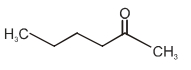
B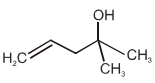
C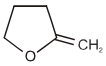
D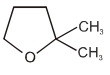
Solution
(D) The reaction involves the nucleophilic attack of the Grignard reagent $(CH_3MgBr)$ on the carbonyl carbon of $5$-chloropentan-$2$-one.
This forms an alkoxide intermediate: $Cl-(CH_2)_3-C(CH_3)_2-O^-$.
Since the molecule contains both a nucleophilic alkoxide group and an electrophilic alkyl chloride group at a distance that allows for the formation of a stable five-membered ring,an intramolecular nucleophilic substitution $(S_N2)$ occurs.
The oxygen atom attacks the carbon attached to the chlorine atom,displacing the chloride ion $(Cl^-)$ to form $2,2$-dimethyltetrahydrofuran.
This forms an alkoxide intermediate: $Cl-(CH_2)_3-C(CH_3)_2-O^-$.
Since the molecule contains both a nucleophilic alkoxide group and an electrophilic alkyl chloride group at a distance that allows for the formation of a stable five-membered ring,an intramolecular nucleophilic substitution $(S_N2)$ occurs.
The oxygen atom attacks the carbon attached to the chlorine atom,displacing the chloride ion $(Cl^-)$ to form $2,2$-dimethyltetrahydrofuran.
0 likesView Solution
4
ChemistryMCQTS EAMCET · 2022
The major product of the following reaction is
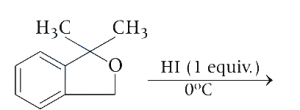
A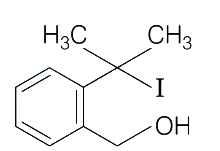
B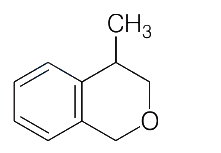
C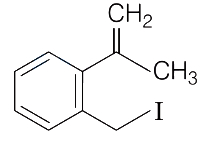
D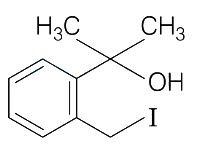
Solution
(A) The reaction is the acidic cleavage of a cyclic ether with $HI$. The ether oxygen gets protonated by $H^+$. The cleavage occurs at the bond that leads to the formation of a more stable carbocation. In this case,the bond between the oxygen and the tertiary carbon atom breaks to form a stable benzylic-tertiary carbocation. The iodide ion $(I^-)$ then attacks this carbocation to form the final product. The structure of the product is $2-(2-iodo-propan-2-yl)phenol$ or a related derivative where the ring is opened,specifically forming an alcohol and an alkyl iodide. The correct product is the one where the $I$ is attached to the tertiary carbon and the $OH$ is attached to the primary carbon of the side chain.
0 likesView Solution
5
ChemistryMCQTS EAMCET · 2022
The major product in the following reaction is:
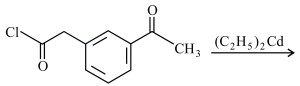
A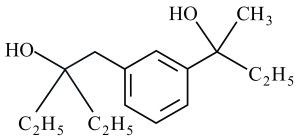
B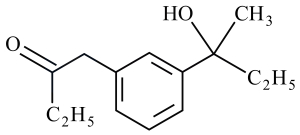
C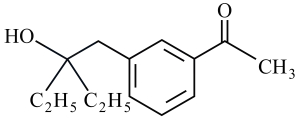
D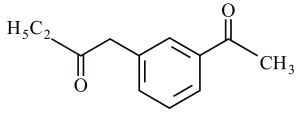
Solution
(D) Acid halides react with dialkyl cadmium to give ketones.
In this reaction,the dialkyl cadmium used is diethyl cadmium,$(C_2H_5)_2Cd$.
Grignard reagents do form ketones with acid chlorides,but the reaction does not stop at this stage; ketones further react with Grignard reagents to give tertiary alcohols.
Therefore,dialkyl cadmium is used because it reacts selectively with acid chlorides to form ketones and does not react with the ketone product.
The reaction is: $RCOCl + (R')_2Cd \rightarrow RCOR' + R'CdCl$.
In the given case,the acid chloride group $-CH_2COCl$ is converted to $-CH_2COC_2H_5$ while the existing ketone group $-COCH_3$ remains unaffected.
In this reaction,the dialkyl cadmium used is diethyl cadmium,$(C_2H_5)_2Cd$.
Grignard reagents do form ketones with acid chlorides,but the reaction does not stop at this stage; ketones further react with Grignard reagents to give tertiary alcohols.
Therefore,dialkyl cadmium is used because it reacts selectively with acid chlorides to form ketones and does not react with the ketone product.
The reaction is: $RCOCl + (R')_2Cd \rightarrow RCOR' + R'CdCl$.
In the given case,the acid chloride group $-CH_2COCl$ is converted to $-CH_2COC_2H_5$ while the existing ketone group $-COCH_3$ remains unaffected.
0 likesView Solution
6
ChemistryEasyMCQTS EAMCET · 2022
The major product of the following reaction is:
$Glucose \xrightarrow[(ii) \ Mo_2O_3, \ 773 \ K, \ 10-20 \ atm]{(i) \ HI, \ \Delta} ?$
$Glucose \xrightarrow[(ii) \ Mo_2O_3, \ 773 \ K, \ 10-20 \ atm]{(i) \ HI, \ \Delta} ?$
A
Cyclohexane
B
Benzene
C
Cyclohexadiene
D
Hexane
Solution
(B) When $Glucose$ is heated with $HI$,it undergoes reduction to form $n-hexane$.
The reaction is: $C_6H_{12}O_6 + HI \xrightarrow{\Delta} CH_3-(CH_2)_4-CH_3$ $(n-hexane)$.
Further,when $n-hexane$ is heated with $Mo_2O_3$ at $773 \ K$ and $10-20 \ atm$ pressure,it undergoes aromatization (dehydrocyclization) to form $Benzene$.
Therefore,the major product is $Benzene$.
The reaction is: $C_6H_{12}O_6 + HI \xrightarrow{\Delta} CH_3-(CH_2)_4-CH_3$ $(n-hexane)$.
Further,when $n-hexane$ is heated with $Mo_2O_3$ at $773 \ K$ and $10-20 \ atm$ pressure,it undergoes aromatization (dehydrocyclization) to form $Benzene$.
Therefore,the major product is $Benzene$.
0 likesView Solution
7
ChemistryEasyMCQTS EAMCET · 2022
The intramolecular hydrogen bonding is present in
A
Phenol
B
Benzoic acid
C
para-Nitrophenol
D
$2-$Hydroxybenzoic acid
Solution
(D) Intramolecular hydrogen bonding occurs when a hydrogen atom is bonded to a highly electronegative atom (like $O$,$N$,or $F$) and is simultaneously attracted to another electronegative atom within the same molecule.
In $2-$Hydroxybenzoic acid (also known as salicylic acid),the hydrogen atom of the hydroxyl $(-OH)$ group forms a hydrogen bond with the oxygen atom of the adjacent carboxylic acid $(-COOH)$ group.
This creates a stable six-membered ring structure within the molecule,which is characteristic of intramolecular hydrogen bonding.
Phenol,benzoic acid,and $p-$nitrophenol exhibit intermolecular hydrogen bonding rather than intramolecular hydrogen bonding.
In $2-$Hydroxybenzoic acid (also known as salicylic acid),the hydrogen atom of the hydroxyl $(-OH)$ group forms a hydrogen bond with the oxygen atom of the adjacent carboxylic acid $(-COOH)$ group.
This creates a stable six-membered ring structure within the molecule,which is characteristic of intramolecular hydrogen bonding.
Phenol,benzoic acid,and $p-$nitrophenol exhibit intermolecular hydrogen bonding rather than intramolecular hydrogen bonding.
0 likesView Solution
8
ChemistryMCQTS EAMCET · 2022
The major product in the following reaction is:
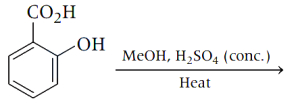
A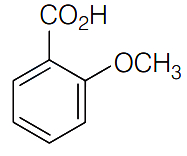
B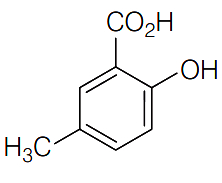
C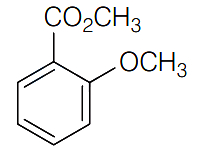
D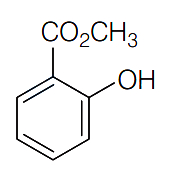
Solution
(D) The reaction is an esterification reaction between salicylic acid $(2-hydroxybenzoic acid)$ and methanol $(MeOH)$ in the presence of a concentrated acid catalyst $(H_2SO_4)$.
In this reaction,the carboxylic acid group $(-COOH)$ reacts with the alcohol $(-OH)$ to form an ester $(-COOCH_3)$.
The phenolic $-OH$ group is less reactive towards esterification under these conditions compared to the carboxylic acid group.
Therefore,the major product is methyl salicylate,where the carboxylic acid group is converted to a methyl ester.
In this reaction,the carboxylic acid group $(-COOH)$ reacts with the alcohol $(-OH)$ to form an ester $(-COOCH_3)$.
The phenolic $-OH$ group is less reactive towards esterification under these conditions compared to the carboxylic acid group.
Therefore,the major product is methyl salicylate,where the carboxylic acid group is converted to a methyl ester.
0 likesView Solution
9
ChemistryMediumMCQTS EAMCET · 2022
According to the Lewis formula of $O_3$,the correct option is
A
| $\sigma$ bonds | $\pi$ bonds | lone pairs of electrons |
|---|---|---|
| $2$ | $1$ | $3$ |
B
| $\sigma$ bonds | $\pi$ bonds | lone pairs of electrons |
|---|---|---|
| $2$ | $1$ | $4$ |
C
| $\sigma$ bonds | $\pi$ bonds | lone pairs of electrons |
|---|---|---|
| $1$ | $2$ | $4$ |
D
| $\sigma$ bonds | $\pi$ bonds | lone pairs of electrons |
|---|---|---|
| $2$ | $1$ | $6$ |
Solution
(D) The ozone molecule $(O_3)$ consists of $3$ oxygen atoms. In its Lewis structure,there is one central oxygen atom bonded to two other oxygen atoms,one by a single bond and the other by a double bond.
Each oxygen atom has a total of $8$ electrons in its valence shell (octet rule).
The central oxygen atom has $1$ lone pair.
The terminal oxygen atom with a single bond has $3$ lone pairs.
The terminal oxygen atom with a double bond has $2$ lone pairs.
Total lone pairs = $1 + 3 + 2 = 6$.
There are $2$ $\sigma$ bonds and $1$ $\pi$ bond in the structure.
Thus,the correct option is $D$.
Each oxygen atom has a total of $8$ electrons in its valence shell (octet rule).
The central oxygen atom has $1$ lone pair.
The terminal oxygen atom with a single bond has $3$ lone pairs.
The terminal oxygen atom with a double bond has $2$ lone pairs.
Total lone pairs = $1 + 3 + 2 = 6$.
There are $2$ $\sigma$ bonds and $1$ $\pi$ bond in the structure.
Thus,the correct option is $D$.
0 likesView Solution
10
ChemistryEasyMCQTS EAMCET · 2022
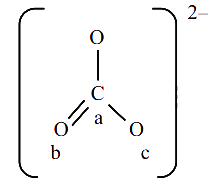
The incomplete Lewis representation of $CO_3^{2-}$ is given below. The formal charges on atoms marked as $a$,$b$,and $c$,respectively,are
A
$a : 0, b : 0, c : -1$
B
$a : 0, b : -2, c : 0$
C
$a : -2, b : 0, c : 0$
D
$a : 0, b : -1, c : -1$
Solution
(A) The formal charge $(F.C.)$ on an atom in a Lewis structure is calculated using the formula:
$F.C. = \text{Valence } e^- - \text{Lone pair } e^- - \frac{1}{2} \text{Shared } e^-$.
For the given structure of $CO_3^{2-}$:
$1$. For Carbon atom $(a)$: It has $4$ valence electrons,$0$ lone pair electrons,and $8$ shared electrons (forming $4$ bonds).
$F.C. \text{ on } C_{(a)} = 4 - 0 - \frac{1}{2}(8) = 4 - 4 = 0$.
$2$. For Oxygen atom $(b)$: It is double-bonded to Carbon. It has $6$ valence electrons,$4$ lone pair electrons,and $4$ shared electrons.
$F.C. \text{ on } O_{(b)} = 6 - 4 - \frac{1}{2}(4) = 6 - 4 - 2 = 0$.
$3$. For Oxygen atom $(c)$: It is single-bonded to Carbon. It has $6$ valence electrons,$6$ lone pair electrons,and $2$ shared electrons.
$F.C. \text{ on } O_{(c)} = 6 - 6 - \frac{1}{2}(2) = 6 - 6 - 1 = -1$.
Thus,the formal charges are $a=0, b=0, c=-1$.
$F.C. = \text{Valence } e^- - \text{Lone pair } e^- - \frac{1}{2} \text{Shared } e^-$.
For the given structure of $CO_3^{2-}$:
$1$. For Carbon atom $(a)$: It has $4$ valence electrons,$0$ lone pair electrons,and $8$ shared electrons (forming $4$ bonds).
$F.C. \text{ on } C_{(a)} = 4 - 0 - \frac{1}{2}(8) = 4 - 4 = 0$.
$2$. For Oxygen atom $(b)$: It is double-bonded to Carbon. It has $6$ valence electrons,$4$ lone pair electrons,and $4$ shared electrons.
$F.C. \text{ on } O_{(b)} = 6 - 4 - \frac{1}{2}(4) = 6 - 4 - 2 = 0$.
$3$. For Oxygen atom $(c)$: It is single-bonded to Carbon. It has $6$ valence electrons,$6$ lone pair electrons,and $2$ shared electrons.
$F.C. \text{ on } O_{(c)} = 6 - 6 - \frac{1}{2}(2) = 6 - 6 - 1 = -1$.
Thus,the formal charges are $a=0, b=0, c=-1$.
0 likesView Solution
11
ChemistryEasyMCQTS EAMCET · 2022
The linear molecule among the following is
A
$SnCl_2$
B
$PbCl_2$
C
$SO_2$
D
$XeF_2$
Solution
(D) In $SnCl_2$,the central $Sn$ atom is $sp^2$ hybridized with one lone pair,resulting in an angular (bent) shape.
In $PbCl_2$,the structure is also angular due to the presence of a lone pair on the $Pb$ atom.
In $SO_2$,the $S$ atom is $sp^2$ hybridized with one lone pair,leading to a bent shape.
In $XeF_2$,the $Xe$ atom undergoes $sp^3d$ hybridization and possesses three lone pairs in the equatorial positions,which results in a linear molecular geometry.
In $PbCl_2$,the structure is also angular due to the presence of a lone pair on the $Pb$ atom.
In $SO_2$,the $S$ atom is $sp^2$ hybridized with one lone pair,leading to a bent shape.
In $XeF_2$,the $Xe$ atom undergoes $sp^3d$ hybridization and possesses three lone pairs in the equatorial positions,which results in a linear molecular geometry.
0 likesView Solution
12
ChemistryMediumMCQTS EAMCET · 2022
The correct order of the bond angles of the compounds $SiCl_4, BF_3, BeCl_2$ and $SF_6$ is
A
$BF_3 > BeCl_2 > SF_6 > SiCl_4$
B
$BeCl_2 > SF_6 > SiCl_4 > BF_3$
C
$BeCl_2 > SiCl_4 > BF_3 > SF_6$
D
$BeCl_2 > BF_3 > SiCl_4 > SF_6$
Solution
(D) $BeCl_2$ has a linear structure,so the bond angle is $180^{\circ}$.
$BF_3$ has a trigonal planar structure,so the bond angle is $120^{\circ}$.
$SiCl_4$ has a tetrahedral structure,so the bond angle is $109.5^{\circ}$.
$SF_6$ has an octahedral structure,so the bond angle is $90^{\circ}$.
Therefore,the correct order of bond angles is $BeCl_2 (180^{\circ}) > BF_3 (120^{\circ}) > SiCl_4 (109.5^{\circ}) > SF_6 (90^{\circ})$.
$BF_3$ has a trigonal planar structure,so the bond angle is $120^{\circ}$.
$SiCl_4$ has a tetrahedral structure,so the bond angle is $109.5^{\circ}$.
$SF_6$ has an octahedral structure,so the bond angle is $90^{\circ}$.
Therefore,the correct order of bond angles is $BeCl_2 (180^{\circ}) > BF_3 (120^{\circ}) > SiCl_4 (109.5^{\circ}) > SF_6 (90^{\circ})$.
0 likesView Solution
13
ChemistryEasyMCQTS EAMCET · 2022
The correct pair of species which are not isostructural is
A
$PF_6^-$ and $SF_6$
B
$IO_3^-$ and $XeO_3$
C
$BH_4^-$ and $NH_4^+$
D
$BrF_5$ and $XeF_4$
Solution
(D) $PF_6^-$ and $SF_6$ are both octahedral.
$IO_3^-$ and $XeO_3$ are both pyramidal.
$BH_4^-$ and $NH_4^+$ are both tetrahedral.
$BrF_5$ has a square pyramidal geometry,whereas $XeF_4$ has a square planar geometry. Therefore,they are not isostructural.
$IO_3^-$ and $XeO_3$ are both pyramidal.
$BH_4^-$ and $NH_4^+$ are both tetrahedral.
$BrF_5$ has a square pyramidal geometry,whereas $XeF_4$ has a square planar geometry. Therefore,they are not isostructural.
0 likesView Solution
14
ChemistryMediumMCQTS EAMCET · 2022
From the following compounds,the ones which contain both $sp$ and $sp^2$ hybridized carbons are:
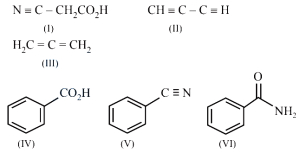
A
$I$,$II$ and $III$
B
$II$,$III$ and $IV$
C
$I$,$III$ and $VI$
D
$I$,$III$ and $V$
Solution
(D) To identify compounds containing both $sp$ and $sp^2$ hybridized carbons,we analyze each structure:
$(I)$ $N \equiv C-CH_2-COOH$: The carbon in the cyano group $(-CN)$ is $sp$ hybridized,and the carbonyl carbon in $-COOH$ is $sp^2$ hybridized. Thus,it contains both.
$(II)$ $HC \equiv C-C \equiv CH$: All carbons are $sp$ hybridized.
$(III)$ $H_2C=C=CH_2$: The terminal carbons are $sp^2$ hybridized,and the central carbon is $sp$ hybridized. Thus,it contains both.
$(IV)$ Benzoic acid $(C_6H_5COOH)$: The benzene ring carbons and the carbonyl carbon are $sp^2$ hybridized. No $sp$ hybridized carbon is present.
$(V)$ Benzonitrile $(C_6H_5CN)$: The benzene ring carbons are $sp^2$ hybridized,and the cyano carbon is $sp$ hybridized. Thus,it contains both.
$(VI)$ Benzamide $(C_6H_5CONH_2)$: All carbons are $sp^2$ hybridized.
Therefore,compounds $(I)$,$(III)$,and $(V)$ contain both $sp$ and $sp^2$ hybridized carbons.
$(I)$ $N \equiv C-CH_2-COOH$: The carbon in the cyano group $(-CN)$ is $sp$ hybridized,and the carbonyl carbon in $-COOH$ is $sp^2$ hybridized. Thus,it contains both.
$(II)$ $HC \equiv C-C \equiv CH$: All carbons are $sp$ hybridized.
$(III)$ $H_2C=C=CH_2$: The terminal carbons are $sp^2$ hybridized,and the central carbon is $sp$ hybridized. Thus,it contains both.
$(IV)$ Benzoic acid $(C_6H_5COOH)$: The benzene ring carbons and the carbonyl carbon are $sp^2$ hybridized. No $sp$ hybridized carbon is present.
$(V)$ Benzonitrile $(C_6H_5CN)$: The benzene ring carbons are $sp^2$ hybridized,and the cyano carbon is $sp$ hybridized. Thus,it contains both.
$(VI)$ Benzamide $(C_6H_5CONH_2)$: All carbons are $sp^2$ hybridized.
Therefore,compounds $(I)$,$(III)$,and $(V)$ contain both $sp$ and $sp^2$ hybridized carbons.
0 likesView Solution
15
ChemistryMediumMCQTS EAMCET · 2022
The hybridisation and shape of $I_3^{-}$ ion,respectively,are
A
$sp^3d^2$; distorted octahedral
B
$sp^3d$; linear
C
$sp^3d$; Trigonal bipyramid
D
$dsp^3$; Square pyramidal
Solution
(B) To determine the hybridisation of the central $I$ atom in $I_3^{-}$,we use the formula: $H = \frac{1}{2} (V + M - C + A)$,where $V$ is the number of valence electrons of the central atom,$M$ is the number of monovalent atoms,$C$ is the cationic charge,and $A$ is the anionic charge.
For $I_3^{-}$,the central $I$ atom has $V = 7$ valence electrons,$M = 2$ (two other $I$ atoms),$C = 0$,and $A = 1$.
$H = \frac{1}{2} (7 + 2 + 1) = \frac{10}{2} = 5$.
$A$ value of $5$ corresponds to $sp^3d$ hybridisation.
In $sp^3d$ hybridisation,the electron geometry is trigonal bipyramidal. The central $I$ atom has $3$ lone pairs and $2$ bond pairs. According to $VSEPR$ theory,the lone pairs occupy the equatorial positions to minimize repulsion,resulting in a linear shape for the $I_3^{-}$ ion.
For $I_3^{-}$,the central $I$ atom has $V = 7$ valence electrons,$M = 2$ (two other $I$ atoms),$C = 0$,and $A = 1$.
$H = \frac{1}{2} (7 + 2 + 1) = \frac{10}{2} = 5$.
$A$ value of $5$ corresponds to $sp^3d$ hybridisation.
In $sp^3d$ hybridisation,the electron geometry is trigonal bipyramidal. The central $I$ atom has $3$ lone pairs and $2$ bond pairs. According to $VSEPR$ theory,the lone pairs occupy the equatorial positions to minimize repulsion,resulting in a linear shape for the $I_3^{-}$ ion.
0 likesView Solution
16
ChemistryMediumMCQTS EAMCET · 2022
The compounds with $sp^2$ hybridized central atom among the following are:
$(A)$ $H_2CO_3$
$(B)$ $SiF_4$
$(C)$ $BF_3$
$(D)$ $HClO_2$
$(A)$ $H_2CO_3$
$(B)$ $SiF_4$
$(C)$ $BF_3$
$(D)$ $HClO_2$
A
$A$ and $C$ only
B
$A$ and $B$ only
C
$C$ and $D$ only
D
$A, B, C$ and $D$
Solution
(A) To determine the hybridization of the central atom,we calculate the number of electron pairs (steric number) around it:
$(A)$ In $H_2CO_3$,the central carbon atom is bonded to three oxygen atoms (one double bond and two single bonds). Steric number = $3$ (sigma bonds) + $0$ (lone pairs) = $3$,which corresponds to $sp^2$ hybridization.
$(B)$ In $SiF_4$,the central silicon atom is bonded to four fluorine atoms. Steric number = $4$ (sigma bonds) + $0$ (lone pairs) = $4$,which corresponds to $sp^3$ hybridization.
$(C)$ In $BF_3$,the central boron atom is bonded to three fluorine atoms. Steric number = $3$ (sigma bonds) + $0$ (lone pairs) = $3$,which corresponds to $sp^2$ hybridization.
$(D)$ In $HClO_2$,the central chlorine atom is bonded to two oxygen atoms and one hydrogen atom,with two lone pairs. Steric number = $3$ (sigma bonds) + $2$ (lone pairs) = $5$,which corresponds to $sp^3d$ hybridization.
Thus,only $H_2CO_3$ $(A)$ and $BF_3$ $(C)$ have $sp^2$ hybridized central atoms.
$(A)$ In $H_2CO_3$,the central carbon atom is bonded to three oxygen atoms (one double bond and two single bonds). Steric number = $3$ (sigma bonds) + $0$ (lone pairs) = $3$,which corresponds to $sp^2$ hybridization.
$(B)$ In $SiF_4$,the central silicon atom is bonded to four fluorine atoms. Steric number = $4$ (sigma bonds) + $0$ (lone pairs) = $4$,which corresponds to $sp^3$ hybridization.
$(C)$ In $BF_3$,the central boron atom is bonded to three fluorine atoms. Steric number = $3$ (sigma bonds) + $0$ (lone pairs) = $3$,which corresponds to $sp^2$ hybridization.
$(D)$ In $HClO_2$,the central chlorine atom is bonded to two oxygen atoms and one hydrogen atom,with two lone pairs. Steric number = $3$ (sigma bonds) + $2$ (lone pairs) = $5$,which corresponds to $sp^3d$ hybridization.
Thus,only $H_2CO_3$ $(A)$ and $BF_3$ $(C)$ have $sp^2$ hybridized central atoms.
0 likesView Solution
17
ChemistryMediumMCQTS EAMCET · 2022
How many of the following species have the bond order $2$?
$C_2, B_2^{2-}, N_2^{2+}, CN^{+}, NO^{-}, O_2, C_2^{+}$
$C_2, B_2^{2-}, N_2^{2+}, CN^{+}, NO^{-}, O_2, C_2^{+}$
A
$3$
B
$4$
C
$6$
D
$5$
Solution
(C) The bond order can be determined by using the formula:
$\text{Bond order} = \frac{N_b - N_a}{2}$
where $N_b$ is the number of bonding electrons and $N_a$ is the number of antibonding electrons.
$1. C_2$ ($12$ electrons): $\sigma 1s^2, \sigma^* 1s^2, \sigma 2s^2, \sigma^* 2s^2, \pi 2p_x^2, \pi 2p_y^2$. $N_b = 8, N_a = 4$. $B.O. = \frac{8-4}{2} = 2$.
$2. B_2^{2-}$ ($12$ electrons): Same configuration as $C_2$. $B.O. = 2$.
$3. N_2^{2+}$ ($12$ electrons): Same configuration as $C_2$. $B.O. = 2$.
$4. CN^{+}$ ($12$ electrons): Same configuration as $C_2$. $B.O. = 2$.
$5. NO^{-}$ ($12$ electrons): Same configuration as $C_2$. $B.O. = 2$.
$6. O_2$ ($16$ electrons): $\sigma 1s^2, \sigma^* 1s^2, \sigma 2s^2, \sigma^* 2s^2, \sigma 2p_z^2, \pi 2p_x^2, \pi 2p_y^2, \pi^* 2p_x^1, \pi^* 2p_y^1$. $N_b = 10, N_a = 6$. $B.O. = \frac{10-6}{2} = 2$.
$7. C_2^{+}$ ($11$ electrons): $B.O. = \frac{7-4}{2} = 1.5$.
Thus,the species with bond order $2$ are $C_2, B_2^{2-}, N_2^{2+}, CN^{+}, NO^{-}, O_2$. Total $6$ species.
$\text{Bond order} = \frac{N_b - N_a}{2}$
where $N_b$ is the number of bonding electrons and $N_a$ is the number of antibonding electrons.
$1. C_2$ ($12$ electrons): $\sigma 1s^2, \sigma^* 1s^2, \sigma 2s^2, \sigma^* 2s^2, \pi 2p_x^2, \pi 2p_y^2$. $N_b = 8, N_a = 4$. $B.O. = \frac{8-4}{2} = 2$.
$2. B_2^{2-}$ ($12$ electrons): Same configuration as $C_2$. $B.O. = 2$.
$3. N_2^{2+}$ ($12$ electrons): Same configuration as $C_2$. $B.O. = 2$.
$4. CN^{+}$ ($12$ electrons): Same configuration as $C_2$. $B.O. = 2$.
$5. NO^{-}$ ($12$ electrons): Same configuration as $C_2$. $B.O. = 2$.
$6. O_2$ ($16$ electrons): $\sigma 1s^2, \sigma^* 1s^2, \sigma 2s^2, \sigma^* 2s^2, \sigma 2p_z^2, \pi 2p_x^2, \pi 2p_y^2, \pi^* 2p_x^1, \pi^* 2p_y^1$. $N_b = 10, N_a = 6$. $B.O. = \frac{10-6}{2} = 2$.
$7. C_2^{+}$ ($11$ electrons): $B.O. = \frac{7-4}{2} = 1.5$.
Thus,the species with bond order $2$ are $C_2, B_2^{2-}, N_2^{2+}, CN^{+}, NO^{-}, O_2$. Total $6$ species.
0 likesView Solution
18
ChemistryMediumMCQTS EAMCET · 2022
The correct order of $C-O$ bond length is:
A
$CO_2 < CO_3^{2-} < CO$
B
$CO < CO_3^{2-} < CO_2$
C
$CO_3^{2-} < CO_2 < CO$
D
$CO < CO_2 < CO_3^{2-}$
Solution
(D) We know that bond length $\propto \frac{1}{\text{bond order}}$.
Thus,a higher bond order corresponds to a shorter bond length.
The bond order can be calculated as the average number of bonds per resonance structure.
For $CO$ (carbon monoxide),the bond order is $3$.
For $CO_2$ (carbon dioxide),the bond order is $2$.
For $CO_3^{2-}$ (carbonate ion),the bond order is $\frac{4}{3} \approx 1.33$.
Since the bond order follows the order $CO > CO_2 > CO_3^{2-}$,the bond length follows the inverse order:
$CO < CO_2 < CO_3^{2-}$.
Thus,a higher bond order corresponds to a shorter bond length.
The bond order can be calculated as the average number of bonds per resonance structure.
For $CO$ (carbon monoxide),the bond order is $3$.
For $CO_2$ (carbon dioxide),the bond order is $2$.
For $CO_3^{2-}$ (carbonate ion),the bond order is $\frac{4}{3} \approx 1.33$.
Since the bond order follows the order $CO > CO_2 > CO_3^{2-}$,the bond length follows the inverse order:
$CO < CO_2 < CO_3^{2-}$.
0 likesView Solution
19
ChemistryMediumMCQTS EAMCET · 2022
The correct pair of species with $(A)$ the highest bond order and $(B)$ diamagnetic character is
A
$O_2, O_2^{+}$
B
$O_2^{+}, O_2^{2-}$
C
$O_2^{-}, O_2$
D
$O_2^{2-}, O_2^{+}$
Solution
(B) To determine the bond order and magnetic character,we use Molecular Orbital Theory $(MOT)$. The total number of electrons for each species is:
$O_2$ $(16 \ e^-)$: Bond order = $\frac{10-6}{2} = 2$,Paramagnetic.
$O_2^{+}$ $(15 \ e^-)$: Bond order = $\frac{10-5}{2} = 2.5$,Paramagnetic.
$O_2^{-}$ $(17 \ e^-)$: Bond order = $\frac{10-7}{2} = 1.5$,Paramagnetic.
$O_2^{2-}$ $(18 \ e^-)$: Bond order = $\frac{10-8}{2} = 1$,Diamagnetic.
$(A)$ The species with the highest bond order is $O_2^{+}$ (Bond order = $2.5$).
$(B)$ The species with diamagnetic character is $O_2^{2-}$ (all electrons are paired).
Therefore,the pair is $(O_2^{+}, O_2^{2-})$.
$O_2$ $(16 \ e^-)$: Bond order = $\frac{10-6}{2} = 2$,Paramagnetic.
$O_2^{+}$ $(15 \ e^-)$: Bond order = $\frac{10-5}{2} = 2.5$,Paramagnetic.
$O_2^{-}$ $(17 \ e^-)$: Bond order = $\frac{10-7}{2} = 1.5$,Paramagnetic.
$O_2^{2-}$ $(18 \ e^-)$: Bond order = $\frac{10-8}{2} = 1$,Diamagnetic.
$(A)$ The species with the highest bond order is $O_2^{+}$ (Bond order = $2.5$).
$(B)$ The species with diamagnetic character is $O_2^{2-}$ (all electrons are paired).
Therefore,the pair is $(O_2^{+}, O_2^{2-})$.
0 likesView Solution
20
ChemistryDifficultMCQTS EAMCET · 2022
Identify all the species that do not exist: $H_2^{+}, He_2^{2+}, Li_2^{2-}, Ne_2, Be_2^{-}, He_2$.
A
$He_2, Ne_2$ only
B
$Li_2^{2-}, Ne_2, He_2$ only
C
$Be_2^{-}, He_2, Ne_2$ only
D
$H_2^{+}, Li_2^{2-}$ only
Solution
(B) According to Molecular Orbital Theory,a species does not exist if its Bond Order $(B.O.)$ is $0$.
$B.O. = \frac{1}{2} (N_b - N_a)$,where $N_b$ is the number of bonding electrons and $N_a$ is the number of antibonding electrons.
$1$. $H_2^{+} (1e^-): \sigma 1s^1, B.O. = 0.5$ (Exists)
$2$. $He_2^{2+} (2e^-): \sigma 1s^2, B.O. = 1$ (Exists)
$3$. $Li_2^{2-} (8e^-): \sigma 1s^2 \sigma^* 1s^2 \sigma 2s^2 \sigma^* 2s^2, B.O. = \frac{1}{2}(4-4) = 0$ (Does not exist)
$4$. $Ne_2 (20e^-): \sigma 1s^2 \sigma^* 1s^2 \sigma 2s^2 \sigma^* 2s^2 \sigma 2pz^2 \pi 2px^2 \pi 2py^2 \pi^* 2px^2 \pi^* 2py^2 \sigma^* 2pz^2, B.O. = \frac{1}{2}(10-10) = 0$ (Does not exist)
$5$. $Be_2^{-} (9e^-): \sigma 1s^2 \sigma^* 1s^2 \sigma 2s^2 \sigma^* 2s^2 \sigma 2pz^1, B.O. = 0.5$ (Exists)
$6$. $He_2 (4e^-): \sigma 1s^2 \sigma^* 1s^2, B.O. = \frac{1}{2}(2-2) = 0$ (Does not exist)
Thus,$Li_2^{2-}, Ne_2,$ and $He_2$ do not exist.
$B.O. = \frac{1}{2} (N_b - N_a)$,where $N_b$ is the number of bonding electrons and $N_a$ is the number of antibonding electrons.
$1$. $H_2^{+} (1e^-): \sigma 1s^1, B.O. = 0.5$ (Exists)
$2$. $He_2^{2+} (2e^-): \sigma 1s^2, B.O. = 1$ (Exists)
$3$. $Li_2^{2-} (8e^-): \sigma 1s^2 \sigma^* 1s^2 \sigma 2s^2 \sigma^* 2s^2, B.O. = \frac{1}{2}(4-4) = 0$ (Does not exist)
$4$. $Ne_2 (20e^-): \sigma 1s^2 \sigma^* 1s^2 \sigma 2s^2 \sigma^* 2s^2 \sigma 2pz^2 \pi 2px^2 \pi 2py^2 \pi^* 2px^2 \pi^* 2py^2 \sigma^* 2pz^2, B.O. = \frac{1}{2}(10-10) = 0$ (Does not exist)
$5$. $Be_2^{-} (9e^-): \sigma 1s^2 \sigma^* 1s^2 \sigma 2s^2 \sigma^* 2s^2 \sigma 2pz^1, B.O. = 0.5$ (Exists)
$6$. $He_2 (4e^-): \sigma 1s^2 \sigma^* 1s^2, B.O. = \frac{1}{2}(2-2) = 0$ (Does not exist)
Thus,$Li_2^{2-}, Ne_2,$ and $He_2$ do not exist.
0 likesView Solution
21
ChemistryMediumMCQTS EAMCET · 2022
The compound with more covalent character in the following is
A
$FeF_3$
B
$VF_5$
C
$VF_2$
D
$TiF_2$
Solution
(B) According to Fajan's rule,the covalent character of an ionic bond increases with the increase in the charge on the cation.
In the given compounds,the oxidation states of the metal ions are:
$FeF_3$: $Fe^{3+}$
$VF_5$: $V^{5+}$
$VF_2$: $V^{2+}$
$TiF_2$: $Ti^{2+}$
Since the vanadium ion in $VF_5$ has the highest positive charge $(+5)$,it exerts the strongest polarizing power on the fluoride anion.
Therefore,$VF_5$ exhibits the maximum covalent character among the given options.
In the given compounds,the oxidation states of the metal ions are:
$FeF_3$: $Fe^{3+}$
$VF_5$: $V^{5+}$
$VF_2$: $V^{2+}$
$TiF_2$: $Ti^{2+}$
Since the vanadium ion in $VF_5$ has the highest positive charge $(+5)$,it exerts the strongest polarizing power on the fluoride anion.
Therefore,$VF_5$ exhibits the maximum covalent character among the given options.
0 likesView Solution
22
ChemistryMediumMCQTS EAMCET · 2022
Dipole-induced dipole interactions are present between which of the following pairs?
A
$H_2O$ and $C_2H_5OH$
B
$Cl_2$ and $CCl_4$
C
$NH_3$ and $H_2$
D
$SiF_4$ and $BF_3$
Solution
(C) Dipole-induced dipole interactions occur between a polar molecule (possessing a permanent dipole) and a non-polar molecule (lacking a permanent dipole).
The permanent dipole of the polar molecule distorts the electron cloud of the non-polar molecule,inducing a dipole in it.
$NH_3$ is a polar molecule,while $H_2$ is a non-polar molecule. Therefore,dipole-induced dipole interactions exist between them.
$H_2O$ and $C_2H_5OH$ are both polar,exhibiting dipole-dipole interactions.
$Cl_2$ and $CCl_4$ are both non-polar,exhibiting London dispersion forces.
$SiF_4$ and $BF_3$ are non-polar due to their symmetrical structures,exhibiting London dispersion forces.
The permanent dipole of the polar molecule distorts the electron cloud of the non-polar molecule,inducing a dipole in it.
$NH_3$ is a polar molecule,while $H_2$ is a non-polar molecule. Therefore,dipole-induced dipole interactions exist between them.
$H_2O$ and $C_2H_5OH$ are both polar,exhibiting dipole-dipole interactions.
$Cl_2$ and $CCl_4$ are both non-polar,exhibiting London dispersion forces.
$SiF_4$ and $BF_3$ are non-polar due to their symmetrical structures,exhibiting London dispersion forces.
0 likesView Solution
23
ChemistryMediumMCQTS EAMCET · 2022
The set of molecules among the following with zero dipole moment is $CCl_4$,$BF_3$,$CHCl_3$,$CS_2$,$NH_3$,$1,4$-dichlorobenzene,$CO_2$.
A
$CO_2, CS_2, BF_3, NH_3, CHCl_3$ only
B
$CCl_4, BF_3, CO_2, CS_2, 1,4$-dichlorobenzene only
C
$CO_2, CS_2, 1,4$-dichlorobenzene only
D
$CO_2, CS_2$ only
Solution
(B) molecule has a zero dipole moment if its net dipole moment is zero. This occurs in highly symmetric molecules where the bond dipoles cancel each other out.
$1$. $CCl_4$: Tetrahedral geometry,all $C-Cl$ bond dipoles cancel. $\mu = 0$.
$2$. $BF_3$: Trigonal planar geometry,all $B-F$ bond dipoles cancel. $\mu = 0$.
$3$. $CHCl_3$: Asymmetric,$\mu \neq 0$.
$4$. $CS_2$: Linear geometry,$S=C=S$ bond dipoles cancel. $\mu = 0$.
$5$. $NH_3$: Pyramidal geometry with a lone pair,$\mu \neq 0$.
$6$. $1,4$-dichlorobenzene: Para-substituted benzene,the two $C-Cl$ bond dipoles are equal and opposite. $\mu = 0$.
$7$. $CO_2$: Linear geometry,$O=C=O$ bond dipoles cancel. $\mu = 0$.
Thus,the molecules with zero dipole moment are $CCl_4, BF_3, CO_2, CS_2, 1,4$-dichlorobenzene.
$1$. $CCl_4$: Tetrahedral geometry,all $C-Cl$ bond dipoles cancel. $\mu = 0$.
$2$. $BF_3$: Trigonal planar geometry,all $B-F$ bond dipoles cancel. $\mu = 0$.
$3$. $CHCl_3$: Asymmetric,$\mu \neq 0$.
$4$. $CS_2$: Linear geometry,$S=C=S$ bond dipoles cancel. $\mu = 0$.
$5$. $NH_3$: Pyramidal geometry with a lone pair,$\mu \neq 0$.
$6$. $1,4$-dichlorobenzene: Para-substituted benzene,the two $C-Cl$ bond dipoles are equal and opposite. $\mu = 0$.
$7$. $CO_2$: Linear geometry,$O=C=O$ bond dipoles cancel. $\mu = 0$.
Thus,the molecules with zero dipole moment are $CCl_4, BF_3, CO_2, CS_2, 1,4$-dichlorobenzene.
0 likesView Solution
24
ChemistryEasyMCQTS EAMCET · 2022
Assertion $(A)$: Hydrogen fluoride has a higher boiling point than other hydrogen halides.
Reason $(R)$: Hydrogen fluoride exhibits strong hydrogen bonding. The correct option among the following is:
Reason $(R)$: Hydrogen fluoride exhibits strong hydrogen bonding. The correct option among the following is:
A
$A$. $(A)$ is true,$(R)$ is true and $(R)$ is the correct explanation for $(A)$
B
$B$. $(A)$ is true,$(R)$ is true but $(R)$ is not the correct explanation for $(A)$
C
$C$. $(A)$ is true but $(R)$ is false
D
$D$. $(A)$ is false but $(R)$ is true
Solution
(A) Fluorine $(F)$ is the most electronegative element among the halogens.
Due to the high electronegativity of $F$,the $H-F$ bond is highly polar,which leads to the formation of strong intermolecular hydrogen bonding.
This strong hydrogen bonding in $HF$ molecules requires more energy to break compared to the dipole-dipole interactions present in other hydrogen halides ($HCl$,$HBr$,$HI$).
Therefore,$HF$ has a significantly higher boiling point than other hydrogen halides.
Thus,both $(A)$ and $(R)$ are true,and $(R)$ is the correct explanation for $(A)$.
Due to the high electronegativity of $F$,the $H-F$ bond is highly polar,which leads to the formation of strong intermolecular hydrogen bonding.
This strong hydrogen bonding in $HF$ molecules requires more energy to break compared to the dipole-dipole interactions present in other hydrogen halides ($HCl$,$HBr$,$HI$).
Therefore,$HF$ has a significantly higher boiling point than other hydrogen halides.
Thus,both $(A)$ and $(R)$ are true,and $(R)$ is the correct explanation for $(A)$.
0 likesView Solution
25
ChemistryMediumMCQTS EAMCET · 2022
For a reaction $A_{(s)} \rightleftharpoons B_{(s)} + C_{(g)}$,the set of all correct statements are:
$(a) \ K$ is independent of $[A]$.
$(b) \ K$ is dependent on partial pressure of $C$ at a given temperature.
$(c) \ \Delta H$ will be independent of temperature.
$(d) \ \Delta H$ is independent of the catalyst addition.
$(a) \ K$ is independent of $[A]$.
$(b) \ K$ is dependent on partial pressure of $C$ at a given temperature.
$(c) \ \Delta H$ will be independent of temperature.
$(d) \ \Delta H$ is independent of the catalyst addition.
A
$a, b, c, d$
B
$a, b$ only
C
$a, b, d$ only
D
$a, b, c$ only
Solution
(C) For the reaction $A_{(s)} \rightleftharpoons B_{(s)} + C_{(g)}$,the equilibrium constant $K_p = P_C$.
Statement $(a)$ is correct because the concentration of pure solids is taken as unity and does not appear in the equilibrium expression.
Statement $(b)$ is correct because $K_p$ is defined by the partial pressure of the gaseous product $C$ at equilibrium.
Statement $(c)$ is incorrect because $\Delta H$ (enthalpy of reaction) varies with temperature according to Kirchhoff's law.
Statement $(d)$ is correct because a catalyst provides an alternative pathway with lower activation energy but does not change the $\Delta H$ of the reaction.
Therefore,statements $(a), (b),$ and $(d)$ are correct.
Statement $(a)$ is correct because the concentration of pure solids is taken as unity and does not appear in the equilibrium expression.
Statement $(b)$ is correct because $K_p$ is defined by the partial pressure of the gaseous product $C$ at equilibrium.
Statement $(c)$ is incorrect because $\Delta H$ (enthalpy of reaction) varies with temperature according to Kirchhoff's law.
Statement $(d)$ is correct because a catalyst provides an alternative pathway with lower activation energy but does not change the $\Delta H$ of the reaction.
Therefore,statements $(a), (b),$ and $(d)$ are correct.
0 likesView Solution
26
ChemistryMediumMCQTS EAMCET · 2022
For the formation of ammonia gas from its constituent elements,the $K_{P} / K_{C}$ is
A
$RT$
B
$\frac{1}{(RT)^2}$
C
$\frac{1}{\sqrt{RT}}$
D
$1$
Solution
(B) The formation of ammonia from nitrogen and hydrogen is represented by the balanced chemical equation:
$N_2(g) + 3H_2(g) \leftrightarrow 2NH_3(g)$
The relationship between $K_{P}$ and $K_{C}$ is given by the formula:
$K_{P} = K_{C}(RT)^{\Delta n}$
Where $\Delta n$ is the change in the number of moles of gaseous species:
$\Delta n = (\text{moles of gaseous products}) - (\text{moles of gaseous reactants})$
For this reaction:
$\Delta n = 2 - (1 + 3) = 2 - 4 = -2$
Substituting $\Delta n$ into the relationship:
$K_{P} = K_{C}(RT)^{-2}$
Rearranging to find the ratio $K_{P} / K_{C}$:
$\frac{K_{P}}{K_{C}} = (RT)^{-2} = \frac{1}{(RT)^2}$
$N_2(g) + 3H_2(g) \leftrightarrow 2NH_3(g)$
The relationship between $K_{P}$ and $K_{C}$ is given by the formula:
$K_{P} = K_{C}(RT)^{\Delta n}$
Where $\Delta n$ is the change in the number of moles of gaseous species:
$\Delta n = (\text{moles of gaseous products}) - (\text{moles of gaseous reactants})$
For this reaction:
$\Delta n = 2 - (1 + 3) = 2 - 4 = -2$
Substituting $\Delta n$ into the relationship:
$K_{P} = K_{C}(RT)^{-2}$
Rearranging to find the ratio $K_{P} / K_{C}$:
$\frac{K_{P}}{K_{C}} = (RT)^{-2} = \frac{1}{(RT)^2}$
0 likesView Solution
27
ChemistryMediumMCQTS EAMCET · 2022
The $K_{p}$ value at equilibrium of $SO_3$ formation reaction from $SO_{2(g)}$ and $O_{2(g)}$ is $5 \ atm^{-1}$. What is the equilibrium partial pressure of $O_2$ if the equilibrium pressure of $SO_2$ and $SO_3$ are equal (in $atm$)?
A
$0.2$
B
$0.4$
C
$0.3$
D
$0.1$
Solution
(A) The equilibrium reaction is: $2 SO_{2(g)} + O_{2(g)} \rightleftharpoons 2 SO_{3(g)}$
$K_{P} = \frac{(P_{SO_3})^2}{(P_{SO_2})^2 (P_{O_2})}$
Given that at equilibrium,$P_{SO_2} = P_{SO_3}$.
Substituting this into the expression: $5 = \frac{(P_{SO_2})^2}{(P_{SO_2})^2 (P_{O_2})}$
$5 = \frac{1}{P_{O_2}}$
$P_{O_2} = \frac{1}{5} = 0.2 \ atm$.
$K_{P} = \frac{(P_{SO_3})^2}{(P_{SO_2})^2 (P_{O_2})}$
Given that at equilibrium,$P_{SO_2} = P_{SO_3}$.
Substituting this into the expression: $5 = \frac{(P_{SO_2})^2}{(P_{SO_2})^2 (P_{O_2})}$
$5 = \frac{1}{P_{O_2}}$
$P_{O_2} = \frac{1}{5} = 0.2 \ atm$.
0 likesView Solution
28
ChemistryMediumMCQTS EAMCET · 2022
For the formation of ammonia from its constituent elements ($1 \ mol$ of $N_2$ and $3 \ mol$ of $H_2$) in a closed vessel of volume $V \ L$,the value of $K_C$ is [units of $K_C = mol^{-2} \ L^2$].
A
$\frac{3x^2V^2}{9(1-x)^4}$
B
$\frac{4xV^2}{9(1-x)^3}$
C
$\frac{4x^2V^2}{27(1-x)^4}$
D
$\frac{x^2V^2}{27(1-x)^3}$
Solution
(C) The chemical equation for the formation of ammonia is: $N_2(g) + 3H_2(g) \rightleftharpoons 2NH_3(g)$
Initial moles: $N_2 = 1$,$H_2 = 3$,$NH_3 = 0$
At equilibrium moles: $N_2 = (1-x)$,$H_2 = (3-3x)$,$NH_3 = 2x$
Concentrations at equilibrium (in volume $V$):
$[N_2] = \frac{1-x}{V}$
$[H_2] = \frac{3(1-x)}{V}$
$[NH_3] = \frac{2x}{V}$
The equilibrium constant $K_C$ is given by:
$K_C = \frac{[NH_3]^2}{[N_2][H_2]^3}$
$K_C = \frac{(\frac{2x}{V})^2}{(\frac{1-x}{V}) \times (\frac{3(1-x)}{V})^3}$
$K_C = \frac{\frac{4x^2}{V^2}}{(\frac{1-x}{V}) \times \frac{27(1-x)^3}{V^3}}$
$K_C = \frac{4x^2}{V^2} \times \frac{V^4}{27(1-x)^4}$
$K_C = \frac{4x^2V^2}{27(1-x)^4}$
Initial moles: $N_2 = 1$,$H_2 = 3$,$NH_3 = 0$
At equilibrium moles: $N_2 = (1-x)$,$H_2 = (3-3x)$,$NH_3 = 2x$
Concentrations at equilibrium (in volume $V$):
$[N_2] = \frac{1-x}{V}$
$[H_2] = \frac{3(1-x)}{V}$
$[NH_3] = \frac{2x}{V}$
The equilibrium constant $K_C$ is given by:
$K_C = \frac{[NH_3]^2}{[N_2][H_2]^3}$
$K_C = \frac{(\frac{2x}{V})^2}{(\frac{1-x}{V}) \times (\frac{3(1-x)}{V})^3}$
$K_C = \frac{\frac{4x^2}{V^2}}{(\frac{1-x}{V}) \times \frac{27(1-x)^3}{V^3}}$
$K_C = \frac{4x^2}{V^2} \times \frac{V^4}{27(1-x)^4}$
$K_C = \frac{4x^2V^2}{27(1-x)^4}$
0 likesView Solution
29
ChemistryMediumMCQTS EAMCET · 2022
Calculate the value of the equilibrium constant $(K_p)$ for the reaction of oxygen gas oxidizing ammonia gas to nitric oxide and water vapor. The pressure of each gas at equilibrium is $0.5 \ atm$. (in $atm$)
A
$1.5$
B
$0.5$
C
$1$
D
$2.5$
Solution
(B) The balanced chemical equation for the reaction is: $4 NH_{3(g)} + 5 O_{2(g)} \longrightarrow 4 NO_{(g)} + 6 H_2O_{(g)}$
The expression for the equilibrium constant $(K_p)$ is given by:
$K_p = \frac{(p_{NO})^4 \cdot (p_{H_2O})^6}{(p_{NH_3})^4 \cdot (p_{O_2})^5}$
Given that the equilibrium pressure of each gas is $0.5 \ atm$,we substitute these values into the expression:
$K_p = \frac{(0.5)^4 \cdot (0.5)^6}{(0.5)^4 \cdot (0.5)^5}$
Simplifying the expression:
$K_p = \frac{(0.5)^{10}}{(0.5)^9} = 0.5$
Note: The equilibrium constant $K_p$ is dimensionless. Therefore,the value is $0.5$.
The expression for the equilibrium constant $(K_p)$ is given by:
$K_p = \frac{(p_{NO})^4 \cdot (p_{H_2O})^6}{(p_{NH_3})^4 \cdot (p_{O_2})^5}$
Given that the equilibrium pressure of each gas is $0.5 \ atm$,we substitute these values into the expression:
$K_p = \frac{(0.5)^4 \cdot (0.5)^6}{(0.5)^4 \cdot (0.5)^5}$
Simplifying the expression:
$K_p = \frac{(0.5)^{10}}{(0.5)^9} = 0.5$
Note: The equilibrium constant $K_p$ is dimensionless. Therefore,the value is $0.5$.
0 likesView Solution
30
ChemistryEasyMCQTS EAMCET · 2022
In which of the following reactions at equilibrium,the position of the equilibrium shifts towards the products,if the total pressure is increased?
$(I)$ $X_{2(g)} + 3Y_{2(g)} \rightleftharpoons 2XY_{3(g)}$
$(II)$ $X_{2(g)} + Y_{2(g)} \rightleftharpoons 2XY_{(g)}$
$(III)$ $X_{2(g)} + Z_{2(g)} \rightleftharpoons 2XZ_{(g)}$
$(IV)$ $X_{2(g)} + Y_{4(g)} \rightleftharpoons 2XY_{2(g)}$
$(I)$ $X_{2(g)} + 3Y_{2(g)} \rightleftharpoons 2XY_{3(g)}$
$(II)$ $X_{2(g)} + Y_{2(g)} \rightleftharpoons 2XY_{(g)}$
$(III)$ $X_{2(g)} + Z_{2(g)} \rightleftharpoons 2XZ_{(g)}$
$(IV)$ $X_{2(g)} + Y_{4(g)} \rightleftharpoons 2XY_{2(g)}$
A
$(II)$
B
$(III)$
C
$(I)$
D
$(IV)$
Solution
(C) According to Le Chatelier's principle,when the total pressure of a system at equilibrium is increased,the equilibrium shifts in the direction that results in a decrease in the total number of gaseous moles.
For reaction $(I)$: $X_{2(g)} + 3Y_{2(g)} \rightleftharpoons 2XY_{3(g)}$. The number of gaseous moles on the reactant side is $1 + 3 = 4$,and on the product side is $2$. Since $2 < 4$,increasing the pressure shifts the equilibrium towards the products.
For reactions $(II)$,$(III)$,and $(IV)$: The number of gaseous moles on the reactant side is $1 + 1 = 2$,and on the product side is $2$. Since the number of moles is equal on both sides,a change in pressure does not affect the position of the equilibrium.
For reaction $(I)$: $X_{2(g)} + 3Y_{2(g)} \rightleftharpoons 2XY_{3(g)}$. The number of gaseous moles on the reactant side is $1 + 3 = 4$,and on the product side is $2$. Since $2 < 4$,increasing the pressure shifts the equilibrium towards the products.
For reactions $(II)$,$(III)$,and $(IV)$: The number of gaseous moles on the reactant side is $1 + 1 = 2$,and on the product side is $2$. Since the number of moles is equal on both sides,a change in pressure does not affect the position of the equilibrium.
0 likesView Solution
31
ChemistryEasyMCQTS EAMCET · 2022
The relative order of electronegativity of $C$,$Ge$,and $Pb$ is
A
$C > Ge > Pb$
B
$Ge > C > Pb$
C
$Pb > C > Ge$
D
$C > Pb > Ge$
Solution
(D) In group $14$ (carbon family),electronegativity generally decreases down the group due to the increase in atomic size.
However,due to the poor shielding effect of $d$ and $f$ orbitals,the effective nuclear charge increases,leading to an anomaly in the trend.
The electronegativity values are approximately: $C$ $(2.55)$,$Si$ $(1.90)$,$Ge$ $(2.01)$,$Sn$ $(1.96)$,and $Pb$ $(2.33)$.
Comparing the given elements $C$,$Ge$,and $Pb$,the order is $C > Pb > Ge$.
However,due to the poor shielding effect of $d$ and $f$ orbitals,the effective nuclear charge increases,leading to an anomaly in the trend.
The electronegativity values are approximately: $C$ $(2.55)$,$Si$ $(1.90)$,$Ge$ $(2.01)$,$Sn$ $(1.96)$,and $Pb$ $(2.33)$.
Comparing the given elements $C$,$Ge$,and $Pb$,the order is $C > Pb > Ge$.
0 likesView Solution
32
ChemistryEasyMCQTS EAMCET · 2022
The correct order of the first ionization enthalpies of the following elements is:
A
$Li < B < Be < N$
B
$Li < Be < B < N$
C
$N < Be < B < Li$
D
$N < B < Be < Li$
Solution
(A) The ionization enthalpy generally increases across a period from left to right due to an increase in effective nuclear charge.
For the elements $Li$,$Be$,$B$,and $N$ in the second period,the expected order is $Li < Be < B < N$.
However,$Be$ $(1s^2 2s^2)$ has a fully filled $2s$ orbital,and $N$ $(1s^2 2s^2 2p^3)$ has a half-filled $2p$ subshell,both of which are exceptionally stable.
Due to this,$Be$ has a higher ionization enthalpy than $B$.
Therefore,the correct order is $Li < B < Be < N$.
For the elements $Li$,$Be$,$B$,and $N$ in the second period,the expected order is $Li < Be < B < N$.
However,$Be$ $(1s^2 2s^2)$ has a fully filled $2s$ orbital,and $N$ $(1s^2 2s^2 2p^3)$ has a half-filled $2p$ subshell,both of which are exceptionally stable.
Due to this,$Be$ has a higher ionization enthalpy than $B$.
Therefore,the correct order is $Li < B < Be < N$.
0 likesView Solution
33
ChemistryMediumMCQTS EAMCET · 2022
How many of the following statements are correct?
$(a)$ 'He' is the second most abundant element in the universe.
$(b)$ The symbol for the element with atomic number $110$ is Ds.
$(c)$ Osmium has the highest density among all elements.
$(d)$ Francium is the most electropositive element in the periodic table.
$(a)$ 'He' is the second most abundant element in the universe.
$(b)$ The symbol for the element with atomic number $110$ is Ds.
$(c)$ Osmium has the highest density among all elements.
$(d)$ Francium is the most electropositive element in the periodic table.
A
$3$
B
$2$
C
$4$
D
$1$
Solution
(C) 'He' is the second most abundant element in the universe. The most abundant element is hydrogen,and helium makes up most of the remaining $25 \%$.
$(b)$ Darmstadtium is a chemical element with the symbol $Ds$ and atomic number $110$.
$(c)$ Under ordinary conditions,osmium is the element with the highest density $(22.59 \ g/cm^3)$.
$(d)$ Francium is the most electropositive element in the periodic table.
All four statements are correct.
$(b)$ Darmstadtium is a chemical element with the symbol $Ds$ and atomic number $110$.
$(c)$ Under ordinary conditions,osmium is the element with the highest density $(22.59 \ g/cm^3)$.
$(d)$ Francium is the most electropositive element in the periodic table.
All four statements are correct.
0 likesView Solution
34
ChemistryMediumMCQTS EAMCET · 2022
The correct order of decreasing acidic nature of oxides is:
A
$Li_2O > BeO > CO_2 > B_2O_3 > N_2O_3$
B
$CO_2 > N_2O_3 > B_2O_3 > Li_2O > BeO$
C
$CO_2 > BeO > Li_2O > B_2O_3 > N_2O_3$
D
$N_2O_3 > CO_2 > B_2O_3 > BeO > Li_2O$
Solution
(D) The acidic nature of oxides depends on the electronegativity of the central atom. As we move from left to right across a period,the electronegativity of elements increases,which leads to an increase in the acidic nature of their corresponding oxides.
For the elements of period $2$,the order of electronegativity is: $Li < Be < B < C < N$.
Consequently,the acidic nature of their oxides increases in the same order: $Li_2O < BeO < B_2O_3 < CO_2 < N_2O_3$.
Therefore,the correct order of decreasing acidic nature is: $N_2O_3 > CO_2 > B_2O_3 > BeO > Li_2O$.
For the elements of period $2$,the order of electronegativity is: $Li < Be < B < C < N$.
Consequently,the acidic nature of their oxides increases in the same order: $Li_2O < BeO < B_2O_3 < CO_2 < N_2O_3$.
Therefore,the correct order of decreasing acidic nature is: $N_2O_3 > CO_2 > B_2O_3 > BeO > Li_2O$.
0 likesView Solution
35
ChemistryMediumMCQTS EAMCET · 2022
The correct order of the electron gain enthalpy of the given elements is
A
$O > Se > S$
B
$Se > S > O$
C
$O > S > Se$
D
$S > Se > O$
Solution
(D) The electron gain enthalpy values (in $kJ/mol$) for the given elements are: $O = -141$,$S = -200$,and $Se = -195$.
Due to the small size of the $2p$ orbital in oxygen,there is significant inter-electronic repulsion,which makes the addition of an electron less exothermic compared to sulfur and selenium.
Therefore,the correct order of electron gain enthalpy (magnitude) is $S > Se > O$.
Due to the small size of the $2p$ orbital in oxygen,there is significant inter-electronic repulsion,which makes the addition of an electron less exothermic compared to sulfur and selenium.
Therefore,the correct order of electron gain enthalpy (magnitude) is $S > Se > O$.
0 likesView Solution
36
ChemistryEasyMCQTS EAMCET · 2022
Which of the following set of properties generally decreases along a period?
A
Ionization energy and atomic radii
B
Metallic character and atomic radii
C
Electron affinity and electronegativity
D
Valency and oxidation potential
Solution
(B) On moving from left to right in a period,the effective nuclear charge increases,which causes the atomic radius to decrease.
Due to the increase in effective nuclear charge and decrease in atomic size,the ability to lose electrons decreases,which leads to a decrease in metallic character.
Due to the increase in effective nuclear charge and decrease in atomic size,the ability to lose electrons decreases,which leads to a decrease in metallic character.
0 likesView Solution
37
ChemistryEasyMCQTS EAMCET · 2022
The correct order of ionic radii for the given species is:
A
$Na^{+} > Al^{3+} > Mg^{2+} > K^{+}$
B
$K^{+} > Na^{+} > Mg^{2+} > Al^{3+}$
C
$K^{+} > Na^{+} > Al^{3+} > Mg^{2+}$
D
$Al^{3+} > Mg^{2+} > K^{+} > Na^{+}$
Solution
(B) The given species are $K^{+}$,$Na^{+}$,$Mg^{2+}$,and $Al^{3+}$.
$K^{+}$ has electrons in the $n=3$ shell,while $Na^{+}$,$Mg^{2+}$,and $Al^{3+}$ have electrons in the $n=2$ shell.
Therefore,$K^{+}$ has the largest ionic radius.
For the isoelectronic species $Na^{+}$,$Mg^{2+}$,and $Al^{3+}$,the ionic radius decreases as the nuclear charge (atomic number) increases.
The atomic numbers are $Na (11)$,$Mg (12)$,and $Al (13)$.
Thus,the order of ionic radii for these is $Na^{+} > Mg^{2+} > Al^{3+}$.
Combining these,the correct order is $K^{+} > Na^{+} > Mg^{2+} > Al^{3+}$.
$K^{+}$ has electrons in the $n=3$ shell,while $Na^{+}$,$Mg^{2+}$,and $Al^{3+}$ have electrons in the $n=2$ shell.
Therefore,$K^{+}$ has the largest ionic radius.
For the isoelectronic species $Na^{+}$,$Mg^{2+}$,and $Al^{3+}$,the ionic radius decreases as the nuclear charge (atomic number) increases.
The atomic numbers are $Na (11)$,$Mg (12)$,and $Al (13)$.
Thus,the order of ionic radii for these is $Na^{+} > Mg^{2+} > Al^{3+}$.
Combining these,the correct order is $K^{+} > Na^{+} > Mg^{2+} > Al^{3+}$.
0 likesView Solution
38
ChemistryEasyMCQTS EAMCET · 2022
Arrange the following in increasing order of ionic radii: $O^{2-}, Na^{+}, F^{-}, Mg^{2+}$
A
$Mg^{2+} < Na^{+} < F^{-} < O^{2-}$
B
$Mg^{2+} < F^{-} < Na^{+} < O^{2-}$
C
$O^{2-} < F^{-} < Na^{+} < Mg^{2+}$
D
$O^{2-} < Mg^{2+} < F^{-} < Na^{+}$
Solution
(A) All these ions are isoelectronic,meaning they all have $10$ electrons.
For isoelectronic species,the ionic radius decreases as the nuclear charge (atomic number) increases.
The atomic numbers are: $O (8), F (9), Na (11), Mg (12)$.
As the nuclear charge increases,the electrons are pulled more strongly towards the nucleus,resulting in a smaller ionic radius.
Therefore,the order of increasing ionic radii is: $Mg^{2+} < Na^{+} < F^{-} < O^{2-}$.
For isoelectronic species,the ionic radius decreases as the nuclear charge (atomic number) increases.
The atomic numbers are: $O (8), F (9), Na (11), Mg (12)$.
As the nuclear charge increases,the electrons are pulled more strongly towards the nucleus,resulting in a smaller ionic radius.
Therefore,the order of increasing ionic radii is: $Mg^{2+} < Na^{+} < F^{-} < O^{2-}$.
0 likesView Solution
39
ChemistryEasyMCQTS EAMCET · 2022
The successive ionisation energies (starting from the $1^{st}$) of an element are $801$,$2430$,$3660$,$25000$,and $32800 \ kJ \ mol^{-1}$,respectively. The element is:
A
$B$
B
$C$
C
$O$
D
$N$
Solution
(A) The successive ionisation energies are $801$,$2430$,$3660$,$25000$,and $32800 \ kJ \ mol^{-1}$.
There is a very large jump in energy between the $3^{rd}$ and $4^{th}$ ionisation energy (from $3660$ to $25000 \ kJ \ mol^{-1}$).
This indicates that the $4^{th}$ electron is being removed from a stable noble gas core,meaning the element has $3$ valence electrons.
Elements with $3$ valence electrons belong to Group $13$,which is Boron $(B)$.
There is a very large jump in energy between the $3^{rd}$ and $4^{th}$ ionisation energy (from $3660$ to $25000 \ kJ \ mol^{-1}$).
This indicates that the $4^{th}$ electron is being removed from a stable noble gas core,meaning the element has $3$ valence electrons.
Elements with $3$ valence electrons belong to Group $13$,which is Boron $(B)$.
0 likesView Solution
40
ChemistryEasyMCQTS EAMCET · 2022
Which of the following sequences is correct for the decreasing order of ionic radius?
A
$I^{-} > Se^{2-} > Br^{-} > O^{2-} > F^{-}$
B
$Se^{2-} > I^{-} > Br^{-} > F^{-} > O^{2-}$
C
$I^{-} > Se^{2-} > O^{2-} > Br^{-} > F^{-}$
D
$Se^{2-} > I^{-} > Br^{-} > O^{2-} > F^{-}$
Solution
(A) Ionic radius increases with the number of shells. $I^{-}$ has $5$ shells,$Se^{2-}$ and $Br^{-}$ have $4$ shells,and $O^{2-}$ and $F^{-}$ have $2$ shells.
For isoelectronic species (ions with the same number of electrons),the ionic radius decreases as the atomic number $(Z)$ increases because of the greater nuclear pull.
$1.$ For $Se^{2-}$ $(Z=34)$ and $Br^{-}$ $(Z=35)$: $Se^{2-} > Br^{-}$.
$2.$ For $O^{2-}$ $(Z=8)$ and $F^{-}$ $(Z=9)$: $O^{2-} > F^{-}$.
Therefore,the correct decreasing order is: $I^{-} > Se^{2-} > Br^{-} > O^{2-} > F^{-}$.
For isoelectronic species (ions with the same number of electrons),the ionic radius decreases as the atomic number $(Z)$ increases because of the greater nuclear pull.
$1.$ For $Se^{2-}$ $(Z=34)$ and $Br^{-}$ $(Z=35)$: $Se^{2-} > Br^{-}$.
$2.$ For $O^{2-}$ $(Z=8)$ and $F^{-}$ $(Z=9)$: $O^{2-} > F^{-}$.
Therefore,the correct decreasing order is: $I^{-} > Se^{2-} > Br^{-} > O^{2-} > F^{-}$.
0 likesView Solution
41
ChemistryMediumMCQTS EAMCET · 2022
Which of the following salts can accommodate the largest number of $H_2O$ molecules per molecule in their halide hydrates?
A
$BaCl_2$
B
$MgCl_2$
C
$CaCl_2$
D
$SrCl_2$
Solution
(B) The hydration energy of alkaline earth metal ions decreases as the size of the ion increases $(Mg^{2+} > Ca^{2+} > Sr^{2+} > Ba^{2+})$.
$MgCl_2$ forms a hexahydrate $(MgCl_2 \cdot 6H_2O)$,whereas $CaCl_2$ forms a hexahydrate,$SrCl_2$ forms a hexahydrate,and $BaCl_2$ forms a dihydrate $(BaCl_2 \cdot 2H_2O)$.
Among the given options,$MgCl_2$ has the highest tendency to coordinate water molecules due to its small ionic radius and high charge density,allowing it to form stable hexahydrates.
$MgCl_2$ forms a hexahydrate $(MgCl_2 \cdot 6H_2O)$,whereas $CaCl_2$ forms a hexahydrate,$SrCl_2$ forms a hexahydrate,and $BaCl_2$ forms a dihydrate $(BaCl_2 \cdot 2H_2O)$.
Among the given options,$MgCl_2$ has the highest tendency to coordinate water molecules due to its small ionic radius and high charge density,allowing it to form stable hexahydrates.
0 likesView Solution
42
ChemistryMediumMCQTS EAMCET · 2022
On treating $SO_2$ with an aqueous solution of $KMnO_4$,the manganese ion reduces to
A
$Mn^{2+}$ only
B
$Mn^{4+}$ only
C
$Mn^{6+}$ only
D
$Mn^{4+}$ and $Mn^{6+}$
Solution
(A) The reaction between $KMnO_4$ and $SO_2$ in an aqueous medium is a redox reaction where $KMnO_4$ acts as an oxidizing agent and $SO_2$ acts as a reducing agent.
The balanced chemical equation for this reaction is:
$2KMnO_4 + 5SO_2 + 2H_2O \rightarrow K_2SO_4 + 2MnSO_4 + 2H_2SO_4$
In this reaction,the oxidation state of manganese changes from $+7$ in $KMnO_4$ to $+2$ in $MnSO_4$.
Therefore,the manganese ion reduces to $Mn^{2+}$ only.
The balanced chemical equation for this reaction is:
$2KMnO_4 + 5SO_2 + 2H_2O \rightarrow K_2SO_4 + 2MnSO_4 + 2H_2SO_4$
In this reaction,the oxidation state of manganese changes from $+7$ in $KMnO_4$ to $+2$ in $MnSO_4$.
Therefore,the manganese ion reduces to $Mn^{2+}$ only.
0 likesView Solution
43
ChemistryMediumMCQTS EAMCET · 2022
On passing electric current over molten ionic hydrides of $s-$block elements,
A
$H_2$ is liberated at the anode
B
$H_2$ is liberated at the cathode
C
No reaction takes place
D
Metal oxidises at the cathode
Solution
(A) When electric current is passed through an ionic hydride in the molten state,hydrogen gas is liberated at the anode.
In hydrides of $s-$block elements,hydrogen exists in the $-1$ oxidation state.
It is oxidized to hydrogen gas $(H_2)$ at the anode because oxidation always occurs at the anode.
The reaction is:
$2H^{-} \rightarrow H_2 + 2e^{-}$ (at anode)
In hydrides of $s-$block elements,hydrogen exists in the $-1$ oxidation state.
It is oxidized to hydrogen gas $(H_2)$ at the anode because oxidation always occurs at the anode.
The reaction is:
$2H^{-} \rightarrow H_2 + 2e^{-}$ (at anode)
0 likesView Solution
44
ChemistryMCQTS EAMCET · 2022
$\frac{\sqrt{2} \cos 45^{\circ}+\cos 56^{\circ}+\cos 58^{\circ}-\cos 66^{\circ}}{\sqrt{2} \cos 28^{\circ} \cos 29^{\circ} \sin 33^{\circ}} = $
A
$\sqrt{2}$
B
$2 \sqrt{2}$
C
$\frac{\sqrt{2}}{2}$
D
$4 \sqrt{2}$
Solution
(A) Let $A = \frac{\sqrt{2} \cos 45^{\circ} + \cos 56^{\circ} + \cos 58^{\circ} - \cos 66^{\circ}}{\sqrt{2} \cos 28^{\circ} \cos 29^{\circ} \sin 33^{\circ}}$.
Since $\cos 45^{\circ} = \frac{1}{\sqrt{2}}$,the numerator becomes $1 + \cos 56^{\circ} + \cos 58^{\circ} - \cos 66^{\circ}$.
Using $\cos 58^{\circ} - \cos 66^{\circ} = 2 \sin 62^{\circ} \sin 4^{\circ}$ is not helpful,so we rewrite the expression as $(1 - \cos 66^{\circ}) + (\cos 56^{\circ} + \cos 58^{\circ})$.
Using $1 - \cos 66^{\circ} = 2 \sin^2 33^{\circ}$ and $\cos 56^{\circ} + \cos 58^{\circ} = 2 \cos 57^{\circ} \cos 1^{\circ}$.
Note that $\sin 33^{\circ} = \cos 57^{\circ}$.
So,the numerator is $2 \sin^2 33^{\circ} + 2 \cos 57^{\circ} \cos 1^{\circ} = 2 \cos 57^{\circ} (\sin 33^{\circ} + \cos 1^{\circ})$.
Since $\sin 33^{\circ} = \cos 57^{\circ}$,this is $2 \cos 57^{\circ} (\cos 57^{\circ} + \cos 1^{\circ})$.
Using $2 \cos 28^{\circ} \cos 29^{\circ} = \cos 57^{\circ} + \cos 1^{\circ}$.
The expression becomes $A = \frac{2 \cos 57^{\circ} (\cos 57^{\circ} + \cos 1^{\circ})}{\sqrt{2} \cos 28^{\circ} \cos 29^{\circ} \sin 33^{\circ}}$.
Since $\sin 33^{\circ} = \cos 57^{\circ}$,we have $A = \frac{2 (\cos 57^{\circ} + \cos 1^{\circ})}{\sqrt{2} (\cos 57^{\circ} + \cos 1^{\circ})} = \frac{2}{\sqrt{2}} = \sqrt{2}$.
Since $\cos 45^{\circ} = \frac{1}{\sqrt{2}}$,the numerator becomes $1 + \cos 56^{\circ} + \cos 58^{\circ} - \cos 66^{\circ}$.
Using $\cos 58^{\circ} - \cos 66^{\circ} = 2 \sin 62^{\circ} \sin 4^{\circ}$ is not helpful,so we rewrite the expression as $(1 - \cos 66^{\circ}) + (\cos 56^{\circ} + \cos 58^{\circ})$.
Using $1 - \cos 66^{\circ} = 2 \sin^2 33^{\circ}$ and $\cos 56^{\circ} + \cos 58^{\circ} = 2 \cos 57^{\circ} \cos 1^{\circ}$.
Note that $\sin 33^{\circ} = \cos 57^{\circ}$.
So,the numerator is $2 \sin^2 33^{\circ} + 2 \cos 57^{\circ} \cos 1^{\circ} = 2 \cos 57^{\circ} (\sin 33^{\circ} + \cos 1^{\circ})$.
Since $\sin 33^{\circ} = \cos 57^{\circ}$,this is $2 \cos 57^{\circ} (\cos 57^{\circ} + \cos 1^{\circ})$.
Using $2 \cos 28^{\circ} \cos 29^{\circ} = \cos 57^{\circ} + \cos 1^{\circ}$.
The expression becomes $A = \frac{2 \cos 57^{\circ} (\cos 57^{\circ} + \cos 1^{\circ})}{\sqrt{2} \cos 28^{\circ} \cos 29^{\circ} \sin 33^{\circ}}$.
Since $\sin 33^{\circ} = \cos 57^{\circ}$,we have $A = \frac{2 (\cos 57^{\circ} + \cos 1^{\circ})}{\sqrt{2} (\cos 57^{\circ} + \cos 1^{\circ})} = \frac{2}{\sqrt{2}} = \sqrt{2}$.
0 likesView Solution
45
ChemistryMediumMCQTS EAMCET · 2022
The order of decreasing reactivity towards an electrophilic reagent,for the following compounds,is:
$(i) \text{ Benzene} \quad (ii) \text{ Toluene} \quad (iii) \text{ Chlorobenzene} \quad (iv) \text{ Phenol}$
$(i) \text{ Benzene} \quad (ii) \text{ Toluene} \quad (iii) \text{ Chlorobenzene} \quad (iv) \text{ Phenol}$
A
$(i) > (ii) > (iii) > (iv)$
B
$(ii) > (iv) > (i) > (iii)$
C
$(iv) > (iii) > (ii) > (i)$
D
$(iv) > (ii) > (i) > (iii)$
Solution
(D) Reactivity towards an electrophilic aromatic substitution reaction depends on the electron density of the benzene ring. Electron-donating groups $(EDG)$ increase the electron density,making the ring more reactive,while electron-withdrawing groups $(EWG)$ decrease it.
The substituents are:
$(iv) \text{ Phenol } (-OH): \text{ Strong EDG due to } +M \text{ effect.}$
$(ii) \text{ Toluene } (-CH_3): \text{ Weak EDG due to } +I \text{ and hyperconjugation.}$
$(i) \text{ Benzene: Reference compound.}$
$(iii) \text{ Chlorobenzene } (-Cl): \text{ EWG due to strong } -I \text{ effect (despite } +M \text{ effect, the net effect is deactivating).}$
Therefore,the order of decreasing reactivity is: $(iv) > (ii) > (i) > (iii)$.
The substituents are:
$(iv) \text{ Phenol } (-OH): \text{ Strong EDG due to } +M \text{ effect.}$
$(ii) \text{ Toluene } (-CH_3): \text{ Weak EDG due to } +I \text{ and hyperconjugation.}$
$(i) \text{ Benzene: Reference compound.}$
$(iii) \text{ Chlorobenzene } (-Cl): \text{ EWG due to strong } -I \text{ effect (despite } +M \text{ effect, the net effect is deactivating).}$
Therefore,the order of decreasing reactivity is: $(iv) > (ii) > (i) > (iii)$.
0 likesView Solution
46
ChemistryMediumMCQTS EAMCET · 2022
For the following radicals,the correct order of their stability is
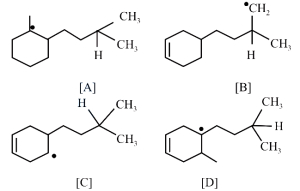
A
$[A] < [B] < [C] < [D]$
B
$[D] < [C] < [B] > [A]$
C
$[B] < [C] < [D] < [A]$
D
$[B] < [C] < [A] < [D]$
Solution
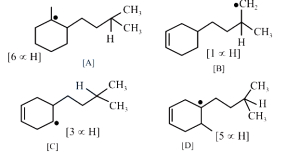
(C) The stability of free radicals is directly proportional to the number of $\alpha$-hydrogen atoms (hyperconjugation).
Counting the $\alpha$-hydrogens for each radical:
$[A]$ has $6 \ \alpha-H$.
$[B]$ has $1 \ \alpha-H$.
$[C]$ has $3 \ \alpha-H$.
$[D]$ has $5 \ \alpha-H$.
Comparing the number of $\alpha$-hydrogens: $1 < 3 < 5 < 6$.
Therefore,the correct order of stability is $[B] < [C] < [D] < [A]$.
Counting the $\alpha$-hydrogens for each radical:
$[A]$ has $6 \ \alpha-H$.
$[B]$ has $1 \ \alpha-H$.
$[C]$ has $3 \ \alpha-H$.
$[D]$ has $5 \ \alpha-H$.
Comparing the number of $\alpha$-hydrogens: $1 < 3 < 5 < 6$.
Therefore,the correct order of stability is $[B] < [C] < [D] < [A]$.
0 likesView Solution
47
ChemistryEasyMCQTS EAMCET · 2022
Which of the following carbocations lacks hyperconjugative stability?
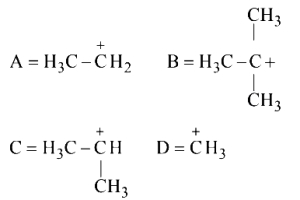
A
$A = CH_3CH_2^+$
B
$B = (CH_3)_3C^+$
C
$C = (CH_3)_2CH^+$
D
$D = CH_3^+$
Solution
(C) Hyperconjugative stability in carbocations is provided by the presence of $\alpha-H$ atoms attached to the carbon atom adjacent to the positively charged carbon.
$A = CH_3CH_2^+$ has $3$ $\alpha-H$ atoms.
$B = (CH_3)_3C^+$ has $9$ $\alpha-H$ atoms.
$C = (CH_3)_2CH^+$ has $6$ $\alpha-H$ atoms.
$D = CH_3^+$ has $0$ $\alpha-H$ atoms.
Since $D$ has no $\alpha-H$ atoms,it lacks hyperconjugative stability.
$A = CH_3CH_2^+$ has $3$ $\alpha-H$ atoms.
$B = (CH_3)_3C^+$ has $9$ $\alpha-H$ atoms.
$C = (CH_3)_2CH^+$ has $6$ $\alpha-H$ atoms.
$D = CH_3^+$ has $0$ $\alpha-H$ atoms.
Since $D$ has no $\alpha-H$ atoms,it lacks hyperconjugative stability.
0 likesView Solution
48
ChemistryMediumMCQTS EAMCET · 2022
Among the compounds
$(i)$ $HC \equiv C-COOH$
$(ii)$ $CH_2=CH-COOH$
$(iii)$ $CH_3-CH_2-COOH$ and
$(iv)$ $CH_3-CH_2-OH$
The correct order of acid strength is
$(i)$ $HC \equiv C-COOH$
$(ii)$ $CH_2=CH-COOH$
$(iii)$ $CH_3-CH_2-COOH$ and
$(iv)$ $CH_3-CH_2-OH$
The correct order of acid strength is
A
$i > ii > iii > iv$
B
$iv > iii > ii > i$
C
$ii > i > iv > iii$
D
$iii > ii > i > iv$
Solution
(A) The acidity of a compound depends on the stability of its conjugate base. Carboxylic acids $(R-COOH)$ are significantly more acidic than alcohols $(R-OH)$ due to the resonance stabilization of the carboxylate ion $(R-COO^-)$.
Among the carboxylic acids,the acidity is influenced by the inductive effect of the carbon atom attached to the carboxyl group. The hybridization of the carbon atom attached to the $-COOH$ group determines its electron-withdrawing ability:
$1$. In $(i)$ $HC \equiv C-COOH$,the carbon is $sp$ hybridized ($50$% s-character),which is the most electronegative and exerts the strongest $-I$ effect,stabilizing the carboxylate ion the most.
$2$. In $(ii)$ $CH_2=CH-COOH$,the carbon is $sp^2$ hybridized ($33$% s-character),exerting a moderate $-I$ effect.
$3$. In $(iii)$ $CH_3-CH_2-COOH$,the carbon is $sp^3$ hybridized ($25$% s-character),exerting the weakest $-I$ effect among the acids.
$4$. $(iv)$ $CH_3-CH_2-OH$ is an alcohol and is the least acidic.
Therefore,the correct order of acid strength is $i > ii > iii > iv$.
Among the carboxylic acids,the acidity is influenced by the inductive effect of the carbon atom attached to the carboxyl group. The hybridization of the carbon atom attached to the $-COOH$ group determines its electron-withdrawing ability:
$1$. In $(i)$ $HC \equiv C-COOH$,the carbon is $sp$ hybridized ($50$% s-character),which is the most electronegative and exerts the strongest $-I$ effect,stabilizing the carboxylate ion the most.
$2$. In $(ii)$ $CH_2=CH-COOH$,the carbon is $sp^2$ hybridized ($33$% s-character),exerting a moderate $-I$ effect.
$3$. In $(iii)$ $CH_3-CH_2-COOH$,the carbon is $sp^3$ hybridized ($25$% s-character),exerting the weakest $-I$ effect among the acids.
$4$. $(iv)$ $CH_3-CH_2-OH$ is an alcohol and is the least acidic.
Therefore,the correct order of acid strength is $i > ii > iii > iv$.
0 likesView Solution
49
ChemistryDifficultMCQTS EAMCET · 2022
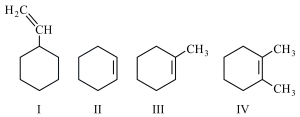
The correct order of the stability of the following compounds based on hyperconjugation is
A
$IV > III > II > I$
B
$IV > II > I > III$
C
$IV > II > III > I$
D
$IV > I > III > II$
Solution
(A) The stability of alkenes is directly proportional to the number of hyperconjugating structures,which in turn depends on the number of $\alpha$-hydrogen atoms attached to the $sp^2$ hybridized carbon atoms of the double bond.Counting the $\alpha$-hydrogen atoms for each compound:$I$: Vinylcyclohexane has $1$ $\alpha$-hydrogen atom.$II$: Cyclohexene has $4$ $\alpha$-hydrogen atoms.$III$: $1$-Methylcyclohexene has $7$ $\alpha$-hydrogen atoms.$IV$: $1,2$-Dimethylcyclohexene has $10$ $\alpha$-hydrogen atoms.Since the number of $\alpha$-hydrogen atoms follows the order $IV (10) > III (7) > II (4) > I (1)$,the stability order is $IV > III > II > I$.
0 likesView Solution
50
ChemistryMediumMCQTS EAMCET · 2022
Identify the chiral molecule among the following.
A
Isopropyl alcohol
B
$2-$Pentanol
C
$1-$Bromo$-3-$butene
D
Isobutyl alcohol
Solution
(B) carbon atom bonded to four different groups or atoms is called a chiral carbon.
$A$ chiral molecule exists in two stereoisomers that are non-superimposable mirror images of each other,called enantiomers.
$1$. $CH_3-CH(OH)-CH_3$ (Isopropyl alcohol): The central carbon is bonded to two identical methyl groups,so it is achiral.
$2$. $CH_3-CH(OH)-CH_2-CH_2-CH_3$ ($2-$Pentanol): The second carbon is bonded to four different groups ($-H$,$-OH$,$-CH_3$,and $-CH_2CH_2CH_3$),making it a chiral center. Thus,it is a chiral molecule.
$3$. $BrCH_2-CH_2-CH=CH_2$ ($1-$Bromo$-3-$butene): No carbon atom is bonded to four different groups,so it is achiral.
$4$. $(CH_3)_2CH-CH_2OH$ (Isobutyl alcohol): The carbon attached to the hydroxyl group is bonded to two identical hydrogen atoms,so it is achiral.
$A$ chiral molecule exists in two stereoisomers that are non-superimposable mirror images of each other,called enantiomers.
$1$. $CH_3-CH(OH)-CH_3$ (Isopropyl alcohol): The central carbon is bonded to two identical methyl groups,so it is achiral.
$2$. $CH_3-CH(OH)-CH_2-CH_2-CH_3$ ($2-$Pentanol): The second carbon is bonded to four different groups ($-H$,$-OH$,$-CH_3$,and $-CH_2CH_2CH_3$),making it a chiral center. Thus,it is a chiral molecule.
$3$. $BrCH_2-CH_2-CH=CH_2$ ($1-$Bromo$-3-$butene): No carbon atom is bonded to four different groups,so it is achiral.
$4$. $(CH_3)_2CH-CH_2OH$ (Isobutyl alcohol): The carbon attached to the hydroxyl group is bonded to two identical hydrogen atoms,so it is achiral.
0 likesView Solution
51
ChemistryMediumMCQTS EAMCET · 2022
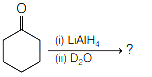
The major product of the following reaction is
A
Cyclohexanol with a $D$ atom attached to the carbon and an $-OH$ group.
B
Cyclohexanol with a $D$ atom attached to the carbon and an $-OD$ group.
C
Cyclohexanol with a $D$ atom and an $H$ atom attached to the carbon.
D
Cyclohexanol with an $H$ atom attached to the carbon and an $-OD$ group.
Solution
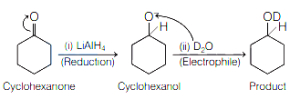
(D) $LiAlH_4$ acts as a source of hydride ion $(H^-)$,which attacks the electrophilic carbonyl carbon of cyclohexanone to form an alkoxide intermediate.
In the second step,$D_2O$ acts as a source of deuterium $(D^+)$,which protonates (deuterates) the alkoxide oxygen to form the final product,which is a cyclohexanol derivative with an $-OD$ group and a hydrogen atom attached to the alpha carbon.
In the second step,$D_2O$ acts as a source of deuterium $(D^+)$,which protonates (deuterates) the alkoxide oxygen to form the final product,which is a cyclohexanol derivative with an $-OD$ group and a hydrogen atom attached to the alpha carbon.
0 likesView Solution
52
ChemistryMediumMCQTS EAMCET · 2022
The major product of the following reaction sequence is:
$C_6H_5OH \xrightarrow[(ii) NaOH, (iii) H^+]{(i) CHCl_3, NaOH(aq)} ?$
$C_6H_5OH \xrightarrow[(ii) NaOH, (iii) H^+]{(i) CHCl_3, NaOH(aq)} ?$
A
$2-$Hydroxybenzaldehyde
B
$3-$Hydroxybenzaldehyde
C
$4-$Hydroxybenzaldehyde
D
Benzaldehyde
Solution
(A) The given reaction is the Reimer-Tiemann reaction.
Phenol reacts with chloroform $(CHCl_3)$ in the presence of aqueous sodium hydroxide $(NaOH)$ to form an intermediate,which upon hydrolysis with acid $(H^+)$ yields $2$-hydroxybenzaldehyde (salicylaldehyde) as the major product.
Phenol reacts with chloroform $(CHCl_3)$ in the presence of aqueous sodium hydroxide $(NaOH)$ to form an intermediate,which upon hydrolysis with acid $(H^+)$ yields $2$-hydroxybenzaldehyde (salicylaldehyde) as the major product.
0 likesView Solution
53
ChemistryEasyMCQTS EAMCET · 2022
The major product obtained in the following reaction is $C_2H_5ONa + (CH_3)_3C-Cl \rightarrow$
A
$CH_3-C(CH_3)_2-O-C_2H_5$
B
$CH_2=C(CH_3)_2$
C
$CH_3-CH(CH_3)-O-C_2H_5$
D
$(CH_3)_3C-CH_2CHO$
Solution
(B) The reaction involves a tertiary alkyl halide,$(CH_3)_3C-Cl$,and a strong base,$C_2H_5ONa$ (sodium ethoxide).
Since the alkyl halide is sterically hindered (tertiary),the $S_N2$ pathway is unfavorable.
Instead,the base acts as a proton acceptor,leading to an $E2$ elimination reaction.
The base abstracts a proton from one of the $\beta$-carbon atoms,resulting in the formation of an alkene.
The major product is $2$-methylpropene,which is $(CH_3)_2C=CH_2$.
Since the alkyl halide is sterically hindered (tertiary),the $S_N2$ pathway is unfavorable.
Instead,the base acts as a proton acceptor,leading to an $E2$ elimination reaction.
The base abstracts a proton from one of the $\beta$-carbon atoms,resulting in the formation of an alkene.
The major product is $2$-methylpropene,which is $(CH_3)_2C=CH_2$.
0 likesView Solution
54
ChemistryMediumMCQTS EAMCET · 2022
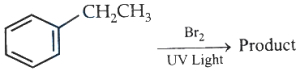
The major product of the following reaction is:
A
$1-$bromo$-1-$phenylethane
B
$2-$bromo$-1-$phenylethane
C
p-bromoethylbenzene
D
o,p-dibromoethylbenzene
Solution
(A) The reaction of ethylbenzene with $Br_2$ in the presence of $UV$ light is a free radical substitution reaction. The bromine radical abstracts a hydrogen atom from the benzylic carbon because the resulting benzylic radical is resonance-stabilized by the phenyl ring. The radical formed at the $\alpha$-carbon (benzylic position) is more stable than the radical at the $\beta$-carbon. Therefore,the major product is $1$-bromo-$1$-phenylethane $(C_6H_5CH(Br)CH_3)$.
0 likesView Solution
55
ChemistryMediumMCQTS EAMCET · 2022
The major product of the following reaction sequence is
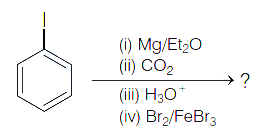
A
$3-$bromobenzoic acid
B
$2-$bromobenzoic acid
C
$4-$bromobenzoic acid
D
$3,5-$dibromobenzoic acid
Solution
(A) The reaction sequence is as follows:
$1$. Iodobenzene reacts with $Mg$ in the presence of $Et_2O$ to form phenylmagnesium iodide (a Grignard reagent).
$2$. Phenylmagnesium iodide reacts with $CO_2$ followed by acid hydrolysis $(H_3O^+)$ to yield benzoic acid.
$3$. Benzoic acid undergoes electrophilic aromatic substitution with $Br_2/FeBr_3$. Since the $-COOH$ group is a deactivating and meta-directing group,the bromine atom will be substituted at the meta-position.
$4$. The final product is $3$-bromobenzoic acid.
$1$. Iodobenzene reacts with $Mg$ in the presence of $Et_2O$ to form phenylmagnesium iodide (a Grignard reagent).
$2$. Phenylmagnesium iodide reacts with $CO_2$ followed by acid hydrolysis $(H_3O^+)$ to yield benzoic acid.
$3$. Benzoic acid undergoes electrophilic aromatic substitution with $Br_2/FeBr_3$. Since the $-COOH$ group is a deactivating and meta-directing group,the bromine atom will be substituted at the meta-position.
$4$. The final product is $3$-bromobenzoic acid.
0 likesView Solution
56
ChemistryMediumMCQTS EAMCET · 2022
The reagent that can reduce the carboxylic acid group to the corresponding alcohol is
A
$NaBH_4 / H_3O^{+}$
B
$B_2H_6 / H_3O^{+}$
C
$Zn-Hg / \text{conc. } HCl$
D
$H_2, Pd / C$
Solution
(B) Carboxylic acids are reduced to primary alcohols by lithium aluminium hydride $(LiAlH_4)$ or more selectively with diborane $(B_2H_6)$.
$B_2H_6$ is a specific reagent that reduces the carboxylic acid group to a primary alcohol while leaving other functional groups like esters,nitro,or halo groups unaffected.
$NaBH_4$ is not strong enough to reduce the carboxylic acid group.
$Zn-Hg / \text{conc. } HCl$ is used for Clemmensen reduction,which reduces aldehydes and ketones to alkanes,not carboxylic acids to alcohols.
$H_2, Pd / C$ is generally used for the hydrogenation of alkenes and alkynes and does not reduce carboxylic acids.
$B_2H_6$ is a specific reagent that reduces the carboxylic acid group to a primary alcohol while leaving other functional groups like esters,nitro,or halo groups unaffected.
$NaBH_4$ is not strong enough to reduce the carboxylic acid group.
$Zn-Hg / \text{conc. } HCl$ is used for Clemmensen reduction,which reduces aldehydes and ketones to alkanes,not carboxylic acids to alcohols.
$H_2, Pd / C$ is generally used for the hydrogenation of alkenes and alkynes and does not reduce carboxylic acids.
0 likesView Solution
57
ChemistryDifficultMCQTS EAMCET · 2022
Benzene on reaction with acetyl chloride in the presence of anhydrous $AlCl_3$ gave the product $P$. The product $P$ on reaction with methyl magnesium bromide followed by treatment with water furnished the product $Q$. The molecular formula of $Q$ is
A
$C_8H_{10}O$
B
$C_8H_8O$
C
$C_9H_{12}O$
D
$C_9H_{10}O$
Solution
(C) Step $1$: Benzene reacts with acetyl chloride $(CH_3COCl)$ in the presence of anhydrous $AlCl_3$ (Friedel-Crafts acylation) to form acetophenone $(P)$,which is $C_6H_5COCH_3$.
Step $2$: Acetophenone $(P)$ reacts with methyl magnesium bromide $(CH_3MgBr)$ followed by hydrolysis $(H_2O)$ to form $2$-phenylpropan-$2$-ol $(Q)$.
The reaction is: $C_6H_5COCH_3 + CH_3MgBr$ $\rightarrow C_6H_5C(OMgBr)(CH_3)_2$ $\xrightarrow{H_2O} C_6H_5C(OH)(CH_3)_2$.
The structure of $Q$ is $C_6H_5C(OH)(CH_3)_2$,which contains $9$ carbon atoms,$12$ hydrogen atoms,and $1$ oxygen atom.
Thus,the molecular formula of $Q$ is $C_9H_{12}O$.
Step $2$: Acetophenone $(P)$ reacts with methyl magnesium bromide $(CH_3MgBr)$ followed by hydrolysis $(H_2O)$ to form $2$-phenylpropan-$2$-ol $(Q)$.
The reaction is: $C_6H_5COCH_3 + CH_3MgBr$ $\rightarrow C_6H_5C(OMgBr)(CH_3)_2$ $\xrightarrow{H_2O} C_6H_5C(OH)(CH_3)_2$.
The structure of $Q$ is $C_6H_5C(OH)(CH_3)_2$,which contains $9$ carbon atoms,$12$ hydrogen atoms,and $1$ oxygen atom.
Thus,the molecular formula of $Q$ is $C_9H_{12}O$.
0 likesView Solution
58
ChemistryMediumMCQTS EAMCET · 2022
The major product in the following transformation is
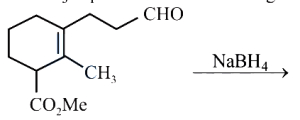
A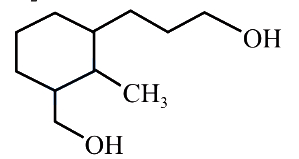
B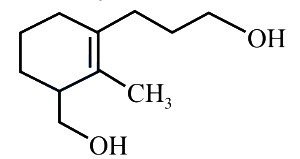
C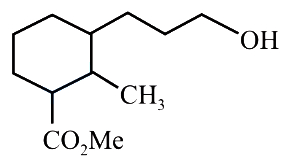
D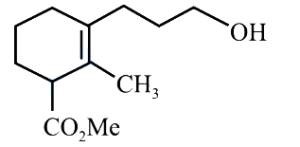
Solution
(D) $NaBH_4$ is a mild reducing agent. It selectively reduces the aldehyde group to a primary alcohol while leaving the ester group $(-COOCH_3)$ and the alkene $(-C=C-)$ intact.
0 likesView Solution
59
ChemistryMediumMCQTS EAMCET · 2022
The order of reactivity of the following compounds towards the esterification with acetic acid is:

A
$I > II > III > IV$
B
$IV > III > II > I$
C
$I > IV > II > III$
D
$I > IV > III > II$
Solution
(D) The chemical reaction in which alcohols and acids react with each other to form esters is called esterification.
In this reaction,the alcohol acts as a nucleophile and attacks the carbonyl carbon of the carboxylic acid.
The reactivity of alcohols towards esterification is primarily governed by steric hindrance.
As the bulkiness of the alkyl group attached to the carbon bearing the $-OH$ group increases,the steric hindrance increases,making it more difficult for the alcohol to attack the acid,thus decreasing the reactivity.
The given compounds are:
$(I) CH_3CH_2OH$ (Ethanol)
$(II) (CH_3)_2CHCH_2OH$ ($2-$methylpropan$-1-$ol)
$(III) (CH_3)_2CHCH(CH_3)CH_2OH$ ($2,3-$dimethylbutan$-1-$ol)
$(IV) CH_3CH_2CH_2OH$ (Propan$-1-$ol)
Comparing the steric hindrance,the order of reactivity is $(I) > (IV) > (II) > (III)$.
Therefore,the correct option is $D$.
In this reaction,the alcohol acts as a nucleophile and attacks the carbonyl carbon of the carboxylic acid.
The reactivity of alcohols towards esterification is primarily governed by steric hindrance.
As the bulkiness of the alkyl group attached to the carbon bearing the $-OH$ group increases,the steric hindrance increases,making it more difficult for the alcohol to attack the acid,thus decreasing the reactivity.
The given compounds are:
$(I) CH_3CH_2OH$ (Ethanol)
$(II) (CH_3)_2CHCH_2OH$ ($2-$methylpropan$-1-$ol)
$(III) (CH_3)_2CHCH(CH_3)CH_2OH$ ($2,3-$dimethylbutan$-1-$ol)
$(IV) CH_3CH_2CH_2OH$ (Propan$-1-$ol)
Comparing the steric hindrance,the order of reactivity is $(I) > (IV) > (II) > (III)$.
Therefore,the correct option is $D$.
0 likesView Solution
60
ChemistryMediumMCQTS EAMCET · 2022
The correct order of the rate of acid-mediated dehydration reaction of the following compounds is:
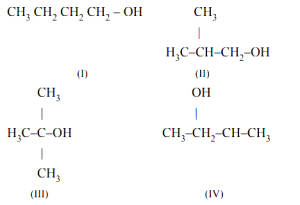
A
$II > III > IV > I$
B
$IV > III > I > II$
C
$III > II > IV > I$
D
$III > IV > II > I$
Solution
(D) The rate of acid-catalyzed dehydration of alcohols depends on the stability of the carbocation intermediate formed during the reaction. The stability order of carbocations is $3^\circ > 2^\circ > 1^\circ$.
Let us analyze the carbocations formed from each alcohol:
$(I)$ $CH_3CH_2CH_2CH_2OH$ forms a $1^\circ$ carbocation: $CH_3CH_2CH_2CH_2^+$.
$(II)$ $CH_3-CH(CH_3)-CH_2OH$ forms a $1^\circ$ carbocation: $CH_3-CH(CH_3)-CH_2^+$,which can rearrange to a more stable $2^\circ$ carbocation.
$(III)$ $CH_3-C(CH_3)_2-OH$ forms a $3^\circ$ carbocation: $CH_3-C^+(CH_3)_2$.
$(IV)$ $CH_3-CH_2-CH(OH)-CH_3$ forms a $2^\circ$ carbocation: $CH_3-CH_2-CH^+-CH_3$.
Comparing the stability: The $3^\circ$ carbocation $(III)$ is the most stable,followed by the $2^\circ$ carbocation $(IV)$. Between the two $1^\circ$ carbocations,$(II)$ can undergo rearrangement to form a more stable carbocation,making it more reactive than the primary carbocation $(I)$.
Thus,the order of reactivity is $III > IV > II > I$.
Let us analyze the carbocations formed from each alcohol:
$(I)$ $CH_3CH_2CH_2CH_2OH$ forms a $1^\circ$ carbocation: $CH_3CH_2CH_2CH_2^+$.
$(II)$ $CH_3-CH(CH_3)-CH_2OH$ forms a $1^\circ$ carbocation: $CH_3-CH(CH_3)-CH_2^+$,which can rearrange to a more stable $2^\circ$ carbocation.
$(III)$ $CH_3-C(CH_3)_2-OH$ forms a $3^\circ$ carbocation: $CH_3-C^+(CH_3)_2$.
$(IV)$ $CH_3-CH_2-CH(OH)-CH_3$ forms a $2^\circ$ carbocation: $CH_3-CH_2-CH^+-CH_3$.
Comparing the stability: The $3^\circ$ carbocation $(III)$ is the most stable,followed by the $2^\circ$ carbocation $(IV)$. Between the two $1^\circ$ carbocations,$(II)$ can undergo rearrangement to form a more stable carbocation,making it more reactive than the primary carbocation $(I)$.
Thus,the order of reactivity is $III > IV > II > I$.
0 likesView Solution
61
ChemistryMediumMCQTS EAMCET · 2022
$A$ primary alcohol was reacted with pyridinium chlorochromate $(PCC)$,which resulted in a product $P$. The product $P$ on treatment with ammoniacal silver nitrate solution produces:
A
Anhydride of carboxylic acid
B
Aldehyde
C
Amide
D
Carboxylate anion
Solution
(D) $1$. Primary alcohols are oxidized to aldehydes by pyridinium chlorochromate $(PCC)$. Thus,the product $P$ is an aldehyde.
$2$. Aldehydes react with ammoniacal silver nitrate solution (Tollens' reagent) to undergo oxidation,forming a carboxylate anion along with the deposition of metallic silver (silver mirror test).
$2$. Aldehydes react with ammoniacal silver nitrate solution (Tollens' reagent) to undergo oxidation,forming a carboxylate anion along with the deposition of metallic silver (silver mirror test).
0 likesView Solution
62
ChemistryEasyMCQTS EAMCET · 2022
The major product of the following reaction is: $CH_3CH(OH)CH_3 \xrightarrow{Cu, 573 \ K} ?$
A
$CH_3CH_2CH_3$
B
$CH_3CH=CH_2$
C
$CH_3C \equiv CH$
D
$CH_3COCH_3$
Solution
(D) The reactant is propan-$2$-ol,which is a secondary alcohol.
When vapours of a secondary alcohol are passed over heated $Cu$ at $573 \ K$,dehydrogenation occurs,resulting in the loss of $H_2$ to form a ketone.
Therefore,propan-$2$-ol undergoes dehydrogenation to form propanone $(CH_3COCH_3)$.
When vapours of a secondary alcohol are passed over heated $Cu$ at $573 \ K$,dehydrogenation occurs,resulting in the loss of $H_2$ to form a ketone.
Therefore,propan-$2$-ol undergoes dehydrogenation to form propanone $(CH_3COCH_3)$.
0 likesView Solution
63
ChemistryEasyMCQTS EAMCET · 2022
Assertion $(A)$: Tertiary alcohols produce turbidity immediately with Lucas reagent.
Reason $(R)$: Lucas reagent is a $1:1$ mixture of conc. $HNO_3$ and anhydrous $ZnCl_2$.
The correct option among the following is:
Reason $(R)$: Lucas reagent is a $1:1$ mixture of conc. $HNO_3$ and anhydrous $ZnCl_2$.
The correct option among the following is:
A
$A$. $(A)$ is true,$(R)$ is true and $(R)$ is the correct explanation for $(A)$
B
$B$. $(A)$ is true,$(R)$ is true but $(R)$ is not the correct explanation for $(A)$
C
$C$. $(A)$ is true but $(R)$ is false
D
$D$. $(A)$ is false but $(R)$ is true
Solution
(C) Assertion $(A)$ is true because tertiary alcohols react very rapidly with Lucas reagent to form alkyl chlorides,which appear as turbidity immediately.
Reason $(R)$ is false because Lucas reagent is a mixture of concentrated $HCl$ and anhydrous $ZnCl_2$,not $HNO_3$ and $ZnCl_2$.
Reason $(R)$ is false because Lucas reagent is a mixture of concentrated $HCl$ and anhydrous $ZnCl_2$,not $HNO_3$ and $ZnCl_2$.
0 likesView Solution
64
ChemistryMediumMCQTS EAMCET · 2022
The major aromatic product of the following reaction sequence is:
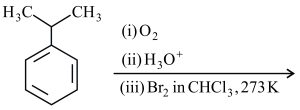
A
$2,4,6-$Tribromophenol
B
$2,4-$Dibromophenol
C
o-Bromophenol
D
p-Bromophenol
Solution
(D) The reaction sequence is as follows:
$1$. Cumene (isopropylbenzene) reacts with $O_2$ to form cumene hydroperoxide.
$2$. Acid-catalyzed hydrolysis of cumene hydroperoxide yields phenol and acetone $(CH_3COCH_3)$.
$3$. The reaction of phenol with $Br_2$ in a solvent of low polarity like $CHCl_3$ at low temperature $(273 \ K)$ leads to monobromination.
Due to the strong activating effect of the $-OH$ group,the electrophilic substitution occurs primarily at the ortho and para positions. The para-isomer is the major product due to less steric hindrance compared to the ortho-isomer. Thus,the major product is $p$-bromophenol.
$1$. Cumene (isopropylbenzene) reacts with $O_2$ to form cumene hydroperoxide.
$2$. Acid-catalyzed hydrolysis of cumene hydroperoxide yields phenol and acetone $(CH_3COCH_3)$.
$3$. The reaction of phenol with $Br_2$ in a solvent of low polarity like $CHCl_3$ at low temperature $(273 \ K)$ leads to monobromination.
Due to the strong activating effect of the $-OH$ group,the electrophilic substitution occurs primarily at the ortho and para positions. The para-isomer is the major product due to less steric hindrance compared to the ortho-isomer. Thus,the major product is $p$-bromophenol.
0 likesView Solution
65
ChemistryMediumMCQTS EAMCET · 2022
The major product in the following reaction is:
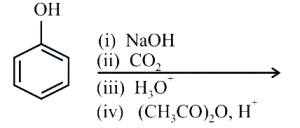
A
$4-$acetoxybenzoic acid
B
$2-$acetoxybenzoic acid
C
$4-$hydroxy$-3-$acetylbenzoic acid
D
$2-$hydroxybenzoic acid methyl ester
Solution
(B) The reaction sequence is as follows:
$1$. Phenol reacts with $NaOH$ to form sodium phenoxide.
$2$. Sodium phenoxide undergoes Kolbe's reaction with $CO_2$ followed by acidification $(H_3O^+)$ to produce salicylic acid ($2$-hydroxybenzoic acid).
$3$. Salicylic acid then reacts with acetic anhydride $((CH_3CO)_2O)$ in the presence of an acid catalyst $(H^+)$ to undergo acetylation of the phenolic $-OH$ group.
$4$. The final product is $2-$acetoxybenzoic acid,commonly known as aspirin.
$1$. Phenol reacts with $NaOH$ to form sodium phenoxide.
$2$. Sodium phenoxide undergoes Kolbe's reaction with $CO_2$ followed by acidification $(H_3O^+)$ to produce salicylic acid ($2$-hydroxybenzoic acid).
$3$. Salicylic acid then reacts with acetic anhydride $((CH_3CO)_2O)$ in the presence of an acid catalyst $(H^+)$ to undergo acetylation of the phenolic $-OH$ group.
$4$. The final product is $2-$acetoxybenzoic acid,commonly known as aspirin.
0 likesView Solution
66
ChemistryMediumMCQTS EAMCET · 2022
The major product formed in the following reaction is:
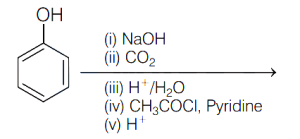
A
Aspirin (o-acetoxybenzoic acid)
B
Methyl salicylate
C
p-acetoxybenzoic acid
D
Methyl p-hydroxybenzoate
Solution
(A) The reaction sequence is as follows:
$1$. The reaction of phenol with $NaOH$ followed by $CO_2$ and then $H^+/H_2O$ is the Kolbe-Schmitt reaction,which yields salicylic acid ($2$-hydroxybenzoic acid).
$2$. The subsequent reaction with $CH_3COCl$ in the presence of pyridine is an acetylation reaction of the phenolic $-OH$ group.
$3$. This converts the $-OH$ group of salicylic acid into an acetoxy group $(-OCOCH_3)$,resulting in the formation of aspirin ($2$-acetoxybenzoic acid).
$1$. The reaction of phenol with $NaOH$ followed by $CO_2$ and then $H^+/H_2O$ is the Kolbe-Schmitt reaction,which yields salicylic acid ($2$-hydroxybenzoic acid).
$2$. The subsequent reaction with $CH_3COCl$ in the presence of pyridine is an acetylation reaction of the phenolic $-OH$ group.
$3$. This converts the $-OH$ group of salicylic acid into an acetoxy group $(-OCOCH_3)$,resulting in the formation of aspirin ($2$-acetoxybenzoic acid).
0 likesView Solution
67
ChemistryMediumMCQTS EAMCET · 2022
The decreasing order of reactivity of the following compounds in the Williamson's ether synthesis is:
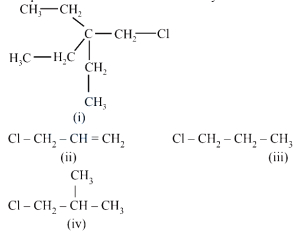
A
$(ii) > (iv) > (iii) > (i)$
B
$(i) > (ii) > (iii) > (iv)$
C
$(iv) > (iii) > (ii) > (i)$
D
$(ii) > (iii) > (iv) > (i)$
Solution
(D) Williamson's ether synthesis proceeds via an $SN^2$ mechanism,which is highly sensitive to steric hindrance.
Primary alkyl halides are more reactive than secondary,which are more reactive than tertiary.
$(i)$ is a primary alkyl halide but is extremely sterically hindered due to the presence of a bulky quaternary carbon adjacent to the reaction site.
(ii) is an allylic primary halide,which is highly reactive due to resonance stabilization of the transition state.
(iii) is a simple primary alkyl halide $(CH_3CH_2CH_2Cl)$.
(iv) is a primary alkyl halide with branching at the $\beta$-carbon $(CH_3CH(CH_3)CH_2Cl)$.
The reactivity order for $SN^2$ is: Allylic primary $>$ Primary $>$ Primary with $\beta$-branching $>$ Highly hindered primary.
Thus,the decreasing order is $(ii) > (iii) > (iv) > (i)$.
Primary alkyl halides are more reactive than secondary,which are more reactive than tertiary.
$(i)$ is a primary alkyl halide but is extremely sterically hindered due to the presence of a bulky quaternary carbon adjacent to the reaction site.
(ii) is an allylic primary halide,which is highly reactive due to resonance stabilization of the transition state.
(iii) is a simple primary alkyl halide $(CH_3CH_2CH_2Cl)$.
(iv) is a primary alkyl halide with branching at the $\beta$-carbon $(CH_3CH(CH_3)CH_2Cl)$.
The reactivity order for $SN^2$ is: Allylic primary $>$ Primary $>$ Primary with $\beta$-branching $>$ Highly hindered primary.
Thus,the decreasing order is $(ii) > (iii) > (iv) > (i)$.
0 likesView Solution
68
ChemistryMediumMCQTS EAMCET · 2022
In the following compounds,the ones that give positive iodoform test are:
$(I)$ $CH_3CH_2COCH_2CH_3$
$(II)$ $CH_3CH(OH)CH_3$
$(III)$ $1$-indanone
$(IV)$ $CH_3CH_2COCH_3$
$(V)$ $PhCOPh$
$(VI)$ $PhCOCH_3$
$(I)$ $CH_3CH_2COCH_2CH_3$
$(II)$ $CH_3CH(OH)CH_3$
$(III)$ $1$-indanone
$(IV)$ $CH_3CH_2COCH_3$
$(V)$ $PhCOPh$
$(VI)$ $PhCOCH_3$
A
$I, II$ and $III$
B
$II, III$ and $V$
C
$IV, V$ and $VI$
D
$II, IV$ and $VI$
Solution
(D) The iodoform test is given by compounds containing the $CH_3CO-$ group or the $CH_3CH(OH)-$ group.
$(I)$ $CH_3CH_2COCH_2CH_3$: Does not contain $CH_3CO-$ group.
$(II)$ $CH_3CH(OH)CH_3$: Contains $CH_3CH(OH)-$ group,so it gives a positive test.
$(III)$ $1$-indanone: Does not contain $CH_3CO-$ group.
$(IV)$ $CH_3CH_2COCH_3$: Contains $CH_3CO-$ group,so it gives a positive test.
$(V)$ $PhCOPh$: Does not contain $CH_3CO-$ group.
$(VI)$ $PhCOCH_3$: Contains $CH_3CO-$ group,so it gives a positive test.
Therefore,compounds $(II), (IV),$ and $(VI)$ give a positive iodoform test.
$(I)$ $CH_3CH_2COCH_2CH_3$: Does not contain $CH_3CO-$ group.
$(II)$ $CH_3CH(OH)CH_3$: Contains $CH_3CH(OH)-$ group,so it gives a positive test.
$(III)$ $1$-indanone: Does not contain $CH_3CO-$ group.
$(IV)$ $CH_3CH_2COCH_3$: Contains $CH_3CO-$ group,so it gives a positive test.
$(V)$ $PhCOPh$: Does not contain $CH_3CO-$ group.
$(VI)$ $PhCOCH_3$: Contains $CH_3CO-$ group,so it gives a positive test.
Therefore,compounds $(II), (IV),$ and $(VI)$ give a positive iodoform test.
0 likesView Solution
69
ChemistryMediumMCQTS EAMCET · 2022
Which of the following statements are correct for phenol?
$(A)$ In general,phenol is more acidic than alcohol.
$(B)$ Phenol is used in the production of melamine plastic.
$(C)$ Phenol gives violet colour with neutral ferric chloride solution.
$(D)$ Phenol when heated with acetyl chloride gives phenetole.
$(A)$ In general,phenol is more acidic than alcohol.
$(B)$ Phenol is used in the production of melamine plastic.
$(C)$ Phenol gives violet colour with neutral ferric chloride solution.
$(D)$ Phenol when heated with acetyl chloride gives phenetole.
A
$C \& D$
B
$A \& D$
C
$B \& C$
D
$A \& C$
Solution
(D) Statement $(A)$ is correct: Phenol is more acidic than alcohols because the phenoxide ion formed after deprotonation is stabilized by resonance with the benzene ring.
Statement $(B)$ is incorrect: Melamine plastic is produced from melamine and formaldehyde,not phenol.
Statement $(C)$ is correct: Phenol reacts with neutral $FeCl_3$ solution to form a violet-colored iron-phenoxide complex.
Statement $(D)$ is incorrect: Phenol reacts with acetyl chloride $(CH_3COCl)$ to form phenyl acetate $(C_6H_5OCOCH_3)$,not phenetole $(C_6H_5OC_2H_5)$.
Therefore,statements $(A)$ and $(C)$ are correct.
Statement $(B)$ is incorrect: Melamine plastic is produced from melamine and formaldehyde,not phenol.
Statement $(C)$ is correct: Phenol reacts with neutral $FeCl_3$ solution to form a violet-colored iron-phenoxide complex.
Statement $(D)$ is incorrect: Phenol reacts with acetyl chloride $(CH_3COCl)$ to form phenyl acetate $(C_6H_5OCOCH_3)$,not phenetole $(C_6H_5OC_2H_5)$.
Therefore,statements $(A)$ and $(C)$ are correct.
0 likesView Solution
70
ChemistryMediumMCQTS EAMCET · 2022
The major product formed in the following reaction is:
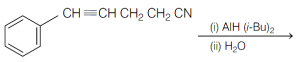
A
$Ph-CH_2-CH_2-CH_2-CH_2-CH_2-NH_2$
B
$Ph-CH_2-CH_2-CH_2-CH_2-CH_2-OH$
C
$Ph-CH=CH-CH_2-CH_2-CH_2-NH_2$
D
$Ph-CH=CH-CH_2-CH_2-CHO$
Solution
(D) The reagent $DIBAL-H$ (diisobutylaluminium hydride,$AlH(i-Bu)_2$) is a selective reducing agent. It reduces nitriles $(-CN)$ to aldehydes $(-CHO)$ after hydrolysis,while leaving other functional groups like carbon-carbon double bonds $(C=C)$ unaffected. Therefore,the reaction of $Ph-CH=CH-CH_2-CH_2-CN$ with $DIBAL-H$ followed by $H_2O$ yields $Ph-CH=CH-CH_2-CH_2-CHO$.
0 likesView Solution
71
ChemistryDifficultMCQTS EAMCET · 2022
Consider the following reaction,where:
$(A)$ The change in the functional group and
$(B)$ The corresponding change in the hybridization from the starting material to the final product are:
$CH_3-C \equiv N \xrightarrow[(ii) \ HI + \text{Red } P]{(i) \ SnCl_2, HCl / H_3O^{+}}$
$(A)$ The change in the functional group and
$(B)$ The corresponding change in the hybridization from the starting material to the final product are:
$CH_3-C \equiv N \xrightarrow[(ii) \ HI + \text{Red } P]{(i) \ SnCl_2, HCl / H_3O^{+}}$
A
$A: -CN$ $\rightarrow -CH_2OH \quad (sp^2$ $\rightarrow sp^3)$
B
$A: -CN$ $\rightarrow -CONH_2 \quad (sp$ $\rightarrow sp^2)$
C
$A: -CN$ $\rightarrow -CH_2NH_2 \quad (sp$ $\rightarrow sp^3)$
D
$A: -CN$ $\rightarrow -CH_3 \quad (sp$ $\rightarrow sp^3)$
Solution
(D) The reaction proceeds in two main steps:
$1$. Stephen reduction: $CH_3-CN$ $\xrightarrow{SnCl_2, HCl} CH_3-CH=NH$ $\xrightarrow{H_3O^+} CH_3CHO$.
$2$. Reduction of aldehyde: $CH_3CHO \xrightarrow{HI, \text{Red } P} CH_3-CH_3$ (Ethane).
In the starting material,the carbon of the $-CN$ group is $sp$ hybridized.
In the final product,ethane $(CH_3-CH_3)$,the carbons are $sp^3$ hybridized.
The functional group changes from $-CN$ (nitrile) to $-CH_3$ (alkyl group).
Thus,the correct change is $A: -CN \rightarrow -CH_3$ and $B: sp \rightarrow sp^3$.
$1$. Stephen reduction: $CH_3-CN$ $\xrightarrow{SnCl_2, HCl} CH_3-CH=NH$ $\xrightarrow{H_3O^+} CH_3CHO$.
$2$. Reduction of aldehyde: $CH_3CHO \xrightarrow{HI, \text{Red } P} CH_3-CH_3$ (Ethane).
In the starting material,the carbon of the $-CN$ group is $sp$ hybridized.
In the final product,ethane $(CH_3-CH_3)$,the carbons are $sp^3$ hybridized.
The functional group changes from $-CN$ (nitrile) to $-CH_3$ (alkyl group).
Thus,the correct change is $A: -CN \rightarrow -CH_3$ and $B: sp \rightarrow sp^3$.
0 likesView Solution
72
ChemistryEasyMCQTS EAMCET · 2022
Match the following:
| List-$I$ | List-$II$ |
| :--- | :--- |
| $(A)$ Acid chloride to aldehyde | $(I)$ $DIBAL-H$ |
| $(B)$ Benzene to benzaldehyde | $(II)$ $CO, HCl, \text{anhyd. } AlCl_3$ |
| $(C)$ Acetylene to aldehyde | $(III)$ $HgSO_4, H_2SO_4$ |
| $(D)$ Ester to aldehyde | $(IV)$ $H_2, Pd-BaSO_4$ |
| List-$I$ | List-$II$ |
| :--- | :--- |
| $(A)$ Acid chloride to aldehyde | $(I)$ $DIBAL-H$ |
| $(B)$ Benzene to benzaldehyde | $(II)$ $CO, HCl, \text{anhyd. } AlCl_3$ |
| $(C)$ Acetylene to aldehyde | $(III)$ $HgSO_4, H_2SO_4$ |
| $(D)$ Ester to aldehyde | $(IV)$ $H_2, Pd-BaSO_4$ |
A
$A-IV, B-II, C-III, D-I$
B
$A-I, B-II, C-III, D-IV$
C
$A-III, B-II, C-I, D-IV$
D
$A-IV, B-II, C-I, D-III$
Solution
(A) The correct matches are as follows:
$(A)$ Acid chloride to aldehyde is the Rosenmund reduction,which uses $H_2, Pd-BaSO_4$ $(IV)$.
$(B)$ Benzene to benzaldehyde is the Gatterman-Koch reaction,which uses $CO, HCl, \text{anhyd. } AlCl_3$ $(II)$.
$(C)$ Acetylene to aldehyde involves the hydration of alkyne,which uses $HgSO_4, H_2SO_4$ $(III)$.
$(D)$ Ester to aldehyde is achieved using $DIBAL-H$ $(I)$.
Therefore,the correct matching is $A-IV, B-II, C-III, D-I$.
$(A)$ Acid chloride to aldehyde is the Rosenmund reduction,which uses $H_2, Pd-BaSO_4$ $(IV)$.
$(B)$ Benzene to benzaldehyde is the Gatterman-Koch reaction,which uses $CO, HCl, \text{anhyd. } AlCl_3$ $(II)$.
$(C)$ Acetylene to aldehyde involves the hydration of alkyne,which uses $HgSO_4, H_2SO_4$ $(III)$.
$(D)$ Ester to aldehyde is achieved using $DIBAL-H$ $(I)$.
Therefore,the correct matching is $A-IV, B-II, C-III, D-I$.
0 likesView Solution
73
ChemistryMediumMCQTS EAMCET · 2022
Identify $X$ and $Y$ in the reactions given below:
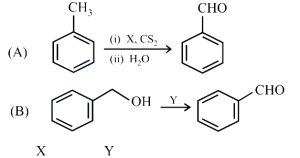
A
$CrO_3$ $\quad$ $KMnO_4$ (alkaline),$\Delta$
B
$CrO_2Cl_2$ $\quad$ $Cu, 573 \ K$
C
$AlCl_3$ $\quad$ $CrO_3, H_2SO_4$,reflux
D
$H_2O_2$ $\quad$ $KMnO_4$ (acidic),$\Delta$
Solution
(B) In reaction $(A)$,toluene is converted to benzaldehyde using $CrO_2Cl_2$ in $CS_2$ followed by hydrolysis. This is the Etard reaction,so $X = CrO_2Cl_2$.
In reaction $(B)$,benzyl alcohol is converted to benzaldehyde using $Cu$ at $573 \ K$. This is a catalytic dehydrogenation reaction,so $Y = Cu, 573 \ K$.
Therefore,the correct option is $B$.
In reaction $(B)$,benzyl alcohol is converted to benzaldehyde using $Cu$ at $573 \ K$. This is a catalytic dehydrogenation reaction,so $Y = Cu, 573 \ K$.
Therefore,the correct option is $B$.
0 likesView Solution
74
ChemistryDifficultMCQTS EAMCET · 2022
Which of the following reactions will give benzophenone as the major product?
$(A)$ Benzoyl chloride $+$ Benzene $+ AlCl_3$ (anhydrous)
$(B)$ Benzoyl chloride $+$ Phenylmagnesium bromide (excess)
$(C)$ Benzoyl chloride $+$ Diphenyl cadmium
$(A)$ Benzoyl chloride $+$ Benzene $+ AlCl_3$ (anhydrous)
$(B)$ Benzoyl chloride $+$ Phenylmagnesium bromide (excess)
$(C)$ Benzoyl chloride $+$ Diphenyl cadmium
A
$A$ and $C$ only
B
$B$ and $C$ only
C
$A$ and $B$ only
D
$A, B$ and $C$
Solution
(A) Reaction $(A)$ is a Friedel-Crafts acylation reaction where benzene reacts with benzoyl chloride in the presence of anhydrous $AlCl_3$ to form benzophenone $(C_6H_5COC_6H_5)$.
Reaction $(B)$ involves the reaction of benzoyl chloride with excess phenylmagnesium bromide followed by hydrolysis,which yields triphenylmethanol $( (C_6H_5)_3COH )$.
Reaction $(C)$ involves the reaction of benzoyl chloride with diphenyl cadmium $( (C_6H_5)_2Cd )$,which is a standard method to prepare ketones from acid chlorides,yielding benzophenone.
Therefore,reactions $(A)$ and $(C)$ produce benzophenone as the major product.
Reaction $(B)$ involves the reaction of benzoyl chloride with excess phenylmagnesium bromide followed by hydrolysis,which yields triphenylmethanol $( (C_6H_5)_3COH )$.
Reaction $(C)$ involves the reaction of benzoyl chloride with diphenyl cadmium $( (C_6H_5)_2Cd )$,which is a standard method to prepare ketones from acid chlorides,yielding benzophenone.
Therefore,reactions $(A)$ and $(C)$ produce benzophenone as the major product.
0 likesView Solution
75
ChemistryDifficultMCQTS EAMCET · 2022
Propyne was subjected to a reaction with $HgSO_4/dil. H_2SO_4$,which resulted in a product $P$. The product $P$ was heated with $Ba(OH)_2$ to give the product $Q$. The molecular formula of the product $Q$ is
A
$C_3H_6O$
B
$C_3H_8O$
C
$C_6H_{12}O_2$
D
$C_6H_{10}O$
Solution
(D) When propyne is treated with $dil. H_2SO_4$ in the presence of $HgSO_4$,the major product $P$ is acetone $(CH_3COCH_3)$.
This reaction involves the addition of water to the triple bond to form an enol,which then tautomerizes to the keto form:
$CH_3C \equiv CH$ $\xrightarrow{HgSO_4, H_2SO_4} CH_3C(OH)=CH_2$ $\rightarrow CH_3COCH_3$ $(P)$
Acetone undergoes an aldol condensation reaction in the presence of $Ba(OH)_2$ to form diacetone alcohol:
$2CH_3COCH_3 \xrightarrow{Ba(OH)_2} (CH_3)_2C(OH)CH_2COCH_3$
Upon heating,diacetone alcohol undergoes dehydration to form mesityl oxide $(Q)$:
$(CH_3)_2C(OH)CH_2COCH_3 \xrightarrow{\Delta} (CH_3)_2C=CHCOCH_3$ $(Q)$
The molecular formula of mesityl oxide $(Q)$ is $C_6H_{10}O$.
This reaction involves the addition of water to the triple bond to form an enol,which then tautomerizes to the keto form:
$CH_3C \equiv CH$ $\xrightarrow{HgSO_4, H_2SO_4} CH_3C(OH)=CH_2$ $\rightarrow CH_3COCH_3$ $(P)$
Acetone undergoes an aldol condensation reaction in the presence of $Ba(OH)_2$ to form diacetone alcohol:
$2CH_3COCH_3 \xrightarrow{Ba(OH)_2} (CH_3)_2C(OH)CH_2COCH_3$
Upon heating,diacetone alcohol undergoes dehydration to form mesityl oxide $(Q)$:
$(CH_3)_2C(OH)CH_2COCH_3 \xrightarrow{\Delta} (CH_3)_2C=CHCOCH_3$ $(Q)$
The molecular formula of mesityl oxide $(Q)$ is $C_6H_{10}O$.
0 likesView Solution
76
ChemistryMediumMCQTS EAMCET · 2022
Assertion $(A)$: Ammonia and its derivatives of the form $H_2N-Z$ undergo condensation reaction with carbonyl compounds (aldehydes and ketones).
Reason $(R)$: This reaction is an example of an irreversible reaction.
The correct option among the following is:
Reason $(R)$: This reaction is an example of an irreversible reaction.
The correct option among the following is:
A
$A$ is true,$(R)$ is true and $(R)$ is the correct explanation for $(A)$
B
$A$ is true,$(R)$ is true but $(R)$ is not the correct explanation for $(A)$
C
$A$ is true but $(R)$ is false
D
$A$ is false but $(R)$ is true
Solution
(C) The reaction of ammonia derivatives $(H_2N-Z)$ with carbonyl compounds is a nucleophilic addition followed by the elimination of a water molecule to form an imine derivative $(>C=N-Z)$.
This reaction is reversible and is acid-catalyzed.
Therefore,the Assertion $(A)$ is true,but the Reason $(R)$ is false because the reaction is reversible,not irreversible.
This reaction is reversible and is acid-catalyzed.
Therefore,the Assertion $(A)$ is true,but the Reason $(R)$ is false because the reaction is reversible,not irreversible.
0 likesView Solution
77
ChemistryDifficultMCQTS EAMCET · 2022
The major products $Y$ and $Z$ in the following reactions are
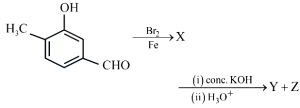
A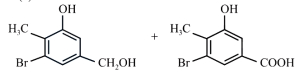
B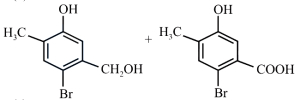
C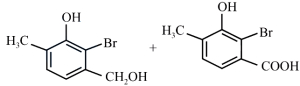
D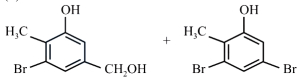
Solution
(B) Step $1$: Electrophilic aromatic substitution of $3$-methyl-$4$-hydroxybenzaldehyde with $Br_2/Fe$ occurs at the position ortho to the $-OH$ group. The $-OH$ group is a strong activating group,directing the incoming electrophile $Br^+$ to the ortho position. This yields $X$ ($3$-bromo-$4$-methyl-$5$-hydroxybenzaldehyde).
Step $2$: The compound $X$ undergoes the Cannizzaro reaction with concentrated $KOH$ followed by acid workup $(H_3O^+)$. The aldehyde group $(-CHO)$ is converted into a mixture of alcohol $(-CH_2OH)$ and carboxylic acid $(-COOH)$ groups. The resulting products $Y$ and $Z$ are $3$-bromo-$4$-methyl-$5$-hydroxybenzyl alcohol and $3$-bromo-$4$-methyl-$5$-hydroxybenzoic acid,respectively.
Step $2$: The compound $X$ undergoes the Cannizzaro reaction with concentrated $KOH$ followed by acid workup $(H_3O^+)$. The aldehyde group $(-CHO)$ is converted into a mixture of alcohol $(-CH_2OH)$ and carboxylic acid $(-COOH)$ groups. The resulting products $Y$ and $Z$ are $3$-bromo-$4$-methyl-$5$-hydroxybenzyl alcohol and $3$-bromo-$4$-methyl-$5$-hydroxybenzoic acid,respectively.
0 likesView Solution
78
ChemistryDifficultMCQTS EAMCET · 2022
The major product in the following reaction sequence is
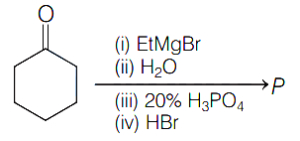
A
$1-$bromo$-1-$ethylcyclohexane
B
$1-$bromo$-2-$ethylcyclohexane
C
$1-$bromo$-1-$ethylcyclohexane (isomer)
D
$3-$bromo$-1-$ethylcyclohexane
Solution
(A) $Step \ 1$: Cyclohexanone reacts with $EtMgBr$ (Grignard reagent) followed by hydrolysis $(H_2O)$ to form $1$-ethylcyclohexanol.
$Step \ 2$: Dehydration of $1$-ethylcyclohexanol in the presence of $20\% \ H_3PO_4$ yields ethylidenecyclohexane as the major alkene product.
$Step \ 3$: Addition of $HBr$ to ethylidenecyclohexane follows Markovnikov's rule,where the proton adds to the terminal carbon of the double bond and the bromide ion adds to the more substituted carbon,resulting in $1$-bromo-$1$-ethylcyclohexane as the final product $(P)$.
$Step \ 2$: Dehydration of $1$-ethylcyclohexanol in the presence of $20\% \ H_3PO_4$ yields ethylidenecyclohexane as the major alkene product.
$Step \ 3$: Addition of $HBr$ to ethylidenecyclohexane follows Markovnikov's rule,where the proton adds to the terminal carbon of the double bond and the bromide ion adds to the more substituted carbon,resulting in $1$-bromo-$1$-ethylcyclohexane as the final product $(P)$.
0 likesView Solution
79
ChemistryDifficultMCQTS EAMCET · 2022
The major product of the following reaction sequence is:
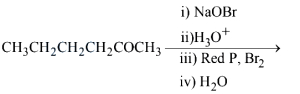
A
$CH_3-CH_2-CH(Br)-COOH$
B
$CH_3-CH_2-CH_2-CH_2-CH(Br)-COOH$
C
$CH_3-CH_2-CH_2-CH(Br)-COOH$
D
$CH_3-CH_2-CH_2-CH(Br)-COBr$
Solution
(C) Step $1$: The reaction of $CH_3CH_2CH_2CH_2COCH_3$ with $NaOBr$ followed by $H_3O^+$ is a haloform reaction. It converts the methyl ketone into a carboxylic acid with one less carbon atom.
$CH_3CH_2CH_2CH_2COCH_3 \xrightarrow{NaOBr, H_3O^+} CH_3CH_2CH_2CH_2COOH + CHBr_3$.
Step $2$: The product $CH_3CH_2CH_2CH_2COOH$ (pentanoic acid) is then treated with $Red \ P$ and $Br_2$,followed by $H_2O$. This is the Hell-Volhard-Zelinsky $(HVZ)$ reaction,which alpha-halogenates the carboxylic acid.
$CH_3CH_2CH_2CH_2COOH \xrightarrow{Red \ P, Br_2} CH_3CH_2CH_2CH(Br)COOH$.
The final product is $2$-bromopentanoic acid,which corresponds to option $C$.
$CH_3CH_2CH_2CH_2COCH_3 \xrightarrow{NaOBr, H_3O^+} CH_3CH_2CH_2CH_2COOH + CHBr_3$.
Step $2$: The product $CH_3CH_2CH_2CH_2COOH$ (pentanoic acid) is then treated with $Red \ P$ and $Br_2$,followed by $H_2O$. This is the Hell-Volhard-Zelinsky $(HVZ)$ reaction,which alpha-halogenates the carboxylic acid.
$CH_3CH_2CH_2CH_2COOH \xrightarrow{Red \ P, Br_2} CH_3CH_2CH_2CH(Br)COOH$.
The final product is $2$-bromopentanoic acid,which corresponds to option $C$.
0 likesView Solution
80
ChemistryDifficultMCQTS EAMCET · 2022
The suitable reagents $X$ and $Y$,respectively,in the following reactions are:
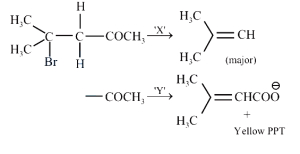
A
aq. $KOH, CrO_3$
B
alc. $KOH, Cu / \Delta$
C
aq. $NaHCO_3, KMnO_4$
D
alc. $KOH, NaOI$
Solution
(D) For reagent $X$: The starting material is a $\beta$-bromo ketone. Treatment with alcoholic $KOH$ (alc. $KOH$) leads to dehydrohalogenation via an $E2$ mechanism,resulting in the formation of an $\alpha,\beta$-unsaturated ketone.
For reagent $Y$: The product contains a carboxylate ion and a yellow precipitate $(CHI_3)$,which is characteristic of the iodoform reaction. This reaction is specific to methyl ketones (or alcohols that can be oxidized to methyl ketones) and is performed using $NaOI$ (sodium hypoiodite).
For reagent $Y$: The product contains a carboxylate ion and a yellow precipitate $(CHI_3)$,which is characteristic of the iodoform reaction. This reaction is specific to methyl ketones (or alcohols that can be oxidized to methyl ketones) and is performed using $NaOI$ (sodium hypoiodite).
0 likesView Solution
81
ChemistryDifficultMCQTS EAMCET · 2022
The major product of the following synthetic sequence is
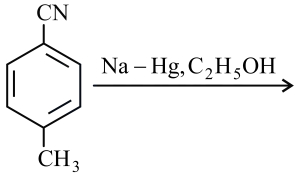
A
$p$-Methylbenzyl alcohol
B
$p$-Xylene
C
$p$-Methylbenzamide
D
$p$-Methylbenzylamine
Solution
(D) The reaction of a nitrile with $Na-Hg$ in the presence of $C_2H_5OH$ is a classic reduction method known as the $Mendius$ reduction.
In this reaction,the nitrile group $(-CN)$ is reduced to a primary amine group $(-CH_2NH_2)$.
Here,$p$-tolunitrile ($4$-methylbenzonitrile) reacts with $Na-Hg$ and $C_2H_5OH$ to produce $p$-methylbenzylamine as the major product.
In this reaction,the nitrile group $(-CN)$ is reduced to a primary amine group $(-CH_2NH_2)$.
Here,$p$-tolunitrile ($4$-methylbenzonitrile) reacts with $Na-Hg$ and $C_2H_5OH$ to produce $p$-methylbenzylamine as the major product.
0 likesView Solution
82
ChemistryDifficultMCQTS EAMCET · 2022
Among the following set of reactions,the most suitable method for preparing a secondary amine is:
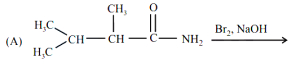
A
Hoffmann bromamide degradation of an amide.
B
Reduction of a nitrile.
C
Reaction of an alkyl halide with an excess of ammonia.
D
Reaction of a primary amine with an alkyl halide.
Solution
(D) The preparation of a secondary amine is best achieved by the reaction of a primary amine with an alkyl halide.
This is a nucleophilic substitution reaction where the primary amine acts as a nucleophile and attacks the alkyl halide to form a secondary amine.
$R-NH_2 + R'-X \rightarrow R-NH-R' + HX$.
Option $A$ (Hoffmann bromamide degradation) produces a primary amine.
Option $B$ (Reduction of a nitrile) produces a primary amine.
Option $C$ (Reaction of an alkyl halide with excess ammonia) primarily produces a primary amine.
This is a nucleophilic substitution reaction where the primary amine acts as a nucleophile and attacks the alkyl halide to form a secondary amine.
$R-NH_2 + R'-X \rightarrow R-NH-R' + HX$.
Option $A$ (Hoffmann bromamide degradation) produces a primary amine.
Option $B$ (Reduction of a nitrile) produces a primary amine.
Option $C$ (Reaction of an alkyl halide with excess ammonia) primarily produces a primary amine.
0 likesView Solution
83
ChemistryDifficultMCQTS EAMCET · 2022
Match the following:
| List-$I$ | List-$II$ |
|---|---|
| $A$. Amide | $I$. Carbylamine reaction |
| $B$. Nitrile | $II$. Hinsberg's reagent |
| $C$. $C_6H_5SO_2Cl$ | $III$. Hofmann's bromamide reaction |
| $D$. $1^{\circ}$-Amine | $IV$. $LiAlH_4$ |
A
$A-III, B-IV, C-II, D-I$
B
$A-I, B-II, C-III, D-IV$
C
$A-III, B-II, C-IV, D-I$
D
$A-IV, B-III, C-II, D-I$
Solution
(A) . Amide reacts via Hofmann's bromamide reaction $(III)$.
$B$. Nitrile is reduced using $LiAlH_4$ $(IV)$.
$C$. $C_6H_5SO_2Cl$ is known as Hinsberg's reagent $(II)$.
$D$. $1^{\circ}$-Amine undergoes the carbylamine reaction $(I)$.
Therefore,the correct matching is $A-III, B-IV, C-II, D-I$.
$B$. Nitrile is reduced using $LiAlH_4$ $(IV)$.
$C$. $C_6H_5SO_2Cl$ is known as Hinsberg's reagent $(II)$.
$D$. $1^{\circ}$-Amine undergoes the carbylamine reaction $(I)$.
Therefore,the correct matching is $A-III, B-IV, C-II, D-I$.
0 likesView Solution
84
ChemistryDifficultMCQTS EAMCET · 2022
The major product of the following reaction sequence is:
Aniline $\xrightarrow[(i) NaNO_2, HCl, 273-278K]{(ii) H_2O, warm} \text{Product}$ $\xrightarrow[(iv) NaOH]{(iii) Br_2, (excess)} \text{Product}$ $\xrightarrow{(v) CH_3I} \text{Final Product}$
Aniline $\xrightarrow[(i) NaNO_2, HCl, 273-278K]{(ii) H_2O, warm} \text{Product}$ $\xrightarrow[(iv) NaOH]{(iii) Br_2, (excess)} \text{Product}$ $\xrightarrow{(v) CH_3I} \text{Final Product}$
A
$2,4-$Dibromoanisole
B
$3,5-$Dibromoanisole
C
$2,4,6-$Tribromoanisole
D
$2,3,4-$Tribromoanisole
Solution
(C) The reaction sequence proceeds as follows:
$1$. Aniline reacts with $NaNO_2/HCl$ at $273-278 \ K$ to form benzene diazonium chloride.
$2$. Hydrolysis with warm $H_2O$ converts the diazonium salt into phenol.
$3$. Phenol reacts with excess $Br_2$ (bromine water) to undergo electrophilic aromatic substitution,yielding $2,4,6$-tribromophenol.
$4$. Treatment with $NaOH$ converts the phenol into sodium phenoxide ($2,4,6$-tribromophenoxide).
$5$. Finally,reaction with $CH_3I$ (Williamson ether synthesis) yields $2,4,6$-tribromoanisole as the final product.
$1$. Aniline reacts with $NaNO_2/HCl$ at $273-278 \ K$ to form benzene diazonium chloride.
$2$. Hydrolysis with warm $H_2O$ converts the diazonium salt into phenol.
$3$. Phenol reacts with excess $Br_2$ (bromine water) to undergo electrophilic aromatic substitution,yielding $2,4,6$-tribromophenol.
$4$. Treatment with $NaOH$ converts the phenol into sodium phenoxide ($2,4,6$-tribromophenoxide).
$5$. Finally,reaction with $CH_3I$ (Williamson ether synthesis) yields $2,4,6$-tribromoanisole as the final product.
0 likesView Solution
85
ChemistryDifficultMCQTS EAMCET · 2022
The major product in the following reaction is:
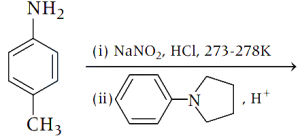
A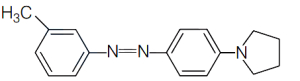
B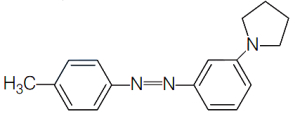
C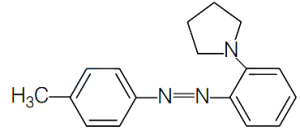
D
Solution
(D) In the given reaction,$p$-toluidine reacts with $NaNO_2$ and $HCl$ at $273-278 \ K$ to form a diazonium salt,which is $p$-methylbenzenediazonium chloride.
This diazonium salt then undergoes an electrophilic aromatic substitution (coupling reaction) with $N$-phenylpyrrolidine in the presence of $H^+$.
The coupling reaction occurs at the para-position of the $N$-phenylpyrrolidine ring because the pyrrolidinyl group is a strong ortho/para-directing group and the para-position is sterically less hindered.
Thus,the major product is the para-coupled azo dye as shown in option $D$.
This diazonium salt then undergoes an electrophilic aromatic substitution (coupling reaction) with $N$-phenylpyrrolidine in the presence of $H^+$.
The coupling reaction occurs at the para-position of the $N$-phenylpyrrolidine ring because the pyrrolidinyl group is a strong ortho/para-directing group and the para-position is sterically less hindered.
Thus,the major product is the para-coupled azo dye as shown in option $D$.
0 likesView Solution
86
ChemistryDifficultMCQTS EAMCET · 2022
The major product in the following reaction sequence is:
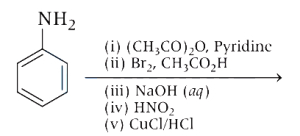
A
$4-$bromo$-2-$chloroaniline
B
$1-$bromo$-4-$chlorobenzene
C
$3-$bromo-chlorobenzene
D
$1-$bromo$-2-$chlorobenzene
Solution
(B) The reaction sequence is as follows:
$1$. Acetylation of aniline with $(CH_3CO)_2O$ and pyridine protects the $-NH_2$ group,forming acetanilide.
$2$. Electrophilic aromatic substitution with $Br_2$ in $CH_3CO_2H$ occurs at the para-position due to the steric hindrance of the $-NHCOCH_3$ group,yielding $p$-bromoacetanilide.
$3$. Hydrolysis with $NaOH(aq)$ removes the acetyl group to regenerate $p$-bromoaniline.
$4$. Diazotization with $HNO_2$ at $0-5 \ ^\circ C$ converts the $-NH_2$ group into a diazonium salt,$-N_2^+Cl^-$.
$5$. The Sandmeyer reaction with $CuCl/HCl$ replaces the diazonium group with a chlorine atom,resulting in $1$-bromo-$4$-chlorobenzene.
$1$. Acetylation of aniline with $(CH_3CO)_2O$ and pyridine protects the $-NH_2$ group,forming acetanilide.
$2$. Electrophilic aromatic substitution with $Br_2$ in $CH_3CO_2H$ occurs at the para-position due to the steric hindrance of the $-NHCOCH_3$ group,yielding $p$-bromoacetanilide.
$3$. Hydrolysis with $NaOH(aq)$ removes the acetyl group to regenerate $p$-bromoaniline.
$4$. Diazotization with $HNO_2$ at $0-5 \ ^\circ C$ converts the $-NH_2$ group into a diazonium salt,$-N_2^+Cl^-$.
$5$. The Sandmeyer reaction with $CuCl/HCl$ replaces the diazonium group with a chlorine atom,resulting in $1$-bromo-$4$-chlorobenzene.
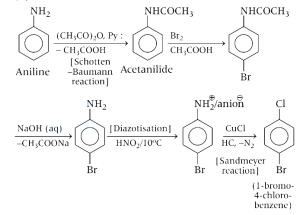
0 likesView Solution
87
ChemistryMediumMCQTS EAMCET · 2022
The major product of the following reaction is:
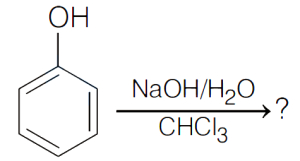
A
Sodium $2-$chlorophenolate
B
Sodium $2-$carboxyphenolate
C
Sodium $2-$formylphenolate
D
Sodium $2-$hydroxyphenolate
Solution
(C) The reaction of phenol with $CHCl_3$ in the presence of aqueous $NaOH$ is known as the $Reimer-Tiemann$ reaction.
In this reaction,$CHCl_3$ reacts with $NaOH$ to generate a dichlorocarbene intermediate $(:CCl_2)$.
This electrophilic carbene attacks the phenoxide ion at the ortho position.
The intermediate formed undergoes hydrolysis to yield salicylaldehyde ($2$-hydroxybenzaldehyde) in its salt form,which is sodium $2-$formylphenolate.
In this reaction,$CHCl_3$ reacts with $NaOH$ to generate a dichlorocarbene intermediate $(:CCl_2)$.
This electrophilic carbene attacks the phenoxide ion at the ortho position.
The intermediate formed undergoes hydrolysis to yield salicylaldehyde ($2$-hydroxybenzaldehyde) in its salt form,which is sodium $2-$formylphenolate.
0 likesView Solution
88
ChemistryEasyMCQTS EAMCET · 2022
In the following reaction,the suitable starting reagent $P$ is
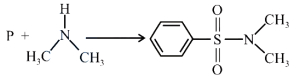
A
Benzenesulfonic acid
B
Benzenesulfonyl chloride
C
Methyl benzenesulfonate
D
Benzenesulfonamide
Solution
(B) The reaction involves the nucleophilic substitution of a sulfonyl chloride with a secondary amine. The nitrogen atom of dimethylamine acts as a nucleophile and attacks the sulfur atom of benzenesulfonyl chloride,leading to the displacement of the chloride ion. This reaction produces $N,N$-dimethylbenzenesulfonamide. Therefore,the reagent $P$ is benzenesulfonyl chloride $(C_6H_5SO_2Cl)$.
0 likesView Solution
89
ChemistryMediumMCQTS EAMCET · 2022
The starting material that produces pentanamine by the Hoffmann bromamide reaction is
A
$CH_3CH_2CH_2CH_2CN$
B
$CH_3CH_2CH_2CH_2CONH_2$
C
$CH_3CH_2CH_2CH_2NCO$
D
$CH_3CH_2CH_2CH_2CH_2CONH_2$
Solution
(D) The Hoffmann bromamide degradation reaction is used to prepare primary amines by treating an amide with bromine in an aqueous or ethanolic solution of sodium hydroxide.
In this reaction,the carbonyl carbon of the amide is removed as a carbonate,and the alkyl or aryl group migrates to the nitrogen atom.
As a result,the amine formed contains one carbon atom less than the starting amide.
To obtain pentanamine $(C_5H_{11}NH_2)$,which has $5$ carbon atoms,the starting amide must have $6$ carbon atoms,which is hexanamide $(CH_3CH_2CH_2CH_2CH_2CONH_2)$.
The reaction is:
$CH_3CH_2CH_2CH_2CH_2CONH_2 + Br_2 + 4NaOH \rightarrow CH_3CH_2CH_2CH_2CH_2NH_2 + 2NaBr + Na_2CO_3 + 2H_2O$
In this reaction,the carbonyl carbon of the amide is removed as a carbonate,and the alkyl or aryl group migrates to the nitrogen atom.
As a result,the amine formed contains one carbon atom less than the starting amide.
To obtain pentanamine $(C_5H_{11}NH_2)$,which has $5$ carbon atoms,the starting amide must have $6$ carbon atoms,which is hexanamide $(CH_3CH_2CH_2CH_2CH_2CONH_2)$.
The reaction is:
$CH_3CH_2CH_2CH_2CH_2CONH_2 + Br_2 + 4NaOH \rightarrow CH_3CH_2CH_2CH_2CH_2NH_2 + 2NaBr + Na_2CO_3 + 2H_2O$
0 likesView Solution
90
ChemistryEasyMCQTS EAMCET · 2022
Assertion $(A)$: Both Glucose and Fructose have the same $D$-configuration.
Reason $(R)$: Both Glucose and Fructose are dextrorotatory.
The correct option among the following is:
Reason $(R)$: Both Glucose and Fructose are dextrorotatory.
The correct option among the following is:
A
$(A)$ is true,$(R)$ is true and $(R)$ is the correct explanation for $(A)$
B
$(A)$ is true,$(R)$ is true but $(R)$ is not the correct explanation for $(A)$
C
$(A)$ is true but $(R)$ is false
D
$(A)$ is false but $(R)$ is true
Solution
(C) - and $L$- configurations are relative configurations assigned with respect to $D(+)$-glyceraldehyde.
Both $D(+)$-glucose and $D(-)$-fructose have the same $D$-configuration because the hydroxyl group at the chiral carbon farthest from the carbonyl group is on the right side in their Fischer projection.
However,$D(+)$-glucose is dextrorotatory $(+)$,whereas $D(-)$-fructose is levorotatory $(-)$.
Therefore,Assertion $(A)$ is true,but Reason $(R)$ is false.
Both $D(+)$-glucose and $D(-)$-fructose have the same $D$-configuration because the hydroxyl group at the chiral carbon farthest from the carbonyl group is on the right side in their Fischer projection.
However,$D(+)$-glucose is dextrorotatory $(+)$,whereas $D(-)$-fructose is levorotatory $(-)$.
Therefore,Assertion $(A)$ is true,but Reason $(R)$ is false.
0 likesView Solution
91
ChemistryMediumMCQTS EAMCET · 2022
Consider the following structures. Which of the pairs represent $D$-fructose and $L$-fructose,respectively?
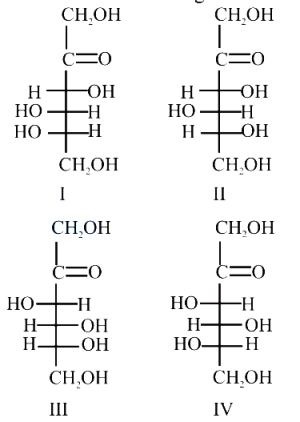
A
$II$ and $I$
B
$I$ and $III$
C
$III$ and $IV$
D
$II$ and $IV$
Solution
(D) The $D$ or $L$ configuration of a monosaccharide is determined by the position of the $-OH$ group on the chiral carbon furthest from the carbonyl group (the $C_5$ carbon in fructose).
If the $-OH$ group is on the right side,it is the $D$-isomer.
If the $-OH$ group is on the left side,it is the $L$-isomer.
Structure $II$ represents $D$-fructose because the $-OH$ group at $C_5$ is on the right.
Structure $IV$ represents $L$-fructose because the $-OH$ group at $C_5$ is on the left.
Therefore,the pair representing $D$-fructose and $L$-fructose is $II$ and $IV$.
If the $-OH$ group is on the right side,it is the $D$-isomer.
If the $-OH$ group is on the left side,it is the $L$-isomer.
Structure $II$ represents $D$-fructose because the $-OH$ group at $C_5$ is on the right.
Structure $IV$ represents $L$-fructose because the $-OH$ group at $C_5$ is on the left.
Therefore,the pair representing $D$-fructose and $L$-fructose is $II$ and $IV$.
0 likesView Solution
92
ChemistryMediumMCQTS EAMCET · 2022
The amount of sucrose needed to produce $1 \ mole$ of glucose using acid hydrolysis is (in $g$)
A
$360$
B
$180$
C
$342$
D
$171$
Solution
(C) The acid hydrolysis of sucrose is represented by the following chemical equation:
$C_{12}H_{22}O_{11} + H_2O \rightarrow C_6H_{12}O_6 \text{ (Glucose)} + C_6H_{12}O_6 \text{ (Fructose)}$
From the stoichiometry of the reaction,$1 \ mole$ of sucrose produces $1 \ mole$ of glucose and $1 \ mole$ of fructose.
The molar mass of sucrose $(C_{12}H_{22}O_{11})$ is calculated as: $(12 \times 12) + (22 \times 1) + (11 \times 16) = 144 + 22 + 176 = 342 \ g/mol$.
Therefore,to produce $1 \ mole$ of glucose,$1 \ mole$ of sucrose is required,which corresponds to $342 \ g$.
$C_{12}H_{22}O_{11} + H_2O \rightarrow C_6H_{12}O_6 \text{ (Glucose)} + C_6H_{12}O_6 \text{ (Fructose)}$
From the stoichiometry of the reaction,$1 \ mole$ of sucrose produces $1 \ mole$ of glucose and $1 \ mole$ of fructose.
The molar mass of sucrose $(C_{12}H_{22}O_{11})$ is calculated as: $(12 \times 12) + (22 \times 1) + (11 \times 16) = 144 + 22 + 176 = 342 \ g/mol$.
Therefore,to produce $1 \ mole$ of glucose,$1 \ mole$ of sucrose is required,which corresponds to $342 \ g$.
0 likesView Solution
93
ChemistryEasyMCQTS EAMCET · 2022
Assertion $(A)$: In aqueous solution,amino acids exist in dipolar ion form.
Reason $(R)$: Most of the naturally occurring amino acids have $L$-configuration.
The correct option among the following is:
Reason $(R)$: Most of the naturally occurring amino acids have $L$-configuration.
The correct option among the following is:
A
$(A)$ is true,$(R)$ is true and $(R)$ is the correct explanation for $(A)$
B
$(A)$ is true,$(R)$ is true but $(R)$ is not the correct explanation for $(A)$
C
$(A)$ is true but $(R)$ is false
D
$(A)$ is false but $(R)$ is true
Solution
(B) In aqueous solution,the carboxyl group of an amino acid can lose a proton and the amino group can accept a proton,giving rise to a dipolar ion known as a zwitterion. Thus,Assertion $(A)$ is true.
Most naturally occurring amino acids have the $L$-configuration,where the $-NH_2$ group is on the left side in the Fischer projection. Thus,Reason $(R)$ is true.
However,the $L$-configuration of amino acids is not the reason why they exist as dipolar ions in aqueous solution. The dipolar nature is due to the acid-base properties of the functional groups present. Therefore,$(R)$ is not the correct explanation for $(A)$.
Most naturally occurring amino acids have the $L$-configuration,where the $-NH_2$ group is on the left side in the Fischer projection. Thus,Reason $(R)$ is true.
However,the $L$-configuration of amino acids is not the reason why they exist as dipolar ions in aqueous solution. The dipolar nature is due to the acid-base properties of the functional groups present. Therefore,$(R)$ is not the correct explanation for $(A)$.
0 likesView Solution
94
ChemistryMediumMCQTS EAMCET · 2022
Assertion $(A)$: The denaturation of proteins can destroy all $1^{\circ}, 2^{\circ}$ and $3^{\circ}$ protein structures.
Reason $(R)$: Curdling of milk is due to denaturation of proteins.
The correct option among the following is
Reason $(R)$: Curdling of milk is due to denaturation of proteins.
The correct option among the following is
A
$(A)$ is true,$(R)$ is true and $(R)$ is the correct explanation for $(A)$
B
$(A)$ is true,$(R)$ is true but $(R)$ is not the correct explanation for $(A)$
C
$(A)$ is true but $(R)$ is false
D
$(A)$ is false but $(R)$ is true
Solution
(D) protein in its native state possesses a unique three-dimensional structure and biological activity. When subjected to physical changes (e.g.,temperature) or chemical changes (e.g.,$pH$),the hydrogen bonds are disrupted,causing the protein to lose its biological activity; this process is known as denaturation.
During denaturation,the secondary and tertiary structures of the protein are destroyed,but the primary structure (the sequence of amino acids) remains intact.
Therefore,the statement that denaturation destroys all $1^{\circ}, 2^{\circ}$ and $3^{\circ}$ structures is false.
Curdling of milk is a classic example of protein denaturation caused by the formation of lactic acid by bacteria.
Thus,$(A)$ is false but $(R)$ is true.
During denaturation,the secondary and tertiary structures of the protein are destroyed,but the primary structure (the sequence of amino acids) remains intact.
Therefore,the statement that denaturation destroys all $1^{\circ}, 2^{\circ}$ and $3^{\circ}$ structures is false.
Curdling of milk is a classic example of protein denaturation caused by the formation of lactic acid by bacteria.
Thus,$(A)$ is false but $(R)$ is true.
0 likesView Solution
95
ChemistryMediumMCQTS EAMCET · 2022
The major product formed in the following reaction is
$C_6H_5CH=CH_2$ $\xrightarrow[(ii) H_3O^+]{(i) KMnO_4, KOH, \Delta}$ $\xrightarrow{(iii) Br_2/FeBr_3} \text{Product}$
$C_6H_5CH=CH_2$ $\xrightarrow[(ii) H_3O^+]{(i) KMnO_4, KOH, \Delta}$ $\xrightarrow{(iii) Br_2/FeBr_3} \text{Product}$
A
$p$-bromophenylacetic acid
B
$o$-bromobenzoic acid
C
$m$-bromoacetophenone
D
$m$-bromobenzoic acid
Solution
(D) Step $(i)$ and $(ii)$: The oxidation of styrene $(C_6H_5CH=CH_2)$ with alkaline $KMnO_4$ followed by acidic workup $(H_3O^+)$ results in the formation of benzoic acid $(C_6H_5COOH)$.
Step $(iii)$: Benzoic acid contains a $-COOH$ group,which is a deactivating and meta-directing group. Therefore,electrophilic aromatic substitution with $Br_2/FeBr_3$ will direct the bromine atom to the meta position.
The final product is $m$-bromobenzoic acid.
Step $(iii)$: Benzoic acid contains a $-COOH$ group,which is a deactivating and meta-directing group. Therefore,electrophilic aromatic substitution with $Br_2/FeBr_3$ will direct the bromine atom to the meta position.
The final product is $m$-bromobenzoic acid.
0 likesView Solution
96
ChemistryDifficultMCQTS EAMCET · 2022
$A, B, C, D$ in the following reactions are
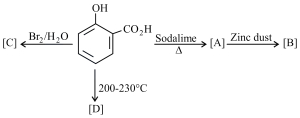
A
$[A] = \text{phenol}, [B] = \text{benzene}, [C] = 2,4,6-\text{tribromophenol}, [D] = \text{phenol}$
B
$[A] = \text{phenol}, [B] = \text{benzene}, [C] = 2,3,4,5-\text{tetrabromophenol}, [D] = \text{phenol}$
C
$[A] = \text{phenol}, [B] = \text{benzene}, [C] = 2,4,6-\text{tribromophenol}, [D] = \text{phenol}$
D
$[A] = \text{phenol}, [B] = \text{benzene}, [C] = 3,5-\text{dibromo-2-hydroxybenzoic acid}, [D] = \text{phenol}$
Solution
(A) $1$. When salicylic acid is heated with sodalime $(NaOH + CaO)$,it undergoes decarboxylation to form phenol $([A])$.
$2$. When phenol $([A])$ is distilled with zinc dust,it undergoes reduction to form benzene $([B])$.
$3$. When salicylic acid reacts with bromine water $(Br_2/H_2O)$,it undergoes electrophilic substitution and decarboxylation to form $2,4,6-\text{tribromophenol}$ $([C])$.
$4$. When salicylic acid is heated at $200-230^{\circ}C$,it undergoes decarboxylation to form phenol $([D])$.
$2$. When phenol $([A])$ is distilled with zinc dust,it undergoes reduction to form benzene $([B])$.
$3$. When salicylic acid reacts with bromine water $(Br_2/H_2O)$,it undergoes electrophilic substitution and decarboxylation to form $2,4,6-\text{tribromophenol}$ $([C])$.
$4$. When salicylic acid is heated at $200-230^{\circ}C$,it undergoes decarboxylation to form phenol $([D])$.
0 likesView Solution
97
ChemistryMediumMCQTS EAMCET · 2022
$n$-Propanol on treatment with concentrated $HBr$ gives $P$. The product $P$ on reaction with $KCN$ gave the product $Q$. The product $Q$ on heating with aqueous acidic solution,furnished the product $R$. The product $R$ is
A
Propanoic acid
B
Propanamide
C
Butanoic acid
D
Butanamide
Solution
(C) $n$-Propanol $(CH_3CH_2CH_2OH)$ reacts with concentrated $HBr$ to form $n$-propyl bromide $(CH_3CH_2CH_2Br)$ as product $P$.
$n$-Propyl bromide reacts with $KCN$ via nucleophilic substitution to form butanenitrile $(CH_3CH_2CH_2CN)$ as product $Q$.
Butanenitrile on heating with an aqueous acidic solution undergoes hydrolysis to form butanoic acid $(CH_3CH_2CH_2COOH)$ as product $R$.
$CH_3CH_2CH_2OH$ $\xrightarrow{HBr} CH_3CH_2CH_2Br$ $\xrightarrow{KCN} CH_3CH_2CH_2CN$ $\xrightarrow{H_3O^{+}} CH_3CH_2CH_2COOH$
$n$-Propyl bromide reacts with $KCN$ via nucleophilic substitution to form butanenitrile $(CH_3CH_2CH_2CN)$ as product $Q$.
Butanenitrile on heating with an aqueous acidic solution undergoes hydrolysis to form butanoic acid $(CH_3CH_2CH_2COOH)$ as product $R$.
$CH_3CH_2CH_2OH$ $\xrightarrow{HBr} CH_3CH_2CH_2Br$ $\xrightarrow{KCN} CH_3CH_2CH_2CN$ $\xrightarrow{H_3O^{+}} CH_3CH_2CH_2COOH$
0 likesView Solution
98
ChemistryMediumMCQTS EAMCET · 2022
The chemical structures of $XeO_3$ and $XeOF_4$,respectively,are
A
Planar; Trigonal bipyramidal
B
Pyramidal; Square pyramidal
C
Planar; Square pyramidal
D
Pyramidal; Square planar
Solution
(B) In $XeO_3$,the $Xe$ atom is $sp^3$ hybridized with one lone pair,resulting in a pyramidal geometry.
In $XeOF_4$,the $Xe$ atom is $sp^3d^2$ hybridized with one lone pair,resulting in a square pyramidal geometry.
In $XeOF_4$,the $Xe$ atom is $sp^3d^2$ hybridized with one lone pair,resulting in a square pyramidal geometry.
0 likesView Solution
99
ChemistryMediumMCQTS EAMCET · 2022
The rate constants for the following reactions are:
Reaction $1$: $A \xrightarrow{\text{catalyst } 1} P_1, k_1 = 1 \ s^{-1}$
Reaction $2$: $A \xrightarrow{\text{catalyst } 2} P_2, k_2 = 0.1 \ L \ mol^{-1} \ s^{-1}$
Reaction $3$: $A \xrightarrow{\text{catalyst } 3} P_3, k_3 = 0.01 \ L^2 \ mol^{-2} \ s^{-1}$
What is the correct relation between the rates of the reactions at $[A] = 1 \ M$?
Reaction $1$: $A \xrightarrow{\text{catalyst } 1} P_1, k_1 = 1 \ s^{-1}$
Reaction $2$: $A \xrightarrow{\text{catalyst } 2} P_2, k_2 = 0.1 \ L \ mol^{-1} \ s^{-1}$
Reaction $3$: $A \xrightarrow{\text{catalyst } 3} P_3, k_3 = 0.01 \ L^2 \ mol^{-2} \ s^{-1}$
What is the correct relation between the rates of the reactions at $[A] = 1 \ M$?
A
$r_1 = \frac{r_3}{100}, r_2 = \frac{r_3}{10}$
B
$r_1 = \frac{r_2}{10}, r_2 = \frac{r_3}{10}$
C
$r_1 = 100 \ r_3, r_2 = \frac{r_3}{10}$
D
$r_1 = 10 \ r_2, r_3 = \frac{r_2}{10}$
Solution
(C) The unit of the rate constant indicates the order of the reaction.
For a reaction $A \rightarrow P$,the rate $r = k[A]^n$.
Reaction $1$: $k_1 = 1 \ s^{-1}$,which corresponds to a $1^{st}$ order reaction. Thus,$r_1 = k_1[A]^1 = 1 \times 1 = 1 \ M \ s^{-1}$.
Reaction $2$: $k_2 = 0.1 \ L \ mol^{-1} \ s^{-1}$,which corresponds to a $2^{nd}$ order reaction. Thus,$r_2 = k_2[A]^2 = 0.1 \times 1^2 = 0.1 \ M \ s^{-1}$.
Reaction $3$: $k_3 = 0.01 \ L^2 \ mol^{-2} \ s^{-1}$,which corresponds to a $3^{rd}$ order reaction. Thus,$r_3 = k_3[A]^3 = 0.01 \times 1^3 = 0.01 \ M \ s^{-1}$.
Comparing the rates:
$r_1 = 1, r_2 = 0.1, r_3 = 0.01$.
$r_1 = 10 \ r_2 \implies r_2 = \frac{r_1}{10}$.
$r_1 = 100 \ r_3 \implies r_3 = \frac{r_1}{100}$.
$r_2 = 10 \ r_3 \implies r_3 = \frac{r_2}{10}$.
From the options,$r_1 = 100 \ r_3$ and $r_2 = 10 \ r_3$ (or $r_3 = r_2 / 10$) is consistent with option $C$.
For a reaction $A \rightarrow P$,the rate $r = k[A]^n$.
Reaction $1$: $k_1 = 1 \ s^{-1}$,which corresponds to a $1^{st}$ order reaction. Thus,$r_1 = k_1[A]^1 = 1 \times 1 = 1 \ M \ s^{-1}$.
Reaction $2$: $k_2 = 0.1 \ L \ mol^{-1} \ s^{-1}$,which corresponds to a $2^{nd}$ order reaction. Thus,$r_2 = k_2[A]^2 = 0.1 \times 1^2 = 0.1 \ M \ s^{-1}$.
Reaction $3$: $k_3 = 0.01 \ L^2 \ mol^{-2} \ s^{-1}$,which corresponds to a $3^{rd}$ order reaction. Thus,$r_3 = k_3[A]^3 = 0.01 \times 1^3 = 0.01 \ M \ s^{-1}$.
Comparing the rates:
$r_1 = 1, r_2 = 0.1, r_3 = 0.01$.
$r_1 = 10 \ r_2 \implies r_2 = \frac{r_1}{10}$.
$r_1 = 100 \ r_3 \implies r_3 = \frac{r_1}{100}$.
$r_2 = 10 \ r_3 \implies r_3 = \frac{r_2}{10}$.
From the options,$r_1 = 100 \ r_3$ and $r_2 = 10 \ r_3$ (or $r_3 = r_2 / 10$) is consistent with option $C$.
0 likesView Solution
100
ChemistryDifficultMCQTS EAMCET · 2022
Half-life periods for a reaction at initial concentrations of $0.1 \ M$ and $0.01 \ M$ are $5$ and $50$ minutes,respectively. The order of reaction is
A
$3$
B
$2$
C
$1$
D
$0$
Solution
(B) The half-life $(t_{1/2})$ of an $n^{th}$ order reaction is related to the initial concentration $(a)$ of the reactant as $t_{1/2} \propto a^{1-n}$.
For two different initial concentrations,we have the relation: $\frac{(t_{1/2})_1}{(t_{1/2})_2} = \left(\frac{a_2}{a_1}\right)^{n-1}$.
Given: $(t_{1/2})_1 = 5 \ \text{min}$,$a_1 = 0.1 \ M$ and $(t_{1/2})_2 = 50 \ \text{min}$,$a_2 = 0.01 \ M$.
Substituting the values: $\frac{5}{50} = \left(\frac{0.01}{0.1}\right)^{n-1}$.
$\frac{1}{10} = (0.1)^{n-1}$.
$0.1^1 = (0.1)^{n-1}$.
Comparing the exponents: $1 = n - 1$,which gives $n = 2$.
For two different initial concentrations,we have the relation: $\frac{(t_{1/2})_1}{(t_{1/2})_2} = \left(\frac{a_2}{a_1}\right)^{n-1}$.
Given: $(t_{1/2})_1 = 5 \ \text{min}$,$a_1 = 0.1 \ M$ and $(t_{1/2})_2 = 50 \ \text{min}$,$a_2 = 0.01 \ M$.
Substituting the values: $\frac{5}{50} = \left(\frac{0.01}{0.1}\right)^{n-1}$.
$\frac{1}{10} = (0.1)^{n-1}$.
$0.1^1 = (0.1)^{n-1}$.
Comparing the exponents: $1 = n - 1$,which gives $n = 2$.
0 likesView Solution
Vedclass Products
For Students
Vedclass Test Series
Mock tests in real TS EAMCET style covering Chemistry with performance analysis. 5-day free trial.
Start Free TrialFor Teachers
Exam Paper Generator
Generate Set A/B/C/D Chemistry papers from 7.5L+ questions in 2 minutes. 3 chapters free.
Try FreeFor Institutes
Online Exam Module
Run live TS EAMCET mock exams with unlimited students, 360° analytics & white-label branding.
See DemoFrequently Asked Questions
How many Chemistry questions are in TS EAMCET 2022?
There are 264 Chemistry questions from the TS EAMCET 2022 paper on Vedclass, each with a detailed step-by-step solution in English.
Are TS EAMCET 2022 Chemistry solutions available in English?
Yes. All solutions on this page are in English. You can also switch to English or Hindi using the language buttons above the questions.
Can I practice TS EAMCET 2022 Chemistry as a timed test?
Yes. Use the Vedclass Test Series to attempt a full TS EAMCET mock test covering Chemistry with time limits and instant score analysis.
Can teachers create Chemistry papers from TS EAMCET previous year questions?
Yes. The Vedclass Exam Paper Generator lets teachers mix TS EAMCET Chemistry questions and generate Set A/B/C/D papers in minutes.
For Teachers & Institutes
Build a Custom Chemistry Paper
Pick TS EAMCET 2022 Chemistry questions, set difficulty, and generate Set A/B/C/D in 2 minutes.