
PhysicsQ1–100 of 240 questions
Page 1 of 3 · English
1
PhysicsMediumMCQTS EAMCET · 2022
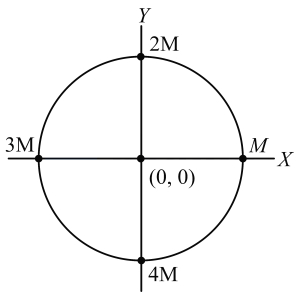
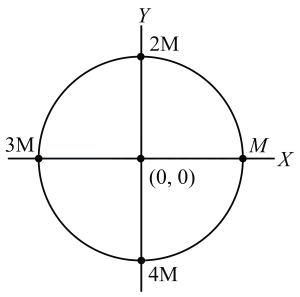
Four masses are arranged along a circle of radius $1 \ m$ as shown in the figure. The center of mass of this system of masses is at
A
$-\frac{1}{5} \hat{i} - \frac{1}{5} \hat{j}$
B
$\frac{1}{5} \hat{i} + \hat{j}$
C
$\hat{i} - \frac{1}{5} \hat{j}$
D
$\frac{1}{5} \hat{i} + \frac{1}{5} \hat{j}$
Solution
(A) The coordinates of the masses arranged on the circle of radius $R = 1 \ m$ are:
$M$ at $(1, 0)$
$2M$ at $(0, 1)$
$3M$ at $(-1, 0)$
$4M$ at $(0, -1)$
The $x$-coordinate of the center of mass $(X_{cm})$ is given by:
$X_{cm} = \frac{M(1) + 2M(0) + 3M(-1) + 4M(0)}{M + 2M + 3M + 4M} = \frac{M - 3M}{10M} = \frac{-2M}{10M} = -\frac{1}{5} \ m$
The $y$-coordinate of the center of mass $(Y_{cm})$ is given by:
$Y_{cm} = \frac{M(0) + 2M(1) + 3M(0) + 4M(-1)}{M + 2M + 3M + 4M} = \frac{2M - 4M}{10M} = \frac{-2M}{10M} = -\frac{1}{5} \ m$
Thus,the position vector of the center of mass is $-\frac{1}{5} \hat{i} - \frac{1}{5} \hat{j}$.
$M$ at $(1, 0)$
$2M$ at $(0, 1)$
$3M$ at $(-1, 0)$
$4M$ at $(0, -1)$
The $x$-coordinate of the center of mass $(X_{cm})$ is given by:
$X_{cm} = \frac{M(1) + 2M(0) + 3M(-1) + 4M(0)}{M + 2M + 3M + 4M} = \frac{M - 3M}{10M} = \frac{-2M}{10M} = -\frac{1}{5} \ m$
The $y$-coordinate of the center of mass $(Y_{cm})$ is given by:
$Y_{cm} = \frac{M(0) + 2M(1) + 3M(0) + 4M(-1)}{M + 2M + 3M + 4M} = \frac{2M - 4M}{10M} = \frac{-2M}{10M} = -\frac{1}{5} \ m$
Thus,the position vector of the center of mass is $-\frac{1}{5} \hat{i} - \frac{1}{5} \hat{j}$.
0 likesView Solution
2
PhysicsMediumMCQTS EAMCET · 2022
$A$ moving particle collides with a stationary particle of mass $\frac{1}{n}$ times the mass of the moving particle. The fraction of its kinetic energy transferred to the stationary particle is:
A
$\frac{4 n^2}{(1+n)^2}$
B
$\frac{4 n}{(1+n)^2}$
C
$\frac{4 n}{1+n^2}$
D
$4 n^2$
Solution
(B) Let the mass of the moving particle be $m$ and its initial velocity be $u$. The mass of the stationary particle is $m' = \frac{m}{n}$.
Assuming a perfectly elastic head-on collision,we apply the conservation of linear momentum:
$mu = mv_1 + \frac{m}{n}v_2 \Rightarrow u = v_1 + \frac{v_2}{n}$ (Equation $1$)
Using the coefficient of restitution $e=1$ for an elastic collision:
$v_2 - v_1 = u \Rightarrow v_1 = v_2 - u$ (Equation $2$)
Substituting Equation $2$ into Equation $1$:
$u = (v_2 - u) + \frac{v_2}{n} \Rightarrow 2u = v_2(1 + \frac{1}{n}) = v_2(\frac{n+1}{n})$
$v_2 = \frac{2nu}{n+1}$
The kinetic energy transferred to the stationary particle is $K' = \frac{1}{2} m' v_2^2 = \frac{1}{2} (\frac{m}{n}) (\frac{2nu}{n+1})^2 = \frac{1}{2} \frac{m}{n} \frac{4n^2 u^2}{(n+1)^2} = \frac{2mnu^2}{(n+1)^2}$.
The initial kinetic energy is $K = \frac{1}{2} mu^2$.
The fraction of kinetic energy transferred is $\frac{K'}{K} = \frac{\frac{2mnu^2}{(n+1)^2}}{\frac{1}{2} mu^2} = \frac{4n}{(n+1)^2}$.
Assuming a perfectly elastic head-on collision,we apply the conservation of linear momentum:
$mu = mv_1 + \frac{m}{n}v_2 \Rightarrow u = v_1 + \frac{v_2}{n}$ (Equation $1$)
Using the coefficient of restitution $e=1$ for an elastic collision:
$v_2 - v_1 = u \Rightarrow v_1 = v_2 - u$ (Equation $2$)
Substituting Equation $2$ into Equation $1$:
$u = (v_2 - u) + \frac{v_2}{n} \Rightarrow 2u = v_2(1 + \frac{1}{n}) = v_2(\frac{n+1}{n})$
$v_2 = \frac{2nu}{n+1}$
The kinetic energy transferred to the stationary particle is $K' = \frac{1}{2} m' v_2^2 = \frac{1}{2} (\frac{m}{n}) (\frac{2nu}{n+1})^2 = \frac{1}{2} \frac{m}{n} \frac{4n^2 u^2}{(n+1)^2} = \frac{2mnu^2}{(n+1)^2}$.
The initial kinetic energy is $K = \frac{1}{2} mu^2$.
The fraction of kinetic energy transferred is $\frac{K'}{K} = \frac{\frac{2mnu^2}{(n+1)^2}}{\frac{1}{2} mu^2} = \frac{4n}{(n+1)^2}$.
0 likesView Solution
3
PhysicsMediumMCQTS EAMCET · 2022
Particle $A$ moving with a velocity $v = 10 \ m/s$ experiences a head-on collision with a stationary particle $B$ of the same mass. As a result of the collision,the kinetic energy of the system decreases by $1 \%$. The speed of particle $A$ after the collision is: (in $m/s$)
A
$9.95$
B
$7.07$
C
$5$
D
$0.707$
Solution
(A) Let the mass of both particles be $m$. Let $V_1$ and $V_2$ be the velocities of particles $A$ and $B$ after the collision,respectively.
By the law of conservation of momentum:
$m \times 10 + 0 = m V_1 + m V_2 \Rightarrow V_1 + V_2 = 10$ ... $(i)$
Given that the kinetic energy of the system decreases by $1 \%$,the final kinetic energy $K_f = 0.99 K_i$.
$\frac{1}{2} m V_1^2 + \frac{1}{2} m V_2^2 = 0.99 \times (\frac{1}{2} m \times 10^2)$
$V_1^2 + V_2^2 = 0.99 \times 100 = 99$ ... (ii)
We know that $(V_1 + V_2)^2 = V_1^2 + V_2^2 + 2 V_1 V_2$.
Substituting the values: $10^2 = 99 + 2 V_1 V_2 \Rightarrow 100 = 99 + 2 V_1 V_2 \Rightarrow 2 V_1 V_2 = 1 \Rightarrow V_1 V_2 = 0.5$.
Now,$(V_1 - V_2)^2 = (V_1 + V_2)^2 - 4 V_1 V_2 = 100 - 4(0.5) = 100 - 2 = 98$.
$V_1 - V_2 = \sqrt{98} = 7\sqrt{2} \approx 9.899 \ m/s$.
Adding $(i)$ and (ii): $2 V_1 = 10 + 9.899 = 19.899 \Rightarrow V_1 \approx 9.95 \ m/s$.
By the law of conservation of momentum:
$m \times 10 + 0 = m V_1 + m V_2 \Rightarrow V_1 + V_2 = 10$ ... $(i)$
Given that the kinetic energy of the system decreases by $1 \%$,the final kinetic energy $K_f = 0.99 K_i$.
$\frac{1}{2} m V_1^2 + \frac{1}{2} m V_2^2 = 0.99 \times (\frac{1}{2} m \times 10^2)$
$V_1^2 + V_2^2 = 0.99 \times 100 = 99$ ... (ii)
We know that $(V_1 + V_2)^2 = V_1^2 + V_2^2 + 2 V_1 V_2$.
Substituting the values: $10^2 = 99 + 2 V_1 V_2 \Rightarrow 100 = 99 + 2 V_1 V_2 \Rightarrow 2 V_1 V_2 = 1 \Rightarrow V_1 V_2 = 0.5$.
Now,$(V_1 - V_2)^2 = (V_1 + V_2)^2 - 4 V_1 V_2 = 100 - 4(0.5) = 100 - 2 = 98$.
$V_1 - V_2 = \sqrt{98} = 7\sqrt{2} \approx 9.899 \ m/s$.
Adding $(i)$ and (ii): $2 V_1 = 10 + 9.899 = 19.899 \Rightarrow V_1 \approx 9.95 \ m/s$.

0 likesView Solution
4
PhysicsMediumMCQTS EAMCET · 2022
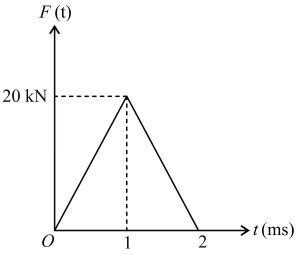
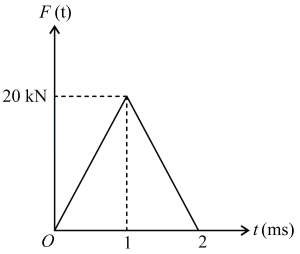
$A$ time-varying force acts on a ball of mass $100 \ g$ for $2 \ ms$. The force versus time curve is shown below. If the initial speed of the ball is $10 \ m \ s^{-1}$,then the speed of the ball after $2 \ ms$ is: (in $m \ s^{-1}$)
A
$410$
B
$210$
C
$200$
D
$400$
Solution
(B) The impulse imparted to the ball is equal to the area under the $F-t$ graph.
Impulse = Area of the triangle = $\frac{1}{2} \times \text{base} \times \text{height}$
Impulse = $\frac{1}{2} \times (2 \times 10^{-3} \ s) \times (20 \times 10^3 \ N)$
Impulse = $20 \ N \ s = 20 \ kg \ m \ s^{-1}$
According to the impulse-momentum theorem,impulse is equal to the change in momentum $(\Delta p)$:
$\Delta p = m v - m u = \text{Impulse}$
Given: mass $m = 100 \ g = 0.1 \ kg$,initial velocity $u = 10 \ m \ s^{-1}$.
$0.1 \times v - 0.1 \times 10 = 20$
$0.1 \times v - 1 = 20$
$0.1 \times v = 21$
$v = \frac{21}{0.1} = 210 \ m \ s^{-1}$
Impulse = Area of the triangle = $\frac{1}{2} \times \text{base} \times \text{height}$
Impulse = $\frac{1}{2} \times (2 \times 10^{-3} \ s) \times (20 \times 10^3 \ N)$
Impulse = $20 \ N \ s = 20 \ kg \ m \ s^{-1}$
According to the impulse-momentum theorem,impulse is equal to the change in momentum $(\Delta p)$:
$\Delta p = m v - m u = \text{Impulse}$
Given: mass $m = 100 \ g = 0.1 \ kg$,initial velocity $u = 10 \ m \ s^{-1}$.
$0.1 \times v - 0.1 \times 10 = 20$
$0.1 \times v - 1 = 20$
$0.1 \times v = 21$
$v = \frac{21}{0.1} = 210 \ m \ s^{-1}$
0 likesView Solution
5
PhysicsEasyMCQTS EAMCET · 2022
Assertion $(A)$: In an elastic collision of two billiard balls,both kinetic energy and linear momentum remain conserved.
Reason $(R)$: During the collision of the balls,as the collision is elastic,there is no exchange of energy. Therefore,both energy and momentum are conserved.
Reason $(R)$: During the collision of the balls,as the collision is elastic,there is no exchange of energy. Therefore,both energy and momentum are conserved.
A
$(A)$ is true,$(R)$ is true and $(R)$ is the correct explanation for $(A)$
B
$(A)$ is true,$(R)$ is true but $(R)$ is not the correct explanation for $(A)$
C
$(A)$ is true but $(R)$ is false
D
$(A)$ is false but $(R)$ is true
Solution
(C) In an elastic collision,both the total linear momentum and the total kinetic energy of the system are conserved.
Assertion $(A)$ is true because by definition,an elastic collision is one in which there is no loss of kinetic energy.
Reason $(R)$ is false because,during an elastic collision,there is indeed an exchange of energy between the colliding bodies (momentum and kinetic energy are transferred between them),even though the total kinetic energy of the system remains constant.
Therefore,$(A)$ is true but $(R)$ is false.
Assertion $(A)$ is true because by definition,an elastic collision is one in which there is no loss of kinetic energy.
Reason $(R)$ is false because,during an elastic collision,there is indeed an exchange of energy between the colliding bodies (momentum and kinetic energy are transferred between them),even though the total kinetic energy of the system remains constant.
Therefore,$(A)$ is true but $(R)$ is false.
0 likesView Solution
6
PhysicsMediumMCQTS EAMCET · 2022
$A$ uniform sphere $A$ with radius $R$ exerts a force $F$ on a small particle $B$ situated at a distance $2R$ from the centre of the sphere. $A$ spherical portion of diameter $R$ is cut from the sphere $A$ as shown in the figure. If $F^{\prime}$ is the new gravitational force between the remaining part of the sphere $A$ and the particle $B$,then find the correct relation between $F$ and $F^{\prime}$.
A
$F^{\prime} = \frac{7}{8} F$
B
$F^{\prime} = \frac{14}{9} F$
C
$F^{\prime} = \frac{7}{9} F$
D
$F^{\prime} = \frac{9}{7} F$
Solution
(C) Let the mass of the original sphere $A$ be $M$. The force $F$ on particle $B$ of mass $m$ at distance $2R$ is $F = \frac{GMm}{(2R)^2} = \frac{GMm}{4R^2}$.
The mass of the removed spherical portion of radius $r = R/2$ is $M^{\prime} = \rho \cdot \frac{4}{3} \pi (R/2)^3 = \frac{M}{\frac{4}{3} \pi R^3} \cdot \frac{4}{3} \pi \frac{R^3}{8} = \frac{M}{8}$.
The distance of the centre of the removed portion from the particle $B$ is $d = 2R - R/2 = 3R/2$.
The force exerted by the removed portion on $B$ is $F_{removed} = \frac{G M^{\prime} m}{d^2} = \frac{G (M/8) m}{(3R/2)^2} = \frac{GMm}{8 \cdot (9R^2/4)} = \frac{GMm}{18R^2}$.
Since $F = \frac{GMm}{4R^2}$,we have $\frac{GMm}{R^2} = 4F$. Thus,$F_{removed} = \frac{4F}{18} = \frac{2}{9} F$.
The new force $F^{\prime}$ is $F - F_{removed} = F - \frac{2}{9} F = \frac{7}{9} F$.
The mass of the removed spherical portion of radius $r = R/2$ is $M^{\prime} = \rho \cdot \frac{4}{3} \pi (R/2)^3 = \frac{M}{\frac{4}{3} \pi R^3} \cdot \frac{4}{3} \pi \frac{R^3}{8} = \frac{M}{8}$.
The distance of the centre of the removed portion from the particle $B$ is $d = 2R - R/2 = 3R/2$.
The force exerted by the removed portion on $B$ is $F_{removed} = \frac{G M^{\prime} m}{d^2} = \frac{G (M/8) m}{(3R/2)^2} = \frac{GMm}{8 \cdot (9R^2/4)} = \frac{GMm}{18R^2}$.
Since $F = \frac{GMm}{4R^2}$,we have $\frac{GMm}{R^2} = 4F$. Thus,$F_{removed} = \frac{4F}{18} = \frac{2}{9} F$.
The new force $F^{\prime}$ is $F - F_{removed} = F - \frac{2}{9} F = \frac{7}{9} F$.
0 likesView Solution
7
PhysicsMediumMCQTS EAMCET · 2022
$A$ rocket is fired vertically with a speed of $4 \ km/s$ from the Earth's surface. How far from the Earth does the rocket go before returning to the Earth (in $km$)? (Take radius of Earth $R = 6.4 \times 10^6 \ m$ and $g = 10 \ m/s^2$)
A
$500.24$
B
$914.28$
C
$1230.24$
D
$1750.28$
Solution
(B) Using the principle of conservation of mechanical energy, the total energy at the surface equals the total energy at the maximum height $h$ reached by the rocket.
Total energy at surface = Total energy at height $h$
$-\frac{GMm}{R} + \frac{1}{2}mu^2 = -\frac{GMm}{R+h} + 0$
Dividing by $m$ and using $GM = gR^2$:
$-\frac{gR^2}{R} + \frac{1}{2}u^2 = -\frac{gR^2}{R+h}$
$-gR + \frac{1}{2}u^2 = -\frac{gR^2}{R+h}$
Given $u = 4000 \ m/s$, $R = 6.4 \times 10^6 \ m$, and $g = 10 \ m/s^2$:
$-(10)(6.4 \times 10^6) + \frac{1}{2}(4000)^2 = -\frac{10 \times (6.4 \times 10^6)^2}{6.4 \times 10^6 + h}$
$-6.4 \times 10^7 + 8 \times 10^6 = -\frac{4.096 \times 10^{14}}{6.4 \times 10^6 + h}$
$-5.6 \times 10^7 = -\frac{4.096 \times 10^{14}}{6.4 \times 10^6 + h}$
$6.4 \times 10^6 + h = \frac{4.096 \times 10^{14}}{5.6 \times 10^7} = 0.7314 \times 10^7 = 7.314 \times 10^6 \ m$
$h = 7.314 \times 10^6 - 6.4 \times 10^6 = 0.914 \times 10^6 \ m = 914 \ km$.
Thus, the correct option is $914.28 \ km$.
Total energy at surface = Total energy at height $h$
$-\frac{GMm}{R} + \frac{1}{2}mu^2 = -\frac{GMm}{R+h} + 0$
Dividing by $m$ and using $GM = gR^2$:
$-\frac{gR^2}{R} + \frac{1}{2}u^2 = -\frac{gR^2}{R+h}$
$-gR + \frac{1}{2}u^2 = -\frac{gR^2}{R+h}$
Given $u = 4000 \ m/s$, $R = 6.4 \times 10^6 \ m$, and $g = 10 \ m/s^2$:
$-(10)(6.4 \times 10^6) + \frac{1}{2}(4000)^2 = -\frac{10 \times (6.4 \times 10^6)^2}{6.4 \times 10^6 + h}$
$-6.4 \times 10^7 + 8 \times 10^6 = -\frac{4.096 \times 10^{14}}{6.4 \times 10^6 + h}$
$-5.6 \times 10^7 = -\frac{4.096 \times 10^{14}}{6.4 \times 10^6 + h}$
$6.4 \times 10^6 + h = \frac{4.096 \times 10^{14}}{5.6 \times 10^7} = 0.7314 \times 10^7 = 7.314 \times 10^6 \ m$
$h = 7.314 \times 10^6 - 6.4 \times 10^6 = 0.914 \times 10^6 \ m = 914 \ km$.
Thus, the correct option is $914.28 \ km$.
0 likesView Solution
8
PhysicsEasyMCQTS EAMCET · 2022
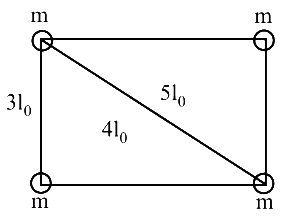
Four particles each of mass $m$ are placed at four vertices of a rectangle having side lengths $3 l_o$ and $4 l_o$. The magnitude of the gravitational potential energy of the system in units of $\frac{Gm^2}{l_o}$ is:
A
$7$/$6$
B
$47$/$30$
C
$47$/$60$
D
$7$/$12$
Solution
(B) The gravitational potential energy $U$ of a system of particles is given by the sum of the potential energies of all possible pairs: $U = -\sum \frac{Gm_i m_j}{r_{ij}}$.
For a rectangle with sides $a = 3 l_o$ and $b = 4 l_o$,the diagonal $d = \sqrt{(3 l_o)^2 + (4 l_o)^2} = 5 l_o$.
There are $4$ pairs with side length $3 l_o$ (two sides),$4 l_o$ (two sides),and $5 l_o$ (two diagonals).
$U = -\left[ \frac{Gm^2}{3 l_o} \times 2 + \frac{Gm^2}{4 l_o} \times 2 + \frac{Gm^2}{5 l_o} \times 2 \right]$
$U = -\frac{Gm^2}{l_o} \left[ \frac{2}{3} + \frac{2}{4} + \frac{2}{5} \right]$
$U = -\frac{Gm^2}{l_o} \left[ \frac{40 + 30 + 24}{60} \right] = -\frac{94}{60} \frac{Gm^2}{l_o} = -\frac{47}{30} \frac{Gm^2}{l_o}$.
The magnitude is $|U| = \frac{47}{30} \frac{Gm^2}{l_o}$.
For a rectangle with sides $a = 3 l_o$ and $b = 4 l_o$,the diagonal $d = \sqrt{(3 l_o)^2 + (4 l_o)^2} = 5 l_o$.
There are $4$ pairs with side length $3 l_o$ (two sides),$4 l_o$ (two sides),and $5 l_o$ (two diagonals).
$U = -\left[ \frac{Gm^2}{3 l_o} \times 2 + \frac{Gm^2}{4 l_o} \times 2 + \frac{Gm^2}{5 l_o} \times 2 \right]$
$U = -\frac{Gm^2}{l_o} \left[ \frac{2}{3} + \frac{2}{4} + \frac{2}{5} \right]$
$U = -\frac{Gm^2}{l_o} \left[ \frac{40 + 30 + 24}{60} \right] = -\frac{94}{60} \frac{Gm^2}{l_o} = -\frac{47}{30} \frac{Gm^2}{l_o}$.
The magnitude is $|U| = \frac{47}{30} \frac{Gm^2}{l_o}$.
0 likesView Solution
9
PhysicsEasyMCQTS EAMCET · 2022
Let the escape speed of an object on the earth's surface be $V_0$. The object is projected out with speed $5 V_0$. The speed of the object far away from the earth will be
A
$2 \sqrt{6} V_0$
B
$4 V_0$
C
$2 \sqrt{3} V_0$
D
$3 \sqrt{2} V_0$
Solution
(A) By the law of conservation of mechanical energy,the total energy at the surface of the earth must equal the total energy at a point far away from the earth (where potential energy is zero).
Let $m$ be the mass of the object and $M$ be the mass of the earth.
The escape speed $V_0$ is given by $V_0 = \sqrt{\frac{2GM}{R}}$. Thus,$V_0^2 = \frac{2GM}{R}$.
At the surface: $E_i = \frac{1}{2} m(5V_0)^2 - \frac{GMm}{R}$.
Far away: $E_f = \frac{1}{2} mV^2 + 0$.
Equating $E_i = E_f$:
$\frac{1}{2} m(25V_0^2) - \frac{GMm}{R} = \frac{1}{2} mV^2$.
Substitute $\frac{GM}{R} = \frac{V_0^2}{2}$:
$\frac{25}{2} mV_0^2 - m(\frac{V_0^2}{2}) = \frac{1}{2} mV^2$.
$12 mV_0^2 = \frac{1}{2} mV^2$.
$V^2 = 24 V_0^2$.
$V = \sqrt{24} V_0 = 2\sqrt{6} V_0$.
Let $m$ be the mass of the object and $M$ be the mass of the earth.
The escape speed $V_0$ is given by $V_0 = \sqrt{\frac{2GM}{R}}$. Thus,$V_0^2 = \frac{2GM}{R}$.
At the surface: $E_i = \frac{1}{2} m(5V_0)^2 - \frac{GMm}{R}$.
Far away: $E_f = \frac{1}{2} mV^2 + 0$.
Equating $E_i = E_f$:
$\frac{1}{2} m(25V_0^2) - \frac{GMm}{R} = \frac{1}{2} mV^2$.
Substitute $\frac{GM}{R} = \frac{V_0^2}{2}$:
$\frac{25}{2} mV_0^2 - m(\frac{V_0^2}{2}) = \frac{1}{2} mV^2$.
$12 mV_0^2 = \frac{1}{2} mV^2$.
$V^2 = 24 V_0^2$.
$V = \sqrt{24} V_0 = 2\sqrt{6} V_0$.
0 likesView Solution
10
PhysicsMediumMCQTS EAMCET · 2022
Statement $(I)$: The force of attraction due to a hollow spherical shell of uniform density on a point mass situated inside it is always zero.
Statement $(II)$: The force of attraction between a hollow spherical shell of uniform density and a point mass situated outside is the same as if the entire mass of the shell were concentrated at the center of the shell.
Which of the following is correct?
Statement $(II)$: The force of attraction between a hollow spherical shell of uniform density and a point mass situated outside is the same as if the entire mass of the shell were concentrated at the center of the shell.
Which of the following is correct?
A
Both statements $I$ and $II$ are true
B
Statement $I$ is true,but statement $II$ is false
C
Statement $II$ is true,but statement $I$ is false
D
Both statements $I$ and $II$ are false
Solution
(C) According to the Shell Theorem,the gravitational field $E$ inside a uniform hollow spherical shell is $0$. Therefore,no net gravitational force acts on a point mass placed inside it. Thus,Statement $(I)$ is false.
For any point outside a uniform hollow spherical shell,the shell behaves as if its entire mass were concentrated at its center. Thus,the gravitational force is calculated using Newton's Law of Gravitation as $F = G M m / r^2$,where $r$ is the distance from the center. Thus,Statement $(II)$ is correct.
For any point outside a uniform hollow spherical shell,the shell behaves as if its entire mass were concentrated at its center. Thus,the gravitational force is calculated using Newton's Law of Gravitation as $F = G M m / r^2$,where $r$ is the distance from the center. Thus,Statement $(II)$ is correct.
0 likesView Solution
11
PhysicsEasyMCQTS EAMCET · 2022
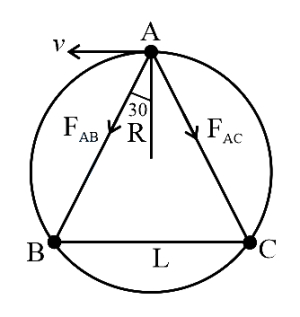
Three particles,each of mass $M$,are situated at the vertices of an equilateral triangle of side length $L$. The only forces acting on the particles are their mutual gravitational forces. It is desired that each particle moves in a circle while maintaining the original separation $L$. The initial speed that should be given to each particle is
A
$\sqrt{\frac{2 G M}{L}}$
B
$\sqrt{\frac{G M}{2 L}}$
C
$\sqrt{\frac{G M}{L}}$
D
$\sqrt{\frac{3 G M}{L}}$
Solution
(C) As the particles move under gravitational influence,the gravitational force provides the necessary centripetal force.
The gravitational force between two bodies of mass $M$ separated by distance $L$ is $F = \frac{G M^2}{L^2}$.
The net force on a particle at vertex $A$ due to particles at $B$ and $C$ is the vector sum of the forces $\vec{F}_{AB}$ and $\vec{F}_{AC}$.
Since the angle between these forces is $60^\circ$,the magnitude of the resultant force is $F_{net} = 2 F \cos(30^\circ) = 2 \left( \frac{G M^2}{L^2} \right) \frac{\sqrt{3}}{2} = \frac{\sqrt{3} G M^2}{L^2}$.
The particles move in a circle of radius $R$. For an equilateral triangle,the distance from the centroid to a vertex is $R = \frac{L}{\sqrt{3}}$.
Equating the net force to the centripetal force,$\frac{M v^2}{R} = F_{net}$.
Substituting the values,$\frac{M v^2}{L/\sqrt{3}} = \frac{\sqrt{3} G M^2}{L^2}$.
Solving for $v$,$v^2 = \frac{\sqrt{3} G M^2}{L^2} \cdot \frac{L}{\sqrt{3} M} = \frac{G M}{L}$.
Therefore,$v = \sqrt{\frac{G M}{L}}$.
The gravitational force between two bodies of mass $M$ separated by distance $L$ is $F = \frac{G M^2}{L^2}$.
The net force on a particle at vertex $A$ due to particles at $B$ and $C$ is the vector sum of the forces $\vec{F}_{AB}$ and $\vec{F}_{AC}$.
Since the angle between these forces is $60^\circ$,the magnitude of the resultant force is $F_{net} = 2 F \cos(30^\circ) = 2 \left( \frac{G M^2}{L^2} \right) \frac{\sqrt{3}}{2} = \frac{\sqrt{3} G M^2}{L^2}$.
The particles move in a circle of radius $R$. For an equilateral triangle,the distance from the centroid to a vertex is $R = \frac{L}{\sqrt{3}}$.
Equating the net force to the centripetal force,$\frac{M v^2}{R} = F_{net}$.
Substituting the values,$\frac{M v^2}{L/\sqrt{3}} = \frac{\sqrt{3} G M^2}{L^2}$.
Solving for $v$,$v^2 = \frac{\sqrt{3} G M^2}{L^2} \cdot \frac{L}{\sqrt{3} M} = \frac{G M}{L}$.
Therefore,$v = \sqrt{\frac{G M}{L}}$.
0 likesView Solution
12
PhysicsMediumMCQTS EAMCET · 2022
An ideal gas at pressure $P$ is enclosed in a container that is placed in a reservoir at temperature $T$. If the volume of the gas is increased to two times its original value,then the new pressure $P^{\prime}$ is equal to:
A
$1/2$
B
$2$
C
$1$
D
Cannot be determined
Solution
(A) Since the container is placed in a reservoir at a constant temperature $T$,the process is isothermal.
According to Boyle's Law for an ideal gas at constant temperature,$PV = \text{constant}$.
Therefore,$P_1 V_1 = P_2 V_2$.
Given $P_1 = P$,$V_1 = V$,and $V_2 = 2V$.
Substituting these values: $P \times V = P^{\prime} \times (2V)$.
Solving for $P^{\prime}$: $P^{\prime} = \frac{PV}{2V} = \frac{1}{2} P$.
According to Boyle's Law for an ideal gas at constant temperature,$PV = \text{constant}$.
Therefore,$P_1 V_1 = P_2 V_2$.
Given $P_1 = P$,$V_1 = V$,and $V_2 = 2V$.
Substituting these values: $P \times V = P^{\prime} \times (2V)$.
Solving for $P^{\prime}$: $P^{\prime} = \frac{PV}{2V} = \frac{1}{2} P$.
0 likesView Solution
13
PhysicsMediumMCQTS EAMCET · 2022
Statement $(I)$: Gas thermometers are less sensitive than liquid thermometers.
Statement $(II)$: The ratio of the universal gas constant and Avogadro's number is called Boltzmann's constant.
Statement $(III)$: The density of a given mass of a gas at constant pressure is inversely proportional to its absolute temperature.
The correct option among the following is:
Statement $(II)$: The ratio of the universal gas constant and Avogadro's number is called Boltzmann's constant.
Statement $(III)$: The density of a given mass of a gas at constant pressure is inversely proportional to its absolute temperature.
The correct option among the following is:
A
Statements $I, II, III$ are true.
B
Statements $I, II$ are true,but statement $III$ is false.
C
Statements $II, III$ are true,but statement $I$ is false.
D
Statements $I, II, III$ are false.
Solution
(C) Statement $(I)$ is false because gas thermometers are more sensitive than liquid thermometers due to the higher coefficient of thermal expansion of gases.
Statement $(II)$ is true. Boltzmann's constant $k_B$ is defined as the ratio of the universal gas constant $R$ to Avogadro's number $N_A$,i.e.,$k_B = \frac{R}{N_A}$.
Statement $(III)$ is true. From the ideal gas equation $PV = nRT$,we have $PV = \frac{m}{M}RT$,where $m$ is mass and $M$ is molar mass. Since density $\rho = \frac{m}{V}$,we get $P = \frac{\rho RT}{M}$. At constant pressure $P$,$\rho \propto \frac{1}{T}$.
Therefore,statements $(II)$ and $(III)$ are true,but statement $(I)$ is false.
Statement $(II)$ is true. Boltzmann's constant $k_B$ is defined as the ratio of the universal gas constant $R$ to Avogadro's number $N_A$,i.e.,$k_B = \frac{R}{N_A}$.
Statement $(III)$ is true. From the ideal gas equation $PV = nRT$,we have $PV = \frac{m}{M}RT$,where $m$ is mass and $M$ is molar mass. Since density $\rho = \frac{m}{V}$,we get $P = \frac{\rho RT}{M}$. At constant pressure $P$,$\rho \propto \frac{1}{T}$.
Therefore,statements $(II)$ and $(III)$ are true,but statement $(I)$ is false.
0 likesView Solution
14
PhysicsDifficultMCQTS EAMCET · 2022
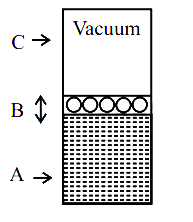
In the figure,chamber $A$ contains a gas,a movable chamber $B$ is placed on top of the gas and it contains $n$ metal balls. The weight of chamber $B$ and the balls is supported by the gas. Chamber $C$ is a vacuum. Let the gas be in equilibrium at pressure $P$. Let $P^{\prime}$ be the pressure if one of the balls is taken away. Find $(P-P^{\prime}) / P$.
A
$1$
B
$n$
C
$2n$
D
$1/n$
Solution
(D) Let $M$ be the mass of chamber $B$ and $m$ be the mass of each ball. The total downward force exerted by the chamber and the balls on the gas is $F = (M + nm)g$.
If $A$ is the cross-sectional area of the chamber,the pressure $P$ of the gas is given by $P = F/A = (M + nm)g / A$.
When one ball is removed,the new force is $F^{\prime} = (M + (n-1)m)g$.
The new pressure $P^{\prime}$ is $P^{\prime} = F^{\prime} / A = (M + (n-1)m)g / A$.
The difference in pressure is $P - P^{\prime} = (M + nm)g/A - (M + nm - m)g/A = mg/A$.
Thus,$(P - P^{\prime}) / P = (mg/A) / ((M + nm)g/A) = m / (M + nm)$.
Assuming the mass of the chamber $M$ is negligible compared to the total mass of the balls (or that the problem implies the weight is primarily due to the balls),we have $M \approx 0$.
Then,$(P - P^{\prime}) / P = m / (nm) = 1/n$.
If $A$ is the cross-sectional area of the chamber,the pressure $P$ of the gas is given by $P = F/A = (M + nm)g / A$.
When one ball is removed,the new force is $F^{\prime} = (M + (n-1)m)g$.
The new pressure $P^{\prime}$ is $P^{\prime} = F^{\prime} / A = (M + (n-1)m)g / A$.
The difference in pressure is $P - P^{\prime} = (M + nm)g/A - (M + nm - m)g/A = mg/A$.
Thus,$(P - P^{\prime}) / P = (mg/A) / ((M + nm)g/A) = m / (M + nm)$.
Assuming the mass of the chamber $M$ is negligible compared to the total mass of the balls (or that the problem implies the weight is primarily due to the balls),we have $M \approx 0$.
Then,$(P - P^{\prime}) / P = m / (nm) = 1/n$.
0 likesView Solution
15
PhysicsMediumMCQTS EAMCET · 2022
If the root mean square (rms) speed of nitrogen molecules at room temperature is $100 \ m \ s^{-1}$, then the rms speed of Helium molecules at the same temperature is
A
$100 \sqrt{7} \ m \ s^{-1}$
B
$350 \ m \ s^{-1}$
C
$50 \sqrt{14} \ m \ s^{-1}$
D
$100 \ m \ s^{-1}$
Solution
(A) The root mean square (rms) speed of gas molecules is given by the formula $v_{rms} = \sqrt{\frac{3RT}{M}}$, where $R$ is the universal gas constant, $T$ is the absolute temperature, and $M$ is the molar mass of the gas.
For a given temperature $T$, the rms speed is inversely proportional to the square root of the molar mass: $v_{rms} \propto \frac{1}{\sqrt{M}}$.
Therefore, the ratio of the rms speeds of Helium $(He)$ and Nitrogen $(N_2)$ is $\frac{v_{He}}{v_{N_2}} = \sqrt{\frac{M_{N_2}}{M_{He}}}$.
The molar mass of Nitrogen $(N_2)$ is $M_{N_2} = 28 \ g \ mol^{-1}$ and the molar mass of Helium $(He)$ is $M_{He} = 4 \ g \ mol^{-1}$.
Given $v_{N_2} = 100 \ m \ s^{-1}$, we substitute the values: $\frac{v_{He}}{100} = \sqrt{\frac{28}{4}} = \sqrt{7}$.
Thus, $v_{He} = 100 \sqrt{7} \ m \ s^{-1}$.
For a given temperature $T$, the rms speed is inversely proportional to the square root of the molar mass: $v_{rms} \propto \frac{1}{\sqrt{M}}$.
Therefore, the ratio of the rms speeds of Helium $(He)$ and Nitrogen $(N_2)$ is $\frac{v_{He}}{v_{N_2}} = \sqrt{\frac{M_{N_2}}{M_{He}}}$.
The molar mass of Nitrogen $(N_2)$ is $M_{N_2} = 28 \ g \ mol^{-1}$ and the molar mass of Helium $(He)$ is $M_{He} = 4 \ g \ mol^{-1}$.
Given $v_{N_2} = 100 \ m \ s^{-1}$, we substitute the values: $\frac{v_{He}}{100} = \sqrt{\frac{28}{4}} = \sqrt{7}$.
Thus, $v_{He} = 100 \sqrt{7} \ m \ s^{-1}$.
0 likesView Solution
16
PhysicsEasyMCQTS EAMCET · 2022
At what temperature does an oxygen molecule have the same r.m.s. velocity as a hydrogen molecule at $20 \ K$ (in $K$)?
A
$160$
B
$320$
C
$293$
D
$347$
Solution
(B) The root mean square (r.m.s.) velocity of a gas molecule is given by the formula: $v_{rms} = \sqrt{\frac{3RT}{M}}$.
Here,$R$ is the universal gas constant,$T$ is the absolute temperature,and $M$ is the molar mass of the gas.
For hydrogen $(H_2)$,the molar mass $M_{H_2} = 2 \times 10^{-3} \ kg/mol$ and temperature $T_{H_2} = 20 \ K$.
For oxygen $(O_2)$,the molar mass $M_{O_2} = 32 \times 10^{-3} \ kg/mol$.
We are given that the r.m.s. velocities are equal: $v_{rms(H_2)} = v_{rms(O_2)}$.
Therefore,$\sqrt{\frac{3RT_{H_2}}{M_{H_2}}} = \sqrt{\frac{3RT_{O_2}}{M_{O_2}}}$.
Squaring both sides and simplifying: $\frac{T_{H_2}}{M_{H_2}} = \frac{T_{O_2}}{M_{O_2}}$.
Substituting the values: $\frac{20}{2} = \frac{T_{O_2}}{32}$.
$10 = \frac{T_{O_2}}{32} \implies T_{O_2} = 320 \ K$.
Here,$R$ is the universal gas constant,$T$ is the absolute temperature,and $M$ is the molar mass of the gas.
For hydrogen $(H_2)$,the molar mass $M_{H_2} = 2 \times 10^{-3} \ kg/mol$ and temperature $T_{H_2} = 20 \ K$.
For oxygen $(O_2)$,the molar mass $M_{O_2} = 32 \times 10^{-3} \ kg/mol$.
We are given that the r.m.s. velocities are equal: $v_{rms(H_2)} = v_{rms(O_2)}$.
Therefore,$\sqrt{\frac{3RT_{H_2}}{M_{H_2}}} = \sqrt{\frac{3RT_{O_2}}{M_{O_2}}}$.
Squaring both sides and simplifying: $\frac{T_{H_2}}{M_{H_2}} = \frac{T_{O_2}}{M_{O_2}}$.
Substituting the values: $\frac{20}{2} = \frac{T_{O_2}}{32}$.
$10 = \frac{T_{O_2}}{32} \implies T_{O_2} = 320 \ K$.
0 likesView Solution
17
PhysicsEasyMCQTS EAMCET · 2022
At what temperature is the root mean square (rms) speed of Neon gas atoms equal to the rms speed of Helium gas atoms at $-33^{\circ} C$ (in $K$)? (Atomic mass of $Ne = 20.2 \ u$ and that of $He = 4.0 \ u$)
A
$1208$
B
$1210$
C
$1212$
D
$1220$
Solution
(C) The root mean square speed of a gas is given by the formula $V_{rms} = \sqrt{\frac{3RT}{M}}$,where $R$ is the universal gas constant,$T$ is the temperature in Kelvin,and $M$ is the molar mass.
Given,$(V_{rms})_{Ne} = (V_{rms})_{He}$.
Substituting the formula: $\sqrt{\frac{3RT_{Ne}}{M_{Ne}}} = \sqrt{\frac{3RT_{He}}{M_{He}}}$.
Squaring both sides and canceling common terms: $\frac{T_{Ne}}{M_{Ne}} = \frac{T_{He}}{M_{He}}$.
Given $T_{He} = -33^{\circ} C = (-33 + 273) \ K = 240 \ K$,$M_{Ne} = 20.2 \ u$,and $M_{He} = 4.0 \ u$.
Substituting the values: $\frac{T_{Ne}}{20.2} = \frac{240}{4.0}$.
$\frac{T_{Ne}}{20.2} = 60$.
$T_{Ne} = 60 \times 20.2 = 1212 \ K$.
Given,$(V_{rms})_{Ne} = (V_{rms})_{He}$.
Substituting the formula: $\sqrt{\frac{3RT_{Ne}}{M_{Ne}}} = \sqrt{\frac{3RT_{He}}{M_{He}}}$.
Squaring both sides and canceling common terms: $\frac{T_{Ne}}{M_{Ne}} = \frac{T_{He}}{M_{He}}$.
Given $T_{He} = -33^{\circ} C = (-33 + 273) \ K = 240 \ K$,$M_{Ne} = 20.2 \ u$,and $M_{He} = 4.0 \ u$.
Substituting the values: $\frac{T_{Ne}}{20.2} = \frac{240}{4.0}$.
$\frac{T_{Ne}}{20.2} = 60$.
$T_{Ne} = 60 \times 20.2 = 1212 \ K$.
0 likesView Solution
18
PhysicsEasyMCQTS EAMCET · 2022
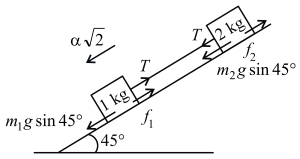
Two blocks of masses $1 \ kg$ and $2 \ kg$ are connected by a light rod and the system is slipping down a rough incline at an angle of $45^{\circ}$ with the horizontal. The coefficient of kinetic friction at both contacts is $0.4$. If the acceleration of the system is $\alpha \sqrt{2} \ m/s^2$,find the value of $\alpha$. (Use $g = 10 \ m/s^2$)
A
$4$
B
$3$
C
$2$
D
$6$
Solution
(B) The frictional force acting on both blocks is kinetic in nature.
For the $1 \ kg$ block:
$f_1 = \mu m_1 g \cos 45^{\circ} = 0.4 \times 1 \times 10 \times \frac{1}{\sqrt{2}} = \frac{4}{\sqrt{2}} = 2\sqrt{2} \ N$
For the $2 \ kg$ block:
$f_2 = \mu m_2 g \cos 45^{\circ} = 0.4 \times 2 \times 10 \times \frac{1}{\sqrt{2}} = \frac{8}{\sqrt{2}} = 4\sqrt{2} \ N$
The net force along the incline in the downward direction provides the acceleration $a = \alpha \sqrt{2}$:
$(m_1 + m_2)g \sin 45^{\circ} - (f_1 + f_2) = (m_1 + m_2)a$
$(1 + 2) \times 10 \times \frac{1}{\sqrt{2}} - (2\sqrt{2} + 4\sqrt{2}) = (1 + 2) \times (\alpha \sqrt{2})$
$30 \times \frac{1}{\sqrt{2}} - 6\sqrt{2} = 3\alpha \sqrt{2}$
Multiply throughout by $\sqrt{2}$:
$30 - 6 \times 2 = 3\alpha \times 2$
$30 - 12 = 6\alpha$
$18 = 6\alpha$
$\alpha = 3$
For the $1 \ kg$ block:
$f_1 = \mu m_1 g \cos 45^{\circ} = 0.4 \times 1 \times 10 \times \frac{1}{\sqrt{2}} = \frac{4}{\sqrt{2}} = 2\sqrt{2} \ N$
For the $2 \ kg$ block:
$f_2 = \mu m_2 g \cos 45^{\circ} = 0.4 \times 2 \times 10 \times \frac{1}{\sqrt{2}} = \frac{8}{\sqrt{2}} = 4\sqrt{2} \ N$
The net force along the incline in the downward direction provides the acceleration $a = \alpha \sqrt{2}$:
$(m_1 + m_2)g \sin 45^{\circ} - (f_1 + f_2) = (m_1 + m_2)a$
$(1 + 2) \times 10 \times \frac{1}{\sqrt{2}} - (2\sqrt{2} + 4\sqrt{2}) = (1 + 2) \times (\alpha \sqrt{2})$
$30 \times \frac{1}{\sqrt{2}} - 6\sqrt{2} = 3\alpha \sqrt{2}$
Multiply throughout by $\sqrt{2}$:
$30 - 6 \times 2 = 3\alpha \times 2$
$30 - 12 = 6\alpha$
$18 = 6\alpha$
$\alpha = 3$
0 likesView Solution
19
PhysicsMediumMCQTS EAMCET · 2022
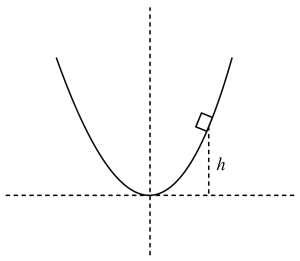
$A$ block is placed on a parabolic shape ramp given by the equation $y = \frac{x^2}{20}$. If the coefficient of static friction $\mu_s$ is $0.5$,then what is the maximum height above the ground at which the block can be placed without slipping (in $m$)?
A
$2.5$
B
$1.25$
C
$0.5$
D
$0.25$
Solution
(B) The block will start slipping when the slope of the curve at that point is equal to the tangent of the angle of repose,$\tan \theta = \mu_s$.
The slope of the curve at any point $x$ is given by the derivative:
$m = \frac{dy}{dx} = \frac{d}{dx} \left( \frac{x^2}{20} \right) = \frac{2x}{20} = \frac{x}{10}$.
For the block to remain in equilibrium without slipping,the slope must satisfy:
$\frac{dy}{dx} \leq \mu_s$
At the point of slipping,$\frac{x}{10} = 0.5$.
Solving for $x$:
$x = 0.5 \times 10 = 5 \ m$.
Now,substitute $x = 5 \ m$ into the equation of the parabola to find the maximum height $h$:
$h = y = \frac{x^2}{20} = \frac{5^2}{20} = \frac{25}{20} = 1.25 \ m$.
The slope of the curve at any point $x$ is given by the derivative:
$m = \frac{dy}{dx} = \frac{d}{dx} \left( \frac{x^2}{20} \right) = \frac{2x}{20} = \frac{x}{10}$.
For the block to remain in equilibrium without slipping,the slope must satisfy:
$\frac{dy}{dx} \leq \mu_s$
At the point of slipping,$\frac{x}{10} = 0.5$.
Solving for $x$:
$x = 0.5 \times 10 = 5 \ m$.
Now,substitute $x = 5 \ m$ into the equation of the parabola to find the maximum height $h$:
$h = y = \frac{x^2}{20} = \frac{5^2}{20} = \frac{25}{20} = 1.25 \ m$.
0 likesView Solution
20
PhysicsMediumMCQTS EAMCET · 2022
$A$ motor car moving with velocity $7 \ m/s$ stops in $10 \ m$ distance when brakes are applied. What is the relation between the resistance force $(R)$ and the weight $(W)$ of the car? (Take value of $g = 9.8 \ m/s^2$)
A
$R = W$
B
$R = -W$
C
$R = -\frac{W}{2}$
D
$R = -\frac{W}{4}$
Solution
(D) Given: initial velocity $u = 7 \ m/s$,final velocity $v = 0 \ m/s$,distance $s = 10 \ m$,and $g = 9.8 \ m/s^2$.
Using the equation of motion $v^2 = u^2 + 2as$:
$0^2 = (7)^2 + 2 \cdot a \cdot 10$
$0 = 49 + 20a$
$a = -\frac{49}{20} = -2.45 \ m/s^2$.
We know that $g = 9.8 \ m/s^2$,so $a = -\frac{9.8}{4} = -\frac{g}{4}$.
According to Newton's second law,the resistance force $R = ma$.
Substituting $a = -\frac{g}{4}$:
$R = m \left(-\frac{g}{4}\right) = -\frac{mg}{4}$.
Since weight $W = mg$,we get $R = -\frac{W}{4}$.
Using the equation of motion $v^2 = u^2 + 2as$:
$0^2 = (7)^2 + 2 \cdot a \cdot 10$
$0 = 49 + 20a$
$a = -\frac{49}{20} = -2.45 \ m/s^2$.
We know that $g = 9.8 \ m/s^2$,so $a = -\frac{9.8}{4} = -\frac{g}{4}$.
According to Newton's second law,the resistance force $R = ma$.
Substituting $a = -\frac{g}{4}$:
$R = m \left(-\frac{g}{4}\right) = -\frac{mg}{4}$.
Since weight $W = mg$,we get $R = -\frac{W}{4}$.
0 likesView Solution
21
PhysicsEasyMCQTS EAMCET · 2022
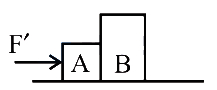
$A$ constant horizontal force $\overrightarrow{F}$ of magnitude $10 \,N$ is applied to a block $A$ and this produces an acceleration of magnitude $20 \,m/s^2$. If this block $A$ is then kept against another block $B$ of mass $1.5 \,kg$ as shown in the figure and a force $F^{\prime}$ of $20 \,N$ is applied,find the force on the block $B$. Neglect friction. (in $N$)
A
$15$
B
$10$
C
$20$
D
$5$
Solution
(A) First,calculate the mass of block $A$ using Newton's second law: $F = m_A a \Rightarrow 10 = m_A \times 20 \Rightarrow m_A = 0.5 \,kg$.
When block $A$ is placed against block $B$ and a force $F^{\prime} = 20 \,N$ is applied,both blocks move together with a common acceleration $a$.
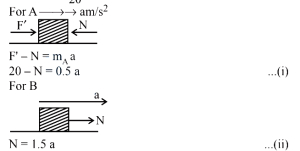
The equation of motion for block $A$ is: $F^{\prime} - N = m_A a \Rightarrow 20 - N = 0.5 a$ $(i)$.
The equation of motion for block $B$ is: $N = m_B a \Rightarrow N = 1.5 a$ $(ii)$.
Adding equations $(i)$ and $(ii)$: $20 = 2 a \Rightarrow a = 10 \,m/s^2$.
Substituting $a$ into equation $(ii)$: $N = 1.5 \times 10 = 15 \,N$.
Thus,the force on block $B$ is $15 \,N$.
When block $A$ is placed against block $B$ and a force $F^{\prime} = 20 \,N$ is applied,both blocks move together with a common acceleration $a$.
The equation of motion for block $A$ is: $F^{\prime} - N = m_A a \Rightarrow 20 - N = 0.5 a$ $(i)$.
The equation of motion for block $B$ is: $N = m_B a \Rightarrow N = 1.5 a$ $(ii)$.
Adding equations $(i)$ and $(ii)$: $20 = 2 a \Rightarrow a = 10 \,m/s^2$.
Substituting $a$ into equation $(ii)$: $N = 1.5 \times 10 = 15 \,N$.
Thus,the force on block $B$ is $15 \,N$.
0 likesView Solution
22
PhysicsEasyMCQTS EAMCET · 2022
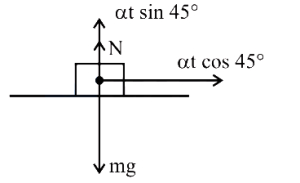
At time $t=0$,a force $F=\alpha t$,where $t$ is time in seconds,is applied to a body of mass $1 \text{ kg}$,resting on a smooth horizontal plane. If the direction of the force makes an angle of $45^{\circ}$ with the horizontal,then the velocity of the body at the moment of its breaking off the plane is
A
$\frac{100}{\alpha} \text{ m/s}$
B
$\frac{50 \sqrt{2}}{\alpha} \text{ m/s}$
C
$\frac{50 \alpha}{\sqrt{2}} \text{ m/s}$
D
$\frac{50}{\alpha} \text{ m/s}$
Solution
(B) Let at $t=t_0$,the body leaves the plane. Then,at $t=t_0$,the normal force $N=0$.
The vertical component of the force is $F_y = F \sin 45^{\circ} = \alpha t_0 \sin 45^{\circ}$.
For the body to break off the plane,the vertical component of the force must balance the weight of the body:
$N + \alpha t_0 \sin 45^{\circ} = mg$
Since $N=0$ at the moment of breaking off,we have:
$\alpha t_0 \sin 45^{\circ} = mg$
Given $m = 1 \text{ kg}$ and $g = 10 \text{ m/s}^2$:
$\alpha t_0 \left(\frac{1}{\sqrt{2}}\right) = 1 \times 10$
$t_0 = \frac{10 \sqrt{2}}{\alpha} \text{ s}$.
The horizontal component of the force is $F_x = F \cos 45^{\circ} = \alpha t \cos 45^{\circ}$.
The acceleration of the body in the horizontal direction is $a = \frac{F_x}{m} = \frac{\alpha t \cos 45^{\circ}}{1} = \frac{\alpha t}{\sqrt{2}}$.
The velocity $V$ at time $t_0$ is given by:
$V = \int_0^{t_0} a \, dt = \int_0^{t_0} \frac{\alpha t}{\sqrt{2}} \, dt = \frac{\alpha}{\sqrt{2}} \left[ \frac{t^2}{2} \right]_0^{t_0} = \frac{\alpha t_0^2}{2 \sqrt{2}}$.
Substituting $t_0 = \frac{10 \sqrt{2}}{\alpha}$:
$V = \frac{\alpha}{2 \sqrt{2}} \left( \frac{10 \sqrt{2}}{\alpha} \right)^2 = \frac{\alpha}{2 \sqrt{2}} \times \frac{100 \times 2}{\alpha^2} = \frac{100}{\sqrt{2} \alpha} = \frac{50 \sqrt{2}}{\alpha} \text{ m/s}$.
The vertical component of the force is $F_y = F \sin 45^{\circ} = \alpha t_0 \sin 45^{\circ}$.
For the body to break off the plane,the vertical component of the force must balance the weight of the body:
$N + \alpha t_0 \sin 45^{\circ} = mg$
Since $N=0$ at the moment of breaking off,we have:
$\alpha t_0 \sin 45^{\circ} = mg$
Given $m = 1 \text{ kg}$ and $g = 10 \text{ m/s}^2$:
$\alpha t_0 \left(\frac{1}{\sqrt{2}}\right) = 1 \times 10$
$t_0 = \frac{10 \sqrt{2}}{\alpha} \text{ s}$.
The horizontal component of the force is $F_x = F \cos 45^{\circ} = \alpha t \cos 45^{\circ}$.
The acceleration of the body in the horizontal direction is $a = \frac{F_x}{m} = \frac{\alpha t \cos 45^{\circ}}{1} = \frac{\alpha t}{\sqrt{2}}$.
The velocity $V$ at time $t_0$ is given by:
$V = \int_0^{t_0} a \, dt = \int_0^{t_0} \frac{\alpha t}{\sqrt{2}} \, dt = \frac{\alpha}{\sqrt{2}} \left[ \frac{t^2}{2} \right]_0^{t_0} = \frac{\alpha t_0^2}{2 \sqrt{2}}$.
Substituting $t_0 = \frac{10 \sqrt{2}}{\alpha}$:
$V = \frac{\alpha}{2 \sqrt{2}} \left( \frac{10 \sqrt{2}}{\alpha} \right)^2 = \frac{\alpha}{2 \sqrt{2}} \times \frac{100 \times 2}{\alpha^2} = \frac{100}{\sqrt{2} \alpha} = \frac{50 \sqrt{2}}{\alpha} \text{ m/s}$.
0 likesView Solution
23
PhysicsEasyMCQTS EAMCET · 2022
Statement $(I)$: An object subjected to velocities $\overrightarrow{v_1}$ and $\overrightarrow{v_2}$ has a resultant velocity with magnitude $|\vec{v}| = |\overrightarrow{v_1}| + |\overrightarrow{v_2}|$.
Statement $(II)$: The magnitude of displacement is either less than or equal to the path length of an object between two points.
Statement $(III)$: The instantaneous acceleration is the limiting value of the average acceleration as the time interval approaches zero.
Which of the following is correct?
Statement $(II)$: The magnitude of displacement is either less than or equal to the path length of an object between two points.
Statement $(III)$: The instantaneous acceleration is the limiting value of the average acceleration as the time interval approaches zero.
Which of the following is correct?
A
Statements $I, II, III$ are true
B
Statements $I, II$ are true,but Statement $III$ is false
C
Statements $II, III$ are true,but Statement $I$ is false
D
Statements $I, II, III$ are false
Solution
(C) Statement $(I)$ is incorrect because the resultant velocity magnitude is given by the vector addition formula: $|\vec{v}| = \sqrt{|\vec{v_1}|^2 + |\vec{v_2}|^2 + 2|\vec{v_1}| |\vec{v_2}| \cos \theta}$. It is only equal to the sum of magnitudes if the vectors are in the same direction $(\theta = 0^\circ)$.
Statement $(II)$ is correct because displacement is the shortest distance between two points,while path length is the total distance covered. Thus,displacement $\leq$ distance.
Statement $(III)$ is correct by definition. Instantaneous acceleration is defined as $\vec{a} = \lim_{\Delta t \rightarrow 0} \frac{\Delta \vec{v}}{\Delta t}$.
Statement $(II)$ is correct because displacement is the shortest distance between two points,while path length is the total distance covered. Thus,displacement $\leq$ distance.
Statement $(III)$ is correct by definition. Instantaneous acceleration is defined as $\vec{a} = \lim_{\Delta t \rightarrow 0} \frac{\Delta \vec{v}}{\Delta t}$.
0 likesView Solution
24
PhysicsEasyMCQTS EAMCET · 2022
$A$ physical quantity $S$ is related to four observables $a, b, c$,and $d$ as $S = \frac{\sqrt{a} b}{c^3 d^4}$. If the percentage errors of measurement in $a, b, c$,and $d$ are $2 \%$,$1 \%$,$1 \%$,and $1 \%$ respectively,then the percentage error in the quantity $S$ is: (in $\%$)
A
$6$
B
$8$
C
$9$
D
$10$
Solution
(C) Given the relation $S = \frac{a^{1/2} b}{c^3 d^4}$.
To find the maximum relative error in $S$,we use the formula for propagation of errors:
$\frac{\Delta S}{S} = \frac{1}{2} \frac{\Delta a}{a} + \frac{\Delta b}{b} + 3 \frac{\Delta c}{c} + 4 \frac{\Delta d}{d}$.
Substituting the given percentage errors:
$\left( \frac{\Delta S}{S} \times 100 \right) = \frac{1}{2} \times (2 \%) + (1 \%) + 3 \times (1 \%) + 4 \times (1 \%)$.
Calculating the values:
$= 1 \% + 1 \% + 3 \% + 4 \% = 9 \%$.
Therefore,the percentage error in $S$ is $9 \%$.
To find the maximum relative error in $S$,we use the formula for propagation of errors:
$\frac{\Delta S}{S} = \frac{1}{2} \frac{\Delta a}{a} + \frac{\Delta b}{b} + 3 \frac{\Delta c}{c} + 4 \frac{\Delta d}{d}$.
Substituting the given percentage errors:
$\left( \frac{\Delta S}{S} \times 100 \right) = \frac{1}{2} \times (2 \%) + (1 \%) + 3 \times (1 \%) + 4 \times (1 \%)$.
Calculating the values:
$= 1 \% + 1 \% + 3 \% + 4 \% = 9 \%$.
Therefore,the percentage error in $S$ is $9 \%$.
0 likesView Solution
25
PhysicsEasyMCQTS EAMCET · 2022
Which of the following statements is true?
A
The range for weak nuclear force is shortest among all four forces
B
The range for electromagnetic force is smaller than that for gravitation force
C
The relative strength of gravitational force is higher than that for weak nuclear force
D
The relative strength for weak nuclear force is larger than that for strong nuclear force
Solution
(A) The four fundamental forces in nature are gravitational force, weak nuclear force, electromagnetic force, and strong nuclear force.
$1$. The range of the weak nuclear force is approximately $10^{-18} \,m$, which is the shortest among all four fundamental forces.
$2$. The range of gravitational and electromagnetic forces is infinite.
$3$. The relative strengths of the forces are: Strong nuclear force $(1)$ > Electromagnetic force $(10^{-2})$ > Weak nuclear force $(10^{-13})$ > Gravitational force $(10^{-39})$.
Therefore, the statement that the range for the weak nuclear force is the shortest is correct.
$1$. The range of the weak nuclear force is approximately $10^{-18} \,m$, which is the shortest among all four fundamental forces.
$2$. The range of gravitational and electromagnetic forces is infinite.
$3$. The relative strengths of the forces are: Strong nuclear force $(1)$ > Electromagnetic force $(10^{-2})$ > Weak nuclear force $(10^{-13})$ > Gravitational force $(10^{-39})$.
Therefore, the statement that the range for the weak nuclear force is the shortest is correct.
0 likesView Solution
26
PhysicsMediumMCQTS EAMCET · 2022
An ant starts from the origin and crawls $10 \ cm$ along the $x$-axis and then $20 \ cm$ along the $y$-axis. The dot product of the ant's displacement vector with the position vector of a point that makes $45^{\circ}$ with the $x$-axis and has a magnitude of $\sqrt{2} \ cm$ is
A
$30 \ cm^2$
B
$30 \sqrt{2} \ cm^2$
C
$\frac{30}{\sqrt{2}} \ cm^2$
D
$15 \ cm^2$
Solution
(A) The ant's displacement vector $\vec{a}$ is given by the movement along the $x$ and $y$ axes:
$\vec{a} = 10 \hat{i} + 20 \hat{j}$
The position vector $\vec{b}$ of the point with magnitude $r = \sqrt{2} \ cm$ at an angle $\theta = 45^{\circ}$ with the $x$-axis is:
$\vec{b} = r \cos \theta \hat{i} + r \sin \theta \hat{j}$
$\vec{b} = \sqrt{2} \cos 45^{\circ} \hat{i} + \sqrt{2} \sin 45^{\circ} \hat{j}$
$\vec{b} = \sqrt{2} \left( \frac{1}{\sqrt{2}} \right) \hat{i} + \sqrt{2} \left( \frac{1}{\sqrt{2}} \right) \hat{j} = \hat{i} + \hat{j}$
The dot product $\vec{a} \cdot \vec{b}$ is:
$\vec{a} \cdot \vec{b} = (10 \hat{i} + 20 \hat{j}) \cdot (\hat{i} + \hat{j})$
$= (10 \times 1) + (20 \times 1) = 10 + 20 = 30 \ cm^2$
$\vec{a} = 10 \hat{i} + 20 \hat{j}$
The position vector $\vec{b}$ of the point with magnitude $r = \sqrt{2} \ cm$ at an angle $\theta = 45^{\circ}$ with the $x$-axis is:
$\vec{b} = r \cos \theta \hat{i} + r \sin \theta \hat{j}$
$\vec{b} = \sqrt{2} \cos 45^{\circ} \hat{i} + \sqrt{2} \sin 45^{\circ} \hat{j}$
$\vec{b} = \sqrt{2} \left( \frac{1}{\sqrt{2}} \right) \hat{i} + \sqrt{2} \left( \frac{1}{\sqrt{2}} \right) \hat{j} = \hat{i} + \hat{j}$
The dot product $\vec{a} \cdot \vec{b}$ is:
$\vec{a} \cdot \vec{b} = (10 \hat{i} + 20 \hat{j}) \cdot (\hat{i} + \hat{j})$
$= (10 \times 1) + (20 \times 1) = 10 + 20 = 30 \ cm^2$
0 likesView Solution
27
PhysicsMediumMCQTS EAMCET · 2022
$A$ hollow spherical body of outer and inner radii of $4 \ cm$ and $2 \ cm$ respectively floats half submerged in a liquid of density $2.0 \ g \ cm^{-3}$. The density of the material of the sphere is (in $g \ cm^{-3}$)
A
$1.02$
B
$1.14$
C
$1.18$
D
$1.24$
Solution
(B) The volume of the material of the hollow sphere is $V_S = \frac{4}{3} \pi (R^3 - r^3)$,where $R = 4 \ cm$ and $r = 2 \ cm$.
For a floating body,the buoyant force equals the weight of the body.
$B = W$
$\rho_L V_{sub} g = \rho_S V_S g$
Since the sphere is half submerged,the submerged volume $V_{sub} = \frac{1}{2} \times ( \frac{4}{3} \pi R^3 ) = \frac{2}{3} \pi R^3$.
Substituting the values:
$2.0 \times \frac{2}{3} \pi (4)^3 = \rho_S \times \frac{4}{3} \pi (4^3 - 2^3)$
$2.0 \times 64 = \rho_S \times (64 - 8)$
$128 = \rho_S \times 56$
$\rho_S = \frac{128}{56} \approx 2.28 \ g \ cm^{-3}$.
Wait,re-evaluating the calculation: $V_S = \frac{4}{3} \pi (64 - 8) = \frac{4}{3} \pi (56) = \frac{224}{3} \pi$.
$V_{sub} = \frac{1}{2} \times \frac{4}{3} \pi (4^3) = \frac{128}{3} \pi$.
Equating forces: $2.0 \times (\frac{128}{3} \pi) = \rho_S \times (\frac{224}{3} \pi)$.
$\rho_S = \frac{256}{224} = 1.1428 \approx 1.14 \ g \ cm^{-3}$.
For a floating body,the buoyant force equals the weight of the body.
$B = W$
$\rho_L V_{sub} g = \rho_S V_S g$
Since the sphere is half submerged,the submerged volume $V_{sub} = \frac{1}{2} \times ( \frac{4}{3} \pi R^3 ) = \frac{2}{3} \pi R^3$.
Substituting the values:
$2.0 \times \frac{2}{3} \pi (4)^3 = \rho_S \times \frac{4}{3} \pi (4^3 - 2^3)$
$2.0 \times 64 = \rho_S \times (64 - 8)$
$128 = \rho_S \times 56$
$\rho_S = \frac{128}{56} \approx 2.28 \ g \ cm^{-3}$.
Wait,re-evaluating the calculation: $V_S = \frac{4}{3} \pi (64 - 8) = \frac{4}{3} \pi (56) = \frac{224}{3} \pi$.
$V_{sub} = \frac{1}{2} \times \frac{4}{3} \pi (4^3) = \frac{128}{3} \pi$.
Equating forces: $2.0 \times (\frac{128}{3} \pi) = \rho_S \times (\frac{224}{3} \pi)$.
$\rho_S = \frac{256}{224} = 1.1428 \approx 1.14 \ g \ cm^{-3}$.
0 likesView Solution
28
PhysicsMediumMCQTS EAMCET · 2022
$A$ piece of metal has a weight of $49 \ gm$ in air and $39 \ gm$ in a liquid of density $1.2 \times 10^3 \ kg/m^3$ kept at $32^{\circ}C$. When the temperature of the liquid is raised to $42^{\circ}C$,the metal piece has a weight of $40 \ gm$. If the density of the liquid at $42^{\circ}C$ is $1.0 \times 10^3 \ kg/m^3$,then the coefficient of linear expansion of the metal is:
A
$\frac{8}{3} \times 10^{-3} /^{\circ}C$
B
$\frac{11}{3} \times 10^{-3} /^{\circ}C$
C
$\frac{1}{3} \times 10^{-4} /^{\circ}C$
D
$\frac{4}{3} \times 10^{-3} /^{\circ}C$
Solution
(A) The apparent weight of an object in a liquid is given by $W_{app} = W_{air} - F_B$,where $F_B = V \rho g$ is the buoyant force.
At $T_1 = 32^{\circ}C$: $W_{app1} = 39 \ gm$,$W_{air} = 49 \ gm$,$\rho_1 = 1.2 \times 10^3 \ kg/m^3$.
$V_1 = \frac{W_{air} - W_{app1}}{\rho_1} = \frac{(49 - 39) \times 10^{-3} \ kg}{1.2 \times 10^3 \ kg/m^3} = \frac{10 \times 10^{-3}}{1.2 \times 10^3} = \frac{1}{12} \times 10^{-5} \ m^3 \approx 8.33 \times 10^{-6} \ m^3$.
At $T_2 = 42^{\circ}C$: $W_{app2} = 40 \ gm$,$W_{air} = 49 \ gm$,$\rho_2 = 1.0 \times 10^3 \ kg/m^3$.
$V_2 = \frac{W_{air} - W_{app2}}{\rho_2} = \frac{(49 - 40) \times 10^{-3} \ kg}{1.0 \times 10^3 \ kg/m^3} = 9 \times 10^{-6} \ m^3$.
The change in volume is $\Delta V = V_2 - V_1 = V_1 (3\alpha \Delta T)$.
$9 \times 10^{-6} - 8.33 \times 10^{-6} = 8.33 \times 10^{-6} \times 3 \alpha \times (42 - 32)$.
$0.67 \times 10^{-6} = 8.33 \times 10^{-6} \times 3 \alpha \times 10$.
$\alpha = \frac{0.67}{8.33 \times 30} \approx 2.67 \times 10^{-3} /^{\circ}C = \frac{8}{3} \times 10^{-3} /^{\circ}C$.
At $T_1 = 32^{\circ}C$: $W_{app1} = 39 \ gm$,$W_{air} = 49 \ gm$,$\rho_1 = 1.2 \times 10^3 \ kg/m^3$.
$V_1 = \frac{W_{air} - W_{app1}}{\rho_1} = \frac{(49 - 39) \times 10^{-3} \ kg}{1.2 \times 10^3 \ kg/m^3} = \frac{10 \times 10^{-3}}{1.2 \times 10^3} = \frac{1}{12} \times 10^{-5} \ m^3 \approx 8.33 \times 10^{-6} \ m^3$.
At $T_2 = 42^{\circ}C$: $W_{app2} = 40 \ gm$,$W_{air} = 49 \ gm$,$\rho_2 = 1.0 \times 10^3 \ kg/m^3$.
$V_2 = \frac{W_{air} - W_{app2}}{\rho_2} = \frac{(49 - 40) \times 10^{-3} \ kg}{1.0 \times 10^3 \ kg/m^3} = 9 \times 10^{-6} \ m^3$.
The change in volume is $\Delta V = V_2 - V_1 = V_1 (3\alpha \Delta T)$.
$9 \times 10^{-6} - 8.33 \times 10^{-6} = 8.33 \times 10^{-6} \times 3 \alpha \times (42 - 32)$.
$0.67 \times 10^{-6} = 8.33 \times 10^{-6} \times 3 \alpha \times 10$.
$\alpha = \frac{0.67}{8.33 \times 30} \approx 2.67 \times 10^{-3} /^{\circ}C = \frac{8}{3} \times 10^{-3} /^{\circ}C$.
0 likesView Solution
29
PhysicsMediumMCQTS EAMCET · 2022
$A$ large storage tank,open to the atmosphere at the top and filled with water,develops a small hole in its side at a point $20.0 \ m$ below the water level. If the rate of flow from the hole is $3.08 \times 10^{-5} \ m^3 s^{-1}$,then the diameter of the hole is (Take $g = 10 \ m s^{-2}$): (in $mm$)
A
$1.0$
B
$1.2$
C
$1.4$
D
$1.6$
Solution
(C) The velocity of efflux $(v)$ for an orifice at depth $h$ is given by Torricelli's Law:
$v = \sqrt{2gh}$
Given $h = 20.0 \ m$ and $g = 10 \ m s^{-2}$:
$v = \sqrt{2 \times 10 \times 20} = \sqrt{400} = 20 \ m s^{-1}$
The volume flow rate $(Q)$ is the product of the area of the orifice $(A)$ and the velocity of efflux $(v)$:
$Q = A \times v$
$3.08 \times 10^{-5} = \left( \frac{\pi d^2}{4} \right) \times 20$
Rearranging for $d^2$:
$d^2 = \frac{4 \times 3.08 \times 10^{-5}}{20 \times \pi} = \frac{12.32 \times 10^{-5}}{62.83} \approx 1.96 \times 10^{-6} \ m^2$
Taking the square root:
$d = \sqrt{1.96 \times 10^{-6}} = 1.4 \times 10^{-3} \ m = 1.4 \ mm$
$v = \sqrt{2gh}$
Given $h = 20.0 \ m$ and $g = 10 \ m s^{-2}$:
$v = \sqrt{2 \times 10 \times 20} = \sqrt{400} = 20 \ m s^{-1}$
The volume flow rate $(Q)$ is the product of the area of the orifice $(A)$ and the velocity of efflux $(v)$:
$Q = A \times v$
$3.08 \times 10^{-5} = \left( \frac{\pi d^2}{4} \right) \times 20$
Rearranging for $d^2$:
$d^2 = \frac{4 \times 3.08 \times 10^{-5}}{20 \times \pi} = \frac{12.32 \times 10^{-5}}{62.83} \approx 1.96 \times 10^{-6} \ m^2$
Taking the square root:
$d = \sqrt{1.96 \times 10^{-6}} = 1.4 \times 10^{-3} \ m = 1.4 \ mm$
0 likesView Solution
30
PhysicsEasyMCQTS EAMCET · 2022
$A$ liquid flows steadily through a cylindrical pipe having a radius $2R$ at point $A$ and radius $R$ at point $B$ farther along the flow direction. If the velocity at point $B$ is $4v$,what will be the velocity at point $A$?
A
$v/4$
B
$v$
C
$2v$
D
$4v$
Solution
(B) According to the equation of continuity for an incompressible fluid,the product of the cross-sectional area and the velocity of the fluid remains constant at all points along the flow:
$A_A v_A = A_B v_B$
Given that the pipe is cylindrical,the cross-sectional area $A = \pi r^2$.
At point $A$,the radius is $2R$,so $A_A = \pi (2R)^2 = 4\pi R^2$.
At point $B$,the radius is $R$,so $A_B = \pi R^2$.
The velocity at point $B$ is given as $v_B = 4v$.
Substituting these values into the continuity equation:
$4\pi R^2 \times v_A = \pi R^2 \times 4v$
Dividing both sides by $4\pi R^2$:
$v_A = v$
$A_A v_A = A_B v_B$
Given that the pipe is cylindrical,the cross-sectional area $A = \pi r^2$.
At point $A$,the radius is $2R$,so $A_A = \pi (2R)^2 = 4\pi R^2$.
At point $B$,the radius is $R$,so $A_B = \pi R^2$.
The velocity at point $B$ is given as $v_B = 4v$.
Substituting these values into the continuity equation:
$4\pi R^2 \times v_A = \pi R^2 \times 4v$
Dividing both sides by $4\pi R^2$:
$v_A = v$
0 likesView Solution
31
PhysicsMediumMCQTS EAMCET · 2022
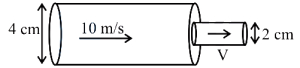
$A$ venturimeter has a pipe diameter of $4 \,cm$ and a throat diameter of $2 \,cm$. The velocity of water in the pipe section is $10 \,m/s$. The pressure drop between the pipe section and the throat section is (use density of water $= 1000 \,kg/m^3$):
A
$1.5 \times 10^5 \,Pa$
B
$7.5 \times 10^5 \,Pa$
C
$75 \times 10^5 \,Pa$
D
$4.5 \times 10^5 \,Pa$
Solution
(B) Given:
Diameter of pipe $D_1 = 4 \,cm$,radius $r_1 = 2 \,cm$.
Diameter of throat $D_2 = 2 \,cm$,radius $r_2 = 1 \,cm$.
Velocity in pipe $V_1 = 10 \,m/s$.
Density of water $\rho = 1000 \,kg/m^3$.
Step $1$: Using the equation of continuity $A_1 V_1 = A_2 V_2$:
$\pi r_1^2 V_1 = \pi r_2^2 V_2$
$(2)^2 \times 10 = (1)^2 \times V_2$
$V_2 = 40 \,m/s$.
Step $2$: Using Bernoulli's theorem for horizontal flow:
$P_1 + \frac{1}{2} \rho V_1^2 = P_2 + \frac{1}{2} \rho V_2^2$
$P_1 - P_2 = \frac{1}{2} \rho (V_2^2 - V_1^2)$
$P_1 - P_2 = \frac{1}{2} \times 1000 \times (40^2 - 10^2)$
$P_1 - P_2 = 500 \times (1600 - 100)$
$P_1 - P_2 = 500 \times 1500 = 7.5 \times 10^5 \,Pa$.
Diameter of pipe $D_1 = 4 \,cm$,radius $r_1 = 2 \,cm$.
Diameter of throat $D_2 = 2 \,cm$,radius $r_2 = 1 \,cm$.
Velocity in pipe $V_1 = 10 \,m/s$.
Density of water $\rho = 1000 \,kg/m^3$.
Step $1$: Using the equation of continuity $A_1 V_1 = A_2 V_2$:
$\pi r_1^2 V_1 = \pi r_2^2 V_2$
$(2)^2 \times 10 = (1)^2 \times V_2$
$V_2 = 40 \,m/s$.
Step $2$: Using Bernoulli's theorem for horizontal flow:
$P_1 + \frac{1}{2} \rho V_1^2 = P_2 + \frac{1}{2} \rho V_2^2$
$P_1 - P_2 = \frac{1}{2} \rho (V_2^2 - V_1^2)$
$P_1 - P_2 = \frac{1}{2} \times 1000 \times (40^2 - 10^2)$
$P_1 - P_2 = 500 \times (1600 - 100)$
$P_1 - P_2 = 500 \times 1500 = 7.5 \times 10^5 \,Pa$.
0 likesView Solution
32
PhysicsEasyMCQTS EAMCET · 2022
An air bubble of radius $1 \ mm$ is at a depth of $8 \ cm$ below the free surface of a liquid column. If the surface tension and density of the liquid are $0.1 \ N \ m^{-1}$ and $2000 \ kg \ m^{-3}$ respectively,by what amount is the pressure inside the bubble greater than the atmospheric pressure (in $N \ m^{-2}$)? (Take $g = 10 \ m \ s^{-2}$)
A
$1500$
B
$1800$
C
$1600$
D
$1700$
Solution
(B) The excess pressure inside an air bubble at a depth $h$ in a liquid is given by the sum of the pressure due to the liquid column and the excess pressure due to surface tension.
For an air bubble in a liquid,there is only one free surface.
Excess pressure due to surface tension is given by $\Delta P_s = \frac{2S}{R}$.
Pressure due to depth is given by $\Delta P_h = \rho g h$.
Total excess pressure $\Delta P = \frac{2S}{R} + \rho g h$.
Given: $S = 0.1 \ N \ m^{-1}$,$R = 1 \ mm = 1 \times 10^{-3} \ m$,$\rho = 2000 \ kg \ m^{-3}$,$h = 8 \ cm = 8 \times 10^{-2} \ m$,and $g = 10 \ m \ s^{-2}$.
Substituting the values:
$\Delta P = \frac{2 \times 0.1}{1 \times 10^{-3}} + (2000 \times 10 \times 8 \times 10^{-2})$
$\Delta P = 200 + 1600 = 1800 \ N \ m^{-2}$.
For an air bubble in a liquid,there is only one free surface.
Excess pressure due to surface tension is given by $\Delta P_s = \frac{2S}{R}$.
Pressure due to depth is given by $\Delta P_h = \rho g h$.
Total excess pressure $\Delta P = \frac{2S}{R} + \rho g h$.
Given: $S = 0.1 \ N \ m^{-1}$,$R = 1 \ mm = 1 \times 10^{-3} \ m$,$\rho = 2000 \ kg \ m^{-3}$,$h = 8 \ cm = 8 \times 10^{-2} \ m$,and $g = 10 \ m \ s^{-2}$.
Substituting the values:
$\Delta P = \frac{2 \times 0.1}{1 \times 10^{-3}} + (2000 \times 10 \times 8 \times 10^{-2})$
$\Delta P = 200 + 1600 = 1800 \ N \ m^{-2}$.
0 likesView Solution
33
PhysicsEasyMCQTS EAMCET · 2022
$A$ soap bubble of initial radius $R$ is to be blown up. The surface tension of the soap film is $T$. The surface energy needed to double the diameter of the bubble is (in $\pi R^2 T$)
A
$12$
B
$4$
C
$16$
D
$24$
Solution
(D) soap bubble has two surfaces (inner and outer),so the surface area is $2 \times 4 \pi r^2 = 8 \pi r^2$.
Initial radius $r_i = R$.
Initial surface energy $U_i = T \times (8 \pi R^2) = 8 \pi R^2 T$.
Final diameter is doubled,so final radius $r_f = 2R$.
Final surface energy $U_f = T \times (8 \pi (2R)^2) = T \times (8 \pi \times 4R^2) = 32 \pi R^2 T$.
The surface energy needed is $\Delta U = U_f - U_i$.
$\Delta U = 32 \pi R^2 T - 8 \pi R^2 T = 24 \pi R^2 T$.
Initial radius $r_i = R$.
Initial surface energy $U_i = T \times (8 \pi R^2) = 8 \pi R^2 T$.
Final diameter is doubled,so final radius $r_f = 2R$.
Final surface energy $U_f = T \times (8 \pi (2R)^2) = T \times (8 \pi \times 4R^2) = 32 \pi R^2 T$.
The surface energy needed is $\Delta U = U_f - U_i$.
$\Delta U = 32 \pi R^2 T - 8 \pi R^2 T = 24 \pi R^2 T$.
0 likesView Solution
34
PhysicsEasyMCQTS EAMCET · 2022
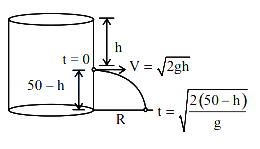
$A$ wide cylindrical vessel $50 \ cm$ in height is filled with water and rests on a table. Assuming the viscosity to be negligible,find at what height from the bottom of the vessel a small hole should be made for the water jet coming out of it to hit the surface of the table at the maximum horizontal distance from the vessel. (in $cm$)
A
$15$
B
$35$
C
$25$
D
$10$
Solution
(C) Let $H = 50 \ cm$ be the total height of the vessel. Let the hole be made at a height $y$ from the bottom. Then the depth of the hole from the free surface is $h = H - y = 50 - y$.
The velocity of the water jet is $v = \sqrt{2gh} = \sqrt{2g(50-y)}$.
The time taken for the water to reach the table is $t = \sqrt{\frac{2y}{g}}$.
The horizontal range $R$ is given by $R = v \times t = \sqrt{2g(50-y)} \times \sqrt{\frac{2y}{g}} = 2\sqrt{y(50-y)}$.
To maximize the range $R$,we differentiate $R$ with respect to $y$ and set it to zero:
$\frac{dR}{dy} = 2 \times \frac{1}{2\sqrt{y(50-y)}} \times (50 - 2y) = 0$.
This gives $50 - 2y = 0$,so $y = 25 \ cm$.
Thus,the hole should be made at a height of $25 \ cm$ from the bottom.
The velocity of the water jet is $v = \sqrt{2gh} = \sqrt{2g(50-y)}$.
The time taken for the water to reach the table is $t = \sqrt{\frac{2y}{g}}$.
The horizontal range $R$ is given by $R = v \times t = \sqrt{2g(50-y)} \times \sqrt{\frac{2y}{g}} = 2\sqrt{y(50-y)}$.
To maximize the range $R$,we differentiate $R$ with respect to $y$ and set it to zero:
$\frac{dR}{dy} = 2 \times \frac{1}{2\sqrt{y(50-y)}} \times (50 - 2y) = 0$.
This gives $50 - 2y = 0$,so $y = 25 \ cm$.
Thus,the hole should be made at a height of $25 \ cm$ from the bottom.
0 likesView Solution
35
PhysicsEasyMCQTS EAMCET · 2022
What is the terminal velocity of a rain drop of radius $0.02 \ mm$ (in $cm \ s^{-1}$)? [Note that the coefficient of viscosity of air is $1.8 \times 10^{-5} \ N \ s \ m^{-2}$,density of water is $1000 \ kg \ m^{-3}$. Use $g = 10 \ m \ s^{-2}$ and density of air can be neglected in comparison with the density of water.]
A
$4.9$
B
$9.8$
C
$0.49$
D
$49$
Solution
(A) Terminal velocity $(v_t)$ is given by the formula derived from Stokes' Law: $v_t = \frac{2r^2(\rho - \sigma)g}{9\eta}$.
Given: Radius $r = 0.02 \ mm = 2 \times 10^{-5} \ m$,viscosity $\eta = 1.8 \times 10^{-5} \ N \ s \ m^{-2}$,density of water $\rho = 1000 \ kg \ m^{-3}$,density of air $\sigma \approx 0$,and $g = 10 \ m \ s^{-2}$.
Substituting the values: $v_t = \frac{2 \times (2 \times 10^{-5})^2 \times 1000 \times 10}{9 \times 1.8 \times 10^{-5}}$.
$v_t = \frac{2 \times 4 \times 10^{-10} \times 10^4}{16.2 \times 10^{-5}} = \frac{8 \times 10^{-6}}{16.2 \times 10^{-5}} = \frac{80}{16.2} \times 10^{-2} \approx 4.938 \times 10^{-2} \ m \ s^{-1}$.
Converting to $cm \ s^{-1}$: $v_t \approx 4.938 \times 10^{-2} \times 100 \ cm \ s^{-1} = 4.938 \ cm \ s^{-1}$.
Rounding to the nearest option,we get $4.9 \ cm \ s^{-1}$.
Given: Radius $r = 0.02 \ mm = 2 \times 10^{-5} \ m$,viscosity $\eta = 1.8 \times 10^{-5} \ N \ s \ m^{-2}$,density of water $\rho = 1000 \ kg \ m^{-3}$,density of air $\sigma \approx 0$,and $g = 10 \ m \ s^{-2}$.
Substituting the values: $v_t = \frac{2 \times (2 \times 10^{-5})^2 \times 1000 \times 10}{9 \times 1.8 \times 10^{-5}}$.
$v_t = \frac{2 \times 4 \times 10^{-10} \times 10^4}{16.2 \times 10^{-5}} = \frac{8 \times 10^{-6}}{16.2 \times 10^{-5}} = \frac{80}{16.2} \times 10^{-2} \approx 4.938 \times 10^{-2} \ m \ s^{-1}$.
Converting to $cm \ s^{-1}$: $v_t \approx 4.938 \times 10^{-2} \times 100 \ cm \ s^{-1} = 4.938 \ cm \ s^{-1}$.
Rounding to the nearest option,we get $4.9 \ cm \ s^{-1}$.
0 likesView Solution
36
PhysicsEasyMCQTS EAMCET · 2022
$A$ metal cube of side $10 \,cm$ rests on a film of a liquid of thickness $0.2 \,mm$. If upon applying a horizontal force $\overrightarrow{F}$ of magnitude $0.1 \,N$ the cube slides with a constant speed of $0.08 \,m/s$, then the coefficient of viscosity is
A
$2.5 \times 10^{-2} \frac{Ns}{m^2}$
B
$0.25 \times 10^{-2} \frac{Ns}{m^2}$
C
$5 \times 10^{-2} \frac{Ns}{m^2}$
D
$0.5 \times 10^{-2} \frac{Ns}{m^2}$
Solution
$(A)$ Given:
Side of the cube, $L = 10 \,cm = 0.1 \,m$.
Area of the base, $A = L^2 = (0.1 \,m)^2 = 0.01 \,m^2$.
Thickness of the liquid film, $dx = 0.2 \,mm = 0.2 \times 10^{-3} \,m$.
Applied force, $F = 0.1 \,N$.
Constant velocity, $v = 0.08 \,m/s$.
Since the cube moves with a constant speed, the net force is zero, meaning the applied force equals the viscous drag force: $F = F_{drag}$.
According to Newton's law of viscosity, $F = \eta A \frac{dv}{dx}$.
Substituting the values: $0.1 = \eta \times 0.01 \times \frac{0.08}{0.2 \times 10^{-3}}$.
$0.1 = \eta \times 0.01 \times 400$.
$0.1 = \eta \times 4$.
$\eta = \frac{0.1}{4} = 0.025 \,Ns/m^2 = 2.5 \times 10^{-2} \,Ns/m^2$.
Side of the cube, $L = 10 \,cm = 0.1 \,m$.
Area of the base, $A = L^2 = (0.1 \,m)^2 = 0.01 \,m^2$.
Thickness of the liquid film, $dx = 0.2 \,mm = 0.2 \times 10^{-3} \,m$.
Applied force, $F = 0.1 \,N$.
Constant velocity, $v = 0.08 \,m/s$.
Since the cube moves with a constant speed, the net force is zero, meaning the applied force equals the viscous drag force: $F = F_{drag}$.
According to Newton's law of viscosity, $F = \eta A \frac{dv}{dx}$.
Substituting the values: $0.1 = \eta \times 0.01 \times \frac{0.08}{0.2 \times 10^{-3}}$.
$0.1 = \eta \times 0.01 \times 400$.
$0.1 = \eta \times 4$.
$\eta = \frac{0.1}{4} = 0.025 \,Ns/m^2 = 2.5 \times 10^{-2} \,Ns/m^2$.
0 likesView Solution
37
PhysicsMediumMCQTS EAMCET · 2022
Consider an increase of $1 \%$ in each of the radius of the artery,the viscosity of blood,and the density of blood,respectively. The percentage change in the flow rate of blood in the artery is (in $\%$)
A
$0.25$
B
$0.50$
C
$1.0$
D
$3.0$
Solution
(D) According to Poiseuille's law,the volume flow rate $Q$ is given by:
$Q = \frac{\pi \Delta P r^4}{8 L \eta}$
where $r$ is the radius,$\eta$ is the viscosity,and $\Delta P$ is the pressure difference.
Since the flow rate $Q$ does not depend on the density of blood,the change in density does not affect the flow rate.
Taking the logarithmic differentiation of the formula:
$\frac{\Delta Q}{Q} = 4 \frac{\Delta r}{r} - \frac{\Delta \eta}{\eta}$
Given that the radius $r$ increases by $1 \%$ $(\frac{\Delta r}{r} = 0.01)$ and the viscosity $\eta$ increases by $1 \%$ $(\frac{\Delta \eta}{\eta} = 0.01)$:
$\frac{\Delta Q}{Q} = 4(0.01) - 0.01 = 0.04 - 0.01 = 0.03$
Therefore,the percentage change in the flow rate is $0.03 \times 100 = 3 \%$.
$Q = \frac{\pi \Delta P r^4}{8 L \eta}$
where $r$ is the radius,$\eta$ is the viscosity,and $\Delta P$ is the pressure difference.
Since the flow rate $Q$ does not depend on the density of blood,the change in density does not affect the flow rate.
Taking the logarithmic differentiation of the formula:
$\frac{\Delta Q}{Q} = 4 \frac{\Delta r}{r} - \frac{\Delta \eta}{\eta}$
Given that the radius $r$ increases by $1 \%$ $(\frac{\Delta r}{r} = 0.01)$ and the viscosity $\eta$ increases by $1 \%$ $(\frac{\Delta \eta}{\eta} = 0.01)$:
$\frac{\Delta Q}{Q} = 4(0.01) - 0.01 = 0.04 - 0.01 = 0.03$
Therefore,the percentage change in the flow rate is $0.03 \times 100 = 3 \%$.
0 likesView Solution
38
PhysicsEasyMCQTS EAMCET · 2022
$A$ spherical drop of radius $r$ is divided into $8$ equal droplets. If the surface tension is $S$,then the work done in the process will be
A
$2 \pi r^2 S$
B
$3 \pi r^2 S$
C
$4 \pi r^2 S$
D
$4 \pi r^2 S^2$
Solution
(C) The initial surface area of the drop is $A_i = 4 \pi r^2$. The initial surface energy is $U_i = S \times 4 \pi r^2$.
Since the volume remains constant,the volume of the large drop equals the sum of the volumes of the $8$ small droplets: $\frac{4}{3} \pi r^3 = 8 \times \frac{4}{3} \pi (r')^3$.
This simplifies to $r^3 = 8(r')^3$,so $r = 2r'$,which means $r' = r/2$.
The final surface area of $8$ droplets is $A_f = 8 \times 4 \pi (r')^2 = 8 \times 4 \pi (r/2)^2 = 8 \times 4 \pi (r^2/4) = 8 \pi r^2$.
The final surface energy is $U_f = S \times 8 \pi r^2$.
The work done is equal to the change in surface energy: $W = \Delta U = U_f - U_i = S(8 \pi r^2 - 4 \pi r^2) = 4 \pi r^2 S$.
Since the volume remains constant,the volume of the large drop equals the sum of the volumes of the $8$ small droplets: $\frac{4}{3} \pi r^3 = 8 \times \frac{4}{3} \pi (r')^3$.
This simplifies to $r^3 = 8(r')^3$,so $r = 2r'$,which means $r' = r/2$.
The final surface area of $8$ droplets is $A_f = 8 \times 4 \pi (r')^2 = 8 \times 4 \pi (r/2)^2 = 8 \times 4 \pi (r^2/4) = 8 \pi r^2$.
The final surface energy is $U_f = S \times 8 \pi r^2$.
The work done is equal to the change in surface energy: $W = \Delta U = U_f - U_i = S(8 \pi r^2 - 4 \pi r^2) = 4 \pi r^2 S$.
0 likesView Solution
39
PhysicsEasyMCQTS EAMCET · 2022
$A$ swimming pool has a depth of $22 \ m$ and area $700 \ m^2$. Calculate the fractional change $\frac{\Delta V}{V}$ of water at the bottom of the swimming pool. Given that the bulk modulus of water is $2.2 \times 10^9 \ N \ m^{-2}$,$g = 10 \ m \ s^{-2}$,and the density of water is $1000 \ kg \ m^{-3}$.
A
$2.2 \times 10^{-4}$
B
$0.7 \times 10^{-4}$
C
$0.31 \times 10^{-4}$
D
$10^{-4}$
Solution
(D) The increase in pressure at the bottom of the pool due to the water column is given by $\Delta P = \rho g h$.
Substituting the given values: $\Delta P = 1000 \times 10 \times 22 = 2.2 \times 10^5 \ N \ m^{-2}$.
The bulk modulus $B$ is defined as $B = -\frac{\Delta P}{\Delta V / V}$.
Therefore,the fractional change in volume is $\left| \frac{\Delta V}{V} \right| = \frac{\Delta P}{B}$.
Substituting the values: $\left| \frac{\Delta V}{V} \right| = \frac{2.2 \times 10^5}{2.2 \times 10^9} = 10^{-4}$.
Substituting the given values: $\Delta P = 1000 \times 10 \times 22 = 2.2 \times 10^5 \ N \ m^{-2}$.
The bulk modulus $B$ is defined as $B = -\frac{\Delta P}{\Delta V / V}$.
Therefore,the fractional change in volume is $\left| \frac{\Delta V}{V} \right| = \frac{\Delta P}{B}$.
Substituting the values: $\left| \frac{\Delta V}{V} \right| = \frac{2.2 \times 10^5}{2.2 \times 10^9} = 10^{-4}$.
0 likesView Solution
40
PhysicsEasyMCQTS EAMCET · 2022
Match the following:
The correct match is:
| Column-$I$ | Column-$II$ |
|---|---|
| $(A)$ Shear modulus | $(I)$ Resistance to change in volume |
| $(B)$ Shearing stress | $(II)$ Proportionality constant |
| $(C)$ Elastic fatigue | $(III)$ Tangential stress |
| $(D)$ Modulus of elasticity | $(IV)$ Temporary loss of elastic property |
| $(V)$ Resistance to change against deformation force |
The correct match is:
A
| $A$ | $B$ | $C$ | $D$ |
|---|---|---|---|
| $II$ | $V$ | $I$ | $III$ |
B
| $A$ | $B$ | $C$ | $D$ |
|---|---|---|---|
| $V$ | $III$ | $IV$ | $II$ |
C
| $A$ | $B$ | $C$ | $D$ |
|---|---|---|---|
| $III$ | $IV$ | $II$ | $V$ |
D
| $A$ | $B$ | $C$ | $D$ |
|---|---|---|---|
| $V$ | $II$ | $IV$ | $I$ |
Solution
(B) Shear modulus is the ratio of shearing stress to shearing strain,representing the resistance to change against deformation force. Thus,$A \rightarrow V$.
$(B)$ Shearing stress is the force applied tangentially to the surface,also known as tangential stress. Thus,$B \rightarrow III$.
$(C)$ Elastic fatigue is the temporary loss of elastic properties of a material due to repeated alternating deforming forces. Thus,$C \rightarrow IV$.
$(D)$ Modulus of elasticity is the proportionality constant between stress and strain within the elastic limit. Thus,$D \rightarrow II$.
Therefore,the correct match is $A-V, B-III, C-IV, D-II$.
$(B)$ Shearing stress is the force applied tangentially to the surface,also known as tangential stress. Thus,$B \rightarrow III$.
$(C)$ Elastic fatigue is the temporary loss of elastic properties of a material due to repeated alternating deforming forces. Thus,$C \rightarrow IV$.
$(D)$ Modulus of elasticity is the proportionality constant between stress and strain within the elastic limit. Thus,$D \rightarrow II$.
Therefore,the correct match is $A-V, B-III, C-IV, D-II$.
0 likesView Solution
41
PhysicsEasyMCQTS EAMCET · 2022
An object of mass $15 \,kg$ is attached to the end of a metal wire of unstretched length $1.0 \,m$. The object is then whirled in a vertical circle with an angular velocity of $4 \,rad/s$ at the bottom of the circle. If the cross-sectional area of the wire is $0.05 \,cm^2$ and Young's modulus of the metal is $2 \times 10^{11} \,N/m^2$, then calculate the elongation of the wire when the mass is at the lowest point of its path. (Take $g = 10 \,m/s^2$) (in $\,mm$)
A
$0.27$
B
$0.39$
C
$0.55$
D
$0.25$
Solution
(B) At the lowest point of the vertical circle, the tension $T$ in the wire provides the necessary centripetal force and balances the weight of the object.
The net force $F$ acting on the wire is given by $F = mg + m\omega^2l$.
Given values: $m = 15 \,kg$, $l = 1.0 \,m$, $\omega = 4 \,rad/s$, $A = 0.05 \,cm^2 = 0.05 \times 10^{-4} \,m^2$, $Y = 2 \times 10^{11} \,N/m^2$, and $g = 10 \,m/s^2$.
Calculating the force $F$:
$F = (15 \times 10) + (15 \times 4^2 \times 1) = 150 + 240 = 390 \,N$.
Using the formula for Young's modulus $Y = \frac{F/A}{\Delta l/l}$, the elongation $\Delta l$ is:
$\Delta l = \frac{Fl}{AY} = \frac{390 \times 1.0}{(0.05 \times 10^{-4}) \times (2 \times 10^{11})}$
$\Delta l = \frac{390}{0.1 \times 10^7} = \frac{390}{10^6} = 390 \times 10^{-6} \,m = 0.39 \,mm$.
Thus, the correct option is $B$.
The net force $F$ acting on the wire is given by $F = mg + m\omega^2l$.
Given values: $m = 15 \,kg$, $l = 1.0 \,m$, $\omega = 4 \,rad/s$, $A = 0.05 \,cm^2 = 0.05 \times 10^{-4} \,m^2$, $Y = 2 \times 10^{11} \,N/m^2$, and $g = 10 \,m/s^2$.
Calculating the force $F$:
$F = (15 \times 10) + (15 \times 4^2 \times 1) = 150 + 240 = 390 \,N$.
Using the formula for Young's modulus $Y = \frac{F/A}{\Delta l/l}$, the elongation $\Delta l$ is:
$\Delta l = \frac{Fl}{AY} = \frac{390 \times 1.0}{(0.05 \times 10^{-4}) \times (2 \times 10^{11})}$
$\Delta l = \frac{390}{0.1 \times 10^7} = \frac{390}{10^6} = 390 \times 10^{-6} \,m = 0.39 \,mm$.
Thus, the correct option is $B$.
0 likesView Solution
42
PhysicsEasyMCQTS EAMCET · 2022
Two wires of same length having radius of $2 \ mm$ and $1.5 \ mm$ respectively are loaded with same weights. Extension of the second wire is double than that of the first wire. What is the ratio of the Young's modulus of the first wire to that of the second wire?
A
$8$/$9$
B
$9$/$8$
C
$3$/$4$
D
$4$/$3$
Solution
(B) The formula for extension $\Delta l$ is given by $\Delta l = \frac{F l}{Y A} = \frac{m g l}{Y \pi r^2}$.
Since $m, g, l$ are the same for both wires,we have $\Delta l \propto \frac{1}{Y r^2}$.
Therefore,$\frac{\Delta l_1}{\Delta l_2} = \frac{Y_2}{Y_1} \times \left( \frac{r_2}{r_1} \right)^2$.
Given $\Delta l_2 = 2 \Delta l_1$,so $\frac{\Delta l_1}{\Delta l_2} = \frac{1}{2}$.
Substituting the values: $\frac{1}{2} = \frac{Y_2}{Y_1} \times \left( \frac{1.5}{2} \right)^2$.
$\frac{1}{2} = \frac{Y_2}{Y_1} \times \left( \frac{3}{4} \right)^2 = \frac{Y_2}{Y_1} \times \frac{9}{16}$.
$\frac{Y_1}{Y_2} = \frac{9}{16} \times 2 = \frac{18}{16} = \frac{9}{8}$.
Since $m, g, l$ are the same for both wires,we have $\Delta l \propto \frac{1}{Y r^2}$.
Therefore,$\frac{\Delta l_1}{\Delta l_2} = \frac{Y_2}{Y_1} \times \left( \frac{r_2}{r_1} \right)^2$.
Given $\Delta l_2 = 2 \Delta l_1$,so $\frac{\Delta l_1}{\Delta l_2} = \frac{1}{2}$.
Substituting the values: $\frac{1}{2} = \frac{Y_2}{Y_1} \times \left( \frac{1.5}{2} \right)^2$.
$\frac{1}{2} = \frac{Y_2}{Y_1} \times \left( \frac{3}{4} \right)^2 = \frac{Y_2}{Y_1} \times \frac{9}{16}$.
$\frac{Y_1}{Y_2} = \frac{9}{16} \times 2 = \frac{18}{16} = \frac{9}{8}$.
0 likesView Solution
43
PhysicsEasyMCQTS EAMCET · 2022
One end of a steel rod of radius $10.0 \ mm$ and length $50.0 \ cm$ is clamped on a horizontal table. The other end of the rod is pulled with a force of magnitude $10.0 \times \pi \ kN$. This force is uniform across the flat surface of the rod and is perpendicular to it. The change in the length of the rod due to this applied force is (Use Young's modulus $= 2.0 \times 10^{11} \ N/m^2$) (in $mm$)
A
$0.25$
B
$0.75$
C
$0.50$
D
$1.0$
Solution
(A) Given: Radius $r = 10.0 \ mm = 0.01 \ m$,Length $L = 50.0 \ cm = 0.5 \ m$,Force $F = 10.0 \times \pi \ kN = 10^4 \pi \ N$,Young's modulus $Y = 2.0 \times 10^{11} \ N/m^2$.
The formula for change in length is $\Delta L = \frac{FL}{AY}$,where $A = \pi r^2$.
Substituting the values: $A = \pi \times (0.01)^2 = \pi \times 10^{-4} \ m^2$.
$\Delta L = \frac{(10^4 \pi) \times 0.5}{(\pi \times 10^{-4}) \times (2.0 \times 10^{11})}$.
$\Delta L = \frac{0.5 \times 10^4}{2.0 \times 10^7} = 0.25 \times 10^{-3} \ m = 0.25 \ mm$.
The formula for change in length is $\Delta L = \frac{FL}{AY}$,where $A = \pi r^2$.
Substituting the values: $A = \pi \times (0.01)^2 = \pi \times 10^{-4} \ m^2$.
$\Delta L = \frac{(10^4 \pi) \times 0.5}{(\pi \times 10^{-4}) \times (2.0 \times 10^{11})}$.
$\Delta L = \frac{0.5 \times 10^4}{2.0 \times 10^7} = 0.25 \times 10^{-3} \ m = 0.25 \ mm$.
0 likesView Solution
44
PhysicsEasyMCQTS EAMCET · 2022
What is the work done in stretching a uniform metal wire of length $2 \ m$ to $2.004 \ m$ with an area of cross-section $10^{-6} \ m^2$ (in $J$)? [Young's modulus of the wire = $2 \times 10^{11} \ N/m^2$]
A
$1.6$
B
$0.8$
C
$8$
D
$16$
Solution
(B) The work done in stretching a wire is given by the formula for elastic potential energy stored in the wire:
$W = \frac{1}{2} \times \text{Stress} \times \text{Strain} \times \text{Volume}$
$W = \frac{1}{2} \times \left( Y \frac{\Delta \ell}{\ell} \right) \times \left( \frac{\Delta \ell}{\ell} \right) \times (A \ell)$
$W = \frac{1}{2} \frac{Y A}{\ell} (\Delta \ell)^2$
Given:
$Y = 2 \times 10^{11} \ N/m^2$
$A = 10^{-6} \ m^2$
$\ell = 2 \ m$
$\Delta \ell = 2.004 - 2 = 0.004 \ m = 4 \times 10^{-3} \ m$
Substituting the values:
$W = \frac{1}{2} \times \frac{2 \times 10^{11} \times 10^{-6}}{2} \times (4 \times 10^{-3})^2$
$W = \frac{1}{2} \times 10^5 \times 16 \times 10^{-6}$
$W = 0.5 \times 1.6 = 0.8 \ J$
$W = \frac{1}{2} \times \text{Stress} \times \text{Strain} \times \text{Volume}$
$W = \frac{1}{2} \times \left( Y \frac{\Delta \ell}{\ell} \right) \times \left( \frac{\Delta \ell}{\ell} \right) \times (A \ell)$
$W = \frac{1}{2} \frac{Y A}{\ell} (\Delta \ell)^2$
Given:
$Y = 2 \times 10^{11} \ N/m^2$
$A = 10^{-6} \ m^2$
$\ell = 2 \ m$
$\Delta \ell = 2.004 - 2 = 0.004 \ m = 4 \times 10^{-3} \ m$
Substituting the values:
$W = \frac{1}{2} \times \frac{2 \times 10^{11} \times 10^{-6}}{2} \times (4 \times 10^{-3})^2$
$W = \frac{1}{2} \times 10^5 \times 16 \times 10^{-6}$
$W = 0.5 \times 1.6 = 0.8 \ J$
0 likesView Solution
45
PhysicsMediumMCQTS EAMCET · 2022
$A$ particle starts from rest. Its acceleration $(a)$ versus time $(t)$ graph is as shown in the figure. The maximum speed of the particle will be (in $m \ s^{-1}$)
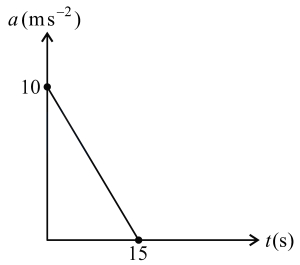
A
$150$
B
$75$
C
$37.5$
D
$45$
Solution
(B) The particle starts from rest,so its initial velocity $u = 0 \ m \ s^{-1}$.
In an acceleration-time $(a-t)$ graph,the change in velocity $(\Delta v)$ is equal to the area under the curve.
Since the acceleration is positive throughout the interval from $t = 0 \ s$ to $t = 15 \ s$,the velocity of the particle increases continuously.
Therefore,the maximum speed is attained at $t = 15 \ s$.
The area under the $a-t$ graph is the area of the right-angled triangle with base $15 \ s$ and height $10 \ m \ s^{-2}$.
$\Delta v = \text{Area} = \frac{1}{2} \times \text{base} \times \text{height}$
$\Delta v = \frac{1}{2} \times 15 \ s \times 10 \ m \ s^{-2} = 75 \ m \ s^{-1}$.
Since $v_{max} = u + \Delta v = 0 + 75 \ m \ s^{-1} = 75 \ m \ s^{-1}$.
In an acceleration-time $(a-t)$ graph,the change in velocity $(\Delta v)$ is equal to the area under the curve.
Since the acceleration is positive throughout the interval from $t = 0 \ s$ to $t = 15 \ s$,the velocity of the particle increases continuously.
Therefore,the maximum speed is attained at $t = 15 \ s$.
The area under the $a-t$ graph is the area of the right-angled triangle with base $15 \ s$ and height $10 \ m \ s^{-2}$.
$\Delta v = \text{Area} = \frac{1}{2} \times \text{base} \times \text{height}$
$\Delta v = \frac{1}{2} \times 15 \ s \times 10 \ m \ s^{-2} = 75 \ m \ s^{-1}$.
Since $v_{max} = u + \Delta v = 0 + 75 \ m \ s^{-1} = 75 \ m \ s^{-1}$.
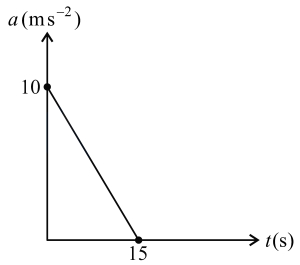
0 likesView Solution
46
PhysicsMediumMCQTS EAMCET · 2022
$A$ rocket moves straight upward with zero initial velocity and with an acceleration of $20 \,m/s^2$. It runs out of fuel and stops accelerating at the end of $5^{th} \,sec$. It reaches a maximum height and falls back to the earth. The speed when it hits the ground is (Take $g = 10 \,m/s^2$):
A
$100 \sqrt{2} \,m/s$
B
$150 \sqrt{3} \,m/s$
C
$50 \sqrt{6} \,m/s$
D
$75 \,m/s$
Solution
(C) Step $1$: Calculate the velocity and height at the end of the powered flight $(t = 5 \,s)$.
The initial velocity $u = 0$, acceleration $a = 20 \,m/s^2$, and time $t = 5 \,s$.
The velocity at $t = 5 \,s$ is $V_{max} = u + at = 0 + 20 \times 5 = 100 \,m/s$.
The height reached at $t = 5 \,s$ is $S = ut + \frac{1}{2}at^2 = 0 + \frac{1}{2} \times 20 \times 5^2 = 250 \,m$.
Step $2$: Calculate the final speed when it hits the ground.
After $t = 5 \,s$, the rocket is in free fall under gravity $(g = 10 \,m/s^2)$.
Using the work-energy theorem or kinematic equations, the total energy at the peak height is conserved, or we can use $V^2 = u^2 + 2aS$.
Here, the rocket starts from height $S = 250 \,m$ with an initial upward velocity $V_{max} = 100 \,m/s$.
When it hits the ground, the final velocity $V$ is given by $V^2 = V_{max}^2 + 2gS$.
$V^2 = (100)^2 + 2 \times 10 \times 250$.
$V^2 = 10000 + 5000 = 15000$.
$V = \sqrt{15000} = \sqrt{2500 \times 6} = 50 \sqrt{6} \,m/s$.
The initial velocity $u = 0$, acceleration $a = 20 \,m/s^2$, and time $t = 5 \,s$.
The velocity at $t = 5 \,s$ is $V_{max} = u + at = 0 + 20 \times 5 = 100 \,m/s$.
The height reached at $t = 5 \,s$ is $S = ut + \frac{1}{2}at^2 = 0 + \frac{1}{2} \times 20 \times 5^2 = 250 \,m$.
Step $2$: Calculate the final speed when it hits the ground.
After $t = 5 \,s$, the rocket is in free fall under gravity $(g = 10 \,m/s^2)$.
Using the work-energy theorem or kinematic equations, the total energy at the peak height is conserved, or we can use $V^2 = u^2 + 2aS$.
Here, the rocket starts from height $S = 250 \,m$ with an initial upward velocity $V_{max} = 100 \,m/s$.
When it hits the ground, the final velocity $V$ is given by $V^2 = V_{max}^2 + 2gS$.
$V^2 = (100)^2 + 2 \times 10 \times 250$.
$V^2 = 10000 + 5000 = 15000$.
$V = \sqrt{15000} = \sqrt{2500 \times 6} = 50 \sqrt{6} \,m/s$.
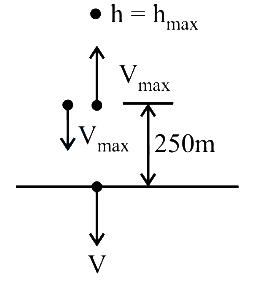
0 likesView Solution
47
PhysicsEasyMCQTS EAMCET · 2022
$A$ ball projected up passes the same height $H$ at $2 \,s$ and $10 \,s$. The value of $H$ is [Use $g=9.8 \,m/s^2$]. (in $m$)
A
$102$
B
$100$
C
$98$
D
$9.8$
Solution
(C) The equation of motion for height $H$ at time $t$ is given by $H = ut - \frac{1}{2}gt^2$.
Since the ball passes the same height $H$ at $t_1 = 2 \,s$ and $t_2 = 10 \,s$,we have:
$H = u(2) - \frac{1}{2}g(2)^2 = 2u - 2g$
$H = u(10) - \frac{1}{2}g(10)^2 = 10u - 50g$
Equating the two expressions for $H$:
$2u - 2g = 10u - 50g$
$8u = 48g$
$u = 6g = 6 \times 9.8 = 58.8 \,m/s$
Now,substitute $u$ back into the expression for $H$:
$H = 2(58.8) - 2(9.8) = 117.6 - 19.6 = 98 \,m$.
Since the ball passes the same height $H$ at $t_1 = 2 \,s$ and $t_2 = 10 \,s$,we have:
$H = u(2) - \frac{1}{2}g(2)^2 = 2u - 2g$
$H = u(10) - \frac{1}{2}g(10)^2 = 10u - 50g$
Equating the two expressions for $H$:
$2u - 2g = 10u - 50g$
$8u = 48g$
$u = 6g = 6 \times 9.8 = 58.8 \,m/s$
Now,substitute $u$ back into the expression for $H$:
$H = 2(58.8) - 2(9.8) = 117.6 - 19.6 = 98 \,m$.
0 likesView Solution
48
PhysicsEasyMCQTS EAMCET · 2022
$A$ bullet fired into a target loses one-third of its velocity after travelling a distance $x$ meters into the target. If the bullet comes to rest by travelling a further distance $x^{\prime}$,then the ratio $\frac{x^{\prime}}{x}$ is
A
$\frac{2}{3}$
B
$\frac{1}{3}$
C
$\frac{4}{5}$
D
$\frac{4}{9}$
Solution
(C) Let the initial velocity of the bullet be $u$.
After travelling a distance $x$,the velocity becomes $v_1 = u - \frac{1}{3}u = \frac{2u}{3}$.
Using the equation of motion $v^2 = u^2 + 2as$,where $a$ is the retardation (deceleration) inside the target:
$(\frac{2u}{3})^2 = u^2 - 2ax$
$\frac{4u^2}{9} = u^2 - 2ax$
$2ax = u^2 - \frac{4u^2}{9} = \frac{5u^2}{9} \quad \dots (1)$
Now,for the second part of the motion,the bullet starts with velocity $\frac{2u}{3}$ and comes to rest (final velocity $v_2 = 0$) after travelling a further distance $x^{\prime}$:
$0^2 = (\frac{2u}{3})^2 - 2ax^{\prime}$
$2ax^{\prime} = \frac{4u^2}{9} \quad \dots (2)$
Dividing equation $(2)$ by equation $(1)$:
$\frac{2ax^{\prime}}{2ax} = \frac{4u^2/9}{5u^2/9}$
$\frac{x^{\prime}}{x} = \frac{4}{5}$.
After travelling a distance $x$,the velocity becomes $v_1 = u - \frac{1}{3}u = \frac{2u}{3}$.
Using the equation of motion $v^2 = u^2 + 2as$,where $a$ is the retardation (deceleration) inside the target:
$(\frac{2u}{3})^2 = u^2 - 2ax$
$\frac{4u^2}{9} = u^2 - 2ax$
$2ax = u^2 - \frac{4u^2}{9} = \frac{5u^2}{9} \quad \dots (1)$
Now,for the second part of the motion,the bullet starts with velocity $\frac{2u}{3}$ and comes to rest (final velocity $v_2 = 0$) after travelling a further distance $x^{\prime}$:
$0^2 = (\frac{2u}{3})^2 - 2ax^{\prime}$
$2ax^{\prime} = \frac{4u^2}{9} \quad \dots (2)$
Dividing equation $(2)$ by equation $(1)$:
$\frac{2ax^{\prime}}{2ax} = \frac{4u^2/9}{5u^2/9}$
$\frac{x^{\prime}}{x} = \frac{4}{5}$.
0 likesView Solution
49
PhysicsMediumMCQTS EAMCET · 2022
$A$ body starts from rest and acquires a velocity of $10 \ m \ s^{-1}$ in $2 \ s$. What is the acceleration of the body and the distance travelled?
A
$5 \ m \ s^{-2}$ and $10 \ m$
B
$5 \ m \ s^{-2}$ and $5 \ m$
C
$5 \ m \ s^{-2}$ and $6 \ m$
D
$6 \ m \ s^{-2}$ and $5 \ m$
Solution
(A) Given: Initial velocity $u = 0 \ m \ s^{-1}$,Final velocity $v = 10 \ m \ s^{-1}$,Time $t = 2 \ s$.
For constant acceleration,we use the first equation of motion:
$v = u + at$
$10 = 0 + a \times 2$
$a = \frac{10}{2} = 5 \ m \ s^{-2}$.
Now,for the distance travelled $(s)$,we use the second equation of motion:
$s = ut + \frac{1}{2}at^2$
$s = 0 \times 2 + \frac{1}{2} \times 5 \times (2)^2$
$s = 0 + \frac{1}{2} \times 5 \times 4$
$s = 10 \ m$.
Thus,the acceleration is $5 \ m \ s^{-2}$ and the distance travelled is $10 \ m$.
For constant acceleration,we use the first equation of motion:
$v = u + at$
$10 = 0 + a \times 2$
$a = \frac{10}{2} = 5 \ m \ s^{-2}$.
Now,for the distance travelled $(s)$,we use the second equation of motion:
$s = ut + \frac{1}{2}at^2$
$s = 0 \times 2 + \frac{1}{2} \times 5 \times (2)^2$
$s = 0 + \frac{1}{2} \times 5 \times 4$
$s = 10 \ m$.
Thus,the acceleration is $5 \ m \ s^{-2}$ and the distance travelled is $10 \ m$.
0 likesView Solution
50
PhysicsMediumMCQTS EAMCET · 2022
Assertion: The zero velocity of a particle at any instant always implies zero acceleration at that instant.
Reason: $A$ body is momentarily at rest when it reverses its direction of motion.
The correct option among the following is:
Reason: $A$ body is momentarily at rest when it reverses its direction of motion.
The correct option among the following is:
A
Assertion is true,Reason is true and Reason is the correct explanation for Assertion
B
Assertion is true,Reason is true but Reason is not the correct explanation for Assertion
C
Assertion is true but Reason is false
D
Assertion is false but Reason is true
Solution
(D) When a body reverses its direction,it comes to rest for a moment,for example,a body thrown upward at the topmost point. Hence,the reason statement is correct.
In the same example,at the topmost point,the velocity of the particle is $0$,but the acceleration of the particle is equal to the acceleration due to gravity $(g = 9.8 \ m/s^2)$,which is non-zero.
Therefore,the assertion statement is false.
In the same example,at the topmost point,the velocity of the particle is $0$,but the acceleration of the particle is equal to the acceleration due to gravity $(g = 9.8 \ m/s^2)$,which is non-zero.
Therefore,the assertion statement is false.
0 likesView Solution
51
PhysicsDifficultMCQTS EAMCET · 2022
Identify the logic operation performed by the given circuit.
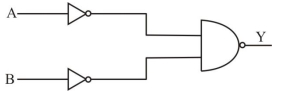
A
$NAND$
B
$NOR$
C
$OR$
D
$AND$
Solution
(C) The circuit consists of two $NOT$ gates connected to the inputs $A$ and $B$,followed by a $NAND$ gate.
$1$. The inputs to the $NAND$ gate are $\overline{A}$ and $\overline{B}$.
$2$. The output $Y$ of the $NAND$ gate is given by $Y = \overline{\overline{A} \cdot \overline{B}}$.
$3$. According to De Morgan's law,$\overline{X \cdot Y} = \overline{X} + \overline{Y}$.
$4$. Applying this to our expression: $Y = \overline{\overline{A}} + \overline{\overline{B}} = A + B$.
$5$. The expression $Y = A + B$ represents the $OR$ logic operation.
$1$. The inputs to the $NAND$ gate are $\overline{A}$ and $\overline{B}$.
$2$. The output $Y$ of the $NAND$ gate is given by $Y = \overline{\overline{A} \cdot \overline{B}}$.
$3$. According to De Morgan's law,$\overline{X \cdot Y} = \overline{X} + \overline{Y}$.
$4$. Applying this to our expression: $Y = \overline{\overline{A}} + \overline{\overline{B}} = A + B$.
$5$. The expression $Y = A + B$ represents the $OR$ logic operation.
0 likesView Solution
52
PhysicsDifficultMCQTS EAMCET · 2022
$A$ resistor of resistance $100 \Omega$ is connected to an $AC$ source $\varepsilon = 10 \sin (250 \pi t)$. The energy dissipated as heat during $t = 0$ to $t = 1 \text{ ms}$ is approximately.
A
$\frac{0.57}{\pi} \text{ mJ}$
B
$\frac{1.141}{\pi} \text{ mJ}$
C
$1 \text{ mJ}$
D
$0.5 \text{ mJ}$
Solution
(A) Given: Resistance $R = 100 \Omega$,$AC$ source $\varepsilon = 10 \sin (250 \pi t)$.
Comparing with $\varepsilon = \varepsilon_0 \sin (\omega t)$,we get $\varepsilon_0 = 10 \text{ V}$ and $\omega = 250 \pi \text{ rad/s}$.
The energy dissipated as heat $H$ is given by $H = \int_0^{t} \frac{\varepsilon^2}{R} dt$.
$H = \frac{1}{R} \int_0^{10^{-3}} (10 \sin (250 \pi t))^2 dt = \frac{100}{100} \int_0^{10^{-3}} \sin^2 (250 \pi t) dt$.
Using $\sin^2 \theta = \frac{1 - \cos 2\theta}{2}$,we get $H = \int_0^{10^{-3}} \frac{1 - \cos (500 \pi t)}{2} dt$.
$H = \frac{1}{2} \left[ t - \frac{\sin (500 \pi t)}{500 \pi} \right]_0^{10^{-3}}$.
$H = \frac{1}{2} \left[ 10^{-3} - \frac{\sin (500 \pi \times 10^{-3})}{500 \pi} \right] = \frac{1}{2} \left[ 10^{-3} - \frac{\sin (0.5 \pi)}{500 \pi} \right]$.
Since $\sin (0.5 \pi) = 1$,$H = \frac{1}{2} \left[ \frac{1}{1000} - \frac{1}{500 \pi} \right] = \frac{1}{2} \left[ \frac{\pi - 2}{1000 \pi} \right] = \frac{\pi - 2}{2000 \pi} \text{ J}$.
Approximating $\pi \approx 3.14$,$\pi - 2 \approx 1.14$. So $H \approx \frac{1.14}{2000 \pi} \text{ J} = \frac{0.57}{\pi} \times 10^{-3} \text{ J} = \frac{0.57}{\pi} \text{ mJ}$.
Comparing with $\varepsilon = \varepsilon_0 \sin (\omega t)$,we get $\varepsilon_0 = 10 \text{ V}$ and $\omega = 250 \pi \text{ rad/s}$.
The energy dissipated as heat $H$ is given by $H = \int_0^{t} \frac{\varepsilon^2}{R} dt$.
$H = \frac{1}{R} \int_0^{10^{-3}} (10 \sin (250 \pi t))^2 dt = \frac{100}{100} \int_0^{10^{-3}} \sin^2 (250 \pi t) dt$.
Using $\sin^2 \theta = \frac{1 - \cos 2\theta}{2}$,we get $H = \int_0^{10^{-3}} \frac{1 - \cos (500 \pi t)}{2} dt$.
$H = \frac{1}{2} \left[ t - \frac{\sin (500 \pi t)}{500 \pi} \right]_0^{10^{-3}}$.
$H = \frac{1}{2} \left[ 10^{-3} - \frac{\sin (500 \pi \times 10^{-3})}{500 \pi} \right] = \frac{1}{2} \left[ 10^{-3} - \frac{\sin (0.5 \pi)}{500 \pi} \right]$.
Since $\sin (0.5 \pi) = 1$,$H = \frac{1}{2} \left[ \frac{1}{1000} - \frac{1}{500 \pi} \right] = \frac{1}{2} \left[ \frac{\pi - 2}{1000 \pi} \right] = \frac{\pi - 2}{2000 \pi} \text{ J}$.
Approximating $\pi \approx 3.14$,$\pi - 2 \approx 1.14$. So $H \approx \frac{1.14}{2000 \pi} \text{ J} = \frac{0.57}{\pi} \times 10^{-3} \text{ J} = \frac{0.57}{\pi} \text{ mJ}$.
0 likesView Solution
53
PhysicsMediumMCQTS EAMCET · 2022
The $Q$-value of a series $LCR$ circuit with $L=2 \ H$,$C=32 \ \mu F$,and $R=20 \ \Omega$ is:
A
$12.5$
B
$25$
C
$50$
D
$125$
Solution
(A) The $Q$-factor (quality factor) of a series $LCR$ circuit is given by the formula:
$Q = \frac{1}{R} \sqrt{\frac{L}{C}}$
Given values are:
$L = 2 \ H$
$C = 32 \ \mu F = 32 \times 10^{-6} \ F$
$R = 20 \ \Omega$
Substituting these values into the formula:
$Q = \frac{1}{20} \sqrt{\frac{2}{32 \times 10^{-6}}}$
$Q = \frac{1}{20} \sqrt{\frac{1}{16 \times 10^{-6}}}$
$Q = \frac{1}{20} \times \frac{1}{4 \times 10^{-3}}$
$Q = \frac{1}{20} \times \frac{1000}{4}$
$Q = \frac{250}{20} = 12.5$
Thus,the $Q$-value is $12.5$.
$Q = \frac{1}{R} \sqrt{\frac{L}{C}}$
Given values are:
$L = 2 \ H$
$C = 32 \ \mu F = 32 \times 10^{-6} \ F$
$R = 20 \ \Omega$
Substituting these values into the formula:
$Q = \frac{1}{20} \sqrt{\frac{2}{32 \times 10^{-6}}}$
$Q = \frac{1}{20} \sqrt{\frac{1}{16 \times 10^{-6}}}$
$Q = \frac{1}{20} \times \frac{1}{4 \times 10^{-3}}$
$Q = \frac{1}{20} \times \frac{1000}{4}$
$Q = \frac{250}{20} = 12.5$
Thus,the $Q$-value is $12.5$.
0 likesView Solution
54
PhysicsEasyMCQTS EAMCET · 2022
$A$ capacitor of capacitance $100 \mu F$ and a coil of resistance $20 \Omega$ and inductance $12.5 mH$ are connected in series with a $220 V, \frac{200}{\pi} Hz$ $AC$ source. The maximum value of instantaneous current in the circuit is (in $A$)
A
$20$
B
$10$
C
$11$
D
$15$
Solution
(C) Given: $C = 100 \mu F = 10^{-4} F$,$R = 20 \Omega$,$L = 12.5 mH = 12.5 \times 10^{-3} H$,$V_{rms} = 220 V$,$f = \frac{200}{\pi} Hz$.
First,calculate the angular frequency: $\omega = 2 \pi f = 2 \pi \times \frac{200}{\pi} = 400 rad/s$.
Calculate inductive reactance: $X_L = \omega L = 400 \times 12.5 \times 10^{-3} = 5 \Omega$.
Calculate capacitive reactance: $X_C = \frac{1}{\omega C} = \frac{1}{400 \times 100 \times 10^{-6}} = \frac{1}{0.04} = 25 \Omega$.
Calculate impedance: $Z = \sqrt{R^2 + (X_L - X_C)^2} = \sqrt{20^2 + (5 - 25)^2} = \sqrt{400 + (-20)^2} = \sqrt{400 + 400} = \sqrt{800} = 20\sqrt{2} \Omega$.
The peak voltage is $V_0 = V_{rms} \sqrt{2} = 220\sqrt{2} V$.
The maximum current is $I_0 = \frac{V_0}{Z} = \frac{220\sqrt{2}}{20\sqrt{2}} = 11 A$.
First,calculate the angular frequency: $\omega = 2 \pi f = 2 \pi \times \frac{200}{\pi} = 400 rad/s$.
Calculate inductive reactance: $X_L = \omega L = 400 \times 12.5 \times 10^{-3} = 5 \Omega$.
Calculate capacitive reactance: $X_C = \frac{1}{\omega C} = \frac{1}{400 \times 100 \times 10^{-6}} = \frac{1}{0.04} = 25 \Omega$.
Calculate impedance: $Z = \sqrt{R^2 + (X_L - X_C)^2} = \sqrt{20^2 + (5 - 25)^2} = \sqrt{400 + (-20)^2} = \sqrt{400 + 400} = \sqrt{800} = 20\sqrt{2} \Omega$.
The peak voltage is $V_0 = V_{rms} \sqrt{2} = 220\sqrt{2} V$.
The maximum current is $I_0 = \frac{V_0}{Z} = \frac{220\sqrt{2}}{20\sqrt{2}} = 11 A$.
0 likesView Solution
55
PhysicsEasyMCQTS EAMCET · 2022
An $AC$ current is given by the expression,$I(t) = 50 \sin(200 \pi t)$ in amperes. The frequency and $RMS$ value of the current respectively are
A
$100 \text{ Hz}, 50 \sqrt{2} \text{ A}$
B
$100 \text{ Hz}, 25 \sqrt{2} \text{ A}$
C
$200 \text{ Hz}, 50 \sqrt{2} \text{ A}$
D
$200 \text{ Hz}, 25 \sqrt{2} \text{ A}$
Solution
(B) The standard equation for an alternating current is given by $I(t) = I_0 \sin(\omega t)$,where $I_0$ is the peak current and $\omega$ is the angular frequency.
Comparing this with the given equation $I(t) = 50 \sin(200 \pi t)$,we find the peak current $I_0 = 50 \text{ A}$ and the angular frequency $\omega = 200 \pi \text{ rad/s}$.
The $RMS$ value of the current is calculated as $I_{RMS} = \frac{I_0}{\sqrt{2}} = \frac{50}{\sqrt{2}} = 25 \sqrt{2} \text{ A}$.
The frequency $f$ is related to the angular frequency by the formula $\omega = 2 \pi f$.
Substituting the value of $\omega$,we get $200 \pi = 2 \pi f$,which simplifies to $f = 100 \text{ Hz}$.
Thus,the frequency is $100 \text{ Hz}$ and the $RMS$ value is $25 \sqrt{2} \text{ A}$.
Comparing this with the given equation $I(t) = 50 \sin(200 \pi t)$,we find the peak current $I_0 = 50 \text{ A}$ and the angular frequency $\omega = 200 \pi \text{ rad/s}$.
The $RMS$ value of the current is calculated as $I_{RMS} = \frac{I_0}{\sqrt{2}} = \frac{50}{\sqrt{2}} = 25 \sqrt{2} \text{ A}$.
The frequency $f$ is related to the angular frequency by the formula $\omega = 2 \pi f$.
Substituting the value of $\omega$,we get $200 \pi = 2 \pi f$,which simplifies to $f = 100 \text{ Hz}$.
Thus,the frequency is $100 \text{ Hz}$ and the $RMS$ value is $25 \sqrt{2} \text{ A}$.
0 likesView Solution
56
PhysicsEasyMCQTS EAMCET · 2022
$A$ generator produces a current of $100 \, A$ at $4000 \, V$. The voltage is stepped up to $2 \times 10^5 \, V$ by a transformer before being sent on a high voltage transmission line of resistance $50 \, \Omega$. The percentage of power loss in the transmission line is (in $\%$)
A
$0.25$
B
$0.05$
C
$1.25$
D
$0.02$
Solution
(B) The power produced by the generator is $P = V \times I = 4000 \, V \times 100 \, A = 4 \times 10^5 \, W$.
Since the transformer is ideal, the power remains constant. The current in the transmission line $(I')$ is given by $P = V' \times I'$, where $V' = 2 \times 10^5 \, V$.
$I' = P / V' = (4 \times 10^5 \, W) / (2 \times 10^5 \, V) = 2 \, A$.
The power loss in the transmission line is $P_{loss} = (I')^2 \times R = (2 \, A)^2 \times 50 \, \Omega = 4 \times 50 = 200 \, W$.
The percentage of power loss is $(P_{loss} / P) \times 100 = (200 / 4 \times 10^5) \times 100 = (2 \times 10^2 / 4 \times 10^5) \times 10^2 = 0.5 \times 10^{-1} \times 10^2 = 0.05 \%$.
Since the transformer is ideal, the power remains constant. The current in the transmission line $(I')$ is given by $P = V' \times I'$, where $V' = 2 \times 10^5 \, V$.
$I' = P / V' = (4 \times 10^5 \, W) / (2 \times 10^5 \, V) = 2 \, A$.
The power loss in the transmission line is $P_{loss} = (I')^2 \times R = (2 \, A)^2 \times 50 \, \Omega = 4 \times 50 = 200 \, W$.
The percentage of power loss is $(P_{loss} / P) \times 100 = (200 / 4 \times 10^5) \times 100 = (2 \times 10^2 / 4 \times 10^5) \times 10^2 = 0.5 \times 10^{-1} \times 10^2 = 0.05 \%$.
0 likesView Solution
57
PhysicsEasyMCQTS EAMCET · 2022
The light emitted in the transition $n = 3$ to $n = 2$ (where $n$ is the principal quantum number of the state) in hydrogen is called $H_{\alpha}$-light. Find the maximum work function that a metal can have so that $H_{\alpha}$-light can emit photoelectrons from it. (in $\text{ eV}$)
A
$1.5$
B
$2.89$
C
$1.89$
D
$3.5$
Solution
(C) The energy of the emitted photon during a transition from $n_i = 3$ to $n_f = 2$ is given by the Rydberg formula:
$E = 13.6 \left[ \frac{1}{n_f^2} - \frac{1}{n_i^2} \right] \text{ eV}$
Substituting the values $n_f = 2$ and $n_i = 3$:
$E = 13.6 \left[ \frac{1}{2^2} - \frac{1}{3^2} \right] \text{ eV}$
$E = 13.6 \left[ \frac{1}{4} - \frac{1}{9} \right] \text{ eV}$
$E = 13.6 \left[ \frac{9 - 4}{36} \right] \text{ eV}$
$E = 13.6 \times \frac{5}{36} \text{ eV} \approx 1.89 \text{ eV}$
For the photoelectric effect to occur, the energy of the incident photon must be greater than or equal to the work function $(\Phi)$ of the metal.
Therefore, the maximum work function is $\Phi_{\text{max}} = 1.89 \text{ eV}$.
$E = 13.6 \left[ \frac{1}{n_f^2} - \frac{1}{n_i^2} \right] \text{ eV}$
Substituting the values $n_f = 2$ and $n_i = 3$:
$E = 13.6 \left[ \frac{1}{2^2} - \frac{1}{3^2} \right] \text{ eV}$
$E = 13.6 \left[ \frac{1}{4} - \frac{1}{9} \right] \text{ eV}$
$E = 13.6 \left[ \frac{9 - 4}{36} \right] \text{ eV}$
$E = 13.6 \times \frac{5}{36} \text{ eV} \approx 1.89 \text{ eV}$
For the photoelectric effect to occur, the energy of the incident photon must be greater than or equal to the work function $(\Phi)$ of the metal.
Therefore, the maximum work function is $\Phi_{\text{max}} = 1.89 \text{ eV}$.
0 likesView Solution
58
PhysicsDifficultMCQTS EAMCET · 2022
If the series limit frequency of the Balmer series is $\nu_{B}$,then the series limit frequency of the Brackett series is
A
$\frac{4 \nu_{B}}{25}$
B
$\frac{\nu_{B}}{9}$
C
$\frac{\nu_{B}}{4}$
D
$\frac{9 \nu_{B}}{4}$
Solution
(C) The frequency $\nu$ of emitted radiation for a transition in a hydrogen atom is given by $\nu = cR \left[ \frac{1}{n_1^2} - \frac{1}{n_2^2} \right]$.
For the series limit,the transition occurs from $n_2 = \infty$ to $n_1$.
For the Balmer series,$n_1 = 2$,so $\nu_{B} = cR \left[ \frac{1}{2^2} - \frac{1}{\infty^2} \right] = \frac{cR}{4}$.
For the Brackett series,$n_1 = 4$,so $\nu' = cR \left[ \frac{1}{4^2} - \frac{1}{\infty^2} \right] = \frac{cR}{16}$.
Dividing the two expressions: $\frac{\nu'}{\nu_{B}} = \frac{cR/16}{cR/4} = \frac{4}{16} = \frac{1}{4}$.
Therefore,$\nu' = \frac{\nu_{B}}{4}$.
For the series limit,the transition occurs from $n_2 = \infty$ to $n_1$.
For the Balmer series,$n_1 = 2$,so $\nu_{B} = cR \left[ \frac{1}{2^2} - \frac{1}{\infty^2} \right] = \frac{cR}{4}$.
For the Brackett series,$n_1 = 4$,so $\nu' = cR \left[ \frac{1}{4^2} - \frac{1}{\infty^2} \right] = \frac{cR}{16}$.
Dividing the two expressions: $\frac{\nu'}{\nu_{B}} = \frac{cR/16}{cR/4} = \frac{4}{16} = \frac{1}{4}$.
Therefore,$\nu' = \frac{\nu_{B}}{4}$.
0 likesView Solution
59
PhysicsEasyMCQTS EAMCET · 2022
The difference in the wavelength between the maximum and minimum of Balmer series [Use $R_{H} = 1 \times 10^7 \ m^{-1}$]. (in $Å$)
A
$1600$
B
$3200$
C
$4000$
D
$4800$
Solution
(B) The Rydberg formula for the Balmer series is given by $\frac{1}{\lambda} = R_H \left( \frac{1}{2^2} - \frac{1}{n^2} \right)$,where $n = 3, 4, 5, \dots$
For the maximum wavelength (minimum energy),we take $n = 3$:
$\frac{1}{\lambda_{max}} = 10^7 \left( \frac{1}{4} - \frac{1}{9} \right) = 10^7 \left( \frac{5}{36} \right) \implies \lambda_{max} = \frac{36}{5} \times 10^{-7} \ m = 7.2 \times 10^{-7} \ m = 7200 \ Å$.
For the minimum wavelength (maximum energy),we take $n = \infty$:
$\frac{1}{\lambda_{min}} = 10^7 \left( \frac{1}{4} - 0 \right) = 10^7 \left( \frac{1}{4} \right) \implies \lambda_{min} = 4 \times 10^{-7} \ m = 4000 \ Å$.
The difference in wavelength is $\Delta \lambda = \lambda_{max} - \lambda_{min} = 7200 \ Å - 4000 \ Å = 3200 \ Å$.
For the maximum wavelength (minimum energy),we take $n = 3$:
$\frac{1}{\lambda_{max}} = 10^7 \left( \frac{1}{4} - \frac{1}{9} \right) = 10^7 \left( \frac{5}{36} \right) \implies \lambda_{max} = \frac{36}{5} \times 10^{-7} \ m = 7.2 \times 10^{-7} \ m = 7200 \ Å$.
For the minimum wavelength (maximum energy),we take $n = \infty$:
$\frac{1}{\lambda_{min}} = 10^7 \left( \frac{1}{4} - 0 \right) = 10^7 \left( \frac{1}{4} \right) \implies \lambda_{min} = 4 \times 10^{-7} \ m = 4000 \ Å$.
The difference in wavelength is $\Delta \lambda = \lambda_{max} - \lambda_{min} = 7200 \ Å - 4000 \ Å = 3200 \ Å$.
0 likesView Solution
60
PhysicsMediumMCQTS EAMCET · 2022
The radius and mass number of nucleus '$1$' is $R_1$ and $A_1$ respectively. The radius and mass number of nucleus '$2$' is $R_2$ and $A_2$ respectively. If $A_2$ is larger than $A_1$ by $2 \%$,then $R_2$ is larger than $R_1$ by
A
$\frac{2}{3} \%$
B
$1 \%$
C
$8 \%$
D
$\frac{3}{2} \%$
Solution
(A) The radius of a nucleus is given by the relation $R = R_0 A^{1/3}$,where $R_0$ is a constant and $A$ is the mass number.
For nucleus $1$: $R_1 = R_0 A_1^{1/3}$.
For nucleus $2$: $R_2 = R_0 A_2^{1/3}$.
Taking the ratio: $\frac{R_2}{R_1} = \left( \frac{A_2}{A_1} \right)^{1/3}$.
Given that $A_2$ is $2\%$ larger than $A_1$,we have $A_2 = A_1(1 + 0.02) = 1.02 A_1$,so $\frac{A_2}{A_1} = 1.02$.
Using the binomial approximation $(1 + x)^n \approx 1 + nx$ for small $x$:
$\frac{R_2}{R_1} = (1.02)^{1/3} = (1 + 0.02)^{1/3} \approx 1 + \frac{1}{3}(0.02) = 1 + 0.00666...$
Thus,$\frac{R_2}{R_1} \approx 1 + \frac{2}{300} = 1 + \frac{2}{3} \%$.
Therefore,$R_2$ is larger than $R_1$ by $\frac{2}{3} \%$.
For nucleus $1$: $R_1 = R_0 A_1^{1/3}$.
For nucleus $2$: $R_2 = R_0 A_2^{1/3}$.
Taking the ratio: $\frac{R_2}{R_1} = \left( \frac{A_2}{A_1} \right)^{1/3}$.
Given that $A_2$ is $2\%$ larger than $A_1$,we have $A_2 = A_1(1 + 0.02) = 1.02 A_1$,so $\frac{A_2}{A_1} = 1.02$.
Using the binomial approximation $(1 + x)^n \approx 1 + nx$ for small $x$:
$\frac{R_2}{R_1} = (1.02)^{1/3} = (1 + 0.02)^{1/3} \approx 1 + \frac{1}{3}(0.02) = 1 + 0.00666...$
Thus,$\frac{R_2}{R_1} \approx 1 + \frac{2}{300} = 1 + \frac{2}{3} \%$.
Therefore,$R_2$ is larger than $R_1$ by $\frac{2}{3} \%$.
0 likesView Solution
61
PhysicsEasyMCQTS EAMCET · 2022
Considering the Bohr's model of the hydrogen atom,the ratio of the velocities of electrons orbiting in the $4^{\text{th}}$ orbit to that in the $9^{\text{th}}$ orbit is:
A
$9$ : $4$
B
$3$ : $2$
C
$2$ : $3$
D
$4$ : $9$
Solution
(A) According to the Bohr model of the hydrogen atom,the velocity $V$ of an electron in the $n^{\text{th}}$ orbit is given by the relation $V_n = \frac{V_0}{n}$,where $V_0$ is a constant.
This implies that the velocity is inversely proportional to the principal quantum number $n$,i.e.,$V \propto \frac{1}{n}$.
To find the ratio of the velocity in the $4^{\text{th}}$ orbit $(V_4)$ to the velocity in the $9^{\text{th}}$ orbit $(V_9)$:
$\frac{V_4}{V_9} = \frac{1/4}{1/9} = \frac{9}{4}$.
Therefore,the ratio is $9 : 4$.
This implies that the velocity is inversely proportional to the principal quantum number $n$,i.e.,$V \propto \frac{1}{n}$.
To find the ratio of the velocity in the $4^{\text{th}}$ orbit $(V_4)$ to the velocity in the $9^{\text{th}}$ orbit $(V_9)$:
$\frac{V_4}{V_9} = \frac{1/4}{1/9} = \frac{9}{4}$.
Therefore,the ratio is $9 : 4$.
0 likesView Solution
62
PhysicsEasyMCQTS EAMCET · 2022
The energy of an electron in the fourth excited state of the hydrogen atom is
A
$-0.85 eV$
B
$-1.70 eV$
C
$0$
D
$-0.544 eV$
Solution
(D) The energy of an electron in the $n^{th}$ orbit of a hydrogen atom is given by the formula $E_n = \frac{-13.6}{n^2} eV$.
For the ground state,$n = 1$.
The first excited state is $n = 2$,the second excited state is $n = 3$,the third excited state is $n = 4$,and the fourth excited state is $n = 5$.
Substituting $n = 5$ into the formula:
$E_5 = \frac{-13.6}{5^2} eV = \frac{-13.6}{25} eV = -0.544 eV$.
For the ground state,$n = 1$.
The first excited state is $n = 2$,the second excited state is $n = 3$,the third excited state is $n = 4$,and the fourth excited state is $n = 5$.
Substituting $n = 5$ into the formula:
$E_5 = \frac{-13.6}{5^2} eV = \frac{-13.6}{25} eV = -0.544 eV$.
0 likesView Solution
63
PhysicsEasyMCQTS EAMCET · 2022
$A$ parallel-plate capacitor of plate area $10 \text{ cm}^2$ and plate separation $3 \text{ mm}$ is charged to a potential difference $12 \text{ V}$ and then the battery is disconnected. $A$ slab of dielectric constant $3$ is then inserted between the plates. The work done on the system in the process of inserting the slab is $\alpha \varepsilon_0$. The value of $\alpha$ is (Take $\varepsilon_0$ as the permittivity of free space).
A
$8$
B
$12$
C
$16$
D
$18$
Solution
(C) Initial capacitance $C = \frac{\varepsilon_0 A}{d} = \frac{\varepsilon_0 \times 10 \times 10^{-4}}{3 \times 10^{-3}} = \frac{\varepsilon_0}{3} \text{ F}$.
Initial charge $Q = CV = \frac{\varepsilon_0}{3} \times 12 = 4 \varepsilon_0 \text{ C}$.
Initial energy $U_i = \frac{Q^2}{2C} = \frac{(4 \varepsilon_0)^2}{2(\varepsilon_0/3)} = \frac{16 \varepsilon_0^2}{2 \varepsilon_0 / 3} = 24 \varepsilon_0 \text{ J}$.
After inserting the dielectric,the new capacitance $C' = KC = 3 \times \frac{\varepsilon_0}{3} = \varepsilon_0 \text{ F}$.
Since the battery is disconnected,the charge $Q$ remains constant.
Final energy $U_f = \frac{Q^2}{2C'} = \frac{(4 \varepsilon_0)^2}{2 \varepsilon_0} = \frac{16 \varepsilon_0^2}{2 \varepsilon_0} = 8 \varepsilon_0 \text{ J}$.
Work done $W = U_f - U_i = 8 \varepsilon_0 - 24 \varepsilon_0 = -16 \varepsilon_0 \text{ J}$.
The magnitude of work done on the system is $16 \varepsilon_0$. Thus,$\alpha = 16$.
Initial charge $Q = CV = \frac{\varepsilon_0}{3} \times 12 = 4 \varepsilon_0 \text{ C}$.
Initial energy $U_i = \frac{Q^2}{2C} = \frac{(4 \varepsilon_0)^2}{2(\varepsilon_0/3)} = \frac{16 \varepsilon_0^2}{2 \varepsilon_0 / 3} = 24 \varepsilon_0 \text{ J}$.
After inserting the dielectric,the new capacitance $C' = KC = 3 \times \frac{\varepsilon_0}{3} = \varepsilon_0 \text{ F}$.
Since the battery is disconnected,the charge $Q$ remains constant.
Final energy $U_f = \frac{Q^2}{2C'} = \frac{(4 \varepsilon_0)^2}{2 \varepsilon_0} = \frac{16 \varepsilon_0^2}{2 \varepsilon_0} = 8 \varepsilon_0 \text{ J}$.
Work done $W = U_f - U_i = 8 \varepsilon_0 - 24 \varepsilon_0 = -16 \varepsilon_0 \text{ J}$.
The magnitude of work done on the system is $16 \varepsilon_0$. Thus,$\alpha = 16$.
0 likesView Solution
64
PhysicsEasyMCQTS EAMCET · 2022
The following figure shows a $9 \ V$ battery and $3$ uncharged capacitors of capacitances $C_1 = C_2 = C_3 = 1 \ \mu F$. The switch is thrown to the right side until capacitor $C_1$ is fully charged,then the switch is thrown to the left. The final charge on capacitor $C_2$ is (in $\mu C$)
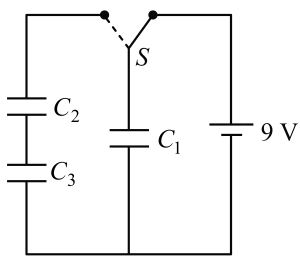
A
$1$
B
$2$
C
$3$
D
$4$
Solution
(C) Initially,when the switch is thrown to the right,capacitor $C_1$ is connected to the $9 \ V$ battery. The charge on $C_1$ is given by $Q_0 = C_1 \times V = 1 \ \mu F \times 9 \ V = 9 \ \mu C$.
When the switch is thrown to the left,$C_1$ is connected in parallel with the series combination of $C_2$ and $C_3$. Let $Q$ be the final charge on $C_1$ and $q$ be the final charge on $C_2$ and $C_3$ (since they are in series,they have the same charge).
The potential difference across $C_1$ must be equal to the potential difference across the series combination of $C_2$ and $C_3$:
$\frac{Q}{C_1} = \frac{q}{C_2} + \frac{q}{C_3}$
Since $C_1 = C_2 = C_3 = 1 \ \mu F$,we have:
$\frac{Q}{1} = \frac{q}{1} + \frac{q}{1} \Rightarrow Q = 2q$.
By the law of conservation of charge,the total charge remains constant:
$Q + q = Q_0 = 9 \ \mu C$.
Substituting $Q = 2q$ into the equation:
$2q + q = 9 \ \mu C \Rightarrow 3q = 9 \ \mu C \Rightarrow q = 3 \ \mu C$.
Thus,the final charge on capacitor $C_2$ is $3 \ \mu C$.
When the switch is thrown to the left,$C_1$ is connected in parallel with the series combination of $C_2$ and $C_3$. Let $Q$ be the final charge on $C_1$ and $q$ be the final charge on $C_2$ and $C_3$ (since they are in series,they have the same charge).
The potential difference across $C_1$ must be equal to the potential difference across the series combination of $C_2$ and $C_3$:
$\frac{Q}{C_1} = \frac{q}{C_2} + \frac{q}{C_3}$
Since $C_1 = C_2 = C_3 = 1 \ \mu F$,we have:
$\frac{Q}{1} = \frac{q}{1} + \frac{q}{1} \Rightarrow Q = 2q$.
By the law of conservation of charge,the total charge remains constant:
$Q + q = Q_0 = 9 \ \mu C$.
Substituting $Q = 2q$ into the equation:
$2q + q = 9 \ \mu C \Rightarrow 3q = 9 \ \mu C \Rightarrow q = 3 \ \mu C$.
Thus,the final charge on capacitor $C_2$ is $3 \ \mu C$.
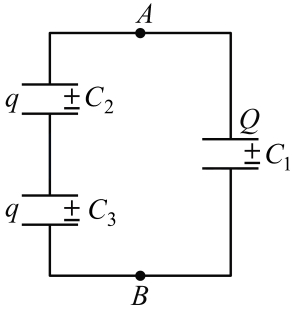
0 likesView Solution
65
PhysicsEasyMCQTS EAMCET · 2022
The equivalent capacitance between points $A$ and $B$ is
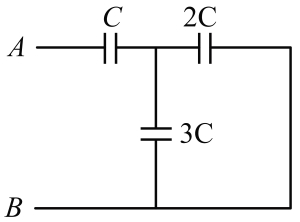
A
$\frac{5}{6} C$
B
$\frac{11}{5} C$
C
$6 C$
D
$\frac{5}{11} C$
Solution
(A) From the given circuit diagram,the capacitors $3 C$ and $2 C$ are connected in parallel between the same two nodes.
Therefore,their equivalent capacitance $C_p$ is given by:
$C_p = 3 C + 2 C = 5 C$
Now,this equivalent capacitor $C_p = 5 C$ is in series with the capacitor $C$.
The total equivalent capacitance $C_{AB}$ between points $A$ and $B$ is given by the series formula:
$C_{AB} = \frac{C \times C_p}{C + C_p} = \frac{C \times 5 C}{C + 5 C} = \frac{5 C^2}{6 C} = \frac{5}{6} C$
Therefore,their equivalent capacitance $C_p$ is given by:
$C_p = 3 C + 2 C = 5 C$
Now,this equivalent capacitor $C_p = 5 C$ is in series with the capacitor $C$.
The total equivalent capacitance $C_{AB}$ between points $A$ and $B$ is given by the series formula:
$C_{AB} = \frac{C \times C_p}{C + C_p} = \frac{C \times 5 C}{C + 5 C} = \frac{5 C^2}{6 C} = \frac{5}{6} C$
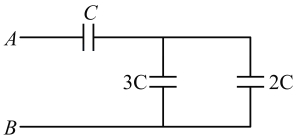
0 likesView Solution
66
PhysicsEasyMCQTS EAMCET · 2022
$A$ message signal of frequency $15 kHz$ is used to modulate a carrier of frequency $v_c$. If the side bands produced are $1515 kHz$ and $1485 kHz$,then $v_c$ is (in $MHz$)
A
$2.0$
B
$1.5$
C
$2.5$
D
$3.0$
Solution
(B) The frequencies of the side bands in amplitude modulation are given by the carrier frequency $\nu_c$ plus and minus the message signal frequency $f_m$.
Given: $f_m = 15 kHz$,Upper Side Band $(USB)$ $= 1515 kHz$,Lower Side Band $(LSB)$ $= 1485 kHz$.
The side bands are $\nu_c + f_m$ and $\nu_c - f_m$.
Therefore,$\nu_c + 15 kHz = 1515 kHz$ or $\nu_c - 15 kHz = 1485 kHz$.
Solving for $\nu_c$: $\nu_c = 1515 kHz - 15 kHz = 1500 kHz$.
Converting to $MHz$: $1500 kHz = 1.5 MHz$.
Given: $f_m = 15 kHz$,Upper Side Band $(USB)$ $= 1515 kHz$,Lower Side Band $(LSB)$ $= 1485 kHz$.
The side bands are $\nu_c + f_m$ and $\nu_c - f_m$.
Therefore,$\nu_c + 15 kHz = 1515 kHz$ or $\nu_c - 15 kHz = 1485 kHz$.
Solving for $\nu_c$: $\nu_c = 1515 kHz - 15 kHz = 1500 kHz$.
Converting to $MHz$: $1500 kHz = 1.5 MHz$.
0 likesView Solution
67
PhysicsEasyMCQTS EAMCET · 2022
The range of frequency bands used for standard $AM$ broadcast is
A
$540 – 1600 \text{ kHz}$
B
$88 – 108 \text{ MHz}$
C
$800 – 900 \text{ MHz}$
D
$3.7 – 4.2 \text{ GHz}$
Solution
(A) Standard $AM$ (Amplitude Modulation) broadcast radio operates in the Medium Frequency $(MF)$ band.
The frequency range allocated for standard $AM$ broadcasting is $540 \text{ kHz}$ to $1600 \text{ kHz}$.
Therefore,the correct option is $A$.
The frequency range allocated for standard $AM$ broadcasting is $540 \text{ kHz}$ to $1600 \text{ kHz}$.
Therefore,the correct option is $A$.
0 likesView Solution
68
PhysicsMediumMCQTS EAMCET · 2022
Which of the following statements is $NOT$ true?
A
Power radiated from a linear antenna is directly proportional to the square of antenna length.
B
Power radiated decreases with increasing frequency.
C
Antenna should have a size comparable to the wavelength of the signal.
D
Effective power radiated by a long wavelength baseband signal is small.
Solution
(B) The power $P$ radiated by a linear antenna is given by the relation $P \propto \frac{l^2}{\lambda^2}$,where $l$ is the length of the antenna and $\lambda$ is the wavelength.
Since $P \propto l^2$,statement $A$ is true.
Since $\lambda = \frac{c}{f}$,we have $P \propto \frac{l^2}{(c/f)^2} \propto f^2$. This means power radiated increases with the square of the frequency.
Therefore,statement $B$ is false because it claims power decreases with increasing frequency.
For efficient radiation,the antenna size $l$ must be comparable to the wavelength $\lambda$ (typically $l \geq \frac{\lambda}{4}$),so statement $C$ is true.
Since long wavelength signals correspond to low frequencies,the radiated power $P \propto f^2$ is very small,making statement $D$ true.
Since $P \propto l^2$,statement $A$ is true.
Since $\lambda = \frac{c}{f}$,we have $P \propto \frac{l^2}{(c/f)^2} \propto f^2$. This means power radiated increases with the square of the frequency.
Therefore,statement $B$ is false because it claims power decreases with increasing frequency.
For efficient radiation,the antenna size $l$ must be comparable to the wavelength $\lambda$ (typically $l \geq \frac{\lambda}{4}$),so statement $C$ is true.
Since long wavelength signals correspond to low frequencies,the radiated power $P \propto f^2$ is very small,making statement $D$ true.
0 likesView Solution
69
PhysicsEasyMCQTS EAMCET · 2022
$A$ carrier wave of peak voltage $10 \,V$ is used to transmit a message signal. What should be the peak voltage of the modulating signal in order to have a modulation index of $80 \%$ (in $\,V$)?
A
$8$
B
$8.8$
C
$5$
D
$12.5$
Solution
(A) The modulation index $m$ is defined as the ratio of the peak voltage of the modulating signal $(A_m)$ to the peak voltage of the carrier wave $(A_c)$.
Given:
Carrier wave peak voltage,$A_c = 10 \,V$
Modulation index,$m = 80 \% = 0.8$
Formula:
$m = \frac{A_m}{A_c}$
Substituting the values:
$0.8 = \frac{A_m}{10 \,V}$
$A_m = 0.8 \times 10 \,V = 8 \,V$
Therefore,the peak voltage of the modulating signal should be $8 \,V$.
Given:
Carrier wave peak voltage,$A_c = 10 \,V$
Modulation index,$m = 80 \% = 0.8$
Formula:
$m = \frac{A_m}{A_c}$
Substituting the values:
$0.8 = \frac{A_m}{10 \,V}$
$A_m = 0.8 \times 10 \,V = 8 \,V$
Therefore,the peak voltage of the modulating signal should be $8 \,V$.
0 likesView Solution
70
PhysicsEasyMCQTS EAMCET · 2022
For an amplitude modulated wave,the modulation index is found to be $0.5$. If the maximum amplitude is found to be $10.0 \ V$,then the minimum amplitude is: (in $V$)
A
$5.0$
B
$3.33$
C
$2.5$
D
$6.66$
Solution
(B) The modulation index $m$ for an amplitude modulated wave is given by the formula:
$m = \frac{A_{\max} - A_{\min}}{A_{\max} + A_{\min}}$
Given $m = 0.5$ and $A_{\max} = 10.0 \ V$.
Substituting the values into the formula:
$0.5 = \frac{10 - A_{\min}}{10 + A_{\min}}$
$0.5(10 + A_{\min}) = 10 - A_{\min}$
$5 + 0.5 A_{\min} = 10 - A_{\min}$
$1.5 A_{\min} = 5$
$A_{\min} = \frac{5}{1.5} = \frac{50}{15} = 3.33 \ V$.
$m = \frac{A_{\max} - A_{\min}}{A_{\max} + A_{\min}}$
Given $m = 0.5$ and $A_{\max} = 10.0 \ V$.
Substituting the values into the formula:
$0.5 = \frac{10 - A_{\min}}{10 + A_{\min}}$
$0.5(10 + A_{\min}) = 10 - A_{\min}$
$5 + 0.5 A_{\min} = 10 - A_{\min}$
$1.5 A_{\min} = 5$
$A_{\min} = \frac{5}{1.5} = \frac{50}{15} = 3.33 \ V$.
0 likesView Solution
71
PhysicsMediumMCQTS EAMCET · 2022
$A$ $TV$ transmission antenna is $40 \ m$ tall. How much service area can it cover if the receiving antenna is at the ground level? (Radius of the Earth $= 6400 \ km$)
A
$640 \pi \times 10^6 \ m^2$
B
$512 \pi \times 10^6 \ m^2$
C
$480 \pi \times 10^6 \ m^2$
D
$440 \pi \times 10^6 \ m^2$
Solution
(B) The range $(d)$ of a $TV$ transmission antenna of height $h$ is given by the formula: $d = \sqrt{2hR}$,where $R$ is the radius of the Earth.
Given: $h = 40 \ m$ and $R = 6400 \ km = 6400 \times 10^3 \ m$.
The service area covered by the antenna is the area of a circle with radius $d$,given by: $Area = \pi d^2$.
Substituting the value of $d^2 = 2hR$ into the area formula:
$Area = \pi (2hR)$
$Area = \pi \times 2 \times 40 \times (6400 \times 10^3)$
$Area = \pi \times 80 \times 6400 \times 10^3$
$Area = 512000 \times 10^3 \pi \ m^2$
$Area = 512 \times 10^6 \pi \ m^2$.
Given: $h = 40 \ m$ and $R = 6400 \ km = 6400 \times 10^3 \ m$.
The service area covered by the antenna is the area of a circle with radius $d$,given by: $Area = \pi d^2$.
Substituting the value of $d^2 = 2hR$ into the area formula:
$Area = \pi (2hR)$
$Area = \pi \times 2 \times 40 \times (6400 \times 10^3)$
$Area = \pi \times 80 \times 6400 \times 10^3$
$Area = 512000 \times 10^3 \pi \ m^2$
$Area = 512 \times 10^6 \pi \ m^2$.
0 likesView Solution
72
PhysicsMediumMCQTS EAMCET · 2022
Find the current in the three resistors as shown in the following figure.
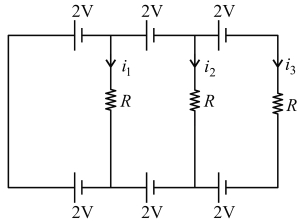
A
$i_1=0, i_2=\frac{4 V}{ R }, i_3=\frac{2 V}{ R }$
B
$i_1=0, i_2=0, i_3=0$
C
$i_1=0, i_2=\frac{2 V}{ R }, i_3=\frac{4 V}{ R }$
D
$i_1=0, i_2=\frac{2 V}{ R }, i_3=\frac{2 V}{ R }$
Solution
(B) Let the potential at point $A$ be $V_A = 0 \ V$.
Moving from $A$ to $C$ through the $2 \ V$ battery,the potential at $C$ is $V_C = 0 + 2 = 2 \ V$.
Moving from $A$ to $B$ is not direct,but looking at the bottom branch,if we assume the potential at $B$ is $0 \ V$,then moving from $B$ to $D$ through the $2 \ V$ battery gives $V_D = 0 + 2 = 2 \ V$.
The potential difference across the first resistor $R$ is $V_{CD} = V_C - V_D = 2 \ V - 2 \ V = 0 \ V$.
Thus,the current $i_1 = \frac{V_{CD}}{R} = 0$.
Similarly,for the second branch,the potential at $E$ is $V_E = V_C + 2 - 2 = 2 \ V$ and the potential at $F$ is $V_F = V_D + 2 - 2 = 2 \ V$.
Thus,$V_{EF} = 0 \ V$,so $i_2 = 0$.
Finally,for the third branch,$V_G = V_E + 2 - 2 = 2 \ V$ and $V_H = V_F + 2 - 2 = 2 \ V$.
Thus,$V_{GH} = 0 \ V$,so $i_3 = 0$.
Therefore,$i_1 = i_2 = i_3 = 0$.
Moving from $A$ to $C$ through the $2 \ V$ battery,the potential at $C$ is $V_C = 0 + 2 = 2 \ V$.
Moving from $A$ to $B$ is not direct,but looking at the bottom branch,if we assume the potential at $B$ is $0 \ V$,then moving from $B$ to $D$ through the $2 \ V$ battery gives $V_D = 0 + 2 = 2 \ V$.
The potential difference across the first resistor $R$ is $V_{CD} = V_C - V_D = 2 \ V - 2 \ V = 0 \ V$.
Thus,the current $i_1 = \frac{V_{CD}}{R} = 0$.
Similarly,for the second branch,the potential at $E$ is $V_E = V_C + 2 - 2 = 2 \ V$ and the potential at $F$ is $V_F = V_D + 2 - 2 = 2 \ V$.
Thus,$V_{EF} = 0 \ V$,so $i_2 = 0$.
Finally,for the third branch,$V_G = V_E + 2 - 2 = 2 \ V$ and $V_H = V_F + 2 - 2 = 2 \ V$.
Thus,$V_{GH} = 0 \ V$,so $i_3 = 0$.
Therefore,$i_1 = i_2 = i_3 = 0$.
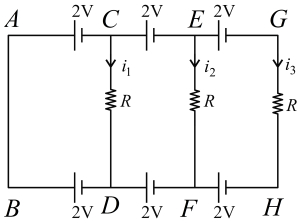
0 likesView Solution
73
PhysicsEasyMCQTS EAMCET · 2022
The resistivity of a metal is $1 \times 10^{-8} \Omega \cdot m$. If it contains $9 \times 10^{28}$ electrons per $m^3$, then the relaxation time of electrons inside the metal is nearly (electron mass $= 9 \times 10^{-31} \ kg$).
A
$4 \times 10^{-14} \ s$
B
$7 \times 10^{-14} \ s$
C
$1.0 \times 10^{-14} \ s$
D
$9 \times 10^{-14} \ s$
Solution
(A) The expression for electrical resistivity $\rho$ is given by $\rho = \frac{m}{ne^2 \tau}$.
Rearranging the formula to solve for the relaxation time $\tau$:
$\tau = \frac{m}{ne^2 \rho}$
Given values:
$m = 9 \times 10^{-31} \ kg$
$n = 9 \times 10^{28} \ m^{-3}$
$e = 1.6 \times 10^{-19} \ C$
$\rho = 1 \times 10^{-8} \ \Omega \cdot m$
Substituting these values into the equation:
$\tau = \frac{9 \times 10^{-31}}{(9 \times 10^{28}) \times (1.6 \times 10^{-19})^2 \times (1 \times 10^{-8})}$
$\tau = \frac{9 \times 10^{-31}}{9 \times 10^{28} \times 2.56 \times 10^{-38} \times 10^{-8}}$
$\tau = \frac{9 \times 10^{-31}}{23.04 \times 10^{-18}}$
$\tau \approx 0.39 \times 10^{-13} \ s = 3.9 \times 10^{-14} \ s$
Rounding to the nearest value, we get $\tau \approx 4 \times 10^{-14} \ s$.
Rearranging the formula to solve for the relaxation time $\tau$:
$\tau = \frac{m}{ne^2 \rho}$
Given values:
$m = 9 \times 10^{-31} \ kg$
$n = 9 \times 10^{28} \ m^{-3}$
$e = 1.6 \times 10^{-19} \ C$
$\rho = 1 \times 10^{-8} \ \Omega \cdot m$
Substituting these values into the equation:
$\tau = \frac{9 \times 10^{-31}}{(9 \times 10^{28}) \times (1.6 \times 10^{-19})^2 \times (1 \times 10^{-8})}$
$\tau = \frac{9 \times 10^{-31}}{9 \times 10^{28} \times 2.56 \times 10^{-38} \times 10^{-8}}$
$\tau = \frac{9 \times 10^{-31}}{23.04 \times 10^{-18}}$
$\tau \approx 0.39 \times 10^{-13} \ s = 3.9 \times 10^{-14} \ s$
Rounding to the nearest value, we get $\tau \approx 4 \times 10^{-14} \ s$.
0 likesView Solution
74
PhysicsMediumMCQTS EAMCET · 2022
$A$ cylindrical resistor of radius $7.0 \, mm$ and length $4.0 \, cm$ is made of a material that has a resistivity of $10^{-6} \, \Omega \cdot m$. If the energy is dissipated at a rate of $1.54 \, W$ in the resistor, then the current density is:
A
$\frac{10^6}{\sqrt{\pi}} \, A/m^2$
B
$5 \times 10^5 \, A/m^2$
C
$\sqrt{\pi} \times 10^5 \, A/m^2$
D
$8.5 \times 10^4 \, A/m^2$
Solution
(B) The power dissipated in a resistor is given by $P = I^2 R$, where $I$ is the current and $R$ is the resistance.
Resistance $R$ is given by $R = \rho \frac{l}{A}$, where $\rho = 10^{-6} \, \Omega \cdot m$, $l = 0.04 \, m$, and $A = \pi r^2 = \pi (7 \times 10^{-3})^2 \, m^2$.
Substituting $R$ in the power equation: $P = I^2 \left( \frac{\rho l}{A} \right) \Rightarrow I = \sqrt{\frac{P A}{\rho l}}$.
Current density $J$ is defined as $J = \frac{I}{A}$.
Substituting $I$: $J = \frac{1}{A} \sqrt{\frac{P A}{\rho l}} = \sqrt{\frac{P}{\rho l A}}$.
Substituting the values: $J = \sqrt{\frac{1.54}{10^{-6} \times 0.04 \times \pi \times (7 \times 10^{-3})^2}}$.
$J = \sqrt{\frac{1.54}{10^{-6} \times 0.04 \times \pi \times 49 \times 10^{-6}}} = \sqrt{\frac{1.54}{1.96 \times 10^{-9} \times \pi}} \approx 5 \times 10^5 \, A/m^2$.
Resistance $R$ is given by $R = \rho \frac{l}{A}$, where $\rho = 10^{-6} \, \Omega \cdot m$, $l = 0.04 \, m$, and $A = \pi r^2 = \pi (7 \times 10^{-3})^2 \, m^2$.
Substituting $R$ in the power equation: $P = I^2 \left( \frac{\rho l}{A} \right) \Rightarrow I = \sqrt{\frac{P A}{\rho l}}$.
Current density $J$ is defined as $J = \frac{I}{A}$.
Substituting $I$: $J = \frac{1}{A} \sqrt{\frac{P A}{\rho l}} = \sqrt{\frac{P}{\rho l A}}$.
Substituting the values: $J = \sqrt{\frac{1.54}{10^{-6} \times 0.04 \times \pi \times (7 \times 10^{-3})^2}}$.
$J = \sqrt{\frac{1.54}{10^{-6} \times 0.04 \times \pi \times 49 \times 10^{-6}}} = \sqrt{\frac{1.54}{1.96 \times 10^{-9} \times \pi}} \approx 5 \times 10^5 \, A/m^2$.
0 likesView Solution
75
PhysicsMediumMCQTS EAMCET · 2022
Statement $(I)$: The temperature coefficient of resistance for most metals in pure form is positive.
Statement $(II)$: $A$ metal wire $2 \ mm$ in diameter carries a charge of $360 \pi \ C$ in two hours. If the metal contains $5 \times 10^{22}$ free electrons $/ cm^3$, then the drift velocity of the electrons in the wire is $6.25 \times 10^{-6} \ m/s$.
Statement $(III)$: Semiconductors like pure germanium do not obey Ohm's law for all ranges of electric field values. Which of the following is correct?
Statement $(II)$: $A$ metal wire $2 \ mm$ in diameter carries a charge of $360 \pi \ C$ in two hours. If the metal contains $5 \times 10^{22}$ free electrons $/ cm^3$, then the drift velocity of the electrons in the wire is $6.25 \times 10^{-6} \ m/s$.
Statement $(III)$: Semiconductors like pure germanium do not obey Ohm's law for all ranges of electric field values. Which of the following is correct?
A
Statements $I, II, III$ are true.
B
Statements $I, II$ are true, but statement $III$ is false.
C
Statements $II, III$ are true, but statement $I$ is false.
D
Statements $I, II, III$ are false.
Solution
(A) Statement $(I)$: For most pure metals, the resistance increases with temperature, making the temperature coefficient of resistance positive. Thus, $(I)$ is true.
Statement $(II)$: Given diameter $d = 2 \ mm$, radius $r = 1 \ mm = 10^{-3} \ m$. Area $A = \pi r^2 = \pi \times (10^{-3})^2 = \pi \times 10^{-6} \ m^2$. Charge $q = 360 \pi \ C$, time $t = 2 \ hours = 7200 \ s$. Current $i = q/t = 360 \pi / 7200 = \pi / 20 \ A$. Electron density $n = 5 \times 10^{22} \ cm^{-3} = 5 \times 10^{28} \ m^{-3}$. Drift velocity $v_d = i / (neA) = (\pi / 20) / (5 \times 10^{28} \times 1.6 \times 10^{-19} \times \pi \times 10^{-6}) = 1 / (20 \times 5 \times 1.6 \times 10^3) = 1 / (160000) = 6.25 \times 10^{-6} \ m/s$. Thus, $(II)$ is true.
Statement $(III)$: Semiconductors are non-ohmic conductors; they do not follow a linear $V-I$ relationship for all electric field values. Thus, $(III)$ is true.
Statement $(II)$: Given diameter $d = 2 \ mm$, radius $r = 1 \ mm = 10^{-3} \ m$. Area $A = \pi r^2 = \pi \times (10^{-3})^2 = \pi \times 10^{-6} \ m^2$. Charge $q = 360 \pi \ C$, time $t = 2 \ hours = 7200 \ s$. Current $i = q/t = 360 \pi / 7200 = \pi / 20 \ A$. Electron density $n = 5 \times 10^{22} \ cm^{-3} = 5 \times 10^{28} \ m^{-3}$. Drift velocity $v_d = i / (neA) = (\pi / 20) / (5 \times 10^{28} \times 1.6 \times 10^{-19} \times \pi \times 10^{-6}) = 1 / (20 \times 5 \times 1.6 \times 10^3) = 1 / (160000) = 6.25 \times 10^{-6} \ m/s$. Thus, $(II)$ is true.
Statement $(III)$: Semiconductors are non-ohmic conductors; they do not follow a linear $V-I$ relationship for all electric field values. Thus, $(III)$ is true.
0 likesView Solution
76
PhysicsMediumMCQTS EAMCET · 2022
Find the mobility of an electron in a wire if its average collision time is $9.1 \times 10^{-15} \,s$. (Charge of electron $= 1.6 \times 10^{-19} \,C$ and mass of electron $= 9.1 \times 10^{-31} \,kg$)
A
$9.1 \times 10^{-3} \,m^2/V \cdot s$
B
$1.6 \times 10^{-3} \,m^2/V \cdot s$
C
$1.75 \times 10^{-3} \,m^2/V \cdot s$
D
$1 \times 10^{-3} \,m^2/V \cdot s$
Solution
(B) The mobility $\mu$ of an electron is defined as the ratio of drift velocity $V_d$ to the electric field $E$,given by the formula: $\mu = \frac{V_d}{E} = \frac{e \tau}{m}$.
Given values are:
Charge of electron $e = 1.6 \times 10^{-19} \,C$
Mass of electron $m = 9.1 \times 10^{-31} \,kg$
Average collision time (relaxation time) $\tau = 9.1 \times 10^{-15} \,s$.
Substituting these values into the formula:
$\mu = \frac{(1.6 \times 10^{-19} \,C) \times (9.1 \times 10^{-15} \,s)}{9.1 \times 10^{-31} \,kg}$
$\mu = \frac{1.6 \times 10^{-19} \times 9.1 \times 10^{-15}}{9.1 \times 10^{-31}}$
$\mu = 1.6 \times 10^{-19 - 15 + 31} \,m^2/V \cdot s$
$\mu = 1.6 \times 10^{-3} \,m^2/V \cdot s$.
Given values are:
Charge of electron $e = 1.6 \times 10^{-19} \,C$
Mass of electron $m = 9.1 \times 10^{-31} \,kg$
Average collision time (relaxation time) $\tau = 9.1 \times 10^{-15} \,s$.
Substituting these values into the formula:
$\mu = \frac{(1.6 \times 10^{-19} \,C) \times (9.1 \times 10^{-15} \,s)}{9.1 \times 10^{-31} \,kg}$
$\mu = \frac{1.6 \times 10^{-19} \times 9.1 \times 10^{-15}}{9.1 \times 10^{-31}}$
$\mu = 1.6 \times 10^{-19 - 15 + 31} \,m^2/V \cdot s$
$\mu = 1.6 \times 10^{-3} \,m^2/V \cdot s$.
0 likesView Solution
77
PhysicsMediumMCQTS EAMCET · 2022
Balancing point of a potentiometer shifts from a length of $60 \ cm$ to $40 \ cm$ by shunting the cell with a $4 \ \Omega$ resistance. What is the internal resistance of the cell (in $Omega$)?
A
$1$
B
$2$
C
$4$
D
$6$
Solution
(B) Let the potential gradient of the potentiometer wire be $\alpha$.
In the first case,the cell is in an open circuit,so the balancing length $l_1 = 60 \ cm = 0.6 \ m$ corresponds to the $EMF$ $\varepsilon$ of the cell:
$\varepsilon = \alpha \times 0.6 \quad \dots(1)$
In the second case,the cell is shunted with an external resistance $R = 4 \ \Omega$. The terminal potential difference $V$ is balanced,where $V = \varepsilon - Ir = \varepsilon \left( \frac{R}{R+r} \right)$.
The new balancing length is $l_2 = 40 \ cm = 0.4 \ m$,so:
$V = \alpha \times 0.4 \quad \dots(2)$
Dividing equation $(2)$ by equation $(1)$:
$\frac{V}{\varepsilon} = \frac{\alpha \times 0.4}{\alpha \times 0.6} = \frac{2}{3}$
Since $\frac{V}{\varepsilon} = \frac{R}{R+r}$,we have:
$\frac{4}{4+r} = \frac{2}{3}$
$12 = 8 + 2r$
$2r = 4$
$r = 2 \ \Omega$
Thus,the internal resistance of the cell is $2 \ \Omega$.
In the first case,the cell is in an open circuit,so the balancing length $l_1 = 60 \ cm = 0.6 \ m$ corresponds to the $EMF$ $\varepsilon$ of the cell:
$\varepsilon = \alpha \times 0.6 \quad \dots(1)$
In the second case,the cell is shunted with an external resistance $R = 4 \ \Omega$. The terminal potential difference $V$ is balanced,where $V = \varepsilon - Ir = \varepsilon \left( \frac{R}{R+r} \right)$.
The new balancing length is $l_2 = 40 \ cm = 0.4 \ m$,so:
$V = \alpha \times 0.4 \quad \dots(2)$
Dividing equation $(2)$ by equation $(1)$:
$\frac{V}{\varepsilon} = \frac{\alpha \times 0.4}{\alpha \times 0.6} = \frac{2}{3}$
Since $\frac{V}{\varepsilon} = \frac{R}{R+r}$,we have:
$\frac{4}{4+r} = \frac{2}{3}$
$12 = 8 + 2r$
$2r = 4$
$r = 2 \ \Omega$
Thus,the internal resistance of the cell is $2 \ \Omega$.
0 likesView Solution
78
PhysicsEasyMCQTS EAMCET · 2022
$A$ metal wire of length $L$ and radius $r$ has a resistance $R$. If a wire of the same metal of length $2L$ and radius $3r$ is taken,then what will be its resistance?
A
$\frac{2}{9} R$
B
$\frac{2}{3} R$
C
$\frac{2}{9 \pi} R$
D
$\frac{2}{3 \pi} R$
Solution
(A) The resistance of a wire is given by the formula $R = \rho \frac{L}{A}$,where $\rho$ is the resistivity,$L$ is the length,and $A$ is the cross-sectional area.
Since the cross-section is circular,$A = \pi r^2$.
For the first wire: $R = \rho \frac{L}{\pi r^2} \quad (1)$
For the second wire: $L_2 = 2L$ and $r_2 = 3r$.
The new resistance $R_2 = \rho \frac{2L}{\pi (3r)^2} = \rho \frac{2L}{9 \pi r^2} \quad (2)$
Dividing equation $(2)$ by equation $(1)$:
$\frac{R_2}{R} = \frac{\rho \frac{2L}{9 \pi r^2}}{\rho \frac{L}{\pi r^2}} = \frac{2}{9}$
Therefore,$R_2 = \frac{2}{9} R$.
Since the cross-section is circular,$A = \pi r^2$.
For the first wire: $R = \rho \frac{L}{\pi r^2} \quad (1)$
For the second wire: $L_2 = 2L$ and $r_2 = 3r$.
The new resistance $R_2 = \rho \frac{2L}{\pi (3r)^2} = \rho \frac{2L}{9 \pi r^2} \quad (2)$
Dividing equation $(2)$ by equation $(1)$:
$\frac{R_2}{R} = \frac{\rho \frac{2L}{9 \pi r^2}}{\rho \frac{L}{\pi r^2}} = \frac{2}{9}$
Therefore,$R_2 = \frac{2}{9} R$.
0 likesView Solution
79
PhysicsEasyMCQTS EAMCET · 2022
$A$ cylindrical metallic wire is stretched to increase its length in such a way that the metallic wire changes its resistance by $6\%$. The percentage increase in its length is (in $\%$)
A
$2$
B
$4$
C
$3$
D
$12$
Solution
(C) The resistance of a uniform wire is given by $R = \frac{\rho L}{A}$.
Since the volume $V = AL$ remains constant during stretching,we have $A = \frac{V}{L}$.
Substituting this into the resistance formula,we get $R = \frac{\rho L}{(V/L)} = \left(\frac{\rho}{V}\right) L^2$.
Since $\rho$ and $V$ are constant,$R \propto L^2$.
For small percentage changes,we can use the relation $\frac{\Delta R}{R} = 2 \frac{\Delta L}{L}$.
Given $\frac{\Delta R}{R} \times 100 = 6\%$,we substitute this into the equation:
$6\% = 2 \times \left(\frac{\Delta L}{L} \times 100\right)$.
Therefore,the percentage increase in length is $\frac{\Delta L}{L} \times 100 = \frac{6\%}{2} = 3\%$.
Since the volume $V = AL$ remains constant during stretching,we have $A = \frac{V}{L}$.
Substituting this into the resistance formula,we get $R = \frac{\rho L}{(V/L)} = \left(\frac{\rho}{V}\right) L^2$.
Since $\rho$ and $V$ are constant,$R \propto L^2$.
For small percentage changes,we can use the relation $\frac{\Delta R}{R} = 2 \frac{\Delta L}{L}$.
Given $\frac{\Delta R}{R} \times 100 = 6\%$,we substitute this into the equation:
$6\% = 2 \times \left(\frac{\Delta L}{L} \times 100\right)$.
Therefore,the percentage increase in length is $\frac{\Delta L}{L} \times 100 = \frac{6\%}{2} = 3\%$.
0 likesView Solution
80
PhysicsEasyMCQTS EAMCET · 2022
Statement $(I)$: Specific resistance depends on the nature of the material and is independent of the temperature of the material.
Statement $(II)$: $A$ wire of resistance $6 \ \Omega$ is drawn out so that its new length is four times its original length. The resistance of the new wire is $48 \ \Omega$.
Statement $(III)$: Drift velocity is the average constant velocity acquired by free electrons inside a metal by the application of an electric field,which results in current.
Which of the following is correct?
Statement $(II)$: $A$ wire of resistance $6 \ \Omega$ is drawn out so that its new length is four times its original length. The resistance of the new wire is $48 \ \Omega$.
Statement $(III)$: Drift velocity is the average constant velocity acquired by free electrons inside a metal by the application of an electric field,which results in current.
Which of the following is correct?
A
Statements $I, II$ and $III$ are true
B
Statement $I$ is true,but statements $II, III$ are false
C
Statement $III$ is true,but statements $I, II$ are false
D
Statements $II, III$ are true,but statement $I$ is false
Solution
(C) Specific resistance (resistivity) depends on both the temperature and the nature of the material. Therefore,Statement $(I)$ is incorrect.
When a wire is stretched to $n$ times its original length,its new resistance $R'$ becomes $n^2 R$. Here,$n = 4$ and $R = 6 \ \Omega$,so $R' = 4^2 \times 6 = 16 \times 6 = 96 \ \Omega$. Therefore,Statement $(II)$ is incorrect.
Drift velocity is defined as the average velocity with which free electrons get drifted in the direction opposite to the applied electric field. Therefore,Statement $(III)$ is correct.
Thus,only Statement $(III)$ is true.
When a wire is stretched to $n$ times its original length,its new resistance $R'$ becomes $n^2 R$. Here,$n = 4$ and $R = 6 \ \Omega$,so $R' = 4^2 \times 6 = 16 \times 6 = 96 \ \Omega$. Therefore,Statement $(II)$ is incorrect.
Drift velocity is defined as the average velocity with which free electrons get drifted in the direction opposite to the applied electric field. Therefore,Statement $(III)$ is correct.
Thus,only Statement $(III)$ is true.
0 likesView Solution
81
PhysicsEasyMCQTS EAMCET · 2022
The current density in a circular wire is given by $J(r) = (1 \times 10^5 \text{ A/m}^3) r$,where $r$ is the radial distance and the wire's radius is $2 \text{ mm}$. If the potential applied across the wire is $70 \text{ V}$,then the energy consumed by the wire in $1000 \text{ s}$ is:
A
$25 \text{ kJ}$
B
$37 \pi \text{ kJ}$
C
$18 \pi \text{ kJ}$
D
$88 \text{ kJ}$
Solution
(B) The total current $I$ flowing through the wire is given by the integral of current density $J$ over the cross-sectional area $A$: $I = \int J \, dA$.
Since the wire is circular,$dA = 2 \pi r \, dr$.
$I = \int_0^{R} J(r) \cdot 2 \pi r \, dr$,where $R = 2 \times 10^{-3} \text{ m}$.
$I = \int_0^{2 \times 10^{-3}} (10^5 r) \cdot (2 \pi r) \, dr = 2 \pi \times 10^5 \int_0^{2 \times 10^{-3}} r^2 \, dr$.
$I = 2 \pi \times 10^5 \left[ \frac{r^3}{3} \right]_0^{2 \times 10^{-3}} = 2 \pi \times 10^5 \times \frac{8 \times 10^{-9}}{3} = \frac{16 \pi}{3} \times 10^{-4} \text{ A}$.
The energy consumed $E$ is given by $E = V \cdot I \cdot t$.
$E = 70 \text{ V} \times \left( \frac{16 \pi}{3} \times 10^{-4} \text{ A} \right) \times 1000 \text{ s}$.
$E = 70 \times \frac{16 \pi}{3} \times 10^{-1} = \frac{1120 \pi}{30} = \frac{112}{3} \pi \approx 37.33 \pi \text{ J}$.
Given the options,the closest value is $37 \pi \text{ J}$ (Note: The unit in the provided options appears to be in Joules,not kJ).
Since the wire is circular,$dA = 2 \pi r \, dr$.
$I = \int_0^{R} J(r) \cdot 2 \pi r \, dr$,where $R = 2 \times 10^{-3} \text{ m}$.
$I = \int_0^{2 \times 10^{-3}} (10^5 r) \cdot (2 \pi r) \, dr = 2 \pi \times 10^5 \int_0^{2 \times 10^{-3}} r^2 \, dr$.
$I = 2 \pi \times 10^5 \left[ \frac{r^3}{3} \right]_0^{2 \times 10^{-3}} = 2 \pi \times 10^5 \times \frac{8 \times 10^{-9}}{3} = \frac{16 \pi}{3} \times 10^{-4} \text{ A}$.
The energy consumed $E$ is given by $E = V \cdot I \cdot t$.
$E = 70 \text{ V} \times \left( \frac{16 \pi}{3} \times 10^{-4} \text{ A} \right) \times 1000 \text{ s}$.
$E = 70 \times \frac{16 \pi}{3} \times 10^{-1} = \frac{1120 \pi}{30} = \frac{112}{3} \pi \approx 37.33 \pi \text{ J}$.
Given the options,the closest value is $37 \pi \text{ J}$ (Note: The unit in the provided options appears to be in Joules,not kJ).
0 likesView Solution
82
PhysicsEasyMCQTS EAMCET · 2022
The de-Broglie wavelength associated with an electron,accelerated through a potential difference of $121 \ V$ is about:
[Take Planck's constant $h = 6.6 \times 10^{-34} \ J \cdot s$,mass of electron $m = 9 \times 10^{-31} \ kg$,charge of electron $e = 1.6 \times 10^{-19} \ C$] (in $nm$)
[Take Planck's constant $h = 6.6 \times 10^{-34} \ J \cdot s$,mass of electron $m = 9 \times 10^{-31} \ kg$,charge of electron $e = 1.6 \times 10^{-19} \ C$] (in $nm$)
A
$0.123$
B
$0.112$
C
$0.221$
D
$0.098$
Solution
(B) The de-Broglie wavelength $\lambda$ of an electron accelerated through a potential difference $V$ is given by the formula:
$\lambda = \frac{h}{\sqrt{2meV}}$
Given:
$h = 6.6 \times 10^{-34} \ J \cdot s$
$m = 9 \times 10^{-31} \ kg$
$e = 1.6 \times 10^{-19} \ C$
$V = 121 \ V$
Substituting the values:
$\lambda = \frac{6.6 \times 10^{-34}}{\sqrt{2 \times 9 \times 10^{-31} \times 1.6 \times 10^{-19} \times 121}}$
$\lambda = \frac{6.6 \times 10^{-34}}{\sqrt{3484.8 \times 10^{-50}}}$
$\lambda = \frac{6.6 \times 10^{-34}}{59.03 \times 10^{-25}}$
$\lambda \approx 0.1118 \times 10^{-9} \ m = 0.112 \ nm$
Thus,the correct option is $B$.
$\lambda = \frac{h}{\sqrt{2meV}}$
Given:
$h = 6.6 \times 10^{-34} \ J \cdot s$
$m = 9 \times 10^{-31} \ kg$
$e = 1.6 \times 10^{-19} \ C$
$V = 121 \ V$
Substituting the values:
$\lambda = \frac{6.6 \times 10^{-34}}{\sqrt{2 \times 9 \times 10^{-31} \times 1.6 \times 10^{-19} \times 121}}$
$\lambda = \frac{6.6 \times 10^{-34}}{\sqrt{3484.8 \times 10^{-50}}}$
$\lambda = \frac{6.6 \times 10^{-34}}{59.03 \times 10^{-25}}$
$\lambda \approx 0.1118 \times 10^{-9} \ m = 0.112 \ nm$
Thus,the correct option is $B$.
0 likesView Solution
83
PhysicsEasyMCQTS EAMCET · 2022
Which of the following has the largest de Broglie wavelength?
A
$A$ bullet of mass $0.02 \ kg$ moving with speed $1 \ km/s$
B
$A$ ball of mass $0.06 \ kg$ moving with speed $10 \ m/s$
C
$A$ particle of mass $0.01 \ kg$ moving with speed $100 \ m/s$
D
$A$ ball of mass $0.03 \ kg$ moving with speed $1 \ m/s$
Solution
(D) The de Broglie wavelength is given by the formula $\lambda = \frac{h}{mv}$,where $h$ is Planck's constant,$m$ is the mass,and $v$ is the velocity.
Since $\lambda \propto \frac{1}{mv}$,the particle with the smallest momentum $(mv)$ will have the largest de Broglie wavelength.
Calculating momentum $(p = mv)$ for each case:
$A$: $p = 0.02 \ kg \times 1000 \ m/s = 20 \ kg \cdot m/s$
$B$: $p = 0.06 \ kg \times 10 \ m/s = 0.6 \ kg \cdot m/s$
$C$: $p = 0.01 \ kg \times 100 \ m/s = 1 \ kg \cdot m/s$
$D$: $p = 0.03 \ kg \times 1 \ m/s = 0.03 \ kg \cdot m/s$
Comparing the values,the momentum in option $D$ is the smallest $(0.03 \ kg \cdot m/s)$.
Therefore,the ball in option $D$ has the largest de Broglie wavelength.
Since $\lambda \propto \frac{1}{mv}$,the particle with the smallest momentum $(mv)$ will have the largest de Broglie wavelength.
Calculating momentum $(p = mv)$ for each case:
$A$: $p = 0.02 \ kg \times 1000 \ m/s = 20 \ kg \cdot m/s$
$B$: $p = 0.06 \ kg \times 10 \ m/s = 0.6 \ kg \cdot m/s$
$C$: $p = 0.01 \ kg \times 100 \ m/s = 1 \ kg \cdot m/s$
$D$: $p = 0.03 \ kg \times 1 \ m/s = 0.03 \ kg \cdot m/s$
Comparing the values,the momentum in option $D$ is the smallest $(0.03 \ kg \cdot m/s)$.
Therefore,the ball in option $D$ has the largest de Broglie wavelength.
0 likesView Solution
84
PhysicsEasyMCQTS EAMCET · 2022
The shortest wavelength in the Balmer series of the hydrogen atom spectrum is approximately equal to (use $R_{H} = 1.097 \times 10^7 \ \text{m}^{-1}$) (in $\text{Å}$)
A
$3646$
B
$912$
C
$364.6$
D
$91.2$
Solution
(A) For the shortest wavelength in the Balmer series, the transition occurs from $n_{i} = \infty$ to $n_{f} = 2$.
Using the Rydberg formula: $\frac{1}{\lambda} = R_{H} \left( \frac{1}{n_{f}^2} - \frac{1}{n_{i}^2} \right)$.
Substituting the values: $\frac{1}{\lambda} = 1.097 \times 10^7 \left( \frac{1}{2^2} - \frac{1}{\infty^2} \right)$.
$\frac{1}{\lambda} = 1.097 \times 10^7 \times \frac{1}{4} = 2742500 \ \text{m}^{-1}$.
$\lambda = \frac{1}{2742500} \ \text{m} \approx 3.646 \times 10^{-7} \ \text{m}$.
Converting to $\text{Å}$: $\lambda = 3.646 \times 10^{-7} \times 10^{10} \ \text{Å} = 3646 \ \text{Å}$.
Using the Rydberg formula: $\frac{1}{\lambda} = R_{H} \left( \frac{1}{n_{f}^2} - \frac{1}{n_{i}^2} \right)$.
Substituting the values: $\frac{1}{\lambda} = 1.097 \times 10^7 \left( \frac{1}{2^2} - \frac{1}{\infty^2} \right)$.
$\frac{1}{\lambda} = 1.097 \times 10^7 \times \frac{1}{4} = 2742500 \ \text{m}^{-1}$.
$\lambda = \frac{1}{2742500} \ \text{m} \approx 3.646 \times 10^{-7} \ \text{m}$.
Converting to $\text{Å}$: $\lambda = 3.646 \times 10^{-7} \times 10^{10} \ \text{Å} = 3646 \ \text{Å}$.
0 likesView Solution
85
PhysicsEasyMCQTS EAMCET · 2022
Which of the following statements is $NOT$ true?
A
Electromagnetic radiation is made up of particles called photons
B
Each photon moves with the speed of light
C
Photon energy is dependent on the intensity of radiation
D
Photons are not deflected by electric and magnetic field
Solution
(C) photon is a quantum of electromagnetic radiation. According to the quantum theory of light, the energy of a photon is given by $E = h\nu$, where $h$ is Planck's constant and $\nu$ is the frequency of the radiation.
Since the energy depends only on the frequency, statement $C$ is incorrect because it claims energy depends on intensity.
Photons are massless particles that travel at the speed of light $(c \approx 3 \times 10^8 \ m/s)$.
Because photons are electrically neutral, they do not experience any force in electric or magnetic fields, meaning they are not deflected by them.
Since the energy depends only on the frequency, statement $C$ is incorrect because it claims energy depends on intensity.
Photons are massless particles that travel at the speed of light $(c \approx 3 \times 10^8 \ m/s)$.
Because photons are electrically neutral, they do not experience any force in electric or magnetic fields, meaning they are not deflected by them.
0 likesView Solution
86
PhysicsMediumMCQTS EAMCET · 2022
For the photoelectric effect,which of the following statements are true?
$I$ The kinetic energies of the photoelectrons do not depend on the frequency of light.
$II$ The photoelectric effect will always occur for highly intense light.
$III$ The maximum kinetic energy of a photoelectron does not depend upon the intensity of the light.
$IV$ The escaping electron's kinetic energy is larger for a larger frequency.
$I$ The kinetic energies of the photoelectrons do not depend on the frequency of light.
$II$ The photoelectric effect will always occur for highly intense light.
$III$ The maximum kinetic energy of a photoelectron does not depend upon the intensity of the light.
$IV$ The escaping electron's kinetic energy is larger for a larger frequency.
A
$I$ and $II$ only
B
$II$ and $III$ only
C
$III$ and $IV$ only
D
$IV$ and $I$ only
Solution
(C) According to Einstein's photoelectric equation,the maximum kinetic energy $(K_{\max})$ of emitted photoelectrons is given by $K_{\max} = h\nu - \phi$,where $h$ is Planck's constant,$\nu$ is the frequency of incident light,and $\phi$ is the work function of the metal.
$1$. Statement $I$ is incorrect because $K_{\max}$ depends directly on the frequency $\nu$.
$2$. Statement $II$ is incorrect because the photoelectric effect depends on the frequency of light being greater than the threshold frequency $(\nu_0)$,regardless of intensity.
$3$. Statement $III$ is correct because $K_{\max}$ depends only on the frequency of incident light,not on its intensity.
$4$. Statement $IV$ is correct because as frequency $\nu$ increases,$K_{\max} = h\nu - \phi$ also increases.
Thus,statements $III$ and $IV$ are correct.
$1$. Statement $I$ is incorrect because $K_{\max}$ depends directly on the frequency $\nu$.
$2$. Statement $II$ is incorrect because the photoelectric effect depends on the frequency of light being greater than the threshold frequency $(\nu_0)$,regardless of intensity.
$3$. Statement $III$ is correct because $K_{\max}$ depends only on the frequency of incident light,not on its intensity.
$4$. Statement $IV$ is correct because as frequency $\nu$ increases,$K_{\max} = h\nu - \phi$ also increases.
Thus,statements $III$ and $IV$ are correct.
0 likesView Solution
87
PhysicsEasyMCQTS EAMCET · 2022
The value of Planck's constant,if the slope of the graph of stopping potential vs frequency of incident light is $4 \times 10^{-15} \ V \ s$,is (given charge of an electron $= 1.6 \times 10^{-19} \ C$):
A
$6.0 \times 10^{-34} \ J \ s$
B
$6.2 \times 10^{-34} \ J \ s$
C
$6.4 \times 10^{-34} \ J \ s$
D
$6.6 \times 10^{-34} \ J \ s$
Solution
(C) From Einstein's photoelectric equation,the stopping potential $V_s$ is related to the frequency $\nu$ as:
$e V_s = h \nu - \phi$
Rearranging for $V_s$,we get:
$V_s = \left( \frac{h}{e} \right) \nu - \frac{\phi}{e}$
This is a linear equation of the form $y = mx + c$,where the slope $m = \frac{h}{e}$.
Given that the slope is $4 \times 10^{-15} \ V \ s$,we have:
$\frac{h}{e} = 4 \times 10^{-15} \ V \ s$
$h = (4 \times 10^{-15} \ V \ s) \times (1.6 \times 10^{-19} \ C)$
$h = 6.4 \times 10^{-34} \ J \ s$
Thus,the value of Planck's constant is $6.4 \times 10^{-34} \ J \ s$.
$e V_s = h \nu - \phi$
Rearranging for $V_s$,we get:
$V_s = \left( \frac{h}{e} \right) \nu - \frac{\phi}{e}$
This is a linear equation of the form $y = mx + c$,where the slope $m = \frac{h}{e}$.
Given that the slope is $4 \times 10^{-15} \ V \ s$,we have:
$\frac{h}{e} = 4 \times 10^{-15} \ V \ s$
$h = (4 \times 10^{-15} \ V \ s) \times (1.6 \times 10^{-19} \ C)$
$h = 6.4 \times 10^{-34} \ J \ s$
Thus,the value of Planck's constant is $6.4 \times 10^{-34} \ J \ s$.
0 likesView Solution
88
PhysicsEasyMCQTS EAMCET · 2022
Light strikes a metal surface causing photoelectric emission. The wavelength of incident light is $248 \, nm$. If the stopping potential for the ejected electrons is $2.8 \, eV$, then the work function of the metal is (Take $hc = 1240 \, eV \cdot nm$). (in $ \, eV$)
A
$5.2$
B
$4.4$
C
$3.8$
D
$2.2$
Solution
(D) According to Einstein's photoelectric equation, the maximum kinetic energy $(K.E._{max})$ of the emitted electrons is given by:
$K.E._{max} = E - W$
where $E$ is the energy of the incident photon and $W$ is the work function of the metal.
The energy of the incident photon is:
$E = \frac{hc}{\lambda} = \frac{1240 \, eV \cdot nm}{248 \, nm} = 5.0 \, eV$
The maximum kinetic energy is related to the stopping potential $(V_s)$ by:
$K.E._{max} = e V_s = 2.8 \, eV$
Substituting these values into the photoelectric equation:
$2.8 \, eV = 5.0 \, eV - W$
$W = 5.0 \, eV - 2.8 \, eV$
$W = 2.2 \, eV$
Thus, the work function of the metal is $2.2 \, eV$.
$K.E._{max} = E - W$
where $E$ is the energy of the incident photon and $W$ is the work function of the metal.
The energy of the incident photon is:
$E = \frac{hc}{\lambda} = \frac{1240 \, eV \cdot nm}{248 \, nm} = 5.0 \, eV$
The maximum kinetic energy is related to the stopping potential $(V_s)$ by:
$K.E._{max} = e V_s = 2.8 \, eV$
Substituting these values into the photoelectric equation:
$2.8 \, eV = 5.0 \, eV - W$
$W = 5.0 \, eV - 2.8 \, eV$
$W = 2.2 \, eV$
Thus, the work function of the metal is $2.2 \, eV$.
0 likesView Solution
89
PhysicsEasyMCQTS EAMCET · 2022
About $20 \%$ of the power of a $100 \ W$ bulb is converted to visible radiation. Assuming that the radiation is emitted isotropically and neglecting reflection,the average intensity of visible radiation at a distance of $5 \ m$ is $\frac{\alpha}{25 \pi} \ W/m^2$. The value of $\alpha$ is
A
$15$
B
$5$
C
$37.5$
D
$30$
Solution
(B) The total power of the bulb is $P_{total} = 100 \ W$.
Since $20 \%$ of the power is converted to visible radiation,the power of visible radiation $P_{vis}$ is:
$P_{vis} = 100 \ W \times \frac{20}{100} = 20 \ W$.
The intensity $I$ of radiation emitted isotropically at a distance $r$ from a point source is given by the formula:
$I = \frac{P_{vis}}{4 \pi r^2}$.
Given $r = 5 \ m$,we substitute the values:
$I = \frac{20}{4 \pi \times (5)^2} = \frac{20}{4 \pi \times 25} = \frac{5}{25 \pi} \ W/m^2$.
Comparing this with the given expression $\frac{\alpha}{25 \pi} \ W/m^2$,we find that $\alpha = 5$.
Since $20 \%$ of the power is converted to visible radiation,the power of visible radiation $P_{vis}$ is:
$P_{vis} = 100 \ W \times \frac{20}{100} = 20 \ W$.
The intensity $I$ of radiation emitted isotropically at a distance $r$ from a point source is given by the formula:
$I = \frac{P_{vis}}{4 \pi r^2}$.
Given $r = 5 \ m$,we substitute the values:
$I = \frac{20}{4 \pi \times (5)^2} = \frac{20}{4 \pi \times 25} = \frac{5}{25 \pi} \ W/m^2$.
Comparing this with the given expression $\frac{\alpha}{25 \pi} \ W/m^2$,we find that $\alpha = 5$.
0 likesView Solution
90
PhysicsEasyMCQTS EAMCET · 2022
The de-Broglie wavelength of an electron with kinetic energy of $320 eV$ is (Take $h = 6.0 \times 10^{-34} \text{ SI unit}$, mass of electron $m_{e} = 9.0 \times 10^{-31} \text{ kg}$, charge of an electron $e = 1.6 \times 10^{-19} \text{ C}$). (in $pm$)
A
$85.8$
B
$110.5$
C
$62.5$
D
$50$
Solution
(C) The de-Broglie wavelength $\lambda$ is given by the formula: $\lambda = \frac{h}{p} = \frac{h}{\sqrt{2 m_{e} K}}$, where $K$ is the kinetic energy.
Given: $h = 6.0 \times 10^{-34} \text{ J s}$, $m_{e} = 9.0 \times 10^{-31} \text{ kg}$, $K = 320 \text{ eV} = 320 \times 1.6 \times 10^{-19} \text{ J}$.
Substituting the values:
$\lambda = \frac{6.0 \times 10^{-34}}{\sqrt{2 \times 9.0 \times 10^{-31} \times 320 \times 1.6 \times 10^{-19}}}$
$\lambda = \frac{6.0 \times 10^{-34}}{\sqrt{18 \times 10^{-31} \times 512 \times 10^{-19}}}$
$\lambda = \frac{6.0 \times 10^{-34}}{\sqrt{9216 \times 10^{-50}}}$
$\lambda = \frac{6.0 \times 10^{-34}}{96 \times 10^{-25}}$
$\lambda = 0.0625 \times 10^{-9} \text{ m} = 62.5 \times 10^{-12} \text{ m} = 62.5 \text{ pm}$.
Given: $h = 6.0 \times 10^{-34} \text{ J s}$, $m_{e} = 9.0 \times 10^{-31} \text{ kg}$, $K = 320 \text{ eV} = 320 \times 1.6 \times 10^{-19} \text{ J}$.
Substituting the values:
$\lambda = \frac{6.0 \times 10^{-34}}{\sqrt{2 \times 9.0 \times 10^{-31} \times 320 \times 1.6 \times 10^{-19}}}$
$\lambda = \frac{6.0 \times 10^{-34}}{\sqrt{18 \times 10^{-31} \times 512 \times 10^{-19}}}$
$\lambda = \frac{6.0 \times 10^{-34}}{\sqrt{9216 \times 10^{-50}}}$
$\lambda = \frac{6.0 \times 10^{-34}}{96 \times 10^{-25}}$
$\lambda = 0.0625 \times 10^{-9} \text{ m} = 62.5 \times 10^{-12} \text{ m} = 62.5 \text{ pm}$.
0 likesView Solution
91
PhysicsMediumMCQTS EAMCET · 2022
In a photoelectric experiment, the wavelength of the light incident on the metal is changed from $200 \, nm$ to $400 \, nm$. The decrease in the stopping potential is close to [Use $hc = 1240 \, eV \cdot nm$ where $h$ is Planck's constant and $c$ is the velocity of light]. (in $ \, V$)
A
$3.1$
B
$2.8$
C
$4.2$
D
$1.2$
Solution
(A) The photoelectric equation is given by $eV_S = \frac{hc}{\lambda} - \Phi$, where $\Phi = \frac{hc}{\lambda_0}$ is the work function of the metal.
Thus, the stopping potential is $V_S = \frac{hc}{e} \left( \frac{1}{\lambda} - \frac{1}{\lambda_0} \right)$.
For the first wavelength $\lambda_1 = 200 \, nm$, the stopping potential is $V_{S1} = \frac{1240}{e} \left( \frac{1}{200} - \frac{1}{\lambda_0} \right)$.
For the second wavelength $\lambda_2 = 400 \, nm$, the stopping potential is $V_{S2} = \frac{1240}{e} \left( \frac{1}{400} - \frac{1}{\lambda_0} \right)$.
The decrease in stopping potential is $\Delta V_S = V_{S1} - V_{S2}$.
$\Delta V_S = \frac{1240}{e} \left( \frac{1}{200} - \frac{1}{\lambda_0} - \left( \frac{1}{400} - \frac{1}{\lambda_0} \right) \right)$.
$\Delta V_S = \frac{1240}{e} \left( \frac{1}{200} - \frac{1}{400} \right) = \frac{1240}{e} \left( \frac{2-1}{400} \right) = \frac{1240}{400} = 3.1 \, V$.
Thus, the stopping potential is $V_S = \frac{hc}{e} \left( \frac{1}{\lambda} - \frac{1}{\lambda_0} \right)$.
For the first wavelength $\lambda_1 = 200 \, nm$, the stopping potential is $V_{S1} = \frac{1240}{e} \left( \frac{1}{200} - \frac{1}{\lambda_0} \right)$.
For the second wavelength $\lambda_2 = 400 \, nm$, the stopping potential is $V_{S2} = \frac{1240}{e} \left( \frac{1}{400} - \frac{1}{\lambda_0} \right)$.
The decrease in stopping potential is $\Delta V_S = V_{S1} - V_{S2}$.
$\Delta V_S = \frac{1240}{e} \left( \frac{1}{200} - \frac{1}{\lambda_0} - \left( \frac{1}{400} - \frac{1}{\lambda_0} \right) \right)$.
$\Delta V_S = \frac{1240}{e} \left( \frac{1}{200} - \frac{1}{400} \right) = \frac{1240}{e} \left( \frac{2-1}{400} \right) = \frac{1240}{400} = 3.1 \, V$.
0 likesView Solution
92
PhysicsMediumMCQTS EAMCET · 2022
Statement $(I)$ : By increasing the potential difference between cathode and anode continuously in a photoelectric experiment,the photocurrent always increases continuously.
Statement $(II)$ : If two photons $A$ and $B$ of energies $2.5 \ eV$ and $3.5 \ eV$ respectively fall on a metal surface of work function $2.0 \ eV$,then the ratio of maximum kinetic energies emitted between $A$ and $B$ is $3$.
Statement $(III)$ : The maximum energy needed by an electron to come out from metal surface is called the work function of the metal.
Which of the following is correct?
Statement $(II)$ : If two photons $A$ and $B$ of energies $2.5 \ eV$ and $3.5 \ eV$ respectively fall on a metal surface of work function $2.0 \ eV$,then the ratio of maximum kinetic energies emitted between $A$ and $B$ is $3$.
Statement $(III)$ : The maximum energy needed by an electron to come out from metal surface is called the work function of the metal.
Which of the following is correct?
A
Statements $I, II$ and $III$ are true
B
Statements $I, II$ are true,but statement $III$ is false
C
Statements $II, III$ are true,but statement $I$ is false
D
Statements $I, II$ and $III$ are false
Solution
(D) Statement $(I)$ is incorrect because the photocurrent increases with potential difference only until it reaches a saturation value,after which it remains constant.
Statement $(II)$ is incorrect because the maximum kinetic energy is given by $K_{max} = E - \phi$. For photon $A$,$K_A = 2.5 \ eV - 2.0 \ eV = 0.5 \ eV$. For photon $B$,$K_B = 3.5 \ eV - 2.0 \ eV = 1.5 \ eV$. The ratio $K_A / K_B = 0.5 / 1.5 = 1/3$,not $3$.
Statement $(III)$ is incorrect because the work function is defined as the $MINIMUM$ energy required to eject an electron from the metal surface,not the maximum.
Statement $(II)$ is incorrect because the maximum kinetic energy is given by $K_{max} = E - \phi$. For photon $A$,$K_A = 2.5 \ eV - 2.0 \ eV = 0.5 \ eV$. For photon $B$,$K_B = 3.5 \ eV - 2.0 \ eV = 1.5 \ eV$. The ratio $K_A / K_B = 0.5 / 1.5 = 1/3$,not $3$.
Statement $(III)$ is incorrect because the work function is defined as the $MINIMUM$ energy required to eject an electron from the metal surface,not the maximum.
0 likesView Solution
93
PhysicsMediumMCQTS EAMCET · 2022
$A$ lamp of power $942 \ W$ radiates energy uniformly in all directions. The wavelength of radiation is $660 \ nm$. The photon flux on a small screen $5.0 \ m$ from the lamp in units of $\frac{\text{photon}}{m^2 \cdot s}$ is (Take Planck's constant $h = 6.6 \times 10^{-34} \ J \cdot s$ and speed of light $c = 3 \times 10^8 \ m/s$)
A
$5 \times 10^{20}$
B
$2 \pi \times 10^{19}$
C
$\frac{6}{\pi} \times 10^{18}$
D
$4 \times 10^{19}$
Solution
(D) The intensity $I$ at a distance $r = 5 \ m$ from the source is given by $I = \frac{P}{4 \pi r^2}$.
Substituting the values: $I = \frac{942}{4 \times 3.14 \times 5^2} = \frac{942}{12.56 \times 25} = \frac{942}{314} = 3 \ W/m^2$.
The energy of a single photon is $E = \frac{hc}{\lambda} = \frac{6.6 \times 10^{-34} \times 3 \times 10^8}{660 \times 10^{-9}} = \frac{19.8 \times 10^{-26}}{6.6 \times 10^{-7}} = 3 \times 10^{-19} \ J$.
The photon flux $\phi$ is the number of photons per unit area per unit time,given by $\phi = \frac{I}{E}$.
$\phi = \frac{3}{3 \times 10^{-19}} = 1 \times 10^{19} \ \frac{\text{photon}}{m^2 \cdot s}$.
Substituting the values: $I = \frac{942}{4 \times 3.14 \times 5^2} = \frac{942}{12.56 \times 25} = \frac{942}{314} = 3 \ W/m^2$.
The energy of a single photon is $E = \frac{hc}{\lambda} = \frac{6.6 \times 10^{-34} \times 3 \times 10^8}{660 \times 10^{-9}} = \frac{19.8 \times 10^{-26}}{6.6 \times 10^{-7}} = 3 \times 10^{-19} \ J$.
The photon flux $\phi$ is the number of photons per unit area per unit time,given by $\phi = \frac{I}{E}$.
$\phi = \frac{3}{3 \times 10^{-19}} = 1 \times 10^{19} \ \frac{\text{photon}}{m^2 \cdot s}$.
0 likesView Solution
94
PhysicsDifficultMCQTS EAMCET · 2022
When monochromatic light falls on a photo-sensitive metal,an electron is emitted with maximum velocity $1.6 \times 10^6 \ m/s$. Find the stopping potential.
[charge of electron $= 1.6 \times 10^{-19} \ C$,mass of electron $= 9 \times 10^{-31} \ kg$] (in $V$)
[charge of electron $= 1.6 \times 10^{-19} \ C$,mass of electron $= 9 \times 10^{-31} \ kg$] (in $V$)
A
$7.2$
B
$14.4$
C
$21.6$
D
$28.8$
Solution
(A) The maximum kinetic energy $(K.E.)_{\max}$ of the emitted electron is given by the formula:
$(K.E.)_{\max} = \frac{1}{2} m v_{\max}^2$
Given $m = 9 \times 10^{-31} \ kg$ and $v_{\max} = 1.6 \times 10^6 \ m/s$,we have:
$(K.E.)_{\max} = \frac{1}{2} \times (9 \times 10^{-31}) \times (1.6 \times 10^6)^2$
$(K.E.)_{\max} = 0.5 \times 9 \times 10^{-31} \times 2.56 \times 10^{12}$
$(K.E.)_{\max} = 11.52 \times 10^{-19} \ J$
The stopping potential $V_s$ is related to the maximum kinetic energy by the equation:
$e V_s = (K.E.)_{\max}$
$V_s = \frac{(K.E.)_{\max}}{e} = \frac{11.52 \times 10^{-19} \ J}{1.6 \times 10^{-19} \ C}$
$V_s = 7.2 \ V$
Therefore,the correct option is $A$.
$(K.E.)_{\max} = \frac{1}{2} m v_{\max}^2$
Given $m = 9 \times 10^{-31} \ kg$ and $v_{\max} = 1.6 \times 10^6 \ m/s$,we have:
$(K.E.)_{\max} = \frac{1}{2} \times (9 \times 10^{-31}) \times (1.6 \times 10^6)^2$
$(K.E.)_{\max} = 0.5 \times 9 \times 10^{-31} \times 2.56 \times 10^{12}$
$(K.E.)_{\max} = 11.52 \times 10^{-19} \ J$
The stopping potential $V_s$ is related to the maximum kinetic energy by the equation:
$e V_s = (K.E.)_{\max}$
$V_s = \frac{(K.E.)_{\max}}{e} = \frac{11.52 \times 10^{-19} \ J}{1.6 \times 10^{-19} \ C}$
$V_s = 7.2 \ V$
Therefore,the correct option is $A$.
0 likesView Solution
95
PhysicsMediumMCQTS EAMCET · 2022
$A$ long solenoid has $20$ turns per cm. $A$ small loop of area $\frac{4}{\pi} \text{ cm}^2$ is placed inside the solenoid normal to its axis. If the current carried by the solenoid changes steadily from $1.0 \text{ A}$ to $3.0 \text{ A}$ in $0.2 \text{ s}$,what is the magnitude of the induced emf in the loop while the current is changing (in $\mu \text{V}$)?
A
$2.4$
B
$3.2$
C
$7.2$
D
$4.8$
Solution
(B) The magnetic field $B$ inside a long solenoid is given by $B = \mu_0 n I$,where $n$ is the number of turns per unit length.
Given $n = 20 \text{ turns/cm} = 2000 \text{ turns/m}$.
$B = (4\pi \times 10^{-7} \text{ T m/A}) \times (2000 \text{ m}^{-1}) \times I = 8\pi \times 10^{-4} I \text{ T}$.
The magnetic flux $\phi$ through the loop of area $A = \frac{4}{\pi} \text{ cm}^2 = \frac{4}{\pi} \times 10^{-4} \text{ m}^2$ is $\phi = B \cdot A$.
The induced emf $\varepsilon$ is given by Faraday's Law: $\varepsilon = \left| \frac{\Delta \phi}{\Delta t} \right| = A \left| \frac{\Delta B}{\Delta t} \right| = A \mu_0 n \left| \frac{\Delta I}{\Delta t} \right|$.
Substituting the values: $\Delta I = 3.0 \text{ A} - 1.0 \text{ A} = 2.0 \text{ A}$,$\Delta t = 0.2 \text{ s}$.
$\varepsilon = \left( \frac{4}{\pi} \times 10^{-4} \text{ m}^2 \right) \times (4\pi \times 10^{-7} \text{ T m/A}) \times (2000 \text{ m}^{-1}) \times \left( \frac{2.0 \text{ A}}{0.2 \text{ s}} \right)$.
$\varepsilon = (4 \times 10^{-4}) \times (4 \times 10^{-7}) \times (2000) \times (10) \text{ V}$.
$\varepsilon = 32 \times 10^{-7} \text{ V} = 3.2 \times 10^{-6} \text{ V} = 3.2 \mu \text{V}$.
Given $n = 20 \text{ turns/cm} = 2000 \text{ turns/m}$.
$B = (4\pi \times 10^{-7} \text{ T m/A}) \times (2000 \text{ m}^{-1}) \times I = 8\pi \times 10^{-4} I \text{ T}$.
The magnetic flux $\phi$ through the loop of area $A = \frac{4}{\pi} \text{ cm}^2 = \frac{4}{\pi} \times 10^{-4} \text{ m}^2$ is $\phi = B \cdot A$.
The induced emf $\varepsilon$ is given by Faraday's Law: $\varepsilon = \left| \frac{\Delta \phi}{\Delta t} \right| = A \left| \frac{\Delta B}{\Delta t} \right| = A \mu_0 n \left| \frac{\Delta I}{\Delta t} \right|$.
Substituting the values: $\Delta I = 3.0 \text{ A} - 1.0 \text{ A} = 2.0 \text{ A}$,$\Delta t = 0.2 \text{ s}$.
$\varepsilon = \left( \frac{4}{\pi} \times 10^{-4} \text{ m}^2 \right) \times (4\pi \times 10^{-7} \text{ T m/A}) \times (2000 \text{ m}^{-1}) \times \left( \frac{2.0 \text{ A}}{0.2 \text{ s}} \right)$.
$\varepsilon = (4 \times 10^{-4}) \times (4 \times 10^{-7}) \times (2000) \times (10) \text{ V}$.
$\varepsilon = 32 \times 10^{-7} \text{ V} = 3.2 \times 10^{-6} \text{ V} = 3.2 \mu \text{V}$.
0 likesView Solution
96
PhysicsEasyMCQTS EAMCET · 2022
$A$ flat circular coil has $100$ turns of wire of radius $10 \ cm$. $A$ uniform magnetic field exists in a direction perpendicular to the plane of the coil and it grows at a rate of $0.1 \ T \ s^{-1}$. The induced emf in the coil is:
A
$\pi \ V$
B
$10 \pi \ V$
C
$\frac{\pi}{10} \ V$
D
$2 \pi \ V$
Solution
(C) According to Faraday's Law of Electromagnetic Induction,the induced electromotive force $(EMF)$ in a coil is given by the rate of change of magnetic flux linkage.
$|\varepsilon| = N \left| \frac{d\phi}{dt} \right| = N A \left| \frac{dB}{dt} \right|$
Given:
Number of turns $N = 100$
Radius $r = 10 \ cm = 0.1 \ m$
Area $A = \pi r^2 = \pi \times (0.1)^2 = 0.01 \pi \ m^2$
Rate of change of magnetic field $\frac{dB}{dt} = 0.1 \ T \ s^{-1}$
Substituting the values:
$|\varepsilon| = 100 \times (0.01 \pi) \times 0.1$
$|\varepsilon| = 1 \times 0.1 \pi = 0.1 \pi \ V = \frac{\pi}{10} \ V$
$|\varepsilon| = N \left| \frac{d\phi}{dt} \right| = N A \left| \frac{dB}{dt} \right|$
Given:
Number of turns $N = 100$
Radius $r = 10 \ cm = 0.1 \ m$
Area $A = \pi r^2 = \pi \times (0.1)^2 = 0.01 \pi \ m^2$
Rate of change of magnetic field $\frac{dB}{dt} = 0.1 \ T \ s^{-1}$
Substituting the values:
$|\varepsilon| = 100 \times (0.01 \pi) \times 0.1$
$|\varepsilon| = 1 \times 0.1 \pi = 0.1 \pi \ V = \frac{\pi}{10} \ V$
0 likesView Solution
97
PhysicsEasyMCQTS EAMCET · 2022
Calculate the magnetic flux through the triangular loop shown in the figure. $A$ uniform magnetic field of strength $2 \text{ T}$ points perpendicularly into the plane of the triangle.
A
$10^{-4} \text{ Wb}$
B
$2 \times 10^{-4} \text{ Wb}$
C
$1 \text{ Wb}$
D
$2 \text{ Wb}$
Solution
(B) The magnetic flux $\phi$ is given by the formula $\phi = \vec{B} \cdot \vec{A} = BA \cos \theta$.
Here,the magnetic field $B = 2 \text{ T}$ is perpendicular to the area,so the angle $\theta = 0^{\circ}$ and $\cos 0^{\circ} = 1$.
The area $A$ of the right-angled triangle is $\frac{1}{2} \times \text{base} \times \text{height}$.
Given base $= 2 \text{ cm} = 2 \times 10^{-2} \text{ m}$ and height $= 1 \text{ cm} = 1 \times 10^{-2} \text{ m}$.
$A = \frac{1}{2} \times (2 \times 10^{-2} \text{ m}) \times (1 \times 10^{-2} \text{ m}) = 1 \times 10^{-4} \text{ m}^2$.
Now,calculating the flux: $\phi = 2 \text{ T} \times (1 \times 10^{-4} \text{ m}^2) \times 1 = 2 \times 10^{-4} \text{ Wb}$.
Here,the magnetic field $B = 2 \text{ T}$ is perpendicular to the area,so the angle $\theta = 0^{\circ}$ and $\cos 0^{\circ} = 1$.
The area $A$ of the right-angled triangle is $\frac{1}{2} \times \text{base} \times \text{height}$.
Given base $= 2 \text{ cm} = 2 \times 10^{-2} \text{ m}$ and height $= 1 \text{ cm} = 1 \times 10^{-2} \text{ m}$.
$A = \frac{1}{2} \times (2 \times 10^{-2} \text{ m}) \times (1 \times 10^{-2} \text{ m}) = 1 \times 10^{-4} \text{ m}^2$.
Now,calculating the flux: $\phi = 2 \text{ T} \times (1 \times 10^{-4} \text{ m}^2) \times 1 = 2 \times 10^{-4} \text{ Wb}$.
0 likesView Solution
98
PhysicsEasyMCQTS EAMCET · 2022
$A$ wire loop of area $0.2 \, m^2$ has a resistance of $20 \, \Omega$. $A$ magnetic field pointing normal to the loop has a magnitude of $0.25 \, T$ and is reduced to zero at a uniform rate in $10^{-4} \, s$. What is the induced emf and the resulting current?
A
$50 \, V, 2.5 \, A$
B
$500 \, V, 25 \, A$
C
$250 \, V, 12.5 \, A$
D
$500 \, V, 2.5 \, A$
Solution
(B) The induced emf $\varepsilon$ is given by Faraday's law of induction: $|\varepsilon| = |\frac{d\phi}{dt}| = |\frac{d(B \cdot A)}{dt}|$.
Since the area $A$ is constant,$|\varepsilon| = A \cdot |\frac{dB}{dt}|$.
Given $A = 0.2 \, m^2$,initial $B = 0.25 \, T$,final $B = 0 \, T$,and $\Delta t = 10^{-4} \, s$.
$|\varepsilon| = 0.2 \cdot \frac{0.25 - 0}{10^{-4}} = 0.2 \cdot 2500 = 500 \, V$.
The induced current $I$ is given by Ohm's law: $I = \frac{\varepsilon}{R}$.
Given $R = 20 \, \Omega$,$I = \frac{500}{20} = 25 \, A$.
Since the area $A$ is constant,$|\varepsilon| = A \cdot |\frac{dB}{dt}|$.
Given $A = 0.2 \, m^2$,initial $B = 0.25 \, T$,final $B = 0 \, T$,and $\Delta t = 10^{-4} \, s$.
$|\varepsilon| = 0.2 \cdot \frac{0.25 - 0}{10^{-4}} = 0.2 \cdot 2500 = 500 \, V$.
The induced current $I$ is given by Ohm's law: $I = \frac{\varepsilon}{R}$.
Given $R = 20 \, \Omega$,$I = \frac{500}{20} = 25 \, A$.
0 likesView Solution
99
PhysicsMediumMCQTS EAMCET · 2022
$A$ metal disc of radius $30 \ cm$ rotates with a constant angular velocity $\omega = 100 \ rad/s$ about its axis. Find the magnitude of the potential difference between the centre and the rim of the disc if an external uniform magnetic field of induction $B = 4 \ mT$ is directed perpendicular to the disc. (in $mV$)
A
$15$
B
$18$
C
$22$
D
$20$
Solution
(B) Consider a small radial element of length $dr$ at a distance $r$ from the centre of the disc. As the disc rotates,this element moves perpendicular to the magnetic field $B$.
The motional electromotive force $(de)$ induced across this small element is given by $de = Bv \cdot dr$,where $v = r\omega$.
Substituting $v$,we get $de = B(r\omega)dr$.
To find the total potential difference $(e)$ between the centre $(r=0)$ and the rim $(r=R)$,we integrate the expression:
$e = \int_0^R B\omega r \, dr = B\omega \left[ \frac{r^2}{2} \right]_0^R = \frac{1}{2} B\omega R^2$.
Given values: $B = 4 \ mT = 4 \times 10^{-3} \ T$,$\omega = 100 \ rad/s$,and $R = 30 \ cm = 0.3 \ m$.
Substituting these values:
$e = \frac{1}{2} \times (4 \times 10^{-3}) \times 100 \times (0.3)^2$
$e = 2 \times 10^{-3} \times 100 \times 0.09$
$e = 0.2 \times 0.09 = 0.018 \ V = 18 \ mV$.
The motional electromotive force $(de)$ induced across this small element is given by $de = Bv \cdot dr$,where $v = r\omega$.
Substituting $v$,we get $de = B(r\omega)dr$.
To find the total potential difference $(e)$ between the centre $(r=0)$ and the rim $(r=R)$,we integrate the expression:
$e = \int_0^R B\omega r \, dr = B\omega \left[ \frac{r^2}{2} \right]_0^R = \frac{1}{2} B\omega R^2$.
Given values: $B = 4 \ mT = 4 \times 10^{-3} \ T$,$\omega = 100 \ rad/s$,and $R = 30 \ cm = 0.3 \ m$.
Substituting these values:
$e = \frac{1}{2} \times (4 \times 10^{-3}) \times 100 \times (0.3)^2$
$e = 2 \times 10^{-3} \times 100 \times 0.09$
$e = 0.2 \times 0.09 = 0.018 \ V = 18 \ mV$.
0 likesView Solution
100
PhysicsEasyMCQTS EAMCET · 2022
$A$ $2 \mu F$ capacitor is charged to $50 V$ by a battery. The battery is removed after the capacitor is fully charged. At time $t=0$,a $10 mH$ coil is connected in series with the capacitor. The maximum rate at which the current changes in the circuit is (in $A s^{-1}$)
A
$2000$
B
$5000$
C
$2500$
D
$10000$
Solution
(B) The capacitor is charged to a potential difference of $V = 50 \ V$. When the battery is removed and the capacitor is connected to the inductor,the circuit forms an $LC$ oscillator.
At $t=0$,the charge on the capacitor is maximum,so the potential difference across it is $V_{max} = 50 \ V$.
The voltage across the inductor is given by $V_L = L \frac{dI}{dt}$.
In an $LC$ circuit,the sum of potential differences is zero: $V_C + V_L = 0$,which implies $|V_L| = |V_C|$.
At $t=0$,the current $I=0$,so the entire potential of the capacitor appears across the inductor.
Thus,$L \left( \frac{dI}{dt} \right)_{max} = V_{max}$.
Given $L = 10 \ mH = 10 \times 10^{-3} \ H$ and $V_{max} = 50 \ V$.
$\left( \frac{dI}{dt} \right)_{max} = \frac{50}{10 \times 10^{-3}} = \frac{50}{0.01} = 5000 \ A s^{-1}$.
At $t=0$,the charge on the capacitor is maximum,so the potential difference across it is $V_{max} = 50 \ V$.
The voltage across the inductor is given by $V_L = L \frac{dI}{dt}$.
In an $LC$ circuit,the sum of potential differences is zero: $V_C + V_L = 0$,which implies $|V_L| = |V_C|$.
At $t=0$,the current $I=0$,so the entire potential of the capacitor appears across the inductor.
Thus,$L \left( \frac{dI}{dt} \right)_{max} = V_{max}$.
Given $L = 10 \ mH = 10 \times 10^{-3} \ H$ and $V_{max} = 50 \ V$.
$\left( \frac{dI}{dt} \right)_{max} = \frac{50}{10 \times 10^{-3}} = \frac{50}{0.01} = 5000 \ A s^{-1}$.
0 likesView Solution
Vedclass Products
For Students
Vedclass Test Series
Mock tests in real TS EAMCET style covering Physics with performance analysis. 5-day free trial.
Start Free TrialFor Teachers
Exam Paper Generator
Generate Set A/B/C/D Physics papers from 7.5L+ questions in 2 minutes. 3 chapters free.
Try FreeFor Institutes
Online Exam Module
Run live TS EAMCET mock exams with unlimited students, 360° analytics & white-label branding.
See DemoFrequently Asked Questions
How many Physics questions are in TS EAMCET 2022?
There are 240 Physics questions from the TS EAMCET 2022 paper on Vedclass, each with a detailed step-by-step solution in English.
Are TS EAMCET 2022 Physics solutions available in English?
Yes. All solutions on this page are in English. You can also switch to English or Hindi using the language buttons above the questions.
Can I practice TS EAMCET 2022 Physics as a timed test?
Yes. Use the Vedclass Test Series to attempt a full TS EAMCET mock test covering Physics with time limits and instant score analysis.
Can teachers create Physics papers from TS EAMCET previous year questions?
Yes. The Vedclass Exam Paper Generator lets teachers mix TS EAMCET Physics questions and generate Set A/B/C/D papers in minutes.
For Teachers & Institutes
Build a Custom Physics Paper
Pick TS EAMCET 2022 Physics questions, set difficulty, and generate Set A/B/C/D in 2 minutes.