
MathematicsQ301–350 of 769 questions
Page 7 of 12 · Gujarati
301
MathematicsDifficultMCQMHT CET · 2024
$\int \cos ^{\frac{-3}{7}} x \cdot \sin ^{\frac{-11}{7}} x \, dx =$
A
$-\frac{4}{7} \tan ^{\frac{-4}{7}} x + c$,જ્યાં $c$ એ સંકલનનો અચળાંક છે.
B
$\frac{4}{7} \tan ^{\frac{4}{7}} x + c$,જ્યાં $c$ એ સંકલનનો અચળાંક છે.
C
$-\frac{7}{4} \tan ^{\frac{-4}{7}} x + c$,જ્યાં $c$ એ સંકલનનો અચળાંક છે.
D
$\frac{7}{4} \tan ^{\frac{4}{7}} x + c$,જ્યાં $c$ એ સંકલનનો અચળાંક છે.
Solution
(C) ધારો કે $I = \int \cos ^{-\frac{3}{7}} x \cdot \sin ^{-\frac{11}{7}} x \, dx$.
આપણે સંકલ્યને આ રીતે લખી શકીએ:
$I = \int \frac{\sin ^{-\frac{11}{7}} x}{\cos ^{-\frac{3}{7}} x} \, dx = \int \frac{\sin ^{-\frac{11}{7}} x}{\cos ^{-\frac{11}{7}} x \cdot \cos ^{-\frac{3}{7} + \frac{11}{7}} x} \, dx$
$I = \int \frac{\sin ^{-\frac{11}{7}} x}{\cos ^{-\frac{11}{7}} x} \cdot \frac{1}{\cos ^{\frac{8}{7}} x} \, dx = \int \tan ^{-\frac{11}{7}} x \cdot \sec ^{\frac{8}{7}} x \, dx$
અંશ અને છેદને $\cos ^2 x$ વડે ભાગતા:
$I = \int \frac{\sec ^2 x}{\tan ^{\frac{11}{7}} x} \, dx = \int \tan ^{-\frac{11}{7}} x \cdot \sec ^2 x \, dx$
$u = \tan x$ આદેશ લેતા,$du = \sec ^2 x \, dx$ મળે:
$I = \int u^{-\frac{11}{7}} \, du = \frac{u^{-\frac{11}{7} + 1}}{-\frac{11}{7} + 1} + c = \frac{u^{-\frac{4}{7}}}{-\frac{4}{7}} + c = -\frac{7}{4} \tan ^{-\frac{4}{7}} x + c$.
આપણે સંકલ્યને આ રીતે લખી શકીએ:
$I = \int \frac{\sin ^{-\frac{11}{7}} x}{\cos ^{-\frac{3}{7}} x} \, dx = \int \frac{\sin ^{-\frac{11}{7}} x}{\cos ^{-\frac{11}{7}} x \cdot \cos ^{-\frac{3}{7} + \frac{11}{7}} x} \, dx$
$I = \int \frac{\sin ^{-\frac{11}{7}} x}{\cos ^{-\frac{11}{7}} x} \cdot \frac{1}{\cos ^{\frac{8}{7}} x} \, dx = \int \tan ^{-\frac{11}{7}} x \cdot \sec ^{\frac{8}{7}} x \, dx$
અંશ અને છેદને $\cos ^2 x$ વડે ભાગતા:
$I = \int \frac{\sec ^2 x}{\tan ^{\frac{11}{7}} x} \, dx = \int \tan ^{-\frac{11}{7}} x \cdot \sec ^2 x \, dx$
$u = \tan x$ આદેશ લેતા,$du = \sec ^2 x \, dx$ મળે:
$I = \int u^{-\frac{11}{7}} \, du = \frac{u^{-\frac{11}{7} + 1}}{-\frac{11}{7} + 1} + c = \frac{u^{-\frac{4}{7}}}{-\frac{4}{7}} + c = -\frac{7}{4} \tan ^{-\frac{4}{7}} x + c$.
0 likesView Solution
302
MathematicsMediumMCQMHT CET · 2024
જો $\cot ^{-1}(\sqrt{\cos \alpha})-\tan ^{-1}(\sqrt{\cos \alpha})=x$ હોય,તો $\sin x$ ની કિંમત શોધો.
A
$\cot ^2 \frac{\alpha}{2}$
B
$\cot \frac{\alpha}{2}$
C
$\tan \frac{\alpha}{2}$
D
$\tan ^2 \frac{\alpha}{2}$
Solution
(D) આપેલ સમીકરણ: $\cot ^{-1}(\sqrt{\cos \alpha})-\tan ^{-1}(\sqrt{\cos \alpha})=x$.
આપણે જાણીએ છીએ કે $\cot ^{-1}(y) = \frac{\pi}{2} - \tan ^{-1}(y)$.
આ કિંમત સમીકરણમાં મૂકતા: $(\frac{\pi}{2} - \tan ^{-1}(\sqrt{\cos \alpha})) - \tan ^{-1}(\sqrt{\cos \alpha}) = x$.
તેથી,$\frac{\pi}{2} - 2 \tan ^{-1}(\sqrt{\cos \alpha}) = x$.
આથી,$2 \tan ^{-1}(\sqrt{\cos \alpha}) = \frac{\pi}{2} - x$.
બંને બાજુ $\tan$ લેતા: $\tan(2 \tan ^{-1}(\sqrt{\cos \alpha})) = \tan(\frac{\pi}{2} - x) = \cot x$.
સૂત્ર $\tan(2\theta) = \frac{2 \tan \theta}{1 - \tan^2 \theta}$ નો ઉપયોગ કરતા,જ્યાં $\theta = \tan ^{-1}(\sqrt{\cos \alpha})$:
$\cot x = \frac{2 \sqrt{\cos \alpha}}{1 - \cos \alpha}$.
અડધા ખૂણાના સૂત્ર $1 - \cos \alpha = 2 \sin^2 \frac{\alpha}{2}$ નો ઉપયોગ કરતા:
$\cot x = \frac{2 \sqrt{\cos \alpha}}{2 \sin^2 \frac{\alpha}{2}} = \frac{\sqrt{\cos \alpha}}{\sin^2 \frac{\alpha}{2}}$.
પરંતુ,પ્રમાણિત નિત્યસમ $2 \tan ^{-1}(y) = \cos ^{-1}(\frac{1-y^2}{1+y^2})$ નો ઉપયોગ કરતા,$x = \frac{\pi}{2} - \cos ^{-1}(\frac{1-\cos \alpha}{1+\cos \alpha}) = \sin ^{-1}(\frac{1-\cos \alpha}{1+\cos \alpha})$.
તેથી,$\sin x = \frac{1-\cos \alpha}{1+\cos \alpha} = \frac{2 \sin^2 \frac{\alpha}{2}}{2 \cos^2 \frac{\alpha}{2}} = \tan^2 \frac{\alpha}{2}$.
આપણે જાણીએ છીએ કે $\cot ^{-1}(y) = \frac{\pi}{2} - \tan ^{-1}(y)$.
આ કિંમત સમીકરણમાં મૂકતા: $(\frac{\pi}{2} - \tan ^{-1}(\sqrt{\cos \alpha})) - \tan ^{-1}(\sqrt{\cos \alpha}) = x$.
તેથી,$\frac{\pi}{2} - 2 \tan ^{-1}(\sqrt{\cos \alpha}) = x$.
આથી,$2 \tan ^{-1}(\sqrt{\cos \alpha}) = \frac{\pi}{2} - x$.
બંને બાજુ $\tan$ લેતા: $\tan(2 \tan ^{-1}(\sqrt{\cos \alpha})) = \tan(\frac{\pi}{2} - x) = \cot x$.
સૂત્ર $\tan(2\theta) = \frac{2 \tan \theta}{1 - \tan^2 \theta}$ નો ઉપયોગ કરતા,જ્યાં $\theta = \tan ^{-1}(\sqrt{\cos \alpha})$:
$\cot x = \frac{2 \sqrt{\cos \alpha}}{1 - \cos \alpha}$.
અડધા ખૂણાના સૂત્ર $1 - \cos \alpha = 2 \sin^2 \frac{\alpha}{2}$ નો ઉપયોગ કરતા:
$\cot x = \frac{2 \sqrt{\cos \alpha}}{2 \sin^2 \frac{\alpha}{2}} = \frac{\sqrt{\cos \alpha}}{\sin^2 \frac{\alpha}{2}}$.
પરંતુ,પ્રમાણિત નિત્યસમ $2 \tan ^{-1}(y) = \cos ^{-1}(\frac{1-y^2}{1+y^2})$ નો ઉપયોગ કરતા,$x = \frac{\pi}{2} - \cos ^{-1}(\frac{1-\cos \alpha}{1+\cos \alpha}) = \sin ^{-1}(\frac{1-\cos \alpha}{1+\cos \alpha})$.
તેથી,$\sin x = \frac{1-\cos \alpha}{1+\cos \alpha} = \frac{2 \sin^2 \frac{\alpha}{2}}{2 \cos^2 \frac{\alpha}{2}} = \tan^2 \frac{\alpha}{2}$.
0 likesView Solution
303
MathematicsMediumMCQMHT CET · 2024
જો $0 < x < 1$ હોય,તો $\sqrt{1 + x^2} [\{x \cos (\cot^{-1} x) + \sin (\cot^{-1} x)\} ^2 - 1]^{\frac{1}{2}} =$ શું થાય?
A
$\frac{x}{\sqrt{1 + x^2}}$
B
$x$
C
$\sqrt{1 + x^2}$
D
$x \sqrt{1 + x^2}$
Solution
(D) ધારો કે $\cot^{-1} x = \theta$. તેથી $x = \cot \theta$.
$0 < x < 1$ હોવાથી,$\theta$ એ $(\frac{\pi}{4}, \frac{\pi}{2})$ અંતરાલમાં છે.
નિત્યસમ $\csc^2 \theta = 1 + \cot^2 \theta$ નો ઉપયોગ કરતા,આપણને $\csc \theta = \sqrt{1 + x^2}$ મળે,તેથી $\sin \theta = \frac{1}{\sqrt{1 + x^2}}$.
વળી,$\cos \theta = \cot \theta \sin \theta = \frac{x}{\sqrt{1 + x^2}}$.
હવે,આ કિંમતોને પદાવલિમાં મૂકતા:
$E = \sqrt{1 + x^2} [\{x \cos \theta + \sin \theta\} ^2 - 1]^{\frac{1}{2}}$
$E = \sqrt{1 + x^2} [\{x (\frac{x}{\sqrt{1 + x^2}}) + \frac{1}{\sqrt{1 + x^2}}\} ^2 - 1]^{\frac{1}{2}}$
$E = \sqrt{1 + x^2} [(\frac{x^2 + 1}{\sqrt{1 + x^2}})^2 - 1]^{\frac{1}{2}}$
$E = \sqrt{1 + x^2} [(\sqrt{1 + x^2})^2 - 1]^{\frac{1}{2}}$
$E = \sqrt{1 + x^2} (1 + x^2 - 1)^{\frac{1}{2}}$
$E = \sqrt{1 + x^2} (x^2)^{\frac{1}{2}}$
$x > 0$ હોવાથી,$(x^2)^{\frac{1}{2}} = x$.
તેથી,$E = x \sqrt{1 + x^2}$.
$0 < x < 1$ હોવાથી,$\theta$ એ $(\frac{\pi}{4}, \frac{\pi}{2})$ અંતરાલમાં છે.
નિત્યસમ $\csc^2 \theta = 1 + \cot^2 \theta$ નો ઉપયોગ કરતા,આપણને $\csc \theta = \sqrt{1 + x^2}$ મળે,તેથી $\sin \theta = \frac{1}{\sqrt{1 + x^2}}$.
વળી,$\cos \theta = \cot \theta \sin \theta = \frac{x}{\sqrt{1 + x^2}}$.
હવે,આ કિંમતોને પદાવલિમાં મૂકતા:
$E = \sqrt{1 + x^2} [\{x \cos \theta + \sin \theta\} ^2 - 1]^{\frac{1}{2}}$
$E = \sqrt{1 + x^2} [\{x (\frac{x}{\sqrt{1 + x^2}}) + \frac{1}{\sqrt{1 + x^2}}\} ^2 - 1]^{\frac{1}{2}}$
$E = \sqrt{1 + x^2} [(\frac{x^2 + 1}{\sqrt{1 + x^2}})^2 - 1]^{\frac{1}{2}}$
$E = \sqrt{1 + x^2} [(\sqrt{1 + x^2})^2 - 1]^{\frac{1}{2}}$
$E = \sqrt{1 + x^2} (1 + x^2 - 1)^{\frac{1}{2}}$
$E = \sqrt{1 + x^2} (x^2)^{\frac{1}{2}}$
$x > 0$ હોવાથી,$(x^2)^{\frac{1}{2}} = x$.
તેથી,$E = x \sqrt{1 + x^2}$.
0 likesView Solution
304
MathematicsMediumMCQMHT CET · 2024
$2 \pi - \left(\sin ^{-1} \frac{4}{5} + \sin ^{-1} \frac{5}{13} + \sin ^{-1} \frac{16}{65}\right)$ ની કિંમત શોધો.
A
$\frac{\pi}{2}$
B
$\frac{5 \pi}{4}$
C
$\frac{7 \pi}{4}$
D
$\frac{3 \pi}{2}$
Solution
(D) ધારો કે $S = \sin ^{-1} \frac{4}{5} + \sin ^{-1} \frac{5}{13} + \sin ^{-1} \frac{16}{65}$.
પ્રથમ,$\sin ^{-1} \frac{4}{5}$ અને $\sin ^{-1} \frac{5}{13}$ ને $\tan ^{-1}$ સ્વરૂપમાં ફેરવો:
$\sin ^{-1} \frac{4}{5} = \tan ^{-1} \frac{4}{3}$ અને $\sin ^{-1} \frac{5}{13} = \tan ^{-1} \frac{5}{12}$.
હવે,પ્રથમ બે પદોનો સરવાળો કરો:
$\tan ^{-1} \frac{4}{3} + \tan ^{-1} \frac{5}{12} = \tan ^{-1} \left(\frac{\frac{4}{3} + \frac{5}{12}}{1 - \frac{4}{3} \times \frac{5}{12}}\right) = \tan ^{-1} \left(\frac{63}{16}\right)$.
અહીં $\tan ^{-1} \frac{63}{16} = \cos ^{-1} \frac{16}{65}$ થાય છે.
તેથી,$S = \cos ^{-1} \frac{16}{65} + \sin ^{-1} \frac{16}{65}$.
નિત્યસમ $\sin ^{-1} x + \cos ^{-1} x = \frac{\pi}{2}$ નો ઉપયોગ કરતા,$S = \frac{\pi}{2}$ મળે.
અંતે,પદાવલિની કિંમત $2 \pi - \frac{\pi}{2} = \frac{3 \pi}{2}$ થાય છે.
પ્રથમ,$\sin ^{-1} \frac{4}{5}$ અને $\sin ^{-1} \frac{5}{13}$ ને $\tan ^{-1}$ સ્વરૂપમાં ફેરવો:
$\sin ^{-1} \frac{4}{5} = \tan ^{-1} \frac{4}{3}$ અને $\sin ^{-1} \frac{5}{13} = \tan ^{-1} \frac{5}{12}$.
હવે,પ્રથમ બે પદોનો સરવાળો કરો:
$\tan ^{-1} \frac{4}{3} + \tan ^{-1} \frac{5}{12} = \tan ^{-1} \left(\frac{\frac{4}{3} + \frac{5}{12}}{1 - \frac{4}{3} \times \frac{5}{12}}\right) = \tan ^{-1} \left(\frac{63}{16}\right)$.
અહીં $\tan ^{-1} \frac{63}{16} = \cos ^{-1} \frac{16}{65}$ થાય છે.
તેથી,$S = \cos ^{-1} \frac{16}{65} + \sin ^{-1} \frac{16}{65}$.
નિત્યસમ $\sin ^{-1} x + \cos ^{-1} x = \frac{\pi}{2}$ નો ઉપયોગ કરતા,$S = \frac{\pi}{2}$ મળે.
અંતે,પદાવલિની કિંમત $2 \pi - \frac{\pi}{2} = \frac{3 \pi}{2}$ થાય છે.
0 likesView Solution
305
MathematicsMediumMCQMHT CET · 2024
જો $\sin ^{-1}\left(\frac{x}{5}\right)+\operatorname{cosec}^{-1}\left(\frac{5}{4}\right)=\frac{\pi}{2}$ હોય,તો $x$ ની કિંમત શોધો.
A
$4$
B
$1$
C
$5$
D
$3$
Solution
(D) આપેલ સમીકરણ: $\sin ^{-1}\left(\frac{x}{5}\right)+\operatorname{cosec}^{-1}\left(\frac{5}{4}\right)=\frac{\pi}{2}$
આપણે જાણીએ છીએ કે $\operatorname{cosec}^{-1}(y) = \sin ^{-1}\left(\frac{1}{y}\right)$.
તેથી,$\operatorname{cosec}^{-1}\left(\frac{5}{4}\right) = \sin ^{-1}\left(\frac{4}{5}\right)$.
આ કિંમત સમીકરણમાં મૂકતા: $\sin ^{-1}\left(\frac{x}{5}\right)+\sin ^{-1}\left(\frac{4}{5}\right)=\frac{\pi}{2}$
$\Rightarrow \sin ^{-1}\left(\frac{x}{5}\right)=\frac{\pi}{2}-\sin ^{-1}\left(\frac{4}{5}\right)$
નિત્યસમ $\sin ^{-1}(z)+\cos ^{-1}(z)=\frac{\pi}{2}$ નો ઉપયોગ કરતા,આપણને મળે $\frac{\pi}{2}-\sin ^{-1}\left(\frac{4}{5}\right) = \cos ^{-1}\left(\frac{4}{5}\right)$.
$\Rightarrow \sin ^{-1}\left(\frac{x}{5}\right)=\cos ^{-1}\left(\frac{4}{5}\right)$
હવે,$\cos ^{-1}\left(\frac{4}{5}\right)$ ને $\sin ^{-1}$ સ્વરૂપમાં ફેરવતા: $\cos ^{-1}\left(\frac{4}{5}\right) = \sin ^{-1}\left(\sqrt{1-\left(\frac{4}{5}\right)^2}\right) = \sin ^{-1}\left(\sqrt{1-\frac{16}{25}}\right) = \sin ^{-1}\left(\sqrt{\frac{9}{25}}\right) = \sin ^{-1}\left(\frac{3}{5}\right)$.
$\Rightarrow \sin ^{-1}\left(\frac{x}{5}\right)=\sin ^{-1}\left(\frac{3}{5}\right)$
બંને બાજુ સરખાવતા,આપણને મળે $\frac{x}{5} = \frac{3}{5}$,જેનો અર્થ છે કે $x = 3$.
આપણે જાણીએ છીએ કે $\operatorname{cosec}^{-1}(y) = \sin ^{-1}\left(\frac{1}{y}\right)$.
તેથી,$\operatorname{cosec}^{-1}\left(\frac{5}{4}\right) = \sin ^{-1}\left(\frac{4}{5}\right)$.
આ કિંમત સમીકરણમાં મૂકતા: $\sin ^{-1}\left(\frac{x}{5}\right)+\sin ^{-1}\left(\frac{4}{5}\right)=\frac{\pi}{2}$
$\Rightarrow \sin ^{-1}\left(\frac{x}{5}\right)=\frac{\pi}{2}-\sin ^{-1}\left(\frac{4}{5}\right)$
નિત્યસમ $\sin ^{-1}(z)+\cos ^{-1}(z)=\frac{\pi}{2}$ નો ઉપયોગ કરતા,આપણને મળે $\frac{\pi}{2}-\sin ^{-1}\left(\frac{4}{5}\right) = \cos ^{-1}\left(\frac{4}{5}\right)$.
$\Rightarrow \sin ^{-1}\left(\frac{x}{5}\right)=\cos ^{-1}\left(\frac{4}{5}\right)$
હવે,$\cos ^{-1}\left(\frac{4}{5}\right)$ ને $\sin ^{-1}$ સ્વરૂપમાં ફેરવતા: $\cos ^{-1}\left(\frac{4}{5}\right) = \sin ^{-1}\left(\sqrt{1-\left(\frac{4}{5}\right)^2}\right) = \sin ^{-1}\left(\sqrt{1-\frac{16}{25}}\right) = \sin ^{-1}\left(\sqrt{\frac{9}{25}}\right) = \sin ^{-1}\left(\frac{3}{5}\right)$.
$\Rightarrow \sin ^{-1}\left(\frac{x}{5}\right)=\sin ^{-1}\left(\frac{3}{5}\right)$
બંને બાજુ સરખાવતા,આપણને મળે $\frac{x}{5} = \frac{3}{5}$,જેનો અર્થ છે કે $x = 3$.
0 likesView Solution
306
MathematicsMediumMCQMHT CET · 2024
ધારો કે $f(\theta) = \sin ( \tan ^{-1} ( \frac{\sin \theta}{\sqrt{\cos 2 \theta}} ) )$,જ્યાં $-\frac{\pi}{4} < \theta < \frac{\pi}{4}$,તો $\frac{d}{d(\tan \theta)}(f(\theta))$ નું મૂલ્ય શોધો.
A
$-1$
B
$1$
C
$\frac{1}{\sqrt{2}}$
D
$\sqrt{2}$
Solution
(B) આપેલ છે કે $f(\theta) = \sin ( \tan ^{-1} ( \frac{\sin \theta}{\sqrt{\cos 2 \theta}} ) )$.
નિત્યસમ $\tan ^{-1} x = \sin ^{-1} ( \frac{x}{\sqrt{1+x^2}} )$ નો ઉપયોગ કરતા:
$f(\theta) = \sin ( \sin ^{-1} ( \frac{\frac{\sin \theta}{\sqrt{\cos 2 \theta}}}{\sqrt{1 + \frac{\sin ^2 \theta}{\cos 2 \theta}}} ) )$
$f(\theta) = \sin ( \sin ^{-1} ( \frac{\sin \theta}{\sqrt{\cos 2 \theta + \sin ^2 \theta}} ) )$
કારણ કે $\cos 2 \theta = \cos ^2 \theta - \sin ^2 \theta$,તેથી:
$f(\theta) = \sin ( \sin ^{-1} ( \frac{\sin \theta}{\sqrt{\cos ^2 \theta - \sin ^2 \theta + \sin ^2 \theta}} ) )$
$f(\theta) = \sin ( \sin ^{-1} ( \frac{\sin \theta}{\sqrt{\cos ^2 \theta}} ) )$
$-\frac{\pi}{4} < \theta < \frac{\pi}{4}$ માટે,$\cos \theta > 0$,તેથી $\sqrt{\cos ^2 \theta} = \cos \theta$.
$f(\theta) = \sin ( \sin ^{-1} ( \frac{\sin \theta}{\cos \theta} ) ) = \sin ( \sin ^{-1} ( \tan \theta ) ) = \tan \theta$.
હવે,આપણે $\frac{d}{d(\tan \theta)}(f(\theta))$ શોધવાનું છે.
ધારો કે $u = \tan \theta$. તો $f(\theta) = u$.
તેથી,$\frac{d}{du}(u) = 1$.
નિત્યસમ $\tan ^{-1} x = \sin ^{-1} ( \frac{x}{\sqrt{1+x^2}} )$ નો ઉપયોગ કરતા:
$f(\theta) = \sin ( \sin ^{-1} ( \frac{\frac{\sin \theta}{\sqrt{\cos 2 \theta}}}{\sqrt{1 + \frac{\sin ^2 \theta}{\cos 2 \theta}}} ) )$
$f(\theta) = \sin ( \sin ^{-1} ( \frac{\sin \theta}{\sqrt{\cos 2 \theta + \sin ^2 \theta}} ) )$
કારણ કે $\cos 2 \theta = \cos ^2 \theta - \sin ^2 \theta$,તેથી:
$f(\theta) = \sin ( \sin ^{-1} ( \frac{\sin \theta}{\sqrt{\cos ^2 \theta - \sin ^2 \theta + \sin ^2 \theta}} ) )$
$f(\theta) = \sin ( \sin ^{-1} ( \frac{\sin \theta}{\sqrt{\cos ^2 \theta}} ) )$
$-\frac{\pi}{4} < \theta < \frac{\pi}{4}$ માટે,$\cos \theta > 0$,તેથી $\sqrt{\cos ^2 \theta} = \cos \theta$.
$f(\theta) = \sin ( \sin ^{-1} ( \frac{\sin \theta}{\cos \theta} ) ) = \sin ( \sin ^{-1} ( \tan \theta ) ) = \tan \theta$.
હવે,આપણે $\frac{d}{d(\tan \theta)}(f(\theta))$ શોધવાનું છે.
ધારો કે $u = \tan \theta$. તો $f(\theta) = u$.
તેથી,$\frac{d}{du}(u) = 1$.
0 likesView Solution
307
MathematicsMediumMCQMHT CET · 2024
જો $\sin \left(\cot ^{-1}(x+1)\right)=\cos \left(\tan ^{-1} x\right)$ હોય,તો ધન વર્ગમૂળને ધ્યાનમાં લેતા,$x$ ની કિંમત $\qquad$ છે.
A
$0$
B
$\frac{9}{4}$
C
$\frac{1}{2}$
D
$-\frac{1}{2}$
Solution
(D) આપેલ સમીકરણ: $\sin \left(\cot ^{-1}(x+1)\right)=\cos \left(\tan ^{-1} x\right)$
ધારો કે $\theta_1 = \cot ^{-1}(x+1)$. તેથી $\cot \theta_1 = x+1$. નિત્યસમ $\sin \theta = \frac{1}{\sqrt{1+\cot^2 \theta}}$ નો ઉપયોગ કરતા,આપણને મળે $\sin \theta_1 = \frac{1}{\sqrt{1+(x+1)^2}} = \frac{1}{\sqrt{1+x^2+2x+1}} = \frac{1}{\sqrt{x^2+2x+2}}$.
ધારો કે $\theta_2 = \tan ^{-1} x$. તેથી $\tan \theta_2 = x$. નિત્યસમ $\cos \theta = \frac{1}{\sqrt{1+\tan^2 \theta}}$ નો ઉપયોગ કરતા,આપણને મળે $\cos \theta_2 = \frac{1}{\sqrt{1+x^2}}$.
બંને પદોને સરખાવતા: $\frac{1}{\sqrt{x^2+2x+2}} = \frac{1}{\sqrt{1+x^2}}$.
બંને બાજુ વર્ગ કરતા: $x^2+2x+2 = 1+x^2$.
બંને બાજુથી $x^2$ બાદ કરતા: $2x+2 = 1$.
$x$ માટે ઉકેલતા: $2x = -1$,જે આપે છે $x = -\frac{1}{2}$.
ધારો કે $\theta_1 = \cot ^{-1}(x+1)$. તેથી $\cot \theta_1 = x+1$. નિત્યસમ $\sin \theta = \frac{1}{\sqrt{1+\cot^2 \theta}}$ નો ઉપયોગ કરતા,આપણને મળે $\sin \theta_1 = \frac{1}{\sqrt{1+(x+1)^2}} = \frac{1}{\sqrt{1+x^2+2x+1}} = \frac{1}{\sqrt{x^2+2x+2}}$.
ધારો કે $\theta_2 = \tan ^{-1} x$. તેથી $\tan \theta_2 = x$. નિત્યસમ $\cos \theta = \frac{1}{\sqrt{1+\tan^2 \theta}}$ નો ઉપયોગ કરતા,આપણને મળે $\cos \theta_2 = \frac{1}{\sqrt{1+x^2}}$.
બંને પદોને સરખાવતા: $\frac{1}{\sqrt{x^2+2x+2}} = \frac{1}{\sqrt{1+x^2}}$.
બંને બાજુ વર્ગ કરતા: $x^2+2x+2 = 1+x^2$.
બંને બાજુથી $x^2$ બાદ કરતા: $2x+2 = 1$.
$x$ માટે ઉકેલતા: $2x = -1$,જે આપે છે $x = -\frac{1}{2}$.
0 likesView Solution
308
MathematicsEasyMCQMHT CET · 2024
$\cot \left(\operatorname{cosec}^{-1} \frac{5}{3}+\tan ^{-1} \frac{2}{3}\right)$ નું મૂલ્ય શોધો.
A
$\frac{5}{17}$
B
$\frac{6}{17}$
C
$\frac{3}{17}$
D
$\frac{4}{17}$
Solution
(B) આપણે $\cot \left(\operatorname{cosec}^{-1} \frac{5}{3}+\tan ^{-1} \frac{2}{3}\right)$ નું મૂલ્ય શોધવાનું છે.
પ્રથમ,$\operatorname{cosec}^{-1} \frac{5}{3}$ ને $\tan^{-1}$ માં ફેરવો. $\operatorname{cosec}^{-1} x = \sin^{-1} \frac{1}{x}$ હોવાથી,$\operatorname{cosec}^{-1} \frac{5}{3} = \sin^{-1} \frac{3}{5}$ થાય.
ધારો કે $\sin^{-1} \frac{3}{5} = \theta$,તો $\sin \theta = \frac{3}{5}$. તેથી,$\tan \theta = \frac{3}{\sqrt{5^2-3^2}} = \frac{3}{4}$. આમ,$\sin^{-1} \frac{3}{5} = \tan^{-1} \frac{3}{4}$ થાય.
હવે પદાવલિ $\cot \left(\tan^{-1} \frac{3}{4} + \tan^{-1} \frac{2}{3}\right)$ બને છે.
સૂત્ર $\tan^{-1} x + \tan^{-1} y = \tan^{-1} \left(\frac{x+y}{1-xy}\right)$ નો ઉપયોગ કરતા:
$\tan^{-1} \frac{3}{4} + \tan^{-1} \frac{2}{3} = \tan^{-1} \left(\frac{\frac{3}{4} + \frac{2}{3}}{1 - \frac{3}{4} \times \frac{2}{3}}\right) = \tan^{-1} \left(\frac{\frac{9+8}{12}}{1 - \frac{6}{12}}\right) = \tan^{-1} \left(\frac{17/12}{6/12}\right) = \tan^{-1} \frac{17}{6}$.
અંતે,$\cot \left(\tan^{-1} \frac{17}{6}\right) = \cot \left(\cot^{-1} \frac{6}{17}\right) = \frac{6}{17}$.
પ્રથમ,$\operatorname{cosec}^{-1} \frac{5}{3}$ ને $\tan^{-1}$ માં ફેરવો. $\operatorname{cosec}^{-1} x = \sin^{-1} \frac{1}{x}$ હોવાથી,$\operatorname{cosec}^{-1} \frac{5}{3} = \sin^{-1} \frac{3}{5}$ થાય.
ધારો કે $\sin^{-1} \frac{3}{5} = \theta$,તો $\sin \theta = \frac{3}{5}$. તેથી,$\tan \theta = \frac{3}{\sqrt{5^2-3^2}} = \frac{3}{4}$. આમ,$\sin^{-1} \frac{3}{5} = \tan^{-1} \frac{3}{4}$ થાય.
હવે પદાવલિ $\cot \left(\tan^{-1} \frac{3}{4} + \tan^{-1} \frac{2}{3}\right)$ બને છે.
સૂત્ર $\tan^{-1} x + \tan^{-1} y = \tan^{-1} \left(\frac{x+y}{1-xy}\right)$ નો ઉપયોગ કરતા:
$\tan^{-1} \frac{3}{4} + \tan^{-1} \frac{2}{3} = \tan^{-1} \left(\frac{\frac{3}{4} + \frac{2}{3}}{1 - \frac{3}{4} \times \frac{2}{3}}\right) = \tan^{-1} \left(\frac{\frac{9+8}{12}}{1 - \frac{6}{12}}\right) = \tan^{-1} \left(\frac{17/12}{6/12}\right) = \tan^{-1} \frac{17}{6}$.
અંતે,$\cot \left(\tan^{-1} \frac{17}{6}\right) = \cot \left(\cot^{-1} \frac{6}{17}\right) = \frac{6}{17}$.
0 likesView Solution
309
MathematicsDifficultMCQMHT CET · 2024
જો $0 < x < 1$ હોય,તો $\sqrt{1+x^2} [\{x \cos (\cot ^{-1} x)+\sin (\cot ^{-1} x)\}^2-1]^{\frac{1}{2}}$ ની કિંમત શોધો.
A
$x^2 \sqrt{1+x^2}$
B
$x$
C
$x \sqrt{1+x^2}$
D
$\sqrt{1+x^2}$
Solution
(C) ધારો કે $\cot ^{-1} x = \theta$,તેથી $x = \cot \theta$.
કારણ કે $0 < x < 1$,તેથી $\frac{\pi}{4} < \theta < \frac{\pi}{2}$.
આપેલ પદાવલિ $\sqrt{1+x^2} [\{x \cos \theta + \sin \theta\}^2 - 1]^{\frac{1}{2}}$ છે.
$x = \cot \theta = \frac{\cos \theta}{\sin \theta}$ મૂકતા:
$\sqrt{1+\cot^2 \theta} [\{\frac{\cos^2 \theta}{\sin \theta} + \sin \theta\}^2 - 1]^{\frac{1}{2}}$
$= \sqrt{\operatorname{cosec}^2 \theta} [\{\frac{\cos^2 \theta + \sin^2 \theta}{\sin \theta}\}^2 - 1]^{\frac{1}{2}}$
$= \operatorname{cosec} \theta [\{\frac{1}{\sin \theta}\}^2 - 1]^{\frac{1}{2}}$
$= \operatorname{cosec} \theta \sqrt{\operatorname{cosec}^2 \theta - 1}$
$= \operatorname{cosec} \theta \sqrt{\cot^2 \theta}$
$= \operatorname{cosec} \theta \cdot \cot \theta$ (કારણ કે $0 < \theta < \frac{\pi}{2}$ માટે $\cot \theta > 0$ છે)
અહીં $\operatorname{cosec} \theta = \sqrt{1+x^2}$ અને $\cot \theta = x$ હોવાથી,જવાબ $x \sqrt{1+x^2}$ મળે છે.
કારણ કે $0 < x < 1$,તેથી $\frac{\pi}{4} < \theta < \frac{\pi}{2}$.
આપેલ પદાવલિ $\sqrt{1+x^2} [\{x \cos \theta + \sin \theta\}^2 - 1]^{\frac{1}{2}}$ છે.
$x = \cot \theta = \frac{\cos \theta}{\sin \theta}$ મૂકતા:
$\sqrt{1+\cot^2 \theta} [\{\frac{\cos^2 \theta}{\sin \theta} + \sin \theta\}^2 - 1]^{\frac{1}{2}}$
$= \sqrt{\operatorname{cosec}^2 \theta} [\{\frac{\cos^2 \theta + \sin^2 \theta}{\sin \theta}\}^2 - 1]^{\frac{1}{2}}$
$= \operatorname{cosec} \theta [\{\frac{1}{\sin \theta}\}^2 - 1]^{\frac{1}{2}}$
$= \operatorname{cosec} \theta \sqrt{\operatorname{cosec}^2 \theta - 1}$
$= \operatorname{cosec} \theta \sqrt{\cot^2 \theta}$
$= \operatorname{cosec} \theta \cdot \cot \theta$ (કારણ કે $0 < \theta < \frac{\pi}{2}$ માટે $\cot \theta > 0$ છે)
અહીં $\operatorname{cosec} \theta = \sqrt{1+x^2}$ અને $\cot \theta = x$ હોવાથી,જવાબ $x \sqrt{1+x^2}$ મળે છે.
0 likesView Solution
310
MathematicsMediumMCQMHT CET · 2024
જો $\cos^{-1} x = \alpha$ $(0 < x < 1)$ અને $\sin^{-1} (2 x \sqrt{1 - x^2}) + \sec^{-1} (\frac{1}{2 x^2 - 1}) = \frac{2 \pi}{3}$ હોય,તો $\alpha$ ની કિંમત શોધો.
A
$\frac{\pi}{2}$
B
$\frac{\pi}{6}$
C
$\frac{\pi}{3}$
D
$\frac{\pi}{4}$
Solution
(B) આપેલ સમીકરણ $\sin^{-1} (2 x \sqrt{1 - x^2}) + \sec^{-1} (\frac{1}{2 x^2 - 1}) = \frac{2 \pi}{3}$ છે.
$\cos^{-1} x = \alpha$ હોવાથી,$x = \cos \alpha$ મળે. આપેલ છે કે $0 < x < 1$,તેથી $0 < \alpha < \frac{\pi}{2}$ થાય.
સમીકરણમાં $x = \cos \alpha$ મૂકતા:
$\sin^{-1} (2 \cos \alpha \sqrt{1 - \cos^2 \alpha}) + \sec^{-1} (\frac{1}{2 \cos^2 \alpha - 1}) = \frac{2 \pi}{3}$
$\sin^{-1} (2 \cos \alpha \sin \alpha) + \sec^{-1} (\frac{1}{\cos 2 \alpha}) = \frac{2 \pi}{3}$
$\sin^{-1} (\sin 2 \alpha) + \cos^{-1} (\cos 2 \alpha) = \frac{2 \pi}{3}$
અહીં $0 < \alpha < \frac{\pi}{2}$ હોવાથી,$0 < 2 \alpha < \pi$ થાય. તેથી $\sin^{-1} (\sin 2 \alpha) = 2 \alpha$ અને $\cos^{-1} (\cos 2 \alpha) = 2 \alpha$ મળે.
આમ,$2 \alpha + 2 \alpha = \frac{2 \pi}{3}$
$4 \alpha = \frac{2 \pi}{3}$
$\alpha = \frac{\pi}{6}$.
$\cos^{-1} x = \alpha$ હોવાથી,$x = \cos \alpha$ મળે. આપેલ છે કે $0 < x < 1$,તેથી $0 < \alpha < \frac{\pi}{2}$ થાય.
સમીકરણમાં $x = \cos \alpha$ મૂકતા:
$\sin^{-1} (2 \cos \alpha \sqrt{1 - \cos^2 \alpha}) + \sec^{-1} (\frac{1}{2 \cos^2 \alpha - 1}) = \frac{2 \pi}{3}$
$\sin^{-1} (2 \cos \alpha \sin \alpha) + \sec^{-1} (\frac{1}{\cos 2 \alpha}) = \frac{2 \pi}{3}$
$\sin^{-1} (\sin 2 \alpha) + \cos^{-1} (\cos 2 \alpha) = \frac{2 \pi}{3}$
અહીં $0 < \alpha < \frac{\pi}{2}$ હોવાથી,$0 < 2 \alpha < \pi$ થાય. તેથી $\sin^{-1} (\sin 2 \alpha) = 2 \alpha$ અને $\cos^{-1} (\cos 2 \alpha) = 2 \alpha$ મળે.
આમ,$2 \alpha + 2 \alpha = \frac{2 \pi}{3}$
$4 \alpha = \frac{2 \pi}{3}$
$\alpha = \frac{\pi}{6}$.
0 likesView Solution
311
MathematicsDifficultMCQMHT CET · 2024
$\tan \left(\frac{\pi}{4}+\frac{1}{2} \cos ^{-1}\left(\frac{a}{b}\right)\right)+\tan \left(\frac{\pi}{4}-\frac{1}{2} \cos ^{-1}\left(\frac{a}{b}\right)\right)$ ની કિંમત શોધો.
A
$\frac{2 a}{b}$
B
$\frac{2 b}{a}$
C
$\frac{a}{b}$
D
$\frac{b}{a}$
Solution
(B) ધારો કે $\theta = \frac{1}{2} \cos ^{-1}\left(\frac{a}{b}\right)$.
તેથી $2\theta = \cos ^{-1}\left(\frac{a}{b}\right)$,જેનો અર્થ થાય છે $\cos 2\theta = \frac{a}{b}$.
આપેલ પદાવલિ $\tan \left(\frac{\pi}{4}+\theta\right)+\tan \left(\frac{\pi}{4}-\theta\right)$ છે.
સૂત્ર $\tan(A+B) = \frac{\tan A + \tan B}{1 - \tan A \tan B}$ અને $\tan(A-B) = \frac{\tan A - \tan B}{1 + \tan A \tan B}$ નો ઉપયોગ કરતા,જ્યાં $\tan(\frac{\pi}{4}) = 1$:
$= \frac{1+\tan \theta}{1-\tan \theta} + \frac{1-\tan \theta}{1+\tan \theta}$
$= \frac{(1+\tan \theta)^2 + (1-\tan \theta)^2}{(1-\tan \theta)(1+\tan \theta)}$
$= \frac{1 + 2\tan \theta + \tan^2 \theta + 1 - 2\tan \theta + \tan^2 \theta}{1 - \tan^2 \theta}$
$= \frac{2(1+\tan^2 \theta)}{1-\tan^2 \theta}$
$= \frac{2}{\frac{1-\tan^2 \theta}{1+\tan^2 \theta}}$
$= \frac{2}{\cos 2\theta}$
$\cos 2\theta = \frac{a}{b}$ મૂકતા,આપણને મળે છે:
$= \frac{2}{a/b} = \frac{2b}{a}$.
તેથી $2\theta = \cos ^{-1}\left(\frac{a}{b}\right)$,જેનો અર્થ થાય છે $\cos 2\theta = \frac{a}{b}$.
આપેલ પદાવલિ $\tan \left(\frac{\pi}{4}+\theta\right)+\tan \left(\frac{\pi}{4}-\theta\right)$ છે.
સૂત્ર $\tan(A+B) = \frac{\tan A + \tan B}{1 - \tan A \tan B}$ અને $\tan(A-B) = \frac{\tan A - \tan B}{1 + \tan A \tan B}$ નો ઉપયોગ કરતા,જ્યાં $\tan(\frac{\pi}{4}) = 1$:
$= \frac{1+\tan \theta}{1-\tan \theta} + \frac{1-\tan \theta}{1+\tan \theta}$
$= \frac{(1+\tan \theta)^2 + (1-\tan \theta)^2}{(1-\tan \theta)(1+\tan \theta)}$
$= \frac{1 + 2\tan \theta + \tan^2 \theta + 1 - 2\tan \theta + \tan^2 \theta}{1 - \tan^2 \theta}$
$= \frac{2(1+\tan^2 \theta)}{1-\tan^2 \theta}$
$= \frac{2}{\frac{1-\tan^2 \theta}{1+\tan^2 \theta}}$
$= \frac{2}{\cos 2\theta}$
$\cos 2\theta = \frac{a}{b}$ મૂકતા,આપણને મળે છે:
$= \frac{2}{a/b} = \frac{2b}{a}$.
0 likesView Solution
312
MathematicsEasyMCQMHT CET · 2024
$\tan ^{-1} \sqrt{x(x+1)}+\sin ^{-1} \sqrt{x^2+x+1}=\frac{\pi}{2}$ ના વાસ્તવિક ઉકેલોની સંખ્યા કેટલી છે?
A
એક
B
શૂન્ય
C
બે
D
અનંત
Solution
(C) આપેલ સમીકરણ: $\tan ^{-1} \sqrt{x(x+1)}+\sin ^{-1} \sqrt{x^2+x+1}=\frac{\pi}{2}$.
$\tan ^{-1} \sqrt{x(x+1)}$ વ્યાખ્યાયિત થવા માટે,$x(x+1) \geq 0$ હોવું જોઈએ.
$\sin ^{-1} \sqrt{x^2+x+1}$ વ્યાખ્યાયિત થવા માટે,દલીલ $0 \leq \sqrt{x^2+x+1} \leq 1$ નું પાલન કરવું જોઈએ,જેનો અર્થ છે $0 \leq x^2+x+1 \leq 1$.
અસમતા $x^2+x+1 \leq 1$ એ $x^2+x \leq 0$ માં પરિણમે છે,અથવા $x(x+1) \leq 0$.
$x(x+1) \geq 0$ અને $x(x+1) \leq 0$ ને જોડતા,આપણને $x(x+1) = 0$ મળે છે.
આનાથી $x = 0$ અથવા $x = -1$ મળે છે.
$x = 0$ તપાસતા: $\tan ^{-1}(0) + \sin ^{-1}(1) = 0 + \frac{\pi}{2} = \frac{\pi}{2}$. આ એક ઉકેલ છે.
$x = -1$ તપાસતા: $\tan ^{-1}(0) + \sin ^{-1}(1) = 0 + \frac{\pi}{2} = \frac{\pi}{2}$. આ પણ એક ઉકેલ છે.
આમ,કુલ $2$ વાસ્તવિક ઉકેલો છે.
$\tan ^{-1} \sqrt{x(x+1)}$ વ્યાખ્યાયિત થવા માટે,$x(x+1) \geq 0$ હોવું જોઈએ.
$\sin ^{-1} \sqrt{x^2+x+1}$ વ્યાખ્યાયિત થવા માટે,દલીલ $0 \leq \sqrt{x^2+x+1} \leq 1$ નું પાલન કરવું જોઈએ,જેનો અર્થ છે $0 \leq x^2+x+1 \leq 1$.
અસમતા $x^2+x+1 \leq 1$ એ $x^2+x \leq 0$ માં પરિણમે છે,અથવા $x(x+1) \leq 0$.
$x(x+1) \geq 0$ અને $x(x+1) \leq 0$ ને જોડતા,આપણને $x(x+1) = 0$ મળે છે.
આનાથી $x = 0$ અથવા $x = -1$ મળે છે.
$x = 0$ તપાસતા: $\tan ^{-1}(0) + \sin ^{-1}(1) = 0 + \frac{\pi}{2} = \frac{\pi}{2}$. આ એક ઉકેલ છે.
$x = -1$ તપાસતા: $\tan ^{-1}(0) + \sin ^{-1}(1) = 0 + \frac{\pi}{2} = \frac{\pi}{2}$. આ પણ એક ઉકેલ છે.
આમ,કુલ $2$ વાસ્તવિક ઉકેલો છે.
0 likesView Solution
313
MathematicsEasyMCQMHT CET · 2024
જો $\cos ^{-1} x+\cos ^{-1} y+\cos ^{-1} z=3 \pi$ હોય,તો $x^2+y^2+z^2-2xyz$ ની કિંમત શોધો.
A
$3$
B
$2$
C
$1$
D
$5$
Solution
(D) આપણે જાણીએ છીએ કે $\cos ^{-1} \theta$ નો વિસ્તાર $[0, \pi]$ છે.
આપેલ છે કે $\cos ^{-1} x + \cos ^{-1} y + \cos ^{-1} z = 3\pi$.
દરેક પદ મહત્તમ $\pi$ હોઈ શકે છે,તેથી તેમનો સરવાળો $3\pi$ ત્યારે જ શક્ય છે જ્યારે દરેક પદ બરાબર $\pi$ હોય.
તેથી,$\cos ^{-1} x = \pi$,$\cos ^{-1} y = \pi$,અને $\cos ^{-1} z = \pi$.
આનો અર્થ એ છે કે $x = \cos(\pi) = -1$,$y = \cos(\pi) = -1$,અને $z = \cos(\pi) = -1$.
હવે,આ કિંમતોને $x^2 + y^2 + z^2 - 2xyz$ પદાવલિમાં મૂકતા:
$(-1)^2 + (-1)^2 + (-1)^2 - 2(-1)(-1)(-1)$
$= 1 + 1 + 1 - 2(-1)$
$= 3 + 2$
$= 5$.
આપેલ છે કે $\cos ^{-1} x + \cos ^{-1} y + \cos ^{-1} z = 3\pi$.
દરેક પદ મહત્તમ $\pi$ હોઈ શકે છે,તેથી તેમનો સરવાળો $3\pi$ ત્યારે જ શક્ય છે જ્યારે દરેક પદ બરાબર $\pi$ હોય.
તેથી,$\cos ^{-1} x = \pi$,$\cos ^{-1} y = \pi$,અને $\cos ^{-1} z = \pi$.
આનો અર્થ એ છે કે $x = \cos(\pi) = -1$,$y = \cos(\pi) = -1$,અને $z = \cos(\pi) = -1$.
હવે,આ કિંમતોને $x^2 + y^2 + z^2 - 2xyz$ પદાવલિમાં મૂકતા:
$(-1)^2 + (-1)^2 + (-1)^2 - 2(-1)(-1)(-1)$
$= 1 + 1 + 1 - 2(-1)$
$= 3 + 2$
$= 5$.
0 likesView Solution
314
MathematicsEasyMCQMHT CET · 2024
જો $\cot ^{-1}(7)+\cot ^{-1}(8)+\cot ^{-1}(18)=\cot ^{-1} x$ હોય,તો $x$ ની કિંમત શોધો.
A
$\frac{1}{3}$
B
$2$
C
$3$
D
$\frac{1}{2}$
Solution
(C) આપેલ છે: $\cot ^{-1}(7)+\cot ^{-1}(8)+\cot ^{-1}(18)=\cot ^{-1} x$
ગુણધર્મ $\cot ^{-1}(y) = \tan ^{-1}(\frac{1}{y})$ ($y > 0$ માટે) નો ઉપયોગ કરતા:
$\tan ^{-1}(\frac{1}{7})+\tan ^{-1}(\frac{1}{8})+\tan ^{-1}(\frac{1}{18})=\tan ^{-1}(\frac{1}{x})$
પ્રથમ,$\tan ^{-1}(\frac{1}{7}) + \tan ^{-1}(\frac{1}{8})$ માટે $\tan ^{-1}(A) + \tan ^{-1}(B) = \tan ^{-1}(\frac{A+B}{1-AB})$ સૂત્ર વાપરતા:
$\tan ^{-1}(\frac{\frac{1}{7}+\frac{1}{8}}{1-(\frac{1}{7})(\frac{1}{8})}) = \tan ^{-1}(\frac{\frac{15}{56}}{\frac{55}{56}}) = \tan ^{-1}(\frac{15}{55}) = \tan ^{-1}(\frac{3}{11})$
હવે,ત્રીજું પદ ઉમેરતા:
$\tan ^{-1}(\frac{3}{11}) + \tan ^{-1}(\frac{1}{18}) = \tan ^{-1}(\frac{\frac{3}{11}+\frac{1}{18}}{1-(\frac{3}{11})(\frac{1}{18})})$
$= \tan ^{-1}(\frac{\frac{54+11}{198}}{\frac{198-3}{198}}) = \tan ^{-1}(\frac{65}{195}) = \tan ^{-1}(\frac{1}{3})$
આમ,$\tan ^{-1}(\frac{1}{3}) = \tan ^{-1}(\frac{1}{x})$,જેનો અર્થ છે કે $x = 3$.
ગુણધર્મ $\cot ^{-1}(y) = \tan ^{-1}(\frac{1}{y})$ ($y > 0$ માટે) નો ઉપયોગ કરતા:
$\tan ^{-1}(\frac{1}{7})+\tan ^{-1}(\frac{1}{8})+\tan ^{-1}(\frac{1}{18})=\tan ^{-1}(\frac{1}{x})$
પ્રથમ,$\tan ^{-1}(\frac{1}{7}) + \tan ^{-1}(\frac{1}{8})$ માટે $\tan ^{-1}(A) + \tan ^{-1}(B) = \tan ^{-1}(\frac{A+B}{1-AB})$ સૂત્ર વાપરતા:
$\tan ^{-1}(\frac{\frac{1}{7}+\frac{1}{8}}{1-(\frac{1}{7})(\frac{1}{8})}) = \tan ^{-1}(\frac{\frac{15}{56}}{\frac{55}{56}}) = \tan ^{-1}(\frac{15}{55}) = \tan ^{-1}(\frac{3}{11})$
હવે,ત્રીજું પદ ઉમેરતા:
$\tan ^{-1}(\frac{3}{11}) + \tan ^{-1}(\frac{1}{18}) = \tan ^{-1}(\frac{\frac{3}{11}+\frac{1}{18}}{1-(\frac{3}{11})(\frac{1}{18})})$
$= \tan ^{-1}(\frac{\frac{54+11}{198}}{\frac{198-3}{198}}) = \tan ^{-1}(\frac{65}{195}) = \tan ^{-1}(\frac{1}{3})$
આમ,$\tan ^{-1}(\frac{1}{3}) = \tan ^{-1}(\frac{1}{x})$,જેનો અર્થ છે કે $x = 3$.
0 likesView Solution
315
MathematicsMediumMCQMHT CET · 2024
$\frac{\tan ^{-1}(\sqrt{3})-\sec ^{-1}(-2)}{\operatorname{cosec}^{-1}(-\sqrt{2})+\cos ^{-1}\left(\frac{-1}{2}\right)}$ ની કિંમત શોધો.
A
$\frac{4}{5}$
B
$\frac{-4}{5}$
C
$\frac{3}{5}$
D
$0$
Solution
(B) આપણે પ્રતિ-ત્રિકોણમિતીય વિધેયોના ગુણધર્મો જાણીએ છીએ: $\sec^{-1}(-x) = \pi - \sec^{-1}(x)$,$\operatorname{cosec}^{-1}(-x) = -\operatorname{cosec}^{-1}(x)$,અને $\cos^{-1}(-x) = \pi - \cos^{-1}(x)$.
વધુમાં,$\tan^{-1}(\sqrt{3}) = \frac{\pi}{3}$.
$\sec^{-1}(-2) = \pi - \sec^{-1}(2) = \pi - \frac{\pi}{3} = \frac{2\pi}{3}$.
$\operatorname{cosec}^{-1}(-\sqrt{2}) = -\operatorname{cosec}^{-1}(\sqrt{2}) = -\frac{\pi}{4}$.
$\cos^{-1}\left(\frac{-1}{2}\right) = \pi - \cos^{-1}\left(\frac{1}{2}\right) = \pi - \frac{\pi}{3} = \frac{2\pi}{3}$.
આ કિંમતોને પદાવલિમાં મૂકતા:
$\frac{\frac{\pi}{3} - \frac{2\pi}{3}}{-\frac{\pi}{4} + \frac{2\pi}{3}} = \frac{-\frac{\pi}{3}}{\frac{-3\pi + 8\pi}{12}} = \frac{-\frac{\pi}{3}}{\frac{5\pi}{12}} = -\frac{\pi}{3} \times \frac{12}{5\pi} = -\frac{4}{5}$.
વધુમાં,$\tan^{-1}(\sqrt{3}) = \frac{\pi}{3}$.
$\sec^{-1}(-2) = \pi - \sec^{-1}(2) = \pi - \frac{\pi}{3} = \frac{2\pi}{3}$.
$\operatorname{cosec}^{-1}(-\sqrt{2}) = -\operatorname{cosec}^{-1}(\sqrt{2}) = -\frac{\pi}{4}$.
$\cos^{-1}\left(\frac{-1}{2}\right) = \pi - \cos^{-1}\left(\frac{1}{2}\right) = \pi - \frac{\pi}{3} = \frac{2\pi}{3}$.
આ કિંમતોને પદાવલિમાં મૂકતા:
$\frac{\frac{\pi}{3} - \frac{2\pi}{3}}{-\frac{\pi}{4} + \frac{2\pi}{3}} = \frac{-\frac{\pi}{3}}{\frac{-3\pi + 8\pi}{12}} = \frac{-\frac{\pi}{3}}{\frac{5\pi}{12}} = -\frac{\pi}{3} \times \frac{12}{5\pi} = -\frac{4}{5}$.
0 likesView Solution
316
MathematicsDifficultMCQMHT CET · 2024
$\cos ^{-1}\left\{\frac{1}{\sqrt{2}}\left(\cos \frac{9 \pi}{10}-\sin \frac{9 \pi}{10}\right)\right\}$ નું મૂલ્ય શોધો.
A
$\frac{7 \pi}{20}$
B
$\frac{13 \pi}{20}$
C
$\frac{17 \pi}{20}$
D
$\frac{21 \pi}{20}$
Solution
(C) આપણી પાસે $\cos ^{-1}\left\{\frac{1}{\sqrt{2}}\left(\cos \frac{9 \pi}{10}-\sin \frac{9 \pi}{10}\right)\right\}$ છે.
$\cos(\pi - \theta) = -\cos \theta$ અને $\sin(\pi - \theta) = \sin \theta$ નો ઉપયોગ કરતા:
$= \cos ^{-1}\left\{\frac{1}{\sqrt{2}}\left(-\cos \frac{\pi}{10} - \sin \frac{\pi}{10}\right)\right\}$
$= \cos ^{-1}\left\{-\left(\frac{1}{\sqrt{2}} \cos \frac{\pi}{10} + \frac{1}{\sqrt{2}} \sin \frac{\pi}{10}\right)\right\}$
$= \cos ^{-1}\left\{-\left(\cos \frac{\pi}{4} \cos \frac{\pi}{10} + \sin \frac{\pi}{4} \sin \frac{\pi}{10}\right)\right\}$
$= \cos ^{-1}\left\{-\cos \left(\frac{\pi}{4} - \frac{\pi}{10}\right)\right\}$
$= \cos ^{-1}\left\{-\cos \left(\frac{5\pi - 2\pi}{20}\right)\right\} = \cos ^{-1}\left\{-\cos \frac{3\pi}{20}\right\}$
$\cos^{-1}(-x) = \pi - \cos^{-1}(x)$ હોવાથી:
$= \pi - \cos^{-1}\left(\cos \frac{3\pi}{20}\right)$
$= \pi - \frac{3\pi}{20} = \frac{17\pi}{20}$.
$\cos(\pi - \theta) = -\cos \theta$ અને $\sin(\pi - \theta) = \sin \theta$ નો ઉપયોગ કરતા:
$= \cos ^{-1}\left\{\frac{1}{\sqrt{2}}\left(-\cos \frac{\pi}{10} - \sin \frac{\pi}{10}\right)\right\}$
$= \cos ^{-1}\left\{-\left(\frac{1}{\sqrt{2}} \cos \frac{\pi}{10} + \frac{1}{\sqrt{2}} \sin \frac{\pi}{10}\right)\right\}$
$= \cos ^{-1}\left\{-\left(\cos \frac{\pi}{4} \cos \frac{\pi}{10} + \sin \frac{\pi}{4} \sin \frac{\pi}{10}\right)\right\}$
$= \cos ^{-1}\left\{-\cos \left(\frac{\pi}{4} - \frac{\pi}{10}\right)\right\}$
$= \cos ^{-1}\left\{-\cos \left(\frac{5\pi - 2\pi}{20}\right)\right\} = \cos ^{-1}\left\{-\cos \frac{3\pi}{20}\right\}$
$\cos^{-1}(-x) = \pi - \cos^{-1}(x)$ હોવાથી:
$= \pi - \cos^{-1}\left(\cos \frac{3\pi}{20}\right)$
$= \pi - \frac{3\pi}{20} = \frac{17\pi}{20}$.
0 likesView Solution
317
MathematicsMediumMCQMHT CET · 2024
જો $\cos ^{-1} x+\cos ^{-1} y+\cos ^{-1} z=\pi$ અને $x^2+y^2+z^2+k x y z=1$ હોય,તો $k$ ની કિંમત શોધો.
A
-$1$
B
$1$
C
-$2$
D
$2$
Solution
(D) આપેલ છે,$\cos ^{-1} x+\cos ^{-1} y+\cos ^{-1} z=\pi$
$\Rightarrow \cos ^{-1} x+\cos ^{-1} y=\pi-\cos ^{-1} z$
$\Rightarrow \cos ^{-1} x+\cos ^{-1} y=\cos ^{-1}(-z)$
$\Rightarrow \cos ^{-1}\left[x y-\sqrt{1-x^2} \sqrt{1-y^2}\right]=\cos ^{-1}(-z)$
$\Rightarrow x y-\sqrt{(1-x^2)(1-y^2)}=-z$
$\Rightarrow x y+z=\sqrt{(1-x^2)(1-y^2)}$
બંને બાજુ વર્ગ કરતા:
$(x y+z)^2 = (1-x^2)(1-y^2)$
$x^2 y^2+2 x y z+z^2=1-y^2-x^2+x^2 y^2$
$x^2+y^2+z^2+2 x y z=1$
આ સમીકરણને આપેલ સમીકરણ $x^2+y^2+z^2+k x y z=1$ સાથે સરખાવતા,આપણને $k=2$ મળે છે.
$\Rightarrow \cos ^{-1} x+\cos ^{-1} y=\pi-\cos ^{-1} z$
$\Rightarrow \cos ^{-1} x+\cos ^{-1} y=\cos ^{-1}(-z)$
$\Rightarrow \cos ^{-1}\left[x y-\sqrt{1-x^2} \sqrt{1-y^2}\right]=\cos ^{-1}(-z)$
$\Rightarrow x y-\sqrt{(1-x^2)(1-y^2)}=-z$
$\Rightarrow x y+z=\sqrt{(1-x^2)(1-y^2)}$
બંને બાજુ વર્ગ કરતા:
$(x y+z)^2 = (1-x^2)(1-y^2)$
$x^2 y^2+2 x y z+z^2=1-y^2-x^2+x^2 y^2$
$x^2+y^2+z^2+2 x y z=1$
આ સમીકરણને આપેલ સમીકરણ $x^2+y^2+z^2+k x y z=1$ સાથે સરખાવતા,આપણને $k=2$ મળે છે.
0 likesView Solution
318
MathematicsEasyMCQMHT CET · 2024
$\tan ^{-1}\left(\tan \frac{7 \pi}{6}\right)$ નું મૂલ્ય શોધો.
A
$\frac{-\pi}{6}$
B
$\frac{\pi}{6}$
C
$\frac{-\pi}{3}$
D
$\frac{\pi}{3}$
Solution
(B) આપણે જાણીએ છીએ કે $\tan ^{-1} x$ ની મુખ્ય કિંમતની શાખા $(-\frac{\pi}{2}, \frac{\pi}{2})$ છે.
કારણ કે $\frac{7 \pi}{6}$ આ અંતરાલમાં નથી,તેથી આપણે પદને સરળ બનાવીએ:
$\tan ^{-1}\left(\tan \frac{7 \pi}{6}\right) = \tan ^{-1}\left(\tan (\pi + \frac{\pi}{6})\right)$
નિત્યસમ $\tan (\pi + \theta) = \tan \theta$ નો ઉપયોગ કરતા:
$= \tan ^{-1}\left(\tan \frac{\pi}{6}\right)$
કારણ કે $\frac{\pi}{6} \in (-\frac{\pi}{2}, \frac{\pi}{2})$,તેથી પદનું મૂલ્ય:
$= \frac{\pi}{6}$
કારણ કે $\frac{7 \pi}{6}$ આ અંતરાલમાં નથી,તેથી આપણે પદને સરળ બનાવીએ:
$\tan ^{-1}\left(\tan \frac{7 \pi}{6}\right) = \tan ^{-1}\left(\tan (\pi + \frac{\pi}{6})\right)$
નિત્યસમ $\tan (\pi + \theta) = \tan \theta$ નો ઉપયોગ કરતા:
$= \tan ^{-1}\left(\tan \frac{\pi}{6}\right)$
કારણ કે $\frac{\pi}{6} \in (-\frac{\pi}{2}, \frac{\pi}{2})$,તેથી પદનું મૂલ્ય:
$= \frac{\pi}{6}$
0 likesView Solution
319
MathematicsMediumMCQMHT CET · 2024
જો $\tan ^{-1}(x+2)+\tan ^{-1}(x-2)-\tan ^{-1}\left(\frac{1}{2}\right)=0$ હોય,તો $x$ ની એક કિંમત શોધો.
A
-$1$
B
$\frac{1}{2}$
C
$1$
D
$2$
Solution
(C) આપેલ સમીકરણ: $\tan ^{-1}(x+2)+\tan ^{-1}(x-2) = \tan ^{-1}\left(\frac{1}{2}\right)$
સૂત્ર $\tan ^{-1} A + \tan ^{-1} B = \tan ^{-1}\left(\frac{A+B}{1-AB}\right)$ નો ઉપયોગ કરતા:
$\tan ^{-1}\left(\frac{(x+2)+(x-2)}{1-(x+2)(x-2)}\right) = \tan ^{-1}\left(\frac{1}{2}\right)$
$\tan ^{-1}\left(\frac{2x}{1-(x^2-4)}\right) = \tan ^{-1}\left(\frac{1}{2}\right)$
$\tan ^{-1}\left(\frac{2x}{5-x^2}\right) = \tan ^{-1}\left(\frac{1}{2}\right)$
બંને બાજુ સરખાવતા:
$\frac{2x}{5-x^2} = \frac{1}{2}$
$4x = 5 - x^2$
$x^2 + 4x - 5 = 0$
$(x+5)(x-1) = 0$
તેથી,$x = -5$ અથવા $x = 1$.
સૂત્ર $\tan ^{-1} A + \tan ^{-1} B = \tan ^{-1}\left(\frac{A+B}{1-AB}\right)$ નો ઉપયોગ કરતા:
$\tan ^{-1}\left(\frac{(x+2)+(x-2)}{1-(x+2)(x-2)}\right) = \tan ^{-1}\left(\frac{1}{2}\right)$
$\tan ^{-1}\left(\frac{2x}{1-(x^2-4)}\right) = \tan ^{-1}\left(\frac{1}{2}\right)$
$\tan ^{-1}\left(\frac{2x}{5-x^2}\right) = \tan ^{-1}\left(\frac{1}{2}\right)$
બંને બાજુ સરખાવતા:
$\frac{2x}{5-x^2} = \frac{1}{2}$
$4x = 5 - x^2$
$x^2 + 4x - 5 = 0$
$(x+5)(x-1) = 0$
તેથી,$x = -5$ અથવા $x = 1$.
0 likesView Solution
320
MathematicsEasyMCQMHT CET · 2024
$x=\frac{1}{5}$ હોય ત્યારે $\cos \left(2 \cos ^{-1} x+\sin ^{-1} x\right)$ નું મૂલ્ય શોધો.
A
$-\frac{\sqrt{6}}{5}$
B
$\frac{2 \sqrt{6}}{5}$
C
$-\frac{2 \sqrt{6}}{5}$
D
$\frac{2 \sqrt{5}}{6}$
Solution
(C) આપેલ પદાવલિ: $\cos \left(2 \cos ^{-1} x+\sin ^{-1} x\right)$
આપણે આ પદાવલિને આ રીતે લખી શકીએ: $\cos \left(\cos ^{-1} x + (\cos ^{-1} x+\sin ^{-1} x)\right)$
ગુણધર્મ $\sin ^{-1} x + \cos ^{-1} x = \frac{\pi}{2}$ નો ઉપયોગ કરતા,આપણને મળે છે:
$\cos \left(\cos ^{-1} x + \frac{\pi}{2}\right)$
ત્રિકોણમિતીય નિત્યસમ $\cos \left(\frac{\pi}{2} + \theta\right) = -\sin \theta$ નો ઉપયોગ કરતા,આપણને મળે છે:
$-\sin \left(\cos ^{-1} x\right)$
કારણ કે $\cos ^{-1} x = \sin ^{-1} \sqrt{1-x^2}$,તેથી પદાવલિ આ મુજબ થશે:
$-\sin \left(\sin ^{-1} \sqrt{1-x^2}\right) = -\sqrt{1-x^2}$
$x = \frac{1}{5}$ મૂકતા:
$-\sqrt{1-\left(\frac{1}{5}\right)^2} = -\sqrt{1-\frac{1}{25}} = -\sqrt{\frac{24}{25}} = -\frac{\sqrt{24}}{5} = -\frac{2 \sqrt{6}}{5}$
આપણે આ પદાવલિને આ રીતે લખી શકીએ: $\cos \left(\cos ^{-1} x + (\cos ^{-1} x+\sin ^{-1} x)\right)$
ગુણધર્મ $\sin ^{-1} x + \cos ^{-1} x = \frac{\pi}{2}$ નો ઉપયોગ કરતા,આપણને મળે છે:
$\cos \left(\cos ^{-1} x + \frac{\pi}{2}\right)$
ત્રિકોણમિતીય નિત્યસમ $\cos \left(\frac{\pi}{2} + \theta\right) = -\sin \theta$ નો ઉપયોગ કરતા,આપણને મળે છે:
$-\sin \left(\cos ^{-1} x\right)$
કારણ કે $\cos ^{-1} x = \sin ^{-1} \sqrt{1-x^2}$,તેથી પદાવલિ આ મુજબ થશે:
$-\sin \left(\sin ^{-1} \sqrt{1-x^2}\right) = -\sqrt{1-x^2}$
$x = \frac{1}{5}$ મૂકતા:
$-\sqrt{1-\left(\frac{1}{5}\right)^2} = -\sqrt{1-\frac{1}{25}} = -\sqrt{\frac{24}{25}} = -\frac{\sqrt{24}}{5} = -\frac{2 \sqrt{6}}{5}$
0 likesView Solution
321
MathematicsEasyMCQMHT CET · 2024
$\tan \left(\cos ^{-1} \frac{1}{\sqrt{2}}+\tan ^{-1} \frac{1}{2}\right) = $
A
$1$
B
$2$
C
$3$
D
$4$
Solution
(C) ધારો કે $\theta = \cos ^{-1} \frac{1}{\sqrt{2}}$ અને $\phi = \tan ^{-1} \frac{1}{2}$ છે.
ચૂકી $\cos \theta = \frac{1}{\sqrt{2}}$,તેથી $\theta = \frac{\pi}{4}$,અને તેથી $\tan \theta = 1$ થાય.
આપેલ પદાવલિ $\tan (\theta + \phi)$ છે.
સૂત્ર $\tan (\theta + \phi) = \frac{\tan \theta + \tan \phi}{1 - \tan \theta \tan \phi}$ નો ઉપયોગ કરતા:
$\tan (\theta + \phi) = \frac{1 + \frac{1}{2}}{1 - (1)(\frac{1}{2})} = \frac{\frac{3}{2}}{\frac{1}{2}} = 3$.
ચૂકી $\cos \theta = \frac{1}{\sqrt{2}}$,તેથી $\theta = \frac{\pi}{4}$,અને તેથી $\tan \theta = 1$ થાય.
આપેલ પદાવલિ $\tan (\theta + \phi)$ છે.
સૂત્ર $\tan (\theta + \phi) = \frac{\tan \theta + \tan \phi}{1 - \tan \theta \tan \phi}$ નો ઉપયોગ કરતા:
$\tan (\theta + \phi) = \frac{1 + \frac{1}{2}}{1 - (1)(\frac{1}{2})} = \frac{\frac{3}{2}}{\frac{1}{2}} = 3$.
0 likesView Solution
322
MathematicsMediumMCQMHT CET · 2024
$\cos \left[\sin ^{-1}\left(\frac{3}{5}\right)+\cos ^{-1}\left(\frac{12}{13}\right)\right]=$
A
$\frac{36}{65}$
B
$\frac{12}{65}$
C
$\frac{33}{65}$
D
$\frac{3}{65}$
Solution
(C) ધારો કે $\alpha = \sin^{-1}\left(\frac{3}{5}\right)$ અને $\beta = \cos^{-1}\left(\frac{12}{13}\right)$.
તેથી $\sin \alpha = \frac{3}{5}$,જેનો અર્થ છે કે $\cos \alpha = \sqrt{1 - \left(\frac{3}{5}\right)^2} = \frac{4}{5}$.
અને $\cos \beta = \frac{12}{13}$,જેનો અર્થ છે કે $\sin \beta = \sqrt{1 - \left(\frac{12}{13}\right)^2} = \frac{5}{13}$.
નિત્યસમ $\cos(\alpha + \beta) = \cos \alpha \cos \beta - \sin \alpha \sin \beta$ નો ઉપયોગ કરતા:
$\cos(\alpha + \beta) = \left(\frac{4}{5}\right) \left(\frac{12}{13}\right) - \left(\frac{3}{5}\right) \left(\frac{5}{13}\right)$
$= \frac{48}{65} - \frac{15}{65}$
$= \frac{33}{65}$.
તેથી $\sin \alpha = \frac{3}{5}$,જેનો અર્થ છે કે $\cos \alpha = \sqrt{1 - \left(\frac{3}{5}\right)^2} = \frac{4}{5}$.
અને $\cos \beta = \frac{12}{13}$,જેનો અર્થ છે કે $\sin \beta = \sqrt{1 - \left(\frac{12}{13}\right)^2} = \frac{5}{13}$.
નિત્યસમ $\cos(\alpha + \beta) = \cos \alpha \cos \beta - \sin \alpha \sin \beta$ નો ઉપયોગ કરતા:
$\cos(\alpha + \beta) = \left(\frac{4}{5}\right) \left(\frac{12}{13}\right) - \left(\frac{3}{5}\right) \left(\frac{5}{13}\right)$
$= \frac{48}{65} - \frac{15}{65}$
$= \frac{33}{65}$.
0 likesView Solution
323
MathematicsDifficultMCQMHT CET · 2024
$\tan ^{-1}\left\{\frac{\sqrt{1+x}-\sqrt{1-x}}{\sqrt{1+x}+\sqrt{1-x}}\right\}+\frac{1}{2} \cos ^{-1} x$ ની કિંમત શોધો.
A
$\frac{\pi}{2}$
B
$\frac{\pi}{4}$
C
$0$
D
$\frac{\pi}{3}$
Solution
(B) ધારો કે $x = \cos 2\theta$.
તેથી $\theta = \frac{1}{2} \cos^{-1} x$.
પદમાં $x = \cos 2\theta$ મૂકતા:
$\tan^{-1}\left(\frac{\sqrt{1+\cos 2\theta}-\sqrt{1-\cos 2\theta}}{\sqrt{1+\cos 2\theta}+\sqrt{1-\cos 2\theta}}\right)$
$= \tan^{-1}\left(\frac{\sqrt{2\cos^2\theta}-\sqrt{2\sin^2\theta}}{\sqrt{2\cos^2\theta}+\sqrt{2\sin^2\theta}}\right)$
$= \tan^{-1}\left(\frac{\sqrt{2}\cos\theta - \sqrt{2}\sin\theta}{\sqrt{2}\cos\theta + \sqrt{2}\sin\theta}\right)$
$= \tan^{-1}\left(\frac{1 - \tan\theta}{1 + \tan\theta}\right)$
$= \tan^{-1}(\tan(\frac{\pi}{4} - \theta))$
$= \frac{\pi}{4} - \theta = \frac{\pi}{4} - \frac{1}{2} \cos^{-1} x$.
હવે,બીજું પદ ઉમેરતા:
$(\frac{\pi}{4} - \frac{1}{2} \cos^{-1} x) + \frac{1}{2} \cos^{-1} x = \frac{\pi}{4}$.
તેથી $\theta = \frac{1}{2} \cos^{-1} x$.
પદમાં $x = \cos 2\theta$ મૂકતા:
$\tan^{-1}\left(\frac{\sqrt{1+\cos 2\theta}-\sqrt{1-\cos 2\theta}}{\sqrt{1+\cos 2\theta}+\sqrt{1-\cos 2\theta}}\right)$
$= \tan^{-1}\left(\frac{\sqrt{2\cos^2\theta}-\sqrt{2\sin^2\theta}}{\sqrt{2\cos^2\theta}+\sqrt{2\sin^2\theta}}\right)$
$= \tan^{-1}\left(\frac{\sqrt{2}\cos\theta - \sqrt{2}\sin\theta}{\sqrt{2}\cos\theta + \sqrt{2}\sin\theta}\right)$
$= \tan^{-1}\left(\frac{1 - \tan\theta}{1 + \tan\theta}\right)$
$= \tan^{-1}(\tan(\frac{\pi}{4} - \theta))$
$= \frac{\pi}{4} - \theta = \frac{\pi}{4} - \frac{1}{2} \cos^{-1} x$.
હવે,બીજું પદ ઉમેરતા:
$(\frac{\pi}{4} - \frac{1}{2} \cos^{-1} x) + \frac{1}{2} \cos^{-1} x = \frac{\pi}{4}$.
0 likesView Solution
324
MathematicsEasyMCQMHT CET · 2024
$\sin \left(\cos ^{-1}\left(-\frac{1}{3}\right)-\sin ^{-1}\left(\frac{1}{3}\right)\right)$ નું મૂલ્ય શું છે?
A
$1$
B
$3$
C
$2$
D
$4$
Solution
(A) આપણે જાણીએ છીએ કે $\cos ^{-1}(-x) = \pi - \cos ^{-1}(x)$ અને $\sin ^{-1}(x) + \cos ^{-1}(x) = \frac{\pi}{2}$.
ધારો કે આપેલ પદ $E = \sin \left(\cos ^{-1}\left(-\frac{1}{3}\right)-\sin ^{-1}\left(\frac{1}{3}\right)\right)$ છે.
ગુણધર્મ $\cos ^{-1}\left(-\frac{1}{3}\right) = \pi - \cos ^{-1}\left(\frac{1}{3}\right)$ નો ઉપયોગ કરતા,આપણને મળે છે:
$E = \sin \left(\pi - \cos ^{-1}\left(\frac{1}{3}\right) - \sin ^{-1}\left(\frac{1}{3}\right)\right)$.
હવે,પ્રતિવિધેય પદોને જૂથમાં લેતા:
$E = \sin \left(\pi - \left(\cos ^{-1}\left(\frac{1}{3}\right) + \sin ^{-1}\left(\frac{1}{3}\right)\right)\right)$.
કારણ કે $x \in [-1, 1]$ માટે $\cos ^{-1}(x) + \sin ^{-1}(x) = \frac{\pi}{2}$ છે,તેથી:
$E = \sin \left(\pi - \frac{\pi}{2}\right) = \sin \left(\frac{\pi}{2}\right)$.
આમ,$E = 1$.
ધારો કે આપેલ પદ $E = \sin \left(\cos ^{-1}\left(-\frac{1}{3}\right)-\sin ^{-1}\left(\frac{1}{3}\right)\right)$ છે.
ગુણધર્મ $\cos ^{-1}\left(-\frac{1}{3}\right) = \pi - \cos ^{-1}\left(\frac{1}{3}\right)$ નો ઉપયોગ કરતા,આપણને મળે છે:
$E = \sin \left(\pi - \cos ^{-1}\left(\frac{1}{3}\right) - \sin ^{-1}\left(\frac{1}{3}\right)\right)$.
હવે,પ્રતિવિધેય પદોને જૂથમાં લેતા:
$E = \sin \left(\pi - \left(\cos ^{-1}\left(\frac{1}{3}\right) + \sin ^{-1}\left(\frac{1}{3}\right)\right)\right)$.
કારણ કે $x \in [-1, 1]$ માટે $\cos ^{-1}(x) + \sin ^{-1}(x) = \frac{\pi}{2}$ છે,તેથી:
$E = \sin \left(\pi - \frac{\pi}{2}\right) = \sin \left(\frac{\pi}{2}\right)$.
આમ,$E = 1$.
0 likesView Solution
325
MathematicsEasyMCQMHT CET · 2024
$\tan ^{-1}(-\sqrt{3})-\sin ^{-1}\left(\frac{1}{\sqrt{2}}\right)+\cos ^{-1}\left(\frac{-1}{2}\right)$ ની કિંમત શોધો.
A
$\frac{-\pi}{4}$
B
$\frac{4 \pi}{3}$
C
$\frac{\pi}{12}$
D
$\frac{7 \pi}{12}$
Solution
(C) આપણે પ્રતિવિધેયોની મુખ્ય કિંમતો જાણીએ છીએ:
$\tan ^{-1}(-x) = -\tan ^{-1}(x)$
$\sin ^{-1}\left(\frac{1}{\sqrt{2}}\right) = \frac{\pi}{4}$
$\cos ^{-1}(-x) = \pi - \cos ^{-1}(x)$
આ કિંમતોને પદાવલિમાં મૂકતા:
$\tan ^{-1}(-\sqrt{3}) - \sin ^{-1}\left(\frac{1}{\sqrt{2}}\right) + \cos ^{-1}\left(-\frac{1}{2}\right)$
$= -\tan ^{-1}(\sqrt{3}) - \frac{\pi}{4} + \left(\pi - \cos ^{-1}\left(\frac{1}{2}\right)\right)$
$= -\frac{\pi}{3} - \frac{\pi}{4} + \pi - \frac{\pi}{3}$
$= \pi - \left(\frac{\pi}{3} + \frac{\pi}{3} + \frac{\pi}{4}\right)$
$= \pi - \left(\frac{4\pi + 4\pi + 3\pi}{12}\right)$
$= \pi - \frac{11\pi}{12} = \frac{\pi}{12}$
$\tan ^{-1}(-x) = -\tan ^{-1}(x)$
$\sin ^{-1}\left(\frac{1}{\sqrt{2}}\right) = \frac{\pi}{4}$
$\cos ^{-1}(-x) = \pi - \cos ^{-1}(x)$
આ કિંમતોને પદાવલિમાં મૂકતા:
$\tan ^{-1}(-\sqrt{3}) - \sin ^{-1}\left(\frac{1}{\sqrt{2}}\right) + \cos ^{-1}\left(-\frac{1}{2}\right)$
$= -\tan ^{-1}(\sqrt{3}) - \frac{\pi}{4} + \left(\pi - \cos ^{-1}\left(\frac{1}{2}\right)\right)$
$= -\frac{\pi}{3} - \frac{\pi}{4} + \pi - \frac{\pi}{3}$
$= \pi - \left(\frac{\pi}{3} + \frac{\pi}{3} + \frac{\pi}{4}\right)$
$= \pi - \left(\frac{4\pi + 4\pi + 3\pi}{12}\right)$
$= \pi - \frac{11\pi}{12} = \frac{\pi}{12}$
0 likesView Solution
326
MathematicsEasyMCQMHT CET · 2024
જો $\tan ^{-1}\left(\frac{x+1}{x-1}\right)+\tan ^{-1}\left(\frac{x-1}{x}\right)=\tan ^{-1}(-7)$ હોય,તો $x$ ની કિંમત શોધો.
A
-$1$
B
$1$
C
$2$
D
$4$
Solution
(C) આપણે સૂત્ર $\tan ^{-1}(A) + \tan ^{-1}(B) = \tan ^{-1}\left(\frac{A+B}{1-AB}\right)$ નો ઉપયોગ કરીશું.
આપેલ છે કે $\tan ^{-1}\left(\frac{x+1}{x-1}\right)+\tan ^{-1}\left(\frac{x-1}{x}\right)=\tan ^{-1}(-7)$.
સૂત્ર લાગુ પાડતા,આપણને મળે $\tan ^{-1}\left[\frac{\frac{x+1}{x-1}+\frac{x-1}{x}}{1-\left(\frac{x+1}{x-1}\right)\left(\frac{x-1}{x}\right)}\right]=\tan ^{-1}(-7)$.
કૌંસની અંદરની પદાવલિનું સાદું રૂપ આપતા:
$\frac{x(x+1)+(x-1)^2}{x(x-1)-(x+1)(x-1)} = \frac{x^2+x+x^2-2x+1}{x^2-x-(x^2-1)} = \frac{2x^2-x+1}{1-x}$.
હવે,$\frac{2x^2-x+1}{1-x} = -7$ લેતા.
$2x^2-x+1 = -7(1-x) = -7+7x$.
$2x^2-8x+8 = 0$.
$x^2-4x+4 = 0$.
$(x-2)^2 = 0$,તેથી $x=2$ મળે છે.
આપેલ છે કે $\tan ^{-1}\left(\frac{x+1}{x-1}\right)+\tan ^{-1}\left(\frac{x-1}{x}\right)=\tan ^{-1}(-7)$.
સૂત્ર લાગુ પાડતા,આપણને મળે $\tan ^{-1}\left[\frac{\frac{x+1}{x-1}+\frac{x-1}{x}}{1-\left(\frac{x+1}{x-1}\right)\left(\frac{x-1}{x}\right)}\right]=\tan ^{-1}(-7)$.
કૌંસની અંદરની પદાવલિનું સાદું રૂપ આપતા:
$\frac{x(x+1)+(x-1)^2}{x(x-1)-(x+1)(x-1)} = \frac{x^2+x+x^2-2x+1}{x^2-x-(x^2-1)} = \frac{2x^2-x+1}{1-x}$.
હવે,$\frac{2x^2-x+1}{1-x} = -7$ લેતા.
$2x^2-x+1 = -7(1-x) = -7+7x$.
$2x^2-8x+8 = 0$.
$x^2-4x+4 = 0$.
$(x-2)^2 = 0$,તેથી $x=2$ મળે છે.
0 likesView Solution
327
MathematicsEasyMCQMHT CET · 2024
જો $\cos ^{-1}\left(\frac{12}{13}\right)+\sin ^{-1}\left(\frac{3}{5}\right)=\sin ^{-1} P$ હોય,તો $P$ નું મૂલ્ય શોધો.
A
$\frac{63}{65}$
B
$\frac{56}{65}$
C
$\frac{48}{65}$
D
$\frac{36}{65}$
Solution
(B) આપણને સમીકરણ $\sin ^{-1}\left(\frac{3}{5}\right)+\cos ^{-1}\left(\frac{12}{13}\right)=\sin ^{-1} P$ આપેલ છે.
પ્રથમ,$\cos ^{-1}\left(\frac{12}{13}\right)$ ને $\sin ^{-1}$ સ્વરૂપમાં ફેરવો.
ધારો કે $\cos ^{-1}\left(\frac{12}{13}\right) = \theta$,તો $\cos \theta = \frac{12}{13}$.
$\sin \theta = \sqrt{1-\cos^2 \theta} = \sqrt{1-\left(\frac{12}{13}\right)^2} = \sqrt{1-\frac{144}{169}} = \sqrt{\frac{25}{169}} = \frac{5}{13}$ નો ઉપયોગ કરતા.
તેથી,$\cos ^{-1}\left(\frac{12}{13}\right) = \sin ^{-1}\left(\frac{5}{13}\right)$.
હવે,સમીકરણ $\sin ^{-1}\left(\frac{3}{5}\right)+\sin ^{-1}\left(\frac{5}{13}\right) = \sin ^{-1} P$ બને છે.
સૂત્ર $\sin ^{-1} x + \sin ^{-1} y = \sin ^{-1}\left(x \sqrt{1-y^2} + y \sqrt{1-x^2}\right)$ નો ઉપયોગ કરતા:
$\sin ^{-1} P = \sin ^{-1}\left[\frac{3}{5} \sqrt{1-\left(\frac{5}{13}\right)^2} + \frac{5}{13} \sqrt{1-\left(\frac{3}{5}\right)^2}\right]$
$= \sin ^{-1}\left[\frac{3}{5} \times \frac{12}{13} + \frac{5}{13} \times \frac{4}{5}\right]$
$= \sin ^{-1}\left(\frac{36}{65} + \frac{20}{65}\right) = \sin ^{-1}\left(\frac{56}{65}\right)$.
તેથી,$P = \frac{56}{65}$.
પ્રથમ,$\cos ^{-1}\left(\frac{12}{13}\right)$ ને $\sin ^{-1}$ સ્વરૂપમાં ફેરવો.
ધારો કે $\cos ^{-1}\left(\frac{12}{13}\right) = \theta$,તો $\cos \theta = \frac{12}{13}$.
$\sin \theta = \sqrt{1-\cos^2 \theta} = \sqrt{1-\left(\frac{12}{13}\right)^2} = \sqrt{1-\frac{144}{169}} = \sqrt{\frac{25}{169}} = \frac{5}{13}$ નો ઉપયોગ કરતા.
તેથી,$\cos ^{-1}\left(\frac{12}{13}\right) = \sin ^{-1}\left(\frac{5}{13}\right)$.
હવે,સમીકરણ $\sin ^{-1}\left(\frac{3}{5}\right)+\sin ^{-1}\left(\frac{5}{13}\right) = \sin ^{-1} P$ બને છે.
સૂત્ર $\sin ^{-1} x + \sin ^{-1} y = \sin ^{-1}\left(x \sqrt{1-y^2} + y \sqrt{1-x^2}\right)$ નો ઉપયોગ કરતા:
$\sin ^{-1} P = \sin ^{-1}\left[\frac{3}{5} \sqrt{1-\left(\frac{5}{13}\right)^2} + \frac{5}{13} \sqrt{1-\left(\frac{3}{5}\right)^2}\right]$
$= \sin ^{-1}\left[\frac{3}{5} \times \frac{12}{13} + \frac{5}{13} \times \frac{4}{5}\right]$
$= \sin ^{-1}\left(\frac{36}{65} + \frac{20}{65}\right) = \sin ^{-1}\left(\frac{56}{65}\right)$.
તેથી,$P = \frac{56}{65}$.
0 likesView Solution
328
MathematicsEasyMCQMHT CET · 2024
જો $\tan ^{-1}\left(\frac{1}{4}\right)+\tan ^{-1}\left(\frac{2}{9}\right)=\frac{1}{2} \cos ^{-1} x$ હોય,તો $x$ ની કિંમત શોધો.
A
$\frac{1}{5}$
B
$\frac{2}{5}$
C
$\frac{3}{5}$
D
$\frac{4}{5}$
Solution
(C) આપણે સૂત્ર $\tan ^{-1} a + \tan ^{-1} b = \tan ^{-1} \left( \frac{a+b}{1-ab} \right)$ નો ઉપયોગ કરીશું.
$\tan ^{-1}\left(\frac{1}{4}\right)+\tan ^{-1}\left(\frac{2}{9}\right)=\tan ^{-1}\left(\frac{\frac{1}{4}+\frac{2}{9}}{1-\left(\frac{1}{4}\right)\left(\frac{2}{9}\right)}\right)$
$= \tan ^{-1}\left(\frac{\frac{9+8}{36}}{\frac{36-2}{36}}\right) = \tan ^{-1}\left(\frac{17}{34}\right) = \tan ^{-1}\left(\frac{1}{2}\right)$
હવે,આપણે નિત્યસમ $2 \tan ^{-1} \theta = \cos ^{-1} \left( \frac{1-\theta^2}{1+\theta^2} \right)$ નો ઉપયોગ કરીએ,જેનો અર્થ છે કે $\tan ^{-1} \theta = \frac{1}{2} \cos ^{-1} \left( \frac{1-\theta^2}{1+\theta^2} \right)$.
$\theta = \frac{1}{2}$ લેતા,આપણને મળે $\tan ^{-1}\left(\frac{1}{2}\right) = \frac{1}{2} \cos ^{-1} \left( \frac{1-(1/2)^2}{1+(1/2)^2} \right)$
$= \frac{1}{2} \cos ^{-1} \left( \frac{1-1/4}{1+1/4} \right) = \frac{1}{2} \cos ^{-1} \left( \frac{3/4}{5/4} \right) = \frac{1}{2} \cos ^{-1} \left( \frac{3}{5} \right)$
આને $\frac{1}{2} \cos ^{-1} x$ સાથે સરખાવતા,આપણને $x = \frac{3}{5}$ મળે છે.
$\tan ^{-1}\left(\frac{1}{4}\right)+\tan ^{-1}\left(\frac{2}{9}\right)=\tan ^{-1}\left(\frac{\frac{1}{4}+\frac{2}{9}}{1-\left(\frac{1}{4}\right)\left(\frac{2}{9}\right)}\right)$
$= \tan ^{-1}\left(\frac{\frac{9+8}{36}}{\frac{36-2}{36}}\right) = \tan ^{-1}\left(\frac{17}{34}\right) = \tan ^{-1}\left(\frac{1}{2}\right)$
હવે,આપણે નિત્યસમ $2 \tan ^{-1} \theta = \cos ^{-1} \left( \frac{1-\theta^2}{1+\theta^2} \right)$ નો ઉપયોગ કરીએ,જેનો અર્થ છે કે $\tan ^{-1} \theta = \frac{1}{2} \cos ^{-1} \left( \frac{1-\theta^2}{1+\theta^2} \right)$.
$\theta = \frac{1}{2}$ લેતા,આપણને મળે $\tan ^{-1}\left(\frac{1}{2}\right) = \frac{1}{2} \cos ^{-1} \left( \frac{1-(1/2)^2}{1+(1/2)^2} \right)$
$= \frac{1}{2} \cos ^{-1} \left( \frac{1-1/4}{1+1/4} \right) = \frac{1}{2} \cos ^{-1} \left( \frac{3/4}{5/4} \right) = \frac{1}{2} \cos ^{-1} \left( \frac{3}{5} \right)$
આને $\frac{1}{2} \cos ^{-1} x$ સાથે સરખાવતા,આપણને $x = \frac{3}{5}$ મળે છે.
0 likesView Solution
329
MathematicsMediumMCQMHT CET · 2024
વિકલ વિધેયના મુખ્ય મૂલ્યોને ધ્યાનમાં લેતા,ગણ $A = \{x \geq 0 \mid \tan^{-1} x + \tan^{-1} 6x = \frac{\pi}{4}\}$
A
એ ખાલી ગણ છે.
B
એ એકાકી ગણ છે.
C
બે કરતા વધારે ઘટકો ધરાવે છે.
D
બે ઘટકો ધરાવે છે.
Solution
(B) આપેલ સમીકરણ: $\tan^{-1} x + \tan^{-1} 6x = \frac{\pi}{4}$
સૂત્ર $\tan^{-1}(u) + \tan^{-1}(v) = \tan^{-1}\left(\frac{u+v}{1-uv}\right)$ નો ઉપયોગ કરતા:
$\tan^{-1}\left(\frac{x + 6x}{1 - (x)(6x)}\right) = \frac{\pi}{4}$
$\tan^{-1}\left(\frac{7x}{1 - 6x^2}\right) = \frac{\pi}{4}$
બંને બાજુ $\tan$ લેતા:
$\frac{7x}{1 - 6x^2} = \tan\left(\frac{\pi}{4}\right) = 1$
$7x = 1 - 6x^2$
$6x^2 + 7x - 1 = 0$
દ્વિઘાત સૂત્ર $x = \frac{-b \pm \sqrt{b^2 - 4ac}}{2a}$ નો ઉપયોગ કરતા:
$x = \frac{-7 \pm \sqrt{49 - 4(6)(-1)}}{12} = \frac{-7 \pm \sqrt{49 + 24}}{12} = \frac{-7 \pm \sqrt{73}}{12}$
શરત $x \geq 0$ હોવાથી,આપણે ઋણ ઉકેલને અવગણીશું:
$x = \frac{-7 + \sqrt{73}}{12}$
આમ,$x$ માટે માત્ર એક જ માન્ય કિંમત હોવાથી,ગણ $A$ એ એકાકી ગણ છે.
સૂત્ર $\tan^{-1}(u) + \tan^{-1}(v) = \tan^{-1}\left(\frac{u+v}{1-uv}\right)$ નો ઉપયોગ કરતા:
$\tan^{-1}\left(\frac{x + 6x}{1 - (x)(6x)}\right) = \frac{\pi}{4}$
$\tan^{-1}\left(\frac{7x}{1 - 6x^2}\right) = \frac{\pi}{4}$
બંને બાજુ $\tan$ લેતા:
$\frac{7x}{1 - 6x^2} = \tan\left(\frac{\pi}{4}\right) = 1$
$7x = 1 - 6x^2$
$6x^2 + 7x - 1 = 0$
દ્વિઘાત સૂત્ર $x = \frac{-b \pm \sqrt{b^2 - 4ac}}{2a}$ નો ઉપયોગ કરતા:
$x = \frac{-7 \pm \sqrt{49 - 4(6)(-1)}}{12} = \frac{-7 \pm \sqrt{49 + 24}}{12} = \frac{-7 \pm \sqrt{73}}{12}$
શરત $x \geq 0$ હોવાથી,આપણે ઋણ ઉકેલને અવગણીશું:
$x = \frac{-7 + \sqrt{73}}{12}$
આમ,$x$ માટે માત્ર એક જ માન્ય કિંમત હોવાથી,ગણ $A$ એ એકાકી ગણ છે.
0 likesView Solution
330
MathematicsEasyMCQMHT CET · 2024
$\sin \left(2 \cos ^{-1} \left(-\frac{3}{5}\right)\right)$ ની કિંમત શોધો.
A
$\frac{24}{25}$
B
$-\frac{24}{25}$
C
$\frac{8}{25}$
D
$-\frac{8}{25}$
Solution
(B) ધારો કે $\cos ^{-1}\left(-\frac{3}{5}\right) = x$.
તેથી,$\cos x = -\frac{3}{5}$.
$\cos ^{-1}$ નો વિસ્તાર $[0, \pi]$ હોવાથી અને $\cos x$ ઋણ હોવાથી,$x$ બીજા ચરણમાં છે.
તેથી,$\sin x = \sqrt{1 - \cos^2 x} = \sqrt{1 - \left(-\frac{3}{5}\right)^2} = \sqrt{1 - \frac{9}{25}} = \sqrt{\frac{16}{25}} = \frac{4}{5}$.
હવે,આપણે $\sin(2x)$ શોધવાનું છે.
દ્વિગુણિત ખૂણાના સૂત્રનો ઉપયોગ કરતા,$\sin(2x) = 2 \sin x \cos x$.
કિંમતો મૂકતા: $\sin(2x) = 2 \times \left(\frac{4}{5}\right) \times \left(-\frac{3}{5}\right) = -\frac{24}{25}$.
તેથી,$\cos x = -\frac{3}{5}$.
$\cos ^{-1}$ નો વિસ્તાર $[0, \pi]$ હોવાથી અને $\cos x$ ઋણ હોવાથી,$x$ બીજા ચરણમાં છે.
તેથી,$\sin x = \sqrt{1 - \cos^2 x} = \sqrt{1 - \left(-\frac{3}{5}\right)^2} = \sqrt{1 - \frac{9}{25}} = \sqrt{\frac{16}{25}} = \frac{4}{5}$.
હવે,આપણે $\sin(2x)$ શોધવાનું છે.
દ્વિગુણિત ખૂણાના સૂત્રનો ઉપયોગ કરતા,$\sin(2x) = 2 \sin x \cos x$.
કિંમતો મૂકતા: $\sin(2x) = 2 \times \left(\frac{4}{5}\right) \times \left(-\frac{3}{5}\right) = -\frac{24}{25}$.
0 likesView Solution
331
MathematicsMediumMCQMHT CET · 2024
$\tan \left(2 \tan ^{-1}\left(\frac{\sqrt{5}-1}{2}\right)\right)$ નું મૂલ્ય શોધો.
A
$2 \sqrt{5}$
B
$4$
C
$2$
D
$\sqrt{5}-1$
Solution
(C) ધારો કે $\theta = \tan ^{-1}\left(\frac{\sqrt{5}-1}{2}\right)$. તેથી $\tan \theta = \frac{\sqrt{5}-1}{2}$.
આપણે $\tan(2\theta)$ શોધવાનું છે.
સૂત્ર $\tan(2\theta) = \frac{2 \tan \theta}{1 - \tan^2 \theta}$ નો ઉપયોગ કરતા:
$\tan(2\theta) = \frac{2 \left(\frac{\sqrt{5}-1}{2}\right)}{1 - \left(\frac{\sqrt{5}-1}{2}\right)^2}$
$= \frac{\sqrt{5}-1}{1 - \frac{5 + 1 - 2\sqrt{5}}{4}}$
$= \frac{\sqrt{5}-1}{1 - \frac{6 - 2\sqrt{5}}{4}}$
$= \frac{\sqrt{5}-1}{\frac{4 - 6 + 2\sqrt{5}}{4}}$
$= \frac{4(\sqrt{5}-1)}{2\sqrt{5}-2}$
$= \frac{4(\sqrt{5}-1)}{2(\sqrt{5}-1)}$
$= 2$.
આપણે $\tan(2\theta)$ શોધવાનું છે.
સૂત્ર $\tan(2\theta) = \frac{2 \tan \theta}{1 - \tan^2 \theta}$ નો ઉપયોગ કરતા:
$\tan(2\theta) = \frac{2 \left(\frac{\sqrt{5}-1}{2}\right)}{1 - \left(\frac{\sqrt{5}-1}{2}\right)^2}$
$= \frac{\sqrt{5}-1}{1 - \frac{5 + 1 - 2\sqrt{5}}{4}}$
$= \frac{\sqrt{5}-1}{1 - \frac{6 - 2\sqrt{5}}{4}}$
$= \frac{\sqrt{5}-1}{\frac{4 - 6 + 2\sqrt{5}}{4}}$
$= \frac{4(\sqrt{5}-1)}{2\sqrt{5}-2}$
$= \frac{4(\sqrt{5}-1)}{2(\sqrt{5}-1)}$
$= 2$.
0 likesView Solution
332
MathematicsEasyMCQMHT CET · 2024
જો $f(x) = \frac{1+\cos \pi x}{\pi(1-x)^2}$ એ $x \neq 1$ માટે $x=1$ આગળ સતત હોય,તો $f(1)$ ની કિંમત શોધો.
A
$\frac{1}{2\pi}$
B
$\frac{2}{\pi}$
C
$\frac{\pi}{2}$
D
$\frac{1}{2}$
Solution
(C) $f(x)$ એ $x=1$ આગળ સતત હોવાથી,$f(1) = \lim_{x \to 1} f(x)$.
ધારો કે $1-x = h$. જ્યારે $x \to 1$,ત્યારે $h \to 0$.
$f(1) = \lim_{h \to 0} \frac{1+\cos(\pi(1-h))}{\pi h^2}$
$f(1) = \lim_{h \to 0} \frac{1+\cos(\pi - \pi h)}{\pi h^2}$
કારણ કે $\cos(\pi - \theta) = -\cos \theta$,તેથી:
$f(1) = \lim_{h \to 0} \frac{1-\cos(\pi h)}{\pi h^2}$
નિત્યસમ $1-\cos \theta = 2\sin^2(\frac{\theta}{2})$ નો ઉપયોગ કરતા:
$f(1) = \lim_{h \to 0} \frac{2\sin^2(\frac{\pi h}{2})}{\pi h^2}$
$f(1) = \frac{2}{\pi} \lim_{h \to 0} \left( \frac{\sin(\frac{\pi h}{2})}{h} \right)^2$
$(\frac{\pi}{2})^2$ વડે ગુણતા અને ભાગતા:
$f(1) = \frac{2}{\pi} \cdot (\frac{\pi}{2})^2 \lim_{h \to 0} \left( \frac{\sin(\frac{\pi h}{2})}{\frac{\pi h}{2}} \right)^2$
$f(1) = \frac{2}{\pi} \cdot \frac{\pi^2}{4} \cdot (1)^2 = \frac{\pi}{2}$.
ધારો કે $1-x = h$. જ્યારે $x \to 1$,ત્યારે $h \to 0$.
$f(1) = \lim_{h \to 0} \frac{1+\cos(\pi(1-h))}{\pi h^2}$
$f(1) = \lim_{h \to 0} \frac{1+\cos(\pi - \pi h)}{\pi h^2}$
કારણ કે $\cos(\pi - \theta) = -\cos \theta$,તેથી:
$f(1) = \lim_{h \to 0} \frac{1-\cos(\pi h)}{\pi h^2}$
નિત્યસમ $1-\cos \theta = 2\sin^2(\frac{\theta}{2})$ નો ઉપયોગ કરતા:
$f(1) = \lim_{h \to 0} \frac{2\sin^2(\frac{\pi h}{2})}{\pi h^2}$
$f(1) = \frac{2}{\pi} \lim_{h \to 0} \left( \frac{\sin(\frac{\pi h}{2})}{h} \right)^2$
$(\frac{\pi}{2})^2$ વડે ગુણતા અને ભાગતા:
$f(1) = \frac{2}{\pi} \cdot (\frac{\pi}{2})^2 \lim_{h \to 0} \left( \frac{\sin(\frac{\pi h}{2})}{\frac{\pi h}{2}} \right)^2$
$f(1) = \frac{2}{\pi} \cdot \frac{\pi^2}{4} \cdot (1)^2 = \frac{\pi}{2}$.
0 likesView Solution
333
MathematicsEasyMCQMHT CET · 2024
જો $f(x) = \left(\frac{1+\tan x}{1+\sin x}\right)^{\operatorname{cosec} x}$ એ $x=0$ આગળ સતત હોય,તો $f(0)$ ની કિંમત શોધો.
A
$0$
B
$1$
C
$e$
D
$\frac{1}{e}$
Solution
(B) $f(x)$ એ $x=0$ આગળ સતત હોવા માટે,$f(0) = \lim_{x \to 0} f(x)$ થવું જોઈએ.
$\lim_{x \to 0} \left(\frac{1+\tan x}{1+\sin x}\right)^{\operatorname{cosec} x} = \lim_{x \to 0} \exp\left(\operatorname{cosec} x \cdot \ln\left(\frac{1+\tan x}{1+\sin x}\right)\right)$.
વિસ્તરણનો ઉપયોગ કરતા,લક્ષ $1^\infty$ સ્વરૂપમાં છે.
$\lim_{x \to 0} \frac{1}{\sin x} \left(\frac{1+\tan x}{1+\sin x} - 1\right) = 0$.
તેથી,$f(0) = e^0 = 1$.
$\lim_{x \to 0} \left(\frac{1+\tan x}{1+\sin x}\right)^{\operatorname{cosec} x} = \lim_{x \to 0} \exp\left(\operatorname{cosec} x \cdot \ln\left(\frac{1+\tan x}{1+\sin x}\right)\right)$.
વિસ્તરણનો ઉપયોગ કરતા,લક્ષ $1^\infty$ સ્વરૂપમાં છે.
$\lim_{x \to 0} \frac{1}{\sin x} \left(\frac{1+\tan x}{1+\sin x} - 1\right) = 0$.
તેથી,$f(0) = e^0 = 1$.
0 likesView Solution
334
MathematicsDifficultMCQMHT CET · 2024
જે બિંદુએ $10x + 6y$ ની મહત્તમ કિંમત,શરતો $x + y \leq 12$,$2x + y \leq 20$,$x \geq 0$,$y \geq 0$ ને આધીન મળે છે,તે બિંદુ કયું છે?
A
$(10, 0)$
B
$(8, 4)$
C
$(0, 12)$
D
$(12, 0)$
Solution
(B) શક્ય ઉકેલનો પ્રદેશ $x + y = 12$ અને $2x + y = 20$ રેખાઓની ઉગમબિંદુ તરફની બાજુએ છે અને તે પ્રથમ ચરણમાં છે.
શક્ય ઉકેલના પ્રદેશના શિરોબિંદુઓ $O(0, 0)$,$B(10, 0)$,$C(8, 4)$ અને $D(0, 12)$ છે.
દરેક શિરોબિંદુ પર હેતુલક્ષી વિધેય $z = 10x + 6y$ ની કિંમત તપાસતા:
$O(0, 0)$ પર,$z = 10(0) + 6(0) = 0$.
$B(10, 0)$ પર,$z = 10(10) + 6(0) = 100$.
$C(8, 4)$ પર,$z = 10(8) + 6(4) = 80 + 24 = 104$.
$D(0, 12)$ પર,$z = 10(0) + 6(12) = 72$.
આમ,$z$ ની મહત્તમ કિંમત $104$ છે,જે બિંદુ $C(8, 4)$ પર મળે છે.
શક્ય ઉકેલના પ્રદેશના શિરોબિંદુઓ $O(0, 0)$,$B(10, 0)$,$C(8, 4)$ અને $D(0, 12)$ છે.
દરેક શિરોબિંદુ પર હેતુલક્ષી વિધેય $z = 10x + 6y$ ની કિંમત તપાસતા:
$O(0, 0)$ પર,$z = 10(0) + 6(0) = 0$.
$B(10, 0)$ પર,$z = 10(10) + 6(0) = 100$.
$C(8, 4)$ પર,$z = 10(8) + 6(4) = 80 + 24 = 104$.
$D(0, 12)$ પર,$z = 10(0) + 6(12) = 72$.
આમ,$z$ ની મહત્તમ કિંમત $104$ છે,જે બિંદુ $C(8, 4)$ પર મળે છે.
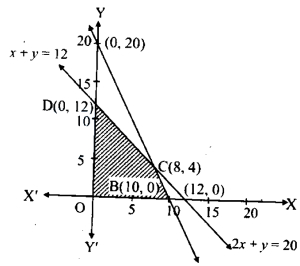
0 likesView Solution
335
MathematicsEasyMCQMHT CET · 2024
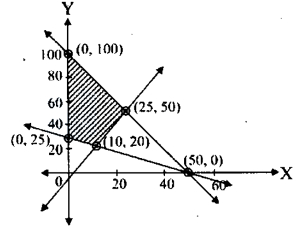
નીચેની આકૃતિમાં છાયાંકિત પ્રદેશ એ અસમતાઓનો ઉકેલ ગણ છે:
A
$x+2y \geq 50, 2x+y \leq 100, 2x-y \leq 0, x, y \geq 0$
B
$x+2y \leq 50, 2x+y \leq 100, 2x-y \leq 0, x, y \geq 0$
C
$x+2y \geq 50, 2x+y \geq 100, 2x-y \leq 0, x, y \geq 0$
D
$x+2y \leq 50, 2x+y \geq 100, 2x-y \leq 0, x, y \geq 0$
Solution
(A) સુરેખ અસમતાઓ નક્કી કરવા માટે,આપણે છાયાંકિત પ્રદેશની સીમા રેખાઓ ઓળખીએ છીએ:
$1$. $(0, 25)$ અને $(50, 0)$ માંથી પસાર થતી રેખાનું સમીકરણ $\frac{x}{50} + \frac{y}{25} = 1$ છે,જેનું સાદું રૂપ $x + 2y = 50$ થાય છે. છાયાંકિત પ્રદેશ આ રેખાની ઉપર હોવાથી,અસમતા $x + 2y \geq 50$ છે.
$2$. $(0, 100)$ અને $(50, 0)$ માંથી પસાર થતી રેખાનું સમીકરણ $\frac{x}{50} + \frac{y}{100} = 1$ છે,જેનું સાદું રૂપ $2x + y = 100$ થાય છે. છાયાંકિત પ્રદેશ આ રેખાની નીચે હોવાથી,અસમતા $2x + y \leq 100$ છે.
$3$. $(0, 0)$ અને $(10, 20)$ માંથી પસાર થતી રેખાનું સમીકરણ $y = 2x$ છે,જેનું સાદું રૂપ $2x - y = 0$ થાય છે. છાયાંકિત પ્રદેશ આ રેખાની ડાબી બાજુએ હોવાથી (દા.ત.,ટેસ્ટ પોઈન્ટ $(0, 10)$ લેતા $2(0) - 10 = -10 \leq 0$),અસમતા $2x - y \leq 0$ છે.
$4$. આ પ્રદેશ પ્રથમ ચરણમાં છે,તેથી $x, y \geq 0$.
આમ,સાચો અસમતાઓનો ગણ $x + 2y \geq 50, 2x + y \leq 100, 2x - y \leq 0, x, y \geq 0$ છે.
$1$. $(0, 25)$ અને $(50, 0)$ માંથી પસાર થતી રેખાનું સમીકરણ $\frac{x}{50} + \frac{y}{25} = 1$ છે,જેનું સાદું રૂપ $x + 2y = 50$ થાય છે. છાયાંકિત પ્રદેશ આ રેખાની ઉપર હોવાથી,અસમતા $x + 2y \geq 50$ છે.
$2$. $(0, 100)$ અને $(50, 0)$ માંથી પસાર થતી રેખાનું સમીકરણ $\frac{x}{50} + \frac{y}{100} = 1$ છે,જેનું સાદું રૂપ $2x + y = 100$ થાય છે. છાયાંકિત પ્રદેશ આ રેખાની નીચે હોવાથી,અસમતા $2x + y \leq 100$ છે.
$3$. $(0, 0)$ અને $(10, 20)$ માંથી પસાર થતી રેખાનું સમીકરણ $y = 2x$ છે,જેનું સાદું રૂપ $2x - y = 0$ થાય છે. છાયાંકિત પ્રદેશ આ રેખાની ડાબી બાજુએ હોવાથી (દા.ત.,ટેસ્ટ પોઈન્ટ $(0, 10)$ લેતા $2(0) - 10 = -10 \leq 0$),અસમતા $2x - y \leq 0$ છે.
$4$. આ પ્રદેશ પ્રથમ ચરણમાં છે,તેથી $x, y \geq 0$.
આમ,સાચો અસમતાઓનો ગણ $x + 2y \geq 50, 2x + y \leq 100, 2x - y \leq 0, x, y \geq 0$ છે.
0 likesView Solution
336
MathematicsEasyMCQMHT CET · 2024
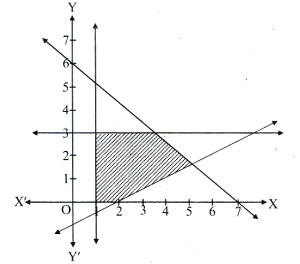
નીચેની આકૃતિમાં છાયાંકિત વિસ્તાર એ અમુક સુરેખ આયોજન સમસ્યા માટેનો ઉકેલ ગણ છે. તો સુરેખ પ્રતિબંધો નીચે મુજબ છે:
A
$x \geqslant 1, y \leqslant 3, x-2y \geqslant 2, 6x+7y \leqslant 42, x \geqslant 0, y \geqslant 0$
B
$x \geqslant 1, y \leqslant 3, x-2y \geqslant 2, 6x+7y \geqslant 42, x \geqslant 0, y \geqslant 0$
C
$x \leqslant 1, y \geqslant 3, x-2y \leqslant 2, 6x+7y \leqslant 42, x \geqslant 0, y \geqslant 0$
D
$x \geqslant 1, y \leqslant 3, x-2y \leqslant 2, 6x+7y \leqslant 42, x \geqslant 0, y \geqslant 0$
Solution
(D) સુરેખ પ્રતિબંધો નક્કી કરવા માટે,આપણે છાયાંકિત વિસ્તારની સીમાઓનું વિશ્લેષણ કરીએ છીએ:
$1$. $x=1$ માંથી પસાર થતી ઉભી રેખા,જેમાં છાયાંકિત વિસ્તાર જમણી બાજુ છે,તે પ્રતિબંધ $x \geqslant 1$ આપે છે.
$2$. $y=3$ માંથી પસાર થતી આડી રેખા,જેમાં છાયાંકિત વિસ્તાર તેની નીચે છે,તે પ્રતિબંધ $y \leqslant 3$ આપે છે.
$3$. $(2, 0)$ અને $(0, -1)$ માંથી પસાર થતી રેખાનું સમીકરણ $\frac{x}{2} - \frac{y}{1} = 1$ છે,જેનું સાદું રૂપ $x - 2y = 2$ થાય છે. છાયાંકિત વિસ્તાર આ રેખાની ઉપર હોવાથી (દા.ત.,બિંદુ $(3, 1)$ ચકાસતા $3 - 2(1) = 1 \leqslant 2$ મળે છે),પ્રતિબંધ $x - 2y \leqslant 2$ છે.
$4$. $(7, 0)$ અને $(0, 6)$ માંથી પસાર થતી રેખાનું સમીકરણ $\frac{x}{7} + \frac{y}{6} = 1$ છે,જેનું સાદું રૂપ $6x + 7y = 42$ થાય છે. છાયાંકિત વિસ્તાર આ રેખાની નીચે હોવાથી (દા.ત.,બિંદુ $(1, 1)$ ચકાસતા $6(1) + 7(1) = 13 \leqslant 42$ મળે છે),પ્રતિબંધ $6x + 7y \leqslant 42$ છે.
$5$. અન-ઋણતા પ્રતિબંધો $x \geqslant 0$ અને $y \geqslant 0$ છે.
આ બધાને જોડતા,સાચો પ્રતિબંધોનો સેટ $x \geqslant 1, y \leqslant 3, x-2y \leqslant 2, 6x+7y \leqslant 42, x \geqslant 0, y \geqslant 0$ છે.
$1$. $x=1$ માંથી પસાર થતી ઉભી રેખા,જેમાં છાયાંકિત વિસ્તાર જમણી બાજુ છે,તે પ્રતિબંધ $x \geqslant 1$ આપે છે.
$2$. $y=3$ માંથી પસાર થતી આડી રેખા,જેમાં છાયાંકિત વિસ્તાર તેની નીચે છે,તે પ્રતિબંધ $y \leqslant 3$ આપે છે.
$3$. $(2, 0)$ અને $(0, -1)$ માંથી પસાર થતી રેખાનું સમીકરણ $\frac{x}{2} - \frac{y}{1} = 1$ છે,જેનું સાદું રૂપ $x - 2y = 2$ થાય છે. છાયાંકિત વિસ્તાર આ રેખાની ઉપર હોવાથી (દા.ત.,બિંદુ $(3, 1)$ ચકાસતા $3 - 2(1) = 1 \leqslant 2$ મળે છે),પ્રતિબંધ $x - 2y \leqslant 2$ છે.
$4$. $(7, 0)$ અને $(0, 6)$ માંથી પસાર થતી રેખાનું સમીકરણ $\frac{x}{7} + \frac{y}{6} = 1$ છે,જેનું સાદું રૂપ $6x + 7y = 42$ થાય છે. છાયાંકિત વિસ્તાર આ રેખાની નીચે હોવાથી (દા.ત.,બિંદુ $(1, 1)$ ચકાસતા $6(1) + 7(1) = 13 \leqslant 42$ મળે છે),પ્રતિબંધ $6x + 7y \leqslant 42$ છે.
$5$. અન-ઋણતા પ્રતિબંધો $x \geqslant 0$ અને $y \geqslant 0$ છે.
આ બધાને જોડતા,સાચો પ્રતિબંધોનો સેટ $x \geqslant 1, y \leqslant 3, x-2y \leqslant 2, 6x+7y \leqslant 42, x \geqslant 0, y \geqslant 0$ છે.
0 likesView Solution
337
MathematicsEasyMCQMHT CET · 2024
હેતુલક્ષી વિધેય $z=4x+6y$ ની મહત્તમ કિંમત શોધો,જે શરતો $3x+2y \leq 12$,$x+y \geq 4$,$x, y \geq 0$ ને આધીન છે.
A
$24$
B
$46$
C
$56$
D
$36$
Solution
(D) શરતો $3x+2y \leq 12$,$x+y \geq 4$,અને $x, y \geq 0$ છે.
શક્ય ઉકેલનો પ્રદેશ શોધવા માટે,આપણે રેખાઓ $3x+2y=12$ અને $x+y=4$ દોરીએ છીએ.
રેખાઓના અક્ષો સાથેના છેદબિંદુઓ નીચે મુજબ છે:
$3x+2y=12$ માટે: $(4,0)$ અને $(0,6)$.
$x+y=4$ માટે: $(4,0)$ અને $(0,4)$.
શક્ય ઉકેલનો પ્રદેશ એ $A(4,0)$,$B(0,4)$,અને $C(0,6)$ શિરોબિંદુઓ ધરાવતો ત્રિકોણ છે.
આપણે આ શિરોબિંદુઓ પર હેતુલક્ષી વિધેય $z=4x+6y$ ની કિંમત શોધીએ છીએ:
$A(4,0)$ પર: $z = 4(4) + 6(0) = 16$.
$B(0,4)$ પર: $z = 4(0) + 6(4) = 24$.
$C(0,6)$ પર: $z = 4(0) + 6(6) = 36$.
આ કિંમતોની સરખામણી કરતા,$z$ ની મહત્તમ કિંમત $36$ છે,જે બિંદુ $C(0,6)$ પર મળે છે.
શક્ય ઉકેલનો પ્રદેશ શોધવા માટે,આપણે રેખાઓ $3x+2y=12$ અને $x+y=4$ દોરીએ છીએ.
રેખાઓના અક્ષો સાથેના છેદબિંદુઓ નીચે મુજબ છે:
$3x+2y=12$ માટે: $(4,0)$ અને $(0,6)$.
$x+y=4$ માટે: $(4,0)$ અને $(0,4)$.
શક્ય ઉકેલનો પ્રદેશ એ $A(4,0)$,$B(0,4)$,અને $C(0,6)$ શિરોબિંદુઓ ધરાવતો ત્રિકોણ છે.
આપણે આ શિરોબિંદુઓ પર હેતુલક્ષી વિધેય $z=4x+6y$ ની કિંમત શોધીએ છીએ:
$A(4,0)$ પર: $z = 4(4) + 6(0) = 16$.
$B(0,4)$ પર: $z = 4(0) + 6(4) = 24$.
$C(0,6)$ પર: $z = 4(0) + 6(6) = 36$.
આ કિંમતોની સરખામણી કરતા,$z$ ની મહત્તમ કિંમત $36$ છે,જે બિંદુ $C(0,6)$ પર મળે છે.
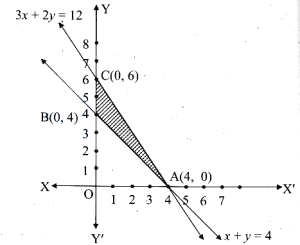
0 likesView Solution
338
MathematicsEasyMCQMHT CET · 2024
$x+y \leq 10, 5x+3y \geq 15, x \leq 6, x, y \geq 0$ ને આધીન $z=x+y$ ની મહત્તમ કિંમત,
A
માત્ર એક અનન્ય બિંદુ પર મળે છે.
B
માત્ર બે અલગ-અલગ બિંદુઓ પર મળે છે.
C
અસંખ્ય બિંદુઓ પર મળે છે.
D
અસ્તિત્વ ધરાવતી નથી.
Solution
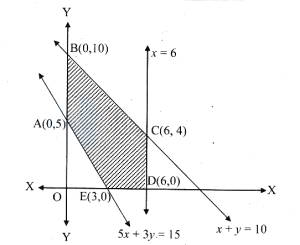
(C) શક્ય ઉકેલનો પ્રદેશ રેખાઓ $x+y=10$,$5x+3y=15$,$x=6$ અને અક્ષો $x=0, y=0$ દ્વારા ઘેરાયેલો છે.
શક્ય ઉકેલના પ્રદેશના શિરોબિંદુઓ $A(0,5)$,$B(0,10)$,$C(6,4)$ અને $E(3,0)$ છે.
આપણે આ શિરોબિંદુઓ પર હેતુલક્ષી વિધેય $z=x+y$ ની કિંમત શોધીએ:
$A(0,5)$ પર,$z = 0+5 = 5$.
$B(0,10)$ પર,$z = 0+10 = 10$.
$C(6,4)$ પર,$z = 6+4 = 10$.
$E(3,0)$ પર,$z = 3+0 = 3$.
$z$ ની મહત્તમ કિંમત $10$ છે,જે $B(0,10)$ અને $C(6,4)$ બંને બિંદુઓ પર મળે છે.
જ્યારે મહત્તમ કિંમત બે શિરોબિંદુઓ પર મળતી હોય,ત્યારે તે બિંદુઓ $B$ અને $C$ ને જોડતા રેખાખંડ પરના તમામ બિંદુઓ પર મળે છે.
તેથી,મહત્તમ કિંમત અસંખ્ય બિંદુઓ પર મળે છે.
શક્ય ઉકેલના પ્રદેશના શિરોબિંદુઓ $A(0,5)$,$B(0,10)$,$C(6,4)$ અને $E(3,0)$ છે.
આપણે આ શિરોબિંદુઓ પર હેતુલક્ષી વિધેય $z=x+y$ ની કિંમત શોધીએ:
$A(0,5)$ પર,$z = 0+5 = 5$.
$B(0,10)$ પર,$z = 0+10 = 10$.
$C(6,4)$ પર,$z = 6+4 = 10$.
$E(3,0)$ પર,$z = 3+0 = 3$.
$z$ ની મહત્તમ કિંમત $10$ છે,જે $B(0,10)$ અને $C(6,4)$ બંને બિંદુઓ પર મળે છે.
જ્યારે મહત્તમ કિંમત બે શિરોબિંદુઓ પર મળતી હોય,ત્યારે તે બિંદુઓ $B$ અને $C$ ને જોડતા રેખાખંડ પરના તમામ બિંદુઓ પર મળે છે.
તેથી,મહત્તમ કિંમત અસંખ્ય બિંદુઓ પર મળે છે.
0 likesView Solution
339
MathematicsEasyMCQMHT CET · 2024
$3x+4y \geqslant 12$,$x+y \leqslant 5$,$x, y \geqslant 0$ મર્યાદાઓને આધીન $z=4x+2y$ ની મહત્તમ કિંમત શોધો.
A
$8$
B
$20$
C
$24$
D
$16$
Solution
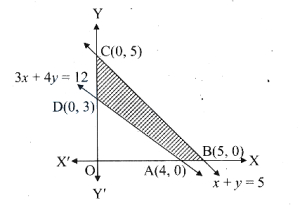
(B) શક્ય ઉકેલનો પ્રદેશ $3x+4y=12$,$x+y=5$ રેખાઓ અને પ્રથમ ચરણમાં અક્ષો દ્વારા ઘેરાયેલો છે.
શિરોબિંદુઓ શોધવા માટે,આપણે છાયાંકિત પ્રદેશના ખૂણાઓ ઓળખીએ છીએ:
$1$. $3x+4y=12$ અને $x$-અક્ષ $(y=0)$ નું છેદબિંદુ: $3x=12 \implies x=4$. બિંદુ $A(4, 0)$ છે.
$2$. $x+y=5$ અને $x$-અક્ષ $(y=0)$ નું છેદબિંદુ: $x=5$. બિંદુ $B(5, 0)$ છે.
$3$. $x+y=5$ અને $y$-અક્ષ $(x=0)$ નું છેદબિંદુ: $y=5$. બિંદુ $C(0, 5)$ છે.
$4$. $3x+4y=12$ અને $y$-અક્ષ $(x=0)$ નું છેદબિંદુ: $4y=12 \implies y=3$. બિંદુ $D(0, 3)$ છે.
હવે,દરેક શિરોબિંદુ પર $z=4x+2y$ ની કિંમત શોધીએ:
- $A(4, 0)$ પર: $z = 4(4) + 2(0) = 16$
- $B(5, 0)$ પર: $z = 4(5) + 2(0) = 20$
- $C(0, 5)$ પર: $z = 4(0) + 2(5) = 10$
- $D(0, 3)$ પર: $z = 4(0) + 2(3) = 6$
આમ,$z$ ની મહત્તમ કિંમત $B(5, 0)$ બિંદુ પર $20$ છે.
શિરોબિંદુઓ શોધવા માટે,આપણે છાયાંકિત પ્રદેશના ખૂણાઓ ઓળખીએ છીએ:
$1$. $3x+4y=12$ અને $x$-અક્ષ $(y=0)$ નું છેદબિંદુ: $3x=12 \implies x=4$. બિંદુ $A(4, 0)$ છે.
$2$. $x+y=5$ અને $x$-અક્ષ $(y=0)$ નું છેદબિંદુ: $x=5$. બિંદુ $B(5, 0)$ છે.
$3$. $x+y=5$ અને $y$-અક્ષ $(x=0)$ નું છેદબિંદુ: $y=5$. બિંદુ $C(0, 5)$ છે.
$4$. $3x+4y=12$ અને $y$-અક્ષ $(x=0)$ નું છેદબિંદુ: $4y=12 \implies y=3$. બિંદુ $D(0, 3)$ છે.
હવે,દરેક શિરોબિંદુ પર $z=4x+2y$ ની કિંમત શોધીએ:
- $A(4, 0)$ પર: $z = 4(4) + 2(0) = 16$
- $B(5, 0)$ પર: $z = 4(5) + 2(0) = 20$
- $C(0, 5)$ પર: $z = 4(0) + 2(5) = 10$
- $D(0, 3)$ પર: $z = 4(0) + 2(3) = 6$
આમ,$z$ ની મહત્તમ કિંમત $B(5, 0)$ બિંદુ પર $20$ છે.
0 likesView Solution
340
MathematicsEasyMCQMHT CET · 2024
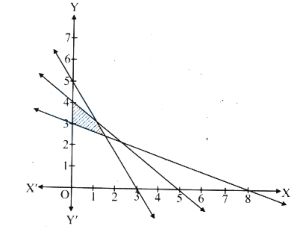
મહત્તમ કરવા માટેનું વિધેય $Z=3x+2y$ દ્વારા આપવામાં આવે છે. આ વિધેય માટેનો શક્ય ઉકેલ પ્રદેશ આકૃતિમાં દર્શાવેલ છાયાંકિત પ્રદેશ છે. તો આ પ્રદેશ માટેના સુરેખ પ્રતિબંધો નીચેનામાંથી કયા છે?
A
$3x+8y \leq 24, 4x+5y \leq 20, 5x+3y \geq 15, x \geq 0, y \geq 0$
B
$3x+8y \geq 24, 4x+5y \geq 20, 5x+3y \leq 15, x \geq 0, y \geq 0$
C
$3x+8y \leq 24, 4x+5y \geq 20, 5x+3y \geq 15, x \geq 0, y \geq 0$
D
$3x+8y \geq 24, 4x+5y \leq 20, 5x+3y \leq 15, x \geq 0, y \geq 0$
Solution
(D) સુરેખ પ્રતિબંધો શોધવા માટે,આપણે છાયાંકિત પ્રદેશની સીમા બનાવતી ત્રણ રેખાઓના સમીકરણો નક્કી કરીએ છીએ:
$1$. $(0, 3)$ અને $(8, 0)$ માંથી પસાર થતી રેખા: અંતઃખંડ સ્વરૂપ $\frac{x}{8} + \frac{y}{3} = 1$ છે,જેનું સાદું રૂપ $3x + 8y = 24$ થાય છે. છાયાંકિત પ્રદેશ આ રેખાની ઉપર (ઉગમબિંદુથી દૂર) હોવાથી,પ્રતિબંધ $3x + 8y \geq 24$ છે.
$2$. $(0, 4)$ અને $(5, 0)$ માંથી પસાર થતી રેખા: અંતઃખંડ સ્વરૂપ $\frac{x}{5} + \frac{y}{4} = 1$ છે,જેનું સાદું રૂપ $4x + 5y = 20$ થાય છે. છાયાંકિત પ્રદેશ આ રેખાની નીચે (ઉગમબિંદુ તરફ) હોવાથી,પ્રતિબંધ $4x + 5y \leq 20$ છે.
$3$. $(0, 5)$ અને $(3, 0)$ માંથી પસાર થતી રેખા: અંતઃખંડ સ્વરૂપ $\frac{x}{3} + \frac{y}{5} = 1$ છે,જેનું સાદું રૂપ $5x + 3y = 15$ થાય છે. છાયાંકિત પ્રદેશ આ રેખાની નીચે (ઉગમબિંદુ તરફ) હોવાથી,પ્રતિબંધ $5x + 3y \leq 15$ છે.
આને અન-ઋણ પ્રતિબંધો $x \geq 0, y \geq 0$ સાથે જોડતા,આપણને સિસ્ટમ મળે છે: $3x + 8y \geq 24, 4x + 5y \leq 20, 5x + 3y \leq 15, x \geq 0, y \geq 0$. આમ,વિકલ્પ $D$ સાચો છે.
$1$. $(0, 3)$ અને $(8, 0)$ માંથી પસાર થતી રેખા: અંતઃખંડ સ્વરૂપ $\frac{x}{8} + \frac{y}{3} = 1$ છે,જેનું સાદું રૂપ $3x + 8y = 24$ થાય છે. છાયાંકિત પ્રદેશ આ રેખાની ઉપર (ઉગમબિંદુથી દૂર) હોવાથી,પ્રતિબંધ $3x + 8y \geq 24$ છે.
$2$. $(0, 4)$ અને $(5, 0)$ માંથી પસાર થતી રેખા: અંતઃખંડ સ્વરૂપ $\frac{x}{5} + \frac{y}{4} = 1$ છે,જેનું સાદું રૂપ $4x + 5y = 20$ થાય છે. છાયાંકિત પ્રદેશ આ રેખાની નીચે (ઉગમબિંદુ તરફ) હોવાથી,પ્રતિબંધ $4x + 5y \leq 20$ છે.
$3$. $(0, 5)$ અને $(3, 0)$ માંથી પસાર થતી રેખા: અંતઃખંડ સ્વરૂપ $\frac{x}{3} + \frac{y}{5} = 1$ છે,જેનું સાદું રૂપ $5x + 3y = 15$ થાય છે. છાયાંકિત પ્રદેશ આ રેખાની નીચે (ઉગમબિંદુ તરફ) હોવાથી,પ્રતિબંધ $5x + 3y \leq 15$ છે.
આને અન-ઋણ પ્રતિબંધો $x \geq 0, y \geq 0$ સાથે જોડતા,આપણને સિસ્ટમ મળે છે: $3x + 8y \geq 24, 4x + 5y \leq 20, 5x + 3y \leq 15, x \geq 0, y \geq 0$. આમ,વિકલ્પ $D$ સાચો છે.
0 likesView Solution
341
MathematicsEasyMCQMHT CET · 2024
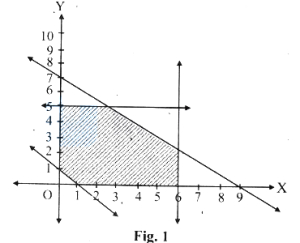
અસમતાઓ $x+y \geq 1$,$7x+9y \leq 63$,$y \leq 5$,$x \leq 6$,$x \geq 0$,$y \geq 0$ ની પ્રણાલીનો આલેખિત ઉકેલ ગણ નીચેનામાંથી કયા આકૃતિ દ્વારા દર્શાવવામાં આવ્યો છે?
A
આકૃતિ $1$
B
આકૃતિ $2$
C
આકૃતિ $3$
D
આકૃતિ $4$
Solution
(B) આલેખિત ઉકેલ ગણ શોધવા માટે,આપણે આપેલી અસમતાઓની પ્રણાલીનું વિશ્લેષણ કરીએ: $x+y \geq 1$,$7x+9y \leq 63$,$y \leq 5$,$x \leq 6$,$x \geq 0$,$y \geq 0$.
$1$. $x+y \geq 1$ માટે: રેખા $(1, 0)$ અને $(0, 1)$ માંથી પસાર થાય છે. પ્રદેશ ઉગમબિંદુથી દૂર છે.
$2$. $7x+9y \leq 63$ માટે: રેખા $(9, 0)$ અને $(0, 7)$ માંથી પસાર થાય છે. પ્રદેશ ઉગમબિંદુ તરફ છે.
$3$. $x \leq 6$ અને $y \leq 5$ માટે: આ પ્રથમ ચરણમાં $x=6$ અને $y=5$ રેખાઓ દ્વારા બંધાયેલ પ્રદેશ દર્શાવે છે.
$4$. આ તમામ પ્રદેશોનો છેદગણ શક્ય ઉકેલ પ્રદેશ આપે છે. આ રેખાઓ દોરવાથી,આપણે જોઈએ છીએ કે પ્રદેશ શિરોબિંદુઓ $(0, 1), (0, 7), (2.57, 5), (6, 5), (6, 2.33)$ અને $(1, 0)$ દ્વારા બંધાયેલ છે.
આને આપેલી આકૃતિઓ સાથે સરખાવતા,સાચી આલેખિત રજૂઆત આકૃતિ $2$ છે.
$1$. $x+y \geq 1$ માટે: રેખા $(1, 0)$ અને $(0, 1)$ માંથી પસાર થાય છે. પ્રદેશ ઉગમબિંદુથી દૂર છે.
$2$. $7x+9y \leq 63$ માટે: રેખા $(9, 0)$ અને $(0, 7)$ માંથી પસાર થાય છે. પ્રદેશ ઉગમબિંદુ તરફ છે.
$3$. $x \leq 6$ અને $y \leq 5$ માટે: આ પ્રથમ ચરણમાં $x=6$ અને $y=5$ રેખાઓ દ્વારા બંધાયેલ પ્રદેશ દર્શાવે છે.
$4$. આ તમામ પ્રદેશોનો છેદગણ શક્ય ઉકેલ પ્રદેશ આપે છે. આ રેખાઓ દોરવાથી,આપણે જોઈએ છીએ કે પ્રદેશ શિરોબિંદુઓ $(0, 1), (0, 7), (2.57, 5), (6, 5), (6, 2.33)$ અને $(1, 0)$ દ્વારા બંધાયેલ છે.
આને આપેલી આકૃતિઓ સાથે સરખાવતા,સાચી આલેખિત રજૂઆત આકૃતિ $2$ છે.
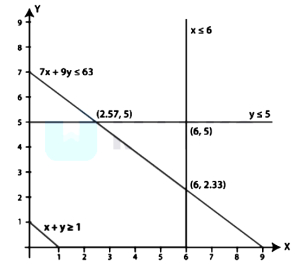
0 likesView Solution
342
MathematicsEasyMCQMHT CET · 2024
નીચે આપેલ છાયાંકિત પ્રદેશ માટે,સુરેખ અવરોધો કયા છે?
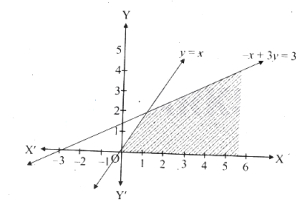
A
$x-y \leq 0, -x+3y \leq 3, x \geq 0, y \geq 0$
B
$x-y \geq 0, -x+3y \geq 3, x \geq 0, y \geq 0$
C
$x-y \geq 0, -x+3y \leq 3, x \geq 0, y \geq 0$
D
$x-y \leq 0, -x+3y = 3, x \geq 0, y \geq 0$
Solution
(C) ચાલો છાયાંકિત પ્રદેશ અને તેના સુરેખ અવરોધોનું વિશ્લેષણ કરીએ:
$1$. આલેખ જોતા,પ્રદેશ રેખાઓ $y=x$ અને $-x+3y=3$ તથા અક્ષો $x=0$ અને $y=0$ દ્વારા ઘેરાયેલ છે.
$2$. છાયાંકિત પ્રદેશ રેખા $-x+3y=3$ ની નીચે આવેલો છે. ઉગમબિંદુ $(0,0)$ ચકાસતા,આપણને $-0+3(0) = 0 \leq 3$ મળે છે,જે અસમતાનું પાલન કરે છે. તેથી,અવરોધ $-x+3y \leq 3$ છે.
$3$. આ પ્રદેશ રેખા $y=x$ ની જમણી બાજુએ છે. પ્રદેશમાં કોઈ બિંદુ,જેમ કે $(2, 0)$ ચકાસતા,આપણને $x-y = 2-0 = 2 \geq 0$ મળે છે. તેથી,અવરોધ $x-y \geq 0$ છે.
$4$. વિકલ્પો સાથે સરખાવતા,વિકલ્પ $(C)$ આ શરતો સાથે મેળ ખાય છે: $x-y \geq 0, -x+3y \leq 3, x \geq 0, y \geq 0$.
$1$. આલેખ જોતા,પ્રદેશ રેખાઓ $y=x$ અને $-x+3y=3$ તથા અક્ષો $x=0$ અને $y=0$ દ્વારા ઘેરાયેલ છે.
$2$. છાયાંકિત પ્રદેશ રેખા $-x+3y=3$ ની નીચે આવેલો છે. ઉગમબિંદુ $(0,0)$ ચકાસતા,આપણને $-0+3(0) = 0 \leq 3$ મળે છે,જે અસમતાનું પાલન કરે છે. તેથી,અવરોધ $-x+3y \leq 3$ છે.
$3$. આ પ્રદેશ રેખા $y=x$ ની જમણી બાજુએ છે. પ્રદેશમાં કોઈ બિંદુ,જેમ કે $(2, 0)$ ચકાસતા,આપણને $x-y = 2-0 = 2 \geq 0$ મળે છે. તેથી,અવરોધ $x-y \geq 0$ છે.
$4$. વિકલ્પો સાથે સરખાવતા,વિકલ્પ $(C)$ આ શરતો સાથે મેળ ખાય છે: $x-y \geq 0, -x+3y \leq 3, x \geq 0, y \geq 0$.
0 likesView Solution
343
MathematicsDifficultMCQMHT CET · 2024
એક ઉત્પાદન એકમ તાંબુ અને પિત્તળને જોડીને એક ખાસ પ્રકારની મેટલ ચિપ બનાવે છે. ચિપનું પ્રમાણભૂત વજન ઓછામાં ઓછું $5 \text{ gms}$ હોવું જોઈએ. મૂળભૂત ઘટકો,એટલે કે તાંબુ અને પિત્તળ,અનુક્રમે $₹8$ અને $₹5$ પ્રતિ $\text{gm}$ છે. ટકાઉપણું ધ્યાનમાં લેતા,મેટલ ચિપમાં $4 \text{ gms}$ થી વધુ પિત્તળ ન હોવું જોઈએ અને ઓછામાં ઓછું $2 \text{ gms}$ તાંબુ હોવું જોઈએ. તો,ઉપરની શરતોને સંતોષતી મેટલ ચિપની ન્યૂનતમ કિંમત કેટલી છે?
A
₹ $36$
B
₹ $31$
C
₹ $30$
D
₹ $40$
Solution
(B) ધારો કે $x$ અને $y$ અનુક્રમે તાંબા અને પિત્તળની માત્રા ગ્રામમાં દર્શાવે છે.
ન્યૂનતમ કરવા માટેનું ઉદ્દેશ્ય વિધેય ખર્ચ છે: $z = 8x + 5y$.
સમસ્યાના આધારે અવરોધો છે:
$1) \ x + y \geq 5$ (કુલ વજન ઓછામાં ઓછું $5 \text{ gms}$)
$2) \ x \geq 2$ (ઓછામાં ઓછું $2 \text{ gms}$ તાંબુ)
$3) \ y \leq 4$ (મહત્તમ $4 \text{ gms}$ પિત્તળ)
$4) \ x \geq 0, y \geq 0$ (બિન-ઋણાત્મક અવરોધો)
શક્ય ઉકેલનો પ્રદેશ આ અસમતાઓ દ્વારા નક્કી કરવામાં આવે છે. શક્ય ઉકેલના પ્રદેશના ખૂણાના બિંદુઓ સીમા રેખાઓના છેદન દ્વારા મળે છે:
- બિંદુ $A$: $x = 2$ અને $y = 4$ નું છેદન,તેથી $A = (2, 4)$.
- બિંદુ $B$: $x = 2$ અને $x + y = 5$ નું છેદન,તેથી $B = (2, 3)$.
- બિંદુ $C$: $x + y = 5$ અને $y = 0$ નું છેદન,તેથી $C = (5, 0)$.
હવે,આ ખૂણાના બિંદુઓ પર ઉદ્દેશ્ય વિધેય $z = 8x + 5y$ ની કિંમત શોધો:
- $A(2, 4)$ પર: $z = 8(2) + 5(4) = 16 + 20 = 36$.
- $B(2, 3)$ પર: $z = 8(2) + 5(3) = 16 + 15 = 31$.
- $C(5, 0)$ પર: $z = 8(5) + 5(0) = 40 + 0 = 40$.
$z$ નું ન્યૂનતમ મૂલ્ય $31$ છે.
તેથી,ન્યૂનતમ ખર્ચ $₹ 31$ છે.
ન્યૂનતમ કરવા માટેનું ઉદ્દેશ્ય વિધેય ખર્ચ છે: $z = 8x + 5y$.
સમસ્યાના આધારે અવરોધો છે:
$1) \ x + y \geq 5$ (કુલ વજન ઓછામાં ઓછું $5 \text{ gms}$)
$2) \ x \geq 2$ (ઓછામાં ઓછું $2 \text{ gms}$ તાંબુ)
$3) \ y \leq 4$ (મહત્તમ $4 \text{ gms}$ પિત્તળ)
$4) \ x \geq 0, y \geq 0$ (બિન-ઋણાત્મક અવરોધો)
શક્ય ઉકેલનો પ્રદેશ આ અસમતાઓ દ્વારા નક્કી કરવામાં આવે છે. શક્ય ઉકેલના પ્રદેશના ખૂણાના બિંદુઓ સીમા રેખાઓના છેદન દ્વારા મળે છે:
- બિંદુ $A$: $x = 2$ અને $y = 4$ નું છેદન,તેથી $A = (2, 4)$.
- બિંદુ $B$: $x = 2$ અને $x + y = 5$ નું છેદન,તેથી $B = (2, 3)$.
- બિંદુ $C$: $x + y = 5$ અને $y = 0$ નું છેદન,તેથી $C = (5, 0)$.
હવે,આ ખૂણાના બિંદુઓ પર ઉદ્દેશ્ય વિધેય $z = 8x + 5y$ ની કિંમત શોધો:
- $A(2, 4)$ પર: $z = 8(2) + 5(4) = 16 + 20 = 36$.
- $B(2, 3)$ પર: $z = 8(2) + 5(3) = 16 + 15 = 31$.
- $C(5, 0)$ પર: $z = 8(5) + 5(0) = 40 + 0 = 40$.
$z$ નું ન્યૂનતમ મૂલ્ય $31$ છે.
તેથી,ન્યૂનતમ ખર્ચ $₹ 31$ છે.
0 likesView Solution
344
MathematicsEasyMCQMHT CET · 2024
$2 x \geq 4, y \leq 3, x+y \leq 8, x, y \geq 0$ ને આધીન $Z=100 x+70 y$ ની મહત્તમ કિંમત શોધો.
A
$800$
B
$940$
C
$400$
D
$710$
Solution
(A) આપેલ શરતો $2x \geq 4$ (એટલે કે $x \geq 2$),$y \leq 3$,$x+y \leq 8$ અને $x, y \geq 0$ છે.
શક્ય ઉકેલનો પ્રદેશ રેખાઓ $x=2, y=3, x+y=8$ અને $x$-અક્ષ $(y=0)$ દ્વારા ઘેરાયેલો છે.
આ પ્રદેશના શિરોબિંદુઓ નીચે મુજબ છે:
$A(2, 0)$ ($x=2$ અને $y=0$ નું છેદબિંદુ)
$B(8, 0)$ ($x+y=8$ અને $y=0$ નું છેદબિંદુ)
$C(5, 3)$ ($x+y=8$ અને $y=3$ નું છેદબિંદુ)
$D(2, 3)$ ($x=2$ અને $y=3$ નું છેદબિંદુ)
હવે,દરેક શિરોબિંદુ પર $Z=100x+70y$ ની કિંમત શોધીએ:
$A(2, 0)$ પર: $Z = 100(2) + 70(0) = 200$
$B(8, 0)$ પર: $Z = 100(8) + 70(0) = 800$
$C(5, 3)$ પર: $Z = 100(5) + 70(3) = 500 + 210 = 710$
$D(2, 3)$ પર: $Z = 100(2) + 70(3) = 200 + 210 = 410$
આમ,$Z$ ની મહત્તમ કિંમત $800$ છે જે બિંદુ $B(8, 0)$ પર મળે છે.
શક્ય ઉકેલનો પ્રદેશ રેખાઓ $x=2, y=3, x+y=8$ અને $x$-અક્ષ $(y=0)$ દ્વારા ઘેરાયેલો છે.
આ પ્રદેશના શિરોબિંદુઓ નીચે મુજબ છે:
$A(2, 0)$ ($x=2$ અને $y=0$ નું છેદબિંદુ)
$B(8, 0)$ ($x+y=8$ અને $y=0$ નું છેદબિંદુ)
$C(5, 3)$ ($x+y=8$ અને $y=3$ નું છેદબિંદુ)
$D(2, 3)$ ($x=2$ અને $y=3$ નું છેદબિંદુ)
હવે,દરેક શિરોબિંદુ પર $Z=100x+70y$ ની કિંમત શોધીએ:
$A(2, 0)$ પર: $Z = 100(2) + 70(0) = 200$
$B(8, 0)$ પર: $Z = 100(8) + 70(0) = 800$
$C(5, 3)$ પર: $Z = 100(5) + 70(3) = 500 + 210 = 710$
$D(2, 3)$ પર: $Z = 100(2) + 70(3) = 200 + 210 = 410$
આમ,$Z$ ની મહત્તમ કિંમત $800$ છે જે બિંદુ $B(8, 0)$ પર મળે છે.
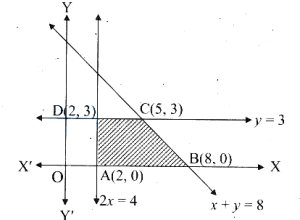
0 likesView Solution
345
MathematicsEasyMCQMHT CET · 2024
આપેલ આકૃતિમાં છાયાંકિત વિસ્તાર અસમતાઓ માટે ઉકેલ ગણ છે. આ તંત્ર દ્વારા આપવામાં આવેલ સુરેખ પ્રતિબંધોને આધીન વિધેય $z=4x+3y$ ની મહત્તમ કિંમત શોધો.
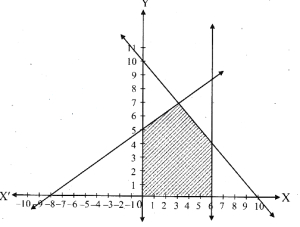
A
$38$
B
$36$
C
$33$
D
$34$
Solution
(B) શક્ય ઉકેલના પ્રદેશના શિરોબિંદુઓ $O(0,0)$,$A(6,0)$,$B(6,4)$,$C(3,7)$ અને $D(0,5)$ છે.
આપણે દરેક શિરોબિંદુ પર હેતુલક્ષી વિધેય $z=4x+3y$ ની કિંમત શોધીએ:
$O(0,0)$ પર,$z=4(0)+3(0)=0$
$A(6,0)$ પર,$z=4(6)+3(0)=24$
$B(6,4)$ પર,$z=4(6)+3(4)=24+12=36$
$C(3,7)$ પર,$z=4(3)+3(7)=12+21=33$
$D(0,5)$ પર,$z=4(0)+3(5)=15$
આ કિંમતોની સરખામણી કરતા,$z$ ની મહત્તમ કિંમત $36$ મળે છે.
આપણે દરેક શિરોબિંદુ પર હેતુલક્ષી વિધેય $z=4x+3y$ ની કિંમત શોધીએ:
$O(0,0)$ પર,$z=4(0)+3(0)=0$
$A(6,0)$ પર,$z=4(6)+3(0)=24$
$B(6,4)$ પર,$z=4(6)+3(4)=24+12=36$
$C(3,7)$ પર,$z=4(3)+3(7)=12+21=33$
$D(0,5)$ પર,$z=4(0)+3(5)=15$
આ કિંમતોની સરખામણી કરતા,$z$ ની મહત્તમ કિંમત $36$ મળે છે.
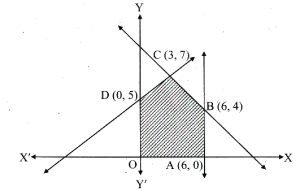
0 likesView Solution
346
MathematicsMediumMCQMHT CET · 2024
સમીકરણ સંહતિ $x-y+z=4, 2x+y-3z=0, x+y+z=2$ માટે,$x, y, z$ ની કિંમતો અનુક્રમે શું થશે?
A
$2, 1, 1$
B
$2, -1, 1$
C
$2, 1, -1$
D
$-2, 1, 1$
Solution
(B) આપેલ સુરેખ સમીકરણોની સંહતિ છે:
$x - y + z = 4$
$2x + y - 3z = 0$
$x + y + z = 2$
મેટ્રિક્સ સ્વરૂપમાં,આ $AX = B$ છે,જ્યાં
$A = \begin{bmatrix} 1 & -1 & 1 \\ 2 & 1 & -3 \\ 1 & 1 & 1 \end{bmatrix}, X = \begin{bmatrix} x \\ y \\ z \end{bmatrix}, B = \begin{bmatrix} 4 \\ 0 \\ 2 \end{bmatrix}$
પ્રથમ,નિશ્ચાયક $|A|$ ની ગણતરી કરો:
$|A| = 1(1 + 3) - (-1)(2 + 3) + 1(2 - 1) = 1(4) + 1(5) + 1(1) = 4 + 5 + 1 = 10$
કારણ કે $|A| \neq 0$,સંહતિનો ઉકેલ $X = A^{-1}B$ છે.
$A$ નો એડજોઈન્ટ શોધો:
$C_{11} = 4, C_{12} = -5, C_{13} = 1$
$C_{21} = 2, C_{22} = 0, C_{23} = -2$
$C_{31} = 2, C_{32} = 5, C_{33} = 3$
$adj(A) = \begin{bmatrix} 4 & 2 & 2 \\ -5 & 0 & 5 \\ 1 & -2 & 3 \end{bmatrix}$
$X = \frac{1}{10} \begin{bmatrix} 4 & 2 & 2 \\ -5 & 0 & 5 \\ 1 & -2 & 3 \end{bmatrix} \begin{bmatrix} 4 \\ 0 \\ 2 \end{bmatrix} = \frac{1}{10} \begin{bmatrix} 16 + 0 + 4 \\ -20 + 0 + 10 \\ 4 + 0 + 6 \end{bmatrix} = \frac{1}{10} \begin{bmatrix} 20 \\ -10 \\ 10 \end{bmatrix} = \begin{bmatrix} 2 \\ -1 \\ 1 \end{bmatrix}$
આમ,$x = 2, y = -1, z = 1$.
$x - y + z = 4$
$2x + y - 3z = 0$
$x + y + z = 2$
મેટ્રિક્સ સ્વરૂપમાં,આ $AX = B$ છે,જ્યાં
$A = \begin{bmatrix} 1 & -1 & 1 \\ 2 & 1 & -3 \\ 1 & 1 & 1 \end{bmatrix}, X = \begin{bmatrix} x \\ y \\ z \end{bmatrix}, B = \begin{bmatrix} 4 \\ 0 \\ 2 \end{bmatrix}$
પ્રથમ,નિશ્ચાયક $|A|$ ની ગણતરી કરો:
$|A| = 1(1 + 3) - (-1)(2 + 3) + 1(2 - 1) = 1(4) + 1(5) + 1(1) = 4 + 5 + 1 = 10$
કારણ કે $|A| \neq 0$,સંહતિનો ઉકેલ $X = A^{-1}B$ છે.
$A$ નો એડજોઈન્ટ શોધો:
$C_{11} = 4, C_{12} = -5, C_{13} = 1$
$C_{21} = 2, C_{22} = 0, C_{23} = -2$
$C_{31} = 2, C_{32} = 5, C_{33} = 3$
$adj(A) = \begin{bmatrix} 4 & 2 & 2 \\ -5 & 0 & 5 \\ 1 & -2 & 3 \end{bmatrix}$
$X = \frac{1}{10} \begin{bmatrix} 4 & 2 & 2 \\ -5 & 0 & 5 \\ 1 & -2 & 3 \end{bmatrix} \begin{bmatrix} 4 \\ 0 \\ 2 \end{bmatrix} = \frac{1}{10} \begin{bmatrix} 16 + 0 + 4 \\ -20 + 0 + 10 \\ 4 + 0 + 6 \end{bmatrix} = \frac{1}{10} \begin{bmatrix} 20 \\ -10 \\ 10 \end{bmatrix} = \begin{bmatrix} 2 \\ -1 \\ 1 \end{bmatrix}$
આમ,$x = 2, y = -1, z = 1$.
0 likesView Solution
347
MathematicsMediumMCQMHT CET · 2024
ધારો કે $A$ એ કોઈ $3 \times 3$ નોન-સિંગ્યુલર શ્રેણિક છે અને $(A-3 I)(A-5 I)=O$,જ્યાં $I=I_3$ અને $O=O_3$ છે. અહીં $O_3$ એ $3$ કક્ષાનો શૂન્ય શ્રેણિક છે અને $I_3$ એ $3$ કક્ષાનો એકમ શ્રેણિક છે. જો $\alpha A+\beta A^{-1}=4 I$ હોય,તો $\alpha+\beta$ ની કિંમત શોધો.
A
$13$
B
$7$
C
$12$
D
$8$
Solution
(D) આપેલ છે કે $(A-3 I)(A-5 I)=O$.
પદાવલિનું વિસ્તરણ કરતા,આપણને મળે છે:
$A^2 - 5A - 3A + 15I = O$
$A^2 - 8A + 15I = O$
$A^2 + 15I = 8A$
બંને બાજુ $A^{-1}$ વડે ગુણતા,આપણને મળે છે:
$A + 15A^{-1} = 8I$
આખા સમીકરણને $2$ વડે ભાગતા:
$\frac{1}{2}A + \frac{15}{2}A^{-1} = 4I$
આને આપેલ સમીકરણ $\alpha A + \beta A^{-1} = 4I$ સાથે સરખાવતા,આપણને મળે છે:
$\alpha = \frac{1}{2}$ અને $\beta = \frac{15}{2}$
તેથી,$\alpha + \beta = \frac{1}{2} + \frac{15}{2} = \frac{16}{2} = 8$.
પદાવલિનું વિસ્તરણ કરતા,આપણને મળે છે:
$A^2 - 5A - 3A + 15I = O$
$A^2 - 8A + 15I = O$
$A^2 + 15I = 8A$
બંને બાજુ $A^{-1}$ વડે ગુણતા,આપણને મળે છે:
$A + 15A^{-1} = 8I$
આખા સમીકરણને $2$ વડે ભાગતા:
$\frac{1}{2}A + \frac{15}{2}A^{-1} = 4I$
આને આપેલ સમીકરણ $\alpha A + \beta A^{-1} = 4I$ સાથે સરખાવતા,આપણને મળે છે:
$\alpha = \frac{1}{2}$ અને $\beta = \frac{15}{2}$
તેથી,$\alpha + \beta = \frac{1}{2} + \frac{15}{2} = \frac{16}{2} = 8$.
0 likesView Solution
348
MathematicsMediumMCQMHT CET · 2024
ધારો કે $A$ અને $B$ એ $3 \times 3$ વાસ્તવિક શ્રેણિકો છે,જ્યાં $A$ સંમિત શ્રેણિક છે અને $B$ વિસંમિત શ્રેણિક છે. તો સુરેખ સમીકરણોની સંહતિ $(A^2 B^2 - B^2 A^2) X = 0$,જ્યાં $X$ એ અજ્ઞાત ચલનો $3 \times 1$ સ્તંભ શ્રેણિક છે અને $0$ એ $3 \times 1$ શૂન્ય શ્રેણિક છે,તેના માટે:
A
અનન્ય ઉકેલ છે
B
બરાબર બે ઉકેલો છે
C
કોઈ ઉકેલ નથી
D
અનંત ઉકેલો છે
Solution
(D) ધારો કે $P = A^2 B^2 - B^2 A^2$.
$P$ નો પરિવર્તિત શ્રેણિક લેતા:
$P^T = (A^2 B^2 - B^2 A^2)^T = (A^2 B^2)^T - (B^2 A^2)^T$.
ગુણધર્મ $(XY)^T = Y^T X^T$ નો ઉપયોગ કરતા:
$P^T = (B^2)^T (A^2)^T - (A^2)^T (B^2)^T$.
$A$ સંમિત હોવાથી $(A^T = A)$ અને $B$ વિસંમિત હોવાથી $(B^T = -B)$,આપણને મળે છે $(A^2)^T = (A^T)^2 = A^2$ અને $(B^2)^T = (B^T)^2 = (-B)^2 = B^2$.
આ કિંમતો મૂકતા:
$P^T = B^2 A^2 - A^2 B^2 = -(A^2 B^2 - B^2 A^2) = -P$.
$P^T = -P$ હોવાથી,$P$ એ વિસંમિત શ્રેણિક છે.
કોઈપણ એકી કક્ષા $n$ (અહીં $n=3$) ધરાવતા વિસંમિત શ્રેણિક $P$ માટે,નિશ્ચાયક $\det(P) = 0$ થાય છે.
$\det(P) = 0$ હોવાથી,સંહતિ $PX = 0$ ને શૂન્યેતર ઉકેલ મળે છે,જેનો અર્થ છે કે તેને અનંત ઉકેલો છે.
$P$ નો પરિવર્તિત શ્રેણિક લેતા:
$P^T = (A^2 B^2 - B^2 A^2)^T = (A^2 B^2)^T - (B^2 A^2)^T$.
ગુણધર્મ $(XY)^T = Y^T X^T$ નો ઉપયોગ કરતા:
$P^T = (B^2)^T (A^2)^T - (A^2)^T (B^2)^T$.
$A$ સંમિત હોવાથી $(A^T = A)$ અને $B$ વિસંમિત હોવાથી $(B^T = -B)$,આપણને મળે છે $(A^2)^T = (A^T)^2 = A^2$ અને $(B^2)^T = (B^T)^2 = (-B)^2 = B^2$.
આ કિંમતો મૂકતા:
$P^T = B^2 A^2 - A^2 B^2 = -(A^2 B^2 - B^2 A^2) = -P$.
$P^T = -P$ હોવાથી,$P$ એ વિસંમિત શ્રેણિક છે.
કોઈપણ એકી કક્ષા $n$ (અહીં $n=3$) ધરાવતા વિસંમિત શ્રેણિક $P$ માટે,નિશ્ચાયક $\det(P) = 0$ થાય છે.
$\det(P) = 0$ હોવાથી,સંહતિ $PX = 0$ ને શૂન્યેતર ઉકેલ મળે છે,જેનો અર્થ છે કે તેને અનંત ઉકેલો છે.
0 likesView Solution
349
MathematicsMediumMCQMHT CET · 2024
ધારો કે $A=\left[\begin{array}{ll}x & 1 \\ 1 & 0\end{array}\right]$,$x \in R^{+}$ અને $A^4=\left[a_{ij}\right]_2$. જો $a_{11}=109$ હોય,તો $\left(A^4\right)^{-1}=$
A
$\left[\begin{array}{ll}109 & 33 \\ 33 & 10\end{array}\right]$
B
$\left[\begin{array}{ll}10 & 33 \\ 33 & 10\end{array}\right]$
C
$\left[\begin{array}{cc}10 & 33 \\ 33 & 109\end{array}\right]$
D
$\left[\begin{array}{cc}10 & -33 \\ -33 & 109\end{array}\right]$
Solution
(D) આપેલ છે $A=\left[\begin{array}{ll}x & 1 \\ 1 & 0\end{array}\right]$.
પ્રથમ,$A^2$ શોધો:
$A^2 = \left[\begin{array}{ll}x & 1 \\ 1 & 0\end{array}\right]\left[\begin{array}{ll}x & 1 \\ 1 & 0\end{array}\right] = \left[\begin{array}{cc}x^2+1 & x \\ x & 1\end{array}\right]$.
હવે,$A^4 = A^2 \cdot A^2$ શોધો:
$A^4 = \left[\begin{array}{cc}x^2+1 & x \\ x & 1\end{array}\right]\left[\begin{array}{cc}x^2+1 & x \\ x & 1\end{array}\right] = \left[\begin{array}{cc}(x^2+1)^2+x^2 & x(x^2+1+1) \\ x(x^2+1+1) & x^2+1\end{array}\right] = \left[\begin{array}{cc}(x^2+1)^2+x^2 & x(x^2+2) \\ x(x^2+2) & x^2+1\end{array}\right]$.
આપેલ છે કે $a_{11} = 109$,તેથી $(x^2+1)^2 + x^2 = 109$.
ધારો કે $t = x^2$. તો $(t+1)^2 + t = 109 \Rightarrow t^2 + 2t + 1 + t = 109 \Rightarrow t^2 + 3t - 108 = 0$.
$t$ માટે ઉકેલતા: $(t+12)(t-9) = 0$. કારણ કે $x \in R^{+}$,તેથી $t = x^2 = 9 \Rightarrow x = 3$.
$x=3$ ને શ્રેણિક $A^4$ માં મૂકતા:
$a_{11} = (9+1)^2 + 9 = 109$,$a_{12} = a_{21} = 3(9+2) = 33$,$a_{22} = 9+1 = 10$.
તેથી,$A^4 = \left[\begin{array}{cc}109 & 33 \\ 33 & 10\end{array}\right]$.
નિશ્ચાયક $|A^4| = (109)(10) - (33)(33) = 1090 - 1089 = 1$.
વ્યસ્ત શ્રેણિક $\frac{1}{|A^4|} \text{adj}(A^4) = \frac{1}{1} \left[\begin{array}{cc}10 & -33 \\ -33 & 109\end{array}\right] = \left[\begin{array}{cc}10 & -33 \\ -33 & 109\end{array}\right]$.
પ્રથમ,$A^2$ શોધો:
$A^2 = \left[\begin{array}{ll}x & 1 \\ 1 & 0\end{array}\right]\left[\begin{array}{ll}x & 1 \\ 1 & 0\end{array}\right] = \left[\begin{array}{cc}x^2+1 & x \\ x & 1\end{array}\right]$.
હવે,$A^4 = A^2 \cdot A^2$ શોધો:
$A^4 = \left[\begin{array}{cc}x^2+1 & x \\ x & 1\end{array}\right]\left[\begin{array}{cc}x^2+1 & x \\ x & 1\end{array}\right] = \left[\begin{array}{cc}(x^2+1)^2+x^2 & x(x^2+1+1) \\ x(x^2+1+1) & x^2+1\end{array}\right] = \left[\begin{array}{cc}(x^2+1)^2+x^2 & x(x^2+2) \\ x(x^2+2) & x^2+1\end{array}\right]$.
આપેલ છે કે $a_{11} = 109$,તેથી $(x^2+1)^2 + x^2 = 109$.
ધારો કે $t = x^2$. તો $(t+1)^2 + t = 109 \Rightarrow t^2 + 2t + 1 + t = 109 \Rightarrow t^2 + 3t - 108 = 0$.
$t$ માટે ઉકેલતા: $(t+12)(t-9) = 0$. કારણ કે $x \in R^{+}$,તેથી $t = x^2 = 9 \Rightarrow x = 3$.
$x=3$ ને શ્રેણિક $A^4$ માં મૂકતા:
$a_{11} = (9+1)^2 + 9 = 109$,$a_{12} = a_{21} = 3(9+2) = 33$,$a_{22} = 9+1 = 10$.
તેથી,$A^4 = \left[\begin{array}{cc}109 & 33 \\ 33 & 10\end{array}\right]$.
નિશ્ચાયક $|A^4| = (109)(10) - (33)(33) = 1090 - 1089 = 1$.
વ્યસ્ત શ્રેણિક $\frac{1}{|A^4|} \text{adj}(A^4) = \frac{1}{1} \left[\begin{array}{cc}10 & -33 \\ -33 & 109\end{array}\right] = \left[\begin{array}{cc}10 & -33 \\ -33 & 109\end{array}\right]$.
0 likesView Solution
350
MathematicsMediumMCQMHT CET · 2024
જો $A = \begin{bmatrix} 5a & -b \\ 3 & 2 \end{bmatrix}$ અને $A \cdot \operatorname{adj} A = A^T$ હોય,તો $5a + b$ ની કિંમત શોધો.
A
-$1$
B
$5$
C
$3$
D
$13$
Solution
(B) આપણે જાણીએ છીએ કે $A \cdot \operatorname{adj} A = |A| I$. આપેલ છે કે $A \cdot \operatorname{adj} A = A^T$,તેથી $|A| I = A^T$.
$A$ નો નિશ્ચાયક $|A| = (5a)(2) - (-b)(3) = 10a + 3b$ છે.
તેથી,$|A| I = \begin{bmatrix} 10a + 3b & 0 \\ 0 & 10a + 3b \end{bmatrix}$.
$A$ નો પરિવર્તિત શ્રેણિક $A^T = \begin{bmatrix} 5a & 3 \\ -b & 2 \end{bmatrix}$ છે.
સમીકરણ $15a - 2b = 0$ અને $3b + 10a = 13$ નો ઉપયોગ કરતા:
$b = \frac{15a}{2}$. બીજા સમીકરણમાં કિંમત મુકતા: $3(\frac{15a}{2}) + 10a = 13 \Rightarrow \frac{45a + 20a}{2} = 13 \Rightarrow 65a = 26 \Rightarrow a = \frac{2}{5}$.
તેથી $b = \frac{15}{2} \times \frac{2}{5} = 3$.
આમ,$5a + b = 5(\frac{2}{5}) + 3 = 2 + 3 = 5$.
$A$ નો નિશ્ચાયક $|A| = (5a)(2) - (-b)(3) = 10a + 3b$ છે.
તેથી,$|A| I = \begin{bmatrix} 10a + 3b & 0 \\ 0 & 10a + 3b \end{bmatrix}$.
$A$ નો પરિવર્તિત શ્રેણિક $A^T = \begin{bmatrix} 5a & 3 \\ -b & 2 \end{bmatrix}$ છે.
સમીકરણ $15a - 2b = 0$ અને $3b + 10a = 13$ નો ઉપયોગ કરતા:
$b = \frac{15a}{2}$. બીજા સમીકરણમાં કિંમત મુકતા: $3(\frac{15a}{2}) + 10a = 13 \Rightarrow \frac{45a + 20a}{2} = 13 \Rightarrow 65a = 26 \Rightarrow a = \frac{2}{5}$.
તેથી $b = \frac{15}{2} \times \frac{2}{5} = 3$.
આમ,$5a + b = 5(\frac{2}{5}) + 3 = 2 + 3 = 5$.
0 likesView Solution
Vedclass Products
For Students
Vedclass Test Series
Mock tests in real MHT CET style covering Mathematics with performance analysis. 5-day free trial.
Start Free TrialFor Teachers
Exam Paper Generator
Generate Set A/B/C/D Mathematics papers from 7.5L+ questions in 2 minutes. 3 chapters free.
Try FreeFor Institutes
Online Exam Module
Run live MHT CET mock exams with unlimited students, 360° analytics & white-label branding.
See DemoFrequently Asked Questions
How many Mathematics questions are in MHT CET 2024?
There are 769 Mathematics questions from the MHT CET 2024 paper on Vedclass, each with a detailed step-by-step solution in Gujarati.
Are MHT CET 2024 Mathematics solutions available in Gujarati?
Yes. All solutions on this page are in Gujarati. You can also switch to English or Hindi using the language buttons above the questions.
Can I practice MHT CET 2024 Mathematics as a timed test?
Yes. Use the Vedclass Test Series to attempt a full MHT CET mock test covering Mathematics with time limits and instant score analysis.
Can teachers create Mathematics papers from MHT CET previous year questions?
Yes. The Vedclass Exam Paper Generator lets teachers mix MHT CET Mathematics questions and generate Set A/B/C/D papers in minutes.
For Teachers & Institutes
Build a Custom Mathematics Paper
Pick MHT CET 2024 Mathematics questions, set difficulty, and generate Set A/B/C/D in 2 minutes.