
PhysicsQ1–100 of 788 questions
Page 1 of 9 · English
1
PhysicsMediumMCQMHT CET · 2024
Three liquids of densities $\rho_1, \rho_2$ and $\rho_3$ (with $\rho_1 > \rho_2 > \rho_3$),having the same value of surface tension $T$,rise to the same height in three identical capillaries. The angles of contact $\theta_1, \theta_2$ and $\theta_3$ obey:
A
$\frac{\pi}{2} < \theta_1 < \theta_2 < \theta_3 < \pi$
B
$\pi > \theta_1 > \theta_2 > \theta_3 > \frac{\pi}{2}$
C
$\frac{\pi}{2} > \theta_1 > \theta_2 > \theta_3 > 0$
D
$0 \le \theta_1 < \theta_2 < \theta_3 < \frac{\pi}{2}$
Solution
(D) The height of capillary rise is given by $h = \frac{2T \cos \theta}{r \rho g}$.
For a given value of $T$ and $r$,we have $h \propto \frac{\cos \theta}{\rho}$.
Since the liquids rise to the same height $(h_1 = h_2 = h_3)$,we have $\frac{\cos \theta_1}{\rho_1} = \frac{\cos \theta_2}{\rho_2} = \frac{\cos \theta_3}{\rho_3}$.
Given $\rho_1 > \rho_2 > \rho_3$,it follows that $\cos \theta_1 > \cos \theta_2 > \cos \theta_3$.
Since the cosine function is a decreasing function in the interval $[0, \frac{\pi}{2}]$,we have $\theta_1 < \theta_2 < \theta_3$.
Therefore,$0 \le \theta_1 < \theta_2 < \theta_3 < \frac{\pi}{2}$.
For a given value of $T$ and $r$,we have $h \propto \frac{\cos \theta}{\rho}$.
Since the liquids rise to the same height $(h_1 = h_2 = h_3)$,we have $\frac{\cos \theta_1}{\rho_1} = \frac{\cos \theta_2}{\rho_2} = \frac{\cos \theta_3}{\rho_3}$.
Given $\rho_1 > \rho_2 > \rho_3$,it follows that $\cos \theta_1 > \cos \theta_2 > \cos \theta_3$.
Since the cosine function is a decreasing function in the interval $[0, \frac{\pi}{2}]$,we have $\theta_1 < \theta_2 < \theta_3$.
Therefore,$0 \le \theta_1 < \theta_2 < \theta_3 < \frac{\pi}{2}$.
0 likesView Solution
2
PhysicsEasyMCQMHT CET · 2024
According to the law of equipartition of energy, the molar specific heat of a diatomic gas at constant volume, where the molecule has one additional vibrational mode, is:
A
$\frac{9}{2} R$
B
$\frac{5}{2} R$
C
$\frac{3}{2} R$
D
$\frac{7}{2} R$
Solution
(D) diatomic gas molecule typically has $3$ translational degrees of freedom and $2$ rotational degrees of freedom.
It is given that the molecule has one additional vibrational mode.
Each vibrational mode contributes $2$ degrees of freedom (one for kinetic energy and one for potential energy).
Therefore, the total number of degrees of freedom $f = 3$ (translational) $+ 2$ (rotational) $+ 2$ (vibrational) $= 7$.
The molar specific heat at constant volume is given by the formula $C_V = \frac{fR}{2}$.
Substituting $f = 7$, we get $C_V = \frac{7R}{2}$.
It is given that the molecule has one additional vibrational mode.
Each vibrational mode contributes $2$ degrees of freedom (one for kinetic energy and one for potential energy).
Therefore, the total number of degrees of freedom $f = 3$ (translational) $+ 2$ (rotational) $+ 2$ (vibrational) $= 7$.
The molar specific heat at constant volume is given by the formula $C_V = \frac{fR}{2}$.
Substituting $f = 7$, we get $C_V = \frac{7R}{2}$.
0 likesView Solution
3
PhysicsMediumMCQMHT CET · 2024
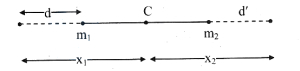
In the system of two particles of masses $m_1$ and $m_2$,the first particle is moved by a distance $d$ towards the centre of mass. To keep the centre of mass unchanged,the second particle will have to be moved by a distance
A
$\frac{m_2}{m_1} d$,towards the centre of mass.
B
$\frac{m_1}{m_2} d$,away from the centre of mass.
C
$\frac{m_1}{m_2} d$,towards the centre of mass.
D
$\frac{m_2}{m_1} d$,away from the centre of mass.
Solution
(C) Let $x_1$ and $x_2$ be the initial distances of particles $m_1$ and $m_2$ from the centre of mass $C$ respectively. For the centre of mass to remain at $C$,the condition is $m_1 x_1 = m_2 x_2$ ... $(i)$
When particle $m_1$ is moved by distance $d$ towards the centre of mass,its new distance from $C$ becomes $(x_1 - d)$.
Let the second particle $m_2$ be moved by a distance $d'$ to keep the centre of mass unchanged. Its new distance from $C$ will be $(x_2 - d')$.
For the centre of mass to remain unchanged,the new condition is $m_1(x_1 - d) = m_2(x_2 - d')$ ... (ii)
Expanding equation (ii): $m_1 x_1 - m_1 d = m_2 x_2 - m_2 d'$
Since $m_1 x_1 = m_2 x_2$ from equation $(i)$,we can substitute this into the expanded equation:
$m_2 x_2 - m_1 d = m_2 x_2 - m_2 d'$
$-m_1 d = -m_2 d'$
$d' = \frac{m_1}{m_2} d$
Since the displacement $d'$ is positive in the direction towards the centre of mass,the second particle must also be moved towards the centre of mass.
When particle $m_1$ is moved by distance $d$ towards the centre of mass,its new distance from $C$ becomes $(x_1 - d)$.
Let the second particle $m_2$ be moved by a distance $d'$ to keep the centre of mass unchanged. Its new distance from $C$ will be $(x_2 - d')$.
For the centre of mass to remain unchanged,the new condition is $m_1(x_1 - d) = m_2(x_2 - d')$ ... (ii)
Expanding equation (ii): $m_1 x_1 - m_1 d = m_2 x_2 - m_2 d'$
Since $m_1 x_1 = m_2 x_2$ from equation $(i)$,we can substitute this into the expanded equation:
$m_2 x_2 - m_1 d = m_2 x_2 - m_2 d'$
$-m_1 d = -m_2 d'$
$d' = \frac{m_1}{m_2} d$
Since the displacement $d'$ is positive in the direction towards the centre of mass,the second particle must also be moved towards the centre of mass.
0 likesView Solution
4
PhysicsEasyMCQMHT CET · 2024
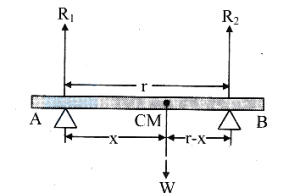
$A$ metal rod of weight $W$ is supported by two parallel knife-edges $A$ and $B$. The rod is in equilibrium in a horizontal position. The distance between the two knife-edges is $r$. The centre of mass of the rod is at a distance $x$ from $A$. The normal reaction on $A$ is
A
$\frac{W \cdot r}{x}$
B
$\frac{W \cdot x}{r}$
C
$\frac{W \cdot(r-x)}{x}$
D
$\frac{W \cdot(r-x)}{r}$
Solution
(D) For the rod to be in rotational equilibrium,the sum of torques about any point must be zero.
Taking the torque about the knife-edge $B$:
$\sum \tau_B = 0$
$N_A \cdot r - W \cdot (r - x) = 0$
Where $N_A$ is the normal reaction at $A$.
$N_A \cdot r = W(r - x)$
$N_A = \frac{W(r - x)}{r}$
Taking the torque about the knife-edge $B$:
$\sum \tau_B = 0$
$N_A \cdot r - W \cdot (r - x) = 0$
Where $N_A$ is the normal reaction at $A$.
$N_A \cdot r = W(r - x)$
$N_A = \frac{W(r - x)}{r}$
0 likesView Solution
5
PhysicsEasyMCQMHT CET · 2024
In the case of a system of two particles of different masses,the centre of mass lies
A
at the mid-point of the line joining the two particles.
B
on the line joining the two particles.
C
at one end of the line joining the two particles.
D
on the line perpendicular to the line joining the two particles.
Solution
(B) The centre of mass of a system of two particles is defined by the position vector $\vec{R}_{cm} = \frac{m_1\vec{r}_1 + m_2\vec{r}_2}{m_1 + m_2}$.
Since the position vector of the centre of mass is a weighted average of the position vectors of the two particles,it must lie on the line segment connecting the two particles.
If the masses are equal $(m_1 = m_2)$,the centre of mass lies exactly at the midpoint.
If the masses are different,it lies closer to the heavier mass,but it always remains on the line joining the two particles.
Therefore,option $B$ is correct.
Since the position vector of the centre of mass is a weighted average of the position vectors of the two particles,it must lie on the line segment connecting the two particles.
If the masses are equal $(m_1 = m_2)$,the centre of mass lies exactly at the midpoint.
If the masses are different,it lies closer to the heavier mass,but it always remains on the line joining the two particles.
Therefore,option $B$ is correct.
0 likesView Solution
6
PhysicsEasyMCQMHT CET · 2024
Three identical metal balls each of radius '$r$' are placed such that an equilateral triangle is formed when the centres of the three balls are joined. The centre of mass of the system is located at
A
centre of one of the balls.
B
point of intersection of medians.
C
line joining centres of any two balls.
D
on the circumference of any one of the balls.
Solution
(B) Since the three balls are identical and have the same radius,their masses are equal. Let the mass of each ball be '$m$'.
Let the coordinates of the centres of the three balls be $(x_1, y_1)$,$(x_2, y_2)$,and $(x_3, y_3)$.
The centre of mass $(X_{cm}, Y_{cm})$ of the system is given by:
$X_{cm} = \frac{m x_1 + m x_2 + m x_3}{m + m + m} = \frac{x_1 + x_2 + x_3}{3}$
$Y_{cm} = \frac{m y_1 + m y_2 + m y_3}{m + m + m} = \frac{y_1 + y_2 + y_3}{3}$
These coordinates represent the centroid of the triangle formed by the centres of the balls.
The centroid of a triangle is the point of intersection of its medians.
Let the coordinates of the centres of the three balls be $(x_1, y_1)$,$(x_2, y_2)$,and $(x_3, y_3)$.
The centre of mass $(X_{cm}, Y_{cm})$ of the system is given by:
$X_{cm} = \frac{m x_1 + m x_2 + m x_3}{m + m + m} = \frac{x_1 + x_2 + x_3}{3}$
$Y_{cm} = \frac{m y_1 + m y_2 + m y_3}{m + m + m} = \frac{y_1 + y_2 + y_3}{3}$
These coordinates represent the centroid of the triangle formed by the centres of the balls.
The centroid of a triangle is the point of intersection of its medians.
0 likesView Solution
7
PhysicsMediumMCQMHT CET · 2024
$A$ particle of mass $m$ collides with another stationary particle of mass $M$. The particle $m$ stops just after the collision. The coefficient of restitution is:
A
$\frac{m}{M}$
B
$\frac{M-m}{M+m}$
C
$1$
D
$\frac{m}{M+m}$
Solution
(A) Let $u$ be the initial velocity of mass $m$ and $0$ be the initial velocity of mass $M$.
Let $v_1$ be the final velocity of mass $m$ and $v_2$ be the final velocity of mass $M$.
Given that the particle $m$ stops after the collision,$v_1 = 0$.
By the law of conservation of linear momentum: $mu + M(0) = m(0) + Mv_2$.
This simplifies to $mu = Mv_2$,so $v_2 = \frac{mu}{M}$.
The coefficient of restitution $e$ is defined as $e = \frac{v_2 - v_1}{u_1 - u_2}$.
Substituting the known values: $e = \frac{\frac{mu}{M} - 0}{u - 0} = \frac{mu/M}{u} = \frac{m}{M}$.
Let $v_1$ be the final velocity of mass $m$ and $v_2$ be the final velocity of mass $M$.
Given that the particle $m$ stops after the collision,$v_1 = 0$.
By the law of conservation of linear momentum: $mu + M(0) = m(0) + Mv_2$.
This simplifies to $mu = Mv_2$,so $v_2 = \frac{mu}{M}$.
The coefficient of restitution $e$ is defined as $e = \frac{v_2 - v_1}{u_1 - u_2}$.
Substituting the known values: $e = \frac{\frac{mu}{M} - 0}{u - 0} = \frac{mu/M}{u} = \frac{m}{M}$.
0 likesView Solution
8
PhysicsMediumMCQMHT CET · 2024
In projectile motion,two particles of masses $m_1$ and $m_2$ have velocities $\vec{V}_1$ and $\vec{V}_2$ respectively at time $t=0$. Their velocities become $\vec{V}_1^{\prime}$ and $\vec{V}_2^{\prime}$ at time $2t$ while still moving in air. The value of $[(m_1 \vec{V}_1^{\prime} + m_2 \vec{V}_2^{\prime}) - (m_1 \vec{V}_1 + m_2 \vec{V}_2)]$ is ($g =$ acceleration due to gravity).
A
zero
B
$\frac{1}{2}(m_1 + m_2) gt$
C
$(m_1 + m_2) gt$
D
$2(m_1 + m_2) gt$
Solution
(D) The external force acting on the system of two particles is the gravitational force: $F_{ext} = (m_1 + m_2)g$ (acting downwards).
According to Newton's second law,the rate of change of momentum is equal to the external force: $F_{ext} = \frac{\Delta P}{\Delta t}$.
Here,$\Delta P = (m_1 \vec{V}_1^{\prime} + m_2 \vec{V}_2^{\prime}) - (m_1 \vec{V}_1 + m_2 \vec{V}_2)$ and $\Delta t = 2t - 0 = 2t$.
Substituting these into the equation: $(m_1 + m_2)g = \frac{(m_1 \vec{V}_1^{\prime} + m_2 \vec{V}_2^{\prime}) - (m_1 \vec{V}_1 + m_2 \vec{V}_2)}{2t}$.
Therefore,the change in momentum is: $[(m_1 \vec{V}_1^{\prime} + m_2 \vec{V}_2^{\prime}) - (m_1 \vec{V}_1 + m_2 \vec{V}_2)] = 2(m_1 + m_2)gt$.
According to Newton's second law,the rate of change of momentum is equal to the external force: $F_{ext} = \frac{\Delta P}{\Delta t}$.
Here,$\Delta P = (m_1 \vec{V}_1^{\prime} + m_2 \vec{V}_2^{\prime}) - (m_1 \vec{V}_1 + m_2 \vec{V}_2)$ and $\Delta t = 2t - 0 = 2t$.
Substituting these into the equation: $(m_1 + m_2)g = \frac{(m_1 \vec{V}_1^{\prime} + m_2 \vec{V}_2^{\prime}) - (m_1 \vec{V}_1 + m_2 \vec{V}_2)}{2t}$.
Therefore,the change in momentum is: $[(m_1 \vec{V}_1^{\prime} + m_2 \vec{V}_2^{\prime}) - (m_1 \vec{V}_1 + m_2 \vec{V}_2)] = 2(m_1 + m_2)gt$.
0 likesView Solution
9
PhysicsDifficultMCQMHT CET · 2024
If the momentum of a body of mass $m$ is increased by $20 \%$,then its kinetic energy increases by: (in $\%$)
A
$44$
B
$55$
C
$66$
D
$77$
Solution
(A) The kinetic energy $(K.E.)$ of a body is related to its momentum $(p)$ by the formula: $K.E. = \frac{p^2}{2m}$.
When the momentum increases by $20 \%$,the new momentum $p'$ becomes:
$p' = p + 0.20p = 1.2p$.
The new kinetic energy $(K.E.')$ is:
$K.E.' = \frac{(p')^2}{2m} = \frac{(1.2p)^2}{2m} = \frac{1.44p^2}{2m}$.
Since $K.E. = \frac{p^2}{2m}$,we have $K.E.' = 1.44 \times K.E$.
The percentage increase in kinetic energy is given by:
$\Delta K.E. \% = \frac{K.E.' - K.E.}{K.E.} \times 100 \%$
$= \frac{1.44 K.E. - K.E.}{K.E.} \times 100 \%$
$= 0.44 \times 100 \% = 44 \%$.
When the momentum increases by $20 \%$,the new momentum $p'$ becomes:
$p' = p + 0.20p = 1.2p$.
The new kinetic energy $(K.E.')$ is:
$K.E.' = \frac{(p')^2}{2m} = \frac{(1.2p)^2}{2m} = \frac{1.44p^2}{2m}$.
Since $K.E. = \frac{p^2}{2m}$,we have $K.E.' = 1.44 \times K.E$.
The percentage increase in kinetic energy is given by:
$\Delta K.E. \% = \frac{K.E.' - K.E.}{K.E.} \times 100 \%$
$= \frac{1.44 K.E. - K.E.}{K.E.} \times 100 \%$
$= 0.44 \times 100 \% = 44 \%$.
0 likesView Solution
10
PhysicsDifficultMCQMHT CET · 2024
$A$ moving body with mass $m_1$ strikes a stationary mass $m_2$. What should be the ratio $\frac{m_1}{m_2}$ so as to decrease the velocity of the first body by $1.5$ times after the collision?
A
$1: 25$
B
$1: 5$
C
$5: 1$
D
$25: 1$
Solution
(C) Let the initial velocity of mass $m_1$ be $v_1$ and the final velocity of mass $m_2$ be $v_2$.
According to the given condition,the final velocity of mass $m_1$ is $v_1' = \frac{v_1}{1.5} = \frac{2}{3} v_1$.
Assuming an elastic collision,the coefficient of restitution $e = 1$.
The formula for the coefficient of restitution is $e = \frac{v_2 - v_1'}{v_1 - 0}$.
Substituting the values: $1 = \frac{v_2 - \frac{2}{3}v_1}{v_1} \implies v_2 = v_1 + \frac{2}{3}v_1 = \frac{5}{3}v_1$.
By the law of conservation of linear momentum: $m_1 v_1 = m_1 v_1' + m_2 v_2$.
Substituting the velocities: $m_1 v_1 = m_1 (\frac{2}{3} v_1) + m_2 (\frac{5}{3} v_1)$.
Rearranging the terms: $m_1 v_1 - \frac{2}{3} m_1 v_1 = m_2 \frac{5}{3} v_1$.
$\frac{1}{3} m_1 v_1 = \frac{5}{3} m_2 v_1$.
Therefore,$\frac{m_1}{m_2} = \frac{5}{1}$.
According to the given condition,the final velocity of mass $m_1$ is $v_1' = \frac{v_1}{1.5} = \frac{2}{3} v_1$.
Assuming an elastic collision,the coefficient of restitution $e = 1$.
The formula for the coefficient of restitution is $e = \frac{v_2 - v_1'}{v_1 - 0}$.
Substituting the values: $1 = \frac{v_2 - \frac{2}{3}v_1}{v_1} \implies v_2 = v_1 + \frac{2}{3}v_1 = \frac{5}{3}v_1$.
By the law of conservation of linear momentum: $m_1 v_1 = m_1 v_1' + m_2 v_2$.
Substituting the velocities: $m_1 v_1 = m_1 (\frac{2}{3} v_1) + m_2 (\frac{5}{3} v_1)$.
Rearranging the terms: $m_1 v_1 - \frac{2}{3} m_1 v_1 = m_2 \frac{5}{3} v_1$.
$\frac{1}{3} m_1 v_1 = \frac{5}{3} m_2 v_1$.
Therefore,$\frac{m_1}{m_2} = \frac{5}{1}$.
0 likesView Solution
11
PhysicsDifficultMCQMHT CET · 2024
$1000$ small balls,each weighing $1 \text{ g}$,strike $1 \text{ cm}^2$ of area per second with a velocity of $50 \text{ m/s}$ in a normal direction and rebound with the same velocity. The value of pressure on the surface will be:
A
$10^7 \text{ N/m}^2$
B
$10^6 \text{ N/m}^2$
C
$5 \times 10^6 \text{ N/m}^2$
D
$2 \times 10^6 \text{ N/m}^2$
Solution
(B) Given that:
Number of balls $N = 1000 = 10^3$
Mass of each ball $m = 1 \text{ g} = 10^{-3} \text{ kg}$
Area $A = 1 \text{ cm}^2 = 10^{-4} \text{ m}^2$
Velocity $v = 50 \text{ m/s}$
The change in momentum for each collision is $\Delta p = m[v - (-v)] = 2mv$.
Since there are $N$ collisions per second,the total force $F$ exerted on the surface is:
$F = N \times \Delta p = N \times 2mv$
$F = 10^3 \times 2 \times 10^{-3} \text{ kg} \times 50 \text{ m/s} = 100 \text{ N}$.
Pressure $P$ is defined as force per unit area:
$P = \frac{F}{A} = \frac{100 \text{ N}}{10^{-4} \text{ m}^2} = 10^6 \text{ N/m}^2$.
Number of balls $N = 1000 = 10^3$
Mass of each ball $m = 1 \text{ g} = 10^{-3} \text{ kg}$
Area $A = 1 \text{ cm}^2 = 10^{-4} \text{ m}^2$
Velocity $v = 50 \text{ m/s}$
The change in momentum for each collision is $\Delta p = m[v - (-v)] = 2mv$.
Since there are $N$ collisions per second,the total force $F$ exerted on the surface is:
$F = N \times \Delta p = N \times 2mv$
$F = 10^3 \times 2 \times 10^{-3} \text{ kg} \times 50 \text{ m/s} = 100 \text{ N}$.
Pressure $P$ is defined as force per unit area:
$P = \frac{F}{A} = \frac{100 \text{ N}}{10^{-4} \text{ m}^2} = 10^6 \text{ N/m}^2$.
0 likesView Solution
12
PhysicsDifficultMCQMHT CET · 2024
The height above the earth's surface at which the acceleration due to gravity becomes $\frac{1}{n}$ times the value at the surface is ($R=$ radius of earth).
A
$\frac{R}{\sqrt{n}}$
B
$R \cdot \sqrt{n}$
C
$(\sqrt{n}+1) R$
D
$(\sqrt{n}-1) R$
Solution
(D) The acceleration due to gravity at a height $h$ above the earth's surface is given by the formula: $g' = g \left( \frac{R}{R+h} \right)^2$.
Given that $g' = \frac{g}{n}$,we can write: $\frac{g}{n} = g \left( \frac{R}{R+h} \right)^2$.
Dividing both sides by $g$,we get: $\frac{1}{n} = \left( \frac{R}{R+h} \right)^2$.
Taking the square root of both sides: $\frac{1}{\sqrt{n}} = \frac{R}{R+h}$.
Rearranging the equation to solve for $h$: $R+h = R \sqrt{n}$.
Therefore,$h = R \sqrt{n} - R = R(\sqrt{n}-1)$.
Given that $g' = \frac{g}{n}$,we can write: $\frac{g}{n} = g \left( \frac{R}{R+h} \right)^2$.
Dividing both sides by $g$,we get: $\frac{1}{n} = \left( \frac{R}{R+h} \right)^2$.
Taking the square root of both sides: $\frac{1}{\sqrt{n}} = \frac{R}{R+h}$.
Rearranging the equation to solve for $h$: $R+h = R \sqrt{n}$.
Therefore,$h = R \sqrt{n} - R = R(\sqrt{n}-1)$.
0 likesView Solution
13
PhysicsMediumMCQMHT CET · 2024
The height at which the weight of the body becomes $\frac{1}{16}$ of its weight on the surface of the earth of radius $R$ is: (in $R$)
A
$2$
B
$3$
C
$4$
D
$5$
Solution
(B) The weight of a body at height $h$ is given by $W_h = W \left( \frac{R}{R+h} \right)^2$,where $W$ is the weight on the surface of the earth.
Given that $W_h = \frac{1}{16} W$,we have:
$\frac{1}{16} W = W \left( \frac{R}{R+h} \right)^2$
$\frac{1}{16} = \left( \frac{R}{R+h} \right)^2$
Taking the square root on both sides:
$\frac{1}{4} = \frac{R}{R+h}$
$R + h = 4R$
$h = 3R$
Therefore,the height at which the weight becomes $\frac{1}{16}$ of its surface weight is $3R$.
Given that $W_h = \frac{1}{16} W$,we have:
$\frac{1}{16} W = W \left( \frac{R}{R+h} \right)^2$
$\frac{1}{16} = \left( \frac{R}{R+h} \right)^2$
Taking the square root on both sides:
$\frac{1}{4} = \frac{R}{R+h}$
$R + h = 4R$
$h = 3R$
Therefore,the height at which the weight becomes $\frac{1}{16}$ of its surface weight is $3R$.
0 likesView Solution
14
PhysicsEasyMCQMHT CET · 2024
The height $h$ above the earth's surface at which the value of acceleration due to gravity $g$ becomes $\frac{g}{3}$ is ($R=$ radius of the earth).
A
$(\sqrt{3}+1) R$
B
$(\sqrt{3}-1) R$
C
$\sqrt{3} R$
D
$3 \sqrt{R}$
Solution
(B) The acceleration due to gravity at a height $h$ above the earth's surface is given by the formula: $g_h = g \left( \frac{R}{R+h} \right)^2$.
Given that $g_h = \frac{g}{3}$,we substitute this into the equation:
$\frac{g}{3} = g \left( \frac{R}{R+h} \right)^2$.
Dividing both sides by $g$:
$\frac{1}{3} = \left( \frac{R}{R+h} \right)^2$.
Taking the square root of both sides:
$\frac{1}{\sqrt{3}} = \frac{R}{R+h}$.
Rearranging the terms to solve for $h$:
$R + h = \sqrt{3} R$.
$h = \sqrt{3} R - R$.
$h = (\sqrt{3} - 1) R$.
Given that $g_h = \frac{g}{3}$,we substitute this into the equation:
$\frac{g}{3} = g \left( \frac{R}{R+h} \right)^2$.
Dividing both sides by $g$:
$\frac{1}{3} = \left( \frac{R}{R+h} \right)^2$.
Taking the square root of both sides:
$\frac{1}{\sqrt{3}} = \frac{R}{R+h}$.
Rearranging the terms to solve for $h$:
$R + h = \sqrt{3} R$.
$h = \sqrt{3} R - R$.
$h = (\sqrt{3} - 1) R$.
0 likesView Solution
15
PhysicsEasyMCQMHT CET · 2024
$A$ pendulum is oscillating with frequency $n$ on the surface of the Earth. If it is taken to a depth $d = \frac{R}{4}$ below the surface of the Earth,what is the new frequency of oscillation? ($R =$ radius of the Earth)
A
$\frac{2}{\sqrt{3}} n$
B
$\frac{\sqrt{3}}{2} n$
C
$\frac{2 n}{\sqrt{3}}$
D
$\frac{n}{4}$
Solution
(B) The frequency of the pendulum at the surface is given by $f = \frac{1}{2 \pi} \sqrt{\frac{g}{l}}$.
At a depth $d$,the gravitational acceleration is given by $g_{eff} = g \left(1 - \frac{d}{R}\right)$.
For $d = \frac{R}{4}$,the effective acceleration is $g_{eff} = g \left(1 - \frac{R/4}{R}\right) = g \left(1 - \frac{1}{4}\right) = \frac{3}{4} g$.
The frequency at depth $d$ is $f_d = \frac{1}{2 \pi} \sqrt{\frac{g_{eff}}{l}} = \frac{1}{2 \pi} \sqrt{\frac{3g}{4l}}$.
Taking the ratio of the new frequency to the original frequency $n$:
$\frac{f_d}{n} = \frac{\frac{1}{2 \pi} \sqrt{\frac{3g}{4l}}}{\frac{1}{2 \pi} \sqrt{\frac{g}{l}}} = \sqrt{\frac{3}{4}} = \frac{\sqrt{3}}{2}$.
Therefore,the new frequency is $f_d = \frac{\sqrt{3}}{2} n$.
At a depth $d$,the gravitational acceleration is given by $g_{eff} = g \left(1 - \frac{d}{R}\right)$.
For $d = \frac{R}{4}$,the effective acceleration is $g_{eff} = g \left(1 - \frac{R/4}{R}\right) = g \left(1 - \frac{1}{4}\right) = \frac{3}{4} g$.
The frequency at depth $d$ is $f_d = \frac{1}{2 \pi} \sqrt{\frac{g_{eff}}{l}} = \frac{1}{2 \pi} \sqrt{\frac{3g}{4l}}$.
Taking the ratio of the new frequency to the original frequency $n$:
$\frac{f_d}{n} = \frac{\frac{1}{2 \pi} \sqrt{\frac{3g}{4l}}}{\frac{1}{2 \pi} \sqrt{\frac{g}{l}}} = \sqrt{\frac{3}{4}} = \frac{\sqrt{3}}{2}$.
Therefore,the new frequency is $f_d = \frac{\sqrt{3}}{2} n$.
0 likesView Solution
16
PhysicsMediumMCQMHT CET · 2024
The height $h$ from the surface of the earth at which the value of $g$ will be reduced by $64 \%$ from the value at the surface of the earth is ($R=$ radius of the earth).
A
$\frac{1}{3} R$
B
$\frac{2}{3} R$
C
$\frac{3}{2} R$
D
$2 R$
Solution
(B) The acceleration due to gravity at the surface of the earth is $g = \frac{GM}{R^2}$.
At a height $h$,the acceleration due to gravity is $g_h = \frac{GM}{(R+h)^2}$.
Given that the value of $g$ is reduced by $64 \%$,the remaining value is $g_h = (100 \% - 64 \%) \text{ of } g = 36 \% \text{ of } g = 0.36g$.
Therefore,$\frac{g_h}{g} = 0.36 = \frac{36}{100}$.
Substituting the expressions for $g$ and $g_h$:
$\frac{R^2}{(R+h)^2} = \frac{36}{100}$.
Taking the square root on both sides:
$\frac{R}{R+h} = \frac{6}{10} = \frac{3}{5}$.
Cross-multiplying gives:
$5R = 3(R+h) = 3R + 3h$.
$2R = 3h$.
$h = \frac{2}{3} R$.
At a height $h$,the acceleration due to gravity is $g_h = \frac{GM}{(R+h)^2}$.
Given that the value of $g$ is reduced by $64 \%$,the remaining value is $g_h = (100 \% - 64 \%) \text{ of } g = 36 \% \text{ of } g = 0.36g$.
Therefore,$\frac{g_h}{g} = 0.36 = \frac{36}{100}$.
Substituting the expressions for $g$ and $g_h$:
$\frac{R^2}{(R+h)^2} = \frac{36}{100}$.
Taking the square root on both sides:
$\frac{R}{R+h} = \frac{6}{10} = \frac{3}{5}$.
Cross-multiplying gives:
$5R = 3(R+h) = 3R + 3h$.
$2R = 3h$.
$h = \frac{2}{3} R$.
0 likesView Solution
17
PhysicsMediumMCQMHT CET · 2024
The depth $d$ at which the value of acceleration due to gravity becomes $\frac{1}{n-1}$ times the value at the earth's surface is ($R=$ radius of the earth).
A
$R\left(\frac{n}{n-1}\right)$
B
$R\left(\frac{n-2}{n-1}\right)$
C
$R\left(\frac{2n-1}{n}\right)$
D
$R\left(\frac{n-1}{2n-1}\right)$
Solution
(B) The acceleration due to gravity at a depth $d$ is given by the formula: $g_d = g\left(1 - \frac{d}{R}\right)$.
Given that $g_d = \frac{g}{n-1}$,we substitute this into the equation:
$\frac{g}{n-1} = g\left(1 - \frac{d}{R}\right)$.
Dividing both sides by $g$:
$\frac{1}{n-1} = 1 - \frac{d}{R}$.
Rearranging the terms to solve for $d$:
$\frac{d}{R} = 1 - \frac{1}{n-1}$.
$\frac{d}{R} = \frac{n-1-1}{n-1} = \frac{n-2}{n-1}$.
Therefore,$d = R\left(\frac{n-2}{n-1}\right)$.
Given that $g_d = \frac{g}{n-1}$,we substitute this into the equation:
$\frac{g}{n-1} = g\left(1 - \frac{d}{R}\right)$.
Dividing both sides by $g$:
$\frac{1}{n-1} = 1 - \frac{d}{R}$.
Rearranging the terms to solve for $d$:
$\frac{d}{R} = 1 - \frac{1}{n-1}$.
$\frac{d}{R} = \frac{n-1-1}{n-1} = \frac{n-2}{n-1}$.
Therefore,$d = R\left(\frac{n-2}{n-1}\right)$.
0 likesView Solution
18
PhysicsEasyMCQMHT CET · 2024
The acceleration due to gravity at the surface of the planet is the same as that at the surface of the earth,but the density of the planet is thrice that of the earth. If $R$ is the radius of the earth,the radius of the planet will be:
A
$\frac{R}{9}$
B
$\frac{R}{3}$
C
$3 R$
D
$9 R$
Solution
(B) The acceleration due to gravity $g$ at the surface of a planet is given by $g = \frac{GM}{R^2}$.
Since mass $M = \text{Volume} \times \text{Density} = \frac{4}{3} \pi R^3 \rho$,we can write $g = \frac{G}{R^2} \times \frac{4}{3} \pi R^3 \rho = \frac{4}{3} \pi R \rho G$.
Given that $g$ is the same for both the earth and the planet,we have $R_e \rho_e = R_p \rho_p$.
Here,$R_e = R$ and $\rho_p = 3 \rho_e$.
Substituting these values: $R \times \rho_e = R_p \times (3 \rho_e)$.
Therefore,$R_p = \frac{R}{3}$.
Since mass $M = \text{Volume} \times \text{Density} = \frac{4}{3} \pi R^3 \rho$,we can write $g = \frac{G}{R^2} \times \frac{4}{3} \pi R^3 \rho = \frac{4}{3} \pi R \rho G$.
Given that $g$ is the same for both the earth and the planet,we have $R_e \rho_e = R_p \rho_p$.
Here,$R_e = R$ and $\rho_p = 3 \rho_e$.
Substituting these values: $R \times \rho_e = R_p \times (3 \rho_e)$.
Therefore,$R_p = \frac{R}{3}$.
0 likesView Solution
19
PhysicsMediumMCQMHT CET · 2024
The weights of an object are measured in a coal mine of depth $h_1$,then at sea level of height $h_2=0$,and lastly at the top of a mountain of height $h_3$ as $W_1, W_2$,and $W_3$ respectively. Which one of the following relations is correct? [$h_1 \ll R, h_3 \ll R, R=$ radius of the earth]
A
$W_1=W_2=W_3$
B
$W_1 < W_2 < W_3$
C
$W_1 > W_2 < W_3$
D
$W_1 < W_2 > W_3$
Solution
(D) The weight of an object is given by $W = mg$,where $m$ is the mass and $g$ is the acceleration due to gravity.
At the surface of the earth $(h=0)$,the acceleration due to gravity $g$ is maximum.
As we move into a mine of depth $h_1$,the acceleration due to gravity is $g_1 = g(1 - h_1/R)$,so $W_1 = mg(1 - h_1/R) < W_2$.
As we move to the top of a mountain of height $h_3$,the acceleration due to gravity is $g_3 = g(1 - 2h_3/R)$,so $W_3 = mg(1 - 2h_3/R) < W_2$.
Since $W_2$ is the weight at the surface,it is greater than both $W_1$ and $W_3$.
Therefore,the correct relation is $W_1 < W_2 > W_3$.
At the surface of the earth $(h=0)$,the acceleration due to gravity $g$ is maximum.
As we move into a mine of depth $h_1$,the acceleration due to gravity is $g_1 = g(1 - h_1/R)$,so $W_1 = mg(1 - h_1/R) < W_2$.
As we move to the top of a mountain of height $h_3$,the acceleration due to gravity is $g_3 = g(1 - 2h_3/R)$,so $W_3 = mg(1 - 2h_3/R) < W_2$.
Since $W_2$ is the weight at the surface,it is greater than both $W_1$ and $W_3$.
Therefore,the correct relation is $W_1 < W_2 > W_3$.
0 likesView Solution
20
PhysicsEasyMCQMHT CET · 2024
The density of a new planet is twice that of earth. The acceleration due to gravity at the surface of the planet is equal to that at the surface of earth. If $R$ is the radius of earth,then the radius of the planet would be
A
$4 R$
B
$R / 2$
C
$\frac{R}{4}$
D
$2 R$
Solution
(B) The acceleration due to gravity $g$ at the surface of a planet is given by the formula: $g = \frac{4}{3} \pi \rho G R$,where $\rho$ is the density,$G$ is the gravitational constant,and $R$ is the radius of the planet.
Given that the density of the planet $\rho_p = 2 \rho_e$ and the acceleration due to gravity $g_p = g_e$.
Equating the expressions for both the planet and the earth:
$\frac{4}{3} \pi \rho_p G R_p = \frac{4}{3} \pi \rho_e G R_e$
$\rho_p R_p = \rho_e R_e$
Substituting $\rho_p = 2 \rho_e$ and $R_e = R$:
$(2 \rho_e) R_p = \rho_e R$
$2 R_p = R$
$R_p = \frac{R}{2}$
Given that the density of the planet $\rho_p = 2 \rho_e$ and the acceleration due to gravity $g_p = g_e$.
Equating the expressions for both the planet and the earth:
$\frac{4}{3} \pi \rho_p G R_p = \frac{4}{3} \pi \rho_e G R_e$
$\rho_p R_p = \rho_e R_e$
Substituting $\rho_p = 2 \rho_e$ and $R_e = R$:
$(2 \rho_e) R_p = \rho_e R$
$2 R_p = R$
$R_p = \frac{R}{2}$
0 likesView Solution
21
PhysicsMediumMCQMHT CET · 2024
The speed with which the earth would have to rotate about its axis so that a person on the equator would weigh $\frac{3}{5}$ th as much as at present weight is ($g=$ gravitational acceleration,$R=$ equatorial radius of the earth).
A
$\sqrt{\frac{2g}{5R}}$
B
$\sqrt{\frac{3g}{5R}}$
C
$\sqrt{\frac{5R}{3g}}$
D
$\sqrt{\frac{3}{5}gR}$
Solution
(A) The effective acceleration due to gravity $g'$ at a latitude $\theta$ is given by $g' = g - R\omega^2 \cos^2 \theta$.
At the equator,the latitude $\theta = 0^\circ$,so $\cos 0^\circ = 1$. Thus,$g' = g - R\omega^2$.
Given that the weight becomes $\frac{3}{5}$ of its present value,the effective gravity $g'$ must be $\frac{3}{5}g$.
Substituting this into the equation: $\frac{3}{5}g = g - R\omega^2$.
Rearranging the terms: $R\omega^2 = g - \frac{3}{5}g = \frac{2}{5}g$.
Solving for $\omega$: $\omega^2 = \frac{2g}{5R}$,which gives $\omega = \sqrt{\frac{2g}{5R}}$.
At the equator,the latitude $\theta = 0^\circ$,so $\cos 0^\circ = 1$. Thus,$g' = g - R\omega^2$.
Given that the weight becomes $\frac{3}{5}$ of its present value,the effective gravity $g'$ must be $\frac{3}{5}g$.
Substituting this into the equation: $\frac{3}{5}g = g - R\omega^2$.
Rearranging the terms: $R\omega^2 = g - \frac{3}{5}g = \frac{2}{5}g$.
Solving for $\omega$: $\omega^2 = \frac{2g}{5R}$,which gives $\omega = \sqrt{\frac{2g}{5R}}$.
0 likesView Solution
22
PhysicsMediumMCQMHT CET · 2024
$A$ boy weighs $72 \ N$ on the surface of the earth. What will be the gravitational force on the boy at a height equal to half the radius of the earth (in $N$)?
A
$32$
B
$48$
C
$96$
D
$162$
Solution
(A) The weight of an object at the surface of the earth is $W = mg = 72 \ N$.
At a height $h$ above the surface,the acceleration due to gravity $g_h$ is given by the formula: $g_h = g \left( \frac{R}{R+h} \right)^2$.
Given that the height $h = \frac{R}{2}$,we substitute this into the formula:
$g_h = g \left( \frac{R}{R + \frac{R}{2}} \right)^2 = g \left( \frac{R}{\frac{3R}{2}} \right)^2 = g \left( \frac{2}{3} \right)^2 = \frac{4}{9} g$.
The weight at height $h$ is $W_h = m g_h = m \left( \frac{4}{9} g \right) = \frac{4}{9} W$.
Substituting $W = 72 \ N$:
$W_h = \frac{4}{9} \times 72 = 4 \times 8 = 32 \ N$.
At a height $h$ above the surface,the acceleration due to gravity $g_h$ is given by the formula: $g_h = g \left( \frac{R}{R+h} \right)^2$.
Given that the height $h = \frac{R}{2}$,we substitute this into the formula:
$g_h = g \left( \frac{R}{R + \frac{R}{2}} \right)^2 = g \left( \frac{R}{\frac{3R}{2}} \right)^2 = g \left( \frac{2}{3} \right)^2 = \frac{4}{9} g$.
The weight at height $h$ is $W_h = m g_h = m \left( \frac{4}{9} g \right) = \frac{4}{9} W$.
Substituting $W = 72 \ N$:
$W_h = \frac{4}{9} \times 72 = 4 \times 8 = 32 \ N$.
0 likesView Solution
23
PhysicsDifficultMCQMHT CET · 2024
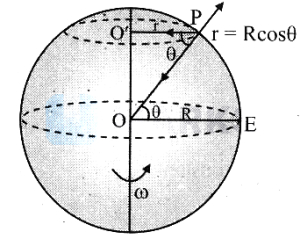
The linear speed of a particle at the equator of the earth due to its spin motion is $V$. The linear speed of the particle at latitude $30^{\circ}$ is:
A
$\frac{V}{\sqrt{2}}$
B
$\frac{V}{2}$
C
$\frac{\sqrt{3}}{2} V$
D
$V$
Solution
(C) The particle on the equator of the earth has linear speed $V = R \omega$,where $R$ is the radius of the earth and $\omega$ is the angular velocity of the earth's rotation.
At a latitude $\theta$,the particle moves in a circle of radius $r = R \cos \theta$.
The linear speed $V'$ of the particle at latitude $\theta$ is given by $V' = r \omega = (R \cos \theta) \omega$.
Substituting $\theta = 30^{\circ}$:
$V' = R \omega \cos 30^{\circ} = R \omega \left( \frac{\sqrt{3}}{2} \right)$.
Since $V = R \omega$,we have $V' = \frac{\sqrt{3}}{2} V$.
At a latitude $\theta$,the particle moves in a circle of radius $r = R \cos \theta$.
The linear speed $V'$ of the particle at latitude $\theta$ is given by $V' = r \omega = (R \cos \theta) \omega$.
Substituting $\theta = 30^{\circ}$:
$V' = R \omega \cos 30^{\circ} = R \omega \left( \frac{\sqrt{3}}{2} \right)$.
Since $V = R \omega$,we have $V' = \frac{\sqrt{3}}{2} V$.
0 likesView Solution
24
PhysicsMediumMCQMHT CET · 2024
The magnitude of the gravitational field at distances $r_1$ and $r_2$ from the center of a uniform sphere of radius $R$ and mass $M$ are $F_1$ and $F_2$ respectively. The ratio $(F_1 / F_2)$ will be (if $r_1 > R$ and $r_2 < R$):
A
$\frac{R^2}{r_1 r_2}$
B
$\frac{R^3}{r_1 r_2^2}$
C
$\frac{R^3}{r_1^2 r_2}$
D
$\frac{R^4}{r_1^2 r_2^2}$
Solution
(C) For a point outside the sphere $(r > R)$,the gravitational field is given by $F = \frac{G M}{r^2}$.
Thus,for $r_1 > R$,$F_1 = \frac{G M}{r_1^2}$.
For a point inside the sphere $(r < R)$,the gravitational field is given by $F = \frac{G M r}{R^3}$.
Thus,for $r_2 < R$,$F_2 = \frac{G M r_2}{R^3}$.
Taking the ratio of $F_1$ to $F_2$:
$\frac{F_1}{F_2} = \frac{G M}{r_1^2} \times \frac{R^3}{G M r_2} = \frac{R^3}{r_1^2 r_2}$.
Thus,for $r_1 > R$,$F_1 = \frac{G M}{r_1^2}$.
For a point inside the sphere $(r < R)$,the gravitational field is given by $F = \frac{G M r}{R^3}$.
Thus,for $r_2 < R$,$F_2 = \frac{G M r_2}{R^3}$.
Taking the ratio of $F_1$ to $F_2$:
$\frac{F_1}{F_2} = \frac{G M}{r_1^2} \times \frac{R^3}{G M r_2} = \frac{R^3}{r_1^2 r_2}$.
0 likesView Solution
25
PhysicsEasyMCQMHT CET · 2024
If $R$ is the radius of the Earth and $g$ is the acceleration due to gravity on the Earth's surface,then the mean density of the Earth is:
A
$\frac{4 \pi G}{3 g R}$
B
$\frac{3 \pi R}{4 g G}$
C
$\frac{3 g}{4 \pi R G}$
D
$\frac{\pi R G}{12 g}$
Solution
(C) The mass of the Earth $M$ can be expressed in terms of its volume $V$ and mean density $\rho$ as:
$M = V \rho = \frac{4}{3} \pi R^3 \rho$ ... $(i)$
The acceleration due to gravity $g$ on the surface of the Earth is given by:
$g = \frac{GM}{R^2}$ ... $(ii)$
Substituting the expression for $M$ from equation $(i)$ into equation $(ii)$:
$g = \frac{G}{R^2} \times \left( \frac{4}{3} \pi R^3 \rho \right)$
$g = \frac{4}{3} \pi R G \rho$
Rearranging the equation to solve for the mean density $\rho$:
$\rho = \frac{3 g}{4 \pi R G}$
$M = V \rho = \frac{4}{3} \pi R^3 \rho$ ... $(i)$
The acceleration due to gravity $g$ on the surface of the Earth is given by:
$g = \frac{GM}{R^2}$ ... $(ii)$
Substituting the expression for $M$ from equation $(i)$ into equation $(ii)$:
$g = \frac{G}{R^2} \times \left( \frac{4}{3} \pi R^3 \rho \right)$
$g = \frac{4}{3} \pi R G \rho$
Rearranging the equation to solve for the mean density $\rho$:
$\rho = \frac{3 g}{4 \pi R G}$
0 likesView Solution
26
PhysicsDifficultMCQMHT CET · 2024
Earth has mass $M_1$ and radius $R_1$,and the moon has mass $M_2$ and radius $R_2$. The distance between their centers is $r$. $A$ body of mass $M$ is placed on the line joining them at a distance $r/3$ from the center of the Earth. To project the mass $M$ to escape to infinity,the minimum speed required is:
A
$\left[\frac{2 G}{r}\left(M_2+\frac{M_1}{2}\right)\right]^{1 / 2}$
B
$\left[\frac{4 G}{r}\left(M_1+\frac{M_2}{2}\right)\right]^{1 / 2}$
C
$\left[\frac{3 G}{r}\left(M_1+M_2\right)\right]^{1 / 2}$
D
$\left[\frac{6 G}{r}\left(M_1+\frac{M_2}{2}\right)\right]^{1 / 2}$
Solution
(D) The gravitational potential energy $U$ of the body of mass $M$ at a distance $r/3$ from the Earth and $2r/3$ from the moon is given by:
$U = -\frac{G M_1 M}{r/3} - \frac{G M_2 M}{2r/3} = -\frac{3 G M_1 M}{r} - \frac{3 G M_2 M}{2r} = -\frac{3 G M}{r} \left( M_1 + \frac{M_2}{2} \right)$.
To escape to infinity,the total energy must be at least zero. If $v$ is the required escape speed,the kinetic energy is $\frac{1}{2} M v^2$.
By conservation of energy: $\frac{1}{2} M v^2 + U = 0$.
$\frac{1}{2} M v^2 = \frac{3 G M}{r} \left( M_1 + \frac{M_2}{2} \right)$.
Solving for $v$:
$v^2 = \frac{6 G}{r} \left( M_1 + \frac{M_2}{2} \right)$.
$v = \left[ \frac{6 G}{r} \left( M_1 + \frac{M_2}{2} \right) \right]^{1/2}$.
$U = -\frac{G M_1 M}{r/3} - \frac{G M_2 M}{2r/3} = -\frac{3 G M_1 M}{r} - \frac{3 G M_2 M}{2r} = -\frac{3 G M}{r} \left( M_1 + \frac{M_2}{2} \right)$.
To escape to infinity,the total energy must be at least zero. If $v$ is the required escape speed,the kinetic energy is $\frac{1}{2} M v^2$.
By conservation of energy: $\frac{1}{2} M v^2 + U = 0$.
$\frac{1}{2} M v^2 = \frac{3 G M}{r} \left( M_1 + \frac{M_2}{2} \right)$.
Solving for $v$:
$v^2 = \frac{6 G}{r} \left( M_1 + \frac{M_2}{2} \right)$.
$v = \left[ \frac{6 G}{r} \left( M_1 + \frac{M_2}{2} \right) \right]^{1/2}$.
0 likesView Solution
27
PhysicsEasyMCQMHT CET · 2024
The escape velocity from the Earth's surface is $11 \,km/s$. The escape velocity from a planet having twice the radius and the same mean density as the Earth is: (in $\,km/s$)
A
$22$
B
$11$
C
$5.5$
D
$15.5$
Solution
(A) The escape velocity $v_e$ is given by the formula: $v_e = \sqrt{\frac{2GM}{R}}$.
Since the mass $M$ of a planet can be expressed in terms of its density $\rho$ and radius $R$ as $M = \frac{4}{3} \pi R^3 \rho$, we substitute this into the formula:
$v_e = \sqrt{\frac{2G}{R} \cdot \frac{4}{3} \pi R^3 \rho} = \sqrt{\frac{8}{3} G \pi \rho R^2} = R \sqrt{\frac{8}{3} G \pi \rho}$.
Given that the density $\rho$ is the same for both the Earth and the planet, we have $v_e \propto R$.
Let $v_e$ be the escape velocity of Earth and $v_e'$ be the escape velocity of the planet.
Given $R' = 2R$, we have:
$\frac{v_e'}{v_e} = \frac{R'}{R} = \frac{2R}{R} = 2$.
Therefore, $v_e' = 2 \times v_e = 2 \times 11 \,km/s = 22 \,km/s$.
Since the mass $M$ of a planet can be expressed in terms of its density $\rho$ and radius $R$ as $M = \frac{4}{3} \pi R^3 \rho$, we substitute this into the formula:
$v_e = \sqrt{\frac{2G}{R} \cdot \frac{4}{3} \pi R^3 \rho} = \sqrt{\frac{8}{3} G \pi \rho R^2} = R \sqrt{\frac{8}{3} G \pi \rho}$.
Given that the density $\rho$ is the same for both the Earth and the planet, we have $v_e \propto R$.
Let $v_e$ be the escape velocity of Earth and $v_e'$ be the escape velocity of the planet.
Given $R' = 2R$, we have:
$\frac{v_e'}{v_e} = \frac{R'}{R} = \frac{2R}{R} = 2$.
Therefore, $v_e' = 2 \times v_e = 2 \times 11 \,km/s = 22 \,km/s$.
0 likesView Solution
28
PhysicsMediumMCQMHT CET · 2024
The radius of the planet is double that of the earth,but their average densities are same. $V_{p}$ and $V_E$ are the escape velocities of planet and earth respectively. If $\frac{V_p}{V_E}=x$,the value of '$x$' is
A
$1/4$
B
$1/2$
C
$2$
D
$4$
Solution
(C) The escape velocity $v_e$ of a planet is given by the formula: $v_e = \sqrt{\frac{2GM}{R}}$.
Since the mass $M$ of a planet can be expressed in terms of its density $\rho$ and radius $R$ as $M = \frac{4}{3}\pi R^3 \rho$,we substitute this into the escape velocity formula:
$v_e = \sqrt{\frac{2G}{R} \cdot \frac{4}{3}\pi R^3 \rho} = \sqrt{\frac{8}{3}G\pi\rho R^2} = R \sqrt{\frac{8}{3}G\pi\rho}$.
Given that the densities $\rho$ are the same for both the planet and the earth,the escape velocity is directly proportional to the radius: $v_e \propto R$.
Therefore,the ratio of the escape velocities is: $\frac{V_p}{V_E} = \frac{R_p}{R_E}$.
Given that the radius of the planet is double that of the earth $(R_p = 2R_E)$,we have:
$\frac{V_p}{V_E} = \frac{2R_E}{R_E} = 2$.
Thus,the value of $x$ is $2$.
Since the mass $M$ of a planet can be expressed in terms of its density $\rho$ and radius $R$ as $M = \frac{4}{3}\pi R^3 \rho$,we substitute this into the escape velocity formula:
$v_e = \sqrt{\frac{2G}{R} \cdot \frac{4}{3}\pi R^3 \rho} = \sqrt{\frac{8}{3}G\pi\rho R^2} = R \sqrt{\frac{8}{3}G\pi\rho}$.
Given that the densities $\rho$ are the same for both the planet and the earth,the escape velocity is directly proportional to the radius: $v_e \propto R$.
Therefore,the ratio of the escape velocities is: $\frac{V_p}{V_E} = \frac{R_p}{R_E}$.
Given that the radius of the planet is double that of the earth $(R_p = 2R_E)$,we have:
$\frac{V_p}{V_E} = \frac{2R_E}{R_E} = 2$.
Thus,the value of $x$ is $2$.
0 likesView Solution
29
PhysicsDifficultMCQMHT CET · 2024
The radius and mean density of a planet are four times that of the Earth. The ratio of the escape velocity on the Earth to the escape velocity on the planet is:
A
$1: \sqrt{8}$
B
$1: 8$
C
$1: \sqrt{3}$
D
$1: 4$
Solution
(B) The escape velocity $v_e$ is given by the formula $v_e = \sqrt{\frac{2GM}{R}}$.
Substituting $M = \frac{4}{3} \pi R^3 \rho$,we get $v_e = \sqrt{\frac{2G}{R} \cdot \frac{4}{3} \pi R^3 \rho} = R \sqrt{\frac{8}{3} \pi G \rho}$.
This implies $v_e \propto R \sqrt{\rho}$.
Given $R_p = 4R_E$ and $\rho_p = 4\rho_E$,the ratio of escape velocity on Earth $(v_E)$ to that on the planet $(v_p)$ is:
$\frac{v_E}{v_p} = \frac{R_E \sqrt{\rho_E}}{R_p \sqrt{\rho_p}} = \frac{R_E \sqrt{\rho_E}}{(4R_E) \sqrt{4\rho_E}} = \frac{1}{4 \times 2} = \frac{1}{8}$.
Thus,the ratio is $1: 8$.
Substituting $M = \frac{4}{3} \pi R^3 \rho$,we get $v_e = \sqrt{\frac{2G}{R} \cdot \frac{4}{3} \pi R^3 \rho} = R \sqrt{\frac{8}{3} \pi G \rho}$.
This implies $v_e \propto R \sqrt{\rho}$.
Given $R_p = 4R_E$ and $\rho_p = 4\rho_E$,the ratio of escape velocity on Earth $(v_E)$ to that on the planet $(v_p)$ is:
$\frac{v_E}{v_p} = \frac{R_E \sqrt{\rho_E}}{R_p \sqrt{\rho_p}} = \frac{R_E \sqrt{\rho_E}}{(4R_E) \sqrt{4\rho_E}} = \frac{1}{4 \times 2} = \frac{1}{8}$.
Thus,the ratio is $1: 8$.
0 likesView Solution
30
PhysicsMediumMCQMHT CET · 2024
$A$ body starts from rest from a distance $R_0$ from the centre of the earth. The velocity acquired by the body when it reaches the surface of the earth will be ($R=$ radius of earth,$M=$ mass of earth).
A
$2 GM\left(\frac{1}{R}-\frac{1}{R_0}\right)$
B
$\sqrt{2 GM\left(\frac{1}{R}-\frac{1}{R_0}\right)}$
C
$GM\left(\frac{1}{R}-\frac{1}{R_0}\right)$
D
$2 GM \sqrt{\left(\frac{1}{R}-\frac{1}{R_0}\right)}$
Solution
(B) According to the law of conservation of energy,the total mechanical energy at the initial position is equal to the total mechanical energy at the surface of the earth.
Initial energy $E_i = K_i + U_i = 0 - \frac{GMm}{R_0}$.
Final energy $E_f = K_f + U_f = \frac{1}{2}mv^2 - \frac{GMm}{R}$.
Equating $E_i = E_f$:
$-\frac{GMm}{R_0} = \frac{1}{2}mv^2 - \frac{GMm}{R}$.
Rearranging the terms:
$\frac{1}{2}mv^2 = GMm\left(\frac{1}{R} - \frac{1}{R_0}\right)$.
$v^2 = 2GM\left(\frac{1}{R} - \frac{1}{R_0}\right)$.
Therefore,the velocity $v$ is:
$v = \sqrt{2GM\left(\frac{1}{R} - \frac{1}{R_0}\right)}$.
Initial energy $E_i = K_i + U_i = 0 - \frac{GMm}{R_0}$.
Final energy $E_f = K_f + U_f = \frac{1}{2}mv^2 - \frac{GMm}{R}$.
Equating $E_i = E_f$:
$-\frac{GMm}{R_0} = \frac{1}{2}mv^2 - \frac{GMm}{R}$.
Rearranging the terms:
$\frac{1}{2}mv^2 = GMm\left(\frac{1}{R} - \frac{1}{R_0}\right)$.
$v^2 = 2GM\left(\frac{1}{R} - \frac{1}{R_0}\right)$.
Therefore,the velocity $v$ is:
$v = \sqrt{2GM\left(\frac{1}{R} - \frac{1}{R_0}\right)}$.
0 likesView Solution
31
PhysicsDifficultMCQMHT CET · 2024
$A$ body is projected vertically upward from the surface of the earth of radius $R$ into space with velocity $n V_e$ (where $n < 1$ and $V_e$ is the escape velocity). The maximum height from the surface of the earth to which the body can reach is
A
$\frac{n^2 R}{(1 - n^2)}$
B
$\frac{n^2 R^2}{(1 - n)}$
C
$\frac{nR^2}{(1 + n^2)}$
D
$\frac{n^2 R^2}{(1 + n)}$
Solution
(A) According to the law of conservation of energy:
$(K.E + P.E)_{\text{surface}} = (K.E + P.E)_{\text{max height}}$
Since the velocity at maximum height is $0$,we have:
$-\frac{GMm}{R} + \frac{1}{2} m(n V_e)^2 = -\frac{GMm}{R + h} + 0$
We know that the escape velocity $V_e = \sqrt{\frac{2GM}{R}}$,so $V_e^2 = \frac{2GM}{R}$.
Substituting this into the equation:
$\frac{1}{2} m n^2 \left( \frac{2GM}{R} \right) = GMm \left( \frac{1}{R} - \frac{1}{R + h} \right)$
$\frac{n^2 GMm}{R} = GMm \left( \frac{R + h - R}{R(R + h)} \right)$
$\frac{n^2}{R} = \frac{h}{R(R + h)}$
$n^2 = \frac{h}{R + h}$
$n^2(R + h) = h$
$n^2 R + n^2 h = h$
$n^2 R = h(1 - n^2)$
$h = \frac{n^2 R}{1 - n^2}$
$(K.E + P.E)_{\text{surface}} = (K.E + P.E)_{\text{max height}}$
Since the velocity at maximum height is $0$,we have:
$-\frac{GMm}{R} + \frac{1}{2} m(n V_e)^2 = -\frac{GMm}{R + h} + 0$
We know that the escape velocity $V_e = \sqrt{\frac{2GM}{R}}$,so $V_e^2 = \frac{2GM}{R}$.
Substituting this into the equation:
$\frac{1}{2} m n^2 \left( \frac{2GM}{R} \right) = GMm \left( \frac{1}{R} - \frac{1}{R + h} \right)$
$\frac{n^2 GMm}{R} = GMm \left( \frac{R + h - R}{R(R + h)} \right)$
$\frac{n^2}{R} = \frac{h}{R(R + h)}$
$n^2 = \frac{h}{R + h}$
$n^2(R + h) = h$
$n^2 R + n^2 h = h$
$n^2 R = h(1 - n^2)$
$h = \frac{n^2 R}{1 - n^2}$
0 likesView Solution
32
PhysicsEasyMCQMHT CET · 2024
The distances of two planets $A$ and $B$ from the sun are $r_A$ and $r_B$ respectively. Given that $r_B = 100 r_A$. If the orbital speed of planet $A$ is $v$,then the orbital speed of planet $B$ is:
A
$\frac{v}{10}$
B
$\frac{v}{2}$
C
$\sqrt{2} v$
D
$10 v$
Solution
(A) The orbital speed of a planet at a distance $r$ from the sun is given by the formula: $v_{\text{orb}} = \sqrt{\frac{GM}{r}}$.
For planet $A$,the orbital speed is $v_A = v = \sqrt{\frac{GM}{r_A}}$.
For planet $B$,the orbital speed is $v_B = \sqrt{\frac{GM}{r_B}}$.
Substituting $r_B = 100 r_A$ into the expression for $v_B$:
$v_B = \sqrt{\frac{GM}{100 r_A}} = \frac{1}{\sqrt{100}} \sqrt{\frac{GM}{r_A}} = \frac{1}{10} \sqrt{\frac{GM}{r_A}}$.
Since $v = \sqrt{\frac{GM}{r_A}}$,we have $v_B = \frac{v}{10}$.
For planet $A$,the orbital speed is $v_A = v = \sqrt{\frac{GM}{r_A}}$.
For planet $B$,the orbital speed is $v_B = \sqrt{\frac{GM}{r_B}}$.
Substituting $r_B = 100 r_A$ into the expression for $v_B$:
$v_B = \sqrt{\frac{GM}{100 r_A}} = \frac{1}{\sqrt{100}} \sqrt{\frac{GM}{r_A}} = \frac{1}{10} \sqrt{\frac{GM}{r_A}}$.
Since $v = \sqrt{\frac{GM}{r_A}}$,we have $v_B = \frac{v}{10}$.
0 likesView Solution
33
PhysicsMediumMCQMHT CET · 2024
The period of a planet around the sun is $8$ times that of earth. The ratio of the radius of the planet's orbit to the radius of the earth's orbit is:
A
$4$
B
$8$
C
$16$
D
$64$
Solution
(A) According to Kepler's third law of planetary motion,the square of the time period $(T)$ is directly proportional to the cube of the semi-major axis $(r)$ of the orbit: $T^2 \propto r^3$.
This implies that $\frac{T_p^2}{T_e^2} = \frac{r_p^3}{r_e^3}$,where $T_p$ and $r_p$ are the time period and orbital radius of the planet,and $T_e$ and $r_e$ are those of the earth.
Given that $T_p = 8 T_e$,we substitute this into the ratio:
$\frac{(8 T_e)^2}{T_e^2} = \frac{r_p^3}{r_e^3}$
$64 = \frac{r_p^3}{r_e^3}$
Taking the cube root on both sides:
$\frac{r_p}{r_e} = (64)^{1/3} = 4$.
Therefore,the ratio of the radius of the planet's orbit to the radius of the earth's orbit is $4$.
This implies that $\frac{T_p^2}{T_e^2} = \frac{r_p^3}{r_e^3}$,where $T_p$ and $r_p$ are the time period and orbital radius of the planet,and $T_e$ and $r_e$ are those of the earth.
Given that $T_p = 8 T_e$,we substitute this into the ratio:
$\frac{(8 T_e)^2}{T_e^2} = \frac{r_p^3}{r_e^3}$
$64 = \frac{r_p^3}{r_e^3}$
Taking the cube root on both sides:
$\frac{r_p}{r_e} = (64)^{1/3} = 4$.
Therefore,the ratio of the radius of the planet's orbit to the radius of the earth's orbit is $4$.
0 likesView Solution
34
PhysicsMediumMCQMHT CET · 2024
$A$ satellite is revolving around a planet in a circular orbit close to its surface. Let $\rho$ be the mean density and $R$ be the radius of the planet. Then the period of the satellite is ($G=$ universal constant of gravitation).
A
$\sqrt{\frac{4 \pi}{\rho G}}$
B
$\sqrt{\frac{\pi}{\rho G}}$
C
$\sqrt{\frac{3 \pi}{\rho G}}$
D
$\sqrt{\frac{2 \pi}{\rho G}}$
Solution
(C) From Kepler's third law,the time period $T$ is given by $T = 2 \pi \sqrt{\frac{r^3}{GM}}$.
Since the satellite is revolving close to the surface of the planet,we take the orbital radius $r = R$.
Thus,$T = 2 \pi \sqrt{\frac{R^3}{GM}} \dots (i)$.
The mass $M$ of the planet can be expressed in terms of its density $\rho$ and radius $R$ as $M = \text{Volume} \times \text{Density} = \frac{4}{3} \pi R^3 \rho \dots (ii)$.
Substituting the value of $M$ from equation $(ii)$ into equation $(i)$:
$T = 2 \pi \sqrt{\frac{R^3}{G \times \frac{4}{3} \pi R^3 \rho}}$
$T = 2 \pi \sqrt{\frac{3}{4 \pi G \rho}}$
$T = 2 \pi \times \frac{1}{2} \sqrt{\frac{3}{\pi G \rho}}$
$T = \sqrt{\frac{4 \pi^2 \times 3}{4 \pi G \rho}} = \sqrt{\frac{3 \pi}{\rho G}}$.
Since the satellite is revolving close to the surface of the planet,we take the orbital radius $r = R$.
Thus,$T = 2 \pi \sqrt{\frac{R^3}{GM}} \dots (i)$.
The mass $M$ of the planet can be expressed in terms of its density $\rho$ and radius $R$ as $M = \text{Volume} \times \text{Density} = \frac{4}{3} \pi R^3 \rho \dots (ii)$.
Substituting the value of $M$ from equation $(ii)$ into equation $(i)$:
$T = 2 \pi \sqrt{\frac{R^3}{G \times \frac{4}{3} \pi R^3 \rho}}$
$T = 2 \pi \sqrt{\frac{3}{4 \pi G \rho}}$
$T = 2 \pi \times \frac{1}{2} \sqrt{\frac{3}{\pi G \rho}}$
$T = \sqrt{\frac{4 \pi^2 \times 3}{4 \pi G \rho}} = \sqrt{\frac{3 \pi}{\rho G}}$.
0 likesView Solution
35
PhysicsMediumMCQMHT CET · 2024
$A$ small planet is revolving around a very massive star in a circular orbit of radius $R$ with a period of revolution $T$. If the gravitational force between the planet and the star were proportional to $R^{-5/2}$,then $T$ would be proportional to:
A
$R^{3/2}$
B
$R^{3/5}$
C
$R^{7/2}$
D
$R^{7/4}$
Solution
(D) For a planet to orbit a star in a circular path,the gravitational force provides the necessary centripetal force.
Given that the gravitational force $F_G \propto R^{-5/2}$.
The centripetal force is given by $F_c = m \omega^2 R$,where $\omega = \frac{2\pi}{T}$.
Thus,$F_c = m \left(\frac{4\pi^2}{T^2}\right) R$.
Equating the forces: $m \left(\frac{4\pi^2}{T^2}\right) R \propto R^{-5/2}$.
Since $m$ and $4\pi^2$ are constants,we have $\frac{R}{T^2} \propto R^{-5/2}$.
Rearranging for $T^2$: $T^2 \propto R \cdot R^{5/2} = R^{7/2}$.
Taking the square root on both sides: $T \propto R^{7/4}$.
Given that the gravitational force $F_G \propto R^{-5/2}$.
The centripetal force is given by $F_c = m \omega^2 R$,where $\omega = \frac{2\pi}{T}$.
Thus,$F_c = m \left(\frac{4\pi^2}{T^2}\right) R$.
Equating the forces: $m \left(\frac{4\pi^2}{T^2}\right) R \propto R^{-5/2}$.
Since $m$ and $4\pi^2$ are constants,we have $\frac{R}{T^2} \propto R^{-5/2}$.
Rearranging for $T^2$: $T^2 \propto R \cdot R^{5/2} = R^{7/2}$.
Taking the square root on both sides: $T \propto R^{7/4}$.
0 likesView Solution
36
PhysicsMediumMCQMHT CET · 2024
$A$ satellite of mass $m$ is revolving around the Earth of mass $M$ in an orbit of radius $r$ with constant angular velocity $\omega$. The angular momentum of the satellite is ($G=$ Universal constant of gravitation).
A
$m(GMr)^{3/2}$
B
$m(GMr)$
C
$m(GMr)^{1/2}$
D
$m(GMr)^{-1/2}$
Solution
(C) The gravitational force provides the necessary centripetal force for the satellite to revolve in a circular orbit:
$\frac{mv^2}{r} = \frac{GMm}{r^2}$
Solving for the orbital velocity $v$:
$v^2 = \frac{GM}{r} \implies v = \sqrt{\frac{GM}{r}}$
The angular momentum $L$ of the satellite is defined as $L = mvr$.
Substituting the expression for $v$:
$L = m \left( \sqrt{\frac{GM}{r}} \right) r$
$L = m \sqrt{GM} \cdot \sqrt{r} = m(GMr)^{1/2}$
$\frac{mv^2}{r} = \frac{GMm}{r^2}$
Solving for the orbital velocity $v$:
$v^2 = \frac{GM}{r} \implies v = \sqrt{\frac{GM}{r}}$
The angular momentum $L$ of the satellite is defined as $L = mvr$.
Substituting the expression for $v$:
$L = m \left( \sqrt{\frac{GM}{r}} \right) r$
$L = m \sqrt{GM} \cdot \sqrt{r} = m(GMr)^{1/2}$
0 likesView Solution
37
PhysicsMediumMCQMHT CET · 2024
The gravitational potential energy required to raise a satellite of mass $m$ to a height $h$ above the Earth's surface is $E_1$. Let the energy required to put this satellite into orbit at the same height be $E_2$. If $M$ and $R$ are the mass and radius of the Earth respectively,then the ratio $E_1: E_2$ is:
A
$h: R$
B
$h: 2R$
C
$R: h$
D
$2h: R$
Solution
(D) The energy required to raise a satellite to a height $h$ is the change in potential energy: $E_1 = U_f - U_i = -\frac{GMm}{R+h} - (-\frac{GMm}{R}) = GMm \left( \frac{1}{R} - \frac{1}{R+h} \right) = \frac{GMmh}{R(R+h)}$.
Using $g = \frac{GM}{R^2}$,we get $GM = gR^2$. Substituting this,$E_1 = \frac{gR^2mh}{R(R+h)} = \frac{mgh}{1 + h/R}$.
The energy required to put the satellite into orbit at height $h$ is the kinetic energy $E_2 = \frac{1}{2}mv_0^2$. Since $v_0 = \sqrt{\frac{GM}{R+h}}$,$E_2 = \frac{1}{2}m \left( \frac{GM}{R+h} \right) = \frac{GMm}{2(R+h)}$.
Substituting $GM = gR^2$,$E_2 = \frac{gR^2m}{2(R+h)} = \frac{mgR}{2(1 + h/R)}$.
Taking the ratio: $\frac{E_1}{E_2} = \frac{mgh / (1 + h/R)}{mgR / (2(1 + h/R))} = \frac{h}{R/2} = \frac{2h}{R}$.
Using $g = \frac{GM}{R^2}$,we get $GM = gR^2$. Substituting this,$E_1 = \frac{gR^2mh}{R(R+h)} = \frac{mgh}{1 + h/R}$.
The energy required to put the satellite into orbit at height $h$ is the kinetic energy $E_2 = \frac{1}{2}mv_0^2$. Since $v_0 = \sqrt{\frac{GM}{R+h}}$,$E_2 = \frac{1}{2}m \left( \frac{GM}{R+h} \right) = \frac{GMm}{2(R+h)}$.
Substituting $GM = gR^2$,$E_2 = \frac{gR^2m}{2(R+h)} = \frac{mgR}{2(1 + h/R)}$.
Taking the ratio: $\frac{E_1}{E_2} = \frac{mgh / (1 + h/R)}{mgR / (2(1 + h/R))} = \frac{h}{R/2} = \frac{2h}{R}$.
0 likesView Solution
38
PhysicsEasyMCQMHT CET · 2024
Two satellites $A$ and $B$ having ratio of masses $3: 1$ are revolving in circular orbits of radii $r$ and $4r$. The ratio of total energy of satellites $A$ to that of $B$ is
A
$1: 3$
B
$3: 1$
C
$3: 4$
D
$12: 1$
Solution
(D) The total energy $E$ of a satellite of mass $m$ revolving in an orbit of radius $r$ around a planet of mass $M$ is given by $E = -\frac{GMm}{2r}$.
From this expression,we can see that $E \propto \frac{m}{r}$.
Given the mass ratio $\frac{m_A}{m_B} = \frac{3}{1}$ and the radius ratio $\frac{r_A}{r_B} = \frac{r}{4r} = \frac{1}{4}$.
Therefore,the ratio of the total energies is $\frac{E_A}{E_B} = \frac{m_A}{m_B} \times \frac{r_B}{r_A}$.
Substituting the given values: $\frac{E_A}{E_B} = \frac{3}{1} \times \frac{4r}{r} = \frac{12}{1}$.
Thus,the ratio is $12: 1$.
From this expression,we can see that $E \propto \frac{m}{r}$.
Given the mass ratio $\frac{m_A}{m_B} = \frac{3}{1}$ and the radius ratio $\frac{r_A}{r_B} = \frac{r}{4r} = \frac{1}{4}$.
Therefore,the ratio of the total energies is $\frac{E_A}{E_B} = \frac{m_A}{m_B} \times \frac{r_B}{r_A}$.
Substituting the given values: $\frac{E_A}{E_B} = \frac{3}{1} \times \frac{4r}{r} = \frac{12}{1}$.
Thus,the ratio is $12: 1$.
0 likesView Solution
39
PhysicsMediumMCQMHT CET · 2024
For a satellite moving in an orbit around the earth at height '$h$',the ratio of kinetic energy to potential energy is
A
$2: 1$
B
$1: 2$
C
$1: \sqrt{2}$
D
$\sqrt{2}: 1$
Solution
(B) Let $M_e$ be the mass of the earth,$m$ be the mass of the satellite,and $r = R_e + h$ be the orbital radius.
The potential energy $U$ of the satellite is given by $U = -\frac{GM_e m}{r}$.
The orbital velocity $v$ of the satellite is given by $v = \sqrt{\frac{GM_e}{r}}$.
The kinetic energy $K$ is given by $K = \frac{1}{2}mv^2 = \frac{1}{2}m \left(\frac{GM_e}{r}\right) = \frac{GM_e m}{2r}$.
Comparing the magnitudes,we have $K = \frac{1}{2} |U|$.
Therefore,the ratio of kinetic energy to the magnitude of potential energy is $K : |U| = 1 : 2$.
The potential energy $U$ of the satellite is given by $U = -\frac{GM_e m}{r}$.
The orbital velocity $v$ of the satellite is given by $v = \sqrt{\frac{GM_e}{r}}$.
The kinetic energy $K$ is given by $K = \frac{1}{2}mv^2 = \frac{1}{2}m \left(\frac{GM_e}{r}\right) = \frac{GM_e m}{2r}$.
Comparing the magnitudes,we have $K = \frac{1}{2} |U|$.
Therefore,the ratio of kinetic energy to the magnitude of potential energy is $K : |U| = 1 : 2$.
0 likesView Solution
40
PhysicsMediumMCQMHT CET · 2024
The minimum energy required to launch a satellite of mass $m$ from the surface of a planet of mass $M$ and radius $R$ into a circular orbit at an altitude of $2R$ is
A
$\frac{5 GMm}{6 R}$
B
$\frac{2 GMm}{3 R}$
C
$\frac{GMm}{2 R}$
D
$\frac{GMm}{3 R}$
Solution
(A) The total energy of a satellite in a circular orbit at a distance $r = R + h$ from the center of the planet is given by $E_0 = -\frac{GMm}{2r}$.
Given the altitude $h = 2R$,the orbital radius is $r = R + 2R = 3R$.
Thus,the orbital energy is $E_0 = -\frac{GMm}{2(3R)} = -\frac{GMm}{6R}$.
The potential energy of the satellite on the surface of the planet is $E_i = -\frac{GMm}{R}$.
The minimum energy required to launch the satellite is the difference between the final orbital energy and the initial surface energy:
$\Delta E = E_0 - E_i = -\frac{GMm}{6R} - (-\frac{GMm}{R}) = \frac{GMm}{R} - \frac{GMm}{6R} = \frac{5GMm}{6R}$.
Given the altitude $h = 2R$,the orbital radius is $r = R + 2R = 3R$.
Thus,the orbital energy is $E_0 = -\frac{GMm}{2(3R)} = -\frac{GMm}{6R}$.
The potential energy of the satellite on the surface of the planet is $E_i = -\frac{GMm}{R}$.
The minimum energy required to launch the satellite is the difference between the final orbital energy and the initial surface energy:
$\Delta E = E_0 - E_i = -\frac{GMm}{6R} - (-\frac{GMm}{R}) = \frac{GMm}{R} - \frac{GMm}{6R} = \frac{5GMm}{6R}$.
0 likesView Solution
41
PhysicsMediumMCQMHT CET · 2024
$A$ satellite is orbiting just above the surface of a planet of density $\rho$ with a periodic time $T$. The quantity $T^2 \rho$ is equal to ($G=$ universal gravitational constant).
A
$\frac{4 \pi^2}{G}$
B
$\frac{3 \pi^2}{G}$
C
$\frac{3 \pi}{G}$
D
$\frac{\pi}{G}$
Solution
(C) The time period $T$ of a satellite orbiting just above the surface of a planet of radius $R$ is given by $T = 2 \pi \sqrt{\frac{R}{g}}$.
Squaring both sides,we get $T^2 = 4 \pi^2 \frac{R}{g}$.
We know that the acceleration due to gravity $g$ at the surface of a planet is given by $g = \frac{GM}{R^2}$.
Since the mass $M$ of the planet is $M = \text{Volume} \times \text{Density} = \frac{4}{3} \pi R^3 \rho$,we substitute $M$ into the expression for $g$:
$g = \frac{G}{R^2} \left( \frac{4}{3} \pi R^3 \rho \right) = \frac{4}{3} \pi \rho G R$.
Now,substitute this expression for $g$ into the equation for $T^2$:
$T^2 = 4 \pi^2 \frac{R}{\frac{4}{3} \pi \rho G R} = 4 \pi^2 \times \frac{3}{4 \pi \rho G} = \frac{3 \pi}{\rho G}$.
Rearranging the terms,we get $T^2 \rho = \frac{3 \pi}{G}$.
Squaring both sides,we get $T^2 = 4 \pi^2 \frac{R}{g}$.
We know that the acceleration due to gravity $g$ at the surface of a planet is given by $g = \frac{GM}{R^2}$.
Since the mass $M$ of the planet is $M = \text{Volume} \times \text{Density} = \frac{4}{3} \pi R^3 \rho$,we substitute $M$ into the expression for $g$:
$g = \frac{G}{R^2} \left( \frac{4}{3} \pi R^3 \rho \right) = \frac{4}{3} \pi \rho G R$.
Now,substitute this expression for $g$ into the equation for $T^2$:
$T^2 = 4 \pi^2 \frac{R}{\frac{4}{3} \pi \rho G R} = 4 \pi^2 \times \frac{3}{4 \pi \rho G} = \frac{3 \pi}{\rho G}$.
Rearranging the terms,we get $T^2 \rho = \frac{3 \pi}{G}$.
0 likesView Solution
42
PhysicsDifficultMCQMHT CET · 2024
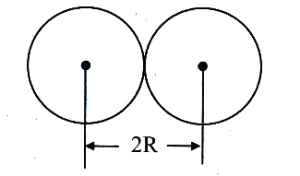
Two identical metal spheres are kept in contact with each other,each having radius '$R$' and '$\rho$' is the density of the material of the metal spheres. The gravitational force '$F$' of attraction between them is proportional to
A
$R^3 \rho$
B
$R^4 \rho^2$
C
$R^4 \rho$
D
$R^3 \rho^2$
Solution
(B) The gravitational force between two spheres of mass $M$ separated by a distance $d$ is given by $F = \frac{GM^2}{d^2}$.
Since the spheres are in contact,the distance between their centers is $d = 2R$.
Thus,$F = \frac{GM^2}{(2R)^2} = \frac{GM^2}{4R^2}$.
The mass $M$ of each sphere is given by $M = \text{density} \times \text{volume} = \rho \times \frac{4}{3} \pi R^3$.
Substituting the value of $M$ into the force equation:
$F = \frac{G}{4R^2} \left( \rho \cdot \frac{4}{3} \pi R^3 \right)^2$
$F = \frac{G}{4R^2} \cdot \rho^2 \cdot \frac{16}{9} \pi^2 R^6$
$F = \frac{4}{9} G \pi^2 R^4 \rho^2$
Therefore,$F \propto R^4 \rho^2$.
Since the spheres are in contact,the distance between their centers is $d = 2R$.
Thus,$F = \frac{GM^2}{(2R)^2} = \frac{GM^2}{4R^2}$.
The mass $M$ of each sphere is given by $M = \text{density} \times \text{volume} = \rho \times \frac{4}{3} \pi R^3$.
Substituting the value of $M$ into the force equation:
$F = \frac{G}{4R^2} \left( \rho \cdot \frac{4}{3} \pi R^3 \right)^2$
$F = \frac{G}{4R^2} \cdot \rho^2 \cdot \frac{16}{9} \pi^2 R^6$
$F = \frac{4}{9} G \pi^2 R^4 \rho^2$
Therefore,$F \propto R^4 \rho^2$.
0 likesView Solution
43
PhysicsMediumMCQMHT CET · 2024
Assuming that the earth is revolving around the sun in a circular orbit of radius $R$,the angular momentum is directly proportional to $R^{n}$. The value of $n$ is
A
$2$
B
$1.5$
C
$1$
D
$0.5$
Solution
(D) We know that angular momentum $L = m v R$ ... $(i)$
For a planet revolving around the sun,the gravitational force provides the necessary centripetal force:
$\frac{m v^2}{R} = \frac{G M m}{R^2}$
$v^2 = \frac{G M}{R}$
$v = \sqrt{\frac{G M}{R}}$ ... (ii)
Substituting equation (ii) into $(i)$:
$L = m \times \sqrt{\frac{G M}{R}} \times R$
$L = m \sqrt{G M R}$
Since $m$,$G$,and $M$ are constants,we have:
$L \propto \sqrt{R}$
$L \propto R^{1/2}$
Comparing this with $L \propto R^n$,we get $n = 0.5$.
For a planet revolving around the sun,the gravitational force provides the necessary centripetal force:
$\frac{m v^2}{R} = \frac{G M m}{R^2}$
$v^2 = \frac{G M}{R}$
$v = \sqrt{\frac{G M}{R}}$ ... (ii)
Substituting equation (ii) into $(i)$:
$L = m \times \sqrt{\frac{G M}{R}} \times R$
$L = m \sqrt{G M R}$
Since $m$,$G$,and $M$ are constants,we have:
$L \propto \sqrt{R}$
$L \propto R^{1/2}$
Comparing this with $L \propto R^n$,we get $n = 0.5$.
0 likesView Solution
44
PhysicsEasyMCQMHT CET · 2024
If $C_{p}$ and $C_{v}$ are molar specific heats of an ideal gas at constant pressure and volume respectively and $\gamma$ is $C_{p} / C_{v}$,then $C_{p} =$ (where $R$ is the universal gas constant).
A
$\frac{\gamma R}{\gamma-1}$
B
$\gamma R$
C
$\frac{1+\gamma}{1-\gamma}$
D
$\frac{R}{\gamma-1}$
Solution
(A) We know that for an ideal gas,the Mayer's relation is $C_{p} - C_{v} = R$.
Given that $\gamma = \frac{C_{p}}{C_{v}}$,we can write $C_{v} = \frac{C_{p}}{\gamma}$.
Substituting this into the Mayer's relation:
$C_{p} - \frac{C_{p}}{\gamma} = R$
$C_{p} \left(1 - \frac{1}{\gamma}\right) = R$
$C_{p} \left(\frac{\gamma - 1}{\gamma}\right) = R$
Therefore,$C_{p} = \frac{\gamma R}{\gamma - 1}$.
Given that $\gamma = \frac{C_{p}}{C_{v}}$,we can write $C_{v} = \frac{C_{p}}{\gamma}$.
Substituting this into the Mayer's relation:
$C_{p} - \frac{C_{p}}{\gamma} = R$
$C_{p} \left(1 - \frac{1}{\gamma}\right) = R$
$C_{p} \left(\frac{\gamma - 1}{\gamma}\right) = R$
Therefore,$C_{p} = \frac{\gamma R}{\gamma - 1}$.
0 likesView Solution
45
PhysicsMediumMCQMHT CET · 2024
An insulated container contains a diatomic gas of molar mass '$m$'. The container is moving with velocity '$V$'. If it is stopped suddenly,the change in temperature is ($R=$ gas constant).
A
$\frac{mV^2}{3R}$
B
$\frac{mV^2}{5R}$
C
$\frac{mV}{7R}$
D
$\frac{5mV}{3R}$
Solution
(B) The kinetic energy of the gas inside the container is given by $K.E. = n \left( \frac{1}{2} m V^2 \right)$,where $n$ is the number of moles and $m$ is the molar mass.
When the container is stopped suddenly,this kinetic energy is converted into the internal energy of the gas.
The change in internal energy is given by $\Delta U = n C_v \Delta T$.
For a diatomic gas,the molar heat capacity at constant volume is $C_v = \frac{5}{2} R$.
Since the energy is conserved,$\Delta U = K.E.$
Substituting the values: $n \left( \frac{5}{2} R \right) \Delta T = n \left( \frac{1}{2} m V^2 \right)$.
Simplifying the equation: $\frac{5}{2} R \Delta T = \frac{1}{2} m V^2$.
Therefore,the change in temperature is $\Delta T = \frac{mV^2}{5R}$.
When the container is stopped suddenly,this kinetic energy is converted into the internal energy of the gas.
The change in internal energy is given by $\Delta U = n C_v \Delta T$.
For a diatomic gas,the molar heat capacity at constant volume is $C_v = \frac{5}{2} R$.
Since the energy is conserved,$\Delta U = K.E.$
Substituting the values: $n \left( \frac{5}{2} R \right) \Delta T = n \left( \frac{1}{2} m V^2 \right)$.
Simplifying the equation: $\frac{5}{2} R \Delta T = \frac{1}{2} m V^2$.
Therefore,the change in temperature is $\Delta T = \frac{mV^2}{5R}$.
0 likesView Solution
46
PhysicsMediumMCQMHT CET · 2024
Four moles of hydrogen,two moles of helium and one mole of water vapour form an ideal gas mixture. $[C_v$ for hydrogen $= \frac{5}{2} R, C_v$ for helium $= \frac{3}{2} R, C_v$ for water vapour $= 3 R]$. What is the molar specific heat at constant pressure of the mixture?
A
$\frac{11}{3} R$
B
$\frac{23}{7} R$
C
$\frac{16}{7} R$
D
$\frac{23}{3} R$
Solution
(B) $C_p = C_v + R$
$\therefore C_p$ for hydrogen,$C_{p_1} = \frac{5}{2} R + R = \frac{7}{2} R$
$C_p$ for helium,$C_{p_2} = \frac{3}{2} R + R = \frac{5}{2} R$
$C_p$ for water vapour,$C_{p_3} = 3 R + R = 4 R$
Given: $n_1 = 4, n_2 = 2, n_3 = 1$
$C_p \text{ of mixture} = \frac{n_1 C_{p_1} + n_2 C_{p_2} + n_3 C_{p_3}}{n_1 + n_2 + n_3}$
$= \frac{4 \times \frac{7}{2} R + 2 \times \frac{5}{2} R + 1 \times 4 R}{4 + 2 + 1}$
$= \frac{14 R + 5 R + 4 R}{7} = \frac{23 R}{7}$
$\therefore C_p$ for hydrogen,$C_{p_1} = \frac{5}{2} R + R = \frac{7}{2} R$
$C_p$ for helium,$C_{p_2} = \frac{3}{2} R + R = \frac{5}{2} R$
$C_p$ for water vapour,$C_{p_3} = 3 R + R = 4 R$
Given: $n_1 = 4, n_2 = 2, n_3 = 1$
$C_p \text{ of mixture} = \frac{n_1 C_{p_1} + n_2 C_{p_2} + n_3 C_{p_3}}{n_1 + n_2 + n_3}$
$= \frac{4 \times \frac{7}{2} R + 2 \times \frac{5}{2} R + 1 \times 4 R}{4 + 2 + 1}$
$= \frac{14 R + 5 R + 4 R}{7} = \frac{23 R}{7}$
0 likesView Solution
47
PhysicsMediumMCQMHT CET · 2024
The ratio of the specific heats $\frac{C_{p}}{C_{v}}=\gamma$,in terms of degrees of freedom $(n)$ is
A
$\left(1+\frac{1}{n}\right)$
B
$\left(1+\frac{n}{3}\right)$
C
$\left(1+\frac{2}{n}\right)$
D
$\left(1+\frac{n}{2}\right)$
Solution
(C) We know that the molar specific heat at constant volume is given by $C_{v} = \frac{n R}{2}$.
From Mayer's relation,$C_{p} - C_{v} = R$,we can write $C_{p} = C_{v} + R$.
Substituting the value of $C_{v}$,we get $C_{p} = \frac{n R}{2} + R = R \left( \frac{n}{2} + 1 \right)$.
Now,the ratio $\gamma = \frac{C_{p}}{C_{v}}$ is calculated as:
$\gamma = \frac{R \left( \frac{n}{2} + 1 \right)}{\frac{n R}{2}} = \frac{\frac{n+2}{2}}{\frac{n}{2}} = \frac{n+2}{n} = 1 + \frac{2}{n}$.
From Mayer's relation,$C_{p} - C_{v} = R$,we can write $C_{p} = C_{v} + R$.
Substituting the value of $C_{v}$,we get $C_{p} = \frac{n R}{2} + R = R \left( \frac{n}{2} + 1 \right)$.
Now,the ratio $\gamma = \frac{C_{p}}{C_{v}}$ is calculated as:
$\gamma = \frac{R \left( \frac{n}{2} + 1 \right)}{\frac{n R}{2}} = \frac{\frac{n+2}{2}}{\frac{n}{2}} = \frac{n+2}{n} = 1 + \frac{2}{n}$.
0 likesView Solution
48
PhysicsEasyMCQMHT CET · 2024
$A$ monoatomic ideal gas is heated at constant pressure. The percentage of total heat used in changing the internal energy is (in $\%$)
A
$30$
B
$40$
C
$50$
D
$60$
Solution
(D) For a monoatomic gas,the degrees of freedom $f = 3$.
At constant pressure,the molar heat capacity is $C_P = \frac{5}{2}R$ and the molar heat capacity at constant volume is $C_V = \frac{3}{2}R$.
The total heat supplied is $\Delta Q = n C_P \Delta T$.
The change in internal energy is $\Delta U = n C_V \Delta T$.
The fraction of heat used to change internal energy is $\frac{\Delta U}{\Delta Q} = \frac{n C_V \Delta T}{n C_P \Delta T} = \frac{C_V}{C_P}$.
Substituting the values,$\frac{\Delta U}{\Delta Q} = \frac{\frac{3}{2}R}{\frac{5}{2}R} = \frac{3}{5} = 0.6$.
Therefore,the percentage of total heat used is $0.6 \times 100 = 60 \%$.
At constant pressure,the molar heat capacity is $C_P = \frac{5}{2}R$ and the molar heat capacity at constant volume is $C_V = \frac{3}{2}R$.
The total heat supplied is $\Delta Q = n C_P \Delta T$.
The change in internal energy is $\Delta U = n C_V \Delta T$.
The fraction of heat used to change internal energy is $\frac{\Delta U}{\Delta Q} = \frac{n C_V \Delta T}{n C_P \Delta T} = \frac{C_V}{C_P}$.
Substituting the values,$\frac{\Delta U}{\Delta Q} = \frac{\frac{3}{2}R}{\frac{5}{2}R} = \frac{3}{5} = 0.6$.
Therefore,the percentage of total heat used is $0.6 \times 100 = 60 \%$.
0 likesView Solution
49
PhysicsEasyMCQMHT CET · 2024
$A$ real gas behaves as an ideal gas at
A
low pressure and low temperature.
B
low pressure and high temperature.
C
high pressure and low temperature.
D
high pressure and high temperature.
Solution
(B) real gas behaves as an ideal gas under conditions of low pressure and high temperature.
At high temperatures,the kinetic energy of the gas molecules is very high,which makes the intermolecular forces of attraction negligible.
At low pressures,the volume occupied by the gas molecules is negligible compared to the total volume of the container,effectively making the gas particles behave like point masses.
Therefore,the assumptions of the kinetic theory of gases are satisfied,and the gas follows the ideal gas equation $PV = nRT$.
Thus,option $B$ is correct.
At high temperatures,the kinetic energy of the gas molecules is very high,which makes the intermolecular forces of attraction negligible.
At low pressures,the volume occupied by the gas molecules is negligible compared to the total volume of the container,effectively making the gas particles behave like point masses.
Therefore,the assumptions of the kinetic theory of gases are satisfied,and the gas follows the ideal gas equation $PV = nRT$.
Thus,option $B$ is correct.
0 likesView Solution
50
PhysicsMediumMCQMHT CET · 2024
The average translational kinetic energy of nitrogen (molar mass $28$) molecules at a particular temperature is $0.042 \ eV$. The translational kinetic energy of oxygen molecules (molar mass $32$) in $eV$ at double the temperature is:
A
$0.021$
B
$0.048$
C
$0.056$
D
$0.084$
Solution
(D) The average translational kinetic energy of a gas molecule is given by the formula: $E = \frac{3}{2} k_B T$,where $k_B$ is the Boltzmann constant and $T$ is the absolute temperature.
From this relation,it is clear that the translational kinetic energy depends only on the temperature $T$ and is independent of the molar mass of the gas.
Given for nitrogen $(N_2)$: $E_1 = 0.042 \ eV$ at temperature $T_1 = T$.
For oxygen $(O_2)$: The temperature is doubled,so $T_2 = 2T$.
Since $E \propto T$,we have:
$\frac{E_2}{E_1} = \frac{T_2}{T_1} = \frac{2T}{T} = 2$
Therefore,$E_2 = 2 \times E_1 = 2 \times 0.042 \ eV = 0.084 \ eV$.
From this relation,it is clear that the translational kinetic energy depends only on the temperature $T$ and is independent of the molar mass of the gas.
Given for nitrogen $(N_2)$: $E_1 = 0.042 \ eV$ at temperature $T_1 = T$.
For oxygen $(O_2)$: The temperature is doubled,so $T_2 = 2T$.
Since $E \propto T$,we have:
$\frac{E_2}{E_1} = \frac{T_2}{T_1} = \frac{2T}{T} = 2$
Therefore,$E_2 = 2 \times E_1 = 2 \times 0.042 \ eV = 0.084 \ eV$.
0 likesView Solution
51
PhysicsMediumMCQMHT CET · 2024
Three charges $2q, -q$ and $-q$ are located at the vertices of an equilateral triangle. At the center of the triangle,
A
the field is zero but potential is non-zero.
B
the field is non-zero but potential is zero.
C
both field and potential are zero.
D
both field and potential are non-zero.
Solution
(B) Let $r$ be the distance from each vertex to the center of the equilateral triangle.
The electric potential $V$ at the center is the algebraic sum of potentials due to individual charges:
$V = \frac{1}{4 \pi \varepsilon_{0}} \left( \frac{2q}{r} + \frac{-q}{r} + \frac{-q}{r} \right)$
$V = \frac{1}{4 \pi \varepsilon_{0} r} (2q - q - q) = 0$
The electric field $\vec{E}$ at the center is the vector sum of fields due to individual charges. Since the charges are not equal in magnitude and are not symmetrically arranged in a way that their field vectors cancel out,the net electric field $\vec{E}$ is non-zero.
Specifically,the field due to $2q$ points away from it,while the fields due to the two $-q$ charges point towards them. These vectors do not sum to zero.
Therefore,the field is non-zero but the potential is zero.
The electric potential $V$ at the center is the algebraic sum of potentials due to individual charges:
$V = \frac{1}{4 \pi \varepsilon_{0}} \left( \frac{2q}{r} + \frac{-q}{r} + \frac{-q}{r} \right)$
$V = \frac{1}{4 \pi \varepsilon_{0} r} (2q - q - q) = 0$
The electric field $\vec{E}$ at the center is the vector sum of fields due to individual charges. Since the charges are not equal in magnitude and are not symmetrically arranged in a way that their field vectors cancel out,the net electric field $\vec{E}$ is non-zero.
Specifically,the field due to $2q$ points away from it,while the fields due to the two $-q$ charges point towards them. These vectors do not sum to zero.
Therefore,the field is non-zero but the potential is zero.
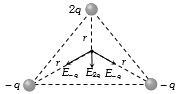
0 likesView Solution
52
PhysicsDifficultMCQMHT CET · 2024
In the given circuit,when $S_1$ is closed,the capacitor gets fully charged. Now $S_1$ is opened and $S_2$ is closed. Then
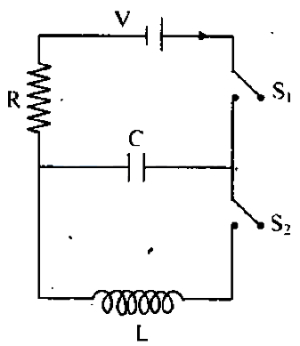
A
there is no exchange of energy between $L$ and $C$.
B
the current in the circuit is in the same direction.
C
the instantaneous current in the circuit may be $V\sqrt{\frac{C}{L}}$.
D
the energy stored in the circuit is purely in the form of magnetic energy.
Solution
(C) When $S_1$ is closed,the capacitor $C$ is charged to a potential difference $V$. The energy stored in the capacitor is $U_E = \frac{1}{2}CV^2$.
When $S_1$ is opened and $S_2$ is closed,the capacitor $C$ and inductor $L$ form an $LC$ oscillating circuit.
The energy oscillates between the electric field of the capacitor and the magnetic field of the inductor.
The maximum current $I_{max}$ in the circuit occurs when all the electric energy is converted into magnetic energy.
By the law of conservation of energy:
$\frac{1}{2}CV^2 = \frac{1}{2}LI_{max}^2$
$I_{max}^2 = \frac{C}{L}V^2$
$I_{max} = V\sqrt{\frac{C}{L}}$
Thus,the instantaneous current in the circuit can reach this maximum value.
When $S_1$ is opened and $S_2$ is closed,the capacitor $C$ and inductor $L$ form an $LC$ oscillating circuit.
The energy oscillates between the electric field of the capacitor and the magnetic field of the inductor.
The maximum current $I_{max}$ in the circuit occurs when all the electric energy is converted into magnetic energy.
By the law of conservation of energy:
$\frac{1}{2}CV^2 = \frac{1}{2}LI_{max}^2$
$I_{max}^2 = \frac{C}{L}V^2$
$I_{max} = V\sqrt{\frac{C}{L}}$
Thus,the instantaneous current in the circuit can reach this maximum value.
0 likesView Solution
53
PhysicsDifficultMCQMHT CET · 2024
$L=2 \text{ H}, C=5 \text{ mF}$ and $R=12 \text{ } \Omega$ are connected in series to an a.c. generator of frequency $50 \text{ Hz}$. Then:
A
at resonance,impedance of the circuit is zero.
B
at resonance,impedance of the circuit is $12 \text{ } \Omega$.
C
the resonant frequency of the circuit is $1 / 2 \pi \text{ Hz}$.
D
the inductive reactance is less than the capacitive reactance.
Solution
(B) The impedance of an $LCR$ series circuit is given by $Z = \sqrt{R^2 + (X_L - X_C)^2}$.
At resonance,the inductive reactance $X_L$ is equal to the capacitive reactance $X_C$,i.e.,$X_L = X_C$.
Substituting this into the impedance formula:
$Z = \sqrt{R^2 + (0)^2} = R$.
Given $R = 12 \text{ } \Omega$,the impedance at resonance is $Z = 12 \text{ } \Omega$.
At resonance,the inductive reactance $X_L$ is equal to the capacitive reactance $X_C$,i.e.,$X_L = X_C$.
Substituting this into the impedance formula:
$Z = \sqrt{R^2 + (0)^2} = R$.
Given $R = 12 \text{ } \Omega$,the impedance at resonance is $Z = 12 \text{ } \Omega$.
0 likesView Solution
54
PhysicsMediumMCQMHT CET · 2024
An inductance coil has a resistance of $80 \Omega$. When an $AC$ signal of frequency $480 \text{ Hz}$ is applied to the coil,the voltage leads the current by $45^{\circ}$. The inductance of the coil in henry is $\left[\sin 45^{\circ}=\cos 45^{\circ}=1 / \sqrt{2}\right]$
A
$\frac{1}{24 \pi}$
B
$\frac{\pi}{20}$
C
$\frac{\pi}{40}$
D
$\frac{1}{12 \pi}$
Solution
(D) The phase angle $\phi$ between voltage and current in an $RL$ circuit is given by $\tan \phi = \frac{X_L}{R}$.
Given $\phi = 45^{\circ}$,$R = 80 \Omega$,and $f = 480 \text{ Hz}$.
Since $\tan 45^{\circ} = 1$,we have $1 = \frac{X_L}{R}$,which implies $X_L = R$.
Substituting $X_L = 2 \pi f L$,we get $2 \pi f L = R$.
Solving for $L$: $L = \frac{R}{2 \pi f}$.
Substituting the values: $L = \frac{80}{2 \pi \times 480} = \frac{80}{960 \pi} = \frac{1}{12 \pi} \text{ H}$.
Given $\phi = 45^{\circ}$,$R = 80 \Omega$,and $f = 480 \text{ Hz}$.
Since $\tan 45^{\circ} = 1$,we have $1 = \frac{X_L}{R}$,which implies $X_L = R$.
Substituting $X_L = 2 \pi f L$,we get $2 \pi f L = R$.
Solving for $L$: $L = \frac{R}{2 \pi f}$.
Substituting the values: $L = \frac{80}{2 \pi \times 480} = \frac{80}{960 \pi} = \frac{1}{12 \pi} \text{ H}$.
0 likesView Solution
55
PhysicsMediumMCQMHT CET · 2024
An alternating voltage $v = 200 \sqrt{2} \sin(100 t)$ is connected to a $1 \mu F$ capacitor through an $A.C.$ ammeter. The reading of the ammeter shall be: (in $\text{ mA}$)
A
$10$
B
$20$
C
$40$
D
$80$
Solution
(B) The given alternating voltage is $v = 200 \sqrt{2} \sin(100 t)$.
Comparing this with the standard form $v = V_0 \sin(\omega t)$, we get the peak voltage $V_0 = 200 \sqrt{2} \text{ V}$ and angular frequency $\omega = 100 \text{ rad/s}$.
The capacitive reactance $X_C$ is given by $X_C = \frac{1}{\omega C}$.
Given $C = 1 \mu F = 10^{-6} \text{ F}$, we have $X_C = \frac{1}{100 \times 10^{-6}} = 10^4 \Omega$.
The peak current $I_0$ is $I_0 = \frac{V_0}{X_C} = \frac{200 \sqrt{2}}{10^4} = 2 \sqrt{2} \times 10^{-2} \text{ A}$.
The $A.C.$ ammeter measures the root mean square $(RMS)$ value of the current, $I_{rms}$.
$I_{rms} = \frac{I_0}{\sqrt{2}} = \frac{2 \sqrt{2} \times 10^{-2}}{\sqrt{2}} = 2 \times 10^{-2} \text{ A} = 20 \text{ mA}$.
Comparing this with the standard form $v = V_0 \sin(\omega t)$, we get the peak voltage $V_0 = 200 \sqrt{2} \text{ V}$ and angular frequency $\omega = 100 \text{ rad/s}$.
The capacitive reactance $X_C$ is given by $X_C = \frac{1}{\omega C}$.
Given $C = 1 \mu F = 10^{-6} \text{ F}$, we have $X_C = \frac{1}{100 \times 10^{-6}} = 10^4 \Omega$.
The peak current $I_0$ is $I_0 = \frac{V_0}{X_C} = \frac{200 \sqrt{2}}{10^4} = 2 \sqrt{2} \times 10^{-2} \text{ A}$.
The $A.C.$ ammeter measures the root mean square $(RMS)$ value of the current, $I_{rms}$.
$I_{rms} = \frac{I_0}{\sqrt{2}} = \frac{2 \sqrt{2} \times 10^{-2}}{\sqrt{2}} = 2 \times 10^{-2} \text{ A} = 20 \text{ mA}$.
0 likesView Solution
56
PhysicsEasyMCQMHT CET · 2024
$A$ series $LCR$ circuit containing a resistance $R$ has angular frequency $\omega$. At resonance,the voltage across the resistance and the inductor are $V_R$ and $V_L$ respectively. Then,the value of inductance $L$ will be:
A
$\frac{V_R R}{V_L \omega}$
B
$\frac{V_L}{V_R R \omega}$
C
$\frac{V_R \omega}{V_L R}$
D
$\frac{V_L R}{V_R \omega}$
Solution
(D) At resonance,the impedance of the circuit is $Z = R$.
Voltage across the resistance is given by $V_R = I \times R$ --- $(i)$
Voltage across the inductor is given by $V_L = I \times X_L = I \times \omega L$ --- (ii)
Dividing equation (ii) by equation $(i)$:
$\frac{V_L}{V_R} = \frac{I \times \omega L}{I \times R}$
$\frac{V_L}{V_R} = \frac{\omega L}{R}$
Rearranging for $L$:
$L = \frac{V_L R}{V_R \omega}$
Voltage across the resistance is given by $V_R = I \times R$ --- $(i)$
Voltage across the inductor is given by $V_L = I \times X_L = I \times \omega L$ --- (ii)
Dividing equation (ii) by equation $(i)$:
$\frac{V_L}{V_R} = \frac{I \times \omega L}{I \times R}$
$\frac{V_L}{V_R} = \frac{\omega L}{R}$
Rearranging for $L$:
$L = \frac{V_L R}{V_R \omega}$
0 likesView Solution
57
PhysicsMediumMCQMHT CET · 2024
When $80 \ V$ $d.c.$ is applied across a solenoid,a current of $0.8 \ A$ flows in it. When $80 \ V$ $a.c.$ is applied across the same solenoid,the current becomes $0.4 \ A$. If the frequency of $a.c.$ source is $50 \ Hz$,the impedance and inductance of the solenoid are nearly:
A
$200 \ \Omega, 0.55 \ H$
B
$100 \ \Omega, 0.8 \ H$
C
$300 \ \Omega, 1.2 \ H$
D
$200 \ \Omega, 1.5 \ H$
Solution
(A) When $80 \ V$ $d.c.$ is applied,the solenoid acts as a pure resistor because the frequency of $d.c.$ is zero,so inductive reactance $X_L = 2 \pi fL = 0$.
Resistance $R = \frac{V}{I_{dc}} = \frac{80 \ V}{0.8 \ A} = 100 \ \Omega$.
When $80 \ V$ $a.c.$ is applied,the impedance $Z$ is given by $Z = \frac{V}{I_{ac}} = \frac{80 \ V}{0.4 \ A} = 200 \ \Omega$.
The impedance of an $RL$ circuit is $Z = \sqrt{R^2 + X_L^2}$.
Substituting the values: $200 = \sqrt{100^2 + X_L^2}$.
$40000 = 10000 + X_L^2 \Rightarrow X_L^2 = 30000$.
$X_L = \sqrt{30000} \approx 173.2 \ \Omega$.
Since $X_L = 2 \pi fL$,we have $L = \frac{X_L}{2 \pi f} = \frac{173.2}{2 \times 3.14 \times 50} = \frac{173.2}{314} \approx 0.55 \ H$.
Thus,the impedance is $200 \ \Omega$ and the inductance is $0.55 \ H$.
Resistance $R = \frac{V}{I_{dc}} = \frac{80 \ V}{0.8 \ A} = 100 \ \Omega$.
When $80 \ V$ $a.c.$ is applied,the impedance $Z$ is given by $Z = \frac{V}{I_{ac}} = \frac{80 \ V}{0.4 \ A} = 200 \ \Omega$.
The impedance of an $RL$ circuit is $Z = \sqrt{R^2 + X_L^2}$.
Substituting the values: $200 = \sqrt{100^2 + X_L^2}$.
$40000 = 10000 + X_L^2 \Rightarrow X_L^2 = 30000$.
$X_L = \sqrt{30000} \approx 173.2 \ \Omega$.
Since $X_L = 2 \pi fL$,we have $L = \frac{X_L}{2 \pi f} = \frac{173.2}{2 \times 3.14 \times 50} = \frac{173.2}{314} \approx 0.55 \ H$.
Thus,the impedance is $200 \ \Omega$ and the inductance is $0.55 \ H$.
0 likesView Solution
58
PhysicsEasyMCQMHT CET · 2024
An inductor of inductance $2 \mu H$ is connected in series with a resistance,a variable capacitor and an a.c. source of frequency $5 \text{ kHz}$. The value of capacitance for which maximum current is drawn into the circuit is $\frac{1}{x} \text{ F}$,where the value of '$x$' is (Take $\pi^2 = 10$).
A
$500$
B
$1000$
C
$2000$
D
$4000$
Solution
(C) For maximum current to be drawn,the circuit must be in resonance condition.
At resonance,the inductive reactance equals the capacitive reactance: $X_L = X_C$.
This implies $2 \pi f L = \frac{1}{2 \pi f C}$.
Rearranging for capacitance $C$,we get $C = \frac{1}{4 \pi^2 f^2 L}$.
Given $L = 2 \mu H = 2 \times 10^{-6} \text{ H}$,$f = 5 \text{ kHz} = 5 \times 10^3 \text{ Hz}$,and $\pi^2 = 10$.
Substituting the values: $C = \frac{1}{4 \times 10 \times (5 \times 10^3)^2 \times 2 \times 10^{-6}}$.
$C = \frac{1}{40 \times 25 \times 10^6 \times 2 \times 10^{-6}} = \frac{1}{40 \times 25 \times 2} = \frac{1}{2000} \text{ F}$.
Comparing this with $\frac{1}{x} \text{ F}$,we find $x = 2000$.
At resonance,the inductive reactance equals the capacitive reactance: $X_L = X_C$.
This implies $2 \pi f L = \frac{1}{2 \pi f C}$.
Rearranging for capacitance $C$,we get $C = \frac{1}{4 \pi^2 f^2 L}$.
Given $L = 2 \mu H = 2 \times 10^{-6} \text{ H}$,$f = 5 \text{ kHz} = 5 \times 10^3 \text{ Hz}$,and $\pi^2 = 10$.
Substituting the values: $C = \frac{1}{4 \times 10 \times (5 \times 10^3)^2 \times 2 \times 10^{-6}}$.
$C = \frac{1}{40 \times 25 \times 10^6 \times 2 \times 10^{-6}} = \frac{1}{40 \times 25 \times 2} = \frac{1}{2000} \text{ F}$.
Comparing this with $\frac{1}{x} \text{ F}$,we find $x = 2000$.
0 likesView Solution
59
PhysicsMediumMCQMHT CET · 2024
In an $LCR$ series circuit,if the frequency is increased,the impedance of the circuit
A
increases
B
decreases
C
either increases or decreases
D
first decreases,then becomes minimum,and then increases.
Solution
(D) The impedance $Z$ of an $LCR$ series circuit is given by the formula: $Z = \sqrt{R^2 + (X_L - X_C)^2}$,where $X_L = 2\pi fL$ and $X_C = \frac{1}{2\pi fC}$.
As the frequency $f$ increases,$X_L$ increases and $X_C$ decreases.
At low frequencies,$X_C$ dominates,so $Z$ decreases as $f$ increases.
At the resonant frequency $f_0 = \frac{1}{2\pi\sqrt{LC}}$,$X_L = X_C$,and the impedance $Z$ reaches its minimum value,which is equal to the resistance $R$.
As the frequency increases further beyond $f_0$,$X_L$ dominates,causing the impedance $Z$ to increase.
Therefore,the impedance first decreases,reaches a minimum at resonance,and then increases.
As the frequency $f$ increases,$X_L$ increases and $X_C$ decreases.
At low frequencies,$X_C$ dominates,so $Z$ decreases as $f$ increases.
At the resonant frequency $f_0 = \frac{1}{2\pi\sqrt{LC}}$,$X_L = X_C$,and the impedance $Z$ reaches its minimum value,which is equal to the resistance $R$.
As the frequency increases further beyond $f_0$,$X_L$ dominates,causing the impedance $Z$ to increase.
Therefore,the impedance first decreases,reaches a minimum at resonance,and then increases.
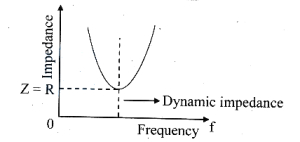
0 likesView Solution
60
PhysicsEasyMCQMHT CET · 2024
For the given figure,choose the correct option.
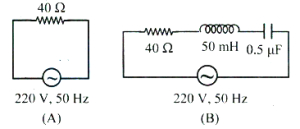
A
The r.m.s. current in circuit $(B)$ can never be greater than that in circuit $(A)$.
B
The r.m.s. current in circuit $(A)$ is always equal to that in circuit $(B)$.
C
The r.m.s. current in circuit $(B)$ can be greater than in circuit $(A)$.
D
At resonance,current in $(B)$ is less than that in circuit $(A)$.
Solution
(A) In circuit $(A)$,the impedance is $Z_A = R = 40 \ \Omega$.
In circuit $(B)$,the impedance is $Z_B = \sqrt{R^2 + (X_L - X_C)^2}$.
Since $Z_B = \sqrt{R^2 + (X_L - X_C)^2} \ge R$,it follows that $Z_B \ge Z_A$.
The r.m.s. current is given by $I = V/Z$. Since the voltage $V$ is the same $(220 \ V)$ for both circuits,$I_B = V/Z_B$ and $I_A = V/Z_A$.
Since $Z_B \ge Z_A$,it implies $I_B \le I_A$. Thus,the r.m.s. current in circuit $(B)$ can never be greater than that in circuit $(A)$.
In circuit $(B)$,the impedance is $Z_B = \sqrt{R^2 + (X_L - X_C)^2}$.
Since $Z_B = \sqrt{R^2 + (X_L - X_C)^2} \ge R$,it follows that $Z_B \ge Z_A$.
The r.m.s. current is given by $I = V/Z$. Since the voltage $V$ is the same $(220 \ V)$ for both circuits,$I_B = V/Z_B$ and $I_A = V/Z_A$.
Since $Z_B \ge Z_A$,it implies $I_B \le I_A$. Thus,the r.m.s. current in circuit $(B)$ can never be greater than that in circuit $(A)$.
0 likesView Solution
61
PhysicsEasyMCQMHT CET · 2024
In a series $LCR$ resonant circuit,the capacitance is changed from $C$ to $3C$. To obtain the same resonant frequency,the inductance should be changed from $L$ to
A
$\frac{L}{3}$
B
$\frac{L}{2}$
C
$\frac{L}{\sqrt{3}}$
D
$3L$
Solution
(A) The resonant frequency $f_r$ of a series $LCR$ circuit is given by the formula:
$f_r = \frac{1}{2\pi \sqrt{LC}}$
For the resonant frequency to remain the same,the product $LC$ must remain constant:
$L_1 C_1 = L_2 C_2$
Given that $L_1 = L$,$C_1 = C$,and $C_2 = 3C$,we substitute these values into the equation:
$L \cdot C = L_2 \cdot (3C)$
$L_2 = \frac{L \cdot C}{3C}$
$L_2 = \frac{L}{3}$
Therefore,the inductance should be changed to $\frac{L}{3}$.
$f_r = \frac{1}{2\pi \sqrt{LC}}$
For the resonant frequency to remain the same,the product $LC$ must remain constant:
$L_1 C_1 = L_2 C_2$
Given that $L_1 = L$,$C_1 = C$,and $C_2 = 3C$,we substitute these values into the equation:
$L \cdot C = L_2 \cdot (3C)$
$L_2 = \frac{L \cdot C}{3C}$
$L_2 = \frac{L}{3}$
Therefore,the inductance should be changed to $\frac{L}{3}$.
0 likesView Solution
62
PhysicsMediumMCQMHT CET · 2024
In the given circuit diagram,in the steady state,the current through the battery and the charge on the capacitor respectively are:
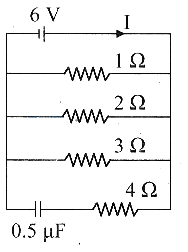
A
$2 \text{ A}$ and $3 \mu\text{C}$
B
$\frac{6}{11} \text{ A}$ and $\frac{12}{7} \mu\text{C}$
C
$11 \text{ A}$ and $3 \mu\text{C}$
D
$\text{Zero ampere}$ and $3 \mu\text{C}$
Solution
(C) In the steady state,the capacitor acts as an open circuit,so no current flows through the branch containing the capacitor and the $4 \Omega$ resistor. The circuit effectively consists of three resistors of $1 \Omega, 2 \Omega,$ and $3 \Omega$ connected in parallel across the $6 \text{ V}$ battery.
The equivalent resistance $R_{eq}$ of the parallel combination is given by:
$\frac{1}{R_{eq}} = \frac{1}{1} + \frac{1}{2} + \frac{1}{3} = \frac{6 + 3 + 2}{6} = \frac{11}{6} \Omega$
Therefore,the current $I$ through the battery is:
$I = \frac{V}{R_{eq}} = \frac{6}{11/6} = \frac{36}{11} \text{ A} \approx 3.27 \text{ A}$.
Wait,let's re-evaluate the calculation: $I = \frac{V}{R_{eq}} = 6 \times \frac{6}{11} = \frac{36}{11} \text{ A}$.
Looking at the options,there seems to be a discrepancy in the provided solution's calculation. Let's re-calculate: $I_1 = 6/1 = 6 \text{ A}$,$I_2 = 6/2 = 3 \text{ A}$,$I_3 = 6/3 = 2 \text{ A}$. Total current $I = 6 + 3 + 2 = 11 \text{ A}$.
The charge on the capacitor is $Q = C \times V = 0.5 \mu\text{F} \times 6 \text{ V} = 3 \mu\text{C}$.
Thus,the current is $11 \text{ A}$ and the charge is $3 \mu\text{C}$.
The equivalent resistance $R_{eq}$ of the parallel combination is given by:
$\frac{1}{R_{eq}} = \frac{1}{1} + \frac{1}{2} + \frac{1}{3} = \frac{6 + 3 + 2}{6} = \frac{11}{6} \Omega$
Therefore,the current $I$ through the battery is:
$I = \frac{V}{R_{eq}} = \frac{6}{11/6} = \frac{36}{11} \text{ A} \approx 3.27 \text{ A}$.
Wait,let's re-evaluate the calculation: $I = \frac{V}{R_{eq}} = 6 \times \frac{6}{11} = \frac{36}{11} \text{ A}$.
Looking at the options,there seems to be a discrepancy in the provided solution's calculation. Let's re-calculate: $I_1 = 6/1 = 6 \text{ A}$,$I_2 = 6/2 = 3 \text{ A}$,$I_3 = 6/3 = 2 \text{ A}$. Total current $I = 6 + 3 + 2 = 11 \text{ A}$.
The charge on the capacitor is $Q = C \times V = 0.5 \mu\text{F} \times 6 \text{ V} = 3 \mu\text{C}$.
Thus,the current is $11 \text{ A}$ and the charge is $3 \mu\text{C}$.
0 likesView Solution
63
PhysicsMediumMCQMHT CET · 2024
An $LC$ series resonant circuit produces a resonant frequency $f$. If $L$ is tripled and $C$ is increased by $3C$ (making the new capacitance $4C$),the new resonant frequency will be:
A
$\frac{f}{3}$
B
$\frac{f}{2 \sqrt{3}}$
C
$6f$
D
$\frac{f}{2 \sqrt{2}}$
Solution
(B) The resonant frequency of an $LC$ circuit is given by $f = \frac{1}{2 \pi \sqrt{LC}}$.
This implies $f \propto \frac{1}{\sqrt{LC}}$.
Given the initial values $L_1 = L$ and $C_1 = C$,the initial frequency is $f = \frac{1}{2 \pi \sqrt{LC}}$.
The new values are $L_2 = 3L$ and $C_2 = C + 3C = 4C$.
The new resonant frequency $f'$ is given by $f' = \frac{1}{2 \pi \sqrt{L_2 C_2}} = \frac{1}{2 \pi \sqrt{(3L)(4C)}} = \frac{1}{2 \pi \sqrt{12LC}}$.
Comparing the two frequencies: $\frac{f'}{f} = \frac{\frac{1}{2 \pi \sqrt{12LC}}}{\frac{1}{2 \pi \sqrt{LC}}} = \sqrt{\frac{LC}{12LC}} = \frac{1}{\sqrt{12}} = \frac{1}{2 \sqrt{3}}$.
Therefore,$f' = \frac{f}{2 \sqrt{3}}$.
This implies $f \propto \frac{1}{\sqrt{LC}}$.
Given the initial values $L_1 = L$ and $C_1 = C$,the initial frequency is $f = \frac{1}{2 \pi \sqrt{LC}}$.
The new values are $L_2 = 3L$ and $C_2 = C + 3C = 4C$.
The new resonant frequency $f'$ is given by $f' = \frac{1}{2 \pi \sqrt{L_2 C_2}} = \frac{1}{2 \pi \sqrt{(3L)(4C)}} = \frac{1}{2 \pi \sqrt{12LC}}$.
Comparing the two frequencies: $\frac{f'}{f} = \frac{\frac{1}{2 \pi \sqrt{12LC}}}{\frac{1}{2 \pi \sqrt{LC}}} = \sqrt{\frac{LC}{12LC}} = \frac{1}{\sqrt{12}} = \frac{1}{2 \sqrt{3}}$.
Therefore,$f' = \frac{f}{2 \sqrt{3}}$.
0 likesView Solution
64
PhysicsMediumMCQMHT CET · 2024
If the current in an $LR$ circuit is reduced to half,what will be the energy stored in it?
A
$4$ times
B
$2$ times
C
half times
D
$(1/4)^{\text{th}}$ times
Solution
(D) The energy stored in an $LR$ circuit is given by the formula:
$E = \frac{1}{2} LI^2$ ...$(i)$
Given that the current is reduced to half,the new current $I^{\prime}$ is:
$I^{\prime} = \frac{I}{2}$
Substituting this into the energy formula,the new energy $E^{\prime}$ is:
$E^{\prime} = \frac{1}{2} L (I^{\prime})^2$
$E^{\prime} = \frac{1}{2} L \left(\frac{I}{2}\right)^2$
$E^{\prime} = \frac{1}{2} L \left(\frac{I^2}{4}\right)$
$E^{\prime} = \frac{1}{4} \left(\frac{1}{2} LI^2\right)$
Using equation $(i)$,we get:
$E^{\prime} = \frac{1}{4} E$
Therefore,the energy stored becomes $(1/4)^{\text{th}}$ of the original energy.
$E = \frac{1}{2} LI^2$ ...$(i)$
Given that the current is reduced to half,the new current $I^{\prime}$ is:
$I^{\prime} = \frac{I}{2}$
Substituting this into the energy formula,the new energy $E^{\prime}$ is:
$E^{\prime} = \frac{1}{2} L (I^{\prime})^2$
$E^{\prime} = \frac{1}{2} L \left(\frac{I}{2}\right)^2$
$E^{\prime} = \frac{1}{2} L \left(\frac{I^2}{4}\right)$
$E^{\prime} = \frac{1}{4} \left(\frac{1}{2} LI^2\right)$
Using equation $(i)$,we get:
$E^{\prime} = \frac{1}{4} E$
Therefore,the energy stored becomes $(1/4)^{\text{th}}$ of the original energy.
0 likesView Solution
65
PhysicsEasyMCQMHT CET · 2024
The inductive reactance of a coil is $R \ \Omega$. If the inductance of the coil is tripled and the frequency of the $A.C.$ supply is also tripled,then the new inductive reactance will be:
A
$\frac{R}{9}$
B
$\frac{R}{3}$
C
$3R$
D
$9R$
Solution
(D) The inductive reactance of a coil is given by the formula $X_{L} = 2 \pi f L$,where $f$ is the frequency and $L$ is the inductance.
Given that the initial inductive reactance is $X_{L1} = R = 2 \pi f L$.
If the inductance is tripled $(L' = 3L)$ and the frequency is tripled $(f' = 3f)$,the new inductive reactance $X_{L2}$ is:
$X_{L2} = 2 \pi f' L' = 2 \pi (3f) (3L) = 9 (2 \pi f L)$.
Substituting the initial value $R = 2 \pi f L$,we get:
$X_{L2} = 9R$.
Given that the initial inductive reactance is $X_{L1} = R = 2 \pi f L$.
If the inductance is tripled $(L' = 3L)$ and the frequency is tripled $(f' = 3f)$,the new inductive reactance $X_{L2}$ is:
$X_{L2} = 2 \pi f' L' = 2 \pi (3f) (3L) = 9 (2 \pi f L)$.
Substituting the initial value $R = 2 \pi f L$,we get:
$X_{L2} = 9R$.
0 likesView Solution
66
PhysicsEasyMCQMHT CET · 2024
$A$ series resonant circuit consists of an inductor '$L$' of negligible resistance and a capacitor '$C$' which produces a resonant frequency '$f$'. If '$L$' is changed to $3L$ and '$C$' is changed to $6C$,the new resonant frequency will become:
A
$\frac{f}{6}$
B
$\frac{f}{3}$
C
$\frac{f}{2 \sqrt{2}}$
D
$\frac{f}{3 \sqrt{2}}$
Solution
(D) The resonant frequency of a series $LC$ circuit is given by the formula:
$f = \frac{1}{2 \pi \sqrt{LC}}$
When the inductance is changed to $L' = 3L$ and the capacitance is changed to $C' = 6C$,the new resonant frequency $f'$ is:
$f' = \frac{1}{2 \pi \sqrt{L' C'}} = \frac{1}{2 \pi \sqrt{(3L)(6C)}}$
$f' = \frac{1}{2 \pi \sqrt{18 LC}} = \frac{1}{2 \pi \sqrt{9 \cdot 2 \cdot LC}}$
$f' = \frac{1}{2 \pi \cdot 3 \sqrt{2} \sqrt{LC}}$
Since $f = \frac{1}{2 \pi \sqrt{LC}}$,we can substitute this into the equation:
$f' = \frac{f}{3 \sqrt{2}}$
$f = \frac{1}{2 \pi \sqrt{LC}}$
When the inductance is changed to $L' = 3L$ and the capacitance is changed to $C' = 6C$,the new resonant frequency $f'$ is:
$f' = \frac{1}{2 \pi \sqrt{L' C'}} = \frac{1}{2 \pi \sqrt{(3L)(6C)}}$
$f' = \frac{1}{2 \pi \sqrt{18 LC}} = \frac{1}{2 \pi \sqrt{9 \cdot 2 \cdot LC}}$
$f' = \frac{1}{2 \pi \cdot 3 \sqrt{2} \sqrt{LC}}$
Since $f = \frac{1}{2 \pi \sqrt{LC}}$,we can substitute this into the equation:
$f' = \frac{f}{3 \sqrt{2}}$
0 likesView Solution
67
PhysicsEasyMCQMHT CET · 2024
For the series $LCR$ circuit,$R = \frac{X_L}{2} = 2 X_C$. The impedance of the circuit and the phase difference between $V$ and $I$ will be
A
$\frac{\sqrt{5}}{2} R, \tan^{-1}\left(\frac{1}{2}\right)$
B
$\frac{\sqrt{13}}{2} R, \tan^{-1}\left(\frac{3}{2}\right)$
C
$\sqrt{5} R, \tan^{-1}(1)$
D
$\sqrt{13} R, \tan^{-1}(2)$
Solution
(B) The impedance $Z$ of a series $LCR$ circuit is given by $Z = \sqrt{R^2 + (X_L - X_C)^2}$.
Given $R = \frac{X_L}{2}$,we have $X_L = 2R$.
Given $R = 2X_C$,we have $X_C = \frac{R}{2}$.
Substituting these values into the impedance formula:
$Z = \sqrt{R^2 + (2R - \frac{R}{2})^2} = \sqrt{R^2 + (\frac{3R}{2})^2} = \sqrt{R^2 + \frac{9R^2}{4}} = \sqrt{\frac{13R^2}{4}} = \frac{\sqrt{13}}{2} R$.
The phase difference $\phi$ is given by $\tan \phi = \frac{X_L - X_C}{R}$.
Substituting the values: $\tan \phi = \frac{2R - R/2}{R} = \frac{3R/2}{R} = \frac{3}{2}$.
Therefore,$\phi = \tan^{-1}(\frac{3}{2})$.
Given $R = \frac{X_L}{2}$,we have $X_L = 2R$.
Given $R = 2X_C$,we have $X_C = \frac{R}{2}$.
Substituting these values into the impedance formula:
$Z = \sqrt{R^2 + (2R - \frac{R}{2})^2} = \sqrt{R^2 + (\frac{3R}{2})^2} = \sqrt{R^2 + \frac{9R^2}{4}} = \sqrt{\frac{13R^2}{4}} = \frac{\sqrt{13}}{2} R$.
The phase difference $\phi$ is given by $\tan \phi = \frac{X_L - X_C}{R}$.
Substituting the values: $\tan \phi = \frac{2R - R/2}{R} = \frac{3R/2}{R} = \frac{3}{2}$.
Therefore,$\phi = \tan^{-1}(\frac{3}{2})$.
0 likesView Solution
68
PhysicsEasyMCQMHT CET · 2024
In a series $LCR$ circuit,$R$ represents the resistance of an electric bulb. If the frequency of the $A.C.$ supply is doubled,what should be the values of inductance $L$ and capacitance $C$ to maintain the same current?
A
both doubled.
B
made four times.
C
made eight times.
D
both halved simultaneously.
Solution
(D) In a series $LCR$ circuit,the current $I$ is given by $I = \frac{E}{Z} = \frac{E}{\sqrt{R^2 + (X_L - X_C)^2}}$.
Here,$X_L = 2 \pi f L$ and $X_C = \frac{1}{2 \pi f C}$.
To keep the current $I$ constant for a given voltage $E$ and resistance $R$,the impedance $Z$ must remain constant.
This requires the reactances $X_L$ and $X_C$ to remain unchanged.
If the frequency $f$ is doubled $(f' = 2f)$,then for $X_L$ to remain constant: $2 \pi (2f) L' = 2 \pi f L \implies L' = \frac{L}{2}$.
Similarly,for $X_C$ to remain constant: $\frac{1}{2 \pi (2f) C'} = \frac{1}{2 \pi f C} \implies C' = \frac{C}{2}$.
Therefore,both $L$ and $C$ should be halved simultaneously.
Here,$X_L = 2 \pi f L$ and $X_C = \frac{1}{2 \pi f C}$.
To keep the current $I$ constant for a given voltage $E$ and resistance $R$,the impedance $Z$ must remain constant.
This requires the reactances $X_L$ and $X_C$ to remain unchanged.
If the frequency $f$ is doubled $(f' = 2f)$,then for $X_L$ to remain constant: $2 \pi (2f) L' = 2 \pi f L \implies L' = \frac{L}{2}$.
Similarly,for $X_C$ to remain constant: $\frac{1}{2 \pi (2f) C'} = \frac{1}{2 \pi f C} \implies C' = \frac{C}{2}$.
Therefore,both $L$ and $C$ should be halved simultaneously.
0 likesView Solution
69
PhysicsMediumMCQMHT CET · 2024
An a.c. voltage source $V=V_0 \sin \omega t$ is connected across resistance $R$ and capacitance $C$ in series. It is given that $R=\frac{1}{\omega C}$ and the peak current is $I_0$. If the angular frequency of the voltage source is changed to $\frac{\omega}{\sqrt{3}}$,then the new peak current in the circuit is
A
$\frac{I_0}{2}$
B
$\frac{I_0}{\sqrt{2}}$
C
$\sqrt{2} I_0$
D
$\sqrt{3} I_0$
Solution
(B) Given: $R = X_C = \frac{1}{\omega C}$.
Initial impedance $Z = \sqrt{R^2 + X_C^2} = \sqrt{R^2 + R^2} = \sqrt{2} R$.
Initial peak current $I_0 = \frac{V_0}{Z} = \frac{V_0}{\sqrt{2} R}$,which implies $\frac{V_0}{R} = \sqrt{2} I_0$.
When angular frequency $\omega' = \frac{\omega}{\sqrt{3}}$,the new capacitive reactance $X_C' = \frac{1}{\omega' C} = \frac{1}{(\omega / \sqrt{3}) C} = \sqrt{3} \left(\frac{1}{\omega C}\right) = \sqrt{3} R$.
New impedance $Z' = \sqrt{R^2 + (X_C')^2} = \sqrt{R^2 + (\sqrt{3} R)^2} = \sqrt{R^2 + 3R^2} = \sqrt{4R^2} = 2R$.
New peak current $I_0' = \frac{V_0}{Z'} = \frac{V_0}{2R} = \frac{1}{2} \left(\frac{V_0}{R}\right) = \frac{1}{2} (\sqrt{2} I_0) = \frac{I_0}{\sqrt{2}}$.
Initial impedance $Z = \sqrt{R^2 + X_C^2} = \sqrt{R^2 + R^2} = \sqrt{2} R$.
Initial peak current $I_0 = \frac{V_0}{Z} = \frac{V_0}{\sqrt{2} R}$,which implies $\frac{V_0}{R} = \sqrt{2} I_0$.
When angular frequency $\omega' = \frac{\omega}{\sqrt{3}}$,the new capacitive reactance $X_C' = \frac{1}{\omega' C} = \frac{1}{(\omega / \sqrt{3}) C} = \sqrt{3} \left(\frac{1}{\omega C}\right) = \sqrt{3} R$.
New impedance $Z' = \sqrt{R^2 + (X_C')^2} = \sqrt{R^2 + (\sqrt{3} R)^2} = \sqrt{R^2 + 3R^2} = \sqrt{4R^2} = 2R$.
New peak current $I_0' = \frac{V_0}{Z'} = \frac{V_0}{2R} = \frac{1}{2} \left(\frac{V_0}{R}\right) = \frac{1}{2} (\sqrt{2} I_0) = \frac{I_0}{\sqrt{2}}$.
0 likesView Solution
70
PhysicsEasyMCQMHT CET · 2024
With a gradual increase in the frequency of an $A.C.$ supply,the impedance of an $LCR$ series circuit
A
increases.
B
decreases.
C
remains constant.
D
first decreases,becomes minimum,and then increases.
Solution
(D) The impedance $Z$ of an $LCR$ series circuit is given by the formula: $Z = \sqrt{R^2 + (X_L - X_C)^2}$.
We know that inductive reactance $X_L = L\omega = 2\pi fL$ and capacitive reactance $X_C = \frac{1}{C\omega} = \frac{1}{2\pi fC}$.
As the frequency $f$ increases,$X_L$ increases linearly while $X_C$ decreases.
At low frequencies,$X_C$ dominates,so $Z$ decreases as $f$ increases.
At the resonant frequency $f_0 = \frac{1}{2\pi\sqrt{LC}}$,$X_L = X_C$,making the impedance $Z = R$,which is the minimum value.
As the frequency increases beyond $f_0$,$X_L$ dominates,causing the impedance $Z$ to increase.
Therefore,the impedance first decreases,becomes minimum at resonance,and then increases.
We know that inductive reactance $X_L = L\omega = 2\pi fL$ and capacitive reactance $X_C = \frac{1}{C\omega} = \frac{1}{2\pi fC}$.
As the frequency $f$ increases,$X_L$ increases linearly while $X_C$ decreases.
At low frequencies,$X_C$ dominates,so $Z$ decreases as $f$ increases.
At the resonant frequency $f_0 = \frac{1}{2\pi\sqrt{LC}}$,$X_L = X_C$,making the impedance $Z = R$,which is the minimum value.
As the frequency increases beyond $f_0$,$X_L$ dominates,causing the impedance $Z$ to increase.
Therefore,the impedance first decreases,becomes minimum at resonance,and then increases.
0 likesView Solution
71
PhysicsDifficultMCQMHT CET · 2024
With an alternating voltage source of frequency $f$,an inductor $L$,a capacitor $C$,and a resistor $R$ are connected in series. The voltage leads the current by $45^{\circ}$. The value of $L$ is $(\tan 45^{\circ} = 1)$.
A
$\left(\frac{1+2 \pi fCR}{4 \pi^2 f^2 C}\right)$
B
$\left(\frac{1-2 \pi fCR}{4 \pi^2 f^2 C}\right)$
C
$\left(\frac{4 \pi^2 f^2 C}{1+2 \pi fCR}\right)$
D
$\left(\frac{4 \pi^2 f^2 C}{1-2 \pi fCR}\right)$
Solution
(A) The phase difference $\phi$ between the voltage and current in an $LCR$ series circuit is given by: $\tan \phi = \frac{X_L - X_C}{R}$.
Given $\phi = 45^{\circ}$,so $\tan 45^{\circ} = 1$.
Thus,$\frac{\omega L - \frac{1}{\omega C}}{R} = 1$.
$\omega L - \frac{1}{\omega C} = R$.
$\omega L = R + \frac{1}{\omega C} = \frac{R \omega C + 1}{\omega C}$.
Since $\omega = 2 \pi f$,we have $L = \frac{R \omega C + 1}{\omega^2 C} = \frac{R(2 \pi f)C + 1}{(2 \pi f)^2 C}$.
$L = \frac{1 + 2 \pi fCR}{4 \pi^2 f^2 C}$.
Given $\phi = 45^{\circ}$,so $\tan 45^{\circ} = 1$.
Thus,$\frac{\omega L - \frac{1}{\omega C}}{R} = 1$.
$\omega L - \frac{1}{\omega C} = R$.
$\omega L = R + \frac{1}{\omega C} = \frac{R \omega C + 1}{\omega C}$.
Since $\omega = 2 \pi f$,we have $L = \frac{R \omega C + 1}{\omega^2 C} = \frac{R(2 \pi f)C + 1}{(2 \pi f)^2 C}$.
$L = \frac{1 + 2 \pi fCR}{4 \pi^2 f^2 C}$.
0 likesView Solution
72
PhysicsMediumMCQMHT CET · 2024
An inductance of $\frac{300}{\pi} \text{ mH}$,a capacitance of $\frac{1}{\pi} \text{ mF}$ and a resistance of $20 \ \Omega$ are connected in series with an a.c. source of $240 \text{ V}, 50 \text{ Hz}$. The phase angle of the circuit is
A
$\tan^{-1}(0)$
B
$\tan^{-1}\left(\frac{1}{\sqrt{3}}\right)$
C
$\tan^{-1}(1)$
D
$\tan^{-1}(\sqrt{3})$
Solution
(C) The phase angle $\phi$ in an $LCR$ series circuit is given by $\tan \phi = \frac{X_L - X_C}{R}$.
Given: $L = \frac{300}{\pi} \text{ mH} = \frac{0.3}{\pi} \text{ H}$,$C = \frac{1}{\pi} \text{ mF} = \frac{1}{\pi} \times 10^{-3} \text{ F}$,$R = 20 \ \Omega$,$f = 50 \text{ Hz}$.
Angular frequency $\omega = 2 \pi f = 2 \times \pi \times 50 = 100 \pi \text{ rad/s}$.
Inductive reactance $X_L = \omega L = 100 \pi \times \frac{0.3}{\pi} = 30 \ \Omega$.
Capacitive reactance $X_C = \frac{1}{\omega C} = \frac{1}{100 \pi \times \frac{1}{\pi} \times 10^{-3}} = \frac{1}{0.1} = 10 \ \Omega$.
Substituting these values into the formula:
$\tan \phi = \frac{30 - 10}{20} = \frac{20}{20} = 1$.
Therefore,$\phi = \tan^{-1}(1)$.
Given: $L = \frac{300}{\pi} \text{ mH} = \frac{0.3}{\pi} \text{ H}$,$C = \frac{1}{\pi} \text{ mF} = \frac{1}{\pi} \times 10^{-3} \text{ F}$,$R = 20 \ \Omega$,$f = 50 \text{ Hz}$.
Angular frequency $\omega = 2 \pi f = 2 \times \pi \times 50 = 100 \pi \text{ rad/s}$.
Inductive reactance $X_L = \omega L = 100 \pi \times \frac{0.3}{\pi} = 30 \ \Omega$.
Capacitive reactance $X_C = \frac{1}{\omega C} = \frac{1}{100 \pi \times \frac{1}{\pi} \times 10^{-3}} = \frac{1}{0.1} = 10 \ \Omega$.
Substituting these values into the formula:
$\tan \phi = \frac{30 - 10}{20} = \frac{20}{20} = 1$.
Therefore,$\phi = \tan^{-1}(1)$.
0 likesView Solution
73
PhysicsDifficultMCQMHT CET · 2024
When $100 \ V$ $d.c.$ is applied across a solenoid,a current of $1 \ A$ flows in it. When $100 \ V$ $a.c.$ is applied across it,the current drops to $0.5 \ A$. If the frequency is $50 \ Hz$,the impedance and inductance are:
A
$200 \ \Omega, \frac{\sqrt{3}}{\pi} \ H$
B
$100 \ \Omega, \sqrt{3} \ H$
C
$200 \ \Omega, 1 \ H$
D
$100 \ \Omega, 1 \ H$
Solution
(A) For $d.c.$ supply,the inductor acts as a pure resistor:
$R = \frac{V}{I} = \frac{100 \ V}{1 \ A} = 100 \ \Omega$.
For $a.c.$ supply,the impedance $Z$ is given by:
$Z = \frac{V}{I} = \frac{100 \ V}{0.5 \ A} = 200 \ \Omega$.
The impedance of an $LR$ circuit is $Z = \sqrt{R^2 + X_L^2}$,where $X_L = 2 \pi f L$.
Substituting the values: $200 = \sqrt{100^2 + X_L^2}$.
Squaring both sides: $40000 = 10000 + X_L^2 \Rightarrow X_L^2 = 30000$.
$X_L = \sqrt{30000} = 100\sqrt{3} \ \Omega$.
Since $X_L = 2 \pi f L$,we have $100\sqrt{3} = 2 \pi (50) L$.
$100\sqrt{3} = 100 \pi L \Rightarrow L = \frac{\sqrt{3}}{\pi} \ H$.
$R = \frac{V}{I} = \frac{100 \ V}{1 \ A} = 100 \ \Omega$.
For $a.c.$ supply,the impedance $Z$ is given by:
$Z = \frac{V}{I} = \frac{100 \ V}{0.5 \ A} = 200 \ \Omega$.
The impedance of an $LR$ circuit is $Z = \sqrt{R^2 + X_L^2}$,where $X_L = 2 \pi f L$.
Substituting the values: $200 = \sqrt{100^2 + X_L^2}$.
Squaring both sides: $40000 = 10000 + X_L^2 \Rightarrow X_L^2 = 30000$.
$X_L = \sqrt{30000} = 100\sqrt{3} \ \Omega$.
Since $X_L = 2 \pi f L$,we have $100\sqrt{3} = 2 \pi (50) L$.
$100\sqrt{3} = 100 \pi L \Rightarrow L = \frac{\sqrt{3}}{\pi} \ H$.
0 likesView Solution
74
PhysicsEasyMCQMHT CET · 2024
$A$ series $L-C-R$ circuit containing a resistance $R$ has angular frequency $\omega$. At resonance,the voltages across the resistance and the inductor are $V_R$ and $V_L$ respectively. The value of the capacitance is:
A
$\frac{V_R}{V_L \omega R}$
B
$\frac{V_L}{V_R R \omega^2}$
C
$\frac{V_R}{V_L R \omega}$
D
$\frac{V_L R}{V_R \omega}$
Solution
(C) At resonance,the angular frequency is given by $\omega = \frac{1}{\sqrt{LC}}$,which implies $C = \frac{1}{\omega^2 L}$.
In a series $L-C-R$ circuit,the current $I$ is the same through all components.
The voltage across the resistor is $V_R = IR$,so $I = \frac{V_R}{R}$.
The voltage across the inductor is $V_L = I X_L = I \omega L$.
Substituting $I$ into the expression for $V_L$,we get $V_L = \left( \frac{V_R}{R} \right) \omega L$.
Solving for $L$,we find $L = \frac{V_L R}{V_R \omega}$.
Now,substitute $L$ into the expression for $C$:
$C = \frac{1}{\omega^2 \left( \frac{V_L R}{V_R \omega} \right)} = \frac{V_R \omega}{V_L R \omega^2} = \frac{V_R}{V_L R \omega}$.
In a series $L-C-R$ circuit,the current $I$ is the same through all components.
The voltage across the resistor is $V_R = IR$,so $I = \frac{V_R}{R}$.
The voltage across the inductor is $V_L = I X_L = I \omega L$.
Substituting $I$ into the expression for $V_L$,we get $V_L = \left( \frac{V_R}{R} \right) \omega L$.
Solving for $L$,we find $L = \frac{V_L R}{V_R \omega}$.
Now,substitute $L$ into the expression for $C$:
$C = \frac{1}{\omega^2 \left( \frac{V_L R}{V_R \omega} \right)} = \frac{V_R \omega}{V_L R \omega^2} = \frac{V_R}{V_L R \omega}$.
0 likesView Solution
75
PhysicsMediumMCQMHT CET · 2024
When a coil is connected to a $d.c.$ source of $e.m.f.$ $12 \ V$,the current of $4 \ A$ flows in it. If the same coil is connected to a $12 \ V, 50 \ Hz$ $a.c.$ source,the current flowing in it is $2.4 \ A$. The self-inductance of the coil will be:
A
$48 \ H$
B
$12 \ H$
C
$\frac{4}{\pi} \times 10^{-2} \ H$
D
$\frac{8}{\pi} \times 10^{-2} \ H$
Solution
(C) For a $d.c.$ source,the inductor acts as a simple resistor because the frequency is zero. Thus,the resistance $R$ is given by $R = \frac{V}{I} = \frac{12 \ V}{4 \ A} = 3 \ \Omega$.
For an $a.c.$ source,the impedance $Z$ is given by $Z = \frac{V}{I} = \frac{12 \ V}{2.4 \ A} = 5 \ \Omega$.
The impedance of an $RL$ circuit is $Z = \sqrt{R^2 + X_L^2}$,where $X_L$ is the inductive reactance.
Squaring both sides,$Z^2 = R^2 + X_L^2$,so $X_L^2 = Z^2 - R^2 = 5^2 - 3^2 = 25 - 9 = 16$.
Thus,$X_L = 4 \ \Omega$.
Since $X_L = 2 \pi f L$,we have $L = \frac{X_L}{2 \pi f} = \frac{4}{2 \pi \times 50} = \frac{4}{100 \pi} = \frac{4}{\pi} \times 10^{-2} \ H$.
For an $a.c.$ source,the impedance $Z$ is given by $Z = \frac{V}{I} = \frac{12 \ V}{2.4 \ A} = 5 \ \Omega$.
The impedance of an $RL$ circuit is $Z = \sqrt{R^2 + X_L^2}$,where $X_L$ is the inductive reactance.
Squaring both sides,$Z^2 = R^2 + X_L^2$,so $X_L^2 = Z^2 - R^2 = 5^2 - 3^2 = 25 - 9 = 16$.
Thus,$X_L = 4 \ \Omega$.
Since $X_L = 2 \pi f L$,we have $L = \frac{X_L}{2 \pi f} = \frac{4}{2 \pi \times 50} = \frac{4}{100 \pi} = \frac{4}{\pi} \times 10^{-2} \ H$.
0 likesView Solution
76
PhysicsMediumMCQMHT CET · 2024
Which one of the following graphs correctly represents the variation of impedance $(Z)$ of a series $LCR$ circuit with the frequency $(v)$ of the applied $a.c.$?
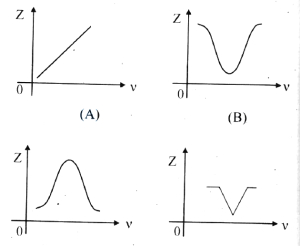
A
$(A)$
B
$(B)$
C
$(C)$
D
$(D)$
Solution
(B) The impedance $Z$ of a series $LCR$ circuit is given by the formula: $Z = \sqrt{R^2 + (2 \pi v L - \frac{1}{2 \pi v C})^2}$.
At very low frequencies $(v \to 0)$,the capacitive reactance $X_C = \frac{1}{2 \pi v C}$ approaches infinity,so $Z \to \infty$.
At the resonant frequency $v_r = \frac{1}{2 \pi \sqrt{LC}}$,the inductive reactance $X_L$ equals the capacitive reactance $X_C$,making the net reactance zero. Thus,$Z = R$,which is the minimum value of impedance.
For frequencies higher than the resonant frequency $(v > v_r)$,the inductive reactance $X_L = 2 \pi v L$ dominates,and $Z$ increases as $v$ increases.
Therefore,the graph of $Z$ versus $v$ starts from a high value,decreases to a minimum value $R$ at $v_r$,and then increases again. This behavior is correctly represented by graph $(B)$.
At very low frequencies $(v \to 0)$,the capacitive reactance $X_C = \frac{1}{2 \pi v C}$ approaches infinity,so $Z \to \infty$.
At the resonant frequency $v_r = \frac{1}{2 \pi \sqrt{LC}}$,the inductive reactance $X_L$ equals the capacitive reactance $X_C$,making the net reactance zero. Thus,$Z = R$,which is the minimum value of impedance.
For frequencies higher than the resonant frequency $(v > v_r)$,the inductive reactance $X_L = 2 \pi v L$ dominates,and $Z$ increases as $v$ increases.
Therefore,the graph of $Z$ versus $v$ starts from a high value,decreases to a minimum value $R$ at $v_r$,and then increases again. This behavior is correctly represented by graph $(B)$.
0 likesView Solution
77
PhysicsEasyMCQMHT CET · 2024
$A$ light bulb connected in series with a capacitor and an $A.C.$ source is glowing with a certain brightness. On reducing the capacitance of the capacitor and the frequency of the source,the brightness of the lamp (respectively):
A
is reduced,is increased
B
is reduced,is reduced
C
is increased,is reduced
D
is increased,is increased
Solution
(B) The capacitive reactance of a capacitor is given by the formula $X_{C} = \frac{1}{2 \pi f C}$.
Here,$f$ is the frequency of the $A.C.$ source and $C$ is the capacitance.
When the capacitance $C$ is reduced,the capacitive reactance $X_{C}$ increases.
Similarly,when the frequency $f$ is reduced,the capacitive reactance $X_{C}$ increases.
Since the bulb is in series with the capacitor,the total impedance $Z$ of the circuit is given by $Z = \sqrt{R^2 + X_{C}^2}$.
As $X_{C}$ increases in both cases,the total impedance $Z$ of the circuit increases.
According to Ohm's law for $A.C.$ circuits,the current $I = \frac{V}{Z}$.
Since the impedance $Z$ increases,the current $I$ flowing through the bulb decreases.
The brightness of the bulb depends on the power dissipated,$P = I^2 R$.
As the current $I$ decreases,the power dissipated and the brightness of the lamp decrease in both cases.
Here,$f$ is the frequency of the $A.C.$ source and $C$ is the capacitance.
When the capacitance $C$ is reduced,the capacitive reactance $X_{C}$ increases.
Similarly,when the frequency $f$ is reduced,the capacitive reactance $X_{C}$ increases.
Since the bulb is in series with the capacitor,the total impedance $Z$ of the circuit is given by $Z = \sqrt{R^2 + X_{C}^2}$.
As $X_{C}$ increases in both cases,the total impedance $Z$ of the circuit increases.
According to Ohm's law for $A.C.$ circuits,the current $I = \frac{V}{Z}$.
Since the impedance $Z$ increases,the current $I$ flowing through the bulb decreases.
The brightness of the bulb depends on the power dissipated,$P = I^2 R$.
As the current $I$ decreases,the power dissipated and the brightness of the lamp decrease in both cases.
0 likesView Solution
78
PhysicsEasyMCQMHT CET · 2024
In an $LCR$ series circuit,if $V$ is the effective value of the applied voltage,$V_R$ is the voltage across $R$,and $V_L$ and $V_C$ are the effective voltages across $L$ and $C$ respectively,then:
A
$V=V_{R}+V_{L}+V_{C}$
B
$V^2=V_{R}^2+V_{L}^2+V_{C}^2$
C
$V^2=V_{R}^2+\left(V_{L}-V_{C}\right)^2$
D
$V^2=V_{L}^2+\left(V_{R}-V_{C}\right)^2$
Solution
(C) In an $LCR$ series circuit,the current $I$ is the same through all components. The voltage across the resistor $V_R$ is in phase with the current. The voltage across the inductor $V_L$ leads the current by $90^\circ$,and the voltage across the capacitor $V_C$ lags behind the current by $90^\circ$.
Thus,$V_L$ and $V_C$ are in opposite directions. The net reactive voltage is $(V_L - V_C)$.
Using the phasor diagram,the resultant voltage $V$ is the vector sum of $V_R$ and $(V_L - V_C)$,which are perpendicular to each other.
Applying the Pythagorean theorem: $V^2 = V_R^2 + (V_L - V_C)^2$.
Thus,$V_L$ and $V_C$ are in opposite directions. The net reactive voltage is $(V_L - V_C)$.
Using the phasor diagram,the resultant voltage $V$ is the vector sum of $V_R$ and $(V_L - V_C)$,which are perpendicular to each other.
Applying the Pythagorean theorem: $V^2 = V_R^2 + (V_L - V_C)^2$.
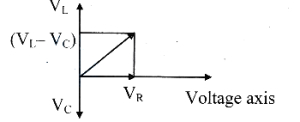
0 likesView Solution
79
PhysicsEasyMCQMHT CET · 2024
An inductance of $2 \text{ mH}$,a capacitor of $20 \mu\text{F}$,and a resistance of $50 \Omega$ are connected in series to an $A.C.$ source. The reactance of the inductor and the capacitor are the same. The reactance of either of them will be: (in $Omega$)
A
$100$
B
$50$
C
$40$
D
$10$
Solution
(D) Given:
Inductance $L = 2 \text{ mH} = 2 \times 10^{-3} \text{ H}$
Capacitance $C = 20 \mu\text{F} = 20 \times 10^{-6} \text{ F}$
Resistance $R = 50 \Omega$
Condition for resonance: Inductive reactance $X_L$ equals capacitive reactance $X_C$.
$X_L = X_C = \omega L = \frac{1}{\omega C}$
From this,$\omega^2 = \frac{1}{LC}$.
$\omega = \frac{1}{\sqrt{LC}} = \frac{1}{\sqrt{2 \times 10^{-3} \times 20 \times 10^{-6}}} = \frac{1}{\sqrt{40 \times 10^{-9}}} = \frac{1}{\sqrt{4 \times 10^{-8}}} = \frac{1}{2 \times 10^{-4}} = 0.5 \times 10^4 = 5000 \text{ rad/s}$.
Now,calculate the reactance $X_L = \omega L$:
$X_L = 5000 \times 2 \times 10^{-3} = 10 \Omega$.
Therefore,the reactance of either component is $10 \Omega$.
Inductance $L = 2 \text{ mH} = 2 \times 10^{-3} \text{ H}$
Capacitance $C = 20 \mu\text{F} = 20 \times 10^{-6} \text{ F}$
Resistance $R = 50 \Omega$
Condition for resonance: Inductive reactance $X_L$ equals capacitive reactance $X_C$.
$X_L = X_C = \omega L = \frac{1}{\omega C}$
From this,$\omega^2 = \frac{1}{LC}$.
$\omega = \frac{1}{\sqrt{LC}} = \frac{1}{\sqrt{2 \times 10^{-3} \times 20 \times 10^{-6}}} = \frac{1}{\sqrt{40 \times 10^{-9}}} = \frac{1}{\sqrt{4 \times 10^{-8}}} = \frac{1}{2 \times 10^{-4}} = 0.5 \times 10^4 = 5000 \text{ rad/s}$.
Now,calculate the reactance $X_L = \omega L$:
$X_L = 5000 \times 2 \times 10^{-3} = 10 \Omega$.
Therefore,the reactance of either component is $10 \Omega$.
0 likesView Solution
80
PhysicsEasyMCQMHT CET · 2024
In an $A$.$C$. circuit,the potential difference $V$ and current $I$ are given respectively by $V = 100 \sin(100t) \text{ V}$ and $I = 100 \sin(100t + \frac{\pi}{3}) \text{ mA}$. The power dissipated in the circuit will be (Given: $\cos \frac{\pi}{3} = \frac{1}{2}$)
A
$10^4 \text{ W}$
B
$10 \text{ W}$
C
$2.5 \text{ W}$
D
$5 \text{ W}$
Solution
(C) Given equations are $V = 100 \sin(100t) \text{ V}$ and $I = 100 \sin(100t + \frac{\pi}{3}) \text{ mA}$.
Comparing with standard forms $V = V_0 \sin(\omega t)$ and $I = I_0 \sin(\omega t + \phi)$,we get:
$V_0 = 100 \text{ V}$
$I_0 = 100 \text{ mA} = 100 \times 10^{-3} \text{ A} = 0.1 \text{ A}$
Phase difference $\phi = \frac{\pi}{3}$.
The average power dissipated in an $A$.$C$. circuit is given by $P = V_{\text{rms}} I_{\text{rms}} \cos \phi$.
$P = \left(\frac{V_0}{\sqrt{2}}\right) \left(\frac{I_0}{\sqrt{2}}\right) \cos \phi = \frac{V_0 I_0}{2} \cos \phi$.
Substituting the values:
$P = \frac{100 \times 0.1}{2} \times \cos(\frac{\pi}{3})$
$P = \frac{10}{2} \times \frac{1}{2} = 5 \times 0.5 = 2.5 \text{ W}$.
Comparing with standard forms $V = V_0 \sin(\omega t)$ and $I = I_0 \sin(\omega t + \phi)$,we get:
$V_0 = 100 \text{ V}$
$I_0 = 100 \text{ mA} = 100 \times 10^{-3} \text{ A} = 0.1 \text{ A}$
Phase difference $\phi = \frac{\pi}{3}$.
The average power dissipated in an $A$.$C$. circuit is given by $P = V_{\text{rms}} I_{\text{rms}} \cos \phi$.
$P = \left(\frac{V_0}{\sqrt{2}}\right) \left(\frac{I_0}{\sqrt{2}}\right) \cos \phi = \frac{V_0 I_0}{2} \cos \phi$.
Substituting the values:
$P = \frac{100 \times 0.1}{2} \times \cos(\frac{\pi}{3})$
$P = \frac{10}{2} \times \frac{1}{2} = 5 \times 0.5 = 2.5 \text{ W}$.
0 likesView Solution
81
PhysicsEasyMCQMHT CET · 2024
In an a.c. circuit $I=100 \sin 200 \pi t$. The time required for the current to achieve its peak value will be
A
$\frac{1}{100} \ s$
B
$\frac{1}{200} \ s$
C
$\frac{1}{300} \ s$
D
$\frac{1}{400} \ s$
Solution
(D) The given equation for the alternating current is $I = 100 \sin(200 \pi t)$.
Comparing this with the standard form $I = I_0 \sin(\omega t)$,the peak value $I_0$ is $100 \ A$.
The current reaches its peak value when $\sin(200 \pi t) = 1$.
This occurs when the argument of the sine function is equal to $\frac{\pi}{2}$.
So,$200 \pi t = \frac{\pi}{2}$.
Dividing both sides by $\pi$,we get $200 t = \frac{1}{2}$.
Therefore,$t = \frac{1}{2 \times 200} = \frac{1}{400} \ s$.
Comparing this with the standard form $I = I_0 \sin(\omega t)$,the peak value $I_0$ is $100 \ A$.
The current reaches its peak value when $\sin(200 \pi t) = 1$.
This occurs when the argument of the sine function is equal to $\frac{\pi}{2}$.
So,$200 \pi t = \frac{\pi}{2}$.
Dividing both sides by $\pi$,we get $200 t = \frac{1}{2}$.
Therefore,$t = \frac{1}{2 \times 200} = \frac{1}{400} \ s$.
0 likesView Solution
82
PhysicsEasyMCQMHT CET · 2024
The current flowing in a coil is $3 \text{ A}$ and the power consumed is $108 \text{ W}$. If the a.c. source is of $120 \text{ V}, 50 \text{ Hz}$,the resistance in the circuit is (in $Omega$)
A
$24$
B
$36$
C
$12$
D
$6$
Solution
(C) The power consumed in an $A$.$C$. circuit containing a resistor is given by the formula:
$P = I_{rms}^2 R$
Given:
$P = 108 \text{ W}$
$I_{rms} = 3 \text{ A}$
Substituting the values into the formula:
$108 = (3)^2 \times R$
$108 = 9 \times R$
$R = \frac{108}{9} = 12 \ \Omega$
Therefore,the resistance in the circuit is $12 \ \Omega$.
$P = I_{rms}^2 R$
Given:
$P = 108 \text{ W}$
$I_{rms} = 3 \text{ A}$
Substituting the values into the formula:
$108 = (3)^2 \times R$
$108 = 9 \times R$
$R = \frac{108}{9} = 12 \ \Omega$
Therefore,the resistance in the circuit is $12 \ \Omega$.
0 likesView Solution
83
PhysicsEasyMCQMHT CET · 2024
In an $AC$ circuit $E = 200 \sin(50t) \text{ V}$ and $I = 100 \sin(50t + \frac{\pi}{3}) \text{ mA}$. The power dissipated in the circuit is (Given: $\sin 30^{\circ} = \cos 60^{\circ} = 0.5$,$\sin 60^{\circ} = \cos 30^{\circ} = \frac{\sqrt{3}}{2}$) (in $watt$)
A
$20$
B
$15$
C
$10$
D
$5$
Solution
(D) Given equations are $E = 200 \sin(50t) \text{ V}$ and $I = 100 \sin(50t + \frac{\pi}{3}) \text{ mA}$.
Comparing these with standard forms $E = E_0 \sin(\omega t)$ and $I = I_0 \sin(\omega t + \phi)$,we get:
$E_0 = 200 \text{ V}$
$I_0 = 100 \text{ mA} = 100 \times 10^{-3} \text{ A} = 0.1 \text{ A}$
Phase difference $\phi = \frac{\pi}{3} = 60^{\circ}$.
The average power dissipated in an $AC$ circuit is given by $P = E_{\text{rms}} I_{\text{rms}} \cos \phi$.
We know that $E_{\text{rms}} = \frac{E_0}{\sqrt{2}}$ and $I_{\text{rms}} = \frac{I_0}{\sqrt{2}}$.
Substituting these values:
$P = \left( \frac{E_0}{\sqrt{2}} \right) \left( \frac{I_0}{\sqrt{2}} \right) \cos \phi = \frac{E_0 I_0}{2} \cos 60^{\circ}$.
$P = \frac{200 \times 0.1}{2} \times 0.5 = \frac{20}{2} \times 0.5 = 10 \times 0.5 = 5 \text{ W}$.
Comparing these with standard forms $E = E_0 \sin(\omega t)$ and $I = I_0 \sin(\omega t + \phi)$,we get:
$E_0 = 200 \text{ V}$
$I_0 = 100 \text{ mA} = 100 \times 10^{-3} \text{ A} = 0.1 \text{ A}$
Phase difference $\phi = \frac{\pi}{3} = 60^{\circ}$.
The average power dissipated in an $AC$ circuit is given by $P = E_{\text{rms}} I_{\text{rms}} \cos \phi$.
We know that $E_{\text{rms}} = \frac{E_0}{\sqrt{2}}$ and $I_{\text{rms}} = \frac{I_0}{\sqrt{2}}$.
Substituting these values:
$P = \left( \frac{E_0}{\sqrt{2}} \right) \left( \frac{I_0}{\sqrt{2}} \right) \cos \phi = \frac{E_0 I_0}{2} \cos 60^{\circ}$.
$P = \frac{200 \times 0.1}{2} \times 0.5 = \frac{20}{2} \times 0.5 = 10 \times 0.5 = 5 \text{ W}$.
0 likesView Solution
84
PhysicsEasyMCQMHT CET · 2024
$A$ $42 \, mH$ inductor is connected to a $200 \, V, 50 \, Hz$ a.c. supply. The r.m.s. value of current in the circuit will be nearly (Take $\pi = \frac{22}{7}$) (in $ \, A$)
A
$15.15$
B
$9.15$
C
$8.15$
D
$6.15$
Solution
(A) Given: Inductance $L = 42 \, mH = 42 \times 10^{-3} \, H$, Voltage $V_{rms} = 200 \, V$, Frequency $f = 50 \, Hz$.
First, calculate the inductive reactance $X_L$ using the formula $X_L = \omega L = 2 \pi f L$.
Substituting the values: $X_L = 2 \times \frac{22}{7} \times 50 \times 42 \times 10^{-3} \, \Omega$.
$X_L = 2 \times 22 \times 50 \times 6 \times 10^{-3} \, \Omega = 4400 \times 6 \times 10^{-3} \, \Omega = 13.2 \, \Omega$.
The r.m.s. current $I_{rms}$ is given by $I_{rms} = \frac{V_{rms}}{X_L}$.
$I_{rms} = \frac{200}{13.2} \approx 15.15 \, A$.
First, calculate the inductive reactance $X_L$ using the formula $X_L = \omega L = 2 \pi f L$.
Substituting the values: $X_L = 2 \times \frac{22}{7} \times 50 \times 42 \times 10^{-3} \, \Omega$.
$X_L = 2 \times 22 \times 50 \times 6 \times 10^{-3} \, \Omega = 4400 \times 6 \times 10^{-3} \, \Omega = 13.2 \, \Omega$.
The r.m.s. current $I_{rms}$ is given by $I_{rms} = \frac{V_{rms}}{X_L}$.
$I_{rms} = \frac{200}{13.2} \approx 15.15 \, A$.
0 likesView Solution
85
PhysicsMediumMCQMHT CET · 2024
An alternating current is given by $I=100 \sin (50 \pi t)$. How many times will the current become zero in one second (in $times$)?
A
$50$
B
$25$
C
$40$
D
$100$
Solution
(A) The given alternating current equation is $I = I_0 \sin(\omega t)$.
Comparing this with the given equation $I = 100 \sin(50 \pi t)$, we get angular frequency $\omega = 50 \pi \text{ rad/s}$.
We know that $\omega = 2 \pi f$, where $f$ is the frequency.
So, $2 \pi f = 50 \pi$, which gives $f = 25 \text{ Hz}$.
This means the current completes $25$ cycles in one second.
In one complete cycle of a sine wave, the current becomes zero twice (at the start/end and at the half-cycle point).
Therefore, in $25$ cycles, the current will become zero $25 \times 2 = 50$ times in one second.
Comparing this with the given equation $I = 100 \sin(50 \pi t)$, we get angular frequency $\omega = 50 \pi \text{ rad/s}$.
We know that $\omega = 2 \pi f$, where $f$ is the frequency.
So, $2 \pi f = 50 \pi$, which gives $f = 25 \text{ Hz}$.
This means the current completes $25$ cycles in one second.
In one complete cycle of a sine wave, the current becomes zero twice (at the start/end and at the half-cycle point).
Therefore, in $25$ cycles, the current will become zero $25 \times 2 = 50$ times in one second.
0 likesView Solution
86
PhysicsEasyMCQMHT CET · 2024
Average power associated with an ideal inductor and ideal capacitor over a complete cycle of $a.c.$ is respectively
A
zero,one
B
one,zero
C
zero,zero
D
one,one
Solution
(C) $1$. Ideal Inductor:
- The voltage and current in an ideal inductor are out of phase by $90^{\circ}$,with the current lagging the voltage by $90^{\circ}$.
- The instantaneous power is given by $p(t) = v(t) \times i(t)$.
- Over a complete cycle,the positive and negative power values cancel out,resulting in an average power of zero.
$2$. Ideal Capacitor:
- In an ideal capacitor,the voltage and current are also out of phase by $90^{\circ}$,but the current leads the voltage by $90^{\circ}$.
- Similar to the inductor case,the instantaneous power alternates between positive and negative,resulting in an average power of zero over a complete cycle.
- The voltage and current in an ideal inductor are out of phase by $90^{\circ}$,with the current lagging the voltage by $90^{\circ}$.
- The instantaneous power is given by $p(t) = v(t) \times i(t)$.
- Over a complete cycle,the positive and negative power values cancel out,resulting in an average power of zero.
$2$. Ideal Capacitor:
- In an ideal capacitor,the voltage and current are also out of phase by $90^{\circ}$,but the current leads the voltage by $90^{\circ}$.
- Similar to the inductor case,the instantaneous power alternates between positive and negative,resulting in an average power of zero over a complete cycle.
0 likesView Solution
87
PhysicsMediumMCQMHT CET · 2024
An e.m.f. $E=E_0 \cos \omega t$ is applied to a circuit containing $L$ and $R$ in series. If $X_L=2 R$,then the power dissipated in the circuit is
A
$\frac{E_0^2}{12 R}$
B
$\frac{E_0^2}{10 R}$
C
$\frac{E_0^2}{8 R}$
D
$\frac{E_0^2}{6 R}$
Solution
(B) The impedance $Z$ of an $LR$ series circuit is given by $Z = \sqrt{R^2 + X_L^2}$.
Given $X_L = 2R$,we have $Z^2 = R^2 + (2R)^2 = R^2 + 4R^2 = 5R^2$.
The average power dissipated in an $AC$ circuit is given by $P = V_{rms} I_{rms} \cos \phi$,where $\cos \phi = \frac{R}{Z}$ is the power factor.
Since $V_{rms} = \frac{E_0}{\sqrt{2}}$ and $I_{rms} = \frac{V_{rms}}{Z} = \frac{E_0}{\sqrt{2}Z}$,the power is $P = \frac{E_0}{\sqrt{2}} \times \frac{E_0}{\sqrt{2}Z} \times \frac{R}{Z} = \frac{E_0^2 R}{2 Z^2}$.
Substituting $Z^2 = 5R^2$,we get $P = \frac{E_0^2 R}{2(5R^2)} = \frac{E_0^2 R}{10 R^2} = \frac{E_0^2}{10 R}$.
Given $X_L = 2R$,we have $Z^2 = R^2 + (2R)^2 = R^2 + 4R^2 = 5R^2$.
The average power dissipated in an $AC$ circuit is given by $P = V_{rms} I_{rms} \cos \phi$,where $\cos \phi = \frac{R}{Z}$ is the power factor.
Since $V_{rms} = \frac{E_0}{\sqrt{2}}$ and $I_{rms} = \frac{V_{rms}}{Z} = \frac{E_0}{\sqrt{2}Z}$,the power is $P = \frac{E_0}{\sqrt{2}} \times \frac{E_0}{\sqrt{2}Z} \times \frac{R}{Z} = \frac{E_0^2 R}{2 Z^2}$.
Substituting $Z^2 = 5R^2$,we get $P = \frac{E_0^2 R}{2(5R^2)} = \frac{E_0^2 R}{10 R^2} = \frac{E_0^2}{10 R}$.
0 likesView Solution
88
PhysicsMediumMCQMHT CET · 2024
An e.m.f. $E = E_0 \cos \omega t$ is applied to an $L-R$ circuit. The inductive reactance is equal to the resistance $R$ of the circuit. The power consumed in the circuit is:
A
$\frac{E_0^2}{\sqrt{2} R}$
B
$\frac{E_0^2}{2 R}$
C
$\frac{E_0^2}{4 R}$
D
$\frac{E_0^2}{R}$
Solution
(C) The average power consumed in an $AC$ circuit is given by $P = E_{rms} I_{rms} \cos \phi$.
Here,the power factor is $\cos \phi = \frac{R}{Z}$.
The $rms$ current is $I_{rms} = \frac{E_{rms}}{Z} = \frac{E_0}{\sqrt{2} Z}$.
Substituting these into the power formula:
$P = \left( \frac{E_0}{\sqrt{2}} \right) \left( \frac{E_0}{\sqrt{2} Z} \right) \left( \frac{R}{Z} \right) = \frac{E_0^2 R}{2 Z^2} \dots (i)$.
Given that the inductive reactance $X_L = R$,the impedance $Z$ of the $L-R$ circuit is:
$Z = \sqrt{R^2 + X_L^2} = \sqrt{R^2 + R^2} = \sqrt{2} R$.
Substituting $Z^2 = 2 R^2$ into equation $(i)$:
$P = \frac{E_0^2 R}{2 (2 R^2)} = \frac{E_0^2 R}{4 R^2} = \frac{E_0^2}{4 R}$.
Here,the power factor is $\cos \phi = \frac{R}{Z}$.
The $rms$ current is $I_{rms} = \frac{E_{rms}}{Z} = \frac{E_0}{\sqrt{2} Z}$.
Substituting these into the power formula:
$P = \left( \frac{E_0}{\sqrt{2}} \right) \left( \frac{E_0}{\sqrt{2} Z} \right) \left( \frac{R}{Z} \right) = \frac{E_0^2 R}{2 Z^2} \dots (i)$.
Given that the inductive reactance $X_L = R$,the impedance $Z$ of the $L-R$ circuit is:
$Z = \sqrt{R^2 + X_L^2} = \sqrt{R^2 + R^2} = \sqrt{2} R$.
Substituting $Z^2 = 2 R^2$ into equation $(i)$:
$P = \frac{E_0^2 R}{2 (2 R^2)} = \frac{E_0^2 R}{4 R^2} = \frac{E_0^2}{4 R}$.
0 likesView Solution
89
PhysicsEasyMCQMHT CET · 2024
In an $LCR$ resonant circuit,the phase difference between the current and the voltage is:
A
$\frac{\pi}{4}$
B
$\frac{\pi}{2}$
C
$-\frac{\pi}{2}$
D
zero
Solution
(D) In an $LCR$ series circuit,the impedance $Z$ is given by $Z = \sqrt{R^2 + (X_L - X_C)^2}$.
At resonance,the inductive reactance $X_L$ equals the capacitive reactance $X_C$,i.e.,$X_L = X_C$.
Therefore,the net reactance $X = X_L - X_C = 0$.
The phase angle $\phi$ is given by $\tan \phi = \frac{X_L - X_C}{R} = \frac{0}{R} = 0$.
Thus,$\phi = 0$,which means the current and voltage are in the same phase at resonance.
At resonance,the inductive reactance $X_L$ equals the capacitive reactance $X_C$,i.e.,$X_L = X_C$.
Therefore,the net reactance $X = X_L - X_C = 0$.
The phase angle $\phi$ is given by $\tan \phi = \frac{X_L - X_C}{R} = \frac{0}{R} = 0$.
Thus,$\phi = 0$,which means the current and voltage are in the same phase at resonance.
0 likesView Solution
90
PhysicsEasyMCQMHT CET · 2024
In an $A.C.$ circuit,the reactance of a coil is $\sqrt{3}$ times its resistance. The phase difference between the voltage across the coil and the current through the coil will be
A
$\tan^{-1}(0)$
B
$\tan^{-1} \left(\frac{1}{\sqrt{3}}\right)$
C
$\tan^{-1}(1)$
D
$\tan^{-1}(\sqrt{3})$
Solution
(D) In an $A.C.$ circuit containing a coil (inductor with resistance),the phase difference $\phi$ between the voltage and the current is given by the formula: $\tan \phi = \frac{X_L}{R}$.
Given that the reactance $X_L = \sqrt{3} R$.
Substituting this value into the formula:
$\tan \phi = \frac{\sqrt{3} R}{R} = \sqrt{3}$.
Therefore,the phase difference is $\phi = \tan^{-1}(\sqrt{3})$.
Given that the reactance $X_L = \sqrt{3} R$.
Substituting this value into the formula:
$\tan \phi = \frac{\sqrt{3} R}{R} = \sqrt{3}$.
Therefore,the phase difference is $\phi = \tan^{-1}(\sqrt{3})$.
0 likesView Solution
91
PhysicsDifficultMCQMHT CET · 2024
The alternating voltage is given by $v=v_0 \sin \left(\omega t+\frac{\pi}{3}\right)$. When will the voltage be maximum for the first time?
A
$\frac{T}{6}$
B
$\frac{T}{3}$
C
$\frac{T}{2}$
D
$\frac{T}{12}$
Solution
(D) For the voltage to be maximum,the sine function must equal $1$.
$\sin \left(\omega t+\frac{\pi}{3}\right) = 1$
Since $\sin \left(\frac{\pi}{2}\right) = 1$,we have:
$\omega t + \frac{\pi}{3} = \frac{\pi}{2}$
$\omega t = \frac{\pi}{2} - \frac{\pi}{3}$
$\omega t = \frac{\pi}{6}$
Substituting $\omega = \frac{2\pi}{T}$:
$\left(\frac{2\pi}{T}\right) t = \frac{\pi}{6}$
$t = \frac{\pi}{6} \times \frac{T}{2\pi}$
$t = \frac{T}{12}$
$\sin \left(\omega t+\frac{\pi}{3}\right) = 1$
Since $\sin \left(\frac{\pi}{2}\right) = 1$,we have:
$\omega t + \frac{\pi}{3} = \frac{\pi}{2}$
$\omega t = \frac{\pi}{2} - \frac{\pi}{3}$
$\omega t = \frac{\pi}{6}$
Substituting $\omega = \frac{2\pi}{T}$:
$\left(\frac{2\pi}{T}\right) t = \frac{\pi}{6}$
$t = \frac{\pi}{6} \times \frac{T}{2\pi}$
$t = \frac{T}{12}$
0 likesView Solution
92
PhysicsEasyMCQMHT CET · 2024
An electric lamp connected in series with a capacitor and an $A.C.$ source is glowing with a certain brightness. On increasing the value of capacitance,the brightness of the lamp
A
is increased.
B
is decreased.
C
remains the same.
D
becomes zero.
Solution
(A) The capacitive reactance is given by $X_{C} = \frac{1}{2 \pi f C}$.
If the capacitance $(C)$ is increased,the capacitive reactance $(X_{C})$ will decrease.
The total impedance $(Z)$ of the circuit is given by $Z = \sqrt{R^2 + X_{C}^2}$.
As $X_{C}$ decreases,the total impedance $(Z)$ of the circuit decreases.
According to Ohm's law for $A.C.$ circuits,the current $(I = V/Z)$ will increase.
Since the brightness of the lamp depends on the power dissipated $(P = I^2 R)$,an increase in current leads to an increase in the brightness of the lamp.
If the capacitance $(C)$ is increased,the capacitive reactance $(X_{C})$ will decrease.
The total impedance $(Z)$ of the circuit is given by $Z = \sqrt{R^2 + X_{C}^2}$.
As $X_{C}$ decreases,the total impedance $(Z)$ of the circuit decreases.
According to Ohm's law for $A.C.$ circuits,the current $(I = V/Z)$ will increase.
Since the brightness of the lamp depends on the power dissipated $(P = I^2 R)$,an increase in current leads to an increase in the brightness of the lamp.
0 likesView Solution
93
PhysicsMediumMCQMHT CET · 2024
In an $LCR$ series circuit,an alternating e.m.f. '$e$' and current '$i$' are given by the equations $e = 160 \sin(100t) \text{ V}$ and $i = 250 \sin(100t + \frac{\pi}{3}) \text{ mA}$. The average power dissipated in the circuit is: (in $\text{ W}$)
A
$2.5$
B
$4.0$
C
$10$
D
$100$
Solution
(C) Given equations are $e = 160 \sin(100t) \text{ V}$ and $i = 250 \sin(100t + \frac{\pi}{3}) \text{ mA}$.
Comparing these with standard forms $e = e_0 \sin(\omega t)$ and $i = i_0 \sin(\omega t + \phi)$,we get:
Peak voltage $e_0 = 160 \text{ V}$.
Peak current $i_0 = 250 \text{ mA} = 250 \times 10^{-3} \text{ A} = 0.25 \text{ A}$.
Phase difference $\phi = \frac{\pi}{3}$.
The average power dissipated in an $AC$ circuit is given by $P_{avg} = V_{rms} I_{rms} \cos(\phi) = \frac{e_0}{\sqrt{2}} \cdot \frac{i_0}{\sqrt{2}} \cos(\phi) = \frac{e_0 i_0}{2} \cos(\phi)$.
Substituting the values:
$P_{avg} = \frac{160 \times 0.25}{2} \times \cos(\frac{\pi}{3})$
$P_{avg} = \frac{40}{2} \times \frac{1}{2} = 20 \times 0.5 = 10 \text{ W}$.
Comparing these with standard forms $e = e_0 \sin(\omega t)$ and $i = i_0 \sin(\omega t + \phi)$,we get:
Peak voltage $e_0 = 160 \text{ V}$.
Peak current $i_0 = 250 \text{ mA} = 250 \times 10^{-3} \text{ A} = 0.25 \text{ A}$.
Phase difference $\phi = \frac{\pi}{3}$.
The average power dissipated in an $AC$ circuit is given by $P_{avg} = V_{rms} I_{rms} \cos(\phi) = \frac{e_0}{\sqrt{2}} \cdot \frac{i_0}{\sqrt{2}} \cos(\phi) = \frac{e_0 i_0}{2} \cos(\phi)$.
Substituting the values:
$P_{avg} = \frac{160 \times 0.25}{2} \times \cos(\frac{\pi}{3})$
$P_{avg} = \frac{40}{2} \times \frac{1}{2} = 20 \times 0.5 = 10 \text{ W}$.
0 likesView Solution
94
PhysicsEasyMCQMHT CET · 2024
The core used in transformers and other electromagnetic devices is laminated to
A
increase the magnetic field.
B
increase the level of magnetic saturation of the core.
C
reduce the residual magnetism in the core.
D
reduce eddy current.
Solution
(D) $1$. According to Faraday's law of induction,eddy currents are loops of electrical current induced within conductors by a changing magnetic field.
$2$. When a solid metal core is used in a transformer,the changing magnetic flux induces large eddy currents,which lead to significant energy loss in the form of heat.
$3$. By laminating the core (using thin,insulated sheets of metal),the path for these eddy currents is restricted,significantly reducing their magnitude.
$4$. Therefore,the core is laminated to reduce eddy current losses and improve the overall efficiency of the device.
$2$. When a solid metal core is used in a transformer,the changing magnetic flux induces large eddy currents,which lead to significant energy loss in the form of heat.
$3$. By laminating the core (using thin,insulated sheets of metal),the path for these eddy currents is restricted,significantly reducing their magnitude.
$4$. Therefore,the core is laminated to reduce eddy current losses and improve the overall efficiency of the device.
0 likesView Solution
95
PhysicsEasyMCQMHT CET · 2024
$A$ transformer having efficiency $90 \%$ is working on $200 \ V$ and $3 \ kW$ power supply. If the current in the secondary coil is $6 \ A$, the voltage across the secondary coil and the current in the primary coil are respectively:
A
$300 \ V, 15 \ A$
B
$450 \ V, 15 \ A$
C
$450 \ V, 13.5 \ A$
D
$600 \ V, 15 \ A$
Solution
(B) Given: Efficiency $\eta = 90 \% = 0.9$, Input Voltage $V_p = 200 \ V$, Input Power $P_{in} = 3 \ kW = 3000 \ W$, Secondary Current $I_s = 6 \ A$.
First, calculate the primary current $I_p$ using the input power formula: $P_{in} = V_p \times I_p$.
$3000 \ W = 200 \ V \times I_p \implies I_p = \frac{3000}{200} = 15 \ A$.
Next, calculate the output power $P_{out}$ using efficiency: $P_{out} = \eta \times P_{in}$.
$P_{out} = 0.9 \times 3000 \ W = 2700 \ W$.
Finally, calculate the secondary voltage $V_s$ using the output power formula: $P_{out} = V_s \times I_s$.
$2700 \ W = V_s \times 6 \ A \implies V_s = \frac{2700}{6} = 450 \ V$.
Thus, the secondary voltage is $450 \ V$ and the primary current is $15 \ A$.
First, calculate the primary current $I_p$ using the input power formula: $P_{in} = V_p \times I_p$.
$3000 \ W = 200 \ V \times I_p \implies I_p = \frac{3000}{200} = 15 \ A$.
Next, calculate the output power $P_{out}$ using efficiency: $P_{out} = \eta \times P_{in}$.
$P_{out} = 0.9 \times 3000 \ W = 2700 \ W$.
Finally, calculate the secondary voltage $V_s$ using the output power formula: $P_{out} = V_s \times I_s$.
$2700 \ W = V_s \times 6 \ A \implies V_s = \frac{2700}{6} = 450 \ V$.
Thus, the secondary voltage is $450 \ V$ and the primary current is $15 \ A$.
0 likesView Solution
96
PhysicsMediumMCQMHT CET · 2024
$A$ transformer is used to step up an alternating e.m.f. of $220 \ V$ to $4.4 \ kV$ to transmit $6.6 \ kW$ of power. The primary coil has $1000$ turns. The current rating of the secondary coil is (Transformer is ideal): (in $A$)
A
$0.8$
B
$1.2$
C
$1.5$
D
$1.8$
Solution
(C) For an ideal transformer,the power input at the primary coil is equal to the power output at the secondary coil.
Given power $P = 6.6 \ kW = 6.6 \times 10^3 \ W$.
Secondary voltage $V_s = 4.4 \ kV = 4.4 \times 10^3 \ V$.
Since $P = V_s \times I_s$ for an ideal transformer,
$I_s = \frac{P}{V_s} = \frac{6.6 \times 10^3}{4.4 \times 10^3} \ A$.
$I_s = \frac{6.6}{4.4} \ A = 1.5 \ A$.
Thus,the current rating of the secondary coil is $1.5 \ A$.
Given power $P = 6.6 \ kW = 6.6 \times 10^3 \ W$.
Secondary voltage $V_s = 4.4 \ kV = 4.4 \times 10^3 \ V$.
Since $P = V_s \times I_s$ for an ideal transformer,
$I_s = \frac{P}{V_s} = \frac{6.6 \times 10^3}{4.4 \times 10^3} \ A$.
$I_s = \frac{6.6}{4.4} \ A = 1.5 \ A$.
Thus,the current rating of the secondary coil is $1.5 \ A$.
0 likesView Solution
97
PhysicsEasyMCQMHT CET · 2024
$A$ transformer has $120$ turns in the primary coil and carries $5 \text{ A}$ current. Input power is $1 \text{ kW}$. To have $560 \text{ V}$ output, the number of turns in the secondary coil will be:
A
$168$
B
$200$
C
$336$
D
$400$
Solution
(C) Given: Primary turns $N_p = 120$, Primary current $I_p = 5 \text{ A}$, Input power $P_{in} = 1 \text{ kW} = 1000 \text{ W}$, Secondary voltage $V_s = 560 \text{ V}$.
First, calculate the primary voltage $V_p$ using the power formula $P = V_p I_p$:
$V_p = \frac{P_{in}}{I_p} = \frac{1000 \text{ W}}{5 \text{ A}} = 200 \text{ V}$.
Using the transformer turns ratio formula $\frac{N_s}{N_p} = \frac{V_s}{V_p}$:
$\frac{N_s}{120} = \frac{560}{200}$.
Solving for $N_s$:
$N_s = \frac{120 \times 560}{200} = \frac{120 \times 56}{20} = 6 \times 56 = 336$.
Therefore, the number of turns in the secondary coil is $336$.
First, calculate the primary voltage $V_p$ using the power formula $P = V_p I_p$:
$V_p = \frac{P_{in}}{I_p} = \frac{1000 \text{ W}}{5 \text{ A}} = 200 \text{ V}$.
Using the transformer turns ratio formula $\frac{N_s}{N_p} = \frac{V_s}{V_p}$:
$\frac{N_s}{120} = \frac{560}{200}$.
Solving for $N_s$:
$N_s = \frac{120 \times 560}{200} = \frac{120 \times 56}{20} = 6 \times 56 = 336$.
Therefore, the number of turns in the secondary coil is $336$.
0 likesView Solution
98
PhysicsEasyMCQMHT CET · 2024
The number of turns in the primary coil of a transformer is $1000$ and in the secondary coil is $3000$. If $80 \ V$ a.c. is applied to the primary,the potential difference per turn of the secondary coil is: (in $V$)
A
$0.02$
B
$0.04$
C
$0.08$
D
$0.16$
Solution
(C) In an ideal transformer,the induced electromotive force $(EMF)$ per turn is the same for both the primary and secondary coils.
Given:
Number of turns in primary,$N_p = 1000$
Number of turns in secondary,$N_s = 3000$
Voltage applied to primary,$V_p = 80 \ V$
The potential difference per turn is given by the ratio $\frac{V}{N}$.
For the primary coil,the potential difference per turn is $\frac{V_p}{N_p} = \frac{80 \ V}{1000} = 0.08 \ V$.
Since the flux linked per turn is the same for both coils in an ideal transformer,the potential difference per turn in the secondary coil is equal to the potential difference per turn in the primary coil.
Therefore,the potential difference per turn of the secondary coil is $0.08 \ V$.
Given:
Number of turns in primary,$N_p = 1000$
Number of turns in secondary,$N_s = 3000$
Voltage applied to primary,$V_p = 80 \ V$
The potential difference per turn is given by the ratio $\frac{V}{N}$.
For the primary coil,the potential difference per turn is $\frac{V_p}{N_p} = \frac{80 \ V}{1000} = 0.08 \ V$.
Since the flux linked per turn is the same for both coils in an ideal transformer,the potential difference per turn in the secondary coil is equal to the potential difference per turn in the primary coil.
Therefore,the potential difference per turn of the secondary coil is $0.08 \ V$.
0 likesView Solution
99
PhysicsEasyMCQMHT CET · 2024
The cores used in transformers are laminated to
A
increase the magnetic field.
B
increase the level of the magnetic saturation of the core.
C
reduce the residual magnetism in the core.
D
reduce eddy current losses in the core.
Solution
(D) In a transformer, energy is lost due to various factors, one of which is the formation of eddy currents in the iron core.
When the magnetic flux through the core changes, it induces circulating currents (eddy currents) within the bulk of the core material, leading to significant heat dissipation ($I^2R$ loss).
By laminating the core—using thin, insulated sheets of metal instead of a solid block—the path for these eddy currents is restricted.
This increase in resistance significantly reduces the magnitude of the eddy currents, thereby minimizing the energy loss in the form of heat.
When the magnetic flux through the core changes, it induces circulating currents (eddy currents) within the bulk of the core material, leading to significant heat dissipation ($I^2R$ loss).
By laminating the core—using thin, insulated sheets of metal instead of a solid block—the path for these eddy currents is restricted.
This increase in resistance significantly reduces the magnitude of the eddy currents, thereby minimizing the energy loss in the form of heat.
0 likesView Solution
100
PhysicsEasyMCQMHT CET · 2024
If a transformer of an audio amplifier has an output impedance of $8000 \ \Omega$ and the speaker has an input impedance of $8 \ \Omega$,what should be the ratio of the primary to secondary turns of this transformer connected between the amplifier output and the loudspeaker?
A
$1000: 1$
B
$100: 1$
C
$1: 32$
D
$32: 1$
Solution
(D) The impedance matching condition for a transformer is given by the relation: $\frac{Z_p}{Z_s} = \left(\frac{N_p}{N_s}\right)^2$.
Given: Primary impedance $Z_p = 8000 \ \Omega$ and secondary impedance $Z_s = 8 \ \Omega$.
Substituting the values: $\frac{8000}{8} = \left(\frac{N_p}{N_s}\right)^2$.
$1000 = \left(\frac{N_p}{N_s}\right)^2$.
Taking the square root on both sides: $\frac{N_p}{N_s} = \sqrt{1000} = 10\sqrt{10}$.
Since $\sqrt{10} \approx 3.16$,we get $\frac{N_p}{N_s} \approx 10 \times 3.16 = 31.6 \approx 32$.
Therefore,the ratio of primary to secondary turns is $32: 1$.
Given: Primary impedance $Z_p = 8000 \ \Omega$ and secondary impedance $Z_s = 8 \ \Omega$.
Substituting the values: $\frac{8000}{8} = \left(\frac{N_p}{N_s}\right)^2$.
$1000 = \left(\frac{N_p}{N_s}\right)^2$.
Taking the square root on both sides: $\frac{N_p}{N_s} = \sqrt{1000} = 10\sqrt{10}$.
Since $\sqrt{10} \approx 3.16$,we get $\frac{N_p}{N_s} \approx 10 \times 3.16 = 31.6 \approx 32$.
Therefore,the ratio of primary to secondary turns is $32: 1$.
0 likesView Solution
Vedclass Products
For Students
Vedclass Test Series
Mock tests in real MHT CET style covering Physics with performance analysis. 5-day free trial.
Start Free TrialFor Teachers
Exam Paper Generator
Generate Set A/B/C/D Physics papers from 7.5L+ questions in 2 minutes. 3 chapters free.
Try FreeFor Institutes
Online Exam Module
Run live MHT CET mock exams with unlimited students, 360° analytics & white-label branding.
See DemoFrequently Asked Questions
How many Physics questions are in MHT CET 2024?
There are 788 Physics questions from the MHT CET 2024 paper on Vedclass, each with a detailed step-by-step solution in English.
Are MHT CET 2024 Physics solutions available in English?
Yes. All solutions on this page are in English. You can also switch to English or Hindi using the language buttons above the questions.
Can I practice MHT CET 2024 Physics as a timed test?
Yes. Use the Vedclass Test Series to attempt a full MHT CET mock test covering Physics with time limits and instant score analysis.
Can teachers create Physics papers from MHT CET previous year questions?
Yes. The Vedclass Exam Paper Generator lets teachers mix MHT CET Physics questions and generate Set A/B/C/D papers in minutes.
For Teachers & Institutes
Build a Custom Physics Paper
Pick MHT CET 2024 Physics questions, set difficulty, and generate Set A/B/C/D in 2 minutes.