
MathematicsQ1–100 of 769 questions
Page 1 of 12 · English
1
MathematicsDifficultMCQMHT CET · 2024
The number of four-letter words that can be formed using the letters of the word $BARRACK$ is
A
$144$
B
$120$
C
$264$
D
$270$
Solution
(D) The word $BARRACK$ consists of $7$ letters: $A, A, R, R, B, C, K$. The distinct letters are ${A, R, B, C, K}$.
We need to form $4$-letter words. The cases are:
$(i)$ All $4$ letters are distinct: We choose $4$ letters from ${A, R, B, C, K}$ in $^5C_4 = 5$ ways. Each set can be arranged in $4! = 24$ ways. Total $= 5 \times 24 = 120$.
(ii) $2$ pairs of identical letters: The pairs are ${A, A}$ and ${R, R}$. We choose both pairs in $^2C_2 = 1$ way. The number of arrangements is $\frac{4!}{2!2!} = 6$.
(iii) $2$ identical letters and $2$ distinct letters: We choose $1$ pair from ${A, A}$ or ${R, R}$ in $^2C_1 = 2$ ways. We then choose $2$ distinct letters from the remaining $4$ letters in $^4C_2 = 6$ ways. The number of arrangements for each selection is $\frac{4!}{2!} = 12$. Total $= 2 \times 6 \times 12 = 144$.
Total number of $4$-letter words $= 120 + 6 + 144 = 270$.
We need to form $4$-letter words. The cases are:
$(i)$ All $4$ letters are distinct: We choose $4$ letters from ${A, R, B, C, K}$ in $^5C_4 = 5$ ways. Each set can be arranged in $4! = 24$ ways. Total $= 5 \times 24 = 120$.
(ii) $2$ pairs of identical letters: The pairs are ${A, A}$ and ${R, R}$. We choose both pairs in $^2C_2 = 1$ way. The number of arrangements is $\frac{4!}{2!2!} = 6$.
(iii) $2$ identical letters and $2$ distinct letters: We choose $1$ pair from ${A, A}$ or ${R, R}$ in $^2C_1 = 2$ ways. We then choose $2$ distinct letters from the remaining $4$ letters in $^4C_2 = 6$ ways. The number of arrangements for each selection is $\frac{4!}{2!} = 12$. Total $= 2 \times 6 \times 12 = 144$.
Total number of $4$-letter words $= 120 + 6 + 144 = 270$.
0 likesView Solution
2
MathematicsDifficultMCQMHT CET · 2024
$A$ committee of $11$ members is to be formed from $8$ males and $5$ females. If $m$ is the number of ways the committee is formed with at least $6$ males and $n$ is the number of ways the committee is formed with at least $3$ females,then:
A
$n = m - 8$
B
$m + n = 68$
C
$m = n = 78$
D
$m = n = 68$
Solution
(C) Total members available are $8$ males and $5$ females,so total persons = $13$. We need to select $11$ members.
For $m$ (at least $6$ males):
Possible cases are ($6$ males,$5$ females),($7$ males,$4$ females),($8$ males,$3$ females).
$m = \binom{8}{6} \times \binom{5}{5} + \binom{8}{7} \times \binom{5}{4} + \binom{8}{8} \times \binom{5}{3} = (28 \times 1) + (8 \times 5) + (1 \times 10) = 28 + 40 + 10 = 78$.
For $n$ (at least $3$ females):
Possible cases are ($8$ males,$3$ females),($7$ males,$4$ females),($6$ males,$5$ females).
$n = \binom{5}{3} \times \binom{8}{8} + \binom{5}{4} \times \binom{8}{7} + \binom{5}{5} \times \binom{8}{6} = (10 \times 1) + (5 \times 8) + (1 \times 28) = 10 + 40 + 28 = 78$.
Thus,$m = n = 78$.
For $m$ (at least $6$ males):
Possible cases are ($6$ males,$5$ females),($7$ males,$4$ females),($8$ males,$3$ females).
$m = \binom{8}{6} \times \binom{5}{5} + \binom{8}{7} \times \binom{5}{4} + \binom{8}{8} \times \binom{5}{3} = (28 \times 1) + (8 \times 5) + (1 \times 10) = 28 + 40 + 10 = 78$.
For $n$ (at least $3$ females):
Possible cases are ($8$ males,$3$ females),($7$ males,$4$ females),($6$ males,$5$ females).
$n = \binom{5}{3} \times \binom{8}{8} + \binom{5}{4} \times \binom{8}{7} + \binom{5}{5} \times \binom{8}{6} = (10 \times 1) + (5 \times 8) + (1 \times 28) = 10 + 40 + 28 = 78$.
Thus,$m = n = 78$.
1 likesView Solution
3
MathematicsDifficultMCQMHT CET · 2024
If $P \Rightarrow (q \vee r)$ is false,then the truth values of $p, q, r$ are respectively
A
$F, T, T$
B
$T, F, F$
C
$T, T, F$
D
$F, F, F$
Solution
(B) The implication $P \Rightarrow (q \vee r)$ is false only when the antecedent is true and the consequent is false.
That is,$P = T$ and $(q \vee r) = F$.
For the disjunction $(q \vee r)$ to be false,both $q$ and $r$ must be false.
Therefore,$p = T, q = F, r = F$.
That is,$P = T$ and $(q \vee r) = F$.
For the disjunction $(q \vee r)$ to be false,both $q$ and $r$ must be false.
Therefore,$p = T, q = F, r = F$.
0 likesView Solution
4
MathematicsMediumMCQMHT CET · 2024
The number of roots of the equation $(81)^{\sin ^{2} x} + (81)^{\cos ^{2} x} = 30$ in the interval $[0, \pi]$ is equal to
A
$3$
B
$4$
C
$8$
D
$2$
Solution
(B) Given equation: $(81)^{\sin ^{2} x} + (81)^{\cos ^{2} x} = 30$.
Since $\cos ^{2} x = 1 - \sin ^{2} x$,we have $(81)^{\sin ^{2} x} + (81)^{1 - \sin ^{2} x} = 30$.
$(81)^{\sin ^{2} x} + \frac{81}{(81)^{\sin ^{2} x}} = 30$.
Let $t = (81)^{\sin ^{2} x}$. Then $t + \frac{81}{t} = 30$,which implies $t^{2} - 30t + 81 = 0$.
$(t - 3)(t - 27) = 0$,so $t = 3$ or $t = 27$.
Case $1$: $(81)^{\sin ^{2} x} = 3 \implies 3^{4 \sin ^{2} x} = 3^{1} \implies 4 \sin ^{2} x = 1 \implies \sin ^{2} x = \frac{1}{4}$.
In $[0, \pi]$,$\sin x = \frac{1}{2}$ or $\sin x = -\frac{1}{2}$. Since $\sin x \ge 0$ in $[0, \pi]$,$\sin x = \frac{1}{2}$ gives $x = \frac{\pi}{6}, \frac{5\pi}{6}$ ($2$ solutions).
Case $2$: $(81)^{\sin ^{2} x} = 27 \implies 3^{4 \sin ^{2} x} = 3^{3} \implies 4 \sin ^{2} x = 3 \implies \sin ^{2} x = \frac{3}{4}$.
In $[0, \pi]$,$\sin x = \frac{\sqrt{3}}{2}$ or $\sin x = -\frac{\sqrt{3}}{2}$. Since $\sin x \ge 0$ in $[0, \pi]$,$\sin x = \frac{\sqrt{3}}{2}$ gives $x = \frac{\pi}{3}, \frac{2\pi}{3}$ ($2$ solutions).
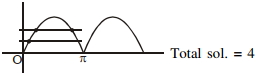
Total number of solutions = $2 + 2 = 4$.
Since $\cos ^{2} x = 1 - \sin ^{2} x$,we have $(81)^{\sin ^{2} x} + (81)^{1 - \sin ^{2} x} = 30$.
$(81)^{\sin ^{2} x} + \frac{81}{(81)^{\sin ^{2} x}} = 30$.
Let $t = (81)^{\sin ^{2} x}$. Then $t + \frac{81}{t} = 30$,which implies $t^{2} - 30t + 81 = 0$.
$(t - 3)(t - 27) = 0$,so $t = 3$ or $t = 27$.
Case $1$: $(81)^{\sin ^{2} x} = 3 \implies 3^{4 \sin ^{2} x} = 3^{1} \implies 4 \sin ^{2} x = 1 \implies \sin ^{2} x = \frac{1}{4}$.
In $[0, \pi]$,$\sin x = \frac{1}{2}$ or $\sin x = -\frac{1}{2}$. Since $\sin x \ge 0$ in $[0, \pi]$,$\sin x = \frac{1}{2}$ gives $x = \frac{\pi}{6}, \frac{5\pi}{6}$ ($2$ solutions).
Case $2$: $(81)^{\sin ^{2} x} = 27 \implies 3^{4 \sin ^{2} x} = 3^{3} \implies 4 \sin ^{2} x = 3 \implies \sin ^{2} x = \frac{3}{4}$.
In $[0, \pi]$,$\sin x = \frac{\sqrt{3}}{2}$ or $\sin x = -\frac{\sqrt{3}}{2}$. Since $\sin x \ge 0$ in $[0, \pi]$,$\sin x = \frac{\sqrt{3}}{2}$ gives $x = \frac{\pi}{3}, \frac{2\pi}{3}$ ($2$ solutions).
Total number of solutions = $2 + 2 = 4$.
0 likesView Solution
5
MathematicsMediumMCQMHT CET · 2024
There are $3$ sections in a question paper and each section contains $5$ questions. $A$ candidate has to answer a total of $5$ questions,choosing at least one question from each section. Then the number of ways,in which the candidate can choose the questions,is
A
$1500$
B
$2255$
C
$3000$
D
$2250$
Solution
(D) Let the number of questions selected from sections $A, B,$ and $C$ be $n_1, n_2,$ and $n_3$ respectively,such that $n_1 + n_2 + n_3 = 5$ and $n_i \ge 1$.
The possible distributions $(n_1, n_2, n_3)$ are:
$1. (1, 2, 2)$ and its permutations: $(1, 2, 2), (2, 1, 2), (2, 2, 1)$ (Total $3$ ways).
$2. (1, 1, 3)$ and its permutations: $(1, 1, 3), (1, 3, 1), (3, 1, 1)$ (Total $3$ ways).
Number of ways for case $(1, 2, 2) = \binom{5}{1} \times \binom{5}{2} \times \binom{5}{2} = 5 \times 10 \times 10 = 500$.
Since there are $3$ such permutations,total ways $= 3 \times 500 = 1500$.
Number of ways for case $(1, 1, 3) = \binom{5}{1} \times \binom{5}{1} \times \binom{5}{3} = 5 \times 5 \times 10 = 250$.
Since there are $3$ such permutations,total ways $= 3 \times 250 = 750$.
Total number of ways $= 1500 + 750 = 2250$.
The possible distributions $(n_1, n_2, n_3)$ are:
$1. (1, 2, 2)$ and its permutations: $(1, 2, 2), (2, 1, 2), (2, 2, 1)$ (Total $3$ ways).
$2. (1, 1, 3)$ and its permutations: $(1, 1, 3), (1, 3, 1), (3, 1, 1)$ (Total $3$ ways).
Number of ways for case $(1, 2, 2) = \binom{5}{1} \times \binom{5}{2} \times \binom{5}{2} = 5 \times 10 \times 10 = 500$.
Since there are $3$ such permutations,total ways $= 3 \times 500 = 1500$.
Number of ways for case $(1, 1, 3) = \binom{5}{1} \times \binom{5}{1} \times \binom{5}{3} = 5 \times 5 \times 10 = 250$.
Since there are $3$ such permutations,total ways $= 3 \times 250 = 750$.
Total number of ways $= 1500 + 750 = 2250$.
0 likesView Solution
6
MathematicsDifficultMCQMHT CET · 2024
If the curves $y^2=6x$ and $9x^2+by^2=16$ intersect each other at right angles,then the value of $b$ is
A
$\frac{9}{2}$
B
$6$
C
$7$
D
$\frac{7}{2}$
Solution
(A) Given curves are $y^2=6x$ $(i)$ and $9x^2+by^2=16$ $(ii)$.
For $(i)$,differentiating with respect to $x$: $2y \frac{dy}{dx} = 6 \Rightarrow \frac{dy}{dx} = \frac{3}{y}$.
For $(ii)$,differentiating with respect to $x$: $18x + 2by \frac{dy}{dx} = 0 \Rightarrow \frac{dy}{dx} = -\frac{9x}{by}$.
Since the curves intersect at right angles,the product of their slopes at the point of intersection $(x, y)$ is $-1$:
$(\frac{3}{y}) \times (-\frac{9x}{by}) = -1$
$\frac{27x}{by^2} = 1 \Rightarrow by^2 = 27x$.
Substitute $y^2 = 6x$ into this equation:
$b(6x) = 27x \Rightarrow 6b = 27 \Rightarrow b = \frac{27}{6} = \frac{9}{2}$.
For $(i)$,differentiating with respect to $x$: $2y \frac{dy}{dx} = 6 \Rightarrow \frac{dy}{dx} = \frac{3}{y}$.
For $(ii)$,differentiating with respect to $x$: $18x + 2by \frac{dy}{dx} = 0 \Rightarrow \frac{dy}{dx} = -\frac{9x}{by}$.
Since the curves intersect at right angles,the product of their slopes at the point of intersection $(x, y)$ is $-1$:
$(\frac{3}{y}) \times (-\frac{9x}{by}) = -1$
$\frac{27x}{by^2} = 1 \Rightarrow by^2 = 27x$.
Substitute $y^2 = 6x$ into this equation:
$b(6x) = 27x \Rightarrow 6b = 27 \Rightarrow b = \frac{27}{6} = \frac{9}{2}$.
0 likesView Solution
7
MathematicsEasyMCQMHT CET · 2024
If two sides of a square are $4x + 3y - 20 = 0$ and $4x + 3y + 15 = 0$,then the area of the square is
A
$36$ sq. units
B
$16$ sq. units
C
$4$ sq. units
D
$49$ sq. units
Solution
(D) The given equations of the lines are $4x + 3y - 20 = 0$ and $4x + 3y + 15 = 0$.
Since the coefficients of $x$ and $y$ are the same,the lines are parallel.
The distance $d$ between two parallel lines $ax + by + c_1 = 0$ and $ax + by + c_2 = 0$ is given by $d = \left| \frac{c_1 - c_2}{\sqrt{a^2 + b^2}} \right|$.
Here,$a = 4$,$b = 3$,$c_1 = -20$,and $c_2 = 15$.
$d = \left| \frac{-20 - 15}{\sqrt{4^2 + 3^2}} \right| = \left| \frac{-35}{\sqrt{16 + 9}} \right| = \left| \frac{-35}{5} \right| = 7$ units.
Since the distance between two opposite sides of a square is equal to its side length $s$,we have $s = 7$ units.
The area of the square is $s^2 = 7^2 = 49$ sq. units.
Since the coefficients of $x$ and $y$ are the same,the lines are parallel.
The distance $d$ between two parallel lines $ax + by + c_1 = 0$ and $ax + by + c_2 = 0$ is given by $d = \left| \frac{c_1 - c_2}{\sqrt{a^2 + b^2}} \right|$.
Here,$a = 4$,$b = 3$,$c_1 = -20$,and $c_2 = 15$.
$d = \left| \frac{-20 - 15}{\sqrt{4^2 + 3^2}} \right| = \left| \frac{-35}{\sqrt{16 + 9}} \right| = \left| \frac{-35}{5} \right| = 7$ units.
Since the distance between two opposite sides of a square is equal to its side length $s$,we have $s = 7$ units.
The area of the square is $s^2 = 7^2 = 49$ sq. units.
0 likesView Solution
8
MathematicsDifficultMCQMHT CET · 2024
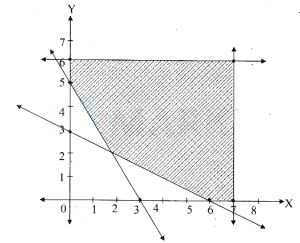
The shaded region in the following figure is the solution set of the inequations:
A
$x+2y \leq 6, 5x+3y \geq 15, x \leq 7, y \leq 6, x, y \geq 0$
B
$x+2y \geq 6, 5x+3y \geq 15, x \leq 7, y \leq 6, x, y \geq 0$
C
$x+2y \geq 6, 5x+3y \leq 15, x \geq 7, y \leq 6, x, y \geq 0$
D
$x+2y \leq 6, 5x+3y \leq 15, x \leq 7, y \geq 6, x, y \geq 0$
Solution
(B) To determine the correct system of inequalities for the shaded region,we analyze the boundary lines shown in the figure:
$1$. The line passing through $(0, 3)$ and $(6, 0)$ has the equation $\frac{x}{6} + \frac{y}{3} = 1$,which simplifies to $x + 2y = 6$. Since the shaded region is above this line,the inequality is $x + 2y \geq 6$.
$2$. The line passing through $(0, 5)$ and $(3, 0)$ has the equation $\frac{x}{3} + \frac{y}{5} = 1$,which simplifies to $5x + 3y = 15$. Since the shaded region is above this line,the inequality is $5x + 3y \geq 15$.
$3$. The vertical line is $x = 7$. Since the shaded region is to the left of this line,the inequality is $x \leq 7$.
$4$. The horizontal line is $y = 6$. Since the shaded region is below this line,the inequality is $y \leq 6$.
$5$. The region is in the first quadrant,so $x \geq 0$ and $y \geq 0$.
Combining these,the system is $x + 2y \geq 6, 5x + 3y \geq 15, x \leq 7, y \leq 6, x, y \geq 0$. This corresponds to option $(B)$.
$1$. The line passing through $(0, 3)$ and $(6, 0)$ has the equation $\frac{x}{6} + \frac{y}{3} = 1$,which simplifies to $x + 2y = 6$. Since the shaded region is above this line,the inequality is $x + 2y \geq 6$.
$2$. The line passing through $(0, 5)$ and $(3, 0)$ has the equation $\frac{x}{3} + \frac{y}{5} = 1$,which simplifies to $5x + 3y = 15$. Since the shaded region is above this line,the inequality is $5x + 3y \geq 15$.
$3$. The vertical line is $x = 7$. Since the shaded region is to the left of this line,the inequality is $x \leq 7$.
$4$. The horizontal line is $y = 6$. Since the shaded region is below this line,the inequality is $y \leq 6$.
$5$. The region is in the first quadrant,so $x \geq 0$ and $y \geq 0$.
Combining these,the system is $x + 2y \geq 6, 5x + 3y \geq 15, x \leq 7, y \leq 6, x, y \geq 0$. This corresponds to option $(B)$.
0 likesView Solution
9
MathematicsMediumMCQMHT CET · 2024
The equation of the concentric circle,with the circle $C_1$ having equation $x^2+y^2-6x-4y-12=0$ and having double the area compared to the area of $C_1$,is
A
$x^2+y^2-6x-4y=27$
B
$x^2+y^2-6x-4y=13$
C
$x^2+y^2-6x-4y=50$
D
$x^2+y^2-6x-4y=37$
Solution
(D) Given equation of circle $C_1$: $x^2+y^2-6x-4y-12=0$.
Rewriting in standard form: $(x^2-6x+9) + (y^2-4y+4) = 12+9+4$.
$(x-3)^2 + (y-2)^2 = 25$.
Thus,the center is $(3,2)$ and the radius $r = 5$.
Area of $C_1 = \pi r^2 = 25\pi$.
Let the radius of the required concentric circle be $R$.
Given that the area of the required circle is double the area of $C_1$:
$\pi R^2 = 2 \times (25\pi) = 50\pi$.
$R^2 = 50$.
The equation of the concentric circle with center $(3,2)$ is $(x-3)^2 + (y-2)^2 = R^2$.
$(x-3)^2 + (y-2)^2 = 50$.
$x^2-6x+9 + y^2-4y+4 = 50$.
$x^2+y^2-6x-4y+13 = 50$.
$x^2+y^2-6x-4y = 37$.
Rewriting in standard form: $(x^2-6x+9) + (y^2-4y+4) = 12+9+4$.
$(x-3)^2 + (y-2)^2 = 25$.
Thus,the center is $(3,2)$ and the radius $r = 5$.
Area of $C_1 = \pi r^2 = 25\pi$.
Let the radius of the required concentric circle be $R$.
Given that the area of the required circle is double the area of $C_1$:
$\pi R^2 = 2 \times (25\pi) = 50\pi$.
$R^2 = 50$.
The equation of the concentric circle with center $(3,2)$ is $(x-3)^2 + (y-2)^2 = R^2$.
$(x-3)^2 + (y-2)^2 = 50$.
$x^2-6x+9 + y^2-4y+4 = 50$.
$x^2+y^2-6x-4y+13 = 50$.
$x^2+y^2-6x-4y = 37$.
0 likesView Solution
10
MathematicsEasyMCQMHT CET · 2024
The equation of the circle which passes through the centre of the circle $x^2+y^2+8x+10y-7=0$ and is concentric with the circle $2x^2+2y^2-8x-12y-9=0$ is
A
$x^2+y^2-4x-6y+77=0$
B
$x^2+y^2-4x-6y-89=0$
C
$x^2+y^2-4x-6y+97=0$
D
$x^2+y^2-4x-6y-87=0$
Solution
(D) The required circle is concentric with $2x^2+2y^2-8x-12y-9=0$.
Dividing by $2$,we get $x^2+y^2-4x-6y-\frac{9}{2}=0$.
Thus,the centre of the required circle is $(2, 3)$.
The circle passes through the centre of $x^2+y^2+8x+10y-7=0$.
Comparing with $x^2+y^2+2gx+2fy+c=0$,the centre is $(-4, -5)$.
The radius $r$ is the distance between $(2, 3)$ and $(-4, -5)$:
$r = \sqrt{(-4-2)^2 + (-5-3)^2} = \sqrt{(-6)^2 + (-8)^2} = \sqrt{36+64} = 10$.
The equation of the circle is $(x-2)^2 + (y-3)^2 = 10^2$.
$x^2-4x+4 + y^2-6y+9 = 100$.
$x^2+y^2-4x-6y-87=0$.
Dividing by $2$,we get $x^2+y^2-4x-6y-\frac{9}{2}=0$.
Thus,the centre of the required circle is $(2, 3)$.
The circle passes through the centre of $x^2+y^2+8x+10y-7=0$.
Comparing with $x^2+y^2+2gx+2fy+c=0$,the centre is $(-4, -5)$.
The radius $r$ is the distance between $(2, 3)$ and $(-4, -5)$:
$r = \sqrt{(-4-2)^2 + (-5-3)^2} = \sqrt{(-6)^2 + (-8)^2} = \sqrt{36+64} = 10$.
The equation of the circle is $(x-2)^2 + (y-3)^2 = 10^2$.
$x^2-4x+4 + y^2-6y+9 = 100$.
$x^2+y^2-4x-6y-87=0$.
0 likesView Solution
11
MathematicsEasyMCQMHT CET · 2024
The equation of the circle,whose diameter's end points are the centers of the circles $x^2+y^2+6x-14y+5=0$ and $x^2+y^2-4x+10y-4=0$,is:
A
$x^2+y^2-x-2y-41=0$
B
$x^2+y^2+x-2y-41=0$
C
$x^2+y^2+x+2y-41=0$
D
$x^2+y^2-x+2y-41=0$
Solution
(B) The center of the circle $x^2+y^2+6x-14y+5=0$ is $(-3, 7)$.
The center of the circle $x^2+y^2-4x+10y-4=0$ is $(2, -5)$.
The equation of a circle with diameter end points $(x_1, y_1)$ and $(x_2, y_2)$ is $(x-x_1)(x-x_2) + (y-y_1)(y-y_2) = 0$.
Substituting the centers $(-3, 7)$ and $(2, -5)$:
$(x - (-3))(x - 2) + (y - 7)(y - (-5)) = 0$
$(x+3)(x-2) + (y-7)(y+5) = 0$
$x^2 - 2x + 3x - 6 + y^2 + 5y - 7y - 35 = 0$
$x^2 + y^2 + x - 2y - 41 = 0$.
The center of the circle $x^2+y^2-4x+10y-4=0$ is $(2, -5)$.
The equation of a circle with diameter end points $(x_1, y_1)$ and $(x_2, y_2)$ is $(x-x_1)(x-x_2) + (y-y_1)(y-y_2) = 0$.
Substituting the centers $(-3, 7)$ and $(2, -5)$:
$(x - (-3))(x - 2) + (y - 7)(y - (-5)) = 0$
$(x+3)(x-2) + (y-7)(y+5) = 0$
$x^2 - 2x + 3x - 6 + y^2 + 5y - 7y - 35 = 0$
$x^2 + y^2 + x - 2y - 41 = 0$.
0 likesView Solution
12
MathematicsEasyMCQMHT CET · 2024
The equation of the circle,concentric with the circle $x^2+y^2-6x-4y-12=0$ and touching the $X$-axis is
A
$x^2+y^2-6x-4y+5=0$
B
$x^2+y^2-6x-4y+17=0$
C
$x^2+y^2-6x-4y+9=0$
D
$x^2+y^2-6x-4y+4=0$
Solution
(C) The given circle is $x^2+y^2-6x-4y-12=0$.
Comparing this with $x^2+y^2+2gx+2fy+c=0$,we get $g=-3$ and $f=-2$.
The center of the circle is $(-g, -f) = (3, 2)$.
Since the required circle is concentric,its center is also $(3, 2)$.
Because the circle touches the $X$-axis,its radius $r$ is equal to the absolute value of the $y$-coordinate of its center,so $r = |2| = 2$.
The equation of the circle with center $(h, k)$ and radius $r$ is $(x-h)^2 + (y-k)^2 = r^2$.
Substituting the values,we get $(x-3)^2 + (y-2)^2 = 2^2$.
Expanding this,we get $(x^2-6x+9) + (y^2-4y+4) = 4$.
Simplifying,we get $x^2+y^2-6x-4y+9 = 0$.
Comparing this with $x^2+y^2+2gx+2fy+c=0$,we get $g=-3$ and $f=-2$.
The center of the circle is $(-g, -f) = (3, 2)$.
Since the required circle is concentric,its center is also $(3, 2)$.
Because the circle touches the $X$-axis,its radius $r$ is equal to the absolute value of the $y$-coordinate of its center,so $r = |2| = 2$.
The equation of the circle with center $(h, k)$ and radius $r$ is $(x-h)^2 + (y-k)^2 = r^2$.
Substituting the values,we get $(x-3)^2 + (y-2)^2 = 2^2$.
Expanding this,we get $(x^2-6x+9) + (y^2-4y+4) = 4$.
Simplifying,we get $x^2+y^2-6x-4y+9 = 0$.
0 likesView Solution
13
MathematicsMediumMCQMHT CET · 2024
The abscissae of the two points $A$ and $B$ are the roots of the equation $x^2+2ax-b^2=0$ and their ordinates are roots of the equation $y^2+2py-q^2=0$. Then the equation of the circle with $AB$ as diameter is given by
A
$x^2+y^2-2ax-2py+(b^2+q^2)=0$
B
$x^2+y^2-2ax-2py-(b^2+q^2)=0$
C
$x^2+y^2+2ax+2py+(b^2+q^2)=0$
D
$x^2+y^2+2ax+2py-(b^2+q^2)=0$
Solution
(D) Let $A \equiv (x_1, y_1)$ and $B \equiv (x_2, y_2)$.
From the given equations,by the properties of roots of a quadratic equation:
$x_1+x_2 = -2a$ and $x_1x_2 = -b^2$.
$y_1+y_2 = -2p$ and $y_1y_2 = -q^2$.
The equation of a circle with diameter endpoints $(x_1, y_1)$ and $(x_2, y_2)$ is given by $(x-x_1)(x-x_2) + (y-y_1)(y-y_2) = 0$.
Expanding this,we get $x^2 - (x_1+x_2)x + x_1x_2 + y^2 - (y_1+y_2)y + y_1y_2 = 0$.
Substituting the values of the sum and product of roots:
$x^2 - (-2a)x + (-b^2) + y^2 - (-2p)y + (-q^2) = 0$.
$x^2 + y^2 + 2ax + 2py - (b^2+q^2) = 0$.
From the given equations,by the properties of roots of a quadratic equation:
$x_1+x_2 = -2a$ and $x_1x_2 = -b^2$.
$y_1+y_2 = -2p$ and $y_1y_2 = -q^2$.
The equation of a circle with diameter endpoints $(x_1, y_1)$ and $(x_2, y_2)$ is given by $(x-x_1)(x-x_2) + (y-y_1)(y-y_2) = 0$.
Expanding this,we get $x^2 - (x_1+x_2)x + x_1x_2 + y^2 - (y_1+y_2)y + y_1y_2 = 0$.
Substituting the values of the sum and product of roots:
$x^2 - (-2a)x + (-b^2) + y^2 - (-2p)y + (-q^2) = 0$.
$x^2 + y^2 + 2ax + 2py - (b^2+q^2) = 0$.
0 likesView Solution
14
MathematicsMediumMCQMHT CET · 2024
The parametric equations of the circle $x^2+y^2-ax-by=0$ are
A
$x=\frac{a}{2}+\frac{\sqrt{a^2+b^2}}{2} \cos \theta, y=\frac{b}{2}+\frac{\sqrt{a^2+b^2}}{2} \sin \theta$
B
$x=\frac{-a}{2}+\frac{\sqrt{a^2+b^2}}{4} \sin \theta, y=\frac{-b}{2}+\frac{\sqrt{a^2+b^2}}{4} \cos \theta$
C
$x = \frac{a}{2} + \sqrt{\frac{a^2+b^2}{2}} \sin \theta, \quad y = \frac{b}{2} + \sqrt{\frac{a^2+b^2}{2}} \cos \theta$
D
$x=\frac{a}{2}+\frac{\sqrt{a^2+b^2}}{4} \cos \theta, y=\frac{b}{2}+\frac{\sqrt{a^2+b^2}}{4} \sin \theta$
Solution
(A) The given equation of the circle is $x^2+y^2-ax-by=0$.
Completing the square,we get:
$(x^2-ax+\frac{a^2}{4})+(y^2-by+\frac{b^2}{4}) = \frac{a^2}{4}+\frac{b^2}{4}$
$(x-\frac{a}{2})^2+(y-\frac{b}{2})^2 = (\frac{\sqrt{a^2+b^2}}{2})^2$.
This is in the form $(x-h)^2+(y-k)^2=r^2$,where the center $(h, k) = (\frac{a}{2}, \frac{b}{2})$ and the radius $r = \frac{\sqrt{a^2+b^2}}{2}$.
The parametric equations are given by $x = h + r \cos \theta$ and $y = k + r \sin \theta$.
Substituting the values,we get $x = \frac{a}{2} + \frac{\sqrt{a^2+b^2}}{2} \cos \theta$ and $y = \frac{b}{2} + \frac{\sqrt{a^2+b^2}}{2} \sin \theta$.
Completing the square,we get:
$(x^2-ax+\frac{a^2}{4})+(y^2-by+\frac{b^2}{4}) = \frac{a^2}{4}+\frac{b^2}{4}$
$(x-\frac{a}{2})^2+(y-\frac{b}{2})^2 = (\frac{\sqrt{a^2+b^2}}{2})^2$.
This is in the form $(x-h)^2+(y-k)^2=r^2$,where the center $(h, k) = (\frac{a}{2}, \frac{b}{2})$ and the radius $r = \frac{\sqrt{a^2+b^2}}{2}$.
The parametric equations are given by $x = h + r \cos \theta$ and $y = k + r \sin \theta$.
Substituting the values,we get $x = \frac{a}{2} + \frac{\sqrt{a^2+b^2}}{2} \cos \theta$ and $y = \frac{b}{2} + \frac{\sqrt{a^2+b^2}}{2} \sin \theta$.
0 likesView Solution
15
MathematicsDifficultMCQMHT CET · 2024
If the sides of a rectangle are given by the equations $x=-2, x=6, y=-2, y=5$,then the equation of the circle,drawn on the diagonal of this rectangle as its diameter,is
A
$x^2+y^2+4x+3y+22=0$
B
$x^2+y^2-4x+3y-22=0$
C
$x^2+y^2-4x-3y-22=0$
D
$x^2+y^2+4x-3y+22=0$
Solution
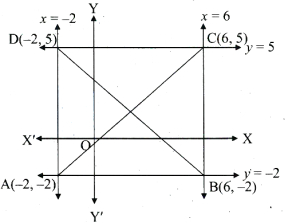
(C) The given equations of the sides are $x=-2, x=6, y=-2$ and $y=5$.
The vertices of the rectangle are $A(-2, -2)$,$B(6, -2)$,$C(6, 5)$,and $D(-2, 5)$.
The diagonal of the rectangle acts as the diameter of the circle.
Taking diagonal $AC$ with endpoints $A(-2, -2)$ and $C(6, 5)$,the equation of the circle in diameter form is given by:
$(x - x_1)(x - x_2) + (y - y_1)(y - y_2) = 0$
$(x - (-2))(x - 6) + (y - (-2))(y - 5) = 0$
$(x + 2)(x - 6) + (y + 2)(y - 5) = 0$
$x^2 - 6x + 2x - 12 + y^2 - 5y + 2y - 10 = 0$
$x^2 + y^2 - 4x - 3y - 22 = 0$
The vertices of the rectangle are $A(-2, -2)$,$B(6, -2)$,$C(6, 5)$,and $D(-2, 5)$.
The diagonal of the rectangle acts as the diameter of the circle.
Taking diagonal $AC$ with endpoints $A(-2, -2)$ and $C(6, 5)$,the equation of the circle in diameter form is given by:
$(x - x_1)(x - x_2) + (y - y_1)(y - y_2) = 0$
$(x - (-2))(x - 6) + (y - (-2))(y - 5) = 0$
$(x + 2)(x - 6) + (y + 2)(y - 5) = 0$
$x^2 - 6x + 2x - 12 + y^2 - 5y + 2y - 10 = 0$
$x^2 + y^2 - 4x - 3y - 22 = 0$
0 likesView Solution
16
MathematicsEasyMCQMHT CET · 2024
The tangent to the circle $x^2+y^2=5$ at $(1,-2)$ also touches the circle $x^2+y^2-8x+6y+20=0$. The coordinates of the corresponding point of contact are:
A
$(3,-1)$
B
$(3,1)$
C
$(-3,-1)$
D
$(-3,1)$
Solution
(A) The equation of the tangent to the circle $x^2+y^2=5$ at the point $(x_1, y_1) = (1, -2)$ is given by $x x_1 + y y_1 = r^2$.
Substituting the values,we get $x(1) + y(-2) = 5$,which simplifies to $x - 2y = 5$.
For the second circle $x^2 + y^2 - 8x + 6y + 20 = 0$,the center is $(4, -3)$ and the radius is $\sqrt{4^2 + (-3)^2 - 20} = \sqrt{16 + 9 - 20} = \sqrt{5}$.
The point of contact on the second circle must lie on the line $x - 2y = 5$.
Checking the options:
For $(3, -1)$: $3 - 2(-1) = 3 + 2 = 5$. This point satisfies the tangent equation.
For $(3, 1)$: $3 - 2(1) = 1 \neq 5$.
For $(-3, -1)$: $-3 - 2(-1) = -1 \neq 5$.
For $(-3, 1)$: $-3 - 2(1) = -5 \neq 5$.
Thus,the point of contact is $(3, -1)$.
Substituting the values,we get $x(1) + y(-2) = 5$,which simplifies to $x - 2y = 5$.
For the second circle $x^2 + y^2 - 8x + 6y + 20 = 0$,the center is $(4, -3)$ and the radius is $\sqrt{4^2 + (-3)^2 - 20} = \sqrt{16 + 9 - 20} = \sqrt{5}$.
The point of contact on the second circle must lie on the line $x - 2y = 5$.
Checking the options:
For $(3, -1)$: $3 - 2(-1) = 3 + 2 = 5$. This point satisfies the tangent equation.
For $(3, 1)$: $3 - 2(1) = 1 \neq 5$.
For $(-3, -1)$: $-3 - 2(-1) = -1 \neq 5$.
For $(-3, 1)$: $-3 - 2(1) = -5 \neq 5$.
Thus,the point of contact is $(3, -1)$.
0 likesView Solution
17
MathematicsMediumMCQMHT CET · 2024
The equation of the tangent to the circle,given by $x=5 \cos \theta, y=5 \sin \theta$ at the point $\theta=\frac{\pi}{3}$ on it,is
A
$x-\sqrt{3} y=-5$
B
$x+\sqrt{3} y=10$
C
$\sqrt{3} x+y=5 \sqrt{3}$
D
$\sqrt{3} x-y=0$
Solution
(B) The equation of the tangent to the circle $x^2+y^2=a^2$ at the point $P(\theta)$ is given by $x \cos \theta + y \sin \theta = a$.
Here,the radius $a = 5$ and the angle $\theta = \frac{\pi}{3}$.
Substituting these values into the equation:
$x \cos \frac{\pi}{3} + y \sin \frac{\pi}{3} = 5$
$x \left( \frac{1}{2} \right) + y \left( \frac{\sqrt{3}}{2} \right) = 5$
Multiplying the entire equation by $2$,we get:
$x + \sqrt{3} y = 10$.
Here,the radius $a = 5$ and the angle $\theta = \frac{\pi}{3}$.
Substituting these values into the equation:
$x \cos \frac{\pi}{3} + y \sin \frac{\pi}{3} = 5$
$x \left( \frac{1}{2} \right) + y \left( \frac{\sqrt{3}}{2} \right) = 5$
Multiplying the entire equation by $2$,we get:
$x + \sqrt{3} y = 10$.
0 likesView Solution
18
MathematicsEasyMCQMHT CET · 2024
The number of common tangents to the circles $x^2+y^2-x=0$ and $x^2+y^2+x=0$ is/are:
A
$1$
B
$2$
C
$3$
D
$4$
Solution
(C) For the circle $x^2+y^2-x=0$,the center $C_1 = (\frac{1}{2}, 0)$ and radius $r_1 = \sqrt{(\frac{1}{2})^2 + 0^2 - 0} = \frac{1}{2}$.
For the circle $x^2+y^2+x=0$,the center $C_2 = (-\frac{1}{2}, 0)$ and radius $r_2 = \sqrt{(-\frac{1}{2})^2 + 0^2 - 0} = \frac{1}{2}$.
The distance between the centers is $C_1C_2 = \sqrt{(\frac{1}{2} - (-\frac{1}{2}))^2 + (0-0)^2} = \sqrt{1^2} = 1$.
The sum of the radii is $r_1 + r_2 = \frac{1}{2} + \frac{1}{2} = 1$.
Since $C_1C_2 = r_1 + r_2$,the circles touch each other externally.
When two circles touch each other externally,the number of common tangents is $3$.
For the circle $x^2+y^2+x=0$,the center $C_2 = (-\frac{1}{2}, 0)$ and radius $r_2 = \sqrt{(-\frac{1}{2})^2 + 0^2 - 0} = \frac{1}{2}$.
The distance between the centers is $C_1C_2 = \sqrt{(\frac{1}{2} - (-\frac{1}{2}))^2 + (0-0)^2} = \sqrt{1^2} = 1$.
The sum of the radii is $r_1 + r_2 = \frac{1}{2} + \frac{1}{2} = 1$.
Since $C_1C_2 = r_1 + r_2$,the circles touch each other externally.
When two circles touch each other externally,the number of common tangents is $3$.
0 likesView Solution
19
MathematicsMediumMCQMHT CET · 2024
One end of the diameter of the circle $x^2+y^2-6x-5y-1=0$ is $(-1,3)$. Find the equation of the tangent at the other end of the diameter.
A
$8x+y-58=0$
B
$8x-2y-52=0$
C
$8x-y-54=0$
D
$8x+2y-60=0$
Solution
(C) The given circle equation is $x^2+y^2-6x-5y-1=0$. Comparing this with $x^2+y^2+2gx+2fy+c=0$,we get $g=-3$ and $f=-2.5$.
The center of the circle is $(-g, -f) = (3, 2.5)$.
Let the other end of the diameter be $(x_2, y_2)$. Since the center $(3, 2.5)$ is the midpoint of the diameter with endpoints $(-1, 3)$ and $(x_2, y_2)$,we have:
$\frac{-1+x_2}{2} = 3 \Rightarrow x_2 = 7$
$\frac{3+y_2}{2} = 2.5 \Rightarrow y_2 = 2$
So,the other end is $(7, 2)$.
The equation of the tangent to the circle $x^2+y^2+2gx+2fy+c=0$ at point $(x_1, y_1)$ is given by $xx_1 + yy_1 + g(x+x_1) + f(y+y_1) + c = 0$.
Substituting $(x_1, y_1) = (7, 2)$,$g=-3$,$f=-2.5$,and $c=-1$:
$7x + 2y - 3(x+7) - 2.5(y+2) - 1 = 0$
$7x + 2y - 3x - 21 - 2.5y - 5 - 1 = 0$
$4x - 0.5y - 27 = 0$
Multiplying by $2$,we get $8x - y - 54 = 0$.
The center of the circle is $(-g, -f) = (3, 2.5)$.
Let the other end of the diameter be $(x_2, y_2)$. Since the center $(3, 2.5)$ is the midpoint of the diameter with endpoints $(-1, 3)$ and $(x_2, y_2)$,we have:
$\frac{-1+x_2}{2} = 3 \Rightarrow x_2 = 7$
$\frac{3+y_2}{2} = 2.5 \Rightarrow y_2 = 2$
So,the other end is $(7, 2)$.
The equation of the tangent to the circle $x^2+y^2+2gx+2fy+c=0$ at point $(x_1, y_1)$ is given by $xx_1 + yy_1 + g(x+x_1) + f(y+y_1) + c = 0$.
Substituting $(x_1, y_1) = (7, 2)$,$g=-3$,$f=-2.5$,and $c=-1$:
$7x + 2y - 3(x+7) - 2.5(y+2) - 1 = 0$
$7x + 2y - 3x - 21 - 2.5y - 5 - 1 = 0$
$4x - 0.5y - 27 = 0$
Multiplying by $2$,we get $8x - y - 54 = 0$.
0 likesView Solution
20
MathematicsEasyMCQMHT CET · 2024
Two tangents drawn from $P(1, 7)$ to the circle $x^2 + y^2 = 25$ touch the circle at $Q$ and $R$ respectively. The area of the quadrilateral $PQOR$ is
A
$16 \text{ sq. units}$
B
$36 \text{ sq. units}$
C
$25 \text{ sq. units}$
D
$49 \text{ sq. units}$
Solution
(C) The circle is $x^2 + y^2 = 25$,so its center $O$ is $(0, 0)$ and radius $r = 5$.
Length of the tangent segment from $P(1, 7)$ to the circle is given by $\sqrt{x_1^2 + y_1^2 - r^2} = \sqrt{1^2 + 7^2 - 25} = \sqrt{1 + 49 - 25} = \sqrt{25} = 5$.
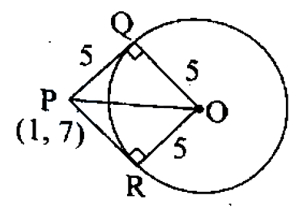
In the quadrilateral $PQOR$,$PQ$ and $PR$ are tangents,so $PQ = PR = 5$.
Also,$OQ = OR = 5$ (radii of the circle).
Since the tangent is perpendicular to the radius at the point of contact,$\angle OQP = \angle ORP = 90^{\circ}$.
The quadrilateral $PQOR$ consists of two congruent right-angled triangles,$\triangle PQO$ and $\triangle PRO$.
Area of $\triangle PQO = \frac{1}{2} \times \text{base} \times \text{height} = \frac{1}{2} \times PQ \times OQ = \frac{1}{2} \times 5 \times 5 = 12.5 \text{ sq. units}$.
Total area of quadrilateral $PQOR = 2 \times \text{Area of } \triangle PQO = 2 \times 12.5 = 25 \text{ sq. units}$.
Length of the tangent segment from $P(1, 7)$ to the circle is given by $\sqrt{x_1^2 + y_1^2 - r^2} = \sqrt{1^2 + 7^2 - 25} = \sqrt{1 + 49 - 25} = \sqrt{25} = 5$.
In the quadrilateral $PQOR$,$PQ$ and $PR$ are tangents,so $PQ = PR = 5$.
Also,$OQ = OR = 5$ (radii of the circle).
Since the tangent is perpendicular to the radius at the point of contact,$\angle OQP = \angle ORP = 90^{\circ}$.
The quadrilateral $PQOR$ consists of two congruent right-angled triangles,$\triangle PQO$ and $\triangle PRO$.
Area of $\triangle PQO = \frac{1}{2} \times \text{base} \times \text{height} = \frac{1}{2} \times PQ \times OQ = \frac{1}{2} \times 5 \times 5 = 12.5 \text{ sq. units}$.
Total area of quadrilateral $PQOR = 2 \times \text{Area of } \triangle PQO = 2 \times 12.5 = 25 \text{ sq. units}$.
0 likesView Solution
21
MathematicsDifficultMCQMHT CET · 2024
The equation of the circle,concentric with the circle $2x^2+2y^2-6x+8y+1=0$ and having double its area,is
A
$2x^2+2y^2-6x+8y+11=0$
B
$2x^2+2y^2-6x+8y-11=0$
C
$4x^2+4y^2-12x+16y-21=0$
D
$4x^2+4y^2-12x+16y+21=0$
Solution
(C) The given circle is $2x^2+2y^2-6x+8y+1=0$.
Dividing by $2$,we get $x^2+y^2-3x+4y+\frac{1}{2}=0$.
The center is $(\frac{3}{2}, -2)$ and the radius $r_1$ is given by $r_1^2 = (\frac{3}{2})^2 + (-2)^2 - \frac{1}{2} = \frac{9}{4} + 4 - \frac{1}{2} = \frac{9+16-2}{4} = \frac{23}{4}$.
Let the required circle be $x^2+y^2-3x+4y+k=0$.
Its radius $r_2$ satisfies $r_2^2 = (\frac{3}{2})^2 + (-2)^2 - k = \frac{25}{4} - k$.
Since the area is double,$\pi r_2^2 = 2(\pi r_1^2)$,so $r_2^2 = 2r_1^2$.
$\frac{25}{4} - k = 2(\frac{23}{4}) = \frac{23}{2}$.
$k = \frac{25}{4} - \frac{46}{4} = -\frac{21}{4}$.
Substituting $k$ back,$x^2+y^2-3x+4y-\frac{21}{4}=0$.
Multiplying by $4$,we get $4x^2+4y^2-12x+16y-21=0$.
Dividing by $2$,we get $x^2+y^2-3x+4y+\frac{1}{2}=0$.
The center is $(\frac{3}{2}, -2)$ and the radius $r_1$ is given by $r_1^2 = (\frac{3}{2})^2 + (-2)^2 - \frac{1}{2} = \frac{9}{4} + 4 - \frac{1}{2} = \frac{9+16-2}{4} = \frac{23}{4}$.
Let the required circle be $x^2+y^2-3x+4y+k=0$.
Its radius $r_2$ satisfies $r_2^2 = (\frac{3}{2})^2 + (-2)^2 - k = \frac{25}{4} - k$.
Since the area is double,$\pi r_2^2 = 2(\pi r_1^2)$,so $r_2^2 = 2r_1^2$.
$\frac{25}{4} - k = 2(\frac{23}{4}) = \frac{23}{2}$.
$k = \frac{25}{4} - \frac{46}{4} = -\frac{21}{4}$.
Substituting $k$ back,$x^2+y^2-3x+4y-\frac{21}{4}=0$.
Multiplying by $4$,we get $4x^2+4y^2-12x+16y-21=0$.
0 likesView Solution
22
MathematicsEasyMCQMHT CET · 2024
The equation of the circle which has its centre at the point $(3, 4)$ and touches the line $5x + 12y - 11 = 0$ is
A
$x^2 + y^2 - 6x - 8y + 9 = 0$
B
$x^2 + y^2 - 6x - 8y + 25 = 0$
C
$x^2 + y^2 - 6x - 8y - 9 = 0$
D
$x^2 + y^2 - 6x - 8y - 25 = 0$
Solution
(A) The radius $r$ of the circle is the perpendicular distance from the center $(3, 4)$ to the line $5x + 12y - 11 = 0$.
$r = \left| \frac{5(3) + 12(4) - 11}{\sqrt{5^2 + 12^2}} \right| = \left| \frac{15 + 48 - 11}{\sqrt{25 + 144}} \right| = \frac{52}{13} = 4$.
The equation of the circle with center $(h, k) = (3, 4)$ and radius $r = 4$ is given by $(x - h)^2 + (y - k)^2 = r^2$.
$(x - 3)^2 + (y - 4)^2 = 4^2$
$x^2 - 6x + 9 + y^2 - 8y + 16 = 16$
$x^2 + y^2 - 6x - 8y + 9 = 0$.
$r = \left| \frac{5(3) + 12(4) - 11}{\sqrt{5^2 + 12^2}} \right| = \left| \frac{15 + 48 - 11}{\sqrt{25 + 144}} \right| = \frac{52}{13} = 4$.
The equation of the circle with center $(h, k) = (3, 4)$ and radius $r = 4$ is given by $(x - h)^2 + (y - k)^2 = r^2$.
$(x - 3)^2 + (y - 4)^2 = 4^2$
$x^2 - 6x + 9 + y^2 - 8y + 16 = 16$
$x^2 + y^2 - 6x - 8y + 9 = 0$.
0 likesView Solution
23
MathematicsEasyMCQMHT CET · 2024
Let $\left(-2-\frac{1}{3} i\right)^3=\frac{x+i y}{27}$,where $i=\sqrt{-1}$ and $x, y$ are real numbers. Then the value of $(y-x)$ is:
A
-$91$
B
-$85$
C
$85$
D
$91$
Solution
(D) Given $\left(-2-\frac{1}{3} i\right)^3=\frac{x+i y}{27}$.
We can rewrite the left side as $\left(\frac{-6-i}{3}\right)^3 = \frac{(-6-i)^3}{27}$.
Equating the numerators,we have $x+iy = (-6-i)^3$.
Using the identity $(a+b)^3 = a^3+3a^2b+3ab^2+b^3$:
$(-6-i)^3 = (-6)^3 + 3(-6)^2(-i) + 3(-6)(-i)^2 + (-i)^3$.
$= -216 + 3(36)(-i) + 3(-6)(-1) - (-i)$.
$= -216 - 108i + 18 + i$.
$= -198 - 107i$.
Comparing with $x+iy$,we get $x = -198$ and $y = -107$.
Therefore,$y-x = -107 - (-198) = -107 + 198 = 91$.
We can rewrite the left side as $\left(\frac{-6-i}{3}\right)^3 = \frac{(-6-i)^3}{27}$.
Equating the numerators,we have $x+iy = (-6-i)^3$.
Using the identity $(a+b)^3 = a^3+3a^2b+3ab^2+b^3$:
$(-6-i)^3 = (-6)^3 + 3(-6)^2(-i) + 3(-6)(-i)^2 + (-i)^3$.
$= -216 + 3(36)(-i) + 3(-6)(-1) - (-i)$.
$= -216 - 108i + 18 + i$.
$= -198 - 107i$.
Comparing with $x+iy$,we get $x = -198$ and $y = -107$.
Therefore,$y-x = -107 - (-198) = -107 + 198 = 91$.
0 likesView Solution
24
MathematicsMediumMCQMHT CET · 2024
If $a > 0$ and $z = \frac{(1 + i)^2}{a - i}$,where $i = \sqrt{-1}$,has magnitude $\sqrt{\frac{2}{5}}$,then $\overline{z}$ is equal to
A
$\frac{1}{5} - \frac{3}{5} i$
B
$-\frac{1}{5} - \frac{3}{5} i$
C
$-\frac{1}{5} + \frac{3}{5} i$
D
$-\frac{3}{5} - \frac{1}{5} i$
Solution
(B) Given $z = \frac{(1 + i)^2}{a - i}$.
Since $(1 + i)^2 = 1 + 2i + i^2 = 1 + 2i - 1 = 2i$,we have $z = \frac{2i}{a - i}$.
Multiply numerator and denominator by the conjugate $(a + i)$:
$z = \frac{2i(a + i)}{a^2 + 1} = \frac{2ai - 2}{a^2 + 1} = \frac{-2 + 2ai}{a^2 + 1}$.
The magnitude is $|z| = \sqrt{\frac{(-2)^2 + (2a)^2}{(a^2 + 1)^2}} = \sqrt{\frac{4(1 + a^2)}{(a^2 + 1)^2}} = \sqrt{\frac{4}{a^2 + 1}} = \frac{2}{\sqrt{a^2 + 1}}$.
Given $|z| = \sqrt{\frac{2}{5}}$,so $\frac{2}{\sqrt{a^2 + 1}} = \sqrt{\frac{2}{5}}$.
Squaring both sides: $\frac{4}{a^2 + 1} = \frac{2}{5}$ $\Rightarrow 20 = 2(a^2 + 1)$ $\Rightarrow 10 = a^2 + 1$ $\Rightarrow a^2 = 9$.
Since $a > 0$,$a = 3$.
Substituting $a = 3$ into $z$: $z = \frac{-2 + 2(3)i}{3^2 + 1} = \frac{-2 + 6i}{10} = -\frac{1}{5} + \frac{3}{5}i$.
Therefore,the conjugate $\overline{z} = -\frac{1}{5} - \frac{3}{5}i$.
Since $(1 + i)^2 = 1 + 2i + i^2 = 1 + 2i - 1 = 2i$,we have $z = \frac{2i}{a - i}$.
Multiply numerator and denominator by the conjugate $(a + i)$:
$z = \frac{2i(a + i)}{a^2 + 1} = \frac{2ai - 2}{a^2 + 1} = \frac{-2 + 2ai}{a^2 + 1}$.
The magnitude is $|z| = \sqrt{\frac{(-2)^2 + (2a)^2}{(a^2 + 1)^2}} = \sqrt{\frac{4(1 + a^2)}{(a^2 + 1)^2}} = \sqrt{\frac{4}{a^2 + 1}} = \frac{2}{\sqrt{a^2 + 1}}$.
Given $|z| = \sqrt{\frac{2}{5}}$,so $\frac{2}{\sqrt{a^2 + 1}} = \sqrt{\frac{2}{5}}$.
Squaring both sides: $\frac{4}{a^2 + 1} = \frac{2}{5}$ $\Rightarrow 20 = 2(a^2 + 1)$ $\Rightarrow 10 = a^2 + 1$ $\Rightarrow a^2 = 9$.
Since $a > 0$,$a = 3$.
Substituting $a = 3$ into $z$: $z = \frac{-2 + 2(3)i}{3^2 + 1} = \frac{-2 + 6i}{10} = -\frac{1}{5} + \frac{3}{5}i$.
Therefore,the conjugate $\overline{z} = -\frac{1}{5} - \frac{3}{5}i$.
0 likesView Solution
25
MathematicsMediumMCQMHT CET · 2024
If $|z|=1$ and $w=\frac{z-1}{z+1}$ (where $z \neq -1$),then $\operatorname{Re}(w)$ is
A
$0$
B
$-\frac{1}{|z+1|^2}$
C
$\left|\frac{z}{z+1}\right| \cdot \frac{1}{|z+1|^2}$
D
$\frac{\sqrt{2}}{|z+1|^2}$
Solution
(A) Given $w = \frac{z-1}{z+1}$.
Since $|z|=1$,we can write $z = x+iy$ where $x^2+y^2=1$.
Then $w = \frac{(x-1)+iy}{(x+1)+iy}$.
To find the real part,multiply the numerator and denominator by the conjugate of the denominator: $(x+1)-iy$.
$w = \frac{((x-1)+iy)((x+1)-iy)}{(x+1)^2+y^2} = \frac{(x^2-1) + y^2 + i(y(x+1) - y(x-1))}{(x+1)^2+y^2}$.
$w = \frac{(x^2+y^2-1) + 2iy}{(x+1)^2+y^2}$.
Since $|z|=1$,we have $x^2+y^2=1$,so $x^2+y^2-1=0$.
Therefore,$\operatorname{Re}(w) = \frac{0}{(x+1)^2+y^2} = 0$.
Since $|z|=1$,we can write $z = x+iy$ where $x^2+y^2=1$.
Then $w = \frac{(x-1)+iy}{(x+1)+iy}$.
To find the real part,multiply the numerator and denominator by the conjugate of the denominator: $(x+1)-iy$.
$w = \frac{((x-1)+iy)((x+1)-iy)}{(x+1)^2+y^2} = \frac{(x^2-1) + y^2 + i(y(x+1) - y(x-1))}{(x+1)^2+y^2}$.
$w = \frac{(x^2+y^2-1) + 2iy}{(x+1)^2+y^2}$.
Since $|z|=1$,we have $x^2+y^2=1$,so $x^2+y^2-1=0$.
Therefore,$\operatorname{Re}(w) = \frac{0}{(x+1)^2+y^2} = 0$.
0 likesView Solution
26
MathematicsMediumMCQMHT CET · 2024
If $Z = \frac{-2}{1 + \sqrt{3}i}$,where $i = \sqrt{-1}$,then the value of $\arg(Z)$ is
A
$\frac{2\pi}{3}$
B
$\frac{\pi}{3}$
C
$-\frac{\pi}{3}$
D
$\frac{4\pi}{3}$
Solution
(A) Given $Z = \frac{-2}{1 + \sqrt{3}i}$.
Rationalizing the denominator:
$Z = \frac{-2(1 - \sqrt{3}i)}{(1 + \sqrt{3}i)(1 - \sqrt{3}i)}$
$Z = \frac{-2(1 - \sqrt{3}i)}{1^2 - (\sqrt{3}i)^2}$
$Z = \frac{-2(1 - \sqrt{3}i)}{1 + 3} = \frac{-2(1 - \sqrt{3}i)}{4}$
$Z = -\frac{1}{2} + \frac{\sqrt{3}}{2}i$.
Here,the real part $a = -\frac{1}{2}$ and the imaginary part $b = \frac{\sqrt{3}}{2}$.
Since $a < 0$ and $b > 0$,the complex number lies in the second quadrant.
$\arg(Z) = \pi - \tan^{-1}\left|\frac{b}{a}\right|$
$\arg(Z) = \pi - \tan^{-1}\left|\frac{\sqrt{3}/2}{-1/2}\right|$
$\arg(Z) = \pi - \tan^{-1}(\sqrt{3})$
$\arg(Z) = \pi - \frac{\pi}{3} = \frac{2\pi}{3}$.
Rationalizing the denominator:
$Z = \frac{-2(1 - \sqrt{3}i)}{(1 + \sqrt{3}i)(1 - \sqrt{3}i)}$
$Z = \frac{-2(1 - \sqrt{3}i)}{1^2 - (\sqrt{3}i)^2}$
$Z = \frac{-2(1 - \sqrt{3}i)}{1 + 3} = \frac{-2(1 - \sqrt{3}i)}{4}$
$Z = -\frac{1}{2} + \frac{\sqrt{3}}{2}i$.
Here,the real part $a = -\frac{1}{2}$ and the imaginary part $b = \frac{\sqrt{3}}{2}$.
Since $a < 0$ and $b > 0$,the complex number lies in the second quadrant.
$\arg(Z) = \pi - \tan^{-1}\left|\frac{b}{a}\right|$
$\arg(Z) = \pi - \tan^{-1}\left|\frac{\sqrt{3}/2}{-1/2}\right|$
$\arg(Z) = \pi - \tan^{-1}(\sqrt{3})$
$\arg(Z) = \pi - \frac{\pi}{3} = \frac{2\pi}{3}$.
0 likesView Solution
27
MathematicsMediumMCQMHT CET · 2024
Let $Z$ be a complex number such that $|Z|+Z=2+i$ (where $i=\sqrt{-1}$),then $|Z|$ is equal to
A
$\frac{4}{5}$
B
$\frac{\sqrt{41}}{4}$
C
$\frac{5}{3}$
D
$\frac{5}{4}$
Solution
(D) Let $Z = a + ib$.
Then $|Z| = \sqrt{a^2 + b^2}$.
Given $|Z| + Z = 2 + i$.
Substituting the values,we get $\sqrt{a^2 + b^2} + a + ib = 2 + i$.
Comparing the real and imaginary parts,we get $b = 1$ and $\sqrt{a^2 + b^2} + a = 2$.
Since $b = 1$,$\sqrt{a^2 + 1} = 2 - a$.
Squaring both sides,$a^2 + 1 = (2 - a)^2$.
$a^2 + 1 = 4 - 4a + a^2$.
$4a = 3$,so $a = \frac{3}{4}$.
Now,$|Z| = \sqrt{a^2 + b^2} = \sqrt{(\frac{3}{4})^2 + 1^2} = \sqrt{\frac{9}{16} + 1} = \sqrt{\frac{25}{16}} = \frac{5}{4}$.
Then $|Z| = \sqrt{a^2 + b^2}$.
Given $|Z| + Z = 2 + i$.
Substituting the values,we get $\sqrt{a^2 + b^2} + a + ib = 2 + i$.
Comparing the real and imaginary parts,we get $b = 1$ and $\sqrt{a^2 + b^2} + a = 2$.
Since $b = 1$,$\sqrt{a^2 + 1} = 2 - a$.
Squaring both sides,$a^2 + 1 = (2 - a)^2$.
$a^2 + 1 = 4 - 4a + a^2$.
$4a = 3$,so $a = \frac{3}{4}$.
Now,$|Z| = \sqrt{a^2 + b^2} = \sqrt{(\frac{3}{4})^2 + 1^2} = \sqrt{\frac{9}{16} + 1} = \sqrt{\frac{25}{16}} = \frac{5}{4}$.
0 likesView Solution
28
MathematicsDifficultMCQMHT CET · 2024
Let $z$ be a complex number such that $|z|+z=2+i$,where $i=\sqrt{-1}$. Then $|z|$ is equal to:
A
$\frac{4}{5}$
B
$\frac{5}{4}$
C
$\frac{5}{3}$
D
$\frac{\sqrt{41}}{4}$
Solution
(B) Given $|z|+z=2+i$.
Let $z=x+iy$,where $x, y \in \mathbb{R}$.
Then $|z|=\sqrt{x^2+y^2}$.
Substituting these into the equation: $\sqrt{x^2+y^2}+x+iy=2+i$.
Equating real and imaginary parts,we get:
$y=1$ and $\sqrt{x^2+y^2}+x=2$.
Substituting $y=1$ into the second equation: $\sqrt{x^2+1}=2-x$.
Squaring both sides: $x^2+1=(2-x)^2 = 4-4x+x^2$.
$1=4-4x$ $\Rightarrow 4x=3$ $\Rightarrow x=\frac{3}{4}$.
Thus,$z=\frac{3}{4}+i$.
Therefore,$|z|=\sqrt{(\frac{3}{4})^2+1^2} = \sqrt{\frac{9}{16}+1} = \sqrt{\frac{25}{16}} = \frac{5}{4}$.
Let $z=x+iy$,where $x, y \in \mathbb{R}$.
Then $|z|=\sqrt{x^2+y^2}$.
Substituting these into the equation: $\sqrt{x^2+y^2}+x+iy=2+i$.
Equating real and imaginary parts,we get:
$y=1$ and $\sqrt{x^2+y^2}+x=2$.
Substituting $y=1$ into the second equation: $\sqrt{x^2+1}=2-x$.
Squaring both sides: $x^2+1=(2-x)^2 = 4-4x+x^2$.
$1=4-4x$ $\Rightarrow 4x=3$ $\Rightarrow x=\frac{3}{4}$.
Thus,$z=\frac{3}{4}+i$.
Therefore,$|z|=\sqrt{(\frac{3}{4})^2+1^2} = \sqrt{\frac{9}{16}+1} = \sqrt{\frac{25}{16}} = \frac{5}{4}$.
0 likesView Solution
29
MathematicsEasyMCQMHT CET · 2024
If $z_1 = 5 - 2i$ and $z_2 = 3 + i$,where $i = \sqrt{-1}$,then $\arg \left(\frac{z_1 + z_2}{z_1 - z_2}\right)$ is
A
$\tan^{-1}\left(\frac{22}{19}\right)$
B
$\tan^{-1}\left(\frac{22}{13}\right)$
C
$\tan^{-1}\left(\frac{21}{19}\right)$
D
$\tan^{-1}\left(\frac{19}{22}\right)$
Solution
(A) Given $z_1 = 5 - 2i$ and $z_2 = 3 + i$.
First,calculate $z_1 + z_2 = (5 + 3) + (-2 + 1)i = 8 - i$.
Next,calculate $z_1 - z_2 = (5 - 3) + (-2 - 1)i = 2 - 3i$.
Now,consider the ratio $\frac{z_1 + z_2}{z_1 - z_2} = \frac{8 - i}{2 - 3i}$.
To simplify,multiply the numerator and denominator by the conjugate of the denominator $(2 + 3i)$:
$\frac{8 - i}{2 - 3i} \times \frac{2 + 3i}{2 + 3i} = \frac{16 + 24i - 2i - 3i^2}{2^2 + 3^2} = \frac{16 + 22i + 3}{4 + 9} = \frac{19 + 22i}{13} = \frac{19}{13} + \frac{22}{13}i$.
The argument is given by $\tan^{-1}\left(\frac{\text{imaginary part}}{\text{real part}}\right) = \tan^{-1}\left(\frac{22/13}{19/13}\right) = \tan^{-1}\left(\frac{22}{19}\right)$.
First,calculate $z_1 + z_2 = (5 + 3) + (-2 + 1)i = 8 - i$.
Next,calculate $z_1 - z_2 = (5 - 3) + (-2 - 1)i = 2 - 3i$.
Now,consider the ratio $\frac{z_1 + z_2}{z_1 - z_2} = \frac{8 - i}{2 - 3i}$.
To simplify,multiply the numerator and denominator by the conjugate of the denominator $(2 + 3i)$:
$\frac{8 - i}{2 - 3i} \times \frac{2 + 3i}{2 + 3i} = \frac{16 + 24i - 2i - 3i^2}{2^2 + 3^2} = \frac{16 + 22i + 3}{4 + 9} = \frac{19 + 22i}{13} = \frac{19}{13} + \frac{22}{13}i$.
The argument is given by $\tan^{-1}\left(\frac{\text{imaginary part}}{\text{real part}}\right) = \tan^{-1}\left(\frac{22/13}{19/13}\right) = \tan^{-1}\left(\frac{22}{19}\right)$.
0 likesView Solution
30
MathematicsMediumMCQMHT CET · 2024
If $z^2+z+1=0$,then find the value of $\left(z^3+\frac{1}{z^3}\right)^2+\left(z^4+\frac{1}{z^4}\right)^2$,where $z$ is a complex cube root of unity.
A
$4$
B
$1$
C
$5$
D
$2$
Solution
(C) Given that $z$ is a complex cube root of unity,we have $z^3 = 1$ and $1+z+z^2 = 0$.
From $1+z+z^2 = 0$,we get $z^2+1 = -z$.
Now,consider the expression $\left(z^3+\frac{1}{z^3}\right)^2+\left(z^4+\frac{1}{z^4}\right)^2$.
Substituting $z^3 = 1$,we get $\left(1+\frac{1}{1}\right)^2+\left(z^3 \cdot z+\frac{1}{z^3 \cdot z}\right)^2$.
$= (1+1)^2 + \left(z+\frac{1}{z}\right)^2$.
$= 4 + \left(\frac{z^2+1}{z}\right)^2$.
Substituting $z^2+1 = -z$,we get $4 + \left(\frac{-z}{z}\right)^2$.
$= 4 + (-1)^2 = 4 + 1 = 5$.
From $1+z+z^2 = 0$,we get $z^2+1 = -z$.
Now,consider the expression $\left(z^3+\frac{1}{z^3}\right)^2+\left(z^4+\frac{1}{z^4}\right)^2$.
Substituting $z^3 = 1$,we get $\left(1+\frac{1}{1}\right)^2+\left(z^3 \cdot z+\frac{1}{z^3 \cdot z}\right)^2$.
$= (1+1)^2 + \left(z+\frac{1}{z}\right)^2$.
$= 4 + \left(\frac{z^2+1}{z}\right)^2$.
Substituting $z^2+1 = -z$,we get $4 + \left(\frac{-z}{z}\right)^2$.
$= 4 + (-1)^2 = 4 + 1 = 5$.
0 likesView Solution
31
MathematicsEasyMCQMHT CET · 2024
If $w = \frac{-1 + i \sqrt{3}}{2}$,where $i = \sqrt{-1}$,then the value of $(3 + w + 3 w^2)^4$ is
A
$16$
B
$-16$
C
$16w$
D
$16w^2$
Solution
(C) Given $w = \frac{-1 + i \sqrt{3}}{2}$,which is the complex cube root of unity,denoted as $\omega$.
We know that $1 + \omega + \omega^2 = 0$,which implies $\omega^2 = -1 - \omega$.
We need to evaluate $(3 + \omega + 3 \omega^2)^4$.
Substitute $\omega^2 = -1 - \omega$ into the expression:
$(3 + \omega + 3(-1 - \omega))^4 = (3 + \omega - 3 - 3 \omega)^4$.
$= (-2 \omega)^4$.
$= 16 \omega^4$.
Since $\omega^3 = 1$,we have $\omega^4 = \omega^3 \cdot \omega = 1 \cdot \omega = \omega$.
Therefore,$16 \omega^4 = 16 \omega$.
We know that $1 + \omega + \omega^2 = 0$,which implies $\omega^2 = -1 - \omega$.
We need to evaluate $(3 + \omega + 3 \omega^2)^4$.
Substitute $\omega^2 = -1 - \omega$ into the expression:
$(3 + \omega + 3(-1 - \omega))^4 = (3 + \omega - 3 - 3 \omega)^4$.
$= (-2 \omega)^4$.
$= 16 \omega^4$.
Since $\omega^3 = 1$,we have $\omega^4 = \omega^3 \cdot \omega = 1 \cdot \omega = \omega$.
Therefore,$16 \omega^4 = 16 \omega$.
0 likesView Solution
32
MathematicsEasyMCQMHT CET · 2024
If $P(x, y)$ denotes $z = x + iy$ where $x, y \in \mathbb{R}$ and $i = \sqrt{-1}$ in the Argand plane,and $\left|\frac{z-1}{z+2i}\right| = 1$,then the locus of $P$ is
A
parabola
B
hyperbola
C
circle
D
straight line
Solution
(D) Given $\left|\frac{z-1}{z+2i}\right| = 1$.
This implies $|z-1| = |z+2i|$.
Substituting $z = x + iy$:
$|x + iy - 1| = |x + iy + 2i|$
$|(x-1) + iy| = |x + i(y+2)|$
Squaring both sides:
$(x-1)^2 + y^2 = x^2 + (y+2)^2$
$x^2 - 2x + 1 + y^2 = x^2 + y^2 + 4y + 4$
$-2x + 1 = 4y + 4$
$2x + 4y + 3 = 0$.
This is the equation of a straight line.
This implies $|z-1| = |z+2i|$.
Substituting $z = x + iy$:
$|x + iy - 1| = |x + iy + 2i|$
$|(x-1) + iy| = |x + i(y+2)|$
Squaring both sides:
$(x-1)^2 + y^2 = x^2 + (y+2)^2$
$x^2 - 2x + 1 + y^2 = x^2 + y^2 + 4y + 4$
$-2x + 1 = 4y + 4$
$2x + 4y + 3 = 0$.
This is the equation of a straight line.
0 likesView Solution
33
MathematicsDifficultMCQMHT CET · 2024
If $\left|\frac{z}{1+i}\right|=2$,where $z=x+iy$ and $i=\sqrt{-1}$ represents a circle,then the centre $C$ and radius $r$ of the circle are:
A
$C \equiv(3,0), r=4$
B
$C \equiv(6,0), r=2$
C
$C \equiv(0,3), r=8$
D
$C \equiv(0,0), r=2\sqrt{2}$
Solution
(D) Given $\left|\frac{z}{1+i}\right|=2$.
Since $|1+i| = \sqrt{1^2+1^2} = \sqrt{2}$,we have $|z| = 2|1+i| = 2\sqrt{2}$.
Substituting $z=x+iy$,we get $|x+iy| = 2\sqrt{2}$.
Squaring both sides,we get $x^2+y^2 = (2\sqrt{2})^2 = 8$.
This represents a circle $x^2+y^2 = 8$ with centre $C \equiv (0,0)$ and radius $r = \sqrt{8} = 2\sqrt{2}$.
Since $|1+i| = \sqrt{1^2+1^2} = \sqrt{2}$,we have $|z| = 2|1+i| = 2\sqrt{2}$.
Substituting $z=x+iy$,we get $|x+iy| = 2\sqrt{2}$.
Squaring both sides,we get $x^2+y^2 = (2\sqrt{2})^2 = 8$.
This represents a circle $x^2+y^2 = 8$ with centre $C \equiv (0,0)$ and radius $r = \sqrt{8} = 2\sqrt{2}$.
0 likesView Solution
34
MathematicsMediumMCQMHT CET · 2024
If the complex number $z=x+iy$,where $i=\sqrt{-1}$,satisfies the condition $|z+1|=1$,then $z$ lies on
A
$X$-axis.
B
circle with centre $(1,0)$ and radius $1$ unit.
C
circle with centre $(-1,0)$ and radius $1$ unit.
D
$Y$-axis.
Solution
(C) Given the condition $|z+1|=1$.
Substitute $z=x+iy$ into the equation:
$|x+iy+1|=1$
$|(x+1)+iy|=1$
Using the definition of the modulus of a complex number $|a+ib|=\sqrt{a^2+b^2}$,we get:
$\sqrt{(x+1)^2+y^2}=1$
Squaring both sides:
$(x+1)^2+y^2=1^2$
$(x+1)^2+y^2=1$
This is the standard equation of a circle $(x-h)^2+(y-k)^2=r^2$,where the centre is $(h,k)$ and the radius is $r$.
Comparing the equations,the centre is $(-1,0)$ and the radius is $1$ unit.
Substitute $z=x+iy$ into the equation:
$|x+iy+1|=1$
$|(x+1)+iy|=1$
Using the definition of the modulus of a complex number $|a+ib|=\sqrt{a^2+b^2}$,we get:
$\sqrt{(x+1)^2+y^2}=1$
Squaring both sides:
$(x+1)^2+y^2=1^2$
$(x+1)^2+y^2=1$
This is the standard equation of a circle $(x-h)^2+(y-k)^2=r^2$,where the centre is $(h,k)$ and the radius is $r$.
Comparing the equations,the centre is $(-1,0)$ and the radius is $1$ unit.
0 likesView Solution
35
MathematicsMediumMCQMHT CET · 2024
Let $z=x+iy$ be a complex number,where $x$ and $y$ are integers and $i=\sqrt{-1}$. Then the area of the rectangle whose vertices are the roots of the equation $z\bar{z}^3+\bar{z}z^3=350$ is
A
$48$
B
$32$
C
$40$
D
$80$
Solution
(A) Given,$z\bar{z}^3+\bar{z}z^3=350$
$\Rightarrow z\bar{z}(\bar{z}^2+z^2)=350$
$\Rightarrow |z|^2(x-iy)^2+(x+iy)^2=350$
$\Rightarrow (x^2+y^2)(x^2-y^2-2ixy+x^2-y^2+2ixy)=350$
$\Rightarrow (x^2+y^2)(2x^2-2y^2)=350$
$\Rightarrow 2(x^2+y^2)(x^2-y^2)=350$
$\Rightarrow x^4-y^4=175$
Since $x$ and $y$ are integers,we test values: $x^4-y^4=(x^2-y^2)(x^2+y^2)=175$.
For $x=4, y=3$: $4^4-3^4=256-81=175$.
Thus,the vertices are $(4,3), (-4,3), (-4,-3), (4,-3)$.
The length of the rectangle is $|4-(-4)|=8$ and the breadth is $|3-(-3)|=6$.
Area $= 8 \times 6 = 48 \text{ sq. units}$.
$\Rightarrow z\bar{z}(\bar{z}^2+z^2)=350$
$\Rightarrow |z|^2(x-iy)^2+(x+iy)^2=350$
$\Rightarrow (x^2+y^2)(x^2-y^2-2ixy+x^2-y^2+2ixy)=350$
$\Rightarrow (x^2+y^2)(2x^2-2y^2)=350$
$\Rightarrow 2(x^2+y^2)(x^2-y^2)=350$
$\Rightarrow x^4-y^4=175$
Since $x$ and $y$ are integers,we test values: $x^4-y^4=(x^2-y^2)(x^2+y^2)=175$.
For $x=4, y=3$: $4^4-3^4=256-81=175$.
Thus,the vertices are $(4,3), (-4,3), (-4,-3), (4,-3)$.
The length of the rectangle is $|4-(-4)|=8$ and the breadth is $|3-(-3)|=6$.
Area $= 8 \times 6 = 48 \text{ sq. units}$.
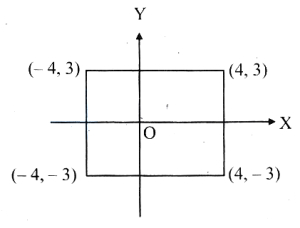
0 likesView Solution
36
MathematicsMediumMCQMHT CET · 2024
The value of $k$,if the slope of one of the lines given by $4x^2 + kxy + y^2 = 0$ is four times that of the other,is given by
A
$4$
B
$2.5$
C
$5$
D
$1$
Solution
(C) The given equation of the pair of lines is $4x^2 + kxy + y^2 = 0$.
Comparing this with the general form $ax^2 + 2hxy + by^2 = 0$,we get $a = 4$,$2h = k$ (so $h = k/2$),and $b = 1$.
Let the slopes of the two lines be $m_1$ and $m_2$.
We know that $m_1 + m_2 = -\frac{2h}{b} = -k$ and $m_1 m_2 = \frac{a}{b} = 4$.
According to the given condition,$m_1 = 4m_2$.
Substituting this into the sum of slopes: $4m_2 + m_2 = -k \implies 5m_2 = -k \implies m_2 = -k/5$.
Substituting into the product of slopes: $(4m_2)(m_2) = 4 \implies 4m_2^2 = 4 \implies m_2^2 = 1 \implies m_2 = \pm 1$.
Since $m_2 = -k/5$,we have $-k/5 = \pm 1$,which gives $k = \mp 5$.
Considering the magnitude or the standard form of such problems,the value is $k = \pm 5$. Given the options,$5$ is the correct magnitude.
Comparing this with the general form $ax^2 + 2hxy + by^2 = 0$,we get $a = 4$,$2h = k$ (so $h = k/2$),and $b = 1$.
Let the slopes of the two lines be $m_1$ and $m_2$.
We know that $m_1 + m_2 = -\frac{2h}{b} = -k$ and $m_1 m_2 = \frac{a}{b} = 4$.
According to the given condition,$m_1 = 4m_2$.
Substituting this into the sum of slopes: $4m_2 + m_2 = -k \implies 5m_2 = -k \implies m_2 = -k/5$.
Substituting into the product of slopes: $(4m_2)(m_2) = 4 \implies 4m_2^2 = 4 \implies m_2^2 = 1 \implies m_2 = \pm 1$.
Since $m_2 = -k/5$,we have $-k/5 = \pm 1$,which gives $k = \mp 5$.
Considering the magnitude or the standard form of such problems,the value is $k = \pm 5$. Given the options,$5$ is the correct magnitude.
0 likesView Solution
37
MathematicsEasyMCQMHT CET · 2024
For each $x \in \mathbb{R}$,let $[x]$ represent the greatest integer function. Then $\lim _{x \rightarrow 0^{-}} \frac{x([x]+|x|) \sin [x]}{|x|}$ is equal to
A
$0$
B
$1$
C
$\sin 1$
D
$-\sin 1$
Solution
(C) Given the limit: $\lim _{x \rightarrow 0^{-}} \frac{x([x]+|x|) \sin [x]}{|x|}$.
For $x \rightarrow 0^{-}$,we have $[x] = -1$ and $|x| = -x$.
Substituting these values into the expression:
$\lim _{x \rightarrow 0^{-}} \frac{x(-1 + (-x)) \sin(-1)}{-x}$
$= \lim _{x \rightarrow 0^{-}} \frac{x(-1 - x)(-\sin 1)}{-x}$
$= \lim _{x \rightarrow 0^{-}} (1 + x) \sin 1$
As $x \rightarrow 0$,this becomes $(1 + 0) \sin 1 = \sin 1$.
For $x \rightarrow 0^{-}$,we have $[x] = -1$ and $|x| = -x$.
Substituting these values into the expression:
$\lim _{x \rightarrow 0^{-}} \frac{x(-1 + (-x)) \sin(-1)}{-x}$
$= \lim _{x \rightarrow 0^{-}} \frac{x(-1 - x)(-\sin 1)}{-x}$
$= \lim _{x \rightarrow 0^{-}} (1 + x) \sin 1$
As $x \rightarrow 0$,this becomes $(1 + 0) \sin 1 = \sin 1$.
0 likesView Solution
38
MathematicsEasyMCQMHT CET · 2024
The value of $\lim _{x \rightarrow 0} \frac{x}{|x|+x^2}$ is .
A
$1$
B
$-1$
C
$0$
D
does not exist.
Solution
(D) To find the limit,we evaluate the left-hand limit $(L.H.L.)$ and the right-hand limit $(R.H.L.)$ at $x = 0$.
$L.H.L. = \lim _{x \rightarrow 0^{-}} \frac{x}{|x|+x^2} = \lim _{x \rightarrow 0^{-}} \frac{x}{-x+x^2} = \lim _{x \rightarrow 0^{-}} \frac{1}{-1+x} = \frac{1}{-1} = -1$.
$R.H.L. = \lim _{x \rightarrow 0^{+}} \frac{x}{|x|+x^2} = \lim _{x \rightarrow 0^{+}} \frac{x}{x+x^2} = \lim _{x \rightarrow 0^{+}} \frac{1}{1+x} = \frac{1}{1} = 1$.
Since $L.H.L. \neq R.H.L.$,the limit does not exist.
$L.H.L. = \lim _{x \rightarrow 0^{-}} \frac{x}{|x|+x^2} = \lim _{x \rightarrow 0^{-}} \frac{x}{-x+x^2} = \lim _{x \rightarrow 0^{-}} \frac{1}{-1+x} = \frac{1}{-1} = -1$.
$R.H.L. = \lim _{x \rightarrow 0^{+}} \frac{x}{|x|+x^2} = \lim _{x \rightarrow 0^{+}} \frac{x}{x+x^2} = \lim _{x \rightarrow 0^{+}} \frac{1}{1+x} = \frac{1}{1} = 1$.
Since $L.H.L. \neq R.H.L.$,the limit does not exist.
0 likesView Solution
39
MathematicsMediumMCQMHT CET · 2024
If $\lim _{x \rightarrow 1} \frac{x^2-ax+b}{x-1}=7$,then $a+b$ is equal to
A
-$1$
B
$1$
C
-$11$
D
$11$
Solution
(C) Given $\lim _{x \rightarrow 1} \frac{x^2-ax+b}{x-1}=7$.
Since the limit exists and the denominator approaches $0$ as $x \rightarrow 1$,the numerator must also approach $0$ at $x=1$.
Therefore,$(1)^2 - a(1) + b = 0$,which implies $1 - a + b = 0$,or $a - b = 1 \dots (i)$.
Using $L$'$H$ôpital's rule or factoring,we have $\lim _{x \rightarrow 1} \frac{d}{dx}(x^2 - ax + b) = 7$.
$\Rightarrow \lim _{x}$ ${\rightarrow 1} (2x - a) = 7$.
Substituting $x=1$,we get $2(1) - a = 7$,so $2 - a = 7$,which gives $a = -5$.
Substituting $a = -5$ into equation $(i)$,we get $-5 - b = 1$,so $b = -6$.
Thus,$a + b = -5 + (-6) = -11$.
Since the limit exists and the denominator approaches $0$ as $x \rightarrow 1$,the numerator must also approach $0$ at $x=1$.
Therefore,$(1)^2 - a(1) + b = 0$,which implies $1 - a + b = 0$,or $a - b = 1 \dots (i)$.
Using $L$'$H$ôpital's rule or factoring,we have $\lim _{x \rightarrow 1} \frac{d}{dx}(x^2 - ax + b) = 7$.
$\Rightarrow \lim _{x}$ ${\rightarrow 1} (2x - a) = 7$.
Substituting $x=1$,we get $2(1) - a = 7$,so $2 - a = 7$,which gives $a = -5$.
Substituting $a = -5$ into equation $(i)$,we get $-5 - b = 1$,so $b = -6$.
Thus,$a + b = -5 + (-6) = -11$.
0 likesView Solution
40
MathematicsEasyMCQMHT CET · 2024
If $\lim _{x \rightarrow \infty}\left(\frac{x^2+x+1}{x+1}-a x-b\right)=4$,then:
A
$a=1, b=4$
B
$a=1, b=-4$
C
$a=2, b=-3$
D
$a=2, b=3$
Solution
(B) Given $\lim _{x \rightarrow \infty}\left(\frac{x^2+x+1}{x+1}-a x-b\right)=4$.
Simplify the expression inside the limit:
$\lim _{x \rightarrow \infty}\left(\frac{x^2+x+1-ax(x+1)-b(x+1)}{x+1}\right)=4$
$\lim _{x \rightarrow \infty}\left(\frac{x^2+x+1-ax^2-ax-bx-b}{x+1}\right)=4$
$\lim _{x \rightarrow \infty}\left(\frac{(1-a)x^2+(1-a-b)x+(1-b)}{x+1}\right)=4$
For the limit to be finite,the coefficient of $x^2$ must be zero:
$1-a=0 \Rightarrow a=1$.
Now,substitute $a=1$ into the expression:
$\lim _{x \rightarrow \infty}\left(\frac{(1-1-b)x+(1-b)}{x+1}\right)=4$
$\lim _{x \rightarrow \infty}\left(\frac{-bx+(1-b)}{x+1}\right)=4$
Divide numerator and denominator by $x$:
$\lim _{x \rightarrow \infty}\left(\frac{-b+\frac{1-b}{x}}{1+\frac{1}{x}}\right)=4$
$-b=4 \Rightarrow b=-4$.
Thus,$a=1$ and $b=-4$.
Simplify the expression inside the limit:
$\lim _{x \rightarrow \infty}\left(\frac{x^2+x+1-ax(x+1)-b(x+1)}{x+1}\right)=4$
$\lim _{x \rightarrow \infty}\left(\frac{x^2+x+1-ax^2-ax-bx-b}{x+1}\right)=4$
$\lim _{x \rightarrow \infty}\left(\frac{(1-a)x^2+(1-a-b)x+(1-b)}{x+1}\right)=4$
For the limit to be finite,the coefficient of $x^2$ must be zero:
$1-a=0 \Rightarrow a=1$.
Now,substitute $a=1$ into the expression:
$\lim _{x \rightarrow \infty}\left(\frac{(1-1-b)x+(1-b)}{x+1}\right)=4$
$\lim _{x \rightarrow \infty}\left(\frac{-bx+(1-b)}{x+1}\right)=4$
Divide numerator and denominator by $x$:
$\lim _{x \rightarrow \infty}\left(\frac{-b+\frac{1-b}{x}}{1+\frac{1}{x}}\right)=4$
$-b=4 \Rightarrow b=-4$.
Thus,$a=1$ and $b=-4$.
0 likesView Solution
41
MathematicsEasyMCQMHT CET · 2024
$\lim _{x \rightarrow 0} \frac{9^x-4^x}{x(9^x+4^x)} = $
A
$\log \left(\frac{3}{2}\right)$
B
$\frac{1}{2} \log \left(\frac{3}{2}\right)$
C
$2 \log \left(\frac{3}{2}\right)$
D
$2 \log \left(\frac{9}{4}\right)$
Solution
(A) We evaluate the limit: $\lim _{x \rightarrow 0} \frac{9^x-4^x}{x(9^x+4^x)}$
Using the standard limit formula $\lim _{x \rightarrow 0} \frac{a^x-1}{x} = \log(a)$:
$= \lim _{x \rightarrow 0} \left( \frac{9^x-1 - (4^x-1)}{x} \right) \cdot \frac{1}{9^x+4^x}$
$= \left( \lim _{x \rightarrow 0} \frac{9^x-1}{x} - \lim _{x \rightarrow 0} \frac{4^x-1}{x} \right) \cdot \lim _{x \rightarrow 0} \frac{1}{9^x+4^x}$
$= (\log(9) - \log(4)) \cdot \frac{1}{1+1}$
$= \log \left( \frac{9}{4} \right) \cdot \frac{1}{2}$
$= \log \left( \left( \frac{3}{2} \right)^2 \right) \cdot \frac{1}{2}$
$= 2 \log \left( \frac{3}{2} \right) \cdot \frac{1}{2} = \log \left( \frac{3}{2} \right)$
Using the standard limit formula $\lim _{x \rightarrow 0} \frac{a^x-1}{x} = \log(a)$:
$= \lim _{x \rightarrow 0} \left( \frac{9^x-1 - (4^x-1)}{x} \right) \cdot \frac{1}{9^x+4^x}$
$= \left( \lim _{x \rightarrow 0} \frac{9^x-1}{x} - \lim _{x \rightarrow 0} \frac{4^x-1}{x} \right) \cdot \lim _{x \rightarrow 0} \frac{1}{9^x+4^x}$
$= (\log(9) - \log(4)) \cdot \frac{1}{1+1}$
$= \log \left( \frac{9}{4} \right) \cdot \frac{1}{2}$
$= \log \left( \left( \frac{3}{2} \right)^2 \right) \cdot \frac{1}{2}$
$= 2 \log \left( \frac{3}{2} \right) \cdot \frac{1}{2} = \log \left( \frac{3}{2} \right)$
0 likesView Solution
42
MathematicsDifficultMCQMHT CET · 2024
$\lim _{x \rightarrow 2}\left(\frac{5^x+5^{3-x}-30}{5^{3-x}-5^{\frac{x}{2}}}\right)=$
A
$\frac{-16}{3}$
B
$\frac{8}{3}$
C
$\frac{-8}{3}$
D
$\frac{16}{3}$
Solution
(C) Let $L = \lim _{x \rightarrow 2}\left(\frac{5^x+5^{3-x}-30}{5^{3-x}-5^{\frac{x}{2}}}\right)$.
Let $t = 5^{\frac{x}{2}}$. As $x \rightarrow 2$,$t \rightarrow 5^1 = 5$.
Then $5^x = t^2$ and $5^{3-x} = \frac{125}{5^x} = \frac{125}{t^2}$.
Substituting these into the limit:
$L = \lim _{t \rightarrow 5} \frac{t^2 + \frac{125}{t^2} - 30}{\frac{125}{t^2} - t} = \lim _{t \rightarrow 5} \frac{t^4 - 30t^2 + 125}{125 - t^3}$.
Factorizing the numerator: $t^4 - 30t^2 + 125 = (t^2 - 25)(t^2 - 5) = (t-5)(t+5)(t^2-5)$.
Factorizing the denominator: $125 - t^3 = (5-t)(25 + 5t + t^2) = -(t-5)(25 + 5t + t^2)$.
Thus,$L = \lim _{t \rightarrow 5} \frac{(t-5)(t+5)(t^2-5)}{-(t-5)(25 + 5t + t^2)} = \lim _{t \rightarrow 5} \frac{-(t+5)(t^2-5)}{25 + 5t + t^2}$.
Substituting $t = 5$:
$L = \frac{-(5+5)(25-5)}{25 + 5(5) + 25} = \frac{-10 \times 20}{75} = \frac{-200}{75} = \frac{-8}{3}$.
Let $t = 5^{\frac{x}{2}}$. As $x \rightarrow 2$,$t \rightarrow 5^1 = 5$.
Then $5^x = t^2$ and $5^{3-x} = \frac{125}{5^x} = \frac{125}{t^2}$.
Substituting these into the limit:
$L = \lim _{t \rightarrow 5} \frac{t^2 + \frac{125}{t^2} - 30}{\frac{125}{t^2} - t} = \lim _{t \rightarrow 5} \frac{t^4 - 30t^2 + 125}{125 - t^3}$.
Factorizing the numerator: $t^4 - 30t^2 + 125 = (t^2 - 25)(t^2 - 5) = (t-5)(t+5)(t^2-5)$.
Factorizing the denominator: $125 - t^3 = (5-t)(25 + 5t + t^2) = -(t-5)(25 + 5t + t^2)$.
Thus,$L = \lim _{t \rightarrow 5} \frac{(t-5)(t+5)(t^2-5)}{-(t-5)(25 + 5t + t^2)} = \lim _{t \rightarrow 5} \frac{-(t+5)(t^2-5)}{25 + 5t + t^2}$.
Substituting $t = 5$:
$L = \frac{-(5+5)(25-5)}{25 + 5(5) + 25} = \frac{-10 \times 20}{75} = \frac{-200}{75} = \frac{-8}{3}$.
0 likesView Solution
43
MathematicsEasyMCQMHT CET · 2024
$\lim _{x \rightarrow 2} \frac{3^x+3^{3-x}-12}{3^{3-x}-3^{\frac{x}{2}}} = $
A
$-\frac{4}{3}$
B
$\frac{4}{3}$
C
$\frac{2}{3}$
D
$-\frac{4}{9}$
Solution
(A) Let $f(x) = \frac{3^x + 3^{3-x} - 12}{3^{3-x} - 3^{x/2}}$.
Multiply the numerator and denominator by $3^x$:
$\lim _{x \rightarrow 2} \frac{3^{2x} - 12 \cdot 3^x + 27}{3^3 - 3^{3x/2}}$
Let $t = 3^{x/2}$. As $x \rightarrow 2$,$t \rightarrow 3$.
The expression becomes $\lim _{t \rightarrow 3} \frac{t^4 - 12t^2 + 27}{27 - t^3}$.
Factor the numerator: $t^4 - 12t^2 + 27 = (t^2 - 9)(t^2 - 3) = (t-3)(t+3)(t^2-3)$.
Factor the denominator: $27 - t^3 = (3-t)(9 + 3t + t^2) = -(t-3)(t^2 + 3t + 9)$.
$\lim _{t \rightarrow 3} \frac{(t-3)(t+3)(t^2-3)}{-(t-3)(t^2 + 3t + 9)} = \lim _{t \rightarrow 3} \frac{-(t+3)(t^2-3)}{t^2 + 3t + 9}$.
Substitute $t=3$: $\frac{-(3+3)(9-3)}{9+9+9} = \frac{-6 \cdot 6}{27} = \frac{-36}{27} = -\frac{4}{3}$.
Multiply the numerator and denominator by $3^x$:
$\lim _{x \rightarrow 2} \frac{3^{2x} - 12 \cdot 3^x + 27}{3^3 - 3^{3x/2}}$
Let $t = 3^{x/2}$. As $x \rightarrow 2$,$t \rightarrow 3$.
The expression becomes $\lim _{t \rightarrow 3} \frac{t^4 - 12t^2 + 27}{27 - t^3}$.
Factor the numerator: $t^4 - 12t^2 + 27 = (t^2 - 9)(t^2 - 3) = (t-3)(t+3)(t^2-3)$.
Factor the denominator: $27 - t^3 = (3-t)(9 + 3t + t^2) = -(t-3)(t^2 + 3t + 9)$.
$\lim _{t \rightarrow 3} \frac{(t-3)(t+3)(t^2-3)}{-(t-3)(t^2 + 3t + 9)} = \lim _{t \rightarrow 3} \frac{-(t+3)(t^2-3)}{t^2 + 3t + 9}$.
Substitute $t=3$: $\frac{-(3+3)(9-3)}{9+9+9} = \frac{-6 \cdot 6}{27} = \frac{-36}{27} = -\frac{4}{3}$.
0 likesView Solution
44
MathematicsMediumMCQMHT CET · 2024
The value of $\lim _{x \rightarrow 0^+} ((\sin x)^{\frac{1}{x}} + (\frac{1}{x})^{\sin x})$,where $x > 0$,is
A
$0$
B
$-1$
C
$1$
D
$2$
Solution
(C) Let $L = \lim _{x \rightarrow 0^+} ((\sin x)^{\frac{1}{x}} + (\frac{1}{x})^{\sin x})$.
First,consider $L_1 = \lim _{x \rightarrow 0^+} (\sin x)^{\frac{1}{x}}$. As $x \rightarrow 0^+$,$\sin x \rightarrow 0^+$ and $\frac{1}{x} \rightarrow \infty$. Since $0$ raised to any positive power is $0$,$L_1 = 0$.
Now,consider $L_2 = \lim _{x \rightarrow 0^+} (\frac{1}{x})^{\sin x}$.
Taking the natural logarithm on both sides: $\ln L_2 = \lim _{x \rightarrow 0^+} \sin x \ln(\frac{1}{x}) = \lim _{x \rightarrow 0^+} -\sin x \ln x$.
This is an indeterminate form of type $0 \times \infty$. We rewrite it as: $\ln L_2 = -\lim _{x \rightarrow 0^+} \frac{\ln x}{\csc x}$.
Applying $L'H\hat{o}pital's$ Rule: $\ln L_2 = -\lim _{x \rightarrow 0^+} \frac{1/x}{-\csc x \cot x} = \lim _{x \rightarrow 0^+} \frac{\sin x \tan x}{x} = \lim _{x \rightarrow 0^+} (\frac{\sin x}{x}) \cdot \tan x$.
Since $\lim _{x \rightarrow 0^+} \frac{\sin x}{x} = 1$ and $\lim _{x \rightarrow 0^+} \tan x = 0$,we have $\ln L_2 = 1 \times 0 = 0$.
Thus,$L_2 = e^0 = 1$.
Therefore,$L = L_1 + L_2 = 0 + 1 = 1$.
First,consider $L_1 = \lim _{x \rightarrow 0^+} (\sin x)^{\frac{1}{x}}$. As $x \rightarrow 0^+$,$\sin x \rightarrow 0^+$ and $\frac{1}{x} \rightarrow \infty$. Since $0$ raised to any positive power is $0$,$L_1 = 0$.
Now,consider $L_2 = \lim _{x \rightarrow 0^+} (\frac{1}{x})^{\sin x}$.
Taking the natural logarithm on both sides: $\ln L_2 = \lim _{x \rightarrow 0^+} \sin x \ln(\frac{1}{x}) = \lim _{x \rightarrow 0^+} -\sin x \ln x$.
This is an indeterminate form of type $0 \times \infty$. We rewrite it as: $\ln L_2 = -\lim _{x \rightarrow 0^+} \frac{\ln x}{\csc x}$.
Applying $L'H\hat{o}pital's$ Rule: $\ln L_2 = -\lim _{x \rightarrow 0^+} \frac{1/x}{-\csc x \cot x} = \lim _{x \rightarrow 0^+} \frac{\sin x \tan x}{x} = \lim _{x \rightarrow 0^+} (\frac{\sin x}{x}) \cdot \tan x$.
Since $\lim _{x \rightarrow 0^+} \frac{\sin x}{x} = 1$ and $\lim _{x \rightarrow 0^+} \tan x = 0$,we have $\ln L_2 = 1 \times 0 = 0$.
Thus,$L_2 = e^0 = 1$.
Therefore,$L = L_1 + L_2 = 0 + 1 = 1$.
0 likesView Solution
45
MathematicsMediumMCQMHT CET · 2024
$\lim _{y \rightarrow 0} \frac{\sqrt{1+\sqrt{1+y^4}}-\sqrt{2}}{y^4} = $
A
$0$
B
$\frac{1}{2 \sqrt{2}}$
C
$\frac{1}{4 \sqrt{2}}$
D
$\frac{1}{2 \sqrt{2}(\sqrt{2}+1)}$
Solution
(C) To evaluate the limit,we rationalize the numerator:
$\lim _{y \rightarrow 0} \frac{\sqrt{1+\sqrt{1+y^4}}-\sqrt{2}}{y^4} \times \frac{\sqrt{1+\sqrt{1+y^4}}+\sqrt{2}}{\sqrt{1+\sqrt{1+y^4}}+\sqrt{2}}$
$= \lim _{y \rightarrow 0} \frac{1+\sqrt{1+y^4}-2}{y^4(\sqrt{1+\sqrt{1+y^4}}+\sqrt{2})} = \lim _{y \rightarrow 0} \frac{\sqrt{1+y^4}-1}{y^4(\sqrt{1+\sqrt{1+y^4}}+\sqrt{2})}$
Now,rationalize the remaining square root term:
$= \lim _{y \rightarrow 0} \frac{(\sqrt{1+y^4}-1)(\sqrt{1+y^4}+1)}{y^4(\sqrt{1+\sqrt{1+y^4}}+\sqrt{2})(\sqrt{1+y^4}+1)}$
$= \lim _{y \rightarrow 0} \frac{1+y^4-1}{y^4(\sqrt{1+\sqrt{1+y^4}}+\sqrt{2})(\sqrt{1+y^4}+1)}$
$= \lim _{y \rightarrow 0} \frac{y^4}{y^4(\sqrt{1+\sqrt{1+y^4}}+\sqrt{2})(\sqrt{1+y^4}+1)}$
$= \frac{1}{(\sqrt{1+1}+\sqrt{2})(1+1)} = \frac{1}{(2\sqrt{2})(2)} = \frac{1}{4\sqrt{2}}$
$\lim _{y \rightarrow 0} \frac{\sqrt{1+\sqrt{1+y^4}}-\sqrt{2}}{y^4} \times \frac{\sqrt{1+\sqrt{1+y^4}}+\sqrt{2}}{\sqrt{1+\sqrt{1+y^4}}+\sqrt{2}}$
$= \lim _{y \rightarrow 0} \frac{1+\sqrt{1+y^4}-2}{y^4(\sqrt{1+\sqrt{1+y^4}}+\sqrt{2})} = \lim _{y \rightarrow 0} \frac{\sqrt{1+y^4}-1}{y^4(\sqrt{1+\sqrt{1+y^4}}+\sqrt{2})}$
Now,rationalize the remaining square root term:
$= \lim _{y \rightarrow 0} \frac{(\sqrt{1+y^4}-1)(\sqrt{1+y^4}+1)}{y^4(\sqrt{1+\sqrt{1+y^4}}+\sqrt{2})(\sqrt{1+y^4}+1)}$
$= \lim _{y \rightarrow 0} \frac{1+y^4-1}{y^4(\sqrt{1+\sqrt{1+y^4}}+\sqrt{2})(\sqrt{1+y^4}+1)}$
$= \lim _{y \rightarrow 0} \frac{y^4}{y^4(\sqrt{1+\sqrt{1+y^4}}+\sqrt{2})(\sqrt{1+y^4}+1)}$
$= \frac{1}{(\sqrt{1+1}+\sqrt{2})(1+1)} = \frac{1}{(2\sqrt{2})(2)} = \frac{1}{4\sqrt{2}}$
0 likesView Solution
46
MathematicsEasyMCQMHT CET · 2024
$\lim _{x \rightarrow 0} \frac{\sin \left(\pi \cos ^2 x\right)}{x^2}$ is equal to
A
$1$
B
$-\pi$
C
$\pi$
D
$\frac{\pi}{2}$
Solution
(C) We need to evaluate the limit: $\lim _{x \rightarrow 0} \frac{\sin \left(\pi \cos ^2 x\right)}{x^2}$.
Using the trigonometric identity $\sin(\pi - \theta) = \sin \theta$,we can rewrite the numerator:
$\sin(\pi \cos^2 x) = \sin(\pi - \pi \cos^2 x) = \sin(\pi(1 - \cos^2 x)) = \sin(\pi \sin^2 x)$.
Now the limit becomes: $\lim _{x \rightarrow 0} \frac{\sin(\pi \sin^2 x)}{x^2}$.
Multiply and divide by $\pi \sin^2 x$:
$= \lim _{x \rightarrow 0} \left( \frac{\sin(\pi \sin^2 x)}{\pi \sin^2 x} \times \frac{\pi \sin^2 x}{x^2} \right)$.
Since $\lim _{\theta \rightarrow 0} \frac{\sin \theta}{\theta} = 1$ and $\lim _{x \rightarrow 0} \frac{\sin x}{x} = 1$,we have:
$= 1 \times \pi \times \lim _{x \rightarrow 0} \left( \frac{\sin x}{x} \right)^2 = 1 \times \pi \times 1^2 = \pi$.
Using the trigonometric identity $\sin(\pi - \theta) = \sin \theta$,we can rewrite the numerator:
$\sin(\pi \cos^2 x) = \sin(\pi - \pi \cos^2 x) = \sin(\pi(1 - \cos^2 x)) = \sin(\pi \sin^2 x)$.
Now the limit becomes: $\lim _{x \rightarrow 0} \frac{\sin(\pi \sin^2 x)}{x^2}$.
Multiply and divide by $\pi \sin^2 x$:
$= \lim _{x \rightarrow 0} \left( \frac{\sin(\pi \sin^2 x)}{\pi \sin^2 x} \times \frac{\pi \sin^2 x}{x^2} \right)$.
Since $\lim _{\theta \rightarrow 0} \frac{\sin \theta}{\theta} = 1$ and $\lim _{x \rightarrow 0} \frac{\sin x}{x} = 1$,we have:
$= 1 \times \pi \times \lim _{x \rightarrow 0} \left( \frac{\sin x}{x} \right)^2 = 1 \times \pi \times 1^2 = \pi$.
0 likesView Solution
47
MathematicsEasyMCQMHT CET · 2024
The value of $\lim _{x \rightarrow 0} \frac{(1-\cos 2 x)(3+\cos x)}{x \tan 4 x}$ is
A
$2$
B
$\frac{1}{2}$
C
$4$
D
$3$
Solution
(A) We know that $1 - \cos 2x = 2 \sin^2 x$.
Substituting this in the limit,we get:
$\lim _{x \rightarrow 0} \frac{2 \sin^2 x (3 + \cos x)}{x \tan 4x}$
$= \lim _{x}$ ${\rightarrow 0} \left[ 2 \cdot \left( \frac{\sin x}{x} \right)^2 \cdot \frac{x}{\tan 4x} \cdot (3 + \cos x) \right]$
$= \lim _{x}$ ${\rightarrow 0} \left[ 2 \cdot \left( \frac{\sin x}{x} \right)^2 \cdot \frac{1}{4 \cdot \frac{\tan 4x}{4x}} \cdot (3 + \cos x) \right]$
Using the standard limits $\lim_{\theta \rightarrow 0} \frac{\sin \theta}{\theta} = 1$ and $\lim_{\theta \rightarrow 0} \frac{\tan \theta}{\theta} = 1$:
$= 2 \cdot (1)^2 \cdot \frac{1}{4 \cdot 1} \cdot (3 + \cos 0)$
$= 2 \cdot \frac{1}{4} \cdot (3 + 1)$
$= \frac{2}{4} \cdot 4 = 2$
Substituting this in the limit,we get:
$\lim _{x \rightarrow 0} \frac{2 \sin^2 x (3 + \cos x)}{x \tan 4x}$
$= \lim _{x}$ ${\rightarrow 0} \left[ 2 \cdot \left( \frac{\sin x}{x} \right)^2 \cdot \frac{x}{\tan 4x} \cdot (3 + \cos x) \right]$
$= \lim _{x}$ ${\rightarrow 0} \left[ 2 \cdot \left( \frac{\sin x}{x} \right)^2 \cdot \frac{1}{4 \cdot \frac{\tan 4x}{4x}} \cdot (3 + \cos x) \right]$
Using the standard limits $\lim_{\theta \rightarrow 0} \frac{\sin \theta}{\theta} = 1$ and $\lim_{\theta \rightarrow 0} \frac{\tan \theta}{\theta} = 1$:
$= 2 \cdot (1)^2 \cdot \frac{1}{4 \cdot 1} \cdot (3 + \cos 0)$
$= 2 \cdot \frac{1}{4} \cdot (3 + 1)$
$= \frac{2}{4} \cdot 4 = 2$
0 likesView Solution
48
MathematicsDifficultMCQMHT CET · 2024
$\lim _{x \rightarrow \frac{\pi}{2}} \frac{(1-\sin x)(8 x^3-\pi^3) \cos x}{(\pi-2 x)^4}$
A
$\frac{\pi^2}{16}$
B
$\frac{3 \pi^2}{16}$
C
$\frac{-3 \pi^2}{16}$
D
$\frac{-\pi^2}{16}$
Solution
(C) Let $L = \lim _{x \rightarrow \frac{\pi}{2}} \frac{(1-\sin x)(8 x^3-\pi^3) \cos x}{(\pi-2 x)^4}$.
We can rewrite the expression as:
$L = \lim _{x \rightarrow \frac{\pi}{2}} \frac{(1-\sin x)(2x-\pi)(4x^2+\pi^2+2\pi x) \cos x}{16(\frac{\pi}{2}-x)^4}$.
Let $x - \frac{\pi}{2} = h$,so $x = \frac{\pi}{2} + h$. As $x \rightarrow \frac{\pi}{2}$,$h \rightarrow 0$.
Then $\cos x = \cos(\frac{\pi}{2} + h) = -\sin h$ and $1 - \sin x = 1 - \sin(\frac{\pi}{2} + h) = 1 - \cos h$.
Also,$2x - \pi = 2(\frac{\pi}{2} + h) - \pi = 2h$.
Substituting these into the limit:
$L = \lim _{h}$ ${\rightarrow 0} \frac{(1-\cos h)(2h)(4(\frac{\pi}{2}+h)^2 + \pi^2 + 2\pi(\frac{\pi}{2}+h))(-\sin h)}{16(-h)^4}$.
$L = \lim _{h \rightarrow 0} \frac{(1-\cos h)(2h)(3\pi^2 + 8\pi h + 4h^2)(-\sin h)}{16h^4}$.
$L = \lim _{h \rightarrow 0} \frac{-(1-\cos h)}{h^2} \cdot \frac{\sin h}{h} \cdot \frac{2h(3\pi^2 + 8\pi h + 4h^2)}{16h}$.
$L = -(\frac{1}{2}) \cdot (1) \cdot \frac{2(3\pi^2)}{16} = -\frac{1}{2} \cdot \frac{6\pi^2}{16} = -\frac{3\pi^2}{16}$.
We can rewrite the expression as:
$L = \lim _{x \rightarrow \frac{\pi}{2}} \frac{(1-\sin x)(2x-\pi)(4x^2+\pi^2+2\pi x) \cos x}{16(\frac{\pi}{2}-x)^4}$.
Let $x - \frac{\pi}{2} = h$,so $x = \frac{\pi}{2} + h$. As $x \rightarrow \frac{\pi}{2}$,$h \rightarrow 0$.
Then $\cos x = \cos(\frac{\pi}{2} + h) = -\sin h$ and $1 - \sin x = 1 - \sin(\frac{\pi}{2} + h) = 1 - \cos h$.
Also,$2x - \pi = 2(\frac{\pi}{2} + h) - \pi = 2h$.
Substituting these into the limit:
$L = \lim _{h}$ ${\rightarrow 0} \frac{(1-\cos h)(2h)(4(\frac{\pi}{2}+h)^2 + \pi^2 + 2\pi(\frac{\pi}{2}+h))(-\sin h)}{16(-h)^4}$.
$L = \lim _{h \rightarrow 0} \frac{(1-\cos h)(2h)(3\pi^2 + 8\pi h + 4h^2)(-\sin h)}{16h^4}$.
$L = \lim _{h \rightarrow 0} \frac{-(1-\cos h)}{h^2} \cdot \frac{\sin h}{h} \cdot \frac{2h(3\pi^2 + 8\pi h + 4h^2)}{16h}$.
$L = -(\frac{1}{2}) \cdot (1) \cdot \frac{2(3\pi^2)}{16} = -\frac{1}{2} \cdot \frac{6\pi^2}{16} = -\frac{3\pi^2}{16}$.
0 likesView Solution
49
MathematicsDifficultMCQMHT CET · 2024
$\lim _{x \rightarrow 0} \frac{x \tan 2x - 2x \tan x}{(1 - \cos 2x)^2}$ is
A
$2$
B
$-2$
C
$\frac{1}{2}$
D
$-\frac{1}{2}$
Solution
(C) We evaluate the limit: $\lim _{x \rightarrow 0} \frac{x \tan 2x - 2x \tan x}{(1 - \cos 2x)^2}$.
Using the identity $1 - \cos 2x = 2 \sin^2 x$,the denominator becomes $(2 \sin^2 x)^2 = 4 \sin^4 x$.
So,the expression is $\lim _{x \rightarrow 0} \frac{x(\tan 2x - 2 \tan x)}{4 \sin^4 x}$.
Using Taylor series expansions: $\tan \theta = \theta + \frac{\theta^3}{3} + \dots$ and $\sin x \approx x$.
$\tan 2x = 2x + \frac{(2x)^3}{3} + O(x^5) = 2x + \frac{8x^3}{3} + O(x^5)$.
$2 \tan x = 2(x + \frac{x^3}{3} + O(x^5)) = 2x + \frac{2x^3}{3} + O(x^5)$.
Numerator: $x[(2x + \frac{8x^3}{3}) - (2x + \frac{2x^3}{3})] = x[\frac{6x^3}{3}] = 2x^4$.
Denominator: $4 \sin^4 x \approx 4x^4$.
Limit: $\lim _{x \rightarrow 0} \frac{2x^4}{4x^4} = \frac{2}{4} = \frac{1}{2}$.
Using the identity $1 - \cos 2x = 2 \sin^2 x$,the denominator becomes $(2 \sin^2 x)^2 = 4 \sin^4 x$.
So,the expression is $\lim _{x \rightarrow 0} \frac{x(\tan 2x - 2 \tan x)}{4 \sin^4 x}$.
Using Taylor series expansions: $\tan \theta = \theta + \frac{\theta^3}{3} + \dots$ and $\sin x \approx x$.
$\tan 2x = 2x + \frac{(2x)^3}{3} + O(x^5) = 2x + \frac{8x^3}{3} + O(x^5)$.
$2 \tan x = 2(x + \frac{x^3}{3} + O(x^5)) = 2x + \frac{2x^3}{3} + O(x^5)$.
Numerator: $x[(2x + \frac{8x^3}{3}) - (2x + \frac{2x^3}{3})] = x[\frac{6x^3}{3}] = 2x^4$.
Denominator: $4 \sin^4 x \approx 4x^4$.
Limit: $\lim _{x \rightarrow 0} \frac{2x^4}{4x^4} = \frac{2}{4} = \frac{1}{2}$.
0 likesView Solution
50
MathematicsDifficultMCQMHT CET · 2024
The value of $\lim _{x}$ ${\rightarrow \frac{\pi}{2}} \frac{\left(1-\tan \left(\frac{x}{2}\right)\right)(1-\sin x)}{\left(1+\tan \left(\frac{x}{2}\right)\right)(\pi-2 x)^3}$ is
A
$0$
B
$\frac{1}{32}$
C
$\frac{1}{8}$
D
$\frac{1}{16}$
Solution
(B) Let $l = \lim _{x}$ ${\rightarrow \frac{\pi}{2}} \left[ \frac{1-\tan \left(\frac{x}{2}\right)}{1+\tan \left(\frac{x}{2}\right)} \right] \left[ \frac{1-\sin x}{(\pi-2 x)^3} \right]$
Since $\tan(\frac{\pi}{4} - \frac{x}{2}) = \frac{1-\tan(x/2)}{1+\tan(x/2)}$,we have:
$l = \lim _{x \rightarrow \frac{\pi}{2}} \frac{\tan \left(\frac{\pi}{4}-\frac{x}{2}\right)(1-\sin x)}{(\pi-2 x)^3}$
Substitute $\pi-2x = \theta$,then $x = \frac{\pi}{2} - \frac{\theta}{2}$. As $x \rightarrow \frac{\pi}{2}$,$\theta \rightarrow 0$.
Also,$\frac{\pi}{4} - \frac{x}{2} = \frac{\pi}{4} - (\frac{\pi}{4} - \frac{\theta}{4}) = \frac{\theta}{4}$ and $1-\sin x = 1-\sin(\frac{\pi}{2}-\frac{\theta}{2}) = 1-\cos(\frac{\theta}{2}) = 2\sin^2(\frac{\theta}{4})$.
Substituting these:
$l = \lim _{\theta \rightarrow 0} \frac{\tan(\frac{\theta}{4}) \cdot 2\sin^2(\frac{\theta}{4})}{\theta^3}$
$l = \lim _{\theta}$ ${\rightarrow 0} \frac{\tan(\frac{\theta}{4})}{\frac{\theta}{4} \cdot 4} \cdot \frac{2\sin^2(\frac{\theta}{4})}{(\frac{\theta}{4})^2 \cdot 16}$
$l = \frac{2}{4 \cdot 16} \lim _{\theta}$ ${\rightarrow 0} \left( \frac{\tan(\frac{\theta}{4})}{\frac{\theta}{4}} \right) \left( \frac{\sin(\frac{\theta}{4})}{\frac{\theta}{4}} \right)^2$
$l = \frac{2}{64} (1)(1)^2 = \frac{1}{32}$
Since $\tan(\frac{\pi}{4} - \frac{x}{2}) = \frac{1-\tan(x/2)}{1+\tan(x/2)}$,we have:
$l = \lim _{x \rightarrow \frac{\pi}{2}} \frac{\tan \left(\frac{\pi}{4}-\frac{x}{2}\right)(1-\sin x)}{(\pi-2 x)^3}$
Substitute $\pi-2x = \theta$,then $x = \frac{\pi}{2} - \frac{\theta}{2}$. As $x \rightarrow \frac{\pi}{2}$,$\theta \rightarrow 0$.
Also,$\frac{\pi}{4} - \frac{x}{2} = \frac{\pi}{4} - (\frac{\pi}{4} - \frac{\theta}{4}) = \frac{\theta}{4}$ and $1-\sin x = 1-\sin(\frac{\pi}{2}-\frac{\theta}{2}) = 1-\cos(\frac{\theta}{2}) = 2\sin^2(\frac{\theta}{4})$.
Substituting these:
$l = \lim _{\theta \rightarrow 0} \frac{\tan(\frac{\theta}{4}) \cdot 2\sin^2(\frac{\theta}{4})}{\theta^3}$
$l = \lim _{\theta}$ ${\rightarrow 0} \frac{\tan(\frac{\theta}{4})}{\frac{\theta}{4} \cdot 4} \cdot \frac{2\sin^2(\frac{\theta}{4})}{(\frac{\theta}{4})^2 \cdot 16}$
$l = \frac{2}{4 \cdot 16} \lim _{\theta}$ ${\rightarrow 0} \left( \frac{\tan(\frac{\theta}{4})}{\frac{\theta}{4}} \right) \left( \frac{\sin(\frac{\theta}{4})}{\frac{\theta}{4}} \right)^2$
$l = \frac{2}{64} (1)(1)^2 = \frac{1}{32}$
0 likesView Solution
51
MathematicsMediumMCQMHT CET · 2024
The area (in sq. units) of the parallelogram whose diagonals are along the vectors $8\hat{i} - 6\hat{j}$ and $3\hat{i} + 4\hat{j} - 12\hat{k}$ is:
A
$26$
B
$65$
C
$20$
D
$52$
Solution
(B) Let the diagonals be $\vec{d_1} = 8\hat{i} - 6\hat{j} + 0\hat{k}$ and $\vec{d_2} = 3\hat{i} + 4\hat{j} - 12\hat{k}$.
The area of a parallelogram with diagonals $\vec{d_1}$ and $\vec{d_2}$ is given by the formula $\text{Area} = \frac{1}{2} |\vec{d_1} \times \vec{d_2}|$.
First,calculate the cross product $\vec{d_1} \times \vec{d_2}$:
$\vec{d_1} \times \vec{d_2} = \begin{vmatrix} \hat{i} & \hat{j} & \hat{k} \\ 8 & -6 & 0 \\ 3 & 4 & -12 \end{vmatrix}$
$= \hat{i}((-6)(-12) - (0)(4)) - \hat{j}((8)(-12) - (0)(3)) + \hat{k}((8)(4) - (-6)(3))$
$= \hat{i}(72 - 0) - \hat{j}(-96 - 0) + \hat{k}(32 + 18)$
$= 72\hat{i} + 96\hat{j} + 50\hat{k}$.
Now,find the magnitude of the cross product:
$|\vec{d_1} \times \vec{d_2}| = \sqrt{72^2 + 96^2 + 50^2}$
$= \sqrt{5184 + 9216 + 2500}$
$= \sqrt{16900} = 130$.
Therefore,the area of the parallelogram is $\frac{1}{2} \times 130 = 65$ sq. units.
The area of a parallelogram with diagonals $\vec{d_1}$ and $\vec{d_2}$ is given by the formula $\text{Area} = \frac{1}{2} |\vec{d_1} \times \vec{d_2}|$.
First,calculate the cross product $\vec{d_1} \times \vec{d_2}$:
$\vec{d_1} \times \vec{d_2} = \begin{vmatrix} \hat{i} & \hat{j} & \hat{k} \\ 8 & -6 & 0 \\ 3 & 4 & -12 \end{vmatrix}$
$= \hat{i}((-6)(-12) - (0)(4)) - \hat{j}((8)(-12) - (0)(3)) + \hat{k}((8)(4) - (-6)(3))$
$= \hat{i}(72 - 0) - \hat{j}(-96 - 0) + \hat{k}(32 + 18)$
$= 72\hat{i} + 96\hat{j} + 50\hat{k}$.
Now,find the magnitude of the cross product:
$|\vec{d_1} \times \vec{d_2}| = \sqrt{72^2 + 96^2 + 50^2}$
$= \sqrt{5184 + 9216 + 2500}$
$= \sqrt{16900} = 130$.
Therefore,the area of the parallelogram is $\frac{1}{2} \times 130 = 65$ sq. units.
0 likesView Solution
52
MathematicsDifficultMCQMHT CET · 2024
Let $f : [-1,3] \to R$ be defined as $f(x) = \begin{cases} |x| + [x], & -1 \leq x < 1 \\ x + |x|, & 1 \leq x < 2 \\ x + |x|, & 2 \leq x \leq 3 \end{cases}$ where $[t]$ denotes the greatest integer less than or equal to $t$. Then,$f$ is discontinuous at:
A
only two points
B
only one point
C
four or more points
D
only three points
Solution
(A) We analyze the function $f(x)$ in different intervals:
For $x \in [-1, 0)$,$|x| = -x$ and $[x] = -1$,so $f(x) = -x - 1$.
For $x \in [0, 1)$,$|x| = x$ and $[x] = 0$,so $f(x) = x + 0 = x$.
For $x \in [1, 2)$,$|x| = x$,so $f(x) = x + x = 2x$.
For $x \in [2, 3]$,$|x| = x$,so $f(x) = x + x = 2x$.
Thus,$f(x) = \begin{cases} -x-1, & -1 \leq x < 0 \\ x, & 0 \leq x < 1 \\ 2x, & 1 \leq x \leq 3 \end{cases}$.
Checking continuity at $x=0$: $\lim_{x \to 0^-} f(x) = -1$ and $f(0) = 0$. Since $-1 \neq 0$,$f$ is discontinuous at $x=0$.
Checking continuity at $x=1$: $\lim_{x \to 1^-} f(x) = 1$ and $f(1) = 2(1) = 2$. Since $1 \neq 2$,$f$ is discontinuous at $x=1$.
Checking continuity at $x=2$: $\lim_{x \to 2^-} f(x) = 2(2) = 4$ and $f(2) = 2(2) = 4$. Since the limit equals the function value,$f$ is continuous at $x=2$.
Therefore,$f$ is discontinuous at only two points,$x=0$ and $x=1$.
For $x \in [-1, 0)$,$|x| = -x$ and $[x] = -1$,so $f(x) = -x - 1$.
For $x \in [0, 1)$,$|x| = x$ and $[x] = 0$,so $f(x) = x + 0 = x$.
For $x \in [1, 2)$,$|x| = x$,so $f(x) = x + x = 2x$.
For $x \in [2, 3]$,$|x| = x$,so $f(x) = x + x = 2x$.
Thus,$f(x) = \begin{cases} -x-1, & -1 \leq x < 0 \\ x, & 0 \leq x < 1 \\ 2x, & 1 \leq x \leq 3 \end{cases}$.
Checking continuity at $x=0$: $\lim_{x \to 0^-} f(x) = -1$ and $f(0) = 0$. Since $-1 \neq 0$,$f$ is discontinuous at $x=0$.
Checking continuity at $x=1$: $\lim_{x \to 1^-} f(x) = 1$ and $f(1) = 2(1) = 2$. Since $1 \neq 2$,$f$ is discontinuous at $x=1$.
Checking continuity at $x=2$: $\lim_{x \to 2^-} f(x) = 2(2) = 4$ and $f(2) = 2(2) = 4$. Since the limit equals the function value,$f$ is continuous at $x=2$.
Therefore,$f$ is discontinuous at only two points,$x=0$ and $x=1$.
0 likesView Solution
53
MathematicsDifficultMCQMHT CET · 2024
$A$ random variable $X$ has the following probability distribution:
Then $P(X > 2)$ is equal to:
| $X$ | $1, 2, 3, 4, 5$ |
| $P(X)$ | $K^2, 2K, K, 2K, 5K^2$ |
Then $P(X > 2)$ is equal to:
A
$\frac{7}{12}$
B
$\frac{23}{36}$
C
$\frac{1}{36}$
D
$\frac{1}{6}$
Solution
(B) The sum of all probabilities in a probability distribution must be equal to $1$.
$\sum P(X) = 1 \Rightarrow K^2 + 2K + K + 2K + 5K^2 = 1$
$6K^2 + 5K - 1 = 0$
Factoring the quadratic equation: $(6K - 1)(K + 1) = 0$
This gives $K = \frac{1}{6}$ or $K = -1$.
Since the probability $P(X)$ cannot be negative,we reject $K = -1$. Thus,$K = \frac{1}{6}$.
We need to find $P(X > 2) = P(X = 3) + P(X = 4) + P(X = 5)$.
$P(X > 2) = K + 2K + 5K^2 = 3K + 5K^2$.
Substituting $K = \frac{1}{6}$:
$P(X > 2) = 3(\frac{1}{6}) + 5(\frac{1}{6})^2 = \frac{1}{2} + \frac{5}{36} = \frac{18}{36} + \frac{5}{36} = \frac{23}{36}$.
$\sum P(X) = 1 \Rightarrow K^2 + 2K + K + 2K + 5K^2 = 1$
$6K^2 + 5K - 1 = 0$
Factoring the quadratic equation: $(6K - 1)(K + 1) = 0$
This gives $K = \frac{1}{6}$ or $K = -1$.
Since the probability $P(X)$ cannot be negative,we reject $K = -1$. Thus,$K = \frac{1}{6}$.
We need to find $P(X > 2) = P(X = 3) + P(X = 4) + P(X = 5)$.
$P(X > 2) = K + 2K + 5K^2 = 3K + 5K^2$.
Substituting $K = \frac{1}{6}$:
$P(X > 2) = 3(\frac{1}{6}) + 5(\frac{1}{6})^2 = \frac{1}{2} + \frac{5}{36} = \frac{18}{36} + \frac{5}{36} = \frac{23}{36}$.
0 likesView Solution
54
MathematicsDifficultMCQMHT CET · 2024
The rate of growth of bacteria in a culture is proportional to the number of bacteria present and the bacteria count is $1000$ at initial time $t = 0$. The number of bacteria is increased by $20\%$ in $2$ hours. If the population of bacteria is $2000$ after $\frac{k}{\log_{e}\left(\frac{6}{5}\right)}$ hours,then $\left(\frac{k}{\log_{e} 2}\right)^{2}$ is equal to
A
$4$
B
$8$
C
$2$
D
$16$
Solution
(A) Let $B(t)$ be the number of bacteria at time $t$. The rate of growth is given by $\frac{dB}{dt} = \lambda B$.
Integrating this,we get $B(t) = B_0 e^{\lambda t}$,where $B_0 = 1000$.
Given that at $t = 2$,$B(2) = 1000 + 20\% \text{ of } 1000 = 1200$.
So,$1200 = 1000 e^{2\lambda} \Rightarrow e^{2\lambda} = \frac{6}{5} \Rightarrow 2\lambda = \log_{e}\left(\frac{6}{5}\right) \Rightarrow \lambda = \frac{1}{2} \log_{e}\left(\frac{6}{5}\right)$.
We are given $B(T) = 2000$ where $T = \frac{k}{\log_{e}\left(\frac{6}{5}\right)}$.
Using $B(T) = B_0 e^{\lambda T}$,we have $2000 = 1000 e^{\lambda T} \Rightarrow 2 = e^{\lambda T} \Rightarrow \log_{e} 2 = \lambda T$.
Substituting $\lambda$ and $T$: $\log_{e} 2 = \left(\frac{1}{2} \log_{e}\left(\frac{6}{5}\right)\right) \times \left(\frac{k}{\log_{e}\left(\frac{6}{5}\right)}\right) = \frac{k}{2}$.
Thus,$k = 2 \log_{e} 2$.
Finally,$\left(\frac{k}{\log_{e} 2}\right)^{2} = \left(\frac{2 \log_{e} 2}{\log_{e} 2}\right)^{2} = 2^{2} = 4$.
Integrating this,we get $B(t) = B_0 e^{\lambda t}$,where $B_0 = 1000$.
Given that at $t = 2$,$B(2) = 1000 + 20\% \text{ of } 1000 = 1200$.
So,$1200 = 1000 e^{2\lambda} \Rightarrow e^{2\lambda} = \frac{6}{5} \Rightarrow 2\lambda = \log_{e}\left(\frac{6}{5}\right) \Rightarrow \lambda = \frac{1}{2} \log_{e}\left(\frac{6}{5}\right)$.
We are given $B(T) = 2000$ where $T = \frac{k}{\log_{e}\left(\frac{6}{5}\right)}$.
Using $B(T) = B_0 e^{\lambda T}$,we have $2000 = 1000 e^{\lambda T} \Rightarrow 2 = e^{\lambda T} \Rightarrow \log_{e} 2 = \lambda T$.
Substituting $\lambda$ and $T$: $\log_{e} 2 = \left(\frac{1}{2} \log_{e}\left(\frac{6}{5}\right)\right) \times \left(\frac{k}{\log_{e}\left(\frac{6}{5}\right)}\right) = \frac{k}{2}$.
Thus,$k = 2 \log_{e} 2$.
Finally,$\left(\frac{k}{\log_{e} 2}\right)^{2} = \left(\frac{2 \log_{e} 2}{\log_{e} 2}\right)^{2} = 2^{2} = 4$.
0 likesView Solution
55
MathematicsMediumMCQMHT CET · 2024
The number of distinct real values of $\lambda$,for which the vectors $-\lambda^2 \hat{i}+\hat{j}+\hat{k}$,$\hat{i}-\lambda^2 \hat{j}+\hat{k}$ and $\hat{i}+\hat{j}-\lambda^2 \hat{k}$ are coplanar,is
A
zero
B
one
C
two
D
three
Solution
(C) Three vectors are coplanar if their scalar triple product is zero.
The scalar triple product is given by the determinant:
$\left|\begin{array}{ccc}-\lambda^2 & 1 & 1 \\ 1 & -\lambda^2 & 1 \\ 1 & 1 & -\lambda^2\end{array}\right| = 0$
Expanding the determinant along the first row:
$-\lambda^2(\lambda^4 - 1) - 1(-\lambda^2 - 1) + 1(1 + \lambda^2) = 0$
$-\lambda^6 + \lambda^2 + \lambda^2 + 1 + 1 + \lambda^2 = 0$
$-\lambda^6 + 3\lambda^2 + 2 = 0$
$\lambda^6 - 3\lambda^2 - 2 = 0$
Let $x = \lambda^2$. Then $x^3 - 3x - 2 = 0$.
By testing values,$x = -1$ is a root: $(-1)^3 - 3(-1) - 2 = -1 + 3 - 2 = 0$.
Dividing by $(x+1)$,we get $(x+1)(x^2 - x - 2) = 0$,which factors to $(x+1)(x-2)(x+1) = 0$.
So,$(x+1)^2(x-2) = 0$.
Since $x = \lambda^2$,we have $(\lambda^2+1)^2(\lambda^2-2) = 0$.
For real $\lambda$,$\lambda^2+1$ cannot be zero.
Thus,$\lambda^2 - 2 = 0$,which gives $\lambda = \pm \sqrt{2}$.
There are $2$ distinct real values of $\lambda$.
The scalar triple product is given by the determinant:
$\left|\begin{array}{ccc}-\lambda^2 & 1 & 1 \\ 1 & -\lambda^2 & 1 \\ 1 & 1 & -\lambda^2\end{array}\right| = 0$
Expanding the determinant along the first row:
$-\lambda^2(\lambda^4 - 1) - 1(-\lambda^2 - 1) + 1(1 + \lambda^2) = 0$
$-\lambda^6 + \lambda^2 + \lambda^2 + 1 + 1 + \lambda^2 = 0$
$-\lambda^6 + 3\lambda^2 + 2 = 0$
$\lambda^6 - 3\lambda^2 - 2 = 0$
Let $x = \lambda^2$. Then $x^3 - 3x - 2 = 0$.
By testing values,$x = -1$ is a root: $(-1)^3 - 3(-1) - 2 = -1 + 3 - 2 = 0$.
Dividing by $(x+1)$,we get $(x+1)(x^2 - x - 2) = 0$,which factors to $(x+1)(x-2)(x+1) = 0$.
So,$(x+1)^2(x-2) = 0$.
Since $x = \lambda^2$,we have $(\lambda^2+1)^2(\lambda^2-2) = 0$.
For real $\lambda$,$\lambda^2+1$ cannot be zero.
Thus,$\lambda^2 - 2 = 0$,which gives $\lambda = \pm \sqrt{2}$.
There are $2$ distinct real values of $\lambda$.
0 likesView Solution
56
MathematicsAdvancedMCQMHT CET · 2024
Let the function $g: (-\infty, \infty) \rightarrow \left(-\frac{\pi}{2}, \frac{\pi}{2}\right)$ be given by $g(u) = 2 \tan^{-1}(e^u) - \frac{\pi}{2}$. Then,$g$ is
A
even and is strictly increasing in $(0, \infty)$
B
odd and is strictly decreasing in $(-\infty, \infty)$
C
odd and is strictly increasing in $(-\infty, \infty)$
D
neither even nor odd,but is strictly increasing in $(-\infty, \infty)$
Solution
(C) Given the function $g(u) = 2 \tan^{-1}(e^u) - \frac{\pi}{2}$.
To check for odd/even,we evaluate $g(-u)$:
$g(-u) = 2 \tan^{-1}(e^{-u}) - \frac{\pi}{2}$.
Using the identity $\tan^{-1}(x) + \cot^{-1}(x) = \frac{\pi}{2}$,we know $\tan^{-1}(e^{-u}) = \frac{\pi}{2} - \tan^{-1}(e^u)$.
Substituting this into $g(-u)$:
$g(-u) = 2 \left( \frac{\pi}{2} - \tan^{-1}(e^u) \right) - \frac{\pi}{2} = \pi - 2 \tan^{-1}(e^u) - \frac{\pi}{2} = \frac{\pi}{2} - 2 \tan^{-1}(e^u) = -g(u)$.
Since $g(-u) = -g(u)$,the function is odd.
To check for monotonicity,we find the derivative $g'(u)$:
$g'(u) = \frac{d}{du} (2 \tan^{-1}(e^u) - \frac{\pi}{2}) = 2 \cdot \frac{1}{1 + (e^u)^2} \cdot e^u = \frac{2e^u}{1 + e^{2u}}$.
Since $e^u > 0$ for all $u \in (-\infty, \infty)$,$g'(u) > 0$ for all $u$.
Therefore,$g$ is strictly increasing in $(-\infty, \infty)$.
To check for odd/even,we evaluate $g(-u)$:
$g(-u) = 2 \tan^{-1}(e^{-u}) - \frac{\pi}{2}$.
Using the identity $\tan^{-1}(x) + \cot^{-1}(x) = \frac{\pi}{2}$,we know $\tan^{-1}(e^{-u}) = \frac{\pi}{2} - \tan^{-1}(e^u)$.
Substituting this into $g(-u)$:
$g(-u) = 2 \left( \frac{\pi}{2} - \tan^{-1}(e^u) \right) - \frac{\pi}{2} = \pi - 2 \tan^{-1}(e^u) - \frac{\pi}{2} = \frac{\pi}{2} - 2 \tan^{-1}(e^u) = -g(u)$.
Since $g(-u) = -g(u)$,the function is odd.
To check for monotonicity,we find the derivative $g'(u)$:
$g'(u) = \frac{d}{du} (2 \tan^{-1}(e^u) - \frac{\pi}{2}) = 2 \cdot \frac{1}{1 + (e^u)^2} \cdot e^u = \frac{2e^u}{1 + e^{2u}}$.
Since $e^u > 0$ for all $u \in (-\infty, \infty)$,$g'(u) > 0$ for all $u$.
Therefore,$g$ is strictly increasing in $(-\infty, \infty)$.
0 likesView Solution
57
MathematicsDifficultMCQMHT CET · 2024
Let $P, Q, R$ and $S$ be the points on the plane with position vectors $-2 \hat{i}-\hat{j}, 4 \hat{i}, 3 \hat{i}+3 \hat{j}$ and $-3 \hat{i}+2 \hat{j}$ respectively. The quadrilateral $PQRS$ must be a
A
parallelogram,which is neither a rhombus nor a rectangle
B
square
C
rectangle,but not a square
D
rhombus,but not a square
Solution
(A) The position vectors of the vertices are $\vec{p} = -2\hat{i} - \hat{j}$,$\vec{q} = 4\hat{i}$,$\vec{r} = 3\hat{i} + 3\hat{j}$,and $\vec{s} = -3\hat{i} + 2\hat{j}$.
First,we check the midpoints of the diagonals $PR$ and $QS$:
Midpoint of $PR = \frac{\vec{p} + \vec{r}}{2} = \frac{(-2\hat{i} - \hat{j}) + (3\hat{i} + 3\hat{j})}{2} = \frac{\hat{i} + 2\hat{j}}{2} = \frac{1}{2}\hat{i} + \hat{j}$.
Midpoint of $QS = \frac{\vec{q} + \vec{s}}{2} = \frac{(4\hat{i}) + (-3\hat{i} + 2\hat{j})}{2} = \frac{\hat{i} + 2\hat{j}}{2} = \frac{1}{2}\hat{i} + \hat{j}$.
Since the midpoints of the diagonals coincide,$PQRS$ is a parallelogram.
Next,we calculate the side vectors:
$\vec{PQ} = \vec{q} - \vec{p} = 4\hat{i} - (-2\hat{i} - \hat{j}) = 6\hat{i} + \hat{j}$.
$\vec{PS} = \vec{s} - \vec{p} = (-3\hat{i} + 2\hat{j}) - (-2\hat{i} - \hat{j}) = -\hat{i} + 3\hat{j}$.
Check for rectangle (dot product of adjacent sides):
$\vec{PQ} \cdot \vec{PS} = (6\hat{i} + \hat{j}) \cdot (-\hat{i} + 3\hat{j}) = (6)(-1) + (1)(3) = -6 + 3 = -3 \neq 0$.
Since the dot product is not zero,the sides are not perpendicular,so it is not a rectangle.
Check for rhombus (lengths of adjacent sides):
$|\vec{PQ}| = \sqrt{6^2 + 1^2} = \sqrt{36 + 1} = \sqrt{37}$.
$|\vec{PS}| = \sqrt{(-1)^2 + 3^2} = \sqrt{1 + 9} = \sqrt{10}$.
Since $|\vec{PQ}| \neq |\vec{PS}|$,the sides are not equal,so it is not a rhombus.
Thus,$PQRS$ is a parallelogram,which is neither a rhombus nor a rectangle.
First,we check the midpoints of the diagonals $PR$ and $QS$:
Midpoint of $PR = \frac{\vec{p} + \vec{r}}{2} = \frac{(-2\hat{i} - \hat{j}) + (3\hat{i} + 3\hat{j})}{2} = \frac{\hat{i} + 2\hat{j}}{2} = \frac{1}{2}\hat{i} + \hat{j}$.
Midpoint of $QS = \frac{\vec{q} + \vec{s}}{2} = \frac{(4\hat{i}) + (-3\hat{i} + 2\hat{j})}{2} = \frac{\hat{i} + 2\hat{j}}{2} = \frac{1}{2}\hat{i} + \hat{j}$.
Since the midpoints of the diagonals coincide,$PQRS$ is a parallelogram.
Next,we calculate the side vectors:
$\vec{PQ} = \vec{q} - \vec{p} = 4\hat{i} - (-2\hat{i} - \hat{j}) = 6\hat{i} + \hat{j}$.
$\vec{PS} = \vec{s} - \vec{p} = (-3\hat{i} + 2\hat{j}) - (-2\hat{i} - \hat{j}) = -\hat{i} + 3\hat{j}$.
Check for rectangle (dot product of adjacent sides):
$\vec{PQ} \cdot \vec{PS} = (6\hat{i} + \hat{j}) \cdot (-\hat{i} + 3\hat{j}) = (6)(-1) + (1)(3) = -6 + 3 = -3 \neq 0$.
Since the dot product is not zero,the sides are not perpendicular,so it is not a rectangle.
Check for rhombus (lengths of adjacent sides):
$|\vec{PQ}| = \sqrt{6^2 + 1^2} = \sqrt{36 + 1} = \sqrt{37}$.
$|\vec{PS}| = \sqrt{(-1)^2 + 3^2} = \sqrt{1 + 9} = \sqrt{10}$.
Since $|\vec{PQ}| \neq |\vec{PS}|$,the sides are not equal,so it is not a rhombus.
Thus,$PQRS$ is a parallelogram,which is neither a rhombus nor a rectangle.
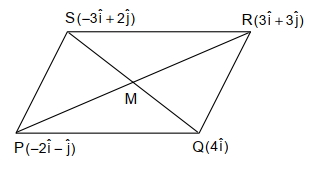
0 likesView Solution
58
MathematicsMediumMCQMHT CET · 2024
The normal to the curve $y(x-2)(x-3)=x+6$ at the point,where the curve intersects the $Y$-axis,passes through the point
A
$\left(-\frac{1}{2},-\frac{1}{2}\right)$
B
$\left(\frac{1}{2}, \frac{1}{2}\right)$
C
$\left(\frac{1}{2},-\frac{1}{3}\right)$
D
$\left(\frac{1}{2}, \frac{1}{3}\right)$
Solution
(B) The given equation of the curve is $y(x-2)(x-3)=x+6$.
At the $Y$-axis,$x=0$. Substituting $x=0$ into the equation: $y(0-2)(0-3)=0+6 \Rightarrow y(-2)(-3)=6 \Rightarrow 6y=6 \Rightarrow y=1$.
So,the point of intersection is $(0, 1)$.
Now,rewrite the equation as $y = \frac{x+6}{x^2-5x+6}$.
Differentiating with respect to $x$ using the quotient rule:
$\frac{dy}{dx} = \frac{(x^2-5x+6)(1) - (x+6)(2x-5)}{(x^2-5x+6)^2}$.
At $x=0$,the slope of the tangent $m_t = \frac{(0-0+6)(1) - (0+6)(0-5)}{(0-0+6)^2} = \frac{6 - (-30)}{36} = \frac{36}{36} = 1$.
The slope of the normal $m_n = -\frac{1}{m_t} = -\frac{1}{1} = -1$.
The equation of the normal at $(0, 1)$ is $y - 1 = -1(x - 0)$,which simplifies to $y = -x + 1$ or $x + y = 1$.
Checking the options,for $(\frac{1}{2}, \frac{1}{2})$,we have $\frac{1}{2} + \frac{1}{2} = 1$,which satisfies the equation.
Thus,the normal passes through $(\frac{1}{2}, \frac{1}{2})$.
At the $Y$-axis,$x=0$. Substituting $x=0$ into the equation: $y(0-2)(0-3)=0+6 \Rightarrow y(-2)(-3)=6 \Rightarrow 6y=6 \Rightarrow y=1$.
So,the point of intersection is $(0, 1)$.
Now,rewrite the equation as $y = \frac{x+6}{x^2-5x+6}$.
Differentiating with respect to $x$ using the quotient rule:
$\frac{dy}{dx} = \frac{(x^2-5x+6)(1) - (x+6)(2x-5)}{(x^2-5x+6)^2}$.
At $x=0$,the slope of the tangent $m_t = \frac{(0-0+6)(1) - (0+6)(0-5)}{(0-0+6)^2} = \frac{6 - (-30)}{36} = \frac{36}{36} = 1$.
The slope of the normal $m_n = -\frac{1}{m_t} = -\frac{1}{1} = -1$.
The equation of the normal at $(0, 1)$ is $y - 1 = -1(x - 0)$,which simplifies to $y = -x + 1$ or $x + y = 1$.
Checking the options,for $(\frac{1}{2}, \frac{1}{2})$,we have $\frac{1}{2} + \frac{1}{2} = 1$,which satisfies the equation.
Thus,the normal passes through $(\frac{1}{2}, \frac{1}{2})$.
0 likesView Solution
59
MathematicsDifficultMCQMHT CET · 2024
The equation of the normal to the curve $x = \theta + \sin \theta, y = 1 + \cos \theta$ at $\theta = \frac{\pi}{2}$ is
A
$2x + 2y - \pi = 0$
B
$2x - y - \pi = 0$
C
$2x - 2y - \pi = 0$
D
$2x + y - \pi = 0$
Solution
(C) Given the parametric equations of the curve: $x = \theta + \sin \theta$ and $y = 1 + \cos \theta$.
First,find the derivatives with respect to $\theta$:
$\frac{dx}{d\theta} = 1 + \cos \theta$ and $\frac{dy}{d\theta} = -\sin \theta$.
The slope of the tangent is $\frac{dy}{dx} = \frac{dy/d\theta}{dx/d\theta} = \frac{-\sin \theta}{1 + \cos \theta}$.
At $\theta = \frac{\pi}{2}$,the point $(x, y)$ is:
$x = \frac{\pi}{2} + \sin \frac{\pi}{2} = \frac{\pi}{2} + 1$ and $y = 1 + \cos \frac{\pi}{2} = 1$.
The slope of the tangent at $\theta = \frac{\pi}{2}$ is $m_t = \frac{-\sin(\pi/2)}{1 + \cos(\pi/2)} = \frac{-1}{1 + 0} = -1$.
The slope of the normal is $m_n = -\frac{1}{m_t} = -\frac{1}{-1} = 1$.
The equation of the normal at $(\frac{\pi}{2} + 1, 1)$ is:
$y - 1 = 1(x - (\frac{\pi}{2} + 1))$
$y - 1 = x - \frac{\pi}{2} - 1$
$x - y - \frac{\pi}{2} = 0$,which can be written as $2x - 2y - \pi = 0$.
First,find the derivatives with respect to $\theta$:
$\frac{dx}{d\theta} = 1 + \cos \theta$ and $\frac{dy}{d\theta} = -\sin \theta$.
The slope of the tangent is $\frac{dy}{dx} = \frac{dy/d\theta}{dx/d\theta} = \frac{-\sin \theta}{1 + \cos \theta}$.
At $\theta = \frac{\pi}{2}$,the point $(x, y)$ is:
$x = \frac{\pi}{2} + \sin \frac{\pi}{2} = \frac{\pi}{2} + 1$ and $y = 1 + \cos \frac{\pi}{2} = 1$.
The slope of the tangent at $\theta = \frac{\pi}{2}$ is $m_t = \frac{-\sin(\pi/2)}{1 + \cos(\pi/2)} = \frac{-1}{1 + 0} = -1$.
The slope of the normal is $m_n = -\frac{1}{m_t} = -\frac{1}{-1} = 1$.
The equation of the normal at $(\frac{\pi}{2} + 1, 1)$ is:
$y - 1 = 1(x - (\frac{\pi}{2} + 1))$
$y - 1 = x - \frac{\pi}{2} - 1$
$x - y - \frac{\pi}{2} = 0$,which can be written as $2x - 2y - \pi = 0$.
0 likesView Solution
60
MathematicsEasyMCQMHT CET · 2024
The coordinates of a point on the curve $y = x \log x$ at which the normal is parallel to the line $2x - 2y = 3$ are
A
$(-e^{-2}, 2e^{-2})$
B
$(-e^{-2}, -2e^{-2})$
C
$(e^{-2}, 2e^{-2})$
D
$(e^{-2}, -2e^{-2})$
Solution
(D) Given curve is $y = x \log x$.
Finding the derivative with respect to $x$:
$\frac{dy}{dx} = 1 \cdot \log x + x \cdot \frac{1}{x} = 1 + \log x$.
The slope of the tangent at any point $(x, y)$ is $m_t = 1 + \log x$.
The slope of the normal is $m_n = -\frac{1}{m_t} = -\frac{1}{1 + \log x}$.
The given line is $2x - 2y = 3$,which can be written as $2y = 2x - 3$ or $y = x - \frac{3}{2}$.
The slope of this line is $1$.
Since the normal is parallel to the line,their slopes must be equal:
$-\frac{1}{1 + \log x} = 1$.
$-1 = 1 + \log x \implies \log x = -2$.
$x = e^{-2}$.
Now,find the $y$-coordinate:
$y = x \log x = e^{-2} \cdot (-2) = -2e^{-2}$.
Thus,the coordinates of the point are $(e^{-2}, -2e^{-2})$.
Finding the derivative with respect to $x$:
$\frac{dy}{dx} = 1 \cdot \log x + x \cdot \frac{1}{x} = 1 + \log x$.
The slope of the tangent at any point $(x, y)$ is $m_t = 1 + \log x$.
The slope of the normal is $m_n = -\frac{1}{m_t} = -\frac{1}{1 + \log x}$.
The given line is $2x - 2y = 3$,which can be written as $2y = 2x - 3$ or $y = x - \frac{3}{2}$.
The slope of this line is $1$.
Since the normal is parallel to the line,their slopes must be equal:
$-\frac{1}{1 + \log x} = 1$.
$-1 = 1 + \log x \implies \log x = -2$.
$x = e^{-2}$.
Now,find the $y$-coordinate:
$y = x \log x = e^{-2} \cdot (-2) = -2e^{-2}$.
Thus,the coordinates of the point are $(e^{-2}, -2e^{-2})$.
0 likesView Solution
61
MathematicsDifficultMCQMHT CET · 2024
The equation of the normal to the curve $x=\theta+\sin \theta, y=1+\cos \theta$ at $\theta=\frac{\pi}{2}$ is
A
$2x+2y+\pi=0$
B
$2x-2y-\pi=0$
C
$x+y+\pi=0$
D
$x+y-2\pi=0$
Solution
(B) Given the parametric equations of the curve: $x=\theta+\sin \theta$ and $y=1+\cos \theta$.
First,find the derivative $\frac{dy}{dx}$ with respect to $\theta$:
$\frac{dx}{d\theta} = 1+\cos \theta$ and $\frac{dy}{d\theta} = -\sin \theta$.
Thus,$\frac{dy}{dx} = \frac{dy/d\theta}{dx/d\theta} = \frac{-\sin \theta}{1+\cos \theta}$.
At $\theta = \frac{\pi}{2}$,the slope of the tangent is $m_t = \frac{-\sin(\pi/2)}{1+\cos(\pi/2)} = \frac{-1}{1+0} = -1$.
The slope of the normal is $m_n = -\frac{1}{m_t} = -\frac{1}{-1} = 1$.
Now,find the point $(x, y)$ at $\theta = \frac{\pi}{2}$:
$x = \frac{\pi}{2} + \sin(\frac{\pi}{2}) = \frac{\pi}{2} + 1$ and $y = 1 + \cos(\frac{\pi}{2}) = 1 + 0 = 1$.
The equation of the normal is $(y - y_1) = m_n(x - x_1)$:
$(y - 1) = 1(x - (1 + \frac{\pi}{2}))$.
$y - 1 = x - 1 - \frac{\pi}{2}$.
$x - y - \frac{\pi}{2} = 0$,which simplifies to $2x - 2y - \pi = 0$.
First,find the derivative $\frac{dy}{dx}$ with respect to $\theta$:
$\frac{dx}{d\theta} = 1+\cos \theta$ and $\frac{dy}{d\theta} = -\sin \theta$.
Thus,$\frac{dy}{dx} = \frac{dy/d\theta}{dx/d\theta} = \frac{-\sin \theta}{1+\cos \theta}$.
At $\theta = \frac{\pi}{2}$,the slope of the tangent is $m_t = \frac{-\sin(\pi/2)}{1+\cos(\pi/2)} = \frac{-1}{1+0} = -1$.
The slope of the normal is $m_n = -\frac{1}{m_t} = -\frac{1}{-1} = 1$.
Now,find the point $(x, y)$ at $\theta = \frac{\pi}{2}$:
$x = \frac{\pi}{2} + \sin(\frac{\pi}{2}) = \frac{\pi}{2} + 1$ and $y = 1 + \cos(\frac{\pi}{2}) = 1 + 0 = 1$.
The equation of the normal is $(y - y_1) = m_n(x - x_1)$:
$(y - 1) = 1(x - (1 + \frac{\pi}{2}))$.
$y - 1 = x - 1 - \frac{\pi}{2}$.
$x - y - \frac{\pi}{2} = 0$,which simplifies to $2x - 2y - \pi = 0$.
0 likesView Solution
62
MathematicsMediumMCQMHT CET · 2024
The sum of intercepts on coordinate axes made by the tangent to the curve $\sqrt{x}+\sqrt{y}=\sqrt{a}$ is
A
$a$
B
$2a$
C
$2\sqrt{a}$
D
$\sqrt{2}a$
Solution
(A) Given the curve $\sqrt{x}+\sqrt{y}=\sqrt{a}$.
Differentiating with respect to $x$,we get $\frac{1}{2\sqrt{x}}+\frac{1}{2\sqrt{y}}\frac{dy}{dx}=0$.
Thus,the slope of the tangent is $\frac{dy}{dx}=-\sqrt{\frac{y}{x}}$.
Let the point of tangency be $(x_1, y_1)$. The equation of the tangent is $(y-y_1)=-\sqrt{\frac{y_1}{x_1}}(x-x_1)$.
Multiplying by $\sqrt{x_1}$,we get $\sqrt{x_1}y - \sqrt{x_1}y_1 = -\sqrt{y_1}x + \sqrt{y_1}x_1$.
Rearranging gives $\sqrt{y_1}x + \sqrt{x_1}y = \sqrt{x_1}y_1 + \sqrt{y_1}x_1 = \sqrt{x_1y_1}(\sqrt{x_1}+\sqrt{y_1})$.
Since $\sqrt{x_1}+\sqrt{y_1}=\sqrt{a}$,the equation becomes $\sqrt{y_1}x + \sqrt{x_1}y = \sqrt{x_1y_1a}$.
Dividing by $\sqrt{x_1y_1a}$,we get $\frac{x}{\sqrt{x_1a}} + \frac{y}{\sqrt{y_1a}} = 1$.
The $x$-intercept is $\sqrt{x_1a}$ and the $y$-intercept is $\sqrt{y_1a}$.
The sum of intercepts is $\sqrt{a}(\sqrt{x_1}+\sqrt{y_1}) = \sqrt{a} \times \sqrt{a} = a$.
Differentiating with respect to $x$,we get $\frac{1}{2\sqrt{x}}+\frac{1}{2\sqrt{y}}\frac{dy}{dx}=0$.
Thus,the slope of the tangent is $\frac{dy}{dx}=-\sqrt{\frac{y}{x}}$.
Let the point of tangency be $(x_1, y_1)$. The equation of the tangent is $(y-y_1)=-\sqrt{\frac{y_1}{x_1}}(x-x_1)$.
Multiplying by $\sqrt{x_1}$,we get $\sqrt{x_1}y - \sqrt{x_1}y_1 = -\sqrt{y_1}x + \sqrt{y_1}x_1$.
Rearranging gives $\sqrt{y_1}x + \sqrt{x_1}y = \sqrt{x_1}y_1 + \sqrt{y_1}x_1 = \sqrt{x_1y_1}(\sqrt{x_1}+\sqrt{y_1})$.
Since $\sqrt{x_1}+\sqrt{y_1}=\sqrt{a}$,the equation becomes $\sqrt{y_1}x + \sqrt{x_1}y = \sqrt{x_1y_1a}$.
Dividing by $\sqrt{x_1y_1a}$,we get $\frac{x}{\sqrt{x_1a}} + \frac{y}{\sqrt{y_1a}} = 1$.
The $x$-intercept is $\sqrt{x_1a}$ and the $y$-intercept is $\sqrt{y_1a}$.
The sum of intercepts is $\sqrt{a}(\sqrt{x_1}+\sqrt{y_1}) = \sqrt{a} \times \sqrt{a} = a$.
0 likesView Solution
63
MathematicsMediumMCQMHT CET · 2024
The equation of the tangent to the curve $y=1-e^{\frac{x}{3}}$ at the point of intersection with the $Y$-axis is
A
$x-3y=0$
B
$x+3y=0$
C
$x+2y=0$
D
$3x+y=0$
Solution
(B) Given equation of the curve is $y=1-e^{\frac{x}{3}} \dots (i)$.
Since the curve intersects the $Y$-axis,we set $x=0$.
Substituting $x=0$ in $(i)$,we get $y=1-e^{0}=1-1=0$.
Thus,the point of intersection is $(0, 0)$.
The slope of the tangent is given by $\frac{dy}{dx}$.
Differentiating $(i)$ with respect to $x$,we get $\frac{dy}{dx} = -\frac{1}{3} e^{\frac{x}{3}}$.
At the point $(0, 0)$,the slope $m = \left(\frac{dy}{dx}\right)_{(0,0)} = -\frac{1}{3} e^{0} = -\frac{1}{3}$.
The equation of the tangent line passing through $(0, 0)$ with slope $m = -\frac{1}{3}$ is $y - 0 = -\frac{1}{3}(x - 0)$.
Multiplying by $3$,we get $3y = -x$,which simplifies to $x + 3y = 0$.
Since the curve intersects the $Y$-axis,we set $x=0$.
Substituting $x=0$ in $(i)$,we get $y=1-e^{0}=1-1=0$.
Thus,the point of intersection is $(0, 0)$.
The slope of the tangent is given by $\frac{dy}{dx}$.
Differentiating $(i)$ with respect to $x$,we get $\frac{dy}{dx} = -\frac{1}{3} e^{\frac{x}{3}}$.
At the point $(0, 0)$,the slope $m = \left(\frac{dy}{dx}\right)_{(0,0)} = -\frac{1}{3} e^{0} = -\frac{1}{3}$.
The equation of the tangent line passing through $(0, 0)$ with slope $m = -\frac{1}{3}$ is $y - 0 = -\frac{1}{3}(x - 0)$.
Multiplying by $3$,we get $3y = -x$,which simplifies to $x + 3y = 0$.
0 likesView Solution
64
MathematicsMediumMCQMHT CET · 2024
Let $C$ be a curve given by $y(x)=1+\sqrt{4x-3}$,$x>\frac{3}{4}$. If $P$ is a point on $C$ such that the tangent at $P$ has a slope of $\frac{2}{3}$,then a point through which the normal at $P$ passes is:
A
$(1,7)$
B
$(3,-4)$
C
$(4,-3)$
D
$(2,3)$
Solution
(A) Given the curve $y(x) = 1 + \sqrt{4x-3}$.
First,we find the derivative to determine the slope of the tangent:
$\frac{dy}{dx} = \frac{1}{2\sqrt{4x-3}} \times 4 = \frac{2}{\sqrt{4x-3}}$.
Given the slope of the tangent at point $P$ is $\frac{2}{3}$,we set $\frac{2}{\sqrt{4x-3}} = \frac{2}{3}$.
This implies $\sqrt{4x-3} = 3$,so $4x-3 = 9$,which gives $4x = 12$,or $x = 3$.
Substituting $x = 3$ into the curve equation,we get $y = 1 + \sqrt{4(3)-3} = 1 + \sqrt{9} = 1 + 3 = 4$.
Thus,the point $P$ is $(3, 4)$.
The slope of the normal at $P$ is the negative reciprocal of the tangent slope: $m_{normal} = -\frac{1}{2/3} = -\frac{3}{2}$.
The equation of the normal at $(3, 4)$ is $y - 4 = -\frac{3}{2}(x - 3)$.
Multiplying by $2$,we get $2y - 8 = -3x + 9$,which simplifies to $3x + 2y - 17 = 0$.
Checking the options:
For $(1, 7)$: $3(1) + 2(7) - 17 = 3 + 14 - 17 = 0$. This satisfies the equation.
Therefore,the normal passes through $(1, 7)$.
First,we find the derivative to determine the slope of the tangent:
$\frac{dy}{dx} = \frac{1}{2\sqrt{4x-3}} \times 4 = \frac{2}{\sqrt{4x-3}}$.
Given the slope of the tangent at point $P$ is $\frac{2}{3}$,we set $\frac{2}{\sqrt{4x-3}} = \frac{2}{3}$.
This implies $\sqrt{4x-3} = 3$,so $4x-3 = 9$,which gives $4x = 12$,or $x = 3$.
Substituting $x = 3$ into the curve equation,we get $y = 1 + \sqrt{4(3)-3} = 1 + \sqrt{9} = 1 + 3 = 4$.
Thus,the point $P$ is $(3, 4)$.
The slope of the normal at $P$ is the negative reciprocal of the tangent slope: $m_{normal} = -\frac{1}{2/3} = -\frac{3}{2}$.
The equation of the normal at $(3, 4)$ is $y - 4 = -\frac{3}{2}(x - 3)$.
Multiplying by $2$,we get $2y - 8 = -3x + 9$,which simplifies to $3x + 2y - 17 = 0$.
Checking the options:
For $(1, 7)$: $3(1) + 2(7) - 17 = 3 + 14 - 17 = 0$. This satisfies the equation.
Therefore,the normal passes through $(1, 7)$.
0 likesView Solution
65
MathematicsMediumMCQMHT CET · 2024
The equation of the tangent to the curve $x = a \cos^3 \theta, y = a \sin^3 \theta$ at $\theta = \frac{\pi}{4}$ is
A
$x + y = \frac{a}{\sqrt{2}}$
B
$x + y = \frac{a}{2}$
C
$x + y = \frac{a}{2 \sqrt{2}}$
D
$x + y = \frac{a}{8}$
Solution
(A) Given the parametric equations $x = a \cos^3 \theta$ and $y = a \sin^3 \theta$.
Differentiating with respect to $\theta$,we get $\frac{dx}{d\theta} = -3a \cos^2 \theta \sin \theta$ and $\frac{dy}{d\theta} = 3a \sin^2 \theta \cos \theta$.
The slope of the tangent is $\frac{dy}{dx} = \frac{dy/d\theta}{dx/d\theta} = \frac{3a \sin^2 \theta \cos \theta}{-3a \cos^2 \theta \sin \theta} = -\tan \theta$.
At $\theta = \frac{\pi}{4}$,the slope is $m = -\tan(\frac{\pi}{4}) = -1$.
The coordinates of the point at $\theta = \frac{\pi}{4}$ are $x = a \cos^3(\frac{\pi}{4}) = a(\frac{1}{\sqrt{2}})^3 = \frac{a}{2 \sqrt{2}}$ and $y = a \sin^3(\frac{\pi}{4}) = a(\frac{1}{\sqrt{2}})^3 = \frac{a}{2 \sqrt{2}}$.
The equation of the tangent line is $y - y_1 = m(x - x_1)$.
$y - \frac{a}{2 \sqrt{2}} = -1(x - \frac{a}{2 \sqrt{2}})$.
$y - \frac{a}{2 \sqrt{2}} = -x + \frac{a}{2 \sqrt{2}}$.
$x + y = \frac{a}{2 \sqrt{2}} + \frac{a}{2 \sqrt{2}} = \frac{2a}{2 \sqrt{2}} = \frac{a}{\sqrt{2}}$.
Differentiating with respect to $\theta$,we get $\frac{dx}{d\theta} = -3a \cos^2 \theta \sin \theta$ and $\frac{dy}{d\theta} = 3a \sin^2 \theta \cos \theta$.
The slope of the tangent is $\frac{dy}{dx} = \frac{dy/d\theta}{dx/d\theta} = \frac{3a \sin^2 \theta \cos \theta}{-3a \cos^2 \theta \sin \theta} = -\tan \theta$.
At $\theta = \frac{\pi}{4}$,the slope is $m = -\tan(\frac{\pi}{4}) = -1$.
The coordinates of the point at $\theta = \frac{\pi}{4}$ are $x = a \cos^3(\frac{\pi}{4}) = a(\frac{1}{\sqrt{2}})^3 = \frac{a}{2 \sqrt{2}}$ and $y = a \sin^3(\frac{\pi}{4}) = a(\frac{1}{\sqrt{2}})^3 = \frac{a}{2 \sqrt{2}}$.
The equation of the tangent line is $y - y_1 = m(x - x_1)$.
$y - \frac{a}{2 \sqrt{2}} = -1(x - \frac{a}{2 \sqrt{2}})$.
$y - \frac{a}{2 \sqrt{2}} = -x + \frac{a}{2 \sqrt{2}}$.
$x + y = \frac{a}{2 \sqrt{2}} + \frac{a}{2 \sqrt{2}} = \frac{2a}{2 \sqrt{2}} = \frac{a}{\sqrt{2}}$.
0 likesView Solution
66
MathematicsDifficultMCQMHT CET · 2024
The curve $x^4-2xy^2+y^2+3x-3y=0$ cuts the $X$-axis at $(0,0)$ at an angle of
A
$\frac{\pi}{4}$
B
$\frac{\pi}{2}$
C
$0$
D
$\frac{\pi}{6}$
Solution
(A) The given equation of the curve is $x^4-2xy^2+y^2+3x-3y=0 \dots (i)$.
To find the angle at which the curve cuts the $X$-axis,we need to find the slope of the tangent at the point $(0,0)$.
Differentiating equation $(i)$ with respect to $x$,we get:
$4x^3 - 2(y^2 + x \cdot 2y \frac{dy}{dx}) + 2y \frac{dy}{dx} + 3 - 3 \frac{dy}{dx} = 0$.
Simplifying the expression:
$4x^3 - 2y^2 - 4xy \frac{dy}{dx} + 2y \frac{dy}{dx} + 3 - 3 \frac{dy}{dx} = 0$.
Now,substitute $(x,y) = (0,0)$ into the derivative equation:
$4(0)^3 - 2(0)^2 - 4(0)(0) \frac{dy}{dx} + 2(0) \frac{dy}{dx} + 3 - 3 \frac{dy}{dx} = 0$.
$0 - 0 - 0 + 0 + 3 - 3 \frac{dy}{dx} = 0$.
$3 = 3 \frac{dy}{dx} \implies \frac{dy}{dx} = 1$.
Since the slope $m = \tan \theta = 1$,we have $\theta = \tan^{-1}(1) = \frac{\pi}{4}$.
To find the angle at which the curve cuts the $X$-axis,we need to find the slope of the tangent at the point $(0,0)$.
Differentiating equation $(i)$ with respect to $x$,we get:
$4x^3 - 2(y^2 + x \cdot 2y \frac{dy}{dx}) + 2y \frac{dy}{dx} + 3 - 3 \frac{dy}{dx} = 0$.
Simplifying the expression:
$4x^3 - 2y^2 - 4xy \frac{dy}{dx} + 2y \frac{dy}{dx} + 3 - 3 \frac{dy}{dx} = 0$.
Now,substitute $(x,y) = (0,0)$ into the derivative equation:
$4(0)^3 - 2(0)^2 - 4(0)(0) \frac{dy}{dx} + 2(0) \frac{dy}{dx} + 3 - 3 \frac{dy}{dx} = 0$.
$0 - 0 - 0 + 0 + 3 - 3 \frac{dy}{dx} = 0$.
$3 = 3 \frac{dy}{dx} \implies \frac{dy}{dx} = 1$.
Since the slope $m = \tan \theta = 1$,we have $\theta = \tan^{-1}(1) = \frac{\pi}{4}$.
0 likesView Solution
67
MathematicsDifficultMCQMHT CET · 2024
If $y=4x-5$ is a tangent to the curve $y^2=px^3+q$ at $(2,3)$,then the values of $p$ and $q$ are respectively
A
$-2, 7$
B
$7, -2$
C
$2, -7$
D
$-7, -2$
Solution
(C) Given the curve equation is $y^2 = px^3 + q \dots (i)$.
Since the point $(2, 3)$ lies on the curve,we substitute $x=2$ and $y=3$ into $(i)$:
$3^2 = p(2)^3 + q \Rightarrow 9 = 8p + q \dots (ii)$.
Differentiating both sides of $(i)$ with respect to $x$:
$2y \frac{dy}{dx} = 3px^2 \Rightarrow \frac{dy}{dx} = \frac{3px^2}{2y}$.
The slope of the tangent at $(2, 3)$ is $\left(\frac{dy}{dx}\right)_{(2,3)} = \frac{3p(2)^2}{2(3)} = \frac{12p}{6} = 2p$.
The given tangent line is $y = 4x - 5$,which has a slope of $4$.
Equating the slopes: $2p = 4 \Rightarrow p = 2$.
Substituting $p = 2$ into $(ii)$:
$9 = 8(2) + q \Rightarrow 9 = 16 + q \Rightarrow q = -7$.
Thus,the values are $p = 2$ and $q = -7$.
Since the point $(2, 3)$ lies on the curve,we substitute $x=2$ and $y=3$ into $(i)$:
$3^2 = p(2)^3 + q \Rightarrow 9 = 8p + q \dots (ii)$.
Differentiating both sides of $(i)$ with respect to $x$:
$2y \frac{dy}{dx} = 3px^2 \Rightarrow \frac{dy}{dx} = \frac{3px^2}{2y}$.
The slope of the tangent at $(2, 3)$ is $\left(\frac{dy}{dx}\right)_{(2,3)} = \frac{3p(2)^2}{2(3)} = \frac{12p}{6} = 2p$.
The given tangent line is $y = 4x - 5$,which has a slope of $4$.
Equating the slopes: $2p = 4 \Rightarrow p = 2$.
Substituting $p = 2$ into $(ii)$:
$9 = 8(2) + q \Rightarrow 9 = 16 + q \Rightarrow q = -7$.
Thus,the values are $p = 2$ and $q = -7$.
0 likesView Solution
68
MathematicsDifficultMCQMHT CET · 2024
If the equation of the normal to the curve $x=\sqrt{t}$,$y=t-\frac{1}{\sqrt{t}}$ at $t=4$ is
A
$8x+2y=23$
B
$34x-8y=40$
C
$8x+6y=37$
D
$8x+34y=135$
Solution
(D) Given the parametric equations $x=\sqrt{t}$ and $y=t-\frac{1}{\sqrt{t}}$.
At $t=4$,$x=\sqrt{4}=2$ and $y=4-\frac{1}{\sqrt{4}}=4-\frac{1}{2}=\frac{7}{2}$.
We find the derivative $\frac{dy}{dx} = \frac{dy/dt}{dx/dt}$.
$\frac{dx}{dt} = \frac{1}{2\sqrt{t}}$ and $\frac{dy}{dt} = 1 + \frac{1}{2t\sqrt{t}}$.
At $t=4$,$\frac{dx}{dt} = \frac{1}{4}$ and $\frac{dy}{dt} = 1 + \frac{1}{16} = \frac{17}{16}$.
Thus,the slope of the tangent $m_T = \frac{17/16}{1/4} = \frac{17}{4}$.
The slope of the normal $m_N = -\frac{1}{m_T} = -\frac{4}{17}$.
The equation of the normal is $y - \frac{7}{2} = -\frac{4}{17}(x - 2)$.
Multiplying by $34$,we get $34y - 119 = -8(x - 2) \implies 34y - 119 = -8x + 16$.
Rearranging gives $8x + 34y = 135$.
At $t=4$,$x=\sqrt{4}=2$ and $y=4-\frac{1}{\sqrt{4}}=4-\frac{1}{2}=\frac{7}{2}$.
We find the derivative $\frac{dy}{dx} = \frac{dy/dt}{dx/dt}$.
$\frac{dx}{dt} = \frac{1}{2\sqrt{t}}$ and $\frac{dy}{dt} = 1 + \frac{1}{2t\sqrt{t}}$.
At $t=4$,$\frac{dx}{dt} = \frac{1}{4}$ and $\frac{dy}{dt} = 1 + \frac{1}{16} = \frac{17}{16}$.
Thus,the slope of the tangent $m_T = \frac{17/16}{1/4} = \frac{17}{4}$.
The slope of the normal $m_N = -\frac{1}{m_T} = -\frac{4}{17}$.
The equation of the normal is $y - \frac{7}{2} = -\frac{4}{17}(x - 2)$.
Multiplying by $34$,we get $34y - 119 = -8(x - 2) \implies 34y - 119 = -8x + 16$.
Rearranging gives $8x + 34y = 135$.
0 likesView Solution
69
MathematicsDifficultMCQMHT CET · 2024
The curve $y=ax^3+bx^2+cx+5$ touches the $X$-axis at $(-2,0)$ and cuts the $Y$-axis at a point $Q$ where its gradient is $3$. Then the values of $a, b, c$ respectively are:
A
$3, -\frac{1}{2}, -\frac{3}{4}$
B
$-\frac{3}{4}, -\frac{1}{2}, 3$
C
$-\frac{1}{2}, -\frac{3}{4}, 3$
D
$-\frac{1}{2}, 3, -\frac{3}{4}$
Solution
(C) Given the curve $y=ax^3+bx^2+cx+5$.
Since the curve touches the $X$-axis at $(-2,0)$,it passes through $(-2,0)$ and its derivative at $x=-2$ is $0$.
Substituting $(-2,0)$ into the equation: $0 = a(-8) + b(4) + c(-2) + 5 \Rightarrow -8a + 4b - 2c = -5 \Rightarrow 8a - 4b + 2c = 5 \dots (i)$.
Also,the derivative is $\frac{dy}{dx} = 3ax^2 + 2bx + c$.
At $x=-2$,$\frac{dy}{dx} = 0 \Rightarrow 3a(4) + 2b(-2) + c = 0 \Rightarrow 12a - 4b + c = 0 \dots (ii)$.
The curve cuts the $Y$-axis at $Q$. Putting $x=0$ in the curve equation,$y=5$,so $Q$ is $(0,5)$.
The gradient at $Q$ is $3$,so $\left(\frac{dy}{dx}\right)_{x=0} = 3 \Rightarrow c = 3$.
Substituting $c=3$ into $(i)$ and $(ii)$:
$8a - 4b + 6 = 5 \Rightarrow 8a - 4b = -1 \dots (iii)$.
$12a - 4b + 3 = 0 \Rightarrow 12a - 4b = -3 \dots (iv)$.
Subtracting $(iii)$ from $(iv)$: $4a = -2 \Rightarrow a = -\frac{1}{2}$.
Substituting $a = -\frac{1}{2}$ into $(iii)$: $8(-\frac{1}{2}) - 4b = -1 \Rightarrow -4 - 4b = -1 \Rightarrow -4b = 3 \Rightarrow b = -\frac{3}{4}$.
Thus,$a = -\frac{1}{2}, b = -\frac{3}{4}, c = 3$.
Since the curve touches the $X$-axis at $(-2,0)$,it passes through $(-2,0)$ and its derivative at $x=-2$ is $0$.
Substituting $(-2,0)$ into the equation: $0 = a(-8) + b(4) + c(-2) + 5 \Rightarrow -8a + 4b - 2c = -5 \Rightarrow 8a - 4b + 2c = 5 \dots (i)$.
Also,the derivative is $\frac{dy}{dx} = 3ax^2 + 2bx + c$.
At $x=-2$,$\frac{dy}{dx} = 0 \Rightarrow 3a(4) + 2b(-2) + c = 0 \Rightarrow 12a - 4b + c = 0 \dots (ii)$.
The curve cuts the $Y$-axis at $Q$. Putting $x=0$ in the curve equation,$y=5$,so $Q$ is $(0,5)$.
The gradient at $Q$ is $3$,so $\left(\frac{dy}{dx}\right)_{x=0} = 3 \Rightarrow c = 3$.
Substituting $c=3$ into $(i)$ and $(ii)$:
$8a - 4b + 6 = 5 \Rightarrow 8a - 4b = -1 \dots (iii)$.
$12a - 4b + 3 = 0 \Rightarrow 12a - 4b = -3 \dots (iv)$.
Subtracting $(iii)$ from $(iv)$: $4a = -2 \Rightarrow a = -\frac{1}{2}$.
Substituting $a = -\frac{1}{2}$ into $(iii)$: $8(-\frac{1}{2}) - 4b = -1 \Rightarrow -4 - 4b = -1 \Rightarrow -4b = 3 \Rightarrow b = -\frac{3}{4}$.
Thus,$a = -\frac{1}{2}, b = -\frac{3}{4}, c = 3$.
0 likesView Solution
70
MathematicsMediumMCQMHT CET · 2024
If $\theta$ denotes the acute angle between the curves $y=10-x^2$ and $y=2+x^2$,at a point of the intersection,then $|\tan \theta|$ is equal to
A
$\frac{8}{15}$
B
$\frac{8}{17}$
C
$\frac{4}{9}$
D
$\frac{7}{17}$
Solution
(A) Given curves are $y=10-x^2$ and $y=2+x^2$.
To find the point of intersection,equate the two equations: $10-x^2 = 2+x^2 \Rightarrow 2x^2 = 8 \Rightarrow x^2 = 4 \Rightarrow x = \pm 2$.
For $x=2$,$y=6$. For $x=-2$,$y=6$. Let us consider the point $(2, 6)$.
For the first curve $y=10-x^2$,the slope $m_1 = \frac{dy}{dx} = -2x$. At $x=2$,$m_1 = -4$.
For the second curve $y=2+x^2$,the slope $m_2 = \frac{dy}{dx} = 2x$. At $x=2$,$m_2 = 4$.
The angle $\theta$ between the curves is given by $\tan \theta = \left| \frac{m_1 - m_2}{1 + m_1 m_2} \right|$.
Substituting the values: $\tan \theta = \left| \frac{-4 - 4}{1 + (-4)(4)} \right| = \left| \frac{-8}{1 - 16} \right| = \left| \frac{-8}{-15} \right| = \frac{8}{15}$.
Thus,$|\tan \theta| = \frac{8}{15}$.
To find the point of intersection,equate the two equations: $10-x^2 = 2+x^2 \Rightarrow 2x^2 = 8 \Rightarrow x^2 = 4 \Rightarrow x = \pm 2$.
For $x=2$,$y=6$. For $x=-2$,$y=6$. Let us consider the point $(2, 6)$.
For the first curve $y=10-x^2$,the slope $m_1 = \frac{dy}{dx} = -2x$. At $x=2$,$m_1 = -4$.
For the second curve $y=2+x^2$,the slope $m_2 = \frac{dy}{dx} = 2x$. At $x=2$,$m_2 = 4$.
The angle $\theta$ between the curves is given by $\tan \theta = \left| \frac{m_1 - m_2}{1 + m_1 m_2} \right|$.
Substituting the values: $\tan \theta = \left| \frac{-4 - 4}{1 + (-4)(4)} \right| = \left| \frac{-8}{1 - 16} \right| = \left| \frac{-8}{-15} \right| = \frac{8}{15}$.
Thus,$|\tan \theta| = \frac{8}{15}$.
0 likesView Solution
71
MathematicsEasyMCQMHT CET · 2024
The equation of the normal to the curve $y=x \log x$ parallel to $2x-2y+3=0$ is
A
$x+y=3e^{-2}$
B
$x-y=3e^{-2}$
C
$x-y=3e^2$
D
$x+y=3e^2$
Solution
(B) Given curve is $y=x \log x$ ... $(i)$
Differentiating with respect to $x$,we get $\frac{dy}{dx} = 1 + \log x$.
The slope of the normal is given by $m_n = -\frac{1}{\frac{dy}{dx}} = -\frac{1}{1+\log x}$.
The given line is $2x-2y+3=0$,which can be written as $y = x + \frac{3}{2}$.
The slope of this line is $m = 1$.
Since the normal is parallel to the given line,their slopes must be equal:
$-\frac{1}{1+\log x} = 1$
$\Rightarrow 1+\log x = -1$
$\Rightarrow \log x = -2$
$\Rightarrow x = e^{-2}$.
Substituting $x = e^{-2}$ in $(i)$,we get $y = e^{-2} \log(e^{-2}) = e^{-2}(-2) = -2e^{-2}$.
The point of contact is $(e^{-2}, -2e^{-2})$.
The equation of the normal is $y - y_1 = m(x - x_1)$:
$y - (-2e^{-2}) = 1(x - e^{-2})$
$y + 2e^{-2} = x - e^{-2}$
$x - y = 3e^{-2}$.
Differentiating with respect to $x$,we get $\frac{dy}{dx} = 1 + \log x$.
The slope of the normal is given by $m_n = -\frac{1}{\frac{dy}{dx}} = -\frac{1}{1+\log x}$.
The given line is $2x-2y+3=0$,which can be written as $y = x + \frac{3}{2}$.
The slope of this line is $m = 1$.
Since the normal is parallel to the given line,their slopes must be equal:
$-\frac{1}{1+\log x} = 1$
$\Rightarrow 1+\log x = -1$
$\Rightarrow \log x = -2$
$\Rightarrow x = e^{-2}$.
Substituting $x = e^{-2}$ in $(i)$,we get $y = e^{-2} \log(e^{-2}) = e^{-2}(-2) = -2e^{-2}$.
The point of contact is $(e^{-2}, -2e^{-2})$.
The equation of the normal is $y - y_1 = m(x - x_1)$:
$y - (-2e^{-2}) = 1(x - e^{-2})$
$y + 2e^{-2} = x - e^{-2}$
$x - y = 3e^{-2}$.
0 likesView Solution
72
MathematicsMediumMCQMHT CET · 2024
$A$ spherical metal ball at $80^{\circ} C$ cools in $5 \text{ minutes}$ to $60^{\circ} C$ in a surrounding temperature of $20^{\circ} C$. The temperature of the ball after $20 \text{ minutes}$ is approximately: (in $^{\circ} C$)
A
$8.15$
B
$11.85$
C
$28.15$
D
$31.85$
Solution
(D) Let $\theta$ be the temperature of the ball at any time $t$. According to Newton's law of cooling,$\frac{d\theta}{dt} = -k(\theta - 20)$,where $k > 0$.
Integrating both sides,we get $\ln|\theta - 20| = -kt + C$.
At $t = 0$,$\theta = 80^{\circ} C$,so $C = \ln(80 - 20) = \ln(60)$.
Thus,$\ln|\theta - 20| = -kt + \ln(60) \dots (i)$.
At $t = 5$,$\theta = 60^{\circ} C$,so $\ln(60 - 20) = -5k + \ln(60)$.
$5k = \ln(60) - \ln(40) = \ln(\frac{60}{40}) = \ln(\frac{3}{2})$.
So,$k = \frac{1}{5} \ln(\frac{3}{2})$.
For $t = 20$,substituting $k$ into equation $(i)$:
$\ln|\theta - 20| = -20 \times \frac{1}{5} \ln(\frac{3}{2}) + \ln(60) = -4 \ln(\frac{3}{2}) + \ln(60)$.
$\ln|\theta - 20| = \ln((\frac{2}{3})^4) + \ln(60) = \ln(\frac{16}{81} \times 60) = \ln(\frac{16 \times 20}{27}) = \ln(\frac{320}{27}) \approx \ln(11.85)$.
$\theta - 20 = 11.85 \implies \theta = 31.85^{\circ} C$.
Integrating both sides,we get $\ln|\theta - 20| = -kt + C$.
At $t = 0$,$\theta = 80^{\circ} C$,so $C = \ln(80 - 20) = \ln(60)$.
Thus,$\ln|\theta - 20| = -kt + \ln(60) \dots (i)$.
At $t = 5$,$\theta = 60^{\circ} C$,so $\ln(60 - 20) = -5k + \ln(60)$.
$5k = \ln(60) - \ln(40) = \ln(\frac{60}{40}) = \ln(\frac{3}{2})$.
So,$k = \frac{1}{5} \ln(\frac{3}{2})$.
For $t = 20$,substituting $k$ into equation $(i)$:
$\ln|\theta - 20| = -20 \times \frac{1}{5} \ln(\frac{3}{2}) + \ln(60) = -4 \ln(\frac{3}{2}) + \ln(60)$.
$\ln|\theta - 20| = \ln((\frac{2}{3})^4) + \ln(60) = \ln(\frac{16}{81} \times 60) = \ln(\frac{16 \times 20}{27}) = \ln(\frac{320}{27}) \approx \ln(11.85)$.
$\theta - 20 = 11.85 \implies \theta = 31.85^{\circ} C$.
0 likesView Solution
73
MathematicsMediumMCQMHT CET · 2024
The approximate value of $\sqrt[3]{0.026}$ is
A
$0.2762$
B
$0.2963$
C
$0.2632$
D
$0.2692$
Solution
(B) Let $f(x) = x^{\frac{1}{3}}$.
Then,$f'(x) = \frac{1}{3} x^{-\frac{2}{3}} = \frac{1}{3x^{\frac{2}{3}}}$.
We choose $a = 0.027$ because $\sqrt[3]{0.027} = 0.3$,and $h = -0.001$ such that $a + h = 0.026$.
Using the linear approximation formula $f(a + h) \approx f(a) + hf'(a)$:
$f(a) = (0.027)^{\frac{1}{3}} = 0.3$.
$f'(a) = \frac{1}{3(0.027)^{\frac{2}{3}}} = \frac{1}{3(0.09)} = \frac{1}{0.27}$.
Substituting these values:
$f(0.026) \approx 0.3 + (-0.001) \times \frac{1}{0.27}$.
$f(0.026) \approx 0.3 - \frac{0.001}{0.27} \approx 0.3 - 0.0037 = 0.2963$.
Then,$f'(x) = \frac{1}{3} x^{-\frac{2}{3}} = \frac{1}{3x^{\frac{2}{3}}}$.
We choose $a = 0.027$ because $\sqrt[3]{0.027} = 0.3$,and $h = -0.001$ such that $a + h = 0.026$.
Using the linear approximation formula $f(a + h) \approx f(a) + hf'(a)$:
$f(a) = (0.027)^{\frac{1}{3}} = 0.3$.
$f'(a) = \frac{1}{3(0.027)^{\frac{2}{3}}} = \frac{1}{3(0.09)} = \frac{1}{0.27}$.
Substituting these values:
$f(0.026) \approx 0.3 + (-0.001) \times \frac{1}{0.27}$.
$f(0.026) \approx 0.3 - \frac{0.001}{0.27} \approx 0.3 - 0.0037 = 0.2963$.
0 likesView Solution
74
MathematicsMediumMCQMHT CET · 2024
The approximate value of $\cos(30^{\circ} 30^{\prime})$ is,given that $1^{\circ} = 0.0175 \text{ rad}$ and $\cos 30^{\circ} = 0.8660$.
A
$0.8778$
B
$0.7666$
C
$0.7916$
D
$0.8616$
Solution
(D) Let $f(x) = \cos x$. Then $f^{\prime}(x) = -\sin x$.
We need to find the value of $\cos(30^{\circ} 30^{\prime})$.
Here,$30^{\circ} 30^{\prime} = 30^{\circ} + 30^{\prime} = 30^{\circ} + (0.5)^{\circ}$.
Converting $0.5^{\circ}$ to radians: $0.5 \times 0.0175 = 0.00875 \text{ rad}$.
Let $a = 30^{\circ} = \frac{\pi}{6} \text{ rad}$ and $h = 0.00875 \text{ rad}$.
Using the linear approximation formula $f(a+h) \approx f(a) + h f^{\prime}(a)$:
$f(a+h) \approx \cos(30^{\circ}) + (0.00875)(-\sin(30^{\circ}))$.
Given $\cos 30^{\circ} = 0.8660$ and $\sin 30^{\circ} = 0.5$.
$f(a+h) \approx 0.8660 - 0.00875 \times 0.5$.
$f(a+h) \approx 0.8660 - 0.004375 = 0.861625$.
Rounding to four decimal places,we get $0.8616$.
We need to find the value of $\cos(30^{\circ} 30^{\prime})$.
Here,$30^{\circ} 30^{\prime} = 30^{\circ} + 30^{\prime} = 30^{\circ} + (0.5)^{\circ}$.
Converting $0.5^{\circ}$ to radians: $0.5 \times 0.0175 = 0.00875 \text{ rad}$.
Let $a = 30^{\circ} = \frac{\pi}{6} \text{ rad}$ and $h = 0.00875 \text{ rad}$.
Using the linear approximation formula $f(a+h) \approx f(a) + h f^{\prime}(a)$:
$f(a+h) \approx \cos(30^{\circ}) + (0.00875)(-\sin(30^{\circ}))$.
Given $\cos 30^{\circ} = 0.8660$ and $\sin 30^{\circ} = 0.5$.
$f(a+h) \approx 0.8660 - 0.00875 \times 0.5$.
$f(a+h) \approx 0.8660 - 0.004375 = 0.861625$.
Rounding to four decimal places,we get $0.8616$.
0 likesView Solution
75
MathematicsEasyMCQMHT CET · 2024
$A$ bullet is shot horizontally and its distance $S$ cm at time $t$ second is given by $S=1200t-15t^2$. Then, the distance covered by the bullet when it comes to rest is: (in $\text{ cm}$)
A
$12000$
B
$24000$
C
$1200$
D
$2400$
Solution
(B) The distance equation is given by $S = 1200t - 15t^2$.
To find the velocity $v$, we differentiate $S$ with respect to $t$:
$v = \frac{dS}{dt} = \frac{d}{dt}(1200t - 15t^2) = 1200 - 30t$.
When the bullet comes to rest, its velocity $v$ becomes $0$:
$1200 - 30t = 0$
$30t = 1200$
$t = 40 \text{ seconds}$.
Now, substitute $t = 40$ into the distance equation to find the total distance covered:
$S = 1200(40) - 15(40)^2$
$S = 48000 - 15(1600)$
$S = 48000 - 24000$
$S = 24000 \text{ cm}$.
To find the velocity $v$, we differentiate $S$ with respect to $t$:
$v = \frac{dS}{dt} = \frac{d}{dt}(1200t - 15t^2) = 1200 - 30t$.
When the bullet comes to rest, its velocity $v$ becomes $0$:
$1200 - 30t = 0$
$30t = 1200$
$t = 40 \text{ seconds}$.
Now, substitute $t = 40$ into the distance equation to find the total distance covered:
$S = 1200(40) - 15(40)^2$
$S = 48000 - 15(1600)$
$S = 48000 - 24000$
$S = 24000 \text{ cm}$.
0 likesView Solution
76
MathematicsEasyMCQMHT CET · 2024
$A$ stone is dropped into a quiet lake and waves move in circles at a speed of $8 \,cm/sec$. At the instant when the radius of the circular wave is $12 \,cm$, how fast is the enclosed area increasing?
A
$180 \pi \,cm^2/sec$
B
$196 \pi \,cm^2/sec$
C
$192 \pi \,cm^2/sec$
D
$200 \pi \,cm^2/sec$
Solution
(C) Given, the rate of change of the radius is $\frac{dr}{dt} = 8 \,cm/sec$.
The area of the circular wave is $A = \pi r^2$.
Differentiating both sides with respect to time $t$, we get $\frac{dA}{dt} = 2 \pi r \frac{dr}{dt}$.
At the instant when $r = 12 \,cm$, substituting the values:
$\frac{dA}{dt} = 2 \pi (12) (8)$.
$\frac{dA}{dt} = 192 \pi \,cm^2/sec$.
The area of the circular wave is $A = \pi r^2$.
Differentiating both sides with respect to time $t$, we get $\frac{dA}{dt} = 2 \pi r \frac{dr}{dt}$.
At the instant when $r = 12 \,cm$, substituting the values:
$\frac{dA}{dt} = 2 \pi (12) (8)$.
$\frac{dA}{dt} = 192 \pi \,cm^2/sec$.
0 likesView Solution
77
MathematicsDifficultMCQMHT CET · 2024
If a body cools from $80^{\circ} C$ to $60^{\circ} C$ in a room temperature of $30^{\circ} C$ in $30 \text{ min}$,then the temperature of the body after one hour is (in $^{\circ} C$)
A
$42$
B
$24$
C
$48$
D
$56$
Solution
(C) Let $\theta$ be the temperature of the body at any time $t$. According to Newton's Law of Cooling,the rate of change of temperature is proportional to the difference between the body temperature and the surrounding temperature.
$\frac{d\theta}{dt} = -k(\theta - 30)$
Integrating this,we get $\ln(\theta - 30) = -kt + C$.
At $t = 0$,$\theta = 80^{\circ} C$,so $\ln(80 - 30) = C \Rightarrow C = \ln(50)$.
Thus,$\ln(\theta - 30) = -kt + \ln(50) \dots (i)$.
At $t = 30 \text{ min}$,$\theta = 60^{\circ} C$:
$\ln(60 - 30) = -k(30) + \ln(50) \Rightarrow \ln(30) - \ln(50) = -30k \Rightarrow \ln(3/5) = -30k$.
So,$k = -\frac{1}{30} \ln(3/5) = \frac{1}{30} \ln(5/3)$.
Now,for $t = 60 \text{ min}$ (one hour):
$\ln(\theta - 30) = -\left(\frac{1}{30} \ln(5/3)\right)(60) + \ln(50)$
$\ln(\theta - 30) = -2 \ln(5/3) + \ln(50) = \ln((3/5)^2 \times 50)$
$\ln(\theta - 30) = \ln(9/25 \times 50) = \ln(18)$
$\theta - 30 = 18 \Rightarrow \theta = 48^{\circ} C$.
$\frac{d\theta}{dt} = -k(\theta - 30)$
Integrating this,we get $\ln(\theta - 30) = -kt + C$.
At $t = 0$,$\theta = 80^{\circ} C$,so $\ln(80 - 30) = C \Rightarrow C = \ln(50)$.
Thus,$\ln(\theta - 30) = -kt + \ln(50) \dots (i)$.
At $t = 30 \text{ min}$,$\theta = 60^{\circ} C$:
$\ln(60 - 30) = -k(30) + \ln(50) \Rightarrow \ln(30) - \ln(50) = -30k \Rightarrow \ln(3/5) = -30k$.
So,$k = -\frac{1}{30} \ln(3/5) = \frac{1}{30} \ln(5/3)$.
Now,for $t = 60 \text{ min}$ (one hour):
$\ln(\theta - 30) = -\left(\frac{1}{30} \ln(5/3)\right)(60) + \ln(50)$
$\ln(\theta - 30) = -2 \ln(5/3) + \ln(50) = \ln((3/5)^2 \times 50)$
$\ln(\theta - 30) = \ln(9/25 \times 50) = \ln(18)$
$\theta - 30 = 18 \Rightarrow \theta = 48^{\circ} C$.
0 likesView Solution
78
MathematicsDifficultMCQMHT CET · 2024
$A$ wet substance in the open air loses its moisture at a rate proportional to the moisture content. If a sheet hung in the open air loses half its moisture during the first hour,then the time $t$,in which $99 \%$ of the moisture will be lost,is
A
$\frac{2 \log 10}{\log 2}$
B
$\frac{\log 10}{\log 2}$
C
$\frac{3 \log 10}{\log 2}$
D
$\frac{1}{2} \frac{\log 10}{\log 2}$
Solution
(A) Let $y$ be the amount of moisture at time $t$.
The rate of change of moisture is proportional to the moisture content:
$\frac{dy}{dt} = -ky$ (where $k > 0$ is a constant).
Separating variables and integrating:
$\int \frac{dy}{y} = -\int k dt \Rightarrow \ln y = -kt + C$.
At $t = 0$,let the initial moisture be $y_0 = 1$ (representing $100 \%$).
Then $\ln(1) = -k(0) + C \Rightarrow C = 0$.
So,$\ln y = -kt$.
Given that at $t = 1$ hour,the sheet loses half its moisture,so $y = 0.5$ (or $1/2$):
$\ln(0.5) = -k(1) \Rightarrow k = -\ln(0.5) = \ln(2)$.
Now,we need to find $t$ when $99 \%$ of the moisture is lost,meaning $1 \%$ remains:
$y = 0.01 = \frac{1}{100} = 10^{-2}$.
Substituting into the equation $\ln y = -kt$:
$\ln(10^{-2}) = -(\ln 2)t$.
$-2 \ln(10) = -(\ln 2)t$.
$t = \frac{2 \ln 10}{\ln 2} = \frac{2 \log 10}{\log 2}$.
The rate of change of moisture is proportional to the moisture content:
$\frac{dy}{dt} = -ky$ (where $k > 0$ is a constant).
Separating variables and integrating:
$\int \frac{dy}{y} = -\int k dt \Rightarrow \ln y = -kt + C$.
At $t = 0$,let the initial moisture be $y_0 = 1$ (representing $100 \%$).
Then $\ln(1) = -k(0) + C \Rightarrow C = 0$.
So,$\ln y = -kt$.
Given that at $t = 1$ hour,the sheet loses half its moisture,so $y = 0.5$ (or $1/2$):
$\ln(0.5) = -k(1) \Rightarrow k = -\ln(0.5) = \ln(2)$.
Now,we need to find $t$ when $99 \%$ of the moisture is lost,meaning $1 \%$ remains:
$y = 0.01 = \frac{1}{100} = 10^{-2}$.
Substituting into the equation $\ln y = -kt$:
$\ln(10^{-2}) = -(\ln 2)t$.
$-2 \ln(10) = -(\ln 2)t$.
$t = \frac{2 \ln 10}{\ln 2} = \frac{2 \log 10}{\log 2}$.
0 likesView Solution
79
MathematicsEasyMCQMHT CET · 2024
$A$ ladder $5 \ m$ long rests against a vertical wall. If its top slides downwards at the rate of $10 \ cm/sec$,then the foot of the ladder is sliding at the rate of . . . . . . $m/sec$,when it is $4 \ m$ away from the wall.
A
$0.75$
B
$7.5$
C
$0.0075$
D
$0.075$
Solution
(D) Let $x$ be the distance of the foot of the ladder from the wall and $y$ be the height of the top of the ladder from the ground.
According to the Pythagorean theorem,$x^2 + y^2 = 5^2 = 25$.
Given that the top slides downwards at a rate of $10 \ cm/sec$,so $\frac{dy}{dt} = -10 \ cm/sec = -0.1 \ m/sec$.
When $x = 4 \ m$,we have $4^2 + y^2 = 25$,which gives $y^2 = 25 - 16 = 9$,so $y = 3 \ m$.
Differentiating $x^2 + y^2 = 25$ with respect to $t$,we get:
$2x \frac{dx}{dt} + 2y \frac{dy}{dt} = 0$
$x \frac{dx}{dt} = -y \frac{dy}{dt}$
Substituting the values $x = 4$,$y = 3$,and $\frac{dy}{dt} = -0.1$:
$4 \frac{dx}{dt} = -3(-0.1)$
$4 \frac{dx}{dt} = 0.3$
$\frac{dx}{dt} = \frac{0.3}{4} = 0.075 \ m/sec$.
Thus,the foot of the ladder is sliding at the rate of $0.075 \ m/sec$.
According to the Pythagorean theorem,$x^2 + y^2 = 5^2 = 25$.
Given that the top slides downwards at a rate of $10 \ cm/sec$,so $\frac{dy}{dt} = -10 \ cm/sec = -0.1 \ m/sec$.
When $x = 4 \ m$,we have $4^2 + y^2 = 25$,which gives $y^2 = 25 - 16 = 9$,so $y = 3 \ m$.
Differentiating $x^2 + y^2 = 25$ with respect to $t$,we get:
$2x \frac{dx}{dt} + 2y \frac{dy}{dt} = 0$
$x \frac{dx}{dt} = -y \frac{dy}{dt}$
Substituting the values $x = 4$,$y = 3$,and $\frac{dy}{dt} = -0.1$:
$4 \frac{dx}{dt} = -3(-0.1)$
$4 \frac{dx}{dt} = 0.3$
$\frac{dx}{dt} = \frac{0.3}{4} = 0.075 \ m/sec$.
Thus,the foot of the ladder is sliding at the rate of $0.075 \ m/sec$.
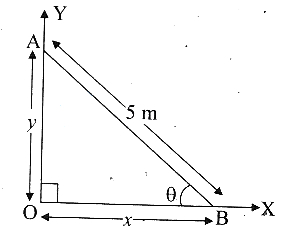
0 likesView Solution
80
MathematicsEasyMCQMHT CET · 2024
The approximate value of $\tan ^{-1}(0.999)$ is (use $\pi=3.1415$ )
A
$0.7843$
B
$0.7849$
C
$0.7847$
D
$0.7851$
Solution
(B) Let $f(x) = \tan^{-1} x$.
Then $f'(x) = \frac{1}{1+x^2}$.
We use the linear approximation formula $f(a+h) \approx f(a) + h f'(a)$.
Here,let $a = 1$ and $h = -0.001$,so $a+h = 0.999$.
$f(a) = \tan^{-1}(1) = \frac{\pi}{4}$.
$f'(a) = \frac{1}{1+1^2} = \frac{1}{2} = 0.5$.
Substituting these values:
$\tan^{-1}(0.999) \approx \frac{\pi}{4} + (-0.001)(0.5)$.
$\tan^{-1}(0.999) \approx \frac{3.1415}{4} - 0.0005$.
$\tan^{-1}(0.999) \approx 0.785375 - 0.0005$.
$\tan^{-1}(0.999) \approx 0.784875$.
Rounding to four decimal places,we get $0.7849$.
Then $f'(x) = \frac{1}{1+x^2}$.
We use the linear approximation formula $f(a+h) \approx f(a) + h f'(a)$.
Here,let $a = 1$ and $h = -0.001$,so $a+h = 0.999$.
$f(a) = \tan^{-1}(1) = \frac{\pi}{4}$.
$f'(a) = \frac{1}{1+1^2} = \frac{1}{2} = 0.5$.
Substituting these values:
$\tan^{-1}(0.999) \approx \frac{\pi}{4} + (-0.001)(0.5)$.
$\tan^{-1}(0.999) \approx \frac{3.1415}{4} - 0.0005$.
$\tan^{-1}(0.999) \approx 0.785375 - 0.0005$.
$\tan^{-1}(0.999) \approx 0.784875$.
Rounding to four decimal places,we get $0.7849$.
0 likesView Solution
81
MathematicsMediumMCQMHT CET · 2024
The population of a town increases at a rate proportional to the population at that time. If the population increases from $40,000$ to $80,000$ in $40$ years,then the population in another $40$ years will be (in $,000$)
A
$180$
B
$128$
C
$160$
D
$256$
Solution
(C) Let $p$ be the population at time $t$ years.
Given that the rate of change of population is proportional to the population:
$\frac{dp}{dt} = kp$
$\Rightarrow \frac{dp}{p} = k dt$
Integrating both sides,we get:
$\log p = kt + c$
At $t = 0$,$p = 40,000$:
$\log 40,000 = k(0) + c \Rightarrow c = \log 40,000$
So,$\log p = kt + \log 40,000 \Rightarrow \log \left(\frac{p}{40,000}\right) = kt$
At $t = 40$ years,$p = 80,000$:
$\log \left(\frac{80,000}{40,000}\right) = 40k \Rightarrow \log 2 = 40k \Rightarrow k = \frac{\log 2}{40}$
We need to find the population after another $40$ years,i.e.,at $t = 80$ years:
$\log \left(\frac{p}{40,000}\right) = \left(\frac{\log 2}{40}\right) \times 80$
$\log \left(\frac{p}{40,000}\right) = 2 \log 2 = \log 2^2 = \log 4$
$\frac{p}{40,000} = 4$
$p = 4 \times 40,000 = 160,000$
Given that the rate of change of population is proportional to the population:
$\frac{dp}{dt} = kp$
$\Rightarrow \frac{dp}{p} = k dt$
Integrating both sides,we get:
$\log p = kt + c$
At $t = 0$,$p = 40,000$:
$\log 40,000 = k(0) + c \Rightarrow c = \log 40,000$
So,$\log p = kt + \log 40,000 \Rightarrow \log \left(\frac{p}{40,000}\right) = kt$
At $t = 40$ years,$p = 80,000$:
$\log \left(\frac{80,000}{40,000}\right) = 40k \Rightarrow \log 2 = 40k \Rightarrow k = \frac{\log 2}{40}$
We need to find the population after another $40$ years,i.e.,at $t = 80$ years:
$\log \left(\frac{p}{40,000}\right) = \left(\frac{\log 2}{40}\right) \times 80$
$\log \left(\frac{p}{40,000}\right) = 2 \log 2 = \log 2^2 = \log 4$
$\frac{p}{40,000} = 4$
$p = 4 \times 40,000 = 160,000$
0 likesView Solution
82
MathematicsEasyMCQMHT CET · 2024
The approximate value of $(3.978)^{3/2}$ is
A
$7.096$
B
$8.096$
C
$7.934$
D
$8.934$
Solution
(C) Let $f(x) = x^{3/2}$.
Then,$f'(x) = \frac{3}{2} x^{1/2}$.
We can write $3.978$ as $a + h$,where $a = 4$ and $h = -0.022$.
Using the linear approximation formula $f(a + h) \approx f(a) + h \cdot f'(a)$:
$f(4) = 4^{3/2} = 8$.
$f'(4) = \frac{3}{2} \cdot (4)^{1/2} = \frac{3}{2} \cdot 2 = 3$.
Therefore,$f(3.978) \approx 8 + (-0.022) \cdot 3$.
$f(3.978) \approx 8 - 0.066$.
$f(3.978) \approx 7.934$.
Then,$f'(x) = \frac{3}{2} x^{1/2}$.
We can write $3.978$ as $a + h$,where $a = 4$ and $h = -0.022$.
Using the linear approximation formula $f(a + h) \approx f(a) + h \cdot f'(a)$:
$f(4) = 4^{3/2} = 8$.
$f'(4) = \frac{3}{2} \cdot (4)^{1/2} = \frac{3}{2} \cdot 2 = 3$.
Therefore,$f(3.978) \approx 8 + (-0.022) \cdot 3$.
$f(3.978) \approx 8 - 0.066$.
$f(3.978) \approx 7.934$.
0 likesView Solution
83
MathematicsEasyMCQMHT CET · 2024
$A$ square plate is contracting at the uniform rate $3 \,cm^2 / sec$. The rate at which the perimeter is decreasing, when the side of the square is $15 \,cm$, is
A
$\frac{1}{5} \,cm / sec$
B
$\frac{2}{5} \,cm / sec$
C
$\frac{1}{10} \,cm / sec$
D
$\frac{3}{10} \,cm / sec$
Solution
(B) Let $A$, $P$, and $X$ be the area, perimeter, and length of the side of the square respectively at time $t$ seconds.
Given that the area is contracting at a rate of $\frac{dA}{dt} = -3 \,cm^2 / sec$.
The area of the square is $A = X^2$ and the perimeter is $P = 4X$.
From $A = X^2$, we have $X = \sqrt{A}$.
Substituting this into the perimeter formula: $P = 4\sqrt{A}$.
Differentiating with respect to $t$:
$\frac{dP}{dt} = 4 \cdot \frac{1}{2\sqrt{A}} \cdot \frac{dA}{dt} = \frac{2}{X} \cdot \frac{dA}{dt}$.
Given $X = 15 \,cm$ and $\frac{dA}{dt} = -3 \,cm^2 / sec$ (since it is contracting):
$\frac{dP}{dt} = \frac{2}{15} \cdot (-3) = -\frac{6}{15} = -\frac{2}{5} \,cm / sec$.
The negative sign indicates that the perimeter is decreasing at a rate of $\frac{2}{5} \,cm / sec$.
Given that the area is contracting at a rate of $\frac{dA}{dt} = -3 \,cm^2 / sec$.
The area of the square is $A = X^2$ and the perimeter is $P = 4X$.
From $A = X^2$, we have $X = \sqrt{A}$.
Substituting this into the perimeter formula: $P = 4\sqrt{A}$.
Differentiating with respect to $t$:
$\frac{dP}{dt} = 4 \cdot \frac{1}{2\sqrt{A}} \cdot \frac{dA}{dt} = \frac{2}{X} \cdot \frac{dA}{dt}$.
Given $X = 15 \,cm$ and $\frac{dA}{dt} = -3 \,cm^2 / sec$ (since it is contracting):
$\frac{dP}{dt} = \frac{2}{15} \cdot (-3) = -\frac{6}{15} = -\frac{2}{5} \,cm / sec$.
The negative sign indicates that the perimeter is decreasing at a rate of $\frac{2}{5} \,cm / sec$.
0 likesView Solution
84
MathematicsMediumMCQMHT CET · 2024
The approximate value of $x^3-2x^2+3x+2$ at $x=2.01$ is
A
$8.07$
B
$8.27$
C
$8.007$
D
$8.17$
Solution
(A) Let $f(x) = x^3-2x^2+3x+2$.
We need to find the approximate value at $x = 2.01$.
Let $a = 2$ and $h = 0.01$,so $x = a+h = 2.01$.
The derivative is $f'(x) = 3x^2-4x+3$.
Calculating $f(a)$ at $a = 2$:
$f(2) = (2)^3-2(2)^2+3(2)+2 = 8-8+6+2 = 8$.
Calculating $f'(a)$ at $a = 2$:
$f'(2) = 3(2)^2-4(2)+3 = 12-8+3 = 7$.
Using the linear approximation formula $f(a+h) \approx f(a) + h \cdot f'(a)$:
$f(2.01) \approx 8 + (0.01)(7) = 8 + 0.07 = 8.07$.
We need to find the approximate value at $x = 2.01$.
Let $a = 2$ and $h = 0.01$,so $x = a+h = 2.01$.
The derivative is $f'(x) = 3x^2-4x+3$.
Calculating $f(a)$ at $a = 2$:
$f(2) = (2)^3-2(2)^2+3(2)+2 = 8-8+6+2 = 8$.
Calculating $f'(a)$ at $a = 2$:
$f'(2) = 3(2)^2-4(2)+3 = 12-8+3 = 7$.
Using the linear approximation formula $f(a+h) \approx f(a) + h \cdot f'(a)$:
$f(2.01) \approx 8 + (0.01)(7) = 8 + 0.07 = 8.07$.
0 likesView Solution
85
MathematicsDifficultMCQMHT CET · 2024
$A$ point moves along the arc of the parabola $y = 2x^2$. Its abscissa increases uniformly at the rate of $2 \text{ units/sec}$. At the instant the point is passing through $(1, 2)$,its distance from the origin is increasing at the rate of
A
$\frac{36}{\sqrt{5}} \text{ units/sec}$
B
$\frac{18}{\sqrt{5}} \text{ units/sec}$
C
$\frac{36}{5} \text{ units/sec}$
D
$\frac{18}{5} \text{ units/sec}$
Solution
(B) Given,$\frac{dx}{dt} = 2 \text{ units/sec}$.
Given equation of the parabola is $y = 2x^2$.
Differentiating with respect to $t$,we get $\frac{dy}{dt} = 4x \cdot \frac{dx}{dt}$.
Substituting $\frac{dx}{dt} = 2$,we get $\frac{dy}{dt} = 4x(2) = 8x$ ... $(i)$.
Let $r$ be the distance of the point $(x, y)$ from the origin $(0, 0)$,so $r = \sqrt{x^2 + y^2}$.
The rate of change of distance is $\frac{dr}{dt} = \frac{1}{2\sqrt{x^2 + y^2}} \cdot \frac{d}{dt}(x^2 + y^2) = \frac{2x \frac{dx}{dt} + 2y \frac{dy}{dt}}{2\sqrt{x^2 + y^2}} = \frac{x \frac{dx}{dt} + y \frac{dy}{dt}}{\sqrt{x^2 + y^2}}$.
Substituting $\frac{dx}{dt} = 2$ and $\frac{dy}{dt} = 8x$,we get $\frac{dr}{dt} = \frac{x(2) + y(8x)}{\sqrt{x^2 + y^2}} = \frac{2x + 8xy}{\sqrt{x^2 + y^2}}$.
At the point $(1, 2)$,$x = 1$ and $y = 2$.
$\frac{dr}{dt} = \frac{2(1) + 8(1)(2)}{\sqrt{1^2 + 2^2}} = \frac{2 + 16}{\sqrt{1 + 4}} = \frac{18}{\sqrt{5}} \text{ units/sec}$.
Given equation of the parabola is $y = 2x^2$.
Differentiating with respect to $t$,we get $\frac{dy}{dt} = 4x \cdot \frac{dx}{dt}$.
Substituting $\frac{dx}{dt} = 2$,we get $\frac{dy}{dt} = 4x(2) = 8x$ ... $(i)$.
Let $r$ be the distance of the point $(x, y)$ from the origin $(0, 0)$,so $r = \sqrt{x^2 + y^2}$.
The rate of change of distance is $\frac{dr}{dt} = \frac{1}{2\sqrt{x^2 + y^2}} \cdot \frac{d}{dt}(x^2 + y^2) = \frac{2x \frac{dx}{dt} + 2y \frac{dy}{dt}}{2\sqrt{x^2 + y^2}} = \frac{x \frac{dx}{dt} + y \frac{dy}{dt}}{\sqrt{x^2 + y^2}}$.
Substituting $\frac{dx}{dt} = 2$ and $\frac{dy}{dt} = 8x$,we get $\frac{dr}{dt} = \frac{x(2) + y(8x)}{\sqrt{x^2 + y^2}} = \frac{2x + 8xy}{\sqrt{x^2 + y^2}}$.
At the point $(1, 2)$,$x = 1$ and $y = 2$.
$\frac{dr}{dt} = \frac{2(1) + 8(1)(2)}{\sqrt{1^2 + 2^2}} = \frac{2 + 16}{\sqrt{1 + 4}} = \frac{18}{\sqrt{5}} \text{ units/sec}$.
0 likesView Solution
86
MathematicsMediumMCQMHT CET · 2024
Water is running into a hemispherical bowl of radius $180 \text{ cm}$ at the rate of $108 \text{ dm}^3/\text{min}$. How fast is the water level rising when the depth of the water in the bowl is $120 \text{ cm}$? $(1 \text{ dm} = 10 \text{ cm})$
A
$16 \pi \text{ cm/s}$
B
$\frac{16}{\pi} \text{ cm/s}$
C
$\frac{1}{16 \pi} \text{ cm/s}$
D
$\frac{\pi}{16} \text{ cm/s}$
Solution
(C) Radius of the hemispherical bowl $R = 180 \text{ cm}$.
Rate of flow of water $\frac{dV}{dt} = 108 \text{ dm}^3/\text{min} = 108 \times 1000 \text{ cm}^3/\text{min} = 108000 \text{ cm}^3/\text{min}$.
Converting to seconds: $\frac{dV}{dt} = \frac{108000}{60} \text{ cm}^3/\text{s} = 1800 \text{ cm}^3/\text{s}$.
Let the depth of water be $x$. The volume of water in a hemispherical bowl is given by $V = \frac{\pi}{3} x^2(3R - x)$.
Substituting $R = 180$: $V = \frac{\pi}{3} x^2(540 - x) = 180 \pi x^2 - \frac{\pi}{3} x^3$.
Differentiating with respect to time $t$: $\frac{dV}{dt} = (360 \pi x - \pi x^2) \frac{dx}{dt}$.
At $x = 120 \text{ cm}$,we have $1800 = (360 \pi(120) - \pi(120)^2) \frac{dx}{dt}$.
$1800 = (43200 \pi - 14400 \pi) \frac{dx}{dt} = 28800 \pi \frac{dx}{dt}$.
$\frac{dx}{dt} = \frac{1800}{28800 \pi} = \frac{18}{288 \pi} = \frac{1}{16 \pi} \text{ cm/s}$.
Rate of flow of water $\frac{dV}{dt} = 108 \text{ dm}^3/\text{min} = 108 \times 1000 \text{ cm}^3/\text{min} = 108000 \text{ cm}^3/\text{min}$.
Converting to seconds: $\frac{dV}{dt} = \frac{108000}{60} \text{ cm}^3/\text{s} = 1800 \text{ cm}^3/\text{s}$.
Let the depth of water be $x$. The volume of water in a hemispherical bowl is given by $V = \frac{\pi}{3} x^2(3R - x)$.
Substituting $R = 180$: $V = \frac{\pi}{3} x^2(540 - x) = 180 \pi x^2 - \frac{\pi}{3} x^3$.
Differentiating with respect to time $t$: $\frac{dV}{dt} = (360 \pi x - \pi x^2) \frac{dx}{dt}$.
At $x = 120 \text{ cm}$,we have $1800 = (360 \pi(120) - \pi(120)^2) \frac{dx}{dt}$.
$1800 = (43200 \pi - 14400 \pi) \frac{dx}{dt} = 28800 \pi \frac{dx}{dt}$.
$\frac{dx}{dt} = \frac{1800}{28800 \pi} = \frac{18}{288 \pi} = \frac{1}{16 \pi} \text{ cm/s}$.
0 likesView Solution
87
MathematicsEasyMCQMHT CET · 2024
The volume of a ball is increasing at the rate of $4 \pi \text{ cc/sec}$. The rate of increase of the radius,when the volume is $288 \pi \text{ cc}$,is
A
$\frac{1}{6} \text{ cm/sec}$
B
$\frac{1}{36} \text{ cm/sec}$
C
$6 \text{ cm/sec}$
D
$36 \text{ cm/sec}$
Solution
(B) Given,the volume of a ball $V = \frac{4}{3} \pi r^3$.
When $V = 288 \pi$,we have:
$288 \pi = \frac{4}{3} \pi r^3$
$r^3 = 288 \times \frac{3}{4} = 216$
$r = 6 \text{ cm}$.
Now,differentiating $V$ with respect to $t$:
$\frac{dV}{dt} = 4 \pi r^2 \frac{dr}{dt}$
Given $\frac{dV}{dt} = 4 \pi \text{ cc/sec}$,substituting the values:
$4 \pi = 4 \pi (6)^2 \frac{dr}{dt}$
$1 = 36 \frac{dr}{dt}$
$\frac{dr}{dt} = \frac{1}{36} \text{ cm/sec}$.
When $V = 288 \pi$,we have:
$288 \pi = \frac{4}{3} \pi r^3$
$r^3 = 288 \times \frac{3}{4} = 216$
$r = 6 \text{ cm}$.
Now,differentiating $V$ with respect to $t$:
$\frac{dV}{dt} = 4 \pi r^2 \frac{dr}{dt}$
Given $\frac{dV}{dt} = 4 \pi \text{ cc/sec}$,substituting the values:
$4 \pi = 4 \pi (6)^2 \frac{dr}{dt}$
$1 = 36 \frac{dr}{dt}$
$\frac{dr}{dt} = \frac{1}{36} \text{ cm/sec}$.
0 likesView Solution
88
MathematicsEasyMCQMHT CET · 2024
The distance $s$ in meters covered by a body in $t$ seconds is given by $s = 3t^2 - 8t + 5$. The body will stop after
A
$1 \text{ sec}$
B
$\frac{3}{4} \text{ sec}$
C
$\frac{4}{3} \text{ sec}$
D
$4 \text{ sec}$
Solution
(C) The distance covered by the body is given by $s = 3t^2 - 8t + 5$.
To find the velocity $v$,we differentiate $s$ with respect to time $t$:
$v = \frac{ds}{dt} = \frac{d}{dt}(3t^2 - 8t + 5) = 6t - 8$.
The body stops when its velocity becomes zero,i.e.,$v = 0$.
Setting the velocity to zero: $6t - 8 = 0$.
Solving for $t$: $6t = 8 \Rightarrow t = \frac{8}{6} = \frac{4}{3} \text{ sec}$.
Therefore,the body will stop after $\frac{4}{3} \text{ sec}$.
To find the velocity $v$,we differentiate $s$ with respect to time $t$:
$v = \frac{ds}{dt} = \frac{d}{dt}(3t^2 - 8t + 5) = 6t - 8$.
The body stops when its velocity becomes zero,i.e.,$v = 0$.
Setting the velocity to zero: $6t - 8 = 0$.
Solving for $t$: $6t = 8 \Rightarrow t = \frac{8}{6} = \frac{4}{3} \text{ sec}$.
Therefore,the body will stop after $\frac{4}{3} \text{ sec}$.
0 likesView Solution
89
MathematicsEasyMCQMHT CET · 2024
The rate of change of the volume of a sphere with respect to its surface area,when its radius is $2 \text{ cm}$,is
A
$0.1 \text{ cm}^3 / \text{ cm}^2$
B
$\frac{1}{2} \text{ cm}^3 / \text{ cm}^2$
C
$1 \text{ cm}^3 / \text{ cm}^2$
D
$2 \text{ cm}^3 / \text{ cm}^2$
Solution
(C) Let the radius of the sphere be $r$.
Volume of the sphere $V = \frac{4}{3} \pi r^3$.
Surface area of the sphere $A = 4 \pi r^2$.
We need to find the rate of change of volume with respect to surface area,which is $\frac{dV}{dA}$.
Using the chain rule,$\frac{dV}{dA} = \frac{dV/dr}{dA/dr}$.
First,differentiate $V$ with respect to $r$: $\frac{dV}{dr} = \frac{d}{dr}(\frac{4}{3} \pi r^3) = 4 \pi r^2$.
Next,differentiate $A$ with respect to $r$: $\frac{dA}{dr} = \frac{d}{dr}(4 \pi r^2) = 8 \pi r$.
Now,calculate $\frac{dV}{dA} = \frac{4 \pi r^2}{8 \pi r} = \frac{r}{2}$.
Given the radius $r = 2 \text{ cm}$,substitute this value into the expression:
$\frac{dV}{dA} = \frac{2}{2} = 1 \text{ cm}^3 / \text{ cm}^2$.
Volume of the sphere $V = \frac{4}{3} \pi r^3$.
Surface area of the sphere $A = 4 \pi r^2$.
We need to find the rate of change of volume with respect to surface area,which is $\frac{dV}{dA}$.
Using the chain rule,$\frac{dV}{dA} = \frac{dV/dr}{dA/dr}$.
First,differentiate $V$ with respect to $r$: $\frac{dV}{dr} = \frac{d}{dr}(\frac{4}{3} \pi r^3) = 4 \pi r^2$.
Next,differentiate $A$ with respect to $r$: $\frac{dA}{dr} = \frac{d}{dr}(4 \pi r^2) = 8 \pi r$.
Now,calculate $\frac{dV}{dA} = \frac{4 \pi r^2}{8 \pi r} = \frac{r}{2}$.
Given the radius $r = 2 \text{ cm}$,substitute this value into the expression:
$\frac{dV}{dA} = \frac{2}{2} = 1 \text{ cm}^3 / \text{ cm}^2$.
0 likesView Solution
90
MathematicsEasyMCQMHT CET · 2024
The approximate value of $(3.978)^{\frac{3}{2}}$ is
A
$7.934$
B
$8.934$
C
$7.022$
D
$8.866$
Solution
(A) Let $f(x) = x^{\frac{3}{2}}$.
Then,$f'(x) = \frac{3}{2} x^{\frac{1}{2}}$.
Using the linear approximation formula $f(a+h) \approx f(a) + h \cdot f'(a)$,where $a = 4$ and $h = -0.022$:
$f(4 - 0.022) \approx f(4) + (-0.022) \cdot f'(4)$.
$f(4) = 4^{\frac{3}{2}} = (2^2)^{\frac{3}{2}} = 2^3 = 8$.
$f'(4) = \frac{3}{2} \cdot 4^{\frac{1}{2}} = \frac{3}{2} \cdot 2 = 3$.
Therefore,$f(3.978) \approx 8 + (-0.022) \cdot 3$.
$f(3.978) \approx 8 - 0.066 = 7.934$.
Then,$f'(x) = \frac{3}{2} x^{\frac{1}{2}}$.
Using the linear approximation formula $f(a+h) \approx f(a) + h \cdot f'(a)$,where $a = 4$ and $h = -0.022$:
$f(4 - 0.022) \approx f(4) + (-0.022) \cdot f'(4)$.
$f(4) = 4^{\frac{3}{2}} = (2^2)^{\frac{3}{2}} = 2^3 = 8$.
$f'(4) = \frac{3}{2} \cdot 4^{\frac{1}{2}} = \frac{3}{2} \cdot 2 = 3$.
Therefore,$f(3.978) \approx 8 + (-0.022) \cdot 3$.
$f(3.978) \approx 8 - 0.066 = 7.934$.
0 likesView Solution
91
MathematicsEasyMCQMHT CET · 2024
The approximate value of $3^{2.001}$,given that $\log 3 = 1.0986$,is
A
$9.00898$
B
$9.0989$
C
$9.0898$
D
$9.00989$
Solution
(D) Let $f(x) = 3^x$.
Then,the derivative is $f'(x) = 3^x \log 3$.
We need to find the value of $f(2.001)$.
Here,$a = 2$ and $h = 0.001$.
Using the linear approximation formula $f(a+h) \approx f(a) + h f'(a)$:
$f(2.001) \approx f(2) + (0.001) f'(2)$.
Substituting the values:
$f(2.001) \approx 3^2 + (0.001)(3^2 \log 3)$.
Given $\log 3 = 1.0986$:
$f(2.001) \approx 9 + (0.001)(9 \times 1.0986)$.
$f(2.001) \approx 9 + (0.001)(9.8874)$.
$f(2.001) \approx 9 + 0.0098874$.
Rounding to the given options,we get $9.00989$.
Then,the derivative is $f'(x) = 3^x \log 3$.
We need to find the value of $f(2.001)$.
Here,$a = 2$ and $h = 0.001$.
Using the linear approximation formula $f(a+h) \approx f(a) + h f'(a)$:
$f(2.001) \approx f(2) + (0.001) f'(2)$.
Substituting the values:
$f(2.001) \approx 3^2 + (0.001)(3^2 \log 3)$.
Given $\log 3 = 1.0986$:
$f(2.001) \approx 9 + (0.001)(9 \times 1.0986)$.
$f(2.001) \approx 9 + (0.001)(9.8874)$.
$f(2.001) \approx 9 + 0.0098874$.
Rounding to the given options,we get $9.00989$.
0 likesView Solution
92
MathematicsEasyMCQMHT CET · 2024
$A$ ladder $5 \ m$ in length is leaning against a wall. The bottom of the ladder is pulled along the ground away from the wall at the rate of $2 \ m/sec$. How fast is the height on the wall decreasing when the foot of the ladder is $4 \ m$ away from the wall?
A
$\frac{4}{3} \ m/sec$
B
$\frac{2}{3} \ m/sec$
C
$\frac{5}{3} \ m/sec$
D
$\frac{8}{3} \ m/sec$
Solution
(D) Let $x$ be the distance of the foot of the ladder from the wall and $y$ be the height of the top of the ladder on the wall.
Given that the length of the ladder is $5 \ m$,by the Pythagorean theorem,we have $x^2 + y^2 = 5^2 = 25$.
Differentiating both sides with respect to time $t$,we get:
$2x \frac{dx}{dt} + 2y \frac{dy}{dt} = 0$
$\frac{dy}{dt} = -\frac{x}{y} \frac{dx}{dt}$
Given $\frac{dx}{dt} = 2 \ m/sec$ and at the instant when $x = 4 \ m$,we have $y = \sqrt{25 - 4^2} = \sqrt{9} = 3 \ m$.
Substituting these values into the derivative equation:
$\frac{dy}{dt} = -\frac{4}{3} \times 2 = -\frac{8}{3} \ m/sec$.
The negative sign indicates that the height is decreasing.
Therefore,the height on the wall is decreasing at the rate of $\frac{8}{3} \ m/sec$.
Given that the length of the ladder is $5 \ m$,by the Pythagorean theorem,we have $x^2 + y^2 = 5^2 = 25$.
Differentiating both sides with respect to time $t$,we get:
$2x \frac{dx}{dt} + 2y \frac{dy}{dt} = 0$
$\frac{dy}{dt} = -\frac{x}{y} \frac{dx}{dt}$
Given $\frac{dx}{dt} = 2 \ m/sec$ and at the instant when $x = 4 \ m$,we have $y = \sqrt{25 - 4^2} = \sqrt{9} = 3 \ m$.
Substituting these values into the derivative equation:
$\frac{dy}{dt} = -\frac{4}{3} \times 2 = -\frac{8}{3} \ m/sec$.
The negative sign indicates that the height is decreasing.
Therefore,the height on the wall is decreasing at the rate of $\frac{8}{3} \ m/sec$.
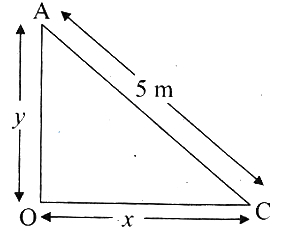
0 likesView Solution
93
MathematicsEasyMCQMHT CET · 2024
Twenty meters of wire is available for fencing off a flower-bed in the form of a circular sector. Then the maximum area (in $sq.m$) of the flowerbed is
A
$30$
B
$12.5$
C
$25$
D
$10$
Solution
(C) The perimeter of the circular sector is given by $P = r + r + r\theta = 2r + r\theta$.
Given that the total length of the wire is $20 \ m$,we have $2r + r\theta = 20$.
From this,we can express $\theta$ in terms of $r$: $\theta = \frac{20 - 2r}{r}$.
The area $A$ of a circular sector is given by $A = \frac{1}{2}r^2\theta$.
Substituting the expression for $\theta$: $A = \frac{1}{2}r^2 \left( \frac{20 - 2r}{r} \right) = \frac{1}{2}r(20 - 2r) = 10r - r^2$.
To find the maximum area,we differentiate $A$ with respect to $r$: $\frac{dA}{dr} = 10 - 2r$.
Setting $\frac{dA}{dr} = 0$,we get $10 - 2r = 0$,which implies $r = 5$.
To confirm this is a maximum,we check the second derivative: $\frac{d^2A}{dr^2} = -2$.
Since $\frac{d^2A}{dr^2} < 0$,the area is maximum at $r = 5$.
The maximum area is $A = 10(5) - (5)^2 = 50 - 25 = 25 \ sq.m$.
Given that the total length of the wire is $20 \ m$,we have $2r + r\theta = 20$.
From this,we can express $\theta$ in terms of $r$: $\theta = \frac{20 - 2r}{r}$.
The area $A$ of a circular sector is given by $A = \frac{1}{2}r^2\theta$.
Substituting the expression for $\theta$: $A = \frac{1}{2}r^2 \left( \frac{20 - 2r}{r} \right) = \frac{1}{2}r(20 - 2r) = 10r - r^2$.
To find the maximum area,we differentiate $A$ with respect to $r$: $\frac{dA}{dr} = 10 - 2r$.
Setting $\frac{dA}{dr} = 0$,we get $10 - 2r = 0$,which implies $r = 5$.
To confirm this is a maximum,we check the second derivative: $\frac{d^2A}{dr^2} = -2$.
Since $\frac{d^2A}{dr^2} < 0$,the area is maximum at $r = 5$.
The maximum area is $A = 10(5) - (5)^2 = 50 - 25 = 25 \ sq.m$.
0 likesView Solution
94
MathematicsEasyMCQMHT CET · 2024
Water is being poured at the rate of $36 \ m^3/min$ into a cylindrical vessel,whose circular base has a radius of $3 \ m$. The rate at which the water level in the cylinder is rising is:
A
$4 \pi \ m/min$
B
$\frac{4}{\pi} \ m/min$
C
$\frac{1}{4 \pi} \ m/min$
D
$\frac{\pi}{4} \ m/min$
Solution
(B) Given that the rate of change of volume is $\frac{dV}{dt} = 36 \ m^3/min$ and the radius of the base is $r = 3 \ m$.
The volume of a cylinder is given by $V = \pi r^2 h$.
Differentiating both sides with respect to time $t$,we get $\frac{dV}{dt} = \pi r^2 \frac{dh}{dt}$.
Substituting the given values,$36 = \pi \times (3)^2 \times \frac{dh}{dt}$.
$36 = 9 \pi \times \frac{dh}{dt}$.
Therefore,$\frac{dh}{dt} = \frac{36}{9 \pi} = \frac{4}{\pi} \ m/min$.
The volume of a cylinder is given by $V = \pi r^2 h$.
Differentiating both sides with respect to time $t$,we get $\frac{dV}{dt} = \pi r^2 \frac{dh}{dt}$.
Substituting the given values,$36 = \pi \times (3)^2 \times \frac{dh}{dt}$.
$36 = 9 \pi \times \frac{dh}{dt}$.
Therefore,$\frac{dh}{dt} = \frac{36}{9 \pi} = \frac{4}{\pi} \ m/min$.
0 likesView Solution
95
MathematicsEasyMCQMHT CET · 2024
The rate of change of the volume of a sphere with respect to its surface area,when its radius is $2 \text{ cm}$,is . . . . . . $\text{cm}^3 / \text{cm}^2$.
A
$0.1$
B
$0.5$
C
$1$
D
$2$
Solution
(C) Volume of a sphere $(V) = \frac{4}{3} \pi r^3$.
Surface area of a sphere $(A) = 4 \pi r^2$.
Differentiating both with respect to $r$:
$\frac{dV}{dr} = 4 \pi r^2$ and $\frac{dA}{dr} = 8 \pi r$.
We need to find the rate of change of volume with respect to surface area,which is $\frac{dV}{dA}$.
Using the chain rule: $\frac{dV}{dA} = \frac{dV/dr}{dA/dr} = \frac{4 \pi r^2}{8 \pi r} = \frac{r}{2}$.
Given the radius $r = 2 \text{ cm}$,we substitute this value:
$\frac{dV}{dA} = \frac{2}{2} = 1 \text{ cm}^3 / \text{cm}^2$.
Surface area of a sphere $(A) = 4 \pi r^2$.
Differentiating both with respect to $r$:
$\frac{dV}{dr} = 4 \pi r^2$ and $\frac{dA}{dr} = 8 \pi r$.
We need to find the rate of change of volume with respect to surface area,which is $\frac{dV}{dA}$.
Using the chain rule: $\frac{dV}{dA} = \frac{dV/dr}{dA/dr} = \frac{4 \pi r^2}{8 \pi r} = \frac{r}{2}$.
Given the radius $r = 2 \text{ cm}$,we substitute this value:
$\frac{dV}{dA} = \frac{2}{2} = 1 \text{ cm}^3 / \text{cm}^2$.
0 likesView Solution
96
MathematicsEasyMCQMHT CET · 2024
The minimum value of the function $f(x) = 2 x^3 - 15 x^2 + 36 x - 48$ on the set $A = \{x \mid x^2 + 20 \le 9 x\}$ is
A
$-16$
B
$-7$
C
$16$
D
$7$
Solution
(A) First,determine the set $A$ by solving the inequality $x^2 + 20 \le 9 x$.
$x^2 - 9 x + 20 \le 0$
$(x - 4)(x - 5) \le 0$
Thus,$A = [4, 5]$.
Next,analyze the function $f(x) = 2 x^3 - 15 x^2 + 36 x - 48$.
Find the derivative: $f'(x) = 6 x^2 - 30 x + 36 = 6(x^2 - 5 x + 6) = 6(x - 2)(x - 3)$.
For $x \in [4, 5]$,both $(x - 2)$ and $(x - 3)$ are positive,so $f'(x) > 0$.
Since $f'(x) > 0$ on the interval $[4, 5]$,the function $f(x)$ is strictly increasing on $A = [4, 5]$.
The minimum value occurs at the left endpoint $x = 4$.
$f(4) = 2(4)^3 - 15(4)^2 + 36(4) - 48 = 2(64) - 15(16) + 144 - 48 = 128 - 240 + 144 - 48 = -16$.
$x^2 - 9 x + 20 \le 0$
$(x - 4)(x - 5) \le 0$
Thus,$A = [4, 5]$.
Next,analyze the function $f(x) = 2 x^3 - 15 x^2 + 36 x - 48$.
Find the derivative: $f'(x) = 6 x^2 - 30 x + 36 = 6(x^2 - 5 x + 6) = 6(x - 2)(x - 3)$.
For $x \in [4, 5]$,both $(x - 2)$ and $(x - 3)$ are positive,so $f'(x) > 0$.
Since $f'(x) > 0$ on the interval $[4, 5]$,the function $f(x)$ is strictly increasing on $A = [4, 5]$.
The minimum value occurs at the left endpoint $x = 4$.
$f(4) = 2(4)^3 - 15(4)^2 + 36(4) - 48 = 2(64) - 15(16) + 144 - 48 = 128 - 240 + 144 - 48 = -16$.
0 likesView Solution
97
MathematicsMediumMCQMHT CET · 2024
If $f(x) = x^3 + bx^2 + cx + d$ and $0 < b^2 < c$,then in $(-\infty, \infty)$:
A
$f(x)$ is a strictly increasing function
B
$f(x)$ is bounded
C
$f(x)$ has a local maxima
D
$f(x)$ is a strictly decreasing function
Solution
(A) Given $f(x) = x^3 + bx^2 + cx + d$.
Taking the derivative with respect to $x$,we get $f'(x) = 3x^2 + 2bx + c$.
For $f(x)$ to be strictly increasing,we need $f'(x) > 0$ for all $x \in \mathbb{R}$.
The discriminant of the quadratic $f'(x)$ is $D = (2b)^2 - 4(3)(c) = 4b^2 - 12c$.
Since $b^2 < c$,we have $4b^2 < 4c$.
Thus,$D = 4b^2 - 12c < 4c - 12c = -8c$.
Since $0 < b^2 < c$,it implies $c > 0$. Therefore,$D < 0$.
Since the leading coefficient of $f'(x)$ is $3 > 0$ and $D < 0$,$f'(x) > 0$ for all $x \in \mathbb{R}$.
Hence,$f(x)$ is a strictly increasing function on $(-\infty, \infty)$.
Taking the derivative with respect to $x$,we get $f'(x) = 3x^2 + 2bx + c$.
For $f(x)$ to be strictly increasing,we need $f'(x) > 0$ for all $x \in \mathbb{R}$.
The discriminant of the quadratic $f'(x)$ is $D = (2b)^2 - 4(3)(c) = 4b^2 - 12c$.
Since $b^2 < c$,we have $4b^2 < 4c$.
Thus,$D = 4b^2 - 12c < 4c - 12c = -8c$.
Since $0 < b^2 < c$,it implies $c > 0$. Therefore,$D < 0$.
Since the leading coefficient of $f'(x)$ is $3 > 0$ and $D < 0$,$f'(x) > 0$ for all $x \in \mathbb{R}$.
Hence,$f(x)$ is a strictly increasing function on $(-\infty, \infty)$.
0 likesView Solution
98
MathematicsMediumMCQMHT CET · 2024
The function $f(x) = \frac{\ln(\pi+x)}{\ln(e+x)}$ is
A
increasing on $(0, \infty)$.
B
increasing on $(0, \frac{\pi}{e})$,decreasing on $(\frac{\pi}{e}, \infty)$.
C
decreasing on $(0, \infty)$.
D
decreasing on $(0, \frac{\pi}{e})$,increasing on $(\frac{\pi}{e}, \infty)$.
Solution
(C) Let $f(x) = \frac{\ln(\pi+x)}{\ln(e+x)}$.
Using the quotient rule,$f'(x) = \frac{\ln(e+x) \cdot \frac{1}{\pi+x} - \ln(\pi+x) \cdot \frac{1}{e+x}}{[\ln(e+x)]^2}$.
Simplifying the numerator,we get $f'(x) = \frac{(e+x)\ln(e+x) - (\pi+x)\ln(\pi+x)}{(\pi+x)(e+x)[\ln(e+x)]^2}$.
Consider the function $g(t) = t \ln(t)$. Its derivative is $g'(t) = 1 + \ln(t)$. For $t > 1$,$g'(t) > 0$,so $g(t)$ is an increasing function.
Since $\pi > e > 1$,for $x > 0$,we have $\pi+x > e+x > e > 1$.
Because $g(t)$ is increasing,$g(\pi+x) > g(e+x)$,which implies $(\pi+x)\ln(\pi+x) > (e+x)\ln(e+x)$.
Therefore,$(e+x)\ln(e+x) - (\pi+x)\ln(\pi+x) < 0$.
Since the denominator is always positive for $x > 0$,$f'(x) < 0$ for all $x \in (0, \infty)$.
Thus,$f(x)$ is decreasing on $(0, \infty)$.
Using the quotient rule,$f'(x) = \frac{\ln(e+x) \cdot \frac{1}{\pi+x} - \ln(\pi+x) \cdot \frac{1}{e+x}}{[\ln(e+x)]^2}$.
Simplifying the numerator,we get $f'(x) = \frac{(e+x)\ln(e+x) - (\pi+x)\ln(\pi+x)}{(\pi+x)(e+x)[\ln(e+x)]^2}$.
Consider the function $g(t) = t \ln(t)$. Its derivative is $g'(t) = 1 + \ln(t)$. For $t > 1$,$g'(t) > 0$,so $g(t)$ is an increasing function.
Since $\pi > e > 1$,for $x > 0$,we have $\pi+x > e+x > e > 1$.
Because $g(t)$ is increasing,$g(\pi+x) > g(e+x)$,which implies $(\pi+x)\ln(\pi+x) > (e+x)\ln(e+x)$.
Therefore,$(e+x)\ln(e+x) - (\pi+x)\ln(\pi+x) < 0$.
Since the denominator is always positive for $x > 0$,$f'(x) < 0$ for all $x \in (0, \infty)$.
Thus,$f(x)$ is decreasing on $(0, \infty)$.
0 likesView Solution
99
MathematicsEasyMCQMHT CET · 2024
If $f(x) = \frac{\log x}{x}$ $(x > 0)$,then it is increasing in
A
$(0, e)$
B
$(e, \infty)$
C
$(0, \infty)$
D
$(-\infty, \infty)$
Solution
(A) Given the function $f(x) = \frac{\log x}{x}$.
To determine where the function is increasing,we find its derivative $f'(x)$ using the quotient rule:
$f'(x) = \frac{x \cdot \frac{d}{dx}(\log x) - \log x \cdot \frac{d}{dx}(x)}{x^2} = \frac{x \cdot \frac{1}{x} - \log x \cdot 1}{x^2} = \frac{1 - \log x}{x^2}$.
For the function to be increasing,we require $f'(x) > 0$.
Since $x^2 > 0$ for all $x > 0$,the condition $f'(x) > 0$ implies $1 - \log x > 0$.
This simplifies to $1 > \log x$,which means $\log x < 1$.
Taking the exponential of both sides,we get $x < e^1$,or $x < e$.
Given the domain $x > 0$,the function is increasing in the interval $(0, e)$.
To determine where the function is increasing,we find its derivative $f'(x)$ using the quotient rule:
$f'(x) = \frac{x \cdot \frac{d}{dx}(\log x) - \log x \cdot \frac{d}{dx}(x)}{x^2} = \frac{x \cdot \frac{1}{x} - \log x \cdot 1}{x^2} = \frac{1 - \log x}{x^2}$.
For the function to be increasing,we require $f'(x) > 0$.
Since $x^2 > 0$ for all $x > 0$,the condition $f'(x) > 0$ implies $1 - \log x > 0$.
This simplifies to $1 > \log x$,which means $\log x < 1$.
Taking the exponential of both sides,we get $x < e^1$,or $x < e$.
Given the domain $x > 0$,the function is increasing in the interval $(0, e)$.
0 likesView Solution
100
MathematicsEasyMCQMHT CET · 2024
The function $f(x) = 2x^3 - 6x + 5$ is an increasing function,if
A
$0 < x < 1$
B
$-1 < x < 1$
C
$x < -1$ or $x > 1$
D
$-1 < x < -\frac{1}{2}$
Solution
(C) Given the function $f(x) = 2x^3 - 6x + 5$.
To find the intervals where the function is increasing,we first find the derivative $f'(x)$.
$f'(x) = \frac{d}{dx}(2x^3 - 6x + 5) = 6x^2 - 6$.
$A$ function is increasing when $f'(x) > 0$.
So,$6x^2 - 6 > 0$.
Dividing by $6$,we get $x^2 - 1 > 0$,which factors as $(x - 1)(x + 1) > 0$.
Using the sign scheme for the inequality $(x - 1)(x + 1) > 0$,the expression is positive when $x > 1$ or $x < -1$.
Thus,the function is increasing for $x \in (-\infty, -1) \cup (1, \infty)$.
To find the intervals where the function is increasing,we first find the derivative $f'(x)$.
$f'(x) = \frac{d}{dx}(2x^3 - 6x + 5) = 6x^2 - 6$.
$A$ function is increasing when $f'(x) > 0$.
So,$6x^2 - 6 > 0$.
Dividing by $6$,we get $x^2 - 1 > 0$,which factors as $(x - 1)(x + 1) > 0$.
Using the sign scheme for the inequality $(x - 1)(x + 1) > 0$,the expression is positive when $x > 1$ or $x < -1$.
Thus,the function is increasing for $x \in (-\infty, -1) \cup (1, \infty)$.
0 likesView Solution
Vedclass Products
For Students
Vedclass Test Series
Mock tests in real MHT CET style covering Mathematics with performance analysis. 5-day free trial.
Start Free TrialFor Teachers
Exam Paper Generator
Generate Set A/B/C/D Mathematics papers from 7.5L+ questions in 2 minutes. 3 chapters free.
Try FreeFor Institutes
Online Exam Module
Run live MHT CET mock exams with unlimited students, 360° analytics & white-label branding.
See DemoFrequently Asked Questions
How many Mathematics questions are in MHT CET 2024?
There are 769 Mathematics questions from the MHT CET 2024 paper on Vedclass, each with a detailed step-by-step solution in English.
Are MHT CET 2024 Mathematics solutions available in English?
Yes. All solutions on this page are in English. You can also switch to English or Hindi using the language buttons above the questions.
Can I practice MHT CET 2024 Mathematics as a timed test?
Yes. Use the Vedclass Test Series to attempt a full MHT CET mock test covering Mathematics with time limits and instant score analysis.
Can teachers create Mathematics papers from MHT CET previous year questions?
Yes. The Vedclass Exam Paper Generator lets teachers mix MHT CET Mathematics questions and generate Set A/B/C/D papers in minutes.
For Teachers & Institutes
Build a Custom Mathematics Paper
Pick MHT CET 2024 Mathematics questions, set difficulty, and generate Set A/B/C/D in 2 minutes.