
ChemistryQ1–100 of 900 questions
Page 1 of 10 · English
1
ChemistryMCQMHT CET · 2024
The acceleration of a moving body can be found from
A
Area under velocity-time graph
B
Area under distance-time graph
C
Slope of the velocity-time graph
D
Slope of distance-time graph
Solution
(C) The acceleration $a$ of a moving body is defined as the rate of change of velocity with respect to time,which is given by $a = \frac{dv}{dt}$.
In a velocity-time graph,the slope of the curve at any point represents the rate of change of velocity with respect to time.
Therefore,the acceleration is equal to the slope of the velocity-time graph,which is calculated as $a = \tan \theta$,where $\theta$ is the angle that the tangent to the graph makes with the time axis.
In a velocity-time graph,the slope of the curve at any point represents the rate of change of velocity with respect to time.
Therefore,the acceleration is equal to the slope of the velocity-time graph,which is calculated as $a = \tan \theta$,where $\theta$ is the angle that the tangent to the graph makes with the time axis.
0 likesView Solution
2
ChemistryMCQMHT CET · 2024
The absolute temperature of a gas is determined by
A
The average momentum of the molecules
B
The velocity of sound in the gas
C
The number of molecules in the gas
D
The mean square velocity of the molecules
Solution
(D) The absolute temperature $T$ of an ideal gas is directly related to the kinetic energy of its molecules.
According to the kinetic theory of gases,the root mean square velocity $(v_{RMS})$ is given by $v_{RMS} = \sqrt{\frac{3RT}{M}}$,which implies $v_{RMS}^2 = \frac{3RT}{M}$.
Thus,the mean square velocity $(v_{RMS}^2)$ is directly proportional to the absolute temperature $T$.
Similarly,the velocity of sound in an ideal gas is given by $v_{sound} = \sqrt{\frac{\gamma RT}{M}}$,which also depends on the absolute temperature $T$.
However,in the context of the kinetic theory of gases,the mean square velocity is the fundamental property derived directly from the temperature definition.
Therefore,the mean square velocity is the standard measure used to determine the absolute temperature.
According to the kinetic theory of gases,the root mean square velocity $(v_{RMS})$ is given by $v_{RMS} = \sqrt{\frac{3RT}{M}}$,which implies $v_{RMS}^2 = \frac{3RT}{M}$.
Thus,the mean square velocity $(v_{RMS}^2)$ is directly proportional to the absolute temperature $T$.
Similarly,the velocity of sound in an ideal gas is given by $v_{sound} = \sqrt{\frac{\gamma RT}{M}}$,which also depends on the absolute temperature $T$.
However,in the context of the kinetic theory of gases,the mean square velocity is the fundamental property derived directly from the temperature definition.
Therefore,the mean square velocity is the standard measure used to determine the absolute temperature.
0 likesView Solution
3
ChemistryMCQMHT CET · 2024
The first operation involved in a Carnot cycle is
A
Isothermal expansion
B
Adiabatic expansion
C
Isothermal compression
D
Adiabatic compression
Solution
(A) The Carnot cycle consists of the following four reversible processes:
$1$. Reversible isothermal expansion: The gas expands at a constant high temperature $T_{high}$ by absorbing heat $Q_{in}$ from the source.
$2$. Reversible adiabatic expansion: The gas expands further without any heat exchange,causing the temperature to drop to $T_{low}$.
$3$. Reversible isothermal compression: The gas is compressed at a constant low temperature $T_{low}$ by rejecting heat $Q_{out}$ to the sink.
$4$. Reversible adiabatic compression: The gas is compressed further without heat exchange,returning the system to its initial state at temperature $T_{high}$.
Therefore,the first operation is isothermal expansion.
$1$. Reversible isothermal expansion: The gas expands at a constant high temperature $T_{high}$ by absorbing heat $Q_{in}$ from the source.
$2$. Reversible adiabatic expansion: The gas expands further without any heat exchange,causing the temperature to drop to $T_{low}$.
$3$. Reversible isothermal compression: The gas is compressed at a constant low temperature $T_{low}$ by rejecting heat $Q_{out}$ to the sink.
$4$. Reversible adiabatic compression: The gas is compressed further without heat exchange,returning the system to its initial state at temperature $T_{high}$.
Therefore,the first operation is isothermal expansion.
0 likesView Solution
4
ChemistryMCQMHT CET · 2024
The kinetic energy of a particle executing $S.H.M.$ is $16 \ J$ when it is in its mean position. If the amplitude of oscillations is $25 \ cm$ and the mass of the particle is $5.12 \ kg$,the time period of its oscillation is
A
$\frac{\pi}{5} \ s$
B
$2\pi \ s$
C
$20\pi \ s$
D
$5\pi \ s$
Solution
(A) At the mean position,the kinetic energy of a particle in $S.H.M.$ is maximum and is given by $K_{max} = \frac{1}{2} m \omega^2 A^2 = 16 \ J$.
Given: mass $m = 5.12 \ kg$,amplitude $A = 25 \ cm = 0.25 \ m = \frac{1}{4} \ m$.
Substituting the values: $\frac{1}{2} \times 5.12 \times \omega^2 \times (0.25)^2 = 16$.
$2.56 \times \omega^2 \times 0.0625 = 16$.
$0.16 \times \omega^2 = 16$.
$\omega^2 = \frac{16}{0.16} = 100$.
$\omega = 10 \ rad/s$.
The time period $T$ is given by $T = \frac{2\pi}{\omega} = \frac{2\pi}{10} = \frac{\pi}{5} \ s$.
Given: mass $m = 5.12 \ kg$,amplitude $A = 25 \ cm = 0.25 \ m = \frac{1}{4} \ m$.
Substituting the values: $\frac{1}{2} \times 5.12 \times \omega^2 \times (0.25)^2 = 16$.
$2.56 \times \omega^2 \times 0.0625 = 16$.
$0.16 \times \omega^2 = 16$.
$\omega^2 = \frac{16}{0.16} = 100$.
$\omega = 10 \ rad/s$.
The time period $T$ is given by $T = \frac{2\pi}{\omega} = \frac{2\pi}{10} = \frac{\pi}{5} \ s$.
0 likesView Solution
5
ChemistryMCQMHT CET · 2024
$A$ particle carrying a charge equal to $100$ times the charge on an electron is rotating per second in a circular path of radius $0.8 \ m$. The value of the magnetic field produced at the centre will be (where ${\mu _0}$ is the permeability of vacuum).
A
$\frac{{{{10}^{ - 7}}}}{{{\mu _0}}}$
B
${10^{ - 17}}{\mu _0}$
C
${10^{ - 6}}{\mu _0}$
D
${10^{ - 7}}{\mu _0}$
Solution
(B) The current $i$ produced by a rotating charge is given by $i = qf$,where $f$ is the frequency of rotation.
Given $f = 1 \text{ Hz}$ and $q = 100e = 100 \times 1.6 \times 10^{-19} \text{ C} = 1.6 \times 10^{-17} \text{ C}$.
Thus,$i = 1.6 \times 10^{-17} \text{ A}$.
The magnetic field at the centre of a circular loop is $B = \frac{\mu_0 i}{2r}$.
Substituting the values: $B = \frac{\mu_0 \times 1.6 \times 10^{-17}}{2 \times 0.8}$.
$B = \frac{\mu_0 \times 1.6 \times 10^{-17}}{1.6} = 10^{-17} \mu_0 \text{ T}$.
Given $f = 1 \text{ Hz}$ and $q = 100e = 100 \times 1.6 \times 10^{-19} \text{ C} = 1.6 \times 10^{-17} \text{ C}$.
Thus,$i = 1.6 \times 10^{-17} \text{ A}$.
The magnetic field at the centre of a circular loop is $B = \frac{\mu_0 i}{2r}$.
Substituting the values: $B = \frac{\mu_0 \times 1.6 \times 10^{-17}}{2 \times 0.8}$.
$B = \frac{\mu_0 \times 1.6 \times 10^{-17}}{1.6} = 10^{-17} \mu_0 \text{ T}$.
0 likesView Solution
6
ChemistryMCQMHT CET · 2024
$A$ closely wound coil of $100$ turns and area of cross-section $1 \; cm^2$ has a coefficient of self-induction $1 \; mH$. The magnetic induction in the centre of the core of the coil when a current of $2 \; A$ flows in it will be (in $Wb/m^2$):
A
$0.022$
B
$0.4$
C
$0.8$
D
$1$
Solution
(A) Given: Number of turns $N = 100$,Area $A = 1 \; cm^2 = 10^{-4} \; m^2$,Self-inductance $L = 1 \; mH = 10^{-3} \; H$,Current $I = 2 \; A$.
Formula for self-inductance of a solenoid: $L = \frac{\mu_0 N^2 A}{l}$,where $l$ is the length of the coil.
$10^{-3} = \frac{4\pi \times 10^{-7} \times (100)^2 \times 10^{-4}}{l} \implies l = \frac{4\pi \times 10^{-7} \times 10^4 \times 10^{-4}}{10^{-3}} = 4\pi \times 10^{-3} \; m$.
Magnetic field at the center of a solenoid: $B = \mu_0 n I = \mu_0 \frac{N}{l} I$.
$B = \frac{4\pi \times 10^{-7} \times 100 \times 2}{4\pi \times 10^{-3}} = \frac{8\pi \times 10^{-5}}{4\pi \times 10^{-3}} = 2 \times 10^{-2} = 0.02 \; Wb/m^2$.
Rounding to the nearest provided option,the answer is $0.022 \; Wb/m^2$.
Formula for self-inductance of a solenoid: $L = \frac{\mu_0 N^2 A}{l}$,where $l$ is the length of the coil.
$10^{-3} = \frac{4\pi \times 10^{-7} \times (100)^2 \times 10^{-4}}{l} \implies l = \frac{4\pi \times 10^{-7} \times 10^4 \times 10^{-4}}{10^{-3}} = 4\pi \times 10^{-3} \; m$.
Magnetic field at the center of a solenoid: $B = \mu_0 n I = \mu_0 \frac{N}{l} I$.
$B = \frac{4\pi \times 10^{-7} \times 100 \times 2}{4\pi \times 10^{-3}} = \frac{8\pi \times 10^{-5}}{4\pi \times 10^{-3}} = 2 \times 10^{-2} = 0.02 \; Wb/m^2$.
Rounding to the nearest provided option,the answer is $0.022 \; Wb/m^2$.
0 likesView Solution
7
ChemistryMCQMHT CET · 2024
In an $ac$ circuit $I = 100 \sin(200 \pi t)$. The time required for the current to achieve its peak value will be
A
$\frac{1}{100} \text{ s}$
B
$\frac{1}{200} \text{ s}$
C
$\frac{1}{300} \text{ s}$
D
$\frac{1}{400} \text{ s}$
Solution
(D) The given equation for current is $I = I_0 \sin(\omega t)$,where $I_0 = 100 \text{ A}$ and $\omega = 200 \pi \text{ rad/s}$.
To reach the peak value,the phase $\omega t$ must be equal to $\frac{\pi}{2}$.
So,$200 \pi t = \frac{\pi}{2}$.
Solving for $t$: $t = \frac{\pi}{2 \times 200 \pi} = \frac{1}{400} \text{ s}$.
Alternatively,the time taken to reach the peak value is $\frac{T}{4}$,where $T$ is the time period.
Since $\omega = \frac{2 \pi}{T} = 200 \pi$,we get $T = \frac{1}{100} \text{ s}$.
Therefore,$t = \frac{1}{4} \times \frac{1}{100} = \frac{1}{400} \text{ s}$.
To reach the peak value,the phase $\omega t$ must be equal to $\frac{\pi}{2}$.
So,$200 \pi t = \frac{\pi}{2}$.
Solving for $t$: $t = \frac{\pi}{2 \times 200 \pi} = \frac{1}{400} \text{ s}$.
Alternatively,the time taken to reach the peak value is $\frac{T}{4}$,where $T$ is the time period.
Since $\omega = \frac{2 \pi}{T} = 200 \pi$,we get $T = \frac{1}{100} \text{ s}$.
Therefore,$t = \frac{1}{4} \times \frac{1}{100} = \frac{1}{400} \text{ s}$.
0 likesView Solution
8
ChemistryMCQMHT CET · 2024
Which of the following statements about the Bohr model of the hydrogen atom is false?
A
Acceleration of electron in $n = 2$ orbit is less than that in $n = 1$ orbit.
B
Angular momentum of electron in $n = 2$ orbit is more than that in $n = 1$ orbit.
C
Kinetic energy of electron in $n = 2$ orbit is less than that in $n = 1$ orbit.
D
Potential energy of electron in $n = 2$ orbit is less than that in $n = 1$ orbit.
Solution
(D) In the Bohr model of the hydrogen atom,the potential energy is given by $U_n = -\frac{ke^2}{r_n}$. Since $r_n \propto n^2$,as $n$ increases,$r_n$ increases. Consequently,the magnitude of potential energy decreases,but because it is negative,the value becomes less negative (i.e.,it increases). Therefore,the potential energy in the $n = 2$ orbit is greater than that in the $n = 1$ orbit. Thus,statement $(d)$ is false.
0 likesView Solution
9
ChemistryMCQMHT CET · 2024
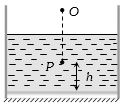
$A$ plane mirror is placed at the bottom of a tank containing a liquid of refractive index $\mu$. $P$ is a small object at a height $h$ above the mirror. An observer $O$,vertically above $P$ outside the liquid,sees $P$ and its image in the mirror. The apparent distance between these two will be
A
$2\mu h$
B
$\frac{2h}{\mu}$
C
$\frac{2h}{\mu - 1}$
D
$h(1 + \frac{1}{\mu})$
Solution
(B) The image formation by a mirror (either plane or spherical) does not depend on the medium.
The object $P$ is at a height $h$ above the mirror. Therefore,the image $P'$ of $P$ will be formed at a distance $h$ below the mirror.
Let $d$ be the depth of the liquid in the tank.
The distance of object $P$ from the surface of the liquid is $(d - h)$. The apparent depth of $P$ as seen by the observer $O$ is $x_1 = \frac{d - h}{\mu}$.
The distance of the image $P'$ from the surface of the liquid is $(d + h)$. The apparent depth of the image $P'$ as seen by the observer $O$ is $x_2 = \frac{d + h}{\mu}$.
The apparent distance between $P$ and its image is the difference between their apparent depths:
Apparent distance $= x_2 - x_1 = \frac{d + h}{\mu} - \frac{d - h}{\mu} = \frac{d + h - d + h}{\mu} = \frac{2h}{\mu}$.
The object $P$ is at a height $h$ above the mirror. Therefore,the image $P'$ of $P$ will be formed at a distance $h$ below the mirror.
Let $d$ be the depth of the liquid in the tank.
The distance of object $P$ from the surface of the liquid is $(d - h)$. The apparent depth of $P$ as seen by the observer $O$ is $x_1 = \frac{d - h}{\mu}$.
The distance of the image $P'$ from the surface of the liquid is $(d + h)$. The apparent depth of the image $P'$ as seen by the observer $O$ is $x_2 = \frac{d + h}{\mu}$.
The apparent distance between $P$ and its image is the difference between their apparent depths:
Apparent distance $= x_2 - x_1 = \frac{d + h}{\mu} - \frac{d - h}{\mu} = \frac{d + h - d + h}{\mu} = \frac{2h}{\mu}$.
0 likesView Solution
10
ChemistryMCQMHT CET · 2024
If $f(x) = x^3 - 10x^2 + 200x - 10$,then
A
$f(x)$ is decreasing in $(-\infty, 10]$ and increasing in $[10, \infty)$
B
$f(x)$ is increasing in $(-\infty, 10]$ and decreasing in $[10, \infty)$
C
$f(x)$ is increasing throughout the real line
D
$f(x)$ is decreasing throughout the real line
Solution
(C) Given $f(x) = x^3 - 10x^2 + 200x - 10$.
To determine the intervals of increase or decrease,we find the derivative $f'(x)$:
$f'(x) = 3x^2 - 20x + 200$.
For the function to be increasing,we require $f'(x) > 0$. Consider the quadratic expression $3x^2 - 20x + 200$.
The discriminant $D$ of this quadratic is $D = b^2 - 4ac = (-20)^2 - 4(3)(200) = 400 - 2400 = -2000$.
Since $D < 0$ and the coefficient of $x^2$ is positive $(3 > 0)$,the quadratic $3x^2 - 20x + 200$ is always positive for all real values of $x$.
Alternatively,by completing the square:
$f'(x) = 3(x^2 - \frac{20}{3}x) + 200 = 3(x^2 - \frac{20}{3}x + \frac{100}{9} - \frac{100}{9}) + 200 = 3(x - \frac{10}{3})^2 - \frac{100}{3} + 200 = 3(x - \frac{10}{3})^2 + \frac{500}{3}$.
Since $3(x - \frac{10}{3})^2 \ge 0$ for all $x \in \mathbb{R}$,it follows that $f'(x) \ge \frac{500}{3} > 0$ for all $x \in \mathbb{R}$.
Therefore,$f(x)$ is strictly increasing throughout the real line.
To determine the intervals of increase or decrease,we find the derivative $f'(x)$:
$f'(x) = 3x^2 - 20x + 200$.
For the function to be increasing,we require $f'(x) > 0$. Consider the quadratic expression $3x^2 - 20x + 200$.
The discriminant $D$ of this quadratic is $D = b^2 - 4ac = (-20)^2 - 4(3)(200) = 400 - 2400 = -2000$.
Since $D < 0$ and the coefficient of $x^2$ is positive $(3 > 0)$,the quadratic $3x^2 - 20x + 200$ is always positive for all real values of $x$.
Alternatively,by completing the square:
$f'(x) = 3(x^2 - \frac{20}{3}x) + 200 = 3(x^2 - \frac{20}{3}x + \frac{100}{9} - \frac{100}{9}) + 200 = 3(x - \frac{10}{3})^2 - \frac{100}{3} + 200 = 3(x - \frac{10}{3})^2 + \frac{500}{3}$.
Since $3(x - \frac{10}{3})^2 \ge 0$ for all $x \in \mathbb{R}$,it follows that $f'(x) \ge \frac{500}{3} > 0$ for all $x \in \mathbb{R}$.
Therefore,$f(x)$ is strictly increasing throughout the real line.
0 likesView Solution
11
ChemistryMCQMHT CET · 2024
If $p \Rightarrow (q \vee r)$ is false,then the truth values of $p, q, r$ are respectively
A
$T, F, F$
B
$F, F, F$
C
$F, T, T$
D
$T, T, F$
Solution
(A) The implication $p \Rightarrow S$ is false if and only if $p$ is $T$ and $S$ is $F$.
Here,$S = (q \vee r)$. For $(q \vee r)$ to be $F$,both $q$ and $r$ must be $F$.
Therefore,$p$ is $T$,$q$ is $F$,and $r$ is $F$.
The truth values are $T, F, F$ respectively.
Here,$S = (q \vee r)$. For $(q \vee r)$ to be $F$,both $q$ and $r$ must be $F$.
Therefore,$p$ is $T$,$q$ is $F$,and $r$ is $F$.
The truth values are $T, F, F$ respectively.
0 likesView Solution
12
ChemistryMCQMHT CET · 2024
Let $\vec{p}$ and $\vec{q}$ be the position vectors of points $P$ and $Q$ with respect to the origin $O$,and $|\vec{p}| = p$,$|\vec{q}| = q$. If points $R$ and $S$ divide the line segment $PQ$ internally and externally in the ratio $2:3$ respectively,and if $\vec{OR} \perp \vec{OS}$,then:
A
$9p^{2} = 4q^{2}$
B
$4p^{2} = 9q^{2}$
C
$9p = 4q$
D
$4p = 9q$
Solution
(A) The position vectors of $R$ and $S$ are given by the section formula.
For internal division in ratio $m:n = 2:3$,$\vec{OR} = \frac{n\vec{p} + m\vec{q}}{m+n} = \frac{3\vec{p} + 2\vec{q}}{5}$.
For external division in ratio $m:n = 2:3$,$\vec{OS} = \frac{n\vec{p} - m\vec{q}}{n-m} = \frac{3\vec{p} - 2\vec{q}}{3-2} = 3\vec{p} - 2\vec{q}$.
Given $\vec{OR} \perp \vec{OS}$,their dot product is zero: $\vec{OR} \cdot \vec{OS} = 0$.
$\left(\frac{3\vec{p} + 2\vec{q}}{5}\right) \cdot (3\vec{p} - 2\vec{q}) = 0$.
$9|\vec{p}|^2 - 6\vec{p}\cdot\vec{q} + 6\vec{q}\cdot\vec{p} - 4|\vec{q}|^2 = 0$.
$9p^2 - 4q^2 = 0$.
Therefore,$9p^2 = 4q^2$.
For internal division in ratio $m:n = 2:3$,$\vec{OR} = \frac{n\vec{p} + m\vec{q}}{m+n} = \frac{3\vec{p} + 2\vec{q}}{5}$.
For external division in ratio $m:n = 2:3$,$\vec{OS} = \frac{n\vec{p} - m\vec{q}}{n-m} = \frac{3\vec{p} - 2\vec{q}}{3-2} = 3\vec{p} - 2\vec{q}$.
Given $\vec{OR} \perp \vec{OS}$,their dot product is zero: $\vec{OR} \cdot \vec{OS} = 0$.
$\left(\frac{3\vec{p} + 2\vec{q}}{5}\right) \cdot (3\vec{p} - 2\vec{q}) = 0$.
$9|\vec{p}|^2 - 6\vec{p}\cdot\vec{q} + 6\vec{q}\cdot\vec{p} - 4|\vec{q}|^2 = 0$.
$9p^2 - 4q^2 = 0$.
Therefore,$9p^2 = 4q^2$.
0 likesView Solution
13
ChemistryMCQMHT CET · 2024
If $p \Rightarrow (q \vee r)$ is false,then the truth values of $p, q, r$ are respectively:
A
$T, F, F$
B
$T, T, F$
C
$F, F, F$
D
$F, T, T$
Solution
(A) The implication $p \Rightarrow S$ is false if and only if $p$ is $T$ and $S$ is $F$.
Here,$S = (q \vee r)$.
Since $p \Rightarrow (q \vee r)$ is false,$p$ must be $T$ and $(q \vee r)$ must be $F$.
The disjunction $(q \vee r)$ is false if and only if both $q$ and $r$ are $F$.
Therefore,$p = T$,$q = F$,and $r = F$.
Thus,the truth values are $T, F, F$.
Here,$S = (q \vee r)$.
Since $p \Rightarrow (q \vee r)$ is false,$p$ must be $T$ and $(q \vee r)$ must be $F$.
The disjunction $(q \vee r)$ is false if and only if both $q$ and $r$ are $F$.
Therefore,$p = T$,$q = F$,and $r = F$.
Thus,the truth values are $T, F, F$.
0 likesView Solution
14
ChemistryMCQMHT CET · 2024
Let $u = i + j$,$v = i - j$ and $w = i + 2j + 3k$. If $n$ is a unit vector such that $u \cdot n = 0$ and $v \cdot n = 0$,then $|w \cdot n|$ is equal to
A
$0$
B
$1$
C
$2$
D
$3$
Solution
(D) Given vectors are $u = i + j$ and $v = i - j$.
Since $n$ is a unit vector perpendicular to both $u$ and $v$,it must be parallel to the cross product $u \times v$.
First,calculate the cross product:
$u \times v = \begin{vmatrix} i & j & k \\ 1 & 1 & 0 \\ 1 & -1 & 0 \end{vmatrix} = i(0) - j(0) + k(-1 - 1) = -2k$.
The magnitude of this vector is $|-2k| = 2$.
Thus,the unit vector $n$ is $\pm \frac{-2k}{2} = \pm (-k)$.
Now,calculate $|w \cdot n|$ where $w = i + 2j + 3k$:
$|w \cdot n| = |(i + 2j + 3k) \cdot (\pm k)| = |\pm 3| = 3$.
Since $n$ is a unit vector perpendicular to both $u$ and $v$,it must be parallel to the cross product $u \times v$.
First,calculate the cross product:
$u \times v = \begin{vmatrix} i & j & k \\ 1 & 1 & 0 \\ 1 & -1 & 0 \end{vmatrix} = i(0) - j(0) + k(-1 - 1) = -2k$.
The magnitude of this vector is $|-2k| = 2$.
Thus,the unit vector $n$ is $\pm \frac{-2k}{2} = \pm (-k)$.
Now,calculate $|w \cdot n|$ where $w = i + 2j + 3k$:
$|w \cdot n| = |(i + 2j + 3k) \cdot (\pm k)| = |\pm 3| = 3$.
0 likesView Solution
15
ChemistryMCQMHT CET · 2024
The statement $\sim (p \leftrightarrow \sim q)$ is
A
Equivalent to $p \leftrightarrow q$
B
Equivalent to $\sim p \leftrightarrow q$
C
$A$ tautology
D
$A$ fallacy
Solution
(A) To determine the equivalence,we construct the truth table for the given expression $\sim (p \leftrightarrow \sim q)$ and compare it with the truth table for $p \leftrightarrow q$.
From the truth table,the column for $\sim (p \leftrightarrow \sim q)$ is identical to the column for $p \leftrightarrow q$. Therefore,the statement is equivalent to $p \leftrightarrow q$.
| $p$ | $q$ | $\sim q$ | $p \leftrightarrow \sim q$ | $\sim (p \leftrightarrow \sim q)$ | $p \leftrightarrow q$ |
|---|---|---|---|---|---|
| $T$ | $T$ | $F$ | $F$ | $T$ | $T$ |
| $T$ | $F$ | $T$ | $T$ | $F$ | $F$ |
| $F$ | $T$ | $F$ | $T$ | $F$ | $F$ |
| $F$ | $F$ | $T$ | $F$ | $T$ | $T$ |
From the truth table,the column for $\sim (p \leftrightarrow \sim q)$ is identical to the column for $p \leftrightarrow q$. Therefore,the statement is equivalent to $p \leftrightarrow q$.
0 likesView Solution
16
ChemistryMCQMHT CET · 2024
Considering only the principal values of inverse functions,the set $A = \{x \geq 0 : \tan^{-1}(2x) + \tan^{-1}(3x) = \frac{\pi}{4}\}$
A
contains two elements
B
contains more than two elements
C
is a singleton
D
is an empty set
Solution
(C) Given the equation $\tan^{-1}(2x) + \tan^{-1}(3x) = \frac{\pi}{4}$.
Using the formula $\tan^{-1}(A) + \tan^{-1}(B) = \tan^{-1}\left(\frac{A+B}{1-AB}\right)$,we have:
$\tan^{-1}\left(\frac{2x+3x}{1-(2x)(3x)}\right) = \frac{\pi}{4}$.
Taking tangent on both sides:
$\frac{5x}{1-6x^2} = \tan\left(\frac{\pi}{4}\right) = 1$.
This simplifies to $5x = 1 - 6x^2$,or $6x^2 + 5x - 1 = 0$.
Factoring the quadratic equation:
$(6x - 1)(x + 1) = 0$.
This gives $x = \frac{1}{6}$ or $x = -1$.
Since the set $A$ is defined for $x \geq 0$,we reject $x = -1$.
Thus,$x = \frac{1}{6}$ is the only solution.
Therefore,the set $A = \{\frac{1}{6}\}$ is a singleton set.
Using the formula $\tan^{-1}(A) + \tan^{-1}(B) = \tan^{-1}\left(\frac{A+B}{1-AB}\right)$,we have:
$\tan^{-1}\left(\frac{2x+3x}{1-(2x)(3x)}\right) = \frac{\pi}{4}$.
Taking tangent on both sides:
$\frac{5x}{1-6x^2} = \tan\left(\frac{\pi}{4}\right) = 1$.
This simplifies to $5x = 1 - 6x^2$,or $6x^2 + 5x - 1 = 0$.
Factoring the quadratic equation:
$(6x - 1)(x + 1) = 0$.
This gives $x = \frac{1}{6}$ or $x = -1$.
Since the set $A$ is defined for $x \geq 0$,we reject $x = -1$.
Thus,$x = \frac{1}{6}$ is the only solution.
Therefore,the set $A = \{\frac{1}{6}\}$ is a singleton set.
0 likesView Solution
17
ChemistryMCQMHT CET · 2024
$A$ ball rises to the surface at a constant velocity in a liquid whose density is $4$ times greater than that of the material of the ball. The ratio of the force of friction acting on the rising ball and its weight is
A
$3 : 1$
B
$4 : 1$
C
$1 : 3$
D
$1 : 4$
Solution
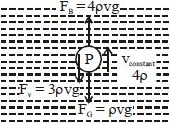
(A) Let the density of the ball be $\rho$ and its volume be $V$. The density of the liquid is $4\rho$.
The weight of the ball is $F_G = V\rho g$ (acting downwards).
The buoyant force acting on the ball is $F_B = V(4\rho)g = 4V\rho g$ (acting upwards).
Since the ball rises at a constant velocity,the net force on it is zero. The forces acting on the ball are the buoyant force upwards,and the weight and the viscous friction force $F_v$ downwards.
Therefore,$F_B = F_G + F_v$.
Substituting the values: $4V\rho g = V\rho g + F_v$.
Thus,$F_v = 3V\rho g$.
The ratio of the force of friction to the weight of the ball is $\frac{F_v}{F_G} = \frac{3V\rho g}{V\rho g} = \frac{3}{1}$.
So,the ratio is $3 : 1$.
The weight of the ball is $F_G = V\rho g$ (acting downwards).
The buoyant force acting on the ball is $F_B = V(4\rho)g = 4V\rho g$ (acting upwards).
Since the ball rises at a constant velocity,the net force on it is zero. The forces acting on the ball are the buoyant force upwards,and the weight and the viscous friction force $F_v$ downwards.
Therefore,$F_B = F_G + F_v$.
Substituting the values: $4V\rho g = V\rho g + F_v$.
Thus,$F_v = 3V\rho g$.
The ratio of the force of friction to the weight of the ball is $\frac{F_v}{F_G} = \frac{3V\rho g}{V\rho g} = \frac{3}{1}$.
So,the ratio is $3 : 1$.
0 likesView Solution
18
ChemistryMCQMHT CET · 2024
If $R$ is the radius of the Earth and $g$ is the acceleration due to gravity on the Earth's surface,then the mean density of the Earth is ..........
A
$\frac{4 \pi G}{3 g R}$
B
$\frac{3 \pi R}{4 g G}$
C
$\frac{3 g}{4 \pi R G}$
D
$\frac{\pi R g}{12 G}$
Solution
(C) The acceleration due to gravity $g$ at the Earth's surface is given by the formula:
$g = \frac{G M}{R^2}$
where $M$ is the mass of the Earth and $G$ is the universal gravitational constant.
The mass $M$ of the Earth can be expressed in terms of its mean density $\rho$ and radius $R$ as:
$M = \text{Volume} \times \text{Density} = \left( \frac{4}{3} \pi R^3 \right) \rho$
Substituting the expression for $M$ into the formula for $g$:
$g = \frac{G}{R^2} \times \left( \frac{4}{3} \pi R^3 \rho \right)$
Simplifying the equation:
$g = \frac{4}{3} \pi G R \rho$
Solving for the density $\rho$:
$\rho = \frac{3 g}{4 \pi G R}$
Thus,the correct option is $C$.
$g = \frac{G M}{R^2}$
where $M$ is the mass of the Earth and $G$ is the universal gravitational constant.
The mass $M$ of the Earth can be expressed in terms of its mean density $\rho$ and radius $R$ as:
$M = \text{Volume} \times \text{Density} = \left( \frac{4}{3} \pi R^3 \right) \rho$
Substituting the expression for $M$ into the formula for $g$:
$g = \frac{G}{R^2} \times \left( \frac{4}{3} \pi R^3 \rho \right)$
Simplifying the equation:
$g = \frac{4}{3} \pi G R \rho$
Solving for the density $\rho$:
$\rho = \frac{3 g}{4 \pi G R}$
Thus,the correct option is $C$.
0 likesView Solution
19
ChemistryMCQMHT CET · 2024
$A$ concave mirror of focal length $f$ produces an image $n$ times the size of the object. If the image is real,then the distance of the object from the mirror is:
A
$(n-1) f$
B
$\left(\frac{n-1}{n}\right) f$
C
$\left(\frac{n+1}{n}\right) f$
D
$(n+1) f$
Solution
(C) For a concave mirror,the magnification $m$ is given by the formula $m = \frac{f}{f-u}$,where $f$ is the focal length and $u$ is the object distance.
Since the image is real,the magnification $m$ must be negative. Given that the image size is $n$ times the object size,we have $m = -n$.
Substituting this into the formula: $-n = \frac{-f}{-f-u}$.
Multiplying both sides by $(-f-u)$,we get: $-n(-f-u) = -f$.
$nf + nu = -f$.
$nu = -f - nf$.
$nu = -f(n+1)$.
$u = -\frac{f(n+1)}{n}$.
The distance of the object from the mirror is the magnitude of $u$,which is $|u| = \left(\frac{n+1}{n}\right) f$.
Since the image is real,the magnification $m$ must be negative. Given that the image size is $n$ times the object size,we have $m = -n$.
Substituting this into the formula: $-n = \frac{-f}{-f-u}$.
Multiplying both sides by $(-f-u)$,we get: $-n(-f-u) = -f$.
$nf + nu = -f$.
$nu = -f - nf$.
$nu = -f(n+1)$.
$u = -\frac{f(n+1)}{n}$.
The distance of the object from the mirror is the magnitude of $u$,which is $|u| = \left(\frac{n+1}{n}\right) f$.
0 likesView Solution
20
ChemistryMCQMHT CET · 2024
Given below are two statements regarding silent heart attack.
Statement $I$: This type of heart attack shows symptoms like chest pain and shortness of breath.
Statement $II$: In this type of heart attack,usually person shows very mild symptoms and thus it is ignored.
In the light of above two statements,choose the correct answer from options given below.
Statement $I$: This type of heart attack shows symptoms like chest pain and shortness of breath.
Statement $II$: In this type of heart attack,usually person shows very mild symptoms and thus it is ignored.
In the light of above two statements,choose the correct answer from options given below.
A
Both statement $I$ and statement $II$ are correct.
B
Both statement $I$ and statement $II$ are incorrect.
C
Statement $I$ is correct but statement $II$ is incorrect.
D
Statement $I$ is incorrect but statement $II$ is correct.
Solution
(D) silent heart attack,also known as a silent myocardial infarction,is a type of heart attack that lacks the classic symptoms of a typical heart attack,such as extreme chest pain,severe shortness of breath,profuse sweating,and dizziness.
Statement $I$ is incorrect because a silent heart attack is defined by the absence of these intense,recognizable symptoms.
Statement $II$ is correct because the symptoms of a silent heart attack are often so mild or atypical that the individual may not realize they are having a heart attack,leading them to ignore the condition.
Statement $I$ is incorrect because a silent heart attack is defined by the absence of these intense,recognizable symptoms.
Statement $II$ is correct because the symptoms of a silent heart attack are often so mild or atypical that the individual may not realize they are having a heart attack,leading them to ignore the condition.
0 likesView Solution
21
ChemistryMCQMHT CET · 2024
Crotonyl alcohol is an example of
A
Allylic alcohol
B
Benzylic alcohol
C
Vinylic alcohol
D
Polyhydric alcohol
Solution
(A) In primary allylic alcohols,the hydroxyl group is bonded to a $sp^3$ hybridized primary carbon atom adjacent to a carbon-carbon double bond.
Crotonyl alcohol $(CH_3-CH=CH-CH_2OH)$ contains a $-OH$ group attached to a carbon atom that is bonded to a $C=C$ double bond.
Therefore,it is classified as an allylic alcohol.
Crotonyl alcohol $(CH_3-CH=CH-CH_2OH)$ contains a $-OH$ group attached to a carbon atom that is bonded to a $C=C$ double bond.
Therefore,it is classified as an allylic alcohol.
0 likesView Solution
22
ChemistryMCQMHT CET · 2024
Select the correct increasing order of boiling points of alcohols,amines,and carboxylic acids of comparable molar mass from the following.
A
Alcohols < Amines < Carboxylic acids
B
Amines < Carboxylic acids < Alcohols
C
Amines < Alcohols < Carboxylic acids
D
Carboxylic acids < Alcohols < Amines
Solution
(C) The boiling point depends on the strength of intermolecular forces,primarily hydrogen bonding.
Carboxylic acids form stable dimers due to strong intermolecular hydrogen bonding,resulting in the highest boiling point.
Alcohols have stronger hydrogen bonding than amines because the $O-H$ bond is more polar than the $N-H$ bond.
Therefore,the correct increasing order of boiling points is $Amines < Alcohols < Carboxylic acids$.
Carboxylic acids form stable dimers due to strong intermolecular hydrogen bonding,resulting in the highest boiling point.
Alcohols have stronger hydrogen bonding than amines because the $O-H$ bond is more polar than the $N-H$ bond.
Therefore,the correct increasing order of boiling points is $Amines < Alcohols < Carboxylic acids$.
0 likesView Solution
23
ChemistryEasyMCQMHT CET · 2024
What is the product of Hydroboration-oxidation of but-$1$-ene?
A
Butanal
B
Butanone
C
Butan-$1$-ol
D
Butan-$2$-ol
Solution
(C) Hydroboration-oxidation of alkenes follows anti-Markovnikov addition of water across the double bond.
For but-$1$-ene $(CH_3CH_2CH=CH_2)$,the hydroxyl group $(-OH)$ attaches to the terminal carbon atom.
Therefore,the product formed is butan-$1$-ol $(CH_3CH_2CH_2CH_2OH)$.
For but-$1$-ene $(CH_3CH_2CH=CH_2)$,the hydroxyl group $(-OH)$ attaches to the terminal carbon atom.
Therefore,the product formed is butan-$1$-ol $(CH_3CH_2CH_2CH_2OH)$.
0 likesView Solution
24
ChemistryMediumMCQMHT CET · 2024
Identify the product '$Z$' in the following series of reactions.
$C_2H_5OH$ $\xrightarrow[\Delta]{SOCl_2} X$ $\xrightarrow[\text{Dry ether}]{Mg} Y$ $\xrightarrow{NH_3} Z$
$C_2H_5OH$ $\xrightarrow[\Delta]{SOCl_2} X$ $\xrightarrow[\text{Dry ether}]{Mg} Y$ $\xrightarrow{NH_3} Z$
A
Ethyl chloride
B
Ethyl magnesium chloride
C
Ethyl amine
D
Ethane
Solution
(D) The reaction sequence is as follows:
$1$. $C_2H_5OH + SOCl_2 \xrightarrow{\Delta} C_2H_5Cl (X) + SO_2 + HCl$
$2$. $C_2H_5Cl + Mg \xrightarrow{\text{Dry ether}} C_2H_5MgCl (Y)$ (Grignard reagent)
$3$. $C_2H_5MgCl + NH_3 \rightarrow C_2H_6 (Z) + Mg(NH_2)Cl$
Grignard reagents react with compounds containing active hydrogen atoms (like $NH_3$) to form the corresponding alkane. Therefore,the product $Z$ is ethane.
$1$. $C_2H_5OH + SOCl_2 \xrightarrow{\Delta} C_2H_5Cl (X) + SO_2 + HCl$
$2$. $C_2H_5Cl + Mg \xrightarrow{\text{Dry ether}} C_2H_5MgCl (Y)$ (Grignard reagent)
$3$. $C_2H_5MgCl + NH_3 \rightarrow C_2H_6 (Z) + Mg(NH_2)Cl$
Grignard reagents react with compounds containing active hydrogen atoms (like $NH_3$) to form the corresponding alkane. Therefore,the product $Z$ is ethane.
0 likesView Solution
25
ChemistryDifficultMCQMHT CET · 2024
What is the name of $\text{tert-butyl}$ alcohol according to the carbinol system?
A
Methyl carbinol
B
Ethyl carbinol
C
Propyl carbinol
D
Trimethyl carbinol
Solution
(D) In the carbinol system,alcohols are named as derivatives of methanol,which is called $\text{carbinol}$ $(CH_3OH)$.
For $\text{tert-butyl}$ alcohol,the structure is $(CH_3)_3C-OH$.
Here,the central carbon atom attached to the $-OH$ group is bonded to three methyl groups $(-CH_3)$.
Therefore,it is named as $\text{trimethyl carbinol}$.
For $\text{tert-butyl}$ alcohol,the structure is $(CH_3)_3C-OH$.
Here,the central carbon atom attached to the $-OH$ group is bonded to three methyl groups $(-CH_3)$.
Therefore,it is named as $\text{trimethyl carbinol}$.
0 likesView Solution
26
ChemistryMediumMCQMHT CET · 2024
Identify the product obtained when alkenes react with cold and dilute alkaline potassium permanganate.
A
Alkanols
B
Glycols
C
Glycerols
D
Alkanoic acids
Solution
(B) The reaction of alkenes with cold and dilute alkaline $KMnO_4$ (Baeyer's reagent) results in the syn-hydroxylation of the double bond to form vicinal diols,commonly known as glycols.
For example,the reaction of ethene with cold and dilute alkaline $KMnO_4$ yields ethane$-1,2-$diol (ethylene glycol):
$CH_2=CH_2 + H_2O + [O] \xrightarrow{\text{alkaline } KMnO_4} HOCH_2-CH_2OH$
For example,the reaction of ethene with cold and dilute alkaline $KMnO_4$ yields ethane$-1,2-$diol (ethylene glycol):
$CH_2=CH_2 + H_2O + [O] \xrightarrow{\text{alkaline } KMnO_4} HOCH_2-CH_2OH$
0 likesView Solution
27
ChemistryMCQMHT CET · 2024
Identify the substrate '$A$' in the following conversion.
$A \xrightarrow[H_3 O^{+}]{AlH(i-Bu)_2} \text{Pent-3-enal}$
$A \xrightarrow[H_3 O^{+}]{AlH(i-Bu)_2} \text{Pent-3-enal}$
A
Pentanenitrile
B
Pent$-3-$enenitrile
C
Pent$-3-$en$-1-$amine
D
Pent$-3-$ynenitrile
Solution
(B) The reagent $AlH(i-Bu)_2$ ($DIBAL$-$H$) is a selective reducing agent used to reduce nitriles $(-CN)$ to aldehydes $(-CHO)$ after acidic hydrolysis.
To obtain $Pent-3-enal$ $(CH_3-CH=CH-CH_2-CHO)$,the starting material must be the corresponding nitrile with the same carbon skeleton.
Thus,the substrate '$A$' is $Pent-3-enenitrile$ $(CH_3-CH=CH-CH_2-C \equiv N)$.
The reaction is:
$CH_3-CH=CH-CH_2-C \equiv N \xrightarrow[2. H_3 O^{+}]{1. AlH(i-Bu)_2} CH_3-CH=CH-CH_2-CHO$
To obtain $Pent-3-enal$ $(CH_3-CH=CH-CH_2-CHO)$,the starting material must be the corresponding nitrile with the same carbon skeleton.
Thus,the substrate '$A$' is $Pent-3-enenitrile$ $(CH_3-CH=CH-CH_2-C \equiv N)$.
The reaction is:
$CH_3-CH=CH-CH_2-C \equiv N \xrightarrow[2. H_3 O^{+}]{1. AlH(i-Bu)_2} CH_3-CH=CH-CH_2-CHO$
0 likesView Solution
28
ChemistryMCQMHT CET · 2024
Identify the reagent '$R$' used in the following reaction.
Ketone $\xrightarrow{R}$ Semicarbazone
Ketone $\xrightarrow{R}$ Semicarbazone
A
$NH_2OH$
B
$NH_2NHCONH_2$
C
$NH_2NHC_6H_5$
D
$NH_2NH_2$
Solution
(B) The reaction of a ketone with semicarbazide $(NH_2NHCONH_2)$ leads to the formation of semicarbazone.
This is a nucleophilic addition-elimination reaction.
The reagent '$R$' is semicarbazide,which has the formula $NH_2NHCONH_2$.
This is a nucleophilic addition-elimination reaction.
The reagent '$R$' is semicarbazide,which has the formula $NH_2NHCONH_2$.
0 likesView Solution
29
ChemistryMCQMHT CET · 2024
Identify the reagent '$R$' used in the following reaction.
$Ketone \xrightarrow{R} \text{Semicarbazone}$
$Ketone \xrightarrow{R} \text{Semicarbazone}$
A
$NH_2OH$
B
$NH_2NHCONH_2$
C
$NH_2NHC_6H_5$
D
$NH_2NH_2$
Solution
(B) The reaction of a ketone with semicarbazide $(NH_2NHCONH_2)$ leads to the formation of a semicarbazone.
$Ketone + NH_2NHCONH_2 \xrightarrow{-H_2O} \text{Semicarbazone}$
$Ketone + NH_2NHCONH_2 \xrightarrow{-H_2O} \text{Semicarbazone}$
0 likesView Solution
30
ChemistryMCQMHT CET · 2024
Identify the fibrous protein from the following.
A
Legumelin
B
Serum albumin
C
Myosin
D
Insulin
Solution
(C) $Myosin$ is a fibrous protein,whereas $Legumelin$,$Serum \ albumin$,and $Insulin$ are globular proteins.
0 likesView Solution
31
ChemistryDifficultMCQMHT CET · 2024
What is the number of moles of $N$ atoms and number of moles of $O$ atoms respectively present in one mole of uracil?
A
$1$ and $5$
B
$1$ and $3$
C
$2$ and $3$
D
$2$ and $2$
Solution
(D) The molecular formula of uracil is $C_4H_4N_2O_2$.
From the formula,one molecule of uracil contains $2$ nitrogen $(N)$ atoms and $2$ oxygen $(O)$ atoms.
Therefore,one mole of uracil contains $2$ moles of $N$ atoms and $2$ moles of $O$ atoms.
Thus,the correct option is $D$.
From the formula,one molecule of uracil contains $2$ nitrogen $(N)$ atoms and $2$ oxygen $(O)$ atoms.
Therefore,one mole of uracil contains $2$ moles of $N$ atoms and $2$ moles of $O$ atoms.
Thus,the correct option is $D$.
0 likesView Solution
32
ChemistryMediumMCQMHT CET · 2024
What is the number of moles of oxygen atoms and the number of moles of $N$ atoms respectively present in one mole of thymine?
A
$2$ and $2$
B
$1$ and $3$
C
$1$ and $5$
D
$2$ and $3$
Solution
(A) The molecular formula of thymine is $C_5H_6N_2O_2$.
In one molecule of thymine,there are $2$ oxygen atoms and $2$ nitrogen atoms.
Therefore,in one mole of thymine,there are $2$ moles of oxygen atoms and $2$ moles of nitrogen atoms.
In one molecule of thymine,there are $2$ oxygen atoms and $2$ nitrogen atoms.
Therefore,in one mole of thymine,there are $2$ moles of oxygen atoms and $2$ moles of nitrogen atoms.
0 likesView Solution
33
ChemistryMediumMCQMHT CET · 2024
Which of the following is obtained on oxidation of $prop-1-ene$ with acidic $KMnO_4$?
A
Ethanoic acid
B
Propanol
C
Propanoic acid
D
Propanone
Solution
(A) The oxidation of $prop-1-ene$ $(CH_3-CH=CH_2)$ with acidic $KMnO_4$ leads to the cleavage of the double bond.
The terminal $CH_2$ group is oxidized to $CO_2$ and $H_2O$,while the $CH_3-CH=$ group is oxidized to ethanoic acid $(CH_3COOH)$.
The reaction is: $CH_3-CH=CH_2 + [O] \xrightarrow{acidic \ KMnO_4} CH_3COOH + CO_2 + H_2O$.
The terminal $CH_2$ group is oxidized to $CO_2$ and $H_2O$,while the $CH_3-CH=$ group is oxidized to ethanoic acid $(CH_3COOH)$.
The reaction is: $CH_3-CH=CH_2 + [O] \xrightarrow{acidic \ KMnO_4} CH_3COOH + CO_2 + H_2O$.
0 likesView Solution
34
ChemistryMediumMCQMHT CET · 2024
What is the product obtained when phenylethene is treated with $KMnO_4$ in dilute $H_2SO_4$?
A
$C_6H_5CH_2CHO$
B
$C_6H_5CH_2COOH$
C
$C_6H_5COOH$
D
$C_6H_5COCH_3$
Solution
(C) When phenylethene $(C_6H_5CH=CH_2)$ is treated with acidic potassium permanganate ($KMnO_4$ in dilute $H_2SO_4$),it undergoes oxidative cleavage.
The double bond is broken,and the terminal $CH_2$ group is oxidized to $CO_2$ and $H_2O$,while the phenyl-substituted carbon is oxidized to a carboxylic acid group.
Thus,phenylethene is oxidized to benzoic acid $(C_6H_5COOH)$.
The double bond is broken,and the terminal $CH_2$ group is oxidized to $CO_2$ and $H_2O$,while the phenyl-substituted carbon is oxidized to a carboxylic acid group.
Thus,phenylethene is oxidized to benzoic acid $(C_6H_5COOH)$.
0 likesView Solution
35
ChemistryDifficultMCQMHT CET · 2024
Identify the product $X$ in the following reaction: $CH_3-CH_2-COONa \xrightarrow[\Delta]{\text{soda-lime}} X + Na_2CO_3$
A
Propane
B
Ethane
C
Methane
D
Butane
Solution
(B) The reaction of sodium propanoate $(CH_3-CH_2-COONa)$ with soda-lime $(NaOH + CaO)$ is a decarboxylation reaction.
During this process,the carboxyl group is removed as $Na_2CO_3$,and the alkyl group forms an alkane with one carbon atom less than the original salt.
$CH_3-CH_2-COONa + NaOH \xrightarrow{CaO, \Delta} CH_3-CH_3 + Na_2CO_3$.
Thus,the product $X$ is ethane $(CH_3-CH_3)$.
During this process,the carboxyl group is removed as $Na_2CO_3$,and the alkyl group forms an alkane with one carbon atom less than the original salt.
$CH_3-CH_2-COONa + NaOH \xrightarrow{CaO, \Delta} CH_3-CH_3 + Na_2CO_3$.
Thus,the product $X$ is ethane $(CH_3-CH_3)$.
0 likesView Solution
36
ChemistryEasyMCQMHT CET · 2024
Which of the following molecules has two lone pairs of electrons in the valence shell of its central atom?
A
$SO_2$
B
$NH_3$
C
$H_2O$
D
$SF_4$
Solution
(C) In $H_2O$,the central oxygen atom has $6$ valence electrons.
It forms $2$ covalent bonds with $2$ hydrogen atoms.
This leaves $4$ electrons as $2$ lone pairs on the oxygen atom.
Therefore,$H_2O$ has $2$ lone pairs.
It forms $2$ covalent bonds with $2$ hydrogen atoms.
This leaves $4$ electrons as $2$ lone pairs on the oxygen atom.
Therefore,$H_2O$ has $2$ lone pairs.
0 likesView Solution
37
ChemistryEasyMCQMHT CET · 2024
Identify the hybridisation and geometry of $SF_4$ molecule respectively.
A
$sp^3d^3$ and tetrahedral
B
$sp^3d^3$ and trigonal bipyramidal
C
$sp^3d^2$ and trigonal bipyramidal
D
$sp^3d$ and seesaw
Solution
(D) The central sulfur atom in $SF_4$ has $6$ valence electrons.
It forms $4$ bonds with fluorine atoms and has $1$ lone pair.
Total electron pairs = $4 \text{ (bond pairs)} + 1 \text{ (lone pair)} = 5$.
For $5$ electron pairs,the hybridization is $sp^3d$.
Due to the presence of one lone pair,the geometry is distorted trigonal bipyramidal,which is commonly referred to as a seesaw shape.
It forms $4$ bonds with fluorine atoms and has $1$ lone pair.
Total electron pairs = $4 \text{ (bond pairs)} + 1 \text{ (lone pair)} = 5$.
For $5$ electron pairs,the hybridization is $sp^3d$.
Due to the presence of one lone pair,the geometry is distorted trigonal bipyramidal,which is commonly referred to as a seesaw shape.
0 likesView Solution
38
ChemistryDifficultMCQMHT CET · 2024
What is the number of Lewis structures for $NO_2^{-}$?
A
$1$
B
$2$
C
$3$
D
$4$
Solution
(B) The nitrite ion,$NO_2^{-}$,exhibits resonance.
There are two equivalent Lewis structures that can be drawn for $NO_2^{-}$,where the double bond alternates between the two nitrogen-oxygen bonds.
These two structures are shown in the provided image,representing the resonance contributors of the ion.
There are two equivalent Lewis structures that can be drawn for $NO_2^{-}$,where the double bond alternates between the two nitrogen-oxygen bonds.
These two structures are shown in the provided image,representing the resonance contributors of the ion.
0 likesView Solution
39
ChemistryMediumMCQMHT CET · 2024
Which of the following compounds follows the octet rule?
A
$H_2SO_4$
B
$NO_2$
C
$SCl_2$
D
$SF_6$
Solution
(C) In $H_2SO_4$ and $SF_6$,the central atoms have an expanded octet,meaning they have more than $8$ electrons in their valence shell.
$NO_2$ is an odd-electron molecule,which violates the octet rule.
In $SCl_2$,the central sulphur atom forms two covalent bonds with chlorine atoms,resulting in $8$ electrons in its valence shell,thus obeying the octet rule.
$NO_2$ is an odd-electron molecule,which violates the octet rule.
In $SCl_2$,the central sulphur atom forms two covalent bonds with chlorine atoms,resulting in $8$ electrons in its valence shell,thus obeying the octet rule.
0 likesView Solution
40
ChemistryMediumMCQMHT CET · 2024
Which among the following is an example of an odd electron molecule?
A
$BF_3$
B
$LiCl$
C
$NO$
D
$PCl_5$
Solution
(C) $NO$ (nitric oxide) contains a total of $15$ valence electrons ($5$ from $N$ and $10$ from $O$).
Since the total number of valence electrons is odd,it is an odd electron molecule and does not obey the octet rule.
The structure can be represented as $\dot{N}=\ddot{O}$.
Since the total number of valence electrons is odd,it is an odd electron molecule and does not obey the octet rule.
The structure can be represented as $\dot{N}=\ddot{O}$.
0 likesView Solution
41
ChemistryEasyMCQMHT CET · 2024
Which of the following molecules is tetrahedral?
A
$C_2H_2$
B
$CH_4$
C
$BeCl_2$
D
$BF_3$
Solution
(B) In $CH_4$,the central carbon atom is bonded to four hydrogen atoms with no lone pairs.
It undergoes $sp^3$ hybridisation,which results in a tetrahedral geometry with a bond angle of $109.5^\circ$.
It undergoes $sp^3$ hybridisation,which results in a tetrahedral geometry with a bond angle of $109.5^\circ$.
0 likesView Solution
42
ChemistryEasyMCQMHT CET · 2024
Identify the structure of $XeF_4$ molecule from the following.
A
Trigonal pyramidal
B
Square pyramidal
C
Square planar
D
Distorted octahedral
Solution
(C) The central atom in $XeF_4$ is Xenon $(Xe)$,which has $8$ valence electrons.
It forms $4$ single bonds with $4$ Fluorine $(F)$ atoms.
This leaves $4$ electrons,which form $2$ lone pairs on the Xenon atom.
The total number of electron pairs around the central atom is $4$ (bond pairs) + $2$ (lone pairs) = $6$.
According to $VSEPR$ theory,a steric number of $6$ corresponds to an octahedral electron geometry.
With $4$ bond pairs and $2$ lone pairs,the lone pairs occupy the axial positions to minimize repulsion,resulting in a square planar molecular geometry.
It forms $4$ single bonds with $4$ Fluorine $(F)$ atoms.
This leaves $4$ electrons,which form $2$ lone pairs on the Xenon atom.
The total number of electron pairs around the central atom is $4$ (bond pairs) + $2$ (lone pairs) = $6$.
According to $VSEPR$ theory,a steric number of $6$ corresponds to an octahedral electron geometry.
With $4$ bond pairs and $2$ lone pairs,the lone pairs occupy the axial positions to minimize repulsion,resulting in a square planar molecular geometry.
0 likesView Solution
43
ChemistryEasyMCQMHT CET · 2024
Which of the following types of hybridisation results in trigonal planar geometry?
A
$sp$
B
$dsp^2$
C
$sp^2$
D
$sp^3$
Solution
(C) $sp^2$ hybridisation involves the mixing of one $s$ and two $p$ orbitals,resulting in three equivalent hybrid orbitals directed towards the corners of an equilateral triangle. This gives rise to a trigonal planar geometry with bond angles of $120^{\circ}$.
0 likesView Solution
44
ChemistryEasyMCQMHT CET · 2024
What is the number of lone pairs of electrons on the iodine atom in the $IF$ molecule?
A
$3$
B
$2$
C
$1$
D
$0$
Solution
(A) The iodine atom $(I)$ has $7$ valence electrons. In the $IF$ molecule,iodine forms one covalent bond with the fluorine atom $(F)$.
After forming one bond,$6$ electrons remain on the iodine atom,which corresponds to $3$ lone pairs of electrons.
Therefore,the number of lone pairs on the iodine atom in $IF$ is $3$.
After forming one bond,$6$ electrons remain on the iodine atom,which corresponds to $3$ lone pairs of electrons.
Therefore,the number of lone pairs on the iodine atom in $IF$ is $3$.
0 likesView Solution
45
ChemistryEasyMCQMHT CET · 2024
Which of the following molecules does not have a lone pair of electrons in the valence shell of the central atom?
A
$NH_3$
B
$H_2O$
C
$SO_2$
D
$BF_3$
Solution
(D) To determine the number of lone pairs on the central atom,we look at the valence electrons and the number of bonding pairs:
$1$. In $NH_3$,Nitrogen has $5$ valence electrons. It forms $3$ bonds with Hydrogen,leaving $5 - 3 = 2$ electrons,which is $1$ lone pair.
$2$. In $H_2O$,Oxygen has $6$ valence electrons. It forms $2$ bonds with Hydrogen,leaving $6 - 2 = 4$ electrons,which is $2$ lone pairs.
$3$. In $SO_2$,Sulfur has $6$ valence electrons. It forms $2$ double bonds with Oxygen atoms,using $4$ electrons for bonding,leaving $6 - 4 = 2$ electrons,which is $1$ lone pair.
$4$. In $BF_3$,Boron has $3$ valence electrons. It forms $3$ bonds with Fluorine atoms,using all $3$ valence electrons. Thus,there are $0$ lone pairs on the central Boron atom.
Therefore,$BF_3$ is the correct answer.
$1$. In $NH_3$,Nitrogen has $5$ valence electrons. It forms $3$ bonds with Hydrogen,leaving $5 - 3 = 2$ electrons,which is $1$ lone pair.
$2$. In $H_2O$,Oxygen has $6$ valence electrons. It forms $2$ bonds with Hydrogen,leaving $6 - 2 = 4$ electrons,which is $2$ lone pairs.
$3$. In $SO_2$,Sulfur has $6$ valence electrons. It forms $2$ double bonds with Oxygen atoms,using $4$ electrons for bonding,leaving $6 - 4 = 2$ electrons,which is $1$ lone pair.
$4$. In $BF_3$,Boron has $3$ valence electrons. It forms $3$ bonds with Fluorine atoms,using all $3$ valence electrons. Thus,there are $0$ lone pairs on the central Boron atom.
Therefore,$BF_3$ is the correct answer.
0 likesView Solution
46
ChemistryEasyMCQMHT CET · 2024
What is the number of lone pair of electrons on the central halogen atom in $BrF_3$?
A
$2$
B
$3$
C
$1$
D
$0$
Solution
(A) The central atom in $BrF_3$ is $Br$.
$Br$ has $7$ valence electrons.
In $BrF_3$,$Br$ forms $3$ single bonds with $3$ $F$ atoms.
Number of electrons used in bonding = $3$.
Number of remaining valence electrons = $7 - 3 = 4$.
Number of lone pairs = $4 / 2 = 2$.
Thus,there are $2$ lone pairs on the central $Br$ atom.
$Br$ has $7$ valence electrons.
In $BrF_3$,$Br$ forms $3$ single bonds with $3$ $F$ atoms.
Number of electrons used in bonding = $3$.
Number of remaining valence electrons = $7 - 3 = 4$.
Number of lone pairs = $4 / 2 = 2$.
Thus,there are $2$ lone pairs on the central $Br$ atom.
0 likesView Solution
47
ChemistryEasyMCQMHT CET · 2024
Which of the following molecules has trigonal planar geometry?
A
$CH_4$
B
$C_2H_2$
C
$NH_3$
D
$BF_3$
Solution
(D) To determine the geometry,we look at the hybridization of the central atom:
$1$. $CH_4$: The central carbon atom is $sp^3$ hybridized,resulting in a tetrahedral geometry.
$2$. $C_2H_2$: The carbon atoms are $sp$ hybridized,resulting in a linear geometry.
$3$. $NH_3$: The central nitrogen atom is $sp^3$ hybridized with one lone pair,resulting in a trigonal pyramidal geometry.
$4$. $BF_3$: The central boron atom is $sp^2$ hybridized with no lone pairs,resulting in a trigonal planar geometry.
Therefore,the correct molecule with trigonal planar geometry is $BF_3$.
$1$. $CH_4$: The central carbon atom is $sp^3$ hybridized,resulting in a tetrahedral geometry.
$2$. $C_2H_2$: The carbon atoms are $sp$ hybridized,resulting in a linear geometry.
$3$. $NH_3$: The central nitrogen atom is $sp^3$ hybridized with one lone pair,resulting in a trigonal pyramidal geometry.
$4$. $BF_3$: The central boron atom is $sp^2$ hybridized with no lone pairs,resulting in a trigonal planar geometry.
Therefore,the correct molecule with trigonal planar geometry is $BF_3$.
0 likesView Solution
48
ChemistryEasyMCQMHT CET · 2024
What is the shape of bromine pentafluoride?
A
Trigonal pyramidal
B
Square pyramidal
C
Square planar
D
Distorted octahedral
Solution
(B) The central atom in $BrF_5$ is bromine $(Br)$,which has $7$ valence electrons.
It forms $5$ bonds with fluorine $(F)$ atoms and has $1$ lone pair of electrons.
According to $VSEPR$ theory,the steric number is $5 + 1 = 6$,which corresponds to $sp^3d^2$ hybridization.
The geometry is octahedral,but due to the presence of one lone pair,the shape is square pyramidal.
It forms $5$ bonds with fluorine $(F)$ atoms and has $1$ lone pair of electrons.
According to $VSEPR$ theory,the steric number is $5 + 1 = 6$,which corresponds to $sp^3d^2$ hybridization.
The geometry is octahedral,but due to the presence of one lone pair,the shape is square pyramidal.
0 likesView Solution
49
ChemistryDifficultMCQMHT CET · 2024
What type of hybridisation is involved in the central atom of hydrides of group $16$ elements?
A
$sp^3 d^2$
B
$sp^3$
C
$sp^2$
D
$sp$
Solution
(B) The hydrides of Group $16$ elements (such as $H_2O$,$H_2S$,$H_2Se$,$H_2Te$) have a central atom bonded to two hydrogen atoms and possess two lone pairs of electrons.
According to the Valence Shell Electron Pair Repulsion $(VSEPR)$ theory,the steric number is calculated as $2 \text{ (bond pairs)} + 2 \text{ (lone pairs)} = 4$.
$A$ steric number of $4$ corresponds to $sp^3$ hybridisation.
According to the Valence Shell Electron Pair Repulsion $(VSEPR)$ theory,the steric number is calculated as $2 \text{ (bond pairs)} + 2 \text{ (lone pairs)} = 4$.
$A$ steric number of $4$ corresponds to $sp^3$ hybridisation.
0 likesView Solution
50
ChemistryMediumMCQMHT CET · 2024
Identify the orbital having the highest energy from the following:
A
$2p$
B
$3s$
C
$3d$
D
$4p$
Solution
(D) The energy of an orbital is determined by the $(n+l)$ rule. Higher the sum of $(n+l)$ value of an orbital,the higher is its energy.
If two orbitals have the same value of $(n+l)$,then the orbital with the higher value of $n$ will have more energy.
Let us calculate $(n+l)$ for each:
$(A)$ $2p$: $n=2, l=1 \implies n+l = 3$
$(B)$ $3s$: $n=3, l=0 \implies n+l = 3$
$(C)$ $3d$: $n=3, l=2 \implies n+l = 5$
$(D)$ $4p$: $n=4, l=1 \implies n+l = 5$
Comparing $3d$ and $4p$,both have $(n+l) = 5$. Since $4p$ has a higher principal quantum number $(n=4)$ compared to $3d$ $(n=3)$,$4p$ has the highest energy.
If two orbitals have the same value of $(n+l)$,then the orbital with the higher value of $n$ will have more energy.
Let us calculate $(n+l)$ for each:
$(A)$ $2p$: $n=2, l=1 \implies n+l = 3$
$(B)$ $3s$: $n=3, l=0 \implies n+l = 3$
$(C)$ $3d$: $n=3, l=2 \implies n+l = 5$
$(D)$ $4p$: $n=4, l=1 \implies n+l = 5$
Comparing $3d$ and $4p$,both have $(n+l) = 5$. Since $4p$ has a higher principal quantum number $(n=4)$ compared to $3d$ $(n=3)$,$4p$ has the highest energy.
0 likesView Solution
51
ChemistryDifficultMCQMHT CET · 2024
Which of the following on reaction with Grignard reagent followed by hydrolysis forms a secondary alcohol?
A
$HCHO$
B
$CH_3CHO$
C
$CH_3COCH_3$
D
$CH_3CH_2COCH_3$
Solution
(B) The reaction of a Grignard reagent $(R-MgX)$ with carbonyl compounds follows these general rules:
$1$. Formaldehyde $(HCHO)$ reacts with a Grignard reagent to form a primary $(1^{\circ})$ alcohol.
$2$. Other aldehydes $(R'-CHO)$ react with a Grignard reagent to form a secondary $(2^{\circ})$ alcohol.
$3$. Ketones $(R'-CO-R'')$ react with a Grignard reagent to form a tertiary $(3^{\circ})$ alcohol.
Among the given options:
- $HCHO$ is formaldehyde (forms primary alcohol).
- $CH_3CHO$ is acetaldehyde (an aldehyde,forms secondary alcohol).
- $CH_3COCH_3$ is acetone (a ketone,forms tertiary alcohol).
- $CH_3CH_2COCH_3$ is butanone (a ketone,forms tertiary alcohol).
Therefore,$CH_3CHO$ reacts with a Grignard reagent to produce a secondary alcohol.
$1$. Formaldehyde $(HCHO)$ reacts with a Grignard reagent to form a primary $(1^{\circ})$ alcohol.
$2$. Other aldehydes $(R'-CHO)$ react with a Grignard reagent to form a secondary $(2^{\circ})$ alcohol.
$3$. Ketones $(R'-CO-R'')$ react with a Grignard reagent to form a tertiary $(3^{\circ})$ alcohol.
Among the given options:
- $HCHO$ is formaldehyde (forms primary alcohol).
- $CH_3CHO$ is acetaldehyde (an aldehyde,forms secondary alcohol).
- $CH_3COCH_3$ is acetone (a ketone,forms tertiary alcohol).
- $CH_3CH_2COCH_3$ is butanone (a ketone,forms tertiary alcohol).
Therefore,$CH_3CHO$ reacts with a Grignard reagent to produce a secondary alcohol.
0 likesView Solution
52
ChemistryMediumMCQMHT CET · 2024
What type of product is obtained when formaldehyde reacts with $CH_3MgBr$ in dry ether?
A
Primary alcohol with same number of carbon atoms as in aldehyde.
B
Primary alcohol with one carbon atom more than aldehyde.
C
Secondary alcohol with one carbon atom more than aldehyde.
D
Tertiary alcohol with two carbon atoms more than aldehyde.
Solution
(B) The reaction of formaldehyde $(HCHO)$ with a Grignard reagent $(CH_3MgBr)$ in the presence of dry ether proceeds as follows:
$1$. Nucleophilic attack of the $CH_3^-$ group from the Grignard reagent on the electrophilic carbonyl carbon of formaldehyde leads to the formation of an addition product: $H_3C-CH_2-OMgBr$.
$2$. Subsequent acid hydrolysis $(H^+/H_2O)$ of this intermediate yields ethanol $(CH_3CH_2OH)$,which is a primary $(1^\circ)$ alcohol.
$3$. Formaldehyde contains $1$ carbon atom,and the resulting ethanol contains $2$ carbon atoms.
$4$. Therefore,the product is a primary alcohol with one carbon atom more than the starting aldehyde.
$1$. Nucleophilic attack of the $CH_3^-$ group from the Grignard reagent on the electrophilic carbonyl carbon of formaldehyde leads to the formation of an addition product: $H_3C-CH_2-OMgBr$.
$2$. Subsequent acid hydrolysis $(H^+/H_2O)$ of this intermediate yields ethanol $(CH_3CH_2OH)$,which is a primary $(1^\circ)$ alcohol.
$3$. Formaldehyde contains $1$ carbon atom,and the resulting ethanol contains $2$ carbon atoms.
$4$. Therefore,the product is a primary alcohol with one carbon atom more than the starting aldehyde.
0 likesView Solution
53
ChemistryEasyMCQMHT CET · 2024
Which of the following is a secondary allylic alcohol?
A
$CH_2=CH-CH_2-OH$
B
$CH_2=CH-CH(OH)-CH_3$
C
$CH_3-CH=CH-CH_2-OH$
D
$CH_2=CH-C(CH_3)_2-OH$
Solution
(B) An allylic alcohol is one in which the $-OH$ group is attached to an $sp^3$ hybridized carbon atom next to a carbon-carbon double bond $(C=C)$.
$A$: $CH_2=CH-CH_2-OH$ is a primary allylic alcohol because the $-OH$ group is attached to a primary carbon.
$B$: $CH_2=CH-CH(OH)-CH_3$ is a secondary allylic alcohol because the $-OH$ group is attached to a secondary carbon which is adjacent to a $C=C$ double bond.
$C$: $CH_3-CH=CH-CH_2-OH$ is a primary allylic alcohol.
$D$: $CH_2=CH-C(CH_3)_2-OH$ is a tertiary allylic alcohol because the $-OH$ group is attached to a tertiary carbon.
Therefore,the correct option is $B$.
$A$: $CH_2=CH-CH_2-OH$ is a primary allylic alcohol because the $-OH$ group is attached to a primary carbon.
$B$: $CH_2=CH-CH(OH)-CH_3$ is a secondary allylic alcohol because the $-OH$ group is attached to a secondary carbon which is adjacent to a $C=C$ double bond.
$C$: $CH_3-CH=CH-CH_2-OH$ is a primary allylic alcohol.
$D$: $CH_2=CH-C(CH_3)_2-OH$ is a tertiary allylic alcohol because the $-OH$ group is attached to a tertiary carbon.
Therefore,the correct option is $B$.
0 likesView Solution
54
ChemistryEasyMCQMHT CET · 2024
Which isomer of $C_4H_9OH$ has the lowest boiling point?
A
$n-$Butyl alcohol
B
Isobutyl alcohol
C
$Sec-$Butyl alcohol
D
$tert-$Butyl alcohol
Solution
(D) The boiling point of alcohols depends on the surface area of the molecule.
As the branching in the carbon chain increases,the surface area of the molecule decreases,which leads to weaker van der Waals forces of attraction.
Among the isomers of $C_4H_9OH$,$tert-$Butyl alcohol has the most compact structure due to maximum branching.
Therefore,$tert-$Butyl alcohol has the lowest boiling point.
As the branching in the carbon chain increases,the surface area of the molecule decreases,which leads to weaker van der Waals forces of attraction.
Among the isomers of $C_4H_9OH$,$tert-$Butyl alcohol has the most compact structure due to maximum branching.
Therefore,$tert-$Butyl alcohol has the lowest boiling point.
0 likesView Solution
55
ChemistryEasyMCQMHT CET · 2024
Which of the following is a tertiary allylic alcohol?
A
$prop-2-en-1-ol$
B
$but-3-en-2-ol$
C
$2-methylprop-2-en-1-ol$
D
$2-methylbut-3-en-2-ol$
Solution
(D) An allylic alcohol is one where the $-OH$ group is attached to a carbon atom adjacent to a carbon-carbon double bond $(C=C)$.
$A$ tertiary alcohol is one where the carbon atom bonded to the $-OH$ group is attached to three other carbon atoms.
Let us analyze the structures:
$A$) $CH_2=CH-CH_2OH$ (Primary allylic alcohol)
$B$) $CH_2=CH-CH(OH)-CH_3$ (Secondary allylic alcohol)
$C$) $CH_2=C(CH_3)-CH_2OH$ (Primary allylic alcohol)
$D$) $CH_2=CH-C(CH_3)(OH)-CH_3$ (Tertiary allylic alcohol)
In option $D$,the carbon atom attached to the $-OH$ group is bonded to a vinyl group $(-CH=CH_2)$ and two methyl groups $(-CH_3)$,making it a tertiary allylic alcohol.
$A$ tertiary alcohol is one where the carbon atom bonded to the $-OH$ group is attached to three other carbon atoms.
Let us analyze the structures:
$A$) $CH_2=CH-CH_2OH$ (Primary allylic alcohol)
$B$) $CH_2=CH-CH(OH)-CH_3$ (Secondary allylic alcohol)
$C$) $CH_2=C(CH_3)-CH_2OH$ (Primary allylic alcohol)
$D$) $CH_2=CH-C(CH_3)(OH)-CH_3$ (Tertiary allylic alcohol)
In option $D$,the carbon atom attached to the $-OH$ group is bonded to a vinyl group $(-CH=CH_2)$ and two methyl groups $(-CH_3)$,making it a tertiary allylic alcohol.
0 likesView Solution
56
ChemistryEasyMCQMHT CET · 2024
Which isomer of $C_4H_9OH$ has the highest boiling point?
A
$n$-Butyl alcohol
B
Isobutyl alcohol
C
$sec$-Butyl alcohol
D
$tert$-Butyl alcohol
Solution
(A) The boiling point of isomeric alcohols depends on the surface area of the molecule.
As the branching in the carbon chain increases,the surface area decreases,which leads to weaker van der Waals forces of attraction between the molecules.
Therefore,the boiling point decreases with an increase in branching.
Among the given isomers,$n$-Butyl alcohol is a straight-chain alcohol with no branching,while the others have varying degrees of branching.
Thus,$n$-Butyl alcohol has the highest boiling point.
As the branching in the carbon chain increases,the surface area decreases,which leads to weaker van der Waals forces of attraction between the molecules.
Therefore,the boiling point decreases with an increase in branching.
Among the given isomers,$n$-Butyl alcohol is a straight-chain alcohol with no branching,while the others have varying degrees of branching.
Thus,$n$-Butyl alcohol has the highest boiling point.
0 likesView Solution
57
ChemistryMediumMCQMHT CET · 2024
Identify the product formed in the following reaction: $CH_3CH_2MgBr$ $\xrightarrow{i. \text{Dry ice} / \text{dry ether}}$ $\xrightarrow{ii. \text{dil. } HCl} \text{Product}$
A
Ethanoic acid
B
Propanoic acid
C
$2-$Methylpropanoic acid
D
Butanoic acid
Solution
(B) The reaction of a Grignard reagent $(RMgX)$ with dry ice $(CO_2)$ followed by acid hydrolysis yields a carboxylic acid with one carbon atom more than the alkyl group of the Grignard reagent.
In this reaction,$CH_3CH_2MgBr$ (Ethyl magnesium bromide) reacts with $CO_2$ to form an intermediate complex,$CH_3CH_2COOMgBr$.
Upon subsequent hydrolysis with dilute $HCl$,the complex is converted into $CH_3CH_2COOH$,which is Propanoic acid.
The overall reaction is: $CH_3CH_2MgBr + CO_2$ $\rightarrow CH_3CH_2COOMgBr$ $\xrightarrow{H_3O^+} CH_3CH_2COOH + Mg(OH)Br$.
In this reaction,$CH_3CH_2MgBr$ (Ethyl magnesium bromide) reacts with $CO_2$ to form an intermediate complex,$CH_3CH_2COOMgBr$.
Upon subsequent hydrolysis with dilute $HCl$,the complex is converted into $CH_3CH_2COOH$,which is Propanoic acid.
The overall reaction is: $CH_3CH_2MgBr + CO_2$ $\rightarrow CH_3CH_2COOMgBr$ $\xrightarrow{H_3O^+} CH_3CH_2COOH + Mg(OH)Br$.
0 likesView Solution
58
ChemistryMediumMCQMHT CET · 2024
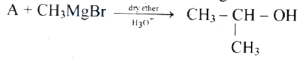
Identify reactant '$A$' in the following reaction.
A
$HCHO$
B
$CH_3CHO$
C
$CH_2OH-CH_2OH$
D
$CH_3COOH$
Solution
(B) The given reaction is the reaction of a Grignard reagent $(CH_3MgBr)$ with a carbonyl compound $(A)$ to form a secondary alcohol $(CH_3-CH(OH)-CH_3)$.
$1$. The reaction of $CH_3MgBr$ with formaldehyde $(HCHO)$ yields a primary alcohol.
$2$. The reaction of $CH_3MgBr$ with acetaldehyde $(CH_3CHO)$ yields a secondary alcohol (propan$-2-$ol).
$3$. The reaction of $CH_3MgBr$ with a ketone (like acetone) yields a tertiary alcohol.
Therefore,the reactant '$A$' is acetaldehyde $(CH_3CHO)$.
$1$. The reaction of $CH_3MgBr$ with formaldehyde $(HCHO)$ yields a primary alcohol.
$2$. The reaction of $CH_3MgBr$ with acetaldehyde $(CH_3CHO)$ yields a secondary alcohol (propan$-2-$ol).
$3$. The reaction of $CH_3MgBr$ with a ketone (like acetone) yields a tertiary alcohol.
Therefore,the reactant '$A$' is acetaldehyde $(CH_3CHO)$.
0 likesView Solution
59
ChemistryMediumMCQMHT CET · 2024
Which of the following is an allylic alcohol?
A
but-$1$-en-$1$-ol
B
but-$3$-en-$1$-ol
C
but-$2$-en-$1$-ol
D
butane-$1,3$-diol
Solution
(C) An allylic alcohol is defined as an alcohol where the $-OH$ group is attached to a $sp^3$ hybridized carbon atom that is directly bonded to a carbon-carbon double bond $(C=C)$.
In but-$2$-en-$1$-ol $(CH_3-CH=CH-CH_2OH)$,the $-OH$ group is attached to the $C_1$ atom,which is adjacent to the $C=C$ double bond at $C_2-C_3$. Thus,it is an allylic alcohol.
In but-$2$-en-$1$-ol $(CH_3-CH=CH-CH_2OH)$,the $-OH$ group is attached to the $C_1$ atom,which is adjacent to the $C=C$ double bond at $C_2-C_3$. Thus,it is an allylic alcohol.
0 likesView Solution
60
ChemistryEasyMCQMHT CET · 2024
Which of the following compounds is obtained when acyl chloride is hydrolysed with water?
A
Alcohols
B
Aldehydes
C
Carboxylic acids
D
Esters
Solution
(C) The hydrolysis of acyl chloride $(R-COCl)$ with water $(H_2O)$ results in the formation of a carboxylic acid $(R-COOH)$ and hydrogen chloride $(HCl)$.
The chemical reaction is as follows:
$R-COCl + H_2O \rightarrow R-COOH + HCl$
Thus,the correct product obtained is a carboxylic acid.
The chemical reaction is as follows:
$R-COCl + H_2O \rightarrow R-COOH + HCl$
Thus,the correct product obtained is a carboxylic acid.
0 likesView Solution
61
ChemistryMediumMCQMHT CET · 2024
The decreasing order of reactivity of the following alcohols with halo acid is:
$(I)$ $CH_3OH$
$(II)$ $CH_3CH_2OH$
$(III)$ $(CH_3)_2CHOH$
$(IV)$ $(CH_3)_3COH$
$(I)$ $CH_3OH$
$(II)$ $CH_3CH_2OH$
$(III)$ $(CH_3)_2CHOH$
$(IV)$ $(CH_3)_3COH$
A
$(IV) > (III) > (II) > (I)$
B
$(I) > (II) > (III) > (IV)$
C
$(II) > (I) > (IV) > (III)$
D
$(IV) > (II) > (III) > (I)$
Solution
(A) The reactivity of alcohols with halo acids depends on the stability of the carbocation intermediate formed during the reaction.
The order of stability of carbocations is $3^\circ > 2^\circ > 1^\circ > \text{methyl}$.
Therefore,the order of reactivity of alcohols is $3^\circ > 2^\circ > 1^\circ > \text{methyl}$.
$(I)$ $CH_3OH$ is a methyl alcohol.
$(II)$ $CH_3CH_2OH$ is a $1^\circ$ alcohol.
$(III)$ $(CH_3)_2CHOH$ is a $2^\circ$ alcohol.
$(IV)$ $(CH_3)_3COH$ is a $3^\circ$ alcohol.
Thus,the decreasing order of reactivity is $(IV) > (III) > (II) > (I)$.
The order of stability of carbocations is $3^\circ > 2^\circ > 1^\circ > \text{methyl}$.
Therefore,the order of reactivity of alcohols is $3^\circ > 2^\circ > 1^\circ > \text{methyl}$.
$(I)$ $CH_3OH$ is a methyl alcohol.
$(II)$ $CH_3CH_2OH$ is a $1^\circ$ alcohol.
$(III)$ $(CH_3)_2CHOH$ is a $2^\circ$ alcohol.
$(IV)$ $(CH_3)_3COH$ is a $3^\circ$ alcohol.
Thus,the decreasing order of reactivity is $(IV) > (III) > (II) > (I)$.
0 likesView Solution
62
ChemistryMediumMCQMHT CET · 2024
Identify the product $P$ of the following reaction:
$CH_3OH + CH_3MgX \longrightarrow P + MgX(OCH_3)$
$CH_3OH + CH_3MgX \longrightarrow P + MgX(OCH_3)$
A
$C_2H_5OH$
B
$CH_2=CH_2$
C
$CH_4$
D
$C_2H_6$
Solution
(C) Grignard reagents $(CH_3MgX)$ are strong bases and react with compounds containing active hydrogen atoms (like the hydroxyl group in alcohols) to form alkanes.
In this reaction,the methyl group $(CH_3^-)$ from the Grignard reagent abstracts the acidic proton $(H^+)$ from the methanol $(CH_3OH)$ molecule.
This results in the formation of methane $(CH_4)$ as the product $P$ and the corresponding magnesium salt $MgX(OCH_3)$.
The reaction is: $CH_3OH + CH_3MgX \longrightarrow CH_4 + MgX(OCH_3)$.
In this reaction,the methyl group $(CH_3^-)$ from the Grignard reagent abstracts the acidic proton $(H^+)$ from the methanol $(CH_3OH)$ molecule.
This results in the formation of methane $(CH_4)$ as the product $P$ and the corresponding magnesium salt $MgX(OCH_3)$.
The reaction is: $CH_3OH + CH_3MgX \longrightarrow CH_4 + MgX(OCH_3)$.
0 likesView Solution
63
ChemistryMediumMCQMHT CET · 2024
Identify the product '$B$' in the following series of reactions.
$CH_3CH_2CH_2OH$ $\xrightarrow[623 \ K]{Al_2O_3} A$ $\xrightarrow[ii) \ H_2O]{i) \ Conc. \ H_2SO_4} B$
$CH_3CH_2CH_2OH$ $\xrightarrow[623 \ K]{Al_2O_3} A$ $\xrightarrow[ii) \ H_2O]{i) \ Conc. \ H_2SO_4} B$
A
Propene
B
Propanal
C
Propanone
D
Propan$-2-$ol
Solution
(D) Step $1$: Dehydration of $Propan-1-ol$ with $Al_2O_3$ at $623 \ K$ gives $Propene$ $(A)$ as the product.
$CH_3CH_2CH_2OH \xrightarrow[623 \ K]{Al_2O_3} CH_3CH=CH_2$ $(A)$
Step $2$: $Propene$ $(A)$ reacts with $Conc. \ H_2SO_4$ followed by hydrolysis $(H_2O)$ to undergo hydration according to $Markovnikov's$ rule,yielding $Propan-2-ol$ $(B)$ as the major product.
$CH_3CH=CH_2 \xrightarrow[ii) \ H_2O]{i) \ Conc. \ H_2SO_4} CH_3CH(OH)CH_3$ $(B)$
Therefore,the product $B$ is $Propan-2-ol$.
$CH_3CH_2CH_2OH \xrightarrow[623 \ K]{Al_2O_3} CH_3CH=CH_2$ $(A)$
Step $2$: $Propene$ $(A)$ reacts with $Conc. \ H_2SO_4$ followed by hydrolysis $(H_2O)$ to undergo hydration according to $Markovnikov's$ rule,yielding $Propan-2-ol$ $(B)$ as the major product.
$CH_3CH=CH_2 \xrightarrow[ii) \ H_2O]{i) \ Conc. \ H_2SO_4} CH_3CH(OH)CH_3$ $(B)$
Therefore,the product $B$ is $Propan-2-ol$.
0 likesView Solution
64
ChemistryEasyMCQMHT CET · 2024
Which of the following is called the Lucas reagent?
A
Conc. $HCl + ZnCl_2$
B
Neutral $FeCl_3$ solution in water
C
$NaNO_2 + HCl$ (dil.)
D
$CHCl_3 + NaOH$
Solution
(A) The Lucas reagent is a mixture of concentrated hydrochloric acid $(HCl)$ and anhydrous zinc chloride $(ZnCl_2)$.
It is used to differentiate between primary,secondary,and tertiary alcohols based on their reactivity.
$Tertiary$ alcohols react almost immediately with the Lucas reagent to form alkyl chlorides.
$Secondary$ alcohols react within $5-10$ minutes.
$Primary$ alcohols react very slowly or not at all at room temperature.
It is used to differentiate between primary,secondary,and tertiary alcohols based on their reactivity.
$Tertiary$ alcohols react almost immediately with the Lucas reagent to form alkyl chlorides.
$Secondary$ alcohols react within $5-10$ minutes.
$Primary$ alcohols react very slowly or not at all at room temperature.
0 likesView Solution
65
ChemistryMediumMCQMHT CET · 2024
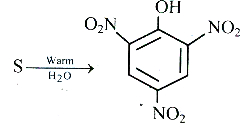
Identify the substrate '$S$' in the following reaction.
A
$p-$Nitrochlorobenzene
B
$o-$Nitrochlorobenzene
C
$2,4,6-$trichloronitrobenzene
D
$2,4,6-$trinitrochlorobenzene
Solution
(D) The reaction shown is the nucleophilic aromatic substitution of $2,4,6-$trinitrochlorobenzene with water (hydrolysis) to form $2,4,6-$trinitrophenol (picric acid).
Because of the presence of three strongly electron-withdrawing nitro $(-NO_2)$ groups at the ortho and para positions,the chlorine atom in $2,4,6-$trinitrochlorobenzene becomes highly susceptible to nucleophilic attack by water,even under mild conditions like warming with water.
Because of the presence of three strongly electron-withdrawing nitro $(-NO_2)$ groups at the ortho and para positions,the chlorine atom in $2,4,6-$trinitrochlorobenzene becomes highly susceptible to nucleophilic attack by water,even under mild conditions like warming with water.
0 likesView Solution
66
ChemistryMediumMCQMHT CET · 2024
Identify the product '$B$' in the following reaction.
A
Benzal chloride
B
Benzaldehyde
C
Benzyl alcohol
D
Benzoic acid
Solution
(B) The given reaction is the $Etard$ reaction.
In this reaction,$Toluene$ is treated with $Chromyl$ $chloride$ $(CrO_2Cl_2)$ in the presence of $CS_2$ as a solvent to form a brown chromium complex.
This complex on hydrolysis with $H_3O^+$ yields $Benzaldehyde$ as the final product '$B$'.
The overall reaction is: $C_6H_5CH_3 + 2CrO_2Cl_2$ $\xrightarrow{CS_2} C_6H_5CH(OCrOHCl_2)_2$ $\xrightarrow{H_3O^+} C_6H_5CHO$.
In this reaction,$Toluene$ is treated with $Chromyl$ $chloride$ $(CrO_2Cl_2)$ in the presence of $CS_2$ as a solvent to form a brown chromium complex.
This complex on hydrolysis with $H_3O^+$ yields $Benzaldehyde$ as the final product '$B$'.
The overall reaction is: $C_6H_5CH_3 + 2CrO_2Cl_2$ $\xrightarrow{CS_2} C_6H_5CH(OCrOHCl_2)_2$ $\xrightarrow{H_3O^+} C_6H_5CHO$.
0 likesView Solution
67
ChemistryMediumMCQMHT CET · 2024
Which of the following compounds is $NOT$ a phenol?
A
o-Nitrophenol
B
$2-$Naphthol
C
o-Bromophenol
D
Benzyl alcohol
Solution
(D) Phenols are compounds in which a hydroxyl group $(-OH)$ is directly attached to a carbon atom of an aromatic ring (benzene ring).
In options $(A)$,$(B)$,and $(C)$,the $-OH$ group is directly attached to the aromatic ring,making them phenols.
In option $(D)$,the $-OH$ group is attached to a side-chain carbon atom (a methylene group,$-CH_2-$) which is then attached to the benzene ring. This compound is classified as an aromatic alcohol (specifically,benzyl alcohol).
Therefore,the compound in option $(D)$ is not a phenol.
In options $(A)$,$(B)$,and $(C)$,the $-OH$ group is directly attached to the aromatic ring,making them phenols.
In option $(D)$,the $-OH$ group is attached to a side-chain carbon atom (a methylene group,$-CH_2-$) which is then attached to the benzene ring. This compound is classified as an aromatic alcohol (specifically,benzyl alcohol).
Therefore,the compound in option $(D)$ is not a phenol.
0 likesView Solution
68
ChemistryEasyMCQMHT CET · 2024
Identify the product obtained when phenol is heated with $Zn$ dust.
A
Benzene
B
Benzoquinone
C
$3 CH \equiv CH$
D
Cyclohexanol
Solution
(A) When phenol $(C_6H_5OH)$ is heated with zinc $(Zn)$ dust,it undergoes reduction to form benzene $(C_6H_6)$.
The chemical reaction is:
$C_6H_5OH + Zn \rightarrow C_6H_6 + ZnO$
The chemical reaction is:
$C_6H_5OH + Zn \rightarrow C_6H_6 + ZnO$
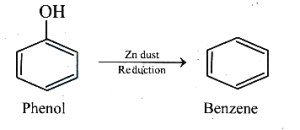
0 likesView Solution
69
ChemistryMediumMCQMHT CET · 2024
Identify the product of the following reaction.
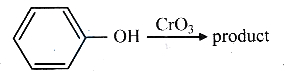
A
Benzene
B
Benzoic acid
C
Benzaldehyde
D
$p-$Benzoquinone
Solution
(D) When phenol is treated with chromic acid $(CrO_3)$,it undergoes oxidation to form a conjugated diketone known as $p-$benzoquinone.
0 likesView Solution
70
ChemistryEasyMCQMHT CET · 2024
Which reagent from the following is used in the Reimer-Tiemann reaction?
A
$CO_2, 6 \ atm, H_3O^{+}$
B
$CHCl_3, \ aq. \ NaOH, H_3O^{+}$
C
$CS_2$ (at low temperature)
D
$Na_2Cr_2O_7 / H_2SO_4$
Solution
(B) When phenol reacts with chloroform $(CHCl_3)$ in the presence of an aqueous base ($NaOH$ or $KOH$),an aldehyde $(-CHO)$ group is introduced into the benzene ring at the ortho position to the phenolic group,resulting in the formation of salicylaldehyde. This reaction is known as the Reimer-Tiemann reaction. The chemical equation is: $C_6H_5OH + CHCl_3 + 3KOH \rightarrow C_6H_4(OH)CHO + 3KCl + 3H_2O$.
0 likesView Solution
71
ChemistryEasyMCQMHT CET · 2024
Identify the product obtained in the following reaction:
$C_6H_5OH \xrightarrow{CrO_3} \text{Product}$
$C_6H_5OH \xrightarrow{CrO_3} \text{Product}$
A
Benzene
B
Benzaldehyde
C
Benzoic acid
D
$p$-Benzoquinone
Solution
(D) When phenol $(C_6H_5OH)$ is treated with chromic acid $(CrO_3)$,it undergoes oxidation to form a conjugated diketone known as $p$-benzoquinone.
This is a specific oxidation reaction of phenol.
This is a specific oxidation reaction of phenol.
0 likesView Solution
72
ChemistryMediumMCQMHT CET · 2024
Which of the following reagents is used in the conversion of phenol to picric acid?
A
dil. Nitric acid
B
conc. Nitrous acid
C
conc. Sulphuric acid
D
conc. $HNO_3 +$ conc. $H_2SO_4$
Solution
(D) The conversion of phenol to picric acid $(2,4,6-\text{trinitrophenol})$ is an electrophilic aromatic substitution reaction known as nitration.
Phenol reacts with concentrated nitric acid $(HNO_3)$ in the presence of concentrated sulphuric acid $(H_2SO_4)$ to form picric acid.
The concentrated $H_2SO_4$ acts as a catalyst and helps in the generation of the nitronium ion $(NO_2^+)$,which is the electrophile.
Phenol reacts with concentrated nitric acid $(HNO_3)$ in the presence of concentrated sulphuric acid $(H_2SO_4)$ to form picric acid.
The concentrated $H_2SO_4$ acts as a catalyst and helps in the generation of the nitronium ion $(NO_2^+)$,which is the electrophile.
0 likesView Solution
73
ChemistryEasyMCQMHT CET · 2024
Phenol on heating with zinc dust forms
A
Benzoquinone
B
Cyclohexane
C
Benzene
D
Cyclohexanol
Solution
(C) When phenol $(C_6H_5OH)$ is heated with zinc dust $(Zn)$,it undergoes a reduction reaction.
In this process,the oxygen atom of the hydroxyl group is removed by zinc to form zinc oxide $(ZnO)$,and phenol is converted into benzene $(C_6H_6)$.
The chemical equation is: $C_6H_5OH + Zn \xrightarrow{\Delta} C_6H_6 + ZnO$.
In this process,the oxygen atom of the hydroxyl group is removed by zinc to form zinc oxide $(ZnO)$,and phenol is converted into benzene $(C_6H_6)$.
The chemical equation is: $C_6H_5OH + Zn \xrightarrow{\Delta} C_6H_6 + ZnO$.
0 likesView Solution
74
ChemistryEasyMCQMHT CET · 2024
Which reagent is used in the conversion of phenol to picric acid?
A
Nitric acid (dil.)
B
Nitrous acid (conc.)
C
Sulphuric acid (conc.)
D
Nitric acid (conc.) + Sulphuric acid (conc.)
Solution
(D) The conversion of phenol to picric acid ($2,4,6$-trinitrophenol) is an electrophilic aromatic substitution reaction.
Phenol reacts with concentrated nitric acid $(HNO_3)$ in the presence of concentrated sulphuric acid $(H_2SO_4)$ to undergo nitration at the $ortho$ and $para$ positions,resulting in the formation of $2,4,6$-trinitrophenol,commonly known as picric acid.
Phenol reacts with concentrated nitric acid $(HNO_3)$ in the presence of concentrated sulphuric acid $(H_2SO_4)$ to undergo nitration at the $ortho$ and $para$ positions,resulting in the formation of $2,4,6$-trinitrophenol,commonly known as picric acid.
0 likesView Solution
75
ChemistryMediumMCQMHT CET · 2024
Identify the product obtained when methyl bromide $(CH_3Br)$ reacts with sodium tert-butoxide $((CH_3)_3CONa)$.
A
Isobutylene and methanol
B
$1-$Methoxybutane
C
$2-$Methoxybutane
D
$2-$Methoxy$-2-$methylpropane
Solution
(D) The reaction between methyl bromide $(CH_3Br)$ and sodium tert-butoxide $((CH_3)_3CONa)$ is a Williamson ether synthesis.
Since methyl bromide is a primary alkyl halide,it undergoes an $S_N2$ reaction with the nucleophilic tert-butoxide ion.
The nucleophilic oxygen of the tert-butoxide attacks the electrophilic carbon of the methyl bromide,displacing the bromide ion.
The product formed is tert-butyl methyl ether,which is also known as $2-$methoxy$-2-$methylpropane.
Since methyl bromide is a primary alkyl halide,it undergoes an $S_N2$ reaction with the nucleophilic tert-butoxide ion.
The nucleophilic oxygen of the tert-butoxide attacks the electrophilic carbon of the methyl bromide,displacing the bromide ion.
The product formed is tert-butyl methyl ether,which is also known as $2-$methoxy$-2-$methylpropane.
0 likesView Solution
76
ChemistryMediumMCQMHT CET · 2024
Which among the following is the method for the preparation of ethers?
A
By the action of moist $Ag_2O$ on an alkyl halide
B
By the action of $aq. KOH$ on alkyl halide.
C
By the action of $alc. NaOH$ on alkyl halide.
D
By the action of sodium alkoxide on alkyl halide.
Solution
(D) Ethers can be prepared by Williamson Synthesis,in which an alkyl halide is treated with sodium alkoxide.
The reaction is: $R-X + NaOR \longrightarrow R-O-R + NaX$
The reaction is: $R-X + NaOR \longrightarrow R-O-R + NaX$
0 likesView Solution
77
ChemistryMediumMCQMHT CET · 2024
Which of the following compounds does not undergo Williamson's synthesis?
A
$C_2H_5Br$
B
$CH_3-CH(CH_3)-CH_2-Cl$
C
$C_6H_5Cl$
D
$CH_3-CH_2-CH_2-Cl$
Solution
(C) Williamson's synthesis involves an $S_N2$ reaction between an alkyl halide and an alkoxide ion.
$Aryl$ halides (like $C_6H_5Cl$) do not undergo $S_N2$ reactions easily due to the partial double bond character of the $C-Cl$ bond and the instability of the phenyl cation.
Therefore,$C_6H_5Cl$ does not undergo Williamson's synthesis.
$Aryl$ halides (like $C_6H_5Cl$) do not undergo $S_N2$ reactions easily due to the partial double bond character of the $C-Cl$ bond and the instability of the phenyl cation.
Therefore,$C_6H_5Cl$ does not undergo Williamson's synthesis.
0 likesView Solution
78
ChemistryMediumMCQMHT CET · 2024
What is the percentage of $p$-bromoanisole formed in the bromination of anisole with bromine in acetic acid (in $\%$)?
A
$10$
B
$30$
C
$60$
D
$90$
Solution
(D) The bromination of anisole $(C_6H_5OCH_3)$ with bromine $(Br_2)$ in acetic acid $(CH_3COOH)$ is an electrophilic aromatic substitution reaction.
Anisole is an ortho/para directing group due to the $+M$ effect of the methoxy $(-OCH_3)$ group.
Due to steric hindrance at the ortho position,the para-isomer is the major product.
According to standard experimental data,the reaction yields $90 \%$ of $p$-bromoanisole and $10 \%$ of $o$-bromoanisole.
Therefore,the correct percentage of $p$-bromoanisole formed is $90 \%$.
Anisole is an ortho/para directing group due to the $+M$ effect of the methoxy $(-OCH_3)$ group.
Due to steric hindrance at the ortho position,the para-isomer is the major product.
According to standard experimental data,the reaction yields $90 \%$ of $p$-bromoanisole and $10 \%$ of $o$-bromoanisole.
Therefore,the correct percentage of $p$-bromoanisole formed is $90 \%$.
0 likesView Solution
79
ChemistryMediumMCQMHT CET · 2024
Identify the product obtained when ethers are dissolved in cold concentrated sulphuric acid.
A
Alkanols
B
Alkanoic acids
C
Alkyl hydrogen sulphate
D
Oxonium salts
Solution
(D) When ethers are dissolved in cold concentrated sulphuric acid,the lone pair of electrons on the oxygen atom of the ether accepts a proton from the acid to form an oxonium salt.
The reaction is as follows:
$R-O-R' + H_2SO_4 \rightarrow [R-O(H)-R']^+ [HSO_4]^-$ (Oxonium salt)
The reaction is as follows:
$R-O-R' + H_2SO_4 \rightarrow [R-O(H)-R']^+ [HSO_4]^-$ (Oxonium salt)
0 likesView Solution
80
ChemistryDifficultMCQMHT CET · 2024
Identify product $B$ in the following reaction.
Sodium phenoxide $\xrightarrow[6 \text{ atm}]{CO_2, 398 \text{ K}} A$ $\xrightarrow{H_3O^{+}} B$
Sodium phenoxide $\xrightarrow[6 \text{ atm}]{CO_2, 398 \text{ K}} A$ $\xrightarrow{H_3O^{+}} B$
A
Picric acid
B
Sulphonic acid
C
Salicylic acid
D
Salicylaldehyde
Solution
(C) The reaction shown is the $Kolbe-Schmitt$ reaction.
In the first step,sodium phenoxide reacts with $CO_2$ at $398 \text{ K}$ and $6 \text{ atm}$ pressure to form sodium salicylate $(A)$.
In the second step,acidification with $H_3O^{+}$ converts sodium salicylate $(A)$ into salicylic acid $(B)$.
Therefore,the product $B$ is salicylic acid.
In the first step,sodium phenoxide reacts with $CO_2$ at $398 \text{ K}$ and $6 \text{ atm}$ pressure to form sodium salicylate $(A)$.
In the second step,acidification with $H_3O^{+}$ converts sodium salicylate $(A)$ into salicylic acid $(B)$.
Therefore,the product $B$ is salicylic acid.
0 likesView Solution
81
ChemistryMediumMCQMHT CET · 2024
Ethers,when dissolved in cold concentrated sulfuric acid,form:
A
Alkanols
B
Alkanoic acids
C
Alkyl hydrogen sulphate
D
Oxonium salts
Solution
(D) Ethers contain an oxygen atom with two lone pairs of electrons,which makes them act as weak Lewis bases.
When ethers are dissolved in cold concentrated sulfuric acid $(H_2SO_4)$,the oxygen atom of the ether gets protonated by the acid to form an oxonium salt.
The reaction is as follows:
$R-O-R' + H_2SO_4 \rightarrow [R-O(H)-R']^+ HSO_4^-$
Here,the product formed is an oxonium salt.
When ethers are dissolved in cold concentrated sulfuric acid $(H_2SO_4)$,the oxygen atom of the ether gets protonated by the acid to form an oxonium salt.
The reaction is as follows:
$R-O-R' + H_2SO_4 \rightarrow [R-O(H)-R']^+ HSO_4^-$
Here,the product formed is an oxonium salt.
0 likesView Solution
82
ChemistryEasyMCQMHT CET · 2024
$Crotonyl$ alcohol is an example of
A
Allylic alcohol
B
Benzylic alcohol
C
Vinylic alcohol
D
Polyhydric alcohol
Solution
(A) $Crotonyl$ alcohol is represented by the formula $CH_3CH=CHCH_2OH$.
In this molecule,the $-OH$ group is attached to a carbon atom that is $sp^3$ hybridized and is adjacent to a carbon-carbon double bond $(C=C)$.
This structural feature defines an allylic alcohol.
In this molecule,the $-OH$ group is attached to a carbon atom that is $sp^3$ hybridized and is adjacent to a carbon-carbon double bond $(C=C)$.
This structural feature defines an allylic alcohol.
0 likesView Solution
83
ChemistryMediumMCQMHT CET · 2024
Aldol condensation reaction is
A
Electrophilic substitution
B
Nucleophilic substitution
C
Electrophilic addition-elimination reaction
D
Nucleophilic addition-elimination reaction
Solution
(D) Aldol condensation involves the attack of an enolate ion (a nucleophile) on the carbonyl carbon of another aldehyde or ketone molecule.
This process is a nucleophilic addition reaction,which is followed by the elimination of a water molecule (dehydration) to form an $\alpha,\beta$-unsaturated carbonyl compound.
Therefore,the overall process is classified as a nucleophilic addition-elimination reaction.
This process is a nucleophilic addition reaction,which is followed by the elimination of a water molecule (dehydration) to form an $\alpha,\beta$-unsaturated carbonyl compound.
Therefore,the overall process is classified as a nucleophilic addition-elimination reaction.
0 likesView Solution
84
ChemistryMediumMCQMHT CET · 2024
Identify the compound having the highest solubility in water from the following:
A
Phenol
B
$tert$-Butyl alcohol
C
$o$-Nitrophenol
D
$p$-Nitrophenol
Solution
(B) Solubility in water depends on the ability of the compound to form hydrogen bonds with water molecules.
$tert$-Butyl alcohol ($CH_3)_3COH$ has a small hydrophobic alkyl group relative to the hydrophilic hydroxyl group,allowing it to be miscible in water.
Phenol has a large hydrophobic benzene ring,which reduces its solubility compared to lower alcohols.
$o$-Nitrophenol exhibits intramolecular hydrogen bonding,which decreases its solubility in water.
$p$-Nitrophenol has intermolecular hydrogen bonding,but the hydrophobic benzene ring still limits its solubility compared to $tert$-butyl alcohol.
Therefore,$tert$-butyl alcohol has the highest solubility among the given options.
$tert$-Butyl alcohol ($CH_3)_3COH$ has a small hydrophobic alkyl group relative to the hydrophilic hydroxyl group,allowing it to be miscible in water.
Phenol has a large hydrophobic benzene ring,which reduces its solubility compared to lower alcohols.
$o$-Nitrophenol exhibits intramolecular hydrogen bonding,which decreases its solubility in water.
$p$-Nitrophenol has intermolecular hydrogen bonding,but the hydrophobic benzene ring still limits its solubility compared to $tert$-butyl alcohol.
Therefore,$tert$-butyl alcohol has the highest solubility among the given options.
0 likesView Solution
85
ChemistryMediumMCQMHT CET · 2024
Which among the following has the highest melting point?
A
Phenol
B
$p-$Nitrophenol
C
$p-$Cresol
D
$o-$Nitrophenol
Solution
(B) The melting point of a compound is significantly influenced by the nature of hydrogen bonding.
$o-$Nitrophenol exhibits intramolecular hydrogen bonding,which restricts intermolecular association,leading to a lower melting point.
In $p-$Cresol,the presence of the non-polar $-CH_3$ group does not significantly enhance intermolecular forces compared to the nitro group.
$p-$Nitrophenol exhibits strong intermolecular hydrogen bonding,which leads to the association of molecules in the solid state,resulting in a much higher melting point $(114 \ ^\circ C)$ compared to the others.
$o-$Nitrophenol exhibits intramolecular hydrogen bonding,which restricts intermolecular association,leading to a lower melting point.
In $p-$Cresol,the presence of the non-polar $-CH_3$ group does not significantly enhance intermolecular forces compared to the nitro group.
$p-$Nitrophenol exhibits strong intermolecular hydrogen bonding,which leads to the association of molecules in the solid state,resulting in a much higher melting point $(114 \ ^\circ C)$ compared to the others.
0 likesView Solution
86
ChemistryMediumMCQMHT CET · 2024
Identify the reagent '$R$' used in the following reaction.
$C_6H_5COCl \xrightarrow{R} C_6H_5CHO$
$C_6H_5COCl \xrightarrow{R} C_6H_5CHO$
A
$CO, HCl$
B
$H_2, Pd-BaSO_4$
C
$DIBAL-H$
D
$H_2O$
Solution
(B) The reaction of benzoyl chloride $(C_6H_5COCl)$ to benzaldehyde $(C_6H_5CHO)$ is a standard reduction reaction.
Acyl chlorides are reduced to their corresponding aldehydes by hydrogen gas in the presence of a palladium catalyst poisoned with barium sulfate $(Pd-BaSO_4)$.
This specific reaction is known as the Rosenmund reduction.
Therefore,the reagent '$R$' is $H_2, Pd-BaSO_4$.
Acyl chlorides are reduced to their corresponding aldehydes by hydrogen gas in the presence of a palladium catalyst poisoned with barium sulfate $(Pd-BaSO_4)$.
This specific reaction is known as the Rosenmund reduction.
Therefore,the reagent '$R$' is $H_2, Pd-BaSO_4$.
0 likesView Solution
87
ChemistryEasyMCQMHT CET · 2024
Which of the following is Stephen reaction?
A
$R-COCl \xrightarrow[Pd-BaSO_4]{H_2} R-CHO + HCl$
B
$R-CN \xrightarrow[ii) H_3O^+]{i) SnCl_2, HCl} R-CHO + NH_4Cl$
C
$R-CHO \xrightarrow[\Delta]{Zn-Hg, \text{ conc. } HCl} R-CH_3 + H_2O$
D
$R-CHO \xrightarrow[ii) KOH, HO-CH_2-CH_2-OH]{i) H_2N-NH_2} R-CH_2-R$
Solution
(B) Nitriles are reduced to imine hydrochloride by stannous chloride in the presence of hydrochloric acid,which on acid hydrolysis gives corresponding aldehydes. This reaction is called the Stephen reaction.
$R-CN \xrightarrow[ii) H_3O^+]{i) SnCl_2, HCl} R-CHO + NH_4Cl$
$R-CN \xrightarrow[ii) H_3O^+]{i) SnCl_2, HCl} R-CHO + NH_4Cl$
0 likesView Solution
88
ChemistryMediumMCQMHT CET · 2024
Identify the product obtained in the following reaction:
$C_6H_6 \xrightarrow[\text{Anhydrous } AlCl_3, \text{high pressure}]{CO, HCl} \text{product}$
$C_6H_6 \xrightarrow[\text{Anhydrous } AlCl_3, \text{high pressure}]{CO, HCl} \text{product}$
A
$C_6H_5COOH$
B
$C_6H_5CHO$
C
$C_6H_5CHCl_2$
D
$C_6H_5Cl$
Solution
(B) The given reaction is the Gattermann-Koch reaction.
In this reaction,benzene $(C_6H_6)$ reacts with carbon monoxide $(CO)$ and hydrogen chloride $(HCl)$ in the presence of anhydrous aluminum chloride $(AlCl_3)$ under high pressure to form benzaldehyde $(C_6H_5CHO)$.
The reaction is: $C_6H_6 + CO + HCl \xrightarrow[\text{Anhydrous } AlCl_3]{\text{high pressure}} C_6H_5CHO$.
Therefore,the correct product is benzaldehyde $(C_6H_5CHO)$.
In this reaction,benzene $(C_6H_6)$ reacts with carbon monoxide $(CO)$ and hydrogen chloride $(HCl)$ in the presence of anhydrous aluminum chloride $(AlCl_3)$ under high pressure to form benzaldehyde $(C_6H_5CHO)$.
The reaction is: $C_6H_6 + CO + HCl \xrightarrow[\text{Anhydrous } AlCl_3]{\text{high pressure}} C_6H_5CHO$.
Therefore,the correct product is benzaldehyde $(C_6H_5CHO)$.
0 likesView Solution
89
ChemistryEasyMCQMHT CET · 2024
Identify the product $B$ obtained in the following reaction.
$R-C \equiv N$ $\xrightarrow{SnCl_2/HCl} A$ $\xrightarrow{H_3O^{+}} B$
$R-C \equiv N$ $\xrightarrow{SnCl_2/HCl} A$ $\xrightarrow{H_3O^{+}} B$
A
$R-NH_2$
B
$R-CONH_2$
C
$R-CHO$
D
$R-COOH$
Solution
(C) The given reaction is the Stephen reduction reaction.
In the first step,the nitrile $(R-C \equiv N)$ is reduced by $SnCl_2/HCl$ to form an imine hydrochloride intermediate $(A)$,which is $R-CH=NH \cdot HCl$.
In the second step,the hydrolysis of the imine hydrochloride $(A)$ with $H_3O^{+}$ yields an aldehyde $(B)$ as the final product,which is $R-CHO$.
In the first step,the nitrile $(R-C \equiv N)$ is reduced by $SnCl_2/HCl$ to form an imine hydrochloride intermediate $(A)$,which is $R-CH=NH \cdot HCl$.
In the second step,the hydrolysis of the imine hydrochloride $(A)$ with $H_3O^{+}$ yields an aldehyde $(B)$ as the final product,which is $R-CHO$.
0 likesView Solution
90
ChemistryEasyMCQMHT CET · 2024
Which reagent from the following is used for the preparation of aliphatic aldehyde from nitriles?
A
$CrO_2Cl_2$ in $CS_2$
B
$CrO_3$ in acetic anhydride
C
$SnCl_2, HCl$
D
$Co, HCl$,anhydrous $AlCl_3$
Solution
(C) The reduction of nitriles to aldehydes is known as the $Stephen$ reduction.
In this reaction,nitriles $(R-C \equiv N)$ are reduced to imines using stannous chloride $(SnCl_2)$ in the presence of hydrochloric acid $(HCl)$,which are then hydrolyzed to form aldehydes $(RCHO)$.
The reaction is:
$R-C \equiv N \xrightarrow[(ii) H_3O^+]{(i) SnCl_2 / dil. HCl} RCHO + NH_4Cl$
In this reaction,nitriles $(R-C \equiv N)$ are reduced to imines using stannous chloride $(SnCl_2)$ in the presence of hydrochloric acid $(HCl)$,which are then hydrolyzed to form aldehydes $(RCHO)$.
The reaction is:
$R-C \equiv N \xrightarrow[(ii) H_3O^+]{(i) SnCl_2 / dil. HCl} RCHO + NH_4Cl$
0 likesView Solution
91
ChemistryMediumMCQMHT CET · 2024
Identify the reagent used for the preparation of benzophenone from benzonitrile.
A
$C_6H_5MgBr$
B
$CH_3MgCl$ (in dry ether)
C
$(CH_3)_2Cd$
D
$AlH(i-Bu)_2$
Solution
(A) The reaction of benzonitrile $(C_6H_5CN)$ with phenylmagnesium bromide $(C_6H_5MgBr)$ in the presence of dry ether followed by acid hydrolysis $(H_3O^+)$ yields benzophenone $(C_6H_5COC_6H_5)$.
The reaction steps are:
$1$. $C_6H_5-C \equiv N + C_6H_5-MgBr \xrightarrow{\text{dry ether}} C_6H_5-C(C_6H_5)=NMgBr$
$2$. $C_6H_5-C(C_6H_5)=NMgBr \xrightarrow{H_3O^+} C_6H_5-CO-C_6H_5 + NH_3 + Mg(Br)OH$
Thus,the required reagent is $C_6H_5MgBr$.
The reaction steps are:
$1$. $C_6H_5-C \equiv N + C_6H_5-MgBr \xrightarrow{\text{dry ether}} C_6H_5-C(C_6H_5)=NMgBr$
$2$. $C_6H_5-C(C_6H_5)=NMgBr \xrightarrow{H_3O^+} C_6H_5-CO-C_6H_5 + NH_3 + Mg(Br)OH$
Thus,the required reagent is $C_6H_5MgBr$.
0 likesView Solution
92
ChemistryDifficultMCQMHT CET · 2024
Which of the following is a simple (symmetrical) ketone?
A
Acetophenone
B
Butanone
C
Benzophenone
D
Pentan-$2$-one
Solution
(C) simple or symmetrical ketone is one in which both alkyl or aryl groups attached to the carbonyl carbon are identical.
Benzophenone,with the structure $(C_6H_5)_2C=O$,has two phenyl groups attached to the carbonyl carbon,making it a symmetrical ketone.
Acetophenone $(C_6H_5COCH_3)$,Butanone $(CH_3COCH_2CH_3)$,and Pentan-$2$-one $(CH_3COCH_2CH_2CH_3)$ are all mixed or unsymmetrical ketones.
Benzophenone,with the structure $(C_6H_5)_2C=O$,has two phenyl groups attached to the carbonyl carbon,making it a symmetrical ketone.
Acetophenone $(C_6H_5COCH_3)$,Butanone $(CH_3COCH_2CH_3)$,and Pentan-$2$-one $(CH_3COCH_2CH_2CH_3)$ are all mixed or unsymmetrical ketones.
0 likesView Solution
93
ChemistryEasyMCQMHT CET · 2024
Identify the reagent $R$ used in the following reaction:
$\text{Ketone} \xrightarrow{R} \text{Semicarbazone}$
$\text{Ketone} \xrightarrow{R} \text{Semicarbazone}$
A
$NH_2OH$
B
$NH_2NHCONH_2$
C
$NH_2NHC_6H_5$
D
$NH_2-NH_2$
Solution
(B) The reaction of a ketone with semicarbazide $(NH_2NHCONH_2)$ in a weakly acidic medium leads to the formation of a semicarbazone.
The general reaction is: $R_2C=O + NH_2NHCONH_2 \rightarrow R_2C=NNHCONH_2 + H_2O$.
Therefore,the reagent $R$ is semicarbazide,which is $NH_2NHCONH_2$.
The general reaction is: $R_2C=O + NH_2NHCONH_2 \rightarrow R_2C=NNHCONH_2 + H_2O$.
Therefore,the reagent $R$ is semicarbazide,which is $NH_2NHCONH_2$.
0 likesView Solution
94
ChemistryMediumMCQMHT CET · 2024
Identify the substrate '$A$' in the following conversion.
$A \xrightarrow[H_3O^{+}]{AlH(i-Bu)_2} \text{Pent-}3\text{-enal}$
$A \xrightarrow[H_3O^{+}]{AlH(i-Bu)_2} \text{Pent-}3\text{-enal}$
A
Pentanenitrile
B
Pent-$3$-enenitrile
C
Pent-$3$-en-$1$-amine
D
Pent-$3$-ynenitrile
Solution
(B) The reagent $AlH(i-Bu)_2$ is Diisobutylaluminium hydride ($DIBAL$-$H$).
It is a selective reducing agent used to reduce nitriles $(-CN)$ to aldehydes $(-CHO)$ after acidic hydrolysis $(H_3O^+)$.
To obtain $\text{Pent-}3\text{-enal}$ $(CH_3-CH=CH-CH_2-CHO)$,the starting material must be a nitrile with the same carbon skeleton,which is $\text{Pent-}3\text{-enenitrile}$ $(CH_3-CH=CH-CH_2-CN)$.
Therefore,the substrate '$A$' is $\text{Pent-}3\text{-enenitrile}$.
It is a selective reducing agent used to reduce nitriles $(-CN)$ to aldehydes $(-CHO)$ after acidic hydrolysis $(H_3O^+)$.
To obtain $\text{Pent-}3\text{-enal}$ $(CH_3-CH=CH-CH_2-CHO)$,the starting material must be a nitrile with the same carbon skeleton,which is $\text{Pent-}3\text{-enenitrile}$ $(CH_3-CH=CH-CH_2-CN)$.
Therefore,the substrate '$A$' is $\text{Pent-}3\text{-enenitrile}$.
0 likesView Solution
95
ChemistryDifficultMCQMHT CET · 2024
Identify the product '$B$' in the following reaction:
Ethylphenyl ketone $\xrightarrow[-H_2O]{H_2N-NH_2} A$ $\xrightarrow{KOH, HO(CH_2)_2OH, \Delta} B$
Ethylphenyl ketone $\xrightarrow[-H_2O]{H_2N-NH_2} A$ $\xrightarrow{KOH, HO(CH_2)_2OH, \Delta} B$
A
Phenylhydrazone
B
Ethylbenzene
C
$n-$propylbenzene
D
Isopropylbenzene
Solution
(C) The given reaction sequence is the Wolff-Kishner reduction.
Step $1$: Ethylphenyl ketone reacts with hydrazine $(H_2N-NH_2)$ to form a hydrazone $(A)$.
Step $2$: The hydrazone $(A)$ reacts with a strong base $(KOH)$ in the presence of ethylene glycol $(HO(CH_2)_2OH)$ and heat to undergo reduction,converting the carbonyl group $(C=O)$ into a methylene group $(-CH_2-)$.
Starting material: $C_6H_5-CO-C_2H_5$ (Propiophenone or Ethylphenyl ketone).
Product $B$: $C_6H_5-CH_2-C_2H_5$,which is $n-$propylbenzene.
Step $1$: Ethylphenyl ketone reacts with hydrazine $(H_2N-NH_2)$ to form a hydrazone $(A)$.
Step $2$: The hydrazone $(A)$ reacts with a strong base $(KOH)$ in the presence of ethylene glycol $(HO(CH_2)_2OH)$ and heat to undergo reduction,converting the carbonyl group $(C=O)$ into a methylene group $(-CH_2-)$.
Starting material: $C_6H_5-CO-C_2H_5$ (Propiophenone or Ethylphenyl ketone).
Product $B$: $C_6H_5-CH_2-C_2H_5$,which is $n-$propylbenzene.
0 likesView Solution
96
ChemistryMediumMCQMHT CET · 2024
Identify the product '$B$' in the following sequence of reactions.
$2CH_3COCH_3$ $\xrightarrow{Ba(OH)_2} A$ $\xrightarrow[-H_2O]{\Delta} B$
$2CH_3COCH_3$ $\xrightarrow{Ba(OH)_2} A$ $\xrightarrow[-H_2O]{\Delta} B$
A
$4-$Hydroxy$-4-$methylpentan$-2-$one
B
$2-$methylpentan$-3-$one
C
$2-$methylpent$-2-$en$-4-$one
D
$4-$methylpent$-3-$en$-2-$one
Solution
(D) The reaction sequence represents the Aldol condensation of propanone.
Step $1$: Two molecules of propanone react in the presence of a base like $Ba(OH)_2$ to form a $\beta-$hydroxy ketone,which is $4-$hydroxy$-4-$methylpentan$-2-$one $(A)$.
Step $2$: Upon heating,the $\beta-$hydroxy ketone undergoes dehydration (loss of water) to form an $\alpha,\beta-$unsaturated ketone.
$4-$Hydroxy$-4-$methylpentan$-2-$one $\xrightarrow{\Delta, -H_2O} 4-$methylpent$-3-$en$-2-$one $(B)$.
Thus,the product $B$ is $4-$methylpent$-3-$en$-2-$one.
Step $1$: Two molecules of propanone react in the presence of a base like $Ba(OH)_2$ to form a $\beta-$hydroxy ketone,which is $4-$hydroxy$-4-$methylpentan$-2-$one $(A)$.
Step $2$: Upon heating,the $\beta-$hydroxy ketone undergoes dehydration (loss of water) to form an $\alpha,\beta-$unsaturated ketone.
$4-$Hydroxy$-4-$methylpentan$-2-$one $\xrightarrow{\Delta, -H_2O} 4-$methylpent$-3-$en$-2-$one $(B)$.
Thus,the product $B$ is $4-$methylpent$-3-$en$-2-$one.
0 likesView Solution
97
ChemistryEasyMCQMHT CET · 2024
Which of the following compounds is used to convert acetaldehyde into acetaldehyde cyanohydrin?
A
$FeCl_3$ (neutral)
B
$H_2SO_4$ (dil.)
C
$HCN$
D
$NaHSO_3$
Solution
(C) The conversion of acetaldehyde $(CH_3CHO)$ into acetaldehyde cyanohydrin involves the nucleophilic addition of hydrogen cyanide $(HCN)$ to the carbonyl group of the aldehyde.
The reaction is as follows:
$CH_3CHO + HCN \rightarrow CH_3CH(OH)CN$
Thus,$HCN$ is the reagent used for this transformation.
The reaction is as follows:
$CH_3CHO + HCN \rightarrow CH_3CH(OH)CN$
Thus,$HCN$ is the reagent used for this transformation.
0 likesView Solution
98
ChemistryMediumMCQMHT CET · 2024
Which of the following compounds does not undergo haloform reaction?
A
Ethanal
B
Propanal
C
Propanone
D
Butanone
Solution
(B) The haloform reaction is given by compounds containing the $CH_3CO-$ group (methyl ketones) or the $CH_3CH(OH)-$ group (secondary alcohols).
Ethanal $(CH_3CHO)$ contains the $CH_3CO-$ group.
Propanone $(CH_3COCH_3)$ and Butanone $(CH_3COCH_2CH_3)$ are methyl ketones.
Propanal $(CH_3CH_2CHO)$ does not contain the $CH_3CO-$ group,as the methyl group is attached to a methylene group,not the carbonyl carbon.
Therefore,Propanal does not undergo the haloform reaction.
Ethanal $(CH_3CHO)$ contains the $CH_3CO-$ group.
Propanone $(CH_3COCH_3)$ and Butanone $(CH_3COCH_2CH_3)$ are methyl ketones.
Propanal $(CH_3CH_2CHO)$ does not contain the $CH_3CO-$ group,as the methyl group is attached to a methylene group,not the carbonyl carbon.
Therefore,Propanal does not undergo the haloform reaction.
0 likesView Solution
99
ChemistryMediumMCQMHT CET · 2024
Identify the test from the following in which an aldehyde,when boiled with an ammoniacal silver nitrate solution,deposits silver.
A
Schiff's test
B
Tollen's test
C
Gehling test
D
Iodoform test
Solution
(B) Tollen's reagent,which is an ammoniacal silver nitrate solution,oxidises aldehydes to the corresponding carboxylate anion. During this process,$Ag^+$ ions are reduced to metallic silver,which deposits as a silver mirror or a greyish-black precipitate on the inner walls of the test tube.
0 likesView Solution
100
ChemistryEasyMCQMHT CET · 2024
What is the product obtained in the reaction?
$CH_3-CH=CH-CH_2-CHO \xrightarrow[(ii) H_3O^{+}]{(i) LiAlH_4} \text{product}$
$CH_3-CH=CH-CH_2-CHO \xrightarrow[(ii) H_3O^{+}]{(i) LiAlH_4} \text{product}$
A
$CH_3-CH=CH-CH_2-CH_2-OH$
B
$CH_3-CH=CH-CH_2-COOH$
C
$CH_3-CH_2-CH_2-CH_2-CHO$
D
$CH_3-CH_2-CH_2-CH_2-CH_3$
Solution
(A) $LiAlH_4$ is a selective reducing agent that reduces the aldehyde group to a primary alcohol while leaving the isolated carbon-carbon double bond intact.
Therefore,the reaction of $CH_3-CH=CH-CH_2-CHO$ with $(i) LiAlH_4$ followed by $(ii) H_3O^{+}$ yields $CH_3-CH=CH-CH_2-CH_2-OH$.
Therefore,the reaction of $CH_3-CH=CH-CH_2-CHO$ with $(i) LiAlH_4$ followed by $(ii) H_3O^{+}$ yields $CH_3-CH=CH-CH_2-CH_2-OH$.
0 likesView Solution
Vedclass Products
For Students
Vedclass Test Series
Mock tests in real MHT CET style covering Chemistry with performance analysis. 5-day free trial.
Start Free TrialFor Teachers
Exam Paper Generator
Generate Set A/B/C/D Chemistry papers from 7.5L+ questions in 2 minutes. 3 chapters free.
Try FreeFor Institutes
Online Exam Module
Run live MHT CET mock exams with unlimited students, 360° analytics & white-label branding.
See DemoFrequently Asked Questions
How many Chemistry questions are in MHT CET 2024?
There are 900 Chemistry questions from the MHT CET 2024 paper on Vedclass, each with a detailed step-by-step solution in English.
Are MHT CET 2024 Chemistry solutions available in English?
Yes. All solutions on this page are in English. You can also switch to English or Hindi using the language buttons above the questions.
Can I practice MHT CET 2024 Chemistry as a timed test?
Yes. Use the Vedclass Test Series to attempt a full MHT CET mock test covering Chemistry with time limits and instant score analysis.
Can teachers create Chemistry papers from MHT CET previous year questions?
Yes. The Vedclass Exam Paper Generator lets teachers mix MHT CET Chemistry questions and generate Set A/B/C/D papers in minutes.
For Teachers & Institutes
Build a Custom Chemistry Paper
Pick MHT CET 2024 Chemistry questions, set difficulty, and generate Set A/B/C/D in 2 minutes.