
અ Gujarati
Solution of trigonometrical equations Questions in Gujarati
Class 11 Mathematics · Trigonometrical Equations · Solution of trigonometrical equations
379+
Questions
Gujarati
Language
100%
With Solutions
Showing 49 of 379 questions in Gujarati
251
MediumMCQ
જો $3 \cos x \neq 2 \sin x$ હોય,તો $\sin ^{2} x-\cos 2 x=2-\sin 2 x$ નો વ્યાપક ઉકેલ શોધો.
A
$x=n \pi+\frac{\pi}{2}, \quad n \in Z$
B
$x=n\left(\frac{\pi}{2}\right)+\pi, \quad n \in Z$
C
$x=n\left(\frac{\pi}{2}\right)+\frac{\pi}{3}, \quad n \in Z$
D
$x=(2 n+1) \pi, \quad n \in Z$
Solution
(A) આપેલ સમીકરણ: $\sin ^{2} x - \cos 2 x = 2 - \sin 2 x$
નિત્યસમ $\cos 2 x = 1 - 2 \sin ^{2} x$ નો ઉપયોગ કરતા:
$\sin ^{2} x - (1 - 2 \sin ^{2} x) = 2 - \sin 2 x$
$3 \sin ^{2} x - 1 = 2 - \sin 2 x$
$3 \sin ^{2} x + \sin 2 x - 3 = 0$
$\sin 2 x = 2 \sin x \cos x$ અને $1 = \sin ^{2} x + \cos ^{2} x$ હોવાથી,$3 = 3(\sin ^{2} x + \cos ^{2} x)$ લખી શકાય:
$3 \sin ^{2} x + 2 \sin x \cos x - 3(\sin ^{2} x + \cos ^{2} x) = 0$
$2 \sin x \cos x - 3 \cos ^{2} x = 0$
$\cos x (2 \sin x - 3 \cos x) = 0$
આથી $\cos x = 0$ અથવા $2 \sin x = 3 \cos x$.
શરત $3 \cos x \neq 2 \sin x$ આપેલ હોવાથી,$\cos x = 0$ મળે.
$\cos x = 0$ નો વ્યાપક ઉકેલ $x = n \pi + \frac{\pi}{2}, n \in Z$ છે.
નિત્યસમ $\cos 2 x = 1 - 2 \sin ^{2} x$ નો ઉપયોગ કરતા:
$\sin ^{2} x - (1 - 2 \sin ^{2} x) = 2 - \sin 2 x$
$3 \sin ^{2} x - 1 = 2 - \sin 2 x$
$3 \sin ^{2} x + \sin 2 x - 3 = 0$
$\sin 2 x = 2 \sin x \cos x$ અને $1 = \sin ^{2} x + \cos ^{2} x$ હોવાથી,$3 = 3(\sin ^{2} x + \cos ^{2} x)$ લખી શકાય:
$3 \sin ^{2} x + 2 \sin x \cos x - 3(\sin ^{2} x + \cos ^{2} x) = 0$
$2 \sin x \cos x - 3 \cos ^{2} x = 0$
$\cos x (2 \sin x - 3 \cos x) = 0$
આથી $\cos x = 0$ અથવા $2 \sin x = 3 \cos x$.
શરત $3 \cos x \neq 2 \sin x$ આપેલ હોવાથી,$\cos x = 0$ મળે.
$\cos x = 0$ નો વ્યાપક ઉકેલ $x = n \pi + \frac{\pi}{2}, n \in Z$ છે.
0 likes
View Solution252
MediumMCQ
$\tan \theta + \tan 2\theta = \tan 3\theta$ નો વ્યાપક ઉકેલ શોધો.
A
$\theta = (2n + 1) \frac{\pi}{2}, n \in \mathbb{Z}$
B
$\theta = n\pi, n \in \mathbb{Z}$ અથવા $\theta = \frac{p\pi}{3}, p \in \mathbb{Z}$
C
$\theta = \frac{n\pi}{5}, n \in \mathbb{Z}$
D
$\theta = (2n - 1) \frac{\pi}{3}, n \in \mathbb{Z}$
Solution
(B) આપેલ સમીકરણ: $\tan \theta + \tan 2\theta = \tan 3\theta$.
નિત્યસમ $\tan 3\theta = \tan(2\theta + \theta) = \frac{\tan 2\theta + \tan \theta}{1 - \tan 2\theta \tan \theta}$ નો ઉપયોગ કરતા.
આ કિંમત આપેલ સમીકરણમાં મૂકતા: $\tan \theta + \tan 2\theta = \frac{\tan 2\theta + \tan \theta}{1 - \tan 2\theta \tan \theta}$.
આથી $(\tan \theta + \tan 2\theta) \left(1 - \frac{1}{1 - \tan 2\theta \tan \theta}\right) = 0$.
કિસ્સો $1$: $\tan \theta + \tan 2\theta = 0$ $\Rightarrow \frac{\sin 3\theta}{\cos \theta \cos 2\theta} = 0$ $\Rightarrow 3\theta = n\pi$ $\Rightarrow \theta = \frac{n\pi}{3}$.
કિસ્સો $2$: $1 - \tan 2\theta \tan \theta = 1 \Rightarrow \tan 2\theta \tan \theta = 0$.
આનો અર્થ છે કે $\tan \theta = 0$ અથવા $\tan 2\theta = 0$.
જો $\tan \theta = 0$,તો $\theta = n\pi$.
જો $\tan 2\theta = 0$,તો $2\theta = k\pi \Rightarrow \theta = \frac{k\pi}{2}$.
આમ,વ્યાપક ઉકેલ $\theta = n\pi$ અથવા $\theta = \frac{p\pi}{3}$ મળે છે.
નિત્યસમ $\tan 3\theta = \tan(2\theta + \theta) = \frac{\tan 2\theta + \tan \theta}{1 - \tan 2\theta \tan \theta}$ નો ઉપયોગ કરતા.
આ કિંમત આપેલ સમીકરણમાં મૂકતા: $\tan \theta + \tan 2\theta = \frac{\tan 2\theta + \tan \theta}{1 - \tan 2\theta \tan \theta}$.
આથી $(\tan \theta + \tan 2\theta) \left(1 - \frac{1}{1 - \tan 2\theta \tan \theta}\right) = 0$.
કિસ્સો $1$: $\tan \theta + \tan 2\theta = 0$ $\Rightarrow \frac{\sin 3\theta}{\cos \theta \cos 2\theta} = 0$ $\Rightarrow 3\theta = n\pi$ $\Rightarrow \theta = \frac{n\pi}{3}$.
કિસ્સો $2$: $1 - \tan 2\theta \tan \theta = 1 \Rightarrow \tan 2\theta \tan \theta = 0$.
આનો અર્થ છે કે $\tan \theta = 0$ અથવા $\tan 2\theta = 0$.
જો $\tan \theta = 0$,તો $\theta = n\pi$.
જો $\tan 2\theta = 0$,તો $2\theta = k\pi \Rightarrow \theta = \frac{k\pi}{2}$.
આમ,વ્યાપક ઉકેલ $\theta = n\pi$ અથવા $\theta = \frac{p\pi}{3}$ મળે છે.
0 likes
View Solution253
MediumMCQ
$\sin^{2} x \cdot \sec x = \tan x - \sin x + 1$ નો વ્યાપક ઉકેલ શોધો.
A
$x = n \pi + (-1)^{n} \frac{\pi}{4}$ અથવા $x = m \pi + \frac{3 \pi}{4}; m, n \in \mathbb{Z}$
B
$x = n \pi + (-1)^{n} \frac{\pi}{2}$ અથવા $x = m \pi + \frac{3 \pi}{4}; m, n \in \mathbb{Z}$
C
$x = n \pi + (-1)^{n} \frac{\pi}{2}$ અથવા $x = m \pi + \frac{5 \pi}{4}; m, n \in \mathbb{Z}$
D
$x = n \pi + (-1)^{n} \frac{\pi}{4}$ અથવા $x = m \pi + \frac{5 \pi}{4}; m, n \in \mathbb{Z}$
Solution
(B) આપેલ સમીકરણ: $\sin^{2} x \sec x = \tan x - \sin x + 1$
$\cos x$ વડે ગુણતા $(\cos x \neq 0)$:
$\sin^{2} x = \sin x - \sin x \cos x + \cos x$
$\sin^{2} x - \sin x + \sin x \cos x - \cos x = 0$
$\sin x(\sin x - 1) + \cos x(\sin x - 1) = 0$
$(\sin x + \cos x)(\sin x - 1) = 0$
કિસ્સો $1$: $\sin x = 1 \implies x = 2n \pi + \frac{\pi}{2} = n \pi + (-1)^{n} \frac{\pi}{2}$ ($n \in \mathbb{Z}$ માટે).
કિસ્સો $2$: $\sin x + \cos x = 0 \implies \tan x = -1 \implies x = m \pi - \frac{\pi}{4} = m \pi + \frac{3 \pi}{4}$ ($m \in \mathbb{Z}$ માટે).
આમ,વ્યાપક ઉકેલ $x = n \pi + (-1)^{n} \frac{\pi}{2}$ અથવા $x = m \pi + \frac{3 \pi}{4}$ છે.
$\cos x$ વડે ગુણતા $(\cos x \neq 0)$:
$\sin^{2} x = \sin x - \sin x \cos x + \cos x$
$\sin^{2} x - \sin x + \sin x \cos x - \cos x = 0$
$\sin x(\sin x - 1) + \cos x(\sin x - 1) = 0$
$(\sin x + \cos x)(\sin x - 1) = 0$
કિસ્સો $1$: $\sin x = 1 \implies x = 2n \pi + \frac{\pi}{2} = n \pi + (-1)^{n} \frac{\pi}{2}$ ($n \in \mathbb{Z}$ માટે).
કિસ્સો $2$: $\sin x + \cos x = 0 \implies \tan x = -1 \implies x = m \pi - \frac{\pi}{4} = m \pi + \frac{3 \pi}{4}$ ($m \in \mathbb{Z}$ માટે).
આમ,વ્યાપક ઉકેલ $x = n \pi + (-1)^{n} \frac{\pi}{2}$ અથવા $x = m \pi + \frac{3 \pi}{4}$ છે.
0 likes
View Solution254
EasyMCQ
જો $2 \cos^{2} \theta + 3 \cos \theta = 2$ હોય,તો $\cos \theta$ ની શક્ય કિંમત કઈ છે?
A
$0$
B
$1$
C
$\frac{1}{2}$
D
$-\frac{1}{2}$
Solution
(C) આપેલ સમીકરણ: $2 \cos^{2} \theta + 3 \cos \theta = 2$
પદોને ગોઠવતા: $2 \cos^{2} \theta + 3 \cos \theta - 2 = 0$
દ્વિઘાત સમીકરણના અવયવ પાડતા: $2 \cos^{2} \theta + 4 \cos \theta - \cos \theta - 2 = 0$
$2 \cos \theta(\cos \theta + 2) - 1(\cos \theta + 2) = 0$
$(2 \cos \theta - 1)(\cos \theta + 2) = 0$
આથી બે શક્ય કિંમતો મળે છે: $\cos \theta = \frac{1}{2}$ અથવા $\cos \theta = -2$
કોસાઇન વિધેયનો વિસ્તાર $[-1, 1]$ હોવાથી,$\cos \theta = -2$ શક્ય નથી.
તેથી,શક્ય કિંમત $\cos \theta = \frac{1}{2}$ છે.
પદોને ગોઠવતા: $2 \cos^{2} \theta + 3 \cos \theta - 2 = 0$
દ્વિઘાત સમીકરણના અવયવ પાડતા: $2 \cos^{2} \theta + 4 \cos \theta - \cos \theta - 2 = 0$
$2 \cos \theta(\cos \theta + 2) - 1(\cos \theta + 2) = 0$
$(2 \cos \theta - 1)(\cos \theta + 2) = 0$
આથી બે શક્ય કિંમતો મળે છે: $\cos \theta = \frac{1}{2}$ અથવા $\cos \theta = -2$
કોસાઇન વિધેયનો વિસ્તાર $[-1, 1]$ હોવાથી,$\cos \theta = -2$ શક્ય નથી.
તેથી,શક્ય કિંમત $\cos \theta = \frac{1}{2}$ છે.
0 likes
View Solution255
MediumMCQ
અંતરાલ $[0, \pi]$ માં $\sin^2 \theta = \frac{1}{2}$ ના ઉકેલોની સંખ્યા . . . . . . છે.
A
ત્રણ
B
ચાર
C
બે
D
એક
Solution
(C) આપેલ સમીકરણ: $\sin^2 \theta = \frac{1}{2}$.
બંને બાજુ વર્ગમૂળ લેતા,આપણને $\sin \theta = \pm \frac{1}{\sqrt{2}}$ મળે છે.
અંતરાલ $[0, \pi]$ માં,સાઈન વિધેય અ-ઋણ છે.
તેથી,$\sin \theta = \frac{1}{\sqrt{2}}$.
અંતરાલ $[0, \pi]$ માં $\sin \theta = \frac{1}{\sqrt{2}}$ નું સમાધાન કરતા $\theta$ ના મૂલ્યો $\theta = \frac{\pi}{4}$ અને $\theta = \frac{3\pi}{4}$ છે.
આમ,કુલ $2$ ઉકેલો મળે છે.
બંને બાજુ વર્ગમૂળ લેતા,આપણને $\sin \theta = \pm \frac{1}{\sqrt{2}}$ મળે છે.
અંતરાલ $[0, \pi]$ માં,સાઈન વિધેય અ-ઋણ છે.
તેથી,$\sin \theta = \frac{1}{\sqrt{2}}$.
અંતરાલ $[0, \pi]$ માં $\sin \theta = \frac{1}{\sqrt{2}}$ નું સમાધાન કરતા $\theta$ ના મૂલ્યો $\theta = \frac{\pi}{4}$ અને $\theta = \frac{3\pi}{4}$ છે.
આમ,કુલ $2$ ઉકેલો મળે છે.
0 likes
View Solution256
DifficultMCQ
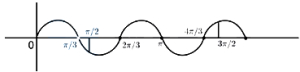
અંતરાલ $\left[\frac{\pi}{2}, \frac{3\pi}{2}\right]$ માં $\sin x + \sin 3x + \sin 5x = 0$ ના ઉકેલોની સંખ્યા કેટલી છે?
A
$2$
B
$3$
C
$4$
D
$5$
Solution
(B) આપેલ સમીકરણ: $\sin x + \sin 3x + \sin 5x = 0$
પદોને જૂથબદ્ધ કરતા: $(\sin 5x + \sin x) + \sin 3x = 0$
$\sin C + \sin D = 2 \sin \left(\frac{C+D}{2}\right) \cos \left(\frac{C-D}{2}\right)$ નો ઉપયોગ કરતા:
$2 \sin 3x \cos 2x + \sin 3x = 0$
$\sin 3x (2 \cos 2x + 1) = 0$
આનો અર્થ છે કે $\sin 3x = 0$ અથવા $\cos 2x = -\frac{1}{2}$.
કિસ્સો $1$: $\sin 3x = 0 \implies 3x = n\pi \implies x = \frac{n\pi}{3}$.
$x \in \left[\frac{\pi}{2}, \frac{3\pi}{2}\right]$ માટે,શક્ય કિંમતો $x = \frac{2\pi}{3}, \pi, \frac{4\pi}{3}$ છે.
કિસ્સો $2$: $\cos 2x = -\frac{1}{2} \implies 2x = 2n\pi \pm \frac{2\pi}{3} \implies x = n\pi \pm \frac{\pi}{3}$.
$x \in \left[\frac{\pi}{2}, \frac{3\pi}{2}\right]$ માટે,શક્ય કિંમતો $x = \frac{2\pi}{3}, \frac{4\pi}{3}$ છે.
બંને કિસ્સાઓને જોડતા,અલગ ઉકેલો $x = \frac{2\pi}{3}, \pi, \frac{4\pi}{3}$ છે.
આમ,કુલ ઉકેલોની સંખ્યા $3$ છે.
પદોને જૂથબદ્ધ કરતા: $(\sin 5x + \sin x) + \sin 3x = 0$
$\sin C + \sin D = 2 \sin \left(\frac{C+D}{2}\right) \cos \left(\frac{C-D}{2}\right)$ નો ઉપયોગ કરતા:
$2 \sin 3x \cos 2x + \sin 3x = 0$
$\sin 3x (2 \cos 2x + 1) = 0$
આનો અર્થ છે કે $\sin 3x = 0$ અથવા $\cos 2x = -\frac{1}{2}$.
કિસ્સો $1$: $\sin 3x = 0 \implies 3x = n\pi \implies x = \frac{n\pi}{3}$.
$x \in \left[\frac{\pi}{2}, \frac{3\pi}{2}\right]$ માટે,શક્ય કિંમતો $x = \frac{2\pi}{3}, \pi, \frac{4\pi}{3}$ છે.
કિસ્સો $2$: $\cos 2x = -\frac{1}{2} \implies 2x = 2n\pi \pm \frac{2\pi}{3} \implies x = n\pi \pm \frac{\pi}{3}$.
$x \in \left[\frac{\pi}{2}, \frac{3\pi}{2}\right]$ માટે,શક્ય કિંમતો $x = \frac{2\pi}{3}, \frac{4\pi}{3}$ છે.
બંને કિસ્સાઓને જોડતા,અલગ ઉકેલો $x = \frac{2\pi}{3}, \pi, \frac{4\pi}{3}$ છે.
આમ,કુલ ઉકેલોની સંખ્યા $3$ છે.
0 likes
View Solution257
EasyMCQ
$\tan 2\theta = 1$ ના મુખ્ય ઉકેલોની સંખ્યા કેટલી છે?
A
એક
B
બે
C
ત્રણ
D
ચાર
Solution
(D) આપેલ સમીકરણ $\tan 2\theta = 1$ છે.
$\tan 2\theta$ ધન હોવાથી,$2\theta$ પ્રથમ અથવા ત્રીજા ચરણમાં આવે છે.
મુખ્ય ઉકેલો માટે,આપણે $0 \le \theta < 2\pi$ ધ્યાનમાં લઈએ છીએ,જેનો અર્થ છે કે $0 \le 2\theta < 4\pi$.
તેથી,$2\theta = \frac{\pi}{4}, \frac{5\pi}{4}, \frac{9\pi}{4}, \frac{13\pi}{4}$.
$2$ વડે ભાગતા,આપણને $\theta = \frac{\pi}{8}, \frac{5\pi}{8}, \frac{9\pi}{8}, \frac{13\pi}{8}$ મળે છે.
આમ,કુલ $4$ મુખ્ય ઉકેલો છે.
$\tan 2\theta$ ધન હોવાથી,$2\theta$ પ્રથમ અથવા ત્રીજા ચરણમાં આવે છે.
મુખ્ય ઉકેલો માટે,આપણે $0 \le \theta < 2\pi$ ધ્યાનમાં લઈએ છીએ,જેનો અર્થ છે કે $0 \le 2\theta < 4\pi$.
તેથી,$2\theta = \frac{\pi}{4}, \frac{5\pi}{4}, \frac{9\pi}{4}, \frac{13\pi}{4}$.
$2$ વડે ભાગતા,આપણને $\theta = \frac{\pi}{8}, \frac{5\pi}{8}, \frac{9\pi}{8}, \frac{13\pi}{8}$ મળે છે.
આમ,કુલ $4$ મુખ્ય ઉકેલો છે.
0 likes
View Solution258
EasyMCQ
સમીકરણ $\tan^2 x = 1$ નો વ્યાપક ઉકેલ શોધો.
A
$n \pi + \frac{\pi}{4}$
B
$n \pi - \frac{\pi}{4}$
C
$n \pi \pm \frac{\pi}{4}$
D
$2 n \pi \pm \frac{\pi}{4}$
Solution
(C) આપેલ સમીકરણ $\tan^2 x = 1$ છે.
બંને બાજુ વર્ગમૂળ લેતા,$\tan x = \pm 1$ મળે.
આપણે જાણીએ છીએ કે $\tan x = \tan \alpha$ હોય તો $x = n \pi + \alpha$ થાય.
$\tan x = 1$ માટે,$x = n \pi + \frac{\pi}{4}$.
$\tan x = -1$ માટે,$x = n \pi - \frac{\pi}{4}$.
આ બંને પરિણામોને જોડતા,વ્યાપક ઉકેલ $x = n \pi \pm \frac{\pi}{4}$ મળે,જ્યાં $n \in \mathbb{Z}$.
બંને બાજુ વર્ગમૂળ લેતા,$\tan x = \pm 1$ મળે.
આપણે જાણીએ છીએ કે $\tan x = \tan \alpha$ હોય તો $x = n \pi + \alpha$ થાય.
$\tan x = 1$ માટે,$x = n \pi + \frac{\pi}{4}$.
$\tan x = -1$ માટે,$x = n \pi - \frac{\pi}{4}$.
આ બંને પરિણામોને જોડતા,વ્યાપક ઉકેલ $x = n \pi \pm \frac{\pi}{4}$ મળે,જ્યાં $n \in \mathbb{Z}$.
0 likes
View Solution259
MediumMCQ
સમીકરણ $\sin 2x + \cos 2x = 0$ ના ઉકેલો,જ્યાં $\pi < x < 2\pi$ હોય,તે શોધો.
A
$\frac{7\pi}{8}, \frac{11\pi}{8}$
B
$\frac{9\pi}{8}, \frac{13\pi}{8}$
C
$\frac{11\pi}{8}, \frac{15\pi}{8}$
D
$\frac{15\pi}{8}, \frac{19\pi}{8}$
Solution
(C) આપેલ સમીકરણ $\sin 2x + \cos 2x = 0$ છે.
$\cos 2x$ વડે ભાગતા,$\tan 2x = -1$ મળે.
$\tan \theta = -1$ હોવાથી $\theta = n\pi - \frac{\pi}{4}$ થાય,તેથી $2x = n\pi - \frac{\pi}{4}$.
આમ,$x = \frac{n\pi}{2} - \frac{\pi}{8} = \frac{(4n - 1)\pi}{8}$.
$\pi < x < 2\pi$ માટે:
જો $n = 3$ હોય,તો $x = \frac{11\pi}{8}$.
જો $n = 4$ હોય,તો $x = \frac{15\pi}{8}$.
બંને કિંમતો $(\pi, 2\pi)$ અંતરાલમાં આવેલી છે.
$\cos 2x$ વડે ભાગતા,$\tan 2x = -1$ મળે.
$\tan \theta = -1$ હોવાથી $\theta = n\pi - \frac{\pi}{4}$ થાય,તેથી $2x = n\pi - \frac{\pi}{4}$.
આમ,$x = \frac{n\pi}{2} - \frac{\pi}{8} = \frac{(4n - 1)\pi}{8}$.
$\pi < x < 2\pi$ માટે:
જો $n = 3$ હોય,તો $x = \frac{11\pi}{8}$.
જો $n = 4$ હોય,તો $x = \frac{15\pi}{8}$.
બંને કિંમતો $(\pi, 2\pi)$ અંતરાલમાં આવેલી છે.
0 likes
View Solution260
DifficultMCQ
અંતરાલ $[0, 2 \pi]$ માં સમીકરણ $\tan x + \sec x = 2 \cos x$ નો ઉકેલ ગણ શું છે?
A
$\left\{\frac{\pi}{6}, \frac{7 \pi}{6}, \frac{3 \pi}{2}\right\}$
B
$\left\{\frac{5 \pi}{6}, \frac{7 \pi}{6}, \frac{3 \pi}{2}\right\}$
C
$\left\{\frac{\pi}{6}, \frac{5 \pi}{6}, \frac{3 \pi}{2}\right\}$
D
$\left\{\frac{5 \pi}{6}, \frac{11 \pi}{6}, \frac{3 \pi}{2}\right\}$
Solution
(C) આપેલ સમીકરણ: $\tan x + \sec x = 2 \cos x$ જ્યાં $x \in [0, 2 \pi]$.
પગલું $1$: $\sec x = \frac{1}{\cos x}$ અને $\tan x = \frac{\sin x}{\cos x}$ મૂકતા:
$\frac{\sin x + 1}{\cos x} = 2 \cos x$
પગલું $2$: $\cos x$ વડે ગુણતા (જ્યાં $\cos x \neq 0$):
$\sin x + 1 = 2 \cos^2 x$
પગલું $3$: $\cos^2 x = 1 - \sin^2 x$ નો ઉપયોગ કરતા:
$\sin x + 1 = 2(1 - \sin^2 x) \implies 2 \sin^2 x + \sin x - 1 = 0$
પગલું $4$: અવયવ પાડતા:
$(2 \sin x - 1)(\sin x + 1) = 0$
$\sin x = \frac{1}{2}$ અથવા $\sin x = -1$
પગલું $5$: ઉકેલ મેળવતા:
$\sin x = \frac{1}{2} \implies x = \frac{\pi}{6}, \frac{5 \pi}{6}$.
$\sin x = -1 \implies x = \frac{3 \pi}{2}$ (અહીં $\tan x$ અને $\sec x$ અવ્યાખ્યાયિત છે).
સાચો વિકલ્પ $C$ છે.
પગલું $1$: $\sec x = \frac{1}{\cos x}$ અને $\tan x = \frac{\sin x}{\cos x}$ મૂકતા:
$\frac{\sin x + 1}{\cos x} = 2 \cos x$
પગલું $2$: $\cos x$ વડે ગુણતા (જ્યાં $\cos x \neq 0$):
$\sin x + 1 = 2 \cos^2 x$
પગલું $3$: $\cos^2 x = 1 - \sin^2 x$ નો ઉપયોગ કરતા:
$\sin x + 1 = 2(1 - \sin^2 x) \implies 2 \sin^2 x + \sin x - 1 = 0$
પગલું $4$: અવયવ પાડતા:
$(2 \sin x - 1)(\sin x + 1) = 0$
$\sin x = \frac{1}{2}$ અથવા $\sin x = -1$
પગલું $5$: ઉકેલ મેળવતા:
$\sin x = \frac{1}{2} \implies x = \frac{\pi}{6}, \frac{5 \pi}{6}$.
$\sin x = -1 \implies x = \frac{3 \pi}{2}$ (અહીં $\tan x$ અને $\sec x$ અવ્યાખ્યાયિત છે).
સાચો વિકલ્પ $C$ છે.
0 likes
View Solution261
MediumMCQ
અંતરાલ $(0, 5 \pi)$ માં સમીકરણ $3 \sin^2 x - 7 \sin x + 2 = 0$ નું સમાધાન કરતા $x$ ના મૂલ્યોની સંખ્યા શોધો.
A
$0$
B
$5$
C
$6$
D
$10$
Solution
(C) આપેલ સમીકરણ: $3 \sin^2 x - 7 \sin x + 2 = 0$.
દ્વિઘાત સમીકરણના અવયવ પાડતા: $3 \sin^2 x - 6 \sin x - \sin x + 2 = 0$.
$3 \sin x(\sin x - 2) - 1(\sin x - 2) = 0$.
$(3 \sin x - 1)(\sin x - 2) = 0$.
આથી $\sin x = \frac{1}{3}$ અથવા $\sin x = 2$ મળે.
$\sin x$ નો વિસ્તાર $[-1, 1]$ હોવાથી,$\sin x = 2$ શક્ય નથી.
તેથી,આપણે $\sin x = \frac{1}{3}$ ઉકેલીએ.
અંતરાલ $(0, 2 \pi)$ માં $\sin x = \frac{1}{3}$ માટે $2$ ઉકેલો મળે છે.
અંતરાલ $(0, 4 \pi)$ માં $2 \times 2 = 4$ ઉકેલો મળે છે.
અંતરાલ $(4 \pi, 5 \pi)$ માં $1$ ઉકેલ મળે છે.
કુલ ઉકેલોની સંખ્યા $(0, 5 \pi)$ માં $2 + 2 + 2 = 6$ છે.
દ્વિઘાત સમીકરણના અવયવ પાડતા: $3 \sin^2 x - 6 \sin x - \sin x + 2 = 0$.
$3 \sin x(\sin x - 2) - 1(\sin x - 2) = 0$.
$(3 \sin x - 1)(\sin x - 2) = 0$.
આથી $\sin x = \frac{1}{3}$ અથવા $\sin x = 2$ મળે.
$\sin x$ નો વિસ્તાર $[-1, 1]$ હોવાથી,$\sin x = 2$ શક્ય નથી.
તેથી,આપણે $\sin x = \frac{1}{3}$ ઉકેલીએ.
અંતરાલ $(0, 2 \pi)$ માં $\sin x = \frac{1}{3}$ માટે $2$ ઉકેલો મળે છે.
અંતરાલ $(0, 4 \pi)$ માં $2 \times 2 = 4$ ઉકેલો મળે છે.
અંતરાલ $(4 \pi, 5 \pi)$ માં $1$ ઉકેલ મળે છે.
કુલ ઉકેલોની સંખ્યા $(0, 5 \pi)$ માં $2 + 2 + 2 = 6$ છે.
0 likes
View Solution262
EasyMCQ
જો ખૂણો $\theta$ એ $[0, 2\pi]$ માં બંને સમીકરણો $\cot \theta = \sqrt{3}$ અને $\sqrt{3} \sec \theta + 2 = 0$ નું સમાધાન કરે,તો $\theta$ ની કિંમત શું થાય?
A
$\frac{\pi}{6}$
B
$\frac{7 \pi}{6}$
C
$\frac{5 \pi}{6}$
D
$\frac{11 \pi}{6}$
Solution
(B) આપેલ સમીકરણો $\cot \theta = \sqrt{3}$ અને $\sqrt{3} \sec \theta + 2 = 0$ છે.
$\cot \theta = \sqrt{3}$ પરથી,$\tan \theta = \frac{1}{\sqrt{3}}$ મળે. આ સૂચવે છે કે $\theta$ એ $1^{\text{st}}$ અથવા $3^{\text{rd}}$ ચરણમાં છે.
$\sqrt{3} \sec \theta + 2 = 0$ પરથી,$\sec \theta = -\frac{2}{\sqrt{3}}$ મળે,જેનો અર્થ છે કે $\cos \theta = -\frac{\sqrt{3}}{2}$.
$\cos \theta$ ઋણ હોવાથી,$\theta$ એ $2^{\text{nd}}$ અથવા $3^{\text{rd}}$ ચરણમાં હોવો જોઈએ.
બંને શરતોને જોડતા,$\theta$ એ $3^{\text{rd}}$ ચરણમાં હોવો જોઈએ.
$3^{\text{rd}}$ ચરણમાં,$\tan \theta = \frac{1}{\sqrt{3}}$ માટે $\theta = \pi + \frac{\pi}{6} = \frac{7\pi}{6}$ થાય.
$\cot \theta = \sqrt{3}$ પરથી,$\tan \theta = \frac{1}{\sqrt{3}}$ મળે. આ સૂચવે છે કે $\theta$ એ $1^{\text{st}}$ અથવા $3^{\text{rd}}$ ચરણમાં છે.
$\sqrt{3} \sec \theta + 2 = 0$ પરથી,$\sec \theta = -\frac{2}{\sqrt{3}}$ મળે,જેનો અર્થ છે કે $\cos \theta = -\frac{\sqrt{3}}{2}$.
$\cos \theta$ ઋણ હોવાથી,$\theta$ એ $2^{\text{nd}}$ અથવા $3^{\text{rd}}$ ચરણમાં હોવો જોઈએ.
બંને શરતોને જોડતા,$\theta$ એ $3^{\text{rd}}$ ચરણમાં હોવો જોઈએ.
$3^{\text{rd}}$ ચરણમાં,$\tan \theta = \frac{1}{\sqrt{3}}$ માટે $\theta = \pi + \frac{\pi}{6} = \frac{7\pi}{6}$ થાય.
0 likes
View Solution263
EasyMCQ
અંતરાલ $(0, 2 \pi)$ માં $\cos 2 \theta = \sin \theta$ ના ઉકેલોની સંખ્યા કેટલી છે?
A
$3$
B
$2$
C
$4$
D
$1$
Solution
(A) આપેલ સમીકરણ: $\cos 2 \theta = \sin \theta$
નિત્યસમ $\cos 2 \theta = 1 - 2 \sin^2 \theta$ નો ઉપયોગ કરતા:
$1 - 2 \sin^2 \theta = \sin \theta$
$2 \sin^2 \theta + \sin \theta - 1 = 0$
દ્વિઘાત સમીકરણના અવયવ પાડતા:
$(2 \sin \theta - 1)(\sin \theta + 1) = 0$
તેથી $\sin \theta = \frac{1}{2}$ અથવા $\sin \theta = -1$ મળે.
$(0, 2 \pi)$ માં $\sin \theta = \frac{1}{2}$ માટે,$\theta = \frac{\pi}{6}$ અને $\theta = \frac{5 \pi}{6}$ મળે.
$(0, 2 \pi)$ માં $\sin \theta = -1$ માટે,$\theta = \frac{3 \pi}{2}$ મળે.
આમ,ઉકેલો $\frac{\pi}{6}, \frac{5 \pi}{6}, \frac{3 \pi}{2}$ છે.
કુલ ઉકેલોની સંખ્યા $3$ છે.
નિત્યસમ $\cos 2 \theta = 1 - 2 \sin^2 \theta$ નો ઉપયોગ કરતા:
$1 - 2 \sin^2 \theta = \sin \theta$
$2 \sin^2 \theta + \sin \theta - 1 = 0$
દ્વિઘાત સમીકરણના અવયવ પાડતા:
$(2 \sin \theta - 1)(\sin \theta + 1) = 0$
તેથી $\sin \theta = \frac{1}{2}$ અથવા $\sin \theta = -1$ મળે.
$(0, 2 \pi)$ માં $\sin \theta = \frac{1}{2}$ માટે,$\theta = \frac{\pi}{6}$ અને $\theta = \frac{5 \pi}{6}$ મળે.
$(0, 2 \pi)$ માં $\sin \theta = -1$ માટે,$\theta = \frac{3 \pi}{2}$ મળે.
આમ,ઉકેલો $\frac{\pi}{6}, \frac{5 \pi}{6}, \frac{3 \pi}{2}$ છે.
કુલ ઉકેલોની સંખ્યા $3$ છે.
0 likes
View Solution264
EasyMCQ
સમીકરણ $\sqrt{3} \sec x + 2 = 0$ ના મુખ્ય ઉકેલો છે
A
$\frac{2 \pi}{3}, \frac{4 \pi}{3}$
B
$\frac{4 \pi}{3}, \frac{5 \pi}{3}$
C
$\frac{5 \pi}{6}, \frac{7 \pi}{6}$
D
$\frac{7 \pi}{6}, \frac{11 \pi}{6}$
Solution
(C) આપેલ સમીકરણ $\sqrt{3} \sec x + 2 = 0$ છે.
$\sqrt{3} \sec x = -2$
$\sec x = -\frac{2}{\sqrt{3}}$
$\cos x = -\frac{\sqrt{3}}{2}$
કારણ કે $\cos x$ બીજા અને ત્રીજા ચરણમાં ઋણ છે,આપણે $[0, 2\pi]$ માં કિંમતો શોધીએ છીએ.
બીજા ચરણમાં: $x = \pi - \frac{\pi}{6} = \frac{5\pi}{6}$.
ત્રીજા ચરણમાં: $x = \pi + \frac{\pi}{6} = \frac{7\pi}{6}$.
આમ,મુખ્ય ઉકેલો $\frac{5\pi}{6}$ અને $\frac{7\pi}{6}$ છે.
$\sqrt{3} \sec x = -2$
$\sec x = -\frac{2}{\sqrt{3}}$
$\cos x = -\frac{\sqrt{3}}{2}$
કારણ કે $\cos x$ બીજા અને ત્રીજા ચરણમાં ઋણ છે,આપણે $[0, 2\pi]$ માં કિંમતો શોધીએ છીએ.
બીજા ચરણમાં: $x = \pi - \frac{\pi}{6} = \frac{5\pi}{6}$.
ત્રીજા ચરણમાં: $x = \pi + \frac{\pi}{6} = \frac{7\pi}{6}$.
આમ,મુખ્ય ઉકેલો $\frac{5\pi}{6}$ અને $\frac{7\pi}{6}$ છે.
0 likes
View Solution265
EasyMCQ
$(0, 2\pi)$ માં,$\tan \theta + \sec \theta = 2 \cos \theta$ ના ઉકેલોની સંખ્યા કેટલી છે?
A
$0$
B
$1$
C
$2$
D
$3$
Solution
(C) આપેલ સમીકરણ: $\tan \theta + \sec \theta = 2 \cos \theta$
$\Rightarrow \frac{\sin \theta}{\cos \theta} + \frac{1}{\cos \theta} = 2 \cos \theta$
$\Rightarrow \sin \theta + 1 = 2 \cos^2 \theta$
$\Rightarrow \sin \theta + 1 = 2(1 - \sin^2 \theta)$
$\Rightarrow 2 \sin^2 \theta + \sin \theta - 1 = 0$
$\Rightarrow (2 \sin \theta - 1)(\sin \theta + 1) = 0$
$\therefore \sin \theta = \frac{1}{2}$ અથવા $\sin \theta = -1$
$\theta \in (0, 2\pi)$ માટે:
જો $\sin \theta = \frac{1}{2}$,તો $\theta = \frac{\pi}{6}, \frac{5\pi}{6}$.
જો $\sin \theta = -1$,તો $\theta = \frac{3\pi}{2}$.
જોકે,$\theta = \frac{3\pi}{2}$ પર $\tan \theta$ અને $\sec \theta$ અવ્યાખ્યાયિત છે.
તેથી,માન્ય ઉકેલો $\theta = \frac{\pi}{6}$ અને $\theta = \frac{5\pi}{6}$ છે.
આમ,ઉકેલોની સંખ્યા $2$ છે.
$\Rightarrow \frac{\sin \theta}{\cos \theta} + \frac{1}{\cos \theta} = 2 \cos \theta$
$\Rightarrow \sin \theta + 1 = 2 \cos^2 \theta$
$\Rightarrow \sin \theta + 1 = 2(1 - \sin^2 \theta)$
$\Rightarrow 2 \sin^2 \theta + \sin \theta - 1 = 0$
$\Rightarrow (2 \sin \theta - 1)(\sin \theta + 1) = 0$
$\therefore \sin \theta = \frac{1}{2}$ અથવા $\sin \theta = -1$
$\theta \in (0, 2\pi)$ માટે:
જો $\sin \theta = \frac{1}{2}$,તો $\theta = \frac{\pi}{6}, \frac{5\pi}{6}$.
જો $\sin \theta = -1$,તો $\theta = \frac{3\pi}{2}$.
જોકે,$\theta = \frac{3\pi}{2}$ પર $\tan \theta$ અને $\sec \theta$ અવ્યાખ્યાયિત છે.
તેથી,માન્ય ઉકેલો $\theta = \frac{\pi}{6}$ અને $\theta = \frac{5\pi}{6}$ છે.
આમ,ઉકેલોની સંખ્યા $2$ છે.
0 likes
View Solution266
MediumMCQ
$[0, 2 \pi]$ માં $\tan x + \sec x = 2 \cos x$ ના ઉકેલોની સંખ્યા કેટલી છે?
A
$2$
B
$3$
C
$0$
D
$1$
Solution
(A) આપેલ સમીકરણ $x \neq \frac{\pi}{2}, \frac{3 \pi}{2}$ માટે વ્યાખ્યાયિત છે.
આપેલ સમીકરણ: $\tan x + \sec x = 2 \cos x$
$\Rightarrow \frac{\sin x}{\cos x} + \frac{1}{\cos x} = 2 \cos x$
$\Rightarrow \frac{\sin x + 1}{\cos x} = 2 \cos x$
$\Rightarrow \sin x + 1 = 2 \cos^2 x$
$\Rightarrow \sin x + 1 = 2(1 - \sin^2 x)$
$\Rightarrow \sin x + 1 = 2(1 - \sin x)(1 + \sin x)$
$\Rightarrow (1 + \sin x)[1 - 2(1 - \sin x)] = 0$
$\Rightarrow (1 + \sin x)(2 \sin x - 1) = 0$
કિસ્સો $1$: $1 + \sin x = 0 \Rightarrow \sin x = -1$. આનો અર્થ એ છે કે $x = \frac{3 \pi}{2}$,પરંતુ $x = \frac{3 \pi}{2}$ પર $\tan x$ અને $\sec x$ અવ્યાખ્યાયિત છે. તેથી,આ ઉકેલ નથી.
કિસ્સો $2$: $2 \sin x - 1 = 0 \Rightarrow \sin x = \frac{1}{2}$.
$[0, 2 \pi]$ અંતરાલમાં,$\sin x = \frac{1}{2}$ એ $x = \frac{\pi}{6}$ અને $x = \frac{5 \pi}{6}$ પર મળે છે.
આમ,ઉકેલોની સંખ્યા $2$ છે.
આપેલ સમીકરણ: $\tan x + \sec x = 2 \cos x$
$\Rightarrow \frac{\sin x}{\cos x} + \frac{1}{\cos x} = 2 \cos x$
$\Rightarrow \frac{\sin x + 1}{\cos x} = 2 \cos x$
$\Rightarrow \sin x + 1 = 2 \cos^2 x$
$\Rightarrow \sin x + 1 = 2(1 - \sin^2 x)$
$\Rightarrow \sin x + 1 = 2(1 - \sin x)(1 + \sin x)$
$\Rightarrow (1 + \sin x)[1 - 2(1 - \sin x)] = 0$
$\Rightarrow (1 + \sin x)(2 \sin x - 1) = 0$
કિસ્સો $1$: $1 + \sin x = 0 \Rightarrow \sin x = -1$. આનો અર્થ એ છે કે $x = \frac{3 \pi}{2}$,પરંતુ $x = \frac{3 \pi}{2}$ પર $\tan x$ અને $\sec x$ અવ્યાખ્યાયિત છે. તેથી,આ ઉકેલ નથી.
કિસ્સો $2$: $2 \sin x - 1 = 0 \Rightarrow \sin x = \frac{1}{2}$.
$[0, 2 \pi]$ અંતરાલમાં,$\sin x = \frac{1}{2}$ એ $x = \frac{\pi}{6}$ અને $x = \frac{5 \pi}{6}$ પર મળે છે.
આમ,ઉકેલોની સંખ્યા $2$ છે.
0 likes
View Solution267
MediumMCQ
સમીકરણ $16^{\sin^2 x} + 16^{\cos^2 x} = 10$ ના $[0, 2\pi]$ અંતરાલમાં ઉકેલોની સંખ્યા કેટલી છે?
A
$2$
B
$4$
C
$6$
D
$8$
Solution
(D) આપેલ સમીકરણ: $16^{\sin^2 x} + 16^{\cos^2 x} = 10$
$\cos^2 x = 1 - \sin^2 x$ હોવાથી:
$16^{\sin^2 x} + 16^{1 - \sin^2 x} = 10$
$16^{\sin^2 x} + \frac{16}{16^{\sin^2 x}} = 10$
ધારો કે $t = 16^{\sin^2 x}$. તેથી $t + \frac{16}{t} = 10$,જેનો અર્થ છે $t^2 - 10t + 16 = 0$.
$t$ માટે ઉકેલતા: $(t - 8)(t - 2) = 0$,તેથી $t = 8$ અથવા $t = 2$.
કિસ્સો $1$: $16^{\sin^2 x} = 2$ $\Rightarrow 2^{4\sin^2 x} = 2^1$ $\Rightarrow 4\sin^2 x = 1$ $\Rightarrow \sin^2 x = \frac{1}{4}$ $\Rightarrow \sin x = \pm \frac{1}{2}$.
$[0, 2\pi]$ માં,$\sin x = \pm \frac{1}{2}$ માટે $x = \frac{\pi}{6}, \frac{5\pi}{6}, \frac{7\pi}{6}, \frac{11\pi}{6}$ ($4$ ઉકેલો મળે છે).
કિસ્સો $2$: $16^{\sin^2 x} = 8$ $\Rightarrow 2^{4\sin^2 x} = 2^3$ $\Rightarrow 4\sin^2 x = 3$ $\Rightarrow \sin^2 x = \frac{3}{4}$ $\Rightarrow \sin x = \pm \frac{\sqrt{3}}{2}$.
$[0, 2\pi]$ માં,$\sin x = \pm \frac{\sqrt{3}}{2}$ માટે $x = \frac{\pi}{3}, \frac{2\pi}{3}, \frac{4\pi}{3}, \frac{5\pi}{3}$ ($4$ ઉકેલો મળે છે).
કુલ ઉકેલોની સંખ્યા = $4 + 4 = 8$.
$\cos^2 x = 1 - \sin^2 x$ હોવાથી:
$16^{\sin^2 x} + 16^{1 - \sin^2 x} = 10$
$16^{\sin^2 x} + \frac{16}{16^{\sin^2 x}} = 10$
ધારો કે $t = 16^{\sin^2 x}$. તેથી $t + \frac{16}{t} = 10$,જેનો અર્થ છે $t^2 - 10t + 16 = 0$.
$t$ માટે ઉકેલતા: $(t - 8)(t - 2) = 0$,તેથી $t = 8$ અથવા $t = 2$.
કિસ્સો $1$: $16^{\sin^2 x} = 2$ $\Rightarrow 2^{4\sin^2 x} = 2^1$ $\Rightarrow 4\sin^2 x = 1$ $\Rightarrow \sin^2 x = \frac{1}{4}$ $\Rightarrow \sin x = \pm \frac{1}{2}$.
$[0, 2\pi]$ માં,$\sin x = \pm \frac{1}{2}$ માટે $x = \frac{\pi}{6}, \frac{5\pi}{6}, \frac{7\pi}{6}, \frac{11\pi}{6}$ ($4$ ઉકેલો મળે છે).
કિસ્સો $2$: $16^{\sin^2 x} = 8$ $\Rightarrow 2^{4\sin^2 x} = 2^3$ $\Rightarrow 4\sin^2 x = 3$ $\Rightarrow \sin^2 x = \frac{3}{4}$ $\Rightarrow \sin x = \pm \frac{\sqrt{3}}{2}$.
$[0, 2\pi]$ માં,$\sin x = \pm \frac{\sqrt{3}}{2}$ માટે $x = \frac{\pi}{3}, \frac{2\pi}{3}, \frac{4\pi}{3}, \frac{5\pi}{3}$ ($4$ ઉકેલો મળે છે).
કુલ ઉકેલોની સંખ્યા = $4 + 4 = 8$.
0 likes
View Solution268
EasyMCQ
જો $\cos 2\theta = \sin \alpha$ હોય,તો $\theta =$
A
$n\pi \pm (\frac{\pi}{2} - \alpha), n \in \mathbb{Z}$
B
$n\pi \pm (\frac{\pi}{4} + \frac{\alpha}{2}), n \in \mathbb{Z}$
C
$\frac{1}{2}[n\pi + (-1)^n \alpha], n \in \mathbb{Z}$
D
$n\pi \pm (\frac{\pi}{4} - \frac{\alpha}{2}), n \in \mathbb{Z}$
Solution
(D) આપેલ છે કે $\cos 2\theta = \sin \alpha$.
આપણે જાણીએ છીએ કે $\sin \alpha = \cos(\frac{\pi}{2} - \alpha)$.
તેથી,$\cos 2\theta = \cos(\frac{\pi}{2} - \alpha)$.
$\cos x = \cos y$ માટેનો વ્યાપક ઉકેલ $x = 2n\pi \pm y$ છે,જ્યાં $n \in \mathbb{Z}$.
આ મુજબ,$2\theta = 2n\pi \pm (\frac{\pi}{2} - \alpha)$.
$2$ વડે ભાગતા,આપણને $\theta = n\pi \pm (\frac{\pi}{4} - \frac{\alpha}{2})$ મળે,જ્યાં $n \in \mathbb{Z}$.
આપણે જાણીએ છીએ કે $\sin \alpha = \cos(\frac{\pi}{2} - \alpha)$.
તેથી,$\cos 2\theta = \cos(\frac{\pi}{2} - \alpha)$.
$\cos x = \cos y$ માટેનો વ્યાપક ઉકેલ $x = 2n\pi \pm y$ છે,જ્યાં $n \in \mathbb{Z}$.
આ મુજબ,$2\theta = 2n\pi \pm (\frac{\pi}{2} - \alpha)$.
$2$ વડે ભાગતા,આપણને $\theta = n\pi \pm (\frac{\pi}{4} - \frac{\alpha}{2})$ મળે,જ્યાં $n \in \mathbb{Z}$.
0 likes
View Solution269
EasyMCQ
$\tan 3x = 1$ નો વ્યાપક ઉકેલ શોધો.
A
$x = n\pi, n \in Z$
B
$x = n\left(\frac{\pi}{3}\right) + \frac{\pi}{12}, n \in Z$
C
$x = n\pi + \frac{\pi}{4}, n \in Z$
D
$x = n\pi \pm \frac{\pi}{4}, n \in Z$
Solution
(B) આપણે જાણીએ છીએ કે $\tan \theta = \tan \alpha$ નો અર્થ $\theta = n\pi + \alpha$ થાય છે,જ્યાં $n \in Z$.
આપેલ છે કે $\tan 3x = 1$.
કારણ કે $\tan \frac{\pi}{4} = 1$,તેથી $\tan 3x = \tan \frac{\pi}{4}$.
તેથી,$3x = n\pi + \frac{\pi}{4}$.
$3$ વડે ભાગતા,આપણને $x = \frac{n\pi}{3} + \frac{\pi}{12}$ મળે છે,જ્યાં $n \in Z$.
આપેલ છે કે $\tan 3x = 1$.
કારણ કે $\tan \frac{\pi}{4} = 1$,તેથી $\tan 3x = \tan \frac{\pi}{4}$.
તેથી,$3x = n\pi + \frac{\pi}{4}$.
$3$ વડે ભાગતા,આપણને $x = \frac{n\pi}{3} + \frac{\pi}{12}$ મળે છે,જ્યાં $n \in Z$.
0 likes
View Solution270
MediumMCQ
જો $\cos x = |\sin x|$ હોય,તો તેનો વ્યાપક ઉકેલ શું છે?
A
$x = 2n\pi \pm \frac{\pi}{4}, n \in \mathbb{Z}$
B
$x = (2n+1)\pi \pm \frac{\pi}{4}, n \in \mathbb{Z}$
C
$x = n\pi \pm \frac{\pi}{4}, n \in \mathbb{Z}$
D
$x = n\pi + (-1)^n \frac{\pi}{4}, n \in \mathbb{Z}$
Solution
(A) આપેલ છે $\cos x = |\sin x|$.
$|\sin x| \ge 0$ હોવાથી,$\cos x \ge 0$ થવું જોઈએ,જેનો અર્થ છે કે $x$ પ્રથમ અથવા ચોથા ચરણમાં છે.
બંને બાજુ વર્ગ કરતા,$\cos^2 x = \sin^2 x$ મળે.
આથી $\tan^2 x = 1$,એટલે કે $\tan x = \pm 1$.
$\tan x = 1$ માટે,$x = n\pi + \frac{\pi}{4}$ અને $\tan x = -1$ માટે,$x = n\pi - \frac{\pi}{4}$.
આથી $x = n\pi \pm \frac{\pi}{4}$.
પરંતુ,$\cos x \ge 0$ શરત મુજબ,માત્ર $n$ બેકી હોય તેવા ઉકેલો જ માન્ય રહેશે.
તેથી,વ્યાપક ઉકેલ $x = 2n\pi \pm \frac{\pi}{4}, n \in \mathbb{Z}$ છે.
$|\sin x| \ge 0$ હોવાથી,$\cos x \ge 0$ થવું જોઈએ,જેનો અર્થ છે કે $x$ પ્રથમ અથવા ચોથા ચરણમાં છે.
બંને બાજુ વર્ગ કરતા,$\cos^2 x = \sin^2 x$ મળે.
આથી $\tan^2 x = 1$,એટલે કે $\tan x = \pm 1$.
$\tan x = 1$ માટે,$x = n\pi + \frac{\pi}{4}$ અને $\tan x = -1$ માટે,$x = n\pi - \frac{\pi}{4}$.
આથી $x = n\pi \pm \frac{\pi}{4}$.
પરંતુ,$\cos x \ge 0$ શરત મુજબ,માત્ર $n$ બેકી હોય તેવા ઉકેલો જ માન્ય રહેશે.
તેથી,વ્યાપક ઉકેલ $x = 2n\pi \pm \frac{\pi}{4}, n \in \mathbb{Z}$ છે.
0 likes
View Solution271
MediumMCQ
$\cot \theta + \tan \theta = 2$ નો વ્યાપક ઉકેલ શું છે?
A
$\theta = \frac{n \pi}{2} + (-1)^n \frac{\pi}{8}$
B
$\theta = \frac{n \pi}{2} + (-1)^n \frac{\pi}{4}$
C
$\theta = \frac{n \pi}{2} + (-1)^n \frac{\pi}{6}$
D
$\theta = n \pi + (-1)^n \frac{\pi}{8}$
Solution
(B) આપેલ છે કે,$\cot \theta + \tan \theta = 2$
$\Rightarrow \frac{\cos \theta}{\sin \theta} + \frac{\sin \theta}{\cos \theta} = 2$
$\Rightarrow \frac{\cos^2 \theta + \sin^2 \theta}{\sin \theta \cos \theta} = 2$
$\Rightarrow \frac{1}{\sin \theta \cos \theta} = 2$
$\Rightarrow 2 \sin \theta \cos \theta = 1$
$\Rightarrow \sin 2 \theta = 1 = \sin \left(\frac{\pi}{2}\right)$
આપણે જાણીએ છીએ કે,જો $\sin x = \sin \alpha$ હોય,તો $x = n \pi + (-1)^n \alpha$
તેથી,$2 \theta = n \pi + (-1)^n \frac{\pi}{2}$
$\Rightarrow \theta = \frac{n \pi}{2} + (-1)^n \frac{\pi}{4}$
$\Rightarrow \frac{\cos \theta}{\sin \theta} + \frac{\sin \theta}{\cos \theta} = 2$
$\Rightarrow \frac{\cos^2 \theta + \sin^2 \theta}{\sin \theta \cos \theta} = 2$
$\Rightarrow \frac{1}{\sin \theta \cos \theta} = 2$
$\Rightarrow 2 \sin \theta \cos \theta = 1$
$\Rightarrow \sin 2 \theta = 1 = \sin \left(\frac{\pi}{2}\right)$
આપણે જાણીએ છીએ કે,જો $\sin x = \sin \alpha$ હોય,તો $x = n \pi + (-1)^n \alpha$
તેથી,$2 \theta = n \pi + (-1)^n \frac{\pi}{2}$
$\Rightarrow \theta = \frac{n \pi}{2} + (-1)^n \frac{\pi}{4}$
0 likes
View Solution272
MediumMCQ
કોઈપણ પૂર્ણાંક $n$ માટે $\sin x - \cos x = \sqrt{2}$ નો વ્યાપક ઉકેલ શું છે?
A
$2n\pi + \frac{3\pi}{4}$
B
$n\pi$
C
$(2n+1)\pi$
D
$2n\pi$
Solution
(A) આપેલ છે,$\sin x - \cos x = \sqrt{2}$
બંને બાજુ $\sqrt{2}$ વડે ભાગતા:
$\frac{1}{\sqrt{2}} \sin x - \frac{1}{\sqrt{2}} \cos x = 1$
$\cos \frac{\pi}{4} = \frac{1}{\sqrt{2}}$ અને $\sin \frac{\pi}{4} = \frac{1}{\sqrt{2}}$ નો ઉપયોગ કરતા:
$\sin x \cos \frac{\pi}{4} - \cos x \sin \frac{\pi}{4} = 1$
નિત્યસમ $\sin(A-B) = \sin A \cos B - \cos A \sin B$ નો ઉપયોગ કરતા:
$\sin(x - \frac{\pi}{4}) = 1$
$\sin \theta = 1$ હોવાથી $\theta = 2n\pi + \frac{\pi}{2}$ થાય:
$x - \frac{\pi}{4} = 2n\pi + \frac{\pi}{2}$
$x = 2n\pi + \frac{\pi}{2} + \frac{\pi}{4}$
$x = 2n\pi + \frac{3\pi}{4}$
બંને બાજુ $\sqrt{2}$ વડે ભાગતા:
$\frac{1}{\sqrt{2}} \sin x - \frac{1}{\sqrt{2}} \cos x = 1$
$\cos \frac{\pi}{4} = \frac{1}{\sqrt{2}}$ અને $\sin \frac{\pi}{4} = \frac{1}{\sqrt{2}}$ નો ઉપયોગ કરતા:
$\sin x \cos \frac{\pi}{4} - \cos x \sin \frac{\pi}{4} = 1$
નિત્યસમ $\sin(A-B) = \sin A \cos B - \cos A \sin B$ નો ઉપયોગ કરતા:
$\sin(x - \frac{\pi}{4}) = 1$
$\sin \theta = 1$ હોવાથી $\theta = 2n\pi + \frac{\pi}{2}$ થાય:
$x - \frac{\pi}{4} = 2n\pi + \frac{\pi}{2}$
$x = 2n\pi + \frac{\pi}{2} + \frac{\pi}{4}$
$x = 2n\pi + \frac{3\pi}{4}$
0 likes
View Solution273
EasyMCQ
જો $\sin 2x = 4 \cos x$ હોય,તો $x$ ની કિંમત શું થાય?
A
$n \pi \pm \frac{\pi}{4}, n \in Z$
B
કોઈ કિંમત નહીં
C
$n \pi + (-1)^n \frac{\pi}{4}, n \in Z$
D
$2n \pi \pm \frac{\pi}{2}, n \in Z$
Solution
(D) આપેલ છે,$\sin 2x = 4 \cos x$.
નિત્યસમ $\sin 2x = 2 \sin x \cos x$ નો ઉપયોગ કરતા:
$2 \sin x \cos x = 4 \cos x$
$2 \sin x \cos x - 4 \cos x = 0$
$2 \cos x (\sin x - 2) = 0$
આનો અર્થ એ છે કે કાં તો $\cos x = 0$ અથવા $\sin x = 2$.
$\sin x$ નો વિસ્તાર $[-1, 1]$ હોવાથી,$\sin x = 2$ નો કોઈ વાસ્તવિક ઉકેલ નથી.
તેથી,$\cos x = 0$.
$\cos x = 0$ માટેનો વ્યાપક ઉકેલ $x = (2n + 1) \frac{\pi}{2}$ છે,જેને $x = n \pi + \frac{\pi}{2}$ અથવા $x = 2n \pi \pm \frac{\pi}{2}$ તરીકે લખી શકાય,જ્યાં $n \in Z$.
નિત્યસમ $\sin 2x = 2 \sin x \cos x$ નો ઉપયોગ કરતા:
$2 \sin x \cos x = 4 \cos x$
$2 \sin x \cos x - 4 \cos x = 0$
$2 \cos x (\sin x - 2) = 0$
આનો અર્થ એ છે કે કાં તો $\cos x = 0$ અથવા $\sin x = 2$.
$\sin x$ નો વિસ્તાર $[-1, 1]$ હોવાથી,$\sin x = 2$ નો કોઈ વાસ્તવિક ઉકેલ નથી.
તેથી,$\cos x = 0$.
$\cos x = 0$ માટેનો વ્યાપક ઉકેલ $x = (2n + 1) \frac{\pi}{2}$ છે,જેને $x = n \pi + \frac{\pi}{2}$ અથવા $x = 2n \pi \pm \frac{\pi}{2}$ તરીકે લખી શકાય,જ્યાં $n \in Z$.
0 likes
View Solution274
MediumMCQ
$\sin 5\theta - \sin 3\theta + \sin \theta = 0$ ને સંતોષતી $\theta$ ની કિંમત,જ્યાં $0 < \theta < \frac{\pi}{2}$ હોય,તે શોધો.
A
$\frac{\pi}{12}$
B
$\frac{\pi}{6}$
C
$\frac{\pi}{4}$
D
$\frac{\pi}{2}$
Solution
(B) આપેલ સમીકરણ: $\sin 5\theta - \sin 3\theta + \sin \theta = 0$ જ્યાં $\theta \in (0, \frac{\pi}{2})$.
પદોને ગોઠવતા: $(\sin 5\theta + \sin \theta) = \sin 3\theta$.
સરવાળાથી ગુણાકારના સૂત્ર $\sin C + \sin D = 2 \sin(\frac{C+D}{2}) \cos(\frac{C-D}{2})$ નો ઉપયોગ કરતા:
$2 \sin 3\theta \cos 2\theta = \sin 3\theta$.
$2 \sin 3\theta \cos 2\theta - \sin 3\theta = 0$.
$\sin 3\theta (2 \cos 2\theta - 1) = 0$.
આથી બે કિસ્સા મળે છે:
કિસ્સો $1$: $\sin 3\theta = 0$ $\Rightarrow 3\theta = n\pi$ $\Rightarrow \theta = \frac{n\pi}{3}$. $0 < \theta < \frac{\pi}{2}$ માટે,$\theta = \frac{\pi}{3}$.
કિસ્સો $2$: $2 \cos 2\theta - 1 = 0 \Rightarrow \cos 2\theta = \frac{1}{2} = \cos \frac{\pi}{3}$.
$2\theta = 2n\pi \pm \frac{\pi}{3} \Rightarrow \theta = n\pi \pm \frac{\pi}{6}$. $0 < \theta < \frac{\pi}{2}$ માટે,$\theta = \frac{\pi}{6}$.
આમ,$\theta$ ની કિંમતો $\frac{\pi}{6}$ અને $\frac{\pi}{3}$ છે. વિકલ્પો મુજબ,$\frac{\pi}{6}$ સાચો જવાબ છે.
પદોને ગોઠવતા: $(\sin 5\theta + \sin \theta) = \sin 3\theta$.
સરવાળાથી ગુણાકારના સૂત્ર $\sin C + \sin D = 2 \sin(\frac{C+D}{2}) \cos(\frac{C-D}{2})$ નો ઉપયોગ કરતા:
$2 \sin 3\theta \cos 2\theta = \sin 3\theta$.
$2 \sin 3\theta \cos 2\theta - \sin 3\theta = 0$.
$\sin 3\theta (2 \cos 2\theta - 1) = 0$.
આથી બે કિસ્સા મળે છે:
કિસ્સો $1$: $\sin 3\theta = 0$ $\Rightarrow 3\theta = n\pi$ $\Rightarrow \theta = \frac{n\pi}{3}$. $0 < \theta < \frac{\pi}{2}$ માટે,$\theta = \frac{\pi}{3}$.
કિસ્સો $2$: $2 \cos 2\theta - 1 = 0 \Rightarrow \cos 2\theta = \frac{1}{2} = \cos \frac{\pi}{3}$.
$2\theta = 2n\pi \pm \frac{\pi}{3} \Rightarrow \theta = n\pi \pm \frac{\pi}{6}$. $0 < \theta < \frac{\pi}{2}$ માટે,$\theta = \frac{\pi}{6}$.
આમ,$\theta$ ની કિંમતો $\frac{\pi}{6}$ અને $\frac{\pi}{3}$ છે. વિકલ્પો મુજબ,$\frac{\pi}{6}$ સાચો જવાબ છે.
0 likes
View Solution275
MediumMCQ
$1+\sin ^{2} x=3 \sin x \cdot \cos x$,જ્યાં $\tan x \neq \frac{1}{2}$ હોય,તો તેનું વ્યાપક ઉકેલ શોધો.
A
$2 n \pi+\frac{\pi}{4}, n \in Z$
B
$2 n \pi-\frac{\pi}{4}, n \in Z$
C
$n \pi-\frac{\pi}{4}, n \in Z$
D
$n \pi+\frac{\pi}{4}, n \in Z$
Solution
(D) આપેલ સમીકરણ: $1+\sin ^{2} x=3 \sin x \cdot \cos x$,જ્યાં $\tan x \neq \frac{1}{2}$.
બંને બાજુ $\cos ^{2} x$ વડે ભાગતા:
$\frac{1}{\cos ^{2} x} + \frac{\sin ^{2} x}{\cos ^{2} x} = 3 \frac{\sin x \cdot \cos x}{\cos ^{2} x}$
$\sec ^{2} x + \tan ^{2} x = 3 \tan x$
$\sec ^{2} x = 1 + \tan ^{2} x$ હોવાથી:
$1 + \tan ^{2} x + \tan ^{2} x = 3 \tan x$
$2 \tan ^{2} x - 3 \tan x + 1 = 0$
દ્વિઘાત સમીકરણના અવયવ પાડતા:
$2 \tan ^{2} x - 2 \tan x - \tan x + 1 = 0$
$2 \tan x(\tan x - 1) - 1(\tan x - 1) = 0$
$(\tan x - 1)(2 \tan x - 1) = 0$
તેથી,$\tan x = 1$ અથવા $\tan x = \frac{1}{2}$.
શરત $\tan x \neq \frac{1}{2}$ આપેલ હોવાથી,$\tan x = 1$ લેતા.
$\tan x = 1$ માટે વ્યાપક ઉકેલ $x = n \pi + \frac{\pi}{4}$,જ્યાં $n \in Z$ છે.
બંને બાજુ $\cos ^{2} x$ વડે ભાગતા:
$\frac{1}{\cos ^{2} x} + \frac{\sin ^{2} x}{\cos ^{2} x} = 3 \frac{\sin x \cdot \cos x}{\cos ^{2} x}$
$\sec ^{2} x + \tan ^{2} x = 3 \tan x$
$\sec ^{2} x = 1 + \tan ^{2} x$ હોવાથી:
$1 + \tan ^{2} x + \tan ^{2} x = 3 \tan x$
$2 \tan ^{2} x - 3 \tan x + 1 = 0$
દ્વિઘાત સમીકરણના અવયવ પાડતા:
$2 \tan ^{2} x - 2 \tan x - \tan x + 1 = 0$
$2 \tan x(\tan x - 1) - 1(\tan x - 1) = 0$
$(\tan x - 1)(2 \tan x - 1) = 0$
તેથી,$\tan x = 1$ અથવા $\tan x = \frac{1}{2}$.
શરત $\tan x \neq \frac{1}{2}$ આપેલ હોવાથી,$\tan x = 1$ લેતા.
$\tan x = 1$ માટે વ્યાપક ઉકેલ $x = n \pi + \frac{\pi}{4}$,જ્યાં $n \in Z$ છે.
0 likes
View Solution276
EasyMCQ
સમીકરણ $\sin 2x + \cos 4x = 2$ માટે ઉકેલોની સંખ્યા કેટલી છે?
A
$0$
B
$1$
C
$2$
D
$\infty$
Solution
(A) આપેલ સમીકરણ: $\sin 2x + \cos 4x = 2$
નિત્યસમ $\cos 4x = 1 - 2\sin^2 2x$ નો ઉપયોગ કરતા:
$\sin 2x + 1 - 2\sin^2 2x = 2$
પદોને ગોઠવતા:
$2\sin^2 2x - \sin 2x + 1 = 0$
ધારો કે $t = \sin 2x$. સમીકરણ $2t^2 - t + 1 = 0$ બને છે.
આ દ્વિઘાત સમીકરણનો વિવેચક $D = (-1)^2 - 4(2)(1) = 1 - 8 = -7$ છે.
$D < 0$ હોવાથી,$t$ માટે કોઈ વાસ્તવિક કિંમતો નથી જે આ સમીકરણનું સમાધાન કરે.
તેથી,$x$ માટે કોઈ વાસ્તવિક ઉકેલ નથી.
નિત્યસમ $\cos 4x = 1 - 2\sin^2 2x$ નો ઉપયોગ કરતા:
$\sin 2x + 1 - 2\sin^2 2x = 2$
પદોને ગોઠવતા:
$2\sin^2 2x - \sin 2x + 1 = 0$
ધારો કે $t = \sin 2x$. સમીકરણ $2t^2 - t + 1 = 0$ બને છે.
આ દ્વિઘાત સમીકરણનો વિવેચક $D = (-1)^2 - 4(2)(1) = 1 - 8 = -7$ છે.
$D < 0$ હોવાથી,$t$ માટે કોઈ વાસ્તવિક કિંમતો નથી જે આ સમીકરણનું સમાધાન કરે.
તેથી,$x$ માટે કોઈ વાસ્તવિક ઉકેલ નથી.
0 likes
View Solution277
EasyMCQ
$|\sin x| = \cos x$ નો વ્યાપક ઉકેલ (જ્યારે $n \in I$) શું છે?
A
$n \pi + \frac{\pi}{4}$
B
$2 n \pi \pm \frac{\pi}{4}$
C
$n \pi \pm \frac{\pi}{4}$
D
$n \pi - \frac{\pi}{4}$
Solution
(B) આપેલ છે,$|\sin x| = \cos x$.
$|\sin x| \ge 0$ હોવાથી,$\cos x \ge 0$ હોવું જોઈએ.
બંને બાજુ વર્ગ કરતા,$\sin^2 x = \cos^2 x$ મળે.
$\sin^2 x = 1 - \cos^2 x$ નિત્યસમનો ઉપયોગ કરતા,$1 - \cos^2 x = \cos^2 x$ મળે.
આથી $2 \cos^2 x = 1$,અથવા $\cos^2 x = \frac{1}{2}$.
વર્ગમૂળ લેતા,$\cos x = \pm \frac{1}{\sqrt{2}}$.
$\cos x \ge 0$ હોવાથી,આપણે ઋણ કિંમતને અવગણીએ છીએ,તેથી $\cos x = \frac{1}{\sqrt{2}}$.
$\cos x = \cos \alpha$ માટેનો વ્યાપક ઉકેલ $x = 2n\pi \pm \alpha$ છે.
અહીં,$\cos x = \cos(\frac{\pi}{4})$,તેથી $x = 2n\pi \pm \frac{\pi}{4}$.
$|\sin x| \ge 0$ હોવાથી,$\cos x \ge 0$ હોવું જોઈએ.
બંને બાજુ વર્ગ કરતા,$\sin^2 x = \cos^2 x$ મળે.
$\sin^2 x = 1 - \cos^2 x$ નિત્યસમનો ઉપયોગ કરતા,$1 - \cos^2 x = \cos^2 x$ મળે.
આથી $2 \cos^2 x = 1$,અથવા $\cos^2 x = \frac{1}{2}$.
વર્ગમૂળ લેતા,$\cos x = \pm \frac{1}{\sqrt{2}}$.
$\cos x \ge 0$ હોવાથી,આપણે ઋણ કિંમતને અવગણીએ છીએ,તેથી $\cos x = \frac{1}{\sqrt{2}}$.
$\cos x = \cos \alpha$ માટેનો વ્યાપક ઉકેલ $x = 2n\pi \pm \alpha$ છે.
અહીં,$\cos x = \cos(\frac{\pi}{4})$,તેથી $x = 2n\pi \pm \frac{\pi}{4}$.
0 likes
View Solution278
MediumMCQ
જો $\sin 3 \theta = \sin \theta$ હોય,તો $-2 \pi < \theta < 2 \pi$ માટે કેટલા ઉકેલો મળે?
A
$8$
B
$9$
C
$5$
D
$7$
Solution
(D) આપેલ છે $\sin 3 \theta = \sin \theta$.
$\sin 3 \theta - \sin \theta = 0$
સૂત્ર $\sin C - \sin D = 2 \cos \left(\frac{C+D}{2}\right) \sin \left(\frac{C-D}{2}\right)$ નો ઉપયોગ કરતા:
$2 \cos 2 \theta \sin \theta = 0$
આનો અર્થ એ કે $\cos 2 \theta = 0$ અથવા $\sin \theta = 0$.
જો $\sin \theta = 0$ હોય,તો $\theta = n \pi$.
$0 \le \theta \le 2 \pi$ માટે,ઉકેલો $\theta = 0, \pi, 2 \pi$ છે.
જો $\cos 2 \theta = 0$ હોય,તો $2 \theta = (2n+1) \frac{\pi}{2} \implies \theta = (2n+1) \frac{\pi}{4}$.
$0 \le \theta \le 2 \pi$ માટે,ઉકેલો $\theta = \frac{\pi}{4}, \frac{3 \pi}{4}, \frac{5 \pi}{4}, \frac{7 \pi}{4}$ છે.
કુલ ઉકેલોની સંખ્યા $3 + 4 = 7$ છે.
$\sin 3 \theta - \sin \theta = 0$
સૂત્ર $\sin C - \sin D = 2 \cos \left(\frac{C+D}{2}\right) \sin \left(\frac{C-D}{2}\right)$ નો ઉપયોગ કરતા:
$2 \cos 2 \theta \sin \theta = 0$
આનો અર્થ એ કે $\cos 2 \theta = 0$ અથવા $\sin \theta = 0$.
જો $\sin \theta = 0$ હોય,તો $\theta = n \pi$.
$0 \le \theta \le 2 \pi$ માટે,ઉકેલો $\theta = 0, \pi, 2 \pi$ છે.
જો $\cos 2 \theta = 0$ હોય,તો $2 \theta = (2n+1) \frac{\pi}{2} \implies \theta = (2n+1) \frac{\pi}{4}$.
$0 \le \theta \le 2 \pi$ માટે,ઉકેલો $\theta = \frac{\pi}{4}, \frac{3 \pi}{4}, \frac{5 \pi}{4}, \frac{7 \pi}{4}$ છે.
કુલ ઉકેલોની સંખ્યા $3 + 4 = 7$ છે.
0 likes
View Solution279
MediumMCQ
જો $\sin \theta = \sin \alpha$ હોય,તો નીચેનામાંથી કયું સાચું છે?
A
$\frac{\theta+\alpha}{2}$ એ $\frac{\pi}{2}$ નો કોઈ એકી ગુણક છે અથવા $\frac{\theta-\alpha}{2}$ એ $\pi$ નો કોઈ ગુણક છે
B
$\frac{\theta+\alpha}{2}$ એ $\frac{\pi}{2}$ નો કોઈ બેકી ગુણક છે અને $\frac{\theta-\alpha}{2}$ એ $\pi$ નો કોઈ એકી ગુણક છે
C
$\frac{\theta+\alpha}{2}$ એ $\frac{\pi}{2}$ નો કોઈ ગુણક છે અને $\frac{\theta-\alpha}{2}$ એ $\pi$ નો કોઈ એકી ગુણક છે
D
$\frac{\theta+\alpha}{2}$ એ $\frac{\pi}{2}$ નો કોઈ ગુણક છે અને $\frac{\theta-\alpha}{2}$ એ $\pi$ નો કોઈ બેકી ગુણક છે
Solution
(A) આપેલ છે કે $\sin \theta = \sin \alpha$.
બંને બાજુથી $\sin \alpha$ બાદ કરતા,આપણને $\sin \theta - \sin \alpha = 0$ મળે છે.
ત્રિકોણમિતીય નિત્યસમ $\sin C - \sin D = 2 \cos \left(\frac{C+D}{2}\right) \sin \left(\frac{C-D}{2}\right)$ નો ઉપયોગ કરતા:
$2 \cos \left(\frac{\theta+\alpha}{2}\right) \sin \left(\frac{\theta-\alpha}{2}\right) = 0$.
આ ગુણાકાર શૂન્ય થાય જો કાં તો $\cos \left(\frac{\theta+\alpha}{2}\right) = 0$ અથવા $\sin \left(\frac{\theta-\alpha}{2}\right) = 0$ હોય.
જો $\cos \left(\frac{\theta+\alpha}{2}\right) = 0$ હોય,તો $\frac{\theta+\alpha}{2} = (2n+1) \frac{\pi}{2}$,જેનો અર્થ છે કે $\frac{\theta+\alpha}{2}$ એ $\frac{\pi}{2}$ નો એકી ગુણક છે.
જો $\sin \left(\frac{\theta-\alpha}{2}\right) = 0$ હોય,તો $\frac{\theta-\alpha}{2} = n\pi$,જેનો અર્થ છે કે $\frac{\theta-\alpha}{2}$ એ $\pi$ નો ગુણક છે.
આમ,શરત એ છે કે $\frac{\theta+\alpha}{2}$ એ $\frac{\pi}{2}$ નો એકી ગુણક છે અથવા $\frac{\theta-\alpha}{2}$ એ $\pi$ નો ગુણક છે.
બંને બાજુથી $\sin \alpha$ બાદ કરતા,આપણને $\sin \theta - \sin \alpha = 0$ મળે છે.
ત્રિકોણમિતીય નિત્યસમ $\sin C - \sin D = 2 \cos \left(\frac{C+D}{2}\right) \sin \left(\frac{C-D}{2}\right)$ નો ઉપયોગ કરતા:
$2 \cos \left(\frac{\theta+\alpha}{2}\right) \sin \left(\frac{\theta-\alpha}{2}\right) = 0$.
આ ગુણાકાર શૂન્ય થાય જો કાં તો $\cos \left(\frac{\theta+\alpha}{2}\right) = 0$ અથવા $\sin \left(\frac{\theta-\alpha}{2}\right) = 0$ હોય.
જો $\cos \left(\frac{\theta+\alpha}{2}\right) = 0$ હોય,તો $\frac{\theta+\alpha}{2} = (2n+1) \frac{\pi}{2}$,જેનો અર્થ છે કે $\frac{\theta+\alpha}{2}$ એ $\frac{\pi}{2}$ નો એકી ગુણક છે.
જો $\sin \left(\frac{\theta-\alpha}{2}\right) = 0$ હોય,તો $\frac{\theta-\alpha}{2} = n\pi$,જેનો અર્થ છે કે $\frac{\theta-\alpha}{2}$ એ $\pi$ નો ગુણક છે.
આમ,શરત એ છે કે $\frac{\theta+\alpha}{2}$ એ $\frac{\pi}{2}$ નો એકી ગુણક છે અથવા $\frac{\theta-\alpha}{2}$ એ $\pi$ નો ગુણક છે.
0 likes
View Solution280
EasyMCQ
જો $\sin \left(5 x+\frac{\pi}{4}\right)=0$ હોય,તો $x$ ની કિંમત શોધો.
A
$\frac{-\pi}{20}+\frac{\pi}{2} n, n \in \mathbb{Z}$
B
$\frac{\pi}{20}+\frac{\pi}{5} n, n \in \mathbb{Z}$
C
$\frac{-\pi}{5}+\frac{\pi}{5} n, n \in \mathbb{Z}$
D
$\frac{-\pi}{20}+\frac{\pi}{5} n, n \in \mathbb{Z}$
Solution
(D) આપેલ છે કે $\sin \left(5 x+\frac{\pi}{4}\right)=0$.
આપણે જાણીએ છીએ કે $\sin \theta = 0$ નો અર્થ છે $\theta = n\pi$,જ્યાં $n \in \mathbb{Z}$.
તેથી,$5x + \frac{\pi}{4} = n\pi$.
બંને બાજુથી $\frac{\pi}{4}$ બાદ કરતા,$5x = n\pi - \frac{\pi}{4}$.
$5$ વડે ભાગતા,$x = \frac{n\pi}{5} - \frac{\pi}{20}$.
આમ,$x = \frac{-\pi}{20} + \frac{n\pi}{5}$,જ્યાં $n \in \mathbb{Z}$.
આપણે જાણીએ છીએ કે $\sin \theta = 0$ નો અર્થ છે $\theta = n\pi$,જ્યાં $n \in \mathbb{Z}$.
તેથી,$5x + \frac{\pi}{4} = n\pi$.
બંને બાજુથી $\frac{\pi}{4}$ બાદ કરતા,$5x = n\pi - \frac{\pi}{4}$.
$5$ વડે ભાગતા,$x = \frac{n\pi}{5} - \frac{\pi}{20}$.
આમ,$x = \frac{-\pi}{20} + \frac{n\pi}{5}$,જ્યાં $n \in \mathbb{Z}$.
0 likes
View Solution281
EasyMCQ
જો $2 \sin 2 \theta = \sqrt{3}$ હોય,તો $\theta = $ ($^{\circ}$ માં)
A
$15$
B
$27$
C
$30$
D
$40$
Solution
(C) આપેલ છે કે $2 \sin 2 \theta = \sqrt{3}$.
બંને બાજુ $2$ વડે ભાગતા,આપણને $\sin 2 \theta = \frac{\sqrt{3}}{2}$ મળે છે.
આપણે જાણીએ છીએ કે $\sin 60^{\circ} = \frac{\sqrt{3}}{2}$,તેથી $\sin 2 \theta = \sin 60^{\circ}$.
ખૂણાઓની સરખામણી કરતા,$2 \theta = 60^{\circ}$.
તેથી,$\theta = \frac{60^{\circ}}{2} = 30^{\circ}$.
બંને બાજુ $2$ વડે ભાગતા,આપણને $\sin 2 \theta = \frac{\sqrt{3}}{2}$ મળે છે.
આપણે જાણીએ છીએ કે $\sin 60^{\circ} = \frac{\sqrt{3}}{2}$,તેથી $\sin 2 \theta = \sin 60^{\circ}$.
ખૂણાઓની સરખામણી કરતા,$2 \theta = 60^{\circ}$.
તેથી,$\theta = \frac{60^{\circ}}{2} = 30^{\circ}$.
0 likes
View Solution282
EasyMCQ
નીચેના સમીકરણને ઉકેલો: $\sin x + \sqrt{3} \cos x = \sqrt{2}$.
A
$x = 2n\pi + \frac{\pi}{6} \pm \frac{\pi}{4}$
B
$x = 2n\pi + \frac{\pi}{6} \pm \frac{\pi}{3}$
C
$x = 0$
D
$x = 2n\pi + \frac{\pi}{6} \pm \frac{\pi}{2}$
Solution
(A) આપેલ સમીકરણ: $\sin x + \sqrt{3} \cos x = \sqrt{2}$.
બંને બાજુ $2$ વડે ભાગતા:
$\frac{1}{2} \sin x + \frac{\sqrt{3}}{2} \cos x = \frac{\sqrt{2}}{2}$.
આને આ રીતે લખી શકાય:
$\sin x \cos(\frac{\pi}{3}) + \cos x \sin(\frac{\pi}{3}) = \frac{1}{\sqrt{2}}$.
$\sin(x + \frac{\pi}{3}) = \sin(\frac{\pi}{4})$.
વધુ સરળ રીતે:
$2 \cos(x - \frac{\pi}{6}) = \sqrt{2}$.
$\cos(x - \frac{\pi}{6}) = \frac{\sqrt{2}}{2} = \cos(\frac{\pi}{4})$.
તેથી,$x - \frac{\pi}{6} = 2n\pi \pm \frac{\pi}{4}$.
$x = 2n\pi + \frac{\pi}{6} \pm \frac{\pi}{4}$.
બંને બાજુ $2$ વડે ભાગતા:
$\frac{1}{2} \sin x + \frac{\sqrt{3}}{2} \cos x = \frac{\sqrt{2}}{2}$.
આને આ રીતે લખી શકાય:
$\sin x \cos(\frac{\pi}{3}) + \cos x \sin(\frac{\pi}{3}) = \frac{1}{\sqrt{2}}$.
$\sin(x + \frac{\pi}{3}) = \sin(\frac{\pi}{4})$.
વધુ સરળ રીતે:
$2 \cos(x - \frac{\pi}{6}) = \sqrt{2}$.
$\cos(x - \frac{\pi}{6}) = \frac{\sqrt{2}}{2} = \cos(\frac{\pi}{4})$.
તેથી,$x - \frac{\pi}{6} = 2n\pi \pm \frac{\pi}{4}$.
$x = 2n\pi + \frac{\pi}{6} \pm \frac{\pi}{4}$.
0 likes
View Solution283
EasyMCQ
જો $\sin(2x) = \frac{\sqrt{5}-1}{4}$ હોય,તો $x = \frac{n\pi}{2} + (-1)^n(m)$,જ્યાં $n \in \mathbb{Z}$. $m$ શોધો.
A
$\frac{\pi}{10}$
B
$\frac{\pi}{5}$
C
$\frac{\pi}{20}$
D
$\frac{\pi}{40}$
Solution
(C) આપેલ સમીકરણ: $\sin(2x) = \frac{\sqrt{5}-1}{4}$.
આપણે જાણીએ છીએ કે $\sin(18^\circ) = \sin(\frac{\pi}{10}) = \frac{\sqrt{5}-1}{4}$.
તેથી,$\sin(2x) = \sin(\frac{\pi}{10})$.
$\sin(\theta) = \sin(\alpha)$ માટેનો વ્યાપક ઉકેલ $\theta = n\pi + (-1)^n\alpha$ છે.
$2x = \frac{\pi}{10}$ માટે આ લાગુ પાડતા:
$2x = n\pi + (-1)^n(\frac{\pi}{10})$.
$2$ વડે ભાગતા:
$x = \frac{n\pi}{2} + (-1)^n(\frac{\pi}{20})$.
આપેલ સ્વરૂપ $x = \frac{n\pi}{2} + (-1)^n(m)$ સાથે સરખાવતા,આપણને $m = \frac{\pi}{20}$ મળે છે.
આમ,વિકલ્પ $C$ સાચો છે.
આપણે જાણીએ છીએ કે $\sin(18^\circ) = \sin(\frac{\pi}{10}) = \frac{\sqrt{5}-1}{4}$.
તેથી,$\sin(2x) = \sin(\frac{\pi}{10})$.
$\sin(\theta) = \sin(\alpha)$ માટેનો વ્યાપક ઉકેલ $\theta = n\pi + (-1)^n\alpha$ છે.
$2x = \frac{\pi}{10}$ માટે આ લાગુ પાડતા:
$2x = n\pi + (-1)^n(\frac{\pi}{10})$.
$2$ વડે ભાગતા:
$x = \frac{n\pi}{2} + (-1)^n(\frac{\pi}{20})$.
આપેલ સ્વરૂપ $x = \frac{n\pi}{2} + (-1)^n(m)$ સાથે સરખાવતા,આપણને $m = \frac{\pi}{20}$ મળે છે.
આમ,વિકલ્પ $C$ સાચો છે.
0 likes
View Solution284
EasyMCQ
જો $\tan \theta + \tan 2\theta + \sqrt{3} \tan \theta \tan 2\theta = \sqrt{3}$ હોય,તો $\theta$ ના વ્યાપક મૂલ્યો શોધો.
A
$(3n+1) \frac{\pi}{3}, n \in Z$
B
$(3n+1) \frac{\pi}{9}, n \in Z$
C
$(3n+1) \frac{\pi}{6}, n \in Z$
D
$(2n+1) \frac{\pi}{9}, n \in Z$
Solution
(B) આપેલ સમીકરણ: $\tan \theta + \tan 2\theta + \sqrt{3} \tan \theta \tan 2\theta = \sqrt{3}$
પદોને ગોઠવતા: $\tan \theta + \tan 2\theta = \sqrt{3}(1 - \tan \theta \tan 2\theta)$
બંને બાજુ $(1 - \tan \theta \tan 2\theta)$ વડે ભાગતા: $\frac{\tan \theta + \tan 2\theta}{1 - \tan \theta \tan 2\theta} = \sqrt{3}$
નિત્યસમ $\tan(A+B) = \frac{\tan A + \tan B}{1 - \tan A \tan B}$ નો ઉપયોગ કરતા: $\tan(3\theta) = \sqrt{3}$
$\tan(\frac{\pi}{3}) = \sqrt{3}$ હોવાથી,$\tan(3\theta) = \tan(\frac{\pi}{3})$
વ્યાપક ઉકેલ: $3\theta = n\pi + \frac{\pi}{3}, n \in Z$
$3$ વડે ભાગતા: $\theta = (3n+1) \frac{\pi}{9}, n \in Z$
આમ,વિકલ્પ $(B)$ સાચો છે.
પદોને ગોઠવતા: $\tan \theta + \tan 2\theta = \sqrt{3}(1 - \tan \theta \tan 2\theta)$
બંને બાજુ $(1 - \tan \theta \tan 2\theta)$ વડે ભાગતા: $\frac{\tan \theta + \tan 2\theta}{1 - \tan \theta \tan 2\theta} = \sqrt{3}$
નિત્યસમ $\tan(A+B) = \frac{\tan A + \tan B}{1 - \tan A \tan B}$ નો ઉપયોગ કરતા: $\tan(3\theta) = \sqrt{3}$
$\tan(\frac{\pi}{3}) = \sqrt{3}$ હોવાથી,$\tan(3\theta) = \tan(\frac{\pi}{3})$
વ્યાપક ઉકેલ: $3\theta = n\pi + \frac{\pi}{3}, n \in Z$
$3$ વડે ભાગતા: $\theta = (3n+1) \frac{\pi}{9}, n \in Z$
આમ,વિકલ્પ $(B)$ સાચો છે.
0 likes
View Solution285
MediumMCQ
જો $\sin x + 3 \sin 3x + \sin 5x = 0$ નો સામાન્ય ઉકેલ ગણ $S$ હોય,તો $\{\sin \alpha \mid \alpha \in S\} = $
A
$\{1, -1, 0\}$
B
$\{\frac{1}{2}, -\frac{1}{2}, 0, 1, -1\}$
C
$\{\frac{\sqrt{3}}{2}, 0, -\frac{\sqrt{3}}{2}\}$
D
$\{1, -1, \frac{\sqrt{3}}{2}, 0, -\frac{\sqrt{3}}{2}\}$
Solution
(C) આપેલ સમીકરણ: $\sin x + \sin 5x + 3 \sin 3x = 0$
સૂત્ર $\sin A + \sin B = 2 \sin(\frac{A+B}{2}) \cos(\frac{A-B}{2})$ નો ઉપયોગ કરતા:
$2 \sin 3x \cos 2x + 3 \sin 3x = 0$
$\sin 3x (2 \cos 2x + 3) = 0$
કારણ કે $2 \cos 2x + 3 = 0$ નો અર્થ છે $\cos 2x = -\frac{3}{2}$,જે અશક્ય છે કારણ કે $-1 \le \cos 2x \le 1$,તેથી $\sin 3x = 0$ હોવું જોઈએ.
આમ,$3x = n\pi$,અથવા $x = \frac{n\pi}{3}$ જ્યાં $n \in \mathbb{Z}$.
$\sin x$ માટેના મૂલ્યોનો ગણ $\{\sin(0), \sin(\frac{\pi}{3}), \sin(\frac{2\pi}{3}), \sin(\pi), \sin(\frac{4\pi}{3}), \sin(\frac{5\pi}{3})\}$ છે.
આની ગણતરી કરતા: $\{0, \frac{\sqrt{3}}{2}, \frac{\sqrt{3}}{2}, 0, -\frac{\sqrt{3}}{2}, -\frac{\sqrt{3}}{2}\}$.
અલગ મૂલ્યોનો ગણ $\{0, \frac{\sqrt{3}}{2}, -\frac{\sqrt{3}}{2}\}$ છે.
સૂત્ર $\sin A + \sin B = 2 \sin(\frac{A+B}{2}) \cos(\frac{A-B}{2})$ નો ઉપયોગ કરતા:
$2 \sin 3x \cos 2x + 3 \sin 3x = 0$
$\sin 3x (2 \cos 2x + 3) = 0$
કારણ કે $2 \cos 2x + 3 = 0$ નો અર્થ છે $\cos 2x = -\frac{3}{2}$,જે અશક્ય છે કારણ કે $-1 \le \cos 2x \le 1$,તેથી $\sin 3x = 0$ હોવું જોઈએ.
આમ,$3x = n\pi$,અથવા $x = \frac{n\pi}{3}$ જ્યાં $n \in \mathbb{Z}$.
$\sin x$ માટેના મૂલ્યોનો ગણ $\{\sin(0), \sin(\frac{\pi}{3}), \sin(\frac{2\pi}{3}), \sin(\pi), \sin(\frac{4\pi}{3}), \sin(\frac{5\pi}{3})\}$ છે.
આની ગણતરી કરતા: $\{0, \frac{\sqrt{3}}{2}, \frac{\sqrt{3}}{2}, 0, -\frac{\sqrt{3}}{2}, -\frac{\sqrt{3}}{2}\}$.
અલગ મૂલ્યોનો ગણ $\{0, \frac{\sqrt{3}}{2}, -\frac{\sqrt{3}}{2}\}$ છે.
0 likes
View Solution286
EasyMCQ
$3 \operatorname{cosec} x = 4 \sin x$ સમીકરણનું સમાધાન કરતા $x$ ના મૂલ્યો કયા છે?
A
$\frac{\pi}{6}, \frac{\pi}{3}$
B
$\pm \frac{\pi}{6}$
C
$\pm \frac{\pi}{3}$
D
$\frac{\pi}{3}, \frac{\pi}{4}$
Solution
(C) આપેલ છે $3 \operatorname{cosec} x = 4 \sin x$
$\Rightarrow \frac{3}{\sin x} = 4 \sin x$
$\Rightarrow 4 \sin^2 x = 3$
$\Rightarrow \sin^2 x = \frac{3}{4}$
$\Rightarrow \sin x = \pm \frac{\sqrt{3}}{2}$
તેથી,$x$ ના મૂલ્યો $\pm \frac{\pi}{3}$ છે.
$\Rightarrow \frac{3}{\sin x} = 4 \sin x$
$\Rightarrow 4 \sin^2 x = 3$
$\Rightarrow \sin^2 x = \frac{3}{4}$
$\Rightarrow \sin x = \pm \frac{\sqrt{3}}{2}$
તેથી,$x$ ના મૂલ્યો $\pm \frac{\pi}{3}$ છે.
0 likes
View Solution287
MediumMCQ
જો $\theta \in [0, 2\pi]$ અને $\cos 2\theta = \cos \theta + \sin \theta$ હોય,તો સમીકરણનું સમાધાન કરતી $\theta$ ની તમામ કિંમતોનો સરવાળો કેટલો થાય?
A
$\frac{21\pi}{2}$
B
$\frac{11\pi}{4}$
C
$\frac{24\pi}{4}$
D
$\frac{31\pi}{4}$
Solution
(C) આપેલ છે,$\cos 2\theta = \cos \theta + \sin \theta$.
નિત્યસમ $\cos 2\theta = \cos^2 \theta - \sin^2 \theta$ નો ઉપયોગ કરતા:
$\cos^2 \theta - \sin^2 \theta = \cos \theta + \sin \theta$
$(\cos \theta + \sin \theta)(\cos \theta - \sin \theta) = \cos \theta + \sin \theta$
$(\cos \theta + \sin \theta)(\cos \theta - \sin \theta - 1) = 0$
આથી $\cos \theta + \sin \theta = 0$ અથવા $\cos \theta - \sin \theta = 1$.
કિસ્સો $1$: $\cos \theta + \sin \theta = 0 \Rightarrow \tan \theta = -1$.
$\theta \in [0, 2\pi]$ માટે,$\theta = \frac{3\pi}{4}, \frac{7\pi}{4}$.
કિસ્સો $2$: $\cos \theta - \sin \theta = 1$.
$\sqrt{2}$ વડે ભાગતા,$\cos(\theta + \frac{\pi}{4}) = \cos(\frac{\pi}{4})$.
તેથી,$\theta + \frac{\pi}{4} = 2n\pi \pm \frac{\pi}{4}$.
$n=0$ માટે,$\theta = 0$ અથવા $\theta = \frac{3\pi}{2}$.
$n=1$ માટે,$\theta = 2\pi$ અથવા $\theta = \pi$ (જે ઉકેલ નથી).
શક્ય કિંમતો $\theta \in \{0, \frac{3\pi}{4}, \frac{3\pi}{2}, \frac{7\pi}{4}, 2\pi\}$ છે.
સરવાળો $= 0 + \frac{3\pi}{4} + \frac{6\pi}{4} + \frac{7\pi}{4} + \frac{8\pi}{4} = \frac{24\pi}{4} = 6\pi$.
નિત્યસમ $\cos 2\theta = \cos^2 \theta - \sin^2 \theta$ નો ઉપયોગ કરતા:
$\cos^2 \theta - \sin^2 \theta = \cos \theta + \sin \theta$
$(\cos \theta + \sin \theta)(\cos \theta - \sin \theta) = \cos \theta + \sin \theta$
$(\cos \theta + \sin \theta)(\cos \theta - \sin \theta - 1) = 0$
આથી $\cos \theta + \sin \theta = 0$ અથવા $\cos \theta - \sin \theta = 1$.
કિસ્સો $1$: $\cos \theta + \sin \theta = 0 \Rightarrow \tan \theta = -1$.
$\theta \in [0, 2\pi]$ માટે,$\theta = \frac{3\pi}{4}, \frac{7\pi}{4}$.
કિસ્સો $2$: $\cos \theta - \sin \theta = 1$.
$\sqrt{2}$ વડે ભાગતા,$\cos(\theta + \frac{\pi}{4}) = \cos(\frac{\pi}{4})$.
તેથી,$\theta + \frac{\pi}{4} = 2n\pi \pm \frac{\pi}{4}$.
$n=0$ માટે,$\theta = 0$ અથવા $\theta = \frac{3\pi}{2}$.
$n=1$ માટે,$\theta = 2\pi$ અથવા $\theta = \pi$ (જે ઉકેલ નથી).
શક્ય કિંમતો $\theta \in \{0, \frac{3\pi}{4}, \frac{3\pi}{2}, \frac{7\pi}{4}, 2\pi\}$ છે.
સરવાળો $= 0 + \frac{3\pi}{4} + \frac{6\pi}{4} + \frac{7\pi}{4} + \frac{8\pi}{4} = \frac{24\pi}{4} = 6\pi$.
0 likes
View Solution288
MediumMCQ
$3 \sin^4(\theta) + \cos^4(\theta) = 1$ નો વ્યાપક ઉકેલ શોધો.
A
માત્ર $n\pi$
B
માત્ર $n\pi + \frac{\pi}{4}$
C
માત્ર $n\pi - \frac{\pi}{4}$
D
$n\pi, n\pi + \frac{\pi}{4}, n\pi - \frac{\pi}{4}$
Solution
(D) આપેલ સમીકરણ: $3 \sin^4 \theta + \cos^4 \theta = 1$
$\cos^4 \theta = (1 - \sin^2 \theta)^2 = 1 - 2\sin^2 \theta + \sin^4 \theta$ નો ઉપયોગ કરતા:
$3 \sin^4 \theta + (1 - 2\sin^2 \theta + \sin^4 \theta) = 1$
$4 \sin^4 \theta - 2\sin^2 \theta = 0$
$2 \sin^2 \theta (2 \sin^2 \theta - 1) = 0$
આથી $\sin^2 \theta = 0$ અથવા $\sin^2 \theta = \frac{1}{2}$ મળે.
કિસ્સો $1$: $\sin^2 \theta = 0$ $\Rightarrow \sin \theta = 0$ $\Rightarrow \theta = n\pi$.
કિસ્સો $2$: $\sin^2 \theta = \frac{1}{2} = \sin^2(\frac{\pi}{4}) \Rightarrow \theta = n\pi \pm \frac{\pi}{4}$.
બંને કિસ્સાઓને જોડતા,વ્યાપક ઉકેલ $\theta = n\pi, n\pi \pm \frac{\pi}{4}$ છે,જ્યાં $n \in \mathbb{Z}$.
$\cos^4 \theta = (1 - \sin^2 \theta)^2 = 1 - 2\sin^2 \theta + \sin^4 \theta$ નો ઉપયોગ કરતા:
$3 \sin^4 \theta + (1 - 2\sin^2 \theta + \sin^4 \theta) = 1$
$4 \sin^4 \theta - 2\sin^2 \theta = 0$
$2 \sin^2 \theta (2 \sin^2 \theta - 1) = 0$
આથી $\sin^2 \theta = 0$ અથવા $\sin^2 \theta = \frac{1}{2}$ મળે.
કિસ્સો $1$: $\sin^2 \theta = 0$ $\Rightarrow \sin \theta = 0$ $\Rightarrow \theta = n\pi$.
કિસ્સો $2$: $\sin^2 \theta = \frac{1}{2} = \sin^2(\frac{\pi}{4}) \Rightarrow \theta = n\pi \pm \frac{\pi}{4}$.
બંને કિસ્સાઓને જોડતા,વ્યાપક ઉકેલ $\theta = n\pi, n\pi \pm \frac{\pi}{4}$ છે,જ્યાં $n \in \mathbb{Z}$.
0 likes
View Solution289
DifficultMCQ
અંતરાલ $[0, 2\pi]$ માં $(5+4 \cos \theta)(2 \cos \theta+1)=0$ નો ઉકેલ ગણ છે:
A
$\left\{\frac{\pi}{3}, \frac{2 \pi}{3}\right\}$
B
$\left\{\frac{\pi}{3}, \pi\right\}$
C
$\left\{\frac{2 \pi}{3}, \frac{4 \pi}{3}\right\}$
D
$\left\{\frac{2 \pi}{3}, \frac{5 \pi}{3}\right\}$
Solution
(C) આપેલ સમીકરણ: $(5+4 \cos \theta)(2 \cos \theta+1)=0$
કારણ કે $5+4 \cos \theta$ ક્યારેય $0$ ન હોઈ શકે (કારણ કે $-1 \le \cos \theta \le 1$,તેથી $1 \le 5+4 \cos \theta \le 9$),તેથી આપણી પાસે હોવું જોઈએ:
$2 \cos \theta + 1 = 0$
$\cos \theta = -\frac{1}{2}$
અંતરાલ $[0, 2\pi]$ માં,$\theta$ ની કિંમતો જેના માટે $\cos \theta = -\frac{1}{2}$ થાય છે તે છે:
$\theta = \pi - \frac{\pi}{3} = \frac{2\pi}{3}$ અને $\theta = \pi + \frac{\pi}{3} = \frac{4\pi}{3}$
આમ,ઉકેલ ગણ $\left\{\frac{2\pi}{3}, \frac{4\pi}{3}\right\}$ છે.
કારણ કે $5+4 \cos \theta$ ક્યારેય $0$ ન હોઈ શકે (કારણ કે $-1 \le \cos \theta \le 1$,તેથી $1 \le 5+4 \cos \theta \le 9$),તેથી આપણી પાસે હોવું જોઈએ:
$2 \cos \theta + 1 = 0$
$\cos \theta = -\frac{1}{2}$
અંતરાલ $[0, 2\pi]$ માં,$\theta$ ની કિંમતો જેના માટે $\cos \theta = -\frac{1}{2}$ થાય છે તે છે:
$\theta = \pi - \frac{\pi}{3} = \frac{2\pi}{3}$ અને $\theta = \pi + \frac{\pi}{3} = \frac{4\pi}{3}$
આમ,ઉકેલ ગણ $\left\{\frac{2\pi}{3}, \frac{4\pi}{3}\right\}$ છે.
0 likes
View Solution290
MediumMCQ
અંતરાલ $[-\pi, \pi]$ માં $\sin 2x + \cos 4x = 2$ ના ઉકેલોની સંખ્યા કેટલી છે?
A
$3$
B
$2$
C
$0$
D
$1$
Solution
(C) આપેલ સમીકરણ $\sin 2x + \cos 4x = 2$ છે.
આપણે જાણીએ છીએ કે $\sin \theta$ નો વિસ્તાર $[-1, 1]$ છે અને $\cos \theta$ નો વિસ્તાર $[-1, 1]$ છે.
બે વિધેયોનો સરવાળો $2$ થવા માટે,બંને વિધેયોએ એકસાથે તેમની મહત્તમ કિંમત $1$ પ્રાપ્ત કરવી આવશ્યક છે.
તેથી,$\sin 2x = 1$ અને $\cos 4x = 1$ હોવું જોઈએ.
$\sin 2x = 1$ પરથી,$2x = 2n\pi + \frac{\pi}{2}$,જેનો અર્થ છે $x = n\pi + \frac{\pi}{4}$.
$x \in [-\pi, \pi]$ માટે,શક્ય કિંમતો $x = -\frac{3\pi}{4}$ અને $x = \frac{\pi}{4}$ છે.
હવે,આ કિંમતોને $\cos 4x = 1$ માં તપાસો:
જો $x = -\frac{3\pi}{4}$ હોય,તો $4x = -3\pi$,અને $\cos(-3\pi) = -1 \neq 1$.
જો $x = \frac{\pi}{4}$ હોય,તો $4x = \pi$,અને $\cos(\pi) = -1 \neq 1$.
કોઈપણ $x$ બંને સમીકરણોને એકસાથે સંતોષતું નથી,તેથી ઉકેલોની સંખ્યા $0$ છે.
આપણે જાણીએ છીએ કે $\sin \theta$ નો વિસ્તાર $[-1, 1]$ છે અને $\cos \theta$ નો વિસ્તાર $[-1, 1]$ છે.
બે વિધેયોનો સરવાળો $2$ થવા માટે,બંને વિધેયોએ એકસાથે તેમની મહત્તમ કિંમત $1$ પ્રાપ્ત કરવી આવશ્યક છે.
તેથી,$\sin 2x = 1$ અને $\cos 4x = 1$ હોવું જોઈએ.
$\sin 2x = 1$ પરથી,$2x = 2n\pi + \frac{\pi}{2}$,જેનો અર્થ છે $x = n\pi + \frac{\pi}{4}$.
$x \in [-\pi, \pi]$ માટે,શક્ય કિંમતો $x = -\frac{3\pi}{4}$ અને $x = \frac{\pi}{4}$ છે.
હવે,આ કિંમતોને $\cos 4x = 1$ માં તપાસો:
જો $x = -\frac{3\pi}{4}$ હોય,તો $4x = -3\pi$,અને $\cos(-3\pi) = -1 \neq 1$.
જો $x = \frac{\pi}{4}$ હોય,તો $4x = \pi$,અને $\cos(\pi) = -1 \neq 1$.
કોઈપણ $x$ બંને સમીકરણોને એકસાથે સંતોષતું નથી,તેથી ઉકેલોની સંખ્યા $0$ છે.
0 likes
View Solution291
MediumMCQ
જો $x \neq (2n+1) \frac{\pi}{4}$ હોય,તો $\cos x + \cos 3x = \sin x + \sin 3x$ નો વ્યાપક ઉકેલ શોધો.
A
$n \pi + \frac{\pi}{8}$
B
$n \pi \pm \frac{\pi}{8}$
C
$\frac{n \pi}{2} + \frac{\pi}{8}$
D
$\frac{n \pi}{2} - \frac{\pi}{8}$
Solution
(C) આપેલ સમીકરણ: $\cos x + \cos 3x = \sin x + \sin 3x$.
સરવાળાથી ગુણાકારના સૂત્રોનો ઉપયોગ કરતા:
$2 \cos 2x \cos x = 2 \sin 2x \cos x$
$2 \cos x (\cos 2x - \sin 2x) = 0$
$\tan 2x = 1$
$2x = n \pi + \frac{\pi}{4}$
$x = \frac{n \pi}{2} + \frac{\pi}{8}$.
સરવાળાથી ગુણાકારના સૂત્રોનો ઉપયોગ કરતા:
$2 \cos 2x \cos x = 2 \sin 2x \cos x$
$2 \cos x (\cos 2x - \sin 2x) = 0$
$\tan 2x = 1$
$2x = n \pi + \frac{\pi}{4}$
$x = \frac{n \pi}{2} + \frac{\pi}{8}$.
0 likes
View Solution292
MediumMCQ
સમીકરણો $\sin x = -\frac{3}{5}$ અને $\cos x = -\frac{4}{5}$ બંનેનું સમાધાન કરતો વ્યાપક ઉકેલ શોધો.
A
$x = 2n\pi + \pi + \tan^{-1}\left(\frac{3}{4}\right), n \in Z$
B
$x = 2n\pi + \tan^{-1}\left(\frac{3}{4}\right), n \in Z$
C
$x = n\pi + \tan^{-1}\left(\frac{3}{4}\right), n \in Z$
D
$x = n\pi \pm \tan^{-1}\left(\frac{3}{4}\right), n \in Z$
Solution
(C) આપેલ છે કે $\sin x = -\frac{3}{5}$ અને $\cos x = -\frac{4}{5}$.
અહીં $\sin x$ અને $\cos x$ બંને ઋણ હોવાથી,$x$ ત્રીજા ચરણમાં છે.
આપણે જાણીએ છીએ કે $\tan x = \frac{\sin x}{\cos x} = \frac{-3/5}{-4/5} = \frac{3}{4}$.
$\tan x = \tan \alpha$ માટે વ્યાપક ઉકેલ $x = n\pi + \alpha$ છે,જ્યાં $n \in Z$.
તેથી,$x = n\pi + \tan^{-1}\left(\frac{3}{4}\right)$.
અહીં $\sin x$ અને $\cos x$ બંને ઋણ હોવાથી,$x$ ત્રીજા ચરણમાં છે.
આપણે જાણીએ છીએ કે $\tan x = \frac{\sin x}{\cos x} = \frac{-3/5}{-4/5} = \frac{3}{4}$.
$\tan x = \tan \alpha$ માટે વ્યાપક ઉકેલ $x = n\pi + \alpha$ છે,જ્યાં $n \in Z$.
તેથી,$x = n\pi + \tan^{-1}\left(\frac{3}{4}\right)$.
0 likes
View Solution293
MediumMCQ
$4 \cos 2x - 4 \sqrt{3} \sin 2x + \cos 3x - \sqrt{3} \sin 3x + \cos x - \sqrt{3} \sin x = 0$ નો વ્યાપક ઉકેલ શોધો.
A
$\frac{n \pi}{2} - \frac{\pi}{3}$
B
$\frac{n \pi}{2} + \frac{\pi}{6}$
C
$\frac{n \pi}{2} + \frac{\pi}{12}$
D
$\frac{n \pi}{2} - \frac{\pi}{12}$
Solution
(C) આપેલ સમીકરણ: $4 \cos 2x - 4 \sqrt{3} \sin 2x + \cos 3x - \sqrt{3} \sin 3x + \cos x - \sqrt{3} \sin x = 0$
પદોને જૂથબદ્ધ કરતા: $4(\cos 2x - \sqrt{3} \sin 2x) + (\cos 3x + \cos x) - \sqrt{3}(\sin 3x + \sin x) = 0$
સરવાળા-ગુણાકારના સૂત્રોનો ઉપયોગ કરતા: $4(\cos 2x - \sqrt{3} \sin 2x) + 2 \cos 2x \cos x - 2 \sqrt{3} \sin 2x \cos x = 0$
સામાન્ય પદો બહાર કાઢતા: $2(\cos 2x - \sqrt{3} \sin 2x)(2 + \cos x) = 0$
કારણ કે $2 + \cos x \neq 0$ તમામ વાસ્તવિક $x$ માટે,તેથી $\cos 2x - \sqrt{3} \sin 2x = 0$
$\Rightarrow \cos 2x = \sqrt{3} \sin 2x$ $\Rightarrow \tan 2x = \frac{1}{\sqrt{3}}$
$\Rightarrow 2x = n \pi + \frac{\pi}{6}$
$\Rightarrow x = \frac{n \pi}{2} + \frac{\pi}{12}$
પદોને જૂથબદ્ધ કરતા: $4(\cos 2x - \sqrt{3} \sin 2x) + (\cos 3x + \cos x) - \sqrt{3}(\sin 3x + \sin x) = 0$
સરવાળા-ગુણાકારના સૂત્રોનો ઉપયોગ કરતા: $4(\cos 2x - \sqrt{3} \sin 2x) + 2 \cos 2x \cos x - 2 \sqrt{3} \sin 2x \cos x = 0$
સામાન્ય પદો બહાર કાઢતા: $2(\cos 2x - \sqrt{3} \sin 2x)(2 + \cos x) = 0$
કારણ કે $2 + \cos x \neq 0$ તમામ વાસ્તવિક $x$ માટે,તેથી $\cos 2x - \sqrt{3} \sin 2x = 0$
$\Rightarrow \cos 2x = \sqrt{3} \sin 2x$ $\Rightarrow \tan 2x = \frac{1}{\sqrt{3}}$
$\Rightarrow 2x = n \pi + \frac{\pi}{6}$
$\Rightarrow x = \frac{n \pi}{2} + \frac{\pi}{12}$
0 likes
View Solution294
MediumMCQ
$2 \cos^2 x - 2 \tan x + 1 = 0$ નો વ્યાપક ઉકેલ શોધો.
A
$n \pi + \frac{\pi}{4}, n \in \mathbb{Z}$
B
$2 n \pi \pm \frac{\pi}{4}, n \in \mathbb{Z}$
C
$2 n \pi \pm \frac{\pi}{3}, n \in \mathbb{Z}$
D
$n \pi \pm \frac{\pi}{3}, n \in \mathbb{Z}$
Solution
(A) આપેલ સમીકરણ: $2 \cos^2 x - 2 \tan x + 1 = 0$.
આપણે જાણીએ છીએ કે $2 \cos^2 x = 1 + \cos 2x$.
આ કિંમત મૂકતા,$1 + \cos 2x - 2 \tan x + 1 = 0$,જે $\cos 2x - 2 \tan x + 2 = 0$ માં પરિણમે છે.
$\cos 2x = \frac{1 - \tan^2 x}{1 + \tan^2 x}$ નો ઉપયોગ કરતા,$\frac{1 - \tan^2 x}{1 + \tan^2 x} - 2(\tan x - 1) = 0$.
$(\tan x - 1)$ સામાન્ય લેતા,$(\tan x - 1) [\frac{1 + \tan x}{1 + \tan^2 x} + 2] = 0$.
કિસ્સો $1$: $\tan x - 1 = 0$ $\Rightarrow \tan x = 1$ $\Rightarrow x = n \pi + \frac{\pi}{4}$.
કિસ્સો $2$: $2 \tan^2 x + \tan x + 3 = 0$.
અહીં વિવેચક $D = 1^2 - 4(2)(3) = -23 < 0$ હોવાથી,આ કિસ્સામાં કોઈ વાસ્તવિક ઉકેલ નથી.
તેથી,વ્યાપક ઉકેલ $x = n \pi + \frac{\pi}{4}, n \in \mathbb{Z}$ છે.
આપણે જાણીએ છીએ કે $2 \cos^2 x = 1 + \cos 2x$.
આ કિંમત મૂકતા,$1 + \cos 2x - 2 \tan x + 1 = 0$,જે $\cos 2x - 2 \tan x + 2 = 0$ માં પરિણમે છે.
$\cos 2x = \frac{1 - \tan^2 x}{1 + \tan^2 x}$ નો ઉપયોગ કરતા,$\frac{1 - \tan^2 x}{1 + \tan^2 x} - 2(\tan x - 1) = 0$.
$(\tan x - 1)$ સામાન્ય લેતા,$(\tan x - 1) [\frac{1 + \tan x}{1 + \tan^2 x} + 2] = 0$.
કિસ્સો $1$: $\tan x - 1 = 0$ $\Rightarrow \tan x = 1$ $\Rightarrow x = n \pi + \frac{\pi}{4}$.
કિસ્સો $2$: $2 \tan^2 x + \tan x + 3 = 0$.
અહીં વિવેચક $D = 1^2 - 4(2)(3) = -23 < 0$ હોવાથી,આ કિસ્સામાં કોઈ વાસ્તવિક ઉકેલ નથી.
તેથી,વ્યાપક ઉકેલ $x = n \pi + \frac{\pi}{4}, n \in \mathbb{Z}$ છે.
0 likes
View Solution295
MediumMCQ
$\cot \frac{x}{2} - \cot x = \operatorname{cosec} \frac{x}{2}$ નો વ્યાપક ઉકેલ શોધો.
A
$\{2n\pi \pm \frac{2\pi}{3} \mid n \in Z\}$
B
$\{4n\pi \pm \frac{2\pi}{3} \mid n \in Z\}$
C
$\{2n\pi \mid n \in Z\}$
D
$\{4n\pi \pm \frac{\pi}{3} \mid n \in Z\}$
Solution
(B) આપેલ સમીકરણ: $\cot \frac{x}{2} - \cot x = \operatorname{cosec} \frac{x}{2}$
$\cot \theta = \frac{\cos \theta}{\sin \theta}$ અને $\operatorname{cosec} \theta = \frac{1}{\sin \theta}$ નો ઉપયોગ કરતા:
$\frac{\cos(x/2)}{\sin(x/2)} - \frac{\cos x}{\sin x} = \frac{1}{\sin(x/2)}$
$\sin(x/2)$ વડે ગુણતા (ધારો કે $\sin(x/2) \neq 0$):
$\cos(x/2) - \frac{\cos x \cdot \sin(x/2)}{\sin x} = 1$
$\cos(x/2) - \frac{\cos x \cdot \sin(x/2)}{2 \sin(x/2) \cos(x/2)} = 1$
$\cos(x/2) - \frac{\cos x}{2 \cos(x/2)} = 1$
$2 \cos^2(x/2) - \cos x = 2 \cos(x/2)$
$2 \cos^2(x/2) = 1 + \cos x$ હોવાથી:
$1 + \cos x - \cos x = 2 \cos(x/2)$
$1 = 2 \cos(x/2) \Rightarrow \cos(x/2) = \frac{1}{2}$
$\cos(x/2) = \cos(\frac{\pi}{3})$
$\frac{x}{2} = 2n\pi \pm \frac{\pi}{3}$
$x = 4n\pi \pm \frac{2\pi}{3}, n \in Z$
$\cot \theta = \frac{\cos \theta}{\sin \theta}$ અને $\operatorname{cosec} \theta = \frac{1}{\sin \theta}$ નો ઉપયોગ કરતા:
$\frac{\cos(x/2)}{\sin(x/2)} - \frac{\cos x}{\sin x} = \frac{1}{\sin(x/2)}$
$\sin(x/2)$ વડે ગુણતા (ધારો કે $\sin(x/2) \neq 0$):
$\cos(x/2) - \frac{\cos x \cdot \sin(x/2)}{\sin x} = 1$
$\cos(x/2) - \frac{\cos x \cdot \sin(x/2)}{2 \sin(x/2) \cos(x/2)} = 1$
$\cos(x/2) - \frac{\cos x}{2 \cos(x/2)} = 1$
$2 \cos^2(x/2) - \cos x = 2 \cos(x/2)$
$2 \cos^2(x/2) = 1 + \cos x$ હોવાથી:
$1 + \cos x - \cos x = 2 \cos(x/2)$
$1 = 2 \cos(x/2) \Rightarrow \cos(x/2) = \frac{1}{2}$
$\cos(x/2) = \cos(\frac{\pi}{3})$
$\frac{x}{2} = 2n\pi \pm \frac{\pi}{3}$
$x = 4n\pi \pm \frac{2\pi}{3}, n \in Z$
0 likes
View Solution296
EasyMCQ
$\cos(x) - \sin(x) = 0$ નો વ્યાપક ઉકેલ શોધો.
A
$n\pi - \frac{\pi}{4}, n \in Z$
B
$2n\pi + \frac{\pi}{4}, n \in Z$
C
$n\pi + \frac{\pi}{4}, n \in Z$
D
$2n\pi - \frac{\pi}{4}, n \in Z$
Solution
(C) આપેલ સમીકરણ $\cos(x) - \sin(x) = 0$ છે.
પદોને ગોઠવતા,આપણને $\cos(x) = \sin(x)$ મળે છે.
બંને બાજુ $\cos(x)$ વડે ભાગતા,આપણને $\tan(x) = 1$ મળે છે.
આપણે જાણીએ છીએ કે $\tan(x) = 1 = \tan(\frac{\pi}{4})$.
$\tan(x) = \tan(\alpha)$ માટેનો વ્યાપક ઉકેલ $x = n\pi + \alpha$ છે,જ્યાં $n \in Z$.
તેથી,વ્યાપક ઉકેલ $x = n\pi + \frac{\pi}{4}$ છે,જ્યાં $n \in Z$.
પદોને ગોઠવતા,આપણને $\cos(x) = \sin(x)$ મળે છે.
બંને બાજુ $\cos(x)$ વડે ભાગતા,આપણને $\tan(x) = 1$ મળે છે.
આપણે જાણીએ છીએ કે $\tan(x) = 1 = \tan(\frac{\pi}{4})$.
$\tan(x) = \tan(\alpha)$ માટેનો વ્યાપક ઉકેલ $x = n\pi + \alpha$ છે,જ્યાં $n \in Z$.
તેથી,વ્યાપક ઉકેલ $x = n\pi + \frac{\pi}{4}$ છે,જ્યાં $n \in Z$.
0 likes
View Solution297
MediumMCQ
$\sin x + \sin 2x + \sin 3x = \cos x + \cos 2x + \cos 3x$ નો વ્યાપક ઉકેલ શોધો.
A
$2n\pi + \frac{2\pi}{3}, \frac{n\pi}{2} + \frac{\pi}{8}, n \in Z$
B
$2n\pi - \frac{2\pi}{3}, \frac{n\pi}{2} - \frac{\pi}{8}, n \in Z$
C
$2n\pi + \frac{2\pi}{3}, \frac{n\pi}{2} \pm \frac{\pi}{8}, n \in Z$
D
$2n\pi \pm \frac{2\pi}{3}, \frac{n\pi}{2} + \frac{\pi}{8}, n \in Z$
Solution
(D) આપેલ સમીકરણ: $\sin x + \sin 2x + \sin 3x = \cos x + \cos 2x + \cos 3x$
પદોને જૂથબદ્ધ કરતા: $(\sin 3x + \sin x) + \sin 2x = (\cos 3x + \cos x) + \cos 2x$
સરવાળાથી ગુણાકારના સૂત્રોનો ઉપયોગ કરતા: $2\sin 2x \cos x + \sin 2x = 2\cos 2x \cos x + \cos 2x$
સામાન્ય પદો બહાર કાઢતા: $\sin 2x(2\cos x + 1) = \cos 2x(2\cos x + 1)$
ગોઠવણી કરતા: $(\sin 2x - \cos 2x)(2\cos x + 1) = 0$
કિસ્સો $1$: $\sin 2x - \cos 2x = 0 \implies \tan 2x = 1 = \tan \frac{\pi}{4}$
$2x = n\pi + \frac{\pi}{4} \implies x = \frac{n\pi}{2} + \frac{\pi}{8}$
કિસ્સો $2$: $2\cos x + 1 = 0 \implies \cos x = -\frac{1}{2} = \cos \frac{2\pi}{3}$
$x = 2n\pi \pm \frac{2\pi}{3}$
આમ,વ્યાપક ઉકેલ $x = 2n\pi \pm \frac{2\pi}{3}$ અને $x = \frac{n\pi}{2} + \frac{\pi}{8}$,જ્યાં $n \in Z$ છે.
તેથી,વિકલ્પ $(D)$ સાચો છે.
પદોને જૂથબદ્ધ કરતા: $(\sin 3x + \sin x) + \sin 2x = (\cos 3x + \cos x) + \cos 2x$
સરવાળાથી ગુણાકારના સૂત્રોનો ઉપયોગ કરતા: $2\sin 2x \cos x + \sin 2x = 2\cos 2x \cos x + \cos 2x$
સામાન્ય પદો બહાર કાઢતા: $\sin 2x(2\cos x + 1) = \cos 2x(2\cos x + 1)$
ગોઠવણી કરતા: $(\sin 2x - \cos 2x)(2\cos x + 1) = 0$
કિસ્સો $1$: $\sin 2x - \cos 2x = 0 \implies \tan 2x = 1 = \tan \frac{\pi}{4}$
$2x = n\pi + \frac{\pi}{4} \implies x = \frac{n\pi}{2} + \frac{\pi}{8}$
કિસ્સો $2$: $2\cos x + 1 = 0 \implies \cos x = -\frac{1}{2} = \cos \frac{2\pi}{3}$
$x = 2n\pi \pm \frac{2\pi}{3}$
આમ,વ્યાપક ઉકેલ $x = 2n\pi \pm \frac{2\pi}{3}$ અને $x = \frac{n\pi}{2} + \frac{\pi}{8}$,જ્યાં $n \in Z$ છે.
તેથી,વિકલ્પ $(D)$ સાચો છે.
0 likes
View Solution298
EasyMCQ
જો $\cos \theta \neq 0$,અને $\sec \theta - 1 = (\sqrt{2} - 1) \tan \theta$ હોય,તો $\theta =$
A
$n \pi + \frac{\pi}{8}, n \in Z$
B
$2 n \pi + \frac{\pi}{4} \text{ અથવા } 2 n \pi, n \in Z$
C
$2 n \pi + \frac{\pi}{8}, n \in Z$
D
$2 n \pi - \frac{\pi}{4} \text{ અથવા } 2 n \pi, n \in Z$
Solution
(B) આપેલ છે $\sec \theta - 1 = (\sqrt{2} - 1) \tan \theta$ જ્યાં $\cos \theta \neq 0$.
$\Rightarrow \frac{1 - \cos \theta}{\cos \theta} = (\sqrt{2} - 1) \frac{\sin \theta}{\cos \theta}$
$\cos \theta \neq 0$ હોવાથી,$1 - \cos \theta = (\sqrt{2} - 1) \sin \theta$.
અડધા ખૂણાના નિત્યસમનો ઉપયોગ કરતા: $1 - \cos \theta = 2 \sin^2 \frac{\theta}{2}$ અને $\sin \theta = 2 \sin \frac{\theta}{2} \cos \frac{\theta}{2}$:
$2 \sin^2 \frac{\theta}{2} = (\sqrt{2} - 1) 2 \sin \frac{\theta}{2} \cos \frac{\theta}{2}$
$\Rightarrow 2 \sin \frac{\theta}{2} [\sin \frac{\theta}{2} - (\sqrt{2} - 1) \cos \frac{\theta}{2}] = 0$
આથી કાં તો $\sin \frac{\theta}{2} = 0$ અથવા $\tan \frac{\theta}{2} = \sqrt{2} - 1$.
કિસ્સો $1$: $\sin \frac{\theta}{2} = 0$ $\Rightarrow \frac{\theta}{2} = n \pi$ $\Rightarrow \theta = 2 n \pi, n \in Z$.
કિસ્સો $2$: $\tan \frac{\theta}{2} = \sqrt{2} - 1$. $\tan \frac{\pi}{8} = \sqrt{2} - 1$ હોવાથી,$\frac{\theta}{2} = n \pi + \frac{\pi}{8} \Rightarrow \theta = 2 n \pi + \frac{\pi}{4}, n \in Z$.
આમ,$\theta = 2 n \pi + \frac{\pi}{4} \text{ અથવા } 2 n \pi, n \in Z$.
$\Rightarrow \frac{1 - \cos \theta}{\cos \theta} = (\sqrt{2} - 1) \frac{\sin \theta}{\cos \theta}$
$\cos \theta \neq 0$ હોવાથી,$1 - \cos \theta = (\sqrt{2} - 1) \sin \theta$.
અડધા ખૂણાના નિત્યસમનો ઉપયોગ કરતા: $1 - \cos \theta = 2 \sin^2 \frac{\theta}{2}$ અને $\sin \theta = 2 \sin \frac{\theta}{2} \cos \frac{\theta}{2}$:
$2 \sin^2 \frac{\theta}{2} = (\sqrt{2} - 1) 2 \sin \frac{\theta}{2} \cos \frac{\theta}{2}$
$\Rightarrow 2 \sin \frac{\theta}{2} [\sin \frac{\theta}{2} - (\sqrt{2} - 1) \cos \frac{\theta}{2}] = 0$
આથી કાં તો $\sin \frac{\theta}{2} = 0$ અથવા $\tan \frac{\theta}{2} = \sqrt{2} - 1$.
કિસ્સો $1$: $\sin \frac{\theta}{2} = 0$ $\Rightarrow \frac{\theta}{2} = n \pi$ $\Rightarrow \theta = 2 n \pi, n \in Z$.
કિસ્સો $2$: $\tan \frac{\theta}{2} = \sqrt{2} - 1$. $\tan \frac{\pi}{8} = \sqrt{2} - 1$ હોવાથી,$\frac{\theta}{2} = n \pi + \frac{\pi}{8} \Rightarrow \theta = 2 n \pi + \frac{\pi}{4}, n \in Z$.
આમ,$\theta = 2 n \pi + \frac{\pi}{4} \text{ અથવા } 2 n \pi, n \in Z$.
0 likes
View Solution299
MediumMCQ
જો $\sin 5x = \cos 2x$ નો વ્યાપક ઉકેલ $n = 0, \pm 1, \pm 2, \dots$ માટે $x = a_n \cdot \frac{\pi}{2}$ સ્વરૂપમાં હોય,તો $a_n =$
A
$\frac{2n}{5+2(-1)^n}$
B
$\frac{2n+(-1)^n}{5+2(-1)^n}$
C
$\frac{2n+1}{5+2(-1)^n}$
D
$\frac{2n-1}{5+2(-1)^n}$
Solution
(B) આપેલ સમીકરણ: $\sin 5x = \cos 2x$.
આપણે $\cos 2x$ ને $\sin(\frac{\pi}{2} - 2x)$ તરીકે લખી શકીએ.
તેથી,$\sin 5x = \sin(\frac{\pi}{2} - 2x)$.
$\sin \theta = \sin \alpha$ માટે વ્યાપક ઉકેલ $\theta = n\pi + (-1)^n \alpha$ છે.
આનો ઉપયોગ કરતા,$5x = n\pi + (-1)^n(\frac{\pi}{2} - 2x)$.
$5x = n\pi + (-1)^n \frac{\pi}{2} - (-1)^n 2x$.
$5x + (-1)^n 2x = n\pi + (-1)^n \frac{\pi}{2}$.
$x(5 + 2(-1)^n) = \frac{\pi}{2}(2n + (-1)^n)$.
$x = \frac{\pi}{2} \cdot \frac{2n + (-1)^n}{5 + 2(-1)^n}$.
આને $x = a_n \cdot \frac{\pi}{2}$ સાથે સરખાવતા,આપણને $a_n = \frac{2n + (-1)^n}{5 + 2(-1)^n}$ મળે છે.
આપણે $\cos 2x$ ને $\sin(\frac{\pi}{2} - 2x)$ તરીકે લખી શકીએ.
તેથી,$\sin 5x = \sin(\frac{\pi}{2} - 2x)$.
$\sin \theta = \sin \alpha$ માટે વ્યાપક ઉકેલ $\theta = n\pi + (-1)^n \alpha$ છે.
આનો ઉપયોગ કરતા,$5x = n\pi + (-1)^n(\frac{\pi}{2} - 2x)$.
$5x = n\pi + (-1)^n \frac{\pi}{2} - (-1)^n 2x$.
$5x + (-1)^n 2x = n\pi + (-1)^n \frac{\pi}{2}$.
$x(5 + 2(-1)^n) = \frac{\pi}{2}(2n + (-1)^n)$.
$x = \frac{\pi}{2} \cdot \frac{2n + (-1)^n}{5 + 2(-1)^n}$.
આને $x = a_n \cdot \frac{\pi}{2}$ સાથે સરખાવતા,આપણને $a_n = \frac{2n + (-1)^n}{5 + 2(-1)^n}$ મળે છે.
0 likes
View SolutionTrigonometrical Equations — Solution of trigonometrical equations · Frequently Asked Questions
1Are these Trigonometrical Equations questions useful for JEE and NEET?
Yes. All questions in this section are mapped to JEE Main and NEET exam patterns. Previous year questions from JEE Main, NEET, GUJCET and state-level exams are included with full solutions.
2Can I switch to Hindi or Gujarati for these questions?
Yes. Use the language tabs in the hero section or the sidebar to view the same questions and solutions in English, Hindi or Gujarati.
3How do I generate a question paper from this subtopic?
Use the Vedclass Exam Paper Generator — select the chapter and subtopic, set difficulty, and generate Sets A, B, C, D automatically. First 3 chapters of every subject are free.
Vedclass Products
For Students
Vedclass Test Series
Mock tests in real JEE/NEET style with performance analysis. 5-day free trial.
Start Free TrialFor Teachers
Exam Paper Generator
Generate Set A/B/C/D papers from this chapter in 2 minutes. 3 chapters free.
Try FreeFor Institutes
Online Exam Module
Live online exams with unlimited students, 360° analytics & white-label branding.
See DemoFor Teachers & Institutes
Generate a Trigonometrical Equations Exam Paper in 2 Minutes
Select subtopic & difficulty — Sets A, B, C, D auto-generated with No Repeat logic.
First 3 chapters of every subject are free — no payment required.