
MathematicsQ1–50 of 50 questions
Page 1 of 1 · Gujarati
1
MathematicsEasyMCQMHT CET · 2010
$x=3 \cos \theta, y=3 \sin \theta$ દ્વારા આપવામાં આવેલા વક્ર માટે $\theta=\frac{\pi}{4}$ આગળ સ્પર્શકનું સમીકરણ શું છે?
A
$x+y=\sqrt{2}$
B
$3x+y=3\sqrt{2}$
C
$x+y=3\sqrt{2}$
D
$x+3y=3\sqrt{2}$
Solution
(C) આપેલ વક્રના પ્રચલ સમીકરણો $x=3 \cos \theta$ અને $y=3 \sin \theta$ છે.
આ સમીકરણોનો વર્ગ કરીને સરવાળો કરતા,આપણને $x^2+y^2 = 9(\cos^2 \theta + \sin^2 \theta) = 9$ મળે છે,જે $r=3$ ત્રિજ્યા ધરાવતું વર્તુળ દર્શાવે છે.
$\theta = \frac{\pi}{4}$ આગળ સ્પર્શબિંદુ $x_1 = 3 \cos(\frac{\pi}{4}) = \frac{3}{\sqrt{2}}$ અને $y_1 = 3 \sin(\frac{\pi}{4}) = \frac{3}{\sqrt{2}}$ છે.
વર્તુળ $x^2+y^2=r^2$ માટે $(x_1, y_1)$ બિંદુએ સ્પર્શકનું સમીકરણ $xx_1 + yy_1 = r^2$ થાય છે.
કિંમતો મૂકતા,આપણને $x(\frac{3}{\sqrt{2}}) + y(\frac{3}{\sqrt{2}}) = 9$ મળે છે.
બંને બાજુ $\frac{\sqrt{2}}{3}$ વડે ગુણતા,આપણને $x+y = 3\sqrt{2}$ મળે છે.
આ સમીકરણોનો વર્ગ કરીને સરવાળો કરતા,આપણને $x^2+y^2 = 9(\cos^2 \theta + \sin^2 \theta) = 9$ મળે છે,જે $r=3$ ત્રિજ્યા ધરાવતું વર્તુળ દર્શાવે છે.
$\theta = \frac{\pi}{4}$ આગળ સ્પર્શબિંદુ $x_1 = 3 \cos(\frac{\pi}{4}) = \frac{3}{\sqrt{2}}$ અને $y_1 = 3 \sin(\frac{\pi}{4}) = \frac{3}{\sqrt{2}}$ છે.
વર્તુળ $x^2+y^2=r^2$ માટે $(x_1, y_1)$ બિંદુએ સ્પર્શકનું સમીકરણ $xx_1 + yy_1 = r^2$ થાય છે.
કિંમતો મૂકતા,આપણને $x(\frac{3}{\sqrt{2}}) + y(\frac{3}{\sqrt{2}}) = 9$ મળે છે.
બંને બાજુ $\frac{\sqrt{2}}{3}$ વડે ગુણતા,આપણને $x+y = 3\sqrt{2}$ મળે છે.
0 likesView Solution
2
MathematicsEasyMCQMHT CET · 2010
ધારો કે વર્તુળનું સમીકરણ $x^{2}+y^{2}-6x-4y+9=0$ છે. તો રેખા $4x+3y-8=0$ એ
A
વર્તુળનો સ્પર્શક છે
B
વર્તુળનો અભિલંબ છે
C
વર્તુળની જીવા છે
D
ઉપરમાંથી કોઈ નહીં
Solution
(A) આપેલ વર્તુળનું સમીકરણ $x^{2}+y^{2}-6x-4y+9=0$ છે.
સામાન્ય સ્વરૂપ $x^{2}+y^{2}+2gx+2fy+c=0$ સાથે સરખાવતા,$g=-3, f=-2, c=9$ મળે છે.
વર્તુળનું કેન્દ્ર $(-g, -f) = (3, 2)$ છે અને ત્રિજ્યા $r = \sqrt{g^{2}+f^{2}-c} = \sqrt{(-3)^{2}+(-2)^{2}-9} = \sqrt{9+4-9} = \sqrt{4} = 2$ છે.
રેખા $4x+3y-8=0$ સ્પર્શક છે કે નહીં તે ચકાસવા માટે,કેન્દ્ર $(3, 2)$ થી રેખાનું લંબ અંતર $d$ શોધીએ:
$d = \left|\frac{4(3)+3(2)-8}{\sqrt{4^{2}+3^{2}}}\right| = \left|\frac{12+6-8}{\sqrt{16+9}}\right| = \left|\frac{10}{5}\right| = 2$.
અહીં લંબ અંતર $d$ એ ત્રિજ્યા $r$ જેટલું $(d=r=2)$ હોવાથી,આ રેખા વર્તુળનો સ્પર્શક છે.
સામાન્ય સ્વરૂપ $x^{2}+y^{2}+2gx+2fy+c=0$ સાથે સરખાવતા,$g=-3, f=-2, c=9$ મળે છે.
વર્તુળનું કેન્દ્ર $(-g, -f) = (3, 2)$ છે અને ત્રિજ્યા $r = \sqrt{g^{2}+f^{2}-c} = \sqrt{(-3)^{2}+(-2)^{2}-9} = \sqrt{9+4-9} = \sqrt{4} = 2$ છે.
રેખા $4x+3y-8=0$ સ્પર્શક છે કે નહીં તે ચકાસવા માટે,કેન્દ્ર $(3, 2)$ થી રેખાનું લંબ અંતર $d$ શોધીએ:
$d = \left|\frac{4(3)+3(2)-8}{\sqrt{4^{2}+3^{2}}}\right| = \left|\frac{12+6-8}{\sqrt{16+9}}\right| = \left|\frac{10}{5}\right| = 2$.
અહીં લંબ અંતર $d$ એ ત્રિજ્યા $r$ જેટલું $(d=r=2)$ હોવાથી,આ રેખા વર્તુળનો સ્પર્શક છે.
0 likesView Solution
3
MathematicsEasyMCQMHT CET · 2010
વર્તુળ $x^{2}+y^{2}-6x+4y=12$ ના સ્પર્શકોના સમીકરણો,જે રેખા $4x+3y+5=0$ ને સમાંતર હોય,તે શોધો.
A
$3x-4y-19=0, 3x-4y+31=0$
B
$4x+3y-19=0, 4x+3y+31=0$
C
$4x+3y+19=0, 4x+3y-31=0$
D
$3x-4y+19=0, 3x-4y+31=0$
Solution
(C) વર્તુળનું સમીકરણ $x^{2}+y^{2}-6x+4y-12=0$ છે.
કેન્દ્ર $(3, -2)$ અને ત્રિજ્યા $r = 5$ છે.
રેખા $4x+3y+5=0$ ને સમાંતર રેખાનું સમીકરણ $4x+3y+k=0$ છે.
કેન્દ્રથી સ્પર્શકનું અંતર ત્રિજ્યા જેટલું હોય છે:
$\frac{|4(3)+3(-2)+k|}{\sqrt{4^{2}+3^{2}}} = 5$
$|6+k| = 25$
$k = 19$ અથવા $k = -31$.
તેથી,સ્પર્શકોના સમીકરણો $4x+3y+19=0$ અને $4x+3y-31=0$ છે.
કેન્દ્ર $(3, -2)$ અને ત્રિજ્યા $r = 5$ છે.
રેખા $4x+3y+5=0$ ને સમાંતર રેખાનું સમીકરણ $4x+3y+k=0$ છે.
કેન્દ્રથી સ્પર્શકનું અંતર ત્રિજ્યા જેટલું હોય છે:
$\frac{|4(3)+3(-2)+k|}{\sqrt{4^{2}+3^{2}}} = 5$
$|6+k| = 25$
$k = 19$ અથવા $k = -31$.
તેથી,સ્પર્શકોના સમીકરણો $4x+3y+19=0$ અને $4x+3y-31=0$ છે.
0 likesView Solution
4
MathematicsEasyMCQMHT CET · 2010
વક્ર $x^{2}+y^{2}=r^{2}$ માટે બિંદુ $P(r \cos \theta, r \sin \theta)$ આગળ અભિલંબનું સમીકરણ શું છે?
A
$x \sin \theta - y \cos \theta = 0$
B
$x \sin \theta + y \cos \theta = 0$
C
$x \cos \theta - y \sin \theta = 0$
D
$x \cos \theta + y \sin \theta = 0$
Solution
(A) વર્તુળનું સમીકરણ $x^{2} + y^{2} = r^{2}$ છે.
વર્તુળ પરનું કોઈપણ બિંદુ $P$ ને $(r \cos \theta, r \sin \theta)$ તરીકે દર્શાવી શકાય છે.
સ્પર્શકનો ઢાળ $\frac{dy}{dx} = -\frac{x}{y}$ છે.
બિંદુ $P$ આગળ સ્પર્શકનો ઢાળ $m_{t} = -\cot \theta$ છે.
તેથી,અભિલંબનો ઢાળ $m_{n} = \tan \theta = \frac{\sin \theta}{\cos \theta}$ થશે.
અભિલંબનું સમીકરણ:
$y - r \sin \theta = \frac{\sin \theta}{\cos \theta} (x - r \cos \theta)$.
$y \cos \theta - r \sin \theta \cos \theta = x \sin \theta - r \sin \theta \cos \theta$.
$x \sin \theta - y \cos \theta = 0$.
વર્તુળ પરનું કોઈપણ બિંદુ $P$ ને $(r \cos \theta, r \sin \theta)$ તરીકે દર્શાવી શકાય છે.
સ્પર્શકનો ઢાળ $\frac{dy}{dx} = -\frac{x}{y}$ છે.
બિંદુ $P$ આગળ સ્પર્શકનો ઢાળ $m_{t} = -\cot \theta$ છે.
તેથી,અભિલંબનો ઢાળ $m_{n} = \tan \theta = \frac{\sin \theta}{\cos \theta}$ થશે.
અભિલંબનું સમીકરણ:
$y - r \sin \theta = \frac{\sin \theta}{\cos \theta} (x - r \cos \theta)$.
$y \cos \theta - r \sin \theta \cos \theta = x \sin \theta - r \sin \theta \cos \theta$.
$x \sin \theta - y \cos \theta = 0$.
0 likesView Solution
5
MathematicsEasyMCQMHT CET · 2010
જો $u_{0}=8, u_{1}=3, u_{2}=12, u_{3}=51$ હોય,તો $\Delta^{3} u_{0}$ નું મૂલ્ય કેટલું થાય?
A
$12$
B
$14$
C
$16$
D
$18$
Solution
(C) ફોરવર્ડ ડિફરન્સ ઓપરેટર $\Delta$ ને $\Delta u_{n} = u_{n+1} - u_{n}$ તરીકે વ્યાખ્યાયિત કરવામાં આવે છે.
ત્રીજા ક્રમના ફોરવર્ડ ડિફરન્સ માટે,આપણે $\Delta^{3} u_{0} = (E-1)^{3} u_{0}$ સૂત્રનો ઉપયોગ કરીએ છીએ,જ્યાં $E$ એ શિફ્ટ ઓપરેટર છે જેથી $E u_{n} = u_{n+1}$ થાય.
ઓપરેટરનું વિસ્તરણ કરતા,આપણને $\Delta^{3} u_{0} = (E^{3} - 3E^{2} + 3E - 1) u_{0}$ મળે છે.
આનું સાદું રૂપ $\Delta^{3} u_{0} = u_{3} - 3u_{2} + 3u_{1} - u_{0}$ થાય છે.
આપેલ કિંમતો $u_{0}=8, u_{1}=3, u_{2}=12, u_{3}=51$ મૂકતા:
$\Delta^{3} u_{0} = 51 - 3(12) + 3(3) - 8$.
$\Delta^{3} u_{0} = 51 - 36 + 9 - 8$.
$\Delta^{3} u_{0} = 15 + 9 - 8 = 24 - 8 = 16$.
ત્રીજા ક્રમના ફોરવર્ડ ડિફરન્સ માટે,આપણે $\Delta^{3} u_{0} = (E-1)^{3} u_{0}$ સૂત્રનો ઉપયોગ કરીએ છીએ,જ્યાં $E$ એ શિફ્ટ ઓપરેટર છે જેથી $E u_{n} = u_{n+1}$ થાય.
ઓપરેટરનું વિસ્તરણ કરતા,આપણને $\Delta^{3} u_{0} = (E^{3} - 3E^{2} + 3E - 1) u_{0}$ મળે છે.
આનું સાદું રૂપ $\Delta^{3} u_{0} = u_{3} - 3u_{2} + 3u_{1} - u_{0}$ થાય છે.
આપેલ કિંમતો $u_{0}=8, u_{1}=3, u_{2}=12, u_{3}=51$ મૂકતા:
$\Delta^{3} u_{0} = 51 - 3(12) + 3(3) - 8$.
$\Delta^{3} u_{0} = 51 - 36 + 9 - 8$.
$\Delta^{3} u_{0} = 15 + 9 - 8 = 24 - 8 = 16$.
0 likesView Solution
6
MathematicsEasyMCQMHT CET · 2010
વક્ર $9x^{2} + 25y^{2} = 225$ ની નાભિ ત્રિજ્યાઓનો સરવાળો કેટલો થાય?
A
$5$
B
$10$
C
$6$
D
$3$
Solution
(B) આપેલ વક્રનું સમીકરણ $9x^{2} + 25y^{2} = 225$ છે.
બંને બાજુ $225$ વડે ભાગતા,આપણને $\frac{9x^{2}}{225} + \frac{25y^{2}}{225} = 1$ મળે,જેનું સાદું રૂપ $\frac{x^{2}}{25} + \frac{y^{2}}{9} = 1$ થાય.
આ ઉપવલયનું સમીકરણ $\frac{x^{2}}{a^{2}} + \frac{y^{2}}{b^{2}} = 1$ સ્વરૂપમાં છે,જ્યાં $a^{2} = 25$ અને $b^{2} = 9$.
તેથી,$a = 5$ અને $b = 3$.
ઉપવલય માટે,વક્ર પરના કોઈપણ બિંદુની નાભિ ત્રિજ્યાઓનો સરવાળો તેની મુખ્ય અક્ષની લંબાઈ $2a$ જેટલો હોય છે.
તેથી,નાભિ ત્રિજ્યાઓનો સરવાળો $= 2 \times 5 = 10$ થાય.
બંને બાજુ $225$ વડે ભાગતા,આપણને $\frac{9x^{2}}{225} + \frac{25y^{2}}{225} = 1$ મળે,જેનું સાદું રૂપ $\frac{x^{2}}{25} + \frac{y^{2}}{9} = 1$ થાય.
આ ઉપવલયનું સમીકરણ $\frac{x^{2}}{a^{2}} + \frac{y^{2}}{b^{2}} = 1$ સ્વરૂપમાં છે,જ્યાં $a^{2} = 25$ અને $b^{2} = 9$.
તેથી,$a = 5$ અને $b = 3$.
ઉપવલય માટે,વક્ર પરના કોઈપણ બિંદુની નાભિ ત્રિજ્યાઓનો સરવાળો તેની મુખ્ય અક્ષની લંબાઈ $2a$ જેટલો હોય છે.
તેથી,નાભિ ત્રિજ્યાઓનો સરવાળો $= 2 \times 5 = 10$ થાય.
0 likesView Solution
7
MathematicsMediumMCQMHT CET · 2010
વક્ર $9x^{2} + 16y^{2} = 144$ ને સ્પર્શકનું સમીકરણ જે યામ અક્ષો સાથે સમાન અંતઃખંડ બનાવે છે તે છે:
A
$x + y = 5$
B
$x + y = 16$
C
$x + y = 15$
D
આમાંથી કોઈ નહીં
Solution
(A) આપેલ વક્ર $9x^{2} + 16y^{2} = 144$ છે.
$144$ વડે ભાગતા,આપણને $\frac{x^{2}}{16} + \frac{y^{2}}{9} = 1$ મળે છે.
અહીં,$a^{2} = 16$ અને $b^{2} = 9$ છે.
ધારો કે સ્પર્શકનું સમીકરણ $x + y = k$ છે,જેને $y = -x + k$ તરીકે લખી શકાય.
આને $y = mx + c$ સાથે સરખાવતા,આપણને $m = -1$ અને $c = k$ મળે છે.
રેખા $y = mx + c$ એ ઉપવલય $\frac{x^{2}}{a^{2}} + \frac{y^{2}}{b^{2}} = 1$ નો સ્પર્શક હોય તેની શરત $c^{2} = a^{2}m^{2} + b^{2}$ છે.
કિંમતો મૂકતા,આપણને $k^{2} = 16(-1)^{2} + 9$ મળે છે.
$k^{2} = 16 + 9 = 25$.
$k = \pm 5$.
આમ,સ્પર્શકોના સમીકરણો $x + y = 5$ અને $x + y = -5$ છે.
$144$ વડે ભાગતા,આપણને $\frac{x^{2}}{16} + \frac{y^{2}}{9} = 1$ મળે છે.
અહીં,$a^{2} = 16$ અને $b^{2} = 9$ છે.
ધારો કે સ્પર્શકનું સમીકરણ $x + y = k$ છે,જેને $y = -x + k$ તરીકે લખી શકાય.
આને $y = mx + c$ સાથે સરખાવતા,આપણને $m = -1$ અને $c = k$ મળે છે.
રેખા $y = mx + c$ એ ઉપવલય $\frac{x^{2}}{a^{2}} + \frac{y^{2}}{b^{2}} = 1$ નો સ્પર્શક હોય તેની શરત $c^{2} = a^{2}m^{2} + b^{2}$ છે.
કિંમતો મૂકતા,આપણને $k^{2} = 16(-1)^{2} + 9$ મળે છે.
$k^{2} = 16 + 9 = 25$.
$k = \pm 5$.
આમ,સ્પર્શકોના સમીકરણો $x + y = 5$ અને $x + y = -5$ છે.
0 likesView Solution
8
MathematicsEasyMCQMHT CET · 2010
નીચેના કોષ્ટકમાં ખૂટતું પદ કયું છે?
$\begin{array}{|c|c|c|c|c|c|} \hline x & 0 & 1 & 2 & 3 & 4 \\ \hline y=f(x) & 1 & 3 & 9 & ? & 81 \\ \hline \end{array}$
$\begin{array}{|c|c|c|c|c|c|} \hline x & 0 & 1 & 2 & 3 & 4 \\ \hline y=f(x) & 1 & 3 & 9 & ? & 81 \\ \hline \end{array}$
A
$27$
B
$30$
C
$31$
D
$34$
Solution
(C) $x = 0, 1, 2, 4$ પરની કિંમતો જોતા,આપણે ધારીએ છીએ કે વિધેય $f(x)$ એ $3$ કે તેથી ઓછી ઘાતવાળી બહુપદી છે,જેનો અર્થ છે કે ચોથા ક્રમનો તફાવત શૂન્ય છે: $\Delta^{4} f(0) = 0$.
$E$ ઓપરેટરનો ઉપયોગ કરતા,જ્યાં $Ef(x) = f(x+1)$,આપણને મળે છે $(E-1)^{4} f(0) = 0$.
આનું વિસ્તરણ કરતા,આપણને મળે છે $(E^{4}-4E^{3}+6E^{2}-4E+1) f(0) = 0$.
આ સમીકરણ $f(4) - 4f(3) + 6f(2) - 4f(1) + f(0) = 0$ માં પરિણમે છે.
જાણીતી કિંમતો $f(0)=1, f(1)=3, f(2)=9, f(4)=81$ મૂકતા:
$81 - 4f(3) + 6(9) - 4(3) + 1 = 0$.
$81 - 4f(3) + 54 - 12 + 1 = 0$.
$124 - 4f(3) = 0$.
$4f(3) = 124$.
$f(3) = 31$.
$E$ ઓપરેટરનો ઉપયોગ કરતા,જ્યાં $Ef(x) = f(x+1)$,આપણને મળે છે $(E-1)^{4} f(0) = 0$.
આનું વિસ્તરણ કરતા,આપણને મળે છે $(E^{4}-4E^{3}+6E^{2}-4E+1) f(0) = 0$.
આ સમીકરણ $f(4) - 4f(3) + 6f(2) - 4f(1) + f(0) = 0$ માં પરિણમે છે.
જાણીતી કિંમતો $f(0)=1, f(1)=3, f(2)=9, f(4)=81$ મૂકતા:
$81 - 4f(3) + 6(9) - 4(3) + 1 = 0$.
$81 - 4f(3) + 54 - 12 + 1 = 0$.
$124 - 4f(3) = 0$.
$4f(3) = 124$.
$f(3) = 31$.
0 likesView Solution
9
MathematicsEasyMCQMHT CET · 2010
જો $e_{1}$ અને $e_{2}$ એ વક્રો $16x^{2}-9y^{2}=144$ અને $9x^{2}-16y^{2}=144$ ની ઉત્કેન્દ્રતા દર્શાવતા હોય,તો $\frac{1}{e_{1}^{2}}+\frac{1}{e_{2}^{2}}$ ની કિંમત શોધો.
A
$0$
B
$1$
C
$2$
D
$3$
Solution
(B) આપેલ વક્રોના સમીકરણો $16x^{2}-9y^{2}=144$ અને $9x^{2}-16y^{2}=144$ છે.
બંનેને $144$ વડે ભાગતા,આપણને $\frac{x^{2}}{9}-\frac{y^{2}}{16}=1$ અને $\frac{x^{2}}{16}-\frac{y^{2}}{9}=1$ મળે છે.
અતિવલય $\frac{x^{2}}{a^{2}}-\frac{y^{2}}{b^{2}}=1$ માટે,ઉત્કેન્દ્રતા $e = \sqrt{1+\frac{b^{2}}{a^{2}}}$ છે.
પ્રથમ વક્ર માટે,$a^{2}=9$ અને $b^{2}=16$,તેથી $e_{1} = \sqrt{1+\frac{16}{9}} = \frac{5}{3}$.
બીજા વક્ર માટે,$a^{2}=16$ અને $b^{2}=9$,તેથી $e_{2} = \sqrt{1+\frac{9}{16}} = \frac{5}{4}$.
હવે,$\frac{1}{e_{1}^{2}}+\frac{1}{e_{2}^{2}} = \frac{9}{25} + \frac{16}{25} = 1$.
બંનેને $144$ વડે ભાગતા,આપણને $\frac{x^{2}}{9}-\frac{y^{2}}{16}=1$ અને $\frac{x^{2}}{16}-\frac{y^{2}}{9}=1$ મળે છે.
અતિવલય $\frac{x^{2}}{a^{2}}-\frac{y^{2}}{b^{2}}=1$ માટે,ઉત્કેન્દ્રતા $e = \sqrt{1+\frac{b^{2}}{a^{2}}}$ છે.
પ્રથમ વક્ર માટે,$a^{2}=9$ અને $b^{2}=16$,તેથી $e_{1} = \sqrt{1+\frac{16}{9}} = \frac{5}{3}$.
બીજા વક્ર માટે,$a^{2}=16$ અને $b^{2}=9$,તેથી $e_{2} = \sqrt{1+\frac{9}{16}} = \frac{5}{4}$.
હવે,$\frac{1}{e_{1}^{2}}+\frac{1}{e_{2}^{2}} = \frac{9}{25} + \frac{16}{25} = 1$.
0 likesView Solution
10
MathematicsEasyMCQMHT CET · 2010
$\lim _{n \rightarrow \infty} \frac{1+2+3+\ldots+n}{n^{2}}$ ની કિંમત શું છે?
A
$1$
B
$\frac{1}{2}$
C
$0$
D
$\frac{3}{2}$
Solution
(B) પ્રથમ $n$ પ્રાકૃતિક સંખ્યાઓનો સરવાળો $\sum_{k=1}^{n} k = \frac{n(n+1)}{2}$ સૂત્ર દ્વારા મળે છે.
આ કિંમતને લક્ષમાં મૂકતા:
$\lim _{n \rightarrow \infty} \frac{n(n+1)}{2n^{2}}$
$= \lim _{n \rightarrow \infty} \frac{n^2+n}{2n^2}$
$= \lim _{n \rightarrow \infty} \frac{1 + \frac{1}{n}}{2}$
જેમ $n \rightarrow \infty$,તેમ $\frac{1}{n} \rightarrow 0$.
તેથી,લક્ષની કિંમત $\frac{1+0}{2} = \frac{1}{2}$ થાય છે.
આ કિંમતને લક્ષમાં મૂકતા:
$\lim _{n \rightarrow \infty} \frac{n(n+1)}{2n^{2}}$
$= \lim _{n \rightarrow \infty} \frac{n^2+n}{2n^2}$
$= \lim _{n \rightarrow \infty} \frac{1 + \frac{1}{n}}{2}$
જેમ $n \rightarrow \infty$,તેમ $\frac{1}{n} \rightarrow 0$.
તેથી,લક્ષની કિંમત $\frac{1+0}{2} = \frac{1}{2}$ થાય છે.
0 likesView Solution
11
MathematicsMediumMCQMHT CET · 2010
$\lim _{x \rightarrow 0} \frac{15^{x}-5^{x}-3^{x}+1}{1-\cos 2 x}$ ની કિંમત શોધો.
A
$\frac{(\log 3)(\log 5)}{2}$
B
$2(\log 3)(\log 5)$
C
$\frac{\log 3+\log 5}{2}$
D
આમાંથી કોઈ નહીં
Solution
(A) આપેલ લક્ષ: $\lim _{x \rightarrow 0} \frac{15^{x}-5^{x}-3^{x}+1}{1-\cos 2 x}$
અંશનું અવયવીકરણ કરતા: $15^{x}-5^{x}-3^{x}+1 = 5^{x}(3^{x}-1) - 1(3^{x}-1) = (3^{x}-1)(5^{x}-1)$
નિત્યસમ $1-\cos 2x = 2\sin^{2}x$ નો ઉપયોગ કરતા:
$\lim _{x \rightarrow 0} \frac{(3^{x}-1)(5^{x}-1)}{2\sin^{2}x}$
અંશ અને છેદને $x^{2}$ વડે ભાગતા:
$\lim _{x \rightarrow 0} \frac{(\frac{3^{x}-1}{x})(\frac{5^{x}-1}{x})}{2(\frac{\sin x}{x})^{2}}$
પ્રમાણિત લક્ષ $\lim _{x \rightarrow 0} \frac{a^{x}-1}{x} = \log a$ અને $\lim _{x \rightarrow 0} \frac{\sin x}{x} = 1$ નો ઉપયોગ કરતા:
$= \frac{(\log 3)(\log 5)}{2(1)^{2}} = \frac{(\log 3)(\log 5)}{2}$
અંશનું અવયવીકરણ કરતા: $15^{x}-5^{x}-3^{x}+1 = 5^{x}(3^{x}-1) - 1(3^{x}-1) = (3^{x}-1)(5^{x}-1)$
નિત્યસમ $1-\cos 2x = 2\sin^{2}x$ નો ઉપયોગ કરતા:
$\lim _{x \rightarrow 0} \frac{(3^{x}-1)(5^{x}-1)}{2\sin^{2}x}$
અંશ અને છેદને $x^{2}$ વડે ભાગતા:
$\lim _{x \rightarrow 0} \frac{(\frac{3^{x}-1}{x})(\frac{5^{x}-1}{x})}{2(\frac{\sin x}{x})^{2}}$
પ્રમાણિત લક્ષ $\lim _{x \rightarrow 0} \frac{a^{x}-1}{x} = \log a$ અને $\lim _{x \rightarrow 0} \frac{\sin x}{x} = 1$ નો ઉપયોગ કરતા:
$= \frac{(\log 3)(\log 5)}{2(1)^{2}} = \frac{(\log 3)(\log 5)}{2}$
0 likesView Solution
12
MathematicsMediumMCQMHT CET · 2010
બુલિયન ફંક્શન $(x \cdot y)+[(x+y') \cdot y]'$ ને સરળ બનાવો.
A
$0$
B
$1$
C
$x+y$
D
$x y$
Solution
(B) આપેલ પદાવલિ: $(x \cdot y)+[(x+y') \cdot y]'$
ડી મોર્ગનના નિયમ $(a \cdot b)' = a' + b'$ નો ઉપયોગ કરતા:
$= (x \cdot y) + [(x+y')' + y']$
ડી મોર્ગનના નિયમ $(a+b)' = a' \cdot b'$ અને ઇન્વોલ્યુશનના નિયમ $(y')' = y$ નો ઉપયોગ કરતા:
$= (x \cdot y) + [x' \cdot (y')' + y']$
$= (x \cdot y) + [x' \cdot y + y']$
$= x \cdot y + x' \cdot y + y'$
પ્રથમ બે પદોમાંથી $y$ સામાન્ય લેતા:
$= y \cdot (x + x') + y'$
કારણ કે $x + x' = 1$:
$= y \cdot 1 + y'$
$= y + y'$
કારણ કે $y + y' = 1$:
$= 1$
ડી મોર્ગનના નિયમ $(a \cdot b)' = a' + b'$ નો ઉપયોગ કરતા:
$= (x \cdot y) + [(x+y')' + y']$
ડી મોર્ગનના નિયમ $(a+b)' = a' \cdot b'$ અને ઇન્વોલ્યુશનના નિયમ $(y')' = y$ નો ઉપયોગ કરતા:
$= (x \cdot y) + [x' \cdot (y')' + y']$
$= (x \cdot y) + [x' \cdot y + y']$
$= x \cdot y + x' \cdot y + y'$
પ્રથમ બે પદોમાંથી $y$ સામાન્ય લેતા:
$= y \cdot (x + x') + y'$
કારણ કે $x + x' = 1$:
$= y \cdot 1 + y'$
$= y + y'$
કારણ કે $y + y' = 1$:
$= 1$
0 likesView Solution
13
MathematicsEasyMCQMHT CET · 2010
$(x+y) \cdot (x^{\prime} \cdot 1)$ નું દ્વૈત (dual) શું છે?
A
$(x \cdot y) + (x^{\prime} + 1)$
B
$(x \cdot y) \cdot (x^{\prime} + 1)$
C
$(x \cdot y) + (x + 1)$
D
આમાંથી કોઈ નહીં
Solution
(A) બુલિયન અભિવ્યક્તિનું દ્વૈત (dual) શોધવા માટે,આપણે $OR$ ઓપરેટર $(+)$ ને $AND$ ઓપરેટર $(\cdot)$ સાથે બદલીએ છીએ અને તેનાથી ઉલટું,તેમજ $0$ ને $1$ સાથે અને $1$ ને $0$ સાથે બદલીએ છીએ.
આપેલ અભિવ્યક્તિ: $(x+y) \cdot (x^{\prime} \cdot 1)$.
$+$ ને $\cdot$ સાથે અને $\cdot$ ને $+$ સાથે બદલતા,આપણને મળે છે: $(x \cdot y) + (x^{\prime} + 1)$.
આપેલ અભિવ્યક્તિ: $(x+y) \cdot (x^{\prime} \cdot 1)$.
$+$ ને $\cdot$ સાથે અને $\cdot$ ને $+$ સાથે બદલતા,આપણને મળે છે: $(x \cdot y) + (x^{\prime} + 1)$.
0 likesView Solution
14
MathematicsEasyMCQMHT CET · 2010
$(p \wedge q) \vee \sim p$ એ કોના સમકક્ષ છે?
A
$\sim p \wedge q$
B
$\sim p \vee q$
C
$p \wedge q$
D
$p \vee q$
Solution
(B) $(p \wedge q) \vee \sim p = \sim p \vee (p \wedge q)$ (ક્રમનો નિયમ વાપરતા)
$= (\sim p \vee p) \wedge (\sim p \vee q)$ (વિભાજનનો નિયમ વાપરતા)
$= (p \vee \sim p) \wedge (\sim p \vee q)$ (ક્રમનો નિયમ વાપરતા)
$= t \wedge (\sim p \vee q)$ (પૂરક નિયમ વાપરતા,જ્યાં $t$ એ નિત્યસત્ય છે)
$= \sim p \vee q$ (તદેવતાનો નિયમ વાપરતા)
$= (\sim p \vee p) \wedge (\sim p \vee q)$ (વિભાજનનો નિયમ વાપરતા)
$= (p \vee \sim p) \wedge (\sim p \vee q)$ (ક્રમનો નિયમ વાપરતા)
$= t \wedge (\sim p \vee q)$ (પૂરક નિયમ વાપરતા,જ્યાં $t$ એ નિત્યસત્ય છે)
$= \sim p \vee q$ (તદેવતાનો નિયમ વાપરતા)
0 likesView Solution
15
MathematicsEasyMCQMHT CET · 2010
જો $p, q, r$ એ અનુક્રમે $T, F, F$ સત્યતા મૂલ્યો ધરાવતા વિધાનો હોય,તો $(p \wedge \sim q) \rightarrow (\sim p \vee r)$ નું સત્યતા મૂલ્ય શું થાય?
A
$T$
B
$F$
C
શોધી શકાતું નથી
D
આમાંથી કોઈ નહીં
Solution
(B) આપેલ સત્યતા મૂલ્યો $p = T, q = F, r = F$ છે.
પ્રથમ,ઘટકોનું મૂલ્યાંકન કરો:
$\sim q = \sim F = T$
$\sim p = \sim T = F$
હવે,કૌંસમાં આપેલા પદોનું મૂલ્યાંકન કરો:
$p \wedge \sim q = T \wedge T = T$
$\sim p \vee r = F \vee F = F$
છેલ્લે,શરતી વિધાનનું મૂલ્યાંકન કરો:
$(p \wedge \sim q)$ $\rightarrow (\sim p \vee r) = T$ $\rightarrow F = F$.
આમ,સત્યતા મૂલ્ય $F$ છે.
પ્રથમ,ઘટકોનું મૂલ્યાંકન કરો:
$\sim q = \sim F = T$
$\sim p = \sim T = F$
હવે,કૌંસમાં આપેલા પદોનું મૂલ્યાંકન કરો:
$p \wedge \sim q = T \wedge T = T$
$\sim p \vee r = F \vee F = F$
છેલ્લે,શરતી વિધાનનું મૂલ્યાંકન કરો:
$(p \wedge \sim q)$ $\rightarrow (\sim p \vee r) = T$ $\rightarrow F = F$.
આમ,સત્યતા મૂલ્ય $F$ છે.
0 likesView Solution
16
MathematicsDifficultMCQMHT CET · 2010
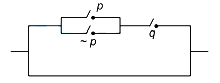
નીચે આપેલા સર્કિટનું આઉટપુટ શું છે?
A
$p$
B
$q$
C
$\sim p$
D
$p+q$
Solution
(B) આ સર્કિટમાં બે સ્વીચો $p$ અને $\sim p$ સમાંતર જોડાયેલી છે,જે પછી $q$ સ્વીચ સાથે શ્રેણીમાં જોડાયેલી છે.
$p$ અને $\sim p$ ના સમાંતર જોડાણ માટેનું તાર્કિક પદ $(p \lor \sim p)$ છે.
કારણ કે $(p \lor \sim p) = T$ (એક નિત્યસત્ય,જે સ્વીચિંગ સર્કિટમાં $1$ તરીકે દર્શાવવામાં આવે છે),તેથી પદ $1 \land q$ બને છે.
આમ,આઉટપુટ $1 \cdot q = q$ છે.
$p$ અને $\sim p$ ના સમાંતર જોડાણ માટેનું તાર્કિક પદ $(p \lor \sim p)$ છે.
કારણ કે $(p \lor \sim p) = T$ (એક નિત્યસત્ય,જે સ્વીચિંગ સર્કિટમાં $1$ તરીકે દર્શાવવામાં આવે છે),તેથી પદ $1 \land q$ બને છે.
આમ,આઉટપુટ $1 \cdot q = q$ છે.
0 likesView Solution
17
MathematicsEasyMCQMHT CET · 2010
ઉગમબિંદુમાંથી પસાર થતી અને $3$ તથા $-\frac{1}{3}$ ઢાળ ધરાવતી રેખાઓનું સમીકરણ છે
A
$3y^{2}+8xy-3x^{2}=0$
B
$3x^{2}+8xy+3y^{2}=0$
C
$3y^{2}-8xy-3x^{2}=0$
D
$3x^{2}+8xy-3y^{2}=0$
Solution
(C) ઉગમબિંદુમાંથી પસાર થતી અને $m_{1}=3$ તથા $m_{2}=-\frac{1}{3}$ ઢાળ ધરાવતી રેખાઓના સમીકરણો $y=3x$ અને $y=-\frac{1}{3}x$ છે.
આને $(y-3x)=0$ અને $(3y+x)=0$ તરીકે લખી શકાય.
રેખાઓની જોડીનું સંયુક્ત સમીકરણ તેમના વ્યક્તિગત સમીકરણોના ગુણાકાર દ્વારા મળે છે:
$(y-3x)(3y+x)=0$
$3y^{2}+xy-9xy-3x^{2}=0$
$3y^{2}-8xy-3x^{2}=0$.
આને $(y-3x)=0$ અને $(3y+x)=0$ તરીકે લખી શકાય.
રેખાઓની જોડીનું સંયુક્ત સમીકરણ તેમના વ્યક્તિગત સમીકરણોના ગુણાકાર દ્વારા મળે છે:
$(y-3x)(3y+x)=0$
$3y^{2}+xy-9xy-3x^{2}=0$
$3y^{2}-8xy-3x^{2}=0$.
0 likesView Solution
18
MathematicsEasyMCQMHT CET · 2010
સમીકરણ $x^{2}-xy-6y^{2}-7x+31y-18=0$ દ્વારા દર્શાવતી રેખાઓ વચ્ચેનો ખૂણો કેટલો છે?
A
$\frac{\pi}{4}$
B
$\frac{\pi}{6}$
C
$\frac{\pi}{2}$
D
$\frac{\pi}{3}$
Solution
(A) આપેલ સમીકરણ $x^{2}-xy-6y^{2}-7x+31y-18=0$ છે.
આને વ્યાપક સમીકરણ $ax^{2}+2hxy+by^{2}+2gx+2fy+c=0$ સાથે સરખાવતા,આપણને $a=1$,$b=-6$,અને $2h=-1$ મળે છે,જેનો અર્થ છે કે $h=-\frac{1}{2}$.
રેખાઓની જોડી વચ્ચેનો ખૂણો $\theta$ શોધવાનું સૂત્ર $\tan \theta = \left| \frac{2\sqrt{h^{2}-ab}}{a+b} \right|$ છે.
કિંમતો મૂકતા,$\tan \theta = \left| \frac{2\sqrt{(-\frac{1}{2})^{2} - (1)(-6)}}{1+(-6)} \right|$.
$\tan \theta = \left| \frac{2\sqrt{\frac{1}{4}+6}}{-5} \right| = \left| \frac{2\sqrt{\frac{25}{4}}}{-5} \right|$.
$\tan \theta = \left| \frac{2 \times \frac{5}{2}}{-5} \right| = \left| \frac{5}{-5} \right| = |-1| = 1$.
તેથી,$\theta = \tan^{-1}(1) = \frac{\pi}{4}$.
આને વ્યાપક સમીકરણ $ax^{2}+2hxy+by^{2}+2gx+2fy+c=0$ સાથે સરખાવતા,આપણને $a=1$,$b=-6$,અને $2h=-1$ મળે છે,જેનો અર્થ છે કે $h=-\frac{1}{2}$.
રેખાઓની જોડી વચ્ચેનો ખૂણો $\theta$ શોધવાનું સૂત્ર $\tan \theta = \left| \frac{2\sqrt{h^{2}-ab}}{a+b} \right|$ છે.
કિંમતો મૂકતા,$\tan \theta = \left| \frac{2\sqrt{(-\frac{1}{2})^{2} - (1)(-6)}}{1+(-6)} \right|$.
$\tan \theta = \left| \frac{2\sqrt{\frac{1}{4}+6}}{-5} \right| = \left| \frac{2\sqrt{\frac{25}{4}}}{-5} \right|$.
$\tan \theta = \left| \frac{2 \times \frac{5}{2}}{-5} \right| = \left| \frac{5}{-5} \right| = |-1| = 1$.
તેથી,$\theta = \tan^{-1}(1) = \frac{\pi}{4}$.
0 likesView Solution
19
MathematicsEasyMCQMHT CET · 2010
જેનું શિરોબિંદુ $(0,0)$ હોય અને નાભિલંબની લંબાઈ $\frac{16}{3}$ હોય તેવા પરવલયનું સમીકરણ શોધો.
A
$8x^{2} + 3y^{2} = 72$
B
$16y^{2} = 3x$
C
$3y^{2} = 16x$
D
$3x^{2} + 16y^{2} = 48$
Solution
(C) $(0,0)$ શિરોબિંદુ ધરાવતા અને $x$-અક્ષ પર ખુલ્લા પરવલયનું પ્રમાણિત સમીકરણ $y^{2} = 4ax$ છે.
નાભિલંબની લંબાઈ $4a = \frac{16}{3}$ આપેલ છે.
$4a = \frac{16}{3}$ ને $y^{2} = 4ax$ માં મૂકતા,આપણને $y^{2} = \frac{16}{3}x$ મળે છે.
બંને બાજુ $3$ વડે ગુણતા,$3y^{2} = 16x$ મળે છે.
નાભિલંબની લંબાઈ $4a = \frac{16}{3}$ આપેલ છે.
$4a = \frac{16}{3}$ ને $y^{2} = 4ax$ માં મૂકતા,આપણને $y^{2} = \frac{16}{3}x$ મળે છે.
બંને બાજુ $3$ વડે ગુણતા,$3y^{2} = 16x$ મળે છે.
0 likesView Solution
20
MathematicsMediumMCQMHT CET · 2010
વર્તુળ $x^{2}+y^{2}=2$ અને પરવલય $y^{2}=8x$ ના સામાન્ય સ્પર્શકનું સમીકરણ $x+y=k$ છે. તો $k$ ની કિંમત શોધો.
A
$1$
B
$-1$
C
$2$
D
$-2$
Solution
(D) આપેલ પરવલય $y^{2}=8x$ છે. $y^{2}=4ax$ સાથે સરખાવતા,$4a=8$,તેથી $a=2$ મળે છે.
પરવલયનો કોઈપણ સ્પર્શક $y=mx+\frac{a}{m}$ સ્વરૂપમાં હોય છે,જેને $mx-y+\frac{2}{m}=0$ તરીકે લખી શકાય.
આ રેખા વર્તુળ $x^{2}+y^{2}=2$ (કેન્દ્ર $(0,0)$ અને ત્રિજ્યા $r=\sqrt{2}$) નો સ્પર્શક હોય,તો કેન્દ્રથી રેખાનું લંબ અંતર ત્રિજ્યા જેટલું હોવું જોઈએ.
તેથી,$\frac{|\frac{2}{m}|}{\sqrt{m^{2}+1}}=\sqrt{2}$.
બંને બાજુ વર્ગ કરતા,$\frac{4}{m^{2}}=2(m^{2}+1)$ $\Rightarrow 2=m^{2}(m^{2}+1)$ $\Rightarrow m^{4}+m^{2}-2=0$.
ધારો કે $t=m^{2}$,તો $t^{2}+t-2=0 \Rightarrow (t+2)(t-1)=0$. $m^{2} \geq 0$ હોવાથી,$m^{2}=1$,તેથી $m=\pm 1$.
જો $m=1$ હોય,તો સ્પર્શક $x-y+2=0 \Rightarrow y=x+2$ મળે.
જો $m=-1$ હોય,તો સ્પર્શક $-x-y-2=0 \Rightarrow x+y=-2$ મળે.
$x+y=-2$ ને આપેલ સમીકરણ $x+y=k$ સાથે સરખાવતા,$k=-2$ મળે છે.
પરવલયનો કોઈપણ સ્પર્શક $y=mx+\frac{a}{m}$ સ્વરૂપમાં હોય છે,જેને $mx-y+\frac{2}{m}=0$ તરીકે લખી શકાય.
આ રેખા વર્તુળ $x^{2}+y^{2}=2$ (કેન્દ્ર $(0,0)$ અને ત્રિજ્યા $r=\sqrt{2}$) નો સ્પર્શક હોય,તો કેન્દ્રથી રેખાનું લંબ અંતર ત્રિજ્યા જેટલું હોવું જોઈએ.
તેથી,$\frac{|\frac{2}{m}|}{\sqrt{m^{2}+1}}=\sqrt{2}$.
બંને બાજુ વર્ગ કરતા,$\frac{4}{m^{2}}=2(m^{2}+1)$ $\Rightarrow 2=m^{2}(m^{2}+1)$ $\Rightarrow m^{4}+m^{2}-2=0$.
ધારો કે $t=m^{2}$,તો $t^{2}+t-2=0 \Rightarrow (t+2)(t-1)=0$. $m^{2} \geq 0$ હોવાથી,$m^{2}=1$,તેથી $m=\pm 1$.
જો $m=1$ હોય,તો સ્પર્શક $x-y+2=0 \Rightarrow y=x+2$ મળે.
જો $m=-1$ હોય,તો સ્પર્શક $-x-y-2=0 \Rightarrow x+y=-2$ મળે.
$x+y=-2$ ને આપેલ સમીકરણ $x+y=k$ સાથે સરખાવતા,$k=-2$ મળે છે.
0 likesView Solution
21
MathematicsMediumMCQMHT CET · 2010
$1, 2, 3, 4, 5, 6, 7$ અંકોનો ઉપયોગ કરીને ચાર અંકની સંખ્યા બનાવવાની છે (કોઈપણ અંકનું પુનરાવર્તન થતું નથી). તો,તે સંખ્યા $> 4000$ હોય તેની સંભાવના કેટલી?
A
$3/2$
B
$1/2$
C
$4/7$
D
$3/7$
Solution
(C) $7$ ભિન્ન અંકોનો ઉપયોગ કરીને ચાર અંકની સંખ્યા બનાવવાની કુલ રીતો $P(7, 4) = 7 \times 6 \times 5 \times 4 = 840$ છે.
સંખ્યા $> 4000$ હોય તે માટે,પ્રથમ અંક (હજારનું સ્થાન) $4, 5, 6,$ અથવા $7$ હોવો જોઈએ.
પ્રથમ અંક માટે $4$ વિકલ્પો છે.
પ્રથમ અંક પસંદ કર્યા પછી,બાકીના $3$ સ્થાનો બાકીના $6$ અંકો દ્વારા $P(6, 3) = 6 \times 5 \times 4 = 120$ રીતે ભરી શકાય છે.
આમ,સાનુકૂળ કિસ્સાઓની સંખ્યા $4 \times 120 = 480$ છે.
તેથી,જરૂરી સંભાવના $\frac{480}{840} = \frac{4}{7}$ છે.
સંખ્યા $> 4000$ હોય તે માટે,પ્રથમ અંક (હજારનું સ્થાન) $4, 5, 6,$ અથવા $7$ હોવો જોઈએ.
પ્રથમ અંક માટે $4$ વિકલ્પો છે.
પ્રથમ અંક પસંદ કર્યા પછી,બાકીના $3$ સ્થાનો બાકીના $6$ અંકો દ્વારા $P(6, 3) = 6 \times 5 \times 4 = 120$ રીતે ભરી શકાય છે.
આમ,સાનુકૂળ કિસ્સાઓની સંખ્યા $4 \times 120 = 480$ છે.
તેથી,જરૂરી સંભાવના $\frac{480}{840} = \frac{4}{7}$ છે.
0 likesView Solution
22
MathematicsMediumMCQMHT CET · 2010
જો બે પાસાઓને એકસાથે ફેંકવામાં આવે,તો તેમના પર આવતી સંખ્યાઓનો સરવાળો અવિભાજ્ય સંખ્યા હોય તેની સંભાવના કેટલી છે?
A
$1/2$
B
$3/7$
C
$5/12$
D
$7/12$
Solution
(C) જ્યારે બે પાસા ફેંકવામાં આવે,ત્યારે કુલ પરિણામોની સંખ્યા $6 \times 6 = 36$ છે.
શક્ય સરવાળો $2$ થી $12$ સુધીનો છે.
આ શ્રેણીમાં અવિભાજ્ય સંખ્યાઓ $2, 3, 5, 7, 11$ છે.
દરેક સરવાળા માટે સાનુકૂળ પરિણામો:
સરવાળો $= 2$: $(1, 1)$ - $1$ કિસ્સો
સરવાળો $= 3$: $(1, 2), (2, 1)$ - $2$ કિસ્સા
સરવાળો $= 5$: $(1, 4), (2, 3), (3, 2), (4, 1)$ - $4$ કિસ્સા
સરવાળો $= 7$: $(1, 6), (2, 5), (3, 4), (4, 3), (5, 2), (6, 1)$ - $6$ કિસ્સા
સરવાળો $= 11$: $(5, 6), (6, 5)$ - $2$ કિસ્સા
કુલ સાનુકૂળ પરિણામો $= 1 + 2 + 4 + 6 + 2 = 15$.
જરૂરી સંભાવના $= \frac{15}{36} = \frac{5}{12}$.
શક્ય સરવાળો $2$ થી $12$ સુધીનો છે.
આ શ્રેણીમાં અવિભાજ્ય સંખ્યાઓ $2, 3, 5, 7, 11$ છે.
દરેક સરવાળા માટે સાનુકૂળ પરિણામો:
સરવાળો $= 2$: $(1, 1)$ - $1$ કિસ્સો
સરવાળો $= 3$: $(1, 2), (2, 1)$ - $2$ કિસ્સા
સરવાળો $= 5$: $(1, 4), (2, 3), (3, 2), (4, 1)$ - $4$ કિસ્સા
સરવાળો $= 7$: $(1, 6), (2, 5), (3, 4), (4, 3), (5, 2), (6, 1)$ - $6$ કિસ્સા
સરવાળો $= 11$: $(5, 6), (6, 5)$ - $2$ કિસ્સા
કુલ સાનુકૂળ પરિણામો $= 1 + 2 + 4 + 6 + 2 = 15$.
જરૂરી સંભાવના $= \frac{15}{36} = \frac{5}{12}$.
0 likesView Solution
23
MathematicsEasyMCQMHT CET · 2010
વક્ર $y^{2}=ax^{2}+b$ માટે બિંદુ $(2,3)$ આગળ સ્પર્શકનું સમીકરણ $y=4x-5$ હોય,તો $a$ અને $b$ ની કિંમતો શોધો.
A
$3, -5$
B
$6, -5$
C
$6, 15$
D
$6, -15$
Solution
(D) આપેલ વક્રનું સમીકરણ: $y^{2} = ax^{2} + b$.
બંને બાજુ $x$ ની સાપેક્ષે વિકલન કરતા:
$2y \frac{dy}{dx} = 2ax$
$\frac{dy}{dx} = \frac{ax}{y}$.
બિંદુ $(2, 3)$ આગળ સ્પર્શકનો ઢાળ $\left(\frac{dy}{dx}\right)_{(2,3)} = \frac{a(2)}{3} = \frac{2a}{3}$ થાય.
આપેલ સ્પર્શકનું સમીકરણ $y = 4x - 5$ છે,જે $y = mx + c$ સ્વરૂપમાં છે,તેથી તેનો ઢાળ $m = 4$ છે.
ઢાળને સરખાવતા: $\frac{2a}{3} = 4 \Rightarrow 2a = 12 \Rightarrow a = 6$.
બિંદુ $(2, 3)$ વક્ર પર આવેલું હોવાથી,તે વક્રના સમીકરણ $y^{2} = ax^{2} + b$ નું સમાધાન કરશે:
$(3)^{2} = 6(2)^{2} + b$
$9 = 6(4) + b$
$9 = 24 + b$
$b = 9 - 24 = -15$.
આમ,$a = 6$ અને $b = -15$ મળે છે.
બંને બાજુ $x$ ની સાપેક્ષે વિકલન કરતા:
$2y \frac{dy}{dx} = 2ax$
$\frac{dy}{dx} = \frac{ax}{y}$.
બિંદુ $(2, 3)$ આગળ સ્પર્શકનો ઢાળ $\left(\frac{dy}{dx}\right)_{(2,3)} = \frac{a(2)}{3} = \frac{2a}{3}$ થાય.
આપેલ સ્પર્શકનું સમીકરણ $y = 4x - 5$ છે,જે $y = mx + c$ સ્વરૂપમાં છે,તેથી તેનો ઢાળ $m = 4$ છે.
ઢાળને સરખાવતા: $\frac{2a}{3} = 4 \Rightarrow 2a = 12 \Rightarrow a = 6$.
બિંદુ $(2, 3)$ વક્ર પર આવેલું હોવાથી,તે વક્રના સમીકરણ $y^{2} = ax^{2} + b$ નું સમાધાન કરશે:
$(3)^{2} = 6(2)^{2} + b$
$9 = 6(4) + b$
$9 = 24 + b$
$b = 9 - 24 = -15$.
આમ,$a = 6$ અને $b = -15$ મળે છે.
0 likesView Solution
24
MathematicsDifficultMCQMHT CET · 2010
$y^{2}=4x$, $x=4$ અને $x=5$ વક્ર વચ્ચે ઘેરાયેલા વિસ્તારને $x$-અક્ષની આસપાસ પરિભ્રમણ કરાવવાથી બનતા ઘનનું ઘનફળ (ઘન એકમમાં) કેટલું થાય ($\pi$ માં)?
A
$18$
B
$36$
C
$9$
D
$24$
Solution
(A) $x$-અક્ષની આસપાસ $x = a$ થી $x = b$ સુધી વક્ર $y = f(x)$ ને પરિભ્રમણ કરાવવાથી બનતા ઘનનું ઘનફળ $V = \int_{a}^{b} \pi y^{2} dx$ સૂત્ર દ્વારા મળે છે।
અહીં વક્ર $y^{2} = 4x$ અને સીમાઓ $x = 4$ થી $x = 5$ આપેલ છે।
સૂત્રમાં કિંમતો મૂકતા:
$V = \int_{4}^{5} \pi (4x) dx$
$V = 4\pi \int_{4}^{5} x dx$
$V = 4\pi \left[ \frac{x^{2}}{2} \right]_{4}^{5}$
$V = 2\pi [x^{2}]_{4}^{5}$
$V = 2\pi (5^{2} - 4^{2})$
$V = 2\pi (25 - 16)$
$V = 2\pi (9) = 18\pi$ ઘન એકમ।
અહીં વક્ર $y^{2} = 4x$ અને સીમાઓ $x = 4$ થી $x = 5$ આપેલ છે।
સૂત્રમાં કિંમતો મૂકતા:
$V = \int_{4}^{5} \pi (4x) dx$
$V = 4\pi \int_{4}^{5} x dx$
$V = 4\pi \left[ \frac{x^{2}}{2} \right]_{4}^{5}$
$V = 2\pi [x^{2}]_{4}^{5}$
$V = 2\pi (5^{2} - 4^{2})$
$V = 2\pi (25 - 16)$
$V = 2\pi (9) = 18\pi$ ઘન એકમ।
0 likesView Solution
25
MathematicsMediumMCQMHT CET · 2010
જો વિધેય $f(x) = \begin{cases} -2 \sin x, & -\pi \leq x \leq -\frac{\pi}{2} \\ a \sin x + b, & -\frac{\pi}{2} < x < \frac{\pi}{2} \\ \cos x, & \frac{\pi}{2} \leq x \leq \pi \end{cases}$ એ $[-\pi, \pi]$ માં સતત હોય,તો $a$ અને $b$ ની કિંમતો શોધો.
A
$-1, 0$
B
$1, 0$
C
$1, 1$
D
$-1, 1$
Solution
(D) વિધેય $f(x)$ એ $[-\pi, \pi]$ માં સતત હોવા માટે,તે $x = -\frac{\pi}{2}$ અને $x = \frac{\pi}{2}$ આગળ સતત હોવું જોઈએ.
$x = -\frac{\pi}{2}$ આગળ:
$\lim_{x \rightarrow -\frac{\pi}{2}^-} (-2 \sin x) = -2 \sin(-\frac{\pi}{2}) = -2(-1) = 2$.
$\lim_{x \rightarrow -\frac{\pi}{2}^+} (a \sin x + b) = a \sin(-\frac{\pi}{2}) + b = -a + b$.
આ બંનેને સરખાવતા,$-a + b = 2$ (સમીકરણ $1$).
$x = \frac{\pi}{2}$ આગળ:
$\lim_{x \rightarrow \frac{\pi}{2}^-} (a \sin x + b) = a \sin(\frac{\pi}{2}) + b = a + b$.
$\lim_{x \rightarrow \frac{\pi}{2}^+} \cos x = \cos(\frac{\pi}{2}) = 0$.
આ બંનેને સરખાવતા,$a + b = 0$ (સમીકરણ $2$).
સમીકરણ $1$ અને $2$ નો સરવાળો કરતા:
$(-a + b) + (a + b) = 2 + 0 \Rightarrow 2b = 2 \Rightarrow b = 1$.
$b = 1$ ની કિંમત સમીકરણ $2$ માં મૂકતા:
$a + 1 = 0 \Rightarrow a = -1$.
આમ,$a = -1$ અને $b = 1$ મળે છે.
$x = -\frac{\pi}{2}$ આગળ:
$\lim_{x \rightarrow -\frac{\pi}{2}^-} (-2 \sin x) = -2 \sin(-\frac{\pi}{2}) = -2(-1) = 2$.
$\lim_{x \rightarrow -\frac{\pi}{2}^+} (a \sin x + b) = a \sin(-\frac{\pi}{2}) + b = -a + b$.
આ બંનેને સરખાવતા,$-a + b = 2$ (સમીકરણ $1$).
$x = \frac{\pi}{2}$ આગળ:
$\lim_{x \rightarrow \frac{\pi}{2}^-} (a \sin x + b) = a \sin(\frac{\pi}{2}) + b = a + b$.
$\lim_{x \rightarrow \frac{\pi}{2}^+} \cos x = \cos(\frac{\pi}{2}) = 0$.
આ બંનેને સરખાવતા,$a + b = 0$ (સમીકરણ $2$).
સમીકરણ $1$ અને $2$ નો સરવાળો કરતા:
$(-a + b) + (a + b) = 2 + 0 \Rightarrow 2b = 2 \Rightarrow b = 1$.
$b = 1$ ની કિંમત સમીકરણ $2$ માં મૂકતા:
$a + 1 = 0 \Rightarrow a = -1$.
આમ,$a = -1$ અને $b = 1$ મળે છે.
0 likesView Solution
26
MathematicsEasyMCQMHT CET · 2010
$\int_{4}^{7} \frac{(11-x)^{2}}{x^{2}+(11-x)^{2}} d x$ નું મૂલ્ય શોધો.
A
$1$
B
$1/2$
C
$3/2$
D
$0$
Solution
(C) ધારો કે $I = \int_{4}^{7} \frac{(11-x)^{2}}{x^{2}+(11-x)^{2}} d x$ $(i)$
ગુણધર્મ $\int_{a}^{b} f(x) d x = \int_{a}^{b} f(a+b-x) d x$ નો ઉપયોગ કરતા:
$I = \int_{4}^{7} \frac{(11-(11-x))^{2}}{(11-x)^{2}+(11-(11-x))^{2}} d x$
$I = \int_{4}^{7} \frac{x^{2}}{(11-x)^{2}+x^{2}} d x$ $(ii)$
$(i)$ અને $(ii)$ નો સરવાળો કરતા:
$2I = \int_{4}^{7} \frac{(11-x)^{2} + x^{2}}{x^{2}+(11-x)^{2}} d x$
$2I = \int_{4}^{7} 1 d x$
$2I = [x]_{4}^{7} = 7 - 4 = 3$
$I = \frac{3}{2}$
ગુણધર્મ $\int_{a}^{b} f(x) d x = \int_{a}^{b} f(a+b-x) d x$ નો ઉપયોગ કરતા:
$I = \int_{4}^{7} \frac{(11-(11-x))^{2}}{(11-x)^{2}+(11-(11-x))^{2}} d x$
$I = \int_{4}^{7} \frac{x^{2}}{(11-x)^{2}+x^{2}} d x$ $(ii)$
$(i)$ અને $(ii)$ નો સરવાળો કરતા:
$2I = \int_{4}^{7} \frac{(11-x)^{2} + x^{2}}{x^{2}+(11-x)^{2}} d x$
$2I = \int_{4}^{7} 1 d x$
$2I = [x]_{4}^{7} = 7 - 4 = 3$
$I = \frac{3}{2}$
0 likesView Solution
27
MathematicsDifficultMCQMHT CET · 2010
$\int_{0}^{\pi / 2} \log (\operatorname{cosec} x) d x$ નું મૂલ્ય શોધો.
A
$\frac{\pi}{2} \log 2$
B
$\pi \log 2$
C
$-\frac{\pi}{2} \log 2$
D
$2 \pi \log 2$
Solution
(A) ધારો કે $I = \int_{0}^{\pi / 2} \log (\operatorname{cosec} x) d x$.
કારણ કે $\operatorname{cosec} x = \frac{1}{\sin x}$,તેથી $\log (\operatorname{cosec} x) = \log (\sin x)^{-1} = -\log \sin x$ થાય.
તેથી,$I = -\int_{0}^{\pi / 2} \log \sin x d x$.
નિશ્ચિત સંકલનના પ્રમાણિત પરિણામ $\int_{0}^{\pi / 2} \log \sin x d x = -\frac{\pi}{2} \log 2$ નો ઉપયોગ કરતા,આપણને મળે છે:
$I = -(-\frac{\pi}{2} \log 2) = \frac{\pi}{2} \log 2$.
કારણ કે $\operatorname{cosec} x = \frac{1}{\sin x}$,તેથી $\log (\operatorname{cosec} x) = \log (\sin x)^{-1} = -\log \sin x$ થાય.
તેથી,$I = -\int_{0}^{\pi / 2} \log \sin x d x$.
નિશ્ચિત સંકલનના પ્રમાણિત પરિણામ $\int_{0}^{\pi / 2} \log \sin x d x = -\frac{\pi}{2} \log 2$ નો ઉપયોગ કરતા,આપણને મળે છે:
$I = -(-\frac{\pi}{2} \log 2) = \frac{\pi}{2} \log 2$.
0 likesView Solution
28
MathematicsDifficultMCQMHT CET · 2010
જો $\int_{0}^{1} \tan ^{-1} x \, dx = p$ હોય,તો $\int_{0}^{1} \tan ^{-1}\left(\frac{1-x}{1+x}\right) \, dx$ ની કિંમત શોધો.
A
$\frac{\pi}{4} + p$
B
$\frac{\pi}{4} - p$
C
$1 + p$
D
$1 - p$
Solution
(B) ધારો કે $I = \int_{0}^{1} \tan ^{-1}\left(\frac{1-x}{1+x}\right) \, dx$.
ત્રિકોણમિતીય નિત્યસમ $\tan ^{-1} A - \tan ^{-1} B = \tan ^{-1}\left(\frac{A-B}{1+AB}\right)$ નો ઉપયોગ કરતા,આપણે લખી શકીએ કે $\tan ^{-1}\left(\frac{1-x}{1+x}\right) = \tan ^{-1}(1) - \tan ^{-1}(x)$.
કારણ કે $\tan ^{-1}(1) = \frac{\pi}{4}$,સંકલન આ મુજબ થશે:
$I = \int_{0}^{1} \left( \frac{\pi}{4} - \tan ^{-1}(x) \right) \, dx$.
$I = \int_{0}^{1} \frac{\pi}{4} \, dx - \int_{0}^{1} \tan ^{-1}(x) \, dx$.
$I = \left[ \frac{\pi}{4} x \right]_{0}^{1} - p$.
$I = \frac{\pi}{4}(1 - 0) - p$.
$I = \frac{\pi}{4} - p$.
ત્રિકોણમિતીય નિત્યસમ $\tan ^{-1} A - \tan ^{-1} B = \tan ^{-1}\left(\frac{A-B}{1+AB}\right)$ નો ઉપયોગ કરતા,આપણે લખી શકીએ કે $\tan ^{-1}\left(\frac{1-x}{1+x}\right) = \tan ^{-1}(1) - \tan ^{-1}(x)$.
કારણ કે $\tan ^{-1}(1) = \frac{\pi}{4}$,સંકલન આ મુજબ થશે:
$I = \int_{0}^{1} \left( \frac{\pi}{4} - \tan ^{-1}(x) \right) \, dx$.
$I = \int_{0}^{1} \frac{\pi}{4} \, dx - \int_{0}^{1} \tan ^{-1}(x) \, dx$.
$I = \left[ \frac{\pi}{4} x \right]_{0}^{1} - p$.
$I = \frac{\pi}{4}(1 - 0) - p$.
$I = \frac{\pi}{4} - p$.
0 likesView Solution
29
MathematicsEasyMCQMHT CET · 2010
વિકલ સમીકરણ જેનો ઉકેલ $a e^{x} + b e^{2x} + c e^{3x} + d = 0$ છે,તેની કક્ષા (order) કેટલી છે?
A
$1$
B
$2$
C
$3$
D
$4$
Solution
(D) આપેલ સમીકરણ $a e^{x} + b e^{2x} + c e^{3x} + d = 0$ છે.
આ સમીકરણમાં $4$ સ્વૈચ્છિક અચળાંકો $a, b, c,$ અને $d$ રહેલા છે.
વ્યાખ્યા મુજબ,વિકલ સમીકરણની કક્ષા તેના સામાન્ય ઉકેલમાં રહેલા સ્વતંત્ર સ્વૈચ્છિક અચળાંકોની સંખ્યા જેટલી હોય છે.
અહીં $4$ સ્વૈચ્છિક અચળાંકો હોવાથી,વિકલ સમીકરણની કક્ષા $4$ થશે.
આ સમીકરણમાં $4$ સ્વૈચ્છિક અચળાંકો $a, b, c,$ અને $d$ રહેલા છે.
વ્યાખ્યા મુજબ,વિકલ સમીકરણની કક્ષા તેના સામાન્ય ઉકેલમાં રહેલા સ્વતંત્ર સ્વૈચ્છિક અચળાંકોની સંખ્યા જેટલી હોય છે.
અહીં $4$ સ્વૈચ્છિક અચળાંકો હોવાથી,વિકલ સમીકરણની કક્ષા $4$ થશે.
0 likesView Solution
30
MathematicsMediumMCQMHT CET · 2010
જેનું કેન્દ્ર $x$-અક્ષ પર હોય તેવા વર્તુળોના સમૂહનું વિકલ સમીકરણ છે:
A
$\frac{d^{2} y}{d x^{2}}+\left(\frac{d y}{d x}\right)^{2}+1=0$
B
$y \frac{d^{2} y}{d x^{2}}+\left(\frac{d y}{d x}\right)^{2}-1=0$
C
$y \frac{d^{2} y}{d x^{2}}-\left(\frac{d y}{d x}\right)^{2}-1=0$
D
$y \frac{d^{2} y}{d x^{2}}+\left(\frac{d y}{d x}\right)^{2}+1=0$
Solution
(D) $x$-અક્ષ પર કેન્દ્ર ધરાવતા વર્તુળોના સમૂહનું સામાન્ય સમીકરણ $(x-a)^2 + y^2 = r^2$ છે.
આ સમીકરણમાં બે સ્વૈર અચળાંકો $a$ અને $r$ છે,તેથી તેનું બે વાર વિકલન કરવાથી વિકલ સમીકરણ મળે છે.
પ્રથમ વિકલન કરતા: $2(x-a) + 2y \frac{dy}{dx} = 0 \Rightarrow x-a = -y \frac{dy}{dx}$.
બીજી વાર વિકલન કરતા: $1 - ((\frac{dy}{dx})^2 + y \frac{d^2y}{dx^2}) = 0$.
જેને સાદું રૂપ આપતા $y \frac{d^2y}{dx^2} + (\frac{dy}{dx})^2 + 1 = 0$ મળે છે.
આ સમીકરણમાં બે સ્વૈર અચળાંકો $a$ અને $r$ છે,તેથી તેનું બે વાર વિકલન કરવાથી વિકલ સમીકરણ મળે છે.
પ્રથમ વિકલન કરતા: $2(x-a) + 2y \frac{dy}{dx} = 0 \Rightarrow x-a = -y \frac{dy}{dx}$.
બીજી વાર વિકલન કરતા: $1 - ((\frac{dy}{dx})^2 + y \frac{d^2y}{dx^2}) = 0$.
જેને સાદું રૂપ આપતા $y \frac{d^2y}{dx^2} + (\frac{dy}{dx})^2 + 1 = 0$ મળે છે.
0 likesView Solution
31
MathematicsEasyMCQMHT CET · 2010
વિકલ સમીકરણ $y(1+\log x) \frac{dx}{dy} - x \log x = 0$ નો ઉકેલ શોધો.
A
$x \log x = y + c$
B
$x \log x = yc$
C
$y(1+\log x) = c$
D
$\log x - y = c$
Solution
(B) આપેલ વિકલ સમીકરણ $y(1+\log x) \frac{dx}{dy} = x \log x$ છે.
ચલને અલગ કરવા માટે પદોને ગોઠવતા:
$\frac{1+\log x}{x \log x} dx = \frac{1}{y} dy$.
બંને બાજુ સંકલન કરતા:
$\int \frac{1+\log x}{x \log x} dx = \int \frac{1}{y} dy$.
ડાબી બાજુના સંકલનને અલગ કરતા:
$\int \frac{1}{x \log x} dx + \int \frac{1}{x} dx = \int \frac{1}{y} dy$.
ધારો કે $u = \log x$,તો $du = \frac{1}{x} dx$. સંકલન નીચે મુજબ થશે:
$\int \frac{1}{u} du + \int \frac{1}{x} dx = \int \frac{1}{y} dy$.
$\log |u| + \log |x| = \log |y| + \log |c|$.
$u = \log x$ પાછું મૂકતા:
$\log |\log x| + \log |x| = \log |y| + \log |c|$.
ગુણધર્મ $\log a + \log b = \log(ab)$ નો ઉપયોગ કરતા:
$\log |x \log x| = \log |yc|$.
બંને બાજુ ઘાતાંક લેતા:
$x \log x = yc$.
ચલને અલગ કરવા માટે પદોને ગોઠવતા:
$\frac{1+\log x}{x \log x} dx = \frac{1}{y} dy$.
બંને બાજુ સંકલન કરતા:
$\int \frac{1+\log x}{x \log x} dx = \int \frac{1}{y} dy$.
ડાબી બાજુના સંકલનને અલગ કરતા:
$\int \frac{1}{x \log x} dx + \int \frac{1}{x} dx = \int \frac{1}{y} dy$.
ધારો કે $u = \log x$,તો $du = \frac{1}{x} dx$. સંકલન નીચે મુજબ થશે:
$\int \frac{1}{u} du + \int \frac{1}{x} dx = \int \frac{1}{y} dy$.
$\log |u| + \log |x| = \log |y| + \log |c|$.
$u = \log x$ પાછું મૂકતા:
$\log |\log x| + \log |x| = \log |y| + \log |c|$.
ગુણધર્મ $\log a + \log b = \log(ab)$ નો ઉપયોગ કરતા:
$\log |x \log x| = \log |yc|$.
બંને બાજુ ઘાતાંક લેતા:
$x \log x = yc$.
0 likesView Solution
32
MathematicsDifficultMCQMHT CET · 2010
જો $x^{2} y^{5}=(x+y)^{7}$ હોય,તો $\frac{d^{2} y}{d x^{2}}$ ની કિંમત શોધો.
A
$y / x^{2}$
B
$x / y$
C
$1$
D
$0$
Solution
(D) આપેલ છે કે,$x^{2} y^{5}=(x+y)^{7}$.
બંને બાજુ પ્રાકૃતિક લઘુગણક (log) લેતા:
$2 \ln x + 5 \ln y = 7 \ln (x+y)$.
$x$ ની સાપેક્ષમાં વિકલન કરતા:
$\frac{2}{x} + \frac{5}{y} \frac{dy}{dx} = \frac{7}{x+y} \left(1 + \frac{dy}{dx}\right)$.
$\frac{dy}{dx}$ માટે પદોને ગોઠવતા:
$\frac{dy}{dx} \left(\frac{5}{y} - \frac{7}{x+y}\right) = \frac{7}{x+y} - \frac{2}{x}$.
$\frac{dy}{dx} \left(\frac{5x + 5y - 7y}{y(x+y)}\right) = \frac{7x - 2x - 2y}{x(x+y)}$.
$\frac{dy}{dx} \left(\frac{5x - 2y}{y(x+y)}\right) = \frac{5x - 2y}{x(x+y)}$.
તેથી,$\frac{dy}{dx} = \frac{y}{x}$.
હવે,ફરીથી $x$ ની સાપેક્ષમાં વિકલન કરતા:
$\frac{d^{2}y}{dx^{2}} = \frac{x \frac{dy}{dx} - y}{x^{2}}$.
$\frac{dy}{dx} = \frac{y}{x}$ મૂકતા:
$\frac{d^{2}y}{dx^{2}} = \frac{x(y/x) - y}{x^{2}} = \frac{y - y}{x^{2}} = 0$.
બંને બાજુ પ્રાકૃતિક લઘુગણક (log) લેતા:
$2 \ln x + 5 \ln y = 7 \ln (x+y)$.
$x$ ની સાપેક્ષમાં વિકલન કરતા:
$\frac{2}{x} + \frac{5}{y} \frac{dy}{dx} = \frac{7}{x+y} \left(1 + \frac{dy}{dx}\right)$.
$\frac{dy}{dx}$ માટે પદોને ગોઠવતા:
$\frac{dy}{dx} \left(\frac{5}{y} - \frac{7}{x+y}\right) = \frac{7}{x+y} - \frac{2}{x}$.
$\frac{dy}{dx} \left(\frac{5x + 5y - 7y}{y(x+y)}\right) = \frac{7x - 2x - 2y}{x(x+y)}$.
$\frac{dy}{dx} \left(\frac{5x - 2y}{y(x+y)}\right) = \frac{5x - 2y}{x(x+y)}$.
તેથી,$\frac{dy}{dx} = \frac{y}{x}$.
હવે,ફરીથી $x$ ની સાપેક્ષમાં વિકલન કરતા:
$\frac{d^{2}y}{dx^{2}} = \frac{x \frac{dy}{dx} - y}{x^{2}}$.
$\frac{dy}{dx} = \frac{y}{x}$ મૂકતા:
$\frac{d^{2}y}{dx^{2}} = \frac{x(y/x) - y}{x^{2}} = \frac{y - y}{x^{2}} = 0$.
0 likesView Solution
33
MathematicsEasyMCQMHT CET · 2010
જો $x=\sec \theta, y=\tan \theta$ હોય,તો $\theta=\frac{\pi}{4}$ આગળ $\frac{d^{2} y}{d x^{2}}$ ની કિંમત શોધો.
A
$0$
B
$1$
C
$-1$
D
$2$
Solution
(C) આપેલ છે,$x = \sec \theta$ અને $y = \tan \theta$.
પ્રથમ,$\theta$ ની સાપેક્ષમાં વિકલન કરતા:
$\frac{dx}{d\theta} = \sec \theta \tan \theta$
$\frac{dy}{d\theta} = \sec^2 \theta$
હવે,ચેઈન રૂલનો ઉપયોગ કરીને $\frac{dy}{dx}$ શોધો:
$\frac{dy}{dx} = \frac{dy/d\theta}{dx/d\theta} = \frac{\sec^2 \theta}{\sec \theta \tan \theta} = \frac{\sec \theta}{\tan \theta} = \csc \theta$.
હવે,દ્વિતીય વિકલન $\frac{d^2y}{dx^2}$ શોધો:
$\frac{d^2y}{dx^2} = \frac{d}{dx}(\csc \theta) = \frac{d}{d\theta}(\csc \theta) \cdot \frac{d\theta}{dx}$
$= (-\csc \theta \cot \theta) \cdot \frac{1}{\sec \theta \tan \theta} = -\cot^3 \theta$.
$\theta = \frac{\pi}{4}$ આગળ:
$\frac{d^2y}{dx^2} = -\cot^3(\frac{\pi}{4}) = -(1)^3 = -1$.
પ્રથમ,$\theta$ ની સાપેક્ષમાં વિકલન કરતા:
$\frac{dx}{d\theta} = \sec \theta \tan \theta$
$\frac{dy}{d\theta} = \sec^2 \theta$
હવે,ચેઈન રૂલનો ઉપયોગ કરીને $\frac{dy}{dx}$ શોધો:
$\frac{dy}{dx} = \frac{dy/d\theta}{dx/d\theta} = \frac{\sec^2 \theta}{\sec \theta \tan \theta} = \frac{\sec \theta}{\tan \theta} = \csc \theta$.
હવે,દ્વિતીય વિકલન $\frac{d^2y}{dx^2}$ શોધો:
$\frac{d^2y}{dx^2} = \frac{d}{dx}(\csc \theta) = \frac{d}{d\theta}(\csc \theta) \cdot \frac{d\theta}{dx}$
$= (-\csc \theta \cot \theta) \cdot \frac{1}{\sec \theta \tan \theta} = -\cot^3 \theta$.
$\theta = \frac{\pi}{4}$ આગળ:
$\frac{d^2y}{dx^2} = -\cot^3(\frac{\pi}{4}) = -(1)^3 = -1$.
0 likesView Solution
34
MathematicsMediumMCQMHT CET · 2010
$(\log x)^{x}$ નું $\log x$ ની સાપેક્ષમાં વિકલન શું થાય?
A
$(\log x)^{x}\left[\frac{1}{\log x}+\log (\log x)\right]$
B
$(\log x)^{x}\left[\log x+\frac{1}{\log (\log x)}\right]$
C
$x(\log x)^{x}\left[\frac{1}{\log x}+\log (\log x)\right]$
D
આપેલ પૈકી કોઈ નહીં
Solution
(C) ધારો કે $u = (\log x)^{x}$.
બંને બાજુ લઘુગણક લેતા,$\log u = x \log(\log x)$.
$x$ ની સાપેક્ષમાં વિકલન કરતા,$\frac{1}{u} \frac{du}{dx} = x \cdot \frac{1}{\log x} \cdot \frac{1}{x} + \log(\log x) \cdot 1$.
તેથી,$\frac{du}{dx} = (\log x)^{x} \left[ \frac{1}{\log x} + \log(\log x) \right]$.
ધારો કે $v = \log x$. તો $\frac{dv}{dx} = \frac{1}{x}$.
આપણે $\frac{du}{dv} = \frac{du/dx}{dv/dx} = \frac{(\log x)^{x} [ \frac{1}{\log x} + \log(\log x) ]}{1/x}$ શોધવાનું છે.
તેથી,$\frac{du}{dv} = x(\log x)^{x} \left[ \frac{1}{\log x} + \log(\log x) \right]$.
બંને બાજુ લઘુગણક લેતા,$\log u = x \log(\log x)$.
$x$ ની સાપેક્ષમાં વિકલન કરતા,$\frac{1}{u} \frac{du}{dx} = x \cdot \frac{1}{\log x} \cdot \frac{1}{x} + \log(\log x) \cdot 1$.
તેથી,$\frac{du}{dx} = (\log x)^{x} \left[ \frac{1}{\log x} + \log(\log x) \right]$.
ધારો કે $v = \log x$. તો $\frac{dv}{dx} = \frac{1}{x}$.
આપણે $\frac{du}{dv} = \frac{du/dx}{dv/dx} = \frac{(\log x)^{x} [ \frac{1}{\log x} + \log(\log x) ]}{1/x}$ શોધવાનું છે.
તેથી,$\frac{du}{dv} = x(\log x)^{x} \left[ \frac{1}{\log x} + \log(\log x) \right]$.
0 likesView Solution
35
MathematicsEasyMCQMHT CET · 2010
જો $x=f(t)$ અને $y=g(t)$ હોય,તો $\frac{d^{2} y}{d x^{2}}$ નું મૂલ્ય શું થાય?
A
$\frac{f^{\prime}(t) g^{\prime \prime}(t) + g^{\prime}(t) f^{\prime \prime}(t)}{\{f^{\prime}(t)\}^{3}}$
B
$\frac{f^{\prime}(t) g^{\prime \prime}(t) - g^{\prime}(t) f^{\prime \prime}(t)}{\{f^{\prime}(t)\}^{2}}$
C
$\frac{g^{\prime}(t) f^{\prime \prime}(t) - g^{\prime \prime}(t) f^{\prime}(t)}{\{f^{\prime}(t)\}^{2}}$
D
$\frac{f^{\prime}(t) g^{\prime \prime}(t) - g^{\prime}(t) f^{\prime \prime}(t)}{\{f^{\prime}(t)\}^{3}}$
Solution
(D) આપેલ છે કે,$x=f(t)$ અને $y=g(t)$.
સૌ પ્રથમ,આપણે ચેઈન રૂલનો ઉપયોગ કરીને પ્રથમ વિકલિત $\frac{dy}{dx}$ શોધીએ:
$\frac{dx}{dt} = f'(t)$ અને $\frac{dy}{dt} = g'(t)$.
તેથી,$\frac{dy}{dx} = \frac{dy/dt}{dx/dt} = \frac{g'(t)}{f'(t)}$.
હવે,આપણે $\frac{dy}{dx}$ નું $x$ ની સાપેક્ષમાં વિકલન કરીને દ્વિતીય વિકલિત $\frac{d^2y}{dx^2}$ શોધીએ:
$\frac{d^2y}{dx^2} = \frac{d}{dx} \left( \frac{g'(t)}{f'(t)} \right) = \frac{d}{dt} \left( \frac{g'(t)}{f'(t)} \right) \cdot \frac{dt}{dx}$.
ભાગાકારના નિયમનો ઉપયોગ કરતા:
$\frac{d}{dt} \left( \frac{g'(t)}{f'(t)} \right) = \frac{f'(t)g''(t) - g'(t)f''(t)}{\{f'(t)\}^2}$.
કારણ કે $\frac{dt}{dx} = \frac{1}{dx/dt} = \frac{1}{f'(t)}$,તેથી:
$\frac{d^2y}{dx^2} = \left[ \frac{f'(t)g''(t) - g'(t)f''(t)}{\{f'(t)\}^2} \right] \cdot \frac{1}{f'(t)} = \frac{f'(t)g''(t) - g'(t)f''(t)}{\{f'(t)\}^3}$.
સૌ પ્રથમ,આપણે ચેઈન રૂલનો ઉપયોગ કરીને પ્રથમ વિકલિત $\frac{dy}{dx}$ શોધીએ:
$\frac{dx}{dt} = f'(t)$ અને $\frac{dy}{dt} = g'(t)$.
તેથી,$\frac{dy}{dx} = \frac{dy/dt}{dx/dt} = \frac{g'(t)}{f'(t)}$.
હવે,આપણે $\frac{dy}{dx}$ નું $x$ ની સાપેક્ષમાં વિકલન કરીને દ્વિતીય વિકલિત $\frac{d^2y}{dx^2}$ શોધીએ:
$\frac{d^2y}{dx^2} = \frac{d}{dx} \left( \frac{g'(t)}{f'(t)} \right) = \frac{d}{dt} \left( \frac{g'(t)}{f'(t)} \right) \cdot \frac{dt}{dx}$.
ભાગાકારના નિયમનો ઉપયોગ કરતા:
$\frac{d}{dt} \left( \frac{g'(t)}{f'(t)} \right) = \frac{f'(t)g''(t) - g'(t)f''(t)}{\{f'(t)\}^2}$.
કારણ કે $\frac{dt}{dx} = \frac{1}{dx/dt} = \frac{1}{f'(t)}$,તેથી:
$\frac{d^2y}{dx^2} = \left[ \frac{f'(t)g''(t) - g'(t)f''(t)}{\{f'(t)\}^2} \right] \cdot \frac{1}{f'(t)} = \frac{f'(t)g''(t) - g'(t)f''(t)}{\{f'(t)\}^3}$.
0 likesView Solution
36
MathematicsEasyMCQMHT CET · 2010
$(1+\Delta)^{n} f(a)$ કોના બરાબર છે?
A
$f(a+h)$
B
$f(a+2h)$
C
$f(a+nh)$
D
$f(a+(n-1)h)$
Solution
(C) આપણે જાણીએ છીએ કે શિફ્ટ ઓપરેટર $E$ ને $E = 1 + \Delta$ તરીકે વ્યાખ્યાયિત કરવામાં આવે છે,જ્યાં $\Delta$ એ ફોરવર્ડ ડિફરન્સ ઓપરેટર છે.
આમ,$(1+\Delta)^{n} f(a) = E^{n} f(a)$.
શિફ્ટ ઓપરેટરની વ્યાખ્યા મુજબ,$E^{n} f(a) = f(a+nh)$.
તેથી,$(1+\Delta)^{n} f(a) = f(a+nh)$.
આમ,$(1+\Delta)^{n} f(a) = E^{n} f(a)$.
શિફ્ટ ઓપરેટરની વ્યાખ્યા મુજબ,$E^{n} f(a) = f(a+nh)$.
તેથી,$(1+\Delta)^{n} f(a) = f(a+nh)$.
0 likesView Solution
37
MathematicsMediumMCQMHT CET · 2010
$f(4)-f(3)$ ની કિંમત શું છે?
A
$\Delta f(2)+\Delta^{2} f(1)+\Delta^{3} f(1)$
B
$\Delta f(3)+\Delta^{2} f(2)+\Delta^{3} f(1)$
C
$\Delta f(2)+\Delta^{2} f(1)+\Delta^{3} f(0)$
D
આપેલ પૈકી કોઈ નહીં
Solution
(A) ફોરવર્ડ ડિફરન્સ ઓપરેટર $\Delta f(x) = f(x+1) - f(x)$ ની વ્યાખ્યાનો ઉપયોગ કરતા,આપણને મળે છે $f(4) - f(3) = \Delta f(3)$.
કારણ કે $\Delta f(x) = f(x+1) - f(x)$,આપણે લખી શકીએ કે $f(3) = f(2) + \Delta f(2)$.
આમ,$\Delta f(3) = \Delta [f(2) + \Delta f(2)] = \Delta f(2) + \Delta^2 f(2)$.
વધુમાં,કારણ કે $\Delta^2 f(x) = \Delta^2 f(x-1) + \Delta^3 f(x-1)$,આપણે $\Delta^2 f(2)$ ને $\Delta^2 [f(1) + \Delta f(1)] = \Delta^2 f(1) + \Delta^3 f(1)$ તરીકે વિસ્તૃત કરીએ છીએ.
આ કિંમત પાછી મૂકતા,આપણને મળે છે $f(4) - f(3) = \Delta f(2) + \Delta^2 f(1) + \Delta^3 f(1)$.
કારણ કે $\Delta f(x) = f(x+1) - f(x)$,આપણે લખી શકીએ કે $f(3) = f(2) + \Delta f(2)$.
આમ,$\Delta f(3) = \Delta [f(2) + \Delta f(2)] = \Delta f(2) + \Delta^2 f(2)$.
વધુમાં,કારણ કે $\Delta^2 f(x) = \Delta^2 f(x-1) + \Delta^3 f(x-1)$,આપણે $\Delta^2 f(2)$ ને $\Delta^2 [f(1) + \Delta f(1)] = \Delta^2 f(1) + \Delta^3 f(1)$ તરીકે વિસ્તૃત કરીએ છીએ.
આ કિંમત પાછી મૂકતા,આપણને મળે છે $f(4) - f(3) = \Delta f(2) + \Delta^2 f(1) + \Delta^3 f(1)$.
0 likesView Solution
38
MathematicsEasyMCQMHT CET · 2010
જો $g$ એ $f$ નો વ્યસ્ત હોય અને $f^{\prime}(x)=\frac{1}{1+x^{2}}$ હોય,તો $g^{\prime}(x)$ બરાબર શું થાય?
A
$1+[g(x)]^{2}$
B
$\frac{-1}{1+[g(x)]^{2}}$
C
$\frac{1}{2(1+x^{2})}$
D
આમાંથી કોઈ નહીં
Solution
(A) આપેલ છે કે $g$ એ $f$ નો વ્યસ્ત છે,તેથી $g(x) = f^{-1}(x)$.
આનો અર્થ એ થાય કે $f(g(x)) = x$.
બંને બાજુ $x$ ની સાપેક્ષમાં વિકલન કરતા,સાંકળના નિયમનો ઉપયોગ કરીને:
$f^{\prime}(g(x)) \cdot g^{\prime}(x) = 1$.
તેથી,$g^{\prime}(x) = \frac{1}{f^{\prime}(g(x))}$.
આપેલ છે કે $f^{\prime}(x) = \frac{1}{1+x^{2}}$,તેથી $x$ ની જગ્યાએ $g(x)$ મૂકતા:
$f^{\prime}(g(x)) = \frac{1}{1+[g(x)]^{2}}$.
આ કિંમત $g^{\prime}(x)$ ના સમીકરણમાં મૂકતા:
$g^{\prime}(x) = \frac{1}{\frac{1}{1+[g(x)]^{2}}} = 1 + [g(x)]^{2}$.
આનો અર્થ એ થાય કે $f(g(x)) = x$.
બંને બાજુ $x$ ની સાપેક્ષમાં વિકલન કરતા,સાંકળના નિયમનો ઉપયોગ કરીને:
$f^{\prime}(g(x)) \cdot g^{\prime}(x) = 1$.
તેથી,$g^{\prime}(x) = \frac{1}{f^{\prime}(g(x))}$.
આપેલ છે કે $f^{\prime}(x) = \frac{1}{1+x^{2}}$,તેથી $x$ ની જગ્યાએ $g(x)$ મૂકતા:
$f^{\prime}(g(x)) = \frac{1}{1+[g(x)]^{2}}$.
આ કિંમત $g^{\prime}(x)$ ના સમીકરણમાં મૂકતા:
$g^{\prime}(x) = \frac{1}{\frac{1}{1+[g(x)]^{2}}} = 1 + [g(x)]^{2}$.
0 likesView Solution
39
MathematicsEasyMCQMHT CET · 2010
$\int \frac{1}{16 x^{2}+9} d x$ ની કિંમત શોધો.
A
$\frac{1}{3} \tan ^{-1}\left(\frac{4 x}{3}\right)+c$
B
$\frac{1}{4} \tan ^{-1}\left(\frac{4 x}{3}\right)+c$
C
$\frac{1}{12} \tan ^{-1}\left(\frac{4 x}{3}\right)+c$
D
$\frac{1}{12} \tan ^{-1}\left(\frac{3 x}{4}\right)+c$
Solution
(C) આપણે જાણીએ છીએ કે $\int \frac{1}{x^{2}+a^{2}} d x = \frac{1}{a} \tan ^{-1}\left(\frac{x}{a}\right)+c$.
આપેલ સંકલન $I = \int \frac{1}{16 x^{2}+9} d x$ છે.
છેદમાંથી $16$ સામાન્ય લેતા:
$I = \frac{1}{16} \int \frac{1}{x^{2}+\frac{9}{16}} d x = \frac{1}{16} \int \frac{1}{x^{2}+\left(\frac{3}{4}\right)^{2}} d x$.
$a = \frac{3}{4}$ લઈને સૂત્રનો ઉપયોગ કરતા:
$I = \frac{1}{16} \times \frac{1}{3/4} \tan ^{-1}\left(\frac{x}{3/4}\right)+c$.
$I = \frac{1}{16} \times \frac{4}{3} \tan ^{-1}\left(\frac{4 x}{3}\right)+c$.
$I = \frac{1}{12} \tan ^{-1}\left(\frac{4 x}{3}\right)+c$.
આપેલ સંકલન $I = \int \frac{1}{16 x^{2}+9} d x$ છે.
છેદમાંથી $16$ સામાન્ય લેતા:
$I = \frac{1}{16} \int \frac{1}{x^{2}+\frac{9}{16}} d x = \frac{1}{16} \int \frac{1}{x^{2}+\left(\frac{3}{4}\right)^{2}} d x$.
$a = \frac{3}{4}$ લઈને સૂત્રનો ઉપયોગ કરતા:
$I = \frac{1}{16} \times \frac{1}{3/4} \tan ^{-1}\left(\frac{x}{3/4}\right)+c$.
$I = \frac{1}{16} \times \frac{4}{3} \tan ^{-1}\left(\frac{4 x}{3}\right)+c$.
$I = \frac{1}{12} \tan ^{-1}\left(\frac{4 x}{3}\right)+c$.
0 likesView Solution
40
MathematicsEasyMCQMHT CET · 2010
જો $f(x)=x$ અને $g(x)=\sin x$ હોય,તો $\int f(g(x)) \, dx$ ની કિંમત શોધો.
A
$\sin x+c$
B
$-\cos x+c$
C
$\frac{x^{2}}{2}+c$
D
$x \sin x+c$
Solution
(B) આપેલ છે કે $f(x) = x$ અને $g(x) = \sin x$.
સૌ પ્રથમ,આપણે સંયોજિત વિધેય $f(g(x))$ શોધીએ:
$f(g(x)) = f(\sin x) = \sin x$.
હવે,આપણે સંકલન મેળવીએ:
$\int f(g(x)) \, dx = \int \sin x \, dx$.
પ્રમાણિત સંકલનના સૂત્ર $\int \sin x \, dx = -\cos x + c$ નો ઉપયોગ કરતા,આપણને મળે છે:
$\int f(g(x)) \, dx = -\cos x + c$.
સૌ પ્રથમ,આપણે સંયોજિત વિધેય $f(g(x))$ શોધીએ:
$f(g(x)) = f(\sin x) = \sin x$.
હવે,આપણે સંકલન મેળવીએ:
$\int f(g(x)) \, dx = \int \sin x \, dx$.
પ્રમાણિત સંકલનના સૂત્ર $\int \sin x \, dx = -\cos x + c$ નો ઉપયોગ કરતા,આપણને મળે છે:
$\int f(g(x)) \, dx = -\cos x + c$.
0 likesView Solution
41
MathematicsMediumMCQMHT CET · 2010
$\int e^{\tan x}(\sec ^{2} x+\sec ^{3} x \sin x) d x$ ની કિંમત શોધો.
A
$\sec x e^{\tan x}+c$
B
$\tan x e^{\tan x}+c$
C
$e^{\tan x}+\tan x+c$
D
$(1+\tan x) e^{\tan x}+c$
Solution
(B) ધારો કે $I = \int e^{\tan x}(\sec ^{2} x + \sec ^{3} x \sin x) d x$.
અહીં $\sec ^{3} x \sin x = \sec ^{2} x \cdot \sec x \sin x = \sec ^{2} x \tan x$ હોવાથી,સંકલન નીચે મુજબ થશે:
$I = \int e^{\tan x}(\sec ^{2} x + \sec ^{2} x \tan x) d x$.
$I = \int e^{\tan x}(1 + \tan x) \sec ^{2} x d x$.
ધારો કે $t = \tan x$,તેથી $dt = \sec ^{2} x d x$.
આ કિંમતો સંકલનમાં મૂકતા:
$I = \int e^{t}(1 + t) d t$.
$I = \int (e^{t} + t e^{t}) d t$.
ખંડશઃ સંકલનના સૂત્ર $\int (f(t) + f'(t)) e^{t} d t = f(t) e^{t} + c$ નો ઉપયોગ કરતા,જ્યાં $f(t) = t$ અને $f'(t) = 1$:
$I = t e^{t} + c$.
$t = \tan x$ પાછું મૂકતા:
$I = \tan x e^{\tan x} + c$.
અહીં $\sec ^{3} x \sin x = \sec ^{2} x \cdot \sec x \sin x = \sec ^{2} x \tan x$ હોવાથી,સંકલન નીચે મુજબ થશે:
$I = \int e^{\tan x}(\sec ^{2} x + \sec ^{2} x \tan x) d x$.
$I = \int e^{\tan x}(1 + \tan x) \sec ^{2} x d x$.
ધારો કે $t = \tan x$,તેથી $dt = \sec ^{2} x d x$.
આ કિંમતો સંકલનમાં મૂકતા:
$I = \int e^{t}(1 + t) d t$.
$I = \int (e^{t} + t e^{t}) d t$.
ખંડશઃ સંકલનના સૂત્ર $\int (f(t) + f'(t)) e^{t} d t = f(t) e^{t} + c$ નો ઉપયોગ કરતા,જ્યાં $f(t) = t$ અને $f'(t) = 1$:
$I = t e^{t} + c$.
$t = \tan x$ પાછું મૂકતા:
$I = \tan x e^{\tan x} + c$.
0 likesView Solution
42
MathematicsMediumMCQMHT CET · 2010
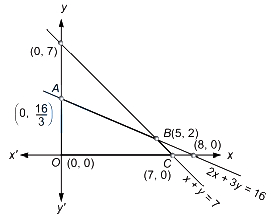
સુરેખ પ્રતિબંધો $x + y \leq 7$,$2x + 3y \leq 16$,$x \geq 0$,$y \geq 0$ માટે હેતુલક્ષી વિધેય $Z = 3x + 2y$ ની મહત્તમ કિંમત શોધો.
A
$16$
B
$21$
C
$25$
D
$28$
Solution
(B) શક્ય ઉકેલનો પ્રદેશ પ્રતિબંધો $x + y \leq 7$,$2x + 3y \leq 16$,$x \geq 0$ અને $y \geq 0$ દ્વારા નક્કી થાય છે. શક્ય ઉકેલના પ્રદેશના શિરોબિંદુઓ $O(0, 0)$,$A(0, 16/3)$,$B(5, 2)$ અને $C(7, 0)$ છે.
દરેક શિરોબિંદુ પર હેતુલક્ષી વિધેય $Z = 3x + 2y$ ની કિંમત મેળવીએ:
$O(0, 0)$ પર: $Z = 3(0) + 2(0) = 0$
$A(0, 16/3)$ પર: $Z = 3(0) + 2(16/3) = 32/3 \approx 10.67$
$B(5, 2)$ પર: $Z = 3(5) + 2(2) = 15 + 4 = 19$
$C(7, 0)$ પર: $Z = 3(7) + 2(0) = 21$
આ કિંમતોની સરખામણી કરતા,$Z$ ની મહત્તમ કિંમત $21$ છે જે બિંદુ $C(7, 0)$ પર મળે છે.
દરેક શિરોબિંદુ પર હેતુલક્ષી વિધેય $Z = 3x + 2y$ ની કિંમત મેળવીએ:
$O(0, 0)$ પર: $Z = 3(0) + 2(0) = 0$
$A(0, 16/3)$ પર: $Z = 3(0) + 2(16/3) = 32/3 \approx 10.67$
$B(5, 2)$ પર: $Z = 3(5) + 2(2) = 15 + 4 = 19$
$C(7, 0)$ પર: $Z = 3(7) + 2(0) = 21$
આ કિંમતોની સરખામણી કરતા,$Z$ ની મહત્તમ કિંમત $21$ છે જે બિંદુ $C(7, 0)$ પર મળે છે.
0 likesView Solution
43
MathematicsEasyMCQMHT CET · 2010
જો શ્રેણિક $A = \begin{bmatrix} a & b \\ c & d \end{bmatrix}$ હોય,તો $|A|^{-1}$ બરાબર શું થાય?
A
$ad - bc$
B
$\frac{1}{ad - bc}$
C
$\frac{1}{ad - bc} \begin{bmatrix} d & -b \\ -c & a \end{bmatrix}$
D
આમાંથી કોઈ નહીં
Solution
(B) આપેલ છે,$A = \begin{bmatrix} a & b \\ c & d \end{bmatrix}$.
શ્રેણિક $A$ નો નિશ્ચાયક $|A|$ અથવા $\det(A)$ દ્વારા દર્શાવવામાં આવે છે.
$|A| = (a \times d) - (b \times c) = ad - bc$.
પદ $|A|^{-1}$ એ નિશ્ચાયકની કિંમત $|A|$ નો વ્યસ્ત દર્શાવે છે.
તેથી,$|A|^{-1} = \frac{1}{|A|} = \frac{1}{ad - bc}$.
શ્રેણિક $A$ નો નિશ્ચાયક $|A|$ અથવા $\det(A)$ દ્વારા દર્શાવવામાં આવે છે.
$|A| = (a \times d) - (b \times c) = ad - bc$.
પદ $|A|^{-1}$ એ નિશ્ચાયકની કિંમત $|A|$ નો વ્યસ્ત દર્શાવે છે.
તેથી,$|A|^{-1} = \frac{1}{|A|} = \frac{1}{ad - bc}$.
0 likesView Solution
44
MathematicsMediumMCQMHT CET · 2010
ધારો કે $A = \begin{bmatrix} \cos \theta & -\sin \theta \\ -\sin \theta & -\cos \theta \end{bmatrix}$,તો $A$ નો વ્યસ્ત શ્રેણિક શોધો.
A
$\begin{bmatrix} \cos \theta & -\sin \theta \\ -\sin \theta & -\cos \theta \end{bmatrix}$
B
$\begin{bmatrix} -\cos \theta & \sin \theta \\ \sin \theta & \cos \theta \end{bmatrix}$
C
$\begin{bmatrix} \sin \theta & -\cos \theta \\ \cos \theta & -\sin \theta \end{bmatrix}$
D
$\begin{bmatrix} -\sin \theta & -\cos \theta \\ -\cos \theta & \sin \theta \end{bmatrix}$
Solution
(A) આપેલ છે કે $A = \begin{bmatrix} \cos \theta & -\sin \theta \\ -\sin \theta & -\cos \theta \end{bmatrix}$.
પ્રથમ,આપણે $A$ નો નિશ્ચાયક શોધીએ:
$|A| = (\cos \theta)(-\cos \theta) - (-\sin \theta)(-\sin \theta) = -\cos^2 \theta - \sin^2 \theta = -(\cos^2 \theta + \sin^2 \theta) = -1$.
ત્યારબાદ,આપણે $A$ નો એડજોઈન્ટ (સહ-શ્રેણિક) $\text{adj}(A)$ શોધીએ,જેમાં મુખ્ય વિકર્ણના ઘટકોની અદલાબદલી કરીએ અને બાકીના ઘટકોની નિશાની બદલીએ:
$\text{adj}(A) = \begin{bmatrix} -\cos \theta & \sin \theta \\ \sin \theta & \cos \theta \end{bmatrix}$.
$A$ નો વ્યસ્ત શ્રેણિક $A^{-1} = \frac{1}{|A|} \text{adj}(A)$ દ્વારા મળે છે:
$A^{-1} = \frac{1}{-1} \begin{bmatrix} -\cos \theta & \sin \theta \\ \sin \theta & \cos \theta \end{bmatrix} = \begin{bmatrix} \cos \theta & -\sin \theta \\ -\sin \theta & -\cos \theta \end{bmatrix}$.
આમ,$A^{-1} = A$ થાય છે.
પ્રથમ,આપણે $A$ નો નિશ્ચાયક શોધીએ:
$|A| = (\cos \theta)(-\cos \theta) - (-\sin \theta)(-\sin \theta) = -\cos^2 \theta - \sin^2 \theta = -(\cos^2 \theta + \sin^2 \theta) = -1$.
ત્યારબાદ,આપણે $A$ નો એડજોઈન્ટ (સહ-શ્રેણિક) $\text{adj}(A)$ શોધીએ,જેમાં મુખ્ય વિકર્ણના ઘટકોની અદલાબદલી કરીએ અને બાકીના ઘટકોની નિશાની બદલીએ:
$\text{adj}(A) = \begin{bmatrix} -\cos \theta & \sin \theta \\ \sin \theta & \cos \theta \end{bmatrix}$.
$A$ નો વ્યસ્ત શ્રેણિક $A^{-1} = \frac{1}{|A|} \text{adj}(A)$ દ્વારા મળે છે:
$A^{-1} = \frac{1}{-1} \begin{bmatrix} -\cos \theta & \sin \theta \\ \sin \theta & \cos \theta \end{bmatrix} = \begin{bmatrix} \cos \theta & -\sin \theta \\ -\sin \theta & -\cos \theta \end{bmatrix}$.
આમ,$A^{-1} = A$ થાય છે.
0 likesView Solution
45
MathematicsEasyMCQMHT CET · 2010
બે સિક્કા એકસાથે ઉછાળવામાં આવે છે. તો,$E(X)$ નું મૂલ્ય,જ્યાં $X$ એ છાપની સંખ્યા દર્શાવે છે,તે શું છે?
A
$\frac{1}{2}$
B
$2$
C
$1$
D
આમાંથી કોઈ નહીં
Solution
(C) જ્યારે બે સિક્કા એકસાથે ઉછાળવામાં આવે,ત્યારે નિદર્શાવકાશ $S = \{HH, HT, TH, TT\}$ થાય છે.
ધારો કે $X$ એ છાપની સંખ્યા દર્શાવતો યાદચ્છિક ચલ છે.
$X$ માટે શક્ય કિંમતો $0, 1, 2$ છે.
સંભાવનાઓ નીચે મુજબ છે:
$P(X=0) = P(TT) = \frac{1}{4}$
$P(X=1) = P(HT, TH) = \frac{2}{4} = \frac{1}{2}$
$P(X=2) = P(HH) = \frac{1}{4}$
અપેક્ષિત મૂલ્ય $E(X) = \sum x_i P(x_i) = 0 \times \frac{1}{4} + 1 \times \frac{1}{2} + 2 \times \frac{1}{4} = 0 + \frac{1}{2} + \frac{1}{2} = 1$.
વૈકલ્પિક રીતે,આ દ્વિપદી વિતરણને અનુસરે છે જ્યાં $n=2$ અને $p=\frac{1}{2}$,તેથી $E(X) = np = 2 \times \frac{1}{2} = 1$.
ધારો કે $X$ એ છાપની સંખ્યા દર્શાવતો યાદચ્છિક ચલ છે.
$X$ માટે શક્ય કિંમતો $0, 1, 2$ છે.
સંભાવનાઓ નીચે મુજબ છે:
$P(X=0) = P(TT) = \frac{1}{4}$
$P(X=1) = P(HT, TH) = \frac{2}{4} = \frac{1}{2}$
$P(X=2) = P(HH) = \frac{1}{4}$
અપેક્ષિત મૂલ્ય $E(X) = \sum x_i P(x_i) = 0 \times \frac{1}{4} + 1 \times \frac{1}{2} + 2 \times \frac{1}{4} = 0 + \frac{1}{2} + \frac{1}{2} = 1$.
વૈકલ્પિક રીતે,આ દ્વિપદી વિતરણને અનુસરે છે જ્યાં $n=2$ અને $p=\frac{1}{2}$,તેથી $E(X) = np = 2 \times \frac{1}{2} = 1$.
0 likesView Solution
46
MathematicsEasyMCQMHT CET · 2010
$(2, -3, 1)$ માંથી પસાર થતા અને $(3, 4, -1)$ તથા $(2, -1, 5)$ બિંદુઓને જોડતી રેખાને લંબ હોય તેવા સમતલનું સમીકરણ શોધો:
A
$x + 5y - 6z + 19 = 0$
B
$x - 5y + 6z - 19 = 0$
C
$x + 5y + 6z + 19 = 0$
D
$x - 5y - 6z - 19 = 0$
Solution
(A) $(3, 4, -1)$ અને $(2, -1, 5)$ બિંદુઓને જોડતી રેખાના દિકગુણોત્તર $(2-3, -1-4, 5-(-1)) = (-1, -5, 6)$ છે.
સમતલ આ રેખાને લંબ હોવાથી,સમતલનો અભિલંબ સદિશ $\vec{n} = (-1, -5, 6)$ થશે.
$(x_0, y_0, z_0)$ માંથી પસાર થતા અને $(a, b, c)$ અભિલંબ ધરાવતા સમતલનું સમીકરણ $a(x-x_0) + b(y-y_0) + c(z-z_0) = 0$ છે.
બિંદુ $(2, -3, 1)$ અને અભિલંબ $(-1, -5, 6)$ મૂકતા:
$-1(x-2) - 5(y+3) + 6(z-1) = 0$
$-x + 2 - 5y - 15 + 6z - 6 = 0$
$-x - 5y + 6z - 19 = 0$
$-1$ વડે ગુણતા,$x + 5y - 6z + 19 = 0$ મળે છે.
સમતલ આ રેખાને લંબ હોવાથી,સમતલનો અભિલંબ સદિશ $\vec{n} = (-1, -5, 6)$ થશે.
$(x_0, y_0, z_0)$ માંથી પસાર થતા અને $(a, b, c)$ અભિલંબ ધરાવતા સમતલનું સમીકરણ $a(x-x_0) + b(y-y_0) + c(z-z_0) = 0$ છે.
બિંદુ $(2, -3, 1)$ અને અભિલંબ $(-1, -5, 6)$ મૂકતા:
$-1(x-2) - 5(y+3) + 6(z-1) = 0$
$-x + 2 - 5y - 15 + 6z - 6 = 0$
$-x - 5y + 6z - 19 = 0$
$-1$ વડે ગુણતા,$x + 5y - 6z + 19 = 0$ મળે છે.
0 likesView Solution
47
MathematicsEasyMCQMHT CET · 2010
જે બિંદુએ રેખા $\frac{x-1}{2}=\frac{y-2}{-3}=\frac{z+3}{4}$ એ સમતલ $2x+4y-z=1$ ને મળે છે તે બિંદુ કયું છે?
A
$(3, -1, 1)$
B
$(3, 1, 1)$
C
$(1, 1, 3)$
D
$(1, 3, 1)$
Solution
(A) ધારો કે રેખા પરનું બિંદુ $(x, y, z)$ છે. રેખાનું સમીકરણ $\frac{x-1}{2}=\frac{y-2}{-3}=\frac{z+3}{4} = k$ છે.
આથી,$x = 2k+1$,$y = -3k+2$,અને $z = 4k-3$ મળે.
આ બિંદુ સમતલ $2x+4y-z=1$ પર આવેલું હોવાથી,આપણે આ યામોને સમતલના સમીકરણમાં મૂકીએ:
$2(2k+1) + 4(-3k+2) - (4k-3) = 1$
$4k + 2 - 12k + 8 - 4k + 3 = 1$
$-12k + 13 = 1$
$-12k = -12$
$k = 1$.
$k=1$ ની કિંમત યામોમાં મૂકતા:
$x = 2(1)+1 = 3$
$y = -3(1)+2 = -1$
$z = 4(1)-3 = 1$.
આમ,માંગેલ બિંદુ $(3, -1, 1)$ છે.
આથી,$x = 2k+1$,$y = -3k+2$,અને $z = 4k-3$ મળે.
આ બિંદુ સમતલ $2x+4y-z=1$ પર આવેલું હોવાથી,આપણે આ યામોને સમતલના સમીકરણમાં મૂકીએ:
$2(2k+1) + 4(-3k+2) - (4k-3) = 1$
$4k + 2 - 12k + 8 - 4k + 3 = 1$
$-12k + 13 = 1$
$-12k = -12$
$k = 1$.
$k=1$ ની કિંમત યામોમાં મૂકતા:
$x = 2(1)+1 = 3$
$y = -3(1)+2 = -1$
$z = 4(1)-3 = 1$.
આમ,માંગેલ બિંદુ $(3, -1, 1)$ છે.
0 likesView Solution
48
MathematicsEasyMCQMHT CET · 2010
$\Delta ABC$ ના શિરોબિંદુઓના સ્થાન સદિશો અનુક્રમે $4\hat{i}-2\hat{j}$,$\hat{i}+4\hat{j}-3\hat{k}$ અને $-\hat{i}+5\hat{j}+\hat{k}$ છે,તો $\angle ABC$ નું મૂલ્ય શોધો.
A
$\frac{\pi}{6}$
B
$\frac{\pi}{4}$
C
$\frac{\pi}{3}$
D
$\frac{\pi}{2}$
Solution
(D) ધારો કે શિરોબિંદુઓ $A$,$B$ અને $C$ ના સ્થાન સદિશો $\vec{a} = 4\hat{i}-2\hat{j}$,$\vec{b} = \hat{i}+4\hat{j}-3\hat{k}$,અને $\vec{c} = -\hat{i}+5\hat{j}+\hat{k}$ છે.
આપણે $\angle ABC$ શોધવાનો છે,જે સદિશો $\vec{BA}$ અને $\vec{BC}$ વચ્ચેનો ખૂણો છે.
સૌ પ્રથમ,$\vec{BA} = \vec{a} - \vec{b} = (4-1)\hat{i} + (-2-4)\hat{j} + (0-(-3))\hat{k} = 3\hat{i} - 6\hat{j} + 3\hat{k}$ મેળવો.
ત્યારબાદ,$\vec{BC} = \vec{c} - \vec{b} = (-1-1)\hat{i} + (5-4)\hat{j} + (1-(-3))\hat{k} = -2\hat{i} + \hat{j} + 4\hat{k}$ મેળવો.
હવે,તેમનો અદિશ ગુણાકાર $\vec{BA} \cdot \vec{BC} = (3)(-2) + (-6)(1) + (3)(4) = -6 - 6 + 12 = 0$ શોધો.
અહીં $\vec{BA}$ અને $\vec{BC}$ નો અદિશ ગુણાકાર $0$ હોવાથી,આ સદિશો પરસ્પર લંબ છે.
તેથી,$\angle ABC = \frac{\pi}{2}$ થાય.
આપણે $\angle ABC$ શોધવાનો છે,જે સદિશો $\vec{BA}$ અને $\vec{BC}$ વચ્ચેનો ખૂણો છે.
સૌ પ્રથમ,$\vec{BA} = \vec{a} - \vec{b} = (4-1)\hat{i} + (-2-4)\hat{j} + (0-(-3))\hat{k} = 3\hat{i} - 6\hat{j} + 3\hat{k}$ મેળવો.
ત્યારબાદ,$\vec{BC} = \vec{c} - \vec{b} = (-1-1)\hat{i} + (5-4)\hat{j} + (1-(-3))\hat{k} = -2\hat{i} + \hat{j} + 4\hat{k}$ મેળવો.
હવે,તેમનો અદિશ ગુણાકાર $\vec{BA} \cdot \vec{BC} = (3)(-2) + (-6)(1) + (3)(4) = -6 - 6 + 12 = 0$ શોધો.
અહીં $\vec{BA}$ અને $\vec{BC}$ નો અદિશ ગુણાકાર $0$ હોવાથી,આ સદિશો પરસ્પર લંબ છે.
તેથી,$\angle ABC = \frac{\pi}{2}$ થાય.
0 likesView Solution
49
MathematicsEasyMCQMHT CET · 2010
એક સમાંતરફલક (parallelepiped) કે જેની સહ-અંતિમ ધારાઓ $2 \overrightarrow{a}, 2 \overrightarrow{b}, 2 \overrightarrow{c}$ છે,તેનું ઘનફળ કેટલું થાય?
A
$2[\overrightarrow{a} \overrightarrow{b} \overrightarrow{c}]$
B
$4[\overrightarrow{a} \overrightarrow{b} \overrightarrow{c}]$
C
$8[\overrightarrow{a} \overrightarrow{b} \overrightarrow{c}]$
D
$[\overrightarrow{a} \overrightarrow{b} \overrightarrow{c}]$
Solution
(C) સહ-અંતિમ ધારાઓ $\vec{u}, \vec{v}, \vec{w}$ ધરાવતા સમાંતરફલકનું ઘનફળ અદિશ ત્રિગુણિત ગુણાકાર $[\vec{u} \vec{v} \vec{w}] = (\vec{u} \times \vec{v}) \cdot \vec{w}$ દ્વારા આપવામાં આવે છે.
અહીં આપેલી ધારાઓ $2\vec{a}, 2\vec{b}, 2\vec{c}$ છે.
ઘનફળ $= [2\vec{a} \ 2\vec{b} \ 2\vec{c}]$
$= (2\vec{a} \times 2\vec{b}) \cdot 2\vec{c}$
$= 4(\vec{a} \times \vec{b}) \cdot 2\vec{c}$
$= 8(\vec{a} \times \vec{b}) \cdot \vec{c}$
$= 8[\vec{a} \vec{b} \vec{c}]$.
અહીં આપેલી ધારાઓ $2\vec{a}, 2\vec{b}, 2\vec{c}$ છે.
ઘનફળ $= [2\vec{a} \ 2\vec{b} \ 2\vec{c}]$
$= (2\vec{a} \times 2\vec{b}) \cdot 2\vec{c}$
$= 4(\vec{a} \times \vec{b}) \cdot 2\vec{c}$
$= 8(\vec{a} \times \vec{b}) \cdot \vec{c}$
$= 8[\vec{a} \vec{b} \vec{c}]$.
0 likesView Solution
50
MathematicsMediumMCQMHT CET · 2010
જો $\overrightarrow{a}, \overrightarrow{b}, \overrightarrow{c}$ ત્રણ અસમતલીય સદિશો હોય અને $\overrightarrow{p}, \overrightarrow{q}, \overrightarrow{r}$ ને $\overrightarrow{p}=\frac{\overrightarrow{b} \times \overrightarrow{c}}{[\overrightarrow{a} \overrightarrow{b} \overrightarrow{c}]}, \quad \overrightarrow{q}=\frac{\overrightarrow{c} \times \overrightarrow{a}}{[\overrightarrow{a} \overrightarrow{b} \overrightarrow{c}]}$ અને $\overrightarrow{r}=\frac{\overrightarrow{a} \times \overrightarrow{b}}{[\overrightarrow{a} \overrightarrow{b} \overrightarrow{c}]}$ સંબંધો દ્વારા વ્યાખ્યાયિત કરવામાં આવે,તો $\overrightarrow{a} \cdot \overrightarrow{p}+\overrightarrow{b} \cdot \overrightarrow{q}+\overrightarrow{c} \cdot \overrightarrow{r}$ ની કિંમત શોધો.
A
$0$
B
$1$
C
$2$
D
$3$
Solution
(D) આપેલ છે કે $\overrightarrow{p}=\frac{\overrightarrow{b} \times \overrightarrow{c}}{[\overrightarrow{a} \overrightarrow{b} \overrightarrow{c}]}, \overrightarrow{q}=\frac{\overrightarrow{c} \times \overrightarrow{a}}{[\overrightarrow{a} \overrightarrow{b} \overrightarrow{c}]}, \overrightarrow{r}=\frac{\overrightarrow{a} \times \overrightarrow{b}}{[\overrightarrow{a} \overrightarrow{b} \overrightarrow{c}]}$.
આપણે $\overrightarrow{a} \cdot \overrightarrow{p}+\overrightarrow{b} \cdot \overrightarrow{q}+\overrightarrow{c} \cdot \overrightarrow{r}$ ની ગણતરી કરવાની છે.
કિંમતો મૂકતા,આપણને મળે છે:
$\overrightarrow{a} \cdot \overrightarrow{p} = \overrightarrow{a} \cdot \frac{\overrightarrow{b} \times \overrightarrow{c}}{[\overrightarrow{a} \overrightarrow{b} \overrightarrow{c}]} = \frac{[\overrightarrow{a} \overrightarrow{b} \overrightarrow{c}]}{[\overrightarrow{a} \overrightarrow{b} \overrightarrow{c}]} = 1$.
$\overrightarrow{b} \cdot \overrightarrow{q} = \overrightarrow{b} \cdot \frac{\overrightarrow{c} \times \overrightarrow{a}}{[\overrightarrow{a} \overrightarrow{b} \overrightarrow{c}]} = \frac{[\overrightarrow{b} \overrightarrow{c} \overrightarrow{a}]}{[\overrightarrow{a} \overrightarrow{b} \overrightarrow{c}]} = \frac{[\overrightarrow{a} \overrightarrow{b} \overrightarrow{c}]}{[\overrightarrow{a} \overrightarrow{b} \overrightarrow{c}]} = 1$.
$\overrightarrow{c} \cdot \overrightarrow{r} = \overrightarrow{c} \cdot \frac{\overrightarrow{a} \times \overrightarrow{b}}{[\overrightarrow{a} \overrightarrow{b} \overrightarrow{c}]} = \frac{[\overrightarrow{c} \overrightarrow{a} \overrightarrow{b}]}{[\overrightarrow{a} \overrightarrow{b} \overrightarrow{c}]} = \frac{[\overrightarrow{a} \overrightarrow{b} \overrightarrow{c}]}{[\overrightarrow{a} \overrightarrow{b} \overrightarrow{c}]} = 1$.
તેથી,$\overrightarrow{a} \cdot \overrightarrow{p}+\overrightarrow{b} \cdot \overrightarrow{q}+\overrightarrow{c} \cdot \overrightarrow{r} = 1+1+1 = 3$.
આપણે $\overrightarrow{a} \cdot \overrightarrow{p}+\overrightarrow{b} \cdot \overrightarrow{q}+\overrightarrow{c} \cdot \overrightarrow{r}$ ની ગણતરી કરવાની છે.
કિંમતો મૂકતા,આપણને મળે છે:
$\overrightarrow{a} \cdot \overrightarrow{p} = \overrightarrow{a} \cdot \frac{\overrightarrow{b} \times \overrightarrow{c}}{[\overrightarrow{a} \overrightarrow{b} \overrightarrow{c}]} = \frac{[\overrightarrow{a} \overrightarrow{b} \overrightarrow{c}]}{[\overrightarrow{a} \overrightarrow{b} \overrightarrow{c}]} = 1$.
$\overrightarrow{b} \cdot \overrightarrow{q} = \overrightarrow{b} \cdot \frac{\overrightarrow{c} \times \overrightarrow{a}}{[\overrightarrow{a} \overrightarrow{b} \overrightarrow{c}]} = \frac{[\overrightarrow{b} \overrightarrow{c} \overrightarrow{a}]}{[\overrightarrow{a} \overrightarrow{b} \overrightarrow{c}]} = \frac{[\overrightarrow{a} \overrightarrow{b} \overrightarrow{c}]}{[\overrightarrow{a} \overrightarrow{b} \overrightarrow{c}]} = 1$.
$\overrightarrow{c} \cdot \overrightarrow{r} = \overrightarrow{c} \cdot \frac{\overrightarrow{a} \times \overrightarrow{b}}{[\overrightarrow{a} \overrightarrow{b} \overrightarrow{c}]} = \frac{[\overrightarrow{c} \overrightarrow{a} \overrightarrow{b}]}{[\overrightarrow{a} \overrightarrow{b} \overrightarrow{c}]} = \frac{[\overrightarrow{a} \overrightarrow{b} \overrightarrow{c}]}{[\overrightarrow{a} \overrightarrow{b} \overrightarrow{c}]} = 1$.
તેથી,$\overrightarrow{a} \cdot \overrightarrow{p}+\overrightarrow{b} \cdot \overrightarrow{q}+\overrightarrow{c} \cdot \overrightarrow{r} = 1+1+1 = 3$.
0 likesView Solution
Vedclass Products
For Students
Vedclass Test Series
Mock tests in real MHT CET style covering Mathematics with performance analysis. 5-day free trial.
Start Free TrialFor Teachers
Exam Paper Generator
Generate Set A/B/C/D Mathematics papers from 7.5L+ questions in 2 minutes. 3 chapters free.
Try FreeFor Institutes
Online Exam Module
Run live MHT CET mock exams with unlimited students, 360° analytics & white-label branding.
See DemoFrequently Asked Questions
How many Mathematics questions are in MHT CET 2010?
There are 50 Mathematics questions from the MHT CET 2010 paper on Vedclass, each with a detailed step-by-step solution in Gujarati.
Are MHT CET 2010 Mathematics solutions available in Gujarati?
Yes. All solutions on this page are in Gujarati. You can also switch to English or Hindi using the language buttons above the questions.
Can I practice MHT CET 2010 Mathematics as a timed test?
Yes. Use the Vedclass Test Series to attempt a full MHT CET mock test covering Mathematics with time limits and instant score analysis.
Can teachers create Mathematics papers from MHT CET previous year questions?
Yes. The Vedclass Exam Paper Generator lets teachers mix MHT CET Mathematics questions and generate Set A/B/C/D papers in minutes.
For Teachers & Institutes
Build a Custom Mathematics Paper
Pick MHT CET 2010 Mathematics questions, set difficulty, and generate Set A/B/C/D in 2 minutes.