
PhysicsQ1–50 of 50 questions
Page 1 of 1 · English
1
PhysicsMediumMCQMHT CET · 2010
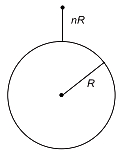
$A$ body is taken to a height of $n R$ from the surface of the earth. The ratio of the acceleration due to gravity on the surface to that at the altitude is
A
$(n+1)^{2}$
B
$(n+1)^{-2}$
C
$(n+1)^{-1}$
D
$(n+1)$
Solution
(A) The acceleration due to gravity at a height $h$ above the earth's surface is given by the formula:
$g^{\prime} = g \left( \frac{R}{R+h} \right)^{2}$
Given that the height $h = nR$,we substitute this into the equation:
$g^{\prime} = g \left( \frac{R}{R+nR} \right)^{2}$
$g^{\prime} = g \left( \frac{R}{R(1+n)} \right)^{2}$
$g^{\prime} = g \left( \frac{1}{1+n} \right)^{2}$
Now,we find the ratio of the acceleration due to gravity on the surface $(g)$ to that at the altitude $(g^{\prime})$:
$\frac{g}{g^{\prime}} = \frac{g}{g \left( \frac{1}{1+n} \right)^{2}}$
$\frac{g}{g^{\prime}} = (1+n)^{2}$
Therefore,the ratio is $(n+1)^{2}$.
$g^{\prime} = g \left( \frac{R}{R+h} \right)^{2}$
Given that the height $h = nR$,we substitute this into the equation:
$g^{\prime} = g \left( \frac{R}{R+nR} \right)^{2}$
$g^{\prime} = g \left( \frac{R}{R(1+n)} \right)^{2}$
$g^{\prime} = g \left( \frac{1}{1+n} \right)^{2}$
Now,we find the ratio of the acceleration due to gravity on the surface $(g)$ to that at the altitude $(g^{\prime})$:
$\frac{g}{g^{\prime}} = \frac{g}{g \left( \frac{1}{1+n} \right)^{2}}$
$\frac{g}{g^{\prime}} = (1+n)^{2}$
Therefore,the ratio is $(n+1)^{2}$.
0 likesView Solution
2
PhysicsDifficultMCQMHT CET · 2010
If the density of the earth is doubled keeping the radius constant,find the new acceleration due to gravity (in $m/s^2$)? $(g = 9.8 \ m/s^2)$
A
$9.8$
B
$19.6$
C
$4.9$
D
$39.2$
Solution
(B) The acceleration due to gravity $g$ on the surface of the Earth is given by the formula: $g = \frac{GM}{R^2}$.
Since mass $M = \text{density} (\rho) \times \text{volume} (V) = \rho \times \frac{4}{3} \pi R^3$,we can substitute this into the formula for $g$:
$g = \frac{G (\rho \cdot \frac{4}{3} \pi R^3)}{R^2} = \frac{4}{3} \pi \rho G R$.
From this expression,it is clear that $g \propto \rho$ when the radius $R$ is kept constant.
Therefore,$\frac{g_2}{g_1} = \frac{\rho_2}{\rho_1}$.
Given that the density is doubled,$\rho_2 = 2\rho_1$.
Thus,$g_2 = 2 \times g_1 = 2 \times 9.8 \ m/s^2 = 19.6 \ m/s^2$.
Since mass $M = \text{density} (\rho) \times \text{volume} (V) = \rho \times \frac{4}{3} \pi R^3$,we can substitute this into the formula for $g$:
$g = \frac{G (\rho \cdot \frac{4}{3} \pi R^3)}{R^2} = \frac{4}{3} \pi \rho G R$.
From this expression,it is clear that $g \propto \rho$ when the radius $R$ is kept constant.
Therefore,$\frac{g_2}{g_1} = \frac{\rho_2}{\rho_1}$.
Given that the density is doubled,$\rho_2 = 2\rho_1$.
Thus,$g_2 = 2 \times g_1 = 2 \times 9.8 \ m/s^2 = 19.6 \ m/s^2$.
0 likesView Solution
3
PhysicsDifficultMCQMHT CET · 2010
Kinetic energy per unit volume is $E$. The pressure exerted by the gas is given by
A
$\frac{E}{3}$
B
$\frac{2 E}{3}$
C
$\frac{3 E}{2}$
D
$\frac{E}{2}$
Solution
(B) The pressure $p$ exerted by an ideal gas is given by the kinetic theory of gases as:
$p = \frac{1}{3} \rho \bar{v}^2$
where $\rho$ is the density and $\bar{v}^2$ is the mean square speed.
Since density $\rho = \frac{M}{V}$,we can write:
$p = \frac{1}{3} \frac{M}{V} \bar{v}^2$
Multiplying and dividing by $2$,we get:
$p = \frac{2}{3} \left( \frac{1}{2} \frac{M}{V} \bar{v}^2 \right)$
Here,$\frac{1}{2} M \bar{v}^2$ is the total kinetic energy of the gas molecules.
Thus,$\frac{1}{2} \frac{M}{V} \bar{v}^2$ represents the kinetic energy per unit volume,which is given as $E$.
Therefore,$p = \frac{2}{3} E$.
$p = \frac{1}{3} \rho \bar{v}^2$
where $\rho$ is the density and $\bar{v}^2$ is the mean square speed.
Since density $\rho = \frac{M}{V}$,we can write:
$p = \frac{1}{3} \frac{M}{V} \bar{v}^2$
Multiplying and dividing by $2$,we get:
$p = \frac{2}{3} \left( \frac{1}{2} \frac{M}{V} \bar{v}^2 \right)$
Here,$\frac{1}{2} M \bar{v}^2$ is the total kinetic energy of the gas molecules.
Thus,$\frac{1}{2} \frac{M}{V} \bar{v}^2$ represents the kinetic energy per unit volume,which is given as $E$.
Therefore,$p = \frac{2}{3} E$.
0 likesView Solution
4
PhysicsMediumMCQMHT CET · 2010
The velocities of $4$ gas molecules are given by $1 \ km/s, 3 \ km/s, 5 \ km/s$ and $7 \ km/s$. Calculate the difference between the average velocity and the root mean square $(RMS)$ velocity. (in $km/s$)
A
$0.338$
B
$0.438$
C
$0.583$
D
$0.683$
Solution
(C) The average velocity $(v_{av})$ is calculated as the arithmetic mean of the velocities:
$v_{av} = \frac{v_{1} + v_{2} + v_{3} + v_{4}}{N} = \frac{1 + 3 + 5 + 7}{4} = \frac{16}{4} = 4 \ km/s$
The root mean square $(RMS)$ velocity $(v_{rms})$ is calculated as the square root of the mean of the squares of the velocities:
$v_{rms} = \sqrt{\frac{v_{1}^{2} + v_{2}^{2} + v_{3}^{2} + v_{4}^{2}}{N}} = \sqrt{\frac{1^{2} + 3^{2} + 5^{2} + 7^{2}}{4}} = \sqrt{\frac{1 + 9 + 25 + 49}{4}} = \sqrt{\frac{84}{4}} = \sqrt{21} \approx 4.583 \ km/s$
The difference between the $RMS$ velocity and the average velocity is:
$v_{rms} - v_{av} = 4.583 \ km/s - 4 \ km/s = 0.583 \ km/s$
$v_{av} = \frac{v_{1} + v_{2} + v_{3} + v_{4}}{N} = \frac{1 + 3 + 5 + 7}{4} = \frac{16}{4} = 4 \ km/s$
The root mean square $(RMS)$ velocity $(v_{rms})$ is calculated as the square root of the mean of the squares of the velocities:
$v_{rms} = \sqrt{\frac{v_{1}^{2} + v_{2}^{2} + v_{3}^{2} + v_{4}^{2}}{N}} = \sqrt{\frac{1^{2} + 3^{2} + 5^{2} + 7^{2}}{4}} = \sqrt{\frac{1 + 9 + 25 + 49}{4}} = \sqrt{\frac{84}{4}} = \sqrt{21} \approx 4.583 \ km/s$
The difference between the $RMS$ velocity and the average velocity is:
$v_{rms} - v_{av} = 4.583 \ km/s - 4 \ km/s = 0.583 \ km/s$
0 likesView Solution
5
PhysicsEasyMCQMHT CET · 2010
When a disc is rotating with angular velocity $\omega$,a particle situated at a distance of $4 \ cm$ just begins to slip. If the angular velocity is doubled,at what distance will the particle start to slip (in $cm$)?
A
$1$
B
$2$
C
$3$
D
$4$
Solution
(A) For a particle to just begin to slip on a rotating disc,the required centripetal force is provided by the maximum static friction force $f_{s,max} = \mu m g$.
Thus,$m r \omega^2 = \mu m g$.
Since $\mu$,$m$,and $g$ are constants,we have $r \omega^2 = \text{constant}$,which implies $r \propto \frac{1}{\omega^2}$.
Given $r_1 = 4 \ cm$ at $\omega_1 = \omega$.
When $\omega_2 = 2\omega$,we have $\frac{r_1}{r_2} = \frac{\omega_2^2}{\omega_1^2}$.
Substituting the values: $\frac{4}{r_2} = \frac{(2\omega)^2}{\omega^2} = \frac{4\omega^2}{\omega^2} = 4$.
Therefore,$r_2 = \frac{4}{4} = 1 \ cm$.
Thus,$m r \omega^2 = \mu m g$.
Since $\mu$,$m$,and $g$ are constants,we have $r \omega^2 = \text{constant}$,which implies $r \propto \frac{1}{\omega^2}$.
Given $r_1 = 4 \ cm$ at $\omega_1 = \omega$.
When $\omega_2 = 2\omega$,we have $\frac{r_1}{r_2} = \frac{\omega_2^2}{\omega_1^2}$.
Substituting the values: $\frac{4}{r_2} = \frac{(2\omega)^2}{\omega^2} = \frac{4\omega^2}{\omega^2} = 4$.
Therefore,$r_2 = \frac{4}{4} = 1 \ cm$.
0 likesView Solution
6
PhysicsEasyMCQMHT CET · 2010
On the surface of the liquid in equilibrium,molecules of the liquid possess
A
maximum potential energy
B
minimum potential energy
C
maximum kinetic energy
D
minimum kinetic energy
Solution
(A) Molecules in the bulk of a liquid are surrounded by other molecules on all sides,resulting in a net attractive force of zero. However,molecules on the surface are attracted only by the molecules below them,as there are no liquid molecules above the surface. To bring a molecule from the bulk to the surface,work must be done against these inward attractive forces. This work is stored as potential energy. Therefore,molecules on the surface of a liquid in equilibrium possess maximum potential energy compared to those in the bulk.
0 likesView Solution
7
PhysicsEasyMCQMHT CET · 2010
Which of the following relations is true for the elastic moduli of a material?
A
$Y=2 \eta(1-2 \sigma)$
B
$Y=2 \eta(1+2 \sigma)$
C
$Y=2 \eta(1-\sigma)$
D
$Y=2 \eta(1+\sigma)$
Solution
(D) The relationship between Young's modulus $(Y)$,modulus of rigidity $(\eta)$,and Poisson's ratio $(\sigma)$ is given by the formula:
$Y = 2 \eta (1 + \sigma)$
Therefore,the correct relation is $Y = 2 \eta (1 + \sigma)$.
$Y = 2 \eta (1 + \sigma)$
Therefore,the correct relation is $Y = 2 \eta (1 + \sigma)$.
0 likesView Solution
8
PhysicsMediumMCQMHT CET · 2010
The increase in pressure required to decrease the $200 \, L$ volume of a liquid by $0.008 \, \%$ in $kPa$ is (Bulk modulus of the liquid $= 2100 \, MPa$)
A
$8.4$
B
$84$
C
$92.4$
D
$168$
Solution
(D) The formula for Bulk modulus $K$ is given by $K = -\frac{\Delta p}{\Delta V / V}$.
We are given the Bulk modulus $K = 2100 \, MPa = 2100 \times 10^3 \, kPa$.
The fractional change in volume is $\frac{\Delta V}{V} = 0.008 \, \% = \frac{0.008}{100} = 8 \times 10^{-5}$.
To find the increase in pressure $\Delta p$, we rearrange the formula: $\Delta p = K \times \left( \frac{\Delta V}{V} \right)$.
Substituting the values: $\Delta p = (2100 \times 10^3 \, kPa) \times (8 \times 10^{-5})$.
$\Delta p = 2100 \times 8 \times 10^{-2} \, kPa = 21 \times 8 \, kPa = 168 \, kPa$.
We are given the Bulk modulus $K = 2100 \, MPa = 2100 \times 10^3 \, kPa$.
The fractional change in volume is $\frac{\Delta V}{V} = 0.008 \, \% = \frac{0.008}{100} = 8 \times 10^{-5}$.
To find the increase in pressure $\Delta p$, we rearrange the formula: $\Delta p = K \times \left( \frac{\Delta V}{V} \right)$.
Substituting the values: $\Delta p = (2100 \times 10^3 \, kPa) \times (8 \times 10^{-5})$.
$\Delta p = 2100 \times 8 \times 10^{-2} \, kPa = 21 \times 8 \, kPa = 168 \, kPa$.
0 likesView Solution
9
PhysicsDifficultMCQMHT CET · 2010
Four wires of the same material are stretched by the same load. Which one of them will elongate the most if their dimensions are as follows?
A
$L=100 \ cm, r=1 \ mm$
B
$L=200 \ cm, r=3 \ mm$
C
$L=300 \ cm, r=3 \ mm$
D
$L=400 \ cm, r=4 \ mm$
Solution
(A) The elongation $\Delta L$ is given by the formula $\Delta L = \frac{FL}{AY} = \frac{FL}{\pi r^2 Y}$.
Since the wires are of the same material and stretched by the same load,$F$ and $Y$ are constant.
Therefore,$\Delta L \propto \frac{L}{r^2}$.
Calculating the proportionality factor $\frac{L}{r^2}$ for each case:
For $A$: $\frac{100}{1^2} = 100$.
For $B$: $\frac{200}{3^2} = \frac{200}{9} \approx 22.22$.
For $C$: $\frac{300}{3^2} = \frac{300}{9} \approx 33.33$.
For $D$: $\frac{400}{4^2} = \frac{400}{16} = 25$.
Comparing the values,the wire with dimensions $L=100 \ cm$ and $r=1 \ mm$ has the largest value of $\frac{L}{r^2}$,hence it will elongate the most.
Since the wires are of the same material and stretched by the same load,$F$ and $Y$ are constant.
Therefore,$\Delta L \propto \frac{L}{r^2}$.
Calculating the proportionality factor $\frac{L}{r^2}$ for each case:
For $A$: $\frac{100}{1^2} = 100$.
For $B$: $\frac{200}{3^2} = \frac{200}{9} \approx 22.22$.
For $C$: $\frac{300}{3^2} = \frac{300}{9} \approx 33.33$.
For $D$: $\frac{400}{4^2} = \frac{400}{16} = 25$.
Comparing the values,the wire with dimensions $L=100 \ cm$ and $r=1 \ mm$ has the largest value of $\frac{L}{r^2}$,hence it will elongate the most.
0 likesView Solution
10
PhysicsEasyMCQMHT CET · 2010
If the kinetic energy $(KE)$ of a particle of mass $m$ performing uniform circular motion $(UCM)$ in a circle of radius $r$ is $E$,find the acceleration of the particle.
A
$\frac{2 E}{m r}$
B
$\left(\frac{2 E}{m r}\right)^{2}$
C
$2 E m r$
D
$\frac{4 E}{m r}$
Solution
(A) The kinetic energy $(E)$ of a particle of mass $m$ moving with speed $v$ is given by $E = \frac{1}{2} m v^2$.
For uniform circular motion,the centripetal acceleration $(a)$ is given by $a = \frac{v^2}{r}$,which implies $v^2 = a r$.
Substituting $v^2 = a r$ into the kinetic energy equation:
$E = \frac{1}{2} m (a r)$
Rearranging the equation to solve for acceleration $(a)$:
$2 E = m a r$
$a = \frac{2 E}{m r}$
For uniform circular motion,the centripetal acceleration $(a)$ is given by $a = \frac{v^2}{r}$,which implies $v^2 = a r$.
Substituting $v^2 = a r$ into the kinetic energy equation:
$E = \frac{1}{2} m (a r)$
Rearranging the equation to solve for acceleration $(a)$:
$2 E = m a r$
$a = \frac{2 E}{m r}$
0 likesView Solution
11
PhysicsEasyMCQMHT CET · 2010
$A$ wheel has a speed of $1200$ revolutions per minute and is made to slow down at a rate of $4 \ rad/s^{2}$. The number of revolutions it makes before coming to rest is
A
$143$
B
$272$
C
$314$
D
$722$
Solution
(C) Initial angular velocity $\omega_{0} = 1200 \text{ rpm} = \frac{1200 \times 2\pi}{60} \text{ rad/s} = 40\pi \text{ rad/s}$.
Final angular velocity $\omega = 0 \text{ rad/s}$.
Angular deceleration $\alpha = 4 \text{ rad/s}^{2}$.
Using the kinematic equation $\omega^{2} = \omega_{0}^{2} - 2\alpha\theta$:
$0 = (40\pi)^{2} - 2(4)\theta$
$8\theta = 1600\pi^{2}$
$\theta = 200\pi^{2} \text{ rad}$.
Since the total angle $\theta = 2\pi n$,where $n$ is the number of revolutions:
$2\pi n = 200\pi^{2}$
$n = 100\pi = 100 \times 3.14159 \approx 314 \text{ revolutions}$.
Final angular velocity $\omega = 0 \text{ rad/s}$.
Angular deceleration $\alpha = 4 \text{ rad/s}^{2}$.
Using the kinematic equation $\omega^{2} = \omega_{0}^{2} - 2\alpha\theta$:
$0 = (40\pi)^{2} - 2(4)\theta$
$8\theta = 1600\pi^{2}$
$\theta = 200\pi^{2} \text{ rad}$.
Since the total angle $\theta = 2\pi n$,where $n$ is the number of revolutions:
$2\pi n = 200\pi^{2}$
$n = 100\pi = 100 \times 3.14159 \approx 314 \text{ revolutions}$.
0 likesView Solution
12
PhysicsMediumMCQMHT CET · 2010
$U$ is the potential energy $(PE)$ of an oscillating particle and $F$ is the force acting on it at a given instant. Which of the following is true?
A
$\frac{U}{F}+x=0$
B
$\frac{2 U}{F}+x=0$
C
$\frac{F}{U}+x=0$
D
$\frac{F}{2 U}+x=0$
Solution
(B) The potential energy of an oscillating particle (Simple Harmonic Motion) is given by $U = \frac{1}{2} k x^{2}$.
We know that the restoring force acting on the particle is $F = -k x$.
From the potential energy equation,we can write:
$2 U = k x^{2}$
Substitute $k = -\frac{F}{x}$ into the equation:
$2 U = -\left( \frac{F}{x} \right) x^{2}$
$2 U = -F x$
Rearranging the terms,we get:
$\frac{2 U}{F} = -x$
Therefore:
$\frac{2 U}{F} + x = 0$
We know that the restoring force acting on the particle is $F = -k x$.
From the potential energy equation,we can write:
$2 U = k x^{2}$
Substitute $k = -\frac{F}{x}$ into the equation:
$2 U = -\left( \frac{F}{x} \right) x^{2}$
$2 U = -F x$
Rearranging the terms,we get:
$\frac{2 U}{F} = -x$
Therefore:
$\frac{2 U}{F} + x = 0$
0 likesView Solution
13
PhysicsEasyMCQMHT CET · 2010
The average acceleration of a particle performing $SHM$ over one complete oscillation is:
A
$\frac{\omega^{2} A}{2}$
B
$\frac{\omega^{2} A}{\sqrt{2}}$
C
zero
D
$A \omega^{2}$
Solution
(C) The acceleration of a particle performing $SHM$ is given by $a = -\omega^{2} x$,where $x = A \sin(\omega t + \phi)$.
To find the average acceleration over one complete oscillation (time period $T$),we integrate the acceleration over the interval $[0, T]$ and divide by $T$.
$\text{Average acceleration} = \frac{1}{T} \int_{0}^{T} a(t) dt = \frac{1}{T} \int_{0}^{T} -\omega^{2} A \sin(\omega t + \phi) dt$.
Since the integral of a sine function over one full period is zero,the average acceleration is $0$.
To find the average acceleration over one complete oscillation (time period $T$),we integrate the acceleration over the interval $[0, T]$ and divide by $T$.
$\text{Average acceleration} = \frac{1}{T} \int_{0}^{T} a(t) dt = \frac{1}{T} \int_{0}^{T} -\omega^{2} A \sin(\omega t + \phi) dt$.
Since the integral of a sine function over one full period is zero,the average acceleration is $0$.
0 likesView Solution
14
PhysicsEasyMCQMHT CET · 2010
For a particle in $SHM$,if the amplitude of the displacement is $a$ and the amplitude of velocity is $v$,the amplitude of acceleration is
A
$v a$
B
$\frac{v^{2}}{a}$
C
$\frac{v^{2}}{2 a}$
D
$\frac{v}{a}$
Solution
(B) The maximum velocity of a particle in $SHM$ is given by $v = a \omega$,where $a$ is the amplitude of displacement and $\omega$ is the angular frequency.
From this,we can find the angular frequency: $\omega = \frac{v}{a}$.
The maximum acceleration (amplitude of acceleration) is given by $A_{max} = \omega^2 a$.
Substituting the value of $\omega$ into the acceleration formula:
$A_{max} = \left(\frac{v}{a}\right)^2 \times a = \frac{v^2}{a^2} \times a = \frac{v^2}{a}$.
From this,we can find the angular frequency: $\omega = \frac{v}{a}$.
The maximum acceleration (amplitude of acceleration) is given by $A_{max} = \omega^2 a$.
Substituting the value of $\omega$ into the acceleration formula:
$A_{max} = \left(\frac{v}{a}\right)^2 \times a = \frac{v^2}{a^2} \times a = \frac{v^2}{a}$.
0 likesView Solution
15
PhysicsMediumMCQMHT CET · 2010
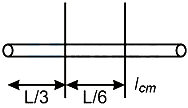
The moment of inertia of a thin uniform rod of length $L$ and mass $M$ about an axis passing through a point at a distance of $\frac{L}{3}$ from one of its ends and perpendicular to the rod is
A
$\frac{M L^2}{12}$
B
$\frac{M L^2}{9}$
C
$\frac{7 M L^2}{48}$
D
$\frac{M L^2}{48}$
Solution
(B) The moment of inertia of a thin uniform rod of length $L$ and mass $M$ about an axis passing through its center of mass $(CM)$ and perpendicular to the rod is $I_{CM} = \frac{M L^2}{12}$.
The distance of the given axis from the center of mass is $x = \frac{L}{2} - \frac{L}{3} = \frac{L}{6}$.
Using the parallel axis theorem,$I = I_{CM} + M x^2$.
Substituting the values,we get $I = \frac{M L^2}{12} + M \left( \frac{L}{6} \right)^2$.
$I = \frac{M L^2}{12} + \frac{M L^2}{36}$.
Taking the least common multiple,$I = \frac{3 M L^2 + M L^2}{36} = \frac{4 M L^2}{36} = \frac{M L^2}{9}$.
The distance of the given axis from the center of mass is $x = \frac{L}{2} - \frac{L}{3} = \frac{L}{6}$.
Using the parallel axis theorem,$I = I_{CM} + M x^2$.
Substituting the values,we get $I = \frac{M L^2}{12} + M \left( \frac{L}{6} \right)^2$.
$I = \frac{M L^2}{12} + \frac{M L^2}{36}$.
Taking the least common multiple,$I = \frac{3 M L^2 + M L^2}{36} = \frac{4 M L^2}{36} = \frac{M L^2}{9}$.
0 likesView Solution
16
PhysicsMediumMCQMHT CET · 2010
Moment of inertia of a disc about a diameter is $I$. Find the moment of inertia of the disc about an axis perpendicular to its plane and passing through its rim. (in $I$)
A
$6$
B
$4$
C
$2$
D
$8$
Solution
(A) The moment of inertia of a disc of mass $M$ and radius $R$ about its diameter is given by $I = \frac{1}{4} M R^2$.
From this,we get $M R^2 = 4 I$.
To find the moment of inertia about an axis perpendicular to the plane and passing through the rim,we use the parallel axis theorem.
First,the moment of inertia about an axis perpendicular to the plane and passing through the center (center of mass) is $I_{cm} = \frac{1}{2} M R^2$.
By the parallel axis theorem,$I_{rim} = I_{cm} + M R^2$.
Substituting $I_{cm} = \frac{1}{2} M R^2$,we get $I_{rim} = \frac{1}{2} M R^2 + M R^2 = \frac{3}{2} M R^2$.
Substituting $M R^2 = 4 I$ into the expression,we get $I_{rim} = \frac{3}{2} (4 I) = 6 I$.
From this,we get $M R^2 = 4 I$.
To find the moment of inertia about an axis perpendicular to the plane and passing through the rim,we use the parallel axis theorem.
First,the moment of inertia about an axis perpendicular to the plane and passing through the center (center of mass) is $I_{cm} = \frac{1}{2} M R^2$.
By the parallel axis theorem,$I_{rim} = I_{cm} + M R^2$.
Substituting $I_{cm} = \frac{1}{2} M R^2$,we get $I_{rim} = \frac{1}{2} M R^2 + M R^2 = \frac{3}{2} M R^2$.
Substituting $M R^2 = 4 I$ into the expression,we get $I_{rim} = \frac{3}{2} (4 I) = 6 I$.
0 likesView Solution
17
PhysicsEasyMCQMHT CET · 2010
Which of the following relations is incorrect?
A
Torque $=$ Moment of inertia $\times$ Angular acceleration
B
Torque $=$ Dipole moment $\times$ Magnetic induction
C
Moment of inertia $=$ Torque $\times$ Angular acceleration
D
Linear momentum $=$ Moment of inertia $\times$ Angular velocity
Solution
(C) $1$. Option $A$ is correct: $\tau = I \alpha$,which is the rotational analogue of Newton's second law $(F = ma)$.
$2$. Option $B$ is correct: $\tau = p \times B$ (or $\mu \times B$),representing the torque on a dipole in a magnetic field.
$3$. Option $C$ is incorrect: The correct relation is $I = \frac{\tau}{\alpha}$. The given relation $I = \tau \times \alpha$ is dimensionally and physically wrong.
$4$. Option $D$ is incorrect: The correct relation for angular momentum is $L = I \omega$. Linear momentum is $p = mv$. The relation $p = I \omega$ is physically incorrect.
Note: Since the question asks for the incorrect relation and both $C$ and $D$ are incorrect,$C$ is the most fundamental error in rotational dynamics definitions.
$2$. Option $B$ is correct: $\tau = p \times B$ (or $\mu \times B$),representing the torque on a dipole in a magnetic field.
$3$. Option $C$ is incorrect: The correct relation is $I = \frac{\tau}{\alpha}$. The given relation $I = \tau \times \alpha$ is dimensionally and physically wrong.
$4$. Option $D$ is incorrect: The correct relation for angular momentum is $L = I \omega$. Linear momentum is $p = mv$. The relation $p = I \omega$ is physically incorrect.
Note: Since the question asks for the incorrect relation and both $C$ and $D$ are incorrect,$C$ is the most fundamental error in rotational dynamics definitions.
0 likesView Solution
18
PhysicsEasyMCQMHT CET · 2010
For an opaque body,the coefficient of transmission is:
A
zero
B
$1$
C
$0.5$
D
$\infty$
Solution
(A) An opaque body does not transmit any radiation.
By definition,the coefficient of transmission $(t)$ is the ratio of the transmitted energy to the incident energy.
Since no radiation passes through an opaque body,the transmitted energy is $0$.
Therefore,the coefficient of transmission for an opaque body is $0$.
By definition,the coefficient of transmission $(t)$ is the ratio of the transmitted energy to the incident energy.
Since no radiation passes through an opaque body,the transmitted energy is $0$.
Therefore,the coefficient of transmission for an opaque body is $0$.
0 likesView Solution
19
PhysicsDifficultMCQMHT CET · 2010
Two spheres of radii $8 \ cm$ and $2 \ cm$ are cooling. Their temperatures are $127^{\circ} C$ and $527^{\circ} C$ respectively. Find the ratio of energy radiated by them in the same time.
A
$0.06$
B
$0.5$
C
$1$
D
$2$
Solution
(C) The energy radiated by a body is given by Stefan-Boltzmann Law: $Q = A \varepsilon \sigma T^{4} t$.
Since the time $t$,emissivity $\varepsilon$,and Stefan-Boltzmann constant $\sigma$ are the same for both,the energy radiated $Q$ is proportional to $A T^{4}$.
Since $A = 4 \pi r^{2}$,we have $Q \propto r^{2} T^{4}$.
The temperatures must be in Kelvin: $T_{1} = 127 + 273 = 400 \ K$ and $T_{2} = 527 + 273 = 800 \ K$.
The ratio of energy radiated is:
$\frac{Q_{1}}{Q_{2}} = \left(\frac{r_{1}}{r_{2}}\right)^{2} \left(\frac{T_{1}}{T_{2}}\right)^{4}$
$\frac{Q_{1}}{Q_{2}} = \left(\frac{8}{2}\right)^{2} \left(\frac{400}{800}\right)^{4}$
$\frac{Q_{1}}{Q_{2}} = (4)^{2} \times \left(\frac{1}{2}\right)^{4}$
$\frac{Q_{1}}{Q_{2}} = 16 \times \frac{1}{16} = 1$.
Since the time $t$,emissivity $\varepsilon$,and Stefan-Boltzmann constant $\sigma$ are the same for both,the energy radiated $Q$ is proportional to $A T^{4}$.
Since $A = 4 \pi r^{2}$,we have $Q \propto r^{2} T^{4}$.
The temperatures must be in Kelvin: $T_{1} = 127 + 273 = 400 \ K$ and $T_{2} = 527 + 273 = 800 \ K$.
The ratio of energy radiated is:
$\frac{Q_{1}}{Q_{2}} = \left(\frac{r_{1}}{r_{2}}\right)^{2} \left(\frac{T_{1}}{T_{2}}\right)^{4}$
$\frac{Q_{1}}{Q_{2}} = \left(\frac{8}{2}\right)^{2} \left(\frac{400}{800}\right)^{4}$
$\frac{Q_{1}}{Q_{2}} = (4)^{2} \times \left(\frac{1}{2}\right)^{4}$
$\frac{Q_{1}}{Q_{2}} = 16 \times \frac{1}{16} = 1$.
0 likesView Solution
20
PhysicsMediumMCQMHT CET · 2010
With an increase in temperature,surface tension of liquid (except molten copper and cadmium)
A
increases
B
remain same
C
decreases
D
first decreases then increases
Solution
(C) The surface tension of a liquid decreases with an increase in temperature.
As the temperature rises,the kinetic energy of the molecules increases,which weakens the intermolecular cohesive forces responsible for surface tension.
The surface tension of a liquid becomes zero at its boiling point and vanishes at the critical temperature.
At the critical temperature,the intermolecular forces for liquids and gases become equal,and the liquid can expand without any restriction.
For small temperature differences,the variation in surface tension with temperature is linear and is given by the relation: $T_{t} = T_{0}(1 - \alpha t)$,where $T_{t}$ and $T_{0}$ are the surface tensions at $t^{\circ}C$ and $0^{\circ}C$ respectively,and $\alpha$ is the temperature coefficient of surface tension.
As the temperature rises,the kinetic energy of the molecules increases,which weakens the intermolecular cohesive forces responsible for surface tension.
The surface tension of a liquid becomes zero at its boiling point and vanishes at the critical temperature.
At the critical temperature,the intermolecular forces for liquids and gases become equal,and the liquid can expand without any restriction.
For small temperature differences,the variation in surface tension with temperature is linear and is given by the relation: $T_{t} = T_{0}(1 - \alpha t)$,where $T_{t}$ and $T_{0}$ are the surface tensions at $t^{\circ}C$ and $0^{\circ}C$ respectively,and $\alpha$ is the temperature coefficient of surface tension.
0 likesView Solution
21
PhysicsEasyMCQMHT CET · 2010
The dimensions of Planck's constant are the same as the product of
A
time and displacement.
B
force and time.
C
force,displacement,and time.
D
force and displacement.
Solution
(C) The correct option is $C$.
From the relation $E = h \nu$,where $E$ is energy,$h$ is Planck's constant,and $\nu$ is frequency.
$h = \frac{E}{\nu}$.
The dimension of energy $E$ is $[ML^2 T^{-2}]$.
The dimension of frequency $\nu$ is $[T^{-1}]$.
Therefore,the dimension of $h = \frac{[ML^2 T^{-2}]}{[T^{-1}]} = [ML^2 T^{-1}]$.
Now,let us check the dimensions of the product of force,displacement,and time:
Dimension of force $F = [MLT^{-2}]$.
Dimension of displacement $d = [L]$.
Dimension of time $t = [T]$.
Product dimension $= [MLT^{-2}] \times [L] \times [T] = [ML^2 T^{-1}]$.
This matches the dimension of Planck's constant.
From the relation $E = h \nu$,where $E$ is energy,$h$ is Planck's constant,and $\nu$ is frequency.
$h = \frac{E}{\nu}$.
The dimension of energy $E$ is $[ML^2 T^{-2}]$.
The dimension of frequency $\nu$ is $[T^{-1}]$.
Therefore,the dimension of $h = \frac{[ML^2 T^{-2}]}{[T^{-1}]} = [ML^2 T^{-1}]$.
Now,let us check the dimensions of the product of force,displacement,and time:
Dimension of force $F = [MLT^{-2}]$.
Dimension of displacement $d = [L]$.
Dimension of time $t = [T]$.
Product dimension $= [MLT^{-2}] \times [L] \times [T] = [ML^2 T^{-1}]$.
This matches the dimension of Planck's constant.
0 likesView Solution
22
PhysicsEasyMCQMHT CET · 2010
Two $Cu$ wires of radii $R_{1}$ and $R_{2}$ are such that $(R_{1} > R_{2})$. Then which of the following is true?
A
Transverse wave travels faster in thicker wire
B
Transverse wave travels faster in thinner wire
C
Travels with the same speed in both the wires
D
Does not travel
Solution
(B) The velocity of a transverse wave in a stretched string is given by $v = \sqrt{\frac{T}{\mu}}$,where $T$ is the tension and $\mu$ is the linear mass density.
Since $\mu = \rho A = \rho (\pi R^2)$,where $\rho$ is the density of the material and $A$ is the cross-sectional area,we have:
$v = \sqrt{\frac{T}{\rho \pi R^2}} = \frac{1}{R} \sqrt{\frac{T}{\rho \pi}}$.
From this expression,it is clear that $v \propto \frac{1}{R}$.
Since $R_{1} > R_{2}$,the velocity $v_{1}$ in the thicker wire will be less than the velocity $v_{2}$ in the thinner wire $(v_{1} < v_{2})$.
Therefore,the transverse wave travels faster in the thinner wire.
Since $\mu = \rho A = \rho (\pi R^2)$,where $\rho$ is the density of the material and $A$ is the cross-sectional area,we have:
$v = \sqrt{\frac{T}{\rho \pi R^2}} = \frac{1}{R} \sqrt{\frac{T}{\rho \pi}}$.
From this expression,it is clear that $v \propto \frac{1}{R}$.
Since $R_{1} > R_{2}$,the velocity $v_{1}$ in the thicker wire will be less than the velocity $v_{2}$ in the thinner wire $(v_{1} < v_{2})$.
Therefore,the transverse wave travels faster in the thinner wire.
0 likesView Solution
23
PhysicsMediumMCQMHT CET · 2010
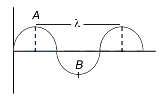
In a sine wave,what is the minimum distance between two particles that always have the same speed?
A
$\frac{\lambda}{2}$
B
$\frac{\lambda}{4}$
C
$\frac{\lambda}{3}$
D
$\lambda$
Solution
(A) In a sine wave,the displacement of a particle is given by $y = A \sin(kx - \omega t)$.
The particle velocity is $v_p = \frac{\partial y}{\partial t} = -A\omega \cos(kx - \omega t)$.
The speed of the particle is $|v_p| = |A\omega \cos(kx - \omega t)|$.
Two particles have the same speed if their displacement magnitudes are equal,i.e.,$|y_1| = |y_2|$.
For a sine wave,points with the same speed are those that have the same magnitude of displacement from the mean position.
Specifically,the points at the crest $(A)$ and the trough $(B)$ both have zero velocity (speed = $0$). The distance between a crest and the adjacent trough is $\frac{\lambda}{2}$.
Alternatively,any two points symmetric about the mean position or the extremes will have the same speed. The minimum distance between two such points is $\frac{\lambda}{2}$.
The particle velocity is $v_p = \frac{\partial y}{\partial t} = -A\omega \cos(kx - \omega t)$.
The speed of the particle is $|v_p| = |A\omega \cos(kx - \omega t)|$.
Two particles have the same speed if their displacement magnitudes are equal,i.e.,$|y_1| = |y_2|$.
For a sine wave,points with the same speed are those that have the same magnitude of displacement from the mean position.
Specifically,the points at the crest $(A)$ and the trough $(B)$ both have zero velocity (speed = $0$). The distance between a crest and the adjacent trough is $\frac{\lambda}{2}$.
Alternatively,any two points symmetric about the mean position or the extremes will have the same speed. The minimum distance between two such points is $\frac{\lambda}{2}$.
0 likesView Solution
24
PhysicsMediumMCQMHT CET · 2010
The equation of a simple harmonic progressive wave is given by $y=A \sin (100 \pi t-3 x)$. Find the distance between $2$ particles having a phase difference of $\frac{\pi}{3}$.
A
$\frac{\pi}{9} \ m$
B
$\frac{\pi}{18} \ m$
C
$\frac{\pi}{6} \ m$
D
$\frac{\pi}{3} \ m$
Solution
(A) The given equation of the wave is $y=A \sin (100 \pi t-3 x)$.
Comparing this with the standard wave equation $y=A \sin (\omega t-kx)$,we get the wave number $k=3 \ m^{-1}$.
The relationship between phase difference $(\Delta \phi)$ and path difference $(\Delta x)$ is given by $\Delta \phi = k \cdot \Delta x$.
Given the phase difference $\Delta \phi = \frac{\pi}{3}$.
Substituting the values,we have $\frac{\pi}{3} = 3 \cdot \Delta x$.
Solving for the distance $\Delta x$,we get $\Delta x = \frac{\pi}{3 \times 3} = \frac{\pi}{9} \ m$.
Comparing this with the standard wave equation $y=A \sin (\omega t-kx)$,we get the wave number $k=3 \ m^{-1}$.
The relationship between phase difference $(\Delta \phi)$ and path difference $(\Delta x)$ is given by $\Delta \phi = k \cdot \Delta x$.
Given the phase difference $\Delta \phi = \frac{\pi}{3}$.
Substituting the values,we have $\frac{\pi}{3} = 3 \cdot \Delta x$.
Solving for the distance $\Delta x$,we get $\Delta x = \frac{\pi}{3 \times 3} = \frac{\pi}{9} \ m$.
0 likesView Solution
25
PhysicsMediumMCQMHT CET · 2010
$n_{1}$ is the frequency of a pipe closed at one end and $n_{2}$ is the frequency of a pipe open at both ends. If both are joined end to end,find the fundamental frequency of the closed pipe so formed.
A
$\frac{n_{1} n_{2}}{n_{2}+2 n_{1}}$
B
$\frac{n_{1} n_{2}}{2 n_{2}+n_{1}}$
C
$\frac{n_{1}+2 n_{2}}{n_{2} n_{1}}$
D
$\frac{2 n_{1}+n_{2}}{n_{2} n_{1}}$
Solution
(A) The fundamental frequency of a pipe closed at one end is $n_{1} = \frac{v}{4 l_{1}}$,which gives $l_{1} = \frac{v}{4 n_{1}}$.
The fundamental frequency of a pipe open at both ends is $n_{2} = \frac{v}{2 l_{2}}$,which gives $l_{2} = \frac{v}{2 n_{2}}$.
When both pipes are joined end to end,the new pipe is closed at one end and open at the other,with a total length $L = l_{1} + l_{2}$.
The fundamental frequency $n$ of this new closed pipe is given by $n = \frac{v}{4 L} = \frac{v}{4 (l_{1} + l_{2})}$.
Substituting the values of $l_{1}$ and $l_{2}$: $\frac{1}{4 n} = \frac{1}{4 n_{1}} + \frac{1}{2 n_{2}}$.
Multiplying by $4$: $\frac{1}{n} = \frac{1}{n_{1}} + \frac{2}{n_{2}} = \frac{n_{2} + 2 n_{1}}{n_{1} n_{2}}$.
Therefore,$n = \frac{n_{1} n_{2}}{n_{2} + 2 n_{1}}$.
The fundamental frequency of a pipe open at both ends is $n_{2} = \frac{v}{2 l_{2}}$,which gives $l_{2} = \frac{v}{2 n_{2}}$.
When both pipes are joined end to end,the new pipe is closed at one end and open at the other,with a total length $L = l_{1} + l_{2}$.
The fundamental frequency $n$ of this new closed pipe is given by $n = \frac{v}{4 L} = \frac{v}{4 (l_{1} + l_{2})}$.
Substituting the values of $l_{1}$ and $l_{2}$: $\frac{1}{4 n} = \frac{1}{4 n_{1}} + \frac{1}{2 n_{2}}$.
Multiplying by $4$: $\frac{1}{n} = \frac{1}{n_{1}} + \frac{2}{n_{2}} = \frac{n_{2} + 2 n_{1}}{n_{1} n_{2}}$.
Therefore,$n = \frac{n_{1} n_{2}}{n_{2} + 2 n_{1}}$.
0 likesView Solution
26
PhysicsMediumMCQMHT CET · 2010
In the fundamental mode,the time taken by the wave to reach the closed end of an air-filled pipe is $0.01 \ s$. The fundamental frequency is (in $Hz$)
A
$25$
B
$12.5$
C
$20$
D
$15$
Solution
(A) In the fundamental mode of a pipe closed at one end,the length of the pipe $l$ corresponds to one-fourth of the wavelength,i.e.,$l = \frac{\lambda}{4}$,which implies $\lambda = 4l$.
Given that the time taken by the wave to travel the length of the pipe $l$ is $t = 0.01 \ s$,the speed of sound $v$ is given by $v = \frac{l}{t}$.
The fundamental frequency $n$ is given by $n = \frac{v}{\lambda}$.
Substituting the values,we get $n = \frac{l/t}{4l} = \frac{1}{4t}$.
Substituting $t = 0.01 \ s$,we get $n = \frac{1}{4 \times 0.01} = \frac{1}{0.04} = 25 \ Hz$.
Given that the time taken by the wave to travel the length of the pipe $l$ is $t = 0.01 \ s$,the speed of sound $v$ is given by $v = \frac{l}{t}$.
The fundamental frequency $n$ is given by $n = \frac{v}{\lambda}$.
Substituting the values,we get $n = \frac{l/t}{4l} = \frac{1}{4t}$.
Substituting $t = 0.01 \ s$,we get $n = \frac{1}{4 \times 0.01} = \frac{1}{0.04} = 25 \ Hz$.
0 likesView Solution
27
PhysicsEasyMCQMHT CET · 2010
Average power in the $L-C-R$ circuit depends upon
A
current
B
phase difference only
C
emf
D
current,emf and phase difference
Solution
(D) The average power of an $L-C-R$ circuit is given by the formula:
$P_{\text{av}} = V_{\text{rms}} \cdot I_{\text{rms}} \cos \phi$
Where:
$V_{\text{rms}}$ is the root mean square value of the electromotive force (emf),
$I_{\text{rms}}$ is the root mean square value of the current,
$\phi$ is the phase difference between the voltage and the current.
Therefore,the average power depends on the current,the emf,and the phase difference.
$P_{\text{av}} = V_{\text{rms}} \cdot I_{\text{rms}} \cos \phi$
Where:
$V_{\text{rms}}$ is the root mean square value of the electromotive force (emf),
$I_{\text{rms}}$ is the root mean square value of the current,
$\phi$ is the phase difference between the voltage and the current.
Therefore,the average power depends on the current,the emf,and the phase difference.
0 likesView Solution
28
PhysicsEasyMCQMHT CET · 2010
The orbital frequency of an electron in the hydrogen atom is proportional to
A
$n^{3}$
B
$n^{-3}$
C
$n^{1}$
D
$n^{-1}$
Solution
(B) The time period $T$ of an electron in the $n^{th}$ orbit of a hydrogen atom is given by the formula: $T = \frac{4 \varepsilon_{0}^{2} n^{3} h^{3}}{m Z^{2} e^{4}}$.
Since the orbital frequency $f$ is the reciprocal of the time period $(f = 1/T)$, we have:
$f \propto \frac{1}{n^{3}}$.
Therefore, the orbital frequency is proportional to $n^{-3}$.
Since the orbital frequency $f$ is the reciprocal of the time period $(f = 1/T)$, we have:
$f \propto \frac{1}{n^{3}}$.
Therefore, the orbital frequency is proportional to $n^{-3}$.
0 likesView Solution
29
PhysicsMediumMCQMHT CET · 2010
The product of linear momentum and angular momentum of an electron of the hydrogen atom is proportional to $n^{x}$,where $x$ is
A
$0$
B
$1$
C
$-2$
D
$2$
Solution
(A) The linear momentum $p$ of an electron in the $n^{th}$ orbit of a hydrogen atom is given by $p = mv = \frac{mZe^2}{2 \epsilon_0 nh}$. Since $Z=1$ for hydrogen,$p \propto \frac{1}{n}$.
The angular momentum $L$ of an electron in the $n^{th}$ orbit is given by Bohr's quantization condition: $L = \frac{nh}{2\pi}$. Thus,$L \propto n$.
The product of linear momentum and angular momentum is $p \times L \propto \left(\frac{1}{n}\right) \times n = n^0$.
Comparing this with $n^x$,we get $x = 0$.
The angular momentum $L$ of an electron in the $n^{th}$ orbit is given by Bohr's quantization condition: $L = \frac{nh}{2\pi}$. Thus,$L \propto n$.
The product of linear momentum and angular momentum is $p \times L \propto \left(\frac{1}{n}\right) \times n = n^0$.
Comparing this with $n^x$,we get $x = 0$.
0 likesView Solution
30
PhysicsEasyMCQMHT CET · 2010
In a parallel plate capacitor,the capacity increases if
A
area of the plate is decreased
B
distance between the plates increases
C
area of the plate is increased
D
dielectric constant decreases
Solution
(C) The capacitance $C$ of a parallel plate capacitor is given by the formula:
$C = \frac{k \varepsilon_{0} A}{d}$
where $k$ is the dielectric constant,$\varepsilon_{0}$ is the permittivity of free space,$A$ is the area of the plates,and $d$ is the distance between the plates.
From the formula,we can see that $C \propto A$.
Therefore,the capacity of the capacitor increases if the area of the plate is increased.
$C = \frac{k \varepsilon_{0} A}{d}$
where $k$ is the dielectric constant,$\varepsilon_{0}$ is the permittivity of free space,$A$ is the area of the plates,and $d$ is the distance between the plates.
From the formula,we can see that $C \propto A$.
Therefore,the capacity of the capacitor increases if the area of the plate is increased.
0 likesView Solution
31
PhysicsMediumMCQMHT CET · 2010
Capacity of a capacitor is $48 \mu F$. When it is charged from $0.1 C$ to $0.5 C$,the change in the energy stored is:
A
$2500 \ J$
B
$2.5 \times 10^{-3} \ J$
C
$2.5 \times 10^{6} \ J$
D
$2.42 \times 10^{-2} \ J$
Solution
(A) The energy stored in a capacitor is given by $U = \frac{q^2}{2C}$.
Given: $C = 48 \mu F = 48 \times 10^{-6} \ F$,$q_1 = 0.1 \ C$,$q_2 = 0.5 \ C$.
The change in energy $\Delta U$ is given by:
$\Delta U = U_2 - U_1 = \frac{q_2^2}{2C} - \frac{q_1^2}{2C} = \frac{1}{2C} (q_2^2 - q_1^2)$
Substituting the values:
$\Delta U = \frac{1}{2 \times 48 \times 10^{-6}} ((0.5)^2 - (0.1)^2)$
$\Delta U = \frac{1}{96 \times 10^{-6}} (0.25 - 0.01)$
$\Delta U = \frac{0.24}{96 \times 10^{-6}}$
$\Delta U = \frac{0.24 \times 10^6}{96} = \frac{240000}{96} = 2500 \ J$.
Given: $C = 48 \mu F = 48 \times 10^{-6} \ F$,$q_1 = 0.1 \ C$,$q_2 = 0.5 \ C$.
The change in energy $\Delta U$ is given by:
$\Delta U = U_2 - U_1 = \frac{q_2^2}{2C} - \frac{q_1^2}{2C} = \frac{1}{2C} (q_2^2 - q_1^2)$
Substituting the values:
$\Delta U = \frac{1}{2 \times 48 \times 10^{-6}} ((0.5)^2 - (0.1)^2)$
$\Delta U = \frac{1}{96 \times 10^{-6}} (0.25 - 0.01)$
$\Delta U = \frac{0.24}{96 \times 10^{-6}}$
$\Delta U = \frac{0.24 \times 10^6}{96} = \frac{240000}{96} = 2500 \ J$.
0 likesView Solution
32
PhysicsMediumMCQMHT CET · 2010
When a resistance of $100 \Omega$ is connected in series with a galvanometer of resistance $R$,its range is $V$. To double its range,a resistance of $1000 \Omega$ is connected in series. Find $R$. (in $Omega$)
A
$700$
B
$800$
C
$900$
D
$100$
Solution
(B) Let the full-scale deflection current of the galvanometer be $I_g$.
When a resistance of $100 \Omega$ is connected in series,the total resistance is $(100 + R)$. The voltage range $V$ is given by $V = I_g(100 + R)$ --- $(i)$
When a resistance of $1000 \Omega$ is connected in series,the new range is $2V$. The total resistance is $(1000 + R)$. Thus,$2V = I_g(1000 + R)$ --- (ii)
Dividing equation (ii) by equation $(i)$:
$\frac{2V}{V} = \frac{I_g(1000 + R)}{I_g(100 + R)}$
$2 = \frac{1000 + R}{100 + R}$
$2(100 + R) = 1000 + R$
$200 + 2R = 1000 + R$
$2R - R = 1000 - 200$
$R = 800 \Omega$
When a resistance of $100 \Omega$ is connected in series,the total resistance is $(100 + R)$. The voltage range $V$ is given by $V = I_g(100 + R)$ --- $(i)$
When a resistance of $1000 \Omega$ is connected in series,the new range is $2V$. The total resistance is $(1000 + R)$. Thus,$2V = I_g(1000 + R)$ --- (ii)
Dividing equation (ii) by equation $(i)$:
$\frac{2V}{V} = \frac{I_g(1000 + R)}{I_g(100 + R)}$
$2 = \frac{1000 + R}{100 + R}$
$2(100 + R) = 1000 + R$
$200 + 2R = 1000 + R$
$2R - R = 1000 - 200$
$R = 800 \Omega$
0 likesView Solution
33
PhysicsEasyMCQMHT CET · 2010
For the measurement of potential difference,a potentiometer is preferred in comparison to a voltmeter because
A
a potentiometer is more sensitive than a voltmeter
B
the resistance of a potentiometer is less than a voltmeter
C
a potentiometer is cheaper than a voltmeter
D
a potentiometer does not draw any current from the circuit
Solution
(D) potentiometer works on the principle of the null deflection method.
In the balanced condition,the potential difference across the cell is measured without drawing any current from the circuit.
Since no current flows through the secondary circuit at the balance point,the potentiometer measures the true electromotive force $(EMF)$ or potential difference.
In contrast,a voltmeter has a finite resistance and draws some current from the circuit,which leads to a voltage drop across the internal resistance of the source,resulting in an inaccurate reading.
In the balanced condition,the potential difference across the cell is measured without drawing any current from the circuit.
Since no current flows through the secondary circuit at the balance point,the potentiometer measures the true electromotive force $(EMF)$ or potential difference.
In contrast,a voltmeter has a finite resistance and draws some current from the circuit,which leads to a voltage drop across the internal resistance of the source,resulting in an inaccurate reading.
0 likesView Solution
34
PhysicsEasyMCQMHT CET · 2010
The de-Broglie wavelength of an electron in the ground state of the hydrogen atom is
A
$\pi r^{2}$
B
$2 \pi r$
C
$\pi r$
D
$\sqrt{2 \pi r}$
Solution
(B) According to Bohr's quantization postulate,the angular momentum of an electron in a stationary orbit is given by:
$mvr = \frac{nh}{2\pi}$
Rearranging this equation,we get:
$2\pi r = \frac{nh}{mv}$
Since the de-Broglie wavelength is defined as $\lambda = \frac{h}{mv}$,we can substitute this into the equation:
$2\pi r = n\lambda$
For the ground state of the hydrogen atom,the principal quantum number is $n = 1$.
Substituting $n = 1$ into the equation,we get:
$\lambda = 2\pi r$
$mvr = \frac{nh}{2\pi}$
Rearranging this equation,we get:
$2\pi r = \frac{nh}{mv}$
Since the de-Broglie wavelength is defined as $\lambda = \frac{h}{mv}$,we can substitute this into the equation:
$2\pi r = n\lambda$
For the ground state of the hydrogen atom,the principal quantum number is $n = 1$.
Substituting $n = 1$ into the equation,we get:
$\lambda = 2\pi r$
0 likesView Solution
35
PhysicsMediumMCQMHT CET · 2010
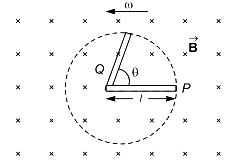
When a rod of length $l$ is rotated with angular velocity $\omega$ in a uniform magnetic field of induction $B$ perpendicular to the plane of rotation,about one of its ends,the induced emf across its ends is:
A
$B l^{2} \omega$
B
$\frac{B l^{2} \omega}{2}$
C
$Bl\omega$
D
$\frac{B l \omega}{2}$
Solution
(B) Consider a small element of length $dr$ at a distance $r$ from the fixed end of the rod.
As the rod rotates with angular velocity $\omega$,the linear velocity of this element is $v = r\omega$.
The motional emf $de$ induced across this small element is given by $de = B v dr = B (r\omega) dr$.
To find the total emf $e$ induced across the entire length of the rod,we integrate this expression from $r = 0$ to $r = l$:
$e = \int_{0}^{l} B \omega r dr = B \omega \left[ \frac{r^2}{2} \right]_{0}^{l} = \frac{1}{2} B l^2 \omega$.
As the rod rotates with angular velocity $\omega$,the linear velocity of this element is $v = r\omega$.
The motional emf $de$ induced across this small element is given by $de = B v dr = B (r\omega) dr$.
To find the total emf $e$ induced across the entire length of the rod,we integrate this expression from $r = 0$ to $r = l$:
$e = \int_{0}^{l} B \omega r dr = B \omega \left[ \frac{r^2}{2} \right]_{0}^{l} = \frac{1}{2} B l^2 \omega$.
0 likesView Solution
36
PhysicsMediumMCQMHT CET · 2010
When a current of $2 \ A$ is passed through a coil of $100$ turns,the magnetic flux associated with it is $5 \times 10^{-5} \ Wb$. Find the self-inductance of the coil.
A
$4 \times 10^{-3} \ H$
B
$4 \times 10^{-2} \ H$
C
$2.5 \times 10^{-3} \ H$
D
$10^{-3} \ H$
Solution
(C) The formula for self-inductance $L$ is given by $L = \frac{N\phi}{i}$,where $N$ is the number of turns,$\phi$ is the magnetic flux,and $i$ is the current.
Given values are $N = 100$,$\phi = 5 \times 10^{-5} \ Wb$,and $i = 2 \ A$.
Substituting these values into the formula:
$L = \frac{100 \times 5 \times 10^{-5}}{2}$
$L = \frac{500 \times 10^{-5}}{2}$
$L = 250 \times 10^{-5} \ H$
$L = 2.5 \times 10^{-3} \ H$
Given values are $N = 100$,$\phi = 5 \times 10^{-5} \ Wb$,and $i = 2 \ A$.
Substituting these values into the formula:
$L = \frac{100 \times 5 \times 10^{-5}}{2}$
$L = \frac{500 \times 10^{-5}}{2}$
$L = 250 \times 10^{-5} \ H$
$L = 2.5 \times 10^{-3} \ H$
0 likesView Solution
37
PhysicsEasyMCQMHT CET · 2010
Which of the following is absorbed by the ozone layer?
A
only gamma rays
B
visible light
C
radio waves
D
ultraviolet
Solution
(D) The ozone layer in the Earth's stratosphere absorbs the majority of the Sun's harmful ultraviolet $(UV)$ radiation. This absorption is crucial as it protects living organisms on Earth from the damaging effects of high-energy $UV$ rays,such as skin cancer and cataracts.
0 likesView Solution
38
PhysicsEasyMCQMHT CET · 2010
The electric intensity outside a charged sphere of radius $R$ at a distance $r$ $(r > R)$ is
A
$\frac{\sigma R^{2}}{\varepsilon_{0} r^{2}}$
B
$\frac{\sigma r^{2}}{\varepsilon_{0} R^{2}}$
C
$\frac{\sigma r}{\varepsilon_{0} R}$
D
$\frac{\sigma R}{\varepsilon_{0} r}$
Solution
(A) According to Gauss's Law,the electric field $E$ at a distance $r$ from the center of a uniformly charged spherical shell of radius $R$ (where $r > R$) is given by $E = \frac{q}{4\pi\varepsilon_{0}r^{2}}$.
Since the surface charge density $\sigma = \frac{q}{4\pi R^{2}}$,we have $q = \sigma(4\pi R^{2})$.
Substituting the value of $q$ in the electric field formula:
$E = \frac{\sigma(4\pi R^{2})}{4\pi\varepsilon_{0}r^{2}} = \frac{\sigma R^{2}}{\varepsilon_{0}r^{2}}$.
Since the surface charge density $\sigma = \frac{q}{4\pi R^{2}}$,we have $q = \sigma(4\pi R^{2})$.
Substituting the value of $q$ in the electric field formula:
$E = \frac{\sigma(4\pi R^{2})}{4\pi\varepsilon_{0}r^{2}} = \frac{\sigma R^{2}}{\varepsilon_{0}r^{2}}$.
0 likesView Solution
39
PhysicsMediumMCQMHT CET · 2010
$A$ circular loop and a square loop are formed from the same wire and the same current is passed through them. Find the ratio of their dipole moments.
A
$4 \pi$
B
$\frac{4}{\pi}$
C
$\frac{2}{\pi}$
D
$2 \pi$
Solution
(B) Let the length of the wire be $l$.
For the circular loop,the circumference is $2 \pi r = l$,so the radius $r = \frac{l}{2 \pi}$.
The magnetic dipole moment of the circular loop is $M_{1} = i A_{1} = i \pi r^{2}$.
Substituting $r$,we get $M_{1} = i \pi \left(\frac{l}{2 \pi}\right)^{2} = \frac{i l^{2}}{4 \pi}$.
For the square loop,the perimeter is $4 a = l$,so the side length $a = \frac{l}{4}$.
The magnetic dipole moment of the square loop is $M_{2} = i A_{2} = i a^{2}$.
Substituting $a$,we get $M_{2} = i \left(\frac{l}{4}\right)^{2} = \frac{i l^{2}}{16}$.
The ratio of the dipole moments is $\frac{M_{1}}{M_{2}} = \frac{i l^{2} / 4 \pi}{i l^{2} / 16} = \frac{16}{4 \pi} = \frac{4}{\pi}$.
For the circular loop,the circumference is $2 \pi r = l$,so the radius $r = \frac{l}{2 \pi}$.
The magnetic dipole moment of the circular loop is $M_{1} = i A_{1} = i \pi r^{2}$.
Substituting $r$,we get $M_{1} = i \pi \left(\frac{l}{2 \pi}\right)^{2} = \frac{i l^{2}}{4 \pi}$.
For the square loop,the perimeter is $4 a = l$,so the side length $a = \frac{l}{4}$.
The magnetic dipole moment of the square loop is $M_{2} = i A_{2} = i a^{2}$.
Substituting $a$,we get $M_{2} = i \left(\frac{l}{4}\right)^{2} = \frac{i l^{2}}{16}$.
The ratio of the dipole moments is $\frac{M_{1}}{M_{2}} = \frac{i l^{2} / 4 \pi}{i l^{2} / 16} = \frac{16}{4 \pi} = \frac{4}{\pi}$.
0 likesView Solution
40
PhysicsEasyMCQMHT CET · 2010
$A$ toroid is:
A
a ring-shaped closed solenoid
B
a rectangular-shaped solenoid
C
a ring-shaped open solenoid
D
a square-shaped solenoid
Solution
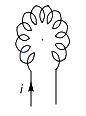
(A) toroid is a hollow circular ring on which a large number of turns of a metallic wire are closely wound.
It can be thought of as a solenoid that has been bent into a circular shape to form a closed loop.
Therefore,a toroid is a ring-shaped closed solenoid.
It can be thought of as a solenoid that has been bent into a circular shape to form a closed loop.
Therefore,a toroid is a ring-shaped closed solenoid.
0 likesView Solution
41
PhysicsEasyMCQMHT CET · 2010
Two particles of masses $m_{a}$ and $m_{b}$ and same charge are projected in a perpendicular magnetic field. They travel along circular paths of radius $r_{a}$ and $r_{b}$ such that $r_{a} > r_{b}$. Then which is true?
A
$m_{a} v_{a} > m_{b} v_{b}$
B
$m_{a} > m_{b}$ and $v_{a} > v_{b}$
C
$m_{a} = m_{b}$ and $v_{a} > v_{b}$
D
$m_{b} v_{b} > m_{a} v_{a}$
Solution
(A) The radius of a circular path for a charged particle in a perpendicular magnetic field is given by $r = \frac{mv}{qB}$.
For particle $a$,the radius is $r_{a} = \frac{m_{a} v_{a}}{q B}$.
For particle $b$,the radius is $r_{b} = \frac{m_{b} v_{b}}{q B}$.
Given that $r_{a} > r_{b}$,we substitute the expressions:
$\frac{m_{a} v_{a}}{q B} > \frac{m_{b} v_{b}}{q B}$.
Since the charge $q$ and magnetic field $B$ are the same for both particles,we can cancel them out.
Therefore,$m_{a} v_{a} > m_{b} v_{b}$.
For particle $a$,the radius is $r_{a} = \frac{m_{a} v_{a}}{q B}$.
For particle $b$,the radius is $r_{b} = \frac{m_{b} v_{b}}{q B}$.
Given that $r_{a} > r_{b}$,we substitute the expressions:
$\frac{m_{a} v_{a}}{q B} > \frac{m_{b} v_{b}}{q B}$.
Since the charge $q$ and magnetic field $B$ are the same for both particles,we can cancel them out.
Therefore,$m_{a} v_{a} > m_{b} v_{b}$.
0 likesView Solution
42
PhysicsEasyMCQMHT CET · 2010
If a magnet is cut into four equal parts such that their lengths and breadths are equal,what is the pole strength of each part?
A
$m$
B
$m / 2$
C
$m / 4$
D
$m / 8$
Solution
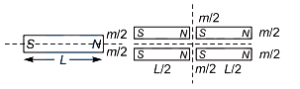
(B) When a magnet is cut along its length,the pole strength remains the same,but when it is cut perpendicular to its length,the pole strength is halved.
In this case,the magnet is cut into four equal parts by cutting it once along its length (parallel to the axis) and once perpendicular to its length.
$1$. Cutting along the length (parallel to the axis) divides the pole strength $m$ into $m/2$ and $m/2$.
$2$. Cutting perpendicular to the length divides the magnet into two parts,but the pole strength of each cross-section remains $m/2$.
Therefore,for each of the four resulting parts,the pole strength $m^{\prime}$ is $m/2$.
In this case,the magnet is cut into four equal parts by cutting it once along its length (parallel to the axis) and once perpendicular to its length.
$1$. Cutting along the length (parallel to the axis) divides the pole strength $m$ into $m/2$ and $m/2$.
$2$. Cutting perpendicular to the length divides the magnet into two parts,but the pole strength of each cross-section remains $m/2$.
Therefore,for each of the four resulting parts,the pole strength $m^{\prime}$ is $m/2$.
0 likesView Solution
43
PhysicsMediumMCQMHT CET · 2010
If the aperture of a telescope is decreased,the resolving power will:
A
increase
B
decrease
C
remain the same
D
become zero
Solution
(B) The resolving power of a telescope is given by the formula: $RP = \frac{D}{1.22 \lambda}$,where $D$ is the aperture of the telescope and $\lambda$ is the wavelength of light used.
From this relation,it is clear that the resolving power is directly proportional to the aperture $(RP \propto D)$.
Therefore,if the aperture of the telescope is decreased,the resolving power will also decrease.
From this relation,it is clear that the resolving power is directly proportional to the aperture $(RP \propto D)$.
Therefore,if the aperture of the telescope is decreased,the resolving power will also decrease.
0 likesView Solution
44
PhysicsEasyMCQMHT CET · 2010
$A$ glass slab has a thickness $t$ and a refractive index $\mu$. Calculate the time taken by light to travel through this thickness.
A
$t \mu c$
B
$\frac{t c}{\mu}$
C
$\frac{t}{\mu c}$
D
$\frac{\mu t}{c}$
Solution
(D) The speed of light in a medium with refractive index $\mu$ is given by $v = \frac{c}{\mu}$,where $c$ is the speed of light in a vacuum.
Time taken $(T)$ to travel a distance $t$ is given by the formula $T = \frac{\text{distance}}{\text{speed}}$.
Substituting the values,we get $T = \frac{t}{v} = \frac{t}{(c/\mu)}$.
Therefore,$T = \frac{\mu t}{c}$.
Time taken $(T)$ to travel a distance $t$ is given by the formula $T = \frac{\text{distance}}{\text{speed}}$.
Substituting the values,we get $T = \frac{t}{v} = \frac{t}{(c/\mu)}$.
Therefore,$T = \frac{\mu t}{c}$.
0 likesView Solution
45
PhysicsEasyMCQMHT CET · 2010
How many $NAND$ gates are required to form an $AND$ gate?
A
$1$
B
$2$
C
$3$
D
$4$
Solution
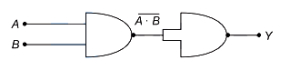
(B) To form an $AND$ gate using $NAND$ gates,we first pass the inputs $A$ and $B$ through a $NAND$ gate to get $\overline{A \cdot B}$.
Then,we pass this output through another $NAND$ gate configured as a $NOT$ gate (by shorting its inputs together).
Let the output of the first $NAND$ gate be $X = \overline{A \cdot B}$.
The second $NAND$ gate acts as a $NOT$ gate,so its output $Y = \overline{X \cdot X} = \overline{X} = \overline{\overline{A \cdot B}} = A \cdot B$.
Thus,two $NAND$ gates are required to form an $AND$ gate.
Then,we pass this output through another $NAND$ gate configured as a $NOT$ gate (by shorting its inputs together).
Let the output of the first $NAND$ gate be $X = \overline{A \cdot B}$.
The second $NAND$ gate acts as a $NOT$ gate,so its output $Y = \overline{X \cdot X} = \overline{X} = \overline{\overline{A \cdot B}} = A \cdot B$.
Thus,two $NAND$ gates are required to form an $AND$ gate.
0 likesView Solution
46
PhysicsMediumMCQMHT CET · 2010
An $LED$ is a $p-n$ junction diode which is
A
forward biased
B
either forward biased or reverse biased
C
reverse biased
D
neither forward biased nor reverse biased
Solution
(A) When a $p-n$ junction diode is forward biased,the potential barrier is reduced,allowing electrons from the $n$-region and holes from the $p$-region to cross the junction.
At the junction,these charge carriers recombine,and the energy released during this process is emitted in the form of photons.
In diodes made of specific semiconductor materials like gallium arsenide or indium phosphide,this energy corresponds to the visible light spectrum.
Such a device is known as a Light Emitting Diode $(LED)$.
At the junction,these charge carriers recombine,and the energy released during this process is emitted in the form of photons.
In diodes made of specific semiconductor materials like gallium arsenide or indium phosphide,this energy corresponds to the visible light spectrum.
Such a device is known as a Light Emitting Diode $(LED)$.
0 likesView Solution
47
PhysicsMediumMCQMHT CET · 2010
For a thermocouple,the inversion temperature is $600^{\circ} C$ and the neutral temperature is $320^{\circ} C$. Find the temperature of the cold junction (in $^{\circ} C$)?
A
$40$
B
$20$
C
$80$
D
$60$
Solution
(A) The relationship between the neutral temperature $(T_{n})$,the temperature of the cold junction $(T_{c})$,and the inversion temperature $(T_{i})$ is given by the formula:
$T_{n} = \frac{T_{c} + T_{i}}{2}$
Given:
$T_{i} = 600^{\circ} C$
$T_{n} = 320^{\circ} C$
Substituting the values into the formula:
$320^{\circ} = \frac{T_{c} + 600^{\circ}}{2}$
$640^{\circ} = T_{c} + 600^{\circ}$
$T_{c} = 640^{\circ} - 600^{\circ}$
$T_{c} = 40^{\circ} C$
Therefore,the temperature of the cold junction is $40^{\circ} C$.
$T_{n} = \frac{T_{c} + T_{i}}{2}$
Given:
$T_{i} = 600^{\circ} C$
$T_{n} = 320^{\circ} C$
Substituting the values into the formula:
$320^{\circ} = \frac{T_{c} + 600^{\circ}}{2}$
$640^{\circ} = T_{c} + 600^{\circ}$
$T_{c} = 640^{\circ} - 600^{\circ}$
$T_{c} = 40^{\circ} C$
Therefore,the temperature of the cold junction is $40^{\circ} C$.
0 likesView Solution
48
PhysicsEasyMCQMHT CET · 2010
In an interference experiment,the phase difference for points where the intensity is minimum is $(n=1, 2, 3, \ldots)$
A
$n \pi$
B
$(n+1) \pi$
C
$(2n-1) \pi$
D
zero
Solution
(C) In an interference experiment,the resultant intensity $I$ is given by $I = I_1 + I_2 + 2\sqrt{I_1 I_2} \cos \phi$,where $\phi$ is the phase difference between the two interfering waves.
The intensity is minimum when $\cos \phi = -1$.
This occurs when the phase difference $\phi$ is an odd multiple of $\pi$.
Therefore,the condition for minimum intensity is $\phi = (2n-1) \pi$,where $n = 1, 2, 3, \ldots$.
The intensity is minimum when $\cos \phi = -1$.
This occurs when the phase difference $\phi$ is an odd multiple of $\pi$.
Therefore,the condition for minimum intensity is $\phi = (2n-1) \pi$,where $n = 1, 2, 3, \ldots$.
0 likesView Solution
49
PhysicsDifficultMCQMHT CET · 2010
Light is incident at an angle $i$ on a glass slab. The reflected ray is completely polarised. The angle of refraction is
A
$90^{\circ}-i$
B
$180^{\circ}-i$
C
$90^{\circ}+i$
D
$i$
Solution
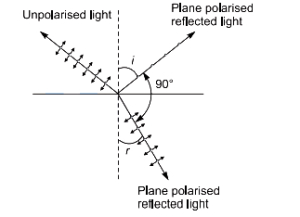
(A) According to Brewster's law,when unpolarised light is incident on a transparent medium at the polarising angle $i$,the reflected ray is completely plane-polarised.
In this condition,the reflected ray and the refracted ray are perpendicular to each other,meaning the angle between them is $90^{\circ}$.
From the geometry of the reflection and refraction at the interface,the sum of the angle of incidence $i$,the angle between the reflected and refracted rays $(90^{\circ})$,and the angle of refraction $r$ must equal $180^{\circ}$ (as they form a straight line along the interface).
Therefore,$i + 90^{\circ} + r = 180^{\circ}$.
Solving for $r$,we get $r = 180^{\circ} - 90^{\circ} - i = 90^{\circ} - i$.
In this condition,the reflected ray and the refracted ray are perpendicular to each other,meaning the angle between them is $90^{\circ}$.
From the geometry of the reflection and refraction at the interface,the sum of the angle of incidence $i$,the angle between the reflected and refracted rays $(90^{\circ})$,and the angle of refraction $r$ must equal $180^{\circ}$ (as they form a straight line along the interface).
Therefore,$i + 90^{\circ} + r = 180^{\circ}$.
Solving for $r$,we get $r = 180^{\circ} - 90^{\circ} - i = 90^{\circ} - i$.
0 likesView Solution
50
PhysicsMediumMCQMHT CET · 2010
In a Young's double slit experiment,the fringe width is found to be $2 \,mm$,when light of wavelength $6000 \text{ Å}$ is used. Find the change in fringe width if the whole apparatus is immersed in water of refractive index $1.33$. (in $\,mm$)
A
$0.5$
B
$1$
C
$1.5$
D
$2$
Solution
(A) The fringe width in air is given by $\beta = \frac{\lambda D}{d} = 2 \,mm$.
When the apparatus is immersed in a medium of refractive index $\mu$,the wavelength of light changes to $\lambda' = \frac{\lambda}{\mu}$.
Consequently,the new fringe width $\beta'$ becomes $\beta' = \frac{\lambda' D}{d} = \frac{\lambda D}{\mu d} = \frac{\beta}{\mu}$.
Given $\beta = 2 \,mm$ and $\mu = 1.33$,we have $\beta' = \frac{2}{1.33} \approx 1.5 \,mm$.
The change in fringe width is $\Delta \beta = \beta - \beta' = 2 \,mm - 1.5 \,mm = 0.5 \,mm$.
When the apparatus is immersed in a medium of refractive index $\mu$,the wavelength of light changes to $\lambda' = \frac{\lambda}{\mu}$.
Consequently,the new fringe width $\beta'$ becomes $\beta' = \frac{\lambda' D}{d} = \frac{\lambda D}{\mu d} = \frac{\beta}{\mu}$.
Given $\beta = 2 \,mm$ and $\mu = 1.33$,we have $\beta' = \frac{2}{1.33} \approx 1.5 \,mm$.
The change in fringe width is $\Delta \beta = \beta - \beta' = 2 \,mm - 1.5 \,mm = 0.5 \,mm$.
0 likesView Solution
Vedclass Products
For Students
Vedclass Test Series
Mock tests in real MHT CET style covering Physics with performance analysis. 5-day free trial.
Start Free TrialFor Teachers
Exam Paper Generator
Generate Set A/B/C/D Physics papers from 7.5L+ questions in 2 minutes. 3 chapters free.
Try FreeFor Institutes
Online Exam Module
Run live MHT CET mock exams with unlimited students, 360° analytics & white-label branding.
See DemoFrequently Asked Questions
How many Physics questions are in MHT CET 2010?
There are 50 Physics questions from the MHT CET 2010 paper on Vedclass, each with a detailed step-by-step solution in English.
Are MHT CET 2010 Physics solutions available in English?
Yes. All solutions on this page are in English. You can also switch to English or Hindi using the language buttons above the questions.
Can I practice MHT CET 2010 Physics as a timed test?
Yes. Use the Vedclass Test Series to attempt a full MHT CET mock test covering Physics with time limits and instant score analysis.
Can teachers create Physics papers from MHT CET previous year questions?
Yes. The Vedclass Exam Paper Generator lets teachers mix MHT CET Physics questions and generate Set A/B/C/D papers in minutes.
For Teachers & Institutes
Build a Custom Physics Paper
Pick MHT CET 2010 Physics questions, set difficulty, and generate Set A/B/C/D in 2 minutes.