
અ Gujarati
Derivative at a point, Standard differentiation Questions in Gujarati
Class 12 Mathematics · Continuity and Differentiation · Derivative at a point, Standard differentiation
493+
Questions
Gujarati
Language
100%
With Solutions
Showing 49 of 493 questions in Gujarati
151
AdvancedMCQ
${\left( {{x^{\frac{{\ell + m}}{{m - n}}}}} \right)^{\frac{1}{{n - \ell }}}} \cdot {\left( {{x^{\frac{{m + n}}{{n - \ell }}}}} \right)^{\frac{1}{{\ell - m}}}} \cdot {\left( {{x^{\frac{{n + \ell }}{{\ell - m}}}}} \right)^{\frac{1}{{m - n}}}}$ નું $x$ ની સાપેક્ષે વિકલન સહગુણક શોધો.
A
$1$
B
$0$
C
$-1$
D
${x^{\ell mn}}$
Solution
(B) ધારો કે આપેલ પદ $y = {\left( {{x^{\frac{{\ell + m}}{{m - n}}}}} \right)^{\frac{1}{{n - \ell }}}} \cdot {\left( {{x^{\frac{{m + n}}{{n - \ell }}}}} \right)^{\frac{1}{{\ell - m}}}} \cdot {\left( {{x^{\frac{{n + \ell }}{{\ell - m}}}}} \right)^{\frac{1}{{m - n}}}}$ છે.
ઘાતાંકના નિયમ $(x^a)^b = x^{ab}$ નો ઉપયોગ કરતા:
$y = x^{\frac{\ell + m}{(m - n)(n - \ell)}} \cdot x^{\frac{m + n}{(n - \ell)(\ell - m)}} \cdot x^{\frac{n + \ell}{(\ell - m)(m - n)}}$.
આધાર સમાન હોવાથી,ઘાતાંકોનો સરવાળો કરતા:
$y = x^{\left[ \frac{\ell + m}{(m - n)(n - \ell)} + \frac{m + n}{(n - \ell)(\ell - m)} + \frac{n + \ell}{(\ell - m)(m - n)} \right]}$.
છેદ સમાન કરતા,સામાન્ય છેદ $(m - n)(n - \ell)(\ell - m)$ મળે છે.
અંશમાં સાદું રૂપ આપતા:
ઘાતાંક $= \frac{(\ell + m)(\ell - m) + (m + n)(m - n) + (n + \ell)(n - \ell)}{(m - n)(n - \ell)(\ell - m)}$.
નિત્યસમ $(a+b)(a-b) = a^2 - b^2$ નો ઉપયોગ કરતા:
ઘાતાંક $= \frac{(\ell^2 - m^2) + (m^2 - n^2) + (n^2 - \ell^2)}{(m - n)(n - \ell)(\ell - m)} = \frac{0}{(m - n)(n - \ell)(\ell - m)} = 0$.
આમ,$y = x^0 = 1$ ($x \neq 0$ માટે).
અચળ પદ $1$ નું $x$ ની સાપેક્ષે વિકલન $\frac{d}{dx}(1) = 0$ થાય.
ઘાતાંકના નિયમ $(x^a)^b = x^{ab}$ નો ઉપયોગ કરતા:
$y = x^{\frac{\ell + m}{(m - n)(n - \ell)}} \cdot x^{\frac{m + n}{(n - \ell)(\ell - m)}} \cdot x^{\frac{n + \ell}{(\ell - m)(m - n)}}$.
આધાર સમાન હોવાથી,ઘાતાંકોનો સરવાળો કરતા:
$y = x^{\left[ \frac{\ell + m}{(m - n)(n - \ell)} + \frac{m + n}{(n - \ell)(\ell - m)} + \frac{n + \ell}{(\ell - m)(m - n)} \right]}$.
છેદ સમાન કરતા,સામાન્ય છેદ $(m - n)(n - \ell)(\ell - m)$ મળે છે.
અંશમાં સાદું રૂપ આપતા:
ઘાતાંક $= \frac{(\ell + m)(\ell - m) + (m + n)(m - n) + (n + \ell)(n - \ell)}{(m - n)(n - \ell)(\ell - m)}$.
નિત્યસમ $(a+b)(a-b) = a^2 - b^2$ નો ઉપયોગ કરતા:
ઘાતાંક $= \frac{(\ell^2 - m^2) + (m^2 - n^2) + (n^2 - \ell^2)}{(m - n)(n - \ell)(\ell - m)} = \frac{0}{(m - n)(n - \ell)(\ell - m)} = 0$.
આમ,$y = x^0 = 1$ ($x \neq 0$ માટે).
અચળ પદ $1$ નું $x$ ની સાપેક્ષે વિકલન $\frac{d}{dx}(1) = 0$ થાય.
0 likes
View Solution152
AdvancedMCQ
જો $y = \frac{x^4 - x^2 + 1}{x^2 + \sqrt{3}x + 1}$ અને $\frac{dy}{dx} = ax + b$ હોય,તો $a + b$ ની કિંમત કેટલી થાય?
A
$cot\frac{5\pi}{8}$
B
$cot\frac{5\pi}{12}$
C
$tan\frac{5\pi}{12}$
D
$tan\frac{5\pi}{8}$
Solution
(B) આપેલ છે કે $y = \frac{x^4 - x^2 + 1}{x^2 + \sqrt{3}x + 1}$.
અંશને આ રીતે લખી શકાય: $x^4 + 2x^2 + 1 - 3x^2 = (x^2 + 1)^2 - (\sqrt{3}x)^2$.
નિત્યસમ $a^2 - b^2 = (a - b)(a + b)$ નો ઉપયોગ કરતા,આપણને મળે $y = \frac{(x^2 + 1 - \sqrt{3}x)(x^2 + 1 + \sqrt{3}x)}{x^2 + \sqrt{3}x + 1}$.
પદાવલિનું સાદું રૂપ આપતા,$y = x^2 - \sqrt{3}x + 1$.
હવે,$x$ ની સાપેક્ષે વિકલન કરતા,$\frac{dy}{dx} = 2x - \sqrt{3}$.
આને $\frac{dy}{dx} = ax + b$ સાથે સરખાવતા,આપણને $a = 2$ અને $b = -\sqrt{3}$ મળે છે.
તેથી,$a + b = 2 - \sqrt{3}$.
આપણે જાણીએ છીએ કે $tan(15^\circ) = tan(\frac{\pi}{12}) = 2 - \sqrt{3}$,અને $tan(\frac{\pi}{12}) = cot(\frac{\pi}{2} - \frac{\pi}{12}) = cot(\frac{5\pi}{12})$.
આમ,$a + b = cot\frac{5\pi}{12}$.
અંશને આ રીતે લખી શકાય: $x^4 + 2x^2 + 1 - 3x^2 = (x^2 + 1)^2 - (\sqrt{3}x)^2$.
નિત્યસમ $a^2 - b^2 = (a - b)(a + b)$ નો ઉપયોગ કરતા,આપણને મળે $y = \frac{(x^2 + 1 - \sqrt{3}x)(x^2 + 1 + \sqrt{3}x)}{x^2 + \sqrt{3}x + 1}$.
પદાવલિનું સાદું રૂપ આપતા,$y = x^2 - \sqrt{3}x + 1$.
હવે,$x$ ની સાપેક્ષે વિકલન કરતા,$\frac{dy}{dx} = 2x - \sqrt{3}$.
આને $\frac{dy}{dx} = ax + b$ સાથે સરખાવતા,આપણને $a = 2$ અને $b = -\sqrt{3}$ મળે છે.
તેથી,$a + b = 2 - \sqrt{3}$.
આપણે જાણીએ છીએ કે $tan(15^\circ) = tan(\frac{\pi}{12}) = 2 - \sqrt{3}$,અને $tan(\frac{\pi}{12}) = cot(\frac{\pi}{2} - \frac{\pi}{12}) = cot(\frac{5\pi}{12})$.
આમ,$a + b = cot\frac{5\pi}{12}$.
0 likes
View Solution153
AdvancedMCQ
ધારો કે $h(x) = f(x) \cdot g(x)$ અને $F(x) = f(g(x))$,જ્યાં $f(2) = 3$,$g(2) = 5$,$g'(2) = 4$,$f'(2) = -2$ અને $f'(5) = 11$ છે. તો:
A
$F'(2) = 11 h'(2)$
B
$F'(2) = 22 h'(2)$
C
$F'(2) = 44 h'(2)$
D
આમાંથી કોઈ નહીં
Solution
(B) આપેલ છે કે $h(x) = f(x)g(x)$. ગુણાકારના નિયમનો ઉપયોગ કરતા,$h'(x) = f'(x)g(x) + g'(x)f(x)$.
$x = 2$ માટે,$h'(2) = f'(2)g(2) + g'(2)f(2) = (-2)(5) + (4)(3) = -10 + 12 = 2$.
આપેલ છે કે $F(x) = f(g(x))$. સાંકળના નિયમનો ઉપયોગ કરતા,$F'(x) = f'(g(x)) \cdot g'(x)$.
$x = 2$ માટે,$F'(2) = f'(g(2)) \cdot g'(2) = f'(5) \cdot 4 = 11 \cdot 4 = 44$.
હવે,$F'(2)$ અને $h'(2)$ ની સરખામણી કરતા,આપણને $F'(2) = 44$ અને $h'(2) = 2$ મળે છે.
તેથી,$F'(2) = 22 \cdot h'(2)$.
$x = 2$ માટે,$h'(2) = f'(2)g(2) + g'(2)f(2) = (-2)(5) + (4)(3) = -10 + 12 = 2$.
આપેલ છે કે $F(x) = f(g(x))$. સાંકળના નિયમનો ઉપયોગ કરતા,$F'(x) = f'(g(x)) \cdot g'(x)$.
$x = 2$ માટે,$F'(2) = f'(g(2)) \cdot g'(2) = f'(5) \cdot 4 = 11 \cdot 4 = 44$.
હવે,$F'(2)$ અને $h'(2)$ ની સરખામણી કરતા,આપણને $F'(2) = 44$ અને $h'(2) = 2$ મળે છે.
તેથી,$F'(2) = 22 \cdot h'(2)$.
0 likes
View Solution154
AdvancedMCQ
જો $y = e^{\sqrt{x}} + e^{-\sqrt{x}}$ હોય,તો $\frac{dy}{dx}$ બરાબર શું થાય?
A
$\frac{e^{\sqrt{x}} - e^{-\sqrt{x}}}{2\sqrt{x}}$
B
$\frac{e^{\sqrt{x}} - e^{-\sqrt{x}}}{2x}$
C
$\frac{1}{2\sqrt{x}} \sqrt{y^2 - 4}$
D
$A$ અને $C$
Solution
(D) આપેલ છે કે $y = e^{\sqrt{x}} + e^{-\sqrt{x}}$.
ચેઈન રૂલનો ઉપયોગ કરીને $x$ ની સાપેક્ષમાં વિકલન કરતા:
$\frac{dy}{dx} = \frac{d}{dx}(e^{\sqrt{x}}) + \frac{d}{dx}(e^{-\sqrt{x}})$
$\frac{dy}{dx} = e^{\sqrt{x}} \cdot \frac{d}{dx}(\sqrt{x}) + e^{-\sqrt{x}} \cdot \frac{d}{dx}(-\sqrt{x})$
$\frac{dy}{dx} = e^{\sqrt{x}} \cdot \frac{1}{2\sqrt{x}} + e^{-\sqrt{x}} \cdot (-\frac{1}{2\sqrt{x}})$
$\frac{dy}{dx} = \frac{e^{\sqrt{x}} - e^{-\sqrt{x}}}{2\sqrt{x}}$ (આ વિકલ્પ $A$ સાથે મેળ ખાય છે).
હવે,$y^2 - 4 = (e^{\sqrt{x}} + e^{-\sqrt{x}})^2 - 4$ ધ્યાનમાં લો.
$y^2 - 4 = e^{2\sqrt{x}} + e^{-2\sqrt{x}} + 2 - 4 = e^{2\sqrt{x}} + e^{-2\sqrt{x}} - 2$
$y^2 - 4 = (e^{\sqrt{x}} - e^{-\sqrt{x}})^2$
વર્ગમૂળ લેતા,$\sqrt{y^2 - 4} = e^{\sqrt{x}} - e^{-\sqrt{x}}$.
આ કિંમતને વિકલનના પદમાં મૂકતા:
$\frac{dy}{dx} = \frac{1}{2\sqrt{x}} \sqrt{y^2 - 4}$ (આ વિકલ્પ $C$ સાથે મેળ ખાય છે).
તેથી,$A$ અને $C$ બંને સાચા હોવાથી,સાચો વિકલ્પ $D$ છે.
ચેઈન રૂલનો ઉપયોગ કરીને $x$ ની સાપેક્ષમાં વિકલન કરતા:
$\frac{dy}{dx} = \frac{d}{dx}(e^{\sqrt{x}}) + \frac{d}{dx}(e^{-\sqrt{x}})$
$\frac{dy}{dx} = e^{\sqrt{x}} \cdot \frac{d}{dx}(\sqrt{x}) + e^{-\sqrt{x}} \cdot \frac{d}{dx}(-\sqrt{x})$
$\frac{dy}{dx} = e^{\sqrt{x}} \cdot \frac{1}{2\sqrt{x}} + e^{-\sqrt{x}} \cdot (-\frac{1}{2\sqrt{x}})$
$\frac{dy}{dx} = \frac{e^{\sqrt{x}} - e^{-\sqrt{x}}}{2\sqrt{x}}$ (આ વિકલ્પ $A$ સાથે મેળ ખાય છે).
હવે,$y^2 - 4 = (e^{\sqrt{x}} + e^{-\sqrt{x}})^2 - 4$ ધ્યાનમાં લો.
$y^2 - 4 = e^{2\sqrt{x}} + e^{-2\sqrt{x}} + 2 - 4 = e^{2\sqrt{x}} + e^{-2\sqrt{x}} - 2$
$y^2 - 4 = (e^{\sqrt{x}} - e^{-\sqrt{x}})^2$
વર્ગમૂળ લેતા,$\sqrt{y^2 - 4} = e^{\sqrt{x}} - e^{-\sqrt{x}}$.
આ કિંમતને વિકલનના પદમાં મૂકતા:
$\frac{dy}{dx} = \frac{1}{2\sqrt{x}} \sqrt{y^2 - 4}$ (આ વિકલ્પ $C$ સાથે મેળ ખાય છે).
તેથી,$A$ અને $C$ બંને સાચા હોવાથી,સાચો વિકલ્પ $D$ છે.
0 likes
View Solution155
AdvancedMCQ
ધારો કે $f$ એ $x = 0$ આગળ વિકલનીય છે અને $f'(0) = 1$ છે. તો $\lim_{h \to 0} \frac{f(h) - f(-2h)}{h} = $
A
$3$
B
$2$
C
$1$
D
$-1$
Solution
(A) આપેલ છે કે $f$ એ $x = 0$ આગળ વિકલનીય છે અને $f'(0) = 1$ છે.
આપણે લક્ષની કિંમત શોધવાની છે: $L = \lim_{h \to 0} \frac{f(h) - f(-2h)}{h}$.
અંશમાં $f(0)$ ઉમેરતા અને બાદ કરતા,આપણને મળે છે:
$L = \lim_{h \to 0} \frac{f(h) - f(0) - (f(-2h) - f(0))}{h}$.
$L = \lim_{h \to 0} \left( \frac{f(h) - f(0)}{h} - \frac{f(-2h) - f(0)}{h} \right)$.
$L = \lim_{h \to 0} \frac{f(h) - f(0)}{h} - \lim_{h \to 0} \frac{f(-2h) - f(0)}{h}$.
કારણ કે $f'(0) = \lim_{h \to 0} \frac{f(h) - f(0)}{h} = 1$,તેથી પ્રથમ પદ $1$ છે.
બીજા પદ માટે,ધારો કે $k = -2h$. જેમ $h \to 0$,તેમ $k \to 0$.
$\lim_{h \to 0} \frac{f(-2h) - f(0)}{h} = \lim_{k \to 0} \frac{f(k) - f(0)}{-k/2} = -2 \lim_{k \to 0} \frac{f(k) - f(0)}{k} = -2 f'(0) = -2(1) = -2$.
આમ,$L = 1 - (-2) = 1 + 2 = 3$.
આપણે લક્ષની કિંમત શોધવાની છે: $L = \lim_{h \to 0} \frac{f(h) - f(-2h)}{h}$.
અંશમાં $f(0)$ ઉમેરતા અને બાદ કરતા,આપણને મળે છે:
$L = \lim_{h \to 0} \frac{f(h) - f(0) - (f(-2h) - f(0))}{h}$.
$L = \lim_{h \to 0} \left( \frac{f(h) - f(0)}{h} - \frac{f(-2h) - f(0)}{h} \right)$.
$L = \lim_{h \to 0} \frac{f(h) - f(0)}{h} - \lim_{h \to 0} \frac{f(-2h) - f(0)}{h}$.
કારણ કે $f'(0) = \lim_{h \to 0} \frac{f(h) - f(0)}{h} = 1$,તેથી પ્રથમ પદ $1$ છે.
બીજા પદ માટે,ધારો કે $k = -2h$. જેમ $h \to 0$,તેમ $k \to 0$.
$\lim_{h \to 0} \frac{f(-2h) - f(0)}{h} = \lim_{k \to 0} \frac{f(k) - f(0)}{-k/2} = -2 \lim_{k \to 0} \frac{f(k) - f(0)}{k} = -2 f'(0) = -2(1) = -2$.
આમ,$L = 1 - (-2) = 1 + 2 = 3$.
0 likes
View Solution156
AdvancedMCQ
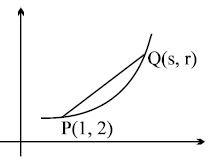
વિધેય $f$ ના આલેખમાં બિંદુઓ $P(1, 2)$ અને $Q(s, r)$ આવેલા છે. $P$ અને $Q$ માંથી પસાર થતી છેદિકા રેખાનું સમીકરણ $y = \left( \frac{s^2 + 2s - 3}{s - 1} \right) x - 1 - s$ છે. $f'(1)$ નું મૂલ્ય શોધો.
A
$2$
B
$3$
C
$4$
D
અસ્તિત્વ ધરાવતું નથી
Solution
(C) વ્યાખ્યા મુજબ,વિકલિત $f'(1)$ એ $P(1, 2)$ અને $Q(s, f(s))$ માંથી પસાર થતી છેદિકા રેખાના ઢાળની લક્ષ કિંમત છે જ્યારે $s \to 1$ થાય.
છેદિકા રેખાનો ઢાળ એ સમીકરણ $y = \left( \frac{s^2 + 2s - 3}{s - 1} \right) x - 1 - s$ માં $x$ નો સહગુણક છે.
તેથી,$f'(1) = \lim_{s \to 1} \frac{s^2 + 2s - 3}{s - 1}$.
પદનું સાદું રૂપ આપતા:
$f'(1) = \lim_{s \to 1} \frac{(s - 1)(s + 3)}{s - 1}$
$f'(1) = \lim_{s \to 1} (s + 3) = 1 + 3 = 4$.
તેથી,સાચો વિકલ્પ $C$ છે.
છેદિકા રેખાનો ઢાળ એ સમીકરણ $y = \left( \frac{s^2 + 2s - 3}{s - 1} \right) x - 1 - s$ માં $x$ નો સહગુણક છે.
તેથી,$f'(1) = \lim_{s \to 1} \frac{s^2 + 2s - 3}{s - 1}$.
પદનું સાદું રૂપ આપતા:
$f'(1) = \lim_{s \to 1} \frac{(s - 1)(s + 3)}{s - 1}$
$f'(1) = \lim_{s \to 1} (s + 3) = 1 + 3 = 4$.
તેથી,સાચો વિકલ્પ $C$ છે.
0 likes
View Solution157
AdvancedMCQ
ધારો કે $m$ અને $n$ એવા એકી પૂર્ણાંકો છે કે જેથી $0 < m < n$. જો $f(x) = x^{\frac{m}{n}}$ એ $x \in \mathbb{R}$ માટે હોય,તો:
A
$f(x)$ દરેક જગ્યાએ વિકલનીય છે.
B
$f'(0)$ અસ્તિત્વ ધરાવે છે.
C
$f$ એ $(0, \infty)$ પર વધતું વિધેય છે અને $(-\infty, 0)$ પર ઘટતું વિધેય છે.
D
$f$ એ $\mathbb{R}$ પર વધતું વિધેય છે.
Solution
(D) આપેલ છે કે $f(x) = x^{\frac{m}{n}}$,જ્યાં $m$ અને $n$ એકી પૂર્ણાંકો છે અને $0 < m < n$.
પ્રથમ,વિકલન મેળવીએ: $f'(x) = \frac{m}{n} x^{\frac{m}{n} - 1} = \frac{m}{n} x^{\frac{m-n}{n}}$.
અહીં $m < n$ હોવાથી,ઘાતાંક $\frac{m-n}{n}$ ઋણ છે. ધારો કે $k = n - m$,જ્યાં $k$ એ બેકી ધન પૂર્ણાંક છે (કારણ કે $n$ અને $m$ બંને એકી છે,તેથી તેમનો તફાવત બેકી થાય). તેથી $f'(x) = \frac{m}{n} x^{-\frac{k}{n}} = \frac{m}{n \cdot x^{\frac{k}{n}}}$.
જ્યારે $x \to 0$,ત્યારે $f'(x) \to \infty$,તેથી $f'(0)$ અસ્તિત્વ ધરાવતું નથી. આમ,$f(x)$ એ $x = 0$ આગળ વિકલનીય નથી.
$k$ બેકી હોવાથી,દરેક $x \neq 0$ માટે $x^{\frac{k}{n}} > 0$ થાય. તેથી,દરેક $x \neq 0$ માટે $f'(x) = \frac{m}{n \cdot x^{\frac{k}{n}}} > 0$ મળે છે.
$f'(x) > 0$ એ દરેક $x \in \mathbb{R} \setminus \{0\}$ માટે સાચું છે અને $f(x)$ એ $x = 0$ આગળ સતત છે,તેથી વિધેય $f(x)$ એ સમગ્ર પ્રદેશ $\mathbb{R}$ પર ચુસ્ત રીતે વધતું વિધેય છે.
આમ,સાચો વિકલ્પ $(D)$ છે.
પ્રથમ,વિકલન મેળવીએ: $f'(x) = \frac{m}{n} x^{\frac{m}{n} - 1} = \frac{m}{n} x^{\frac{m-n}{n}}$.
અહીં $m < n$ હોવાથી,ઘાતાંક $\frac{m-n}{n}$ ઋણ છે. ધારો કે $k = n - m$,જ્યાં $k$ એ બેકી ધન પૂર્ણાંક છે (કારણ કે $n$ અને $m$ બંને એકી છે,તેથી તેમનો તફાવત બેકી થાય). તેથી $f'(x) = \frac{m}{n} x^{-\frac{k}{n}} = \frac{m}{n \cdot x^{\frac{k}{n}}}$.
જ્યારે $x \to 0$,ત્યારે $f'(x) \to \infty$,તેથી $f'(0)$ અસ્તિત્વ ધરાવતું નથી. આમ,$f(x)$ એ $x = 0$ આગળ વિકલનીય નથી.
$k$ બેકી હોવાથી,દરેક $x \neq 0$ માટે $x^{\frac{k}{n}} > 0$ થાય. તેથી,દરેક $x \neq 0$ માટે $f'(x) = \frac{m}{n \cdot x^{\frac{k}{n}}} > 0$ મળે છે.
$f'(x) > 0$ એ દરેક $x \in \mathbb{R} \setminus \{0\}$ માટે સાચું છે અને $f(x)$ એ $x = 0$ આગળ સતત છે,તેથી વિધેય $f(x)$ એ સમગ્ર પ્રદેશ $\mathbb{R}$ પર ચુસ્ત રીતે વધતું વિધેય છે.
આમ,સાચો વિકલ્પ $(D)$ છે.
0 likes
View Solution158
AdvancedMCQ
ધારો કે $h(x) = \frac{5(f(x))^3}{3} + \frac{(f(x))^2}{2} + 2f(x) + 100$,જ્યાં $f(x)$ એ વિકલનીય વિધેય છે. તો નીચેનામાંથી કયું સાચું છે?
A
$h(x)$ હંમેશા વધે છે
B
$h(x)$ હંમેશા ઘટે છે
C
$h(x)$ વધે છે જેમ $f(x)$ વધે છે
D
$h(x)$ વધે છે જેમ $f(x)$ ઘટે છે
Solution
(C) આપેલ છે કે $h(x) = \frac{5}{3}(f(x))^3 + \frac{1}{2}(f(x))^2 + 2f(x) + 100$.
$h(x)$ ના વર્તનને સમજવા માટે,આપણે $x$ ની સાપેક્ષમાં વિકલન કરીએ:
$h'(x) = \frac{d}{dx} \left[ \frac{5}{3}(f(x))^3 + \frac{1}{2}(f(x))^2 + 2f(x) + 100 \right]$.
ચેઈન રૂલનો ઉપયોગ કરતા:
$h'(x) = \left( 5(f(x))^2 + f(x) + 2 \right) f'(x)$.
દ્વિઘાત પદાવલિ $Q = 5(f(x))^2 + f(x) + 2$ ને ધ્યાનમાં લો.
વિવેચક $D = b^2 - 4ac = (1)^2 - 4(5)(2) = 1 - 40 = -39$.
અહીં $D < 0$ છે અને $(f(x))^2$ નો સહગુણક ધન $(5 > 0)$ હોવાથી,$Q$ હંમેશા ધન રહેશે.
તેથી,$h'(x)$ ની નિશાની ફક્ત $f'(x)$ પર આધાર રાખે છે.
જો $f'(x) > 0$ હોય,તો $h'(x) > 0$ થાય,જેનો અર્થ છે કે જેમ $f(x)$ વધે છે તેમ $h(x)$ વધે છે.
$h(x)$ ના વર્તનને સમજવા માટે,આપણે $x$ ની સાપેક્ષમાં વિકલન કરીએ:
$h'(x) = \frac{d}{dx} \left[ \frac{5}{3}(f(x))^3 + \frac{1}{2}(f(x))^2 + 2f(x) + 100 \right]$.
ચેઈન રૂલનો ઉપયોગ કરતા:
$h'(x) = \left( 5(f(x))^2 + f(x) + 2 \right) f'(x)$.
દ્વિઘાત પદાવલિ $Q = 5(f(x))^2 + f(x) + 2$ ને ધ્યાનમાં લો.
વિવેચક $D = b^2 - 4ac = (1)^2 - 4(5)(2) = 1 - 40 = -39$.
અહીં $D < 0$ છે અને $(f(x))^2$ નો સહગુણક ધન $(5 > 0)$ હોવાથી,$Q$ હંમેશા ધન રહેશે.
તેથી,$h'(x)$ ની નિશાની ફક્ત $f'(x)$ પર આધાર રાખે છે.
જો $f'(x) > 0$ હોય,તો $h'(x) > 0$ થાય,જેનો અર્થ છે કે જેમ $f(x)$ વધે છે તેમ $h(x)$ વધે છે.
0 likes
View Solution159
AdvancedMCQ
ધારો કે $f(x)$ એ તમામ વાસ્તવિક સંખ્યાઓ માટે સતત અને વિકલનીય વિધેય છે. જો $f(x + y) = f(x) - 3xy + f(y)$ અને $\lim_{h \to 0} \frac{f(h)}{h} = 7$ હોય,તો $f'(x)$ ની કિંમત શોધો.
A
$-3x$
B
$7$
C
$-3x + 7$
D
$2f(x) + 7$
Solution
(C) વિકલિતની વ્યાખ્યા મુજબ,$f'(x) = \lim_{h \to 0} \frac{f(x + h) - f(x)}{h}$.
આપેલ વિધેય સમીકરણ $f(x + y) = f(x) - 3xy + f(y)$ માં $y = h$ મૂકતા:
$f(x + h) = f(x) - 3xh + f(h)$.
આ કિંમતને વિકલિતની વ્યાખ્યામાં મૂકતા:
$f'(x) = \lim_{h \to 0} \frac{f(x) - 3xh + f(h) - f(x)}{h}$
$f'(x) = \lim_{h \to 0} \frac{-3xh + f(h)}{h}$
$f'(x) = \lim_{h \to 0} (-3x + \frac{f(h)}{h})$.
આપેલ છે કે $\lim_{h \to 0} \frac{f(h)}{h} = 7$,તેથી:
$f'(x) = -3x + 7$.
આપેલ વિધેય સમીકરણ $f(x + y) = f(x) - 3xy + f(y)$ માં $y = h$ મૂકતા:
$f(x + h) = f(x) - 3xh + f(h)$.
આ કિંમતને વિકલિતની વ્યાખ્યામાં મૂકતા:
$f'(x) = \lim_{h \to 0} \frac{f(x) - 3xh + f(h) - f(x)}{h}$
$f'(x) = \lim_{h \to 0} \frac{-3xh + f(h)}{h}$
$f'(x) = \lim_{h \to 0} (-3x + \frac{f(h)}{h})$.
આપેલ છે કે $\lim_{h \to 0} \frac{f(h)}{h} = 7$,તેથી:
$f'(x) = -3x + 7$.
0 likes
View Solution160
AdvancedMCQ
જો $f(x) = \frac{\sin(\frac{\pi x}{4})}{x + 1}$ હોય,તો $\lim_{h \to 0} \frac{f(1 + h) - f(1)}{h^2 + 2h}$ ની કિંમત શોધો.
A
$\frac{\pi - 4}{2\sqrt{2}}$
B
$\frac{\pi}{16\sqrt{2}}$
C
$\frac{\pi - 2}{8\sqrt{2}}$
D
$\frac{\pi - 4}{16\sqrt{2}}$
Solution
(D) ધારો કે $L = \lim_{h \to 0} \frac{f(1 + h) - f(1)}{h^2 + 2h}$.
વિકલનની વ્યાખ્યા મુજબ,$\lim_{h \to 0} \frac{f(1+h) - f(1)}{h} = f'(1)$.
આથી,લક્ષને $\lim_{h \to 0} \left( \frac{f(1+h) - f(1)}{h} \cdot \frac{1}{h+2} \right) = f'(1) \cdot \frac{1}{2} = \frac{f'(1)}{2}$ તરીકે લખી શકાય.
$f(x) = \frac{\sin(\frac{\pi x}{4})}{x + 1}$ માટે ભાગાકારના નિયમનો ઉપયોગ કરતા: $f'(x) = \frac{(x+1) \cdot \cos(\frac{\pi x}{4}) \cdot \frac{\pi}{4} - \sin(\frac{\pi x}{4})}{(x+1)^2}$.
$x = 1$ આગળ,$f'(1) = \frac{2 \cdot \frac{1}{\sqrt{2}} \cdot \frac{\pi}{4} - \frac{1}{\sqrt{2}}}{4} = \frac{\pi - 2}{8\sqrt{2}}$.
તેથી,લક્ષની કિંમત $\frac{f'(1)}{2} = \frac{\pi - 2}{16\sqrt{2}}$ થાય.
વિકલનની વ્યાખ્યા મુજબ,$\lim_{h \to 0} \frac{f(1+h) - f(1)}{h} = f'(1)$.
આથી,લક્ષને $\lim_{h \to 0} \left( \frac{f(1+h) - f(1)}{h} \cdot \frac{1}{h+2} \right) = f'(1) \cdot \frac{1}{2} = \frac{f'(1)}{2}$ તરીકે લખી શકાય.
$f(x) = \frac{\sin(\frac{\pi x}{4})}{x + 1}$ માટે ભાગાકારના નિયમનો ઉપયોગ કરતા: $f'(x) = \frac{(x+1) \cdot \cos(\frac{\pi x}{4}) \cdot \frac{\pi}{4} - \sin(\frac{\pi x}{4})}{(x+1)^2}$.
$x = 1$ આગળ,$f'(1) = \frac{2 \cdot \frac{1}{\sqrt{2}} \cdot \frac{\pi}{4} - \frac{1}{\sqrt{2}}}{4} = \frac{\pi - 2}{8\sqrt{2}}$.
તેથી,લક્ષની કિંમત $\frac{f'(1)}{2} = \frac{\pi - 2}{16\sqrt{2}}$ થાય.
0 likes
View Solution161
MediumMCQ
$\log_e x$ ની સાપેક્ષમાં ${e^{x^3}}$ નું વિકલન શું થાય?
A
${e^{x^3}}$
B
$3x^2 e^{x^3}$
C
$3x^3 e^{x^3}$
D
$3x^2 e^{x^3} + 3x^2$
Solution
(C) ધારો કે $u = e^{x^3}$ અને $v = \log_e x$.
આપણે $\frac{du}{dv} = \frac{du/dx}{dv/dx}$ શોધવાનું છે.
પ્રથમ,$u$ નું $x$ ની સાપેક્ષમાં વિકલન કરતા:
$\frac{du}{dx} = \frac{d}{dx}(e^{x^3}) = e^{x^3} \cdot \frac{d}{dx}(x^3) = e^{x^3} \cdot 3x^2$.
ત્યારબાદ,$v$ નું $x$ ની સાપેક્ષમાં વિકલન કરતા:
$\frac{dv}{dx} = \frac{d}{dx}(\log_e x) = \frac{1}{x}$.
હવે,ગુણોત્તરની ગણતરી કરતા:
$\frac{du}{dv} = \frac{3x^2 e^{x^3}}{1/x} = 3x^2 e^{x^3} \cdot x = 3x^3 e^{x^3}$.
આમ,સાચો વિકલ્પ $C$ છે.
આપણે $\frac{du}{dv} = \frac{du/dx}{dv/dx}$ શોધવાનું છે.
પ્રથમ,$u$ નું $x$ ની સાપેક્ષમાં વિકલન કરતા:
$\frac{du}{dx} = \frac{d}{dx}(e^{x^3}) = e^{x^3} \cdot \frac{d}{dx}(x^3) = e^{x^3} \cdot 3x^2$.
ત્યારબાદ,$v$ નું $x$ ની સાપેક્ષમાં વિકલન કરતા:
$\frac{dv}{dx} = \frac{d}{dx}(\log_e x) = \frac{1}{x}$.
હવે,ગુણોત્તરની ગણતરી કરતા:
$\frac{du}{dv} = \frac{3x^2 e^{x^3}}{1/x} = 3x^2 e^{x^3} \cdot x = 3x^3 e^{x^3}$.
આમ,સાચો વિકલ્પ $C$ છે.
0 likes
View Solution162
AdvancedMCQ
જો $y = |\cos 4x| + |\sin 4x| + |\tan 4x|$ હોય,તો $x = \frac{\pi}{6}$ આગળ $\frac{dy}{dx}$ શોધો.
A
$10 - 2\sqrt{3}$
B
$6 - 2\sqrt{3}$
C
$2\sqrt{3} - 18$
D
$2\sqrt{3} - 10$
Solution
(C) આપેલ છે કે $y = |\cos 4x| + |\sin 4x| + |\tan 4x|$.
$x = \frac{\pi}{6}$ આગળ,$4x = \frac{4\pi}{6} = \frac{2\pi}{3}$ થાય.
$x = \frac{\pi}{6}$ ની આસપાસ,$\cos 4x < 0$,$\sin 4x > 0$,અને $\tan 4x < 0$ છે.
તેથી,$y = -\cos 4x + \sin 4x - \tan 4x$.
$x$ ની સાપેક્ષ વિકલન કરતા:
$\frac{dy}{dx} = -(-\sin 4x \cdot 4) + (\cos 4x \cdot 4) - (\sec^2 4x \cdot 4)$
$\frac{dy}{dx} = 4\sin 4x + 4\cos 4x - 4\sec^2 4x$.
$x = \frac{\pi}{6}$ આગળ,$4x = \frac{2\pi}{3}$ છે.
$\sin(\frac{2\pi}{3}) = \frac{\sqrt{3}}{2}$,$\cos(\frac{2\pi}{3}) = -\frac{1}{2}$,$\sec(\frac{2\pi}{3}) = -2$.
$\frac{dy}{dx} = 4(\frac{\sqrt{3}}{2}) + 4(-\frac{1}{2}) - 4(-2)^2$
$\frac{dy}{dx} = 2\sqrt{3} - 2 - 16 = 2\sqrt{3} - 18$.
$x = \frac{\pi}{6}$ આગળ,$4x = \frac{4\pi}{6} = \frac{2\pi}{3}$ થાય.
$x = \frac{\pi}{6}$ ની આસપાસ,$\cos 4x < 0$,$\sin 4x > 0$,અને $\tan 4x < 0$ છે.
તેથી,$y = -\cos 4x + \sin 4x - \tan 4x$.
$x$ ની સાપેક્ષ વિકલન કરતા:
$\frac{dy}{dx} = -(-\sin 4x \cdot 4) + (\cos 4x \cdot 4) - (\sec^2 4x \cdot 4)$
$\frac{dy}{dx} = 4\sin 4x + 4\cos 4x - 4\sec^2 4x$.
$x = \frac{\pi}{6}$ આગળ,$4x = \frac{2\pi}{3}$ છે.
$\sin(\frac{2\pi}{3}) = \frac{\sqrt{3}}{2}$,$\cos(\frac{2\pi}{3}) = -\frac{1}{2}$,$\sec(\frac{2\pi}{3}) = -2$.
$\frac{dy}{dx} = 4(\frac{\sqrt{3}}{2}) + 4(-\frac{1}{2}) - 4(-2)^2$
$\frac{dy}{dx} = 2\sqrt{3} - 2 - 16 = 2\sqrt{3} - 18$.
0 likes
View Solution163
AdvancedMCQ
$x=e$ પર $\frac{d}{{d(\ln x)}}({e^x}{\ln ^2}x)$ નું મૂલ્ય શું છે?
A
$e^e (e + 2)$
B
$e^{e+1}$
C
$2e^{e+1}$
D
$e^e(e + 1)$
Solution
(A) ધારો કે $u = \ln x$. તેથી $x = e^u$ અને $dx = e^u du$ થાય.
આપણે $u = \ln x$ ની સાપેક્ષમાં $f(x) = e^x (\ln x)^2$ નું વિકલન શોધવું છે.
ચેઈન રૂલનો ઉપયોગ કરતા,$\frac{df}{du} = \frac{df}{dx} \cdot \frac{dx}{du}$.
પ્રથમ,$\frac{df}{dx} = \frac{d}{dx}(e^x (\ln x)^2) = e^x (\ln x)^2 + e^x \cdot 2 \ln x \cdot \frac{1}{x} = e^x (\ln x)^2 + \frac{2 e^x \ln x}{x}$ શોધો.
$u = \ln x$ હોવાથી,$\frac{dx}{du} = \frac{d}{du}(e^u) = e^u = x$ થાય.
તેથી,$\frac{df}{du} = (e^x (\ln x)^2 + \frac{2 e^x \ln x}{x}) \cdot x = x e^x (\ln x)^2 + 2 e^x \ln x$.
$x = e$ પર,$\ln x = 1$ થાય.
આ કિંમતો મૂકતા: $\frac{df}{du} = e \cdot e^e \cdot (1)^2 + 2 \cdot e^e \cdot 1 = e^{e+1} + 2 e^e = e^e (e + 2)$.
આપણે $u = \ln x$ ની સાપેક્ષમાં $f(x) = e^x (\ln x)^2$ નું વિકલન શોધવું છે.
ચેઈન રૂલનો ઉપયોગ કરતા,$\frac{df}{du} = \frac{df}{dx} \cdot \frac{dx}{du}$.
પ્રથમ,$\frac{df}{dx} = \frac{d}{dx}(e^x (\ln x)^2) = e^x (\ln x)^2 + e^x \cdot 2 \ln x \cdot \frac{1}{x} = e^x (\ln x)^2 + \frac{2 e^x \ln x}{x}$ શોધો.
$u = \ln x$ હોવાથી,$\frac{dx}{du} = \frac{d}{du}(e^u) = e^u = x$ થાય.
તેથી,$\frac{df}{du} = (e^x (\ln x)^2 + \frac{2 e^x \ln x}{x}) \cdot x = x e^x (\ln x)^2 + 2 e^x \ln x$.
$x = e$ પર,$\ln x = 1$ થાય.
આ કિંમતો મૂકતા: $\frac{df}{du} = e \cdot e^e \cdot (1)^2 + 2 \cdot e^e \cdot 1 = e^{e+1} + 2 e^e = e^e (e + 2)$.
0 likes
View Solution164
AdvancedMCQ
જો $f(x) = x^3 + e^{x/2}$ અને $g(x) = f^{-1}(x)$ હોય,તો $g'(1)$ ની કિંમત શોધો.
A
$1$
B
$2$
C
$3$
D
$e$
Solution
(B) આપેલ છે કે $f(x) = x^3 + e^{x/2}$.
કારણ કે $g(x) = f^{-1}(x)$,તેથી $g(f(x)) = x$ થાય.
બંને બાજુ $x$ ની સાપેક્ષમાં વિકલન કરતા,$g'(f(x)) \cdot f'(x) = 1$ મળે.
$g'(1)$ શોધવા માટે,$f(x) = 1$ લો.
$x^3 + e^{x/2} = 1$.
નિરીક્ષણ દ્વારા,$x = 0$ માટે,$0^3 + e^0 = 0 + 1 = 1$ થાય છે. આમ,$f(0) = 1$.
હવે,$f'(x) = 3x^2 + \frac{1}{2}e^{x/2}$ શોધો.
$x = 0$ આગળ,$f'(0) = 3(0)^2 + \frac{1}{2}e^0 = 0 + \frac{1}{2} = \frac{1}{2}$.
આ કિંમતોને વિકલનના સૂત્રમાં મૂકતા: $g'(f(0)) \cdot f'(0) = 1 \implies g'(1) \cdot \frac{1}{2} = 1$.
તેથી,$g'(1) = 2$.
કારણ કે $g(x) = f^{-1}(x)$,તેથી $g(f(x)) = x$ થાય.
બંને બાજુ $x$ ની સાપેક્ષમાં વિકલન કરતા,$g'(f(x)) \cdot f'(x) = 1$ મળે.
$g'(1)$ શોધવા માટે,$f(x) = 1$ લો.
$x^3 + e^{x/2} = 1$.
નિરીક્ષણ દ્વારા,$x = 0$ માટે,$0^3 + e^0 = 0 + 1 = 1$ થાય છે. આમ,$f(0) = 1$.
હવે,$f'(x) = 3x^2 + \frac{1}{2}e^{x/2}$ શોધો.
$x = 0$ આગળ,$f'(0) = 3(0)^2 + \frac{1}{2}e^0 = 0 + \frac{1}{2} = \frac{1}{2}$.
આ કિંમતોને વિકલનના સૂત્રમાં મૂકતા: $g'(f(0)) \cdot f'(0) = 1 \implies g'(1) \cdot \frac{1}{2} = 1$.
તેથી,$g'(1) = 2$.
0 likes
View Solution165
DifficultMCQ
ધારો કે $f(x) = x\sqrt{x\sqrt{x\sqrt{x\dots\infty}}}$ જ્યાં $x > 0$ છે. તો $f'(3)$ ની કિંમત શોધો.
A
$4$
B
$6$
C
$8$
D
$10$
Solution
(B) આપેલ છે કે $f(x) = x\sqrt{x\sqrt{x\sqrt{x\dots\infty}}}$.
$x$ વડે ભાગતા,આપણને મળે $\frac{f(x)}{x} = \sqrt{x\sqrt{x\sqrt{x\dots\infty}}}$.
વર્ગમૂળની અંદરનું પદ મૂળ વિધેય જેવું જ હોવાથી,$\frac{f(x)}{x} = \sqrt{f(x)}$ થાય.
બંને બાજુ વર્ગ કરતા,$\frac{f(x)^2}{x^2} = f(x)$ મળે.
જો $f(x) \neq 0$ હોય,તો $f(x)$ વડે ભાગતા $\frac{f(x)}{x^2} = 1$ મળે,જેનો અર્થ છે કે $f(x) = x^2$.
હવે,$x$ ની સાપેક્ષમાં વિકલન કરતા,$f'(x) = 2x$ મળે.
$x = 3$ મૂકતા,$f'(3) = 2(3) = 6$ થાય.
$x$ વડે ભાગતા,આપણને મળે $\frac{f(x)}{x} = \sqrt{x\sqrt{x\sqrt{x\dots\infty}}}$.
વર્ગમૂળની અંદરનું પદ મૂળ વિધેય જેવું જ હોવાથી,$\frac{f(x)}{x} = \sqrt{f(x)}$ થાય.
બંને બાજુ વર્ગ કરતા,$\frac{f(x)^2}{x^2} = f(x)$ મળે.
જો $f(x) \neq 0$ હોય,તો $f(x)$ વડે ભાગતા $\frac{f(x)}{x^2} = 1$ મળે,જેનો અર્થ છે કે $f(x) = x^2$.
હવે,$x$ ની સાપેક્ષમાં વિકલન કરતા,$f'(x) = 2x$ મળે.
$x = 3$ મૂકતા,$f'(3) = 2(3) = 6$ થાય.
0 likes
View Solution166
AdvancedMCQ
ધારો કે $f(x)$ અને $g(x)$ એ $R$ પર વિકલનીય વિધેયો છે. જો $h(x) = f(g(f(x)))$ હોય,જ્યાં $f(2) = 1$,$g(1) = 2$ અને $f'(2) = g'(1) = 4$ હોય,તો $h'(2)$ ની કિંમત શોધો.
A
$8$
B
$16$
C
$64$
D
$36$
Solution
(C) આપેલ છે કે $h(x) = f(g(f(x)))$.
વિકલન માટે સાંકળના નિયમ (chain rule) નો ઉપયોગ કરતા:
$h'(x) = f'(g(f(x))) \cdot g'(f(x)) \cdot f'(x)$.
હવે,$x = 2$ આગળ $h'(x)$ ની કિંમત મેળવીએ:
$h'(2) = f'(g(f(2))) \cdot g'(f(2)) \cdot f'(2)$.
$f(2) = 1$ આપેલ હોવાથી,તેને સમીકરણમાં મૂકતા:
$h'(2) = f'(g(1)) \cdot g'(1) \cdot f'(2)$.
$g(1) = 2$ આપેલ હોવાથી,તેને સમીકરણમાં મૂકતા:
$h'(2) = f'(2) \cdot g'(1) \cdot f'(2)$.
$f'(2) = 4$ અને $g'(1) = 4$ આપેલ હોવાથી,કિંમતો મૂકતા:
$h'(2) = 4 \cdot 4 \cdot 4 = 64$.
વિકલન માટે સાંકળના નિયમ (chain rule) નો ઉપયોગ કરતા:
$h'(x) = f'(g(f(x))) \cdot g'(f(x)) \cdot f'(x)$.
હવે,$x = 2$ આગળ $h'(x)$ ની કિંમત મેળવીએ:
$h'(2) = f'(g(f(2))) \cdot g'(f(2)) \cdot f'(2)$.
$f(2) = 1$ આપેલ હોવાથી,તેને સમીકરણમાં મૂકતા:
$h'(2) = f'(g(1)) \cdot g'(1) \cdot f'(2)$.
$g(1) = 2$ આપેલ હોવાથી,તેને સમીકરણમાં મૂકતા:
$h'(2) = f'(2) \cdot g'(1) \cdot f'(2)$.
$f'(2) = 4$ અને $g'(1) = 4$ આપેલ હોવાથી,કિંમતો મૂકતા:
$h'(2) = 4 \cdot 4 \cdot 4 = 64$.
0 likes
View Solution167
AdvancedMCQ
જો $\frac{d}{{dx}}\left[ {\frac{{2{x^3} + 3{x^2} + x - 3}}{{{x^2} + x - 2}}} \right] = A + \frac{B}{{{{(x - 1)}^2}}} + \frac{C}{{{{(x + 2)}^2}}}$ હોય,તો $(A - B + C)$ ની કિંમત શોધો.
A
$4$
B
$7$
C
$-2$
D
$0$
Solution
(C) સૌ પ્રથમ,વિકલન અંદરની પદાવલિને બહુપદી ભાગાકાર અને આંશિક અપૂર્ણાંકનો ઉપયોગ કરીને સરળ બનાવો.
ધારો કે $f(x) = \frac{2x^3 + 3x^2 + x - 3}{x^2 + x - 2}$.
અહીં $x^2 + x - 2 = (x - 1)(x + 2)$ છે.
ભાગાકાર કરતા: $\frac{2x^3 + 3x^2 + x - 3}{x^2 + x - 2} = 2x + 1 - \frac{1}{x - 1} - \frac{1}{x + 2}$.
હવે,$x$ ની સાપેક્ષમાં વિકલન કરતા:
$\frac{d}{dx}f(x) = 2 + \frac{1}{(x - 1)^2} + \frac{1}{(x + 2)^2}$.
આને $A + \frac{B}{(x - 1)^2} + \frac{C}{(x + 2)^2}$ સાથે સરખાવતા,આપણને $A = 2$,$B = 1$,$C = 1$ મળે છે.
તેથી,$A - B + C = 2 - 1 + 1 = 2$.
ધારો કે $f(x) = \frac{2x^3 + 3x^2 + x - 3}{x^2 + x - 2}$.
અહીં $x^2 + x - 2 = (x - 1)(x + 2)$ છે.
ભાગાકાર કરતા: $\frac{2x^3 + 3x^2 + x - 3}{x^2 + x - 2} = 2x + 1 - \frac{1}{x - 1} - \frac{1}{x + 2}$.
હવે,$x$ ની સાપેક્ષમાં વિકલન કરતા:
$\frac{d}{dx}f(x) = 2 + \frac{1}{(x - 1)^2} + \frac{1}{(x + 2)^2}$.
આને $A + \frac{B}{(x - 1)^2} + \frac{C}{(x + 2)^2}$ સાથે સરખાવતા,આપણને $A = 2$,$B = 1$,$C = 1$ મળે છે.
તેથી,$A - B + C = 2 - 1 + 1 = 2$.
0 likes
View Solution168
MediumMCQ
$x = 2$ આગળ $|x - 1| + |x - 3|$ ના વિકલિતનું મૂલ્ય શું છે?
A
$-2$
B
$0$
C
$2$
D
અસ્તિત્વ ધરાવતું નથી
Solution
(B) ધારો કે $f(x) = |x - 1| + |x - 3|$.
અંતરાલ $(1, 3)$ માં $x$ માટે,આપણી પાસે $x - 1 > 0$ અને $x - 3 < 0$ છે.
તેથી,$|x - 1| = x - 1$ અને $|x - 3| = -(x - 3) = -x + 3$ થાય.
આ કિંમતો વિધેયમાં મૂકતા,આપણને $f(x) = (x - 1) + (-x + 3) = 2$ મળે છે.
કારણ કે $x \in (1, 3)$ માટે $f(x) = 2$ છે,તેથી $x = 2$ ની આસપાસ વિધેય અચળ છે.
અચળ વિધેયનું વિકલિત $0$ થાય છે.
તેથી,$f'(2) = 0$.
અંતરાલ $(1, 3)$ માં $x$ માટે,આપણી પાસે $x - 1 > 0$ અને $x - 3 < 0$ છે.
તેથી,$|x - 1| = x - 1$ અને $|x - 3| = -(x - 3) = -x + 3$ થાય.
આ કિંમતો વિધેયમાં મૂકતા,આપણને $f(x) = (x - 1) + (-x + 3) = 2$ મળે છે.
કારણ કે $x \in (1, 3)$ માટે $f(x) = 2$ છે,તેથી $x = 2$ ની આસપાસ વિધેય અચળ છે.
અચળ વિધેયનું વિકલિત $0$ થાય છે.
તેથી,$f'(2) = 0$.
0 likes
View Solution169
AdvancedMCQ
વક્રો $y = 3^{x - 1} \log x$ અને $y = x^x - 1$ ના છેદબિંદુ આગળના ખૂણાનો કોસાઇન (cosine) શોધો.
A
$0$
B
$1$
C
$1/2$
D
$1/3$
Solution
(B) પ્રથમ,વક્રોને સરખાવીને છેદબિંદુ શોધો: $3^{x-1} \log x = x^x - 1$. $x = 1$ માટે,$3^0 \log 1 = 1^1 - 1$,જે $1 \times 0 = 0$ આપે છે. આમ,વક્રો $(1, 0)$ બિંદુએ છેદે છે.
પ્રથમ વક્ર $y = 3^{x-1} \log x$ માટે,વિકલન $\frac{dy}{dx} = 3^{x-1} \log 3 \log x + 3^{x-1} \cdot \frac{1}{x}$ છે.
$x = 1$ આગળ,$m_1 = 3^0 \log 3 \log 1 + 3^0 \cdot \frac{1}{1} = 0 + 1 = 1$.
બીજા વક્ર $y = x^x - 1$ માટે,ધારો કે $u = x^x$,તો $\log u = x \log x$. વિકલન કરતા $\frac{1}{u} \frac{du}{dx} = \log x + 1$ મળે,તેથી $\frac{du}{dx} = x^x (1 + \log x)$.
આમ,$\frac{dy}{dx} = x^x (1 + \log x)$.
$x = 1$ આગળ,$m_2 = 1^1 (1 + \log 1) = 1(1 + 0) = 1$.
અહીં $m_1 = m_2 = 1$ હોવાથી,સ્પર્શકો સમાંતર છે,જેનો અર્થ છે કે છેદબિંદુ આગળનો ખૂણો $\theta = 0$ છે.
તેથી,$\cos \theta = \cos 0 = 1$.
પ્રથમ વક્ર $y = 3^{x-1} \log x$ માટે,વિકલન $\frac{dy}{dx} = 3^{x-1} \log 3 \log x + 3^{x-1} \cdot \frac{1}{x}$ છે.
$x = 1$ આગળ,$m_1 = 3^0 \log 3 \log 1 + 3^0 \cdot \frac{1}{1} = 0 + 1 = 1$.
બીજા વક્ર $y = x^x - 1$ માટે,ધારો કે $u = x^x$,તો $\log u = x \log x$. વિકલન કરતા $\frac{1}{u} \frac{du}{dx} = \log x + 1$ મળે,તેથી $\frac{du}{dx} = x^x (1 + \log x)$.
આમ,$\frac{dy}{dx} = x^x (1 + \log x)$.
$x = 1$ આગળ,$m_2 = 1^1 (1 + \log 1) = 1(1 + 0) = 1$.
અહીં $m_1 = m_2 = 1$ હોવાથી,સ્પર્શકો સમાંતર છે,જેનો અર્થ છે કે છેદબિંદુ આગળનો ખૂણો $\theta = 0$ છે.
તેથી,$\cos \theta = \cos 0 = 1$.
0 likes
View Solution170
AdvancedMCQ
જો $2f(\sin x) + f(\cos x) = x$ હોય,તો $\frac{d}{dx} f(x)$ શું થાય?
A
$x + 1$
B
$2$
C
$\frac{1}{\sqrt{1 - x^2}}$
D
આમાંથી કોઈ નહીં
Solution
(C) આપેલ છે: $2f(\sin x) + f(\cos x) = x$ --- $(1)$
$x$ ને $\frac{\pi}{2} - x$ વડે બદલતા:
$2f(\sin(\frac{\pi}{2} - x)) + f(\cos(\frac{\pi}{2} - x)) = \frac{\pi}{2} - x$
$2f(\cos x) + f(\sin x) = \frac{\pi}{2} - x$ --- $(2)$
સમીકરણ $(2)$ ને $2$ વડે ગુણતા:
$4f(\cos x) + 2f(\sin x) = \pi - 2x$ --- $(3)$
સમીકરણ $(3)$ માંથી સમીકરણ $(1)$ બાદ કરતા:
$(4f(\cos x) + 2f(\sin x)) - (2f(\sin x) + f(\cos x)) = (\pi - 2x) - x$
$3f(\cos x) = \pi - 3x$
$f(\cos x) = \frac{\pi}{3} - x$
ધારો કે $t = \cos x$,તેથી $x = \cos^{-1} t$. આ કિંમત મૂકતા:
$f(t) = \frac{\pi}{3} - \cos^{-1} t$
આમ,$f(x) = \frac{\pi}{3} - \cos^{-1} x$
$x$ ની સાપેક્ષ વિકલન કરતા:
$f'(x) = \frac{d}{dx}(\frac{\pi}{3} - \cos^{-1} x) = 0 - (-\frac{1}{\sqrt{1 - x^2}}) = \frac{1}{\sqrt{1 - x^2}}$
$x$ ને $\frac{\pi}{2} - x$ વડે બદલતા:
$2f(\sin(\frac{\pi}{2} - x)) + f(\cos(\frac{\pi}{2} - x)) = \frac{\pi}{2} - x$
$2f(\cos x) + f(\sin x) = \frac{\pi}{2} - x$ --- $(2)$
સમીકરણ $(2)$ ને $2$ વડે ગુણતા:
$4f(\cos x) + 2f(\sin x) = \pi - 2x$ --- $(3)$
સમીકરણ $(3)$ માંથી સમીકરણ $(1)$ બાદ કરતા:
$(4f(\cos x) + 2f(\sin x)) - (2f(\sin x) + f(\cos x)) = (\pi - 2x) - x$
$3f(\cos x) = \pi - 3x$
$f(\cos x) = \frac{\pi}{3} - x$
ધારો કે $t = \cos x$,તેથી $x = \cos^{-1} t$. આ કિંમત મૂકતા:
$f(t) = \frac{\pi}{3} - \cos^{-1} t$
આમ,$f(x) = \frac{\pi}{3} - \cos^{-1} x$
$x$ ની સાપેક્ષ વિકલન કરતા:
$f'(x) = \frac{d}{dx}(\frac{\pi}{3} - \cos^{-1} x) = 0 - (-\frac{1}{\sqrt{1 - x^2}}) = \frac{1}{\sqrt{1 - x^2}}$
0 likes
View Solution171
AdvancedMCQ
ધારો કે $f(x)$ એ $3$ ઘાતવાળી બહુપદી છે જેથી $f(3)=1$,$f'(3) = -1$,$f''(3) = 0$ અને $f'''(3)=12$ થાય. તો $f'(1)$ ની કિંમત શોધો.
A
$12$
B
$23$
C
$-13$
D
આપેલ પૈકી કોઈ નહીં
Solution
(B) કારણ કે $f(x)$ એ $3$ ઘાતવાળી બહુપદી છે,આપણે તેને $x=3$ ની આસપાસ ટેલર વિસ્તરણનો ઉપયોગ કરીને નીચે મુજબ દર્શાવી શકીએ:
$f(x) = f(3) + f'(3)(x-3) + \frac{f''(3)}{2!}(x-3)^2 + \frac{f'''(3)}{3!}(x-3)^3$
આપેલ છે કે $f(3)=1$,$f'(3)=-1$,$f''(3)=0$,અને $f'''(3)=12$,આ કિંમતો મૂકતા:
$f(x) = 1 + (-1)(x-3) + \frac{0}{2}(x-3)^2 + \frac{12}{6}(x-3)^3$
$f(x) = 1 - (x-3) + 2(x-3)^3$
હવે,$f(x)$ નું $x$ ની સાપેક્ષમાં વિકલન કરતા:
$f'(x) = -1 + 2 \times 3(x-3)^2 = -1 + 6(x-3)^2$
$f'(1)$ શોધવા માટે,$x=1$ મૂકતા:
$f'(1) = -1 + 6(1-3)^2 = -1 + 6(-2)^2 = -1 + 6(4) = -1 + 24 = 23$
$f(x) = f(3) + f'(3)(x-3) + \frac{f''(3)}{2!}(x-3)^2 + \frac{f'''(3)}{3!}(x-3)^3$
આપેલ છે કે $f(3)=1$,$f'(3)=-1$,$f''(3)=0$,અને $f'''(3)=12$,આ કિંમતો મૂકતા:
$f(x) = 1 + (-1)(x-3) + \frac{0}{2}(x-3)^2 + \frac{12}{6}(x-3)^3$
$f(x) = 1 - (x-3) + 2(x-3)^3$
હવે,$f(x)$ નું $x$ ની સાપેક્ષમાં વિકલન કરતા:
$f'(x) = -1 + 2 \times 3(x-3)^2 = -1 + 6(x-3)^2$
$f'(1)$ શોધવા માટે,$x=1$ મૂકતા:
$f'(1) = -1 + 6(1-3)^2 = -1 + 6(-2)^2 = -1 + 6(4) = -1 + 24 = 23$
0 likes
View Solution172
AdvancedMCQ
$x = k$ ($k$ એ પૂર્ણાંક છે) આગળ $f(x) = \{x\} \sin(\pi x)$ નું ડાબી બાજુનું વિકલિત શું થાય? (જ્યાં $\{ \}$ એ અપૂર્ણાંક ભાગ વિધેય દર્શાવે છે).
A
$(k-1) \times (-1)^k \times \pi$
B
$(-1)^k \times \pi$
C
$(-1)^{k-1} \times \pi$
D
$k \times (-1)^{k-1} \times \pi$
Solution
(B) $x = k$ આગળ ડાબી બાજુનું વિકલિત $(LHD)$ $\lim_{h \to 0^+} \frac{f(k-h) - f(k)}{-h}$ તરીકે વ્યાખ્યાયિત થાય છે.
આપેલ છે કે $f(x) = \{x\} \sin(\pi x)$,તેથી $f(k) = \{k\} \sin(\pi k) = 0 \times 0 = 0$.
નાના $h > 0$ માટે,$k-h$ એ અંતરાલ $(k-1, k)$ માં આવે છે,તેથી $\{k-h\} = k-h - (k-1) = 1-h$.
આમ,$f(k-h) = (1-h) \sin(\pi(k-h)) = (1-h) \sin(k\pi - \pi h) = (1-h) (\sin(k\pi)\cos(\pi h) - \cos(k\pi)\sin(\pi h))$.
કારણ કે $\sin(k\pi) = 0$ અને $\cos(k\pi) = (-1)^k$,આપણને મળે $f(k-h) = (1-h) (0 - (-1)^k \sin(\pi h)) = (1-h) (-1)^{k+1} \sin(\pi h)$.
હવે,$LHD = \lim_{h \to 0^+} \frac{(1-h) (-1)^{k+1} \sin(\pi h) - 0}{-h} = \lim_{h \to 0^+} \frac{(1-h) (-1)^{k+1} \sin(\pi h)}{-h}$.
$\lim_{h \to 0} \frac{\sin(\pi h)}{\pi h} = 1$ નો ઉપયોગ કરતા,$LHD = (-1)^{k+1} \times (-1) \times \pi = (-1)^{k+2} \pi = (-1)^k \pi$.
આપેલ છે કે $f(x) = \{x\} \sin(\pi x)$,તેથી $f(k) = \{k\} \sin(\pi k) = 0 \times 0 = 0$.
નાના $h > 0$ માટે,$k-h$ એ અંતરાલ $(k-1, k)$ માં આવે છે,તેથી $\{k-h\} = k-h - (k-1) = 1-h$.
આમ,$f(k-h) = (1-h) \sin(\pi(k-h)) = (1-h) \sin(k\pi - \pi h) = (1-h) (\sin(k\pi)\cos(\pi h) - \cos(k\pi)\sin(\pi h))$.
કારણ કે $\sin(k\pi) = 0$ અને $\cos(k\pi) = (-1)^k$,આપણને મળે $f(k-h) = (1-h) (0 - (-1)^k \sin(\pi h)) = (1-h) (-1)^{k+1} \sin(\pi h)$.
હવે,$LHD = \lim_{h \to 0^+} \frac{(1-h) (-1)^{k+1} \sin(\pi h) - 0}{-h} = \lim_{h \to 0^+} \frac{(1-h) (-1)^{k+1} \sin(\pi h)}{-h}$.
$\lim_{h \to 0} \frac{\sin(\pi h)}{\pi h} = 1$ નો ઉપયોગ કરતા,$LHD = (-1)^{k+1} \times (-1) \times \pi = (-1)^{k+2} \pi = (-1)^k \pi$.
0 likes
View Solution173
DifficultMCQ
ધારો કે $f$ અને $g$ એ $R$ પરના બે વિકલનીય વિધેયો છે,જેથી તમામ $x \in R$ માટે $f'(x) > 0$ અને $g'(x) < 0$ છે. તો તમામ $x$ માટે,નીચેનામાંથી કયું સાચું છે?
A
$f(g(x)) > f(g(x-1))$
B
$f(g(x)) > f(g(x+1))$
C
$g(f(x)) > g(f(x-1))$
D
$g(f(x)) < g(f(x+1))$
Solution
(B) આપેલ છે કે $f'(x) > 0$,તેથી $f(x)$ એ વધતું વિધેય છે.
આપેલ છે કે $g'(x) < 0$,તેથી $g(x)$ એ ઘટતું વિધેય છે.
$g(x)$ ઘટતું વિધેય હોવાથી,કોઈપણ $x_1 < x_2$ માટે,$g(x_1) > g(x_2)$ થાય.
ખાસ કરીને,$x < x+1$ માટે,$g(x) > g(x+1)$ થાય.
$f(x)$ વધતું વિધેય હોવાથી,અસમતા $g(x) > g(x+1)$ ની બંને બાજુ $f$ લાગુ પાડતા અસમતાનું ચિહ્ન બદલાતું નથી.
તેથી,$f(g(x)) > f(g(x+1))$ મળે.
આમ,વિકલ્પ $(b)$ સાચો છે.
આપેલ છે કે $g'(x) < 0$,તેથી $g(x)$ એ ઘટતું વિધેય છે.
$g(x)$ ઘટતું વિધેય હોવાથી,કોઈપણ $x_1 < x_2$ માટે,$g(x_1) > g(x_2)$ થાય.
ખાસ કરીને,$x < x+1$ માટે,$g(x) > g(x+1)$ થાય.
$f(x)$ વધતું વિધેય હોવાથી,અસમતા $g(x) > g(x+1)$ ની બંને બાજુ $f$ લાગુ પાડતા અસમતાનું ચિહ્ન બદલાતું નથી.
તેથી,$f(g(x)) > f(g(x+1))$ મળે.
આમ,વિકલ્પ $(b)$ સાચો છે.
0 likes
View Solution174
DifficultMCQ
ધારો કે $f: R \to R$ એક વિધેય છે જે $f(x) = x^3 + x^2 f'(1) + x f''(2) + f'''(3)$,દરેક $x \in R$ માટે છે. તો $f(2)$ ની કિંમત શોધો.
A
$-4$
B
$30$
C
$-2$
D
$8$
Solution
(C) આપેલ છે કે $f(x) = x^3 + x^2 f'(1) + x f''(2) + f'''(3)$.
ધારો કે $f'(1) = a$,$f''(2) = b$,અને $f'''(3) = c$.
તેથી $f(x) = x^3 + ax^2 + bx + c$.
હવે,વિકલન મેળવીએ:
$f'(x) = 3x^2 + 2ax + b$
$f''(x) = 6x + 2a$
$f'''(x) = 6$
$a, b, c$ ની વ્યાખ્યાનો ઉપયોગ કરતા:
$c = f'''(3) = 6$.
$b = f''(2) = 6(2) + 2a = 12 + 2a \Rightarrow 2a - b = -12$.
$a = f'(1) = 3(1)^2 + 2a(1) + b = 3 + 2a + b \Rightarrow a + b = -3$.
બંને સમીકરણોનો સરવાળો કરતા: $(2a - b) + (a + b) = -12 - 3 \Rightarrow 3a = -15 \Rightarrow a = -5$.
$a = -5$ ને $a + b = -3$ માં મૂકતા: $-5 + b = -3 \Rightarrow b = 2$.
આમ,$f(x) = x^3 - 5x^2 + 2x + 6$.
$f(2)$ ની ગણતરી કરતા: $f(2) = (2)^3 - 5(2)^2 + 2(2) + 6 = 8 - 20 + 4 + 6 = -2$.
ધારો કે $f'(1) = a$,$f''(2) = b$,અને $f'''(3) = c$.
તેથી $f(x) = x^3 + ax^2 + bx + c$.
હવે,વિકલન મેળવીએ:
$f'(x) = 3x^2 + 2ax + b$
$f''(x) = 6x + 2a$
$f'''(x) = 6$
$a, b, c$ ની વ્યાખ્યાનો ઉપયોગ કરતા:
$c = f'''(3) = 6$.
$b = f''(2) = 6(2) + 2a = 12 + 2a \Rightarrow 2a - b = -12$.
$a = f'(1) = 3(1)^2 + 2a(1) + b = 3 + 2a + b \Rightarrow a + b = -3$.
બંને સમીકરણોનો સરવાળો કરતા: $(2a - b) + (a + b) = -12 - 3 \Rightarrow 3a = -15 \Rightarrow a = -5$.
$a = -5$ ને $a + b = -3$ માં મૂકતા: $-5 + b = -3 \Rightarrow b = 2$.
આમ,$f(x) = x^3 - 5x^2 + 2x + 6$.
$f(2)$ ની ગણતરી કરતા: $f(2) = (2)^3 - 5(2)^2 + 2(2) + 6 = 8 - 20 + 4 + 6 = -2$.
0 likes
View Solution175
DifficultMCQ
ધારો કે $f$ એક વિકલનીય વિધેય છે જેથી $f(1) = 2$ અને તમામ $x \in R$ માટે $f'(x) = f(x)$ છે. જો $h(x) = f(f(x))$ હોય,તો $h'(1)$ ની કિંમત શોધો.
A
$2e^2$
B
$4e$
C
$2e$
D
$4e^2$
Solution
(B) આપેલ છે કે તમામ $x \in R$ માટે $\frac{f'(x)}{f(x)} = 1$.
બંને બાજુ $x$ ની સાપેક્ષમાં સંકલન કરતા,$\ln|f(x)| = x + C$ મળે,જેનો અર્થ છે કે $f(x) = Ae^x$.
શરત $f(1) = 2$ નો ઉપયોગ કરતા,$Ae^1 = 2$,તેથી $A = 2e^{-1}$.
આમ,$f(x) = 2e^{-1} \cdot e^x = 2e^{x-1}$.
પરિણામે,$f'(x) = 2e^{x-1}$.
આપેલ છે કે $h(x) = f(f(x))$,સાંકળના નિયમ (chain rule) મુજબ,$h'(x) = f'(f(x)) \cdot f'(x)$.
$x = 1$ આગળ,$h'(1) = f'(f(1)) \cdot f'(1)$.
કારણ કે $f(1) = 2$,તેથી $h'(1) = f'(2) \cdot f'(1)$.
કિંમતો મૂકતા,$f'(2) = 2e^{2-1} = 2e$ અને $f'(1) = 2e^{1-1} = 2$.
તેથી,$h'(1) = (2e) \cdot (2) = 4e$.
બંને બાજુ $x$ ની સાપેક્ષમાં સંકલન કરતા,$\ln|f(x)| = x + C$ મળે,જેનો અર્થ છે કે $f(x) = Ae^x$.
શરત $f(1) = 2$ નો ઉપયોગ કરતા,$Ae^1 = 2$,તેથી $A = 2e^{-1}$.
આમ,$f(x) = 2e^{-1} \cdot e^x = 2e^{x-1}$.
પરિણામે,$f'(x) = 2e^{x-1}$.
આપેલ છે કે $h(x) = f(f(x))$,સાંકળના નિયમ (chain rule) મુજબ,$h'(x) = f'(f(x)) \cdot f'(x)$.
$x = 1$ આગળ,$h'(1) = f'(f(1)) \cdot f'(1)$.
કારણ કે $f(1) = 2$,તેથી $h'(1) = f'(2) \cdot f'(1)$.
કિંમતો મૂકતા,$f'(2) = 2e^{2-1} = 2e$ અને $f'(1) = 2e^{1-1} = 2$.
તેથી,$h'(1) = (2e) \cdot (2) = 4e$.
0 likes
View Solution176
DifficultMCQ
જો $f(1) = 1$ અને $f'(1) = 3$ હોય,તો $x = 1$ આગળ $f(f(f(x))) + (f(x))^2$ નું વિકલન શું થાય?
A
$33$
B
$15$
C
$9$
D
$12$
Solution
(A) ધારો કે $y = f(f(f(x))) + (f(x))^2$.
સાંકળના નિયમ (chain rule) નો ઉપયોગ કરતા,વિકલન:
$\frac{dy}{dx} = f'(f(f(x))) \cdot f'(f(x)) \cdot f'(x) + 2f(x) \cdot f'(x)$.
$x = 1$ આગળ,આપણી પાસે $f(1) = 1$ અને $f'(1) = 3$ છે.
આ કિંમતો મૂકતા:
$\frac{dy}{dx} = f'(f(f(1))) \cdot f'(f(1)) \cdot f'(1) + 2f(1) \cdot f'(1)$.
$f(1) = 1$ હોવાથી,આ પદ નીચે મુજબ થશે:
$\frac{dy}{dx} = f'(f(1)) \cdot f'(1) \cdot f'(1) + 2(1)(3)$.
$\frac{dy}{dx} = f'(1) \cdot 3 \cdot 3 + 6$.
$\frac{dy}{dx} = 3 \cdot 3 \cdot 3 + 6 = 27 + 6 = 33$.
સાંકળના નિયમ (chain rule) નો ઉપયોગ કરતા,વિકલન:
$\frac{dy}{dx} = f'(f(f(x))) \cdot f'(f(x)) \cdot f'(x) + 2f(x) \cdot f'(x)$.
$x = 1$ આગળ,આપણી પાસે $f(1) = 1$ અને $f'(1) = 3$ છે.
આ કિંમતો મૂકતા:
$\frac{dy}{dx} = f'(f(f(1))) \cdot f'(f(1)) \cdot f'(1) + 2f(1) \cdot f'(1)$.
$f(1) = 1$ હોવાથી,આ પદ નીચે મુજબ થશે:
$\frac{dy}{dx} = f'(f(1)) \cdot f'(1) \cdot f'(1) + 2(1)(3)$.
$\frac{dy}{dx} = f'(1) \cdot 3 \cdot 3 + 6$.
$\frac{dy}{dx} = 3 \cdot 3 \cdot 3 + 6 = 27 + 6 = 33$.
0 likes
View Solution177
EasyMCQ
જો $y = x^2 + \cos(2x) + e^{ax}$ હોય,તો $\frac{dy}{dx}$ શોધો.
A
$2x - 2\sin(2x) + ae^{ax}$
B
$2x + 2\sin(2x) + e^{ax}$
C
$2x - \sin(2x) + e^{ax}$
D
$2x + 2\sin(2x) + ae^{ax}$
Solution
(A) આપેલ વિધેય $y = x^2 + \cos(2x) + e^{ax}$ છે.
વિકલિત $\frac{dy}{dx}$ શોધવા માટે,આપણે સરવાળાના નિયમનો ઉપયોગ કરીને દરેક પદનું $x$ ની સાપેક્ષમાં વિકલન કરીએ છીએ:
$\frac{dy}{dx} = \frac{d}{dx}(x^2) + \frac{d}{dx}(\cos(2x)) + \frac{d}{dx}(e^{ax})$.
ઘાતના નિયમનો ઉપયોગ કરતા,$\frac{d}{dx}(x^2) = 2x$.
ત્રિકોણમિતીય વિધેય માટે સાંકળના નિયમનો ઉપયોગ કરતા,$\frac{d}{dx}(\cos(2x)) = -\sin(2x) \cdot \frac{d}{dx}(2x) = -\sin(2x) \cdot 2 = -2\sin(2x)$.
ઘાતાંકીય વિધેય માટે સાંકળના નિયમનો ઉપયોગ કરતા,$\frac{d}{dx}(e^{ax}) = e^{ax} \cdot \frac{d}{dx}(ax) = e^{ax} \cdot a = ae^{ax}$.
આ પરિણામોને જોડતા,આપણને $\frac{dy}{dx} = 2x - 2\sin(2x) + ae^{ax}$ મળે છે.
આમ,સાચો વિકલ્પ $A$ છે.
વિકલિત $\frac{dy}{dx}$ શોધવા માટે,આપણે સરવાળાના નિયમનો ઉપયોગ કરીને દરેક પદનું $x$ ની સાપેક્ષમાં વિકલન કરીએ છીએ:
$\frac{dy}{dx} = \frac{d}{dx}(x^2) + \frac{d}{dx}(\cos(2x)) + \frac{d}{dx}(e^{ax})$.
ઘાતના નિયમનો ઉપયોગ કરતા,$\frac{d}{dx}(x^2) = 2x$.
ત્રિકોણમિતીય વિધેય માટે સાંકળના નિયમનો ઉપયોગ કરતા,$\frac{d}{dx}(\cos(2x)) = -\sin(2x) \cdot \frac{d}{dx}(2x) = -\sin(2x) \cdot 2 = -2\sin(2x)$.
ઘાતાંકીય વિધેય માટે સાંકળના નિયમનો ઉપયોગ કરતા,$\frac{d}{dx}(e^{ax}) = e^{ax} \cdot \frac{d}{dx}(ax) = e^{ax} \cdot a = ae^{ax}$.
આ પરિણામોને જોડતા,આપણને $\frac{dy}{dx} = 2x - 2\sin(2x) + ae^{ax}$ મળે છે.
આમ,સાચો વિકલ્પ $A$ છે.
0 likes
View Solution178
DifficultMCQ
જો $y(\alpha)=\sqrt{2\left(\frac{\tan \alpha+\cot \alpha}{1+\tan ^{2} \alpha}\right)+\frac{1}{\sin ^{2} \alpha}}$ જ્યાં $\alpha \in\left(\frac{3 \pi}{4}, \pi\right)$ હોય,તો $\alpha=\frac{5 \pi}{6}$ આગળ $\frac{d y}{d \alpha}$ શોધો.
A
$4$
B
$-\frac{1}{4}$
C
$\frac{4}{3}$
D
$-4$
Solution
(A) આપેલ છે $y(\alpha)=\sqrt{2\left(\frac{\tan \alpha+\cot \alpha}{\sec^2 \alpha}\right)+\csc^2 \alpha}$.
$1+\tan^2 \alpha = \sec^2 \alpha$ હોવાથી,$y(\alpha)=\sqrt{2\left(\frac{\frac{\sin \alpha}{\cos \alpha}+\frac{\cos \alpha}{\sin \alpha}}{\frac{1}{\cos^2 \alpha}}\right)+\csc^2 \alpha}$.
વર્ગમૂળની અંદરના પદનું સાદું રૂપ આપતા: $2\left(\frac{\sin^2 \alpha + \cos^2 \alpha}{\sin \alpha \cos \alpha}\right) \cdot \cos^2 \alpha + \csc^2 \alpha = 2\frac{\cos \alpha}{\sin \alpha} + \csc^2 \alpha = 2\cot \alpha + \csc^2 \alpha$.
નોંધો કે $2\cot \alpha + \csc^2 \alpha = 2\cot \alpha + 1 + \cot^2 \alpha = (1+\cot \alpha)^2$.
તેથી,$y(\alpha) = \sqrt{(1+\cot \alpha)^2} = |1+\cot \alpha|$.
$\alpha \in \left(\frac{3\pi}{4}, \pi\right)$ માટે,$\cot \alpha < -1$,તેથી $1+\cot \alpha < 0$.
તેથી,$y(\alpha) = -(1+\cot \alpha) = -1 - \cot \alpha$.
$\alpha$ ની સાપેક્ષ વિકલન કરતા: $\frac{dy}{d\alpha} = -(-\csc^2 \alpha) = \csc^2 \alpha$.
$\alpha = \frac{5\pi}{6}$ આગળ,$\csc \alpha = \csc \frac{5\pi}{6} = 2$.
તેથી,$\frac{dy}{d\alpha} = (2)^2 = 4$.
$1+\tan^2 \alpha = \sec^2 \alpha$ હોવાથી,$y(\alpha)=\sqrt{2\left(\frac{\frac{\sin \alpha}{\cos \alpha}+\frac{\cos \alpha}{\sin \alpha}}{\frac{1}{\cos^2 \alpha}}\right)+\csc^2 \alpha}$.
વર્ગમૂળની અંદરના પદનું સાદું રૂપ આપતા: $2\left(\frac{\sin^2 \alpha + \cos^2 \alpha}{\sin \alpha \cos \alpha}\right) \cdot \cos^2 \alpha + \csc^2 \alpha = 2\frac{\cos \alpha}{\sin \alpha} + \csc^2 \alpha = 2\cot \alpha + \csc^2 \alpha$.
નોંધો કે $2\cot \alpha + \csc^2 \alpha = 2\cot \alpha + 1 + \cot^2 \alpha = (1+\cot \alpha)^2$.
તેથી,$y(\alpha) = \sqrt{(1+\cot \alpha)^2} = |1+\cot \alpha|$.
$\alpha \in \left(\frac{3\pi}{4}, \pi\right)$ માટે,$\cot \alpha < -1$,તેથી $1+\cot \alpha < 0$.
તેથી,$y(\alpha) = -(1+\cot \alpha) = -1 - \cot \alpha$.
$\alpha$ ની સાપેક્ષ વિકલન કરતા: $\frac{dy}{d\alpha} = -(-\csc^2 \alpha) = \csc^2 \alpha$.
$\alpha = \frac{5\pi}{6}$ આગળ,$\csc \alpha = \csc \frac{5\pi}{6} = 2$.
તેથી,$\frac{dy}{d\alpha} = (2)^2 = 4$.
0 likes
View Solution179
DifficultMCQ
ધારો કે $f$ અને $g$ એ $R$ પર વિકલનીય વિધેયો છે જેથી $f \circ g$ એ તદેવ વિધેય છે. જો કોઈ $a, b \in R$ માટે,$g^{\prime}(a) = 5$ અને $g(a) = b$ હોય,તો $f^{\prime}(b)$ ની કિંમત કેટલી થાય?
A
$2/5$
B
$1$
C
$1/5$
D
$5$
Solution
(C) આપેલ છે કે $f \circ g$ એ તદેવ વિધેય છે,તેથી તમામ $x \in R$ માટે $f(g(x)) = x$ થાય.
સાંકળના નિયમનો ઉપયોગ કરીને બંને બાજુ $x$ ની સાપેક્ષમાં વિકલન કરતા:
$f^{\prime}(g(x)) \cdot g^{\prime}(x) = 1$.
આપણને આપેલ છે કે $g(a) = b$ અને $g^{\prime}(a) = 5$.
વિકલિત સમીકરણમાં $x = a$ મૂકતા:
$f^{\prime}(g(a)) \cdot g^{\prime}(a) = 1$.
જાણીતી કિંમતો $g(a) = b$ અને $g^{\prime}(a) = 5$ મૂકતા:
$f^{\prime}(b) \cdot 5 = 1$.
તેથી,$f^{\prime}(b) = 1/5$.
સાંકળના નિયમનો ઉપયોગ કરીને બંને બાજુ $x$ ની સાપેક્ષમાં વિકલન કરતા:
$f^{\prime}(g(x)) \cdot g^{\prime}(x) = 1$.
આપણને આપેલ છે કે $g(a) = b$ અને $g^{\prime}(a) = 5$.
વિકલિત સમીકરણમાં $x = a$ મૂકતા:
$f^{\prime}(g(a)) \cdot g^{\prime}(a) = 1$.
જાણીતી કિંમતો $g(a) = b$ અને $g^{\prime}(a) = 5$ મૂકતા:
$f^{\prime}(b) \cdot 5 = 1$.
તેથી,$f^{\prime}(b) = 1/5$.
0 likes
View Solution180
DifficultMCQ
જો $f^{\prime}(x)=\tan^{-1}(\sec x+\tan x)$ એ $-\frac{\pi}{2} < x < \frac{\pi}{2}$ માટે હોય અને $f(0)=0$ હોય,તો $f(1)$ ની કિંમત શોધો.
A
$\frac{\pi-1}{4}$
B
$\frac{\pi+2}{4}$
C
$\frac{\pi+1}{4}$
D
$\frac{1}{4}$
Solution
(C) આપેલ છે કે $f^{\prime}(x)=\tan^{-1}(\sec x+\tan x)$.
ઇન્વર્સ ટેન્જેન્ટની અંદરના પદને સરળ બનાવતા:
$f^{\prime}(x)=\tan^{-1}\left(\frac{1+\sin x}{\cos x}\right) = \tan^{-1}\left(\frac{(\cos \frac{x}{2} + \sin \frac{x}{2})^2}{\cos^2 \frac{x}{2} - \sin^2 \frac{x}{2}}\right) = \tan^{-1}\left(\frac{\cos \frac{x}{2} + \sin \frac{x}{2}}{\cos \frac{x}{2} - \sin \frac{x}{2}}\right)$
અંશ અને છેદને $\cos \frac{x}{2}$ વડે ભાગતા:
$f^{\prime}(x)=\tan^{-1}\left(\frac{1+\tan \frac{x}{2}}{1-\tan \frac{x}{2}}\right) = \tan^{-1}\left(\tan(\frac{\pi}{4}+\frac{x}{2})\right)$
કારણ કે $-\frac{\pi}{2} < x < \frac{\pi}{2}$,તેથી $0 < \frac{\pi}{4}+\frac{x}{2} < \frac{\pi}{2}$,માટે $f^{\prime}(x) = \frac{\pi}{4} + \frac{x}{2}$.
$x$ ની સાપેક્ષમાં સંકલન કરતા:
$f(x) = \int (\frac{\pi}{4} + \frac{x}{2}) dx = \frac{\pi}{4}x + \frac{x^2}{4} + C$.
$f(0)=0$ આપેલ હોવાથી,$C=0$ મળે છે.
તેથી,$f(x) = \frac{\pi x + x^2}{4}$.
$x=1$ માટે,$f(1) = \frac{\pi(1) + (1)^2}{4} = \frac{\pi+1}{4}$.
ઇન્વર્સ ટેન્જેન્ટની અંદરના પદને સરળ બનાવતા:
$f^{\prime}(x)=\tan^{-1}\left(\frac{1+\sin x}{\cos x}\right) = \tan^{-1}\left(\frac{(\cos \frac{x}{2} + \sin \frac{x}{2})^2}{\cos^2 \frac{x}{2} - \sin^2 \frac{x}{2}}\right) = \tan^{-1}\left(\frac{\cos \frac{x}{2} + \sin \frac{x}{2}}{\cos \frac{x}{2} - \sin \frac{x}{2}}\right)$
અંશ અને છેદને $\cos \frac{x}{2}$ વડે ભાગતા:
$f^{\prime}(x)=\tan^{-1}\left(\frac{1+\tan \frac{x}{2}}{1-\tan \frac{x}{2}}\right) = \tan^{-1}\left(\tan(\frac{\pi}{4}+\frac{x}{2})\right)$
કારણ કે $-\frac{\pi}{2} < x < \frac{\pi}{2}$,તેથી $0 < \frac{\pi}{4}+\frac{x}{2} < \frac{\pi}{2}$,માટે $f^{\prime}(x) = \frac{\pi}{4} + \frac{x}{2}$.
$x$ ની સાપેક્ષમાં સંકલન કરતા:
$f(x) = \int (\frac{\pi}{4} + \frac{x}{2}) dx = \frac{\pi}{4}x + \frac{x^2}{4} + C$.
$f(0)=0$ આપેલ હોવાથી,$C=0$ મળે છે.
તેથી,$f(x) = \frac{\pi x + x^2}{4}$.
$x=1$ માટે,$f(1) = \frac{\pi(1) + (1)^2}{4} = \frac{\pi+1}{4}$.
0 likes
View Solution181
MediumMCQ
$f(x)=\sin(x^{2})$ દ્વારા આપવામાં આવેલા વિધેયનું વિકલિત શોધો.
A
$2x \cos(x^{2})$
B
$\cos(x^{2})$
C
$2 \cos(x^{2})$
D
$x^{2} \cos(x^{2})$
Solution
(A) આપેલ વિધેય એ સંયોજિત વિધેય $f(x) = v(u(x))$ છે,જ્યાં $u(x) = x^{2}$ અને $v(t) = \sin(t)$ છે.
સાંકળના નિયમ (chain rule) મુજબ,વિકલિત $\frac{df}{dx} = \frac{dv}{dt} \cdot \frac{dt}{dx}$ દ્વારા મળે છે.
અહીં,$\frac{dv}{dt} = \frac{d}{dt}(\sin t) = \cos t$ અને $\frac{dt}{dx} = \frac{d}{dx}(x^{2}) = 2x$ છે.
આ કિંમતો મૂકતા,આપણને $\frac{df}{dx} = \cos(t) \cdot 2x$ મળે છે.
$t$ ની જગ્યાએ $x^{2}$ મૂકતા,આપણને $\frac{df}{dx} = 2x \cos(x^{2})$ મળે છે.
સાંકળના નિયમ (chain rule) મુજબ,વિકલિત $\frac{df}{dx} = \frac{dv}{dt} \cdot \frac{dt}{dx}$ દ્વારા મળે છે.
અહીં,$\frac{dv}{dt} = \frac{d}{dt}(\sin t) = \cos t$ અને $\frac{dt}{dx} = \frac{d}{dx}(x^{2}) = 2x$ છે.
આ કિંમતો મૂકતા,આપણને $\frac{df}{dx} = \cos(t) \cdot 2x$ મળે છે.
$t$ ની જગ્યાએ $x^{2}$ મૂકતા,આપણને $\frac{df}{dx} = 2x \cos(x^{2})$ મળે છે.
0 likes
View Solution182
MediumMCQ
$\tan (2 x+3)$ નું વિકલન શોધો.
A
$2 \sec^{2}(2 x+3)$
B
$\sec^{2}(2 x+3)$
C
$2 \tan(2 x+3)$
D
$\sec(2 x+3)$
Solution
(A) ધારો કે $f(x) = \tan(2 x+3)$.
વિકલન શોધવા માટે,આપણે સાંકળના નિયમ (chain rule) નો ઉપયોગ કરીશું.
ધારો કે $u = 2 x+3$. તેથી $f(x) = \tan(u)$.
$u$ ની સાપેક્ષે $\tan(u)$ નું વિકલન $\sec^{2}(u)$ થાય છે.
$x$ ની સાપેક્ષે $u = 2 x+3$ નું વિકલન $\frac{du}{dx} = 2$ થાય છે.
સાંકળના નિયમ મુજબ,$\frac{df}{dx} = \frac{df}{du} \cdot \frac{du}{dx}$.
કિંમતો મૂકતા,આપણને $\frac{df}{dx} = \sec^{2}(u) \cdot 2$ મળે છે.
$u$ ની જગ્યાએ $2 x+3$ મૂકતા,આપણને $\frac{df}{dx} = 2 \sec^{2}(2 x+3)$ મળે છે.
વિકલન શોધવા માટે,આપણે સાંકળના નિયમ (chain rule) નો ઉપયોગ કરીશું.
ધારો કે $u = 2 x+3$. તેથી $f(x) = \tan(u)$.
$u$ ની સાપેક્ષે $\tan(u)$ નું વિકલન $\sec^{2}(u)$ થાય છે.
$x$ ની સાપેક્ષે $u = 2 x+3$ નું વિકલન $\frac{du}{dx} = 2$ થાય છે.
સાંકળના નિયમ મુજબ,$\frac{df}{dx} = \frac{df}{du} \cdot \frac{du}{dx}$.
કિંમતો મૂકતા,આપણને $\frac{df}{dx} = \sec^{2}(u) \cdot 2$ મળે છે.
$u$ ની જગ્યાએ $2 x+3$ મૂકતા,આપણને $\frac{df}{dx} = 2 \sec^{2}(2 x+3)$ મળે છે.
0 likes
View Solution183
Medium
$x$ ની સાપેક્ષમાં $\sin \left(\cos \left(x^{2}\right)\right)$ નું વિકલન કરો.
Solution
ધારો કે $y = \sin \left(\cos \left(x^{2}\right)\right).$
સાંકળના નિયમ (chain rule) નો ઉપયોગ કરીને,આપણે $x$ ની સાપેક્ષમાં વિકલન કરીએ:
$\frac{dy}{dx} = \frac{d}{dx} \left[ \sin \left(\cos \left(x^{2}\right)\right) \right]$
$= \cos \left(\cos \left(x^{2}\right)\right) \cdot \frac{d}{dx} \left( \cos \left(x^{2}\right) \right)$
$= \cos \left(\cos \left(x^{2}\right)\right) \cdot \left( -\sin \left(x^{2}\right) \right) \cdot \frac{d}{dx} \left( x^{2} \right)$
$= \cos \left(\cos \left(x^{2}\right)\right) \cdot (-\sin \left(x^{2}\right)) \cdot (2x)$
$= -2x \sin \left(x^{2}\right) \cos \left(\cos \left(x^{2}\right)\right).$
સાંકળના નિયમ (chain rule) નો ઉપયોગ કરીને,આપણે $x$ ની સાપેક્ષમાં વિકલન કરીએ:
$\frac{dy}{dx} = \frac{d}{dx} \left[ \sin \left(\cos \left(x^{2}\right)\right) \right]$
$= \cos \left(\cos \left(x^{2}\right)\right) \cdot \frac{d}{dx} \left( \cos \left(x^{2}\right) \right)$
$= \cos \left(\cos \left(x^{2}\right)\right) \cdot \left( -\sin \left(x^{2}\right) \right) \cdot \frac{d}{dx} \left( x^{2} \right)$
$= \cos \left(\cos \left(x^{2}\right)\right) \cdot (-\sin \left(x^{2}\right)) \cdot (2x)$
$= -2x \sin \left(x^{2}\right) \cos \left(\cos \left(x^{2}\right)\right).$
0 likes
View Solution184
Easy
$x$ ની સાપેક્ષમાં વિધેયનું વિકલન કરો: $\sin(x^{2}+5)$.
Solution
ધારો કે $f(x) = \sin(x^{2}+5)$.
સાંકળના નિયમ (chain rule) નો ઉપયોગ કરીને,આપણે બહારના વિધેય $\sin(u)$ નું વિકલન કરીએ છીએ અને તેને અંદરના વિધેય $u = x^{2}+5$ ના વિકલન સાથે ગુણીએ છીએ.
$\frac{d}{dx}[\sin(x^{2}+5)] = \cos(x^{2}+5) \cdot \frac{d}{dx}(x^{2}+5)$.
કારણ કે $\frac{d}{dx}(x^{2}) = 2x$ અને $\frac{d}{dx}(5) = 0$,તેથી $\frac{d}{dx}(x^{2}+5) = 2x$ મળે છે.
તેથી,$\frac{d}{dx}[\sin(x^{2}+5)] = \cos(x^{2}+5) \cdot 2x = 2x \cos(x^{2}+5)$.
સાંકળના નિયમ (chain rule) નો ઉપયોગ કરીને,આપણે બહારના વિધેય $\sin(u)$ નું વિકલન કરીએ છીએ અને તેને અંદરના વિધેય $u = x^{2}+5$ ના વિકલન સાથે ગુણીએ છીએ.
$\frac{d}{dx}[\sin(x^{2}+5)] = \cos(x^{2}+5) \cdot \frac{d}{dx}(x^{2}+5)$.
કારણ કે $\frac{d}{dx}(x^{2}) = 2x$ અને $\frac{d}{dx}(5) = 0$,તેથી $\frac{d}{dx}(x^{2}+5) = 2x$ મળે છે.
તેથી,$\frac{d}{dx}[\sin(x^{2}+5)] = \cos(x^{2}+5) \cdot 2x = 2x \cos(x^{2}+5)$.
0 likes
View Solution185
Easy
$x$ ની સાપેક્ષમાં વિધેયનું વિકલન કરો: $\cos (\sin x)$
Solution
ધારો કે $f(x) = \cos (\sin x)$.
સાંકળના નિયમ (Chain Rule) નો ઉપયોગ કરીને,આપણે $x$ ની સાપેક્ષમાં વિકલન કરીએ છીએ:
$\frac{d}{dx}[\cos (\sin x)] = -\sin (\sin x) \cdot \frac{d}{dx}(\sin x)$
આપણે જાણીએ છીએ કે $\frac{d}{dx}(\sin x) = \cos x$,તેથી આ કિંમત મૂકતા:
$= -\sin (\sin x) \cdot \cos x$
$= -\cos x \sin (\sin x)$
સાંકળના નિયમ (Chain Rule) નો ઉપયોગ કરીને,આપણે $x$ ની સાપેક્ષમાં વિકલન કરીએ છીએ:
$\frac{d}{dx}[\cos (\sin x)] = -\sin (\sin x) \cdot \frac{d}{dx}(\sin x)$
આપણે જાણીએ છીએ કે $\frac{d}{dx}(\sin x) = \cos x$,તેથી આ કિંમત મૂકતા:
$= -\sin (\sin x) \cdot \cos x$
$= -\cos x \sin (\sin x)$
0 likes
View Solution186
Easy
$x$ ની સાપેક્ષમાં વિધેયનું વિકલન કરો: $\sin (ax+b)$
Solution
ધારો કે $f(x) = \sin (ax+b)$.
સાંકળના નિયમ (chain rule) નો ઉપયોગ કરીને,આપણે $x$ ની સાપેક્ષમાં વિકલન કરીએ છીએ:
$\frac{d}{dx}[\sin (ax+b)] = \cos (ax+b) \cdot \frac{d}{dx}(ax+b)$
$= \cos (ax+b) \cdot [\frac{d}{dx}(ax) + \frac{d}{dx}(b)]$
$= \cos (ax+b) \cdot (a + 0)$
$= a \cos (ax+b)$
સાંકળના નિયમ (chain rule) નો ઉપયોગ કરીને,આપણે $x$ ની સાપેક્ષમાં વિકલન કરીએ છીએ:
$\frac{d}{dx}[\sin (ax+b)] = \cos (ax+b) \cdot \frac{d}{dx}(ax+b)$
$= \cos (ax+b) \cdot [\frac{d}{dx}(ax) + \frac{d}{dx}(b)]$
$= \cos (ax+b) \cdot (a + 0)$
$= a \cos (ax+b)$
0 likes
View Solution187
Medium
$x$ ની સાપેક્ષમાં વિધેયનું વિકલન કરો: $\frac{\sin (a x+b)}{\cos (c x+d)}$
Solution
ધારો કે $f(x) = \frac{\sin (a x+b)}{\cos (c x+d)}$.
ભાગાકારના નિયમ $\frac{d}{dx} \left[ \frac{g(x)}{h(x)} \right] = \frac{g'(x)h(x) - g(x)h'(x)}{[h(x)]^2}$ નો ઉપયોગ કરતા,જ્યાં $g(x) = \sin(ax+b)$ અને $h(x) = \cos(cx+d)$.
પ્રથમ,સાંકળના નિયમ (chain rule) નો ઉપયોગ કરીને વિકલન મેળવો:
$g'(x) = \frac{d}{dx} [\sin(ax+b)] = \cos(ax+b) \cdot \frac{d}{dx}(ax+b) = a \cos(ax+b)$.
$h'(x) = \frac{d}{dx} [\cos(cx+d)] = -\sin(cx+d) \cdot \frac{d}{dx}(cx+d) = -c \sin(cx+d)$.
હવે,આ કિંમતોને ભાગાકારના નિયમના સૂત્રમાં મૂકતા:
$f'(x) = \frac{[a \cos(ax+b)] \cdot [\cos(cx+d)] - [\sin(ax+b)] \cdot [-c \sin(cx+d)]}{[\cos(cx+d)]^2}$.
$f'(x) = \frac{a \cos(ax+b) \cos(cx+d) + c \sin(ax+b) \sin(cx+d)}{\cos^2(cx+d)}$.
આને નીચે મુજબ સાદું રૂપ આપી શકાય:
$f'(x) = \frac{a \cos(ax+b) \cos(cx+d)}{\cos^2(cx+d)} + \frac{c \sin(ax+b) \sin(cx+d)}{\cos^2(cx+d)}$.
$f'(x) = a \cos(ax+b) \sec(cx+d) + c \sin(ax+b) \tan(cx+d) \sec(cx+d)$.
ભાગાકારના નિયમ $\frac{d}{dx} \left[ \frac{g(x)}{h(x)} \right] = \frac{g'(x)h(x) - g(x)h'(x)}{[h(x)]^2}$ નો ઉપયોગ કરતા,જ્યાં $g(x) = \sin(ax+b)$ અને $h(x) = \cos(cx+d)$.
પ્રથમ,સાંકળના નિયમ (chain rule) નો ઉપયોગ કરીને વિકલન મેળવો:
$g'(x) = \frac{d}{dx} [\sin(ax+b)] = \cos(ax+b) \cdot \frac{d}{dx}(ax+b) = a \cos(ax+b)$.
$h'(x) = \frac{d}{dx} [\cos(cx+d)] = -\sin(cx+d) \cdot \frac{d}{dx}(cx+d) = -c \sin(cx+d)$.
હવે,આ કિંમતોને ભાગાકારના નિયમના સૂત્રમાં મૂકતા:
$f'(x) = \frac{[a \cos(ax+b)] \cdot [\cos(cx+d)] - [\sin(ax+b)] \cdot [-c \sin(cx+d)]}{[\cos(cx+d)]^2}$.
$f'(x) = \frac{a \cos(ax+b) \cos(cx+d) + c \sin(ax+b) \sin(cx+d)}{\cos^2(cx+d)}$.
આને નીચે મુજબ સાદું રૂપ આપી શકાય:
$f'(x) = \frac{a \cos(ax+b) \cos(cx+d)}{\cos^2(cx+d)} + \frac{c \sin(ax+b) \sin(cx+d)}{\cos^2(cx+d)}$.
$f'(x) = a \cos(ax+b) \sec(cx+d) + c \sin(ax+b) \tan(cx+d) \sec(cx+d)$.
0 likes
View Solution188
Medium
$x$ ની સાપેક્ષમાં વિધેયનું વિકલન કરો: $\cos(x^{3}) \cdot \sin^{2}(x^{5})$
Solution
(N/A) ધારો કે $y = \cos(x^{3}) \cdot \sin^{2}(x^{5})$.
ગુણાકારના નિયમ $\frac{d}{dx}[u \cdot v] = u \frac{dv}{dx} + v \frac{du}{dx}$ નો ઉપયોગ કરતા:
$\frac{dy}{dx} = \cos(x^{3}) \cdot \frac{d}{dx}[\sin^{2}(x^{5})] + \sin^{2}(x^{5}) \cdot \frac{d}{dx}[\cos(x^{3})]$
સાંકળના નિયમ (chain rule) નો ઉપયોગ કરતા:
$\frac{dy}{dx} = \cos(x^{3}) \cdot [2 \sin(x^{5}) \cdot \cos(x^{5}) \cdot 5x^{4}] + \sin^{2}(x^{5}) \cdot [-\sin(x^{3}) \cdot 3x^{2}]$
પદને સાદું રૂપ આપતા:
$\frac{dy}{dx} = 10x^{4} \sin(x^{5}) \cos(x^{5}) \cos(x^{3}) - 3x^{2} \sin(x^{3}) \sin^{2}(x^{5})$
ગુણાકારના નિયમ $\frac{d}{dx}[u \cdot v] = u \frac{dv}{dx} + v \frac{du}{dx}$ નો ઉપયોગ કરતા:
$\frac{dy}{dx} = \cos(x^{3}) \cdot \frac{d}{dx}[\sin^{2}(x^{5})] + \sin^{2}(x^{5}) \cdot \frac{d}{dx}[\cos(x^{3})]$
સાંકળના નિયમ (chain rule) નો ઉપયોગ કરતા:
$\frac{dy}{dx} = \cos(x^{3}) \cdot [2 \sin(x^{5}) \cdot \cos(x^{5}) \cdot 5x^{4}] + \sin^{2}(x^{5}) \cdot [-\sin(x^{3}) \cdot 3x^{2}]$
પદને સાદું રૂપ આપતા:
$\frac{dy}{dx} = 10x^{4} \sin(x^{5}) \cos(x^{5}) \cos(x^{3}) - 3x^{2} \sin(x^{3}) \sin^{2}(x^{5})$
0 likes
View Solution189
Medium
$x$ ની સાપેક્ષમાં વિધેયનું વિકલન કરો: $2 \sqrt{\cot \left(x^{2}\right)}$
Solution
ધારો કે $y = 2 \sqrt{\cot \left(x^{2}\right)}$.
ચેઈન રૂલનો ઉપયોગ કરીને,$x$ ની સાપેક્ષમાં વિકલન કરતા:
$\frac{dy}{dx} = 2 \cdot \frac{1}{2\sqrt{\cot(x^2)}} \cdot \frac{d}{dx}[\cot(x^2)]$
$= \frac{1}{\sqrt{\cot(x^2)}} \cdot [-\csc^2(x^2) \cdot \frac{d}{dx}(x^2)]$
$= \frac{1}{\sqrt{\frac{\cos(x^2)}{\sin(x^2)}}} \cdot [-\frac{1}{\sin^2(x^2)} \cdot 2x]$
$= -\sqrt{\frac{\sin(x^2)}{\cos(x^2)}} \cdot \frac{2x}{\sin^2(x^2)}$
$= -\frac{2x}{\sqrt{\cos(x^2) \sin(x^2) \sin(x^2)}}$
$= -\frac{2x}{\sin(x^2) \sqrt{\sin(x^2)\cos(x^2)}}$
અંશ અને છેદને $\sqrt{2}$ વડે ગુણતા:
$= -\frac{2\sqrt{2}x}{\sin(x^2) \sqrt{2\sin(x^2)\cos(x^2)}}$
$= -\frac{2\sqrt{2}x}{\sin(x^2) \sqrt{\sin(2x^2)}}$
ચેઈન રૂલનો ઉપયોગ કરીને,$x$ ની સાપેક્ષમાં વિકલન કરતા:
$\frac{dy}{dx} = 2 \cdot \frac{1}{2\sqrt{\cot(x^2)}} \cdot \frac{d}{dx}[\cot(x^2)]$
$= \frac{1}{\sqrt{\cot(x^2)}} \cdot [-\csc^2(x^2) \cdot \frac{d}{dx}(x^2)]$
$= \frac{1}{\sqrt{\frac{\cos(x^2)}{\sin(x^2)}}} \cdot [-\frac{1}{\sin^2(x^2)} \cdot 2x]$
$= -\sqrt{\frac{\sin(x^2)}{\cos(x^2)}} \cdot \frac{2x}{\sin^2(x^2)}$
$= -\frac{2x}{\sqrt{\cos(x^2) \sin(x^2) \sin(x^2)}}$
$= -\frac{2x}{\sin(x^2) \sqrt{\sin(x^2)\cos(x^2)}}$
અંશ અને છેદને $\sqrt{2}$ વડે ગુણતા:
$= -\frac{2\sqrt{2}x}{\sin(x^2) \sqrt{2\sin(x^2)\cos(x^2)}}$
$= -\frac{2\sqrt{2}x}{\sin(x^2) \sqrt{\sin(2x^2)}}$
0 likes
View Solution190
Medium
$x$ ની સાપેક્ષમાં વિધેયનું વિકલન કરો: $\cos (\sqrt{x})$
Solution
ધારો કે $f(x) = \cos (\sqrt{x})$.
સાંકળના નિયમ (chain rule) નો ઉપયોગ કરીને,આપણે બહારના વિધેય $\cos(u)$ નું વિકલન કરીએ છીએ જ્યાં $u = \sqrt{x}$,અને પછી અંદરના વિધેય $u = \sqrt{x}$ ના વિકલન સાથે ગુણાકાર કરીએ છીએ.
$\frac{d}{dx} [\cos (\sqrt{x})] = -\sin (\sqrt{x}) \cdot \frac{d}{dx} (\sqrt{x})$
કારણ કે $\frac{d}{dx} (\sqrt{x}) = \frac{d}{dx} (x^{1/2}) = \frac{1}{2} x^{-1/2} = \frac{1}{2\sqrt{x}}$,આપણે આ કિંમતને પદાવલિમાં મૂકીએ છીએ:
$= -\sin (\sqrt{x}) \cdot \frac{1}{2\sqrt{x}}$
$= -\frac{\sin (\sqrt{x})}{2\sqrt{x}}$
સાંકળના નિયમ (chain rule) નો ઉપયોગ કરીને,આપણે બહારના વિધેય $\cos(u)$ નું વિકલન કરીએ છીએ જ્યાં $u = \sqrt{x}$,અને પછી અંદરના વિધેય $u = \sqrt{x}$ ના વિકલન સાથે ગુણાકાર કરીએ છીએ.
$\frac{d}{dx} [\cos (\sqrt{x})] = -\sin (\sqrt{x}) \cdot \frac{d}{dx} (\sqrt{x})$
કારણ કે $\frac{d}{dx} (\sqrt{x}) = \frac{d}{dx} (x^{1/2}) = \frac{1}{2} x^{-1/2} = \frac{1}{2\sqrt{x}}$,આપણે આ કિંમતને પદાવલિમાં મૂકીએ છીએ:
$= -\sin (\sqrt{x}) \cdot \frac{1}{2\sqrt{x}}$
$= -\frac{\sin (\sqrt{x})}{2\sqrt{x}}$
0 likes
View Solution191
EasyMCQ
જો $x-y=\pi$ હોય,તો $\frac{dy}{dx}$ શોધો.
A
$1$
B
$0$
C
$-1$
D
$\pi$
Solution
(A) આપેલ સમીકરણ $x-y=\pi$ છે.
રીત $1$: $y$ ને $x$ ના સ્વરૂપમાં દર્શાવો:
$y = x - \pi$.
બંને બાજુ $x$ ની સાપેક્ષમાં વિકલન કરતા:
$\frac{dy}{dx} = \frac{d}{dx}(x) - \frac{d}{dx}(\pi)$.
$x$ નું વિકલન $1$ થાય છે અને અચળ પદ $\pi$ નું વિકલન $0$ થાય છે,તેથી:
$\frac{dy}{dx} = 1 - 0 = 1$.
રીત $2$: આપેલ સમીકરણ $x-y=\pi$ નું સીધું $x$ ની સાપેક્ષમાં વિકલન કરતા:
$\frac{d}{dx}(x) - \frac{d}{dx}(y) = \frac{d}{dx}(\pi)$.
$1 - \frac{dy}{dx} = 0$.
$\frac{dy}{dx} = 1$.
રીત $1$: $y$ ને $x$ ના સ્વરૂપમાં દર્શાવો:
$y = x - \pi$.
બંને બાજુ $x$ ની સાપેક્ષમાં વિકલન કરતા:
$\frac{dy}{dx} = \frac{d}{dx}(x) - \frac{d}{dx}(\pi)$.
$x$ નું વિકલન $1$ થાય છે અને અચળ પદ $\pi$ નું વિકલન $0$ થાય છે,તેથી:
$\frac{dy}{dx} = 1 - 0 = 1$.
રીત $2$: આપેલ સમીકરણ $x-y=\pi$ નું સીધું $x$ ની સાપેક્ષમાં વિકલન કરતા:
$\frac{d}{dx}(x) - \frac{d}{dx}(y) = \frac{d}{dx}(\pi)$.
$1 - \frac{dy}{dx} = 0$.
$\frac{dy}{dx} = 1$.
0 likes
View Solution192
EasyMCQ
$f(x) = \sin^{-1} x$ દ્વારા આપવામાં આવેલ વિધેય $f$ નું વિકલિત શોધો,ધારો કે તે અસ્તિત્વ ધરાવે છે.
A
$\frac{1}{\sqrt{1-x^2}}$
B
$-\frac{1}{\sqrt{1-x^2}}$
C
$\frac{1}{1+x^2}$
D
$-\frac{1}{1+x^2}$
Solution
(A) ધારો કે $y = \sin^{-1} x$. તો,$x = \sin y$.
બંને બાજુ $x$ ની સાપેક્ષમાં વિકલન કરતા,આપણને મળે છે:
$1 = \cos y \frac{dy}{dx}$
આનો અર્થ એ છે કે $\frac{dy}{dx} = \frac{1}{\cos y} = \frac{1}{\cos(\sin^{-1} x)}$.
નોંધો કે આ ફક્ત $\cos y \neq 0$ માટે વ્યાખ્યાયિત છે,એટલે કે $y \neq \pm \frac{\pi}{2}$,જેનો અર્થ છે $x \neq \pm 1$,અથવા $x \in (-1, 1)$.
કારણ કે $\cos^2 y = 1 - \sin^2 y = 1 - x^2$ અને $y \in \left(-\frac{\pi}{2}, \frac{\pi}{2}\right)$,$\cos y$ ધન હોવું જોઈએ.
તેથી,$\cos y = \sqrt{1 - x^2}$.
આમ,$x \in (-1, 1)$ માટે,$\frac{dy}{dx} = \frac{1}{\sqrt{1 - x^2}}$.
બંને બાજુ $x$ ની સાપેક્ષમાં વિકલન કરતા,આપણને મળે છે:
$1 = \cos y \frac{dy}{dx}$
આનો અર્થ એ છે કે $\frac{dy}{dx} = \frac{1}{\cos y} = \frac{1}{\cos(\sin^{-1} x)}$.
નોંધો કે આ ફક્ત $\cos y \neq 0$ માટે વ્યાખ્યાયિત છે,એટલે કે $y \neq \pm \frac{\pi}{2}$,જેનો અર્થ છે $x \neq \pm 1$,અથવા $x \in (-1, 1)$.
કારણ કે $\cos^2 y = 1 - \sin^2 y = 1 - x^2$ અને $y \in \left(-\frac{\pi}{2}, \frac{\pi}{2}\right)$,$\cos y$ ધન હોવું જોઈએ.
તેથી,$\cos y = \sqrt{1 - x^2}$.
આમ,$x \in (-1, 1)$ માટે,$\frac{dy}{dx} = \frac{1}{\sqrt{1 - x^2}}$.
0 likes
View Solution193
EasyMCQ
$f(x) = \tan^{-1} x$ દ્વારા આપવામાં આવેલ વિધેય $f$ નું વિકલિત શોધો,ધારો કે તે અસ્તિત્વ ધરાવે છે.
A
$\frac{1}{1+x^2}$
B
$\frac{1}{1-x^2}$
C
$\frac{-1}{1+x^2}$
D
$\frac{1}{\sqrt{1-x^2}}$
Solution
(A) ધારો કે $y = \tan^{-1} x$. તેથી,$x = \tan y$.
બંને બાજુ $x$ ની સાપેક્ષમાં વિકલન કરતા,આપણને મળે છે:
$1 = \sec^2 y \cdot \frac{dy}{dx}$
આનો અર્થ એ થાય કે:
$\frac{dy}{dx} = \frac{1}{\sec^2 y}$
ત્રિકોણમિતીય નિત્યસમ $\sec^2 y = 1 + \tan^2 y$ નો ઉપયોગ કરતા:
$\frac{dy}{dx} = \frac{1}{1 + \tan^2 y}$
કારણ કે $x = \tan y$,આપણે સમીકરણમાં $x$ ની કિંમત મૂકીએ:
$\frac{dy}{dx} = \frac{1}{1 + x^2}$
બંને બાજુ $x$ ની સાપેક્ષમાં વિકલન કરતા,આપણને મળે છે:
$1 = \sec^2 y \cdot \frac{dy}{dx}$
આનો અર્થ એ થાય કે:
$\frac{dy}{dx} = \frac{1}{\sec^2 y}$
ત્રિકોણમિતીય નિત્યસમ $\sec^2 y = 1 + \tan^2 y$ નો ઉપયોગ કરતા:
$\frac{dy}{dx} = \frac{1}{1 + \tan^2 y}$
કારણ કે $x = \tan y$,આપણે સમીકરણમાં $x$ ની કિંમત મૂકીએ:
$\frac{dy}{dx} = \frac{1}{1 + x^2}$
0 likes
View Solution194
EasyMCQ
$x$ ની સાપેક્ષમાં નીચેનાનું વિકલન કરો: $e^{-x}$
A
$-e^{-x}$
B
$e^{-x}$
C
$-x e^{-x-1}$
D
$e^{x}$
Solution
(A) ધારો કે $y = e^{-x}$.
વિકલન માટે ચેઈન રૂલ (સાંકળનો નિયમ) વાપરતા,આપણને મળે છે:
$\frac{dy}{dx} = \frac{d}{dx}(e^{-x})$
કારણ કે $e^u$ નું $u$ ની સાપેક્ષમાં વિકલન $e^u$ થાય છે,તેથી આપણે ચેઈન રૂલ લાગુ કરીએ છીએ:
$\frac{dy}{dx} = e^{-x} \cdot \frac{d}{dx}(-x)$
$\frac{dy}{dx} = e^{-x} \cdot (-1)$
$\frac{dy}{dx} = -e^{-x}$
વિકલન માટે ચેઈન રૂલ (સાંકળનો નિયમ) વાપરતા,આપણને મળે છે:
$\frac{dy}{dx} = \frac{d}{dx}(e^{-x})$
કારણ કે $e^u$ નું $u$ ની સાપેક્ષમાં વિકલન $e^u$ થાય છે,તેથી આપણે ચેઈન રૂલ લાગુ કરીએ છીએ:
$\frac{dy}{dx} = e^{-x} \cdot \frac{d}{dx}(-x)$
$\frac{dy}{dx} = e^{-x} \cdot (-1)$
$\frac{dy}{dx} = -e^{-x}$
0 likes
View Solution195
Easy
$x$ ની સાપેક્ષમાં નીચેનાનું વિકલન કરો: $\sin (\log x), x > 0$
Solution
ધારો કે $y = \sin (\log x).$
સાંકળના નિયમ (chain rule) નો ઉપયોગ કરતા,આપણને મળે છે:
$\frac{dy}{dx} = \cos (\log x) \cdot \frac{d}{dx}(\log x)$
કારણ કે $\frac{d}{dx}(\log x) = \frac{1}{x},$ તેથી:
$\frac{dy}{dx} = \cos (\log x) \cdot \frac{1}{x} = \frac{\cos (\log x)}{x}$
સાંકળના નિયમ (chain rule) નો ઉપયોગ કરતા,આપણને મળે છે:
$\frac{dy}{dx} = \cos (\log x) \cdot \frac{d}{dx}(\log x)$
કારણ કે $\frac{d}{dx}(\log x) = \frac{1}{x},$ તેથી:
$\frac{dy}{dx} = \cos (\log x) \cdot \frac{1}{x} = \frac{\cos (\log x)}{x}$
0 likes
View Solution196
Easy
$x$ ની સાપેક્ષમાં નીચેનાનું વિકલન કરો: $\cos^{-1}(e^x)$
Solution
(N/A) ધારો કે $y = \cos^{-1}(e^x).$
સાંકળના નિયમ (chain rule) નો ઉપયોગ કરીને,આપણે $x$ ની સાપેક્ષમાં વિકલન કરીએ:
$\frac{dy}{dx} = \frac{d}{dx}(\cos^{-1}(e^x))$
આપણે જાણીએ છીએ કે $\frac{d}{dx}(\cos^{-1}(u)) = \frac{-1}{\sqrt{1-u^2}} \cdot \frac{du}{dx}$,જ્યાં $u = e^x$ છે:
$\frac{dy}{dx} = \frac{-1}{\sqrt{1-(e^x)^2}} \cdot \frac{d}{dx}(e^x)$
$\frac{dy}{dx} = \frac{-1}{\sqrt{1-e^{2x}}} \cdot e^x$
$\frac{dy}{dx} = \frac{-e^x}{\sqrt{1-e^{2x}}}$
સાંકળના નિયમ (chain rule) નો ઉપયોગ કરીને,આપણે $x$ ની સાપેક્ષમાં વિકલન કરીએ:
$\frac{dy}{dx} = \frac{d}{dx}(\cos^{-1}(e^x))$
આપણે જાણીએ છીએ કે $\frac{d}{dx}(\cos^{-1}(u)) = \frac{-1}{\sqrt{1-u^2}} \cdot \frac{du}{dx}$,જ્યાં $u = e^x$ છે:
$\frac{dy}{dx} = \frac{-1}{\sqrt{1-(e^x)^2}} \cdot \frac{d}{dx}(e^x)$
$\frac{dy}{dx} = \frac{-1}{\sqrt{1-e^{2x}}} \cdot e^x$
$\frac{dy}{dx} = \frac{-e^x}{\sqrt{1-e^{2x}}}$
0 likes
View Solution197
EasyMCQ
$x$ ની સાપેક્ષમાં નીચેનાનું વિકલન કરો: $e^{\cos x}$
A
$e^{\cos x} \sin x$
B
$-e^{\cos x} \sin x$
C
$e^{\cos x} \cos x$
D
$-e^{\cos x} \cos x$
Solution
(B) ધારો કે $y = e^{\cos x}$.
સાંકળના નિયમ (chain rule) નો ઉપયોગ કરીને,આપણે $x$ ની સાપેક્ષમાં વિકલન કરીએ છીએ:
$\frac{dy}{dx} = \frac{d}{dx}(e^{\cos x})$
આપણે જાણીએ છીએ કે $\frac{d}{du}(e^u) = e^u$ અને $\frac{d}{dx}(\cos x) = -\sin x$,તેથી સાંકળના નિયમ મુજબ:
$\frac{dy}{dx} = e^{\cos x} \cdot \frac{d}{dx}(\cos x)$
$\frac{dy}{dx} = e^{\cos x} \cdot (-\sin x)$
$\frac{dy}{dx} = -(\sin x) e^{\cos x}$
સાંકળના નિયમ (chain rule) નો ઉપયોગ કરીને,આપણે $x$ ની સાપેક્ષમાં વિકલન કરીએ છીએ:
$\frac{dy}{dx} = \frac{d}{dx}(e^{\cos x})$
આપણે જાણીએ છીએ કે $\frac{d}{du}(e^u) = e^u$ અને $\frac{d}{dx}(\cos x) = -\sin x$,તેથી સાંકળના નિયમ મુજબ:
$\frac{dy}{dx} = e^{\cos x} \cdot \frac{d}{dx}(\cos x)$
$\frac{dy}{dx} = e^{\cos x} \cdot (-\sin x)$
$\frac{dy}{dx} = -(\sin x) e^{\cos x}$
0 likes
View Solution198
EasyMCQ
$x$ ની સાપેક્ષમાં નીચેનાનું વિકલન કરો: $\frac{e^{x}}{\sin x}$
A
$\frac{e^{x}(\sin x - \cos x)}{\sin^{2} x}$
B
$\frac{e^{x}(\cos x - \sin x)}{\sin^{2} x}$
C
$\frac{e^{x}(\sin x + \cos x)}{\sin^{2} x}$
D
$\frac{e^{x}(\cos x + \sin x)}{\sin^{2} x}$
Solution
(A) ધારો કે $y = \frac{e^{x}}{\sin x}$.
ભાગાકારના નિયમ $\frac{d}{dx} \left( \frac{u}{v} \right) = \frac{v \frac{du}{dx} - u \frac{dv}{dx}}{v^{2}}$ નો ઉપયોગ કરતા,જ્યાં $u = e^{x}$ અને $v = \sin x$ છે:
$\frac{dy}{dx} = \frac{\sin x \cdot \frac{d}{dx}(e^{x}) - e^{x} \cdot \frac{d}{dx}(\sin x)}{(\sin x)^{2}}$
આપણે જાણીએ છીએ કે $\frac{d}{dx}(e^{x}) = e^{x}$ અને $\frac{d}{dx}(\sin x) = \cos x$,તેથી:
$\frac{dy}{dx} = \frac{\sin x \cdot e^{x} - e^{x} \cdot \cos x}{\sin^{2} x}$
અંશમાંથી $e^{x}$ સામાન્ય લેતા:
$\frac{dy}{dx} = \frac{e^{x}(\sin x - \cos x)}{\sin^{2} x}$,જ્યાં $x \neq n\pi, n \in Z$.
ભાગાકારના નિયમ $\frac{d}{dx} \left( \frac{u}{v} \right) = \frac{v \frac{du}{dx} - u \frac{dv}{dx}}{v^{2}}$ નો ઉપયોગ કરતા,જ્યાં $u = e^{x}$ અને $v = \sin x$ છે:
$\frac{dy}{dx} = \frac{\sin x \cdot \frac{d}{dx}(e^{x}) - e^{x} \cdot \frac{d}{dx}(\sin x)}{(\sin x)^{2}}$
આપણે જાણીએ છીએ કે $\frac{d}{dx}(e^{x}) = e^{x}$ અને $\frac{d}{dx}(\sin x) = \cos x$,તેથી:
$\frac{dy}{dx} = \frac{\sin x \cdot e^{x} - e^{x} \cdot \cos x}{\sin^{2} x}$
અંશમાંથી $e^{x}$ સામાન્ય લેતા:
$\frac{dy}{dx} = \frac{e^{x}(\sin x - \cos x)}{\sin^{2} x}$,જ્યાં $x \neq n\pi, n \in Z$.
0 likes
View Solution199
EasyMCQ
$x$ ની સાપેક્ષમાં નીચેનાનું વિકલન કરો: $e^{\sin ^{-1} x}$
A
$\frac{e^{\sin ^{-1} x}}{\sqrt{1-x^{2}}}$
B
$\frac{e^{\sin ^{-1} x}}{\sqrt{1+x^{2}}}$
C
$\frac{e^{\sin ^{-1} x}}{1-x^{2}}$
D
$\frac{e^{\sin ^{-1} x}}{1+x^{2}}$
Solution
(A) ધારો કે $y = e^{\sin ^{-1} x}$.
$x$ ની સાપેક્ષમાં વિકલન કરતા,આપણે સાંકળના નિયમનો ઉપયોગ કરીએ છીએ:
$\frac{dy}{dx} = \frac{d}{dx}(e^{\sin ^{-1} x})$
$\frac{dy}{dx} = e^{\sin ^{-1} x} \cdot \frac{d}{dx}(\sin ^{-1} x)$
કારણ કે $\sin ^{-1} x$ નું વિકલન $\frac{1}{\sqrt{1-x^2}}$ છે,તેથી:
$\frac{dy}{dx} = e^{\sin ^{-1} x} \cdot \frac{1}{\sqrt{1-x^2}}$
$\frac{dy}{dx} = \frac{e^{\sin ^{-1} x}}{\sqrt{1-x^2}}$,જ્યાં $x \in (-1, 1)$.
$x$ ની સાપેક્ષમાં વિકલન કરતા,આપણે સાંકળના નિયમનો ઉપયોગ કરીએ છીએ:
$\frac{dy}{dx} = \frac{d}{dx}(e^{\sin ^{-1} x})$
$\frac{dy}{dx} = e^{\sin ^{-1} x} \cdot \frac{d}{dx}(\sin ^{-1} x)$
કારણ કે $\sin ^{-1} x$ નું વિકલન $\frac{1}{\sqrt{1-x^2}}$ છે,તેથી:
$\frac{dy}{dx} = e^{\sin ^{-1} x} \cdot \frac{1}{\sqrt{1-x^2}}$
$\frac{dy}{dx} = \frac{e^{\sin ^{-1} x}}{\sqrt{1-x^2}}$,જ્યાં $x \in (-1, 1)$.
0 likes
View SolutionContinuity and Differentiation — Derivative at a point, Standard differentiation · Frequently Asked Questions
1Are these Continuity and Differentiation questions useful for JEE and NEET?
Yes. All questions in this section are mapped to JEE Main and NEET exam patterns. Previous year questions from JEE Main, NEET, GUJCET and state-level exams are included with full solutions.
2Can I switch to Hindi or Gujarati for these questions?
Yes. Use the language tabs in the hero section or the sidebar to view the same questions and solutions in English, Hindi or Gujarati.
3How do I generate a question paper from this subtopic?
Use the Vedclass Exam Paper Generator — select the chapter and subtopic, set difficulty, and generate Sets A, B, C, D automatically. First 3 chapters of every subject are free.
Vedclass Products
For Students
Vedclass Test Series
Mock tests in real JEE/NEET style with performance analysis. 5-day free trial.
Start Free TrialFor Teachers
Exam Paper Generator
Generate Set A/B/C/D papers from this chapter in 2 minutes. 3 chapters free.
Try FreeFor Institutes
Online Exam Module
Live online exams with unlimited students, 360° analytics & white-label branding.
See DemoFor Teachers & Institutes
Generate a Continuity and Differentiation Exam Paper in 2 Minutes
Select subtopic & difficulty — Sets A, B, C, D auto-generated with No Repeat logic.
First 3 chapters of every subject are free — no payment required.