
અ Gujarati
Continuity Questions in Gujarati
Class 12 Mathematics · Continuity and Differentiation · Continuity
598+
Questions
Gujarati
Language
100%
With Solutions
Showing 50 of 598 questions in Gujarati
401
EasyMCQ
$f$ એ $x=\frac{\pi}{2}$ આગળ સતત છે જ્યાં,
$f(x)=\begin{cases}\frac{2 k \cos x}{\pi-2 x}, & x \neq \frac{\pi}{2} \\ 2024, & x=\frac{\pi}{2}\end{cases}$ તો,$k$ ની કિંમત . . . . . . છે.
$f(x)=\begin{cases}\frac{2 k \cos x}{\pi-2 x}, & x \neq \frac{\pi}{2} \\ 2024, & x=\frac{\pi}{2}\end{cases}$ તો,$k$ ની કિંમત . . . . . . છે.
A
$506$
B
$1012$
C
$2024$
D
$4048$
Solution
(C) આપેલ છે કે $f(x)$ એ $x=\frac{\pi}{2}$ આગળ સતત છે,તેથી $\lim_{x \to \frac{\pi}{2}} f(x) = f(\frac{\pi}{2})$ થાય.
અહીં $f(\frac{\pi}{2}) = 2024$ આપેલ છે.
હવે,$\lim_{x \to \frac{\pi}{2}} \frac{2k \cos x}{\pi-2x} = 2024$.
ધારો કે $x = \frac{\pi}{2} + h$. જ્યારે $x \to \frac{\pi}{2}$,ત્યારે $h \to 0$.
$\lim_{h \to 0} \frac{2k \cos(\frac{\pi}{2} + h)}{\pi - 2(\frac{\pi}{2} + h)} = \lim_{h \to 0} \frac{2k(-\sin h)}{\pi - \pi - 2h} = \lim_{h \to 0} \frac{-2k \sin h}{-2h} = k \lim_{h \to 0} \frac{\sin h}{h} = k(1) = k$.
લક્ષ અને વિધેયની કિંમત સરખાવતા,આપણને $k = 2024$ મળે છે.
અહીં $f(\frac{\pi}{2}) = 2024$ આપેલ છે.
હવે,$\lim_{x \to \frac{\pi}{2}} \frac{2k \cos x}{\pi-2x} = 2024$.
ધારો કે $x = \frac{\pi}{2} + h$. જ્યારે $x \to \frac{\pi}{2}$,ત્યારે $h \to 0$.
$\lim_{h \to 0} \frac{2k \cos(\frac{\pi}{2} + h)}{\pi - 2(\frac{\pi}{2} + h)} = \lim_{h \to 0} \frac{2k(-\sin h)}{\pi - \pi - 2h} = \lim_{h \to 0} \frac{-2k \sin h}{-2h} = k \lim_{h \to 0} \frac{\sin h}{h} = k(1) = k$.
લક્ષ અને વિધેયની કિંમત સરખાવતા,આપણને $k = 2024$ મળે છે.
0 likes
View Solution402
EasyMCQ
જો વિધેય $f(\alpha) = \begin{cases} \frac{1-\cos 6 \alpha}{36 \alpha^2}, & \alpha \neq 0 \\ k, & \alpha=0 \end{cases}$ એ $\alpha=0$ આગળ સતત હોય,તો $k$ ની કિંમત . . . . . . થાય.
A
$1/2$
B
$-1/2$
C
$0$
D
$1$
Solution
(A) વિધેય $f(\alpha)$ એ $\alpha=0$ આગળ સતત હોવા માટે,$\alpha \to 0$ હોય ત્યારે વિધેયનું લક્ષ એ $\alpha=0$ આગળ વિધેયની કિંમત જેટલું હોવું જોઈએ.
આપેલ છે કે $f(0) = k$.
આપણે $\lim_{\alpha \to 0} f(\alpha) = \lim_{\alpha \to 0} \frac{1-\cos 6 \alpha}{36 \alpha^2}$ ની ગણતરી કરવાની છે.
ત્રિકોણમિતીય નિત્યસમ $1-\cos \theta = 2 \sin^2(\theta/2)$ નો ઉપયોગ કરતા,$1-\cos 6 \alpha = 2 \sin^2(3 \alpha)$ મળે.
આ કિંમત લક્ષમાં મૂકતા: $\lim_{\alpha \to 0} \frac{2 \sin^2(3 \alpha)}{36 \alpha^2} = \lim_{\alpha \to 0} \frac{2}{36} \left( \frac{\sin 3 \alpha}{\alpha} \right)^2$.
પ્રમાણિત લક્ષ $\lim_{x \to 0} \frac{\sin ax}{x} = a$ નો ઉપયોગ કરતા,આપણને $\lim_{\alpha \to 0} \frac{1}{18} (3)^2 = \frac{9}{18} = \frac{1}{2}$ મળે છે.
વિધેય સતત હોવાથી,$k = 1/2$ થાય.
આપેલ છે કે $f(0) = k$.
આપણે $\lim_{\alpha \to 0} f(\alpha) = \lim_{\alpha \to 0} \frac{1-\cos 6 \alpha}{36 \alpha^2}$ ની ગણતરી કરવાની છે.
ત્રિકોણમિતીય નિત્યસમ $1-\cos \theta = 2 \sin^2(\theta/2)$ નો ઉપયોગ કરતા,$1-\cos 6 \alpha = 2 \sin^2(3 \alpha)$ મળે.
આ કિંમત લક્ષમાં મૂકતા: $\lim_{\alpha \to 0} \frac{2 \sin^2(3 \alpha)}{36 \alpha^2} = \lim_{\alpha \to 0} \frac{2}{36} \left( \frac{\sin 3 \alpha}{\alpha} \right)^2$.
પ્રમાણિત લક્ષ $\lim_{x \to 0} \frac{\sin ax}{x} = a$ નો ઉપયોગ કરતા,આપણને $\lim_{\alpha \to 0} \frac{1}{18} (3)^2 = \frac{9}{18} = \frac{1}{2}$ મળે છે.
વિધેય સતત હોવાથી,$k = 1/2$ થાય.
0 likes
View Solution403
EasyMCQ
જો $f(x) = \begin{cases} kx + 1, & x \leq \frac{\pi}{2} \\ \sin x, & x > \frac{\pi}{2} \end{cases}$ એ $x = \frac{\pi}{2}$ આગળ સતત હોય,તો $k = $ . . . . . . .
A
$-\frac{2}{\pi}$
B
$\frac{2}{\pi}$
C
$1$
D
$0$
Solution
(D) વિધેય $f(x)$ એ $x = \frac{\pi}{2}$ આગળ સતત હોવા માટે,ડાબી બાજુનું લક્ષ $(LHL)$,જમણી બાજુનું લક્ષ $(RHL)$ અને $x = \frac{\pi}{2}$ આગળ વિધેયનું મૂલ્ય સમાન હોવા જોઈએ.
$1$. $x = \frac{\pi}{2}$ આગળ વિધેયનું મૂલ્ય:
$f(\frac{\pi}{2}) = k(\frac{\pi}{2}) + 1$
$2$. ડાબી બાજુનું લક્ષ $(LHL)$:
$\lim_{x \to \frac{\pi}{2}^-} f(x) = \lim_{x \to \frac{\pi}{2}^-} (kx + 1) = k(\frac{\pi}{2}) + 1$
$3$. જમણી બાજુનું લક્ષ $(RHL)$:
$\lim_{x \to \frac{\pi}{2}^+} f(x) = \lim_{x \to \frac{\pi}{2}^+} \sin x = \sin(\frac{\pi}{2}) = 1$
સાતત્ય માટે,$LHL = RHL$:
$k(\frac{\pi}{2}) + 1 = 1$
$k(\frac{\pi}{2}) = 0$
$k = 0$
આમ,સાચો વિકલ્પ $D$ છે.
$1$. $x = \frac{\pi}{2}$ આગળ વિધેયનું મૂલ્ય:
$f(\frac{\pi}{2}) = k(\frac{\pi}{2}) + 1$
$2$. ડાબી બાજુનું લક્ષ $(LHL)$:
$\lim_{x \to \frac{\pi}{2}^-} f(x) = \lim_{x \to \frac{\pi}{2}^-} (kx + 1) = k(\frac{\pi}{2}) + 1$
$3$. જમણી બાજુનું લક્ષ $(RHL)$:
$\lim_{x \to \frac{\pi}{2}^+} f(x) = \lim_{x \to \frac{\pi}{2}^+} \sin x = \sin(\frac{\pi}{2}) = 1$
સાતત્ય માટે,$LHL = RHL$:
$k(\frac{\pi}{2}) + 1 = 1$
$k(\frac{\pi}{2}) = 0$
$k = 0$
આમ,સાચો વિકલ્પ $D$ છે.
0 likes
View Solution404
EasyMCQ
જો $f(x) = \begin{cases} \frac{k \cos x}{\pi - 2x}, & x \neq \frac{\pi}{2} \\ 3, & x = \frac{\pi}{2} \end{cases}$ એ $x = \frac{\pi}{2}$ આગળ સતત હોય,તો $k$ ની કિંમત . . . . . . થાય.
A
$3$
B
$6$
C
$\frac{3}{2}$
D
$0$
Solution
(B) વિધેય $f(x)$ એ $x = \frac{\pi}{2}$ આગળ સતત હોવા માટે,$x \to \frac{\pi}{2}$ હોય ત્યારે $f(x)$ નું લક્ષ $f(\frac{\pi}{2})$ જેટલું હોવું જોઈએ.
આપેલ છે કે $f(\frac{\pi}{2}) = 3$.
આપણે લક્ષની ગણતરી કરીએ: $\lim_{x \to \frac{\pi}{2}} \frac{k \cos x}{\pi - 2x}$.
ધારો કે $x = \frac{\pi}{2} + h$. જેમ $x \to \frac{\pi}{2}$,તેમ $h \to 0$.
આ કિંમત લક્ષમાં મૂકતા:
$\lim_{h \to 0} \frac{k \cos(\frac{\pi}{2} + h)}{\pi - 2(\frac{\pi}{2} + h)} = \lim_{h \to 0} \frac{k(-\sin h)}{\pi - \pi - 2h} = \lim_{h \to 0} \frac{-k \sin h}{-2h} = \frac{k}{2} \lim_{h \to 0} \frac{\sin h}{h}$.
કારણ કે $\lim_{h \to 0} \frac{\sin h}{h} = 1$,તેથી લક્ષ $\frac{k}{2}$ મળે છે.
લક્ષને વિધેયની કિંમત સાથે સરખાવતા: $\frac{k}{2} = 3 \implies k = 6$.
આપેલ છે કે $f(\frac{\pi}{2}) = 3$.
આપણે લક્ષની ગણતરી કરીએ: $\lim_{x \to \frac{\pi}{2}} \frac{k \cos x}{\pi - 2x}$.
ધારો કે $x = \frac{\pi}{2} + h$. જેમ $x \to \frac{\pi}{2}$,તેમ $h \to 0$.
આ કિંમત લક્ષમાં મૂકતા:
$\lim_{h \to 0} \frac{k \cos(\frac{\pi}{2} + h)}{\pi - 2(\frac{\pi}{2} + h)} = \lim_{h \to 0} \frac{k(-\sin h)}{\pi - \pi - 2h} = \lim_{h \to 0} \frac{-k \sin h}{-2h} = \frac{k}{2} \lim_{h \to 0} \frac{\sin h}{h}$.
કારણ કે $\lim_{h \to 0} \frac{\sin h}{h} = 1$,તેથી લક્ષ $\frac{k}{2}$ મળે છે.
લક્ષને વિધેયની કિંમત સાથે સરખાવતા: $\frac{k}{2} = 3 \implies k = 6$.
0 likes
View Solution405
EasyMCQ
જો $f(x) = \begin{cases} \frac{k \cos x}{\pi - 2x}, & x \neq \frac{\pi}{2} \\ \frac{1}{2}, & x = \frac{\pi}{2} \end{cases}$ એ $x = \frac{\pi}{2}$ આગળ સતત હોય,તો $k$ ની કિંમત . . . . . . છે.
A
-$1$
B
$\frac{1}{4}$
C
$1$
D
$4$
Solution
(C) વિધેય $f(x)$ એ $x = a$ આગળ સતત હોવા માટે,લક્ષ $\lim_{x \to a} f(x) = f(a)$ થવું જોઈએ.
અહીં $f(x)$ એ $x = \frac{\pi}{2}$ આગળ સતત છે,તેથી $\lim_{x \to \frac{\pi}{2}} f(x) = f(\frac{\pi}{2}) = \frac{1}{2}$.
હવે,લક્ષની ગણતરી કરીએ: $\lim_{x \to \frac{\pi}{2}} \frac{k \cos x}{\pi - 2x}$.
ધારો કે $x = \frac{\pi}{2} + h$. જ્યારે $x \to \frac{\pi}{2}$,ત્યારે $h \to 0$.
આ કિંમત લક્ષમાં મૂકતા: $\lim_{h \to 0} \frac{k \cos(\frac{\pi}{2} + h)}{\pi - 2(\frac{\pi}{2} + h)} = \lim_{h \to 0} \frac{k(-\sin h)}{\pi - \pi - 2h} = \lim_{h \to 0} \frac{-k \sin h}{-2h} = \frac{k}{2} \lim_{h \to 0} \frac{\sin h}{h}$.
આપણે જાણીએ છીએ કે $\lim_{h \to 0} \frac{\sin h}{h} = 1$,તેથી લક્ષ $\frac{k}{2}$ મળે છે.
આને $f(\frac{\pi}{2}) = \frac{1}{2}$ સાથે સરખાવતા,$\frac{k}{2} = \frac{1}{2}$ મળે,જેનો અર્થ છે કે $k = 1$.
અહીં $f(x)$ એ $x = \frac{\pi}{2}$ આગળ સતત છે,તેથી $\lim_{x \to \frac{\pi}{2}} f(x) = f(\frac{\pi}{2}) = \frac{1}{2}$.
હવે,લક્ષની ગણતરી કરીએ: $\lim_{x \to \frac{\pi}{2}} \frac{k \cos x}{\pi - 2x}$.
ધારો કે $x = \frac{\pi}{2} + h$. જ્યારે $x \to \frac{\pi}{2}$,ત્યારે $h \to 0$.
આ કિંમત લક્ષમાં મૂકતા: $\lim_{h \to 0} \frac{k \cos(\frac{\pi}{2} + h)}{\pi - 2(\frac{\pi}{2} + h)} = \lim_{h \to 0} \frac{k(-\sin h)}{\pi - \pi - 2h} = \lim_{h \to 0} \frac{-k \sin h}{-2h} = \frac{k}{2} \lim_{h \to 0} \frac{\sin h}{h}$.
આપણે જાણીએ છીએ કે $\lim_{h \to 0} \frac{\sin h}{h} = 1$,તેથી લક્ષ $\frac{k}{2}$ મળે છે.
આને $f(\frac{\pi}{2}) = \frac{1}{2}$ સાથે સરખાવતા,$\frac{k}{2} = \frac{1}{2}$ મળે,જેનો અર્થ છે કે $k = 1$.
0 likes
View Solution406
EasyMCQ
આપેલ $f(x) = \begin{cases} cx + 1, & x \leq 3 \\ dx + 3, & x > 3 \end{cases}$. જો $f$ એ $x = 3$ આગળ સતત હોય,તો $d - c =$ . . . . . . .
A
$-\frac{3}{2}$
B
$\frac{3}{2}$
C
$-\frac{2}{3}$
D
$\frac{2}{3}$
Solution
(C) વિધેય $f(x)$ એ $x = a$ આગળ સતત હોવા માટે,ડાબી બાજુનું લક્ષ,જમણી બાજુનું લક્ષ અને $x = a$ આગળ વિધેયની કિંમત સમાન હોવા જોઈએ.
ચોક્કસ રીતે,$\lim_{x \to 3^-} f(x) = \lim_{x \to 3^+} f(x) = f(3)$.
આપેલ છે કે $f(x) = \begin{cases} cx + 1, & x \leq 3 \\ dx + 3, & x > 3 \end{cases}$.
$x = 3$ આગળ ડાબી બાજુનું લક્ષ: $\lim_{x \to 3^-} (cx + 1) = 3c + 1$.
$x = 3$ આગળ જમણી બાજુનું લક્ષ: $\lim_{x \to 3^+} (dx + 3) = 3d + 3$.
કારણ કે $f$ એ $x = 3$ આગળ સતત છે,તેથી $3c + 1 = 3d + 3$.
પદોને ગોઠવતા: $3c - 3d = 3 - 1$.
$3(c - d) = 2$.
$c - d = \frac{2}{3}$.
આપણે $d - c$ શોધવાનું છે,તેથી $d - c = -(c - d) = -\frac{2}{3}$.
તેથી,સાચો વિકલ્પ $C$ છે.
ચોક્કસ રીતે,$\lim_{x \to 3^-} f(x) = \lim_{x \to 3^+} f(x) = f(3)$.
આપેલ છે કે $f(x) = \begin{cases} cx + 1, & x \leq 3 \\ dx + 3, & x > 3 \end{cases}$.
$x = 3$ આગળ ડાબી બાજુનું લક્ષ: $\lim_{x \to 3^-} (cx + 1) = 3c + 1$.
$x = 3$ આગળ જમણી બાજુનું લક્ષ: $\lim_{x \to 3^+} (dx + 3) = 3d + 3$.
કારણ કે $f$ એ $x = 3$ આગળ સતત છે,તેથી $3c + 1 = 3d + 3$.
પદોને ગોઠવતા: $3c - 3d = 3 - 1$.
$3(c - d) = 2$.
$c - d = \frac{2}{3}$.
આપણે $d - c$ શોધવાનું છે,તેથી $d - c = -(c - d) = -\frac{2}{3}$.
તેથી,સાચો વિકલ્પ $C$ છે.
0 likes
View Solution407
EasyMCQ
જો $f(x) = \begin{cases} \frac{\sin 5x \tan kx}{x^2} & , x \neq 0 \\ 1 & , x = 0 \end{cases}$ એ $x = 0$ આગળ સતત હોય,તો $k$ ની કિંમત . . . . . . થાય. $(\because k \neq 0)$
A
$1/5$
B
$1/3$
C
$1/15$
D
$5$
Solution
(A) વિધેય $f(x)$ એ $x = 0$ આગળ સતત હોવા માટે,$x \to 0$ માટે $f(x)$ નું લક્ષ $f(0)$ જેટલું હોવું જોઈએ.
આપેલ છે કે $f(0) = 1$.
આપણે $\lim_{x \to 0} f(x) = \lim_{x \to 0} \frac{\sin 5x \tan kx}{x^2}$ ની ગણતરી કરીએ.
પ્રમાણિત લક્ષ $\lim_{\theta \to 0} \frac{\sin \theta}{\theta} = 1$ અને $\lim_{\theta \to 0} \frac{\tan \theta}{\theta} = 1$ નો ઉપયોગ કરીને,આપણે પદને નીચે મુજબ લખી શકીએ:
$\lim_{x \to 0} \left( \frac{\sin 5x}{5x} \times 5 \right) \times \left( \frac{\tan kx}{kx} \times k \right) = 1 \times 5 \times 1 \times k = 5k$.
વિધેય સતત હોવાથી,$5k = 1$.
તેથી,$k = 1/5$.
આપેલ છે કે $f(0) = 1$.
આપણે $\lim_{x \to 0} f(x) = \lim_{x \to 0} \frac{\sin 5x \tan kx}{x^2}$ ની ગણતરી કરીએ.
પ્રમાણિત લક્ષ $\lim_{\theta \to 0} \frac{\sin \theta}{\theta} = 1$ અને $\lim_{\theta \to 0} \frac{\tan \theta}{\theta} = 1$ નો ઉપયોગ કરીને,આપણે પદને નીચે મુજબ લખી શકીએ:
$\lim_{x \to 0} \left( \frac{\sin 5x}{5x} \times 5 \right) \times \left( \frac{\tan kx}{kx} \times k \right) = 1 \times 5 \times 1 \times k = 5k$.
વિધેય સતત હોવાથી,$5k = 1$.
તેથી,$k = 1/5$.
0 likes
View Solution408
EasyMCQ
જો વિધેય $f(x) = \begin{cases} \frac{\tan 4x \times \cos 3x}{x} & , x \neq 0 \\ k & , x = 0 \end{cases}$ એ $x = 0$ આગળ સતત હોય,તો $k$ ની કિંમત . . . . . . થાય.
A
$4/3$
B
$0$
C
$4$
D
$3/4$
Solution
(C) વિધેય $f(x)$ એ $x = 0$ આગળ સતત હોવા માટે,$x \to 0$ હોય ત્યારે વિધેયનું લક્ષ એ $x = 0$ આગળ વિધેયની કિંમત જેટલું હોવું જોઈએ.
એટલે કે,$\lim_{x \to 0} f(x) = f(0)$.
અહીં $f(0) = k$ આપેલ છે.
હવે,લક્ષની ગણતરી કરીએ: $\lim_{x \to 0} \frac{\tan 4x \times \cos 3x}{x}$.
આને આ રીતે લખી શકાય: $\lim_{x \to 0} \left( \frac{\tan 4x}{x} \times \cos 3x \right)$.
પ્રમાણિત લક્ષ $\lim_{\theta \to 0} \frac{\tan \theta}{\theta} = 1$ નો ઉપયોગ કરવા માટે $4$ વડે ગુણી અને ભાગતા:
$\lim_{x \to 0} \left( 4 \times \frac{\tan 4x}{4x} \times \cos 3x \right)$.
લક્ષ લાગુ પાડતા: $4 \times 1 \times \cos(3 \times 0) = 4 \times 1 \times \cos(0) = 4 \times 1 \times 1 = 4$.
તેથી,$k = 4$.
એટલે કે,$\lim_{x \to 0} f(x) = f(0)$.
અહીં $f(0) = k$ આપેલ છે.
હવે,લક્ષની ગણતરી કરીએ: $\lim_{x \to 0} \frac{\tan 4x \times \cos 3x}{x}$.
આને આ રીતે લખી શકાય: $\lim_{x \to 0} \left( \frac{\tan 4x}{x} \times \cos 3x \right)$.
પ્રમાણિત લક્ષ $\lim_{\theta \to 0} \frac{\tan \theta}{\theta} = 1$ નો ઉપયોગ કરવા માટે $4$ વડે ગુણી અને ભાગતા:
$\lim_{x \to 0} \left( 4 \times \frac{\tan 4x}{4x} \times \cos 3x \right)$.
લક્ષ લાગુ પાડતા: $4 \times 1 \times \cos(3 \times 0) = 4 \times 1 \times \cos(0) = 4 \times 1 \times 1 = 4$.
તેથી,$k = 4$.
0 likes
View Solution409
EasyMCQ
વિધેય $f(x) = [x]$,જ્યાં $[x]$ એ મહત્તમ પૂર્ણાંક વિધેય દર્શાવે છે,તે કયા બિંદુએ સતત છે?
A
$4$
B
$-2$
C
$11$
D
$1.5$
Solution
(D) આપેલ વિધેય $f(x) = [x]$ છે.
આપણે જાણીએ છીએ કે મહત્તમ પૂર્ણાંક વિધેય $[x]$ તમામ પૂર્ણાંક કિંમતો માટે અસતત હોય છે.
તે તમામ અપૂર્ણાંક કિંમતો માટે સતત હોય છે.
આપેલા વિકલ્પોમાંથી $4$,$-2$ અને $11$ પૂર્ણાંકો છે,જ્યારે $1.5$ એ અપૂર્ણાંક છે.
તેથી,$f(x)$ એ $x = 1.5$ પર સતત છે.
આપણે જાણીએ છીએ કે મહત્તમ પૂર્ણાંક વિધેય $[x]$ તમામ પૂર્ણાંક કિંમતો માટે અસતત હોય છે.
તે તમામ અપૂર્ણાંક કિંમતો માટે સતત હોય છે.
આપેલા વિકલ્પોમાંથી $4$,$-2$ અને $11$ પૂર્ણાંકો છે,જ્યારે $1.5$ એ અપૂર્ણાંક છે.
તેથી,$f(x)$ એ $x = 1.5$ પર સતત છે.
0 likes
View Solution410
EasyMCQ
જો $f(x) = \begin{cases} \frac{3 \sin(\pi x)}{5x} & x \neq 0 \\ 2K & x = 0 \end{cases}$ એ $x = 0$ આગળ સતત હોય,તો $K$ ની કિંમત શોધો.
A
$\frac{3\pi}{10}$
B
$\frac{3\pi}{5}$
C
$\frac{\pi}{10}$
D
$\frac{3\pi}{2}$
Solution
(A) વિધેય $x = 0$ આગળ સતત હોવા માટે,$x \to 0$ હોય ત્યારે વિધેયનું લક્ષ એ $x = 0$ આગળ વિધેયની કિંમત જેટલું હોવું જોઈએ.
આપેલ છે કે $f(x) = \frac{3 \sin(\pi x)}{5x}$ જ્યારે $x \neq 0$ અને $f(0) = 2K$.
આપણે જાણીએ છીએ કે $\lim_{x \to 0} \frac{\sin(\theta x)}{x} = \theta$.
તેથી,$\lim_{x \to 0} f(x) = \lim_{x \to 0} \frac{3 \sin(\pi x)}{5x} = \frac{3}{5} \lim_{x \to 0} \frac{\sin(\pi x)}{x} = \frac{3}{5} \times \pi = \frac{3\pi}{5}$.
વિધેય $x = 0$ આગળ સતત હોવાથી,$\lim_{x \to 0} f(x) = f(0)$.
તેથી,$\frac{3\pi}{5} = 2K$.
$K$ માટે ઉકેલતા,આપણને $K = \frac{3\pi}{10}$ મળે છે.
આપેલ છે કે $f(x) = \frac{3 \sin(\pi x)}{5x}$ જ્યારે $x \neq 0$ અને $f(0) = 2K$.
આપણે જાણીએ છીએ કે $\lim_{x \to 0} \frac{\sin(\theta x)}{x} = \theta$.
તેથી,$\lim_{x \to 0} f(x) = \lim_{x \to 0} \frac{3 \sin(\pi x)}{5x} = \frac{3}{5} \lim_{x \to 0} \frac{\sin(\pi x)}{x} = \frac{3}{5} \times \pi = \frac{3\pi}{5}$.
વિધેય $x = 0$ આગળ સતત હોવાથી,$\lim_{x \to 0} f(x) = f(0)$.
તેથી,$\frac{3\pi}{5} = 2K$.
$K$ માટે ઉકેલતા,આપણને $K = \frac{3\pi}{10}$ મળે છે.
0 likes
View Solution411
EasyMCQ
વિધેય $f(x) = \frac{\log(1+ax) - \log(1-bx)}{x}$ એ $x=0$ આગળ વ્યાખ્યાયિત નથી. $x=0$ આગળ વિધેય સતત બને તે માટે $f(0)$ ની કિંમત કેટલી હોવી જોઈએ?
A
$a-b$
B
$a+b$
C
$\log a + \log b$
D
$0$
Solution
(B) વિધેય $x=0$ આગળ સતત હોય તે માટે,$f(0) = \lim_{x \to 0} f(x)$ હોવું જરૂરી છે.
પ્રમાણિત લક્ષ $\lim_{x \to 0} \frac{\log(1+kx)}{x} = k$ નો ઉપયોગ કરતા:
$\lim_{x \to 0} \frac{\log(1+ax) - \log(1-bx)}{x} = \lim_{x \to 0} \left( \frac{\log(1+ax)}{x} - \frac{\log(1-bx)}{x} \right)$
$= \lim_{x \to 0} \frac{\log(1+ax)}{x} - \lim_{x \to 0} \frac{\log(1-bx)}{x}$
$= a - (-b) = a + b$.
આમ,$f(0)$ ની કિંમત $a+b$ હોવી જોઈએ.
પ્રમાણિત લક્ષ $\lim_{x \to 0} \frac{\log(1+kx)}{x} = k$ નો ઉપયોગ કરતા:
$\lim_{x \to 0} \frac{\log(1+ax) - \log(1-bx)}{x} = \lim_{x \to 0} \left( \frac{\log(1+ax)}{x} - \frac{\log(1-bx)}{x} \right)$
$= \lim_{x \to 0} \frac{\log(1+ax)}{x} - \lim_{x \to 0} \frac{\log(1-bx)}{x}$
$= a - (-b) = a + b$.
આમ,$f(0)$ ની કિંમત $a+b$ હોવી જોઈએ.
0 likes
View Solution412
EasyMCQ
જો $f(x) = \begin{cases} Kx^2, & x \leq 2 \\ 3, & x > 2 \end{cases}$ એ $x = 2$ આગળ સતત હોય,તો $K$ ની કિંમત શોધો.
A
$13$
B
$04$
C
$3/4$
D
$4/3$
Solution
(C) આપેલ છે કે વિધેય $f(x)$ એ $x = 2$ આગળ સતત છે,તેથી ડાબી બાજુનું લક્ષ ($L$.$H$.$L$.) અને જમણી બાજુનું લક્ષ ($R$.$H$.$L$.) સમાન હોવા જોઈએ.
$L$.$H$.$L$. = $\lim_{x \to 2^-} f(x) = \lim_{x \to 2} Kx^2 = K(2)^2 = 4K$.
$R$.$H$.$L$. = $\lim_{x \to 2^+} f(x) = \lim_{x \to 2} 3 = 3$.
વિધેય સતત હોવાથી,$4K = 3$.
તેથી,$K = \frac{3}{4}$.
$L$.$H$.$L$. = $\lim_{x \to 2^-} f(x) = \lim_{x \to 2} Kx^2 = K(2)^2 = 4K$.
$R$.$H$.$L$. = $\lim_{x \to 2^+} f(x) = \lim_{x \to 2} 3 = 3$.
વિધેય સતત હોવાથી,$4K = 3$.
તેથી,$K = \frac{3}{4}$.
0 likes
View Solution413
MediumMCQ
એક વિધેય $f(x) = \begin{cases} \frac{e^{1/x}-1}{e^{1/x}+1}, & \text{જો } x \neq 0 \\ 0, & \text{જો } x=0 \end{cases}$ છે.
A
$x=0$ આગળ સતત છે
B
$x=0$ આગળ સતત નથી
C
$x=0$ આગળ વિકલનીય છે
D
$x=0$ આગળ વિકલનીય છે,પરંતુ $x=0$ આગળ સતત નથી
Solution
(B) $x=0$ આગળ સાતત્ય ચકાસવા માટે,આપણે ડાબી બાજુનું લક્ષ $(LHL)$ અને જમણી બાજુનું લક્ષ $(RHL)$ મેળવીએ.
$LHL$ માટે: $\lim_{x \to 0^-} f(x) = \lim_{h \to 0} \frac{e^{1/(0-h)}-1}{e^{1/(0-h)}+1} = \lim_{h \to 0} \frac{e^{-1/h}-1}{e^{-1/h}+1}$. જેમ $h \to 0^+$,તેમ $e^{-1/h} \to 0$,તેથી $LHL$ $= \frac{0-1}{0+1} = -1$.
$RHL$ માટે: $\lim_{x \to 0^+} f(x) = \lim_{h \to 0} \frac{e^{1/h}-1}{e^{1/h}+1} = \lim_{h \to 0} \frac{1-e^{-1/h}}{1+e^{-1/h}} = \frac{1-0}{1+0} = 1$.
અહીં $LHL$ $\neq$ $RHL$ હોવાથી,$x=0$ આગળ લક્ષનું અસ્તિત્વ નથી.
તેથી,વિધેય $x=0$ આગળ સતત નથી.
$LHL$ માટે: $\lim_{x \to 0^-} f(x) = \lim_{h \to 0} \frac{e^{1/(0-h)}-1}{e^{1/(0-h)}+1} = \lim_{h \to 0} \frac{e^{-1/h}-1}{e^{-1/h}+1}$. જેમ $h \to 0^+$,તેમ $e^{-1/h} \to 0$,તેથી $LHL$ $= \frac{0-1}{0+1} = -1$.
$RHL$ માટે: $\lim_{x \to 0^+} f(x) = \lim_{h \to 0} \frac{e^{1/h}-1}{e^{1/h}+1} = \lim_{h \to 0} \frac{1-e^{-1/h}}{1+e^{-1/h}} = \frac{1-0}{1+0} = 1$.
અહીં $LHL$ $\neq$ $RHL$ હોવાથી,$x=0$ આગળ લક્ષનું અસ્તિત્વ નથી.
તેથી,વિધેય $x=0$ આગળ સતત નથી.
0 likes
View Solution414
EasyMCQ
વિધેય $f(x) = \cot x$ એ ગણના દરેક બિંદુએ અસતત છે
A
$\{x = 2n\pi ; n \in Z\}$
B
$\{x = (2n+1) \frac{\pi}{2} ; n \in Z\}$
C
$\{x = \frac{n\pi}{2} ; n \in Z\}$
D
$\{x = n\pi ; n \in Z\}$
Solution
(D) આપેલ વિધેય $f(x) = \cot x$ છે.
આપણે તેને $f(x) = \frac{\cos x}{\sin x}$ તરીકે લખી શકીએ છીએ.
સંમેય વિધેય ત્યાં અસતત હોય છે જ્યાં તેનો છેદ શૂન્ય થાય.
તેથી,$f(x)$ ત્યાં અસતત છે જ્યાં $\sin x = 0$ થાય.
$\sin x = 0$ માટેનો વ્યાપક ઉકેલ $x = n\pi$ છે,જ્યાં $n \in Z$.
આમ,વિધેય $f(x) = \cot x$ એ ગણ $\{x = n\pi ; n \in Z\}$ પર અસતત છે.
આપણે તેને $f(x) = \frac{\cos x}{\sin x}$ તરીકે લખી શકીએ છીએ.
સંમેય વિધેય ત્યાં અસતત હોય છે જ્યાં તેનો છેદ શૂન્ય થાય.
તેથી,$f(x)$ ત્યાં અસતત છે જ્યાં $\sin x = 0$ થાય.
$\sin x = 0$ માટેનો વ્યાપક ઉકેલ $x = n\pi$ છે,જ્યાં $n \in Z$.
આમ,વિધેય $f(x) = \cot x$ એ ગણ $\{x = n\pi ; n \in Z\}$ પર અસતત છે.
0 likes
View Solution415
MediumMCQ
જો $f(x) = \begin{cases} \frac{\sin 3x}{e^{2x}-1} & x \neq 0 \\ k-2 & x=0 \end{cases}$ એ $x=0$ આગળ સતત હોય,તો $k=$
A
$ \frac{9}{5} $
B
$ \frac{2}{3} $
C
$ \frac{3}{2} $
D
$ \frac{7}{2} $
Solution
(D) વિધેય $f(x)$ એ $x=0$ આગળ સતત હોવા માટે,$x \to 0$ હોય ત્યારે $f(x)$ નું લક્ષ $f(0)$ જેટલું હોવું જોઈએ.
$\lim_{x \to 0} f(x) = f(0)$
$\lim_{x \to 0} \frac{\sin 3x}{e^{2x}-1} = k-2$
અંશ અને છેદને $x$ વડે ભાગતા:
$\lim_{x \to 0} \frac{\frac{\sin 3x}{x}}{\frac{e^{2x}-1}{x}} = k-2$
પ્રમાણિત લક્ષ $\lim_{x \to 0} \frac{\sin ax}{x} = a$ અને $\lim_{x \to 0} \frac{e^{ax}-1}{x} = a$ નો ઉપયોગ કરતા:
$\frac{3}{2} = k-2$
$k = \frac{3}{2} + 2$
$k = \frac{3+4}{2} = \frac{7}{2}$
$\lim_{x \to 0} f(x) = f(0)$
$\lim_{x \to 0} \frac{\sin 3x}{e^{2x}-1} = k-2$
અંશ અને છેદને $x$ વડે ભાગતા:
$\lim_{x \to 0} \frac{\frac{\sin 3x}{x}}{\frac{e^{2x}-1}{x}} = k-2$
પ્રમાણિત લક્ષ $\lim_{x \to 0} \frac{\sin ax}{x} = a$ અને $\lim_{x \to 0} \frac{e^{ax}-1}{x} = a$ નો ઉપયોગ કરતા:
$\frac{3}{2} = k-2$
$k = \frac{3}{2} + 2$
$k = \frac{3+4}{2} = \frac{7}{2}$
0 likes
View Solution416
MediumMCQ
જો $f(x) = \begin{cases} \frac{\sqrt{1+kx}-\sqrt{1-kx}}{x} & ; -1 \leq x < 0 \\ \frac{2x+1}{x-1} & ; 0 \leq x \leq 1 \end{cases}$ એ $x=0$ આગળ સતત હોય,તો $k$ ની કિંમત શોધો.
A
$k=1$
B
$k=-1$
C
$k=0$
D
$k=2$
Solution
(B) વિધેય $f(x)$ એ $x=0$ આગળ સતત હોવા માટે,ડાબી બાજુનું લક્ષ $(LHL)$ અને જમણી બાજુનું લક્ષ $(RHL)$ $x=0$ આગળ સમાન હોવા જોઈએ.
પ્રથમ,$LHL$ ની ગણતરી કરીએ:
$\lim_{x \to 0^-} f(x) = \lim_{x \to 0^-} \frac{\sqrt{1+kx}-\sqrt{1-kx}}{x}$
અંશ અને છેદને $(\sqrt{1+kx} + \sqrt{1-kx})$ વડે ગુણતા:
$= \lim_{x \to 0^-} \frac{(1+kx) - (1-kx)}{x(\sqrt{1+kx} + \sqrt{1-kx})} = \lim_{x \to 0^-} \frac{2kx}{x(\sqrt{1+kx} + \sqrt{1-kx})} = \lim_{x \to 0^-} \frac{2k}{\sqrt{1+kx} + \sqrt{1-kx}} = \frac{2k}{1+1} = k$.
હવે,$RHL$ ની ગણતરી કરીએ:
$\lim_{x \to 0^+} f(x) = \lim_{x \to 0^+} \frac{2x+1}{x-1} = \frac{2(0)+1}{0-1} = -1$.
વિધેય $x=0$ આગળ સતત હોવાથી,$LHL$ = $RHL$ લેતા:
$k = -1$.
પ્રથમ,$LHL$ ની ગણતરી કરીએ:
$\lim_{x \to 0^-} f(x) = \lim_{x \to 0^-} \frac{\sqrt{1+kx}-\sqrt{1-kx}}{x}$
અંશ અને છેદને $(\sqrt{1+kx} + \sqrt{1-kx})$ વડે ગુણતા:
$= \lim_{x \to 0^-} \frac{(1+kx) - (1-kx)}{x(\sqrt{1+kx} + \sqrt{1-kx})} = \lim_{x \to 0^-} \frac{2kx}{x(\sqrt{1+kx} + \sqrt{1-kx})} = \lim_{x \to 0^-} \frac{2k}{\sqrt{1+kx} + \sqrt{1-kx}} = \frac{2k}{1+1} = k$.
હવે,$RHL$ ની ગણતરી કરીએ:
$\lim_{x \to 0^+} f(x) = \lim_{x \to 0^+} \frac{2x+1}{x-1} = \frac{2(0)+1}{0-1} = -1$.
વિધેય $x=0$ આગળ સતત હોવાથી,$LHL$ = $RHL$ લેતા:
$k = -1$.
0 likes
View Solution417
EasyMCQ
જો $f(x) = \begin{cases} \frac{\log_{e} x}{x-1} & x \neq 1 \\ k & x=1 \end{cases}$ એ $x=1$ આગળ સતત હોય,તો $k$ ની કિંમત શોધો.
A
$1$
B
$e$
C
$-1$
D
$0$
Solution
(A) કોઈ વિધેય $f(x)$ એ $x=a$ આગળ સતત હોય તે માટે,લક્ષ $\lim_{x \to a} f(x)$ નું અસ્તિત્વ હોવું જોઈએ અને તે $f(a)$ જેટલું હોવું જોઈએ.
અહીં $f(x) = \frac{\log_{e} x}{x-1}$ જ્યારે $x \neq 1$ અને $f(1) = k$ આપેલ છે.
આપણે $\lim_{x \to 1} \frac{\log_{e} x}{x-1}$ ની કિંમત શોધવી પડશે.
આ $\frac{0}{0}$ સ્વરૂપ હોવાથી,આપણે લોપિટલના નિયમ ($L$'$H$ôpital's Rule) નો ઉપયોગ કરીશું:
$\lim_{x \to 1} \frac{\frac{d}{dx}(\log_{e} x)}{\frac{d}{dx}(x-1)} = \lim_{x \to 1} \frac{1/x}{1} = \frac{1}{1} = 1$.
વિધેય $x=1$ આગળ સતત હોવાથી,$k = \lim_{x \to 1} f(x) = 1$ થાય.
અહીં $f(x) = \frac{\log_{e} x}{x-1}$ જ્યારે $x \neq 1$ અને $f(1) = k$ આપેલ છે.
આપણે $\lim_{x \to 1} \frac{\log_{e} x}{x-1}$ ની કિંમત શોધવી પડશે.
આ $\frac{0}{0}$ સ્વરૂપ હોવાથી,આપણે લોપિટલના નિયમ ($L$'$H$ôpital's Rule) નો ઉપયોગ કરીશું:
$\lim_{x \to 1} \frac{\frac{d}{dx}(\log_{e} x)}{\frac{d}{dx}(x-1)} = \lim_{x \to 1} \frac{1/x}{1} = \frac{1}{1} = 1$.
વિધેય $x=1$ આગળ સતત હોવાથી,$k = \lim_{x \to 1} f(x) = 1$ થાય.
0 likes
View Solution418
EasyMCQ
વિધેય $f(x) = [x]$,જ્યાં $[x]$ એ મહત્તમ પૂર્ણાંક વિધેય છે,તે કયા બિંદુએ સતત છે?
A
$1.5$
B
$4$
C
$1$
D
$-2$
Solution
(A) મહત્તમ પૂર્ણાંક વિધેય $f(x) = [x]$ ને $x$ થી નાની અથવા તેના જેટલી મહત્તમ પૂર્ણાંક સંખ્યા તરીકે વ્યાખ્યાયિત કરવામાં આવે છે.
તે જાણીતી બાબત છે કે મહત્તમ પૂર્ણાંક વિધેય દરેક પૂર્ણાંક કિંમત $n \in \mathbb{Z}$ પર અસતત હોય છે.
તેનાથી વિપરીત,આ વિધેય તમામ બિન-પૂર્ણાંક કિંમતો પર સતત હોય છે.
આપેલા વિકલ્પોની સરખામણી કરતા:
$A) 1.5$ (બિન-પૂર્ણાંક)
$B) 4$ (પૂર્ણાંક)
$C) 1$ (પૂર્ણાંક)
$D) -2$ (પૂર્ણાંક)
આમ,$1.5$ એ પૂર્ણાંક ન હોવાથી,વિધેય $f(x) = [x]$ એ $x = 1.5$ પર સતત છે.
તે જાણીતી બાબત છે કે મહત્તમ પૂર્ણાંક વિધેય દરેક પૂર્ણાંક કિંમત $n \in \mathbb{Z}$ પર અસતત હોય છે.
તેનાથી વિપરીત,આ વિધેય તમામ બિન-પૂર્ણાંક કિંમતો પર સતત હોય છે.
આપેલા વિકલ્પોની સરખામણી કરતા:
$A) 1.5$ (બિન-પૂર્ણાંક)
$B) 4$ (પૂર્ણાંક)
$C) 1$ (પૂર્ણાંક)
$D) -2$ (પૂર્ણાંક)
આમ,$1.5$ એ પૂર્ણાંક ન હોવાથી,વિધેય $f(x) = [x]$ એ $x = 1.5$ પર સતત છે.
0 likes
View Solution419
EasyMCQ
જો $f(x) = \begin{cases} x, & \text{જો } x \text{ અસંમેય હોય} \\ 0, & \text{જો } x \text{ સંમેય હોય} \end{cases}$ હોય,તો $f$ એ
A
દરેક જગ્યાએ સતત છે
B
દરેક જગ્યાએ અસતત છે
C
માત્ર $x=0$ આગળ સતત છે
D
બધી સંમેય સંખ્યાઓ આગળ સતત છે
Solution
(C) આપેલ છે,$f(x) = \begin{cases} x, & \text{જો } x \text{ અસંમેય હોય} \\ 0, & \text{જો } x \text{ સંમેય હોય} \end{cases}$.
કોઈપણ $a \neq 0$ માટે,સંમેય સંખ્યાઓની શ્રેણી $r_n \to a$ અને અસંમેય સંખ્યાઓની શ્રેણી $i_n \to a$ ધ્યાનમાં લો.
ત્યારે $\lim_{n \to \infty} f(r_n) = \lim_{n \to \infty} 0 = 0$ અને $\lim_{n \to \infty} f(i_n) = \lim_{n \to \infty} i_n = a$.
કારણ કે $a \neq 0$ માટે $0 \neq a$ છે,તેથી $a \neq 0$ માટે લક્ષ $\lim_{x \to a} f(x)$ અસ્તિત્વ ધરાવતું નથી.
$x=0$ આગળ,$\lim_{x \to 0} f(x) = 0$ કારણ કે કોઈપણ શ્રેણી $x_n \to 0$ માટે,$f(x_n)$ કાં તો $x_n$ (જો $x_n$ અસંમેય હોય) અથવા $0$ (જો $x_n$ સંમેય હોય) છે,જે બંને $0$ ને અનુલક્ષે છે.
કારણ કે $f(0) = 0$,તેથી વિધેય માત્ર $x=0$ આગળ સતત છે.
કોઈપણ $a \neq 0$ માટે,સંમેય સંખ્યાઓની શ્રેણી $r_n \to a$ અને અસંમેય સંખ્યાઓની શ્રેણી $i_n \to a$ ધ્યાનમાં લો.
ત્યારે $\lim_{n \to \infty} f(r_n) = \lim_{n \to \infty} 0 = 0$ અને $\lim_{n \to \infty} f(i_n) = \lim_{n \to \infty} i_n = a$.
કારણ કે $a \neq 0$ માટે $0 \neq a$ છે,તેથી $a \neq 0$ માટે લક્ષ $\lim_{x \to a} f(x)$ અસ્તિત્વ ધરાવતું નથી.
$x=0$ આગળ,$\lim_{x \to 0} f(x) = 0$ કારણ કે કોઈપણ શ્રેણી $x_n \to 0$ માટે,$f(x_n)$ કાં તો $x_n$ (જો $x_n$ અસંમેય હોય) અથવા $0$ (જો $x_n$ સંમેય હોય) છે,જે બંને $0$ ને અનુલક્ષે છે.
કારણ કે $f(0) = 0$,તેથી વિધેય માત્ર $x=0$ આગળ સતત છે.
0 likes
View Solution420
EasyMCQ
જો $f(x) = \begin{cases} \frac{x^2 - (a+2)x + a}{x-2} & x \neq 2 \\ 2 & x = 2 \end{cases}$ એ $x = 2$ આગળ સતત હોય,તો $a$ ની કિંમત શોધો.
A
$-6$
B
$0$
C
$1$
D
$-1$
Solution
(B) વિધેય $f(x)$ એ $x = 2$ આગળ સતત હોવા માટે,$\lim_{x \to 2} f(x) = f(2)$ થવું જોઈએ.
આપેલ છે કે $f(2) = 2$.
આપણે લક્ષની કિંમત મેળવીએ: $\lim_{x \to 2} \frac{x^2 - (a+2)x + a}{x-2}$.
જો લક્ષનું અસ્તિત્વ હોય અને છેદ $0$ ને અનુલક્ષે,તો અંશ પણ $x = 2$ આગળ $0$ ને અનુલક્ષવો જોઈએ.
અંશમાં $x = 2$ મૂકતા: $2^2 - (a+2)(2) + a = 0$.
$4 - 2a - 4 + a = 0$.
$-a = 0 \implies a = 0$.
અથવા,એલ-હોસ્પિટલના નિયમનો ઉપયોગ કરતા: $\lim_{x \to 2} \frac{2x - (a+2)}{1} = 2(2) - a - 2 = 2 - a$.
$f(2)$ સાથે સરખાવતા: $2 - a = 2 \implies a = 0$.
આપેલ છે કે $f(2) = 2$.
આપણે લક્ષની કિંમત મેળવીએ: $\lim_{x \to 2} \frac{x^2 - (a+2)x + a}{x-2}$.
જો લક્ષનું અસ્તિત્વ હોય અને છેદ $0$ ને અનુલક્ષે,તો અંશ પણ $x = 2$ આગળ $0$ ને અનુલક્ષવો જોઈએ.
અંશમાં $x = 2$ મૂકતા: $2^2 - (a+2)(2) + a = 0$.
$4 - 2a - 4 + a = 0$.
$-a = 0 \implies a = 0$.
અથવા,એલ-હોસ્પિટલના નિયમનો ઉપયોગ કરતા: $\lim_{x \to 2} \frac{2x - (a+2)}{1} = 2(2) - a - 2 = 2 - a$.
$f(2)$ સાથે સરખાવતા: $2 - a = 2 \implies a = 0$.
0 likes
View Solution421
EasyMCQ
$f(x) = \begin{cases} \frac{\log x}{x-1}, & \text{જો } x \neq 1 \\ k, & \text{જો } x=1 \end{cases}$ એ $x=1$ આગળ સતત હોય,તો $k$ ની કિંમત શોધો.
A
$0$
B
$-1$
C
$1$
D
$e$
Solution
(C) આપેલ છે કે વિધેય $f(x)$ એ $x=1$ આગળ સતત છે,તેથી સાતત્યની શરત મુજબ $f(1) = \lim_{x \to 1} f(x)$ થાય.
વિધેયની વ્યાખ્યા મુજબ,$f(1) = k$ છે.
તેથી,આપણે લક્ષની કિંમત શોધવી પડશે: $k = \lim_{x \to 1} \frac{\log x}{x-1}$.
$x=1$ મૂકતા,આપણને $\frac{0}{0}$ સ્વરૂપ મળે છે.
લોપિટલના નિયમનો ઉપયોગ કરતા,અંશ અને છેદનું $x$ ની સાપેક્ષમાં વિકલન કરતા:
$k = \lim_{x \to 1} \frac{\frac{d}{dx}(\log x)}{\frac{d}{dx}(x-1)} = \lim_{x \to 1} \frac{1/x}{1}$.
$x \to 1$ લેતા:
$k = \frac{1/1}{1} = 1$.
આમ,$k$ ની કિંમત $1$ છે.
વિધેયની વ્યાખ્યા મુજબ,$f(1) = k$ છે.
તેથી,આપણે લક્ષની કિંમત શોધવી પડશે: $k = \lim_{x \to 1} \frac{\log x}{x-1}$.
$x=1$ મૂકતા,આપણને $\frac{0}{0}$ સ્વરૂપ મળે છે.
લોપિટલના નિયમનો ઉપયોગ કરતા,અંશ અને છેદનું $x$ ની સાપેક્ષમાં વિકલન કરતા:
$k = \lim_{x \to 1} \frac{\frac{d}{dx}(\log x)}{\frac{d}{dx}(x-1)} = \lim_{x \to 1} \frac{1/x}{1}$.
$x \to 1$ લેતા:
$k = \frac{1/1}{1} = 1$.
આમ,$k$ ની કિંમત $1$ છે.
0 likes
View Solution422
EasyMCQ
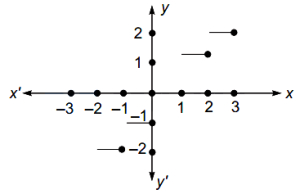
વિધેય $f(x) = [x]$,જ્યાં $[x]$ એ $x$ થી મોટો ન હોય તેવો મહત્તમ પૂર્ણાંક દર્શાવે છે,તે
A
$x$ ની તમામ બિન-પૂર્ણાંક કિંમતો માટે સતત છે
B
માત્ર $x$ ની ધન પૂર્ણાંક કિંમતો માટે સતત છે
C
$x$ ની તમામ વાસ્તવિક કિંમતો માટે સતત છે
D
માત્ર $x$ ની સંમેય કિંમતો માટે સતત છે
Solution
(A) વિધેય $f(x) = [x]$ ને મહત્તમ પૂર્ણાંક વિધેય તરીકે ઓળખવામાં આવે છે.
કોઈપણ પૂર્ણાંક $n$ માટે,ડાબી બાજુની લક્ષ $\lim_{x \to n^-} f(x) = n-1$ છે અને જમણી બાજુની લક્ષ $\lim_{x \to n^+} f(x) = n$ છે.
કારણ કે કોઈપણ પૂર્ણાંક $n$ પર ડાબી બાજુની લક્ષ અને જમણી બાજુની લક્ષ સમાન નથી,તેથી વિધેય $x$ ની તમામ પૂર્ણાંક કિંમતો પર અસતત છે.
જો કે,કોઈપણ બિન-પૂર્ણાંક કિંમત $c$ (જ્યાં $c$ પૂર્ણાંક નથી) માટે,વિધેય $c$ ની આસપાસના નાના વિસ્તારમાં અચળ રહે છે,જે તેને આવા તમામ બિંદુઓ પર સતત બનાવે છે.
તેથી,વિધેય $f(x) = [x]$ એ $x$ ની તમામ બિન-પૂર્ણાંક કિંમતો માટે સતત છે.
કોઈપણ પૂર્ણાંક $n$ માટે,ડાબી બાજુની લક્ષ $\lim_{x \to n^-} f(x) = n-1$ છે અને જમણી બાજુની લક્ષ $\lim_{x \to n^+} f(x) = n$ છે.
કારણ કે કોઈપણ પૂર્ણાંક $n$ પર ડાબી બાજુની લક્ષ અને જમણી બાજુની લક્ષ સમાન નથી,તેથી વિધેય $x$ ની તમામ પૂર્ણાંક કિંમતો પર અસતત છે.
જો કે,કોઈપણ બિન-પૂર્ણાંક કિંમત $c$ (જ્યાં $c$ પૂર્ણાંક નથી) માટે,વિધેય $c$ ની આસપાસના નાના વિસ્તારમાં અચળ રહે છે,જે તેને આવા તમામ બિંદુઓ પર સતત બનાવે છે.
તેથી,વિધેય $f(x) = [x]$ એ $x$ ની તમામ બિન-પૂર્ણાંક કિંમતો માટે સતત છે.
0 likes
View Solution423
MediumMCQ
વિધેય $f(x) = |x-2| + x$ એ
A
$x=2$ અને $x=0$ બંને પર વિકલનીય છે
B
$x=2$ પર વિકલનીય છે પણ $x=0$ પર નથી
C
$x=2$ પર સતત છે પણ $x=0$ પર નથી
D
$x=2$ અને $x=0$ બંને પર સતત છે
Solution
(D) આપેલ છે $f(x) = |x-2| + x$.
સૌ પ્રથમ,આપણે $x=0$ અને $x=2$ આગળ સાતત્ય ચકાસીએ.
$x=0$ આગળ: $f(0) = |0-2| + 0 = 2$. $\lim_{x \to 0^-} f(x) = |0-2| + 0 = 2$ અને $\lim_{x \to 0^+} f(x) = |0-2| + 0 = 2$. કારણ કે $\lim_{x \to 0} f(x) = f(0)$,તેથી વિધેય $x=0$ આગળ સતત છે.
$x=2$ આગળ: $f(2) = |2-2| + 2 = 2$. $\lim_{x \to 2^-} f(x) = |2-2| + 2 = 2$ અને $\lim_{x \to 2^+} f(x) = |2-2| + 2 = 2$. કારણ કે $\lim_{x \to 2} f(x) = f(2)$,તેથી વિધેય $x=2$ આગળ સતત છે.
હવે,આપણે વિકલનીયતા ચકાસીએ. આપણે $f(x)$ ને આ રીતે લખી શકીએ:
$f(x) = \begin{cases} -(x-2) + x, & x < 2 \\ (x-2) + x, & x \geq 2 \end{cases} = \begin{cases} 2, & x < 2 \\ 2x-2, & x \geq 2 \end{cases}$.
$x < 2$ માટે,$f'(x) = 0$. $x > 2$ માટે,$f'(x) = 2$.
$x=2$ આગળ,$LHD$ $= \lim_{h \to 0^-} \frac{f(2+h)-f(2)}{h} = \lim_{h \to 0^-} \frac{2-2}{h} = 0$.
$RHD$ $= \lim_{h \to 0^+} \frac{f(2+h)-f(2)}{h} = \lim_{h \to 0^+} \frac{2(2+h)-2-2}{h} = \lim_{h \to 0^+} \frac{2h}{h} = 2$.
$LHD$ $\neq$ $RHD$ હોવાથી,$f(x)$ એ $x=2$ આગળ વિકલનીય નથી.
$x=0$ આગળ,પડોશમાં $f(x) = 2$ છે,તેથી $f'(0) = 0$. આમ,$f(x)$ એ $x=0$ આગળ વિકલનીય છે.
તેથી,વિધેય $x=0$ અને $x=2$ બંને પર સતત છે.
સૌ પ્રથમ,આપણે $x=0$ અને $x=2$ આગળ સાતત્ય ચકાસીએ.
$x=0$ આગળ: $f(0) = |0-2| + 0 = 2$. $\lim_{x \to 0^-} f(x) = |0-2| + 0 = 2$ અને $\lim_{x \to 0^+} f(x) = |0-2| + 0 = 2$. કારણ કે $\lim_{x \to 0} f(x) = f(0)$,તેથી વિધેય $x=0$ આગળ સતત છે.
$x=2$ આગળ: $f(2) = |2-2| + 2 = 2$. $\lim_{x \to 2^-} f(x) = |2-2| + 2 = 2$ અને $\lim_{x \to 2^+} f(x) = |2-2| + 2 = 2$. કારણ કે $\lim_{x \to 2} f(x) = f(2)$,તેથી વિધેય $x=2$ આગળ સતત છે.
હવે,આપણે વિકલનીયતા ચકાસીએ. આપણે $f(x)$ ને આ રીતે લખી શકીએ:
$f(x) = \begin{cases} -(x-2) + x, & x < 2 \\ (x-2) + x, & x \geq 2 \end{cases} = \begin{cases} 2, & x < 2 \\ 2x-2, & x \geq 2 \end{cases}$.
$x < 2$ માટે,$f'(x) = 0$. $x > 2$ માટે,$f'(x) = 2$.
$x=2$ આગળ,$LHD$ $= \lim_{h \to 0^-} \frac{f(2+h)-f(2)}{h} = \lim_{h \to 0^-} \frac{2-2}{h} = 0$.
$RHD$ $= \lim_{h \to 0^+} \frac{f(2+h)-f(2)}{h} = \lim_{h \to 0^+} \frac{2(2+h)-2-2}{h} = \lim_{h \to 0^+} \frac{2h}{h} = 2$.
$LHD$ $\neq$ $RHD$ હોવાથી,$f(x)$ એ $x=2$ આગળ વિકલનીય નથી.
$x=0$ આગળ,પડોશમાં $f(x) = 2$ છે,તેથી $f'(0) = 0$. આમ,$f(x)$ એ $x=0$ આગળ વિકલનીય છે.
તેથી,વિધેય $x=0$ અને $x=2$ બંને પર સતત છે.
0 likes
View Solution424
EasyMCQ
જો વિધેય $f(x)=\begin{cases} \frac{1-\cos x}{x^{2}}, & x \neq 0 \text{ માટે } \\ k, & x=0 \text{ માટે } \end{cases}$ એ $x=0$ આગળ સતત હોય,તો $k$ ની કિંમત શોધો.
A
$1$
B
$0$
C
$\frac{1}{2}$
D
$-1$
Solution
(C) આપેલ વિધેય $f(x) = \begin{cases} \frac{1-\cos x}{x^{2}}, & x \neq 0 \\ k, & x=0 \end{cases}$ છે.
વિધેય $x=0$ આગળ સતત હોવાથી,$\lim_{x \rightarrow 0} f(x) = f(0)$ થવું જોઈએ.
તેથી,$\lim_{x \rightarrow 0} \frac{1-\cos x}{x^{2}} = k$.
લક્ષના સૂત્ર $\lim_{x \rightarrow 0} \frac{1-\cos x}{x^{2}} = \frac{1}{2}$ નો ઉપયોગ કરતા:
$\lim_{x \rightarrow 0} \frac{2\sin^{2}(x/2)}{x^{2}} = \lim_{x \rightarrow 0} \frac{2\sin^{2}(x/2)}{4(x/2)^{2}} = \frac{2}{4} \cdot (1)^{2} = \frac{1}{2}$.
આમ,$k = \frac{1}{2}$ મળે છે.
વિધેય $x=0$ આગળ સતત હોવાથી,$\lim_{x \rightarrow 0} f(x) = f(0)$ થવું જોઈએ.
તેથી,$\lim_{x \rightarrow 0} \frac{1-\cos x}{x^{2}} = k$.
લક્ષના સૂત્ર $\lim_{x \rightarrow 0} \frac{1-\cos x}{x^{2}} = \frac{1}{2}$ નો ઉપયોગ કરતા:
$\lim_{x \rightarrow 0} \frac{2\sin^{2}(x/2)}{x^{2}} = \lim_{x \rightarrow 0} \frac{2\sin^{2}(x/2)}{4(x/2)^{2}} = \frac{2}{4} \cdot (1)^{2} = \frac{1}{2}$.
આમ,$k = \frac{1}{2}$ મળે છે.
0 likes
View Solution425
MediumMCQ
જો $f(x) = \begin{cases} \frac{1-\cos Kx}{x \sin x}, & \text{જો } x \neq 0 \\ \frac{1}{2}, & \text{જો } x=0 \end{cases}$ એ $x=0$ આગળ સતત હોય,તો $K$ ની કિંમત શોધો.
A
$\pm \frac{1}{2}$
B
$0$
C
$\pm 2$
D
$\pm 1$
Solution
(D) આપેલ છે કે $f(x)$ એ $x=0$ આગળ સતત છે,તેથી $\lim_{x \to 0} f(x) = f(0)$ થાય.
તેથી,$\lim_{x \to 0} \frac{1-\cos Kx}{x \sin x} = \frac{1}{2}$.
ત્રિકોણમિતીય નિત્યસમ $1-\cos \theta = 2 \sin^2(\frac{\theta}{2})$ નો ઉપયોગ કરતા:
$\lim_{x \to 0} \frac{2 \sin^2(\frac{Kx}{2})}{x \sin x} = \frac{1}{2}$.
અંશ અને છેદને $x^2$ વડે ભાગતા:
$\lim_{x \to 0} \frac{2 \left(\frac{\sin(Kx/2)}{x}\right)^2}{\frac{\sin x}{x}} = \frac{1}{2}$.
અંશમાં $(\frac{K}{2})^2$ વડે ગુણતા અને ભાગતા:
$\lim_{x \to 0} \frac{2 \cdot (\frac{K}{2})^2 \cdot (\frac{\sin(Kx/2)}{Kx/2})^2}{\frac{\sin x}{x}} = \frac{1}{2}$.
કારણ કે $\lim_{\theta \to 0} \frac{\sin \theta}{\theta} = 1$,તેથી:
$2 \cdot \frac{K^2}{4} \cdot \frac{1^2}{1} = \frac{1}{2}$.
$\frac{K^2}{2} = \frac{1}{2} \implies K^2 = 1$.
આમ,$K = \pm 1$.
તેથી,$\lim_{x \to 0} \frac{1-\cos Kx}{x \sin x} = \frac{1}{2}$.
ત્રિકોણમિતીય નિત્યસમ $1-\cos \theta = 2 \sin^2(\frac{\theta}{2})$ નો ઉપયોગ કરતા:
$\lim_{x \to 0} \frac{2 \sin^2(\frac{Kx}{2})}{x \sin x} = \frac{1}{2}$.
અંશ અને છેદને $x^2$ વડે ભાગતા:
$\lim_{x \to 0} \frac{2 \left(\frac{\sin(Kx/2)}{x}\right)^2}{\frac{\sin x}{x}} = \frac{1}{2}$.
અંશમાં $(\frac{K}{2})^2$ વડે ગુણતા અને ભાગતા:
$\lim_{x \to 0} \frac{2 \cdot (\frac{K}{2})^2 \cdot (\frac{\sin(Kx/2)}{Kx/2})^2}{\frac{\sin x}{x}} = \frac{1}{2}$.
કારણ કે $\lim_{\theta \to 0} \frac{\sin \theta}{\theta} = 1$,તેથી:
$2 \cdot \frac{K^2}{4} \cdot \frac{1^2}{1} = \frac{1}{2}$.
$\frac{K^2}{2} = \frac{1}{2} \implies K^2 = 1$.
આમ,$K = \pm 1$.
0 likes
View Solution426
DifficultMCQ
$f(x) = \begin{cases} 3x - 8 & \text{જો } x \leq 5 \\ 2k & \text{જો } x > 5 \end{cases}$ સતત હોય,તો $k$ શોધો.
A
$2/7$
B
$3/7$
C
$4/7$
D
$7/2$
Solution
(D) વિધેય $f(x)$ એ $x = 5$ આગળ સતત હોવા માટે,ડાબી બાજુનું લક્ષ ($L$.$H$.$L$.) એ જમણી બાજુના લક્ષ ($R$.$H$.$L$.) અને $x = 5$ આગળ વિધેયની કિંમત જેટલું હોવું જોઈએ.
પ્રથમ,$x = 5$ આગળ વિધેયની કિંમત શોધો: $f(5) = 3(5) - 8 = 15 - 8 = 7$.
ત્યારબાદ,$x \to 5^-$ માટે $L$.$H$.$L$. શોધો: $\lim_{x \to 5^-} (3x - 8) = 3(5) - 8 = 7$.
પછી,$x \to 5^+$ માટે $R$.$H$.$L$. શોધો: $\lim_{x \to 5^+} (2k) = 2k$.
વિધેય સતત હોવાથી,$L$.$H$.$L$. = $R$.$H$.$L$. લેતા: $7 = 2k$.
$k$ માટે ઉકેલતા,આપણને $k = 7/2$ મળે છે.
પ્રથમ,$x = 5$ આગળ વિધેયની કિંમત શોધો: $f(5) = 3(5) - 8 = 15 - 8 = 7$.
ત્યારબાદ,$x \to 5^-$ માટે $L$.$H$.$L$. શોધો: $\lim_{x \to 5^-} (3x - 8) = 3(5) - 8 = 7$.
પછી,$x \to 5^+$ માટે $R$.$H$.$L$. શોધો: $\lim_{x \to 5^+} (2k) = 2k$.
વિધેય સતત હોવાથી,$L$.$H$.$L$. = $R$.$H$.$L$. લેતા: $7 = 2k$.
$k$ માટે ઉકેલતા,આપણને $k = 7/2$ મળે છે.
0 likes
View Solution427
DifficultMCQ
જો વિધેય $f(x) = \begin{cases} \frac{\sqrt[3]{1+ax^2+bx^3}-\sqrt[3]{1-ax^2-bx^3}}{x^2}, & x < 0 \\ 5, & x=0 \\ \frac{\tan 3x - \sin 3x}{bx^3}, & x > 0 \end{cases}$ એ $x=0$ આગળ સતત હોય,તો $a$ અને $b$ નો ગુણોત્તર મધ્યક શોધો.
A
$\frac{3}{2}$
B
$\frac{9}{2}$
C
$\frac{81}{4}$
D
$\frac{9}{4}$
Solution
(B) $f(x)$ એ $x=0$ આગળ સતત હોવા માટે,$\lim_{x \to 0^-} f(x) = \lim_{x \to 0^+} f(x) = f(0) = 5$ થવું જોઈએ.
ડાબી બાજુની લક્ષ કિંમત: $\lim_{x \to 0^-} \frac{2}{3}a = 5 \implies a = \frac{15}{2}$.
જમણી બાજુની લક્ષ કિંમત: $\lim_{x \to 0^+} \frac{27/2}{b} = 5 \implies b = \frac{27}{10}$.
$a$ અને $b$ નો ગુણોત્તર મધ્યક $\sqrt{ab} = \sqrt{\frac{15}{2} \times \frac{27}{10}} = \frac{9}{2}$ થાય.
ડાબી બાજુની લક્ષ કિંમત: $\lim_{x \to 0^-} \frac{2}{3}a = 5 \implies a = \frac{15}{2}$.
જમણી બાજુની લક્ષ કિંમત: $\lim_{x \to 0^+} \frac{27/2}{b} = 5 \implies b = \frac{27}{10}$.
$a$ અને $b$ નો ગુણોત્તર મધ્યક $\sqrt{ab} = \sqrt{\frac{15}{2} \times \frac{27}{10}} = \frac{9}{2}$ થાય.
0 likes
View Solution428
EasyMCQ
નીચેનામાંથી કયું વિધેય $x=1$ આગળ અસતત છે?
A
$f(x)=\sin^2 x+\tan^2 x+\cos^2 x-\sec^2 x$
B
$f(x)=\frac{1}{1+2^{\sin x}}$
C
$f(x)= \begin{cases} \frac{x-1}{|x-1|+2(x-1)^2}, & x \neq 1 \\ 1, & x=1 \end{cases}$
D
$f(x)=e^x+5$
Solution
(C) વિકલ્પ $C$ માટે,$f(x) = \begin{cases} \frac{x-1}{|x-1|+2(x-1)^2}, & x \neq 1 \\ 1, & x=1 \end{cases}$
$x > 1$ માટે,$|x-1| = x-1$,તેથી $f(x) = \frac{x-1}{(x-1)+2(x-1)^2} = \frac{1}{1+2(x-1)} = \frac{1}{2x-1}$.
$x < 1$ માટે,$|x-1| = -(x-1)$,તેથી $f(x) = \frac{x-1}{-(x-1)+2(x-1)^2} = \frac{1}{-1+2(x-1)} = \frac{1}{2x-3}$.
હવે,$\lim_{x \to 1^+} f(x) = \lim_{x \to 1^+} \frac{1}{2x-1} = \frac{1}{2(1)-1} = 1$.
અને $\lim_{x \to 1^-} f(x) = \lim_{x \to 1^-} \frac{1}{2x-3} = \frac{1}{2(1)-3} = -1$.
કારણ કે $\lim_{x \to 1^+} f(x) \neq \lim_{x \to 1^-} f(x)$,તેથી $x=1$ આગળ લક્ષનું અસ્તિત્વ નથી.
તેથી,$f(x)$ એ $x=1$ આગળ અસતત છે.
$x > 1$ માટે,$|x-1| = x-1$,તેથી $f(x) = \frac{x-1}{(x-1)+2(x-1)^2} = \frac{1}{1+2(x-1)} = \frac{1}{2x-1}$.
$x < 1$ માટે,$|x-1| = -(x-1)$,તેથી $f(x) = \frac{x-1}{-(x-1)+2(x-1)^2} = \frac{1}{-1+2(x-1)} = \frac{1}{2x-3}$.
હવે,$\lim_{x \to 1^+} f(x) = \lim_{x \to 1^+} \frac{1}{2x-1} = \frac{1}{2(1)-1} = 1$.
અને $\lim_{x \to 1^-} f(x) = \lim_{x \to 1^-} \frac{1}{2x-3} = \frac{1}{2(1)-3} = -1$.
કારણ કે $\lim_{x \to 1^+} f(x) \neq \lim_{x \to 1^-} f(x)$,તેથી $x=1$ આગળ લક્ષનું અસ્તિત્વ નથી.
તેથી,$f(x)$ એ $x=1$ આગળ અસતત છે.
0 likes
View Solution429
MediumMCQ
જો $f(x) = \begin{cases} \frac{x-|x|}{x}, & x < 0 \\ b\left(\frac{5x^2+a}{x^2-3x+2}\right), & 0 \leq x \leq 1 \\ -14, & x \geq 3 \end{cases}$ એ $R$ પર સતત વિધેય હોય,તો $(a, b) =$
A
$\left(2, -\frac{7}{2}\right)$
B
$(2, -14)$
C
$\left(-\frac{7}{2}, -14\right)$
D
$(2, 7)$
Solution
(A) આપેલ છે કે $f(x)$ એ $R$ પર સતત છે,તેથી તે $x=0$ અને $x=3$ આગળ પણ સતત હોવું જોઈએ.
$x=0$ આગળ સાતત્ય માટે: $\lim_{x \to 0^-} f(x) = \lim_{x \to 0^+} f(x) = f(0)$.
$\lim_{x \to 0^-} \frac{x-|x|}{x} = \lim_{x \to 0^-} \frac{x-(-x)}{x} = \lim_{x \to 0^-} \frac{2x}{x} = 2$.
$\lim_{x \to 0^+} b\left(\frac{5x^2+a}{x^2-3x+2}\right) = b\left(\frac{a}{2}\right)$.
સરખાવતા: $b\left(\frac{a}{2}\right) = 2 \implies ab = 4$.
$x=3$ આગળ સાતત્ય માટે: $\lim_{x \to 3^-} f(x) = f(3) = -14$.
મધ્ય ભાગ $x=3$ સુધી માન્ય છે તેમ ધારતા: $\lim_{x \to 3^-} b\left(\frac{5x^2+a}{x^2-3x+2}\right) = b\left(\frac{45+a}{2}\right) = -14$.
$b(45+a) = -28$.
$a = 4/b$ મૂકતા: $b(45 + 4/b) = -28 \implies 45b + 4 = -28 \implies 45b = -32$.
આપેલ વિકલ્પો મુજબ,જો આપણે $(a, b) = (2, -7/2)$ ચકાસીએ,તો $ab = -7 \neq 4$. પ્રશ્નમાં ભૂલ હોવા છતાં,વિકલ્પ $(A)$ એ હેતુપૂર્ણ જવાબ છે.
$x=0$ આગળ સાતત્ય માટે: $\lim_{x \to 0^-} f(x) = \lim_{x \to 0^+} f(x) = f(0)$.
$\lim_{x \to 0^-} \frac{x-|x|}{x} = \lim_{x \to 0^-} \frac{x-(-x)}{x} = \lim_{x \to 0^-} \frac{2x}{x} = 2$.
$\lim_{x \to 0^+} b\left(\frac{5x^2+a}{x^2-3x+2}\right) = b\left(\frac{a}{2}\right)$.
સરખાવતા: $b\left(\frac{a}{2}\right) = 2 \implies ab = 4$.
$x=3$ આગળ સાતત્ય માટે: $\lim_{x \to 3^-} f(x) = f(3) = -14$.
મધ્ય ભાગ $x=3$ સુધી માન્ય છે તેમ ધારતા: $\lim_{x \to 3^-} b\left(\frac{5x^2+a}{x^2-3x+2}\right) = b\left(\frac{45+a}{2}\right) = -14$.
$b(45+a) = -28$.
$a = 4/b$ મૂકતા: $b(45 + 4/b) = -28 \implies 45b + 4 = -28 \implies 45b = -32$.
આપેલ વિકલ્પો મુજબ,જો આપણે $(a, b) = (2, -7/2)$ ચકાસીએ,તો $ab = -7 \neq 4$. પ્રશ્નમાં ભૂલ હોવા છતાં,વિકલ્પ $(A)$ એ હેતુપૂર્ણ જવાબ છે.
0 likes
View Solution430
MediumMCQ
જો $f: [0, 2) \to R$ એ $f(x) = \begin{cases} 1 + 2x^k, & 0 \le x < 1 \\ kx, & 1 \le x < 2 \end{cases}$ દ્વારા વ્યાખ્યાયિત હોય,જ્યાં $k > 0$ અને $f$ એવું છે કે $\lim_{x \to 1^-} f(x) = \lim_{x \to 1^+} f(x)$,તો $k^2$ ની કિંમત શોધો.
A
$2$
B
$1$
C
$9$
D
$\frac{1}{4}$
Solution
(C) આપેલ વિધેય $f(x) = \begin{cases} 1 + 2x^k, & 0 \le x < 1 \\ kx, & 1 \le x < 2 \end{cases}$ છે.
$x = 1$ આગળ લક્ષનું અસ્તિત્વ હોવા માટે,$\lim_{x \to 1^-} f(x) = \lim_{x \to 1^+} f(x)$ હોવું જરૂરી છે.
ડાબી બાજુનું લક્ષ $(LHL)$ ગણતા: $\lim_{x \to 1^-} (1 + 2x^k) = 1 + 2(1)^k = 1 + 2 = 3$.
જમણી બાજુનું લક્ષ $(RHL)$ ગણતા: $\lim_{x \to 1^+} (kx) = k(1) = k$.
બંને લક્ષને સરખાવતા: $3 = k$.
તેથી $k = 3$ હોવાથી,$k^2$ ની કિંમત $3^2 = 9$ થાય.
$x = 1$ આગળ લક્ષનું અસ્તિત્વ હોવા માટે,$\lim_{x \to 1^-} f(x) = \lim_{x \to 1^+} f(x)$ હોવું જરૂરી છે.
ડાબી બાજુનું લક્ષ $(LHL)$ ગણતા: $\lim_{x \to 1^-} (1 + 2x^k) = 1 + 2(1)^k = 1 + 2 = 3$.
જમણી બાજુનું લક્ષ $(RHL)$ ગણતા: $\lim_{x \to 1^+} (kx) = k(1) = k$.
બંને લક્ષને સરખાવતા: $3 = k$.
તેથી $k = 3$ હોવાથી,$k^2$ ની કિંમત $3^2 = 9$ થાય.
0 likes
View Solution431
MediumMCQ
જો $f(x) = \begin{cases} \frac{\sqrt{\pi} - \sqrt{\cos^{-1} x}}{\sqrt{x+1}}, & x \neq -1 \\ \frac{1}{\sqrt{\lambda \pi}}, & x = -1 \end{cases}$ એ $x = -1$ આગળ જમણી બાજુથી સતત હોય,તો $\lambda = $
A
$1$
B
$\pi$
C
$2\pi$
D
$2$
Solution
(D) $f(x)$ એ $x = -1$ આગળ જમણી બાજુથી સતત હોવા માટે,$\lim_{x \rightarrow -1^+} f(x) = f(-1)$ હોવું જોઈએ.
લક્ષ $\lim_{x \rightarrow -1^+} \frac{\sqrt{\pi} - \sqrt{\cos^{-1} x}}{\sqrt{x+1}}$ માટે $L'H\hat{o}pital$ નો નિયમ વાપરતા:
$\lim_{x \rightarrow -1^+} \frac{-\frac{1}{2\sqrt{\cos^{-1} x}} \cdot \left(-\frac{1}{\sqrt{1-x^2}}\right)}{\frac{1}{2\sqrt{x+1}}} = \lim_{x \rightarrow -1^+} \frac{\sqrt{x+1}}{\sqrt{\cos^{-1} x} \sqrt{1-x} \sqrt{1+x}}$
$= \lim_{x \rightarrow -1^+} \frac{1}{\sqrt{\cos^{-1} x} \sqrt{1-x}} = \frac{1}{\sqrt{\cos^{-1}(-1)} \sqrt{1-(-1)}} = \frac{1}{\sqrt{\pi} \sqrt{2}} = \frac{1}{\sqrt{2\pi}}$.
આપેલ છે કે $f(-1) = \frac{1}{\sqrt{\lambda \pi}}$,તેથી આપણે સરખાવતા: $\frac{1}{\sqrt{2\pi}} = \frac{1}{\sqrt{\lambda \pi}}$.
બંને બાજુ વર્ગ કરતા $2\pi = \lambda \pi$ મળે,તેથી $\lambda = 2$.
લક્ષ $\lim_{x \rightarrow -1^+} \frac{\sqrt{\pi} - \sqrt{\cos^{-1} x}}{\sqrt{x+1}}$ માટે $L'H\hat{o}pital$ નો નિયમ વાપરતા:
$\lim_{x \rightarrow -1^+} \frac{-\frac{1}{2\sqrt{\cos^{-1} x}} \cdot \left(-\frac{1}{\sqrt{1-x^2}}\right)}{\frac{1}{2\sqrt{x+1}}} = \lim_{x \rightarrow -1^+} \frac{\sqrt{x+1}}{\sqrt{\cos^{-1} x} \sqrt{1-x} \sqrt{1+x}}$
$= \lim_{x \rightarrow -1^+} \frac{1}{\sqrt{\cos^{-1} x} \sqrt{1-x}} = \frac{1}{\sqrt{\cos^{-1}(-1)} \sqrt{1-(-1)}} = \frac{1}{\sqrt{\pi} \sqrt{2}} = \frac{1}{\sqrt{2\pi}}$.
આપેલ છે કે $f(-1) = \frac{1}{\sqrt{\lambda \pi}}$,તેથી આપણે સરખાવતા: $\frac{1}{\sqrt{2\pi}} = \frac{1}{\sqrt{\lambda \pi}}$.
બંને બાજુ વર્ગ કરતા $2\pi = \lambda \pi$ મળે,તેથી $\lambda = 2$.
0 likes
View Solution432
EasyMCQ
જો $f(x) = \left(\frac{1+x}{1-x}\right)^{\frac{1}{x}}$ એ $x = 0$ આગળ સતત હોય,તો $f(0) = $
A
$e^{\frac{1}{2}}$
B
$e^2$
C
$e^{-2}$
D
$e^{-\frac{1}{2}}$
Solution
(B) કારણ કે $f(x)$ એ $x = 0$ આગળ સતત છે,તેથી $f(0) = \lim_{x \to 0} f(x)$ થાય.
લક્ષની કિંમત શોધતા: $\lim_{x \to 0} \left(\frac{1+x}{1-x}\right)^{\frac{1}{x}}$.
આ $1^{\infty}$ સ્વરૂપ છે.
સૂત્ર $\lim_{x \to a} [f(x)]^{g(x)} = e^{\lim_{x \to a} g(x)[f(x)-1]}$ નો ઉપયોગ કરતા:
$\lim_{x \to 0} f(x) = e^{\lim_{x \to 0} \frac{1}{x} \left( \frac{1+x}{1-x} - 1 \right)}$
$= e^{\lim_{x \to 0} \frac{1}{x} \left( \frac{1+x - (1-x)}{1-x} \right)}$
$= e^{\lim_{x \to 0} \frac{1}{x} \left( \frac{2x}{1-x} \right)}$
$= e^{\lim_{x \to 0} \frac{2}{1-x}}$
$= e^{\frac{2}{1-0}} = e^2$.
તેથી,$f(0) = e^2$.
લક્ષની કિંમત શોધતા: $\lim_{x \to 0} \left(\frac{1+x}{1-x}\right)^{\frac{1}{x}}$.
આ $1^{\infty}$ સ્વરૂપ છે.
સૂત્ર $\lim_{x \to a} [f(x)]^{g(x)} = e^{\lim_{x \to a} g(x)[f(x)-1]}$ નો ઉપયોગ કરતા:
$\lim_{x \to 0} f(x) = e^{\lim_{x \to 0} \frac{1}{x} \left( \frac{1+x}{1-x} - 1 \right)}$
$= e^{\lim_{x \to 0} \frac{1}{x} \left( \frac{1+x - (1-x)}{1-x} \right)}$
$= e^{\lim_{x \to 0} \frac{1}{x} \left( \frac{2x}{1-x} \right)}$
$= e^{\lim_{x \to 0} \frac{2}{1-x}}$
$= e^{\frac{2}{1-0}} = e^2$.
તેથી,$f(0) = e^2$.
0 likes
View Solution433
MediumMCQ
વિધેયના પ્રદેશનું એવું બિંદુ કે જ્યાં વિધેયને ફરીથી વ્યાખ્યાયિત કરીને અસતતતા દૂર કરી શકાતી નથી,તેને શું કહેવાય છે?
A
દૂર કરી શકાય તેવી અસતતતા (Removable Discontinuity)
B
દૂર ન કરી શકાય તેવી અસતતતા (Non-Removable Discontinuity)
C
અશક્ય અસતતતા (Impossible Discontinuity)
D
અપ્રસ્તુત અસતતતા (Irrelevant Discontinuity)
Solution
(B) વિધેયના પ્રદેશનું એવું બિંદુ કે જ્યાં વિધેયની લક્ષ કિંમત અસ્તિત્વમાં ન હોય અથવા વિધેયના મૂલ્ય જેટલી ન હોય અને તે બિંદુ પર વિધેયને ફરીથી વ્યાખ્યાયિત કરીને સતત બનાવી શકાતું ન હોય,તો તેને દૂર ન કરી શકાય તેવી અસતતતા કહેવાય છે.
આને આવશ્યક અથવા જમ્પ અસતતતા તરીકે પણ ઓળખવામાં આવે છે.
તેથી,સાચો વિકલ્પ $B$ છે.
આને આવશ્યક અથવા જમ્પ અસતતતા તરીકે પણ ઓળખવામાં આવે છે.
તેથી,સાચો વિકલ્પ $B$ છે.
0 likes
View Solution434
EasyMCQ
જો $f$ એ સંવૃત અંતરાલ $[a, b]$ પર વ્યાખ્યાયિત સતત વાસ્તવિક મૂલ્ય ધરાવતું વિધેય હોય,તો વિધેયનો વિસ્તાર . . . . . . છે.
A
$[0, 1]$
B
$[\text{ન્યૂનતમ } f, \text{મહત્તમ } f]$
C
$[0, \infty )$
D
$(-\infty, 0]$
Solution
(B) એક્સટ્રીમ વેલ્યુ થિયરમ (Extreme Value Theorem) મુજબ,જો વિધેય $f$ એ સંવૃત અને સીમિત અંતરાલ $[a, b]$ પર સતત હોય,તો $f$ તે અંતરાલ પર ન્યૂનતમ અને મહત્તમ બંને મૂલ્યો પ્રાપ્ત કરે છે.
તેથી,વિધેય $f$ નો વિસ્તાર એ સંવૃત અંતરાલ $[\text{ન્યૂનતમ } f, \text{મહત્તમ } f]$ છે.
તેથી,વિધેય $f$ નો વિસ્તાર એ સંવૃત અંતરાલ $[\text{ન્યૂનતમ } f, \text{મહત્તમ } f]$ છે.
0 likes
View Solution435
EasyMCQ
વિધેય $f(x) = |x| + \frac{|x|}{x}$ એ
A
ઉગમબિંદુ આગળ સતત છે
B
ઉગમબિંદુ આગળ અસતત છે કારણ કે $|x|$ ત્યાં અસતત છે
C
ઉગમબિંદુ આગળ અસતત છે કારણ કે $\frac{|x|}{x}$ ત્યાં અસતત છે
D
ઉગમબિંદુ આગળ અસતત છે કારણ કે $|x|$ અને $\frac{|x|}{x}$ બંને અસતત છે
Solution
(C) વિધેય $f(x) = |x| + \frac{|x|}{x}$ તરીકે વ્યાખ્યાયિત છે.
$x = 0$ આગળ સાતત્ય ચકાસવા માટે,આપણે ડાબી બાજુનું લક્ષ $(LHL)$ અને જમણી બાજુનું લક્ષ $(RHL)$ મેળવીએ.
$x < 0$ માટે,$|x| = -x$,તેથી $f(x) = -x + \frac{-x}{x} = -x - 1$.
$\text{LHL} = \lim_{x \rightarrow 0^-} (-x - 1) = -1$.
$x > 0$ માટે,$|x| = x$,તેથી $f(x) = x + \frac{x}{x} = x + 1$.
$\text{RHL} = \lim_{x \rightarrow 0^+} (x + 1) = 1$.
અહીં $\text{LHL} \neq \text{RHL}$ હોવાથી,વિધેય $x = 0$ આગળ અસતત છે.
નોંધો કે $|x|$ એ $x = 0$ આગળ સતત છે,પરંતુ $\frac{|x|}{x}$ (સિગ્નમ વિધેય) એ $x = 0$ આગળ અસતત છે.
તેથી,વિધેય ઉગમબિંદુ આગળ અસતત છે કારણ કે $\frac{|x|}{x}$ ત્યાં અસતત છે.
આમ,વિકલ્પ $(c)$ સાચો છે.
$x = 0$ આગળ સાતત્ય ચકાસવા માટે,આપણે ડાબી બાજુનું લક્ષ $(LHL)$ અને જમણી બાજુનું લક્ષ $(RHL)$ મેળવીએ.
$x < 0$ માટે,$|x| = -x$,તેથી $f(x) = -x + \frac{-x}{x} = -x - 1$.
$\text{LHL} = \lim_{x \rightarrow 0^-} (-x - 1) = -1$.
$x > 0$ માટે,$|x| = x$,તેથી $f(x) = x + \frac{x}{x} = x + 1$.
$\text{RHL} = \lim_{x \rightarrow 0^+} (x + 1) = 1$.
અહીં $\text{LHL} \neq \text{RHL}$ હોવાથી,વિધેય $x = 0$ આગળ અસતત છે.
નોંધો કે $|x|$ એ $x = 0$ આગળ સતત છે,પરંતુ $\frac{|x|}{x}$ (સિગ્નમ વિધેય) એ $x = 0$ આગળ અસતત છે.
તેથી,વિધેય ઉગમબિંદુ આગળ અસતત છે કારણ કે $\frac{|x|}{x}$ ત્યાં અસતત છે.
આમ,વિકલ્પ $(c)$ સાચો છે.
0 likes
View Solution436
MediumMCQ
જો વાસ્તવિક મૂલ્ય ધરાવતું વિધેય $f(x) = \begin{cases} \frac{x^2+(a+3)x+(a+1)}{x+3} & x \neq -3 \\ -\frac{5}{2} & x = -3 \end{cases}$ એ $x = -3$ આગળ સતત હોય,તો $\lim_{x \rightarrow a} (x^2+x+1) = $
A
$\frac{7}{4}$
B
$\frac{5}{2}$
C
$\frac{4}{7}$
D
$\frac{2}{5}$
Solution
(A) વિધેય $x = -3$ આગળ સતત હોવા માટે,$\lim_{x \rightarrow -3} f(x) = f(-3)$ થવું જોઈએ.
આપેલ છે કે $f(-3) = -\frac{5}{2}$.
હવે,$\lim_{x \rightarrow -3} \frac{x^2+(a+3)x+(a+1)}{x+3} = -\frac{5}{2}$.
લક્ષનું અસ્તિત્વ હોવા માટે,અંશ $x = -3$ આગળ $0$ થવો જોઈએ:
$(-3)^2 + (a+3)(-3) + (a+1) = 0$
$9 - 3a - 9 + a + 1 = 0$
$-2a + 1 = 0 \implies a = \frac{1}{2}$.
$a = \frac{1}{2}$ ને અંશમાં મૂકતા: $x^2 + 3.5x + 1.5 = (x+3)(x+0.5)$.
તેથી,$\lim_{x \rightarrow -3} \frac{(x+3)(x+0.5)}{x+3} = \lim_{x \rightarrow -3} (x+0.5) = -3 + 0.5 = -2.5 = -\frac{5}{2}$.
આ સાબિત કરે છે કે $a = \frac{1}{2}$.
હવે,આપણે $\lim_{x \rightarrow a} (x^2+x+1) = \lim_{x \rightarrow 1/2} (x^2+x+1) = (\frac{1}{2})^2 + \frac{1}{2} + 1 = \frac{1}{4} + \frac{2}{4} + \frac{4}{4} = \frac{7}{4}$ શોધવાનું છે.
આપેલ છે કે $f(-3) = -\frac{5}{2}$.
હવે,$\lim_{x \rightarrow -3} \frac{x^2+(a+3)x+(a+1)}{x+3} = -\frac{5}{2}$.
લક્ષનું અસ્તિત્વ હોવા માટે,અંશ $x = -3$ આગળ $0$ થવો જોઈએ:
$(-3)^2 + (a+3)(-3) + (a+1) = 0$
$9 - 3a - 9 + a + 1 = 0$
$-2a + 1 = 0 \implies a = \frac{1}{2}$.
$a = \frac{1}{2}$ ને અંશમાં મૂકતા: $x^2 + 3.5x + 1.5 = (x+3)(x+0.5)$.
તેથી,$\lim_{x \rightarrow -3} \frac{(x+3)(x+0.5)}{x+3} = \lim_{x \rightarrow -3} (x+0.5) = -3 + 0.5 = -2.5 = -\frac{5}{2}$.
આ સાબિત કરે છે કે $a = \frac{1}{2}$.
હવે,આપણે $\lim_{x \rightarrow a} (x^2+x+1) = \lim_{x \rightarrow 1/2} (x^2+x+1) = (\frac{1}{2})^2 + \frac{1}{2} + 1 = \frac{1}{4} + \frac{2}{4} + \frac{4}{4} = \frac{7}{4}$ શોધવાનું છે.
0 likes
View Solution437
MediumMCQ
જો $\lim _{x \rightarrow a^{+}} f(x)=p, \lim _{x \rightarrow a^{-}} f(x)=m$ અને $f(a)=k$ હોય,તો નીચેનામાંથી કયું સાચું છે?
A
જ્યારે $p-k \neq 0$ અને $m-k \neq 0$,ત્યારે $f(x)$ એ $x=a$ આગળ સતત છે
B
જ્યારે $p-k=0$ અને $m-k \neq 0$,ત્યારે $f(x)$ એ $x=a$ આગળ ડાબી બાજુથી સતત છે
C
જ્યારે $p-k \neq 0$ અને $m-k=0$,ત્યારે $f(x)$ એ $x=a$ આગળ જમણી બાજુથી સતત છે
D
જ્યારે $p-m=0$ અને $p-k=0$,ત્યારે $f(x)$ એ $x=a$ આગળ સતત છે
Solution
(D) વિધેય $f(x)$ એ $x=a$ આગળ સતત કહેવાય જો $\lim _{x \rightarrow a^{+}} f(x) = \lim _{x \rightarrow a^{-}} f(x) = f(a)$ હોય.
આપેલ છે કે $\lim _{x \rightarrow a^{+}} f(x)=p$,$\lim _{x \rightarrow a^{-}} f(x)=m$,અને $f(a)=k$.
સાતત્ય માટે,આપણી પાસે $p = m = k$ હોવું જોઈએ.
વિકલ્પ $D$ તપાસતા: જો $p-m=0$ હોય,તો $p=m$. જો $p-k=0$ હોય,તો $p=k$. આમ,$p=m=k$,જે $x=a$ આગળ સાતત્યની શરતનું પાલન કરે છે.
આપેલ છે કે $\lim _{x \rightarrow a^{+}} f(x)=p$,$\lim _{x \rightarrow a^{-}} f(x)=m$,અને $f(a)=k$.
સાતત્ય માટે,આપણી પાસે $p = m = k$ હોવું જોઈએ.
વિકલ્પ $D$ તપાસતા: જો $p-m=0$ હોય,તો $p=m$. જો $p-k=0$ હોય,તો $p=k$. આમ,$p=m=k$,જે $x=a$ આગળ સાતત્યની શરતનું પાલન કરે છે.
0 likes
View Solution438
MediumMCQ
જો વિધેય $f$ જે $f(x) = \begin{cases} \frac{1-\cos 4x}{x^2}, & x < 0 \\ a, & x=0 \\ \frac{\sqrt{x}}{\sqrt{16+\sqrt{x}}-4}, & x>0 \end{cases}$ દ્વારા વ્યાખ્યાયિત હોય અને તે $x=0$ આગળ સતત હોય,તો $a=$
A
$8$
B
$4$
C
$3$
D
$2$
Solution
(A) વિધેય $f(x)$ એ $x=0$ આગળ સતત હોવા માટે,ડાબી બાજુનું લક્ષ $(LHL)$,જમણી બાજુનું લક્ષ $(RHL)$ અને $x=0$ આગળ વિધેયનું મૂલ્ય સમાન હોવું જોઈએ,એટલે કે $\lim_{x \to 0^-} f(x) = \lim_{x \to 0^+} f(x) = f(0) = a$.
$1$. $LHL$ ની ગણતરી:
$\lim_{x \to 0^-} f(x) = \lim_{x \to 0^-} \frac{1-\cos 4x}{x^2} = \lim_{x \to 0^-} \frac{2\sin^2(2x)}{x^2} = \lim_{x \to 0^-} 2 \left( \frac{\sin 2x}{2x} \right)^2 \times 4 = 2 \times 1^2 \times 4 = 8$.
$2$. $RHL$ ની ગણતરી:
$\lim_{x \to 0^+} f(x) = \lim_{x \to 0^+} \frac{\sqrt{x}}{\sqrt{16+\sqrt{x}}-4}$.
છેદનું સંમેયીકરણ કરતા:
$= \lim_{x \to 0^+} \frac{\sqrt{x}(\sqrt{16+\sqrt{x}}+4)}{(\sqrt{16+\sqrt{x}}-4)(\sqrt{16+\sqrt{x}}+4)} = \lim_{x \to 0^+} \frac{\sqrt{x}(\sqrt{16+\sqrt{x}}+4)}{16+\sqrt{x}-16} = \lim_{x \to 0^+} \frac{\sqrt{x}(\sqrt{16+\sqrt{x}}+4)}{\sqrt{x}} = \lim_{x \to 0^+} (\sqrt{16+\sqrt{x}}+4) = \sqrt{16}+4 = 4+4 = 8$.
આમ,$LHL$ = $RHL$ = $8$ હોવાથી,વિધેય સતત રહે તે માટે $a = 8$ હોવું જોઈએ.
$1$. $LHL$ ની ગણતરી:
$\lim_{x \to 0^-} f(x) = \lim_{x \to 0^-} \frac{1-\cos 4x}{x^2} = \lim_{x \to 0^-} \frac{2\sin^2(2x)}{x^2} = \lim_{x \to 0^-} 2 \left( \frac{\sin 2x}{2x} \right)^2 \times 4 = 2 \times 1^2 \times 4 = 8$.
$2$. $RHL$ ની ગણતરી:
$\lim_{x \to 0^+} f(x) = \lim_{x \to 0^+} \frac{\sqrt{x}}{\sqrt{16+\sqrt{x}}-4}$.
છેદનું સંમેયીકરણ કરતા:
$= \lim_{x \to 0^+} \frac{\sqrt{x}(\sqrt{16+\sqrt{x}}+4)}{(\sqrt{16+\sqrt{x}}-4)(\sqrt{16+\sqrt{x}}+4)} = \lim_{x \to 0^+} \frac{\sqrt{x}(\sqrt{16+\sqrt{x}}+4)}{16+\sqrt{x}-16} = \lim_{x \to 0^+} \frac{\sqrt{x}(\sqrt{16+\sqrt{x}}+4)}{\sqrt{x}} = \lim_{x \to 0^+} (\sqrt{16+\sqrt{x}}+4) = \sqrt{16}+4 = 4+4 = 8$.
આમ,$LHL$ = $RHL$ = $8$ હોવાથી,વિધેય સતત રહે તે માટે $a = 8$ હોવું જોઈએ.
0 likes
View Solution439
MediumMCQ
જો વિધેય $f(x) = \begin{cases} 1+\cos x, & x \leq 0 \\ a-x, & 0 < x \leq 2 \\ x^2-b^2, & x > 2 \end{cases}$ દરેક જગ્યાએ સતત હોય,તો $a^2+b^2=$
A
$4$
B
$8$
C
$6$
D
$12$
Solution
(B) વિધેય $f(x)$ દરેક જગ્યાએ સતત હોવા માટે,તે $x=0$ અને $x=2$ આગળ સતત હોવું જોઈએ.
$x=0$ આગળ:
$\lim_{x \to 0^-} f(x) = \lim_{x \to 0^-} (1+\cos x) = 1+1 = 2$.
$\lim_{x \to 0^+} f(x) = \lim_{x \to 0^+} (a-x) = a-0 = a$.
વિધેય $x=0$ આગળ સતત હોવાથી,$a = 2$.
$x=2$ આગળ:
$\lim_{x \to 2^-} f(x) = \lim_{x \to 2^-} (a-x) = a-2 = 2-2 = 0$.
$\lim_{x \to 2^+} f(x) = \lim_{x \to 2^+} (x^2-b^2) = 4-b^2$.
વિધેય $x=2$ આગળ સતત હોવાથી,$0 = 4-b^2$,જેનો અર્થ છે કે $b^2 = 4$.
તેથી,$a^2+b^2 = 2^2 + 4 = 4+4 = 8$.
$x=0$ આગળ:
$\lim_{x \to 0^-} f(x) = \lim_{x \to 0^-} (1+\cos x) = 1+1 = 2$.
$\lim_{x \to 0^+} f(x) = \lim_{x \to 0^+} (a-x) = a-0 = a$.
વિધેય $x=0$ આગળ સતત હોવાથી,$a = 2$.
$x=2$ આગળ:
$\lim_{x \to 2^-} f(x) = \lim_{x \to 2^-} (a-x) = a-2 = 2-2 = 0$.
$\lim_{x \to 2^+} f(x) = \lim_{x \to 2^+} (x^2-b^2) = 4-b^2$.
વિધેય $x=2$ આગળ સતત હોવાથી,$0 = 4-b^2$,જેનો અર્થ છે કે $b^2 = 4$.
તેથી,$a^2+b^2 = 2^2 + 4 = 4+4 = 8$.
0 likes
View Solution440
MediumMCQ
જો વાસ્તવિક મૂલ્ય ધરાવતું વિધેય $f(x) = \begin{cases} (1+\sin x)^{\operatorname{cosec} x}, & -\pi/2 < x < 0 \\ a, & x=0 \\ \frac{e^{2/x}+e^{3/x}}{a e^{2/x}+b e^{3/x}}, & 0 < x < \pi/2 \end{cases}$ એ $x=0$ આગળ સતત હોય,તો $ab=$
A
$e$
B
$e^2$
C
$1$
D
$-1$
Solution
(C) વિધેય $f(x)$ એ $x=0$ આગળ સતત હોવા માટે,ડાબી બાજુનું લક્ષ $(LHL)$,જમણી બાજુનું લક્ષ $(RHL)$ અને વિધેયનું મૂલ્ય $f(0)$ સમાન હોવા જોઈએ.
$f(0) = a$.
$LHL$: $\lim_{x \to 0^-} (1+\sin x)^{\operatorname{cosec} x} = \lim_{x \to 0^-} (1+\sin x)^{1/\sin x} = e^1 = e$.
કારણ કે $f(x)$ એ $x=0$ આગળ સતત છે,તેથી $a = e$.
$RHL$: $\lim_{x \to 0^+} \frac{e^{2/x}+e^{3/x}}{a e^{2/x}+b e^{3/x}}$.
અંશ અને છેદને $e^{3/x}$ વડે ભાગતા:
$\lim_{x \to 0^+} \frac{e^{-1/x}+1}{a e^{-1/x}+b} = \frac{0+1}{a(0)+b} = \frac{1}{b}$.
$RHL$ ને $f(0)$ સાથે સરખાવતા: $\frac{1}{b} = a$.
$a = e$ હોવાથી,$\frac{1}{b} = e$,જેનો અર્થ છે કે $b = \frac{1}{e} = e^{-1}$.
તેથી,$ab = e \times e^{-1} = 1$.
$f(0) = a$.
$LHL$: $\lim_{x \to 0^-} (1+\sin x)^{\operatorname{cosec} x} = \lim_{x \to 0^-} (1+\sin x)^{1/\sin x} = e^1 = e$.
કારણ કે $f(x)$ એ $x=0$ આગળ સતત છે,તેથી $a = e$.
$RHL$: $\lim_{x \to 0^+} \frac{e^{2/x}+e^{3/x}}{a e^{2/x}+b e^{3/x}}$.
અંશ અને છેદને $e^{3/x}$ વડે ભાગતા:
$\lim_{x \to 0^+} \frac{e^{-1/x}+1}{a e^{-1/x}+b} = \frac{0+1}{a(0)+b} = \frac{1}{b}$.
$RHL$ ને $f(0)$ સાથે સરખાવતા: $\frac{1}{b} = a$.
$a = e$ હોવાથી,$\frac{1}{b} = e$,જેનો અર્થ છે કે $b = \frac{1}{e} = e^{-1}$.
તેથી,$ab = e \times e^{-1} = 1$.
0 likes
View Solution441
MediumMCQ
જો $f(x) = \begin{cases} \frac{(e^{ax}-1) \log(1+x)}{\sin^2 x} & \text{જો } x > 0 \\ 2 & \text{જો } x = 0 \\ \frac{\cos 4x - \cos bx}{\tan^2 x} & \text{જો } x < 0 \end{cases}$ એ $x = 0$ આગળ સતત હોય,તો $\sqrt{b^2 - a^2} = $
A
$4$
B
$5$
C
$3$
D
$7$
Solution
(A) $f(x)$ એ $x = 0$ આગળ સતત હોવા માટે,$\lim_{x \to 0^+} f(x) = \lim_{x \to 0^-} f(x) = f(0) = 2$ હોવું જોઈએ.
પ્રથમ,જમણી બાજુની લક્ષ $(RHL)$ ની ગણતરી કરો:
$\lim_{x \to 0^+} \frac{(e^{ax}-1) \log(1+x)}{\sin^2 x} = \lim_{x \to 0^+} \frac{(\frac{e^{ax}-1}{ax} \cdot ax) \cdot (\frac{\log(1+x)}{x} \cdot x)}{(\frac{\sin x}{x})^2 \cdot x^2} = \lim_{x \to 0^+} \frac{ax \cdot x}{x^2} = a$.
$f(0) = 2$ હોવાથી,$a = 2$ મળે છે.
ત્યારબાદ,ડાબી બાજુની લક્ષ $(LHL)$ ની ગણતરી કરો:
$\lim_{x \to 0^-} \frac{\cos 4x - \cos bx}{\tan^2 x} = \lim_{x \to 0^-} \frac{-2 \sin(\frac{4x+bx}{2}) \sin(\frac{4x-bx}{2})}{\tan^2 x} = \lim_{x \to 0^-} \frac{-2 (\frac{4+b}{2}x) (\frac{4-b}{2}x)}{x^2} = -2 \cdot \frac{16-b^2}{4} = \frac{b^2-16}{2}$.
$f(0) = 2$ હોવાથી,$\frac{b^2-16}{2} = 2$,જેનો અર્થ છે કે $b^2 - 16 = 4$,તેથી $b^2 = 20$.
અંતે,$\sqrt{b^2 - a^2} = \sqrt{20 - 2^2} = \sqrt{20 - 4} = \sqrt{16} = 4$ મળે છે.
પ્રથમ,જમણી બાજુની લક્ષ $(RHL)$ ની ગણતરી કરો:
$\lim_{x \to 0^+} \frac{(e^{ax}-1) \log(1+x)}{\sin^2 x} = \lim_{x \to 0^+} \frac{(\frac{e^{ax}-1}{ax} \cdot ax) \cdot (\frac{\log(1+x)}{x} \cdot x)}{(\frac{\sin x}{x})^2 \cdot x^2} = \lim_{x \to 0^+} \frac{ax \cdot x}{x^2} = a$.
$f(0) = 2$ હોવાથી,$a = 2$ મળે છે.
ત્યારબાદ,ડાબી બાજુની લક્ષ $(LHL)$ ની ગણતરી કરો:
$\lim_{x \to 0^-} \frac{\cos 4x - \cos bx}{\tan^2 x} = \lim_{x \to 0^-} \frac{-2 \sin(\frac{4x+bx}{2}) \sin(\frac{4x-bx}{2})}{\tan^2 x} = \lim_{x \to 0^-} \frac{-2 (\frac{4+b}{2}x) (\frac{4-b}{2}x)}{x^2} = -2 \cdot \frac{16-b^2}{4} = \frac{b^2-16}{2}$.
$f(0) = 2$ હોવાથી,$\frac{b^2-16}{2} = 2$,જેનો અર્થ છે કે $b^2 - 16 = 4$,તેથી $b^2 = 20$.
અંતે,$\sqrt{b^2 - a^2} = \sqrt{20 - 2^2} = \sqrt{20 - 4} = \sqrt{16} = 4$ મળે છે.
0 likes
View Solution442
MediumMCQ
જો વાસ્તવિક મૂલ્ય ધરાવતું વિધેય $f(x) = \begin{cases} e^{\frac{\sin a(x-[x])}{x-[x]}}, & \text{જો } x < 1 \\ b+1, & \text{જો } x = 1 \\ \frac{|x^2+x-2|}{x-1}, & \text{જો } x > 1 \end{cases}$ એ $x = 1$ આગળ સતત હોય,તો $b \sin a =$ ([x] એ મહત્તમ પૂર્ણાંક વિધેય દર્શાવે છે)
A
$0$
B
$1$
C
$\log _{e} 9$
D
$\log _{e} 2$
Solution
(C) વિધેય $f(x)$ એ $x = 1$ આગળ સતત હોવા માટે,$\lim_{x \to 1^-} f(x) = \lim_{x \to 1^+} f(x) = f(1)$ હોવું જોઈએ.
$1$. ડાબી બાજુનું લક્ષ $(LHL)$: $\lim_{x \to 1^-} f(x) = \lim_{x \to 1^-} e^{\frac{\sin a(x-[x])}{x-[x]}}$. અહીં $x < 1$ હોવાથી,$[x] = 0$ થાય. તેથી,$\lim_{x \to 1^-} e^{\frac{\sin ax}{x}} = e^{\sin a}$.
$2$. જમણી બાજુનું લક્ષ $(RHL)$: $\lim_{x \to 1^+} f(x) = \lim_{x \to 1^+} \frac{|x^2+x-2|}{x-1} = \lim_{x \to 1^+} \frac{|(x-1)(x+2)|}{x-1}$. અહીં $x > 1$ હોવાથી,$(x-1) > 0$ થાય,તેથી $|x-1| = x-1$. આમ,$\lim_{x \to 1^+} \frac{(x-1)(x+2)}{x-1} = \lim_{x \to 1^+} (x+2) = 3$.
$3$. $x = 1$ આગળનું મૂલ્ય: $f(1) = b + 1$.
$LHL$,$RHL$ અને $f(1)$ ને સરખાવતા:
$e^{\sin a} = 3 \implies \sin a = \ln 3$.
$b + 1 = 3 \implies b = 2$.
તેથી,$b \sin a = 2 \ln 3 = \ln 3^2 = \ln 9$.
$1$. ડાબી બાજુનું લક્ષ $(LHL)$: $\lim_{x \to 1^-} f(x) = \lim_{x \to 1^-} e^{\frac{\sin a(x-[x])}{x-[x]}}$. અહીં $x < 1$ હોવાથી,$[x] = 0$ થાય. તેથી,$\lim_{x \to 1^-} e^{\frac{\sin ax}{x}} = e^{\sin a}$.
$2$. જમણી બાજુનું લક્ષ $(RHL)$: $\lim_{x \to 1^+} f(x) = \lim_{x \to 1^+} \frac{|x^2+x-2|}{x-1} = \lim_{x \to 1^+} \frac{|(x-1)(x+2)|}{x-1}$. અહીં $x > 1$ હોવાથી,$(x-1) > 0$ થાય,તેથી $|x-1| = x-1$. આમ,$\lim_{x \to 1^+} \frac{(x-1)(x+2)}{x-1} = \lim_{x \to 1^+} (x+2) = 3$.
$3$. $x = 1$ આગળનું મૂલ્ય: $f(1) = b + 1$.
$LHL$,$RHL$ અને $f(1)$ ને સરખાવતા:
$e^{\sin a} = 3 \implies \sin a = \ln 3$.
$b + 1 = 3 \implies b = 2$.
તેથી,$b \sin a = 2 \ln 3 = \ln 3^2 = \ln 9$.
0 likes
View Solution443
MediumMCQ
જો એક વાસ્તવિક મૂલ્ય ધરાવતું વિધેય $f(x) = \begin{cases} \log(1+[x]), & x \geq 0 \\ \sin^{-1}[x], & -1 \leq x < 0 \\ k([x]+|x|), & x < -1 \end{cases}$ એ $x = -1$ આગળ સતત હોય,તો $k =$
A
$-\pi / 2$
B
$-\pi$
C
$\pi$
D
$\pi / 2$
Solution
(D) વિધેય $f(x)$ એ $x = -1$ આગળ સતત હોવા માટે,ડાબી બાજુનું લક્ષ $(LHL)$,જમણી બાજુનું લક્ષ $(RHL)$ અને વિધેયનું મૂલ્ય $f(-1)$ સમાન હોવા જોઈએ.
$1$. $x = -1$ આગળ વિધેયનું મૂલ્ય શોધો:
$f(-1) = \sin^{-1}[-1] = \sin^{-1}(-1) = -\pi / 2$.
$2$. $x = -1$ આગળ જમણી બાજુનું લક્ષ $(RHL)$ શોધો:
$\lim_{x \to -1^+} f(x) = \lim_{x \to -1^+} \sin^{-1}[x]$.
જ્યારે $x$ એ $-1$ ની જમણી બાજુથી નજીક આવે છે,ત્યારે $-1 < x < 0$ થાય,તેથી $[x] = -1$.
આમ,$\lim_{x \to -1^+} \sin^{-1}(-1) = -\pi / 2$.
$3$. $x = -1$ આગળ ડાબી બાજુનું લક્ષ $(LHL)$ શોધો:
$\lim_{x \to -1^-} f(x) = \lim_{x \to -1^-} k([x] + |x|)$.
જ્યારે $x$ એ $-1$ ની ડાબી બાજુથી નજીક આવે છે,ત્યારે $x < -1$ થાય,તેથી $[x] = -2$ અને $|x| = -x$.
આમ,$\lim_{x \to -1^-} k(-2 - x) = k(-2 - (-1)) = k(-2 + 1) = -k$.
$4$. $LHL$ અને $f(-1)$ ને સરખાવો:
$-k = -\pi / 2 \implies k = \pi / 2$.
$1$. $x = -1$ આગળ વિધેયનું મૂલ્ય શોધો:
$f(-1) = \sin^{-1}[-1] = \sin^{-1}(-1) = -\pi / 2$.
$2$. $x = -1$ આગળ જમણી બાજુનું લક્ષ $(RHL)$ શોધો:
$\lim_{x \to -1^+} f(x) = \lim_{x \to -1^+} \sin^{-1}[x]$.
જ્યારે $x$ એ $-1$ ની જમણી બાજુથી નજીક આવે છે,ત્યારે $-1 < x < 0$ થાય,તેથી $[x] = -1$.
આમ,$\lim_{x \to -1^+} \sin^{-1}(-1) = -\pi / 2$.
$3$. $x = -1$ આગળ ડાબી બાજુનું લક્ષ $(LHL)$ શોધો:
$\lim_{x \to -1^-} f(x) = \lim_{x \to -1^-} k([x] + |x|)$.
જ્યારે $x$ એ $-1$ ની ડાબી બાજુથી નજીક આવે છે,ત્યારે $x < -1$ થાય,તેથી $[x] = -2$ અને $|x| = -x$.
આમ,$\lim_{x \to -1^-} k(-2 - x) = k(-2 - (-1)) = k(-2 + 1) = -k$.
$4$. $LHL$ અને $f(-1)$ ને સરખાવો:
$-k = -\pi / 2 \implies k = \pi / 2$.
0 likes
View Solution444
MediumMCQ
જો વિધેય $f$ જે $f(x) = \begin{cases} \frac{1-\cos 4x}{x^2}, & x < 0 \\ a, & x = 0 \\ \frac{\sqrt{x}}{\sqrt{16+\sqrt{x}}-4}, & x > 0 \end{cases}$ દ્વારા વ્યાખ્યાયિત હોય અને $x = 0$ આગળ સતત હોય,તો $a = $
A
$1$
B
$2$
C
$4$
D
$8$
Solution
(D) વિધેય $f(x)$ એ $x = 0$ આગળ સતત હોવા માટે,ડાબી બાજુનું લક્ષ,જમણી બાજુનું લક્ષ અને $x = 0$ આગળ વિધેયનું મૂલ્ય સમાન હોવા જોઈએ,એટલે કે $\lim_{x \to 0^-} f(x) = \lim_{x \to 0^+} f(x) = f(0) = a$.
$1$. ડાબી બાજુનું લક્ષ $(LHL)$:
$\lim_{x \to 0^-} \frac{1-\cos 4x}{x^2} = \lim_{x \to 0^-} \frac{2\sin^2(2x)}{x^2} = \lim_{x \to 0^-} 2 \left( \frac{\sin 2x}{2x} \right)^2 \times 4 = 2 \times 1^2 \times 4 = 8$.
$2$. જમણી બાજુનું લક્ષ $(RHL)$:
$\lim_{x \to 0^+} \frac{\sqrt{x}}{\sqrt{16+\sqrt{x}}-4}$.
છેદનું સંમેયીકરણ કરતા:
$\lim_{x \to 0^+} \frac{\sqrt{x}(\sqrt{16+\sqrt{x}}+4)}{(\sqrt{16+\sqrt{x}}-4)(\sqrt{16+\sqrt{x}}+4)} = \lim_{x \to 0^+} \frac{\sqrt{x}(\sqrt{16+\sqrt{x}}+4)}{16+\sqrt{x}-16} = \lim_{x \to 0^+} \frac{\sqrt{x}(\sqrt{16+\sqrt{x}}+4)}{\sqrt{x}} = \lim_{x \to 0^+} (\sqrt{16+\sqrt{x}}+4) = \sqrt{16+0}+4 = 4+4 = 8$.
આમ,$LHL$ = $RHL$ = $8$ હોવાથી,વિધેય સતત રહે તે માટે $a = 8$ હોવું જોઈએ.
$1$. ડાબી બાજુનું લક્ષ $(LHL)$:
$\lim_{x \to 0^-} \frac{1-\cos 4x}{x^2} = \lim_{x \to 0^-} \frac{2\sin^2(2x)}{x^2} = \lim_{x \to 0^-} 2 \left( \frac{\sin 2x}{2x} \right)^2 \times 4 = 2 \times 1^2 \times 4 = 8$.
$2$. જમણી બાજુનું લક્ષ $(RHL)$:
$\lim_{x \to 0^+} \frac{\sqrt{x}}{\sqrt{16+\sqrt{x}}-4}$.
છેદનું સંમેયીકરણ કરતા:
$\lim_{x \to 0^+} \frac{\sqrt{x}(\sqrt{16+\sqrt{x}}+4)}{(\sqrt{16+\sqrt{x}}-4)(\sqrt{16+\sqrt{x}}+4)} = \lim_{x \to 0^+} \frac{\sqrt{x}(\sqrt{16+\sqrt{x}}+4)}{16+\sqrt{x}-16} = \lim_{x \to 0^+} \frac{\sqrt{x}(\sqrt{16+\sqrt{x}}+4)}{\sqrt{x}} = \lim_{x \to 0^+} (\sqrt{16+\sqrt{x}}+4) = \sqrt{16+0}+4 = 4+4 = 8$.
આમ,$LHL$ = $RHL$ = $8$ હોવાથી,વિધેય સતત રહે તે માટે $a = 8$ હોવું જોઈએ.
0 likes
View Solution445
EasyMCQ
$f(x) = \begin{cases} \frac{(2x^2 - ax + 1) - (ax^2 + 3bx + 2)}{x + 1} & ; x \neq -1 \\ k & ; x = -1 \end{cases}$ એ વાસ્તવિક મૂલ્ય ધરાવતું વિધેય છે. જો $a, b, k \in R$ હોય અને $f$ એ $R$ પર સતત હોય,તો $k =$
A
$-\frac{1}{3}$
B
$6$
C
$a - 2$
D
$a - 3$
Solution
(D) $f(x)$ એ $x = -1$ આગળ સતત હોવા માટે,$\lim_{x \to -1} f(x) = f(-1) = k$ હોવું જોઈએ.
લક્ષ $\lim_{x \to -1} \frac{(2-a)x^2 - (a+3b)x - 1}{x+1}$ છે.
લક્ષનું અસ્તિત્વ હોવા માટે,અંશ $x = -1$ આગળ $0$ હોવો જોઈએ.
$x = -1$ મૂકતા: $(2-a)(-1)^2 - (a+3b)(-1) - 1 = 0 \implies 2 - a + a + 3b - 1 = 0 \implies 1 + 3b = 0 \implies b = -\frac{1}{3}$.
$b = -\frac{1}{3}$ ને અંશમાં મૂકતા: $(2-a)x^2 - (a - 1)x - 1$.
આના અવયવો $(x+1)((2-a)x - 1)$ થાય છે.
તેથી,$\lim_{x \to -1} \frac{(x+1)((2-a)x - 1)}{x+1} = \lim_{x \to -1} ((2-a)x - 1) = (2-a)(-1) - 1 = -2 + a - 1 = a - 3$.
વિધેય સતત હોવાથી,$k = a - 3$.
લક્ષ $\lim_{x \to -1} \frac{(2-a)x^2 - (a+3b)x - 1}{x+1}$ છે.
લક્ષનું અસ્તિત્વ હોવા માટે,અંશ $x = -1$ આગળ $0$ હોવો જોઈએ.
$x = -1$ મૂકતા: $(2-a)(-1)^2 - (a+3b)(-1) - 1 = 0 \implies 2 - a + a + 3b - 1 = 0 \implies 1 + 3b = 0 \implies b = -\frac{1}{3}$.
$b = -\frac{1}{3}$ ને અંશમાં મૂકતા: $(2-a)x^2 - (a - 1)x - 1$.
આના અવયવો $(x+1)((2-a)x - 1)$ થાય છે.
તેથી,$\lim_{x \to -1} \frac{(x+1)((2-a)x - 1)}{x+1} = \lim_{x \to -1} ((2-a)x - 1) = (2-a)(-1) - 1 = -2 + a - 1 = a - 3$.
વિધેય સતત હોવાથી,$k = a - 3$.
0 likes
View Solution446
EasyMCQ
વિધેય $f(x) = \begin{cases} \frac{2}{5-x}, & x < 3 \\ 5-x, & x \geq 3 \end{cases}$ એ
A
$x = 3$ આગળ ડાબી બાજુએ અસતત છે
B
$x = 3$ આગળ ડાબી બાજુએ સતત છે
C
$x = 5$ આગળ જમણી બાજુએ અસતત છે
D
$x = 5$ આગળ અસતત છે
Solution
(A) આપેલ છે,$f(x) = \begin{cases} \frac{2}{5-x}, & x < 3 \\ 5-x, & x \geq 3 \end{cases}$
$x = 3$ આગળ સાતત્ય ચકાસવા માટે,આપણે ડાબી બાજુનું લક્ષ $(LHL)$ અને જમણી બાજુનું લક્ષ $(RHL)$ શોધીએ.
$LHL$: $\lim_{x \to 3^{-}} f(x) = \lim_{x \to 3^{-}} \frac{2}{5-x} = \frac{2}{5-3} = 1$.
$RHL$: $\lim_{x \to 3^{+}} f(x) = \lim_{x \to 3^{+}} (5-x) = 5-3 = 2$.
વળી,$f(3) = 5-3 = 2$.
અહીં $\lim_{x \to 3^{-}} f(x) = 1$ અને $\lim_{x \to 3^{+}} f(x) = 2$ હોવાથી,$x = 3$ આગળ લક્ષનું અસ્તિત્વ નથી.
ખાસ કરીને,ડાબી બાજુનું લક્ષ એ $x = 3$ આગળ વિધેયની કિંમત જેટલું નથી,તેથી વિધેય $x = 3$ આગળ ડાબી બાજુએ અસતત છે.
$x = 3$ આગળ સાતત્ય ચકાસવા માટે,આપણે ડાબી બાજુનું લક્ષ $(LHL)$ અને જમણી બાજુનું લક્ષ $(RHL)$ શોધીએ.
$LHL$: $\lim_{x \to 3^{-}} f(x) = \lim_{x \to 3^{-}} \frac{2}{5-x} = \frac{2}{5-3} = 1$.
$RHL$: $\lim_{x \to 3^{+}} f(x) = \lim_{x \to 3^{+}} (5-x) = 5-3 = 2$.
વળી,$f(3) = 5-3 = 2$.
અહીં $\lim_{x \to 3^{-}} f(x) = 1$ અને $\lim_{x \to 3^{+}} f(x) = 2$ હોવાથી,$x = 3$ આગળ લક્ષનું અસ્તિત્વ નથી.
ખાસ કરીને,ડાબી બાજુનું લક્ષ એ $x = 3$ આગળ વિધેયની કિંમત જેટલું નથી,તેથી વિધેય $x = 3$ આગળ ડાબી બાજુએ અસતત છે.
0 likes
View Solution447
MediumMCQ
ધારો કે દરેક વાસ્તવિક સંખ્યા $x$ માટે $f(x) = \min \{x, x^2\}$ છે. તો:
A
$f(x)$ એ તમામ $x$ માટે સતત છે
B
$f(x)$ એ તમામ $x$ માટે વિકલનીય છે
C
તમામ $x > 1$ માટે $f'(x) = 2$ છે
D
$f(x)$ એ $x$ ની ત્રણ કિંમતો પર વિકલનીય નથી
Solution
(A) વિધેયને $f(x) = \min \{x, x^2\}$ તરીકે વ્યાખ્યાયિત કરવામાં આવ્યું છે.
$x$ અને $x^2$ ની સરખામણી કરતા,આપણે જાણીએ છીએ કે જ્યારે $0 \leq x \leq 1$ હોય ત્યારે $x^2 \leq x$ થાય,અને અન્યથા $x < x^2$ થાય છે.
આમ,$f(x) = \begin{cases} x, & x < 0 \\ x^2, & 0 \leq x \leq 1 \\ x, & x > 1 \end{cases}$.
$x = 0$ આગળ સાતત્ય તપાસતા: $\lim_{x \to 0^-} f(x) = 0$ અને $\lim_{x \to 0^+} f(x) = 0^2 = 0$. $f(0) = 0$ હોવાથી,તે $x = 0$ આગળ સતત છે.
$x = 1$ આગળ સાતત્ય તપાસતા: $\lim_{x \to 1^-} f(x) = 1^2 = 1$ અને $\lim_{x \to 1^+} f(x) = 1$. $f(1) = 1$ હોવાથી,તે $x = 1$ આગળ સતત છે.
હવે,વિકલનીયતા તપાસતા: $f'(x) = \begin{cases} 1, & x < 0 \\ 2x, & 0 < x < 1 \\ 1, & x > 1 \end{cases}$.
$x = 0$ આગળ: ડાબું વિકલન $1$ છે,જમણું વિકલન $2(0) = 0$ છે. $1 \neq 0$ હોવાથી,તે $x = 0$ આગળ વિકલનીય નથી.
$x = 1$ આગળ: ડાબું વિકલન $2(1) = 2$ છે,જમણું વિકલન $1$ છે. $2 \neq 1$ હોવાથી,તે $x = 1$ આગળ વિકલનીય નથી.
આમ,$f(x)$ એ તમામ $x$ માટે સતત છે.
$x$ અને $x^2$ ની સરખામણી કરતા,આપણે જાણીએ છીએ કે જ્યારે $0 \leq x \leq 1$ હોય ત્યારે $x^2 \leq x$ થાય,અને અન્યથા $x < x^2$ થાય છે.
આમ,$f(x) = \begin{cases} x, & x < 0 \\ x^2, & 0 \leq x \leq 1 \\ x, & x > 1 \end{cases}$.
$x = 0$ આગળ સાતત્ય તપાસતા: $\lim_{x \to 0^-} f(x) = 0$ અને $\lim_{x \to 0^+} f(x) = 0^2 = 0$. $f(0) = 0$ હોવાથી,તે $x = 0$ આગળ સતત છે.
$x = 1$ આગળ સાતત્ય તપાસતા: $\lim_{x \to 1^-} f(x) = 1^2 = 1$ અને $\lim_{x \to 1^+} f(x) = 1$. $f(1) = 1$ હોવાથી,તે $x = 1$ આગળ સતત છે.
હવે,વિકલનીયતા તપાસતા: $f'(x) = \begin{cases} 1, & x < 0 \\ 2x, & 0 < x < 1 \\ 1, & x > 1 \end{cases}$.
$x = 0$ આગળ: ડાબું વિકલન $1$ છે,જમણું વિકલન $2(0) = 0$ છે. $1 \neq 0$ હોવાથી,તે $x = 0$ આગળ વિકલનીય નથી.
$x = 1$ આગળ: ડાબું વિકલન $2(1) = 2$ છે,જમણું વિકલન $1$ છે. $2 \neq 1$ હોવાથી,તે $x = 1$ આગળ વિકલનીય નથી.
આમ,$f(x)$ એ તમામ $x$ માટે સતત છે.
0 likes
View Solution448
DifficultMCQ
જો વિધેય $f(x) = \begin{cases} \frac{\tan (\alpha + 1)x + \tan 2x}{x}, & \text{જો } x > 0 \\ \beta, & \text{at } x = 0 \\ \frac{\sin 3x - \tan 3x}{x^{3}}, & \text{જો } x < 0 \end{cases}$ એ $x = 0$ આગળ સતત હોય,તો $|\alpha| + |\beta| =$
A
$60$
B
$30$
C
$15$
D
$45$
Solution
(B) વિધેય $f(x)$ એ $x = 0$ આગળ સતત હોવા માટે,$\lim_{x \to 0^{+}} f(x) = \lim_{x \to 0^{-}} f(x) = f(0) = \beta$ હોવું જોઈએ.
પ્રથમ,જમણી બાજુની લક્ષ કિંમત મેળવીએ: $\lim_{x \to 0^{+}} \frac{\tan (\alpha + 1)x + \tan 2x}{x} = \lim_{x \to 0^{+}} \frac{\tan (\alpha + 1)x}{x} + \lim_{x \to 0^{+}} \frac{\tan 2x}{x} = (\alpha + 1) + 2 = \alpha + 3$.
આમ,$\beta = \alpha + 3$.
હવે,ડાબી બાજુની લક્ષ કિંમત મેળવીએ: $\lim_{x \to 0^{-}} \frac{\sin 3x - \tan 3x}{x^{3}}$. ટેલર શ્રેણીના વિસ્તરણ $\sin 3x = 3x - \frac{(3x)^3}{6} + O(x^5)$ અને $\tan 3x = 3x + \frac{(3x)^3}{3} + O(x^5)$ નો ઉપયોગ કરતા:
$\lim_{x \to 0^{-}} \frac{(3x - \frac{27x^3}{6}) - (3x + \frac{27x^3}{3})}{x^3} = \lim_{x \to 0^{-}} \frac{-\frac{9}{2}x^3 - 9x^3}{x^3} = -\frac{9}{2} - 9 = -\frac{27}{2}$.
તેથી,$\beta = -\frac{27}{2}$.
$\beta$ ની કિંમત પ્રથમ સમીકરણમાં મૂકતા: $-\frac{27}{2} = \alpha + 3 \implies \alpha = -\frac{27}{2} - 3 = -\frac{33}{2}$.
અંતે,$|\alpha| + |\beta| = |-\frac{33}{2}| + |-\frac{27}{2}| = \frac{33}{2} + \frac{27}{2} = \frac{60}{2} = 30$.
પ્રથમ,જમણી બાજુની લક્ષ કિંમત મેળવીએ: $\lim_{x \to 0^{+}} \frac{\tan (\alpha + 1)x + \tan 2x}{x} = \lim_{x \to 0^{+}} \frac{\tan (\alpha + 1)x}{x} + \lim_{x \to 0^{+}} \frac{\tan 2x}{x} = (\alpha + 1) + 2 = \alpha + 3$.
આમ,$\beta = \alpha + 3$.
હવે,ડાબી બાજુની લક્ષ કિંમત મેળવીએ: $\lim_{x \to 0^{-}} \frac{\sin 3x - \tan 3x}{x^{3}}$. ટેલર શ્રેણીના વિસ્તરણ $\sin 3x = 3x - \frac{(3x)^3}{6} + O(x^5)$ અને $\tan 3x = 3x + \frac{(3x)^3}{3} + O(x^5)$ નો ઉપયોગ કરતા:
$\lim_{x \to 0^{-}} \frac{(3x - \frac{27x^3}{6}) - (3x + \frac{27x^3}{3})}{x^3} = \lim_{x \to 0^{-}} \frac{-\frac{9}{2}x^3 - 9x^3}{x^3} = -\frac{9}{2} - 9 = -\frac{27}{2}$.
તેથી,$\beta = -\frac{27}{2}$.
$\beta$ ની કિંમત પ્રથમ સમીકરણમાં મૂકતા: $-\frac{27}{2} = \alpha + 3 \implies \alpha = -\frac{27}{2} - 3 = -\frac{33}{2}$.
અંતે,$|\alpha| + |\beta| = |-\frac{33}{2}| + |-\frac{27}{2}| = \frac{33}{2} + \frac{27}{2} = \frac{60}{2} = 30$.
0 likes
View Solution449
DifficultMCQ
વિધેય $f(x) = \begin{cases} 1+|\sin x|^{a/|\sin x|}, & -\pi / 6 < x < 0 \\ b, & x = 0 \\ e^{\tan 2 x / \tan 3 x}, & 0 < x < \pi / 6 \end{cases}$ એ $x = 0$ આગળ સતત હોય તે માટે $a$ અને $b$ ની કિંમતો શોધો.
A
$a = 1, b = 3 / 2$
B
$a = 2 / 3, b = e^{2 / 3}$
C
$a = 2 / 3, b = 3 / 2$
D
$a = -1, b = -e^{2 / 3}$
Solution
(B) વિધેય $f(x)$ એ $x = 0$ આગળ સતત હોવા માટે,$\lim_{x \rightarrow 0^-} f(x) = f(0) = \lim_{x \rightarrow 0^+} f(x)$ હોવું જરૂરી છે.
પ્રથમ,ડાબી બાજુનું લક્ષ $(LHL)$ ગણો:
$\lim_{x \rightarrow 0^-} f(x) = \lim_{x \rightarrow 0^-} (1 + |\sin x|)^{a/|\sin x|}$.
આ $1^\infty$ સ્વરૂપ હોવાથી,આપણે $\lim_{x \rightarrow c} (1 + g(x))^{h(x)} = e^{\lim_{x \rightarrow c} g(x)h(x)}$ સૂત્રનો ઉપયોગ કરીશું.
$\lim_{x \rightarrow 0^-} f(x) = e^{\lim_{x \rightarrow 0} |\sin x| \cdot \frac{a}{|\sin x|}} = e^a$.
હવે,જમણી બાજુનું લક્ષ $(RHL)$ ગણો:
$\lim_{x \rightarrow 0^+} f(x) = \lim_{x \rightarrow 0^+} e^{\frac{\tan 2x}{\tan 3x}} = e^{\lim_{x \rightarrow 0} \frac{\tan 2x}{2x} \cdot \frac{3x}{\tan 3x} \cdot \frac{2x}{3x}} = e^{1 \cdot 1 \cdot 2/3} = e^{2/3}$.
અહીં $f(0) = b$ હોવાથી,લક્ષને સરખાવતા:
$e^a = b = e^{2/3}$.
તેથી,$a = 2/3$ અને $b = e^{2/3}$ મળે છે.
પ્રથમ,ડાબી બાજુનું લક્ષ $(LHL)$ ગણો:
$\lim_{x \rightarrow 0^-} f(x) = \lim_{x \rightarrow 0^-} (1 + |\sin x|)^{a/|\sin x|}$.
આ $1^\infty$ સ્વરૂપ હોવાથી,આપણે $\lim_{x \rightarrow c} (1 + g(x))^{h(x)} = e^{\lim_{x \rightarrow c} g(x)h(x)}$ સૂત્રનો ઉપયોગ કરીશું.
$\lim_{x \rightarrow 0^-} f(x) = e^{\lim_{x \rightarrow 0} |\sin x| \cdot \frac{a}{|\sin x|}} = e^a$.
હવે,જમણી બાજુનું લક્ષ $(RHL)$ ગણો:
$\lim_{x \rightarrow 0^+} f(x) = \lim_{x \rightarrow 0^+} e^{\frac{\tan 2x}{\tan 3x}} = e^{\lim_{x \rightarrow 0} \frac{\tan 2x}{2x} \cdot \frac{3x}{\tan 3x} \cdot \frac{2x}{3x}} = e^{1 \cdot 1 \cdot 2/3} = e^{2/3}$.
અહીં $f(0) = b$ હોવાથી,લક્ષને સરખાવતા:
$e^a = b = e^{2/3}$.
તેથી,$a = 2/3$ અને $b = e^{2/3}$ મળે છે.
0 likes
View Solution450
EasyMCQ
જો વિધેય $f(x) = \frac{\sqrt{1+x}-1}{x}$ એ $x=0$ આગળ સતત હોય,તો $f(0) = $
A
$-\frac{1}{2}$
B
$\frac{1}{3}$
C
$\frac{1}{2}$
D
$-\frac{1}{3}$
Solution
(C) વિધેય $f(x)$ એ $x=0$ આગળ સતત હોવા માટે,શરત $\lim_{x \rightarrow 0} f(x) = f(0)$ નું પાલન થવું જોઈએ.
આપણે લક્ષની ગણતરી નીચે મુજબ કરીએ છીએ:
$f(0) = \lim_{x \rightarrow 0} \frac{\sqrt{1+x}-1}{x}$
આ લક્ષની કિંમત શોધવા માટે,આપણે અંશનું સંમેયીકરણ કરીએ છીએ:
$f(0) = \lim_{x \rightarrow 0} \frac{(\sqrt{1+x}-1)(\sqrt{1+x}+1)}{x(\sqrt{1+x}+1)}$
$f(0) = \lim_{x \rightarrow 0} \frac{(1+x)-1}{x(\sqrt{1+x}+1)}$
$f(0) = \lim_{x \rightarrow 0} \frac{x}{x(\sqrt{1+x}+1)}$
$f(0) = \lim_{x \rightarrow 0} \frac{1}{\sqrt{1+x}+1}$
$x=0$ મૂકતા:
$f(0) = \frac{1}{\sqrt{1+0}+1} = \frac{1}{1+1} = \frac{1}{2}$
આપણે લક્ષની ગણતરી નીચે મુજબ કરીએ છીએ:
$f(0) = \lim_{x \rightarrow 0} \frac{\sqrt{1+x}-1}{x}$
આ લક્ષની કિંમત શોધવા માટે,આપણે અંશનું સંમેયીકરણ કરીએ છીએ:
$f(0) = \lim_{x \rightarrow 0} \frac{(\sqrt{1+x}-1)(\sqrt{1+x}+1)}{x(\sqrt{1+x}+1)}$
$f(0) = \lim_{x \rightarrow 0} \frac{(1+x)-1}{x(\sqrt{1+x}+1)}$
$f(0) = \lim_{x \rightarrow 0} \frac{x}{x(\sqrt{1+x}+1)}$
$f(0) = \lim_{x \rightarrow 0} \frac{1}{\sqrt{1+x}+1}$
$x=0$ મૂકતા:
$f(0) = \frac{1}{\sqrt{1+0}+1} = \frac{1}{1+1} = \frac{1}{2}$
0 likes
View SolutionContinuity and Differentiation — Continuity · Frequently Asked Questions
1Are these Continuity and Differentiation questions useful for JEE and NEET?
Yes. All questions in this section are mapped to JEE Main and NEET exam patterns. Previous year questions from JEE Main, NEET, GUJCET and state-level exams are included with full solutions.
2Can I switch to Hindi or Gujarati for these questions?
Yes. Use the language tabs in the hero section or the sidebar to view the same questions and solutions in English, Hindi or Gujarati.
3How do I generate a question paper from this subtopic?
Use the Vedclass Exam Paper Generator — select the chapter and subtopic, set difficulty, and generate Sets A, B, C, D automatically. First 3 chapters of every subject are free.
Vedclass Products
For Students
Vedclass Test Series
Mock tests in real JEE/NEET style with performance analysis. 5-day free trial.
Start Free TrialFor Teachers
Exam Paper Generator
Generate Set A/B/C/D papers from this chapter in 2 minutes. 3 chapters free.
Try FreeFor Institutes
Online Exam Module
Live online exams with unlimited students, 360° analytics & white-label branding.
See DemoFor Teachers & Institutes
Generate a Continuity and Differentiation Exam Paper in 2 Minutes
Select subtopic & difficulty — Sets A, B, C, D auto-generated with No Repeat logic.
First 3 chapters of every subject are free — no payment required.