
અ Gujarati
Distance between two lines, Perpendicular distance of the line from a point, Position of point w.r.t. line Questions in Gujarati
Class 11 Mathematics · Straight Line · Distance between two lines, Perpendicular distance of the line from a point, Position of point w.r.t. line
184+
Questions
Gujarati
Language
100%
With Solutions
Showing 31 of 184 questions in Gujarati
151
MediumMCQ
રેખા $2x + 3y + 7 = 0$ પરનું બિંદુ શોધો,જે $(1, -3)$ થી $3$ એકમ અંતરે હોય.
A
$\left(\frac{\sqrt{13}+9}{\sqrt{13}}, \frac{-3 \sqrt{13}+6}{\sqrt{13}}\right)$
B
$\left(\frac{\sqrt{13}-9}{\sqrt{13}}, \frac{-3 \sqrt{13}-6}{\sqrt{13}}\right)$
C
$\left(\frac{\sqrt{13}-9}{\sqrt{13}}, \frac{-3 \sqrt{13}+6}{\sqrt{13}}\right)$
D
$\left(\frac{\sqrt{13}+9}{\sqrt{13}}, \frac{3 \sqrt{13}-6}{\sqrt{13}}\right)$
Solution
(C) ધારો કે $P(\alpha, \beta)$ એ રેખા $2x + 3y + 7 = 0$ પરનું બિંદુ છે.
તેથી $2\alpha + 3\beta + 7 = 0$,એટલે કે $\beta = \frac{-7-2\alpha}{3}$.
બિંદુ $P$ એ $\left(\alpha, \frac{-7-2\alpha}{3}\right)$ છે.
બિંદુ $P(\alpha, \beta)$ અને $A(1, -3)$ વચ્ચેનું અંતર $3$ છે.
અંતર સૂત્રનો ઉપયોગ કરતા: $(\alpha - 1)^2 + \left(\frac{-7-2\alpha}{3} + 3\right)^2 = 3^2$.
ગણતરી કરતા,$(\alpha - 1)^2 = \frac{81}{13}$ મળે છે.
તેથી $\alpha = 1 \pm \frac{9}{\sqrt{13}} = \frac{\sqrt{13} \pm 9}{\sqrt{13}}$.
જ્યારે $\alpha = \frac{\sqrt{13}-9}{\sqrt{13}}$ હોય,ત્યારે $\beta = \frac{-3\sqrt{13} + 6}{\sqrt{13}}$ મળે છે.
આમ,બિંદુ $\left(\frac{\sqrt{13}-9}{\sqrt{13}}, \frac{-3\sqrt{13}+6}{\sqrt{13}}\right)$ છે.
તેથી $2\alpha + 3\beta + 7 = 0$,એટલે કે $\beta = \frac{-7-2\alpha}{3}$.
બિંદુ $P$ એ $\left(\alpha, \frac{-7-2\alpha}{3}\right)$ છે.
બિંદુ $P(\alpha, \beta)$ અને $A(1, -3)$ વચ્ચેનું અંતર $3$ છે.
અંતર સૂત્રનો ઉપયોગ કરતા: $(\alpha - 1)^2 + \left(\frac{-7-2\alpha}{3} + 3\right)^2 = 3^2$.
ગણતરી કરતા,$(\alpha - 1)^2 = \frac{81}{13}$ મળે છે.
તેથી $\alpha = 1 \pm \frac{9}{\sqrt{13}} = \frac{\sqrt{13} \pm 9}{\sqrt{13}}$.
જ્યારે $\alpha = \frac{\sqrt{13}-9}{\sqrt{13}}$ હોય,ત્યારે $\beta = \frac{-3\sqrt{13} + 6}{\sqrt{13}}$ મળે છે.
આમ,બિંદુ $\left(\frac{\sqrt{13}-9}{\sqrt{13}}, \frac{-3\sqrt{13}+6}{\sqrt{13}}\right)$ છે.
0 likes
View Solution152
MediumMCQ
જો $p$ અને $q$ એ ઉગમબિંદુથી રેખાઓ $x \sec \theta + y \operatorname{cosec} \theta = k$ અને $x \cos \theta - y \sin \theta = k \cos 2\theta$ પરના લંબની લંબાઈ હોય,તો
A
$p^2 + 4q^2 = k^2$
B
$4p^2 + q^2 = k^2$
C
$p^2 + q^2 = 4k^2$
D
$p^2 + q^2 = k^2$
Solution
(B) ઉગમબિંદુ $(0, 0)$ થી રેખા $Ax + By + C = 0$ પરના લંબની લંબાઈ $d = \frac{|C|}{\sqrt{A^2 + B^2}}$ દ્વારા આપવામાં આવે છે.
પ્રથમ રેખા $x \sec \theta + y \operatorname{cosec} \theta - k = 0$ માટે,$p = \frac{|-k|}{\sqrt{\sec^2 \theta + \operatorname{cosec}^2 \theta}} = \frac{|k|}{\sqrt{\frac{1}{\cos^2 \theta} + \frac{1}{\sin^2 \theta}}} = \frac{|k| \sin \theta \cos \theta}{\sqrt{\sin^2 \theta + \cos^2 \theta}} = |k| \sin \theta \cos \theta = \frac{|k|}{2} \sin 2\theta$.
તેથી,$p^2 = \frac{k^2}{4} \sin^2 2\theta$.
બીજી રેખા $x \cos \theta - y \sin \theta - k \cos 2\theta = 0$ માટે,$q = \frac{|-k \cos 2\theta|}{\sqrt{\cos^2 \theta + \sin^2 \theta}} = |k \cos 2\theta|$.
તેથી,$q^2 = k^2 \cos^2 2\theta$.
હવે,$4p^2 + q^2 = 4 \left( \frac{k^2}{4} \sin^2 2\theta \right) + k^2 \cos^2 2\theta = k^2 \sin^2 2\theta + k^2 \cos^2 2\theta = k^2 (\sin^2 2\theta + \cos^2 2\theta) = k^2$.
તેથી,$4p^2 + q^2 = k^2$.
પ્રથમ રેખા $x \sec \theta + y \operatorname{cosec} \theta - k = 0$ માટે,$p = \frac{|-k|}{\sqrt{\sec^2 \theta + \operatorname{cosec}^2 \theta}} = \frac{|k|}{\sqrt{\frac{1}{\cos^2 \theta} + \frac{1}{\sin^2 \theta}}} = \frac{|k| \sin \theta \cos \theta}{\sqrt{\sin^2 \theta + \cos^2 \theta}} = |k| \sin \theta \cos \theta = \frac{|k|}{2} \sin 2\theta$.
તેથી,$p^2 = \frac{k^2}{4} \sin^2 2\theta$.
બીજી રેખા $x \cos \theta - y \sin \theta - k \cos 2\theta = 0$ માટે,$q = \frac{|-k \cos 2\theta|}{\sqrt{\cos^2 \theta + \sin^2 \theta}} = |k \cos 2\theta|$.
તેથી,$q^2 = k^2 \cos^2 2\theta$.
હવે,$4p^2 + q^2 = 4 \left( \frac{k^2}{4} \sin^2 2\theta \right) + k^2 \cos^2 2\theta = k^2 \sin^2 2\theta + k^2 \cos^2 2\theta = k^2 (\sin^2 2\theta + \cos^2 2\theta) = k^2$.
તેથી,$4p^2 + q^2 = k^2$.
0 likes
View Solution153
EasyMCQ
બિંદુ $(1, -2)$ થી રેખા $12x + 5y + 63 = 0$ પર દોરેલા લંબની લંબાઈ કેટલી છે?
A
$4$ એકમ
B
$5$ એકમ
C
$6$ એકમ
D
$\frac{85}{13}$ એકમ
Solution
(B) બિંદુ $(x_1, y_1)$ થી રેખા $ax + by + c = 0$ પરના લંબની લંબાઈ $d$ શોધવાનું સૂત્ર: $d = \left| \frac{ax_1 + by_1 + c}{\sqrt{a^2 + b^2}} \right|$ છે.
આપેલ બિંદુ $(x_1, y_1) = (1, -2)$ અને રેખા $12x + 5y + 63 = 0$ છે.
સૂત્રમાં કિંમતો મૂકતા:
$d = \left| \frac{12(1) + 5(-2) + 63}{\sqrt{12^2 + 5^2}} \right|$
$d = \left| \frac{12 - 10 + 63}{\sqrt{144 + 25}} \right|$
$d = \left| \frac{65}{\sqrt{169}} \right|$
$d = \left| \frac{65}{13} \right| = 5 \text{ એકમ.}$
આપેલ બિંદુ $(x_1, y_1) = (1, -2)$ અને રેખા $12x + 5y + 63 = 0$ છે.
સૂત્રમાં કિંમતો મૂકતા:
$d = \left| \frac{12(1) + 5(-2) + 63}{\sqrt{12^2 + 5^2}} \right|$
$d = \left| \frac{12 - 10 + 63}{\sqrt{144 + 25}} \right|$
$d = \left| \frac{65}{\sqrt{169}} \right|$
$d = \left| \frac{65}{13} \right| = 5 \text{ એકમ.}$
0 likes
View Solution154
EasyMCQ
જો $P(\alpha, \beta)$ એ રેખા $3x + y = 0$ પરનું બિંદુ હોય અને બિંદુ $P$ તથા બિંદુ $Q(1, 1)$ એ રેખા $3x - 4y - 8 = 0$ ની વિરુદ્ધ બાજુએ આવેલા હોય,તો:
A
$\alpha > \frac{8}{15}, \beta < -\frac{8}{5}$
B
$\alpha < \frac{8}{15}, \beta < -\frac{8}{5}$
C
$\alpha > \frac{8}{15}, \beta > -\frac{8}{5}$
D
$\alpha < \frac{8}{15}, \beta > -\frac{8}{5}$
Solution
(A) ધારો કે રેખા $L(x, y) = 3x - 4y - 8 = 0$ છે.
બિંદુ $Q(1, 1)$ માટે,$L(1, 1) = 3(1) - 4(1) - 8 = -9$.
$L(1, 1) < 0$ હોવાથી,$P(\alpha, \beta)$ વિરુદ્ધ બાજુએ હોવા માટે $L(\alpha, \beta) > 0$ થવું જોઈએ.
$P(\alpha, \beta)$ ને રેખાના સમીકરણમાં મૂકતા: $3\alpha - 4\beta - 8 > 0$.
$P$ એ $3x + y = 0$ પર હોવાથી,$\beta = -3\alpha$ મળે.
અસમતામાં $\beta = -3\alpha$ મૂકતા: $3\alpha - 4(-3\alpha) - 8 > 0$.
$15\alpha > 8 \Rightarrow \alpha > \frac{8}{15}$.
હવે,$\alpha = -\frac{\beta}{3}$ ને અસમતામાં મૂકતા:
$3(-\frac{\beta}{3}) - 4\beta - 8 > 0$ $\Rightarrow -5\beta > 8$ $\Rightarrow \beta < -\frac{8}{5}$.
આમ,$\alpha > \frac{8}{15}$ અને $\beta < -\frac{8}{5}$.
બિંદુ $Q(1, 1)$ માટે,$L(1, 1) = 3(1) - 4(1) - 8 = -9$.
$L(1, 1) < 0$ હોવાથી,$P(\alpha, \beta)$ વિરુદ્ધ બાજુએ હોવા માટે $L(\alpha, \beta) > 0$ થવું જોઈએ.
$P(\alpha, \beta)$ ને રેખાના સમીકરણમાં મૂકતા: $3\alpha - 4\beta - 8 > 0$.
$P$ એ $3x + y = 0$ પર હોવાથી,$\beta = -3\alpha$ મળે.
અસમતામાં $\beta = -3\alpha$ મૂકતા: $3\alpha - 4(-3\alpha) - 8 > 0$.
$15\alpha > 8 \Rightarrow \alpha > \frac{8}{15}$.
હવે,$\alpha = -\frac{\beta}{3}$ ને અસમતામાં મૂકતા:
$3(-\frac{\beta}{3}) - 4\beta - 8 > 0$ $\Rightarrow -5\beta > 8$ $\Rightarrow \beta < -\frac{8}{5}$.
આમ,$\alpha > \frac{8}{15}$ અને $\beta < -\frac{8}{5}$.
0 likes
View Solution155
MediumMCQ
જો $(x_1, y_1)$ અને $(x_2, y_2)$ એ રેખા $x+y+3=0$ પરના બે બિંદુઓ હોય કે જેથી તે દરેક રેખા $x+2y+2=0$ થી $\sqrt{5}$ એકમ અંતરે હોય,તો $|x_1-x_2|$ નું મૂલ્ય શોધો:
A
$6$
B
$20$
C
$10$
D
$2$
Solution
(C) ધારો કે રેખા $x+y+3=0$ પરનું બિંદુ $(x, y)$ છે. તેથી,$y = -x-3$. બિંદુ $(x, -x-3)$ છે.
આ બિંદુનું રેખા $x+2y+2=0$ થી અંતર $\frac{|x+2(-x-3)+2|}{\sqrt{1^2+2^2}} = \sqrt{5}$ દ્વારા આપવામાં આવે છે.
$\frac{|x-2x-6+2|}{\sqrt{5}} = \sqrt{5} \implies |-x-4| = 5$.
$|x+4| = 5 \implies x+4 = 5$ અથવા $x+4 = -5$.
તેથી,$x_1 = 1$ અને $x_2 = -9$.
$|x_1-x_2| = |1 - (-9)| = |10| = 10$.
આ બિંદુનું રેખા $x+2y+2=0$ થી અંતર $\frac{|x+2(-x-3)+2|}{\sqrt{1^2+2^2}} = \sqrt{5}$ દ્વારા આપવામાં આવે છે.
$\frac{|x-2x-6+2|}{\sqrt{5}} = \sqrt{5} \implies |-x-4| = 5$.
$|x+4| = 5 \implies x+4 = 5$ અથવા $x+4 = -5$.
તેથી,$x_1 = 1$ અને $x_2 = -9$.
$|x_1-x_2| = |1 - (-9)| = |10| = 10$.
0 likes
View Solution156
DifficultMCQ
જો $p$ અને $q$ એ ઉગમબિંદુથી રેખાઓ $x \sec \theta - y \operatorname{cosec} \theta = a$ અને $x \cos \theta + y \sin \theta = a \cos 2 \theta$ ના લંબ અંતર હોય,તો
A
$4 p^2 + q^2 = a^2$
B
$p^2 + q^2 = a^2$
C
$p^2 + 2 q^2 = a^2$
D
$4 p^2 + q^2 = 2 a^2$
Solution
(A) આપેલ રેખાઓના સમીકરણો:
$x \sec \theta - y \operatorname{cosec} \theta = a$ $(i)$
$x \cos \theta + y \sin \theta = a \cos 2 \theta$ $(ii)$
ઉગમબિંદુ $(0, 0)$ થી રેખા $Ax + By + C = 0$ નું લંબ અંતર $d = \frac{|C|}{\sqrt{A^2 + B^2}}$ છે.
રેખા $(i)$ માટે:
$p = \frac{|-a|}{\sqrt{\sec^2 \theta + \operatorname{cosec}^2 \theta}} = a \sin \theta \cos \theta = \frac{a}{2} \sin 2 \theta$.
તેથી,$2p = a \sin 2 \theta$.
રેખા $(ii)$ માટે:
$q = \frac{|-a \cos 2 \theta|}{\sqrt{\cos^2 \theta + \sin^2 \theta}} = a \cos 2 \theta$.
હવે,$4p^2 + q^2$ ની ગણતરી કરતા:
$4p^2 + q^2 = (a \sin 2 \theta)^2 + (a \cos 2 \theta)^2 = a^2 (\sin^2 2 \theta + \cos^2 2 \theta) = a^2$.
$x \sec \theta - y \operatorname{cosec} \theta = a$ $(i)$
$x \cos \theta + y \sin \theta = a \cos 2 \theta$ $(ii)$
ઉગમબિંદુ $(0, 0)$ થી રેખા $Ax + By + C = 0$ નું લંબ અંતર $d = \frac{|C|}{\sqrt{A^2 + B^2}}$ છે.
રેખા $(i)$ માટે:
$p = \frac{|-a|}{\sqrt{\sec^2 \theta + \operatorname{cosec}^2 \theta}} = a \sin \theta \cos \theta = \frac{a}{2} \sin 2 \theta$.
તેથી,$2p = a \sin 2 \theta$.
રેખા $(ii)$ માટે:
$q = \frac{|-a \cos 2 \theta|}{\sqrt{\cos^2 \theta + \sin^2 \theta}} = a \cos 2 \theta$.
હવે,$4p^2 + q^2$ ની ગણતરી કરતા:
$4p^2 + q^2 = (a \sin 2 \theta)^2 + (a \cos 2 \theta)^2 = a^2 (\sin^2 2 \theta + \cos^2 2 \theta) = a^2$.
0 likes
View Solution157
DifficultMCQ
બિંદુ $(1, \pi)$ થી $(1, 0^{\circ})$ અને $(1, \frac{\pi}{2})$ ને જોડતી રેખાનું (ધ્રુવીય યામમાં) લંબ અંતર શોધો.
A
$2$
B
$\sqrt{3}$
C
$1$
D
$\sqrt{2}$
Solution
(D) આપેલ બિંદુઓ $(1, \pi)$,$(1, 0^{\circ})$ અને $(1, \frac{\pi}{2})$ ધ્રુવીય સ્વરૂપમાં છે.
તેને કાર્તેઝિયન યામ $(x, y) = (r \cos \theta, r \sin \theta)$ માં ફેરવતા:
$(1, \pi) \rightarrow (-1, 0)$
$(1, 0^{\circ}) \rightarrow (1, 0)$
$(1, \frac{\pi}{2}) \rightarrow (0, 1)$
$(1, 0)$ અને $(0, 1)$ માંથી પસાર થતી રેખાનું સમીકરણ $x + y - 1 = 0$ છે.
બિંદુ $(-1, 0)$ થી રેખા $x + y - 1 = 0$ નું લંબ અંતર:
$d = \frac{|1(-1) + 1(0) - 1|}{\sqrt{1^2 + 1^2}} = \frac{|-2|}{\sqrt{2}} = \sqrt{2}$.
તેને કાર્તેઝિયન યામ $(x, y) = (r \cos \theta, r \sin \theta)$ માં ફેરવતા:
$(1, \pi) \rightarrow (-1, 0)$
$(1, 0^{\circ}) \rightarrow (1, 0)$
$(1, \frac{\pi}{2}) \rightarrow (0, 1)$
$(1, 0)$ અને $(0, 1)$ માંથી પસાર થતી રેખાનું સમીકરણ $x + y - 1 = 0$ છે.
બિંદુ $(-1, 0)$ થી રેખા $x + y - 1 = 0$ નું લંબ અંતર:
$d = \frac{|1(-1) + 1(0) - 1|}{\sqrt{1^2 + 1^2}} = \frac{|-2|}{\sqrt{2}} = \sqrt{2}$.
0 likes
View Solution158
MediumMCQ
બિંદુઓ $(2,3)$ અને $(-4,-4/3)$ એ રેખા $L \equiv 5x - 6y + k = 0$ ની વિરુદ્ધ બાજુઓ પર આવેલા છે,જ્યાં $k$ એક પૂર્ણાંક છે. જો બિંદુઓ $(1,2)$ અને $(4,5)$ રેખા $L = 0$ ની એક જ બાજુ પર આવેલા હોય,તો ઉગમબિંદુથી રેખા $L = 0$ નું લંબ અંતર શોધો:
A
$\frac{7}{\sqrt{61}}$
B
$\frac{9}{\sqrt{61}}$
C
$\frac{10}{\sqrt{61}}$
D
$\frac{11}{\sqrt{61}}$
Solution
(D) ધારો કે $f(x, y) = 5x - 6y + k$.
બિંદુઓ $(2, 3)$ અને $(-4, -4/3)$ વિરુદ્ધ બાજુએ હોવાથી,$f(2, 3) \cdot f(-4, -4/3) < 0$.
$f(2, 3) = k - 8$ અને $f(-4, -4/3) = k - 12$.
તેથી,$(k - 8)(k - 12) < 0$,એટલે કે $8 < k < 12$.
$k$ પૂર્ણાંક હોવાથી,$k \in \{9, 10, 11\}$.
બિંદુઓ $(1, 2)$ અને $(4, 5)$ એક જ બાજુએ હોવાથી,$(k - 7)(k - 10) > 0$.
$k = 11$ માટે આ શરત સંતોષાય છે.
રેખા $5x - 6y + 11 = 0$ છે.
ઉગમબિંદુથી લંબ અંતર $d = \frac{|11|}{\sqrt{5^2 + (-6)^2}} = \frac{11}{\sqrt{61}}$.
બિંદુઓ $(2, 3)$ અને $(-4, -4/3)$ વિરુદ્ધ બાજુએ હોવાથી,$f(2, 3) \cdot f(-4, -4/3) < 0$.
$f(2, 3) = k - 8$ અને $f(-4, -4/3) = k - 12$.
તેથી,$(k - 8)(k - 12) < 0$,એટલે કે $8 < k < 12$.
$k$ પૂર્ણાંક હોવાથી,$k \in \{9, 10, 11\}$.
બિંદુઓ $(1, 2)$ અને $(4, 5)$ એક જ બાજુએ હોવાથી,$(k - 7)(k - 10) > 0$.
$k = 11$ માટે આ શરત સંતોષાય છે.
રેખા $5x - 6y + 11 = 0$ છે.
ઉગમબિંદુથી લંબ અંતર $d = \frac{|11|}{\sqrt{5^2 + (-6)^2}} = \frac{11}{\sqrt{61}}$.
0 likes
View Solution159
EasyMCQ
સમીકરણોની સિસ્ટમ $x+2y=3$ અને $3x+6y=a-2$ નો કોઈ ઉકેલ નથી જો:
A
$a = 11$
B
$a \neq -9$
C
$a \neq 9$
D
$a \neq 11$
Solution
(D) આપેલ સમીકરણોની સિસ્ટમ $x+2y=3$ અને $3x+6y=a-2$ છે.
સુરેખ સમીકરણો $a_1x+b_1y=c_1$ અને $a_2x+b_2y=c_2$ ની સિસ્ટમનો કોઈ ઉકેલ ન હોય તે માટેની શરત $\frac{a_1}{a_2} = \frac{b_1}{b_2} \neq \frac{c_1}{c_2}$ છે.
આપેલ સમીકરણોને પ્રમાણિત સ્વરૂપ સાથે સરખાવતા,આપણને $a_1=1, b_1=2, c_1=3$ અને $a_2=3, b_2=6, c_2=a-2$ મળે છે.
આ કિંમતોને શરતમાં મૂકતા:
$\frac{1}{3} = \frac{2}{6} \neq \frac{3}{a-2}$.
કારણ કે $\frac{1}{3} = \frac{2}{6}$ હંમેશા સાચું છે,આપણે અસમતા $\frac{1}{3} \neq \frac{3}{a-2}$ પર ધ્યાન કેન્દ્રિત કરીએ છીએ.
ચોકડી ગુણાકાર કરતા $a-2 \neq 3 \times 3$ મળે છે,જેનું સાદું રૂપ $a-2 \neq 9$ થાય છે.
તેથી,$a \neq 11$.
સુરેખ સમીકરણો $a_1x+b_1y=c_1$ અને $a_2x+b_2y=c_2$ ની સિસ્ટમનો કોઈ ઉકેલ ન હોય તે માટેની શરત $\frac{a_1}{a_2} = \frac{b_1}{b_2} \neq \frac{c_1}{c_2}$ છે.
આપેલ સમીકરણોને પ્રમાણિત સ્વરૂપ સાથે સરખાવતા,આપણને $a_1=1, b_1=2, c_1=3$ અને $a_2=3, b_2=6, c_2=a-2$ મળે છે.
આ કિંમતોને શરતમાં મૂકતા:
$\frac{1}{3} = \frac{2}{6} \neq \frac{3}{a-2}$.
કારણ કે $\frac{1}{3} = \frac{2}{6}$ હંમેશા સાચું છે,આપણે અસમતા $\frac{1}{3} \neq \frac{3}{a-2}$ પર ધ્યાન કેન્દ્રિત કરીએ છીએ.
ચોકડી ગુણાકાર કરતા $a-2 \neq 3 \times 3$ મળે છે,જેનું સાદું રૂપ $a-2 \neq 9$ થાય છે.
તેથી,$a \neq 11$.
0 likes
View Solution160
MediumMCQ
જો રેખા $3x + 4y + \lambda = 0$ એ રેખાઓ $3x + 4y + 5 = 0$ અને $3x + 4y - 5 = 0$ વચ્ચેના અંતરને $3:7$ ના ગુણોત્તરમાં વિભાજિત કરતી હોય,તો $\lambda$ ની કિંમત શોધો.
A
$-2$
B
$2$
C
$0$
D
$5$
Solution
(B) બે સમાંતર રેખાઓ $ax + by + c_1 = 0$ અને $ax + by + c_2 = 0$ વચ્ચેનું અંતર $d = \frac{|c_1 - c_2|}{\sqrt{a^2 + b^2}}$ દ્વારા આપવામાં આવે છે.
ધારો કે રેખાઓ $L_1: 3x + 4y + 5 = 0$ અને $L_2: 3x + 4y - 5 = 0$ છે.
રેખા $L: 3x + 4y + \lambda = 0$ એ $L_1$ અને $L_2$ વચ્ચેના અંતરને $3:7$ ના ગુણોત્તરમાં વિભાજિત કરે છે.
$L$ અને $L_1$ વચ્ચેનું અંતર $d_1 = \frac{|\lambda - 5|}{5}$ છે.
$L$ અને $L_2$ વચ્ચેનું અંતર $d_2 = \frac{|\lambda + 5|}{5}$ છે.
આપેલ છે કે $\frac{d_1}{d_2} = \frac{3}{7}$,તેથી $\frac{|\lambda - 5|}{|\lambda + 5|} = \frac{3}{7}$.
$-5 < \lambda < 5$ ધારતા,$\frac{5 - \lambda}{\lambda + 5} = \frac{3}{7}$ મળે.
$7(5 - \lambda) = 3(\lambda + 5) \Rightarrow 35 - 7\lambda = 3\lambda + 15$.
$10\lambda = 20 \Rightarrow \lambda = 2$.
ધારો કે રેખાઓ $L_1: 3x + 4y + 5 = 0$ અને $L_2: 3x + 4y - 5 = 0$ છે.
રેખા $L: 3x + 4y + \lambda = 0$ એ $L_1$ અને $L_2$ વચ્ચેના અંતરને $3:7$ ના ગુણોત્તરમાં વિભાજિત કરે છે.
$L$ અને $L_1$ વચ્ચેનું અંતર $d_1 = \frac{|\lambda - 5|}{5}$ છે.
$L$ અને $L_2$ વચ્ચેનું અંતર $d_2 = \frac{|\lambda + 5|}{5}$ છે.
આપેલ છે કે $\frac{d_1}{d_2} = \frac{3}{7}$,તેથી $\frac{|\lambda - 5|}{|\lambda + 5|} = \frac{3}{7}$.
$-5 < \lambda < 5$ ધારતા,$\frac{5 - \lambda}{\lambda + 5} = \frac{3}{7}$ મળે.
$7(5 - \lambda) = 3(\lambda + 5) \Rightarrow 35 - 7\lambda = 3\lambda + 15$.
$10\lambda = 20 \Rightarrow \lambda = 2$.
0 likes
View Solution161
EasyMCQ
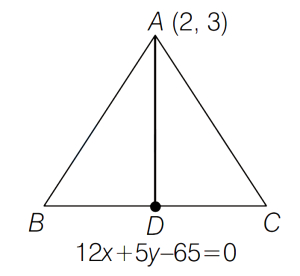
એક સમબાજુ ત્રિકોણના પાયાનું સમીકરણ $12x+5y-65=0$ છે. જો તેનો એક શિરોબિંદુ $(2,3)$ હોય,તો તેની બાજુની લંબાઈ શોધો.
A
$\frac{4}{13}$
B
$\frac{2}{\sqrt{3}}$
C
$\frac{4}{\sqrt{3}}$
D
$\frac{2}{13}$
Solution
(C) શિરોબિંદુ $A(2,3)$ એ રેખા $12x+5y-65=0$ પર આવેલું નથી,તેથી $A$ થી પાયા $BC$ પરનો લંબ એ સમબાજુ ત્રિકોણ $\triangle ABC$ નો વેધ $AD$ છે.
વેધ $AD$ ની લંબાઈ બિંદુ $(x_1, y_1)$ થી રેખા $ax+by+c=0$ ના લંબ અંતરના સૂત્ર દ્વારા મળે છે:
$AD = \left|\frac{ax_1+by_1+c}{\sqrt{a^2+b^2}}\right|$
$AD = \left|\frac{12(2)+5(3)-65}{\sqrt{12^2+5^2}}\right| = \left|\frac{24+15-65}{\sqrt{144+25}}\right| = \left|\frac{39-65}{\sqrt{169}}\right| = \left|\frac{-26}{13}\right| = 2$
સમબાજુ ત્રિકોણની બાજુની લંબાઈ $s$ હોય,તો વેધ $h = \frac{\sqrt{3}}{2}s$ થાય.
તેથી,$s = \frac{2}{\sqrt{3}} \times h$.
$h = AD = 2$ મૂકતા:
$s = \frac{2}{\sqrt{3}} \times 2 = \frac{4}{\sqrt{3}}$.
વેધ $AD$ ની લંબાઈ બિંદુ $(x_1, y_1)$ થી રેખા $ax+by+c=0$ ના લંબ અંતરના સૂત્ર દ્વારા મળે છે:
$AD = \left|\frac{ax_1+by_1+c}{\sqrt{a^2+b^2}}\right|$
$AD = \left|\frac{12(2)+5(3)-65}{\sqrt{12^2+5^2}}\right| = \left|\frac{24+15-65}{\sqrt{144+25}}\right| = \left|\frac{39-65}{\sqrt{169}}\right| = \left|\frac{-26}{13}\right| = 2$
સમબાજુ ત્રિકોણની બાજુની લંબાઈ $s$ હોય,તો વેધ $h = \frac{\sqrt{3}}{2}s$ થાય.
તેથી,$s = \frac{2}{\sqrt{3}} \times h$.
$h = AD = 2$ મૂકતા:
$s = \frac{2}{\sqrt{3}} \times 2 = \frac{4}{\sqrt{3}}$.
0 likes
View Solution162
MediumMCQ
$L \equiv x \cos \alpha + y \sin \alpha - p = 0$ એ $x + y + 1 = 0$ રેખાને લંબ રેખા દર્શાવે છે. જો $p$ ધન હોય,$\alpha$ ચોથા ચરણમાં હોય અને $(\sqrt{2}, \sqrt{2})$ થી રેખા $L = 0$ નું લંબ અંતર $5$ એકમ હોય,તો $p =$
A
$5$
B
$\frac{5}{2}$
C
$10$
D
$\frac{15}{2}$
Solution
(A) રેખા $L$ નો ઢાળ $-\cot \alpha$ છે.
રેખા $x + y + 1 = 0$ નો ઢાળ $-1$ છે.
બંને રેખાઓ પરસ્પર લંબ હોવાથી,તેમના ઢાળનો ગુણાકાર $-1$ થાય:
$(-\cot \alpha)(-1) = -1$ $\Rightarrow \cot \alpha = -1$ $\Rightarrow \tan \alpha = -1$.
$\alpha$ ચોથા ચરણમાં હોવાથી,$\alpha = 2\pi - \frac{\pi}{4} = \frac{7\pi}{4}$.
$(\sqrt{2}, \sqrt{2})$ થી $x \cos \alpha + y \sin \alpha - p = 0$ નું લંબ અંતર:
$\left| \sqrt{2} \cos \alpha + \sqrt{2} \sin \alpha - p \right| = 5$.
$\alpha = \frac{7\pi}{4}$ મૂકતા:
$\cos \frac{7\pi}{4} = \frac{1}{\sqrt{2}}$ અને $\sin \frac{7\pi}{4} = -\frac{1}{\sqrt{2}}$.
$\left| \sqrt{2} \left( \frac{1}{\sqrt{2}} \right) + \sqrt{2} \left( -\frac{1}{\sqrt{2}} \right) - p \right| = 5$.
$|1 - 1 - p| = 5 \Rightarrow |-p| = 5$.
$p$ ધન હોવાથી,$p = 5$.
રેખા $x + y + 1 = 0$ નો ઢાળ $-1$ છે.
બંને રેખાઓ પરસ્પર લંબ હોવાથી,તેમના ઢાળનો ગુણાકાર $-1$ થાય:
$(-\cot \alpha)(-1) = -1$ $\Rightarrow \cot \alpha = -1$ $\Rightarrow \tan \alpha = -1$.
$\alpha$ ચોથા ચરણમાં હોવાથી,$\alpha = 2\pi - \frac{\pi}{4} = \frac{7\pi}{4}$.
$(\sqrt{2}, \sqrt{2})$ થી $x \cos \alpha + y \sin \alpha - p = 0$ નું લંબ અંતર:
$\left| \sqrt{2} \cos \alpha + \sqrt{2} \sin \alpha - p \right| = 5$.
$\alpha = \frac{7\pi}{4}$ મૂકતા:
$\cos \frac{7\pi}{4} = \frac{1}{\sqrt{2}}$ અને $\sin \frac{7\pi}{4} = -\frac{1}{\sqrt{2}}$.
$\left| \sqrt{2} \left( \frac{1}{\sqrt{2}} \right) + \sqrt{2} \left( -\frac{1}{\sqrt{2}} \right) - p \right| = 5$.
$|1 - 1 - p| = 5 \Rightarrow |-p| = 5$.
$p$ ધન હોવાથી,$p = 5$.
0 likes
View Solution163
EasyMCQ
બે બિંદુઓ $P(a, 2)$ અને $Q(1, b)$ એ રેખા $2x - 3y + 1 = 0$ ની સામસામેની બાજુએ આવેલા છે. જો $P$ એ રેખાઓ $4x + 3y + k = 0$ અને $3x + 4y + k = 0$ નું છેદબિંદુ હોય,તો $b$ નો વિસ્તાર શું છે?
A
$(-\infty, 3)$
B
$(-\infty, 1)$
C
$(1, \infty)$
D
$(3, \infty)$
Solution
(B) કારણ કે $P(a, 2)$ અને $Q(1, b)$ એ રેખા $2x - 3y + 1 = 0$ ની સામસામેની બાજુએ આવેલા છે,તેથી બિંદુઓને રેખાના સમીકરણમાં મૂકતા મળતી કિંમતોનો ગુણાકાર ઋણ હોવો જોઈએ:
$(2a - 3(2) + 1)(2(1) - 3b + 1) < 0$
$(2a - 5)(3 - 3b) < 0$
$(2a - 5)(1 - b) < 0$
$P(a, 2)$ એ $4x + 3y + k = 0$ અને $3x + 4y + k = 0$ નું છેદબિંદુ હોવાથી:
$4a + 3(2) + k = 0 \Rightarrow 4a + 6 + k = 0$
$3a + 4(2) + k = 0 \Rightarrow 3a + 8 + k = 0$
બંને સમીકરણોની બાદબાકી કરતા: $(4a + 6 + k) - (3a + 8 + k) = 0$ $\Rightarrow a - 2 = 0$ $\Rightarrow a = 2$.
$a = 2$ ને અસમતામાં મૂકતા:
$(2(2) - 5)(1 - b) < 0$
$(4 - 5)(1 - b) < 0$
$-(1 - b) < 0$
$b - 1 < 0 \Rightarrow b < 1$.
આમ,$b \in (-\infty, 1)$.
$(2a - 3(2) + 1)(2(1) - 3b + 1) < 0$
$(2a - 5)(3 - 3b) < 0$
$(2a - 5)(1 - b) < 0$
$P(a, 2)$ એ $4x + 3y + k = 0$ અને $3x + 4y + k = 0$ નું છેદબિંદુ હોવાથી:
$4a + 3(2) + k = 0 \Rightarrow 4a + 6 + k = 0$
$3a + 4(2) + k = 0 \Rightarrow 3a + 8 + k = 0$
બંને સમીકરણોની બાદબાકી કરતા: $(4a + 6 + k) - (3a + 8 + k) = 0$ $\Rightarrow a - 2 = 0$ $\Rightarrow a = 2$.
$a = 2$ ને અસમતામાં મૂકતા:
$(2(2) - 5)(1 - b) < 0$
$(4 - 5)(1 - b) < 0$
$-(1 - b) < 0$
$b - 1 < 0 \Rightarrow b < 1$.
આમ,$b \in (-\infty, 1)$.
0 likes
View Solution164
MediumMCQ
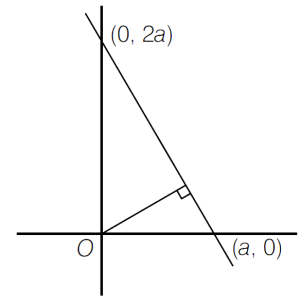
એક સીધી રેખા $Y$-અક્ષ પર $X$-અક્ષ કરતાં બમણું અંતઃખંડ બનાવે છે અને ઉગમબિંદુથી એક એકમ અંતરે છે. તો તે રેખાનું સમીકરણ શું હશે?
A
$2x + 3y = \pm \sqrt{5}$
B
$x + y = \pm 2$
C
$x + 2y = \pm \sqrt{5}$
D
$2x + y = \pm \sqrt{5}$
Solution
(D) ધારો કે $X$-અંતઃખંડ $a$ છે અને $Y$-અંતઃખંડ $2a$ છે.
રેખાનું અંતઃખંડ સ્વરૂપમાં સમીકરણ $\frac{x}{a} + \frac{y}{2a} = 1$ છે.
$2a$ વડે ગુણતા,આપણને $2x + y = 2a$ મળે,અથવા $2x + y - 2a = 0$.
ઉગમબિંદુ $(0, 0)$ થી રેખાનું લંબ અંતર $1$ આપેલું છે.
$(x_1, y_1)$ થી $Ax + By + C = 0$ નું અંતર શોધવાનું સૂત્ર $d = \frac{|Ax_1 + By_1 + C|}{\sqrt{A^2 + B^2}}$ છે.
કિંમતો મૂકતા: $1 = \frac{|2(0) + 1(0) - 2a|}{\sqrt{2^2 + 1^2}}$.
$1 = \frac{|-2a|}{\sqrt{5}}$.
$|2a| = \sqrt{5}$,જેનો અર્થ છે કે $2a = \pm \sqrt{5}$.
$2a$ ની કિંમત $2x + y = 2a$ માં મૂકતા,આપણને $2x + y = \pm \sqrt{5}$ મળે છે.
રેખાનું અંતઃખંડ સ્વરૂપમાં સમીકરણ $\frac{x}{a} + \frac{y}{2a} = 1$ છે.
$2a$ વડે ગુણતા,આપણને $2x + y = 2a$ મળે,અથવા $2x + y - 2a = 0$.
ઉગમબિંદુ $(0, 0)$ થી રેખાનું લંબ અંતર $1$ આપેલું છે.
$(x_1, y_1)$ થી $Ax + By + C = 0$ નું અંતર શોધવાનું સૂત્ર $d = \frac{|Ax_1 + By_1 + C|}{\sqrt{A^2 + B^2}}$ છે.
કિંમતો મૂકતા: $1 = \frac{|2(0) + 1(0) - 2a|}{\sqrt{2^2 + 1^2}}$.
$1 = \frac{|-2a|}{\sqrt{5}}$.
$|2a| = \sqrt{5}$,જેનો અર્થ છે કે $2a = \pm \sqrt{5}$.
$2a$ ની કિંમત $2x + y = 2a$ માં મૂકતા,આપણને $2x + y = \pm \sqrt{5}$ મળે છે.
0 likes
View Solution165
EasyMCQ
ધારો કે રેખાઓ $2x - 3y + 4 = 0$ અને $6x - 9y + 7 = 0$ ને લંબ દોરેલી રેખા $L$ તેમને અનુક્રમે $A$ અને $B$ માં મળે છે. જો $P(1, 1)$ એ $L$ પરનું બિંદુ હોય,તો $P$ એ $AB$ નું કયા ગુણોત્તરમાં વિભાજન કરે છે?
A
$9:4$ અંતઃવિભાજન
B
$9:4$ બહિર્વિભાજન
C
$4:9$ અંતઃવિભાજન
D
$4:9$ બહિર્વિભાજન
Solution
(B) આપેલ રેખાઓ $L_1: 2x - 3y + 4 = 0$ અને $L_2: 6x - 9y + 7 = 0$ છે.
અહીં $L_1$ અને $L_2$ સમાંતર છે.
રેખા $L$ એ $L_1$ અને $L_2$ ને લંબ છે,તેથી તેનું સમીકરણ $3x + 2y + C = 0$ સ્વરૂપનું હશે.
$P(1, 1)$ બિંદુ $L$ પર હોવાથી,$3(1) + 2(1) + C = 0 \implies C = -5$. તેથી $L: 3x + 2y - 5 = 0$.
$A$ એ $L_1$ અને $L$ નું છેદબિંદુ છે: $A = (7/13, 22/13)$.
$B$ એ $L_2$ અને $L$ નું છેદબિંદુ છે: $B = (31/39, 3/13)$.
વિભાજન સૂત્રનો ઉપયોગ કરતા,$P$ એ $AB$ નું $9:4$ ના ગુણોત્તરમાં બહિર્વિભાજન કરે છે.
અહીં $L_1$ અને $L_2$ સમાંતર છે.
રેખા $L$ એ $L_1$ અને $L_2$ ને લંબ છે,તેથી તેનું સમીકરણ $3x + 2y + C = 0$ સ્વરૂપનું હશે.
$P(1, 1)$ બિંદુ $L$ પર હોવાથી,$3(1) + 2(1) + C = 0 \implies C = -5$. તેથી $L: 3x + 2y - 5 = 0$.
$A$ એ $L_1$ અને $L$ નું છેદબિંદુ છે: $A = (7/13, 22/13)$.
$B$ એ $L_2$ અને $L$ નું છેદબિંદુ છે: $B = (31/39, 3/13)$.
વિભાજન સૂત્રનો ઉપયોગ કરતા,$P$ એ $AB$ નું $9:4$ ના ગુણોત્તરમાં બહિર્વિભાજન કરે છે.
0 likes
View Solution166
EasyMCQ
જો $3x - 2y + 5 = 0$ ને સમાંતર અને તેનાથી $5$ એકમ અંતરે આવેલી રેખાનું સમીકરણ $3x - 2y + C = 0$ હોય,તો $C$ ની કિંમત શોધો.
A
$5(1 \pm \sqrt{13})$
B
$5(\pm \sqrt{13} + 1)$
C
$5(\sqrt{13} \pm 1)$
D
$5(\frac{-1 \pm \sqrt{13}}{\sqrt{13}})$
Solution
(A) બે સમાંતર રેખાઓ $ax + by + c_1 = 0$ અને $ax + by + c_2 = 0$ વચ્ચેનું અંતર $d = \frac{|c_1 - c_2|}{\sqrt{a^2 + b^2}}$ સૂત્ર દ્વારા મળે છે.
આપેલ રેખાઓ $3x - 2y + 5 = 0$ અને $3x - 2y + C = 0$ છે.
અહીં,$a = 3$,$b = -2$,$c_1 = 5$,$c_2 = C$,અને $d = 5$.
સૂત્રમાં કિંમતો મૂકતા:
$5 = \frac{|C - 5|}{\sqrt{3^2 + (-2)^2}}$
$5 = \frac{|C - 5|}{\sqrt{9 + 4}}$
$5 = \frac{|C - 5|}{\sqrt{13}}$
$|C - 5| = 5\sqrt{13}$
$C - 5 = \pm 5\sqrt{13}$
$C = 5 \pm 5\sqrt{13} = 5(1 \pm \sqrt{13})$.
આપેલ રેખાઓ $3x - 2y + 5 = 0$ અને $3x - 2y + C = 0$ છે.
અહીં,$a = 3$,$b = -2$,$c_1 = 5$,$c_2 = C$,અને $d = 5$.
સૂત્રમાં કિંમતો મૂકતા:
$5 = \frac{|C - 5|}{\sqrt{3^2 + (-2)^2}}$
$5 = \frac{|C - 5|}{\sqrt{9 + 4}}$
$5 = \frac{|C - 5|}{\sqrt{13}}$
$|C - 5| = 5\sqrt{13}$
$C - 5 = \pm 5\sqrt{13}$
$C = 5 \pm 5\sqrt{13} = 5(1 \pm \sqrt{13})$.
0 likes
View Solution167
DifficultMCQ
$O(0,0), B(-3,-1), C(-1,-3)$ એ ત્રિકોણ $OBC$ ના શિરોબિંદુઓ છે. $D$ એ $OC$ પરનું બિંદુ છે અને $E$ એ $OB$ પરનું બિંદુ છે. જો $DE$ નું સમીકરણ $2x + 2y + \sqrt{2} = 0$ હોય,તો રેખા $DE$ એ ત્રિકોણ $OBC$ ના વેધનું જે ગુણોત્તરમાં વિભાજન કરે છે તે શોધો:
A
$\sqrt{2} : 4\sqrt{2} + 2$
B
$1 : 4\sqrt{2} + 1$
C
$\sqrt{2} : 4\sqrt{2} - 2$
D
$1 : 4\sqrt{2} - 1$
Solution
(D) શિરોબિંદુઓ $O(0,0), B(-3,-1), C(-1,-3)$ છે.
રેખા $BC$ નું સમીકરણ $x + y + 4 = 0$ છે.
$O(0,0)$ થી $BC$ પરના વેધની લંબાઈ $h = \frac{4}{\sqrt{2}} = 2\sqrt{2}$ છે.
રેખા $DE$ નું સમીકરણ $x + y + \frac{1}{\sqrt{2}} = 0$ છે.
$O(0,0)$ થી $DE$ નું અંતર $d = \frac{1}{2}$ છે.
રેખા $DE$ એ વેધનું $d : (h - d)$ ગુણોત્તરમાં વિભાજન કરે છે.
ગુણોત્તર $1 : (4\sqrt{2} - 1)$ મળે છે.
રેખા $BC$ નું સમીકરણ $x + y + 4 = 0$ છે.
$O(0,0)$ થી $BC$ પરના વેધની લંબાઈ $h = \frac{4}{\sqrt{2}} = 2\sqrt{2}$ છે.
રેખા $DE$ નું સમીકરણ $x + y + \frac{1}{\sqrt{2}} = 0$ છે.
$O(0,0)$ થી $DE$ નું અંતર $d = \frac{1}{2}$ છે.
રેખા $DE$ એ વેધનું $d : (h - d)$ ગુણોત્તરમાં વિભાજન કરે છે.
ગુણોત્તર $1 : (4\sqrt{2} - 1)$ મળે છે.
0 likes
View Solution168
EasyMCQ
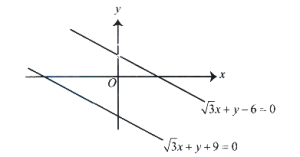
રેખાઓ $\sqrt{3} x+y-6=0$ અને $\sqrt{3} x+y+9=0$ ની વચ્ચે એક સમબાજુ ત્રિકોણ બનાવવામાં આવે છે,જેનો પાયો એક રેખા પર અને શિરોબિંદુ બીજી રેખા પર છે. આ રીતે બનેલા ત્રિકોણનું ક્ષેત્રફળ (ચોરસ એકમમાં) કેટલું હશે?
A
$\frac{175}{6 \sqrt{3}}$
B
$\frac{225}{2 \sqrt{3}}$
C
$\frac{225}{4 \sqrt{3}}$
D
$\frac{245}{4 \sqrt{2}}$
Solution
(C) બે સમાંતર રેખાઓ $\sqrt{3}x + y - 6 = 0$ અને $\sqrt{3}x + y + 9 = 0$ વચ્ચેનું અંતર $d$ નીચે મુજબ છે:
$d = \frac{|c_1 - c_2|}{\sqrt{a^2 + b^2}} = \frac{|9 - (-6)|}{\sqrt{(\sqrt{3})^2 + 1^2}} = \frac{15}{\sqrt{3 + 1}} = \frac{15}{2}$.
$d$ ઊંચાઈ ધરાવતા સમબાજુ ત્રિકોણ માટે,બાજુની લંબાઈ $s$ માટે $d = s \sin 60^{\circ} = s \frac{\sqrt{3}}{2}$ થાય,તેથી $s = \frac{2d}{\sqrt{3}}$.
સમબાજુ ત્રિકોણનું ક્ષેત્રફળ $\frac{\sqrt{3}}{4} s^2 = \frac{\sqrt{3}}{4} \left( \frac{2d}{\sqrt{3}} \right)^2 = \frac{d^2}{\sqrt{3}}$ છે.
$d = \frac{15}{2}$ મૂકતા,ક્ષેત્રફળ $\left( \frac{15}{2} \right)^2 \cdot \frac{1}{\sqrt{3}} = \frac{225}{4 \sqrt{3}}$ ચોરસ એકમ મળે છે.
$d = \frac{|c_1 - c_2|}{\sqrt{a^2 + b^2}} = \frac{|9 - (-6)|}{\sqrt{(\sqrt{3})^2 + 1^2}} = \frac{15}{\sqrt{3 + 1}} = \frac{15}{2}$.
$d$ ઊંચાઈ ધરાવતા સમબાજુ ત્રિકોણ માટે,બાજુની લંબાઈ $s$ માટે $d = s \sin 60^{\circ} = s \frac{\sqrt{3}}{2}$ થાય,તેથી $s = \frac{2d}{\sqrt{3}}$.
સમબાજુ ત્રિકોણનું ક્ષેત્રફળ $\frac{\sqrt{3}}{4} s^2 = \frac{\sqrt{3}}{4} \left( \frac{2d}{\sqrt{3}} \right)^2 = \frac{d^2}{\sqrt{3}}$ છે.
$d = \frac{15}{2}$ મૂકતા,ક્ષેત્રફળ $\left( \frac{15}{2} \right)^2 \cdot \frac{1}{\sqrt{3}} = \frac{225}{4 \sqrt{3}}$ ચોરસ એકમ મળે છે.
0 likes
View Solution169
EasyMCQ
જો રેખા $x-y+1=0$ એ રેખાઓ $2x+2y+3=0$ અને $3x+3y+2=0$ ને અનુક્રમે $A$ અને $B$ બિંદુઓમાં છેદે,તો $AB=$
A
$\frac{5}{6\sqrt{2}}$
B
$\frac{1}{6\sqrt{2}}$
C
$\frac{5}{\sqrt{3}}$
D
$\frac{5}{6\sqrt{3}}$
Solution
(A) આપેલ રેખાઓ $L_1: 2x+2y+3=0$ અને $L_2: 3x+3y+2=0$ છે.
$L_1$ ને $2$ વડે ભાગતા,આપણને $x+y+\frac{3}{2}=0$ મળે છે.
$L_2$ ને $3$ વડે ભાગતા,આપણને $x+y+\frac{2}{3}=0$ મળે છે.
બંને રેખાઓનો ઢાળ $-1$ હોવાથી,તેઓ સમાંતર છે.
રેખા $L_3: x-y+1=0$ નો ઢાળ $1$ છે.
$L_1$ (અથવા $L_2$) અને $L_3$ ના ઢાળનો ગુણાકાર $(-1) \times (1) = -1$ હોવાથી,રેખા $L_3$ બંને સમાંતર રેખાઓને લંબ છે.
છેદબિંદુઓ વચ્ચેનું અંતર $AB$ એ બે સમાંતર રેખાઓ $x+y+\frac{3}{2}=0$ અને $x+y+\frac{2}{3}=0$ વચ્ચેનું લંબ અંતર છે.
બે સમાંતર રેખાઓ $ax+by+c_1=0$ અને $ax+by+c_2=0$ વચ્ચેનું અંતર $d = \frac{|c_1-c_2|}{\sqrt{a^2+b^2}}$ દ્વારા આપવામાં આવે છે.
અહીં,$a=1, b=1, c_1=\frac{3}{2}, c_2=\frac{2}{3}$.
$AB = \frac{|\frac{3}{2}-\frac{2}{3}|}{\sqrt{1^2+1^2}} = \frac{|\frac{9-4}{6}|}{\sqrt{2}} = \frac{5}{6\sqrt{2}}$.
$L_1$ ને $2$ વડે ભાગતા,આપણને $x+y+\frac{3}{2}=0$ મળે છે.
$L_2$ ને $3$ વડે ભાગતા,આપણને $x+y+\frac{2}{3}=0$ મળે છે.
બંને રેખાઓનો ઢાળ $-1$ હોવાથી,તેઓ સમાંતર છે.
રેખા $L_3: x-y+1=0$ નો ઢાળ $1$ છે.
$L_1$ (અથવા $L_2$) અને $L_3$ ના ઢાળનો ગુણાકાર $(-1) \times (1) = -1$ હોવાથી,રેખા $L_3$ બંને સમાંતર રેખાઓને લંબ છે.
છેદબિંદુઓ વચ્ચેનું અંતર $AB$ એ બે સમાંતર રેખાઓ $x+y+\frac{3}{2}=0$ અને $x+y+\frac{2}{3}=0$ વચ્ચેનું લંબ અંતર છે.
બે સમાંતર રેખાઓ $ax+by+c_1=0$ અને $ax+by+c_2=0$ વચ્ચેનું અંતર $d = \frac{|c_1-c_2|}{\sqrt{a^2+b^2}}$ દ્વારા આપવામાં આવે છે.
અહીં,$a=1, b=1, c_1=\frac{3}{2}, c_2=\frac{2}{3}$.
$AB = \frac{|\frac{3}{2}-\frac{2}{3}|}{\sqrt{1^2+1^2}} = \frac{|\frac{9-4}{6}|}{\sqrt{2}} = \frac{5}{6\sqrt{2}}$.
0 likes
View Solution170
MediumMCQ
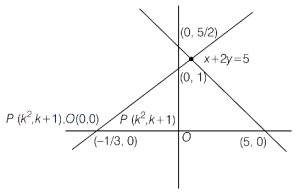
પૂર્ણાંક $K$ માટે,જો બિંદુ $P(K^2, K+1)$ અને ઉગમબિંદુ $O(0,0)$ એ રેખાઓ $x+2y-5=0$ અને $3x-y+1=0$ વચ્ચેના સમાન પ્રદેશમાં આવેલા હોય,તો આવા બિંદુઓ $P$ ની શક્ય સંખ્યા કેટલી છે?
A
$4$
B
$2$
C
$6$
D
અનંત
Solution
(B) ધારો કે $L_1(x, y) = x+2y-5$ અને $L_2(x, y) = 3x-y+1$. ઉગમબિંદુ $O(0,0)$ માટે $L_1(0,0) = -5 < 0$ અને $L_2(0,0) = 1 > 0$ મળે છે.
બિંદુ $P(K^2, K+1)$ ઉગમબિંદુની જેમ સમાન પ્રદેશમાં રહે તે માટે,તેણે $L_1(K^2, K+1) < 0$ અને $L_2(K^2, K+1) > 0$ શરતોનું પાલન કરવું જોઈએ.
$1$) $L_1(K^2, K+1) = K^2 + 2(K+1) - 5 = K^2 + 2K - 3 < 0$.
$(K+3)(K-1) < 0 \implies K \in (-3, 1)$.
$2$) $L_2(K^2, K+1) = 3K^2 - (K+1) + 1 = 3K^2 - K > 0$.
$K(3K-1) > 0 \implies K \in (-\infty, 0) \cup (1/3, \infty)$.
બંને શરતોનો છેદ લેતા: $K \in (-3, 0) \cup (1/3, 1)$.
$K$ પૂર્ણાંક હોવાથી,$K$ ની શક્ય કિંમતો $\{-2, -1\}$ છે.
આમ,આવા $2$ બિંદુઓ $P$ શક્ય છે.
બિંદુ $P(K^2, K+1)$ ઉગમબિંદુની જેમ સમાન પ્રદેશમાં રહે તે માટે,તેણે $L_1(K^2, K+1) < 0$ અને $L_2(K^2, K+1) > 0$ શરતોનું પાલન કરવું જોઈએ.
$1$) $L_1(K^2, K+1) = K^2 + 2(K+1) - 5 = K^2 + 2K - 3 < 0$.
$(K+3)(K-1) < 0 \implies K \in (-3, 1)$.
$2$) $L_2(K^2, K+1) = 3K^2 - (K+1) + 1 = 3K^2 - K > 0$.
$K(3K-1) > 0 \implies K \in (-\infty, 0) \cup (1/3, \infty)$.
બંને શરતોનો છેદ લેતા: $K \in (-3, 0) \cup (1/3, 1)$.
$K$ પૂર્ણાંક હોવાથી,$K$ ની શક્ય કિંમતો $\{-2, -1\}$ છે.
આમ,આવા $2$ બિંદુઓ $P$ શક્ય છે.
0 likes
View Solution171
EasyMCQ
જો બિંદુ $(1, 1)$ થી રેખા $3x + 4y + c = 0$ નું લંબ અંતર $7$ હોય,તો $c$ ની શક્ય કિંમતો કઈ છે?
A
$-35, 42$
B
$35, 28$
C
$42, -28$
D
$28, -42$
Solution
(D) બિંદુ $(x_1, y_1)$ થી રેખા $ax + by + c = 0$ નું લંબ અંતર $d$ શોધવાનું સૂત્ર: $d = \left| \frac{ax_1 + by_1 + c}{\sqrt{a^2 + b^2}} \right|$ છે.
આપેલ બિંદુ $(1, 1)$,રેખા $3x + 4y + c = 0$ અને અંતર $d = 7$ માટે:
$7 = \left| \frac{3(1) + 4(1) + c}{\sqrt{3^2 + 4^2}} \right|$
$7 = \left| \frac{7 + c}{5} \right|$
$|7 + c| = 35$
આથી $7 + c = 35$ અથવા $7 + c = -35$ થાય.
જો $7 + c = 35$,તો $c = 28$.
જો $7 + c = -35$,તો $c = -42$.
આમ,$c$ ની શક્ય કિંમતો $28$ અને $-42$ છે.
આપેલ બિંદુ $(1, 1)$,રેખા $3x + 4y + c = 0$ અને અંતર $d = 7$ માટે:
$7 = \left| \frac{3(1) + 4(1) + c}{\sqrt{3^2 + 4^2}} \right|$
$7 = \left| \frac{7 + c}{5} \right|$
$|7 + c| = 35$
આથી $7 + c = 35$ અથવા $7 + c = -35$ થાય.
જો $7 + c = 35$,તો $c = 28$.
જો $7 + c = -35$,તો $c = -42$.
આમ,$c$ ની શક્ય કિંમતો $28$ અને $-42$ છે.
0 likes
View Solution172
EasyMCQ
જો રેખા $l$ એ $(k, 2k), (3k, 3k)$ અને $(3, 1)$ માંથી પસાર થતી હોય,જ્યાં $k \neq 0$,તો ઉગમબિંદુથી રેખા $l$ નું અંતર કેટલું થાય?
A
$\frac{1}{\sqrt{5}}$
B
$\frac{4}{\sqrt{5}}$
C
$\frac{3}{\sqrt{5}}$
D
$\frac{2}{\sqrt{5}}$
Solution
(A) બિંદુઓ $A(k, 2k), B(3k, 3k)$,અને $C(3, 1)$ સમરેખ હોવાથી,$AB$ નો ઢાળ અને $BC$ નો ઢાળ સમાન થાય.
$AB$ નો ઢાળ $= \frac{3k - 2k}{3k - k} = \frac{k}{2k} = \frac{1}{2}$.
$BC$ નો ઢાળ $= \frac{1 - 3k}{3 - 3k}$.
ઢાળ સરખાવતા: $\frac{1}{2} = \frac{1 - 3k}{3 - 3k}$.
ગુણાકાર કરતા: $3 - 3k = 2(1 - 3k)$ $\Rightarrow 3 - 3k = 2 - 6k$ $\Rightarrow 3k = -1$ $\Rightarrow k = -\frac{1}{3}$.
$B(-1, -1)$ અને $C(3, 1)$ માંથી પસાર થતી રેખાનું સમીકરણ: $y - 1 = \frac{1 - (-1)}{3 - (-1)}(x - 3)$.
$y - 1 = \frac{1}{2}(x - 3)$ $\Rightarrow 2y - 2 = x - 3$ $\Rightarrow x - 2y - 1 = 0$.
ઉગમબિંદુ $(0, 0)$ થી રેખા $Ax + By + C = 0$ નું અંતર $d = \frac{|C|}{\sqrt{A^2 + B^2}}$ છે.
$d = \frac{|-1|}{\sqrt{1^2 + (-2)^2}} = \frac{1}{\sqrt{5}}$.
$AB$ નો ઢાળ $= \frac{3k - 2k}{3k - k} = \frac{k}{2k} = \frac{1}{2}$.
$BC$ નો ઢાળ $= \frac{1 - 3k}{3 - 3k}$.
ઢાળ સરખાવતા: $\frac{1}{2} = \frac{1 - 3k}{3 - 3k}$.
ગુણાકાર કરતા: $3 - 3k = 2(1 - 3k)$ $\Rightarrow 3 - 3k = 2 - 6k$ $\Rightarrow 3k = -1$ $\Rightarrow k = -\frac{1}{3}$.
$B(-1, -1)$ અને $C(3, 1)$ માંથી પસાર થતી રેખાનું સમીકરણ: $y - 1 = \frac{1 - (-1)}{3 - (-1)}(x - 3)$.
$y - 1 = \frac{1}{2}(x - 3)$ $\Rightarrow 2y - 2 = x - 3$ $\Rightarrow x - 2y - 1 = 0$.
ઉગમબિંદુ $(0, 0)$ થી રેખા $Ax + By + C = 0$ નું અંતર $d = \frac{|C|}{\sqrt{A^2 + B^2}}$ છે.
$d = \frac{|-1|}{\sqrt{1^2 + (-2)^2}} = \frac{1}{\sqrt{5}}$.
0 likes
View Solution173
DifficultMCQ
ધારો કે $d$ એ સમાંતર રેખાઓ $3x - 2y + 5 = 0$ અને $3x - 2y + 5 + 2\sqrt{13} = 0$ વચ્ચેનું અંતર છે. ધારો કે $L_1 \equiv 3x - 2y + k_1 = 0$ $(k_1 > 0)$ અને $L_2 \equiv 3x - 2y + k_2 = 0$ $(k_2 > 0)$ એ બે રેખાઓ છે જે રેખા $3x - 2y + 5 = 0$ થી અનુક્રમે $\frac{4d}{\sqrt{13}}$ અને $\frac{3d}{\sqrt{13}}$ અંતરે છે. તો રેખાઓ $L_1 = 0$ અને $L_2 = 0$ નું સંયુક્ત સમીકરણ શું છે?
A
$(3x - 2y)^2 + 24(3x - 2y) + 143 = 0$
B
$(3x - 2y)^2 + 8(3x - 2y) + 33 = 0$
C
$(3x - 2y)^2 + 12(3x - 2y) + 13 = 0$
D
$(3x - 2y)^2 + 12(3x - 2y) + 1 = 0$
Solution
(A) સમાંતર રેખાઓ $Ax + By + C_1 = 0$ અને $Ax + By + C_2 = 0$ વચ્ચેનું અંતર $d = \frac{|C_1 - C_2|}{\sqrt{A^2 + B^2}}$ છે.
$3x - 2y + 5 = 0$ અને $3x - 2y + 5 + 2\sqrt{13} = 0$ માટે,$d = \frac{|5 - (5 + 2\sqrt{13})|}{\sqrt{3^2 + (-2)^2}} = \frac{2\sqrt{13}}{\sqrt{13}} = 2$.
$L_1: 3x - 2y + k_1 = 0$ એ $3x - 2y + 5 = 0$ થી $\frac{4d}{\sqrt{13}} = \frac{8}{\sqrt{13}}$ અંતરે છે,તેથી $\frac{|k_1 - 5|}{\sqrt{13}} = \frac{8}{\sqrt{13}} \Rightarrow |k_1 - 5| = 8$. $k_1 > 0$ હોવાથી,$k_1 = 13$.
$L_2: 3x - 2y + k_2 = 0$ એ $3x - 2y + 5 = 0$ થી $\frac{3d}{\sqrt{13}} = \frac{6}{\sqrt{13}}$ અંતરે છે,તેથી $\frac{|k_2 - 5|}{\sqrt{13}} = \frac{6}{\sqrt{13}} \Rightarrow |k_2 - 5| = 6$. $k_2 > 0$ હોવાથી,$k_2 = 11$.
સંયુક્ત સમીકરણ $(3x - 2y + 13)(3x - 2y + 11) = 0$ છે.
$u = 3x - 2y$ લેતા,$(u + 13)(u + 11) = u^2 + 24u + 143 = 0$.
તેથી,$(3x - 2y)^2 + 24(3x - 2y) + 143 = 0$ મળે છે.
$3x - 2y + 5 = 0$ અને $3x - 2y + 5 + 2\sqrt{13} = 0$ માટે,$d = \frac{|5 - (5 + 2\sqrt{13})|}{\sqrt{3^2 + (-2)^2}} = \frac{2\sqrt{13}}{\sqrt{13}} = 2$.
$L_1: 3x - 2y + k_1 = 0$ એ $3x - 2y + 5 = 0$ થી $\frac{4d}{\sqrt{13}} = \frac{8}{\sqrt{13}}$ અંતરે છે,તેથી $\frac{|k_1 - 5|}{\sqrt{13}} = \frac{8}{\sqrt{13}} \Rightarrow |k_1 - 5| = 8$. $k_1 > 0$ હોવાથી,$k_1 = 13$.
$L_2: 3x - 2y + k_2 = 0$ એ $3x - 2y + 5 = 0$ થી $\frac{3d}{\sqrt{13}} = \frac{6}{\sqrt{13}}$ અંતરે છે,તેથી $\frac{|k_2 - 5|}{\sqrt{13}} = \frac{6}{\sqrt{13}} \Rightarrow |k_2 - 5| = 6$. $k_2 > 0$ હોવાથી,$k_2 = 11$.
સંયુક્ત સમીકરણ $(3x - 2y + 13)(3x - 2y + 11) = 0$ છે.
$u = 3x - 2y$ લેતા,$(u + 13)(u + 11) = u^2 + 24u + 143 = 0$.
તેથી,$(3x - 2y)^2 + 24(3x - 2y) + 143 = 0$ મળે છે.
0 likes
View Solution174
EasyMCQ
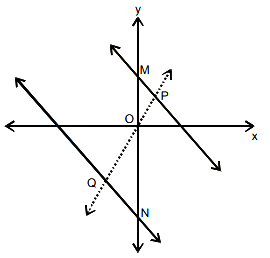
ઉગમબિંદુ $O$ માંથી પસાર થતી એક સીધી રેખા સમાંતર રેખાઓ $4x + 2y = 9$ અને $2x + y + 6 = 0$ ને અનુક્રમે $P$ અને $Q$ માં મળે છે. બિંદુ $O$ એ રેખાખંડ $PQ$ નું કયા ગુણોત્તરમાં વિભાજન કરે છે?
A
$1: 2$
B
$3: 4$
C
$2: 1$
D
$4: 3$
Solution
(B) આપેલ સમાંતર રેખાઓ $4x + 2y - 9 = 0$ અને $2x + y + 6 = 0$ છે.
પ્રથમ સમીકરણને $2x + y = \frac{9}{2}$ તરીકે લખી શકાય.
બીજું સમીકરણ $2x + y = -6$ છે.
ધારો કે ઉગમબિંદુમાંથી પસાર થતી રેખા $y = mx$ છે. આ કિંમત સમીકરણોમાં મૂકતા:
$P$ માટે: $2x + mx = \frac{9}{2} \Rightarrow x_P = \frac{9}{2(2+m)}$,$y_P = \frac{9m}{2(2+m)}$.
$Q$ માટે: $2x + mx = -6 \Rightarrow x_Q = \frac{-6}{2+m}$,$y_Q = \frac{-6m}{2+m}$.
બિંદુ $O(0,0)$ દ્વારા $PQ$ નું વિભાજન ગુણોત્તર $\frac{OP}{OQ} = \frac{|x_P|}{|x_Q|} = \frac{9/2(2+m)}{6/(2+m)} = \frac{9}{12} = \frac{3}{4}$ છે.
આમ,બિંદુ $O$ એ $PQ$ નું $3: 4$ ગુણોત્તરમાં વિભાજન કરે છે.
પ્રથમ સમીકરણને $2x + y = \frac{9}{2}$ તરીકે લખી શકાય.
બીજું સમીકરણ $2x + y = -6$ છે.
ધારો કે ઉગમબિંદુમાંથી પસાર થતી રેખા $y = mx$ છે. આ કિંમત સમીકરણોમાં મૂકતા:
$P$ માટે: $2x + mx = \frac{9}{2} \Rightarrow x_P = \frac{9}{2(2+m)}$,$y_P = \frac{9m}{2(2+m)}$.
$Q$ માટે: $2x + mx = -6 \Rightarrow x_Q = \frac{-6}{2+m}$,$y_Q = \frac{-6m}{2+m}$.
બિંદુ $O(0,0)$ દ્વારા $PQ$ નું વિભાજન ગુણોત્તર $\frac{OP}{OQ} = \frac{|x_P|}{|x_Q|} = \frac{9/2(2+m)}{6/(2+m)} = \frac{9}{12} = \frac{3}{4}$ છે.
આમ,બિંદુ $O$ એ $PQ$ નું $3: 4$ ગુણોત્તરમાં વિભાજન કરે છે.
0 likes
View Solution175
MediumMCQ
ધારો કે $d_{1}$ અને $d_{2}$ એ રેખા $7x - 9y + 10 = 0$ પરના કોઈપણ બિંદુથી રેખાઓ $3x + 4y = 5$ અને $12x + 5y = 7$ પર દોરેલા લંબની લંબાઈ છે. તો,
A
$d_{1} > d_{2}$
B
$d_{1} = d_{2}$
C
$d_{1} < d_{2}$
D
$d_{1} = 2d_{2}$
Solution
(B) ધારો કે $(h, k)$ એ રેખા $7x - 9y + 10 = 0$ પરનું કોઈપણ બિંદુ છે. તેથી,$7h - 9k + 10 = 0$,જેનો અર્થ છે કે $h = \frac{9k - 10}{7}$.
બિંદુ $(h, k)$ થી રેખા $3x + 4y - 5 = 0$ નું લંબ અંતર $d_{1} = \frac{|3h + 4k - 5|}{\sqrt{3^{2} + 4^{2}}} = \frac{|3h + 4k - 5|}{5}$ છે.
બિંદુ $(h, k)$ થી રેખા $12x + 5y - 7 = 0$ નું લંબ અંતર $d_{2} = \frac{|12h + 5k - 7|}{\sqrt{12^{2} + 5^{2}}} = \frac{|12h + 5k - 7|}{13}$ છે.
$h = \frac{9k - 10}{7}$ ને પદાવલિમાં મૂકતા:
$3h + 4k - 5 = 3(\frac{9k - 10}{7}) + 4k - 5 = \frac{55k - 65}{7} = \frac{5(11k - 13)}{7}$.
તેથી,$d_{1} = \frac{|11k - 13|}{7}$.
$12h + 5k - 7 = 12(\frac{9k - 10}{7}) + 5k - 7 = \frac{143k - 169}{7} = \frac{13(11k - 13)}{7}$.
તેથી,$d_{2} = \frac{|11k - 13|}{7}$.
આમ,$d_{1} = d_{2}$ મળે છે.
બિંદુ $(h, k)$ થી રેખા $3x + 4y - 5 = 0$ નું લંબ અંતર $d_{1} = \frac{|3h + 4k - 5|}{\sqrt{3^{2} + 4^{2}}} = \frac{|3h + 4k - 5|}{5}$ છે.
બિંદુ $(h, k)$ થી રેખા $12x + 5y - 7 = 0$ નું લંબ અંતર $d_{2} = \frac{|12h + 5k - 7|}{\sqrt{12^{2} + 5^{2}}} = \frac{|12h + 5k - 7|}{13}$ છે.
$h = \frac{9k - 10}{7}$ ને પદાવલિમાં મૂકતા:
$3h + 4k - 5 = 3(\frac{9k - 10}{7}) + 4k - 5 = \frac{55k - 65}{7} = \frac{5(11k - 13)}{7}$.
તેથી,$d_{1} = \frac{|11k - 13|}{7}$.
$12h + 5k - 7 = 12(\frac{9k - 10}{7}) + 5k - 7 = \frac{143k - 169}{7} = \frac{13(11k - 13)}{7}$.
તેથી,$d_{2} = \frac{|11k - 13|}{7}$.
આમ,$d_{1} = d_{2}$ મળે છે.
0 likes
View Solution176
MediumMCQ
રેખા $x+y+1=0$ પરના બિંદુના યામ,જે રેખા $3x+4y+2=0$ થી $\frac{1}{5}$ એકમ અંતરે છે,તે શોધો.
A
$(2, -3)$
B
$(-3, 2)$
C
$(0, -1)$
D
$(-1, 0)$
Solution
(B, D) ધારો કે $(h, k)$ એ રેખા $x+y+1=0$ પરનું બિંદુ છે.
તેથી,$h+k+1=0,$ એટલે કે $h = -k-1.$
બિંદુ $(h, k)$ થી રેખા $3x+4y+2=0$ નું લંબ અંતર $\frac{|3h+4k+2|}{\sqrt{3^2+4^2}} = \frac{1}{5}$ છે.
$h = -k-1$ મૂકતા:
$\frac{|3(-k-1)+4k+2|}{5} = \frac{1}{5}$
$|k-1| = 1$
આથી,$k-1 = 1 \implies k=2$ (જેથી $h=-3$) અથવા $k-1 = -1 \implies k=0$ (જેથી $h=-1$).
આમ,માંગેલ બિંદુઓ $(-3, 2)$ અને $(-1, 0)$ છે.
તેથી,$h+k+1=0,$ એટલે કે $h = -k-1.$
બિંદુ $(h, k)$ થી રેખા $3x+4y+2=0$ નું લંબ અંતર $\frac{|3h+4k+2|}{\sqrt{3^2+4^2}} = \frac{1}{5}$ છે.
$h = -k-1$ મૂકતા:
$\frac{|3(-k-1)+4k+2|}{5} = \frac{1}{5}$
$|k-1| = 1$
આથી,$k-1 = 1 \implies k=2$ (જેથી $h=-3$) અથવા $k-1 = -1 \implies k=0$ (જેથી $h=-1$).
આમ,માંગેલ બિંદુઓ $(-3, 2)$ અને $(-1, 0)$ છે.
0 likes
View Solution177
MediumMCQ
$x+y=4$ પર આવેલા અને સુરેખા $4x+3y=10$ થી એક એકમ અંતરે આવેલા બે બિંદુઓના યામ શોધો.
A
$(-3,1), (7,11)$
B
$(3,1), (-7,11)$
C
$(3,1), (7,11)$
D
$(5,3), (-1,2)$
Solution
(B) ધારો કે રેખા $x+y=4$ પરનું બિંદુ $P(h, 4-h)$ છે.
બિંદુ $P(h, 4-h)$ થી રેખા $4x+3y-10=0$ નું લંબ અંતર $d = \frac{|4h + 3(4-h) - 10|}{\sqrt{4^2 + 3^2}}$ છે.
$d=1$ આપેલ હોવાથી,$\frac{|4h + 12 - 3h - 10|}{5} = 1$.
$|h + 2| = 5$.
આનાથી બે કિસ્સા મળે છે:
કિસ્સો $1$: $h+2 = 5 \implies h = 3$. બિંદુ $(3, 4-3) = (3, 1)$ છે.
કિસ્સો $2$: $h+2 = -5 \implies h = -7$. બિંદુ $(-7, 4-(-7)) = (-7, 11)$ છે.
આમ,યામ $(3, 1)$ અને $(-7, 11)$ છે.
બિંદુ $P(h, 4-h)$ થી રેખા $4x+3y-10=0$ નું લંબ અંતર $d = \frac{|4h + 3(4-h) - 10|}{\sqrt{4^2 + 3^2}}$ છે.
$d=1$ આપેલ હોવાથી,$\frac{|4h + 12 - 3h - 10|}{5} = 1$.
$|h + 2| = 5$.
આનાથી બે કિસ્સા મળે છે:
કિસ્સો $1$: $h+2 = 5 \implies h = 3$. બિંદુ $(3, 4-3) = (3, 1)$ છે.
કિસ્સો $2$: $h+2 = -5 \implies h = -7$. બિંદુ $(-7, 4-(-7)) = (-7, 11)$ છે.
આમ,યામ $(3, 1)$ અને $(-7, 11)$ છે.
0 likes
View Solution178
DifficultMCQ
રેખા $x+y=4$ પરના એવા બિંદુઓની સંખ્યા કેટલી છે જે રેખા $2x+2y=5$ થી એકમ અંતરે હોય?
A
$0$
B
$1$
C
$2$
D
$\infty$
Solution
(A) આપેલ રેખાઓ $L_1: x+y-4=0$ અને $L_2: 2x+2y-5=0$ છે,જેને $x+y-2.5=0$ તરીકે લખી શકાય.
બંને રેખાઓનો ઢાળ સમાન $(-1)$ હોવાથી,રેખાઓ સમાંતર છે.
બે સમાંતર રેખાઓ $ax+by+c_1=0$ અને $ax+by+c_2=0$ વચ્ચેનું લંબ અંતર $d = \frac{|c_1-c_2|}{\sqrt{a^2+b^2}}$ દ્વારા મળે છે.
અહીં,$d = \frac{|-4 - (-2.5)|}{\sqrt{1^2+1^2}} = \frac{|-1.5|}{\sqrt{2}} = \frac{1.5}{\sqrt{2}} = \frac{3}{2\sqrt{2}} \approx 1.06$.
બે રેખાઓ વચ્ચેનું અંતર $\approx 1.06$ છે,જે $1$ કરતા વધારે છે,તેથી રેખા $x+y=4$ પર એવું કોઈ બિંદુ નથી જે રેખા $2x+2y=5$ થી $1$ એકમ અંતરે હોય.
આમ,આવા બિંદુઓની સંખ્યા $0$ છે.
બંને રેખાઓનો ઢાળ સમાન $(-1)$ હોવાથી,રેખાઓ સમાંતર છે.
બે સમાંતર રેખાઓ $ax+by+c_1=0$ અને $ax+by+c_2=0$ વચ્ચેનું લંબ અંતર $d = \frac{|c_1-c_2|}{\sqrt{a^2+b^2}}$ દ્વારા મળે છે.
અહીં,$d = \frac{|-4 - (-2.5)|}{\sqrt{1^2+1^2}} = \frac{|-1.5|}{\sqrt{2}} = \frac{1.5}{\sqrt{2}} = \frac{3}{2\sqrt{2}} \approx 1.06$.
બે રેખાઓ વચ્ચેનું અંતર $\approx 1.06$ છે,જે $1$ કરતા વધારે છે,તેથી રેખા $x+y=4$ પર એવું કોઈ બિંદુ નથી જે રેખા $2x+2y=5$ થી $1$ એકમ અંતરે હોય.
આમ,આવા બિંદુઓની સંખ્યા $0$ છે.
0 likes
View Solution179
EasyMCQ
બિંદુ $(2, -3)$ માંથી પસાર થતી અને બિંદુ $(-1, 2)$ થી $8$ જેટલા અંતરે હોય તેવી રેખાઓની સંખ્યા કેટલી છે?
A
અનંત
B
$4$
C
$2$
D
$0$
Solution
(D) ધારો કે બિંદુ $P = (2, -3)$ અને બિંદુ $Q = (-1, 2)$ છે.
$P$ માંથી પસાર થતી કોઈપણ રેખાનું $Q$ થી અંતર વધુમાં વધુ $PQ$ જેટલું હોય.
અંતર $PQ = \sqrt{(2 - (-1))^2 + (-3 - 2)^2} = \sqrt{3^2 + (-5)^2} = \sqrt{9 + 25} = \sqrt{34}$.
અહીં $\sqrt{34} \approx 5.83$ છે,અને આપણે $Q$ થી $8$ ના અંતરે રહેલી રેખા શોધવી છે,જ્યાં $8 > \sqrt{34}$ છે.
બિંદુથી રેખાનું લંબ અંતર તે બિંદુ અને રેખા પરના નિશ્ચિત બિંદુ વચ્ચેના અંતર કરતા વધી શકતું નથી,તેથી આવી કોઈ રેખા શક્ય નથી.
આમ,આવી રેખાઓની સંખ્યા $0$ છે.
$P$ માંથી પસાર થતી કોઈપણ રેખાનું $Q$ થી અંતર વધુમાં વધુ $PQ$ જેટલું હોય.
અંતર $PQ = \sqrt{(2 - (-1))^2 + (-3 - 2)^2} = \sqrt{3^2 + (-5)^2} = \sqrt{9 + 25} = \sqrt{34}$.
અહીં $\sqrt{34} \approx 5.83$ છે,અને આપણે $Q$ થી $8$ ના અંતરે રહેલી રેખા શોધવી છે,જ્યાં $8 > \sqrt{34}$ છે.
બિંદુથી રેખાનું લંબ અંતર તે બિંદુ અને રેખા પરના નિશ્ચિત બિંદુ વચ્ચેના અંતર કરતા વધી શકતું નથી,તેથી આવી કોઈ રેખા શક્ય નથી.
આમ,આવી રેખાઓની સંખ્યા $0$ છે.
0 likes
View Solution180
MediumMCQ
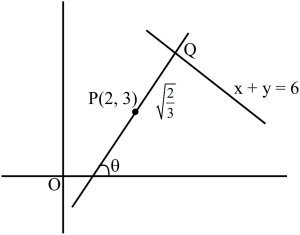
ધારો કે બિંદુ $P(2,3)$ માંથી દોરેલી બે સીધી રેખાઓ જે ધન x-અક્ષ સાથે $\theta_{1}$ અને $\theta_{2}$ ખૂણા બનાવે છે અને રેખા $x+y=6$ ને બિંદુ $P$ થી $\sqrt{\frac{2}{3}}$ અંતરે મળે છે. તો $(\theta_{1}+\theta_{2})$ નું મૂલ્ય શું છે?
A
$\frac{\pi}{12}$
B
$\frac{\pi}{6}$
C
$\frac{\pi}{2}$
D
$\frac{\pi}{3}$
Solution
(C) બિંદુ $P(2,3)$ માંથી પસાર થતી અને $\theta$ ખૂણો બનાવતી રેખાને પ્રાચલ સ્વરૂપમાં $(x, y) = (2 + r\cos\theta, 3 + r\sin\theta)$ તરીકે દર્શાવી શકાય,જ્યાં $r = \sqrt{\frac{2}{3}}$.
આ બિંદુ રેખા $x+y=6$ પર આવેલું હોવાથી,આપણે યામો મૂકીએ:
$(2 + r\cos\theta) + (3 + r\sin\theta) = 6$
$r(\cos\theta + \sin\theta) + 5 = 6$
$\sqrt{\frac{2}{3}}(\cos\theta + \sin\theta) = 1$
$\cos\theta + \sin\theta = \sqrt{\frac{3}{2}}$
બંને બાજુ વર્ગ કરતા:
$(\cos\theta + \sin\theta)^2 = \frac{3}{2}$
$1 + \sin(2\theta) = \frac{3}{2}$
$\sin(2\theta) = \frac{1}{2}$
આમ,$2\theta = \frac{\pi}{6}$ અથવા $2\theta = \pi - \frac{\pi}{6} = \frac{5\pi}{6}$.
તેથી,$\theta_1 = \frac{\pi}{12}$ અને $\theta_2 = \frac{5\pi}{12}$.
ખૂણાઓનો સરવાળો: $\theta_1 + \theta_2 = \frac{\pi}{12} + \frac{5\pi}{12} = \frac{6\pi}{12} = \frac{\pi}{2}$.
આ બિંદુ રેખા $x+y=6$ પર આવેલું હોવાથી,આપણે યામો મૂકીએ:
$(2 + r\cos\theta) + (3 + r\sin\theta) = 6$
$r(\cos\theta + \sin\theta) + 5 = 6$
$\sqrt{\frac{2}{3}}(\cos\theta + \sin\theta) = 1$
$\cos\theta + \sin\theta = \sqrt{\frac{3}{2}}$
બંને બાજુ વર્ગ કરતા:
$(\cos\theta + \sin\theta)^2 = \frac{3}{2}$
$1 + \sin(2\theta) = \frac{3}{2}$
$\sin(2\theta) = \frac{1}{2}$
આમ,$2\theta = \frac{\pi}{6}$ અથવા $2\theta = \pi - \frac{\pi}{6} = \frac{5\pi}{6}$.
તેથી,$\theta_1 = \frac{\pi}{12}$ અને $\theta_2 = \frac{5\pi}{12}$.
ખૂણાઓનો સરવાળો: $\theta_1 + \theta_2 = \frac{\pi}{12} + \frac{5\pi}{12} = \frac{6\pi}{12} = \frac{\pi}{2}$.
0 likes
View Solution181
DifficultMCQ
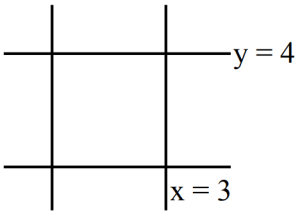
$x=0, x=3, y=0$ અને $y=4$ રેખાઓ દ્વારા એક લંબચોરસ બને છે. ધારો કે રેખા $L$ એ $3x+y+6=0$ ને લંબ છે અને લંબચોરસના ક્ષેત્રફળને બે સમાન ભાગોમાં વિભાજિત કરે છે. તો બિંદુ $(\frac{1}{2}, -5)$ નું રેખા $L$ થી અંતર કેટલું થાય?
A
$2\sqrt{5}$
B
$3\sqrt{10}$
C
$\sqrt{10}$
D
$2\sqrt{10}$
Solution
(D) લંબચોરસ $x=0, x=3, y=0, y=4$ દ્વારા સીમિત છે. લંબચોરસનું કેન્દ્ર $(\frac{3}{2}, 2)$ છે.
કોઈપણ રેખા જે લંબચોરસને બે સમાન ભાગોમાં વિભાજિત કરે છે તે તેના કેન્દ્ર $(\frac{3}{2}, 2)$ માંથી પસાર થવી જોઈએ.
રેખા $L$ એ $3x+y+6=0$ ને લંબ છે. $3x+y+6=0$ નો ઢાળ $-3$ છે,તેથી રેખા $L$ નો ઢાળ $\frac{1}{3}$ છે.
$(\frac{3}{2}, 2)$ માંથી પસાર થતી અને $\frac{1}{3}$ ઢાળ ધરાવતી રેખા $L$ નું સમીકરણ:
$y - 2 = \frac{1}{3}(x - \frac{3}{2})$
$3y - 6 = x - \frac{3}{2}$
$6y - 12 = 2x - 3$
$2x - 6y + 9 = 0$.
બિંદુ $(\frac{1}{2}, -5)$ નું રેખા $2x - 6y + 9 = 0$ થી અંતર:
$d = \frac{|2(\frac{1}{2}) - 6(-5) + 9|}{\sqrt{2^2 + (-6)^2}}$
$d = \frac{|1 + 30 + 9|}{\sqrt{4 + 36}}$
$d = \frac{40}{\sqrt{40}} = \sqrt{40} = 2\sqrt{10}$.
કોઈપણ રેખા જે લંબચોરસને બે સમાન ભાગોમાં વિભાજિત કરે છે તે તેના કેન્દ્ર $(\frac{3}{2}, 2)$ માંથી પસાર થવી જોઈએ.
રેખા $L$ એ $3x+y+6=0$ ને લંબ છે. $3x+y+6=0$ નો ઢાળ $-3$ છે,તેથી રેખા $L$ નો ઢાળ $\frac{1}{3}$ છે.
$(\frac{3}{2}, 2)$ માંથી પસાર થતી અને $\frac{1}{3}$ ઢાળ ધરાવતી રેખા $L$ નું સમીકરણ:
$y - 2 = \frac{1}{3}(x - \frac{3}{2})$
$3y - 6 = x - \frac{3}{2}$
$6y - 12 = 2x - 3$
$2x - 6y + 9 = 0$.
બિંદુ $(\frac{1}{2}, -5)$ નું રેખા $2x - 6y + 9 = 0$ થી અંતર:
$d = \frac{|2(\frac{1}{2}) - 6(-5) + 9|}{\sqrt{2^2 + (-6)^2}}$
$d = \frac{|1 + 30 + 9|}{\sqrt{4 + 36}}$
$d = \frac{40}{\sqrt{40}} = \sqrt{40} = 2\sqrt{10}$.
0 likes
View SolutionStraight Line — Distance between two lines, Perpendicular distance of the line from a point, Position of point w.r.t. line · Frequently Asked Questions
1Are these Straight Line questions useful for JEE and NEET?
Yes. All questions in this section are mapped to JEE Main and NEET exam patterns. Previous year questions from JEE Main, NEET, GUJCET and state-level exams are included with full solutions.
2Can I switch to Hindi or Gujarati for these questions?
Yes. Use the language tabs in the hero section or the sidebar to view the same questions and solutions in English, Hindi or Gujarati.
3How do I generate a question paper from this subtopic?
Use the Vedclass Exam Paper Generator — select the chapter and subtopic, set difficulty, and generate Sets A, B, C, D automatically. First 3 chapters of every subject are free.
Vedclass Products
For Students
Vedclass Test Series
Mock tests in real JEE/NEET style with performance analysis. 5-day free trial.
Start Free TrialFor Teachers
Exam Paper Generator
Generate Set A/B/C/D papers from this chapter in 2 minutes. 3 chapters free.
Try FreeFor Institutes
Online Exam Module
Live online exams with unlimited students, 360° analytics & white-label branding.
See DemoFor Teachers & Institutes
Generate a Straight Line Exam Paper in 2 Minutes
Select subtopic & difficulty — Sets A, B, C, D auto-generated with No Repeat logic.
First 3 chapters of every subject are free — no payment required.