
અ Gujarati
Molecular orbital theory Questions in Gujarati
Class 11 Chemistry · Chemical Bonding and Molecular Structure · Molecular orbital theory
501+
Questions
Gujarati
Language
100%
With Solutions
Showing 50 of 501 questions in Gujarati
251
Difficult
$LCAO$ એટલે શું? સમજાવો.
Solution
(N/A) $LCAO$ એટલે $Linear \ Combination \ of \ Atomic \ Orbitals$ (પરમાણ્વીય કક્ષકોનું રેખીય સંયોજન).
પરમાણ્વીય કક્ષકો અને $\psi$: તરંગ યંત્રશાસ્ત્ર મુજબ,પરમાણ્વીય કક્ષકોને તરંગ વિધેય $(\psi)$ દ્વારા દર્શાવવામાં આવે છે,જે ઇલેક્ટ્રોન તરંગોનો કંપવિસ્તાર દર્શાવે છે. આ $Schrodinger$ તરંગ સમીકરણના ઉકેલ દ્વારા મેળવવામાં આવે છે.
આણ્વીય કક્ષકો અને $LCAO$: $Schrodinger$ તરંગ સમીકરણ એક કરતા વધુ ઇલેક્ટ્રોન ધરાવતી કોઈપણ પ્રણાલી માટે ચોકસાઈપૂર્વક ઉકેલી શકાતું નથી. આણ્વીય કક્ષકો અણુઓ માટે એક-ઇલેક્ટ્રોન તરંગ વિધેયો હોવાથી,તેમને સીધા $Schrodinger$ સમીકરણના ઉકેલમાંથી મેળવવા મુશ્કેલ છે.
આ સમસ્યાને દૂર કરવા માટે,$LCAO$ તરીકે ઓળખાતી એક અંદાજિત પદ્ધતિ અપનાવવામાં આવી છે. તે ધારે છે કે આણ્વીય કક્ષકો બંધનમાં સામેલ પરમાણુઓની પરમાણ્વીય કક્ષકોના રેખીય સંયોજન (સરવાળા અથવા બાદબાકી) દ્વારા બનાવી શકાય છે.
પરમાણ્વીય કક્ષકો અને $\psi$: તરંગ યંત્રશાસ્ત્ર મુજબ,પરમાણ્વીય કક્ષકોને તરંગ વિધેય $(\psi)$ દ્વારા દર્શાવવામાં આવે છે,જે ઇલેક્ટ્રોન તરંગોનો કંપવિસ્તાર દર્શાવે છે. આ $Schrodinger$ તરંગ સમીકરણના ઉકેલ દ્વારા મેળવવામાં આવે છે.
આણ્વીય કક્ષકો અને $LCAO$: $Schrodinger$ તરંગ સમીકરણ એક કરતા વધુ ઇલેક્ટ્રોન ધરાવતી કોઈપણ પ્રણાલી માટે ચોકસાઈપૂર્વક ઉકેલી શકાતું નથી. આણ્વીય કક્ષકો અણુઓ માટે એક-ઇલેક્ટ્રોન તરંગ વિધેયો હોવાથી,તેમને સીધા $Schrodinger$ સમીકરણના ઉકેલમાંથી મેળવવા મુશ્કેલ છે.
આ સમસ્યાને દૂર કરવા માટે,$LCAO$ તરીકે ઓળખાતી એક અંદાજિત પદ્ધતિ અપનાવવામાં આવી છે. તે ધારે છે કે આણ્વીય કક્ષકો બંધનમાં સામેલ પરમાણુઓની પરમાણ્વીય કક્ષકોના રેખીય સંયોજન (સરવાળા અથવા બાદબાકી) દ્વારા બનાવી શકાય છે.
0 likes
View Solution252
Advanced
પરમાણ્વીય કક્ષકોના રૈખિક સંયોજન $(LCAO)$ ને યોગ્ય ઉદાહરણ સાથે સમજાવો.
Solution
(N/A) $LCAO$ પદ્ધતિ: આણ્વીય કક્ષકો $Schrodinger$ તરંગ સમીકરણ દ્વારા સીધી મેળવી શકાતી નથી,પરંતુ તે $LCAO$ પદ્ધતિ દ્વારા મેળવી શકાય છે.
હાઇડ્રોજન અણુ $(H_2)$ માટે $LCAO$ પદ્ધતિ:
- હાઇડ્રોજન એ સમકેન્દ્રીય દ્વિપરમાણ્વીય અણુ છે. હાઇડ્રોજન અણુ $(H_2)$ બે પરમાણુઓ $H_A$ અને $H_B$ નો બનેલો છે.
- ગાણિતિક રીતે,આણ્વીય કક્ષકોનું નિર્માણ પરમાણ્વીય કક્ષકોના રૈખિક સંયોજન દ્વારા વર્ણવી શકાય છે,જે નીચે મુજબ વ્યક્તિગત પરમાણ્વીય કક્ષકોના તરંગ વિધેયોના સરવાળા અને બાદબાકી દ્વારા થાય છે:
$\psi_{MO} = \psi_A + \psi_B$ (બંધકારક)
$\psi^*_{MO} = \psi_A - \psi_B$ (પ્રતિકારક)
બંધકારક આણ્વીય કક્ષક $(\psi_{MO})$ દા.ત. $\sigma$: પરમાણ્વીય કક્ષકોના સરવાળાથી બનતી $\sigma$ આણ્વીય કક્ષકને બંધકારક આણ્વીય કક્ષક કહેવાય છે. અહીં $\sigma$ પ્રકારની આણ્વીય કક્ષક માટે,$\psi_{MO} = \sigma(H_2) = \psi_A + \psi_B$.
પ્રતિકારક આણ્વીય કક્ષક $(\psi^*_{MO})$ દા.ત. $\sigma^*$: પરમાણ્વીય કક્ષકો $(\psi_A$ અને $\psi_B)$ ની બાદબાકીથી બનતી $\sigma^*$ આણ્વીય કક્ષકને પ્રતિકારક આણ્વીય કક્ષક કહેવાય છે. અહીં $\sigma^*$ પ્રકારની પ્રતિકારક આણ્વીય કક્ષક માટે,$\psi^*_{MO}(H_2) = \sigma^*(H_2) = \psi_A - \psi_B$.
હાઇડ્રોજન અણુ $(H_2)$ માટે $LCAO$ પદ્ધતિ:
- હાઇડ્રોજન એ સમકેન્દ્રીય દ્વિપરમાણ્વીય અણુ છે. હાઇડ્રોજન અણુ $(H_2)$ બે પરમાણુઓ $H_A$ અને $H_B$ નો બનેલો છે.
- ગાણિતિક રીતે,આણ્વીય કક્ષકોનું નિર્માણ પરમાણ્વીય કક્ષકોના રૈખિક સંયોજન દ્વારા વર્ણવી શકાય છે,જે નીચે મુજબ વ્યક્તિગત પરમાણ્વીય કક્ષકોના તરંગ વિધેયોના સરવાળા અને બાદબાકી દ્વારા થાય છે:
$\psi_{MO} = \psi_A + \psi_B$ (બંધકારક)
$\psi^*_{MO} = \psi_A - \psi_B$ (પ્રતિકારક)
બંધકારક આણ્વીય કક્ષક $(\psi_{MO})$ દા.ત. $\sigma$: પરમાણ્વીય કક્ષકોના સરવાળાથી બનતી $\sigma$ આણ્વીય કક્ષકને બંધકારક આણ્વીય કક્ષક કહેવાય છે. અહીં $\sigma$ પ્રકારની આણ્વીય કક્ષક માટે,$\psi_{MO} = \sigma(H_2) = \psi_A + \psi_B$.
પ્રતિકારક આણ્વીય કક્ષક $(\psi^*_{MO})$ દા.ત. $\sigma^*$: પરમાણ્વીય કક્ષકો $(\psi_A$ અને $\psi_B)$ ની બાદબાકીથી બનતી $\sigma^*$ આણ્વીય કક્ષકને પ્રતિકારક આણ્વીય કક્ષક કહેવાય છે. અહીં $\sigma^*$ પ્રકારની પ્રતિકારક આણ્વીય કક્ષક માટે,$\psi^*_{MO}(H_2) = \sigma^*(H_2) = \psi_A - \psi_B$.
0 likes
View Solution253
Difficult
$H_{2}$ અણુને આણ્વીય કક્ષક સિદ્ધાંત દ્વારા સમજાવો.
Solution
(N/A) આણ્વીય કક્ષકોની $LCAO$ પદ્ધતિ: આણ્વીય કક્ષકો સીધી રીતે શ્રોડિંજર તરંગ સમીકરણ દ્વારા મેળવી શકાતી નથી,પરંતુ તે $LCAO$ (પરમાણ્વીય કક્ષકોનું રેખીય સંયોજન) પદ્ધતિ દ્વારા મેળવી શકાય છે.
હાઇડ્રોજન અણુ $(H_{2})$ માટે $LCAO$ પદ્ધતિ:
- હાઇડ્રોજન એ સમકેન્દ્રીય દ્વિપરમાણ્વીય અણુ છે. હાઇડ્રોજન અણુ $(H_{2})$ ને ધ્યાનમાં લો જે બે પરમાણુઓ $H_{A}$ અને $H_{B}$ નો બનેલો છે.
- ગાણિતિક રીતે,આણ્વીય કક્ષકોનું નિર્માણ પરમાણ્વીય કક્ષકોના રેખીય સંયોજન દ્વારા વર્ણવી શકાય છે,જે નીચે દર્શાવ્યા મુજબ વ્યક્તિગત પરમાણ્વીય કક્ષકોના તરંગ વિધેયોના સરવાળા અથવા બાદબાકી દ્વારા થઈ શકે છે:
$\psi_{MO} = \psi_{A} + \psi_{B} \quad \text{અથવા} \quad \psi^{*}_{MO} = \psi_{A} - \psi_{B}$
- બંધકારક આણ્વીય કક્ષક $(\psi_{MO})$,દા.ત.,$\sigma$: પરમાણ્વીય કક્ષકોના સરવાળાથી બનતી $\sigma$ આણ્વીય કક્ષકને બંધકારક આણ્વીય કક્ષક કહેવામાં આવે છે. અહીં,$\psi_{MO} = \sigma(H_{2}) = \psi_{A} + \psi_{B}$.
- બંધપ્રતિકારક આણ્વીય કક્ષક $(\psi^{*}_{MO})$,દા.ત.,$\sigma^{*}$: પરમાણ્વીય કક્ષકો $(\psi_{A}$ અને $\psi_{B})$ ની બાદબાકીથી બનતી $\sigma^{*}$ આણ્વીય કક્ષકને બંધપ્રતિકારક આણ્વીય કક્ષક કહેવામાં આવે છે. અહીં,$\psi^{*}_{MO}(H_{2}) = \sigma^{*}_{(H_{2})} = \psi_{A} - \psi_{B}$.
- ઉર્જા સ્તર આકૃતિ દર્શાવે છે કે બંધકારક કક્ષકની ઉર્જા પરમાણ્વીય કક્ષકો કરતા ઓછી હોય છે,જ્યારે બંધપ્રતિકારક કક્ષકની ઉર્જા વધારે હોય છે.
હાઇડ્રોજન અણુ $(H_{2})$ માટે $LCAO$ પદ્ધતિ:
- હાઇડ્રોજન એ સમકેન્દ્રીય દ્વિપરમાણ્વીય અણુ છે. હાઇડ્રોજન અણુ $(H_{2})$ ને ધ્યાનમાં લો જે બે પરમાણુઓ $H_{A}$ અને $H_{B}$ નો બનેલો છે.
- ગાણિતિક રીતે,આણ્વીય કક્ષકોનું નિર્માણ પરમાણ્વીય કક્ષકોના રેખીય સંયોજન દ્વારા વર્ણવી શકાય છે,જે નીચે દર્શાવ્યા મુજબ વ્યક્તિગત પરમાણ્વીય કક્ષકોના તરંગ વિધેયોના સરવાળા અથવા બાદબાકી દ્વારા થઈ શકે છે:
$\psi_{MO} = \psi_{A} + \psi_{B} \quad \text{અથવા} \quad \psi^{*}_{MO} = \psi_{A} - \psi_{B}$
- બંધકારક આણ્વીય કક્ષક $(\psi_{MO})$,દા.ત.,$\sigma$: પરમાણ્વીય કક્ષકોના સરવાળાથી બનતી $\sigma$ આણ્વીય કક્ષકને બંધકારક આણ્વીય કક્ષક કહેવામાં આવે છે. અહીં,$\psi_{MO} = \sigma(H_{2}) = \psi_{A} + \psi_{B}$.
- બંધપ્રતિકારક આણ્વીય કક્ષક $(\psi^{*}_{MO})$,દા.ત.,$\sigma^{*}$: પરમાણ્વીય કક્ષકો $(\psi_{A}$ અને $\psi_{B})$ ની બાદબાકીથી બનતી $\sigma^{*}$ આણ્વીય કક્ષકને બંધપ્રતિકારક આણ્વીય કક્ષક કહેવામાં આવે છે. અહીં,$\psi^{*}_{MO}(H_{2}) = \sigma^{*}_{(H_{2})} = \psi_{A} - \psi_{B}$.
- ઉર્જા સ્તર આકૃતિ દર્શાવે છે કે બંધકારક કક્ષકની ઉર્જા પરમાણ્વીય કક્ષકો કરતા ઓછી હોય છે,જ્યારે બંધપ્રતિકારક કક્ષકની ઉર્જા વધારે હોય છે.
0 likes
View Solution254
Difficult
બંધકારક આણ્વીય કક્ષકો અને પ્રતિબંધકારક આણ્વીય કક્ષકો વચ્ચેનો તફાવત આપો.
Solution
(N/A)
| બંધકારક આણ્વીય કક્ષકો $(BMO)$ | પ્રતિબંધકારક આણ્વીય કક્ષકો $(ABMO)$ |
| તેને $BMO$ તરીકે ઓળખવામાં આવે છે. તેનું તરંગ વિધેય $\psi_{MO} = \psi_{A} + \psi_{B}$ દ્વારા દર્શાવવામાં આવે છે. | તેને $ABMO$ તરીકે ઓળખવામાં આવે છે. તેનું તરંગ વિધેય $\psi_{MO}^{*} = \psi_{A} - \psi_{B}$ દ્વારા દર્શાવવામાં આવે છે. |
| તે પરમાણ્વીય કક્ષકોના સરવાળાથી બને છે. | તે પરમાણ્વીય કક્ષકોની બાદબાકીની અસરથી બને છે. |
| તેમાં ઇલેક્ટ્રોન તરંગોનું રચનાત્મક વ્યતિકરણ થાય છે. | તેમાં ઇલેક્ટ્રોન તરંગોનું વિનાશક વ્યતિકરણ થાય છે. |
| ઇલેક્ટ્રોન ઘનતા કેન્દ્રની વચ્ચે હોય છે,જે આકર્ષણ વધારે છે. | ઇલેક્ટ્રોન ઘનતા કેન્દ્રની વચ્ચેથી દૂર હોય છે. |
| તેમાં નોડલ સમતલ હોતું નથી. | તેમાં કેન્દ્રની વચ્ચે નોડલ સમતલ હોય છે. |
| $BMO$ માં રહેલા ઇલેક્ટ્રોન અણુને સ્થાયી બનાવે છે. | $ABMO$ માં રહેલા ઇલેક્ટ્રોન અણુને અસ્થાયી બનાવે છે. |
| $BMO$ ની ઉર્જા પરમાણ્વીય કક્ષકો કરતા ઓછી હોય છે. | $ABMO$ ની ઉર્જા પરમાણ્વીય કક્ષકો કરતા વધારે હોય છે. |
| $BMO$ સ્થાયી છે. ઉદાહરણ: $\sigma, \pi$. | $ABMO$ અસ્થાયી છે. ઉદાહરણ: $\sigma^{*}, \pi^{*}$. |
1 likes
View Solution255
Difficult
આણ્વિય કક્ષકો બનાવવા માટે પરમાણ્વીય કક્ષકોના રેખીય સંયોજન $(LCAO)$ માટે જરૂરી મહત્વની શરતો લખો.
Solution
(N/A) આણ્વિય કક્ષકો બનાવવા માટે પરમાણ્વીય કક્ષકોનું રેખીય સંયોજન $(LCAO)$ ત્યારે જ થાય છે જો નીચેની શરતો સંતોષાય:
$1$. સંયોજાતી પરમાણ્વીય કક્ષકોની ઉર્જા સમાન અથવા લગભગ સમાન હોવી જોઈએ. ઉદાહરણ તરીકે,$1s$ કક્ષક બીજી $1s$ કક્ષક સાથે સંયોજાઈ શકે છે પરંતુ $2s$ કક્ષક સાથે નહીં,કારણ કે $2s$ કક્ષકની ઉર્જા $1s$ કક્ષક કરતા ઘણી વધારે હોય છે.
$2$. સંયોજાતી પરમાણ્વીય કક્ષકોની આણ્વિય અક્ષની આસપાસ સંમિતિ સમાન હોવી જોઈએ. પરંપરાગત રીતે,$z$-અક્ષને આણ્વિય અક્ષ તરીકે લેવામાં આવે છે. સમાન ઉર્જા ધરાવતી પરમાણ્વીય કક્ષકો જો સમાન સંમિતિ ન ધરાવતી હોય તો તે સંયોજાતી નથી. ઉદાહરણ તરીકે,એક પરમાણુની $2p_z$ કક્ષક બીજા પરમાણુની $2p_z$ કક્ષક સાથે સંયોજાઈ શકે છે,પરંતુ તેમની અલગ સંમિતિને કારણે $2p_x$ કે $2p_y$ કક્ષકો સાથે નહીં.
$3$. સંયોજાતી પરમાણ્વીય કક્ષકો મહત્તમ હદ સુધી એકબીજા પર વ્યાપન (overlap) પામવી જોઈએ. વ્યાપન જેટલું વધારે,આણ્વિય કક્ષકના કેન્દ્રો વચ્ચે ઇલેક્ટ્રોન ઘનતા તેટલી જ વધારે હશે.
$1$. સંયોજાતી પરમાણ્વીય કક્ષકોની ઉર્જા સમાન અથવા લગભગ સમાન હોવી જોઈએ. ઉદાહરણ તરીકે,$1s$ કક્ષક બીજી $1s$ કક્ષક સાથે સંયોજાઈ શકે છે પરંતુ $2s$ કક્ષક સાથે નહીં,કારણ કે $2s$ કક્ષકની ઉર્જા $1s$ કક્ષક કરતા ઘણી વધારે હોય છે.
$2$. સંયોજાતી પરમાણ્વીય કક્ષકોની આણ્વિય અક્ષની આસપાસ સંમિતિ સમાન હોવી જોઈએ. પરંપરાગત રીતે,$z$-અક્ષને આણ્વિય અક્ષ તરીકે લેવામાં આવે છે. સમાન ઉર્જા ધરાવતી પરમાણ્વીય કક્ષકો જો સમાન સંમિતિ ન ધરાવતી હોય તો તે સંયોજાતી નથી. ઉદાહરણ તરીકે,એક પરમાણુની $2p_z$ કક્ષક બીજા પરમાણુની $2p_z$ કક્ષક સાથે સંયોજાઈ શકે છે,પરંતુ તેમની અલગ સંમિતિને કારણે $2p_x$ કે $2p_y$ કક્ષકો સાથે નહીં.
$3$. સંયોજાતી પરમાણ્વીય કક્ષકો મહત્તમ હદ સુધી એકબીજા પર વ્યાપન (overlap) પામવી જોઈએ. વ્યાપન જેટલું વધારે,આણ્વિય કક્ષકના કેન્દ્રો વચ્ચે ઇલેક્ટ્રોન ઘનતા તેટલી જ વધારે હશે.
0 likes
View Solution256
Difficult
આણ્વીય કક્ષકોના પ્રકારો કયા છે? ટૂંકમાં માહિતી આપો.
Solution
(N/A) દ્વિપરમાણ્વીય અણુઓની આણ્વીય કક્ષકોને $\sigma$ (સિગ્મા),$\pi$ (પાઈ),$\delta$ (ડેલ્ટા) વગેરે તરીકે દર્શાવવામાં આવે છે.
$1$. $\sigma$ (સિગ્મા) આણ્વીય કક્ષકો: આ કક્ષકો બંધ ધરીની આસપાસ સંમિત હોય છે. ઉદાહરણ તરીકે,$\sigma_{1s}$ અને $\sigma_{1s}^{*}$ એ $1s$ કક્ષકોના રેખીય સંયોજનથી બને છે. તેવી જ રીતે,જો આંતરકેન્દ્રીય ધરી $Z$-દિશામાં હોય,તો $2p_{z}$ કક્ષકોના રેખીય સંયોજનથી $\sigma(2p_{z})$ અને $\sigma^{*}(2p_{z})$ કક્ષકો બને છે. આ બધી બંધ ધરીની આસપાસ સંમિત હોય છે.
$2$. $\pi$ (પાઈ) આણ્વીય કક્ષકો: આ કક્ષકો બંધ ધરીની આસપાસ સંમિત હોતી નથી. $2p_{x}$ અને $2p_{y}$ કક્ષકોમાંથી મળતી આણ્વીય કક્ષકોને $\pi$ અને $\pi^{*}$ તરીકે ઓળખવામાં આવે છે. $\pi$ બંધકારક $MO$ માં આંતરકેન્દ્રીય ધરીની ઉપર અને નીચે ઇલેક્ટ્રોન ઘનતા વધુ હોય છે,જ્યારે $\pi^{*}$ બંધપ્રતિકારક $MO$ માં કેન્દ્રોની વચ્ચે નોડ (node) હોય છે.
$1$. $\sigma$ (સિગ્મા) આણ્વીય કક્ષકો: આ કક્ષકો બંધ ધરીની આસપાસ સંમિત હોય છે. ઉદાહરણ તરીકે,$\sigma_{1s}$ અને $\sigma_{1s}^{*}$ એ $1s$ કક્ષકોના રેખીય સંયોજનથી બને છે. તેવી જ રીતે,જો આંતરકેન્દ્રીય ધરી $Z$-દિશામાં હોય,તો $2p_{z}$ કક્ષકોના રેખીય સંયોજનથી $\sigma(2p_{z})$ અને $\sigma^{*}(2p_{z})$ કક્ષકો બને છે. આ બધી બંધ ધરીની આસપાસ સંમિત હોય છે.
$2$. $\pi$ (પાઈ) આણ્વીય કક્ષકો: આ કક્ષકો બંધ ધરીની આસપાસ સંમિત હોતી નથી. $2p_{x}$ અને $2p_{y}$ કક્ષકોમાંથી મળતી આણ્વીય કક્ષકોને $\pi$ અને $\pi^{*}$ તરીકે ઓળખવામાં આવે છે. $\pi$ બંધકારક $MO$ માં આંતરકેન્દ્રીય ધરીની ઉપર અને નીચે ઇલેક્ટ્રોન ઘનતા વધુ હોય છે,જ્યારે $\pi^{*}$ બંધપ્રતિકારક $MO$ માં કેન્દ્રોની વચ્ચે નોડ (node) હોય છે.
0 likes
View Solution257
Difficult
$1s$ કક્ષકો દ્વારા બનતી આણ્વીય કક્ષકો માટે ઉર્જા સ્તર આકૃતિ સમજાવો.
Solution
(N/A) બે પરમાણુઓ (દા.ત. હાઇડ્રોજન) પરની $1s$ પરમાણ્વીય કક્ષકો જોડાઈને બે આણ્વીય કક્ષકો બનાવે છે,જેને $\sigma 1s$ અને $\sigma^{*} 1s$ તરીકે દર્શાવવામાં આવે છે.
$\sigma 1s$ એ બંધકારક આણ્વીય કક્ષક $(BMO)$ છે અને $\sigma^{*} 1s$ એ બંધપ્રતિકારક આણ્વીય કક્ષક $(ABMO)$ છે.
ઉર્જાનો ક્રમ આ મુજબ છે: $\sigma 1s$ ની ઉર્જા $ < $ $1s$ પરમાણ્વીય કક્ષકની ઉર્જા $ < $ $\sigma^{*} 1s$ ની ઉર્જા.
આણ્વીય કક્ષકોની ઉર્જાનો સરવાળો એ બે $1s$ પરમાણ્વીય કક્ષકોની ઉર્જાના સરવાળા જેટલો હોય છે.
આ કક્ષકોની ઉર્જા આકૃતિ અને રચના નીચે મુજબ છે:
$AO =$ પરમાણ્વીય કક્ષકો,$MO =$ આણ્વીય કક્ષકો
$BMO$ એ પરમાણ્વીય કક્ષકોના રચનાત્મક વ્યતિકરણ (સરવાળા) દ્વારા બને છે,જ્યારે $ABMO$ એ પરમાણ્વીય કક્ષકોના વિનાશક વ્યતિકરણ (બાદબાકી) દ્વારા બને છે.
$\sigma 1s$ એ બંધકારક આણ્વીય કક્ષક $(BMO)$ છે અને $\sigma^{*} 1s$ એ બંધપ્રતિકારક આણ્વીય કક્ષક $(ABMO)$ છે.
ઉર્જાનો ક્રમ આ મુજબ છે: $\sigma 1s$ ની ઉર્જા $ < $ $1s$ પરમાણ્વીય કક્ષકની ઉર્જા $ < $ $\sigma^{*} 1s$ ની ઉર્જા.
આણ્વીય કક્ષકોની ઉર્જાનો સરવાળો એ બે $1s$ પરમાણ્વીય કક્ષકોની ઉર્જાના સરવાળા જેટલો હોય છે.
આ કક્ષકોની ઉર્જા આકૃતિ અને રચના નીચે મુજબ છે:
$AO =$ પરમાણ્વીય કક્ષકો,$MO =$ આણ્વીય કક્ષકો
$BMO$ એ પરમાણ્વીય કક્ષકોના રચનાત્મક વ્યતિકરણ (સરવાળા) દ્વારા બને છે,જ્યારે $ABMO$ એ પરમાણ્વીય કક્ષકોના વિનાશક વ્યતિકરણ (બાદબાકી) દ્વારા બને છે.
0 likes
View Solution258
Difficult
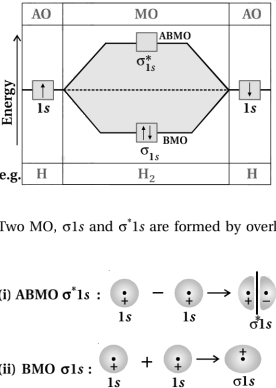
$H_{2}$ ની રચના અને $H_{2}$ અણુનો ઉર્જા સ્તર આલેખ સમજાવો.
Solution
(N/A) બે હાઇડ્રોજન પરમાણુઓ પરના $1s$ પરમાણ્વીય કક્ષકો એકબીજા સાથે સંમિશ્રણ પામીને બે આણ્વીય કક્ષકો બનાવે છે,જેને $\sigma 1s$ અને $\sigma^{*} 1s$ તરીકે ઓળખવામાં આવે છે.
$\sigma 1s$ એ બંધકારક આણ્વીય કક્ષક $(BMO)$ છે અને $\sigma^{*} 1s$ એ બંધપ્રતિકારક આણ્વીય કક્ષક $(ABMO)$ છે.
ઉર્જાનો ક્રમ આ મુજબ છે: $\sigma 1s$ ની ઉર્જા $ < $ $1s$ પરમાણ્વીય કક્ષકની ઉર્જા $ < $ $\sigma^{*} 1s$ ની ઉર્જા.
બે આણ્વીય કક્ષકોની ઉર્જાનો સરવાળો એ બે $1s$ પરમાણ્વીય કક્ષકોની ઉર્જાના સરવાળા જેટલો હોય છે.
$H_{2}$ ના નિર્માણ માટેનો ઉર્જા સ્તર આલેખ નીચે મુજબ છે.
$AO =$ પરમાણ્વીય કક્ષકો,$MO =$ આણ્વીય કક્ષકો,$BMO =$ બંધકારક આણ્વીય કક્ષક,$ABMO =$ બંધપ્રતિકારક આણ્વીય કક્ષક.
પરમાણ્વીય કક્ષકોના રેખીય સંયોજન $(LCAO)$ દ્વારા આ આણ્વીય કક્ષકોનું નિર્માણ નીચે મુજબ દર્શાવેલ છે:
$(i)$ $ABMO$ $(\sigma^{*} 1s)$: બે $1s$ કક્ષકોના બાદબાકીયુક્ત સંમિશ્રણ દ્વારા બને છે.
(ii) $BMO$ $(\sigma 1s)$: બે $1s$ કક્ષકોના સરવાળાત્મક સંમિશ્રણ દ્વારા બને છે.
$\sigma 1s$ એ બંધકારક આણ્વીય કક્ષક $(BMO)$ છે અને $\sigma^{*} 1s$ એ બંધપ્રતિકારક આણ્વીય કક્ષક $(ABMO)$ છે.
ઉર્જાનો ક્રમ આ મુજબ છે: $\sigma 1s$ ની ઉર્જા $ < $ $1s$ પરમાણ્વીય કક્ષકની ઉર્જા $ < $ $\sigma^{*} 1s$ ની ઉર્જા.
બે આણ્વીય કક્ષકોની ઉર્જાનો સરવાળો એ બે $1s$ પરમાણ્વીય કક્ષકોની ઉર્જાના સરવાળા જેટલો હોય છે.
$H_{2}$ ના નિર્માણ માટેનો ઉર્જા સ્તર આલેખ નીચે મુજબ છે.
$AO =$ પરમાણ્વીય કક્ષકો,$MO =$ આણ્વીય કક્ષકો,$BMO =$ બંધકારક આણ્વીય કક્ષક,$ABMO =$ બંધપ્રતિકારક આણ્વીય કક્ષક.
પરમાણ્વીય કક્ષકોના રેખીય સંયોજન $(LCAO)$ દ્વારા આ આણ્વીય કક્ષકોનું નિર્માણ નીચે મુજબ દર્શાવેલ છે:
$(i)$ $ABMO$ $(\sigma^{*} 1s)$: બે $1s$ કક્ષકોના બાદબાકીયુક્ત સંમિશ્રણ દ્વારા બને છે.
(ii) $BMO$ $(\sigma 1s)$: બે $1s$ કક્ષકોના સરવાળાત્મક સંમિશ્રણ દ્વારા બને છે.
0 likes
View Solution259
Advanced
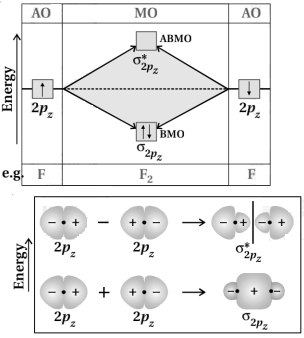
$2p_{z}$ કક્ષકોના અતિવ્યાપનથી મળતો ઉર્જા સ્તરનો આલેખ દોરો અને તે સંયોજનની કક્ષકોની આકૃતિ દર્શાવો.
Solution
(N/A) Linear Combination of Atomic Orbitals $(LCAO)$ પદ્ધતિ મુજબ,બે $2p_{z}$ પરમાણ્વીય કક્ષકો અતિવ્યાપન પામીને બે આણ્વીય કક્ષકો $(MO)$ બનાવે છે: બંધકારક આણ્વીય કક્ષક $(BMO)$ અને બંધપ્રતિકારક આણ્વીય કક્ષક $(ABMO)$.
$1$. ઉર્જા સ્તરનો આલેખ:
- $2p_{z}$ પરમાણ્વીય કક્ષકો $(AO)$ જોડાઈને ઓછી ઉર્જા ધરાવતી બંધકારક કક્ષક $\sigma 2p_{z}$ અને વધુ ઉર્જા ધરાવતી બંધપ્રતિકારક કક્ષક $\sigma^{*} 2p_{z}$ બનાવે છે.
- ઉર્જાનો ક્રમ: $\sigma 2p_{z} < 2p_{z} < \sigma^{*} 2p_{z}$.
$2$. કક્ષકોની આકૃતિ:
- બંધકારક $(\sigma 2p_{z})$: તરંગ વિધેયોના રચનાત્મક વ્યતિકરણ (સરવાળા) દ્વારા બને છે,જેના પરિણામે કેન્દ્રો વચ્ચે ઇલેક્ટ્રોન ઘનતા વધે છે.
- બંધપ્રતિકારક $(\sigma^{*} 2p_{z})$: તરંગ વિધેયોના વિનાશક વ્યતિકરણ (બાદબાકી) દ્વારા બને છે,જેના પરિણામે કેન્દ્રો વચ્ચે નોડલ સમતલ રચાય છે જ્યાં ઇલેક્ટ્રોન ઘનતા શૂન્ય હોય છે.
$1$. ઉર્જા સ્તરનો આલેખ:
- $2p_{z}$ પરમાણ્વીય કક્ષકો $(AO)$ જોડાઈને ઓછી ઉર્જા ધરાવતી બંધકારક કક્ષક $\sigma 2p_{z}$ અને વધુ ઉર્જા ધરાવતી બંધપ્રતિકારક કક્ષક $\sigma^{*} 2p_{z}$ બનાવે છે.
- ઉર્જાનો ક્રમ: $\sigma 2p_{z} < 2p_{z} < \sigma^{*} 2p_{z}$.
$2$. કક્ષકોની આકૃતિ:
- બંધકારક $(\sigma 2p_{z})$: તરંગ વિધેયોના રચનાત્મક વ્યતિકરણ (સરવાળા) દ્વારા બને છે,જેના પરિણામે કેન્દ્રો વચ્ચે ઇલેક્ટ્રોન ઘનતા વધે છે.
- બંધપ્રતિકારક $(\sigma^{*} 2p_{z})$: તરંગ વિધેયોના વિનાશક વ્યતિકરણ (બાદબાકી) દ્વારા બને છે,જેના પરિણામે કેન્દ્રો વચ્ચે નોડલ સમતલ રચાય છે જ્યાં ઇલેક્ટ્રોન ઘનતા શૂન્ય હોય છે.
0 likes
View Solution260
Medium
બે પરમાણુઓની $2p_x^1$ કક્ષકોના અતિવ્યાપનથી મળતી આણ્વીય કક્ષકની ઉર્જા સ્તર આકૃતિ આપો.
Solution
(N/A) રેખીય સંયોજનની પરમાણ્વીય કક્ષકો $(LCAO)$ પદ્ધતિ મુજબ,બે $2p_x$ પરમાણ્વીય કક્ષકો $(AO)$ ના અતિવ્યાપનથી બે આણ્વીય કક્ષકો $(MO)$ બને છે: બંધકારક આણ્વીય કક્ષક $(BMO)$ જેને $\pi 2p_x$ તરીકે દર્શાવાય છે અને બંધપ્રતિકારક આણ્વીય કક્ષક $(ABMO)$ જેને $\pi^* 2p_x$ તરીકે દર્શાવાય છે.
ઉર્જાનો ક્રમ: $\pi 2p_x < 2p_x < \pi^* 2p_x$.
$\pi$ પ્રકારની $BMO$ માં,તરંગ વિધેયોના $(+)$ અને $(-)$ તબક્કાઓ રચનાત્મક રીતે અતિવ્યાપન પામે છે,જેના પરિણામે બે કેન્દ્રો વચ્ચે ઇલેક્ટ્રોન ઘનતા વધે છે.
$\pi^*$ પ્રકારની $ABMO$ માં,તબક્કાઓ વિનાશક રીતે અતિવ્યાપન પામે છે,જેના પરિણામે બે કેન્દ્રો વચ્ચે એક ઉભું નોડલ સમતલ રચાય છે જ્યાં ઇલેક્ટ્રોન ઘનતા શૂન્ય હોય છે.
ઉર્જાનો ક્રમ: $\pi 2p_x < 2p_x < \pi^* 2p_x$.
$\pi$ પ્રકારની $BMO$ માં,તરંગ વિધેયોના $(+)$ અને $(-)$ તબક્કાઓ રચનાત્મક રીતે અતિવ્યાપન પામે છે,જેના પરિણામે બે કેન્દ્રો વચ્ચે ઇલેક્ટ્રોન ઘનતા વધે છે.
$\pi^*$ પ્રકારની $ABMO$ માં,તબક્કાઓ વિનાશક રીતે અતિવ્યાપન પામે છે,જેના પરિણામે બે કેન્દ્રો વચ્ચે એક ઉભું નોડલ સમતલ રચાય છે જ્યાં ઇલેક્ટ્રોન ઘનતા શૂન્ય હોય છે.
0 likes
View Solution261
Difficult
નીચેના પ્રશ્નોના જવાબ આપો:
$(i)$ $2s, 2p_{x}, 2p_{y}$ અને $2p_{z}$ પરમાણ્વીય કક્ષકોમાંથી $LCAO$ દ્વારા બનતી આણ્વીય કક્ષકો અને તેના પ્રકારો જણાવો.
$(ii)$ $Li_{2}, Be_{2}, C_{2}, N_{2}, O_{2}$ અને $F_{2}$ અણુઓ માટે આણ્વીય કક્ષકોનો ઉર્જા ક્રમ આપો.
$(i)$ $2s, 2p_{x}, 2p_{y}$ અને $2p_{z}$ પરમાણ્વીય કક્ષકોમાંથી $LCAO$ દ્વારા બનતી આણ્વીય કક્ષકો અને તેના પ્રકારો જણાવો.
$(ii)$ $Li_{2}, Be_{2}, C_{2}, N_{2}, O_{2}$ અને $F_{2}$ અણુઓ માટે આણ્વીય કક્ષકોનો ઉર્જા ક્રમ આપો.
Solution
$LCAO$ દ્વારા બનતી આણ્વીય કક્ષકો:
કક્ષકોનો ઉર્જા ક્રમ:
$Li_{2}, Be_{2}, B_{2}, C_{2}, N_{2}$ માટે $MO$ નો વધતો ઉર્જા ક્રમ:
$\sigma 1s < \sigma^{*} 1s < \sigma 2s < \sigma^{*} 2s < (\pi 2p_{x} = \pi 2p_{y}) < \sigma 2p_{z} < (\pi^{*} 2p_{x} = \pi^{*} 2p_{y}) < \sigma^{*} 2p_{z}$
$O_{2}$ અને $F_{2}$ માટે $MO$ નો વધતો ઉર્જા ક્રમ:
$\sigma 1s < \sigma^{*} 1s < \sigma 2s < \sigma^{*} 2s < \sigma 2p_{z} < (\pi 2p_{x} = \pi 2p_{y}) < (\pi^{*} 2p_{x} = \pi^{*} 2p_{y}) < \sigma^{*} 2p_{z}$
| $AO$ | પરમાણ્વીય કક્ષકોનું સંયોજન $(LCAO)$ | આણ્વીય કક્ષક $(MO)$ |
| $2s$ | $\psi(2s) + \psi(2s)$,$\psi(2s) - \psi(2s)$ | $BMO: \sigma(2s)$,$ABMO: \sigma^{*}(2s)$ |
| $2p_{z}$ | $\psi(2p_{z}) + \psi(2p_{z})$,$\psi(2p_{z}) - \psi(2p_{z})$ | $BMO: \sigma(2p_{z})$,$ABMO: \sigma^{*}(2p_{z})$ |
| $2p_{x}$ | $\psi(2p_{x}) + \psi(2p_{x})$,$\psi(2p_{x}) - \psi(2p_{x})$ | $BMO: \pi(2p_{x})$,$ABMO: \pi^{*}(2p_{x})$ |
| $2p_{y}$ | $\psi(2p_{y}) + \psi(2p_{y})$,$\psi(2p_{y}) - \psi(2p_{y})$ | $BMO: \pi(2p_{y})$,$ABMO: \pi^{*}(2p_{y})$ |
કક્ષકોનો ઉર્જા ક્રમ:
$Li_{2}, Be_{2}, B_{2}, C_{2}, N_{2}$ માટે $MO$ નો વધતો ઉર્જા ક્રમ:
$\sigma 1s < \sigma^{*} 1s < \sigma 2s < \sigma^{*} 2s < (\pi 2p_{x} = \pi 2p_{y}) < \sigma 2p_{z} < (\pi^{*} 2p_{x} = \pi^{*} 2p_{y}) < \sigma^{*} 2p_{z}$
$O_{2}$ અને $F_{2}$ માટે $MO$ નો વધતો ઉર્જા ક્રમ:
$\sigma 1s < \sigma^{*} 1s < \sigma 2s < \sigma^{*} 2s < \sigma 2p_{z} < (\pi 2p_{x} = \pi 2p_{y}) < (\pi^{*} 2p_{x} = \pi^{*} 2p_{y}) < \sigma^{*} 2p_{z}$
0 likes
View Solution262
DifficultMCQ
$MO$ સિદ્ધાંતમાં અણુની ઇલેક્ટ્રોનિક ગોઠવણી દ્વારા કઈ માહિતી મેળવી શકાય છે?
A
અણુની સ્થિરતા
B
બંધ ક્રમાંક અને બંધ લંબાઈ
C
ચુંબકીય પ્રકૃતિ
D
ઉપરોક્ત તમામ
Solution
(D) $MO$ સિદ્ધાંતમાં અણુની ઇલેક્ટ્રોનિક ગોઠવણી નીચેની માહિતી આપે છે:
$1$. અણુની સ્થિરતા: જો $N_{b} > N_{a}$ હોય,તો અણુ સ્થિર છે. જો $N_{b} < N_{a}$ હોય,તો અણુ અસ્થિર છે. સ્થિરતા એ બંધ ક્રમાંકના સમપ્રમાણમાં હોય છે.
$2$. બંધ ક્રમાંક: $BO = \frac{1}{2} (N_{b} - N_{a})$ તરીકે ગણવામાં આવે છે.
$3$. બંધની પ્રકૃતિ: $1$,$2$ અને $3$ ના પૂર્ણાંક બંધ ક્રમાંક મૂલ્યો અનુક્રમે એકલ,દ્વિ અથવા ત્રિ-બંધ સૂચવે છે.
$4$. બંધ લંબાઈ: બંધ ક્રમાંક વધવાની સાથે બંધ લંબાઈ ઘટે છે.
$5$. ચુંબકીય પ્રકૃતિ: જો તમામ આણ્વીય કક્ષકો બેવડા ભરાયેલા હોય,તો પદાર્થ પ્રતિચુંબકીય છે. જો એક કે તેથી વધુ આણ્વીય કક્ષકો એકલ ભરાયેલા હોય,તો તે અનુચુંબકીય છે (દા.ત.,$O_{2}$).
જ્યાં,$N_{a} =$ એન્ટિબોન્ડિંગ કક્ષકોમાં ઇલેક્ટ્રોનની સંખ્યા અને $N_{b} =$ બોન્ડિંગ કક્ષકોમાં ઇલેક્ટ્રોનની સંખ્યા.
$1$. અણુની સ્થિરતા: જો $N_{b} > N_{a}$ હોય,તો અણુ સ્થિર છે. જો $N_{b} < N_{a}$ હોય,તો અણુ અસ્થિર છે. સ્થિરતા એ બંધ ક્રમાંકના સમપ્રમાણમાં હોય છે.
$2$. બંધ ક્રમાંક: $BO = \frac{1}{2} (N_{b} - N_{a})$ તરીકે ગણવામાં આવે છે.
$3$. બંધની પ્રકૃતિ: $1$,$2$ અને $3$ ના પૂર્ણાંક બંધ ક્રમાંક મૂલ્યો અનુક્રમે એકલ,દ્વિ અથવા ત્રિ-બંધ સૂચવે છે.
$4$. બંધ લંબાઈ: બંધ ક્રમાંક વધવાની સાથે બંધ લંબાઈ ઘટે છે.
$5$. ચુંબકીય પ્રકૃતિ: જો તમામ આણ્વીય કક્ષકો બેવડા ભરાયેલા હોય,તો પદાર્થ પ્રતિચુંબકીય છે. જો એક કે તેથી વધુ આણ્વીય કક્ષકો એકલ ભરાયેલા હોય,તો તે અનુચુંબકીય છે (દા.ત.,$O_{2}$).
જ્યાં,$N_{a} =$ એન્ટિબોન્ડિંગ કક્ષકોમાં ઇલેક્ટ્રોનની સંખ્યા અને $N_{b} =$ બોન્ડિંગ કક્ષકોમાં ઇલેક્ટ્રોનની સંખ્યા.
0 likes
View Solution263
Medium
હાઇડ્રોજન $(H_2)$ અણુની ઇલેક્ટ્રોન રચના,બંધક્રમાંક અને ચુંબકીય ગુણધર્મ લખો.
Solution
ઇલેક્ટ્રોન રચના: તે બે હાઇડ્રોજન પરમાણુઓ $(1s^1)$ ના સંયોજનથી બને છે. $H_2$ અણુમાં કુલ ઇલેક્ટ્રોનની સંખ્યા $2$ છે.
$H_2$ અણુમાં આણ્વીય કક્ષકો $\sigma_{1s}$ અને $\sigma_{1s}^*$ છે.
તેથી,$H_2$ અણુની ઇલેક્ટ્રોન રચના $(\sigma_{1s})^2 (\sigma_{1s}^*)^0$ છે.
બંધક્રમાંક: બંધકારક આણ્વીય કક્ષક $(BMO)$ $\sigma_{1s}$ માં ઇલેક્ટ્રોનની સંખ્યા $= 2$ અને પ્રતિકારક આણ્વીય કક્ષક $(ABMO)$ $\sigma_{1s}^*$ માં ઇલેક્ટ્રોનની સંખ્યા $= 0$ છે.
તેથી,બંધક્રમાંક $= \frac{N_b - N_a}{2} = \frac{2 - 0}{2} = 1$.
આનો અર્થ એ છે કે બે $H$ પરમાણુઓ એકલ સહસંયોજક બંધ દ્વારા જોડાયેલા છે.
ચુંબકીય ગુણધર્મ: $H_2$ અણુમાં કોઈ અયુગ્મિત ઇલેક્ટ્રોન હાજર નથી અને બધા ઇલેક્ટ્રોન યુગ્મિત છે. તેથી,$H_2$ અણુ પ્રતિચુંબકીય (diamagnetic) છે.
$H_2$ અણુમાં આણ્વીય કક્ષકો $\sigma_{1s}$ અને $\sigma_{1s}^*$ છે.
તેથી,$H_2$ અણુની ઇલેક્ટ્રોન રચના $(\sigma_{1s})^2 (\sigma_{1s}^*)^0$ છે.
બંધક્રમાંક: બંધકારક આણ્વીય કક્ષક $(BMO)$ $\sigma_{1s}$ માં ઇલેક્ટ્રોનની સંખ્યા $= 2$ અને પ્રતિકારક આણ્વીય કક્ષક $(ABMO)$ $\sigma_{1s}^*$ માં ઇલેક્ટ્રોનની સંખ્યા $= 0$ છે.
તેથી,બંધક્રમાંક $= \frac{N_b - N_a}{2} = \frac{2 - 0}{2} = 1$.
આનો અર્થ એ છે કે બે $H$ પરમાણુઓ એકલ સહસંયોજક બંધ દ્વારા જોડાયેલા છે.
ચુંબકીય ગુણધર્મ: $H_2$ અણુમાં કોઈ અયુગ્મિત ઇલેક્ટ્રોન હાજર નથી અને બધા ઇલેક્ટ્રોન યુગ્મિત છે. તેથી,$H_2$ અણુ પ્રતિચુંબકીય (diamagnetic) છે.
0 likes
View Solution264
Medium
બંધ ક્રમાંક (Bond order) એટલે શું? ઉદાહરણ આપી સમજાવો.
Solution
લુઈસ સિદ્ધાંત મુજબ બંધ ક્રમાંક: અણુમાં બે પરમાણુઓ વચ્ચે રહેલા બંધોની સંખ્યા (ભાગીદારી પામેલી ઇલેક્ટ્રોન જોડી) ને બંધ ક્રમાંક કહે છે.
ઉદાહરણ: $H_2, F_2, Cl_2,$ અને $HCl$ માં બંધ ક્રમાંક $1$ છે. $O_2$ માં બંધ ક્રમાંક $2$ છે અને $N_2$ માં $3$ છે,કારણ કે બે પરમાણુઓ વચ્ચે ભાગીદારી પામેલી ઇલેક્ટ્રોન જોડી અનુક્રમે $2$ અને $3$ છે.
આણ્વીય કક્ષક $(MO)$ સિદ્ધાંત મુજબ બંધ ક્રમાંક: સૂત્ર $\text{Bond Order} = \frac{1}{2}(N_b - N_a)$ છે.
જ્યાં:
$N_b = BMO$ માં બંધકારક ઇલેક્ટ્રોનની કુલ સંખ્યા.
$N_a = ABMO$ માં બંધપ્રતિકારક ઇલેક્ટ્રોનની કુલ સંખ્યા.
$MO$ સિદ્ધાંત મુજબ ઉદાહરણો:
$1.$ $H_2$ માટે: $\text{Bond Order} = \frac{1}{2}(2 - 0) = 1$.
$2.$ $F_2, Cl_2, Br_2$ માટે: $\text{Bond Order} = \frac{1}{2}(10 - 8) = 1$.
$3.$ $O_2$ માટે: $\text{Bond Order} = \frac{1}{2}(10 - 6) = 2$.
$4.$ $N_2$ માટે: $\text{Bond Order} = \frac{1}{2}(10 - 4) = 3$.
ઉદાહરણ: $H_2, F_2, Cl_2,$ અને $HCl$ માં બંધ ક્રમાંક $1$ છે. $O_2$ માં બંધ ક્રમાંક $2$ છે અને $N_2$ માં $3$ છે,કારણ કે બે પરમાણુઓ વચ્ચે ભાગીદારી પામેલી ઇલેક્ટ્રોન જોડી અનુક્રમે $2$ અને $3$ છે.
આણ્વીય કક્ષક $(MO)$ સિદ્ધાંત મુજબ બંધ ક્રમાંક: સૂત્ર $\text{Bond Order} = \frac{1}{2}(N_b - N_a)$ છે.
જ્યાં:
$N_b = BMO$ માં બંધકારક ઇલેક્ટ્રોનની કુલ સંખ્યા.
$N_a = ABMO$ માં બંધપ્રતિકારક ઇલેક્ટ્રોનની કુલ સંખ્યા.
$MO$ સિદ્ધાંત મુજબ ઉદાહરણો:
$1.$ $H_2$ માટે: $\text{Bond Order} = \frac{1}{2}(2 - 0) = 1$.
$2.$ $F_2, Cl_2, Br_2$ માટે: $\text{Bond Order} = \frac{1}{2}(10 - 8) = 1$.
$3.$ $O_2$ માટે: $\text{Bond Order} = \frac{1}{2}(10 - 6) = 2$.
$4.$ $N_2$ માટે: $\text{Bond Order} = \frac{1}{2}(10 - 4) = 3$.
0 likes
View Solution265
Medium
બંધ ક્રમાંક (bond order) શબ્દનો અર્થ શું છે? સમજાવો.
Solution
(N/A) બંધ ક્રમાંક એટલે બંધકારક આણ્વીય કક્ષકોમાં રહેલા ઇલેક્ટ્રોનની સંખ્યા $(N_{b})$ અને બંધ પ્રતિકારક આણ્વીય કક્ષકોમાં રહેલા ઇલેક્ટ્રોનની સંખ્યા $(N_{a})$ ના તફાવતનો અડધો ભાગ.
સૂત્ર: $\text{Bond Order} = \frac{1}{2} (N_{b} - N_{a})$.
મહત્વ:
$1$. ધન બંધ ક્રમાંક $(N_{b} > N_{a})$ અણુની સ્થિરતા સૂચવે છે.
$2$. ઋણ અથવા શૂન્ય બંધ ક્રમાંક $(N_{b} \leq N_{a})$ અણુની અસ્થિરતા અથવા બંધ શક્ય નથી તે સૂચવે છે.
સૂત્ર: $\text{Bond Order} = \frac{1}{2} (N_{b} - N_{a})$.
મહત્વ:
$1$. ધન બંધ ક્રમાંક $(N_{b} > N_{a})$ અણુની સ્થિરતા સૂચવે છે.
$2$. ઋણ અથવા શૂન્ય બંધ ક્રમાંક $(N_{b} \leq N_{a})$ અણુની અસ્થિરતા અથવા બંધ શક્ય નથી તે સૂચવે છે.
0 likes
View Solution266
Medium
$Be_{2}$ અણુ અસ્તિત્વમાં કેમ નથી તે સમજાવવા માટે આણ્વીય કક્ષક સિદ્ધાંતનો ઉપયોગ કરો.
Solution
(N/A) $Be$ નો પરમાણુ ક્રમાંક $4$ છે,તેથી તેની ઇલેક્ટ્રોનિક ગોઠવણી $1s^{2} 2s^{2}$ છે.
$Be_{2}$ અણુમાં કુલ $8$ ઇલેક્ટ્રોન હોય છે.
$Be_{2}$ ની આણ્વીય કક્ષક ગોઠવણી $(\sigma_{1s})^{2} (\sigma_{1s}^{*})^{2} (\sigma_{2s})^{2} (\sigma_{2s}^{*})^{2}$ છે.
અહીં,બંધકારક ઇલેક્ટ્રોનની સંખ્યા $(N_{b})$ $4$ છે અને બંધપ્રતિકારક ઇલેક્ટ્રોનની સંખ્યા $(N_{a})$ $4$ છે.
બંધ ક્રમાંક $(BO)$ ની ગણતરી આ મુજબ થાય છે: $BO = \frac{1}{2}(N_{b} - N_{a}) = \frac{1}{2}(4 - 4) = 0$.
$Be_{2}$ નો બંધ ક્રમાંક $0$ હોવાથી,અણુ અસ્થિર છે અને અસ્તિત્વમાં નથી.
$Be_{2}$ અણુમાં કુલ $8$ ઇલેક્ટ્રોન હોય છે.
$Be_{2}$ ની આણ્વીય કક્ષક ગોઠવણી $(\sigma_{1s})^{2} (\sigma_{1s}^{*})^{2} (\sigma_{2s})^{2} (\sigma_{2s}^{*})^{2}$ છે.
અહીં,બંધકારક ઇલેક્ટ્રોનની સંખ્યા $(N_{b})$ $4$ છે અને બંધપ્રતિકારક ઇલેક્ટ્રોનની સંખ્યા $(N_{a})$ $4$ છે.
બંધ ક્રમાંક $(BO)$ ની ગણતરી આ મુજબ થાય છે: $BO = \frac{1}{2}(N_{b} - N_{a}) = \frac{1}{2}(4 - 4) = 0$.
$Be_{2}$ નો બંધ ક્રમાંક $0$ હોવાથી,અણુ અસ્થિર છે અને અસ્તિત્વમાં નથી.
0 likes
View Solution267
Difficult
$N_2, O_2, O_2^+$ અને $O_2^-$ નો બંધ ક્રમાંક (bond order) ગણો.
Solution
$N_2$ માટે: કુલ ઇલેક્ટ્રોન $= 14$. ઇલેક્ટ્રોન રચના: $(\sigma 1s)^2 (\sigma^* 1s)^2 (\sigma 2s)^2 (\sigma^* 2s)^2 (\pi 2p_x)^2 (\pi 2p_y)^2 (\sigma 2p_z)^2$. બંધ ક્રમાંક $(BO) = \frac{1}{2}(10 - 4) = 3$.
$O_2$ માટે: કુલ ઇલેક્ટ્રોન $= 16$. ઇલેક્ટ્રોન રચના: $(\sigma 1s)^2 (\sigma^* 1s)^2 (\sigma 2s)^2 (\sigma^* 2s)^2 (\sigma 2p_z)^2 (\pi 2p_x)^2 (\pi 2p_y)^2 (\pi^* 2p_x)^1 (\pi^* 2p_y)^1$. $BO = \frac{1}{2}(10 - 6) = 2$.
$O_2^+$ માટે: કુલ ઇલેક્ટ્રોન $= 15$. ઇલેક્ટ્રોન રચના: $(\sigma 1s)^2 (\sigma^* 1s)^2 (\sigma 2s)^2 (\sigma^* 2s)^2 (\sigma 2p_z)^2 (\pi 2p_x)^2 (\pi 2p_y)^2 (\pi^* 2p_x)^1$. $BO = \frac{1}{2}(10 - 5) = 2.5$.
$O_2^-$ માટે: કુલ ઇલેક્ટ્રોન $= 17$. ઇલેક્ટ્રોન રચના: $(\sigma 1s)^2 (\sigma^* 1s)^2 (\sigma 2s)^2 (\sigma^* 2s)^2 (\sigma 2p_z)^2 (\pi 2p_x)^2 (\pi 2p_y)^2 (\pi^* 2p_x)^2 (\pi^* 2p_y)^1$. $BO = \frac{1}{2}(10 - 7) = 1.5$.
$O_2$ માટે: કુલ ઇલેક્ટ્રોન $= 16$. ઇલેક્ટ્રોન રચના: $(\sigma 1s)^2 (\sigma^* 1s)^2 (\sigma 2s)^2 (\sigma^* 2s)^2 (\sigma 2p_z)^2 (\pi 2p_x)^2 (\pi 2p_y)^2 (\pi^* 2p_x)^1 (\pi^* 2p_y)^1$. $BO = \frac{1}{2}(10 - 6) = 2$.
$O_2^+$ માટે: કુલ ઇલેક્ટ્રોન $= 15$. ઇલેક્ટ્રોન રચના: $(\sigma 1s)^2 (\sigma^* 1s)^2 (\sigma 2s)^2 (\sigma^* 2s)^2 (\sigma 2p_z)^2 (\pi 2p_x)^2 (\pi 2p_y)^2 (\pi^* 2p_x)^1$. $BO = \frac{1}{2}(10 - 5) = 2.5$.
$O_2^-$ માટે: કુલ ઇલેક્ટ્રોન $= 17$. ઇલેક્ટ્રોન રચના: $(\sigma 1s)^2 (\sigma^* 1s)^2 (\sigma 2s)^2 (\sigma^* 2s)^2 (\sigma 2p_z)^2 (\pi 2p_x)^2 (\pi 2p_y)^2 (\pi^* 2p_x)^2 (\pi^* 2p_y)^1$. $BO = \frac{1}{2}(10 - 7) = 1.5$.
0 likes
View Solution268
Difficult
નીચેની સ્પીસીઝની સાપેક્ષ સ્થિરતાની તુલના કરો અને ચુંબકીય ગુણધર્મો દર્શાવો: $O_2$,$O_2^+$,$O_2^-$ (સુપરઓક્સાઈડ) અને $O_2^{2-}$ (પેરોક્સાઈડ).
Solution
સ્પીસીઝની સ્થિરતા તેના બંધ ક્રમાંક $(BO)$ ના સમપ્રમાણમાં હોય છે. બંધ ક્રમાંકનું સૂત્ર: $BO = \frac{1}{2}(N_b - N_a)$,જ્યાં $N_b$ એ બંધકારક ઇલેક્ટ્રોન અને $N_a$ એ બંધ પ્રતિકારક ઇલેક્ટ્રોન છે.
$1$. $O_2$ $(16 \ e^-)$: ઇલેક્ટ્રોન રચના: $(\sigma 1s)^2(\sigma^* 1s)^2(\sigma 2s)^2(\sigma^* 2s)^2(\sigma 2p_z)^2(\pi 2p_x)^2(\pi 2p_y)^2(\pi^* 2p_x)^1(\pi^* 2p_y)^1$. $BO = \frac{1}{2}(10 - 6) = 2.0$. તેમાં અયુગ્મિત ઇલેક્ટ્રોન હોવાથી તે અનુચુંબકીય છે.
$2$. $O_2^+$ $(15 \ e^-)$: ઇલેક્ટ્રોન રચના: $(\sigma 1s)^2(\sigma^* 1s)^2(\sigma 2s)^2(\sigma^* 2s)^2(\sigma 2p_z)^2(\pi 2p_x)^2(\pi 2p_y)^2(\pi^* 2p_x)^1$. $BO = \frac{1}{2}(10 - 5) = 2.5$. તેમાં અયુગ્મિત ઇલેક્ટ્રોન હોવાથી તે અનુચુંબકીય છે.
$3$. $O_2^-$ $(17 \ e^-)$: ઇલેક્ટ્રોન રચના: $(\sigma 1s)^2(\sigma^* 1s)^2(\sigma 2s)^2(\sigma^* 2s)^2(\sigma 2p_z)^2(\pi 2p_x)^2(\pi 2p_y)^2(\pi^* 2p_x)^2(\pi^* 2p_y)^1$. $BO = \frac{1}{2}(10 - 7) = 1.5$. તેમાં અયુગ્મિત ઇલેક્ટ્રોન હોવાથી તે અનુચુંબકીય છે.
$4$. $O_2^{2-}$ $(18 \ e^-)$: ઇલેક્ટ્રોન રચના: $(\sigma 1s)^2(\sigma^* 1s)^2(\sigma 2s)^2(\sigma^* 2s)^2(\sigma 2p_z)^2(\pi 2p_x)^2(\pi 2p_y)^2(\pi^* 2p_x)^2(\pi^* 2p_y)^2$. $BO = \frac{1}{2}(10 - 8) = 1.0$. બધા ઇલેક્ટ્રોન યુગ્મિત હોવાથી તે પ્રતિચુંબકીય છે.
સ્થિરતાનો ક્રમ: $O_2^+ (2.5) > O_2 (2.0) > O_2^- (1.5) > O_2^{2-} (1.0)$.
$1$. $O_2$ $(16 \ e^-)$: ઇલેક્ટ્રોન રચના: $(\sigma 1s)^2(\sigma^* 1s)^2(\sigma 2s)^2(\sigma^* 2s)^2(\sigma 2p_z)^2(\pi 2p_x)^2(\pi 2p_y)^2(\pi^* 2p_x)^1(\pi^* 2p_y)^1$. $BO = \frac{1}{2}(10 - 6) = 2.0$. તેમાં અયુગ્મિત ઇલેક્ટ્રોન હોવાથી તે અનુચુંબકીય છે.
$2$. $O_2^+$ $(15 \ e^-)$: ઇલેક્ટ્રોન રચના: $(\sigma 1s)^2(\sigma^* 1s)^2(\sigma 2s)^2(\sigma^* 2s)^2(\sigma 2p_z)^2(\pi 2p_x)^2(\pi 2p_y)^2(\pi^* 2p_x)^1$. $BO = \frac{1}{2}(10 - 5) = 2.5$. તેમાં અયુગ્મિત ઇલેક્ટ્રોન હોવાથી તે અનુચુંબકીય છે.
$3$. $O_2^-$ $(17 \ e^-)$: ઇલેક્ટ્રોન રચના: $(\sigma 1s)^2(\sigma^* 1s)^2(\sigma 2s)^2(\sigma^* 2s)^2(\sigma 2p_z)^2(\pi 2p_x)^2(\pi 2p_y)^2(\pi^* 2p_x)^2(\pi^* 2p_y)^1$. $BO = \frac{1}{2}(10 - 7) = 1.5$. તેમાં અયુગ્મિત ઇલેક્ટ્રોન હોવાથી તે અનુચુંબકીય છે.
$4$. $O_2^{2-}$ $(18 \ e^-)$: ઇલેક્ટ્રોન રચના: $(\sigma 1s)^2(\sigma^* 1s)^2(\sigma 2s)^2(\sigma^* 2s)^2(\sigma 2p_z)^2(\pi 2p_x)^2(\pi 2p_y)^2(\pi^* 2p_x)^2(\pi^* 2p_y)^2$. $BO = \frac{1}{2}(10 - 8) = 1.0$. બધા ઇલેક્ટ્રોન યુગ્મિત હોવાથી તે પ્રતિચુંબકીય છે.
સ્થિરતાનો ક્રમ: $O_2^+ (2.5) > O_2 (2.0) > O_2^- (1.5) > O_2^{2-} (1.0)$.
0 likes
View Solution269
Difficult
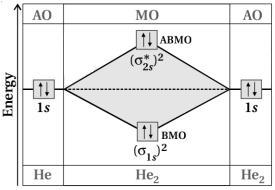
હિલિયમ $(He_{2})$ અણુ માટે ઇલેક્ટ્રોન રચના,બંધ ક્રમાંક,ચુંબકીય ગુણધર્મ અને $MO$ ઉર્જા આકૃતિ આપો.
Solution
(N/A) $He$ $(Z=2)$,તેથી $He_{2}$ માં કુલ ઇલેક્ટ્રોનની સંખ્યા $= 4$ છે.
$He_{2}$ માટે $MO$ ઇલેક્ટ્રોન રચના: $(\sigma_{1s})^{2}(\sigma_{1s}^{*})^{2}$.
$He_{2}$ માં બધા ઇલેક્ટ્રોન યુગ્મિત છે,તેથી તે પ્રતિચુંબકીય (diamagnetic) છે.
બંધ ક્રમાંક $= \frac{1}{2}(N_{b} - N_{a}) = \frac{1}{2}(2 - 2) = 0$.
$He_{2}$ માં બંધ ક્રમાંક શૂન્ય હોવાથી,તે અસ્થાયી છે અને અસ્તિત્વ ધરાવતું નથી.
$He_{2}$ ની $MO$ ઉર્જા આકૃતિ નીચે મુજબ છે.
$He_{2}$ માટે $MO$ ઇલેક્ટ્રોન રચના: $(\sigma_{1s})^{2}(\sigma_{1s}^{*})^{2}$.
$He_{2}$ માં બધા ઇલેક્ટ્રોન યુગ્મિત છે,તેથી તે પ્રતિચુંબકીય (diamagnetic) છે.
બંધ ક્રમાંક $= \frac{1}{2}(N_{b} - N_{a}) = \frac{1}{2}(2 - 2) = 0$.
$He_{2}$ માં બંધ ક્રમાંક શૂન્ય હોવાથી,તે અસ્થાયી છે અને અસ્તિત્વ ધરાવતું નથી.
$He_{2}$ ની $MO$ ઉર્જા આકૃતિ નીચે મુજબ છે.
0 likes
View Solution270
Difficult
$He_{2}$ અણુ શક્ય નથી. સમજાવો.
Solution
(N/A) $He$ $(Z=2)$,તેથી $He_{2}$ માં કુલ ઇલેક્ટ્રોનની સંખ્યા $4$ છે.
$He_{2}$ ની આણ્વીય કક્ષક $(MO)$ ઇલેક્ટ્રોનિક રચના: $(\sigma_{1s})^{2} (\sigma_{1s}^{*})^{2}$ છે.
$He_{2}$ માં બધા ઇલેક્ટ્રોન યુગ્મિત છે,તેથી તે પ્રતિચુંબકીય (diamagnetic) છે.
બંધક્રમાંક (Bond order) $= \frac{1}{2} (N_{b} - N_{a}) = \frac{1}{2} (2 - 2) = 0$.
$He_{2}$ નો બંધક્રમાંક $0$ હોવાથી,અણુ અસ્થાયી છે અને તેનું અસ્તિત્વ નથી.
$He_{2}$ નો $MO$ ઉર્જા આલેખ નીચે મુજબ છે.
$He_{2}$ ની આણ્વીય કક્ષક $(MO)$ ઇલેક્ટ્રોનિક રચના: $(\sigma_{1s})^{2} (\sigma_{1s}^{*})^{2}$ છે.
$He_{2}$ માં બધા ઇલેક્ટ્રોન યુગ્મિત છે,તેથી તે પ્રતિચુંબકીય (diamagnetic) છે.
બંધક્રમાંક (Bond order) $= \frac{1}{2} (N_{b} - N_{a}) = \frac{1}{2} (2 - 2) = 0$.
$He_{2}$ નો બંધક્રમાંક $0$ હોવાથી,અણુ અસ્થાયી છે અને તેનું અસ્તિત્વ નથી.
$He_{2}$ નો $MO$ ઉર્જા આલેખ નીચે મુજબ છે.
0 likes
View Solution271
Difficult
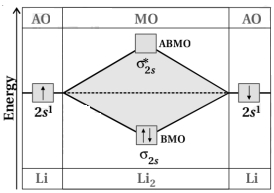
લિથિયમ $(Li_{2})$ અણુ માટે ઇલેક્ટ્રોન રચના,બંધ ક્રમાંક,ચુંબકીય ગુણધર્મ અને ઉર્જા આકૃતિ આપો.
Solution
(N/A) $Li$ $(Z=3)$,તેથી $Li_{2}$ માં કુલ ઇલેક્ટ્રોન = $6$.
$Li_{2}$ માટે $MO$ ઇલેક્ટ્રોન રચના:
$(\sigma 1s)^{2} (\sigma^{*} 1s)^{2} (\sigma 2s)^{2}$ અથવા $KK (\sigma 2s)^{2}$.
ચુંબકીય ગુણધર્મ: બધા ઇલેક્ટ્રોન યુગ્મિત છે,તેથી તે પ્રતિચુંબકીય (diamagnetic) છે.
બંધ ક્રમાંક ગણતરી:
$N_{b} = 4$ (બંધકારક ઇલેક્ટ્રોન),$N_{a} = 2$ (પ્રતિકારક ઇલેક્ટ્રોન).
બંધ ક્રમાંક $= \frac{1}{2} (N_{b} - N_{a}) = \frac{1}{2} (4 - 2) = 1$.
બંધ ક્રમાંક $1$ હોવાથી,$Li_{2}$ માં એકલ બંધ છે અને તે સ્થાયી છે.
નોંધ: $KK$ એ કોર ઇલેક્ટ્રોન $[He_{2}] = (\sigma 1s)^{2} (\sigma^{*} 1s)^{2}$ દર્શાવે છે.
$Li_{2}$ અણુ માટેની ઉર્જા આકૃતિ નીચે મુજબ છે:
$Li_{2}$ માટે $MO$ ઇલેક્ટ્રોન રચના:
$(\sigma 1s)^{2} (\sigma^{*} 1s)^{2} (\sigma 2s)^{2}$ અથવા $KK (\sigma 2s)^{2}$.
ચુંબકીય ગુણધર્મ: બધા ઇલેક્ટ્રોન યુગ્મિત છે,તેથી તે પ્રતિચુંબકીય (diamagnetic) છે.
બંધ ક્રમાંક ગણતરી:
$N_{b} = 4$ (બંધકારક ઇલેક્ટ્રોન),$N_{a} = 2$ (પ્રતિકારક ઇલેક્ટ્રોન).
બંધ ક્રમાંક $= \frac{1}{2} (N_{b} - N_{a}) = \frac{1}{2} (4 - 2) = 1$.
બંધ ક્રમાંક $1$ હોવાથી,$Li_{2}$ માં એકલ બંધ છે અને તે સ્થાયી છે.
નોંધ: $KK$ એ કોર ઇલેક્ટ્રોન $[He_{2}] = (\sigma 1s)^{2} (\sigma^{*} 1s)^{2}$ દર્શાવે છે.
$Li_{2}$ અણુ માટેની ઉર્જા આકૃતિ નીચે મુજબ છે:
0 likes
View Solution272
Difficult
બેરિલિયમ $(Be_{2})$ અણુ માટે ઇલેક્ટ્રોન રચના,બંધ ક્રમાંક,ચુંબકીય ગુણધર્મ અને ઉર્જા આકૃતિ આપો અને તેના અસ્તિત્વ વિશે લખો.
Solution
(N/A) $Be$ $(Z=4)$. તેથી,$Be_{2}$ માં કુલ ઇલેક્ટ્રોન $8$ છે.
$Be_{2}$ માટે $MO$ માં ઇલેક્ટ્રોન રચના:
$(\sigma 1s)^{2}(\sigma^{*} 1s)^{2}(\sigma 2s)^{2}(\sigma^{*} 2s)^{2}$ અથવા $KK(\sigma 2s)^{2}(\sigma^{*} 2s)^{2}$.
ચુંબકીય ગુણધર્મ: બધા ઇલેક્ટ્રોન યુગ્મિત છે. તેથી,તે પ્રતિચુંબકીય (diamagnetic) છે.
બંધ ક્રમાંક $(BO) = \frac{1}{2} (N_{b} - N_{a}) = \frac{1}{2} (4 - 4) = 0$.
બંધ ક્રમાંક શૂન્ય હોવાથી,$Be_{2}$ અસ્થાયી છે અને તેનું અસ્તિત્વ નથી.
$Be_{2}$ અણુ માટેની ઉર્જા આકૃતિ નીચે મુજબ છે.
$Be_{2}$ માટે $MO$ માં ઇલેક્ટ્રોન રચના:
$(\sigma 1s)^{2}(\sigma^{*} 1s)^{2}(\sigma 2s)^{2}(\sigma^{*} 2s)^{2}$ અથવા $KK(\sigma 2s)^{2}(\sigma^{*} 2s)^{2}$.
ચુંબકીય ગુણધર્મ: બધા ઇલેક્ટ્રોન યુગ્મિત છે. તેથી,તે પ્રતિચુંબકીય (diamagnetic) છે.
બંધ ક્રમાંક $(BO) = \frac{1}{2} (N_{b} - N_{a}) = \frac{1}{2} (4 - 4) = 0$.
બંધ ક્રમાંક શૂન્ય હોવાથી,$Be_{2}$ અસ્થાયી છે અને તેનું અસ્તિત્વ નથી.
$Be_{2}$ અણુ માટેની ઉર્જા આકૃતિ નીચે મુજબ છે.
0 likes
View Solution273
Difficult
બોરોન $(B_{2})$ અણુ માટે ઇલેક્ટ્રોન રચના, બંધ ક્રમાંક, ચુંબકીય ગુણધર્મ અને ઉર્જા સ્તર આકૃતિ આપો અને તેના અસ્તિત્વ વિશે ચર્ચા કરો.
Solution
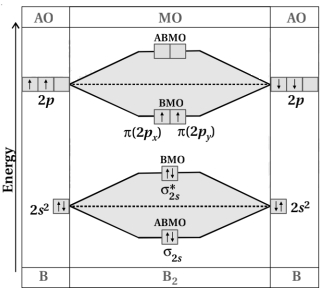
(N/A) $B_{2}$ $(Z=5)$ ની પરમાણ્વીય રચના $1s^{2} 2s^{2} 2p^{1}$ છે. તેથી, $B_{2}$ માં કુલ ઇલેક્ટ્રોનની સંખ્યા $10$ છે.
$B_{2}$ માટે આણ્વીય કક્ષક $(MO)$ ઇલેક્ટ્રોન રચના: $KK(\sigma_{2s})^{2}(\sigma^{*}_{2s})^{2}(\pi 2p_{x})^{1}(\pi 2p_{y})^{1}$ છે. નોંધો કે $B_{2}$ માટે, $s-p$ મિશ્રણને કારણે $\pi 2p$ કક્ષકોની ઉર્જા $\sigma 2p_{z}$ કક્ષક કરતા ઓછી હોય છે.
બંધ ક્રમાંક $= \frac{1}{2} (N_{b} - N_{a}) = \frac{1}{2} (6 - 4) = 1$.
$\pi 2p$ કક્ષકોમાં બે અયુગ્મિત ઇલેક્ટ્રોન હોવાથી, $B_{2}$ અણુ અનુચુંબકીય (paramagnetic) છે.
તેમાં એકલ બંધ હોવાથી, તે વાયુ અવસ્થામાં સ્થાયી છે.
તેની બંધ લંબાઈ $159 \ pm$ અને બંધ વિયોજન ઉર્જા $290 \ kJ \ mol^{-1}$ છે.
ઉર્જા સ્તર આકૃતિ નીચે મુજબ છે.
$B_{2}$ માટે આણ્વીય કક્ષક $(MO)$ ઇલેક્ટ્રોન રચના: $KK(\sigma_{2s})^{2}(\sigma^{*}_{2s})^{2}(\pi 2p_{x})^{1}(\pi 2p_{y})^{1}$ છે. નોંધો કે $B_{2}$ માટે, $s-p$ મિશ્રણને કારણે $\pi 2p$ કક્ષકોની ઉર્જા $\sigma 2p_{z}$ કક્ષક કરતા ઓછી હોય છે.
બંધ ક્રમાંક $= \frac{1}{2} (N_{b} - N_{a}) = \frac{1}{2} (6 - 4) = 1$.
$\pi 2p$ કક્ષકોમાં બે અયુગ્મિત ઇલેક્ટ્રોન હોવાથી, $B_{2}$ અણુ અનુચુંબકીય (paramagnetic) છે.
તેમાં એકલ બંધ હોવાથી, તે વાયુ અવસ્થામાં સ્થાયી છે.
તેની બંધ લંબાઈ $159 \ pm$ અને બંધ વિયોજન ઉર્જા $290 \ kJ \ mol^{-1}$ છે.
ઉર્જા સ્તર આકૃતિ નીચે મુજબ છે.
0 likes
View Solution274
Advanced
કાર્બન અણુ $(C_2)$ માટે ઇલેક્ટ્રોન રચના,ચુંબકીય ગુણધર્મ,બંધ ક્રમાંક અને ઉર્જા સ્તર આકૃતિ આપો.
Solution
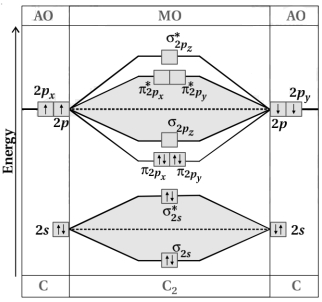
(N/A) $C_2$ $(Z=6)$ ની પરમાણ્વીય રચના $1s^2 2s^2 2p^2$ છે. તેથી,$C_2$ માં કુલ ઇલેક્ટ્રોનની સંખ્યા $12$ છે.
$C_2$ માટે આણ્વીય કક્ષક $(MO)$ ઇલેક્ટ્રોન રચના:
$(\sigma 1s)^2 (\sigma^* 1s)^2 (\sigma 2s)^2 (\sigma^* 2s)^2 (\pi 2p_x)^2 (\pi 2p_y)^2$ અથવા $KK(\sigma 2s)^2 (\sigma^* 2s)^2 (\pi 2p_x)^2 (\pi 2p_y)^2$.
બંધ ક્રમાંક $= \frac{1}{2} (N_b - N_a) = \frac{1}{2} (8 - 4) = 2$.
ચુંબકીય ગુણધર્મ: બધા ઇલેક્ટ્રોન યુગ્મિત છે,તેથી તે પ્રતિચુંબકીય (diamagnetic) છે.
નોંધ: $C_2$ અણુમાં,દ્વિબંધમાં રહેલા બંને બંધ $\pi$-બંધ છે.
$C_2$ અણુ માટે ઉર્જા સ્તર આકૃતિ:
$C_2$ માટે આણ્વીય કક્ષક $(MO)$ ઇલેક્ટ્રોન રચના:
$(\sigma 1s)^2 (\sigma^* 1s)^2 (\sigma 2s)^2 (\sigma^* 2s)^2 (\pi 2p_x)^2 (\pi 2p_y)^2$ અથવા $KK(\sigma 2s)^2 (\sigma^* 2s)^2 (\pi 2p_x)^2 (\pi 2p_y)^2$.
બંધ ક્રમાંક $= \frac{1}{2} (N_b - N_a) = \frac{1}{2} (8 - 4) = 2$.
ચુંબકીય ગુણધર્મ: બધા ઇલેક્ટ્રોન યુગ્મિત છે,તેથી તે પ્રતિચુંબકીય (diamagnetic) છે.
નોંધ: $C_2$ અણુમાં,દ્વિબંધમાં રહેલા બંને બંધ $\pi$-બંધ છે.
$C_2$ અણુ માટે ઉર્જા સ્તર આકૃતિ:
0 likes
View Solution275
Advanced
નાઈટ્રોજન $(N_{2})$ અણુ માટે ઈલેક્ટ્રોન રચના,ચુંબકીય ગુણધર્મ,બંધ ક્રમાંક અને ઉર્જા આકૃતિ આપો.
Solution
(N/A) $N_{2}$ $(Z=7)$ માટે: $N$ ની ઈલેક્ટ્રોન રચના $1s^{2} 2s^{2} 2p^{3}$ છે.
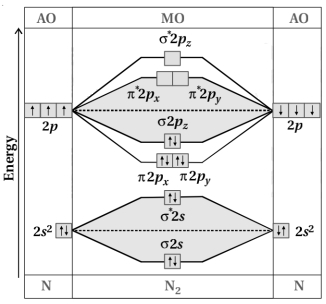
$N_{2}$ માં કુલ ઈલેક્ટ્રોન $= 14$.
$N_{2}$ માટે આણ્વીય કક્ષક $(MO)$ રચના:
$KK(\sigma 2s)^{2} (\sigma^{*} 2s)^{2} (\pi 2p_{x})^{2} = (\pi 2p_{y})^{2} (\sigma 2p_{z})^{2}$
બંધ ક્રમાંક $(BO)$ $= \frac{1}{2} (N_{b} - N_{a}) = \frac{1}{2} (10 - 4) = 3$.
આ $N_{2}$ માં ત્રિ-બંધ સૂચવે છે.
ચુંબકીય ગુણધર્મ: બધા ઈલેક્ટ્રોન યુગ્મિત હોવાથી,$N_{2}$ પ્રતિચુંબકીય (diamagnetic) છે.
ઉર્જા આકૃતિ નીચે મુજબ છે.
$N_{2}$ માં કુલ ઈલેક્ટ્રોન $= 14$.
$N_{2}$ માટે આણ્વીય કક્ષક $(MO)$ રચના:
$KK(\sigma 2s)^{2} (\sigma^{*} 2s)^{2} (\pi 2p_{x})^{2} = (\pi 2p_{y})^{2} (\sigma 2p_{z})^{2}$
બંધ ક્રમાંક $(BO)$ $= \frac{1}{2} (N_{b} - N_{a}) = \frac{1}{2} (10 - 4) = 3$.
આ $N_{2}$ માં ત્રિ-બંધ સૂચવે છે.
ચુંબકીય ગુણધર્મ: બધા ઈલેક્ટ્રોન યુગ્મિત હોવાથી,$N_{2}$ પ્રતિચુંબકીય (diamagnetic) છે.
ઉર્જા આકૃતિ નીચે મુજબ છે.
0 likes
View Solution276
Advanced
ઓક્સિજન $(O_2)$ અણુ માટે ઇલેક્ટ્રોન રચના,ચુંબકીય ગુણધર્મ,બંધ ક્રમાંક અને ઉર્જા આકૃતિ આપો.
Solution
(N/A) $O_2$ $(Z=8)$ ની ઇલેક્ટ્રોન રચના $1s^2 2s^2 2p^4$ છે. $O_2$ માં કુલ ઇલેક્ટ્રોન $= 16$ છે.
$O_2$ માટે આણ્વીય કક્ષક $(MO)$ રચના:
$KK(\sigma 2s)^2 (\sigma^* 2s)^2 (\sigma 2p_z)^2 (\pi 2p_x)^2 (\pi 2p_y)^2 (\pi^* 2p_x)^1 (\pi^* 2p_y)^1$
બંધ ક્રમાંક $= \frac{1}{2} (N_b - N_a) = \frac{1}{2} (10 - 6) = 2$ ($O_2$ માં દ્વિબંધ).
અહીં $\pi^* 2p_x$ અને $\pi^* 2p_y$ કક્ષકોમાં બે અયુગ્મિત ઇલેક્ટ્રોન હોવાથી,આ અણુ અનુચુંબકીય (paramagnetic) છે.
$O_2$ અણુ માટેની ઉર્જા આકૃતિ નીચે મુજબ છે:
$O_2$ માટે આણ્વીય કક્ષક $(MO)$ રચના:
$KK(\sigma 2s)^2 (\sigma^* 2s)^2 (\sigma 2p_z)^2 (\pi 2p_x)^2 (\pi 2p_y)^2 (\pi^* 2p_x)^1 (\pi^* 2p_y)^1$
બંધ ક્રમાંક $= \frac{1}{2} (N_b - N_a) = \frac{1}{2} (10 - 6) = 2$ ($O_2$ માં દ્વિબંધ).
અહીં $\pi^* 2p_x$ અને $\pi^* 2p_y$ કક્ષકોમાં બે અયુગ્મિત ઇલેક્ટ્રોન હોવાથી,આ અણુ અનુચુંબકીય (paramagnetic) છે.
$O_2$ અણુ માટેની ઉર્જા આકૃતિ નીચે મુજબ છે:
0 likes
View Solution277
Advanced
ફ્લોરિન $(F_2)$ અણુ માટે ઇલેક્ટ્રોન રચના,ચુંબકીય ગુણધર્મ,બંધ ક્રમાંક અને આણ્વીય કક્ષક ઉર્જા આકૃતિ આપો.
Solution
(N/A) ફ્લોરિન $(F)$ નો પરમાણુ ક્રમાંક $Z=9$ છે અને તેની ઇલેક્ટ્રોન રચના $1s^2 2s^2 2p^5$ છે.
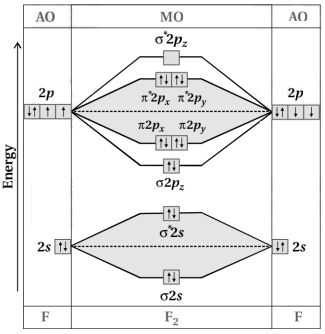
દરેક $F$ પરમાણુમાં $7$ સંયોજકતા ઇલેક્ટ્રોન હોય છે,તેથી $F_2$ અણુમાં કુલ ઇલેક્ટ્રોનની સંખ્યા $14$ છે.
$F_2$ માટે આણ્વીય કક્ષક $(MO)$ રચના: $KK(\sigma_{2s})^2(\sigma^* 2s)^2(\sigma 2p_z)^2(\pi 2p_x)^2(\pi 2p_y)^2(\pi^* 2p_x)^2(\pi^* 2p_y)^2$ છે.
બંધ ક્રમાંક $= \frac{1}{2} (N_b - N_a) = \frac{1}{2} (10 - 8) = 1$.
આ બે ફ્લોરિન પરમાણુઓ વચ્ચે એકલ બંધ $(F-F)$ સૂચવે છે.
ચુંબકીય ગુણધર્મ: બધા ઇલેક્ટ્રોન યુગ્મિત હોવાથી,$F_2$ અણુ પ્રતિચુંબકીય (diamagnetic) છે.
ઉર્જા સ્તરની આકૃતિ નીચે મુજબ છે:
દરેક $F$ પરમાણુમાં $7$ સંયોજકતા ઇલેક્ટ્રોન હોય છે,તેથી $F_2$ અણુમાં કુલ ઇલેક્ટ્રોનની સંખ્યા $14$ છે.
$F_2$ માટે આણ્વીય કક્ષક $(MO)$ રચના: $KK(\sigma_{2s})^2(\sigma^* 2s)^2(\sigma 2p_z)^2(\pi 2p_x)^2(\pi 2p_y)^2(\pi^* 2p_x)^2(\pi^* 2p_y)^2$ છે.
બંધ ક્રમાંક $= \frac{1}{2} (N_b - N_a) = \frac{1}{2} (10 - 8) = 1$.
આ બે ફ્લોરિન પરમાણુઓ વચ્ચે એકલ બંધ $(F-F)$ સૂચવે છે.
ચુંબકીય ગુણધર્મ: બધા ઇલેક્ટ્રોન યુગ્મિત હોવાથી,$F_2$ અણુ પ્રતિચુંબકીય (diamagnetic) છે.
ઉર્જા સ્તરની આકૃતિ નીચે મુજબ છે:
0 likes
View Solution278
Advanced
$MO$ આકૃતિ આપો અને સમજાવો કે શા માટે $Ne_{2}$ અણુનું અસ્તિત્વ નથી.
Solution
(N/A) $Ne_{2}$ $(Z=10)$: $1s^{2} 2s^{2} 2p^{6}$.
$Ne_{2}$ માટે $MO$ માં ઇલેક્ટ્રોન રચના:
$KK(\sigma 2s)^{2} (\sigma^{*} 2s)^{2} (\sigma 2p_{z})^{2} (\pi 2p_{x})^{2} (\pi 2p_{y})^{2} (\pi^{*} 2p_{x})^{2} (\pi^{*} 2p_{y})^{2} (\sigma^{*} 2p_{z})^{2}$
બંધ ક્રમાંક (Bond order) $= \frac{1}{2} (N_{b} - N_{a}) = \frac{1}{2} (10 - 10) = 0$
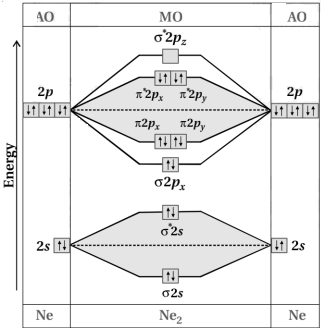
બંધ ક્રમાંક $0$ હોવાથી,અણુ અસ્થિર છે અને તેનું અસ્તિત્વ નથી. $Ne_{2}$ માટેની ઉર્જા સ્તરની આકૃતિ નીચે મુજબ છે:
$Ne_{2}$ માટે $MO$ માં ઇલેક્ટ્રોન રચના:
$KK(\sigma 2s)^{2} (\sigma^{*} 2s)^{2} (\sigma 2p_{z})^{2} (\pi 2p_{x})^{2} (\pi 2p_{y})^{2} (\pi^{*} 2p_{x})^{2} (\pi^{*} 2p_{y})^{2} (\sigma^{*} 2p_{z})^{2}$
બંધ ક્રમાંક (Bond order) $= \frac{1}{2} (N_{b} - N_{a}) = \frac{1}{2} (10 - 10) = 0$
બંધ ક્રમાંક $0$ હોવાથી,અણુ અસ્થિર છે અને તેનું અસ્તિત્વ નથી. $Ne_{2}$ માટેની ઉર્જા સ્તરની આકૃતિ નીચે મુજબ છે:
0 likes
View Solution279
Advanced
$B_2, C_2, N_2, O_2, F_2, Ne_2$ માટે $MO$ ની ગોઠવણી અને આણ્વીય ગુણધર્મો ટૂંકમાં સમજાવો.
Solution
(N/A) $B_2, C_2, N_2, O_2, F_2,$ અને $Ne_2$ સમકેન્દ્રીય દ્વિપરમાણ્વીય અણુઓ માટે આણ્વીય કક્ષક $(MO)$ ની ગોઠવણી,બંધક્રમાંક,ચુંબકીય ગુણધર્મો અને સંયોજકતા ઇલેક્ટ્રોન રચના નીચેના કોષ્ટકમાં દર્શાવેલ છે:
| અણુ | સંયોજકતા ઇલેક્ટ્રોન રચના | બંધક્રમાંક | ચુંબકીય ગુણધર્મ |
| :--- | :--- | :--- | :--- |
| $B_2$ | $(\sigma_{2s})^2 (\sigma^*_{2s})^2 (\pi_{2p})^2$ | $1$ | અનુચુંબકીય |
| $C_2$ | $(\sigma_{2s})^2 (\sigma^*_{2s})^2 (\pi_{2p})^4$ | $2$ | પ્રતિચુંબકીય |
| $N_2$ | $(\sigma_{2s})^2 (\sigma^*_{2s})^2 (\pi_{2p})^4 (\sigma_{2p})^2$ | $3$ | પ્રતિચુંબકીય |
| $O_2$ | $(\sigma_{2s})^2 (\sigma^*_{2s})^2 (\sigma_{2p})^2 (\pi_{2p})^4 (\pi^*_{2p})^2$ | $2$ | અનુચુંબકીય |
| $F_2$ | $(\sigma_{2s})^2 (\sigma^*_{2s})^2 (\sigma_{2p})^2 (\pi_{2p})^4 (\pi^*_{2p})^4$ | $1$ | પ્રતિચુંબકીય |
| $Ne_2$ | $(\sigma_{2s})^2 (\sigma^*_{2s})^2 (\sigma_{2p})^2 (\pi_{2p})^4 (\pi^*_{2p})^4 (\sigma^*_{2p})^2$ | $0$ | પ્રતિચુંબકીય |
| અણુ | સંયોજકતા ઇલેક્ટ્રોન રચના | બંધક્રમાંક | ચુંબકીય ગુણધર્મ |
| :--- | :--- | :--- | :--- |
| $B_2$ | $(\sigma_{2s})^2 (\sigma^*_{2s})^2 (\pi_{2p})^2$ | $1$ | અનુચુંબકીય |
| $C_2$ | $(\sigma_{2s})^2 (\sigma^*_{2s})^2 (\pi_{2p})^4$ | $2$ | પ્રતિચુંબકીય |
| $N_2$ | $(\sigma_{2s})^2 (\sigma^*_{2s})^2 (\pi_{2p})^4 (\sigma_{2p})^2$ | $3$ | પ્રતિચુંબકીય |
| $O_2$ | $(\sigma_{2s})^2 (\sigma^*_{2s})^2 (\sigma_{2p})^2 (\pi_{2p})^4 (\pi^*_{2p})^2$ | $2$ | અનુચુંબકીય |
| $F_2$ | $(\sigma_{2s})^2 (\sigma^*_{2s})^2 (\sigma_{2p})^2 (\pi_{2p})^4 (\pi^*_{2p})^4$ | $1$ | પ્રતિચુંબકીય |
| $Ne_2$ | $(\sigma_{2s})^2 (\sigma^*_{2s})^2 (\sigma_{2p})^2 (\pi_{2p})^4 (\pi^*_{2p})^4 (\sigma^*_{2p})^2$ | $0$ | પ્રતિચુંબકીય |
0 likes
View Solution280
Medium
આણ્વીય કક્ષક સિદ્ધાંતનો ઉપયોગ કરીને,$O_2^{+}$ અને $O_2^{2-}$ સ્પીસીઝની બંધ ઉર્જા અને ચુંબકીય ગુણધર્મની તુલના કરો.
Solution
(N/A) આણ્વીય કક્ષક સિદ્ધાંત મુજબ,ઇલેક્ટ્રોનિક રચનાઓ નીચે મુજબ છે:
$O_2^{+}: (\sigma 1s)^2 (\sigma^* 1s)^2 (\sigma 2s)^2 (\sigma^* 2s)^2 (\sigma 2p_z)^2 (\pi 2p_x^2, \pi 2p_y^2) (\pi^* 2p_x^1)$
$O_2^{+}$ નો બંધક્રમાંક $= \frac{10-5}{2} = 2.5$
$O_2^{2-}: (\sigma 1s)^2 (\sigma^* 1s)^2 (\sigma 2s)^2 (\sigma^* 2s)^2 (\sigma 2p_z)^2 (\pi 2p_x^2, \pi 2p_y^2) (\pi^* 2p_x^2, \pi^* 2p_y^2)$
$O_2^{2-}$ નો બંધક્રમાંક $= \frac{10-8}{2} = 1.0$
બંધ ઉર્જા એ બંધક્રમાંકના સમપ્રમાણમાં હોવાથી,$O_2^{+}$ ની બંધ ઉર્જા $O_2^{2-}$ કરતા વધારે છે.
$O_2^{+}$ માં એક અયુગ્મિત ઇલેક્ટ્રોન હોવાથી તે અનુચુંબકીય (paramagnetic) છે,જ્યારે $O_2^{2-}$ માં બધા ઇલેક્ટ્રોન યુગ્મિત હોવાથી તે પ્રતિચુંબકીય (diamagnetic) છે.
$O_2^{+}: (\sigma 1s)^2 (\sigma^* 1s)^2 (\sigma 2s)^2 (\sigma^* 2s)^2 (\sigma 2p_z)^2 (\pi 2p_x^2, \pi 2p_y^2) (\pi^* 2p_x^1)$
$O_2^{+}$ નો બંધક્રમાંક $= \frac{10-5}{2} = 2.5$
$O_2^{2-}: (\sigma 1s)^2 (\sigma^* 1s)^2 (\sigma 2s)^2 (\sigma^* 2s)^2 (\sigma 2p_z)^2 (\pi 2p_x^2, \pi 2p_y^2) (\pi^* 2p_x^2, \pi^* 2p_y^2)$
$O_2^{2-}$ નો બંધક્રમાંક $= \frac{10-8}{2} = 1.0$
બંધ ઉર્જા એ બંધક્રમાંકના સમપ્રમાણમાં હોવાથી,$O_2^{+}$ ની બંધ ઉર્જા $O_2^{2-}$ કરતા વધારે છે.
$O_2^{+}$ માં એક અયુગ્મિત ઇલેક્ટ્રોન હોવાથી તે અનુચુંબકીય (paramagnetic) છે,જ્યારે $O_2^{2-}$ માં બધા ઇલેક્ટ્રોન યુગ્મિત હોવાથી તે પ્રતિચુંબકીય (diamagnetic) છે.
0 likes
View Solution281
Medium
નાઈટ્રોજન અણુમાં $\sigma 2p_z$ આણ્વીય કક્ષકની ઉર્જા $\pi 2p_x$ અને $\pi 2p_y$ આણ્વીય કક્ષકો કરતા વધારે છે. અણુમાં ઉર્જાના વધતા ક્રમમાં ઉર્જા સ્તરોનો સંપૂર્ણ ક્રમ લખો. નીચેની સ્પીસીઝની સાપેક્ષ સ્થિરતા અને ચુંબકીય વર્તણૂકની તુલના કરો: $N_2, N_2^+, N_2^-, N_2^{2+}$
Solution
(N/A) $N$ પરમાણુ $(Z=7)$ ની ઇલેક્ટ્રોનિક રચના $1s^2 2s^2 2p_x^1 2p_y^1 2p_z^1$ છે. $N_2$ માં કુલ ઇલેક્ટ્રોનની સંખ્યા $14$ છે. $N_2$ માટે ઉર્જા સ્તરોનો વધતો ક્રમ: $\sigma 1s < \sigma^* 1s < \sigma 2s < \sigma^* 2s < \pi 2p_x = \pi 2p_y < \sigma 2p_z < \pi^* 2p_x = \pi^* 2p_y < \sigma^* 2p_z$.
$(i)$ $N_2$ ($14$ $e^-$): રચના: $(\sigma 1s)^2, (\sigma^* 1s)^2, (\sigma 2s)^2, (\sigma^* 2s)^2, (\pi 2p_x)^2, (\pi 2p_y)^2, (\sigma 2p_z)^2$. બંધ ક્રમાંક $(BO)$ = $\frac{1}{2}(10-4) = 3$. પ્રતિચુંબકીય (અયુગ્મિત ઇલેક્ટ્રોન નથી).
$(ii)$ $N_2^+$ ($13$ $e^-$): રચના: $(\sigma 1s)^2, (\sigma^* 1s)^2, (\sigma 2s)^2, (\sigma^* 2s)^2, (\pi 2p_x)^2, (\pi 2p_y)^2, (\sigma 2p_z)^1$. $BO = \frac{1}{2}(9-4) = 2.5$. અનુચુંબકીય (એક અયુગ્મિત ઇલેક્ટ્રોન).
$(iii)$ $N_2^-$ ($15$ $e^-$): રચના: $(\sigma 1s)^2, (\sigma^* 1s)^2, (\sigma 2s)^2, (\sigma^* 2s)^2, (\pi 2p_x)^2, (\pi 2p_y)^2, (\sigma 2p_z)^2, (\pi^* 2p_x)^1$. $BO = \frac{1}{2}(10-5) = 2.5$. અનુચુંબકીય (એક અયુગ્મિત ઇલેક્ટ્રોન).
$(iv)$ $N_2^{2+}$ ($12$ $e^-$): રચના: $(\sigma 1s)^2, (\sigma^* 1s)^2, (\sigma 2s)^2, (\sigma^* 2s)^2, (\pi 2p_x)^2, (\pi 2p_y)^2$. $BO = \frac{1}{2}(8-4) = 2$. પ્રતિચુંબકીય (અયુગ્મિત ઇલેક્ટ્રોન નથી).
$BO$ ના આધારે સ્થિરતાનો ક્રમ: $N_2 > N_2^+ \approx N_2^- > N_2^{2+}$.
$(i)$ $N_2$ ($14$ $e^-$): રચના: $(\sigma 1s)^2, (\sigma^* 1s)^2, (\sigma 2s)^2, (\sigma^* 2s)^2, (\pi 2p_x)^2, (\pi 2p_y)^2, (\sigma 2p_z)^2$. બંધ ક્રમાંક $(BO)$ = $\frac{1}{2}(10-4) = 3$. પ્રતિચુંબકીય (અયુગ્મિત ઇલેક્ટ્રોન નથી).
$(ii)$ $N_2^+$ ($13$ $e^-$): રચના: $(\sigma 1s)^2, (\sigma^* 1s)^2, (\sigma 2s)^2, (\sigma^* 2s)^2, (\pi 2p_x)^2, (\pi 2p_y)^2, (\sigma 2p_z)^1$. $BO = \frac{1}{2}(9-4) = 2.5$. અનુચુંબકીય (એક અયુગ્મિત ઇલેક્ટ્રોન).
$(iii)$ $N_2^-$ ($15$ $e^-$): રચના: $(\sigma 1s)^2, (\sigma^* 1s)^2, (\sigma 2s)^2, (\sigma^* 2s)^2, (\pi 2p_x)^2, (\pi 2p_y)^2, (\sigma 2p_z)^2, (\pi^* 2p_x)^1$. $BO = \frac{1}{2}(10-5) = 2.5$. અનુચુંબકીય (એક અયુગ્મિત ઇલેક્ટ્રોન).
$(iv)$ $N_2^{2+}$ ($12$ $e^-$): રચના: $(\sigma 1s)^2, (\sigma^* 1s)^2, (\sigma 2s)^2, (\sigma^* 2s)^2, (\pi 2p_x)^2, (\pi 2p_y)^2$. $BO = \frac{1}{2}(8-4) = 2$. પ્રતિચુંબકીય (અયુગ્મિત ઇલેક્ટ્રોન નથી).
$BO$ ના આધારે સ્થિરતાનો ક્રમ: $N_2 > N_2^+ \approx N_2^- > N_2^{2+}$.
0 likes
View Solution282
Medium
$N_{2}$ અને $O_{2}$ માં નીચેની પ્રક્રિયાઓની બંધ ક્રમાંક (bond order) પર શું અસર થાય છે?
$(A)$ $N_{2} \to N_{2}^{+} + e^{-}$
$(B)$ $O_{2} \to O_{2}^{+} + e^{-}$
$(A)$ $N_{2} \to N_{2}^{+} + e^{-}$
$(B)$ $O_{2} \to O_{2}^{+} + e^{-}$
Solution
(N/A) આણ્વીય કક્ષક સિદ્ધાંત (Molecular orbital theory) મુજબ,$N_{2}$,$N_{2}^{+}$,$O_{2}$,અને $O_{2}^{+}$ સ્પીસીઝની ઇલેક્ટ્રોનિક રચના અને બંધ ક્રમાંક નીચે મુજબ છે:
$N_{2} (14 \ e^{-}) = \sigma 1s^{2}, \sigma^{*} 1s^{2}, \sigma 2s^{2}, \sigma^{*} 2s^{2}, (\pi 2p_{x}^{2} \approx \pi 2p_{y}^{2}), \sigma 2p_{z}^{2}$
બંધ ક્રમાંક $= \frac{1}{2} (N_{b} - N_{a}) = \frac{1}{2} (10 - 4) = 3$
$N_{2}^{+} (13 \ e^{-}) = \sigma 1s^{2}, \sigma^{*} 1s^{2}, \sigma 2s^{2}, \sigma^{*} 2s^{2}, (\pi 2p_{x}^{2} \approx \pi 2p_{y}^{2}), \sigma 2p_{z}^{1}$
બંધ ક્રમાંક $= \frac{1}{2} (9 - 4) = 2.5$
$O_{2} (16 \ e^{-}) = \sigma 1s^{2}, \sigma^{*} 1s^{2}, \sigma 2s^{2}, \sigma^{*} 2s^{2}, \sigma 2p_{z}^{2}, (\pi 2p_{x}^{2} \approx \pi 2p_{y}^{2}), (\pi^{*} 2p_{x}^{1} \approx \pi^{*} 2p_{y}^{1})$
બંધ ક્રમાંક $= \frac{1}{2} (10 - 6) = 2$
$O_{2}^{+} (15 \ e^{-}) = \sigma 1s^{2}, \sigma^{*} 1s^{2}, \sigma 2s^{2}, \sigma^{*} 2s^{2}, \sigma 2p_{z}^{2}, (\pi 2p_{x}^{2} \approx \pi 2p_{y}^{2}), \pi^{*} 2p_{x}^{1}$
બંધ ક્રમાંક $= \frac{1}{2} (10 - 5) = 2.5$
$(A)$ $N_{2} \to N_{2}^{+} + e^{-}$ માટે,બંધ ક્રમાંક $3$ થી ઘટીને $2.5$ થાય છે. આમ,બંધ ક્રમાંક ઘટે છે.
$(B)$ $O_{2} \to O_{2}^{+} + e^{-}$ માટે,બંધ ક્રમાંક $2$ થી વધીને $2.5$ થાય છે. આમ,બંધ ક્રમાંક વધે છે.
$N_{2} (14 \ e^{-}) = \sigma 1s^{2}, \sigma^{*} 1s^{2}, \sigma 2s^{2}, \sigma^{*} 2s^{2}, (\pi 2p_{x}^{2} \approx \pi 2p_{y}^{2}), \sigma 2p_{z}^{2}$
બંધ ક્રમાંક $= \frac{1}{2} (N_{b} - N_{a}) = \frac{1}{2} (10 - 4) = 3$
$N_{2}^{+} (13 \ e^{-}) = \sigma 1s^{2}, \sigma^{*} 1s^{2}, \sigma 2s^{2}, \sigma^{*} 2s^{2}, (\pi 2p_{x}^{2} \approx \pi 2p_{y}^{2}), \sigma 2p_{z}^{1}$
બંધ ક્રમાંક $= \frac{1}{2} (9 - 4) = 2.5$
$O_{2} (16 \ e^{-}) = \sigma 1s^{2}, \sigma^{*} 1s^{2}, \sigma 2s^{2}, \sigma^{*} 2s^{2}, \sigma 2p_{z}^{2}, (\pi 2p_{x}^{2} \approx \pi 2p_{y}^{2}), (\pi^{*} 2p_{x}^{1} \approx \pi^{*} 2p_{y}^{1})$
બંધ ક્રમાંક $= \frac{1}{2} (10 - 6) = 2$
$O_{2}^{+} (15 \ e^{-}) = \sigma 1s^{2}, \sigma^{*} 1s^{2}, \sigma 2s^{2}, \sigma^{*} 2s^{2}, \sigma 2p_{z}^{2}, (\pi 2p_{x}^{2} \approx \pi 2p_{y}^{2}), \pi^{*} 2p_{x}^{1}$
બંધ ક્રમાંક $= \frac{1}{2} (10 - 5) = 2.5$
$(A)$ $N_{2} \to N_{2}^{+} + e^{-}$ માટે,બંધ ક્રમાંક $3$ થી ઘટીને $2.5$ થાય છે. આમ,બંધ ક્રમાંક ઘટે છે.
$(B)$ $O_{2} \to O_{2}^{+} + e^{-}$ માટે,બંધ ક્રમાંક $2$ થી વધીને $2.5$ થાય છે. આમ,બંધ ક્રમાંક વધે છે.
0 likes
View Solution283
Advanced
આણ્વીય કક્ષક ઉર્જા સ્તર આકૃતિનો ઉપયોગ કરીને દર્શાવો કે $N_{2}$ માં ત્રિ-બંધ,$F_{2}$ માં એકલ-બંધ અને $Ne_{2}$ માં કોઈ બંધ હોતો નથી.
Solution
(N/A) $N_{2}$ અણુનું નિર્માણ:
$N$-પરમાણુની ઇલેક્ટ્રોન રચના: ${ }_{7} N = 1s^{2}, 2s^{2}, 2p_{x}^{1}, 2p_{y}^{1}, 2p_{z}^{1}$
$N_{2}$ અણુ: $\sigma 1s^{2}, \sigma^{*} 1s^{2}, \sigma 2s^{2}, \sigma^{*} 2s^{2}, \pi 2p_{x}^{2}, \pi 2p_{y}^{2}, \sigma 2p_{z}^{2}$
બંધ ક્રમાંક = $\frac{1}{2} (N_{b} - N_{a}) = \frac{1}{2} (10 - 4) = 3$. $3$ નો બંધ ક્રમાંક ત્રિ-બંધ સૂચવે છે.
$F_{2}$ અણુનું નિર્માણ:
$F$-પરમાણુની ઇલેક્ટ્રોન રચના: ${ }_{9} F = 1s^{2}, 2s^{2}, 2p_{x}^{2}, 2p_{y}^{2}, 2p_{z}^{1}$
$F_{2}$ અણુ: $\sigma 1s^{2}, \sigma^{*} 1s^{2}, \sigma 2s^{2}, \sigma^{*} 2s^{2}, \sigma 2p_{z}^{2}, \pi 2p_{x}^{2} = \pi 2p_{y}^{2}, \pi^{*} 2p_{x}^{2} = \pi^{*} 2p_{y}^{2}$
બંધ ક્રમાંક = $\frac{1}{2} (10 - 8) = 1$. $1$ નો બંધ ક્રમાંક એકલ-બંધ સૂચવે છે.
$Ne_{2}$ અણુનું નિર્માણ:
$Ne$-પરમાણુની ઇલેક્ટ્રોન રચના: ${ }_{10} Ne = 1s^{2}, 2s^{2}, 2p_{x}^{2}, 2p_{y}^{2}, 2p_{z}^{2}$
$Ne_{2}$ અણુ: $\sigma 1s^{2}, \sigma^{*} 1s^{2}, \sigma 2s^{2}, \sigma^{*} 2s^{2}, \sigma 2p_{z}^{2}, \pi 2p_{x}^{2} = \pi 2p_{y}^{2}, \pi^{*} 2p_{x}^{2} = \pi^{*} 2p_{y}^{2}, \sigma^{*} 2p_{z}^{2}$
બંધ ક્રમાંક = $\frac{1}{2} (10 - 10) = 0$. $0$ નો બંધ ક્રમાંક સૂચવે છે કે કોઈ બંધ અસ્તિત્વમાં નથી.
$N$-પરમાણુની ઇલેક્ટ્રોન રચના: ${ }_{7} N = 1s^{2}, 2s^{2}, 2p_{x}^{1}, 2p_{y}^{1}, 2p_{z}^{1}$
$N_{2}$ અણુ: $\sigma 1s^{2}, \sigma^{*} 1s^{2}, \sigma 2s^{2}, \sigma^{*} 2s^{2}, \pi 2p_{x}^{2}, \pi 2p_{y}^{2}, \sigma 2p_{z}^{2}$
બંધ ક્રમાંક = $\frac{1}{2} (N_{b} - N_{a}) = \frac{1}{2} (10 - 4) = 3$. $3$ નો બંધ ક્રમાંક ત્રિ-બંધ સૂચવે છે.
$F_{2}$ અણુનું નિર્માણ:
$F$-પરમાણુની ઇલેક્ટ્રોન રચના: ${ }_{9} F = 1s^{2}, 2s^{2}, 2p_{x}^{2}, 2p_{y}^{2}, 2p_{z}^{1}$
$F_{2}$ અણુ: $\sigma 1s^{2}, \sigma^{*} 1s^{2}, \sigma 2s^{2}, \sigma^{*} 2s^{2}, \sigma 2p_{z}^{2}, \pi 2p_{x}^{2} = \pi 2p_{y}^{2}, \pi^{*} 2p_{x}^{2} = \pi^{*} 2p_{y}^{2}$
બંધ ક્રમાંક = $\frac{1}{2} (10 - 8) = 1$. $1$ નો બંધ ક્રમાંક એકલ-બંધ સૂચવે છે.
$Ne_{2}$ અણુનું નિર્માણ:
$Ne$-પરમાણુની ઇલેક્ટ્રોન રચના: ${ }_{10} Ne = 1s^{2}, 2s^{2}, 2p_{x}^{2}, 2p_{y}^{2}, 2p_{z}^{2}$
$Ne_{2}$ અણુ: $\sigma 1s^{2}, \sigma^{*} 1s^{2}, \sigma 2s^{2}, \sigma^{*} 2s^{2}, \sigma 2p_{z}^{2}, \pi 2p_{x}^{2} = \pi 2p_{y}^{2}, \pi^{*} 2p_{x}^{2} = \pi^{*} 2p_{y}^{2}, \sigma^{*} 2p_{z}^{2}$
બંધ ક્રમાંક = $\frac{1}{2} (10 - 10) = 0$. $0$ નો બંધ ક્રમાંક સૂચવે છે કે કોઈ બંધ અસ્તિત્વમાં નથી.
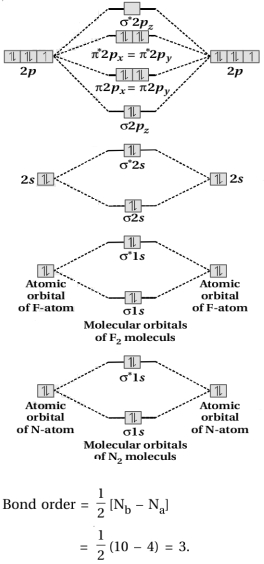
0 likes
View Solution284
MediumMCQ
ઓક્સિજન પરમાણુઓમાંથી ડાયઓક્સિજન $(O_2)$ બનવા અંગે નીચેનામાંથી કયું વિધાન સાચું છે?
A
$(A)$ ઓક્સિજન પરમાણુઓમાંથી ડાયઓક્સિજન બનતી વખતે $10$ આણ્વીય કક્ષકો બને છે.
B
$(B)$ ડાયઓક્સિજનમાં તમામ આણ્વીય કક્ષકો સંપૂર્ણ ભરાયેલી હોય છે.
C
$(C)$ $O_2$ માં બંધકારક આણ્વીય કક્ષકોની કુલ સંખ્યા બંધપ્રતિકારક આણ્વીય કક્ષકોની સંખ્યા જેટલી હોતી નથી.
D
$(D)$ સંપૂર્ણ ભરાયેલી બંધકારક કક્ષકોની સંખ્યા અને બંધપ્રતિકારક આણ્વીય કક્ષકોની સંખ્યા સમાન હોય છે.
Solution
(A) આણ્વીય કક્ષક સિદ્ધાંત $(MOT)$ મુજબ,જ્યારે બે ઓક્સિજન પરમાણુઓ (દરેક $8$ ઇલેક્ટ્રોન સાથે,$1s^2 2s^2 2p^4$) જોડાઈને $O_2$ ($16$ ઇલેક્ટ્રોન) બનાવે છે,ત્યારે કુલ $10$ આણ્વીય કક્ષકો $(MOs)$ બને છે.
$O_2$ ની ઇલેક્ટ્રોનીય રચના: $\sigma 1s^2, \sigma^* 1s^2, \sigma 2s^2, \sigma^* 2s^2, \sigma 2p_z^2, \pi 2p_x^2 = \pi 2p_y^2, \pi^* 2p_x^1 = \pi^* 2p_y^1, \sigma^* 2p_z^0$.
આ ગણતરી કરતા: $\sigma 1s, \sigma^* 1s, \sigma 2s, \sigma^* 2s, \sigma 2p_z, \pi 2p_x, \pi 2p_y, \pi^* 2p_x, \pi^* 2p_y, \sigma^* 2p_z$ કુલ $10$ $MOs$ થાય છે.
તેથી,વિધાન $(A)$ સાચું છે.
$O_2$ ની ઇલેક્ટ્રોનીય રચના: $\sigma 1s^2, \sigma^* 1s^2, \sigma 2s^2, \sigma^* 2s^2, \sigma 2p_z^2, \pi 2p_x^2 = \pi 2p_y^2, \pi^* 2p_x^1 = \pi^* 2p_y^1, \sigma^* 2p_z^0$.
આ ગણતરી કરતા: $\sigma 1s, \sigma^* 1s, \sigma 2s, \sigma^* 2s, \sigma 2p_z, \pi 2p_x, \pi 2p_y, \pi^* 2p_x, \pi^* 2p_y, \sigma^* 2p_z$ કુલ $10$ $MOs$ થાય છે.
તેથી,વિધાન $(A)$ સાચું છે.
0 likes
View Solution285
DifficultMCQ
નીચેનામાંથી કઈ આણ્વીય કક્ષકમાં નોડલ પ્લેનની સંખ્યા મહત્તમ હશે?
A
$(A) \sigma^{*} 2s$
B
$(B) \sigma^{*} 2p_{z}$
C
$(C) \pi^{*} 2p_{x}$
D
$(D) \pi^{*} 2p_{y}$
Solution
(D) આણ્વીય કક્ષકોમાં નોડલ પ્લેનની સંખ્યા નીચે મુજબ છે:
$1$. $\sigma^{*} 2s$ માટે: $1$ નોડલ પ્લેન હોય છે.
$2$. $\sigma^{*} 2p_{z}$ માટે: $1$ નોડલ પ્લેન હોય છે.
$3$. $\pi^{*} 2p_{x}$ માટે: $2$ નોડલ પ્લેન હોય છે.
$4$. $\pi^{*} 2p_{y}$ માટે: $2$ નોડલ પ્લેન હોય છે.
આમ,$\pi^{*} 2p_{y}$ માં મહત્તમ $2$ નોડલ પ્લેન જોવા મળે છે.
$1$. $\sigma^{*} 2s$ માટે: $1$ નોડલ પ્લેન હોય છે.
$2$. $\sigma^{*} 2p_{z}$ માટે: $1$ નોડલ પ્લેન હોય છે.
$3$. $\pi^{*} 2p_{x}$ માટે: $2$ નોડલ પ્લેન હોય છે.
$4$. $\pi^{*} 2p_{y}$ માટે: $2$ નોડલ પ્લેન હોય છે.
આમ,$\pi^{*} 2p_{y}$ માં મહત્તમ $2$ નોડલ પ્લેન જોવા મળે છે.
0 likes
View Solution286
DifficultMCQ
નીચેનામાંથી કઈ સ્પીસીઝની જોડી સમાન બંધક્રમાંક ધરાવે છે?
A
$O_2, N_2$
B
$O_2^+, N_2^-$
C
$O_2^-, N_2^+$
D
$O_2^-, N_2^-$
Solution
(B) બંધક્રમાંક ગણવા માટેનું સૂત્ર: $\text{Bond Order} = \frac{N_b - N_a}{2}$,જ્યાં $N_b$ એ બંધકારક ઇલેક્ટ્રોન અને $N_a$ એ બંધપ્રતિકારક ઇલેક્ટ્રોન છે.
$O_2^+$ માટે: કુલ ઇલેક્ટ્રોન = $15$. બંધક્રમાંક = $\frac{10 - 5}{2} = 2.5$.
$N_2^-$ માટે: કુલ ઇલેક્ટ્રોન = $15$. બંધક્રમાંક = $\frac{10 - 5}{2} = 2.5$.
આમ,$O_2^+$ અને $N_2^-$ બંનેનો બંધક્રમાંક $2.5$ સમાન છે.
$O_2^+$ માટે: કુલ ઇલેક્ટ્રોન = $15$. બંધક્રમાંક = $\frac{10 - 5}{2} = 2.5$.
$N_2^-$ માટે: કુલ ઇલેક્ટ્રોન = $15$. બંધક્રમાંક = $\frac{10 - 5}{2} = 2.5$.
આમ,$O_2^+$ અને $N_2^-$ બંનેનો બંધક્રમાંક $2.5$ સમાન છે.
0 likes
View Solution287
DifficultMCQ
નીચેનામાંથી કયા અણુઓમાં $\pi 2p_x$ અને $\pi 2p_y$ આણ્વીય કક્ષકો $\sigma 2p_z$ આણ્વીય કક્ષક પછી ભરાય છે?
A
$O_2$
B
$Ne_2$
C
$N_2$
D
$F_2$
Solution
(A, B, D) $14$ કે તેથી ઓછા ઇલેક્ટ્રોન ધરાવતા અણુઓ ($N_2$ જેવા) માટે શક્તિનો ક્રમ: $\sigma 1s < \sigma^* 1s < \sigma 2s < \sigma^* 2s < \pi 2p_x \approx \pi 2p_y < \sigma 2p_z < \pi^* 2p_x \approx \pi^* 2p_y < \sigma^* 2p_z$.
$14$ કરતા વધુ ઇલેક્ટ્રોન ધરાવતા અણુઓ ($O_2, F_2, Ne_2$ જેવા) માટે શક્તિનો ક્રમ: $\sigma 1s < \sigma^* 1s < \sigma 2s < \sigma^* 2s < \sigma 2p_z < \pi 2p_x \approx \pi 2p_y < \pi^* 2p_x \approx \pi^* 2p_y < \sigma^* 2p_z$.
આ કિસ્સામાં,$\pi 2p_x$ અને $\pi 2p_y$ કક્ષકો $\sigma 2p_z$ પછી ભરાય છે. તેથી $O_2, F_2, Ne_2$ ત્રણેય આ શરતનું પાલન કરે છે.
$14$ કરતા વધુ ઇલેક્ટ્રોન ધરાવતા અણુઓ ($O_2, F_2, Ne_2$ જેવા) માટે શક્તિનો ક્રમ: $\sigma 1s < \sigma^* 1s < \sigma 2s < \sigma^* 2s < \sigma 2p_z < \pi 2p_x \approx \pi 2p_y < \pi^* 2p_x \approx \pi^* 2p_y < \sigma^* 2p_z$.
આ કિસ્સામાં,$\pi 2p_x$ અને $\pi 2p_y$ કક્ષકો $\sigma 2p_z$ પછી ભરાય છે. તેથી $O_2, F_2, Ne_2$ ત્રણેય આ શરતનું પાલન કરે છે.
0 likes
View Solution288
Medium
આણ્વીય કક્ષકો કેવી રીતે રચાય છે? સમજાવો.
Solution
(N/A) આણ્વીય કક્ષકો પરમાણ્વીય કક્ષકોના રેખીય સંગઠન $(LCAO)$ દ્વારા રચાય છે.
બંધકારક આણ્વીય કક્ષક પરમાણ્વીય તરંગ વિધેયોના સરવાળા દ્વારા રચાય છે: $\psi_{MO} = \psi_A + \psi_B$.
પ્રતિકારક આણ્વીય કક્ષક પરમાણ્વીય તરંગ વિધેયોની બાદબાકી દ્વારા રચાય છે: $\psi_{MO}^* = \psi_A - \psi_B$.
બંધકારક આણ્વીય કક્ષક પરમાણ્વીય તરંગ વિધેયોના સરવાળા દ્વારા રચાય છે: $\psi_{MO} = \psi_A + \psi_B$.
પ્રતિકારક આણ્વીય કક્ષક પરમાણ્વીય તરંગ વિધેયોની બાદબાકી દ્વારા રચાય છે: $\psi_{MO}^* = \psi_A - \psi_B$.
0 likes
View Solution289
Medium
$1s-1s$ અને $1s-2s$ ના સંયોજનમાંથી કયું આણ્વીય કક્ષક બનાવતું નથી? શા માટે?
Solution
(B) $1s-2s$ નું સંયોજન આણ્વીય કક્ષક બનાવતું નથી,કારણ કે આ બે કક્ષકો વચ્ચેનો ઊર્જા તફાવત ઘણો વધારે છે.
0 likes
View Solution290
MediumMCQ
$Li_2$ થી $N_2$ સુધીના દ્વિપરમાણુક અણુઓ અને $O_2$ થી $Ne_2$ સુધીના અણુઓના $MO$ શક્તિ સ્તરના આલેખમાં શું તફાવત છે?
A
$Li_2$ થી $N_2$ માં $\sigma_{2p_z}$ ની ઊર્જા $O_2$ થી $Ne_2$ કરતા વધારે હોય છે.
B
$Li_2$ થી $N_2$ માં $\sigma_{2p_z}$ ની ઊર્જા $O_2$ થી $Ne_2$ કરતા ઓછી હોય છે.
C
ઊર્જા સ્તરોમાં કોઈ તફાવત નથી.
D
$Li_2$ થી $N_2$ માટે $\pi_{2p_x}$ અને $\pi_{2p_y}$ કક્ષકોની ઊર્જા વધારે હોય છે.
Solution
(B) $Li_2$ થી $N_2$ સુધીના દ્વિપરમાણુક અણુઓમાં,$s-p$ મિશ્રણને કારણે $\sigma_{2p_z}$ કક્ષકની ઊર્જા $\pi_{2p_x}$ અને $\pi_{2p_y}$ કક્ષકો કરતા વધારે હોય છે.
$O_2$ થી $Ne_2$ સુધીના અણુઓમાં,$s-p$ મિશ્રણ નહિવત હોવાથી $\sigma_{2p_z}$ કક્ષકની ઊર્જા $\pi_{2p_x}$ અને $\pi_{2p_y}$ કક્ષકો કરતા ઓછી હોય છે.
$O_2$ થી $Ne_2$ સુધીના અણુઓમાં,$s-p$ મિશ્રણ નહિવત હોવાથી $\sigma_{2p_z}$ કક્ષકની ઊર્જા $\pi_{2p_x}$ અને $\pi_{2p_y}$ કક્ષકો કરતા ઓછી હોય છે.
0 likes
View Solution291
EasyMCQ
$N_2, N_2^+, N_2^-,$ અને $N_2^{2+}$ ની સાપેક્ષ સ્થિરતાનો ક્રમ આપો.
A
$N_2 > N_2^+ > N_2^- > N_2^{2+}$
B
$N_2 > N_2^+ = N_2^- > N_2^{2+}$
C
$N_2 > N_2^- > N_2^+ > N_2^{2+}$
D
$N_2^{2+} > N_2^+ > N_2 > N_2^-$
Solution
(B) અણુની સ્થિરતા તેના બંધક્રમાંકના સમપ્રમાણમાં હોય છે.
બંધક્રમાંકની ગણતરી:
$N_2 (14 \ e^-): \text{બંધક્રમાંક} = 3.0$
$N_2^+ (13 \ e^-): \text{બંધક્રમાંક} = 2.5$
$N_2^- (15 \ e^-): \text{બંધક્રમાંક} = 2.5$
$N_2^{2+} (12 \ e^-): \text{બંધક્રમાંક} = 2.0$
બંધક્રમાંકની સરખામણી કરતા: $N_2 (3.0) > N_2^+ (2.5) = N_2^- (2.5) > N_2^{2+} (2.0)$.
તેથી,સ્થિરતાનો ક્રમ $N_2 > N_2^+ = N_2^- > N_2^{2+}$ છે.
બંધક્રમાંકની ગણતરી:
$N_2 (14 \ e^-): \text{બંધક્રમાંક} = 3.0$
$N_2^+ (13 \ e^-): \text{બંધક્રમાંક} = 2.5$
$N_2^- (15 \ e^-): \text{બંધક્રમાંક} = 2.5$
$N_2^{2+} (12 \ e^-): \text{બંધક્રમાંક} = 2.0$
બંધક્રમાંકની સરખામણી કરતા: $N_2 (3.0) > N_2^+ (2.5) = N_2^- (2.5) > N_2^{2+} (2.0)$.
તેથી,સ્થિરતાનો ક્રમ $N_2 > N_2^+ = N_2^- > N_2^{2+}$ છે.
0 likes
View Solution292
EasyMCQ
$O_2$,$O_2^+$,$O_2^-$ અને $O_2^{2-}$ ની બંધ વિયોજન ઉષ્માનો વધતો ક્રમ જણાવો.
A
$O_2^{2-} < O_2^- < O_2 < O_2^+$
B
$O_2^+ < O_2 < O_2^- < O_2^{2-}$
C
$O_2 < O_2^+ < O_2^- < O_2^{2-}$
D
$O_2^{2-} < O_2^- < O_2^+ < O_2$
Solution
(A) બંધ વિયોજન ઉષ્મા એ બંધક્રમાંકના સમપ્રમાણમાં હોય છે.
દરેક સ્પીસીઝ માટે બંધક્રમાંકની ગણતરી:
$O_2$ ($16$ ઇલેક્ટ્રોન): બંધક્રમાંક = $(10-6)/2 = 2.0$
$O_2^+$ ($15$ ઇલેક્ટ્રોન): બંધક્રમાંક = $(10-5)/2 = 2.5$
$O_2^-$ ($17$ ઇલેક્ટ્રોન): બંધક્રમાંક = $(10-7)/2 = 1.5$
$O_2^{2-}$ ($18$ ઇલેક્ટ્રોન): બંધક્રમાંક = $(10-8)/2 = 1.0$
બંધક્રમાંકનો ક્રમ $O_2^{2-} (1.0) < O_2^- (1.5) < O_2 (2.0) < O_2^+ (2.5)$ હોવાથી,બંધ વિયોજન ઉષ્માનો ક્રમ પણ તે જ રહેશે.
તેથી,સાચો ક્રમ $O_2^{2-} < O_2^- < O_2 < O_2^+$ છે.
દરેક સ્પીસીઝ માટે બંધક્રમાંકની ગણતરી:
$O_2$ ($16$ ઇલેક્ટ્રોન): બંધક્રમાંક = $(10-6)/2 = 2.0$
$O_2^+$ ($15$ ઇલેક્ટ્રોન): બંધક્રમાંક = $(10-5)/2 = 2.5$
$O_2^-$ ($17$ ઇલેક્ટ્રોન): બંધક્રમાંક = $(10-7)/2 = 1.5$
$O_2^{2-}$ ($18$ ઇલેક્ટ્રોન): બંધક્રમાંક = $(10-8)/2 = 1.0$
બંધક્રમાંકનો ક્રમ $O_2^{2-} (1.0) < O_2^- (1.5) < O_2 (2.0) < O_2^+ (2.5)$ હોવાથી,બંધ વિયોજન ઉષ્માનો ક્રમ પણ તે જ રહેશે.
તેથી,સાચો ક્રમ $O_2^{2-} < O_2^- < O_2 < O_2^+$ છે.
0 likes
View Solution293
EasyMCQ
શું નિયોન અણુ $Ne_2$ શક્ય છે? શા માટે?
A
હા,તે સ્થાયી છે.
B
ના,બંધક્રમાંક શૂન્ય હોવાને કારણે તે અસ્થાયી છે.
C
હા,તે વાયુ સ્વરૂપે અસ્તિત્વ ધરાવે છે.
D
ના,ઉચ્ચ બંધક્રમાંકને કારણે તે અસ્થાયી છે.
Solution
(B) $Ne$ $(Z=10)$ ની ઇલેક્ટ્રોનીય રચના $1s^2 2s^2 2p^6$ છે.
$Ne_2$ અણુ માટે કુલ ઇલેક્ટ્રોનની સંખ્યા $20$ છે.
આણ્વીય કક્ષક રચના $\sigma 1s^2, \sigma^* 1s^2, \sigma 2s^2, \sigma^* 2s^2, \sigma 2p_z^2, \pi 2p_x^2 = \pi 2p_y^2, \pi^* 2p_x^2 = \pi^* 2p_y^2, \sigma^* 2p_z^2$ છે.
બંધક્રમાંક = $\frac{1}{2} (N_b - N_a) = \frac{1}{2} (10 - 10) = 0$.
બંધક્રમાંક $0$ હોવાથી,$Ne_2$ અણુ અસ્થાયી છે અને તેનું અસ્તિત્વ નથી.
$Ne_2$ અણુ માટે કુલ ઇલેક્ટ્રોનની સંખ્યા $20$ છે.
આણ્વીય કક્ષક રચના $\sigma 1s^2, \sigma^* 1s^2, \sigma 2s^2, \sigma^* 2s^2, \sigma 2p_z^2, \pi 2p_x^2 = \pi 2p_y^2, \pi^* 2p_x^2 = \pi^* 2p_y^2, \sigma^* 2p_z^2$ છે.
બંધક્રમાંક = $\frac{1}{2} (N_b - N_a) = \frac{1}{2} (10 - 10) = 0$.
બંધક્રમાંક $0$ હોવાથી,$Ne_2$ અણુ અસ્થાયી છે અને તેનું અસ્તિત્વ નથી.
0 likes
View Solution294
EasyMCQ
$H_2^+$,$He_2^+$ અને $He_2^{2+}$ માટે બંધક્રમાંક ગણો.
A
$0.5, 0.5, 1$
B
$1, 0.5, 0.5$
C
$0.5, 1, 0.5$
D
$1, 1, 0.5$
Solution
(A) બંધક્રમાંક નીચેના સૂત્ર દ્વારા ગણવામાં આવે છે: $Bond \ Order = \frac{N_b - N_a}{2}$,જ્યાં $N_b$ એ બંધકારક ઇલેક્ટ્રોનની સંખ્યા છે અને $N_a$ એ બંધપ્રતિકારક ઇલેક્ટ્રોનની સંખ્યા છે.
| અણુ/આયન | ઇલેક્ટ્રોન રચના | બંધક્રમાંક |
| $H_2^+$ | $(\sigma 1s)^1$ | $(1-0)/2 = 0.5$ |
| $He_2^+$ | $(\sigma 1s)^2 (\sigma^* 1s)^1$ | $(2-1)/2 = 0.5$ |
| $He_2^{2+}$ | $(\sigma 1s)^2$ | $(2-0)/2 = 1$ |
0 likes
View Solution295
Easy
$NO, NO^+, CN, CN^-$ અને $CO$ માટે બંધક્રમાંક (bond order) ગણો.
Solution
(N/A) બંધક્રમાંક નીચેના સૂત્રનો ઉપયોગ કરીને ગણવામાં આવે છે: $\text{Bond Order} = \frac{N_b - N_a}{2}$,જ્યાં $N_b$ એ બંધકારક ઇલેક્ટ્રોનની સંખ્યા છે અને $N_a$ એ બંધપ્રતિકારક ઇલેક્ટ્રોનની સંખ્યા છે.
| અણુ/આયન | બંધક્રમાંક |
| $NO$ | $2.5$ |
| $NO^+$ | $3.0$ |
| $CN$ | $2.5$ |
| $CN^-$ | $3.0$ |
| $CO$ | $3.0$ |
0 likes
View Solution296
MediumMCQ
$N_2$,$NO^+$,$CN^-$ અને $CO$ માં સમાન બંધ ક્રમાંક શા માટે હોય છે?
A
તે બધા સમઈલેક્ટ્રોનીય છે.
B
તે બધા દ્વિપરમાણ્વીય છે.
C
તેમની પાસે સંયોજકતા ઈલેક્ટ્રોનની સંખ્યા સમાન છે.
D
ઉપરોક્ત તમામ.
Solution
(D) બંધ ક્રમાંક નક્કી કરવા માટે,આપણે દરેક સ્પીસીઝ માટે કુલ સંયોજકતા ઈલેક્ટ્રોનની ગણતરી કરીએ છીએ:
આ તમામ સ્પીસીઝ સમઈલેક્ટ્રોનીય ($10$ સંયોજકતા ઈલેક્ટ્રોન ધરાવતી) હોવાથી,તેઓ સમાન આણ્વીય કક્ષક રચના ધરાવે છે,જેના પરિણામે તેમનો બંધ ક્રમાંક $3.0$ મળે છે.
| અણુ/આયન | કુલ સંયોજકતા ઈલેક્ટ્રોન |
| $NO^+$ | $5 + 6 - 1 = 10$ |
| $CN^-$ | $4 + 5 + 1 = 10$ |
| $CO$ | $4 + 6 = 10$ |
| $N_2$ | $5 + 5 = 10$ |
આ તમામ સ્પીસીઝ સમઈલેક્ટ્રોનીય ($10$ સંયોજકતા ઈલેક્ટ્રોન ધરાવતી) હોવાથી,તેઓ સમાન આણ્વીય કક્ષક રચના ધરાવે છે,જેના પરિણામે તેમનો બંધ ક્રમાંક $3.0$ મળે છે.
0 likes
View Solution297
MediumMCQ
$H_2^+$,$He_2^-$ અને $He_2^{2-}$ માંથી કયા સ્પીસીઝનો બંધક્રમાંક સમાન છે?
A
$H_2^+$ અને $He_2^-$
B
$He_2^-$ અને $He_2^{2-}$
C
$H_2^+$ અને $He_2^{2-}$
D
આ બધા
Solution
(A) બંધક્રમાંક ગણવા માટેનું સૂત્ર: $\text{Bond Order} = \frac{N_b - N_a}{2}$,જ્યાં $N_b$ એ બંધકારક ઇલેક્ટ્રોન અને $N_a$ એ બંધપ્રતિકારક ઇલેક્ટ્રોન છે.
આમ,$H_2^+$ અને $He_2^-$ નો બંધક્રમાંક $0.5$ સમાન છે.
| સ્પીસીઝ | ઇલેક્ટ્રોનીય રચના | બંધક્રમાંક |
| $H_2^+$ | $\sigma 1s^1$ | $(1-0)/2 = 0.5$ |
| $He_2^-$ | $\sigma 1s^2, \sigma^* 1s^1$ | $(2-1)/2 = 0.5$ |
| $He_2^{2-}$ | $\sigma 1s^2, \sigma^* 1s^2$ | $(2-2)/2 = 0$ |
આમ,$H_2^+$ અને $He_2^-$ નો બંધક્રમાંક $0.5$ સમાન છે.
0 likes
View Solution298
EasyMCQ
$O_2^-$ અને $O_2^{2-}$ માંથી કયામાં બંધક્રમાંક વધારે હશે?
A
$O_2^-$
B
$O_2^{2-}$
C
બંનેમાં બંધક્રમાંક સમાન છે
D
ઉપરમાંથી એક પણ નહીં
Solution
(A) આણ્વીય કક્ષક સિદ્ધાંત $(MOT)$ મુજબ,$O_2^-$ માટે બંધક્રમાંક $\frac{10 - 7}{2} = 1.5$ છે.
$O_2^{2-}$ માટે બંધક્રમાંક $\frac{10 - 8}{2} = 1.0$ છે.
તેથી,$O_2^-$ માં બંધક્રમાંક $O_2^{2-}$ કરતા વધારે છે.
$O_2^{2-}$ માટે બંધક્રમાંક $\frac{10 - 8}{2} = 1.0$ છે.
તેથી,$O_2^-$ માં બંધક્રમાંક $O_2^{2-}$ કરતા વધારે છે.
0 likes
View Solution299
MediumMCQ
$O_2, O_2^-, O_2^{2-}$ માંથી કઈ સ્પીસીઝ અનુચુંબકીય (paramagnetic) છે?
A
$O_2$ અને $O_2^-$
B
$O_2^-$ અને $O_2^{2-}$
C
$O_2$ અને $O_2^{2-}$
D
$O_2, O_2^-$ અને $O_2^{2-}$
Solution
(A) આણ્વીય કક્ષક સિદ્ધાંત $(MOT)$ મુજબ,સ્પીસીઝની ઇલેક્ટ્રોન રચના નીચે મુજબ છે:
$1. O_2$ ($16$ ઇલેક્ટ્રોન): $\sigma 1s^2, \sigma^* 1s^2, \sigma 2s^2, \sigma^* 2s^2, \sigma 2p_z^2, \pi 2p_x^2 = \pi 2p_y^2, \pi^* 2p_x^1 = \pi^* 2p_y^1$. તેમાં $2$ અયુગ્મિત ઇલેક્ટ્રોન હોવાથી તે અનુચુંબકીય છે.
$2. O_2^-$ ($17$ ઇલેક્ટ્રોન): $\sigma 1s^2, \sigma^* 1s^2, \sigma 2s^2, \sigma^* 2s^2, \sigma 2p_z^2, \pi 2p_x^2 = \pi 2p_y^2, \pi^* 2p_x^2 = \pi^* 2p_y^1$. તેમાં $1$ અયુગ્મિત ઇલેક્ટ્રોન હોવાથી તે અનુચુંબકીય છે.
$3. O_2^{2-}$ ($18$ ઇલેક્ટ્રોન): $\sigma 1s^2, \sigma^* 1s^2, \sigma 2s^2, \sigma^* 2s^2, \sigma 2p_z^2, \pi 2p_x^2 = \pi 2p_y^2, \pi^* 2p_x^2 = \pi^* 2p_y^2$. તેમાં કોઈ અયુગ્મિત ઇલેક્ટ્રોન નથી,તેથી તે પ્રતિચુંબકીય (diamagnetic) છે.
આમ,$O_2$ અને $O_2^-$ અનુચુંબકીય છે.
$1. O_2$ ($16$ ઇલેક્ટ્રોન): $\sigma 1s^2, \sigma^* 1s^2, \sigma 2s^2, \sigma^* 2s^2, \sigma 2p_z^2, \pi 2p_x^2 = \pi 2p_y^2, \pi^* 2p_x^1 = \pi^* 2p_y^1$. તેમાં $2$ અયુગ્મિત ઇલેક્ટ્રોન હોવાથી તે અનુચુંબકીય છે.
$2. O_2^-$ ($17$ ઇલેક્ટ્રોન): $\sigma 1s^2, \sigma^* 1s^2, \sigma 2s^2, \sigma^* 2s^2, \sigma 2p_z^2, \pi 2p_x^2 = \pi 2p_y^2, \pi^* 2p_x^2 = \pi^* 2p_y^1$. તેમાં $1$ અયુગ્મિત ઇલેક્ટ્રોન હોવાથી તે અનુચુંબકીય છે.
$3. O_2^{2-}$ ($18$ ઇલેક્ટ્રોન): $\sigma 1s^2, \sigma^* 1s^2, \sigma 2s^2, \sigma^* 2s^2, \sigma 2p_z^2, \pi 2p_x^2 = \pi 2p_y^2, \pi^* 2p_x^2 = \pi^* 2p_y^2$. તેમાં કોઈ અયુગ્મિત ઇલેક્ટ્રોન નથી,તેથી તે પ્રતિચુંબકીય (diamagnetic) છે.
આમ,$O_2$ અને $O_2^-$ અનુચુંબકીય છે.
0 likes
View Solution300
MediumMCQ
$O_2$,$O_2^+$ અને $O_2^-$ માંથી કોનો બંધક્રમાંક સૌથી ઓછો છે?
A
$O_2$
B
$O_2^+$
C
$O_2^-$
D
બધાનો બંધક્રમાંક સમાન છે
Solution
(C) આણ્વીય કક્ષક સિદ્ધાંત $(MOT)$ મુજબ,બંધક્રમાંક નીચે મુજબ ગણવામાં આવે છે: $\text{Bond Order} = \frac{1}{2} (N_b - N_a)$.
મૂલ્યોની સરખામણી કરતા,$O_2^-$ નો બંધક્રમાંક સૌથી ઓછો $1.5$ છે.
| અણુ/આયન | બંધક્રમાંક |
| $O_2$ | $2.0$ |
| $O_2^+$ | $2.5$ |
| $O_2^-$ | $1.5$ |
મૂલ્યોની સરખામણી કરતા,$O_2^-$ નો બંધક્રમાંક સૌથી ઓછો $1.5$ છે.
0 likes
View SolutionChemical Bonding and Molecular Structure — Molecular orbital theory · Frequently Asked Questions
1Are these Chemical Bonding and Molecular Structure questions useful for JEE and NEET?
Yes. All questions in this section are mapped to JEE Main and NEET exam patterns. Previous year questions from JEE Main, NEET, GUJCET and state-level exams are included with full solutions.
2Can I switch to Hindi or Gujarati for these questions?
Yes. Use the language tabs in the hero section or the sidebar to view the same questions and solutions in English, Hindi or Gujarati.
3How do I generate a question paper from this subtopic?
Use the Vedclass Exam Paper Generator — select the chapter and subtopic, set difficulty, and generate Sets A, B, C, D automatically. First 3 chapters of every subject are free.
Vedclass Products
For Students
Vedclass Test Series
Mock tests in real JEE/NEET style with performance analysis. 5-day free trial.
Start Free TrialFor Teachers
Exam Paper Generator
Generate Set A/B/C/D papers from this chapter in 2 minutes. 3 chapters free.
Try FreeFor Institutes
Online Exam Module
Live online exams with unlimited students, 360° analytics & white-label branding.
See DemoFor Teachers & Institutes
Generate a Chemical Bonding and Molecular Structure Exam Paper in 2 Minutes
Select subtopic & difficulty — Sets A, B, C, D auto-generated with No Repeat logic.
First 3 chapters of every subject are free — no payment required.