
અ Gujarati
Vector or Cross product of two vectors and its applications Questions in Gujarati
Class 12 Mathematics · Vector Algebra · Vector or Cross product of two vectors and its applications
469+
Questions
Gujarati
Language
100%
With Solutions
Showing 42 of 469 questions in Gujarati
401
DifficultMCQ
જો $a$ અને $b$ બે શૂન્યતર લંબ સદિશો હોય,તો સમીકરણો $a \cdot y = c$ (જ્યાં $c$ અદિશ છે) અને $a \times y = b$ નું સમાધાન કરતો સદિશ $y$ શોધો.
A
$|a|^2[c a - (a \times b)]$
B
$|a|^2[c a + (a \times b)]$
C
$\frac{1}{|a|^2}[c a - (a \times b)]$
D
$\frac{1}{|a|^2}[c a + (a \times b)]$
Solution
(C) આપેલ છે કે $a \cdot y = c$ અને $a \times y = b$. કારણ કે $a$ અને $b$ લંબ છે,તેથી $a \cdot b = 0$.
બીજા સમીકરણ સાથે $a$ નો ક્રોસ ગુણાકાર લેતા:
$a \times (a \times y) = a \times b$
સદિશ ત્રિગુણિત ગુણાકારના નિયમ $a \times (b \times c) = (a \cdot c)b - (a \cdot b)c$ નો ઉપયોગ કરતા:
$(a \cdot y)a - (a \cdot a)y = a \times b$
$a \cdot y = c$ અને $a \cdot a = |a|^2$ મૂકતા:
$c a - |a|^2 y = a \times b$
$y$ ને કર્તા બનાવતા:
$|a|^2 y = c a - (a \times b)$
$y = \frac{1}{|a|^2} [c a - (a \times b)]$
બીજા સમીકરણ સાથે $a$ નો ક્રોસ ગુણાકાર લેતા:
$a \times (a \times y) = a \times b$
સદિશ ત્રિગુણિત ગુણાકારના નિયમ $a \times (b \times c) = (a \cdot c)b - (a \cdot b)c$ નો ઉપયોગ કરતા:
$(a \cdot y)a - (a \cdot a)y = a \times b$
$a \cdot y = c$ અને $a \cdot a = |a|^2$ મૂકતા:
$c a - |a|^2 y = a \times b$
$y$ ને કર્તા બનાવતા:
$|a|^2 y = c a - (a \times b)$
$y = \frac{1}{|a|^2} [c a - (a \times b)]$
0 likes
View Solution402
DifficultMCQ
જો $\overrightarrow{u}=\overrightarrow{a}-\overrightarrow{b}$,$\overrightarrow{v}=\overrightarrow{a}+\overrightarrow{b}$,$|\overrightarrow{a}|=|\overrightarrow{b}|=2$ હોય,તો $|\overrightarrow{u} \times \overrightarrow{v}|$ ની કિંમત શોધો.
A
$2 \sqrt{16-(\overrightarrow{a} \cdot \overrightarrow{b})^2}$
B
$\sqrt{16-(\overrightarrow{a} \cdot \overrightarrow{b})^2}$
C
$2 \sqrt{4-(\overrightarrow{a} \cdot \overrightarrow{b})^2}$
D
$\sqrt{4-(\overrightarrow{a} \cdot \overrightarrow{b})^2}$
Solution
(A) આપેલ છે કે $\overrightarrow{u}=\overrightarrow{a}-\overrightarrow{b}$ અને $\overrightarrow{v}=\overrightarrow{a}+\overrightarrow{b}$.
$\overrightarrow{u} \times \overrightarrow{v} = (\overrightarrow{a}-\overrightarrow{b}) \times (\overrightarrow{a}+\overrightarrow{b})$
$= \overrightarrow{a} \times \overrightarrow{a} + \overrightarrow{a} \times \overrightarrow{b} - \overrightarrow{b} \times \overrightarrow{a} - \overrightarrow{b} \times \overrightarrow{b}$
કારણ કે $\overrightarrow{a} \times \overrightarrow{a} = 0$ અને $\overrightarrow{b} \times \overrightarrow{b} = 0$,તથા $\overrightarrow{b} \times \overrightarrow{a} = -(\overrightarrow{a} \times \overrightarrow{b})$:
$= 0 + \overrightarrow{a} \times \overrightarrow{b} + \overrightarrow{a} \times \overrightarrow{b} - 0 = 2(\overrightarrow{a} \times \overrightarrow{b})$
માન લેતા: $|\overrightarrow{u} \times \overrightarrow{v}| = 2|\overrightarrow{a} \times \overrightarrow{b}|$
નિત્યસમ $|\overrightarrow{a} \times \overrightarrow{b}|^2 = |\overrightarrow{a}|^2|\overrightarrow{b}|^2 - (\overrightarrow{a} \cdot \overrightarrow{b})^2$ નો ઉપયોગ કરતા:
$|\overrightarrow{u} \times \overrightarrow{v}| = 2 \sqrt{|\overrightarrow{a}|^2|\overrightarrow{b}|^2 - (\overrightarrow{a} \cdot \overrightarrow{b})^2}$
આપેલ છે કે $|\overrightarrow{a}| = 2$ અને $|\overrightarrow{b}| = 2$,તેથી $|\overrightarrow{a}|^2 = 4$ અને $|\overrightarrow{b}|^2 = 4$:
$|\overrightarrow{u} \times \overrightarrow{v}| = 2 \sqrt{(4)(4) - (\overrightarrow{a} \cdot \overrightarrow{b})^2} = 2 \sqrt{16 - (\overrightarrow{a} \cdot \overrightarrow{b})^2}$
$\overrightarrow{u} \times \overrightarrow{v} = (\overrightarrow{a}-\overrightarrow{b}) \times (\overrightarrow{a}+\overrightarrow{b})$
$= \overrightarrow{a} \times \overrightarrow{a} + \overrightarrow{a} \times \overrightarrow{b} - \overrightarrow{b} \times \overrightarrow{a} - \overrightarrow{b} \times \overrightarrow{b}$
કારણ કે $\overrightarrow{a} \times \overrightarrow{a} = 0$ અને $\overrightarrow{b} \times \overrightarrow{b} = 0$,તથા $\overrightarrow{b} \times \overrightarrow{a} = -(\overrightarrow{a} \times \overrightarrow{b})$:
$= 0 + \overrightarrow{a} \times \overrightarrow{b} + \overrightarrow{a} \times \overrightarrow{b} - 0 = 2(\overrightarrow{a} \times \overrightarrow{b})$
માન લેતા: $|\overrightarrow{u} \times \overrightarrow{v}| = 2|\overrightarrow{a} \times \overrightarrow{b}|$
નિત્યસમ $|\overrightarrow{a} \times \overrightarrow{b}|^2 = |\overrightarrow{a}|^2|\overrightarrow{b}|^2 - (\overrightarrow{a} \cdot \overrightarrow{b})^2$ નો ઉપયોગ કરતા:
$|\overrightarrow{u} \times \overrightarrow{v}| = 2 \sqrt{|\overrightarrow{a}|^2|\overrightarrow{b}|^2 - (\overrightarrow{a} \cdot \overrightarrow{b})^2}$
આપેલ છે કે $|\overrightarrow{a}| = 2$ અને $|\overrightarrow{b}| = 2$,તેથી $|\overrightarrow{a}|^2 = 4$ અને $|\overrightarrow{b}|^2 = 4$:
$|\overrightarrow{u} \times \overrightarrow{v}| = 2 \sqrt{(4)(4) - (\overrightarrow{a} \cdot \overrightarrow{b})^2} = 2 \sqrt{16 - (\overrightarrow{a} \cdot \overrightarrow{b})^2}$
0 likes
View Solution403
DifficultMCQ
ધારો કે $\overrightarrow{a}=a_1 \hat{i}+a_2 \hat{j}+a_3 \hat{k}$.
વિધાન $(A)$ : નિત્યસમ $|\overrightarrow{a} \times \hat{i}|^2+|\overrightarrow{a} \times \hat{j}|^2+|\overrightarrow{a} \times \hat{k}|^2=2|\overrightarrow{a}|^2$ એ $\overrightarrow{a}$ માટે સાચું છે.
કારણ $(R)$ : $\overrightarrow{a} \times \hat{i}=a_3 \hat{j}-a_2 \hat{k}$,$\overrightarrow{a} \times \hat{j}=a_1 \hat{k}-a_3 \hat{i}$,અને $\overrightarrow{a} \times \hat{k}=a_2 \hat{i}-a_1 \hat{j}$.
નીચેનામાંથી કયું સાચું છે?
વિધાન $(A)$ : નિત્યસમ $|\overrightarrow{a} \times \hat{i}|^2+|\overrightarrow{a} \times \hat{j}|^2+|\overrightarrow{a} \times \hat{k}|^2=2|\overrightarrow{a}|^2$ એ $\overrightarrow{a}$ માટે સાચું છે.
કારણ $(R)$ : $\overrightarrow{a} \times \hat{i}=a_3 \hat{j}-a_2 \hat{k}$,$\overrightarrow{a} \times \hat{j}=a_1 \hat{k}-a_3 \hat{i}$,અને $\overrightarrow{a} \times \hat{k}=a_2 \hat{i}-a_1 \hat{j}$.
નીચેનામાંથી કયું સાચું છે?
A
$(A)$ અને $(R)$ બંને સાચા છે અને $(R)$ એ $(A)$ નું સાચું કારણ છે.
B
$(A)$ અને $(R)$ બંને સાચા છે પરંતુ $(R)$ એ $(A)$ નું સાચું કારણ નથી.
C
$(A)$ સાચું છે,$(R)$ ખોટું છે.
D
$(A)$ ખોટું છે,$(R)$ સાચું છે.
Solution
(A) આપેલ છે $\overrightarrow{a}=a_1 \hat{i}+a_2 \hat{j}+a_3 \hat{k}$.
પ્રથમ,આપણે સદિશ ગુણાકારની ગણતરી કરીએ:
$\overrightarrow{a} \times \hat{i} = (a_1 \hat{i}+a_2 \hat{j}+a_3 \hat{k}) \times \hat{i} = a_2(\hat{j} \times \hat{i}) + a_3(\hat{k} \times \hat{i}) = -a_2 \hat{k} + a_3 \hat{j} = a_3 \hat{j} - a_2 \hat{k}$.
$\overrightarrow{a} \times \hat{j} = (a_1 \hat{i}+a_2 \hat{j}+a_3 \hat{k}) \times \hat{j} = a_1(\hat{i} \times \hat{j}) + a_3(\hat{k} \times \hat{j}) = a_1 \hat{k} - a_3 \hat{i}$.
$\overrightarrow{a} \times \hat{k} = (a_1 \hat{i}+a_2 \hat{j}+a_3 \hat{k}) \times \hat{k} = a_1(\hat{i} \times \hat{k}) + a_2(\hat{j} \times \hat{k}) = -a_1 \hat{j} + a_2 \hat{i} = a_2 \hat{i} - a_1 \hat{j}$.
આમ,કારણ $(R)$ સાચું છે.
હવે,માનના વર્ગોની ગણતરી કરીએ:
$|\overrightarrow{a} \times \hat{i}|^2 = a_3^2 + (-a_2)^2 = a_3^2 + a_2^2$.
$|\overrightarrow{a} \times \hat{j}|^2 = a_1^2 + (-a_3)^2 = a_1^2 + a_3^2$.
$|\overrightarrow{a} \times \hat{k}|^2 = a_2^2 + (-a_1)^2 = a_2^2 + a_1^2$.
આ બધાનો સરવાળો કરતા: $|\overrightarrow{a} \times \hat{i}|^2+|\overrightarrow{a} \times \hat{j}|^2+|\overrightarrow{a} \times \hat{k}|^2 = (a_3^2 + a_2^2) + (a_1^2 + a_3^2) + (a_2^2 + a_1^2) = 2(a_1^2 + a_2^2 + a_3^2) = 2|\overrightarrow{a}|^2$.
આમ,વિધાન $(A)$ સાચું છે અને $(R)$ એ $(A)$ માટેનું સાચું કારણ છે.
પ્રથમ,આપણે સદિશ ગુણાકારની ગણતરી કરીએ:
$\overrightarrow{a} \times \hat{i} = (a_1 \hat{i}+a_2 \hat{j}+a_3 \hat{k}) \times \hat{i} = a_2(\hat{j} \times \hat{i}) + a_3(\hat{k} \times \hat{i}) = -a_2 \hat{k} + a_3 \hat{j} = a_3 \hat{j} - a_2 \hat{k}$.
$\overrightarrow{a} \times \hat{j} = (a_1 \hat{i}+a_2 \hat{j}+a_3 \hat{k}) \times \hat{j} = a_1(\hat{i} \times \hat{j}) + a_3(\hat{k} \times \hat{j}) = a_1 \hat{k} - a_3 \hat{i}$.
$\overrightarrow{a} \times \hat{k} = (a_1 \hat{i}+a_2 \hat{j}+a_3 \hat{k}) \times \hat{k} = a_1(\hat{i} \times \hat{k}) + a_2(\hat{j} \times \hat{k}) = -a_1 \hat{j} + a_2 \hat{i} = a_2 \hat{i} - a_1 \hat{j}$.
આમ,કારણ $(R)$ સાચું છે.
હવે,માનના વર્ગોની ગણતરી કરીએ:
$|\overrightarrow{a} \times \hat{i}|^2 = a_3^2 + (-a_2)^2 = a_3^2 + a_2^2$.
$|\overrightarrow{a} \times \hat{j}|^2 = a_1^2 + (-a_3)^2 = a_1^2 + a_3^2$.
$|\overrightarrow{a} \times \hat{k}|^2 = a_2^2 + (-a_1)^2 = a_2^2 + a_1^2$.
આ બધાનો સરવાળો કરતા: $|\overrightarrow{a} \times \hat{i}|^2+|\overrightarrow{a} \times \hat{j}|^2+|\overrightarrow{a} \times \hat{k}|^2 = (a_3^2 + a_2^2) + (a_1^2 + a_3^2) + (a_2^2 + a_1^2) = 2(a_1^2 + a_2^2 + a_3^2) = 2|\overrightarrow{a}|^2$.
આમ,વિધાન $(A)$ સાચું છે અને $(R)$ એ $(A)$ માટેનું સાચું કારણ છે.
0 likes
View Solution404
DifficultMCQ
જો $a$ અને $b$ એકમ સદિશો હોય,તો સદિશ $(a+b) \times (a \times b)$ એ કયા સદિશને સમાંતર છે?
A
$a-b$
B
$a+b$
C
$2a-b$
D
$2a+b$
Solution
(A) આપેલ છે કે $a$ અને $b$ એકમ સદિશો છે,તેથી $|a| = 1$ અને $|b| = 1$,જેનો અર્થ છે કે $a \cdot a = 1$ અને $b \cdot b = 1$.
વિભાજનના ગુણધર્મનો ઉપયોગ કરીને ક્રોસ પ્રોડક્ટનું વિસ્તરણ કરતા:
$(a+b) \times (a \times b) = a \times (a \times b) + b \times (a \times b)$
વેક્ટર ટ્રિપલ પ્રોડક્ટ સૂત્ર $A \times (B \times C) = (A \cdot C)B - (A \cdot B)C$ નો ઉપયોગ કરતા:
$a \times (a \times b) = (a \cdot b)a - (a \cdot a)b = (a \cdot b)a - b$
$b \times (a \times b) = (b \cdot b)a - (b \cdot a)b = a - (a \cdot b)b$
આ બંને પરિણામોનો સરવાળો કરતા:
$(a \cdot b)a - b + a - (a \cdot b)b = a - b + (a \cdot b)(a - b) = (a - b)(1 + a \cdot b)$
અહીં $(1 + a \cdot b)$ એક અદિશ હોવાથી,પરિણામી સદિશ $(a - b)$ ને સમાંતર છે.
વિભાજનના ગુણધર્મનો ઉપયોગ કરીને ક્રોસ પ્રોડક્ટનું વિસ્તરણ કરતા:
$(a+b) \times (a \times b) = a \times (a \times b) + b \times (a \times b)$
વેક્ટર ટ્રિપલ પ્રોડક્ટ સૂત્ર $A \times (B \times C) = (A \cdot C)B - (A \cdot B)C$ નો ઉપયોગ કરતા:
$a \times (a \times b) = (a \cdot b)a - (a \cdot a)b = (a \cdot b)a - b$
$b \times (a \times b) = (b \cdot b)a - (b \cdot a)b = a - (a \cdot b)b$
આ બંને પરિણામોનો સરવાળો કરતા:
$(a \cdot b)a - b + a - (a \cdot b)b = a - b + (a \cdot b)(a - b) = (a - b)(1 + a \cdot b)$
અહીં $(1 + a \cdot b)$ એક અદિશ હોવાથી,પરિણામી સદિશ $(a - b)$ ને સમાંતર છે.
0 likes
View Solution405
EasyMCQ
જો $\triangle ABC$ ના શિરોબિંદુઓ $A=(2,3,5)$,$B=(-1,3,2)$ અને $C=(3,5,-2)$ હોય,તો $\triangle ABC$ નું ક્ષેત્રફળ (ચોરસ એકમમાં) શોધો.
A
$6 \sqrt{2}$
B
$8 \sqrt{3}$
C
$9 \sqrt{2}$
D
$8 \sqrt{2}$
Solution
(C) $\triangle ABC$ ના શિરોબિંદુઓ $A=(2,3,5)$,$B=(-1,3,2)$ અને $C=(3,5,-2)$ છે.
સૌ પ્રથમ,આપણે સદિશો $\vec{AB}$ અને $\vec{AC}$ શોધીએ:
$\vec{AB} = (-1-2)\hat{i} + (3-3)\hat{j} + (2-5)\hat{k} = -3\hat{i} - 3\hat{k}$
$\vec{AC} = (3-2)\hat{i} + (5-3)\hat{j} + (-2-5)\hat{k} = \hat{i} + 2\hat{j} - 7\hat{k}$
હવે,આપણે સદિશ ગુણાકાર $\vec{AB} \times \vec{AC}$ ની ગણતરી કરીએ:
$\vec{AB} \times \vec{AC} = \begin{vmatrix} \hat{i} & \hat{j} & \hat{k} \\ -3 & 0 & -3 \\ 1 & 2 & -7 \end{vmatrix}$
$= \hat{i}(0 - (-6)) - \hat{j}(21 - (-3)) + \hat{k}(-6 - 0)$
$= 6\hat{i} - 24\hat{j} - 6\hat{k}$
સદિશ ગુણાકારનું માન:
$|\vec{AB} \times \vec{AC}| = \sqrt{6^2 + (-24)^2 + (-6)^2} = \sqrt{36 + 576 + 36} = \sqrt{648} = 18\sqrt{2}$
$\triangle ABC$ નું ક્ષેત્રફળ $\frac{1}{2} |\vec{AB} \times \vec{AC}|$ દ્વારા મળે છે:
ક્ષેત્રફળ $= \frac{1}{2} \times 18\sqrt{2} = 9\sqrt{2} \text{ ચોરસ એકમ.}$
સૌ પ્રથમ,આપણે સદિશો $\vec{AB}$ અને $\vec{AC}$ શોધીએ:
$\vec{AB} = (-1-2)\hat{i} + (3-3)\hat{j} + (2-5)\hat{k} = -3\hat{i} - 3\hat{k}$
$\vec{AC} = (3-2)\hat{i} + (5-3)\hat{j} + (-2-5)\hat{k} = \hat{i} + 2\hat{j} - 7\hat{k}$
હવે,આપણે સદિશ ગુણાકાર $\vec{AB} \times \vec{AC}$ ની ગણતરી કરીએ:
$\vec{AB} \times \vec{AC} = \begin{vmatrix} \hat{i} & \hat{j} & \hat{k} \\ -3 & 0 & -3 \\ 1 & 2 & -7 \end{vmatrix}$
$= \hat{i}(0 - (-6)) - \hat{j}(21 - (-3)) + \hat{k}(-6 - 0)$
$= 6\hat{i} - 24\hat{j} - 6\hat{k}$
સદિશ ગુણાકારનું માન:
$|\vec{AB} \times \vec{AC}| = \sqrt{6^2 + (-24)^2 + (-6)^2} = \sqrt{36 + 576 + 36} = \sqrt{648} = 18\sqrt{2}$
$\triangle ABC$ નું ક્ષેત્રફળ $\frac{1}{2} |\vec{AB} \times \vec{AC}|$ દ્વારા મળે છે:
ક્ષેત્રફળ $= \frac{1}{2} \times 18\sqrt{2} = 9\sqrt{2} \text{ ચોરસ એકમ.}$
0 likes
View Solution406
EasyMCQ
જો $\Delta ABC$ ના શિરોબિંદુઓ $A=(2,3,5), B=(-1,3,2), C=(3,5,-2)$ હોય,તો $\Delta ABC$ નું ક્ષેત્રફળ (ચોરસ એકમમાં) કેટલું થાય?
A
$6 \sqrt{2}$
B
$8 \sqrt{3}$
C
$9 \sqrt{2}$
D
$8 \sqrt{2}$
Solution
(C) આપેલ શિરોબિંદુઓ $A=(2,3,5), B=(-1,3,2), C=(3,5,-2)$ છે.
પ્રથમ,આપણે સદિશો $\overrightarrow{AB}$ અને $\overrightarrow{AC}$ શોધીએ:
$\overrightarrow{AB} = B - A = (-1-2)\hat{i} + (3-3)\hat{j} + (2-5)\hat{k} = -3\hat{i} - 3\hat{k}$
$\overrightarrow{AC} = C - A = (3-2)\hat{i} + (5-3)\hat{j} + (-2-5)\hat{k} = \hat{i} + 2\hat{j} - 7\hat{k}$
હવે,સદિશ ગુણાકાર $\overrightarrow{AB} \times \overrightarrow{AC}$ ની ગણતરી કરીએ:
$\overrightarrow{AB} \times \overrightarrow{AC} = \begin{vmatrix} \hat{i} & \hat{j} & \hat{k} \\ -3 & 0 & -3 \\ 1 & 2 & -7 \end{vmatrix}$
$= \hat{i}(0 - (-6)) - \hat{j}(21 - (-3)) + \hat{k}(-6 - 0)$
$= 6\hat{i} - 24\hat{j} - 6\hat{k}$
$\Delta ABC$ નું ક્ષેત્રફળ $\frac{1}{2} |\overrightarrow{AB} \times \overrightarrow{AC}|$ દ્વારા મળે છે:
$|\overrightarrow{AB} \times \overrightarrow{AC}| = \sqrt{6^2 + (-24)^2 + (-6)^2} = \sqrt{36 + 576 + 36} = \sqrt{648}$
$\sqrt{648} = \sqrt{324 \times 2} = 18\sqrt{2}$
ક્ષેત્રફળ $= \frac{1}{2} \times 18\sqrt{2} = 9\sqrt{2} \text{ ચોરસ એકમ}$.
પ્રથમ,આપણે સદિશો $\overrightarrow{AB}$ અને $\overrightarrow{AC}$ શોધીએ:
$\overrightarrow{AB} = B - A = (-1-2)\hat{i} + (3-3)\hat{j} + (2-5)\hat{k} = -3\hat{i} - 3\hat{k}$
$\overrightarrow{AC} = C - A = (3-2)\hat{i} + (5-3)\hat{j} + (-2-5)\hat{k} = \hat{i} + 2\hat{j} - 7\hat{k}$
હવે,સદિશ ગુણાકાર $\overrightarrow{AB} \times \overrightarrow{AC}$ ની ગણતરી કરીએ:
$\overrightarrow{AB} \times \overrightarrow{AC} = \begin{vmatrix} \hat{i} & \hat{j} & \hat{k} \\ -3 & 0 & -3 \\ 1 & 2 & -7 \end{vmatrix}$
$= \hat{i}(0 - (-6)) - \hat{j}(21 - (-3)) + \hat{k}(-6 - 0)$
$= 6\hat{i} - 24\hat{j} - 6\hat{k}$
$\Delta ABC$ નું ક્ષેત્રફળ $\frac{1}{2} |\overrightarrow{AB} \times \overrightarrow{AC}|$ દ્વારા મળે છે:
$|\overrightarrow{AB} \times \overrightarrow{AC}| = \sqrt{6^2 + (-24)^2 + (-6)^2} = \sqrt{36 + 576 + 36} = \sqrt{648}$
$\sqrt{648} = \sqrt{324 \times 2} = 18\sqrt{2}$
ક્ષેત્રફળ $= \frac{1}{2} \times 18\sqrt{2} = 9\sqrt{2} \text{ ચોરસ એકમ}$.
0 likes
View Solution407
MediumMCQ
જો બે રેખાઓ $L_1$ અને $L_2$ ના દિકગુણોત્તરો અનુક્રમે $(1, -2, 2)$ અને $(-2, 3, -6)$ આપેલા હોય,તો $L_1$ અને $L_2$ ને લંબ હોય તેવી રેખાના દિકગુણોત્તરો શોધો.
A
$(6, 2, -1)$
B
$(2, -1, 3)$
C
$(1, -2, 3)$
D
$(-2, 3, 5)$
Solution
(A) ધારો કે રેખા $L_1$ ના દિકગુણોત્તરો $\vec{a} = (1, -2, 2)$ છે અને રેખા $L_2$ ના દિકગુણોત્તરો $\vec{b} = (-2, 3, -6)$ છે.
$L_1$ અને $L_2$ બંનેને લંબ હોય તેવી રેખાના દિકગુણોત્તરો શોધવા માટે,આપણે સદિશ ગુણાકાર $\vec{n} = \vec{a} \times \vec{b}$ ની ગણતરી કરીએ.
$\vec{n} = \begin{vmatrix} \hat{i} & \hat{j} & \hat{k} \\ 1 & -2 & 2 \\ -2 & 3 & -6 \end{vmatrix}$
$= \hat{i}((-2)(-6) - (2)(3)) - \hat{j}((1)(-6) - (2)(-2)) + \hat{k}((1)(3) - (-2)(-2))$
$= \hat{i}(12 - 6) - \hat{j}(-6 + 4) + \hat{k}(3 - 4)$
$= \hat{i}(6) - \hat{j}(-2) + \hat{k}(-1)$
$= (6, 2, -1)$.
આમ,$L_1$ અને $L_2$ બંનેને લંબ રેખાના દિકગુણોત્તરો $(6, 2, -1)$ છે.
$L_1$ અને $L_2$ બંનેને લંબ હોય તેવી રેખાના દિકગુણોત્તરો શોધવા માટે,આપણે સદિશ ગુણાકાર $\vec{n} = \vec{a} \times \vec{b}$ ની ગણતરી કરીએ.
$\vec{n} = \begin{vmatrix} \hat{i} & \hat{j} & \hat{k} \\ 1 & -2 & 2 \\ -2 & 3 & -6 \end{vmatrix}$
$= \hat{i}((-2)(-6) - (2)(3)) - \hat{j}((1)(-6) - (2)(-2)) + \hat{k}((1)(3) - (-2)(-2))$
$= \hat{i}(12 - 6) - \hat{j}(-6 + 4) + \hat{k}(3 - 4)$
$= \hat{i}(6) - \hat{j}(-2) + \hat{k}(-1)$
$= (6, 2, -1)$.
આમ,$L_1$ અને $L_2$ બંનેને લંબ રેખાના દિકગુણોત્તરો $(6, 2, -1)$ છે.
0 likes
View Solution408
EasyMCQ
જો $a=\hat{i}+\hat{j}+\hat{k}$,$b=\hat{i}+\hat{j}+2\hat{k}$ અને $c=2\hat{i}+3\hat{j}+4\hat{k}$ હોય,તો $a$ અને $b$ બંનેને લંબ એકમ સદિશનો $c$ પરનો પ્રક્ષેપનું મૂલ્ય શોધો.
A
$\frac{1}{\sqrt{29}\sqrt{3}}$
B
$\frac{1}{\sqrt{6}}$
C
$\frac{1}{\sqrt{58}}$
D
$\frac{3}{\sqrt{29}}$
Solution
(C) આપેલ સદિશો $a=\hat{i}+\hat{j}+\hat{k}$,$b=\hat{i}+\hat{j}+2\hat{k}$ અને $c=2\hat{i}+3\hat{j}+4\hat{k}$ છે.
પ્રથમ,આપણે $a$ અને $b$ બંનેને લંબ સદિશ ક્રોસ પ્રોડક્ટ દ્વારા શોધીએ છીએ:
$a \times b = \begin{vmatrix} \hat{i} & \hat{j} & \hat{k} \\ 1 & 1 & 1 \\ 1 & 1 & 2 \end{vmatrix} = \hat{i}(2-1) - \hat{j}(2-1) + \hat{k}(1-1) = \hat{i} - \hat{j}$.
$a$ અને $b$ બંનેને લંબ એકમ સદિશ $n = \pm \frac{\hat{i} - \hat{j}}{|\hat{i} - \hat{j}|} = \pm \frac{\hat{i} - \hat{j}}{\sqrt{1^2 + (-1)^2}} = \pm \frac{\hat{i} - \hat{j}}{\sqrt{2}}$ દ્વારા મળે છે.
સદિશ $n$ નો સદિશ $c$ પરના પ્રક્ષેપનું મૂલ્ય $|n \cdot \hat{c}|$ દ્વારા મળે છે,જ્યાં $\hat{c} = \frac{c}{|c|}$.
$|c| = \sqrt{2^2 + 3^2 + 4^2} = \sqrt{4 + 9 + 16} = \sqrt{29}$.
પ્રક્ષેપનું મૂલ્ય $= \left| \left( \pm \frac{\hat{i} - \hat{j}}{\sqrt{2}} \right) \cdot \left( \frac{2\hat{i} + 3\hat{j} + 4\hat{k}}{\sqrt{29}} \right) \right| = \left| \frac{\pm(2 - 3)}{\sqrt{2}\sqrt{29}} \right| = \left| \frac{-1}{\sqrt{58}} \right| = \frac{1}{\sqrt{58}}$.
આમ,સાચો વિકલ્પ $C$ છે.
પ્રથમ,આપણે $a$ અને $b$ બંનેને લંબ સદિશ ક્રોસ પ્રોડક્ટ દ્વારા શોધીએ છીએ:
$a \times b = \begin{vmatrix} \hat{i} & \hat{j} & \hat{k} \\ 1 & 1 & 1 \\ 1 & 1 & 2 \end{vmatrix} = \hat{i}(2-1) - \hat{j}(2-1) + \hat{k}(1-1) = \hat{i} - \hat{j}$.
$a$ અને $b$ બંનેને લંબ એકમ સદિશ $n = \pm \frac{\hat{i} - \hat{j}}{|\hat{i} - \hat{j}|} = \pm \frac{\hat{i} - \hat{j}}{\sqrt{1^2 + (-1)^2}} = \pm \frac{\hat{i} - \hat{j}}{\sqrt{2}}$ દ્વારા મળે છે.
સદિશ $n$ નો સદિશ $c$ પરના પ્રક્ષેપનું મૂલ્ય $|n \cdot \hat{c}|$ દ્વારા મળે છે,જ્યાં $\hat{c} = \frac{c}{|c|}$.
$|c| = \sqrt{2^2 + 3^2 + 4^2} = \sqrt{4 + 9 + 16} = \sqrt{29}$.
પ્રક્ષેપનું મૂલ્ય $= \left| \left( \pm \frac{\hat{i} - \hat{j}}{\sqrt{2}} \right) \cdot \left( \frac{2\hat{i} + 3\hat{j} + 4\hat{k}}{\sqrt{29}} \right) \right| = \left| \frac{\pm(2 - 3)}{\sqrt{2}\sqrt{29}} \right| = \left| \frac{-1}{\sqrt{58}} \right| = \frac{1}{\sqrt{58}}$.
આમ,સાચો વિકલ્પ $C$ છે.
0 likes
View Solution409
MediumMCQ
જો રેખાઓ $L_1$ અને $L_2$ ના દિકગુણોત્તરો અનુક્રમે $2, -1, 1$ અને $3, -3, 4$ હોય,તો $L_1$ અને $L_2$ બંનેને લંબ હોય તેવી રેખાના દિકકોસાઇન શોધો.
A
$\pm \frac{2}{\sqrt{6}}, \pm \frac{1}{\sqrt{6}}, \pm \frac{1}{\sqrt{6}}$
B
$\pm \frac{1}{\sqrt{35}}, \pm \frac{5}{\sqrt{35}}, \pm \frac{3}{\sqrt{35}}$
C
$\pm \frac{3}{\sqrt{34}}, \pm \frac{3}{\sqrt{34}}, \pm \frac{4}{\sqrt{34}}$
D
$\pm \frac{1}{\sqrt{14}}, \pm \frac{2}{\sqrt{14}}, \pm \frac{3}{\sqrt{14}}$
Solution
(B) ધારો કે $L_1$ અને $L_2$ બંનેને લંબ રેખાના દિકગુણોત્તરો $(a, b, c)$ છે. રેખા બંનેને લંબ હોવાથી,તેના દિકગુણોત્તરો $L_1$ અને $L_2$ ના દિકગુણોત્તરોના સદિશ ગુણાકાર (cross product) દ્વારા મળે છે:
$(a, b, c) = (2, -1, 1) \times (3, -3, 4) = \begin{vmatrix} \hat{i} & \hat{j} & \hat{k} \\ 2 & -1 & 1 \\ 3 & -3 & 4 \end{vmatrix} = \hat{i}(-4 + 3) - \hat{j}(8 - 3) + \hat{k}(-6 + 3) = -1\hat{i} - 5\hat{j} - 3\hat{k}$.
આમ,દિકગુણોત્તરો $(-1, -5, -3)$ અથવા $(1, 5, 3)$ છે.
તેનું મૂલ્ય $\sqrt{1^2 + 5^2 + 3^2} = \sqrt{1 + 25 + 9} = \sqrt{35}$ છે.
તેથી,દિકકોસાઇન $\pm \frac{1}{\sqrt{35}}, \pm \frac{5}{\sqrt{35}}, \pm \frac{3}{\sqrt{35}}$ થશે.
$(a, b, c) = (2, -1, 1) \times (3, -3, 4) = \begin{vmatrix} \hat{i} & \hat{j} & \hat{k} \\ 2 & -1 & 1 \\ 3 & -3 & 4 \end{vmatrix} = \hat{i}(-4 + 3) - \hat{j}(8 - 3) + \hat{k}(-6 + 3) = -1\hat{i} - 5\hat{j} - 3\hat{k}$.
આમ,દિકગુણોત્તરો $(-1, -5, -3)$ અથવા $(1, 5, 3)$ છે.
તેનું મૂલ્ય $\sqrt{1^2 + 5^2 + 3^2} = \sqrt{1 + 25 + 9} = \sqrt{35}$ છે.
તેથી,દિકકોસાઇન $\pm \frac{1}{\sqrt{35}}, \pm \frac{5}{\sqrt{35}}, \pm \frac{3}{\sqrt{35}}$ થશે.
0 likes
View Solution410
MediumMCQ
જો શૂન્યતર સદિશ $\vec{a}$ એ સદિશો $\hat{j}-\hat{k}$ અને $3\hat{j}-2\hat{k}$ દ્વારા નિર્ધારિત સમતલ અને સદિશો $2\hat{i}+3\hat{j}$ અને $\hat{i}-3\hat{j}$ દ્વારા નિર્ધારિત સમતલની છેદરેખાને સમાંતર હોય,તો સદિશો $\vec{a}$ અને $\hat{i}+\hat{j}+\hat{k}$ વચ્ચેનો ખૂણો શોધો.
A
$\sin^{-1}\left(\frac{2}{\sqrt{3}}\right)$
B
$\cos^{-1}\left(\pm\frac{2}{\sqrt{3}}\right)$
C
$\tan^{-1}\sqrt{3}$
D
$\cos^{-1}\left(\pm\frac{1}{\sqrt{3}}\right)$
Solution
(D) સદિશો $\hat{j}-\hat{k}$ અને $3\hat{j}-2\hat{k}$ દ્વારા નિર્ધારિત સમતલ $P_1$ નો અભિલંબ $\vec{n}_1$ નીચે મુજબ છે:
$\vec{n}_1 = (\hat{j}-\hat{k}) \times (3\hat{j}-2\hat{k}) = \begin{vmatrix} \hat{i} & \hat{j} & \hat{k} \\ 0 & 1 & -1 \\ 0 & 3 & -2 \end{vmatrix} = \hat{i}(-2+3) = \hat{i}$.
સદિશો $2\hat{i}+3\hat{j}$ અને $\hat{i}-3\hat{j}$ દ્વારા નિર્ધારિત સમતલ $P_2$ નો અભિલંબ $\vec{n}_2$ નીચે મુજબ છે:
$\vec{n}_2 = (2\hat{i}+3\hat{j}) \times (\hat{i}-3\hat{j}) = \begin{vmatrix} \hat{i} & \hat{j} & \hat{k} \\ 2 & 3 & 0 \\ 1 & -3 & 0 \end{vmatrix} = \hat{k}(-6-3) = -9\hat{k}$.
કારણ કે $\vec{a}$ એ સમતલો $P_1$ અને $P_2$ ની છેદરેખાને સમાંતર છે,તેથી તે $\vec{n}_1 \times \vec{n}_2$ ને સમાંતર છે:
$\vec{a} = k(\vec{n}_1 \times \vec{n}_2) = k(\hat{i} \times -9\hat{k}) = k(9\hat{j}) = 9k\hat{j}$.
આપણે $\vec{a} = \pm\hat{j}$ લઈ શકીએ.
$\vec{a} = \hat{j}$ અને $\vec{b} = \hat{i}+\hat{j}+\hat{k}$ વચ્ચેનો ખૂણો $\theta$ નીચે મુજબ મળે:
$\cos \theta = \frac{\vec{a} \cdot \vec{b}}{|\vec{a}| |\vec{b}|} = \frac{1}{1 \cdot \sqrt{1^2+1^2+1^2}} = \frac{1}{\sqrt{3}}$.
દિશા $\vec{a} = -\hat{j}$ ધ્યાનમાં લેતા,આપણને $\cos \theta = -\frac{1}{\sqrt{3}}$ મળે છે.
આમ,$\theta = \cos^{-1}\left(\pm\frac{1}{\sqrt{3}}\right)$.
$\vec{n}_1 = (\hat{j}-\hat{k}) \times (3\hat{j}-2\hat{k}) = \begin{vmatrix} \hat{i} & \hat{j} & \hat{k} \\ 0 & 1 & -1 \\ 0 & 3 & -2 \end{vmatrix} = \hat{i}(-2+3) = \hat{i}$.
સદિશો $2\hat{i}+3\hat{j}$ અને $\hat{i}-3\hat{j}$ દ્વારા નિર્ધારિત સમતલ $P_2$ નો અભિલંબ $\vec{n}_2$ નીચે મુજબ છે:
$\vec{n}_2 = (2\hat{i}+3\hat{j}) \times (\hat{i}-3\hat{j}) = \begin{vmatrix} \hat{i} & \hat{j} & \hat{k} \\ 2 & 3 & 0 \\ 1 & -3 & 0 \end{vmatrix} = \hat{k}(-6-3) = -9\hat{k}$.
કારણ કે $\vec{a}$ એ સમતલો $P_1$ અને $P_2$ ની છેદરેખાને સમાંતર છે,તેથી તે $\vec{n}_1 \times \vec{n}_2$ ને સમાંતર છે:
$\vec{a} = k(\vec{n}_1 \times \vec{n}_2) = k(\hat{i} \times -9\hat{k}) = k(9\hat{j}) = 9k\hat{j}$.
આપણે $\vec{a} = \pm\hat{j}$ લઈ શકીએ.
$\vec{a} = \hat{j}$ અને $\vec{b} = \hat{i}+\hat{j}+\hat{k}$ વચ્ચેનો ખૂણો $\theta$ નીચે મુજબ મળે:
$\cos \theta = \frac{\vec{a} \cdot \vec{b}}{|\vec{a}| |\vec{b}|} = \frac{1}{1 \cdot \sqrt{1^2+1^2+1^2}} = \frac{1}{\sqrt{3}}$.
દિશા $\vec{a} = -\hat{j}$ ધ્યાનમાં લેતા,આપણને $\cos \theta = -\frac{1}{\sqrt{3}}$ મળે છે.
આમ,$\theta = \cos^{-1}\left(\pm\frac{1}{\sqrt{3}}\right)$.
0 likes
View Solution411
MediumMCQ
$3 \hat{i}+2 \hat{j}+6 \hat{k}$ ને લંબ અને $2 \hat{i}+\hat{j}+\hat{k}$ તથા $\hat{i}-\hat{j}+\hat{k}$ સાથે સમતલીય હોય તેવા એકમ સદિશો કયા છે?
A
$\pm \frac{1}{\sqrt{5}}(2 \hat{i}-\hat{k})$
B
$\pm \frac{1}{\sqrt{10}}(3 \hat{j}-\hat{k})$
C
$\pm \frac{1}{\sqrt{13}}(2 \hat{i}-3 \hat{j})$
D
$\pm \frac{1}{\sqrt{17}}(2 \hat{i}+3 \hat{j}-2 \hat{k})$
Solution
(B) ધારો કે જરૂરી સદિશ $\vec{v} = a(2 \hat{i}+\hat{j}+\hat{k}) + b(\hat{i}-\hat{j}+\hat{k})$ છે.
આનું સાદું રૂપ $\vec{v} = (2a+b)\hat{i} + (a-b)\hat{j} + (a+b)\hat{k}$ થાય છે.
કારણ કે $\vec{v}$ એ $3 \hat{i}+2 \hat{j}+6 \hat{k}$ ને લંબ છે,તેથી તેમનો અદિશ ગુણાકાર શૂન્ય થાય:
$3(2a+b) + 2(a-b) + 6(a+b) = 0$.
$6a + 3b + 2a - 2b + 6a + 6b = 0$.
$14a + 7b = 0 \implies b = -2a$.
$\vec{v}$ ના સમીકરણમાં $b = -2a$ મૂકતા:
$\vec{v} = (2a - 2a)\hat{i} + (a - (-2a))\hat{j} + (a + (-2a))\hat{k} = 0\hat{i} + 3a\hat{j} - a\hat{k} = a(3\hat{j} - \hat{k})$.
એકમ સદિશ $\pm \frac{\vec{v}}{|\vec{v}|} = \pm \frac{a(3\hat{j} - \hat{k})}{|a|\sqrt{3^2 + (-1)^2}} = \pm \frac{3\hat{j} - \hat{k}}{\sqrt{10}}$ થાય.
આનું સાદું રૂપ $\vec{v} = (2a+b)\hat{i} + (a-b)\hat{j} + (a+b)\hat{k}$ થાય છે.
કારણ કે $\vec{v}$ એ $3 \hat{i}+2 \hat{j}+6 \hat{k}$ ને લંબ છે,તેથી તેમનો અદિશ ગુણાકાર શૂન્ય થાય:
$3(2a+b) + 2(a-b) + 6(a+b) = 0$.
$6a + 3b + 2a - 2b + 6a + 6b = 0$.
$14a + 7b = 0 \implies b = -2a$.
$\vec{v}$ ના સમીકરણમાં $b = -2a$ મૂકતા:
$\vec{v} = (2a - 2a)\hat{i} + (a - (-2a))\hat{j} + (a + (-2a))\hat{k} = 0\hat{i} + 3a\hat{j} - a\hat{k} = a(3\hat{j} - \hat{k})$.
એકમ સદિશ $\pm \frac{\vec{v}}{|\vec{v}|} = \pm \frac{a(3\hat{j} - \hat{k})}{|a|\sqrt{3^2 + (-1)^2}} = \pm \frac{3\hat{j} - \hat{k}}{\sqrt{10}}$ થાય.
0 likes
View Solution412
EasyMCQ
જો $2 \hat{i}+3 \hat{j}-4 \hat{k}$ અને $-\hat{i}+2 \hat{j}+\hat{k}$ એ સમાંતરબાજુ ચતુષ્કોણના બે વિકર્ણો હોય,તો સમાંતરબાજુ ચતુષ્કોણનું ક્ષેત્રફળ ચોરસ એકમમાં કેટલું થાય?
A
$\frac{1}{2} \sqrt{170}$
B
$\sqrt{174}$
C
$\frac{1}{2} \sqrt{174}$
D
$\frac{1}{4} \sqrt{174}$
Solution
(C) ધારો કે સમાંતરબાજુ ચતુષ્કોણના વિકર્ણો $\overrightarrow{d}_1 = 2 \hat{i} + 3 \hat{j} - 4 \hat{k}$ અને $\overrightarrow{d}_2 = -\hat{i} + 2 \hat{j} + \hat{k}$ છે.
વિકર્ણો $\overrightarrow{d}_1$ અને $\overrightarrow{d}_2$ ધરાવતા સમાંતરબાજુ ચતુષ્કોણનું ક્ષેત્રફળ શોધવાનું સૂત્ર: $\text{Area} = \frac{1}{2} |\overrightarrow{d}_1 \times \overrightarrow{d}_2|$ છે.
પ્રથમ,સદિશ ગુણાકાર $\overrightarrow{d}_1 \times \overrightarrow{d}_2$ શોધો:
$\overrightarrow{d}_1 \times \overrightarrow{d}_2 = \begin{vmatrix} \hat{i} & \hat{j} & \hat{k} \\ 2 & 3 & -4 \\ -1 & 2 & 1 \end{vmatrix}$
$= \hat{i}(3(1) - (-4)(2)) - \hat{j}(2(1) - (-4)(-1)) + \hat{k}(2(2) - 3(-1))$
$= \hat{i}(3 + 8) - \hat{j}(2 - 4) + \hat{k}(4 + 3)$
$= 11 \hat{i} + 2 \hat{j} + 7 \hat{k}$.
હવે,આ સદિશનું માન શોધો:
$|\overrightarrow{d}_1 \times \overrightarrow{d}_2| = \sqrt{11^2 + 2^2 + 7^2} = \sqrt{121 + 4 + 49} = \sqrt{174}$.
તેથી,ક્ષેત્રફળ $\frac{1}{2} \sqrt{174}$ થાય.
વિકર્ણો $\overrightarrow{d}_1$ અને $\overrightarrow{d}_2$ ધરાવતા સમાંતરબાજુ ચતુષ્કોણનું ક્ષેત્રફળ શોધવાનું સૂત્ર: $\text{Area} = \frac{1}{2} |\overrightarrow{d}_1 \times \overrightarrow{d}_2|$ છે.
પ્રથમ,સદિશ ગુણાકાર $\overrightarrow{d}_1 \times \overrightarrow{d}_2$ શોધો:
$\overrightarrow{d}_1 \times \overrightarrow{d}_2 = \begin{vmatrix} \hat{i} & \hat{j} & \hat{k} \\ 2 & 3 & -4 \\ -1 & 2 & 1 \end{vmatrix}$
$= \hat{i}(3(1) - (-4)(2)) - \hat{j}(2(1) - (-4)(-1)) + \hat{k}(2(2) - 3(-1))$
$= \hat{i}(3 + 8) - \hat{j}(2 - 4) + \hat{k}(4 + 3)$
$= 11 \hat{i} + 2 \hat{j} + 7 \hat{k}$.
હવે,આ સદિશનું માન શોધો:
$|\overrightarrow{d}_1 \times \overrightarrow{d}_2| = \sqrt{11^2 + 2^2 + 7^2} = \sqrt{121 + 4 + 49} = \sqrt{174}$.
તેથી,ક્ષેત્રફળ $\frac{1}{2} \sqrt{174}$ થાય.
0 likes
View Solution413
MediumMCQ
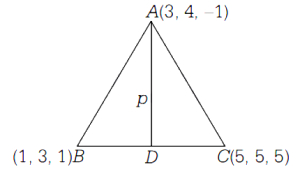
જો $\triangle ABC$ ના શિરોબિંદુઓના સ્થાન સદિશો અનુક્રમે $3\hat{i}+4\hat{j}-\hat{k}$,$\hat{i}+3\hat{j}+\hat{k}$ અને $5(\hat{i}+\hat{j}+\hat{k})$ હોય,તો $A$ માંથી બાજુ $BC$ પર દોરેલા વેધનું માન શોધો.
A
$\frac{4}{3}\sqrt{5}$
B
$\frac{5}{3}\sqrt{5}$
C
$\frac{7}{3}\sqrt{5}$
D
$\frac{8}{3}\sqrt{5}$
Solution
(A) ધારો કે શિરોબિંદુઓ $A, B,$ અને $C$ ના સ્થાન સદિશો $\vec{a} = 3\hat{i}+4\hat{j}-\hat{k}$,$\vec{b} = \hat{i}+3\hat{j}+\hat{k}$,અને $\vec{c} = 5\hat{i}+5\hat{j}+5\hat{k}$ છે.
બાજુઓ દર્શાવતા સદિશો:
$\vec{AB} = \vec{b} - \vec{a} = -2\hat{i} - \hat{j} + 2\hat{k}$
$\vec{AC} = \vec{c} - \vec{a} = 2\hat{i} + \hat{j} + 6\hat{k}$
$\vec{BC} = \vec{c} - \vec{b} = 4\hat{i} + 2\hat{j} + 4\hat{k}$
$\triangle ABC$ નું ક્ષેત્રફળ $= \frac{1}{2} |\vec{AB} \times \vec{AC}|$ છે.
$\vec{AB} \times \vec{AC} = \begin{vmatrix} \hat{i} & \hat{j} & \hat{k} \\ -2 & -1 & 2 \\ 2 & 1 & 6 \end{vmatrix} = -8\hat{i} + 16\hat{j} + 0\hat{k}$
માન $|\vec{AB} \times \vec{AC}| = \sqrt{(-8)^2 + 16^2 + 0^2} = \sqrt{320} = 8\sqrt{5}$.
ક્ષેત્રફળ $= \frac{1}{2} \times 8\sqrt{5} = 4\sqrt{5}$.
વળી,ક્ષેત્રફળ $= \frac{1}{2} \times |\vec{BC}| \times p$,જ્યાં $p$ એ $A$ માંથી $BC$ પરનો વેધ છે.
$|\vec{BC}| = \sqrt{4^2 + 2^2 + 4^2} = 6$.
તેથી,$4\sqrt{5} = \frac{1}{2} \times 6 \times p \implies 4\sqrt{5} = 3p \implies p = \frac{4\sqrt{5}}{3}$.
બાજુઓ દર્શાવતા સદિશો:
$\vec{AB} = \vec{b} - \vec{a} = -2\hat{i} - \hat{j} + 2\hat{k}$
$\vec{AC} = \vec{c} - \vec{a} = 2\hat{i} + \hat{j} + 6\hat{k}$
$\vec{BC} = \vec{c} - \vec{b} = 4\hat{i} + 2\hat{j} + 4\hat{k}$
$\triangle ABC$ નું ક્ષેત્રફળ $= \frac{1}{2} |\vec{AB} \times \vec{AC}|$ છે.
$\vec{AB} \times \vec{AC} = \begin{vmatrix} \hat{i} & \hat{j} & \hat{k} \\ -2 & -1 & 2 \\ 2 & 1 & 6 \end{vmatrix} = -8\hat{i} + 16\hat{j} + 0\hat{k}$
માન $|\vec{AB} \times \vec{AC}| = \sqrt{(-8)^2 + 16^2 + 0^2} = \sqrt{320} = 8\sqrt{5}$.
ક્ષેત્રફળ $= \frac{1}{2} \times 8\sqrt{5} = 4\sqrt{5}$.
વળી,ક્ષેત્રફળ $= \frac{1}{2} \times |\vec{BC}| \times p$,જ્યાં $p$ એ $A$ માંથી $BC$ પરનો વેધ છે.
$|\vec{BC}| = \sqrt{4^2 + 2^2 + 4^2} = 6$.
તેથી,$4\sqrt{5} = \frac{1}{2} \times 6 \times p \implies 4\sqrt{5} = 3p \implies p = \frac{4\sqrt{5}}{3}$.
0 likes
View Solution414
MediumMCQ
$a, b, c, d$ એ સમતલીય સદિશો છે,તો $(a \times b) \times (c \times d)$ ની કિંમત શું થાય?
A
$0$
B
$1$
C
$a$
D
$b$
Solution
(A) આપેલ છે કે $a, b, c, d$ એ સમતલીય સદિશો છે.
સદિશ $a$ અને $b$ સમતલીય હોવાથી,સદિશ $a \times b$ એ $a$ અને $b$ ધરાવતા સમતલને લંબ છે.
તે જ રીતે,$c$ અને $d$ સમતલીય હોવાથી,સદિશ $c \times d$ એ $c$ અને $d$ ધરાવતા સમતલને લંબ છે.
$a, b, c, d$ બધા એક જ સમતલમાં હોવાથી,સદિશો $a \times b$ અને $c \times d$ બંને એક જ સમતલને લંબ છે.
તેથી,$a \times b$ અને $c \times d$ એકબીજાને સમાંતર છે.
બે સમાંતર સદિશોનો સદિશ ગુણાકાર શૂન્ય સદિશ હોવાથી,$(a \times b) \times (c \times d) = 0$ થાય.
સદિશ $a$ અને $b$ સમતલીય હોવાથી,સદિશ $a \times b$ એ $a$ અને $b$ ધરાવતા સમતલને લંબ છે.
તે જ રીતે,$c$ અને $d$ સમતલીય હોવાથી,સદિશ $c \times d$ એ $c$ અને $d$ ધરાવતા સમતલને લંબ છે.
$a, b, c, d$ બધા એક જ સમતલમાં હોવાથી,સદિશો $a \times b$ અને $c \times d$ બંને એક જ સમતલને લંબ છે.
તેથી,$a \times b$ અને $c \times d$ એકબીજાને સમાંતર છે.
બે સમાંતર સદિશોનો સદિશ ગુણાકાર શૂન્ય સદિશ હોવાથી,$(a \times b) \times (c \times d) = 0$ થાય.
0 likes
View Solution415
MediumMCQ
$\vec{r}$ એ સદિશો $2 \hat{i}-\hat{j}$ અને $\hat{j}+2 \hat{k}$ દ્વારા નક્કી થતા સમતલને લંબ સદિશ છે. જો સદિશ $2 \hat{i}+\hat{j}+2 \hat{k}$ પર $\vec{r}$ ના પ્રક્ષેપનું માન $1$ હોય,તો $|\vec{r}|=$
A
$\sqrt{6}$
B
$3 \sqrt{6}$
C
$\frac{2 \sqrt{6}}{3}$
D
$\frac{3 \sqrt{6}}{2}$
Solution
(D) સદિશ $\vec{r}$ એ $\vec{a} = 2 \hat{i} - \hat{j}$ અને $\vec{b} = \hat{j} + 2 \hat{k}$ દ્વારા નક્કી થતા સમતલને લંબ છે. તેથી,$\vec{r}$ એ $\vec{a} \times \vec{b}$ ને સમાંતર છે.
$\vec{a} \times \vec{b} = \begin{vmatrix} \hat{i} & \hat{j} & \hat{k} \\ 2 & -1 & 0 \\ 0 & 1 & 2 \end{vmatrix} = \hat{i}(-2 - 0) - \hat{j}(4 - 0) + \hat{k}(2 - 0) = -2 \hat{i} - 4 \hat{j} + 2 \hat{k}$.
ધારો કે $\vec{r} = \lambda(-2 \hat{i} - 4 \hat{j} + 2 \hat{k}) = 2\lambda(-\hat{i} - 2 \hat{j} + \hat{k})$.
$\vec{v} = 2 \hat{i} + \hat{j} + 2 \hat{k}$ પર $\vec{r}$ નો પ્રક્ષેપ $\frac{|\vec{r} \cdot \vec{v}|}{|\vec{v}|} = 1$ દ્વારા આપવામાં આવે છે.
$|\vec{v}| = \sqrt{2^2 + 1^2 + 2^2} = \sqrt{4 + 1 + 4} = 3$.
$\vec{r} \cdot \vec{v} = \lambda(-2 \hat{i} - 4 \hat{j} + 2 \hat{k}) \cdot (2 \hat{i} + \hat{j} + 2 \hat{k}) = \lambda(-4 - 4 + 4) = -4\lambda$.
તેથી,$\frac{|-4\lambda|}{3} = 1 \Rightarrow |\lambda| = \frac{3}{4}$.
$|\vec{r}| = |\lambda| \sqrt{(-2)^2 + (-4)^2 + 2^2} = \frac{3}{4} \sqrt{4 + 16 + 4} = \frac{3}{4} \sqrt{24} = \frac{3}{4} \times 2 \sqrt{6} = \frac{3 \sqrt{6}}{2}$.
$\vec{a} \times \vec{b} = \begin{vmatrix} \hat{i} & \hat{j} & \hat{k} \\ 2 & -1 & 0 \\ 0 & 1 & 2 \end{vmatrix} = \hat{i}(-2 - 0) - \hat{j}(4 - 0) + \hat{k}(2 - 0) = -2 \hat{i} - 4 \hat{j} + 2 \hat{k}$.
ધારો કે $\vec{r} = \lambda(-2 \hat{i} - 4 \hat{j} + 2 \hat{k}) = 2\lambda(-\hat{i} - 2 \hat{j} + \hat{k})$.
$\vec{v} = 2 \hat{i} + \hat{j} + 2 \hat{k}$ પર $\vec{r}$ નો પ્રક્ષેપ $\frac{|\vec{r} \cdot \vec{v}|}{|\vec{v}|} = 1$ દ્વારા આપવામાં આવે છે.
$|\vec{v}| = \sqrt{2^2 + 1^2 + 2^2} = \sqrt{4 + 1 + 4} = 3$.
$\vec{r} \cdot \vec{v} = \lambda(-2 \hat{i} - 4 \hat{j} + 2 \hat{k}) \cdot (2 \hat{i} + \hat{j} + 2 \hat{k}) = \lambda(-4 - 4 + 4) = -4\lambda$.
તેથી,$\frac{|-4\lambda|}{3} = 1 \Rightarrow |\lambda| = \frac{3}{4}$.
$|\vec{r}| = |\lambda| \sqrt{(-2)^2 + (-4)^2 + 2^2} = \frac{3}{4} \sqrt{4 + 16 + 4} = \frac{3}{4} \sqrt{24} = \frac{3}{4} \times 2 \sqrt{6} = \frac{3 \sqrt{6}}{2}$.
0 likes
View Solution416
EasyMCQ
જો $\vec{a}=\hat{i}+2 \hat{j}+\hat{k}$,$\vec{b}=3(\hat{i}-\hat{j}+\hat{k})$ અને $\vec{c}$ એવો સદિશ છે કે જેથી $\vec{a} \times \vec{c}=\vec{b}$ અને $\vec{a} \cdot \vec{c}=3$ થાય,તો $\vec{a} \cdot(\vec{c} \times \vec{b}-\vec{b}-\vec{c})=$
A
$32$
B
$24$
C
$20$
D
$36$
Solution
(B) આપેલ છે કે $\vec{a}=\hat{i}+2 \hat{j}+\hat{k}$ અને $\vec{b}=3 \hat{i}-3 \hat{j}+3 \hat{k}$.
ધારો કે $\vec{c}=x \hat{i}+y \hat{j}+z \hat{k}$.
$\vec{a} \times \vec{c}=\vec{b}$ પરથી,આપણને મળે:
$\begin{vmatrix} \hat{i} & \hat{j} & \hat{k} \\ 1 & 2 & 1 \\ x & y & z \end{vmatrix} = 3 \hat{i}-3 \hat{j}+3 \hat{k}$
$(2z-y) \hat{i} - (z-x) \hat{j} + (y-2x) \hat{k} = 3 \hat{i}-3 \hat{j}+3 \hat{k}$
ઘટકોની સરખામણી કરતા:
$2z-y=3$ $(i)$
$x-z=-3 \Rightarrow z-x=3$ (ii)
$y-2x=3$ (iii)
આપેલ છે કે $\vec{a} \cdot \vec{c}=3$,તેથી $x+2y+z=3$ (iv).
(ii) પરથી,$z=x+3$. (iv) માં મૂકતા: $x+2y+x+3=3 \Rightarrow 2x+2y=0 \Rightarrow y=-x$.
(iii) માં $y=-x$ મૂકતા: $-x-2x=3 \Rightarrow -3x=3 \Rightarrow x=-1$.
તેથી $y=1$ અને $z=2$. આમ,$\vec{c}=-\hat{i}+\hat{j}+2 \hat{k}$.
હવે,$\vec{c} \times \vec{b} = \begin{vmatrix} \hat{i} & \hat{j} & \hat{k} \\ -1 & 1 & 2 \\ 3 & -3 & 3 \end{vmatrix} = (3+6) \hat{i} - (-3-6) \hat{j} + (3-3) \hat{k} = 9 \hat{i}+9 \hat{j}$.
આપણે $\vec{a} \cdot (\vec{c} \times \vec{b} - \vec{b} - \vec{c}) = \vec{a} \cdot (\vec{c} \times \vec{b}) - \vec{a} \cdot \vec{b} - \vec{a} \cdot \vec{c}$ ની ગણતરી કરવાની છે.
$\vec{a} \cdot (\vec{c} \times \vec{b}) = (\hat{i}+2 \hat{j}+\hat{k}) \cdot (9 \hat{i}+9 \hat{j}) = 9+18=27$.
$\vec{a} \cdot \vec{b} = (1)(3) + (2)(-3) + (1)(3) = 3-6+3=0$.
$\vec{a} \cdot \vec{c} = 3$.
તેથી,$27 - 0 - 3 = 24$.
ધારો કે $\vec{c}=x \hat{i}+y \hat{j}+z \hat{k}$.
$\vec{a} \times \vec{c}=\vec{b}$ પરથી,આપણને મળે:
$\begin{vmatrix} \hat{i} & \hat{j} & \hat{k} \\ 1 & 2 & 1 \\ x & y & z \end{vmatrix} = 3 \hat{i}-3 \hat{j}+3 \hat{k}$
$(2z-y) \hat{i} - (z-x) \hat{j} + (y-2x) \hat{k} = 3 \hat{i}-3 \hat{j}+3 \hat{k}$
ઘટકોની સરખામણી કરતા:
$2z-y=3$ $(i)$
$x-z=-3 \Rightarrow z-x=3$ (ii)
$y-2x=3$ (iii)
આપેલ છે કે $\vec{a} \cdot \vec{c}=3$,તેથી $x+2y+z=3$ (iv).
(ii) પરથી,$z=x+3$. (iv) માં મૂકતા: $x+2y+x+3=3 \Rightarrow 2x+2y=0 \Rightarrow y=-x$.
(iii) માં $y=-x$ મૂકતા: $-x-2x=3 \Rightarrow -3x=3 \Rightarrow x=-1$.
તેથી $y=1$ અને $z=2$. આમ,$\vec{c}=-\hat{i}+\hat{j}+2 \hat{k}$.
હવે,$\vec{c} \times \vec{b} = \begin{vmatrix} \hat{i} & \hat{j} & \hat{k} \\ -1 & 1 & 2 \\ 3 & -3 & 3 \end{vmatrix} = (3+6) \hat{i} - (-3-6) \hat{j} + (3-3) \hat{k} = 9 \hat{i}+9 \hat{j}$.
આપણે $\vec{a} \cdot (\vec{c} \times \vec{b} - \vec{b} - \vec{c}) = \vec{a} \cdot (\vec{c} \times \vec{b}) - \vec{a} \cdot \vec{b} - \vec{a} \cdot \vec{c}$ ની ગણતરી કરવાની છે.
$\vec{a} \cdot (\vec{c} \times \vec{b}) = (\hat{i}+2 \hat{j}+\hat{k}) \cdot (9 \hat{i}+9 \hat{j}) = 9+18=27$.
$\vec{a} \cdot \vec{b} = (1)(3) + (2)(-3) + (1)(3) = 3-6+3=0$.
$\vec{a} \cdot \vec{c} = 3$.
તેથી,$27 - 0 - 3 = 24$.
0 likes
View Solution417
EasyMCQ
$\vec{a}, \vec{b}, \vec{c}$ એ ત્રણ સદિશો છે,જે દરેકનું માન $\sqrt{2}$ છે,જેથી $(\vec{a}, \vec{b})=(\vec{b}, \vec{c})=(\vec{c}, \vec{a})=\frac{\pi}{3}$ થાય. જો $\vec{x}=\vec{a} \times(\vec{b} \times \vec{c})$ અને $\vec{y}=\vec{b} \times(\vec{c} \times \vec{a})$ હોય,તો
A
$|\vec{x}|=|\vec{y}|$
B
$|\vec{x}|=\sqrt{2}|\vec{y}|$
C
$|\vec{x}|=2|\vec{y}|$
D
$|\vec{x}|+|\vec{y}|=2$
Solution
(A) આપેલ છે કે $|\vec{a}|=|\vec{b}|=|\vec{c}|=\sqrt{2}$ અને કોઈપણ બે સદિશો વચ્ચેનો ખૂણો $\frac{\pi}{3}$ છે.
$\vec{a} \cdot \vec{b} = |\vec{a}||\vec{b}| \cos(\frac{\pi}{3}) = \sqrt{2} \times \sqrt{2} \times \frac{1}{2} = 1$.
તે જ રીતે,$\vec{b} \cdot \vec{c} = 1$ અને $\vec{c} \cdot \vec{a} = 1$.
સદિશ ત્રિગુણિત ગુણાકારના સૂત્ર $\vec{a} \times (\vec{b} \times \vec{c}) = (\vec{a} \cdot \vec{c})\vec{b} - (\vec{a} \cdot \vec{b})\vec{c}$ નો ઉપયોગ કરતા:
$\vec{x} = (\vec{a} \cdot \vec{c})\vec{b} - (\vec{a} \cdot \vec{b})\vec{c} = 1 \cdot \vec{b} - 1 \cdot \vec{c} = \vec{b} - \vec{c}$.
હવે,$|\vec{x}|^2 = |\vec{b} - \vec{c}|^2 = |\vec{b}|^2 + |\vec{c}|^2 - 2(\vec{b} \cdot \vec{c}) = 2 + 2 - 2(1) = 2$.
તે જ રીતે,$\vec{y} = \vec{b} \times (\vec{c} \times \vec{a}) = (\vec{b} \cdot \vec{a})\vec{c} - (\vec{b} \cdot \vec{c})\vec{a} = 1 \cdot \vec{c} - 1 \cdot \vec{a} = \vec{c} - \vec{a}$.
હવે,$|\vec{y}|^2 = |\vec{c} - \vec{a}|^2 = |\vec{c}|^2 + |\vec{a}|^2 - 2(\vec{c} \cdot \vec{a}) = 2 + 2 - 2(1) = 2$.
કારણ કે $|\vec{x}|^2 = 2$ અને $|\vec{y}|^2 = 2$,તેથી $|\vec{x}| = |\vec{y}| = \sqrt{2}$ થાય.
$\vec{a} \cdot \vec{b} = |\vec{a}||\vec{b}| \cos(\frac{\pi}{3}) = \sqrt{2} \times \sqrt{2} \times \frac{1}{2} = 1$.
તે જ રીતે,$\vec{b} \cdot \vec{c} = 1$ અને $\vec{c} \cdot \vec{a} = 1$.
સદિશ ત્રિગુણિત ગુણાકારના સૂત્ર $\vec{a} \times (\vec{b} \times \vec{c}) = (\vec{a} \cdot \vec{c})\vec{b} - (\vec{a} \cdot \vec{b})\vec{c}$ નો ઉપયોગ કરતા:
$\vec{x} = (\vec{a} \cdot \vec{c})\vec{b} - (\vec{a} \cdot \vec{b})\vec{c} = 1 \cdot \vec{b} - 1 \cdot \vec{c} = \vec{b} - \vec{c}$.
હવે,$|\vec{x}|^2 = |\vec{b} - \vec{c}|^2 = |\vec{b}|^2 + |\vec{c}|^2 - 2(\vec{b} \cdot \vec{c}) = 2 + 2 - 2(1) = 2$.
તે જ રીતે,$\vec{y} = \vec{b} \times (\vec{c} \times \vec{a}) = (\vec{b} \cdot \vec{a})\vec{c} - (\vec{b} \cdot \vec{c})\vec{a} = 1 \cdot \vec{c} - 1 \cdot \vec{a} = \vec{c} - \vec{a}$.
હવે,$|\vec{y}|^2 = |\vec{c} - \vec{a}|^2 = |\vec{c}|^2 + |\vec{a}|^2 - 2(\vec{c} \cdot \vec{a}) = 2 + 2 - 2(1) = 2$.
કારણ કે $|\vec{x}|^2 = 2$ અને $|\vec{y}|^2 = 2$,તેથી $|\vec{x}| = |\vec{y}| = \sqrt{2}$ થાય.
0 likes
View Solution418
MediumMCQ
$\vec{a}=\hat{i}+\hat{j}-2 \hat{k}$,$\vec{b}=\hat{i}-2 \hat{j}+\hat{k}$ અને $\vec{c}=2 \hat{i}+\hat{j}-\hat{k}$ ત્રણ સદિશો છે. જો $\vec{d}$ એ $\vec{a}$ અને $\vec{b}$ ના સમતલને લંબ હોય અને $\vec{d} \cdot \vec{c}=2$ હોય,તો $|\vec{d}|=$
A
$\sqrt{6}$
B
$2 \sqrt{3}$
C
$\sqrt{3}$
D
$2$
Solution
(C) કારણ કે $\vec{d}$ એ $\vec{a}$ અને $\vec{b}$ ના સમતલને લંબ છે,તેથી તે $\vec{a} \times \vec{b}$ ને સમાંતર હોવો જોઈએ.
તેથી,$\vec{d} = \lambda(\vec{a} \times \vec{b})$.
પ્રથમ,સદિશ ગુણાકાર $\vec{a} \times \vec{b}$ શોધો:
$\vec{a} \times \vec{b} = \begin{vmatrix} \hat{i} & \hat{j} & \hat{k} \\ 1 & 1 & -2 \\ 1 & -2 & 1 \end{vmatrix} = \hat{i}(1 - 4) - \hat{j}(1 - (-2)) + \hat{k}(-2 - 1) = -3\hat{i} - 3\hat{j} - 3\hat{k}$.
આપણે $\vec{d} = \mu(\hat{i} + \hat{j} + \hat{k})$ લખી શકીએ જ્યાં $\mu = -3\lambda$.
આપેલ છે કે $\vec{d} \cdot \vec{c} = 2$,તેથી $\vec{c} = 2\hat{i} + \hat{j} - \hat{k}$ મૂકતા:
$\mu(\hat{i} + \hat{j} + \hat{k}) \cdot (2\hat{i} + \hat{j} - \hat{k}) = 2$
$\mu(2 + 1 - 1) = 2 \Rightarrow 2\mu = 2 \Rightarrow \mu = 1$.
તેથી,$\vec{d} = \hat{i} + \hat{j} + \hat{k}$.
તેનું માન $|\vec{d}| = \sqrt{1^2 + 1^2 + 1^2} = \sqrt{3}$ થાય.
તેથી,$\vec{d} = \lambda(\vec{a} \times \vec{b})$.
પ્રથમ,સદિશ ગુણાકાર $\vec{a} \times \vec{b}$ શોધો:
$\vec{a} \times \vec{b} = \begin{vmatrix} \hat{i} & \hat{j} & \hat{k} \\ 1 & 1 & -2 \\ 1 & -2 & 1 \end{vmatrix} = \hat{i}(1 - 4) - \hat{j}(1 - (-2)) + \hat{k}(-2 - 1) = -3\hat{i} - 3\hat{j} - 3\hat{k}$.
આપણે $\vec{d} = \mu(\hat{i} + \hat{j} + \hat{k})$ લખી શકીએ જ્યાં $\mu = -3\lambda$.
આપેલ છે કે $\vec{d} \cdot \vec{c} = 2$,તેથી $\vec{c} = 2\hat{i} + \hat{j} - \hat{k}$ મૂકતા:
$\mu(\hat{i} + \hat{j} + \hat{k}) \cdot (2\hat{i} + \hat{j} - \hat{k}) = 2$
$\mu(2 + 1 - 1) = 2 \Rightarrow 2\mu = 2 \Rightarrow \mu = 1$.
તેથી,$\vec{d} = \hat{i} + \hat{j} + \hat{k}$.
તેનું માન $|\vec{d}| = \sqrt{1^2 + 1^2 + 1^2} = \sqrt{3}$ થાય.
0 likes
View Solution419
MediumMCQ
જો $\vec{a}$ એક એવો સદિશ હોય કે જેથી $\vec{a} \times \hat{i}=\hat{j}+\hat{k}$ અને $\vec{a} \cdot \hat{i}=1$ થાય,તો બિંદુ $\hat{i}+\hat{j}+\hat{k}$ માંથી પસાર થતી અને $\vec{a}$ ને સમાંતર રેખાનું સમીકરણ શોધો.
A
$\vec{r}=(t+1) \hat{i}+(1-t) \hat{j}+(t+1) \hat{k}$
B
$\vec{r}=(t+1) \hat{i}-(2t-1) \hat{j}+t \hat{k}$
C
$\vec{r}=\hat{i}+t \hat{j}-t \hat{k}$
D
$\vec{r}=5t \hat{i}+7t \hat{j}+\hat{k}$
Solution
(A) ધારો કે $\vec{a} = x \hat{i} + y \hat{j} + z \hat{k}$.
આપેલ છે કે $\vec{a} \times \hat{i} = \hat{j} + \hat{k}$.
સદિશ ગુણાકાર કરતા: $\vec{a} \times \hat{i} = (x \hat{i} + y \hat{j} + z \hat{k}) \times \hat{i} = -y \hat{k} + z \hat{j} = z \hat{j} - y \hat{k}$.
$\hat{j} + \hat{k}$ સાથે સરખાવતા,આપણને $z = 1$ અને $y = -1$ મળે છે.
આપેલ છે કે $\vec{a} \cdot \hat{i} = 1$,તેથી $(x \hat{i} + y \hat{j} + z \hat{k}) \cdot \hat{i} = x = 1$.
આમ,$\vec{a} = \hat{i} - \hat{j} + \hat{k}$.
બિંદુ $\vec{p} = \hat{i} + \hat{j} + \hat{k}$ માંથી પસાર થતી અને $\vec{a}$ ને સમાંતર રેખાનું સમીકરણ $\vec{r} = \vec{p} + t \vec{a}$ છે.
$\vec{r} = (\hat{i} + \hat{j} + \hat{k}) + t(\hat{i} - \hat{j} + \hat{k}) = (1+t) \hat{i} + (1-t) \hat{j} + (1+t) \hat{k}$.
આપેલ છે કે $\vec{a} \times \hat{i} = \hat{j} + \hat{k}$.
સદિશ ગુણાકાર કરતા: $\vec{a} \times \hat{i} = (x \hat{i} + y \hat{j} + z \hat{k}) \times \hat{i} = -y \hat{k} + z \hat{j} = z \hat{j} - y \hat{k}$.
$\hat{j} + \hat{k}$ સાથે સરખાવતા,આપણને $z = 1$ અને $y = -1$ મળે છે.
આપેલ છે કે $\vec{a} \cdot \hat{i} = 1$,તેથી $(x \hat{i} + y \hat{j} + z \hat{k}) \cdot \hat{i} = x = 1$.
આમ,$\vec{a} = \hat{i} - \hat{j} + \hat{k}$.
બિંદુ $\vec{p} = \hat{i} + \hat{j} + \hat{k}$ માંથી પસાર થતી અને $\vec{a}$ ને સમાંતર રેખાનું સમીકરણ $\vec{r} = \vec{p} + t \vec{a}$ છે.
$\vec{r} = (\hat{i} + \hat{j} + \hat{k}) + t(\hat{i} - \hat{j} + \hat{k}) = (1+t) \hat{i} + (1-t) \hat{j} + (1+t) \hat{k}$.
0 likes
View Solution420
MediumMCQ
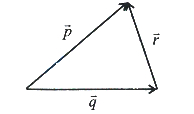
સદિશો $\vec{p}=a \hat{i}+b \hat{j}+c \hat{k}$,$\vec{q}=d \hat{i}+3 \hat{j}+4 \hat{k}$ અને $\vec{r}=3 \hat{i}+\hat{j}-2 \hat{k}$ એ ત્રિકોણ $ABC$ બનાવે છે,જ્યાં $\vec{p}=\vec{q}+\vec{r}$ છે. જો $\triangle ABC$ નું ક્ષેત્રફળ $5 \sqrt{6}$ ચોરસ એકમ હોય,તો $a, b, c$ ના નિરપેક્ષ મૂલ્યોનો સરવાળો કેટલો થાય?
A
$14$
B
$13$
C
$12$
D
$10$
Solution
(A) આપેલ છે કે $\vec{p} = \vec{q} + \vec{r}$,તેથી:
$a \hat{i} + b \hat{j} + c \hat{k} = (d \hat{i} + 3 \hat{j} + 4 \hat{k}) + (3 \hat{i} + \hat{j} - 2 \hat{k})$
$a \hat{i} + b \hat{j} + c \hat{k} = (d + 3) \hat{i} + 4 \hat{j} + 2 \hat{k}$
સહગુણકોની સરખામણી કરતા,$a = d + 3 \Rightarrow d = a - 3$,$b = 4$,અને $c = 2$ મળે છે.
$\vec{q}$ અને $\vec{r}$ દ્વારા બનતા $\triangle ABC$ નું ક્ષેત્રફળ $\frac{1}{2} |\vec{q} \times \vec{r}| = 5 \sqrt{6}$ છે.
$\vec{q} \times \vec{r} = \begin{vmatrix} \hat{i} & \hat{j} & \hat{k} \\ d & 3 & 4 \\ 3 & 1 & -2 \end{vmatrix} = \hat{i}(-6 - 4) - \hat{j}(-2d - 12) + \hat{k}(d - 9) = -10 \hat{i} + (2d + 12) \hat{j} + (d - 9) \hat{k}$.
ક્ષેત્રફળ $= \frac{1}{2} \sqrt{(-10)^2 + (2d + 12)^2 + (d - 9)^2} = 5 \sqrt{6}$.
$\sqrt{100 + 4d^2 + 48d + 144 + d^2 - 18d + 81} = 10 \sqrt{6}$.
$5d^2 + 30d + 325 = 600 \Rightarrow 5d^2 + 30d - 275 = 0 \Rightarrow d^2 + 6d - 55 = 0$.
$(d + 11)(d - 5) = 0$,તેથી $d = 5$ અથવા $d = -11$.
જો $d = 5$,તો $a = 5 + 3 = 8$. તેથી $|a| + |b| + |c| = 8 + 4 + 2 = 14$.
જો $d = -11$,તો $a = -11 + 3 = -8$. તેથી $|a| + |b| + |c| = |-8| + 4 + 2 = 14$.
$a \hat{i} + b \hat{j} + c \hat{k} = (d \hat{i} + 3 \hat{j} + 4 \hat{k}) + (3 \hat{i} + \hat{j} - 2 \hat{k})$
$a \hat{i} + b \hat{j} + c \hat{k} = (d + 3) \hat{i} + 4 \hat{j} + 2 \hat{k}$
સહગુણકોની સરખામણી કરતા,$a = d + 3 \Rightarrow d = a - 3$,$b = 4$,અને $c = 2$ મળે છે.
$\vec{q}$ અને $\vec{r}$ દ્વારા બનતા $\triangle ABC$ નું ક્ષેત્રફળ $\frac{1}{2} |\vec{q} \times \vec{r}| = 5 \sqrt{6}$ છે.
$\vec{q} \times \vec{r} = \begin{vmatrix} \hat{i} & \hat{j} & \hat{k} \\ d & 3 & 4 \\ 3 & 1 & -2 \end{vmatrix} = \hat{i}(-6 - 4) - \hat{j}(-2d - 12) + \hat{k}(d - 9) = -10 \hat{i} + (2d + 12) \hat{j} + (d - 9) \hat{k}$.
ક્ષેત્રફળ $= \frac{1}{2} \sqrt{(-10)^2 + (2d + 12)^2 + (d - 9)^2} = 5 \sqrt{6}$.
$\sqrt{100 + 4d^2 + 48d + 144 + d^2 - 18d + 81} = 10 \sqrt{6}$.
$5d^2 + 30d + 325 = 600 \Rightarrow 5d^2 + 30d - 275 = 0 \Rightarrow d^2 + 6d - 55 = 0$.
$(d + 11)(d - 5) = 0$,તેથી $d = 5$ અથવા $d = -11$.
જો $d = 5$,તો $a = 5 + 3 = 8$. તેથી $|a| + |b| + |c| = 8 + 4 + 2 = 14$.
જો $d = -11$,તો $a = -11 + 3 = -8$. તેથી $|a| + |b| + |c| = |-8| + 4 + 2 = 14$.
0 likes
View Solution421
EasyMCQ
ધારો કે $\vec{a} = \hat{i} + 2\hat{j} + 3\hat{k}$,$\vec{b} = 3\hat{i} - \hat{j} + 5\hat{k}$ અને $\vec{c} = \hat{i} - 4\hat{j} - 2\hat{k}$ ત્રણ સદિશો છે. ધારો કે $\vec{r}$ એ $\vec{b}$ અને $\vec{c}$ બંનેને લંબ સદિશ છે અને $\vec{r} \cdot \vec{a} = 11$ છે. તો નીચેનામાંથી કયો સદિશ $\vec{r}$ ને લંબ છે?
A
$\hat{i} + \hat{j} + \hat{k}$
B
$\hat{i} - \hat{j} + \hat{k}$
C
$\hat{i} + \hat{j} - \hat{k}$
D
$\hat{i} - \hat{j} - \hat{k}$
Solution
(B) $\vec{b}$ અને $\vec{c}$ બંનેને લંબ સદિશ $\vec{r} = \lambda(\vec{b} \times \vec{c})$ દ્વારા મળે છે.
$\vec{b} \times \vec{c} = \begin{vmatrix} \hat{i} & \hat{j} & \hat{k} \\ 3 & -1 & 5 \\ 1 & -4 & -2 \end{vmatrix} = \hat{i}(2 + 20) - \hat{j}(-6 - 5) + \hat{k}(-12 + 1) = 22\hat{i} + 11\hat{j} - 11\hat{k} = 11(2\hat{i} + \hat{j} - \hat{k})$.
તેથી,$\vec{r} = \lambda(11)(2\hat{i} + \hat{j} - \hat{k})$.
આપેલ છે કે $\vec{r} \cdot \vec{a} = 11$,તેથી $11\lambda(2\hat{i} + \hat{j} - \hat{k}) \cdot (\hat{i} + 2\hat{j} + 3\hat{k}) = 11$.
$11\lambda(2(1) + 1(2) - 1(3)) = 11 \implies 11\lambda(2 + 2 - 3) = 11 \implies 11\lambda(1) = 11 \implies \lambda = 1$.
આમ,$\vec{r} = 11(2\hat{i} + \hat{j} - \hat{k})$.
કોઈ સદિશ $\vec{p}$ એ $\vec{r}$ ને લંબ હોય જો $\vec{r} \cdot \vec{p} = 0$ થાય,જેનો અર્થ છે કે $(2\hat{i} + \hat{j} - \hat{k}) \cdot \vec{p} = 0$.
વિકલ્પ $B$ તપાસતા: $(2\hat{i} + \hat{j} - \hat{k}) \cdot (\hat{i} - \hat{j} + \hat{k}) = 2(1) + 1(-1) - 1(1) = 2 - 1 - 1 = 0$.
તેથી,સદિશ $\hat{i} - \hat{j} + \hat{k}$ એ $\vec{r}$ ને લંબ છે.
$\vec{b} \times \vec{c} = \begin{vmatrix} \hat{i} & \hat{j} & \hat{k} \\ 3 & -1 & 5 \\ 1 & -4 & -2 \end{vmatrix} = \hat{i}(2 + 20) - \hat{j}(-6 - 5) + \hat{k}(-12 + 1) = 22\hat{i} + 11\hat{j} - 11\hat{k} = 11(2\hat{i} + \hat{j} - \hat{k})$.
તેથી,$\vec{r} = \lambda(11)(2\hat{i} + \hat{j} - \hat{k})$.
આપેલ છે કે $\vec{r} \cdot \vec{a} = 11$,તેથી $11\lambda(2\hat{i} + \hat{j} - \hat{k}) \cdot (\hat{i} + 2\hat{j} + 3\hat{k}) = 11$.
$11\lambda(2(1) + 1(2) - 1(3)) = 11 \implies 11\lambda(2 + 2 - 3) = 11 \implies 11\lambda(1) = 11 \implies \lambda = 1$.
આમ,$\vec{r} = 11(2\hat{i} + \hat{j} - \hat{k})$.
કોઈ સદિશ $\vec{p}$ એ $\vec{r}$ ને લંબ હોય જો $\vec{r} \cdot \vec{p} = 0$ થાય,જેનો અર્થ છે કે $(2\hat{i} + \hat{j} - \hat{k}) \cdot \vec{p} = 0$.
વિકલ્પ $B$ તપાસતા: $(2\hat{i} + \hat{j} - \hat{k}) \cdot (\hat{i} - \hat{j} + \hat{k}) = 2(1) + 1(-1) - 1(1) = 2 - 1 - 1 = 0$.
તેથી,સદિશ $\hat{i} - \hat{j} + \hat{k}$ એ $\vec{r}$ ને લંબ છે.
0 likes
View Solution422
EasyMCQ
ધારો કે $\vec{a}=2 \hat{i}-3 \hat{j}+\hat{k}, \vec{b}=\hat{i}+2 \hat{j}-3 \hat{k}, \vec{c}=\hat{i}-\hat{j}$ અને $\vec{d}=\hat{i}+\hat{j}+x \hat{k}$ છે. જો $(\vec{a} \times \vec{b}) \times \vec{c}$ એ $\vec{d}$ ને લંબ હોય,તો $x=$
A
$\frac{3}{2}$
B
$2$
C
$\frac{2}{3}$
D
$1$
Solution
(D) પ્રથમ,સદિશ ગુણાકાર $\vec{a} \times \vec{b}$ શોધો:
$\vec{a} \times \vec{b} = \begin{vmatrix} \hat{i} & \hat{j} & \hat{k} \\ 2 & -3 & 1 \\ 1 & 2 & -3 \end{vmatrix} = \hat{i}(9-2) - \hat{j}(-6-1) + \hat{k}(4+3) = 7\hat{i} + 7\hat{j} + 7\hat{k}$
ત્યારબાદ,$(\vec{a} \times \vec{b}) \times \vec{c}$ શોધો:
$(\vec{a} \times \vec{b}) \times \vec{c} = \begin{vmatrix} \hat{i} & \hat{j} & \hat{k} \\ 7 & 7 & 7 \\ 1 & -1 & 0 \end{vmatrix} = \hat{i}(0 - (-7)) - \hat{j}(0 - 7) + \hat{k}(-7 - 7) = 7\hat{i} + 7\hat{j} - 14\hat{k}$
આપેલ છે કે $(\vec{a} \times \vec{b}) \times \vec{c}$ એ $\vec{d}$ ને લંબ છે,તેથી તેમનો અદિશ ગુણાકાર શૂન્ય થાય:
$(7\hat{i} + 7\hat{j} - 14\hat{k}) \cdot (\hat{i} + \hat{j} + x\hat{k}) = 0$
$7(1) + 7(1) - 14(x) = 0$
$14 - 14x = 0$
$14x = 14$
$x = 1$
$\vec{a} \times \vec{b} = \begin{vmatrix} \hat{i} & \hat{j} & \hat{k} \\ 2 & -3 & 1 \\ 1 & 2 & -3 \end{vmatrix} = \hat{i}(9-2) - \hat{j}(-6-1) + \hat{k}(4+3) = 7\hat{i} + 7\hat{j} + 7\hat{k}$
ત્યારબાદ,$(\vec{a} \times \vec{b}) \times \vec{c}$ શોધો:
$(\vec{a} \times \vec{b}) \times \vec{c} = \begin{vmatrix} \hat{i} & \hat{j} & \hat{k} \\ 7 & 7 & 7 \\ 1 & -1 & 0 \end{vmatrix} = \hat{i}(0 - (-7)) - \hat{j}(0 - 7) + \hat{k}(-7 - 7) = 7\hat{i} + 7\hat{j} - 14\hat{k}$
આપેલ છે કે $(\vec{a} \times \vec{b}) \times \vec{c}$ એ $\vec{d}$ ને લંબ છે,તેથી તેમનો અદિશ ગુણાકાર શૂન્ય થાય:
$(7\hat{i} + 7\hat{j} - 14\hat{k}) \cdot (\hat{i} + \hat{j} + x\hat{k}) = 0$
$7(1) + 7(1) - 14(x) = 0$
$14 - 14x = 0$
$14x = 14$
$x = 1$
0 likes
View Solution423
EasyMCQ
જો $\vec{a}=\hat{i}+\hat{j}+\hat{k}$ અને $\vec{c}=\hat{j}-\hat{k}$ આપેલા સદિશો હોય,તો સમીકરણો $\vec{a} \times \vec{b}=\vec{c}$ અને $\vec{a} \cdot \vec{b}=3$ નું સમાધાન કરતો સદિશ $\vec{b}$ શોધો.
A
$5 \hat{i}+2 \hat{j}+2 \hat{k}$
B
$\frac{5}{2} \hat{i}+\hat{j}+\hat{k}$
C
$\frac{5}{3} \hat{i}+\frac{2}{3} \hat{j}+\frac{2}{3} \hat{k}$
D
$\hat{i}+\frac{2}{5} \hat{j}+\frac{2}{5} \hat{k}$
Solution
(C) આપેલ છે કે,$\vec{a}=\hat{i}+\hat{j}+\hat{k}$ અને $\vec{c}=\hat{j}-\hat{k}$.
ધારો કે $\vec{b}=x\hat{i}+y\hat{j}+z\hat{k}$.
$\vec{a} \cdot \vec{b}=3$ પરથી,$(\hat{i}+\hat{j}+\hat{k}) \cdot (x\hat{i}+y\hat{j}+z\hat{k})=3$,જેનો અર્થ છે કે $x+y+z=3$ ... $(1)$.
$\vec{a} \times \vec{b}=\vec{c}$ પરથી,આપણને મળે:
$\begin{vmatrix} \hat{i} & \hat{j} & \hat{k} \\ 1 & 1 & 1 \\ x & y & z \end{vmatrix} = \hat{j}-\hat{k}$
$\hat{i}(z-y) - \hat{j}(z-x) + \hat{k}(y-x) = 0\hat{i} + 1\hat{j} - 1\hat{k}$.
સહગુણકોની સરખામણી કરતા:
$z-y=0 \Rightarrow z=y$
$-(z-x)=1 \Rightarrow x-z=1 \Rightarrow x=z+1$
$y-x=-1 \Rightarrow x=y+1$.
$y=z$ અને $x=z+1$ ને સમીકરણ $(1)$ માં મૂકતા:
$(z+1) + z + z = 3 \Rightarrow 3z+1=3 \Rightarrow 3z=2 \Rightarrow z=\frac{2}{3}$.
આમ,$y=\frac{2}{3}$ અને $x=\frac{2}{3}+1=\frac{5}{3}$.
તેથી,$\vec{b}=\frac{5}{3}\hat{i}+\frac{2}{3}\hat{j}+\frac{2}{3}\hat{k}$.
ધારો કે $\vec{b}=x\hat{i}+y\hat{j}+z\hat{k}$.
$\vec{a} \cdot \vec{b}=3$ પરથી,$(\hat{i}+\hat{j}+\hat{k}) \cdot (x\hat{i}+y\hat{j}+z\hat{k})=3$,જેનો અર્થ છે કે $x+y+z=3$ ... $(1)$.
$\vec{a} \times \vec{b}=\vec{c}$ પરથી,આપણને મળે:
$\begin{vmatrix} \hat{i} & \hat{j} & \hat{k} \\ 1 & 1 & 1 \\ x & y & z \end{vmatrix} = \hat{j}-\hat{k}$
$\hat{i}(z-y) - \hat{j}(z-x) + \hat{k}(y-x) = 0\hat{i} + 1\hat{j} - 1\hat{k}$.
સહગુણકોની સરખામણી કરતા:
$z-y=0 \Rightarrow z=y$
$-(z-x)=1 \Rightarrow x-z=1 \Rightarrow x=z+1$
$y-x=-1 \Rightarrow x=y+1$.
$y=z$ અને $x=z+1$ ને સમીકરણ $(1)$ માં મૂકતા:
$(z+1) + z + z = 3 \Rightarrow 3z+1=3 \Rightarrow 3z=2 \Rightarrow z=\frac{2}{3}$.
આમ,$y=\frac{2}{3}$ અને $x=\frac{2}{3}+1=\frac{5}{3}$.
તેથી,$\vec{b}=\frac{5}{3}\hat{i}+\frac{2}{3}\hat{j}+\frac{2}{3}\hat{k}$.
0 likes
View Solution424
MediumMCQ
સદિશ $\hat{i}-2 \hat{j}+3 \hat{k}$ ને લંબ અને સદિશો $\hat{i}+\hat{j}+\hat{k}$ તથા $2 \hat{i}-\hat{j}-\hat{k}$ સાથે સમતલીય હોય તેવો એકમ સદિશ શોધો.
A
$\pm \frac{1}{\sqrt{5}}(2 \hat{i}+\hat{j})$
B
$\pm \frac{1}{4 \sqrt{5}}(3 \hat{i}-6 \hat{j}-5 \hat{k})$
C
$\pm \frac{1}{\sqrt{6}}(\hat{i}+2 \hat{j}+\hat{k})$
D
$\pm \frac{1}{\sqrt{3}}(\hat{i}-\hat{j}-\hat{k})$
Solution
(D) ધારો કે $\vec{a}$ એ માંગેલ એકમ સદિશ છે. કારણ કે $\vec{a}$ એ $\vec{c} = \hat{i}+\hat{j}+\hat{k}$ અને $\vec{d} = 2 \hat{i}-\hat{j}-\hat{k}$ સાથે સમતલીય છે,તેથી તે $\vec{n} = \vec{c} \times \vec{d}$ ને લંબ હોવો જોઈએ.
$\vec{n} = \begin{vmatrix} \hat{i} & \hat{j} & \hat{k} \\ 1 & 1 & 1 \\ 2 & -1 & -1 \end{vmatrix} = \hat{i}(-1+1) - \hat{j}(-1-2) + \hat{k}(-1-2) = 0\hat{i} + 3\hat{j} - 3\hat{k}$.
કારણ કે $\vec{a}$ એ $\vec{b} = \hat{i}-2 \hat{j}+3 \hat{k}$ ને પણ લંબ છે,તેથી $\vec{a}$ એ $\vec{b} \times \vec{n}$ ને સમાંતર હોવો જોઈએ.
$\vec{b} \times \vec{n} = \begin{vmatrix} \hat{i} & \hat{j} & \hat{k} \\ 1 & -2 & 3 \\ 0 & 3 & -3 \end{vmatrix} = \hat{i}(6-9) - \hat{j}(-3-0) + \hat{k}(3-0) = -3\hat{i} + 3\hat{j} + 3\hat{k}$.
એકમ સદિશ $\pm \frac{\vec{b} \times \vec{n}}{|\vec{b} \times \vec{n}|} = \pm \frac{-3\hat{i} + 3\hat{j} + 3\hat{k}}{\sqrt{(-3)^2 + 3^2 + 3^2}} = \pm \frac{-3\hat{i} + 3\hat{j} + 3\hat{k}}{\sqrt{27}} = \pm \frac{-3\hat{i} + 3\hat{j} + 3\hat{k}}{3\sqrt{3}} = \pm \frac{1}{\sqrt{3}}(-\hat{i} + \hat{j} + \hat{k})$.
નોંધ: સદિશ $\pm \frac{1}{\sqrt{3}}(\hat{i}-\hat{j}-\hat{k})$ એ $\pm \frac{1}{\sqrt{3}}(-\hat{i}+\hat{j}+\hat{k})$ ને સમાન છે.
$\vec{n} = \begin{vmatrix} \hat{i} & \hat{j} & \hat{k} \\ 1 & 1 & 1 \\ 2 & -1 & -1 \end{vmatrix} = \hat{i}(-1+1) - \hat{j}(-1-2) + \hat{k}(-1-2) = 0\hat{i} + 3\hat{j} - 3\hat{k}$.
કારણ કે $\vec{a}$ એ $\vec{b} = \hat{i}-2 \hat{j}+3 \hat{k}$ ને પણ લંબ છે,તેથી $\vec{a}$ એ $\vec{b} \times \vec{n}$ ને સમાંતર હોવો જોઈએ.
$\vec{b} \times \vec{n} = \begin{vmatrix} \hat{i} & \hat{j} & \hat{k} \\ 1 & -2 & 3 \\ 0 & 3 & -3 \end{vmatrix} = \hat{i}(6-9) - \hat{j}(-3-0) + \hat{k}(3-0) = -3\hat{i} + 3\hat{j} + 3\hat{k}$.
એકમ સદિશ $\pm \frac{\vec{b} \times \vec{n}}{|\vec{b} \times \vec{n}|} = \pm \frac{-3\hat{i} + 3\hat{j} + 3\hat{k}}{\sqrt{(-3)^2 + 3^2 + 3^2}} = \pm \frac{-3\hat{i} + 3\hat{j} + 3\hat{k}}{\sqrt{27}} = \pm \frac{-3\hat{i} + 3\hat{j} + 3\hat{k}}{3\sqrt{3}} = \pm \frac{1}{\sqrt{3}}(-\hat{i} + \hat{j} + \hat{k})$.
નોંધ: સદિશ $\pm \frac{1}{\sqrt{3}}(\hat{i}-\hat{j}-\hat{k})$ એ $\pm \frac{1}{\sqrt{3}}(-\hat{i}+\hat{j}+\hat{k})$ ને સમાન છે.
0 likes
View Solution425
EasyMCQ
જો $\vec{a} = 2 \hat{i} + 2 \hat{j} + \hat{k}$,$|\vec{b}| = 6$ અને $\vec{a}$ તથા $\vec{b}$ વચ્ચેનો ખૂણો $\frac{\pi}{6}$ હોય,તો $\vec{a}$ અને $\vec{b}$ ને બે બાજુઓ તરીકે ધરાવતા ત્રિકોણનું ક્ષેત્રફળ (ચોરસ એકમમાં) કેટલું થાય?
A
$\frac{3 \sqrt{3}}{2}$ ચોરસ એકમ
B
$\frac{\sqrt{3}}{2}$ ચોરસ એકમ
C
$\frac{5}{4}$ ચોરસ એકમ
D
$\frac{9}{2}$ ચોરસ એકમ
Solution
(D) બાજુઓ $\vec{a}$ અને $\vec{b}$ ધરાવતા ત્રિકોણનું ક્ષેત્રફળ શોધવાનું સૂત્ર: $\text{Area} = \frac{1}{2} |\vec{a} \times \vec{b}|$ છે.
કારણ કે $|\vec{a} \times \vec{b}| = |\vec{a}| |\vec{b}| \sin \theta$,જ્યાં $\theta$ એ સદિશો વચ્ચેનો ખૂણો છે:
પ્રથમ,$\vec{a}$ નું માન શોધો: $|\vec{a}| = \sqrt{2^2 + 2^2 + 1^2} = \sqrt{4 + 4 + 1} = \sqrt{9} = 3$.
આપેલ છે કે $|\vec{b}| = 6$ અને $\theta = \frac{\pi}{6}$.
આ કિંમતોને ક્ષેત્રફળના સૂત્રમાં મૂકતા: $\text{Area} = \frac{1}{2} \times |\vec{a}| \times |\vec{b}| \times \sin \left(\frac{\pi}{6}\right)$.
$\text{Area} = \frac{1}{2} \times 3 \times 6 \times \sin \left(\frac{\pi}{6}\right)$.
કારણ કે $\sin \left(\frac{\pi}{6}\right) = \frac{1}{2}$,તેથી:
$\text{Area} = \frac{1}{2} \times 3 \times 6 \times \frac{1}{2} = \frac{18}{4} = \frac{9}{2}$ ચોરસ એકમ.
કારણ કે $|\vec{a} \times \vec{b}| = |\vec{a}| |\vec{b}| \sin \theta$,જ્યાં $\theta$ એ સદિશો વચ્ચેનો ખૂણો છે:
પ્રથમ,$\vec{a}$ નું માન શોધો: $|\vec{a}| = \sqrt{2^2 + 2^2 + 1^2} = \sqrt{4 + 4 + 1} = \sqrt{9} = 3$.
આપેલ છે કે $|\vec{b}| = 6$ અને $\theta = \frac{\pi}{6}$.
આ કિંમતોને ક્ષેત્રફળના સૂત્રમાં મૂકતા: $\text{Area} = \frac{1}{2} \times |\vec{a}| \times |\vec{b}| \times \sin \left(\frac{\pi}{6}\right)$.
$\text{Area} = \frac{1}{2} \times 3 \times 6 \times \sin \left(\frac{\pi}{6}\right)$.
કારણ કે $\sin \left(\frac{\pi}{6}\right) = \frac{1}{2}$,તેથી:
$\text{Area} = \frac{1}{2} \times 3 \times 6 \times \frac{1}{2} = \frac{18}{4} = \frac{9}{2}$ ચોરસ એકમ.
0 likes
View Solution426
EasyMCQ
જો $a=\hat{i}+\hat{j}+\hat{k}$,$c=\hat{j}-\hat{k}$,$a \times b=c$ અને $a \cdot b=3$ હોય,તો $b$ બરાબર શું થાય?
A
$\frac{1}{3}(5 \hat{i}+2 \hat{j}+2 \hat{k})$
B
$\frac{1}{3}(2 \hat{i}+5 \hat{j}+2 \hat{k})$
C
$\frac{1}{3}(2 \hat{i}+2 \hat{j}+5 \hat{k})$
D
$\frac{1}{2}(2 \hat{i}+5 \hat{j}+5 \hat{k})$
Solution
(A) ધારો કે $b=x \hat{i}+y \hat{j}+z \hat{k}$.
સદિશ ગુણાકાર $a \times b$ નિશ્ચાયક દ્વારા મળે છે:
$a \times b = \begin{vmatrix} \hat{i} & \hat{j} & \hat{k} \\ 1 & 1 & 1 \\ x & y & z \end{vmatrix} = \hat{i}(z-y) - \hat{j}(z-x) + \hat{k}(y-x) = (z-y) \hat{i} + (x-z) \hat{j} + (y-x) \hat{k}$.
આપેલ છે કે $a \times b = c = 0 \hat{i} + 1 \hat{j} - 1 \hat{k}$,તેથી ઘટકોને સરખાવતા:
$z-y = 0 \Rightarrow y=z$
$x-z = 1 \Rightarrow z=x-1$
$y-x = -1 \Rightarrow y=x-1$.
વળી,$a \cdot b = 3$ આપેલ છે,તેથી $x+y+z = 3$.
$y$ અને $z$ ની કિંમત $x$ ના સ્વરૂપમાં મૂકતા:
$x + (x-1) + (x-1) = 3$
$3x - 2 = 3 \Rightarrow 3x = 5 \Rightarrow x = \frac{5}{3}$.
તેથી $y = z = \frac{5}{3} - 1 = \frac{2}{3}$.
આમ,$b = \frac{5}{3} \hat{i} + \frac{2}{3} \hat{j} + \frac{2}{3} \hat{k} = \frac{1}{3}(5 \hat{i} + 2 \hat{j} + 2 \hat{k})$.
સદિશ ગુણાકાર $a \times b$ નિશ્ચાયક દ્વારા મળે છે:
$a \times b = \begin{vmatrix} \hat{i} & \hat{j} & \hat{k} \\ 1 & 1 & 1 \\ x & y & z \end{vmatrix} = \hat{i}(z-y) - \hat{j}(z-x) + \hat{k}(y-x) = (z-y) \hat{i} + (x-z) \hat{j} + (y-x) \hat{k}$.
આપેલ છે કે $a \times b = c = 0 \hat{i} + 1 \hat{j} - 1 \hat{k}$,તેથી ઘટકોને સરખાવતા:
$z-y = 0 \Rightarrow y=z$
$x-z = 1 \Rightarrow z=x-1$
$y-x = -1 \Rightarrow y=x-1$.
વળી,$a \cdot b = 3$ આપેલ છે,તેથી $x+y+z = 3$.
$y$ અને $z$ ની કિંમત $x$ ના સ્વરૂપમાં મૂકતા:
$x + (x-1) + (x-1) = 3$
$3x - 2 = 3 \Rightarrow 3x = 5 \Rightarrow x = \frac{5}{3}$.
તેથી $y = z = \frac{5}{3} - 1 = \frac{2}{3}$.
આમ,$b = \frac{5}{3} \hat{i} + \frac{2}{3} \hat{j} + \frac{2}{3} \hat{k} = \frac{1}{3}(5 \hat{i} + 2 \hat{j} + 2 \hat{k})$.
0 likes
View Solution427
EasyMCQ
ધારો કે $a=2 \hat{i}-3 \hat{j}+4 \hat{k}$,$b=7 \hat{i}+2 \hat{j}-3 \hat{k}$,અને $c=\hat{i}+\hat{j}+\hat{k}$ છે. સદિશ $x$ શોધો કે જેથી $x \cdot c=60$ થાય અને $x$ એ $a$ અને $b$ બંનેને લંબ હોય.
A
$14 \hat{i}-6 \hat{j}-12 \hat{k}$
B
$\hat{i}+34 \hat{j}+25 \hat{k}$
C
$4 \hat{i}-21 \hat{j}-12 \hat{k}$
D
$6 \hat{i}-6 \hat{j}+28 \hat{k}$
Solution
(B) આપેલ સદિશો $a=2 \hat{i}-3 \hat{j}+4 \hat{k}$,$b=7 \hat{i}+2 \hat{j}-3 \hat{k}$,અને $c=\hat{i}+\hat{j}+\hat{k}$ છે.
કારણ કે $x$ એ $a$ અને $b$ બંનેને લંબ છે,તેથી $x$ એ $a \times b$ ના ક્રોસ પ્રોડક્ટને સમાંતર હોવો જોઈએ.
તેથી,$x = \lambda(a \times b)$.
ક્રોસ પ્રોડક્ટ $a \times b$ ની ગણતરી કરતા:
$a \times b = \begin{vmatrix} \hat{i} & \hat{j} & \hat{k} \\ 2 & -3 & 4 \\ 7 & 2 & -3 \end{vmatrix} = \hat{i}(9-8) - \hat{j}(-6-28) + \hat{k}(4+21) = \hat{i} + 34 \hat{j} + 25 \hat{k}$.
તેથી,$x = \lambda(\hat{i} + 34 \hat{j} + 25 \hat{k})$.
આપેલ છે કે $x \cdot c = 60$,આપણે $x$ અને $c$ ની કિંમતો મૂકીએ:
$(\lambda \hat{i} + 34 \lambda \hat{j} + 25 \lambda \hat{k}) \cdot (\hat{i} + \hat{j} + \hat{k}) = 60$.
$\lambda + 34 \lambda + 25 \lambda = 60$.
$60 \lambda = 60$,જે આપે છે $\lambda = 1$.
તેથી,$x = \hat{i} + 34 \hat{j} + 25 \hat{k}$.
કારણ કે $x$ એ $a$ અને $b$ બંનેને લંબ છે,તેથી $x$ એ $a \times b$ ના ક્રોસ પ્રોડક્ટને સમાંતર હોવો જોઈએ.
તેથી,$x = \lambda(a \times b)$.
ક્રોસ પ્રોડક્ટ $a \times b$ ની ગણતરી કરતા:
$a \times b = \begin{vmatrix} \hat{i} & \hat{j} & \hat{k} \\ 2 & -3 & 4 \\ 7 & 2 & -3 \end{vmatrix} = \hat{i}(9-8) - \hat{j}(-6-28) + \hat{k}(4+21) = \hat{i} + 34 \hat{j} + 25 \hat{k}$.
તેથી,$x = \lambda(\hat{i} + 34 \hat{j} + 25 \hat{k})$.
આપેલ છે કે $x \cdot c = 60$,આપણે $x$ અને $c$ ની કિંમતો મૂકીએ:
$(\lambda \hat{i} + 34 \lambda \hat{j} + 25 \lambda \hat{k}) \cdot (\hat{i} + \hat{j} + \hat{k}) = 60$.
$\lambda + 34 \lambda + 25 \lambda = 60$.
$60 \lambda = 60$,જે આપે છે $\lambda = 1$.
તેથી,$x = \hat{i} + 34 \hat{j} + 25 \hat{k}$.
0 likes
View Solution428
MediumMCQ
$2$ એકમ લંબાઈનો સદિશ $\vec{a}$ એ $X$-અક્ષ અને $Y$-અક્ષ દરેક સાથે $60^{\circ}$ નો ખૂણો બનાવે છે. જો $\sqrt{2}$ એકમ લંબાઈનો બીજો સદિશ $\vec{b}$ એ $Y$-અક્ષ અને $Z$-અક્ષ દરેક સાથે $45^{\circ}$ નો ખૂણો બનાવે,તો $\vec{a} \times \vec{b} = $
A
$(1-\sqrt{2}) \hat{i}-\hat{j}+\hat{k}$
B
$\hat{i}-\sqrt{2} \hat{j}+\hat{k}$
C
$\sqrt{2} \hat{i}-\hat{j}+2 \hat{k}$
D
$\hat{i}-2 \hat{j}+(1-\sqrt{2}) \hat{k}$
Solution
(A) ધારો કે $\vec{a}$ એ $Z$-અક્ષ સાથે $\alpha$ ખૂણો બનાવે છે અને $\vec{b}$ એ $X$-અક્ષ સાથે $\beta$ ખૂણો બનાવે છે. દિક્કોસાઇનના ગુણધર્મ $\cos^2 \alpha + \cos^2 \beta + \cos^2 \gamma = 1$ નો ઉપયોગ કરતા:
સદિશ $\vec{a}$ માટે: $\cos^2 60^{\circ} + \cos^2 60^{\circ} + \cos^2 \alpha = 1 \Rightarrow \frac{1}{4} + \frac{1}{4} + \cos^2 \alpha = 1 \Rightarrow \cos^2 \alpha = \frac{1}{2} \Rightarrow \cos \alpha = \pm \frac{1}{\sqrt{2}}$.
તેથી,$\vec{a} = 2(\cos 60^{\circ} \hat{i} + \cos 60^{\circ} \hat{j} + \cos \alpha \hat{k}) = 2(\frac{1}{2} \hat{i} + \frac{1}{2} \hat{j} \pm \frac{1}{\sqrt{2}} \hat{k}) = \hat{i} + \hat{j} \pm \sqrt{2} \hat{k}$.
સદિશ $\vec{b}$ માટે: $\cos^2 \beta + \cos^2 45^{\circ} + \cos^2 45^{\circ} = 1 \Rightarrow \cos^2 \beta + \frac{1}{2} + \frac{1}{2} = 1 \Rightarrow \cos \beta = 0$.
તેથી,$\vec{b} = \sqrt{2}(0 \hat{i} + \cos 45^{\circ} \hat{j} + \cos 45^{\circ} \hat{k}) = \sqrt{2}(0 \hat{i} + \frac{1}{\sqrt{2}} \hat{j} + \frac{1}{\sqrt{2}} \hat{k}) = \hat{j} + \hat{k}$.
હવે,$\vec{a} \times \vec{b} = \begin{vmatrix} \hat{i} & \hat{j} & \hat{k} \\ 1 & 1 & \pm \sqrt{2} \\ 0 & 1 & 1 \end{vmatrix} = \hat{i}(1 - (\pm \sqrt{2})) - \hat{j}(1 - 0) + \hat{k}(1 - 0) = (1 \mp \sqrt{2}) \hat{i} - \hat{j} + \hat{k}$.
ધન ચિહ્ન લેતા,આપણને $(1 - \sqrt{2}) \hat{i} - \hat{j} + \hat{k}$ મળે છે.
સદિશ $\vec{a}$ માટે: $\cos^2 60^{\circ} + \cos^2 60^{\circ} + \cos^2 \alpha = 1 \Rightarrow \frac{1}{4} + \frac{1}{4} + \cos^2 \alpha = 1 \Rightarrow \cos^2 \alpha = \frac{1}{2} \Rightarrow \cos \alpha = \pm \frac{1}{\sqrt{2}}$.
તેથી,$\vec{a} = 2(\cos 60^{\circ} \hat{i} + \cos 60^{\circ} \hat{j} + \cos \alpha \hat{k}) = 2(\frac{1}{2} \hat{i} + \frac{1}{2} \hat{j} \pm \frac{1}{\sqrt{2}} \hat{k}) = \hat{i} + \hat{j} \pm \sqrt{2} \hat{k}$.
સદિશ $\vec{b}$ માટે: $\cos^2 \beta + \cos^2 45^{\circ} + \cos^2 45^{\circ} = 1 \Rightarrow \cos^2 \beta + \frac{1}{2} + \frac{1}{2} = 1 \Rightarrow \cos \beta = 0$.
તેથી,$\vec{b} = \sqrt{2}(0 \hat{i} + \cos 45^{\circ} \hat{j} + \cos 45^{\circ} \hat{k}) = \sqrt{2}(0 \hat{i} + \frac{1}{\sqrt{2}} \hat{j} + \frac{1}{\sqrt{2}} \hat{k}) = \hat{j} + \hat{k}$.
હવે,$\vec{a} \times \vec{b} = \begin{vmatrix} \hat{i} & \hat{j} & \hat{k} \\ 1 & 1 & \pm \sqrt{2} \\ 0 & 1 & 1 \end{vmatrix} = \hat{i}(1 - (\pm \sqrt{2})) - \hat{j}(1 - 0) + \hat{k}(1 - 0) = (1 \mp \sqrt{2}) \hat{i} - \hat{j} + \hat{k}$.
ધન ચિહ્ન લેતા,આપણને $(1 - \sqrt{2}) \hat{i} - \hat{j} + \hat{k}$ મળે છે.
0 likes
View Solution429
MediumMCQ
જો $\overline{OA} = \hat{i} + 2\hat{j} + 3\hat{k}$ અને $\overline{OB} = 4\hat{i} + \hat{k}$ એ બિંદુઓ $A$ અને $B$ ના સ્થાન સદિશો હોય,તો બિંદુ $B$ માંથી પસાર થતી અને સદિશ $\overline{OA} \times \overline{OB}$ ને સમાંતર રેખા પરના તે બિંદુનો સ્થાન સદિશ શોધો જે $B$ થી $\sqrt{189}$ એકમ અંતરે હોય.
A
$6\hat{i} + 11\hat{j} - 7\hat{k}$
B
$4\hat{i} + 11\hat{j} - 8\hat{k}$
C
$2\hat{i} + 11\hat{j} - 8\hat{k}$
D
$-2\hat{i} - 11\hat{j} + 8\hat{k}$
Solution
(A) ધારો કે $C$ એ રેખા પરનું બિંદુ છે જેથી $\overrightarrow{BC}$ એ $\overrightarrow{OA} \times \overrightarrow{OB}$ ને સમાંતર હોય અને $|\overrightarrow{BC}| = \sqrt{189}$ થાય.
પ્રથમ,સદિશ ગુણાકાર $\vec{v} = \overrightarrow{OA} \times \overrightarrow{OB}$ શોધો:
$\vec{v} = \begin{vmatrix} \hat{i} & \hat{j} & \hat{k} \\ 1 & 2 & 3 \\ 4 & 0 & 1 \end{vmatrix} = \hat{i}(2-0) - \hat{j}(1-12) + \hat{k}(0-8) = 2\hat{i} + 11\hat{j} - 8\hat{k}$.
$\overrightarrow{BC}$ એ $\vec{v}$ ને સમાંતર હોવાથી,$\overrightarrow{BC} = \lambda(2\hat{i} + 11\hat{j} - 8\hat{k})$.
તેનું માન $|\overrightarrow{BC}| = |\lambda| \sqrt{2^2 + 11^2 + (-8)^2} = |\lambda| \sqrt{4 + 121 + 64} = |\lambda| \sqrt{189}$ છે.
$|\overrightarrow{BC}| = \sqrt{189}$ આપેલ હોવાથી,$|\lambda| = 1$,એટલે કે $\lambda = \pm 1$.
$C$ નો સ્થાન સદિશ $\vec{OC} = \vec{OB} + \overrightarrow{BC} = (4\hat{i} + \hat{k}) + \lambda(2\hat{i} + 11\hat{j} - 8\hat{k})$ છે.
$\lambda = 1$ માટે,$\vec{OC} = (4+2)\hat{i} + (0+11)\hat{j} + (1-8)\hat{k} = 6\hat{i} + 11\hat{j} - 7\hat{k}$.
પ્રથમ,સદિશ ગુણાકાર $\vec{v} = \overrightarrow{OA} \times \overrightarrow{OB}$ શોધો:
$\vec{v} = \begin{vmatrix} \hat{i} & \hat{j} & \hat{k} \\ 1 & 2 & 3 \\ 4 & 0 & 1 \end{vmatrix} = \hat{i}(2-0) - \hat{j}(1-12) + \hat{k}(0-8) = 2\hat{i} + 11\hat{j} - 8\hat{k}$.
$\overrightarrow{BC}$ એ $\vec{v}$ ને સમાંતર હોવાથી,$\overrightarrow{BC} = \lambda(2\hat{i} + 11\hat{j} - 8\hat{k})$.
તેનું માન $|\overrightarrow{BC}| = |\lambda| \sqrt{2^2 + 11^2 + (-8)^2} = |\lambda| \sqrt{4 + 121 + 64} = |\lambda| \sqrt{189}$ છે.
$|\overrightarrow{BC}| = \sqrt{189}$ આપેલ હોવાથી,$|\lambda| = 1$,એટલે કે $\lambda = \pm 1$.
$C$ નો સ્થાન સદિશ $\vec{OC} = \vec{OB} + \overrightarrow{BC} = (4\hat{i} + \hat{k}) + \lambda(2\hat{i} + 11\hat{j} - 8\hat{k})$ છે.
$\lambda = 1$ માટે,$\vec{OC} = (4+2)\hat{i} + (0+11)\hat{j} + (1-8)\hat{k} = 6\hat{i} + 11\hat{j} - 7\hat{k}$.
0 likes
View Solution430
EasyMCQ
જો $a=2 \hat{i}+\hat{j}-3 \hat{k}$,$b=\hat{i}-2 \hat{j}+3 \hat{k}$,$c=-\hat{i}+\hat{j}-4 \hat{k}$ અને $d=\hat{i}+\hat{j}+2 \hat{k}$ હોય,તો $(a \times b) \times(c \times d)=$
A
$-7 \hat{i}+\hat{j}+3 \hat{k}$
B
$8 \hat{i}-36 \hat{j}+60 \hat{k}$
C
$5 \hat{i}+\hat{j}-\hat{k}$
D
$-8 \hat{i}-36 \hat{j}+12 \hat{k}$
Solution
(B) સૌ પ્રથમ,સદિશ ગુણાકાર $a \times b$ શોધો:
$a \times b = \begin{vmatrix} \hat{i} & \hat{j} & \hat{k} \\ 2 & 1 & -3 \\ 1 & -2 & 3 \end{vmatrix} = \hat{i}(3-6) - \hat{j}(6+3) + \hat{k}(-4-1) = -3 \hat{i} - 9 \hat{j} - 5 \hat{k}$.
ત્યારબાદ,સદિશ ગુણાકાર $c \times d$ શોધો:
$c \times d = \begin{vmatrix} \hat{i} & \hat{j} & \hat{k} \\ -1 & 1 & -4 \\ 1 & 1 & 2 \end{vmatrix} = \hat{i}(2+4) - \hat{j}(-2+4) + \hat{k}(-1-1) = 6 \hat{i} - 2 \hat{j} - 2 \hat{k}$.
અંતે,મળેલા બે સદિશોનો સદિશ ગુણાકાર કરો:
$(a \times b) \times (c \times d) = \begin{vmatrix} \hat{i} & \hat{j} & \hat{k} \\ -3 & -9 & -5 \\ 6 & -2 & -2 \end{vmatrix} = \hat{i}(18-10) - \hat{j}(6+30) + \hat{k}(6+54) = 8 \hat{i} - 36 \hat{j} + 60 \hat{k}$.
$a \times b = \begin{vmatrix} \hat{i} & \hat{j} & \hat{k} \\ 2 & 1 & -3 \\ 1 & -2 & 3 \end{vmatrix} = \hat{i}(3-6) - \hat{j}(6+3) + \hat{k}(-4-1) = -3 \hat{i} - 9 \hat{j} - 5 \hat{k}$.
ત્યારબાદ,સદિશ ગુણાકાર $c \times d$ શોધો:
$c \times d = \begin{vmatrix} \hat{i} & \hat{j} & \hat{k} \\ -1 & 1 & -4 \\ 1 & 1 & 2 \end{vmatrix} = \hat{i}(2+4) - \hat{j}(-2+4) + \hat{k}(-1-1) = 6 \hat{i} - 2 \hat{j} - 2 \hat{k}$.
અંતે,મળેલા બે સદિશોનો સદિશ ગુણાકાર કરો:
$(a \times b) \times (c \times d) = \begin{vmatrix} \hat{i} & \hat{j} & \hat{k} \\ -3 & -9 & -5 \\ 6 & -2 & -2 \end{vmatrix} = \hat{i}(18-10) - \hat{j}(6+30) + \hat{k}(6+54) = 8 \hat{i} - 36 \hat{j} + 60 \hat{k}$.
0 likes
View Solution431
EasyMCQ
જો $a=\hat{i}+\hat{j}$ અને $b=3 \hat{i}-2 \hat{j}$ હોય,તો સમીકરણો $r \times a=b \times a$ અને $r \times b=a \times b$ નું સમાધાન કરતો સદિશ $r$ શોધો.
A
$-\hat{i}+\hat{j}-2 \hat{k}$
B
$-\hat{i}-4 \hat{j}-2 \hat{k}$
C
$4 \hat{i}+\hat{j}$
D
$4 \hat{i}-\hat{j}$
Solution
(D) આપેલ સમીકરણો $r \times a = b \times a$ અને $r \times b = a \times b$ છે.
પ્રથમ સમીકરણ પરથી,$r \times a - b \times a = 0$,જેનો અર્થ છે કે $(r - b) \times a = 0$.
બીજા સમીકરણ પરથી,$r \times b - a \times b = 0$,જેનો અર્થ છે કે $(r - a) \times b = 0$.
બંને સમીકરણોનો સરવાળો કરતા: $r \times a + r \times b = b \times a + a \times b$.
કારણ કે $b \times a = -(a \times b)$,તેથી $r \times (a + b) = 0$.
આ સૂચવે છે કે $r$ એ $(a + b)$ ને સમાંતર છે.
તેથી,$r = k(a + b)$ કોઈ અદિશ $k$ માટે.
$r = a + b$ ને મૂળ સમીકરણોમાં મૂકતા:
$(a + b) \times a = a \times a + b \times a = 0 + b \times a = b \times a$ (સમાધાન થાય છે).
$(a + b) \times b = a \times b + b \times b = a \times b + 0 = a \times b$ (સમાધાન થાય છે).
તેથી,$r = a + b = (\hat{i} + \hat{j}) + (3 \hat{i} - 2 \hat{j}) = 4 \hat{i} - \hat{j}$.
પ્રથમ સમીકરણ પરથી,$r \times a - b \times a = 0$,જેનો અર્થ છે કે $(r - b) \times a = 0$.
બીજા સમીકરણ પરથી,$r \times b - a \times b = 0$,જેનો અર્થ છે કે $(r - a) \times b = 0$.
બંને સમીકરણોનો સરવાળો કરતા: $r \times a + r \times b = b \times a + a \times b$.
કારણ કે $b \times a = -(a \times b)$,તેથી $r \times (a + b) = 0$.
આ સૂચવે છે કે $r$ એ $(a + b)$ ને સમાંતર છે.
તેથી,$r = k(a + b)$ કોઈ અદિશ $k$ માટે.
$r = a + b$ ને મૂળ સમીકરણોમાં મૂકતા:
$(a + b) \times a = a \times a + b \times a = 0 + b \times a = b \times a$ (સમાધાન થાય છે).
$(a + b) \times b = a \times b + b \times b = a \times b + 0 = a \times b$ (સમાધાન થાય છે).
તેથી,$r = a + b = (\hat{i} + \hat{j}) + (3 \hat{i} - 2 \hat{j}) = 4 \hat{i} - \hat{j}$.
0 likes
View Solution432
EasyMCQ
જો $a, b$ અને $c$ એકમ સદિશો હોય કે જેથી $a+b+c=0$ અને $a$ તથા $b$ વચ્ચેનો ખૂણો $\frac{\pi}{3}$ હોય,તો $|a \times b|+|b \times c|+|c \times a|=$
A
$\frac{3}{2}$
B
$0$
C
$\frac{3 \sqrt{3}}{2}$
D
$3$
Solution
(C) આપેલ છે કે $a, b, c$ એકમ સદિશો છે,તેથી $|a|=|b|=|c|=1$.
આપેલ છે કે $a+b+c=0$.
$a$ અને $b$ વચ્ચેનો ખૂણો $\frac{\pi}{3}$ છે.
$a+b+c=0$ નો $a$ સાથે સદિશ ગુણાકાર લેતા:
$a \times (a+b+c) = a \times 0$
$a \times a + a \times b + a \times c = 0$
કારણ કે $a \times a = 0$,તેથી આપણને મળે $a \times b = c \times a$.
માન લેતા,$|a \times b| = |c \times a|$.
તે જ રીતે,$b$ સાથે સદિશ ગુણાકાર લેતા,આપણને મળે $|a \times b| = |b \times c|$.
આમ,$|a \times b| = |b \times c| = |c \times a|$.
તેથી,$|a \times b| + |b \times c| + |c \times a| = 3|a \times b|$.
સૂત્ર $|a \times b| = |a||b| \sin(\theta)$ નો ઉપયોગ કરતા,જ્યાં $\theta = \frac{\pi}{3}$:
$|a \times b| = 1 \times 1 \times \sin(\frac{\pi}{3}) = \frac{\sqrt{3}}{2}$.
તેથી,$3|a \times b| = 3 \times \frac{\sqrt{3}}{2} = \frac{3\sqrt{3}}{2}$.
આપેલ છે કે $a+b+c=0$.
$a$ અને $b$ વચ્ચેનો ખૂણો $\frac{\pi}{3}$ છે.
$a+b+c=0$ નો $a$ સાથે સદિશ ગુણાકાર લેતા:
$a \times (a+b+c) = a \times 0$
$a \times a + a \times b + a \times c = 0$
કારણ કે $a \times a = 0$,તેથી આપણને મળે $a \times b = c \times a$.
માન લેતા,$|a \times b| = |c \times a|$.
તે જ રીતે,$b$ સાથે સદિશ ગુણાકાર લેતા,આપણને મળે $|a \times b| = |b \times c|$.
આમ,$|a \times b| = |b \times c| = |c \times a|$.
તેથી,$|a \times b| + |b \times c| + |c \times a| = 3|a \times b|$.
સૂત્ર $|a \times b| = |a||b| \sin(\theta)$ નો ઉપયોગ કરતા,જ્યાં $\theta = \frac{\pi}{3}$:
$|a \times b| = 1 \times 1 \times \sin(\frac{\pi}{3}) = \frac{\sqrt{3}}{2}$.
તેથી,$3|a \times b| = 3 \times \frac{\sqrt{3}}{2} = \frac{3\sqrt{3}}{2}$.
0 likes
View Solution433
EasyMCQ
જો $|a|=1, |b|=2$ અને $a$ અને $b$ વચ્ચેનો ખૂણો $120^{\circ}$ હોય,તો ${(a+3b) \times (3a-b)}^2$ ની કિંમત શોધો.
A
$425$
B
$375$
C
$325$
D
$300$
Solution
(D) આપેલ છે: $|a|=1, |b|=2$ અને ખૂણો $\theta = 120^{\circ}$.
આપણે ${(a+3b) \times (3a-b)}^2$ પદાવલિની કિંમત શોધવાની છે.
સૌ પ્રથમ,સદિશ ગુણાકારનું વિસ્તરણ કરો:
$(a+3b) \times (3a-b) = a \times (3a) - a \times b + (3b) \times (3a) - (3b) \times b$
કારણ કે $a \times a = 0$ અને $b \times b = 0$,તેથી:
$= 0 - (a \times b) + 9(b \times a) - 0$
કારણ કે $b \times a = -(a \times b)$,તેથી પદાવલિ નીચે મુજબ થશે:
$= -(a \times b) - 9(a \times b) = -10(a \times b)$
હવે,માનનો વર્ગ કરો:
${(-10)(a \times b)}^2 = 100 |a \times b|^2$
સૂત્ર $|a \times b| = |a||b| \sin \theta$ નો ઉપયોગ કરતા:
$|a \times b| = 1 \times 2 \times \sin 120^{\circ} = 2 \times \frac{\sqrt{3}}{2} = \sqrt{3}$
તેથી,$100 |a \times b|^2 = 100 \times (\sqrt{3})^2 = 100 \times 3 = 300$.
આપણે ${(a+3b) \times (3a-b)}^2$ પદાવલિની કિંમત શોધવાની છે.
સૌ પ્રથમ,સદિશ ગુણાકારનું વિસ્તરણ કરો:
$(a+3b) \times (3a-b) = a \times (3a) - a \times b + (3b) \times (3a) - (3b) \times b$
કારણ કે $a \times a = 0$ અને $b \times b = 0$,તેથી:
$= 0 - (a \times b) + 9(b \times a) - 0$
કારણ કે $b \times a = -(a \times b)$,તેથી પદાવલિ નીચે મુજબ થશે:
$= -(a \times b) - 9(a \times b) = -10(a \times b)$
હવે,માનનો વર્ગ કરો:
${(-10)(a \times b)}^2 = 100 |a \times b|^2$
સૂત્ર $|a \times b| = |a||b| \sin \theta$ નો ઉપયોગ કરતા:
$|a \times b| = 1 \times 2 \times \sin 120^{\circ} = 2 \times \frac{\sqrt{3}}{2} = \sqrt{3}$
તેથી,$100 |a \times b|^2 = 100 \times (\sqrt{3})^2 = 100 \times 3 = 300$.
0 likes
View Solution434
MediumMCQ
જો $\overrightarrow{a}=\hat{i}+\hat{j}+\hat{k}$,$\overrightarrow{b}=\hat{i}+\hat{j}$,$\overrightarrow{c}=\hat{i}$ અને $(\overrightarrow{a} \times \overrightarrow{b}) \times \overrightarrow{c}=\lambda \overrightarrow{a}+\mu \overrightarrow{b}$ હોય,તો $\lambda+\mu$ ની કિંમત શોધો.
A
$0$
B
$1$
C
$-1$
D
$3$
Solution
(A) આપેલ છે કે $\overrightarrow{a}=\hat{i}+\hat{j}+\hat{k}$,$\overrightarrow{b}=\hat{i}+\hat{j}$,$\overrightarrow{c}=\hat{i}$.
સૌ પ્રથમ,સદિશ ગુણાકાર $\overrightarrow{a} \times \overrightarrow{b}$ શોધો:
$\overrightarrow{a} \times \overrightarrow{b} = \begin{vmatrix} \hat{i} & \hat{j} & \hat{k} \\ 1 & 1 & 1 \\ 1 & 1 & 0 \end{vmatrix} = \hat{i}(0-1) - \hat{j}(0-1) + \hat{k}(1-1) = -\hat{i} + \hat{j}$.
હવે,$(\overrightarrow{a} \times \overrightarrow{b}) \times \overrightarrow{c}$ શોધો:
$(-\hat{i} + \hat{j}) \times \hat{i} = \begin{vmatrix} \hat{i} & \hat{j} & \hat{k} \\ -1 & 1 & 0 \\ 1 & 0 & 0 \end{vmatrix} = \hat{k}(0-1) = -\hat{k}$.
આપણને આપેલ છે કે $(\overrightarrow{a} \times \overrightarrow{b}) \times \overrightarrow{c} = \lambda \overrightarrow{a} + \mu \overrightarrow{b}$.
સદિશોની કિંમત મૂકતા: $-\hat{k} = \lambda(\hat{i} + \hat{j} + \hat{k}) + \mu(\hat{i} + \hat{j})$.
$-\hat{k} = (\lambda + \mu)\hat{i} + (\lambda + \mu)\hat{j} + \lambda\hat{k}$.
બંને બાજુના સહગુણકોની સરખામણી કરતા:
$\hat{i}$ માટે: $\lambda + \mu = 0$.
$\hat{j}$ માટે: $\lambda + \mu = 0$.
$\hat{k}$ માટે: $\lambda = -1$.
તેથી,$\lambda + \mu$ ની કિંમત $0$ થાય છે.
સૌ પ્રથમ,સદિશ ગુણાકાર $\overrightarrow{a} \times \overrightarrow{b}$ શોધો:
$\overrightarrow{a} \times \overrightarrow{b} = \begin{vmatrix} \hat{i} & \hat{j} & \hat{k} \\ 1 & 1 & 1 \\ 1 & 1 & 0 \end{vmatrix} = \hat{i}(0-1) - \hat{j}(0-1) + \hat{k}(1-1) = -\hat{i} + \hat{j}$.
હવે,$(\overrightarrow{a} \times \overrightarrow{b}) \times \overrightarrow{c}$ શોધો:
$(-\hat{i} + \hat{j}) \times \hat{i} = \begin{vmatrix} \hat{i} & \hat{j} & \hat{k} \\ -1 & 1 & 0 \\ 1 & 0 & 0 \end{vmatrix} = \hat{k}(0-1) = -\hat{k}$.
આપણને આપેલ છે કે $(\overrightarrow{a} \times \overrightarrow{b}) \times \overrightarrow{c} = \lambda \overrightarrow{a} + \mu \overrightarrow{b}$.
સદિશોની કિંમત મૂકતા: $-\hat{k} = \lambda(\hat{i} + \hat{j} + \hat{k}) + \mu(\hat{i} + \hat{j})$.
$-\hat{k} = (\lambda + \mu)\hat{i} + (\lambda + \mu)\hat{j} + \lambda\hat{k}$.
બંને બાજુના સહગુણકોની સરખામણી કરતા:
$\hat{i}$ માટે: $\lambda + \mu = 0$.
$\hat{j}$ માટે: $\lambda + \mu = 0$.
$\hat{k}$ માટે: $\lambda = -1$.
તેથી,$\lambda + \mu$ ની કિંમત $0$ થાય છે.
0 likes
View Solution435
DifficultMCQ
ધારો કે $\overrightarrow{a}, \overrightarrow{b}, \overrightarrow{c}$ એ $\triangle ABC$ ના શિરોબિંદુઓ $A, B, C$ ના સ્થાન સદિશો છે. $\triangle ABC$ નું સદિશ ક્ષેત્રફળ શું છે?
A
$\frac{1}{2}\{\overrightarrow{a} \times(\overrightarrow{b} \times \overrightarrow{c})+\overrightarrow{b} \times(\overrightarrow{c} \times \overrightarrow{a})+\overrightarrow{c} \times(\overrightarrow{a} \times \overrightarrow{b})\}$
B
$\frac{1}{2}\{\overrightarrow{a} \times \overrightarrow{b}+\overrightarrow{b} \times \overrightarrow{c}+\overrightarrow{c} \times \overrightarrow{a}\}$
C
$\frac{1}{2}\{\overrightarrow{a}+\overrightarrow{b}+\overrightarrow{c}\}$
D
$\frac{1}{2}\{(\overrightarrow{b} \cdot \overrightarrow{c}) \overrightarrow{a}+(\overrightarrow{c} \cdot \overrightarrow{a}) \overrightarrow{b}+(\overrightarrow{a} \cdot \overrightarrow{b}) \overrightarrow{c}\}$
Solution
(B) સ્થાન સદિશો $\overrightarrow{a}, \overrightarrow{b}, \overrightarrow{c}$ ધરાવતા શિરોબિંદુઓવાળા ત્રિકોણનું સદિશ ક્ષેત્રફળ નીચેના સૂત્ર દ્વારા આપવામાં આવે છે:
$\text{સદિશ ક્ષેત્રફળ} = \frac{1}{2} (\overrightarrow{AB} \times \overrightarrow{AC})$
અહીં $\overrightarrow{AB} = \overrightarrow{b} - \overrightarrow{a}$ અને $\overrightarrow{AC} = \overrightarrow{c} - \overrightarrow{a}$ હોવાથી:
$\text{સદિશ ક્ષેત્રફળ} = \frac{1}{2} ((\overrightarrow{b} - \overrightarrow{a}) \times (\overrightarrow{c} - \overrightarrow{a}))$
ક્રોસ પ્રોડક્ટનું વિસ્તરણ કરતા:
$\text{સદિશ ક્ષેત્રફળ} = \frac{1}{2} (\overrightarrow{b} \times \overrightarrow{c} - \overrightarrow{b} \times \overrightarrow{a} - \overrightarrow{a} \times \overrightarrow{c} + \overrightarrow{a} \times \overrightarrow{a})$
$\overrightarrow{a} \times \overrightarrow{a} = 0$,$-\overrightarrow{b} \times \overrightarrow{a} = \overrightarrow{a} \times \overrightarrow{b}$,અને $-\overrightarrow{a} \times \overrightarrow{c} = \overrightarrow{c} \times \overrightarrow{a}$ હોવાથી,આપણને મળે છે:
$\text{સદિશ ક્ષેત્રફળ} = \frac{1}{2} (\overrightarrow{a} \times \overrightarrow{b} + \overrightarrow{b} \times \overrightarrow{c} + \overrightarrow{c} \times \overrightarrow{a})$
$\text{સદિશ ક્ષેત્રફળ} = \frac{1}{2} (\overrightarrow{AB} \times \overrightarrow{AC})$
અહીં $\overrightarrow{AB} = \overrightarrow{b} - \overrightarrow{a}$ અને $\overrightarrow{AC} = \overrightarrow{c} - \overrightarrow{a}$ હોવાથી:
$\text{સદિશ ક્ષેત્રફળ} = \frac{1}{2} ((\overrightarrow{b} - \overrightarrow{a}) \times (\overrightarrow{c} - \overrightarrow{a}))$
ક્રોસ પ્રોડક્ટનું વિસ્તરણ કરતા:
$\text{સદિશ ક્ષેત્રફળ} = \frac{1}{2} (\overrightarrow{b} \times \overrightarrow{c} - \overrightarrow{b} \times \overrightarrow{a} - \overrightarrow{a} \times \overrightarrow{c} + \overrightarrow{a} \times \overrightarrow{a})$
$\overrightarrow{a} \times \overrightarrow{a} = 0$,$-\overrightarrow{b} \times \overrightarrow{a} = \overrightarrow{a} \times \overrightarrow{b}$,અને $-\overrightarrow{a} \times \overrightarrow{c} = \overrightarrow{c} \times \overrightarrow{a}$ હોવાથી,આપણને મળે છે:
$\text{સદિશ ક્ષેત્રફળ} = \frac{1}{2} (\overrightarrow{a} \times \overrightarrow{b} + \overrightarrow{b} \times \overrightarrow{c} + \overrightarrow{c} \times \overrightarrow{a})$
0 likes
View Solution436
DifficultMCQ
$\vec{b}=\hat{i}-\hat{j}+2 \hat{k}$ અને $\vec{c}=\hat{i}+2 \hat{j}-\hat{k}$ બે સદિશો છે અને $\vec{a}$ એક એવો એકમ સદિશ છે કે જેથી $\cos (\vec{a}, \vec{b} \times \vec{c})=\sqrt{\frac{2}{3}}$ થાય. તો $|\vec{a} \times(\vec{b} \times \vec{c})|=$
A
$3$
B
$2$
C
$1$
D
$4$
Solution
(A) સૌ પ્રથમ,સદિશ ગુણાકાર $\vec{v} = \vec{b} \times \vec{c}$ શોધો:
$\vec{v} = \begin{vmatrix} \hat{i} & \hat{j} & \hat{k} \\ 1 & -1 & 2 \\ 1 & 2 & -1 \end{vmatrix} = \hat{i}(1-4) - \hat{j}(-1-2) + \hat{k}(2+1) = -3\hat{i} + 3\hat{j} + 3\hat{k}$
તેનું માન $|\vec{v}| = \sqrt{(-3)^2 + 3^2 + 3^2} = \sqrt{9+9+9} = \sqrt{27} = 3\sqrt{3}$ છે.
ધારો કે $\vec{a}$ અને $\vec{v}$ વચ્ચેનો ખૂણો $\theta$ છે. આપેલ છે કે $\cos \theta = \sqrt{\frac{2}{3}}$,તેથી $\sin \theta = \sqrt{1 - \cos^2 \theta} = \sqrt{1 - \frac{2}{3}} = \sqrt{\frac{1}{3}} = \frac{1}{\sqrt{3}}$.
સદિશ ગુણાકારનું માન $|\vec{a} \times \vec{v}| = |\vec{a}| |\vec{v}| \sin \theta$ થાય.
અહીં $|\vec{a}| = 1$ હોવાથી,$|\vec{a} \times \vec{v}| = 1 \cdot (3\sqrt{3}) \cdot \frac{1}{\sqrt{3}} = 3$.
$\vec{v} = \begin{vmatrix} \hat{i} & \hat{j} & \hat{k} \\ 1 & -1 & 2 \\ 1 & 2 & -1 \end{vmatrix} = \hat{i}(1-4) - \hat{j}(-1-2) + \hat{k}(2+1) = -3\hat{i} + 3\hat{j} + 3\hat{k}$
તેનું માન $|\vec{v}| = \sqrt{(-3)^2 + 3^2 + 3^2} = \sqrt{9+9+9} = \sqrt{27} = 3\sqrt{3}$ છે.
ધારો કે $\vec{a}$ અને $\vec{v}$ વચ્ચેનો ખૂણો $\theta$ છે. આપેલ છે કે $\cos \theta = \sqrt{\frac{2}{3}}$,તેથી $\sin \theta = \sqrt{1 - \cos^2 \theta} = \sqrt{1 - \frac{2}{3}} = \sqrt{\frac{1}{3}} = \frac{1}{\sqrt{3}}$.
સદિશ ગુણાકારનું માન $|\vec{a} \times \vec{v}| = |\vec{a}| |\vec{v}| \sin \theta$ થાય.
અહીં $|\vec{a}| = 1$ હોવાથી,$|\vec{a} \times \vec{v}| = 1 \cdot (3\sqrt{3}) \cdot \frac{1}{\sqrt{3}} = 3$.
0 likes
View Solution437
MediumMCQ
ધારો કે $a=2 \hat{i}-2 \hat{j}+\hat{k}$ અને $b=-\hat{j}+\hat{k}$. જો $c$ એવો સદિશ હોય કે જેથી $a \cdot c=|c|$,$|c-a|=2 \sqrt{2}$ અને $a \times b$ તથા $c$ વચ્ચેનો ખૂણો $\frac{\pi}{3}$ હોય,તો $|(a \times b) \times c|=$
A
$3 \sqrt{3}$
B
$\frac{3}{2}$
C
$\frac{3 \sqrt{3}}{2}$
D
$0$
Solution
(C) આપેલ છે કે $a=2 \hat{i}-2 \hat{j}+\hat{k}$,તેથી $|a|=\sqrt{2^2+(-2)^2+1^2}=\sqrt{4+4+1}=3$.
આપેલ છે કે $|c-a|=2 \sqrt{2}$. બંને બાજુ વર્ગ કરતા,$|c-a|^2=8$.
$|c|^2+|a|^2-2(a \cdot c)=8$.
$|a|=3$ અને $a \cdot c=|c|$ મૂકતા,આપણને મળે $|c|^2+9-2|c|=8$.
$|c|^2-2|c|+1=0 \Rightarrow (|c|-1)^2=0 \Rightarrow |c|=1$.
હવે,$a \times b$ શોધીએ:
$a \times b = \begin{vmatrix} \hat{i} & \hat{j} & \hat{k} \\ 2 & -2 & 1 \\ 0 & -1 & 1 \end{vmatrix} = \hat{i}(-2+1) - \hat{j}(2-0) + \hat{k}(-2-0) = -\hat{i}-2 \hat{j}-2 \hat{k}$.
તેથી $|a \times b| = \sqrt{(-1)^2+(-2)^2+(-2)^2} = \sqrt{1+4+4} = 3$.
સદિશ ગુણાકારનું માન $|(a \times b) \times c| = |a \times b| |c| \sin \theta$ દ્વારા મળે છે,જ્યાં $\theta = \frac{\pi}{3}$.
$|(a \times b) \times c| = 3 \times 1 \times \sin \frac{\pi}{3} = 3 \times \frac{\sqrt{3}}{2} = \frac{3 \sqrt{3}}{2}$.
આપેલ છે કે $|c-a|=2 \sqrt{2}$. બંને બાજુ વર્ગ કરતા,$|c-a|^2=8$.
$|c|^2+|a|^2-2(a \cdot c)=8$.
$|a|=3$ અને $a \cdot c=|c|$ મૂકતા,આપણને મળે $|c|^2+9-2|c|=8$.
$|c|^2-2|c|+1=0 \Rightarrow (|c|-1)^2=0 \Rightarrow |c|=1$.
હવે,$a \times b$ શોધીએ:
$a \times b = \begin{vmatrix} \hat{i} & \hat{j} & \hat{k} \\ 2 & -2 & 1 \\ 0 & -1 & 1 \end{vmatrix} = \hat{i}(-2+1) - \hat{j}(2-0) + \hat{k}(-2-0) = -\hat{i}-2 \hat{j}-2 \hat{k}$.
તેથી $|a \times b| = \sqrt{(-1)^2+(-2)^2+(-2)^2} = \sqrt{1+4+4} = 3$.
સદિશ ગુણાકારનું માન $|(a \times b) \times c| = |a \times b| |c| \sin \theta$ દ્વારા મળે છે,જ્યાં $\theta = \frac{\pi}{3}$.
$|(a \times b) \times c| = 3 \times 1 \times \sin \frac{\pi}{3} = 3 \times \frac{\sqrt{3}}{2} = \frac{3 \sqrt{3}}{2}$.
0 likes
View Solution438
DifficultMCQ
$x, y, z$ એ ત્રણ સદિશો છે,દરેકનું માન $\sqrt{2}$ છે અને દરેક એકબીજા સાથે $60^{\circ}$ નો ખૂણો બનાવે છે. જો $a=x \times(y \times z), b=y \times(z \times x)$,$c=x \times y$ હોય,તો $x=$
A
$\frac{1}{2}[(a+b) \times c-(a+b)]$
B
$\frac{1}{2}[c+a-b]$
C
$\frac{1}{2}[(a+b) \times c+(a+b)]$
D
$\frac{1}{2}[(a \times b) \times c-a+b]$
Solution
(A) આપેલ છે કે,$|x|=|y|=|z|=\sqrt{2}$ અને $\theta=60^{\circ}$.
તેથી,$x \cdot y = |x||y| \cos 60^{\circ} = (\sqrt{2})(\sqrt{2}) \times \frac{1}{2} = 1$.
તે જ રીતે,$y \cdot z = z \cdot x = 1$ અને $x \cdot x = y \cdot y = z \cdot z = |x|^2 = 2$.
હવે,$a = x \times (y \times z) = (x \cdot z)y - (x \cdot y)z = 1 \cdot y - 1 \cdot z = y - z$ $\dots(i)$.
વળી,$b = y \times (z \times x) = (y \cdot x)z - (y \cdot z)x = 1 \cdot z - 1 \cdot x = z - x$ $\dots(ii)$.
$(i)$ અને $(ii)$ નો સરવાળો કરતા,$a + b = y - x$,તેથી $y - x = a + b$ $\dots(iii)$.
આપેલ છે $c = x \times y$. અનુક્રમે $x$ અને $y$ સાથે ક્રોસ પ્રોડક્ટ લેતા:
$x \times c = x \times (x \times y) = (x \cdot y)x - (x \cdot x)y = x - 2y$ $\dots(iv)$.
$y \times c = y \times (x \times y) = (y \cdot y)x - (y \cdot x)y = 2x - y$ $\dots(v)$.
$(iv)$ માંથી $(v)$ બાદ કરતા,$(x - y) \times c = (x - 2y) - (2x - y) = -x - y$,જે સૂચવે છે કે $x + y = (y - x) \times c$.
$(iii)$ માંથી $y - x = a + b$ મૂકતા,$x + y = (a + b) \times c$ $\dots(vi)$.
$(vi)$ માંથી $(iii)$ બાદ કરતા,$(x + y) - (y - x) = (a + b) \times c - (a + b)$.
$2x = (a + b) \times c - (a + b)$.
તેથી,$x = \frac{1}{2}[(a + b) \times c - (a + b)]$.
તેથી,$x \cdot y = |x||y| \cos 60^{\circ} = (\sqrt{2})(\sqrt{2}) \times \frac{1}{2} = 1$.
તે જ રીતે,$y \cdot z = z \cdot x = 1$ અને $x \cdot x = y \cdot y = z \cdot z = |x|^2 = 2$.
હવે,$a = x \times (y \times z) = (x \cdot z)y - (x \cdot y)z = 1 \cdot y - 1 \cdot z = y - z$ $\dots(i)$.
વળી,$b = y \times (z \times x) = (y \cdot x)z - (y \cdot z)x = 1 \cdot z - 1 \cdot x = z - x$ $\dots(ii)$.
$(i)$ અને $(ii)$ નો સરવાળો કરતા,$a + b = y - x$,તેથી $y - x = a + b$ $\dots(iii)$.
આપેલ છે $c = x \times y$. અનુક્રમે $x$ અને $y$ સાથે ક્રોસ પ્રોડક્ટ લેતા:
$x \times c = x \times (x \times y) = (x \cdot y)x - (x \cdot x)y = x - 2y$ $\dots(iv)$.
$y \times c = y \times (x \times y) = (y \cdot y)x - (y \cdot x)y = 2x - y$ $\dots(v)$.
$(iv)$ માંથી $(v)$ બાદ કરતા,$(x - y) \times c = (x - 2y) - (2x - y) = -x - y$,જે સૂચવે છે કે $x + y = (y - x) \times c$.
$(iii)$ માંથી $y - x = a + b$ મૂકતા,$x + y = (a + b) \times c$ $\dots(vi)$.
$(vi)$ માંથી $(iii)$ બાદ કરતા,$(x + y) - (y - x) = (a + b) \times c - (a + b)$.
$2x = (a + b) \times c - (a + b)$.
તેથી,$x = \frac{1}{2}[(a + b) \times c - (a + b)]$.
0 likes
View Solution439
MediumMCQ
જો $\vec{r}$ એ એકમ સદિશ હોય જે $\vec{r} \times \vec{a}=\vec{b}$,$|\vec{a}|=2$ અને $|\vec{b}|=\sqrt{3}$ નું સમાધાન કરે છે,તો આવો એક $\vec{r}=$
A
$\frac{1}{4}[2 \vec{a}+(\vec{b} \times \vec{a})]$
B
$\frac{1}{4}[\vec{a}-(2 \vec{b} \times \vec{a})]$
C
$\frac{1}{3}[\vec{a}-(\vec{b} \times \vec{a})]$
D
$\frac{1}{4}[\vec{a}-(\vec{b} \times \vec{a})]$
Solution
(D) આપેલ છે,$\vec{r} \times \vec{a}=\vec{b}$.
બંને બાજુ $\vec{a}$ સાથે ક્રોસ ગુણાકાર લેતા: $(\vec{r} \times \vec{a}) \times \vec{a}=\vec{b} \times \vec{a}$.
સદિશ ત્રિગુણિત ગુણાકારના સૂત્ર $(\vec{A} \times \vec{B}) \times \vec{C} = (\vec{A} \cdot \vec{C})\vec{B} - (\vec{B} \cdot \vec{C})\vec{A}$ નો ઉપયોગ કરતા:
$(\vec{r} \cdot \vec{a})\vec{a} - (\vec{a} \cdot \vec{a})\vec{r} = \vec{b} \times \vec{a}$.
કારણ કે $|\vec{a}|=2$,તેથી $\vec{a} \cdot \vec{a} = |\vec{a}|^2 = 4$.
આમ,$4\vec{r} = (\vec{r} \cdot \vec{a})\vec{a} - (\vec{b} \times \vec{a})$.
હવે,$|\vec{r} \times \vec{a}| = |\vec{b}| \Rightarrow |\vec{r}||\vec{a}|\sin \theta = \sqrt{3}$.
$1 \times 2 \sin \theta = \sqrt{3} \Rightarrow \sin \theta = \frac{\sqrt{3}}{2} \Rightarrow \theta = \frac{\pi}{3}$.
તેથી,$\vec{r} \cdot \vec{a} = |\vec{r}||\vec{a}|\cos \theta = 1 \times 2 \times \cos \frac{\pi}{3} = 2 \times \frac{1}{2} = 1$.
સમીકરણ $4\vec{r} = (\vec{r} \cdot \vec{a})\vec{a} - (\vec{b} \times \vec{a})$ માં $\vec{r} \cdot \vec{a} = 1$ મૂકતા:
$4\vec{r} = \vec{a} - (\vec{b} \times \vec{a}) \Rightarrow \vec{r} = \frac{1}{4}[\vec{a} - (\vec{b} \times \vec{a})]$.
બંને બાજુ $\vec{a}$ સાથે ક્રોસ ગુણાકાર લેતા: $(\vec{r} \times \vec{a}) \times \vec{a}=\vec{b} \times \vec{a}$.
સદિશ ત્રિગુણિત ગુણાકારના સૂત્ર $(\vec{A} \times \vec{B}) \times \vec{C} = (\vec{A} \cdot \vec{C})\vec{B} - (\vec{B} \cdot \vec{C})\vec{A}$ નો ઉપયોગ કરતા:
$(\vec{r} \cdot \vec{a})\vec{a} - (\vec{a} \cdot \vec{a})\vec{r} = \vec{b} \times \vec{a}$.
કારણ કે $|\vec{a}|=2$,તેથી $\vec{a} \cdot \vec{a} = |\vec{a}|^2 = 4$.
આમ,$4\vec{r} = (\vec{r} \cdot \vec{a})\vec{a} - (\vec{b} \times \vec{a})$.
હવે,$|\vec{r} \times \vec{a}| = |\vec{b}| \Rightarrow |\vec{r}||\vec{a}|\sin \theta = \sqrt{3}$.
$1 \times 2 \sin \theta = \sqrt{3} \Rightarrow \sin \theta = \frac{\sqrt{3}}{2} \Rightarrow \theta = \frac{\pi}{3}$.
તેથી,$\vec{r} \cdot \vec{a} = |\vec{r}||\vec{a}|\cos \theta = 1 \times 2 \times \cos \frac{\pi}{3} = 2 \times \frac{1}{2} = 1$.
સમીકરણ $4\vec{r} = (\vec{r} \cdot \vec{a})\vec{a} - (\vec{b} \times \vec{a})$ માં $\vec{r} \cdot \vec{a} = 1$ મૂકતા:
$4\vec{r} = \vec{a} - (\vec{b} \times \vec{a}) \Rightarrow \vec{r} = \frac{1}{4}[\vec{a} - (\vec{b} \times \vec{a})]$.
0 likes
View Solution440
MediumMCQ
જો $\bar{a} = \bar{i} - 2\bar{j} - 2\bar{k}$ અને $\bar{b} = 2\bar{i} + \bar{j} + 2\bar{k}$ બે સદિશો હોય,તો $(\bar{a} + 2\bar{b}) \times (3\bar{a} - \bar{b}) = $
A
$2\bar{i} + 6\bar{j} - 5\bar{k}$
B
$6\bar{i} - 2\bar{j} + 3\bar{k}$
C
$14\bar{i} + 7\bar{j} - 5\bar{k}$
D
$14\bar{i} + 42\bar{j} - 35\bar{k}$
Solution
(D) આપેલ છે કે $\bar{a} = \bar{i} - 2\bar{j} - 2\bar{k}$ અને $\bar{b} = 2\bar{i} + \bar{j} + 2\bar{k}$.
આપણે $(\bar{a} + 2\bar{b}) \times (3\bar{a} - \bar{b})$ ની ગણતરી કરવાની છે.
ક્રોસ પ્રોડક્ટના વિભાજનના નિયમનો ઉપયોગ કરતા:
$(\bar{a} + 2\bar{b}) \times (3\bar{a} - \bar{b}) = \bar{a} \times (3\bar{a}) - \bar{a} \times \bar{b} + (2\bar{b}) \times (3\bar{a}) - (2\bar{b}) \times \bar{b}$.
કારણ કે $\bar{v} \times \bar{v} = 0$,તેથી $\bar{a} \times \bar{a} = 0$ અને $\bar{b} \times \bar{b} = 0$.
તેથી,પદાવલિનું સાદું રૂપ: $0 - (\bar{a} \times \bar{b}) + 6(\bar{b} \times \bar{a}) - 0$.
કારણ કે $\bar{b} \times \bar{a} = -(\bar{a} \times \bar{b})$,આપણને મળે છે:
$-(\bar{a} \times \bar{b}) - 6(\bar{a} \times \bar{b}) = -7(\bar{a} \times \bar{b})$.
હવે,$\bar{a} \times \bar{b} = \begin{vmatrix} \bar{i} & \bar{j} & \bar{k} \\ 1 & -2 & -2 \\ 2 & 1 & 2 \end{vmatrix} = \bar{i}(-4 - (-2)) - \bar{j}(2 - (-4)) + \bar{k}(1 - (-4)) = -2\bar{i} - 6\bar{j} + 5\bar{k}$.
અંતે,$-7(\bar{a} \times \bar{b}) = -7(-2\bar{i} - 6\bar{j} + 5\bar{k}) = 14\bar{i} + 42\bar{j} - 35\bar{k}$.
આપણે $(\bar{a} + 2\bar{b}) \times (3\bar{a} - \bar{b})$ ની ગણતરી કરવાની છે.
ક્રોસ પ્રોડક્ટના વિભાજનના નિયમનો ઉપયોગ કરતા:
$(\bar{a} + 2\bar{b}) \times (3\bar{a} - \bar{b}) = \bar{a} \times (3\bar{a}) - \bar{a} \times \bar{b} + (2\bar{b}) \times (3\bar{a}) - (2\bar{b}) \times \bar{b}$.
કારણ કે $\bar{v} \times \bar{v} = 0$,તેથી $\bar{a} \times \bar{a} = 0$ અને $\bar{b} \times \bar{b} = 0$.
તેથી,પદાવલિનું સાદું રૂપ: $0 - (\bar{a} \times \bar{b}) + 6(\bar{b} \times \bar{a}) - 0$.
કારણ કે $\bar{b} \times \bar{a} = -(\bar{a} \times \bar{b})$,આપણને મળે છે:
$-(\bar{a} \times \bar{b}) - 6(\bar{a} \times \bar{b}) = -7(\bar{a} \times \bar{b})$.
હવે,$\bar{a} \times \bar{b} = \begin{vmatrix} \bar{i} & \bar{j} & \bar{k} \\ 1 & -2 & -2 \\ 2 & 1 & 2 \end{vmatrix} = \bar{i}(-4 - (-2)) - \bar{j}(2 - (-4)) + \bar{k}(1 - (-4)) = -2\bar{i} - 6\bar{j} + 5\bar{k}$.
અંતે,$-7(\bar{a} \times \bar{b}) = -7(-2\bar{i} - 6\bar{j} + 5\bar{k}) = 14\bar{i} + 42\bar{j} - 35\bar{k}$.
0 likes
View Solution441
MediumMCQ
ધારો કે $\bar{a}=\bar{i}-\bar{j}+\bar{k}, \bar{b}=\bar{i}-2\bar{j}-2\bar{k}, \bar{c}=6\bar{i}+3\bar{j}-2\bar{k}$ ત્રણ સદિશો છે. જો $\bar{d}$ એ $\bar{a}$ અને $\bar{b}$ બંનેને લંબ સદિશ હોય અને $|\bar{d} \times \bar{c}|=14$ હોય,તો $|\bar{d} \cdot \bar{c}|=$
A
$35$
B
$70$
C
$140$
D
$105$
Solution
(B) કારણ કે $\bar{d}$ એ $\bar{a}$ અને $\bar{b}$ બંનેને લંબ છે,તેથી $\bar{d}$ એ $\bar{a} \times \bar{b}$ ને સમાંતર હોવો જોઈએ.
$\bar{a} \times \bar{b} = \begin{vmatrix} \bar{i} & \bar{j} & \bar{k} \\ 1 & -1 & 1 \\ 1 & -2 & -2 \end{vmatrix} = \bar{i}(2+2) - \bar{j}(-2-1) + \bar{k}(-2+1) = 4\bar{i} + 3\bar{j} - \bar{k}$.
ધારો કે $\bar{d} = k(4\bar{i} + 3\bar{j} - \bar{k})$ કોઈ અદિશ $k$ માટે.
આપેલ છે કે $|\bar{d} \times \bar{c}| = 14$. નોંધો કે $\bar{d} \times \bar{c} = k(4\bar{i} + 3\bar{j} - \bar{k}) \times (6\bar{i} + 3\bar{j} - 2\bar{k})$.
$(4\bar{i} + 3\bar{j} - \bar{k}) \times (6\bar{i} + 3\bar{j} - 2\bar{k}) = \begin{vmatrix} \bar{i} & \bar{j} & \bar{k} \\ 4 & 3 & -1 \\ 6 & 3 & -2 \end{vmatrix} = \bar{i}(-6+3) - \bar{j}(-8+6) + \bar{k}(12-18) = -3\bar{i} + 2\bar{j} - 6\bar{k}$.
તેનું માન $\sqrt{(-3)^2 + 2^2 + (-6)^2} = \sqrt{9+4+36} = \sqrt{49} = 7$ છે.
તેથી,$|\bar{d} \times \bar{c}| = |k| \times 7 = 14$,જેનો અર્થ છે કે $|k| = 2$.
હવે,$|\bar{d} \cdot \bar{c}| = |k(4\bar{i} + 3\bar{j} - \bar{k}) \cdot (6\bar{i} + 3\bar{j} - 2\bar{k})| = |k| |24 + 9 + 2| = 2 \times 35 = 70$.
$\bar{a} \times \bar{b} = \begin{vmatrix} \bar{i} & \bar{j} & \bar{k} \\ 1 & -1 & 1 \\ 1 & -2 & -2 \end{vmatrix} = \bar{i}(2+2) - \bar{j}(-2-1) + \bar{k}(-2+1) = 4\bar{i} + 3\bar{j} - \bar{k}$.
ધારો કે $\bar{d} = k(4\bar{i} + 3\bar{j} - \bar{k})$ કોઈ અદિશ $k$ માટે.
આપેલ છે કે $|\bar{d} \times \bar{c}| = 14$. નોંધો કે $\bar{d} \times \bar{c} = k(4\bar{i} + 3\bar{j} - \bar{k}) \times (6\bar{i} + 3\bar{j} - 2\bar{k})$.
$(4\bar{i} + 3\bar{j} - \bar{k}) \times (6\bar{i} + 3\bar{j} - 2\bar{k}) = \begin{vmatrix} \bar{i} & \bar{j} & \bar{k} \\ 4 & 3 & -1 \\ 6 & 3 & -2 \end{vmatrix} = \bar{i}(-6+3) - \bar{j}(-8+6) + \bar{k}(12-18) = -3\bar{i} + 2\bar{j} - 6\bar{k}$.
તેનું માન $\sqrt{(-3)^2 + 2^2 + (-6)^2} = \sqrt{9+4+36} = \sqrt{49} = 7$ છે.
તેથી,$|\bar{d} \times \bar{c}| = |k| \times 7 = 14$,જેનો અર્થ છે કે $|k| = 2$.
હવે,$|\bar{d} \cdot \bar{c}| = |k(4\bar{i} + 3\bar{j} - \bar{k}) \cdot (6\bar{i} + 3\bar{j} - 2\bar{k})| = |k| |24 + 9 + 2| = 2 \times 35 = 70$.
0 likes
View Solution442
EasyMCQ
બિંદુ $P(\vec{r})$ નો બિંદુગણ (locus) જે નિશ્ચિત બિંદુઓ $A(\hat{i})$ અને $B(\hat{j})$ સાથે $1$ ચોરસ એકમ ક્ષેત્રફળ ધરાવતો ત્રિકોણ $ABP$ બનાવે છે,તે છે
A
$x^2+y^2+z^2=4$
B
$(x+2)^2+x^2+y^2=1$
C
$(x+y-1)^2+2z^2=4$
D
$(x+y-1)^2+y^2+z^2=1$
Solution
(C) ધારો કે બિંદુ $P(\vec{r}) = x\hat{i}+y\hat{j}+z\hat{k}$ છે. નિશ્ચિત બિંદુઓ $A(1, 0, 0)$ અને $B(0, 1, 0)$ છે.
સદિશ $\vec{AP} = (x-1)\hat{i} + y\hat{j} + z\hat{k}$ અને સદિશ $\vec{AB} = -\hat{i} + \hat{j}$ છે.
$\triangle ABP$ નું ક્ષેત્રફળ $\frac{1}{2} |\vec{AP} \times \vec{AB}|$ દ્વારા આપવામાં આવે છે.
ક્રોસ પ્રોડક્ટની ગણતરી:
$\vec{AP} \times \vec{AB} = \begin{vmatrix} \hat{i} & \hat{j} & \hat{k} \\ x-1 & y & z \\ -1 & 1 & 0 \end{vmatrix} = \hat{i}(0-z) - \hat{j}(0 - (-z)) + \hat{k}((x-1) - (-y)) = -z\hat{i} - z\hat{j} + (x+y-1)\hat{k}$.
તેનું માન $|\vec{AP} \times \vec{AB}| = \sqrt{(-z)^2 + (-z)^2 + (x+y-1)^2} = \sqrt{2z^2 + (x+y-1)^2}$ છે.
ક્ષેત્રફળ $1$ આપેલ હોવાથી,$1 = \frac{1}{2} \sqrt{2z^2 + (x+y-1)^2}$ મળે.
બંને બાજુ વર્ગ કરતા: $2 = \sqrt{2z^2 + (x+y-1)^2} \Rightarrow 4 = 2z^2 + (x+y-1)^2$.
સદિશ $\vec{AP} = (x-1)\hat{i} + y\hat{j} + z\hat{k}$ અને સદિશ $\vec{AB} = -\hat{i} + \hat{j}$ છે.
$\triangle ABP$ નું ક્ષેત્રફળ $\frac{1}{2} |\vec{AP} \times \vec{AB}|$ દ્વારા આપવામાં આવે છે.
ક્રોસ પ્રોડક્ટની ગણતરી:
$\vec{AP} \times \vec{AB} = \begin{vmatrix} \hat{i} & \hat{j} & \hat{k} \\ x-1 & y & z \\ -1 & 1 & 0 \end{vmatrix} = \hat{i}(0-z) - \hat{j}(0 - (-z)) + \hat{k}((x-1) - (-y)) = -z\hat{i} - z\hat{j} + (x+y-1)\hat{k}$.
તેનું માન $|\vec{AP} \times \vec{AB}| = \sqrt{(-z)^2 + (-z)^2 + (x+y-1)^2} = \sqrt{2z^2 + (x+y-1)^2}$ છે.
ક્ષેત્રફળ $1$ આપેલ હોવાથી,$1 = \frac{1}{2} \sqrt{2z^2 + (x+y-1)^2}$ મળે.
બંને બાજુ વર્ગ કરતા: $2 = \sqrt{2z^2 + (x+y-1)^2} \Rightarrow 4 = 2z^2 + (x+y-1)^2$.
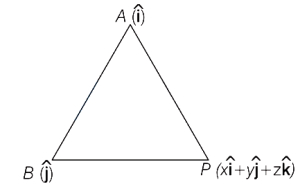
0 likes
View SolutionVector Algebra — Vector or Cross product of two vectors and its applications · Frequently Asked Questions
1Are these Vector Algebra questions useful for JEE and NEET?
Yes. All questions in this section are mapped to JEE Main and NEET exam patterns. Previous year questions from JEE Main, NEET, GUJCET and state-level exams are included with full solutions.
2Can I switch to Hindi or Gujarati for these questions?
Yes. Use the language tabs in the hero section or the sidebar to view the same questions and solutions in English, Hindi or Gujarati.
3How do I generate a question paper from this subtopic?
Use the Vedclass Exam Paper Generator — select the chapter and subtopic, set difficulty, and generate Sets A, B, C, D automatically. First 3 chapters of every subject are free.
Vedclass Products
For Students
Vedclass Test Series
Mock tests in real JEE/NEET style with performance analysis. 5-day free trial.
Start Free TrialFor Teachers
Exam Paper Generator
Generate Set A/B/C/D papers from this chapter in 2 minutes. 3 chapters free.
Try FreeFor Institutes
Online Exam Module
Live online exams with unlimited students, 360° analytics & white-label branding.
See DemoFor Teachers & Institutes
Generate a Vector Algebra Exam Paper in 2 Minutes
Select subtopic & difficulty — Sets A, B, C, D auto-generated with No Repeat logic.
First 3 chapters of every subject are free — no payment required.