
A English
Vector or Cross product of two vectors and its applications Questions in English
Class 12 Mathematics · Vector Algebra · Vector or Cross product of two vectors and its applications
469+
Questions
English
Language
100%
With Solutions
Showing 50 of 469 questions in English
1
DifficultMCQ
$A$ unit vector which is coplanar to vectors $i + j + 2k$ and $i + 2j + k$ and perpendicular to $i + j + k$ is
A
$\frac{i - j}{\sqrt{2}}$
B
$\pm \frac{j - k}{\sqrt{2}}$
C
$\frac{k - i}{\sqrt{2}}$
D
$\frac{i + j + k}{\sqrt{3}}$
Solution
(B) Let the required vector be $\vec{v} = ai + bj + ck$.
For $\vec{v}$ to be coplanar with $\vec{u_1} = i + j + 2k$ and $\vec{u_2} = i + 2j + k$,it must be a linear combination of $\vec{u_1}$ and $\vec{u_2}$.
So,$\vec{v} = p(i + j + 2k) + r(i + 2j + k) = (p+r)i + (p+2r)j + (2p+r)k$.
Comparing components,we get $a = p+r$,$b = p+2r$,and $c = 2p+r$.
Since $\vec{v}$ is perpendicular to $\vec{w} = i + j + k$,their dot product is zero:
$(ai + bj + ck) \cdot (i + j + k) = a + b + c = 0$.
Substituting the expressions for $a, b, c$:
$(p+r) + (p+2r) + (2p+r) = 4p + 4r = 0$,which implies $p = -r$.
Substituting $p = -r$ into the expressions for $a, b, c$:
$a = -r + r = 0$,
$b = -r + 2r = r$,
$c = 2(-r) + r = -r$.
Thus,$\vec{v} = r(j - k)$.
For $\vec{v}$ to be a unit vector,$|\vec{v}| = 1$:
$\sqrt{0^2 + r^2 + (-r)^2} = 1 \Rightarrow \sqrt{2r^2} = 1 \Rightarrow |r|\sqrt{2} = 1 \Rightarrow r = \pm \frac{1}{\sqrt{2}}$.
Therefore,the required unit vector is $\pm \frac{1}{\sqrt{2}}(j - k)$.
For $\vec{v}$ to be coplanar with $\vec{u_1} = i + j + 2k$ and $\vec{u_2} = i + 2j + k$,it must be a linear combination of $\vec{u_1}$ and $\vec{u_2}$.
So,$\vec{v} = p(i + j + 2k) + r(i + 2j + k) = (p+r)i + (p+2r)j + (2p+r)k$.
Comparing components,we get $a = p+r$,$b = p+2r$,and $c = 2p+r$.
Since $\vec{v}$ is perpendicular to $\vec{w} = i + j + k$,their dot product is zero:
$(ai + bj + ck) \cdot (i + j + k) = a + b + c = 0$.
Substituting the expressions for $a, b, c$:
$(p+r) + (p+2r) + (2p+r) = 4p + 4r = 0$,which implies $p = -r$.
Substituting $p = -r$ into the expressions for $a, b, c$:
$a = -r + r = 0$,
$b = -r + 2r = r$,
$c = 2(-r) + r = -r$.
Thus,$\vec{v} = r(j - k)$.
For $\vec{v}$ to be a unit vector,$|\vec{v}| = 1$:
$\sqrt{0^2 + r^2 + (-r)^2} = 1 \Rightarrow \sqrt{2r^2} = 1 \Rightarrow |r|\sqrt{2} = 1 \Rightarrow r = \pm \frac{1}{\sqrt{2}}$.
Therefore,the required unit vector is $\pm \frac{1}{\sqrt{2}}(j - k)$.
0 likes
View Solution2
MediumMCQ
$A$ vector of length $3$ perpendicular to each of the vectors $3\,i + j - 4\,k$ and $6\,i + 5\,j - 2\,k$ is
A
$2\,i - 2\,j + k$
B
$-2\,i + 2\,j + k$
C
$2\,i + 2\,j - k$
D
None of these
Solution
(A) Let the required vector be $\vec{v} = x\,i + y\,j + z\,k$.
Since $\vec{v}$ is perpendicular to $\vec{a} = 3\,i + j - 4\,k$ and $\vec{b} = 6\,i + 5\,j - 2\,k$,it must be parallel to $\vec{a} \times \vec{b}$.
$\vec{a} \times \vec{b} = \begin{vmatrix} i & j & k \\ 3 & 1 & -4 \\ 6 & 5 & -2 \end{vmatrix} = i(-2 - (-20)) - j(-6 - (-24)) + k(15 - 6) = 18\,i - 18\,j + 9\,k$.
Simplifying,we can take the direction vector $\vec{u} = 2\,i - 2\,j + k$.
The magnitude of $\vec{u}$ is $|\vec{u}| = \sqrt{2^2 + (-2)^2 + 1^2} = \sqrt{4 + 4 + 1} = \sqrt{9} = 3$.
Since the required vector has length $3$,the vector is $\pm(2\,i - 2\,j + k)$.
Comparing with the given options,$2\,i - 2\,j + k$ is the correct choice.
Since $\vec{v}$ is perpendicular to $\vec{a} = 3\,i + j - 4\,k$ and $\vec{b} = 6\,i + 5\,j - 2\,k$,it must be parallel to $\vec{a} \times \vec{b}$.
$\vec{a} \times \vec{b} = \begin{vmatrix} i & j & k \\ 3 & 1 & -4 \\ 6 & 5 & -2 \end{vmatrix} = i(-2 - (-20)) - j(-6 - (-24)) + k(15 - 6) = 18\,i - 18\,j + 9\,k$.
Simplifying,we can take the direction vector $\vec{u} = 2\,i - 2\,j + k$.
The magnitude of $\vec{u}$ is $|\vec{u}| = \sqrt{2^2 + (-2)^2 + 1^2} = \sqrt{4 + 4 + 1} = \sqrt{9} = 3$.
Since the required vector has length $3$,the vector is $\pm(2\,i - 2\,j + k)$.
Comparing with the given options,$2\,i - 2\,j + k$ is the correct choice.
0 likes
View Solution3
MediumMCQ
$A$ unit vector in the plane of $i + 2j + k$ and $i + j + 2k$ which is perpendicular to $2i + j + k$ is
A
$j - k$
B
$\frac{i + j}{\sqrt{2}}$
C
$\frac{j + k}{\sqrt{2}}$
D
$\frac{j - k}{\sqrt{2}}$
Solution
(D) Let the two vectors be $\vec{a} = i + 2j + k$ and $\vec{b} = i + j + 2k$.
Any vector in the plane of $\vec{a}$ and $\vec{b}$ is given by $\vec{v} = \vec{a} + \lambda \vec{b}$ or $\vec{v} = \vec{a} \times \vec{b}$.
However,a vector perpendicular to both $\vec{a}$ and $\vec{b}$ is $\vec{n} = \vec{a} \times \vec{b}$.
We need a vector $\vec{r}$ in the plane of $\vec{a}$ and $\vec{b}$ such that $\vec{r} \perp (2i + j + k)$.
Let $\vec{r} = \vec{a} \times (\vec{a} \times \vec{b}) = (\vec{a} \cdot \vec{b})\vec{a} - (\vec{a} \cdot \vec{a})\vec{b}$.
Alternatively,consider the vector $\vec{v} = \vec{a} - \vec{b} = (i + 2j + k) - (i + j + 2k) = j - k$.
Check if $\vec{v}$ is perpendicular to $2i + j + k$: $(j - k) \cdot (2i + j + k) = (0)(2) + (1)(1) + (-1)(1) = 1 - 1 = 0$.
Since the dot product is $0$,the vector $j - k$ lies in the plane and is perpendicular to $2i + j + k$.
The unit vector is $\frac{j - k}{|j - k|} = \frac{j - k}{\sqrt{0^2 + 1^2 + (-1)^2}} = \frac{j - k}{\sqrt{2}}$.
Any vector in the plane of $\vec{a}$ and $\vec{b}$ is given by $\vec{v} = \vec{a} + \lambda \vec{b}$ or $\vec{v} = \vec{a} \times \vec{b}$.
However,a vector perpendicular to both $\vec{a}$ and $\vec{b}$ is $\vec{n} = \vec{a} \times \vec{b}$.
We need a vector $\vec{r}$ in the plane of $\vec{a}$ and $\vec{b}$ such that $\vec{r} \perp (2i + j + k)$.
Let $\vec{r} = \vec{a} \times (\vec{a} \times \vec{b}) = (\vec{a} \cdot \vec{b})\vec{a} - (\vec{a} \cdot \vec{a})\vec{b}$.
Alternatively,consider the vector $\vec{v} = \vec{a} - \vec{b} = (i + 2j + k) - (i + j + 2k) = j - k$.
Check if $\vec{v}$ is perpendicular to $2i + j + k$: $(j - k) \cdot (2i + j + k) = (0)(2) + (1)(1) + (-1)(1) = 1 - 1 = 0$.
Since the dot product is $0$,the vector $j - k$ lies in the plane and is perpendicular to $2i + j + k$.
The unit vector is $\frac{j - k}{|j - k|} = \frac{j - k}{\sqrt{0^2 + 1^2 + (-1)^2}} = \frac{j - k}{\sqrt{2}}$.
0 likes
View Solution4
EasyMCQ
If $a$ and $b$ are unit vectors such that $a \times b$ is also a unit vector,then the angle between $a$ and $b$ is
A
$0$
B
$\frac{\pi}{3}$
C
$\frac{\pi}{2}$
D
$\pi$
Solution
(C) Given that $a$ and $b$ are unit vectors,so $|a| = 1$ and $|b| = 1$.
We know that the magnitude of the cross product is given by $|a \times b| = |a||b| \sin \theta$,where $\theta$ is the angle between $a$ and $b$.
Since $a \times b$ is a unit vector,$|a \times b| = 1$.
Substituting the values,we get $1 = (1)(1) \sin \theta$.
This implies $\sin \theta = 1$.
Therefore,$\theta = \frac{\pi}{2}$.
We know that the magnitude of the cross product is given by $|a \times b| = |a||b| \sin \theta$,where $\theta$ is the angle between $a$ and $b$.
Since $a \times b$ is a unit vector,$|a \times b| = 1$.
Substituting the values,we get $1 = (1)(1) \sin \theta$.
This implies $\sin \theta = 1$.
Therefore,$\theta = \frac{\pi}{2}$.
0 likes
View Solution5
EasyMCQ
The points $A(a), B(b), C(c)$ will be collinear if
A
$a + b + c = 0$
B
$a \times b + b \times c + c \times a = 0$
C
$a \cdot b + b \cdot c + c \cdot a = 0$
D
None of these
Solution
(B) For three points $A(a), B(b), C(c)$ to be collinear,the vectors $\vec{AB}$ and $\vec{BC}$ must be parallel.
This implies that their cross product must be zero: $\vec{AB} \times \vec{BC} = 0$.
Substituting the position vectors,we get $(b - a) \times (c - b) = 0$.
Expanding the cross product: $b \times c - b \times b - a \times c + a \times b = 0$.
Since $b \times b = 0$,the expression simplifies to $b \times c - a \times c + a \times b = 0$.
Rearranging the terms,we get $a \times b + b \times c + c \times a = 0$.
This implies that their cross product must be zero: $\vec{AB} \times \vec{BC} = 0$.
Substituting the position vectors,we get $(b - a) \times (c - b) = 0$.
Expanding the cross product: $b \times c - b \times b - a \times c + a \times b = 0$.
Since $b \times b = 0$,the expression simplifies to $b \times c - a \times c + a \times b = 0$.
Rearranging the terms,we get $a \times b + b \times c + c \times a = 0$.
0 likes
View Solution6
DifficultMCQ
$(a - b) \times (a + b) = $
A
$2(a \times b)$
B
$a \times b$
C
$a^2 - b^2$
D
None of these
Solution
(A) Using the distributive property of the cross product:
$(a - b) \times (a + b) = a \times a + a \times b - b \times a - b \times b$
Since the cross product of any vector with itself is zero ($a \times a = 0$ and $b \times b = 0$):
$= 0 + a \times b - b \times a - 0$
$= a \times b - b \times a$
Since the cross product is anticommutative $(b \times a = -(a \times b))$:
$= a \times b - (-(a \times b))$
$= a \times b + a \times b$
$= 2(a \times b)$
$(a - b) \times (a + b) = a \times a + a \times b - b \times a - b \times b$
Since the cross product of any vector with itself is zero ($a \times a = 0$ and $b \times b = 0$):
$= 0 + a \times b - b \times a - 0$
$= a \times b - b \times a$
Since the cross product is anticommutative $(b \times a = -(a \times b))$:
$= a \times b - (-(a \times b))$
$= a \times b + a \times b$
$= 2(a \times b)$
0 likes
View Solution7
EasyMCQ
If $a + b + c = 0,$ then which relation is correct?
A
$a = b = c = 0$
B
$a \cdot b = b \cdot c = c \cdot a$
C
$a \times b = b \times c = c \times a$
D
None of these
Solution
(C) Given that $a + b + c = 0.$
Taking the cross product with $a$ on both sides:
$a \times (a + b + c) = a \times 0$
$a \times a + a \times b + a \times c = 0$
Since $a \times a = 0,$ we have $a \times b + a \times c = 0,$ which implies $a \times b = - (a \times c) = c \times a$ .....$(i)$
Similarly,taking the cross product with $b$ on both sides:
$b \times (a + b + c) = b \times 0$
$b \times a + b \times b + b \times c = 0$
Since $b \times b = 0,$ we have $b \times a + b \times c = 0,$ which implies $-(a \times b) = b \times c,$ or $a \times b = b \times c$ .....$(ii)$
From $(i)$ and $(ii),$ we get $a \times b = b \times c = c \times a.$
Taking the cross product with $a$ on both sides:
$a \times (a + b + c) = a \times 0$
$a \times a + a \times b + a \times c = 0$
Since $a \times a = 0,$ we have $a \times b + a \times c = 0,$ which implies $a \times b = - (a \times c) = c \times a$ .....$(i)$
Similarly,taking the cross product with $b$ on both sides:
$b \times (a + b + c) = b \times 0$
$b \times a + b \times b + b \times c = 0$
Since $b \times b = 0,$ we have $b \times a + b \times c = 0,$ which implies $-(a \times b) = b \times c,$ or $a \times b = b \times c$ .....$(ii)$
From $(i)$ and $(ii),$ we get $a \times b = b \times c = c \times a.$
0 likes
View Solution8
EasyMCQ
$(2a + 3b) \times (5a + 7b) = $
A
$a \times b$
B
$b \times a$
C
$a + b$
D
$7a + 10b$
Solution
(B) Using the distributive property of the cross product:
$(2a + 3b) \times (5a + 7b) = 2a \times (5a + 7b) + 3b \times (5a + 7b)$
$= 2a \times 5a + 2a \times 7b + 3b \times 5a + 3b \times 7b$
Since $a \times a = 0$ and $b \times b = 0$:
$= 0 + 14(a \times b) + 15(b \times a) + 0$
Using the property $a \times b = -(b \times a)$:
$= 14(a \times b) - 15(a \times b) = -1(a \times b) = b \times a$.
$(2a + 3b) \times (5a + 7b) = 2a \times (5a + 7b) + 3b \times (5a + 7b)$
$= 2a \times 5a + 2a \times 7b + 3b \times 5a + 3b \times 7b$
Since $a \times a = 0$ and $b \times b = 0$:
$= 0 + 14(a \times b) + 15(b \times a) + 0$
Using the property $a \times b = -(b \times a)$:
$= 14(a \times b) - 15(a \times b) = -1(a \times b) = b \times a$.
0 likes
View Solution9
EasyMCQ
The number of vectors of unit length perpendicular to vectors $a = (1, 1, 0)$ and $b = (0, 1, 1)$ is
A
$3$
B
$1$
C
$2$
D
Infinite
Solution
(C) The vector perpendicular to $a$ and $b$ is given by the cross product $a \times b$.
$a \times b = \begin{vmatrix} i & j & k \\ 1 & 1 & 0 \\ 0 & 1 & 1 \end{vmatrix} = i(1 - 0) - j(1 - 0) + k(1 - 0) = i - j + k$.
The magnitude of this vector is $|a \times b| = \sqrt{1^2 + (-1)^2 + 1^2} = \sqrt{3}$.
The unit vectors perpendicular to both $a$ and $b$ are given by $\pm \frac{a \times b}{|a \times b|}$.
Thus,the unit vectors are $\pm \frac{1}{\sqrt{3}}(i - j + k)$.
Therefore,there are exactly $2$ such vectors.
$a \times b = \begin{vmatrix} i & j & k \\ 1 & 1 & 0 \\ 0 & 1 & 1 \end{vmatrix} = i(1 - 0) - j(1 - 0) + k(1 - 0) = i - j + k$.
The magnitude of this vector is $|a \times b| = \sqrt{1^2 + (-1)^2 + 1^2} = \sqrt{3}$.
The unit vectors perpendicular to both $a$ and $b$ are given by $\pm \frac{a \times b}{|a \times b|}$.
Thus,the unit vectors are $\pm \frac{1}{\sqrt{3}}(i - j + k)$.
Therefore,there are exactly $2$ such vectors.
0 likes
View Solution10
MediumMCQ
If $a = (1, -1, 1)$ and $c = (-1, -1, 0),$ then the vector $b$ satisfying $a \times b = c$ and $a \cdot b = 1$ is
A
$(1, 0, 0)$
B
$(0, 0, 1)$
C
$(0, -1, 0)$
D
None of these
Solution
(D) Let $b = b_1 i + b_2 j + b_3 k$.
Given $a \cdot b = 1$,we have $(i - j + k) \cdot (b_1 i + b_2 j + b_3 k) = 1 \Rightarrow b_1 - b_2 + b_3 = 1$ ... $(i)$
Given $a \times b = c$,we calculate the cross product:
$a \times b = \begin{vmatrix} i & j & k \\ 1 & -1 & 1 \\ b_1 & b_2 & b_3 \end{vmatrix} = i(-b_3 - b_2) - j(b_3 - b_1) + k(b_2 + b_1) = (-b_2 - b_3)i + (b_1 - b_3)j + (b_1 + b_2)k$.
Equating this to $c = -i - j + 0k$,we get:
$-b_2 - b_3 = -1 \Rightarrow b_2 + b_3 = 1$ ... $(ii)$
$b_1 - b_3 = -1$ ... $(iii)$
$b_1 + b_2 = 0$ ... $(iv)$
From $(iv)$,$b_2 = -b_1$. Substituting into $(ii)$,$-b_1 + b_3 = 1 \Rightarrow b_3 - b_1 = 1$.
Adding this to $(iii)$,$(b_3 - b_1) + (b_1 - b_3) = 1 - 1 \Rightarrow 0 = 0$.
Using $(i)$,$b_1 - (-b_1) + b_3 = 1 \Rightarrow 2b_1 + b_3 = 1$.
From $(iii)$,$b_3 = b_1 - 1$.
Substituting into $2b_1 + b_3 = 1$: $2b_1 + b_1 - 1 = 1 \Rightarrow 3b_1 = 2 \Rightarrow b_1 = 2/3$.
This leads to $b_2 = -2/3$ and $b_3 = -1/3$.
Checking the options,none match $(2/3, -2/3, -1/3)$. Thus,the correct answer is None of these.
Given $a \cdot b = 1$,we have $(i - j + k) \cdot (b_1 i + b_2 j + b_3 k) = 1 \Rightarrow b_1 - b_2 + b_3 = 1$ ... $(i)$
Given $a \times b = c$,we calculate the cross product:
$a \times b = \begin{vmatrix} i & j & k \\ 1 & -1 & 1 \\ b_1 & b_2 & b_3 \end{vmatrix} = i(-b_3 - b_2) - j(b_3 - b_1) + k(b_2 + b_1) = (-b_2 - b_3)i + (b_1 - b_3)j + (b_1 + b_2)k$.
Equating this to $c = -i - j + 0k$,we get:
$-b_2 - b_3 = -1 \Rightarrow b_2 + b_3 = 1$ ... $(ii)$
$b_1 - b_3 = -1$ ... $(iii)$
$b_1 + b_2 = 0$ ... $(iv)$
From $(iv)$,$b_2 = -b_1$. Substituting into $(ii)$,$-b_1 + b_3 = 1 \Rightarrow b_3 - b_1 = 1$.
Adding this to $(iii)$,$(b_3 - b_1) + (b_1 - b_3) = 1 - 1 \Rightarrow 0 = 0$.
Using $(i)$,$b_1 - (-b_1) + b_3 = 1 \Rightarrow 2b_1 + b_3 = 1$.
From $(iii)$,$b_3 = b_1 - 1$.
Substituting into $2b_1 + b_3 = 1$: $2b_1 + b_1 - 1 = 1 \Rightarrow 3b_1 = 2 \Rightarrow b_1 = 2/3$.
This leads to $b_2 = -2/3$ and $b_3 = -1/3$.
Checking the options,none match $(2/3, -2/3, -1/3)$. Thus,the correct answer is None of these.
0 likes
View Solution11
EasyMCQ
If $a \times b = b \times c \ne 0,$ where $a, b$ and $c$ are coplanar vectors,then for some scalar $k$
A
$a + c = k\,b$
B
$a + b = k\,c$
C
$b + c = k\,a$
D
None of these
Solution
(A) Given that $a \times b = b \times c \ne 0.$
This can be rewritten as $a \times b - b \times c = 0.$
Using the property of cross product $b \times c = -(c \times b)$,we get $a \times b + c \times b = 0.$
Factoring out the cross product,we have $(a + c) \times b = 0.$
Since the cross product of two vectors is zero,the vectors must be parallel.
Therefore,$a + c$ is parallel to $b$,which implies $a + c = k\,b$ for some scalar $k$.
This can be rewritten as $a \times b - b \times c = 0.$
Using the property of cross product $b \times c = -(c \times b)$,we get $a \times b + c \times b = 0.$
Factoring out the cross product,we have $(a + c) \times b = 0.$
Since the cross product of two vectors is zero,the vectors must be parallel.
Therefore,$a + c$ is parallel to $b$,which implies $a + c = k\,b$ for some scalar $k$.
0 likes
View Solution12
MediumMCQ
If $a \neq 0, b \neq 0, c \neq 0$,then which of the following statements is true?
A
$a \times (b + c) = (c + b) \times a$
B
$a \cdot (b + c) = -(b + c) \cdot a$
C
$a \times (b - c) = (c - b) \times a$
D
$a \cdot (b - c) = (c - b) \cdot a$
Solution
(C) Given the properties of the vector cross product,we know that the cross product is anticommutative,i.e.,$u \times v = -(v \times u)$.
Consider the expression $a \times (b - c)$.
Using the distributive property,we have $a \times (b - c) = a \times b - a \times c$.
Now consider the right-hand side: $(c - b) \times a = c \times a - b \times a$.
Using the anticommutative property,$c \times a = -(a \times c)$ and $b \times a = -(a \times b)$.
Substituting these into the expression,we get $(c - b) \times a = -(a \times c) - (-(a \times b)) = a \times b - a \times c$.
Since both sides are equal,the statement $a \times (b - c) = (c - b) \times a$ is true.
Consider the expression $a \times (b - c)$.
Using the distributive property,we have $a \times (b - c) = a \times b - a \times c$.
Now consider the right-hand side: $(c - b) \times a = c \times a - b \times a$.
Using the anticommutative property,$c \times a = -(a \times c)$ and $b \times a = -(a \times b)$.
Substituting these into the expression,we get $(c - b) \times a = -(a \times c) - (-(a \times b)) = a \times b - a \times c$.
Since both sides are equal,the statement $a \times (b - c) = (c - b) \times a$ is true.
0 likes
View Solution13
EasyMCQ
If $a \times b = b \times c \ne 0$ and $a + c \ne 0,$ then
A
$(a + c) \perp b$
B
$(a + c) \parallel b$
C
$a + c = b$
D
None of these
Solution
(B) Given that $a \times b = b \times c \ne 0$.
This can be rewritten as $a \times b - b \times c = 0$.
Using the property of cross product $b \times c = -c \times b$,we get $a \times b + c \times b = 0$.
Factoring out the cross product,we have $(a + c) \times b = 0$.
Since the cross product of two vectors is zero,the vectors must be parallel.
Therefore,$(a + c) \parallel b$.
This can be rewritten as $a \times b - b \times c = 0$.
Using the property of cross product $b \times c = -c \times b$,we get $a \times b + c \times b = 0$.
Factoring out the cross product,we have $(a + c) \times b = 0$.
Since the cross product of two vectors is zero,the vectors must be parallel.
Therefore,$(a + c) \parallel b$.
0 likes
View Solution14
MediumMCQ
$A$ unit vector perpendicular to the plane determined by the points $A(1, -1, 2)$,$B(2, 0, -1)$,and $C(0, 2, 1)$ is:
A
$\pm \frac{1}{\sqrt{6}}(2i + j + k)$
B
$\frac{1}{\sqrt{6}}(i + 2j + k)$
C
$\frac{1}{\sqrt{6}}(i + j + k)$
D
$\frac{1}{\sqrt{6}}(2i - j - k)$
Solution
(A) Let the points be $A(1, -1, 2)$,$B(2, 0, -1)$,and $C(0, 2, 1)$.
Define two vectors in the plane: $\vec{AB} = (2-1)i + (0-(-1))j + (-1-2)k = i + j - 3k$ and $\vec{AC} = (0-1)i + (2-(-1))j + (1-2)k = -i + 3j - k$.
Alternatively,using the provided solution vectors: $\vec{u} = \vec{AB} = i + j - 3k$ and $\vec{v} = \vec{BC} = (0-2)i + (2-0)j + (1-(-1))k = -2i + 2j + 2k$.
The normal vector $\vec{n}$ to the plane is given by the cross product $\vec{u} \times \vec{v}$:
$\vec{n} = \begin{vmatrix} i & j & k \\ 1 & 1 & -3 \\ -2 & 2 & 2 \end{vmatrix} = i(2 - (-6)) - j(2 - 6) + k(2 - (-2)) = 8i + 4j + 4k$.
The unit vector is $\hat{n} = \pm \frac{\vec{n}}{|\vec{n}|} = \pm \frac{8i + 4j + 4k}{\sqrt{8^2 + 4^2 + 4^2}} = \pm \frac{8i + 4j + 4k}{\sqrt{64 + 16 + 16}} = \pm \frac{8i + 4j + 4k}{\sqrt{96}} = \pm \frac{8i + 4j + 4k}{4\sqrt{6}} = \pm \frac{2i + j + k}{\sqrt{6}}$.
Define two vectors in the plane: $\vec{AB} = (2-1)i + (0-(-1))j + (-1-2)k = i + j - 3k$ and $\vec{AC} = (0-1)i + (2-(-1))j + (1-2)k = -i + 3j - k$.
Alternatively,using the provided solution vectors: $\vec{u} = \vec{AB} = i + j - 3k$ and $\vec{v} = \vec{BC} = (0-2)i + (2-0)j + (1-(-1))k = -2i + 2j + 2k$.
The normal vector $\vec{n}$ to the plane is given by the cross product $\vec{u} \times \vec{v}$:
$\vec{n} = \begin{vmatrix} i & j & k \\ 1 & 1 & -3 \\ -2 & 2 & 2 \end{vmatrix} = i(2 - (-6)) - j(2 - 6) + k(2 - (-2)) = 8i + 4j + 4k$.
The unit vector is $\hat{n} = \pm \frac{\vec{n}}{|\vec{n}|} = \pm \frac{8i + 4j + 4k}{\sqrt{8^2 + 4^2 + 4^2}} = \pm \frac{8i + 4j + 4k}{\sqrt{64 + 16 + 16}} = \pm \frac{8i + 4j + 4k}{\sqrt{96}} = \pm \frac{8i + 4j + 4k}{4\sqrt{6}} = \pm \frac{2i + j + k}{\sqrt{6}}$.
0 likes
View Solution15
MediumMCQ
If $a = 2i + 3j - 5k$,$b = mi + nj + 12k$ and $a \times b = 0$,then $(m, n) = $
A
$\left( -\frac{24}{5}, \frac{36}{5} \right)$
B
$\left( \frac{24}{5}, -\frac{36}{5} \right)$
C
$\left( -\frac{24}{5}, -\frac{36}{5} \right)$
D
$\left( \frac{24}{5}, \frac{36}{5} \right)$
Solution
(C) Given $a = 2i + 3j - 5k$ and $b = mi + nj + 12k$. Since $a \times b = 0$,the vectors are collinear.
The cross product is given by the determinant:
$a \times b = \begin{vmatrix} i & j & k \\ 2 & 3 & -5 \\ m & n & 12 \end{vmatrix} = 0$
Expanding the determinant:
$i(36 - (-5n)) - j(24 - (-5m)) + k(2n - 3m) = 0$
$(36 + 5n)i - (24 + 5m)j + (2n - 3m)k = 0$
For the vector to be zero,each component must be zero:
$36 + 5n = 0 \Rightarrow n = -\frac{36}{5}$
$24 + 5m = 0 \Rightarrow m = -\frac{24}{5}$
$2n - 3m = 2(-\frac{36}{5}) - 3(-\frac{24}{5}) = -\frac{72}{5} + \frac{72}{5} = 0$ (This confirms the values).
Thus,$(m, n) = \left( -\frac{24}{5}, -\frac{36}{5} \right)$.
The cross product is given by the determinant:
$a \times b = \begin{vmatrix} i & j & k \\ 2 & 3 & -5 \\ m & n & 12 \end{vmatrix} = 0$
Expanding the determinant:
$i(36 - (-5n)) - j(24 - (-5m)) + k(2n - 3m) = 0$
$(36 + 5n)i - (24 + 5m)j + (2n - 3m)k = 0$
For the vector to be zero,each component must be zero:
$36 + 5n = 0 \Rightarrow n = -\frac{36}{5}$
$24 + 5m = 0 \Rightarrow m = -\frac{24}{5}$
$2n - 3m = 2(-\frac{36}{5}) - 3(-\frac{24}{5}) = -\frac{72}{5} + \frac{72}{5} = 0$ (This confirms the values).
Thus,$(m, n) = \left( -\frac{24}{5}, -\frac{36}{5} \right)$.
0 likes
View Solution16
EasyMCQ
$A$ unit vector which is perpendicular to $i + 2j - 2k$ and $-i + 2j + 2k$ is
A
$\frac{1}{\sqrt{5}}(2i - k)$
B
$\frac{1}{\sqrt{5}}(-2i + k)$
C
$\frac{1}{\sqrt{5}}(2i + j + k)$
D
$\frac{1}{\sqrt{5}}(2i + k)$
Solution
(D) Let $\vec{a} = i + 2j - 2k$ and $\vec{b} = -i + 2j + 2k$.
To find a vector perpendicular to both $\vec{a}$ and $\vec{b}$,we calculate the cross product $\vec{a} \times \vec{b}$.
$\vec{a} \times \vec{b} = \begin{vmatrix} i & j & k \\ 1 & 2 & -2 \\ -1 & 2 & 2 \end{vmatrix} = i(4 - (-4)) - j(2 - 2) + k(2 - (-2)) = 8i - 0j + 4k = 8i + 4k$.
The magnitude of the cross product is $|\vec{a} \times \vec{b}| = \sqrt{8^2 + 4^2} = \sqrt{64 + 16} = \sqrt{80} = 4\sqrt{5}$.
The unit vector perpendicular to both is $\pm \frac{\vec{a} \times \vec{b}}{|\vec{a} \times \vec{b}|} = \pm \frac{8i + 4k}{4\sqrt{5}} = \pm \frac{2i + k}{\sqrt{5}}$.
Comparing this with the given options,the correct option is $\frac{1}{\sqrt{5}}(2i + k)$.
To find a vector perpendicular to both $\vec{a}$ and $\vec{b}$,we calculate the cross product $\vec{a} \times \vec{b}$.
$\vec{a} \times \vec{b} = \begin{vmatrix} i & j & k \\ 1 & 2 & -2 \\ -1 & 2 & 2 \end{vmatrix} = i(4 - (-4)) - j(2 - 2) + k(2 - (-2)) = 8i - 0j + 4k = 8i + 4k$.
The magnitude of the cross product is $|\vec{a} \times \vec{b}| = \sqrt{8^2 + 4^2} = \sqrt{64 + 16} = \sqrt{80} = 4\sqrt{5}$.
The unit vector perpendicular to both is $\pm \frac{\vec{a} \times \vec{b}}{|\vec{a} \times \vec{b}|} = \pm \frac{8i + 4k}{4\sqrt{5}} = \pm \frac{2i + k}{\sqrt{5}}$.
Comparing this with the given options,the correct option is $\frac{1}{\sqrt{5}}(2i + k)$.
0 likes
View Solution17
EasyMCQ
The unit vector perpendicular to the vectors $6i + 2j + 3k$ and $3i - 6j - 2k$ is
A
$\frac{2i - 3j + 6k}{7}$
B
$\frac{2i - 3j - 6k}{7}$
C
$\frac{2i + 3j - 6k}{7}$
D
$\frac{2i + 3j + 6k}{7}$
Solution
(C) Let $\vec{a} = 6i + 2j + 3k$ and $\vec{b} = 3i - 6j - 2k$.
The vector perpendicular to both $\vec{a}$ and $\vec{b}$ is given by $\vec{a} \times \vec{b}$.
$\vec{a} \times \vec{b} = \begin{vmatrix} i & j & k \\ 6 & 2 & 3 \\ 3 & -6 & -2 \end{vmatrix} = i(-4 - (-18)) - j(-12 - 9) + k(-36 - 6) = 14i + 21j - 42k$.
The magnitude of this vector is $|\vec{a} \times \vec{b}| = \sqrt{14^2 + 21^2 + (-42)^2} = \sqrt{196 + 441 + 1764} = \sqrt{2401} = 49$.
The unit vector perpendicular to both is $\pm \frac{\vec{a} \times \vec{b}}{|\vec{a} \times \vec{b}|} = \pm \frac{14i + 21j - 42k}{49} = \pm \frac{2i + 3j - 6k}{7}$.
Comparing with the given options,the correct unit vector is $\frac{2i + 3j - 6k}{7}$.
The vector perpendicular to both $\vec{a}$ and $\vec{b}$ is given by $\vec{a} \times \vec{b}$.
$\vec{a} \times \vec{b} = \begin{vmatrix} i & j & k \\ 6 & 2 & 3 \\ 3 & -6 & -2 \end{vmatrix} = i(-4 - (-18)) - j(-12 - 9) + k(-36 - 6) = 14i + 21j - 42k$.
The magnitude of this vector is $|\vec{a} \times \vec{b}| = \sqrt{14^2 + 21^2 + (-42)^2} = \sqrt{196 + 441 + 1764} = \sqrt{2401} = 49$.
The unit vector perpendicular to both is $\pm \frac{\vec{a} \times \vec{b}}{|\vec{a} \times \vec{b}|} = \pm \frac{14i + 21j - 42k}{49} = \pm \frac{2i + 3j - 6k}{7}$.
Comparing with the given options,the correct unit vector is $\frac{2i + 3j - 6k}{7}$.
0 likes
View Solution18
MediumMCQ
For any two vectors $\vec{a}$ and $\vec{b}$,$|\vec{a} \times \vec{b}|^2$ is equal to
A
$|\vec{a}|^2 - |\vec{b}|^2$
B
$|\vec{a}|^2 + |\vec{b}|^2$
C
$|\vec{a}|^2 |\vec{b}|^2 - (\vec{a} \cdot \vec{b})^2$
D
None of these
Solution
(C) We know that the magnitude of the cross product of two vectors $\vec{a}$ and $\vec{b}$ is given by $|\vec{a} \times \vec{b}| = |\vec{a}| |\vec{b}| \sin \theta$,where $\theta$ is the angle between the vectors.
Squaring both sides,we get $|\vec{a} \times \vec{b}|^2 = |\vec{a}|^2 |\vec{b}|^2 \sin^2 \theta$.
Using the trigonometric identity $\sin^2 \theta = 1 - \cos^2 \theta$,we have:
$|\vec{a} \times \vec{b}|^2 = |\vec{a}|^2 |\vec{b}|^2 (1 - \cos^2 \theta)$
$|\vec{a} \times \vec{b}|^2 = |\vec{a}|^2 |\vec{b}|^2 - |\vec{a}|^2 |\vec{b}|^2 \cos^2 \theta$
Since the dot product is defined as $\vec{a} \cdot \vec{b} = |\vec{a}| |\vec{b}| \cos \theta$,it follows that $(\vec{a} \cdot \vec{b})^2 = |\vec{a}|^2 |\vec{b}|^2 \cos^2 \theta$.
Substituting this into the equation,we get:
$|\vec{a} \times \vec{b}|^2 = |\vec{a}|^2 |\vec{b}|^2 - (\vec{a} \cdot \vec{b})^2$.
Squaring both sides,we get $|\vec{a} \times \vec{b}|^2 = |\vec{a}|^2 |\vec{b}|^2 \sin^2 \theta$.
Using the trigonometric identity $\sin^2 \theta = 1 - \cos^2 \theta$,we have:
$|\vec{a} \times \vec{b}|^2 = |\vec{a}|^2 |\vec{b}|^2 (1 - \cos^2 \theta)$
$|\vec{a} \times \vec{b}|^2 = |\vec{a}|^2 |\vec{b}|^2 - |\vec{a}|^2 |\vec{b}|^2 \cos^2 \theta$
Since the dot product is defined as $\vec{a} \cdot \vec{b} = |\vec{a}| |\vec{b}| \cos \theta$,it follows that $(\vec{a} \cdot \vec{b})^2 = |\vec{a}|^2 |\vec{b}|^2 \cos^2 \theta$.
Substituting this into the equation,we get:
$|\vec{a} \times \vec{b}|^2 = |\vec{a}|^2 |\vec{b}|^2 - (\vec{a} \cdot \vec{b})^2$.
0 likes
View Solution19
EasyMCQ
The unit vector perpendicular to $3i + 2j - k$ and $12i + 5j - 5k$ is
A
$\frac{5i - 3j + 9k}{\sqrt{115}}$
B
$\frac{5i + 3j - 9k}{\sqrt{115}}$
C
$\frac{-5i + 3j - 9k}{\sqrt{115}}$
D
$\frac{5i + 3j + 9k}{\sqrt{115}}$
Solution
(C) Let $\vec{a} = 3i + 2j - k$ and $\vec{b} = 12i + 5j - 5k$.
The vector perpendicular to both $\vec{a}$ and $\vec{b}$ is given by their cross product $\vec{a} \times \vec{b}$.
$\vec{a} \times \vec{b} = \begin{vmatrix} i & j & k \\ 3 & 2 & -1 \\ 12 & 5 & -5 \end{vmatrix}$
$= i(2(-5) - (-1)(5)) - j(3(-5) - (-1)(12)) + k(3(5) - 2(12))$
$= i(-10 + 5) - j(-15 + 12) + k(15 - 24)$
$= -5i + 3j - 9k$.
The magnitude of this vector is $|\vec{a} \times \vec{b}| = \sqrt{(-5)^2 + 3^2 + (-9)^2} = \sqrt{25 + 9 + 81} = \sqrt{115}$.
The unit vector perpendicular to both is $\frac{\vec{a} \times \vec{b}}{|\vec{a} \times \vec{b}|} = \frac{-5i + 3j - 9k}{\sqrt{115}}$.
The vector perpendicular to both $\vec{a}$ and $\vec{b}$ is given by their cross product $\vec{a} \times \vec{b}$.
$\vec{a} \times \vec{b} = \begin{vmatrix} i & j & k \\ 3 & 2 & -1 \\ 12 & 5 & -5 \end{vmatrix}$
$= i(2(-5) - (-1)(5)) - j(3(-5) - (-1)(12)) + k(3(5) - 2(12))$
$= i(-10 + 5) - j(-15 + 12) + k(15 - 24)$
$= -5i + 3j - 9k$.
The magnitude of this vector is $|\vec{a} \times \vec{b}| = \sqrt{(-5)^2 + 3^2 + (-9)^2} = \sqrt{25 + 9 + 81} = \sqrt{115}$.
The unit vector perpendicular to both is $\frac{\vec{a} \times \vec{b}}{|\vec{a} \times \vec{b}|} = \frac{-5i + 3j - 9k}{\sqrt{115}}$.
0 likes
View Solution20
EasyMCQ
The sine of the angle between the two vectors $3i + 2j - k$ and $12i + 5j - 5k$ will be
A
$\frac{\sqrt{115}}{\sqrt{14}\sqrt{194}}$
B
$\frac{51}{\sqrt{14}\sqrt{144}}$
C
$\frac{\sqrt{64}}{\sqrt{14}\sqrt{194}}$
D
None of these
Solution
(A) Let $\vec{a} = 3i + 2j - k$ and $\vec{b} = 12i + 5j - 5k$.
The cross product $\vec{a} \times \vec{b}$ is given by:
$\vec{a} \times \vec{b} = \begin{vmatrix} i & j & k \\ 3 & 2 & -1 \\ 12 & 5 & -5 \end{vmatrix} = i(-10 - (-5)) - j(-15 - (-12)) + k(15 - 24) = -5i + 3j - 9k$.
The magnitude of the cross product is $|\vec{a} \times \vec{b}| = \sqrt{(-5)^2 + 3^2 + (-9)^2} = \sqrt{25 + 9 + 81} = \sqrt{115}$.
The magnitudes of the vectors are $|\vec{a}| = \sqrt{3^2 + 2^2 + (-1)^2} = \sqrt{9 + 4 + 1} = \sqrt{14}$ and $|\vec{b}| = \sqrt{12^2 + 5^2 + (-5)^2} = \sqrt{144 + 25 + 25} = \sqrt{194}$.
Since $|\vec{a} \times \vec{b}| = |\vec{a}| |\vec{b}| \sin \theta$,we have $\sin \theta = \frac{|\vec{a} \times \vec{b}|}{|\vec{a}| |\vec{b}|} = \frac{\sqrt{115}}{\sqrt{14}\sqrt{194}}$.
The cross product $\vec{a} \times \vec{b}$ is given by:
$\vec{a} \times \vec{b} = \begin{vmatrix} i & j & k \\ 3 & 2 & -1 \\ 12 & 5 & -5 \end{vmatrix} = i(-10 - (-5)) - j(-15 - (-12)) + k(15 - 24) = -5i + 3j - 9k$.
The magnitude of the cross product is $|\vec{a} \times \vec{b}| = \sqrt{(-5)^2 + 3^2 + (-9)^2} = \sqrt{25 + 9 + 81} = \sqrt{115}$.
The magnitudes of the vectors are $|\vec{a}| = \sqrt{3^2 + 2^2 + (-1)^2} = \sqrt{9 + 4 + 1} = \sqrt{14}$ and $|\vec{b}| = \sqrt{12^2 + 5^2 + (-5)^2} = \sqrt{144 + 25 + 25} = \sqrt{194}$.
Since $|\vec{a} \times \vec{b}| = |\vec{a}| |\vec{b}| \sin \theta$,we have $\sin \theta = \frac{|\vec{a} \times \vec{b}|}{|\vec{a}| |\vec{b}|} = \frac{\sqrt{115}}{\sqrt{14}\sqrt{194}}$.
0 likes
View Solution21
MediumMCQ
For any two vectors $a$ and $b$,if $a \times b = 0$,then
A
$a = 0$
B
$b = 0$
C
Not parallel
D
None of these
Solution
(D) The cross product of two vectors $a$ and $b$ is defined as $a \times b = |a||b| \sin(\theta) \hat{n}$,where $\theta$ is the angle between the vectors.
If $a \times b = 0$,then $|a||b| \sin(\theta) = 0$.
This implies that either $|a| = 0$,$|b| = 0$,or $\sin(\theta) = 0$.
If $\sin(\theta) = 0$,then $\theta = 0$ or $\theta = \pi$,which means the vectors $a$ and $b$ are parallel or collinear.
Since the condition $a \times b = 0$ can hold even if $a \neq 0$ and $b \neq 0$ (when they are parallel),none of the options $A, B,$ or $C$ are necessarily true.
Therefore,the correct option is $D$.
If $a \times b = 0$,then $|a||b| \sin(\theta) = 0$.
This implies that either $|a| = 0$,$|b| = 0$,or $\sin(\theta) = 0$.
If $\sin(\theta) = 0$,then $\theta = 0$ or $\theta = \pi$,which means the vectors $a$ and $b$ are parallel or collinear.
Since the condition $a \times b = 0$ can hold even if $a \neq 0$ and $b \neq 0$ (when they are parallel),none of the options $A, B,$ or $C$ are necessarily true.
Therefore,the correct option is $D$.
0 likes
View Solution22
MediumMCQ
For any vectors $a, b, c$,evaluate the expression: $a \times (b + c) + b \times (c + a) + c \times (a + b) = $
A
$0$
B
$a + b + c$
C
$[a, b, c]$
D
$a \times b \times c$
Solution
(A) Using the distributive property of the cross product over vector addition,we have:
$a \times (b + c) = a \times b + a \times c$
$b \times (c + a) = b \times c + b \times a$
$c \times (a + b) = c \times a + c \times b$
Summing these expressions:
$(a \times b + a \times c) + (b \times c + b \times a) + (c \times a + c \times b)$
Using the anticommutative property $u \times v = -(v \times u)$:
$a \times b + a \times c + b \times c - a \times b - c \times a + c \times b$
Since $a \times c = -(c \times a)$,the terms cancel out:
$a \times b - a \times b + a \times c - a \times c + b \times c - b \times c = 0$
Thus,the result is $0$.
$a \times (b + c) = a \times b + a \times c$
$b \times (c + a) = b \times c + b \times a$
$c \times (a + b) = c \times a + c \times b$
Summing these expressions:
$(a \times b + a \times c) + (b \times c + b \times a) + (c \times a + c \times b)$
Using the anticommutative property $u \times v = -(v \times u)$:
$a \times b + a \times c + b \times c - a \times b - c \times a + c \times b$
Since $a \times c = -(c \times a)$,the terms cancel out:
$a \times b - a \times b + a \times c - a \times c + b \times c - b \times c = 0$
Thus,the result is $0$.
0 likes
View Solution23
DifficultMCQ
If $a = 2i + 2j - k$ and $b = 6i - 3j + 2k,$ then the value of $a \times b$ is
A
$i - 10j - 18k$
B
$i + 10j - 18k$
C
$i - 10j + 18k$
D
$i + 10j + 18k$
Solution
(A) The cross product $a \times b$ is given by the determinant of the matrix formed by the unit vectors $i, j, k$ and the components of the vectors $a$ and $b$:
$a \times b = \begin{vmatrix} i & j & k \\ 2 & 2 & -1 \\ 6 & -3 & 2 \end{vmatrix}$
$= i((2)(2) - (-1)(-3)) - j((2)(2) - (-1)(6)) + k((2)(-3) - (2)(6))$
$= i(4 - 3) - j(4 + 6) + k(-6 - 12)$
$= i(1) - j(10) + k(-18)$
$= i - 10j - 18k$.
$a \times b = \begin{vmatrix} i & j & k \\ 2 & 2 & -1 \\ 6 & -3 & 2 \end{vmatrix}$
$= i((2)(2) - (-1)(-3)) - j((2)(2) - (-1)(6)) + k((2)(-3) - (2)(6))$
$= i(4 - 3) - j(4 + 6) + k(-6 - 12)$
$= i(1) - j(10) + k(-18)$
$= i - 10j - 18k$.
0 likes
View Solution24
EasyMCQ
$|\vec{a} \times \hat{i}|^2 + |\vec{a} \times \hat{j}|^2 + |\vec{a} \times \hat{k}|^2 = $
A
$|\vec{a}|^2$
B
$2|\vec{a}|^2$
C
$3|\vec{a}|^2$
D
$4|\vec{a}|^2$
Solution
(B) Let $\vec{a} = a_1\hat{i} + a_2\hat{j} + a_3\hat{k}$.
Then,$|\vec{a}|^2 = a_1^2 + a_2^2 + a_3^2$.
Now,$\vec{a} \times \hat{i} = (a_1\hat{i} + a_2\hat{j} + a_3\hat{k}) \times \hat{i} = a_1(\hat{i} \times \hat{i}) + a_2(\hat{j} \times \hat{i}) + a_3(\hat{k} \times \hat{i}) = 0 - a_2\hat{k} + a_3\hat{j}$.
So,$|\vec{a} \times \hat{i}|^2 = |a_3\hat{j} - a_2\hat{k}|^2 = a_3^2 + a_2^2$.
Similarly,$|\vec{a} \times \hat{j}|^2 = |a_1\hat{k} - a_3\hat{i}|^2 = a_1^2 + a_3^2$.
And,$|\vec{a} \times \hat{k}|^2 = |a_2\hat{i} - a_1\hat{j}|^2 = a_2^2 + a_1^2$.
Adding these three,we get:
$|\vec{a} \times \hat{i}|^2 + |\vec{a} \times \hat{j}|^2 + |\vec{a} \times \hat{k}|^2 = (a_3^2 + a_2^2) + (a_1^2 + a_3^2) + (a_2^2 + a_1^2) = 2(a_1^2 + a_2^2 + a_3^2) = 2|\vec{a}|^2$.
Then,$|\vec{a}|^2 = a_1^2 + a_2^2 + a_3^2$.
Now,$\vec{a} \times \hat{i} = (a_1\hat{i} + a_2\hat{j} + a_3\hat{k}) \times \hat{i} = a_1(\hat{i} \times \hat{i}) + a_2(\hat{j} \times \hat{i}) + a_3(\hat{k} \times \hat{i}) = 0 - a_2\hat{k} + a_3\hat{j}$.
So,$|\vec{a} \times \hat{i}|^2 = |a_3\hat{j} - a_2\hat{k}|^2 = a_3^2 + a_2^2$.
Similarly,$|\vec{a} \times \hat{j}|^2 = |a_1\hat{k} - a_3\hat{i}|^2 = a_1^2 + a_3^2$.
And,$|\vec{a} \times \hat{k}|^2 = |a_2\hat{i} - a_1\hat{j}|^2 = a_2^2 + a_1^2$.
Adding these three,we get:
$|\vec{a} \times \hat{i}|^2 + |\vec{a} \times \hat{j}|^2 + |\vec{a} \times \hat{k}|^2 = (a_3^2 + a_2^2) + (a_1^2 + a_3^2) + (a_2^2 + a_1^2) = 2(a_1^2 + a_2^2 + a_3^2) = 2|\vec{a}|^2$.
0 likes
View Solution25
EasyMCQ
$A$ unit vector perpendicular to the plane determined by the points $P(1, -1, 2)$,$Q(2, 0, -1)$,and $R(0, 2, 1)$ is:
A
$\frac{2i - j + k}{\sqrt{6}}$
B
$\frac{2i + j + k}{\sqrt{6}}$
C
$\frac{-2i + j + k}{\sqrt{6}}$
D
$\frac{2i + j - k}{\sqrt{6}}$
Solution
(B) Let the points be $P(1, -1, 2)$,$Q(2, 0, -1)$,and $R(0, 2, 1)$.
First,we find two vectors in the plane: $\overrightarrow{PQ} = (2-1)i + (0-(-1))j + (-1-2)k = i + j - 3k$ and $\overrightarrow{PR} = (0-1)i + (2-(-1))j + (1-2)k = -i + 3j - k$.
$A$ vector perpendicular to the plane is given by the cross product $\vec{n} = \overrightarrow{PQ} \times \overrightarrow{PR}$.
$\vec{n} = \begin{vmatrix} i & j & k \\ 1 & 1 & -3 \\ -1 & 3 & -1 \end{vmatrix} = i(-1 - (-9)) - j(-1 - 3) + k(3 - (-1)) = 8i + 4j + 4k$.
To simplify,we can take a parallel vector $\vec{v} = 2i + j + k$.
The magnitude of $\vec{v}$ is $|\vec{v}| = \sqrt{2^2 + 1^2 + 1^2} = \sqrt{4 + 1 + 1} = \sqrt{6}$.
The unit vector perpendicular to the plane is $\pm \frac{\vec{v}}{|\vec{v}|} = \pm \frac{2i + j + k}{\sqrt{6}}$.
Comparing this with the given options,the correct option is $\frac{2i + j + k}{\sqrt{6}}$.
First,we find two vectors in the plane: $\overrightarrow{PQ} = (2-1)i + (0-(-1))j + (-1-2)k = i + j - 3k$ and $\overrightarrow{PR} = (0-1)i + (2-(-1))j + (1-2)k = -i + 3j - k$.
$A$ vector perpendicular to the plane is given by the cross product $\vec{n} = \overrightarrow{PQ} \times \overrightarrow{PR}$.
$\vec{n} = \begin{vmatrix} i & j & k \\ 1 & 1 & -3 \\ -1 & 3 & -1 \end{vmatrix} = i(-1 - (-9)) - j(-1 - 3) + k(3 - (-1)) = 8i + 4j + 4k$.
To simplify,we can take a parallel vector $\vec{v} = 2i + j + k$.
The magnitude of $\vec{v}$ is $|\vec{v}| = \sqrt{2^2 + 1^2 + 1^2} = \sqrt{4 + 1 + 1} = \sqrt{6}$.
The unit vector perpendicular to the plane is $\pm \frac{\vec{v}}{|\vec{v}|} = \pm \frac{2i + j + k}{\sqrt{6}}$.
Comparing this with the given options,the correct option is $\frac{2i + j + k}{\sqrt{6}}$.
0 likes
View Solution26
EasyMCQ
$A$ unit vector perpendicular to the vectors $4i - j + 3k$ and $-2i + j - 2k$ is
A
$\frac{1}{3}(i - 2j + 2k)$
B
$\frac{1}{3}(-i + 2j + 2k)$
C
$\frac{1}{3}(2i + j + 2k)$
D
$\frac{1}{3}(2i - 2j + 2k)$
Solution
(B) Let $\vec{a} = 4i - j + 3k$ and $\vec{b} = -2i + j - 2k$.
The unit vector perpendicular to both $\vec{a}$ and $\vec{b}$ is given by $\hat{n} = \pm \frac{\vec{a} \times \vec{b}}{|\vec{a} \times \vec{b}|}$.
First,calculate the cross product $\vec{a} \times \vec{b}$:
$\vec{a} \times \vec{b} = \begin{vmatrix} i & j & k \\ 4 & -1 & 3 \\ -2 & 1 & -2 \end{vmatrix}$
$= i((-1)(-2) - (3)(1)) - j((4)(-2) - (3)(-2)) + k((4)(1) - (-1)(-2))$
$= i(2 - 3) - j(-8 + 6) + k(4 - 2)$
$= -i + 2j + 2k$.
Next,calculate the magnitude $|\vec{a} \times \vec{b}| = \sqrt{(-1)^2 + 2^2 + 2^2} = \sqrt{1 + 4 + 4} = \sqrt{9} = 3$.
Thus,the unit vector is $\frac{-i + 2j + 2k}{3} = \frac{1}{3}(-i + 2j + 2k)$.
Comparing this with the given options,the correct option is $(b)$.
The unit vector perpendicular to both $\vec{a}$ and $\vec{b}$ is given by $\hat{n} = \pm \frac{\vec{a} \times \vec{b}}{|\vec{a} \times \vec{b}|}$.
First,calculate the cross product $\vec{a} \times \vec{b}$:
$\vec{a} \times \vec{b} = \begin{vmatrix} i & j & k \\ 4 & -1 & 3 \\ -2 & 1 & -2 \end{vmatrix}$
$= i((-1)(-2) - (3)(1)) - j((4)(-2) - (3)(-2)) + k((4)(1) - (-1)(-2))$
$= i(2 - 3) - j(-8 + 6) + k(4 - 2)$
$= -i + 2j + 2k$.
Next,calculate the magnitude $|\vec{a} \times \vec{b}| = \sqrt{(-1)^2 + 2^2 + 2^2} = \sqrt{1 + 4 + 4} = \sqrt{9} = 3$.
Thus,the unit vector is $\frac{-i + 2j + 2k}{3} = \frac{1}{3}(-i + 2j + 2k)$.
Comparing this with the given options,the correct option is $(b)$.
0 likes
View Solution27
MediumMCQ
Given $a = i + j - k$,$b = -i + 2j + k$,and $c = -i + 2j - k$. $A$ unit vector perpendicular to both $a + b$ and $b + c$ is
A
$i$
B
$j$
C
$k$
D
$\frac{i + j + k}{\sqrt{3}}$
Solution
(C) First,calculate the vectors $a + b$ and $b + c$:
$a + b = (i + j - k) + (-i + 2j + k) = 3j$
$b + c = (-i + 2j + k) + (-i + 2j - k) = -2i + 4j$
To find a vector perpendicular to both $a + b$ and $b + c$,we take their cross product:
$(a + b) \times (b + c) = (3j) \times (-2i + 4j) = -6(j \times i) + 12(j \times j)$
Since $j \times i = -k$ and $j \times j = 0$,we get:
$(a + b) \times (b + c) = -6(-k) + 0 = 6k$
The unit vector perpendicular to both is $\pm \frac{6k}{|6k|} = \pm k$.
Among the given options,$k$ is the correct unit vector.
$a + b = (i + j - k) + (-i + 2j + k) = 3j$
$b + c = (-i + 2j + k) + (-i + 2j - k) = -2i + 4j$
To find a vector perpendicular to both $a + b$ and $b + c$,we take their cross product:
$(a + b) \times (b + c) = (3j) \times (-2i + 4j) = -6(j \times i) + 12(j \times j)$
Since $j \times i = -k$ and $j \times j = 0$,we get:
$(a + b) \times (b + c) = -6(-k) + 0 = 6k$
The unit vector perpendicular to both is $\pm \frac{6k}{|6k|} = \pm k$.
Among the given options,$k$ is the correct unit vector.
0 likes
View Solution28
EasyMCQ
The vectors $a = xi + yj + zk$ and $b = j$ are such that $a, c, b$ form a right-handed system. Then $c$ is
A
$zi - xk$
B
$0$
C
$yj$
D
$-zi + xk$
Solution
(A) Given that $a, c, b$ form a right-handed system,the vector $c$ is defined by the cross product of $b$ and $a$ in the order $c = b \times a$.
Substituting the given vectors $a = xi + yj + zk$ and $b = j$:
$c = j \times (xi + yj + zk)$
Using the properties of the cross product of unit vectors ($j \times i = -k$,$j \times j = 0$,$j \times k = i$):
$c = x(j \times i) + y(j \times j) + z(j \times k)$
$c = x(-k) + y(0) + z(i)$
$c = zi - xk$.
Substituting the given vectors $a = xi + yj + zk$ and $b = j$:
$c = j \times (xi + yj + zk)$
Using the properties of the cross product of unit vectors ($j \times i = -k$,$j \times j = 0$,$j \times k = i$):
$c = x(j \times i) + y(j \times j) + z(j \times k)$
$c = x(-k) + y(0) + z(i)$
$c = zi - xk$.
0 likes
View Solution29
DifficultMCQ
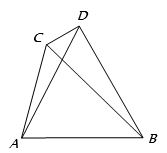
If $A, B, C, D$ are any four points in space, then $|\overrightarrow{AB} \times \overrightarrow{CD} + \overrightarrow{BC} \times \overrightarrow{AD} + \overrightarrow{CA} \times \overrightarrow{BD}|$ is equal to (where $\Delta$ denotes the area of $\Delta ABC$) (in $\Delta$)
A
$2$
B
$4$
C
$3$
D
$5$
Solution
(B) Let $A$ be the origin and let the position vectors of $B, C,$ and $D$ be $\vec{b}, \vec{c},$ and $\vec{d}$ respectively.
Then $\overrightarrow{AB} = \vec{b}, \overrightarrow{CD} = \vec{d} - \vec{c}, \overrightarrow{BC} = \vec{c} - \vec{b}, \overrightarrow{AD} = \vec{d}, \overrightarrow{CA} = -\vec{c},$ and $\overrightarrow{BD} = \vec{d} - \vec{b}$.
Now, consider the expression:
$|\overrightarrow{AB} \times \overrightarrow{CD} + \overrightarrow{BC} \times \overrightarrow{AD} + \overrightarrow{CA} \times \overrightarrow{BD}|$
$= |\vec{b} \times (\vec{d} - \vec{c}) + (\vec{c} - \vec{b}) \times \vec{d} - \vec{c} \times (\vec{d} - \vec{b})|$
$= |\vec{b} \times \vec{d} - \vec{b} \times \vec{c} + \vec{c} \times \vec{d} - \vec{b} \times \vec{d} - \vec{c} \times \vec{d} + \vec{c} \times \vec{b}|$
$= |-\vec{b} \times \vec{c} + \vec{c} \times \vec{b}|$
$= |-\vec{b} \times \vec{c} - \vec{b} \times \vec{c}| = |-2(\vec{b} \times \vec{c})| = 2|\vec{b} \times \vec{c}|$
Since the area of $\Delta ABC$ is $\Delta = \frac{1}{2}|\vec{b} \times \vec{c}|$, we have $|\vec{b} \times \vec{c}| = 2\Delta$.
Therefore, the expression equals $2(2\Delta) = 4\Delta$.
Then $\overrightarrow{AB} = \vec{b}, \overrightarrow{CD} = \vec{d} - \vec{c}, \overrightarrow{BC} = \vec{c} - \vec{b}, \overrightarrow{AD} = \vec{d}, \overrightarrow{CA} = -\vec{c},$ and $\overrightarrow{BD} = \vec{d} - \vec{b}$.
Now, consider the expression:
$|\overrightarrow{AB} \times \overrightarrow{CD} + \overrightarrow{BC} \times \overrightarrow{AD} + \overrightarrow{CA} \times \overrightarrow{BD}|$
$= |\vec{b} \times (\vec{d} - \vec{c}) + (\vec{c} - \vec{b}) \times \vec{d} - \vec{c} \times (\vec{d} - \vec{b})|$
$= |\vec{b} \times \vec{d} - \vec{b} \times \vec{c} + \vec{c} \times \vec{d} - \vec{b} \times \vec{d} - \vec{c} \times \vec{d} + \vec{c} \times \vec{b}|$
$= |-\vec{b} \times \vec{c} + \vec{c} \times \vec{b}|$
$= |-\vec{b} \times \vec{c} - \vec{b} \times \vec{c}| = |-2(\vec{b} \times \vec{c})| = 2|\vec{b} \times \vec{c}|$
Since the area of $\Delta ABC$ is $\Delta = \frac{1}{2}|\vec{b} \times \vec{c}|$, we have $|\vec{b} \times \vec{c}| = 2\Delta$.
Therefore, the expression equals $2(2\Delta) = 4\Delta$.
0 likes
View Solution30
EasyMCQ
$r \times a = b \times a;\,\,r \times b = a \times b;\,\,a \ne 0;\,\,b \ne 0;\,\,a \ne \lambda b;\,\,a$ is not perpendicular to $b,$ then $r = $
A
$a - b$
B
$a + b$
C
$a \times b + a$
D
$a \times b + b$
Solution
(B) Given equations are:
$r \times a = b \times a \implies r \times a - b \times a = 0 \implies (r - b) \times a = 0$
$r \times b = a \times b \implies r \times b + b \times a = 0 \implies (r + a) \times b = 0$
Adding the two original equations:
$r \times a + r \times b = b \times a + a \times b$
$r \times (a + b) = b \times a - b \times a = 0$
Since $r \times (a + b) = 0$,$r$ must be parallel to $(a + b)$,so $r = k(a + b)$ for some scalar $k$.
Substituting $r = k(a + b)$ into the first equation:
$k(a + b) \times a = b \times a$
$k(a \times a + b \times a) = b \times a$
$k(0 + b \times a) = b \times a$
$k(b \times a) = b \times a$
Since $a$ is not perpendicular to $b$ and $a \ne \lambda b$,$b \times a \ne 0$,so $k = 1$.
Therefore,$r = a + b$.
$r \times a = b \times a \implies r \times a - b \times a = 0 \implies (r - b) \times a = 0$
$r \times b = a \times b \implies r \times b + b \times a = 0 \implies (r + a) \times b = 0$
Adding the two original equations:
$r \times a + r \times b = b \times a + a \times b$
$r \times (a + b) = b \times a - b \times a = 0$
Since $r \times (a + b) = 0$,$r$ must be parallel to $(a + b)$,so $r = k(a + b)$ for some scalar $k$.
Substituting $r = k(a + b)$ into the first equation:
$k(a + b) \times a = b \times a$
$k(a \times a + b \times a) = b \times a$
$k(0 + b \times a) = b \times a$
$k(b \times a) = b \times a$
Since $a$ is not perpendicular to $b$ and $a \ne \lambda b$,$b \times a \ne 0$,so $k = 1$.
Therefore,$r = a + b$.
0 likes
View Solution31
EasyMCQ
$A$ unit vector perpendicular to each of the vectors $2i - j + k$ and $3i + 4j - k$ is equal to
A
$\frac{-3i + 5j + 11k}{\sqrt{155}}$
B
$\frac{3i - 5j + 11k}{\sqrt{155}}$
C
$\frac{6i - 4j - k}{\sqrt{53}}$
D
$\frac{5i + 3j}{\sqrt{34}}$
Solution
(A) Let $\vec{a} = 2i - j + k$ and $\vec{b} = 3i + 4j - k$.
$A$ vector perpendicular to both $\vec{a}$ and $\vec{b}$ is given by the cross product $\vec{a} \times \vec{b}$.
$\vec{a} \times \vec{b} = \begin{vmatrix} i & j & k \\ 2 & -1 & 1 \\ 3 & 4 & -1 \end{vmatrix} = i(1 - 4) - j(-2 - 3) + k(8 + 3) = -3i + 5j + 11k$.
The magnitude of this vector is $|\vec{a} \times \vec{b}| = \sqrt{(-3)^2 + 5^2 + 11^2} = \sqrt{9 + 25 + 121} = \sqrt{155}$.
Therefore,the unit vector perpendicular to both is $\frac{\vec{a} \times \vec{b}}{|\vec{a} \times \vec{b}|} = \frac{-3i + 5j + 11k}{\sqrt{155}}$.
$A$ vector perpendicular to both $\vec{a}$ and $\vec{b}$ is given by the cross product $\vec{a} \times \vec{b}$.
$\vec{a} \times \vec{b} = \begin{vmatrix} i & j & k \\ 2 & -1 & 1 \\ 3 & 4 & -1 \end{vmatrix} = i(1 - 4) - j(-2 - 3) + k(8 + 3) = -3i + 5j + 11k$.
The magnitude of this vector is $|\vec{a} \times \vec{b}| = \sqrt{(-3)^2 + 5^2 + 11^2} = \sqrt{9 + 25 + 121} = \sqrt{155}$.
Therefore,the unit vector perpendicular to both is $\frac{\vec{a} \times \vec{b}}{|\vec{a} \times \vec{b}|} = \frac{-3i + 5j + 11k}{\sqrt{155}}$.
0 likes
View Solution32
EasyMCQ
If the position vectors of three points $A, B$ and $C$ are respectively $i + j + k, 2i + 3j - 4k$ and $7i + 4j + 9k$,then the unit vector perpendicular to the plane containing the triangle $ABC$ is
A
$31i - 18j - 9k$
B
$\frac{31i - 38j - 9k}{\sqrt{2486}}$
C
$\frac{31i + 18j + 9k}{\sqrt{2486}}$
D
None of these
Solution
(B) The position vectors are $\vec{A} = i + j + k$,$\vec{B} = 2i + 3j - 4k$,and $\vec{C} = 7i + 4j + 9k$.
First,we find the vectors $\vec{AB}$ and $\vec{AC}$:
$\vec{AB} = \vec{B} - \vec{A} = (2-1)i + (3-1)j + (-4-1)k = i + 2j - 5k$.
$\vec{AC} = \vec{C} - \vec{A} = (7-1)i + (4-1)j + (9-1)k = 6i + 3j + 8k$.
The vector perpendicular to the plane is given by the cross product $\vec{n} = \vec{AB} \times \vec{AC}$:
$\vec{n} = \begin{vmatrix} i & j & k \\ 1 & 2 & -5 \\ 6 & 3 & 8 \end{vmatrix} = i(16 - (-15)) - j(8 - (-30)) + k(3 - 12) = 31i - 38j - 9k$.
The magnitude of this vector is $|\vec{n}| = \sqrt{31^2 + (-38)^2 + (-9)^2} = \sqrt{961 + 1444 + 81} = \sqrt{2486}$.
The unit vector perpendicular to the plane is $\hat{n} = \frac{\vec{n}}{|\vec{n}|} = \frac{31i - 38j - 9k}{\sqrt{2486}}$.
First,we find the vectors $\vec{AB}$ and $\vec{AC}$:
$\vec{AB} = \vec{B} - \vec{A} = (2-1)i + (3-1)j + (-4-1)k = i + 2j - 5k$.
$\vec{AC} = \vec{C} - \vec{A} = (7-1)i + (4-1)j + (9-1)k = 6i + 3j + 8k$.
The vector perpendicular to the plane is given by the cross product $\vec{n} = \vec{AB} \times \vec{AC}$:
$\vec{n} = \begin{vmatrix} i & j & k \\ 1 & 2 & -5 \\ 6 & 3 & 8 \end{vmatrix} = i(16 - (-15)) - j(8 - (-30)) + k(3 - 12) = 31i - 38j - 9k$.
The magnitude of this vector is $|\vec{n}| = \sqrt{31^2 + (-38)^2 + (-9)^2} = \sqrt{961 + 1444 + 81} = \sqrt{2486}$.
The unit vector perpendicular to the plane is $\hat{n} = \frac{\vec{n}}{|\vec{n}|} = \frac{31i - 38j - 9k}{\sqrt{2486}}$.
0 likes
View Solution33
EasyMCQ
If $a, b, c$ are position vectors of vertices of a triangle $ABC$,then the unit vector perpendicular to its plane is:
A
$a \times b + b \times c + c \times a$
B
$\frac{a \times b + b \times c + c \times a}{|a \times b + b \times c + c \times a|}$
C
$\frac{a \times b}{|a \times b|}$
D
None of these
Solution
(B) The unit vector perpendicular to the plane of triangle $ABC$ is given by the formula: $\hat{n} = \frac{\overrightarrow{AB} \times \overrightarrow{AC}}{|\overrightarrow{AB} \times \overrightarrow{AC}|}$.
Given the position vectors $a, b, c$ for vertices $A, B, C$,we have $\overrightarrow{AB} = b - a$ and $\overrightarrow{AC} = c - a$.
Calculating the cross product: $(b - a) \times (c - a) = b \times c - b \times a - a \times c + a \times a$.
Since $a \times a = 0$ and $-b \times a = a \times b$ and $-a \times c = c \times a$,we get: $(b - a) \times (c - a) = a \times b + b \times c + c \times a$.
Therefore,the unit vector is $\frac{a \times b + b \times c + c \times a}{|a \times b + b \times c + c \times a|}$.
Given the position vectors $a, b, c$ for vertices $A, B, C$,we have $\overrightarrow{AB} = b - a$ and $\overrightarrow{AC} = c - a$.
Calculating the cross product: $(b - a) \times (c - a) = b \times c - b \times a - a \times c + a \times a$.
Since $a \times a = 0$ and $-b \times a = a \times b$ and $-a \times c = c \times a$,we get: $(b - a) \times (c - a) = a \times b + b \times c + c \times a$.
Therefore,the unit vector is $\frac{a \times b + b \times c + c \times a}{|a \times b + b \times c + c \times a|}$.
0 likes
View Solution34
DifficultMCQ
If the vectors $a, b$ and $c$ are represented by the sides $BC, CA$ and $AB$ respectively of the $\Delta ABC$,then
A
$a \cdot b + b \cdot c + c \cdot a = 0$
B
$a \times b = b \times c = c \times a$
C
$a \cdot b = b \cdot c = c \cdot a$
D
$a \times b = b \times c = c \times a = 0$
Solution
(B) In $\Delta ABC$,the vectors representing the sides are $BC = a$,$CA = b$,and $AB = c$.
By the triangle law of vector addition,the sum of vectors along the perimeter of a triangle in order is zero: $a + b + c = 0$.
Taking the cross product with $a$ on both sides: $a \times (a + b + c) = a \times 0 \implies a \times a + a \times b + a \times c = 0$.
Since $a \times a = 0$,we get $a \times b = c \times a$ (as $a \times c = -c \times a$).
Similarly,taking the cross product with $b$: $b \times (a + b + c) = b \times 0 \implies b \times a + b \times b + b \times c = 0$.
Since $b \times b = 0$,we get $b \times a + b \times c = 0 \implies b \times c = a \times b$.
Combining these,we have $a \times b = b \times c = c \times a$.
By the triangle law of vector addition,the sum of vectors along the perimeter of a triangle in order is zero: $a + b + c = 0$.
Taking the cross product with $a$ on both sides: $a \times (a + b + c) = a \times 0 \implies a \times a + a \times b + a \times c = 0$.
Since $a \times a = 0$,we get $a \times b = c \times a$ (as $a \times c = -c \times a$).
Similarly,taking the cross product with $b$: $b \times (a + b + c) = b \times 0 \implies b \times a + b \times b + b \times c = 0$.
Since $b \times b = 0$,we get $b \times a + b \times c = 0 \implies b \times c = a \times b$.
Combining these,we have $a \times b = b \times c = c \times a$.
0 likes
View Solution35
MediumMCQ
$A$ vector perpendicular to both of the vectors $i + j + k$ and $i + j$ is
A
$i + j$
B
$i - j$
C
$c(i - j)$,where $c$ is a scalar
D
None of these
Solution
(C) Let $\vec{a} = i + j + k$ and $\vec{b} = i + j$.
$A$ vector perpendicular to both $\vec{a}$ and $\vec{b}$ is given by their cross product $\vec{a} \times \vec{b}$.
$\vec{a} \times \vec{b} = \begin{vmatrix} i & j & k \\ 1 & 1 & 1 \\ 1 & 1 & 0 \end{vmatrix}$
$= i(0 - 1) - j(0 - 1) + k(1 - 1)$
$= -i + j + 0k = -i + j$.
Any vector perpendicular to both $\vec{a}$ and $\vec{b}$ is a scalar multiple of $-i + j$,which can be written as $c(i - j)$ for some scalar $c$.
$A$ vector perpendicular to both $\vec{a}$ and $\vec{b}$ is given by their cross product $\vec{a} \times \vec{b}$.
$\vec{a} \times \vec{b} = \begin{vmatrix} i & j & k \\ 1 & 1 & 1 \\ 1 & 1 & 0 \end{vmatrix}$
$= i(0 - 1) - j(0 - 1) + k(1 - 1)$
$= -i + j + 0k = -i + j$.
Any vector perpendicular to both $\vec{a}$ and $\vec{b}$ is a scalar multiple of $-i + j$,which can be written as $c(i - j)$ for some scalar $c$.
0 likes
View Solution36
EasyMCQ
$A$ unit vector perpendicular to the plane of $a = 2i - 6j - 3k$ and $b = 4i + 3j - k$ is
A
$\frac{4i+3j-k}{\sqrt{26}}$
B
$\frac{2i-6j-3k}{7}$
C
$\frac{3i-2j+6k}{7}$
D
$\frac{2i-3j-6k}{7}$
Solution
(C) The vector perpendicular to both $a$ and $b$ is given by the cross product $a \times b$.
The unit vector perpendicular to the plane containing $a$ and $b$ is given by $\frac{a \times b}{|a \times b|}$.
First,calculate $a \times b = \begin{vmatrix} i & j & k \\ 2 & -6 & -3 \\ 4 & 3 & -1 \end{vmatrix}$.
$a \times b = i((-6)(-1) - (-3)(3)) - j((2)(-1) - (-3)(4)) + k((2)(3) - (-6)(4))$.
$a \times b = i(6 + 9) - j(-2 + 12) + k(6 + 24) = 15i - 10j + 30k$.
Next,calculate the magnitude $|a \times b| = \sqrt{15^2 + (-10)^2 + 30^2} = \sqrt{225 + 100 + 900} = \sqrt{1225} = 35$.
Therefore,the required unit vector is $\frac{15i - 10j + 30k}{35} = \frac{15}{35}i - \frac{10}{35}j + \frac{30}{35}k = \frac{3}{7}i - \frac{2}{7}j + \frac{6}{7}k = \frac{3i - 2j + 6k}{7}$.
The unit vector perpendicular to the plane containing $a$ and $b$ is given by $\frac{a \times b}{|a \times b|}$.
First,calculate $a \times b = \begin{vmatrix} i & j & k \\ 2 & -6 & -3 \\ 4 & 3 & -1 \end{vmatrix}$.
$a \times b = i((-6)(-1) - (-3)(3)) - j((2)(-1) - (-3)(4)) + k((2)(3) - (-6)(4))$.
$a \times b = i(6 + 9) - j(-2 + 12) + k(6 + 24) = 15i - 10j + 30k$.
Next,calculate the magnitude $|a \times b| = \sqrt{15^2 + (-10)^2 + 30^2} = \sqrt{225 + 100 + 900} = \sqrt{1225} = 35$.
Therefore,the required unit vector is $\frac{15i - 10j + 30k}{35} = \frac{15}{35}i - \frac{10}{35}j + \frac{30}{35}k = \frac{3}{7}i - \frac{2}{7}j + \frac{6}{7}k = \frac{3i - 2j + 6k}{7}$.
0 likes
View Solution37
EasyMCQ
The unit vector perpendicular to both the vectors $\vec{a} = \hat{i} - 2\hat{j} + 3\hat{k}$ and $\vec{b} = \hat{i} + 2\hat{j} - \hat{k}$ is
A
$\frac{1}{\sqrt{3}}(-\hat{i} + \hat{j} + \hat{k})$
B
$(-\hat{i} + \hat{j} + \hat{k})$
C
$\frac{(\hat{i} + \hat{j} - \hat{k})}{\sqrt{3}}$
D
$\text{None of these}$
Solution
(A) Let $\vec{a} = \hat{i} - 2\hat{j} + 3\hat{k}$ and $\vec{b} = \hat{i} + 2\hat{j} - \hat{k}$.
First,we find the cross product $\vec{a} \times \vec{b}$:
$\vec{a} \times \vec{b} = \begin{vmatrix} \hat{i} & \hat{j} & \hat{k} \\ 1 & -2 & 3 \\ 1 & 2 & -1 \end{vmatrix} = \hat{i}(2 - 6) - \hat{j}(-1 - 3) + \hat{k}(2 - (-2)) = -4\hat{i} + 4\hat{j} + 4\hat{k}$.
The magnitude of the cross product is $|\vec{a} \times \vec{b}| = \sqrt{(-4)^2 + 4^2 + 4^2} = \sqrt{16 + 16 + 16} = \sqrt{48} = 4\sqrt{3}$.
The unit vector perpendicular to both $\vec{a}$ and $\vec{b}$ is given by $\pm \frac{\vec{a} \times \vec{b}}{|\vec{a} \times \vec{b}|} = \pm \frac{-4\hat{i} + 4\hat{j} + 4\hat{k}}{4\sqrt{3}} = \pm \frac{-\hat{i} + \hat{j} + \hat{k}}{\sqrt{3}}$.
Comparing this with the given options,the correct option is $\frac{1}{\sqrt{3}}(-\hat{i} + \hat{j} + \hat{k})$.
First,we find the cross product $\vec{a} \times \vec{b}$:
$\vec{a} \times \vec{b} = \begin{vmatrix} \hat{i} & \hat{j} & \hat{k} \\ 1 & -2 & 3 \\ 1 & 2 & -1 \end{vmatrix} = \hat{i}(2 - 6) - \hat{j}(-1 - 3) + \hat{k}(2 - (-2)) = -4\hat{i} + 4\hat{j} + 4\hat{k}$.
The magnitude of the cross product is $|\vec{a} \times \vec{b}| = \sqrt{(-4)^2 + 4^2 + 4^2} = \sqrt{16 + 16 + 16} = \sqrt{48} = 4\sqrt{3}$.
The unit vector perpendicular to both $\vec{a}$ and $\vec{b}$ is given by $\pm \frac{\vec{a} \times \vec{b}}{|\vec{a} \times \vec{b}|} = \pm \frac{-4\hat{i} + 4\hat{j} + 4\hat{k}}{4\sqrt{3}} = \pm \frac{-\hat{i} + \hat{j} + \hat{k}}{\sqrt{3}}$.
Comparing this with the given options,the correct option is $\frac{1}{\sqrt{3}}(-\hat{i} + \hat{j} + \hat{k})$.
0 likes
View Solution38
EasyMCQ
The unit vector perpendicular to the vectors $i - j + k$ and $2i + 3j - k$ is
A
$\frac{-2i+3j+5k}{\sqrt{30}}$
B
$\frac{-2i+5j+6k}{\sqrt{38}}$
C
$\frac{-2i+3j+5k}{\sqrt{38}}$
D
$\frac{-2i+4j+5k}{\sqrt{38}}$
Solution
(C) Let the given vectors be $\vec{a} = i - j + k$ and $\vec{b} = 2i + 3j - k$.
The vector perpendicular to both $\vec{a}$ and $\vec{b}$ is given by the cross product $\vec{a} \times \vec{b}$.
$\vec{a} \times \vec{b} = \begin{vmatrix} i & j & k \\ 1 & -1 & 1 \\ 2 & 3 & -1 \end{vmatrix}$
$= i((-1)(-1) - (1)(3)) - j((1)(-1) - (1)(2)) + k((1)(3) - (-1)(2))$
$= i(1 - 3) - j(-1 - 2) + k(3 + 2)$
$= -2i + 3j + 5k$
The magnitude of the cross product is $|\vec{a} \times \vec{b}| = \sqrt{(-2)^2 + (3)^2 + (5)^2} = \sqrt{4 + 9 + 25} = \sqrt{38}$.
The unit vector perpendicular to both vectors is $\frac{\vec{a} \times \vec{b}}{|\vec{a} \times \vec{b}|} = \frac{-2i + 3j + 5k}{\sqrt{38}}$.
The vector perpendicular to both $\vec{a}$ and $\vec{b}$ is given by the cross product $\vec{a} \times \vec{b}$.
$\vec{a} \times \vec{b} = \begin{vmatrix} i & j & k \\ 1 & -1 & 1 \\ 2 & 3 & -1 \end{vmatrix}$
$= i((-1)(-1) - (1)(3)) - j((1)(-1) - (1)(2)) + k((1)(3) - (-1)(2))$
$= i(1 - 3) - j(-1 - 2) + k(3 + 2)$
$= -2i + 3j + 5k$
The magnitude of the cross product is $|\vec{a} \times \vec{b}| = \sqrt{(-2)^2 + (3)^2 + (5)^2} = \sqrt{4 + 9 + 25} = \sqrt{38}$.
The unit vector perpendicular to both vectors is $\frac{\vec{a} \times \vec{b}}{|\vec{a} \times \vec{b}|} = \frac{-2i + 3j + 5k}{\sqrt{38}}$.
0 likes
View Solution39
DifficultMCQ
If $a = 2i - 3j - k$ and $b = i + 4j - 2k$,then $a \times b$ is
A
$10i + 2j + 11k$
B
$10i + 3j + 11k$
C
$10i - 3j + 11k$
D
$10i - 3j - 10k$
Solution
(B) The cross product $a \times b$ is calculated using the determinant of a matrix:
$a \times b = \begin{vmatrix} i & j & k \\ 2 & -3 & -1 \\ 1 & 4 & -2 \end{vmatrix}$
Expanding along the first row:
$= i((-3)(-2) - (-1)(4)) - j((2)(-2) - (-1)(1)) + k((2)(4) - (-3)(1))$
$= i(6 + 4) - j(-4 + 1) + k(8 + 3)$
$= i(10) - j(-3) + k(11)$
$= 10i + 3j + 11k$
$a \times b = \begin{vmatrix} i & j & k \\ 2 & -3 & -1 \\ 1 & 4 & -2 \end{vmatrix}$
Expanding along the first row:
$= i((-3)(-2) - (-1)(4)) - j((2)(-2) - (-1)(1)) + k((2)(4) - (-3)(1))$
$= i(6 + 4) - j(-4 + 1) + k(8 + 3)$
$= i(10) - j(-3) + k(11)$
$= 10i + 3j + 11k$
0 likes
View Solution40
EasyMCQ
If $|a| = 4$,$|b| = 2$ and the angle between $a$ and $b$ is $\frac{\pi}{6}$,then $|a \times b|^2$ is equal to
A
$48$
B
$16$
C
$8$
D
None of these
Solution
(B) We know that the magnitude of the cross product of two vectors $a$ and $b$ is given by $|a \times b| = |a||b| \sin \theta$,where $\theta$ is the angle between the vectors.
Given $|a| = 4$,$|b| = 2$,and $\theta = \frac{\pi}{6}$.
Substituting these values,we get $|a \times b| = 4 \times 2 \times \sin\left(\frac{\pi}{6}\right)$.
Since $\sin\left(\frac{\pi}{6}\right) = \frac{1}{2}$,we have $|a \times b| = 8 \times \frac{1}{2} = 4$.
Therefore,$|a \times b|^2 = 4^2 = 16$.
Given $|a| = 4$,$|b| = 2$,and $\theta = \frac{\pi}{6}$.
Substituting these values,we get $|a \times b| = 4 \times 2 \times \sin\left(\frac{\pi}{6}\right)$.
Since $\sin\left(\frac{\pi}{6}\right) = \frac{1}{2}$,we have $|a \times b| = 8 \times \frac{1}{2} = 4$.
Therefore,$|a \times b|^2 = 4^2 = 16$.
0 likes
View Solution41
EasyMCQ
If $a = 2i + 4j - 5k$ and $b = i + 2j + 3k$,then $|a \times b|$ is
A
$11\sqrt{5}$
B
$11\sqrt{3}$
C
$11\sqrt{7}$
D
$11\sqrt{2}$
Solution
(A) The cross product $a \times b$ is calculated using the determinant of the matrix:
$a \times b = \begin{vmatrix} i & j & k \\ 2 & 4 & -5 \\ 1 & 2 & 3 \end{vmatrix}$
$= i(4 \times 3 - (-5) \times 2) - j(2 \times 3 - (-5) \times 1) + k(2 \times 2 - 4 \times 1)$
$= i(12 + 10) - j(6 + 5) + k(4 - 4)$
$= 22i - 11j + 0k$
Now,calculate the magnitude $|a \times b|$:
$|a \times b| = \sqrt{(22)^2 + (-11)^2 + (0)^2}$
$= \sqrt{484 + 121}$
$= \sqrt{605}$
$= \sqrt{121 \times 5} = 11\sqrt{5}$.
$a \times b = \begin{vmatrix} i & j & k \\ 2 & 4 & -5 \\ 1 & 2 & 3 \end{vmatrix}$
$= i(4 \times 3 - (-5) \times 2) - j(2 \times 3 - (-5) \times 1) + k(2 \times 2 - 4 \times 1)$
$= i(12 + 10) - j(6 + 5) + k(4 - 4)$
$= 22i - 11j + 0k$
Now,calculate the magnitude $|a \times b|$:
$|a \times b| = \sqrt{(22)^2 + (-11)^2 + (0)^2}$
$= \sqrt{484 + 121}$
$= \sqrt{605}$
$= \sqrt{121 \times 5} = 11\sqrt{5}$.
0 likes
View Solution42
EasyMCQ
The unit vector perpendicular to both $i + j$ and $j + k$ is
A
$i - j + k$
B
$i + j + k$
C
$\frac{i + j - k}{\sqrt{3}}$
D
$\frac{i - j + k}{\sqrt{3}}$
Solution
(D) Let $\vec{a} = i + j$ and $\vec{b} = j + k$.
First,we find the cross product $\vec{a} \times \vec{b}$:
$\vec{a} \times \vec{b} = \begin{vmatrix} i & j & k \\ 1 & 1 & 0 \\ 0 & 1 & 1 \end{vmatrix} = i(1 - 0) - j(1 - 0) + k(1 - 0) = i - j + k$.
The magnitude of this vector is $|\vec{a} \times \vec{b}| = \sqrt{1^2 + (-1)^2 + 1^2} = \sqrt{3}$.
The unit vector perpendicular to both is given by $\pm \frac{\vec{a} \times \vec{b}}{|\vec{a} \times \vec{b}|} = \pm \frac{i - j + k}{\sqrt{3}}$.
Comparing this with the given options,the correct option is $\frac{i - j + k}{\sqrt{3}}$.
First,we find the cross product $\vec{a} \times \vec{b}$:
$\vec{a} \times \vec{b} = \begin{vmatrix} i & j & k \\ 1 & 1 & 0 \\ 0 & 1 & 1 \end{vmatrix} = i(1 - 0) - j(1 - 0) + k(1 - 0) = i - j + k$.
The magnitude of this vector is $|\vec{a} \times \vec{b}| = \sqrt{1^2 + (-1)^2 + 1^2} = \sqrt{3}$.
The unit vector perpendicular to both is given by $\pm \frac{\vec{a} \times \vec{b}}{|\vec{a} \times \vec{b}|} = \pm \frac{i - j + k}{\sqrt{3}}$.
Comparing this with the given options,the correct option is $\frac{i - j + k}{\sqrt{3}}$.
0 likes
View Solution43
EasyMCQ
The area of a triangle whose vertices are $A(1, -1, 2)$,$B(2, 1, -1)$ and $C(3, -1, 2)$ is
A
$13$
B
$\sqrt{13}$
C
$6$
D
$\sqrt{6}$
Solution
(B) The vertices of the triangle are $A(1, -1, 2)$,$B(2, 1, -1)$,and $C(3, -1, 2)$.
First,we find the vectors $\overrightarrow{AB}$ and $\overrightarrow{AC}$:
$\overrightarrow{AB} = (2-1)\hat{i} + (1-(-1))\hat{j} + (-1-2)\hat{k} = \hat{i} + 2\hat{j} - 3\hat{k}$
$\overrightarrow{AC} = (3-1)\hat{i} + (-1-(-1))\hat{j} + (2-2)\hat{k} = 2\hat{i} + 0\hat{j} + 0\hat{k} = 2\hat{i}$
The area of the triangle is given by $\frac{1}{2} |\overrightarrow{AB} \times \overrightarrow{AC}|$.
Calculating the cross product:
$\overrightarrow{AB} \times \overrightarrow{AC} = \begin{vmatrix} \hat{i} & \hat{j} & \hat{k} \\ 1 & 2 & -3 \\ 2 & 0 & 0 \end{vmatrix} = \hat{i}(0 - 0) - \hat{j}(0 - (-6)) + \hat{k}(0 - 4) = -6\hat{j} - 4\hat{k}$.
Now,find the magnitude:
$|\overrightarrow{AB} \times \overrightarrow{AC}| = \sqrt{(-6)^2 + (-4)^2} = \sqrt{36 + 16} = \sqrt{52} = 2\sqrt{13}$.
Therefore,the area of the triangle is $\frac{1}{2} \times 2\sqrt{13} = \sqrt{13}$ square units.
First,we find the vectors $\overrightarrow{AB}$ and $\overrightarrow{AC}$:
$\overrightarrow{AB} = (2-1)\hat{i} + (1-(-1))\hat{j} + (-1-2)\hat{k} = \hat{i} + 2\hat{j} - 3\hat{k}$
$\overrightarrow{AC} = (3-1)\hat{i} + (-1-(-1))\hat{j} + (2-2)\hat{k} = 2\hat{i} + 0\hat{j} + 0\hat{k} = 2\hat{i}$
The area of the triangle is given by $\frac{1}{2} |\overrightarrow{AB} \times \overrightarrow{AC}|$.
Calculating the cross product:
$\overrightarrow{AB} \times \overrightarrow{AC} = \begin{vmatrix} \hat{i} & \hat{j} & \hat{k} \\ 1 & 2 & -3 \\ 2 & 0 & 0 \end{vmatrix} = \hat{i}(0 - 0) - \hat{j}(0 - (-6)) + \hat{k}(0 - 4) = -6\hat{j} - 4\hat{k}$.
Now,find the magnitude:
$|\overrightarrow{AB} \times \overrightarrow{AC}| = \sqrt{(-6)^2 + (-4)^2} = \sqrt{36 + 16} = \sqrt{52} = 2\sqrt{13}$.
Therefore,the area of the triangle is $\frac{1}{2} \times 2\sqrt{13} = \sqrt{13}$ square units.
0 likes
View Solution44
EasyMCQ
If the vertices of a triangle are $A(1, -1, 2)$,$B(2, 0, -1)$,and $C(0, 2, 1)$,then the area of the triangle is:
A
$\sqrt{6}$
B
$2\sqrt{6}$
C
$3\sqrt{6}$
D
$4\sqrt{6}$
Solution
(B) The area of a triangle with vertices $A, B, C$ is given by $\Delta = \frac{1}{2} |\overrightarrow{AB} \times \overrightarrow{AC}|$.
First,find the vectors $\overrightarrow{AB}$ and $\overrightarrow{AC}$:
$\overrightarrow{AB} = (2-1)i + (0 - (-1))j + (-1-2)k = i + j - 3k$
$\overrightarrow{AC} = (0-1)i + (2 - (-1))j + (1-2)k = -i + 3j - k$
Now,calculate the cross product $\overrightarrow{AB} \times \overrightarrow{AC}$:
$\overrightarrow{AB} \times \overrightarrow{AC} = \begin{vmatrix} i & j & k \\ 1 & 1 & -3 \\ -1 & 3 & -1 \end{vmatrix}$
$= i(-1 - (-9)) - j(-1 - 3) + k(3 - (-1))$
$= i(8) - j(-4) + k(4) = 8i + 4j + 4k$
The magnitude of the cross product is:
$|\overrightarrow{AB} \times \overrightarrow{AC}| = \sqrt{8^2 + 4^2 + 4^2} = \sqrt{64 + 16 + 16} = \sqrt{96} = 4\sqrt{6}$
Therefore,the area of the triangle is:
$\Delta = \frac{1}{2} |\overrightarrow{AB} \times \overrightarrow{AC}| = \frac{1}{2} (4\sqrt{6}) = 2\sqrt{6}$.
First,find the vectors $\overrightarrow{AB}$ and $\overrightarrow{AC}$:
$\overrightarrow{AB} = (2-1)i + (0 - (-1))j + (-1-2)k = i + j - 3k$
$\overrightarrow{AC} = (0-1)i + (2 - (-1))j + (1-2)k = -i + 3j - k$
Now,calculate the cross product $\overrightarrow{AB} \times \overrightarrow{AC}$:
$\overrightarrow{AB} \times \overrightarrow{AC} = \begin{vmatrix} i & j & k \\ 1 & 1 & -3 \\ -1 & 3 & -1 \end{vmatrix}$
$= i(-1 - (-9)) - j(-1 - 3) + k(3 - (-1))$
$= i(8) - j(-4) + k(4) = 8i + 4j + 4k$
The magnitude of the cross product is:
$|\overrightarrow{AB} \times \overrightarrow{AC}| = \sqrt{8^2 + 4^2 + 4^2} = \sqrt{64 + 16 + 16} = \sqrt{96} = 4\sqrt{6}$
Therefore,the area of the triangle is:
$\Delta = \frac{1}{2} |\overrightarrow{AB} \times \overrightarrow{AC}| = \frac{1}{2} (4\sqrt{6}) = 2\sqrt{6}$.
0 likes
View Solution45
EasyMCQ
The area of the triangle whose vertices are $(1, 2, 3)$,$(2, 5, -1)$,and $(-1, 1, 2)$ is:
A
$150$ sq. unit
B
$145$ sq. unit
C
$\frac{\sqrt{155}}{2}$ sq. unit
D
$\frac{155}{2}$ sq. unit
Solution
(C) Let the vertices be $A(1, 2, 3)$,$B(2, 5, -1)$,and $C(-1, 1, 2)$.
The area of the triangle is given by $\frac{1}{2} |\overrightarrow{AB} \times \overrightarrow{AC}|$.
First,find the vectors $\overrightarrow{AB}$ and $\overrightarrow{AC}$:
$\overrightarrow{AB} = (2-1)\hat{i} + (5-2)\hat{j} + (-1-3)\hat{k} = \hat{i} + 3\hat{j} - 4\hat{k}$.
$\overrightarrow{AC} = (-1-1)\hat{i} + (1-2)\hat{j} + (2-3)\hat{k} = -2\hat{i} - \hat{j} - \hat{k}$.
Now,calculate the cross product $\overrightarrow{AB} \times \overrightarrow{AC}$:
$\overrightarrow{AB} \times \overrightarrow{AC} = \begin{vmatrix} \hat{i} & \hat{j} & \hat{k} \\ 1 & 3 & -4 \\ -2 & -1 & -1 \end{vmatrix}$
$= \hat{i}(-3 - 4) - \hat{j}(-1 - 8) + \hat{k}(-1 + 6)$
$= -7\hat{i} + 9\hat{j} + 5\hat{k}$.
The magnitude of the cross product is $|\overrightarrow{AB} \times \overrightarrow{AC}| = \sqrt{(-7)^2 + 9^2 + 5^2} = \sqrt{49 + 81 + 25} = \sqrt{155}$.
Therefore,the area of the triangle is $\frac{1}{2} \times \sqrt{155} = \frac{\sqrt{155}}{2}$ sq. unit.
The area of the triangle is given by $\frac{1}{2} |\overrightarrow{AB} \times \overrightarrow{AC}|$.
First,find the vectors $\overrightarrow{AB}$ and $\overrightarrow{AC}$:
$\overrightarrow{AB} = (2-1)\hat{i} + (5-2)\hat{j} + (-1-3)\hat{k} = \hat{i} + 3\hat{j} - 4\hat{k}$.
$\overrightarrow{AC} = (-1-1)\hat{i} + (1-2)\hat{j} + (2-3)\hat{k} = -2\hat{i} - \hat{j} - \hat{k}$.
Now,calculate the cross product $\overrightarrow{AB} \times \overrightarrow{AC}$:
$\overrightarrow{AB} \times \overrightarrow{AC} = \begin{vmatrix} \hat{i} & \hat{j} & \hat{k} \\ 1 & 3 & -4 \\ -2 & -1 & -1 \end{vmatrix}$
$= \hat{i}(-3 - 4) - \hat{j}(-1 - 8) + \hat{k}(-1 + 6)$
$= -7\hat{i} + 9\hat{j} + 5\hat{k}$.
The magnitude of the cross product is $|\overrightarrow{AB} \times \overrightarrow{AC}| = \sqrt{(-7)^2 + 9^2 + 5^2} = \sqrt{49 + 81 + 25} = \sqrt{155}$.
Therefore,the area of the triangle is $\frac{1}{2} \times \sqrt{155} = \frac{\sqrt{155}}{2}$ sq. unit.
0 likes
View Solution46
EasyMCQ
The area of a parallelogram whose two adjacent sides are represented by the vectors $\vec{a} = 3i - k$ and $\vec{b} = i + 2j$ is
A
$\frac{1}{2}\sqrt{17}$
B
$\frac{1}{2}\sqrt{14}$
C
$\sqrt{41}$
D
$\frac{1}{2}\sqrt{7}$
Solution
(C) The area of a parallelogram with adjacent sides represented by vectors $\vec{a}$ and $\vec{b}$ is given by the magnitude of their cross product: $\text{Area} = |\vec{a} \times \vec{b}|$.
Given $\vec{a} = 3i + 0j - k$ and $\vec{b} = i + 2j + 0k$.
The cross product is calculated as:
$\vec{a} \times \vec{b} = \begin{vmatrix} i & j & k \\ 3 & 0 & -1 \\ 1 & 2 & 0 \end{vmatrix}$
$= i(0(0) - (-1)(2)) - j(3(0) - (-1)(1)) + k(3(2) - 0(1))$
$= i(0 + 2) - j(0 + 1) + k(6 - 0)$
$= 2i - j + 6k$.
The area is the magnitude of this vector:
$|\vec{a} \times \vec{b}| = \sqrt{(2)^2 + (-1)^2 + (6)^2}$
$= \sqrt{4 + 1 + 36}$
$= \sqrt{41}$.
Given $\vec{a} = 3i + 0j - k$ and $\vec{b} = i + 2j + 0k$.
The cross product is calculated as:
$\vec{a} \times \vec{b} = \begin{vmatrix} i & j & k \\ 3 & 0 & -1 \\ 1 & 2 & 0 \end{vmatrix}$
$= i(0(0) - (-1)(2)) - j(3(0) - (-1)(1)) + k(3(2) - 0(1))$
$= i(0 + 2) - j(0 + 1) + k(6 - 0)$
$= 2i - j + 6k$.
The area is the magnitude of this vector:
$|\vec{a} \times \vec{b}| = \sqrt{(2)^2 + (-1)^2 + (6)^2}$
$= \sqrt{4 + 1 + 36}$
$= \sqrt{41}$.
0 likes
View Solution47
EasyMCQ
The area of the parallelogram whose diagonals are $a = 3i + j - 2k$ and $b = i - 3j + 4k$ is
A
$10\sqrt{3}$
B
$5\sqrt{3}$
C
$8$
D
$4$
Solution
(B) The area of a parallelogram with diagonals $\vec{a}$ and $\vec{b}$ is given by the formula $\text{Area} = \frac{1}{2} |\vec{a} \times \vec{b}|$.
First,calculate the cross product $\vec{a} \times \vec{b}$:
$\vec{a} \times \vec{b} = \begin{vmatrix} \hat{i} & \hat{j} & \hat{k} \\ 3 & 1 & -2 \\ 1 & -3 & 4 \end{vmatrix}$
$= \hat{i}(1(4) - (-2)(-3)) - \hat{j}(3(4) - (-2)(1)) + \hat{k}(3(-3) - 1(1))$
$= \hat{i}(4 - 6) - \hat{j}(12 + 2) + \hat{k}(-9 - 1)$
$= -2\hat{i} - 14\hat{j} - 10\hat{k}$.
Now,calculate the magnitude of the cross product:
$|\vec{a} \times \vec{b}| = \sqrt{(-2)^2 + (-14)^2 + (-10)^2}$
$= \sqrt{4 + 196 + 100} = \sqrt{300} = 10\sqrt{3}$.
Finally,the area is:
$\text{Area} = \frac{1}{2} |\vec{a} \times \vec{b}| = \frac{1}{2} (10\sqrt{3}) = 5\sqrt{3}$.
First,calculate the cross product $\vec{a} \times \vec{b}$:
$\vec{a} \times \vec{b} = \begin{vmatrix} \hat{i} & \hat{j} & \hat{k} \\ 3 & 1 & -2 \\ 1 & -3 & 4 \end{vmatrix}$
$= \hat{i}(1(4) - (-2)(-3)) - \hat{j}(3(4) - (-2)(1)) + \hat{k}(3(-3) - 1(1))$
$= \hat{i}(4 - 6) - \hat{j}(12 + 2) + \hat{k}(-9 - 1)$
$= -2\hat{i} - 14\hat{j} - 10\hat{k}$.
Now,calculate the magnitude of the cross product:
$|\vec{a} \times \vec{b}| = \sqrt{(-2)^2 + (-14)^2 + (-10)^2}$
$= \sqrt{4 + 196 + 100} = \sqrt{300} = 10\sqrt{3}$.
Finally,the area is:
$\text{Area} = \frac{1}{2} |\vec{a} \times \vec{b}| = \frac{1}{2} (10\sqrt{3}) = 5\sqrt{3}$.
0 likes
View Solution48
MediumMCQ
The position vectors of the points $A, B$ and $C$ are $i + j, j + k$ and $k + i$ respectively. The vector area of the $\Delta ABC = \pm \frac{1}{2} \vec{\alpha}$ where $\vec{\alpha} = $
A
$ - i + j + k$
B
$i - j + k$
C
$i + j - k$
D
$i + j + k$
Solution
(D) The position vectors are $\vec{OA} = \vec{i} + \vec{j}$,$\vec{OB} = \vec{j} + \vec{k}$,and $\vec{OC} = \vec{k} + \vec{i}$.
First,find the vectors $\vec{AB}$ and $\vec{AC}$:
$\vec{AB} = \vec{OB} - \vec{OA} = (\vec{j} + \vec{k}) - (\vec{i} + \vec{j}) = -\vec{i} + \vec{k}$
$\vec{AC} = \vec{OC} - \vec{OA} = (\vec{k} + \vec{i}) - (\vec{i} + \vec{j}) = -\vec{j} + \vec{k}$
The vector area of $\Delta ABC$ is given by $\frac{1}{2}(\vec{AB} \times \vec{AC})$:
$\vec{AB} \times \vec{AC} = \begin{vmatrix} \vec{i} & \vec{j} & \vec{k} \\ -1 & 0 & 1 \\ 0 & -1 & 1 \end{vmatrix}$
$= \vec{i}(0 - (-1)) - \vec{j}(-1 - 0) + \vec{k}(1 - 0) = \vec{i} + \vec{j} + \vec{k}$
Thus,the vector area is $\frac{1}{2}(\vec{i} + \vec{j} + \vec{k})$.
Comparing this with $\pm \frac{1}{2} \vec{\alpha}$,we get $\vec{\alpha} = \vec{i} + \vec{j} + \vec{k}$.
First,find the vectors $\vec{AB}$ and $\vec{AC}$:
$\vec{AB} = \vec{OB} - \vec{OA} = (\vec{j} + \vec{k}) - (\vec{i} + \vec{j}) = -\vec{i} + \vec{k}$
$\vec{AC} = \vec{OC} - \vec{OA} = (\vec{k} + \vec{i}) - (\vec{i} + \vec{j}) = -\vec{j} + \vec{k}$
The vector area of $\Delta ABC$ is given by $\frac{1}{2}(\vec{AB} \times \vec{AC})$:
$\vec{AB} \times \vec{AC} = \begin{vmatrix} \vec{i} & \vec{j} & \vec{k} \\ -1 & 0 & 1 \\ 0 & -1 & 1 \end{vmatrix}$
$= \vec{i}(0 - (-1)) - \vec{j}(-1 - 0) + \vec{k}(1 - 0) = \vec{i} + \vec{j} + \vec{k}$
Thus,the vector area is $\frac{1}{2}(\vec{i} + \vec{j} + \vec{k})$.
Comparing this with $\pm \frac{1}{2} \vec{\alpha}$,we get $\vec{\alpha} = \vec{i} + \vec{j} + \vec{k}$.
0 likes
View Solution49
EasyMCQ
If $\overrightarrow{OA} = 3i + 2j - k$ and $\overrightarrow{OB} = i + 3j + k$,then the area of the triangle $OAB$ is
A
$\sqrt{15}$
B
$3\sqrt{5}$
C
$\frac{3}{2}\sqrt{10}$
D
$\frac{5\sqrt{5}}{3}$
Solution
(C) The area of a triangle $OAB$ with vertices at the origin $O$,$A$,and $B$ is given by the formula $\Delta = \frac{1}{2} |\overrightarrow{OA} \times \overrightarrow{OB}|$.
First,we calculate the cross product $\overrightarrow{OA} \times \overrightarrow{OB}$:
$\overrightarrow{OA} \times \overrightarrow{OB} = \begin{vmatrix} i & j & k \\ 3 & 2 & -1 \\ 1 & 3 & 1 \end{vmatrix}$
$= i(2(1) - (-1)(3)) - j(3(1) - (-1)(1)) + k(3(3) - 2(1))$
$= i(2 + 3) - j(3 + 1) + k(9 - 2)$
$= 5i - 4j + 7k$.
Now,we find the magnitude of this vector:
$|\overrightarrow{OA} \times \overrightarrow{OB}| = \sqrt{5^2 + (-4)^2 + 7^2} = \sqrt{25 + 16 + 49} = \sqrt{90} = 3\sqrt{10}$.
Finally,the area of the triangle is:
$\Delta = \frac{1}{2} \times 3\sqrt{10} = \frac{3}{2}\sqrt{10}$.
First,we calculate the cross product $\overrightarrow{OA} \times \overrightarrow{OB}$:
$\overrightarrow{OA} \times \overrightarrow{OB} = \begin{vmatrix} i & j & k \\ 3 & 2 & -1 \\ 1 & 3 & 1 \end{vmatrix}$
$= i(2(1) - (-1)(3)) - j(3(1) - (-1)(1)) + k(3(3) - 2(1))$
$= i(2 + 3) - j(3 + 1) + k(9 - 2)$
$= 5i - 4j + 7k$.
Now,we find the magnitude of this vector:
$|\overrightarrow{OA} \times \overrightarrow{OB}| = \sqrt{5^2 + (-4)^2 + 7^2} = \sqrt{25 + 16 + 49} = \sqrt{90} = 3\sqrt{10}$.
Finally,the area of the triangle is:
$\Delta = \frac{1}{2} \times 3\sqrt{10} = \frac{3}{2}\sqrt{10}$.
0 likes
View Solution50
EasyMCQ
If $\vec{a} = \hat{i} + 2\hat{j} + 3\hat{k}$ and $\vec{b} = 3\hat{i} - 2\hat{j} + \hat{k}$ represent the adjacent sides of a parallelogram,then the area of this parallelogram is:
A
$4\sqrt{14}$
B
$6\sqrt{14}$
C
$8\sqrt{14}$
D
$16\sqrt{14}$
Solution
(C) The area of a parallelogram with adjacent sides represented by vectors $\vec{a}$ and $\vec{b}$ is given by the magnitude of their cross product,i.e.,Area $= |\vec{a} \times \vec{b}|$.
Given $\vec{a} = \hat{i} + 2\hat{j} + 3\hat{k}$ and $\vec{b} = 3\hat{i} - 2\hat{j} + \hat{k}$.
Calculating the cross product $\vec{a} \times \vec{b}$:
$\vec{a} \times \vec{b} = \begin{vmatrix} \hat{i} & \hat{j} & \hat{k} \\ 1 & 2 & 3 \\ 3 & -2 & 1 \end{vmatrix}$
$= \hat{i}(2(1) - 3(-2)) - \hat{j}(1(1) - 3(3)) + \hat{k}(1(-2) - 2(3))$
$= \hat{i}(2 + 6) - \hat{j}(1 - 9) + \hat{k}(-2 - 6)$
$= 8\hat{i} + 8\hat{j} - 8\hat{k}$.
Now,find the magnitude:
$|\vec{a} \times \vec{b}| = \sqrt{8^2 + 8^2 + (-8)^2} = \sqrt{64 + 64 + 64} = \sqrt{3 \times 64} = 8\sqrt{3}$.
Note: The original provided options were mathematically inconsistent with the calculation. Based on the standard calculation,the area is $8\sqrt{3}$.
Given $\vec{a} = \hat{i} + 2\hat{j} + 3\hat{k}$ and $\vec{b} = 3\hat{i} - 2\hat{j} + \hat{k}$.
Calculating the cross product $\vec{a} \times \vec{b}$:
$\vec{a} \times \vec{b} = \begin{vmatrix} \hat{i} & \hat{j} & \hat{k} \\ 1 & 2 & 3 \\ 3 & -2 & 1 \end{vmatrix}$
$= \hat{i}(2(1) - 3(-2)) - \hat{j}(1(1) - 3(3)) + \hat{k}(1(-2) - 2(3))$
$= \hat{i}(2 + 6) - \hat{j}(1 - 9) + \hat{k}(-2 - 6)$
$= 8\hat{i} + 8\hat{j} - 8\hat{k}$.
Now,find the magnitude:
$|\vec{a} \times \vec{b}| = \sqrt{8^2 + 8^2 + (-8)^2} = \sqrt{64 + 64 + 64} = \sqrt{3 \times 64} = 8\sqrt{3}$.
Note: The original provided options were mathematically inconsistent with the calculation. Based on the standard calculation,the area is $8\sqrt{3}$.
0 likes
View SolutionVector Algebra — Vector or Cross product of two vectors and its applications · Frequently Asked Questions
1Are these Vector Algebra questions useful for JEE and NEET?
Yes. All questions in this section are mapped to JEE Main and NEET exam patterns. Previous year questions from JEE Main, NEET, GUJCET and state-level exams are included with full solutions.
2Can I switch to Hindi or Gujarati for these questions?
Yes. Use the language tabs in the hero section or the sidebar to view the same questions and solutions in English, Hindi or Gujarati.
3How do I generate a question paper from this subtopic?
Use the Vedclass Exam Paper Generator — select the chapter and subtopic, set difficulty, and generate Sets A, B, C, D automatically. First 3 chapters of every subject are free.
Vedclass Products
For Students
Vedclass Test Series
Mock tests in real JEE/NEET style with performance analysis. 5-day free trial.
Start Free TrialFor Teachers
Exam Paper Generator
Generate Set A/B/C/D papers from this chapter in 2 minutes. 3 chapters free.
Try FreeFor Institutes
Online Exam Module
Live online exams with unlimited students, 360° analytics & white-label branding.
See DemoFor Teachers & Institutes
Generate a Vector Algebra Exam Paper in 2 Minutes
Select subtopic & difficulty — Sets A, B, C, D auto-generated with No Repeat logic.
First 3 chapters of every subject are free — no payment required.