
अ Hindi
Concept of limits, Evaluation of algebric limits Questions in Hindi
Class 11 Mathematics · Limits · Concept of limits, Evaluation of algebric limits
508+
Questions
Hindi
Language
100%
With Solutions
Showing 49 of 508 questions in Hindi
101
EasyMCQ
यदि $f(x) = \begin{cases} \frac{\sin([x])}{[x]}, & \text{जब } [x] \neq 0 \\ 0, & \text{जब } [x] = 0 \end{cases}$ जहाँ $[x]$ महत्तम पूर्णांक फलन है,तो $\lim_{x \to 0} f(x) = $
A
$-1$
B
$1$
C
$0$
D
अस्तित्व में नहीं है
Solution
(D) $\lim_{x \to 0} f(x)$ ज्ञात करने के लिए,हम $x = 0$ पर वाम पक्ष सीमा $(LHL)$ और दक्षिण पक्ष सीमा $(RHL)$ का मूल्यांकन करते हैं।
$LHL$ के लिए: $\lim_{x \to 0^-} f(x)$। जैसे $x \to 0^-$,$x$ का मान $0$ से थोड़ा कम है,इसलिए $[x] = -1$।
अतः,$f(x) = \frac{\sin(-1)}{-1} = \frac{-\sin(1)}{-1} = \sin(1)$।
इसलिए,$\lim_{x \to 0^-} f(x) = \sin(1)$।
$RHL$ के लिए: $\lim_{x \to 0^+} f(x)$। जैसे $x \to 0^+$,$x$ अंतराल $[0, 1)$ में है,इसलिए $[x] = 0$।
$f(x)$ की परिभाषा के अनुसार,जब $[x] = 0$,तो $f(x) = 0$।
इसलिए,$\lim_{x \to 0^+} f(x) = 0$।
चूँकि $\lim_{x \to 0^-} f(x) = \sin(1)$ और $\lim_{x \to 0^+} f(x) = 0$,वाम पक्ष सीमा दक्षिण पक्ष सीमा के बराबर नहीं है।
इसलिए,$\lim_{x \to 0} f(x)$ का अस्तित्व नहीं है।
$LHL$ के लिए: $\lim_{x \to 0^-} f(x)$। जैसे $x \to 0^-$,$x$ का मान $0$ से थोड़ा कम है,इसलिए $[x] = -1$।
अतः,$f(x) = \frac{\sin(-1)}{-1} = \frac{-\sin(1)}{-1} = \sin(1)$।
इसलिए,$\lim_{x \to 0^-} f(x) = \sin(1)$।
$RHL$ के लिए: $\lim_{x \to 0^+} f(x)$। जैसे $x \to 0^+$,$x$ अंतराल $[0, 1)$ में है,इसलिए $[x] = 0$।
$f(x)$ की परिभाषा के अनुसार,जब $[x] = 0$,तो $f(x) = 0$।
इसलिए,$\lim_{x \to 0^+} f(x) = 0$।
चूँकि $\lim_{x \to 0^-} f(x) = \sin(1)$ और $\lim_{x \to 0^+} f(x) = 0$,वाम पक्ष सीमा दक्षिण पक्ष सीमा के बराबर नहीं है।
इसलिए,$\lim_{x \to 0} f(x)$ का अस्तित्व नहीं है।
0 likes
View Solution102
MediumMCQ
यदि $\mathop {\lim }\limits_{n \to \infty } \frac{1 - 10^n}{1 + 10^{n+1}} = \frac{-\alpha}{10}$ है,तो $\alpha$ का मान ज्ञात कीजिए।
A
$0$
B
$-1$
C
$1$
D
$2$
Solution
(C) दी गई सीमा: $\mathop {\lim }\limits_{n \to \infty } \frac{1 - 10^n}{1 + 10^{n+1}}$
अंश और हर को $10^n$ से विभाजित करने पर:
$= \mathop {\lim }\limits_{n \to \infty } \frac{\frac{1}{10^n} - 1}{\frac{1}{10^n} + 10}$
जैसे $n \to \infty$,$\frac{1}{10^n} \to 0$:
$= \frac{0 - 1}{0 + 10} = -\frac{1}{10}$
इसे दिए गए व्यंजक $\frac{-\alpha}{10}$ के साथ तुलना करने पर:
$-\frac{1}{10} = -\frac{\alpha}{10}$
अतः,$\alpha = 1$.
अंश और हर को $10^n$ से विभाजित करने पर:
$= \mathop {\lim }\limits_{n \to \infty } \frac{\frac{1}{10^n} - 1}{\frac{1}{10^n} + 10}$
जैसे $n \to \infty$,$\frac{1}{10^n} \to 0$:
$= \frac{0 - 1}{0 + 10} = -\frac{1}{10}$
इसे दिए गए व्यंजक $\frac{-\alpha}{10}$ के साथ तुलना करने पर:
$-\frac{1}{10} = -\frac{\alpha}{10}$
अतः,$\alpha = 1$.
0 likes
View Solution103
MediumMCQ
$\mathop {\lim }\limits_{x \to 0} \frac{{\log (1 + {x^3})}}{{{{\sin }^3}x}} = $ का मान ज्ञात कीजिए।
A
$0$
B
$1$
C
$3$
D
इनमें से कोई नहीं
Solution
(B) हमें सीमा का मान ज्ञात करना है: $\mathop {\lim }\limits_{x \to 0} \frac{{\log (1 + {x^3})}}{{{{\sin }^3}x}}$.
चूंकि $x \to 0$ होने पर यह $\frac{0}{0}$ का रूप है,हम मानक सीमा $\mathop {\lim }\limits_{x \to 0} \frac{{\log (1 + u)}}{u} = 1$ का उपयोग कर सकते हैं,जहाँ $u = x^3$.
$\mathop {\lim }\limits_{x \to 0} \frac{{\log (1 + {x^3})}}{{{{\sin }^3}x}} = \mathop {\lim }\limits_{x \to 0} \left( \frac{{\log (1 + {x^3})}}{{{x^3}}} \times \frac{{{x^3}}}{{{{\sin }^3}x}} \right)$
$= \mathop {\lim }\limits_{x \to 0} \left( \frac{{\log (1 + {x^3})}}{{{x^3}}} \right) \times \mathop {\lim }\limits_{x \to 0} \left( \frac{x}{{\sin x}} \right)^3$
$= 1 \times (1)^3 = 1$.
चूंकि $x \to 0$ होने पर यह $\frac{0}{0}$ का रूप है,हम मानक सीमा $\mathop {\lim }\limits_{x \to 0} \frac{{\log (1 + u)}}{u} = 1$ का उपयोग कर सकते हैं,जहाँ $u = x^3$.
$\mathop {\lim }\limits_{x \to 0} \frac{{\log (1 + {x^3})}}{{{{\sin }^3}x}} = \mathop {\lim }\limits_{x \to 0} \left( \frac{{\log (1 + {x^3})}}{{{x^3}}} \times \frac{{{x^3}}}{{{{\sin }^3}x}} \right)$
$= \mathop {\lim }\limits_{x \to 0} \left( \frac{{\log (1 + {x^3})}}{{{x^3}}} \right) \times \mathop {\lim }\limits_{x \to 0} \left( \frac{x}{{\sin x}} \right)^3$
$= 1 \times (1)^3 = 1$.
0 likes
View Solution104
EasyMCQ
जहाँ $x < -1$ है,वहाँ $\mathop {\lim }\limits_{n \to \infty } \frac{{{x^n}}}{{{x^n} + 1}}$ का मान क्या है?
A
$1/2$
B
$-1/2$
C
$1$
D
इनमें से कोई नहीं
Solution
(C) दिया गया सीमा $\mathop {\lim }\limits_{n \to \infty } \frac{{{x^n}}}{{{x^n} + 1}}$.
चूँकि $x < -1$,हमारे पास $|x| > 1$ है,जिसका अर्थ है कि $\mathop {\lim }\limits_{n \to \infty } x^n$ अनंत की ओर जाता है,इसलिए अंश और हर को $x^n$ से विभाजित करने पर:
$\mathop {\lim }\limits_{n \to \infty } \frac{{{x^n}}}{{{x^n}(1 + \frac{1}{x^n})}} = \mathop {\lim }\limits_{n \to \infty } \frac{1}{1 + \frac{1}{x^n}}$.
जैसे $n \to \infty$ और $|x| > 1$,वैसे ही $\frac{1}{x^n} \to 0$.
अतः,सीमा का मान $\frac{1}{1 + 0} = 1$ है.
चूँकि $x < -1$,हमारे पास $|x| > 1$ है,जिसका अर्थ है कि $\mathop {\lim }\limits_{n \to \infty } x^n$ अनंत की ओर जाता है,इसलिए अंश और हर को $x^n$ से विभाजित करने पर:
$\mathop {\lim }\limits_{n \to \infty } \frac{{{x^n}}}{{{x^n}(1 + \frac{1}{x^n})}} = \mathop {\lim }\limits_{n \to \infty } \frac{1}{1 + \frac{1}{x^n}}$.
जैसे $n \to \infty$ और $|x| > 1$,वैसे ही $\frac{1}{x^n} \to 0$.
अतः,सीमा का मान $\frac{1}{1 + 0} = 1$ है.
0 likes
View Solution105
MediumMCQ
$\mathop {\lim }\limits_{n \to \infty } \left[ {\frac{1}{{1 - {n^2}}} + \frac{2}{{1 - {n^2}}} + \frac{3}{{1 - {n^2}}} + \dots + \frac{n}{{1 - {n^2}}}} \right] =$
A
$0$
B
$-\frac{1}{2}$
C
$1/2$
D
इनमें से कोई नहीं
Solution
(B) दिया गया व्यंजक $\mathop {\lim }\limits_{n \to \infty } \left[ {\frac{1 + 2 + 3 + \dots + n}{1 - {n^2}}} \right]$ है।
प्रथम $n$ प्राकृतिक संख्याओं के योग के सूत्र $\sum_{k=1}^{n} k = \frac{n(n+1)}{2}$ का उपयोग करने पर,व्यंजक इस प्रकार होगा:
$\mathop {\lim }\limits_{n \to \infty } \frac{n(n+1)}{2(1 - {n^2})}$
$= \mathop {\lim }\limits_{n \to \infty } \frac{n^2 + n}{2 - 2n^2}$
अंश और हर को $n^2$ से विभाजित करने पर:
$= \mathop {\lim }\limits_{n \to \infty } \frac{1 + \frac{1}{n}}{\frac{2}{n^2} - 2} = \frac{1 + 0}{0 - 2} = -\frac{1}{2}$.
प्रथम $n$ प्राकृतिक संख्याओं के योग के सूत्र $\sum_{k=1}^{n} k = \frac{n(n+1)}{2}$ का उपयोग करने पर,व्यंजक इस प्रकार होगा:
$\mathop {\lim }\limits_{n \to \infty } \frac{n(n+1)}{2(1 - {n^2})}$
$= \mathop {\lim }\limits_{n \to \infty } \frac{n^2 + n}{2 - 2n^2}$
अंश और हर को $n^2$ से विभाजित करने पर:
$= \mathop {\lim }\limits_{n \to \infty } \frac{1 + \frac{1}{n}}{\frac{2}{n^2} - 2} = \frac{1 + 0}{0 - 2} = -\frac{1}{2}$.
0 likes
View Solution106
MediumMCQ
$\mathop {\lim }\limits_{n \to \infty } \left[ {\frac{1}{{{n^3} + 1}} + \frac{4}{{{n^3} + 1}} + \frac{9}{{{n^3} + 1}} + \dots + \frac{{{n^2}}}{{{n^3} + 1}}} \right] = $
A
$1$
B
$2/3$
C
$1/3$
D
$0$
Solution
(C) दिया गया सीमा $L = \mathop {\lim }\limits_{n \to \infty } \frac{{{1^2} + {2^2} + {3^2} + \dots + {n^2}}}{{{n^3} + 1}} = \mathop {\lim }\limits_{n \to \infty } \frac{{\sum_{k=1}^{n} k^2}}{{{n^3} + 1}}$
सूत्र $\sum_{k=1}^{n} k^2 = \frac{n(n+1)(2n+1)}{6}$ का उपयोग करने पर:
$L = \mathop {\lim }\limits_{n \to \infty } \frac{n(n+1)(2n+1)}{6(n^3+1)}$
$L = \mathop {\lim }\limits_{n \to \infty } \frac{1}{6} \cdot \frac{n^3(1 + \frac{1}{n})(2 + \frac{1}{n})}{n^3(1 + \frac{1}{n^3})}$
$L = \frac{1}{6} \cdot \frac{(1+0)(2+0)}{(1+0)} = \frac{2}{6} = \frac{1}{3}$
सूत्र $\sum_{k=1}^{n} k^2 = \frac{n(n+1)(2n+1)}{6}$ का उपयोग करने पर:
$L = \mathop {\lim }\limits_{n \to \infty } \frac{n(n+1)(2n+1)}{6(n^3+1)}$
$L = \mathop {\lim }\limits_{n \to \infty } \frac{1}{6} \cdot \frac{n^3(1 + \frac{1}{n})(2 + \frac{1}{n})}{n^3(1 + \frac{1}{n^3})}$
$L = \frac{1}{6} \cdot \frac{(1+0)(2+0)}{(1+0)} = \frac{2}{6} = \frac{1}{3}$
0 likes
View Solution107
DifficultMCQ
यदि ${S_n} = \sum\limits_{k = 1}^n {{a_k}} $ और $\mathop {\lim }\limits_{n \to \infty } {a_n} = a,$ है,तो $\mathop {\lim }\limits_{n \to \infty } \frac{{{S_{n + 1}} - {S_n}}}{{\sqrt {\sum\limits_{k = 1}^n k } }}$ का मान ज्ञात कीजिए।
A
$0$
B
$a$
C
$\sqrt{2} a$
D
$2a$
Solution
(A) हमें दिया गया है कि ${S_n} = \sum\limits_{k = 1}^n {{a_k}}$.
अतः,${S_{n + 1}} - {S_n} = {a_{n + 1}}$.
हम जानते हैं कि $\sum\limits_{k = 1}^n k = \frac{n(n + 1)}{2}$.
इस प्रकार,सीमा $\mathop {\lim }\limits_{n \to \infty } \frac{{{a_{n + 1}}}}{{\sqrt{\frac{n(n + 1)}{2}}}} = \mathop {\lim }\limits_{n \to \infty } \frac{{{a_{n + 1}} \cdot \sqrt{2}}}{{\sqrt{n(n + 1)}}}$ हो जाती है।
चूंकि $\mathop {\lim }\limits_{n \to \infty } {a_n} = a$,इसलिए $\mathop {\lim }\limits_{n \to \infty } {a_{n + 1}} = a$.
जैसे $n \to \infty$,अंश $a \cdot \sqrt{2}$ (एक निश्चित मान) की ओर अग्रसर है और हर $\sqrt{n(n + 1)} \to \infty$ की ओर अग्रसर है।
अतः,सीमा का मान $\frac{a \cdot \sqrt{2}}{\infty} = 0$ है।
अतः,${S_{n + 1}} - {S_n} = {a_{n + 1}}$.
हम जानते हैं कि $\sum\limits_{k = 1}^n k = \frac{n(n + 1)}{2}$.
इस प्रकार,सीमा $\mathop {\lim }\limits_{n \to \infty } \frac{{{a_{n + 1}}}}{{\sqrt{\frac{n(n + 1)}{2}}}} = \mathop {\lim }\limits_{n \to \infty } \frac{{{a_{n + 1}} \cdot \sqrt{2}}}{{\sqrt{n(n + 1)}}}$ हो जाती है।
चूंकि $\mathop {\lim }\limits_{n \to \infty } {a_n} = a$,इसलिए $\mathop {\lim }\limits_{n \to \infty } {a_{n + 1}} = a$.
जैसे $n \to \infty$,अंश $a \cdot \sqrt{2}$ (एक निश्चित मान) की ओर अग्रसर है और हर $\sqrt{n(n + 1)} \to \infty$ की ओर अग्रसर है।
अतः,सीमा का मान $\frac{a \cdot \sqrt{2}}{\infty} = 0$ है।
0 likes
View Solution108
DifficultMCQ
$\mathop {\lim }\limits_{n \to \infty } \cos \left( {\frac{x}{2}} \right)\cos \left( {\frac{x}{4}} \right)\cos \left( {\frac{x}{8}} \right) \dots \cos \left( {\frac{x}{{{2^n}}}} \right)$ का मान क्या है?
A
$1$
B
$\frac{{\sin x}}{x}$
C
$\frac{x}{{\sin x}}$
D
इनमें से कोई नहीं
Solution
(B) हम जानते हैं कि: $\cos A \cos 2A \cos 4A \dots \cos (2^{n-1}A) = \frac{\sin (2^n A)}{2^n \sin A}$.
माना $A = \frac{x}{2^n}$. तब गुणनफल होगा:
$\cos \left( \frac{x}{2^n} \right) \cos \left( \frac{x}{2^{n-1}} \right) \dots \cos \left( \frac{x}{2} \right) = \frac{\sin (2^n \cdot \frac{x}{2^n})}{2^n \sin (\frac{x}{2^n})} = \frac{\sin x}{2^n \sin (\frac{x}{2^n})}$.
जब $n \to \infty$ हो,तब सीमा लेने पर:
$\mathop {\lim }\limits_{n \to \infty } \frac{\sin x}{2^n \sin (\frac{x}{2^n})} = \sin x \cdot \mathop {\lim }\limits_{n \to \infty } \frac{1}{2^n \sin (\frac{x}{2^n})}$.
चूंकि $\mathop {\lim }\limits_{\theta \to 0} \frac{\sin \theta}{\theta} = 1$,माना $\theta = \frac{x}{2^n}$. जैसे $n \to \infty$,वैसे ही $\theta \to 0$:
$\mathop {\lim }\limits_{n \to \infty } \frac{x/2^n}{\sin (x/2^n)} = 1$.
अतः,व्यंजक $\frac{\sin x}{x} \cdot 1 = \frac{\sin x}{x}$ हो जाता है।
माना $A = \frac{x}{2^n}$. तब गुणनफल होगा:
$\cos \left( \frac{x}{2^n} \right) \cos \left( \frac{x}{2^{n-1}} \right) \dots \cos \left( \frac{x}{2} \right) = \frac{\sin (2^n \cdot \frac{x}{2^n})}{2^n \sin (\frac{x}{2^n})} = \frac{\sin x}{2^n \sin (\frac{x}{2^n})}$.
जब $n \to \infty$ हो,तब सीमा लेने पर:
$\mathop {\lim }\limits_{n \to \infty } \frac{\sin x}{2^n \sin (\frac{x}{2^n})} = \sin x \cdot \mathop {\lim }\limits_{n \to \infty } \frac{1}{2^n \sin (\frac{x}{2^n})}$.
चूंकि $\mathop {\lim }\limits_{\theta \to 0} \frac{\sin \theta}{\theta} = 1$,माना $\theta = \frac{x}{2^n}$. जैसे $n \to \infty$,वैसे ही $\theta \to 0$:
$\mathop {\lim }\limits_{n \to \infty } \frac{x/2^n}{\sin (x/2^n)} = 1$.
अतः,व्यंजक $\frac{\sin x}{x} \cdot 1 = \frac{\sin x}{x}$ हो जाता है।
0 likes
View Solution109
EasyMCQ
$\mathop {\lim }\limits_{n \to \infty } \left( \frac{1}{2} + \frac{1}{{{2^2}}} + \frac{1}{{{2^3}}} + ... + \frac{1}{{{2^n}}} \right)$ का मान ज्ञात कीजिए।
A
$2$
B
$-1$
C
$1$
D
$3$
Solution
(C) दी गई श्रेणी एक गुणोत्तर श्रेणी है जिसका प्रथम पद $a = \frac{1}{2}$ और सार्व अनुपात $r = \frac{1}{2}$ है।
गुणोत्तर श्रेणी के प्रथम $n$ पदों का योग $S_n = \frac{a(1 - r^n)}{1 - r}$ द्वारा दिया जाता है।
मान रखने पर,$S_n = \frac{\frac{1}{2}(1 - (\frac{1}{2})^n)}{1 - \frac{1}{2}} = \frac{\frac{1}{2}(1 - \frac{1}{2^n})}{\frac{1}{2}} = 1 - \frac{1}{2^n}$.
अब,$n \to \infty$ पर सीमा लेने पर:
$\mathop {\lim }\limits_{n \to \infty } (1 - \frac{1}{2^n}) = 1 - 0 = 1$.
गुणोत्तर श्रेणी के प्रथम $n$ पदों का योग $S_n = \frac{a(1 - r^n)}{1 - r}$ द्वारा दिया जाता है।
मान रखने पर,$S_n = \frac{\frac{1}{2}(1 - (\frac{1}{2})^n)}{1 - \frac{1}{2}} = \frac{\frac{1}{2}(1 - \frac{1}{2^n})}{\frac{1}{2}} = 1 - \frac{1}{2^n}$.
अब,$n \to \infty$ पर सीमा लेने पर:
$\mathop {\lim }\limits_{n \to \infty } (1 - \frac{1}{2^n}) = 1 - 0 = 1$.
0 likes
View Solution110
EasyMCQ
$\mathop {\lim }\limits_{n \to \infty } \left\{ {\frac{1}{{{n^2}}} + \frac{2}{{{n^2}}} + \frac{3}{{{n^2}}} + \dots + \frac{n}{{{n^2}}}} \right\}$ का मान क्या है?
A
$1/2$
B
$0$
C
$1$
D
$\infty $
Solution
(A) दिया गया सीमा $\mathop {\lim }\limits_{n \to \infty } \left( {\frac{1}{{{n^2}}} + \frac{2}{{{n^2}}} + \frac{3}{{{n^2}}} + \dots + \frac{n}{{{n^2}}}} \right)$ है।
योग से $\frac{1}{{{n^2}}}$ को बाहर निकालने पर:
$= \mathop {\lim }\limits_{n \to \infty } \frac{1}{{{n^2}}} (1 + 2 + 3 + \dots + n)$.
प्रथम $n$ प्राकृतिक संख्याओं के योग का सूत्र $\sum_{k=1}^{n} k = \frac{n(n+1)}{2}$ का उपयोग करने पर:
$= \mathop {\lim }\limits_{n \to \infty } \frac{n(n+1)}{2{n^2}}$.
व्यंजक को सरल करने पर:
$= \mathop {\lim }\limits_{n \to \infty } \frac{n^2 + n}{2n^2} = \mathop {\lim }\limits_{n \to \infty } \left( \frac{1}{2} + \frac{1}{2n} \right)$.
जैसे $n \to \infty$,$\frac{1}{n} \to 0$:
$= \frac{1}{2} + 0 = \frac{1}{2}$.
योग से $\frac{1}{{{n^2}}}$ को बाहर निकालने पर:
$= \mathop {\lim }\limits_{n \to \infty } \frac{1}{{{n^2}}} (1 + 2 + 3 + \dots + n)$.
प्रथम $n$ प्राकृतिक संख्याओं के योग का सूत्र $\sum_{k=1}^{n} k = \frac{n(n+1)}{2}$ का उपयोग करने पर:
$= \mathop {\lim }\limits_{n \to \infty } \frac{n(n+1)}{2{n^2}}$.
व्यंजक को सरल करने पर:
$= \mathop {\lim }\limits_{n \to \infty } \frac{n^2 + n}{2n^2} = \mathop {\lim }\limits_{n \to \infty } \left( \frac{1}{2} + \frac{1}{2n} \right)$.
जैसे $n \to \infty$,$\frac{1}{n} \to 0$:
$= \frac{1}{2} + 0 = \frac{1}{2}$.
0 likes
View Solution111
MediumMCQ
$\mathop {\lim }\limits_{n \to \infty } \frac{1 - n^2}{\sum n}$ का मान क्या होगा?
A
$-2$
B
$-1$
C
$2$
D
$1$
Solution
(A) हम जानते हैं कि प्रथम $n$ प्राकृतिक संख्याओं का योग $\sum n = \frac{n(n + 1)}{2}$ होता है।
इस मान को सीमा (limit) में प्रतिस्थापित करने पर:
$\mathop {\lim }\limits_{n \to \infty } \frac{1 - n^2}{\frac{n(n + 1)}{2}}$
$= \mathop {\lim }\limits_{n \to \infty } \frac{2(1 - n)(1 + n)}{n(n + 1)}$
$= \mathop {\lim }\limits_{n \to \infty } \frac{2(1 - n)}{n}$
$= \mathop {\lim }\limits_{n \to \infty } 2 \left( \frac{1}{n} - 1 \right)$
जैसे $n \to \infty$,$\frac{1}{n} \to 0$ होता है।
अतः,सीमा का मान $2(0 - 1) = -2$ है।
इस मान को सीमा (limit) में प्रतिस्थापित करने पर:
$\mathop {\lim }\limits_{n \to \infty } \frac{1 - n^2}{\frac{n(n + 1)}{2}}$
$= \mathop {\lim }\limits_{n \to \infty } \frac{2(1 - n)(1 + n)}{n(n + 1)}$
$= \mathop {\lim }\limits_{n \to \infty } \frac{2(1 - n)}{n}$
$= \mathop {\lim }\limits_{n \to \infty } 2 \left( \frac{1}{n} - 1 \right)$
जैसे $n \to \infty$,$\frac{1}{n} \to 0$ होता है।
अतः,सीमा का मान $2(0 - 1) = -2$ है।
0 likes
View Solution112
DifficultMCQ
यदि ${x_n} = \frac{{1 - 2 + 3 - 4 + 5 - 6 + \dots - 2n}}{{\sqrt {{n^2} + 1} + \sqrt {4{n^2} - 1} }},$ है,तो $\mathop {\lim }\limits_{n \to \infty } {x_n}$ का मान ज्ञात कीजिए।
A
$\frac{1}{3}$
B
$-\frac{1}{3}$
C
$\frac{2}{3}$
D
$1$
Solution
(B) अंश श्रेणी $1 - 2 + 3 - 4 + \dots - 2n$ का योग है।
इसे $(1 - 2) + (3 - 4) + \dots + ((2n-1) - 2n)$ के रूप में समूहित किया जा सकता है।
ऐसी $n$ जोड़ियाँ हैं,जिनमें से प्रत्येक का योग $-1$ है।
अतः,अंश $n \times (-1) = -n$ है।
अब,$\mathop {\lim }\limits_{n \to \infty } {x_n} = \mathop {\lim }\limits_{n \to \infty } \frac{-n}{\sqrt {n^2 + 1} + \sqrt {4n^2 - 1}}$.
अंश और हर को $n$ से विभाजित करने पर:
$\mathop {\lim }\limits_{n \to \infty } \frac{-1}{\sqrt {1 + \frac{1}{n^2}} + \sqrt {4 - \frac{1}{n^2}}} = \frac{-1}{\sqrt{1+0} + \sqrt{4-0}} = \frac{-1}{1+2} = -\frac{1}{3}$.
इसे $(1 - 2) + (3 - 4) + \dots + ((2n-1) - 2n)$ के रूप में समूहित किया जा सकता है।
ऐसी $n$ जोड़ियाँ हैं,जिनमें से प्रत्येक का योग $-1$ है।
अतः,अंश $n \times (-1) = -n$ है।
अब,$\mathop {\lim }\limits_{n \to \infty } {x_n} = \mathop {\lim }\limits_{n \to \infty } \frac{-n}{\sqrt {n^2 + 1} + \sqrt {4n^2 - 1}}$.
अंश और हर को $n$ से विभाजित करने पर:
$\mathop {\lim }\limits_{n \to \infty } \frac{-1}{\sqrt {1 + \frac{1}{n^2}} + \sqrt {4 - \frac{1}{n^2}}} = \frac{-1}{\sqrt{1+0} + \sqrt{4-0}} = \frac{-1}{1+2} = -\frac{1}{3}$.
0 likes
View Solution113
MediumMCQ
$\mathop {\lim }\limits_{x \to \infty } \frac{{{{(x + 1)}^{10}} + {{(x + 2)}^{10}} + \dots + {{(x + 100)}^{10}}}}{{{x^{10}} + {{10}^{10}}}}$ का मान ज्ञात कीजिए।
A
$0$
B
$1$
C
$10$
D
$100$
Solution
(D) दिया गया सीमा मान: $\mathop {\lim }\limits_{x \to \infty } \frac{{{{(x + 1)}^{10}} + {{(x + 2)}^{10}} + \dots + {{(x + 100)}^{10}}}}{{{x^{10}} + {{10}^{10}}}}$
अंश और हर को $x^{10}$ से विभाजित करने पर:
$= \mathop {\lim }\limits_{x \to \infty } \frac{{{{\left( {1 + \frac{1}{x}} \right)}^{10}} + {{\left( {1 + \frac{2}{x}} \right)}^{10}} + \dots + {{\left( {1 + \frac{{100}}{x}} \right)}^{10}}}}{{1 + \frac{{{{10}^{10}}}}{{{x^{10}}}}}}$
जब $x \to \infty$,तब $\frac{k}{x} \to 0$ और $\frac{10^{10}}{x^{10}} \to 0$.
अतः,व्यंजक इस प्रकार होगा:
$= \frac{{{{(1 + 0)}^{10}} + {{(1 + 0)}^{10}} + \dots + {{(1 + 0)}^{10}}}}{{1 + 0}}$
अंश में कुल $100$ पद हैं,जिनमें से प्रत्येक का मान $1$ है:
$= \frac{1 + 1 + \dots + 1 \text{ (100 बार)}}{1} = 100$.
अंश और हर को $x^{10}$ से विभाजित करने पर:
$= \mathop {\lim }\limits_{x \to \infty } \frac{{{{\left( {1 + \frac{1}{x}} \right)}^{10}} + {{\left( {1 + \frac{2}{x}} \right)}^{10}} + \dots + {{\left( {1 + \frac{{100}}{x}} \right)}^{10}}}}{{1 + \frac{{{{10}^{10}}}}{{{x^{10}}}}}}$
जब $x \to \infty$,तब $\frac{k}{x} \to 0$ और $\frac{10^{10}}{x^{10}} \to 0$.
अतः,व्यंजक इस प्रकार होगा:
$= \frac{{{{(1 + 0)}^{10}} + {{(1 + 0)}^{10}} + \dots + {{(1 + 0)}^{10}}}}{{1 + 0}}$
अंश में कुल $100$ पद हैं,जिनमें से प्रत्येक का मान $1$ है:
$= \frac{1 + 1 + \dots + 1 \text{ (100 बार)}}{1} = 100$.
0 likes
View Solution114
MediumMCQ
$\mathop {\lim }\limits_{n \to \infty } \frac{{1 + 2 + 3 + .... + n}}{{{n^2} + 100}}$ का मान किसके बराबर है?
A
$\infty $
B
$\frac{1}{2}$
C
$2$
D
$0$
Solution
(B) हम जानते हैं कि प्रथम $n$ प्राकृतिक संख्याओं का योग $\frac{n(n+1)}{2}$ होता है।
इस मान को सीमा में प्रतिस्थापित करने पर,हमें प्राप्त होता है:
$\mathop {\lim }\limits_{n \to \infty } \frac{n(n + 1)}{2({n^2} + 100)}$
$= \mathop {\lim }\limits_{n \to \infty } \frac{{n^2} + n}{2{n^2} + 200}$
अंश और हर को ${n^2}$ से विभाजित करने पर:
$= \mathop {\lim }\limits_{n \to \infty } \frac{1 + \frac{1}{n}}{2 + \frac{200}{n^2}}$
जैसे $n \to \infty$,वैसे ही $\frac{1}{n} \to 0$ और $\frac{200}{n^2} \to 0$ होता है।
अतः,सीमा का मान $\frac{1 + 0}{2 + 0} = \frac{1}{2}$ है।
इस मान को सीमा में प्रतिस्थापित करने पर,हमें प्राप्त होता है:
$\mathop {\lim }\limits_{n \to \infty } \frac{n(n + 1)}{2({n^2} + 100)}$
$= \mathop {\lim }\limits_{n \to \infty } \frac{{n^2} + n}{2{n^2} + 200}$
अंश और हर को ${n^2}$ से विभाजित करने पर:
$= \mathop {\lim }\limits_{n \to \infty } \frac{1 + \frac{1}{n}}{2 + \frac{200}{n^2}}$
जैसे $n \to \infty$,वैसे ही $\frac{1}{n} \to 0$ और $\frac{200}{n^2} \to 0$ होता है।
अतः,सीमा का मान $\frac{1 + 0}{2 + 0} = \frac{1}{2}$ है।
0 likes
View Solution115
MediumMCQ
$\mathop {\lim }\limits_{x \to 0} \frac{{\sqrt {1 + x} - \sqrt {1 - x} }}{{\sqrt {2 + 3x} - \sqrt {2 - 3x} }}$ के लिए सही कथन है
A
अस्तित्व में नहीं है
B
$0$ और $\frac{1}{2}$ के बीच स्थित है
C
$\frac{1}{2}$ और $1$ के बीच स्थित है
D
$1$ से बड़ा है
Solution
(B) माना $L = \mathop {\lim }\limits_{x \to 0} \frac{{\sqrt {1 + x} - \sqrt {1 - x} }}{{\sqrt {2 + 3x} - \sqrt {2 - 3x} }}$.
अंश और हर का परिमेयकरण करने पर:
$L = \mathop {\lim }\limits_{x \to 0} \frac{(\sqrt{1+x} - \sqrt{1-x})(\sqrt{1+x} + \sqrt{1-x})}{(\sqrt{2+3x} - \sqrt{2-3x})(\sqrt{2+3x} + \sqrt{2-3x})} \times \frac{\sqrt{2+3x} + \sqrt{2-3x}}{\sqrt{1+x} + \sqrt{1-x}}$
$L = \mathop {\lim }\limits_{x \to 0} \frac{(1+x) - (1-x)}{(2+3x) - (2-3x)} \times \frac{\sqrt{2+3x} + \sqrt{2-3x}}{\sqrt{1+x} + \sqrt{1-x}}$
$L = \mathop {\lim }\limits_{x \to 0} \frac{2x}{6x} \times \frac{\sqrt{2+3x} + \sqrt{2-3x}}{\sqrt{1+x} + \sqrt{1-x}}$
$L = \frac{1}{3} \times \frac{\sqrt{2} + \sqrt{2}}{1 + 1} = \frac{1}{3} \times \frac{2\sqrt{2}}{2} = \frac{\sqrt{2}}{3}$.
चूंकि $\sqrt{2} \approx 1.414$,इसलिए $\frac{\sqrt{2}}{3} \approx 0.471$.
अतः,$0 < \frac{\sqrt{2}}{3} < \frac{1}{2}$.
इसलिए,सही विकल्प $B$ है।
अंश और हर का परिमेयकरण करने पर:
$L = \mathop {\lim }\limits_{x \to 0} \frac{(\sqrt{1+x} - \sqrt{1-x})(\sqrt{1+x} + \sqrt{1-x})}{(\sqrt{2+3x} - \sqrt{2-3x})(\sqrt{2+3x} + \sqrt{2-3x})} \times \frac{\sqrt{2+3x} + \sqrt{2-3x}}{\sqrt{1+x} + \sqrt{1-x}}$
$L = \mathop {\lim }\limits_{x \to 0} \frac{(1+x) - (1-x)}{(2+3x) - (2-3x)} \times \frac{\sqrt{2+3x} + \sqrt{2-3x}}{\sqrt{1+x} + \sqrt{1-x}}$
$L = \mathop {\lim }\limits_{x \to 0} \frac{2x}{6x} \times \frac{\sqrt{2+3x} + \sqrt{2-3x}}{\sqrt{1+x} + \sqrt{1-x}}$
$L = \frac{1}{3} \times \frac{\sqrt{2} + \sqrt{2}}{1 + 1} = \frac{1}{3} \times \frac{2\sqrt{2}}{2} = \frac{\sqrt{2}}{3}$.
चूंकि $\sqrt{2} \approx 1.414$,इसलिए $\frac{\sqrt{2}}{3} \approx 0.471$.
अतः,$0 < \frac{\sqrt{2}}{3} < \frac{1}{2}$.
इसलिए,सही विकल्प $B$ है।
0 likes
View Solution116
MediumMCQ
यदि $[x]$ उस महत्तम पूर्णांक को दर्शाता है जो $x$ से कम या उसके बराबर है,तो $\mathop {\lim }\limits_{x \to 1} (1 - x + [x - 1] + [1 - x])$ का मान क्या है?
A
$0$
B
$1$
C
$-1$
D
इनमें से कोई नहीं
Solution
(C) माना $f(x) = 1 - x + [x - 1] + [1 - x]$.
$x \to 1^-$ के लिए बाएँ पक्ष की सीमा:
$\mathop {\lim }\limits_{x \to 1^-} f(x) = \mathop {\lim }\limits_{h \to 0^+} (1 - (1 - h) + [1 - h - 1] + [1 - (1 - h)])$
$= \mathop {\lim }\limits_{h \to 0^+} (h + [-h] + [h]) = \mathop {\lim }\limits_{h \to 0^+} (h - 1 + 0) = -1$.
$x \to 1^+$ के लिए दाएँ पक्ष की सीमा:
$\mathop {\lim }\limits_{x \to 1^+} f(x) = \mathop {\lim }\limits_{h \to 0^+} (1 - (1 + h) + [1 + h - 1] + [1 - (1 + h)])$
$= \mathop {\lim }\limits_{h \to 0^+} (-h + [h] + [-h]) = \mathop {\lim }\limits_{h \to 0^+} (-h + 0 - 1) = -1$.
चूँकि बाएँ पक्ष की सीमा और दाएँ पक्ष की सीमा समान हैं,इसलिए सीमा का मान $-1$ है।
$x \to 1^-$ के लिए बाएँ पक्ष की सीमा:
$\mathop {\lim }\limits_{x \to 1^-} f(x) = \mathop {\lim }\limits_{h \to 0^+} (1 - (1 - h) + [1 - h - 1] + [1 - (1 - h)])$
$= \mathop {\lim }\limits_{h \to 0^+} (h + [-h] + [h]) = \mathop {\lim }\limits_{h \to 0^+} (h - 1 + 0) = -1$.
$x \to 1^+$ के लिए दाएँ पक्ष की सीमा:
$\mathop {\lim }\limits_{x \to 1^+} f(x) = \mathop {\lim }\limits_{h \to 0^+} (1 - (1 + h) + [1 + h - 1] + [1 - (1 + h)])$
$= \mathop {\lim }\limits_{h \to 0^+} (-h + [h] + [-h]) = \mathop {\lim }\limits_{h \to 0^+} (-h + 0 - 1) = -1$.
चूँकि बाएँ पक्ष की सीमा और दाएँ पक्ष की सीमा समान हैं,इसलिए सीमा का मान $-1$ है।
0 likes
View Solution117
DifficultMCQ
यदि $x_1 = 3$ और $x_{n+1} = \sqrt{2 + x_n}$ है,तो $\lim_{n \to \infty} x_n$ का मान ज्ञात कीजिए।
A
$-1$
B
$2$
C
$\sqrt{5}$
D
$3$
Solution
(B) दी गई अनुक्रम $x_1 = 3$ और $x_{n+1} = \sqrt{2 + x_n}$ है।
प्रथम कुछ पदों की गणना करने पर:
$x_2 = \sqrt{2 + x_1} = \sqrt{2 + 3} = \sqrt{5} \approx 2.236$
$x_3 = \sqrt{2 + x_2} = \sqrt{2 + \sqrt{5}} \approx \sqrt{4.236} \approx 2.058$
यहाँ $x_1 > x_2 > x_3 > \dots$ है। यह अनुक्रम एकदिष्ट ह्रासमान है और $2$ से नीचे परिबद्ध है।
चूंकि अनुक्रम अभिसारी है,मान लीजिए $\lim_{n \to \infty} x_n = L$ है।
संबंध $x_{n+1} = \sqrt{2 + x_n}$ में सीमा लेने पर:
$L = \sqrt{2 + L}$
$L^2 = 2 + L$
$L^2 - L - 2 = 0$
$(L - 2)(L + 1) = 0$
चूंकि $x_n > 0$,इसलिए $L = 2$ प्राप्त होता है।
प्रथम कुछ पदों की गणना करने पर:
$x_2 = \sqrt{2 + x_1} = \sqrt{2 + 3} = \sqrt{5} \approx 2.236$
$x_3 = \sqrt{2 + x_2} = \sqrt{2 + \sqrt{5}} \approx \sqrt{4.236} \approx 2.058$
यहाँ $x_1 > x_2 > x_3 > \dots$ है। यह अनुक्रम एकदिष्ट ह्रासमान है और $2$ से नीचे परिबद्ध है।
चूंकि अनुक्रम अभिसारी है,मान लीजिए $\lim_{n \to \infty} x_n = L$ है।
संबंध $x_{n+1} = \sqrt{2 + x_n}$ में सीमा लेने पर:
$L = \sqrt{2 + L}$
$L^2 = 2 + L$
$L^2 - L - 2 = 0$
$(L - 2)(L + 1) = 0$
चूंकि $x_n > 0$,इसलिए $L = 2$ प्राप्त होता है।
0 likes
View Solution118
DifficultMCQ
वह पूर्णांक $n$ जिसके लिए $\mathop {\lim }\limits_{x \to 0} \,\frac{(\cos x - 1)(\cos x - e^x)}{x^n}$ एक परिमित शून्येतर संख्या है,वह है
A
$1$
B
$2$
C
$3$
D
$4$
Solution
(C) माना $L = \mathop {\lim }\limits_{x \to 0} \frac{(\cos x - 1)(\cos x - e^x)}{x^n}$.
$x = 0$ के निकट टेलर श्रेणी विस्तार का उपयोग करने पर:
$\cos x = 1 - \frac{x^2}{2!} + \frac{x^4}{4!} - \dots$
$e^x = 1 + x + \frac{x^2}{2!} + \dots$
इन मानों को व्यंजक में रखने पर:
$\cos x - 1 = -\frac{x^2}{2} + O(x^4)$
$\cos x - e^x = (1 - \frac{x^2}{2} + \dots) - (1 + x + \frac{x^2}{2} + \dots) = -x - x^2 + O(x^3)$
अतः,अंश $(- \frac{x^2}{2} + O(x^4))(-x - x^2 + O(x^3)) = \frac{x^3}{2} + O(x^4)$ है।
सीमा के परिमित और शून्येतर होने के लिए,हर में $x$ की घात,अंश में $x$ की न्यूनतम घात के बराबर होनी चाहिए।
इसलिए,$n = 3$।
$x = 0$ के निकट टेलर श्रेणी विस्तार का उपयोग करने पर:
$\cos x = 1 - \frac{x^2}{2!} + \frac{x^4}{4!} - \dots$
$e^x = 1 + x + \frac{x^2}{2!} + \dots$
इन मानों को व्यंजक में रखने पर:
$\cos x - 1 = -\frac{x^2}{2} + O(x^4)$
$\cos x - e^x = (1 - \frac{x^2}{2} + \dots) - (1 + x + \frac{x^2}{2} + \dots) = -x - x^2 + O(x^3)$
अतः,अंश $(- \frac{x^2}{2} + O(x^4))(-x - x^2 + O(x^3)) = \frac{x^3}{2} + O(x^4)$ है।
सीमा के परिमित और शून्येतर होने के लिए,हर में $x$ की घात,अंश में $x$ की न्यूनतम घात के बराबर होनी चाहिए।
इसलिए,$n = 3$।
0 likes
View Solution119
DifficultMCQ
यदि $f(x) = \begin{cases} x^2 - 3, & 2 < x < 3 \\ 2x + 5, & 3 < x < 4 \end{cases}$ है,तो वह समीकरण जिसके मूल $\lim_{x \to 3^-} f(x)$ और $\lim_{x \to 3^+} f(x)$ हैं,क्या है?
A
$x^2 - 7x + 3 = 0$
B
$x^2 - 20x + 66 = 0$
C
$x^2 - 17x + 66 = 0$
D
$x^2 - 18x + 60 = 0$
Solution
(C) दिया गया है $f(x) = \begin{cases} x^2 - 3, & 2 < x < 3 \\ 2x + 5, & 3 < x < 4 \end{cases}$।
सबसे पहले,हम $x \to 3^-$ के लिए बाएँ हाथ की सीमा ज्ञात करते हैं:
$\lim_{x \to 3^-} f(x) = \lim_{x \to 3^-} (x^2 - 3) = 3^2 - 3 = 9 - 3 = 6$.
इसके बाद,हम $x \to 3^+$ के लिए दाएँ हाथ की सीमा ज्ञात करते हैं:
$\lim_{x \to 3^+} f(x) = \lim_{x \to 3^+} (2x + 5) = 2(3) + 5 = 6 + 5 = 11$.
आवश्यक द्विघात समीकरण के मूल $6$ और $11$ हैं।
समीकरण $x^2 - (\text{मूलों का योग})x + (\text{मूलों का गुणनफल}) = 0$ द्वारा दिया जाता है।
मूलों का योग $= 6 + 11 = 17$.
मूलों का गुणनफल $= 6 \times 11 = 66$.
अतः,समीकरण $x^2 - 17x + 66 = 0$ है।
सबसे पहले,हम $x \to 3^-$ के लिए बाएँ हाथ की सीमा ज्ञात करते हैं:
$\lim_{x \to 3^-} f(x) = \lim_{x \to 3^-} (x^2 - 3) = 3^2 - 3 = 9 - 3 = 6$.
इसके बाद,हम $x \to 3^+$ के लिए दाएँ हाथ की सीमा ज्ञात करते हैं:
$\lim_{x \to 3^+} f(x) = \lim_{x \to 3^+} (2x + 5) = 2(3) + 5 = 6 + 5 = 11$.
आवश्यक द्विघात समीकरण के मूल $6$ और $11$ हैं।
समीकरण $x^2 - (\text{मूलों का योग})x + (\text{मूलों का गुणनफल}) = 0$ द्वारा दिया जाता है।
मूलों का योग $= 6 + 11 = 17$.
मूलों का गुणनफल $= 6 \times 11 = 66$.
अतः,समीकरण $x^2 - 17x + 66 = 0$ है।
0 likes
View Solution120
MediumMCQ
$\mathop {{\rm{lim}}}\limits_{x \to 0} \frac{{\left( {1 - \cos 2x} \right)\left( {3 + \cos x} \right)}}{{x\tan 4x}} = $
A
$ - \frac{1}{4}$
B
$\frac{1}{2}$
C
$1$
D
$2$
Solution
(D) हमें सीमा का मान ज्ञात करना है: $\mathop {\lim }\limits_{x \to 0} \frac{{\left( {1 - \cos 2x} \right)\left( {3 + \cos x} \right)}}{{x\tan 4x}}$
सर्वसमिका $1 - \cos 2x = 2\sin^2 x$ का उपयोग करने पर:
$\mathop {\lim }\limits_{x \to 0} \frac{{2\sin^2 x(3 + \cos x)}}{{x \tan 4x}}$
मानक सीमा $\mathop {\lim }\limits_{\theta \to 0} \frac{\sin \theta}{\theta} = 1$ और $\mathop {\lim }\limits_{\theta \to 0} \frac{\tan \theta}{\theta} = 1$ का उपयोग करने के लिए $x$ और $4x$ से गुणा और भाग करने पर:
$= \mathop {\lim }\limits_{x \to 0} \left( 2 \cdot \left( \frac{\sin x}{x} \right)^2 \cdot \frac{x^2}{x \cdot \frac{\tan 4x}{4x} \cdot 4x} \cdot (3 + \cos x) \right)$
$= \mathop {\lim }\limits_{x \to 0} \left( 2 \cdot \left( \frac{\sin x}{x} \right)^2 \cdot \frac{1}{4 \cdot \frac{\tan 4x}{4x}} \cdot (3 + \cos x) \right)$
$x = 0$ रखने पर:
$= 2 \cdot (1)^2 \cdot \frac{1}{4 \cdot 1} \cdot (3 + \cos 0)$
$= 2 \cdot \frac{1}{4} \cdot (3 + 1) = 2 \cdot \frac{1}{4} \cdot 4 = 2$
सर्वसमिका $1 - \cos 2x = 2\sin^2 x$ का उपयोग करने पर:
$\mathop {\lim }\limits_{x \to 0} \frac{{2\sin^2 x(3 + \cos x)}}{{x \tan 4x}}$
मानक सीमा $\mathop {\lim }\limits_{\theta \to 0} \frac{\sin \theta}{\theta} = 1$ और $\mathop {\lim }\limits_{\theta \to 0} \frac{\tan \theta}{\theta} = 1$ का उपयोग करने के लिए $x$ और $4x$ से गुणा और भाग करने पर:
$= \mathop {\lim }\limits_{x \to 0} \left( 2 \cdot \left( \frac{\sin x}{x} \right)^2 \cdot \frac{x^2}{x \cdot \frac{\tan 4x}{4x} \cdot 4x} \cdot (3 + \cos x) \right)$
$= \mathop {\lim }\limits_{x \to 0} \left( 2 \cdot \left( \frac{\sin x}{x} \right)^2 \cdot \frac{1}{4 \cdot \frac{\tan 4x}{4x}} \cdot (3 + \cos x) \right)$
$x = 0$ रखने पर:
$= 2 \cdot (1)^2 \cdot \frac{1}{4 \cdot 1} \cdot (3 + \cos 0)$
$= 2 \cdot \frac{1}{4} \cdot (3 + 1) = 2 \cdot \frac{1}{4} \cdot 4 = 2$
0 likes
View Solution121
DifficultMCQ
माना कि $p = \mathop {\lim }\limits_{x \to 0^+} (1 + \tan^2 \sqrt{x})^{\frac{1}{2x}}$,तो $\log p = $ . . .
A
$\frac{1}{2}$
B
$\frac{1}{4}$
C
$2$
D
$1$
Solution
(A) दिया गया है $p = \mathop {\lim }\limits_{x \to 0^+} (1 + \tan^2 \sqrt{x})^{\frac{1}{2x}}$.
यह $1^\infty$ रूप है,इसलिए हम सूत्र $\mathop {\lim }\limits_{x \to a} f(x)^{g(x)} = e^{\mathop {\lim }\limits_{x \to a} (f(x)-1)g(x)}$ का उपयोग करेंगे।
$p = e^{\mathop {\lim }\limits_{x \to 0^+} (\tan^2 \sqrt{x}) \cdot \frac{1}{2x}}$.
चूंकि $\mathop {\lim }\limits_{\theta \to 0} \frac{\tan \theta}{\theta} = 1$,इसलिए $\mathop {\lim }\limits_{x \to 0^+} \frac{\tan^2 \sqrt{x}}{x} = \mathop {\lim }\limits_{x \to 0^+} \left( \frac{\tan \sqrt{x}}{\sqrt{x}} \right)^2 = 1^2 = 1$.
अतः,$p = e^{\frac{1}{2} \cdot 1} = e^{1/2}$.
प्राकृतिक लघुगणक लेने पर,$\log p = \log(e^{1/2}) = \frac{1}{2}$.
यह $1^\infty$ रूप है,इसलिए हम सूत्र $\mathop {\lim }\limits_{x \to a} f(x)^{g(x)} = e^{\mathop {\lim }\limits_{x \to a} (f(x)-1)g(x)}$ का उपयोग करेंगे।
$p = e^{\mathop {\lim }\limits_{x \to 0^+} (\tan^2 \sqrt{x}) \cdot \frac{1}{2x}}$.
चूंकि $\mathop {\lim }\limits_{\theta \to 0} \frac{\tan \theta}{\theta} = 1$,इसलिए $\mathop {\lim }\limits_{x \to 0^+} \frac{\tan^2 \sqrt{x}}{x} = \mathop {\lim }\limits_{x \to 0^+} \left( \frac{\tan \sqrt{x}}{\sqrt{x}} \right)^2 = 1^2 = 1$.
अतः,$p = e^{\frac{1}{2} \cdot 1} = e^{1/2}$.
प्राकृतिक लघुगणक लेने पर,$\log p = \log(e^{1/2}) = \frac{1}{2}$.
0 likes
View Solution122
DifficultMCQ
प्रत्येक $t \in R$ के लिए,मान लीजिए $[t]$,$t$ से छोटा या उसके बराबर सबसे बड़ा पूर्णांक है। तो $\lim_{x \to 0^+} x \left( [\frac{1}{x}] + [\frac{2}{x}] + \dots + [\frac{15}{x}] \right) = $
A
$15$
B
$120$
C
अस्तित्व में नहीं है (in $R$)
D
$0$
Solution
(B) हम जानते हैं कि $[t] = t - \{t\}$,जहाँ $\{t\}$ का $t$ का भिन्नात्मक भाग है।
अतः,व्यंजक $\lim_{x \to 0^+} x \sum_{r=1}^{15} [\frac{r}{x}] = \lim_{x \to 0^+} x \sum_{r=1}^{15} (\frac{r}{x} - \{\frac{r}{x}\})$.
$= \lim_{x \to 0^+} (\sum_{r=1}^{15} r - x \sum_{r=1}^{15} \{\frac{r}{x}\})$.
चूंकि $0 \le \{\frac{r}{x}\} < 1$,इसलिए $0 \le x \{\frac{r}{x}\} < x$.
जैसे $x \to 0^+$,स्क्वीज़ प्रमेय (Squeeze Theorem) के अनुसार,$x \{\frac{r}{x}\} \to 0$.
इसलिए,सीमा $\sum_{r=1}^{15} r = \frac{15 \times 16}{2} = 120$ है।
अतः,व्यंजक $\lim_{x \to 0^+} x \sum_{r=1}^{15} [\frac{r}{x}] = \lim_{x \to 0^+} x \sum_{r=1}^{15} (\frac{r}{x} - \{\frac{r}{x}\})$.
$= \lim_{x \to 0^+} (\sum_{r=1}^{15} r - x \sum_{r=1}^{15} \{\frac{r}{x}\})$.
चूंकि $0 \le \{\frac{r}{x}\} < 1$,इसलिए $0 \le x \{\frac{r}{x}\} < x$.
जैसे $x \to 0^+$,स्क्वीज़ प्रमेय (Squeeze Theorem) के अनुसार,$x \{\frac{r}{x}\} \to 0$.
इसलिए,सीमा $\sum_{r=1}^{15} r = \frac{15 \times 16}{2} = 120$ है।
0 likes
View Solution123
MediumMCQ
यदि $\mathop {\lim }\limits_{n \to \infty } n \cos \left( \frac{\pi }{4n} \right) \sin \left( \frac{\pi }{4n} \right) = k$ है,तो $k$ का मान ज्ञात कीजिए।
A
$\frac{\pi }{4}$
B
$\frac{\pi }{3}$
C
$\pi $
D
इनमें से कोई नहीं
Solution
(A) दिया गया सीमा $L = \mathop {\lim }\limits_{n \to \infty } n \cos \left( \frac{\pi }{4n} \right) \sin \left( \frac{\pi }{4n} \right)$ है।
सर्वसमिका $\sin(2\theta) = 2 \sin \theta \cos \theta$ का उपयोग करने के लिए $2$ से गुणा और भाग करने पर:
$L = \mathop {\lim }\limits_{n \to \infty } \frac{n}{2} \left( 2 \sin \left( \frac{\pi }{4n} \right) \cos \left( \frac{\pi }{4n} \right) \right)$
$L = \frac{1}{2} \mathop {\lim }\limits_{n \to \infty } n \sin \left( \frac{\pi }{2n} \right)$
माना $x = \frac{\pi }{2n}$. जब $n \to \infty$,तब $x \to 0$. और $n = \frac{\pi }{2x}$.
$L = \frac{1}{2} \mathop {\lim }\limits_{x \to 0 } \left( \frac{\pi }{2x} \right) \sin(x)$
$L = \frac{\pi }{4} \mathop {\lim }\limits_{x \to 0 } \frac{\sin x}{x}$
चूंकि $\mathop {\lim }\limits_{x \to 0 } \frac{\sin x}{x} = 1$,इसलिए $L = \frac{\pi }{4} \times 1 = \frac{\pi }{4}$.
अतः,$k = \frac{\pi }{4}$.
सर्वसमिका $\sin(2\theta) = 2 \sin \theta \cos \theta$ का उपयोग करने के लिए $2$ से गुणा और भाग करने पर:
$L = \mathop {\lim }\limits_{n \to \infty } \frac{n}{2} \left( 2 \sin \left( \frac{\pi }{4n} \right) \cos \left( \frac{\pi }{4n} \right) \right)$
$L = \frac{1}{2} \mathop {\lim }\limits_{n \to \infty } n \sin \left( \frac{\pi }{2n} \right)$
माना $x = \frac{\pi }{2n}$. जब $n \to \infty$,तब $x \to 0$. और $n = \frac{\pi }{2x}$.
$L = \frac{1}{2} \mathop {\lim }\limits_{x \to 0 } \left( \frac{\pi }{2x} \right) \sin(x)$
$L = \frac{\pi }{4} \mathop {\lim }\limits_{x \to 0 } \frac{\sin x}{x}$
चूंकि $\mathop {\lim }\limits_{x \to 0 } \frac{\sin x}{x} = 1$,इसलिए $L = \frac{\pi }{4} \times 1 = \frac{\pi }{4}$.
अतः,$k = \frac{\pi }{4}$.
0 likes
View Solution124
MediumMCQ
$\mathop {\lim }\limits_{x \to 1} \frac{{\sqrt {1 - \cos 2(x - 1)} }}{{x - 1}}$
A
अस्तित्व में है और यह $\sqrt{2}$ के बराबर है
B
अस्तित्व में है और यह $-\sqrt{2}$ के बराबर है
C
अस्तित्व में नहीं है क्योंकि $x - 1 \to 0$
D
अस्तित्व में नहीं है क्योंकि बायां सीमा और दायां सीमा बराबर नहीं हैं
Solution
(D) माना $f(x) = \frac{\sqrt{1 - \cos 2(x - 1)}}{x - 1}$.
हम जानते हैं कि $1 - \cos 2\theta = 2\sin^2 \theta$,इसलिए $1 - \cos 2(x - 1) = 2\sin^2(x - 1)$.
अतः,$f(x) = \frac{\sqrt{2\sin^2(x - 1)}}{x - 1} = \frac{\sqrt{2}|\sin(x - 1)|}{x - 1}$.
दायां सीमा $(RHL)$: $\mathop {\lim }\limits_{x \to 1^+} f(x) = \mathop {\lim }\limits_{h \to 0^+} \frac{\sqrt{2}|\sin h|}{h} = \mathop {\lim }\limits_{h \to 0^+} \sqrt{2} \frac{\sin h}{h} = \sqrt{2}$.
बायां सीमा $(LHL)$: $\mathop {\lim }\limits_{x \to 1^-} f(x) = \mathop {\lim }\limits_{h \to 0^+} \frac{\sqrt{2}|\sin(-h)|}{-h} = \mathop {\lim }\limits_{h \to 0^+} \frac{\sqrt{2}\sin h}{-h} = -\sqrt{2}$.
चूंकि $\text{RHL} \neq \text{LHL}$,इसलिए सीमा का अस्तित्व नहीं है।
हम जानते हैं कि $1 - \cos 2\theta = 2\sin^2 \theta$,इसलिए $1 - \cos 2(x - 1) = 2\sin^2(x - 1)$.
अतः,$f(x) = \frac{\sqrt{2\sin^2(x - 1)}}{x - 1} = \frac{\sqrt{2}|\sin(x - 1)|}{x - 1}$.
दायां सीमा $(RHL)$: $\mathop {\lim }\limits_{x \to 1^+} f(x) = \mathop {\lim }\limits_{h \to 0^+} \frac{\sqrt{2}|\sin h|}{h} = \mathop {\lim }\limits_{h \to 0^+} \sqrt{2} \frac{\sin h}{h} = \sqrt{2}$.
बायां सीमा $(LHL)$: $\mathop {\lim }\limits_{x \to 1^-} f(x) = \mathop {\lim }\limits_{h \to 0^+} \frac{\sqrt{2}|\sin(-h)|}{-h} = \mathop {\lim }\limits_{h \to 0^+} \frac{\sqrt{2}\sin h}{-h} = -\sqrt{2}$.
चूंकि $\text{RHL} \neq \text{LHL}$,इसलिए सीमा का अस्तित्व नहीं है।
0 likes
View Solution125
DifficultMCQ
$\mathop {\lim }\limits_{x \to \infty } {\left( {\frac{{{x^2} + 5x + 3}}{{{x^2} + x + 3}}} \right)^x} = $
A
$e^4$
B
$e^2$
C
$e^3$
D
$e$
Solution
(A) हम जानते हैं कि यदि रूप $1^\infty$ है,तो $\mathop {\lim }\limits_{x \to \infty } {(1 + f(x))^{g(x)}} = e^{\mathop {\lim }\limits_{x \to \infty } f(x)g(x)}$ होता है।
यहाँ,$\mathop {\lim }\limits_{x \to \infty } \frac{x^2 + 5x + 3}{x^2 + x + 3} = 1$ है।
अतः,यह व्यंजक $1^\infty$ के रूप में है।
माना $f(x) = \frac{x^2 + 5x + 3}{x^2 + x + 3} - 1 = \frac{4x}{x^2 + x + 3}$ है।
तब,$\mathop {\lim }\limits_{x \to \infty } f(x)g(x) = \mathop {\lim }\limits_{x \to \infty } \left( \frac{4x}{x^2 + x + 3} \cdot x \right) = \mathop {\lim }\limits_{x \to \infty } \frac{4x^2}{x^2 + x + 3}$ है।
अंश और हर को $x^2$ से विभाजित करने पर,हमें $\mathop {\lim }\limits_{x \to \infty } \frac{4}{1 + \frac{1}{x} + \frac{3}{x^2}} = \frac{4}{1 + 0 + 0} = 4$ प्राप्त होता है।
अतः,सीमा का मान $e^4$ है।
यहाँ,$\mathop {\lim }\limits_{x \to \infty } \frac{x^2 + 5x + 3}{x^2 + x + 3} = 1$ है।
अतः,यह व्यंजक $1^\infty$ के रूप में है।
माना $f(x) = \frac{x^2 + 5x + 3}{x^2 + x + 3} - 1 = \frac{4x}{x^2 + x + 3}$ है।
तब,$\mathop {\lim }\limits_{x \to \infty } f(x)g(x) = \mathop {\lim }\limits_{x \to \infty } \left( \frac{4x}{x^2 + x + 3} \cdot x \right) = \mathop {\lim }\limits_{x \to \infty } \frac{4x^2}{x^2 + x + 3}$ है।
अंश और हर को $x^2$ से विभाजित करने पर,हमें $\mathop {\lim }\limits_{x \to \infty } \frac{4}{1 + \frac{1}{x} + \frac{3}{x^2}} = \frac{4}{1 + 0 + 0} = 4$ प्राप्त होता है।
अतः,सीमा का मान $e^4$ है।
0 likes
View Solution126
DifficultMCQ
$\mathop {\lim }\limits_{x \to \frac{\pi }{2}} \frac{{\left[ {1 - \tan \left( {\frac{x}{2}} \right)} \right]\,[1 - \sin x]}}{{\left[ {1 + \tan \left( {\frac{x}{2}} \right)} \right]\,{{[\pi - 2x]}^3}}}$ का मान है
A
$\frac{1}{8}$
B
$0$
C
$\frac{1}{32}$
D
$\infty$
Solution
(C) हम जानते हैं कि $\frac{1 - \tan(x/2)}{1 + \tan(x/2)} = \tan(\frac{\pi}{4} - \frac{x}{2})$.
अतः,सीमा $\mathop {\lim }\limits_{x \to \frac{\pi }{2}} \frac{{\tan \left( {\frac{\pi }{4} - \frac{x}{2}} \right)\,(1 - \sin x)}}{{{{(\pi - 2x)}^3}}}$ हो जाती है।
माना $x = \frac{\pi }{2} + y$,जहाँ $y \to 0$। तब $\pi - 2x = -2y$ और $1 - \sin x = 1 - \cos y = 2\sin^2(\frac{y}{2})$।
मान रखने पर,$\mathop {\lim }\limits_{y \to 0} \frac{{-\tan(\frac{y}{2}) \cdot 2\sin^2(\frac{y}{2})}}{-8y^3} = \frac{1}{32}$।
अतः,सीमा $\mathop {\lim }\limits_{x \to \frac{\pi }{2}} \frac{{\tan \left( {\frac{\pi }{4} - \frac{x}{2}} \right)\,(1 - \sin x)}}{{{{(\pi - 2x)}^3}}}$ हो जाती है।
माना $x = \frac{\pi }{2} + y$,जहाँ $y \to 0$। तब $\pi - 2x = -2y$ और $1 - \sin x = 1 - \cos y = 2\sin^2(\frac{y}{2})$।
मान रखने पर,$\mathop {\lim }\limits_{y \to 0} \frac{{-\tan(\frac{y}{2}) \cdot 2\sin^2(\frac{y}{2})}}{-8y^3} = \frac{1}{32}$।
0 likes
View Solution127
AdvancedMCQ
$\mathop {Lim}\limits_{x \to 0} \frac{{\log _{{{\sin }^2}x}}\cos x}{{\log _{{{\sin }^2}\frac{x}{2}}}\cos \frac{x}{2}}$ का मान किसके बराबर है?
A
$1$
B
$2$
C
$4$
D
इनमें से कोई नहीं
Solution
(C) माना $L = \mathop {Lim}\limits_{x \to 0} \frac{{\log _{{{\sin }^2}x}}\cos x}{{\log _{{{\sin }^2}\frac{x}{2}}}\cos \frac{x}{2}}$.
आधार परिवर्तन सूत्र $\log_a b = \frac{\ln b}{\ln a}$ का उपयोग करने पर:
$L = \mathop {Lim}\limits_{x \to 0} \frac{\ln(\cos x) / \ln(\sin^2 x)}{\ln(\cos(x/2)) / \ln(\sin^2(x/2))}$.
जब $x \to 0$,$\cos x \approx 1 - x^2/2$ और $\sin x \approx x$,इसलिए $\ln(\cos x) \approx -x^2/2$ और $\ln(\sin^2 x) \approx 2\ln x$.
इसी प्रकार,$\ln(\cos(x/2)) \approx -x^2/8$ और $\ln(\sin^2(x/2)) \approx 2\ln x$.
इन मानों को प्रतिस्थापित करने पर:
$L = \mathop {Lim}\limits_{x \to 0} \frac{-x^2/2}{2\ln x} \cdot \frac{2\ln x}{-x^2/8} = \frac{8}{2} = 4$.
आधार परिवर्तन सूत्र $\log_a b = \frac{\ln b}{\ln a}$ का उपयोग करने पर:
$L = \mathop {Lim}\limits_{x \to 0} \frac{\ln(\cos x) / \ln(\sin^2 x)}{\ln(\cos(x/2)) / \ln(\sin^2(x/2))}$.
जब $x \to 0$,$\cos x \approx 1 - x^2/2$ और $\sin x \approx x$,इसलिए $\ln(\cos x) \approx -x^2/2$ और $\ln(\sin^2 x) \approx 2\ln x$.
इसी प्रकार,$\ln(\cos(x/2)) \approx -x^2/8$ और $\ln(\sin^2(x/2)) \approx 2\ln x$.
इन मानों को प्रतिस्थापित करने पर:
$L = \mathop {Lim}\limits_{x \to 0} \frac{-x^2/2}{2\ln x} \cdot \frac{2\ln x}{-x^2/8} = \frac{8}{2} = 4$.
0 likes
View Solution128
AdvancedMCQ
$\mathop {Limit}\limits_{x \to \infty } \,\frac{{{{\left( {{2^{{x^n}}}} \right)}^{\frac{1}{{{e^x}}}}}\,\, - \,\,{{\left( {{3^{{x^n}}}} \right)}^{\frac{1}{{{e^x}}}}}}}{{{x^n}}}\,$ (जहाँ $n \in N$) का मान है
A
$\ln \left( \frac{2}{3} \right)$
B
$0$
C
$n \ln \left( \frac{2}{3} \right)$
D
परिभाषित नहीं
Solution
(B) माना $L = \mathop {Limit}\limits_{x \to \infty } \frac{{2^{\frac{x^n}{e^x}}} - {3^{\frac{x^n}{e^x}}}}{x^n}$.
चूँकि किसी भी $n \in N$ के लिए $\mathop {Limit}\limits_{x \to \infty } \frac{x^n}{e^x} = 0$,हम $u = \frac{x^n}{e^x}$ ले सकते हैं,जहाँ $x \to \infty$ होने पर $u \to 0$.
अतः $L = \mathop {Limit}\limits_{u \to 0} \frac{2^u - 3^u}{x^n}$.
चूँकि $x^n = u \cdot e^x$,हमारे पास $L = \mathop {Limit}\limits_{x \to \infty } \frac{2^u - 3^u}{u \cdot e^x} = \mathop {Limit}\limits_{u \to 0} \left( \frac{2^u - 3^u}{u} \right) \cdot \mathop {Limit}\limits_{x \to \infty } \frac{1}{e^x}$.
मानक सीमा $\mathop {Limit}\limits_{u \to 0} \frac{a^u - 1}{u} = \ln a$ का उपयोग करने पर,$\mathop {Limit}\limits_{u \to 0} \frac{2^u - 3^u}{u} = \ln 2 - \ln 3 = \ln \left( \frac{2}{3} \right)$ प्राप्त होता है।
जैसे $x \to \infty$,$e^x \to \infty$,इसलिए $\frac{1}{e^x} \to 0$.
अतः,$L = \ln \left( \frac{2}{3} \right) \cdot 0 = 0$.
चूँकि किसी भी $n \in N$ के लिए $\mathop {Limit}\limits_{x \to \infty } \frac{x^n}{e^x} = 0$,हम $u = \frac{x^n}{e^x}$ ले सकते हैं,जहाँ $x \to \infty$ होने पर $u \to 0$.
अतः $L = \mathop {Limit}\limits_{u \to 0} \frac{2^u - 3^u}{x^n}$.
चूँकि $x^n = u \cdot e^x$,हमारे पास $L = \mathop {Limit}\limits_{x \to \infty } \frac{2^u - 3^u}{u \cdot e^x} = \mathop {Limit}\limits_{u \to 0} \left( \frac{2^u - 3^u}{u} \right) \cdot \mathop {Limit}\limits_{x \to \infty } \frac{1}{e^x}$.
मानक सीमा $\mathop {Limit}\limits_{u \to 0} \frac{a^u - 1}{u} = \ln a$ का उपयोग करने पर,$\mathop {Limit}\limits_{u \to 0} \frac{2^u - 3^u}{u} = \ln 2 - \ln 3 = \ln \left( \frac{2}{3} \right)$ प्राप्त होता है।
जैसे $x \to \infty$,$e^x \to \infty$,इसलिए $\frac{1}{e^x} \to 0$.
अतः,$L = \ln \left( \frac{2}{3} \right) \cdot 0 = 0$.
0 likes
View Solution129
DifficultMCQ
यदि $\alpha, \beta$ द्विघात समीकरण $ax^2 + bx + c = 0$ के मूल हैं,तो $\lim_{x \to \alpha} \frac{1 - \cos(ax^2 + bx + c)}{(x - \alpha)^2}$ का मान ज्ञात कीजिए।
A
$0$
B
$\frac{1}{2}(\alpha - \beta)^2$
C
$\frac{a^2}{2}(\alpha - \beta)^2$
D
$-\frac{a^2}{2}(\alpha - \beta)^2$
Solution
(C) चूंकि $\alpha$ और $\beta$,$ax^2 + bx + c = 0$ के मूल हैं,हम $ax^2 + bx + c = a(x - \alpha)(x - \beta)$ लिख सकते हैं।
हमें $L = \lim_{x \to \alpha} \frac{1 - \cos(ax^2 + bx + c)}{(x - \alpha)^2}$ का मान ज्ञात करना है।
सर्वसमिका $1 - \cos(\theta) = 2\sin^2(\frac{\theta}{2})$ का उपयोग करने पर:
$L = \lim_{x \to \alpha} \frac{2\sin^2(\frac{a(x - \alpha)(x - \beta)}{2})}{(x - \alpha)^2}$.
$(\frac{a(x - \beta)}{2})^2$ से गुणा और भाग करने पर:
$L = \lim_{x \to \alpha} 2 \cdot \left[ \frac{\sin(\frac{a(x - \alpha)(x - \beta)}{2})}{\frac{a(x - \alpha)(x - \beta)}{2}} \right]^2 \cdot \frac{a^2(x - \alpha)^2(x - \beta)^2}{4(x - \alpha)^2}$.
चूंकि $\lim_{\theta \to 0} \frac{\sin \theta}{\theta} = 1$,सीमा का मान:
$L = 2 \cdot (1)^2 \cdot \frac{a^2(\alpha - \beta)^2}{4} = \frac{a^2}{2}(\alpha - \beta)^2$.
हमें $L = \lim_{x \to \alpha} \frac{1 - \cos(ax^2 + bx + c)}{(x - \alpha)^2}$ का मान ज्ञात करना है।
सर्वसमिका $1 - \cos(\theta) = 2\sin^2(\frac{\theta}{2})$ का उपयोग करने पर:
$L = \lim_{x \to \alpha} \frac{2\sin^2(\frac{a(x - \alpha)(x - \beta)}{2})}{(x - \alpha)^2}$.
$(\frac{a(x - \beta)}{2})^2$ से गुणा और भाग करने पर:
$L = \lim_{x \to \alpha} 2 \cdot \left[ \frac{\sin(\frac{a(x - \alpha)(x - \beta)}{2})}{\frac{a(x - \alpha)(x - \beta)}{2}} \right]^2 \cdot \frac{a^2(x - \alpha)^2(x - \beta)^2}{4(x - \alpha)^2}$.
चूंकि $\lim_{\theta \to 0} \frac{\sin \theta}{\theta} = 1$,सीमा का मान:
$L = 2 \cdot (1)^2 \cdot \frac{a^2(\alpha - \beta)^2}{4} = \frac{a^2}{2}(\alpha - \beta)^2$.
0 likes
View Solution130
AdvancedMCQ
$\mathop {\lim}\limits_{x \to 1} \left[ {\left[ {\frac{4}{{{x^2} - {x^{ - 1}}}} - \frac{{1 - 3x + {x^2}}}{{1 - {x^3}}}} \right]^{ - 1} + \frac{{3 \cdot ({x^4} - 1)}}{{{x^3} - {x^{ - 1}}}}} \right] = $
A
$\frac{1}{3}$
B
$3$
C
$\frac{1}{2}$
D
$\text{कोई नहीं}$
Solution
(B) माना $f(x) = \frac{4}{{{x^2} - \frac{1}{x}}} - \frac{{1 - 3x + {x^2}}}{{1 - {x^3}}} = \frac{{4x}}{{{x^3} - 1}} - \frac{{1 - 3x + {x^2}}}{{1 - {x^3}}} = \frac{{4x + 1 - 3x + {x^2}}}{{{x^3} - 1}} = \frac{{{x^2} + x + 1}}{{(x - 1)({x^2} + x + 1)}} = \frac{1}{{x - 1}}$.
अतः,पहला पद $[f(x)]^{-1} = x - 1$ है।
दूसरा पद $\frac{{3({x^4} - 1)}}{{{x^3} - \frac{1}{x}}} = \frac{{3x({x^4} - 1)}}{{{x^4} - 1}} = 3x$ है।
इस प्रकार,व्यंजक $\mathop {\lim}\limits_{x \to 1} [(x - 1) + 3x] = \mathop {\lim}\limits_{x \to 1} (4x - 1) = 4(1) - 1 = 3$ हो जाता है।
अतः,पहला पद $[f(x)]^{-1} = x - 1$ है।
दूसरा पद $\frac{{3({x^4} - 1)}}{{{x^3} - \frac{1}{x}}} = \frac{{3x({x^4} - 1)}}{{{x^4} - 1}} = 3x$ है।
इस प्रकार,व्यंजक $\mathop {\lim}\limits_{x \to 1} [(x - 1) + 3x] = \mathop {\lim}\limits_{x \to 1} (4x - 1) = 4(1) - 1 = 3$ हो जाता है।
0 likes
View Solution131
AdvancedMCQ
$ABC$ एक समद्विबाहु त्रिभुज है जो $r$ त्रिज्या वाले वृत्त में अंकित है। यदि $AB = AC$ और $h$,$A$ से $BC$ पर शीर्षलंब है,और $P$,$ABC$ का परिमाप है,तो $\mathop {\lim }\limits_{h \to 0} \frac{\Delta }{{{P^3}}}$ का मान ज्ञात कीजिए (जहाँ $\Delta$ त्रिभुज का क्षेत्रफल है)।
A
$\frac{1}{{32r}}$
B
$\frac{1}{{64r}}$
C
$\frac{1}{{128r}}$
D
कोई नहीं
Solution
(C) माना $M$,$BC$ का मध्य बिंदु है। समकोण त्रिभुज $ABM$ में,$AM = h$ है। माना $BM = x$ है। जीवा के गुणधर्म के अनुसार,$x^2 = h(2r - h)$,इसलिए $x = \sqrt{2rh - h^2}$ है।
$AB = AC = \sqrt{h^2 + x^2} = \sqrt{h^2 + 2rh - h^2} = \sqrt{2rh}$ है।
परिमाप $P = AB + AC + BC = 2\sqrt{2rh} + 2\sqrt{2rh - h^2}$ है।
क्षेत्रफल $\Delta = \frac{1}{2} \times BC \times AM = \frac{1}{2} \times (2\sqrt{2rh - h^2}) \times h = h\sqrt{2rh - h^2}$ है।
हमें $\mathop {\lim }\limits_{h \to 0} \frac{\Delta }{{{P^3}}} = \mathop {\lim }\limits_{h \to 0} \frac{h\sqrt{2rh - h^2}}{[2\sqrt{2rh} + 2\sqrt{2rh - h^2}]^3}$ का मान ज्ञात करना है।
$= \mathop {\lim }\limits_{h \to 0} \frac{h\sqrt{h}\sqrt{2r - h}}{8[\sqrt{2rh} + \sqrt{2rh - h^2}]^3} = \mathop {\lim }\limits_{h \to 0} \frac{h^{3/2}\sqrt{2r - h}}{8(h^{1/2})^3[\sqrt{2r} + \sqrt{2r - h}]^3}$ है।
$= \frac{\sqrt{2r}}{8[\sqrt{2r} + \sqrt{2r}]^3} = \frac{\sqrt{2r}}{8[2\sqrt{2r}]^3} = \frac{\sqrt{2r}}{8 \times 8 \times 2r \times \sqrt{2r}} = \frac{1}{128r}$ है।
$AB = AC = \sqrt{h^2 + x^2} = \sqrt{h^2 + 2rh - h^2} = \sqrt{2rh}$ है।
परिमाप $P = AB + AC + BC = 2\sqrt{2rh} + 2\sqrt{2rh - h^2}$ है।
क्षेत्रफल $\Delta = \frac{1}{2} \times BC \times AM = \frac{1}{2} \times (2\sqrt{2rh - h^2}) \times h = h\sqrt{2rh - h^2}$ है।
हमें $\mathop {\lim }\limits_{h \to 0} \frac{\Delta }{{{P^3}}} = \mathop {\lim }\limits_{h \to 0} \frac{h\sqrt{2rh - h^2}}{[2\sqrt{2rh} + 2\sqrt{2rh - h^2}]^3}$ का मान ज्ञात करना है।
$= \mathop {\lim }\limits_{h \to 0} \frac{h\sqrt{h}\sqrt{2r - h}}{8[\sqrt{2rh} + \sqrt{2rh - h^2}]^3} = \mathop {\lim }\limits_{h \to 0} \frac{h^{3/2}\sqrt{2r - h}}{8(h^{1/2})^3[\sqrt{2r} + \sqrt{2r - h}]^3}$ है।
$= \frac{\sqrt{2r}}{8[\sqrt{2r} + \sqrt{2r}]^3} = \frac{\sqrt{2r}}{8[2\sqrt{2r}]^3} = \frac{\sqrt{2r}}{8 \times 8 \times 2r \times \sqrt{2r}} = \frac{1}{128r}$ है।
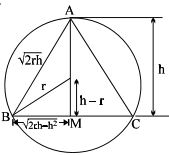
0 likes
View Solution132
AdvancedMCQ
$\mathop {Limit}\limits_{x \to \frac{\pi }{2}} \,\frac{{\sin x}}{{{{\cos }^{ - 1}}\left[ {\frac{1}{4}\,(3\sin x\, - \,\sin 3x)} \right]}}\,$,जहाँ $[ \cdot ]$ महत्तम पूर्णांक फलन को दर्शाता है,का मान है
A
$\frac{2}{\pi }$
B
$1$
C
$\frac{4}{\pi }$
D
अस्तित्व में नहीं है
Solution
(A) हम जानते हैं कि $\sin(3x) = 3\sin x - 4\sin^3 x$.
अतः,$\frac{1}{4}(3\sin x - \sin 3x) = \sin^3 x$.
व्यंजक $\mathop {Limit}\limits_{x \to \frac{\pi }{2}} \frac{\sin x}{\cos^{-1}[\sin^3 x]}$ हो जाता है।
जैसे $x \to \frac{\pi}{2}$,$\sin x \to 1$,इसलिए $\sin^3 x \to 1$.
चूंकि $x < \frac{\pi}{2}$ के लिए $\sin^3 x < 1$,इसलिए महत्तम पूर्णांक $[\sin^3 x] = 0$ है।
अतः,सीमा $\mathop {Limit}\limits_{x \to \frac{\pi}{2}^-} \frac{\sin x}{\cos^{-1}(0)} = \frac{1}{\frac{\pi}{2}} = \frac{2}{\pi}$ प्राप्त होती है।
$x > \frac{\pi}{2}$ के लिए,$\sin x < 1$,इसलिए $\sin^3 x < 1$,और $[\sin^3 x] = 0$ है।
दोनों तरफ से सीमा $\frac{2}{\pi}$ है।
अतः,$\frac{1}{4}(3\sin x - \sin 3x) = \sin^3 x$.
व्यंजक $\mathop {Limit}\limits_{x \to \frac{\pi }{2}} \frac{\sin x}{\cos^{-1}[\sin^3 x]}$ हो जाता है।
जैसे $x \to \frac{\pi}{2}$,$\sin x \to 1$,इसलिए $\sin^3 x \to 1$.
चूंकि $x < \frac{\pi}{2}$ के लिए $\sin^3 x < 1$,इसलिए महत्तम पूर्णांक $[\sin^3 x] = 0$ है।
अतः,सीमा $\mathop {Limit}\limits_{x \to \frac{\pi}{2}^-} \frac{\sin x}{\cos^{-1}(0)} = \frac{1}{\frac{\pi}{2}} = \frac{2}{\pi}$ प्राप्त होती है।
$x > \frac{\pi}{2}$ के लिए,$\sin x < 1$,इसलिए $\sin^3 x < 1$,और $[\sin^3 x] = 0$ है।
दोनों तरफ से सीमा $\frac{2}{\pi}$ है।
0 likes
View Solution133
AdvancedMCQ
यदि $\mathop {Lim}\limits_{x \to 0} \frac{\ln(3 + x) - \ln(3 - x)}{x} = k$ है,तो $k$ का मान है
A
$\frac{2}{3}$
B
$-\frac{1}{3}$
C
$-\frac{2}{3}$
D
$0$
Solution
(A) दिया गया सीमा: $\mathop {Lim}\limits_{x \to 0} \frac{\ln(3 + x) - \ln(3 - x)}{x}$
$\ln(a) - \ln(b) = \ln(\frac{a}{b})$ गुणधर्म का उपयोग करने पर:
$\mathop {Lim}\limits_{x \to 0} \frac{\ln(\frac{3+x}{3-x})}{x}$
मानक सीमा $\mathop {Lim}\limits_{u \to 0} \frac{\ln(1+u)}{u} = 1$ का उपयोग करने पर:
$\mathop {Lim}\limits_{x \to 0} \frac{\ln(1 + \frac{x}{3}) - \ln(1 - \frac{x}{3})}{x}$
$= \mathop {Lim}\limits_{x \to 0} \left[ \frac{\ln(1 + \frac{x}{3})}{x} - \frac{\ln(1 - \frac{x}{3})}{x} \right]$
$= \frac{1}{3} + \frac{1}{3} = \frac{2}{3}$
अतः,$k = \frac{2}{3}$.
$\ln(a) - \ln(b) = \ln(\frac{a}{b})$ गुणधर्म का उपयोग करने पर:
$\mathop {Lim}\limits_{x \to 0} \frac{\ln(\frac{3+x}{3-x})}{x}$
मानक सीमा $\mathop {Lim}\limits_{u \to 0} \frac{\ln(1+u)}{u} = 1$ का उपयोग करने पर:
$\mathop {Lim}\limits_{x \to 0} \frac{\ln(1 + \frac{x}{3}) - \ln(1 - \frac{x}{3})}{x}$
$= \mathop {Lim}\limits_{x \to 0} \left[ \frac{\ln(1 + \frac{x}{3})}{x} - \frac{\ln(1 - \frac{x}{3})}{x} \right]$
$= \frac{1}{3} + \frac{1}{3} = \frac{2}{3}$
अतः,$k = \frac{2}{3}$.
0 likes
View Solution134
AdvancedMCQ
फलन $f(x) = \lim_{n \to \infty} \frac{x^{2n} - 1}{x^{2n} + 1}$ निम्नलिखित में से किस फलन के समान है?
A
$g(x) = \text{sgn}(x - 1)$
B
$h(x) = \text{sgn}(\tan^{-1}x)$
C
$u(x) = \text{sgn}(|x| - 1)$
D
$v(x) = \text{sgn}(\cot^{-1}x)$
Solution
(C) $f(x) = \lim_{n \to \infty} \frac{x^{2n} - 1}{x^{2n} + 1}$ का मूल्यांकन करने पर:
स्थिति $1$: यदि $|x| < 1$,तो $n \to \infty$ के लिए $x^{2n} \to 0$। अतः,$f(x) = \frac{0 - 1}{0 + 1} = -1$।
स्थिति $2$: यदि $|x| > 1$,तो अंश और हर को $x^{2n}$ से विभाजित करने पर,$f(x) = \lim_{n \to \infty} \frac{1 - 1/x^{2n}}{1 + 1/x^{2n}} = \frac{1 - 0}{1 + 0} = 1$।
स्थिति $3$: यदि $x = 1$,तो $f(1) = 0$। यदि $x = -1$,तो $f(-1) = 0$।
अतः,$|x| < 1$ के लिए $f(x) = -1$,$|x| = 1$ के लिए $f(x) = 0$,और $|x| > 1$ के लिए $f(x) = 1$।
अब,$u(x) = \text{sgn}(|x| - 1)$ की जाँच करने पर,यह $f(x)$ के समान है।
स्थिति $1$: यदि $|x| < 1$,तो $n \to \infty$ के लिए $x^{2n} \to 0$। अतः,$f(x) = \frac{0 - 1}{0 + 1} = -1$।
स्थिति $2$: यदि $|x| > 1$,तो अंश और हर को $x^{2n}$ से विभाजित करने पर,$f(x) = \lim_{n \to \infty} \frac{1 - 1/x^{2n}}{1 + 1/x^{2n}} = \frac{1 - 0}{1 + 0} = 1$।
स्थिति $3$: यदि $x = 1$,तो $f(1) = 0$। यदि $x = -1$,तो $f(-1) = 0$।
अतः,$|x| < 1$ के लिए $f(x) = -1$,$|x| = 1$ के लिए $f(x) = 0$,और $|x| > 1$ के लिए $f(x) = 1$।
अब,$u(x) = \text{sgn}(|x| - 1)$ की जाँच करने पर,यह $f(x)$ के समान है।
0 likes
View Solution135
AdvancedMCQ
जब $x \to \frac{\pi}{4}$ हो,तो फलन $f(x) = \frac{2\sqrt{2} - (\cos x + \sin x)^3}{1 - \sin 2x}$ का सीमांत मान क्या है?
A
$\sqrt{2}$
B
$\frac{1}{\sqrt{2}}$
C
$3\sqrt{2}$
D
$\frac{3}{\sqrt{2}}$
Solution
(D) माना $x = \frac{\pi}{4} + h$. जब $x \to \frac{\pi}{4}$,तब $h \to 0$.
अतः $\cos x + \sin x = \sqrt{2} \cos h$ और $1 - \sin 2x = 2 \sin^2 h$.
सीमा $\lim_{h \to 0} \frac{2\sqrt{2}(1 - \cos^3 h)}{2 \sin^2 h} = \sqrt{2} \lim_{h \to 0} \frac{(1 - \cos h)(1 + \cos h + \cos^2 h)}{\sin^2 h}$ हो जाती है।
$\lim_{h \to 0} \frac{1 - \cos h}{\sin^2 h} = \frac{1}{2}$ का उपयोग करने पर,
उत्तर $\sqrt{2} \times \frac{1}{2} \times 3 = \frac{3}{\sqrt{2}}$ प्राप्त होता है।
अतः $\cos x + \sin x = \sqrt{2} \cos h$ और $1 - \sin 2x = 2 \sin^2 h$.
सीमा $\lim_{h \to 0} \frac{2\sqrt{2}(1 - \cos^3 h)}{2 \sin^2 h} = \sqrt{2} \lim_{h \to 0} \frac{(1 - \cos h)(1 + \cos h + \cos^2 h)}{\sin^2 h}$ हो जाती है।
$\lim_{h \to 0} \frac{1 - \cos h}{\sin^2 h} = \frac{1}{2}$ का उपयोग करने पर,
उत्तर $\sqrt{2} \times \frac{1}{2} \times 3 = \frac{3}{\sqrt{2}}$ प्राप्त होता है।
0 likes
View Solution136
AdvancedMCQ
$\mathop {\text{Lim}}\limits_{x \to 8} \,\,\frac{{\sin \{ x - 10\} }}{{\{ 10 - x\} }}$ के लिए (जहाँ $\{ \}$ भिन्नात्मक भाग फलन को दर्शाता है),सीमा का अस्तित्व निर्धारित करें।
A
$LHL$ का अस्तित्व है लेकिन $RHL$ का नहीं।
B
$RHL$ का अस्तित्व है लेकिन $LHL$ का नहीं।
C
$LHL$ और $RHL$ दोनों का अस्तित्व नहीं है।
D
$RHL$ और $LHL$ दोनों का अस्तित्व है और वे $1$ के बराबर हैं।
Solution
(B) माना $f(x) = \frac{\sin \{x - 10\}}{\{10 - x\}}$. चूँकि $\{x - 10\} = \{x\}$ और $\{10 - x\} = 1 - \{x\}$ जब $x \notin \mathbb{Z}$,व्यंजक $\frac{\sin \{x\}}{1 - \{x\}}$ बन जाता है।
$RHL$ के लिए: $\mathop {\text{Lim}}\limits_{x \to 8^+} \{x\} = 0$,इसलिए $\mathop {\text{Lim}}\limits_{x \to 8^+} \frac{\sin \{x\}}{1 - \{x\}} = \frac{\sin(0)}{1 - 0} = 0$. अतः,$RHL$ का अस्तित्व है।
$LHL$ के लिए: $\mathop {\text{Lim}}\limits_{x \to 8^-} \{x\} = 1$,इसलिए $\mathop {\text{Lim}}\limits_{x \to 8^-} \frac{\sin \{x\}}{1 - \{x\}} = \frac{\sin(1)}{0^+}$,जो $\infty$ की ओर अग्रसर है। अतः,$LHL$ का अस्तित्व नहीं है।
$RHL$ के लिए: $\mathop {\text{Lim}}\limits_{x \to 8^+} \{x\} = 0$,इसलिए $\mathop {\text{Lim}}\limits_{x \to 8^+} \frac{\sin \{x\}}{1 - \{x\}} = \frac{\sin(0)}{1 - 0} = 0$. अतः,$RHL$ का अस्तित्व है।
$LHL$ के लिए: $\mathop {\text{Lim}}\limits_{x \to 8^-} \{x\} = 1$,इसलिए $\mathop {\text{Lim}}\limits_{x \to 8^-} \frac{\sin \{x\}}{1 - \{x\}} = \frac{\sin(1)}{0^+}$,जो $\infty$ की ओर अग्रसर है। अतः,$LHL$ का अस्तित्व नहीं है।
0 likes
View Solution137
AdvancedMCQ
$\mathop {Lim}\limits_{n \to \infty } \frac{{{1^2}n + {2^2}(n - 1) + {3^2}(n - 2) + \dots + {n^2} \cdot 1}}{{{1^3} + {2^3} + {3^3} + \dots + {n^3}}}$ का मान ज्ञात कीजिए :
A
$\frac{1}{3}$
B
$\frac{2}{3}$
C
$\frac{1}{2}$
D
$\frac{1}{6}$
Solution
(A) माना अंश $S_n = \sum_{k=1}^{n} k^2(n - k + 1)$ है।
$S_n = (n+1) \sum_{k=1}^{n} k^2 - \sum_{k=1}^{n} k^3$।
हम जानते हैं कि $\sum_{k=1}^{n} k^2 = \frac{n(n+1)(2n+1)}{6}$ और $\sum_{k=1}^{n} k^3 = \frac{n^2(n+1)^2}{4}$।
हर $D_n = \sum_{k=1}^{n} k^3 = \frac{n^2(n+1)^2}{4}$ है।
अतः,सीमा $\lim_{n \to \infty} \frac{(n+1) \frac{n(n+1)(2n+1)}{6} - \frac{n^2(n+1)^2}{4}}{\frac{n^2(n+1)^2}{4}}$ होगी।
$\frac{n^2(n+1)^2}{4}$ से विभाजित करने पर:
$= \lim_{n \to \infty} \left( \frac{(n+1) n(n+1)(2n+1)}{6} \cdot \frac{4}{n^2(n+1)^2} - 1 \right)$।
$= \lim_{n \to \infty} \left( \frac{4n(n+1)^2(2n+1)}{6n^2(n+1)^2} - 1 \right)$।
$= \lim_{n \to \infty} \left( \frac{4(2n+1)}{6n} - 1 \right) = \frac{8}{6} - 1 = \frac{4}{3} - 1 = \frac{1}{3}$।
$S_n = (n+1) \sum_{k=1}^{n} k^2 - \sum_{k=1}^{n} k^3$।
हम जानते हैं कि $\sum_{k=1}^{n} k^2 = \frac{n(n+1)(2n+1)}{6}$ और $\sum_{k=1}^{n} k^3 = \frac{n^2(n+1)^2}{4}$।
हर $D_n = \sum_{k=1}^{n} k^3 = \frac{n^2(n+1)^2}{4}$ है।
अतः,सीमा $\lim_{n \to \infty} \frac{(n+1) \frac{n(n+1)(2n+1)}{6} - \frac{n^2(n+1)^2}{4}}{\frac{n^2(n+1)^2}{4}}$ होगी।
$\frac{n^2(n+1)^2}{4}$ से विभाजित करने पर:
$= \lim_{n \to \infty} \left( \frac{(n+1) n(n+1)(2n+1)}{6} \cdot \frac{4}{n^2(n+1)^2} - 1 \right)$।
$= \lim_{n \to \infty} \left( \frac{4n(n+1)^2(2n+1)}{6n^2(n+1)^2} - 1 \right)$।
$= \lim_{n \to \infty} \left( \frac{4(2n+1)}{6n} - 1 \right) = \frac{8}{6} - 1 = \frac{4}{3} - 1 = \frac{1}{3}$।
0 likes
View Solution138
AdvancedMCQ
$a > 1$ के लिए $\mathop {\text{Limit}}\limits_{x \to \infty } \frac{{\cot ^{ - 1}}\left( {{x^{ - a}}\log _a x} \right)}{{\sec ^{ - 1}}\left( {{a^x}\log _x a} \right)}$ का मान ज्ञात कीजिए।
A
$1$
B
$0$
C
$\pi / 2$
D
अस्तित्व में नहीं है
Solution
(A) माना कि दिया गया सीमा $L = \mathop {\text{Limit}}\limits_{x \to \infty } \frac{{\cot ^{ - 1}}\left( \frac{\log _a x}{x^a} \right)}{{\sec ^{ - 1}}\left( \frac{a^x}{\log _a x} \right)}$ है।
जैसे $x \to \infty$,$\frac{\log _a x}{x^a} \to 0$ होता है क्योंकि $a > 1$ के लिए घातांकीय वृद्धि लघुगणकीय वृद्धि से अधिक होती है।
अतः,अंश $\cot ^{ - 1}(0) = \pi / 2$ की ओर अग्रसर होता है।
जैसे $x \to \infty$,$\frac{a^x}{\log _a x} \to \infty$ होता है।
अतः,हर $\sec ^{ - 1}(\infty) = \pi / 2$ की ओर अग्रसर होता है।
इसलिए,$L = \frac{\pi / 2}{\pi / 2} = 1$.
जैसे $x \to \infty$,$\frac{\log _a x}{x^a} \to 0$ होता है क्योंकि $a > 1$ के लिए घातांकीय वृद्धि लघुगणकीय वृद्धि से अधिक होती है।
अतः,अंश $\cot ^{ - 1}(0) = \pi / 2$ की ओर अग्रसर होता है।
जैसे $x \to \infty$,$\frac{a^x}{\log _a x} \to \infty$ होता है।
अतः,हर $\sec ^{ - 1}(\infty) = \pi / 2$ की ओर अग्रसर होता है।
इसलिए,$L = \frac{\pi / 2}{\pi / 2} = 1$.
0 likes
View Solution139
AdvancedMCQ
फलन $f(x) = \lim_{n \to \infty} \frac{1}{1 + n \sin^2(\pi x)}$ के लिए,निम्नलिखित में से कौन सा सत्य है?
A
$f$ का परिसर एक एकल समुच्चय है
B
$f$,$\mathbb{R}$ पर सतत है
C
$f$,सभी $x \in \mathbb{Z}$ के लिए असतत है
D
$f$,कुछ $x \in \mathbb{R}$ के लिए असतत है
Solution
(C) स्थिति $1$: यदि $x \in \mathbb{Z}$ है,तो $\sin(\pi x) = 0$ होता है।
अतः,$f(x) = \lim_{n \to \infty} \frac{1}{1 + n(0)} = 1$।
स्थिति $2$: यदि $x \notin \mathbb{Z}$ है,तो $\sin^2(\pi x) > 0$ होता है।
जैसे $n \to \infty$,$n \sin^2(\pi x) \to \infty$ होता है।
अतः,$f(x) = \lim_{n \to \infty} \frac{1}{1 + n \sin^2(\pi x)} = 0$।
इसलिए,$f(x) = \begin{cases} 1, & x \in \mathbb{Z} \\ 0, & x \notin \mathbb{Z} \end{cases}$।
चूंकि फलन प्रत्येक पूर्णांक मान पर $0$ और $1$ के बीच कूदता है,इसलिए $f$ सभी $x \in \mathbb{Z}$ के लिए असतत है।
अतः,$f(x) = \lim_{n \to \infty} \frac{1}{1 + n(0)} = 1$।
स्थिति $2$: यदि $x \notin \mathbb{Z}$ है,तो $\sin^2(\pi x) > 0$ होता है।
जैसे $n \to \infty$,$n \sin^2(\pi x) \to \infty$ होता है।
अतः,$f(x) = \lim_{n \to \infty} \frac{1}{1 + n \sin^2(\pi x)} = 0$।
इसलिए,$f(x) = \begin{cases} 1, & x \in \mathbb{Z} \\ 0, & x \notin \mathbb{Z} \end{cases}$।
चूंकि फलन प्रत्येक पूर्णांक मान पर $0$ और $1$ के बीच कूदता है,इसलिए $f$ सभी $x \in \mathbb{Z}$ के लिए असतत है।
0 likes
View Solution140
AdvancedMCQ
यदि $f(x) = \cos x$ जब $x = n\pi$ $(n = 0, 1, 2, 3, \dots)$ और अन्यथा $f(x) = 3$,तथा $\phi(x) = \begin{cases} x^2 + 1 & \text{जब } x \neq 3, x \neq 0 \\ 3 & \text{जब } x = 0 \\ 5 & \text{जब } x = 3 \end{cases}$ है,तो $\lim_{x \to 0} f(\phi(x))$ ज्ञात कीजिए।
A
$1$
B
$3$
C
$5$
D
इनमें से कोई नहीं
Solution
(B) हमें $\lim_{x \to 0} f(\phi(x))$ ज्ञात करना है।
सबसे पहले,हम $\lim_{x \to 0} \phi(x)$ का मान ज्ञात करते हैं।
$x \neq 0$ और $x \neq 3$ के लिए,$\phi(x) = x^2 + 1$ है।
जैसे-जैसे $x \to 0$,$\phi(x) \to 0^2 + 1 = 1$ होता है।
चूंकि $x \to 0$ होने पर $\phi(x)$ का मान $1$ के निकट जाता है (और $1 \neq 0, 1 \neq 3$),इसलिए हम $1$ के निकट $f(x)$ की परिभाषा देखते हैं।
चूंकि $1$ किसी भी पूर्णांक $n \geq 0$ के लिए $n\pi$ के रूप में नहीं है,इसलिए $1$ के निकट मानों के लिए $f(x) = 3$ है।
अतः,$\lim_{x \to 0} f(\phi(x)) = f(1) = 3$।
सबसे पहले,हम $\lim_{x \to 0} \phi(x)$ का मान ज्ञात करते हैं।
$x \neq 0$ और $x \neq 3$ के लिए,$\phi(x) = x^2 + 1$ है।
जैसे-जैसे $x \to 0$,$\phi(x) \to 0^2 + 1 = 1$ होता है।
चूंकि $x \to 0$ होने पर $\phi(x)$ का मान $1$ के निकट जाता है (और $1 \neq 0, 1 \neq 3$),इसलिए हम $1$ के निकट $f(x)$ की परिभाषा देखते हैं।
चूंकि $1$ किसी भी पूर्णांक $n \geq 0$ के लिए $n\pi$ के रूप में नहीं है,इसलिए $1$ के निकट मानों के लिए $f(x) = 3$ है।
अतः,$\lim_{x \to 0} f(\phi(x)) = f(1) = 3$।
0 likes
View Solution141
AdvancedMCQ
यदि $\mathop {Lim}\limits_{x \to {0^ - }} \sin^{-1}([\tan x])$ $= l$ है,तो $\{l\}$ का मान ज्ञात कीजिए,जहाँ $[\cdot]$ और $\{\cdot\}$ क्रमशः महत्तम पूर्णांक और भिन्नात्मक भाग फलन को दर्शाते हैं।
A
$0$
B
$1 - \frac{\pi}{2}$
C
$\frac{\pi}{2} - 1$
D
$2 - \frac{\pi}{2}$
Solution
(D) जैसे $x \to 0^-$,$\tan x$ ऋणात्मक दिशा से $0$ की ओर अग्रसर होता है,अर्थात $-1 < \tan x < 0$।
इसलिए,$[\tan x] = -1$।
सीमा में यह मान रखने पर:
$\mathop {Lim}\limits_{x \to {0^ - }} \sin^{-1}([\tan x]) = \sin^{-1}(-1) = -\frac{\pi}{2}$।
अतः,$l = -\frac{\pi}{2}$।
हमें $\{l\} = \{-\frac{\pi}{2}\}$ ज्ञात करना है।
गुणधर्म $\{x\} = x - [x]$ का उपयोग करते हुए,$\{ -\frac{\pi}{2} \} = -\frac{\pi}{2} - [-\frac{\pi}{2}]$।
चूंकि $-1.57 < -\frac{\pi}{2} < -1$,इसलिए महत्तम पूर्णांक $[-\frac{\pi}{2}] = -2$।
अतः,$\{ -\frac{\pi}{2} \} = -\frac{\pi}{2} - (-2) = 2 - \frac{\pi}{2}$।
इसलिए,$[\tan x] = -1$।
सीमा में यह मान रखने पर:
$\mathop {Lim}\limits_{x \to {0^ - }} \sin^{-1}([\tan x]) = \sin^{-1}(-1) = -\frac{\pi}{2}$।
अतः,$l = -\frac{\pi}{2}$।
हमें $\{l\} = \{-\frac{\pi}{2}\}$ ज्ञात करना है।
गुणधर्म $\{x\} = x - [x]$ का उपयोग करते हुए,$\{ -\frac{\pi}{2} \} = -\frac{\pi}{2} - [-\frac{\pi}{2}]$।
चूंकि $-1.57 < -\frac{\pi}{2} < -1$,इसलिए महत्तम पूर्णांक $[-\frac{\pi}{2}] = -2$।
अतः,$\{ -\frac{\pi}{2} \} = -\frac{\pi}{2} - (-2) = 2 - \frac{\pi}{2}$।
0 likes
View Solution142
AdvancedMCQ
माना कि $f(x) = \frac{\ln(x^2 + e^x)}{\ln(x^4 + e^{2x})}$. यदि $\lim_{x \to \infty} f(x) = l$ और $\lim_{x \to -\infty} f(x) = m$ है,तो:
A
$l = m$
B
$l = 2m$
C
$2l = m$
D
$l + m = 0$
Solution
(A) $x \to \infty$ के लिए,$f(x) = \frac{\ln(e^x(1 + x^2/e^x))}{\ln(e^{2x}(1 + x^4/e^{2x}))} = \frac{x + \ln(1 + x^2/e^x)}{2x + \ln(1 + x^4/e^{2x})}$.
अंश और हर को $x$ से विभाजित करने पर,$\lim_{x \to \infty} f(x) = \frac{1 + 0}{2 + 0} = \frac{1}{2}$,इसलिए $l = 1/2$.
$x \to -\infty$ के लिए,$t = -x$ लें,जिससे $t \to \infty$ हो। तब $f(-t) = \frac{\ln(t^2 + e^{-t})}{\ln(t^4 + e^{-2t})}$.
जैसे $t \to \infty$,$e^{-t} \to 0$ और $e^{-2t} \to 0$.
अतः,$m = \lim_{t \to \infty} \frac{\ln(t^2)}{\ln(t^4)} = \lim_{t \to \infty} \frac{2 \ln(t)}{4 \ln(t)} = \frac{2}{4} = \frac{1}{2}$.
चूँकि $l = 1/2$ और $m = 1/2$,इसलिए $l = m$।
अंश और हर को $x$ से विभाजित करने पर,$\lim_{x \to \infty} f(x) = \frac{1 + 0}{2 + 0} = \frac{1}{2}$,इसलिए $l = 1/2$.
$x \to -\infty$ के लिए,$t = -x$ लें,जिससे $t \to \infty$ हो। तब $f(-t) = \frac{\ln(t^2 + e^{-t})}{\ln(t^4 + e^{-2t})}$.
जैसे $t \to \infty$,$e^{-t} \to 0$ और $e^{-2t} \to 0$.
अतः,$m = \lim_{t \to \infty} \frac{\ln(t^2)}{\ln(t^4)} = \lim_{t \to \infty} \frac{2 \ln(t)}{4 \ln(t)} = \frac{2}{4} = \frac{1}{2}$.
चूँकि $l = 1/2$ और $m = 1/2$,इसलिए $l = m$।
0 likes
View Solution143
AdvancedMCQ
जब $n$ एक पूर्णांक है,तो $\mathop {Lim}\limits_{n \to \infty } \cos \left( {\pi \sqrt {{n^2} + n} } \right)$ का मान ज्ञात कीजिए:
A
$1$ के बराबर है
B
$-1$ के बराबर है
C
$0$ के बराबर है
D
अस्तित्व में नहीं है
Solution
(C) हमें $L = \mathop {Lim}\limits_{n \to \infty } \cos \left( {\pi \sqrt {{n^2} + n} } \right)$ का मान ज्ञात करना है।
चूंकि $n$ एक पूर्णांक है,हम लिख सकते हैं $\cos \left( {\pi \sqrt {{n^2} + n} } \right) = \cos \left( {n\pi - n\pi + \pi \sqrt {{n^2} + n} } \right) = \cos \left( {n\pi - \pi \left( {n - \sqrt {{n^2} + n} } \right)} \right)$.
सर्वसमिका $\cos(n\pi - \theta) = (-1)^n \cos(\theta)$ का उपयोग करते हुए,$L = \mathop {Lim}\limits_{n \to \infty } (-1)^n \cos \left( {\pi \left( {n - \sqrt {{n^2} + n} } \right)} \right)$.
अब,कोसाइन फलन के अंदर के पद का परिमेयकरण करने पर:
$n - \sqrt {{n^2} + n} = \frac{{(n - \sqrt {{n^2} + n} )(n + \sqrt {{n^2} + n} )}}{{n + \sqrt {{n^2} + n} }} = \frac{{{n^2} - ({n^2} + n)}}{{n + \sqrt {{n^2} + n} }} = \frac{{ - n}}{{n + n\sqrt {1 + 1/n} }} = \frac{{ - 1}}{{1 + \sqrt {1 + 1/n} }}$.
जैसे $n \to \infty$,यह पद $\frac{{ - 1}}{{1 + 1}} = -1/2$ की ओर अग्रसर होता है।
अतः,$L = \mathop {Lim}\limits_{n \to \infty } (-1)^n \cos \left( {\pi \left( -\frac{1}{2} \right)} \right) = \mathop {Lim}\limits_{n \to \infty } (-1)^n \cos \left( -\frac{\pi}{2} \right) = \mathop {Lim}\limits_{n \to \infty } (-1)^n \cdot 0 = 0$.
चूंकि $n$ एक पूर्णांक है,हम लिख सकते हैं $\cos \left( {\pi \sqrt {{n^2} + n} } \right) = \cos \left( {n\pi - n\pi + \pi \sqrt {{n^2} + n} } \right) = \cos \left( {n\pi - \pi \left( {n - \sqrt {{n^2} + n} } \right)} \right)$.
सर्वसमिका $\cos(n\pi - \theta) = (-1)^n \cos(\theta)$ का उपयोग करते हुए,$L = \mathop {Lim}\limits_{n \to \infty } (-1)^n \cos \left( {\pi \left( {n - \sqrt {{n^2} + n} } \right)} \right)$.
अब,कोसाइन फलन के अंदर के पद का परिमेयकरण करने पर:
$n - \sqrt {{n^2} + n} = \frac{{(n - \sqrt {{n^2} + n} )(n + \sqrt {{n^2} + n} )}}{{n + \sqrt {{n^2} + n} }} = \frac{{{n^2} - ({n^2} + n)}}{{n + \sqrt {{n^2} + n} }} = \frac{{ - n}}{{n + n\sqrt {1 + 1/n} }} = \frac{{ - 1}}{{1 + \sqrt {1 + 1/n} }}$.
जैसे $n \to \infty$,यह पद $\frac{{ - 1}}{{1 + 1}} = -1/2$ की ओर अग्रसर होता है।
अतः,$L = \mathop {Lim}\limits_{n \to \infty } (-1)^n \cos \left( {\pi \left( -\frac{1}{2} \right)} \right) = \mathop {Lim}\limits_{n \to \infty } (-1)^n \cos \left( -\frac{\pi}{2} \right) = \mathop {Lim}\limits_{n \to \infty } (-1)^n \cdot 0 = 0$.
0 likes
View Solution144
AdvancedMCQ
$\lim \limits _{x \to 0} \frac{{{{(\sin x - \tan x)}^2} - {{(1 - \cos 2x)}^4} + {x^5}}}{{7\cdot{{({{\tan }^{ - 1}}x)}^7}\, + {{({{\sin }^{ - 1}}x)}^6}+ 3{{\sin }^5}x}}$ का मान ज्ञात कीजिए।
A
$0$
B
$1/7$
C
$1/3$
D
$1$
Solution
(C) सीमा $L = \lim \limits _{x \to 0} \frac{{{{(\sin x - \tan x)}^2} - {{(1 - \cos 2x)}^4} + {x^5}}}{{7\cdot{{({{\tan }^{ - 1}}x)}^7}\, + {{({{\sin }^{ - 1}}x)}^6}+ 3{{\sin }^5}x}}$ का मूल्यांकन करने के लिए,हम $x \to 0$ पर प्रमुख पदों का विश्लेषण करते हैं।
अंश:
$(\sin x - \tan x)^2 \approx \frac{x^6}{4}$.
$(1 - \cos 2x)^4 \approx 16x^8$.
अतः,अंश $x^5$ के बराबर है।
हर:
$7(\tan^{-1} x)^7 + (\sin^{-1} x)^6 + 3(\sin x)^5 \approx 3x^5$.
इसलिए,सीमा $L = \lim \limits _{x \to 0} \frac{x^5}{3x^5} = \frac{1}{3}$.
अंश:
$(\sin x - \tan x)^2 \approx \frac{x^6}{4}$.
$(1 - \cos 2x)^4 \approx 16x^8$.
अतः,अंश $x^5$ के बराबर है।
हर:
$7(\tan^{-1} x)^7 + (\sin^{-1} x)^6 + 3(\sin x)^5 \approx 3x^5$.
इसलिए,सीमा $L = \lim \limits _{x \to 0} \frac{x^5}{3x^5} = \frac{1}{3}$.
0 likes
View Solution145
AdvancedMCQ
मान लीजिए $l = \mathop {\lim}\limits_{x \to 0} \frac{[x]^2}{x^2}$ और $m = \mathop {\lim}\limits_{x \to 0} \frac{[x^2]}{x^2}$,जहाँ $[ \cdot ]$ महत्तम पूर्णांक फलन को दर्शाता है। तो:
A
$l$ का अस्तित्व है लेकिन $m$ का नहीं
B
$m$ का अस्तित्व है लेकिन $l$ का नहीं
C
$l$ और $m$ दोनों का अस्तित्व है
D
न तो $l$ और न ही $m$ का अस्तित्व है
Solution
(B) $l = \mathop {\lim}\limits_{x \to 0} \frac{[x]^2}{x^2}$ के लिए:
जब $x \to 0^+$,तब $[x] = 0$,इसलिए $\frac{[x]^2}{x^2} = 0$. अतः,$\mathop {\lim}\limits_{x \to 0^+} \frac{[x]^2}{x^2} = 0$.
जब $x \to 0^-$,तब $[x] = -1$,इसलिए $\frac{[x]^2}{x^2} = \frac{1}{x^2} \to \infty$. अतः,$l$ का अस्तित्व नहीं है।
$m = \mathop {\lim}\limits_{x \to 0} \frac{[x^2]}{x^2}$ के लिए:
जब $x \to 0$,तब $x^2$ शून्य के निकट एक धनात्मक मान है $(0 < x^2 < 1)$.
इसलिए,$0$ के पड़ोस में सभी $x \neq 0$ के लिए $[x^2] = 0$.
अतः,$\mathop {\lim}\limits_{x \to 0} \frac{0}{x^2} = 0$. इसलिए,$m$ का अस्तित्व है और $m = 0$.
निष्कर्ष: $m$ का अस्तित्व है लेकिन $l$ का नहीं।
जब $x \to 0^+$,तब $[x] = 0$,इसलिए $\frac{[x]^2}{x^2} = 0$. अतः,$\mathop {\lim}\limits_{x \to 0^+} \frac{[x]^2}{x^2} = 0$.
जब $x \to 0^-$,तब $[x] = -1$,इसलिए $\frac{[x]^2}{x^2} = \frac{1}{x^2} \to \infty$. अतः,$l$ का अस्तित्व नहीं है।
$m = \mathop {\lim}\limits_{x \to 0} \frac{[x^2]}{x^2}$ के लिए:
जब $x \to 0$,तब $x^2$ शून्य के निकट एक धनात्मक मान है $(0 < x^2 < 1)$.
इसलिए,$0$ के पड़ोस में सभी $x \neq 0$ के लिए $[x^2] = 0$.
अतः,$\mathop {\lim}\limits_{x \to 0} \frac{0}{x^2} = 0$. इसलिए,$m$ का अस्तित्व है और $m = 0$.
निष्कर्ष: $m$ का अस्तित्व है लेकिन $l$ का नहीं।
0 likes
View Solution146
AdvancedMCQ
$\mathop {\text{Limit}}\limits_{x \to 0} \frac{\tan(\{x\} - 1) \sin\{x\}}{\{x\}(\{x\} - 1)}$ का मान ज्ञात कीजिए,जहाँ $\{x\}$ भिन्नात्मक भाग फलन को दर्शाता है:
A
$1$ है
B
$\tan 1$ है
C
$\sin 1$ है
D
अस्तित्वहीन है
Solution
(D) माना $f(x) = \frac{\tan(\{x\} - 1) \sin\{x\}}{\{x\}(\{x\} - 1)}$.
दाहिनी सीमा $(x \to 0^+)$ के लिए,$\{x\} = x$ जहाँ $x$ एक छोटा धनात्मक मान $h$ है:
$\mathop {\text{Limit}}\limits_{h \to 0^+} \frac{\tan(h - 1) \sin h}{h(h - 1)} = \frac{\tan(-1)}{-1} \times \mathop {\text{Limit}}\limits_{h \to 0^+} \frac{\sin h}{h} = \tan 1 \times 1 = \tan 1$.
बाईं सीमा $(x \to 0^-)$ के लिए,$\{x\} = 1 + x$ जहाँ $x$ एक छोटा ऋणात्मक मान $-h$ $(h > 0)$ है:
$\mathop {\text{Limit}}\limits_{h \to 0^+} \frac{\tan(1 - h - 1) \sin(1 - h)}{(1 - h)(1 - h - 1)} = \mathop {\text{Limit}}\limits_{h \to 0^+} \frac{\tan(-h) \sin(1 - h)}{(1 - h)(-h)} = \frac{\sin 1}{1} = \sin 1$.
चूंकि दाहिनी सीमा $(\tan 1)$ और बाईं सीमा $(\sin 1)$ समान नहीं हैं,इसलिए सीमा का अस्तित्व नहीं है।
दाहिनी सीमा $(x \to 0^+)$ के लिए,$\{x\} = x$ जहाँ $x$ एक छोटा धनात्मक मान $h$ है:
$\mathop {\text{Limit}}\limits_{h \to 0^+} \frac{\tan(h - 1) \sin h}{h(h - 1)} = \frac{\tan(-1)}{-1} \times \mathop {\text{Limit}}\limits_{h \to 0^+} \frac{\sin h}{h} = \tan 1 \times 1 = \tan 1$.
बाईं सीमा $(x \to 0^-)$ के लिए,$\{x\} = 1 + x$ जहाँ $x$ एक छोटा ऋणात्मक मान $-h$ $(h > 0)$ है:
$\mathop {\text{Limit}}\limits_{h \to 0^+} \frac{\tan(1 - h - 1) \sin(1 - h)}{(1 - h)(1 - h - 1)} = \mathop {\text{Limit}}\limits_{h \to 0^+} \frac{\tan(-h) \sin(1 - h)}{(1 - h)(-h)} = \frac{\sin 1}{1} = \sin 1$.
चूंकि दाहिनी सीमा $(\tan 1)$ और बाईं सीमा $(\sin 1)$ समान नहीं हैं,इसलिए सीमा का अस्तित्व नहीं है।
0 likes
View Solution147
AdvancedMCQ
$\mathop {Lim}\limits_{x \to \infty } \frac{2 + 2x + \sin 2x}{(2x + \sin 2x)e^{\sin x}}$ का मान है:
A
शून्य के बराबर
B
$1$ के बराबर
C
$-1$ के बराबर
D
अस्तित्वहीन
Solution
(D) हम सीमा का मूल्यांकन करते हैं: $\mathop {Lim}\limits_{x \to \infty } \frac{2 + 2x + \sin 2x}{(2x + \sin 2x)e^{\sin x}}$.
अंश और हर को $x$ से विभाजित करने पर:
$\mathop {Lim}\limits_{x \to \infty } \frac{\frac{2}{x} + 2 + \frac{\sin 2x}{x}}{(2 + \frac{\sin 2x}{x})e^{\sin x}}$.
जैसे $x \to \infty$,$\frac{2}{x} \to 0$ और $\frac{\sin 2x}{x} \to 0$.
व्यंजक $\mathop {Lim}\limits_{x \to \infty } \frac{2}{2e^{\sin x}} = \frac{1}{e^{\sin x}}$ में सरल हो जाता है।
चूंकि $x \to \infty$ होने पर $\sin x$,$-1$ और $1$ के बीच दोलन करता है,इसलिए $e^{\sin x}$ का मान $e^{-1}$ और $e^1$ के बीच दोलन करता है।
अतः,सीमा का अस्तित्व नहीं है।
अंश और हर को $x$ से विभाजित करने पर:
$\mathop {Lim}\limits_{x \to \infty } \frac{\frac{2}{x} + 2 + \frac{\sin 2x}{x}}{(2 + \frac{\sin 2x}{x})e^{\sin x}}$.
जैसे $x \to \infty$,$\frac{2}{x} \to 0$ और $\frac{\sin 2x}{x} \to 0$.
व्यंजक $\mathop {Lim}\limits_{x \to \infty } \frac{2}{2e^{\sin x}} = \frac{1}{e^{\sin x}}$ में सरल हो जाता है।
चूंकि $x \to \infty$ होने पर $\sin x$,$-1$ और $1$ के बीच दोलन करता है,इसलिए $e^{\sin x}$ का मान $e^{-1}$ और $e^1$ के बीच दोलन करता है।
अतः,सीमा का अस्तित्व नहीं है।
0 likes
View Solution148
AdvancedMCQ
$\mathop {Lim}\limits_{x \to c} f(x)$ का अस्तित्व नहीं है जब: (जहाँ $[x]$ महत्तम पूर्णांक फलन और $\{x\}$ भिन्नात्मक भाग फलन को दर्शाता है।)
A
$f(x) = [[x]] - [2x - 1], c = 3$
B
$f(x) = [x] - x, c = 1$
C
$f(x) = \{x\}^2 - \{-x\}^2, c = 0$
D
$(B)$ और $(C)$ दोनों
Solution
(D) विकल्प $A$: $f(x) = [[x]] - [2x - 1]$ जहाँ $c = 3$ है।
दायां सीमा: $\lim_{h \to 0} f(3+h) = \lim_{h \to 0} [[3+h]] - [2(3+h)-1] = 3 - 5 = -2$.
बायां सीमा: $\lim_{h \to 0} f(3-h) = \lim_{h \to 0} [[3-h]] - [2(3-h)-1] = 2 - 4 = -2$.
चूंकि $LHL = RHL$,सीमा का अस्तित्व है।
विकल्प $B$: $f(x) = [x] - x$ जहाँ $c = 1$ है।
दायां सीमा: $\lim_{h \to 0} f(1+h) = \lim_{h \to 0} [1+h] - (1+h) = 1 - 1 = 0$.
बायां सीमा: $\lim_{h \to 0} f(1-h) = \lim_{h \to 0} [1-h] - (1-h) = 0 - 1 = -1$.
चूंकि $LHL \neq RHL$,सीमा का अस्तित्व नहीं है।
विकल्प $C$: $f(x) = \{x\}^2 - \{-x\}^2$ जहाँ $c = 0$ है।
दायां सीमा: $\lim_{h \to 0} f(0+h) = \lim_{h \to 0} (h)^2 - (1-h)^2 = 0 - 1 = -1$.
बायां सीमा: $\lim_{h \to 0} f(0-h) = \lim_{h \to 0} (1-h)^2 - (h)^2 = 1 - 0 = 1$.
चूंकि $LHL \neq RHL$,सीमा का अस्तित्व नहीं है।
अतः,$(B)$ और $(C)$ दोनों सही हैं।
दायां सीमा: $\lim_{h \to 0} f(3+h) = \lim_{h \to 0} [[3+h]] - [2(3+h)-1] = 3 - 5 = -2$.
बायां सीमा: $\lim_{h \to 0} f(3-h) = \lim_{h \to 0} [[3-h]] - [2(3-h)-1] = 2 - 4 = -2$.
चूंकि $LHL = RHL$,सीमा का अस्तित्व है।
विकल्प $B$: $f(x) = [x] - x$ जहाँ $c = 1$ है।
दायां सीमा: $\lim_{h \to 0} f(1+h) = \lim_{h \to 0} [1+h] - (1+h) = 1 - 1 = 0$.
बायां सीमा: $\lim_{h \to 0} f(1-h) = \lim_{h \to 0} [1-h] - (1-h) = 0 - 1 = -1$.
चूंकि $LHL \neq RHL$,सीमा का अस्तित्व नहीं है।
विकल्प $C$: $f(x) = \{x\}^2 - \{-x\}^2$ जहाँ $c = 0$ है।
दायां सीमा: $\lim_{h \to 0} f(0+h) = \lim_{h \to 0} (h)^2 - (1-h)^2 = 0 - 1 = -1$.
बायां सीमा: $\lim_{h \to 0} f(0-h) = \lim_{h \to 0} (1-h)^2 - (h)^2 = 1 - 0 = 1$.
चूंकि $LHL \neq RHL$,सीमा का अस्तित्व नहीं है।
अतः,$(B)$ और $(C)$ दोनों सही हैं।
0 likes
View Solution149
AdvancedMCQ
मान लीजिए $f(x) = \frac{x \cdot 2^x - x}{1 - \cos x}$ और $g(x) = 2^x \sin \left( \frac{\ln 2}{2^x} \right)$,तो:
A
$\lim_{x \to 0} f(x) = \ln 2$
B
$\lim_{x \to \infty} g(x) = \ln 2$
C
$\lim_{x \to 0} f(x) = \ln 4$
D
$(B)$ और $(C)$ दोनों सही हैं
Solution
(D) $f(x) = \frac{x(2^x - 1)}{1 - \cos x} = \frac{x(2^x - 1)}{2 \sin^2(x/2)}$ के लिए।
जब $x \to 0$,तब $f(x) = \frac{x(2^x - 1)}{2 (x/2)^2} = \frac{x(2^x - 1)}{x^2/2} = 2 \frac{2^x - 1}{x}$।
मानक सीमा $\lim_{x \to 0} \frac{a^x - 1}{x} = \ln a$ का उपयोग करते हुए,हमें $\lim_{x \to 0} f(x) = 2 \ln 2 = \ln 4$ प्राप्त होता है।
अतः,विकल्प $(C)$ सही है।
$g(x) = 2^x \sin \left( \frac{\ln 2}{2^x} \right)$ के लिए,जब $x \to \infty$,तब $2^x \to \infty$,इसलिए $\frac{\ln 2}{2^x} \to 0$।
मान लीजिए $u = \frac{\ln 2}{2^x}$,तो $g(x) = \frac{\ln 2}{u} \sin(u) = \ln 2 \cdot \frac{\sin u}{u}$।
जब $x \to \infty$,तब $u \to 0$,इसलिए $\lim_{x \to \infty} g(x) = \ln 2 \cdot 1 = \ln 2$।
अतः,विकल्प $(B)$ सही है।
इसलिए,$(D)$ सही विकल्प है।
जब $x \to 0$,तब $f(x) = \frac{x(2^x - 1)}{2 (x/2)^2} = \frac{x(2^x - 1)}{x^2/2} = 2 \frac{2^x - 1}{x}$।
मानक सीमा $\lim_{x \to 0} \frac{a^x - 1}{x} = \ln a$ का उपयोग करते हुए,हमें $\lim_{x \to 0} f(x) = 2 \ln 2 = \ln 4$ प्राप्त होता है।
अतः,विकल्प $(C)$ सही है।
$g(x) = 2^x \sin \left( \frac{\ln 2}{2^x} \right)$ के लिए,जब $x \to \infty$,तब $2^x \to \infty$,इसलिए $\frac{\ln 2}{2^x} \to 0$।
मान लीजिए $u = \frac{\ln 2}{2^x}$,तो $g(x) = \frac{\ln 2}{u} \sin(u) = \ln 2 \cdot \frac{\sin u}{u}$।
जब $x \to \infty$,तब $u \to 0$,इसलिए $\lim_{x \to \infty} g(x) = \ln 2 \cdot 1 = \ln 2$।
अतः,विकल्प $(B)$ सही है।
इसलिए,$(D)$ सही विकल्प है।
0 likes
View SolutionLimits — Concept of limits, Evaluation of algebric limits · Frequently Asked Questions
1Are these Limits questions useful for JEE and NEET?
Yes. All questions in this section are mapped to JEE Main and NEET exam patterns. Previous year questions from JEE Main, NEET, GUJCET and state-level exams are included with full solutions.
2Can I switch to Hindi or Gujarati for these questions?
Yes. Use the language tabs in the hero section or the sidebar to view the same questions and solutions in English, Hindi or Gujarati.
3How do I generate a question paper from this subtopic?
Use the Vedclass Exam Paper Generator — select the chapter and subtopic, set difficulty, and generate Sets A, B, C, D automatically. First 3 chapters of every subject are free.
Vedclass Products
For Students
Vedclass Test Series
Mock tests in real JEE/NEET style with performance analysis. 5-day free trial.
Start Free TrialFor Teachers
Exam Paper Generator
Generate Set A/B/C/D papers from this chapter in 2 minutes. 3 chapters free.
Try FreeFor Institutes
Online Exam Module
Live online exams with unlimited students, 360° analytics & white-label branding.
See DemoFor Teachers & Institutes
Generate a Limits Exam Paper in 2 Minutes
Select subtopic & difficulty — Sets A, B, C, D auto-generated with No Repeat logic.
First 3 chapters of every subject are free — no payment required.