
PhysicsQ251–350 of 690 questions
Page 6 of 8 · English
251
PhysicsMediumMCQMHT CET · 2020
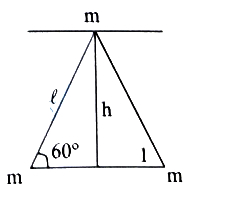
Three point masses,each of mass $m$,are placed at the corners of an equilateral triangle of side $\ell$. The moment of inertia of the system about an axis passing through one of the vertices and parallel to the side joining the other two vertices is:
A
$\frac{3}{2} m \ell^{2}$
B
$\frac{3}{4} m \ell^{2}$
C
$\frac{1}{2} m \ell^{2}$
D
$\frac{1}{4} m \ell^{2}$
Solution
(A) Let the vertices of the equilateral triangle be $A$,$B$,and $C$. Let the axis pass through vertex $A$ and be parallel to the side $BC$.
The mass at vertex $A$ lies on the axis,so its perpendicular distance from the axis is $0$. Its contribution to the moment of inertia is $m(0)^2 = 0$.
The masses at vertices $B$ and $C$ are at a perpendicular distance $h$ from the axis,where $h$ is the altitude of the equilateral triangle.
The altitude $h$ is given by $h = \ell \sin 60^{\circ} = \ell \times \frac{\sqrt{3}}{2}$.
The moment of inertia $I$ of the system is the sum of the moments of inertia of the individual masses:
$I = m(0)^2 + m(h)^2 + m(h)^2 = 2mh^2$.
Substituting the value of $h$:
$I = 2m \left( \ell \times \frac{\sqrt{3}}{2} \right)^2 = 2m \left( \frac{3}{4} \ell^2 \right) = \frac{3}{2} m \ell^2$.
The mass at vertex $A$ lies on the axis,so its perpendicular distance from the axis is $0$. Its contribution to the moment of inertia is $m(0)^2 = 0$.
The masses at vertices $B$ and $C$ are at a perpendicular distance $h$ from the axis,where $h$ is the altitude of the equilateral triangle.
The altitude $h$ is given by $h = \ell \sin 60^{\circ} = \ell \times \frac{\sqrt{3}}{2}$.
The moment of inertia $I$ of the system is the sum of the moments of inertia of the individual masses:
$I = m(0)^2 + m(h)^2 + m(h)^2 = 2mh^2$.
Substituting the value of $h$:
$I = 2m \left( \ell \times \frac{\sqrt{3}}{2} \right)^2 = 2m \left( \frac{3}{4} \ell^2 \right) = \frac{3}{2} m \ell^2$.
0 likesView Solution
252
PhysicsMediumMCQMHT CET · 2020
Two circular loops $A$ and $B$ of radii $R$ and $NR$ respectively are made from a uniform wire. The moment of inertia of $B$ about its axis is $3$ times that of $A$ about its axis. The value of $N$ is:
A
$[5]^{1/3}$
B
$[3]^{1/3}$
C
$[4]^{1/3}$
D
$[2]^{1/3}$
Solution
(B) Let $m$ be the mass per unit length of the wire.
The mass of loop $A$ is $M_A = (2 \pi R)m$.
The mass of loop $B$ is $M_B = (2 \pi NR)m$.
Thus,the ratio of masses is $\frac{M_B}{M_A} = \frac{2 \pi NRm}{2 \pi Rm} = N$.
The moment of inertia of a circular loop about its central axis is $I = MR^2$.
Therefore,$I_A = M_A R^2$ and $I_B = M_B (NR)^2 = M_B N^2 R^2$.
Substituting $M_B = N M_A$,we get $I_B = (N M_A) N^2 R^2 = N^3 M_A R^2 = N^3 I_A$.
Given that $I_B = 3 I_A$,we have $N^3 = 3$.
Therefore,$N = (3)^{1/3}$.
The mass of loop $A$ is $M_A = (2 \pi R)m$.
The mass of loop $B$ is $M_B = (2 \pi NR)m$.
Thus,the ratio of masses is $\frac{M_B}{M_A} = \frac{2 \pi NRm}{2 \pi Rm} = N$.
The moment of inertia of a circular loop about its central axis is $I = MR^2$.
Therefore,$I_A = M_A R^2$ and $I_B = M_B (NR)^2 = M_B N^2 R^2$.
Substituting $M_B = N M_A$,we get $I_B = (N M_A) N^2 R^2 = N^3 M_A R^2 = N^3 I_A$.
Given that $I_B = 3 I_A$,we have $N^3 = 3$.
Therefore,$N = (3)^{1/3}$.
0 likesView Solution
253
PhysicsEasyMCQMHT CET · 2020
Two circular rings $A$ and $B$ of radii $nR$ and $R$ are made from the same wire. The moment of inertia of $A$ about an axis passing through the centre and perpendicular to the plane of $A$ is $64$ times that of the ring $B$. The value of $n$ is:
A
$8$
B
$3$
C
$6$
D
$4$
Solution
(D) The moment of inertia of a ring of mass $m$ and radius $r$ about an axis passing through its centre and perpendicular to its plane is $I = mr^2$.
Since both rings are made from the same wire,the mass $m$ is proportional to the circumference $(2 \pi r)$,so $m \propto r$.
Therefore,$m_A = k(2 \pi nR)$ and $m_B = k(2 \pi R)$,where $k$ is the mass per unit length.
Thus,$\frac{m_A}{m_B} = \frac{nR}{R} = n$.
The moment of inertia of ring $A$ is $I_A = m_A (nR)^2 = (n m_B) (n^2 R^2) = n^3 (m_B R^2)$.
Since $I_B = m_B R^2$,we have $I_A = n^3 I_B$.
Given $I_A = 64 I_B$,we get $n^3 = 64$.
Therefore,$n = \sqrt[3]{64} = 4$.
Since both rings are made from the same wire,the mass $m$ is proportional to the circumference $(2 \pi r)$,so $m \propto r$.
Therefore,$m_A = k(2 \pi nR)$ and $m_B = k(2 \pi R)$,where $k$ is the mass per unit length.
Thus,$\frac{m_A}{m_B} = \frac{nR}{R} = n$.
The moment of inertia of ring $A$ is $I_A = m_A (nR)^2 = (n m_B) (n^2 R^2) = n^3 (m_B R^2)$.
Since $I_B = m_B R^2$,we have $I_A = n^3 I_B$.
Given $I_A = 64 I_B$,we get $n^3 = 64$.
Therefore,$n = \sqrt[3]{64} = 4$.
0 likesView Solution
254
PhysicsEasyMCQMHT CET · 2020
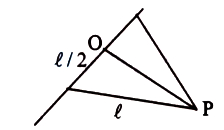
Three point masses,each of mass $m$,are placed at the corners of an equilateral triangle of side $\ell$. The moment of inertia of the system about an axis along any one side of the triangle is:
A
$\frac{1}{3} m \ell^{2}$
B
$\frac{3}{2} m \ell^{2}$
C
$\frac{3}{4} m \ell^{2}$
D
$m \ell^{2}$
Solution
(C) Let the vertices of the equilateral triangle be $A, B,$ and $C$. Let the axis of rotation be along the side $BC$.
The masses at $B$ and $C$ lie on the axis of rotation,so their perpendicular distance from the axis is $0$. Thus,their moment of inertia is $I_{B} = m(0)^{2} = 0$ and $I_{C} = m(0)^{2} = 0$.
The mass at $A$ is at a perpendicular distance $h$ from the side $BC$. In an equilateral triangle of side $\ell$,the height $h$ is given by $h = \ell \sin(60^{\circ}) = \frac{\sqrt{3}}{2} \ell$.
The moment of inertia of the mass at $A$ about the axis $BC$ is $I_{A} = m h^{2} = m \left( \frac{\sqrt{3}}{2} \ell \right)^{2} = m \left( \frac{3}{4} \ell^{2} \right) = \frac{3}{4} m \ell^{2}$.
The total moment of inertia of the system is $I = I_{A} + I_{B} + I_{C} = \frac{3}{4} m \ell^{2} + 0 + 0 = \frac{3}{4} m \ell^{2}$.
The masses at $B$ and $C$ lie on the axis of rotation,so their perpendicular distance from the axis is $0$. Thus,their moment of inertia is $I_{B} = m(0)^{2} = 0$ and $I_{C} = m(0)^{2} = 0$.
The mass at $A$ is at a perpendicular distance $h$ from the side $BC$. In an equilateral triangle of side $\ell$,the height $h$ is given by $h = \ell \sin(60^{\circ}) = \frac{\sqrt{3}}{2} \ell$.
The moment of inertia of the mass at $A$ about the axis $BC$ is $I_{A} = m h^{2} = m \left( \frac{\sqrt{3}}{2} \ell \right)^{2} = m \left( \frac{3}{4} \ell^{2} \right) = \frac{3}{4} m \ell^{2}$.
The total moment of inertia of the system is $I = I_{A} + I_{B} + I_{C} = \frac{3}{4} m \ell^{2} + 0 + 0 = \frac{3}{4} m \ell^{2}$.
0 likesView Solution
255
PhysicsEasyMCQMHT CET · 2020
Two discs having moment of inertia $I_1$ and $I_2$ are made from the same material and have the same mass. Their thicknesses and radii are $t_1, t_2$ and $R_1, R_2$ respectively. The relation between the moment of inertia of each disc about an axis passing through its centre and perpendicular to its plane and its thickness is:
A
$I_1 t_1 = I_2 t_2$
B
$I_1 t_2^2 = I_2 t_1^2$
C
$I_1 t_2 = I_2 t_1$
D
$I_1 t_1^2 = I_2 t_2^2$
Solution
(A) The moment of inertia of a disc about an axis passing through its centre and perpendicular to its plane is given by $I = \frac{1}{2} M R^2$.
Since both discs have the same mass $M$,we have $I_1 = \frac{1}{2} M R_1^2$ and $I_2 = \frac{1}{2} M R_2^2$.
Therefore,the ratio is $\frac{I_1}{I_2} = \frac{R_1^2}{R_2^2}$.
Since both discs are made of the same material,they have the same density $\rho$. The mass is given by $M = \text{Volume} \times \rho = (\pi R^2 t) \rho$.
Since $M$ and $\rho$ are the same for both,we have $\pi R_1^2 t_1 \rho = \pi R_2^2 t_2 \rho$,which simplifies to $R_1^2 t_1 = R_2^2 t_2$.
From this,we get $\frac{R_1^2}{R_2^2} = \frac{t_2}{t_1}$.
Substituting this into the ratio of moments of inertia,we get $\frac{I_1}{I_2} = \frac{t_2}{t_1}$.
Cross-multiplying gives $I_1 t_1 = I_2 t_2$.
Since both discs have the same mass $M$,we have $I_1 = \frac{1}{2} M R_1^2$ and $I_2 = \frac{1}{2} M R_2^2$.
Therefore,the ratio is $\frac{I_1}{I_2} = \frac{R_1^2}{R_2^2}$.
Since both discs are made of the same material,they have the same density $\rho$. The mass is given by $M = \text{Volume} \times \rho = (\pi R^2 t) \rho$.
Since $M$ and $\rho$ are the same for both,we have $\pi R_1^2 t_1 \rho = \pi R_2^2 t_2 \rho$,which simplifies to $R_1^2 t_1 = R_2^2 t_2$.
From this,we get $\frac{R_1^2}{R_2^2} = \frac{t_2}{t_1}$.
Substituting this into the ratio of moments of inertia,we get $\frac{I_1}{I_2} = \frac{t_2}{t_1}$.
Cross-multiplying gives $I_1 t_1 = I_2 t_2$.
0 likesView Solution
256
PhysicsEasyMCQMHT CET · 2020
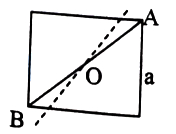
The moment of inertia of a uniform square plate about an axis perpendicular to its plane and passing through the centre is $\frac{Ma^{2}}{6}$,where $M$ is the mass and $a$ is the side of the square plate. The moment of inertia of this plate about an axis perpendicular to its plane and passing through one of its corners is
A
$\frac{Ma^{2}}{3}$
B
$\frac{3}{Ma^{2}}$
C
$\frac{3 Ma^{2}}{2}$
D
$\frac{2 Ma^{2}}{3}$
Solution
(D) Given,the moment of inertia about the center $O$ is $I_{o} = \frac{Ma^{2}}{6}$.
To find the moment of inertia about an axis passing through a corner (say $A$),we use the parallel axis theorem: $I_{A} = I_{o} + Mh^{2}$,where $h$ is the distance between the center and the corner.
The diagonal of the square is $d = \sqrt{a^{2} + a^{2}} = a\sqrt{2}$.
The distance $h$ from the center to the corner is half the diagonal: $h = \frac{a\sqrt{2}}{2} = \frac{a}{\sqrt{2}}$.
Substituting the values into the theorem:
$I_{A} = \frac{Ma^{2}}{6} + M\left(\frac{a}{\sqrt{2}}\right)^{2}$
$I_{A} = \frac{Ma^{2}}{6} + \frac{Ma^{2}}{2}$
$I_{A} = \frac{Ma^{2} + 3Ma^{2}}{6} = \frac{4Ma^{2}}{6} = \frac{2Ma^{2}}{3}$.
To find the moment of inertia about an axis passing through a corner (say $A$),we use the parallel axis theorem: $I_{A} = I_{o} + Mh^{2}$,where $h$ is the distance between the center and the corner.
The diagonal of the square is $d = \sqrt{a^{2} + a^{2}} = a\sqrt{2}$.
The distance $h$ from the center to the corner is half the diagonal: $h = \frac{a\sqrt{2}}{2} = \frac{a}{\sqrt{2}}$.
Substituting the values into the theorem:
$I_{A} = \frac{Ma^{2}}{6} + M\left(\frac{a}{\sqrt{2}}\right)^{2}$
$I_{A} = \frac{Ma^{2}}{6} + \frac{Ma^{2}}{2}$
$I_{A} = \frac{Ma^{2} + 3Ma^{2}}{6} = \frac{4Ma^{2}}{6} = \frac{2Ma^{2}}{3}$.
0 likesView Solution
257
PhysicsEasyMCQMHT CET · 2020
If a spherical planet of mass $M$ and radius $R$ suddenly shrinks to half its size,and its mass reduces to half,what is the new moment of inertia of the planet about its diameter?
A
$\frac{MR^{2}}{10}$
B
$\frac{MR^{2}}{20}$
C
$\frac{2}{3} MR^{2}$
D
$\frac{2}{5} MR^{2}$
Solution
(B) The moment of inertia of a solid sphere about its diameter is given by $I = \frac{2}{5} MR^{2}$.
Initially,the moment of inertia is $I_{1} = \frac{2}{5} MR^{2}$.
After the planet shrinks to half its size,the new radius is $R' = \frac{R}{2}$ and the new mass is $M' = \frac{M}{2}$.
The new moment of inertia $I_{2}$ is calculated as:
$I_{2} = \frac{2}{5} M' (R')^{2}$
$I_{2} = \frac{2}{5} \left(\frac{M}{2}\right) \left(\frac{R}{2}\right)^{2}$
$I_{2} = \frac{2}{5} \times \frac{M}{2} \times \frac{R^{2}}{4}$
$I_{2} = \frac{2}{40} MR^{2} = \frac{MR^{2}}{20}$.
Initially,the moment of inertia is $I_{1} = \frac{2}{5} MR^{2}$.
After the planet shrinks to half its size,the new radius is $R' = \frac{R}{2}$ and the new mass is $M' = \frac{M}{2}$.
The new moment of inertia $I_{2}$ is calculated as:
$I_{2} = \frac{2}{5} M' (R')^{2}$
$I_{2} = \frac{2}{5} \left(\frac{M}{2}\right) \left(\frac{R}{2}\right)^{2}$
$I_{2} = \frac{2}{5} \times \frac{M}{2} \times \frac{R^{2}}{4}$
$I_{2} = \frac{2}{40} MR^{2} = \frac{MR^{2}}{20}$.
0 likesView Solution
258
PhysicsMediumMCQMHT CET · 2020
$A$ solid cylinder of mass $M$ and radius $R$ rolls down a smooth inclined plane about its own axis and reaches the bottom with velocity $v$. What is the height of the inclined plane? (Assume $g$ is the acceleration due to gravity.)
A
$\frac{3 v^{2}}{4 g}$
B
$\frac{4 v^{2}}{5 g}$
C
$\frac{7 v^{2}}{9 g}$
D
$\frac{3 v^{2}}{4 g}$
Solution
(A) For a solid cylinder rolling down an inclined plane,the total energy at the top is potential energy $PE = Mgh$.
At the bottom,the total energy is the sum of translational kinetic energy and rotational kinetic energy: $KE = \frac{1}{2} Mv^2 + \frac{1}{2} I\omega^2$.
For a solid cylinder,the moment of inertia $I = \frac{1}{2} MR^2$ and the rolling condition is $v = R\omega$,so $\omega = \frac{v}{R}$.
Substituting these into the energy equation: $Mgh = \frac{1}{2} Mv^2 + \frac{1}{2} (\frac{1}{2} MR^2) (\frac{v}{R})^2$.
$Mgh = \frac{1}{2} Mv^2 + \frac{1}{4} Mv^2$.
$Mgh = \frac{3}{4} Mv^2$.
Solving for height $h$: $h = \frac{3 v^2}{4 g}$.
At the bottom,the total energy is the sum of translational kinetic energy and rotational kinetic energy: $KE = \frac{1}{2} Mv^2 + \frac{1}{2} I\omega^2$.
For a solid cylinder,the moment of inertia $I = \frac{1}{2} MR^2$ and the rolling condition is $v = R\omega$,so $\omega = \frac{v}{R}$.
Substituting these into the energy equation: $Mgh = \frac{1}{2} Mv^2 + \frac{1}{2} (\frac{1}{2} MR^2) (\frac{v}{R})^2$.
$Mgh = \frac{1}{2} Mv^2 + \frac{1}{4} Mv^2$.
$Mgh = \frac{3}{4} Mv^2$.
Solving for height $h$: $h = \frac{3 v^2}{4 g}$.
0 likesView Solution
259
PhysicsDifficultMCQMHT CET · 2020
$A$ wheel of radius $2 \ cm$ is at rest on a horizontal surface. $A$ point $P$ on the circumference of the wheel is in contact with the horizontal surface. When the wheel rolls without slipping on the surface,the displacement of point $P$ after half a rotation of the wheel is:
A
$2(\pi^{2}+4)^{1/2} \ cm$
B
$(\pi^{2}+4)^{1/2} \ cm$
C
$2(\pi^{2}+2)^{1/2} \ cm$
D
$(\pi^{2}+2)^{1/2} \ cm$
Solution
(A) Let the radius of the wheel be $R = 2 \ cm$.
Initially,point $P$ is at the origin $(0, 0)$.
After half a rotation,the center of the wheel moves forward by a distance equal to half the circumference,which is $\pi R$.
The new position of the center is $(\pi R, R)$.
After half a rotation,point $P$ moves from the bottom to the top of the wheel.
The new coordinates of point $P$ will be $(\pi R, 2R)$.
The displacement $d$ is the distance between the initial position $(0, 0)$ and the final position $(\pi R, 2R)$.
Using the distance formula: $d = \sqrt{(\pi R - 0)^2 + (2R - 0)^2} = \sqrt{\pi^2 R^2 + 4R^2} = R\sqrt{\pi^2 + 4}$.
Substituting $R = 2 \ cm$: $d = 2\sqrt{\pi^2 + 4} \ cm$ or $2(\pi^2 + 4)^{1/2} \ cm$.
Initially,point $P$ is at the origin $(0, 0)$.
After half a rotation,the center of the wheel moves forward by a distance equal to half the circumference,which is $\pi R$.
The new position of the center is $(\pi R, R)$.
After half a rotation,point $P$ moves from the bottom to the top of the wheel.
The new coordinates of point $P$ will be $(\pi R, 2R)$.
The displacement $d$ is the distance between the initial position $(0, 0)$ and the final position $(\pi R, 2R)$.
Using the distance formula: $d = \sqrt{(\pi R - 0)^2 + (2R - 0)^2} = \sqrt{\pi^2 R^2 + 4R^2} = R\sqrt{\pi^2 + 4}$.
Substituting $R = 2 \ cm$: $d = 2\sqrt{\pi^2 + 4} \ cm$ or $2(\pi^2 + 4)^{1/2} \ cm$.
0 likesView Solution
260
PhysicsMediumMCQMHT CET · 2020
$A$ solid cylinder of radius $R$ and mass $M$ rolls down an inclined plane of height $h$. When it reaches the bottom of the plane,its rotational kinetic energy is ($g =$ acceleration due to gravity).
A
$\frac{Mgh}{3}$
B
$Mgh$
C
$\frac{Mgh}{2}$
D
$\frac{Mgh}{4}$
Solution
(A) For a solid cylinder rolling down an inclined plane,the total potential energy $Mgh$ is converted into translational kinetic energy and rotational kinetic energy.
Total energy $E = Mgh = \frac{1}{2} Mv^2 + \frac{1}{2} I\omega^2$.
For a solid cylinder,the moment of inertia $I = \frac{1}{2} MR^2$ and the rolling condition is $v = R\omega$.
Substituting these into the energy equation:
$Mgh = \frac{1}{2} Mv^2 + \frac{1}{2} (\frac{1}{2} MR^2) (\frac{v}{R})^2$
$Mgh = \frac{1}{2} Mv^2 + \frac{1}{4} Mv^2 = \frac{3}{4} Mv^2$.
Thus,$Mv^2 = \frac{4}{3} Mgh$.
The rotational kinetic energy $K_{rot} = \frac{1}{2} I\omega^2 = \frac{1}{2} (\frac{1}{2} MR^2) (\frac{v}{R})^2 = \frac{1}{4} Mv^2$.
Substituting $Mv^2 = \frac{4}{3} Mgh$ into the expression for $K_{rot}$:
$K_{rot} = \frac{1}{4} (\frac{4}{3} Mgh) = \frac{Mgh}{3}$.
Total energy $E = Mgh = \frac{1}{2} Mv^2 + \frac{1}{2} I\omega^2$.
For a solid cylinder,the moment of inertia $I = \frac{1}{2} MR^2$ and the rolling condition is $v = R\omega$.
Substituting these into the energy equation:
$Mgh = \frac{1}{2} Mv^2 + \frac{1}{2} (\frac{1}{2} MR^2) (\frac{v}{R})^2$
$Mgh = \frac{1}{2} Mv^2 + \frac{1}{4} Mv^2 = \frac{3}{4} Mv^2$.
Thus,$Mv^2 = \frac{4}{3} Mgh$.
The rotational kinetic energy $K_{rot} = \frac{1}{2} I\omega^2 = \frac{1}{2} (\frac{1}{2} MR^2) (\frac{v}{R})^2 = \frac{1}{4} Mv^2$.
Substituting $Mv^2 = \frac{4}{3} Mgh$ into the expression for $K_{rot}$:
$K_{rot} = \frac{1}{4} (\frac{4}{3} Mgh) = \frac{Mgh}{3}$.
0 likesView Solution
261
PhysicsMediumMCQMHT CET · 2020
$A$ wheel is at rest in a horizontal position. Its moment of inertia about the vertical axis passing through its centre is $I$. $A$ constant torque $\tau$ acts on it for $t$ seconds. The change in rotational kinetic energy is:
A
$\frac{\tau^{2} t^{2}}{2 I}$
B
$\left[\frac{\tau t}{2 I}\right]$
C
$\left[\frac{\tau t}{2 I}\right]^{\frac{1}{2}}$
D
$\left[\frac{\tau t}{2 I}\right]^{2}$
Solution
(A) Given that the wheel is initially at rest,the initial angular velocity $\omega_0 = 0$.
The angular acceleration $\alpha$ produced by a constant torque $\tau$ is given by $\alpha = \frac{\tau}{I}$.
After time $t$,the angular velocity $\omega$ is given by $\omega = \omega_0 + \alpha t = 0 + \left(\frac{\tau}{I}\right)t = \frac{\tau t}{I}$.
The rotational kinetic energy $K$ is given by $K = \frac{1}{2} I \omega^2$.
Substituting the value of $\omega$,we get $K = \frac{1}{2} I \left(\frac{\tau t}{I}\right)^2 = \frac{1}{2} I \cdot \frac{\tau^2 t^2}{I^2} = \frac{\tau^2 t^2}{2 I}$.
The angular acceleration $\alpha$ produced by a constant torque $\tau$ is given by $\alpha = \frac{\tau}{I}$.
After time $t$,the angular velocity $\omega$ is given by $\omega = \omega_0 + \alpha t = 0 + \left(\frac{\tau}{I}\right)t = \frac{\tau t}{I}$.
The rotational kinetic energy $K$ is given by $K = \frac{1}{2} I \omega^2$.
Substituting the value of $\omega$,we get $K = \frac{1}{2} I \left(\frac{\tau t}{I}\right)^2 = \frac{1}{2} I \cdot \frac{\tau^2 t^2}{I^2} = \frac{\tau^2 t^2}{2 I}$.
0 likesView Solution
262
PhysicsMediumMCQMHT CET · 2020
$A$ solid sphere of mass $M$ and radius $R$ is rotating about its diameter. $A$ disc of the same mass and radius is also rotating about an axis passing through its centre and perpendicular to the plane,but its angular speed is twice that of the sphere. The ratio of the kinetic energy of the disc to that of the sphere is: (in $: 1$)
A
$5$
B
$6$
C
$4$
D
$3$
Solution
(A) The rotational kinetic energy is given by $K = \frac{1}{2} I \omega^2$.
For a solid sphere rotating about its diameter,the moment of inertia is $I_s = \frac{2}{5} MR^2$.
Let the angular speed of the sphere be $\omega_s = \omega$.
Thus,the kinetic energy of the sphere is $K_s = \frac{1}{2} (\frac{2}{5} MR^2) \omega^2 = \frac{1}{5} MR^2 \omega^2$.
For a disc rotating about an axis passing through its centre and perpendicular to its plane,the moment of inertia is $I_d = \frac{1}{2} MR^2$.
The angular speed of the disc is given as $\omega_d = 2\omega$.
Thus,the kinetic energy of the disc is $K_d = \frac{1}{2} (\frac{1}{2} MR^2) (2\omega)^2 = \frac{1}{4} MR^2 (4\omega^2) = MR^2 \omega^2$.
The ratio of the kinetic energy of the disc to that of the sphere is $\frac{K_d}{K_s} = \frac{MR^2 \omega^2}{\frac{1}{5} MR^2 \omega^2} = 5$.
Therefore,the ratio is $5: 1$.
For a solid sphere rotating about its diameter,the moment of inertia is $I_s = \frac{2}{5} MR^2$.
Let the angular speed of the sphere be $\omega_s = \omega$.
Thus,the kinetic energy of the sphere is $K_s = \frac{1}{2} (\frac{2}{5} MR^2) \omega^2 = \frac{1}{5} MR^2 \omega^2$.
For a disc rotating about an axis passing through its centre and perpendicular to its plane,the moment of inertia is $I_d = \frac{1}{2} MR^2$.
The angular speed of the disc is given as $\omega_d = 2\omega$.
Thus,the kinetic energy of the disc is $K_d = \frac{1}{2} (\frac{1}{2} MR^2) (2\omega)^2 = \frac{1}{4} MR^2 (4\omega^2) = MR^2 \omega^2$.
The ratio of the kinetic energy of the disc to that of the sphere is $\frac{K_d}{K_s} = \frac{MR^2 \omega^2}{\frac{1}{5} MR^2 \omega^2} = 5$.
Therefore,the ratio is $5: 1$.
0 likesView Solution
263
PhysicsMediumMCQMHT CET · 2020
$A$ thin circular ring of mass $M$ and radius $R$ is rotating about a transverse axis passing through its centre with constant angular velocity $\omega$. Two objects each of mass $m$ are attached gently to the opposite ends of a diameter of the ring. What is the new angular velocity?
A
$\frac{M \omega}{M+2 m}$
B
$\frac{M \omega}{M+m}$
C
$\frac{(M+2 m) \omega}{M}$
D
$\frac{(M-2 m) \omega}{M+2 m}$
Solution
(A) The initial moment of inertia of the ring about the transverse axis is $I = M R^2$. The initial angular momentum is $L_i = I \omega = M R^2 \omega$.
When two objects of mass $m$ are attached to the opposite ends of a diameter,the new moment of inertia becomes $I' = M R^2 + m R^2 + m R^2 = (M + 2m) R^2$.
Since no external torque acts on the system,the angular momentum is conserved,so $L_i = L_f$.
$M R^2 \omega = (M + 2m) R^2 \omega'$
$\omega' = \frac{M R^2 \omega}{(M + 2m) R^2} = \frac{M \omega}{M + 2m}$.
When two objects of mass $m$ are attached to the opposite ends of a diameter,the new moment of inertia becomes $I' = M R^2 + m R^2 + m R^2 = (M + 2m) R^2$.
Since no external torque acts on the system,the angular momentum is conserved,so $L_i = L_f$.
$M R^2 \omega = (M + 2m) R^2 \omega'$
$\omega' = \frac{M R^2 \omega}{(M + 2m) R^2} = \frac{M \omega}{M + 2m}$.
0 likesView Solution
264
PhysicsMediumMCQMHT CET · 2020
The relative angular speed of the hour hand and the second hand of a clock is:
A
$\frac{359 \pi}{21600}$
B
$\frac{719 \pi}{21600}$
C
$\frac{11 \pi}{21600}$
D
$\frac{9 \pi}{21600}$
Solution
(B) The angular speed of the hour hand is $\omega_{h} = \frac{2 \pi}{T_{h}} = \frac{2 \pi}{12 \times 3600} \text{ rad/s}$.
The angular speed of the second hand is $\omega_{s} = \frac{2 \pi}{T_{s}} = \frac{2 \pi}{60} \text{ rad/s}$.
The relative angular speed is given by $\omega_{rel} = |\omega_{s} - \omega_{h}|$.
$\omega_{rel} = \left| \frac{2 \pi}{60} - \frac{2 \pi}{43200} \right| = 2 \pi \left( \frac{720 - 1}{43200} \right)$.
$\omega_{rel} = 2 \pi \left( \frac{719}{43200} \right) = \frac{719 \pi}{21600} \text{ rad/s}$.
The angular speed of the second hand is $\omega_{s} = \frac{2 \pi}{T_{s}} = \frac{2 \pi}{60} \text{ rad/s}$.
The relative angular speed is given by $\omega_{rel} = |\omega_{s} - \omega_{h}|$.
$\omega_{rel} = \left| \frac{2 \pi}{60} - \frac{2 \pi}{43200} \right| = 2 \pi \left( \frac{720 - 1}{43200} \right)$.
$\omega_{rel} = 2 \pi \left( \frac{719}{43200} \right) = \frac{719 \pi}{21600} \text{ rad/s}$.
0 likesView Solution
265
PhysicsMediumMCQMHT CET · 2020
$A$ molecule consists of two atoms each of mass $m$ and separated by a distance $d$. At room temperature,the average rotational kinetic energy is $E$. What is its angular frequency?
A
$\frac{2}{d} \sqrt{\frac{E}{m}}$
B
$\sqrt{\frac{m}{E d}}$
C
$\frac{d}{2} \sqrt{\frac{m}{E}}$
D
$\sqrt{\frac{E d}{m}}$
Solution
(A) The moment of inertia $I$ of a diatomic molecule consisting of two atoms of mass $m$ separated by a distance $d$ about an axis passing through its center of mass and perpendicular to the line joining the atoms is given by:
$I = m(d/2)^2 + m(d/2)^2 = 2m(d^2/4) = \frac{md^2}{2}$.
The rotational kinetic energy $E$ is given by $E = \frac{1}{2} I \omega^2$,where $\omega$ is the angular frequency.
Substituting the value of $I$ into the energy equation:
$E = \frac{1}{2} (\frac{md^2}{2}) \omega^2 = \frac{md^2}{4} \omega^2$.
Solving for $\omega$:
$\omega^2 = \frac{4E}{md^2}$.
$\omega = \sqrt{\frac{4E}{md^2}} = \frac{2}{d} \sqrt{\frac{E}{m}}$.
$I = m(d/2)^2 + m(d/2)^2 = 2m(d^2/4) = \frac{md^2}{2}$.
The rotational kinetic energy $E$ is given by $E = \frac{1}{2} I \omega^2$,where $\omega$ is the angular frequency.
Substituting the value of $I$ into the energy equation:
$E = \frac{1}{2} (\frac{md^2}{2}) \omega^2 = \frac{md^2}{4} \omega^2$.
Solving for $\omega$:
$\omega^2 = \frac{4E}{md^2}$.
$\omega = \sqrt{\frac{4E}{md^2}} = \frac{2}{d} \sqrt{\frac{E}{m}}$.
0 likesView Solution
266
PhysicsEasyMCQMHT CET · 2020
$A$ rope is wound around a solid cylinder of mass $1 \,kg$ and radius $0.4 \,m$. What is the angular acceleration of the cylinder, if the rope is pulled with a force of $25 \,N$? (The cylinder is rotating about its own axis.)
A
$50 \,rad/s^2$
B
$125 \,rad/s^2$
C
$10 \,rad/s^2$
D
$1 \,rad/s^2$
Solution
(B) The torque $\tau$ applied by the force $F$ at a distance $r$ from the axis is given by $\tau = F \times r$.
Substituting the values, $\tau = 25 \,N \times 0.4 \,m = 10 \,Nm$.
The moment of inertia $I$ of a solid cylinder about its own axis is $I = \frac{1}{2} M R^2$.
Substituting the values, $I = \frac{1}{2} \times 1 \,kg \times (0.4 \,m)^2 = 0.5 \times 0.16 = 0.08 \,kg \cdot m^2$.
Using the relation $\tau = I \alpha$, the angular acceleration $\alpha$ is $\alpha = \frac{\tau}{I}$.
$\alpha = \frac{10 \,Nm}{0.08 \,kg \cdot m^2} = 125 \,rad/s^2$.
Substituting the values, $\tau = 25 \,N \times 0.4 \,m = 10 \,Nm$.
The moment of inertia $I$ of a solid cylinder about its own axis is $I = \frac{1}{2} M R^2$.
Substituting the values, $I = \frac{1}{2} \times 1 \,kg \times (0.4 \,m)^2 = 0.5 \times 0.16 = 0.08 \,kg \cdot m^2$.
Using the relation $\tau = I \alpha$, the angular acceleration $\alpha$ is $\alpha = \frac{\tau}{I}$.
$\alpha = \frac{10 \,Nm}{0.08 \,kg \cdot m^2} = 125 \,rad/s^2$.
0 likesView Solution
267
PhysicsMediumMCQMHT CET · 2020
$A$ disc of mass $10 \ kg$ and radius $0.1 \ m$ is rotating at $120 \ rpm$. $A$ retarding torque brings it to rest in $10 \ s$. If the same torque is due to a force applied tangentially on the rim of the disc, then the magnitude of the force is: (in $\pi \ N$)
A
$0.2$
B
$0.4$
C
$0.8$
D
$0.1$
Solution
(A) Initial angular velocity $\omega_i = 120 \ rpm = \frac{120 \times 2\pi}{60} = 4\pi \ rad/s$.
Final angular velocity $\omega_f = 0 \ rad/s$.
Time taken $t = 10 \ s$.
Angular acceleration $\alpha = \frac{\omega_f - \omega_i}{t} = \frac{0 - 4\pi}{10} = -0.4\pi \ rad/s^2$.
Moment of inertia of the disc $I = \frac{1}{2}MR^2 = \frac{1}{2} \times 10 \times (0.1)^2 = 0.05 \ kg \ m^2$.
Retarding torque $\tau = I|\alpha| = 0.05 \times 0.4\pi = 0.02\pi \ Nm$.
Since $\tau = F \times R$, the force $F = \frac{\tau}{R} = \frac{0.02\pi}{0.1} = 0.2\pi \ N$.
Final angular velocity $\omega_f = 0 \ rad/s$.
Time taken $t = 10 \ s$.
Angular acceleration $\alpha = \frac{\omega_f - \omega_i}{t} = \frac{0 - 4\pi}{10} = -0.4\pi \ rad/s^2$.
Moment of inertia of the disc $I = \frac{1}{2}MR^2 = \frac{1}{2} \times 10 \times (0.1)^2 = 0.05 \ kg \ m^2$.
Retarding torque $\tau = I|\alpha| = 0.05 \times 0.4\pi = 0.02\pi \ Nm$.
Since $\tau = F \times R$, the force $F = \frac{\tau}{R} = \frac{0.02\pi}{0.1} = 0.2\pi \ N$.
0 likesView Solution
268
PhysicsEasyMCQMHT CET · 2020
$A$ torque of $50 \ Nm$ acts on a body for $8 \ s$,which is initially at rest. The change in its angular momentum is:
A
$400 \ kg \cdot m^2/s$
B
$600 \ kg \cdot m^2/s$
C
$1000 \ kg \cdot m^2/s$
D
$800 \ kg \cdot m^2/s$
Solution
(A) The relationship between torque $\tau$ and the change in angular momentum $\Delta L$ is given by the impulse-momentum theorem for rotation: $\Delta L = \int \tau \ dt$.
Since the torque $\tau = 50 \ Nm$ is constant and acts for a time interval $\Delta t = 8 \ s$,the change in angular momentum is:
$\Delta L = \tau \times \Delta t$
$\Delta L = 50 \ Nm \times 8 \ s$
$\Delta L = 400 \ kg \cdot m^2/s$.
Therefore,the change in angular momentum is $400 \ kg \cdot m^2/s$.
Since the torque $\tau = 50 \ Nm$ is constant and acts for a time interval $\Delta t = 8 \ s$,the change in angular momentum is:
$\Delta L = \tau \times \Delta t$
$\Delta L = 50 \ Nm \times 8 \ s$
$\Delta L = 400 \ kg \cdot m^2/s$.
Therefore,the change in angular momentum is $400 \ kg \cdot m^2/s$.
0 likesView Solution
269
PhysicsEasyMCQMHT CET · 2020
If there is a change of angular momentum from $1 \, J \cdot s$ to $4 \, J \cdot s$ in $4 \, s$, then the torque is
A
$0.75 \, N \cdot m$
B
$0.5 \, N \cdot m$
C
$1.25 \, N \cdot m$
D
$1.5 \, N \cdot m$
Solution
(A) The relationship between torque $\tau$ and the rate of change of angular momentum $L$ is given by Newton's second law for rotation: $\tau = \frac{dL}{dt}$.
Given initial angular momentum $L_1 = 1 \, J \cdot s$ and final angular momentum $L_2 = 4 \, J \cdot s$.
The change in angular momentum is $\Delta L = L_2 - L_1 = 4 - 1 = 3 \, J \cdot s$.
The time interval is $\Delta t = 4 \, s$.
Therefore, the torque is $\tau = \frac{\Delta L}{\Delta t} = \frac{3}{4} = 0.75 \, N \cdot m$.
Given initial angular momentum $L_1 = 1 \, J \cdot s$ and final angular momentum $L_2 = 4 \, J \cdot s$.
The change in angular momentum is $\Delta L = L_2 - L_1 = 4 - 1 = 3 \, J \cdot s$.
The time interval is $\Delta t = 4 \, s$.
Therefore, the torque is $\tau = \frac{\Delta L}{\Delta t} = \frac{3}{4} = 0.75 \, N \cdot m$.
0 likesView Solution
270
PhysicsEasyMCQMHT CET · 2020
Let a force $\vec{F} = -F\hat{k}$ act on the origin of a Cartesian frame of reference. The moment of force about a point $(1, -1)$ will be
A
$-F(\hat{i} + \hat{j})$
B
$-F(\hat{i} - \hat{j})$
C
$F(\hat{i} - \hat{j})$
D
$F(\hat{i} + \hat{j})$
Solution
(A) The point $P$ is given as $(1, -1)$,so its position vector is $\vec{r}_P = \hat{i} - \hat{j}$.
Since the force acts at the origin $O(0, 0)$,the position vector of the point of application relative to point $P$ is $\vec{r} = \vec{r}_O - \vec{r}_P = 0 - (\hat{i} - \hat{j}) = -\hat{i} + \hat{j}$.
The torque (moment of force) about point $P$ is given by $\vec{\tau} = \vec{r} \times \vec{F}$.
Substituting the values: $\vec{\tau} = (-\hat{i} + \hat{j}) \times (-F\hat{k})$.
Using the distributive property of cross product: $\vec{\tau} = F[(\hat{i} \times \hat{k}) - (\hat{j} \times \hat{k})]$.
Using the cross product relations $\hat{i} \times \hat{k} = -\hat{j}$ and $\hat{j} \times \hat{k} = \hat{i}$:
$\vec{\tau} = F[-\hat{j} - \hat{i}] = -F(\hat{i} + \hat{j})$.
Since the force acts at the origin $O(0, 0)$,the position vector of the point of application relative to point $P$ is $\vec{r} = \vec{r}_O - \vec{r}_P = 0 - (\hat{i} - \hat{j}) = -\hat{i} + \hat{j}$.
The torque (moment of force) about point $P$ is given by $\vec{\tau} = \vec{r} \times \vec{F}$.
Substituting the values: $\vec{\tau} = (-\hat{i} + \hat{j}) \times (-F\hat{k})$.
Using the distributive property of cross product: $\vec{\tau} = F[(\hat{i} \times \hat{k}) - (\hat{j} \times \hat{k})]$.
Using the cross product relations $\hat{i} \times \hat{k} = -\hat{j}$ and $\hat{j} \times \hat{k} = \hat{i}$:
$\vec{\tau} = F[-\hat{j} - \hat{i}] = -F(\hat{i} + \hat{j})$.
0 likesView Solution
271
PhysicsEasyMCQMHT CET · 2020
Two spheres '$S_1$' and '$S_2$' have the same radii but temperatures '$T_1$' and '$T_2$' respectively. Their emissive power is the same and their emissivity is in the ratio $1:4$. Then the ratio '$T_1$' to '$T_2$' is
A
$1: \sqrt{2}$
B
$1: 2$
C
$2: 1$
D
$\sqrt{2}: 1$
Solution
(D) The correct option is $D$.
Concept:
According to the Stefan-Boltzmann law,the emissive power $(E)$ of a body is given by $E = e \sigma T^4$,where $e$ is the emissivity,$\sigma$ is the Stefan-Boltzmann constant,and $T$ is the absolute temperature.
Given that the emissive power of both spheres is the same,we have $E_1 = E_2$.
Therefore,$e_1 \sigma T_1^4 = e_2 \sigma T_2^4$.
This implies $\frac{T_1^4}{T_2^4} = \frac{e_2}{e_1}$.
Given the ratio of emissivity $e_1 : e_2 = 1 : 4$,we have $\frac{e_2}{e_1} = \frac{4}{1} = 4$.
Thus,$\left(\frac{T_1}{T_2}\right)^4 = 4$.
Taking the fourth root on both sides,$\frac{T_1}{T_2} = (4)^{1/4} = (2^2)^{1/4} = 2^{1/2} = \sqrt{2}$.
So,the ratio $T_1 : T_2 = \sqrt{2} : 1$.
Concept:
According to the Stefan-Boltzmann law,the emissive power $(E)$ of a body is given by $E = e \sigma T^4$,where $e$ is the emissivity,$\sigma$ is the Stefan-Boltzmann constant,and $T$ is the absolute temperature.
Given that the emissive power of both spheres is the same,we have $E_1 = E_2$.
Therefore,$e_1 \sigma T_1^4 = e_2 \sigma T_2^4$.
This implies $\frac{T_1^4}{T_2^4} = \frac{e_2}{e_1}$.
Given the ratio of emissivity $e_1 : e_2 = 1 : 4$,we have $\frac{e_2}{e_1} = \frac{4}{1} = 4$.
Thus,$\left(\frac{T_1}{T_2}\right)^4 = 4$.
Taking the fourth root on both sides,$\frac{T_1}{T_2} = (4)^{1/4} = (2^2)^{1/4} = 2^{1/2} = \sqrt{2}$.
So,the ratio $T_1 : T_2 = \sqrt{2} : 1$.
0 likesView Solution
272
PhysicsEasyMCQMHT CET · 2020
Ordinary bodies $A$ and $B$ radiate maximum energy at wavelengths differing by $4 \mu m$. The absolute temperature of body $A$ is $3$ times that of body $B$. The wavelength at which body $B$ radiates maximum energy is: (in $\mu m$)
A
$12$
B
$6$
C
$4$
D
$8$
Solution
(B) According to Wien's displacement law,$\lambda_{max} T = b$ (constant).
Let $\lambda_A$ and $\lambda_B$ be the wavelengths of maximum energy for bodies $A$ and $B$,and $T_A$ and $T_B$ be their absolute temperatures.
Given: $T_A = 3 T_B$ and $\lambda_B - \lambda_A = 4 \mu m$ (since $T_A > T_B$,$\lambda_A < \lambda_B$).
From Wien's law: $\lambda_A T_A = \lambda_B T_B$.
Substituting $T_A = 3 T_B$: $\lambda_A (3 T_B) = \lambda_B T_B$,which gives $\lambda_B = 3 \lambda_A$.
Substitute this into the difference equation: $3 \lambda_A - \lambda_A = 4 \mu m$.
$2 \lambda_A = 4 \mu m \implies \lambda_A = 2 \mu m$.
Therefore,$\lambda_B = 3 \times 2 \mu m = 6 \mu m$.
Let $\lambda_A$ and $\lambda_B$ be the wavelengths of maximum energy for bodies $A$ and $B$,and $T_A$ and $T_B$ be their absolute temperatures.
Given: $T_A = 3 T_B$ and $\lambda_B - \lambda_A = 4 \mu m$ (since $T_A > T_B$,$\lambda_A < \lambda_B$).
From Wien's law: $\lambda_A T_A = \lambda_B T_B$.
Substituting $T_A = 3 T_B$: $\lambda_A (3 T_B) = \lambda_B T_B$,which gives $\lambda_B = 3 \lambda_A$.
Substitute this into the difference equation: $3 \lambda_A - \lambda_A = 4 \mu m$.
$2 \lambda_A = 4 \mu m \implies \lambda_A = 2 \mu m$.
Therefore,$\lambda_B = 3 \times 2 \mu m = 6 \mu m$.
0 likesView Solution
273
PhysicsEasyMCQMHT CET · 2020
About black body radiation,which one of the following is a '$WRONG$' statement?
A
For all wavelengths,intensity is same.
B
All wavelengths are emitted by a black body.
C
For longer wavelengths,intensity is less.
D
For shorter wavelengths,intensity is more.
Solution
(A) black body is an ideal body that emits and absorbs all frequencies of radiation. According to Planck's law of black body radiation,the intensity of radiation emitted by a black body depends on the wavelength and temperature. The intensity distribution is not uniform for all wavelengths; it follows a specific curve (Planck's curve) where intensity varies with wavelength. Therefore,the statement that 'intensity is same for all wavelengths' is incorrect. Additionally,the intensity does not strictly increase or decrease monotonically for all ranges; it peaks at a specific wavelength determined by Wien's displacement law. However,among the given options,the statement that intensity is the same for all wavelengths is fundamentally wrong.
0 likesView Solution
274
PhysicsMediumMCQMHT CET · 2020
Two black spheres '$P$' and '$Q$' have radii in the ratio $3:2$. The wavelengths of maximum intensity radiation are in the ratio $3:4$ respectively. The ratio of radiated power by '$P$' to '$Q$' is (in $/9$)
A
$74$
B
$64$
C
$16$
D
$25$
Solution
(B) According to Wien's displacement law,$\lambda_m T = b$ (constant),so $T \propto 1/\lambda_m$.
Given the ratio of wavelengths $\lambda_P : \lambda_Q = 3:4$,the ratio of temperatures is $T_P : T_Q = 4:3$.
According to Stefan-Boltzmann law,the power radiated by a black body is $P = \sigma A T^4 = \sigma (4\pi r^2) T^4$.
Thus,the ratio of power radiated is $\frac{P_P}{P_Q} = \left( \frac{r_P}{r_Q} \right)^2 \left( \frac{T_P}{T_Q} \right)^4$.
Substituting the given values: $\frac{P_P}{P_Q} = \left( \frac{3}{2} \right)^2 \times \left( \frac{4}{3} \right)^4$.
$\frac{P_P}{P_Q} = \frac{9}{4} \times \frac{256}{81} = \frac{1}{1} \times \frac{64}{9} = \frac{64}{9}$.
Given the ratio of wavelengths $\lambda_P : \lambda_Q = 3:4$,the ratio of temperatures is $T_P : T_Q = 4:3$.
According to Stefan-Boltzmann law,the power radiated by a black body is $P = \sigma A T^4 = \sigma (4\pi r^2) T^4$.
Thus,the ratio of power radiated is $\frac{P_P}{P_Q} = \left( \frac{r_P}{r_Q} \right)^2 \left( \frac{T_P}{T_Q} \right)^4$.
Substituting the given values: $\frac{P_P}{P_Q} = \left( \frac{3}{2} \right)^2 \times \left( \frac{4}{3} \right)^4$.
$\frac{P_P}{P_Q} = \frac{9}{4} \times \frac{256}{81} = \frac{1}{1} \times \frac{64}{9} = \frac{64}{9}$.
0 likesView Solution
275
PhysicsEasyMCQMHT CET · 2020
$A$ black body has a maximum wavelength $\lambda_{m}$ at a temperature of $2200 \ K$. Its corresponding wavelength at a temperature of $3300 \ K$ will be:
A
$\frac{9}{4} \lambda_{m}$
B
$\frac{3}{2} \lambda_{m}$
C
$\frac{4}{9} \lambda_{m}$
D
$\frac{2}{3} \lambda_{m}$
Solution
(D) According to Wien's displacement law,the product of the wavelength of maximum intensity $\lambda_{m}$ and the absolute temperature $T$ is a constant.
$\lambda_{m} T = \text{constant}$
Given:
$T_{1} = 2200 \ K$
$T_{2} = 3300 \ K$
Let the new wavelength be $\lambda_{m}^{\prime}$.
Using the relation $\lambda_{m} T_{1} = \lambda_{m}^{\prime} T_{2}$:
$\lambda_{m}^{\prime} = \lambda_{m} \times \frac{T_{1}}{T_{2}}$
$\lambda_{m}^{\prime} = \lambda_{m} \times \frac{2200}{3300}$
$\lambda_{m}^{\prime} = \frac{2}{3} \lambda_{m}$
$\lambda_{m} T = \text{constant}$
Given:
$T_{1} = 2200 \ K$
$T_{2} = 3300 \ K$
Let the new wavelength be $\lambda_{m}^{\prime}$.
Using the relation $\lambda_{m} T_{1} = \lambda_{m}^{\prime} T_{2}$:
$\lambda_{m}^{\prime} = \lambda_{m} \times \frac{T_{1}}{T_{2}}$
$\lambda_{m}^{\prime} = \lambda_{m} \times \frac{2200}{3300}$
$\lambda_{m}^{\prime} = \frac{2}{3} \lambda_{m}$
0 likesView Solution
276
PhysicsMediumMCQMHT CET · 2020
Two spheres $S_{1}$ and $S_{2}$ have radii $R$ and $3R$ and temperatures $T$ and $T/3$ respectively. If they are coated with a material of the same emissivity, and the rate of radiation of $S_{1}$ is $E$, then the rate of radiation of $S_{2}$ is:
A
$E/6$
B
$E/3$
C
$9E$
D
$E/9$
Solution
(D) According to the Stefan-Boltzmann Law, the rate of radiation $P$ (or $E$) is given by $P = e \sigma A T^{4}$, where $A = 4 \pi r^{2}$.
For sphere $S_{1}$: $E = e \sigma (4 \pi R^{2}) T^{4}$.
For sphere $S_{2}$: $E' = e \sigma (4 \pi (3R)^{2}) (T/3)^{4}$.
$E' = e \sigma (4 \pi \cdot 9R^{2}) (T^{4} / 81)$.
$E' = e \sigma (4 \pi R^{2}) T^{4} \cdot (9 / 81)$.
$E' = E \cdot (1 / 9) = E/9$.
For sphere $S_{1}$: $E = e \sigma (4 \pi R^{2}) T^{4}$.
For sphere $S_{2}$: $E' = e \sigma (4 \pi (3R)^{2}) (T/3)^{4}$.
$E' = e \sigma (4 \pi \cdot 9R^{2}) (T^{4} / 81)$.
$E' = e \sigma (4 \pi R^{2}) T^{4} \cdot (9 / 81)$.
$E' = E \cdot (1 / 9) = E/9$.
0 likesView Solution
277
PhysicsMediumMCQMHT CET · 2020
$A$ black rectangular surface of area $A$ emits energy $E$ per second at $27^{\circ} C$. If length and breadth are reduced to $1/3$ of their initial values and the temperature is raised to $327^{\circ} C$,then the energy emitted per second becomes:
A
$2 E / 9$
B
$E / 9$
C
$16 E / 9$
D
$4 E / 9$
Solution
(C) According to the Stefan-Boltzmann law,the energy emitted per second is given by $E = \sigma A T^4$.
Here,$\sigma$ is the Stefan-Boltzmann constant,$A$ is the surface area,and $T$ is the absolute temperature in Kelvin.
Let the initial state be $E_1 = \sigma A_1 T_1^4$ and the final state be $E_2 = \sigma A_2 T_2^4$.
Given that the length and breadth are reduced to $1/3$ of their initial values,the new area $A_2 = (L/3) \times (B/3) = A_1 / 9$.
Initial temperature $T_1 = 27 + 273 = 300 \ K$.
Final temperature $T_2 = 327 + 273 = 600 \ K$.
Taking the ratio: $\frac{E_2}{E_1} = \frac{A_2}{A_1} \times \left(\frac{T_2}{T_1}\right)^4$.
Substituting the values: $\frac{E_2}{E_1} = \frac{1}{9} \times \left(\frac{600}{300}\right)^4 = \frac{1}{9} \times (2)^4 = \frac{16}{9}$.
Therefore,$E_2 = \frac{16}{9} E$.
Here,$\sigma$ is the Stefan-Boltzmann constant,$A$ is the surface area,and $T$ is the absolute temperature in Kelvin.
Let the initial state be $E_1 = \sigma A_1 T_1^4$ and the final state be $E_2 = \sigma A_2 T_2^4$.
Given that the length and breadth are reduced to $1/3$ of their initial values,the new area $A_2 = (L/3) \times (B/3) = A_1 / 9$.
Initial temperature $T_1 = 27 + 273 = 300 \ K$.
Final temperature $T_2 = 327 + 273 = 600 \ K$.
Taking the ratio: $\frac{E_2}{E_1} = \frac{A_2}{A_1} \times \left(\frac{T_2}{T_1}\right)^4$.
Substituting the values: $\frac{E_2}{E_1} = \frac{1}{9} \times \left(\frac{600}{300}\right)^4 = \frac{1}{9} \times (2)^4 = \frac{16}{9}$.
Therefore,$E_2 = \frac{16}{9} E$.
0 likesView Solution
278
PhysicsEasyMCQMHT CET · 2020
Two spherical black bodies of radius $r_{1}$ and $r_{2}$ with surface temperatures $T_{1}$ and $T_{2}$ respectively,radiate the same power. Then the ratio $r_{1}: r_{2}$ is:
A
$\left(\frac{T_{2}}{T_{1}}\right)^{2}$
B
$\left(\frac{T_{1}}{T_{2}}\right)^{4}$
C
$\left(\frac{T_{1}}{T_{2}}\right)^{2}$
D
$\left(\frac{T_{2}}{T_{1}}\right)^{4}$
Solution
(A) According to the Stefan-Boltzmann Law,the power $P$ radiated by a spherical black body of radius $r$ and temperature $T$ is given by $P = \sigma A T^{4}$,where $A = 4 \pi r^{2}$ is the surface area.
Since both bodies radiate the same power,we have $P_{1} = P_{2}$.
Substituting the formula,we get $4 \pi r_{1}^{2} \sigma T_{1}^{4} = 4 \pi r_{2}^{2} \sigma T_{2}^{4}$.
Canceling the common terms $4 \pi \sigma$,we get $r_{1}^{2} T_{1}^{4} = r_{2}^{2} T_{2}^{4}$.
Rearranging the terms to find the ratio $\frac{r_{1}^{2}}{r_{2}^{2}}$,we get $\frac{r_{1}^{2}}{r_{2}^{2}} = \frac{T_{2}^{4}}{T_{1}^{4}}$.
Taking the square root on both sides,we get $\frac{r_{1}}{r_{2}} = \frac{T_{2}^{2}}{T_{1}^{2}} = \left(\frac{T_{2}}{T_{1}}\right)^{2}$.
Since both bodies radiate the same power,we have $P_{1} = P_{2}$.
Substituting the formula,we get $4 \pi r_{1}^{2} \sigma T_{1}^{4} = 4 \pi r_{2}^{2} \sigma T_{2}^{4}$.
Canceling the common terms $4 \pi \sigma$,we get $r_{1}^{2} T_{1}^{4} = r_{2}^{2} T_{2}^{4}$.
Rearranging the terms to find the ratio $\frac{r_{1}^{2}}{r_{2}^{2}}$,we get $\frac{r_{1}^{2}}{r_{2}^{2}} = \frac{T_{2}^{4}}{T_{1}^{4}}$.
Taking the square root on both sides,we get $\frac{r_{1}}{r_{2}} = \frac{T_{2}^{2}}{T_{1}^{2}} = \left(\frac{T_{2}}{T_{1}}\right)^{2}$.
0 likesView Solution
279
PhysicsEasyMCQMHT CET · 2020
For athermanous substances,the coefficient of transmission is
A
less than one but greater than zero.
B
zero.
C
equal to one.
D
greater than one.
Solution
(B) The coefficient of transmission $(T)$ is defined as the ratio of the radiant energy transmitted through a substance to the total radiant energy incident upon it.
An athermanous substance is a material that does not allow thermal radiation to pass through it.
Since no radiant energy is transmitted through an athermanous substance,the transmitted energy is $0$.
Therefore,the coefficient of transmission $T = 0$.
An athermanous substance is a material that does not allow thermal radiation to pass through it.
Since no radiant energy is transmitted through an athermanous substance,the transmitted energy is $0$.
Therefore,the coefficient of transmission $T = 0$.
0 likesView Solution
280
PhysicsEasyMCQMHT CET · 2020
Three black discs '$x$','$y$','$z$' have radii $1 \ m$,$2 \ m$,and $3 \ m$ respectively. The wavelengths corresponding to maximum intensity are $200 \ nm$,$300 \ nm$,and $400 \ nm$ respectively. The relation between emissive powers '$Ex$','$Ey$',and '$Ez$' is:
A
$Ex > Ey < Ez$
B
$Ex < Ey < Ez$
C
$Ex = Ey = Ez$
D
$Ex > Ey > Ez$
Solution
(D) According to Wien's displacement law,$\lambda_{m} T = b$ (constant),so $T \propto \frac{1}{\lambda_{m}}$.
According to Stefan-Boltzmann law,the total emissive power $E$ of a black body is given by $E = \sigma T^{4}$.
Substituting $T \propto \frac{1}{\lambda_{m}}$,we get $E \propto \left(\frac{1}{\lambda_{m}}\right)^{4} = \frac{1}{\lambda_{m}^{4}}$.
Note that the emissive power $E$ is independent of the surface area $A$ of the black body.
Therefore,the ratio of emissive powers is $Ex : Ey : Ez = \frac{1}{\lambda_{x}^{4}} : \frac{1}{\lambda_{y}^{4}} : \frac{1}{\lambda_{z}^{4}}$.
Substituting the given values: $Ex : Ey : Ez = \frac{1}{(200)^{4}} : \frac{1}{(300)^{4}} : \frac{1}{(400)^{4}}$.
Since $200 < 300 < 400$,it follows that $\frac{1}{200^{4}} > \frac{1}{300^{4}} > \frac{1}{400^{4}}$.
Thus,$Ex > Ey > Ez$.
According to Stefan-Boltzmann law,the total emissive power $E$ of a black body is given by $E = \sigma T^{4}$.
Substituting $T \propto \frac{1}{\lambda_{m}}$,we get $E \propto \left(\frac{1}{\lambda_{m}}\right)^{4} = \frac{1}{\lambda_{m}^{4}}$.
Note that the emissive power $E$ is independent of the surface area $A$ of the black body.
Therefore,the ratio of emissive powers is $Ex : Ey : Ez = \frac{1}{\lambda_{x}^{4}} : \frac{1}{\lambda_{y}^{4}} : \frac{1}{\lambda_{z}^{4}}$.
Substituting the given values: $Ex : Ey : Ez = \frac{1}{(200)^{4}} : \frac{1}{(300)^{4}} : \frac{1}{(400)^{4}}$.
Since $200 < 300 < 400$,it follows that $\frac{1}{200^{4}} > \frac{1}{300^{4}} > \frac{1}{400^{4}}$.
Thus,$Ex > Ey > Ez$.
0 likesView Solution
281
PhysicsEasyMCQMHT CET · 2020
$A$ black body radiates maximum energy at wavelength $\lambda$ and its emissive power is $E$. Now, due to a change in the temperature of that body, it radiates maximum energy at wavelength $\frac{2 \lambda}{3}$. At that temperature, the emissive power is:
A
$\frac{27 E}{16}$
B
$\frac{81 E}{16}$
C
$\frac{91 E}{16}$
D
$\frac{54 E}{16}$
Solution
(B) According to Wien's displacement law, $\lambda_{\max} T = \text{constant}$, so $\lambda_{1} T_{1} = \lambda_{2} T_{2}$.
Given $\lambda_{1} = \lambda$ and $\lambda_{2} = \frac{2 \lambda}{3}$.
Thus, $T_{2} = \frac{\lambda_{1} T_{1}}{\lambda_{2}} = \frac{\lambda T_{1}}{2 \lambda / 3} = \frac{3}{2} T_{1}$.
According to Stefan-Boltzmann law, the emissive power $E$ is proportional to $T^{4}$, i.e., $E = \sigma A T^{4}$.
Therefore, $\frac{E_{2}}{E_{1}} = \left( \frac{T_{2}}{T_{1}} \right)^{4}$.
Substituting the value of $T_{2}$, we get $\frac{E_{2}}{E} = \left( \frac{3/2 T_{1}}{T_{1}} \right)^{4} = \left( \frac{3}{2} \right)^{4} = \frac{81}{16}$.
Hence, $E_{2} = \frac{81 E}{16}$.
Given $\lambda_{1} = \lambda$ and $\lambda_{2} = \frac{2 \lambda}{3}$.
Thus, $T_{2} = \frac{\lambda_{1} T_{1}}{\lambda_{2}} = \frac{\lambda T_{1}}{2 \lambda / 3} = \frac{3}{2} T_{1}$.
According to Stefan-Boltzmann law, the emissive power $E$ is proportional to $T^{4}$, i.e., $E = \sigma A T^{4}$.
Therefore, $\frac{E_{2}}{E_{1}} = \left( \frac{T_{2}}{T_{1}} \right)^{4}$.
Substituting the value of $T_{2}$, we get $\frac{E_{2}}{E} = \left( \frac{3/2 T_{1}}{T_{1}} \right)^{4} = \left( \frac{3}{2} \right)^{4} = \frac{81}{16}$.
Hence, $E_{2} = \frac{81 E}{16}$.
0 likesView Solution
282
PhysicsDifficultMCQMHT CET · 2020
$A$ metal rod of cross-sectional area $3 \times 10^{-6} \,m^{2}$ is suspended vertically from one end and has a length of $0.4 \,m$ at $100^{\circ} C$. The rod is cooled to $0^{\circ} C$, but prevented from contracting by attaching a mass '$m$' at the lower end. Find the value of '$m$'. (Given: $Y = 10^{11} \,N/m^{2}$, coefficient of linear expansion $\alpha = 10^{-5} /K$, $g = 10 \,m/s^{2}$) (in $\,kg$)
A
$40$
B
$20$
C
$30$
D
$10$
Solution
(C) The thermal contraction that would occur due to cooling is $\Delta L = L \alpha \Delta T$.
To prevent this contraction, the tensile force $F$ applied by the mass $m$ must produce an equal extension: $\Delta L = \frac{FL}{AY}$.
Equating the two expressions: $L \alpha \Delta T = \frac{FL}{AY}$.
Thus, the force required is $F = AY \alpha \Delta T$.
Since $F = Mg$, we have $Mg = AY \alpha \Delta T$.
Substituting the given values: $M = \frac{AY \alpha \Delta T}{g}$.
$M = \frac{(3 \times 10^{-6} \,m^{2}) \times (10^{11} \,N/m^{2}) \times (10^{-5} /K) \times (100 - 0) \,K}{10 \,m/s^{2}}$.
$M = \frac{3 \times 10^{0} \times 100}{10} = \frac{300}{10} = 30 \,kg$.
To prevent this contraction, the tensile force $F$ applied by the mass $m$ must produce an equal extension: $\Delta L = \frac{FL}{AY}$.
Equating the two expressions: $L \alpha \Delta T = \frac{FL}{AY}$.
Thus, the force required is $F = AY \alpha \Delta T$.
Since $F = Mg$, we have $Mg = AY \alpha \Delta T$.
Substituting the given values: $M = \frac{AY \alpha \Delta T}{g}$.
$M = \frac{(3 \times 10^{-6} \,m^{2}) \times (10^{11} \,N/m^{2}) \times (10^{-5} /K) \times (100 - 0) \,K}{10 \,m/s^{2}}$.
$M = \frac{3 \times 10^{0} \times 100}{10} = \frac{300}{10} = 30 \,kg$.
0 likesView Solution
283
PhysicsEasyMCQMHT CET · 2020
$A$ metal rod of Young's modulus $Y$ and coefficient of linear expansion $\alpha$ has its temperature raised by $\Delta \theta$. The linear stress required to prevent the expansion of the rod is:
A
$Y \frac{L}{\ell}$
B
$\frac{Y \alpha}{\Delta \theta}$
C
$Y \alpha \Delta \theta$
D
$Y \left( \frac{\ell}{L} \right)^2$
Solution
(C) The thermal expansion of the rod is given by $\Delta L = L \alpha \Delta \theta$.
To prevent this expansion,a compressive force $F$ must be applied such that the compression equals the thermal expansion.
From the definition of Young's modulus,$Y = \frac{\text{Stress}}{\text{Strain}} = \frac{F/A}{\Delta L/L}$.
Thus,the stress $\sigma = \frac{F}{A} = Y \frac{\Delta L}{L}$.
Substituting $\Delta L = L \alpha \Delta \theta$ into the stress equation:
$\sigma = Y \frac{L \alpha \Delta \theta}{L} = Y \alpha \Delta \theta$.
To prevent this expansion,a compressive force $F$ must be applied such that the compression equals the thermal expansion.
From the definition of Young's modulus,$Y = \frac{\text{Stress}}{\text{Strain}} = \frac{F/A}{\Delta L/L}$.
Thus,the stress $\sigma = \frac{F}{A} = Y \frac{\Delta L}{L}$.
Substituting $\Delta L = L \alpha \Delta \theta$ into the stress equation:
$\sigma = Y \frac{L \alpha \Delta \theta}{L} = Y \alpha \Delta \theta$.
0 likesView Solution
284
PhysicsEasyMCQMHT CET · 2020
$A$ metal rod of length $L$ and cross-sectional area $A$ is heated through $T^{\circ} C$. What is the force required to prevent the expansion of the rod lengthwise? ($Y=$ Young's modulus of the material of the rod,$\alpha=$ coefficient of linear expansion of the rod.)
A
$YA \alpha / T(1+\alpha T)$
B
$YA \alpha T /(1-\alpha T)$
C
$YA \alpha T /(1+\alpha T)$
D
$YA \alpha /(1-\alpha T)$
Solution
(C) The thermal expansion of the rod is given by $\Delta L = L \alpha T$.
To prevent this expansion,we must apply a compressive force $F$ such that the compressive strain equals the thermal strain.
The stress developed is $\sigma = Y \times \text{strain} = Y \times \frac{\Delta L}{L_{final}}$.
The final length of the rod after heating is $L_{final} = L(1 + \alpha T)$.
Thus,the force $F = \text{Stress} \times A = Y \times \frac{\Delta L}{L_{final}} \times A$.
Substituting the values,$F = Y \times \frac{L \alpha T}{L(1 + \alpha T)} \times A = \frac{YA \alpha T}{1 + \alpha T}$.
To prevent this expansion,we must apply a compressive force $F$ such that the compressive strain equals the thermal strain.
The stress developed is $\sigma = Y \times \text{strain} = Y \times \frac{\Delta L}{L_{final}}$.
The final length of the rod after heating is $L_{final} = L(1 + \alpha T)$.
Thus,the force $F = \text{Stress} \times A = Y \times \frac{\Delta L}{L_{final}} \times A$.
Substituting the values,$F = Y \times \frac{L \alpha T}{L(1 + \alpha T)} \times A = \frac{YA \alpha T}{1 + \alpha T}$.
0 likesView Solution
285
PhysicsMediumMCQMHT CET · 2020
$A$ steel wire of length $L$ and area of cross-section $A$ is suspended from a rigid support. If $Y$ is the Young's modulus of the material of the wire and $\alpha$ is the coefficient of linear expansion,then the increase in tension when the temperature falls by $t^{\circ} C$ is:
A
$\frac{YA}{\alpha t}$
B
$YA \alpha t$
C
$Y \alpha t$
D
$\frac{L \alpha t}{Y}$
Solution
(B) The thermal strain produced in the wire due to a change in temperature $\Delta T = t$ is given by $\epsilon = \frac{\Delta L}{L} = \alpha \Delta T = \alpha t$.
By the definition of Young's modulus,$Y = \frac{\text{Stress}}{\text{Strain}} = \frac{F/A}{\Delta L/L}$.
Substituting the expression for strain,we get $Y = \frac{F/A}{\alpha t}$.
Rearranging for the tension $F$,we obtain $F = YA \alpha t$.
Thus,the increase in tension when the temperature falls by $t^{\circ} C$ is $YA \alpha t$.
By the definition of Young's modulus,$Y = \frac{\text{Stress}}{\text{Strain}} = \frac{F/A}{\Delta L/L}$.
Substituting the expression for strain,we get $Y = \frac{F/A}{\alpha t}$.
Rearranging for the tension $F$,we obtain $F = YA \alpha t$.
Thus,the increase in tension when the temperature falls by $t^{\circ} C$ is $YA \alpha t$.
0 likesView Solution
286
PhysicsMediumMCQMHT CET · 2020
If $\Delta Q$ is the amount of heat supplied to $n$ moles of a diatomic gas at constant pressure,$\Delta U$ is the change in internal energy,and $\Delta W$ is the work done,then the ratio $\Delta W : \Delta U : \Delta Q$ is
A
$2: 3: 4$
B
$1: 2: 3$
C
$2: 5: 7$
D
$5: 7: 9$
Solution
(C) For an ideal gas,the heat supplied at constant pressure is given by $\Delta Q = n C_p \Delta T$.
The change in internal energy is given by $\Delta U = n C_v \Delta T$.
The work done at constant pressure is $\Delta W = P \Delta V = n R \Delta T$.
Therefore,the ratio is $\Delta W : \Delta U : \Delta Q = n R \Delta T : n C_v \Delta T : n C_p \Delta T = R : C_v : C_p$.
For a diatomic gas,the degrees of freedom $f = 5$.
Thus,$C_v = \frac{f}{2} R = \frac{5}{2} R$.
Using Mayer's relation,$C_p = C_v + R = \frac{5}{2} R + R = \frac{7}{2} R$.
Substituting these values into the ratio: $R : \frac{5}{2} R : \frac{7}{2} R = 1 : \frac{5}{2} : \frac{7}{2}$.
Multiplying by $2$,we get the ratio $2 : 5 : 7$.
The change in internal energy is given by $\Delta U = n C_v \Delta T$.
The work done at constant pressure is $\Delta W = P \Delta V = n R \Delta T$.
Therefore,the ratio is $\Delta W : \Delta U : \Delta Q = n R \Delta T : n C_v \Delta T : n C_p \Delta T = R : C_v : C_p$.
For a diatomic gas,the degrees of freedom $f = 5$.
Thus,$C_v = \frac{f}{2} R = \frac{5}{2} R$.
Using Mayer's relation,$C_p = C_v + R = \frac{5}{2} R + R = \frac{7}{2} R$.
Substituting these values into the ratio: $R : \frac{5}{2} R : \frac{7}{2} R = 1 : \frac{5}{2} : \frac{7}{2}$.
Multiplying by $2$,we get the ratio $2 : 5 : 7$.
0 likesView Solution
287
PhysicsEasyMCQMHT CET · 2020
Heat is applied to a rigid diatomic gas at constant pressure. The ratio $\Delta Q : \Delta U : \Delta W$ is
A
$5: 7: 2$
B
$7: 5: 2$
C
$2: 5: 7$
D
$5: 2: 7$
Solution
(B) For a process at constant pressure,the heat supplied is given by $\Delta Q = n C_p \Delta T$.
The change in internal energy is given by $\Delta U = n C_v \Delta T$.
The work done is given by $\Delta W = P \Delta V = n R \Delta T$.
Thus,the ratio $\Delta Q : \Delta U : \Delta W = C_p : C_v : R$.
For a rigid diatomic gas,the degrees of freedom $f = 5$.
Therefore,$C_v = \frac{f}{2} R = \frac{5}{2} R$ and $C_p = C_v + R = \frac{7}{2} R$.
Substituting these values,we get $\Delta Q : \Delta U : \Delta W = \frac{7}{2} R : \frac{5}{2} R : R$.
Multiplying by $\frac{2}{R}$,we obtain the ratio $7 : 5 : 2$.
The change in internal energy is given by $\Delta U = n C_v \Delta T$.
The work done is given by $\Delta W = P \Delta V = n R \Delta T$.
Thus,the ratio $\Delta Q : \Delta U : \Delta W = C_p : C_v : R$.
For a rigid diatomic gas,the degrees of freedom $f = 5$.
Therefore,$C_v = \frac{f}{2} R = \frac{5}{2} R$ and $C_p = C_v + R = \frac{7}{2} R$.
Substituting these values,we get $\Delta Q : \Delta U : \Delta W = \frac{7}{2} R : \frac{5}{2} R : R$.
Multiplying by $\frac{2}{R}$,we obtain the ratio $7 : 5 : 2$.
0 likesView Solution
288
PhysicsMediumMCQMHT CET · 2020
$A$ monoatomic gas of pressure $P$ having volume $V$ expands isothermally to a volume $2V$ and then adiabatically to a volume $16V$. The final pressure of the gas is (ratio of specific heats $\gamma = \frac{5}{3}$)
A
$\frac{P}{16}$
B
$P$
C
$\frac{P}{32}$
D
$\frac{P}{64}$
Solution
(D) Given: $\gamma = \frac{5}{3}$.
Step $1$: Isothermal expansion from volume $V$ to $2V$.
For an isothermal process,$P_1 V_1 = P_2 V_2$.
$P \times V = P_2 \times 2V$.
Therefore,$P_2 = \frac{P}{2}$.
Step $2$: Adiabatic expansion from volume $2V$ to $16V$.
For an adiabatic process,$P_2 V_2^{\gamma} = P_3 V_3^{\gamma}$.
$P_3 = P_2 \left( \frac{V_2}{V_3} \right)^{\gamma}$.
$P_3 = \frac{P}{2} \left( \frac{2V}{16V} \right)^{5/3} = \frac{P}{2} \left( \frac{1}{8} \right)^{5/3}$.
$P_3 = \frac{P}{2} \left( (2^{-3})^{5/3} \right) = \frac{P}{2} \times 2^{-5} = \frac{P}{2 \times 32} = \frac{P}{64}$.
Step $1$: Isothermal expansion from volume $V$ to $2V$.
For an isothermal process,$P_1 V_1 = P_2 V_2$.
$P \times V = P_2 \times 2V$.
Therefore,$P_2 = \frac{P}{2}$.
Step $2$: Adiabatic expansion from volume $2V$ to $16V$.
For an adiabatic process,$P_2 V_2^{\gamma} = P_3 V_3^{\gamma}$.
$P_3 = P_2 \left( \frac{V_2}{V_3} \right)^{\gamma}$.
$P_3 = \frac{P}{2} \left( \frac{2V}{16V} \right)^{5/3} = \frac{P}{2} \left( \frac{1}{8} \right)^{5/3}$.
$P_3 = \frac{P}{2} \left( (2^{-3})^{5/3} \right) = \frac{P}{2} \times 2^{-5} = \frac{P}{2 \times 32} = \frac{P}{64}$.
0 likesView Solution
289
PhysicsMediumMCQMHT CET · 2020
$A$ diatomic gas undergoes an adiabatic change. Its pressure $P$ and temperature $T$ are related as $P \propto T^{x}$, where $x$ is:
A
$3$
B
$2.5$
C
$3.5$
D
$1.5$
Solution
(C) For an adiabatic process, the relation between pressure $P$ and volume $V$ is given by $PV^{\gamma} = \text{constant}$.
From the ideal gas equation, $PV = RT$, we have $V = \frac{RT}{P}$.
Substituting $V$ in the adiabatic equation:
$P \left( \frac{RT}{P} \right)^{\gamma} = \text{constant}$
$P \cdot \frac{T^{\gamma}}{P^{\gamma}} = \text{constant}'$
$P^{1-\gamma} T^{\gamma} = \text{constant}'$
$P^{1-\gamma} = \frac{\text{constant}'}{T^{\gamma}}$
$P = \text{constant}'' \cdot T^{\frac{\gamma}{\gamma-1}}$
Comparing this with $P \propto T^{x}$, we get $x = \frac{\gamma}{\gamma-1}$.
For a diatomic gas, the adiabatic exponent $\gamma = 1.4$ (or $\frac{7}{5}$).
Substituting the value of $\gamma$:
$x = \frac{1.4}{1.4 - 1} = \frac{1.4}{0.4} = 3.5$.
Therefore, the correct option is $C$.
From the ideal gas equation, $PV = RT$, we have $V = \frac{RT}{P}$.
Substituting $V$ in the adiabatic equation:
$P \left( \frac{RT}{P} \right)^{\gamma} = \text{constant}$
$P \cdot \frac{T^{\gamma}}{P^{\gamma}} = \text{constant}'$
$P^{1-\gamma} T^{\gamma} = \text{constant}'$
$P^{1-\gamma} = \frac{\text{constant}'}{T^{\gamma}}$
$P = \text{constant}'' \cdot T^{\frac{\gamma}{\gamma-1}}$
Comparing this with $P \propto T^{x}$, we get $x = \frac{\gamma}{\gamma-1}$.
For a diatomic gas, the adiabatic exponent $\gamma = 1.4$ (or $\frac{7}{5}$).
Substituting the value of $\gamma$:
$x = \frac{1.4}{1.4 - 1} = \frac{1.4}{0.4} = 3.5$.
Therefore, the correct option is $C$.
0 likesView Solution
290
PhysicsMediumMCQMHT CET · 2020
If the dimensions of a physical quantity are given by $[L^{a} M^{b} T^{c}]$,then the physical quantity is:
A
velocity if $a=-1, b=0, c=+1$
B
force if $a=-1, b=1, c=-2$
C
pressure if $a=-1, b=1, c=-2$
D
acceleration if $a=1, b=1, c=-2$
Solution
(C) The dimensions of a physical quantity are given as $[L^{a} M^{b} T^{c}]$.
Let us check the dimensions of the given options:
$1$. Velocity: $[M^{0} L^{1} T^{-1}]$. Here,$a=1, b=0, c=-1$. Option $A$ is incorrect.
$2$. Force: $[M^{1} L^{1} T^{-2}]$. Here,$a=1, b=1, c=-2$. Option $B$ is incorrect.
$3$. Pressure: Pressure is defined as $\text{Force} / \text{Area} = [M^{1} L^{1} T^{-2}] / [L^{2}] = [M^{1} L^{-1} T^{-2}]$. Here,$a=-1, b=1, c=-2$. This matches option $C$.
$4$. Acceleration: $[M^{0} L^{1} T^{-2}]$. Here,$a=1, b=0, c=-2$. Option $D$ is incorrect.
Therefore,the correct option is $C$.
Let us check the dimensions of the given options:
$1$. Velocity: $[M^{0} L^{1} T^{-1}]$. Here,$a=1, b=0, c=-1$. Option $A$ is incorrect.
$2$. Force: $[M^{1} L^{1} T^{-2}]$. Here,$a=1, b=1, c=-2$. Option $B$ is incorrect.
$3$. Pressure: Pressure is defined as $\text{Force} / \text{Area} = [M^{1} L^{1} T^{-2}] / [L^{2}] = [M^{1} L^{-1} T^{-2}]$. Here,$a=-1, b=1, c=-2$. This matches option $C$.
$4$. Acceleration: $[M^{0} L^{1} T^{-2}]$. Here,$a=1, b=0, c=-2$. Option $D$ is incorrect.
Therefore,the correct option is $C$.
0 likesView Solution
291
PhysicsDifficultMCQMHT CET · 2020
Which one of the following combinations of constants has the dimensions of time? $[G=$ gravitational constant,$h=$ Planck's constant,$c=$ velocity of light$]$
A
$\left[\frac{G h}{c^{5}}\right]^{\frac{1}{2}}$
B
$\left[\frac{G h}{c}\right]^{\frac{1}{2}}$
C
$\left[\frac{G h}{c^{4}}\right]^{\frac{1}{2}}$
D
$\left[\frac{G h}{c^{3}}\right]^{\frac{1}{2}}$
Solution
(A) The dimensions of the given constants are:
$G = [M^{-1} L^{3} T^{-2}]$
$h = [M L^{2} T^{-1}]$
$c = [L T^{-1}]$
Let the expression be $T = G^{a} h^{b} c^{d}$.
Substituting the dimensions:
$[T^{1}] = [M^{-1} L^{3} T^{-2}]^{a} [M L^{2} T^{-1}]^{b} [L T^{-1}]^{d}$
$[M^{0} L^{0} T^{1}] = [M^{-a+b} L^{3a+2b+d} T^{-2a-b-d}]$
Comparing the powers on both sides:
For $M$: $-a + b = 0 \implies a = b$
For $L$: $3a + 2b + d = 0 \implies 3a + 2a + d = 0 \implies d = -5a$
For $T$: $-2a - b - d = 1 \implies -2a - a - (-5a) = 1 \implies 2a = 1 \implies a = 1/2$
Thus,$a = 1/2, b = 1/2, d = -5/2$.
The expression is $G^{1/2} h^{1/2} c^{-5/2} = \left[\frac{G h}{c^{5}}\right]^{\frac{1}{2}}$.
$G = [M^{-1} L^{3} T^{-2}]$
$h = [M L^{2} T^{-1}]$
$c = [L T^{-1}]$
Let the expression be $T = G^{a} h^{b} c^{d}$.
Substituting the dimensions:
$[T^{1}] = [M^{-1} L^{3} T^{-2}]^{a} [M L^{2} T^{-1}]^{b} [L T^{-1}]^{d}$
$[M^{0} L^{0} T^{1}] = [M^{-a+b} L^{3a+2b+d} T^{-2a-b-d}]$
Comparing the powers on both sides:
For $M$: $-a + b = 0 \implies a = b$
For $L$: $3a + 2b + d = 0 \implies 3a + 2a + d = 0 \implies d = -5a$
For $T$: $-2a - b - d = 1 \implies -2a - a - (-5a) = 1 \implies 2a = 1 \implies a = 1/2$
Thus,$a = 1/2, b = 1/2, d = -5/2$.
The expression is $G^{1/2} h^{1/2} c^{-5/2} = \left[\frac{G h}{c^{5}}\right]^{\frac{1}{2}}$.
0 likesView Solution
292
PhysicsEasyMCQMHT CET · 2020
The dimensions of Planck's constant are the same as the product of
A
time and displacement.
B
force and time.
C
force,displacement,and time.
D
force and displacement.
Solution
(C) The correct option is $C$.
From the relation $E = h \nu$,where $E$ is energy,$h$ is Planck's constant,and $\nu$ is frequency.
$h = \frac{E}{\nu}$.
The dimension of energy $E$ is $[ML^2 T^{-2}]$.
The dimension of frequency $\nu$ is $[T^{-1}]$.
Therefore,the dimension of $h = \frac{[ML^2 T^{-2}]}{[T^{-1}]} = [ML^2 T^{-1}]$.
Now,let us check the dimensions of the product of force,displacement,and time:
Dimension of force $F = [MLT^{-2}]$.
Dimension of displacement $d = [L]$.
Dimension of time $t = [T]$.
Product dimension $= [MLT^{-2}] \times [L] \times [T] = [ML^2 T^{-1}]$.
This matches the dimension of Planck's constant.
From the relation $E = h \nu$,where $E$ is energy,$h$ is Planck's constant,and $\nu$ is frequency.
$h = \frac{E}{\nu}$.
The dimension of energy $E$ is $[ML^2 T^{-2}]$.
The dimension of frequency $\nu$ is $[T^{-1}]$.
Therefore,the dimension of $h = \frac{[ML^2 T^{-2}]}{[T^{-1}]} = [ML^2 T^{-1}]$.
Now,let us check the dimensions of the product of force,displacement,and time:
Dimension of force $F = [MLT^{-2}]$.
Dimension of displacement $d = [L]$.
Dimension of time $t = [T]$.
Product dimension $= [MLT^{-2}] \times [L] \times [T] = [ML^2 T^{-1}]$.
This matches the dimension of Planck's constant.
0 likesView Solution
293
PhysicsMediumMCQMHT CET · 2020
If $E$,$M$,$L$,and $G$ denote energy,mass,angular momentum,and the universal gravitational constant respectively,then the quantity $\left(\frac{EL^{2}}{G^{2} M^{5}}\right)$ has the dimensions of:
A
angle
B
acceleration
C
velocity
D
time
Solution
(A) The dimensions of the given physical quantities are:
$[E] = [M L^{2} T^{-2}]$
$[M] = [M]$
$[L] = [M L^{2} T^{-1}]$
$[G] = [M^{-1} L^{3} T^{-2}]$
Now,substitute these into the expression $\left(\frac{E L^{2}}{G^{2} M^{5}}\right)$:
Dimensions $= \frac{[M L^{2} T^{-2}] \cdot [M L^{2} T^{-1}]^{2}}{[M^{-1} L^{3} T^{-2}]^{2} \cdot [M]^{5}}$
$= \frac{[M L^{2} T^{-2}] \cdot [M^{2} L^{4} T^{-2}]}{[M^{-2} L^{6} T^{-4}] \cdot [M^{5}]}$
$= \frac{[M^{3} L^{6} T^{-4}]}{[M^{3} L^{6} T^{-4}]}$
$= [M^{0} L^{0} T^{0}]$
Since the resulting dimension is dimensionless,it corresponds to the dimensions of an angle (which is a dimensionless quantity).
$[E] = [M L^{2} T^{-2}]$
$[M] = [M]$
$[L] = [M L^{2} T^{-1}]$
$[G] = [M^{-1} L^{3} T^{-2}]$
Now,substitute these into the expression $\left(\frac{E L^{2}}{G^{2} M^{5}}\right)$:
Dimensions $= \frac{[M L^{2} T^{-2}] \cdot [M L^{2} T^{-1}]^{2}}{[M^{-1} L^{3} T^{-2}]^{2} \cdot [M]^{5}}$
$= \frac{[M L^{2} T^{-2}] \cdot [M^{2} L^{4} T^{-2}]}{[M^{-2} L^{6} T^{-4}] \cdot [M^{5}]}$
$= \frac{[M^{3} L^{6} T^{-4}]}{[M^{3} L^{6} T^{-4}]}$
$= [M^{0} L^{0} T^{0}]$
Since the resulting dimension is dimensionless,it corresponds to the dimensions of an angle (which is a dimensionless quantity).
0 likesView Solution
294
PhysicsEasyMCQMHT CET · 2020
The refractive index of the medium is $\mu = A + \frac{B}{\lambda^{2}}$,where $A$ and $B$ are constants and $\lambda$ is the wavelength of light. The dimensions of $B$ are the same as that of
A
Velocity.
B
Area.
C
Wavelength.
D
Volume.
Solution
(B) The refractive index $\mu$ is a dimensionless quantity,so its dimension is $[M^0 L^0 T^0]$.
According to the principle of homogeneity of dimensions,the dimensions of each term in an equation must be the same.
Therefore,the dimensions of $\frac{B}{\lambda^2}$ must be equal to the dimensions of $\mu$ (which is dimensionless).
$\left[ \frac{B}{\lambda^2} \right] = [M^0 L^0 T^0]$
$[B] = [\lambda^2] \times [M^0 L^0 T^0]$
Since $\lambda$ is wavelength,its dimension is $[L]$.
$[B] = [L^2]$
The dimension $[L^2]$ corresponds to the dimension of area.
According to the principle of homogeneity of dimensions,the dimensions of each term in an equation must be the same.
Therefore,the dimensions of $\frac{B}{\lambda^2}$ must be equal to the dimensions of $\mu$ (which is dimensionless).
$\left[ \frac{B}{\lambda^2} \right] = [M^0 L^0 T^0]$
$[B] = [\lambda^2] \times [M^0 L^0 T^0]$
Since $\lambda$ is wavelength,its dimension is $[L]$.
$[B] = [L^2]$
The dimension $[L^2]$ corresponds to the dimension of area.
0 likesView Solution
295
PhysicsEasyMCQMHT CET · 2020
Let the inductance and resistance be denoted by $L$ and $R$ respectively. The dimensions of $\left(\frac{L}{R}\right)$ are
A
$[L^{0} M^{0} T^{1}]$
B
$[L^{0} M^{0} T^{0}]$
C
$[L^{0} M^{1} T^{0}]$
D
$[L^{1} M^{0} T^{1}]$
Solution
(A) The time constant of an $LR$ circuit is given by $\tau = \frac{L}{R}$.
Dimensional formula of inductance $L$ is $[M^{1} L^{2} T^{-2} A^{-2}]$.
Dimensional formula of resistance $R$ is $[M^{1} L^{2} T^{-3} A^{-2}]$.
Therefore,the dimensions of $\frac{L}{R}$ are:
$\frac{[M^{1} L^{2} T^{-2} A^{-2}]}{[M^{1} L^{2} T^{-3} A^{-2}]} = M^{1-1} L^{2-2} T^{-2-(-3)} A^{-2-(-2)} = M^{0} L^{0} T^{1} A^{0}$.
Thus,the dimensions of $\left(\frac{L}{R}\right)$ are $[L^{0} M^{0} T^{1}]$.
Dimensional formula of inductance $L$ is $[M^{1} L^{2} T^{-2} A^{-2}]$.
Dimensional formula of resistance $R$ is $[M^{1} L^{2} T^{-3} A^{-2}]$.
Therefore,the dimensions of $\frac{L}{R}$ are:
$\frac{[M^{1} L^{2} T^{-2} A^{-2}]}{[M^{1} L^{2} T^{-3} A^{-2}]} = M^{1-1} L^{2-2} T^{-2-(-3)} A^{-2-(-2)} = M^{0} L^{0} T^{1} A^{0}$.
Thus,the dimensions of $\left(\frac{L}{R}\right)$ are $[L^{0} M^{0} T^{1}]$.
0 likesView Solution
296
PhysicsEasyMCQMHT CET · 2020
Force $F = P \cos(Ax) + Q \sin(Bt)$,where $x$ and $t$ are displacement and time respectively. Which one of the following physical quantities has the dimensions of $\left[\frac{B}{A}\right]$?
A
velocity gradient
B
velocity
C
angular velocity
D
angular momentum
Solution
(B) In the given equation $F = P \cos(Ax) + Q \sin(Bt)$,the arguments of trigonometric functions must be dimensionless.
Therefore,the dimensions of $(Ax)$ must be $[M^0 L^0 T^0]$.
Since $[x] = [L]$,we have $[A][L] = [M^0 L^0 T^0]$,which implies $[A] = [L^{-1}]$.
Similarly,the dimensions of $(Bt)$ must be $[M^0 L^0 T^0]$.
Since $[t] = [T]$,we have $[B][T] = [M^0 L^0 T^0]$,which implies $[B] = [T^{-1}]$.
Now,calculating the dimensions of the ratio $\left[\frac{B}{A}\right]$:
$\left[\frac{B}{A}\right] = \frac{[T^{-1}]}{[L^{-1}]} = [L T^{-1}]$.
The dimension $[L T^{-1}]$ corresponds to the physical quantity of velocity.
Therefore,the dimensions of $(Ax)$ must be $[M^0 L^0 T^0]$.
Since $[x] = [L]$,we have $[A][L] = [M^0 L^0 T^0]$,which implies $[A] = [L^{-1}]$.
Similarly,the dimensions of $(Bt)$ must be $[M^0 L^0 T^0]$.
Since $[t] = [T]$,we have $[B][T] = [M^0 L^0 T^0]$,which implies $[B] = [T^{-1}]$.
Now,calculating the dimensions of the ratio $\left[\frac{B}{A}\right]$:
$\left[\frac{B}{A}\right] = \frac{[T^{-1}]}{[L^{-1}]} = [L T^{-1}]$.
The dimension $[L T^{-1}]$ corresponds to the physical quantity of velocity.
0 likesView Solution
297
PhysicsEasyMCQMHT CET · 2020
Let force $F = A \sin(Ct) + B \cos(Dx)$,where $x$ and $t$ are displacement and time respectively. The dimensions of $\frac{C}{D}$ are the same as the dimensions of
A
angular velocity
B
angular momentum
C
velocity gradient
D
velocity
Solution
(D) The argument of a trigonometric function must be dimensionless.
Given $F = A \sin(Ct) + B \cos(Dx)$.
For the term $\sin(Ct)$,the argument $Ct$ must be dimensionless.
$[Ct] = [M^0 L^0 T^0] \implies [C][T] = [T^0] \implies [C] = [T^{-1}]$.
For the term $\cos(Dx)$,the argument $Dx$ must be dimensionless.
$[Dx] = [M^0 L^0 T^0] \implies [D][L] = [L^0] \implies [D] = [L^{-1}]$.
Now,the dimensions of $\frac{C}{D}$ are:
$\left[ \frac{C}{D} \right] = \frac{[T^{-1}]}{[L^{-1}]} = [L T^{-1}]$.
These are the dimensions of velocity.
Therefore,the correct option is $D$.
Given $F = A \sin(Ct) + B \cos(Dx)$.
For the term $\sin(Ct)$,the argument $Ct$ must be dimensionless.
$[Ct] = [M^0 L^0 T^0] \implies [C][T] = [T^0] \implies [C] = [T^{-1}]$.
For the term $\cos(Dx)$,the argument $Dx$ must be dimensionless.
$[Dx] = [M^0 L^0 T^0] \implies [D][L] = [L^0] \implies [D] = [L^{-1}]$.
Now,the dimensions of $\frac{C}{D}$ are:
$\left[ \frac{C}{D} \right] = \frac{[T^{-1}]}{[L^{-1}]} = [L T^{-1}]$.
These are the dimensions of velocity.
Therefore,the correct option is $D$.
0 likesView Solution
298
PhysicsMediumMCQMHT CET · 2020
Let '$\sigma$' and '$b$' be Stefan's constant and Wien's constant respectively,then dimensions of '$\sigma b$' are
A
$[L^{1} M^{1} T^{-3} K^{-4}]$
B
$[L^{-1} M^{1} T^{-3} K^{-3}]$
C
$[L^{1} M^{1} T^{3} K^{-3}]$
D
$[L^{1} M^{1} T^{-3} K^{-3}]$
Solution
(D) The dimension of Stefan's constant $\sigma$ is given by the formula $P = \sigma A T^4$,where $P$ is power,$A$ is area,and $T$ is temperature.
$[\sigma] = \frac{[P]}{[A][T]^4} = \frac{[ML^2 T^{-3}]}{[L^2][K^4]} = [MT^{-3} K^{-4}]$.
The dimension of Wien's constant $b$ is given by $\lambda_{max} T = b$,where $\lambda$ is wavelength and $T$ is temperature.
$[b] = [L][K]$.
Therefore,the dimensions of $\sigma b$ are:
$[\sigma b] = [MT^{-3} K^{-4}] \times [LK] = [L^1 M^1 T^{-3} K^{-3}]$.
$[\sigma] = \frac{[P]}{[A][T]^4} = \frac{[ML^2 T^{-3}]}{[L^2][K^4]} = [MT^{-3} K^{-4}]$.
The dimension of Wien's constant $b$ is given by $\lambda_{max} T = b$,where $\lambda$ is wavelength and $T$ is temperature.
$[b] = [L][K]$.
Therefore,the dimensions of $\sigma b$ are:
$[\sigma b] = [MT^{-3} K^{-4}] \times [LK] = [L^1 M^1 T^{-3} K^{-3}]$.
0 likesView Solution
299
PhysicsEasyMCQMHT CET · 2020
In the equation,pressure $P = \frac{c - t^{2}}{DS}$,where $S$ and $t$ represent the distance and time respectively. The dimensions of $\left(\frac{D}{c}\right)$ are
A
$[L^{0} M^{-1} T^{2}]$
B
$[L^{0} M^{1} T^{1}]$
C
$[L^{1} M^{-1} T^{-2}]$
D
$[L^{1} M^{1} T^{2}]$
Solution
(A) Given the equation $P = \frac{c - t^{2}}{DS}$.
According to the principle of homogeneity of dimensions,the dimensions of $c$ must be equal to the dimensions of $t^{2}$.
Therefore,$[c] = [t^{2}] = [T^{2}]$.
Now,the dimension of pressure $P$ is $[P] = [M L^{-1} T^{-2}]$.
Given $S$ is distance,so $[S] = [L]$.
Substituting these into the equation $P = \frac{c}{DS} - \frac{t^{2}}{DS}$,we consider the term $\frac{c}{DS}$:
$[P] = \frac{[c]}{[D][S]} \Rightarrow [M L^{-1} T^{-2}] = \frac{[T^{2}]}{[D][L]}$.
Solving for $[D]$:
$[D] = \frac{[T^{2}]}{[M L^{-1} T^{-2}][L]} = \frac{[T^{2}]}{[M T^{-2}]} = [M^{-1} T^{4}]$.
We need to find the dimensions of $\left(\frac{D}{c}\right)$:
$\left[\frac{D}{c}\right] = \frac{[M^{-1} T^{4}]}{[T^{2}]} = [M^{-1} T^{2}] = [L^{0} M^{-1} T^{2}]$.
According to the principle of homogeneity of dimensions,the dimensions of $c$ must be equal to the dimensions of $t^{2}$.
Therefore,$[c] = [t^{2}] = [T^{2}]$.
Now,the dimension of pressure $P$ is $[P] = [M L^{-1} T^{-2}]$.
Given $S$ is distance,so $[S] = [L]$.
Substituting these into the equation $P = \frac{c}{DS} - \frac{t^{2}}{DS}$,we consider the term $\frac{c}{DS}$:
$[P] = \frac{[c]}{[D][S]} \Rightarrow [M L^{-1} T^{-2}] = \frac{[T^{2}]}{[D][L]}$.
Solving for $[D]$:
$[D] = \frac{[T^{2}]}{[M L^{-1} T^{-2}][L]} = \frac{[T^{2}]}{[M T^{-2}]} = [M^{-1} T^{4}]$.
We need to find the dimensions of $\left(\frac{D}{c}\right)$:
$\left[\frac{D}{c}\right] = \frac{[M^{-1} T^{4}]}{[T^{2}]} = [M^{-1} T^{2}] = [L^{0} M^{-1} T^{2}]$.
0 likesView Solution
300
PhysicsEasyMCQMHT CET · 2020
In the expression $A=B+\frac{C}{D+E}$,the dimensions of physical quantities $B$ and $C$ are $[L^{1} M^{0} T^{-1}]$ and $[L^{1} M^{0} T^{0}]$ respectively. The dimensions of quantities $A, D$ and $E$ are
A
$[A]=[L^{1} M^{0} T^{-1}], [D]=[T^{1}], [E]=[T^{1}]$
B
$[A]=[L^{0} M^{0} T^{-1}], [D]=[T^{1}], [E]=[L^{1} T^{1}]$
C
$[A]=[L^{1} M^{1} T^{0}], [D]=[T^{2}], [E]=[L^{1} T^{2}]$
D
$[A]=[L^{1} M^{0} T^{-1}], [D]=[M^{1} T^{1}], [E]=[M^{1} T^{1}]$
Solution
(A) According to the principle of homogeneity of dimensions,only quantities with the same dimensions can be added or subtracted.
In the expression $A = B + \frac{C}{D+E}$,since $B$ is added to the term $\frac{C}{D+E}$,the dimensions of $A$ must be equal to the dimensions of $B$.
Given $[B] = [L^{1} M^{0} T^{-1}]$,therefore $[A] = [L^{1} M^{0} T^{-1}]$.
Also,in the denominator $(D+E)$,$D$ and $E$ must have the same dimensions,so $[D] = [E]$.
The dimension of the entire term $\frac{C}{D+E}$ must be equal to the dimension of $B$.
$[B] = \frac{[C]}{[D+E]} \implies [D+E] = \frac{[C]}{[B]}$.
Substituting the given dimensions: $[D+E] = \frac{[L^{1} M^{0} T^{0}]}{[L^{1} M^{0} T^{-1}]} = [T^{1}]$.
Since $[D] = [E]$,we have $[D] = [T^{1}]$ and $[E] = [T^{1}]$.
In the expression $A = B + \frac{C}{D+E}$,since $B$ is added to the term $\frac{C}{D+E}$,the dimensions of $A$ must be equal to the dimensions of $B$.
Given $[B] = [L^{1} M^{0} T^{-1}]$,therefore $[A] = [L^{1} M^{0} T^{-1}]$.
Also,in the denominator $(D+E)$,$D$ and $E$ must have the same dimensions,so $[D] = [E]$.
The dimension of the entire term $\frac{C}{D+E}$ must be equal to the dimension of $B$.
$[B] = \frac{[C]}{[D+E]} \implies [D+E] = \frac{[C]}{[B]}$.
Substituting the given dimensions: $[D+E] = \frac{[L^{1} M^{0} T^{0}]}{[L^{1} M^{0} T^{-1}]} = [T^{1}]$.
Since $[D] = [E]$,we have $[D] = [T^{1}]$ and $[E] = [T^{1}]$.
0 likesView Solution
301
PhysicsEasyMCQMHT CET · 2020
$A$ ray of light is incident at an angle of incidence '$i$' on one surface of a thin prism of small angle '$A$'. The ray emerges normally from the opposite surface. If the refractive index of the material of the prism is '$\mu$',the angle of incidence '$i$' is nearly equal to
A
$A$
B
$\frac{\mu A}{2}$
C
$\mu A$
D
$\frac{A}{2 \mu}$
Solution
(C) For a thin prism with a small angle '$A$',the relationship between the angle of incidence '$i$',the angle of refraction '$r_1$',and the angle of emergence '$r_2$' is given by $A = r_1 + r_2$.
Since the ray emerges normally from the opposite surface,the angle of emergence is $0$,which implies $r_2 = 0$.
Therefore,$A = r_1 + 0$,so $r_1 = A$.
According to Snell's Law,$\mu = \frac{\sin i}{\sin r_1}$. For small angles,$\sin i \approx i$ and $\sin r_1 \approx r_1$.
Thus,$\mu = \frac{i}{r_1}$.
Substituting $r_1 = A$,we get $\mu = \frac{i}{A}$,which simplifies to $i = \mu A$.
Since the ray emerges normally from the opposite surface,the angle of emergence is $0$,which implies $r_2 = 0$.
Therefore,$A = r_1 + 0$,so $r_1 = A$.
According to Snell's Law,$\mu = \frac{\sin i}{\sin r_1}$. For small angles,$\sin i \approx i$ and $\sin r_1 \approx r_1$.
Thus,$\mu = \frac{i}{r_1}$.
Substituting $r_1 = A$,we get $\mu = \frac{i}{A}$,which simplifies to $i = \mu A$.
0 likesView Solution
302
PhysicsEasyMCQMHT CET · 2020
$A$ ray of light passes through an equilateral prism such that the angle of incidence is equal to the angle of emergence,and each of these angles is equal to $\left(\frac{3}{4}\right)^{th}$ of the angle of the prism. The angle of deviation is: (in $^{\circ}$)
A
$35$
B
$40$
C
$20$
D
$30$
Solution
(D) For an equilateral prism,the angle of the prism $A = 60^{\circ}$.
Given that the angle of incidence $i$ is equal to the angle of emergence $e$,and $i = e = \frac{3}{4}A$.
Substituting the value of $A$:
$i = e = \frac{3}{4} \times 60^{\circ} = 45^{\circ}$.
The formula for the angle of deviation $\delta$ is given by $\delta = i + e - A$.
Substituting the values:
$\delta = 45^{\circ} + 45^{\circ} - 60^{\circ}$.
$\delta = 90^{\circ} - 60^{\circ} = 30^{\circ}$.
Therefore,the angle of deviation is $30^{\circ}$.
Given that the angle of incidence $i$ is equal to the angle of emergence $e$,and $i = e = \frac{3}{4}A$.
Substituting the value of $A$:
$i = e = \frac{3}{4} \times 60^{\circ} = 45^{\circ}$.
The formula for the angle of deviation $\delta$ is given by $\delta = i + e - A$.
Substituting the values:
$\delta = 45^{\circ} + 45^{\circ} - 60^{\circ}$.
$\delta = 90^{\circ} - 60^{\circ} = 30^{\circ}$.
Therefore,the angle of deviation is $30^{\circ}$.
0 likesView Solution
303
PhysicsEasyMCQMHT CET · 2020
$A$ ray of light is incident at an angle '$i$' on one face of a prism of small angle '$A$' and emerges normally from the other surface. If '$\mu$' is the refractive index of the material of the prism,then the angle of incidence is:
A
$A \mu$
B
$\frac{A}{2 \mu}$
C
$\frac{A \mu}{2}$
D
$\mu$
Solution
(A) For a prism with a small angle '$A$',the angle of deviation '$\delta$' is given by $\delta = (\mu - 1)A$.
We know the relation for a prism: $i + e = A + \delta$.
Given that the ray emerges normally from the other surface,the angle of emergence '$e$' is $0$.
Substituting $e = 0$ and $\delta = (\mu - 1)A$ into the relation:
$i + 0 = A + (\mu - 1)A$
$i = A + \mu A - A$
$i = \mu A$.
Therefore,the angle of incidence is $\mu A$.
We know the relation for a prism: $i + e = A + \delta$.
Given that the ray emerges normally from the other surface,the angle of emergence '$e$' is $0$.
Substituting $e = 0$ and $\delta = (\mu - 1)A$ into the relation:
$i + 0 = A + (\mu - 1)A$
$i = A + \mu A - A$
$i = \mu A$.
Therefore,the angle of incidence is $\mu A$.
0 likesView Solution
304
PhysicsMediumMCQMHT CET · 2020
$A$ prism having refractive index $\sqrt{2}$ and refracting angle $30^{\circ}$ has one of the refracting surfaces silvered. The beam of light incident on the other refracting surface will retrace its path,if the angle of incidence is $\left[\sin \frac{\pi}{6}=0.5\right]$
A
$\sin ^{-1}\left(\frac{3}{4}\right)$
B
$\sin ^{-1}\left(\frac{1}{2}\right)$
C
$\sin ^{-1}\left(\frac{\sqrt{3}}{2}\right)$
D
$\sin ^{-1}\left(\frac{1}{\sqrt{2}}\right)$
Solution
(D) For the light to retrace its path,it must strike the silvered surface normally.
Since the second surface is silvered,the angle of refraction at the second surface $r_2$ must be $0^{\circ}$.
Using the prism formula $A = r_1 + r_2$,where $A = 30^{\circ}$ is the refracting angle and $r_2 = 0^{\circ}$,we get $r_1 = 30^{\circ}$.
Applying Snell's Law at the first surface: $n = \frac{\sin i}{\sin r_1}$.
Given $n = \sqrt{2}$ and $r_1 = 30^{\circ}$,we have $\sqrt{2} = \frac{\sin i}{\sin 30^{\circ}}$.
$\sin i = \sqrt{2} \times \sin 30^{\circ} = \sqrt{2} \times \frac{1}{2} = \frac{1}{\sqrt{2}}$.
Therefore,$i = \sin^{-1}\left(\frac{1}{\sqrt{2}}\right)$.
Since the second surface is silvered,the angle of refraction at the second surface $r_2$ must be $0^{\circ}$.
Using the prism formula $A = r_1 + r_2$,where $A = 30^{\circ}$ is the refracting angle and $r_2 = 0^{\circ}$,we get $r_1 = 30^{\circ}$.
Applying Snell's Law at the first surface: $n = \frac{\sin i}{\sin r_1}$.
Given $n = \sqrt{2}$ and $r_1 = 30^{\circ}$,we have $\sqrt{2} = \frac{\sin i}{\sin 30^{\circ}}$.
$\sin i = \sqrt{2} \times \sin 30^{\circ} = \sqrt{2} \times \frac{1}{2} = \frac{1}{\sqrt{2}}$.
Therefore,$i = \sin^{-1}\left(\frac{1}{\sqrt{2}}\right)$.
0 likesView Solution
305
PhysicsMediumMCQMHT CET · 2020
$A$ ray of light is incident at an angle '$i$' on one face of a thin angled prism. The ray emerges normally from the other face. If the refractive index of the glass prism is '$n$' and the angle of the prism is '$A$',then the value of '$i$' is:
A
$An$
B
$A^{2}n$
C
$\frac{n}{A}$
D
$\frac{1}{An}$
Solution
(A) For a thin prism,the relationship between the prism angle '$A$' and the angles of refraction '$r_1$' and '$r_2$' is given by: $A = r_1 + r_2$.
Since the ray emerges normally from the other face,the angle of emergence '$e = 0$',which implies that the second angle of refraction '$r_2 = 0$'.
Therefore,$A = r_1$.
According to Snell's Law at the first surface,$n = \frac{\sin i}{\sin r_1}$.
For a thin prism,the angles '$i$' and '$r_1$' are very small,so we can approximate $\sin i \approx i$ and $\sin r_1 \approx r_1$.
Thus,$n = \frac{i}{r_1}$.
Substituting $r_1 = A$,we get $n = \frac{i}{A}$,which implies $i = An$.
Since the ray emerges normally from the other face,the angle of emergence '$e = 0$',which implies that the second angle of refraction '$r_2 = 0$'.
Therefore,$A = r_1$.
According to Snell's Law at the first surface,$n = \frac{\sin i}{\sin r_1}$.
For a thin prism,the angles '$i$' and '$r_1$' are very small,so we can approximate $\sin i \approx i$ and $\sin r_1 \approx r_1$.
Thus,$n = \frac{i}{r_1}$.
Substituting $r_1 = A$,we get $n = \frac{i}{A}$,which implies $i = An$.
0 likesView Solution
306
PhysicsEasyMCQMHT CET · 2020
$A$ light ray of frequency '$v$' and wavelength '$\lambda$' enters a liquid of refractive index $\frac{3}{2}$. The ray travels in the liquid with:
A
frequency $v$ and wavelength $\left(\frac{2}{3}\right) \lambda$
B
frequency $v$ and wavelength $\left(\frac{3}{2}\right) \lambda$
C
frequency $\left(\frac{3}{2}\right) v$ and wavelength $\lambda$
D
frequency $\left(\frac{2}{3}\right) v$ and wavelength $\left(\frac{2}{3}\right) \lambda$
Solution
(A) When a light ray travels from one medium to another,its frequency '$v$' remains unchanged because it depends only on the source of the light.
The speed of light in a medium is given by $v = \frac{c}{n}$,where '$c$' is the speed of light in vacuum and '$n$' is the refractive index.
The wavelength in the medium is given by $\lambda' = \frac{v}{f} = \frac{c/n}{f} = \frac{\lambda}{n}$.
Given the refractive index $n = \frac{3}{2}$,the new wavelength is $\lambda' = \frac{\lambda}{3/2} = \left(\frac{2}{3}\right) \lambda$.
Therefore,the frequency remains '$v$' and the wavelength becomes $\left(\frac{2}{3}\right) \lambda$.
The speed of light in a medium is given by $v = \frac{c}{n}$,where '$c$' is the speed of light in vacuum and '$n$' is the refractive index.
The wavelength in the medium is given by $\lambda' = \frac{v}{f} = \frac{c/n}{f} = \frac{\lambda}{n}$.
Given the refractive index $n = \frac{3}{2}$,the new wavelength is $\lambda' = \frac{\lambda}{3/2} = \left(\frac{2}{3}\right) \lambda$.
Therefore,the frequency remains '$v$' and the wavelength becomes $\left(\frac{2}{3}\right) \lambda$.
0 likesView Solution
307
PhysicsEasyMCQMHT CET · 2020
When light enters glass from vacuum,then the wavelength of light:
A
remains constant.
B
becomes zero.
C
decreases.
D
increases.
Solution
(C) When light enters glass from vacuum,the wavelength of light decreases.
This occurs because the speed of light in glass is less than the speed of light in a vacuum.
The refractive index $\mu$ of a medium is defined as $\mu = \frac{c}{v}$,where $c$ is the speed of light in a vacuum and $v$ is the speed of light in the medium.
Since the refractive index of glass is greater than that of a vacuum,the speed of light $v$ decreases.
Given the relationship $v = f \lambda$,where $f$ is the frequency (which remains constant) and $\lambda$ is the wavelength,the speed $v$ is directly proportional to the wavelength $\lambda$.
Therefore,as the speed of light decreases,the wavelength of light also decreases.
This occurs because the speed of light in glass is less than the speed of light in a vacuum.
The refractive index $\mu$ of a medium is defined as $\mu = \frac{c}{v}$,where $c$ is the speed of light in a vacuum and $v$ is the speed of light in the medium.
Since the refractive index of glass is greater than that of a vacuum,the speed of light $v$ decreases.
Given the relationship $v = f \lambda$,where $f$ is the frequency (which remains constant) and $\lambda$ is the wavelength,the speed $v$ is directly proportional to the wavelength $\lambda$.
Therefore,as the speed of light decreases,the wavelength of light also decreases.
0 likesView Solution
308
PhysicsEasyMCQMHT CET · 2020
$A$ ray of light travels from air to water to glass and again from glass to air. The refractive index of water with respect to air is $x$,glass with respect to water is $y$,and air with respect to glass is $z$. Which one of the following is correct?
A
$xz=y$
B
$z=x$
C
$xyz=1$
D
$xy=z$
Solution
(C) Let $n_{aw}$ be the refractive index of water with respect to air,$n_{gw}$ be the refractive index of glass with respect to water,and $n_{ag}$ be the refractive index of air with respect to glass. Given: $x = n_{aw}$,$y = n_{gw}$,and $z = n_{ag}$.
By the principle of reversibility and the definition of relative refractive indices,we have:
$x = \frac{n_w}{n_a}$
$y = \frac{n_g}{n_w}$
$z = \frac{n_a}{n_g}$
Multiplying these three expressions:
$x \cdot y \cdot z = \left(\frac{n_w}{n_a}\right) \cdot \left(\frac{n_g}{n_w}\right) \cdot \left(\frac{n_a}{n_g}\right) = 1$
Therefore,$xyz = 1$.
By the principle of reversibility and the definition of relative refractive indices,we have:
$x = \frac{n_w}{n_a}$
$y = \frac{n_g}{n_w}$
$z = \frac{n_a}{n_g}$
Multiplying these three expressions:
$x \cdot y \cdot z = \left(\frac{n_w}{n_a}\right) \cdot \left(\frac{n_g}{n_w}\right) \cdot \left(\frac{n_a}{n_g}\right) = 1$
Therefore,$xyz = 1$.
0 likesView Solution
309
PhysicsEasyMCQMHT CET · 2020
Let $\mu_{1}$ and $\mu_{2}$ be the refractive indices of two media. $v_{1}$ and $v_{2}$ are the velocities of light in the media respectively. Which one of the following relations is $TRUE$?
A
$\mu_{1} v_{1}=\mu_{2} v_{2}$
B
$\mu_{2} v_{1}=\mu_{1} v_{2}$
C
$\mu_{1} v_{1}^{2}=\mu_{2} v_{2}^{2}$
D
$\mu_{2}^{2} v_{1}=\mu_{1}^{2} v_{2}$
Solution
(A) The refractive index $\mu$ of a medium is defined as the ratio of the speed of light in vacuum $(c)$ to the speed of light in that medium $(v)$.
Thus,for the two media,we have:
$\mu_{1} = \frac{c}{v_{1}}$ and $\mu_{2} = \frac{c}{v_{2}}$
From these equations,we can write:
$c = \mu_{1} v_{1}$ and $c = \mu_{2} v_{2}$
Since both expressions are equal to the speed of light in vacuum $(c)$,we have:
$\mu_{1} v_{1} = \mu_{2} v_{2}$
Thus,for the two media,we have:
$\mu_{1} = \frac{c}{v_{1}}$ and $\mu_{2} = \frac{c}{v_{2}}$
From these equations,we can write:
$c = \mu_{1} v_{1}$ and $c = \mu_{2} v_{2}$
Since both expressions are equal to the speed of light in vacuum $(c)$,we have:
$\mu_{1} v_{1} = \mu_{2} v_{2}$
0 likesView Solution
310
PhysicsEasyMCQMHT CET · 2020
An object is immersed in a fluid of refractive index $\mu$. In order that the object becomes invisible when observed from outside,it should
A
have refractive index equal to one.
B
have refractive index same as surrounding fluid,that is $\mu$.
C
absorb all light falling on it.
D
behave as a perfect reflector.
Solution
(B) When an object is placed in a medium,it becomes visible due to the reflection and refraction of light at its boundaries.
If the refractive index of the object is exactly the same as the refractive index of the surrounding fluid $(\mu_{object} = \mu_{fluid} = \mu)$,there will be no change in the speed or direction of light as it passes from the fluid into the object.
Consequently,no refraction or reflection occurs at the interface between the object and the fluid.
As a result,the light rays pass through the object as if it were not there,making the object invisible to an observer outside the fluid.
If the refractive index of the object is exactly the same as the refractive index of the surrounding fluid $(\mu_{object} = \mu_{fluid} = \mu)$,there will be no change in the speed or direction of light as it passes from the fluid into the object.
Consequently,no refraction or reflection occurs at the interface between the object and the fluid.
As a result,the light rays pass through the object as if it were not there,making the object invisible to an observer outside the fluid.
0 likesView Solution
311
PhysicsEasyMCQMHT CET · 2020
The refractive index of a medium is $\mu$ and the wavelength of light in that medium is $\lambda$. Which of the following proportionality relations is correct?
A
$\mu \propto \frac{1}{\lambda^2}$
B
$\mu \propto \lambda^2$
C
$\mu \propto \frac{1}{\lambda}$
D
$\mu \propto \lambda$
Solution
(C) The refractive index $\mu$ of a medium is defined as the ratio of the speed of light in a vacuum $(c)$ to the speed of light in the medium $(v)$: $\mu = \frac{c}{v}$.
Since the frequency $(f)$ of light remains constant when it travels from one medium to another,we can express the speeds as $c = f \lambda_0$ and $v = f \lambda$,where $\lambda_0$ is the wavelength in a vacuum and $\lambda$ is the wavelength in the medium.
Substituting these into the refractive index formula: $\mu = \frac{f \lambda_0}{f \lambda} = \frac{\lambda_0}{\lambda}$.
Since $\lambda_0$ (wavelength in vacuum) is a constant,it follows that $\mu \propto \frac{1}{\lambda}$.
Therefore,the correct option is $C$.
Since the frequency $(f)$ of light remains constant when it travels from one medium to another,we can express the speeds as $c = f \lambda_0$ and $v = f \lambda$,where $\lambda_0$ is the wavelength in a vacuum and $\lambda$ is the wavelength in the medium.
Substituting these into the refractive index formula: $\mu = \frac{f \lambda_0}{f \lambda} = \frac{\lambda_0}{\lambda}$.
Since $\lambda_0$ (wavelength in vacuum) is a constant,it follows that $\mu \propto \frac{1}{\lambda}$.
Therefore,the correct option is $C$.
0 likesView Solution
312
PhysicsMediumMCQMHT CET · 2020
$A$ ray of light travelling through glass of refractive index $\sqrt{2}$ is incident on a glass-air boundary at an angle of incidence of $45^{\circ}$. If the refractive index of air is $1$,then the angle of refraction will be: $[\sin 45^{\circ} = \frac{1}{\sqrt{2}}, \sin 90^{\circ} = 1]$ (in $^{\circ}$)
A
$30$
B
$90$
C
$60$
D
$45$
Solution
(B) According to Snell's Law,$\mu_1 \sin i = \mu_2 \sin r$.
Here,$\mu_1 = \sqrt{2}$ (refractive index of glass),$i = 45^{\circ}$ (angle of incidence),and $\mu_2 = 1$ (refractive index of air).
Substituting the values: $\sqrt{2} \sin 45^{\circ} = 1 \cdot \sin r$.
Since $\sin 45^{\circ} = \frac{1}{\sqrt{2}}$,we get: $\sqrt{2} \cdot \frac{1}{\sqrt{2}} = \sin r$.
$1 = \sin r$.
Since $\sin 90^{\circ} = 1$,the angle of refraction $r = 90^{\circ}$.
Here,$\mu_1 = \sqrt{2}$ (refractive index of glass),$i = 45^{\circ}$ (angle of incidence),and $\mu_2 = 1$ (refractive index of air).
Substituting the values: $\sqrt{2} \sin 45^{\circ} = 1 \cdot \sin r$.
Since $\sin 45^{\circ} = \frac{1}{\sqrt{2}}$,we get: $\sqrt{2} \cdot \frac{1}{\sqrt{2}} = \sin r$.
$1 = \sin r$.
Since $\sin 90^{\circ} = 1$,the angle of refraction $r = 90^{\circ}$.
0 likesView Solution
313
PhysicsEasyMCQMHT CET · 2020
$A$ light ray undergoes refraction from air to water,water to glass,and finally from glass back to air. If the emergent ray is parallel to the incident ray,which of the following relations is correct? ($n_{a}, n_{w}, n_{g}$ represent the refractive indices of air,water,and glass respectively.)
A
$_{g}n_{w} = \frac{_{a}n_{g}}{_{a}n_{w}}$
B
$_{g}n_{w} = _{a}n_{g} \times _{a}n_{w}$
C
$_{w}n_{g} = \frac{_{a}n_{w}}{_{a}n_{g}}$
D
$_{w}n_{g} = \frac{_{a}n_{g}}{_{a}n_{w}}$
Solution
(D) When a light ray passes through a series of parallel media and finally emerges into the original medium,the product of the relative refractive indices is equal to $1$.
For the given sequence (air $\rightarrow$ water $\rightarrow$ glass $\rightarrow$ air),the principle of reversibility and the property of parallel slabs imply:
$_{a}n_{w} \times _{w}n_{g} \times _{g}n_{a} = 1$.
We know that $_{g}n_{a} = \frac{1}{_{a}n_{g}}$.
Substituting this into the equation:
$_{a}n_{w} \times _{w}n_{g} \times \frac{1}{_{a}n_{g}} = 1$.
Rearranging the terms to solve for $_{w}n_{g}$:
$_{w}n_{g} = \frac{_{a}n_{g}}{_{a}n_{w}}$.
Thus,option $D$ is the correct relation.
For the given sequence (air $\rightarrow$ water $\rightarrow$ glass $\rightarrow$ air),the principle of reversibility and the property of parallel slabs imply:
$_{a}n_{w} \times _{w}n_{g} \times _{g}n_{a} = 1$.
We know that $_{g}n_{a} = \frac{1}{_{a}n_{g}}$.
Substituting this into the equation:
$_{a}n_{w} \times _{w}n_{g} \times \frac{1}{_{a}n_{g}} = 1$.
Rearranging the terms to solve for $_{w}n_{g}$:
$_{w}n_{g} = \frac{_{a}n_{g}}{_{a}n_{w}}$.
Thus,option $D$ is the correct relation.
0 likesView Solution
314
PhysicsMediumMCQMHT CET · 2020
$A$ concave mirror of focal length $f_{1}$ is placed at a distance $d$ from a convex lens of focal length $f_{2}$. $A$ parallel beam of light coming from infinity parallel to the principal axis falls on the convex lens and then after refraction falls on the concave mirror. If the light is to retrace its path,the distance $d$ should be:
A
$f_{1} + f_{2}$
B
$-f_{1} + f_{2}$
C
$2f_{1} + f_{2}$
D
$2f_{1} - f_{2}$
Solution
(C) The convex lens receives a parallel beam of light from infinity and forms an image at its focal point,which is at a distance $f_{2}$ from the lens.
For the light rays to retrace their path after reflecting from the concave mirror,the rays must strike the mirror normally.
This occurs if the rays are directed towards the center of curvature of the concave mirror.
The center of curvature of a concave mirror is at a distance $2f_{1}$ from its pole.
Therefore,the distance $d$ between the lens and the mirror must be the sum of the focal length of the lens and the radius of curvature of the mirror.
Thus,$d = f_{2} + 2f_{1}$.
For the light rays to retrace their path after reflecting from the concave mirror,the rays must strike the mirror normally.
This occurs if the rays are directed towards the center of curvature of the concave mirror.
The center of curvature of a concave mirror is at a distance $2f_{1}$ from its pole.
Therefore,the distance $d$ between the lens and the mirror must be the sum of the focal length of the lens and the radius of curvature of the mirror.
Thus,$d = f_{2} + 2f_{1}$.
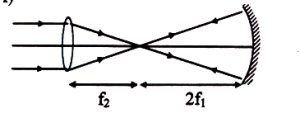
0 likesView Solution
315
PhysicsMediumMCQMHT CET · 2020
The Brewster's angle for the glass-air interface is $(54.74)^{\circ}$. If a ray of light passing from air to glass strikes at an angle of incidence $45^{\circ}$,then the angle of refraction is $\left[\tan (54.74)^{\circ}=\sqrt{2}, \quad \sin 45^{\circ}=\frac{1}{\sqrt{2}}\right]$
A
$\sin ^{-1}(0.5)$
B
$\sin ^{-1}(1)$
C
$\sin ^{-1}(\sqrt{2})$
D
$\sin ^{-1}\left(\frac{1}{2}\right)$
Solution
(A) Brewster's law states that the refractive index $n$ of the medium is given by $n = \tan(i_B)$,where $i_B$ is the Brewster's angle.
Given $i_B = 54.74^{\circ}$,we have $n = \tan(54.74^{\circ}) = \sqrt{2}$.
According to Snell's law,$n = \frac{\sin i}{\sin r}$,where $i$ is the angle of incidence and $r$ is the angle of refraction.
Given $i = 45^{\circ}$ and $n = \sqrt{2}$,we substitute these values:
$\sqrt{2} = \frac{\sin 45^{\circ}}{\sin r}$
$\sqrt{2} = \frac{1/\sqrt{2}}{\sin r}$
$\sin r = \frac{1}{\sqrt{2} \cdot \sqrt{2}} = \frac{1}{2} = 0.5$
Therefore,the angle of refraction $r = \sin^{-1}(0.5)$.
Given $i_B = 54.74^{\circ}$,we have $n = \tan(54.74^{\circ}) = \sqrt{2}$.
According to Snell's law,$n = \frac{\sin i}{\sin r}$,where $i$ is the angle of incidence and $r$ is the angle of refraction.
Given $i = 45^{\circ}$ and $n = \sqrt{2}$,we substitute these values:
$\sqrt{2} = \frac{\sin 45^{\circ}}{\sin r}$
$\sqrt{2} = \frac{1/\sqrt{2}}{\sin r}$
$\sin r = \frac{1}{\sqrt{2} \cdot \sqrt{2}} = \frac{1}{2} = 0.5$
Therefore,the angle of refraction $r = \sin^{-1}(0.5)$.
0 likesView Solution
316
PhysicsEasyMCQMHT CET · 2020
$A$ light of wavelength $\lambda_{1}$ and velocity $C_{1}$ travels from the first medium of refractive index $\mu_{1}$ into the second medium of refractive index $\mu_{2}$. The wavelength and velocity of light in the second medium are $\lambda_{2}$ and $C_{2}$ respectively. The refractive index of the second medium with respect to the first medium is given by:
A
$\frac{C_{2}}{C_{1}}$
B
$\frac{\mu_{2}}{\mu_{1}}$
C
$\frac{\mu_{1}}{\mu_{2}}$
D
$\frac{\lambda_{2}}{\lambda_{1}}$
Solution
(B) The refractive index of the second medium with respect to the first medium is defined as the ratio of the speed of light in the first medium to the speed of light in the second medium.
Mathematically,it is expressed as: $n_{21} = \frac{\mu_{2}}{\mu_{1}} = \frac{C_{1}}{C_{2}} = \frac{\lambda_{1}}{\lambda_{2}}$.
However,the question asks for the refractive index of the second medium with respect to the first medium,which is denoted by the ratio of the refractive indices themselves,i.e.,$\frac{\mu_{2}}{\mu_{1}}$.
Mathematically,it is expressed as: $n_{21} = \frac{\mu_{2}}{\mu_{1}} = \frac{C_{1}}{C_{2}} = \frac{\lambda_{1}}{\lambda_{2}}$.
However,the question asks for the refractive index of the second medium with respect to the first medium,which is denoted by the ratio of the refractive indices themselves,i.e.,$\frac{\mu_{2}}{\mu_{1}}$.
0 likesView Solution
317
PhysicsEasyMCQMHT CET · 2020
Light travels through water in a beaker. The height of the water column is $h$. If the refractive index of water is $\mu_{w}$ and $C$ is the velocity of light in air,the time taken by light to travel through the water will be:
A
$\frac{\mu_{w} h}{C}$
B
$h \mu_{w} C$
C
$\frac{hC}{\mu_{w}}$
D
$\frac{h}{\mu_{w} C}$
Solution
(A) The velocity of light in a medium is given by $v = \frac{C}{\mu_{w}}$,where $C$ is the speed of light in air and $\mu_{w}$ is the refractive index of water.
Time taken $(t)$ to travel a distance $h$ is given by the formula: $t = \frac{\text{distance}}{\text{velocity}}$.
Substituting the values,we get $t = \frac{h}{v}$.
Since $v = \frac{C}{\mu_{w}}$,we substitute this into the time equation:
$t = \frac{h}{(C / \mu_{w})} = \frac{h \mu_{w}}{C}$.
Therefore,the correct option is $A$.
Time taken $(t)$ to travel a distance $h$ is given by the formula: $t = \frac{\text{distance}}{\text{velocity}}$.
Substituting the values,we get $t = \frac{h}{v}$.
Since $v = \frac{C}{\mu_{w}}$,we substitute this into the time equation:
$t = \frac{h}{(C / \mu_{w})} = \frac{h \mu_{w}}{C}$.
Therefore,the correct option is $A$.
0 likesView Solution
318
PhysicsMediumMCQMHT CET · 2020
$A$ metal wire of length '$L$' is bent to form a circular coil of number of turns '$n$'. The coil is placed in a magnetic field '$B$' and a current '$I$' is passed through the coil. The maximum torque acting on the coil is:
A
$\frac{BIL^{2}}{4 \pi n}$
B
$\frac{BIL^{2}}{2 \pi n}$
C
$\frac{B^{2} IL}{2 \pi n}$
D
$\frac{B^{2} IL}{4 \pi n}$
Solution
(A) The length of the wire is $L$. When it is bent into a circular coil of $n$ turns,the circumference of one turn is $2\pi r = L/n$,where $r$ is the radius of the coil.
Thus,the radius $r = \frac{L}{2\pi n}$.
The area of one turn is $A = \pi r^2 = \pi \left(\frac{L}{2\pi n}\right)^2 = \frac{\pi L^2}{4\pi^2 n^2} = \frac{L^2}{4\pi n^2}$.
The total magnetic moment of the coil with $n$ turns is $M = nIA = nI \left(\frac{L^2}{4\pi n^2}\right) = \frac{IL^2}{4\pi n}$.
The maximum torque acting on a coil in a magnetic field is given by $\tau_{max} = MB$.
Substituting the value of $M$,we get $\tau_{max} = \left(\frac{IL^2}{4\pi n}\right)B = \frac{BIL^2}{4\pi n}$.
Thus,the radius $r = \frac{L}{2\pi n}$.
The area of one turn is $A = \pi r^2 = \pi \left(\frac{L}{2\pi n}\right)^2 = \frac{\pi L^2}{4\pi^2 n^2} = \frac{L^2}{4\pi n^2}$.
The total magnetic moment of the coil with $n$ turns is $M = nIA = nI \left(\frac{L^2}{4\pi n^2}\right) = \frac{IL^2}{4\pi n}$.
The maximum torque acting on a coil in a magnetic field is given by $\tau_{max} = MB$.
Substituting the value of $M$,we get $\tau_{max} = \left(\frac{IL^2}{4\pi n}\right)B = \frac{BIL^2}{4\pi n}$.
0 likesView Solution
319
PhysicsEasyMCQMHT CET · 2020
The region near the junction of an unbiased $p-n$ junction diode is known as the depletion layer. This layer is depleted of
A
only negative ions.
B
electrons and holes.
C
both positive and negative ions.
D
only positive ions.
Solution
(B) In an unbiased $p-n$ junction,the diffusion of electrons from the $n$-region to the $p$-region and holes from the $p$-region to the $n$-region occurs near the junction.
When these charge carriers cross the junction,they recombine and neutralize each other.
As a result,the region near the junction becomes devoid of mobile charge carriers (free electrons and holes).
This region is called the depletion layer or depletion region.
Therefore,the layer is depleted of mobile charge carriers,which are electrons and holes.
When these charge carriers cross the junction,they recombine and neutralize each other.
As a result,the region near the junction becomes devoid of mobile charge carriers (free electrons and holes).
This region is called the depletion layer or depletion region.
Therefore,the layer is depleted of mobile charge carriers,which are electrons and holes.
0 likesView Solution
320
PhysicsEasyMHT CET · 2020
In the circuit shown in the figure,the non-zero potential difference across diode $D_{1}$ and that across diode $D_{2}$ are equal. Are the diodes identical in characteristics? Explain.
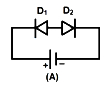
Solution
(D) In the given circuit,the two diodes $D_{1}$ and $D_{2}$ are connected in series with a $DC$ voltage source.
For the circuit to conduct,both diodes must be forward-biased.
However,looking at the orientation of the diodes,$D_{1}$ is forward-biased while $D_{2}$ is reverse-biased.
In a series circuit,the current $I$ is the same through all components.
Since $D_{2}$ is reverse-biased,it offers a very high resistance,effectively acting as an open switch.
Consequently,the entire potential difference of the battery appears across the reverse-biased diode $D_{2}$,while the potential difference across the forward-biased diode $D_{1}$ is negligible (approximately $0.7 \ V$ for Silicon).
If the potential differences across $D_{1}$ and $D_{2}$ are stated to be equal,it implies that the circuit configuration or the assumption of identical characteristics must be re-evaluated,or the diodes are operating in a specific breakdown region. Given the standard interpretation,the potential difference across a reverse-biased diode is much larger than that across a forward-biased one.
For the circuit to conduct,both diodes must be forward-biased.
However,looking at the orientation of the diodes,$D_{1}$ is forward-biased while $D_{2}$ is reverse-biased.
In a series circuit,the current $I$ is the same through all components.
Since $D_{2}$ is reverse-biased,it offers a very high resistance,effectively acting as an open switch.
Consequently,the entire potential difference of the battery appears across the reverse-biased diode $D_{2}$,while the potential difference across the forward-biased diode $D_{1}$ is negligible (approximately $0.7 \ V$ for Silicon).
If the potential differences across $D_{1}$ and $D_{2}$ are stated to be equal,it implies that the circuit configuration or the assumption of identical characteristics must be re-evaluated,or the diodes are operating in a specific breakdown region. Given the standard interpretation,the potential difference across a reverse-biased diode is much larger than that across a forward-biased one.
0 likesView Solution
321
PhysicsEasyMCQMHT CET · 2020
The figure shows two diagrams in which a diode and a resistance are connected. Out of the following statements,which one is $TRUE$?
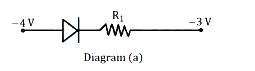
A
Diagram $(A)$ and diagram $(B)$ both are forward biased.
B
Diagram $(A)$ is forward biased and diagram $(B)$ is reverse biased.
C
Diagram $(A)$ and diagram $(B)$ both are reverse biased.
D
Diagram $(A)$ is reverse biased and diagram $(B)$ is forward biased.
Solution
(D) In a $PN$ junction diode,the diode is forward biased if the potential at the anode (p-side) is higher than the potential at the cathode (n-side). It is reverse biased if the potential at the anode is lower than the potential at the cathode.
In diagram $(A)$,the anode is at $-4 \ V$ and the cathode is at $-3 \ V$. Since $-4 \ V < -3 \ V$,the anode is at a lower potential than the cathode,so diagram $(A)$ is reverse biased.
In diagram $(B)$,assuming the standard configuration where the anode is at $-2 \ V$ and the cathode is at $-4 \ V$ (based on typical textbook problems of this type),the anode is at a higher potential than the cathode,so diagram $(B)$ is forward biased.
Therefore,diagram $(A)$ is reverse biased and diagram $(B)$ is forward biased.
In diagram $(A)$,the anode is at $-4 \ V$ and the cathode is at $-3 \ V$. Since $-4 \ V < -3 \ V$,the anode is at a lower potential than the cathode,so diagram $(A)$ is reverse biased.
In diagram $(B)$,assuming the standard configuration where the anode is at $-2 \ V$ and the cathode is at $-4 \ V$ (based on typical textbook problems of this type),the anode is at a higher potential than the cathode,so diagram $(B)$ is forward biased.
Therefore,diagram $(A)$ is reverse biased and diagram $(B)$ is forward biased.
0 likesView Solution
322
PhysicsEasyMCQMHT CET · 2020
For an ideal diode,the current in the following arrangement is:

A
$10 A$
B
$10 mA$
C
$20 mA$
D
$1 mA$
Solution
(B) In the given circuit,the $p$-side of the diode is connected to $+2 V$ and the $n$-side is connected to $-2 V$ through a $400 \Omega$ resistor.
Since the potential of the $p$-side is higher than the potential of the $n$-side,the diode is forward biased.
For an ideal diode,the forward resistance is $0 \Omega$.
Therefore,the total resistance in the circuit is $R = 400 \Omega$.
The potential difference across the circuit is $V = 2 V - (-2 V) = 4 V$.
Using Ohm's law,the current $I$ is given by $I = V / R$.
$I = 4 V / 400 \Omega = 1 / 100 A = 0.01 A$.
Converting to milliamperes,$I = 0.01 \times 1000 mA = 10 mA$.
Since the potential of the $p$-side is higher than the potential of the $n$-side,the diode is forward biased.
For an ideal diode,the forward resistance is $0 \Omega$.
Therefore,the total resistance in the circuit is $R = 400 \Omega$.
The potential difference across the circuit is $V = 2 V - (-2 V) = 4 V$.
Using Ohm's law,the current $I$ is given by $I = V / R$.
$I = 4 V / 400 \Omega = 1 / 100 A = 0.01 A$.
Converting to milliamperes,$I = 0.01 \times 1000 mA = 10 mA$.
0 likesView Solution
323
PhysicsEasyMCQMHT CET · 2020
The width of the depletion layer of a $p-n$ junction diode,when it is $(i)$ forward biased and $(ii)$ reverse biased,respectively,is:
A
increases and increases.
B
decreases and decreases.
C
increases and decreases.
D
decreases and increases.
Solution
(D) $(i)$ When a $p-n$ junction is forward biased,the external electric field opposes the internal electric field of the depletion region. This reduces the potential barrier and consequently decreases the width of the depletion layer.
$(ii)$ When a $p-n$ junction is reverse biased,the external electric field supports the internal electric field of the depletion region. This increases the potential barrier and consequently increases the width of the depletion layer.
$(ii)$ When a $p-n$ junction is reverse biased,the external electric field supports the internal electric field of the depletion region. This increases the potential barrier and consequently increases the width of the depletion layer.
0 likesView Solution
324
PhysicsEasyMCQMHT CET · 2020
If $p-n$ junction diode is reverse biased,then:
A
potential barrier decreases.
B
width of the depletion layer decreases.
C
electrical conduction is possible.
D
width of the depletion layer increases.
Solution
(D) When a $p-n$ junction diode is reverse biased,the positive terminal of the battery is connected to the $n$-region and the negative terminal to the $p$-region.
This configuration pulls the majority charge carriers away from the junction.
As a result,the width of the depletion layer increases.
Consequently,the potential barrier also increases,which opposes the flow of current,making electrical conduction negligible.
This configuration pulls the majority charge carriers away from the junction.
As a result,the width of the depletion layer increases.
Consequently,the potential barrier also increases,which opposes the flow of current,making electrical conduction negligible.
0 likesView Solution
325
PhysicsEasyMCQMHT CET · 2020
The $I-V$ characteristics for a junction diode are shown. The device is
A
$LED$.
B
solar cell.
C
photocell.
D
zener diode.
Solution
(C) The $I-V$ characteristics of a device operating in the fourth quadrant (where voltage is positive and current is negative,or vice versa depending on convention) represent a device that generates power rather than consuming it.
In a $photocell$,the $I-V$ characteristics are typically shown in the fourth quadrant because it acts as a source of electrical energy when illuminated.
Therefore,the correct option is $C$.
In a $photocell$,the $I-V$ characteristics are typically shown in the fourth quadrant because it acts as a source of electrical energy when illuminated.
Therefore,the correct option is $C$.
0 likesView Solution
326
PhysicsEasyMCQMHT CET · 2020
When a $p-n$ junction diode is reverse biased,then the width of the depletion layer will
A
increase and it will offer more resistance.
B
decrease and it will offer zero resistance.
C
remain constant and it will not offer resistance.
D
decrease and it will offer more resistance.
Solution
(A) In a $p-n$ junction diode,when reverse bias is applied,the positive terminal of the battery is connected to the $n$-region and the negative terminal to the $p$-region.
This causes the majority charge carriers (electrons in $n$-region and holes in $p$-region) to move away from the junction.
As a result,the depletion layer widens,and the barrier potential increases.
Due to the increased width of the depletion layer,the flow of majority charge carriers is blocked,which means the diode offers high resistance to the current.
This causes the majority charge carriers (electrons in $n$-region and holes in $p$-region) to move away from the junction.
As a result,the depletion layer widens,and the barrier potential increases.
Due to the increased width of the depletion layer,the flow of majority charge carriers is blocked,which means the diode offers high resistance to the current.
0 likesView Solution
327
PhysicsEasyMCQMHT CET · 2020
Choose the correct statement. In conductors,
A
valence band and conduction band overlap each other.
B
valence band and conduction band are separated by a large energy gap.
C
very small number of electrons are available for electrical conduction.
D
valence band and conduction band are separated by a small energy gap.
Solution
(A) In conductors,the valence band and the conduction band overlap each other. This overlap allows electrons to move freely from the valence band to the conduction band even at low temperatures,which is why conductors have high electrical conductivity.
0 likesView Solution
328
PhysicsEasyMCQMHT CET · 2020
In the energy band diagram of insulators,the band gap and the conduction band are respectively:
A
very high,empty.
B
very low,partially filled.
C
very high,completely filled.
D
very low,empty.
Solution
(A) In insulators,the valence band is completely filled with electrons,and the conduction band is completely empty. The energy gap (forbidden energy gap) between the valence band and the conduction band is very large (typically $> 3 \ eV$). Therefore,electrons cannot jump from the valence band to the conduction band even at room temperature,making them poor conductors of electricity. Thus,the band gap is very high and the conduction band is empty.
0 likesView Solution
329
PhysicsEasyMCQMHT CET · 2020
In an oscillator,if $\beta$ is the feedback factor and $A$ is the gain of the amplifier,then sustained oscillations are obtained when:
A
$A/\beta = 1$
B
$A\beta < 1$
C
$A\beta = 1$
D
$A\beta > 1$
Solution
(C) For sustained oscillations in an oscillator circuit,the Barkhausen criterion must be satisfied.
This criterion states that the loop gain of the feedback system must be equal to unity,which is expressed as $|A\beta| = 1$.
Here,$A$ is the open-loop gain of the amplifier and $\beta$ is the feedback factor.
Therefore,the condition for sustained oscillations is $A\beta = 1$.
This criterion states that the loop gain of the feedback system must be equal to unity,which is expressed as $|A\beta| = 1$.
Here,$A$ is the open-loop gain of the amplifier and $\beta$ is the feedback factor.
Therefore,the condition for sustained oscillations is $A\beta = 1$.
0 likesView Solution
330
PhysicsMediumMCQMHT CET · 2020
In a transistor amplifier,the base-emitter junction is forward-biased and the collector-emitter junction is reverse-biased. The current gain is defined as:
A
$\frac{\Delta I_{E}}{\Delta I_{B}}$
B
$\frac{\Delta I_{B}}{\Delta I_{E}}$
C
$\frac{\Delta I_{B}}{\Delta I_{C}}$
D
$\frac{\Delta I_{C}}{\Delta I_{B}}$
Solution
(D) In a common-emitter transistor amplifier configuration,the current gain (denoted by $\beta$) is defined as the ratio of the change in collector current $(\Delta I_{C})$ to the change in base current $(\Delta I_{B})$ while keeping the collector-emitter voltage $(V_{CE})$ constant.
Mathematically,$\beta = \frac{\Delta I_{C}}{\Delta I_{B}}$.
Therefore,the correct option is $D$.
Mathematically,$\beta = \frac{\Delta I_{C}}{\Delta I_{B}}$.
Therefore,the correct option is $D$.
0 likesView Solution
331
PhysicsEasyMCQMHT CET · 2020
In common emitter mode of a transistor, the d.c. current gain is $20$, and the emitter current is $7 \,mA$. The collector current is (in $/ 3 \,mA$)
A
$16$
B
$13$
C
$8$
D
$20$
Solution
(D) Given: $\beta = 20$, $I_{E} = 7 \,mA$.
We know that the current gain in common emitter mode is defined as $\beta = \frac{I_{C}}{I_{B}}$.
Also, the relationship between emitter current, collector current, and base current is $I_{E} = I_{C} + I_{B}$, which implies $I_{B} = I_{E} - I_{C}$.
Substituting $I_{B}$ in the gain formula: $\beta = \frac{I_{C}}{I_{E} - I_{C}}$.
Rearranging the equation: $20 = \frac{I_{C}}{7 - I_{C}}$.
$20(7 - I_{C}) = I_{C}$.
$140 - 20I_{C} = I_{C}$.
$140 = 21I_{C}$.
$I_{C} = \frac{140}{21} = \frac{20}{3} \,mA$.
We know that the current gain in common emitter mode is defined as $\beta = \frac{I_{C}}{I_{B}}$.
Also, the relationship between emitter current, collector current, and base current is $I_{E} = I_{C} + I_{B}$, which implies $I_{B} = I_{E} - I_{C}$.
Substituting $I_{B}$ in the gain formula: $\beta = \frac{I_{C}}{I_{E} - I_{C}}$.
Rearranging the equation: $20 = \frac{I_{C}}{7 - I_{C}}$.
$20(7 - I_{C}) = I_{C}$.
$140 - 20I_{C} = I_{C}$.
$140 = 21I_{C}$.
$I_{C} = \frac{140}{21} = \frac{20}{3} \,mA$.
0 likesView Solution
332
PhysicsMediumMCQMHT CET · 2020
In a common emitter amplifier,the input resistance is $1000 \Omega$,the peak value of the input signal voltage is $5 mV$,and $\beta = 60$. The peak value of the output current is:
A
$0.5 \times 10^{-4} \text{ A}$
B
$3 \times 10^{-4} \text{ A}$
C
$2 \times 10^{-5} \text{ A}$
D
$1 \times 10^{-5} \text{ A}$
Solution
(B) Given: Input resistance $R_{i} = 1000 \Omega$,Input signal voltage $v_{i} = 5 mV = 5 \times 10^{-3} V$,and current gain $\beta = 60$.
First,calculate the input current $I_{b}$ using Ohm's law: $I_{b} = \frac{v_{i}}{R_{i}} = \frac{5 \times 10^{-3} V}{1000 \Omega} = 5 \times 10^{-6} A$.
The output current in a common emitter amplifier is the collector current $I_{c}$.
Using the relation $I_{c} = \beta \times I_{b}$,we get: $I_{c} = 60 \times 5 \times 10^{-6} A = 300 \times 10^{-6} A$.
Therefore,the peak value of the output current is $3 \times 10^{-4} A$.
First,calculate the input current $I_{b}$ using Ohm's law: $I_{b} = \frac{v_{i}}{R_{i}} = \frac{5 \times 10^{-3} V}{1000 \Omega} = 5 \times 10^{-6} A$.
The output current in a common emitter amplifier is the collector current $I_{c}$.
Using the relation $I_{c} = \beta \times I_{b}$,we get: $I_{c} = 60 \times 5 \times 10^{-6} A = 300 \times 10^{-6} A$.
Therefore,the peak value of the output current is $3 \times 10^{-4} A$.
0 likesView Solution
333
PhysicsEasyMCQMHT CET · 2020
$A$ transistor has a voltage gain '$A$'. If a fraction '$\beta$' of its output is fed back to the input of the transistor,then the transistor becomes an oscillator when:
A
$\beta = 0$
B
$\beta A = 1$
C
$\beta A = \infty$
D
$\beta A = 0$
Solution
(B) The voltage gain of an amplifier with feedback is given by $A_f = \frac{A}{1 - A\beta}$,where $A$ is the open-loop voltage gain and $\beta$ is the feedback factor.
For an oscillator to produce sustained oscillations,the Barkhausen criterion must be satisfied.
The Barkhausen criterion states that the loop gain must be equal to unity,which is expressed as $A\beta = 1$.
For an oscillator to produce sustained oscillations,the Barkhausen criterion must be satisfied.
The Barkhausen criterion states that the loop gain must be equal to unity,which is expressed as $A\beta = 1$.
0 likesView Solution
334
PhysicsEasyMCQMHT CET · 2020
$A$ transistor having $\alpha=0.8$ is connected in a common-emitter configuration. When the base current changes by $6 \text{ mA}$, the change in collector current is: (in $\text{ mA}$)
A
$12$
B
$1.5$
C
$24$
D
$0.66$
Solution
(C) Given: $\alpha = 0.8$ and $\Delta I_B = 6 \text{ mA}$.
First, we calculate the current gain $\beta$ for the common-emitter configuration using the relation $\beta = \frac{\alpha}{1 - \alpha}$.
Substituting the value of $\alpha$: $\beta = \frac{0.8}{1 - 0.8} = \frac{0.8}{0.2} = 4$.
The relationship between the change in collector current $\Delta I_C$ and the change in base current $\Delta I_B$ is given by $\Delta I_C = \beta \times \Delta I_B$.
Substituting the values: $\Delta I_C = 4 \times 6 \text{ mA} = 24 \text{ mA}$.
Therefore, the change in collector current is $24 \text{ mA}$.
First, we calculate the current gain $\beta$ for the common-emitter configuration using the relation $\beta = \frac{\alpha}{1 - \alpha}$.
Substituting the value of $\alpha$: $\beta = \frac{0.8}{1 - 0.8} = \frac{0.8}{0.2} = 4$.
The relationship between the change in collector current $\Delta I_C$ and the change in base current $\Delta I_B$ is given by $\Delta I_C = \beta \times \Delta I_B$.
Substituting the values: $\Delta I_C = 4 \times 6 \text{ mA} = 24 \text{ mA}$.
Therefore, the change in collector current is $24 \text{ mA}$.
0 likesView Solution
335
PhysicsEasyMCQMHT CET · 2020
In the common emitter configuration of a transistor,the current gain is more than $1$. Given that $I_{b}$,$I_{e}$,and $I_{c}$ are the base,emitter,and collector currents respectively,which of the following relations is correct?
A
$I_{c} < I_{b}$
B
$I_{b} < I_{e}$
C
$I_{c} < I_{e}$
D
$I_{c} > I_{b}$
Solution
(D) In a transistor,the emitter current is the sum of the base current and the collector current: $I_{e} = I_{b} + I_{c}$.
Since $I_{b}$ and $I_{c}$ are both positive currents,it follows that $I_{c} < I_{e}$ and $I_{b} < I_{e}$.
The current gain in common emitter configuration is defined as $\beta = \frac{I_{c}}{I_{b}}$.
For a transistor,$I_{c}$ is typically much larger than $I_{b}$ (since the base region is very thin and lightly doped),which makes $\beta > 1$.
Therefore,the condition $I_{c} > I_{b}$ is the fundamental reason why the current gain $\beta$ is greater than $1$.
Since $I_{b}$ and $I_{c}$ are both positive currents,it follows that $I_{c} < I_{e}$ and $I_{b} < I_{e}$.
The current gain in common emitter configuration is defined as $\beta = \frac{I_{c}}{I_{b}}$.
For a transistor,$I_{c}$ is typically much larger than $I_{b}$ (since the base region is very thin and lightly doped),which makes $\beta > 1$.
Therefore,the condition $I_{c} > I_{b}$ is the fundamental reason why the current gain $\beta$ is greater than $1$.
0 likesView Solution
336
PhysicsEasyMCQMHT CET · 2020
In a study of a transistor as an amplifier,the ratio of collector current to emitter current is $0.98$. If the collector current is $3 \text{ mA}$,then the base current will be approximately:
A
$6 \text{ mA}$
B
$60 \text{ mA}$
C
$6 \mu\text{A}$
D
$60 \mu\text{A}$
Solution
(D) Given: The ratio of collector current $(i_c)$ to emitter current $(i_e)$ is $\alpha = \frac{i_c}{i_e} = 0.98$.
The collector current is $i_c = 3 \text{ mA}$.
We know that the emitter current is the sum of collector current and base current: $i_e = i_c + i_b$.
Substituting this into the ratio: $\frac{i_c}{i_c + i_b} = 0.98$.
Rearranging the equation: $\frac{i_c + i_b}{i_c} = \frac{1}{0.98} = \frac{100}{98}$.
$1 + \frac{i_b}{i_c} = \frac{100}{98} \implies \frac{i_b}{i_c} = \frac{100}{98} - 1 = \frac{2}{98} = \frac{1}{49}$.
Therefore,$i_b = \frac{i_c}{49} = \frac{3 \text{ mA}}{49} = \frac{3000 \mu\text{A}}{49} \approx 61.22 \mu\text{A}$.
Rounding to the nearest given option,the base current is approximately $60 \mu\text{A}$.
The collector current is $i_c = 3 \text{ mA}$.
We know that the emitter current is the sum of collector current and base current: $i_e = i_c + i_b$.
Substituting this into the ratio: $\frac{i_c}{i_c + i_b} = 0.98$.
Rearranging the equation: $\frac{i_c + i_b}{i_c} = \frac{1}{0.98} = \frac{100}{98}$.
$1 + \frac{i_b}{i_c} = \frac{100}{98} \implies \frac{i_b}{i_c} = \frac{100}{98} - 1 = \frac{2}{98} = \frac{1}{49}$.
Therefore,$i_b = \frac{i_c}{49} = \frac{3 \text{ mA}}{49} = \frac{3000 \mu\text{A}}{49} \approx 61.22 \mu\text{A}$.
Rounding to the nearest given option,the base current is approximately $60 \mu\text{A}$.
0 likesView Solution
337
PhysicsEasyMCQMHT CET · 2020
The resultant gate and its Boolean expression for the given circuit is
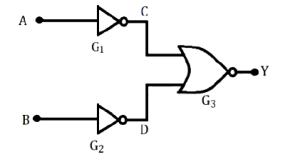
A
$OR, A+B$
B
$NAND, \overline{A \cdot B}$
C
$NOR, \overline{A+B}$
D
$AND, A \cdot B$
Solution
(D) The given circuit consists of two $NOT$ gates ($G_1$ and $G_2$) and one $NOR$ gate $(G_3)$.
$1$. The input $A$ passes through the $NOT$ gate $G_1$,so the output at $C$ is $C = \overline{A}$.
$2$. The input $B$ passes through the $NOT$ gate $G_2$,so the output at $D$ is $D = \overline{B}$.
$3$. These outputs $C$ and $D$ are fed into the $NOR$ gate $G_3$. The output $Y$ of a $NOR$ gate is the complement of the $OR$ of its inputs.
$4$. Therefore,$Y = \overline{C + D}$.
$5$. Substituting the values of $C$ and $D$,we get $Y = \overline{\overline{A} + \overline{B}}$.
$6$. According to De Morgan's theorem,$\overline{\overline{A} + \overline{B}} = \overline{\overline{A}} \cdot \overline{\overline{B}} = A \cdot B$.
$7$. The Boolean expression $Y = A \cdot B$ represents an $AND$ gate.
Thus,the resultant gate is an $AND$ gate with the expression $A \cdot B$.
$1$. The input $A$ passes through the $NOT$ gate $G_1$,so the output at $C$ is $C = \overline{A}$.
$2$. The input $B$ passes through the $NOT$ gate $G_2$,so the output at $D$ is $D = \overline{B}$.
$3$. These outputs $C$ and $D$ are fed into the $NOR$ gate $G_3$. The output $Y$ of a $NOR$ gate is the complement of the $OR$ of its inputs.
$4$. Therefore,$Y = \overline{C + D}$.
$5$. Substituting the values of $C$ and $D$,we get $Y = \overline{\overline{A} + \overline{B}}$.
$6$. According to De Morgan's theorem,$\overline{\overline{A} + \overline{B}} = \overline{\overline{A}} \cdot \overline{\overline{B}} = A \cdot B$.
$7$. The Boolean expression $Y = A \cdot B$ represents an $AND$ gate.
Thus,the resultant gate is an $AND$ gate with the expression $A \cdot B$.
0 likesView Solution
338
PhysicsEasyMCQMHT CET · 2020
For which logic gate is the following statement true? The output is high if and only if all inputs are high.
A
$AND$
B
$OR$
C
$NOR$
D
$NAND$
Solution
(A) The logic gate for which the output is high $(1)$ if and only if all inputs are high $(1)$ is the $AND$ gate.
For an $AND$ gate with inputs $A$ and $B$,the output $Y$ is given by $Y = A \cdot B$.
If $A = 1$ and $B = 1$,then $Y = 1 \cdot 1 = 1$.
For any other combination of inputs,the output is low $(0)$.
For an $AND$ gate with inputs $A$ and $B$,the output $Y$ is given by $Y = A \cdot B$.
If $A = 1$ and $B = 1$,then $Y = 1 \cdot 1 = 1$.
For any other combination of inputs,the output is low $(0)$.
0 likesView Solution
339
PhysicsEasyMCQMHT CET · 2020
$A$ donor impurity results in
A
conduction band just above the filled valence band.
B
holes as majority carriers and electrons as minority carriers.
C
production of $n$-type semiconductor.
D
production of $p$-type semiconductor.
Solution
(C) When a pentavalent impurity (donor impurity) is added to an intrinsic semiconductor (like $Si$ or $Ge$),each donor atom provides an extra electron to the conduction band.
Since the number of free electrons increases significantly,the semiconductor becomes an $n$-type semiconductor.
In an $n$-type semiconductor,electrons are the majority charge carriers and holes are the minority charge carriers.
Since the number of free electrons increases significantly,the semiconductor becomes an $n$-type semiconductor.
In an $n$-type semiconductor,electrons are the majority charge carriers and holes are the minority charge carriers.
0 likesView Solution
340
PhysicsEasyMCQMHT CET · 2020
When a small amount of impurity atoms are added to a semiconductor,then generally its resistivity:
A
decreases.
B
increases.
C
does not change.
D
may increase or decrease depending upon the percentage of doping.
Solution
(A) The conductivity of a semiconductor is given by $\sigma = n_{e} e \mu_{e} + n_{h} e \mu_{h}$.
Here,$n_{e}$ and $n_{h}$ are the number of electrons and holes per unit volume,and $\mu_{e}$ and $\mu_{h}$ are the mobilities of electrons and holes,respectively.
When impurity atoms are added to a semiconductor (a process known as doping),the concentration of charge carriers ($n_{e}$ or $n_{h}$) increases significantly.
Since conductivity $\sigma$ is directly proportional to the carrier concentration,the conductivity increases.
As resistivity $\rho$ is the reciprocal of conductivity $(\rho = 1/\sigma)$,an increase in conductivity leads to a decrease in resistivity.
Here,$n_{e}$ and $n_{h}$ are the number of electrons and holes per unit volume,and $\mu_{e}$ and $\mu_{h}$ are the mobilities of electrons and holes,respectively.
When impurity atoms are added to a semiconductor (a process known as doping),the concentration of charge carriers ($n_{e}$ or $n_{h}$) increases significantly.
Since conductivity $\sigma$ is directly proportional to the carrier concentration,the conductivity increases.
As resistivity $\rho$ is the reciprocal of conductivity $(\rho = 1/\sigma)$,an increase in conductivity leads to a decrease in resistivity.
0 likesView Solution
341
PhysicsEasyMCQMHT CET · 2020
At absolute zero temperature,pure silicon behaves as
A
extrinsic semiconductor
B
non-metal
C
insulator
D
metal
Solution
(C)
At absolute zero temperature $(T = 0 \ K)$,there is no thermal energy available to excite electrons from the valence band to the conduction band in a pure semiconductor like silicon.
Consequently,the valence band is completely filled and the conduction band is completely empty.
Due to the absence of free charge carriers,the material cannot conduct electricity.
Therefore,pure silicon behaves as an insulator at absolute zero temperature.
At absolute zero temperature $(T = 0 \ K)$,there is no thermal energy available to excite electrons from the valence band to the conduction band in a pure semiconductor like silicon.
Consequently,the valence band is completely filled and the conduction band is completely empty.
Due to the absence of free charge carriers,the material cannot conduct electricity.
Therefore,pure silicon behaves as an insulator at absolute zero temperature.
0 likesView Solution
342
PhysicsEasyMCQMHT CET · 2020
In an intrinsic semiconductor,at an ordinary temperature,the correct relation between the number of electrons '$n_{e}$' and number of holes '$n_{h}$' is
A
$n_{e} > n_{h}$
B
$n_{e} = n_{h}$
C
$n_{e} = n_{h} = 0$
D
$n_{e} < n_{h}$
Solution
(B) In an intrinsic (pure) semiconductor,charge carriers are generated only due to the thermal excitation of electrons from the valence band to the conduction band.
When an electron is excited to the conduction band,it leaves behind a vacancy in the valence band,which is known as a hole.
Since each electron-hole pair is created simultaneously,the number of electrons in the conduction band $(n_{e})$ must be equal to the number of holes in the valence band $(n_{h})$.
Therefore,the correct relation is $n_{e} = n_{h}$.
When an electron is excited to the conduction band,it leaves behind a vacancy in the valence band,which is known as a hole.
Since each electron-hole pair is created simultaneously,the number of electrons in the conduction band $(n_{e})$ must be equal to the number of holes in the valence band $(n_{h})$.
Therefore,the correct relation is $n_{e} = n_{h}$.
0 likesView Solution
343
PhysicsEasyMHT CET · 2020
Which one of the following symbols represents a photodiode?
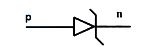
Solution
(D) photodiode is a special type of $p-n$ junction diode that is designed to operate under reverse bias conditions. It is sensitive to light. The symbol for a photodiode consists of a standard $p-n$ junction diode symbol with two arrows pointing towards the diode,indicating that light is incident on it. Since the provided image shows a Zener diode symbol (which has '$Z$' shaped ends on the cathode),it does not represent a photodiode. However,based on standard textbook representations,a photodiode is characterized by incoming light rays.
0 likesView Solution
344
PhysicsEasyMCQMHT CET · 2020
$A$ photodiode is a device
A
in which photo current is dependent on the reverse bias.
B
which is always operated in forward bias.
C
in which photo current is independent of incident radiation.
D
which is always operated in reverse bias.
Solution
(D) photodiode is a special type of $p-n$ junction diode that is fabricated with a transparent window to allow light to fall on the diode.
It is operated under reverse bias conditions.
When light with energy $h
u$ greater than the energy gap $E_g$ of the semiconductor is incident on the diode,electron-hole pairs are generated.
Due to the electric field at the junction,these charge carriers are separated before they can recombine,resulting in a current flow in the external circuit.
The magnitude of this photo-current depends on the intensity of the incident light,not significantly on the reverse bias voltage once a certain threshold is reached.
Therefore,the correct statement is that it is always operated in reverse bias.
It is operated under reverse bias conditions.
When light with energy $h
u$ greater than the energy gap $E_g$ of the semiconductor is incident on the diode,electron-hole pairs are generated.
Due to the electric field at the junction,these charge carriers are separated before they can recombine,resulting in a current flow in the external circuit.
The magnitude of this photo-current depends on the intensity of the incident light,not significantly on the reverse bias voltage once a certain threshold is reached.
Therefore,the correct statement is that it is always operated in reverse bias.
0 likesView Solution
345
PhysicsEasyMCQMHT CET · 2020
In a light emitting diode $(LED)$,light is emitted due to:
A
drifting of electrons.
B
diffusion of holes.
C
recombination of holes and electrons.
D
emission of holes and electrons.
Solution
(C) light emitting diode $(LED)$ is a heavily doped $p-n$ junction diode.
When the diode is forward-biased,electrons from the $n$-region and holes from the $p$-region are injected into the junction region.
In the junction region,these charge carriers undergo recombination.
During the process of recombination,the energy released is in the form of photons.
If the semiconductor material has a suitable band gap,the energy of the emitted photons corresponds to the visible light spectrum.
Therefore,the light emission is due to the recombination of holes and electrons.
When the diode is forward-biased,electrons from the $n$-region and holes from the $p$-region are injected into the junction region.
In the junction region,these charge carriers undergo recombination.
During the process of recombination,the energy released is in the form of photons.
If the semiconductor material has a suitable band gap,the energy of the emitted photons corresponds to the visible light spectrum.
Therefore,the light emission is due to the recombination of holes and electrons.
0 likesView Solution
346
PhysicsMediumMCQMHT CET · 2020
The dimensions of magnetic intensity are
A
$[L^{1} M^{0} T^{0} I^{1}]$
B
$[L^{1} M^{0} T^{0} I^{-1}]$
C
$[L^{-1} M^{0} T^{0} I^{1}]$
D
$[L^{-2} M^{0} T^{0} I^{1}]$
Solution
(C) Magnetic intensity $(H)$ is defined as the magnetizing force per unit length.
The formula for magnetic intensity is $H = \frac{nI}{L}$,where $n$ is the number of turns,$I$ is the current,and $L$ is the length.
Since the number of turns $(n)$ is a dimensionless quantity,the dimensions of $H$ are given by the dimensions of $\frac{I}{L}$.
The dimension of current $(I)$ is $[I^1]$ and the dimension of length $(L)$ is $[L^1]$.
Therefore,the dimensions of magnetic intensity are $[L^{-1} M^0 T^0 I^1]$.
The formula for magnetic intensity is $H = \frac{nI}{L}$,where $n$ is the number of turns,$I$ is the current,and $L$ is the length.
Since the number of turns $(n)$ is a dimensionless quantity,the dimensions of $H$ are given by the dimensions of $\frac{I}{L}$.
The dimension of current $(I)$ is $[I^1]$ and the dimension of length $(L)$ is $[L^1]$.
Therefore,the dimensions of magnetic intensity are $[L^{-1} M^0 T^0 I^1]$.
0 likesView Solution
347
PhysicsMediumMCQMHT CET · 2020
Out of the following units,the $WRONG$ unit of magnetic dipole moment is
A
$N m^3 / Wb$
B
$A m^2$
C
$J / T$
D
$N m / T$
Solution
(C) The magnetic dipole moment $M$ is defined by the relation $\tau = M \times B$,where $\tau$ is torque and $B$ is magnetic field.
From this,$M = \tau / B$.
The unit of torque $\tau$ is $N m$ (Newton-meter) and the unit of magnetic field $B$ is $T$ (Tesla).
Therefore,the unit of $M$ is $N m / T$.
Since $1 \ T = 1 \ Wb / m^2$,we can write $M = (N m) / (Wb / m^2) = N m^3 / Wb$.
Also,$M = I A$,where $I$ is current $(A)$ and $A$ is area $(m^2)$,so the unit is $A m^2$.
Since $1 \ J = 1 \ N m$,the unit $N m / T$ is equivalent to $J / T$.
Comparing these with the options,$J-T$ (Option $C$) is dimensionally incorrect as it represents energy multiplied by magnetic field,not magnetic dipole moment.
From this,$M = \tau / B$.
The unit of torque $\tau$ is $N m$ (Newton-meter) and the unit of magnetic field $B$ is $T$ (Tesla).
Therefore,the unit of $M$ is $N m / T$.
Since $1 \ T = 1 \ Wb / m^2$,we can write $M = (N m) / (Wb / m^2) = N m^3 / Wb$.
Also,$M = I A$,where $I$ is current $(A)$ and $A$ is area $(m^2)$,so the unit is $A m^2$.
Since $1 \ J = 1 \ N m$,the unit $N m / T$ is equivalent to $J / T$.
Comparing these with the options,$J-T$ (Option $C$) is dimensionally incorrect as it represents energy multiplied by magnetic field,not magnetic dipole moment.
0 likesView Solution
348
PhysicsEasyMCQMHT CET · 2020
$A$ parallel beam of monochromatic light falls normally on a single narrow slit. The angular width of the central maximum in the resulting diffraction pattern
A
increases with increase of slit width.
B
decreases with increase of slit width.
C
decreases with decrease of slit width.
D
may increase or decrease with decrease of slit width.
Solution
(B) The angular width of the central maximum in a single-slit diffraction pattern is given by the formula $\theta = \frac{2\lambda}{a}$,where $\lambda$ is the wavelength of the light and $a$ is the width of the slit.
From this relation,it is clear that the angular width $\theta$ is inversely proportional to the slit width $a$,i.e.,$\theta \propto \frac{1}{a}$.
Therefore,as the slit width $a$ increases,the angular width of the central maximum decreases.
From this relation,it is clear that the angular width $\theta$ is inversely proportional to the slit width $a$,i.e.,$\theta \propto \frac{1}{a}$.
Therefore,as the slit width $a$ increases,the angular width of the central maximum decreases.
0 likesView Solution
349
PhysicsEasyMCQMHT CET · 2020
In a diffraction experiment from a single slit,the angular width of the central maximum does $NOT$ depend upon:
A
ratio of wavelength and slit width
B
distance of the slit from the screen
C
wavelength of light used
D
width of the slit
Solution
(B) The angular width of the central maximum in a single-slit diffraction experiment is given by the formula $\theta = \frac{2 \lambda}{a}$,where $\lambda$ is the wavelength of the light used and $a$ is the width of the slit.
From this formula,it is clear that the angular width depends on the wavelength $\lambda$ and the slit width $a$.
It does not depend on the distance $D$ between the slit and the screen.
Therefore,the correct option is $B$.
From this formula,it is clear that the angular width depends on the wavelength $\lambda$ and the slit width $a$.
It does not depend on the distance $D$ between the slit and the screen.
Therefore,the correct option is $B$.
0 likesView Solution
350
PhysicsEasyMCQMHT CET · 2020
In a biprism experiment,monochromatic light of wavelength $\lambda$ is used. The distance between two coherent sources is kept constant. If the distance between the slit and the eyepiece $(D)$ is varied as $D_{1}, D_{2}, D_{3}$ and $D_{4}$,and the corresponding measured fringe widths are $z_{1}, z_{2}, z_{3}$ and $z_{4}$,then:
A
$\frac{z_{1}}{D_{1}}=\frac{z_{2}}{D_{2}}=\frac{z_{3}}{D_{3}}=\frac{z_{4}}{D_{4}}$
B
$z_{1} D_{1}=z_{2} D_{2}=z_{3} D_{3}=z_{4} D_{4}$
C
$z_{1} \sqrt{D_{1}}=z_{2} \sqrt{D_{2}}=z_{3} \sqrt{D_{3}}=z_{4} \sqrt{D_{4}}$
D
$z_{1} D_{1}^{2}=z_{2} D_{2}^{2}=z_{3} D_{3}^{2}=z_{4} D_{4}^{2}$
Solution
(A) The fringe width $(z)$ in a biprism experiment (or Young's Double Slit Experiment) is given by the formula:
$z = \frac{\lambda D}{d}$
where $\lambda$ is the wavelength of light,$D$ is the distance between the slit and the eyepiece (screen),and $d$ is the distance between the two coherent sources.
Given that the wavelength $\lambda$ and the distance between the coherent sources $d$ are kept constant,we can write:
$z \propto D$
This implies that the ratio $\frac{z}{D}$ is a constant.
Therefore,$\frac{z_{1}}{D_{1}} = \frac{z_{2}}{D_{2}} = \frac{z_{3}}{D_{3}} = \frac{z_{4}}{D_{4}}$.
Thus,option $A$ is correct.
$z = \frac{\lambda D}{d}$
where $\lambda$ is the wavelength of light,$D$ is the distance between the slit and the eyepiece (screen),and $d$ is the distance between the two coherent sources.
Given that the wavelength $\lambda$ and the distance between the coherent sources $d$ are kept constant,we can write:
$z \propto D$
This implies that the ratio $\frac{z}{D}$ is a constant.
Therefore,$\frac{z_{1}}{D_{1}} = \frac{z_{2}}{D_{2}} = \frac{z_{3}}{D_{3}} = \frac{z_{4}}{D_{4}}$.
Thus,option $A$ is correct.
0 likesView Solution
Vedclass Products
For Students
Vedclass Test Series
Mock tests in real MHT CET style covering Physics with performance analysis. 5-day free trial.
Start Free TrialFor Teachers
Exam Paper Generator
Generate Set A/B/C/D Physics papers from 7.5L+ questions in 2 minutes. 3 chapters free.
Try FreeFor Institutes
Online Exam Module
Run live MHT CET mock exams with unlimited students, 360° analytics & white-label branding.
See DemoFrequently Asked Questions
How many Physics questions are in MHT CET 2020?
There are 690 Physics questions from the MHT CET 2020 paper on Vedclass, each with a detailed step-by-step solution in English.
Are MHT CET 2020 Physics solutions available in English?
Yes. All solutions on this page are in English. You can also switch to English or Hindi using the language buttons above the questions.
Can I practice MHT CET 2020 Physics as a timed test?
Yes. Use the Vedclass Test Series to attempt a full MHT CET mock test covering Physics with time limits and instant score analysis.
Can teachers create Physics papers from MHT CET previous year questions?
Yes. The Vedclass Exam Paper Generator lets teachers mix MHT CET Physics questions and generate Set A/B/C/D papers in minutes.
For Teachers & Institutes
Build a Custom Physics Paper
Pick MHT CET 2020 Physics questions, set difficulty, and generate Set A/B/C/D in 2 minutes.