
PhysicsQ1–50 of 50 questions
Page 1 of 1 · English
1
PhysicsMediumMCQMHT CET · 2018
$A$ sphere of mass $m$ moving with velocity $v$ collides head-on with another sphere of the same mass which is at rest. The ratio of the final velocity of the second sphere to the initial velocity of the first sphere is (where $e$ is the coefficient of restitution and the collision is inelastic).
A
$\frac{e-1}{2}$
B
$\frac{e}{2}$
C
$\frac{e+1}{2}$
D
$e$
Solution
(C) Let the mass of both spheres be $m$. The initial velocity of the first sphere is $v$ and the second sphere is $0$. Let their final velocities be $V_1$ and $V_2$ respectively.
By the law of conservation of linear momentum:
$m v + m(0) = m V_1 + m V_2$
$v = V_1 + V_2$ --- $(1)$
By the definition of the coefficient of restitution $e$:
$e = \frac{V_2 - V_1}{u_1 - u_2}$
$e = \frac{V_2 - V_1}{v - 0}$
$e v = V_2 - V_1$ --- $(2)$
Adding equations $(1)$ and $(2)$:
$v + e v = (V_1 + V_2) + (V_2 - V_1)$
$v(1 + e) = 2 V_2$
$V_2 = \frac{v(e + 1)}{2}$
The ratio of the final velocity of the second sphere $(V_2)$ to the initial velocity of the first sphere $(v)$ is:
$\frac{V_2}{v} = \frac{e + 1}{2}$
By the law of conservation of linear momentum:
$m v + m(0) = m V_1 + m V_2$
$v = V_1 + V_2$ --- $(1)$
By the definition of the coefficient of restitution $e$:
$e = \frac{V_2 - V_1}{u_1 - u_2}$
$e = \frac{V_2 - V_1}{v - 0}$
$e v = V_2 - V_1$ --- $(2)$
Adding equations $(1)$ and $(2)$:
$v + e v = (V_1 + V_2) + (V_2 - V_1)$
$v(1 + e) = 2 V_2$
$V_2 = \frac{v(e + 1)}{2}$
The ratio of the final velocity of the second sphere $(V_2)$ to the initial velocity of the first sphere $(v)$ is:
$\frac{V_2}{v} = \frac{e + 1}{2}$

0 likesView Solution
2
PhysicsMediumMCQMHT CET · 2018
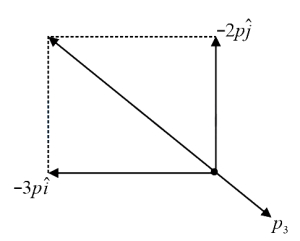
$A$ bomb at rest explodes into $3$ parts of the same mass. The momentum of two parts is $-3 p \hat{i}$ and $2 p \hat{j}$ respectively. The magnitude of the momentum of the third part is
A
$\sqrt{13} p$
B
$5p$
C
$11p$
D
$13p$
Solution
(A) According to the law of conservation of linear momentum,since the bomb is initially at rest,the total initial momentum is zero. Therefore,the total final momentum must also be zero.
Let the momentum of the third part be $\vec{p}_3$.
$\vec{p}_1 + \vec{p}_2 + \vec{p}_3 = 0$
$(-3 p \hat{i}) + (2 p \hat{j}) + \vec{p}_3 = 0$
$\vec{p}_3 = 3 p \hat{i} - 2 p \hat{j}$
The magnitude of the momentum of the third part is:
$|\vec{p}_3| = \sqrt{(3p)^2 + (-2p)^2}$
$|\vec{p}_3| = \sqrt{9p^2 + 4p^2}$
$|\vec{p}_3| = \sqrt{13} p$
Let the momentum of the third part be $\vec{p}_3$.
$\vec{p}_1 + \vec{p}_2 + \vec{p}_3 = 0$
$(-3 p \hat{i}) + (2 p \hat{j}) + \vec{p}_3 = 0$
$\vec{p}_3 = 3 p \hat{i} - 2 p \hat{j}$
The magnitude of the momentum of the third part is:
$|\vec{p}_3| = \sqrt{(3p)^2 + (-2p)^2}$
$|\vec{p}_3| = \sqrt{9p^2 + 4p^2}$
$|\vec{p}_3| = \sqrt{13} p$
0 likesView Solution
3
PhysicsMediumMCQMHT CET · 2018
If the change in the value of $g$ at a height $h$ above the surface of the earth is the same as at a depth $x$ below it,then (both $x$ and $h$ being much smaller than the radius of the earth)
A
$x=h$
B
$x=2h$
C
$x=\frac{h}{2}$
D
$x=h^2$
Solution
(B) The value of $g$ at a height $h$ above the surface of the Earth is given by $g_h = g(1 - \frac{2h}{R})$.
Thus,the change in $g$ is $\Delta g_h = g - g_h = g(\frac{2h}{R})$.
The value of $g$ at a depth $x$ below the surface of the Earth is given by $g_x = g(1 - \frac{x}{R})$.
Thus,the change in $g$ is $\Delta g_x = g - g_x = g(\frac{x}{R})$.
Given that the change in $g$ is the same at height $h$ and depth $x$,we equate the two expressions:
$g(\frac{2h}{R}) = g(\frac{x}{R})$.
Solving for $x$,we get $x = 2h$.
Thus,the change in $g$ is $\Delta g_h = g - g_h = g(\frac{2h}{R})$.
The value of $g$ at a depth $x$ below the surface of the Earth is given by $g_x = g(1 - \frac{x}{R})$.
Thus,the change in $g$ is $\Delta g_x = g - g_x = g(\frac{x}{R})$.
Given that the change in $g$ is the same at height $h$ and depth $x$,we equate the two expressions:
$g(\frac{2h}{R}) = g(\frac{x}{R})$.
Solving for $x$,we get $x = 2h$.
0 likesView Solution
4
PhysicsEasyMCQMHT CET · 2018
$A$ body is thrown from the surface of the earth with velocity $u \ m \ s^{-1}$. The maximum height in meters above the surface of the earth up to which it will reach is ($R=$ radius of the earth,$g=$ acceleration due to gravity).
A
$\frac{u^2 R}{2 g R - u^2}$
B
$\frac{2 u^2 R}{g R - u^2}$
C
$\frac{u^2 R^2}{2 g R^2 - u^2}$
D
$\frac{u^2 R}{g R - u^2}$
Solution
(A) By the law of conservation of energy,the total energy at the surface of the earth is equal to the total energy at the maximum height $h$.
At the surface: $E_i = -\frac{GMm}{R} + \frac{1}{2}mu^2$
At maximum height $h$: $E_f = -\frac{GMm}{R+h} + 0$
Equating $E_i = E_f$: $-\frac{GMm}{R} + \frac{1}{2}mu^2 = -\frac{GMm}{R+h}$
Dividing by $m$ and rearranging: $\frac{GM}{R+h} = \frac{GM}{R} - \frac{u^2}{2}$
Using $GM = gR^2$: $\frac{gR^2}{R+h} = gR - \frac{u^2}{2} = \frac{2gR - u^2}{2}$
$\frac{R+h}{R^2} = \frac{2g}{2gR - u^2}$
$R+h = \frac{2gR^2}{2gR - u^2}$
$h = \frac{2gR^2}{2gR - u^2} - R = \frac{2gR^2 - 2gR^2 + u^2R}{2gR - u^2} = \frac{u^2R}{2gR - u^2}$
At the surface: $E_i = -\frac{GMm}{R} + \frac{1}{2}mu^2$
At maximum height $h$: $E_f = -\frac{GMm}{R+h} + 0$
Equating $E_i = E_f$: $-\frac{GMm}{R} + \frac{1}{2}mu^2 = -\frac{GMm}{R+h}$
Dividing by $m$ and rearranging: $\frac{GM}{R+h} = \frac{GM}{R} - \frac{u^2}{2}$
Using $GM = gR^2$: $\frac{gR^2}{R+h} = gR - \frac{u^2}{2} = \frac{2gR - u^2}{2}$
$\frac{R+h}{R^2} = \frac{2g}{2gR - u^2}$
$R+h = \frac{2gR^2}{2gR - u^2}$
$h = \frac{2gR^2}{2gR - u^2} - R = \frac{2gR^2 - 2gR^2 + u^2R}{2gR - u^2} = \frac{u^2R}{2gR - u^2}$
0 likesView Solution
5
PhysicsMediumMCQMHT CET · 2018
The molar specific heat of an ideal gas at constant pressure and constant volume is $C_p$ and $C_v$ respectively. If $R$ is the universal gas constant and the ratio of $C_p$ to $C_v$ is $\gamma$,then $C_v=$
A
$\frac{1-\gamma}{1+\gamma}$
B
$\frac{1+\gamma}{1-\gamma}$
C
$\frac{r-1}{R}$
D
$\frac{R}{\gamma-1}$
Solution
(D) According to Mayer's relation for an ideal gas,the difference between molar specific heat at constant pressure $(C_P)$ and constant volume $(C_V)$ is equal to the universal gas constant $(R)$:
$C_P - C_V = R$
We are also given the ratio of molar specific heats as $\gamma = \frac{C_P}{C_V}$,which implies $C_P = \gamma C_V$.
Substituting the expression for $C_P$ into Mayer's relation:
$\gamma C_V - C_V = R$
$C_V(\gamma - 1) = R$
Therefore,$C_V = \frac{R}{\gamma - 1}$.
$C_P - C_V = R$
We are also given the ratio of molar specific heats as $\gamma = \frac{C_P}{C_V}$,which implies $C_P = \gamma C_V$.
Substituting the expression for $C_P$ into Mayer's relation:
$\gamma C_V - C_V = R$
$C_V(\gamma - 1) = R$
Therefore,$C_V = \frac{R}{\gamma - 1}$.
0 likesView Solution
6
PhysicsDifficultMCQMHT CET · 2018
In non-uniform circular motion,the ratio of tangential to radial acceleration is ($r=$ radius of the circle,$u=$ speed of the particle,$\alpha=$ angular acceleration).
A
$\frac{\alpha^2 r^2}{u}$
B
$\frac{\alpha^2 r}{u^2}$
C
$\frac{\alpha r^2}{u^2}$
D
$\frac{u^2}{r^2 \alpha}$
Solution
(C) The tangential acceleration $(a_t)$ is given by the formula $a_t = \alpha r$.
The radial (centripetal) acceleration $(a_r)$ is given by the formula $a_r = \frac{u^2}{r}$.
The ratio of tangential acceleration to radial acceleration is $\frac{a_t}{a_r} = \frac{\alpha r}{u^2 / r}$.
Simplifying this expression,we get $\frac{\alpha r^2}{u^2}$.
The radial (centripetal) acceleration $(a_r)$ is given by the formula $a_r = \frac{u^2}{r}$.
The ratio of tangential acceleration to radial acceleration is $\frac{a_t}{a_r} = \frac{\alpha r}{u^2 / r}$.
Simplifying this expression,we get $\frac{\alpha r^2}{u^2}$.
0 likesView Solution
7
PhysicsMediumMCQMHT CET · 2018
If $\vec{A}=3 \hat{i}-2 \hat{j}+\hat{k}$,$\vec{B}=\hat{i}-3 \hat{j}+5 \hat{k}$ and $\vec{C}=2 \hat{i}+\hat{j}-4 \hat{k}$ form a right-angled triangle,then which of the following is satisfied?
A
$\vec{A}=\vec{B}+\vec{C}$ and $A^2=B^2+C^2$
B
$\vec{A}=\vec{B}+\vec{C}$ and $B^2=A^2+C^2$
C
$\vec{B}=\vec{A}+\vec{C}$ and $B^2=A^2+C^2$
D
$\vec{B}=\vec{A}+\vec{C}$ and $A^2=B^2+C^2$
Solution
(B) First,calculate the magnitudes squared of the vectors:
$A^2 = |\vec{A}|^2 = 3^2 + (-2)^2 + 1^2 = 9 + 4 + 1 = 14$
$B^2 = |\vec{B}|^2 = 1^2 + (-3)^2 + 5^2 = 1 + 9 + 25 = 35$
$C^2 = |\vec{C}|^2 = 2^2 + 1^2 + (-4)^2 = 4 + 1 + 16 = 21$
We observe that $B^2 = A^2 + C^2$ $(35 = 14 + 21)$,which satisfies the Pythagorean theorem for a right-angled triangle.
Next,check the vector sum relation:
$\vec{A} + \vec{C} = (3+2)\hat{i} + (-2+1)\hat{j} + (1-4)\hat{k} = 5\hat{i} - \hat{j} - 3\hat{k} \neq \vec{B}$
$\vec{B} = \vec{A} + \vec{C}$ is not satisfied. Let us check $\vec{A} = \vec{B} + \vec{C}$:
$\vec{B} + \vec{C} = (1+2)\hat{i} + (-3+1)\hat{j} + (5-4)\hat{k} = 3\hat{i} - 2\hat{j} + \hat{k} = \vec{A}$
Thus,$\vec{A} = \vec{B} + \vec{C}$ and $B^2 = A^2 + C^2$ is the correct condition.
$A^2 = |\vec{A}|^2 = 3^2 + (-2)^2 + 1^2 = 9 + 4 + 1 = 14$
$B^2 = |\vec{B}|^2 = 1^2 + (-3)^2 + 5^2 = 1 + 9 + 25 = 35$
$C^2 = |\vec{C}|^2 = 2^2 + 1^2 + (-4)^2 = 4 + 1 + 16 = 21$
We observe that $B^2 = A^2 + C^2$ $(35 = 14 + 21)$,which satisfies the Pythagorean theorem for a right-angled triangle.
Next,check the vector sum relation:
$\vec{A} + \vec{C} = (3+2)\hat{i} + (-2+1)\hat{j} + (1-4)\hat{k} = 5\hat{i} - \hat{j} - 3\hat{k} \neq \vec{B}$
$\vec{B} = \vec{A} + \vec{C}$ is not satisfied. Let us check $\vec{A} = \vec{B} + \vec{C}$:
$\vec{B} + \vec{C} = (1+2)\hat{i} + (-3+1)\hat{j} + (5-4)\hat{k} = 3\hat{i} - 2\hat{j} + \hat{k} = \vec{A}$
Thus,$\vec{A} = \vec{B} + \vec{C}$ and $B^2 = A^2 + C^2$ is the correct condition.
0 likesView Solution
8
PhysicsMediumMCQMHT CET · 2018
Let $x = \frac{a^2 b^2}{c}$ be a physical quantity. If the percentage errors in the measurement of physical quantities $a, b,$ and $c$ are $2\%, 3\%,$ and $4\%$ respectively,then the percentage error in the measurement of $x$ is: (in $\%$)
A
$7$
B
$14$
C
$21$
D
$28$
Solution
(B) The given physical quantity is $x = \frac{a^2 b^2}{c}$.
Using the formula for propagation of errors,the relative error in $x$ is given by:
$\frac{\Delta x}{x} = 2 \frac{\Delta a}{a} + 2 \frac{\Delta b}{b} + \frac{\Delta c}{c}$.
Given percentage errors are $\frac{\Delta a}{a} \times 100 = 2\%$,$\frac{\Delta b}{b} \times 100 = 3\%$,and $\frac{\Delta c}{c} \times 100 = 4\%$.
Substituting these values into the error equation:
$\frac{\Delta x}{x} \times 100 = 2(2\%) + 2(3\%) + 4\%$.
$\frac{\Delta x}{x} \times 100 = 4\% + 6\% + 4\% = 14\%$.
Therefore,the percentage error in $x$ is $14\%$.
Using the formula for propagation of errors,the relative error in $x$ is given by:
$\frac{\Delta x}{x} = 2 \frac{\Delta a}{a} + 2 \frac{\Delta b}{b} + \frac{\Delta c}{c}$.
Given percentage errors are $\frac{\Delta a}{a} \times 100 = 2\%$,$\frac{\Delta b}{b} \times 100 = 3\%$,and $\frac{\Delta c}{c} \times 100 = 4\%$.
Substituting these values into the error equation:
$\frac{\Delta x}{x} \times 100 = 2(2\%) + 2(3\%) + 4\%$.
$\frac{\Delta x}{x} \times 100 = 4\% + 6\% + 4\% = 14\%$.
Therefore,the percentage error in $x$ is $14\%$.
0 likesView Solution
9
PhysicsEasyMCQMHT CET · 2018
$A$ unit vector is represented as $(0.8 \hat{i} + b \hat{j} + 0.4 \hat{k})$. Hence,the value of $b$ must be:
A
$0.4$
B
$\sqrt{0.6}$
C
$0.2$
D
$\sqrt{0.2}$
Solution
(D) unit vector has a magnitude of $1$. The magnitude of a vector $\vec{A} = A_x \hat{i} + A_y \hat{j} + A_z \hat{k}$ is given by $|\vec{A}| = \sqrt{A_x^2 + A_y^2 + A_z^2}$.
Given the vector is $(0.8 \hat{i} + b \hat{j} + 0.4 \hat{k})$,we set its magnitude to $1$:
$\sqrt{(0.8)^2 + b^2 + (0.4)^2} = 1$
Squaring both sides:
$(0.8)^2 + b^2 + (0.4)^2 = 1^2$
$0.64 + b^2 + 0.16 = 1$
$0.80 + b^2 = 1$
$b^2 = 1 - 0.80$
$b^2 = 0.2$
$b = \sqrt{0.2}$
Given the vector is $(0.8 \hat{i} + b \hat{j} + 0.4 \hat{k})$,we set its magnitude to $1$:
$\sqrt{(0.8)^2 + b^2 + (0.4)^2} = 1$
Squaring both sides:
$(0.8)^2 + b^2 + (0.4)^2 = 1^2$
$0.64 + b^2 + 0.16 = 1$
$0.80 + b^2 = 1$
$b^2 = 1 - 0.80$
$b^2 = 0.2$
$b = \sqrt{0.2}$
0 likesView Solution
10
PhysicsDifficultMCQMHT CET · 2018
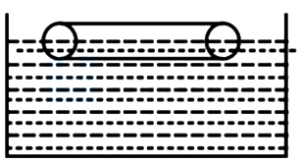
$A$ thin metal wire of density $\rho$ floats on the water surface horizontally. If it is $\text{NOT}$ to sink in water,then the maximum radius of the wire is proportional to $(T = \text{surface tension of water}, g = \text{gravitational acceleration})$.
A
$\sqrt{\frac{2 T}{\pi \rho g}}$
B
$\sqrt{\frac{\pi \rho g}{T}}$
C
$\frac{T}{\pi \rho g}$
D
$\frac{\pi \rho g}{T}$
Solution
(A) For the wire to float,the downward gravitational force must be balanced by the upward force due to surface tension.
The gravitational force (weight) acting on the wire is $W = mg = (\text{volume} \times \rho) g = (\pi r^2 l) \rho g$,where $r$ is the radius and $l$ is the length of the wire.
The surface tension force acts along the two sides of the wire on the water surface,so the upward force is $F_s = 2Tl$.
Equating the forces for the limiting case of floating: $Mg = 2Tl$.
Substituting the values: $(\pi r^2 l) \rho g = 2Tl$.
Canceling $l$ from both sides: $\pi r^2 \rho g = 2T$.
Solving for $r$: $r^2 = \frac{2T}{\pi \rho g}$,which gives $r = \sqrt{\frac{2T}{\pi \rho g}}$.
Thus,the maximum radius is proportional to $\sqrt{\frac{2T}{\pi \rho g}}$.
The gravitational force (weight) acting on the wire is $W = mg = (\text{volume} \times \rho) g = (\pi r^2 l) \rho g$,where $r$ is the radius and $l$ is the length of the wire.
The surface tension force acts along the two sides of the wire on the water surface,so the upward force is $F_s = 2Tl$.
Equating the forces for the limiting case of floating: $Mg = 2Tl$.
Substituting the values: $(\pi r^2 l) \rho g = 2Tl$.
Canceling $l$ from both sides: $\pi r^2 \rho g = 2T$.
Solving for $r$: $r^2 = \frac{2T}{\pi \rho g}$,which gives $r = \sqrt{\frac{2T}{\pi \rho g}}$.
Thus,the maximum radius is proportional to $\sqrt{\frac{2T}{\pi \rho g}}$.
0 likesView Solution
11
PhysicsDifficultMCQMHT CET · 2018
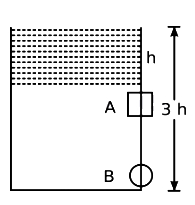
$A$ vessel completely filled with water has holes $A$ and $B$ at depths $h$ and $3h$ from the top respectively. The hole $A$ is a square of side $L$ and $B$ is a circle of radius $r$. The water flowing out per second from both the holes is same. Then $L$ is equal to
A
$r^{\frac{1}{2}}(\pi)^{\frac{1}{2}}(3)^{\frac{1}{2}}$
B
$r(\pi)^{\frac{1}{4}}(3)^{\frac{1}{4}}$
C
$r(\pi)^{\frac{1}{2}}(3)^{\frac{1}{4}}$
D
$r^{\frac{1}{2}}(\pi)^{\frac{1}{3}}(3)^{\frac{1}{2}}$
Solution
(C) The volume flow rate (or discharge) $Q$ from a hole at depth $y$ is given by $Q = A_v \cdot v$,where $A_v$ is the area of the hole and $v = \sqrt{2gy}$ is the velocity of efflux.
For hole $A$ at depth $h$: Area $A_A = L^2$,velocity $v_A = \sqrt{2gh}$. So,$Q_A = L^2 \sqrt{2gh}$.
For hole $B$ at depth $3h$: Area $A_B = \pi r^2$,velocity $v_B = \sqrt{2g(3h)} = \sqrt{6gh}$. So,$Q_B = \pi r^2 \sqrt{6gh}$.
Given that the flow rate is the same,$Q_A = Q_B$:
$L^2 \sqrt{2gh} = \pi r^2 \sqrt{6gh}$
$L^2 = \pi r^2 \frac{\sqrt{6gh}}{\sqrt{2gh}} = \pi r^2 \sqrt{3}$
Taking the square root of both sides:
$L = \sqrt{\pi r^2 \sqrt{3}} = r \sqrt{\pi} (3)^{\frac{1}{4}} = r (\pi)^{\frac{1}{2}} (3)^{\frac{1}{4}}$.
For hole $A$ at depth $h$: Area $A_A = L^2$,velocity $v_A = \sqrt{2gh}$. So,$Q_A = L^2 \sqrt{2gh}$.
For hole $B$ at depth $3h$: Area $A_B = \pi r^2$,velocity $v_B = \sqrt{2g(3h)} = \sqrt{6gh}$. So,$Q_B = \pi r^2 \sqrt{6gh}$.
Given that the flow rate is the same,$Q_A = Q_B$:
$L^2 \sqrt{2gh} = \pi r^2 \sqrt{6gh}$
$L^2 = \pi r^2 \frac{\sqrt{6gh}}{\sqrt{2gh}} = \pi r^2 \sqrt{3}$
Taking the square root of both sides:
$L = \sqrt{\pi r^2 \sqrt{3}} = r \sqrt{\pi} (3)^{\frac{1}{4}} = r (\pi)^{\frac{1}{2}} (3)^{\frac{1}{4}}$.
0 likesView Solution
12
PhysicsDifficultMCQMHT CET · 2018
The radius $R$ of the soap bubble is doubled under isothermal conditions. If $T$ is the surface tension of the soap bubble, the work done in doing so is given by (in $\pi R^2 T$)
A
$32$
B
$24$
C
$8$
D
$4$
Solution
(B) soap bubble has two surfaces (inner and outer), so its total surface area is $2 \times 4 \pi R^2 = 8 \pi R^2$.
Initial surface energy $E_i = T \times (8 \pi R^2) = 8 \pi R^2 T$.
When the radius is doubled, the new radius becomes $R' = 2R$.
The new surface area is $2 \times 4 \pi (2R)^2 = 2 \times 4 \pi (4R^2) = 32 \pi R^2$.
Final surface energy $E_f = T \times (32 \pi R^2) = 32 \pi R^2 T$.
Work done $W = E_f - E_i$.
$W = 32 \pi R^2 T - 8 \pi R^2 T = 24 \pi R^2 T$.
Initial surface energy $E_i = T \times (8 \pi R^2) = 8 \pi R^2 T$.
When the radius is doubled, the new radius becomes $R' = 2R$.
The new surface area is $2 \times 4 \pi (2R)^2 = 2 \times 4 \pi (4R^2) = 32 \pi R^2$.
Final surface energy $E_f = T \times (32 \pi R^2) = 32 \pi R^2 T$.
Work done $W = E_f - E_i$.
$W = 32 \pi R^2 T - 8 \pi R^2 T = 24 \pi R^2 T$.
0 likesView Solution
13
PhysicsMediumMCQMHT CET · 2018
In a capillary tube having area of cross-section $A$,the water rises to a height $h$. If the cross-sectional area is reduced to $\frac{A}{9}$,the rise of water in the capillary tube is
A
$4 h$
B
$3 h$
C
$2 h$
D
$h$
Solution
(B) The height of water rise in a capillary tube is given by the formula $h = \frac{2T \cos \theta}{r \rho g}$,where $T$ is surface tension,$\theta$ is the contact angle,$r$ is the radius of the tube,$\rho$ is the density of the liquid,and $g$ is the acceleration due to gravity.
Since $T, \theta, \rho,$ and $g$ are constant,we have $h \propto \frac{1}{r}$,which means $rh = \text{constant}$.
The area of cross-section is $A = \pi r^2$,so $r = \sqrt{\frac{A}{\pi}}$,which implies $r \propto \sqrt{A}$.
Given the initial area $A_1 = A$ and final area $A_2 = \frac{A}{9}$.
The ratio of radii is $\frac{r_2}{r_1} = \sqrt{\frac{A_2}{A_1}} = \sqrt{\frac{A/9}{A}} = \sqrt{\frac{1}{9}} = \frac{1}{3}$.
Using the relation $r_1 h_1 = r_2 h_2$,we get $h_2 = h_1 \left( \frac{r_1}{r_2} \right)$.
Substituting the values,$h_2 = h \times 3 = 3h$.
Since $T, \theta, \rho,$ and $g$ are constant,we have $h \propto \frac{1}{r}$,which means $rh = \text{constant}$.
The area of cross-section is $A = \pi r^2$,so $r = \sqrt{\frac{A}{\pi}}$,which implies $r \propto \sqrt{A}$.
Given the initial area $A_1 = A$ and final area $A_2 = \frac{A}{9}$.
The ratio of radii is $\frac{r_2}{r_1} = \sqrt{\frac{A_2}{A_1}} = \sqrt{\frac{A/9}{A}} = \sqrt{\frac{1}{9}} = \frac{1}{3}$.
Using the relation $r_1 h_1 = r_2 h_2$,we get $h_2 = h_1 \left( \frac{r_1}{r_2} \right)$.
Substituting the values,$h_2 = h \times 3 = 3h$.
0 likesView Solution
14
PhysicsMediumMCQMHT CET · 2018
The decrease in length of a metal bar of length $L$ and cross-sectional area $A$ when compressed with a load $F$ along its length is (where $Y$ is Young's modulus of the material of the metal bar).
A
$\frac{F L}{2 A Y}$
B
$\frac{F^2 L}{2 A Y}$
C
$\frac{F L}{A Y}$
D
$\frac{F^2 L^2}{2 A Y}$
Solution
(C) Young's modulus $Y$ is defined as the ratio of longitudinal stress to longitudinal strain.
$Y = \frac{\text{Stress}}{\text{Strain}} = \frac{F/A}{\Delta L/L}$
Rearranging the formula to solve for the change in length $\Delta L$:
$Y = \frac{F L}{A \Delta L}$
$\Delta L = \frac{F L}{A Y}$
Thus,the decrease in length is $\frac{F L}{A Y}$.
$Y = \frac{\text{Stress}}{\text{Strain}} = \frac{F/A}{\Delta L/L}$
Rearranging the formula to solve for the change in length $\Delta L$:
$Y = \frac{F L}{A \Delta L}$
$\Delta L = \frac{F L}{A Y}$
Thus,the decrease in length is $\frac{F L}{A Y}$.
0 likesView Solution
15
PhysicsEasyMCQMHT CET · 2018
$A$ particle is performing $U.C.M.$ along the circumference of a circle of diameter $50 \ cm$ with a frequency of $2 \ Hz$. The acceleration of the particle in $m/s^2$ is:
A
$2 \pi^2$
B
$4 \pi^2$
C
$8 \pi^2$
D
$\pi^2$
Solution
(B) Given: Diameter $d = 50 \ cm = 0.5 \ m$.
Radius $r = d/2 = 0.25 \ m = 25 \times 10^{-2} \ m$.
Frequency $f = 2 \ Hz$.
Angular velocity $\omega = 2 \pi f = 2 \pi \times 2 = 4 \pi \ rad/s$.
The centripetal acceleration $a$ in $U.C.M.$ is given by $a = r \omega^2$.
Substituting the values: $a = (25 \times 10^{-2}) \times (4 \pi)^2$.
$a = 0.25 \times 16 \pi^2$.
$a = 4 \pi^2 \ m/s^2$.
Radius $r = d/2 = 0.25 \ m = 25 \times 10^{-2} \ m$.
Frequency $f = 2 \ Hz$.
Angular velocity $\omega = 2 \pi f = 2 \pi \times 2 = 4 \pi \ rad/s$.
The centripetal acceleration $a$ in $U.C.M.$ is given by $a = r \omega^2$.
Substituting the values: $a = (25 \times 10^{-2}) \times (4 \pi)^2$.
$a = 0.25 \times 16 \pi^2$.
$a = 4 \pi^2 \ m/s^2$.
0 likesView Solution
16
PhysicsEasyMCQMHT CET · 2018
The path length of oscillation of a simple pendulum of length $1 \,m$ is $16 \,cm$. Its maximum velocity is (Take $g = \pi^2 \,m/s^2$).
A
$2 \pi \,cm/s$
B
$8 \pi \,cm/s$
C
$4 \pi \,cm/s$
D
$16 \pi \,cm/s$
Solution
(B) The path length of oscillation is the total distance between the two extreme positions, which is equal to $2a$, where $a$ is the amplitude.
Given, $2a = 16 \,cm$, so the amplitude $a = 8 \,cm$.
The length of the pendulum is $l = 1 \,m$.
The angular frequency of a simple pendulum is given by $\omega = \sqrt{\frac{g}{l}}$.
Substituting $g = \pi^2 \,m/s^2$ and $l = 1 \,m$, we get $\omega = \sqrt{\frac{\pi^2}{1}} = \pi \,rad/s$.
The maximum velocity $v_{max}$ in simple harmonic motion is given by $v_{max} = a\omega$.
Substituting the values, $v_{max} = 8 \,cm \times \pi \,rad/s = 8\pi \,cm/s$.
Given, $2a = 16 \,cm$, so the amplitude $a = 8 \,cm$.
The length of the pendulum is $l = 1 \,m$.
The angular frequency of a simple pendulum is given by $\omega = \sqrt{\frac{g}{l}}$.
Substituting $g = \pi^2 \,m/s^2$ and $l = 1 \,m$, we get $\omega = \sqrt{\frac{\pi^2}{1}} = \pi \,rad/s$.
The maximum velocity $v_{max}$ in simple harmonic motion is given by $v_{max} = a\omega$.
Substituting the values, $v_{max} = 8 \,cm \times \pi \,rad/s = 8\pi \,cm/s$.
0 likesView Solution
17
PhysicsMediumMCQMHT CET · 2018
$A$ particle of mass $1 \ kg$ is moving in $SHM$ with a path length of $0.01 \ m$ and frequency of $50 \ Hz$. The maximum force in newton,acting on the particle is (in $\pi^2$)
A
$150$
B
$200$
C
$100$
D
$50$
Solution
(D) The path length of $SHM$ is equal to $2A$,where $A$ is the amplitude.
Given path length $= 0.01 \ m$,so $2A = 0.01 \ m$,which implies $A = 0.005 \ m$.
The frequency $f = 50 \ Hz$.
The maximum force $F_{max}$ acting on a particle in $SHM$ is given by $F_{max} = m \omega^2 A$.
Since $\omega = 2 \pi f$,we have $F_{max} = m (2 \pi f)^2 A = m (4 \pi^2 f^2) A$.
Substituting the values: $F_{max} = 1 \times 4 \times \pi^2 \times (50)^2 \times 0.005$.
$F_{max} = 4 \times \pi^2 \times 2500 \times 0.005$.
$F_{max} = 10000 \times \pi^2 \times 0.005 = 50 \pi^2 \ N$.
Given path length $= 0.01 \ m$,so $2A = 0.01 \ m$,which implies $A = 0.005 \ m$.
The frequency $f = 50 \ Hz$.
The maximum force $F_{max}$ acting on a particle in $SHM$ is given by $F_{max} = m \omega^2 A$.
Since $\omega = 2 \pi f$,we have $F_{max} = m (2 \pi f)^2 A = m (4 \pi^2 f^2) A$.
Substituting the values: $F_{max} = 1 \times 4 \times \pi^2 \times (50)^2 \times 0.005$.
$F_{max} = 4 \times \pi^2 \times 2500 \times 0.005$.
$F_{max} = 10000 \times \pi^2 \times 0.005 = 50 \pi^2 \ N$.
0 likesView Solution
18
PhysicsMediumMCQMHT CET · 2018
$A$ mass is suspended from a vertical spring which is executing $S.H.M.$ of frequency $5 Hz$. The spring is unstretched at the highest point of oscillation. The maximum speed of the mass is [acceleration due to gravity $g=10 m s^{-2}$].
A
$2 \pi m s^{-1}$
B
$\pi m s^{-1}$
C
$\frac{1}{2 \pi} m s^{-1}$
D
$\frac{1}{\pi} m s^{-1}$
Solution
(D) The frequency of $S.H.M.$ is given by $n = 5 Hz$. The angular frequency is $\omega = 2 \pi n = 2 \pi \times 5 = 10 \pi rad s^{-1}$.
At the highest point of oscillation,the spring is unstretched,meaning the extension $x = 0$. In $S.H.M.$,the equilibrium position is where the spring force balances gravity,$k x_0 = mg$,where $x_0$ is the static extension.
The amplitude $A$ of the oscillation is equal to this static extension $x_0$,because the particle reaches the unstretched position $(x=0)$ at the top of its path. Thus,$A = x_0 = \frac{mg}{k}$.
We know that $\omega^2 = \frac{k}{m}$,so $k = m \omega^2 = m(10 \pi)^2 = 100 \pi^2 m$.
Substituting $k$ into the amplitude equation: $A = \frac{mg}{100 \pi^2 m} = \frac{g}{100 \pi^2} = \frac{10}{100 \pi^2} = \frac{1}{10 \pi} m$.
The maximum speed is $V_{max} = \omega A = (10 \pi) \times (\frac{1}{10 \pi}) = 1 m s^{-1}$.
Wait,re-evaluating the calculation: $V_{max} = \omega A = (10 \pi) \times \frac{g}{\omega^2} = \frac{g}{\omega} = \frac{10}{10 \pi} = \frac{1}{\pi} m s^{-1}$.
At the highest point of oscillation,the spring is unstretched,meaning the extension $x = 0$. In $S.H.M.$,the equilibrium position is where the spring force balances gravity,$k x_0 = mg$,where $x_0$ is the static extension.
The amplitude $A$ of the oscillation is equal to this static extension $x_0$,because the particle reaches the unstretched position $(x=0)$ at the top of its path. Thus,$A = x_0 = \frac{mg}{k}$.
We know that $\omega^2 = \frac{k}{m}$,so $k = m \omega^2 = m(10 \pi)^2 = 100 \pi^2 m$.
Substituting $k$ into the amplitude equation: $A = \frac{mg}{100 \pi^2 m} = \frac{g}{100 \pi^2} = \frac{10}{100 \pi^2} = \frac{1}{10 \pi} m$.
The maximum speed is $V_{max} = \omega A = (10 \pi) \times (\frac{1}{10 \pi}) = 1 m s^{-1}$.
Wait,re-evaluating the calculation: $V_{max} = \omega A = (10 \pi) \times \frac{g}{\omega^2} = \frac{g}{\omega} = \frac{10}{10 \pi} = \frac{1}{\pi} m s^{-1}$.
0 likesView Solution
19
PhysicsDifficultMCQMHT CET · 2018
For a particle performing linear $SHM$,its average speed over $1$ oscillation is ($A =$ amplitude of $SHM$,$n =$ frequency of oscillation). (in $A \ n$)
A
$2$
B
$4$
C
$6$
D
$8$
Solution
(B) In one complete oscillation,a particle in $SHM$ travels from the mean position to one extreme $(A)$,back to the mean position $(A)$,to the other extreme $(A)$,and back to the mean position $(A)$.
Total distance travelled in $1$ oscillation $= A + A + A + A = 4 \ A$.
The time taken for one complete oscillation is the time period $T$.
The frequency of oscillation is $n = \frac{1}{T}$,which implies $T = \frac{1}{n}$.
Average speed is defined as the total distance divided by the total time.
$\text{Average speed} = \frac{\text{Total distance}}{\text{Total time}} = \frac{4 \ A}{T}$.
Substituting $T = \frac{1}{n}$,we get $\text{Average speed} = 4 \ A \ n$.
Total distance travelled in $1$ oscillation $= A + A + A + A = 4 \ A$.
The time taken for one complete oscillation is the time period $T$.
The frequency of oscillation is $n = \frac{1}{T}$,which implies $T = \frac{1}{n}$.
Average speed is defined as the total distance divided by the total time.
$\text{Average speed} = \frac{\text{Total distance}}{\text{Total time}} = \frac{4 \ A}{T}$.
Substituting $T = \frac{1}{n}$,we get $\text{Average speed} = 4 \ A \ n$.
0 likesView Solution
20
PhysicsMediumMCQMHT CET · 2018
$A$ disc has mass $M$ and radius $R$. How much tangential force should be applied to the rim of the disc so as to rotate the disc with angular velocity $\omega$ in time $t$?
A
$\frac{M R \omega}{4 t}$
B
$\frac{M R \omega}{2 t}$
C
$\frac{M R \omega}{t}$
D
$M R \omega t$
Solution
(B) The moment of inertia of a disc about its central axis is $I = \frac{1}{2} M R^2$.
Using the rotational analog of Newton's second law,$\tau = I \alpha$,where $\tau$ is the torque and $\alpha$ is the angular acceleration.
The tangential force $F$ applied at the rim provides a torque $\tau = F \times R$.
The angular acceleration is given by $\alpha = \frac{\omega}{t}$.
Substituting these into the torque equation: $F \times R = (\frac{1}{2} M R^2) \times (\frac{\omega}{t})$.
Solving for $F$: $F = \frac{M R \omega}{2 t}$.
Using the rotational analog of Newton's second law,$\tau = I \alpha$,where $\tau$ is the torque and $\alpha$ is the angular acceleration.
The tangential force $F$ applied at the rim provides a torque $\tau = F \times R$.
The angular acceleration is given by $\alpha = \frac{\omega}{t}$.
Substituting these into the torque equation: $F \times R = (\frac{1}{2} M R^2) \times (\frac{\omega}{t})$.
Solving for $F$: $F = \frac{M R \omega}{2 t}$.
0 likesView Solution
21
PhysicsMediumMCQMHT CET · 2018
The moment of inertia of a ring about an axis passing through the centre and perpendicular to its plane is $I$. It is rotating with angular velocity $\omega$. Another identical ring is gently placed on it so that their centres coincide. If both the rings are rotating about the same axis,then the loss in kinetic energy is
A
$\frac{I \omega^2}{2}$
B
$\frac{I \omega^2}{4}$
C
$\frac{I \omega^2}{6}$
D
$\frac{I \omega^2}{8}$
Solution
(B) Initial state: Moment of inertia $I_1 = I$,angular velocity $\omega_1 = \omega$. Initial kinetic energy $KE_i = \frac{1}{2} I \omega^2$.
Since no external torque acts on the system,the angular momentum is conserved: $L_i = L_f$.
$I \omega = (I + I) \omega_2$,where $\omega_2$ is the final angular velocity.
$I \omega = 2I \omega_2 \implies \omega_2 = \frac{\omega}{2}$.
Final kinetic energy $KE_f = \frac{1}{2} (2I) \omega_2^2 = I \left(\frac{\omega}{2}\right)^2 = \frac{I \omega^2}{4}$.
Loss in kinetic energy $\Delta KE = KE_i - KE_f = \frac{1}{2} I \omega^2 - \frac{1}{4} I \omega^2 = \frac{1}{4} I \omega^2$.
Since no external torque acts on the system,the angular momentum is conserved: $L_i = L_f$.
$I \omega = (I + I) \omega_2$,where $\omega_2$ is the final angular velocity.
$I \omega = 2I \omega_2 \implies \omega_2 = \frac{\omega}{2}$.
Final kinetic energy $KE_f = \frac{1}{2} (2I) \omega_2^2 = I \left(\frac{\omega}{2}\right)^2 = \frac{I \omega^2}{4}$.
Loss in kinetic energy $\Delta KE = KE_i - KE_f = \frac{1}{2} I \omega^2 - \frac{1}{4} I \omega^2 = \frac{1}{4} I \omega^2$.
0 likesView Solution
22
PhysicsMediumMCQMHT CET · 2018
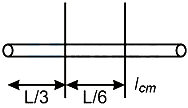
The moment of inertia of a thin uniform rod of length $L$ and mass $M$ about an axis passing through a point at a distance of $\frac{L}{3}$ from one of its ends and perpendicular to the rod is
A
$\frac{M L^2}{12}$
B
$\frac{M L^2}{9}$
C
$\frac{7 M L^2}{48}$
D
$\frac{M L^2}{48}$
Solution
(B) The moment of inertia of a thin uniform rod of length $L$ and mass $M$ about an axis passing through its center of mass $(CM)$ and perpendicular to the rod is $I_{CM} = \frac{M L^2}{12}$.
The distance of the given axis from the center of mass is $x = \frac{L}{2} - \frac{L}{3} = \frac{L}{6}$.
Using the parallel axis theorem,$I = I_{CM} + M x^2$.
Substituting the values,we get $I = \frac{M L^2}{12} + M \left( \frac{L}{6} \right)^2$.
$I = \frac{M L^2}{12} + \frac{M L^2}{36}$.
Taking the least common multiple,$I = \frac{3 M L^2 + M L^2}{36} = \frac{4 M L^2}{36} = \frac{M L^2}{9}$.
The distance of the given axis from the center of mass is $x = \frac{L}{2} - \frac{L}{3} = \frac{L}{6}$.
Using the parallel axis theorem,$I = I_{CM} + M x^2$.
Substituting the values,we get $I = \frac{M L^2}{12} + M \left( \frac{L}{6} \right)^2$.
$I = \frac{M L^2}{12} + \frac{M L^2}{36}$.
Taking the least common multiple,$I = \frac{3 M L^2 + M L^2}{36} = \frac{4 M L^2}{36} = \frac{M L^2}{9}$.
0 likesView Solution
23
PhysicsMediumMCQMHT CET · 2018
Heat energy is incident on the surface of a material at the rate of $1000 \ J \ min^{-1}$. If the coefficient of absorption is $0.8$ and the coefficient of reflection is $0.1$,then the amount of heat energy transmitted through the material in $5$ minutes is: (in $J$)
A
$100$
B
$500$
C
$700$
D
$900$
Solution
(B) The total incident heat energy rate is $P_i = 1000 \ J \ min^{-1}$.
According to the law of conservation of energy for heat radiation,the sum of the coefficients of reflection $(r)$,absorption $(a)$,and transmission $(t)$ is equal to $1$,i.e.,$r + a + t = 1$.
Given $r = 0.1$ and $a = 0.8$,we can find the coefficient of transmission $(t)$:
$t = 1 - (r + a) = 1 - (0.1 + 0.8) = 1 - 0.9 = 0.1$.
The rate of transmitted heat energy is $P_t = t \times P_i = 0.1 \times 1000 \ J \ min^{-1} = 100 \ J \ min^{-1}$.
For a time duration of $5 \ minutes$,the total transmitted heat energy $(Q_t)$ is:
$Q_t = P_t \times \text{time} = 100 \ J \ min^{-1} \times 5 \ min = 500 \ J$.
According to the law of conservation of energy for heat radiation,the sum of the coefficients of reflection $(r)$,absorption $(a)$,and transmission $(t)$ is equal to $1$,i.e.,$r + a + t = 1$.
Given $r = 0.1$ and $a = 0.8$,we can find the coefficient of transmission $(t)$:
$t = 1 - (r + a) = 1 - (0.1 + 0.8) = 1 - 0.9 = 0.1$.
The rate of transmitted heat energy is $P_t = t \times P_i = 0.1 \times 1000 \ J \ min^{-1} = 100 \ J \ min^{-1}$.
For a time duration of $5 \ minutes$,the total transmitted heat energy $(Q_t)$ is:
$Q_t = P_t \times \text{time} = 100 \ J \ min^{-1} \times 5 \ min = 500 \ J$.
0 likesView Solution
24
PhysicsEasyMCQMHT CET · 2018
$A$ string is vibrating in its fifth overtone between two rigid supports $2.4 \ m$ apart. The distance between successive node and antinode is (in $m$)
A
$0.1$
B
$0.2$
C
$0.6$
D
$0.8$
Solution
(B) For a string fixed at both ends,the $n^{th}$ overtone corresponds to the $(n+1)^{th}$ harmonic.
Here,the fifth overtone is the sixth harmonic $(n=6)$.
The length of the string $L = 2.4 \ m$.
The condition for the $n^{th}$ harmonic is $L = n \frac{\lambda}{2}$.
Substituting the values: $2.4 = 6 \times \frac{\lambda}{2}$.
This gives $\frac{\lambda}{2} = \frac{2.4}{6} = 0.4 \ m$.
Thus,$\lambda = 0.8 \ m$.
The distance between a node and the successive antinode is always $\frac{\lambda}{4}$.
Therefore,distance $= \frac{0.8 \ m}{4} = 0.2 \ m$.
Here,the fifth overtone is the sixth harmonic $(n=6)$.
The length of the string $L = 2.4 \ m$.
The condition for the $n^{th}$ harmonic is $L = n \frac{\lambda}{2}$.
Substituting the values: $2.4 = 6 \times \frac{\lambda}{2}$.
This gives $\frac{\lambda}{2} = \frac{2.4}{6} = 0.4 \ m$.
Thus,$\lambda = 0.8 \ m$.
The distance between a node and the successive antinode is always $\frac{\lambda}{4}$.
Therefore,distance $= \frac{0.8 \ m}{4} = 0.2 \ m$.
0 likesView Solution
25
PhysicsEasyMCQMHT CET · 2018
When the source of sound moves towards a stationary observer,the wavelength of sound received by him
A
decreases while frequency increases.
B
remains the same whereas frequency increases.
C
increases and frequency also increases.
D
decreases while frequency remains the same.
Solution
(A) According to the Doppler effect,the apparent frequency $n_a$ heard by an observer is given by $n_a = n \left[ \frac{v \pm v_0}{v \mp v_s} \right]$.
Since the observer is stationary,$v_0 = 0$.
As the source moves towards the observer,the denominator becomes $(v - v_s)$,so $n_a = n \left[ \frac{v}{v - v_s} \right]$.
Since $(v - v_s) < v$,the apparent frequency $n_a$ increases.
Because the speed of sound $v$ in the medium remains constant and $v = n_a \lambda_a$,an increase in frequency $n_a$ results in a decrease in the observed wavelength $\lambda_a$.
Since the observer is stationary,$v_0 = 0$.
As the source moves towards the observer,the denominator becomes $(v - v_s)$,so $n_a = n \left[ \frac{v}{v - v_s} \right]$.
Since $(v - v_s) < v$,the apparent frequency $n_a$ increases.
Because the speed of sound $v$ in the medium remains constant and $v = n_a \lambda_a$,an increase in frequency $n_a$ results in a decrease in the observed wavelength $\lambda_a$.
0 likesView Solution
26
PhysicsEasyMCQMHT CET · 2018
$A$ pipe closed at one end has a length of $83 \ cm$. The number of possible natural oscillations of the air column whose frequencies lie below $1000 \ Hz$ are (velocity of sound in air $= 332 \ m/s$).
A
$3$
B
$4$
C
$5$
D
$6$
Solution
(C) For a pipe closed at one end,the natural frequencies are given by $f_k = (2k - 1) \frac{V}{4L}$,where $k = 1, 2, 3, \dots$ is the mode number.
Given $V = 332 \ m/s$ and $L = 83 \ cm = 0.83 \ m$.
The fundamental frequency $(k=1)$ is $f_1 = \frac{V}{4L} = \frac{332}{4 \times 0.83} = \frac{332}{3.32} = 100 \ Hz$.
The possible frequencies are odd multiples of the fundamental frequency: $f_k = (2k - 1) \times 100 \ Hz$.
We need to find the number of frequencies such that $f_k < 1000 \ Hz$.
$(2k - 1) \times 100 < 1000 \implies 2k - 1 < 10 \implies 2k < 11 \implies k < 5.5$.
Since $k$ must be a positive integer,$k$ can be $1, 2, 3, 4, 5$.
The frequencies are $100 \ Hz, 300 \ Hz, 500 \ Hz, 700 \ Hz, 900 \ Hz$.
There are $5$ such frequencies.
Given $V = 332 \ m/s$ and $L = 83 \ cm = 0.83 \ m$.
The fundamental frequency $(k=1)$ is $f_1 = \frac{V}{4L} = \frac{332}{4 \times 0.83} = \frac{332}{3.32} = 100 \ Hz$.
The possible frequencies are odd multiples of the fundamental frequency: $f_k = (2k - 1) \times 100 \ Hz$.
We need to find the number of frequencies such that $f_k < 1000 \ Hz$.
$(2k - 1) \times 100 < 1000 \implies 2k - 1 < 10 \implies 2k < 11 \implies k < 5.5$.
Since $k$ must be a positive integer,$k$ can be $1, 2, 3, 4, 5$.
The frequencies are $100 \ Hz, 300 \ Hz, 500 \ Hz, 700 \ Hz, 900 \ Hz$.
There are $5$ such frequencies.
0 likesView Solution
27
PhysicsMediumMCQMHT CET · 2018
An alternating voltage $e = 200 \sqrt{2} \sin(100 t) \text{ V}$ is connected to a $1 \mu F$ capacitor through an $AC$ ammeter. The reading of the ammeter is: (in $\text{ mA}$)
A
$5$
B
$10$
C
$15$
D
$20$
Solution
(D) The given alternating voltage is $e = e_0 \sin(\omega t)$, where $e_0 = 200 \sqrt{2} \text{ V}$ and $\omega = 100 \text{ rad/s}$.
The capacitive reactance is $X_C = \frac{1}{\omega C} = \frac{1}{100 \times 1 \times 10^{-6}} = \frac{1}{10^{-4}} = 10^4 \Omega$.
The $RMS$ voltage is $V_{rms} = \frac{e_0}{\sqrt{2}} = \frac{200 \sqrt{2}}{\sqrt{2}} = 200 \text{ V}$.
The reading of the $AC$ ammeter gives the $RMS$ current $I_{rms} = \frac{V_{rms}}{X_C}$.
Substituting the values, $I_{rms} = \frac{200}{10^4} = 2 \times 10^{-2} \text{ A} = 20 \text{ mA}$.
The capacitive reactance is $X_C = \frac{1}{\omega C} = \frac{1}{100 \times 1 \times 10^{-6}} = \frac{1}{10^{-4}} = 10^4 \Omega$.
The $RMS$ voltage is $V_{rms} = \frac{e_0}{\sqrt{2}} = \frac{200 \sqrt{2}}{\sqrt{2}} = 200 \text{ V}$.
The reading of the $AC$ ammeter gives the $RMS$ current $I_{rms} = \frac{V_{rms}}{X_C}$.
Substituting the values, $I_{rms} = \frac{200}{10^4} = 2 \times 10^{-2} \text{ A} = 20 \text{ mA}$.
0 likesView Solution
28
PhysicsMediumMCQMHT CET · 2018
An ideal transformer converts $220 V$ $AC$ to $3.3 kV$ $AC$. It transmits the power of $4.4 kW$. If the primary coil has $600$ turns,then the alternating current in the secondary coil is
A
$\frac{1}{3} A$
B
$\frac{4}{3} A$
C
$\frac{5}{3} A$
D
$\frac{7}{3} A$
Solution
(B) For an ideal transformer,the input power is equal to the output power.
Given: $P = 4.4 kW = 4400 W$,$V_p = 220 V$,$V_s = 3.3 kV = 3300 V$.
Since $P = V_s \times I_s$ for the secondary coil:
$I_s = \frac{P}{V_s} = \frac{4400}{3300} A$.
$I_s = \frac{44}{33} A = \frac{4}{3} A$.
Thus,the alternating current in the secondary coil is $\frac{4}{3} A$.
Given: $P = 4.4 kW = 4400 W$,$V_p = 220 V$,$V_s = 3.3 kV = 3300 V$.
Since $P = V_s \times I_s$ for the secondary coil:
$I_s = \frac{P}{V_s} = \frac{4400}{3300} A$.
$I_s = \frac{44}{33} A = \frac{4}{3} A$.
Thus,the alternating current in the secondary coil is $\frac{4}{3} A$.
0 likesView Solution
29
PhysicsEasyMCQMHT CET · 2018
$A$ series combination of $N_1$ capacitors (each of capacity $C_1$) is charged to a potential difference $3V$. Another parallel combination of $N_2$ capacitors (each of capacity $C_2$) is charged to a potential difference $V$. The total energy stored in both combinations is the same. The value of $C_1$ in terms of $C_2$ is:
A
$\frac{C_2 N_1 N_2}{9}$
B
$\frac{C_2 N_1^2 N_2^2}{9}$
C
$\frac{C_2 N_1}{9 N_2}$
D
$\frac{C_2 N_2}{9 N_1}$
Solution
(A) For the series combination of $N_1$ capacitors of capacity $C_1$,the equivalent capacitance is $C_{eq1} = \frac{C_1}{N_1}$.
The energy stored in this combination is $E_1 = \frac{1}{2} C_{eq1} (3V)^2 = \frac{1}{2} \left( \frac{C_1}{N_1} \right) 9V^2 = \frac{9 C_1 V^2}{2 N_1}$.
For the parallel combination of $N_2$ capacitors of capacity $C_2$,the equivalent capacitance is $C_{eq2} = N_2 C_2$.
The energy stored in this combination is $E_2 = \frac{1}{2} C_{eq2} V^2 = \frac{1}{2} N_2 C_2 V^2$.
Given that the total energy stored in both combinations is the same $(E_1 = E_2)$:
$\frac{9 C_1 V^2}{2 N_1} = \frac{N_2 C_2 V^2}{2}$.
Canceling $\frac{V^2}{2}$ from both sides,we get $\frac{9 C_1}{N_1} = N_2 C_2$.
Solving for $C_1$,we get $C_1 = \frac{C_2 N_1 N_2}{9}$.
The energy stored in this combination is $E_1 = \frac{1}{2} C_{eq1} (3V)^2 = \frac{1}{2} \left( \frac{C_1}{N_1} \right) 9V^2 = \frac{9 C_1 V^2}{2 N_1}$.
For the parallel combination of $N_2$ capacitors of capacity $C_2$,the equivalent capacitance is $C_{eq2} = N_2 C_2$.
The energy stored in this combination is $E_2 = \frac{1}{2} C_{eq2} V^2 = \frac{1}{2} N_2 C_2 V^2$.
Given that the total energy stored in both combinations is the same $(E_1 = E_2)$:
$\frac{9 C_1 V^2}{2 N_1} = \frac{N_2 C_2 V^2}{2}$.
Canceling $\frac{V^2}{2}$ from both sides,we get $\frac{9 C_1}{N_1} = N_2 C_2$.
Solving for $C_1$,we get $C_1 = \frac{C_2 N_1 N_2}{9}$.
0 likesView Solution
30
PhysicsEasyMCQMHT CET · 2018
In amplitude modulation:
A
Amplitude remains constant but frequency changes.
B
Both amplitude and frequency do not change.
C
Both amplitude and frequency change.
D
Amplitude of the carrier wave changes according to the information signal.
Solution
(D) In amplitude modulation,the amplitude of the high-frequency carrier wave is varied in accordance with the instantaneous amplitude of the modulating (information) signal,while the frequency and phase of the carrier wave remain constant.
0 likesView Solution
31
PhysicsMediumMCQMHT CET · 2018
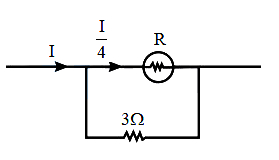
The deflection in a galvanometer falls to $\left(\frac{1}{4}\right)^{th}$ of its initial value when it is shunted by a resistor of $3 \Omega$. If an additional shunt of $2 \Omega$ is connected in parallel to the earlier shunt,the deflection in the galvanometer falls to:
A
$\frac{1}{2}$
B
$\left(\frac{1}{3}\right)^{rd}$
C
$\left(\frac{1}{4}\right)^{th}$
D
$\left(\frac{1}{8.5}\right)^{th}$
Solution
(D) Let $G$ be the resistance of the galvanometer and $I$ be the total current. When shunted by $S_1 = 3 \Omega$,the current through the galvanometer is $I_g = \frac{I}{4}$.
Using the current divider rule: $I_g = I \left( \frac{S_1}{G + S_1} \right) \Rightarrow \frac{I}{4} = I \left( \frac{3}{G + 3} \right)$.
Solving for $G$: $G + 3 = 12 \Rightarrow G = 9 \Omega$.
Now,an additional shunt $S_2 = 2 \Omega$ is connected in parallel to $S_1 = 3 \Omega$. The equivalent shunt resistance $S_{eq}$ is:
$S_{eq} = \frac{S_1 \times S_2}{S_1 + S_2} = \frac{3 \times 2}{3 + 2} = \frac{6}{5} = 1.2 \Omega$.
The new current through the galvanometer $I_g'$ is:
$I_g' = I \left( \frac{S_{eq}}{G + S_{eq}} \right) = I \left( \frac{1.2}{9 + 1.2} \right) = I \left( \frac{1.2}{10.2} \right) = I \left( \frac{12}{102} \right) = I \left( \frac{1}{8.5} \right)$.
Thus,the deflection falls to $\left(\frac{1}{8.5}\right)^{th}$ of the initial value.
Using the current divider rule: $I_g = I \left( \frac{S_1}{G + S_1} \right) \Rightarrow \frac{I}{4} = I \left( \frac{3}{G + 3} \right)$.
Solving for $G$: $G + 3 = 12 \Rightarrow G = 9 \Omega$.
Now,an additional shunt $S_2 = 2 \Omega$ is connected in parallel to $S_1 = 3 \Omega$. The equivalent shunt resistance $S_{eq}$ is:
$S_{eq} = \frac{S_1 \times S_2}{S_1 + S_2} = \frac{3 \times 2}{3 + 2} = \frac{6}{5} = 1.2 \Omega$.
The new current through the galvanometer $I_g'$ is:
$I_g' = I \left( \frac{S_{eq}}{G + S_{eq}} \right) = I \left( \frac{1.2}{9 + 1.2} \right) = I \left( \frac{1.2}{10.2} \right) = I \left( \frac{12}{102} \right) = I \left( \frac{1}{8.5} \right)$.
Thus,the deflection falls to $\left(\frac{1}{8.5}\right)^{th}$ of the initial value.
0 likesView Solution
32
PhysicsMediumMCQMHT CET · 2018
$A$ conducting wire has length $L_1$ and diameter $d_1$. After stretching,the same wire's length becomes $L_2$ and diameter $d_2$. The ratio of resistance before and after stretching is:
A
$d_2^4: d_1^4$
B
$d_1^4: d_2^4$
C
$d_2^2: d_1^2$
D
$d_1^2: d_2^2$
Solution
(A) The resistance of a wire is given by $R = \rho \frac{L}{A}$,where $A = \frac{\pi d^2}{4}$.
Since the volume of the wire remains constant during stretching,$V = A_1 L_1 = A_2 L_2$,which implies $L_1 d_1^2 = L_2 d_2^2$,or $\frac{L_1}{L_2} = \frac{d_2^2}{d_1^2}$.
The ratio of resistances is $\frac{R_1}{R_2} = \frac{L_1}{L_2} \times \frac{A_2}{A_1} = \frac{L_1}{L_2} \times \frac{d_2^2}{d_1^2}$.
Substituting $\frac{L_1}{L_2} = \frac{d_2^2}{d_1^2}$ into the equation,we get $\frac{R_1}{R_2} = \left(\frac{d_2^2}{d_1^2}\right) \times \left(\frac{d_2^2}{d_1^2}\right) = \frac{d_2^4}{d_1^4}$.
Since the volume of the wire remains constant during stretching,$V = A_1 L_1 = A_2 L_2$,which implies $L_1 d_1^2 = L_2 d_2^2$,or $\frac{L_1}{L_2} = \frac{d_2^2}{d_1^2}$.
The ratio of resistances is $\frac{R_1}{R_2} = \frac{L_1}{L_2} \times \frac{A_2}{A_1} = \frac{L_1}{L_2} \times \frac{d_2^2}{d_1^2}$.
Substituting $\frac{L_1}{L_2} = \frac{d_2^2}{d_1^2}$ into the equation,we get $\frac{R_1}{R_2} = \left(\frac{d_2^2}{d_1^2}\right) \times \left(\frac{d_2^2}{d_1^2}\right) = \frac{d_2^4}{d_1^4}$.
0 likesView Solution
33
PhysicsEasyMCQMHT CET · 2018
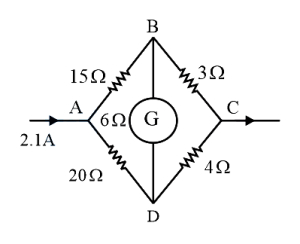
In the following network,the current flowing through the $15\Omega$ resistance is: (in $A$)
A
$0.8$
B
$1.0$
C
$1.2$
D
$1.4$
Solution
(C) The given circuit is a Wheatstone bridge. Let the nodes be $A, B, C, D$. The resistances are $R_{AB} = 15\Omega$,$R_{BC} = 3\Omega$,$R_{AD} = 20\Omega$,$R_{CD} = 4\Omega$,and the galvanometer resistance $R_G = 6\Omega$.
First,check for the balanced condition: $\frac{R_{AB}}{R_{AD}} = \frac{15}{20} = 0.75$ and $\frac{R_{BC}}{R_{CD}} = \frac{3}{4} = 0.75$.
Since $\frac{R_{AB}}{R_{AD}} = \frac{R_{BC}}{R_{CD}}$,the bridge is balanced. Therefore,no current flows through the galvanometer $(G)$.
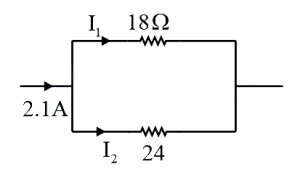
This simplifies the circuit to two parallel branches: one with $(15+3) = 18\Omega$ and the other with $(20+4) = 24\Omega$.
The total current $I = 2.1 A$ divides into $I_1$ (through the $18\Omega$ branch) and $I_2$ (through the $24\Omega$ branch).
Using the current divider rule: $I_1 = I \times \frac{R_{parallel2}}{R_{parallel1} + R_{parallel2}} = 2.1 \times \frac{24}{18+24} = 2.1 \times \frac{24}{42} = 2.1 \times \frac{4}{7} = 1.2 A$.
First,check for the balanced condition: $\frac{R_{AB}}{R_{AD}} = \frac{15}{20} = 0.75$ and $\frac{R_{BC}}{R_{CD}} = \frac{3}{4} = 0.75$.
Since $\frac{R_{AB}}{R_{AD}} = \frac{R_{BC}}{R_{CD}}$,the bridge is balanced. Therefore,no current flows through the galvanometer $(G)$.
This simplifies the circuit to two parallel branches: one with $(15+3) = 18\Omega$ and the other with $(20+4) = 24\Omega$.
The total current $I = 2.1 A$ divides into $I_1$ (through the $18\Omega$ branch) and $I_2$ (through the $24\Omega$ branch).
Using the current divider rule: $I_1 = I \times \frac{R_{parallel2}}{R_{parallel1} + R_{parallel2}} = 2.1 \times \frac{24}{18+24} = 2.1 \times \frac{24}{42} = 2.1 \times \frac{4}{7} = 1.2 A$.
0 likesView Solution
34
PhysicsMediumMCQMHT CET · 2018
The kinetic energy of an electron having de-Broglie wavelength $\lambda$ is ($h=$ Planck's constant,$m=$ mass of electron).
A
$\frac{h}{2 m \lambda}$
B
$\frac{h^2}{2 m \lambda^2}$
C
$\frac{h^2}{2 m^2 \lambda^2}$
D
$\frac{h^2}{2 m^2 \lambda}$
Solution
(B) The de-Broglie wavelength $\lambda$ is related to the momentum $p$ by the equation $\lambda = \frac{h}{p}$.
Since kinetic energy $K.E. = \frac{p^2}{2m}$,we can express momentum as $p = \sqrt{2m(K.E.)}$.
Substituting this into the wavelength formula,we get $\lambda = \frac{h}{\sqrt{2m(K.E.)}}$.
Squaring both sides,we obtain $\lambda^2 = \frac{h^2}{2m(K.E.)}$.
Rearranging the terms to solve for kinetic energy,we get $K.E. = \frac{h^2}{2m\lambda^2}$.
Since kinetic energy $K.E. = \frac{p^2}{2m}$,we can express momentum as $p = \sqrt{2m(K.E.)}$.
Substituting this into the wavelength formula,we get $\lambda = \frac{h}{\sqrt{2m(K.E.)}}$.
Squaring both sides,we obtain $\lambda^2 = \frac{h^2}{2m(K.E.)}$.
Rearranging the terms to solve for kinetic energy,we get $K.E. = \frac{h^2}{2m\lambda^2}$.
0 likesView Solution
35
PhysicsMediumMCQMHT CET · 2018
If an electron and a proton have the same de-Broglie wavelength,then the kinetic energy of the electron is
A
Zero
B
Less than that of a proton
C
More than that of a proton
D
Equal to that of a proton
Solution
(C) The de-Broglie wavelength $\lambda$ is given by the relation $\lambda = \frac{h}{p} = \frac{h}{\sqrt{2mKE}}$.
From this,the kinetic energy $KE$ can be expressed as $KE = \frac{h^2}{2m\lambda^2}$.
Since the de-Broglie wavelength $\lambda$ is the same for both the electron and the proton,we have $KE \propto \frac{1}{m}$.
Because the mass of an electron $(m_e \approx 9.11 \times 10^{-31} \ kg)$ is much smaller than the mass of a proton $(m_p \approx 1.67 \times 10^{-27} \ kg)$,the kinetic energy of the electron will be greater than that of the proton.
From this,the kinetic energy $KE$ can be expressed as $KE = \frac{h^2}{2m\lambda^2}$.
Since the de-Broglie wavelength $\lambda$ is the same for both the electron and the proton,we have $KE \propto \frac{1}{m}$.
Because the mass of an electron $(m_e \approx 9.11 \times 10^{-31} \ kg)$ is much smaller than the mass of a proton $(m_p \approx 1.67 \times 10^{-27} \ kg)$,the kinetic energy of the electron will be greater than that of the proton.
0 likesView Solution
36
PhysicsMediumMCQMHT CET · 2018
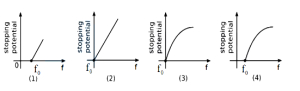
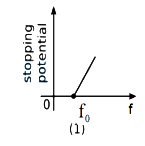
The following graphs show the variation of stopping potential $(V_s)$ corresponding to the frequency of incident radiation $(f)$ for a given metal. The correct variation is shown in graph ($f_0 =$ Threshold frequency):
A
$(1)$
B
$(2)$
C
$(3)$
D
$(4)$
Solution
(A) According to Einstein's photoelectric equation,the maximum kinetic energy $(K_{max})$ of emitted photoelectrons is given by:
$K_{max} = hf - \phi$
Since the stopping potential $(V_s)$ is related to the maximum kinetic energy by $K_{max} = eV_s$,we can write:
$eV_s = hf - \phi$
$V_s = (h/e)f - (\phi/e)$
This equation is of the form $y = mx + c$,which represents a straight line.
Here,the slope is $(h/e)$ (a positive constant) and the intercept on the $V_s$-axis is $(-\phi/e)$.
When $V_s = 0$,we have $hf = \phi$,which gives $f = \phi/h = f_0$ (the threshold frequency).
Thus,the graph of $V_s$ versus $f$ is a straight line starting from $f = f_0$ on the frequency axis.
Graph $(1)$ correctly represents this linear relationship.
$K_{max} = hf - \phi$
Since the stopping potential $(V_s)$ is related to the maximum kinetic energy by $K_{max} = eV_s$,we can write:
$eV_s = hf - \phi$
$V_s = (h/e)f - (\phi/e)$
This equation is of the form $y = mx + c$,which represents a straight line.
Here,the slope is $(h/e)$ (a positive constant) and the intercept on the $V_s$-axis is $(-\phi/e)$.
When $V_s = 0$,we have $hf = \phi$,which gives $f = \phi/h = f_0$ (the threshold frequency).
Thus,the graph of $V_s$ versus $f$ is a straight line starting from $f = f_0$ on the frequency axis.
Graph $(1)$ correctly represents this linear relationship.
0 likesView Solution
37
PhysicsMediumMCQMHT CET · 2018
In a photoelectric effect experiment, the frequency of incident radiation is increased while keeping other factors constant $(f > f_0)$. The stopping potential
A
decreases
B
increases
C
becomes zero
D
first decreases and then increases
Solution
(B) According to Einstein's photoelectric equation: $e V_0 = h f - \Phi$, where $\Phi = h f_0$ is the work function.
Rearranging the equation for stopping potential $V_0$: $V_0 = \frac{h}{e} f - \frac{h f_0}{e}$.
Since $h$, $e$, and $f_0$ are constants, $V_0$ is a linear function of the incident frequency $f$.
As the frequency $f$ of the incident radiation increases, the term $\frac{h}{e} f$ increases.
Therefore, the stopping potential $V_0$ increases.
Rearranging the equation for stopping potential $V_0$: $V_0 = \frac{h}{e} f - \frac{h f_0}{e}$.
Since $h$, $e$, and $f_0$ are constants, $V_0$ is a linear function of the incident frequency $f$.
As the frequency $f$ of the incident radiation increases, the term $\frac{h}{e} f$ increases.
Therefore, the stopping potential $V_0$ increases.
0 likesView Solution
38
PhysicsEasyMCQMHT CET · 2018
The expression for electric field intensity at a point outside a uniformly charged thin plane sheet is (where $d$ is the distance of the point from the plane sheet):
A
independent of $d$
B
directly proportional to $\sqrt{d}$
C
directly proportional to $d$
D
directly proportional to $\frac{1}{\sqrt{d}}$
Solution
(A) According to Gauss's Law,the electric field intensity $E$ at a point outside a uniformly charged thin infinite plane sheet with surface charge density $\sigma$ is given by the formula:
$E = \frac{\sigma}{2 \varepsilon_0}$
Here,$\sigma$ is the surface charge density and $\varepsilon_0$ is the permittivity of free space.
Since the expression for the electric field does not contain the distance $d$,the electric field intensity is independent of the distance $d$ from the plane sheet.
$E = \frac{\sigma}{2 \varepsilon_0}$
Here,$\sigma$ is the surface charge density and $\varepsilon_0$ is the permittivity of free space.
Since the expression for the electric field does not contain the distance $d$,the electric field intensity is independent of the distance $d$ from the plane sheet.
0 likesView Solution
39
PhysicsEasyMCQMHT CET · 2018
$A$ circular coil carrying current $I$ has a radius $R$ and magnetic field at the centre is $B$. The distance from the centre along the axis of the same coil where the magnetic field will be $\frac{B}{8}$ is
A
$R \sqrt{2}$
B
$R \sqrt{3}$
C
$2R$
D
$3R$
Solution
(B) The magnetic field at the center of a circular coil is given by $B = \frac{\mu_0 I}{2R}$.
The magnetic field at a distance $x$ along the axis of the coil is given by $B_x = \frac{\mu_0 I R^2}{2(R^2 + x^2)^{3/2}}$.
We are given that $B_x = \frac{B}{8}$. Substituting the expression for $B$:
$\frac{B}{8} = \frac{\mu_0 I R^2}{2(R^2 + x^2)^{3/2}}$
$\frac{1}{8} \left( \frac{\mu_0 I}{2R} \right) = \frac{\mu_0 I R^2}{2(R^2 + x^2)^{3/2}}$
$\frac{1}{8R} = \frac{R^2}{(R^2 + x^2)^{3/2}}$
$\frac{1}{8R^3} = \frac{1}{(R^2 + x^2)^{3/2}}$
Taking the cube root of both sides:
$\frac{1}{2R} = \frac{1}{(R^2 + x^2)^{1/2}}$
Squaring both sides:
$\frac{1}{4R^2} = \frac{1}{R^2 + x^2}$
$R^2 + x^2 = 4R^2$
$x^2 = 3R^2$
$x = R\sqrt{3}$.
The magnetic field at a distance $x$ along the axis of the coil is given by $B_x = \frac{\mu_0 I R^2}{2(R^2 + x^2)^{3/2}}$.
We are given that $B_x = \frac{B}{8}$. Substituting the expression for $B$:
$\frac{B}{8} = \frac{\mu_0 I R^2}{2(R^2 + x^2)^{3/2}}$
$\frac{1}{8} \left( \frac{\mu_0 I}{2R} \right) = \frac{\mu_0 I R^2}{2(R^2 + x^2)^{3/2}}$
$\frac{1}{8R} = \frac{R^2}{(R^2 + x^2)^{3/2}}$
$\frac{1}{8R^3} = \frac{1}{(R^2 + x^2)^{3/2}}$
Taking the cube root of both sides:
$\frac{1}{2R} = \frac{1}{(R^2 + x^2)^{1/2}}$
Squaring both sides:
$\frac{1}{4R^2} = \frac{1}{R^2 + x^2}$
$R^2 + x^2 = 4R^2$
$x^2 = 3R^2$
$x = R\sqrt{3}$.
0 likesView Solution
40
PhysicsDifficultMCQMHT CET · 2018
An alternating electric field of frequency $f$ is applied across the radius $R$ of a cyclotron to accelerate protons (mass $m$). The operating magnetic field $B$ used and kinetic energy $(K.E.)$ of the proton beam produced by it are respectively ($e=$ charge on proton).
A
$\frac{2 \pi m f}{e}, 2 \pi^2 m f^2 R^2$
B
$\frac{2 \pi^2 m f}{e^2}, 4 \pi^2 m f^2 R^2$
C
$\frac{\pi m f}{e}, \pi^2 m f^2 R^2$
D
$\frac{2 \pi^2 m^2 f^2}{e}, 2 \pi^2 m^2 f^2 R^2$
Solution
(A) In a cyclotron,the frequency of the alternating electric field $f$ is equal to the cyclotron frequency $f_c = \frac{eB}{2\pi m}$.
From this,the magnetic field $B$ is given by $B = \frac{2\pi mf}{e}$.
The maximum velocity $v$ of the proton at the exit radius $R$ is given by $v = \omega R = (2\pi f)R$.
The kinetic energy $K.E.$ is given by $K.E. = \frac{1}{2}mv^2$.
Substituting $v = 2\pi f R$,we get $K.E. = \frac{1}{2}m(2\pi f R)^2 = \frac{1}{2}m(4\pi^2 f^2 R^2) = 2\pi^2 mf^2 R^2$.
Thus,the magnetic field is $\frac{2\pi mf}{e}$ and the kinetic energy is $2\pi^2 mf^2 R^2$.
From this,the magnetic field $B$ is given by $B = \frac{2\pi mf}{e}$.
The maximum velocity $v$ of the proton at the exit radius $R$ is given by $v = \omega R = (2\pi f)R$.
The kinetic energy $K.E.$ is given by $K.E. = \frac{1}{2}mv^2$.
Substituting $v = 2\pi f R$,we get $K.E. = \frac{1}{2}m(2\pi f R)^2 = \frac{1}{2}m(4\pi^2 f^2 R^2) = 2\pi^2 mf^2 R^2$.
Thus,the magnetic field is $\frac{2\pi mf}{e}$ and the kinetic energy is $2\pi^2 mf^2 R^2$.
0 likesView Solution
41
PhysicsEasyMCQMHT CET · 2018
If $M_z$ is the magnetization of a paramagnetic sample,$B$ is the external magnetic field,$T$ is the absolute temperature,and $C$ is the Curie constant,then according to Curie's law in magnetism,the correct relation is:
A
$M_Z = \frac{T}{C B}$
B
$M_Z = \frac{C B}{T}$
C
$C = \frac{M_Z B}{T}$
D
$C = \frac{T^2}{M_z B}$
Solution
(B) According to Curie's law for paramagnetic materials,the magnetization $M_z$ is directly proportional to the external magnetic field $B$ and inversely proportional to the absolute temperature $T$.
Mathematically,this is expressed as $M_z \propto \frac{B}{T}$.
Introducing the Curie constant $C$,we get the relation $M_z = C \frac{B}{T}$ or $M_z = \frac{C B}{T}$.
Therefore,the correct relation is $M_z = \frac{C B}{T}$.
Mathematically,this is expressed as $M_z \propto \frac{B}{T}$.
Introducing the Curie constant $C$,we get the relation $M_z = C \frac{B}{T}$ or $M_z = \frac{C B}{T}$.
Therefore,the correct relation is $M_z = \frac{C B}{T}$.
0 likesView Solution
42
PhysicsDifficultMCQMHT CET · 2018
The ratio of magnetic fields due to a bar magnet at two axial points $P_1$ and $P_2$,which are separated from each other by $10 \ cm$,is $25: 2$. Point $P_1$ is situated at $10 \ cm$ from the center of the magnet. (Points $P_1$ and $P_2$ are on the same side of the magnet,and the distances of $P_1$ and $P_2$ from the center are much greater than the distance of the two ends of the magnet from the center). The magnetic length of the bar magnet is: (in $cm$)
A
$5$
B
$10$
C
$15$
D
$20$
Solution
(B) The magnetic field on the axis of a bar magnet is given by $B = \frac{\mu_0}{4\pi} \frac{2Md}{(d^2-l^2)^2}$,where $d$ is the distance from the center and $2l$ is the magnetic length.
Given $d_1 = 10 \ cm$ and $d_2 = 10 + 10 = 20 \ cm$.
The ratio is $\frac{B_1}{B_2} = \frac{d_1}{d_2} \left( \frac{d_2^2 - l^2}{d_1^2 - l^2} \right)^2 = \frac{25}{2}$.
Substituting the values: $\frac{10}{20} \left( \frac{20^2 - l^2}{10^2 - l^2} \right)^2 = \frac{25}{2}$.
$\frac{1}{2} \left( \frac{400 - l^2}{100 - l^2} \right)^2 = \frac{25}{2} \Rightarrow \left( \frac{400 - l^2}{100 - l^2} \right)^2 = 25$.
Taking the square root: $\frac{400 - l^2}{100 - l^2} = 5$.
$400 - l^2 = 500 - 5l^2 \Rightarrow 4l^2 = 100 \Rightarrow l^2 = 25$.
So,$l = 5 \ cm$.
The magnetic length is $2l = 2 \times 5 \ cm = 10 \ cm$.
Given $d_1 = 10 \ cm$ and $d_2 = 10 + 10 = 20 \ cm$.
The ratio is $\frac{B_1}{B_2} = \frac{d_1}{d_2} \left( \frac{d_2^2 - l^2}{d_1^2 - l^2} \right)^2 = \frac{25}{2}$.
Substituting the values: $\frac{10}{20} \left( \frac{20^2 - l^2}{10^2 - l^2} \right)^2 = \frac{25}{2}$.
$\frac{1}{2} \left( \frac{400 - l^2}{100 - l^2} \right)^2 = \frac{25}{2} \Rightarrow \left( \frac{400 - l^2}{100 - l^2} \right)^2 = 25$.
Taking the square root: $\frac{400 - l^2}{100 - l^2} = 5$.
$400 - l^2 = 500 - 5l^2 \Rightarrow 4l^2 = 100 \Rightarrow l^2 = 25$.
So,$l = 5 \ cm$.
The magnetic length is $2l = 2 \times 5 \ cm = 10 \ cm$.
0 likesView Solution
43
PhysicsMediumMCQMHT CET · 2018
Magnetic susceptibility for a paramagnetic and diamagnetic material is respectively
A
Small,positive and small,positive
B
Large,positive and small,negative
C
Small,positive and small,negative
D
Large,negative and large,positive
Solution
(C) The magnetic susceptibility $\chi$ is a measure of how easily a material can be magnetized in an external magnetic field.
For paramagnetic materials,the magnetic susceptibility $\chi$ is small and positive,meaning they are weakly attracted to an external magnetic field.
For diamagnetic materials,the magnetic susceptibility $\chi$ is small and negative,meaning they are weakly repelled by an external magnetic field.
Therefore,the correct sequence is small,positive for paramagnetic and small,negative for diamagnetic materials.
For paramagnetic materials,the magnetic susceptibility $\chi$ is small and positive,meaning they are weakly attracted to an external magnetic field.
For diamagnetic materials,the magnetic susceptibility $\chi$ is small and negative,meaning they are weakly repelled by an external magnetic field.
Therefore,the correct sequence is small,positive for paramagnetic and small,negative for diamagnetic materials.
0 likesView Solution
44
PhysicsEasyMCQMHT CET · 2018
In a compound microscope,the focal length and aperture of the objective lens used are,respectively:
A
Large and large
B
Large and small
C
Short and large
D
Short and small
Solution
(D) In a compound microscope,the objective lens is placed very close to the object to form a real,inverted,and magnified image. To achieve high magnification and better resolution,the objective lens must have a short focal length and a small aperture.
0 likesView Solution
45
PhysicsEasyMCQMHT CET · 2018
If the numerical aperture $(NA)$ of a microscope is increased,then its:
A
Resolving power remains constant
B
Resolving power becomes zero
C
Limit of resolution is decreased
D
Limit of resolution is increased
Solution
(C) The limit of resolution $(d)$ of a microscope is given by the formula: $d = \frac{1.22 \lambda}{2 NA}$,where $\lambda$ is the wavelength of light and $NA$ is the numerical aperture.
From this relation,it is clear that the limit of resolution $(d)$ is inversely proportional to the numerical aperture $(NA)$: $d \propto \frac{1}{NA}$.
Therefore,if the numerical aperture $(NA)$ of a microscope is increased,the limit of resolution $(d)$ decreases,which improves the resolving power of the microscope.
From this relation,it is clear that the limit of resolution $(d)$ is inversely proportional to the numerical aperture $(NA)$: $d \propto \frac{1}{NA}$.
Therefore,if the numerical aperture $(NA)$ of a microscope is increased,the limit of resolution $(d)$ decreases,which improves the resolving power of the microscope.
0 likesView Solution
46
PhysicsEasyMCQMHT CET · 2018
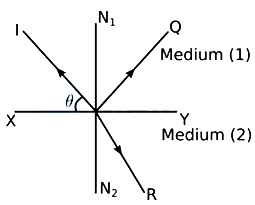
The angle made by the incident ray of light with the reflecting surface is called:
A
Glancing angle
B
Angle of incidence
C
Angle of deviation
D
Angle of refraction
Solution
(A) The angle of incidence is defined as the angle between the incident ray and the normal to the surface at the point of incidence.
However,the angle between the incident ray and the reflecting surface itself is known as the glancing angle.
In the provided diagram,the angle $\theta$ represents the angle between the incident ray $I$ and the surface $XY$,which is the glancing angle.
Therefore,the correct option is $A$.
However,the angle between the incident ray and the reflecting surface itself is known as the glancing angle.
In the provided diagram,the angle $\theta$ represents the angle between the incident ray $I$ and the surface $XY$,which is the glancing angle.
Therefore,the correct option is $A$.
0 likesView Solution
47
PhysicsMediumMCQMHT CET · 2018
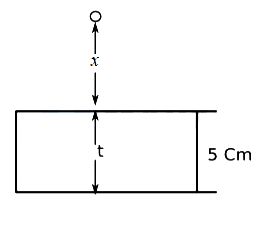
$A$ ray of light is incident normally on a glass slab of thickness $5 \ cm$ and refractive index $1.6$. The time taken by a ray to travel from the source to the surface of the slab is the same as the time taken to travel through the glass slab. The distance of the source from the surface is: (in $cm$)
A
$4$
B
$8$
C
$12$
D
$16$
Solution
(B) Let the distance of the source from the surface be $x$. The thickness of the glass slab is $d = 5 \ cm$,and its refractive index is $\mu = 1.6$.
The time taken by light to travel a distance $x$ in air (where speed is $c$) is $t_1 = \frac{x}{c}$.
The time taken by light to travel through the glass slab of thickness $d$ (where speed is $v = \frac{c}{\mu}$) is $t_2 = \frac{d}{v} = \frac{d}{c/\mu} = \frac{\mu d}{c}$.
According to the problem,$t_1 = t_2$,so:
$\frac{x}{c} = \frac{\mu d}{c}$
$x = \mu d$
$x = 1.6 \times 5 \ cm = 8 \ cm$.
Therefore,the distance of the source from the surface is $8 \ cm$.
The time taken by light to travel a distance $x$ in air (where speed is $c$) is $t_1 = \frac{x}{c}$.
The time taken by light to travel through the glass slab of thickness $d$ (where speed is $v = \frac{c}{\mu}$) is $t_2 = \frac{d}{v} = \frac{d}{c/\mu} = \frac{\mu d}{c}$.
According to the problem,$t_1 = t_2$,so:
$\frac{x}{c} = \frac{\mu d}{c}$
$x = \mu d$
$x = 1.6 \times 5 \ cm = 8 \ cm$.
Therefore,the distance of the source from the surface is $8 \ cm$.
0 likesView Solution
48
PhysicsEasyMCQMHT CET · 2018
With forward bias mode,the $p-n$ junction diode
A
is one in which width of depletion layer increases
B
is one in which potential barrier increases
C
acts as closed switch
D
acts as open switch
Solution
(C) When a $p-n$ junction is in forward bias,the positive terminal of the battery is connected to the $p$-side and the negative terminal to the $n$-side.
This reduces the width of the depletion layer and lowers the potential barrier.
As a result,the diode offers very low resistance and allows current to flow through it.
Therefore,in forward bias,the $p-n$ junction diode acts as a closed switch.
This reduces the width of the depletion layer and lowers the potential barrier.
As a result,the diode offers very low resistance and allows current to flow through it.
Therefore,in forward bias,the $p-n$ junction diode acts as a closed switch.
0 likesView Solution
49
PhysicsMediumMCQMHT CET · 2018
$A$ transistor is used as a common emitter amplifier with a load resistance $2 \ k\Omega$. The input resistance is $150 \ \Omega$. The base current is changed by $20 \ \mu A$,which results in a change in collector current by $1.5 \ mA$. The voltage gain of the amplifier is
A
$1100$
B
$1000$
C
$900$
D
$12000$
Solution
(B) The correct option is $B$.
Concept: The current gain $\beta$ is given by $\beta = \frac{\Delta I_C}{\Delta I_B}$.
Given: $\Delta I_C = 1.5 \ mA = 1.5 \times 10^{-3} \ A$ and $\Delta I_B = 20 \ \mu A = 20 \times 10^{-6} \ A$.
Calculating $\beta$: $\beta = \frac{1.5 \times 10^{-3}}{20 \times 10^{-6}} = \frac{1500}{20} = 75$.
The voltage gain $A_v$ is given by $A_v = \beta \times \frac{R_L}{R_i}$.
Given: Load resistance $R_L = 2 \ k\Omega = 2000 \ \Omega$ and input resistance $R_i = 150 \ \Omega$.
Substituting the values: $A_v = 75 \times \frac{2000}{150} = 75 \times \frac{40}{3} = 25 \times 40 = 1000$.
Concept: The current gain $\beta$ is given by $\beta = \frac{\Delta I_C}{\Delta I_B}$.
Given: $\Delta I_C = 1.5 \ mA = 1.5 \times 10^{-3} \ A$ and $\Delta I_B = 20 \ \mu A = 20 \times 10^{-6} \ A$.
Calculating $\beta$: $\beta = \frac{1.5 \times 10^{-3}}{20 \times 10^{-6}} = \frac{1500}{20} = 75$.
The voltage gain $A_v$ is given by $A_v = \beta \times \frac{R_L}{R_i}$.
Given: Load resistance $R_L = 2 \ k\Omega = 2000 \ \Omega$ and input resistance $R_i = 150 \ \Omega$.
Substituting the values: $A_v = 75 \times \frac{2000}{150} = 75 \times \frac{40}{3} = 25 \times 40 = 1000$.
0 likesView Solution
50
PhysicsMediumMCQMHT CET · 2018
Two light waves of intensities $I_1$ and $I_2$ having the same frequency pass through the same medium at a time in the same direction and interfere. The sum of the minimum and maximum intensities is
A
$(I_1+I_2)$
B
$2(I_1+I_2)$
C
$(\sqrt{I_1}+\sqrt{I_2})$
D
$(\sqrt{I_1}-\sqrt{I_2})$
Solution
(B) The intensity of a wave is proportional to the square of its amplitude,$I \propto a^2$,so $I = ka^2$. Let $I_1 = ka_1^2$ and $I_2 = ka_2^2$.
The maximum intensity during interference is given by $I_{\max} = k(a_1 + a_2)^2 = k(a_1^2 + a_2^2 + 2a_1a_2)$.
The minimum intensity during interference is given by $I_{\min} = k(a_1 - a_2)^2 = k(a_1^2 + a_2^2 - 2a_1a_2)$.
The sum of the maximum and minimum intensities is $I_{\max} + I_{\min} = k(a_1^2 + a_2^2 + 2a_1a_2) + k(a_1^2 + a_2^2 - 2a_1a_2)$.
$I_{\max} + I_{\min} = k(2a_1^2 + 2a_2^2) = 2(ka_1^2 + ka_2^2)$.
Substituting the intensities back,we get $I_{\max} + I_{\min} = 2(I_1 + I_2)$.
The maximum intensity during interference is given by $I_{\max} = k(a_1 + a_2)^2 = k(a_1^2 + a_2^2 + 2a_1a_2)$.
The minimum intensity during interference is given by $I_{\min} = k(a_1 - a_2)^2 = k(a_1^2 + a_2^2 - 2a_1a_2)$.
The sum of the maximum and minimum intensities is $I_{\max} + I_{\min} = k(a_1^2 + a_2^2 + 2a_1a_2) + k(a_1^2 + a_2^2 - 2a_1a_2)$.
$I_{\max} + I_{\min} = k(2a_1^2 + 2a_2^2) = 2(ka_1^2 + ka_2^2)$.
Substituting the intensities back,we get $I_{\max} + I_{\min} = 2(I_1 + I_2)$.
0 likesView Solution
Vedclass Products
For Students
Vedclass Test Series
Mock tests in real MHT CET style covering Physics with performance analysis. 5-day free trial.
Start Free TrialFor Teachers
Exam Paper Generator
Generate Set A/B/C/D Physics papers from 7.5L+ questions in 2 minutes. 3 chapters free.
Try FreeFor Institutes
Online Exam Module
Run live MHT CET mock exams with unlimited students, 360° analytics & white-label branding.
See DemoFrequently Asked Questions
How many Physics questions are in MHT CET 2018?
There are 50 Physics questions from the MHT CET 2018 paper on Vedclass, each with a detailed step-by-step solution in English.
Are MHT CET 2018 Physics solutions available in English?
Yes. All solutions on this page are in English. You can also switch to English or Hindi using the language buttons above the questions.
Can I practice MHT CET 2018 Physics as a timed test?
Yes. Use the Vedclass Test Series to attempt a full MHT CET mock test covering Physics with time limits and instant score analysis.
Can teachers create Physics papers from MHT CET previous year questions?
Yes. The Vedclass Exam Paper Generator lets teachers mix MHT CET Physics questions and generate Set A/B/C/D papers in minutes.
For Teachers & Institutes
Build a Custom Physics Paper
Pick MHT CET 2018 Physics questions, set difficulty, and generate Set A/B/C/D in 2 minutes.