
PhysicsQ301–376 of 690 questions
Page 7 of 8 · English
301
PhysicsEasyMCQMHT CET · 2020
The $SI$ unit of $\frac{G}{g}$ is $(g = \text{acceleration due to gravity}, G = \text{gravitational constant})$
A
$\frac{kg}{m^2}$
B
$\frac{m^2}{kg}$
C
$\frac{m}{kg}$
D
$\frac{kg}{m}$
Solution
(B) The gravitational force is given by $F = \frac{G M m}{r^2}$.
Acceleration due to gravity is $g = \frac{F}{m} = \frac{G M}{r^2}$.
Therefore,the ratio $\frac{G}{g}$ can be expressed as:
$\frac{G}{g} = \frac{G}{\frac{G M}{r^2}} = \frac{r^2}{M}$.
The unit of $r$ is $m$ (meters) and the unit of $M$ is $kg$ (kilograms).
Thus,the $SI$ unit of $\frac{G}{g}$ is $\frac{m^2}{kg}$.
Acceleration due to gravity is $g = \frac{F}{m} = \frac{G M}{r^2}$.
Therefore,the ratio $\frac{G}{g}$ can be expressed as:
$\frac{G}{g} = \frac{G}{\frac{G M}{r^2}} = \frac{r^2}{M}$.
The unit of $r$ is $m$ (meters) and the unit of $M$ is $kg$ (kilograms).
Thus,the $SI$ unit of $\frac{G}{g}$ is $\frac{m^2}{kg}$.
0 likesView Solution
302
PhysicsEasyMCQMHT CET · 2020
Let $x = \pi R \left( \frac{P^2 - Q^2}{2} \right)$,where $P, Q$ and $R$ are lengths. The physical quantity $x$ is
A
volume
B
Area
C
velocity
D
length
Solution
(A) Given the equation $x = \pi R \left( \frac{P^2 - Q^2}{2} \right)$.
Here,$P, Q,$ and $R$ are lengths,so their dimensions are $[L]$.
The term $(P^2 - Q^2)$ has dimensions $[L^2] - [L^2] = [L^2]$.
The constant $\pi$ and the factor $1/2$ are dimensionless.
Therefore,the dimension of $x$ is $[L] \times [L^2] = [L^3]$.
Physical quantities with dimensions of $[L^3]$ represent volume.
Here,$P, Q,$ and $R$ are lengths,so their dimensions are $[L]$.
The term $(P^2 - Q^2)$ has dimensions $[L^2] - [L^2] = [L^2]$.
The constant $\pi$ and the factor $1/2$ are dimensionless.
Therefore,the dimension of $x$ is $[L] \times [L^2] = [L^3]$.
Physical quantities with dimensions of $[L^3]$ represent volume.
0 likesView Solution
303
PhysicsMediumMCQMHT CET · 2020
$A$ progressive wave of frequency $50 \,Hz$ is travelling with velocity $350 \,m/s$ through a medium. The change in phase at a given time interval of $0.01 \,s$ is
A
$\frac{\pi}{4} \,rad$
B
$\frac{3\pi}{2} \,rad$
C
$\pi \,rad$
D
$\frac{\pi}{2} \,rad$
Solution
(C) The relationship between phase difference $\Delta \phi$ and time interval $\Delta t$ is given by:
$\Delta \phi = \omega \Delta t = (2\pi f) \Delta t$
Given frequency $f = 50 \,Hz$ and time interval $\Delta t = 0.01 \,s$.
Substituting the values:
$\Delta \phi = 2 \times \pi \times 50 \times 0.01$
$\Delta \phi = 100 \pi \times 0.01$
$\Delta \phi = \pi \,rad$.
$\Delta \phi = \omega \Delta t = (2\pi f) \Delta t$
Given frequency $f = 50 \,Hz$ and time interval $\Delta t = 0.01 \,s$.
Substituting the values:
$\Delta \phi = 2 \times \pi \times 50 \times 0.01$
$\Delta \phi = 100 \pi \times 0.01$
$\Delta \phi = \pi \,rad$.
0 likesView Solution
304
PhysicsMediumMCQMHT CET · 2020
$A$ string of mass $0.1 \, kg$ is under a tension $1.6 \, N$. The length of the string is $1 \, m$. $A$ transverse wave starts from one end of the string. The time taken by the wave to reach the other end is (in $s$.)
A
$0.30$
B
$0.50$
C
$0.25$
D
$0.75$
Solution
(C) Given: Mass of string $m = 0.1 \, kg$, Tension $T = 1.6 \, N$, Length $\ell = 1 \, m$.
Mass per unit length $\mu = \frac{m}{\ell} = \frac{0.1}{1} = 0.1 \, kg/m$.
The velocity $v$ of the transverse wave in the string is given by the formula $v = \sqrt{\frac{T}{\mu}}$.
Substituting the values, $v = \sqrt{\frac{1.6}{0.1}} = \sqrt{16} = 4 \, m/s$.
The time taken $t$ to reach the other end is $t = \frac{\ell}{v} = \frac{1}{4} = 0.25 \, s$.
Mass per unit length $\mu = \frac{m}{\ell} = \frac{0.1}{1} = 0.1 \, kg/m$.
The velocity $v$ of the transverse wave in the string is given by the formula $v = \sqrt{\frac{T}{\mu}}$.
Substituting the values, $v = \sqrt{\frac{1.6}{0.1}} = \sqrt{16} = 4 \, m/s$.
The time taken $t$ to reach the other end is $t = \frac{\ell}{v} = \frac{1}{4} = 0.25 \, s$.
0 likesView Solution
305
PhysicsMediumMCQMHT CET · 2020
$A$ transverse wave is travelling on a string with velocity $V$. The extension in the string is $x$. If the string is extended by $50 \%$,the speed of the wave along the string will be nearly (Hooke's law is obeyed).
A
$(0.7) V$
B
$(1.22) V$
C
$(1.1) V$
D
$(0.9) V$
Solution
(B) The speed of a transverse wave on a stretched string is given by $V = \sqrt{\frac{T}{\mu}}$,where $T$ is the tension and $\mu$ is the mass per unit length.
According to Hooke's Law,$T = kx$,where $k$ is the spring constant and $x$ is the extension.
Since the mass of the string remains constant,$\mu = \frac{m}{L}$. When the string is extended,its length $L$ increases. However,for small extensions,the change in $\mu$ is negligible compared to the change in tension $T$.
Thus,$V \propto \sqrt{T} \propto \sqrt{x}$.
Given the initial extension is $x_1 = x$ and the final extension is $x_2 = x + 0.5x = 1.5x$.
The ratio of the speeds is $\frac{V_2}{V_1} = \sqrt{\frac{x_2}{x_1}} = \sqrt{\frac{1.5x}{x}} = \sqrt{1.5}$.
Calculating the value,$\sqrt{1.5} \approx 1.2247$.
Therefore,the new speed $V_2 \approx 1.22 V$.
According to Hooke's Law,$T = kx$,where $k$ is the spring constant and $x$ is the extension.
Since the mass of the string remains constant,$\mu = \frac{m}{L}$. When the string is extended,its length $L$ increases. However,for small extensions,the change in $\mu$ is negligible compared to the change in tension $T$.
Thus,$V \propto \sqrt{T} \propto \sqrt{x}$.
Given the initial extension is $x_1 = x$ and the final extension is $x_2 = x + 0.5x = 1.5x$.
The ratio of the speeds is $\frac{V_2}{V_1} = \sqrt{\frac{x_2}{x_1}} = \sqrt{\frac{1.5x}{x}} = \sqrt{1.5}$.
Calculating the value,$\sqrt{1.5} \approx 1.2247$.
Therefore,the new speed $V_2 \approx 1.22 V$.
0 likesView Solution
306
PhysicsEasyMCQMHT CET · 2020
The speed of a wave in a certain medium is $960 \,m/s$. If $900$ waves pass over a certain point of the medium in half a minute, the wavelength of the wave is (in $\,m$)
A
$16$
B
$32$
C
$9$
D
$18$
Solution
(B) Given: Wave speed $v = 960 \,m/s$.
Number of waves $n = 900$.
Time $t = 0.5 \,min = 30 \,s$.
The frequency $f$ is defined as the number of waves passing a point per unit time:
$f = \frac{n}{t} = \frac{900}{30} = 30 \,Hz$.
The relationship between wave speed, frequency, and wavelength is given by $v = f \lambda$.
Therefore, the wavelength $\lambda = \frac{v}{f} = \frac{960}{30} = 32 \,m$.
Number of waves $n = 900$.
Time $t = 0.5 \,min = 30 \,s$.
The frequency $f$ is defined as the number of waves passing a point per unit time:
$f = \frac{n}{t} = \frac{900}{30} = 30 \,Hz$.
The relationship between wave speed, frequency, and wavelength is given by $v = f \lambda$.
Therefore, the wavelength $\lambda = \frac{v}{f} = \frac{960}{30} = 32 \,m$.
0 likesView Solution
307
PhysicsMediumMCQMHT CET · 2020
$A$ uniform metal wire of length $L$,mass $M$,and density $\rho$ is under a tension $T$. If the speed of a transverse wave along the wire is $V$,then the area of cross-section of the wire is:
A
$\frac{V}{T\rho}$
B
$\frac{T}{V^{2}\rho}$
C
$\frac{T^{2}}{V\rho}$
D
$\frac{V^{2}}{T\rho}$
Solution
(B) The speed of a transverse wave in a stretched wire is given by $V = \sqrt{\frac{T}{\mu}}$,where $T$ is the tension and $\mu$ is the linear mass density.
Linear mass density $\mu = \frac{M}{L}$.
Also,mass $M = \text{Volume} \times \text{Density} = (A \times L) \times \rho$,where $A$ is the area of cross-section.
Therefore,$\mu = \frac{A \times L \times \rho}{L} = A\rho$.
Substituting this into the wave speed formula: $V = \sqrt{\frac{T}{A\rho}}$.
Squaring both sides: $V^{2} = \frac{T}{A\rho}$.
Rearranging for the area of cross-section $A$: $A = \frac{T}{V^{2}\rho}$.
Linear mass density $\mu = \frac{M}{L}$.
Also,mass $M = \text{Volume} \times \text{Density} = (A \times L) \times \rho$,where $A$ is the area of cross-section.
Therefore,$\mu = \frac{A \times L \times \rho}{L} = A\rho$.
Substituting this into the wave speed formula: $V = \sqrt{\frac{T}{A\rho}}$.
Squaring both sides: $V^{2} = \frac{T}{A\rho}$.
Rearranging for the area of cross-section $A$: $A = \frac{T}{V^{2}\rho}$.
0 likesView Solution
308
PhysicsMediumMCQMHT CET · 2020
The extension in a wire obeying Hooke's law is $x$. The speed of sound in the stretched wire is $V$. If the extension in the wire is increased to $4x$,then the speed of sound in the wire is:
A
$V$
B
$2.5V$
C
$2V$
D
$1.5V$
Solution
(C) The speed of a transverse wave in a stretched wire is given by $V = \sqrt{\frac{T}{\mu}}$,where $T$ is the tension and $\mu$ is the linear mass density.
According to Hooke's law,the tension $T$ in the wire is proportional to the extension $x$,i.e.,$T = kx$.
Initially,$T_1 = kx$,so $V_1 = \sqrt{\frac{kx}{\mu}} = V$.
When the extension is increased to $4x$,the new tension is $T_2 = k(4x) = 4kx$.
The new speed of sound $V_2$ is given by $V_2 = \sqrt{\frac{T_2}{\mu}} = \sqrt{\frac{4kx}{\mu}}$.
Therefore,$V_2 = 2 \sqrt{\frac{kx}{\mu}} = 2V$.
According to Hooke's law,the tension $T$ in the wire is proportional to the extension $x$,i.e.,$T = kx$.
Initially,$T_1 = kx$,so $V_1 = \sqrt{\frac{kx}{\mu}} = V$.
When the extension is increased to $4x$,the new tension is $T_2 = k(4x) = 4kx$.
The new speed of sound $V_2$ is given by $V_2 = \sqrt{\frac{T_2}{\mu}} = \sqrt{\frac{4kx}{\mu}}$.
Therefore,$V_2 = 2 \sqrt{\frac{kx}{\mu}} = 2V$.
0 likesView Solution
309
PhysicsMediumMCQMHT CET · 2020
$A$ uniform metal wire has length $L$,mass $M$,and density $\rho$. It is under tension $T$,and $v$ is the speed of a transverse wave along the wire. The area of cross-section of the wire is:
A
$\frac{v^{2} \rho}{T}$
B
$\frac{T}{v^{2} \rho}$
C
$T^{2} \rho v$
D
$Tv^{2} \rho$
Solution
(B) The speed of a transverse wave on a stretched string is given by $v = \sqrt{\frac{T}{\mu}}$,where $T$ is the tension and $\mu$ is the linear mass density.
Linear mass density $\mu = \frac{M}{L}$.
Since mass $M = \text{Volume} \times \text{density} = (A \times L) \times \rho$,where $A$ is the cross-sectional area.
Therefore,$\mu = \frac{A \times L \times \rho}{L} = A \rho$.
Substituting this into the wave speed formula: $v = \sqrt{\frac{T}{A \rho}}$.
Squaring both sides: $v^{2} = \frac{T}{A \rho}$.
Rearranging for the area $A$: $A = \frac{T}{v^{2} \rho}$.
Linear mass density $\mu = \frac{M}{L}$.
Since mass $M = \text{Volume} \times \text{density} = (A \times L) \times \rho$,where $A$ is the cross-sectional area.
Therefore,$\mu = \frac{A \times L \times \rho}{L} = A \rho$.
Substituting this into the wave speed formula: $v = \sqrt{\frac{T}{A \rho}}$.
Squaring both sides: $v^{2} = \frac{T}{A \rho}$.
Rearranging for the area $A$: $A = \frac{T}{v^{2} \rho}$.
0 likesView Solution
310
PhysicsDifficultMCQMHT CET · 2020
Two waves $Y_1 = 0.25 \sin(316t)$ and $Y_2 = 0.25 \sin(310t)$ are propagating along the same direction. The number of beats produced per second is:
A
$\frac{\pi}{3}$
B
$\frac{3}{\pi}$
C
$\frac{2}{\pi}$
D
$\frac{\pi}{2}$
Solution
(B) The general equation for a wave is given by $Y = A \sin(\omega t)$.
For the first wave,$Y_1 = 0.25 \sin(316t)$,comparing with the general equation,we get angular frequency $\omega_1 = 316 \text{ rad/s}$.
Since $\omega = 2\pi f$,the frequency $f_1 = \frac{\omega_1}{2\pi} = \frac{316}{2\pi} \text{ Hz}$.
For the second wave,$Y_2 = 0.25 \sin(310t)$,comparing with the general equation,we get angular frequency $\omega_2 = 310 \text{ rad/s}$.
The frequency $f_2 = \frac{\omega_2}{2\pi} = \frac{310}{2\pi} \text{ Hz}$.
The number of beats produced per second is the difference in frequencies: $f_{beat} = |f_1 - f_2|$.
$f_{beat} = \frac{316}{2\pi} - \frac{310}{2\pi} = \frac{6}{2\pi} = \frac{3}{\pi} \text{ Hz}$.
For the first wave,$Y_1 = 0.25 \sin(316t)$,comparing with the general equation,we get angular frequency $\omega_1 = 316 \text{ rad/s}$.
Since $\omega = 2\pi f$,the frequency $f_1 = \frac{\omega_1}{2\pi} = \frac{316}{2\pi} \text{ Hz}$.
For the second wave,$Y_2 = 0.25 \sin(310t)$,comparing with the general equation,we get angular frequency $\omega_2 = 310 \text{ rad/s}$.
The frequency $f_2 = \frac{\omega_2}{2\pi} = \frac{310}{2\pi} \text{ Hz}$.
The number of beats produced per second is the difference in frequencies: $f_{beat} = |f_1 - f_2|$.
$f_{beat} = \frac{316}{2\pi} - \frac{310}{2\pi} = \frac{6}{2\pi} = \frac{3}{\pi} \text{ Hz}$.
0 likesView Solution
311
PhysicsEasyMCQMHT CET · 2020
Two identical wires are vibrating in unison. If the tension in one of the wires is increased by $2 \%$,five beats are produced per second by the two vibrating wires. The initial frequency of each wire is $(\sqrt{1.02} \approx 1.01)$. (in $Hz$)
A
$1000$
B
$500$
C
$400$
D
$200$
Solution
(B) The frequency $n$ of a vibrating wire is given by $n = \frac{1}{2 \ell} \sqrt{\frac{T}{m}}$.
Since the wires are identical,$\ell$ and $m$ are constant,so $n \propto \sqrt{T}$.
Let the initial frequency be $n_1$ and the initial tension be $T_1$. After increasing the tension by $2 \%$,the new tension $T_2 = T_1 + 0.02 T_1 = 1.02 T_1$.
The new frequency $n_2$ is given by $\frac{n_2}{n_1} = \sqrt{\frac{T_2}{T_1}} = \sqrt{1.02} = 1.01$.
Thus,$n_2 = 1.01 n_1$.
The beat frequency is given as $n_2 - n_1 = 5 \ Hz$.
Substituting $n_2$,we get $1.01 n_1 - n_1 = 5$.
$0.01 n_1 = 5$.
$n_1 = \frac{5}{0.01} = 500 \ Hz$.
Since the wires are identical,$\ell$ and $m$ are constant,so $n \propto \sqrt{T}$.
Let the initial frequency be $n_1$ and the initial tension be $T_1$. After increasing the tension by $2 \%$,the new tension $T_2 = T_1 + 0.02 T_1 = 1.02 T_1$.
The new frequency $n_2$ is given by $\frac{n_2}{n_1} = \sqrt{\frac{T_2}{T_1}} = \sqrt{1.02} = 1.01$.
Thus,$n_2 = 1.01 n_1$.
The beat frequency is given as $n_2 - n_1 = 5 \ Hz$.
Substituting $n_2$,we get $1.01 n_1 - n_1 = 5$.
$0.01 n_1 = 5$.
$n_1 = \frac{5}{0.01} = 500 \ Hz$.
0 likesView Solution
312
PhysicsEasyMCQMHT CET · 2020
The frequencies of two tuning forks $A$ and $B$ are $1.5 \%$ more and $2.5 \%$ less than that of the tuning fork $C$. When $A$ and $B$ are sounded together, $12$ beats are produced in $1$ second. The frequency of tuning fork $C$ is: (in $\text{ Hz}$)
A
$200$
B
$300$
C
$240$
D
$360$
Solution
(B) Let the frequency of tuning fork $C$ be $f_C$.
Given that the frequency of $A$ is $1.5 \%$ more than $f_C$:
$f_A = f_C + 0.015 f_C = 1.015 f_C$.
Given that the frequency of $B$ is $2.5 \%$ less than $f_C$:
$f_B = f_C - 0.025 f_C = 0.975 f_C$.
When $A$ and $B$ are sounded together, the beat frequency is $12 \text{ Hz}$:
$|f_A - f_B| = 12$.
Substituting the expressions:
$1.015 f_C - 0.975 f_C = 12$.
$0.040 f_C = 12$.
$f_C = \frac{12}{0.040} = 300 \text{ Hz}$.
Given that the frequency of $A$ is $1.5 \%$ more than $f_C$:
$f_A = f_C + 0.015 f_C = 1.015 f_C$.
Given that the frequency of $B$ is $2.5 \%$ less than $f_C$:
$f_B = f_C - 0.025 f_C = 0.975 f_C$.
When $A$ and $B$ are sounded together, the beat frequency is $12 \text{ Hz}$:
$|f_A - f_B| = 12$.
Substituting the expressions:
$1.015 f_C - 0.975 f_C = 12$.
$0.040 f_C = 12$.
$f_C = \frac{12}{0.040} = 300 \text{ Hz}$.
0 likesView Solution
313
PhysicsMediumMCQMHT CET · 2020
$A$ bus is moving with a velocity of $5 \,m/s$ towards a wall. The driver blows the horn of frequency $165 \,Hz$. If the speed of sound in air is $335 \,m/s$, then after reflection of sound wave, the number of beats per second heard by the passengers in the bus will be
A
$4$
B
$5$
C
$6$
D
$2$
Solution
(B) The frequency of the sound heard by the wall (which acts as a stationary observer) is given by $f' = f \left( \frac{v}{v - v_s} \right)$, where $v = 335 \,m/s$ and $v_s = 5 \,m/s$.
$f' = 165 \left( \frac{335}{335 - 5} \right) = 165 \left( \frac{335}{330} \right) = 165 \times \frac{335}{330} = \frac{335}{2} = 167.5 \,Hz$.
Now, the wall acts as a source reflecting this sound back to the bus (which acts as a moving observer). The frequency $f''$ heard by the passengers is $f'' = f' \left( \frac{v + v_o}{v} \right)$, where $v_o = 5 \,m/s$.
$f'' = 167.5 \left( \frac{335 + 5}{335} \right) = 167.5 \left( \frac{340}{335} \right) = 167.5 \times \frac{340}{335} = 167.5 \times 1.0149 \approx 170 \,Hz$.
The number of beats per second is the difference between the reflected frequency and the original frequency: $f_{beats} = f'' - f = 170 \,Hz - 165 \,Hz = 5 \,Hz$.
$f' = 165 \left( \frac{335}{335 - 5} \right) = 165 \left( \frac{335}{330} \right) = 165 \times \frac{335}{330} = \frac{335}{2} = 167.5 \,Hz$.
Now, the wall acts as a source reflecting this sound back to the bus (which acts as a moving observer). The frequency $f''$ heard by the passengers is $f'' = f' \left( \frac{v + v_o}{v} \right)$, where $v_o = 5 \,m/s$.
$f'' = 167.5 \left( \frac{335 + 5}{335} \right) = 167.5 \left( \frac{340}{335} \right) = 167.5 \times \frac{340}{335} = 167.5 \times 1.0149 \approx 170 \,Hz$.
The number of beats per second is the difference between the reflected frequency and the original frequency: $f_{beats} = f'' - f = 170 \,Hz - 165 \,Hz = 5 \,Hz$.
0 likesView Solution
314
PhysicsMediumMCQMHT CET · 2020
$A$ tuning fork $A$ produces $5$ beats per second with a tuning fork of frequency $480 \ Hz$. When a little wax is stuck to a prong of fork $A$,the number of beats heard per second becomes $2$. What is the frequency of tuning fork $A$ before the wax is stuck to it (in $Hz$)?
A
$485$
B
$478$
C
$475$
D
$482$
Solution
(A) Let the frequency of tuning fork $A$ be $f_A$ and the frequency of tuning fork $B$ be $f_B = 480 \ Hz$.
The beat frequency is given by $|f_A - f_B| = 5 \ Hz$.
This implies $f_A = 480 \pm 5$,so $f_A$ is either $485 \ Hz$ or $475 \ Hz$.
When wax is added to tuning fork $A$,its frequency $f_A$ decreases.
After adding wax,the new beat frequency is $|f_A' - 480| = 2 \ Hz$,where $f_A' < f_A$.
If $f_A = 475 \ Hz$,adding wax would decrease the frequency further (e.g.,to $473 \ Hz$),making the beat frequency $|473 - 480| = 7 \ Hz$,which is not $2 \ Hz$.
If $f_A = 485 \ Hz$,adding wax decreases the frequency towards $480 \ Hz$,making the beat frequency $|482 - 480| = 2 \ Hz$.
Thus,the initial frequency of tuning fork $A$ was $485 \ Hz$.
The beat frequency is given by $|f_A - f_B| = 5 \ Hz$.
This implies $f_A = 480 \pm 5$,so $f_A$ is either $485 \ Hz$ or $475 \ Hz$.
When wax is added to tuning fork $A$,its frequency $f_A$ decreases.
After adding wax,the new beat frequency is $|f_A' - 480| = 2 \ Hz$,where $f_A' < f_A$.
If $f_A = 475 \ Hz$,adding wax would decrease the frequency further (e.g.,to $473 \ Hz$),making the beat frequency $|473 - 480| = 7 \ Hz$,which is not $2 \ Hz$.
If $f_A = 485 \ Hz$,adding wax decreases the frequency towards $480 \ Hz$,making the beat frequency $|482 - 480| = 2 \ Hz$.
Thus,the initial frequency of tuning fork $A$ was $485 \ Hz$.
0 likesView Solution
315
PhysicsEasyMCQMHT CET · 2020
With what velocity an observer should move relative to a stationary source so that a sound of double the frequency of the source is heard by the observer?
A
Half the velocity of sound towards the source.
B
Same as velocity of sound away from the source.
C
Twice the velocity of sound towards the source.
D
Same as velocity of sound towards the source.
Solution
(D) The Doppler effect formula for an observer moving towards a stationary source is given by $n^{\prime} = n \left( \frac{v + v_{o}}{v} \right)$,where $n^{\prime}$ is the observed frequency,$n$ is the source frequency,$v$ is the speed of sound,and $v_{o}$ is the velocity of the observer.
Given that the observed frequency is double the source frequency,we have $n^{\prime} = 2n$.
Substituting this into the formula: $2n = n \left( \frac{v + v_{o}}{v} \right)$.
Dividing both sides by $n$: $2 = \frac{v + v_{o}}{v}$.
Multiplying by $v$: $2v = v + v_{o}$.
Solving for $v_{o}$: $v_{o} = v$.
Therefore,the observer must move towards the source with a velocity equal to the speed of sound.
Given that the observed frequency is double the source frequency,we have $n^{\prime} = 2n$.
Substituting this into the formula: $2n = n \left( \frac{v + v_{o}}{v} \right)$.
Dividing both sides by $n$: $2 = \frac{v + v_{o}}{v}$.
Multiplying by $v$: $2v = v + v_{o}$.
Solving for $v_{o}$: $v_{o} = v$.
Therefore,the observer must move towards the source with a velocity equal to the speed of sound.
0 likesView Solution
316
PhysicsDifficultMCQMHT CET · 2020
$A$ train blowing the whistle moves with a constant velocity $V$ away from an observer standing on the platform. The ratio of the natural frequency of the whistle $n$ to the apparent frequency is $1.2: 1$. If the train is at rest and the observer moves away from it at the same velocity $V$,the ratio of $n$ to the apparent frequency is (in $: 1$)
A
$0.51$
B
$1.25$
C
$2.05$
D
$1.52$
Solution
(B) Let $v$ be the speed of sound and $V$ be the speed of the train/observer. The natural frequency is $n$.
In the first case,the source (train) moves away from the stationary observer:
$n' = n \left( \frac{v}{v + V} \right)$
Given $\frac{n}{n'} = 1.2$,so $\frac{v + V}{v} = 1.2 \implies 1 + \frac{V}{v} = 1.2 \implies \frac{V}{v} = 0.2$.
In the second case,the source is at rest and the observer moves away from it:
$n'' = n \left( \frac{v - V}{v} \right) = n \left( 1 - \frac{V}{v} \right)$
The ratio of the natural frequency to the apparent frequency is $\frac{n}{n''} = \frac{1}{1 - \frac{V}{v}}$.
Substituting $\frac{V}{v} = 0.2$:
$\frac{n}{n''} = \frac{1}{1 - 0.2} = \frac{1}{0.8} = 1.25$.
Thus,the ratio is $1.25: 1$.
In the first case,the source (train) moves away from the stationary observer:
$n' = n \left( \frac{v}{v + V} \right)$
Given $\frac{n}{n'} = 1.2$,so $\frac{v + V}{v} = 1.2 \implies 1 + \frac{V}{v} = 1.2 \implies \frac{V}{v} = 0.2$.
In the second case,the source is at rest and the observer moves away from it:
$n'' = n \left( \frac{v - V}{v} \right) = n \left( 1 - \frac{V}{v} \right)$
The ratio of the natural frequency to the apparent frequency is $\frac{n}{n''} = \frac{1}{1 - \frac{V}{v}}$.
Substituting $\frac{V}{v} = 0.2$:
$\frac{n}{n''} = \frac{1}{1 - 0.2} = \frac{1}{0.8} = 1.25$.
Thus,the ratio is $1.25: 1$.
0 likesView Solution
317
PhysicsMediumMCQMHT CET · 2020
When the observer moves towards a stationary source with velocity $V_{1}$,the apparent frequency of the emitted note is $F_{1}$. When the observer moves away from the source with velocity $V_{1}$,the apparent frequency is $F_{2}$. If $V$ is the velocity of sound in air and $F_{1} / F_{2} = 2$,then $V / V_{1}$ is equal to:
A
$5$
B
$6$
C
$4$
D
$3$
Solution
(D) Let the original frequency of the source be $F_{o}$.
According to the Doppler effect,when the observer moves towards a stationary source,the apparent frequency $F_{1}$ is given by:
$F_{1} = F_{o} \left[ \frac{V + V_{1}}{V} \right]$ ...$(1)$
When the observer moves away from the stationary source,the apparent frequency $F_{2}$ is given by:
$F_{2} = F_{o} \left[ \frac{V - V_{1}}{V} \right]$ ...$(2)$
Dividing equation $(1)$ by equation $(2)$,we get:
$\frac{F_{1}}{F_{2}} = \frac{V + V_{1}}{V - V_{1}}$
Given that $\frac{F_{1}}{F_{2}} = 2$,we substitute this into the equation:
$2 = \frac{V + V_{1}}{V - V_{1}}$
$2(V - V_{1}) = V + V_{1}$
$2V - 2V_{1} = V + V_{1}$
$V = 3V_{1}$
Therefore,$\frac{V}{V_{1}} = 3$.
According to the Doppler effect,when the observer moves towards a stationary source,the apparent frequency $F_{1}$ is given by:
$F_{1} = F_{o} \left[ \frac{V + V_{1}}{V} \right]$ ...$(1)$
When the observer moves away from the stationary source,the apparent frequency $F_{2}$ is given by:
$F_{2} = F_{o} \left[ \frac{V - V_{1}}{V} \right]$ ...$(2)$
Dividing equation $(1)$ by equation $(2)$,we get:
$\frac{F_{1}}{F_{2}} = \frac{V + V_{1}}{V - V_{1}}$
Given that $\frac{F_{1}}{F_{2}} = 2$,we substitute this into the equation:
$2 = \frac{V + V_{1}}{V - V_{1}}$
$2(V - V_{1}) = V + V_{1}$
$2V - 2V_{1} = V + V_{1}$
$V = 3V_{1}$
Therefore,$\frac{V}{V_{1}} = 3$.
0 likesView Solution
318
PhysicsMediumMCQMHT CET · 2020
An obstacle is moving towards the source with velocity $v$. The sound is reflected from the obstacle. If $c$ is the speed of sound and $\lambda$ is the wavelength,then the wavelength of the reflected wave $(\lambda_{r})$ is
A
$\lambda_{r} = \left(\frac{c-v}{c+v}\right) \lambda$
B
$\lambda_{r} = \left(\frac{c-v}{c}\right) \lambda$
C
$\lambda_{r} = \left(\frac{c+v}{c-v}\right) \lambda$
D
$\lambda_{r} = \left(\frac{c+v}{c}\right) \lambda$
Solution
(A) When an obstacle moves towards a stationary source with velocity $v$,the frequency of the reflected sound wave $f_{r}$ is given by the Doppler effect formula for a moving reflector: $f_{r} = f \left(\frac{c+v}{c-v}\right)$.
Since the speed of sound $c$ remains constant in the same medium after reflection,we use the relation $c = f \lambda$.
For the reflected wave,$c = f_{r} \lambda_{r}$,which implies $\lambda_{r} = \frac{c}{f_{r}}$.
Substituting the expression for $f_{r}$:
$\lambda_{r} = \frac{c}{f \left(\frac{c+v}{c-v}\right)} = \frac{c}{f} \left(\frac{c-v}{c+v}\right)$.
Since $\frac{c}{f} = \lambda$,we get $\lambda_{r} = \left(\frac{c-v}{c+v}\right) \lambda$.
Since the speed of sound $c$ remains constant in the same medium after reflection,we use the relation $c = f \lambda$.
For the reflected wave,$c = f_{r} \lambda_{r}$,which implies $\lambda_{r} = \frac{c}{f_{r}}$.
Substituting the expression for $f_{r}$:
$\lambda_{r} = \frac{c}{f \left(\frac{c+v}{c-v}\right)} = \frac{c}{f} \left(\frac{c-v}{c+v}\right)$.
Since $\frac{c}{f} = \lambda$,we get $\lambda_{r} = \left(\frac{c-v}{c+v}\right) \lambda$.
0 likesView Solution
319
PhysicsEasyMCQMHT CET · 2020
$A$ source of sound is moving with a constant velocity of $30 \,m/s$ emitting a note of frequency $256 \,Hz$. The ratio of frequencies observed by a stationary observer while the source is approaching him and after it crosses him is [speed of sound in air $= 330 \,m/s$].
A
$8:9$
B
$9:8$
C
$5:6$
D
$6:5$
Solution
(D) Given: Velocity of source $V_s = 30 \,m/s$,frequency of source $n_0 = 256 \,Hz$,and speed of sound $V = 330 \,m/s$.
When the source is approaching the stationary observer,the observed frequency $n_1$ is given by $n_1 = n_0 \left( \frac{V}{V - V_s} \right)$.
When the source is moving away after crossing the observer,the observed frequency $n_2$ is given by $n_2 = n_0 \left( \frac{V}{V + V_s} \right)$.
The ratio of the frequencies is $\frac{n_1}{n_2} = \frac{n_0 \left( \frac{V}{V - V_s} \right)}{n_0 \left( \frac{V}{V + V_s} \right)} = \frac{V + V_s}{V - V_s}$.
Substituting the values: $\frac{n_1}{n_2} = \frac{330 + 30}{330 - 30} = \frac{360}{300} = \frac{6}{5}$.
When the source is approaching the stationary observer,the observed frequency $n_1$ is given by $n_1 = n_0 \left( \frac{V}{V - V_s} \right)$.
When the source is moving away after crossing the observer,the observed frequency $n_2$ is given by $n_2 = n_0 \left( \frac{V}{V + V_s} \right)$.
The ratio of the frequencies is $\frac{n_1}{n_2} = \frac{n_0 \left( \frac{V}{V - V_s} \right)}{n_0 \left( \frac{V}{V + V_s} \right)} = \frac{V + V_s}{V - V_s}$.
Substituting the values: $\frac{n_1}{n_2} = \frac{330 + 30}{330 - 30} = \frac{360}{300} = \frac{6}{5}$.
0 likesView Solution
320
PhysicsEasyMCQMHT CET · 2020
An engine is moving on a circular path of radius $200 \,m$ with a speed of $15 \,m/s$. What will be the frequency heard by an observer who is at rest at the centre of the circular path,when the engine blows the whistle with a frequency of $250 \,Hz$?
A
Less than $250 \,Hz$
B
Greater than $250 \,Hz$
C
$250 \,Hz$
D
Zero
Solution
(C) The Doppler effect depends on the relative velocity between the source and the observer along the line joining them.
In this scenario,the engine is moving on a circular path,and the observer is at the centre.
The velocity vector of the engine is always tangent to the circular path.
The line joining the observer (at the centre) and the source (on the circumference) is the radius of the circle.
Since the tangent to a circle is always perpendicular to the radius at the point of contact,the velocity of the source is always perpendicular to the line joining the source and the observer.
Therefore,the component of the source's velocity along the line of sight is $v_s \cos(90^{\circ}) = 0$.
Since there is no relative velocity along the line joining the source and the observer,there is no Doppler shift.
Thus,the frequency heard by the observer remains equal to the source frequency,which is $250 \,Hz$.
In this scenario,the engine is moving on a circular path,and the observer is at the centre.
The velocity vector of the engine is always tangent to the circular path.
The line joining the observer (at the centre) and the source (on the circumference) is the radius of the circle.
Since the tangent to a circle is always perpendicular to the radius at the point of contact,the velocity of the source is always perpendicular to the line joining the source and the observer.
Therefore,the component of the source's velocity along the line of sight is $v_s \cos(90^{\circ}) = 0$.
Since there is no relative velocity along the line joining the source and the observer,there is no Doppler shift.
Thus,the frequency heard by the observer remains equal to the source frequency,which is $250 \,Hz$.
0 likesView Solution
321
PhysicsMediumMCQMHT CET · 2020
Two waves with same amplitude and frequency superpose at a point. The ratio of resultant intensities when they arrive in phase to that when they arrive $90^{\circ}$ out of phase is $\left[\cos \frac{\pi}{2}=0\right]$
A
$1: 1$
B
$2: 1$
C
$4: 1$
D
$1: 2$
Solution
(B) Let the amplitude of each wave be $A$. The intensity $I$ is proportional to the square of the amplitude,so $I \propto A^2$. Let $I_0 = kA^2$ be the intensity of each wave.
Case $1$: When the waves arrive in phase,the phase difference $\phi = 0$. The resultant amplitude is $A_R = A + A = 2A$. The resultant intensity is $I_1 = k(2A)^2 = 4kA^2 = 4I_0$.
Case $2$: When the waves arrive $90^{\circ}$ ($\pi/2$ radians) out of phase,the resultant amplitude is $A_R = \sqrt{A^2 + A^2 + 2AA \cos(90^{\circ})} = \sqrt{2A^2} = A\sqrt{2}$. The resultant intensity is $I_2 = k(A\sqrt{2})^2 = 2kA^2 = 2I_0$.
The ratio of the resultant intensities is $\frac{I_1}{I_2} = \frac{4I_0}{2I_0} = \frac{2}{1}$.
Case $1$: When the waves arrive in phase,the phase difference $\phi = 0$. The resultant amplitude is $A_R = A + A = 2A$. The resultant intensity is $I_1 = k(2A)^2 = 4kA^2 = 4I_0$.
Case $2$: When the waves arrive $90^{\circ}$ ($\pi/2$ radians) out of phase,the resultant amplitude is $A_R = \sqrt{A^2 + A^2 + 2AA \cos(90^{\circ})} = \sqrt{2A^2} = A\sqrt{2}$. The resultant intensity is $I_2 = k(A\sqrt{2})^2 = 2kA^2 = 2I_0$.
The ratio of the resultant intensities is $\frac{I_1}{I_2} = \frac{4I_0}{2I_0} = \frac{2}{1}$.
0 likesView Solution
322
PhysicsMediumMCQMHT CET · 2020
Two progressive waves $Y_{1} = \sin 2\pi(\frac{t}{0.4} - \frac{x}{4})$ and $Y_{2} = \sin 2\pi(\frac{t}{0.4} + \frac{x}{4})$ superpose to form a standing wave. $x, Y_{1}$ and $Y_{2}$ are in $SI$ units. The amplitude of the particle at $x = 0.5 \ m$ is: (Given: $\sin 45^{\circ} = \cos 45^{\circ} = \frac{1}{\sqrt{2}}$)
A
$2\sqrt{2} \ m$
B
$2 \ m$
C
$\sqrt{2} \ m$
D
$\frac{1}{\sqrt{2}} \ m$
Solution
(C) The given progressive waves are $Y_{1} = \sin 2\pi(\frac{t}{0.4} - \frac{x}{4})$ and $Y_{2} = \sin 2\pi(\frac{t}{0.4} + \frac{x}{4})$.
Comparing these with the standard wave equation $Y = A \sin 2\pi(\frac{t}{T} \pm \frac{x}{\lambda})$,we get the wavelength $\lambda = 4 \ m$ and time period $T = 0.4 \ s$.
When two waves of equal amplitude and frequency traveling in opposite directions superpose,they form a standing wave given by $Y = Y_{1} + Y_{2} = 2A \cos(\frac{2\pi x}{\lambda}) \sin(\frac{2\pi t}{T})$.
Here,the amplitude of the standing wave at any position $x$ is given by $A_{res} = |2A \cos(\frac{2\pi x}{\lambda})|$.
Given $A = 1$,$\lambda = 4 \ m$,and $x = 0.5 \ m$,we substitute these values:
$A_{res} = 2 \times 1 \times |\cos(\frac{2\pi \times 0.5}{4})|$
$A_{res} = 2 \cos(\frac{\pi}{4})$
Since $\cos(45^{\circ}) = \frac{1}{\sqrt{2}}$,we get $A_{res} = 2 \times \frac{1}{\sqrt{2}} = \sqrt{2} \ m$.
Comparing these with the standard wave equation $Y = A \sin 2\pi(\frac{t}{T} \pm \frac{x}{\lambda})$,we get the wavelength $\lambda = 4 \ m$ and time period $T = 0.4 \ s$.
When two waves of equal amplitude and frequency traveling in opposite directions superpose,they form a standing wave given by $Y = Y_{1} + Y_{2} = 2A \cos(\frac{2\pi x}{\lambda}) \sin(\frac{2\pi t}{T})$.
Here,the amplitude of the standing wave at any position $x$ is given by $A_{res} = |2A \cos(\frac{2\pi x}{\lambda})|$.
Given $A = 1$,$\lambda = 4 \ m$,and $x = 0.5 \ m$,we substitute these values:
$A_{res} = 2 \times 1 \times |\cos(\frac{2\pi \times 0.5}{4})|$
$A_{res} = 2 \cos(\frac{\pi}{4})$
Since $\cos(45^{\circ}) = \frac{1}{\sqrt{2}}$,we get $A_{res} = 2 \times \frac{1}{\sqrt{2}} = \sqrt{2} \ m$.
0 likesView Solution
323
PhysicsMediumMCQMHT CET · 2020
On closing an open organ pipe from one end, it is noticed that the frequency of the third harmonic is $50 \,Hz$ more than the fundamental frequency of vibration in the open organ pipe. The fundamental frequency of the open organ pipe is (in $\,Hz$)
A
$100$
B
$50$
C
$250$
D
$200$
Solution
(A) The frequency of the $m^{\text{th}}$ harmonic in an open organ pipe is given by $f_m = \frac{m v}{2 L}$.
For the fundamental frequency $(m=1)$, $f_1 = \frac{v}{2 L}$.
The frequency of the $n^{\text{th}}$ harmonic in a closed organ pipe is given by $f_n^{\prime} = \frac{n v}{4 L}$, where $n$ must be an odd integer.
The frequency of the $3^{\text{rd}}$ harmonic in a closed organ pipe is $f_3^{\prime} = \frac{3 v}{4 L}$.
According to the problem, $f_3^{\prime} - f_1 = 50 \,Hz$.
Substituting the expressions: $\frac{3 v}{4 L} - \frac{v}{2 L} = 50$.
$\frac{3 v - 2 v}{4 L} = 50 \Rightarrow \frac{v}{4 L} = 50 \Rightarrow \frac{v}{L} = 200$.
The fundamental frequency of the open organ pipe is $f_1 = \frac{v}{2 L} = \frac{200}{2} = 100 \,Hz$.
For the fundamental frequency $(m=1)$, $f_1 = \frac{v}{2 L}$.
The frequency of the $n^{\text{th}}$ harmonic in a closed organ pipe is given by $f_n^{\prime} = \frac{n v}{4 L}$, where $n$ must be an odd integer.
The frequency of the $3^{\text{rd}}$ harmonic in a closed organ pipe is $f_3^{\prime} = \frac{3 v}{4 L}$.
According to the problem, $f_3^{\prime} - f_1 = 50 \,Hz$.
Substituting the expressions: $\frac{3 v}{4 L} - \frac{v}{2 L} = 50$.
$\frac{3 v - 2 v}{4 L} = 50 \Rightarrow \frac{v}{4 L} = 50 \Rightarrow \frac{v}{L} = 200$.
The fundamental frequency of the open organ pipe is $f_1 = \frac{v}{2 L} = \frac{200}{2} = 100 \,Hz$.
0 likesView Solution
324
PhysicsMediumMCQMHT CET · 2020
$A$ pipe open at both ends has a length of $1 \,m$. The air column in the pipe cannot resonate for which of the following frequencies (in $\,Hz$)? (Neglect end correction, speed of sound in air $= 340 \,m/s$)
A
$510$
B
$85$
C
$170$
D
$340$
Solution
(B) For a pipe open at both ends, the resonant frequencies are given by the formula: $f_n = \frac{n v}{2L}$, where $n = 1, 2, 3, \dots$ is the harmonic number, $v$ is the speed of sound, and $L$ is the length of the pipe.
Given: $v = 340 \,m/s$ and $L = 1 \,m$.
Substituting these values, we get: $f_n = \frac{n \times 340}{2 \times 1} = n \times 170 \,Hz$.
This means the pipe can resonate at frequencies that are integer multiples of $170 \,Hz$ (i.e., $170 \,Hz, 340 \,Hz, 510 \,Hz, \dots$).
Comparing this with the given options, $85 \,Hz$ is not a multiple of $170 \,Hz$ and therefore the air column cannot resonate at this frequency.
Given: $v = 340 \,m/s$ and $L = 1 \,m$.
Substituting these values, we get: $f_n = \frac{n \times 340}{2 \times 1} = n \times 170 \,Hz$.
This means the pipe can resonate at frequencies that are integer multiples of $170 \,Hz$ (i.e., $170 \,Hz, 340 \,Hz, 510 \,Hz, \dots$).
Comparing this with the given options, $85 \,Hz$ is not a multiple of $170 \,Hz$ and therefore the air column cannot resonate at this frequency.
0 likesView Solution
325
PhysicsEasyMCQMHT CET · 2020
$A$ closed organ pipe and an open organ pipe have their first overtones identical in frequency. Their lengths are in the ratio
A
$3: 4$
B
$2: 3$
C
$4: 5$
D
$1: 2$
Solution
(A) The frequency of the first overtone of a closed organ pipe of length $\ell$ is given by $f = \frac{3V}{4\ell}$.
The frequency of the first overtone of an open organ pipe of length $\ell^{\prime}$ is given by $f^{\prime} = \frac{2V}{2\ell^{\prime}} = \frac{V}{\ell^{\prime}}$.
Given that the frequencies are identical,we set $f = f^{\prime}$:
$\frac{3V}{4\ell} = \frac{V}{\ell^{\prime}}$.
Rearranging the terms to find the ratio of lengths $\frac{\ell}{\ell^{\prime}}$:
$\frac{\ell}{\ell^{\prime}} = \frac{3}{4}$.
Thus,the ratio of their lengths is $3: 4$.
The frequency of the first overtone of an open organ pipe of length $\ell^{\prime}$ is given by $f^{\prime} = \frac{2V}{2\ell^{\prime}} = \frac{V}{\ell^{\prime}}$.
Given that the frequencies are identical,we set $f = f^{\prime}$:
$\frac{3V}{4\ell} = \frac{V}{\ell^{\prime}}$.
Rearranging the terms to find the ratio of lengths $\frac{\ell}{\ell^{\prime}}$:
$\frac{\ell}{\ell^{\prime}} = \frac{3}{4}$.
Thus,the ratio of their lengths is $3: 4$.
0 likesView Solution
326
PhysicsMediumMCQMHT CET · 2020
Two open organ pipes of fundamental frequencies $n_{1}$ and $n_{2}$ are joined in series. The fundamental frequency of the new pipe is
A
$n_{1}-n_{2}$
B
$\frac{n_{1} n_{2}}{n_{1}+n_{2}}$
C
$\frac{1}{n_{1} n_{2}}$
D
$\frac{n_{1}+n_{2}}{n_{1} n_{2}}$
Solution
(B) For an open organ pipe,the fundamental frequency is given by $n = \frac{V}{2\ell}$,where $V$ is the speed of sound and $\ell$ is the length of the pipe.
For the first pipe: $\ell_{1} = \frac{V}{2n_{1}}$.
For the second pipe: $\ell_{2} = \frac{V}{2n_{2}}$.
When joined in series,the total length of the new pipe is $\ell = \ell_{1} + \ell_{2}$.
The fundamental frequency of the new pipe is $n = \frac{V}{2\ell}$.
Substituting the values of $\ell_{1}$ and $\ell_{2}$ into the equation for $\ell$:
$\frac{V}{2n} = \frac{V}{2n_{1}} + \frac{V}{2n_{2}}$.
Dividing both sides by $\frac{V}{2}$,we get: $\frac{1}{n} = \frac{1}{n_{1}} + \frac{1}{n_{2}}$.
Solving for $n$: $\frac{1}{n} = \frac{n_{1} + n_{2}}{n_{1}n_{2}}$,which gives $n = \frac{n_{1}n_{2}}{n_{1} + n_{2}}$.
For the first pipe: $\ell_{1} = \frac{V}{2n_{1}}$.
For the second pipe: $\ell_{2} = \frac{V}{2n_{2}}$.
When joined in series,the total length of the new pipe is $\ell = \ell_{1} + \ell_{2}$.
The fundamental frequency of the new pipe is $n = \frac{V}{2\ell}$.
Substituting the values of $\ell_{1}$ and $\ell_{2}$ into the equation for $\ell$:
$\frac{V}{2n} = \frac{V}{2n_{1}} + \frac{V}{2n_{2}}$.
Dividing both sides by $\frac{V}{2}$,we get: $\frac{1}{n} = \frac{1}{n_{1}} + \frac{1}{n_{2}}$.
Solving for $n$: $\frac{1}{n} = \frac{n_{1} + n_{2}}{n_{1}n_{2}}$,which gives $n = \frac{n_{1}n_{2}}{n_{1} + n_{2}}$.
0 likesView Solution
327
PhysicsEasyMCQMHT CET · 2020
The air column in an organ pipe closed at one end is made to vibrate so that there are $2$ nodes and $2$ antinodes each. The mode of vibration is called:
A
$3^{rd}$ overtone
B
$1^{st}$ overtone
C
fundamental
D
$2^{nd}$ overtone
Solution
(B) In an organ pipe closed at one end,the standing wave pattern always has a node at the closed end and an antinode at the open end.
For the fundamental mode,there is $1$ node and $1$ antinode.
For the first overtone,there are $2$ nodes and $2$ antinodes.
Since the question specifies $2$ nodes and $2$ antinodes,this corresponds to the first overtone.
For the fundamental mode,there is $1$ node and $1$ antinode.
For the first overtone,there are $2$ nodes and $2$ antinodes.
Since the question specifies $2$ nodes and $2$ antinodes,this corresponds to the first overtone.
0 likesView Solution
328
PhysicsMediumMCQMHT CET · 2020
In the fundamental mode,the time required for a sound wave to reach the closed end of an air-filled pipe is $t$ seconds. What is the frequency of vibration of the air column?
A
$\frac{1}{3 t}$
B
$\frac{1}{t}$
C
$\frac{1}{4 t}$
D
$\frac{1}{2 t}$
Solution
(C) In the fundamental mode of a closed pipe,the length of the pipe $L$ corresponds to one-fourth of the wavelength,i.e.,$L = \frac{\lambda}{4}$.
Given that the time taken for the sound wave to travel the length $L$ is $t$,we have $t = \frac{L}{v}$,where $v$ is the speed of sound.
Since $L = \frac{\lambda}{4}$,we can write $t = \frac{\lambda}{4v}$.
The time period $T$ of the wave is given by $T = \frac{\lambda}{v}$.
Substituting $\lambda = vT$ into the expression for $t$,we get $t = \frac{vT}{4v} = \frac{T}{4}$.
Therefore,the time period $T = 4t$.
The frequency $f$ is the reciprocal of the time period,so $f = \frac{1}{T} = \frac{1}{4t}$.
Given that the time taken for the sound wave to travel the length $L$ is $t$,we have $t = \frac{L}{v}$,where $v$ is the speed of sound.
Since $L = \frac{\lambda}{4}$,we can write $t = \frac{\lambda}{4v}$.
The time period $T$ of the wave is given by $T = \frac{\lambda}{v}$.
Substituting $\lambda = vT$ into the expression for $t$,we get $t = \frac{vT}{4v} = \frac{T}{4}$.
Therefore,the time period $T = 4t$.
The frequency $f$ is the reciprocal of the time period,so $f = \frac{1}{T} = \frac{1}{4t}$.
0 likesView Solution
329
PhysicsMediumMCQMHT CET · 2020
$A$ resonance tube completely filled with water has a small hole at the bottom. Length of the tube is $0.8 \ m$. $A$ vibrating tuning fork of frequency $500 \ Hz$ is held near the open end of the tube. Water is slowly removed from the bottom. The maximum number of resonances heard will be (Neglect end correction. Speed of sound in air $= 340 \ m/s$).
A
$5$
B
$4$
C
$2$
D
$3$
Solution
(C) Given: Length of the tube $L = 0.8 \ m$,Frequency $f = 500 \ Hz$,Speed of sound $v = 340 \ m/s$.
First,calculate the wavelength $\lambda$ of the sound wave:
$\lambda = \frac{v}{f} = \frac{340}{500} = 0.68 \ m$.
The resonance condition for a tube closed at one end is $L_n = \frac{(2n-1)\lambda}{4}$,where $n = 1, 2, 3, \dots$.
We need to find the number of values of $n$ such that $L_n \le 0.8 \ m$.
For $n=1$: $L_1 = \frac{\lambda}{4} = \frac{0.68}{4} = 0.17 \ m$.
For $n=2$: $L_2 = \frac{3\lambda}{4} = 3 \times 0.17 = 0.51 \ m$.
For $n=3$: $L_3 = \frac{5\lambda}{4} = 5 \times 0.17 = 0.85 \ m$.
Since $L_3 = 0.85 \ m > 0.8 \ m$,the third resonance cannot be formed within the tube length.
Therefore,only $2$ resonances will be heard.
First,calculate the wavelength $\lambda$ of the sound wave:
$\lambda = \frac{v}{f} = \frac{340}{500} = 0.68 \ m$.
The resonance condition for a tube closed at one end is $L_n = \frac{(2n-1)\lambda}{4}$,where $n = 1, 2, 3, \dots$.
We need to find the number of values of $n$ such that $L_n \le 0.8 \ m$.
For $n=1$: $L_1 = \frac{\lambda}{4} = \frac{0.68}{4} = 0.17 \ m$.
For $n=2$: $L_2 = \frac{3\lambda}{4} = 3 \times 0.17 = 0.51 \ m$.
For $n=3$: $L_3 = \frac{5\lambda}{4} = 5 \times 0.17 = 0.85 \ m$.
Since $L_3 = 0.85 \ m > 0.8 \ m$,the third resonance cannot be formed within the tube length.
Therefore,only $2$ resonances will be heard.
0 likesView Solution
330
PhysicsDifficultMCQMHT CET · 2020
$A$ pipe closed at one end has a length of $0.8 \ m$. At its open end,a $0.5 \ m$ long uniform string is vibrating in its second harmonic and it resonates with the fundamental frequency of the pipe. If the tension in the wire is $50 \ N$ and the speed of sound is $320 \ m/s$,the mass of the string is: (in $g$)
A
$8$
B
$2$
C
$10$
D
$4$
Solution
(C) $1$. The fundamental frequency of a pipe closed at one end is given by $f_p = \frac{v}{4L}$,where $v = 320 \ m/s$ and $L = 0.8 \ m$.
$f_p = \frac{320}{4 \times 0.8} = \frac{320}{3.2} = 100 \ Hz$.
$2$. The string is vibrating in its second harmonic. The frequency of the $n$-th harmonic for a string fixed at both ends is $f_s = \frac{n}{2l} \sqrt{\frac{T}{\mu}}$,where $n=2$,$l = 0.5 \ m$,$T = 50 \ N$,and $\mu = \frac{m}{l}$.
$3$. Since the string resonates with the pipe,$f_s = f_p = 100 \ Hz$.
$100 = \frac{2}{2 \times 0.5} \sqrt{\frac{50}{m/0.5}} = 2 \sqrt{\frac{25}{m}} = 2 \times 5 \sqrt{\frac{1}{m}} = \frac{10}{\sqrt{m}}$.
$4$. Squaring both sides: $100 = \frac{100}{m}$,which gives $m = 1 \ kg = 1000 \ g$.
Wait,re-evaluating the calculation: $100 = \frac{10}{\sqrt{m}} \implies \sqrt{m} = 0.1 \implies m = 0.01 \ kg = 10 \ g$.
$f_p = \frac{320}{4 \times 0.8} = \frac{320}{3.2} = 100 \ Hz$.
$2$. The string is vibrating in its second harmonic. The frequency of the $n$-th harmonic for a string fixed at both ends is $f_s = \frac{n}{2l} \sqrt{\frac{T}{\mu}}$,where $n=2$,$l = 0.5 \ m$,$T = 50 \ N$,and $\mu = \frac{m}{l}$.
$3$. Since the string resonates with the pipe,$f_s = f_p = 100 \ Hz$.
$100 = \frac{2}{2 \times 0.5} \sqrt{\frac{50}{m/0.5}} = 2 \sqrt{\frac{25}{m}} = 2 \times 5 \sqrt{\frac{1}{m}} = \frac{10}{\sqrt{m}}$.
$4$. Squaring both sides: $100 = \frac{100}{m}$,which gives $m = 1 \ kg = 1000 \ g$.
Wait,re-evaluating the calculation: $100 = \frac{10}{\sqrt{m}} \implies \sqrt{m} = 0.1 \implies m = 0.01 \ kg = 10 \ g$.
0 likesView Solution
331
PhysicsMediumMCQMHT CET · 2020
The $3^{\text{rd}}$ overtone of a closed organ pipe is in unison with the $3^{\text{rd}}$ overtone of an open pipe. The ratio of the length of the closed pipe to the length of the open pipe is:
A
$\frac{7}{8}$
B
$\frac{4}{3}$
C
$\frac{6}{5}$
D
$\frac{7}{9}$
Solution
(A) For a closed organ pipe of length $L_c$,the frequency of the $n^{\text{th}}$ overtone is given by $f_c = \frac{(2n+1)v}{4L_c}$,where $n$ is the overtone number.
For the $3^{\text{rd}}$ overtone $(n=3)$,$f_c = \frac{(2(3)+1)v}{4L_c} = \frac{7v}{4L_c}$.
For an open organ pipe of length $L_o$,the frequency of the $n^{\text{th}}$ overtone is given by $f_o = \frac{(n+1)v}{2L_o}$.
For the $3^{\text{rd}}$ overtone $(n=3)$,$f_o = \frac{(3+1)v}{2L_o} = \frac{4v}{2L_o} = \frac{2v}{L_o}$.
Since the frequencies are in unison,$f_c = f_o$:
$\frac{7v}{4L_c} = \frac{2v}{L_o}$.
Rearranging for the ratio $\frac{L_c}{L_o}$:
$\frac{L_c}{L_o} = \frac{7}{4 \times 2} = \frac{7}{8}$.
Thus,the correct option is $A$.
For the $3^{\text{rd}}$ overtone $(n=3)$,$f_c = \frac{(2(3)+1)v}{4L_c} = \frac{7v}{4L_c}$.
For an open organ pipe of length $L_o$,the frequency of the $n^{\text{th}}$ overtone is given by $f_o = \frac{(n+1)v}{2L_o}$.
For the $3^{\text{rd}}$ overtone $(n=3)$,$f_o = \frac{(3+1)v}{2L_o} = \frac{4v}{2L_o} = \frac{2v}{L_o}$.
Since the frequencies are in unison,$f_c = f_o$:
$\frac{7v}{4L_c} = \frac{2v}{L_o}$.
Rearranging for the ratio $\frac{L_c}{L_o}$:
$\frac{L_c}{L_o} = \frac{7}{4 \times 2} = \frac{7}{8}$.
Thus,the correct option is $A$.
0 likesView Solution
332
PhysicsMediumMCQMHT CET · 2020
When an open pipe is closed from one end, the third overtone of the closed pipe is higher in frequency by $150 \,Hz$ than the second overtone of the open pipe. The fundamental frequency of the open pipe will be: (in $\,Hz$)
A
$300$
B
$500$
C
$200$
D
$400$
Solution
(A) Let the length of the pipe be $\ell$ and the speed of sound be $v$.
For an open pipe, the fundamental frequency is $f_0 = \frac{v}{2\ell}$. The $2^{nd}$ overtone of an open pipe is $3f_0 = \frac{3v}{2\ell}$.
For a closed pipe, the fundamental frequency is $f_c = \frac{v}{4\ell}$. The $3^{rd}$ overtone of a closed pipe is $7f_c = \frac{7v}{4\ell}$.
According to the problem, the $3^{rd}$ overtone of the closed pipe is $150 \,Hz$ higher than the $2^{nd}$ overtone of the open pipe:
$\frac{7v}{4\ell} = \frac{3v}{2\ell} + 150$
$\frac{7v}{4\ell} - \frac{6v}{4\ell} = 150$
$\frac{v}{4\ell} = 150$
Since the fundamental frequency of the open pipe is $f_0 = \frac{v}{2\ell}$, we can write:
$f_0 = 2 \times \left(\frac{v}{4\ell}\right) = 2 \times 150 = 300 \,Hz$.
For an open pipe, the fundamental frequency is $f_0 = \frac{v}{2\ell}$. The $2^{nd}$ overtone of an open pipe is $3f_0 = \frac{3v}{2\ell}$.
For a closed pipe, the fundamental frequency is $f_c = \frac{v}{4\ell}$. The $3^{rd}$ overtone of a closed pipe is $7f_c = \frac{7v}{4\ell}$.
According to the problem, the $3^{rd}$ overtone of the closed pipe is $150 \,Hz$ higher than the $2^{nd}$ overtone of the open pipe:
$\frac{7v}{4\ell} = \frac{3v}{2\ell} + 150$
$\frac{7v}{4\ell} - \frac{6v}{4\ell} = 150$
$\frac{v}{4\ell} = 150$
Since the fundamental frequency of the open pipe is $f_0 = \frac{v}{2\ell}$, we can write:
$f_0 = 2 \times \left(\frac{v}{4\ell}\right) = 2 \times 150 = 300 \,Hz$.
0 likesView Solution
333
PhysicsEasyMCQMHT CET · 2020
An open organ pipe and a closed organ pipe have the frequency of their first overtone identical. The ratio of the length of the open pipe to that of the closed pipe is
A
$3$:$4$
B
$1$:$2$
C
$2$:$1$
D
$4$:$3$
Solution
(D) For a closed organ pipe of length $\ell_c$,the fundamental frequency is $f_c = \frac{V}{4\ell_c}$. The first overtone is the third harmonic,so $f_{c,1} = 3f_c = \frac{3V}{4\ell_c}$.
For an open organ pipe of length $\ell_o$,the fundamental frequency is $f_o = \frac{V}{2\ell_o}$. The first overtone is the second harmonic,so $f_{o,1} = 2f_o = \frac{2V}{2\ell_o} = \frac{V}{\ell_o}$.
Given that the frequencies of the first overtones are identical,we have $\frac{3V}{4\ell_c} = \frac{V}{\ell_o}$.
Rearranging the terms to find the ratio $\frac{\ell_o}{\ell_c}$,we get $\frac{\ell_o}{\ell_c} = \frac{4}{3}$.
For an open organ pipe of length $\ell_o$,the fundamental frequency is $f_o = \frac{V}{2\ell_o}$. The first overtone is the second harmonic,so $f_{o,1} = 2f_o = \frac{2V}{2\ell_o} = \frac{V}{\ell_o}$.
Given that the frequencies of the first overtones are identical,we have $\frac{3V}{4\ell_c} = \frac{V}{\ell_o}$.
Rearranging the terms to find the ratio $\frac{\ell_o}{\ell_c}$,we get $\frac{\ell_o}{\ell_c} = \frac{4}{3}$.
0 likesView Solution
334
PhysicsEasyMCQMHT CET · 2020
What should be the length of a closed pipe to produce resonance with a sound wave of wavelength $62 \,cm$,in fundamental mode (in $\,cm$)? [Neglect end correction]
A
$31$
B
$15.5$
C
$20.6$
D
$46.5$
Solution
(B) In a closed pipe,the fundamental mode of vibration occurs when the length of the pipe $\ell$ is equal to one-fourth of the wavelength $\lambda$ of the sound wave.
Formula: $\ell = \frac{\lambda}{4}$
Given: $\lambda = 62 \,cm$
Calculation: $\ell = \frac{62}{4} = 15.5 \,cm$
Therefore,the correct option is $B$.
Formula: $\ell = \frac{\lambda}{4}$
Given: $\lambda = 62 \,cm$
Calculation: $\ell = \frac{62}{4} = 15.5 \,cm$
Therefore,the correct option is $B$.
0 likesView Solution
335
PhysicsEasyMCQMHT CET · 2020
At the poles,a stretched wire of a given length vibrates in unison with a tuning fork. At the equator,for the same setting to produce resonance with the same fork,the vibrating length of the wire
A
should be increased.
B
should be $3$ times the original length.
C
should be same.
D
should be decreased.
Solution
(D) The frequency of vibration of a stretched wire is given by $n = \frac{1}{2\ell} \sqrt{\frac{T}{m}}$.
Assuming the tension $T$ is provided by a mass $M$ hanging from the wire,$T = Mg$,so $n = \frac{1}{2\ell} \sqrt{\frac{Mg}{m}}$.
Let $\ell_1$ and $g_1$ be the length and acceleration due to gravity at the poles,and $\ell_2$ and $g_2$ be the length and acceleration due to gravity at the equator.
Since the frequency $n$ remains the same for the same tuning fork,we have $\frac{1}{2\ell_1} \sqrt{\frac{Mg_1}{m}} = \frac{1}{2\ell_2} \sqrt{\frac{Mg_2}{m}}$.
This simplifies to $\frac{\sqrt{g_1}}{\ell_1} = \frac{\sqrt{g_2}}{\ell_2}$,which implies $\frac{\ell_2}{\ell_1} = \sqrt{\frac{g_2}{g_1}}$.
Since the acceleration due to gravity is greater at the poles than at the equator $(g_1 > g_2)$,it follows that $\ell_1 > \ell_2$.
Therefore,to maintain resonance at the equator,the vibrating length of the wire must be decreased.
Assuming the tension $T$ is provided by a mass $M$ hanging from the wire,$T = Mg$,so $n = \frac{1}{2\ell} \sqrt{\frac{Mg}{m}}$.
Let $\ell_1$ and $g_1$ be the length and acceleration due to gravity at the poles,and $\ell_2$ and $g_2$ be the length and acceleration due to gravity at the equator.
Since the frequency $n$ remains the same for the same tuning fork,we have $\frac{1}{2\ell_1} \sqrt{\frac{Mg_1}{m}} = \frac{1}{2\ell_2} \sqrt{\frac{Mg_2}{m}}$.
This simplifies to $\frac{\sqrt{g_1}}{\ell_1} = \frac{\sqrt{g_2}}{\ell_2}$,which implies $\frac{\ell_2}{\ell_1} = \sqrt{\frac{g_2}{g_1}}$.
Since the acceleration due to gravity is greater at the poles than at the equator $(g_1 > g_2)$,it follows that $\ell_1 > \ell_2$.
Therefore,to maintain resonance at the equator,the vibrating length of the wire must be decreased.
0 likesView Solution
336
PhysicsEasyMCQMHT CET · 2020
The fundamental frequency of a closed pipe is $400 \,Hz$. If $1/3$ of the pipe is filled with water,the frequency of the $2^{\text{nd}}$ harmonic of the pipe will be (Neglect end correction). (in $\,Hz$)
A
$600$
B
$1800$
C
$1200$
D
$300$
Solution
(B) The fundamental frequency of a closed pipe of length $L$ is given by $f_1 = \frac{v}{4L} = 400 \,Hz$.
From this,we get $v = 1600L$.
When $1/3$ of the pipe is filled with water,the length of the air column becomes $L' = L - \frac{L}{3} = \frac{2L}{3}$.
The new fundamental frequency of the air column is $f'_1 = \frac{v}{4L'} = \frac{v}{4(2L/3)} = \frac{3v}{8L}$.
Substituting $v = 1600L$,we get $f'_1 = \frac{3(1600L)}{8L} = 3 \times 200 = 600 \,Hz$.
In a closed pipe,the harmonics are odd multiples of the fundamental frequency $(f_1, 3f_1, 5f_1, \dots)$. However,the question asks for the $2^{\text{nd}}$ harmonic of the pipe in its new state. The $2^{\text{nd}}$ harmonic (first overtone) of a closed pipe is $3f'_1$.
Therefore,the frequency of the $2^{\text{nd}}$ harmonic is $3 \times 600 \,Hz = 1800 \,Hz$.
From this,we get $v = 1600L$.
When $1/3$ of the pipe is filled with water,the length of the air column becomes $L' = L - \frac{L}{3} = \frac{2L}{3}$.
The new fundamental frequency of the air column is $f'_1 = \frac{v}{4L'} = \frac{v}{4(2L/3)} = \frac{3v}{8L}$.
Substituting $v = 1600L$,we get $f'_1 = \frac{3(1600L)}{8L} = 3 \times 200 = 600 \,Hz$.
In a closed pipe,the harmonics are odd multiples of the fundamental frequency $(f_1, 3f_1, 5f_1, \dots)$. However,the question asks for the $2^{\text{nd}}$ harmonic of the pipe in its new state. The $2^{\text{nd}}$ harmonic (first overtone) of a closed pipe is $3f'_1$.
Therefore,the frequency of the $2^{\text{nd}}$ harmonic is $3 \times 600 \,Hz = 1800 \,Hz$.
0 likesView Solution
337
PhysicsMediumMCQMHT CET · 2020
$A$ stretched uniform wire of length $L$ under tension $T$ is vibrating with fundamental frequency $n$. $A$ closed pipe of the same length $L$ is also vibrating with the same fundamental frequency $n$. If the tension $T$ is increased by $16 \,N$, the wire resonates with the $2^{\text{nd}}$ harmonic of the same closed pipe. The initial tension in the wire is: (in $\,N$)
A
$1$
B
$2$
C
$1.5$
D
$0.5$
Solution
(B) The fundamental frequency of a stretched wire is $n = \frac{1}{2L} \sqrt{\frac{T}{\mu}}$.
The fundamental frequency of a closed pipe of length $L$ is $n = \frac{v}{4L}$.
Given that both have the same initial frequency, we have $\frac{1}{2L} \sqrt{\frac{T}{\mu}} = \frac{v}{4L}$.
When tension is increased by $16 \,N$, the new frequency $n'$ is $n' = \frac{1}{2L} \sqrt{\frac{T+16}{\mu}}$.
This new frequency resonates with the $2^{\text{nd}}$ harmonic of the closed pipe. The harmonics of a closed pipe are odd multiples of the fundamental frequency $(n, 3n, 5n, \dots)$. However, the question specifies the $2^{\text{nd}}$ harmonic, which implies the $3n$ frequency (as the $1^{\text{st}}$ is $n$, $2^{\text{nd}}$ is $3n$).
Thus, $n' = 3n$.
$\frac{1}{2L} \sqrt{\frac{T+16}{\mu}} = 3 \left( \frac{1}{2L} \sqrt{\frac{T}{\mu}} \right)$.
Squaring both sides: $\frac{T+16}{T} = 3^2 = 9$.
$T+16 = 9T \implies 8T = 16 \implies T = 2 \,N$.
The fundamental frequency of a closed pipe of length $L$ is $n = \frac{v}{4L}$.
Given that both have the same initial frequency, we have $\frac{1}{2L} \sqrt{\frac{T}{\mu}} = \frac{v}{4L}$.
When tension is increased by $16 \,N$, the new frequency $n'$ is $n' = \frac{1}{2L} \sqrt{\frac{T+16}{\mu}}$.
This new frequency resonates with the $2^{\text{nd}}$ harmonic of the closed pipe. The harmonics of a closed pipe are odd multiples of the fundamental frequency $(n, 3n, 5n, \dots)$. However, the question specifies the $2^{\text{nd}}$ harmonic, which implies the $3n$ frequency (as the $1^{\text{st}}$ is $n$, $2^{\text{nd}}$ is $3n$).
Thus, $n' = 3n$.
$\frac{1}{2L} \sqrt{\frac{T+16}{\mu}} = 3 \left( \frac{1}{2L} \sqrt{\frac{T}{\mu}} \right)$.
Squaring both sides: $\frac{T+16}{T} = 3^2 = 9$.
$T+16 = 9T \implies 8T = 16 \implies T = 2 \,N$.
0 likesView Solution
338
PhysicsEasyMCQMHT CET · 2020
In a resonance tube of length $0.8 \,m$, an air column vibrates with a source of frequency $375 \,Hz$ for a certain height of water from the bottom of the tube. What is the water level corresponding to the fundamental frequency (in $\,m$)? (Neglect end correction, speed of sound in air = $330 \,m/s$)
A
$0.45$
B
$0.58$
C
$0.8$
D
$0.65$
Solution
(B) Given: Length of tube $L = 0.8 \,m$, Frequency $f = 375 \,Hz$, Speed of sound $v = 330 \,m/s$.
For the fundamental frequency in a resonance tube (closed at one end), the length of the air column $\ell$ is given by $\ell = \frac{v}{4f}$.
Substituting the values: $\ell = \frac{330}{4 \times 375} = \frac{330}{1500} = 0.22 \,m$.
This $\ell$ represents the length of the air column from the top.
The water level from the bottom is the total length of the tube minus the length of the air column: $h = L - \ell$.
$h = 0.8 \,m - 0.22 \,m = 0.58 \,m$.
For the fundamental frequency in a resonance tube (closed at one end), the length of the air column $\ell$ is given by $\ell = \frac{v}{4f}$.
Substituting the values: $\ell = \frac{330}{4 \times 375} = \frac{330}{1500} = 0.22 \,m$.
This $\ell$ represents the length of the air column from the top.
The water level from the bottom is the total length of the tube minus the length of the air column: $h = L - \ell$.
$h = 0.8 \,m - 0.22 \,m = 0.58 \,m$.
0 likesView Solution
339
PhysicsEasyMCQMHT CET · 2020
The fundamental frequency of an open pipe is $n$. If it is closed from one end, then the frequency of the $2^{nd}$ harmonic of the closed pipe is higher by $200 \,Hz$ than $n$. The value of $n$ is: (in $\,Hz$)
A
$800$
B
$200$
C
$100$
D
$400$
Solution
(D) The fundamental frequency of an open pipe is given by $n = \frac{v}{2 \ell}$.
For a closed pipe, the harmonics are odd multiples of the fundamental frequency $n_0 = \frac{v}{4 \ell}$.
The $2^{nd}$ harmonic of a closed pipe is actually the $1^{st}$ overtone, which is the $3^{rd}$ harmonic, given by $3 n_0 = \frac{3v}{4 \ell}$.
According to the problem, the frequency of the $2^{nd}$ harmonic of the closed pipe is $200 \,Hz$ higher than $n$:
$\frac{3v}{4 \ell} - n = 200$
Since $n = \frac{v}{2 \ell}$, we have $\frac{v}{4 \ell} = \frac{n}{2}$.
Substituting this into the equation: $3(\frac{n}{2}) - n = 200$.
$1.5n - n = 200 \implies 0.5n = 200$.
$n = 400 \,Hz$.
For a closed pipe, the harmonics are odd multiples of the fundamental frequency $n_0 = \frac{v}{4 \ell}$.
The $2^{nd}$ harmonic of a closed pipe is actually the $1^{st}$ overtone, which is the $3^{rd}$ harmonic, given by $3 n_0 = \frac{3v}{4 \ell}$.
According to the problem, the frequency of the $2^{nd}$ harmonic of the closed pipe is $200 \,Hz$ higher than $n$:
$\frac{3v}{4 \ell} - n = 200$
Since $n = \frac{v}{2 \ell}$, we have $\frac{v}{4 \ell} = \frac{n}{2}$.
Substituting this into the equation: $3(\frac{n}{2}) - n = 200$.
$1.5n - n = 200 \implies 0.5n = 200$.
$n = 400 \,Hz$.
0 likesView Solution
340
PhysicsMediumMCQMHT CET · 2020
$A$ stationary wave is represented by $y = 10 \sin \left( \frac{\pi x}{4} \right) \cos (20 \pi t)$,where $x$ and $y$ are in $cm$ and $t$ is in seconds. The distance between two consecutive nodes is (in $cm$)
A
$1$
B
$8$
C
$4$
D
$2$
Solution
(C) The given equation of the stationary wave is $y = 10 \sin \left( \frac{\pi x}{4} \right) \cos (20 \pi t)$.
Comparing this with the standard equation of a stationary wave,$y = 2A \sin (kx) \cos (\omega t)$,we get the propagation constant $k = \frac{\pi}{4} \ cm^{-1}$.
We know that the propagation constant $k$ is related to the wavelength $\lambda$ by the formula $k = \frac{2\pi}{\lambda}$.
Substituting the value of $k$: $\frac{\pi}{4} = \frac{2\pi}{\lambda}$.
Solving for $\lambda$,we get $\lambda = 8 \ cm$.
The distance between two consecutive nodes in a stationary wave is equal to half of the wavelength,which is $\frac{\lambda}{2}$.
Therefore,the distance is $\frac{8 \ cm}{2} = 4 \ cm$.
Comparing this with the standard equation of a stationary wave,$y = 2A \sin (kx) \cos (\omega t)$,we get the propagation constant $k = \frac{\pi}{4} \ cm^{-1}$.
We know that the propagation constant $k$ is related to the wavelength $\lambda$ by the formula $k = \frac{2\pi}{\lambda}$.
Substituting the value of $k$: $\frac{\pi}{4} = \frac{2\pi}{\lambda}$.
Solving for $\lambda$,we get $\lambda = 8 \ cm$.
The distance between two consecutive nodes in a stationary wave is equal to half of the wavelength,which is $\frac{\lambda}{2}$.
Therefore,the distance is $\frac{8 \ cm}{2} = 4 \ cm$.
0 likesView Solution
341
PhysicsEasyMCQMHT CET · 2020
Two identical progressive waves moving in opposite directions superimpose to produce a stationary wave. The wavelength of each progressive wave is $\lambda$. The wavelength of the stationary wave is
A
$\frac{\lambda}{4}$
B
$\frac{\lambda}{2}$
C
$\lambda$
D
$2 \lambda$
Solution
(C) stationary wave is formed by the superposition of two identical progressive waves traveling in opposite directions with the same frequency and amplitude.
In a stationary wave,the distance between two consecutive nodes or two consecutive antinodes is $\frac{\lambda}{2}$.
The wavelength of the stationary wave is defined as the distance between two consecutive points that are in the same phase,which is equal to the wavelength of the constituent progressive waves.
Therefore,the wavelength of the stationary wave is $\lambda$.
In a stationary wave,the distance between two consecutive nodes or two consecutive antinodes is $\frac{\lambda}{2}$.
The wavelength of the stationary wave is defined as the distance between two consecutive points that are in the same phase,which is equal to the wavelength of the constituent progressive waves.
Therefore,the wavelength of the stationary wave is $\lambda$.
0 likesView Solution
342
PhysicsMediumMCQMHT CET · 2020
In Melde's experiment,when the tension decreases by $0.009 \ kg-wt$,the number of loops changes from $4$ to $5$. The initial tension is
A
$0.036 \ kg-wt$.
B
$0.009 \ kg-wt$.
C
$0.018 \ kg-wt$.
D
$0.025 \ kg-wt$.
Solution
(D) In Melde's experiment,the frequency of the vibrating string is given by $f = \frac{P}{2L} \sqrt{\frac{T}{\mu}}$,where $P$ is the number of loops,$T$ is the tension,$L$ is the length,and $\mu$ is the linear mass density.
Since the frequency $f$ and the length $L$ remain constant,we have $P \propto \frac{1}{\sqrt{T}}$,which implies $T P^{2} = \text{constant}$.
Let the initial tension be $T_1$ and the final tension be $T_2 = T_1 - 0.009 \ kg-wt$.
Given $P_1 = 4$ and $P_2 = 5$.
Using the relation $T_1 P_1^{2} = T_2 P_2^{2}$:
$T_1 (4)^{2} = (T_1 - 0.009) (5)^{2}$
$16 T_1 = 25 T_1 - 0.009 \times 25$
$25 T_1 - 16 T_1 = 0.225$
$9 T_1 = 0.225$
$T_1 = \frac{0.225}{9} = 0.025 \ kg-wt$.
Since the frequency $f$ and the length $L$ remain constant,we have $P \propto \frac{1}{\sqrt{T}}$,which implies $T P^{2} = \text{constant}$.
Let the initial tension be $T_1$ and the final tension be $T_2 = T_1 - 0.009 \ kg-wt$.
Given $P_1 = 4$ and $P_2 = 5$.
Using the relation $T_1 P_1^{2} = T_2 P_2^{2}$:
$T_1 (4)^{2} = (T_1 - 0.009) (5)^{2}$
$16 T_1 = 25 T_1 - 0.009 \times 25$
$25 T_1 - 16 T_1 = 0.225$
$9 T_1 = 0.225$
$T_1 = \frac{0.225}{9} = 0.025 \ kg-wt$.
0 likesView Solution
343
PhysicsEasyMCQMHT CET · 2020
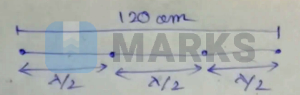
$A$ stationary wave is formed having $4$ nodes along the $120 \,cm$ length of the string. The wavelength of the wave is (in $\,cm$)
A
$20$
B
$40$
C
$80$
D
$60$
Solution
(C) In a stationary wave, the distance between two consecutive nodes is $\lambda / 2$.
For $4$ nodes, there are $3$ such segments of length $\lambda / 2$ between them.
Given the total length of the string is $L = 120 \,cm$.
Therefore, $3 \times (\lambda / 2) = 120 \,cm$.
$3 \lambda / 2 = 120 \,cm$.
$\lambda = (120 \times 2) / 3 \,cm$.
$\lambda = 240 / 3 \,cm$.
$\lambda = 80 \,cm$.
For $4$ nodes, there are $3$ such segments of length $\lambda / 2$ between them.
Given the total length of the string is $L = 120 \,cm$.
Therefore, $3 \times (\lambda / 2) = 120 \,cm$.
$3 \lambda / 2 = 120 \,cm$.
$\lambda = (120 \times 2) / 3 \,cm$.
$\lambda = 240 / 3 \,cm$.
$\lambda = 80 \,cm$.
0 likesView Solution
344
PhysicsEasyMCQMHT CET · 2020
The correct statement about stationary waves is that
A
displacement at node is zero and at antinode is maximum.
B
displacement at node is maximum and at antinode is zero.
C
displacement at node is maximum.
D
displacement at antinode is minimum.
Solution
(A) In a stationary wave,the medium particles oscillate with different amplitudes at different positions.
Nodes are points where the amplitude of vibration is zero,meaning the displacement is always zero.
Antinodes are points where the amplitude of vibration is maximum.
Therefore,the displacement at a node is zero and at an antinode is maximum.
Nodes are points where the amplitude of vibration is zero,meaning the displacement is always zero.
Antinodes are points where the amplitude of vibration is maximum.
Therefore,the displacement at a node is zero and at an antinode is maximum.
0 likesView Solution
345
PhysicsMediumMCQMHT CET · 2020
Two progressive waves are travelling towards each other with velocity $50 \,m/s$ and frequency $200 \,Hz$. The distance between two consecutive antinodes is (in $\,m$)
A
$0.031$
B
$0.125$
C
$0.250$
D
$0.0625$
Solution
(B) Given:
Velocity of waves,$v = 50 \,m/s$
Frequency of waves,$f = 200 \,Hz$
First,we calculate the wavelength $\lambda$ of the progressive waves:
$v = f \lambda$
$\lambda = \frac{v}{f} = \frac{50}{200} = 0.25 \,m$
When two identical progressive waves travel in opposite directions,they form a standing wave.
In a standing wave,the distance between two consecutive antinodes is equal to half the wavelength $(\frac{\lambda}{2})$.
Distance $= \frac{\lambda}{2} = \frac{0.25 \,m}{2} = 0.125 \,m$
Therefore,the correct option is $B$.
Velocity of waves,$v = 50 \,m/s$
Frequency of waves,$f = 200 \,Hz$
First,we calculate the wavelength $\lambda$ of the progressive waves:
$v = f \lambda$
$\lambda = \frac{v}{f} = \frac{50}{200} = 0.25 \,m$
When two identical progressive waves travel in opposite directions,they form a standing wave.
In a standing wave,the distance between two consecutive antinodes is equal to half the wavelength $(\frac{\lambda}{2})$.
Distance $= \frac{\lambda}{2} = \frac{0.25 \,m}{2} = 0.125 \,m$
Therefore,the correct option is $B$.
0 likesView Solution
346
PhysicsMediumMCQMHT CET · 2020
$A$ pipe open at one end has length $0.8 \,m$. At the open end of the tube, a string $0.5 \,m$ long is vibrating in its $1^{\text{st}}$ overtone and resonates with the fundamental frequency of the pipe. If the tension in the string is $50 \,N$, what is the mass of the string (in $\,g$)? (Speed of sound $= 320 \,m/s$)
A
$25$
B
$15$
C
$20$
D
$10$
Solution
(D) The fundamental frequency of a pipe open at one end is given by $f_p = \frac{v}{4L_p}$, where $v = 320 \,m/s$ and $L_p = 0.8 \,m$.
$f_p = \frac{320}{4 \times 0.8} = \frac{320}{3.2} = 100 \,Hz$.
For a string of length $L_s = 0.5 \,m$ vibrating in its $1^{\text{st}}$ overtone, the frequency is $f_s = 2 \times \left( \frac{1}{2L_s} \sqrt{\frac{T}{\mu}} \right) = \frac{1}{L_s} \sqrt{\frac{T}{\mu}}$, where $\mu = \frac{M}{L_s}$ is the linear mass density.
Since the string resonates with the pipe, $f_s = f_p = 100 \,Hz$.
$100 = \frac{1}{0.5} \sqrt{\frac{50}{M/0.5}} = 2 \sqrt{\frac{50 \times 0.5}{M}} = 2 \sqrt{\frac{25}{M}} = \frac{2 \times 5}{\sqrt{M}} = \frac{10}{\sqrt{M}}$.
$\sqrt{M} = \frac{10}{100} = 0.1$.
$M = (0.1)^2 = 0.01 \,kg = 10 \,g$.
$f_p = \frac{320}{4 \times 0.8} = \frac{320}{3.2} = 100 \,Hz$.
For a string of length $L_s = 0.5 \,m$ vibrating in its $1^{\text{st}}$ overtone, the frequency is $f_s = 2 \times \left( \frac{1}{2L_s} \sqrt{\frac{T}{\mu}} \right) = \frac{1}{L_s} \sqrt{\frac{T}{\mu}}$, where $\mu = \frac{M}{L_s}$ is the linear mass density.
Since the string resonates with the pipe, $f_s = f_p = 100 \,Hz$.
$100 = \frac{1}{0.5} \sqrt{\frac{50}{M/0.5}} = 2 \sqrt{\frac{50 \times 0.5}{M}} = 2 \sqrt{\frac{25}{M}} = \frac{2 \times 5}{\sqrt{M}} = \frac{10}{\sqrt{M}}$.
$\sqrt{M} = \frac{10}{100} = 0.1$.
$M = (0.1)^2 = 0.01 \,kg = 10 \,g$.
0 likesView Solution
347
PhysicsMediumMCQMHT CET · 2020
Two strings of the same material having lengths $L$ and $2L$,and radii $2r$ and $r$ respectively,are vibrating in the fundamental mode. The tension applied to both strings is the same. The ratio of their respective fundamental frequencies is:
A
$4: 3$
B
$1: 2$
C
$1: 1$
D
$3: 4$
Solution
(C) The fundamental frequency of a vibrating string is given by $f = \frac{1}{2L} \sqrt{\frac{T}{\mu}}$,where $T$ is the tension and $\mu$ is the linear mass density.
Linear mass density $\mu = \text{Area} \times \text{Density} = (\pi R^2) \rho$.
Substituting $\mu$ into the frequency formula: $f = \frac{1}{2L} \sqrt{\frac{T}{\pi R^2 \rho}} = \frac{1}{2LR} \sqrt{\frac{T}{\pi \rho}}$.
Given that the material is the same,$\rho$ is constant. Since $T$ is also constant,we have $f \propto \frac{1}{LR}$.
For the first string: $L_1 = L$,$R_1 = 2r$. Thus,$f_1 \propto \frac{1}{L \cdot 2r} = \frac{1}{2Lr}$.
For the second string: $L_2 = 2L$,$R_2 = r$. Thus,$f_2 \propto \frac{1}{2L \cdot r} = \frac{1}{2Lr}$.
The ratio of their frequencies is $\frac{f_1}{f_2} = \frac{1/2Lr}{1/2Lr} = 1:1$.
Linear mass density $\mu = \text{Area} \times \text{Density} = (\pi R^2) \rho$.
Substituting $\mu$ into the frequency formula: $f = \frac{1}{2L} \sqrt{\frac{T}{\pi R^2 \rho}} = \frac{1}{2LR} \sqrt{\frac{T}{\pi \rho}}$.
Given that the material is the same,$\rho$ is constant. Since $T$ is also constant,we have $f \propto \frac{1}{LR}$.
For the first string: $L_1 = L$,$R_1 = 2r$. Thus,$f_1 \propto \frac{1}{L \cdot 2r} = \frac{1}{2Lr}$.
For the second string: $L_2 = 2L$,$R_2 = r$. Thus,$f_2 \propto \frac{1}{2L \cdot r} = \frac{1}{2Lr}$.
The ratio of their frequencies is $\frac{f_1}{f_2} = \frac{1/2Lr}{1/2Lr} = 1:1$.
0 likesView Solution
348
PhysicsMediumMCQMHT CET · 2020
$A$ sonometer wire resonates with a given tuning fork,forming a standing wave with $5$ antinodes between two bridges when a mass of $9 \ kg$ is suspended from the wire. When a mass '$m$' is suspended from the wire,with the same tuning fork and the same length between the two bridges,$3$ antinodes are formed. The value of mass '$m$' is: (in $kg$)
A
$25$
B
$20$
C
$15$
D
$10$
Solution
(A) The frequency of a sonometer wire is given by the formula $n = \frac{p}{2L} \sqrt{\frac{T}{\mu}}$,where $p$ is the number of loops (antinodes),$L$ is the length,$T$ is the tension $(T = Mg)$,and $\mu$ is the linear mass density.
Since the frequency $n$,length $L$,and linear mass density $\mu$ remain constant,we have $p \propto \sqrt{T} \propto \sqrt{M}$.
For the first case: $p_1 = 5$ and $M_1 = 9 \ kg$.
For the second case: $p_2 = 3$ and $M_2 = m$.
Using the ratio: $\frac{p_1}{p_2} = \sqrt{\frac{M_1}{M_2}}$.
Substituting the values: $\frac{5}{3} = \sqrt{\frac{9}{m}}$.
Squaring both sides: $\frac{25}{9} = \frac{9}{m}$.
Solving for $m$: $m = \frac{9 \times 9}{25} = \frac{81}{25} = 3.24 \ kg$.
Wait,re-evaluating the relationship: $p_1 \sqrt{M_1} = p_2 \sqrt{M_2}$.
$5 \sqrt{9} = 3 \sqrt{m} \implies 5 \times 3 = 3 \sqrt{m} \implies 5 = \sqrt{m} \implies m = 25 \ kg$.
Since the frequency $n$,length $L$,and linear mass density $\mu$ remain constant,we have $p \propto \sqrt{T} \propto \sqrt{M}$.
For the first case: $p_1 = 5$ and $M_1 = 9 \ kg$.
For the second case: $p_2 = 3$ and $M_2 = m$.
Using the ratio: $\frac{p_1}{p_2} = \sqrt{\frac{M_1}{M_2}}$.
Substituting the values: $\frac{5}{3} = \sqrt{\frac{9}{m}}$.
Squaring both sides: $\frac{25}{9} = \frac{9}{m}$.
Solving for $m$: $m = \frac{9 \times 9}{25} = \frac{81}{25} = 3.24 \ kg$.
Wait,re-evaluating the relationship: $p_1 \sqrt{M_1} = p_2 \sqrt{M_2}$.
$5 \sqrt{9} = 3 \sqrt{m} \implies 5 \times 3 = 3 \sqrt{m} \implies 5 = \sqrt{m} \implies m = 25 \ kg$.
0 likesView Solution
349
PhysicsMediumMCQMHT CET · 2020
Two wires of the same material are vibrating under the same tension. If the first overtone of the first wire is equal to the second overtone of the second wire and the radius of the first wire is twice the radius of the second,then the ratio of the length of the first wire to the second wire is:
A
$1 : 3$
B
$1 : 2$
C
$2 : 1$
D
$3 : 1$
Solution
(A) The frequency of the $p$-th overtone for a string fixed at both ends is given by $f = (p+1) \frac{1}{2 \ell} \sqrt{\frac{T}{\mu}}$,where $\mu = \pi r^2 \rho$.
Since the material is the same,density $\rho$ is constant. The tension $T$ is also constant.
For the first wire,the first overtone $(p=1)$ is $f_1 = 2 \cdot \frac{1}{2 \ell_1} \sqrt{\frac{T}{\pi r_1^2 \rho}} = \frac{1}{\ell_1 r_1} \sqrt{\frac{T}{\pi \rho}}$.
For the second wire,the second overtone $(p=2)$ is $f_2 = 3 \cdot \frac{1}{2 \ell_2} \sqrt{\frac{T}{\pi r_2^2 \rho}} = \frac{3}{2 \ell_2 r_2} \sqrt{\frac{T}{\pi \rho}}$.
Given $f_1 = f_2$,we have $\frac{1}{\ell_1 r_1} = \frac{3}{2 \ell_2 r_2}$.
Given $r_1 = 2 r_2$,substituting this into the equation: $\frac{1}{\ell_1 (2 r_2)} = \frac{3}{2 \ell_2 r_2}$.
Simplifying,$\frac{1}{2 \ell_1} = \frac{3}{2 \ell_2}$,which gives $\frac{\ell_1}{\ell_2} = \frac{1}{3}$.
Since the material is the same,density $\rho$ is constant. The tension $T$ is also constant.
For the first wire,the first overtone $(p=1)$ is $f_1 = 2 \cdot \frac{1}{2 \ell_1} \sqrt{\frac{T}{\pi r_1^2 \rho}} = \frac{1}{\ell_1 r_1} \sqrt{\frac{T}{\pi \rho}}$.
For the second wire,the second overtone $(p=2)$ is $f_2 = 3 \cdot \frac{1}{2 \ell_2} \sqrt{\frac{T}{\pi r_2^2 \rho}} = \frac{3}{2 \ell_2 r_2} \sqrt{\frac{T}{\pi \rho}}$.
Given $f_1 = f_2$,we have $\frac{1}{\ell_1 r_1} = \frac{3}{2 \ell_2 r_2}$.
Given $r_1 = 2 r_2$,substituting this into the equation: $\frac{1}{\ell_1 (2 r_2)} = \frac{3}{2 \ell_2 r_2}$.
Simplifying,$\frac{1}{2 \ell_1} = \frac{3}{2 \ell_2}$,which gives $\frac{\ell_1}{\ell_2} = \frac{1}{3}$.
0 likesView Solution
350
PhysicsMediumMCQMHT CET · 2020
The equation of vibration of a stretched string fixed at both ends and vibrating in $5^{\text{th}}$ harmonic is $Y = 3 \sin(0.4x) \cos(200\pi t)$, where '$x$' and '$Y$' are in $cm$ and '$t$' is in seconds. The length of the string is: (in $\pi \text{ cm}$)
A
$10.5$
B
$8.5$
C
$12.5$
D
$4.5$
Solution
(C) For the $5^{\text{th}}$ harmonic, a string of length $L$ fixed at both ends vibrates in $5$ loops.
The relationship between length $L$ and wavelength $\lambda$ is given by $L = \frac{5\lambda}{2}$.
Comparing the given equation $Y = 3 \sin(0.4x) \cos(200\pi t)$ with the standard wave equation $Y = A \sin(kx) \cos(\omega t)$, we find the wave number $k = 0.4 \text{ rad/cm}$.
Since $k = \frac{2\pi}{\lambda}$, we have $\lambda = \frac{2\pi}{k} = \frac{2\pi}{0.4} = 5\pi \text{ cm}$.
Substituting the value of $\lambda$ into the length equation: $L = \frac{5 \times 5\pi}{2} = \frac{25\pi}{2} = 12.5\pi \text{ cm}$.
The relationship between length $L$ and wavelength $\lambda$ is given by $L = \frac{5\lambda}{2}$.
Comparing the given equation $Y = 3 \sin(0.4x) \cos(200\pi t)$ with the standard wave equation $Y = A \sin(kx) \cos(\omega t)$, we find the wave number $k = 0.4 \text{ rad/cm}$.
Since $k = \frac{2\pi}{\lambda}$, we have $\lambda = \frac{2\pi}{k} = \frac{2\pi}{0.4} = 5\pi \text{ cm}$.
Substituting the value of $\lambda$ into the length equation: $L = \frac{5 \times 5\pi}{2} = \frac{25\pi}{2} = 12.5\pi \text{ cm}$.
0 likesView Solution
351
PhysicsEasyMCQMHT CET · 2020
$A$ Fraunhofer diffraction pattern due to a single slit of width $0.3 \text{ mm}$ is obtained on a screen placed at a distance of $3 \text{ m}$ from the slit. The first minima lie at $5.5 \text{ mm}$ on either side of the central maximum on the screen. The wavelength of light used is (in $\text{ Å}$)
A
$6000$
B
$5500$
C
$4500$
D
$5000$
Solution
(B) Given: Slit width $a = 0.3 \text{ mm} = 0.3 \times 10^{-3} \text{ m}$.
Distance of screen $D = 3 \text{ m}$.
Distance of first minima from central maximum $x = 5.5 \text{ mm} = 5.5 \times 10^{-3} \text{ m}$.
For a single slit diffraction, the condition for the first minima is given by $a \sin \theta = \lambda$.
For small angles, $\sin \theta \approx \tan \theta = \frac{x}{D}$.
Therefore, $a \left( \frac{x}{D} \right) = \lambda$.
Substituting the values: $\lambda = \frac{ax}{D} = \frac{(0.3 \times 10^{-3} \text{ m}) \times (5.5 \times 10^{-3} \text{ m})}{3 \text{ m}}$.
$\lambda = 0.1 \times 10^{-3} \times 5.5 \times 10^{-3} \text{ m} = 0.55 \times 10^{-6} \text{ m} = 5.5 \times 10^{-7} \text{ m}$.
Converting to $\text{ Å}$: $\lambda = 5500 \times 10^{-10} \text{ m} = 5500 \text{ Å}$.
Distance of screen $D = 3 \text{ m}$.
Distance of first minima from central maximum $x = 5.5 \text{ mm} = 5.5 \times 10^{-3} \text{ m}$.
For a single slit diffraction, the condition for the first minima is given by $a \sin \theta = \lambda$.
For small angles, $\sin \theta \approx \tan \theta = \frac{x}{D}$.
Therefore, $a \left( \frac{x}{D} \right) = \lambda$.
Substituting the values: $\lambda = \frac{ax}{D} = \frac{(0.3 \times 10^{-3} \text{ m}) \times (5.5 \times 10^{-3} \text{ m})}{3 \text{ m}}$.
$\lambda = 0.1 \times 10^{-3} \times 5.5 \times 10^{-3} \text{ m} = 0.55 \times 10^{-6} \text{ m} = 5.5 \times 10^{-7} \text{ m}$.
Converting to $\text{ Å}$: $\lambda = 5500 \times 10^{-10} \text{ m} = 5500 \text{ Å}$.
0 likesView Solution
352
PhysicsEasyMCQMHT CET · 2020
$A$ parallel beam of monochromatic light of wavelength $5 \times 10^{-7} \ m$ is incident normally on a single narrow slit of width $10^{-3} \ mm$. At what angle of diffraction is the first minima observed?
A
$\sin^{-1}\left(\frac{1}{\sqrt{2}}\right)$
B
$\sin^{-1}(1)$
C
$\sin^{-1}\left(\frac{\sqrt{3}}{2}\right)$
D
$\sin^{-1}\left(\frac{1}{2}\right)$
Solution
(D) For a single slit diffraction,the condition for the $n^{th}$ minima is given by $a \sin \theta = n \lambda$.
Here,$a = 10^{-3} \ mm = 10^{-6} \ m$,$\lambda = 5 \times 10^{-7} \ m$,and for the first minima,$n = 1$.
Substituting the values,we get $\sin \theta = \frac{n \lambda}{a} = \frac{1 \times 5 \times 10^{-7} \ m}{10^{-6} \ m}$.
$\sin \theta = \frac{5 \times 10^{-7}}{10 \times 10^{-7}} = 0.5 = \frac{1}{2}$.
Therefore,the angle of diffraction is $\theta = \sin^{-1}\left(\frac{1}{2}\right)$.
Here,$a = 10^{-3} \ mm = 10^{-6} \ m$,$\lambda = 5 \times 10^{-7} \ m$,and for the first minima,$n = 1$.
Substituting the values,we get $\sin \theta = \frac{n \lambda}{a} = \frac{1 \times 5 \times 10^{-7} \ m}{10^{-6} \ m}$.
$\sin \theta = \frac{5 \times 10^{-7}}{10 \times 10^{-7}} = 0.5 = \frac{1}{2}$.
Therefore,the angle of diffraction is $\theta = \sin^{-1}\left(\frac{1}{2}\right)$.
0 likesView Solution
353
PhysicsMediumMCQMHT CET · 2020
In an interference experiment,let $D$ be the distance between the slit and the eyepiece. When the distance between two virtual sources is changed from $d_{A}$ to $d_{B}$,the fringe width changes from $Z_{A}$ to $Z_{B}$. The ratio $Z_{A} / Z_{B}$ is:
A
$\left(\frac{d_{A}}{d_{B}}\right)^{2}$
B
$\left(\frac{d_{A}}{d_{B}}\right)$
C
$\left(\frac{d_{B}}{d_{A}}\right)$
D
$\sqrt{\frac{d_{B}}{d_{A}}}$
Solution
(C) The fringe width $Z$ in an interference experiment is given by the formula $Z = \frac{\lambda D}{d}$,where $\lambda$ is the wavelength of light,$D$ is the distance between the source and the screen (or eyepiece),and $d$ is the distance between the two virtual sources.
Since $\lambda$ and $D$ are constant,the fringe width is inversely proportional to the distance between the sources,i.e.,$Z \propto \frac{1}{d}$.
Therefore,we can write the ratio as $\frac{Z_{A}}{Z_{B}} = \frac{d_{B}}{d_{A}}$.
Thus,the correct option is $C$.
Since $\lambda$ and $D$ are constant,the fringe width is inversely proportional to the distance between the sources,i.e.,$Z \propto \frac{1}{d}$.
Therefore,we can write the ratio as $\frac{Z_{A}}{Z_{B}} = \frac{d_{B}}{d_{A}}$.
Thus,the correct option is $C$.
0 likesView Solution
354
PhysicsMediumMCQMHT CET · 2020
$A$ light wave of wavelength $\lambda$ is incident on a slit of width $d$. The resulting diffraction pattern is observed on a screen at a distance $D$. If the linear width of the principal maxima is equal to the width of the slit,then the distance $D$ is:
A
$\frac{d}{\lambda}$
B
$\frac{2 \lambda}{d}$
C
$\frac{d^{2}}{2 \lambda}$
D
$\frac{2 \lambda^{2}}{d}$
Solution
(C) The linear width of the principal maxima in a single-slit diffraction pattern is given by the formula $\beta = \frac{2 \lambda D}{d}$.
According to the problem,the linear width of the principal maxima is equal to the width of the slit,so $\beta = d$.
Substituting this into the formula,we get $d = \frac{2 \lambda D}{d}$.
Rearranging the equation to solve for $D$,we get $D = \frac{d^{2}}{2 \lambda}$.
According to the problem,the linear width of the principal maxima is equal to the width of the slit,so $\beta = d$.
Substituting this into the formula,we get $d = \frac{2 \lambda D}{d}$.
Rearranging the equation to solve for $D$,we get $D = \frac{d^{2}}{2 \lambda}$.
0 likesView Solution
355
PhysicsEasyMCQMHT CET · 2020
In a single slit diffraction experiment,when the distance of separation between the slit and the screen is doubled,the angular separation between the fringes
A
increases.
B
decreases.
C
remains same.
D
first increases and then decreases.
Solution
(C) The angular width of the central maximum in a single slit diffraction experiment is given by the formula $\theta = \frac{2 \lambda}{d}$,where $\lambda$ is the wavelength of the light used and $d$ is the width of the slit.
Since the angular width depends only on the wavelength $\lambda$ and the slit width $d$,it is independent of the distance $D$ between the slit and the screen.
Therefore,when the distance $D$ is doubled,the angular separation between the fringes remains the same.
Since the angular width depends only on the wavelength $\lambda$ and the slit width $d$,it is independent of the distance $D$ between the slit and the screen.
Therefore,when the distance $D$ is doubled,the angular separation between the fringes remains the same.
0 likesView Solution
356
PhysicsEasyMCQMHT CET · 2020
Two coherent sources of intensities $I_{1}$ and $I_{2}$ produce an interference pattern on a screen. The maximum intensity in the interference pattern is
A
$(\sqrt{I_{1}}+\sqrt{I_{2}})^{2}$
B
$I_{1}+I_{2}$
C
$(I_{1}+I_{2})^{2}$
D
$I_{1}^{2}+I_{2}^{2}$
Solution
(A) The intensity $I$ of a wave is proportional to the square of its amplitude $a$,i.e.,$I \propto a^{2}$.
This implies that the amplitude $a$ is proportional to the square root of the intensity,i.e.,$a \propto \sqrt{I}$.
Let the amplitudes of the two coherent sources be $a_{1}$ and $a_{2}$,where $a_{1} \propto \sqrt{I_{1}}$ and $a_{2} \propto \sqrt{I_{2}}$.
In an interference pattern,the maximum intensity $(I_{\max})$ occurs at points of constructive interference,where the phase difference is an even multiple of $\pi$ $(2n\pi)$.
At these points,the resultant amplitude is the sum of the individual amplitudes: $A_{\max} = a_{1} + a_{2}$.
Since $I_{\max} \propto A_{\max}^{2}$,we have $I_{\max} \propto (a_{1} + a_{2})^{2}$.
Substituting the expressions for $a_{1}$ and $a_{2}$,we get $I_{\max} = (\sqrt{I_{1}} + \sqrt{I_{2}})^{2}$.
This implies that the amplitude $a$ is proportional to the square root of the intensity,i.e.,$a \propto \sqrt{I}$.
Let the amplitudes of the two coherent sources be $a_{1}$ and $a_{2}$,where $a_{1} \propto \sqrt{I_{1}}$ and $a_{2} \propto \sqrt{I_{2}}$.
In an interference pattern,the maximum intensity $(I_{\max})$ occurs at points of constructive interference,where the phase difference is an even multiple of $\pi$ $(2n\pi)$.
At these points,the resultant amplitude is the sum of the individual amplitudes: $A_{\max} = a_{1} + a_{2}$.
Since $I_{\max} \propto A_{\max}^{2}$,we have $I_{\max} \propto (a_{1} + a_{2})^{2}$.
Substituting the expressions for $a_{1}$ and $a_{2}$,we get $I_{\max} = (\sqrt{I_{1}} + \sqrt{I_{2}})^{2}$.
0 likesView Solution
357
PhysicsMediumMCQMHT CET · 2020
Light waves from two coherent sources arrive at two points on a screen with path difference of zero and $\lambda / 2$. The ratio of the intensities at the points is
A
$2:1$
B
$1:2$
C
$1:1$
D
$\infty:1$
Solution
(D) The intensity of the resultant wave in interference is given by $I = 4I_0 \cos^2(\phi/2)$,where $\phi$ is the phase difference and $I_0$ is the intensity of each individual source.
Phase difference $\phi$ is related to path difference $\Delta x$ by $\phi = \frac{2\pi}{\lambda} \Delta x$.
For path difference $\Delta x = 0$,the phase difference $\phi = 0$. Thus,$I_1 = 4I_0 \cos^2(0) = 4I_0$.
For path difference $\Delta x = \lambda/2$,the phase difference $\phi = \frac{2\pi}{\lambda} \cdot \frac{\lambda}{2} = \pi$. Thus,$I_2 = 4I_0 \cos^2(\pi/2) = 4I_0 \cdot 0 = 0$.
The ratio of intensities is $\frac{I_1}{I_2} = \frac{4I_0}{0} = \infty$.
Therefore,the ratio is $\infty:1$.
Phase difference $\phi$ is related to path difference $\Delta x$ by $\phi = \frac{2\pi}{\lambda} \Delta x$.
For path difference $\Delta x = 0$,the phase difference $\phi = 0$. Thus,$I_1 = 4I_0 \cos^2(0) = 4I_0$.
For path difference $\Delta x = \lambda/2$,the phase difference $\phi = \frac{2\pi}{\lambda} \cdot \frac{\lambda}{2} = \pi$. Thus,$I_2 = 4I_0 \cos^2(\pi/2) = 4I_0 \cdot 0 = 0$.
The ratio of intensities is $\frac{I_1}{I_2} = \frac{4I_0}{0} = \infty$.
Therefore,the ratio is $\infty:1$.
0 likesView Solution
358
PhysicsEasyMCQMHT CET · 2020
If two sources emit light waves of different amplitudes, then in the interference pattern:
A
fringes disappear after a short time.
B
brightness of fringes is less.
C
there is some intensity of light in the region of destructive interference.
D
fringe width will be less.
Solution
(C) In an interference pattern, the intensity $I$ is given by $I = I_1 + I_2 + 2\sqrt{I_1 I_2} \cos \phi$.
For destructive interference, the phase difference $\phi = (2n+1)\pi$, so $\cos \phi = -1$.
The minimum intensity is $I_{min} = (\sqrt{I_1} - \sqrt{I_2})^2$.
If the amplitudes are different, then $I_1 \neq I_2$, which implies $\sqrt{I_1} \neq \sqrt{I_2}$.
Therefore, $I_{min} \neq 0$.
This means that in the region of destructive interference, there is some residual intensity of light instead of complete darkness.
For destructive interference, the phase difference $\phi = (2n+1)\pi$, so $\cos \phi = -1$.
The minimum intensity is $I_{min} = (\sqrt{I_1} - \sqrt{I_2})^2$.
If the amplitudes are different, then $I_1 \neq I_2$, which implies $\sqrt{I_1} \neq \sqrt{I_2}$.
Therefore, $I_{min} \neq 0$.
This means that in the region of destructive interference, there is some residual intensity of light instead of complete darkness.
0 likesView Solution
359
PhysicsMediumMCQMHT CET · 2020
In a biprism experiment,the slit separation is $1 \,mm$. Using monochromatic light of wavelength $5000 \text{ Å}$,an interference pattern is obtained on the screen. Where should the screen be moved,so that the change in fringe width is $12.5 \times 10^{-5} \,m$?
A
Away or towards the slit by $25 \,cm$
B
Away or towards the slit by $12.5 \,cm$
C
Away from the slit by $5 \,cm$
D
Towards the slit by $10 \,cm$
Solution
(A) Given: Slit separation $d = 1 \,mm = 10^{-3} \,m$,Wavelength $\lambda = 5000 \text{ Å} = 5 \times 10^{-7} \,m$,Change in fringe width $\Delta \beta = \beta_{2} - \beta_{1} = 12.5 \times 10^{-5} \,m$.
Fringe width formula is $\beta = \frac{\lambda D}{d}$.
The change in fringe width is given by $\Delta \beta = \frac{\lambda}{d} \Delta D$,where $\Delta D = D_{2} - D_{1}$ is the shift in the screen position.
Rearranging for $\Delta D$: $\Delta D = \frac{d \cdot \Delta \beta}{\lambda}$.
Substituting the values: $\Delta D = \frac{10^{-3} \times 12.5 \times 10^{-5}}{5 \times 10^{-7}}$.
$\Delta D = \frac{12.5 \times 10^{-8}}{5 \times 10^{-7}} = 2.5 \times 10^{-1} \,m = 0.25 \,m = 25 \,cm$.
Therefore,the screen should be moved away or towards the slit by $25 \,cm$.
Fringe width formula is $\beta = \frac{\lambda D}{d}$.
The change in fringe width is given by $\Delta \beta = \frac{\lambda}{d} \Delta D$,where $\Delta D = D_{2} - D_{1}$ is the shift in the screen position.
Rearranging for $\Delta D$: $\Delta D = \frac{d \cdot \Delta \beta}{\lambda}$.
Substituting the values: $\Delta D = \frac{10^{-3} \times 12.5 \times 10^{-5}}{5 \times 10^{-7}}$.
$\Delta D = \frac{12.5 \times 10^{-8}}{5 \times 10^{-7}} = 2.5 \times 10^{-1} \,m = 0.25 \,m = 25 \,cm$.
Therefore,the screen should be moved away or towards the slit by $25 \,cm$.
0 likesView Solution
360
PhysicsEasyMCQMHT CET · 2020
If two light waves reaching at a point produce destructive interference,then the condition of phase difference is:
A
$0, 2\pi, 4\pi, 6\pi, \ldots$
B
$\frac{\pi}{4}, \frac{\pi}{2}, \frac{3\pi}{4}, \ldots$
C
$\frac{\pi}{2}, \frac{3\pi}{2}, \frac{5\pi}{2}, \ldots$
D
$\pi, 3\pi, 5\pi, \ldots$
Solution
(D) For destructive interference to occur,the two light waves must arrive at a point with a phase difference that results in the cancellation of their amplitudes.
This occurs when the waves are in anti-phase,meaning one wave is at a crest while the other is at a trough.
The condition for destructive interference is given by the phase difference $\Delta \phi = (2n + 1)\pi$,where $n = 0, 1, 2, \ldots$.
Substituting values for $n$,we get $\Delta \phi = \pi, 3\pi, 5\pi, \ldots$.
This occurs when the waves are in anti-phase,meaning one wave is at a crest while the other is at a trough.
The condition for destructive interference is given by the phase difference $\Delta \phi = (2n + 1)\pi$,where $n = 0, 1, 2, \ldots$.
Substituting values for $n$,we get $\Delta \phi = \pi, 3\pi, 5\pi, \ldots$.
0 likesView Solution
361
PhysicsEasyMCQMHT CET · 2020
$A$ ray of unpolarised light is incident on a glass surface of refractive index $1.73$ at the polarizing angle. The angle of refraction will be. [Take $\tan 60^{\circ} = 1.73$] (in $^{\circ}$)
A
$45$
B
$15$
C
$35$
D
$30$
Solution
(D) According to Brewster's Law,the refractive index $\mu$ is given by $\mu = \tan i_p$,where $i_p$ is the polarizing angle.
Given $\mu = 1.73$ and $\tan 60^{\circ} = 1.73$,we have $\tan i_p = \tan 60^{\circ}$,which implies $i_p = 60^{\circ}$.
When light is incident at the polarizing angle,the reflected ray and the refracted ray are perpendicular to each other,meaning $i_p + r = 90^{\circ}$.
Substituting the value of $i_p$,we get $60^{\circ} + r = 90^{\circ}$.
Therefore,the angle of refraction $r = 90^{\circ} - 60^{\circ} = 30^{\circ}$.
Given $\mu = 1.73$ and $\tan 60^{\circ} = 1.73$,we have $\tan i_p = \tan 60^{\circ}$,which implies $i_p = 60^{\circ}$.
When light is incident at the polarizing angle,the reflected ray and the refracted ray are perpendicular to each other,meaning $i_p + r = 90^{\circ}$.
Substituting the value of $i_p$,we get $60^{\circ} + r = 90^{\circ}$.
Therefore,the angle of refraction $r = 90^{\circ} - 60^{\circ} = 30^{\circ}$.
0 likesView Solution
362
PhysicsEasyMCQMHT CET · 2020
When unpolarised light is passed through crossed polaroids, then light passing through the first polaroid:
A
also passes through the second polaroid.
B
partially passes through the second polaroid.
C
is blocked by the second polaroid.
D
passes with greater intensity.
Solution
(C) When unpolarised light passes through the first polaroid, it becomes linearly polarised with intensity $I_0 = I_{in} / 2$.
When this polarised light hits the second polaroid, the intensity transmitted is given by Malus' Law: $I = I_0 \cos^2 \theta$.
Since the polaroids are crossed, the angle between their transmission axes is $\theta = 90^{\circ}$.
Substituting this value, we get $I = I_0 \cos^2(90^{\circ}) = I_0 \times 0 = 0$.
Therefore, the light is completely blocked by the second polaroid.
When this polarised light hits the second polaroid, the intensity transmitted is given by Malus' Law: $I = I_0 \cos^2 \theta$.
Since the polaroids are crossed, the angle between their transmission axes is $\theta = 90^{\circ}$.
Substituting this value, we get $I = I_0 \cos^2(90^{\circ}) = I_0 \times 0 = 0$.
Therefore, the light is completely blocked by the second polaroid.
0 likesView Solution
363
PhysicsMediumMCQMHT CET · 2020
The polarising angle for a transparent medium is $\theta$ and $V$ is the speed of light in that medium. The relation between $\theta$ and $V$ is (where $c$ is the velocity of light in vacuum):
A
$\theta = \sin^{-1}\left(\frac{V}{c}\right)$
B
$\theta = \tan^{-1}\left(\frac{V}{c}\right)$
C
$\theta = \cot^{-1}\left(\frac{V}{c}\right)$
D
$\theta = \cos^{-1}\left(\frac{V}{c}\right)$
Solution
(C) According to Brewster's Law,the refractive index $\mu$ of a transparent medium is given by $\mu = \tan \theta$,where $\theta$ is the polarising angle.
We also know that the refractive index $\mu$ is defined as the ratio of the speed of light in vacuum $(c)$ to the speed of light in the medium $(V)$:
$\mu = \frac{c}{V}$
Equating the two expressions for $\mu$:
$\tan \theta = \frac{c}{V}$
Taking the reciprocal on both sides:
$\cot \theta = \frac{V}{c}$
Therefore,the relation between $\theta$ and $V$ is:
$\theta = \cot^{-1}\left(\frac{V}{c}\right)$
We also know that the refractive index $\mu$ is defined as the ratio of the speed of light in vacuum $(c)$ to the speed of light in the medium $(V)$:
$\mu = \frac{c}{V}$
Equating the two expressions for $\mu$:
$\tan \theta = \frac{c}{V}$
Taking the reciprocal on both sides:
$\cot \theta = \frac{V}{c}$
Therefore,the relation between $\theta$ and $V$ is:
$\theta = \cot^{-1}\left(\frac{V}{c}\right)$
0 likesView Solution
364
PhysicsEasyMCQMHT CET · 2020
Choose the $CORRECT$ statement from the following. Brewster's angle for a transparent medium is
A
different for lights of different colours.
B
different for lights of same colour.
C
same for lights of different colours.
D
independent of refractive index of the medium.
Solution
(A) Brewster's law states that the tangent of the polarizing angle (Brewster's angle, $i_p$) is equal to the refractive index $(\mu)$ of the medium, given by the formula: $\tan(i_p) = \mu$.
Since the refractive index $(\mu)$ of a transparent medium depends on the wavelength $(\lambda)$ of light (due to dispersion), the refractive index is different for different colours of light.
Consequently, the Brewster's angle $(i_p = \arctan(\mu))$ will also be different for lights of different colours.
Therefore, the correct statement is that Brewster's angle is different for lights of different colours.
Since the refractive index $(\mu)$ of a transparent medium depends on the wavelength $(\lambda)$ of light (due to dispersion), the refractive index is different for different colours of light.
Consequently, the Brewster's angle $(i_p = \arctan(\mu))$ will also be different for lights of different colours.
Therefore, the correct statement is that Brewster's angle is different for lights of different colours.
0 likesView Solution
365
PhysicsMediumMCQMHT CET · 2020
$A$ plane wavefront is incident on a water surface at an angle of incidence $60^{\circ}$. It then gets refracted at an angle of $45^{\circ}$. The ratio of the width of the incident wavefront to that of the refracted wavefront is $\left[\sin \frac{\pi}{4}=\cos \frac{\pi}{4}=\frac{1}{\sqrt{2}}, \sin 60^{\circ}=\frac{\sqrt{3}}{2}, \cos 60^{\circ}=\frac{1}{2}\right]$
A
$\frac{\sqrt{3}}{2}$
B
$\frac{\sqrt{6}}{2}$
C
$\frac{1}{\sqrt{2}}$
D
$\sqrt{2}$
Solution
(C) Let the width of the incident wavefront be $w_i$ and the width of the refracted wavefront be $w_r$.
From the geometry of wavefronts,the width of a wavefront is related to the beam width by $w = L \cos \theta$,where $L$ is the length of the wavefront segment on the interface.
For the incident wavefront,$w_i = L \cos i$,where $i = 60^{\circ}$.
For the refracted wavefront,$w_r = L \cos r$,where $r = 45^{\circ}$.
The ratio of the width of the incident wavefront to the refracted wavefront is $\frac{w_i}{w_r} = \frac{\cos i}{\cos r}$.
Substituting the values: $\frac{w_i}{w_r} = \frac{\cos 60^{\circ}}{\cos 45^{\circ}} = \frac{1/2}{1/\sqrt{2}} = \frac{\sqrt{2}}{2} = \frac{1}{\sqrt{2}}$.
From the geometry of wavefronts,the width of a wavefront is related to the beam width by $w = L \cos \theta$,where $L$ is the length of the wavefront segment on the interface.
For the incident wavefront,$w_i = L \cos i$,where $i = 60^{\circ}$.
For the refracted wavefront,$w_r = L \cos r$,where $r = 45^{\circ}$.
The ratio of the width of the incident wavefront to the refracted wavefront is $\frac{w_i}{w_r} = \frac{\cos i}{\cos r}$.
Substituting the values: $\frac{w_i}{w_r} = \frac{\cos 60^{\circ}}{\cos 45^{\circ}} = \frac{1/2}{1/\sqrt{2}} = \frac{\sqrt{2}}{2} = \frac{1}{\sqrt{2}}$.
0 likesView Solution
366
PhysicsMediumMCQMHT CET · 2020
$A$ glass slab of thickness $4 \,cm$ contains the same number of waves as in $x \,cm$ of water column when both are traversed by the same monochromatic light. If the refractive indices of glass and water for that light are $\frac{5}{3}$ and $\frac{4}{3}$ respectively,the value of $x$ will be
A
$\frac{9}{20} \,cm$
B
$\frac{5}{4} \,cm$
C
$5 \,cm$
D
$\frac{20}{9} \,cm$
Solution
(C) The number of waves $N$ in a medium of thickness $d$ and refractive index $\mu$ is given by $N = \frac{d}{\lambda_m}$,where $\lambda_m = \frac{\lambda_0}{\mu}$ is the wavelength in the medium.
Thus,$N = \frac{d \cdot \mu}{\lambda_0}$.
Since the number of waves is the same for both media,we have:
$\frac{d_g \cdot \mu_g}{\lambda_0} = \frac{d_w \cdot \mu_w}{\lambda_0}$
$d_g \cdot \mu_g = d_w \cdot \mu_w$
Given $d_g = 4 \,cm$,$\mu_g = \frac{5}{3}$,and $\mu_w = \frac{4}{3}$.
Substituting the values: $4 \times \frac{5}{3} = x \times \frac{4}{3}$
$\frac{20}{3} = \frac{4x}{3}$
$4x = 20$
$x = 5 \,cm$.
Thus,$N = \frac{d \cdot \mu}{\lambda_0}$.
Since the number of waves is the same for both media,we have:
$\frac{d_g \cdot \mu_g}{\lambda_0} = \frac{d_w \cdot \mu_w}{\lambda_0}$
$d_g \cdot \mu_g = d_w \cdot \mu_w$
Given $d_g = 4 \,cm$,$\mu_g = \frac{5}{3}$,and $\mu_w = \frac{4}{3}$.
Substituting the values: $4 \times \frac{5}{3} = x \times \frac{4}{3}$
$\frac{20}{3} = \frac{4x}{3}$
$4x = 20$
$x = 5 \,cm$.
0 likesView Solution
367
PhysicsEasyMCQMHT CET · 2020
In Young's double slit experiment,the intensity of light at a point on the screen is $K$ unit for path difference $\lambda$. What would be the intensity at a point if path difference is $\frac{\lambda}{4}$?
A
zero
B
$\frac{K}{4}$
C
$K$
D
$\frac{K}{2}$
Solution
(D) The intensity of light in Young's double slit experiment is given by $I = 4I_0 \cos^2(\frac{\phi}{2})$,where $I_0$ is the intensity of each individual wave and $\phi$ is the phase difference.
Phase difference $\phi$ is related to path difference $\Delta x$ by $\phi = \frac{2\pi}{\lambda} \Delta x$.
For path difference $\Delta x = \lambda$,the phase difference is $\phi = \frac{2\pi}{\lambda} \cdot \lambda = 2\pi$.
Given intensity $K = 4I_0 \cos^2(\frac{2\pi}{2}) = 4I_0 \cos^2(\pi) = 4I_0(1)^2 = 4I_0$.
For path difference $\Delta x = \frac{\lambda}{4}$,the phase difference is $\phi' = \frac{2\pi}{\lambda} \cdot \frac{\lambda}{4} = \frac{\pi}{2}$.
The new intensity $I'$ is $I' = 4I_0 \cos^2(\frac{\pi/2}{2}) = 4I_0 \cos^2(\frac{\pi}{4})$.
Since $\cos(\frac{\pi}{4}) = \frac{1}{\sqrt{2}}$,we have $I' = 4I_0 \cdot (\frac{1}{\sqrt{2}})^2 = 4I_0 \cdot \frac{1}{2} = 2I_0$.
Since $K = 4I_0$,then $2I_0 = \frac{K}{2}$.
Therefore,the intensity is $\frac{K}{2}$.
Phase difference $\phi$ is related to path difference $\Delta x$ by $\phi = \frac{2\pi}{\lambda} \Delta x$.
For path difference $\Delta x = \lambda$,the phase difference is $\phi = \frac{2\pi}{\lambda} \cdot \lambda = 2\pi$.
Given intensity $K = 4I_0 \cos^2(\frac{2\pi}{2}) = 4I_0 \cos^2(\pi) = 4I_0(1)^2 = 4I_0$.
For path difference $\Delta x = \frac{\lambda}{4}$,the phase difference is $\phi' = \frac{2\pi}{\lambda} \cdot \frac{\lambda}{4} = \frac{\pi}{2}$.
The new intensity $I'$ is $I' = 4I_0 \cos^2(\frac{\pi/2}{2}) = 4I_0 \cos^2(\frac{\pi}{4})$.
Since $\cos(\frac{\pi}{4}) = \frac{1}{\sqrt{2}}$,we have $I' = 4I_0 \cdot (\frac{1}{\sqrt{2}})^2 = 4I_0 \cdot \frac{1}{2} = 2I_0$.
Since $K = 4I_0$,then $2I_0 = \frac{K}{2}$.
Therefore,the intensity is $\frac{K}{2}$.
0 likesView Solution
368
PhysicsMediumMCQMHT CET · 2020
In Young's double slit experiment,the $6^{\text{th}}$ maximum with wavelength $\lambda_{1}$ is at a distance $d_{1}$ from the central maximum and the $4^{\text{th}}$ maximum with wavelength $\lambda_{2}$ is at distance $d_{2}$ from the central maximum. Then the ratio $\frac{d_{1}}{d_{2}}$ is:
A
$\frac{2}{3} \frac{\lambda_{1}}{\lambda_{2}}$
B
$\frac{3}{2} \frac{\lambda_{1}}{\lambda_{2}}$
C
$\frac{2}{3} \frac{\lambda_{2}}{\lambda_{1}}$
D
$\frac{3}{2} \frac{\lambda_{2}}{\lambda_{1}}$
Solution
(B) The position of the $n^{\text{th}}$ maximum in Young's double slit experiment is given by $y_n = \frac{n \lambda D}{d}$,where $n$ is the order of the maximum,$\lambda$ is the wavelength,$D$ is the distance between the slits and the screen,and $d$ is the slit separation.
For the $6^{\text{th}}$ maximum with wavelength $\lambda_1$,the distance is $d_1 = \frac{6 \lambda_1 D}{d}$.
For the $4^{\text{th}}$ maximum with wavelength $\lambda_2$,the distance is $d_2 = \frac{4 \lambda_2 D}{d}$.
Taking the ratio of $d_1$ to $d_2$:
$\frac{d_1}{d_2} = \frac{6 \lambda_1 D / d}{4 \lambda_2 D / d} = \frac{6 \lambda_1}{4 \lambda_2} = \frac{3}{2} \frac{\lambda_1}{\lambda_2}$.
For the $6^{\text{th}}$ maximum with wavelength $\lambda_1$,the distance is $d_1 = \frac{6 \lambda_1 D}{d}$.
For the $4^{\text{th}}$ maximum with wavelength $\lambda_2$,the distance is $d_2 = \frac{4 \lambda_2 D}{d}$.
Taking the ratio of $d_1$ to $d_2$:
$\frac{d_1}{d_2} = \frac{6 \lambda_1 D / d}{4 \lambda_2 D / d} = \frac{6 \lambda_1}{4 \lambda_2} = \frac{3}{2} \frac{\lambda_1}{\lambda_2}$.
0 likesView Solution
369
PhysicsMediumMCQMHT CET · 2020
$A$ double slit experiment is immersed in water of refractive index $1.33$. The slit separation is $1 \,mm$, and the distance between the slit and the screen is $1.33 \,m$. The slits are illuminated by light of wavelength $6300 \,Å$. The fringe width is:
A
$6.9 \times 10^{-4} \,m$
B
$6.3 \times 10^{-4} \,m$
C
$5.8 \times 10^{-4} \,m$
D
$8.6 \times 10^{-4} \,m$
Solution
(B) The fringe width $\beta$ in a medium of refractive index $\mu$ is given by $\beta = \frac{\lambda_w D}{d}$.
Here, the wavelength in water is $\lambda_w = \frac{\lambda_{air}}{\mu} = \frac{6300 \times 10^{-10} \,m}{1.33}$.
Given: $D = 1.33 \,m$, $d = 1 \,mm = 10^{-3} \,m$, and $\mu = 1.33$.
Substituting these values into the formula:
$\beta = \frac{(6300 \times 10^{-10} / 1.33) \times 1.33}{10^{-3}} \,m$.
$\beta = \frac{6300 \times 10^{-10}}{10^{-3}} \,m$.
$\beta = 6300 \times 10^{-7} \,m = 6.3 \times 10^{-4} \,m$.
Here, the wavelength in water is $\lambda_w = \frac{\lambda_{air}}{\mu} = \frac{6300 \times 10^{-10} \,m}{1.33}$.
Given: $D = 1.33 \,m$, $d = 1 \,mm = 10^{-3} \,m$, and $\mu = 1.33$.
Substituting these values into the formula:
$\beta = \frac{(6300 \times 10^{-10} / 1.33) \times 1.33}{10^{-3}} \,m$.
$\beta = \frac{6300 \times 10^{-10}}{10^{-3}} \,m$.
$\beta = 6300 \times 10^{-7} \,m = 6.3 \times 10^{-4} \,m$.
0 likesView Solution
370
PhysicsMediumMCQMHT CET · 2020
In Young's double slit experiment,the resultant intensity of light at a point on the screen is $I$ when the path difference is $\lambda$. When the path difference is $\frac{\lambda}{4}$,the intensity at a point will be (where $\lambda$ is the wavelength of light).
A
Zero
B
$I$
C
$\frac{I}{2}$
D
$\frac{I}{4}$
Solution
(C) The resultant intensity $I_R$ in Young's double slit experiment is given by $I_R = 4I_0 \cos^2(\frac{\phi}{2})$,where $I_0$ is the intensity of each individual slit and $\phi$ is the phase difference.
Phase difference $\phi$ is related to path difference $\Delta x$ by $\phi = \frac{2\pi}{\lambda} \Delta x$.
Case $1$: When $\Delta x = \lambda$,$\phi = \frac{2\pi}{\lambda} \times \lambda = 2\pi$. The intensity $I = 4I_0 \cos^2(\frac{2\pi}{2}) = 4I_0 \cos^2(\pi) = 4I_0(-1)^2 = 4I_0$.
Case $2$: When $\Delta x = \frac{\lambda}{4}$,$\phi = \frac{2\pi}{\lambda} \times \frac{\lambda}{4} = \frac{\pi}{2}$.
The new intensity $I' = 4I_0 \cos^2(\frac{\pi/2}{2}) = 4I_0 \cos^2(\frac{\pi}{4}) = 4I_0 (\frac{1}{\sqrt{2}})^2 = 4I_0 \times \frac{1}{2} = 2I_0$.
Since $I = 4I_0$,we have $I_0 = \frac{I}{4}$.
Substituting $I_0$ into the expression for $I'$,we get $I' = 2(\frac{I}{4}) = \frac{I}{2}$.
Phase difference $\phi$ is related to path difference $\Delta x$ by $\phi = \frac{2\pi}{\lambda} \Delta x$.
Case $1$: When $\Delta x = \lambda$,$\phi = \frac{2\pi}{\lambda} \times \lambda = 2\pi$. The intensity $I = 4I_0 \cos^2(\frac{2\pi}{2}) = 4I_0 \cos^2(\pi) = 4I_0(-1)^2 = 4I_0$.
Case $2$: When $\Delta x = \frac{\lambda}{4}$,$\phi = \frac{2\pi}{\lambda} \times \frac{\lambda}{4} = \frac{\pi}{2}$.
The new intensity $I' = 4I_0 \cos^2(\frac{\pi/2}{2}) = 4I_0 \cos^2(\frac{\pi}{4}) = 4I_0 (\frac{1}{\sqrt{2}})^2 = 4I_0 \times \frac{1}{2} = 2I_0$.
Since $I = 4I_0$,we have $I_0 = \frac{I}{4}$.
Substituting $I_0$ into the expression for $I'$,we get $I' = 2(\frac{I}{4}) = \frac{I}{2}$.
0 likesView Solution
371
PhysicsMediumMCQMHT CET · 2020
In Young's double slit experiment,green light is incident on the two slits. The interference pattern is observed on a screen. Which one of the following changes would cause the observed fringes to be more closely spaced?
A
Reducing the separation between the slits.
B
Using blue light instead of green light.
C
Using red light instead of green light.
D
Moving the screen away from the slits.
Solution
(B) The fringe width $\beta$ in Young's double slit experiment is given by the formula $\beta = \frac{\lambda D}{d}$,where $\lambda$ is the wavelength of light,$D$ is the distance between the slits and the screen,and $d$ is the separation between the slits.
To make the fringes more closely spaced,the fringe width $\beta$ must be decreased.
From the formula,$\beta \propto \lambda$ and $\beta \propto \frac{1}{d}$.
Since the wavelength of blue light is shorter than that of green light $(\lambda_{blue} < \lambda_{green})$,using blue light will decrease the fringe width $\beta$.
Therefore,the correct option is $B$.
To make the fringes more closely spaced,the fringe width $\beta$ must be decreased.
From the formula,$\beta \propto \lambda$ and $\beta \propto \frac{1}{d}$.
Since the wavelength of blue light is shorter than that of green light $(\lambda_{blue} < \lambda_{green})$,using blue light will decrease the fringe width $\beta$.
Therefore,the correct option is $B$.
0 likesView Solution
372
PhysicsEasyMCQMHT CET · 2020
Young's double slit experiment is performed in water,instead of air,then fringe width
A
decreases.
B
becomes infinite.
C
increases.
D
remains same.
Solution
(A) The fringe width $\beta$ in Young's double slit experiment is given by the formula $\beta = \frac{\lambda D}{d}$,where $\lambda$ is the wavelength of light,$D$ is the distance between the slits and the screen,and $d$ is the distance between the two slits.
When the experiment is performed in water,the wavelength of light changes to $\lambda' = \frac{\lambda}{\mu}$,where $\mu$ is the refractive index of water $(\mu > 1)$.
Since $\mu > 1$,the new wavelength $\lambda'$ is smaller than the original wavelength $\lambda$ in air.
Consequently,the new fringe width $\beta' = \frac{\lambda' D}{d} = \frac{\lambda D}{\mu d} = \frac{\beta}{\mu}$.
Since $\mu > 1$,the fringe width $\beta'$ decreases.
When the experiment is performed in water,the wavelength of light changes to $\lambda' = \frac{\lambda}{\mu}$,where $\mu$ is the refractive index of water $(\mu > 1)$.
Since $\mu > 1$,the new wavelength $\lambda'$ is smaller than the original wavelength $\lambda$ in air.
Consequently,the new fringe width $\beta' = \frac{\lambda' D}{d} = \frac{\lambda D}{\mu d} = \frac{\beta}{\mu}$.
Since $\mu > 1$,the fringe width $\beta'$ decreases.
0 likesView Solution
373
PhysicsEasyMCQMHT CET · 2020
$A$ graph is plotted between the fringe-width $(z)$ and the distance $(D)$ between the slit and the eye-piece,keeping other parameters constant. Which of the following graphs is correct?
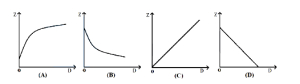
A
$(A)$
B
$(B)$
C
$(C)$
D
$(D)$
Solution
(C) In Young's Double Slit Experiment,the fringe-width $(z)$ is given by the formula:
$z = \frac{\lambda D}{d}$
where $\lambda$ is the wavelength of light,$D$ is the distance between the slits and the screen (or eye-piece),and $d$ is the distance between the two slits.
Since $\lambda$ and $d$ are kept constant,we have $z \propto D$.
This represents a linear relationship passing through the origin,which corresponds to a straight line graph.
Looking at the given options,graph $(C)$ represents a direct linear relationship $(z \propto D)$.
Therefore,the correct graph is $(C)$.
$z = \frac{\lambda D}{d}$
where $\lambda$ is the wavelength of light,$D$ is the distance between the slits and the screen (or eye-piece),and $d$ is the distance between the two slits.
Since $\lambda$ and $d$ are kept constant,we have $z \propto D$.
This represents a linear relationship passing through the origin,which corresponds to a straight line graph.
Looking at the given options,graph $(C)$ represents a direct linear relationship $(z \propto D)$.
Therefore,the correct graph is $(C)$.
0 likesView Solution
374
PhysicsEasyMCQMHT CET · 2020
In Young's double slit experiment,the distance between the slits is $3 \,mm$ and the slits are $2 \,m$ away from the screen. Two interference patterns can be obtained on the screen due to light of wavelength $480 \,nm$ and $600 \,nm$ respectively. The separation on the screen between the $5^{th}$ order bright fringes on the two interference patterns is
A
$6 \times 10^{-4} \,m$
B
$8 \times 10^{-4} \,m$
C
$12 \times 10^{-4} \,m$
D
$4 \times 10^{-4} \,m$
Solution
(D) Given: Slit separation $d = 3 \,mm = 3 \times 10^{-3} \,m$,distance to screen $D = 2 \,m$,wavelengths $\lambda_1 = 480 \,nm = 480 \times 10^{-9} \,m$ and $\lambda_2 = 600 \,nm = 600 \times 10^{-9} \,m$.
The position of the $n^{th}$ order bright fringe is given by $y_n = n \frac{\lambda D}{d}$.
For the $5^{th}$ order bright fringe of the first wavelength: $y_5^{(1)} = 5 \frac{\lambda_1 D}{d}$.
For the $5^{th}$ order bright fringe of the second wavelength: $y_5^{(2)} = 5 \frac{\lambda_2 D}{d}$.
The separation between these fringes is $\Delta y = y_5^{(2)} - y_5^{(1)} = \frac{5D}{d} (\lambda_2 - \lambda_1)$.
Substituting the values: $\Delta y = \frac{5 \times 2}{3 \times 10^{-3}} \times (600 - 480) \times 10^{-9} \,m$.
$\Delta y = \frac{10}{3 \times 10^{-3}} \times 120 \times 10^{-9} \,m = \frac{1200}{3} \times 10^{-6} \,m = 400 \times 10^{-6} \,m = 4 \times 10^{-4} \,m$.
The position of the $n^{th}$ order bright fringe is given by $y_n = n \frac{\lambda D}{d}$.
For the $5^{th}$ order bright fringe of the first wavelength: $y_5^{(1)} = 5 \frac{\lambda_1 D}{d}$.
For the $5^{th}$ order bright fringe of the second wavelength: $y_5^{(2)} = 5 \frac{\lambda_2 D}{d}$.
The separation between these fringes is $\Delta y = y_5^{(2)} - y_5^{(1)} = \frac{5D}{d} (\lambda_2 - \lambda_1)$.
Substituting the values: $\Delta y = \frac{5 \times 2}{3 \times 10^{-3}} \times (600 - 480) \times 10^{-9} \,m$.
$\Delta y = \frac{10}{3 \times 10^{-3}} \times 120 \times 10^{-9} \,m = \frac{1200}{3} \times 10^{-6} \,m = 400 \times 10^{-6} \,m = 4 \times 10^{-4} \,m$.
0 likesView Solution
375
PhysicsEasyMCQMHT CET · 2020
The ratio of intensities of two waves producing interference is $9: 4$. The ratio of the resultant maximum and minimum intensities will be:
A
$4: 9$
B
$9: 4$
C
$25: 1$
D
$5: 1$
Solution
(C) Given the ratio of intensities of two waves is $\frac{I_1}{I_2} = \frac{9}{4}$.
Since intensity $I \propto a^2$,the ratio of amplitudes is $\frac{a_1}{a_2} = \sqrt{\frac{I_1}{I_2}} = \sqrt{\frac{9}{4}} = \frac{3}{2}$.
The maximum intensity is $I_{max} = (a_1 + a_2)^2$ and the minimum intensity is $I_{min} = (a_1 - a_2)^2$.
The ratio of maximum to minimum intensity is $\frac{I_{max}}{I_{min}} = \frac{(a_1 + a_2)^2}{(a_1 - a_2)^2} = \left( \frac{a_1 + a_2}{a_1 - a_2} \right)^2$.
Substituting the values,$\frac{I_{max}}{I_{min}} = \left( \frac{3 + 2}{3 - 2} \right)^2 = \left( \frac{5}{1} \right)^2 = \frac{25}{1}$.
Thus,the ratio is $25: 1$.
Since intensity $I \propto a^2$,the ratio of amplitudes is $\frac{a_1}{a_2} = \sqrt{\frac{I_1}{I_2}} = \sqrt{\frac{9}{4}} = \frac{3}{2}$.
The maximum intensity is $I_{max} = (a_1 + a_2)^2$ and the minimum intensity is $I_{min} = (a_1 - a_2)^2$.
The ratio of maximum to minimum intensity is $\frac{I_{max}}{I_{min}} = \frac{(a_1 + a_2)^2}{(a_1 - a_2)^2} = \left( \frac{a_1 + a_2}{a_1 - a_2} \right)^2$.
Substituting the values,$\frac{I_{max}}{I_{min}} = \left( \frac{3 + 2}{3 - 2} \right)^2 = \left( \frac{5}{1} \right)^2 = \frac{25}{1}$.
Thus,the ratio is $25: 1$.
0 likesView Solution
376
PhysicsEasyMCQMHT CET · 2020
In Young's double slit experiment,the ratio of intensities at two points on a screen when waves from the two slits have a path difference of $0$ and $\frac{\lambda}{4}$ is
$\left[\cos 0^{\circ}=\sin 90^{\circ}=1, \sin 0^{\circ}=\cos 90^{\circ}=0\right]$
$\left[\cos 0^{\circ}=\sin 90^{\circ}=1, \sin 0^{\circ}=\cos 90^{\circ}=0\right]$
A
$2: 1$
B
$3: 1$
C
$2: 3$
D
$3: 2$
Solution
(A) The intensity at any point on the screen is given by $I = 4I_0 \cos^2 \left( \frac{\phi}{2} \right)$,where $\phi$ is the phase difference.
The phase difference $\phi$ is related to path difference $\Delta x$ by $\phi = \frac{2\pi}{\lambda} \Delta x$.
For path difference $\Delta x_1 = 0$,the phase difference $\phi_1 = 0$. Thus,$I_1 = 4I_0 \cos^2(0) = 4I_0$.
For path difference $\Delta x_2 = \frac{\lambda}{4}$,the phase difference $\phi_2 = \frac{2\pi}{\lambda} \times \frac{\lambda}{4} = \frac{\pi}{2}$.
The intensity $I_2 = 4I_0 \cos^2 \left( \frac{\pi/2}{2} \right) = 4I_0 \cos^2 \left( \frac{\pi}{4} \right) = 4I_0 \left( \frac{1}{\sqrt{2}} \right)^2 = 4I_0 \times \frac{1}{2} = 2I_0$.
The ratio of intensities is $\frac{I_1}{I_2} = \frac{4I_0}{2I_0} = \frac{2}{1}$ or $2:1$.
The phase difference $\phi$ is related to path difference $\Delta x$ by $\phi = \frac{2\pi}{\lambda} \Delta x$.
For path difference $\Delta x_1 = 0$,the phase difference $\phi_1 = 0$. Thus,$I_1 = 4I_0 \cos^2(0) = 4I_0$.
For path difference $\Delta x_2 = \frac{\lambda}{4}$,the phase difference $\phi_2 = \frac{2\pi}{\lambda} \times \frac{\lambda}{4} = \frac{\pi}{2}$.
The intensity $I_2 = 4I_0 \cos^2 \left( \frac{\pi/2}{2} \right) = 4I_0 \cos^2 \left( \frac{\pi}{4} \right) = 4I_0 \left( \frac{1}{\sqrt{2}} \right)^2 = 4I_0 \times \frac{1}{2} = 2I_0$.
The ratio of intensities is $\frac{I_1}{I_2} = \frac{4I_0}{2I_0} = \frac{2}{1}$ or $2:1$.
0 likesView Solution
Vedclass Products
For Students
Vedclass Test Series
Mock tests in real MHT CET style covering Physics with performance analysis. 5-day free trial.
Start Free TrialFor Teachers
Exam Paper Generator
Generate Set A/B/C/D Physics papers from 7.5L+ questions in 2 minutes. 3 chapters free.
Try FreeFor Institutes
Online Exam Module
Run live MHT CET mock exams with unlimited students, 360° analytics & white-label branding.
See DemoFrequently Asked Questions
How many Physics questions are in MHT CET 2020?
There are 690 Physics questions from the MHT CET 2020 paper on Vedclass, each with a detailed step-by-step solution in English.
Are MHT CET 2020 Physics solutions available in English?
Yes. All solutions on this page are in English. You can also switch to English or Hindi using the language buttons above the questions.
Can I practice MHT CET 2020 Physics as a timed test?
Yes. Use the Vedclass Test Series to attempt a full MHT CET mock test covering Physics with time limits and instant score analysis.
Can teachers create Physics papers from MHT CET previous year questions?
Yes. The Vedclass Exam Paper Generator lets teachers mix MHT CET Physics questions and generate Set A/B/C/D papers in minutes.
For Teachers & Institutes
Build a Custom Physics Paper
Pick MHT CET 2020 Physics questions, set difficulty, and generate Set A/B/C/D in 2 minutes.